The Satmar Rebbe and a Censored Mishnah Berurah, and R. Baruch Rabinovich of Munkács

The Satmar Rebbe and a Censored Mishnah Berurah, and R. Baruch Rabinovich of Munkács

Marc B. Shapiro

1. In my recent interview in Der Veker, available here, I said that I hope to discuss how the Satmar Rebbe was mistaken in identifying a Zionist censorship in the Mishnah Berurah.

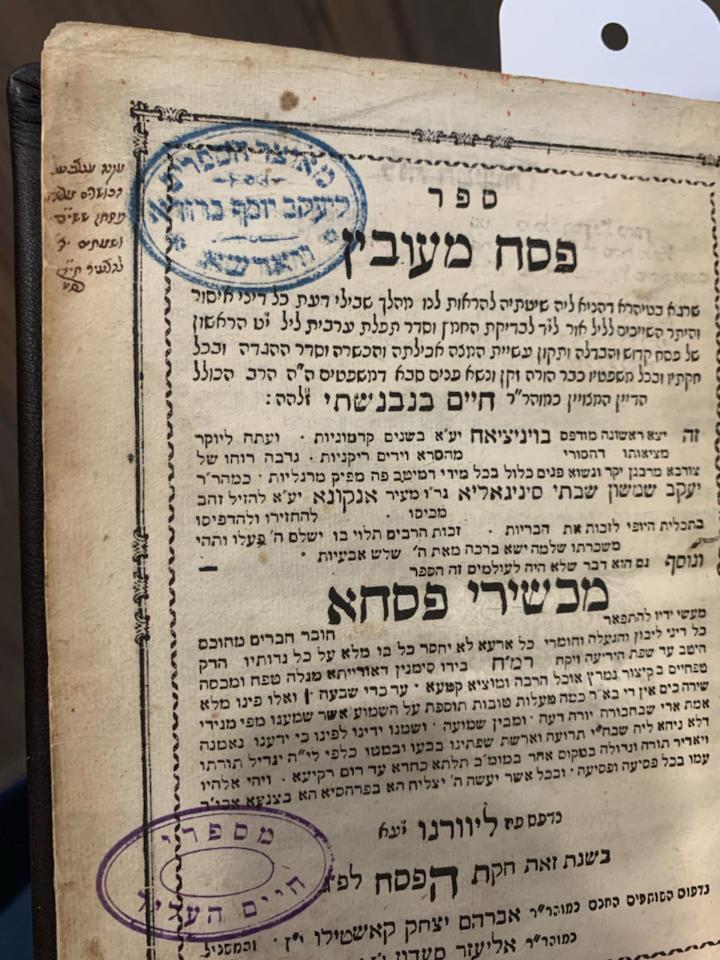
In Ha-Maor, Elul 5716, p. 30, M. Abramson tells the following story that appears under the heading על זיוף המשנה ברורה. The Satmar Rebbe was away from home and asked his assistant, R. Joseph Ashkenazi (who is the source of the story), to bring him a book. Ashkenazi brought the first book that came to his hand. It was a Mishnah Berurah printed in Israel. After investigating the history of the printing of the Mishnah Berurah at the National Library of Israel, I concluded that the copy the Satmar Rebbe was given was published by Pardes in 1955 (one year before the event described). Here is the title page.

Later the Rebbe returned the book to Ashkenazi and said that as far as he remembers, the language in section 156 of this copy of the Mishnah Berurah differs from what appears in other editions. Ashkenazi checked an older edition of the Mishnah Berurah and discovered that the Israeli edition had altered the original text.

The original Mishnah Berurah 156:4 reads:

מצוה על כל אדם לאהוב את כ”א מישראל כגופו שנא’ ואהבת לרעך כמוך וכו’ ודוקא רעך בתורה ומצוות אבל אדם רשע שראה אותו שעבר עבירה המפורסמת בישראל ולא קיבל תוכחה מצוה לשנאתו.

I have underlined the words that Abramson calls attention to. While the original text reads: לאהוב את כ”א מישראל, the Pardes edition has לאהוב את עמיתו. Abramson notes, “In this they wanted to show their support for democracy, that one needs to love not just the Jews but also the Arabs.” The Pardes edition also omits the second series of words that I have underlined, which express sentiments that are not very tolerant of the irreligious,[1] as well as some other words.

Here is the uncensored page in the Mishnah Berurah.

Here is the censored page in the Pardes edition.

Upon looking again at the Abramson article, I see that I misremembered, as it does not actually say that the Satmar Rebbe attributed this censorship to the Zionist publisher. He simply noticed the problem in the Israeli edition and said that this Mishnah Berurah is not like the others he has seen. It is Abramson who explicitly blames the Zionists (although perhaps the Rebbe agreed with Abramson). Abramson sarcastically writes that apparently they also provide copies of the Mishnah Berurah “to the children of Mapai and Mapam,” and this explains why they altered and censored the text.

Yet the truth is that what we have just seen has nothing to do with the Israeli publisher, Pardes. I found the same censorship in a Mishnah Berurah that appeared in Warsaw in 1895, and interestingly, it is this very edition that is found on hebrewbooks.org here. In other words, the changes we have seen were inserted under Czarist rule, and the Israeli publisher simply reprinted a copy of the Mishnah Berurah without realizing that it was a censored version.[2]

I know of another example where the altering of a text was blamed on the Zionists, and this time the one doing the blaming was a Mizrachi rabbi, R. Avigdor Cyperstein. In the Mossad ha-Rav Kook Archive of Religious Zionism there is a letter from R. Cyperstein to Dr. Yitzhak Rafael dated May 14, 1967. The relevant section reads as follows:

ידידי היקר – אני רוצה לזכות אותך בזכות הרבים, ובטח לא תחמיץ את המצווה הזו: כעת בכל העולם נפוצים הסידורים תוצרת הארץ הוצאת “בית רפאל”, ת”א – “סדור התפלה השלם” – והנה מצאתי בסידור זה דבר נורא: במעמדות של יום הששי מובא הגמ’ מנחות מד. המעשה באדם אחד שהי’ זהיר במצוות ציצית וכו’ ושם כתוב “באה לבית מדרשו של ר’ חייא, אמרה לו רבי צוה עלי ויעשוני גיורת וכו’, – והמולי”ם הללו העיזו לשלוח יד בגירסת הגמ’, ובמקום ויעשוני גיורת – השליכו את הגיורת החוצה, והכניסו במקומה “עברית” . . . והמרחק-התהום בין גיורת לעברית – אין צורך לבאר, וגם כוונתם הטרופה, בוקעה מזה, ומעלה סרחון, בכי’ לדורות. דומני שאין מי שהוא שהעיז לכבוש את המלכה בבית וכל ישראל – מתפללים מסידור זה, וע”כ מצווה לפרסם זה ברבים, ולתקן בהוצאות החדשות.

It is hard to know whether what R. Cyperstein refers to was indeed a Zionist inspired alteration. I say this because the version ויעשוני עברית is also attested to in a few sources that pre-date Zionism. I think it is more likely that the publisher just assumed that this is a more authentic reading.

Since I have been discussing the Satmar Rebbe, here is as good a place as any to note that contrary to popular belief, the name Satmar does not come from St. Mary. The original meaning seems to be a personal name, and in popular etymology the word came to mean “great village.”[3] Yet even in the Satmar community some believe that the word comes from St. Mary, and because of this they pronounce it as “Sakmar”. In pre-war Hungary this pronunciation was common among many Orthodox Jews, not only Satmar hasidim.[4] For one example of this, here is Samuel Noah Gottlieb’s entry on Satmar in his rabbinic encyclopedia, Ohalei Shem (Pinsk, 1912), p. 425. As you can see, while “Szatmar” appears in the vernacular, in the Hebrew the city is spelled “Sakmar”. There are many more such examples.

This avoidance of saying the word “Satmar” is similar to the way Jews referred in Hebrew and Yiddish to the Austrian town Deutschkreutz. Unlike the case with Satmar, when it came to Deutschkreutz the universal Jewish name was Tzeilem (Kreutz=cross=tzelem). On the other hand, there was a significant Jewish community in the Lithuanian city of Mariampole, whose name comes from Mary. Yet I am not aware of anyone who avoided saying the name of this city. Shimon Steinmetz emailed me as follows:

We might also note other cities with Christian-y names, like Kristianpol. Kristianpoler was a name used even by rabbis, cf. Rabbi Yechiel Kristianpoler, and his son Rabbi Meir. In addition, the Lithuanian town Kalvarija, which has a very Christian association, Jews used it without any issue. On the other hand, the Jews called St Petersburg, “Petersburg,” without the “St.”

One other point about Satmar: In a lecture I mentioned that one of the old-time American rabbis met with the Satmar Rebbe and concluded that when it came to the State of Israel, you simply could not speak to him about it. He was like a shoteh le-davar ehad when it came to this in that no matter how much you tried to convince him otherwise, he refused to listen to reason. Someone asked me which rabbi said this. It was R. Ephraim Jolles of Philadelphia (as I heard from a family member). I don’t think his formulation is too harsh, as anyone who has read the Satmar Rebbe’s writings can attest. It does not bother me if he or anyone else wants to be an anti-Zionist. However, the anti-Zionist rhetoric found in the Satmar Rebbe’s writings, and those of his successors, is often more extreme than what we find among the pro-Palestinian groups. Take a look at this passage from Va-Yoel Moshe, p. 11.

אם נקח כל פירצות הדור והעבירות המרובות הנעשות בכל העולם וישימו אותם בכף מאזנים אחת, ומדינה הציונית בכף מאזנים השני’, [המדינה הציונית] תכריע את הכל, שהוא השורש פורה ראש ולענה של אבי אבות הטומאה שבכל אבות הנזיקין שבכל העולם כולו, והן המה המטמאים את כל העולם כולו.

By what logic can one claim that such an outrageous passage would be anti-Semitic if said by Mahmoud Abbas, Linda Sarsour, Tamika Mallory, or Max Blumenthal, but not so if the very same thing is said in Satmar?

If anyone wants to see the results of this rhetoric, here are two videos with kids from Satmar. In this one the children are being taught that the Zionists started World War II and to hope for the destruction of the State of Israel.


In this video children were told that Netanyahu was in the car and they were to throw eggs at it.

It is very painful to see how children are being indoctrinated with such hatred. Again I ask, if such a video surfaced from a leftist camp, there would be no hesitation in labeling it anti-Semitic. So why are people hesitant to conclude that Satmar is also involved in spreading anti-Semitism?

The general assumption is that the Satmar Rebbe hated Zionism and the State of Israel so much, that he was inclined to believe even the most far-out anti-Semitic canards against the State. I have always found this difficult to believe. Say what you will about the Rebbe, there is no denying that he was very intelligent. Thus, I have a hard time accepting that he could have really believed in Zionist control of the media and other anti-Semitic tropes found in his polemical writings. In other words, I think it is more likely that he did not believe in any of these things but said them anyway in order to convince his followers not to give up the fight against Zionism, a fight that had been abandoned by so many former anti-Zionists after the Holocaust and the creation of the State of Israel in 1948. In such a battle it was necessary to turn Israel not only into something bad, but actually the worst sin imaginable.

R. Nahum Abraham, a Satmar hasid and prolific author, has recently written that the Satmar Rebbe would deny things that he knew were true. He regarded his denials as “necessary lies,” in order to prevent people from being led in the wrong direction.[5] If the Rebbe thought that it was permissible to deny the truth of certain hasidic stories in order to prevent his followers from being influenced by them, isn’t it possible that he would exaggerate the evils of the State of Israel in order to best indoctrinate his followers with an anti-Zionist perspective?

This approach also would explain a big problem that no one has been able to adequately account for. How was the Satmar Rebbe able to have friendly and respectful relationships with people who, based on what he writes, he should have regarded as completely out of the fold due to their involvement with the State of Israel? This includes even men like R. Aharon Kotler who supported voting in the Israeli elections, which the Satmar Rebbe claimed is “the most severe prohibition in the entire Torah.”[6] Yet we know that the Satmar Rebbe respected R. Aharon and others who had a very different perspective.[7] Can’t this be seen as evidence that there is a good deal of ideologically-driven exaggeration in the Satmar Rebbe’s writings, and that not everything he says really reflects his actual views? After all, if he really thought that voting in the elections was the most severe prohibition in the Torah and the State of Israel was completely destroying Judaism, would he still be able to be on good terms with rabbis who instructed their followers to vote and be part of the State?

2. Since I mentioned Munkács in this post, let me return to another recent post here where I discussed R. Baruch Rabinovich, the son-in-law of R. Hayyim Eleazar Shapira and his successor as Munkácser Rebbe. When I wrote the post I was unaware of the fact that R. Baruch’s grandson, R. Yosef Rabinovich, recently published Ner Baruch, which is a collection of Torah writings and letters from R. Baruch. He includes in the volume the haskamot written by R. Baruch. I examined new printings of the volumes with haskamot that I was unaware of and found that R. Baruch’s haskamah to the first edition of R. Yitzhak Adler, Seder Shanah ha-Aharonah (Munkács, 1937) was deleted in subsequent printings. The same thing happened with R. Baruch’s haskamah to R. Judah Zvi Lustig’s Yedei Sofer (Debrecen, 1938). Here is how the page with the haskamot looks in the original printing.

Here is how the page with the haskamot looks in the reprint, where R. Baruch’s haskamah has been deleted.

Another point about R. Baruch: In 1946 he tried to become chief rabbi of Tel Aviv but lost out to R. Isser Yehudah Unterman. This is discussed in Samuel Heilman’s Who Will Lead Us? From a letter that appears in the archive of R. Isaac Herzog, and was sent to an unknown rabbi, we see that in 1950 R. Baruch was also interested in becoming av beit din in Tel Aviv.

This information is, to the best of my knowledge, not recorded anywhere else. In this letter, which I found here (a site that contains more interesting information and pictures about R. Baruch) we that R. Herzog, R. Unterman, and R. Yaakov Moshe Toledano were strongly opposed to R. Baruch receiving this appointment. Although the reason for this opposition is not mentioned, it is perhaps because they felt it was an abomination that someone from the anti-Zionist Munkács dynasty should have such a position in the State of Israel. However, as I have mentioned in my previous post, it is doubtful that R. Baruch ever really shared his father-in-law’s strong anti-Zionism. It is possible that the anti-Zionist statements he made in the pre-war years might not have reflected his actual beliefs but were due to his position as rebbe. That is, as the successor of R. Hayyim Eleazar Shapira he felt that he had to make such statements. It is also the case that had he not continued his father-in-law’s anti-Zionist stance he would not have retained much of a following in Munkács.

When R. Baruch wanted to become chief rabbi of Tel Aviv, a letter in opposition to this was published by Chaim Kugel, head of the Holon Municipal Council:

Is it conceivable that this man . . . who hounded Zionism and Zionists . . . who loyally continued the line of the Munkács court, which cursed and banned any Jew who pronounced the word Zion on his lips . . . is it conceivable that this man will appear as a representative and moral leader in the first Hebrew city, and be a guide to its residents and Zionists?[8]

In those days it was obvious that positions of chief rabbis of important cities would go to Zionist rabbis. Here, for example, is a letter to R. Unterman from David Zvi Pinkas, an important Mizrachi figure and signatory of Israel’s Declaration of Independence.[9] Note how Pinkas tells R. Unterman that the Mizrachi expects him to follow the Mizrachi approach in everything he does. If R. Unterman could not commit to this, then Pinkas would have found another rabbi who could.

In my earlier post I neglected to mention R. Baruch’s Hashav Nevonim that appeared in 2016. This book is full of interesting material, and the more I read from R. Baruch, the more impressed I am. He really was a fascinating figure in so many ways.

There is a good deal I can say about Hashav Nevonim, but let me just call attention to the first essay that appears in the book, focused on conversion. Conversion is a matter often in the news. I have said on numerous occasions that what currently passes as the standard approach to conversion was not the case at all in previous years. To begin with, among the rabbis there were different understandings of what kabbalat ha-mitzvot entailed, and the currently accepted view that a prospective convert must commit to become fully halakhically observant, as practiced today in Orthodox communities, was not the view of many, and perhaps not even the view of most. The notion that a conversion could be annulled after the fact was hardly ever put into practice, although even this is found on occasion and R. Baruch cites some authorities who speak about this very point. Thus, it is not, as has often been alleged, a modern haredi idea with no historical basis although, as mentioned, it was very rare.

After going through the various views on conversion, R. Baruch concludes as follows (p. 47).

מנהג העולם נראה כמקבל דיעה זו, וכל מי שנתגייר, בין ששומר מצוות, ובין שחוזר ועובר עבירות, דינו כישראל, כל שקיבל עצמו עול מצות עם גירותו.

I have underlined the words which are not currently accepted by many (most?) conversion courts and which are at the heart of the controversy regarding voiding conversions. Today, the assumption of many conversion courts is that if someone who converts is later seen violating halakhah in a serious way, we can assume that this person never really accepted the mitzvot at the conversion, and the conversion is therefore not valid. It is this argument which was hardly ever put into practice in previous years and now appears to be quite common, so much so that converts claim to feel that their conversions are always “on condition,” namely, that even many years after converting there is the possibility that the conversion will be declared invalid because of a lack of proper kabbalat ha-mitzvot.

On pp. 27-28, R. Baruch calls attention to the novel view of R. Isaac Benjamin Wolf, author of Nahalat Binyamin (Amsterdam, 1682), a book reprinted a number of times and which carries the haskamah by R. Jacob Sasportas. Here is the title page.

R. Isaac is described as rabbi of מדינת מרק. This refers to the German county of Mark, about which see here.

Here is page 89a in Nahalat Binyanim

According to R. Isaac, in places such as Spain and Portugal, where one could not practice Judaism openly, if a Jewish man marries a non-Jewish woman, and the woman chooses to practice Judaism, both she and her children are regarded as Jewish. How can she be Jewish when she never immersed in the mikveh and there was no beit din to preside over the conversion? R. Isaac says that there is no obligation to immerse in the mikveh when there is danger (as there would be in a place with the Inquisition looking to find Crypto-Jews). Although he does not elaborate, it is obvious that according to R. Isaac kabbalat ha-mitzvot in front of a beit din is not an absolute requirement. In other words, he holds that in a she’at ha-dehak one can convert on one’s own, without a beit din.

This is a fascinating position that is at odds with accepted halakhah, so much so that most people won’t even believe that such a position is possible. R. Baruch is not able to cite anyone who agrees with it. The position of Nahalat Binyamim is discussed by R. Eliezer Waldenberg, who not surprisingly completely rejects it.[10] However, he does cite a medieval view that has some similarity to Nahalat Binyamim:

היה מקום להביא סמוכין לזה משיטת האביאסף שהובא במרדכי ביבמות סו”פ החולץ שמפרש דברי הגמ’ שם שאומרת מי לא טבלה לנדותה שמשמע דבדיעבד הוי גר גמור גם בטבילה בלי ג’.

Unlike R. Waldenberg, R. Hayyim Amsalem, Zera Yisrael, p. 290, does not reject Nahalat Binyamin out of hand. Instead he writes:

חזו דברי גאון קדמון זה לאיצטרופי, ולדון להקל בבני האנוסים ובבני יהודים לענין גיורם וחזרתם לדת, שכל שימולו ויטבלו לשם יהדות בהודעת מקצת מצוות כהלכה, סגי להו אף לכתחילה, אע”פ שאנחנו לא יודעים מה שהיה אח”כ לענין קיום המצוות, וזה אתי אפי’ למ”ד קבלת מצוות מעכבת.

See also Jacob Sofer, Sipurei Yaakov (Lvov, 1913), vol. 2, pp. 7ff. (no. 42), for a lengthy story starring the Maharal. The tale is obviously fictional, but of importance for our purposes is that the story, reported in a hasidic text, tells of a woman who ran away from her non-Jewish husband and married a Jewish man, had children, and was a righteous woman. However, this woman never converted with a beit din, and yet on p. 8a it specifically states that she and her children are to be regarded as Jewish. R. Nahum Abraham points to this as an example of an anti-halakhic hasidic story that cannot be true.[11]

Finally, Nahmanides in his commentary to Yevamot 45b has an interesting view and I do not know if it is accepted.

ואיפשר לומר דגבי קבלת מצוות צריך שלשה אפילו בדיעבד דמשפט כתיב ביה מה התם שנים שדנו אין דיניהן דין אף כאן אינו גר אפילו בדיעבד, אבל מי שהודיעוהו מקצת ענשן של מצות ומתן שכרן של מצות וקיבל עליו בב”ד לטבול ולמול, אם הלך ומל וטבל שלא בפני ב”ד הרי זה כשר ולא פסלינן לזרעיה

3. There are many new books to speak about. One of them is Chaim I. Waxman, Social Change and Halakhic Evolution in American Orthodoxy. The content of the book can be seen from the title. I will be reviewing this book in an academic journal, so I do not need to speak about it here. I would, however, like to call attention to one point that will not be mentioned in my review. Chapter 5 is titled “Tensions Within Modern Orthodoxy.” Not surprisingly, it deals with women rabbis. On pp. 109-110, Waxman refers to R. Jeremy Wieder’s view on the matter (the name is misspelled “Weider”). He quotes from an article in the Yeshiva University Commentator, which summarizes R. Wieder’s position as follows: “[I]n light of the success of the yoetzet halacha program in increasing overall observance in the communities that he has observed, it may be very beneficial to have women rabbis.”

I was quite surprised to see such a liberal position expressed by a YU Rosh Yeshiva, and I checked the source which appears here. R. Wieder is indeed quoted saying, among other things, that there is no binding tradition on the matter of women rabbis since the issue of women in leadership positions is a new question, thus preventing the development of a “stream of Jewish tradition.” However, when I read the article I did not find anything about how it may be “beneficial to have women rabbis.” I then noticed the following at the beginning of the article. “Editor’s Note: This article has been edited to more precisely convey the opinions represented.” In this case, I think the meaning of “more precisely convey” is that what originally appeared was altered (presumably at R. Wieder’s request) in order to prevent controversy. Yet even with the removal of R. Wieder’s view that it may be “beneficial to have women rabbis,” the current text of the article does not alter the substance of R. Wieder’s opinion. Thus, we find the following:

Lastly, Rabbi Wieder talked about the issue from a philosophical standpoint. He argued that expanding the pool of rabbinic students could lead to an increase in qualified rabbinic candidates. Rabbi Wieder added that he has observed the yoetzet halacha program increase overall halachic observance in the communities it serves and he expressed his optimism that women rabbis could generate similar improvement.

These words are certainly in opposition to the OU’s recent statement on women and religious leadership which is available here.

The question I have been asked a few times is if in the current political climate it is possible for a rabbi at a mainstream Modern Orthodox synagogue, or a teacher at a mainstream Modern Orthodox school, to feel free to express support for the ordination of women. Would such a rabbi or teacher risk censure from his colleagues or even the possibility of losing his job? The answer to these questions will determine if we are dealing with a real wedge issue (as I think we are).

Another new book is R. Bezalel Naor’s Shod Melakhim. R. Naor is well known as an outstanding interpreter of R. Kook. His great knowledge of the entire scope of Jewish thought (not just R. Kook) is apparent to anyone who examines his writings. Yet I do not know how many are aware of R. Naor’s achievements when it comes to rabbinic literature. This latest book is a collection of R. Naor’s studies on various halakhot in the Mishneh Torah. As part of R. Naor’s explication of these halakhot, he offers the reader wide-ranging enlightening discussions using numerous sources, both traditional and academic. For those who can appreciate the synthesis of the traditional and the academic approaches to the study of Maimonides, R. Naor’s new book is a real treat.

In the past I have spoken about the late R. Mordechai Spielman’s great work on the Zohar, Tiferet Zvi. The seventh volume of Tiferet Zvi has recently appeared, and can even be purchased on Amazon. Anyone who is interested in how the Zohar has been interpreted, and the impact of the Zohar on later rabbinic literature, will benefit greatly from of R. Spielman’s writings.

A new book (over 600 pages) by Benjamin Brown has appeared. It focuses on the Karlin hasidic dynasty. When I received the book in the mail, the first thought that came to my head is that Brown is a phenomenon. There is no other way to put it. It is not just the quantity of his literary output that is astounding, but also the quality, as everything he writes is worth reading.

____________

[1] Regarding the Hafetz Hayyim’s view of the non-religious, which is very much at odds with current approaches in the Lithuanian yeshiva world (at least in America), see Benjamin Brown, “Ha-‘Ba’al Bayit’: R. Yisrael Meir ha-Kohen, he-‘Hafetz Hayyim,’” in Brown and Nissim Leon, eds., Ha-Gedolim (Jerusalem, 2017), pp. 127ff. Brown also shows that in a few letters the Hafetz Hayyim adopts a more moderate perspective.
[2] In future posts I hope to say a good deal more about the Satmar Rebbe’s writings. For now, let me just respond to someone who emailed me and compared R. Hayyim Eleazar Shapira, the Munkácser Rebbe, to the Satmar Rebbe. It is true that they are similar in terms of their strong opposition to Zionism, and the Satmar Rebbe can be seen as the Munkácser Rebbe’s successor in this matter. However, in terms of their scholarly approach, they are quite different, as the Satmar Rebbe did not have the Munkácser’s critical sense. In fact, I was quite surprised to learn that the Satmar Rebbe accepted as authentic the forged anti-Zionist letters published by Chaim Bloch in his three volume Dovev Siftei Yeshenim. See R. Dov Schwartz, Meshiv Devarim (New York, 2011), pp. 140-141.
[3] See here.
[4] Shimon Steinmetz called my attention to סאקמאר appearing as the name of the city as early as 1859 in R. Hayyim Meir Ze’ev ha-Kohen, Sha’arei Hayyim (Pressburg 1859), in the list of subscribers at the beginning of the book. (You can find this on Google books, but the version of the book on hebrewbooks.org is missing these pages, as well as other pages.) This shows that referring to the city as “Sakmar” was already common. Steinmetz also called my attention to the same thing in the list of subscribers found at the end of R. Hayyim Joseph David Azulai, Kise Rahamim (Ungvar, 1870). In this case, you can see the subscribers in the copy on hebrewbooks.org, but it has been removed from the copy on Otzar ha-Chochmah. If this was removed intentionally, on the assumption that it is not really part of the sefer, it is a big problem, as the subscriber information can be of great historical importance. It is vital that both hebrewbooks.org and Otzar ha-Chochmah scan books in their entirety, without making any changes whatsoever.

R. Yoel Teitelbaum used the term Satmar all the time, and it was on his stationery, but I did find a number of places where he wrote Sakmar, spelled סאקמער and סאקמיר. See e.g., his approbations to R. Abraham Hayyim Reinman, Va-Yetze Perah (Satmar, 1940), R. Asher Steinmetz, Mikveh Yisrael ha-Shem (Jerusalem, 1961), and his letter in Divrei Yoel: Mikhtavim (Brooklyn, 1981), vol. 2, p. 81. See also Esther Farbstein, Be-Seter ha-Madregah (Jerusalem, 2013), p. 862, for a 1949 letter from Budapest to R. Yoel in which the word Sakmar is used. Shimon Steinmetz wrote to me as follows:

I think you can see by his [R. Yoel’s] correct spelling in Latin letters that he didn’t take it seriously, and perhaps not too many Jews did. After all, R. Joel Teitelbaum himself, who I think most people would consider fairly zealous, did not insist or use it very much. . . . This tells me that when people did call it Sakmar, most of them were probably just calling it that because it was already what Jews called it. Perhaps it was even a sly joke to begin with.

[5] Peti Ya’amin le-Khol Davar (n.p., 2017), p. 31
[6] Divrei Yoel, Mikhtavim, no. 90.
[7] In a future post I will publish a letter I received from Moshe Beck dealing with this point. Beck is the chief rabbi of the U.S. Neturei Karta.
[8] Translation in Heilman, Who Will Lead Us?, p. 45.
[9] The letter is found in the Israel State Archives, David Zvi Pinkas collection, 3070/15-פ.
[10] Tzitz Eliezer, vol. 17, no. 42:11.
[11] Heikhal ha-Besht 18 (Nisan 5767), p. 18. For an Arabic version of this story, see Bayit Neeman 96 (26 Tevet 5776), pp. 4-5.


Lekah Tov – What’s in a Name?

Lekah Tov What’s in a Name?
by Marvin J. Heller[1]

For I give you good doctrine (lekah tov); do not forsake My Torah (Proverbs 4:2).

The entitling of Hebrew books is a subject of considerable interest, varying as it does from the more common manner of labelling comparable works. Book titles generally reflect a book’s subject matter. In contrast, however, Hebrew book titles often reflect a subtle theme, considerably wide-ranging between books with a like title.

This subject has been addressed previously, by me and by others, in the latter case even in book format, and as the subject of encyclopedia articles. My previously addressed book titles are Adderet Eliyahu and Keter Shem Tov.[2] What the books with those titles and Lekah Tov have in common is that the books so entitled frequently do not share common subject matter.

Our listing of editions entitled Lekah Tov, a popular title, is based on the editions recorded in bibliographic works, primarily Ch. B. Friedberg’s Bet Eked Sepharim, which covers the period 1474 through 1950, and Yeshayahu Vinograd’s Thesaurus of the Hebrew Book, which covers titles printed from 1469 through 1863. Shabbetai Bass’ (1641-1718) Siftei Yeshenim (Amsterdam, 1680), the first bibliography of Hebrew books by a Jewish author, records five works entitled Lekah Tov. Isaac Benjacob, in his Oẓar ha-Sefarim, records fourteen works (through 1863) entitled Lekah Tov.[3]

The editions of Lekah Tov described in this article are the earliest editions from the sixteenth and seventeenth centuries and one title from the first decade of the eighteenth century, that is, in 1704. The order of the works addressed in this article is in chronological order, that is the order in which they were printed, rather than the time of writing or the author’s names.

I

We begin with four sixteenth century editions of Lekah Tov, the lead edition being R. Tobias (Tovyah) ben Eliezer’s Lekah Tov, known as Pesiḳta Zuṭarta (Venice, 1546), followed by R. Moses ben Levi Najara Lekah Tov (Constantinople, 1575), then R. Yom Tov ben Moses Zahalon’s commentary on the book of Esther, and R. Abraham ben Hananiah dei Galicchi Jagel’s Lekah Tov (Venice, 1595).

R. Tobias (Tovyah) ben Eliezer: Our first Lekah Tov, by R. Tobias (Tovyah) ben Eliezer (eleventh cent.), is also known as Pesiḳta Zuṭarta. A midrashic commentary on the Pentateuch and the Five Megillot, it published in רננ”ו (306 = 1546) at the renowned press of Daniel Bomberg in folio format (20:93 ff.). Bomberg, a non-Jew, came to Venice from Antwerp, obtained a privilege from the Venetian Senate to print three books, and issued as his first imprint a Latin Psalterium (1515). Soon after, in December, 1515, Bomberg requested and received the right to print Hebrew books, with a monopoly based on the expenses already incurred with such an activity. By the time his press closed, more than four decades later in 1548/49, it had published between two hundred to two hundred fifty titles, covering the gamut of Jewish literature, encompassing liturgy, Talmud, halakhah, philosophy, and grammatical works, books of high quality.

1546, Venice


R. Tobias (Tovyah) ben Eliezer 1880, Vilna
Courtesy of the National Library of Israel

Tobias (Tovyah) ben Eliezer’s (eleventh-twelfth centuries) place of residence has variously been given as Kastoria, Bulgaria, while others suggest Ashkenaz. Isidore Singer and M. Seligsohn suggest that Tobias might have been a native of Mayence (Mainz) and a son of Eliezer ben Isaac ha-Gadol, a teacher of Rashi. Ashkenaz is given suggested because Lekah Tov was written after 1097 and reference is made several times to the tribulations of the Crusades. In parashat (weekly Torah reading) Emor (Leviticus 21:1 – 24:23), for example, Tobias writes about the slaughter of the Jews in Mainz. However, as Tobias also frequently attacks Karaites and shows a knowledge of Mohammedan customs, it is suggested, by Solomon Buber, that that he was a native of Castoria in Bulgaria. Towards the end of his life Tobias settled in Eretz Israel.[4]

The pillared title-page of Lekah Tov has a header that, in a small font, states “There is neither wisdom, nor understanding, nor counsel against the Lord” (Proverbs 21:30). Below it is the phrase “the light of the righteous [will rejoice]” (Proverbs 13:9). Below in a larger font, is the title, given as Pesikta Zutarta, included here because later editions entitle and record Pesikta Zutarta as Lekah Tov.

This edition is on Vayikra, Bamidbar, and Devorim (Leviticus, Numbers, and Deuteronomy). Because the first edition was based on an incomplete manuscript which was lacking a first page, the printer entitled it Pesiḳta based on the word piska leading the words in the text. Tobias had entitled the work Lekah Tov because of the allusion to his name (tov, Tovyah, Tobias) in the title and begins each weekly Torah portion with a header verse with the word tov. For example, parashat Kedoshim begins with “Depart from evil, and do good (tov); seek peace, and pursue it” (Psalms 34:15); parashat Beha’aloscha “How sweet is the light, and it is good (tov) for the eyes to behold the sun!” (Ecclesiastes 11:7); and parashat Hukat “ You are good (tov) and beneficent, teach me Your laws.” (Psalms 119:68).

Tobias supports the literal meaning of the text but also quotes aggadot, midrashim, and the Talmud. He gives the grammatical meaning of words and quotes many halakhot, a recurrent source being R. Achai Gaon’s She’eltot. Tobias frequently refers to his father R. Eliezer, whom he refers to as ha-gadol or ha-kodesh (the great or the holy). As noted above, he attacks the Karaites and has a thorough knowledge of Mohammedan customs.

Tobias’ Lekah Tov has been cited by such leading rabbinic writers as R. Abraham ibn Ezra, R. Asher ben Jehiel (Rosh), R. Zedekiah (ha-Rofei) ben Abraham (Shibbolei ha-Leket), R. Menahem ben Solomon (Sekhel Ṭov, Even Boḥan), Rabbenu Tam, R. Isaac ben Abba Mari (Ba’al ha-Ittur), and R. Isaac ben Moses of Vienna (Or Zarua).[5]

Several editions of Tobias’ Lekah Tov on the Megillahs have been printed. The first reprint on the Torah commentary was in Vilna (1880) followed four years later by a second printing (1884), both by R. Solomon Buber at the Romm press.

R. Moses ben Levi Najara: Our next Lekah Tov is a commentary on the Torah with reasons for the mitzvot by R. Moses ben Levi Najara. This edition of Lekah Tov was printed in Constantinople at the press of the brothers, Jacob and Solomon ibn Isaac Jabez in folio format (20:150 ff.). They had printed previously in Salonica, for a brief interval in Adrianople and, after an outbreak of plague in Salonica in approximately 1570-72, Joseph Jabez sold his typographical material to David ben Abraham Azubib and left that city to join his brother Solomon in Constantinople. Solomon Jabez, had, in 1559, settled in Constantinople, founding a press that was active for about three decades. The brothers, issued more than forty titles in Constantinople.[6]

R. Moses ben Levi Najara was born in Turkey in c. 1502, perchance from a family whose origins were in Nájera, Spain. The family head, Levi Najara, settling in Constantinople after the expulsion of the Jews from Spain in1492. Moses Najara served as rabbi in Danaiditsch, spent time in Safed where at the age of thirty Najara was considered among the leading rabbinic scholars of Safed. In that location Najara was a student of R. Isaac Luria (Ari ha-Kodesh). He subsequently served as rabbi in Damascus. Moses Najara’s son, Israel Najara (c.1555 – c. 1625) was a noted poet, author of Zemirot Yisrael (Safed, 1587).

1575, Constantinople, Moses ben Levi Najara
Courtesy of the National Library of Israel

The title-page of this edition of Lekah Tov has a decorative border of florets, typical of Jabez brother publications. It dates the beginning of work to Friday, 4 Shevat, then gives the year with the chronogram “Truth will sprout from the earth אמת מארץ תצמח (331 = January 10, 1571) [and righteousness will peer from heaven]” (Psalms 85:12). The dating of this edition of Lekah Tov is problematic. With the exception of Shabbetai Bass, who gives the Hebrew chronogram date, the above bibliographic sources date publication as 1575, as does the National Library of Israel, despite the date on the title-page of מארץ (331 = 1571). Avraham Yaari transcribes the text of the title-page and then also dates it 1575.[7] In contrast to the preceeding, Abraham David, M. Franco, and Shimon Vanunu, respectively writing entries for the Najara entry in the Encyclopedia Judaica, the Jewish Encyclopedia, and Encyclopedia Arzei ha-Levanon, all date Lekah Tov to 1571. This is also the case for Isaac Benjacob who, in his Oẓar ha-Sefarim, dates publication to 1571.[8] Perchance, indeed likely, one early source erred and the later works copied and repeated the error without ever seeing the book. Another apparent error is the weekday date for the beginning of work as Friday, 4 Shevat. In 1571 that was a Sunday and in 1575 a Saturday, so that, whichever year is correct, the date for the beginning of work also appears to be in error.

There is an introduction from Najara in which he informs that he has entitled Lekah Tov for it is a good and important study, one that will guarantee the completion of their souls, truly and completely, as it was given at Sinai, to them for a goodly portion. The text follows, organized by parashah, in two columns in rabbinic letters and homilies on the Talmud, Mechiltah, Sifrah, and Sifri.

This is the only edition of Moses ben Levi Najara’s Lekah Tov. Sha’ar ha-Kelalim, published in the beginning of R. Hayyim Vital’s Etz Hayyim, is attributed to Najara in several manuscripts.

R. Yom Tov ben Moses Zahalon: Commentary on the book of Esther by R. Yom Tov ben Moses Zahalon. Entries in this article are supposed to be in chronological order of printing and this Lekah Tov was published two years after the preceding entry. However, bibliographical sources record and discount a possible, albeit questionable, Constantinople [1565], which is not noted in Avraham Yaari’ Hebrew Printing at Constantinople so that we too are discounting it. The definite publication of Zahalon’s Lekah Tov was in Safed on Friday, Rosh Hodesh Sivan, in the year “[Hear, O Lord, and have mercy on me;] O Lord, be my help! ה” היה עזר לי ([5]337 = Friday, May 27, 1577)” (Psalms 30:11) in quarto format (40: 83, 1 ff.) by Eliezer ben Isaac Ashkenazi.

This Lekah Tov is not only the first book printed in Safed, it is the first book printed in Asia, excluding Chinese imprints. Eliezer ben Isaac Ashkenazi who had printed previously in Lublin for almost two decades, leaving, with his son, to dwell in Eretz Israel – printing also, for a short time on the way, in Constantinople – anticipating that he would print books for a European market eager to purchase books from the land of Israel. Eliezer Ashkenazi became partners with Abraham ben Isaac Ashkenazi, mentioned in the colophon (apparently not a relative), the former supplying the expertise and typographic material, the latter the location and the financing.[9]

R. Yom Tov ben Moses Zahalon (Maharit Zahalon, 1558-1638), born to a Sephardic family in Safed, was a student of R. Moses Bassudia and R. Joseph Caro. He received semicha (ordination) from R. Jacob Berab II. Highly regarded by his contemporaries, who often requested his opinion on complex halakhic issues, Zahalon was a person of great integrity, not influenced by status. For example, it was his opinion, although he had the utmost respect for Caro, that the Shulhan Arukh was, “a work for children and laymen.” Zahalon made several trips as an emissary of the community in Safed to Italy, Holland, Egypt and Constantinople.[10]

1577, Safed, R. Yom Tov ben Moses Zahalon
Courtesy of the Library of the Jewish Theological Seminary

Lekah Tov was written by Zahalon at an early age, seventeen or eighteen, to send, as stated on the title page, for mishlo’ah manot (Purim gifts), to his father. Also on the title page is the prayer that, “the Lord should grant us the merit to print many books, for “from Zion shall go forth Torah, and the word of the Lord [from Jerusalem]” (Isaiah 2:3).

On the verso of the title page is a brief introduction, in which Zahalon refers to the burning of the Talmud in Italy and remarks that, “Great was the cry of the Torah before God and when He remembered the covenant that He made with us at Horeb (Sinai), the Lord roused the heart of the printer Eliezer [so that] honor dwelled in our land . . .” He encourages others to also print their books at the press in Safed. A second brief introduction from Joseph ben Meir follows, and then a longer introduction from the author. Zahalon informs that the book was named Lekah Tov because it has a reference to his name and because of the words of earlier sages on, “For I give you good doctrine (lekah tov); do not forsake my Torah” (Proverbs 4:2). The commentary, which is lengthy, includes both literal, homiletic, kabbalistic, and messianic interpretations. Zahalon does not reference a large number of other works. At the end of the volume is a copy of Marco Antonio Giustiniani’s (Justinian) device, a reproduction of the Temple in Jerusalem. Ashkenazi had used this mark previously in Constantinople.[11]


Zahalon was the author of more than 600 responsa, only partially printed (She’elot u’Teshuvot Yom Tov Zahalon, Venice, 1694); additional volumes of responsa and novellae on Bava Kamma were printed in Jerusalem (1980-81); and an extensive commentary on Avot de-Rabbi Natan entitled Magen Avot, still in manuscript.

R. Abraham ben Hananiah dei Galicchi Jagel: Catechism, or handbook on the principles of the faith, for Jewish youth by Abraham ben Hananiah dei Galicchi Jagel (1553-after 1623). This is the first edition of Jagel’s popular and much reprinted Lekah Tov. A small work, it was published as an octavo (80: 18ff.) by the press of Giovanni di Gara in Venice in 1595. Parenthetically, although the name Giovanni is given in non-Hebrew sources, the Hebrew name, which appears on the title-pages is Zoan, that is, Iohannes. The di Gara press, active from 1564 to 1611, is credited with more than 270 books, primarily in Hebrew letters, and only infrequently in non-Jewish languages.[12]

Jagel was born to the Galicchi (Gallico) family, one of the four noble families exiled from Jerusalem to Rome. The family name Jagel is taken from the liturgy of the afternoon Sabbath services (Abraham would rejoice יגל). Much of what is known about Jagel’s life is from Gei Hizzayon, an autobiographical and ethical work in the style of Dante. He settled in Luzzara, in the vicinity of Mantua in the 1570s, where, after his father’s death, he inherited the latter’s banking business, a venture, by his own admission, for which he was unqualified.

Jagel, mistakenly identified as Camillo Jagel, a censor of books from 1611, has been accused of apostasy. This identification has, however, been shown to be false. Jagel also had difficulties with business associates, particularly Samuel Almagiati, which resulted in their arranging his incarceration on several occasions, for carrying a small dagger, dining at night with a Christian, and for slander. In the last and longer imprisonment, he composed portions of Gei Hizzayon. Jagel later practiced medicine, but retained close ties with several Jewish bankers, among them Joseph ben Isaac of Fano, to whom Lekah Tov is dedicated. Jagel instructed Fano’s children, when, perhaps, he wrote Lekah Tov. In 1614, together with another banker, Jagel was kidnapped, but was able to pray three times a day with Tefillin and eat permitted foods only (Gei Hizzayon).

1595, Venice, Abraham ben Hananiah dei Galicchi Jagel
Courtesy of the Dorot Jewish Division, New York Public Library

Lekah Tov, the first catechism by a Jew, is stylistically copied from and conforms to the Catholic catechism of Peter Canisius (1521-97). It summarizes the principles of Judaism, based on Maimonides’ Thirteen articles of Faith, emphasizing Judaism’s moral and ethical aspects. Jagel also copied passages from Canisius = catechism, but without violating Jewish dogma and beliefs. The dedication, in Renaissance style, begins, “how a servant may benefit to find favor in the eyes of his lord,” followed by the introduction, in which Jagel defines his purpose as, to make a fence for the Torah and state the principles of Judaism, so that they should be fluent in the mouths of all, as did the prophets. He concludes that it is in truth a lekah tov (good doctrine, Proverbs 4:2) that I give you. The text is in the form of a dialogue between a rabbi and student, emphasizing the proper conduct for attaining happiness in the hereafter. Seven classes, each of sin and of virtue, are enumerated. The section on love towards one’s neighbor is quoted extensively in the Shelah’s Shenei Luhot ha-Berit.[13]

Lekah Tov has been reprinted thirty times, and translated into Latin, German, English, and Yiddish. Western European editions, beginning with a 1658 (Amsterdam) edition published by Naphtali Pappenheim, to compensate for insufficient Torah study. Pappenheim writes that Lekah Tov, a concise summary of the principles of the Torah, is suitable for all ages. A Yiddish edition (Amsterdam, 1675) by Jacob ha-Levi was intended for those who had difficulty with the Hebrew text and were engaged in earning a livelihood, not studying Torah sufficiently and who felt that it should be read daily by everyone.

Several editions were published by apostates, who found its style comfortable, and Christian-Hebraists, who wished to learn about Judaism, both utilizing it for missionary purposes. Eastern European editions are associated with precursors of the Haskalah in Russia. Jagel’s other works are Eishet Chail (Venice, 1606), an ode to womanhood and a code of behavior; Beit Ya’ar Levanon, a scientific encyclopedia, mostly unpublished; Be’er Sheva, also an encyclopedic compendium, and works on philosophy, astrology, and halakhah, also unpublished.

II

R. Moses ben Issachar Sertels: A Hebrew Judeo-German (Yiddish) glossary on the Prophets and Hagiographa, printed at the renowned Gersonides press in Prague, headed, from 1601, by Moses ben Joseph Bezalel Katz, his name appearing on the title-page. It was published in quarto format (40:284 ff.) in the year “Now I know that the LORD will give victory to His anointed עתה ידעתי כי הושיע ה” משיחו (364 = 1604)” (Psalms 20:7) in conjunction with Sertels’ Be’er Moshe (1605, 40: 104 ff.), a comparable work on the Torah, Hagiographa and Megillot.

Sertels (d. 1614-15) has been described by Aleander Kisch, et. al, as an exegete, resident in Prague in the first half of the seventeenth century. His name a “(סערטלש) is a matronymic from ‘Sarah.’” Olga Sixtová informs that he “shows up at the turn of the 17th century as one of the most active figures in Prague Yiddish (and Hebrew) book printing, as such he deserves more of our attention.” Sixtová writes that Sertel and his family came from Germany, likely from the Wurzburg area. A son, Issachar, died in Venna in 1625 and a daughter, Shendel, in Prague in 1631. His mobility is reflective of a Ashkenaz Jewish family, more so than of a settled Christian population. Sixtová also notes that the surname name Sertel (variously Sertl[e]in, sertl, Sertln), was after Sarah, his mother.[14]

Sertels’ Lekah Tov is described by Moritz Steinschneider as “a glossary on Pent. etc. (Moses explained), in which text is expressed separately and together with the text. Beginning as a paraphrase preceding it, in which is completed the version of words or sentences together with the expositions.”[15] It is similarly described by Otto Muneles, who records Lekah Tov together with “be’er Moŝe . . . lekah. Prag 1604, 40. (Yidd. Glossary on the Prophets and Hagigrapha.).[16] Be’er Moshe, is also glosses and notes in Yiddish.


1604, Prague, R. Moses ben Issachar Sertels
Courtesy of the National Library of Israel

Sixtová writes that Sertel’s glossaries reflect his long years and experience as a teacher. In the preface to Be’er Moshe he suggests that it could be used in place of a teacher, as the rabbis, who wander from place to place lack the time to go through the entire text with their pupils. 

The title-page of Lekah Tov has a somewhat lengthy text which begins that it is an attractive explanation in [Ashkenaz] (Judeo-German), informing that it is done with understanding and wisdom on the twenty-four books [of the Bible], of great benefit to the aged and the young. Further on Sertels notes that it was written with “an iron pen (stylus)” (Jeremiah 17:1; Job 19:24) and he entitled it Lekah Tov and included reasons. The text begins with Joshua and concludes with Daniel and Chronicles. Lekah Tov is primarily set in Vaybertaytsh, a semi-cursive type generally but not exclusively reserved for Yiddish books, so named because these works were most often read by women and the less educated.[17]

Strangely, Lekah Tov, which preceded Be’er Moshe, is recorded as a supplement to that work. Moreover, Lekah Tov, as noted above, is comprised of 284 ff. whereas Be’er Moshe, is comprised of 104 ff.

R. Abraham ben Hananiah dei Galicchi Jagel: As noted above, Jagil’s Lekah Tov has been translated into several languages. An example of these translations is the 1679 Latin edition with the title Catechismus Judaeorum. It was published in London at the press of Anne Godbid & J. Playford in duodecimo format (160: [26], 58, 58 pp.).


1679, Catechismus Judaeorum (Lekah Tov), Abraham Jagel, London
Courtesy of the National Library of Israel

It is a bi-lingual Hebrew-Latin c6atechism, or handbook on the principles of the faith, based on Maimonides’ thirteen principles of faith, for Jewish youth. Lekah Tov was written at a time when catechisms became popular as a genre due to the Reformation and Counter-Reformation. It is the first such work written for Jews. This notwithstanding, Lekah Tov became popular not only with practicing Jews but also with non-Jews and converts as a window into the beliefs of Judaism.

More unusual is this edition, the first Hebrew-Latin translation. It was prepared by an apostate, Ludovicus de Compeigne de Viel, who had been engaged by Colbert, Louis XIV’s minister of finance, to translate Maimonides’ Yad ha-Hazakah into Latin. Originally a convert to Catholicism, he subsequently converted to Protestantism under the tutelage of Henry Compton, Bishop of London.[18]

The title page, entirely in Latin, is followed by a dedication to Compton [3-10], an introduction in Latin with Hebrew [11-19] which traces the history of Jewish theology and works on Judaism, and errata. The text is in Hebrew and Latin on facing pages, each with its own pagination. The Latin text has marginal biblical references. The volume concludes with a prayer and a colophon from Meshullam ben Isaac. De Viel’s purpose, as expressed in the introduction, is to demonstrate the similarity of much Jewish and Christian doctrine. He also paraphrases Jagel’s introduction. The popularity of Lekah Tov with non-Jews may be partially attributed to the false belief, based on a misidentification, that Jagel had converted to Christianity; that unlike other works by apostates it was used to emphasize similarities rather than differences between the two religions; and that c7atechisms were part of the conversionary experience. None of this was Jagel’s intent when he wrote Lekah Tov, which was intended solely for Jewish youth.

Translations of Lekah Tov in our period were p8rinted previously in Amsterdam (1658, 1675 [Yiddish]), 9and reprinted in London (1680 [English]), Amsterdam (1686), Leipzig (1687 [Hebrew-Latin]), Franeker (1690 10[Hebrew-Latin]), Frankfurt am Oder (1691[Hebrew-Latin]), and Leipzig (1694 [Hebrew-German]).[19]

III

R. Eliezer Lipman ben Menahem Maneli (Menli) of Zamosc: Discourses and explanations of Talmudic aggadot and midrashim by R. Eliezer Lipman ben Menahem Maneli (Menli) of Zamosc, published at the Frankfurt on the Oder press of Michael Gottschalk. Originally a bookbinder and book-dealer, Gottschalk was brought into the press by Johann Christoph Beckmann, a professor of Greek language, history, and theology at the University of Frankfurt on the Oder. The latter, to, whom the press originally belonged, found that he had insufficient time to operate the press and he contracted with Gottschalk to operate the press. Among the latter’s publications is the Frankfurt on the Oder Talmud (1693-99).[20]

The title-page has a decorative frame comprised of two cherubim blowing horns at the top, at the bottom an eagle with spread wings. Within the wings is a carriage and figures, and in the middle of this scenario is a depiction of the Patriarch Jacob meeting Joseph in Egypt.[21] The text of the title-page begins “[The] wise man, hearing them, will gain more wisdom (Lekah ha-tov) ישמע החכם ויוסף הלקח הטוב” (cf. Proverbs 1:5). The initial letters of the first four words in that phrase enlarged, spelling the Tetragrammaton.


1704, Frankfurt on the Oder, Eliezer Lipman ben Menahem Maneli
Courtesy of Hebrewbooks.org

The title-page is followed by several pages of approbations, from fourteen rabbis, two pages of material that had been omitted from the text, an introduction that begins “come and partake of my food and drink of the wine that I mixed” (Proverbs 9:5). Below it a listing of the section heads, the author’s apologia, his introduction, further apologia, and finally the text, set in a single column in rabbinic letters.

IV

Seven editions of Lekah Tov have been described in this article, representing editions of that work published in the sixteenth and seventeenth centuries, as well as one work published in 1704. Among them are two editions of Abraham Jagel’s popular Lekah Tov, that is a Hebrew and a bilingual Hebrew-Latin edition. These works are varied, beginning with a midrashic commentary on the Pentateuch and the Five Megillot; a commentary on the Torah with reasons for the mitzvot; a commentary on the book of Esther; a Hebrew-Judeo-German (Yiddish) glossary on the Prophets and Hagiographa; discourses and explanations of Talmudic aggadot and midrashim, and as already noted, two editions of Abraham Jagel’s popular Lekah Tov.

These works encompass Bible commentaries, a glossary, and a Jewish catechism. None of these works are polemic, but rather, in keeping with the verse from which the title is taken “For I give you good doctrine (lekah tov); do not forsake My Torah (Proverbs 4:2), they are intellectually challenging and inspiring. That authors, from disparate places, and perchance cultures chose this title for their works, is clear, for the books described in this article represent “good doctrine.”

[1] I would like to express my appreciation to Eli Genauer for reading this paper and his editorial; comments.
[2] Previous articles on the varied use of a single book titles by Marvin J. Heller are “Adderet Eliyahu; a Study in the Titling of Hebrew Books” in Studies in the Making of the Early Hebrew Book (Brill, Leiden/Boston, 2008), pp. 72-91; and “Keter Shem Tov: A Study in the Entitling of Books, Here Limited to One Title Only,” http://seforim.blogspot.com, December 17, 2019 reprinted in Essays on the Making of the Early Hebrew Book, (Brill, Leiden/Boston, 2021), pp. 85-111. Menahem Mendel Slatkine wrote a two- volume work, Shemot ha-Sefarim ha-Ivrim: Lefi Sugehem ha-Shonim, Tikhunatam u-Te’udatam (Neuchâtel-Tel Aviv, 1950-54) on book names, Abraham Berliner, Joshua Bloch, and Solomon Schechter wrote articles on the subject and there are encyclopedia entires on the subject.
[3] Shabbetai Bass, Siftei Yeshenim (Amsterdam, 1680), pp. 35-36 nos. 44-48; Ch. B. Friedberg, Bet Eked Sepharim, (Israel, n. d), lamed 745-54 [Hebrew]; Isaac Benjacob, Ozar ha-Sefarim (Vilna, 1880, reprint New York, n. d.), p. 17 nos. 329-37; Yeshayahu Vinograd, Thesaurus of the Hebrew Book. place, and year printed, name of printer, number of pages and format, with annotations and bibliographical references I (Jerusalem, 193-95), p. 71 [Hebrew].
[4] Isidore Singer, M. Seligsohn, “Tobiah ben Eliezer,” Jewish Encyclopedia v. 12 (New York, 1901-06), pp. 169-71.
[5] Mordechai, Margalioth, ed., Encyclopedia of Great Men in Israel II (Tel Aviv, 1986), cols. 565-69 [Hebrew]; Shmuel Teich, The Rishonim: biographical sketches of the prominent early rabbinic sages and leaders from the tenth-fifteenth centuries, ed. Hersh Goldwurm (Brooklyn, 1982), p. 186; https://en.wikipedia.org/wiki/Tobiah_ben_Eliezer#Lekach_Tov.
[6] C. B. Friedberg, History of Hebrew Typography in Italy, SpainPortugal, and Turkey (Tel Aviv, 1956), pp. 134, 144 (Hebrew).
[7] Avraham Yaari, Hebrew Printing at Constantinople (Jerusalem, 1967), pp. 117-18 no. 183 [Hebrew].
[8] Isaac Benjacob, Oẓar ha-Sefarim (Vilna, 1880; reprinted New York, 1965), p. 269 no. 380; Abraham David, “Najara,” Encyclopedia Judaica 14 (Jerusalem, ) pp. 760-61; M. Franco, “Moses Najara,” 9 Jewish Encyclopedia (New York, 1901-06), p. 151; Shimon Vanunu, Encyclopedia Arzei ha-Levanon. Encyclopedia le-Toldot Geonei ve-Ḥakhmei Yahadut Sefarad ve-ha-Mizraḥ III (Jerusalem, 2006), p. 1574 [Hebrew]. A possible solution to the misdating was suggested by R. Aharon Berman, who wrote in a private communication dated December 5, 2023, “I would guess that the words on the line after “me’eretz” indicate that we are counting the 4 letters of the word “me’eretz” as part of the date. That is 331 + 4 equals 335.”
[9] Concerning Eliezer ben Isaac Ashkenazi see Marvin J. Heller, “Early Hebrew Printing from Lublin to Safed: The Journeys of Eliezer ben Isaac Ashkenazi,” Jewish Culture and History 4:1 (London, summer, 2001), pp. 81-96, reprinted in Studies in the Making of the Early Hebrew Book (Leiden/Boston, 2008), pp. 106-20.
[10] Hersch Goldwurm, The Early Acharonim: Biographical Sketches of the Prominent Early Rabbinic Sages and Leaders from the Fifteenth-Seventeenth Centuries (Brooklyn, 1989), pp. 127-28; Mordechai, Margalioth, ed., Encyclopedia of Great Men in Israel III (Tel Aviv, 1986), cols. 735-36 [Hebrew]; Abraham Yaari, Sheluhei Erez Yisrael (Jerusalem, 1951), pp. 236 [Hebrew]; Avraham Yaari, Sheluhei Erez Yisrael I (Jerusalem, 1951), pp. 238-40 [Hebrew];
[11] Concerning the widespread us of the temple device see Marvin J. Heller, “The Cover Design, ‘The Printer’s Mark of Marc Antonio Giustiniani and the Printing Houses that Utilized It,’” Library Quarterly, 71:3 (Chicago, July, 2001), pp. 383-89, reprinted in Studies, pp. 44-53; Avraham Yaari, Hebrew Printers’ Marks (Jerusalem, 1943), pp. 11 and 129-30 nos. 16-17 [Hebrew].
[12] Concerning the Di Gara press see A. M. Habermann, Giovanni di Gara: Printer, Venice 1564-1610. ed. Y. Yudlov (Jerusalem, 1982) [Hebrew].
[13] Morris M. Faierstone, “Abraham Jagel’s Leqah Tov and Its History,” The Jewish Quarterly Review LXXXIX (Philadelphia, 1999), pp. 319-50; David B. Ruderman, Kabbalah, Magic, and Science: the Cultural Universe of a Sixteenthcentury Jewish Physician (Cambridge, 1988), pp. 8-24, 158-68.
[14] Executive Committee of the Editorial Board, Aleander Kisch, “Moses Saerteles (Saertels) b. Issachar ha-Levi” J. E. 9, p. 92; Olga Sixtová, “The Beginnings of Prague Hebrew Typography 1512-1569,” in Hebrew Printing in Bohemia and Moravia, Ed. Olga Sixtová (Prague: Academia, 2012), pp. 67-68.
[15] “in ejus Glossario in Pent. etc. (Explicavit Moses), quod seorsim expressum et una cum textu (1604-5. etc.). [Incipit ut Paraphr. praecedens, sed in Ed. I. foll.12 absolvitur, sistitque Versionem verborum seu sententiarum una cum Expositionibus].” Moritz 2Steinschneider, Catalogus Liborium Hebraeorum in Bibliotheca Bodleiana (CB, Berlin, 1852-60), cols. 2428-29 no. 7038.
[16] Otto Muneles, Bibliographical survey of Jewish Prague: The Jewish State Museum of Prague (Prague, 1952), p. 29 no. 63-64.
[17] Concerning the early use of Vaybertaytsh see Herbert C. Zafren, “Variety in the Typography of Yiddish: 1535-1635,” Hebrew Union College Annual LIII (Cincinnati, 1982), pp. 137-63; idem, “Early Yiddish Typography,” Jewish Book Annual 44 (New York, 1986-87), pp. 106-119. In the former article, Zafren informs that the first book in which Yiddish was a segment was major was Mirkevet ha-Mishneh (Sefer shel R. Anshel), a concordance and glossary of the Bible (Cracow, 1534/35). In the latter article he suggests that the origin of Vaybertaytsh, which he refers to as Yiddish type, was the Ashkenaz rabbinic fonts, supplanted by the more widespread Sephardic rabbinic type which prevailed in Italy (p. 112).
[18] Morris M. Faierstone, op. cit.
[19] Charles Berlin and Aaron Katchen, eds. Christian Hebraism. The Study of Jewish Culture by Christian Scholars in Medieval and Early Modern Times (Cambridge, Ma., 1988), p. 44 no. 71; L. Fuks and R. G. FuksMansfeld, Hebrew Typography in the Northern Netherlands 1585 – 1815 (Leiden, 1984-87), II pp. 249 no. 283, 267-68 no. 332; Cecil Roth, Magna Bibliotheca Anglo-Judaica; a Bibliographical Guide to Anglo-Jewish History (London, 1937), pp. 329 no. 5, 428 no. 1.
[20] Concerning the see Gottschalk press and the Frankfurt on the Oder Talmud (1693-99) see Marvin J. Heller, Printing the Talmud: Complete Editions, Tractates, and Other Works and the Associated Presses from the Mid-17th Century through the 18th Century, (Brill, Leiden/Boston, 2019), pp. 47-73
[21] Concerning the eagle motif on the title-page of Hebrew books see Marvin J. Heller “The Eagle Motif on 16th and 17th Century Hebrew Books,” Printing History, NS 17 (Syracuse, 2015), pp. 16-40, reprinted in Essays on the Making of the Early Hebrew Book, (Brill, Leiden/Boston, 2021), pp. 5-29.


Of Clowns, Giants, Mules, and Centaurs: The Enigmatic Anah

Of Clowns, Giants, Mules, and Centaurs:

The Enigmatic Anah

By Yecheskel Sklar

Yecheskel Sklar, a student of Beth Medrash Govoha in Lakewood NJ, is the author of various essays and kuntreisim. His most recent work – an overview of a debate in Amsterdam between Rabbis Sasportas and Morteira about false witnesses – can be purchased on Amazon.

The verse tells us that Anah is he (or she[1]) who found הימם in the desert while herding the donkeys of his father[2]. What exactly are הימם? What exactly did Anah do regarding them? There are many views on this matter and the following is my attempt to present them.

I. MULES

Perhaps the most well-known interpretation is that הימם refers to mules. In the Talmud it states:

Rabbi Shimon ben Gamliel says, Mules {came into existence} in the days of Anah, as it says, He is Anah who found הימם in the desert…Anah was unfit, therefore he brought unfitness into the world”[3], “Said Rabbi Yehoshua ben Levi, Why are they called ימים, for their fear is placed on mankind, for Rabbi Chanina said, No one has ever asked me about the wound inflicted by a white mule…that was healed”[4].

According to this explanation, it would seem that “found” means ‘invented’ or ‘discovered’[5]. Some commentators point out that while Rashi seems to say that Isaac had mules[6], this is not necessarily a contradiction, since it is possible that mules existed before Anah, but only came into being naturally. According to this hypothesis, what Anah discovered was not the mule itself. Rather, Anah discovered the science of crossbreeding animals.[7] For that time the ability to recognize that the two species could crossbreed was considered a mark of great wisdom.[8] Alternatively, it is possible that until Anah mule breeding was exclusive to royalty. Anah introduced the technique to the general populace[9]

This would seem quite straightforward. However, in the Jerusalem Talmud we find an argument about the meaning of this word:

“What are הימם, R’ Yehuda ben Simon says המיונס, and the Rabbis say [10]המיסו, half horse and half donkey. And these are its signs, Rabbi Yehuda says, If it has small ears its mother is a horse and its father a donkey, If they are big its mother is a donkey and its father a horse…What did Tzivon and Anah do, They brought a female donkey and they mated a male horse with it, and a mule came from that.”[11]

What is המיונס and המיסו and what is the difference between them? This difficulty is compounded by the Sefer Mosef Ha’Aruch. In the entry for המיונס he writes “R’ Yehuda Ben Simon says המיונס; The explanation in the Greek language is mule”. The Aruch is referring to the Ancient Greek word for mule, ἡμῐ́ονος, a compound of ἡμῐ, which means half, and ὄνος, meaning donkey[12]. The phonetic pronunciation of this compound would be hēmíonos. In the entry on המיסו, The Mosef Aruch states: ”And the Rabbis say המיסו, half horse and half donkey; The explanation in the Greek language is half”. This is the word ἥμισυ in ancient Greek, which means half[13], and would be pronounced hḗmisu. It is clear, then, that both המיונס and המיסו refer to mules. What, then, is the difference between the two?

This difficulty has already been raised by Rabbi Marcus Lehman. Rabbi Lehman posits that המיונס refers to a mule whose father is a donkey and whose mother is a horse, known in German as Maultier. המיסו however, refers to the adverse, i.e. the product of a male horse and a female donkey. In German this is called a Maulesel. According to this explanation, the Jerusalem Talmud’s statement regarding Tzivon and Anah, “They brought a female donkey and they mated a male horse with it”, is only according to the Rabbis, as Rabbi Lehman readily points out[14].

In fact, in English too there are different names for the two. While a mule born of a male donkey is known simply as a mule, one with a horse for a father is called a hinny. According to this explanation it would be quite understandable why the JT proceeds to describe the method of determining which is which.

However, the etymology is problematic. Rabbi Lehman says that anyone who knows Ancient Greek would recognize the difference between the two. Yet, according to the Aruch and modern dictionaries, as stated above, while המיונס means half-donkey, המיסו means half. There is no evidence, to my knowledge, of המיסו meaning hinny. In fact, the very word hinny comes from the Greek word ‘hinnos’ which means little mule, thus suggesting that there was no word for a hinny in Ancient Greek, and both versions of mules were called by the general ‘hēmíonos’. How, then, does המיסו refer to a hinny? A colleague of mine, Rafael Vim, suggested that because mules in general are more donkey-like, they could be called half-donkey. However, hinnies are not horse-like enough to be called half-horse. Therefore, to reference them one would just say ‘half’.

Alternatively, the argument between Rabbi Yehuda ben Simon and the Rabbis could be along the lines of the argument of Rabbi Yehudah and Chananya in the Babylonian Talmud:

Rabbi Yehuda says: Those {mules} born from a horse, even though their father is a donkey, are permitted to {be mated with} each other. But those born from a {female} donkey, are forbidden {to be mated} with those born from a {female} horse. Says Rabbi Yehuda says Shmuel: These are the words of Rabbi Yehuda who says that the seed of the father is not taken into consideration. However, the Rabbis say: All types of mules are one. Who are the Rabbis? Chananya, who says we do take the father’s seed into consideration, and whether it is the son of a {female} horse and a {male} donkey, or the son of a {female} donkey and a {male} horse, they are all one species”. [15]

It is possible that Rabbi Yehuda ben Simon says המיונס because he was of the opinion that we consider only what type of animal the mother was to ascertain what legal status this animal has. Hence, ‘Half-donkey’. The Rabbis, however, were of one opinion with Chananya, namely that all mules are the same. Therefore, they could all be called just ‘half’.[16] What is gained by this interpretation, aside from a Halachic difference, is that the statement of the Jerusalem Talmud, “They brought a female donkey and they mated a male horse with it”, could have been said in accordance with the views of both Rabbi Yehuda ben Simon and the Rabbis[17]. In fact, it could be suggested that because of this Midrashic tradition, namely that Anah’s mule was a hinny, Rabbi Yehuda ben Simon says half-donkey, for only the mother is taken into account.

I would like to suggest another possible explanation. Many commentators explain המיסו to be a Hebrew word meaning half[18]. This is based on the Mishna that says that pomegranates are required to be tithed משימסו. The Jerusalem Talmud explains what משימסו means, “When half is ripened. Rabbi Yonah asked: Maybe you heard this from the Haggadic Rabbis, {who explain the verse[19]} אחינו המסו את לבבנו, {to mean} Split our hearts[20].”

If we accept this premise, perhaps we can explain that all the sages agree that הימם are mules. The dispute revolves around the root of the word. Rabbi Yehuda ben Simon believed that הימם is derived from the Greek word המיונס, to which the Rabbis responded that the word is simply a Hebraic word meaning half, i.e. half-horse half-donkey[21].

As previously stated, (though not explained), the Babylonian Talmud circumvents the whole issue by stating that the word is derived from the Hebrew word אימה, meaning fear, so called because of the severity of mule inflicted wounds.

However, that the word הימם refers to mules is far from universally agreed upon. As Ramban already points out, this is only the view of some of the Talmudic sages. He is referring to the fact that in the aforementioned Talmud, Rabbi Shimon ben Gamliel, who says that Anah created mules, is arguing with Rabbi Yose. Rabbi Yose is of the opinion that God put the thought of creating mules in Adam’s mind, and Adam bred them. According to Rabbi Yose, then, mules were already being created well before the time of Anah.

II. Giants

Another explanation of the meaning of הימם is based on the somewhat cryptic translation of the Targum Unkelos. There, הימם is translated as גבוריא, strong ones. The Ramban explains that Unkelos is connecting הימם with the nation called אמים, a nation of giants referred to in the Torah. According to this hypothesis, מצא would either mean that the אמים were attempting to steal Tzivon’s donkeys and Anah was saved from them[22], or that they found him and he was saved. He was thereafter known by this act of great strength.

The אמים are mentioned a few times in the Torah. The Ramban refers to the verse that states, “The אמים had previously lived there, a big and populous nation, and as strong as giants. The רפאים were considered like giants, and the Moabites called them אמים”[23]. They were so called because their fear is placed on mankind.[24] This explanation is lent credence by the fact that the Zohar suggests this is a possible explanation of our verse, before rejecting it because the words are spelled differently.[25]

Some point out that Unkelos there renders אמים as אימתני and not גבוריא. If the Ramban is interpreting Unkelos correctly, why then does Unkelos not interpret ימים to be אימתני? I believe the answer to this question can be found in the commentary to a different verse. In Genesis it states:

“And in the fourteenth year K’darlaomer came, and the kings that were with him, and they struck the רפאים in Ashteros Karnayim, and the זוזים in Ham, and the אמים in Shaveh Kiryasayim”[27].

Rashi writes “The זוזים: They are the זמזומים”. Rabbi Eliyahu Mizrachi explains that because רפאים, אמים, and זמזומים are three names for the same people, therefore Rashi infers that the זוזים are in fact זמזומים. The Yefe Toer, however, says that this can’t be. If they are all the same, why were they all in different places? Therefore, he says, it is clear that the אמים were a nation in their own right, and later the רפאים were called אמים after them, because of the fear that they too inspired. In other words, while there was a nation called אמים, it was also a word used to describe any people who inspired fear. Therefore, where the verse is referring to the naming process, “and the Moabites called them אמים”, it is appropriate to translate אימתני, namely those that inspire fear. However, when the verse refers to a group of nondescript ימים that were encountered, the correct translation is, in fact, strong ones or giants. For that is the name used to connote giants.

Now, let us move on to the nature of these giants. The Midrash says that they have seven names, and that among those are אמים and נפילים.[28] If so, it seems that we should investigate the Nephilim to discover the true nature of the אמים. The verse states:

“The Nephilim were in the land in those days, and even after, they which the sons of אלהים came onto the daughters of man, they are the strong men, who were always renowned people”.[29]

The identities of both the “sons of אלהים” and the “daughters of man” is a subject of some debate. Some suggest that it refers to the children of Seth, who were of a more refined nature, marrying the wild and murderous daughters of Cain.[30] Alternatively, the sons of the judges, who should have been the most civilized, instead abused their power to forcefully take women.[31] Finally, perhaps the most well-known explanation is that fallen angels took human women.[32] Regardless of the identity of their parents, it seems to be agreed upon that their children were giants.[33]

The Midrash describes these giants:

“Anyone who saw them, his heart melted like wax, Mentromin[34] and Magisters of war, the skull of one of them was measured to be eighteen cubits”. [35]

When the spies saw these giants when they went to scout the Land of Milk and Honey, they reported, “And we were like locusts in our eyes, and so we were in their eyes”.[36] Rashi, quoting the Talmud[37], writes that they overheard the giants, referring to the spies, commenting that ants were seen roaming through the fields.[38]

Giants are in fact mentioned numerous times in the Scriptures. From Og, the king of Bashan, who famously survived the Deluge by holding onto the Ark for dear life, and was fed by Noah through a window, to the still more famous Goliath, felled by the puny slingshot of a young shepherd named David, giants play a large role in many of the stories related in the Bible. This, then, at least according to the Targum, is another to be added to the list, the great donkey herder Anah rescuing his or her father’s donkeys from the wanton violence of these giants.

III. Clowns, Centaurs, and Other Mysterious Creatures

The final explanation to be dealt with at length here also centers around the Jerusalem Talmud and the mysterious word המיונס. The commentary on Bereishes Rabba attributed to Rashi[39] explains this word to mean “A species of wild animal”. His words are quoted by many other commentators[40]. However, what animal it is referring to seems to be a mystery.

One of the preeminent commentators on the JT, however, can shed some light on this. He writes, “I found in the Midrash Divrei Hayamim, types of people who are of an odd shape”[41]. The Midrash Divrei Hayamim, commonly known as Sefer Hayashar[42], records the following story:

And it happened when {Anah} was herding the donkeys of his father, and he brought them into the desert, as he had many other times, to pasture. And it was on this day, and he brought them into one desert on the shore of the Red Sea, opposite the desert of the nations. And he was herding them thelre and behold! An exceedingly strong whirlwind came from across the sea, and it rested on the donkeys herding there, and they all stood. Afterwards, there came from across the sea, from the desert, around one-hundred and twenty big and awesome beasts, and they all came to the place of the donkeys and stood there. And these beasts; their lower half was like the shape of a person, and their upper half; some resembled bears, and some resembled monkeys[43]. And they had tails behind them, from between their shoulders, and which reached down to the ground, like the tail of a Duchifas[44]. And these beasts came, and they mounted and rode those donkeys, and led all of them, and they all went away until this day. And one of these beasts approached Anah, hit him with his tail, and chased him away from that place. And he saw this story and he was exceedingly scared for his soul, and he ran, and he sprinted, and he dashed to Seir. And he told his father and brothers all that happened, and many men went to search for the donkeys, and they were not found. And Anah and his brothers did not go to that place anymore, from that day onwards, for they were exceedingly scared for their souls.”[45]

Similarly, the Gaon of Vilna, writes in his glosses, “המיונס, Explanation: Half-human, half-horse”[46].

It seems to be that there is some evidence that המיונס refers to a hybrid human. While the beasts described in Sefer Hayashar have almost no parallels, half-human half-horses are one of the most popular creatures in mythology. Known in English as centaurs, from the Greek Centauros, the stories about them are manifold.

References to half-humans in Jewish sources, however, are few and far in between. Perhaps sirens, (better known as mermaids), are the most spoken about. From the Talmud’s reference[47] to הדלפונין or בני ימא, who procreate either like people[48], or with people[49], explained by Rashi to be “Fish in the sea that half of them are in the shape of a person, and half in the shape of a fish[50], And in French Seirene; to the Toras Kohanim[51] which includes סירונית in the prohibition of eating non-kosher sea animals[52], on which the Raav’ad comments “In French it is called Seirene, and its top half is like the shape of a woman, and it sings like a person”; to the story in the Mosef Aruch about the King of Denmark and Norway almost seeing a siren[53]; all the way to the siren using its unnaturally long[54] hands to open the locked doors of the Egyptians during the plague of wild animals[55], sirens are well documented in Jewish sources.

Other half-human hybrids, however are almost nonexistent. The earliest supposed reference to centaurs is in Genesis Rabbah. [56] It states,

“They asked before Abba Kohein Bardela; Adam, Shes, Enosh, and {than} silence?[57] He said to them: until then they were in the form and image {of God}, from then on , קנטרין

[58]

The Mosef Aruch explains:

“The explanation in Greek and Latin: a type of uncultured people, and the poets invented that from their half up they were people, from their half down horses, to hint that they were as horse, as mule, without understanding”.[59]

However, every other commentator[60] explains קנטרין to mean contrary, that is, in reverse of the form of God. In fact, the continuation of the Midrash would make very little sense if it was actually referring to centaurs, for the Midrash continues:

“Four things changed in the days of Enosh: The mountains became hard, the dead began to rot, their faces became like monkeys, and they became profane for demons”.

If centaurs are being referred to, it should mention the fact that their feet became horse-like. It seems that even the Mosef Aruch sensed this difficulty, which is why he explains the horse-like feature to be an invention of the poets. The Midrash then is only referring to the fact that the later generations weren’t fully cultured in comparison to their predecessors. Instead they were wild and not in the form of God. (This is aside from the obvious difficulty with suggesting that all the post-enoshian generations were centaurs).

I have found two other references to centaurs in Jewish sources. One is in reference to the Dor Haflaga, the Generation of Dispersion, when people decided to build a tower to ascend to the heavens and rebel against God. God responded by changing the people of the world’s language so that they could not cooperate with each other.[61] This is the Biblical story. The Talmud[62] adds a few details: There were three groups of people. There were those who wanted to go up to the sky and live there.[63] They were dispersed. Another group who wanted to go up and worship idols, were punished by having their languages changed. The final group, who wished to ascend to the heavens to wage war on God, were changed into monkeys, spirits, demons, and Liliths.[64] Other sources add that in addition to above, they were also changed to elephants.[65]

In Shalsheles HaKabbalah[66], this theme is expanded on. In his telling, God also changed many of them into other weird creatures. “They say that after the splitting of the languages, God created strange creatures”. He proceeds to list many creatures. One of those listed are: “In Sitea there is a species which has the form of a person, and their legs are similar to a horse, and they are called centaurs”.[67]

The other source, while not strictly Jewish, is the famed letter of that fabled Christian king, Prester John, ostensibly written to the Emperor of Rome and the King of France. It only deserves mention here because it was printed and reprinted many times in Hebrew due to the mention of the Ten Lost Tribes and their fantastical way of living.[68] There too, among unicorns and other mythological creatures it mentions,

“We have in our country bowmen who from the waist up are men, but whose lower part is that of a horse. They carry in their hands bows and arrows, and they can pull harder than any human being, and they live on raw flesh. Some of our courtiers capture them and keep them chained and people come to see this great marvel.”[69]

How does המיונס refer to centaurs or other wild beasts? While it can be argued that this was simply a name for such creatures that was since lost, the Pnei Moshe suggests a different explanation. He refers to the Midrash[70] which talks about the מיומס which is brought into the theaters. He explains that a מיומס is a person who can change his shape, a shapeshifter, and that this word was borrowed here for people who are, in essence, differently shaped.

The word מיומס, in fact, is derived from the Greek word μῖμος, which in turn is the root of the English word Mime. As the Mosef Aruch explains[71], “The explanation in Greek and Roman is: a comedian who acts like another, and at times puts a mask on his face”. According to this explanation we can suggest that perhaps הימם were mimes, and Anah was the first to put the practice of making shows which featured the performances of mimes and clowns. In effect, Anah was the world’s first ringmaster.

Other commentators on the actual verse also suggest that הימם are certain wild animals. Rabbi Meyuchas writes, “And הימם, Species of wild animals, and there is no similar word in Scripture, and according to the Targum[72] they are strong animals, as in ‘יקראו להם אמים’. He seems to believe that הימם is the name of a type of wild animal, and then quotes the Targum who argues that the word is derived from אמים. Others[75], however, while also saying that they were wild animals, suggest that the word is derived from אימה, fear.[76] They are so called because they frighten people. Rabbi Nathan Adler, basing himself on this interpretation, suggests that הימם are gorillas, and they are so called because they scare people and are confused with giants[77].

IV: Other Possibilities

There are other explanations for the word הימם.

The Zohar says that הימם refers to the demonic offspring of Cain, who were created between the sixth and seventh day of creation. Only someone as wicked as Anah had the ability to see them[78].

Some suggest that הימם refers to plants. Ibn Ezra emphatically rejects this view, because the donkeys are then superfluous.

The consensus of the non-Jewish Bible scholars is that הימם refers to hot springs, which seems to be built on a non-traditional vowelization of the word. This view is not accepted by any Jewish scholars.[79]

הימם is transliterated in the Septuagint, suggesting that either it was understood to be a proper noun, or that the translation was unknown. Rabbi Samson Raphael Hirsch, in his German translation, follows the lead of the Septuagint, and does not deign to translate it.

We can suggest that perhaps הימם is referring to the person named הימם whom the Torah mentions a few verses prior. This הימם was a close relative of Anah. Maybe he was lost for some time and Anah found him roaming the desert. The fact that this possibility is not mentioned by any earlier authority, is most probably because they are vowelized differently. However, this does not seem to me to be an insurmountable difficulty, given that the spelling of people’s names often changes throughout Scriptures.

NOTES

[1] Tosfos Bava Basra 115b S.v. Melamed, “And It seemed to Rabbenu Tam that Anah was a woman, as the verses indicate, for it is written, (Genesis 36,14) ‘And these were the sons of Oholivama daughter of Anah daughter of Tzivon’…And that which it states, ‘He is Anah’ in masculine form, that is because she inherited with her brother Tzivon like a male”. Rashi, however, says that Anah was a man and that Oholivama was the daughter of Tzivon and his daughter-in-law who was Anah’s wife, and therefore she is called both the daughter of Tzivon and Anah. (Genesis 36,2. Quoted by the aforementioned Tosfos).

[2] Genesis 36, 24

[3] Pesachim 54b

[4] Chullin 7b, both brought by Rashi Genesis, ad loc.

[5] Ibn Ezra, ad loc. Cf. Pseudo-Jonathan in which it seems that he mated the animals without a specific purpose, and only later did he find mules being born. According to that interpretation “found” can be understood in its traditional sense.

[6] Genesis 26,13

[7] Chizkuni, Bartenoro on Genesis 36, 24

[8] Ramban, ad loc.

[9] Rabbenu Efraim, Genesis 26,13

[10] This is the version of the Aruch and in the Midrash Rabba and seems to be correct. However, in most editions of the JT, we find היימים.

[11] Jerusalem Talmud Brachos 8,4. Bereishes Rabba 83

[12] Liddell & Scott (1940) A Greek–English Lexicon, Oxford: Clarendon Press

[13] Ibid.

[14] Meir Nasiv. JT ad loc.

[15] Chullin 79a

[16] Cf. Chidushei Rabbi Eliezer Simcha on Genesis, ad loc. It is not clear if this is his meaning, וצ”ע.

[17] See Rashi Genesis ad loc. who says that it was the opposite, i.e. a male donkey and a female horse. See Tzeda La’Derech and other supercommentaries.

[18] Rashi BR ad loc., Rabbi Shimon Serliau JT ad loc.

[19] Deuteronomy 1, 28

[20] JT Maasros 1,2

[21] See, however, Aruch מס, who seems to suggest that the JT is explaining that the Mishna is using the Greek (or Latin, see Aruch Hashelem) word for half. I find this explanation difficult, because why than would Rabbi Yona have to point to the Haggadic Rabbis translation of the verse?

[22] Based on Psalms 21,9

[23] Deuteronomy 2,11

[24] Rashi ad loc., Cf. Bereishes Rabba 26,7

[25] Vayishlach 178b

[26] Rabbi Nathan Adler, Nesinah La’Ger

[27] 14,5

[28] Bereishes Rabba 26,7

[29] Genesis 6,4

[30] See Rokeach; Midrash brought by M.M. Kasher, Torah Sheleimah; Rosh; Ibn Ezra; ad loc. See also Rabbi S.R. Hirsch who talks about this at some length.

[31] Bereishes Rabba 26,5; Rashi; Ramban; Ibn Ezra.

[32] Yuma 67b; Pirkei D’Rabbi Eliezer 22; Rashi. See Rosh who brings a Midrash about the creation of a constellation: Angels attempted to seduce a righteous woman. Tricking them into giving her wings, she flew to the heavens, and was placed among the stars. This is the constellation Virgo. The angels were than stuck on earth until they were able to return on the ladder of Jacob’s dream.

[33] Abarbanel suggests that נפילים means stillborns. The sons of Elohim were those who lived unnaturally long lives. They were strong, and humongous in stature. They took by force the regular more ‘human’ women, and impregnated them. Their regular human bodies, however, were not strong enough to carry the huge fetuses growing inside them and this caused them to miscarriage. This explanation is perhaps alluded to in the BR, “And they filled the entire world with נפלים with their licentiousness”. Also see Malbim, who ingeniously re-interprets the verse to be an answer to idolatry. Those mythological gods and demi-gods, says the verse, were not more than the warriors of the day. The pagans attributed divinity to anyone powerful. In fact, however, they were only human.

[34] Interpreted by Mosef Aruch to be from the Greek word for fear, meaning here, those who instill fear. Chanoch Kuhut, Aruch Ha’Shalem, suggests that it refers to either monitors or mandates of war.

[35] Bereishes Rabba 26,7

[36] Numbers 13,33

[37] Sotah 35

[38] Ad loc. Malbim suggests that the word כן, normally translated to mean so, here refers to a louse, the singular form of כנים, lice. Accordingly, the spies were saying that while they considered themselves to be as large as locust when compared to the giants, the giants themselves looked at the spies as small and insignificant as a louse. (Perhaps this is why Rashi refers to ants instead of locust).

[39] Rabbi Yaakov Emden, Introduction to Etz Avos, says that it was not written by Rashi. This is brought by the Chida, Shem Hagedolim, Shin, 35, who argues that since it was printed in Tzfas in the generation after Rabbi Yosef Karo, and all the great rabbis there agreed that it was in fact Rashi, that is the truth. See, however Rabbi Yaakov Chaim Sofer, Menuchas Shalom Vol. 4, Pg. 78, who proves quite convincingly that it was not written by Rashi.

[40] Matnas Kehuna Ad loc., Rabbi Shimon Serliau JT ibid.

[41] Pnei Moshe, ad loc.

[42] The Midrashic work Sefer Hayashar was first printed in Venice in 16??. According to the introduction, it is an ancient work that was found by the Roman Emperor Titus in the ruins of Jerusalem. However, Rabbi Yehuda Aryeh of Modena, who was one of the rabbis of Venice at this time, in his work Ari Nohem, questions the authenticity of this work. The Chida in Shem Hagedolim, on the other hand, identifies it with “The Wars of the Sons of Jacob”, mentioned by early authorities such as the Ramban and Rabbenu Bachye. Rabbi Avraham ben Hagr”a in his Rav Poalim also vouches for this works authenticity. See however Yosef Dan’s introduction to his edition of Sefer Hayashar.

[43] Translated from קופים. There are variants of Sefer Hayashar. See M.M. Noah, The Book of Jashar, pg. 108, who translates it as keephas. I have differed from his translations in a few instances.

[44] One of the non-kosher birds; listed in Leviticus 11, 19. See Rashi ad loc. who quotes from the Talmud Gittin 68b that it is Tarnugal Habar. See also Rashi on Chullin 63a. It is commonly translated as a hoopoe. See Rabbi Chaim Fuchs, Hakol Al Segulas Haduchifas, www.kikar.co.il/לעיוורן-לעקרה-להצלחה-סגולת-הד.html.

[45] Sefer Hayashar, Ad loc.

[46] JT, ad loc.

[47] Bechoros 8a

[48] The accepted version of the Talmudic text. See Aruch brought in footnote 35 who has this version also.

[49] Rashi ad loc.

[50] Ibid. See Mosef Aruch Entry דלפון, however, who quite understandably translates it to be dolphins. See also Ha’aruch Hashalem for an explanation of בני ימא according to this translation.

[51] Shmini, 3,7

[52] Rabbi Chanina even entertains the possibility that a dead siren could cause anyone under the same roof to become ritually impure, a law which is (generally) exclusive to humans!!

[53] Entry for סרני

[54] Ten cubits

[55] Sefer Hayashar Parshas Bo, according to Rabbi Eliyahu Kramer’s glosses on Toras Kohanim, ibid. See also Rabbi Tzvi Hirsch Rapaport, Ezras Kohanim and Tosfos Ha’azarah, who also ties in this Sefer Hayashar, and adds that sirens have scales near their tail. It is worth mentioning that Rabbi Yisroel Meir Kagan, better known as the Chofetz Chaim, in his explanation of Toras Kohanim, writes that even if they have fins and scales they are non-kosher, for otherwise it would be obvious that they are non-kosher. Cf. Rabbi Yechiel Michel Epstein, Aruch HaShulchan YD 83,10, who says that they definitely have fins and scales, but adds that without this Toras Kohanim we would think that the fish half would be permitted.

[56] 23, 6

[57] i.e. In Genesis Chapter 4 it talks about the children of Adam, it mentions Shes, than Enosh, and than it states “These are the descendants of Adam…” and proceeds to list all the generations. What than is special about these 3? (Rokeach Ad Loc)

[58] This seems to be a play on Enosh’s sons name קינן. See Ramban who quotes this Midrash as “from than on,קינןקנטורין.

[59] קינטורין

[60] Pseudo-Rashi, Matnas Kehunah, Maharzav. In fact, as is pointed out by the Mosef Aruch himself, the Aruch brings this Midrash in the entry for קנתר, along with many other places in which the word undoubtedly means contrary, or as the Aruch writes “Words of anger”.

[61] See Genesis 11, 1-9.

[62] Sanhedrin 109a.

[63] Rabbi Yonasan Eybeshutz in his Nefesh Yehonasan ad loc. famously suggested that it was a launching pad for some sort of primitive spacecraft for people who wanted to live on the moon to escape God.

[64] Rashi explains the difference between the three: spirits are bodiless and formless, demons are shaped like humans and have eating patterns similar to them, and Liliths are shaped like humans but have wings. See Rabbi Reuven Margolios, Margoliois HaYam, who asks that in Chagigah 16 it seems that demons have wings too.

[65] Meleches Shlomo, K’layim 8,6 quoting “the wise and pious kabbalist Rabbi Meshulam”, says that in the Generation of the Deluge people were changed into monkeys and elephants, “for monkeys are similar to people, and elephants understand the language of men”. The Meleches Shlomo proceeds to quote the aforementioned Midrash about the days of Enosh as support for this statement. This seems to me to be quite dubious for it says only that their faces were similar to monkeys, and elephants are not mentioned at all. Dovid Yoel Weiss, in his Megadim Chadashim, Brachos 58b, points to what I believe is the correct source for Rabbi Meshulams’ assertion. The Sefer Hayashar, Noach, writes that the people of the Generation of Dispersion were changed into monkeys and שנהבים. שנהבים are mentioned in Kings I 10,22 as things that were brought on the boats of Tarshish to King Solomon along with monkeys and peacocks. It refers to ivory which is made from the tusks of elephants. It is most probable that the Sefer Hayashar was referring to the elephants themselves. This then is the source of Rabbi Meshulam’s statement, and the word ‘Deluge’ should be changed to ‘Dispersion’.

[66] Rabbi Gedalia ibn Yichya. Quoted also in Rabbi Yechiel Halpern, Seder Hadoros. However, Shalsheles HaKabbala is considered notoriously unreliable. See Rabbi Yosef Shlomo Delmidigo, known as Yashar of Candiya, Metzaref Lechochma p.6, quoted by Rabbi Halpern himself in the introduction to Seder Hadoros. (In a play on the title, The Chain of Tradition, Yashar suggests that Rabbi Ibn Yichya should be placed in chains of iron). The Chida in Shem Hagedolim, Aleph, 9; wonders why Rabbi Halpern, who was “exceedingly wise”, brings many things from the Shalsheles Hakabblah which are not true.

[67] See also Rabbi Azriel Rakovsky, Sheleima Mishnasoi, Brachos 56b, who claims that they were also turned into the “people of the forest” who than went to America and were not killed during the Deluge. These are the people that Cristopher Columbus found. He says that this can answer the question raised by the philosophers, as to how these people exist, if all descend from Adam.

[68] See Beckingham, Charles F. and Ullendorf, Edward. The Hebrew Letters of Prester John. Oxford: Oxford University Press, 1982.

[69] Translation from Slessarev, Vsevolod. Prester John: The Letter and the Legend. Minneapolis: The University of

Minnesota Press, 1959. Another being is mentioned there which sounds quite similar, “We have in our country also other men who have hoofed legs like horses and at the back of their heels they have four strong and sharp claws with which they can fight in such a way that no armor can withstand them; and yet they are good Christians and will willingly till their lands and ours and pay us a big tribute.”

[70] Eicha Rabbah, Pesichta 17

[71] ממס

[72] We have discussed this Targum earlier.

[73] Deuteronomy 2, 11

[74] Peirush Rabbi Meyuchas, Genesis Ad loc.

[75] Paneach Raza, Rabbi Yitzchak Ben Yehudah, Ad loc.

[76] As noted before, the Talmud explains הימם this way also, although through this, connecting the word with mules.

[77] Nesinah La’Ger, Ad loc. Similarly, Rabbi Yisroel Lipschutz, Tiferes Yisroel, Klayim 8,5, suggests that the אדני השדה, who according to some could also cause ritual impurity just by being under the same roof, refer to orangutans, who can be taught “to chop wood, draw water, and also to wear clothes exactly as a human, and to sit at a table and eat with a spoon, knife and fork”.

[78] Vayishlach 187b

[79] Aryeh Kaplan, The Living Torah; Nesinah La’ger; Ad loc.


Response to Criticism, Part 3

Response to Criticism, Part 3

Marc B. Shapiro

Continued from here.

Let me continue with Rabbi Herschel Grossman’s review. [1] This post will complete my response to around a quarter of his review, so we still have a long way to go.

Grossman writes (p. 42)

According to Shapiro, “Maimonides would be surprised that . . . later generations of Jews . . . latched onto his earlier work;” and it “is certainly one of the great ironies of Jewish history that the Thirteen Principles became the standard by which orthodoxy was judged.” Finally, “the characteristic that gave them their afterlife . . . is precisely their outer form . . . Had Maimonides listed a different number of principles in the Mishneh Torah . . . these would have become the Principles of Judaism.” In other words, after postulating that Rambam innovated these obligatory beliefs, Shapiro concludes that it was the popular acceptance of these Principles that established halachic practice.

If you look at the quotations from my book that Grossman has cited, you can see ellipses. The problem here, and this would be unknown to the average reader who does not bother to see what I actually wrote, is that the complete sentences without the ellipses mean something very different than what Grossman wants the readers to think they say. Here is the complete first sentence that he cites (from p. 7 in my book): “Presumably, Maimonides would be surprised that in seeking to define the essentials of Judaism, later generations of Jews, both scholars and masses, had latched onto his earlier work rather than his more detailed formulation in the Mishneh Torah.” I think all readers will agree that the part of the sentence that Grossman quotes, with strategic ellipses, does not give the reader the true sense of the sentence. I can’t say whether this is a result of bad faith or careless writing.

Here is the complete second sentence that Grossman cites (from p. 15 in my book): “It is certainly one of the ironies of Jewish history that the Thirteen Principles became the standard by which orthodoxy was judged, for, as is well known, Maimonides himself was attacked for supposedly holding heretical views, at odds with his very own Principles.” Again, we see that by use of a strategic ellipsis, Grossman give the reader a false impression of what I wrote.

Here is the complete third selection that Grossman cites (from p. 14 in my book).

Returning to the Thirteen Principles, the characteristic that gave them their afterlife and caused them to become the formulation of the Jewish creed is precisely their outer form, that is, the fact that they were formulated as a catechism with all the Principles listed together. Had Maimonides listed a different number of Principles in the Mishneh Torah (e.g., twelve or fourteen), these would have become the principles of Judaism. But he did not, and thus the Thirteen Principles stuck.

In this case, the use of ellipses does not distort what I said.

Grossman states that I postulated that “Rambam innovated these obligatory beliefs.” We have already seen that this is complete nonsense. I never said that Maimonides invented the “obligatory beliefs,” as this would mean that before Maimonides there was no conception of traditional Jewish beliefs, which is a ridiculous notion.

In his final sentence, Grossman states that I concluded “that it was popular acceptance of these Principles that established halachic practice.” This is indeed my opinion, but I would also add that it obviously took time for the Principles to achieve widespread acceptance. Nothing I have said here is unusual or radical, and it is also opinion of many others who have written on the subject. Here, for example, is what R. Meir Orian writes in his book on the Rambam (published by Mossad ha-Rav Kook).[2]

ראינו כי בעצם ערר רבנו משה התנגדות בכל חיבור שכתב . . . גם קביעתם של שלשה עשר העיקרים של היהדות – שבמרוצת השנים נתקדשו בקדושת התורה והאומה – לא היתה לפי רוח גדולי הדור שבזמנו

There were other competing systems of dogma, but I state that none of them could compete with Maimonides’ formulation, both because of Maimonides’ supreme authority and also because popular piety prefers more dogmas to fewer. It is no accident that there are almost a hundred different poetic versions of the Principles, of which Yigdal is only the most famous. These are reflections of the popular attachment to the Principles, not to any rabbinic decision in favor of Maimonides. So if we conclude that the Principles establish halakhic practice, then yes, it was popular acceptance of these Principles that established the halakhic practice, much like popular acceptance and rejection of halakhic rulings throughout history has established halakhic practice.

Had the religious masses accepted an alternative formulation of Jewish dogma, then this would have become the standard. The rabbis can give rulings, but from talmudic times to the present it is the masses of religious Jews that determine if a halakhic ruling is accepted or not. Even with regard to the greatest poskim, you find that for some of their rulings the religious masses simply refused to accept them (perhaps because they found them too difficult and were already accustomed to do things in a different way, e.g., R. Moshe Feinstein and time clocks on Shabbat). I am not sure what Grossman’s problem is with the notion that popular acceptance can determine halakhic practice. Maybe he thinks that halakhah is only about the posek issuing a ruling. However, especially when speaking historically, we must also take into account that the religious masses (the “olam”) also have a crucial role to play in how halakhah develops.

This important notion is elaborated upon in the recent book by R. Ronen Neuwirth, The Narrow Halakhic Bridge, pp. 293ff. Here is one passage from R. Kook that R. Neuwirth quotes (from Eder he-Yekar, p. 39): “All of the mitzvot of the rabbis that we fulfill – their main foundation is the acceptance of ‘the entire nation’ which is the honor of the nation.”

Grossman, pp. 42-43, quotes the following sentence from my book (p. 17, mistakenly omitting a few words in his citation):

It seems that there is even halakhic significance to the Principles, as seen in the fact that R. Israel Meir Hakohen [Mishnah Berurah 126:2] records that one who denies the divinity of the Torah, reward and punishment, the future redemption, and the resurrection cannot serve as a prayer leader. Had Maimonides not included these Principles in his list, it is unlikely that denial of the last two, which are not necessarily of prime importance to a religious life, would disqualify one in this way.

Grossman writes:

Contrary to Shapiro’s hasty assumption, the Rambam is not the source for this Halacha. The source is the Talmud Yerushalmi, cited by the Tur [Orah Hayyim 126] as follows: “A prayer leader who skips two or three words does not have to go back to say them, except for one who does not mention ‘the Resurrection of the Dead,’ for perhaps he is a disbeliever [kofer] in the Resurrection of the Dead, and [the blessing] ‘Who rebuilds Jerusalem,’ for perhaps he does not believe in the Coming of the Mashiach.” Obviously, the ruling of the Mishnah Berurah is not an “invention” based on the Rambam.

Grossman’s translation is not exact as אין מחזירין אותו does not mean “does not have to go back”, and the translation also omits the words ומכניע זדים שמא מין הוא, but for our purposes this is not crucial.

The first thing to note is that I never said that the Mishnah Berurah’s source for his ruling is the Rambam’s Principles. What I said is that had the Rambam not included the Messianic era and Resurrection among his principles, denial of them would not have been enough to affect a Jew’s status (so that he couldn’t be a prayer leader, etc.). I will explain what I mean, as Grossman has once again completely misunderstood my point.

Let us take Resurrection, which is mentioned in the Mishnah as an obligatory belief. Nevertheless, the Rambam was suspected by both opponents and supporters as not really believing in it literally. In response to this suspicion, he wrote his famous Letter on Resurrection, which affirms the literalness of Resurrection and tells us that when he included it in his Principles he really meant it. Imagine if Maimonides, in his Letter on Resurrection, had not affirmed literal Resurrection, but instead defended the notion that it is to be understood metaphorically, as referring to the World to Come. Had that occurred, then the Rambam’s great authority would have ensured that belief in Resurrection would not be required.

My point is therefore simple: If the Rambam had declared that belief in Resurrection is not required, I do not believe that the Mishnah Berurah would have regarded this approach as heretical and thus invalidated a hazzan who held such a view, despite what other rishonim might have held. Similarly, had the Rambam not included the Messianic Era as a Principles of Faith, I do not believe that it would have been regarded as an obligatory belief, denial of which is heresy. It might have been a “recommended” belief, but not a generally accepted “obligatory” belief. In my opinion, this shows the great significance of the Rambam from both a theological and a halakhic perspective.

If you look at Jewish history, you will find that while many have asserted that certain beliefs are obligatory (e.g., gilgul, existence of demons, Divine Providence encompassing the animal kingdom, Daas Torah, R. Shimon Ben Yohai authored the Zohar, the Sages were infallible in matters of science), these beliefs have never become generally accepted to the extent that those who do not share them are regarded by the wider Orthodox world as outside the fold. Only Maimonides’s Principles were able to do such a thing. This explains what I mean when I say that had Maimonides not regarded the Messianic Era or Resurrection as obligatory beliefs, that “it is unlikely that denial” of them would have been enough to place the stamp of heresy on such a person, and thus to disqualify him from being a hazzan.

On p. 44 of his article, Grossman returns to the matter that I (and others) raised, that the Thirteen Principles are not mentioned in the Mishneh Torah. I also suggested that in his later works Maimonides was not attached to his earlier formulation of thirteen principles, as he presents a more detailed formulation of required beliefs in the Mishneh Torah.

In response to my point that one would have expected the Thirteen Principles to be listed in Hilkhot Yesodei ha-Torah, Grossman writes (p. 44)

Here, too, Shapiro indicates that he is unaware of the structure of the Mishneh Torah. The entire work is an expansion of the 613 Mitzvos: The entire work is introduced by Rambam’s Sefer haMitzvos which lists all 613 Mitzvos, and each of the sections (Halachos) has a listing of the Mitzvos included therein. Consequently, there is no place to highlight the Thirteen Principles in Hilchos Yesodey haTorah, since there are explicit Mitzvos for only three of them—emunah, yichud and avodah zarah, which he in fact does list in the introduction to this section. He could not have listed all the rest since they are not Mitzvos.

I reject this paragraph. There is a good deal in Hilkhot Yesodei ha-Torah that has nothing to do with “explicit Mitzvos.” For that matter, there is a good deal in the Mishneh Torah as a whole that is not related to “explicit Mitzvos.” In addition to what I mentioned in my last post, one can also add the last two chapters of Hilkhot Melakhim, which are about the messianic era and have nothing to do with mitzvot. The Rambam included these chapters because he felt that this material is important, and he did not limit himself in the Mishneh Torah to only matters that derive from ‘explicit Mitzvos”. Therefore, there is nothing about the “structure of the Mishneh Torah” that would have prevented him from listing the Thirteen Principles as a unit in Hilkhot Yesodei ha-Torah or elsewhere. In fact, most of the Principles are already listed in Hilkhot Yesodei ha-Torah, but just not together as a unit (which was my point), which shows that he had no problem listing them even though “they are not Mitzvos.”[3]

As for my wondering why the Principles are not listed together as a unit, which Grossman sees as an illustration of how I am unaware of the structure of the Mishneh Torah, let me begin by repeating what I wrote in my last post: R. Yaakov Nissan Rosenthal, on the very first page of his commentary Mishnat Yaakov to Sefer ha-Madda, also wonders about the point I made, that the Thirteen Principles as a unit are never mentioned in the Mishneh Torah. (Had I known this when I wrote my book, I certainly would have cited it.)[4]

ותימא למה לא הביא הרמב“ם בספרו ה”יד החזקה” את הענין הזה של י“ג עיקרי האמונה, וצ”ע

R. Avraham Menahem Hochman writes:[5]

. . .מאחר וכל כך חמורה הכפירה, וגדולה החובה לדעת את י”ג העיקרים, כיצד זה השמיטם מספרו ה”יד החזקה”, ולא כתבם כפי שסדרם בפירוש המשנה

והנה אחר שהתבאר שהאמונה בי”ג העיקרים היא בסיס לתורה נשוב לשאלה הרביעית (בסוף פרק ה’) אשר לכאורה היא פליאה עצומה מדוע השמיט הרמב”ם ביד החזקה את החובה הגדולה להאמין בי”ג עיקרים, באופן חיובי, ולא סדרם כי”ג יסודי האמונה שחובה להאמין בהם

R. Hochman goes on to explain that most of the Principles are indeed mentioned in Hilkhot Yesodei ha-Torahin a positive sense (even if not as a unit of Thirteen Principles). He also notes the following important point, that when principles of faith are mentioned in the Talmud, they are never listed in a positive sense, that one must believe X. Rather, they are listed in a negative sense, that one who denies X has no share in the World to Come. Why Maimonides, in his Commentary on the Mishnah, chose to formulate the Principles in a positive sense and require active belief as a necessity for all Jews—something the Talmud never explicitly required—is an interesting point which we will come back to. Regarding some of the Principles the difference is clear. For example, according to the Talmud, denial of Resurrection is heresy, but one who has never heard of the Resurrection and thus does not deny it, or affirm it, is a Jew in good standing. For Maimonides, however, the doctrine of Resurrection must be positively affirmed. In a future post we can come back to which Principles even the Talmud implicitly requires positive affirmation of (obviously number 1, belief in God, but there could be others as well).

Even when it comes to other basic ideas of Maimonides, which are not included as part of the Thirteen Principles, we find that scholars wondered why Maimonides did not include them in Hilkhot Yesodei ha-Torah. For example, R. Joseph Ibn Caspi writes:[6]

.הנה תמהתי על כבודו בספרי המכונה ספר הסוד, כי [אם] כן עשה הוא דעת תורתנו ויסוד הדת למה לא מנה זה בהלכות יסוד [!] התורה בתחלת מנותו היסודות

With regard to the Thirteen Principles themselves, in R. Jacob Yitzhaki’s popular Sephardic Mahzor Oholei Yaakov: Rosh ha-Shanah, p. 59b, he states:

.ובאמת גם הרמב”ם ז”ל לא זכר מהעיקרים הללו לא בספרו הגדול משנה תורה ולא בס’ המורה שחבר אחריו בזקנותו. ואם היה עודנו מחזיק בם היה לו להזכירם בס’ המדע והמורה, כי שם מקומם, ורק נזכרו בפי’ המשנה שחבר בבחרותו כידוע

R. Yitzhaki agrees with my point that it is significant that the Thirteen Principles as a unit are not mentioned in the Mishneh Torah(or in the Guide of the Perplexed; he is obviously aware that the individual principles appear in various places in the Mishneh Torah). His words, ואם היה עודנו מחזיק בם היה לו להזכירם, show that he, too, is not certain that the notion of Thirteen Principles was still something the Rambam held to when he wrote the Mishneh Torahand Guide of the Perplexed. Grossman can reject R. Yitzhaki’s point the same way he rejects what I wrote, but readers can see that what we have written is not something completely ignorant, as Grossman would have people believe.

On pp. 44-45, in response to my suggestion that in his later years the Rambam did not feel bound to the Thirteen Principles as the ultimate summation of Judaism, Grossman refers to a passage in the Rambam’s Letter on Resurrection. Here the Rambam mentions that in his commentary to Sanhedrin he expounded on fundamentals of Judaism, and he mentions that he did likewise in the Introduction to the Mishnah and the Mishneh Torah. I myself refer to this source in Limits, p. 6, as one of the few times the Rambam mentions the Principles subsequent to his the Commentary on the Mishnah. This does not change the fact that the Rambam does not refer to the Principles as a unit in the Mishneh Torah or the Guide, and the understanding of Judaism found in these latter works is not always the same as what we see in the Principles. I would assume that it is in the Rambam’s later, and indeed greater, works that we should look in order to identify his final statements on matters of Jewish belief.

The real problem is that again, Grossman simply does not understand what I am saying. He concludes this section of his criticisms by stating that, “Clearly the Rambam has not retracted his opinion that there are Principles, or roots – lacking belief in which, one is missing the fundamentals of Judaism.” Of course, I never said that in his later years the Rambam did not believe that there are Principles of Judaism. Even if we never had his Thirteen Principles, you can look at the Mishneh Torah and see that there are beliefs that if you deny them, you are missing the fundamentals of Judaism. My point about the Rambam not being tied to the Thirteen Principles has nothing to do with this. It thus makes no sense for Grossman, p. 46, to write that in the Guide the Rambam refers to the fundamentals of faith, and then to cite chapters from this work that require belief in God’s incorporeality, as if this has anything to do with what we are talking about. Let us not forget that it was the Rambam who chose thirteen principles.[7] He did not find this in the Torah or in the Talmud. When you examine the Mishneh Torah you see that he could just as easily have chosen fourteen principles, or even more (and later writers indeed added additional principles).

There is no need to belabor this any longer, but let me call attention to an error Grossman makes on pp. 46-47. He states that R. Joseph Albo refers to the Guide of the Perplexed “in explicating Rambam’s Principles.” He then cites Albo’s Sefer ha-Ikarim 1:3: “And why did he not include the dogma of creation, which everyone professing a divine law is obliged to believe, as Maimonides himself explains in the twenty-fifth chapter of the second part of the Guide of the Perplexed?” This is not an example of Albo using the Guide to explicate the Rambam’s Principles. In this chapter of Sefer ha-Ikarim, Albo asks why the Rambam does not include creation as one of the Thirteen Principles. He cites the Guide not to explicate the Principles but to show that the Rambam regarded creation as an essential doctrine, and therefore it should have appeared in the Principles. (Albo was unaware that later in life the Rambam added to the Fourth Principle the belief in creation ex nihilo.)

One point that Grossman is adamant about is that it is improper to suggest that the Rambam changed his mind when it comes to the Principles. That is because, Grossman states, the Rambam revised his Commentary on the Mishnah throughout his life, so if he did not change what he wrote in the Principles, it is “an indisputable indication” (p. 46) that it remained his opinion. The reader of Grossman’s essay will not realize that it is not a major point of my book to argue that the Rambam changed his mind about his formulations in the Principles. What I do suggest is that the Thirteen Principles as a unit is not his final statement of dogma, because he does not mention it in the Mishneh Torah or the Guide, and in those works you find other doctrines that are regarded as principles of faith which are not included in the Thirteen Principles. Furthermore, as we shall see in future posts, the Rambam has different emphases and even outright contradictions to the Thirteen Principles in his later works, so we are left with assuming that either he changed his mind or that his formulations in the Thirteen Principles were intended for a certain audience, but did not represent his true view, which would only later be revealed in the Guide – and perhaps even in the Mishneh Torah – to the spiritual and intellectual elites. I will deal with this in greater detail in a future installment of my response to Grossman. For now I just want to note that the approach that he regards as ignorant as well as apparently blasphemous, that the Rambam changed his views about certain matters in the Principles, is not unknown even among rabbinic figures.

In Limits, p. 148, I noted that R. Meir Don Plotzki claimed that while in the Twelfth Principle the Rambam requires that the Messiah be descended from Solomon, he does not mention this in the Mishneh Torah. For R. Plotzki, this shows that the Rambam retracted his earlier view (even though he never corrected what he wrote about this principle in the Commentary on the Mishnah).[8] This again illustrates the problem with so many of Grossman’s criticisms of me. He points to things I wrote that he thinks are absurd and ignorant, but what happens when I show that great rabbinic figures have said the same thing? Obviously, Grossman would not criticize them in the same way. Is this an example of the old “they could say it but you can’t”?

R. Eliyahu Meir Feivelson notes that in the Sefer ha-Mitzvot, Positive Commandment, no. 4, the Rambam includes as part of “fear of God,” fear of punishment. However, when he describes this mitzvah in the Mishneh Torah, Hilkhot Yesodei ha-Torah2:1-2, there is no mention of fear of punishment, only what is called יראת הרוממות. R. Feivelson writes[9]:

ויש להעיר עוד, שאולי יותר נכון לומר בדעת הרמב”ם, שהוא חזר בו מדבריו בספר המצוות, ולכן בספר משנה תורה נקט את יראת הרוממות. ורגליים לדבר, שהרי בהקדמתו לפרק חלק מנה הרמב”ם את האמונה בשכר ועונש, וכאחד מי”ג עיקרי אמונה. ואילו בהלכות תשובה (פ”ג הל, ו’-ח’) מנה את כל עיקרי האמונה פעם נוספת (ותחת זה מנה שם את האמונה בתורה שבכתב ושבע”פ לשני עיקרים), ולא הזכיר שם את האמונה בשכר ועונש, ושמא זה מוכיח על שינוי דעתו בענין זה

R. Feivelson mentions that in the Mishneh Torah, Hilkhot Teshuvah3:6-8, when the Rambam lists the different types of heretical beliefs, there is nothing about Reward and Punishment. He therefore suggests that the Rambam changed his mind and no longer regarded this as a Principle.

If Grossman would read R. Feivelson like he reads me, he would protest that it is outrageous to suggest that the Rambam stopped believing in, or requiring belief in, Reward and Punishment. But this would be a mistake. R. Feivelson knows full well that Reward and Punishment is an important Jewish belief. He also knows that Hilkhot Teshuvah, chapter 8, is all about Reward and Punishment. All he is suggesting is that the Rambam ceased to regard this as one of the Principles of Judaism, denial of which is heresy, and which everyone must also positively affirm to be regarded as part of the Jewish community. Or perhaps he only means to say that the Rambam removed Reward and Punishment from the Principles so people would not focus on this as a motivation to observe of the Torah. If R. Feivelson is correct, then Reward and Punishment is no different than other true beliefs which the Rambam didn’t see fit to include in the Thirteen Principles.[10]

R. Feivelson’s basic idea, that the Rambam changed his mind about including Reward and Punishment as one of the Principles, was actually earlier suggested by R. Solomon of Chelm in his classic commentary Mirkevet ha-Mishneh, Hilkhot Teshuvah3:8:

(. . .וזה מכוון נגד י”ג עיקרים שבפירוש המשנה אלא שבחדא יש חזרה, ושם מונה שכר ועונש, וכאן בחיבורו השמיטו (לפי דמצוה לעבוד שלא ע”מ לקבל פרס מאהבה

Let me turn to one other place where it is possible that the Rambam changed his mind in a matter of dogma. There are a number of discussions of the Rambam’s view of the Messiah, and it is typically stated that he believes that the Messiah will be a prophet. Since R. Alter Hilewitz was recently mentioned in the Seforim Blog here, let me cite him.[11]

שהמלך המשיח בעצמו יהיה נביא, ולא סתם נביא, אלא נביא יותר גדול מכל הנביאים פרט למשה

That the Messiah will be a prophet is often stated as part of the dogma of belief in the Messiah, yet there is nothing in the Twelfth Principle about the Messiah being a prophet. Why then do so many assume that this is part of the Rambam’s Principle? I think the answer is because in the Mishneh TorahHilkhot Teshuvah 9:2, the Rambam states that the Messiah will be a great prophet, close to the level of Moses. He also mentions this in his Letter to Yemen.[12]

As mentioned, there is nothing in the Twelfth Principle about the Messiah being a prophet. Does this mean that the Rambam changed his mind? I don’t think we can say for sure. Yet it is noteworthy that in the Mishneh Torah, Hilkhot Melakhim, ch. 11, when the Rambam speaks about the Messiah, he also does not mention anything about the Messiah being a prophet. In fact, in Hilkhot Melakhim 11:3 he tells us that R. Akiva thought that Bar Kokhba was the Messiah. Since Bar Kokhba was not a prophet, this is a proof that the Messiah does not need to be a prophet. Another relevant point is that in Hilkhot Melakhim 12:3 the Rambam speaks of the Messiah as having ruah ha-kodesh, which is a lower level than prophecy. Thus, it appears clear that according to Hilkhot Melakhim the Messiah will not be a prophet, or at least does not need to be a prophet.[13]

How to explain the fact that in Hilkhot Teshuvah the Rambam says that the Messiah will be a great prophet, while in Hilkhot Melakhim he does not mention this at all, and he refers to Bar Kokhba, thus showing that the Messiah does not need to be a prophet? R. Joseph Kafih states that the Rambam changed his mind on this matter. When writing his Letter to Yemen and Hilkhot Teshuvah the Rambam thought that the Messiah needed to be a prophet, however, his later position is reflected in Hilkhot Melakhim.[14] R. Kafih makes this claim even though there is no evidence that the Rambam ever altered what he wrote in Hilkhot Teshuvah. My point in mentioning this is not to claim that R. Kafih is correct in his assumption, only to show, in opposition to Grossman, that great commentators have indeed been prepared to state that the Rambam changed his mind, even if we have no evidence that he later corrected his earlier works.[15]

Regarding prophecy, R. Shlomo Aviner cites R. Kook that Adam was a greater prophet than Moses. I found this formulation noteworthy, as it contradicts Maimonides’ principle that Moses was the greatest prophet. In response to my question, R. Aviner replied to me that Adam is not to be included in regular history, and was thus not the among the prophets Maimonides was referring to.[16]

אדם הראשון הוא מחוץ לחשבון ההסטורי הרגיל ולפניו, ושורש כל בני האדם

R. Aviner cited as his source Orot ha-Kodesh, vol. 1, p. 280, which refers toזיהרא עילאה דאדה”ר. In fact, I found a more apt source in Shemonah Kevatzim3:66, where R. Kook puts the matter very clearly:

זיהרא עילאה דאדם הראשון היא כוללת מדה עליונה זו העולה עד למעלה מהאספקלריא המאירה של נבואת משה רבנו

The concept of Adam’s זיהרא עילאה is found throughout kabbalistic literature (which also states that Enoch would later receive this זיהרא עליאה). I had never understood it as also including prophecy, as opposed to simply greatness, but after investigating the matter I do not think that R. Kook is saying anything out of the ordinary by excluding Adam from the Rambam’s Principle. I think that this is also the sense you get from R. Hayyim of Volozhin when he discusses Adam.[17] In Nefesh ha-Hayyim 1:20, he also stresses the greatness of the Messiah, and he cites a rabbinic text that the Messiah will surpass Abraham, Moses, and Adam.[18] R. Hayyim adds that he will only surpass Adam after the Sin, but not before.

Regarding Adam before the Sin, R. Solomon Elyashiv writes:[19]

השגת אדה”ר קודם החטא שהשיג אז את כל האצילות הנה היה במדרגת האצילות של אז שהיה גבוה ונעלה מאד . . . כי מציאת אדה”ר שקודם הטא היה למעלה לגמרי מכל חק סוג אנושי אשר מאחר החטא ולהלאה

R. Isaiah Horowitz discusses Adam from a kabbalistic perspective on a few occasions. In Shenei Luhot ha-Berit[20], sectionToldot Adam: Beit Yisrael (p. 9a in the first printing, Amsterdam 1749; no. 104 in the newer printings), he writes:

והנה אדם עולה במספר קטן ט’ כי אדם לא בא בסוד יחידה מצד כתר המעלה העליונה עשירית, וזהו “אדם אחד מאלף לא מצאתי” א”ל [אל תקרי] אֶלֶף בסגול אלא אַלף שהיה חסר

This is exactly how the text appears in the first printing including the vowels. R. Horowitz cites Ecclesiastes 7:28, however the verse actually states: אדם אחד מאלף מצאתי. Only later in the verse does it say: ואשה מכל אלה לא מצאתי. It seems clear that this is simply a mistake and that R. Horowitz was citing from memory.[21] We find the same verse misquoted later in the Shelah, where the derash seems to be clearly based on the mistake:[22]

חותמו של הקב”ה אמת רומז על אה”יה אשר אהיה כי אהיה פעמי’ אה”יה עולה כמנין אמת. אדם הוא מעשר אמת כי ד”ם מעשר מ”ת ומהאלף לא שייך מעשר וזה רמז אדם אחד מאלף לא מצאתי כלומר אחד מאלף לא נמצא מעשר

This is all quite strange as using Otzar ha-Chochma I found two other places in the Shelah where the verse is cited correctly.[23]

Regarding Moses’ prophetic level, in Limits, p. 89, I cited authorities who understand Midrash Tanhuma’s statement that the Messiah will be “more exalted than Moses” to mean that he would be a greater prophet than Moses. Subsequent to the book’s publication, I found that the Lubavitcher Rebbe also leaves this as a possibility,[24] for in his Sefer Sihot: 5751, vol. 2, p. 789, he writes:

ובתנחומא (ס”פ תולדות) משמע שהוא נביא גדול ממשה – ראה לקו”ש ח”ו עמ’ 254 – ועצ”ע

Here is one additional point which is I think of interest. Although Judah David Eisenstein was not a religious authority, he was an Orthodox Jew and his works became quite popular in Orthodox homes.[25] It is noteworthy, therefore, that in his Otzar Dinim u-Minhagim, p. 325, he writes as follows, completely rejecting the Rambam’s system of dogma:

ואיך יעלה על הדעת לומר כי היהודי שאינו מאמין בלבו באיזה מן הי”ג עקרים חוץ מאמונת ה’ לבדו כי הוא יוצא מכלל ישראל. בפרט כי דת ישראל לא נוסדה על מחשבות ורעיונות רק על המעשה, מצות עשה ומצות לא תעשה, והיהודי המקיים כל המצוות הוא בודאי יהודי כשר אע”פ שאינו מאמין בלבו ברוב העקרים שמנה הרמב”ם

He then suggests that the Rambam retracted his understanding of ikkarim.

ונראה כי גם הרמב”ם חזר מעקריו אלה שכתב בערבית לפירוש המשניות, כי בספרו היד החזקה שכתב בעברית להלכה למשה [למעשה] הורה בגר שבא להתגייר, מודיעין אותו עקרי הדת שהוא ייחוד השם ואיסור ע”ז, ומאריכין בדבר הזה, ומודיעין אותו מקצת מצות קלות ומקצת מצות חמורות ואין מאריכין בדבר זה

Notice how Eisenstein requires belief in God, without which one is not part of Israel. But this takes us back to the question of what actually is belief in God. For the Rambam, someone who believes in a corporeal God is not really believing in God at all, and is thus a heretic, while Rabad disagrees. In Limits and in subsequent writings I have cited a number of authorities who agree with Rabad, which shows that the Rambam’s’ approach in this matter was not universally accepted. While it is true that Rabad and the others I cite believe that God is incorporeal, they do not accept that one who errs in this matter is to be regarded as a heretic, which is a major break with the Rambam as it means that denial of one of the Principles does not equal heresy.[26]

Here is another source that we can add to the list. The Hasidic master R. Meir Horowitz of Zhikov states that one who has a defect in his belief in God – which I assume can also include believing in God’s corporeality – but is part of a Hasidic community and accepts a rebbe, is not to be regarded as wicked. This is because by being devoted to the rebbe he will eventually be brought to a proper belief in God. What he is saying, if I am interpreting him correctly, is that you can have members of the Orthodox community whose beliefs might be incorrect, even heretical, but they should not be regarded as wicked because their very belonging to the community and acceptance of its rabbinic leadership is itself significant. I don’t know how many would agree with R. Meir, but what he says is quite fascinating.[27]

וכמו כן יש בנמצא בני אדם אשר יש להם חסרון באמונת הבורא כביכול, ועם כל זה יש להם אמונת צדיקים, ומקבלים עול הצדיק על עצמם . . . וגם אנשים כאלו אינם בכלל רשעים, יען כי על ידי אמונת צדיקים בודאי יבוא אחר כך לאמונת הבורא, כי על ידי התקשרות לצדיק במשך הזמן יזכה גם לאמונה גמורה. וכמו שפירשו בספרים הלואי אותי עזבו ואת תורתי שמרו היינו לשמור מה שהתורה מרבה בתיבת את ד’ א-להיך לרבות תלמידי חכמים

Finally, let me call attention to another unconventional view of R. Michael Abraham. R. Abraham states that since it impossible to force people to believe, the Thirteen Principles of Faith of the Rambam must be understood as only a suggestion which people are free to reject, not an obligation, as only behavior can be legislated, but not thought.[28]

באופן מהותי אי אפשר לצוות על אנשים להאמין דווקא בדבר מסוים. אתה יכול לצוות על אנשים שיתנהגו באופן מסוים, אבל אי אפשר להכתיב להם מה לחשוב, וגם איך תדע שהם חושבים אחרת מכפי שצוו. אז גם 13 עיקרי האמונה של הרמב”ם הם לא הלכה, אלא הצעה של הרמב”ם, ובהחלט אפשר גם לחשוב אחרת.

* * * * * * * *

[1] Regarding Grossman’s review, it is apt to cite the words of R. Yissachar Tamar, Alei Tamar, Shabbat, p. 6 (referred to by R. Neriah Guttel, Or Yekarot [Elkana, 2016], p. 290):

ומכאן אזהרה חמורה למבקרי ספרים שיעיינו הדק היטב עד שחורצים משפטם על ערך הספר וחשיבותו

In a future post I hope to also discuss another critique of my book, that of Seth Kadish. While I have argued that the Thirteen Principles reflect a conservative approach sometimes at odds with Maimonides’ other works, Kadish, in his very interesting and significant article, offers an alternative, I would even say revisionist, perspective. Here is some of what appears in the summary at the beginning of the article.

Such an attitude assumes that Maimonides’ famous list of the “thirteen foundations of the Torah” reflects a conservative stance (regardless of his wider agenda). This paper argues, to the contrary, that his dogma is best read in context as a natural reflection of radical formulations found in his pre-Guide rabbinic writings. It further argues that the great Iberian critics of Maimonidean dogma understood it in exactly this way and rejected it as such, offering meaningful alternatives in its place. They designed their alternative systems to reflect their views about the nature and substance of the Torah, not just to address the semantics of dogma.

Seth (Avi) Kadish, “Jewish Dogma after Maimonides: Semantics or Substance,” Hebrew Union College Annual 85 (2015), pp. 195-263.
[2] Ha-Moreh le-Dorot (Jerusalem, 1956), p. 92 (emphasis added).
[3] See R. Isaac Abarbanel, Rosh Amanah, ch. 19; Menachem Kellner, Dogma in Medieval Jewish Thought (Oxford, 1986) p. 228 n. 60; R. Dovid Yitzhaki’s essay in R. Jacob Emden, Luah Eresh (Toronto, 2001), p. 466. R. Yehezkel Sarne, Beit Yehezkel: Hiddushim u-Veurim be-Inyanim Shonim (Jerusalem, 1995), p. 242, has an interesting perspective:

.יסודי התורה אינו ענין לעיקרי התורה או עיקרי האמונה שהרי לא כלל הרמב”ם כאן כל העיקרים שאם אינו מאמין בהם נעשה כופר על ידן. אלא יסודי התורה היינו שהתורה עומדת עליהם ומי שאין לו היסודות גם תורה אין לו

Earlier in this note, I refer to R. Emden’s work לוח ארש. This is sometimes written as Luah Eres, yet this is a mistake. The second word is Eresh, as in the word ארשת (see Ps. 21:3) which has the connotation of “speech”. This is explained by R. Dovid Yitzhaki in his edition of Luah Eresh (referred to above), p. 3 n. 1 (second pagination).

In Shaharit of Yom Kippur, we recite the piyyut אדר יקר, the first line of which reads: אחוה בְּאֶרֶשׁ מלולי.

R. Aaron Samuel Katz’s commentary on Midrash Rabbah has the title Kore me-Rosh(Berdichev, 1811). It is divided into two sections, one of which is called ארש רבה. This is obviously a play on ארץ רבה (Ps. 110:6), and ארש also contains letters from the names אהרן שמואל.

Sephardic melitzah often uses the word ארש, such as in the expression ותשקוט הארש (sometimes written as האר’ש). Its meaning is that all speech or utterance should cease, that is, there is no need for any more discussion or argument about the issue. Another melitzah is באתי אל הארש (a play on Deut. 26:3), which means “this is what I have to say”.

There is also a melitzah ארש קדם (a play on Gen. 25:6) which means “words of introduction”.

Here is the beginning of R. David Pipano’s Avnei ha-Efod, vol. 1 (Sofia, 1913).

On pp. 24a and 171a R. Pipano uses another melitzah that I love, and which you can occasionally find in other Sephardic works: ובחפשון יצאתי (a play on Deut. 16:3). This means that he searched in rabbinic literature.

The title of R. Emden’s book, לוח ארש, is a play on לוח ארז that appears in Song of Songs 8:9. In the Bible, ארז is vocalized אׇרֶז as it comes at the end of a sentence. Does that mean that seforim with the title לוח ארז should also be vocalized Arez, and לוח ארש should be Aresh? The answer is no, because when we cite the title we are not quoting a biblical verse. Similarly, with R. Isser Zalman Meltzer’s book אבן האזל, just because in I Sam. 20:19 we read האבן הַאׇזֶל does not mean that when citing the name of the book, where it is not the end of a sentence, that we should write Even ha-Azel. Rather, the title is Even ha-Ezel. (The information in this paragraph has been confirmed with R. Dovid Yitzchaki.)
[4] Regarding R. Rosenthal, I think it is noteworthy that he held that at least in certain cases, such as with women who are unable to get married, it is permissible for single women to be artificially inseminated, and he ruled this way in practice. See R. Yehudah Berakhah, Birkat Yehudah, vol. 7, p. 267. R. Aharon Lichtenstein also held this position. See R. Shmuel David, “Teshuvot Ba’al Peh shel ha-Rav Aharon Lichtenstein,” Tzohar 40 (2016), p. 32:

?שאלהרווקה מבוגרת, כבת 41, מבקשת היתר לקבל תרומת זרע מגוי כדי לזכות להיות אם, האם ניתן להתיר לה

תשובה: אנחנו איננו ששים למצב שילד יגדל בלא אב, אך אי אפשר לראות את דמעתה ולחשות, ולכן כיוון שאין כאן איסור, הרי שמותר לה לקבל תרומת זרע מגוי, ורופא יזריק אותו, כמו שעושים לזוג נשוי

I believe that this is now the accepted position in the Modern Orthodox world, for the simple reason that strictly speaking there is no halakhic prohibition. In the haredi world, rabbis often forbid things for communal reasons, even though there is no real halakhic prohibition. But these types of rulings do not carry as much weight in the Modern Orthodox community.

It is also of note that before the creation of the State of Israel, R. Rosenthal went on the Temple Mount, as there was a tradition where it is permissible to go. However, he agreed that in contemporary times this should not be allowed. See the interview with his student, R. Shlomo Amar, here.
[5] Ha-Emunah ve-Yud Gimmel Ikareha (Jerusalem, 2005), pp. 84, 103-104.
[6]Amudei Kesef u-Maskiyot Kesef (Frankfurt, 1848), p. 113. See also ibid., p. 101:

למה לא מנה זה הדעת בהלכות יסודי התורה עם הייחוס בא-ל

[7] See R. Shimshon Dovid Pincus, Nefesh Shimsohn: Be-Inyanei Emunah (Jerusalem, 2005), p. 99:

הרמב”ם היה הראשון שמנה את י”ג העיקרים . . . מה הרמב”ם חיפש כשהוא יסד את אותם “עיקרים”, ובכלל מה הם “עיקרים”? . . . הרמב”ם פסק את י”ג העיקרים להלכה, וכנראה שקבלנו את שיטתו

[8] Hemdat Yisrael (Petrokov, 1927), vol. 1, p. 14a (final numbering; in Limits I referred to this as p. 14b, as it is found on the second column). Interestingly, on the very next page, p. 14b, R. Plotzki writes:

בשיעור שלמדתי בישיבת ר’ יצחק אלחנן ז”ל בפה ניויארק יום ב’ ט”ז תמוז באספת כל גדולי מורי הישיבה והרבה מגדולי הרבנים בנויארק

This shiur at Yeshivat R. Yitzchak Elchonon took place in 1926, during a fundraising visit to the United States.
[9] Va-Yavinu be-Mikra: Va-Yikra, p. 175 (emphasis added).
[10] Regarding R. Feivelson, see the recent news report here about how two young men from the extremist Peleg group took out a knife and threatened R. Feivelson that he stop giving shiurim or else suffer the consequences. In a future post, I hope to discuss why there has been strong opposition in some quarters to R. Feivelson’s approach.
[11] “Yemot ha-Mashiah be-Mishnato shel ha-Rambam,” Sinai 41 (1957), p. 17.
[12] Iggerot ha-Rambam, ed. Shilat, vol. 1, p. 106 (Arabic), pp. 154-155 (Hebrew). This is in line with the Rambam’s Seventh Principle which states that other prophets cannot reach Moses’ level of prophecy. In Limits, ch. 6, I discuss those who disagreed with this principle. I subsequently found what seems to be another example of disagreement with the Rambam in this matter. In speaking of the prophets in the Messianic era, R. David Kimhi, commentary to Joel 3:1, writes:

וכן יהיו בהם [הנביאים] מעלות זה למעלה מזה כמו שהיו בנביאים שעברו עד שאולי יקים בהם כמשה רבינו עה

In his final words he offers the possibility that future prophets will be as great as Moses.
[13] R. Hananel Sari writes as follows with reference to Maimonides’ description of the Messiah in Hilkhot Melakhim:

כאן המלך המשיח נמדד רק במידת הצלחתו להקים מחדש את הממלכה לפי חוקי התורה. כלומר, מבחן התוצאה בעניין זה בלבד, ואינו צריך להיות נביא, ובוודאי שאינו צריך להיות נביא גדול!

“Tekufatenu vi-Yemot ha-Mashiah be-Mishnat ha-Rav Kafih,” Masorah le-Yosef 7 (2012), p. 97.
[14] Commentary to Hilkhot Teshuvah, p. 650 n. 21. See also R. Kafih’s note to his edition of Iggerot ha-Rambam, p. 50 n. 26.
[15] Regarding Maimonides not correcting the Mishneh Torah to bring all of the halakhot in line, see my Studies in Maimonides and His Interpreters, pp. 6, 68 n. 275.
[16] See my Iggerot Malkhei Rabbanan, no. 120. Copies of this work are available here.
[17] Nefesh ha-Hayyim 2:17, 4:28.
[18] The rabbinic text R. Hayyim refers to is a Midrash, but he was apparently citing from memory, as the Midrash does not mention anything about Adam but instead mentions Abraham, Moses, and the angels. This Midrash is usually quoted from Midrash Tanhuma, ed. Buber, vol. 1, p. 70a, but this edition was not yet published in R. Hayyim’s lifetime, so he would have known the Midrash from Yalkut Shimoni, Zechariah, no. 571.
[19] Leshem Shevo ve-Ahlamah: Sefer ha-Deah (Petrokov, 1912), vol. 1, p. 85b. Following this passage, on the same page, R. Elyashiv says something noteworthy (and difficult to accept). He cites the following from Shemot Rabbah 41:6:

Another explanation of And He gave unto Moses (Ex. 31:18). R. Abbahu said: All the forty days that Moses was on high, he kept on forgetting the Torah he learned. He then said: “Lord of the Universe, I have spent forty days, yet I know nothing,” What did God do? At the end of the forty days, He gave him the Torah as a gift, for it says, And He gave unto Moses. Could then Moses have learned the whole Torah? Of the Torah it says: The measure thereof is longer than the earth, and broader than the sea (Job 9:9): could then Moses have learned it all in forty days? No, but it was the principles (kelalim) thereof which God taught Moses.

R. Elyashiv believes that the entire text just cited was stated by R. Abbahu, but it appears to me that the words beginning “Could then Moses have learned” were not said by R. Abbahu. Be that as it may, R. Elyashiv has a difficulty with the midrashic statement, which he attributes to R. Abbahu, that Moses was only taught the principles of the Torah, as this contradicts other aggadic statements that Moses was taught all the details as well. He therefore concludes that R. Abbahu did not really believe what he said, but his statement was only directed towards the heretics, whom he would sometimes dispute (see Avodah Zarah4a).

I find this quite difficult, since if his statement was directed towards the heretics, why does it appear in the Midrash without any such indication. This is quite apart from what many will regard as a more fundamental difficulty, namely, the assertion that a sage’s words in a classic rabbinic text are to be understood as a false statement designed to merely “shut up” the heretics. Here is what R. Elyashiv writes:

אך העיקר נראה לי כי ר’ אבהו לא אמר זה אלא כנגד המינין כי הוא היה רגיל להתווכח עם המינין. וכמ”ש בעבו”ז דף ד’ ע”א. וכדי שלא ליתן פתחון פה למינים להעיז נגד קבלת חז”ל אמר כמה דברים גם מה שהוא נגד דעתו, ע”ד שאמרו חולין כ”ז ב’ לאויבי דחיתי בקש. וע”ד ששינוי [!] הע”ב זקנים כמה דברים בתורה בהעתקתם לתלמי המלך כמ”ש במגילה ט’ ע”א . . . וכן הוא בענינינו כי מה שאמר ר’ אבהו בשמו”ר פ’ מ”א סי’ ו’ הנז’ שלא למדה משה רק כללים לא אמר זה אלא כנגד המינים וכדי לסכור את פיהם אבל הוא עצמו ודאי סובר ככל המאמרים הנז’ שלמד הקב”ה למשה כל דקדוקי תורה ודקדוקי סופרים

In Changing the Immutable, ch. 8, I discuss some who make the same claim as R. Elyashiv regarding other texts. Recently, I found that R. Judah Leib Landesberg also makes this point. In his Hikrei Lev (Satmar, 1905), vol. 1, p. 57, he discusses R. Judah’s statement in Sanhedrin 92b that Ezekiel’s vision of the Dry Bones coming to life was not something that happened in reality, but was only a parable (mashal). R. Landesberg cannot accept that R. Judah really meant this. He assumes that the point of his statement was polemical, and directed against the early Christians who spoke about the resurrection of Jesus and were strengthened in their false belief by the story of the resurrection of the Dry Bones.

מפני הוראת שעה ופריצת הדור החדש אשר על יסוד זה חפץ לבנות בנין שקר וכזב, מותר לומר שכל התחיה בימי יחזקאל היה “רק משל”, למען לא תתגבר ותתחזק האמונה הבדויה, שחנוך והתלוי קמו חיים ועלו השמים

On p. 66, he adopts the same approach regarding R. Hillel’s statement in Sanhedrin 99a: “There shall be no Messiah for Israel, because they have already enjoyed him in the days of Hezekiah.” As R. Landesberg sees it, R. Hillel did not believe what he said, but his statement was directed against those Jews who were being influenced by the followers of Jesus who claimed that the Messiah had arrived. R. Hillel was telling these people that Jesus could not be the Messiah, as there will be no Messiah since the prophecies were already fulfilled in the days of Hezekiah. According to R. Landesberg, R. Hillel’s false statement was justified as a “hora’at sha’ah”, an emergency measure to save Jewish souls from going astray. He also identifies R. Hillel with the Nasi Hillel II, and suggests that the Roman government required him to make the statement that there would be no Messiah.

ולא לבד העכו”ם גם רבים מהיהודים מתנצרים וטענותם והתנצלותם הי’ “כי משיח כבר בא” ע”כ היה הנשיא הילל מוכרח במעשה מטעם הממשלה, ומפני “הוראת שעה” לפרסם בישראל שלא יאמינו ברע ולא יבטחו בו ובשלוחיו, וחלילה להאמין כי הוא המשיח המקוה לישראל ע”כ גזר ואמר “אין משיח לישראל”! ונבואת ישעי’ כבר נתמלאה בימי חזקיה

[20] See R. Herschel Schachter, Divrei ha-Rav, p. 184, in the name of R. Joseph B. Soloveitchik, that the practice developed of calling this work the Shelah ha-Kadosh rather than its actual title, Shenei Luhot ha-Berit, because people thought that Shenei Luhot ha-Berit as a title was a bit “over the top”.
[21] See Eliezer Zweifel in Ha-Karmel, March 13, 1866, p. 249.
[22] P. 178b in the first printing. In more recent printings see section Masekhet Pesahim, no. 524.
[23] First printing, p. 348b, in more recent printings see section Bamidbar, no. 27; first printing, p. 409b, in more recent printings see section Torah she-Be’al Peh, no. 384.
[24] See the discussion of the Rebbe’s words by Aharon Meir Felder in Tamim be-Hukekha (Brooklyn, 2008), pp. 26ff.
[25] Regarding Eisenstein, see Robert L. Samuels, “The Life and Work of Judah David Eisenstein as Reflected Primarily in His Memoirs” (unpublished masters dissertation, Hebrew Union College-Jewish Institute of Religion, 1960), available here.

R. Binyamin Lau, Mi-Maran ad Maran (Tel Aviv, 2005), pp. 137ff., discusses R. Ovadiah Yosef’s attitude towards Eisenstein’s Hebrew encyclopedia, Otzar Yisrael. He first notes that in a responsum about the permissibility of using the secular calendar, R. Ovadiah cites Otzar Yisraelas a source that the secular year is not to be traced to Jesus’ birth, since he was actually born before the beginning of the Common Era. See Yabia Omer, vol. 3, Yoreh Deah, no. 9. R. Lau notes that R. Ovadiah is not consistent in how he relates to this encyclopedia. In R. Ovadiah’s responsum dealing with the halakhic status of the Ethiopian Jews, he refers to R. Eliezer Waldenberg’s reliance on Otzar Yisrael to demonstrate that they are not descended from Jews, and harshly attacks R. Waldenberg for relying on this work “which contains some matters of heresy.” Yabia Omer, vol. 8, Even ha-Ezer, no. 11:3.

R. Lau is content to note the inconsistency without probing further if perhaps this can be explained as R. Ovadiah delegitimizingOtzar Yisraelbecause it stood in opposition to his halakhic conclusion that the Ethiopians are Jewish. It appears likely that the delegitimization was ad hoc polemical rather than substantive, and thus able to be used when R. Ovadiah felt warranted. For another negative comment about Otzar Yisrael, see Yalkut Yosef, Orah Hayyim 131, p. 415.

In 1993, R. Hayyim Kanievsky’s notes to Eisenstein’s Otzar Midrashim were published. I received a copy of the pamphlet from David Farkas, who informs me that it was included with the recent reprint of Otzar Midrashim, obviously in order to make the book more “kosher”. It is interesting to examine what R. Kanievsky states should be deleted from Otzar Midrashim, as it is not merely references to academic scholars but also phrases that most will see as quite innocuous. Even Eisenstein’s comment that some scholars regard Eldad ha-Dani as a charlatan is to be deleted (R. Kanievsky’s note to p. 19), perhaps because this would reflect poorly on the rabbis who were taken in by him. (Shimon Steinmetz suggests that the reason is actually the reverse, that including this information would reflect poorly on those who were skeptical of Eldad.)

R. Kanievsky also says to delete any references to non-Jewish influence on these so-called Midrashim. To give one example, Eisenstein, p. 251, writes as follows about the medieval Midrash known as Sefer ha-Yashar:

.כנראה נתחבר ספר הישר במאה התשיעית או העשירית בזמן הגאונים. המקורים שמהם שאב המחבר הם מדרשות חז”ל ספר יוסיפון, והגדות הערביים

R. Kanievsky says to delete the words והגדות הערביים. I don’t understand why R. Kanievsky feels this way. I could just as easily imagine a great Torah scholar going through Eisenstein’s book and showing the problems with many of these Midrashim, precisely because of the questionable material in them, which would explain why they were never “accepted”. Even with regard to Sefer Zerubavel (Otzar Midrashim, pp. 158ff.), which is a seventh-century apocalypse that has no religious authority in traditional Judaism and is full of strange passages, R. Kanievsky objects to Eisenstein’s historical comments. Again, I don’t see why R. Kanievsky sees this as a religious imperative when dealing with such a work as Sefer Zerubavel, and am frankly surprised that he did not recommend deleting this entire “Midrash,” as he did with other “Midrashim” included by Eisenstein that he did not regard as authentic (see his notes to pp. 371, 372, and see also his notes to pp. 35, 400, where he expresses doubt that these “Midrashim” are from the Sages). Regarding Sefer Zerubavel, see David Berger, Cultures in Collision and Conversation(Boston, 2011), pp. 268ff.

Also of interest is the following passage from Otzar Midrashim, p. 583, about Midrash Tanhuma. I have underlined the word that R. Kanievsky said to remove:

.אמנם הוא [ר’ תנחומא] לא מחבר המדרש הזה ולא מסדרו, רק הבאים אחריו קבצו רוב דרשותיו וספחו אליהם דרשות מבעלי אגדה זולתו, וקראוהו על שמו מפני שהיה דרשן מצוין בזמנו

I do not know why R. Kanievsky was bothered by Eisenstein declaring that R. Tanhuma was a great darshan. Is it because this might imply that other sages were not such great darshanim? But how is this any different than saying, for example, that R. Akiva was a great Torah scholar, a statement that no one would object to?

Finally, R. Kanievsky (notes to p. 214) appears to be defending the so-called letter of R. Yohanan Ben Zakai. This is an obvious forgery, and according to Moshe Hillel was written in Poland in the eighteenth century. See Hillel, Megilot Cochin (Jerusalem, 2018), pp. 259ff. See also pp. 190ff., where Hillel discusses other scholars’ views about the matter
[26] Regarding the Rambam and Rabad, there is a very strange passage in R. Isaac of Komarno, Shulhan ha-Tahor, 167:3. I shudder to think what a Lithuanian rosh yeshiva would say if you mentioned to him the explanation offered for Rabad’s words.

אבל המצוה שיהיה מלח על השולחן ובפרט מי שהוא משורש קין יזהר מאד, מרן האר”י, ובזה תבין דברי הרמב”ם [הל’ חמץ ומצה ח, לח] שפסק לאכול מצה בחרוסת, הוא הטעם כיון שיש לפניו דבר שהוא משובח מן המלח מחוייב לאכול פרוסת הבציעה בדבר שמשובח כיון שעומד לפניו הכרח שיטבול בו את הבציעה המצה כי חרוסת שלהם הי’ מפירות יקרים הרבה מוטעם ביותר וכתב עליו הראב”ד זה הבל ותמהו עליו למה לו לההביל את הדבר שהוא מוזכר אצל הגאונים הראשונים עיין שם, אבל באמת כוונת רבינו רוח הקודש שלו הי’ זה הבל מי ששורשו הבל א”צ למלח ודי בלפתן אבל מי שהוא משורש קין בהכרח שיטבל במלח ולא בחרוסת והוא ענין נפלא

R. Nahum Abraham writes that it is forbidden to print this explanation, as it is so bizarre. See Darkhei ha-Ma’amarim, p. 13 (first pagination).
[27] Imrei Noam (Brooklyn, 2003), vol. 1, p. 225 (to Ex. 4:8-9). See Mendel Piekarz, Ha-Hanhagah ha-Hasidit (Jerusalem, 1999), p. 37.
[28] See here.


Review: ספר קושיות (Rabbi Yaakov Stal)

Review: ספר קושיות (Rabbi Yaakov Stal)
By Rabbi Eliezer Brodt
Recently a new sefer hit the stores called ספר קושיות. The publisher, Rabbi Yaakov Stal, is well known, having already established his name with his editions of two seforim by ר’ יהודה החסיד one called ספר גימטריאות and another called אמרות טהורות חיצוניות ופנימיות. Like his previous works, once again he has done a great job. I would like to discuss his latest book a bit.

While Rabbi Stal was working on his various projects a friend introduced him to a recently discovered manuscript which was in the form of questions and answers. His interest raised, he immediately began working on editing it for print. Unfortunately, when he was close to finishing the sefer, another more complete manuscript was found forcing him to go through the whole volume again comparing, correcting, and adding the additions. (A third manuscript has been located, but he was not able to see it as it resides in a private collection). The result of all this labor is this beautiful sefer titled ספר קושיות.

The author of the קושיות is unknown, but based on various ways of identifications he seems to be from the time period of the תלמידים of the מהר”ם מרוטנברג thus dating the book to approximately the 14th century. The way this was deduced was by examining which works the author quotes. Not finding any quotes later than the רא”ש, it can be assumed that the author is from the same era. Along these lines, Rabbi Stal composed a list of all sources quoted by name thereby showing that the author had been heavily influenced by חסידי אשכנז, thus giving the reader yet another clue as to the identification of the author

The idea of the sefer, in short, is explanations of accepted halakhot and minhagim as well as various מדרשים ואגדות. These explanations are all posed in the form of questions and answers. Some of the answers are very simple; straightforward quotes from the Gemara; others are more interesting, questions that no one else discusses. The range of topics is amazing; there are 392 questions and answers some of the 392 topics include a few parts. The topics are about many areas such as תפילה, שבת יום טוב, קבורה, מילה and נישואין.

While some of the topics the author does not add much to what has already been said by earlier sources, many times he adds interesting points. There are also many things that Rabbi Stal could not find any similar sources to (I will give examples soon). All in all, this sefer is very interesting and easy to go through, many of the topics are things many people are curious about. The sefer comes included with an extensive index; with just a quick perusal one is appraised to the many interesting topic there are in the sefer.

I would like to give a partial list of some of the things found in this volume; just to give one a taste of this wonderful work.

First, in the area of מנהגים that we have other sources for include: wearing white on שבת (pg 24), covering the knife during ברכת המזון (pg 73), how many נרות one should light ליל שבת (pg 85), candles by the חתונה (pg 209), the order how one should cut his fingernails (pg 130) and burning the לולב with the חמץ (pg 168).

Second, topics that, as of now, this sefer is the only source for include: hitting the עדים during the קידושין (pg 8), putting ashes on ones head ערב תשעה באב (pg 136), signs how to tell if an animal is כשר (pg 190), that a חתן should not go to the בית הקברות during שנה ראשונה (pg 206) and if one is sitting in the bathroom and hears someone learning he has to cover his ears (pg 221).

In other areas there are many gems of great interest such as אברהם was מגייר הגר before marrying her (pg 270). Another point of interest is a discussion of the sources for the names of the months (pg 75-79). (I really would like to include much more but I want to save some of these gems for the reader to see himself.)

The footnotes are beautiful; Rabbi Stal attempts to reference almost everything relevant to the topic discussed in the body of the text. He provides the בעל הקושיות sources, and expounds on what the בעל הקושיות is trying to add. He includes all the cross-references in חז”ל through the help of the Bar Ilan Responsa program (which he uses expertly). He also cross-references all the ראשונים who deal with these topics; here we can see Rabbi Stal’s great knowledge and בקיאות in many ראשונים not searchable on any computer program to date. One can only find this by going through these seforim and indexing the מציאות as he finds them. He does the same with theפיוטים and נוסחות התפילה quoted by the author; all annotated against the best editions printed to date. Aside from this, Rabbi Stal has beautiful discussions on many topics, such as whether persons in גיהנם rest only on שבת or on Yom Tov as well, (pg 59), why the תפילה והוא רחום was written (pg 27-31) and why one should use הדסים for בשמים (pg 38).

Another point of interest worth mentioning are the many nice points provided from Prof. Simcha Emanuael, a recognized authority in the field of unknown manuscripts. Many of these points are from otherwise unknown sources in manuscripts.

It is often stated that it’s much easier to criticize someone else’s efforts rather than doing so oneself. Further, in this case critique was particularly difficult, as (Full Disclosure:) Rabbi Stal is also a good friend. Still, I would like to point out two issues with his work on this sefer.

A point I feel lacking is that while at times he does the reader the favor of referencing articles on the topics that the ספר קושיות discusses, many times, however, he failed to reference relevant articles. For example, when discussing the topic of fasting during אלול he quotes extensively from the classic article of Professor יעקב גרטנר (pg 49) but when talking about the מנהג of throwing wheat on theחתן (pg 174) he fails to mention the extensive article by ר’ בנימן המברגר in שרשי מנהג אשכנז (volume 3, pp. 392-429). There are two answers why Rabbi Stal did not quote this article. One, unfortunately when he works he does not have all his seforim in front of him. Two, had he quoted all of the interesting sources on each topic, this sefer would have been 1000 pages long, so he had to cut down the sources. This leads me to the next criticism; the length of the notes.

While talking with ר’ שמואל אשכנזי regarding this sefer he mentioned the following point. The footnotes although they are good and very interesting many times the same exact thing could have been written shorter. He said that we find this ability to write in an exact way was very hard even many ראשונים did not have this ability such as ר’ שמואל בן חפני גאון הר”י ברצלנוני and the אברבאנאל. The most famous person who excelled at writing very little and including everything in his words was רש”י. The main reason why Rabbi Stal did not do such is simple editing takes a lot of time (more time than writing lengthier) which he wants to use to put out more works. So in the end, the lengthy footnotes could have been better served by including more material but at the same time careful editing.


A Gift for Rabbi Chaim Yosef David Azulay: On R. Yaakov Shimshon Senigallia, author of the Machshirei Pischa haggada, and his relationship with Rabbi Chaim Yosef David Azulay,‘the Chida’.

A Gift for Rabbi Chaim Yosef David Azulay: On R. Yaakov Shimshon Senigallia, author of the Machshirei Pischa haggada, and his relationship with Rabbi Chaim Yosef David Azulay,‘the Chida’.

Moshe Maimon, Jackson NJ

Every antique sefer collector has his specialty. Some collect first prints, some collect classic editions and some collect the prints from a specific European press. The genres vary as well, with some focusing more on Kabbalah while others focus more on polemical literature. Yet, every collector will tell you, that each sefer has a story, and when you examine the individual characteristics of the sefer, the personalities involved with the sefer – whether it be the author or previous owner or the like – verily come alive and step off the pages to tell you their story.

One such cherished possession in the collection of a friend of mine, is the 1788 edition of the classic haggada, Pesach Me’uvin, by R. Chaim Benveniste, chief rabbi of Izmir in the tumultuous era of Sabbatean messianism and its after wake, and author of the important and voluminous halachic compendium, Kneset HaGedolah which collects and analyzes the considerable halachic literary output of the preceding centuries.

Benveniste’s haggada Pesach Me’uvin, first published in Venice 1692, is likewise an important compendium of halachic rulings pertaining to Passover and the seder night, and is widely quoted in the standard halachic sources. It has since been printed many times, up to the most recent edition (Lakewood 1997) in which the manuscript glosses of R. Yaakov Emden were included. A unique feature of the first publication is that it was printed simultaneously in two editions – one containing the Sephardic rite and one containing the Ashkenazic rite.

The 1788 edition is the second edition of this haggada and it was published in Livorno (Leghorn) by a young and promising scholar from an aristocratic Italian family, R. Yaakov Shimson Shabetai Senigallia of Ancona. Along with the Pesach Me’uvin, this edition included the original work of the publisher, R. Senigallia, called Machshirei Pischa, which continued the work of R. Benveniste concerning the laws of kashering kitchen utensils for Passover. 

This would prove to be the first of many scholarly contributions by R. Senigallia, and by the time of his death in 1840 he had built up a reputation as a great scholar, as well as a pious and saintly individual, with many important publications to his credit.[1] This work too would stand the test of time, and a hundred years later, in 1889, when the Netziv of Volozhin had his own commentary on the haggada, Imrei Shefer, published in Warsaw, he had it printed together with the Pesach Me’uvin and Machshirei Pischa.

At some point during the Chida’s tenure in Livorno, R. Senigallia became personally acquainted with him,[2] and the two would maintain a friendly correspondence throughout the years. R. Senigallia would refer frequently in his writings to the Chida’s own works, always with great honorifics, and after the passing of the latter, R. Senigallia was wont to chastise a fellow rabbinic scholar when he felt not enough deference had been shown in arguing with Chida’s halachic rulings.[3]

Before presenting the Chida’s copy of R. Senigallia’s haggada, a brief summary of the surviving record of their correspondence, preserved in the Chida’s letters published by Dr. C. Rosenberg,[4] is in order. Only one actual letter to R. Senigallia from the Chida has survived (#7 p. 11), a critical edition of which is appended at the end of this article, but in his other letters the Chida often makes mention of R. Senigallia, from which we can reconstruct a partial record of their correspondence and from which we can gage the nature of the close relationship they shared. 

The earliest mention of R. Senigallia is in a letter (#3 p. 7) the Chida wrote in the summer of 1787 to his erstwhile pupil and confidante, R. Yoel Camis of the Ancona Beth Din, in which he shares that he had received requests from R. Senigallia and R. Elia Nahamo, they too of Ancona, to give his haskama on the forthcoming publication of R. Senigallia’s aforementioned haggada. The Chida writes that he is unable to comply as he has already made a firm decision not to grant any haskama, and he has already had occasion to turn down many persistent entreaties from close acquaintances on account of this decision.[5 ] Concurrently, the Chida requests of R. Camis to make peaceful overtures towards the aforementioned rabbis and beg them to excuse him.

The mention of R. Senigallia in this letter is not accompanied by the terms of endearment we find in later references to him in the Chida’s letters, and perhaps we may surmise from this that they had not yet developed the close relationship they would later share. This assumption is bolstered by the fact that R. Senigallia apparently did not feel he could rely on the merit of his own relationship in approaching the Chida, and therefore turned to R. Nahamo, whose own haskama graces the sefer, for help in requesting the Chida’s haskama.[6]

Aside for the one letter in the collection addressed to R. Senigallia, the remaining references to R. Senigallia are found in the Chida’s letters to his son, R. Raphael Yeshaya Azulay, who had assumed the position of Chief Rabbi of Ancona in the summer of 1788. The Chida played an integral role in the negotiations with communal leaders to have his son elected to this position,[7] and he remained very appreciative of the efforts of the Anconians who had helped with this appointment.[8] It is difficult to ascertain if R. Senigallia had himself assisted in this matter, but the fact remains that from this point forward, he is mentioned frequently in the letters from the Chida to his son,[9] and we may rightly surmise that he had quickly become a close member of the inner circle of the new rabbi of Ancona.

Almost all of the references to R. Senigallia are in the context of the Chida’s request that his son extend warm greetings to R. Senigallia in his name, and the Chida often adds that he prays for R. Senigallia constantly. The Chida also says as much himself in his letter to R. Senigallia, where he also makes mention of his learning and praying for a few other philanthropists in Ancona as well. Likely this is indicative of the gratitude the Chida felt towards these individuals for the financial support they may have extended to the Chida,[10] and this is why the Chida wanted them to know that he was repaying his debt of gratitude.

Besides for learning and praying for the merit of his benefactors, the Chida would also honor them with his letters, and his holiday greetings to R. Senigallia in the letter to him preserved in this collection (a critically edited version of which is appended below) would seem to fit that bill perfectly.[11] Yet, the terms of endearment with which the Chida consistently refers to R. Senigallia, such as ידידינו אהובינו (our very dear beloved) and מאור עינינו (the light of our eyes), indicate clearly the genuine affection he felt for the latter. In one letter (#22 p. 35) he calls him ידידינו חמודינו נשמת רוח חיים (our very dear cherished breath of life), in which חיים meaning life, is a double entendre, also being the Chida’s first name – indicative of how important R. Senigallia was to him.

The letters also discuss other interactions the Chida had with R. Senigallia, such as the gifting to him of the Chida’s works Sha’ar Yosef (#24 p. 39) and Shem HaGedolim (#32 p. 49), or the distribution through him of other sefarim (#26 p. 43; #51 p. 67). We learn from these letters of instances (#10 p. 18; #11 p. 21) where R. Senigallia had turned to the Chida for his assistance in communal affairs, and in one case (#36 p. 53), the Chida asks his son to reply in his name regarding a request made of him by R. Senigallia for a segula needed for an acquaintance who had taken ill.[12]

All in all, this sampling serves well in painting a picture of a cordial relationship that blossomed with time and eventually became a deep and abiding friendship. At one point, their correspondence had reached a point where the Chida would become greatly distressed when too much time had elapsed without a letter from R. Senigallia (#25 p. 42), and by 1793, five years after R. Senigallia had published his Machshirei Pischa, a scant two weeks without hearing from him would give the Chida pause (#34 p. 52).

We are now in position to better appreciate the Chida’s inscription in the copy of this haggada gifted to him by R. Senigallia. We don’t know for certain when the haggada was given, but knowing of R. Senigallia’s interest in having the Chida’s recommendation on his work, it is likely that it was gifted shortly after it was published. The Chida’s apparent delight in the gift is evident in his inscription:

 מתנה מנצב על הכושרים מכשירי פסחא ששי”ם ושמחים יצ”ו להצעיר חיד”א ס”ט

Loosely rendered, it reads thus (and we emphasize “loosely”, as the Chida’s melitza is not given to literal translation): “A present from the one who stands over and guides those who are kashering and readying the preparations for Pesach joyously and happily to the humble Chida”. This clever inscription incorporates the title of the sefer Machshirei Pischa (“preparations for Pesach”), the nature of the sefer (“stands over and guides those kashering”) and even the name of the author whose initials make up the word ששים (“joyously”).[13]

Evidence of the Chida’s having studied the sefer comes from his gloss on the last page of the Machshirei Pischa section where R. Senigallia references the discussion of the Safed practice for kashering baking utensils. R. Senigallia quotes the sefer Eshel Avraham (Orach Chaim 453)14 who in turn quotes the respona of R. Yosef David of Salonika, Shu”t Bet David (Salonika 1740), who discusses this practice. R. Senigallia further cites the responsa of R. Moshe Amarilio, Shu”t Dvar Moshe (#30) who he says also discusses this particular practice. 

The Chida’s sharp eye, tremendous bekiut and keen bibliographical sense were on full display in his comment on this:

הוא טעה והלך אחר טעותו וברור כי במקום בי”ד שכתוב באשל אברהם צ”ל דבר משה והסי’ מוכיחים ופשוט והכותב שראה דבר משה לא הרגיש ואין להאריך

The Chida was quick to realize that by citing Shu”t Dvar Moshe as an additional source to the Bet David cited in Eshel Avraham, R. Senigallia was unwittingly duped by a typographical error in the Eshel Avraham. When the Eshel Avraham originally cited the Bet David, it was a mistake (as evidenced by the inaccurate citation), and in fact should read Dvar Moshe, which, it turns out, is the only source to discuss this practice.

I imagine that over the course of their long and fruitful correspondence, the Chida must have had occasion to bring this correction to the attention of R. Senigallia, and I imagine R. Senigallia must have been just as overjoyed – ששי”ם – with the knowledge of the Chida’s delight in his gift and his interest in the sefer, as we have been to learn all about the lives and emotions of these two great individuals as they come to life and step right off the pages of this cherished haggada.

*****

[1] See the entry for R. Senigallia in R. Mordechai Shmuel Girondi’s Toldot Gedolei Yisrael (Trieste 1853, p. 158). It should be noted that the list of publications there is scant compared with the fuller listing in Dr. C. Rosenberg’s Igrot M’Harav Chida (Budapest 1927, pp. 11-12). It should be further noted that some of the titles listed in R. Girondi’s work as manuscripts, such as Yaakov L’chok and Shomer Shabbat, had actually been published earlier together with other works of R. Senigallia. For a complete bibliography of his works, in print and in manuscript, see the entry for R. Senigallia in Asher Salah’s Le Republique Des Lettres, Brill 2001, p. 617.
[2] One meeting is recorded by R. Senigallia in his responsa, Meged Shamayim, Livorno 1844, p. 22a, in which R. Senigallia remembers debating the Chida with regards to a problematic text in Shu”t Rashbash. This meeting is said to have take place twenty years before the writing of this responsum, though the responsum is undated and all we know is that it was written after the Chida’s passing in 1806. Presumably, R. Senigallia was in Livorno for the 1788 printing of Machshirei Pischa, and perhaps that is when he met with the Chida, though there is no way to know for certain. R. Avraham Tikotzky writes in his preface to the Jerusalem 1986 edition of R. Senigallia’s Matan B’seter – Niddah (p. 10) that the Chida never met with R. Senigallia in person save for the one time when the Chida saw R. Senegallia as a youth (כשהחיד”א ראה את רבינו בעודו בחור). No source is given for this contention, and this is hardly evident from the aforementioned source in Meged Shamayim.

Despite the more than 200 miles separating Ancona on Italy’s east coast and Livorno on her west coast, it is likely that over the course of the Chida’s twenty six or so years in Livorno the two had more than one occasion to meet up, either in Livorno or Ancona. This is all the more likely when we consider that the Chida’s eldest son served as Chief Rabbi in Ancona from 1788 and on, and on at least one occasion, in the summer of 1791, the Chida did make the journey to Ancona to visit with him (See letter 22 on p. 34 and Dr. Rosenberg’s note there, see also p. 12 fn. 3 where he surmises the Chida’s wife, whose warm regards for R. Senigallia’s wife are expressed in the Chida’s letter to him, owed her acquaintance with Mrs. Senigallia to this visit).
[3] See Meir Benayahu’s biography: Rabbi Chaim Yosef David Azulay (Jerusalem, 1959 pp. 122-123, the reference in Asher Salah’s aforementioned bibliography to pp. 112-113 in this book should be corrected).
[4] Hatzofeh L’Chochmat Yisrael, Vol. 11 (Budapest 1927, pp. 241-309). This collection has likewise been printed in a separate pamphlet, also in Budapest 1927 (available here), and the references to this work in the present article follow the pagination in this pamphlet.
[5] The Chida emphasizes this point with the following melitzah (wordplay): ואין לדרוש בקל וחומר כי אם בגזרה שוה. This phrase which is a spinoff of the Talmudic phrase found in Pesachim (66a) and elsewhere (דאין אדם דן גזירה שוה מעצמו אלא קל וחומר) has been explained by Dr. Rosenberg in a footnote to mean that Chida’s refusal to grant haskamot was on account of his humility; he did not want to appear important (חמור) at the expense of others (קל), but rather wished to be viewed as an equal (שוה).

Whether this is indeed the Chida’s rationale for withholding his haskamot is debatable (and Benayahu in his biography (pp. 96-97) has made the convincing case that there must have been other factors as well), but it is clear that Dr. Rosenberg, who in any event had little appreciation for the melitzah of the Chida (as per his own comments in the introduction to his edition of Igrot), missed the innuendo in this melitzah as well. In this context, it is clear that what the Chida meant to say was that he does not want to be strict (חמור) with some requests for haskamot and lenient with others (קל), but rather must apply his decision (גזרה) to everyone equally (שוה).
[6] Benayahu writes in his biography (p. 97) that R. Senigallia had turned to R. Camis for help in obtaining the haskama, but this is a mistake and should say R. Nahamo in place of R. Camis, as is evident from the above quoted letter. R. Tikotzky, who seems unaware of Dr. Rosenberg’s edition of Igrot, shows his hand when he writes in his preface to the Jerusalem 1986 edition of R. Senigallia’s Matan B’seter – Niddah (p. 10): כשעמד רבינו להדפיס בשנת תקמ”ז את הספר “פסח מעובין” עם הוספותיו בשם “מכשירי פסחא” הכולל דיני ליבון והגעלה, ביקש מחברו ר’ יואל חמיץ מאנקוה (צ”ל אנקונה) כי ישפיע על החיד”א שיתן הסכמה לספר.
[7] See the documents detailed by Benayahu in his biography from p. 504 and on. Some important documents from this episode are reproduced, transcribed and translated in R. Dessler’s Shnot Dor V’dor vol. 2 (Jerusalem 2004, pp. 71-98).
[8] Cf. Dr. Rosenberg’s comments on p. 18 fn. 5.
[9] He is mentioned in 15 out of the 47 letters the Chida wrote to his son in this collection (they are: #10,11,22,24,25,26,32,33,34,36,37,40,45,46,51).

According to Dr. Rosenberg, the additional mention of סי’ ר’ יעקב, among the addressees to whom the Chida mailed letters from Firenze (listed in a 1791 letter to his son, #23 p. 37), is none other than our R. Senigallia, however I am inclined to doubt that on account of the fact that the Chida always refers to him by the name or initials of יעקב שבתי, and also always preceded with the honorific כמה”ח, which stands for כבוד מורנו החכם (contra Dr. Rosenberg p. 67 fn. 5). More likely, this סי’ ר’ יעקב is to be identified with סי’ יעקב who was one of the wealthy patrons of the community mentioned in letter #24 (p. 39), as the title סי’ (Signor), a respectful title for a layperson, would suggest.
[10] Among the Chida’s personal effects, we find a paper published in Benayahu’s biography (pp. 466-467) containing the Chida’s accounting of income for the year 1781, among which are listed several entries of subsidies he had received from various philanthropists. From what we can glean from the Chida’s correspondence, these subsidies most likely took the form of sponsorships for the Chida’s prolific sefarim output (cf. p. 38 fn. 2; p. 48 fn. 1 – the reference there to letter #23 should be corrected to #24; see also #34 pp. 51-52).
[11] Cf. #46 p. 63 where the Chida writes to his son informing him of the letter he had penned to R. Senigallia, along with that of another patron, and also asks him to deliver the letters and to elaborate on them on his own in order to compensate for the brevity of these letters.
[12] Interestingly, none of our letters are indicative in any way of a scholarly correspondence between the two, and I know of no basis for the claim put forth by R. Tikotzky in his preface to the Jerusalem 1986 edition of R. Senigallia’s Matan B’seter – Niddah (p. 10): בין החיד”א לרבינו נסבו בדרך כלל המכתבים מענייני הלכה ופלפול, אך אף בענייני קבלה החליפו מכתבים ביניהם, והחיד”א אף כותב לבנו, כי שלח קמיעות רבות לאנקונה מקום מושבו של רבינו (Our rabbi and the Chida generally corresponded in pipulistic and Halachic matters, however they also corresponded in kabbalistic matters, and in fact, the Chida even writes to his son of the many kemayas he had sent to Ancona where our rabbi resided). As far as I can tell, the only kernel of truth in this flight of fancy is the (one and only) kemaya the Chida sent to R. Senigallia, mentioned in his letter to him, and referenced in various letters to the son; however this kemaya was not intended for R. Senigallia at all, but to be used as an amulet for an ailing patron, and in any event says nothing about any supposed kabbalistic dealings between the two rabbis.
[13] This is so because the Chida uses מ for the last name, for מסיניגאליא. Although on the title page the last name is spelled סיניגאליא without the prefix מ (from), the name indicates that the family hailed from the city of Senigallia, and our rabbi sometimes spells it himself with the מ, such as on the title page of his Abir Yaakov (Pisa 1811).
[14] This is the work of R. Avraham Oppenheim first published in Amsterdam 1769 and printed in the margin of most editions of the Shulchan Aruch, and should not be confused with the similarly named work by R. Avraham David Wahrman of Butchatch, whose own Eshel Avraham, found in the back of contemporary editions of the Shulchan Aruch, was first printed in 1889, a hundred years after the Machshirei Pischa. I note this because there appears to be some confusion about this, and even the tremendously helpful Sefaria website has the former sefer listed under the authorship of the latter.


ADDENDUM:

העתק מכתבו של הרחיד”א לר’ יעקב שמשון סיניגאליא ע”פ צילום כת”י[15]5

ב”ה  ער”ח ניסן תקנ”ה[16]6

ידידנו ואהובינו חכם לב איש חסיד[17] כמהח“ר יעקב שמשון סיניגאליאה[18] יצ”ו נר”ו

ונתתי ש'[19] בארש[20]. מקוצר רוח ממה שעברתי אברים קודמין[21] יעברו חלושים[22] ודחקתי לכתוב 

שתי אותיות בפרו”ס הפסח[23] כפור”ס מן החיים[24] סוכת ש’ ולברך שמו הטוב ולכל אשר באהלי יעקב 

יחוגו הג הפסח לחיי“טם ט ולש’ ובעושר וכבוד ושמחה רבה כי”ר 

מעיד אני עלי שמים וארץ כי ברוב הימים אני מברך שמו ושם אהוב ונחמד סי’ ש”םמיצ”ו 

וסי’ יש”ע יצ”ו ואני לומד איזה ד”ת לשם יש”ע וכה יאמר להם ושלחתי הקמיעאה ליד יש”ע

על יד יאו”ר לי[25] הבן יקיר נר”ו. מצד נ”ב להגברת נ”ב מ’ ש”ר ולהבנים היקרים אצוה את ברכתי 

ברכת הדיוט. לגיסיו האהובים יצ”ו ש”ר. לכל שואל בש’ ש”ר. ואני תפלה הצעיר וזעיר 

מתפלל בעדו תמיד 

חיד”א ס”ט

אהובינו סי’ יש”ע יצ”ו יעלה עלי

‘הכתוב כאן כאלו לו לבת נתנת הארש וש


  1. בספריית בית המדרש לרבנים מספר 5397 (ניתן להוריד צילומו כאן, והמכתב מופיע בעמ’ 18 בתדפיף). המכתב נדפס ע”פ כתה”י ע”י ח’ רוזנברג בספרו ‘אגרות מהרב חיד”א’ (בתדפיס מיוחד מתוך ‘הצופה לחכמת ישראל’ שנה יא, בודפסט תרפ”ז, עמ’ 11-12, ניתן לצפות בו כאן). העתקתו של רוזנברג לקויה בחסרות ויתרות (לרוב בלתי משמעויות) שתוקנו כאן בגוון אדום. תודתי נתונה בזה למכובדי הרב שלמה דיין נר”ו שעזר על ידי בפיענוח כתה”י.
  2. באותו יום ערך מכתב לבנו (אגרות מהד’ רוזנברג עמ’ 62-63), ובין הדברים כתב לו אודות מכתבו הנוכחי להריש”ש סיניגאליא: “בדוחק אני כותב שתי שורות לסי’ ש”ם וכמהחרי”ש הי”ו נא לתתם בידם וישלח דברו להשלים ולגמור חסרי”.
  3. אני משער שתואר זה, הבנוי כנראה על לשון הכתוב במשלי (יא:יז) ‘גומל נפשו איש חסד’ (וממנו בפיוט יגדל ‘גומל לאיש חסד כמפעלו’) מרמז על חסדו של הריש”ש סיניגליה שתיווך בין הרחיד”א להגבירים הנרמזים במכתב זה ושכנראה התפרנס הרחיד”א מהם באיזה שהוא אופן (מן הסתם ע”י התרמתם להדפסת ספריו), ולכן חש הרחיד”א כלפיהם יחס של גומלים, והוא מברך את שמם ולומד ומתפלל בעדם. להגביר האחד ‘ש”ם’ ערך הרחיד”א מכתב נוסף באותו יום כנזכר באגרתו בהערה הקודמת, ולהגביר השני ‘יש”ע’ שלא ערך לו מכתב בפני עצמו (אולי מפני חולשת בריאותו) הוסיף שתי שורות הנכתבות להלן בסוף המכתב (המועתקות כאן לראשונה) להודיע לו שיקרא אגרת זו הנוכחית כאילו שהיא נכתבה אליו בעצמו.
  4. לא הרגיש המעתיק שנשמר הרחיד”א מלכתוב האותיות יו”ד וה”א ברצף ממדת חסידות, ולכן יש שאף שינה וכתב אל”ף במקום ה”א כמו ‘יאודה’ במקום ‘יהודה’, וכן אצל שם בנו הר”ר רפאל ישעיה נהג לפעמים לכתוב ‘ישעיא’ כנראה מצילומי הכתיב שע”ג המטעפות בתוך קובץ כתה”י, ואולם המעתיק העתיק תמיד ‘ישעיה’ באין מבין.
  5. קיצור ל’שלום’ (וכזה תמצא עוד שבע פעמים להלן), וכבר בספרו ברכי יוסף (או”ח פה:ח) צידד הרחיד”א כשיטת האומרים ששלום הוא מן השמות שאינן נמחקין ואשר אין לכותבן באגרות שלומים.
  6. מליצה ע”פ לשון הכתוב (ויקרא כו:ו) ‘ונתתי שלום בארץ’, ונשתמש בה הרחיד”א בעוד כמה אגרות, ור”ל הנני מקדם פניך בדיבור (ארש) של שלום.
  7. מליצה ע”פ לשון חז”ל שאנו אומרים בתפלה כל יום בסדר המערכה, ובפירושו כתב ר’ חנניה חביב אזולאי בהערה לאגרות הרחיד”א מהד’ רוזנברג (עמ’ 44) ש’קודמין’ ר”ל החליים הישנים שבאיברי גופו, ואולם לדידי חזי לי שהכוונה לאברים שבחלק הקדימה שבגוף כמו האיצטומכא, שכן סבל הרחיד”א בימים אלו הרבה מחולי המעים כנזכר באגרתו מט”ו אדר בשנה זו (עמ’ 61) ע”ש. 
  8. מליצה ע”פ לשון הכתוב בבמדבר (לב:ל) ‘יעברו חלוצים’. על חולשת אבריו והתרופפות מצב בריאותו בימים אלו, ראה אשר כתב הרחיד”א באגרת לבנו באותו יום  (עמ’ 63): “שם כתבתי כי הא גופא קשיא וכאבי נעכר ועתה רווח פורתא שאין הענין בחוזק כאשר היה ה’ ירפאני רפואה שלמה”. ואולם למרבה הצער תקוותיו של הרחיד”א להחלמה גמורה לא התגשמו, ראה אשר כתב אח”כ באגרת לבנו (אגרות מהד’ רוזנברג עמ’ 13): “נהייתי ונחליתי יותר מחודש וכל הפסח לא יכולתי לילך אפילו לישיבה ועד האידנא חייך הידיד לא איפרק מחולשא”.
  9. חמשה עשר יום לפני הפסח נקרא פרוס הפסח בלשון המשנה (שקלים ג:א), ומליצת הרחיד”א רומזת שהוא פורס בשלומו בפרוס הפסח (שכן נכתב המכתב ער”ח ניסן כנזכר בתאריך).
  10. מליצה ע”פ לשון הגמ’ בקידושין (סו:): “אמר ליה ר’ טרפון: עקיבא כל הפורש ממך כפורש מן החיים”, והכוונה כאן ש’חיים’ (שמו הפרטי של הרחיד”א) מבקש שיפרוס סוכת שלומו של הנמען.
  11. מליצה שגורה בפי הרחיד”א לבנו בכורו ר’ רפאל ישעיה אב”ד אנקונה, המכילה ר”ת של שמו (י-שעיה א-זולאי ר-פאל), וכאן היא בנויה על לשון הכתוב בשמות (ב:ה): ‘על יד היאור’, וביחזקאל (כט:ג): ‘לי יאורי