Dr. Samuel Vita Della Volta (1772-1853): An Underappreciated Bibliophile and his Medical “Diploma”tic Journey

Dr. Samuel Vita Della Volta (1772-1853): An Underappreciated Bibliophile and his Medical “Diploma”tic Journey

Rabbi Edward Reichman, MD

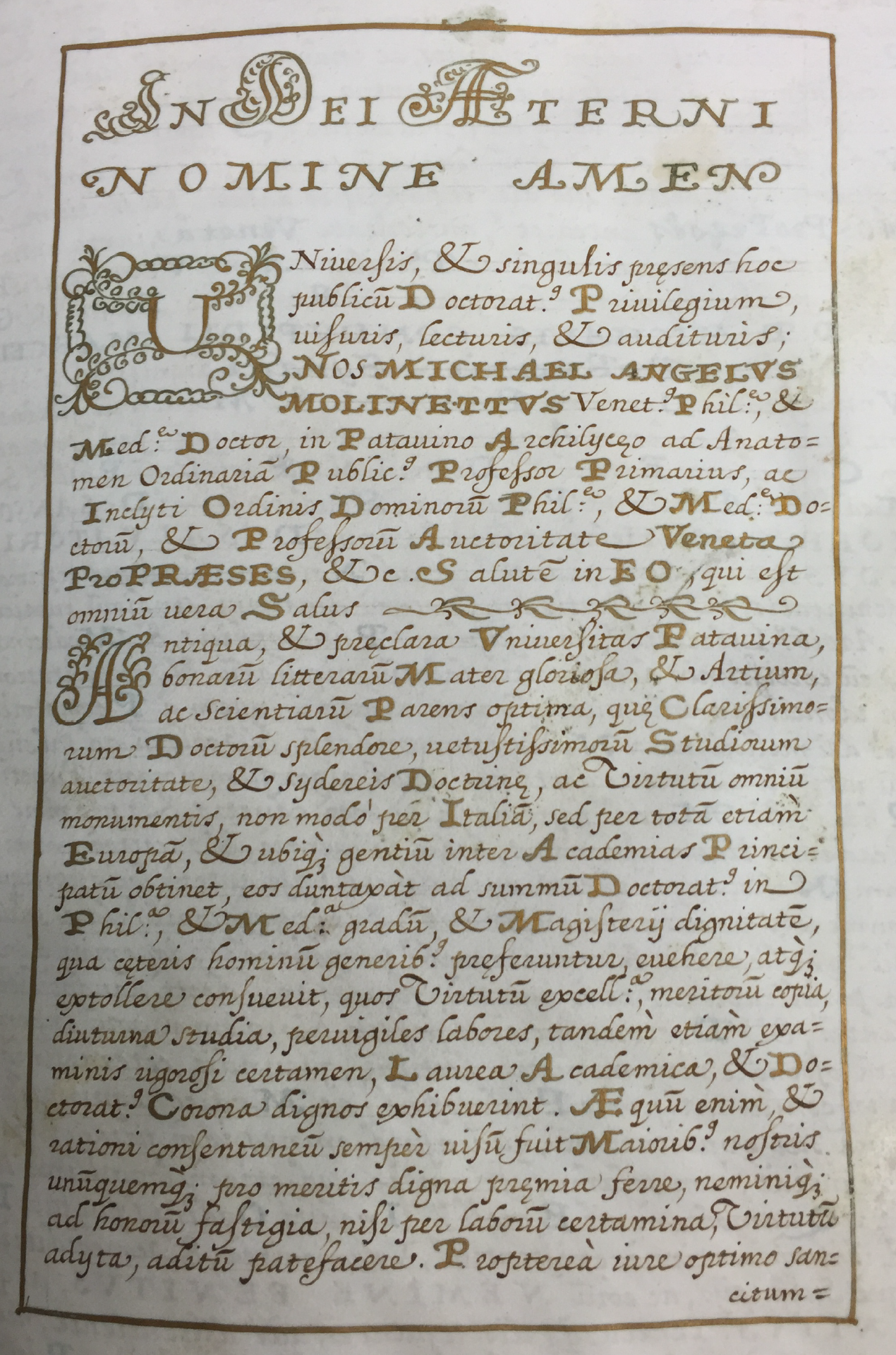
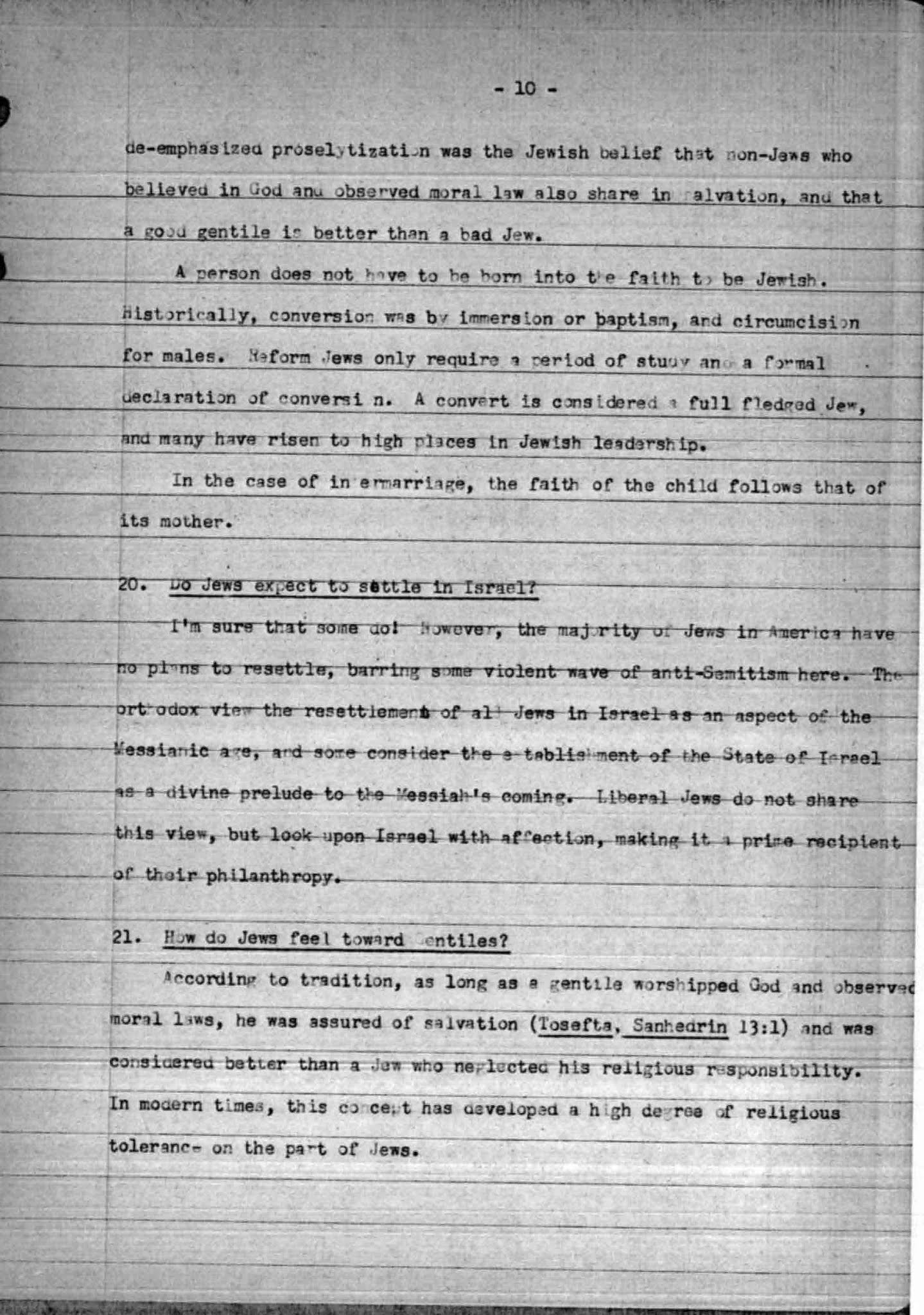
I came upon the name Samuel Vita Della Volta through my usual historical pathway, the world of Jewish medical history, and my continued quest for medical diplomas of Jewish physicians from the premodern era. While the lion’s share of the diplomas I have identified come from the University of Padua,[1] there are some extant Jewish diplomas from other Italian universities, including Siena, Rome, and Ferrara. One of two Jewish diplomas I have procured from the University of Ferrara is that of Samuel Vital Della Volta, a graduate of 1802.
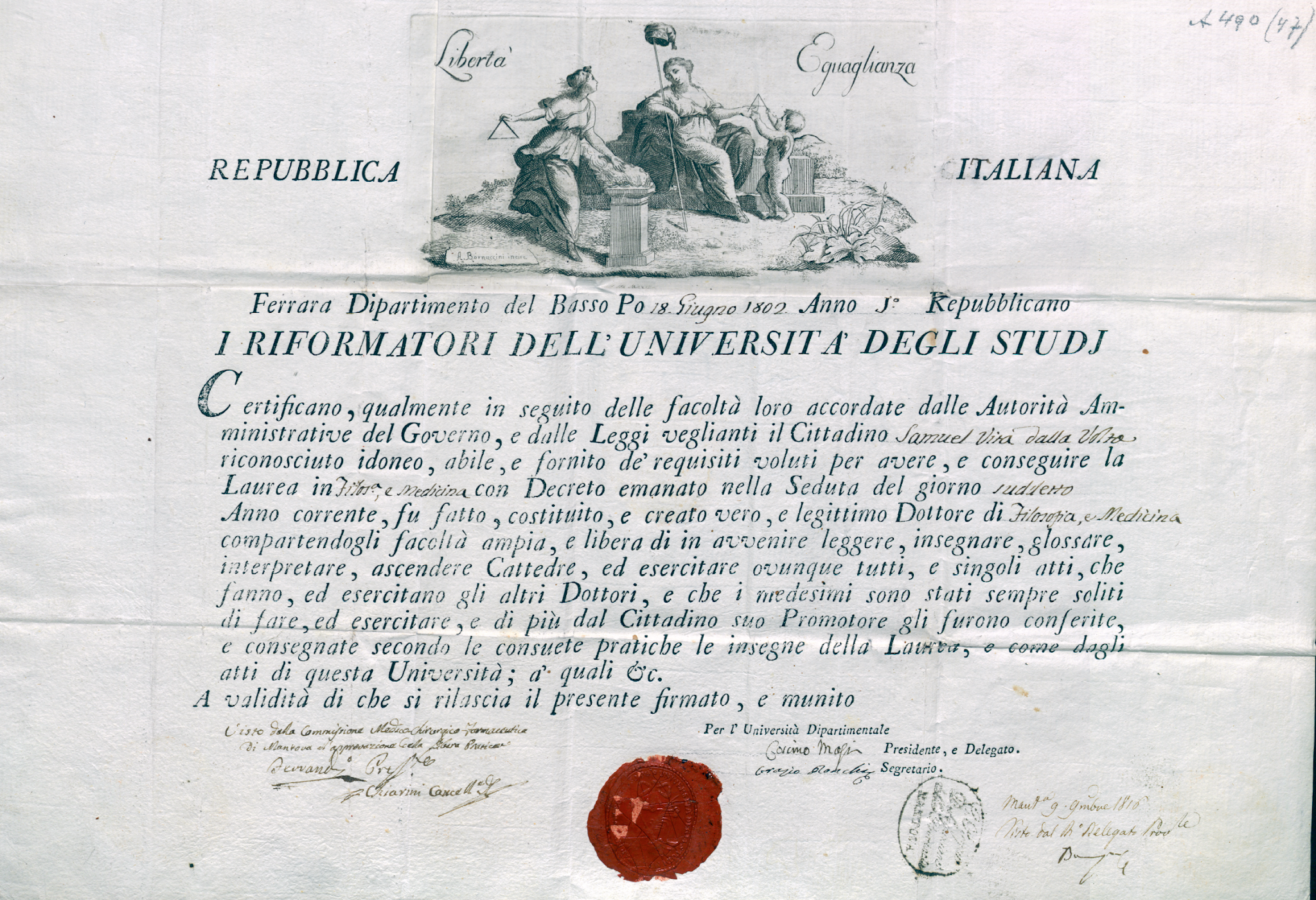
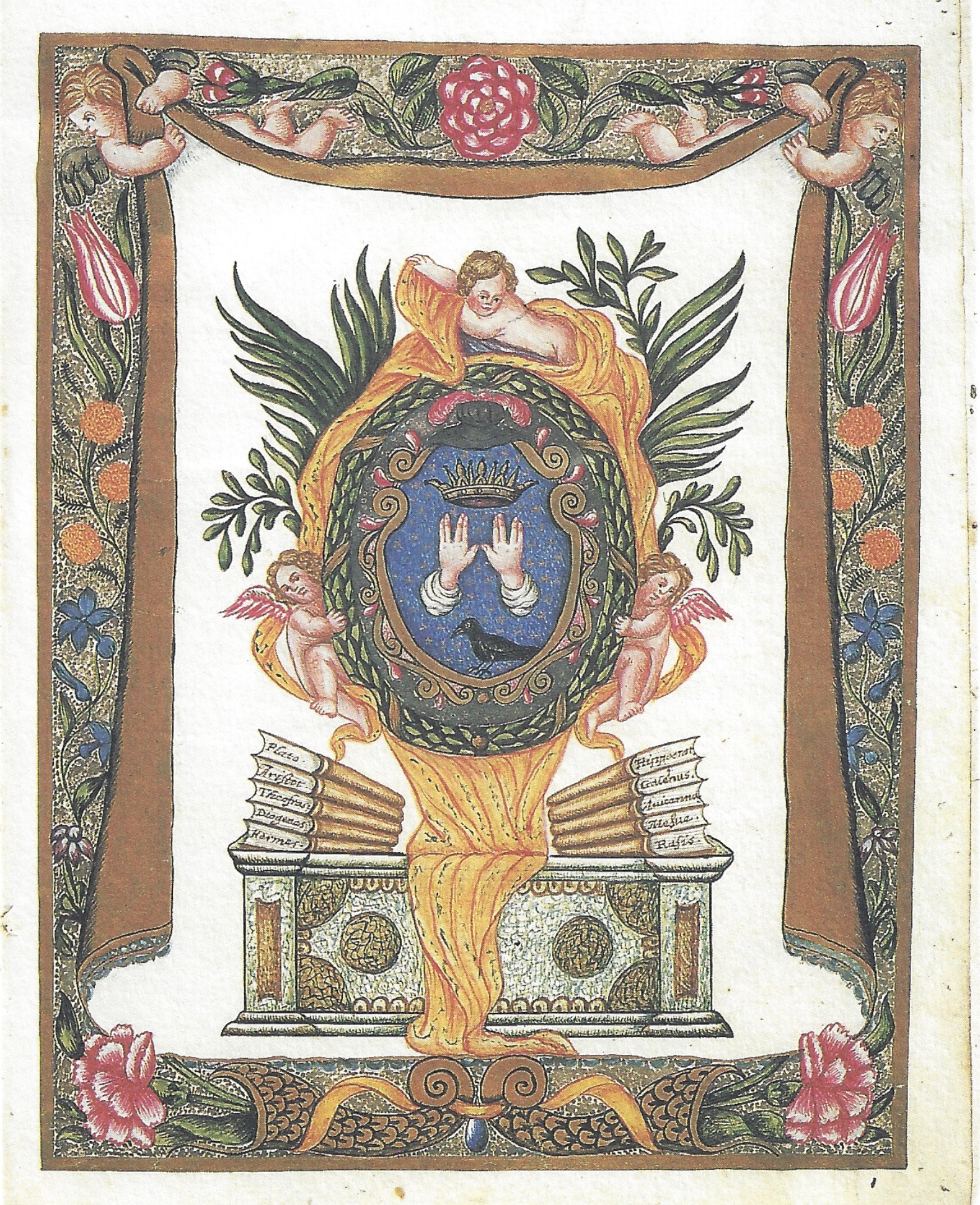
From an artistic perspective, it pales in comparison to the diplomas of his Paduan predecessors. See, for example, the diploma of the 1695 Jewish Padua graduate, Copilius Pictor (AKA Jacob Mehler), below.[2]
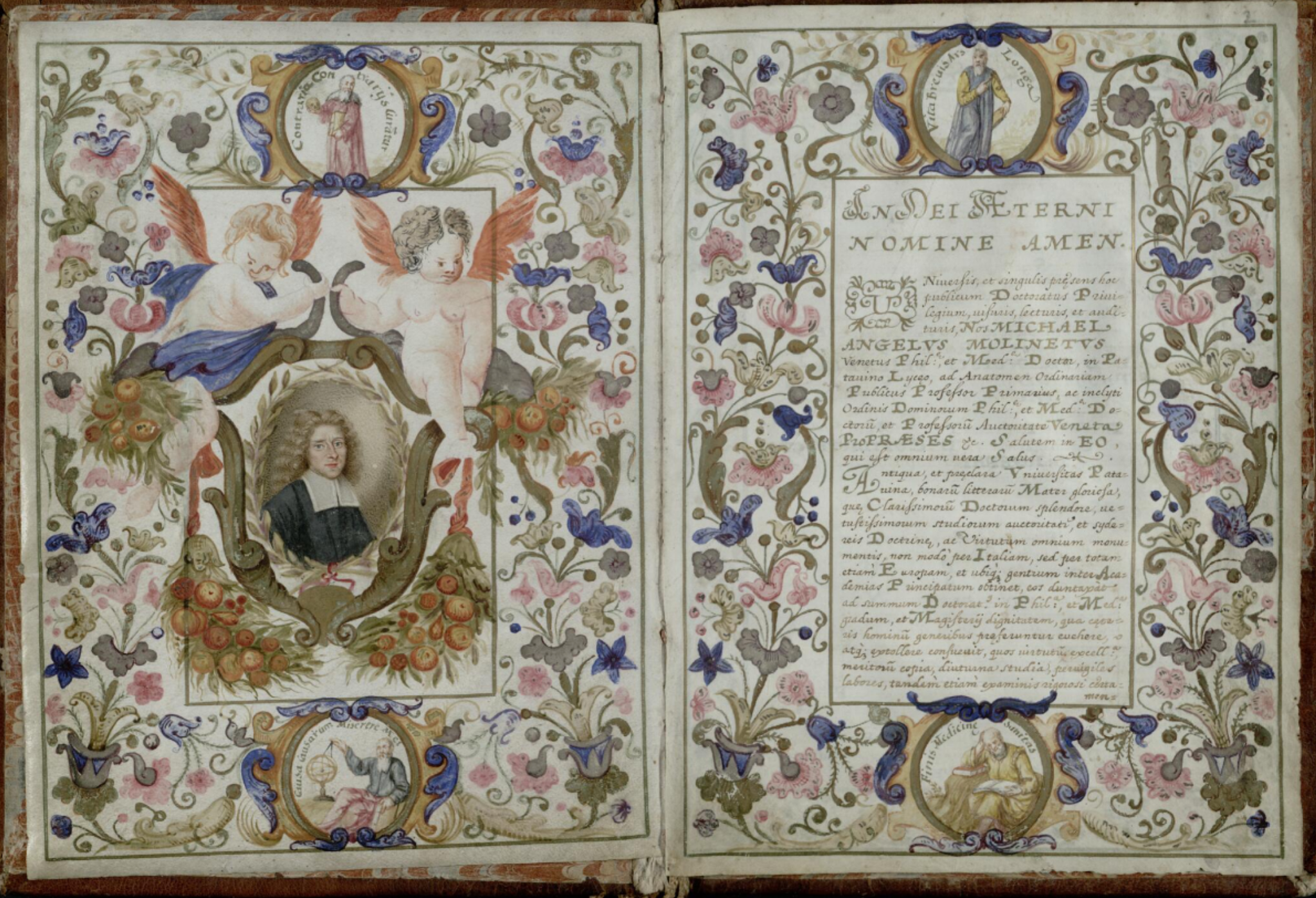
In contrast to this profusely hand illustrated spectacular example of Renaissance art, Della Volta’s is a templated diploma with both text and illustration printed. Only the graduate’s particulars are written, or I dare say squeezed in, by hand. To be fair, by this time not all Padua medical diplomas were as ornate as in the past, as evidenced by the diploma of Andrea di Domenico Rossi (Padua, 1788).[3]
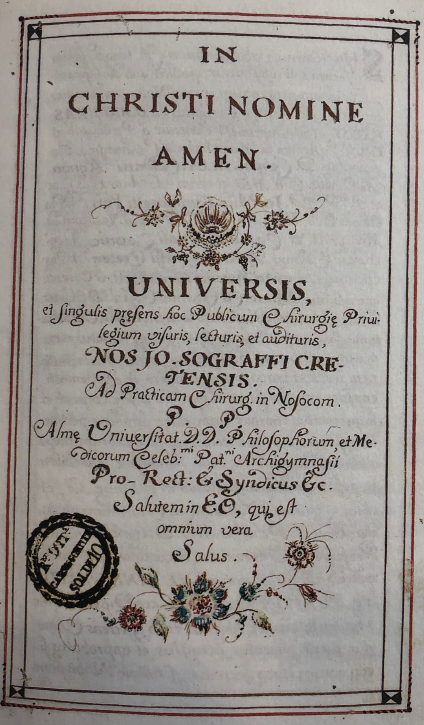
However, the university did not entirely abandon its practice of issuing such diplomas, as evidenced by the diploma of Carlo Tomasini (Padua, 1794).[4]

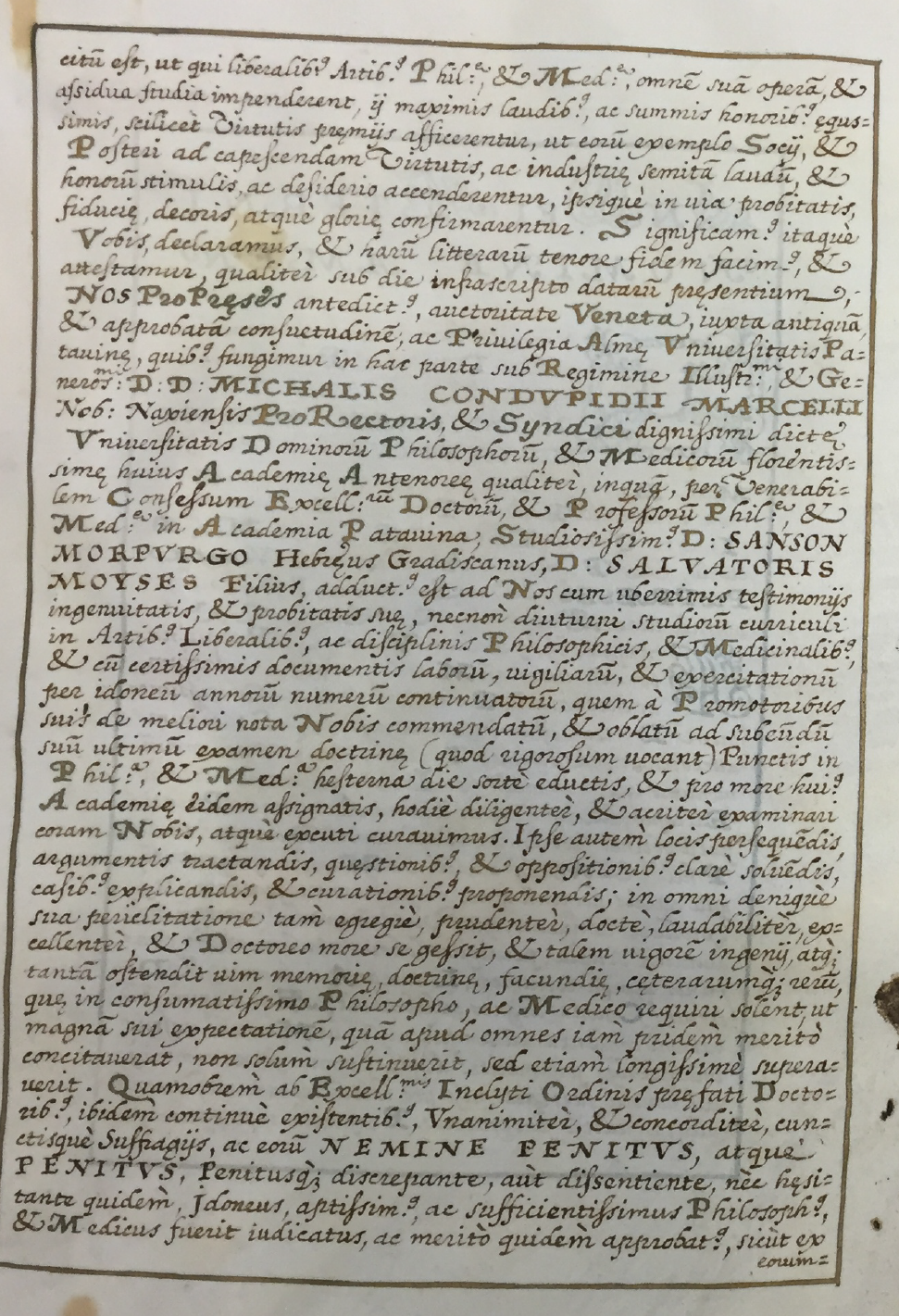
The diploma below of Jewish Padua graduate Rafael Luzzatto from 1797[5] is more in line with Della Volta’s, though at least Luzzatto’s diploma was hand calligraphed.[6]
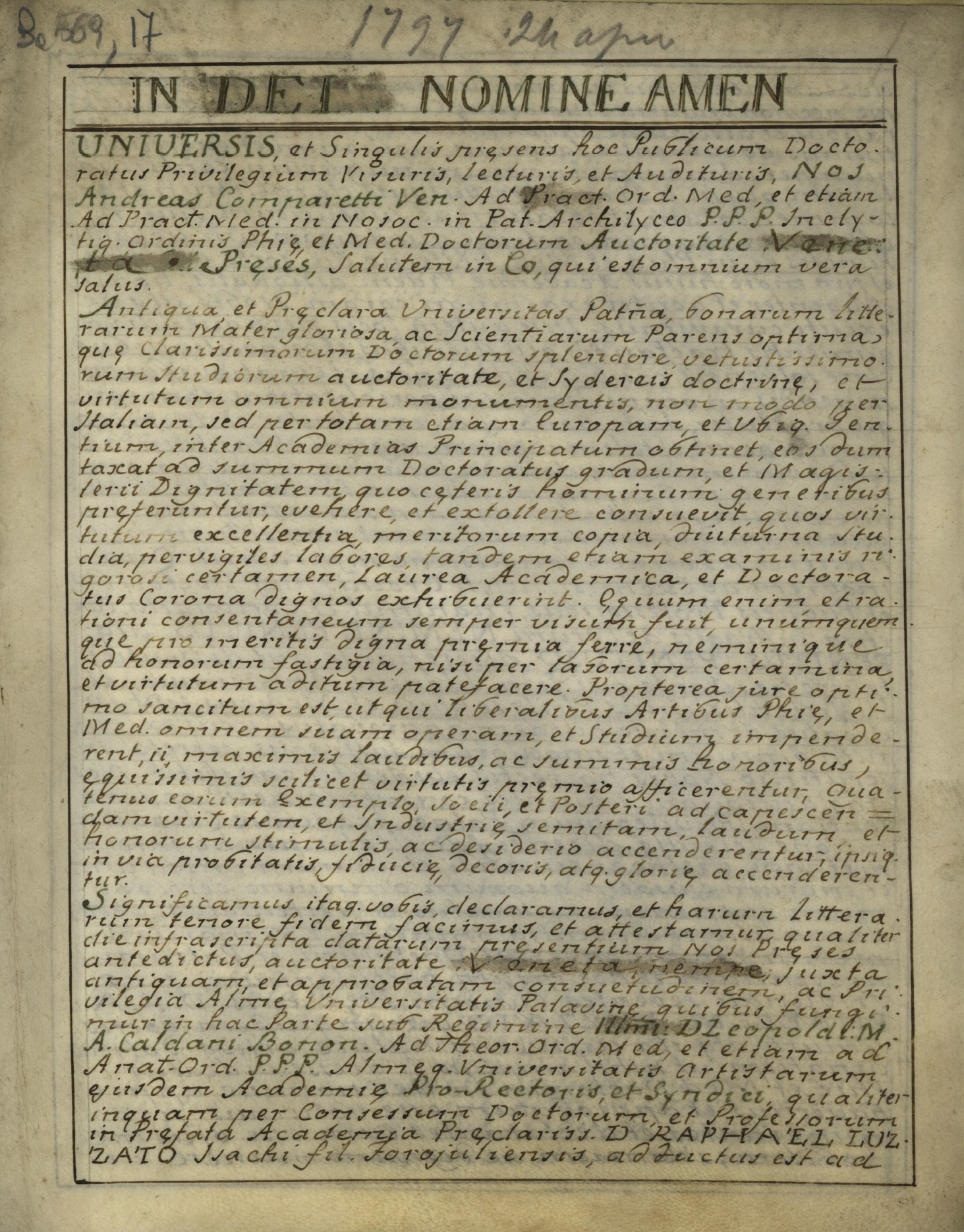
This diploma bears the invocation, “In Dei Nomine Amen” (in the name of God, Amen), typical for the Jewish student, instead of the standard invocation, “In Christi Nomine Amen” (in the name of Christ, Amen), used for the Christian students. Close inspection of this diploma reveals that the word “Dei” was written over an erasure of a longer word.
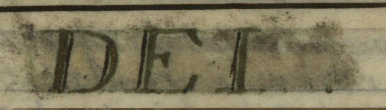
I have a strong suspicion that this was a standard templated diploma and that the calligrapher erased the word “Christi” and replaced it with “Dei.”

While the medical diplomas of the Jewish students of Padua,[7] as well as those from other universities such as Siena,[8] contained unique emendations, one finds no such alterations in Della Volta’s case.[9]

What caught my attention about Della Volta’s diploma was not its esthetics, or lack thereof, but rather its place of residence. This lackluster diploma currently resides in Budapest, Hungary in the Library of the Hungarian Academy of Sciences. The extant diplomas I have identified can be found mainly in Italy, Israel, and the United States. While each diploma has had its unique journey, these are by and large locations where the physicians lived, or their descendants migrated. For example, the diploma of Isaac Hellen can be found in a library in Germany,[10] but this is where Hellen lived and practiced. Della Volta was a Mantuan physician who lived and died in Italy. There is no record of his descendants migrating to Hungary. By what route then did this document reach such a wayward destination? Tracing the circulation of Jewish books “through time and place” is the laudable goal of the wonderful “Footprints” project.[11] While one may not always be able to track the exact journey of a book or manuscript through time, in this case we possess a passport of sorts with only three stops over some two hundred years that lead us directly to our final destination. The origin of this journey lies in the lifelong pursuits of our graduate.

Samuel Vita Della Volta (שמואל חי מלאוולטא) (1772-1853) was a physician and scholar born in Mantua whose writings include Biblical and Talmudic commentaries, sermons, and responsa. His works remain in manuscript and to my knowledge he has not been the subject of an academic biography.[12]

As a modest initiation into his writings, I share with you some observations from a few chapters selected from his unpublished work, Dan Yadin (1797).[13] The work is a miscellany of responsa and halakhic discussions. While the topics I have chosen are medical in nature, this reflects more my interest than the nature of the work.

Chapter 8 – Tefillin and Apoplexy (Stroke)[14]

This chapter takes the form of a classic responsum. The question is about a person who suffers from apoplexy, what today we would call a stroke or cerebrovascular accident (CVA).
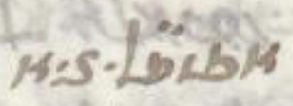
While his cognitive function remains intact, he has lost motor function and sensation of his left arm. Is he still obligated to put on his tefillin shel yad, and if so, on which hand?

One of the more remarkable descriptions in Jewish literature of a stroke and its subsequent religious impact appears in the introduction to a work by another Jewish physician, Abraham Portaleone (d. 1612).[15] Portaleone came from a long line of physicians and graduated the University of Pavia in 1563.[16] He served as physician for the Dukes of Mantua, receiving special permission from Pope Gregory XIV to treat Christian patients. While he authored a number of medical works, it is only later in life that he wrote his Shiltei Ha-Gibborim on religious matters. The passage below from the book’s introduction explains why:

In June of 1605, Portaleone, a renowned and accomplished physician, reports how he experienced the sudden loss of function of the left side of his body, incapacitating him for some nine months. While he does not discuss how he observed the mitzvah of tefillin, he does mention his prayer, supplication, repentance, and religious self-reflection, which led him to undertake the writing of his magnum opus. This encyclopedic work was written for his children as a guide to proper religious prayer and observance,[17] focusing on the Temple service. It includes chapters on the musical instruments of the Beit Ha-Mikdash, the composition of the incense, and the details of the daily sacrifices. Della Volta would likely have read, if not owned, this work.

Returning to the halakhic question, Della Volta cites the Shevut Yaakov’s case of one born with only one arm on the right.[18] Rabbi Reischer debates whether such a person would be free of any obligation as he does not possess a yad keihe (non-dominant arm); or whether perhaps since he was born this way, his sole arm has the status of both a dominant and non-dominant arm combined. Rabbi Reischer accepts the latter approach and as such, requires the donning of tefillin. One who sustains a traumatic complete amputation of his non-dominant arm, however, would no longer be required to wear tefillin on that arm. (The obligation to wear tefillin shel rosh remains undisturbed.) Support for this position comes from Rama, the Bach and Mazik Brakhah. Della Volta argues that this would not apply to his case, where the physical arm is completely intact, albeit nonfunctional. With additional support from Rabbi Yeḥezkel Landau’s Dagul MeRevava, he concludes that the one who suffers a stroke with loss of function of his left arm would be required to wear tefillin accompanied by the requisite blessing.

Chapter 25[19] Anatomical Dissection

The topic of discussion for this chapter is anatomical dissection.

This appears to be a narrative bibliography of sorts. Della Volta cites a reference to a passage “at the end of Yoreh De’ah.” The halakha[20] to which he refers is:

אין מפרקין את העצמות ולא מפסיקין את הגידים

One must not separate the bones of the body, nor sever the gidim (however these are to be defined, possibly includes veins, arteries, nerves, and tendons).[21]

This halakha is in the context of a discussion on likut atzamot, collecting the bones for reburial after initial temporary burial, often in caves or kukhin (niches).[22] This halakha is not typically invoked in contemporary halakhic discussions about the prohibition of autopsy. The now famous teshuva of the Noda biYehuda on autopsy (Tinyana Y.D., 210) had already been published in 1776, but Della Volta does not appear to have been familiar with it.

While the Hebrew source seems to oppose dissection, the other sources marshalled appear to be supportive. In his discussion on the use of tefillin in a case of stroke, there is no mention of secular or medical sources, as they would be noncontributory. In a discussion on the value of dissection, such material would certainly be relevant. He cites, for example, the preface to a work on pathology by Christoforo Conradi which lauds the educational benefits of anatomical dissection.[23]
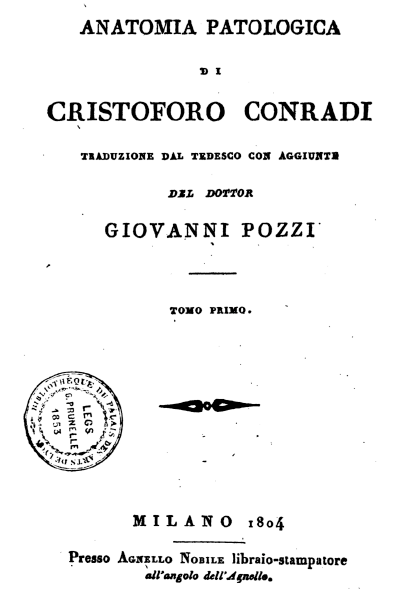
Della Volta cites from a number of additional medical sources, including Biblioteca Medica Browniana Germanica.

Of particular interest is his reference to another Jewish source:

Here he refers to the work of Benzion Raphael Kohen (Benedetto) Frizzi titled, Dissertazione di Polizia Medica sul Pentateuco (Pavia, 1787–1790), which is a thematic analysis of medicine and public health in the Torah and Jewish tradition.[24]
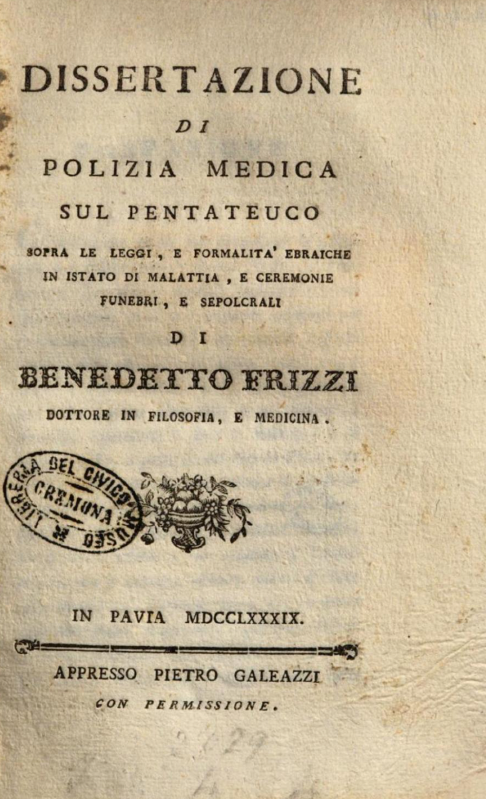
This volume, published in 1789, is one of six such dissertations written by Frizzi over four years. The exact passage referenced by Della Volta begins below:
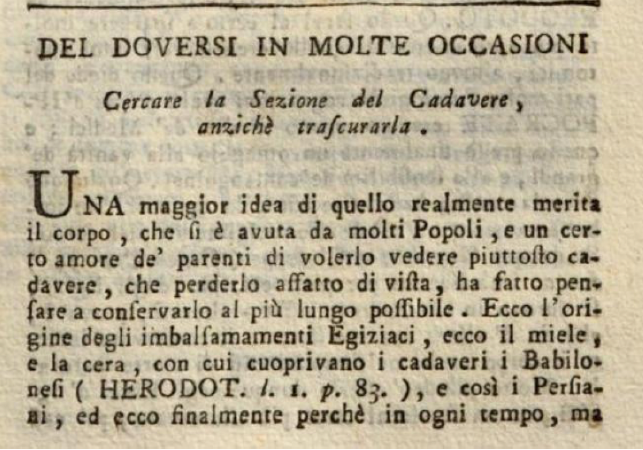
This may be one of the earliest, if not the earliest, Jewish references to the works of Frizzi.

Frizzi subsequently expanded his research to produce a little-known work in Hebrew of over a thousand pages, P’tah Einayim (Leghorn, 1815–25), addressing the medical and scientific aspects of the Talmud.[25] In a section from this work, not cited by Della Volta, Frizzi addresses another rabbinic passage which is conspicuously omitted from modern halakhic discussions on autopsy.
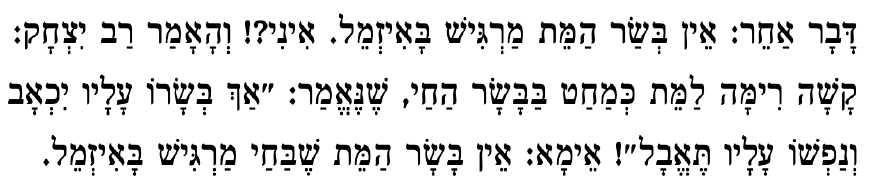
Frizzi focuses on the statement, “Didn’t Rav Yitzḥak say: The gnawing of maggots is as excruciating to the dead as the stab of a needle is to the flesh of the living.”[26] While this passage and its corollary rabbinic passages has received ample treatment,[27] Frizzi’s lesser-known interpretation is exceptional:
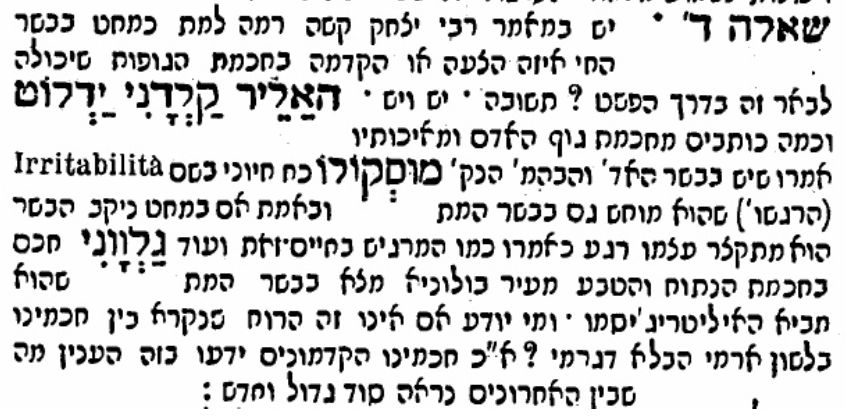
Recent medical research, by the likes of Albrecht Haller and Luigi Galvini, who explored bioelectricity (or animal electricity) and muscle irritability, even after death,[28] led him to consider the possibility that this statement was meant literally, i.e., the corpse experiences physiological pain. At least one posek of his day cited Frizzi’s interpretation as a reason to prohibit autopsy.[29]

A most remarkable aspect of this entry is the signature of the author.

הרופא ולא לו הצעיר וזעיר(?) שמואל חי מלאוולטה

I recently completed an article about the various interpretations of a rarely used physician epithet, “A Physician, and Not for Himself,” after serendipitously discovering its use in a manuscript.[30] After an extensive, though not exhaustive, search, I was able to identify only nine physicians throughout history who have used this epithet. As hashgaah would have it, we now know of at least ten.[31] Its use here, however, does not shed any further light on the meaning of this expression.

Chapters 38,[32] 116[33] and 128[34] Bathhouse Insemination

These three chapters discuss one who is born sine concubito, through artificial insemination, or as in the Talmudic case, through bathhouse insemination.[35]
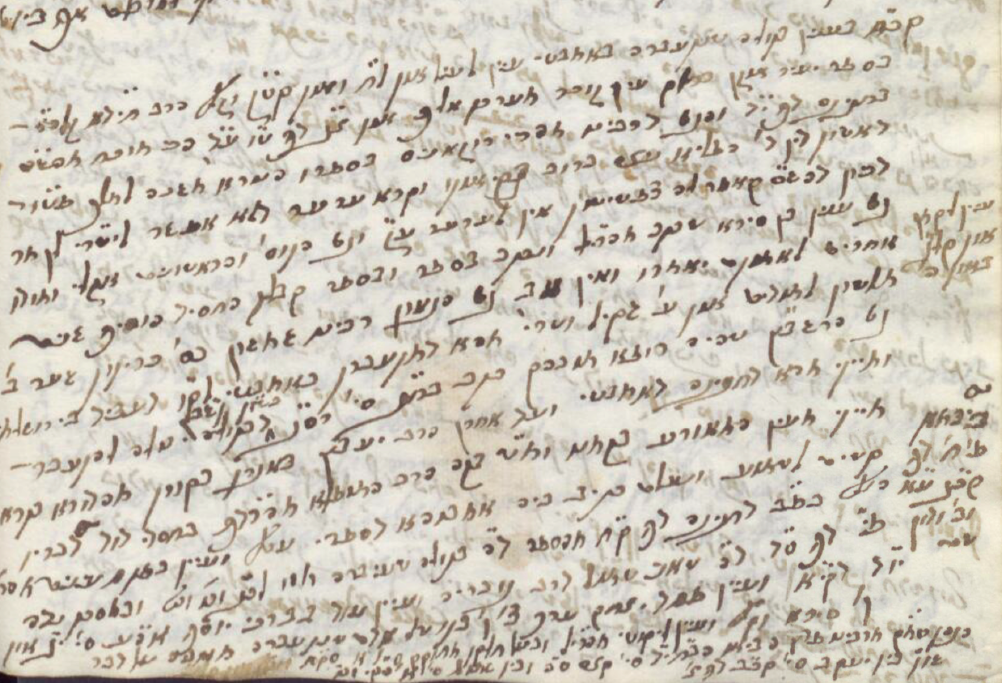
(Chapter 128)

Della Volta is equally versed in both the halakhic and contemporary medical literature. While his then current medical references, such as Commentarii Medici by Brugnatelli and Brera,[36] may be unfamiliar to us, his halakhic sources ring remarkably familiar. Amongst others, he cites from Ḥida,[37] Mishneh LiMelekh, Maharil regarding Ben Sira, Rashbetz, R. Yaakov Emden, R’ Yitzḥak Lampronti’s Paad Yitzak, elkat Meokek, as well as Frizzi, including Peta Einayim.[38] This reads like a contemporary article on artificial insemination by Dr. Rosner or Rabbi Bleich, though for Della Volta this was a purely hypothetical halakhic question. It would only be in the late 19thearly 20th century that this would take on practical halakhic relevance with the development of therapeutic artificial insemination. Indeed, the very same sources can be found in today’s discussions. In my historical discussion of artificial insemination, I discuss all the aforementioned sources, including Frizzi.

A casual glance at the remainder of Dan Yadin reveals countless detailed references to medical, secular, and Jewish sources, replete with chapter and verse. Della Volta was clearly a doctor of the book. In fact, he wrote for the journal Otzar Nehmad, corresponded with the likes of Shmuel David Luzzatto, Joseph Almanzi and Lelio Della Torre,[39] and contributed an introduction to Shlomo Norzi’s Minhat Shai. But his bibliophilia did not stop at reading and writing; he ventured into the world of book and manuscript acquisition, amassing an impressive library by the end of his life. Della Volta’s name would not appear on a list of prominent Jewish book collectors, nor even as an afterthought for that matter. Names such as Azulai, Oppenheim,[40] Almanzi or Strashun[41] are more likely to come to mind. Yet, his library caught the eye of some of the greatest Jewish scholars of his day, a virtual who’s who of Jewish biobibliographers, including Marco Mortara, Moritz Steinschneider, Shmuel David Luzzatto (Shadal) and Moshe Soave.

Marco Mortara (1815-1894) was one of Shadal’s prize students at the Rabbinical Seminary of Padua and later served as the Chief Rabbi of Mantua.[42] Mortara became a renowned scholar and bibliographer[43] and would go on to collaborate with Steinschneider for decades. Their very first correspondence was about the biographical details of Della Volta. Della Volta’s library was of great interest to Steinschneider, as evidenced by the multiple correspondences to both Shadal and Soave on this matter. It is only from the letters of Shadal to Steinschneider that we learn how Mortara had acquired Della Volta’s library, which by that time contained some 130 unique manuscripts that bibliophiles across Europe had unsuccessfully tried to purchase. How Mortara came to possess such a valuable library, especially given his financial situation, whether by inheritance or monetary acquisition, is a matter of debate.[44] In any case, this represents the first stamp in our passport, but a brief journey for Della Volta’s diploma within the city limits of Mantua. Della Volta’s library and diploma, at least for now, remained in his hometown.

It is in the Summer of 1877 that the second journey of our graduate’s diploma commenced. As librarian of the Budapest Rabbinical Seminary, David Kaufman, a prodigious historian and bibliophile, had acquired the collection of Lelio Della Torre, an Italian Jewish scholar. While in Italy making arrangements for the transfer of the library, he made the acquaintance of Mortara. Kaufmann was well aware of the extent and value of Mortara’s collection, and that it included Della Volta’s library as well.[45] Kaufmann and Mortara would correspond for some time thereafter.

When Mortara died in 1894, you can well imagine the great interest in his collection, which the family was motivated to sell. A number of individuals and institutions, including Kaufmann, were vying for the opportunity, but family and logistical issues delayed the process, not the least of which being the absence of a comprehensive catalogue of the holdings. It would ultimately be David Kaufmann who would walk away with the treasure, his success partially attributed to his earlier visit in 1877, his previous familiarity with the collection, and his continued contact with Mortara and his family.

The transfer of this library from Mantua to Budapest, where it arrived in February 1896, was apparently no small feat, with some of the Mortara collection somehow finding their way into non-Kaufmann hands.[46] Yet, it represents the second entry in our passport and longest journey for our diploma.

Alas, Kaufmann would die only three years after acquiring the Mortara collection. Would Della Volta’s collection now be transferred to the hands of a new scholar in yet another country, perhaps America or Israel? Fortunate for our diploma, its third and final journey would again be only a brief intracity trek, akin to its earlier trip in Mantua. Kaufmann bequeathed his collection to the Hungarian Academy of Science, where it remains to this day.

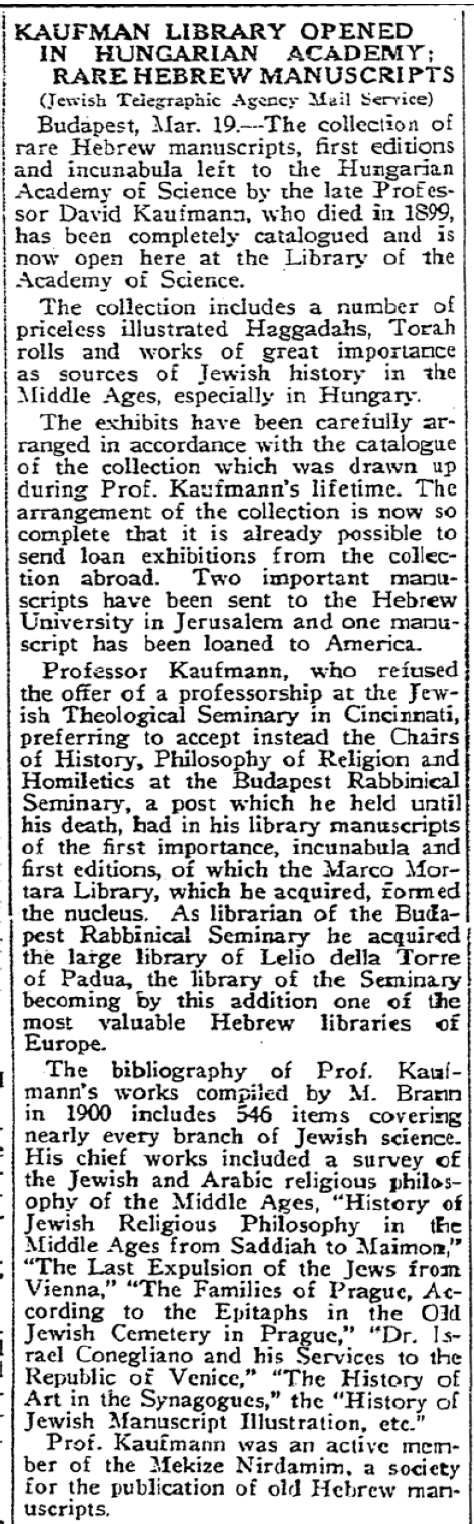
Fortunate for scholars unable to journey to Hungary, reference, and often digitized copies, of items in the Kaufmann collection can be found on the National Library of Israel website.

I doubt that Della Volta would have envisioned that the final resting place for his collection would be in Budapest, but nor would he have imagined a Jewish doctor in Woodmere writing about, of all the valuable items in his library (including his original compositions), his medical diploma.

[1] See Edward Reichman, “Confessions of a Would-be Forger: The Medical Diploma of Tobias Cohn (Tuvia Ha-Rofeh) and Other Jewish Medical Graduates of the University of Padua,” in Kenneth Collins and Samuel Kottek, eds., Ma’ase Tuviya (Venice, 1708): Tuviya Cohen on Medicine and Science (Jerusalem: Muriel and Philip Berman Medical Library of the Hebrew University of Jerusalem, 2021).
[2] Harry Friedenwald Collection in the National Library in Israel.
[3] G. Baldissin Molli, L. Sitran Rea, and E. Veronese Ceseracciu, Diplomi di Laurea all’Università di Padova (15041806) (Padova: Università degli studi di Padova, 1998), 251.
[4] Baldissin Molli, op. cit., 255.
[5] University of Padua Archives, Ms. V. 106.
[6] This was a period of transitioning away from the smaller diploma booklet to larger size and less illustrated documents. See Baldissin Molli, op. cit.
[7] For further discussion, see E. Reichman, “The ‘Doctored’ Medical Diploma of Samuel, the Son of Menaseh ben Israel: Forgery of ‘For Jewry’,” Seforim Blog, March 23, 2021.
[8] I have only identified one extant diploma from a Jewish medical graduate of the University of Siena. For discussion of this graduate, as well as a picture of his diploma, see E. Reichman, “The Physicians of the Rome Plague of 1656, Yaakov Zahalon and Hananiah Modigliano,” Seforim Blog, February 19, 2021.
[9] The religious references are in any case removed from this standard Ferrara diploma, but neither do we find the often-seen identifier for Jewish students, Hebreus.
[10] Germanisches Nationalmuseum, Studiensaal Archive, HA, Pergamenturkunden, Or. Perg. 1649 Juli 09. On this diploma, see Moritz Stern, “Das Doktordiplom des Frankfurter Judenarztes Isaak Hellen (1650),” Zeitschrift fur die Geschichte der Juden in Deutschland 3 (1889), 252-255.
[11] https://footprints.ctl.columbia.edu.
[12] The most expansive biobibliographical reference I have found is in Asher Salah, La Republique des Lettres: Rabbins, Ecrivains et Medecins, Juifs en Italie au XVIIIe Siecle (Brill: Leiden, 2007), 661-662. See also 428.
[13] NLI 990001918010205171.
[14] Folios 27-28 of the manuscript.
[15] On Portaleone, see H. A. Savitz, “Abraham Portaleone: Italian Physician, Erudite Scholar and Author, 1542-1612,” Panminerva Medica 8:12 (December, 1966), 493-5; S. Kottek, “Abraham Portaleone: Italian Jewish Physician of the Renaissance Period – His Life and His Will, Reflections on Early Burial,” Koroth 8:7-8 (August, 1983), 269-77; idem., “Jews Between Profane and Sacred Science: The Case of Abraham Portaleone,” in J. Helm and A. Winkelmann (eds.), Religious Confessions and the Sciences in the Sixteenth Century (Brill, 2001). For a full text of his will, see D. Kaufman, “Testament of Abraham Sommo Portaleone,” Jewish Quarterly Review 4:2 (January 1892), 333-41; A. Berns, The Bible and Natural Philosophy in Renaissance Italy (Cambridge University Press, 2014). Shadal discovered a remarkable letter by Portaleone recounting his brush with death on February 25, 1576, when he escaped unscathed from a vicious attack. Although his cloak was perforated in sixteen places from the perpetrator’s sword, miraculously no blood was drawn. See Y. Blumenfeld, Otzar Nehmad 3 (Vienna, 1860), 140-1.
[16] For a copy of the text of his diploma, see V. Colorni, Judaica Minora (University of Ferrara Press, 1983), 487-9.
[17] This work has recently been reissued in an expansive, copiously footnoted edition with introductory essays and biography. See Y. Katan and D. Gerber (eds.), Shiltei Ha-Gibborim (Makhon Yerushalayim, 5770).
[18] 1:3.
[19] Folio 78 of the manuscript.
[20] Y. D. 403:6.
[21] For a discussion on the history of anatomical dissection in rabbinic literature, including the identification of the 248 evarim, as well as the gidim, see Edward Reichman, The Anatomy of Jewish Law: A Fresh Dissection of the Relationship Between Medicine, Medical History and Rabbinic Literature (OU Press, YU Press, Maggid Press: Jerusalem, 2021), forthcoming.
[22] For a discussion on the history of Jewish burial practices in antiquity and the use of kukhin, see Patricia Robinson, The Conception of Death in Judaism in the Hellenistic and Early Roman Period (Ph.D. Dissertation: University of Wisconsin-Madison, 1978).
[23] I thank Filippo Valle for his assistance in both translation and research for this passage.
[24] See Ephraim Nissan, Benedetto Frizzi, a Physician, Medical Editor, Jewish Apologist, and Johann Peter Frank’s Pupil, Who Interpreted Moses’ Law as a Sanitary Code in Line with Frank’s Theory of Public Hygiene,” Korot 25 (2019-2020), 259-293.
[25] On Frizzi, see S. Simonsohn, History of the Jews in the Duchy of Mantua (Kiryat Sefer, 1977), 649, n. 226; Friedenwald, op. cit., 115; L. Dubin, “Medicine as Enlightenment Cure: Benedetto Frizzi, Physician to Eighteenth-Century Italian Jewish Society,” Jewish History 26(2012), 201–221. On his work, see B. Dinaburg, “Ben Tzion Hakohen Frizzi and His Work Petaĥ Einayim,” (Hebrew) Tarbitz 20(1948/49), 241–64. For an exchange between Frizzi and Shadal about a work of the latter, see Moshe Shulweiss, “Shmuel Dovid Luzzatto, Pirkei Hayyim,” (Hebrew) Talpiyot 5:1-2 (Tevet, 5711), 41. For a reference to Frizzi dining with Hida, see Aron Freiman, ed., Ma’agal Tov haShalem of Rabbi Hayyim Yosef David Azulai (Mekize Nirdamin: Jerusalem), 94.
[26] Shabbat 13b. Full translation of passage (from Sefaria): Alternatively: The flesh of a dead person does not feel the scalpel [izemel] cutting into him, and we, too, are in such a difficult situation that we no longer feel the pains and troubles. With regard to the last analogy, the Gemara asks: Is that so? Didn’t Rav Yitzḥak say: The gnawing of maggots is as excruciating to the dead as the stab of a needle is to the flesh of the living, as it is stated with regard to the dead: “But his flesh shall hurt him, and his soul mourns over him”(Job 14:22)? Rather, say and explain the matter: The dead flesh in parts of the body of the living person that are insensitive to pain does not feel the scalpel that cuts him.
[27] I am presently working on a more expansive analysis of this passage titled, “On Pain of Death: Postmortem Pain Perception in Rabbinic Literature.”
[28] See, for example, Hubert Steinke, Irritating Experiments: Haller’s Concept and the European Controversy on Irritability and Sensibility, 1750-90, Vol. 76 of Clio Medica, Wellcome Series in the History of Medicine (Amsterdam: Editions Rodopi, 2005); Dominique Boury, “Irritability and Sensibility: Key Concepts in Assessing the Medical Doctrines of Haller and Bordeu,” Science in Context 21:4 (2008), 521-535.
[29] R’ David Zacuto D’Modena (d. 1865). This manuscript responsum by D’Modena on autopsy was published by Yitzhak Raphael, “Two Responsa on Autopsy,” (Hebrew) Sinai 100 (1987), 737-748.
[30] See E. Reichman, “’A Physician, and Not for Himself’: Revisiting a Rare Jewish Physician Epithet That Should So Remain,” forthcoming. For earlier discussions of this expression, see Joshua O. Leibowitz, “‘Physician and Not for Himself,’ An Unusual Hebrew Medical Epithet,” Koroth 7:7-8 (December, 1978), CXXIX- CXXXIII; Meir Benayahu, “Physician and Not for Himself,” Koroth 7:9-10 (November, 1979), 725-725; Abraham Ohry and Amihai Levi, “Physician and Not for Himself,” Koroth 9:3-4 (1986), 82-83 (Hebrew) and 399*-401* (English).
[31] Della Volta does not appear to use this signature elsewhere throughout this manuscript, and I only found it in chapter 25. A review of his other manuscripts, which I did not do, would be instructive.
[32] Folio 89 of the manuscript.
[33] Folio 122 of the manuscript.
[34] Folio 126 of the manuscript.
[35] On bathhouse insemination and the story of Ben Sira in rabbinic literature, see E. Reichman, “The Rabbinic Conception of Conception: An Exercise in Fertility,” Tradition 31:1 (Fall 1996), 33-63, reprinted with additions and revisions in Reichman, The Anatomy of Jewish Law, op. cit.
[36] An eight-volume work published between 1796-1799.
[37] Ya’ir Ozen, En Zokher, ma’areet aleph, n. 93 and Birkei Yosef E.H. 1:14.
[38] Volume 4 (I. Costa: Livorno, 1879), 57b-58a.
[39] See NLI system n. 990001918190205171, pgs. 45, 98, and 116. This is a collection of his letters to Italian maskilim.
[40] See Joshua Teplitsky, Prince of the Press (Yale University Press: New Haven, 2019).
[41] See Dan Rabinowitz, The Lost Library: The Legacy of Vilna’s Strashun Library in the Aftermath of the Holocaust (Tauber Institute Series for the Study of European Jewry, 2018).
[42] On Mortara, see Asher Salah, “The Intellectual Networks of Rabbi Marco Mortara (1815–1894): An Italian “Wissenschaftler des Judentums,” in Paul Mendes-Flohr, et. al. eds, Jewish Historiography Between Past and Present, Studia Judaica, Band 102 (2019), 59-76. On his library, see idem, “La Biblioteca di Marco Mortara,” in Mauro Perani and Ermanno Finzi, eds., Nuovi Studi in Onore di Marco Mortara nel Secondo Centenario della Nascita (Firenze: Giuntina, 2016), 149-168. What follows is drawn primarily from these works.
[43] In addition to countless articles in the periodicals of his day, Mortara is known for his Catalogo della Biblioteca della Communita Ebraica de Montova and Indice Alfabetico dei Rabbini e Scrittori Israeliti di Cose Guidaiche in Italia.
[44] See Salah, “La Biblioteca,” op. cit., 152.
[45] See Salah, “La Biblioteca,” op. cit., 155.
[46] See Salah, “La Biblioteca,” op. cit., 157. Somewhere along the way, Harry Friedenwald acquired a book that was part of the Della Volta library, a prayer book according to the German rite published by the physician and Padua graduate Eliezer Solomon d’Italia. Della Volta added a 9-page manuscript to the copy which includes a history of the d’Italia family chronicles. See H. Friedenwald, Jewish Luminaries in Medical History (Johns Hopkins Press, 1946), 88.


Rosh Hashana 23b – The Missing Map – Were We Deprived of a Map Drawn by Rashi?

Rosh Hashana 23b – The Missing Map – Were We Deprived of a Map Drawn by Rashi?

Eli Genauer

The Mishnah on Rosh Hashana 22b discusses the signal fires which were lit to inform the residents of Bavel of the Kiddush HaChodesh in Yerushalayim.

מַתְנִי׳: בָּרִאשׁוֹנָה הָיוּ מַשִּׂיאִין מַשּׂוּאוֹת…..

MISHNAH: Initially, after the court sanctified the new month they would light torches on the mountaintops, from one peak to another, to signal to the community in Babylonia that the month had been sanctified.[1]

The Mishnah continues

וּמֵאַיִן הָיוּ מַשִּׂיאִין מַשּׂוּאוֹת?

And from which mountains would they light the torches?

מֵֵהַר הַמִּשְׁחָה לְסַרְטְבָא וּמִסַּרְטְבָא לִגְרוֹפִינָא וּמִגְּרוֹפִינָא לְחַוְורָן וּמֵחַוְורָן לְבֵית בִּלְתִּיןִ..…

The Daf Yomi Advancement Forum provides us details of the places mentioned.[2]

From HAR HA’MISHCHAH- the Mount of Olives (to the east of the Old City of Yerushalayim)

To SARTAVA- a mountain in the Jordan valley

To GEROFINA- most probably a tower or rise heightened by Agrippa II near Ceasarea Philippi (modern-day Banias in northern Eretz Yisrael)

To CHAVRAN- Auran, a mountain located in the area of Aurantis east of the Jordan River

To Bait Baltin, which will be discussed on 23a and b. It is identified as BIRAM, a city on the border of Eretz Yisrael and Bavel

The Gemara 23a (on the bottom) and 23b (on the top) continues (Davidson Talmud):

וּמֵאַיִן הָיוּ מַשִּׂיאִין מַשּׂוּאוֹת כוּ׳ וּמִבֵּית בִּלְתִּין, מַאי בֵּית בִּלְתִּין? אָמַר רַב זוֹ בֵּירָם

What is this place called Beit Baltin? Rav said: This is the town called Biram.

The Gemara continues

תַּנְיָא רַבִּי שִׁמְעוֹן בֶּן אֶלְעָזָר אוֹמֵר אַף חָרִים וּכְיָיר וּגְדֹר וְחַבְרוֹתֶיהָ אִיכָּא דְּאָמְרִי בֵּינֵי וּבֵינֵי הֲווֹ קָיְימִי אִיכָּא דְּאָמְרִי לְהָךְ גִּיסָא דְּאֶרֶץ יִשְׂרָאֵל הֲווֹ קָיְימִי מָר חָשֵׁיב דְּהַאי גִּיסָא וּמָר חָשֵׁיב דְּהַאי גִּיסָא

It is taught in a Baraita that Rabbi Shimon ben Elazar says: Torches were also lit at Ḥarim, and Kayar and Geder, and its neighboring places. There are those who say that the places added by Rabbi Shimon ben Elazar are located between the places mentioned in the Mishnah, whereas there are those who say that they are located on the other side of Eretz Yisrael, on the side nearer Babylonia. The Sage in the Mishnah enumerates the places found on one side of Eretz Yisrael, whereas the Sage in the Baraita enumerates the places found on the other side.

Rashi comments on the relationship of Eretz Yisroel to Bavel[3]

באידך גיסא של אי לצד בבל, שני צדדים של אי נמשכין לצד בבל:

On one side – of Eretz Yisroel towards Bavel. There are two sides of Eretz Yisroel which extend to Bavel

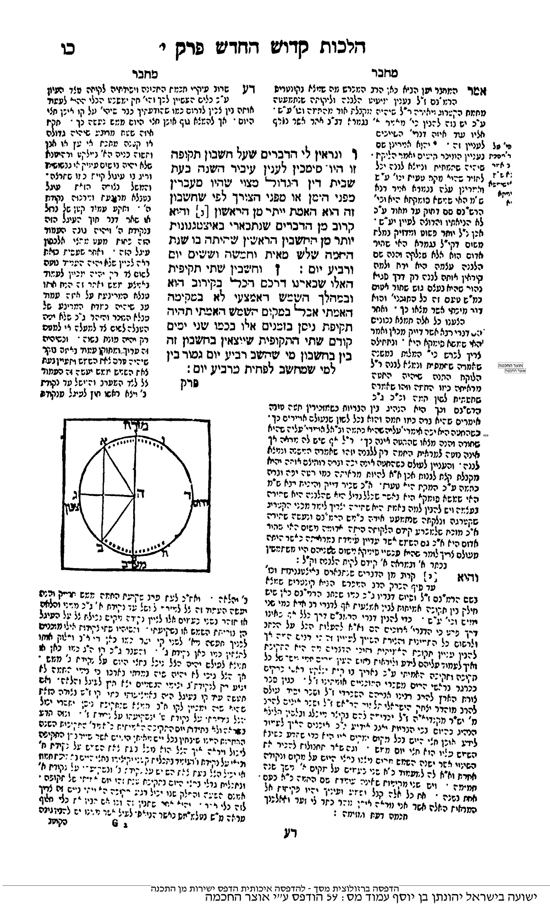
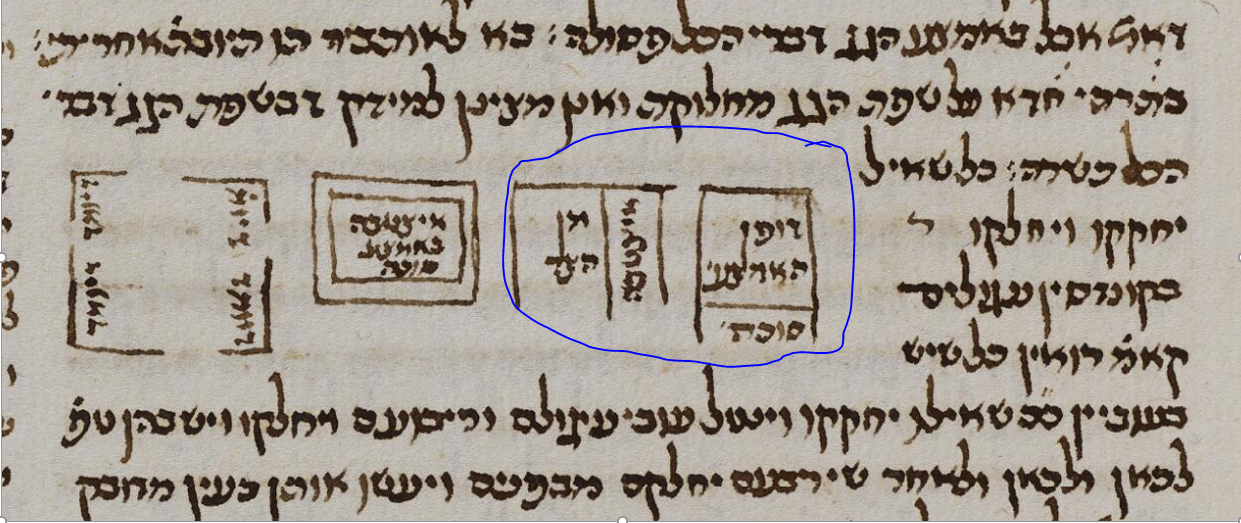
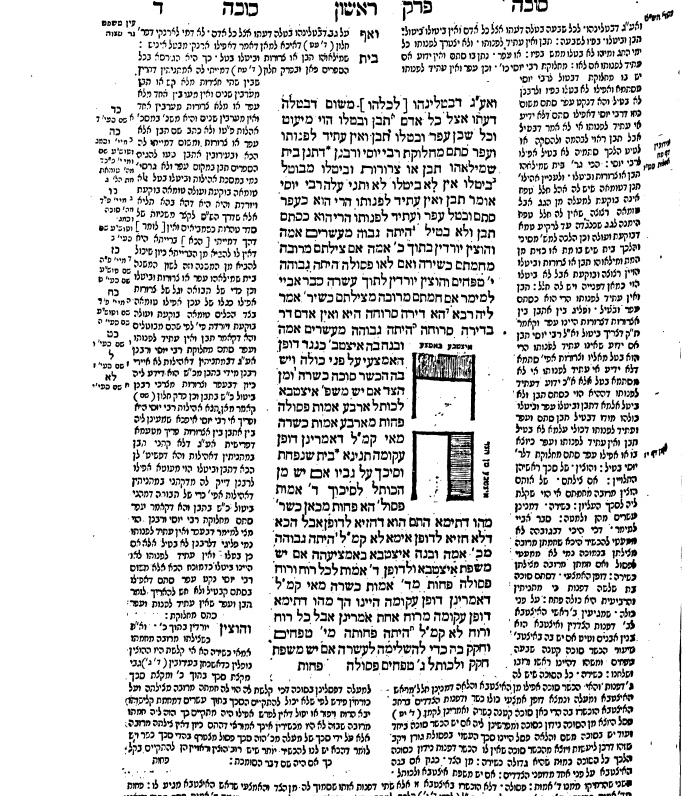
The language of Rashi is a bit unclear. It would be helpful if he included a map so we could visualize it better. As you can see, there is no map included in the authoritative text of the Vilna Shas.

A missing map of Eretz Yisroel and Bavel

The first printed edition of Massechet Rosh Hashana was done by the Soncino family in Pesaro, Italy circa 1511.

It shows the two sides of Eretz Yisroel as it extends towards Bavel, with the places in the Mishnah listed in order on the top side, and the places listed in the Baraita on the bottom side. The map most correctly should have been placed underneath the Rashi which begins with the words באידך גיסא.

https://digitalcollections.jtsa.edu/islandora/object/jts%3A395714#page/59/mode/1up

What the map shows is the stretch of land which extended all the way from Eretz Yisroel to Bavel, and that there were two routes to get there.[4] The places named are different because the Tanna of the Mishna discusses the route on one side of Eretz Yisroel, and the Tanna of the Baraita discusses another route. Please note that even though it seems on the map that Bavel is to the west of Eretz Yisroel, this is only a convention of modern maps.[5] Clearly Rashi knew that Bavel was to the east as Eretz Yisroel was known as Ma’arava.

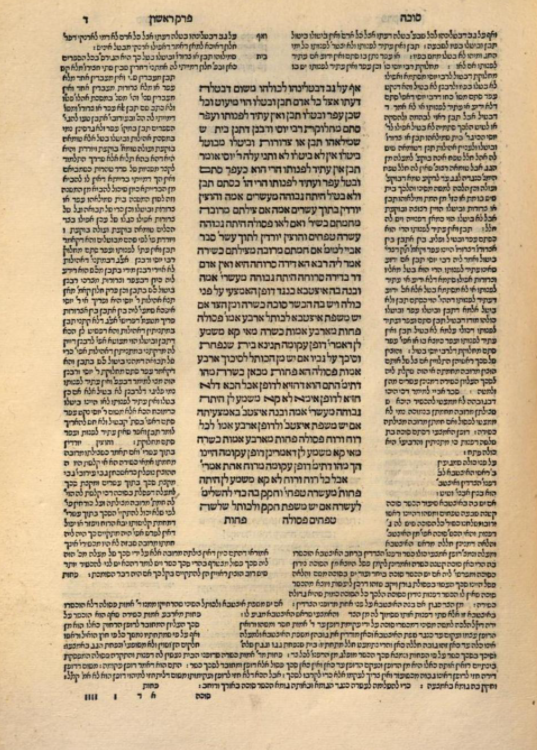
The first complete edition of the Talmud printed by Daniel Bomberg in Venice (c.1520-1523) retained the space for the diagram but left it blank.[6] This was carried through in his later printing of Rosh HaShana.

https://www.hebrewbooks.org/pdfpager.aspx?req=21208&st=&pgnum=47

The Giustiani edition (Venice 1548) also left a blank space

The space disappeared from the next printed edition, that of Basel 1579.

https://www.e-rara.ch/bau_1/content/zoom/22850827


It reappeared in an edition printed in Cracow in 1603, and it was now in the right place.

The next complete edition of the Talmud was printed in Amsterdam by Immanuel Benveniste (c.1644-1648). It did not contain a space, this despite its claim that it was patterned after the Giustiani edition of 1548.

The map (or an empty space) did not appear in the influential Amsterdam edition of 1717 and that most likely doomed it to oblivion in the printed Gemarot which followed[7].

Dr. Aharon Ahrend (“Rashi’s Commentary on Tractate Rosh Hashana: A Critical Edition,” Bialik Institute Jerusalem 2014) lists a number of manuscripts as his sources (3 complete, many partial) and does not indicate that this map is in any of them.[8]  The Pesaro edition is the only one with this map. (p.218, last line”, במקור ״מ״ נוסף followed by a reproduction of the map- מקור ״מ״ is Pesaro).

The conclusion one might reach is that since no other manuscript contained this map, the manuscript on which the Pesaro edition was based had this map added by someone after Rashi’s time, perhaps in the margin to help the reader understand Rashi.

Is The Pesaro Edition of Masechet Rosh HaShana the Only Source For This Map?

Let us turn to the commentary of the Malechet Shlomo on Rosh Hashana. This commentary was first introduced in a new edition of Mishnayot printed by the Romm printers in Vilna. The Romm printers explain how they were able to access this heretofore unpublished manuscript which was found among the papers of the Chida.

The author of the Malechet Shlomo was Rav Shlomo HaAdani (1567, Saana, Yemen-1625 Chevron, Eretz Yisroel) who wrote this commentary while he was in Chevron. He states that his two main teachers were Rav Betzalel Ashkenazi (the author of Shita Mekubetzet) and Rav Chaim Vital.

In this first printed edition of his commentary on our Mishna in Rosh Hashana we find a map very similar to the one in the Pesaro edition, only it is missing the cities on the top listed in the Mishna.[9] (Possibly because his “Kazeh” applies only to the cities on the other side of Eretz Yisroel and not the ones mentioned in the Mishnah).

This is the Ktav Yad of Rav Shlomo HaAdani from his commentary on Rosh Hashana:

Library of the Emanuel Ringelblum Jewish Historical Institute Warsaw Poland Ms. 267

We mentioned that Rav Shlomo HaAdani was a Talmid of Rav Betzalel Ashkenazi. In his own copy of Rosh Hashana ( Bomberg Venice 1521) Rav Betzalel added many notes. Here is what 23b looks like in his Gemara:

The Russian State Library, Moscow, Russia Ms. Guenzburg 816

https://web.nli.org.il/sites/NLI/English/digitallibrary/pages/viewer.aspx?&presentorid=MANUSCRIPTS&docid=PNX_MANUSCRIPTS990001466800205171-1#|FL77457080

You can see that he drew in some sort of map in the empty space.

On the top of that same page, we find another map which he drew. The words on the top left are כל זה בספר יד.i[10] The Vilna Shas in its Acharit Davar says that he would do that quite often.

The Bach also drew in his Gemara, a Bomberg Rosh Hashana of 1531. The National Library of Israel owns a Gemara which was copied from the personal copy of the Bach.

The National Library of Israel, Jerusalem, Israel Ms. Heb. 24°174

Paleographic Note

אין זה אוטוגרף המחבר, ככל הנראה הועתק מהשס שלו

Here is how it looks

https://web.nli.org.il/sites/NLI/English/digitallibrary/pages/viewer.aspx?&presentorid=MANUSCRIPTS&docid=PNX_MANUSCRIPTS990044116070205171-1#|FL78289377=

There seems to have been a concerted attempt in the 1500’s and 1600’s to retain some sort of map in the Rashi. Whether it appeared in the “original Rashi” we will likely never know.

[1] Sefaria, the William Davidson Talmud, English translation of Rav Steinsaltz, here.
[2] There are many other opinions as to where these places were.
[3] The Girsa in the Dibur HaMatchil in Rashi is slightly different than in the text of our Gemara.
[4] Rashi seems to indicate that Pumpedita (alternatively Nehardea) could be seen from the border of Eretz Yisroel whereas the Meiri indicates that once the fires got to the Israel/Bavel border, they were relayed from mountain to mountain in Bavel until Pumpedita.
[5] Please see Marc Shapiro’s article on map orientation which recently ran on the Seforim Blog here.

I specifically refer to footnote 4 at this website https://www.geographyrealm.com/map-orientation/, which states “Maps with south oriented towards the top of the map are known as south-up or reverse maps, since the map appears upside down to those used to a map orientation towards the north. In these maps, South is oriented the top of the map, east is towards the left of the map and west towards the right.”
[6]  Dr. Edward Fram writes that “A blank space was left on the page suitable for adding a woodcut, but, whether for financial or technical reasons, the diagrams were not included until later printings” Edward Fram, “In the Margins of the Text, Changes in the Page of the Talmud,” in Printing the Talmud: From Bomberg to Scottenstein, ed. Sharon Lieberman Mintz et.al., Yeshiva Univ. Museum, New York: 2005, p. 91, n.4.
[7] My own research has shown this to be the case.
[8] Here is an example of a manuscript which does not contain the map:

The Palatina Library, Parma, Italy Cod. Parm. 2244

https://web.nli.org.il/sites/NLI/English/digitallibrary/pages/viewer.aspx?presentorid=MANUSCRIPTS&docid=PNX_MANUSCRIPTS990000752410205171-1#|FL14863954
[9] This is taken from Mishnayot Zecher Chanoch (Jerusalem 1999) which is based on the Romm Vilna Mishnayot which were printed from 1887-1908.
[10] My thanks to Aharon for deciphering this and for all his other insightful comments.


In Praise of the Soncino Talmud

In Praise of the Soncino Talmud
By David S Farkas*

Not long ago one of our local schools hosted a Giveaway day in its library, making many of the older seforim in its considerable collection free to a good home. As expected, the local citizenry plundered and pillaged, carrying off large numbers of books, many still in quite good condition. I was only able to attend towards the end, “after the last of the gleaners had gone.”[1] Only a few scattered Siddurim and Chumashim were left, when I spotted a box in a corner of the room, filled with small red volumes. Close inspection revealed that the books were none other than the Soncino Talmud, a complete set. My heart sank a little to see this classic work, neglected and abandoned. I felt, in a small way, as though I had seen the tongue of Chutzpith the Translator lying in the dust.[2]

The Soncino Press sees no press at all these days, it seems. Its groundbreaking complete English translation of the Talmud has almost entirely been supplanted by Artscroll’s Schottenstein edition. Indeed, studying with the latter presents a very much different type of engagement with the Gemara, and Artscroll has undoubtedly done a master job of it. Yet for all of its depth and analysis, Soncino to this day brings to the table things that Artscroll does not. What follows, then, is not an attempt to sing the praises of one at the expense of the other, but only to point out some of the unique features of the now-neglected Soncino, and to suggest some of its alleged flaws may have been greatly exaggerated.[3]

To begin with, the canard so many of us heard in our yeshiva days – that Soncino was edited by less than fully-religious Jews – is a terrible misimpression that, to the best of my knowledge, seems to be based purely on the evidence that it was edited by a man named Isidore. Yet Rabbi Yechezkel Epstein (as he is in fact identified, in Hebrew, on the opposite front-page of most volumes) was very much an observant Jew, who attended the Pressburg Yeshivah founded by the Chasam Sofer, and was said to know Shas by heart. The project began with Seder Nezikin in 1935 with a heartfelt prayer to Almighty God, capped with the traditional phrase יה”ר מלפני ה’ כשם שעזרתני לסיים סדר נזיקין, כן תעזרני להתחיל סדרים אחרים ולסיימם.  It concluded in 1948, as printed in Seder Kodshim, with a heartfelt תם ונשלם שבח לבורא עולם, and the traditional Hadran written out nearly in full. We can certainly say of Soncino, if we may modify R. Yosi’s summation of Kelim, “Happy art thou, Soncino – thou began in purity, and finished in purity.”[4]

Moreover, a review of the individual contributors to each volume – a list that, to my knowledge, has never before been assembled – reveals that each and every one of them were strictly orthodox, and not identified with any other stream of Judaism.[5]

The entire series is written in the best of the King’s English. Somewhat amusingly, this itself has sometimes been offered as a reason not to use the Soncino, as though students today are incapable of understanding proper English. It is true that the series occasionally uses words no longer current (such as “dam” for a mother bird or animal, or “usufruct”.) It also actually translates Biblical or Talmudic concepts, rather than simply transliterating them, a device that has become popular today. Still, the language is eminently readable to anyone devoting to it the proper attention, and it is precisely the insistence upon proper translations that sometimes leads to a better grasp of the text.[6]

Turning to more substantive matters, one key item that jumps out is the brevity of the work. In its most compact English-only edition, the entire set – and that includes all sixty tractates, plus a full-length Index volume – comes in at a trim eighteen volumes. Even with the facing Hebrew page, the set numbers no more than 30 or 35 volumes, depending on the edition.[7] Artscroll, by contrast, which incudes only those tractates with Bavli (plus Shekalim, Eduyos, and Midos) comes in at a jaw-dropping, new-bookshelves-requiring, 73 volumes.[8]

And there is something to be said for concision. At times, when I have encountered a difficulty in the (original) text, checking with Artscroll has only made things more difficult. The Artscroll method is generally to translate or paraphrase the entirety of Rashi, and doing so in English sometimes leaves the reader confused. By contrast, Soncino tends to collapse the entirety of every question and answer into one or two lines. Keeping things short and to the point, I have found, often leads to better understanding of the basic give and take of the Gemara.

This brevity is especially important – and here is a key distinction between the two translations – for those who can learn the Gemara in the original, but either lack the time or the patience to do so. Artscroll effectively prevents the user from doing anything on his own. The text is spoon-fed to the user, and because of the interlinear format, the reader never gets entirely away from the English. Though one can go to the full Hebrew text, the Hebrew woven into the English also means users can – and do – simply use the translation.  It is quite often tedious and time consuming to read, in part because the sentences are broken up every few words, and in part because of the copious long and involved footnotes. Soncino, on the other hand, rather than leading the reader by the hand, simply gives him a head start. Quickly perusing a few English-only paragraphs provides the reader with an overview of the upcoming sugya, and allows him to go back into the regular text and then read everything on his own. In essence, it requires the reader to still go back to the traditional Hebrew text, especially if he wants to fully understand the discussion.

That, of course, might well be considered a flaw, rather than a feature. As noted by R. Gil Student, the Soncino does have “limited value in helping one understand the “sugya” (progression of ideas at large).”[9] Artscroll does an excellent job of laying out for the reader where the passage is heading, and identifying what the Gemara intends to accomplish with each step of the discussion. Soncino does none of this, expecting the student to do this on his own. In some volumes, however, the text is broken up into shorter paragraphs, which on their own help the astute reader realize the Gemara’s direction.

Footnotes help, too.  Soncino very often paraphrases Rashi, only without calling attention to the fact. Moreover, it also regularly cites traditional commentators. As noted in the Introduction, these include, in addition to Rashi, “the Tosafists, Asheri, Alfasi, Maimonides, Maharsha, the glosses of BaH, Rashal, Strashun, the Wilna Gaon, etc.” I have also seen cited Rishonim like Rabbeinu Chananel or Ritva, and Achronim like R. Yaakov Emden and R. Tzvi Hirsch Chajes. Of course, and again, in no way does it approach the information provided by Artscroll. Readers with questions will often find them addressed in the lengthy notes of Artscroll, and will even more frequently encounter issues they had never considered. For sheer depth of analysis, Artscroll stands alone. Still, it is a mistake to think that Soncino gives the reader only the bare Gemara by itself.

Yet Soncino also provides information often absent from Artscroll. As the Chief Editor wrote, while he did not attempt to secure uniformity among the several authors – more on that in a moment – he himself added footnotes in brackets containing matters of historical and geographical interest. (To be sure, R. Epstein also added in many pshat based comments, though both functions noticeably decline in frequency as the series progresses into Kodshim.)

Citations to journals like the Jewish Quarterly Review or other German-language periodicals abound. Where parallels to the Gemara exist in Josephus or Apocrypha like Ben Sira, we are informed.  Likewise, parallels in Greek and Roman sources are also frequently noted.[10] Most place names are identified via Obermeyer’s 1929 geographical guide to Talmudic Babylon. Textural variants from the Septuagint are sometimes noted. Herford is also cited on anything that relates to Christianity, though, it may be said, Soncino displays somewhat of an obsession on this topic, and often perceives statements of the sages to be a disguised polemic, with very little justification.[11]

Each of the six Sedarim has its own introduction. The introductions to each of the individual volumes contain very useful summaries of the topic of each chapter, an important feature for learning the Talmud (and quite helpful for review), where the forest can easily be lost sight of. An appendix to Gittin gives what I believe to still be the best short summation of the Talmudic-era medicine described in the 7th chapter of that Masechta, as well as a similar lengthy passage in Avoda Zara. In one of the volumes (Eruvin) diagrams are gamely used, though the technology of the time did not permit anything much more than rudimentary line drawing and shading. Similarly, the anatomical skeleton of an ox is presented in Chulin.

I noted above that the editor did not seek to achieve uniformity of style, and the uneven quality shows. Some volumes are simply better than others. In one or two cases the translation can only be called wooden, and the notes do little more than add an emphatic “Surely not!” after obviously rhetorical questions. Happily, though, in most cases the individuality of the authors accrues to the benefit of the overall translation, providing different perspectives and viewpoints. Thus, for example, the translations of Chulin and Menachos done by Eli Cashdan, a European-born Talmid Chacham of note, are particularly lucid and clear. The translation to Moed Kattan by Dayan Lazarus preserves the poetry of the original in the elegies of the third chapter by translating them into English poetry, in the classic British style of Israel Zangwill and Nina Salaman,[12] The work to the first half of Kesubos by Samuel Daiches, the only barrister at law to participate in the series (though also an ordained rabbi), is particularly rich with citations to both Roman Cannon law and English jurisprudence.[13] And a number of these highly-educated authors find parallels in Talmudic sayings to classics of literature. [14]

In short, there is much to say in favor of the Soncino Talmud. It contains many gems of scholarship and interpretation, some of them not found, to my knowledge, in any other sources. If it is not perfect – no translation ever is – it is far better than it is often given credit for. The Soncino Talmud was, and fill forever remain, a landmark of Torah literature. To echo (via paraphrase) the words of Dr. Shnayer Leiman in these pages a number of years ago, said in connection with a different classic series thought to be out of date: “Hold on to your Soncino Talmuds! Public libraries and private collectors will do well to retain them and keep them precisely on the same shelves they have now occupied these many years.”[15]

Note from the Seforim Blog editors: Prof. Saul Lieberman refers to “responsible English translations of rabbinic texts (like those of Soncino Press)” at the end of his classic poison-pen review of Jacob Neusner’s acumen as a talmudic translator. See Lieberman, Saul. “A Tragedy or a Comedy?” Journal of the American Oriental Society, vol. 104, no. 2, 1984, pp. 315–319.

* Mr. Farkas received his rabbinic ordination from Ner Israel Rabbinical College in 1999. He lives with his family in Cleveland, Ohio, where he serves as Senior Corporate Counsel for a large energy company.   

[1] See Peah 8:1, Bava Metzia 21b

[2] See Chulin 142b.

[3] I have used the device of contrasting with Artscroll to highlight certain aspects of the Soncino. It should be self-understood that these points of preference are in no way intended to derogate that outstanding work, which enjoys deserved worldwide popularity. In the same vein, I use Artscroll as a contrast simply because of its wide-spread use, and not from any intent to disregard the also excellent Koren and Steinsaltz editions.

[4] The foreword and epilogue to the set – what we might today call הסכמות – contain similar sentiment. They are cited, along with brief comments on the Soncino series, in Words, Meaning, and Spirit: The Talmud in Translation (A. Mintz, Torah U’Maddah Journal 1995).

[5] The Complete list of Contributors to the Gemara include the following Rabbis, Doctors, and Misters, in alphabetical order: I. Abraham (Chagigah); Eli Cashdan (Menachos, Chulin); Abraham Cohen (Sotah, Avoda Zara); Samuel Daiches (Kesubos); H. Freedman (Sabbath, Pesachim, Nedarim, Kiddushin, Bava Metzia, Sanhedrin, Zevachim); M. Ginsberg (Betzah); L. Jung (Yoma, Arachin); E. W. Kirzner (Bava Kama); B. D. Klein (Nazir); L. Miller (Bechoros, Temurah); I. Porusch (Kerisos, Meilah); J. Rabinowitz (Taanis)  Jacob Shachter (Sanhedrin) H. M. Lazarus (Moed Kattan, Makkos); A. E. Silverstone (Shevuous);  Maurice Simon (Brachos, Eruvin, Rosh Hashana, Megilah, Gittin, Bava Basra, Bechoros, Tamid); and Israel Slotki (Sukah, Yevamos, Horayos, Bava Basra, Nidah).

The additional Mishnayos were translated by the aforementioned Israel Slotki, and Rabbis/Dcotors H. Bornstein, Phillip Cohen, Isidore Fishman, J. Israelstam, S. M. Lerhrman, and M. H. Segal.

Biographical data is available for many of these figures in Encyclopedia Judaica or Wikipedia. Information can also be found in the Jewish Communities and Records of the United Kingdom database, by clicking on the “rabbinic profiles” tab. (Available here: https://www.jewishgen.org/jcr-uk/Profiles) Note that all the figures listed here are found in the section designated for Orthodox Ministers & Cantors.

I am grateful to Dr. Marc Shapiro, who provided me with very interesting information on some of these men, and who also referred me to Rabbi Benjamin Elton, of the Great Synagogue in Australia, who likewise did the same. R. Elton, in turn, referred me to Professor David Newman, who sent me some photographs of some of the contributors – looking very rabbinic indeed.

[6] This is particularly true for the realia of the Gemara. See for example Pesachim 37a, סריקין מצויירין  which Soncino translates as “Syrian cakes”, but Artscroll transliterates as “decorated Sirikin”; Yoma 38a נחושת קלוניתא which to Soncino is Corinthian Bronze, but to Artscroll, “refined copper.”; In Moed Kattan 27a, in the context of items a mourner may sit upon, such as the chair or ground, אודייני גדולה is listed and translated by Artscroll simply as a “large mortar”, with no additional comment. Soncino translates it as “a large bench for water jugs”, footnoting to the Roman Uranariun and showing the term in parallel passages as אורנריי. Many such examples can be cited.

[7] For more on these different editions see Words, A. Mintz, Id., at fn. 49.

[8] Though this set too, now looks small, compared to the complete Hebrew-language Mesivta edition – a stupendous 136 volumes.

[9] “Tackling the Talmud: One Daf at a Time” (Jewish Action, Fall 2012)

[10] See for example Nazir 4b, showing parallels to the story described therein to the tale of Narcissus found in Ovid.

[11] See, for example, the Commentary to Sukkah 5a, Nedarim 38a and 64b. (I hasten to add, as someone once observed, “Just because you’re paranoid doesn’t mean they aren’t after you.” I myself recently wrote, of a Mishna in Beitzah, that it too, contained a hitherto unnoticed reference to Christianity. See my article Of Fish and Fishermen: An Unknown Christian Passage in the Talmud (Tradition 52:3 2020).)

[12] See also his nifty rendering of the phrase found there on 9b בת שיתין כבת שית לקל טבלא רהטא : “As sixty as six: the sound of a timbrel makes her nimble.”

[13] See there, for example, 17b and 20a.

[14] See Chagigah 13b, in connection with Sandalphon, referencing Longfellow’s similarly named poem; Avoda Zara 4a, comparing R. Chanina’s advice to pray for the government for without it men would swallow each other alive to a phrase in Shakespeare’s Coriolanus.

[15] The New Encyclopedia Judaica: Some Preliminary Observations. (Shnayer Leiman, Seforim Blog, June 5, 2007)


Which Direction is North?, Geographical Mistakes, and our Woke Universities

Which Direction is North?, Geographical Mistakes, and our Woke Universities

Marc B. Shapiro

1. Numbers 34:15 states: “Two and a half tribes have taken their inheritance on the side of the Jordan by Jericho, to the front, eastward.”

Rashi comments:

קדמה מזרחהאל פני העולם שהם במזרחשרוח מזרחית קרויה פנים ומערביות קרויה אחור לפיכך דרום לימין וצפון לשמאל

This passage is translated as follows in ArtScroll’s Sapirstein edition:

To the Front, Eastward: This means to the front of the world, which is in the east, for the eastern direction is called “face” and the western direction is called “back.” This is why the south is to the right and the north is to the left.

What does the “front of the world” mean? Furthermore, how could Rashi say that south is to the right? Anyone who looks at a map can see that south is not to the right and north is not to the left. Rather east is to the right and west is to the left.

ArtScroll begins its explanation by referring to Psalms 89:13: צָפוֹן וְיָמִין אַתָּה בְרָאתָם

The north and the south [right], Thou hast created them.” What we see from this verse is that “right” is used synonymously with “south”, which means that “north” also signifies “left”. But what does this mean, that “south” is “right” and “north” is “left”?

See also Genesis 13:9: אִםהַשְּׂמֹאל וְאֵימִנָה וְאִםהַיָּמִין וְאַשְׂמְאִילָה

Onkelos and Ps.-Jonathan translate: אם את לצפונא אנא לדרומא ואם את לדרומא אנא לצפונה

As you can see, the Targumim also understand “right” to mean south and “left” to mean north.

Genesis 14:15 states: וַיִּרְדְּפֵם עַדחוֹבָה אֲשֶׁר מִשְּׂמֹאל לְדַמָּשֶׂק

Old JPS translates: “[He] pursued them unto Hobah, which is on the left hand of Damascus.” But this is incorrect. The word משמאל here means “to the north”, and this is how it appears in the new JPS (and also in ArtScroll). See also Ezekiel 16:46 where again the words “right” and “left” refer to south and north.[1]

In its commentary to Rashi, Numbers 34:15, ArtScroll provides examples of other places where Rashi explains “south” to mean “right”. For example, Ezekiel 10:3 states: וְהַכְּרֻבִים עֹמְדִים מִימִין לַבַּיִת בְּבֹאוֹ הָאִישׁ. “Now the cherubim stood on the right side of the house, when the man went in.” Rashi comments:

מימין לביתבדרום

On the right side of the house: In the south [of the Temple].

ArtScroll does not mention Rashi, Genesis 35:18, where he explains the name בנימין as meaning “of the south”, that is, the only son who was born in the south.

Returning to Rashi’s comment in Numbers 34:15, where he says that south is to the right and north is to the left, ArtScroll explains as follows: “When one faces east, his right is to the south, his left is to the north, and his back is to the west.” This explanation is earlier found in the Silbermann translation of Rashi, Exodus, p. 261: “In reality these terms describe the points of the compass relative to one who is facing the place of sun-rise (מזרח) so that ימין, the right, is the South and שמאל, the left, is the North.” Neither ArtScroll nor Silbermann mention that this explanation is already found in Nahmanides, Exodus 26:18.

Now let us look at two passages in Maimonides. In Mishneh Torah, Hilkhot Terumot 1:9, Maimonides states:

איזו היא סוריהמארץ ישראל ולמטה כנגד ארם נהריים וארם צובה כל יד פרת עד בבל כגון דמשק ואחלב וחרן ומגבת וכיוצא בהן עד שנער וצהר הרי היא כסוריה

What constitutes Syria? From Eretz Yisrael and below parallel to Aram Naharaim and Aram Tzovah, the entire region of the Euphrates until Babylonia, e.g., Damascus, Achalev, Charan, Minbag, and the like until Shinar and Tzahar. These are considered like Syria.

I have underlined the problematic word. How can Maimonides say that Aram Naharaim etc. are below the Land of Israel? As R. Mordechai Emanuel notes, the Rambam is placing Damascus south of the Land of Israel which is clearly mistaken.[2] Here is the map, and if we inserted all the places places Maimonides mentions we would find them north of Israel.

R. Isaac Klein writes as follows in his translation in the Yale Judaica Series (p. 436):

Outward” – literally “below.” The term is due to the belief that the Land of Israel was situated higher than all other lands, hence all other countries were considered below it. In modern Hebrew he who immigrates into Israel is termed oleh, “he who has ascended,” while he who leaves Israel is called yored, “he who has descended.

The Touger edition of the Mishneh Torah comments:

The term “below” in this context is problematic. It does not mean “south,” because significant portions of Syria are more northerly than Eretz Yisrael. Some commentaries understand it as meaning in height, because as Kiddushin 69b states, Eretz Yisrael is higher than other lands.

Rambam le-Am states that the word “below” should be understood as meaning “outside of”, which is how Klein also translated the passage:

כלומרמחוצה להוכתב למטה” לפי שארץ ישראל גבוהה מכל הארצות – קידושין סט:

Yet this doesn’t make much sense. Maimonides is giving the borders of Syria so saying מארץ ישראל ולמטה cannot possibly mean “outside Eretz Yisrael”. The fact that Eretz Yisrael is higher than the surrounding lands is also not relevant. In other words, the three editions of the Mishneh Torah we have just mentioned don’t have a clue as to why Maimonides writes למטה, when anyone looking at a map would conclude that he should have written למעלה.

The same problem can be seen in Hilkhot Kiddush ha-Hodesh 11:17 where Maimonides states that Jerusalem is found below the equator.

מתחת הקו השוה המסבב באמצע העולם

Both Solomon Gandz in the Yale Judaica Series and the Touger edition translate this as “north of the equator” without explaining how מתחת can mean north. Again, anyone can look at a map and see that Jerusalem is above the equator, so what is going on here?

The answer to the questions I have asked is that maps in the Islamic world were generally oriented with south at the top. I can do no better than cite Jerry Brotton’s wonderful bookת A History of the World in Twelve Maps (London, 2012), pp. 58-59:

Most of the communities who converted to Islam in its early phase of rapid international expansion in the seventh and eighth centuries lived directly north of Mecca, leading them to regard the qibla as due south. As a result, most Muslim world maps, including al-Idrisi’s, were oriented with south at the top. This also neatly established continuity with the tradition of the recently conquered Zoroastrian communities in Persia, which regarded south as sacred.

This orientation would have appeared on the maps that Maimonides was familiar with, and thus it makes sense for him to describe Aram Naharaim, etc. as below Israel, or Jerusalem as below the equator, as that is what he saw when he looked at a map.[3] Here is an example of such a map by the famed twelfth-century cartographer Muhammad al-Idrisi. This map is known as Tabula Rogeriana as it was made for King Roger II of Sicily.[4]

As you can see, Saudi Arabia is on top. Here is a twentieth-century map which also puts south on the top.[5]

We have other examples of maps in Jewish sources that show the directions differently than what we are used to. For example, here is Gittin 7b and the maps in Rashi show west on top.

We also have maps in medieval manuscripts of Rashi’s commentaries that show east on top, as well as north on top.[6]

Here is Maharsha, Gittin 7b, which shows west on top. Below this you can see the map in R. Meir of Lublin’s commentary that has east on top.

Here is Maharsha, Berakhot 61b, and east is on top.

Here is a page from R. Jonathan ben Joseph’s Yeshuah be-Yisrael, a 1720 commentary on Maimonides’ Hilkhot Kiddush ha-Hodesh (ch. 10), and you can see again that east is on top.

Many people probably assume that what we have seen are printers’ mistakes, but that is not the case. European cartographers regularly put east on top, as Jerusalem was in the east relative to Europe, and the top was often regarded as the most important place on a map.[7] We also have examples from Europe with the west on top, although this is much rarer.[8] The important point is that our current maps that have north on top are not any more correct than these other maps. It is simply a matter of convention which direction should be on top, and interested readers are referred to Brotton’s book mentioned already.

As we have been discussing maps, here are some examples of what appear to be geographical mistakes in rabbinic literature, in no particular order. (In a future post I will deal with rabbinic views about whether the earth is round or flat, and why they thought there was no human habitation in the southern hemisphere.)

Rashi, Shabbat 65b, s.v סהדא, and Kiddushin 71b s.v. עד נהר, states that the Euphrates flows from the Land of Israel to Babylonia.[9] The Talmud, Shabbat 65b, quotes Rav that when the water rises in the Euphrates this is a sign that there has been rain in the Holy Land.[10] I believe the simple explanation of this passage, contrary to Rashi, is that there was an assumption that if there was significant rain in Babylonia then there was also rain in Eretz Yisrael. Presumably, this is also the meaning of pseudo-Rashi to Nedarim 40a s.v. סהדא (this commentary is not by Rashi):

כשנהר פרת גדול הוי עדות לגשמים שיורדין לאי דאי גבוה מכל הארצות ובאין גשמים ונופלין בפרת ומתגדל מהן

Rashi, however, had a different approach, and believed that the Euphrates flows all the way from the Land of Israel to Babylonia, so when the level of the Euphrates is raised this is proof that in the Land Israel it rained. Yet this is incorrect as the Euphrates does not flow from the Land of Israel to Babylonia. See also Tosafot, Shabbat 65b s.v. סהדא, who also think that the Euphrates is found in the Land of Israel, but reject Rashi’s understanding since Tosafot claims that rivers only flow from east to west (so the Euphrates must flow from Babylonia to the Land of Israel).[11]

However, R. Samuel Strashun, note to Shabbat 65b, tells us that he looked at a map and saw that the Euphrates indeed flows from west to east. He further notes that the Danube River also flows from west to east, meaning that Tosafot’s reason for rejecting Rashi is incorrect. We know that the Tosafot on different tractates do not necessarily come from the same school, and Tosafot, Bekhorot 44a, s. v. לא, and 55b, s.v. מיטרא, mention Rashi’s idea that the Euphrates flows from the Land of Israel to Babylonia.

Returning to Rashi, many have wondered how Rashi could describe the Euphrates as flowing from the Land of Israel, although I don’t see what is so difficult, since without accurate maps how could one expect Rashi to have perfect knowledge of the geography of the Middle East?[12] Nahmanides famously records in his commentary to Genesis 35:16 that only when he came to the Land of Israel and could see the geography did he realize that an explanation he had offered was incorrect. Interestingly, Nahmanides never updated his commentary to Genesis 35:18 where he criticizes Rashi for his supposed geographic error regarding Aram Naharaim. Yet most would say that it is Ramban who is mistaken when he writes that “Aram is southeast of the Land of Israel, and the Land of Israel is to its north.”[13]

R. Strashun calls attention to what he thinks is another geographical mistake in Rashi. In his note to Sukkah 36a he mentions that Rashi is mistaken (היפך המציאות) about where Kush is located, as R. Strashun tells us that Kush is Ethiopia. However, as R. Yaakov Hayyim Sofer has noted, Rashi routinely explains Kush as being identical with הינדואה, not Ethiopia. Presumably, Rashi understands הינדואה as India, which means that Hodu, mentioned in Esther 1:1, is a different place. While most people have understood Esther 1:1 to mean “from India[14] unto Ethiopia,” Rashi on Esther 1:1 tells us that Kush and Hodu are next to each other (which is one talmudic opinion in Megillah 11a).

Leaving aside Rashi’s identification of Kush as הינדואה, the real problem is Rashi’s understanding of הינדואה as a different place than Hodu. Interested readers can examine my earlier post here where I discuss this issue and explain why הדו has a dagesh in the dalet.[15] As for Kush, there is no uniformity of opinion as to what it refers to, and it is possible that the different biblical references do not all refer to the same place.[16] In agreement with Rashi, Tosafot, Bava Batra 84a s.v. בצפרא, mention that the Midrash places Kush in the east. R. Jacob Emden, who knew his geography, states that in addition to Ethiopia there was another land near India that was called Kush.[17] No less a figure than R. Abraham Maimonides confesses that he does not know where the Kush mentioned in Genesis 2:13 is to be found.[18]

There is actually a long mountain range called Hindu Kush that passes through Pakistan, which until the second half of the twentieth century was included in the territory called India.[19] Since the term “Hindu Kush” has been in existence for over a thousand years, it was obviously not incorrect for medieval writers to speak of a Kush near India. In my earlier post I also cited P. S. Alexander who writes: “It was a common view in ancient geography, shared by Ptolemy and probably also the author of the book of Jubilees . . . that Ethiopia was joined to India in the east. It is this idea that lies behind the [talmudic] statement that Cush and Hodu are adjacent.”[20] He also notes that the Indians’ dark skin was a reason for the identification. Furthermore, Alexander tell us, there was an ancient belief that there was a land connection between Ethiopia and India south of the Indian Ocean.

Speaking of geographical inaccuracies, Rabbi Natan Slifkin writes as follows in his new book Rationalism vs. Mysticism, p. 517:

The Zohar makes many statements about places in the Land of Israel which are incorrect, but which would be perfectly understandable if they were authored by someone living in Spain. For example, in multiple places the Kinneret is described as being in the territory of Zevulun, and as being the source of the chilazon that produces techelet, even though it was actually derived from the Mediterranean. Lod is described as being situated in the Galilee, and Cappadocia is described as a village near Sepphoris rather than as a province in Asia Minor.[21]

Avraham Korman called attention to a passage in Yalkut Shimoni, Joshua, remez 15.[22] The Midrash is commenting on the verse in Joshua 3:16:

וַיַּעַמְדוּ הַמַּיִם הַיֹּרְדִים מִלְמַעְלָה קָמוּ נֵדאֶחָדהַרְחֵק מְאֹד באדם (מֵאָדָםהָעִיר אֲשֶׁר מִצַּד צָרְתָן

The waters which came down from above stood, and rose up in one heap, a great way off from Adam, the city that is beside Zarethan

The Midrash states:

שמעת מימיך עיר נקראת אדםאלא על אברהם נאמר והאדם הגדול בעקים” (יהושע ידטו)

Korman believes this Midrash was authored by someone who did not know the Land of Israel, and thus could not believe that there was actually a city named Adam. Therefore, the sage offered a midrashic understanding of “Adam”. Yet there was indeed such a city, and it is mentioned in Yerushalmi, Sotah 7:5. It was later called Damiyeh by the Arabs.[23] However, Korman’s notion that the author of the Midrash did not know any of this, and the passage should be read as a denial of the literal existence of the city of Adam, strikes me as complete nonsense.

R. Ovadiah Bartenura in his commentary to Genesis 12:6 strangely does not realize that Hebron is in the south of biblical Eretz Yisrael.[24] R. Ovadiah would eventually journey to the Land of Israel, so this comment must have been made before his arrival there.

R. Moses Sofer, She’elot u-Teshuvot Hatam Sofer, Even ha-Ezer II no. 49, cites Deuteronomy 11:24, which refers to the boundaries of “Greater Israel.”

כָּלהַמָּקוֹם אֲשֶׁר תִּדְרֹךְ כַּףרַגְלְכֶם בּוֹ לָכֶם יִהְיֶה מִןהַמִּדְבָּר וְהַלְּבָנוֹן מִןהַנָּהָר נְהַרפְּרָתוְעַד הַיָּם הָאַחֲרוֹן יִהְיֶהגְּבֻלְכֶם

Every place whereon the sole of your foot shall tread shall be yours: from the wilderness, and Lebanon, from the river, the river Euphrates, even unto the Western Sea shall be your border.”

R. Sofer wonders about the words מן המדבר והלבנון, as these are both in the south, so how could this establish borders when what the verse should have is a site in the north together with a site in the south?

ויש לי מקום עיון בלשון הקרא . . . שלכאורה אין לו שחר כי המדבר והלבנון הוא גבול דרומית לאי שבין צפון ים סוף לדרום אי

This passage is surprising, to say the least, as how could R. Sofer say that Lebanon is in the south of Israel? Ever since this passage appeared in print it has mystified readers and many have simply thrown up their hands without any explanation, as it is impossible to imagine that R. Sofer did not know that Lebanon is located to the north of Israel. R. Sofer was attacked on this point by Leopold Loew in his Hungarian periodical Ben Chananja.[25] R. Joseph Natonek in a German booklet offered an explanation of R. Sofer, but I confess to not understanding his point. Here is how R. Natonek’s position is summarized by Shmuel Weingarten.[26]

הרב נטונק מוכיח איפוא שהאתנחתא” בדברי החתס צריכה להיות אחרי המלים שבין צפון” והוו של והלבנון אינה ו‘ החבור (konjunktiv) אלא ו‘ הפרוד (disjunktiv) . . . דברי החתס ברורים איפוא: “כי המדבר והלבנון הוא גבול דרומית לאי שבין צפון” מן המדבר שבדרום עד הלבנון שבצפון וכו

R. Sofer made his comment regarding Deuteronomy 11:24, and he sees the words מן המדבר והלבנון as indicating that the wilderness and Lebanon are in the same place. The same words are found in Joshua 1:4:

מהמדבר והלבנון הזה ועד הנהר הגדול נהר פרת

From the wilderness, and this Lebanon, even unto the great river, the river Euphrates.”

Here, too, if we didn’t already know where Lebanon is we would assume that the wilderness and Lebanon are together, as that is the simplest way to read the text. It is so obvious, in fact, that Metzudat Tziyon is forced to explain “Lebanon” as referring to the name of a forest. The Vilna Gaon, in his commentary printed in the Mikraot Gedolot, also does not regard this “Lebanon” as referring to the Lebanon we know but a different Lebanon in the southeast of Israel.[27] So we see that R. Sofer was not alone in his understanding.

Avraham Moshe Luntz, who wrote much about the geography of the Land of Israel, also argues that the “Lebanon” referred to here is not the Lebanon we know.[28] He thinks the verse is referring to the borders of a future Greater Israel and the Lebanon mentioned is actually Wadi al-Abyad in the south, in the Land of Edom. (Abyad=white, which is also the root of the word Lebanon.) However, I don’t know which place he is referring to, as while there is a Wadi al-Abyad in Jordan it is not in the south but on the east of Jerusalem.

Here is how Luntz connects what he says with the Vilna Gaon’s comment (p. 83):

והנה כל הדברים האלה אף כי חדשים הם לא שערום הראשונים בכל זאת הרגיש בהם הגרא זל מטעם סוד ה‘ ליראיו אם כי לא שמע מעולם מן ועדאלאביאט ורק מרוח הקודש אשר הופיע בבית מדרשו כתב בבאורו על הגבולין דיהושע והלבנון זה מזרחו של ארץ ישראל הקרוב לצד דרום ולכן אמר הזה” ששם היו עומדים והרב בעל תבואות הארץ כתב עליו נפלאים בעיני דבריו“. אמנםלא נפלאים ולא רחוקים המהרק נפלאת היא בעניניו רוח קדשו של הגרא זל אשר מאת ה‘ נתנה לו.

In Mesorat Moshe, vol. 2, pp. 158-159, R. Moshe Feinstein discusses Venice and Shushan Purim.[29] In the note the following appears:

ואחר כך הזכיר רבינו שונציה שנזכר בפיוטים הוא חלק מרוסיהפעם היה שם רב אליהו פרושנעראבל אפשר שונציה שמוזכר בשער דף של ספריםלמקום הדפוסמכוין ל-Venice [ונציה], שמוצאים זה על ספרים עתיקותבשנים שברוסיה וכו‘ לא היו בתי דפוסואפשר שבאיטליה כן היה.

R. Moshe says that the Venice that is mentioned in piyutim is not Venice, Italy, but a place in Russia. He must have had in mind the town of Vinnitsa – וויניצא – which you can read about here. He also says that R. Elijah Feinstein (of Pruzhan) was there, which appears to mean that he served as a rabbi in Vinnitsa (although this appears to be inaccurate). As for the first point about Venice being mentioned in piyutim, I have never heard of this and if it is the case, it could only refer to Venice, Italy. Perhaps R. Moshe was referring to something like this book of Yotzrot which on the title page says it was published in Venice, and refers to Venice, Italy.

The note in Mesorat Moshe continues that R. Moshe was aware of the name Venice on the title page of seforim, and thought it is “possible” that this refers to Venice, Italy. This is all very strange, and despite what the note says I find it impossible to believe that R. Moshe did not know that Venice was a center for Jewish printing, even if he did not know the extent of this printing. (Venice was where the first Mikraot Gedolot[30] Bible, as well as the first complete Babylonian and Jerusalem Talmuds were printed.) I am inclined to assume that this note does not accurately inform us of what R. Moshe’s point was.

Regarding Venice, Rashi has an interesting passage in his commentary to Isaiah 42:10:

ומלואוהקבועים בים ולא באיים אלא בתוך המים שופכים עפר כל אחד ואחד כדי בית והולכים מבית לבית בספינה כגון עיר ווניצייא

[Those who go down to the sea and] those therein: Those whose permanent residence is in the sea and not in the islands, but in the midst of the water they spill earth, each one of them, enough for a house, and go from house to house by boat, like the city of Venice.


Rashi mistakenly thought that the islands of Venice–of which there are 118—were man-made. He also seems to have thought that there was only one house on each island and you travel from house to house by boat. Incidentally, as Yitzhak Baer has noted, other than Venice the only other contemporary (European) city Rashi mentions by name is Rome.[31] For the reference to Rome, Baer refers to Rashi’s commentary to Isaiah 33:23, but he neglects to note that Rashi also mentions Rome in his commentary to Micah 7:8. Furthermore, in Bomberg’s 1525 Venice Mikraot Gedolot, Rashi to Zechariah 13:7 reads: את מלך רומי הרשעה. Yet in the standard Mikraot Gedolot the following appears: את מלך בבל.

Manfred Lehmann[32] thought that there was something else related to Venice in Rashi’s commentary to Nehemiah 7:3 where in manuscripts, but not in the Mikraot Gedolot printed version, Rashi explains the word משמרות (watches) as: גיטא בלעז. Lehmann states that this is the first time the word “Ghetto” appears in Jewish literature, and that the word originates in Venice. Lehmann then states that he doubts that there was already a ghetto in Venice in the days of Rashi. I don’t understand this at all, because if Lehmann (correctly) doubts that there was a ghetto in medieval Venice, then how could he not realize that the word גיטא cannot refer to “ghetto”. (The Venice ghetto was established in 1516.) This is quite apart from the fact that the word “ghetto” would not make sense in the verse. If you want to know what גיטא means, the place to look is Moshe Katan, Otzar Loazei Rashi (Jerusalem, 1990), p. 88, where he provides the Hebrew translation of the old French word: תצפיותמארבים. I must also note that the commentary to Nehemiah attributed to Rashi was not actually written by him.[33]

In the first draft of this post I wrote that I didn’t understand how R. Hayyim Joseph David Azulai, Shem ha-Gedolimma’arekhet gedolim, s.v. ע no. 2, could write that R. Ovadiah of Bertinoro came from a town in “Romania.” R. Azulai refers to Romania in Shem ha-Gedolimma’arekhet gedolim, s.v. א no. 169, and ma’arekhet seforim, s.v. ח no. 15, and it means  Byzantium. I didn’t think it was possible that R. Azulai was unaware that Bertinoro is a town in Italy, some 200 miles from his home in Livorno. Furthermore, I have no doubt that every Torah scholar who lived in Italy in R. Azulai’s day would have known and been proud of the fact that R. Ovadiah came from Italy. So I didn’t know what to make of R. Azulai’s comment. Shimon Steinmetz enlightened me that when R. Azulai refers to Bertinoro as being in Romania, he actually has in mind the Italian historical region called Romagna. In an era before there was a country named Italy, it makes sense that R. Azulai would refer to the region that R. Ovadiah of Bertinoro came from.

Let me offer one final example where the mistake is not made by the medieval authority, in this case Maimonides, but by his critic, R. Jacob Emden. In the Mishneh Torah, Hilkhot Tzitzit 2:2, Maimonides writes about how tekhelet is produced: “A chilazon is a fish whose color is like the color of the sea and whose blood is black like ink. It is found in the ים המלח.” We all know that ים המלח means the Dead Sea, and the Dead Sea is referred to as such numerous times in the Bible. R. Jacob Emden is shocked that Maimonides makes the error of thinking that fish could live in the Dead Sea.[3] He ends his comment with the strong words: לכן שיבוש גמור הוא זה לרמ זל. A number of later commentators also call attention to Maimonides’ “problematic” words, and some refer to R. Emden’s comment.

Yet the mistake here is not by Maimonides but by R. Emden, who didn’t realize that when Maimonides referred to the “salt sea” he meant the Mediterranean.[35] Maimonides was just translating into Hebrew the Arabic term used to designate the Mediterranean[36]אלבחר אלמאלח. At the end of his Commentary on the Mishnah, Maimonides mentions that he wrote this work while on אלבחר אלמאלח, and in his commentary to Kelim 15:1 he speaks of ships that that go from the Land of Israel to Alexandria by way of אלבחר אלמאלח. In the Mishneh Torah, Hilkhot Arakhim ve-Haramim 8:8, the best texts have: ישליכן לים הגדול ים המלח כדי לאבדן, thus explicitly identifying what he means by “salt sea”. When Maimonides refers to the Dead Sea in Mishneh Torah, Hilkhot Shabbat 21:29, he calls it ים סדום [37]. This is not his own term as Bava Batra 74b refers to ימה של סדום. Yerushalmi, Shabbat 14:3 refers to the Dead Sea as מי סדום. Interestingly, Yerushalmi, Kil’ayim 9:3 refers to it as ימא דמילחא [38]

2. In a number of posts I have documented how material from an archive at Bar-Ilan University ended up in various auctions. I was quite surprised that no one in any position of authority at Bar-Ilan seemed to care at all about what I had discovered. R. Elli Fischer recently discovered something similar, but with a much more expensive manuscript from the Jewish Theological Seminary. The story in this case is that the manuscript was sold by JTS. See the report hereMaybe the story with the archive from Bar-Ilan is similar to what happened with JTS, and it was actually Bar-Ilan which sold the archive. This would explain why they expressed no interest in finding out how the archive ended up at auction.

* * * * * * * *

Some years ago Rabbi Jonathan Sacks told me that in addition to writing scholarship I should also write for the larger world. He specifically mentioned that I should write for the Wall Street Journal. I finally took up his suggestion a few months ago and submitted an opinion piece to the Journal. They get hundreds of submissions a day, so I was not very surprised when they turned it down. Maybe the message in this is that I should stick to what I do best instead of involving myself in the culture wars. Rather than having the piece go to waste, I present it to you here.

Is it all Bad News at Our Universities?

For many people, the campus seems like a scary place these days. One can read about social justice warriors running roughshod over anyone who crosses the latest woke standards. Professors have been raked over the coals, and worse, for even mildly crossing the new woke thought police. We have also been treated to the spectacle of professors confessing their sins and promising to do better in the future, in scenes that look like they came out of Chinese Cultural Revolution re-education camps.

While I don’t wish to downplay any of this, and there have indeed been shocking violations of free speech at some of the top universities, I think that many Americans are getting a warped sense of what takes place at the typical university. I am sometimes asked by people if my university is anything like what they have been reading about, to which I can happily reply that no, I have never had the misfortune to experience that. To begin with, the various excesses are almost always centered in a few departments in the humanities. As one who teaches in a Theology/Religious Studies Department at a Catholic university—which, it bears noting, had in-person classes this academic year unlike so many other institutions—it is hard to see how the woke mentality and cancel culture would play out. Are we to remove the Bible, Augustine, and Aquinas because passages in these works are not in line with twenty-first century woke values?

This clearly is a non-starter, but just as important is that there has never been a push for this from students, who often are the ones behind the most damaging of campus controversies. I daresay that my experience is no different than my colleagues at hundreds of other colleges and universities in the country, institutions that are not what is commonly called “elite” institutions of learning, but which do a wonderful job in educating a student body that reflects middle-class America. Yes, we have liberal and even progressive students, but what we don’t have in any numbers—or at least I have not come across them—are students who speak woke and know all the Marxist lingo, who can go on and on about intersectionality, white supremacist capitalism, and America as the center of evil in the world, and who get outraged (or pretend to be outraged) at things that even a couple of years ago no one would have batted an eye at.

It is certainly possible that things will change in the future, and the wokeness and cancel culture currently infecting the “elite” universities, as well as so many other aspects of elite society, will filter down to the rest of the country including my university. If this happens, it might be a good time to think of retirement, as I wonder—to give an example from one of my courses—how I could teach about ethics under a woke regime. Could we actually have a unit on Affirmative Action where together with Ronald Dworkin’s spirited defense of racial preferences we also read those who see any discrimination on the basis of race, even if it is called “equity,” as deeply immoral? Could we do the unit on capital punishment where we examine whether our criminal justice system is “systemically racist,” instead of assuming that as a given? Could we focus on abortion, where we examine if women really do have a “right” to choose to terminate a pregnancy? Then there are the student presentations where all subjects are open for discussion, including such hot-button matters as immigration, war, sexual ethics, and transgender issues. Never once has a student tried to shut down the freewheeling class debate or complained that another’s point of view makes them feel “unsafe.” That is the way it should be, and I am confident that is how matters will remain in the vast majority of our colleges and universities. For those who are worried that higher education is leading us into the abyss, I can only say that from where I am standing, it is actually higher education that is succeeding where the “elite” universities have often failed.

* * * * * * * *

[1] Rashi, quoting Midrash Tanhuma, identifies Hobah with Dan. Yet as R. Meir Mazuz notes, it is hard to know what to make of this, as Hobah is described as north of Damascus which is not where the territory of Dan was. See Bayit Ne’eman: Bereshit 14:15.

[2] “Gevulot Eretz Yisrael (2),” Ha-Ma’yan 33 (Tevet 5753), p. 15.

[3] This is noted by R. Yisrael Ariel, Otzar Eretz Yisrael (Jerusalem, 2012), vol. 4, p. 13. I have checked numerous editions of the Mishneh Torah and the only one to explain this point is the Makbili edition, Terumot 1:9. Here is the relevant page which also includes a map found in manuscripts which also has south on top.


[4] See here from where I took the map.

[5] This map is found here.

[6] See Portraying the Land: Hebrew Maps of the Land of Israel from Rashi to the Early 20th Century (Berlin, 2018), ch. 1, available here.

[7] They also placed Jerusalem in the center of the known world. There is a commentary attributed to Maimonides on Tractate Rosh ha-Shanah. According to this commentary, the Land of Israel is to be regarded as on the western part of the world. Where then is Europe to be placed? 

 
Here is “Maimonides” comment, Hiddushei ha-Rambam le-Talmud, ed. Zaks (Jerusalem, 1963), p. 79:

צריך אתה לידע שארץ ישראל סמוכה למערבו של עולם הרבה מכל הארצות

[8] See here. See also here. How pre-modern people imagined the world, which was based on the maps they saw, has relevance to the question of where to place the halakhic dateline. See e.g., the important articles, complete with historical maps in color, by R. Dovid Yitzchoki and R. Efraim Buckwold in Tevunot 2 (2018), pp. 969-1095.

[9] See also Rashi, Shabbat 145b s.v. הני. In the Soncino translation to Shabbat 65b the following note appears: “Obermeyer, p. 45 and n. 2 rejects this [Rashi’s opinion] on hydrographical grounds, and explains that in most cases the rains in northern Mesopotamia in the Taurus range, where the Euphrates has its source, are the precursors of rain in Palestine.” The book by Jacob Obermeyer referred to is Die Landschaft Babylonien im Zeitalter des Talmuds und des Gaonats: Geographie und Geschichte nach talmudischen, arabischen und andern Quellen (Frankfurt, 1929).

[10] The term “Holy Land” with reference to the Land of Israel is actually not mentioned in the Bible, the Talmud, or the geonic writings. According to Hayyim Asher Berman, who has investigated the matter, the term in its Hebrew version first appears in the medieval period. Berman also notes that the Zohar uses the term ארעא קדישא hundreds of times. Berman claims that it is actually due to the Zohar’s use of this term that the Hebrew version became so popular. See Ha-Ma’yan 61 (Tevet 5781), pp. 102-103. (Understandably, others will see this as another sign that the Zohar was written in the medieval period.) Berman’s investigation was spurred by R. Shaul Yisraeli’s rejection of the term “Holy Land,” which he saw as a Christian invention in opposition to the term “Land of Israel.” R. Yisraeli noted that unlike ארץ הקודש, the term אדמת קודש is a Jewish expression and relates to the many mitzvot relevant to the Land of Israel. See R. Meir Schlesinger, “Hirhurim al Hibat ha-Aretz,” Ha-Ma’yan 60 (Tamuz 5780), p. 50. R. Yisraeli was obviously aware that the term“Holy Land” was often used by Jews for the last thousand years. However, I believe his intention was about the present, not the past. Today you can find Christians who speak of visiting the Holy Land and are careful to never actually mention the name “Israel.” This has to be seen for what it is, an anti-Zionist delegitimization of the existence of the State of Israel.

[11] See also Tosafot, Kiddushin 71b. s.v. עד.

[12] See R. Jacob Emden’s note to Arakhin 15a where he criticizes Tosafot for a geographical mistake that was also due to not having a reliable map:

ואמנם כל מש תוס‘ כאן אינו נכון גם ציור הארצות והים הוא מתנגד למציאות

To this I would add R. Meir Mazuz’s melitzahאין אחר המציאות כלום (The expression is based on Bava Batra 152b [end]: אין אחר קנין כלום)

[13] See e.g., R. Elijah Mizrahi, Commentary to Genesis 32:2. In his super-commentary to Nahmanides, Gen. 38:18, R. Menahem Zvi Eisenstadt writes:

הדברים קשים להולמם, שהרי צדקו דברי רש”י שא”י בדרום ארם היא, והדבר ידוע

[14] The Soncino translation says as follows: “The Hebrew Hoddu is really ‘Indus,” and refers to the north-western portion of the Indian peninsula which was drained by the Indus. This territory was added to the Persian Empire by Darius.”

[15] To the sources listed there, see also Tosafot Yom Tov, Yoma 3:7, who does not make the connection between the נ in הינדואה and the dagesh in the ד of הדו.

[16] See Avodah Berurah, Sukkah, vol. 2, p. 128.

[17] See his note to Megillah 11a.

[18] Perush ha-Torah le-Rabbenu Avraham ben ha-Rambam, ed. Moshe Maimon, vol. 1, p. 150.

[19] See here.

[20] “Toponomy of the Targumim,” (unpublished doctoral dissertation, Oxford University, 1974), p. 134.

[21] The issue of the Zohar’s knowledge of the Land of Israel has been discussed for a long time. Gershom Scholem, in his article on the Zohar in the Encyclopaedia Judaica, writes as follows:

The Palestinian setting of the book is also fictional, and, in the main, has no basis in fact. The Zohar relies on geographical and topographical ideas about Palestine taken from older literature. Sometimes the author did not understand his sources, and created places which never existed, e.g., Kapotkeya, as the name of a village near Sepphoris, on the basis of a statement in the Jerusalem Talmud (Shev. 9:5), which he combined with another statement in the Tosefta, Yevamot 4. He produces a village in Galilee by the name of Kefar Tarshi, which he identifies with Mata Meḥasya, and tells in this connection of the rite of circumcision which is based on material quoted in geonic literature with regard to Mata Meḥasya in Babylonia. Occasionally a place-name is based on a corrupt text in a medieval manuscript of the Talmud, e.g., Migdal Ẓor at the beginning of Sava de-Mishpatim. In the matter of scene and characters there are very close links between the main body of the Zohar and the stratum of the Midrash ha-Ne’lam, which follows the same path of mentioning places which do not actually exist. In this section Simeon b. Yoḥai and his companions already constitute a most important community of mystics, but other groups are mentioned as well, and particularly later amoraim or scholars with fictitious names who do not reappear in the Zohar. In recent times, several attempts have been made to explain the geographical difficulties, and to give a non-literal interpretation of statements in the Talmud and the Midrashim in order to make them fit the Zohar, but they have not been convincing.

Scholem’s point about Kapotkeya is rejected by R. Reuven Margaliyot, Peninim u-Margaliyot (Jerusalem, 2006), pp. 212ff.

[22] Ha-Adam ve-Tiv’o be-Mada u-ve-Yahadut (Tel Aviv, no date), p. 28.

[23] See Encylopaedia Judaica , s.v. Adam.

[24] See his commentary printed in Ba’alei ha-Tosafot al Hamishah Humshei Torah (Warsaw, 1876), p. 10b. This example is noted by R. Avraham ha-Kohen, Kiryat Arba, p. 237.

[25] See Shmuel Weingarten, Ha-Rav Yosef Natonek (Jerusalem, 1943), pp. 18ff. For another Haskalah attack on R. Sofer, see the anonymous author in Kerem Hemed 9 (1856), Letter 14. In a mocking fashion, the author deals with a number of matters, one of which is that in She’elot u-Teshuvot Hatam Sofer, Orah Hayyim, no. 16, R. Sofer states that R. Amram Gaon is buried in Mainz and he saw the grave. R. Sofer also mentions this in She’elot u-Teshuvot Hatam Sofer ha-Hadashot (Jerusalem, 1989), no. 11. This cannot be correct, and one can only assume that R. Sofer was shown the grave of someone else named R. Amram and given the false information that this R. Amram was R. Amram Gaon. For a possible identification of the R. Amram whose grave R. Sofer saw, see R. Naftali Yaakov ha-Kohen, Otzar ha-Gedolim, vol. 7, p. 332, and the sources cited in R. Nosson David Rabinowich, Safra ve-Saifa (Jerusalem, 2013), pp. 280ff.

[26] Ibid., p. 22 n. 17.

[27] See here for the suggestion that the Vilna Gaon’s comment is a printer’s error and it really should say “north” instead of “south.”

[28] Yerushalayim 7 (1907), pp. 81ff. It has recently been suggested that there are actually two separate biblical places named “Eilat”. See R. Yehudah Berakhah, Birkat Yehudah (Jerusalem, 2021), vol. 8, p. 417.

[29] We refer to the day as Shushan Purim due to the influence of Yiddish. In Hebrew—and this is how Sephardic writers refer to the day—it is called Purim Shushan. R. Elijah Feinstein, who R. Moshe refers to, was actually the shadkhan of R. David Feinstein, R. Moshe’s father. See Iggerot Moshe, vol. 8, Introduction, p. 6. Contrary to what many people think, even though they shared a last name, R. Moshe Feinstein’s family was not related to R. Elijah Feinstein (R. Moshe was a yisrael and R. Elijah was a levi). R. Moshe’s mother was the one who was related to R. Elijah, as she was his sister-in-law. See ibid.

[30] The word מקרא is masculine so it should be Mikraot GedolimMikraot Gedolot” is a mistake invented by printers which soon became an accepted form. See R. Yehudah Ben Lavi, Shevet mi-Yehudah, vol. 2, p. 226.

[31] See Baer, “Rashi ve-ha-Metziut ha-Historit shel Zemano,” in Yehudah Leib Maimon, ed., Sefer Rashi (Jerusalem, 1956), p. 501.

[32] “Iyunim be-Ferush Rashi al ha-Tanakh,” Sinai 107 (5751), p. 84.

[33] See Mayer Gruber, Rashi’s Commentary on Psalms (Philadelphia, 2007), pp. 69ff.

[34] Mitphahat Sefarim, ch. 4, p. 29 in the Jerusalem, 1995 edition.

[35] See e.g., R. Baruch Epstein, Torah Temimah, Numbers ch. 15, n. 118, which, as noted by R. Yaakov Hayyim Sofer, is taken from an earlier writer’s comment. See Sofer in Beit Aharon ve-Yisrael 97 (2002), p. 131.

[36] See R. Kafih’s commentary to Hilkhot Tzitzit 2:2.

[37] See R. Yaakov Hayyim Sofer in Beit Aharon ve-Yisrael 97 (2002), p. 131.

[38] See R. Solomon Judah Rapoport, Ha-Magid, Nov. 26, 1873, p. 421. The word is pronounced kil’ayim and not kilayim, as there is a sheva under the ל. People sometimes mispronounce it as kilaim, as if there is a hirik under the א of כלאים. This reminds me of another common mistake. If you google you will find that many refer to the concept of “shomer pesaim (petaim).” Yet this is a mistake. The verse in Psalms 116:6 reads: שֹׁמֵר פְּתָאיִם. The second word is pronounced pesayim (petayim), as the א is silent. Another example where the א is silent and many people make a mistake is with the name דניאל. Even people who have this name often pronounce it in Hebrew as Doniel (or Doniellah for women). Yet the name is properly pronounced Doniyel: דָּנִיֵּאל. This is unlike the name אריאל where the tzere is under the א and the word is pronounced Ariel.


Zafenat Pane’ah—A Further Example in the Titling of Hebrew Books

Zafenat Pane’ah—A Further Example in the Titling of Hebrew Books
by Marvin J. Heller[1]

Pharaoh called Joseph’s name Zafenat Pane’ah and he gave him Asenath daughter of Poti-phera, chief of On, for a wife. Thus Joseph emerged over the land of Egypt (Genesis 41:45). Zafenat: Zafenat Pane’ah. This name means decipherer of the cryptic (revealer of secrets). There is nothing similar to pane’ah in Scripture (Rashi).

The titling of Hebrew books is a beguiling subject. It has been addressed in several works and I too have addressed the subject in a number of articles. My articles differ, however, from the other studies which are concerned with the titling of books in an overview or general manner, that is, in the manner in which books are titled.[2]

Hebrew book titles often do not reflect the contents of a book, for as Dr. Joshua Bloch observes, that among the most curious characteristics of Hebrew books is that titles “frequently conceal the contents of important works which might otherwise be consulted in the course of research.” As an example, he quotes “Isaac Samuel Reggio (1784-1855), an eminent Italo-Jewish scholar, in his edition of the Behinot HaDaat (Examination of Religion) by Elijah Del Medigo (1460-1497), significantly observed that the book in addition to its other good qualities carries a title corresponding to its contents – a distinction rare among Hebrew books.”

In contrast, my articles explore the various and multiple uses of single titles, themed book titles, as well as titles from Shir ha-Shirim (Song of Songs).[3] In these cases, as Bloch observed, the subject of the book is not immediately obvious from the book title, indeed it might be considered concealed. This article focuses on a title from a unique biblical verse, employing a name that implies cryptic meaning, making its employ by varied books all the more intriguing.

The books with the cryptic title we are concerned with are entitled Zafenat Pane’ah, from the verse noted above “Pharaoh called Joseph’s name Zafenat Pane’ah.” Sixteen varied books, as well as two books with the expanded title Ẓafenat Pane’aḥ Hadash, are recorded in the Bet Eked Sefarim, a bibliography of titles set in Hebrew letters printed from 1474 through 1950.[4] In addition to the works recorded in the Bet Eked Sefarim there have been several additional printings of books with that title as well as books printed under other titles that are composites of several works, some including parts entitled Ẓafenat Pane’aḥ or with subsections or commentaries so entitled.

The examples of books entitled Ẓafenat Pane’aḥ follows, in chronological order, in two parts. The first part is comprised of expansive descriptions of books with our title, the second is concise descriptions of examples of other works with our subject title. In neither case are the titles to be considered comprehensive but rather an example of the varied and expansive uses made by authors in entitling their books Ẓafenat Pane’aḥ.

I

Abraham Menahem Rapa mi-Porto (Rapaport) Ashkenazi, Sabbioneta , 1555: Our first title, appropriately enough, is a work on cryptography by R. Abraham Menahem ben Jacob ha-Kohen Rapa mi-Porto (Rapaport) Ashkenazi, 1520-c.1594). Abraham Menahem served as rabbi in Verona, as well as heading a famed yeshiva in that location. Prior to accepting his rabbinic position, Abraham Menahem studied secular as well as rabbinic subjects, particularly medicine, and worked as an editor in Hebrew print-shops. His wide scholarship is evident from his other works, particularly his Torah commentary based on Midrashim, Minhah Belulah (Verona, 1594).

1555, Zafenat Pane’ah Abraham Menahem ha-Kohen Rapaport
Courtesy of the Jewish Theological Seminary 

1555, Zafenat Pane’ah
Courtesy of the National Library of Israel

Abraham Menahem spent two years preparing Zafenat Pane’ah. It is a small work, actually a small booklet, described as either a duodecimo (120) or an octavo (80) consisting of [6ff]. In the absence of the place of publication, locations such as Venice (Steinschneider), Ferrara (BenJacob), and Sabbioneta (Sonne) have been suggested. Avraham Yaari, following Sonne, records Zafenat Pane’ah as a Sabbioneta imprint, including it among the books published by the Foa press in that location.[5] The National Library of Israel records Zafenat Pane’ah, giving the location as Sabbioneta but also notes Riva di Trento as a possible place of publication.[6]

The title-page, perchance intentionally cryptic, does not identify the publisher, place of printing, or author, although the latter is evident from the text. Zafenat Pane’ah was, as noted above, published as a small booklet. The text of the title-page, again, lacking the date and place of publication, as well as having no ornamentation, states,

“See, this is new!” (Ecclesiastes 1:10); “In a levelled way” (cf. Jeremiah 18:15); “that they should do according to every man’s pleasure” (Esther 1:8); to write letters to one’s companion as a sealed book that will not be intelligible to those who see it. Even if alien eyes peruse the writing, in this manner it will be a great marvel, that tens of thousands of men all together should write in this way, that one should not understand the thinking of his companion. Even if “all go to one place” (Ecclesiastes 3:20) and hew from one quarry, something impossible to be heard and from intelligence withheld. If not after searching this page, confirming its great benefit as “your eyes uphold righteousness” (cf. Psalms 17:2).

The title-page is followed by Abraham Menahem’s lengthy effusive dedication to his uncle, R. Jacob Mugil, in which he also discusses the need for and value of cryptography, concluding with the date Tuesday, 15 October, 1555, Venice, signed Menahem of Porto. Next is a brief introduction in which the rules of encryption are discussed. He writes that there should be a sign between the writer and the recipient, whether in Hebrew, Ashkenaz, or whichever language the writer chooses, and it does not matter if the signs are numerous or few in number. “‘One who does much sacrifice and one who does less, as long as’ (Berakhot 5a, 17b) he places one letter with another as I will explain.” After some brief instructions on spacing Abraham Menahem signs his name as Menahem ben Jacob ha-Kohen from Porto.

Abraham Menahem’s name follows given in a bold, brief statement referring to the coding of his name, and, also in bold letters, the verse “If you had not plowed with my heifer, you would not have found out my riddle,” (Judges 14:18 ) This is followed by an example, in which Porto’s name appears as Menahem bar Jacob ha-Kohen mi-Porto, followed by the verse. His name is then spelled out over the verse as an encryption example. The text follows, discussing the subject of cryptography.[7]

Abraham Menahem was an eyewitness to the burning of the Talmud in Venice in 1553, which tragic event is reported in the Minhah Belulah, on the phrase “. . . a fiery law unto them,” (Deuteronomy 33:2), where he writes “I fixed these days for myself, for each and every year, for fasting, weeping, and mourning, for this day was as bitter for me as the burning of the House of our God (the Temple).

Anonymous, Prague, [1617]: Our second Zafenat Pane’ah, also a small work, is a very different type of book from Abraham Menahem’s Zafenat Pane’ah. This Zafenat Pane’ah is an alphabetical listing of the chapter heads of Mishnayot in the Babylonian Talmud. It was published at the press of Moses ben Joseph Bezalel Katz in Prague ([1617]) as a quarto (40: 4 ff.). Neither the compiler’s name nor the date are given, the latter being an estimate only. The anonymous author provides a detailed title page in lieu of an introduction, writing:


1617, Zafenat Pane’ah, Prague
Courtesy of the Jewish National and University Library

“O taste and see” (Psalms 34:9) this book, small in size but of great value. “The bed is too short” (cf. Isaiah 28:20) the presentation is long. Many run to and fro, seeking but do not find, “for it was not seen to this day” (I Kings 10:12). How do I think to reset that “which the early ones marked out” (cf. Deuteronomy 19:14), to establish markers and to wrap myself in a tallit stolen from its owner. Who is the man who would think so, to think of me an unfit thought, that I draw waters that are not mine, and I had already “hidden myself among the baggage” (I Samuel 10:22) to avoid the complaints of the mockers. However, the majority urgings of my associates and their desire convinced me to fulfill their requests, because “He who withholds grain [the people will curse him]” (Proverbs 11:26). As not everyone is able to acquire every book which is included and mentioned in this work, all is included here, and whatever time would be lost in trying to locate whichever chapter in all of the books, for it is a spread table (shulhan arukh) with all the savory food from which all the house of Jacob will be fed and nurtured. And I say concerning it, “fortunate is he who comes here and has the learning of all his books is in his hand” (cf. Pesahim 50a, Mo’ed Katan 28a, Ketubbot 77b, Bava Batra 10b). . . .

He concludes that that it is Zafenat Pane’ah (revealer of secrets, Genesis 41:45) for it reveals that which is hidden in the hearts of man. One should acquire this book, honor the Lord, and merit to see the coming of the Messiah speedily in our day.

The text follows in three columns in square letters. Each entry is comprised of the initial words of the first Mishnah in a chapter, the chapter umber, and the tractate name, arranged alphabetically by the first word in a Mishnah. At the end of the volume is a brief colophon summarizing the contents.

Joseph di Trani’s (Maharit), Venice, 1648: In 1648, the Venentian Vedramin press published a folio (20: [2], 236, 13 ff.) edition of R. Joseph ben Moses di Trani’s (Maharit, 1568–1639) discourses on the weekly Torah portion and festivals, entitled Zafenat Pane’ah. Trani was born in Safed under auspicious signs. On the night that he was born R. Moses Alshekh reputedly saw a great light over his house; his name was selected prior to his birth by R. Moses Cordevoro; his father noted that the year of his birth equaled איש חי (329 = late 1568; a valiant man, II Samuel 23:20), and he received a blessing from R. Joseph Caro prior to the latter’s death. Plague forced him to leave Safed for Egypt, returning, spending some time in Damascus and Jerusalem, but, by 1594 in Safed for an extended period of time where he headed a yeshivah. In 1599, he was sent as an emissary from Safed to Constantinople, and after a second visit, in 1604, heading a yeshivah, and eventually becoming chief rabbi. Among his students were R. Hayyim Benveniste, R. Joshua Benveniste, R. Hayyim Algazi, and R. Solomon ha-Levi.

The title page says that it is Zafenat Pane’ah, “satisfied with favor, and full of” (Deuteronomy 33:23) discourses on the Torah, updated, that were written and corrected by the great man . . . Printed “In the year of this הזאת (5408 = 1648) jubilee you shall return” (Leviticus 25:13).

The title page is followed by two quatrains of verse from the author’s son, R. Moses di Trani, with the heading, “I am the poorest of the poor” (cf. Judges 6:15) “my mouth shall praise you with joyful lips” (Psalms 63:6). Next is Moses’ introduction, the introduction of R. Yom Tov ben Yaish, and verse in praise of the author from his young pupil R. Isaac Alankowa, each paragraph beginning with the word kol (voice), all in a single column in rabbinic letters. At the end of the volume is the introduction of the second editor, R. Jacob ben Moses ha-Levi. The last introduction is printed twice, once with and once without Moses’ name and with variant headings. Zafenat Pane’ah concludes with indexes of verses, Midrashim, and rabbinic sayings. In his introduction Moses begins paragraphs two through nine with the phrase “before the light of the Torah became submerged” due to the destruction of the first Temple; decrees of the wicked Greek kings; destruction of the second Temple; etc. The following ten paragraphs begin “This” is in praise of his father and his work.


1648, Zafenat Pane’ah, Joseph ben Moses di Trani (Maharit), Venice
Courtesy of the Library of Agudas Chassidei Chabad Ohel Yosef Yitzhak

Zafenat Pane’ah is comprised of two to three sermons on each parashah and on festivals. Each homily begins with a quote from a Midrash or equivalent source in square letters, which is then explicated. Sources are given in the margins. The only decorative material is the frame about the heading of the first discourse and a design after the introduction of Jacob ben Moses with his name.

This is the only edition of Zafenat Pane’ah. Other works, excepting di Trani’s responsa and novellae, are no longer extant.

Samuel ha-Kohen di Pisa Lusitano, Venice, 1656: Controversial commentary on the difficult passages in the books of Ecclesiastes and Job by R. Samuel ha-Kohen di Pisa Lusitano (16th-17th cent.). Printed as a quarto (40: [4], 3-33 (should say 31) ff.) in 1656 by the Vendramin press in Venice, this is the only edition of this Zafenat Pa‘ane’ah, the only work of Lusitano, a scholar of Portuguese origin. The title, appropriately, reflects Lusitano’s purpose, to be, appropriately enough for our title, a revealer of secrets (Rashi on Genesis 41:45). Zafenat Pane’ah’s title page states that it is “on the unusual terms in Ecclesiastes and an explanation of Job, ‘a blameless and upright man, one who fears God and turns away from evil’ (Job 1:1, 8, 2:3). Also included are correct allusions on the precept of Parah Adumah (red heifer, Numbers 19:2).”

1656, Zafenat Pa‘ane’ah, Samuel ha-Kohen di Pisa Lusitano, Venice
Courtesy of Virtual Judaica

The title page is dated in the month Sivan in the year 416 (1656). Nevertheless, some bibliographic works, such as the Hebrew Bibliographic Project, based on references in the text, record it as a [1640] imprint. There are several pages of verse (2a-4a) in praise of the book by R. Leone (Judah Aryeh) Modena, R. Jacob ben Moses Levi, יא”ק (R. Joshua Abraham Kalimoni), אמ”ט (I, Moses Treibush of the seed of Jacob), and R. Jacob ben Abraham Shalom, nephew of Lusitano. Next is a warm letter ([4b]-4a) to Lusitano from R. Simhah Luzzatto, who raises the question of whether Job, at the time of his afflictions, denied reincarnation. Lusitano’s brief introduction (4b) follows, in which he notes that it is incumbent upon every Jew to learn Torah and to delve into the books of the Bible. He has turned to the works of “the sage Solomon” in the deep work Ecclesiastes and portions of Job and also to the precept of Parah Adumah. It is not Lusitano’s intent to bring novel interpretations but to elucidate the explanations of the sages.

Zafenat Pane’ah, in a single column in rabbinic letters, is divided into fourteen chapters, one through seven on Ecclesiastes, eight through thirteen on Job, and fourteen on Parah Adumah. Several chapters deal with the Messiah, or other controversial subjects: for example, 2) the time of the Messiah, 3) whether a person born after his coming will die, 4) if after reincarnation the Lord will renew the world in such a manner that they will be angels, 8) whether Job is Job ben Issachar ben Jacob, and 11) allusions to Leviathan on the war of Gog and Megog and whether the Lord revealed to Job his ways, wisdom, and knowledge.

Lusitano’s positions, particularly on reincarnation, incurred opposition from several rabbis. Most notable is R. Samuel Aboab (1610-94), who in his responsa, Devar Shemu’el (Venice, 1702), writes that when he saw the manuscript of Zafenat Pane’ah he was greatly pained and wrote to Lusitano attempting to prevent its publication. Attempting to explain the coming of the Messiah and reincarnation from the verses in Ecclesiastes is like attempting to “make an elephant pass through the eye of a needle” (Berakhot 55b) and attempting to determine these times is in opposition to the Rambam. Worst of all, he endangers the people by confirming that for this generation is written the end of days and Moses’ promise of redemption.

Joseph (Ashkenazi), Frankfurt on the Oder, 1693-94: Zafenat Pane’ah Hadash, homilies on diverse subjects by R. Joseph ben Moses (Ashkenazi), darshan of Przemyslany and rabbi and dayyan in that location (17th cent.) was printed in Frankfurt on the Oder in 1693-94 at the press of Michael Gottschalk as a quarto (40: 60 ff.). Joseph ben Moses was also the author of Keter Torah (Berlin, 1699), and a commentary on the Haggadah included in Haluka de-Rabbanan (Amsterdam, 1695). The title page describes it as:

Discourses, pleasing and delightful, a “work well set” (cf. Isaiah 3:24), a work of great sharpness, “more precious than fine gold” (cf. Isaiah 13:12) and pearls. His Torah was expounded with forty-nine faces, and within each and every entry you will find many views. Written by the great rav, the darshan of Przemyslany, R. Joseph ben Moses, grandson of the gaon R. Abraham Ashkenazi, descended from Rashi, son-in-law of R. Naphtali of Przemyslany, and author of Ketonet Passim.

Beginning of work is dated to Tuesday, the day that it states two times “it was good טוב (15)” (Genesis 1:10, 12) Kislev “And Pharaoh called Joseph’s name Zafenat-Pane’ah (he who explains what is hidden) שם יוסף צפנת פענח (454 = December 5, 1693)” (Genesis 41:45). The colophon (59b) dates completion of the work to Thursday, 2 Shevat, “One law shall be for him who is native born, and for the stranger who sojourns among you תורה אחת יהיה לאזרח ולגר הגר בתוככם (454 = January 28, 1694)” (Exodus 12:49). There is an approbation signed by nine rabbis from the Va’ad Arba Aratzot (1b); Joseph’s introduction (1b-2b), beginning that the Torah is expounded in 49 ways and concluding that the book is named Zafenat Pane’ah for it reveals that which is concealed; the text (3a-59b) in two columns in rabbinic letters; concluding with errata (60a-b) and a list of abbreviations (60b).

Zafenat Pane’ah Hadash is comprised of 60 discourses on diverse subjects, most discourses addressed in several homilies, varying in number from one homily (17 discourses) to sixteen (1) entries and in length from several pages to brief paragraphs The subjects are Adam and Hava, explained in sixteen entries; Patriarchs and Matriarchs; Eretz Israel; first-born; creation; blessing; exile and redemption; robbery; redemption and David (15 Shir ha-Ma’alot); judgment, mercy, and David; hekdesh; confession and repentance; merit and obligation; sin and punishment; tohorah and tuma; Jacob and tribulation; Judah, yibum and halizah; priesthood; honor of Torah and Torah scholars; honor, praise, and rising; learning the written and oral Torahs; Mizraim; Tabernacle and Temple; Moses and Aaron; flood and dispersion; angels; damages, marital property (melog and zon barzel); marriage and divorce; Sodom and Gomorrah; Sanhedrin; witnesses; slaves; Pesah, removal of hamez; Pharaoh and Mizraim; zaddikim; curse and blessing; Korah and his assembly; Cain and Abel and the splitting of the Reed Sea; Kri’at Shema; betrothal; considerable possessions; the wicked; Shabbat; representatives; tribes; oaths; reward and punishment; reward of mitzvah and Torah; resurrection; repentance; and terumot and ma’aserot.

1693-94, Tzofnat Pa’aneah Hadash, Joseph ben Moses of Przemyslany, Frankfurt am Oder
Courtesy of the Society for the Preservation of Hebrew Books

The title-page has an elaborate pillared form comprised of two cherubim at the top blowing horns and at the bottom an eagle with spread wings. Within the wings is a carriage and figures, and in the middle of this scenario is a depiction of the Patriarch Jacob meeting Joseph in Egypt, recalling “And Joseph made ready his chariot, and went up to meet Israel his father, to Goshen, and presented himself to him; and he fell on his neck, and wept on his neck a good while” (Genesis 46:29).[8]

Jacob Joseph ha-Kohen Katz, Koretz, 1782: A commentary on Exodus by R. Jacob Joseph ben Zevi ha-Kohen Katz of Polonnoye (d. c. 1782). Among the foremost disciples of the Baal Shem Tov, Jacob Joseph was a scion of the kabbalists R. Samson ben Pesah of Ostropol (Ostropoler, d. 1648) and R, Joseph Katz (17th century), and of R. Yom Tov Lipman Heller (1579–1654). Jacob Joseph’s most famous work is Toledot Ya’akov Yosef (Korets, 1780), discourses on the weekly Torah readings and the first Hassidic book to be published.[9]

1782, Zafenat Pa‘ane’ah, Jacob Joseph of Polonnoye, Koretz
Courtesy of the National Library of Israel

Jacob Joseph’s Zafenat Pane’ah was printed in Koretz ([1] 35 ff.) at the press of Tsevi Hirsh ben Aryeh Leib Margolis (Margoliot), the first of two of Jacob Joseph’s works printed there at this time. Zafenat Pane’ah was preceded by Ben Porat Yosef (1781), on Genesis. The title-page, dated “How abundant is the good that You have in store [for those who fear You] מה רב טובך אשר צפנת (542 = 1782)” (Psalms 31:20) references Jacob Joseph, noting his Toledot Ya’akov Yosef and refers to the man of God, ISRAEL [Ba’al Shem Tov], informing that it was brought to press by his, Jacob Joseph’s, son-in-law R. Abraham Dov Ber, av bet din Hamaltzik.

The title-page is followed by the introduction which has an interesting and unusual heading, stating that the introduction to this work “has been printed before, twice in two of the author’s books, and is included here so as not to have a blank page. Printed here is an omission from Parasha Ki Sisa (Exodus 30:11-34:35).” It is not only the introductions that are alike, for Ya’aḳov Shemuʼel Shpigel informs that the title-page of Zafenat Pane’ah and Ben Porat Yosef, are also alike. He suggests that Jacob Joseph was not present and it is difficult to know who was responsible for the title-pages. Shpigel does note, however, that the reference to Jacob Joseph’s son-in-law is modified and either he or the printer might be responsible. The reference to the Ba’al Shem Tov is unchanged.[10]

Jedaiah ben Abraham Bedersi (Ha-Penini); Isaac Eisig ben Isaiah Auerbach (Reis) 1797: Classical ethical work, Beḥinat Olam (Examination of the World), by R. Jedaiah ben Abraham Bedersi (Ha-Penini, c. 1280 – c. 1340) with the commentary Zafenat Pane’ah by R. Isaac Eisig ben Isaiah Auerbach (Reis, early 18th century). A popular work, the Bet Eked Sefarim records as many as many as seventy-three printings of Beḥinat Olam, including editions with varied commentaries, three with Zafenat Pane’ah.[11] This printing of Beḥinat Olam, with the commentary Zafenat Pane’ah, was published in Brunn at the press of Joseph Karl Neiman as an octavo (80: 45 ff.). It was preceded by a Sulzbach edition (1744). Parenthetically, Beḥinat Olam was first printed in Mantua in 1478. This is the twenty-fifth edition of that work.

Jedaiah ben Abraham Bedersi (Ha-Penini), was a poet, physician, and philosopher. Among the other works credited to him is Baḳḳashat ha-Memim (The Mem Prayer) composed when he was fifteen. A versified prayer of 1,000 words each of which begins with the letter mem. He also wrote a commentary on the Haggadah, Ohev Nashim (In Defense of Women), Sefer ha-Pardes on such various subjects as isolation, worship, science, and grammar. Beḥinat Olam, Bedersi’s best known work, written after the expulsion of the Jews from France in 1306, is a versified examination, in thirty-seven chapters, of the vicissitudes and vanities of life, with religious and philosophical insights.

This Zafenat Pane’ah is a commentary on Beḥinat Olam by Isaac Eisig ben Isaiah Auerbach. Auerbach was a German grammarian and commentator. He was the author of several books on Hebrew grammar, reputedly motivated by his inability to understand Rashi, causing him to study philology. He eventually wrote Be’er Reḥovot (Sulzbach, 1730), a commentary on the Rashi on the Torah. He was the author of this Zafenat Pane’ah, a Yiddish translation and adaptation of Beḥinat Olam.[12]

1789, Beḥinat Olam with Zafenat Pane’ah, Brunn
Courtesy of the Jewish National and University Library

The title-page is followed by Auerbach’s introduction in which, at both the beginning and the end he describes Zafenat Pane’ah as being an explanation and interpretation (Zafenat Pane’ah). It is followed by the text which is in two columns, the inner columns the text of Beḥinat Olam in square vocalized letters, the outer column Zafenat Pane’ah set in Yiddish in Vaybertaytsh, a type generally but not exclusively reserved for Yiddish books, so named because these works were most often read by the less educated and women.[13]

II

Zafenat Pane’ah, as noted above, is an intriguing title for a book. Based on the rare appearance of the verse “Pharaoh called Joseph’s name Zafenat Pane’ah . . . (decipherer of the cryptic (revealer of secrets), a name that appears once only in the Bible. Zafenat Pane’ah is a name of Egyptian origin, it being the name given by Pharoah to Joseph, albeit one recognizing his rare ability to decipher Pharoah’s dreams. As a title, Zafenat Pane’ah has had an allure for authors. Of the books described above one only deals with cryptography, while several of the first group of books’ authors are named Joseph. Perhaps the allure of the name, Zafenat Pane’ah, decipherer of the cryptic (revealer of secrets) is seen by the authors as being applicable to their works, finding meaning in their interpretations of obscure passages in scriptures and other challenging works.

Our Zafenat Pane’ahs, the subject matter of this article, are early printings. It is important to note that later publications with our title, beyond the scope of this article, while not addressed in any detail, are also of interest. Indeed, note should be taken that several of these later works are, valuable and noteworthy. Below are concise examples of several later works entitled Zafenat Pane’ah

R. Elijah Guttmacher (1795–1874), a student of both Kabbalah and general studies, served as rabbi in Pleschen and Grodzisk Wielkopolski, attracting followers who came to him for amulets, cures, and guidance. He was unusual, in contrast to both Orthodox and assimilationist rabbis, in being a supporter of the Ḥibbat Zion movement. Author of works on Mishnayot and the Talmud, Guttmacher’s titles also include a Zafenat Pane’ah (Brody, 1875, below) “devoted to the tales of Rabbah b. Ḥana as told in Bava Batra.”[14] R. Saul Nathan Nathansohn, in his approbation to this work, writes that Zafenat Pane’ah is so entitled because it is an explanation of the aggadah of Rabbah bar Ḥana which is “obscure and sealed,” all the earlier geonim put their hearts to elucidating it and even the Vilna Gaon wrote a commentary on it.

A sad, tragic Zafenat Pane’ah is the eulogy by R. Asher Nissan ben Judah Leib Levinsohn for his only son, R. Menahem Nahum Nathan. Printed in Vilna (1875), the title-page describes Menahem Nahum Nathan as a gaon, gadol, and sage, and informs that Asher Nissan was the author of such works as Gan Ne’ul, Afikei Yehudah, and Likkutei Shoshanim. In a preface to the reader, Asher Nissan informs that he has entitled the eulogy Zafenat Pane’ah “Because his name is becoming נאה to him and he is becoming to his name, for my son, the gaon.”

Among the later editions of Zafenat Pane’ah are several books entitled Zafenat Pane’ah by the illustrious R. Joseph Rozin (Rosen, Rogachover, 1858–1936). A prolific author, all of his numerous and varied works on the Torah, Talmud, Rambam, and responsa have the title Zafenat Pane’ah.[15]

Our final Zafenat Pane’ah is a commentary on the Torah and festivals by R. Pinchas Shapira ben Shalom, published in Jerusalem (1964). A resident of Kozakonyha, Marmaros from from 1905, he was deported by the Hungarians during World War I to Galicia, settling, in 1918, in Felsovisso. He perished in the Holocaust.[16] His Zafenat Pane’ah was published by his son-in-law, R. Menahem Mendel Taub, the Kaliver rebbe. In the introduction Pinchas Shapira writes that he has entitled this work Zafenat Pane’ah because it alludes to his name and to the names of his father and of his mother. The initial numerical values of Zafenat Pane’ah צפנת פענח are, together with the number of its letters and general number (828 + 8 + 1 = 837), equal to Pinchas פינחס (208) ben במוה”ר (253) Shalom שלום (376 = 837). A second example is Pinchas פינחס ben Hanna Sarah בן חנה שרה (208 + 620 = 828).

III

Our Zafenat Pane’ahs and a [Hadash], noted both in some detail and concisely, encompass such varied subjects as cryptography, an alphabetical listing of Mishnayot chapter heads, biblical interpretations, a eulogy, an ethical work, and other diverse subjects. All reflecting the authors’ concerns with clarifying, making clear, that which is not clear, not immediately obvious without insightful interpretation. What then, could be more appropriate than the title Zafenat Pane’ah, “decipherer of the cryptic (revealer of secrets)”?

1875, Zafenat Pa‘ane’ah, Elijah Guttmacher, Berlin
Courtesy of Ozar ha-Hachms

[1] I would, once again, like to express my appreciation to and thank Eli Genauer for reading the manuscript and his comments.
[2] Among the authors addressing the subject of book titles are Abraham Berliner, “Shemot Seforim Ivrim,” in Ketavim Nivharim II (Jerusalem, 1969), pp. 147-48 [Hebrew]; Joshua Bloch, “Some Odd Titles of Hebrew Books,” Bulletin of the New York Public Library 41:10 (New York, October, 1937, reprinted in Hebrew Printing and Bibliography, New York, 1976), pp. 151-57; Solomon Schechter, “Titles of Jewish Books,” in Studies in Judaism, First Series (1896, reprint Philadelphia, 1938), pp. 270-281; and Menahem Mendel Slatkine, Shemot ha-Sefarim ha-Ivrim: Lefi Sugehem ha-Shonim, Tikhunatam u-Te’udatam (Neuchâtel-Tel Aviv, 1950-54) [Hebrew].
[3] My previous articles on the subject are “Adderet Eliyahu; A Study in the Titling of Hebrew Books,” in Studies in the Making of the Early Hebrew Book. Brill, Leiden/Boston, 2008, pp. 72-91; “What’s in a name? An example of the Titling of Hebrew Books,” in Further Studies, pp. 371-94; “Keter Shem Tov: A Study in the Entitling of Books, Here Limited to One Title Only” in Essays on the Making of the Early Hebrew Book (forthcoming); “Entitling Hebrew Books from Shir ha-Shirim: (Song of Songs)” in Essays; and “For a Remembrance: Books so entitled as a remembrance for the author.” (Hakirah, forthcoming).
[4] Ch. Friedberg, Bet Eked Sefarim, (Israel n.d.), tav379-396 [Hebrew].
[5] Avraham Yaari, “The Printers B’nei Foa,” in Studies in Hebrew Booklore, (Jerusalem, 1958), p. 362 n. 17 [Hebrew].
[6] National Library of Israel system number 990017477400205171.
[7] Marvin J. Heller, “Abraham Menahem ben Jacob ha-Kohen Rapa mi-Porto (Rapaport) Ashkenazi: A Renaissance Rabbi of interest” Seforim.blogspot.com (March 17, 2021).
[8] Concerning the eagle motif on the title-page of Hebrew book see Marvin J. Heller, “The Eagle Motif on 16th and 17th Century Hebrew Books,” Printing History, NS 17 (Syracuse, 2015), pp. 16-40 and in Essays (forthcoming).
[9] Mordechai Margalioth, ed. Encyclopedia of Great Men in Israel 3 (Tel Aviv, 1986), cols., 867-69; [Hebrew]; Tzvi M. Rabinowicz, The Encyclopedia of Hasidism (Northvale, London, 1996, pp. 239-40.
[10] Ya’aḳov Shemuʼel Shpigel, ʿAmudim be-Toldot ha-Sefer ha-Ivri: be_Sha’are ha-Defus (Jerusalem, 2014), pp. 115-16 [Hebrew].
[11] Ch. Friedberg, Bet Eked Sefarim, bet 341.
[12] Yehoshua Horowitz, “Auerbach, Isaac Eisig ben Isaiah,” Encyclopaedia Judaica, vol. 2, pp. 654-655.
[13] Concerning the early use of Vaybertaytsh see Herbert C. Zafren, “Variety in the Typography of Yiddish: 1535-1635,” Hebrew Union College Annual LIII (Cincinnati, 1982), pp. 137-63; idem, “Early Yiddish Typography,” Jewish Book Annual 44 (New York, 1986-87), pp. 106-119. Zafren suggests, in the latter article, that the origin of Vaybertaytsh, which he refers to as Yiddish type, was the Ashkenaz rabbinic fonts, supplanted by the more widespread Sephardic rabbinic type which prevailed in Italy (p. 112)..
G[14] Getzel Kressel, “Guttmacher, Elijah.” Encyclopaedia Judaica, vol. 8, pp. 155-156.
[15] An example of the Rogachover’s acumen can be seen from his exposing the widely accepted bogus edition of Seder Kodashim of the Jerusalem Talmud. The Rogachover, one of the few who questioned the authenticity of the forgery, observed that each Talmudic tractate mentions at least one amora (Talmudic sage) not mentioned elsewhere, whereas in this work there are no amoraic hapax legomena. Concerning the forgery see Marvin J. Heller, “Who can discern his errors? Misdates, Errors, and Deceptions, in and about Hebrew Books, Intentional and Otherwise” Hakirah: The Flatbush Journal of Jewish Law and Thought 12 (2011), pp. 269-91, reprinted in Further Studies in the Making of the Early Hebrew Book, (Leiden/Boston, 2013), pp. 417-20.
[16] Tzvi M. Rabinovicz, The Encyclopedia of Hasidism, (Northvale,1996), p. 450.


Sukkah 4a “What’s Wrong with This Picture?”

Sukkah 4a “What’s Wrong with This Picture?”

By Eli Genauer

This post is is l’zecher nishmas my uncle and rebbe, Rabbi Sam Genauer ZT”L whose yahrtzeit is the second day of Av. Rabbi Genauer was a talmid of Rabbi Moshe Soloveichik at RIETS.

מסכת סוכה ד׳ עמוד א׳

The maximum height of a Sukkah is twenty Amot. The Gemara discusses a situation where the Sukkah is slightly more than twenty Amot high and one builds a raised platform inside the Sukkah.

היתה גבוהה מעשרים אמה ובנה בה איצטבא כנגד דופן האמצעי על פני כולה ויש בה הכשר סוכה כשרה

If a Sukkah was more than twenty Amot high and one built a platform (איצטבא) in it opposite the middle wall, and the platform (איצטבא) is the minimum area required for a Sukkah to be kosher, (7 Tefachim by 7 Tefachim) the Sukkah is kosher

ומן הצד, אם יש משפת איצטבא לכותל ד׳ אמות, פסולה, פחות מארבע אמות ,כשר.

And along the side wall: If there are four (or more) Amot from the edge of the platform to the opposite wall, it is Pasul. However, if there are less than four Amot, it is kosher

The Vilna Shas has two pictures embedded within the text of the Gemara which illustrate these cases. The first picture illustrates the case of איצטבא כנגד דופן האמצעי על פני כולה and the second picture illustrates the case of מן הצד איצטבא.

Updated Illustration in Vilna HaChadash (2006)

Were these two pictures part of the original text of the Talmud as written down by Rav Ami and Rav Asi?

The website Hachi Garsinan which belongs to the Freidberg Manuscript Society (https://bavli.genizah.org/?lan=heb&isPartial=False&isDoubleLogin=False) has a number of manuscripts of Gemarah Sukkah and none of them have these diagrams included within the text. They include:

British Library Harley 5508
Munich Codex heb. 140
Munich Codex heb. 95
JTS Rab. 218, JTS Rab. 1608
Oxford heb. 2. 51

It is extremely unlikely that any other written manuscript of this section of Talmud contained these two images.[1]

Nevertheless, we do get the impression from the Vilna Shas that these diagrams are part of the body of the Gemara.

The Vilna HaChadash edition (2006) even ties the two modified pictures 1) and 2) to specific words in the Gemara.

Where do these two pictures belong, if not in the body of the Gemara text?

It turns out that there are three sources (a manuscript, the Dfus Rishon of Soncino Pesaro, and Chochmat Shlomo) which point to these illustrations properly being included in Rashi’s commentary. We will then look at how they ended up in the text of the Gemara.

In a manuscript identified as JTS, New York Rab. 832 (JTS, New York, Ms. 6648), pictures illustrating איצטבא בדופן האמצעי ואיצטבא מן הצד are placed alongside two other illustrations on the next page.

Dr. Aharon Arend attributes these pictures to the Rashi on 4a.[2]

Additionally, the Dfus Rishon of Soncino Pesaro (c.1515) places the diagrams in the body of Rashi’s commentary. One diagram is situated next to the Rashi which speaks about the איצטבא being in the middle and the other diagram is in the Rashi which speaks about the איצטבא being on the side.


Bomberg Venice 1521 left empty spaces in the same two comments of Rashi. Bomberg and Pesaro clearly saw them as separate drawings and situated them in the same comments of Rashi:

This Chochmat Shlomo (Cracow 1582) agreed that the two illustrations belonged in Rashi and placed them in the Rashi immediately preceding the first one of Soncino Pesaro (which is the beginning of the Halacha):

Berman Frankfurt an der Oder 1698 used the same shapes as Chochmat Shlomo but, despite clear instructions in Chochmat Shlomo of where to place the pictures (דבור המתחיל דופן האמצעי), inserted them in the text of Gemara.

Amsterdam 1717 finally placed the two pictures where they are today.[3]

The Amsterdam imprint imputed much importance to the Chochmat Shlomo of Rav Shlomo Luria (MaHarshal) in fixing the text and format of its edition.

On the Shaar Blatt it lists the Chochmat Shlomo first in terms of what sources were used for Hagahot:

Additionally, the publisher, Judah Aryeh Leib ben Josef Samuel in his introduction to Masechet Shabbat, writes how corrupt the text of printed editions had become in his time, but that he was able to correct his edition based on the editing work of MaHarshal, MaHarsha and MaHaram Lublin. There is no diagram in Meier Einai Chachamim of MaHaram Lublin or Chiddushei Halachot of MaHarsha on this Gemara so it is most puzzling as to what source he used to overrule the instructions from MaHarshal of whom he writes ״ונתן ה׳ חכמה בלב שלמה הוא ניהו רבינו הגדול הגאון מהרש״ל זצ״ל שהגיה רוב התלמוד״

It seems as if these diagrams were somehow destined to be embedded within the text of the Gemara which is studied today, but I feel that a reference letter or number should be placed above these pictures, and an explanatory note placed on the side of the Gemara which says

בדפוס ראשון הציורים מופיעים ברש״י, ומהרש״ל גם כותב שהם שייכים לרש״י

I recommend specifically that such a notation be placed in the הגהות וציונים section of the next Oz Vehadar edition of Masechet Sukkah just as there are other references to דפוס ראשון and מהרש״ל on the same Amud.[4]

[1] According to Hillel Gershuni of the Friedberg Manuscript Society Hachi Grasinan website, none of the thousands of manuscript pages of Talmud they have studied has contained a diagram

[2] Aaron Ahrend, Rashi’s Commentary on Tractate Sukkah-A Critical Edition, Bialik Institute, Jerusalem 2021

The reference to JTS Rab 832 as Mekor Aleph is on page 27- Reference to these two diagrams pertaining to Sukkah 4a is on pages 505-506

[3] In 1714, R. Judah Aryeh Leib ben Joseph Samuel arranged to have the Talmud printed in Amsterdam by Samuel ben Solomon Marquis and Raphael ben Joshua de Palacio. They began printing with Berakhot, but were forced to discontinue printing in 1717 due to the Haskamot issued for the 1697-1699 Frankfurt on der Oder edition of the Talmud. Judah Aryeh Leib, resumed printing in 1720 in Frankfurt-am-Main at the press of Johann Koelner.

For more information on this edition see “Printing the Talmud : from Bomberg to Schottenstein” Sharon Liberman Mintz; Gabriel M Goldstein; Yeshiva University Museum.; Center for Jewish History ,2005.  Article by Marvin J Heller, page 254.

[4]


Rav Shmuel Ashkenazi: a Hidden Genius

Rav Shmuel Ashkenazi: a Hidden Genius
By Eliezer Brodt

This Monday night is the first yahrzeit marking the passing of a unique Talmid Chacham, R’ Shmuel Ashkenazi of Yerushalayim, at the age of ninety-eight. R’ Shmuel was one of the hidden giants of the seforim world, in both ultra-orthodox and academic circles. I had the Zechus to learn much from him and in this article, I wish to describe this fascinating but hardly known Gaon and what we can learn from his life. An earlier abridged version of this article appeared in the Ami Magazine last year. IY”H in the future I will expand this essay.

One day back in 2000, while learning in the Mir as a Bochur, I was having a conversation with a friend, R’ Yaakov Yisrael Stahl, and R’ Shmuel Ashkenazi’s name came up, R’ Yaakov described him as an extraordinary Talmid Chacham. A little while later, during one of my daily seforim store trips I noticed a recent arrival, a very heavy sefer (844 pp.) with a peculiar title, Alfa Beta Kadmita de-Shmuel Zeira. I opened it up and immediately put two and two together, realizing that the author is the same R’ Shmuel Ashkenazi I just heard about. Upon purchasing it, I could not put it down. Learning through it I was immediately able to tell that my friend had not exaggerated in the slightest way. It appeared that this person knew literally everything about anything connected to Torah.

First Meeting

At the time, I had been working on researching and publishing my first article which dealt with tracing everything about the custom of not sleeping on Rosh Hashanah. One of the earliest sources quoted was in the name of a Yerushalmi which appeared to have been lost at some point. I had been searching all over for any information on this topic, and it was then that I noticed that R’ Ashkenazi was planning on writing about this topic in the next volume of his. I am not sure why but at the time I did not make an effort to speak with him about this. I returned to the US for a few years, and while in the US I drafted a letter to him listing all of my issues on this topic but I never got around to sending it. When I returned to Eretz Yisroel in 2004, one of the first of my planned stops was to visit R’ Shmuel Ashkenazi. Almost immediately upon returning a newly made friend, R’ Duvid Vieder, a Toldos Aharon Chossid who was close to R’ Ashkenazi, brought me into him to visit. From then on, I began to visit him regularly, this custom continued until a few weeks before the 2020 coronavirus lockdowns. At times I visited him once a week for an hour or so, other times once a month, other times I would speak to him on the phone.

I must preface my reminiscences by saying that, sadly, I did not heed the advice of the Chasam Sofer who told his children and talmidim that since he won’t be around forever, they should “chap arein” and listen to his stories. Unfortunately, this is not the first person with whom this has happened to me. I took for granted that Rav Ashkenazi would be around forever, (he did die at the age of 98!) and assumed I would always be able to ask him again for a particular story or an idea that he mentioned.

What was the connection?

Basically, each visit I would prepare lists of questions to ask him. I would also bring him new seforim or articles (printed out in big letters, to help him read it easier). Sometimes when I would ask him something, he would say he is old and his head does not work, other times it was amazing what he remembered – on the spot. Sometimes he would pull down a file of material stored in – no jokes here – old cornflakes boxes.

I would then scan some of the material. Other times he offhand did not have anything to add on a particular topic but when looking at a particular sefer I would find a note written on the side or in a paper stored in the sefer that would be related to what I was searching. Other times I would find something else which was of great importance. Rarely did I leave his house empty handed. We both shared a love for seforim and information on a wide range of topics.

Love of Seforim

What drew me to him, and particular developed my relationship with him, was our shared love of seforim. I would update him on new seforim. At times he would ask me to purchase it for him or would borrow my copy for a bit. He told me numerous times how he enjoyed visiting and buying seforim from various shops for many years and that he started collecting when he was seven years old! Now he could not go to stores as he was too old; I got to know him when he was over eighty.

When I joined the editorial board of the journal Yeshurun, I would bring him each new volume as it was printed. Each visit he would ask me to check on the shelf where he kept them, to see if he was up to date and if needed, to update him with any missing volumes. A true lover of seforim, his face would lit up at each new volume. I would then point out some of the articles I thought he would enjoy and he would put in markers to read them.

I always wondered if he read the various volumes of Yeshurun I brought him. After he was niftar, while going through his seforim, I found inserted in one rare book a small paper which he wrote: “for more information about this author see the article in Yeshurun”. Then in a different pen he added another cite from another issue from Yeshrun from a few years later.

This small story also demonstrates a bit of his methodology; he would collect all kinds of information and store them at times in a related sefer and would constantly update these notes.

His love for seforim was something unique, the glow on his face when he opened up a new sefer, especially of someone he was into, was simply priceless. He would look carefully at the Shaar and if it was a reprint of an older sefer he would immediately check if they included the front page of the older edition to compare. He had seforim in every space possible in the four rooms of his apartment, including his porch. Many visitors noticed how even his kitchen was lined with seforim!

Dikdueki Sofrim Haskomot

An interesting story happened with me and his library. While working on an article about the Dikdueki Sofrim I was unable to track down some recorded Haskomot that the author R’ R.N.N. Rabinowitz had received for the first edition of his work. I, along with other scholars, had searched numerous copies of the first edition, but with no luck. Late one night, I came to R’ Ashkenazi’s house and mentioned to him my problem. He said “show me the issue inside,” keeping with his custom to take care to always view the source material firsthand (Osiosi Machkemios – a topic he wrote a lot about). I took down his copy of the sefer, and lo and behold it was a first edition with the missing Haskamot! I published these missing Haskamot in my article on the Didukei Sofrim, and attributed this rare and miraculous find to his extraordinary library.

His History:

Where this unique Talmid Chacham came from is simply a mystery. He was born in Yerushalayim and lived in Batei Ungarn. He learned by Rav Yosef Tzvi Dushinsky of the Edah HaChareidis. Originally, his name was Deutsch but, at some point changed it to Ashkenazi. He had four children with his wife who died over forty years ago. Since then, he lived alone in his apartment near some of his children. His son did an excellent job of Kibud Av bringing him food every day and looking on him a few times a day. Yom Tov and Simchos he spent time with his family.

When I and others asked him, who was his Rebbe, he would just smile and say no one in particular. The truth is the Mishnah in Avos states: Knei Lecha Chaver. Aside from the simple peshat, Rashi explains this Mishnah by citing some who say it means via Seforim others commentators explain this as ‘buying a pen’ (see R’ Ashkenazi’s in-depth article on this for sources). R’ Ashkenazi employed all of these methods; his friends and teachers were his seforim and his pen.

R’ Ashkenazi was a short, quiet and unassuming person. Most, having seen him walking on the street, would never believe he was such an erudite Gaon. Many times, R’ Ashkenazi did not express much emotion except to give a pleasant smile and was friendly and polite in conversation. But there were times he got very excited; for example, when he recalled a good story from his younger years or something unique that he discovered years ago. He was very polite and was a real Yekeh; for example as soon as they bentched Rosh Chodesh Kislev his Menorah was already prepared in the window.

R’ Yechiel Goldhaber, a Talmid Chacham and author of numerous articles and seforim had a close relationship with R’ Ashkenazi for many years. He recalled when he was introduced to R’ Ashkenazi for the first time by his father-in-law, he thought to himself who is this simple looking man? He soon learned that this man was a master of all of Torah and swiftly became a close Talmid of his.

Many times, he would tell me he wishes he could come visit my library. In Later years he would spend his Yomim Tovim at his daughter. One Chol Hamoed Succos, when he was over ninety, he made the difficult trek from her house to mine in order to spend time in my library.

He would love to read everything he could get his hands on. I visited him at many different times of day, even late at night and I always found him learning a sefer – even when he was over ninety. He read everything newspapers, books – he was just curious about everything with an incredible thirst for knowledge.

I recall visiting him a few times when he eighty-five and noticed he was learning the Shelah Hakodosh very carefully. I asked him why (of course he had learned through this sefer numerous times before!) and he responded that someone is reprinting the sefer and asked him to go through the sefer and send comments. He therefore sat down to learn the whole sefer, line by line, after which he wrote a ten-page letter with his comments on the sefer.

Over time, I learned again and again that R’ Ashkenazi personally believed his purpose in this world was to help people with the incredible amounts of information that he had gathered over the years of intense learning. This incredible Middah can be seen in this light; he did not feel that he was the “owner” of this extraordinary wealth of information he had collected, and thus gave very willingly without any conditions. He never asked me to cite him when he gave me some rare source even – although I always told him I would; he just was so happy to help someone else.

He would collect and catalog much of what he read. He had all kinds of systems to file the information he had gathered over eighty plus years of learning. When he would read an important article in a magazine or journal, he would cut out the parts and store them in their appropriate place. He gathered information on thousands and thousands of subjects (not an exaggeration in any form) which had some connection to our rich heritage. What’s more astounding is that R’ Ashkenazi never used a computer or the internet; all of his erudition came about simple by learning through thousands of seforim; a great many of them rare or unknown.

Over the years he helped so many people and for many years after he retired, he would visit the National Library of Israel on Tuesdays, where throngs of people would line up in wait to speak with him about all kinds of subjects.

Many years ago, he received a call from a young chassidish Talmid Chacham living in Monsey who was starting to work on publishing a new edition of the classic historical work Seder Hadorot. He started asking him questions about various issues he had. Over many phone-calls R’ Ashkenazi answered many of his difficulties while training him in proper research and writing skills. This year some volumes finally were published (see here). And this was not a onetime occurrence – he helped so many more people. He used to remark to me that when he was younger so many people would come to visit him – until the late hours of the night.

He was an expert in so many different topics, whether it was the standard ones like Tanach, Chazal, Halacha, Minhag or Chassidus or less commonly studied subjects such as Tefilah, Piyut, Dikduk, Kabbalah, Philosophy, Machshavah, History and Bibliography. In all of these areas his expertise was remarkable.

His Uniqueness

A sample of his bekius; one time I noted that the Maharsha often quotes a “Sefer Yoshon Noshon” and asked if we have any idea which sefer this is? He immediately responded that he found it usually refers to R’ Todros Abulafiah’s Otzar Hakavod.

His incredible Bekius was bolstered by an almost photographic memory, as the following story demonstrates. Once someone used the Bar-Ilan Responsa search engine to locate a passage in the Tana DeBei Eliyahu to no avail. He went to ask R’ Ashkenazi who immediately told him where the passage could be found. Checking the Bar-Ilan text, it was discovered that when the sefer was being entered into their database the passage in question had been mistakenly omitted. I first heard this story from someone else, so to make sure it was accurate I asked him about it and he confirmed it. A similar story happened with him and a passage from the Shut Chasam Sofer.

A few years back a friend was working on publishing out an esoteric Rishon on Mesechet Megillah. He thought no one ever heard of this author and randomly mentioned this to R’ Ashkenazi – without batting an eyelash – replied “of course, and one can find material by this author in the work of Rav Shlomoh Alkabetz on Megillas Esther (Manos Halevi). The fellow was stunned in elation; he had just been gifted new and important material for his project.

This remarkable Bekius which even beat out computer search engines, was just one aspect that made him remarkable. He would receive numerous calls and letters from all over the world from people of all walks of life seeking his assistance in tracking down a statement. He had an incredible knowledge of all of Chazal. I do not just mean the “standards”; Bavli, Yerushalmi and Midrash – even all the numerous and very often almost unknown Midrashim printed over the years. He was also expert in what is known as the lost Midrashim. Over the years many Midrashim we had were lost but some traces of them can be found in various Piyutim, cited by Rishonim or in other obscure places. Through his incredible amounts of learning and his phenomenal memory he was able to recall so much in this field.

To illustrate this with some samples. A few years back someone who was editing for publication a never before printed pirush of a Rishon on Avos came across a few statements in the name of Chazal. This person, a Talmid Chacham in his own right and familiar with tracking down such material, could not locate sources for these statements. Immediately he penned a letter to R’ Ashkenazi. A few days after he received a letter from R’ Ashkenazi with various incredible sources for his questions. This was a very common occurrence.

Piyut, Tefilah and language

Earlier, I mentioned his expertise in Piyut, Tefilah and language. A bit of background is needed to explain this. Rabbi Joseph B. Soloveitchik, when describing Rabbi Elazar Hakalir’s greatness, (Koren Mesorat Harav Kinot (pp. 386-388) wrote the following:

The piyutim of Rabbi Elazar HaKalir, including his kinot, serve two purposes. The first is limmud, learning. Every sentence of the piyut quotes m’aamarei Chazal… The second purpose is tokhaha, rebuking the people for their misdeeds and instructing them in the proper way to act. These piyyutim deal with… repentance… acknowledgment of God’s justice. The shali’ah Tzibbur was not merely a chazan…, but was one of the great scholars of the generation who was the principal… moral critic of the people… Rabbi Elazar HaKalir was (also) a master of the Hebrew language and very creative in his use of Hebrew. If not for him, modern Hebrew could not have come into existence. Before HaKalir, the Hebrew language was very rigid. For example, the noun and verbs were fixed in their form… But HaKalir made a critical contribution to the development of the Hebrew language by endowing the language with flexibility… Rabbi Elazar haKalir’s piyutim served two purposes: limmud, study… As for the element of study, one of the dimensions of HaKalir’s piyyutim is that they are compilations of the statements of the sages. Most of us, who are expert in neither Hebrew nor aggadot Hazal, find HaKalir’s corpus of piyutim boring. But it is not boring at all; it is like a gold mine. His piyutim for Yom Tov explain the essence of the Yom Tov. The midrashim concerning Sukkot are replete with information about the sukka, etrog and lulav, and all the explanations in the Midrash, all the ta’amei sukka, the reasons for the sukka, all of the ma’amarei Hazal, are together in the HaKalir’s piyutim for the first day of Sukkot… If one were to study carefully and thoroughly the piyutim of Rabbi Elazar HaKalir for Rosh HaSahana, Yom Kippur, Sukkot, and Pesah, one would find many applicable halakhot and the entire pertinent Midrash, including many midrashim that are unknown to us from any other source.

Rav Ashkenazi was an expert on everything related to Tefilah and Piyut. He somehow read it all and retained it. But in addition, he was able to use his expertise in Chazal and Hebrew language to understand it on a much higher level and as a result was often contacted by the world experts on Tefilah and Piyut for his assistance. These requests came from experts such as Professor Shalom Speigel, Chaim Schirmann, Avraham Haberman, Ezra Fleischer and Daniel Goldschmidt who constantly sought his assistance while working on their Tefilah and Piyut related projects.

In an interview with Ami Magazine printed a few years back, Professor Shulamit Elitzur mentioned:

“there’s another amazing thing I find when doing research. I am constantly coming across midrashim that were lost to the ages… example, everyone knows that Haman was referred to as ‘the Agagi’ because Shaul allowed Agag to live one extra night, which allowed Haman’s ancestor to be born. However, the earliest makor we find in writing in the 16th century; this fact was discovered by Rav Shmuel Ashkenazi of Yerushalayim. But I found a ktav yad of a piyut about Purim that describes this very story and explains how Haman’s ancestor was born, which gives us a source from 1,000 years earlier! And there are many similar examples of lost midrashim being kept alive through unknown piyutim.”

R’ Ashkenazi wrote some articles on Piyut and Tefilah, but we have found much more among his papers and hopefully if I can raise enough funding all his fascinating material on Tefilah will come to light.

When the important Siddur Ezer Eliyahu (sponsored by his late friend Yeshaya Vinograd) was first printed, one can see R’ Ashkenazi’s name in the introduction, thanking him for his assistance (he assisted them for some of the later additions) and his great knowledge in this field.

I mentioned that he had an incredible knowledge of Dikduk and the Hebrew language and used it towards better understanding Piyut and Tefilah. He also authored articles on these subjects and in 1967, when reviewing an important dictionary, wrote a long article demonstrating this very point – and article that garnered much praise. He was very proud of this essay and mentioned it to me many times. A few years ago, I reprinted it with additions he had made in his own copy and a nine-page topical index.

One of the ways he developed this expertise was via learning Tanach so many times. He was an expert in Tanach and all the Rishonic commentaries (including the unknown ones); he even authored a small book of Riddles of Tanach.

He also used his extraordinary skills to become a master editor. However, in addition to the work he was born with an incredible innate sensitivity for text and language which made him one of the best editors out there. For many years he worked at the famous publishing house Mossad HaRav Kook, editing various works. He told me more than once how there was an expert there who would brag (jokingly) that after he read through an article it was impossible to find mistakes. The only person who could still find mistakes was R’ Ashkenazi. He had razor-sharp vision and could immediately spot a mistake.

Many times, I would bring an edited piece of mine to read. As soon as I put it down in front of him, he would take out a red pen and start marking it up and say to me “are you sure it’s been edited?”. He told me he had to mark up everything before he could read it properly, errata were so painful for him to see that it was hard for him to read something on Shabbos! He told me he was punished; when his work Alfa Beta Kadmita de-Shmuel Zeira came out, although he had edited it numerous times, he still found mistakes.

During his learning over the years, he found many people, great Gedolim as well as famous academics, had made mistakes, sometimes quite basic ones. At one point he printed two articles about this. However, he prefaced his articles that his intent was not to mock those who erred but to vividly illustrate that people are human and mistakes will happen. He was a master of humility and never held it over anyone that they did not know what he knew.

He was not only a great expert in all aspects of the Hebrew language but was an expert in Aramaic and Yiddish, both of which he displayed in various publications of his. Related to his expertise in Aramaic, which is very important for learning Gemara, is a very unique essay which he authored related to the Rambam as a translator of the Gemara. One of the world experts in old Yiddish is Professor Chava Turniansky, who has noted on many occasions that one of the people who have always helped her from her days as a student, was R’ Ashkenazi.

Related to this was another talent of his, which at first appears trivial; he was an expert on acronyms. This led to authoring a thesaurus of acronyms together with Dov Yardan, called Otzar Roshei Tevot, with a multitude of obscure and often almost impossible entries. His sensitivity to the text and work in the field of editing drew him to this field. Anyone who learns a lot, especially older material comes across abbreviations, and many times they cause great difficulty in understanding various passages. Abbreviations were employed in writing, sometimes as mnemonic devices and other times simply to save on printing costs. But over time many meanings were forgotten. This work is an extremely useful tool for solving this issue.

Ghostwriting

One day I was in a used bookstore and I noticed a small sefer titled Harif Umishnaso about the Rif. I recalled that this title appeared in the list in beginning of his work, Alfa Beta Kadmita de-Shmuel Zeira which listed out the various works he helped with over the years. I asked R. Ashkenazi if it’s worth buying and what his connection to the book was, as a different name appears on the cover.

R’ Ashkenazi replied “I can tell you it’s an important sefer and worthwhile to buy.” I noticed he was hesitant to continue the conversation. He then said “I will tell you something I did not tell anyone in over forty years – I wrote the whole sefer from beginning to end and it was one of the most important works I ever wrote.” The original plan was to for him to write a series of biographies on various Rishonim – in this book he already references a work on the Ri Migash – but due to a lack of funding this series was discontinued. However, not all of this remained unpenned; he wrote numerous entries in various encyclopedias. It turns out that R’ Ashkenazi had over fifteen different pen names!

I would like to elaborate on this work a bit more and thus cast further light upon R’ Ashkenazi’s uniqueness and greatness. The Rif’s Halachic work is one of the most important sources in Halacha, but what exactly makes it so unique has remained a mystery. R’ Ashkenazi sought to answer this question by collecting and collating all the authentic information we have about the Rif, from the Rif and from other Rishonim. He went through the Rif carefully examining what he did to each Gemara evaluating if remarks or material was added or not and to figure out why, allowing the reader to begin to understand the Rif’s significance. R’ Ashkenazi’s writing methods were honed to precision. He had an uncanny ability to utilize every piece of information without writing an extra letter and assemble it all in perfect order sans speculations commonly found in historical works. At times one does not need grand theories to understand something; just seeing all the known material in proper order helps one understand things. The wealth of material that Rav Ashkenazi commanded in producing this work is outstanding; this book was written in 1967 – long before any of the various search engines used today.

Haggadah Sheleimah

Similar to this is another work by R’ Ashkenazi, Haggadah Sheleimah. I hope to publish an article about this work in the near future, including the numerous additions R’ Ashkenazi found over the years and kept in his files. This work is highly unique for the following reasons. The collected bibliographies by Avraham Ya’ari and Yitzchak Yudlov bear witness to thousands of Haggados written throughout the generations in a multitude of styles, such as Pilpul, Peshat, Kabbalah, Derush and more. However, until 1955 there was no one work on the Haggadah which collected all the sources for each and every Halacha and minhag related to the Seder night. There was no volume which dealt with the various manuscripts of Geonim and Rishonim and at the same time to deal with the exact text of the Haggadah. Haggadah Sheleimah set out to fill those needs, and at the same time offer a running collection of Pirushim culled from over fifty different commentators focusing just on Peshat. In order to produce such an exacting work, it’s not good enough to just be a talented writer, one must also possess a keen understanding of all the material and relay this with incredible clarity. R’ Ashkenazi was such a person; one who sought out the simple Peshat, able to put this myriad of information together in so beautiful a fashion, and with tremendous clarity. His work in Haggadah Sheleimah is so clearly organized and always straight to the point that it is no wonder that to this day Haggadah Sheleimah remains a classic in both the Torah and Academic worlds.

Rav Ashkenazi once explained to me that one has to write precisely and to the point, not lengthily. He said he believed that one of the reasons Rashi’s works survived was due to his concise way it was written, as opposed to various works of Geonim which did not really survive as they were written in a much lengthier format.

Why didn’t he publish his material?

A few years ago, a partial bibliography of his writings was printed in his Alfa Beta Kadmita de-Shmuel Zeira. The listing is close to three hundred articles and seforim that he wrote or assisted in on some level. He started writing under various pen names over eighty years ago. The background to the publication of this volume was, as I mentioned previously, R’ Ashkenazi had been writing and collection information on thousands of topics for over eighty years. Unfortunately, he did not print much of what he gathered. The main reason for this was R. Ashkenazi’s “weakness”; he demanded incredible levels of perfection from himself. Although he strived for great perfection, nonetheless he stressed to me numerous times that he was mistaken in that approach and that I should not follow in his path. In his words it is better I print my work to the best of my current abilities and that worse comes to worse you can always reprint with additions and corrections. Over twenty years ago, R’ Teflinsky somehow convinced R’ Ashkenazi that his material needed to be printed. Together they began compiling some of his material for print, resulting in a volume over eight hundred pages!

After that experience both R’ Ashkenazi and R’ Teflinsky stopped, with no plans of continuing this project. A few years later my good friend, R’ Yaakov Yisrael Stahl and myself were able to convince him to continue. R’ Stahl took upon himself the daunting task to prepare the material for publishing; since, than three more volumes were printed.

Here is a small video clip of R’ Ashkenazi, when we brought him copies of the second and third volumes of his writings, ten years ago.

The topics that these works deal with cover, on some level, virtually everything; sources for expressions and idioms, for minhag, Halacha, the evolution of famous stories, bibliography, corrections of authors’ errors, encyclopedic style information on thousands of topics culled from thousands of seforim – many of them very rare or unknown. (A PDF of the Table of contents of this work is available upon request).

His Letters

Earlier I mentioned the story of someone who wrote him a letter seeking help. This was not a one-time occurrence. He authored well over a thousand such letters in response to such questions. Some requests were for sources to various Halachos or Minhagim, numerous others are various queries related to out rich literature. R’ Ashkenazi always invested his time to answer properly and clearly. Recently, R’ Stahl and I collected these letters for publication and the result is a three-volume set, available for purchase.

Over seventy years ago he purchased a typewriter which he used until his passing.

In an article written by the late Gaon R’ S. Deblitsky, he writes out various proper actions a Rav should “observe.” One of them is to respond to people who write to him, whether the issues are big or small. R’ Ashkenazi was very careful to try to respond promptly. Many people would send him their seforim after they were printed asking him for his comments. He would usually respond with a multi-page letter, beginning by thanking the author for sending it to him, then listing out some criticisms, usually written delicately, while adding all kinds of comments. He always tried to look to say something positive. Some people who heard of him through various channels over the years contacted him before they printed their works. Many times, he would write a collection of comments and corrections to such works. A sample listing of some of those works that benefited from him before going to print include recent editions of: Sefer Zechirah, Kav Hayasher, Sefer Hachayim and many others.

Thanks to the efforts of my special friend Menachem Butler, various academics wrote some praises about the significances of these letters; to partially quote one letter written by the esteemed Professor Shnayer Z. Leiman:

Reb Shmuel was

“bibliographer, bibliophile, and book collector, and his encyclopedic knowledge of all of Hebrew and Yiddish literature remains unparalleled in our time.” His collected writings are an intellectual treasure trove, “covering a wide range of topics in the field of Jewish Studies. Aside from his scholarly distinction, R. Shmuel Ashkenazi wrote in an elegant Hebrew with its own special charm. Not only did he advance discussion, but he did so in an aesthetically pleasing manner. Let it be said openly: this… set will enlighten every reader and will significantly advance scholarship. Anyone concerned with advancing the cause of quality Jewish scholarship will take special delight in the publication of these volumes…During his lifetime [Ashkenazi] corresponded with the greatest Jewish scholars and bibliographers the world over. They wrote to him, for only he could solve the countless historical and literary problems that stumped them…”

Another person to whom Menachem Butler reached out to via his numerous contacts was former editor of Mekizei Nirdamim’s journal Kabez Al Yad, Professor Shulamit Elizur of the Hebrew University of Jerusalem. In her aforementioned interview in Ami Magazine several years ago she said this:

“I am unequal to the task of adequately singing the praises of Rabbi Shmuel Ashkenazi, an erudite bibliophile. His familiarity with rabbinic writings from throughout Jewish history is unparalleled, and he is well-versed in the research literature of academic Jewish studies as well. I first met Rabbi Shmuel Ashkenazi through my teacher, the late Professor Ezra Fleischer. Prof. Fleischer, who was one of the greatest scholars of all time, would often chat with Rabbi Ashkenazi on scholarly topics, and he was careful to send Ashkenazi every article or book he published, knowing that in return he would receive enlightening comments on his work. When I began my own research, Prof. Fleischer instructed me in turn to send my publications to Rabbi Ashkenazi, and I too was privileged to learn a great deal from his comments. It once happened that I was searching for a particular midrashic theme which was alluded to in a liturgical poem (piyut), and although I consulted the leading scholars of Jerusalem who responded that it was a well-known homily, I was unable to locate its specific source. In my hour of need, I turned to Rabbi Ashkenazi, who immediately gave me several references. It emerged that every one of these references post-dated the piyut by almost a thousand years, and that this ancient tradition alluded to in the poem had been transmitted orally for that long period before being committed to writing in the later midrashim. Rabbi Shmuel Ashkenazi’s correspondence is a tremendous resource of Torah and scholarship. Every paragraph encapsulates a great deal in just a few words, and sometimes even with allusions whose explication require deep learning.”

Here is a short letter from Professor Gershom Scholem to R’ Ashkenazi:

Expressions and famous stories

In his writings some of the topics of these are about tracing expressions or the evolution of famous stories. Based on his knowledge, he was able to contribute a lot to these areas even editing some works on these topics.

One such story related to a supposed legend of a portrait of Moshe Rabbeinu which caused a great controversy over a century ago. In 1830, Rav Yisroel Lipschutz started printing his magnum opus, a commentary on the Mishnah titled Tiferes Yisroel. In the section on Maseches Kiddushin first printed in 1843, he brings a story about a king who lived in the time of Moshe, who, after hearing incredible things about this great leader, hired a painter to paint a picture of him so he could have his features analyzed by experts. The people who analyzed the picture reported that the person pictured was evil. The king went in person to visit Moshe Rabbeinu in the midbar and asked him how was it that an analysis of his pictures showed him to be of such wicked character. Moshe told him that the analysis was indeed true; however, after much work, he changed his character and became the great Moshe Rabbeinu.

In 1894 a booklet by the Vilkomir Maggid was printed railing against this story. This booklet presented numerous sources stating that Moshe Rabbeinu was born a kadosh and it was unthinkable to print such a story about him. Indeed, this story was censored out of the 1956 edition of the Tiferes Yisroel. In truth, this ancient legend can be found in various sources and in regard to different luminaries, some claiming it about Aristotle others, Socrates. In fact, R’ Ashkenazi documented it was long used in various Musar and Chasidus sefarim cited as an important lesson that one can change one’s born nature for the good, but not that it actually was true about Moshe Rabbeinu.

Another such story relates to a famous legend about the site where the Beis Hamikdash was built. Told in short, two brothers inherited a field, one brother had a family one did not. At the end of the harvest they divided up the wheat equally. That night the childless brother felt bad for his brother with a large family and said to himself “it’s unfair that while my brother needs more than I, we shared equally”, so he brought over from his pile to his brothers. The other brother thought that since his brother was childless, he should have a larger share of the crop, as consolation, so he added from his share to his brother’s. In the morning each brother realized their piles remained the same and this went on for two more nights. On the third night they met, realized each of their intentions was out of deep consideration for the other and hugged. Numerous people have searched for the early sources for this story. I decided to ask R’ Ashkenazi if he had any material on the subject. He found his file on the story and within was a letter from R’ Yudlov who had been asked by someone in the Education Ministry for the sources on this story. R’ Ashkenazi traced its first appearance in print to 1832 and from there he traced it to other sources.

Bibliography

I would like to conclude with just one more area in which R’ Ashkenazi was truly a legendary master: Bibliography. For many years, R’ Ashkenazi worked in the (now) National Library’s Bibliography of the Jewish Book Project. He also contributed to some of the important bibliographical works and journals written in the past century such as Kiryat Sefer, Otzar Sefer Haivri (Vinegrad) and Sifrei Yerushalyim Harishonim.

A few years back, while working on an article about the origins of eating Hamantaschen (see here), I found an important article from Dov Sadan containing sources on this topic. One of the sources was the interesting, controversial work Machberet Emanuel. I had a nice conversation with R’ Ashkenazi about this work – he had helped Dov Yardan prepare a critical edition of the work and even wrote a long book review on it (which he said he received a lot of Kovod for).

He mentioned two points of interest which will serve as a sample to some of his expertise. One, he noted that Emanuel of Rome wrote a commentary on sefer Mishlei. Interestingly, the preface to the Mishlei commentary sefer is signed Emanuel son of Yaakov, whereas Emanuel’s father’s name was Shlomo. Some have noted that this discrepancy and explained it is a mistake. R’ Ashkenazi suggested this was not a mistake, rather an intentional typo intended by the author to hide his connection to his controversial Machberes Emanuel. The second point he made to me was how the Chida writes in Shem Hagedolim that the best commentary to learn on Mishlei that by Emanuel of Rome. R’ Ashkenazi said he checked into the words of the Chida and he learned through all the works on Mishlei and concluded that the Chida was quite correct. He once had a dream to write a whole work on Mishlei, he even started to pen his comments in a special notebook, but the plans never worked out.

One final last story about R’ Ashkenazi’s bibliographic acumen. In 2009 my special friend Dr. S. Sprecher z”l (about him see this article on the seforim blog here) wished to reprint and distribute a small work called Tshuvah Be’Inyan Kriat HaKetubah, in honor of his son’s upcoming wedding, under that assumption that, just as the title page and the publisher’s introduction indicated, it represented an actual Halakhic Responsum issued in 1835 by the Chief Rabbi of Bialystok, one Rabbi Nechemiah. Sprecher wrote:

However, our close reading of this Tshuvah led us in an entirely different direction. To us, the work’s style manifested clear Maskilic echoes, and its arguments rejecting the binding nature of centuries-old Minhagim were clearly not in accord with 19th–century Halakhic thought. Our reaction was that the work must certainly be pseudepigraphal and could not have arisen from the pen of the Chief Rabbi of Bialystok. In fact, a quick perusal of the reference literature demonstrated that there never was any Chief Rabbi of Bialystok named Nechemiah.

At an impasse, we reached out to Professor Shnayer Z. Leiman, who suggested that the scholar most likely to solve the mystery would be the doyen of Israeli bibliographers, Rabbi Shmuel Ashkenazi. We were rewarded thanks to the tireless efforts of Eliezer Brodt who, on our behalf, pestered the aged Jerusalem sage until he successfully unmasked the name, but not quite the identity, of the author. Rabbi Ashkenazi concluded that the first line of the introductory poem that prefaced the Halakhic query contained the acrostic – “Meir Ish-Shalom”. (His initial contention was that this could not be the noted 19th–century Viennese scholar, Meir Ish-Shalom, because his heretofore known literary output began only some five years later, with his publication of the Sifre in 1864.)

Once Rabbi Ashkenazi had provided the key to the author’s name via the acrostic, it became apparent that all along the title page had been proclaiming that very same message. Let us recall the passage in Bavli Eruvin 13b where it is recorded that the celebrated Tanna, known to us as Rabbi Meir, was actually named Nehorai, according to one opinion; or alternatively, that both Meir and Nehorai were laudatory appellations reflecting his enlightening wisdom, whereas his actual name was Nechemiah. Recall also that the query first originated with Rabbi “Shalom” of Novgorod, and the word “shalom” appears twice more on the title page and is highlighted by the placement of a circle above one of its appearances.

In his copy of this work that Dr Sprecher printed for the Chasunah which I brought him, I found this paper inside:

A few weeks after R’ Ashkenazi’s Petirah the national library held a session devoted to him where Professor Zev Gries, Professor Chava Turniansky and R’ Yechiel Goldhaber spoke about him (here is a link to the whole session). I too had the privilege of being interviewed about him that night (Here is a link to my interview).

Publication of his writings

Last year, immediately after Rabbi Shmuel Ashkenazi was niftar I, along with my special friend Menachem Butler, initiated a campaign to raise funds to publish R. Ashkenazi’s letters via the Seforim blog. Baruch HaShem, and thanks to the help of some readers, enough money was raised to go to print and in the beginning of this past January copies of the book, coming in at over 1,700 pages, (three volumes!) arrived as announced (here). The Letters sold out in a few days. A second edition was printed right before Pesach (see here). Currently copies of the second edition are available for sale.

Future volumes

Already during the Shivah, R’ Stahl began going through the materials of R’ Ashkenazi to sort out what materials are print worthy.

Here is a picture of R’ Stahl taken during one such session which a friend of his humorously put side by side a famous picture of Solomon Schecter when working on Geniza documents.

We never imagined we would find so much print-worthy material that we were not previously aware of; at least eight volumes’ worth of prepared writings which we hope to print. Currently, we are in the process of categorizing the material. Among the topics are: Tefilah, Minhag, articles on Seforim and authors – and much, much more. As we sort and scan R’ Ashkenazi’s legacy, some material is already being sent out to be typed up for publication. Each of the above endeavors comes at a price, and every contribution to the cause helps greatly. IY”H in the near future I will make a more formal announcement with precise details regarding the works slated for print. Anyone wishing to help with funding this project can contact me at Eliezerbrodt@gmail.com


An Illustrated Life of an Illustrious Renaissance Jew Rabbi Doctor Shimshon Morpurgo (1681-1740)

An Illustrated Life of an Illustrious Renaissance Jew Rabbi Doctor Shimshon Morpurgo (1681-1740)

By Rabbi Edward Reichman, MD

Shimshon (AKA Samson or Sanson) Morpurgo is a classic Italian Renaissance personality- physician, rabbi, liturgist/poet, author. Born in 1681 in Gradisca d’Isonzo, close to Gorizia, Morpurgo was brought by his father to Venice as a young boy. He spent his entire life in Italy, training to be a rabbi and physician, practicing medicine, composing prayers and poems, engaging in debate and dialogue with some of the generation’s prominent figures, and ultimately serving as the rabbi of the city of Ancona for the last twenty years of his life. While a definitive biography of Morpurgo remains a desideratum, he has been the subject of a number of dedicated essays.[1] Scholars have addressed his medical practice,[2] his philosophical work,[3] and his lengthy correspondence with Moshe Chagiz regarding the controversies involving both Shabtai Tzvi and Rabbi Moshe Chaim Luzzatto.[4] A collection of his halakhic responsa, Shemesh Tzedakah, was published posthumously by his son, Moshe Hayyim Shabtai,[5] and manuscript examples of his personal correspondence, halakhic responsa, and occasional poems can be found in various libraries.[6]

The present contribution is not primarily intended to expand upon Morpurgo’s narrative biography, though it will enhance it, but rather as a visual supplement. Here we bring to light previously unknown or little-known documents from significant chapters of his life, including his medical diploma, his semikhah and his portrait. It is a rarity to possess such a group of documents for any one figure in the pre-modern era.

Medical Diploma

Morpurgo graduated the famed University of Padua Medical School in 1700 at the age of nineteen. Padua was the first university in Europe to officially open its doors to Jewish students,[7] and hundreds of Jewish students studied there between the sixteenth and nineteenth centuries. A number of diplomas of Jewish graduates from this period are extant in libraries, museums and personal collections.[8] The full text of Morpurgo’s diploma is printed in Edgardo Morpurgo’s book on the Morpurgo family history,[9] but he provides neither a picture of the diploma nor any context to compare this diploma to that of other Padua medical graduates. Indeed, based on the question marks in the text and the occasional misspellings, it leads me to wonder if he had access to the original diploma when writing this text.[10] The original medical diploma, a portion of which is pictured below, is housed in the U. Nahon Museum of Italian Jewish Art in Jerusalem.[11]

The diplomas of the Jewish graduates of the University of Padua Medical School possess unique features which are reflected in Morpurgo’s diploma. For example, the invocation for a standard issue medical diploma from Padua in this period, “In Christi Nomine Amen” (in the name of Christ Amen), is replaced with the non-Christian substitution, “In Dei Aeterni Nomine Amen” (in the name of the Eternal God, Amen). Morpurgo is referred to as Hebreus, typically added for the Jewish graduate. Other changes include the writing of the date as “current year,” as opposed to the typical forms of dating which included Christian reference (e.g., Anno Domini), and the location of the graduation ceremony, which was in a nondenominational venue, as opposed to a church. 

While similar to other Jewish diplomas in form, this is not the case with respect to style. In this regard, Morpurgo’s diploma stands apart from his peers. Most of the diplomas we possess of Padua graduates form this period, whether Jewish or not, are ornate elaborate works of art with magnificently illustrated borders, often including a portrait of the graduate and a family coat of arms. Indeed, Padua University hired its own staff of artists and calligraphers for this purpose. The Morpurgo family had a coat of arms- a depiction of the prophet Jonah in the clutches of the jaws of the whale- which appears in documents and tombstones of the family throughout the centuries.[12] Below are some examples:

Morpurgo’s diploma contains no portrait, no coat of arms, no illustration whatsoever. It is a simple calligraphic text.

Below are some example pages from the diplomas of two Jewish students, both of whom graduated within a year or two of Morpurgo. These diplomas were more the norm.[13]

Diploma of Lazarus De Mordis (1699)[14]

Diploma of Samuel Coen (1702)

Rabbinic Ordination (Semikhah)

As recorded in the preface to his responsa Shemesh Tzedakah, Morpurgo received his rabbinic ordination from Rabbi Yehudah Briel in 1709. Meir Benayahu records the text of the semikhah document in his article on Morpurgo.[15] Rabbi Briel was a mentor to other Padua medical graduates, including Yitzhak Lampronti.[16] 

The original document is housed in the National Library of Israel[17] and is reproduced below. The ordination is handwritten on a simple piece of paper (?parchment) with no ornamentation. 

This stands in stark contrast to the semikhah of Rabbi Brill himself, which is quite ornate.[18] 

The unembellished nature of both Morpurgo’s medical and rabbinic certificates, especially in the historical context of Renaissance Italy, may reflect a preference for simplicity or trait of humility.

Papal Privileges

In 1730, during a severe Influenza outbreak, Morpurgo distinguished himself by providing medical services to both Jew and Christian alike. This was particularly remarkable in light of the Papal decrees prohibiting Jews from treating Christians and reciprocally forbidding Christians from being treated by Jews. At the time, this earned him the approbation and commendation of Cardinal Prospero Lambertini.[19] Lambertini would later go on to become Pope Benedict XIV (1740 –1758). In gratitude, Morpurgo and his heirs received rights to act as superintendents of merchandise arriving at the port of Ancona and intended for use in the Apostolic Palace.[20] I have discovered three extant documents issuing privileges to Morpurgo’s heirs. None of the current bearers of these documents notes the existence of the others examples.

  1. 1787

The earliest example of a Papal privilege for the Morpurgo family dates from 1787. The document, a picture of which appears below, was sold by Sotheby’s Auction House on December 22, 2015.[21] The catalogue entry is titled as follows: Privileges Accorded to the Heirs of Samson Morpurgo, Granted by Filippo Lancellotti, Prefect of the Apostolic Palace, Rome: 1787.

  1. 1793

The second example is from the year 1793. This document is not found in any auction house or museum, but rather on the ancestry research website, MyHeritage.com, accompanying a Morpurgo family tree. While it is not as high quality a reproduction, it is clearly of the same origin as the other two issuances, similar to the third example below. These type of ancestry sites, which include elaborate family trees, often with accompanying historical documents (photos, paintings, etc.), represent an untapped resource for historical research. I will leave it to scholars to debate the use of such material, which may be unprovenanced. 

  1. 1794 

The final example comes from the Umberto Nahon Museum (Jerusalem).[22]

Cardinal Lancellotti, the Prefect who issued the first document above, died in 1794. The latter two were issued by Giuseppe Vinci, assumedly another Prefect of the Apostolic Palace. All three of the documents above were issued under the auspices of Pope Pius VI (1775-1799). It is quite possible that more such documents will surface in the future. 

Portrait of Shimshon Morpurgo

As mentioned above, the diploma of Morpurgo bears no illumination, and thus, no portrait, as is found in the diplomas of some other Jewish graduates. Be it for principled or financial reasons, Morpurgo elected not have his portrait adorn his certificate of medical school completion. He did however sit for a portrait later in life,[23] which represents his rabbinic pursuits exclusively, without allusion to his medical practice.[24]

He is pictured at his desk, with his hand on an open Hebrew book. The top line, spanning across both pages is legible, and reads, “ach bi-zelem yithalekh ish,” a phrase from Tehillim (39:7) with kabbalistic overtones. 

The remaining open pages of the book consist of scrawled lines. Inscriptions in Hebrew characters can be found in the works of European artists of the early modern period.[25] Behind Morpurgo are shelves lined with Hebrew books. Some of the titles are legible, including Rambam and Levush, though I cannot make out the others. 

The artist for the Morpurgo portrait is not known, though it is remarkably similar to the portrait of another rabbi physician of this period, Chakham David Nieto (1654- 1728).[26]


There are so many similarities in fact – the curtains, the chair, the bookshelf,[27] the desk, the quill, the book with a legible Hebrew top line- that I am inclined to suggest that they were either drawn by the same artist, or at the very least one was directly inspired by the other.[28]

The book under Nieto’s hand is an accurate representation of his own Mateh Dan, published in 1714, while the book under Morpurgo’s hand does not appear to be that of his own authorship.[29] This may explain why Nieto is holding a quill as if writing the text before him. 

The artist for Nieto’s portrait is David Estevens, a Dutch Jew. Though we do not know the exact date of Nieto’s portrait, Landsberger writes that inasmuch as the portrait shows certain books written by him in 1714 and 1715, it follows that the portrait must have been painted at a time subsequent to then.[30] He does not identify the books to which he refers. A number of books of Nieto’s clearly appear in the portrait. Mateh Dan was published in 1714 and Pascalogia in 1702. Esh Dat was published in 1715, and though not clearly completely visible, the word “Dat” in English appears on a book resting on its side on the bookshelf. Perhaps Landsberger was referring to this. What Landsberger did not know, is that there is a more obtuse reference to another work of Nieto’s which may bring the date of our portrait forward by a few years. On the notebook behind the book Mateh Dan appears the word “Noticias.” Cecil Roth suggests that this one word was used by Nieto to cleverly claim authorship of an anonymously published controversial work beginning with the same word.[31] This work was published in 1722. Thus, this portrait must have been drawn between 1722 and 1728. 

While there is no way to determine the exact year of Morpurgo’s portrait, we can likewise limit it to within a certain time period based on the internal aspects of the portrait. The card sitting on Morpurgo’s desk displays the name of the city Ancona, though unfortunately I cannot make out the other words on the card. It is in Ancona that Morpurgo settled for the later portion of his life, marrying the daughter of Rabbi Fiametta, the rabbi of Ancona, whose position he filled after the latter’s death. Thus, it is fair to assume that the portrait was drawn somewhere between 1710[32] and 1740.

Parenthetically, this portrait depicts Morpurgo without a beard. Recent discussions have addressed the issue of the beardless rabbis of the Renaissance period and have included Morpurgo’s portrait.[33]

Portrait of Morpurgo’s Son

While researching the portrait of Shimshon Morpurgo, I came across a portrait identified as Joseph Leon Morpurgo (d. 1786), the son of Shimshon.[34]

What makes this portrait of particular interest is less its connection to his father than its correlation with Joseph’s ketubah, presently in the Jewish Theological Seminary Library.

This spectacularly ornate renaissance ketubah is unique in that it contains miniature illustrations of a bride and groom. 

Ketubah of Morpurgo’s son Yosef

Ancona 1755[35]

Are these simply generic representations of a bride and groom, or are they actual portraits of the wedding party? A “head” to “head” comparison between the portrait and the ketubah may provide some insight. 

I will leave it to the reader to decide on the extent of the similarities. The Morpurgo coat of arms also appears on the top of the ketubah.[36]

Morpurgo’s Participation in Weddings and Circumcisions

In addition to his scholarly exploits, we have record of Morpurgo’s social activities as well. Like many of his Jewish Italian Renaissance peers, he wrote occasional poetry, including for the wedding of Shabtai Marini, a fellow medical graduate of the University of Padua, though some fifteen years earlier.[37] Marini has also been identified as a rebbe of Ramchal, though evidence is scant,[38] and translated Ovid’s Metamorphosis into Hebrew.[39]

Morpurgo also wrote a wedding poem for another Marini family wedding in 1721, the union of Benjamin ben Matzliach Rava and Elena bat Gemma and Isaac ben Solomon me-Marini.[40]

We also have record of Morpurgo serving as a witness for the Ketubah of two weddings in the year 1722,[41] with one example below.[42]

We can compare Morpurgo’s signature on the ketubah to that found on the inside cover of Morpurgo’s personal copy of Rashba’s commentary on Kiddushin.[43]

A Pinkas Mohel, or circumcizor’s ledger, from his time (1705- 1736) documents his involvement in varying capacities in the circumcisions of the time, including those of his children.[44]

Conclusion

Shimshon Morpurgo is one of the more remarkable figures in Jewish history, a true Renaissance personality. From an archival perspective, he may possibly be the only pre-Modern Jewish figure for whom we possess a copy of his rabbinic ordination, medical diploma and portrait, in addition to the other notable material included here. These visual supplements to Morpurgo’s biography will hopefully further enhance our appreciation of his illustrious life. 

[1] On Morpurgo, see Edgardo Morpurgo, La Famiglia Morpurgo di Gradisca sull’Isonza 1585-1885 (Premiata Societa Cooperativa: Padova, 1909), 32–34, 65–69, 77, 104; Yeshayahu Sonne, “Letter Exchange Between R. Moshe Chagiz and R. Shimshon Morpurgo,” (Hebrew) Kobetz al Yad, 12 (1937), 157–96; M. Wilensky, “On the Rabbis of Ancona,” (Hebrew) Sinai, 25 (1949), 68–75; M. Benayahu, “Rabbi Shimshon Morpurgo,” (Hebrew) Sinai 84 (5739), 134-165; David Ruderman, “Kabbalah, Science and Christian Polemic: The Debate Between Samson Morpurgo and Solomon Aviad Sar Shalom Basilea,” in his Jewish Thought and Scientific Discovery in Early Modern Europe (Yale University Press: New Haven, 1995), 213-228; A. Salah, La Republique des Lettres: Rabbins, Ecrivains et Medecins, Juifs en Italie au XVIIIe Siecle (Brill: Leiden, 2007), 455-460. On his graduation from the University of Padua, see A. Modena and E. Morpurgo, Medici e Chirurghi Ebrei Dottorati e Licenziati nell’Università di Padova dal 1617 al 1816 (Forni Editore: Bologna, 1967), 62, n. 147. In the eighteenth century, the Inquisition in Mantua routinely confiscated Hebrew books for expurgation. Some of Morpurgo’s books were confiscated in 1732, only to be returned six years later. See S. Simonsohn, The History of the Jews in the Duchy of Mantua (Kiryath Sepher: Jerusalem, 1977), 694, n. 398.
[2] Abraham Ofir Shemesh, “Two Responsa of R. Samson Morpurgo on Non-Kosher Medicines: Therapy vs. Jewish Halakhic Principles,” Journal for the Study of Religions and Ideologies 18:52 (Spring 2019), 3-16. In his introduction to his philosophical work Eitz Ha-Da’at (Venice, 1704), 3b, Morpurgo mentions his plans to write a manual on the laws of treifot which would include extensive anatomical discussions and illustrations. We have no record of this idea ever coming to fruition. Chaim Meiselman wrote a brief article for the University of Pennsylvania Library blog (Pennrare.wordpress.com) entitled, “An Illustrated Manuscript for Terefot: CAJS Rar Ms 480,” (February 27, 2019). Here he discusses an anonymous Italian manuscript on treifot with detailed illustrations and anatomical notes. Could this somehow be related to Morpurgo?
[3]
 Ruderman, op. cit.
[4]
See Sonne, op. cit; Yaakov Shmuel Speigel, “The Beginning of the Ramchal Polemic: Four New Letters from the Manuscripts of Rabbi Shimshon Morpurgo,” (Hebrew) HaMa’ayan 231 (Tishrei, 5780), 324-355; idem, “The Ramchal Polemic: The Complete Letter Sent by R’ Moshe Chagiz to R’ Shimshon Morpurgo,” (Hebrew) Da’at 89 (2020), 371-404. I thank Eliezer Brodt for this source.
[5]
 (Vendramin: Venice, 1743).
[6] See the National Library of Israel’s International Collection of Digitized Hebrew Manuscripts, https://web.nli.org.il/sites/nlis/en/manuscript, s. v., “Samson Morpurgo.”
[7] See E. Reichman, “The Valmadonna Trust Broadsides: A Virtual Reunion for the Jewish Medical Students of the University of Padua,” Verapo Yerapei 7 (2017): 55-76.
[8] See E. Reichman, “The ‘Doctored’ Medical Diploma of Samuel, the Son of Menasseh ben Israel: Forgery or ‘For Jewry’,” Seforim Blog (here), March 23, 2021; idem, “Confessions of a Would-Be Forger: The Medical Diploma of Tobias Cohn (Tuvia HaRofeh) and other Jewish Medical Graduates of the University of Padua,” forthcoming in K. Collins and S. Kottek, eds., Ma’ase Tuviya (Venice, 1708): Tuviya Cohen on Medicine and Science (Jerusalem: Muriel and Philip Berman Medical Library of the Hebrew University of Jerusalem, 2019), in press.[9] Morpurgo, op. cit., 65-68.
[10]  For example, the name of one of the witnesses is written in the book as “Sabbetteo. Vith [?] Marini hil.” while it appears clear in the original- Sabbatheo Vita Marini Phil (short for philosophy and medicine degree).
[11] I thank Dr. Andreina Contessa, former Chief Curator of the museum, for kindly providing me with the images of this diploma.
[12] The pictures of stone below appear on the cover of Marjetka Bedrac and Andrea Morpurgo, The Morpurgos, the Descendants of the Maribor Jews (Center Judovske Kulturne Dediscine Sinagoga, 2018). The fourth image appears at the top of a ketubah for the wedding of Zechariah ben Shemariah Morpurgo and Luna bat Isaac ben Shemariah Morpurgo in Venice on Wednesday, 14 Nisan 5472 (April 9, 1712). The item was auctioned by Sotheby’s, Important Judaica (December 19, 2018), item 153. There is an author named Michael Morpurgo who wrote a book titled, “Why the Whales Came.” I wonder if this is more than coincidence.
[13] For further discussion of these students and their diplomas, see Reichman, “Confessions,” op. cit.
[14] If the graduate requested, a portrait would be drawn in the medallion. There was an addition fee for this service
[15] Benayahu, op. cit., 157.
[16] For more on Briel and his circle of medical students, see Reichman, “Valmadonna,” op. cit.
[17] System n. 990001800790205171.
[18] Venice (1677) JTS B (NS) PP489
[19] The text is preserved in Edgardo Morpurgo, op. cit., 69.
[20] Awarding a person and his heirs for exceptional behavior was common practice in Europe at this time. Other Jewish families benefitted from this practice. For example, Benjamin Ravid writes, “In 1616, in accordance with the privilege granted by the Council of Ten 150 years earlier to David Mavrogonato of Crete that in return for his untiring services to Venice he and his heirs were, among other favors, to be exempted from the special Jewish distinguishing sign, the Cattaveri granted the request of Elie Mavrogonato of Crete to be allowed to wear a black capello.” See Benjamin Ravid, “From Yellow to Red: On the Distinguishing Head-Covering of the Jews of Venice,” Jewish History 6:1-2 (1992), 179-210, esp. 196. Ravid mentions other family members who benefitted from these privileges.
[21]  http://www.sothebys.com/en/auctions/ecatalogue/2015/important-judaica-n09447/lot.14.html (accessed April 17, 2021).
[22] Item number: ICMS-EIT-0825.
[23] C. Roth, The History of the Jews in Italy (Jewish Publication Society: Philadelphia, 1946), opposite p. 401. Roth identifies the portrait as an oil painting in the possession of the Morpurgo family. I have as yet been unable to identify the location of the original work. I have consulted museums, libraries and members of the Morpurgo family to no avail. All the copies of this portrait I have identified all seem to be from this one source. I have found no discussion or source detailing the whereabouts of the portrait or the identity of its author.
[24] A copy of this picture is pinned to the inside cover of Morpurgo’s original medical diploma in the U. Nahon Museum.
[25] Pawel Maciejko has recently added to the scholarship on this topic, which has included studies on the works of Rembrandt. See P. Maciejko, “A Portrait of the Kabbalist as a Young Man: Count Joseph Carl Emmanuel Waldstein and His Retinue,” Jewish Quarterly Review 106:4 (Fall 2016), 521-576, esp. 529-537. Maciejko notes that, “While Hebrew inscriptions were commonplace in Western paintings, representations of Hebrew books were rare.”
[26] On Nieto’s portrait, see Macienko, op. cit., 533-536; OntheMainline Blog, “David Nieto, an Art Mystery and the Joys of Digitized Books”  (October 9, 2009) http://onthemainline.blogspot.com/2009/10/david-nieto-art-mystery-and-joys-of.html (accessed April 17, 2021); F. Landsberger, “The Jewish Artist Before the Time of Emancipation,” Hebrew Union College Annual 16 (1941), 321-414, esp. 387-388.
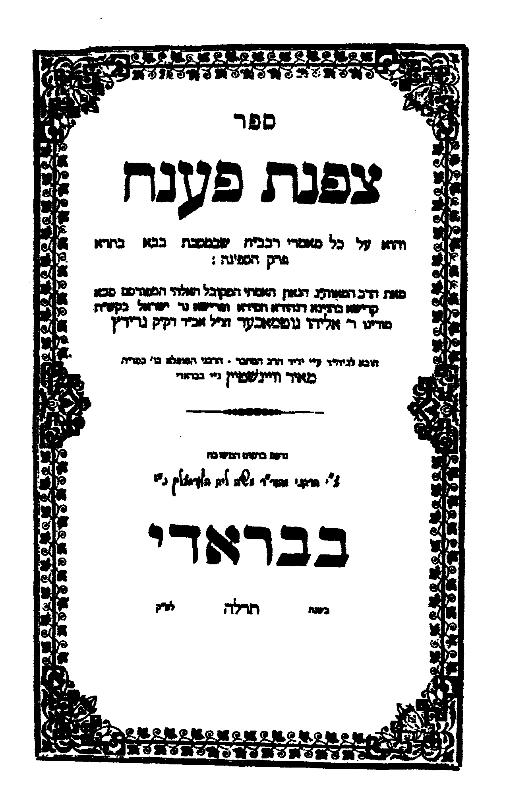
[27]  A few books on the shelf of Nieto’s portrait appear to bear a title, though I cannot decipher them.
[28] The clarity and detail of the Nieto portrait appears far superior, but this may simply be a reflection of the quality of the reproduction.
[29] The phrase from Tehillim does not appear in his work, Eitz ha-Da’at, or in his responsa, Shemesh Tzedakah, published posthumously by his son, Moshe Hayyim Shabtai.
[30] According to Landsberger, op. cit., the reproduction here in mezzotint, done by I. MacArdell, did not appear until 1728, the year of Nieto’s death. The original oil painting upon which this work is based is lost today.
[31] See OntheMainline blog, “David Nieto, an Art Mystery and the Joys of Digitized Books”  (October 9, 2009) http://onthemainline.blogspot.com/2009/10/david-nieto-art-mystery-and-joys-of.html (accessed April 17, 2021); Cecil Roth, “The Marrano Typography in England,” The Library 5:2 (1960), 118-128, esp. 121-122.
[32] According to Benayahu, op. cit., 139, the earliest documentation placing Morpurgo in Ancona dates from July, 1711.
[33]See http://onthemainline.blogspot.com/2011/01/beards-and-beardlessness-in-italian.html (accessed April 17, 2021). Here the author writes, “apparently the native Jews of Salonica were scandalized by the closely trimmed beards of the Francos who lived among them. They demanded that they grow them or be expelled. The situation of the ex-pat Italians came to the attention of the Italian rabbis, including one of the foremost ones,  Samson Morpurgo (Shemesh Tzedakah #61). Morpurgo interceded on their behalf attempting to prevent the Salonica community from expelling those not sporting a full beard. It is pointed out that Morpurgo himself, as per the above portrait, was beardless.”

There is a portrait on myheritage.com which is identified as being that of Dr. Samson Morpurgo. Attempts to contact the curator of the site to learn more about the portrait were unsuccessful.

It depicts an older man with a salt and pepper beard. This man is dressed in garb similar to Morpurgo and is likewise seated at a desk with a feather and quill. I have no additional information to corroborate this identification and have seen no reference to this portrait elsewhere. If indeed verified, this would not only add to our visual history, it would also alter the discussion about Morpurgo’s beardlessness.
[34] The portrait is found on the MyHeritage.com website. Attempts to contact the curator of the site to learn more about the portrait were unsuccessful.
[35] JTS Library Ketubah 5 record # 265985. I thank Sharon Liberman Mintz for bringing this ketubah to my attention.
[36] Apparently as both the bride and groom were members of the Morpurgo family only one coat of arms was included.
[37] David Kaufmann Collection of Medieval Hebrew manuscripts in the Oriental Collection of the Library of the Hungarian Academy of Sciences, n. 580, p. 21. I thank Kinga Devenyi from the Kaufmann Collection in Budapest for providing a copy of this poem. While the poem is unsigned, Benayahu provides definitive proof that Morpurgo is the author. For additional information on Marini and this poem, see M. Benayahu, “Rabbi Avraham Ha-Kohen Mi-Zanti U-Lehakat Ha-Rof ’im Ha-Meshorerim Be-Padova,” Ha-Sifrut 26 (1978): 108-40, esp. 110-111.
[38] See OntheMainline blog (October 20, 2010), http://onthemainline.blogspot.com/2010/10/ramchals-rebbe-rabbi-sabbato-marini-of.html (accessed April 17, 2021). There, the rebbe of Ramchal, as well as the picture below are identified as Rabbi Dr. Shabtai Aharon Chaim Marini (1685-1762).

According to Laura Roumani, whose dissertation is on Shabtai Hayyim Marini, both the picture and rebbe of Ramchal are Shabtai Hayyim Marini (1662-1748). In addition, according to Roumani, “Shabbetay Aharon Hayyim Marini is not the one born in 1685 who died in 1762. That is Shabbetay son of Aharon Marini who got his degree in medicine in 1705. He belongs to another lineage of the family. Shabbetay Aharon Hayyim Marini passed away in 1809 and was a rabbi in the Spanish synagogue of Padua. He was the son of Shelomoh Marini son of Shabbetay Hayyim and the father of Armellina Stella Rahel Marini who married Avraham Sevi HaLevi who inherited all the autographs of Shabbetay Hayyim Marini.” See Laura Roumani, “Le Metamorfosi di Ovidio nella traduzione ebraica di Shabbetay Hayyim Marini di Padova” [Ovid’s Metamorphoses translated into Hebrew by Shabtai Ḥayim Marini from Padua] (PhD diss., University of Turin, 1992). See also L. Roumani, “The Legend of Daphne and Apollo in Ovid’s Metamorphoses Translated into Hebrew by Shabbetay Ḥayyim Marini” [in Italian], Henoch (Turin University) 13 (1991): 319–335.
[39] Joseph Almanzi composed an ode to Marini in his Nezem Zahav:

[40] JTS Ms. 9027 V2:29. The poem is signed זה שמ”י לעלם and the author is not identified in the JTS catalogue. As per correspondence with Laura Roumani, “The author is Shimshon Morpurgo (who used to sign as Shmi, shin mem being the initials of his name). Elena was the daughter of Gemma second wife of Yishaq Marini, Shabbetay Hayyim Marini’s father. The wedding took place after 1721 (Yishaq was deceased). Though Shelomoh Marini is mentioned, he was not Yishaq Marini’s father. Yishaq was the son of Shabbetay Marini the doctor, brother of Shelomoh.”
[41] National Library of Israel, system number 000301332 and system number 004092777.
[42] system number 004092777. The wedding of Shmuel Moshe Hakohen and Diamante Hakohen.
[43] This sefer is part of the Shimeon Brisman Collection in Jewish Studies at Washington University in St. Louis. http://omeka.wustl.edu/omeka/exhibits/show/brisman/item/6997 (accessed April 16, 2021).
[44] See University of Pennsylvania Library, CAJS Rar Ms 503 (https://franklin.library.upenn.edu/catalog/FRANKLIN_9969495443503681). The catalogue notes references to Morpurgo on pages 16r and 24r. There is an additional mention of Morpurgo on page 32v (item 167), which is pictured here. The name Morpurgo spans across two lines.


The Meaning of Ayelet Ha-Shaḥar at Tehillim 22:1

The Meaning of Ayelet Ha-Shaḥar at Tehillim 22:1

By Mitchell First
MFirstAtty@aol.com

The phrase השׁחר אילת is found at Tehillim 22:1. The entire verse reads: “la-menatzeaḥ al ayelet ha-shaḥar mizmor le-David.” What is the meaning of השׁחר אילת ? This is the only time this phrase appears in Tanakh. Its meaning is so unclear that Radak offers five interpretations!

Literally, השׁחר אילת means: “doe of the dawn.” A male deer would be an ayal. An ayalah is a female deer (=a doe).[1] Ayelet is the construct state of ayalah. It means “ayalah of the…”

There are two times in Tanakh where the root איל has the meaning “strength.” These are at Tehillim 22:20: eyaluti, and 88:5: eyal.[2] Accordingly, some suggest that that the meaning of the phrase in our verse is “strength of the morning,” i.e., “sunrise.”3 But the איל words in those verses lack a dagesh in the yod. Our ayelet has a dagesh in the yod. With the dagesh, the meaning in Tanakh is always the “deer/doe” meaning.[4]

An amora in the Jerusalem Talmud (Berakhot 1:1 and Yoma 3:2) explains ayelet ha-shaḥar by taking the position that the light of morning first appears like two horns on the horizon and then illuminates the entire horizon. He probably means that there is a similarity to the antlers of a deer which branch out in different directions. In this interpretation, the verse is referring to the morning light.[5] But the word used in Tehillim 22:1 is ayelet, referring to a female deer, and 99% of the time, these have no antlers![6] (Of course, a response could be that the verse is speaking about male deer and for some poetic reason chose to use the female form.[7])

The above amora also mentions an alternative view that ayelet means כוכבתא .כוכבתא literally means “star,” but is commonly translated here as a reference to the planet Venus. Could ayelet have meant “star” at Tehillim 22:1?[8] This is very unlikely because nowhere else in Tanakh do ayal, ayalah, ayelet or other forms of איל have such a meaning.[9]

Many interpret ayelet ha-shaḥar as a musical instrument. Note for example that Tehillim chapter twelve begins as follows: la-menatzeaḥ al ha-sheminit mizmor le-David. Most likely, ha-sheminit is a musical instrument, one of eight strings. The format of our verse, 22:1, perfectly parallels the format of verse 12:1. But try as I might, I cannot imagine a musical instrument with a name like “doe of the dawn.”[10]

Rashi and Radak mention a view that the doe symbolizes Bnei Yisrael who seek the redemption symbolized by the word shaḥar.[11]

The key to solving our problem is the introductory sentence of psalm 56: la-menatzeaḥ al yonat eilem reḥokim. There are several possible interpretations of the words yonat eilem reḥokim, but most likely the reference is to a dove that is far away and the only issue is the meaning of eilem (אלם).[12] A “dove that is far away” cannot possibly be a reference to a musical instrument. The commentary in the Soncino edition writes here that it “is doubtless the title of a song to whose melody the Psalm was sung.”

This must be the approach we should take to verse 22:1. The introductory sentence is pointing to a well-known song called ayelet ha-shaḥar and telling the conductor to use the tune of this song. This approach is taken in the Encyclopaedia Judaica (13:1321)[13] and in the commentary on our verse in the Soncino edition: “In all probability, the name of a melody to the accompaniment of which the Psalm was to be rendered.”[14] Among our Rishonim, Ibn Ezra takes this approach as well on both verses, 22:1[15] and 56:1.

Although this “tune instruction” approach does not fit the word על perfectly, we should be able to live with it. The entry in the Encyclopaedia Judaica takes the position that al ayelet ha-shaḥar may have been the name of the song, but this is unlikely. It is too coincidental that the song at 56:1 would begin with al as well. Rather,על is a common word used in those first line instructions in the book of Tehillim. Sometimes it is an instruction regarding the specific musical instrument to be used and other times, like here, it can be an instruction with regard to the tune. (For examples of other times where the introductory verse likely refer to a tune, see the introductory verses to chapters 45, 57-59, 60, 69,75, and 80, and the commentary in the Soncino edition on each.)

——

Here are the five approaches that Radak had mentioned: 1) the name of a musical instrument, 2) strength of the morning, implying that the psalm was said at sunrise, 3) the name of a morning star, 4) an allusion to David fleeing from Saul, and 5) a way of referring to the Israelites. He preferred the last approach.

As to Rashi, here is what he offers: 1) the name of a musical instrument, 2) a way of referring to the Israelites, 3) the Sages’ homiletical approach that it refers to Esther (see Yoma 29a) and 4) strength, citing Menachem Ibn Saruk.[16]

Uriel Simon[17] points out that Ibn Ezra wrote two poems based on the theme that Israel is an ayelet. But as a commentator, he does not even mention this view in his standard commentary, since it is not at all a plain sense approach.[18]

Finally, it is interesting to offer a contemporary parallel to our interpretation of ayelet ha-shaḥar as an instruction regarding the tune of the psalm by referencing a well-known song. Nowadays we might say: “To the tune of Mary Had a Little Lamb.” (I thank Dr. Richard Gertler for this suggestion.)

[1] I am here reminded of the phrase “Doe a deer, a female deer” that I heard in the film The Sound of Music when I was a little child. That phrase finally came in handy!

[2] The Targum gives ayelet the strength meaning at 22:1, translating it as תקוף.

[3] This is the position taken by R. Saadiah Gaon. See Uriel Simon, Four Approaches to the Book of Psalms (1991), p. 51. It is referred to at the beginning of Ibn Ezra, although Ibn Ezra does not mention R. Saadiah by name.

[4] At Shir Ha-Shirim 2:7 and 3:5, אילות has the “deer/doe meaning” even without the dagesh.

[5] These statements in the Jerusalem Talmud are best understood in light of a statement at Yoma 29a.

[6] Female deer only have antlers when they have excess testosterone. This is very rare. Rashi (Yoma 29a) points out that ein karnayim le-nekeivah.

[7] In a different context, it is interesting to note the poetic license taken by the Israel Postal Company with their logo. For decades they have used a deer with antlers, intending an allusion to Gen. 49:21 (a verse that describes the delivery of imrei shefer.) But this verse refers to an ayalah. For further discussion, see my Links to Our Legacy (2021), pp. 205-208. (In recent years, their logo has been modified. Unless you knew, you cannot tell that a deer or any animal was intended originally.)

[8] Malbim is one who had adopted this interpretation.

[9] But “morning star” is a common understanding of the phrase ayelet ha-shaḥar in modern Hebrew.

[10] My son Shaya jokingly suggested that it could be a musical instrument that looked like a doe and was used to wake people in the morning! (My son’s wife is named Ayelet. It was his engagement to her in 2019 that inspired me to do this research.)

[11] See further Shir Ha-Shirim 6:10.

[12] As to eilem, perhaps it means “silent” or is a reference to a tree. Accordingly, the Encyclopaedia Judaica entry suggests “speechless dove far-off” and “dove of the far-off terebrinths.”

[13] This entry was authored by Nahum Sarna.

[14] Similarly, Robert Alter, The Book of Psalms (2007), p. 71, writes that the reference is to “a musical instrument of some sort, or alternately, to a melody.” Hebrew & Aramaic Lexicon of the Old Testament, eds. L. Koehler and W. Baumgartner (1995, revised edition), p. 40, has: “beginning of a song?” Finally, Daat Mikra follows the “tune instruction” interpretation in its main commentary (but suggests that the song is about the morning star) and then offers many other suggestions in the footnote.

[15] He thinks that the allusion is to a love song, since that word ayelet is used in the expression ayelet ahavim at Mishlei 5:19.

[16] Based on the manuscript evidence provided at Alhatorah.org, most likely the last was not in the original comment of Rashi and was added by others later.

[17] Four Approaches to the Book of Psalms, p. 240.

[18] But Simon points out that he does mention and reject it in an earlier recension of his commentary on Tehillim.


R. Shlomo Yosef Zevin and Yeshiva Students being Drafted to the Army, views of women, and more

Shlomo Yosef Zevin and Yeshiva Students being Drafted to the Army, Views of Women, and More

Marc B. Shapiro

1. In an earlier post I wrote about R. Shlomo Yosef Zevin and the famous essay about how yeshiva students need to serve in the army, an essay which is widely attributed to him. See here. In the post I cited important information uncovered by David Eisen that complicates the issue (as we see the Zevin family itself is of two minds on the matter), and we were left with no absolute proof that R. Zevin wrote the essay. I encourage all readers interested in the topic to read the six emails from Eisen quoted in my post, as they became the primary source material for all who wish to explore this matter.

One of the points that Eisen’s sources disagree about is when the essay was attributed to R. Zevin. R. Nachum Zevin, R. Zevin’s grandson, claims that it was only attributed to him after R. Zevin’s passing in 1978, but R. Menachem Hacohen states that already in the early 1970s he had seen the essay and it was believed that R. Zevin wrote it. As Eisen reports, one of the chief librarians at the National Library told him that he believes that already in the 1960s the essay was attributed to R. Zevin.

I am now able to put the matter to rest and establish beyond any doubt that R. Zevin is indeed the author of the essay. One of R. Zevin’s close friends was the author R. Zvi Harkavy, who served as an army chaplain. Harkavy regarded R. Zevin as his teacher, referring to him as מו”ר. In 1959 it was announced that Harkavy would publish a bibliography of all of R. Zevin’s writings, which were estimated to be over 1000 items, including material written under a pseudonym.[1] As far as I can tell, this never appeared. In Harkavy’s Ma’amrei Tzvi, p. 26, he includes a 1969 letter he received from R. Zevin is which Harkavy is addressed as ידידי הדגול. I mention all this only to show that when Harkavy speaks about R. Zevin you rely on what he says.

It has often been said that the identification of R. Zevin with the essay on yeshiva students and the army was only made years after its 1948 appearance, and this casts doubt on it having been being written by R. Zevin. I can now say that this is incorrect. In 1951 (Iyar 5711) Harkavy published an article in the Jerusalem Torah periodical Ha-Hed, which was a journal that R. Zevin himself often published in. (Unfortunately, very few issues from this periodical can be found on Otzar haChochma.) In Harkavy’s article he identifies R. Zevin as the author of the essay. Not only was Harkavy, because of his close friendship with R. Zevin, in a position to know that he wrote it, but R. Zevin never denied authorship in subsequent issues of Ha-Hed.

This shows without any doubt that R. Zevin is the author of the essay, and from this point on no one—including members of the family—should deny his authorship. Here is Harkavy’s article.

R. Nochum Shmaryohu Zajac called my attention to the recently published memorial volume for R. Yehoshua Mondshine,Sefer, Sofer, ve-Sipur. On p. 327 R. Mondshine wonders why R. Zevin—whom he seems to believe was indeed the author of the essay—would have felt it necessary to keep his authorship secret. R. David Zvi Hillman suggests that R. Zevin felt that if it was known that he wrote it, he would not have been welcome at the Brisker Rav’s home. He adds that it could have also created problems with the Habad synagogue he attended, as well as with his good friend R. Yehezkel Abramsky.

In going through the various issues of Ha-Hed, I discovered a picture of great interest in the Shevat 5711 issue.

On the right is Leah Seliger. She was a learned woman who edited the collected writings of her late husband, R. Joseph Seliger, 

Kitvei Ha-Rav Dr. Yosef Seliger (Jerusalem, 1930). The woman in the middle is R. Kook’s wife, Raize Rivka. Until recently I knew of only one other published picture of her, and this appears at the beginning of Pinchas Grayevski, Benot Tziyon vi-Yerushalayim, vol. 7 (Jerusalem, 1929; I think Dr. Yehudah Mirsky called my attention to this picture). The woman on the left is Miriam Berlin, the widow of R. Naftali Zvi Judah Berlin. I do not know of any other published pictures of her.

Shimon Steinmetz called my attention to this additional picture of R. Kook’s wife that can be found here.

2. In my post here I discussed these words from Exodus 15:16:

בִּגְדֹל זְרוֹעֲךָ יִדְּמוּ כָּאָבֶן

However, I neglected to mention one additional point. How come there is a dagesh in the כ when according to the grammatical rules it should not be there? R. Aaron of Lunel in his Orhot Hayyim offers an explanation. He states that if there was a dagesh people would read the last two words as יִדְּמוּךׇ אָבֶן, “stones are similar to you,” which is not a respectful thing to say to God.[2]

3. In my last post here I discussed the Hazon Ish’s opinion on the dispute between Maimonides and Rabad about an unwitting heretic, and the Hazon Ish’s assumption that Maimonides actually agreed with Rabad in this matter. It must be clarified that the Hazon Ish is not certain about his suggestion that there was no disagreement between Maimonides and Rabad when it came to someone who was completely “innocent” in his heresy. The Hazon Ish4. A couple of years ago in my post here I mentioned that in part two of the post I would have an excursus on the nature of women. For some reason I forgot to include this excursus in all the subsequent posts, so here it is.[4]

On the matter of the creation of women, and whether they are created “better” or “worse” than men, Shaul Regev calls attention to a strange comment by R. Jacob Matalon, Toldot Yaakov (Salonika, 1597), p. 7d (printed together with his She’erit Yaakov).[5] There are many comments in rabbinic texts that have a negative view of women, and most of these comments are based on a belief that women are inherently inferior to men. Yet not many texts are as explicit as R. Matalon in regarding women as almost a different species, standing between apes and men.

ובין החי למדבר הקוף ובין הקוף םמדבר [צ”ל למדבר] ומשכיל הם הנשים והאנדרוגינוס

Women obviously speak, so מדבר must mean speak with intelligence.

A passage similar to what R. Matalon says, but without mention of an ape, is found in Gersonides’ comment to Genesis ch. 3 (p. 110 in the Ma’aliyot edition).

והנה קראה האדם שם אשתו ‘חוה’, כאשר השיג בחולשת שכלה, רוצה לומר שלא עלתה מדרגתה על שאר הבעלי חיים עילוי רב, ואם היא בעלת שכל, כי רוב השתמשותה אמנם הוכן לה בדברים הגופיים, לחולשת שכלה ולהיותה לעבודת האדם. ולזה הוא רחוק שיגיע לה שלמות השכל, אלא שעל כל פנים היא יותר נכבדת מהם, וכולם הם לעבודתה

Gersonides is known for his negative view of women, and this reputation comes from passages like this. Here Gersonides states that women are on a higher level than animals, but not by much. Furthermore, just like the animals are at the service of women, so women’s role is to serve men. In discussing this passage, Menachem Kellner writes: “Gersonides apparently found Darwin’s missing link: woman!”[6]

For another explanation which Modern Orthodox women will probably regard as insulting, but more traditional women will probably see as a compliment, see R. Meir Mazuz, Bayit Ne’eman, no. 52 (parashat Terumah 5777), p. 1, who quotes R. Nissim Gaon as follows: The verse in Proverbs 1:8 states: אל תטוש תורת אמך – “Forsake not the teaching of thy mother”. Yet since women don’t have Torah knowledge, תורת אמך cannot mean this. Rather, it means the special holiday foods that the mother makes.

Readers can correct me if I’m wrong, but I do not believe that R. Mazuz’s understanding is correct, and I think R. Mazuz was citing R. Nissim from memory. That is, R. Nissim’s comment has nothing to do with women lacking Torah knowledge and identifying their cooking as תורת אמך. Rather, he cites the verse simply as a general statement about the importance of tradition. Here is the passage of R. Nissim Gaon as cited by R. Maimon the father of Maimonides.[7]

וכתב רבינו נסים במגילת סתרים כי כל מנהגי האומה באלו המנהגות כמו זה. והראש בראש השנה, החלב בפורים ובמוצאי פסח, והפולים ביום הושענא רבה. ואותם המנהגות אין לנו לבזותם ומי שהנהיגם זריז ומשתדל הוא כי הם מעיקרים נעשים ולא יבוזו במנהגי האומה וכבר אמר הנביא ע”ה ואל תטוש תורת אמך, דת אומתך אל תעזוב

Regarding the role and responsibilities of women, R. Mazuz has another interesting comment.[8] As part of his argument that women are not obligated in hearing parashat Zakhor, he says that this commandment is connected to the commandment of destroying Amalek, and women are not able to do this. How do we know that women cannot destroy Amalek and therefore are not commanded in it? “Because if she sees blood and even if she sees a mouse she becomes afraid, so how could she kill Amalek?” While many will not appreciate what they see as R. Mazuz’s flippant tone (which is obviously a joke, as he is well aware that there are women soldiers and doctors), do even feminists wish to claim that killing comes as easy to women as to men? Do they really want to be “equal” with men in this matter? I, for one, have always assumed that if women were running the world, there would be many fewer wars, as only someone who is blind to reality cannot see that men are naturally more inclined to violence than women.

Here is another interesting point relevant to the subject of women: Rashi, Menahot 43b s.v. היינו, in explaining the talmudic passage dealing with the blessings that a man recites in the morning, states that a woman is to regarded as a maidservant to her husband (i.e., to do his wishes), much like a slave is to his master: דאשה נמי שפחה לבעלה כעבד לרבו

Rashi’s comment is not surprising and has often been quoted. Indeed, although it will trouble modern readers, lots of similar comments can be found in rishonim and aharonim.[9] Furthermore, in at least three places the Talmud refers to a wife with the term shifhah.[10] Yet for a reason I can’t explain, R. Moshe Feinstein was very troubled by this comment of Rashi, and this led him to write something quite problematic.[11] See Dibrot Moshe, Gittin p. 511 (also in Iggerot Moshe, vol. 9, Orah Hayyim no. 2):

ולולי דמסתפינא הייתי אומר שצריך למחקו דח”ו לרש”י לומר דברי הבל כזה, דמן התורה הא ליכא שום שעבוד על האשה לבעלה חוץ מתשמיש ולענין תשמיש הוא משועבד לה יותר דהא עליו איכא גם איסור לאו . . . ואינה מחוייבת לעשות רק עניני הבית ולא עבודת שדה ומעט עשיה בצמר שהיא מלאכה קלה ממלאכות שדרכן של בנות העיר בזה

R. Moshe states that in no way can a woman be generally regarded as under her husband’s authority as only in a few areas does she have obligations to him (much like he has to her). He continues to expound on the way a husband is obligated to treat his wife in order to show that she is far removed from being a maidservant.[12] This is all true, and it would be easy to quote authorities who write similarly. Yet they did not see this as in any way contradicting Rashi’s statement. Understandably, some have expressed great surprise upon seeing how R. Moshe refers Rashi’s comment as הבל (as they do not accept R. Moshe’s point that Rashi could never have said דאשה נמי שפחה לבעלה כעבד לרבו).

R. Shlomo Aharon Gans goes so far as to say that if thegadol ha-dorhad not been the one to say this, it would be forbidden to write such a thing. He adds the following, bringing support for the notion expressed in Rashi that a wife is like a maidservant (not that she is a maidservant, but she is like one)[13]:

ולא הבנתי דהא הויא קנין כספו, ועי’ תורא”ש קידושין ה’ דהוא מושל עליה ומשעובדת לו וכדכתיב והוא ימשל בך, וא”כ מאי קשיא ליה כ”כ בדברי רש”י אלו

This conception, that a wife is like a maidservant, was actually criticized by R. Hayyim Hirschensohn who called attention to the “barbaric” way Jews treated their wives in the small towns of Galicia, where the wives did not even eat at the same table with their husbands.[14]

וה’ יסלח לו כי ההרגל הרע של בני מדינתו להתגאה על נשותיהן אשר לוקחים אותן רק לרקחות וטבחות ואין מסיבות בשלחן עם בעליהן וחושבים אותם כחמת כו’ [מ”ש: ראה שבת קנב ע”א] ואלמלי עלמא צריכי להו היו בעי רחמי דלבטלי מן העולם ח”ו, ההרגל הפראי הזה אשר בעירות הקטנות בגאליציא ובקצת ערי פולין גרם להרב הנז’ לבלי להרגיש את העלבון אשר עלב לבנות האבות והאמהות אשר קמו גם הן לאם לבנות את בית ישראל

As a curiosity, it is worth noting the opinion of R. Menasheh Klein that a husband should not help his wife with household tasks such as cleaning the dishes, as that is “women’s work”, while the husband works outside the home. (And what about when the wife also works outside the home?) Instead, the husband should use that time for learning Torah and other spiritual pursuits.[15]

כי לכן נתן לו הקב”ה אשה לאדם שיהי’ לו לעזר שתעשה לו צרכי הבית והוא יהיה פנוי בזמן שיש לו ללמוד תורה ולעבודת השם ולא לכבס ולהדיח הכלים אחרי האכילה ולסדר את המטות החיוב על הבעל לפרנס את אשתו ובניו ושאר הזמן כל רגע ורגע ינצל ללימוד התורה ולעבודת השי”ת שמו. ובעונ”ה נשתנה הוסת שהבעלי בתים הצעירים נעשים בעלת בתים מבשלים ומדיחים הכלים והולכים לחניות לקנות צרכי הבית איינקויפען בלע”ז בקיצור עושים כל מלאכת הנשים והנשים עושים מלאכת האנשים

I can only imagine what the reaction of a newlywed wife would be if her husband would tell her that no, he has no plans to help clean the table and do the dishes because that is women’s work.

Related to this is the following story told by R. Yosef Wineberg, the grandson of the Slonimer Rebbe. It is obviously designed to make the “Litvish” look bad.[16]

A newly married Litvishe couple was once sitting together. The wife asked her husband to please make her a cup of tea. He immediately jumps up, puts on his hat and jacket and walks out the door. About an hour later, the husband returns home, removes his hat and jacket and makes her a cup of tea. Puzzled by his strange behavior, she asks for an explanation.

He explains: when you first asked me to make you a cup of tea, I was upset. I am a Talmid Chacham, a scholar, and you are meant to “serve” me, not the opposite. Not wishing to get into an argument, I went to my Rav to ask him what I should do.

The Rav explained to me that “ishto k’gufo”, that the Halacha considers us like one person. Therefore, making tea for you is identical to making tea for me. As I feel no compunctions with serving myself, I returned home to fulfill your request.

In order to show that the husband is the boss of the household, R. David Kimhi states that while the husband calls his wife by her name, the wife does not call her husband by his name, but by some title which shows his superior status.[17]

כי האיש הוא הקורא לאשתו בשמה ולא האשה לאישה, אלא דרך כבוד בלשון אדנות קוראה לו ולא בשמו, כי כל מי שיש לו מעלה אל אחר אין ראוי לאשר למטה ממנו לקרוא אותו בשמו, כמו אביו או רבו או אדניו . . . וכן האשה לבעלה כי אדניה הוא כמו שאמר: והוא ימשוך בך

One of the proofs he offers for this idea is that in Genesis 17:17 Abraham refers to Sarah by her name, but in Genesis 18:13 Sarah refers to Abraham as “my lord” (אדני). Another proof he mentions is that when God changes the names of Abraham and Sarah he says to Abraham (Gen. 17:15): “Thou shalt not call her name Sarai.” From this we see that Abraham called his wife by her name. However, when Abraham’s name was changed the Torah states (Gen. 17:5): “Neither shall thy name any more be called Abram.” Sarah was not told this, Radak states, as she didn’t refer to her husband by his name. This was rather a general statement, that among those people who call Abraham by his name, they no longer would do so.

Although Radak states that a husband calls his wife by her name, we know that this was not always the case. Thus, we are told that R. Jacob Moellin in speaking to his wife would not call her by her name. When he referred to her in conversation with others, he would call her mein hausfrau (my housewife).[18] The text that records this information notes that already in the Talmud, Shabbat 118b, we find that R. Yose referred to his wife as “my house,” and I think most assume that this was done as a term of respect.[19] The text further notes that the general practice was that both husband and wife did not refer to each other by their first name. Such a practice was also found in the Sephardic world.[20] What this shows us is that contrary to what Radak records, the practice need not have anything to do with the husband being regarded as “superior” to his wife.

With all the discussions in rabbinic literature that show the essential differences between men and woman, let me mention another curiosity that, if you want to be cute, you can say that in one place the Talmud actually refers to women as men. I have in mind Zevahim 67b which, in discussing the burnt offerings brought by two women after childbirth, states:

חטאת לזו ועולה לזו עשה שתיהן למעלה . . . אימור דא”ר יהושע בחד גברא בתרי גברי מי אמר

In this passage, the word גברי, which means “men”, refers to the case of the two women (although the principle enunciated applies to all people).[21]

While on the male-female topic, let me mention something else that is relevant. We all know that the name Avi (short for Avraham) is quite popular. Yet how many know that this is already a biblical name, but used for a woman (2 Kings 18:2)?

I want to return to the notion already mentioned in this note, and found in a number of earlier works, that an ape stands between animals and humans. The Sefat Emet, Genesis 18:1, expands on this as follows:

ובין חי למדבר קוף. ואנו נאמר כי אחר מדבר אדם, שעל זה נאמר “אדם” אתם קרוין אדם ולא האומות. וישמעאל הוא הממוצע לכן נקרא פרא אדם, ולכן יד כל בו וידו בכל, כי על ידו יש התקשרות בין מדריגות מדבר למדריגת אדם

When he writes כי אחר מדבר אדם it means that after the level of מדבר, which means “humanity”, there is the level of אדם, which is the level of the Jewish people. He then adds that the Arabs stand between מדבר and אדם which is why they are called פרא אדם. Often פרא אדם is used to show that the Arabs are on a lower level than other nations. However, here we see that the Arabs are on a higher level, and closer to the Jews than the other nations, as among the nations of the world only the Arabs are also called אדם—no doubt because of their monotheism, see Yevamot 61a—even if this word is placed together with the negative term פרא.

The Sefat Emet’s comment is derived from the Zohar,[22] which explains פרא אדם as meaning one who possesses the “beginnings of אדם”. The Zohar also places the descendants of Ishmael on a higher level than the other nations because they are circumcised. Circumcision was widely practiced even in pagan Arabia, so the reference to circumcision alone would not be enough to date this passage of the Zohar to the post-Islamic period.

R. Jacob Emden, however, cites a different passage in the Zohar that assumes the existence of the Islamic world, meaning that it could not have been written by R. Shimon ben Yohai.[23] He writes:

הנה לפניך שבימי בעל ספר הזוהר כבר היתה אמונת מחמד הישמעאלי בעולם (שנתחדשה בימי אמוראים האחרונים על”ב) כי קודם זמן זה היו כל הישמעאלים עובדי אלילים גמורים, ככל יתר גוי הארצות.

R. Emden also cites another Zoharic passage that assumes Islamic rule in the Land of Israel. He comments:[24]

הרי כי בימי בעל ספר הזוהר היתה אומת ישמעאל שולטת בארץ הקדושה, ודבר ידוע הוא ומפורסם, שלא הגיעו הישמעאלים לממשלה כללית עד שנת שע”ד לאלף החמישי . . . נמצא עכ”פ יותר מחמש מאות שנה אחר רשב”י חובר ספר הזוהר, ואולי מאוחר עוד הרבה מזה, ואיך אפשר להסכים זה עם שמות האומרים אותם הדברים, והמה חבריו או תלמידיו של רשב”י, לפי המובן בלשונו של בעל ספר הזוהר, הלא זה כדבר שאין לו שחר

He cites a third such example and writes:[25]

מלכות ישמעאל לא נתפרסמה ולא נתפשטה בימי תנאים ואמוראים. כי היו אז ממלכה שפלה קטנה וירודה

Returning to the matter of how women have been viewed, R. Joseph Solomon Delmedigo mentions that jokers—ליצני הדור—come up with all sorts of gematrias. When it comes to women not all of them are negative. For example, the gematria of אשה is דבש, and אשה יפה = שמחה גדולה. However he also cites a gematria which is not very complimentary to women. זכר=ברכה and נקיבה=בקללה. R. Delmedigo sees this as a big joke, but it is actually mentioned by R. Hayyim the brother of the Maharal in his Iggeret ha-Tiyul, section ז, and it is also found in Ba’al ha-Turim, Gen. 1:27 (with some differences as to which letters are actually included in the gematria).

In 1807 R. Jacob Samson Shabbetai Senigallia[26] published his talmudic commentary Shabbat shel Mi. Here is the title page of the Livorno first edition. (It has been reprinted a number of times).

Here is what appears in the book on p. 89b. He is trying to explain why chapters 5 and 6 in tractate Shabbat are next to each other. Chapter 5 begins במה בהמה and chapter 6 begins במה אשה, and according to R. Senigallia this is because “birds of a feather flock together.”

If he was trying to make a joke, I can understand what he wrote. But who ever heard of making a joke in the middle of a talmudic commentary? Presumably, he was being serious, which leaves us with a very offensive comment.

There is, to be sure, humor in the Talmud, but I don’t know of any examples in talmudic commentaries. Yeshayahu Leibowitz quipped that the Sages must have had a good sense of humor, since they included the following text in the Talmud [27]: תלמידי חכמים מרבים שלום בעולם. In all seriousness, however, there are indeed humorous passages in the Talmud, as pointed out by R. Moses Salmon.[28] Here is one example he gives (Bava Batra 14a):

The Rabbis said to R. Hamnuna: R. Ammi wrote four hundred scrolls of the Law. He said to them: Perhaps he copied out the verse תורה צוה לנו משה

R. Salmon claims that anyone with a bit of sense can see that R. Hamnuna’s reply is a wisecrack made in response to the obvious exaggeration about R. Ammi.

Nehemiah Samuel Libowitz states that even in the Zohar we have passages that show a humorous side.[29] One of the many examples he points to is Zohar, Bereshit, p. 27a:

וימררו את חייהם בעבודה קשה בקושיא. בחומר קל וחומר. ובלבנים בלבון הלכתא. ובכל עבודה בשדה דא ברייתא. את כל עבודתם וגו’ דא משנה

I have no idea what to make of the following comment from R. Oury Cherki, dealing with humor, which does not sound like something that would be said by a leading kiruv figure (De’ah Tzelula: Olam ve-Adam be-Mishnat ha-Rav Kook [Jerusalem, 2015], p. 246). Rather, it sounds like something one of the maskilim of old would say.

התורה שבעל-פה אינה מובנה ללא שותפות רוח האומה. לכן כשלומדים הלכה רצוי להצטייד בחוש הומור, שכן לפעמים הדברים נראים משונים למדי. למשל, הכנת כוס תה בשבת. התלמוד אומר שאסור לשפוך מים קרים לתוך החמים אבל מים חמים לתוך הקרים מותר, כי יש כלל ש”תתאה גבר”, התחתון גובר. כששופכים מים חמים לתוך הקרים המים הקרים מתחממים ומתבשלים מה שאין כן ההפך – המים החמים מתקררים. יש כאן בהחלט סוג של הומור

I also found the following interesting comment by Moshe Meisels, the editor of Ha-Doar, in a letter to Chaim Bloch.[30] He suggests that the talmudic prohibition against a non-Jew observing the Sabbath is an example of rabbinic wit, and is not to be understood literally.

ואגב, לא אהא בבחינת מורה הלכה לפני רבו אם אינני מתאפק מלהביא מעין חידוש שנתחדש לי הקטן באחד המאמרים התמוהים בתלמוד מן הסוג הנ”ל, והוא אמרם: עכו”ם ששבת חייב מיתה, שנאמר יום ולילה לא ישבותו וכו’. ואין צורך להרבות דברים על הזרות שבדבר: מה איכפת למי אם שבת או לא שבת, ומה היא הראיה מאותו פסוק, המוסב על קיץ וחורף וכו’, ומה ענינו לכאן ולעכו”ם דוקא? ונראה לי שכל המאמר בא בדרך חידוד, וזה מובנו: עכו”ם ששבת מן הדין שיהא חייב מיתה בדיניהם. מדוע? ישראל שלא שבת חייב מיתה, משום שעל א-לוהיו נאמר וישבות ביום השביעי וכו’, אבל עובד כוכבים ומזלות, שעליהם נאמר יום ולילה לא ישבותו, מן הדין שעובדיהם יהיו חייבים מיתה אם שינו מדרך אלהיהם ושבתו

On the matter of non-Jews observing the Sabbath, R. Yaakov Koppel Schwartz makes a fascinating suggestion, which he acknowledges has no support in the rishonim and therefore he has doubts whether it is correct.[31] The prohibition against labor on the Sabbath is in remembrance of the fact that we were slaves and God redeemed us. Therefore, it is understandable why non-Jews are forbidden to commemorate the Sabbath by abstaining from work, as this has no connection to them. However, there is another reason given for the Sabbath and that is so that we remember the creation of the world. Non-Jews are also supposed to acknowledge this and therefore there should be nothing wrong with non-Jews having some sort of celebration in honor of the Sabbath.

אבל הכיבוד והקידוש של יום השבת, שהוא משום אמונת חידוש העולם, שייך שגם הגויים יהיו בהם ואינם מנועים מלכבד ולענג את השבת

If we follow R. Schwartz’s approach, this is something that could be suggested for Noahides whose “religion” is lacking any rituals, which for most people is an essential component of their religion.

* * * * * * * *

[1] Ha-Tzofeh, June 16, 1959, p. 2.

[2] Orhot Hayyim, Or Etzion ed. (Merkaz Shapira, 2017), p. 106, quoted by R. Joseph Karo, Beit Yosef, Orah Hayyim 51 (end). Regarding negative expressions directed against God, there is an interesting passage in R. Yedidiah Solomon Raphael Norzi, Minhat Shai, Deut. 8:3. To understand it one must know that the old French word “fi” expressed disdain or disgust. See here. The issue Norzi discusses is that the verse reads:

‘כִּי עַל-כָּל-מוֹצָא פִי-ה

Norzi cites a view that in this case there should be a dagesh in the word פי even though that is not in accord with the general rule, because without the dagesh, reading it as “fi” would be disrespectful to God:

כי לשון גנאי הוא בלשון צרפת וחלילה לשם יתברך

Norzi completely rejects this and states that the rules of biblical grammar are not to be changed because of how words sound in languages other than Hebrew (and there are indeed examples where biblical Hebrew words sound like profanity in other languages).

ואין לנו לחוש ללשון צרפת שאין מבטלין דרכי לשון הקדש מפני שאר לשונות

See also Samuel David Luzzatto, Prolegomena to a Grammar of the Hebrew Language, trans. Aaron D. Rubin (Piscataway, N.J., 2005), pp. 133-134.

Regarding the pronunciation of פ, R. Meir Mazuz points out that the Vilna Gaon, Commentary to Tikunei Zohar, section 19, p. 38d (p. 166 in R. Zuriel’s edition), mistakenly believed that Sephardim pronounce פ with and without a dagesh the same way (just as they pronounce ת with and without a dagesh the same way). R. Mazuz notes that the Vilna Gaon’s point is repeated by R. Baruch Epstein, Mekor Barukh, vol. 1, p. 397b (without mentioning the Gaon). See Mazuz, Bayit Ne’eman (Humash), vol. 1, p. 13 (first pagination).

[3] Hazon Ish, Yoreh Deah 62:21.

[4] In my earlier post I cited R. Samson Raphael Hirsch as adopting the notion that women are created on a higher spiritual level than men. I neglected to note that Shaye J. D. Cohen earlier discussed Hirsch’s approach. See Cohen, Why Aren’t Jewish Women Circumcised (Berkeley, 2005), pp. 165ff.

[5] “Eshet Hayil: Kavim li-Demutah u-le-Ma’amadah shel ha-Ishah be-Hagut ha-Yehudit ha-Shesh Esreh,” in Ephraim Hazan and Shmuel Refael, eds. Mahbarot li-Yehudit (Ramat-Gan, 2012), p. 286.

[6] Torah in The Observatory (Boston, 2010), p. 287. I earlier discussed Ralbag here.

[7] See R. Yaakov Moshe Toledano, Sarid u-Falit (Tel Aviv, [1945]), p. 8.

[8] Bayit Ne’eman no. 153 (parashat Vayikra 5779), p. 2.

[9] See e.g., R. Israel Ibn Al Nakawa, Menorat ha-Maor, ed. Enelow, vol. 4, pp. 32-33, who instructs a wife as follows (using the word שפחה that so troubled R. Moshe):

ועושה צרכיו בעצמה ולא על ידי אחרים. ואפי’ היו לה כמה עבדים וכמה שפחות, תעמוד היא ותשרתנו, ותקראנו אדוני . . .ויהיו עיניה תלויין לו, כעיני שפחה אל יד גבירתה

For a translation of this passage, see here. Maimonides, Mishneh Torah, Hilkhot Ishut 15:20, says that a wife should regard her husband כמו שר או מלך.

Radak, Gen. 3:16, writes:

והוא ימשול בך: לצוות עליך מה שירצה כאדון על עבד

Ramban, Gen. 3:16, explains that as a result of Eve’s sin, the relationship of man and woman was changed. From that point on:

 והוא יחזיק בה כשפחה ואין המנהג להיות העבד משתוקק לקנות אדון לעצמו אבל יברח ממנו ברצונו

R. Bahya ben Asher, Gen. 3:16, writes:

ואל אישך תשוקתך: שאע”פ שהאשה משועבדת ברשות הבעל ומנהג העבד לברוח מן האדון כדי שלא ישתעבד, גזר בזאת שתהיה משתוקקת לבעל ושתרצה להשתעבד לו בהפך מן המנהג

See also R. Chaim Rapoport’s letter in my Iggerot Malkhei Rabbanan, p. 172.

R. Avraham Blumenkrantz, Gefen Poriah, p. 352, quotes approvingly another rabbi who states as follows (emphasis added):

Her tears are ever ready to flow at the most miniscule suggestion of being dealt with as a maidservant. She will concede you the service of והוא ימשל בך. She will consent to call you בעלי, but don’t accent the דגש in the בית too heavily. She must constantly be reassured that there is honor and dignity in her subservience. Honor her more than you honor yourself. She must be compensated for her subjugation, and be made to feel that she has a genuine share in the dignity of the throne.

Do haredi women really feel that they are subservient or subjugated? Do haredi men feel this way about their wives? Hasn’t haredi society accepted the notion of separate but equal when it comes to men and women?

[10] Sanhedrin 39a, Yevamot 113a, Nedarim 38b.

[11] As is well known, and I have written about previously, R. Moshe often rejected the authenticity of texts that he found problematic. Another example of this with regard to Rashi on the Talmud is found in Iggerot Moshe, Even ha-Ezer, vol. 4, no. 64:1. Here R. Moshe says to delete words in Rashi even though, as he notes, these words are found in “Rashi” on the Rif and in R. Nissim. See the strong responses to R. Moshe quoted in R. Yonason Rosman, Petihat ha-Iggerot, pp. 605-606. One of these responses is from R. Menasheh Klein in his notes to R. Eyal Shraga, Minhat Ish, vol. 1, pp. 302-303. R. Klein writes:

וח”ו ואטו עד כמה נילך ונמחוק בדברי רבותינו ז”ל שנאמרו ברוה”ק, ולולי דמספינא הייתי אומר דאיזה תלמיד טועה כתבו, אבל פשוט דדברי רש”י נכונים וליכא כאן טעות כלל

When R. Klein suggests—לולי דמספינא—that a “mistaken student” is responsible for the problematic passage in Iggerot Moshe, he does not mean it seriously. This is just his respectful way of saying that R. Moshe’s position is completely without basis. He uses the same language in Mishneh Halakhot, vol. 12, Yoreh Deah no. 214. There he responds to R. Moshe’s statement that he doesn’t know who R. Menahem Tziyoni is, but since he quotes a heretical—in R. Moshe’s opinion—passage from R. Judah he-Hasid’s commentary on the Torah, therefore R. Tziyoni’s work must be banned together with R. Judah he-Hasid’s commentary.

[12] R. Moshe also famously states that women do not have any less holiness than men. See Iggerot MosheOrah Hayyim vol. 4, no. 49 (p. 81). See also the new Mesorat Moshe, vol. 4, p. 476. This position is at odds with many earlier writers who saw men as holier because they are commanded in more mitzvot. This is also Maimonides’ position in his commentary to Horayot 3:7. See R. Chaim Rapoport’s discussion in Kovetz Hearot u-Veurim, no. 908 (2006), pp. 138ff. Yet see R. Dov Halbertal, Erekh ha-Hayyim be-Halakhah (Jerusalem, 2004), vol. 2, p. 399, who has a different approach and makes the point that just because a Kohen and Levi are to be saved before an Israel, no one would say that the Kohen and Levi have more holiness. See also R. Yitzhak Barda, Yitzhak Yeranen, vol. 11, p. 249, that women are holier than men. He offers an original explanation of this notion.

שהאשה שהקב”ה הפריש ממנו, מהצלע שלו, הוא מופרש, וממילא כל מופרש קדוש, ואז האשה יותר קדושה מהאיש. ובזה מובן למה האיש מקדש את האשה, לא אומר לה הרי את אשתי, או כל סממן לשון של נישואין, חברה או שותפה וכו’, זולתי: הרי את מקודשת לי! לפי שהקב”ה קבע כל מופרש קדוש

[13] Kinyan Shlomo, Yevamot, p. 89. See also R. Natan Einfeld, Minhat Natan: Kiddushin, pp. 139-140, who cites other sources in rejecting R. Moshe’s point.

[14] Malki ba-Kodesh, vol. 4, p. 50a. See R. Menasheh Klein, Mishneh Halakhot, vol. 12, no. 351, for a defense of the practice of husbands and wives eating separately.

[15] Mishneh Halakhot, vol. 7 no. 155 (called to my attention by R. Aviad Stollman).

[16] The story is recorded by R. Chaim Dalfin, Faces and Places Boro Park (Brooklyn, 2017), p. 149.

[17] Commentary to Gen. 17:15. See the rejection of Radak’s opinion in R. Betzalel Stern, Be-Tzel ha-Hokhmah, vol. 1, no. 70.

[18] Maharil, Likutim (p. 610 in the Makhon Yerushalayim edition).

[19] On the other hand, R. Meir Schiff (Maharam Schiff), Gittin 52a, explains that R. Yose referred to his wife this way because she was a bad wife: אשה רעה. Yet the proof he brings for this is actually from a different R. Yose. See R. Judah Leib Maimon, ed., Sefer ha-Gra, vol. 1, p. 110 in the note. Regarding “bad wives”, R. Elazar of Worms is quoted as follows in R. Alexander Suslin, Sefer ha-Agudah, ed. Brizel, Yevamot, no. 78 (p. 41):

מי שיש לו אשה רעה יסבול יקבל ברצון ויקבל בשמחה ולא יראה פני גהינם

What does R. Elazar mean that if you suffer under a bad wife you will not see gehinnom? R. Moses Guedemann explains that with a bad wife you already saw gehinnom in your lifetime, so there is no need to see if after death. See Ha-Torah ve-ha-Hayyim, trans. Friedberg (Warsaw, 1897), vol. 1, p. 194:

כי פני הגיהנם כבר ראה בחייו

Regarding “good wives” see R. Shlomo Hoss, Kerem Shlomo, no. 43, who writes:

אין לך כשרה בנשים אלא אשה שעושה רצון בעלה: אהע”ז ס”ס ס”ט (אך אשת חיל כזאת מי ימצא)

R. Solomon Zvi Schueck was shocked at R. Hoss’ final comment, that one cannot find a wife who does the wishes of her husband. R. Schueck writes that based on this passage he assumed that R. Hoss must not have had a good wife.

נראה לי שהי’ לו אשה רעה, וממנה דן על כל הנשים שבישראל

See She’elot u-Teshuvot Rashban, Even ha-Ezer, no. 99 (p. 88b). He further tells us that he asked one of R. Hoss’ students who confirmed that this was indeed the case.

[20] See Tuvia Preschel, Ma’amrei Tuvyah, vol. 5, p. 142.

[21] See Or Torah, Shevat 5780, p. 460.

[22] Exodus 86a, 87a.

[23] Mitpahat Sefarim, ch. 4 (at the beginning; p. 20 in the Jerusalem 1995 edition). In R. Reuven Rapoport’s edition of Mitpahat Sefarim, with his commentary Itur Soferim, p. 13, R. Rapoport sees it as obvious that this passage in the Zohar is a later interpolation much like there are Savoraic additions in the Talmud.

[24] Mitpahat Sefarim, ch. 4 (p. 27 in the Jerusalem 1995 edition).

[25] Mitpahat Sefarim, ch. 4 (p. 54 in the Jerusalem 1995 edition). Regarding the larger issue that R. Emden points to, see Ronald C. Kiener, “The Image of Islam in the Zohar,” Jerusalem Studies in Jewish Thought 8 (1989), pp. 43-65.

[26] See the recent discussion of R. Senigallia by R. Moshe Maimon in the Seforim Blog here.

[27] Sihot al Pirkei Ta’amei ha-Mitzvot (Jerusalem, 2003), p. 289.

[28] Netiv Moshe (Vienna, 1897), pp. 45-46.

[29] “Halatzot ve-Divrei Bikoret be-Sefer ha-Zohar,” Ha-Tzofeh le-Hokhmat Yisrael 11 (1927), pp. 33-45. For more on humor in the Talmud, see Yehoshua Ovsay, Ma’amarim u-Reshimot (New York, 1946), ch. 1; Meyer Heller, “Humor in the Talmud” (unpublished masters dissertation, Hebrew Union College, 1950), available here; R. Mordechai Hacohen, “Humor, Satirah, u-Vedihah be-Fi Hazal,” Mahanayim 67 (5722), pp. 8-19; and Ezra Brand’s post here. From Brand I learned that David Lifshitz wrote an entire doctorate on the subject. See also my posts here and here where I discuss Siftei Hakhamim’s comment that Moses thought God was joking with him, and how this has been censored in a recent edition. See also J. Chotzner, Hebrew Humor and Other Essays (London, 1905); Nehemiah Samuel Libowitz, Ha-Shomea Yitzhak (New York, 1907).

[30] See here (Chaim Bloch Collection, Leo Baeck Institute, 7155-7156, 1/13).

[31] Likutei Diburim, vol. 4, pp. 24-25.


Hirschian Humanism After the Holocaust: An Analysis of the Approach of Rabbi Shimon Schwab

Hirschian Humanism After the Holocaust:
An Analysis of the Approach of Rabbi Shimon Schwab
By Rabbi Shmuel Lesher

Rabbi Shmuel Lesher is a Machon Beren Kollel fellow at RIETS / Yeshiva University. Prior to completing his rabbinic ordination at RIETS, Rabbi Lesher studied at the Mirrer Yeshiva in Jerusalem and Yeshiva of Greater Washington in Silver Spring, Maryland. Rabbi Lesher lives in Washington Heights, with his wife Leora and their three children.

This is his first contribution to the Seforim Blog.

In 1959, Rabbi Shimon Schwab[1] made a unique contribution to the way his community and others commemorate the Holocaust. Shortly after he joined the rabbinate of K’hal Adath Jeshurun in Washington Heights, Manhattan, R. Schwab was asked by R. Joseph Breuer[2] to compose a special Tisha B’av kinnah for their kehillah. Although it was originally written for the KAJ community, many other congregations have adopted the custom of reciting it on Tisha B’av.[3] To be sure, there have been others who authored kinnot to commemorate the Holocaust.[4] However, it appears that, especially in America, R. Schwab’s kinnah is perhaps one of the first written by a rabbinic figure to gain widespread popularity.

In addition to his innovative Holocaust kinnah, the events of the Holocaust played a significant role in how R. Schwab interpreted and perpetuated the Torah Im Derekh Eretz philosophy to which he was heir. According to R. Schwab, Torah Im Derekh Eretz was seen by R. Samson Raphael Hirsch as the ideal model. However, openness to secular culture has historically been the minority opinion among gedolei yisrael.[5]

R. Schwab reached this conclusion after re-evaluating his position multiple times throughout his life. In a speech he delivered in 1990,[6] he recalled how the events of Kristallnacht (Nov 9, 1938 – Nov 10, 1938), and later the Holocaust, shook his belief in Torah Im Derekh Eretz to the core. How could R. Hirsch have believed the humanism of Germany would lead to an uplifted and righteous society when the same humanistic society ended up committed genocide without much protest from the “enlightened students of Schiller and Goethe?”[7] R. Hirsch must not have seen German humanistic Bildung[8] as anything more than a time-bound compromise in order to save his community from assimilation.[9] R. Schwab was referring to an essay he wrote in 1934 entitled Heimkehr ins Judentum (Homecoming To Judaism).[10] Here R. Schwab claimed R. Hirsch only intended Torah Im Derekh Eretz as a temporary allowance. This book was the first substantial rejection of Torah Im Derekh Eretz written by someone who grew up in the Hirschian community.[11]

An English version of this essay, prepared by K’hal Adath Jeshurun translator Gertrude Hirschler, appeared in 1978.[12]

Around the same time he published Heimkehr ins Judentum, R. Schwab wrote to a number of Eastern European Torah leaders asking them about the permissibility of incorporating secular studies into a yeshiva curriculum.[13] Dr. Marc B. Shapiro notes that this was yet another sign of the waning popularity of Torah Im Derekh Eretz at the time, even in Germany itself.[14] Apparently, R. Schwab, who had studied in Lithuanian yeshivot, was not convinced of the permissibility of what had been established as normative practice in his own country. Dr. Shapiro’s analysis is correct. However, consider R. Schwab’s query in light of his unequivocal rejection of Torah Im Derekh Eretz in his Heimkehr ins Judentum. Based on the dates of his letters and the responses of his interlocutors, it appears that even as he published Heimkehr ins Judentum, R. Schwab felt the viability of Torah Im Derekh Eretz was still an open question — or at least one still worthy of inquiry.[15]

Later in his life, after re-assessing R. Hirsch writings, R. Schwab came to believe that his earlier view was incorrect. In this later re-evaluation, R. Schwab felt that Hirsch did, in fact, wholeheartedly believe in the significance of humanism for society. After this realization, in 1966, R. Schwab wrote an essay entitled, “Elu ViElu: These and Those,” which showed the validity and necessity of both the “Torah Only” approach of many gedolei yisrael and the Hirschian “Torah Im Derekh Eretz” approach. R. Schwab wrote this 47-page pamphlet in the form of a series of dialogues intended as the “echoes of endless discussions amongst our searching youth.”[16]

On the 48th anniversary of Kristallnacht, in 1986, R. Schwab echoed his previous concern, expressing that in a post-Holocaust world, although he accepted R. Hirsch’s Torah Im Derekh Erech application to science, medicine, and history, he could no longer believe in the power of culture and secular humanism.[17] Although R. Hirsch celebrated Schiller, and all the values of ethics and humanism he represented, this vision was “broken by the shattering of windows and the screaming of frightened children in the night.”[18] “We do not extend Torah Im Derekh Eretz to include philosophy, ethics, morality or humanism…No longer are we going to seek out Schiller to teach us about humanity. It no longer interests us.”[19] He therefore discouraged the study of these disciplines, stating unequivocally:

“The age of Humanism was a passing episode in the annals of history…The lessons of Kristallnacht – don’t believe there is Torah among the goyim (gentiles). Let us not make the same mistake as our ancestors, to believe there is any other ethical culture for us beside the Torah.”[20]

However, as forceful as this statement was, it is unclear if this was in fact R. Schwab’s final position. In his last comments on the matter in 1990, he argued for Torah Im Derekh Eretz as an ideal model.[21] Although he did caution about the dangers of the arts and literature influencing our moral compass, he did not vouch for a complete break with those disciplines.[22] As indicated by the title of his essay, R. Schwab believed, “Elu ViElu divrei Elokim hayim” – These and those are the words of the Living God.[23] Both the “Torah Only” approach of the majority of gedolei yisrael, and the “Torah Im Derekh Eretz” approach are of equal validity and importance for the Jewish community.[24] However, as the Holocaust demonstrated, we should be cautious when approaching secular humanism. Ultimately, there is no other true ethical code that produces an uplifted and righteous society other than the Torah. Although commitment to both disciplines – Torah and humanism – was seen by R. Hirsch as the ultimate goal, it appears that the same cannot be said for R. Schwab.[25]

Although R. Schwab apparently regained some of his conviction in Hirschian humanism, the Holocaust challenge has been posed to the Hirschian position and to religious humanism in general. How can one believe the study of the humanities can guarantee humaneness? R. Aharon Lichtenstein marshals the words of the literary critic George Steiner:

“We now know that a man can read Goethe or Rilke in the evening, that he can play Bach and Schubert, and go to his day’s work in Auschwitz. To say he has read them without understanding or that his ear is gross, is cant. In what way does this knowledge bear on literature and society, on the hope, grown almost axiomatic from the time of Plato to that of Mathew Arnold, that culture is a humanizing force, that the energies of the spirit are transverse to those of conduct?”[26]

R. Lichtenstein notes this is a “terrifying question for believers in the self-sufficiency of secular humanism, [and] a formidable one for advocates of religious humanism.”[27] In response to this challenge, R. Lichtenstein argues as long as the ultimate source of morality is the Torah and our humanism is fettered in religious conviction, religious life can gain much from the study of the humanities.[28]

We cannot know how R. Hirsch himself would respond to this challenge, however, one can certainly hear echoes of Hirschian thought in R. Lichtenstein’s defense of religious humanism.[29] According to the Hirschian authority Dayan Isidor Grunfeld, R. Hirsch argued for a religious humanism anchored by divine revelation. In fact, Grunfeld loosely translated Torah Im Derekh Eretz, the slogan most commonly associated with R. Hirsch, as “God-rooted religious humanism.”[30]

In this view, an irreligious or secular humanism is bound not to elevate man, but rather to debase him. Religious humanism, on the other hand, embraces the intrinsic dignity of man because he was created in the image of God.[31] For R. Hirsch, this principle is fundamental to his view of all of mankind joined in one universal “brotherhood.”[32] By ceasing to regard man as being of a higher and divine origin, secular humanism, paradoxically results in the diminishing of man’s value.[33]

In fact, R. Hirsch in his commentary on the Torah, argues for the intrinsic value of Torah Im Derekh Eretz, or culture, even in the face of the potential negative impact of secular culture:

“Culture starts the work of educating the generations of mankind and the Torah completes it; for the Torah is the most finished education of Man…culture in the service of morality is the first stage of Man’s return to God. For us Jews, Derekh Eretz and Torah are one. The most perfect gentleman and the most perfect Jew, to the Jewish teaching, are identical. But in the general development of mankind culture comes earlier…

But of course, where culture and civilisation are used in the service of sensuality and degeneration only gets all the greater. But still such misuse of culture does not do away with the intrinsic value and blessing of Derekh Eretz.”[34]

Although what can be called “low culture” or “degenerative humanism” corrupts Torah ideals, this does not negate the intrinsic value of “good and true culture.” Indeed, according to R. Hirsch, “Jews rejoice whenever or wherever culture elevates people to a perception of true values and to nurture goodness.”[35]

Perhaps the Hirschian response to the Holocaust challenge is that if we do not believe we are the ultimate arbiters of truth and morality, fundamentally, our value system remains sacrosanct even when it is not recognized by society, namely, even in Nazi Germany. The utter failing of a secular humanistic society does not undermine the value of a God-fettered humanism. Even after the horrors of the Holocaust, Hirschian humanism remains intact. In the words of Jacob Breuer, Torah Im Derekh Eretz is indeed a “Timeless Torah.”[36]

Notes:

Thank you to Dan Rabinowitz and the editors at the Seforim Blog for their assistance. Thank you to my father-in law R. Hanan Balk and Yehuda Geberer who shared some important sources with me. I am indebted to my rebbe and mentor R. Netanel Wiederblank in general, and in particular for his advice and insight into this topic.

[1] R. Schwab served as a rabbinic leader K’hal Adath Jeshurun from his arrival in 1958 until his passing in 1995. For biographical details on R. Schwab, see R. Moses L. Schwab, “Rav Simon Schwab: A Biography,” in Moreshet Tzvi – The Living Hirschian Legacy: Essays on ‘Torah im Derech Eretz’ and the Contemporary Hirschian Kehilla (New York: K’hal Adath Jeshurun, 1988), 45-51. For other essays in this volume, see the Table of Contents:

See also R. Moshe L. Schwab, “Biography of Rav Shimon Schwab,” in Rav Schwab on Prayer (Brooklyn: ArtScroll Mesorah, 2001), ix-xx available here; R. Eliyahu Meir Klugman, “The Ish Ha’Emes: The Man of Impeccable Integrity, Rabbi Shimon Schwab,” The Jewish Observer, vol. 28, no. 5 (Summer 1995): 11-22, available here.
[2] Rabbi Dr. Joseph Breuer, the grandson of R. Samson Raphael Hirsch, was the founding Rav of K’hal Adath Jeshurun in Washington Heights, Manhattan. For biographical details on R. Breuer, see David Kranzler and R. Dovid Landesman, Rav Breuer: His Life and His Legacy (New York: Feldheim, 1998) and Dr. Ernst J. Bodenheimer and R. Nosson Scherman, “Rav Dr. Joseph Breuer zt”l, One Year After His Passing,” The Jewish Observer, vol. 15, no. 6 (May 1981): 3-10, available here.
[3] See R. Avrohom Chaim Feuer and R. Avie Gold, eds., Tefillah L’Moshe: The Complete Tisha B’av Service (Brooklyn: Artscroll Mesorah, 1992), 392-394, who cite the background story to the kinnah from R. Schwab himself. Also see Moshe Schwab, “A Biography of Rav Shimon Schwab,” Rav Schwab on Prayer, xix, who also references the story. For the text of R. Schwab’s Holocaust Kinnah, see here, courtesy of ArtScroll/Mesorah.
[4] For other kinnot composed for the Holocaust, see Mordechai Meir, “Zakhor Na Ha-Bikhiot Bi-Tahom HaGoyot: Kinnot L’zekher HaShoah,” Akadamot, vol. 9 (2000): 77-99 (Hebrew), available here; and Jacob J. Schacter, “Holocaust Commemoration and Tish’a be-Av: The Debate Over ‘Yom ha-Sho’a’,” Tradition: A Journal of Orthodox Jewish Thought, vol. 41, no. 2 (Summer 2008): 164-197, available here, especially 194-195n36-41 for sources on R. Joseph B. Soloveitchik’s position. See also Jacob J. Schacter, “The Rav and the Tisha B’Av Kinot,” in Zev Eleff, ed., Mentor of Generations: Reflections on Rabbi Joseph B. Soloveitchik (Jersey City: Ktav, 2008), 303-314, available here, and earlier in Jacob J. Schacter, “Rabbi Joseph B. Soloveitchik zt”l on the Tisha B’Av Kinos,” Jewish Action, vol. 54, no. 4 (Summer 1994): 11-12, available here.

[5] Anonymous, “A Letter Regarding ‘the Frankfurt Approach’,” ha-Ma’ayan, vol. 6, no. 4 (1966): 4-7 (Hebrew)

A translation of this anonymous essay appears in Shnayer Z. Leiman, “From the Pages of Tradition – R. Shimon Schwab: A Letter Regarding the “Frankfurt’ Approach,” Tradition: A Journal of Orthodox Jewish Thought, vol. 31, no. 3 (Spring 1997): 71-77, available here. Dr. Leiman writes in 77n4 that members of ha-Ma’ayan’s editorial board confirmed his suspicion that the Anonymous author was R. Shimon Schwab.
[6] R. Shimon Schwab, “Torah Im Derech Eretz – A Second View,” in Selected Speeches: A Collection of Addresses and Essays on Hashkafah, Contemporary Issues and Jewish History (New York: C.I.S. Publishers, 1991), 236-252, the transcript of an address delivered at K’hal Adath Jeshurun on February 19, 1990.
[7] Ibid.
[8] Referring to the German tradition of self-formation through acculturation and education attributed to Wilhelm Von Humboldt (1791-1810).
[9] R. Shimon Schwab, “Torah Im Derech Eretz – A Second View,” in Selected Speeches: A Collection of Addresses and Essays on Hashkafah, Contemporary Issues and Jewish History (New York: C.I.S. Publishers, 1991), 239.
[10] R. Shimon Schwab, Heimkehr ins Judentum (Homecoming To Judaism) (Frankfurt: Hermon-Verlag, 1934; German).
[11] Marc B. Shapiro, Between The Yeshiva World and Modern Orthodoxy: The Life and Works of Jehiel Jacob Weinberg 1884-1966 (Portland: Littman Library, 1999), 152. Dr. Shapiro notes that one of the first articles written by the great Jewish historian Jacob Katz was a review of Heimkehr ins Judentum. See Jacob Katz, “Umkher oder Rückkehr – Review of ‘Heimkehr ins Judentum’, by Simon Schwab,” Nahalat Tsevi, vol. 5 (1935): 89-96, available here; and Jacob Katz, With My Own Eyes: The Autobiography of an Historian, trans. Ziporah Brody (Hanover, NH: New England Universities Press, 1995), 96.
[12] R. Shimon Schwab, Heimkehr ins Judentum (Homecoming to Judaism), trans. Gertrude Hirschler (New York, 1978).
[13] See Marc B. Shapiro, Between The Yeshiva World and Modern Orthodoxy: The Life and Works of Jehiel Jacob Weinberg 1884-1966 (Portland: Littman Library, 1999), 152, who notes that a copy of the original letter exists in the Joseph Rozin Archive, Yeshiva University. The four Eastern European rabbis who are known to have responded in writing are R. Elhanan Wasserman, R. Barukh Ber Leibowitz, R. Avraham Yitzhak Bloch, and R. Yosef Rozen. Their replies are printed in Yehuda (Leo) Levi, Shaarei Talmud Torah (Jerusalem: Feldheim, 1981), 296-312 (Hebrew) and R. Bloch’s response was first published in Proceedings of the Association of Orthodox Jewish Scientists, vol. 1 (New York: AOJS, 1966), 107-112, available here. For more on the background of R. Schwab’s letter and the responses he received, see Jacob J. Schacter, “Torah u-Madda Revisited: The Editor’s Introduction,” The Torah u-Madda Journal, vol. 1 (1989): 1-22, available here, especially 15n1-2; Yehuda (Leo) Levi, “Rabbi Samson Raphael Hirsch-Myth and Fact,” Tradition: A Journal of Orthodox Jewish Thought, vol. 31, no. 3 (Spring 1997): 5-22, esp. 11, available here, and Marc B. Shapiro, “Torah im Derekh Erez in the Shadow of Hitler,” The Torah u-Madda Journal, vol. 14 (2006-2007): 84-96, esp. 85-86,95 available here.
[14] See Marc B. Shapiro, Between The Yeshiva World and Modern Orthodoxy: The Life and Works of Jehiel Jacob Weinberg 1884-1966 (Portland: Littman Library, 1999), 152.
[15] There seems to be some discrepancies among those who record the story. Marc B. Shapiro dates the letter to 1933, whereas Jacob J. Schacter says it was 1934. Most surprising, is R. Dr. Norman Lamm’s assertion that the question was posed from America. See R. Norman Lamm, Torah Umadda: The Encounter of Religious Learning and Worldly Knowledge in the Jewish Tradition (Northvale, NJ: Jason Aronson, 1990), 39. Either way, contrary to what Dr. Levi writes that R. Schwab was still a student in a Lithuanian yeshiva when he posed the question, R. Schwab had already left the Mir Yeshiva by 1931. By September of 1933 he had already accepted a rabbinic position in Ichenhausen, Bavaria. See Moshe L. Schwab, “Biography of Rav Shimon Schwab,” Rav Schwab on Prayer, x-xi. It appears more likely that R. Schwab sent his letters as he started making arrangements to open a yeshiva in Bavaria. This is, in fact, how I heard the story from R. Dovid Landesman, R. Breuer’s biographer. See his R. Dovid Landesman, There Are No Basketball Courts In Heaven (McKeesport, PA: Jewish Educational Workshop, 2010), 142-143. Nevertheless, there is reason to believe that Dr. Levi’s record of the story should be the most accurate. In addition to publishing the four responses to R. Schwab, Dr. Levi writes in his Torah Study: A Survey of Classic Sources on Timely Issues (New York: Feldheim, 2002), 363n13, available here, that R. Schwab himself shared R. Yosef Rozen’s response with him personally. It is unlikely that Dr. Levi would not have gotten the context of the letters accurately from R. Schwab. Perhaps one can suggest in Dr. Levi’s defense, that R. Schwab may have posed the question at least twice. Once when he was a yeshiva student in Lithuania and then again in writing later when opening a yeshiva in Bavaria.
[16] It was published by Philipp Feldheim, Inc., and included a brief preface by R. Dr. Joseph Breuer. See also the related essay by R. Joseph Breuer, “Torah im Derech Eretz: A Hora’at Sha’ah?” Mitteilungen, vol. 26 (August – September 1965): 1-2 (German), and then translated into Hebrew as R. Joseph Breuer, “Torah ‘im Derekh Erez. —Hora’at Sha’ah?” ha-Ma’ayan, vol. 6, no. 4 (1966): 1-3 (Hebrew). See also Shnayer Z. Leiman, “Rabbinic Responses to Modernity,” Judaic Studies, no. 5 (Fall 2007): 1-122, available here, especially pp. 57-96 on R. Samson Raphael Hirsch, and esp. 84-85n122 on this article by R. Breuer. It is beyond the scope of this essay to explore this article by R. Schwab.
[17] R. Shimon Schwab, “Kristallnacht: A Historical Perspective,” in Selected Writings: A Collection of Addresses and Essays on Hashkafah, Jewish History and Contemporary Issues (New York: C.I.S, 1988), 81-87. See also R. Shimon Schwab, “Fifty Year After Kristallnacht,” in Selected Speeches: A Collection of Addresses and Essays on Hashkafah, Contemporary Issues and Jewish History (New York: C.I.S. Publishers, 1991), 30-36, the transcript of an address delivered at K’hal Adath Jeshurun on October 30, 1988.
[18] R. Shimon Schwab, “Kristallnacht: A Historical Perspective,” in Selected Writings: A Collection of Addresses and Essays on Hashkafah, Jewish History and Contemporary Issues (New York: C.I.S, 1988), 84-86.

For further on R. Samson Raphael Hirsch and Friedrich von Schiller, see the annotated translation of R. Samson Raphael Hirsch’s address delivered at “the Celebration of the Israelitischen Religionsgesellschaft’s School in Frankfurt am Main on November 9, 1859 on the Eve of the Schiller Festival,” which was first translated to English in Marc B. Shapiro, “Rabbi Samson Raphael Hirsch and Friedrich von Schiller,” Torah u-Madda Journal, vol. 15 (2008-2009): 172-187, available here. Several years later, in 2012, the official publication committee of R. Samson Raphael Hirsch’s writings for the Hirschian community published an English translation of R. Samson Raphael Hirsch, “Address Delivered on the Eve of the Schiller Centenary,” in The Collected Writings of Rabbi Samson Raphael Hirsch, vol. 9: Timeless Hashkafah (New York: Rabbi Dr. Joseph Breuer Foundation, 2012), 137-152, with the translation having been decades earlier by Gertrude Hirschler.
[19] R. Shimon Schwab, “Kristallnacht: A Historical Perspective,” in Selected Writings: A Collection of Addresses and Essays on Hashkafah, Jewish History and Contemporary Issues (New York: C.I.S, 1988), 86.
[20] Ibid. Also see Rav Schwab on Prayer, 54 where R. Schwab noted on November 10th, 1990, on the anniversary of Kristallnacht, that “this nation [Germany] of poets and thinkers’ was, at its core, really nothing but a horde of highly organized wild animals. All their developments in medicine, science, art, music, and philosophy did not make them one iota more human.”
[21] R. Shimon Schwab, “Torah Im Derech Eretz – A Second View,” in Selected Speeches: A Collection of Addresses and Essays on Hashkafah, Contemporary Issues and Jewish History (New York: C.I.S. Publishers, 1991), 236-252. In fact, in his Ma’ayan Beit Ha-Shoevah (Brooklyn: ArtScroll Mesorah, 1994), Parshat Yitro, 194 (Hebrew) he takes a more humanistic approach to explain the very same Midrash he mentioned as the lesson of Kristallnacht – “If a person tells you there is Torah among the nations of the world, do not believe him. However, if a person tells you there is wisdom among the gentiles, believe him (Eicha Rabba 2:13).
[22] R. Shimon Schwab, “Torah Im Derech Eretz – A Second View,” in Selected Speeches: A Collection of Addresses and Essays on Hashkafah, Contemporary Issues and Jewish History (New York: C.I.S. Publishers, 1991), 246.
[23] A reference to Eruvin 13b.
[24] R. Shimon Schwab, These and Those (New York: Feldheim, 1966), 40-42.
[25] For more on the development of R. Schwab’s position vis a vis Torah Im Derekh Eretz as well as his criticisms of Modern Orthodoxy and Torah u-Madda, see Zev Eleff, “American Orthodoxy’s Lukewarm Embrace of the Hirschian Legacy, 1850-1939,” Tradition: A Journal of Orthodox Jewish Thought, vol. 45, no. 3 (Fall 2012): 35-53, available here; and Zev Eleff, “Between Bennett and Amsterdam Avenues: The Complex American Legacy of Samson Raphael Hirsch, 1939-2013,” Tradition: A Journal of Orthodox Jewish Thought, vol. 46, no. 4 (Winter 2013): 8-27, esp. 20-26, available here.
[26] George Steiner, Language and Silence: Essays, 1958-1966 (London: Faber and Faber, 1967), 15-16.
[27] R. Aharon Lichtenstein, “Torah and General Culture: Confluence and Conflict,” in Jacob J. Schacter, ed., Judaism’s Encounter with Other Cultures – Rejection or Integration? (Northvale, NJ: Jason Aronson, Inc, 1997), 217-292, quote at 316.
[28] Ibid., 317.
[29] Ionically, R. Lichtenstein was critical of R. Hirsch’s humanism. He wrote that, “it is precisely the sense of accommodation and concession – at times, even apologetics – that is persistent, if not pervasive. The humanism is genuine and genuinely Jewish; and yet at many points, the sense that we are dealing with an element that has been engrafted is inescapable.” See R. Aharon Lichtenstein, “Legitimization of Modernity: Classical and Contemporary,” in Moshe Z. Sokol, ed., Engaging Modernity: Rabbinic Leaders and the Challenge of the Twentieth Century (Northvale, NJ: Jason Aronson, Inc., 1997), 3-33, quote at 30. See also R. Aharon Lichtenstein, “‘Mah Enosh’: Reflections on the Relation between Judaism and Humanism,” Torah u-Madda Journal, vol. 14 (2005-2006): 1-61, available here, where although he does not quote R. Samson Raphael Hirsch, he does quote from his son in Dr. Mendel Hirsch, Humanism and Judaism, trans. J. Gilbert (London: Beddo Press, 1928), at 51n2. See also Mendel Hirsch, “Humanism and Judaism,” in Jacob Breuer, ed., Fundamentals of Judaism: Selections from the works of Rabbi Samson Raphael Hirsch and outstanding Torah-true thinkers (New York: The Rabbi Samson Raphael Hirsch Society, 1949), 167-179, available here. This critique predates R. Lichtenstein. See Gershom Scholem, “Politik der Mystik, Zu Isaac Breuer’s ‘Neuen Kusari’,” Jüdische Rundschau, vol. 39, no. 57 (17 July 1934): 1-2 (German), available here and cited in Mordechai Breuer, The Torah Im Derekh Eretz of R. S.R. Hirsch (New York: Feldheim, 1970), 61n117, available here.
[30] Dayan Isidor Grunfeld, Introduction to Horeb (London: Soncino, 1962), xciii.
[31] See R. Akiva’s statement in Avot (3:14), “Beloved is man for he was created in the image [of God].”
[32] R. Samson Raphael Hirsch, The Pentateuch, trans. Isaac Levy (London: L. Honig & Sons, 1959), Genesis 5:1.
[33] Dayan Isidor Grunfeld, Judaism Eternal, vol. 1: S.R. Hirsch – The Man and His Mission (London: Soncino, 1956), xx.
[34] R. Samson Raphael Hirsch, The Pentateuch, Genesis 3:11.
[35] Ibid.
[36] See the title of Jacob Breuer, ed., Timeless Torah: An Anthology of the Writings of Rabbi Samson Raphael Hirsch (New York: The Rabbi Samson Raphael Hirsch Society, 1957).


The “Doctored” Medical Diploma of Samuel, the Son of Menasseh Ben Israel: Forgery or “For Jewry”?

The “Doctored” Medical Diploma of Samuel, the Son of Menasseh Ben Israel:[1] Forgery or “For Jewry”?

Rabbi Edward Reichman, MD

Menasseh ben Israel is a prominent figure in Jewish history known for his role in the return of the Jews to England in the time of Oliver Cromwell, as well being the first to establish a Hebrew printing press in Holland.[2] Menasseh had two sons and a daughter. His son Samuel, born in 1625, was a Hebrew printer,[3] publishing a number of his father’s works, and also assisting his father with his diplomatic endeavors in England. Here we focus on another aspect of Samuel’s life- his medical career.

In a correspondence dating from the mid seventeenth century, we find information about Samuel’s medical training and degree. The letter, dated Tammuz, 5416 (1655), is from Yehuda Heller Wallerstein to Samuel Ben Israel. Yehuda writes from Salonica and reports how he encountered Jan Nicholas, the brother of Sir Edward Nicholas, British politician and advocate for the resettlement of the Jews in England, who enlightened him as to Samuel’s recent activities: “He informed me that in a short period of time you achieved great success in your study of the sciences and merited, with the assistance of Edward his brother, to present for examination before the professors of the University of Oxford, and to obtain the distinction, ‘Doctor of Medicine and Philosophy’.”[4]

There would appear to be no reason to doubt this account. Menasseh was certainly connected to the influential Sir Edward Nicholas, whose work advocating for the Jews return to England he translated. Samuel is in fact known to have been a physician. However, this account is found in the writings of Abraham Shalom Friedberg, master of historical fiction. While Samuel is an historical figure, Heller Wallerstein is a likely a figment of the author’s imagination and the letters are primarily a vehicle to explore the historical chapter of Shabbetai Zevi, the false messiah, for which this account of the diploma is only peripheral.

The only historical source, upon which the remainder of this fanciful account revolves, is a medical diploma from the University of Oxford granted to Samuel ben Israel on May 6, 1655,[5] and even the veracity of this document is suspect. A number of historians have discussed this diploma, primarily through the lens of Samuel’s famous father Menasseh, and have concluded that it is a forgery. Here we introduce a new perspective to this discussion and view the diploma from the vantage point of Jewish medical history, an aspect strikingly absent from previous discussions. It is only through this lens that we can gain an accurate assessment of its content and context. Was it really a forgery, or merely a product of the historical realities of its age?

A Word on the Medical Training of Menasseh ben Israel, Samuel’s Father

As a backdrop to our discussion about Samuel’s medical training, it is instructive to analyze the medical qualifications and practice of his father. Aside from his activities as a rabbi, statesman and author, Menasseh was also a physician.[6] The medical face of Menasseh has received scant treatment by historians, and perhaps for good reason. It was clearly not a major aspect of his daily life or contribution to Jewish history. His medical personality was manifest only peripherally or secondarily, and inconsistently as well. Nonetheless, understanding Menasseh’s medical identity sheds light not only on Jewish medical history in general, but also on his son’s medical training.

In a number of published works Menasseh refers to himself as a physician. In his letter to the Lord Protector of the Commonwealth, published in 1655, the very same year as Samuel’s diploma, he is identified as a “Doctor of Physick.”

In the work below from 1656 he is called a physician:

Menasseh also referred to himself as “Medicus Hebraeus.”[7] This title was also used to describe Ephraim Bueno, a prominent Amsterdam physician, as well as a friend and supporter of Menasseh.[8] Furthermore, his connection to medicine is reflected in his translation of the aphorisms of Hippocrates into Hebrew [9] and his relationships with a number of physicians.[10]

To my knowledge there is no record of Menasseh obtaining a medical diploma or graduating from a university. One scholar writes, without reference, that he attended medical school at the University of Groningen for a short time, though apparently did not complete his degree.[11] I have seen no evidence to corroborate this assertion and the university has no record of his matriculation in their archives.[12]

Menasseh’s identification as a physician was not consistent. In some works, the medical title is omitted:

Another curious fact is that Menasseh’s Hebrew writings make no mention whatsoever of his role or title as a physician, nor have I seen him identified as a rofeh in any Hebrew literature. Roth suggests that he may have practiced, though evidence is lacking, and that he included his address when he identified as a physician in his English works as a form of advertising.[13] The tombstone of Menasseh in the Ouderkerk Cemetery does not bear the title doctor or physician.[14]

While historians are wont to call Samuel’s diploma a forgery, his own father considered himself a physician without obtaining a degree or diploma. Should we not, to be consistent, consider Menasseh an imposter physician?

Essential to our assessment of the medical titles and careers of both Menasseh and his son is an understanding of the training of Jewish physicians at this period in history. While today the notion of a physician without formal university training culminating in a diploma is anathema, not to mention criminal, this was simply not the case in the Middle Ages and Renaissance, particularly for the Jew. In fact, Jews were universally barred from attending or graduating universities, which were invariably under the auspices of the Catholic Church. Graduation from universities, such as Oxford, included and required statements or oaths avowing one’s belief in Christianity.

This did not prevent Jews from becoming physicians. They pursued an alternate medical educational pathway comprised of independent learning and clinical training through apprenticeship.[15] This enabled them to take licensing exams and earn the title doctor. Some simply self-identified as a physician or rofeh by virtue of their extensive training. The overwhelming majority of Jewish physicians trained through this alternate pathway, and it is likely that Menasseh is counted amongst them. Once universities began to open their doors to Jewish students,[16] a number of academically motivated students chose this conventional pathway. These university-trained physicians initially accounted for only a small percentage of the health professionals in the Jewish community. Thus, the title “rofeh” or “doctor” in this period was not specifically associated with a university degree.[17]

The Medical Diploma of Samuel ben Israel

The full text of Samuel’s medical diploma was first printed by Koenen in 1843.[18] Koenen raises no doubts whatsoever as to the veracity of the document and publishes it, without discussion, comment or context, as part of a collection of important documents in Dutch Jewish history. Through what training or means Samuel attained this diploma is entirely omitted.

After its publication, the diploma was initially accepted by historians and scholars without question. For example, G. I. Polak wrote that Samuel, through extraordinary skill and acumen, was able to obtain his degree in medicine and philosophy from Oxford.[19] Some even took the liberty to provide additional details. For example, Graetz writes in his classic History of the Jews:[20]

Samuel ben Israel … was presented by the University of Oxford, in consideration of his knowledge and natural gifts, with the degree of Doctor of Philosophy and Medicine, and according to custom, received the gold ring, the biretta, and the kiss of peace.[21]

Where could Graetz have derived this detailed information? It actually appears in the Latin text of Samuel’s diploma, which describes the features of the classic graduation ceremony for European universities during this period. The biretta, often called the Oxford Cap, is the ancestor of our contemporary four-cornered graduation cap.

The scholar Adolph Neubauer appears to have been the first person to suspect something was not kosher with Samuel’s credentials, and at his behest, in 1876, Richard Griffith, the Keeper of the Archive at the University of Oxford reviewed the text of the diploma.[22] The following are the summary points of his analysis:[23]

  • Samuel is not mentioned in the Registers of the university as having ever attended or received a degree.
  • Degrees from Oxford were not issued in the month of May, the date of the diploma.
  • The diploma is signed by two specific people, while the typical Oxford degree is conferred by the university and bears a seal, without the signature of any specific person.
  • The degree is granted in both philosophy and medicine, and Oxford never granted degrees in philosophy, either alone or combined with medicine.
  • There are multiple phrases not used in the Oxford diploma and multiple procedural aspects referred to that simply were not part of Oxford’s protocols.

Griffith’s inescapable conclusion is that this is unequivocally not a genuine Oxford diploma. His analysis is unassailable. Griffiths was certainly familiar with the text of the medical degrees from Oxford during Samuel’s time; indeed, he literally wrote the book on the subject.[24]

Based on Griffith’s analysis, Samuel’s diploma is so fundamentally different than the standard Oxford diploma, there would seem to be no reason to obtain an actual Oxford diploma from that time to further compare the two. Even if one were to consider such a comparison, it would be challenging if not impossible to find an extant diploma from Oxford contemporary with Samuel. In response to my query, the Oxford Archives today responded that they do not possess any diplomas from this period, nor, for that matter, are they aware of any held elsewhere. The archivist added that they cannot be sure that diplomas or degree certificates, in the sense we understand the term, were even created or issued at Oxford from the 15th to the 17th centuries. As mentioned, there was however a specific template and wording associated with the granting of degrees at Oxford,[25] and the graduate would receive some confirmation of their degree, albeit perhaps not a formal diploma in the classic sense. The document did however bear the university seal. It is upon this Oxford template that Griffith based his analysis.

After negating any connection to Oxford, Griffith adds that the diploma was rather an adaptation of a form then used by the University of Padua, “with alterations willfully and insufficiently made.” Griffith was familiar with the Padua diploma template from his Oxford position for a curious reason. In the seventeenth century many graduates in medicine desiring to practice in England obtained their degrees outside of the United Kingdom, often at the University of Padua. In order to practice in England, the graduate had to be “incorporated” into either the University of Oxford or Cambridge. As a prerequisite to incorporation the students were required to present their diplomas/degrees from the granting institution.[26]

The Location of the “Original” Diploma

While Koenen published the full text of Samuel’s diploma, he makes no reference as to the location of the original document. Roth notes that he received a photo of the diploma from the Montezinos Library (known today as Ets Haim- Livraria Montezinos) in Amsterdam. A catalogue of the library holdings from 1927[27] states that the library possessed copies of the first and last pages of the diploma, though not the original.[28] The Ets Haim Library today does not have a record of the diploma photographs.[29] I reached out as well to the Bibliotheca Rosenthaliana, the other major Jewish historical collection in Amsterdam, to see if perhaps the diploma ended up there, which it did not.[30] I also contacted the Roth Collection at the University of Leeds to see if perhaps Roth’s copies of the diploma are kept there, and to my dismay, they likewise have no record of Samuel’s diploma.[31]

Without the actual document, it is impossible to definitively comment on its veracity. Access to the original would allow analysis of the ink and paper for dating. Even access to the copies would be useful. For example, the diploma contains signatures of two faculty members of the University of Oxford. A comparative graphological analysis with known signatures of these men could easily confirm the document’s origin. Regretfully, I have access to neither the “original,” nor the copies. I nonetheless offer additional information and analysis in defense of a Jewish physician accused of forgery in the hopes of restoring his reputation. Absent such essential material information for my case, you may feel free to conclude that my diploma (analysis) is a forgery of sorts. I hope to nonetheless persuade you to drop the charges of forgery, though definitive proof beyond a shadow of a doubt awaits the discovery of the “original” diploma.

Was the diploma a forgery?[32]

Samuel’s diploma was beyond doubt not an official Oxford-issued document, as Griffith details, but was it necessarily a forgery? All historians to date familiar with Griffith’s analysis assume the answer to be a resounding yes, some even labelling it a “brazen” forgery.[33] There is no evidence of any suspicion of the document’s veracity during the lifetime of its bearer. As to when the document was supposedly forged, while the theoretical possibility exists that the diploma was a product of the nineteenth century, Roth convincingly dismisses this theory. He concludes, “The hypothesis of a nineteenth-century fabrication may thus be definitely ruled out.”[34] We are thus left with the universally accepted belief that Samuel forged his own diploma.

Kayserling notes that Menasseh, and thus Samuel, had not yet visited England in May of 1655, the date of the document. This would seemingly conclude the case for forgery and leave little room for discussion. Roth however subsequently rejected this assertion upon finding record in the Calendar of State Papers of the period (documents not accessible to his predecessors and only then recently made available) that Samuel had been sent ahead to England prior to his father and was indeed there at that time.[35] 

The accumulated evidence is certainly suggestive of forgery, but is it dispositive? Could there be another plausible explanation behind this diploma? I would like to suggest that its rejection as an official Oxford diploma does not inexorably lead to a verdict of forgery. By placing this diploma into the larger context of Jewish medical training and diplomas, as well as comparing Samuel’s diploma to other known medical diploma forgeries of the time, specifically for the universities of Padua and Oxford, we may be able to offer another alternative to criminality for one not known to be inclined to such behavior, not to mention being the son of a prominent Jewish rabbi and statesman. I endeavor at minimum, to prove reasonable doubt regarding the accusation of forgery.

Griffith’s Omission and the “Jewish” Diploma

Griffith correctly asserts that Samuel’s diploma is modeled after that of Padua. There is however, a key aspect of this supposed forgery that has previously gone unnoticed. What Griffith did not mention, nor was he likely aware, is that the diplomas issued to Jewish students in Padua often differed in a number of ways from the standard university issue. While there was no specific Jewish diploma template per se, as the standard diploma contained a number of Christian references, the diplomas of Jewish graduates invariably contain some combination of omissions or emendations to the standard text.

As part of our investigation into the diploma’s possible forgery, it is important to ascertain whether Samuel’s diploma is a copy of a standard Padua diploma or one of the Jewish variety. Below we list a few of the typical changes found in Padua diplomas of Jewish medical graduates of Samuel’s period, providing examples of each. We then compare them to Samuel’s diploma.

  1. The Headline of the Diploma

The most obvious change to the Jewish diploma meets the eye of the reader immediately upon viewing the document. The headline of the typical diploma reads, “In Christi Nomine Amen” (in the name of Christ, Amen), and it usually appears in larger decorative font, occasionally occupying an entire page.

William Harvey’s Medical Diploma (Padua 1602)

This would clearly have been objectionable to the Jewish student. The diplomas of the Jewish students were therefore usually emended to read, “In Dei Aeterni Nomine” (in the name of the eternal God), or some variation thereof.

Below are a number of emended diplomas of Jewish students:

Diploma of Isaac Hellen (Padua, 1649)[36]

Diploma of Emanuel Colli (Padua, 1682)[37]

  1. The Date

There are number of ways the year of the degree could appear on the typical diploma, and all of them include Christian reference. Examples include Anno Domini, Anno a Christi Nativitate, and Anno Christiano. Two typical examples are below.

Diploma of Giulio Antonio (1679)[38]

Diploma of John Wallace (around 1618)[39]

The date was unaltered for many Jewish diplomas

Diploma of Jacob Levi (Padua, 1684)[40]

Diploma of Isaac Hellen (Padua, 1649)

In some Jewish diplomas however, the Christian reference is omitted, and the date is listed as “currente anno,” current year.

Diploma of Moise Tilche (Padua, 1687)[41]

Diploma of Lazzaro De Mordis (Padua, 1699)[42]

The date alone is not a reliable indicator of the “Jewishness” of the diploma.

  1. The Location of the Graduation Ceremony

The graduation ceremony for the Catholic medical students was held in the Episcopal Palace and this was recorded in the diploma:

Diploma of Giulio Antonio (Padua, 1679)

The degrees of the Jewish students were not granted in the Episcopal Palace, but rather in non-ecclesiastical venues. As such, the words “Episcopali Palatio” are omitted, leaving the phrase “in loco solito examinu,” (in the usual place of examination).[43]

Diploma of Isaac Hellen (Padua, 1649)

This is the case in virtually all Jewish diplomas.

  1. Hebreus or Iudeus

There is one feature of the typical Jewish diploma that is not an emendation or omission, but rather an addition. With few exceptions, the Jewish students were identified as Hebreus or Iudeus. This was the convention in Padua for centuries and was found in other Italian universities as well.[43]

Diploma of Isaac Hellen (Padua, 1649)

Diploma of Emanuel Colli (Padua, 1682)

Diploma of Moise Tilche (Padua, 1687)

There are a few exceptions:

Diploma of Moysis Crespino (Padua, 1647)[45]

Notarized Copy of Diploma of Abraham Wallich (Padua, 1655)[46]

Abraham Wallich graduated Padua in 1655, the same year as Samuel’s diploma. His original diploma is not extant, though we have a notarized copy that he presented to the Jewish community of Frankfurt as proof of his credentials. In this copy, the identifiers of Hebreus or Iudeus do not appear. I suggest that “Iudeus” could have in fact appeared in his original diploma and was possibly omitted here by the copyist. As Wallich was a religious Jew applying to a Jewish institution, it would have been superfluous to add “Hebreus.”

  1. The Details of the Graduation Ceremony.

The standard Padua diploma also included a description of the graduation ceremony. This was not altered in the Jewish diplomas as the Jewish students participated in this ceremony, albeit with some changes. While the location may have been different, and perhaps the oath would have been tailored for the Jewish student, the core of the ceremony for the Jewish student otherwise remained the same. A remarkable pictorial testimony to this fact is the diploma of Moise di Pellegrino (AKA Moshe ben Gershon) Tilche, who graduated Padua in 1687.[47]

Underneath the portrait of the graduate is the illustration, represented with putti, of the features of the graduation ceremony of Padua.

This ceremony involved a golden ring, a wreath and a hat, known as a biretta (though not the four-cornered variety). The opening and closing of books as a representation of the transmission of knowledge was also a part of the ceremony.

Was Samuel’s Diploma modeled after a standard or “Jewish” Diploma from Padua?

In review of the Jewish diplomas from Padua of Samuel’s day, the headline was consistently altered, as was the location of the graduation. The typical Christian recording of the year of graduation was occasionally, though not uniformly altered. The majority of the Jewish graduates, with few exceptions, were identified as either Iudeus or Hebreus.

Which of these additions, omissions or alterations appear in Samuel’s diploma?

  1. The Headline

In his article republishing the existing material on Samuel’s diploma, Neubauer writes, “in order to make the documents concerning this degree accessible to the Anglo-Jewish public, I shall reproduce here the Latin diploma line by line (Neubauer’s emphasis) as given by Koenen.” The text of the diploma he provides begins as follows:

In the original publication by Koenen however, the diploma begins with a short phrase:

Neubauer omitted the introductory words, “In Nomine Dei, Amen,” perhaps assuming they were not part of the diploma, or simply noncontributory to the text. In fact, these four words are crucial in identifying the nature of Samuel’s diploma and reflect one of the major differences found virtually ubiquitously in the Jewish diplomas of Padua.

  1. Date

A typical Christian date is used.

  1. Location of Graduation

The location of the ceremony is given as the Academy of Oxford.

  1. Hebreus or Iudeus

The identifier Hebreus or Iudeus is not found in Samuel’s diploma.

The headline in Samuel’s diploma is clearly consistent with the Jewish form of diploma. The date is of a Christian format, Anno Christiano, and the location is listed simply as Oxford with no reference to an ecclesiastical venue.

The identifier “Hebreus” is conspicuously absent. To be sure, there were certainly other examples where this was true. However, the omission in Samuel’s case is noteworthy, as his own father, Menasseh, self-identified as Medicus Hebreus, as did other Jewish physicians in Amsterdam, such as Ephraim Bueno. Surely the son would have adopted the title of the father.

In sum, the headline of Samuel’s diploma, a crucial element in determining its style, conforms to the Jewish Padua diploma, as does the venue for the degree, which is non-ecclesiastic. While the date retains the Christian reference, this is non-contributory. Samuel’s diploma does however omit the typical Jewish identifier of Hebreus, a title specifically used by his own father, a fact that begs explanation.

Other Medical Diploma Forgeries of the Seventeenth Century

If Samuel’s diploma were indeed a forgery, it would be the only known case of a forged medical diploma by a Jewish physician in the pre-Modern era. To be sure, there have been numerous forgeries of diplomas, including the medical variety, throughout history. Below we discuss two forgeries of the same historical period as Samuel and purported to be from the two very institutions with which Samuel’s diploma is associated. These may shed light on our forgery discussion.

A Forged Medical Diploma from Padua 1628

The diploma of John Wallace sat in the Royal College of Physicians for centuries, assumed to be genuine. It was only recently that Dr. Fabrizio Bigotti took a closer look at the diploma, revealing that it was a clear forgery.[48] Below you see the latinized name of Wallace clearly written in a different pen and different hand than that of the original diploma.

The year of graduation, 1628, was also altered.

The date was proven to be fake, as the authentic signatures at the end of the diploma include Fabrici d’Acquapendente and Adrian van de Spiegel, both of whom had died by 1628. The true date is assumed to be around 1618.
In this case of forgery, Wallace procured an existing diploma and replaced the name and date with his own. There is apparently no record of his medical practice, so it is unclear if his forgery was successful. Perhaps he forged this diploma with intent to present to Oxford for incorporation. I do not know if the RCP checked the Oxford Register of Congregation for the relevant years.[49]

The Frankland Forgery of an Oxford Diploma[50]

In the diary entry for Anthony Wood, Oxford antiquary, for November 15, 1677, we find the following:[51]

Frankland first presented his false credentials in 1667.[52] He was apparently a haughty and disagreeable man disliked by his colleagues at the college. It was his juniors who raised suspicion about his credentials and privately inquired of Dr. Hyde, King’s Professor of Physic, as well as the registrar, to verify his documents. The forgery was confirmed by Oxford in November 1677,[53] when it was determined that Frankland was not listed in the Medical School Register and that he had forged the university seal.[54] Furthermore, Frankland defrauded Cambridge University, which granted him a medical degree solely on the basis of his previously obtained Oxford diploma. Frankland not only forged the university seal of Oxford, which was an integral part of the official document, he seems to have added an element to the diploma which was a tip off as to its forgery. Dr. Brady of Cambridge reported:[55]

This exact issue was also identified by Griffith as one of the elements of Samuel’s diploma that deviated from Oxford protocols. Of course, with Samuel’s diploma, this was one of many deviations from Oxford’s template; for Frankland, this was more essential in identifying the forgery.

These two forgeries from Samuel’s period, and from the very institutions associated with his diploma are instructive. If Samuel was truly a forger, could or should he have pursued the methods of Wallace or Frankland?

A Padua Diploma Forgery ala Wallace

Forging a genuine Padua diploma would have been more challenging than one from Oxford for a number of reasons, both technical and cultural. While objectively few Jewish students attended the University of Padua Medical School,[56] it was the main address for Jewish students wishing to obtain a university medical degree. While far from Amsterdam, the Jews of Europe were all connected. In addition, Amsterdam was a hub of Jewish printing and a number of works by Italian authors were printed there. A forged medical diploma could possibly have been detected by Italian visitors. It would have been risky.

From a technical perspective, the Padua diploma, in Italian Renaissance fashion, was copiously illustrated and meticulously calligraphed, often including a portrait of the graduate. A number of these diplomas are extant in libraries and private collections.[57] It would have been exceedingly difficult to replicate the diploma itself, not to mention that it was typically bound in a gilded leather binding with official wax seals attached by thread.

Picture Courtesy of Professor Fabrizio Bigotti

All these accoutrements would have made the endeavor of forgery prohibitive from the outset.

There could have been another option for a Padua diploma forgery. Abraham Wallach had a notarized copy of his 1655 Padua diploma made for his job application as a community physician in Frankfurt.[58]

Beginning of the copy of the diploma:

Notarization of the diploma:

Perhaps Samuel could have created a similar “notarized” copy, which would not have required the artistry or associated binding and seals. This option would likely not have sufficed for Samuel, who as the “graduate,” would have been expected to possess and present the original.

Could Samuel have obtained an existing Padua diploma and simply replaced the name of the graduate with his own, as Wallace had done? This would certainly have been easier than forging the diploma de novo. However, recall that the Padua diplomas of the Jewish students had some alterations, the most obvious one being the headline change from In Christi Nomine to In Dei Aeterne Nomine, not to mention other more subtle, less noticeable changes. Samuel would have had to procure an old diploma that previously belonged to a Jewish student, an impossible task.

An Oxford Diploma ala Frankland

Should Samuel have created a diploma more in line with the actual Oxford model, as Frankland, whose forged university seal and diploma were sufficient to fool even the Royal College of Physicians and Cambridge University? Had he produced a Frankland-esque diploma no one would have suspected otherwise, as no Jew had ever obtained or presented an Oxford diploma before. While this could have been an ideal forgery,[59] I suggest below why this may not have served Samuel’s needs.

The Medical Training and Practice of Samuel ben Menasseh

Irrespective of the veracity of his diploma, Samuel appears to have been a practicing physician. Samuel is listed as a physician by both Steinschneider[60] and Koren,[61] each of whom provides additional references. He is also listed in an early twentieth century work among a group of exceptionally prominent Jewish physicians across the ages.[62] Moreover, his tombstone identifies him as a physician. To my knowledge we do not have any specific account of his clinical practice.

As we have no direct evidence as to how Samuel trained in medicine, we can only surmise based on the general climate of Jewish medical training at the time, coupled with whatever fragmentary evidence we have of Samuel’s personal medical exposure.

Samuel had personal exposure to both the apprenticeship and university pathways of medical training. His father most likely obtained his education through the apprenticeship pathway. Samuel certainly could have learned the medical art from his father Menasseh, though the biographies of Menasseh reveal that he had little time, if any, for the practice of medicine. It would have been difficult for Samuel to acquire comprehensive medical knowledge without prolonged extensive clinical exposure, something his father could not provide.

Though Menasseh himself may not have had the time to mentor his son, he could have delegated the task to one of his physician colleagues.[63] Ephraim Bueno, for example, was a prominent physician in Amsterdam with whom Menasseh had a relationship.[64] Bueno supported Menasseh’s first publication.[65] They also both shared the distinction of having their portraits drawn by Rembrandt.[66] Perhaps Samuel apprenticed with, or at the very least, was inspired by Bueno.

Had he desired, Samuel could have obtained a formal university medical degree. In the early part of the seventeenth century, this would only have been possible in Italy, and primarily at the University of Padua. Traveling to Padua, however, would entail leaving the family and other potential hardships, such as the language barrier. Fortunately, beginning in the mid-century universities in the Netherlands (primarily Leiden), following in the footsteps of Padua, began opening their doors to Jewish medical students for the first time.[67] In fact, Samuel’s cousin Josephus Abarbanel, who also lived in Amsterdam, graduated from the University of Leiden on June 2, 1655, just a few weeks after Samuel received his Oxford diploma.[68]

Which option/pathway did Samuel choose? Though his diploma is Padua-esque, there is no record of Samuel attending the University of Padua. There is also no record of his attendance or graduation from any school in the Netherlands.

Samuel certainly would not have attended the University of Oxford as a student. Professing Jews were not allowed there. Moreover, it would also have required his presence in England for a prolonged period, which, by all accounts was not the case. Roth writes regarding the likelihood of Samuel obtaining an Oxford degree, “it was as difficult for a Jew to be graduated from it (Oxford) as it would have been for an anthropoid ape.”[69] This unwelcoming climate for the Jews persisted even long after the return of the Jews to England.[70] In fact, in Herman Adler’s lecture on the Jews of England in the late nineteenth century, he comments on the medical degree of Samuel, which he assumed to be authentic: “This fact (granting a medical diploma to the Jew Samuel ben Israel) would seem to show that the university was more enlightened in the year 1655 than it is in 1870.”[71]

Samuel’s “For Jewry” Diploma

I suggest that Samuel trained primarily through the apprenticeship pathway but requested and received university acknowledgement or imprimatur of his medical education and knowledge. The diploma was thus an affirmation of Samuel’s expertise attested to by members of the Oxford faculty. As opposed to today, when a student must attend a certain number of years in a university as a prerequisite to obtaining a degree, universities often gave exams and imprimatur to those who studied elsewhere, either formally or not, but passed the required examination demonstrating the required knowledge and competence. This could explain the unusual nature of the diploma he procured from Oxford.

While many Jewish physicians in this period practiced freely without university education or diplomas, there may have been an additional impetus for Samuel to procure this affirmation from Oxford. The Dutch were generally known for their tolerance, but this apparently did not extend to the Jews and the practice of medicine. According to historians, “Although Jews with foreign degrees were permitted to engage in medicine as general practitioners, tolerance was not extended to tertiary education.”[72] Thus, even though Samuel may have been qualified to practice by virtue of his apprenticeship, and could have practiced freely in other European countries, his practice in the Netherlands would have been limited without a foreign degree.[73]

Do the existing facts and diploma support this theory?

The Signatories

The two signatories on Samuel’s diploma were Dr. John Owen and Dr. Clayton at Oxford. Owen was a friend of Cromwell and Vice Chancellor of the University at that time. Thomas Clayton was Regius Professor of Medicine at Oxford from 1647 to 1665. These were not fictional characters, and if one were to obtain an affirmation of medical knowledge or education, these would be the perfectly appropriate people to attest to such a document. Given Menasseh’s connections, it is not inconceivable that he utilized his influence to arrange for his son’s exams, or that they acceded to Samuel’s request out of deference to Menasseh.

The Absence from the Oxford Register

Griffith highlights the fact that Samuel’s degree is not found in the Oxford Register. Indeed, no professing Jews were listed in the register at Oxford at that time. According to our theory, this absence from the Register is no proof of forgery. There was not the slightest thought of entering this exchange into the official university Register, as not only did it not meet the standard protocols, the recipient was also of the Jewish faith and expressly precluded from such a privilege. Samuel may have assured the examiners that he had no intention of practicing in the United Kingdom, a fact that would have made it easier for them to feel comfortable affixing their names to the document.

Likelihood of Exposure

If indeed Samuel were prone to deceit, what is the likelihood his rouse would have been discovered? His father would certainly have realized.[74] The very purpose of Samuel’s trip was to pave the path for his father’s visit. Samuel was thus expecting his father to later visit England and likely interact with the very same people he did. Indeed, Menasseh appears to have visited Oxford.[75] Surely Samuel’s diploma would have come up in conversation, if only peripherally. This alone could have served as a deterrent for forgery. Additionally, John Owen, a signatory on the diploma, was a close friend of Cromwell’s, and a forgery could have been revealed through this avenue. If one were to arbitrarily choose Oxford faculty for a fake diploma, better not to choose someone whose trail could ultimately lead to disclosure.

A forgery would have been suspected, if not revealed, from another source. Samuel’s cousin Joseph Abarbanel completed his medical training in Leiden at the very same time as Samuel’s diploma was issued, and also lived in Amsterdam. He surely would have been suspicious if Samuel suddenly started practicing medicine after a forged Oxford diploma emerged de novo and appeared, metaphorically, framed on Samuel’s office wall.

The Text of the Diploma- An Oxford-Padua Synthesis ala Samuel ben Menasseh

Working with our new theory, which type of diploma would Samuel have procured or designed had he genuinely presented to Oxford and successfully passed oral exams from the university faculty? This would not have been an official, formal process, but rather a unique private opportunity to confirm his medical expertise with the Oxford faculty. As this was a personalized, non-institutional diploma, the examiners would not have much cared or paid attention as to the diploma’s format and could have left the document particulars to Samuel.

I suggest, therefore, that Samuel designed the document in a way that would best serve his needs and would be well-received by his Jewish clientele in the Netherlands. A brief informal text with attestation from the Oxford professors would have been unfamiliar and unimpressive to his Jewish patients.[76] Virtually the only diploma a Jewish university-trained physician would have possessed in this period is a diploma from the University of Padua.[77] He therefore utilized the familiar Padua template, as awkward and inconsistent with Oxford’s typical diploma it may have been. Furthermore, he made sure to use the emended headline and non-ecclesiastic venue consistent with the “Jewish” diploma.

Why did Samuel not include the term “Hebreus,” which would surely have been familiar to the Jewish viewers of the diploma, not to mention following in the path of his father, who was known as “Medicus Hebraeus?” It is possible that Samuel would have specifically omitted this title given the history of the degree-granting institution. Professing Jews were categorically precluded from attending or graduating Oxford. While the signators may not have paid close attention to the details of the diploma, the word Hebreus after Samuel’s name would likely have caught their eye, especially as it appears adjacent to the graduate’s name.

There are numerous elements in the diploma that were simply untrue. For example, included is a description of the graduation, as cited by Graetz. Did Samuel actually participate in a formal graduation from Oxford? Whether Samuel obtained a genuine diploma of some sort from Oxford can be debated, but there is no doubt that as a professing Jew in England at this time he would never have participated in any formal graduation ceremony. Samuel may have disregarded these details favoring style over substance in order to achieve his objective. The signators would likely not have bothered to analyze the text.

Not a single Jew would have known the difference, let alone read the Latin document, nor would they have questioned further.[78] They would have seen a document that appeared in style and largely in substance similar to the diplomas they had seen previously. Samuel’s father would have been proud of his son’s accomplishment, as would his cousin Josephus Abrabanel, who later graduated from Leiden. Menasseh could also have personally thanked Drs. Owens and Clayton for their kindness when he visited Oxford a short time later. If this construct is true then Samuel’s diploma would not have been a forgery, but rather “for Jewry,” being designed intentionally with the Jewish community in mind, and in the context of Jewish medical history.

Postscript

Whether forged on not, Samuel sadly had but little time to utilize the Oxford diploma dated May 1655. Later that month he returned to Amsterdam, diploma in hand, to persuade his father to go to England and personally lay his case before Cromwell. Two years later, Manasseh ben Israel arrived in London, accompanied by Samuel. Samuel tragically died during their stay. In accordance with Samuel’s dying wish, Manasseh ben Israel conveyed his son’s corpse back to Holland where he was buried on 2 Tishrei, 5418. Below is a picture of the grave of Samuel ben Israel in the Middleburg Cemetery, 1912, shortly after it was renovated.[79]

Here is a picture of the grave and tombstone today:[80]

His medical identity is forever enshrined on his tombstone, where he is referred to as “Doctor Semuel.”[81]

Roth writes, “It seems obvious that the honorific description (on the tombstone) has its basis the supposed Oxford degree.”[82] I beg to differ. Many Jewish physicians were trained through apprenticeship and never obtained university degrees, Samuel’s own father being a case in point, and they were nonetheless known as physicians. I believe Samuel could have been such a physician.

Menasseh himself died shortly thereafter on Nov. 20, 1657, before reaching his home at Middelburg, Zealand.

Which account is closer to the truth? Was Samuel an ambitious and accomplished student of medicine, honestly earning some form of an Oxford diploma, perhaps not unlike Friedberg’s description at the beginning of this article; or was he an unabashed imposter possessing no medical training, brazenly forging a medical diploma, and practicing medicine without proper training? Historians have been quick to condemn Samuel, though they have neglected to incorporate the history of Jewish medical training into their analyses. Ultimately, I suggest that the truth lies in the chasm between these two polar extremes. Closer to which one? I leave to the reader to decide. At the very minimum I believe we have provided enough evidence to at least create reasonable doubt as to whether Samuel the son of the right honorable Menasseh ben Israel committed willful forgery of his medical diploma.

[1] Also known as Samuel Abravanel Soeyro. See Moritz Steinschneider “Judische Aertze,” Zeitschrift fur Hebraeische Bibliographie 18: 1-3 (January-June, 1915), p. 45, n. 1923. Abravanel is taken from his mother’s family and Soeyro from his father’s family. Both names have multiple variant spellings.
[2] Cecil Roth, A Life of Menasseh Ben Israel: Rabbi, Printer, and Diplomat (Jewish Publication Society, 1945); Jeremy Nadler, Menasseh ben Israel: Rabbi of Amsterdam (Yale University Press, 2018). See also the wonderful online exhibit, “Menasseh ben Israel, rabbi, scholar, philosopher, diplomat and Hebrew printer, 1604-1657,” curated by Dr. Eva Frojmovic of the University of Leeds.
[3] For a history of Jewish physicians as printers, see J. O. Leibowitz, “Jewish Physicians Active as Printers,” (Hebrew) Harofe Haivri Hebrew Medical Journal 1 (1952), 112-120; Hindle Hes, “The Van Embden Family as Physicians and Printers in Amsterdam,” (Hebrew) Koroth 6:11-12 (August, 1975), 719-723.
[4] https://benyehuda.org/read/3230#fn:173, Zichronot LiBeit David vol 4 (Achiasaf Publications, Warsaw, 1897).
[5] Friedberg himself references the mention of the diploma in Meyer Kayserling’s The Life and Labours of Menasseh Ben Israel (London, 1877). 63 and 92, n. 241.
[6] Friedenwald mentions Menasseh, but as opposed to his other entries, adds justification for his inclusion in his work: “He is included in this list because several of his works bear his name with the title Medicus Hebraeus,” as well as his identifying as a Doctor of Physick in his letter to the Lord Protector. See Harry Friedenwald, The Jews and Medicine vol. 2 (Johns Hopkins Press: Baltimore, 1944), 739. Menassah is also is listed in Koren under the spelling Manasseh ben Israel. See Nathan Koren, Jewish Physicians: A Biographical Index (Israel Universities Press: Jerusalem, 1973), 89.
[7] Roth, op. cit., Menasseh, 109.
[8] While Bueno is famous for his portrait drawn by Rembrandt, his portrait was also drawn later in life by another Dutch artist, Jan Lievens. The description underneath the painting, Dor Ephraim Bonus Medicus Hebraeus, found in the collection of Joods Historisch Museum Amsterdam, can be seen below:

[9] This work is not extant. See Roth, op. cit., Menasseh, 314, n. 17.
[10] I. M. Librach, “Medicine and Menasseh Ben Israel,” Medical History 4:3 (July, 1960), 256-258 discusses Menasseh’s connection to physicians. Librach suggests that the close relationship between religion and medicine among the Jews has led some historians, notably Henry Milman (1863) to regard Menasseh as a physician as well as a rabbi. For further reference to Menasseh’s physician friends see Ernestine G.E. Van Der Wall, “Petrus Serrarius and Menasseh ben Israel: Christian Millenarianism and Jewish Messianism in Seventeenth Century Amsterdam,” in Yosef Kaplan, et. al., eds., Menasseh Ben Israel and His World (E. J. Brill: Leiden, 1989), 172; George M. Weisz and William Albury, “Rembrandt’s Jewish Physician- Dr. Ephraim Beuno (1599-1665): A Brief Medical History,” Rambam Maimonides Medical Journal 4:2 (April, 2013).
[11] Van Der Wall, op. cit., 165.
[12] Personal communication with Hans Froon of the Central Medical Library in Groningen (December, 2020).
[13] Roth, op. cit., Menasseh, 42, 109, 314, 341
[14] This picture of the epitaph appears in Cecil Roth, “New Light on the Resettlement,” Transactions of the Jewish Historical Society 11 (1924-1927), facing p. 118.
[15] For articles on the training of Jewish medical students, see Harry Friedenwald, “The Jewish Medical Student of Former Days,” Menorah Journal 7:1 (February, 1921), 52-62; Cecil Roth, “The Medieval University and the Jew,” Menorah Journal 19:2 (November-December, 1930), 128-141; Idem, “The Qualification of Jewish Physicians in the Middle Ages,” Speculum 28 (1953), 834-843; Joseph Shatzmiller, “On Becoming a Jewish Doctor in the High Middle Ages,” Sefarad 43 (1983), 239-249. Idem, Jews, Medicine and Medieval Society (University of California Press: Berkeley, 1994), esp. 14-27; John Efron, “The Emergence of the Medieval Jewish Physician,” in his Medicine and the German Jews: A History (Yale University Press: New Haven, 2001), 13-33; Edward Reichman,  “From Maimonides the Physician to the Physician at Maimonides Medical Center: The Training of the Jewish Medical Student throughout the Ages,” Verapo Yerape: The Journal of Torah and Medicine of the Albert Einstein College of Medicine 3 (2011), 1-25; Nimrod Zinger, Ba’alei haShem vihaRofeh (Haifa University, 2017), 242-251.
[16] The University of Padua was the first to formally allow admission of Jews to its medical school.
[17] It is possible that there were titles that distinguished between university and non-university trained physicians, such as rofeh mumheh, but this requires further study.
[18] H. J. Koenen, Geschiedenis der Joden in Nederland (Utrecht, 1843), 440-444.
[19] Gabriel Isaac Polak, Seerith Jisrael: Lotgevallen der Joden in alle werelddeelen van af de verwoesting des tweeden tempels tot het jaar 1770 (Amsterdam, 1855), 549.
[20] Heinrich Graetz, History of the Jews vol. 5 (Jewish Publication Society: Philadelphia, 1956), 38.
[21] Herman Nathan Adler clearly follows Graetz in his, The Jews of England A Lecture (Longmans, Green and Co.: London, 1870), 23.
[22] Since the initial publication of Griffith’s letter was in an obscure inaccessible journal, both the transcription of the diploma as well as Griffith’s letter were later republished. All the documents and articles are reproduced in Rev. Dr. Adler, “A Homage to Menasseh ben Israel,” Transactions of the Jewish Historical Society of England 1 (1893-1894), 25-54, esp. 48-54. This explains why some scholars were unaware of Griffith’s conclusions until years later. For additional comments and analysis, see Cecil Roth, A Life of Menasseh Ben Israel (Jewish Publication Society: Philadelphia, 1934), 221-222 and 337-339; Idem, “The Jews in English Universities,” Miscellanies of the Jewish Historical Society of England 4 (1942), 102-115, esp. 105, n. 14.
[23] Griffith lists fifteen differences in the form of the diploma from that of Oxford.
[24] Statutes of the University of Oxford codified in the year 1636, under the authority of Archbp. Laud, Chancellor of the University, with an introduction on the history of the Laudian Code by C.L. Shadwell, ed. by John Griffiths, 1888. See p. 126. For the study of medicine at Oxford in the seventeenth century see chapter by Robert G Frank Jr. entitled “Medicine” in The History of the University of Oxford, volume IV: Seventeenth Century Oxford (ed. N Tyacke, Clarendon Press, 1997). For a more general study of the period, see Phyllis Allen, “Medical Education in 17th Century England” Journal of the History of Medicine and Allied Sciences 1:1 (January 1, 1946), 115-143.
[25] G. R. M. Ward, Oxford University Statutes (1845), 53-54, 117-118, 128-131.
[26] Oxford’s Register of Congregation during this period contains numerous examples of Padua students applying for incorporation.
[27] Alphei Menasheh Catologus of J. S. Da Silva Rosa (Portugeesch Israelietische Seminarium: Amsterdam, 1927), 25, no. V. lists a picture of the first and last pages of the diploma in the possession of the Montezinos Library.
[28] Roth did not mention if he possessed copies of the entire text of the diploma.
[29] I thank Heide Warncke, Curator of the Ets Haim Library for her assistance.
[30] I thank Rachel Boertjens, Curator of the Bibliotheca Rosenthaliana for her assistance.
[31] I thank Eva Frojmovic and the staff of the Roth Collection at University of Leeds for their assistance. The cataloguing of the Roth Collection is an ongoing process and there is a fair amount of material still uncatalogued. I am hopeful the copies of the diploma will one day surface there.
[32] In the interest of full disclosure, I recently wrote an article entitled, “Confessions of a Would-be Forger: The Medical Diploma of Tobias Cohn (Tuvia Ha-Rofeh) and Other Jewish Medical Graduates of the University of Padua.” I am not however personally inclined to forgery. I would be happy to send the reader a copy of my medical diploma upon request, once I am able to locate it.
[33] David S. Katz, Philo-Semitism and the Readmission of the Jews to England, 1603-1655 (Oxford University Press, 1982), 197.
[34] Roth, op. cit., Menasseh, 338-339
[35] Roth, op. cit., Menasseh, 338-339.
[36] Germanisches Nationalmuseum, reference no. HA, Pergamenturkunden, Or. Perg. 1649 Juli 09.
[37] A copy of the full diploma is accessible through the Magnes Online Collection, http://magnesalm.org (accessed January 5, 2021).
[38] See G. Baldissin Molli, L. Sitran Rea, and E. Veronese Ceseracciu, Diplomi di Laurea all’Università di Padova (15041806) (Padova: Università degli studi di Padova, 1998), diploma C21, p. 151.
[39] See below for further discussion of this diploma, which is a forgery. The body of the diploma, including the relevant phrase cited here, is original and dates to around 1618.
[40] This diploma is housed in the Umberto Nahon Museum of Italian Jewish Art in Jerusalem. See http://www.museumsinisrael.gov.il/en/items/Pages/ItemCard.aspx?IdItem=ICMS-EIT-0076. The museum website provides a description of the diploma and a picture of the outer cover. I thank Dr. Andreina Contessa, former Chief Curator of the U. Nahon Museum, for kindly furnishing me with pictures of the entire diploma. I thank Sharon Liberman Mintz for bringing this diploma to my attention.
[41] The diploma is in the William Gross Collection and is available for viewing at the website of the National Library of Israel, system number 990036743400205171 (accessed January 3, 2021). I thank Sharon Liberman Mintz for bringing this diploma to my attention.
[42] NLI, system number 990035370060205171.
[43] Of course it was not “the usual place of examination,” but this text allowed for the least amount of deviation from the diploma template.
[44] See, for example, the diploma of Chananya Modigliani from Siena, 1628 in the Jewish Theological Seminary Library, MS 8519.
[45] NLI, system number 990034232880205171.
[46] Stadt Frankfurt am Main, Altes Archiv – Städtische Überlieferung bis 1868, Medicinalia, Akten, Nr. 250 (fol. 51-52v).
[47] For an expansive discussion on the diplomas of Jewish medical students from the University of Padua, see Edward Reichman, “Confessions of a Would-be Forger: The Medical Diploma of Tobias Cohn (Tuvia Ha-Rofeh) and Other Jewish Medical Graduates of the University of Padua,” in Kenneth Collins and Samuel Kottek, eds., Ma’ase Tuviya (Venice, 1708): Tuviya Cohen on Medicine and Science (Jerusalem: Muriel and Philip Berman Medical Library of the Hebrew University of Jerusalem, 2019), in press.
[48] Pamela Forde, “Power and Beauty: Fakes and Forgeries,” (December 11, 2015) Royal College of Physicians Museum. I thank Dr. Bigotti of Centre for the Study of Medicine and the Body in the Renaissance, Domus Comeliana Pisa (Italy) for providing me the images of this diploma.
[49] I do not have access to the relevant years.
[50] For the most expansive discussion of the Frankland affair see William Munk, The Roll of the Royal College of Physicians of London vol 1, 1518-1700 (Longman: London, 1861), 358ff.
[51] Andrew Clark, The Life and Times of Anthony Wood, Antiquary, of Oxford, 1632-1695, Described by Himself vol. 2 (Clarendon Press: Oxford, 1892), 392-393.
[52]  Munk, op. cit., 359.
[53] Munk, op. cit., 360.
[54] Munk, op. cit., 363.
[55] Munk, op. cit., 362.
[56] For a list of the Jewish students attending the University of Padua during Samuel’s time, see Abdelkader Modena and Edgardo Morpurgo, Medici E Chirurghi Ebrei Dottorati E Licenziati Nell Universita Di Padova dal 1617 al 1816 (Bologna, 1967). This list has been supplemented over the years, but the overall numbers are not significantly different.
[57] For a collection of diplomas from the University of Padua, see G. Baldissin Molli, L. Sitran Rea, and E. Veronese Ceseracciu, Diplomi di Laurea all’Università di Padova (15041806) (Padova: Università degli studi di Padova, 1998). Only a very small percentage of the diplomas in this book are from the medical school. For examples of diplomas from other Italian universities, see Honor et Meritus: Diplomi di Laurea dal XV al XX Secolo, ed. F. Farina and S. Pivato (Rimini: Panozzo Editore, 2005), a catalogue of an exhibition held in 2006 to mark the 500th anniversary of the founding of the University of Urbino.
[58] For more on Abraham Wallich and other physician family members of the Wallich family, see, Edward Reichman, “The Medical Training of Dr. Isaac Wallich: A Thrice-Told Tale in Leiden (1675), Padua (1683) and Halle (1703),Hakirah, in press.
[59] It is possible that Samuel was simply unaware of the composition and protocols of the Oxford degree, as he would not have had occasion to see one. Perhaps he was attempting to mimic a genuine Oxford diploma, but just erroneously assumed it was similar to that of Padua.
[60] Moritz Steinschneider “Judische Aertze,” Zeitschrift fur Hebraeische Bibliographie 18: 1-3 (January-June, 1915), p. 45, n. 1923. He is listed as “Samuel (b. Menasseh) b. Israel Abravanel-Soeyro (Suerus).”
[61] Nathan Koren, Jewish Physicians: A Biographical Index (Israel Universities Press: Jerusalem, 1973), 126. He is listed as “Soeiro Samuel Abrabanel of Amsterdam, son of Menasseh ben Israel, grad. in Oxford.”
[62] Dov Bear Turis, Shiva Kokhvei Lekhet (Warsaw, 5687), 16. Menasseh is not mentioned in this list.
[63] I thank Heidi Warncke for this suggestion.
[64] On Bueno, see, for example, George Weisz and William Albury, “Rembrandt’s Jewish Physician Dr. Ephraim Beuno (1599-1665): A Brief Medical History,” Rambam Maimonides Medical Journal 4:2 (April 2013), 1-4.
[65] Sefer Penei Rabah (Amsterdam, 1628)
[66] See Steven Nadler, Rembrandt’s Jews (University of Chicago, 2003). Nadler discusses the debate as to whether Rembrandt actually painted a portrait of Menasseh ben Israel. In either case, both Bueno and Menasseh were well acquainted with Rembrandt, who lived in the Jewish quarter of Amsterdam.
[67] Hindle S. Hes, Jewish Physicians in the Netherlands (Van Gorcum, Assen, 1980); Kenneth Collins, “Jewish Medical Students and Graduates at the Universities of Padua and Leiden: 1617-1740,” Rambam Maimonides Medical Journal 4:1 (January, 2013), 1-8; M. Komorowski, Bio-bibliographisches Verzeichnis jüdischer Doktoren im 17. und 18. Jahrhundert (K. G. Saur Verlag: Munchen, 1991). Komorowski, p. 33, lists the dissertations of a handful of Jewish graduates of Netherland universities prior to 1650.
[68] Hes, op. cit., 3, Komorowski, op. cit., 33. Josephus was Menasseh’s first cousin. His dissertation was entitled “De Phthisi.” Joseph’s father, Jonah, joined Bueno in supporting Menasseh ben Israel’s book, Penei Rabah. Joseph Abarbanel was later excommunicated by the Sephardic community for rejecting the prohibition against buying poultry from Ashkenazi Jews. See Yosef Kaplan, An Alternative Path to Modernity: The Sephardic Diaspora in Western Europe (Brill, 2000), 136.
[69] Roth, op. cit., Menasseh, 221. The only Jews who would have attended Oxcam at this time would have been converts to Christianity, though Jews from birth. See Cecil Roth, “The Jews in English Universities,” Miscellanies of the Jewish Historical Society of England 4 (1942), 102-115. This is why Roth comments that the diploma is a “not too skillful forgery of an inherently improbable doctorate.” Roth adds that into the eighteenth century the climate for Jews at the universities in England was so unwelcoming that even native English Jews travelled abroad to Germany, Netherlands, Scotland, or Italy to obtain their medical degrees.
[70] Until the 1800’s Jews could not graduate Oxford or Cambridge unless they professed their belief in Christianity. See Joseph L. Cohen, “The Jewish Student at Oxford and Cambridge,” Menora Journal 3 (1917), 16-23.
[71] Graetz, op. cit., also wrote, “It was no insignificant circumstance that this honor should be conferred upon a Jew by a university strictly Christian in conduct.”
[72] Weisz and Albury, op. cit.
[73] Admittedly, this is also a strong motivation for forgery, but I shall leave this line of argument for the prosecution.
[74] Roth comments that, “it is impossible to believe that Menasseh ben Israel can have been a party to the deception. One can only imagine that he was a victim of it.”
[75] Roth, op. cit., Menasseh, 251-252.
[76] It likely would not have sufficed for the Dutch government either.
[77] While the universities of the Netherlands had begun issuing diplomas to Jewish students, the Padua diploma would still have been far more common.
[78] Would the Dutch government have accepted such a document? The record is silent on this question.
[79] https://www.zeeuwseankers.nl/verhaal/portugese-joden-in-zeeland. In 1911/1912 English Jews visited Middelburg and found the grave in decay. They told the city that a very important person is buried there who played a vital role (together with his father of course) in the readmission of the Jews in England. The gravestone was renovated, and possibly raised at that stage, and a chain was put around it. I thank Heide Warncke, Curator of the Ets Haim Library in Amsterdam for the information and references.
[80] https://www.omroepzeeland.nl/nieuws/100031/Joodse-begraafplaatsen-verstopt-in-Middelburg.
[81] Ephraim Bueno is also identified as a physician on his tombstone. Picture in Weisz and Albury, op. cit.

On the tombstone on the left, the end of the second line reads, Dor (doctor).

Joseph Abarbanel, while identified in the Ouderkerk Cemetery record as a physician, is not identified as such on his tombstone (inscription at the bottom of the document).

I thank Heide Warnicke for her assistance with the translation of these tombstones.

[83] Roth, op. cit., Menasseh, 139. Nadler echoes the same sentiment, adding that no one suspected the ruse in his lifetime as his gravestone identifies him as a doctor. See Nadler, op. cit., 263.


Abraham Menahem ben Jacob ha-Kohen Rapa mi-Porto (Rapaport) Ashkenazi: A Renaissance Rabbi of Interest

Abraham Menahem ben Jacob ha-Kohen Rapa mi-Porto (Rapaport) Ashkenazi: A Renaissance Rabbi of Interest[1]

by Marvin J. Heller

R. Abraham Menahem ben Jacob ha-Kohen Rapa mi-Porto (Rapaport) is a sixteenth century rabbi of particular interest. An intriguing, eclectic, and erudite figure, his life encompasses events that effected mid-century Jewry, recorded in his work. His books, two only published, are varied and unusual, one due to its subject matter, cryptography, the other a response to the banning of the Talmud and, as a result, turning from study of that work to Kabballah. His Minhah Belulah attempting a returning to more traditional studies by providing a Torah commentary based on Midrashim.

“From His right hand He presented the fiery Torah to them” (Deuteronomy 33:2). “The Torah is compared to fire, when a man comes too close, he is burned, when too distant he is cold, so too the Torah . . . this also alludes to the great destruction our eyes have witnessed, due to our many iniquities” (Minhah Belulah on Deuteronomy 33:2)

R. Abraham Menahem ben Jacob ha-Kohen Rapa mi-Porto (Rapaport, 1520 – 1596) Ashkenazi is an intriguing, eclectic, erudite figure. He is primarily remembered today for his Minhah Belulah, a commentary on the Torah based on Midrashim and his remarks in that work on the burning of the Talmud in 1553.[2] The Minhah Belulah, certainly worthy of our consideration, eclipses Abraham Menahem’s other accomplishments, which are multifaceted and also deserving of attention. This article addresses the Minhah Belulah but is also intended to draw attention to R. Abraham Menahem’s other books and activities.

A member of the Porto family which came to Italy from Lublin, Abraham Menahem was born in Porto in the vicinity of Verona. The family name Rapa stems from the German (Rappe in Middle High German), for raven. Rappoport is a combination of the Rapa, with Porto, done to distinguish this branch of the family from other Rapa branches, a fact alluded to in the introduction to the Minhah Belulah. At a young age Abraham Menahem went to Venice where he studied secular as well as rabbinic subjects, particularly medicine; his wide scholarship being evident from his works, particularly his Torah commentary, Minhah Belulah (Verona, 1594).

His teachers included R. Elijah Levita (Bahur, c. 1468-1549) the renowned Hebrew philologist and Vittore (Victor) Trincavella (1496-1568) with whom he studied medicine, this in addition to his traditional Talmudic studies.[3] Subsequently, prior to accepting a rabbinic position, Abraham Menahem worked in Venice as a proofreader and editor for the Bragadin press; many of the books he edited have introductions or verse from him. Among the books that he worked on was Maimonides’ (Rambam) Mishnah Torah, that resulted in the controversy leading to the burning of the Talmud.[4] He would subsequently serve as rabbi in Cremona and Verona.[5] In the latter, where he officiated from 1584 to 1592, Abraham Menahem also headed a highly regarded yeshiva.

In addition to the Minhah Belulah, Abraham Menahem wrote and/or is credited with several other works, most still in manuscript, among them commentaries on several books of the Bible and Avot. I. T. Eisenstadt and S. Wiener ascribe another Torah commentary to Abraham Menahem, Soles Belulah, but there is no record of any such work by him. Soles Belulah is also noted, most briefly, by R. Hayyim Joseph David Azulai (Hida, 1724-1806).[6] Moritz Steinschneider (1816-1907) also refers to such a book, the entry in his catalogue of the Bodleian Library stating: “excerpta in Bibliis Rabb,” dating it (1724-27). Steinschneider also references other bibliographies where it is mentioned.[7] Ma’amar’al Mezi’ut ha-Shedim, unpublished, on the existence of devils, is also credited to Abraham Menahem by several bibliographers, among them Eisenstadt and S. Wiener and Israel Zinberg, the latter writing that “A special work about spirits and evil ones was written by the well-known Menahem Kohen Porto” but without specifying the title of the work.[8] In addition to these books, Abraham Menahem wrote responsa, unpublished excepting one entitled Dagim, printed in R. Isaac Hezkiah ben Samuel Lampronti’s (1679-1756) Paḥad Yitzhak.[9] Another responsum credited to Abraham Menahem concerns the wearing of tefillin during hol ha-Moed, reported as being in Teshuvot R. Abraham Menahem Porto ha-Kohen, sect. 163.[10]

Abraham Menahem was among those who prohibited reading the Me’or Einayim (Mantua, 1573) of Azariah de Rossi (c. 1511 – c. 1578). Me’or Einayim (Enlightenment of the eyes) was the most controversial Hebrew book of the sixteenth century. A series of historical essays, de Rossi was motivated to write it by an earthquake that began on November 18, 1571, in Ferrara, destroying his residence, much of the city, but not its ten synagogues, with 200 people perishing in one night. In Me’or Einayim, de Rossi describes the earthquake, and addresses classical and scientific reasons for the disaster. A conversation with a Christian resulted in Azariah translating the Apocryphal, Letter of Aristeas, into Hebrew (Hadrat Zekenim), and in the third part of Me’or Einayim attention is directed to Philo, and other Jewish authors no longer widely read, asserting that the former utilized the Greek Septuagint rather than the Hebrew Bible. De Rossi suggests that Midrashic literature should not be understood literally and questions Talmudic chronology. The resulting herem (ban), stated that “no person of any congregation . . . may have this composition in their possession, either in whole or in part, or study it, unless each individual shall have first obtained permission in writing from the sages of their city.”[11]

Abraham Menahem, despite not having actually seen the Me’or Einayim, not only presented the herem to his congregation but, in a sermon, admonished them to not be led astray by a heretical book that, in contrast to its name, Me’or Einayim, actually “darkens the sight and undermines the foundations of Judaism.” Furthermore, in a letter to R. Menahem de Fano, Abraham Menahem indicates that although he has not yet seen Me’or Einayim he is aware from personal conversations with de Rossi that de Rossi “rejects the Jewish mode of reckoning time.”[12] Subsequently, however, after R. David Provencal and R. Judah Moscato, both rabbis in Mantua, permitted Me’or Einayim to be read, Abraham Menahem retracted his position.[13] Abraham Menahem also signed takkanot (prohibitions) forbidding gambling (1573) and infringing on moneylending franchises held by fellow Jews.[14]

As noted above, the earliest published work, attributed to Abraham Menahem in bibliographies and Encyclopedias, with the exception of Eisenstadt, who attributes it to another Menahem, is Zafenat Pane’ah on cryptography, with a cipher-code of his own invention. Steischneider described Zafenat Pane’ah as “Revelator arcanorum De Cryptographia {w31433. Rof. Diz., lib. Stmp. P60. 8. en. 1556. 4289:3.[15]

Abraham Menahem spent two years preparing Zafenat Pane’ah. In the absence of the place of publication, locations such as Venice (Steinschneider), Ferrara (BenJacob), and Sabbioneta (Sonne) have been suggested. Avraham Yaari, following Sonne, records Zafenat Pane’ah as a Sabbioneta imprint, including it among the books published by the Foa press in that location.[16] The National Library of Israel records Zafenat Pane’ah, giving the location as Sabbioneta but also notes Riva as a possible place of publication.[17] Zafenat Pane’ah was reprinted twice, in Venice [1620] and in Prague, no date.[18]

The title-page, perchance intentionally cryptic, does not identify the publisher, place of printing, or author, although the latter is evident from the text. Zafenat Pane’ah was published as a small booklet, described as either a duodecimo (120) or an octavo (80🙂 consisting of [6ff]. The title, Zafenat Pane’ah, is from, “And Pharaoh called Joseph’s name Zafenat Pane’ah” (Genesis 41:45), which Rashi explains as, “he who reveals hidden things.” As stated on the title-page, the purpose of the book is to enable one may to write a letter to a friend so that all who see it will not understand it.

The text of the title-page, which as noted above, lacks the date and place of publication, as well as having no ornamentation, states,

“See, this is new!” (Ecclesiastes 1:10); “In a levelled way” (cf. Jeremiah 18:15); “that they should do according to every man’s pleasure” (Esther 1:8); to write letters to one’s companion as a sealed book that will not be intelligible to those who see it. Even if alien eyes peruse the writing, in this manner it will be a great marvel, that tens of thousands of men all together should write in this way, that one should not understand the thinking of his companion. Even if “all go to one place” (Ecclesiastes 3:20) and hew from one quarry, something impossible to be heard and from intelligence withheld. If not after searching this page, confirming its great benefit as “your eyes uphold righteousness” (cf. Psalms 17:2).


1555, Zafenat Pane’ah
Courtesy of the National Library of Israel

The title-page is followed by Abraham Menahem’s lengthy effusive dedication to his uncle, R. Jacob Mugil, in which he also discusses the need for and value of cryptography, concluding with the date Tuesday, 15 October, 1555, Venice, signed Menahem of Porto. Next is a brief introduction in which the rules of encryption are discussed. He writes that there should be a sign between the writer and the recipient, whether in Hebrew, Ashkenaz, or whichever language the writer chooses, and it does not matter if the signs are numerous or few in number. “‘One who does much sacrifice and one who does less, as long as’ (Berakhot 5a, 17b) he places one letter with another as I will explain.” After some brief instructions on spacing Abraham Menahem signs his name as Menahem ben Jacob ha-Kohen from Porto.

Abraham Menahem’s name follows given in a bold, brief statement referring to the coding of his name, and, also in bold letters, the verse “If you had not plowed with my heifer, you would not have found out my riddle,” (Judges 14:18 ) This is followed by an example, in which Porto’s name appears as Menahem bar Jacob ha-Kohen mi-Porto, followed by the verse. His name is then spelled out over the verse as an encryption example. The text follows, discussing the subject of cryptography.


1555, Zafenat Pane’ah
Courtesy of the Jewish Theological Seminary

Turning to the Minhah Belulah, the work for which Abraham Menahem is best known, that work, a commentary on the Torah, based on Midrashim, was published in Verona (1594) as a quarto (40: [3], 208, [1] ff.).[19] His motivation in writing the Minhah Belulah was the lack of Talmudic tractates. This resulted from the dispute between the Bragadin and Giustiniani presses over their editions of the Mishnah Torah, as noted above, which culminated in the burning of the Talmud, this based on a papal bull, dated August 22, 1553, ordering the confiscation and burning of the Babylonian and Jerusalem Talmuds and prohibiting their possession. Among the results was a decline in Talmudic and midrashic studies and a turn to kabbalistic works. The Minhah Belulah is an attempt to achieve something of a balance in such studies under prohibitive conditions.


1594, Minhah Belulah
Courtesy of The Library of Agudas Chassidei Chabad Ohel Yosef Yitzhak

The title, Minhah Belulah, is from the phrase minhah belulah (a meal offering mixed) במנחה בלולה, which appears in seven verses in the Torah, three in Leviticus, four in Numbers, albeit with different prefatory letters.[20] The title-pages states that it is,

Minhah Belulah

A commentary on the Hamishah Homshei Torah, prepared and written by the complete sage R. Abraham Menahem ben R. Jacob Kohen Rapa mi-Porto. The author explains there in detail many Midrashim and straight forward explanations augmenting them with interpretations of his own in a language that is clear and straightforward so that when one rests on the Sabbath, festivals, and appointed times from all his exertions he will peruse it and find in it great value “according to each man’s pleasure” (Esther 1:8) and according to his abilities.

Printed here in the capital city of Verona at the press of Messer Francesco dalle Donne

Beginning of the work was on Monday, the fifth day of the month of Iyar in the year “Rejoice שמחו (354=1594, April 15, 1594) with Jerusalem, and be glad with her, all you who love her [all you who mourn for her].” (Isaiah 66:10). May the Lord in His mercy grant us the merit to publish many books, and save us from errors and show us wonders, great and numerous “to the lawgivers of Israel” (Judges 5:9) “and a redeemer will come to Israel” (Isaiah 59:20) and so may He do. Amen.

In the domain of the rulers of Venice, may their majesty be exalted higher and higher. Amen

In the year of our lord the Duke Pasquale Cigona, may he be exalted, higher and higher Amen.

As noted above, Abraham Menahem varies the manner in which he gives his name. This is most evident in the Minhah Belulah, for as Hida observes, Abraham Menahem gives his name on the title-page of the Minhah Belulah as Rapa mi-Porto and at the end as bar Jacob ha-Kohen Rapa mi-Porto. Afterwards, Abraham Menahem writes it as R. Abraham ha-Kohen mi-Porto. Hida then comments that a source for these variaitions stems from one place, for he saw the Maharikh (R. Isaac Ha-Kohen Rapoport), author of Batei Kehunah (I, Izmir, 1741, II, Salonica 1744) that for Ashkenaz he signed his name as Isaac ha-Kohen Rapa Port from the seed of the priesthood in Lublin. Hida adds that he saw his father’s name who signed as Judah ha-Kohen Ashkenazi.[21]

The title-page informs that the publisher of the Minhah Belulah was Francesco Dalle Donne, an Italian printer whose primary business was Italian not Hebrew books. Active from 1592 into the seventeenth century, Dalle Donne was the first printer to publish books with Hebrew type in Verona, publishing the latter for about three years only, and then issuing less than ten titles, the majority in Yiddish, two only in Hebrew, the Minhah Belulah and the Midrash Tanhuma. Jews were prohibited from owning print-shops during the Counter-Reformation, from the mid-sixteenth century, so the presses publishing Hebrew books in Italy in this period belonged to non-Jews. The involvement of Christian printers, in this case Dalle Donne, with the Hebrew book market was not uncommon.[22]

Christian printers published Hebrew books in association with Jewish partners. The relationship between Christian printers and their Jewish partners was mutually beneficial. For the Christian publisher “the Hebrew books sector, being unique, was attractive to investors, being more limited and not so wildly competitive as the Italian book sector.”[23] In addition to the non-Jew’s access to the Jewish book market, the Jewish associate was not only able to publish Hebrew books, but he also gained access to the typographical material of his Christian partner. The latter, for example, frequently provided attractive frames to the former after having used them for his market and the Jewish partner also utilized the printer’s pressmark and other ornamentation. This was of value to the Jewish partner as he did not have to go the expense of having decorative material prepared, at a relatively much greater expense as it would be utilized for a much smaller market. This despite the fact that the frames were often incompatible with traditional Jewish sensibilities.[24]

The Dalle Donne press employed Abraham Bath-Sheba to print the Minhah Belulah. Abraham Bath-Sheba was the son of Sabbatai Mattathias Bath-Sheba (Basevi in Italian), an Italian-Jewish family of German (Ashkenazic) origin. Originally from Italy, Sabbatai Mattathias Bath-Sheba and his family relocated to Salonika where they operated a press, active from 1592 to 1605.[25] Interested in printing tractates from the Talmud the press sent Abraham Bath-Sheba to Italy to secure financing for the project. While in Italy he worked briefly for the Dalle Donne press in Verona, soon afterwards returning to Salonica.[26]

The title-page is followed by Abraham Menahem’s introduction, somewhat unusual, as stated in its header “ALEF BET ‘O you who linger in the garden, listening’ (song of Songs 8:13) ‘at the gate of the many-peopled city’” (cf. Song 7:5) You will come, brought into the Temple of your glory, blessings without account.” The header ALEF BET does not refer to the first letters of the Hebrew alphabet. alef bet, but rather to the fact that the introduction is comprised of one thousand (alef) instances of the letter bet, as can be seen from the first two lines of the introduction, below, emphasis added.

בחלון בתי בעד אשנבי אביוני בבנים הקרבים בקרב ובאים בגבורות חובורות
להציב הדרכים לבנות חורבות ולשובב נתיבות קצובות חצובות מחוטבות

“I have looked out of the window of my house though the lattice” (Proverbs 7:6) and the needy of your sons engaged in battle, and coming with mighty bruises,
To establish the ways, rebuild the ruins, and establish paths, . .

The introduction concludes with a page a verse, followed by the text. The enlarged initial words of each of the five books of the Hamishah Homshei Torah (Pentateuch) are set within a like ornate attractive outer frame comprised of an urban scene at the top with a male and female head at either side, below at the sides are bare female figures, and at the bottom two supine figures. The varying initial words are set with different backgrounds and side images (below).


Vayikra (Leviticus)


Devarim (Deuteronomy)

Two examples of the style of Abraham Menahem’s commentary follows.

“[Then the Lord God fashioned the side that He had taken from the man into a woman] and He brought her to the man” (Genesis 2:22). Suddenly, and while distracted, so that he would be most delighted with her, for most joy is felt when sudden, and so sorrow, as it says “Hezekiah rejoiced with them, etc.” (Isaiah 39:2) for the matter was sudden, and so, according to our sages “three things come when they are not expected, [Messiah], a find, [and a scorpion], etc. (Sanhedrin 97a) and a woman is called a find, as it is written “One who has found a wife has found good.” (Proverbs 18:22).

“[And you – lift up your staff and stretch out your arm over the sea ] and split it” (Exodus 14:16) and with the merit that “he split the wood for the offering” (Genesis 22:3) and thus he modified the language “[and the Children of Israel shall come] into the midst of the sea on dry land” in the midst of the place that was sea, and made dry land: “Lift up your staff and stretch out your arm” so that the Egyptians said that Moses did all of this with his staff, therefore [the Holy One, Blessed be He] said lift up your staff, as with “Remove yourself from among the assembly” (Numbers 17:10) and do the miracle with your hand.

Another different type of elucidation of a biblical passage, this on the verse “He said, ‘No longer will it be said that your name is Jacob but Israel . . .” (Genesis 32:29) is given by Abraham Menahem,

Israel ישראל A name that includes all the Patriarchs and Matriarchs י Yitzhak (Isaac) ש Sarah ר Rivkah ר Rachel א Abraham ל Leah. Even though we find that afterwards he is called by the name Jacob, perhaps it was not changed so that they would not say because he was a trickster it was changed (referring to the purchase of the birthright from Esau) and also because the Holy One, blessed be He gave him that name as I explained by “ and He called his name Jacob” (Genesis 25:26).

There is also some commentary reflecting current conditions, as noted above in the lead paragraph. Abraham Menahem ben Jacob ha-Kohen Rapa mi-Porto (Rapaport, 1520- c. 1594) had been an eyewitness to the burning of the Talmud in Venice in 1553, which tragic event is reported in the Minhah Belulah, on the phrase “. . . a fiery law unto them,” (Deuteronomy 33:2), That paragraph, in further detail, says”

And He said: He gave the reason why Israel was more appropriate for the blessing than the other nations, idol worshippers . . . From His right hand [He presented] the fiery Torah [to them]. “The Torah is compared to fire, when a man comes too close, he is burned, when too distant he is cold, so too the Torah . . . and this also alludes to the great destruction our eyes have witnessed, due to our many iniquities, throughout Italy. The burning of the Oral Law [Talmud] in the year שיד[as in] “the hand יד of the Lord was upon us.” The decree went out from the city of Rome to use [the Talmud volumes] as fuel for the fire. In Venice, woe to the eyes that saw this, on the thirteenth and fourteenth of Marheshvan [5]514 (October 31, November 1, 1553), a continuous fire which was not extinguished. I fixed these days for myself, for each and every year, for fasting, weeping, and mourning, for this day was as bitter for me as the burning of the House of our God (the Temple).

The text concludes on 206b, followed on 207ab by an afterward by Abraham Menahem in which, as noted above, he informs that he has only written this for his generation which lacks Talmudic tractates, they having been taken away, their place replaced by kabbalistic studies; this work has been written not for sages but for those who want the revealed Torah rather than hidden (kabbalistic) meanings, “to quench the thirst of those who want straight forward meanings or midrash,” as noted in the alef bet introduction.

Below the afterward is Abraham Menahem’s escutcheon, consisting of two scantily clad women at the sides holding a streamer that says “Abraham Menahem ben Jacob ha-Kohen.” Between the women is a shield and within it two spread hands giving the priestly benediction, below that a black raven on a branch, and at the bottom another streamer that says “Rapa me-Porto.”[27] In the reprint of the Minhah Belulah (B’nei Brak,1989) the women are more modestly covered.

Yet another modest version of Abraham Menahem’s escutcheon was published in yet another recent work, this Benjamin Shlomo Hamburger’s three volume history, Ha-Yeshiva ha-Rama bi-Fiorda (Bnei Brak, 2010). It is described by Michael K. Silber in an article entitled “Modesty and Piety: Improving on the Past” as having “been modestly transgendered and piously rendered with beards!”[28] Below is original example escutcheon and the two more modest figures.

1594, Minhah Belulah, Verona


1989, Minhah Belulah, B’nei Brak


2010, Minhah Belulah, B’nei Brak

Under the original, that is the first printing of the escutcheon is a statement informing that the work was written [completed] in Cremona on Wednesday, 24 Shevat, [5]342 (January 27, 1582), when Abraham Menahem was, rabbi in Cremona. On the following page is the apologia of the proofreader (editor), Abraham ben Jehiel Kohen Porto.

It begins with a header, initially misspelled, being given asהמגיעה rather than the correct המגיה, resulting in a stop-press correction.[29] The proofreader (editor) Abraham ben Jehiel, a kinsman, addressees the issue of typographical errors in the Minhah Belulah in his remarks, apologizing for any errors in the book, for “Who can discern mistakes” (Psalms 19:13). He informs that not only was he careful but that Abraham Bath-Sheba was diligent in the supervising the compositors reviewing the type setting, “letter by letter.” Nevertheless, the work was done by uncircumcised workers (non-Jews), inexperienced in setting Hebrew letters, and it was not possible to avoid errors. Neither they nor the author, therefore, should be held responsible for any errors, but requests they be judged favorably.[30]

We conclude our discussion of the Minhah Belulah, appropriately, by noting that, in addition to the ornamentation already mentioned there are also tail-pieces at the end of several parts of the books. Most are simply decorative use of florets or of an arch. In two instances, however, the tail-piece is of a figure on both sides of a vase. This too is not an image consistent with traditional Jewish sensibilities, reflecting the use of ornamentation by Jewish printers of their non-Jewish partners’ typographical material.


The Minhah Belulah is concisely noted in Shabetai Bass’s Sifte Yeshenim (Amsterdam. 1680) the first bibliography of Hebrew books by a Jewish author.[31] It has subsequently been regularly recorded in Hebrew bibliographies. The Minhah Belulah was first reprinted in a Pentateuch (Hamburg, 1795), reprinted in Warsaw (1853), and perhaps elsewhere. The only standalone edition of the Minhah Belulah was printed in Bnei Brak by R. Jacob David Kohen (1989).[32]

R. Abraham Menahem ben Jacob ha-Kohen Rapa mi-Porto (Rapaport) is, as stated at the beginning of this article “an intriguing eclectic figure. . . . primarily remembered today for his Minhah Belulah, a commentary on the Torah.” That work, although not frequently reprinted, is highly regarded by all who are familiar with it. Abraham Menahem’s accomplishments, however, are more varied, making him an unusual and interesting personality. Clearly a person of great erudition, not only for his mastery of rabbinic sources, such as the Talmud and Midrashim, but also for his extensive knowledge, encompassing medicine and, this most unusual, cryptography.

In addition, to the works just noted, Abraham Menahem also wrote responsa and, perhaps in the context of his contemporary activities, he was an important rabbinic figure, leading congregations in Cremona and Verona and head of a yeshivah. Nevertheless, R. Abraham Menahem ben Jacob ha-Kohen Rapa mi-Porto (Rapaport) is best remembered today for his Minhah Belulah, which, as this article has attempted to show, is a valuable and important contribution to rabbinic exegetical literature.

[1] I would like to express my appreciation and gratitude to Eli Genauer for reading this article and his suggestions.
[2] Midrash is defined by Moshe David Herr, “Midrash.” Encyclopaedia Judaica, 14, p. 182), as “the designation of a particular genre of rabbinic literature containing anthologies and compilations of homilies, including both biblical exegesis (Hermeneutics) and sermons delivered in public (Homiletics ) as well as aggadot and sometimes even halakhot usually forming a running commentary on specific books of the Bible.
[3] Vittore (Victor) Trincavella was an eminent physician whose works include translation of Greek classics. Because of his proficiency in that language he was known as the Greek scholar. Concerning Victor Trincavella see Alexander Chalmers, The General biographical dictionary: containing an historical and critical account of the lives and writings of the most eminent persons in every nation: Particularly The British And the Irish. From The Earliest Accounts To The Present Time 30 (London, 1816), pp. 35-36.
[4] Jacob David Kohen, ed. Minhah Belulah, (Bne’i Brak, 1989), pp. 6-7 [Hebrew].
[5] Eliakim Carmoly, Ha-Orevim u-Vene Yonah: Shalshelet ha-Yuhasin shel Mishpaḥat Rapoporṭ u-Mishpaḥat Yungṭoibin (Redelhaim, 1861), pp. 5-8; [Hebrew]; Mordechai,Margalioth, ed. Encyclopedia of Great Men in Israel 1 (Tel Aviv, 1986), col, 70; [Hebrew]; Tovia Preschel, and Abraham David, “Porto (Rafa-Rapaport),Encyclopaedia Judaica 16, (2007), p. 406.
[6] Hayyim Joseph David Azulai, Shem hagedolim hashalem with additions by Menachem Mendel Krengel II (Jerusalem, 1979), p. 107 no. 36 [Hebrew]; I. T. Eisenstadt and S. Wiener, Da’at Kedoshim (St. Petersburg, 1897-98), p. 144 [Hebrew].
[7] Moritz Steinschneider, Catalogus Liborium Hebraeorum in Bibliotheca Bodleiana (CB, Berlin, 1852-60), col. 704 no. 4289:2.
[8] Zinberg, !v, p.85
[9] “Rapa (Porto), Menahem Abraham b. Jacob ha-Kohen (Menahem Rapoport),” (sic.) Jewish Encyclopedia 10 (New York and London, 1901-06) p. 317. Paḥad Yitzhak, is a halakhic encyclopedia. Abraham Menahem’s responsum in vol. II (Venice, 1753), 86a-b [Hebrew] on dagim (fish) is a detailed discussion on the biblical requirement that kosher fish have scales, here concerning the permissibility of fish that either lack scales but will grow them or currently have scales but will lose them when they come out of the water. At the end of the responsum is a comment from R. Solomon Levi Mortera that he has copied the responsum from a manuscript of R. Abraham Menahem Kohen Porto’s Sheilot u’Teshuvot in the possession of R. Solomon ben Israel Basan.
[10] Robert Bonfil, Rabbis and Jewish Communities in Renaissance Italy (London, Washington,1993), pp. 66 n.134, 134-40. Bonfil’s source or Abraham Menahem’s responsa is R. Abraham Menahem, ‘Teshuvot’, in MSS. Jerusalem Heb., 83 904, Montefiore 480 and Mantua 38.
[11] Concerning the controversy over the Me’or Einayim see Robert Bonfil “Some Reflections on the Place of Azariah de Rossi’s Meor Enayim in the Cultural Milieu of Italian Renaissance Jewry” in Jewish Thought in the Sixteenth Century (Cambidge, Ma. And London, 1983), pp. 49-88. On the subject of Abraham Menahem and such bans see ibid. pp. 73-75.
[12] Zinberg, 1112.
[13] Me’or Einayim was first reprinted in 1794, in Berlin, after the haskala (Jewish enlightenment) had begun. Concerning the Me’or Einayim and the related controversy see Naomi Vogelman-Goldfeld, “Some Reflections on the Hebrew Printing in Italy During the Sixteenth Century,” in Manoscritti, frammenti e libri ebraici (Rome, 1991), pp. 101-08; Cecil Roth, The Jews in the Renaissance (1959, reprint New York, 1965), pp. 318-29; Lester A. Segal, Historical Consciousness and Religious Tradition in Azariah de’ Rossi’s Me’or Einayim (Philadelphia, 1989); Shlomo Simonsohn, History of the Jews in the Duchy of Mantua (Jerusalem, 1977), pp. 634-37; Meyer Waxman, A History of Jewish Literature (1933, reprint Cranbury, 1960), II pp. 516-22; Yosef Hayim Yerushalmi, Zakhor, Jewish History and Memory (Seattle, 1983), pp. 57-58 and 69-75; and Israel Zinberg, A History of Jewish Literature V (New York, 1975), translated by Bernard Martin, IV pp. 106-14.
[14] Tovia Preschel, and Abraham David, op. cit.
[15] Steinschneider, CB, col. 704 no. 4289:3.
[16] Avraham Yaari, “The Printers B’nei Foa,” in Studies in hebrew Booklore, (Jerusalem, 1958), p. 362 n. 17 [Hebrew].
[17] National Library of Israel system number 990017477400205171.
[18] Ch. Friedberg, Bet Eked Sefaim, (Israel n.d.), zaddi 387 [Hebrew].
[19] The Minhah Belulah was addressed previously by me in “A Little Known Chapter in Hebrew Printing: Francesco dalle Donne and the beginning of Hebrew Printing in Verona in the Sixteenth Century,” The Papers of the Bibliographical Society of America 94:3 (New York, N. Y., 2000), pp. 333-46, reprinted in Studies in the Making of the Early Hebrew Book (Brill, Leiden/Boston, 2008), pp. 151-64. This article is a detailed expansion of that section of that article on the Minhah Belulah.
[20] The verses are “This is the law of the peace-offering מִנְחָה בְלוּלָה that is mixed with oil or that is dry, it shall belong to all the sons of Aron, every man alike” (Leviticus 7:10); “And a bull and a ram for a peace-offering to slaughter before the Lord, and a meal-offering וּמִנְחָה בְּלוּלָה mixed with oil, for today the Lord appears to you” (Lev. 9:4); On the eighth day, he shall take two unblemished male lambs and one unblemished ewe in its first year, three tenth-ephah of fine flour mixed מִנְחָה בְּלוּלָה with one log of oil: (Lev. 14:10); (with a tenth-ephah of fine flour as a meal offering, mixed לְמִנְחָה בְּלוּלָה with a quarter hin of crushed oil” (Numbers 28:5); And on the Sabbath day; two male lambs in their first year, unblemished , two tenth-ephah of fine flour for a meal offering, mixed מִנְחָה בְּלוּלָה with oil and its libation” (Numb. 28:9); And three tenth-ephah of fine flour for a meal offering mixed מִנְחָה בְּלוּלָה with oil, for each bull; and two tenth ephah of one flour mixed with oil, for the one ram” (Numb. 28:12); And a tenth-ephah of fine flour for a meal offering, mixed מִנְחָה בְּלוּלָה with oil, for each lamb – a burnt-offering, a satisfying aroma, a fire offering to the Lord” (Numb. 28:13).
[21] Concerning the Francesco dale Donna press see Marvin J. Heller “A Little Known Chapter in Hebrew Printing”; Azulai, Shem ha-gedolim ha-shalem II (Jerusalem, 1979), pp.90-91 no. 146 [Hebrew]; Carmoly, p. 6, records seven different ways in which Abraham Menahem gives his name, namely Menahem mi—Porto; Menahem bar Jacob ha-Kohen mi-Porto; Menahem Porto ha-Kohen Ashkenazi; Abraham Menahem ben Jacob Rapa mi-Porto; Abraham Menahem Porto ha-Kohen; Abraham Menahem Porto ha-Kohen Ashkenazi; Abraham Menahem ha-Kohen Porto and cites the books and responsa in which those names appear.
[22] Concerning the restrictions on Hebrew workers in Venice see Benjamin Ravid, “The Prohibition against Jewish Printing and Publishing in Venice and the Difficulties of Leone Modena,” Studies in Medieval Jewish History and Literature (Cambridge: Harvard University Press, 1979), ed. Isadore Twersky, 135-53.
[23] Zipora Baruchson, “Money and Culture: Financing Methods in the Hebrew Printing Shops in Cinquecento Italy,” La Bibliofilia 92 (1990), 25. Concerning the restrictions on Hebrew workers in Venice see Benjamin Ravid, “The Prohibition against Jewish Printing and Publishing in Venice and the Difficulties of Leone Modena,” Studies in Medieval Jewish History and Literature, ed. Isadore Twersky (Cambridge: Harvard University Press, 1979), 135-53.
[24] For examples of such usage see Marvin J. Heller, “Behold, you are beautiful, my love: The Use of Ornamental Frames in Hebrew Incunabula” Printing History NS 10 (New York, July, 2011), pp. 39-55, reprinted in Further Studies in the Making of the Early Hebrew Book. (Brill, Leiden/Boston, 2013), pp. 3-33; “Mars and Minerva on the Hebrew Title Page,” The Papers of the Bibliographical Society of America 98:3 (New York, N. Y., 2004), pp. 269-92, reprinted in Studies in the Making of the Early Hebrew Book (Brill, Leiden/Boston, 2008), pp. 1-17; “The Printer’s Mark of Marc Antonio Giustiniani and the Printing Houses that Utilized It,’ Library Quarterly, 71:3 (Chicago, July, 2001), pp. 383-89, reprinted in Studies, pp. 44-53.
[25] Abraham Bath-Sheba’s device, a crowned lion on the left and half a crowned eagle on the right back to back, appears near the end of several of the books printed by the Dalle Donne press, for example, Paris un Viene (1594) and the Midrash Tanhuma (1595), although not in the Minhah Belulah. The device on the title-page of the Minhah Beliulah appears on 6a of Paris un Viene.
[26] Concerning tractate Berakhot printed in Salonika see Marvin J. Heller, ““The Bath-Sheba/Moses de Medina Salonika Edition of Berakhot: An Unknown Attempt to Circumvent the Inquisition’s Ban on the Printing of the Talmud in Sixteenth Century Italy,” Jewish Quarterly Review LXXXVII (Philadelphia, 1996), pp. 47-60, reprinted in Studies in the Making of the Early Hebrew Book, pp. 284-97.
[27] Avraham Yaari, Hebrew Printers’ Marks (Jerusalem, 1943, reprint Westmead, 1971), pp. 28, 141 no. 45 [Hebrew].
[28] Michael K. Silber, “Modesty and Piety: Improving on the Past” The Seforim Blog (December 27. 2010).
[29] Stop-press corrections result from compositor errors, caught by the corrector during the press-run. When the error was found the press would be stopped, the error corrected and printing resumed. To replace a sheet due to a single (minor) error would necessitate replacing an entire quire (several pages), the number depending on the book format. Due to cost factors, both of paper and labor, the sheet with the error would be replaced only if the error was substantial or substantive. It is therefore possible for books to consist of non-uniform copies, having several sheets with variant readings. Concerning examples of such errors see Marvin J. Heller, “Who can discern his errors? Misdates, Errors, and Deceptions, in and about Hebrew Books, Intentional and Otherwise” Hakirah: The Flatbush Journal of Jewish Law and Thought 12 (2011), pp. 269-91, reprinted in Further Studies, pp. 395-420.
[30] As with ownership of the press (above) so too it was required that compositors be non-Jews, the work subsequently reviewed by Jewish correctors. Concerning this see Marvin J. Heller, ““And the Work, the Work of Heaven, was Performed on Shabbat,” The Torah u-Maddah Journal 11 (New York, 2002-03), pp. 174-85, reprinted in Studies, pp. 266-77.
[31] Shabetai Bass’s Sifte Yeshenim (Amsterdam. 1680), p. 44 no. 211 [Hebrew]. Concerning Bass see Marvin J. Heller, “Bass, Shabetai ben Yosef,” The Yivo Encyclopedia of Jews in Eastern Europe, Gershon David Hundert, ed. I (New Haven & London, 2008), pp. 129-30; Abraham Meir Habermann, “Rabi Shabetai Meshorer Bas (ha-bibliyografi ha-‘ivri ha-rishon),” in Anshe sefer ve-anshe ma‘aseh, pp. 3–11 (Jerusalem, 1974) [Hebrew].
[32] Minhah Belulah, Jacob David Kohen, ed. (B’nei Brak, 1989), pp. 5-10 [Hebrew].


An Unpublished 1966 Memorandum from Rabbi Aryeh Kaplan Answers Questions on Jewish Theology

An Unpublished 1966 Memorandum
from Rabbi Aryeh Kaplan Answers Questions on Jewish Theology

Marc B. Shapiro and Menachem Butler

Professor Marc B. Shapiro holds the Harry and Jeanette Weinberg Chair in Judaic Studies at the University of Scranton, and is the author of many books on Jewish history and theology. He is a frequent contributor at the Seforim blog.

Mr. Menachem Butler is Program Fellow for Jewish Legal Studies at The Julis-Rabinowitz Program on Jewish and Israeli Law at Harvard Law School. He is an Editor at Tablet Magazine and a Co-Editor at the Seforim Blog.

Over the last ten years Professor Alan Brill has written a series of blogposts, as well as a recent scholarly article on the perennially interesting, yet historically mysterious, rabbinic theologian, Rabbi Aryeh Kaplan (1934-1983).[1] It was from these posts that many have learned about what Kaplan was doing before he burst onto the wider Jewish literary scene in the early 1970s through his writings and public lectures. He passed away in 1983 at the age of 48.[2]

Rabbi Aryeh (Leonard M.) Kaplan was born in the Bronx in 1934, and studied at Mesivta Torah Vodaath in New York, and at the Mirrer Yeshiva in New York and in Jerusalem. In 1953, 20-year-old Aryeh Kaplan joined the group of students assembled by Rabbi Simcha Wasserman under the guidance of Rabbi Shmuel Kamenetsky to establish a yeshiva in Los Angeles,[3] and three years later in 1956 received his rabbinic ordination (Yoreh Yoreh, Yadin Yadin) from Rabbi Eliezer Yehuda Finkel of the Mirrer Yeshiva of Jerusalem, and from the Chief Rabbinate of the State of Israel. After receiving his ordination, Aryeh Kaplan began his undergraduate studies and, in 1961, earned a B.A. in physics from the University of Louisville, and two years later, an M.S. degree in Physics from the University of Maryland, in 1963. While studying towards his undergraduate degree, Aryeh Kaplan taught elementary school at the pluralistic Eliahu Academy in Louisville, and corresponded with Rabbi Moshe Feinstein about some of the challenges that he encountered.[4] He then worked for four years as a Nuclear Physicist at the National Bureau of Statistics in Washington DC.

In February 1965, Rabbi Kaplan and his wife and their two small children moved to Mason City, Iowa, where he was invited to serve as a pulpit rabbi at Adas Israel Synagogue, a non-Orthodox congregation with forty member families. It would be his first pulpit. He remained at that pulpit until July 1966. During his time in Mason City, Rabbi Kaplan and his wife were very active in all aspects of their synagogue activities. Rabbi Kaplan led services and delivered a sermon each week at the Friday Night Service at Adas Israel Synagogue, hosted a Talmud Torah and taught about Jewish tradition to the youth in the community. He was a member of the National Conference on Christians and Jews, and regularly hosted visiting religious groups to the synagogue and participated in interfaith meetings and on panels alongside religious leaders of other faiths. In all of his delivered remarks, Rabbi Kaplan would type out each sermon prior to its delivery and maintain copies of these addresses within his personal archives; to date, these sermons have not yet been published.

It was during Rabbi Kaplan’s time in Mason City that he authored a fascinating eleven-page-typescript memorandum, dated February 22, 1966, that, thanks to the research discovery of Menachem Butler, we are privileged to share with the readers of The Seforim Blog in the Appendix to this essay.[5]

Kaplan was responding to questions sent out by the B’nai B’rith Adult Jewish Education bureau in Washington DC on matters of basic Jewish theology.[6] We see from the letter that like many other rabbis who were serving in frontier communities, Kaplan maintained a camaraderie with those among the non-Jewish clergy. He was even a member of the “Ministerial Association,” and together with his wife was “founder and chairman of the local chapter of Ministerial Wives.” As one who often hosted non-Jewish groups at the synagogue, Kaplan was well equipped to place Jewish concepts and practices within a context that would make sense for Christians, and this is clearly seen in how he formulates his answers in the letter.

Although Rabbi Aryeh Kaplan’s memorandum is self-explanatory, there are a few points of theological interest that are worth calling attention to:

1. Right at the beginning, Kaplan notes that Jews have no official dogmas, and that in many cases Jewish opinions vary widely.

2. Kaplan states unequivocally that Maimonides does not believe in a literal resurrection. In support of this statement he cites Guide 2:27. If all we had were the Commentary on the Mishnah and the Guide, it would make sense to assume that when Maimonides refers to the Resurrection of the Dead that he intends immortality, not literal resurrection. Even the Mishneh Torah can be read this way, and Rabad, in his note on Hilkhot Teshuvah 8:2, criticizes Maimonides in this regard: “The words of this man appear to me to be similar to one who says that there is no resurrection for bodies, but only for souls.” Furthermore, in Hilkhot Teshuvah 3:6, in speaking of the heretics who have no share in the World to Come, Maimonides writes: והכופרים בתחית המתים וביאת הגואל, “Those who deny the Resurrection and the coming of the [messianic] redeemer.” Throughout his works Maimonides is clear that the ultimate reward is the spiritual World to Come. So how could he not mention among the heretics those who deny the World to Come, and only mention those who deny the Resurrection? It appeared obvious to many that when Maimonides wrote “resurrection of the dead” what he really meant is the spiritual “World to Come.”

As noted, if the works mentioned in the previous paragraph were all we had, then one would have good reason to conclude that for Maimonides resurrection of the dead means nothing other than the World to Come. Yet it is precisely because people came to this interpretation that Maimonides wrote his famous Letter on Resurrection in which he states emphatically that he indeed believes in a literal resurrection of the dead, after which the dead will die again and enjoy the spiritual World to Come. It is true that some have not been convinced by the Letter on Resurrection and see it as an apologetic letter that does not give us Maimonides’ true view, but such an approach means that one is accepting a significant level of esotericism in interpreting Maimonides, as we are not now concerned with a passage here or there but with an entire letter that one must assume was only written for the masses. Since Kaplan ignores what Maimonides says in his Letter on Resurrection, I think we must conclude that, at least when he wrote this letter, he did not regard it as reflecting Maimonides’ authentic view.[7] In Kaplan’s later works, there is no hint of such an approach to Maimonides.[8]

3. In discussing Jesus, Kaplan writes: “In this light, we can even regard the miracles ascribed to Jesus to be true, without undermining our own faith, since his message was not to the Jews at all.”[9]

APPENDIX:

Rabbi Aryeh Kaplan: Response to “Questions Christians Ask Jews” (1966)

[INSERT IMAGES 1-13]

Notes:

[1] See Alan Brill, “Aryeh Kaplan’s Quest for the Lost Jewish Traditions of Science, Psychology and Prophecy,” in Brian Ogren, ed., Kabbalah in America: Ancient Lore in the New World (Leiden: Brill, 2020), 211-232, available here. See also Tzvi Langermann, “‘Sefer Yesira,’ the Story of a Text in Search of Commentary,” Tablet Magazine (18 October 2017), available here.

[2] A complete biographical portrait of Rabbi Aryeh Kaplan remains a scholarly desideratum.

For appreciations of his writings, see “Rabbi Aryeh Kaplan: A Tribute,” in The Aryeh Kaplan Reader: The Gift He Left Behind (Brooklyn: Mesorah Publications, 1983), 13-17; Pinchas Stolper, “Rabbi Aryeh Kaplan z”l: An Appreciation,” Ten Da’at, vol. 1, no. 2 (Spring 1987): 8-9; Baruch Rabinowitz, “Annotated Bibliography of the Writings of Aryeh Kaplan, Part 1,” Ten Da’at, vol. 1, no. 2 (Spring 1987): 9-10; Baruch Rabinowitz, “Annotated Bibliography of the Writings of Aryeh Kaplan, Part 2,” Ten Da’at, vol. 2, no. 1 (Fall 1987): 21-22; and Pinchas Stolper, “Preface,” in Aryeh Kaplan, Immortality, Resurrection, and the Age of the Universe: A Kabbalistic View (Hoboken, NJ: Ktav Publishing House, 1993), ix-xi, among other writings.

[3] See Nosson Scherman, “Rabbi Mendel Weinbach zt”l and The Malbim,” in A Memorial Tribute to Rabbi Mendel Weinbach, zt”l (Jerusalem: Ohr Sameyach, 2014), 13-14, available here; as well as Nissan Wolpin, “The Yeshiva Comes to Melrose,” The Jewish Horizon (March 1954): 16-17.

[4] See responsum by Rabbi Moshe Feinstein as published in Shu”t Iggerot Moshe, Orah Hayyim, vol. 1 (New York: Noble Book Press, 1959), 159 (no. 98), dated 13 July 1955.

Discovery of additional correspondences between Rabbi Moshe Feinstein and Rabbi Aryeh Kaplan during those years would be of great scholarly interest and of immense historical value.

[5] Menachem Butler is also preparing for publication the typescript text of a sermon (“If This Springs From G*D…”) that Rabbi Kaplan delivered the previous month in January 1966, and where he reveals details about a conversation that he had with Dr. Robert Oppenheimer, director of the Los Alamos Project and father of the Atom Bomb.

[6] Menachem Butler writes two interesting details that, though beyond the narrow scope of this essay, are nonetheless of historical worthiness to consider when reading this memorandum:

Rabbi Aryeh Kaplan’s memorandum of February 1966 was written several months *prior* to the famous symposium of “The State of Jewish Belief:” hosted by Commentary in August 1966, and republished shortly-thereafter under the different title The Condition of Jewish Belief: A Symposium Compiled by the Editors of Commentary Magazine (New York: Macmillan, 1966), and reprinted more than two decades later in The Condition of Jewish Belief (Northvale, NJ: Jason Aronson, Inc., 1988). One wonders how Rabbi Aryeh Kaplan might have responded to the five questions sent by Commentary to 38 rabbis and scholars from around North America.

Returning to questions submitted by B’nai B’rith, it should be noted that the 21 questions were composed by Rabbi Morris Adler on behalf of the B’nai B’rith Adult Jewish Education bureau, a commission that he chaired from 1963-1966, and that he was murdered several weeks after the memorandum was submitted by Rabbi Aryeh Kaplan. It is for this reason that I believe that these responses had not been published.

The circumstances of Rabbi Adler’s assassination are that a gunman shot him multiple times during Shabbat morning services in front of hundreds of his congregants at his synagogue in Michigan. Rabbi Adler passed away from his wounds sustained in the attack nearly a month later. For a brief bibliographical portrait, see Pamela S. Nadell, Conservative Judaism in America: A Biographical Dictionary and Sourcebook (New York: Greenwood Press, 1988), 31-32; and for a full book-length account of the episode, see T.V. LoCicero, Murder in the Synagogue (Englewood Cliffs, N.J.: Prentice Hall, 1970), as well as his followup volume in T.V. LoCicero, Squelched: The Suppression of Murder in the Synagogue (New York: TLC Media, 2012), available to be ordered here.

[7] For brief discussion, see Isaiah Sonne, “A Scrutiny of the Charges of Forgery against Maimonides’ ‘Letter on Resurrection’,” Proceedings of the American Academy for Jewish Research, vol. 21 (1952): 101-117; see also Jacob I. Dienstag, “Maimonides’ ‘Treatise on Resurrection’ – A Bibliography of Editions, Translations, and Studies, Revised Edition,” in Jacob I. Dienstag, ed., Eschatology in Maimonidean Thought: Messianism, Resurrection, and the World to Come (New York: Ktav, 1983), 226-241, available here.

[8] See Aryeh Kaplan, Maimonides’ Principles: Fundamentals of Jewish Faith (New York: National Conference of Synagogue Youth, 1984), Aryeh Kaplan, Immortality, Resurrection, and the Age of the Universe: A Kabbalistic View (Hoboken, NJ: Ktav Publishing House, 1993), among other publications.

[9] The notion that in the past non-Jews have performed miracles much like the Jewish prophets needs further analysis, which Marc B. Shapiro will attempt in his forthcoming book on Rav Kook. As well, in Toledot Yeshu Jesus is described as performing miracles, but this is explained by Jesus having made use of God’s holy name.


A Comment of Rashi Found Only in “Defusim Me’Ucharim”

A Comment of Rashi Found Only in “Defusim Me’Ucharim”

On Shemot 31:15 

By Eli Genauer

Summary:

We find a lengthy comment attributed to Rashi which is only found in what is termed “Defusim Me’Ucharim”. The comment first appears in the Sefer Yosef Da’at (Prague 1609) who attributes it to a D’fus Yashan and a Klaf Yashan Noshan. I did not find it in any of the over 60 manuscripts I checked nor in any early printed edition.[1] It was incorporated into subsequent printed editions on a very uneven basis from the 1600’s to 1800’s but now seems to be part of the mainstream text of Rashi.

שמות לא

(טו) שֵׁ֣שֶׁת יָמִים֮ יֵעָשֶׂ֣ה מְלָאכָה֒ וּבַיּ֣וֹם הַשְּׁבִיעִ֗י שַׁבַּ֧ת שַׁבָּת֛וֹן קֹ֖דֶשׁ לַה’ כׇּל־הָעֹשֶׂ֧ה מְלָאכָ֛ה בְּי֥וֹם הַשַּׁבָּ֖ת מ֥וֹת יוּמָֽת׃

רשי: From Al Hatorah based on Leipzig 1

שבת שבתון – היא מנוחת מרגוע ולא מנוחת עראי. קדש לה’ – שמירת קדושתה לשמי ובמצותיי.

Leipzig 1

Munich 5 has the same text

Rashi HaMevuar (Oz Vehadar 2017, also included in all Oz VeHadar editions) has an extra comment (starting from a second Dibur HaMatchil of שַׁבַּ֧ת שַׁבָּת֛וֹן ) in parentheses.[2] The footnotes do not explain what the source was.

Rashi HaMevuar then states in their section of Chilufai Girsaot that it is not in any early printed edition.[3]

Rashi Hashalem ( Mechon Ariel, Shemot Volume 4, 2005) says that it is included in some later editions (Defusim Me’Ucharim) but does not comment on it source or authenticity.[4]

Torah Shlaimah of Rav Menachem Kasher, Jerusalem 1959, uses similar language by saying that this additional comment of Rashi can be found in Defusim Achronim.

Avraham Berliner (Zechor L’Avraham Berlin 1867) attributes this comment only to Yosef Da’at and puts it below the line. In the 1905 Frankfurt am Main edition it is not included.

This is how it is presented in Yosef Da’at:


גירסת דפ״ס (דפוס ?) ישן

והוא סוף הדבור בספרים אחרים ואחר כך הדבור קדש לה׳ כו׳ כך מצאתי ברש״׳ קלף ישן נושן

There seems to be three sources, a D’fus Yashan, Sefarim Achairim, and a Klaf Yashan Noshan.

Although there is some speculation that the Rashi Yashan Noshan is the manuscript known as Hebrew Union College Library, Cincinnati, OH, USA Ms. JCF 1, it does not appear there.

https://web.nli.org.il/sites/NLI/English/digitallibrary/pages/viewer.aspx?&presentorid=MANUSCRIPTS&docid=PNX_MANUSCRIPTS990000621880205171-1#|FL150557494

Question: Is Yosef Da’at the first source for later editions which include this comment and if so, when was the comment added to printed editions?

Despite Yosef Da’at statement that this comment was found in a Dfus Noshan, I did not find any printed editions which include this comment until after the printing of Yosef Da’at.[5] One might have expected to see it in an edition of Chumash printed immediately following Yosef Da’at in 1609, and that would be in the Hanau edition of 1611-1614. That edition had the כללים לשימוש רשי בתרגום which were first printed in Yosef Da’at and was identified as one of the more important ones in setting the text of Rashi in subsequent editions.[6] But the comment is not included there.

The first time I could find this extended comment in print was in an edition of Rashi printed in Amsterdam in 1669

אמשטרדם : דפוס דוד די קאשטרו תארטס

It includes the כללים לשימוש רשי בתרגום which we find in Yosef Da’at indicating that the editor was most likely familiar with this edition.

Amsterdam 1669 Yosef Da’at

None of the early Meforshai Rashi, such as Mizrachi and Gur Aryeh, comment on this statement.[7] Additionally, although Yosef Da’at attributes the comment to Klaf Yoshan Noshan, I did not find it in any of the manuscripts I checked.[8]

Manuscripts aside from Leipzig 1, HUC JCF 1, Munich 5 (see above) and Berlin 121(see footnote vi) which don’t have it

Access to links for these manuscripts through Al HaTorah[9]:

https://alhatorah.org/Commentators:Online_Rashi_Manuscripts

12th Century (?):

Oxford CCC 165 (Neubauer 2440)

13th Century:

Hamburg 13 (1265), Hamburg 32 (Steinschneider 37), Oxford-Bodley Opp. 34 (Neubauer 186)

London 26917 (Neubauer 168) (1272), Berlin 1221, Berlin Qu 514 (1289) , Florence Plut.III.03 (1291)

Vatican Urbinati 1 (1294), Paris 155, Parma 2708, Parma 2868, Parma 3081

13th-14th Century:

Parma 3204 (De Rossi 181), Weimar 651, Berlin 1222, Berlin 121, Paris 156, Paris 157

British Library Harley 1861 (Margoliouth 169), British Library Harley 5709 (Margoliouth 170)

British Library Harley 5708 (Margoliouth 171), Vienna Cod. Hebr. 220 (Schwarz 23)

14th Century:

Parma 3115 (1305), Parma 3256 (1312), Frankfurt 19 (1340), Paris 48, Paris 37, Vienna Cod. Hebr. 3 (Schwarz 24)

London 19665 (Margoliouth 174) London 26924 (Margoliouth 175), London 26878 (Margoliouth 177)

London 22122 (Margoliouth 178), Oxford-Bodley Mich. 384 (Neubauer 187) (1399)

14th-15th Century:

British Library Harley 5655 (Margoliouth 180), Paris 159, Breslau 11 (Saraval 5)

15th Century:

Oxford-Bodley Opp. 35 (Neubauer 188) (1408), Breslau 102 (Saraval 12) (1421)

Breslau 10 (Saraval 7) (1449), Frankfurt 152, Paris 158, London 19653 (Margoliouth 181)

Conclusion

Aside from the Klaf Yashan Noshan cited by Yosef Da’at, this extended comment most likely was in a small minority of manuscripts. The fact that it made it into mainstream study of Rashi seems tied to its inclusion in Yosef Da’at.

[1] All manuscripts were accessed through Al HaTorah and KTIV. All books were accessed through hebrewbooks.org, Otzar HaChochmah and using the search engine of Merhav at the National Library of Israel.

[2] Artscroll Stone Edition of Chumash, Sapirsten edition of Rashi and all other Artscroll editions also have the comment in parentheses. The Sapirstein Rashi gives no explanation for why this is so. The comment also appears in Chumash HaMizrachi Petach Tikvah 1993, Mikraot Gedolot Meorot, Jerusalem 1995, (without parentheses) Ateret Rashi Jerusalem 1998, Ohr HaChama Jerusalem 2003, Chumash HaBahir Jerusalem 2005, Ha’amaek Davar, Jerusalem 2007, and Mikraot Gedolot HaChut HaMeshulash Jerusalem 2013

The comment is not found in Torat Chaim of Mosad HaRav Kook, Jerusalem, 1993

[3] I checked Rome 1470, Dfus Rishon (Reggio di Calabrio) 1475, Alkabetz, Guadalajara 1476, Bologna 1482, Soncino 1487, Ixar 1490, Lisbon 1491, Zamora 1497. I also checked the following representative editions printed from 1500 until 1609 and did not find the addition in them. Bomberg Venice 1518, Bomberg Venice 1548, Rashi Sabionetta 1557, Riva Di Trento 1561, Cracow 1587, and Basel 1606

[4] Similarly, Be’er Yakov Jerusalem 2008 (below the line) writes that this comment is a Hosafa B’Dfusim Achronim.

[5]

It is not in Hanau 1611-14, Amsterdam (Menashe ben Yisrael) 1635, Kushta 1639, Amsterdam Rashi 1644, Amsterdam 1680 (first edition of Siftei Chachamim), Amsterdam 1682, Berlin 1705, Frankfurt/Oder 1728, Venice 1740, Frankfurt/Oder 1784, Vienna 1794, Dubrovna 1804, Vienna 1831, Fuerth 1841, Livorno 1854, and Lemberg 1864

It also does not appear in Vienna 1859 or Warsaw 1861, both of which were considered important editions of Mikraot Gedolot

The following is a list of those editions I checked from the 1600’s onwards which do include this comment.

Wilhemsdorf 1680 ווילהרמרשדארף : דפוס יצחק בן יהודה יודלש

But not in Wilhemsdorf 1713 ווילהרמרשדארף : דפוס יצחק בן יהודה יודלש, despite it being the same printer.

It is in Amsterdam 1749, 1755 and 1757, Hamburg 1787, Amsterdam Proops 1797 Tikun Sofrim, Amsterdam 1827 (Gavriel ben Itzchak Polak), Rashi Al HaTorah Prague 1838 (M.I. Landau), Roedelheim 1860, Warsaw 1873, Malbim Warsaw 1880, Lemberg 1909, Torat Gavriel Jerusalem 1910 (without parentheses), New York 1953, Rav Peninim, Jerusalem 1959, New York 1971.

[6]  This article https://www.machonso.org/hamaayan/?gilayon=30&id=1035 by הרב דוד סיגל speaks about the famous כללים לשימוש רש”י בתרגום which first appeared in print in Yosef Da’at. It mentions that the Hanau edition served as a basis for the text of Rashi in many editions which followed:

 בחלק מן החומשים החדשים במהדורת עוז והדר צוין שהכללים האלו נדפסו בחומשים לראשונה באמשטרדם שנת ת”ד (במהדורה שהדפיס רבי מנשה בן ישראל), אבל במהדורות מאוחרות הם תקנו זאת וציינו שהחומשים הראשונים שבהם נעתקו הכללים נדפסו עוד שלושים שנה קודם בהנאו שע”א-שע”ד (הרב ישראל רוזנשטרוך ממכון עוז והדר העיר שיתכן מאוד שמהדורת הנאו זו היא מהדורת הבסיס לפירוש רש”י הנדפס ברוב החומשים עד ימינו, ואכמ”ל). ה

[7]  It is not commented on in Mincha Belulah Verona 1594, Minchat Yehuda Lublin 1609, Tzaidah L’Derech Prague 1623, or in Nachalat Yaakov Amsterdam 1642.

[8] Berlin 121 is very different from all the other manuscripts. State Library of Berlin, Berlin, Germany Ms. Or. fol. 121 (13 th -14 th century), skips שַׁבַּ֧ת שַׁבָּת֛וֹן completely.

https://web.nli.org.il/sites/NLIS/en/ManuScript/Pages/Item.aspx?ItemID=PNX_MANUSCRIPTS990001750300205171&SearchTxt=berlin%20121


[9] Aside from the links of Al HaTorah, I accessed these manuscripts through KTIV. None of them had the extra comment in Rashi.

1. Vatican Library, Vatican City, Vatican City State Ms. ebr. 608
2. Rostock University Library, Rostock, Germany Ms. Or. 31
3. The National Library of Russia, St. Petersburg, Russia Ms. EVR I 1
4. University of Toronto Ms FR 5- 005

5. Parma 2523
6. Casanatense Library, Rome, Ms 2848
7. British Library Add. 11566
8. Laurentian Library, Florence Ms. Plut III 08
9. Vatican ebr. 480
10. Vatican ebr. 4
11. Vatican ebr. 94
12. Parma 2865
13. Budapest Kaufmann A 17
14. British Library Or. 9927