From Print to Pixel: Digital Editions of the Talmud Bavli

From Print to Pixel: Digital Editions of the Talmud Bavli

Ezra Brand

Ezra Brand is an independent researcher who resides in Tel Aviv. He has an MA from Revel Graduate School at Yeshiva University in Medieval Jewish History, and has studied in the Talmud Department of Bar-Ilan University. He has contributed a number of times previously to the Seforim Blog (tag), and a selection of his research can be found at his Substack blog. His most recent major work is a “Guide to Online Resources for Scholarly Jewish Study and Research”. He is currently working on an overview of names and naming in early Jewish literature. He can be reached at ezrabrand@gmail.com; any and all feedback is greatly appreciated.

Intro – the tzurat hadaf[1]

It is a surprising fact that despite incredible advancements in technology, the layout of the Talmud has remained the same for centuries. The Bomberg edition from the 16th century, a groundbreaking achievement, still sets the standard. Yoel Finkelman writes in his recent, impressive overview of the layout of the printed Talmudic page:[2] “What is remarkable about the Gemara’s mise-en-page (the term for tzurat ha-daf in the academy) is not its invention, but its staying power as the normative way to produce texts of the Talmud.”[3] Finkelman then delves into the “history of the tzurat ha-daf of the Gemara.”

For an illustration of the lengths to which traditional publishers have gone to preserve the traditional tzurat hadaf, even in the 21st century, see Elli Fischer and Shai Secunda’s 2012 review article of the then-just-released “Artscroll Digital Library Schottenstein Talmud (English) App”, for the iPad:[4]

Since this elucidation is significantly longer than (and, in fact, already includes the actual text of) the Hebrew/Aramaic original, each Vilna page ends up being reproduced two to five times for every English page (a grey bar shows the reader which segment of the Vilna corresponds to the facing elucidation). This decision, both brilliant and perverse, added well over 10,000 pages, bringing the entire series to 73 volumes. The perversity of adding 10,000 apparently superfluous pages is obvious, but the brilliance of the decision was that it always kept the “original” page before the reader.

The digital daf

At the outset, Finkelman (in the above-mentioned article) highlights that the material manifestation of the written word can be broadly attributed to three factors: 1) The technological and material resources that are utilized to create and disseminate texts, 2) The economic and market forces that influence the demand for knowledge and education, and 3) The cultural perceptions of the role and function of language.[5] The ongoing decline in printing costs during the 20th and 21st centuries, coupled with the increasing accessibility of education, have led to significant advancements in all these factors.[6]

The advent of the internet has opened up entirely new avenues for publishing and designing the daf. Furthermore, for the very first time, readers have the opportunity to customize their reading experience, tailoring it to their unique preferences.

One popular author writes:[7]

“After more than a thousand years as the world’s most important form of written record, the book as we know it faces an unknown future. Just as paper superseded parchment, movable type put scribes out of a job, and the codex, or paged book, overtook the papyrus scroll, so computers and electronic books threaten the very existence of the physical book.”

However, one could plausibly say that the claim of the death of books has been greatly exaggerated. Physical books continue to be highly popular, and their sale has only continued to grow. And Orthodox Jews have yet an additional incentive to continue to buy physical books, as they can’t use ebooks on Shabbat and Chag. Regardless, there’s no question that we are in the middle of a decades-long revolution in how we have the ability to consume text, if one so chooses.

Despite the vast technological advancements that have revolutionized publishing, the digital daf is a peculiar return to pre-printing press methods in at least one regard: nowadays, the Talmud can be studied in isolation, without the surrounding commentaries. Most of the layouts that will be examined below diverge from the traditional tzurat hadaf that has been preserved for more than four centuries. In this way, they resemble the medieval Talmudic manuscripts, which include only the Talmud itself (sometimes accompanied by Rashi’s commentary).[8]

Let’s turn our attention to another aspect that Finkelman highlights: the groundbreaking nature of implementing a universal pagination system. Bomberg himself astutely utilized pagination and indexing as a key selling point.[9] Similarly, one of the numerous revolutionary features of digital editions such as Sefaria and Al-HaTorah is the capacity to reference not only the daf and amud, but also the section number. (I’ll explain the specific details of this later in this piece.) One can cite using section number, and hyperlink directly to that section. Every amud has around 10-15 sections, so this narrowing down is considerable. Even without reference to a specific section, checking a reference is far easier in a digital edition: with a simple “control + f”, one can search for a word from the quote. Gone are the frustrating days of scanning a giant wall of text in an amud to find a quote.

What will be discussed in this review

My focus here will be on modern editions that are available open-access digitally, online.[10] Therefore, I won’t review modern print editions.[11] I will also not review digital editions that, in my opinion, are inferior in every way to the editions discussed here.[12] And I won’t discuss editions targeted towards beginner students.[13]

As one of the resources exclusively pertains to Kiddushin (Katz’s Mahberot Menahmiyot), my sample will be from Tractate Kiddushin, specifically Kid. 2b, which solely features the Gemara without the Mishnah. Images will only be of Gemara, Rashi, and Tosafot, meaning that, I will exclude the surrounding glosses (Mesoret HaShas, etc). I will not be discussing supplementary texts and commentaries, and hyperlinks to outside sources that each has.[14] I will be discussing different customization and viewing options.

Another caveat: This piece is focused on layout, and so it will not discuss the textual accuracy of the editions.[15]

An interesting element of modern editions is the typography; specifically the choices of font. However, this will not be discussed here.[16]

Outline

Intro – the tzurat hadaf 1
The digital daf 2
What will be discussed in this review 4
Outline 5
Tzurat hadaf AND customizable 6
Mercava 6
Shitufta 7
Static PDF 9
Mahberot Menahmiyot (=MM) 9
Gemara Sedura HaMeir 10
Talmud HaIgud – Society for the Interpretation of the Talmud (האיגוד לפרשנות התלמוד) 12
Digital, not customizable 14
Wikisource 14
Pirkei Talmud Me’utzavim – R’ Dan Be’eri 15
Talmud Or Meir 18
Dicta 19
Digital and customizable 20
Sefaria 20
Al-Hatorah 22
Speculation on the future 24
Concluding Thought 27

Tzurat hadaf AND customizable

Mercava

At present, Mercava contains only Tractate Berachot. It includes a menu option that enables users to toggle punctuation and nikud. It is also worth noting that Mercava is presently in beta version, as stated explicitly by the page header. Many of the menu options are grayed out or non-functional, resulting in a suboptimal user experience. Often, it seems that two features cannot be employed simultaneously, without any discernible explanation.

Shitufta

Quite basic. It has section splits, which are the same as those of Sefaria and Al-Hatorah.[17] Like them, it enables linking to a specific section. However, it diverges from the section numbering in Sefaria and Al-Hatorah by commencing from 0 instead of 1, resulting in all section numbers in Shitufta being one less from those of Sefaria and Al-Hatorah.

Static PDF

Mahberot Menahmiyot (=MM)[18]

By Prof. Menachem Katz.

Image of Talmud text, from p. 3, line # 7:

MM is a static PDF. It divides every sentence into a separate line, as opposed to splitting into larger blocks of sections. The lines are numbered. It offers complete punctuation, without nikud.[19] MM displays citations for biblical verses, Mishnah, and Tosefta, as well as additional features discussed in the introduction.

Gemara Sedura HaMeir [20]

With punctuation, and split by line.

Talmud HaIgud – Society for the Interpretation of the Talmud (האיגוד לפרשנות התלמוד) [21]

The text is split into lines and numbered, similar to MM. Due to the nature of the work, the primary purpose of the Talmudic text in the Talmud HaIgud is not for its own sake, but to serve as a basis for subsequent commentary.

Digital, not customizable

Wikisource[22]

The crowd-sourced Wikisource is a sister-project of Wikipedia. It is replete with hyperlinks to primary sources, and to external secondary sources. Like MM, the text contains punctuation but not nikud. Instead of using numbered sections (like Sefaria and Al-Hatorah) or lines (like MM), the text is divided into unnumbered paragraphs. Moreover, these paragraphs are longer than those found in Sefaria and Al-Hatorah.

Pirkei Talmud Me’utzavim – R’ Dan Be’eri[23] [24]

Available as downloaded Word docs, from the Da’at website, for a few chapters. I consider this to be not customizable.[25] Has nikud, punctuation, and is split into numbered lines.

Talmud Or Meir

Has nikud, punctuation, and is split into numbered lines. While there are technically some customization options available, they are limited in scope.[26]

Dicta

Dicta has a suite of powerful tools, which combined could make for an incredible studying experience. These include automated tools for nikud and for Biblical sources.[27] Unfortunately, at this time it appears that the only way to view a passage of Talmud is via search results. There, a link is offered to the page in Sefaria. There is a section called Library, with powerful tools for reading rabbinic works, but only 300 works are currently offered there.[28]

Here’s a screenshot, of what appears after searching the first words of Kidushin 2b (“אי נמי שדות בכסף יקנו”), opening the first result, and scrolling to 2b:

Digital and customizable

Sefaria[29]
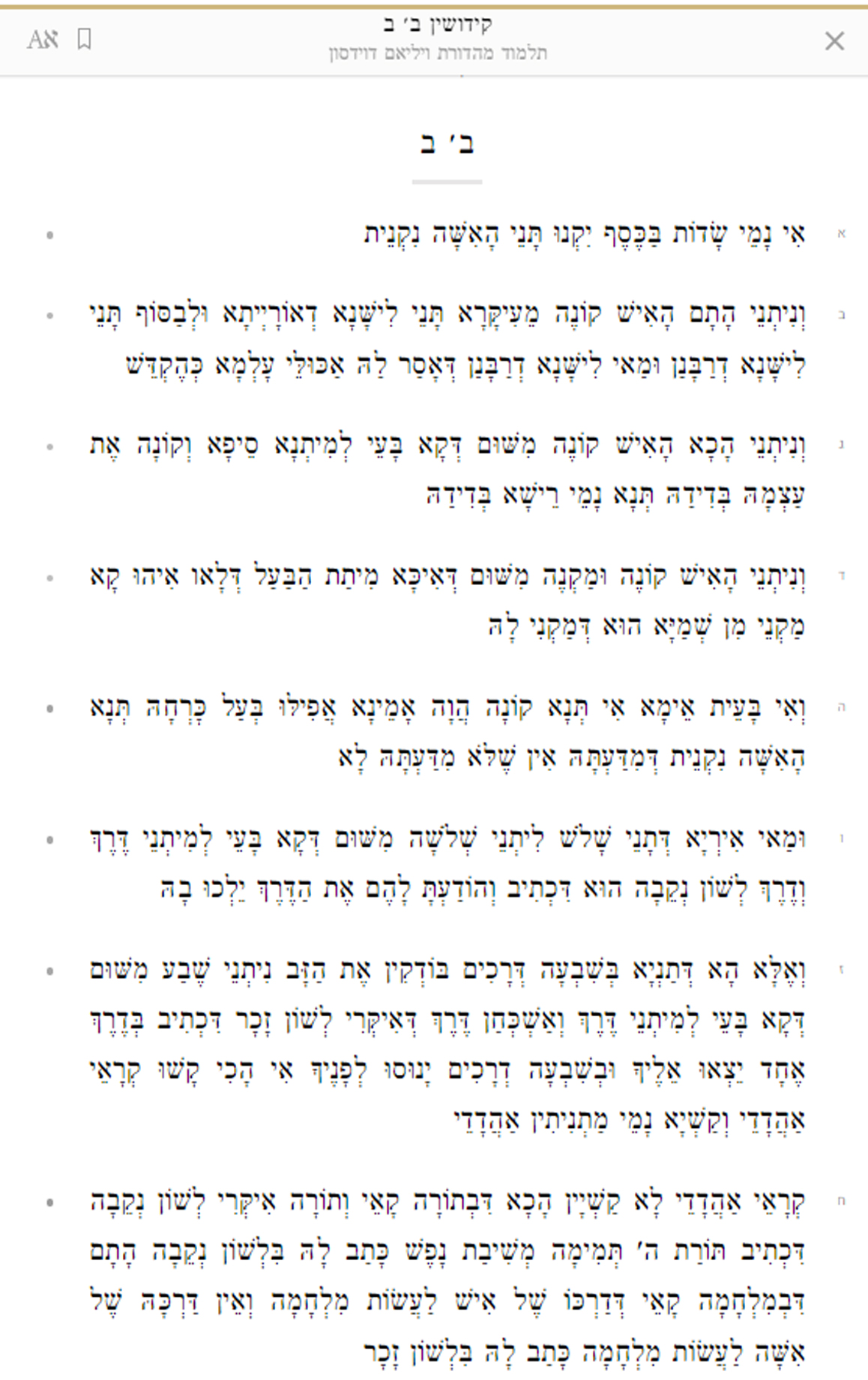
Image of customization options:

Splits into numbered sections. In our example, there are 15 sections. The default Hebrew doesn’t split these into paragraphs, but there is an option to split into paragraphs. Many tractates have nikud, some have punctuation. Our example page doesn’t have punctuation, even though it shows that option. Sefaria gives the option to remove nikud. As mentioned, as with Shitufta and Al-Hatorah, one can hyperlink to a specific section.

Al-Hatorah[30]

The section numbers in circles on the right side of the page are hyperlinked, which is a convenient feature. In the example page we are looking at, there is no nikud, unlike Sefaria. However, there is a period after each section, which provides a slight advantage over Sefaria‘s lack of punctuation, as it helps to break up the passages when viewing with no section breaks.

While Al-Hatorah also includes hyperlinked sections, it does not explicitly label which section is which, unlike Sefaria. Therefore, finding a specific section requires trial and error. As with Shitufta and Sefaria, it is possible to hyperlink to a particular section in Al-Hatorah.

One notable difference is that Al-Hatorah does not expand acronyms, as Sefaria does. For instance, מט is not expanded to מאי טעמא, and אבא is not expanded to איבעית אימא.

Speculation on the future

Secunda and Fischer, in the faraway land of 2012 (cited at the beginning of this piece), envision a future Talmud app:

“First of all, it would be a virtually borderless intertextual web. Talmudic passages that shed light upon one another would be linked in intricate overlapping networks. Passages citing earlier texts—biblical verses, the Mishnah, other rabbinic texts, the apocrypha—would be hyperlinked to the collection in which the cited text originally appears. Passages would also link to later commentaries, super-commentaries, relevant excerpts from legal codes and responsa, manuscript variants, monographs, homiletic interpretations, and, indeed, translations and elucidations. Discussions of Akkadian medicine would call forth images of Babylonian tablets. People, places, historical events, concepts, practices, and all sorts of other realia mentioned in the text would link to relevant explanatory pages, pictures, recordings, and video clips. […] [T]wo new Jewish text websites, themercava.com and sefaria.org, offer promising platforms for crowd-sourced translation, commentary, and discussion of the Bavli and other Jewish texts. […]”[31]

While some aspects of this idealistic vision have been realized, many others have not, at least not yet. Moreover, it remains unclear whether a more crowdsourced and social-media-oriented approach, (suggested in an un-cited part of Secunda and Fischer’s article), would even be desirable. In retrospect, the year 2012 was marked by somewhat utopian thinking, with Wikipedia and Facebook having recently achieved great success in spreading knowledge and connecting people worldwide. It seemed only natural to aspire to something similar in the realm of literature. However, today, with greater awareness of the unpredictable dynamics of such systems (such as misinformation), it is far from clear that such a goal is attainable or even desirable.

In my view, Sefaria, Al-Hatorah, and Dicta are the most promising candidates for realizing the immersive and highly hyperlinked experience envisioned by Fischer and Secunda. Once this is achieved, the resulting research tools are likely to be extremely powerful as well. However, the idea of leveraging comparative sources, as described by the authors, still seems quite far off, particularly with the current set of available tools.

Regarding the social and chavruta aspect discussed by Fischer and Secunda, a new possibility has emerged that was not even envisioned a year ago: an artificial intelligence-powered chavruta. I recently experimented with ChatGPT by providing it with the first paragraph of Kidushin 2b.[32]

As usual, ChatGPT demonstrated impressive coherence and confidence. However, it provided laughably incorrect interpretations. In fact, in some cases, it provided interpretations that were the exact opposite of the correct one.

I conducted a comparable test by inputting a paragraph of Ramban’s commentary on that sugya, requesting an explanation from ChatGPT. To my surprise, ChatGPT provided a reasonably good rephrasing in English. Although some of it was correct and some of it was incorrect, even the incorrect part was not entirely off. However, ChatGPT still requires further yeshiva study before being able to serve as a teacher.[33]

Given the rapid advancements in artificial intelligence and large language models, it appears highly likely that AI will continue to improve its ability to interpret the Talmud, along with all other sources, including digitized manuscripts. It may not be long before we turn to AI to obtain the ultimate p’shat in the Talmud.[34] Furthermore, there is a possibility that AI could eventually bring comparative sources to bear, as previously mentioned.

To update the speculative future envisioned by Fischer and Secunda, my ideal Talmud study experience would be an app with a GPT plug-in acting as a virtual chavruta/Rebbe, to interpret text and answer questions. In fact, something like this is already being tested by Khan Academy.[35]

With current tools, it will even be possible to create a virtual shiur.[36] In the future, it could even be live and interactive, happening in real time.

Another interesting idea that is ripe to be explored is visualization of the Talmudic text. This was put to the test by Yael Jaffe, in a 2015 Columbia dissertation.[37] Jaffe writes in her abstract (bolding is mine):

“This study investigates the effect of access to a visual outline of the text structure of a Talmudic passage on comprehension of that passage. A system for defining the text structure of Talmudic passages was designed by merging and simplifying earlier text structure systems described for Talmudic passages, following principles taken from research on text structure. Comprehension of two passages were compared for students who did traditional reading of a Talmudic passage (the passages had punctuation added, and a list of difficult words and their meanings was appended) (the control condition), and students who read the passage with these same materials as well as with an outline of the text structure of that passage (the experimental condition) […]

The results provide evidence that awareness of the text structure of a Talmudic passage helps readers when the passage is concrete and somewhat well organized. ”[38]

It is interesting to note that Jaffe’s control group had punctuation added. There is, in fact, no good reason why the punctuation should not be added to all the standard Vilna-Romm editions. This is something that I did as a matter of course in my gemaras in my yeshiva days, and I presume that I was not the only one.[39]

Concluding Thought

Will there ever be a single Talmud application to rule them all, similar to how the Bomberg layout remained the standard for 500 years, and continues to do so? Such a scenario is improbable and perhaps even unwanted in today’s rapidly changing and complex digital landscape. It would suggest a lack of progress. We may have to wait for the arrival of the Messiah or, at the very least, the AI singularity to provide the ultimate Talmud super-app.

[1] This piece was written as part of preparation for the workshop “Editions of Classical Jewish Literature in the Digital Era”, to be held at University of Haifa, June 18-20, 2023, at which I’ll be presenting. I want to express my gratitude to Menachem Katz for his efforts in organizing that workshop, and for inviting me to speak there. I’d also like to thank Eliezer Brodt for his helpful comments on an earlier draft of this piece. I would also like to thank my father, my brother, and S. Licht for reviewing, making suggestions, and helping clarify in conversation some of the ideas discussed.
[2] 
Finkelman, ”From Bomberg to the Beit Midrash: A Cultural and Material History of Talmudic Page Layout”, Tradition (Winter 2023), Issue 55.1, p. 14. I’d like to thank Eliezer Brodt for bringing this article to my attention.
[3] Immediately before, he writes (my bolding): “[T]he famous and ubiquitous tzurat ha-daf (page layout) of the Gemara was never exclusively by Talmudists for Talmudists. It was a common practice for producing non-Jewish European glossed texts in manuscript and later print from the high middle-ages though the sixteenth century. Some copyists and later printers of the Gemara—whether those printers were Jews or not—adopted it from contemporary Christian textual production.” This point is also made by Michele Chesner, in her interview on the Seforim Chatter podcast: “With Michelle Chesner discussing old books, Seforim, and more” (April 29, 2020).
[4] “Brave New Bavli: Talmud in the Age of the iPad”, Jewish Review of Books (Fall 2012). Archived here.
[5] Finkelman, pp. 16-17.
[6] Relatedly, I have heard the theory a few times from Prof. Meir Bar-Ilan that the writing down of the Talmud may have occurred due to the spread of the Chinese invention of paper to the West in the early medieval period. For some work on when the Mishnah and Talmud were first written, with previous scholarship cited, see: Yaakov Elman, “Orality and the Redaction of the Babylonian Talmud”, Oral Tradition, 14/1 (1999): 52-99 ; Shamma Friedman, “The Transmission of the Talmud and the Computer Age”, in Sharon Liberman Mintz and Gabriel M. Goldstein, eds., Printing the Talmud: From Bomberg to Schottenstein (2005), pp. 143-154 (esp. pp. 146-148) ;

יעקב זוסמן, “‘תורה שבעל פהפשוטה כמשמעה: כוחו של קוצו של יוד“, מחקרי תלמוד ג, א (תשסה), עמ‘ 209-384 (נדפס שוב כספר ב– 2019) ; נחמן דנציג, “מתלמוד על פה לתלמוד בכתב: על דרך מסירת התלמוד הבבלי ולימודו בימי הביניים“, בראילן ללא (תשסו), עמ‘ 49-112.

[7] Keith Houston, The Book: A Cover-to-Cover Exploration of the Most Powerful Object of Our Time (2016), introduction (available via Amazon Kindle sample). He adds in a footnote: “It is worth introducing “codex” as a technical term: it means specifically a paged book, as opposed to a papyrus scroll, clay tablet, or any of the myriad other forms the book has taken over the millennia.”
[8]
Recently pointed out by Ari Zivotofsky in a Seforim Blog post (“The Longest Masechta is …”, March 31, 2023): “[I]t is worth noting that ambiguity regarding sizes of masechtot only arose when commentaries began to be put on the same page as the text of the gemara. In other words, until the era of the printing press there was no ambiguity as to which masechta was the longest.” See also Finkelman, pp. 18-19 ; Friedman, “Printing”, p. 148. The early Soncino editions also only contained the Gemara and Rashi, see Finkelman, pp. 22-24. And see the recent statement of Yehuda Galinsky (bolding is mine): “The end of the thirteenth century witnessed a discernable growth in the composition of glossed works in Ashkenaz. It was from this time onwards that authors penned influential talmudic and halakhic works from France and Germany with the intention that they be accompanied by a supplementary gloss, which was to be copied alongside the text […] Instead, we find stand-alone commentaries that were copied separately from the text it was interpreting. In contrast to the well-known layout of the printed Talmud page, the writings of Rashi and Tosafot were written and usually copied as stand-alone commentaries and not as actual glosses to be copied on the same page.” (Judah Galinsky, “The Original Layout of the Semak”, Diné Israel, Volume 37 (2023), pp. 1*-26*, pp. 1-2.) A commenter to Zivotofsky’s blogpost pointed out that there is a print edition that contains only the Talmud (with supplementary indexes). It was printed 25 years ago. Here’s bibliographic info according to the National Library of Israel catalog entry:

תלמוד בבלי: כולל כל המשנה והמסכתות הקטנות : נערכו, סודרו והודפסו מחדש בכרך אחד, עם חלוקה לפסקאות, איזכורים מהמקרא, מלווים בשבעה מפתחות בסגנון אנציקלופדי, כולל מפתח ערכים אלפבתי, בעריכת צבי הפרייזלר הרב שמואל הבלין הרב חנוך הבלין (1998).

As an aside, Finkelman states (p. 18) that “The earliest [Talmudic manuscripts] are Geniza fragments from the ninth century”. However, see Friedman, pp. 147-148, that the earliest Talmudic manuscript is a scroll that can be dated to the 7th century.
[9] Finkelman, pp. 25-28. See also the interesting point by Finkelman, p. 41 (based on Jordan Penkower), that Bomberg was also the one to establish the standard method of citation for Tanach in the Jewish world: “In his first Mikraot Gedolot, Bomberg made a significant addition by adding chapter numbers and (in the second edition) verse numbers, features with little Jewish precedent which were based on thirteenth-century Catholic developments.”
[10] See my recent “Guide to Online Resources for Scholarly Jewish Study and Research – 2022”, where I discuss many of the resources discussed in this piece with more breadth. There I also discuss many of the resources excluded from this review for the reasons enumerated further. Bar-Ilan Responsa Project’s Talmud is online, but is not open-access. Bar-Ilan Responsa Project’s Talmud is linked from Yeshiva.org.il’s Talmud pages, top right of page. (See on Yeshiva.org.il in a later footnote.) That version of Bar-Ilan Responsa Project’s Talmud has punctuation, but no nikud, and is not split into sections/paragraphs, and is inferior in every way than the editions discussed here.

For the same reason (not open-access), I have not reviewed any editions on Otzar HaHochma, or other digital libraries which require a subscription.
[11]
Such as Vagshal, Oz VeHadar, Shas Vilna HeChadash, Gemara Sedura. See image here of layout of Gemara Sedura. (See Shimon Steinmetz’s interesting piece here on self-censorship in the Vagshal edition: “Vagshal’s revision of the history of the Vilna Talmud, or, One of the most egregious examples of censorship I have ever seen”.) The best completely static tzurat hadaf edition that I could find available online as open-access is the Moznaim edition, available at Daf-yomi and HebrewBooks. It is a PDF, simply re-typeset. There are also printed editions with punctuation, such as Steinsaltz-Koren; Oz VeHadar; and Tuvia’s. See these news articles from 2016 on Oz VeHadar’s (ongoing?) Talmud edition with nikud and punctuation: here and here. And see the National Library of Israel (=NLI) catalog entry here. See also the NLI catalog entry on Yosef Amar’s 1980 Talmud edition (17 vols.) with nikud based on Yemenite pronunciation, here. And see NLI catalog entries of Koren’s (ongoing?) Talmud edition with nikud and punctuation: Sanhedrin (2014) ; Bava Metzia (2015) ; Sukkah (2016) ; Bava Batra (2017) ; Kidushin (2018).
[12] So I won’t discuss the following: Kodesh.snunit ; Mechon Mamre ; Daf-yomi.com > “Text”. Daf-yomi.com’s “Chavruta commentary” and “tzurat hadaf” are indeed worthwhile. See previous note on Daf-yomi.com’s Moznaim tzurat hadaf edition. The Friedberg Project website Hachi Garsinan technically has a few digital editions of Talmud on their website, but they are all for the purpose of presenting the manuscript variants. So I won’t be reviewing that, since this piece is focused on layout and UX/UI, and in that regard, the edition is sub-par. (Again, this is not necessarily a critique, as this isn’t the point of those editions.) As I say further, in this piece I will not discuss the editions’ textual accuracy. For this reason, I also won’t discuss The Academy of the Hebrew Language’s Ma’agarim edition. Tashma.jewishoffice.co.ils Talmud shows promise, but for now seems to be inferior in every way than the editions discussed here. The website Yeshiva.org.il (פרשני ויקישיבה) has the Chavruta commentary of the Talmud. However, as mentioned, the original PDFs of Chavruta commentary are available on the Daf-yomi.com website, so in my opinion it’s clearly best to use that. There’s no advantage to the text version (except for the ability to copy-paste). Yeshiva.org.il’s Chavruta is fully editable, wiki-style. But I see that as a negative, as you don’t know what you’ll be getting.
[13] Such as Gemara Brura and The People’s Talmud. See more at R’ Josh Waxman’s blogpost, “Some excellent Talmud projects out there” (March 5, 2020).
[14] For example, Sefaria and Al-Hatorah have the Steinsaltz translation and commentary, and Wikisource has extensive links to other resources.
[15] Many of the textual elements of the Vilna-Romm edition have been superseded by better editions (though many are still incomplete). Some examples:

תלמוד: דקדוקי סופרים (השלם); הכי גרסינן

רשי: מהדורות פרופאהרן אהרנד

תוספות ; תוספות ישנים; רבינו חננאל : מהדורות רב קוק

עין משפט: עינים למשפט של ריצחק אריאלי (כל שבעה כרכים זמינים בהיברובוקס, לדוגמא, כאן)

מסורת השס: דקדוקי סופרים השלם; תלמוד האיגוד

ריף: מהדורת שבט

[16] For now, see Yakov Mayer in his recent ground-breaking book on the first edition of Talmud Yerushalmi (which was also printed by Bomberg’s press), who cites previous studies on typefaces used by Bomberg: Yakov Z. Mayer, Editio Princeps: The 1523 Venice Edition of the Palestinian Talmud and the Beginning of Hebrew Printing (2022, Hebrew).

See also the recent book by Simon Garfield, Just My Type: A Book About Fonts (2011 ) for a fascinating, well-written, popular overview of typesetting and fonts. On medieval handwriting styles of Hebrew, see the monumental 3-volume series, under Malachi Beit-Aryeh’s editorship (each area is a different volume):

מפעל הפליאוגראפיה העברית, אסופות כתבים עבריים מימיהביניים (1987-2017)

On second temple era styles, see the various works by Ada Yardeni, especially:

עדה ירדניספר הכתב העברי: תולדות, יסודות, סגנונות, עיצוב (1991).

[17] It is unclear to me who first made these section splits. It’s a question I’d be quite interested in knowing the answer to.
[18] Links to all of parts of MM:

  1. אקדמות למהדורה של התלמוד הבבלימסכת קידושיןמחברות מנחמיות

  2. מסכת קידושין ב עא יד עב

  3. מסכת קידושין יד עבכה עב

  4. מסכת קידושין כה עבכט עא

  5. מסכת קידושין כט עאמא עא

  6. מסכת קידושין מא עאנח עב

  7. מסכת קידושין נח עבסט עא

  8. מסכת קידושין סט עא פב עב

Compare Katz’s similar work on Yerushalmi (which also includes textual variant apparatus, and short commentary, unlike his work on Bavli), available at his Academia.edu site: “פסחן ומצתן של נשים Women on Passover and Matzah”.
[19]
 I personally prefer this style (punctuation, without nikud). See my discussion later.
[20] Tractate Sukka, p. 2 (ב). Not to be confused with Gemara Sedura (no HaMeir). Currently available online: Tractate Sukka (2013, here) and Tractate Avoda Zara (2015, here). See more on the project here.
[21] From the latest volume available online:

נתנאל בעדני, סנהדרין פרק חמישי (תשעב), עמ‘ 4.

See more on the project here.
[22]
See more on the project here.
[23] See also some of R’ Be’eri’s other editions, available on Da’at website, here and here. On R’ Be’eri, see the Hebrew Wikipedia entry on him: דן באריויקיפדיה
[24] Screenshot of downloaded Word document.
[25] To explain: Even though everything in the Word doc can be customized, this isn’t built into the website. Any of the editions in this “Digital” section can be pasted into a Word document and customized.
[26] Notably, the text itself is actually an image, which makes copying it impossible.
[27] Dicta was started by Prof. Moshe Koppel of Bar-Ilan University. He has contributed to Seforim Blog.
[28] As of 15-Apr-23.
[29] See more on the project here.
[30] See more on the project here.
[31] Compare also, at length, Friedman, “Printing”, pp. 150-154 ; Shai Secunda, “Resources for the Critical Study of Rabbinic Literature in the Twenty-First Century” in Compendia Rerum Iudaicarum ad Novum Testamentum (CRINT) 16, Christine Hayes (ed.), (2022), pp. 621-632.
[32] On 15-Apr-23, at https://chat.openai.com/.
[33] I should point out that I did not have access to GPT-4, which is the latest version of GPT. So I could not test whether GPT-4 is more capable at interpreting Talmud. For a discussion of some sources of the Yeshivish dialect of English possibly used as datasets for training ChatGPT-4, see my “From the Shtetl to the Chatbot: Some contemporary sources of Yeshivish content, in light of ChatGPT-4”.
[34] For some preliminary algorithmic research on the Talmud, see, for example, Satlow M., Sperling M. (2017). “Naming Rabbis: A Digital List”; Satlow M., Sperling M. (2020), “The Rabbinic Citation Network”; Satlow M., Sperling M. (2020). “The Rabbinic citation network”, AJS Review ; Zhitomirsky-Geffet M., Prebor G. (2019), “SageBook: toward a cross-generational social network for the Jewish sages’ prosopography”, Digital Scholarship in the Humanities, 34(3), pp. 676–695 ; “A graph database of scholastic relationships in the Babylonian Talmud”, Digital Scholarship in the Humanities, Volume 36, Issue Supplement_2, October 2021, Pages ii277–ii289, https://doi.org/10.1093/llc/fqab015, Published: 22 February 2021. See also Shira Shmidman, “Self-Evident Questions and Their Role in Talmudic Dialectic”, AJS Review (2023), p. 128: “Recently, I analyzed talmudic questions (that open with the phrase baʿei or beʿah minei) and discovered that by charting the questions by the generation in which they were asked, one can identify chronological trends of question asking in the Babylonian Talmud.”
[35] See Sal Khan, “Harnessing GPT-4 so that all students benefit. A nonprofit approach for equal access”, Khan Academy Blog (March 14, 2023). See especially this description: “Khanmigo [=the AI tool] engages students in back-and-forth conversation peppered with questions. It’s like a virtual Socrates, guiding students through their educational journey. Like any great tutor, Khanmigo encourages productive struggle in a supportive and engaging way.” For fun, I asked ChatGPT for a clever name for an AI chavruta/Rebbe. It gave me ten options. One of them is a great one (ChavrutAI), while three of them were hilarious ( AIvrumi; AIsh Torah; RoboRabbi). RoboRabbi could provide many of the intellectual aspects of being a rabbi: psak, eitza, questions in learning, and divrei torah.
[36] With tools like ChatGPT (content), ElevenAI (voice), D-ID (video), one can create any style of shiur. See my “Heimish High-Tech: Video in Yeshivish dialect using Generative artificial intelligence”. For training sources for the Yeshivish dialect, see my article: “From the Shtetl to the Chatbot: Some contemporary sources of Yeshivish content, in light of ChatGPT-4”.
[37] Jaffe, The Relevance of Text Structure Strategy Instruction for Talmud Study: The Effects of Reading a Talmudic Passage with a Road-Map of its Text Structure (2015). See especially ibid. Appendix E (pp. 103-104).
[38] On visualizations, see also this article, and the bibliography cited there:

יעקב אמיד, “עיצוב ייצוגים גרפיים של דיון תלמודי: תחום דעת מתחדש בהכשרת מורים להוראת תלמוד

See also the lengthy intro of Menachem Katz to his Mahberot Menahmiyot (discussed earlier), with relevant bibliography. One good existing resource for outlines and charts for Talmud is Daf Yomi Advancement Forum – Kollel Iyun HaDaf. See Josh Waxman, “Some excellent Talmud projects out there” (cited earlier), #2. A fascinating related project is that of R’ Dr. Michael Avraham on mapping out the logic of the Talmudic sugya, using the tools and notation of modern logic. See his massive series Studies in Talmudic Logic, currently at 15 volumes. Note the surprising claim made in the abstract of vol. 14 of the series (Andrew Schumann, ed., Philosophy and History of Talmudic Logic, bolding is mine): “The Talmud introduces a specific logical hermeneutics, completely different from the Ancient Greek logic. This hermeneutics first appeared within the Babylonian legal tradition established by the Sumerians and Akkadians to interpret the first legal codes in the world and to deduce trial decisions from the codes by logical inference rules. The purpose of this book is (i) to examine the Talmudic hermeneutics from the point of view of its meaning for contemporary philosophy and logic as well as (ii) to evaluate the genesis of Talmudic hermeneutics which began with the Sumerian/Akkadian legal tradition. The logical hermeneutics of the Talmud is a part of the Oral Torah that was well expressed by the Tannaim, the first Judaic commentators of the Bible, for inferring Judaic laws from the Holy Book.”
[39]
My suggestion for breaking the tzurat hadaf into sections: the pilcrow (¶). On the pilcrow, see the entertaining popular book, Shady Characters: The Secret Life of Punctuation, Symbols, and Other Typographical Marks (2013) by Keith Houston, chapter 1. (Available from Amazon for free as a Kindle sample.)

It should be pointed out that trop is an early medieval Hebrew form of punctuating the Biblical text. A few alternatives of punctuating the Torah arose in Geonic times.

On early nikud of Mishnah and Talmud, especially nikud bavli (we use nikud tavrani), see Yeivin:

ישראל ייבין, מסורת הלשון העברית המשתקפת בניקוד הבבלי (תשמה), פרקים בו.

I will point out the following: Tuvia’s edition adds nikud. But once one is past the beginner stage, nikud does little to enhance the reading experience, and in fact many readers find it a distraction. Modern Hebrew rarely uses nikud. Exceptions are for literature geared towards children and beginners (as noted), as well as instances where decoding is especially difficult, such as poetry, transliterated foreign words, and ambiguous words. In contrast, punctuation is a huge boost to faster comprehension, as Jaffe notes. Modern Hebrew texts use standard punctuation, like all modern languages.


“Milta De’Bedichuta”: Some Playful Parodies of the Talmud in the Modern Period

Milta De’Bedichuta”: Some Playful Parodies of the Talmud in the Modern Period

By Ezra Brand

6-Mar-23

Ezra Brand is an independent researcher based in Tel Aviv. He has an MA from Revel Graduate School at Yeshiva University in Medieval Jewish History, where he focused his research on 13th and 14th century sefirotic Kabbalah. He is interested in using digital and computational tools in historical research. He has contributed a number of times previously to the Seforim Blog (tag), and a selection of his research can be found at his Academia.edu profile. He can be reached at ezrabrand@gmail.com; any and all feedback is greatly appreciated.

Intro

The origins of Jewish humor are debated, with some linking it to Eastern Europe and others to a more distant time and place. Recognition of Jewish humor as first-rate gained popularity at the end of the 19th century.[1]

I previously wrote on the Seforim Blog about humor in the Talmud.[2] In this piece, my focus will be on parodies of the Gemara written for Purim, known as “Purim Dafs”. Roni Cohen, at the beginning of his 2021 dissertation on Medieval Parodies for Purim, describes the earliest known parodies on the Talmud written for the holiday of Purim:

The first, Massekhet Purim (Purim tractate), is a parody of the Talmud written by the Provençal translator, philosopher, and writer Kalonymos ben Kalonymos, during the period he lived in Rome, between 1324 – 1328. The other two – Megilat Setarim (esoteric scroll), a parody on the Talmud and Sefer Habakbuk (the book of Habakbuk), a parody of the Hebrew Bible – were both written by the Provençal philosopher, astronomer, and bible commentator Rabbi Levi ben Gerson (Gersonides) in 1332.[3]

When written for Purim, the Talmud parodies are often known as “Purim Dafs”. This is something I tried my hand at when I was in yeshiva.[4]

In this piece I’d like to give a number of examples of modern parodies of the Talmud, collected from various locations on the web, listed in chronological order of date first published.[5]


מסכת פורים: מן תלמוד שכורים (1814) 6

A satirical discussion of the laws of drinking on Purim.

מסכת עניות מן תלמוד רש עלמא (1878)7

A satirical halachic discussion of laws of poverty.

מסכת עמיריקא: מן תלמוד ינקאי (1892) 8

A satirical halachic discussion of living in America.

מסכת שטרות (1894) 9

A satirical halachic discussion of who can sign contracts.

מסכת דרך ארץ החדשה: מתלמודא דארעא חדתא (1898)10[10]

A satirical halachic discussion of living in America.

מסכת סוחרים (1900)[11]

A satirical halachic discussion of the laws of merchants.

מסכת אדמונים מן תלמוד בולשבי (1923)[12]

A satirical discussion of the trivial differences between the socialist Bolsheviks (“red”) and the monarchic Mensheviks (“white”) in the Russian Civil War, which started in 1917.


מסכת פרוהבישן מן תלמוד בטלי (1929)[13]

A satirical halachic discussion of the laws of drinking alcohol during the period of Prohibition in the United States, which started in 1920.

מסכת פורים תו שין טית וו (1955)[14]

A satirical halachic and aggadic discussion of Israeli elections.

מסכת המן (1975)[15]

A satirical halachic discussion regarding Haman.

מסכת אב”כ שומע קול צופר (1991)[16]

A satirical halachic discussion of wearing of gas masks during the Iraqi rocket attacks on Israel during First Gulf War in 1991.

הדאנאלד (2016)[17]

A satirical discussion of the Trump wall.

מסכת קורונא פרק ב’ (2021)[18]

This parody is a satirical halachic and aggadic discussion surrounding coronavirus, during the COVID-19 pandemic.

[1] See Avner Ziv, “Psycho-Social Aspects of Jewish Humor in Israel and in the Diaspora”, in Jewish Humor (ed. A. Ziv), p. 48:

“Many of those engaged in research related to Jewish humor point to Eastern Europe as the place where it first developed and flourished. Other researchers claim that its origins are much further removed, both in time and in place […] Others […] are of the opinion that Jewish sources are not replete with humor [….] [W]ith the exception of the customs connected with the Purim holiday, the Jewish religion regards humor with suspicion […] [V]ery little attention was paid to Jewish humor until the end of the 19th century, so little in fact that the chief rabbi of London, Herman Adler, wrote an article (1893) in which he spoke out against the charge that Jews have no sense of humor […] From the end of the last century, Jewish humor became widely recognized as superlative humor […]”.

[2] Available also on my Academia.edu profile, a small bibliographic update in Sep-2021: https://www.academia.edu/51817737/Talmudic_Humor_and_Its_Discontents
[3] Cohen, “‘Carnival and Canon: Medieval Parodies for Purim’. PhD Dissertation, Tel-Aviv University, 2021 (Abstract)”. See also Cohen’s many other publications on his Academia.edu profile on other historical aspects of parodic Purim literature.

See also the National Library of Israel catalog comment on an entry of a scan of a book containing Megilat Setarim and Massekhet Purim:

” “מסכת פורים” (ובה ארבעה פרקים), שתיהן חיקוי למסכת מן התלמוד. ו”ספר חבקבוק”, שהוא חיקוי לנביא חבקוק. דוידזון Israel Davidson, Parody in Jewish literature, New York 1907 p. 115-118. מייחס “מגילת סתרים” ו”ספר חבקבוק” לר’ לוי בן גרשון (רלב”ג). עיין גם: א”מ הברמן, “מסכת פורים מהדורותיה ודפוסיה”, ארשת, ה, תשל”ב, עמודים 136-138. “מסכת פורים” היא מאת ר’ קלונימוס בן קלונימוס.”

[4] Replete with inside jokes: “Purim Daf (דף פורים), Yeshiva Shaar Hatorah 2011”.
[5] Dates are taken from the National Library of Israel online catalog. Some of the dates are noted there as uncertain. The availability and links to book scans online are often noted in that catalog.

Out of scope are the afore-mentioned Masekhet Purim . See also the מילי דבדיחותא לימי חנוכה, published in 1577, scan available at National Library of Israel website here, discussed by Davidson, Parody in Jewish literature, pp. 39-40.

Compare also the list here: פרודיות לפוריםויקיפדיה
[6] Scan available at the National Library of Israel website here. According to the NLI webpage, although the date of publication stated on the title page is 1914, it was in fact published in 1814.
[7] Scan available at National Library of Israel website here. Also at Google Books here.
[8] Scan of 1894 Vilna edition available at the National Library of Israel website here. Scan of 1892 edition there as well, here. Mentioned in Davidson, Parody, pp. 100, 103.
[9] Scan available at the National Library of Israel website here.
[10] This parody is a satirical halachic discussion of living in America. Scan available at the National Library of Israel website here.
[11] High quality scan at Internet Archive here. Lower quality scan at HebrewBooks here.
[12] Scan available at HebrewBooks here, and Otzar HaHochma here.
[13] High quality scan at Otzar HaHochma here. Lower quality scan at HebrewBooks here. In Halacha Brura index of works of humor, the title is mistakenly given with one letter different: “בבלי”, which the title is of course a play on. (For a meta-index of Halacha Brura’s incredible index of scanned Jewish book, see my work here. I also discuss this index in my “Guide to Online Resources for Scholarly Jewish Study and Research – 2022”, p. 21 and throughout.)
[14] Scan available at Otzar HaHochma here. The title is the Hebrew date spelled out – תשט”ו.
[15] Scan available at Otzar HaHochma here.
[16] Scan available at National Library of Israel website here.
[17] Scan here. Linked to and discussed here:

ישראל כהן, “דף גמרא היתולי לפורים: “שיערו המתפרץ של הדאנאלד, כיכר השבת, 16 מרץ 2016.

[18] Scan available at the Facebook page of “ דפי גמרא הומוריסטיים “ here.


“Ha’Rotzeh Lichanek, Hitaleh B’Ilan Gadol”: Notes on some Literary forgeries of Jewish works in the the Late Modern Period (1756-1965)

Ha’Rotzeh Lichanek, Hitaleh B’Ilan Gadol”: Notes on some Literary forgeries of Jewish works in the the Late Modern Period (1756-1965)

By Ezra Brand

Ezra Brand is an independent researcher based in Tel Aviv. He has an MA from Revel Graduate School at Yeshiva University in Medieval Jewish History, where he focused his research on 13th and 14th century sefirotic Kabbalah. He is interested in using digital and computational tools in historical research. He has contributed a number of times previously to the Seforim Blog (tag), and a selection of his research can be found at his Academia.edu profile. He can be reached at ezrabrand-at-gmail.com; any and all feedback is greatly appreciated.

Introduction

Jewish literary forgeries are a topic often discussed on the Seforim Blog, especially in the postings of Dr. Marc Shapiro (see the tag “Literary Forgery” for some of the relevant posts).[1] A “literary forgery” refers to a writing which claims to have been written by a certain, usually respected, figure, while in fact written by a later, usually much lesser known, writer.

A recent collection of articles on forgeries states: “There has been a growth in the number of publications dedicated to fakes and forgeries for around thirty years now, many of which have focused on books and literary works.”[2]

The classic source regarding literary forgeries in Jewish writing is that of the Talmud Bavli, Pesachim 112a:

חמשה דברים צוה ר”ע את רבי שמעון בן יוחי כשהיה חבוש בבית האסורין […] אמר לו אם בקשת ליחנק היתלה באילן גדול.

Translation by Koren-Steinzaltz, as appears in Sefaria website (bold in the original translation):

Rabbi Akiva commanded Rabbi Shimon ben Yoḥai to do five matters when Rabbi Akiva was imprisoned […] if you wish to strangle yourself, hang yourself on a tall tree.

Koren-Steinzaltz translation adds the explanation:

“This proverb means that if one wants others to accept what he has to say, he should attribute his statement to a great man.”

This interpretation is based on Rashi’s explanation:

אם בקשת ליחנק – לומר דבר שיהיה נשמע לבריות ויקבלו ממך. היתלה באילן גדול – אמור בשם אדם גדול.”

According to Rashi’s interpretation, this source permits fabricating a quote from an authority in order to be believed.[3] 

Based on this interpretation, the term often used in rabbinic writing for “forging” in someone else’s name is “תלה ב”, literally “hung on X”, meaning “ascribed (falsely) to X”.

The great scholar of Mishpat Ivri, Nahum Rakover, devotes a portion of his book on intellectual property in halacha, to a discussion of the sources that permit fabricating a quote from an authority in order to be believed.[4]

Some recent historians seem to imply that the 19th century saw a relative uptick in Jewish literary forgeries. Golda Akhiezer, in a 2018 article on Jewish historical forgeries in the 19th century, writes:[5]

One of the paradoxes of European cultural life of the nineteenth century, especially in the Russian Empire, was a combination of two parallel yet apparently conflicting processes: the emergence and increasing importance of modern science and the rise of multifarious forgeries of historical documents.”[6]

It should be pointed out that this isn’t truly paradoxical. Anthony Grafton famously noted the deep relationship between critical scholarship and forgeries.[7]

Ira Robinson also implies an uptick in Jewish literary forgeries in the 19th century, and gives a somewhat different theory as to why this time period gave rise to so many forgeries:

By the end of the nineteenth and the beginning of the twentieth centuries, the highly charged ideological atmosphere, as well as an ever-growing demand for Jewish books, engendered a situation in which there was great temptation to manufacture documents.[8]

However, it is remains speculative whether in fact there were a relatively larger number of Jewish literary forgeries in the 19th century. This question awaits a more quantitative study of the topic.[9]

Table of Notable Forgeries

It’s important to note that this list is not to be comprehensive. Rather, it’s a collection of especially notable forgeries, and some notes on them. I hope to update this list at a later date, and of course happy to hear suggestions.

Title Editor Earliest date (terminus post quem) Previous posts and bibliography
Divrei Gad Ha’Chozeh Leopold Immanuel Jacob van Dort 1756 10
Mishle Asaf (haskamot) Isaac Satanov 1783-1791 11
Besamim Rosh Saul Berlin 1793 12
Ramschak Chronicle Marcus Fischer 1828 13
Zekher Tzaddikim Mordecai Sultansky 1841 14
Sefer Avnei Zikaron Abraham Firkovich 1845-1872 15
The Roads of Jerusalem Eliakim Carmoly 1847 16
Sefer Ha’Eshkol R’ Zvi Binyamin Auerbach 1863 17
Baraita de-Ma’aseh Bereshit Lazarus Goldschmidt 1894 18
The Protocols of the Elders of Zion series of articles in Russian newspaper 1903
Goral HaAsiriyot (1904); Seder Hagada Le’Maharal (1905); Nifla’ot Maharal (1909); Refa’el HaMalach (1911); Tiferet Maharal MiShpoli (1912); Hoshen Mishpat (1913); Divrei HaYamim Asher LiShelomo HaMelech (1914); and more R’ Yehudah Yudel Rosenberg 1904-1914 19
Yerushalmi on Kodshim Solomon Judah Friedlander 1907–1909 20
Genizat Kherson 1922 21
Der Prager Golem (1917); Kovetz Michtavim Mekori’im MiHaBesht VeTalmidav (1923); Heichal LeDivrei Chazal (1948); Sefer Dovev Siftei Yeshenim (1959-1965) Chaim Bloch 1917-1965 22
Kol Hator R’ Shlomo Zalman Rivlin 1939 23

Forgers

There are two works whose genre can be described as “halachic”: Saul Berlin’s Besamim Rosh (1793) and R’ Zvi Binyamin Auerbach’s Sefer Ha’Eshkol (1863).

It is quite noticeable that perpetrators of literary forgery of Jewish texts were especially prominent outside of mainstream Orthodox Judaism, and created their forgeries for polemical reasons: Karaites (forgeries of Sultan and Firkovich), Maskilim, and anti-Semites (Protocols of the Elders of Zion).

Forgery of tendentious works relating to history are especially common:[24]

  1. Forged tombstone inscriptions and manuscript colophons (Firkovich)
  2. Forged chronicles (Sultanski ; Ramschak Chronicle)
  3. Forged travelogue (The Roads of Jerusalem of R’ Isaac Hilu)
  4. Forged protocols of meetings (Protocols of Elders of Zion)
  5. Forged letters (Genizat Kherson ; Bloch’s Kovetz Michtavim and more)[25]
  6. Fake stories (Rosenberg ; Bloch)

Bloch and Rosenberg, who create forgeries for popular entertainment purposes, are closer to the end of the date range, and both made prominent forgeries about the golem of the Maharal: Bloch’s The Letter of the Maharal on the Creation of the Golem (1923) and Rosenberg’s Nifla’ot Maharal. For Bloch, the polemical motivation of anti-Zionism played a role in other forgeries.

Isaac Satanow is the most playful, self-aware forger of them all. He even added fake “haskamot” to his Zohar Chibura Tinyana from well-known late 18th-century rabbinic figures (R’ Yosef Teomim and R’ Chaim Halberstam of Sanz), having the haskamot point out the possibility that Satanov himself wrote the works, but giving halachic justification for the permissibility of forgery.[26]

Rakover, in his book Zekhuyot Yotzrim (cited above), was misled by Satanow. In his discussion of permissibility in halacha of false quotation and literary forgery,[27] Rakover quotes the “haskamot” to Satanov’s as showing that forging is halachically permitted. It appears that Rakover wasn’t aware that the haskamot themselves are most likely forged.

Two of the first forgers discussed here, Saul Berlin and Isaac Satanow, had similar ideologies, and. Satanow may have assisted in fabricating Besamim Rosh.[28]

Conclusion

The issue of Jewish literary forgeries has received further prominence recently in the scholarship of R’ Moshe Hillel. R’ Hillel has written a number of works exposing forgeries. His most famous work is on Divrei Gad HaHozeh, a work purporting to be from the times of King David, published from an 18th century manuscript by Professor Meir Bar-Ilan in 2015. R’ Hillel argues that it is in fact an 18th century forgery.[29]

Hillel also wrote a book earlier this year called Hazon Tavrimon devoted to R’ Yakov Moshe Toledano (1880-1960), dealing with various historical documents that Toledano “discovered”, demonstrating that they are fake.[30]

Computer algorithms have also played a role in detecting forgeries, or refuting allegations of forgery, most prominently in the work of Professor Moshe Koppel. Some of this work has been featured in the Seforim Blog.[31] Hopefully, this software will be further refined to shed light on additional works that have been accused of being forged, to supplement the traditional tools used for proving authenticity on the one hand, and uncovering forgeries on the other.

[1] Thanks to Eliezer Brodt for reviewing and providing very helpful comments on this piece. I’d also like to thank my father for looking over a previous version of this blog post.

[2] Cécile Michel, Michael Friedrich (eds.), Fakes and Forgeries of Written Artefacts from Ancient Mesopotamia to Modern China (De Gruyter 2020), p. 1. See further bibliography in footnote there.

[3] However, Rashbam there gives a different explanation of the passage. He interprets that it’s not saying anything about deception. Rather, it’s simply giving advice that if you want people to listen to what you have to say, you should study from a master, so that you can then (correctly) quote him. The term “choke” is used simply because the term “high tree” is used.

For a wide-ranging discussion of sources discussing the interpretation of this passage, see Marc Shapiro, Changing the Immutable, pp. 259-261.

[4] See נחום רקובר, זכות היוצרים במקורות היהודיים, תשנ”א, עמ’ 25-36.

See also Shapiro, Changing the Immutable, and bibliography there.

[5] “Historical Research and Forgeries in the Age of Nationalism: The Case of the Russian Empire Between Jews and Russians”, East European Jewish Affairs 48. 2 (2018): 101 – 102.

For a general article on Jewish forgeries, see Cecil Roth, “Forgeries”, Encyclopedia Judaica, 1st edition (1972), pp. 125-126.

[6] In general, Ahiezer ibid. states on p. 110: “Due to the vastness of the topic, it is impossible to provide an exhaustive treatment of Jewish ahistorical writing and forgeries in this article.”

[7] Grafton, Forgers and Critics: Creativity and Duplicity in Western Scholarship, 2019 (2nd edition).

[8] Robinson, “Literary Forgery and Hasidic Judaism: The Case of Rabbi Yudel Rosenberg”, Judaism, 40 (1991), pp. 61-62.

[9] I’d like to thank Eliezer Brodt for raising this point in private communication.
[10] See Hillel, משה הלל, מגילות קוצין: בין דברי גד החוזהלאגרת רבן יוחנן בן זכאי“, על עמנואל יעקב ואן דורט וחיבוריו הבדויים (תשע”ח).
[11] See משה פלאי, “יצחק סאטאנוב ושאלת הזיוף בספרות“, קרית ספר נד תש”ם, עמ’ 817-824 ; בנימין ש’ המבורגר, “האם ניתן לסמוך על יצחק סאטאנוב?“, המעין, גליון טבת תשס”ט, עמ’ 86-91. here
[12] Previous Seforim Blog posts: 2006 ; Rabinowitz and Brodt 2010 ; Shaprio 2007 ; Brodt 2019 ; Maimon 2020. See bibliographies here נריה גוטל, ‏יחסו של הראיה קוק לספר בשמים ראש” “, JSIJ‏ 5, 2006, הערה 4 ; ר’ אליעזר יהודה בראדט, “ציונים ומילואים למדור נטעי סופרים“, ישורון כד (ניסן תשע”א), עמ’ תכה, והערה 5 (עמ’ תכה-תכז).

To those bibliographies can be added: Talya Fishman, “Forging Jewish Memory: Besamim Rosh and the Invention of Pre-Emancipation Jewish Culture,” in Jewish History and Jewish Memory, ed. by Elisheva Carlebach et. al (1998), pp. 70-88; Emile G. L. Schrijver, “Saul Of Berlin’s “Besamim Rosh” : The Maskilic Appreciation Of Medieval Knowledge”, Sepharad in Ashkenaz, Ed. by Resianne Fontaine et. al (2007), pp. 249-259.
[13]  Meir Lamed, “Fischer”, Encyclopedia Judaica, 2nd edition (2007); Meir Lamed, “Lieben, Salomon Hugo”, Encyclopedia Judaica, 2nd edition (2007); Iveta Cermanová, “The Ramschak Chronicle: New Findings about the Genesis, Reception and Impacts of the Forgery”, Judaica Bohemiae 52/2 (2017), pp. 33-67 ; Ahiezer (2018), p. 111 ; E. Randol Schoenberg, Who was the first Ramschak? | Schoenblog.com (February 5, 2021).
[14] Golda Akhiezer, Encyclopedia Judaica, 2nd ed. (2007), “Sultansky, Mordecai Ben Joseph”; גולדה אחיעזר, “מרדכי סולטנסקיקווים לדמותו וכתיבתו ההיסטורית“, קראי מזרח אירופה בדורות האחרונים: ד’ שפירא, ד’ לסקר (עורכים), מכון בן-צבי, ירושלים 2011, עמ’ 170–196; Akhiezer (2018), p. 105.
[15] See the many articles by Dan Shapira, most recently Michael Nosonovsky, Dan Shapira, and Daria Vasyutinsky-Shapira, “Not by Firkowicz’s Fault: Daniel Chwolson’s Comic Blunders in Research of Hebrew Epigraphy of the Crimea and Caucasus, and their Impact on Jewish Studies in Russia,” Acta Orientalia Hung., vol. 73, no. 4 (2020): 633-668, footnote 1, and his two-part popular article in Tablet Magazine in June 2021: “Inventing the Karaites” and “Forging History”. See also: Roth (1972); Haggai Ben-Shammai, “Abraham Firkovich”, Encyclopedia Judaica 2nd ed. (2007); Artem Fedorchuk, “New findings relating to hebrew epigraphic sources from the Crimea,with an appendix on the readings in king Joseph’s letter”, The World of the Khazars: New Perspectives (2007) pp. 109-122; Ahiezer (2018), p. 110 and footnote 40; Malachi Beit-Arié, Supplement: The Forgery of Colophons and Ownership of Hebrew Codices and Scrolls by Abraham Firkowicz, Fakes and Forgeries of Written Artefacts from Ancient Mesopotamia to Modern China (2020), pp.195-206; Yosef Ofer, “Two dedicatory inscriptions in manuscripts of Scripture and the question of their authenticity”, Journal of Jewish Studies (2020).
[16] See here, גרשם שלום, “סשבילי דירושלם המיוחס לריצחק חילומזוייף“, ציון ט, תרצ”ד, עמ’ לט–נג; מיכאל איש-שלום, “על שבילי דירושליםלריצחק בריוסף חילו“, תרביץ כרך ו’, טבת תרצ”ה, עמ’ 197–209; Roth 1972.
[17] Previous Seforim Blog posts: Shapiro 2007a ; Shapiro 2007b ; Shapiro 2008 ; Shapiro 2010. Roth 1972.
[18] Roth 1972; מאיר בר-אילן, “נפלאות ריהודה יודיל רוזנברג“, עלי ספר, יט, תשס”א, עמ’ 178-176, הערה 20.
[19] Previous Seforim Blog posts: 2006 ; Leiman 2010 ; Shapiro 2012 ; Brodt 2013 ; Shapiro 2022. Ira Robinson, “Literary Forgery and Hasidic Judaism: The Case of Rabbi Yudel Rosenberg”, Judaism, 40 (1991), pp. 61-78; Shnayer Leiman, “The Adventure of the Maharal Of Prague in London: R. Yudl Rosenberg and the Golem Of Prague” in Tradition 36:1 (2002), pp. 26-58; א. בנדיקט , “הגדת מהר”ל או אגדת מהר”ל”, מוריה, יד, גליון ג-ד, תשמ”ה, עמ’ קב-קיג; הרב שלמה פישר, “אל תשכן באלהיך עולה“, צפונות ג ניסן תשמ”ד, עמ’ סט; מאיר בר-אילן, “נפלאות ריהודה יודיל רוזנברג“, עלי ספר, יט, תשס”א, עמ’ 178-176; “זיופים וזייפנים” (2013) – פורום אוצר החכמה. ere
[20] Previous Seforim Blog post: 2007 . See bibliography here, ר’ אליעזר יהודה בראדט, “ציונים ומילואים למדור ‘נטעי סופרים’ “, ישורון כד (ניסן תשעא), עמ’ תנד-תנה. See especially R’ Boruch Oberlander’s series of articles in the journal Or Yisra’el . And see also this 2016 article on an unpublished manuscript of Yerushalmi Menahot that should be ascribed to Friedlander, אביעד ברטוב, “ליקוטים מאוחרים לירושלמימסדר קדשים“, נטועים כ (תשע”ו), עמ’ 221. here
[21] Previous Seforim blog posts: Leiman 2010 ; Koppel 2011. Ahiezer (2018), p. 110 and footnote 5.
[22] Previous Seforim Blog posts: Shapiro 2007b ; Leiman 2010 ; Shapiro 2010. See גרשם שלום, “קובץ מכתבים מקוריים”, קרית ספר א, i (1924-5), pp. 104-106; הרב יוסף תבורי, “שפוך חמתך: משמעותו וניסיונות לשנותו”, כרמי של, בעריכת נחם אילן ועוד, (2012), עמ’ 213-221; “שפוך אהבתך על הגויים‘… – זיוף משונה“, פורום אוצר החכמה (2012); “משמת הגרדצ הילמן זצל בטלו אשכולות“, פורום אוצר החכמה (2011) ; Alan Brill, Pour out thy Love Upon the Nations and Miriam at the Seder-Updated”, The Book of Doctrines and Opinions (March 23, 2010); “Fifty Shades of Greatness: The Archive of Rabbi Chaim Bloch (1881-1973) and his colorful personality”, Musings of a Jewish Bookseller (October 17, 2018); R’ David Golinkin, “Dressing as Elijah & Pouring Out Love”, My Jewish Learning.
[23] עמונאל אטקס, “הגאון מווילנה ותלמידיו כציונים הראשונים‘ – גלגוליו של מיתוס“, ציון פ,א (תשע”ה), ע’ 69-114; הנ”ל, הציונות המשיחית של הגאון מווילנה: המצאתה של מסורת (תשע”ט); יוסף אביב”י, “קול התור – דור אחר דור”, מכילתא א (תש”פ), עמ’ 159–336.

Summary at Avivi’s blog קול התור דור אחר דור.

See also the lengthy and detailed thread on Avivi’s article in Otzar HaChochma forum, עליית תלמידי הגרא גירסת רשז ריבלין עמוד 42 – פורום אוצר החכמה: and המאמר על קול התור תשובות והוספות פורום אוצר החכמה.

And see Allan Nadler’s review of Etkes’s and Avivi’s work, “Like Dreamers”, in Jewish Review of Books, Winter 2021, pp. 15-18 (thanks to Eliezer Brodt for pointing out this article).

[25] Compare also Yosef Perl’s famous Megaleh Temirin. This a collection letters ostensibly written by Hasidim, and which is clearly a satire. Wikipedia describes it as follows: “Megalleh Temirin is an anti-Hasidic satirical composition written by Yosef Perl in 1819 as a parodic novel of letters between Hasidim, which became a symbol of the battles of the Jewish Enlightenment movement against the Hasidic movement.” This work was put out in a scientific edition by Jonathan Meir, available on Kotar, with additional volumes of appendices and studies.

[26] Moshe Pelli (משה פלאי, “יצחק סאטאנוב ושאלת הזיוף בספרות“, קרית ספר נד תש”ם, עמ’ 817-824) p. 822, footnote 31 who agrees with Zinberg that the haskamot themselves are most likely written by Satanow. Haskamot being forged by Satanov is also mentioned by Hamburger in his article on Satanow (בנימין ש’ המבורגר, “האם ניתן לסמוך על יצחק סאטאנוב?“, המעין, גליון טבת תשס”ט, עמ’ 86-91), p. 87 footnote 11, citing Encyclopedia Hebraica.

[27] Rakover, pp. 29-31.

[28] Pelli, p. 817 footnote 2.

[29]  ר’ משה הלל, מגילות קוצין.

See also Otzar Hahochma forum (July 2021 and on), חדש מאת רמ הלל מגילות קוצין | גד החוזה או פלוני ההוזה? – עמוד 2 – פורום אוצר החכמה.

See there the attached PDF of Bar-Ilan’s response (March 2022), with a discussion.

[30] ר‘ משה הלל, חזון טברימון: תעודות מזויפות מבית היוצר של האחים טולידאנו מטבריה (תשפ”ב).

See Eliezer Brodt’s Seforim Blog post (March 2, 2022): Book Announcements: Five recent works – the Seforim Blog.

[31] For example, see Moshe Schorr, Who Wrote the Late Volumes of Igrot Moshe? – The Seforim Blog (January 20, 2019).See also his work on Genizat Herson (cited in Koppel’s Seforim Blog blogpost, footnote 7):

מ. קופל, “זיהוי מחברים בשיטות ממוחשבות: “גניזת חרסון””, ישורון כג (אלול ה’תש”ע), תקנט-תקסו.

Koppel’s program has also been used to indicate that Ben Ish Hai is the author of Shu”t Torah LiShmah, see Brodt here, item #33.

Not directly related, but see the announcement of exciting progress on Dicta, a suite of digital tools for traditional Hebrew texts spearheaded by Koppel, reported recently in the Jerusalem Post (August 4, 2022) : New AI technology hopes to change everything we know about Jewish texts – The Jerusalem Post


Guide and Review of Online Resources – 2022 – Part III

Guide and Review of Online Resources – 2022 – Part III

By Ezra Brand

Ezra Brand is an independent researcher based in Tel Aviv. He has an MA from Revel Graduate School at Yeshiva University in Medieval Jewish History, where he focused his research on 13th and 14th century sefirotic Kabbalah. He is interested in using digital and computational tools in historical research. He has contributed a number of times previously to the Seforim Blog (tag), and a selection of his research can be found at his Academia.edu profile. He can be reached at ezrabrand-at-gmail.com; any and all feedback is greatly appreciated. This post is a continuation. The first part of this post is here, the second here, and this is the third and final part.

21.Articles for popular audience

Websites with open-access articles, written for a popular audience, with relatively high scholarly standards.

General

  1. Academy of Hebrew Language .
    1. See above. Besides for a selection of scholarly articles from journals, has many articles specifically written for the website.
    2. Recommended. Focuses on Hebrew linguistics. Great resource, at a high level of scholarship, with lots of interesting articles on all topics related to Hebrew language, throughout history.
    3. Wikipedia: “The Academy of the Hebrew Language was established by the Israeli government in 1953 as the “supreme institution for scholarship on the Hebrew language in the Hebrew University of Jerusalem of Givat Ram campus.” Its stated aims are to assemble and research the Hebrew language in all its layers throughout the ages; to investigate the origin and development of the Hebrew tongue; and to direct the course of development of Hebrew, in all areas, including vocabulary, grammar, writing, spelling, and transliteration.”
  2. TheGemara.com.
    1. In English.
    2. Focuses on Talmud Bavli. Recommended. From the About Us: “We solicit original essays that are reviewed and edited by our in-house scholars, to ensure the highest academic standards as well as maximum readability for the general audience.”
  3. My Jewish Learning.
    1. Lots of good articles. However, it mostly focuses on Bible and Modern Jewish history, which are out of the scope of this guide.
  4. 929- Tanach B’yachad (929 – תנך ביחד).
    1. In Modern Hebrew. Lots of articles on Hebrew linguistics (for example: on the phraseעומד על הפרק). However, mostly focuses on Bible, which is out of the scope of this guide. And not so simple to filter for articles on Hebrew linguistics.

Newspapers and magazines

Newspapers and magazines can be a great source of scholarship, and they’re often available online. They are especially good for reviews of scholarly books, and interviews with scholars.[1] Israeli publications often have high-quality articles on Hebrew linguistics. Mostly behind paywall, with some articles not behind paywall.

Some of the best:

  1. Makor Rishon (מקור ראשון).
    1. In Modern Hebrew. Their Mussaf Shabbat (מוסף שבת) is especially good on scholarly topics.
    2. Wikipedia:
      1. “Makor Rishon is a semi-major Israeli newspaper […] Shabbat (Sabbath) – a supplement for Jewish philosophy, Judaism and literature, with an intellectual bent.”
  2. Haaretz (הארץ).
    1. In Modern Hebrew and English.[2]
    2. Available online: 4 April 1918 – 31 December 1997 (22,721 issues; 394,984 pages), at Israel National Library’s Jpress archive. However, not all pages in this date range are in fact available there.
    3. Wikipedia:
      1. “Haaretz is an Israeli newspaper. It was founded in 1918, making it the longest running newspaper currently in print in Israel, and is now published in both Hebrew and English […]”
  3. Segula (סגולה).
    1. In Modern Hebrew and English.
    2. Wikipedia – Hebrew:
      1. “Segula is an Israeli monthly dedicated to history, published since April 2010. The magazine deals with the history of the people of Israel and general history, from the perspective that the people of Israel play an important part in world history and the historical processes leading humanity. The magazine is published monthly. An equivalent edition in English is published once every two months.”
  4. Tablet
    1. Wikipedia:
      1. “Tablet is an online religious magazine of news, ideas, and Jewish culture. Founded in 2009 […]”.
  5. Jewish Review of Books
    1. Wikipedia:
      1. “The Jewish Review of Books is a quarterly magazine with articles on literature, culture and current affairs from a Jewish perspective. […] The magazine was launched in 2010 […]”

Blogs

Blogs are generally not formally peer-reviewed and are generally written more informally and conversationally, but are often a great resource. With the shift from blogs to social media, many blogs have shifted to Facebook, and to a lesser extent Twitter and Reddit. (E.g., Mississippi Fred McDowel no longer posts on “On the Main Line”, but does on Facebook..) Blogs are far less active than they were. There are a lot of Facebook groups, which I’m less familiar with, and technically have to be added to and aren’t indexed by Google unfortunately (“walled gardens“, vs. “open platforms”).

  1. The Seforim Blog
  2. The Talmud Blog. Focuses on Talmud.
  3. Rationalist Judaism. Focuses on relationship of science and Judaism, besides for contemporary politics and hashkafa.
  4. Kavvanah.blog- The Book of Doctrines and Opinions
  5. Jewish Studies @ CUL . A blog affiliated with Columbia University, focused on Hebrew Bibliography.
  6. Footprints Blog – Tracing Jewish Books Through Time and Place . A blog affiliated with Columbia University, focused on Hebrew Bibliography.
  7. Safranim .
  8. Am Hasefer (עם הספר). The blog of Rambam Library of Tel Aviv, focused on Hebrew Bibliography.
  9. Hagahot. Active 2005 – 2013.
  10. Giluy Milta B’alma (גילוי מילתא בעלמא). Masthead: “We present here new and interesting findings in Hebrew Manuscripts, and Genizah- We welcome posts in Hebrew or English.”
  11. On the Main Line. Blog of “Shimon Steinmetz/ Mississippi Fred MacDowell”.
  12. English Hebraica . Another blog of “Mississippi Fred MacDowell”. Masthead: “Chronicling Jewish and Jewish themed writing in the English language prior to the 19th century. interesting biographies, diagrams, translations, transliterations and descriptions of Jewish learning and theology from primary sources.” Active 2006 – 2007. Since then posts on Facebook and Twitter.
  13. What’s Bothering Artscroll? . Another blog of “Mississippi Fred MacDowell”.  Active 2006 – 2008.
  14. Hollander Books Blog. Masthead: “A bookseller and his books, his very many books. And a few ideas.”
  15. Kol Safran. Masthead: “A librarian’s comments on books, copyright, management, librarianship, and libraries that don’t get the full article treatment.” Many posts on topics in Jewish bibliography, as well as visits to Jewish libraries.
  16. Musings of a Jewish Bookseller. Masthead: “On Jewish Books, Jewish Bookselling and Jewish Booksellers”
  17. Notrikon (נוטריקון). In Modern Hebrew. Masthead: ”A journey through the space of the written word, between books, periods and people … stops at different stations, who knows where we will end up.”
  18. Oneg Shabbat (עונג שבת). Blog of Prof. David Assaf. Many interesting posts on modern Jewish history, and on history of Hasidut.
  19. HaSafranim – Blog of Israel National Library (הספרנים – בלוג הספרייה הלאומית). In Modern Hebrew. Focuses on Hebrew bibliography, and topics related to Modern Israel.
  20. 7minim (מינים). Masthead: “This blog is intended to allow me, Tomer Persico, to comment briefly on this and that”. Has a number of posts on recent scholarly books on history of Kabbalah (though the blog mostly focuses on contemporary issues).
  21. HaZirah HaLeshonit – Ruvik Rozental (הזירה הלשונית – רוביק רוזנטל). Many posts on history of individual Hebew words, by a well-known and popular Hebrew linguist.
  22. Leshoniada (לשוניאדה). In Modern Hebrew. Focuses on Hebrew linguistics.
  23. Safa Ivrit (השפה העברית). In Modern Hebrew. Focuses on Hebrew linguistics. Not quite a blog, rather a wide range of short articles on sources of sayings and words.

22.Videos and Podcasts

YouTube has a lot of academic lectures. With the covid restrictions over the past two years, it has become especially common to live stream scholarly lectures (whether there’s a live component or not), and often the videos are then permanently publicly available on YouTube.[3]

Some channels:

  1. Academic lectures. Hundreds of lectures available. The YouTube channels seem to often be used now for live streaming of scholarly lectures:
    1. National Library of Israel.
    2. The Israel Academy of Sciences and Humanities.[4]
    3. Israeli university channels. For example, Hebrew University ; Bar-Ilan University.
    4. Scholarly organizations, such as Yad Ben-Zvi.
  2. Torah in Motion. A large number of lecture series. However, it mostly focuses on more modern history, contemporary theology, and on the Bible, so outside the scope of this guide. For lecture series within the scope of this guide, see for example the series with Dr. William Gewirtz, The Changing Nature of Time in Halakha, which is a four-part series that, according to the description, includes a lot of discussion of the history of the Jewish calendar.
  3. Seforim Chatter. Podcast hosted by Nachi Weinsten of Lakewood, NJ.[5] Has interviews with top scholars discussing their most interesting research. For example, some previous guests include: Seforim Blog’s Prof. Marc Shapiro; Jacob J. Schacter, and many more. Recommended. Also has an associated Twitter feed.
  4. Misfit Torah. Podcast hosted by Akiva Weisinger.
  5. Channeling Jewish History. Podcast hosted by my friend Joel Davidi.[6] Interviews many scholars, such as Seforim Blog contributor Prof. Marc Shapiro.
  6. AllDaf. A number of discussions featuring Seforim Blog’s own Rabbi Dr. Eliezer Brodt “to briefly highlight some of the Rishonim and Acharonim ‘out there’ on this masechta”, see the latest Seforim Blog post here, with links to previous.
  7. Tradition Podcast. Hosted by the editor of Tradition. Available on their YouTube channel. For example, one episode is an interview with Prof. Eric Lawee on a new book of his on Rashi’s Commentary.
  8. Am HaSefer – Rambam Library – Beit Ariela (עם הספר – ספריית הרמב”ם בית אריאלה).
  9. Endless videos and podcasts, each of which must be judged on its own. One genre is well-edited videos with graphics by unknown hosts. Another type is podcast-type interviews with well-known personalities. A majority of all of these are focused on Bible, which as mentioned in the introduction, are outside the scope of this guide. Also, many of them are focused more on drawing lessons, in the “self-help” genre, and less on pure scholarship.[7]

23.Twitter

Now requires registration (free) to view most content.

Essentially every organization focused on Jewish scholarship has a Twitter feed and a Facebook page. Most Twitter feeds and Facebook pages affiliated with organizations are focused on academic events, book launches, awards, etc., and so are less interesting for our purposes here. Here are the ones that especially caught my eye as having content relevant to this guide, especially bibliographical content.

  1. Michelle Margolis (@hchesner) / Twitter .
    1. “Judaica @Columbia @Footprints_Heb #dhjewish, VP @jewishlibraries, Jewish book history, Hebrew incunabula”
  2. Footprints Project (@Footprints_Heb) / Twitter .
    1. “Tracing Jewish books through time and place.”
  3. National Library of Israel (@NLIsrael) / Twitter .
    1. “Collecting & preserving the cultural treasures of #Israel & the #Jewish People. Opening access to millions of books, photos, recordings, maps, archives + more.”
  4. נתן הירש Nathan Hirsch (@NLITorani) / Twitter.
    1. “Contemporary Rabbinic literature”.
    2. Also on Telegram: https://t.me/s/NLITorani
    3. And on Facebook: Nathan Hirsch | Facebook
  5. DayenuPal
  6. #dhjewish – Twitter Search / Twitter

24.Facebook

  1. Norman E. Alexander Library for Jewish Studies – Home | Facebook .
    1. “The Norman E. Alexander Library for Jewish Studies at Columbia University collects Judaica and Hebraica in all formats and supports research.”

25.Forums

There are some great forums dedicated to academic Jewish Studies.

  1. Otzar HaChochma’s forum (פורום אוצר החכמה). In Modern Hebrew. Lots of really interesting discussions.
  2. Behadrei Haredim – Forum: Seforim and Sofrim (בחדרי חרדים – פורום: ספרים וסופרים). In Modern Hebrew.
  3. Judaism.stackexchange.com (Mi Yodea). In English.

26.Summary

It’s truly an exciting time to be a reader and producer of scholarship. Let me know what I’ve missed!

27.Appendix – Halacha Brura’s Indexes

28.Intro

Halach Brura’s index is broken down by topic, such as works of Hazal, commentaries on Mishnah, commentaries on Talmud, etc. With links to other websites (mentioned above in section “Primary Texts”) where PDFs can be found.

Halacha Brura has an intro on their index’s main page, worth quoting in full, as it makes a lot of points very relevant to this guide.

As throughout, the translation is mine, and I have translated loosely. The breakdown into numbered paragraphs and bolding is mine as well:

  1. “As a service to visitors to the site, the Halacha Brura Institute centralizes here links to seforim that are on the Internet at various sites, in full text, some as text and some as scans, to save the viewer the need to visit libraries.
  2. Naturally, the status and location of websites change from time to time, so some of the links may not work, and we apologize for that. Anyone who finds a link that does not work – please contact us, and we may be able to tell him what the correct link is.
  3. Warning: We have not checked the “kosherness” of the sites to which we have created links, and the user must check this himself.[8]
  4. Heads up: Many of the books here are from older editions; in the meantime better editions have appeared, which are not available as open-access online because of copyright law.
  5. We would like to thank users who know of other seforim that are online in full text to please let us know, so that we can add them to this list.
  6. The seforim appear in different formats, and we have dedicated symbols to each format, as follows […]
  7. Scans of additional books can be obtained from the Rambam Library (ספריית הרמב”ם – בית אריאלה) in Tel-Aviv – email rambaml1@gmail.com.”

29.Statistics of Halacha Brura’s index

Halacha Brura indexes seforim on the following websites, in order of number of seforim linked:[9]

  1. HebrewBooks
  2. Israel National Library
  3. Seforim Online
  4. Grimoar
  5. Sefaria
  6. Google Drive
  7. Torat Emet
  8. Wikitext
  9. Goethe University Frankfurt Library
  10. Daat
  11. JTS Library.

Based on my analysis, at least 45% of Halacha Brura’s links are to HebrewBooks. In fact, one can view Halacha Brura’s index as essentially a kind of index of HebrewBooks.

As for the links to open-access books in Israel National Library, I mentioned earlier that all these links are now broken. I described earlier best way to now find these open-access books on the website.

As of 15-Feb-22, Halacha Brura has 36 webpages of indexes,[10] and based on my rough estimate over 40,000 open-access seforim have been categorized.

30.Halacha Brura’s symbols

Halacha Brura’s system of symbols is not especially user-friendly. I have therefore rearranged their symbols in a more logical arrangement, see below.

I organized the order of the symbols based on the frequency of times the symbol appears in Halacha Brura’s index. I have also supplemented the symbols, based on other intros in the website:

  1. Major symbols:
    1. § HebrewBooks , PDF format.
    2. Israel National Library , DJVU format.
    3. Israel National Library, METS format.
    4. Daat or Israel613, PDF format.
    5. ♔ text format (=transcribed). Can be Daat, Wikitext, Sefaria, or Chabad Library, among others.
  2. Resources especially relevant for manuscripts and early printed editions of Hazal, see Halacha Brura’s index here::
    1. University library :Goethe University Frankfurt Library; Russian National Library ; Jewish Theological Seminary Library ; New York Public Library.
    2. Google Books.
    3. The Center for Jewish History.
  3. Other miscellaneous symbols, rare, only a handful of each:
    1. ⋇ – PDF format; Ξ – Seforim Online, PDF format; ਊ – Seforim Online, TIFF format; ↂ – Daat, PDF format.

31.Meta-index of Halacha Brura’s indexes

Page names are mostly taken from the webpage “headers”, with some changes.

The number after the page name refers to the number in the URL, that differentiates pages. So, for example, the number for תנ”ך וחז”ל is 0: http://www.halachabrura.org/library/library0.htm. , and for ראשונים על התורה it’s 3a: http://www.halachabrura.org/library/library3a.htm.

The names of the categories and sub-categories are generally taken directly from the webpages, with small changes where deemed to be helpful. The ordering of the webpages is mine.[11]

  1. תנך וחזל – 0

    1. תנ”ך

    2. משנה

    3. תוספתא ומסכתות קטנות

    4. תלמוד

    5. מדרשים כסדר התנ”ך

    6. מדרשים שונים

    7. זוהר

    8. ספרים חיצוניים

  2. מפרשים על התורה ראשונים – 3a

    1. ראשונים על התורה

    2. ביאורים על רש”י

  3. מפרשים על התורה אחרונים כללי – 3g

  4. מפרשים על התורה אחרונים לפי חומש ועל התרגומים – 3n

  5. מפרשים על נך – 3h

    1. נ”ך כללי

    2. לפי ספר

    3. הפטרות

  6. מפרשי המשנה ; מפרשי תלמוד בבלי ראשונים – 8

    1. מפרשי המשנה

    2. מפרשי תלמוד בבלי – ראשונים

  7. מפרשי אגדות התלמוד, ירושלמי, תוספתא, מדרשים ופרקי אבות – 8l

    1. מפרשי אגדות התלמוד

    2. מפרשי הירושלמי

    3. מפרשי תוספתא

    4. מפרשי מדרשים

    5. מפרשי מסכתות קטנות

    6. מפרשים על פרקי אבות

  8. מפרשי תלמוד בבלי אחרונים ספרים שמפרשים כמה מסכתות – 8f

  9. מפרשי תלמוד בבלי אחרונים לפי מסכתא – 8h

  10. מפרשי תלמוד בבלי אחרונים שונים – 8m

    1. חידושי סוגיות

    2. כללי התלמוד

    3. הדרנים

    4. ריאליה

    5. הלכה למשה מסיני

  11. הלכה ראשונים – 8b

    1. גאונים

    2. ספרי רש”י

    3. ספרי הלכה של שאר ראשונים

    4. ארבעה טורים

    5. שולחן ערוך

    6. מוני המצוות

  12. הלכה אחרונים כללי – 8k

  13. הלכה אחרונים על שלחן ערוך אורח חיים – 8c

  14. הלכה אחרונים על שלחן ערוך יורה דעה – 8j

  15. הלכה אחרונים על שלחן ערוך אבן העזר, חושן משפט, ונושאים שונים – 8d

    1. על אבן העזר

    2. על חושן משפט

    3. על קדשים וטהרות

    4. סת”ם

    5. הלכה ורפואה

    6. מנהגים ותקנות

    7. כהנים ולויים

    8. כללי פסיקה

    9. שיעורים וזמנים

    10. הולכי דרכים

    11. צבא

    12. ספק

    13. חזקה

    14. נשים

    15. גוים

    16. תוכחה

    17. שמירת הלשון

  16. מניין המצוות אחרונים – 8g

  17. רמבם ומפרשיו ; ושאלות ותשובות – 8a

    1. רמב”ם ומפרשיו

      1. משנה תורה

      2. ספר המצוות

      3. מורה נבוכים

      4. פירוש המשנה

      5. תשובות ואגרות

      6. חיבורים אחרים

      7. מפרשים על משנה תורה

      8. מפרשים על מורה נבוכים

      9. מפרשים על חיבורים אחרים

        1. ספר המצוות

        2. פירוש המשנה

        3. מלות הגיון

      10. דרכו של הרמב”ם

    2. שאלות ותשובות

      1. גאונים

      2. ראשונים

      3. שו”ת אחרונים ששמם כשם המחבר – לפי סדר שמו הפרטי של המחבר

  18. מחשבה ראשונים – 3

  19. מחשבה אחרונים כללי – 3j

  20. דרשות כללי – 3f

  21. דרשות לפי נושא – 3e

    1. הספדים

    2. מועדים – אגדה

    3. מועדים בהלכה ובאגדה

    4. שבת

    5. גאולה ומשיח

    6. לימוד תורה

    7. שמירת הברית והעיניים

    8. טעמי המצוות

    9. צוואות

    10. סגולות

    11. י”ג עיקרים

    12. לבר מצוה

    13. חינוך

    14. חלומות

    15. צדקה וחסד

    16. נישואין

    17. ברית מילה

    18. שמחה

    19. תפילה

    20. שמירת הלשון

    21. נגד לא-אורתודוקסים (רפורמים, משכילים, ציונים, מתבוללים, כופרים, משיחי שקר)

    22. נגד שבתאי צבי ונגד נצרות

  22. קבלה – 6

    1. כללי

    2. פירושים על הזוהר

    3. ספר יצירה ופירושים עליו

  23. שירה, סידורים, ומחזורים – 3b

    1. שירה

    2. סידורים ותפילות ופירושיהם

    3. סידורים עם שמות

    4. סידורים בלי שמות – לפי סדר שנות הדפסה

    5. מחזורים לר”ה וליו”כ ושלשה רגלים

    6. מחזורים בלי שמות לפי סדר שנות ההדפסה

    7. תפילות מיוחדות

    8. סליחות

    9. ברכת החמה – לפי סדר השנים

    10. פירושים על התפלה

    11. סידורי מקובלים

  24. חסידות כללי וברסלב – 1

    1. כללי

    2. ברסלב

    3. ר’ אשר שיק

    4. ר’ שלום ארוש

  25. חבד ספרים – 1a

    1. בעל התניא

    2. ר’ דובער

    3. הצמח צדק

    4. מהר”ש

    5. ר’ שלום דובער

    6. ריי”צ

    7. ר’ מנחם מנדל

    8. חיבורים שונים

  26. חבד כתבי עת – 1b

  27. מונקאטש וויזניץ – 2

    1. מונקאטש

    2. ויז’ניץ

  28. הגדות – 3c

    1. עם פירושים

    2. בלי פירושים

    3. לקט מקורות בעניין פסח ועוד

  29. ביוגרפיות , היסטוריה – 3d

    1. ביוגרפיות

    2. היסטוריה

    3. ביבליוגרפיה

    4. ארץ ישראל בהלכה ובאגדה

  30. נושאים שונים – 3m

    1. דקדוק ולשון

    2. טעמי נגינה

    3. המסורה בתנ”ך

    4. אסטרונומיה וחכמת העיבור

    5. לוחות שנים

    6. ספרי יובל וזכרון

    7. אנציקלופדיות וספרים המסודרים בסדר א””ב

    8. רפואה ומדע

    9. גיאוגרפיה

    10. שיעורים וזמנים

    11. גמטריא וראשי תיבות

    12. גורלות

    13. חידות

  31. כתבי עת לפי אב אד – 5

  32. כתבי עת לפי אב ה – 5a

  33. כתבי עת לפי אב ומ– 5b

  34. כתבי עת לפי אב נת – 5c

  35. שונים – 4 (“מדור זה כולל ספרים שלא היה אפשר להכניס לאחד המדורים האחרים, מפני שנושא הספר הוא ייחודי“)

  36. שפות זרות (לאעברית) ; לאאורתודוקס ; סיפורים ; כתבי יד ; הומור – 4w

    1. שפות זרות

      1. אידיש

      2. אנגלית

      3. גרמנית

      4. ספרדית

      5. צרפתית

      6. לאדינו

      7. ערבית-יהודית

      8. פרסית

      9. רוסית

      10. לטינית

      11. הונגרית

    2. לא-אורתודוקס

      1. משכילים

      2. רפורמים

      3. שבתאים

      4. קראים

      5. שומרונים

    3. סיפורים

    4. כתבי יד

    5. הומור

[1] For an interesting example of newspaper interviews and lectures on YouTube being used as evidence in scholarly discussion, see Prof. Bezalel Bar-Kochva’s critique of Prof. Rachel Elior: https://www.tau.ac.il/sites/tau.ac.il.en/files/media_server/imported/508/files/2014/10/elior-25.11.2013.pdf. However, it must be admitted that that’s an unusual case.

[2] Example of article on Hebrew linguistics, on the word “שחצן”: המילה שַׁחְצָן: מה הקשר בין אריות לנחשים וביניהם לבין יוהרה?: https://www.haaretz.co.il/magazine/the-edge/mehasafa/.premium-1.2853618

[3] As for podcasts, many podcasts are also available on YouTube. For example, see below for the podcast “Channeling Jewish History”.

[4] See here: The Israel Academy of Sciences and Humanities – YouTube > “Past live streams”. Recent example that showed in my email inbox of youtube being used for live streaming of a scholarly lecture:

(PDF) ‘Three Lectures on Habad Hasidism’, Schocken Institute, Jerusalem, November 8, 15, 22, 2021 (Poser + Video) | Jonatan Meir – Academia.edu

When I was sent this link, Gmail even knew to attach the YouTube preview in the email.

[5] Introduction Show, Seforimchatter, https://seforimchatter.buzzsprout.com/1218638/4587641-introduction-show, July 15, 2020, Season 1 Episode 18. (Accessed 13-Feb-22).

[6] Admin of the Facebook group “Channeling Jewish History Group”.

[7] A few examples: R’ Dr. Ari Lamm’s podcast called “Good Faith Effort”; Michael Eisenberg’s YouTube channel.

[8] The Halacha Brura indexes indeed link to a nice amount of non-Orthodox works. A dedicated sub-category for non-Orthodox writings appears at the webpage indexing eclectic works (“ספרי קודש שונים”), together with “Foreign-language”, “Stories”, “Manuscripts”, and “Humor”. It should be pointed out that many of these non-Orthodox books have been removed from HebrewBooks, and are no longer available there.

[9] My analysis. I “scraped” a few webpages of Halacha Brura via relatively simple copy-paste and text manipulation in Google Sheets, to use as a sample.

[10] The number of webpages is always going up. When I started my research, there were 33 pages. They then split the page on “Journals” into 4 pages, due to indexing hundreds of additional links.

[11] As I’ve mentioned before, this index by Halacha Brura is a work-in-progress. They are still actively spinning off new pages. Therefore, this meta-index is likely to have some out-of-date info as time goes on.


Guide and Review of Online Resources – 2022 – Part II

Guide and Review of Online Resources – 2022 – Part II

By Ezra Brand

Ezra Brand is an independent researcher based in Tel Aviv. He has an MA from Revel Graduate School at Yeshiva University in Medieval Jewish History, where he focused his research on 13th and 14th century sefirotic Kabbalah. He is interested in using digital and computational tools in historical research. He has contributed a number of times previously to the Seforim Blog (tag), and a selection of his research can be found at his Academia.edu profile. He can be reached at ezrabrand-at-gmail.com; any and all feedback is greatly appreciated. This post is a continuation. The first part of this post is here.

11.Tools and Indexes

There are some very powerful tools for researching primary and secondary sources.

Gone are the days when one is completely at the mercy of memory, concordance, index, or colleagues. Many of the websites in the previous section (“Primary texts”) have good hyperlinked navigation pages. In addition, they have very good search capabilities. In addition to this, there are websites which are dedicated to search and indexes, that provide powerful capabilities that the previously mentioned websites don’t have.

Open-access

  1. Dicta.
    1. Search is highly recommended.
    2. From the About Us page: “Dicta applies cutting edge machine learning and natural language processing tools to the analysis of Hebrew texts.”
    3. Created by Prof. Moshe Koppel of Bar-Ilan University, who has written for Seforim Blog (see here). List of their search and other tools, all very cool and quite user-friendly and hyper-modern UX/UI, in the best way:
      1. Tanach search: “Search the Bible intuitively, with no need to worry about alternate spellings, prefixes and suffixes or sorting out multiple meanings of a word. Dicta’s search engine understands what you’re looking for.”
      2. Talmud Search: “Search the Talmud and Mishnah for words and phrases intuitively, with no need to worry about alternate spellings and multiple meanings. Dicta’s search engine understands what you’re looking for.”
      3. Quick Nakdan: “Automatically add nikud (vocalization) to text as you type.”
      4. Citation finder: “Identify exact or approximate quotations of biblical and talmudic sources in a given text.”
      5. Rabbinic Abbreviation Expander: “Expand abbreviations in Rabbinic texts. An entered text will be displayed including expanded abbreviations. The automated expansions are editable by the user.”
      6. Synopsis Builder: “Align two or more versions of the same (arbitrarily long) text, highlighting differences between versions and matching parallel words, including variant spellings and synonyms.”
      7. Stylistic Segmentation: “Partition any selected text into distinct stylistic components. For example, a multi-authored text can be automatically decomposed and displayed so that distinct authorial threads are shown in different colors.”
      8. Charuzit: “Find rhymes, assonance, and alliteration for any given Hebrew word. Search results can be filtered by entering semantic words and configuring various grammatical settings.”
  2. Parallels in Yerushalmi (מקבילות לירושלמי).
    1. Project of Prof. Leib Moscovitz of Bar-Ilan University.
    2. From the About page:
      1. “This site contains lists of sources and parallels to the Jerusalem Talmud, from the Bible, the literature of the Tannaim (Mishnah, Tosefta, and the Halachic Midrashim), the Jerusalem Talmud itself, and the classic Aggadic Midrashim of the Land of Israel. For some of the Tractates, parallels from the Babylonian Talmud are also recorded.”
  3. Escriptorium
    1. From the homepage: “A project providing digital recognition of handwritten documents using machine learning techniques.”[13]

12.Bibliographic info

Open-access

  1. Merhav – The National Library (מרחב – הספרייה הלאומית של ישראל).
    1. Recommended. Tremendous bibliographic resource, besides for being a powerful search tool (mentioned also above, under “Search”).
    2. Overview at their website here (Hebrew): “The National Library’s collection includes about five million items, including books, manuscripts, journals, maps, music and audio-visual and electronic material, in a variety of languages.
  2. The Bibliography of The Hebrew Book (also here) (מפעל הביבליוגרפיה העברית).
    1. My understanding is that “The Bibliography of The Hebrew Book” has been incorporated into “Merhav”. See also National Library’s guides here: https://www.nli.org.il/en/research-and-teach/catalogs/bibliographic-databases
    2. Wikipedia – Hebrew: “A body designated for the editing of a bibliography of Jewish printing. The project lists and describes all the books printed in Hebrew characters in the Hebrew language and in the languages ​​of the Jews (Yiddish, Ladino, Judaeo-Arabic, etc.) from the first Hebrew incunabula in the year 1475, until about 1960. The bibliographic database was built on the basis of the collections of the National Library and other collections in Israel and around the world. The bibliography numbers over 141,000 bibliographic and 15,000 biographical entries, and includes: books, journals and individual pages (ephemera). Each publication is reviewed by the project staff, and the description of the books is very broad and comprehensive than their description in the National Library catalog, and includes, for example: book approvals (הסכמות לספרים), introductions written by other authors, and the like. As of 2011, the project recorded and described close to 90% of the world’s Jewish books and is online on the National Library website.”
  3. Thesaurus of Talmudic Manuscripts
    1. Hosted at the Hachi Garsinan website, mentioned earlier. Requires registration (free).
    2. Based on Y. Sussman, Thesaurus of Talmudic Manuscripts, Jerusalem 2012. With Friedberg updates, edited by M. Katz, September 2017.

Requires subscription or purchase

  1. Talmud Yerushalmi Citation Database (מאגרי מידע לתלמוד בבלי). Requires subscription.
    1. Project of Dr. Moshe Pinchuk of Netanya Academic College.[14] 

13.Indexes

Open access

  1. Halacha Brura Institute – Virtual Library (מכון הלכה ברורה – ספריה וירטואלית).
    1. This is an incredible project.
    2. From the webpage: “The Halacha Brura Institute centralizes here links to seforim that are on the Internet at various websites, in full text, some as text and some as images, to save the visit to libraries.”
    3. Has an extensive methodology of symbols to mark the website where the work is found, and the file type.
    4. Ironically, Halacha Brura’s own meta-index of its own indexes is unfortunately not very good, there’s no full sitemap available on the website, and the organization of the webpages doesn’t isn’t always the best (for example, Rambam and commentators and Responsa are on the same page). Presumably, this is because webpages were split as they got larger. In any case, to help with this issue, I created my own meta-index of Halacha Brura’s indexes, see appendix.
    5. This project appears to be affiliated with the Rambam Library (ספריית הרמב”ם – בית אריאלה) in Tel-Aviv, though it’s not clearly stated on their website. See the appendix.
  2. Bibliography of works in Judeo-Arabic (אתר פרידברג לביבלוגרפיה בערבית יהודית).
    1. From the webpage:
      1. “The aim of this website is to present to all scholars, researchers and, in general, users interested in Judeo-Arabic texts, a comprehensive bibliography of all works in Judeo-Arabic ever printed, in a variety of formats, with some filtering capabilities.
      2. The list, with some 1,500 entries, is intended to cover all regions of publications and all periods of the works’ writings, up until and including the very early works of the 21st century.”
  3. Seforimonline.org .
    1. Well-organized, publications can be sorted by place of publication, year, etc. There also seem to be works there not found in other websites. (Halacha Brura’s index above sometimes links to Seforimonline.org.)
  4. Heichal Menahem (היכל מנחם).
    1. E-commerce website selling seforim. Can be used as a kind of index of recently published seforim, with lots of bibliographical info and pictures.

14.Secondary literature

15.Books

There are a nice amount of academic books available online, especially more recent ones.

Open-access

  1. Society for the Interpretation of the Talmud (האיגוד לפרשנות התלמוד). Scholarly interpretation of Talmud Bavli, written in Modern Hebrew.
    1. Recommended. The first seven of their publications are available there (published between 2006 – 2016). Does not include the most recent publications published 2019 – 2021. The level of scholarship is very high.
    2. Wikipedia – Hebrew: “A series of commentaries on the Babylonian Talmud based on scientific research as well as a traditional-religious interpretation. Most of the project’s books are available for public use as PDF files on the Society’s website, along with additional unpublished reference materials. The chairman of the association is its founder, Professor Shama Friedman, and its management consists of Prof. Yeshayahu Gafni, Prof. Gideon Libson and Prof. Shmuel Shilo.”
  2. AsifSifriyat Asif (אסיף ספריית אסיף). Dissertations in Hebrew, written by scholars associated with hesder and Religious-Zionist institutions. Also whole seforim and Torah journals divided neatly and searchable, many of them of potential scholarly interest, well-annotated and sourced (such as R’ David Bruckner’s series Mishnat Tana’im).
  3. P’sik (פסיק) . Scholarly books in Hebrew, for a more popular audience, mostly on Bible and contemporary religious thought.
    1. From Bar-Ilan University’s library guide: “The digital book platform is designed for reading and academic research.”
  4. De Gruyter. Academic publisher. Has around 100 open-access books in English categorized as on Jewish topics available for download.[15]
  5. JSTOR.
    1. Many open-access books, see the books marked “open-access”.
    2. Especially JSTOR, Brown Judaic Studies. Currently around 65 open-access books. From the “Publisher Description”:
      1. “Brown Judaic Studies has been publishing scholarly books in all areas of Judaic studies for forty years. Our books, many of which contain groundbreaking scholarship, were typically printed in small runs and are not easily accessible outside of major research libraries. We are delighted that with the support of a grant from the National Endowment for the Humanities/Andrew W. Mellon Foundation Humanities Open Book Program, we are now able to make available, in digital, open-access, format, fifty titles from our backlist. Once digitized the volumes will be freely available through ProjectMUSE, JSTOR, ACLS Open Humanities and the Hathi Trust.”

Requires subscription or purchase

  1. Kotar . (כותר) – Requires subscription.
    1. For Hebrew academic books. Fairly user friendly for reading, though not as user-friendly as Kindle (see later). According to results, around 800 titles in Jewish studies. Leans towards newer publications. Subscription for remote access is sometimes available through libraries, such as my library (Tel Aviv library). Should be pointed out that Kotar links are often linked in National Library’s Merhav search results (see earlier under “Search”).[16]
    2. Wikipedia – Hebrew: “A website that is an online library for subscribers of scholarly books in Hebrew, in collaboration with Israeli publishers. The title library offers hundreds of digital books and online reference on a wide range of topics from the humanities and social sciences, law, natural sciences and exact sciences and more. The publishers involved in the project include about 100 academic, public and private book publishers. The library began operating in January 2006. Kotar offers online access to a large variety of information sources. Kotar offers online browsing of a selection of over 3,000 titles (as of March 2018) of reference and information books and is constantly expanding.”
    3. There are a large amount of works put out by the following publishers:
      1. Yad Ben-Tzvi
      2. Bialik
      3. Sifriyat Heileil Ben-Chaim
    4. A few of the hundreds of books that are available there (all in Hebrew, as mentioned):
      1. M. Kahana et. al (ed.), Sifrut Hazal HaEretz Yisra’elit (2 vol.)
      2. A. Grosman, Rashi VeHaPolemos HaYehudi HaNotzri
      3. A. Reiner, Rabbeinu Tam
      4. S. Reif, HaGeniza MiKahir
      5. Anat Reizel, Mavo LeMidrashim.[17]
  2. Kindle e-books.
    1. Great for scholarly books in English. Recommend, in my opinion underrated as a resource for scholarly English books. Great advantages of Kindle e-books:
      1. Can highlight and annotate, with a special section with your highlights and annotations, which is great for later skimming and refreshing memory.
      2. Can hover for dictionary definitions and Wikipedia entry header paragraphs.
      3. As well as many of the other advantages mentioned above for electronic resources: instant availability; takes up minimal space, searchable, easily screenshotted, etc.
      4. For most books, can download free sample of beginning of book, usually containing front matter, Table of Contents, intro, and first chapter or two.
    2. However, it should be pointed out that Kindle editions are not necessarily “cheap”, though they’re generally cheaper than the physical copies. For example, Halivni’s book mentioned below is currently being sold on Amazon for $104, and the Kindle version is $67.[18]
    3. Some of the many scholarly books available on Kindle:
        1. Secunda, The Iranian Talmud
        2. Halivni, The Formation of the Babylonian Talmud
        3. Cohen, From the Maccabees to the Mishnah
        4. Feiner, The Jewish Enlightenment
  3. Magnes Press. Hebrew University’s academic press. Around 350 books available as ebooks for purchase, to read on their app. Came across this while researching this guide, have no idea if it’s any good, but looks promising.

16.Journals

There are a lot of academic articles readily available online.

Open-access

Journals whose full archives are currently open-access.

  1. Kiryat Sefer (קרית ספר) (years available: 1924 – 1998). Scholarly articles written in Modern Hebrew.
    1. Recommended. Contains a huge number of articles by the greats of Hebrew bibliography.
    2. Wikipedia – Hebrew: “The journal was published from the founding of the database in 1925 until 2003. It also contains many bibliographic articles.”
  2. Cathedra (קתדרה) (years available: 1976 – 2017). Scholarly articles written in Modern Hebrew.
    1. See description in Wikipedia Hebrew: קתדרה (כתב עת) – ויקיפדיה
  3. Pe’amim (פעמים) (years available: 1979 – 2009). Scholarly articles written in Modern Hebrew. After 2009, some articles open-access, but most not.
    1. See description in Wikipedia Hebrew: פעמיםויקיפדיה .
  4. Jewish Studies, an Internet Journal (years available: 2002 -). Scholarly articles written in English and Modern Hebrew
    1. Started in 2002, have issued 21 issues so far. Editor-in-Chief – Prof. James L. Kugel. Managing Editor – Prof. Leib Moscovitz.
    2. From the home page: “JSIJ is a peer-reviewed electronic journal dealing with all fields of Jewish studies, which is distributed free of charge via the Internet. By publishing articles electronically via the Internet, JSIJ seeks to disseminate articles much faster than is possible with paper publication, and to make these articles readily and conveniently accessible to a wide variety of readers at all times. We hope that the use of this new technology will eventually allow JSIJ to develop in ways not available with conventional print journals, including the possibility of computerized full-text searches and the use of hyperlinks to other texts.”
  5. Ginzei Qedem (גנזי קדם). (years available: 2005 – ). Scholarly articles written in Modern Hebrew. Journal is published by the Friedberg Genizah Project and the Ben-Zvi Institute.
    1. From the About page: “Ginzei Qedem is a peer reviewed annual publication devoted to Genizah texts and studies published by the Friedberg Genizah Project and the Ben-Zvi Institute. Ginzei Qedem uses the term, “Genizah texts and studies” in the widest sense of the term – fragments of literary works and documents from genizot in Cairo and elsewhere – including all the relevant disciplines – history, literature (including piyyut), language, Biblical studies and exegesis, Talmud and Rabbinics, magic etc. The articles are in Hebrew and English. Seven issues have appeared to date.”
    2. See further description in Wikipedia Hebrew: גנזי קדם (שנתון) – ויקיפדיה
  6. HaTzofeh LaHochmat Yisra’el (הצופה לחכמת ישראל). Available on HebrewBooks. (years available: 1921 – 1931). Scholarly articles written in Hebrew. See description in Wikipedia Hebrew: הצופה מארץ הגרויקיפדיה.
  7. Kovetz al Yad (קובץ על יד) . Available on HebrewBooks. (years available: 1885 – 1946). Publications of works from manuscripts. See description in Wikipedia Hebrew: מקיצי נרדמים.
  8. Hama’ayan (המעין) (years available: 1953 – 2009). Scholarly articles written in Modern Hebrew. Journal is currently affiliated with Yeshivat Sha’alvim.
    1. Wikipedia – Hebrew: “HaMa’ayan is a quarterly publication, published since 1953, ‘which combines a Torah dimension with a scientific-Torah dimension’ and contains various articles on Halacha, hashkafa, Jewish history and scholarly research.”
    2. Available here:
      1. המעין מכון שלמה אומן: years available: 2007 –
      2. Earlier issues, years available: 1953 – 2006, at Daat and HebrewBooks
  9. Netu’im (נטועים) (years available: 1994 -). Scholarly articles written in Modern Hebrew. Focuses on Torah Sheba’al Peh. Journal is affiliated with Yeshivat Alon Shevut and Herzog College.
  10. Dinei Yisra’el (דיני ישראל). (years available: 2009 – ). Scholarly articles written in Modern Hebrew. Focuses on Jewish law. Journal is affiliated with Tel-Aviv University.[19]
  11. Masechet (years available: 2004 – ). Scholarly articles written in Modern Hebrew. Focuses on topics related to women. Journal is affiliated with Bar-Ilan University.
  12. Tallelei Orot (טללי אורות) (years available: 1989 – ). Scholarly articles written in Modern Hebrew. Journal is affiliated with Orot Yisra’el College. Also selected articles at Daat, in text format.
  13. Oreshet (אורשת) (years available: 2010 – ). Scholarly articles written in Modern Hebrew. Journal is affiliated with Orot Yisra’el College.
  14. Moreshet Israel (מורשת ישראל) (years available: 2018 – ). Scholarly articles written in Modern Hebrew. Journal is affiliated with Ariel University.
  15. Oqimta (אוקימתא). (years available: 2013 – ). Scholarly articles written in Modern Hebrew and English. Journal started by Prof. Shamma Friedman of Bar-Ilan University.
    1. See description in Wikipedia Hebrew: אוקימתא (כתב עת)
  16. Tradition (years available: 1958 -).
  17. Hakira (years available: 2004 – ). Scholarly articles written in English.
    1. Wikipedia: “Ḥakirah, The Flatbush Journal of Jewish Law and Thought is a peer-reviewed academic journal in the field of halakha and Jewish thought. Hakirah is a Jewish journal which publishes articles that reflect a wide range of Orthodox beliefs and ideas. Those who submit articles run the gamut from laypeople, to rabbis, doctors and professors. The first volume of Hakirah was published in the fall of 2004. Each volume generally contains about ten English and two Hebrew articles comprising a total of about 250 pages. A new volume appears about every six to seven months.”
  18. Many Torani journals are available on HebrewBooks, by searching the title. Many are also linked to by Halach Brura in their index of journals, and in their respective Wikipedia entries. These are Torani journals, meaning that they are published by Orthodox institutions. They are all written in Modern Hebrew. The articles in these journals are mostly not relevant for this guide, however, they often contain scholarly articles, especially related to publications of manuscripts of rabinnic works of Geonim, Rishonim, or Aharonim. For ideological reasons, the scholarly articles relevant for this guide generally don’t cover topics earlier than the Geonic period, and they are more likely to publish on recent topics than earlier ones.[20]
    1. Tzefunot (צפונות). (years available: 1989 – 1993). Focuses on bibliographic topics. See description in Wikipedia: צפונות .
    2. Kovetz Beis Aharon VeYisra’el (קובץ בית אהרן וישראל) (years available: 1986 – 2002) . Also available on Otzar Hachochma’s forum.
    3. Or Yisra’el (אור ישראל). (Years available: 1996 – 2015). See description in Wikipedia: חסידות_קרלין#קובץ_בית_אהרן_וישראל .
    4. Pe’alim LeTorah (פעלים לתורה).
    5. Yeshurun (ישורון). (Years available: 1996 – 2015). See description in Wikipedia: ישורון (מאסף תורני) .
    6. Yerushateinu (ירושתנו). See description in Wikipedia: ירושתנו .
    7. Asifas Chachomim (אסיפת חכמים).
    8. Hitzei Giborim (חצי גבורים).
    9. Min HaGenazim (מן הגנזים).

Requires subscription or purchase

  1. JSTOR
    1. 58 journals that focus on the subject of Jewish Studies.
  2. Nevo.
    1. Israeli law journals, in Modern Hebrew. Journals there with many articles relevant to history of halacha:
      1. Dinei Yisra’el available at Nevo (נבו) with subscription, years available: 1970 -.
      2. Sh’naton Hamishpat Ha’ivri (שנתון המשפט העברי). (years available: 1974 – 2006). Journal is affiliated with Hebrew University.
      3. Mehkerei Mishpat (מחקרי משפט). (years available: 1980 – ). Journal is affiliated with Bar-Ilan University.
  3. Otzar HaHochma (אוצר החכמה):
    1. See on this resource above.
    2. Areshet (ארשת). (years available: 1958 – 1980). Journal published by Mossad HaRav Kook, focused on Hebrew bibliography. Links at the Wikipedia entry for the journal.
  4. Project MUSE.
    1. Some journals on Project MUSE that focus on Jewish Studies: JQR
  5. EBSCO

17.Articles

Websites with scholarly articles.

Open-access

  1. Academy of Hebrew Language (האקדמיה ללשון העברית).
    1. Scholarly articles in Modern Hebrew.
    2. From the page on “Articles”: “The Hebrew Language Academy publishes selected articles here from time to time for the benefit and enjoyment of the visitors to the site. The articles are written by linguists – including members of the Academy and its researchers – and are usually taken from the journals of the Academy:Leshonenu (לשוננו), Ha’Ivrit (Leshonenu L’am) (העברית = לשוננו לעם) and Akadem (אקדם). Some of the articles were written specifically for the academy’s website.”
    3. Appear in both PDF format, as well as text.
  2. Daat (דעת).
    1. See above. Besides for complete texts of primary works, has many scholarly articles from journals, in text format, such as Sinai (סיני), Shma’atin (שמעתין), Mahanayim (מחניים).
  3. Academia.edu .
    1. I follow around 200 academics. Some of them are for deceased scholars whose students have set up a profile for them, and uploaded their work. I get updates of articles in my “feed” about once a day, and the articles are generally a good fit for my interests. (E.g. Elliot Wolfson has many of his articles there.)
    2. Wikipedia – English: “Academia.edu is an American for-profit social networking website for academics. It began as a free and open repository of academic journal articles and registered a .edu domain name when this was not limited to educational institutions.”
  4. Metah (מטח).
    1. Lots of transcribed scholarly articles in Hebrew. See also the section of the website called “Peshita” (פשיטא).
    2. From the About page: “The virtual library project of Metah began in 2000. Metah is a non-profit institution and the library project is non-commercial; The library is open and accessible to anyone for free.”
    3. Some examples of articles available:
      1. 55 Tarbitz (תרביץ) articles, see list.
  5. Ad Henah (עד הנה).
    1. Lots of PDFs of scholarly articles in Hebrew.
    2. From the About page: “A study and research institute that studies the Torah work of Galician and Bukovina Jewry, from the sixteenth century to the present time.”
  6. Ptil Tekhelet (פתיל תכלת).
    1. Lots of PDFs of scholarly articles in Hebrew (shows 530 items). Focuses on the topic of tekhelet.
  7. Author academic websites (e.g., Meir Bar-Ilan ; Yehuda Liebes)
  8. Ask the author – generally amenable to sending their own articles and dissertation.

18.Bibliographic info and indexes

Open-access

  1. RAMBI (רמב”י).
    1. My understanding is that “The Bibliography of The Hebrew Book” has been incorporated into “Merhav” (see above).
    2. Wikipedia – Hebrew: “An indexed and cataloged article index (or bibliography) of thousands of academic and other articles in a wide range of fields in the Jewish Studies, the study of the Land of Israel and the State of Israel, and is the largest and most comprehensive database of its kind in the world. The information contained in Rambi was collected from thousands of scientific journals, literary or documentary journals, collections and files of one-time articles on a specific topic, in Hebrew, English, French, German and other languages ​​and in the Judaic languages: Yiddish, Arabic, Ladino and others; most of them found in the National Library. The criteria for inclusion in Rambi are that the publication be in an academic publication or another recognized and respected stage, or that it be useful for academic research purposes.”
  2. RAMBISH (רמבי”ש). Same concept as RAMBI, but for articles appearing in Orthodox journals.
  3. Indexes of dissertations / theses:
    1. Hebrew University – search
    2. Bar-Ilan University, Jewish Studies Department – list
    3. Jewish Theological Seminary– search and list
  4. Google Scholar

Requires subscription or purchase

  1. Index of References Dealing with Talmudic Literature (Lieberman Index) . Requires subscription.
    1. From the home page:
      1. “The Index of References Dealing with Talmudic Literature, offering pinpointed citations from hundreds of classic and modern scholarly works directly related to the specific selected passage within Talmudic literature.”
  2. Oxford Bibliographies in Jewish Studies. Requires subscription.
    1. From Bar-Ilan University’s library guide: “Oxford Bibliographies in Jewish Studies is an interdisciplinary database encompassing history, religion, philosophy, literature, sociology and political science. Its chronological and geographical range stretches from the Bible to the present, including communities from the Americas to Western and Eastern Europe, North Africa and the Middle East, South and East Asia, and Africa. Oxford Bibliographies Jewish Studies offers selected articles that break down subject areas into their component parts and pithy annotations that summarize the main contribution of each citation. The database is one of the components of the Oxford Bibliography, a database that offers an authoritative guide to the current scholarship, containing original commentary and annotations.”

19.Dictionaries

Open-access

  1. Wiktionary – Hebrew (H). Generally very good entries, with ample primary and secondary sources.
  2. Jastrow’s A Dictionary of the Targumim, the Talmud Babli and Yerushalmi, and the Midrashic Literature, in English:
    1. Sefaria: here. Transcribed and searchable, with hyperlinked Table of Contents.
    2. Wiktionary: here. Transcribed, with hyperlinked Table of Contents.
    3. Tyndale House: here. Scanned, with hyperlinked Table of Contents.
  3. R’ Natan of Rome, Sefer HeArukh, ed. Lublin 1883, on Sefaria. Includes R’ Benjamin Mousafia’s Musaf Aruch. Also at Sefaria: R’ Isaiah Berlin’s Hafla’ah ShebaArakhin on Sefer HeArukh.
  4. Academy of Hebrew language’s online dictionary . In Modern Hebrew. Based on Milon HaHoveh (מילון ההווה). Does not include etymologies or sources.

20.Encyclopedias

Open-access

  1. Jewish Encyclopedia . In English.
    1. Large parts of it have been incorporated into the corresponding English Wikipedia entries.
  2. Wikipedia – Hebrew.
    1. Great source for Jewish topics. I personally have found Wikipedia to be great sources for, among other topics:
      1. Biographies of Jews
      2. Jewish communities
      3. Jewish Law (halacha)
  3. Encyclopedia Talmudit – Micropedia (האנציקלופדיה התלמודית). In rabbinic/modern Hebrew, on Talmudic topics.
    1. From the webpage: “From Micropedia to Encyclopedia: Wikishiva (ויקישיבה) continues its collaboration with the Talmudic Encyclopedia project and now becomes the home of the new Talmudic Encyclopedia entries. Now, beyond the Talmudic Micropedia project, the entries of the Encyclopedia itself will be published here. It is important to note that entries published here are not currently published as books. To date, 251 entries have been written in the Talmudic Encyclopedia project. The Talmudic Encyclopedia: The new Talmudic Encyclopedia entries are already on Wikishiva! You can browse all the entries on the site or search using the search box, select the first letter, or select from the new entries on the site. The Talmudic Micropedia: The Talmudic Micropedia is a concise and up-to-date treasure trove of the entries of the Talmudic Encyclopedia, in a flowing and clear style.”

Requires subscription or purchase

  1. Encyclopedia Judaica, 2nd edition. In English.
    1. Second edition published by Gale and available on their website. Requires subscription, many libraries give access through OpenAthens, see for example Bar-Ilan University’s page.
    2. The entries (all? some?) of Encyclopedia Judaica, 2nd edition, appear to have been incorporated into encyclopedia.com, and fully hyperlinked to other EJ entries. The entries seem to be able to be found only via search, there’s no way to browse list of entries. See google search “Encyclopaedia Judaica site:https://www.encyclopedia.com/”.
    3. Bar-Ilan University overview: “Provides an overview of Jewish life and knowledge from the Second Temple period to the contemporary State of Israel, from Rabbinic to modern Yiddish literature, from Kabbalah to “Americana” and from Zionism to the contribution of Jews to world cultures.”
  2. Encyclopedias published by Brill, in English:
    1. Encyclopaedia of Judaism Online.
      1. From the webpage: “The prize-winning Encyclopaedia of Judaism is now available online. More than 200 entries comprising more than 1,000,000 words. This unique reference tool offers an authoritative, comprehensive, and systematic presentation of the current state of scholarship on fundamental issues of Judaism, both past and present. Comprehensive and up-to-date, it reflects the highest standards in scholarship. Covering a tradition of nearly four thousand years, some of the most distinguished scholars in the field describe the way of life, history, art, theology, philosophy, and the practices and beliefs of the Jewish people.”
    2. Encyclopedia of Jews in the Islamic World Online.
      1. From the webpage: “[T]he first cohesive and discreet reference work which covers the Jews of Muslim lands particularly in the late medieval, early modern and modern periods. The expanded online version, EJIW Online (started in 2010), is updated twice annually with newly commissioned articles, illustrations, multimedia, and primary source material. Interdisciplinary articles cover a wide range of topics from history, law, music, visual arts, social sciences, philosophy, anthropology and demography.”
    3. Encyclopedia of Jewish History and Culture Online.
      1. From the webpage: “From Europe to America to the Middle East, North Africa and other non-European Jewish settlement areas the Encyclopedia of Jewish History and Culture covers the recent history of the Jews from 1750 until the 1950s. Translated from German into English, approximately 800 keywords present the current state of international research and depict a complex portrait of Jewish life – illustrated by many maps and images. About 40 key articles convey central themes on topics like autonomy, exile, emancipation, literature, liturgy, music or the science of Judaism.”
    4. Encyclopedia of Hebrew Language and Linguistics Online.
      1. From the webpage: “[A] systematic and comprehensive treatment of all aspects of the history and study of the Hebrew language from its earliest attested form to the present day. The encyclopedia contains overview articles that provide a readable synopsis of current knowledge of the major periods and varieties of the Hebrew language as well as thematically-organized entries which provide further information on individual topics. With over 950 entries and approximately 400 contributing scholars, the Encyclopedia of Hebrew Language and Linguistics is the authoritative reference work for students and researchers in the fields of Hebrew linguistics, general linguistics, Biblical studies, Hebrew and Jewish literature, and related fields.”

[13] For overview, see the recent presentation, available on YouTube: “eScriptorium for Handwritten Text Recognition in Humanities Research” (uploaded Mar 3, 2021. accessed 25-Feb-2022).

For use on Hebrew manuscripts, there is a gated presentation cited by Katz 2022, footnote 16:
D. Stoekl Ben Ezra, “Sofer Mahir: Opening Up Rabbinic Manuscripts Towards Scholarly Editions”.

Presentation at the DHJewish conference in Luxemburg, January 2021. URL:

https://sofermahir.hypotheses.org/59.

Katz and Gershuni point out: “Unfortunately, the ability to use OCR to read Hebrew or Aramaic manuscripts is not yet sufficiently developed. When textual manuscript-based projects such as Stoeklet al.’s Sofer Mahir and Tikoun Sofrim will reach a more mature stage, the extension of the edition to the entire Talmud will be far easier to achieve.” (Katz 2022, section 4.1).
[14] See his article:משה פינצ’וק, “מאגרי מידע לתלמוד הירושלמי“, עלי ספר כב (תשע”ב), עמ’ 165-171.
[15] Search done on 23-Jan-2022. Example of books available: Ari Bergmann’s recent book, The Formation of the Talmud: Scholarship and Politics in Yitzhak Isaac Halevy’s Dorot Harishonim (2021) ; Guggenheimer’s recent translation into English and short commentary of Talmud Yershalmi. (Guggenheimer’s translation is also available in Sefaria.)
[16] Such as for the series משנת ארץ ישראל. It appears that the entire series is on Kotar, see Merhav search results and Kotar search results.
[17] This books is also available open-access, in a very user-friendly format, at a dedicated website: מבוא למדרשים | מחלקי המים . Thanks to Eliezer Brodt for pointing this out.
[18] As of 20-Jan-2022.
[19] Previous issues of Dinei Yisra’el available at Nevo (נבו) with subscription, years available: 1970 -.
[20] See index of Hebrew Wikipedia entries on Torani journals here: קטגוריה:ישראל: כתבי עת תורנייםויקיפדיה


Guide and Review of Online Resources – 2022 – Part I

Guide and Review of Online Resources – 2022 – Part I

By Ezra Brand

Ezra Brand is an independent researcher based in Tel Aviv. He has an MA from Revel Graduate School at Yeshiva University in Medieval Jewish History, where he focused his research on 13th and 14th century sefirotic Kabbalah. He is interested in using digital and computational tools in historical research. He has contributed a number of times previously to the Seforim Blog (tag), and a selection of his research can be found at his Academia.edu profile. He can be reached at ezrabrand-at-gmail.com; any and all feedback is greatly appreciated.[1]

Intro

It’s an exciting time to be a reader of scholarship, and to be engaged with the field. The dramatic shift to “remote” and “virtual” over the past two years may be on par with the shifts to writing and the codex around the 9th century) and the printing press in the 15th.[2]

Digital publishing has become more and more mainstream. As defined by Wikipedia (in entry “Electronic publishing”):

“Electronic publishing (also referred to as publishing, digital publishing, or online publishing) includes the digital publication of e-books, digital magazines, and the development of digital libraries and catalogs. It also includes the editing of books, journals and magazines to be posted on a screen (computer, e-reader, tablet, or smartphone.”

Regarding Hebrew books specifically, and for recent data, Israeli National Library annual statistics for 2020 state (Hebrew, my translation):

“In 2020, digital publishing was significantly expanded. Not all the digital books have been processed [by the library] yet, but already 799 digital books have been registered in the National Library, from publishers, research institutions, private individuals and more […]

For many in the past year, digital publication has become the primary mode of distribution, as opposed to paper. Notable in this area is the relatively small amount of children’s books (8%) compared to the high number of digital reference literature (69%).

The share of [books put out by] associations (43%) is particularly high, especially for reference books in the field of Israeli society and Jewish studies. [The share of books put out by] [p]rivate publishers (37%) include[s] many biographies, rabbinic literature and a few children’s books that have come out. Commercial publishers released most of the digital prose books.”

Specifically regarding rabbinic literature, one scholar pointed out already in 2016: “Searching for ancient original Jewish sources online, it is astonishing how diverse and numerous are the websites that are available.”[3]

At the same time as the trend towards digital publishing and distribution is occurring, there is also a movement towards “open access”. In this context, “open access” means an academic resource, whether databases, journals, or other tools, with no paywalls or subscriptions required to access content.

Over the first few decades of electronic resources, most of the resources were proprietary. They were generally available on a CD, which had to be bought. With the shift to the internet, many of these resources became available online, but required a subscription.

The movement towards freely available scholarship has continued to gain steam, making a huge amount of cutting edge scholarly publications available for free, and for all. In addition, there are a huge amount of grassroots initiatives to make available primary sources for study.

Open-access can be financially sustained in one of the following major ways:

  1. Volunteer work
  2. Funding by institution (esp. non-profit, university, or government) or individual donation
  3. Advertising

The open-source resources in this guide are mostly supported in one of the first two ways.

Besides for full open-access, another model is called “freemium”. Freemium, as I use it in this context, means that some very basic part is provided for free, with the hope that the main product will be bought.

Some examples of freemium content that I’ve found helpful are:

Amazon listing pages for books. Amazon has bibliographical info, blurbs of reviews by scholars and media, crowd-sourced reviews and free excerpts of ebooks for Kindle, called “sample”, and the ability to add to a list.

Another example is JSTOR, with bibliographical info and first page of article.

On these resources, see more detail later in the guide.[4]

Electronic vs. physical – pros and cons

Electronic material has a lot of advantages, though there are some disadvantages.
For the intellectually curious, the relative ease of access is honestly astonishing, and it’s truly a wonderful time to be a book lover (not to mention the higher level of book typesetting).

Of course, physical books have certain advantages, tangible and intangible, that people get roused up about, especially traditionalists. And of course Orthodox Jews don’t use electronic sources on Shabbat and holidays. But electronic sources have their own massive advantages:

  1. Instantly accessible
  2. Searchable
  3. Can do various data analysis
  4. Easily shared and saved via copy-paste and screenshots
  5. Easily highlighted and annotated
  6. Text size can be customized
  7. Takes up far less physical space
  8. Allows for new forms of scholarship (such as Prof. Moshe Koppel’s algorithms for proving authorship, discussed in a number of Seforim Blog posts).[5]

I personally have switched over to electronic texts wherever possible.

Of course, traditional physical seforim and internet-based resources aren’t mutually exclusive. One can have the best of both worlds. In Modern Orthodox yeshivot it’s been a common sight already for many years for people to have a laptop before them. Admittedly, the main use of the laptop is for notetaking, but it can also act as a portal to a world of supplemental seforim.

About this guide

Jewish culture is stereotypically one of the book. There is understandably a huge literature on of books in Jewish history. For one example, on the material aspect of books in Jewish history, see Malachi Beit-Arié’s monumental 700-page book, Hebrew Codicology, recently finalized, and available for free online here and here. With the shift to virtual, Jewish studies haven’t been slacking.

Scope of the Guide

This guide will mostly not cover resources related to the following topics:

  1. Primary sources and studies of Tanach/Bible , Dead Sea Scrolls, Pseudepigrapha (=”Seforim Hitzonim”), meaning works up to the period of Chazal, circa 100 BCE. So for example, I didn’t include Bar Ilan University’s Mikra’ot Gedolot Haketer (מקראות גדולות הכתר – see on this project Wikipedia here (English) and here (Hebrew)) or their weekly Parshat Hashavua sheet.
  2. At the opposite end, the Late Modern period (circa 1850-2000). So it won’t cover resources related to modern Hebrew literature, Haskalah, Zionism, the modern State of Israel, Holocaust, contemporary Jewish thought and hashkafa, or more contemporary seforim (such as R’ Ashlag’s commentary on Zohar, and those of his descendants).

A large part of my annotations are taken from the descriptions provided by the maintainers of the project and from Wikipedia. All translations are my own, unless noted otherwise.

My translation is sometimes loose, and I did not always fact-check. The info in this guide should definitely be double-checked if used for anything more scholarly.

In general, my main intention is to raise awareness and point readers to some of the incredible resources currently available to anyone with an internet connection.

Note: The website of the resource is hyperlinked in the name. In cases where only a part of a website is relevant to the resources under discussion, I try to link to the page on the website that best acts as a portal to the resources.

Another note: It’s quite incredible how much is now available on the internet. At the same time, projects become outdated and links become broken very rapidly. I hope to be able to update this guide every once in a while, but unfortunately the rapid changes in the layout of the internet is one of the blessings and the curses that come with this new medium (victims of the unfortunate phenomenon of “link rot”).

While researching this guide, I constantly found new resources that I was not aware of, and I’m certain (and hoping, in a good way) that this guide will rapidly become more and more outdated as more resources come online, and (negatively) as links break.

Other Guides

There are other guides, such as that of university library guides and other websites.[6] However, many of these guides are meant for students and researchers, and less for the general educated reader with an interest in these topics. In addition, many previous guides are from ten years ago or longer, and many of the links no longer work .

Outline of this Guide

Primary texts

A huge amount of primary texts have been transcribed and scanned, and are readily available.

Primary texts – transcribed

Digital editions in text format.[7]

Open-access

  1. Sefaria . Large number of texts, as well as English translations.
    1. Wikipedia – English: “Sefaria has a vast library of Jewish text, including Tanakh, Talmud, and Jewish prayers alongside sources in philosophy, mysticism, Jewish law, and newer works. Some works, such as Tanakh and Talmud, feature English translations. These are either crowdsourced, provided by publishers, or in the public domain. Contains a complete English translation of Rashi’s commentary on the Torah, the William Davidson Talmud translation,[8] and a complete translation of Ibn Ezra’s Torah commentaries, one of the only resources to have a complete translation of these works in English. Many works are linked with their respective commentaries. For example, clicking on a verse in Tanakh will open a window on the side, allowing the user to open a commentary on that verse.”
    2. Some of the texts available, all highly credible works, and that I’ve personally used in Sefaria for study (all with hyper-linked table of contents, transcribed, searchable, downloadable, ability to make text larger, and many other features):
      1. Steinzaltz-Koren translation into English and commentary on Talmud Bavli
      2. Guggenheimer translation and commentary of Talmud Yerushalmi
      3. Mishnat Eretz Yisrael commentary on Mishnah
      4. Jastrow Dictionary
  2. Al-Hatorah (על-התורה) .
    1. I only discovered this resource while researching this guide. My take: Recommended. Both Al-Hatorah as well as Sefaria are very user friendly and powerful both for looking up references, as well as for studying. However, not all of the transcriptions on Al-Hatorah are complete.
    2. Al-Hatorah has more developed tools for serious study (see my “story” earlier in this piece). While Sefaria has a bit of a cleaner interface and more modern UX/UI with lots of whitespace.
    3. The UX/UI is quite similar to the “Bar Ilan Responsa Project,” where the Table of Contents are set up as “trees”.
    4. From the About page: “ALHATORAH.ORG was founded by Rabbi Hillel & Neima Novetsky and their children, Yonatan, Aviva, Ariella, and Yehuda. Hillel is a musmakh of RIETS (YU) and earned an MA in Jewish History from Bernard Revel Graduate School and a PhD in Bible from Haifa University. Neima earned an MA in Bible from Bernard Revel Graduate School (YU) and teaches in Torah institutions in Israel. The content of the website is the product of an ongoing, worldwide, collaborative effort of Rabbis, scholars, educators, and laypeople.”
    5. See also their mission statement.
    6. Some of the works available there (many from recent critical editions):
      1. Targum Yerushalmi – Neofiti (תרגום ירושלמי – ניאופיטי). See description there: “This targum, based on a single known manuscript (Neofiti 1) in the Vatican Library copied in 1504, is the only known complete text of the “Targum Yerushalmi” on the Torah. Previously known brief extracts related to this targum had long been known in manuscripts of what is referred to by scholars as the “fragment targums”, which are cited in Jastrow’s Dictionary under the rubric “YII” and appear in various editions of Miqraot Gedolot interspersed with Targum Pseudo Jonathan under the rubric “Targum Yerushalmi”. Extensive manuscript pages of related material were also discovered in the Cairo Geniza in the 20th Century. This electronic text has been provided by the Comprehensive Aramaic Lexicon (CAL) project of the Hebrew Union College – Jewish Institute of Religion. It was originally entered under the guidance of Prof. M. Sokoloff for the preparation of his A Dictionary of Jewish Palestinian Aramaic based on the multi-volume editio-princeps of Prof. A. Diez-Macho (1968ff.) and a photographic edition of the manuscript by Makor Press. Additional marginal or interlinear variants have been added by CAL staff based on the photographs.”
      2. Mishnat Eretz Yisrael – modern scholarly commentary on Mishnah. (This commentary also in Sefaria, as mentioned in its entry.)
      3. Steinsaltz-Koren commentary on Talmud Bavli in Hebrew (Sefaria has the English translation and commentary, as mentioned in its entry.)
      4. List of translated works into English.
      5. Visualizations. Very interesting visualizations: timelines, maps, and lists.
  3. Daat (דעת).
    1. Has both books as text, as well as scanned PDFs. Includes lots of out-of-copyright books, as well as recent open-access scholarly books, see here, and here.
    2. Wikipedia – Hebrew: “Daat is a Hebrew website whose main content is texts in the fields of Judaism and the humanities that were collected from various printed sources. The site contains learning and teaching materials in various fields: Bible, Torah Sheba’al Peh, Shabbat and festivals, Jewish history, Jewish thought, literature, studies of the Land of Israel, Shemita, medicine and halakhah, education, Hasidism, family studies, Hebrew law, army and war, the Holocaust, and more. The site includes extensive databases containing entire books, full text of articles published in about 30 different journals, photos and maps, illustrations, photographs and presentations.”
  4. Kodesh.Snunit (סנונית – מאגר ספרות הקודש). Basic rabbinic texts.
    1. Great for referencing Tanach. Often is the first to come up in Google searches in Hebrew. For example, if I come across a reference to “Bereishit 1:1”, I’ll just google בראשית א, and generally the first result is to the first chapter of Bereishit.
  5. Wikitext – Hebrew (וויקיטקסט).
    1. Wikipedia – Hebrew: “In May 2009, the Hebrew Wikitext reached 25,000 text units upon completion of uploading all of Maimonides’ Mishneh Torah.”
    2. Due to the fact that it’s a crowd-sourced project, it very much has the feel of a “work-in-progress”, with lots of individual chapters missing transcriptions, and of uneven editorship.
    3. Despite this, a great resource, and one that many of other websites draw on.
    4. For example of interesting sefer found there, see R’ Heiman’s Toldot Tana’im VeAmora’im. I recently used Wikitext’s transcription to do various analyses of the entire corpus of names of rabbis found in Chazal.
  6. Historical Dictionary Project of the Hebrew Language (המילון ההיסטורי ללשון העברית).
    1. Not especially user-friendly, meant for rigorous research.
    2. Wikipedia – Hebrew: “Includes a database of all the major works of the Hebrew language in antiquity. As of 2012, more than 7,900 works have been typed into the database, which include more than nine million words, and contain more than 36,000 entries. Work on the database continues consistently, both because of the need to update the database according to updated research, as well as due to the discovery of additional ancient works.”
  7. Mamre Institute (מכון ממרא).
    1. Wikipedia: “The Mamre Institute is an Israeli research institute aimed at providing accessible and accurate texts for the Hebrew Bible, Mishnah, Tosefta, Babylonian Talmud, Jerusalem Talmud, Mishneh Torah and Targum Onkelos.”
  8. Ben-Yehuda Project (פרויקט בן-יהודה) .
    1. Wikipedia – Hebrew: “The project includes, among other things, poetry, fiction, translation, research (עיון) and essays in Hebrew from the Middle Ages to the present day. As of October 2021 it includes over 28,000 works, by about 1,000 different authors.”
  9. An Invitation to Piyut (הזמנה לפיוט).
    1. Tremendous database of piyyutim, with a huge number of piyyutim transcribed.
    2. Wikipedia – Hebrew: “A cultural-educational project that works to preserve and revive the traditions of piyyut and prayer of the Jewish people, through a website, publishing, conservation activities, community education and cultural events. The site has about 1,000 columns and articles, including personal columns, memoirs, introductory passages, and reviews. Among the authors of the site are Prof. Ephraim Hazan, Dr. Meir Buzaglo, Prof. Haviva Pedia, Prof. Edwin Seroussi, Rabbi Dr. Benny Lau and many others.”
  10. Grimoar .
    1. Focuses on kabbalistic texts.
    2. Wikipedia – Hebrew: “A database collecting a large amount of Kabbalah books and books of Jewish thought typed and open for use.”
    3. Unfortunately, the website contains no bibliographical information whatsoever, such as on what edition or manuscript the text is based on. In general it’s unclear who hosts the website.
  11. Chabad Library.
    1. Works of Chabad Chasidut transcribed.
  12. Ramhal.net (קהילת הרמח”ל).
    1. Works of the Ramhal transcribed.
    2. From the About page: “The community was founded in 2002 with the aim of making Ramchal’s teachings accessible to the general public.”
  13. Hassidout.org. Works of Kabbalah transcribed.
  14. Moreh Nevuchim (מורה נבוכים) with mark-up.
    1. See description here: Hillel Gershuni and Yohai Makbili, “Guide for the Perplexed – Glossary and bibliography” (2019).

Requires subscription or purchase

  1. Bar Ilan Responsa Project . Massive number of texts, with very high level of accuracy. Requires subscription.
    1. Wikipedia – English: “The database consists of one of the world’s largest electronic collections of Jewish texts in Hebrew. It includes numerous works from the Responsa Literature. The database also includes the Bible and the Talmud (with commentaries); articles about Jewish law and customs; Maimonides’ Mishneh Torah and the Shulchan Aruch with main commentaries; Zohar, Midrashim, and the Talmudic Encyclopedia.”

Primary texts – scanned

Mostly searchable via OCR, and in PDF format.

Open-access

  1. HebrewBooks .
    1. Wikipedia – Hebrew: “Free online digital library for Torah literature. The site contains about 61,000 scanned Torah books and journals, from the beginning of printing to contemporary authors, most of them in Hebrew. The books can be viewed, downloaded and textually searched for in the book’s content. The site is accessible in Hebrew and English.”
    2. HebrewBooks is likely well-known to most readers. However, something that might be less well-known is that HebrewBooks has a new search page, officially in beta: https://beta.hebrewbooks.org/#gsc.tab=0. It’s a much more powerful search engine, with many new, modern features (bringing it closer to the Otzar HaChochma experience).[9]
  2. Israel National Library (הספרייה הלאומית).
    1. Links to seforim accessed via search or direct link, no way to browse. However, the “Halach Brura” index (see later, under section “Index”) often links to it.
    2. Unfortunately, due to many changes and updates to the National Library website over the years, many of the links to the website found at outside websites are now broken.
    3. Presumably, the best way to find the work is to as follows:
      1. Search the name of the work in the National Library website search box (“Merhav”).
      2. Filter for “Available online” AND “Books”
      3. Click on “Online access”
    4. URLs of open-access works appear to following template: “https://www.nli.org.il/he/books/NNL_ALEPH00XXXXXXX/NLI”. For example, Ohev Yisra’el: https://www.nli.org.il/he/books/NNL_ALEPH001091556/NLI
  3. Center for Jewish History.
    1. Links to seforim accessed via search or direct link, no way to browse. Has many primary texts available. Couldn’t find a simple way to search for seforim. However, the “Halach Brura” index (see later, under section “Index”) often links to it. For example, the sefer “Derech Yeshara”.
  4. Portal HaDaf HaYomi (פורטל הדף היומי) .
    1. Has a few hundred scanned seforim, mostly relating to Talmud Bavli, many of them not available elsewhere. Examples: R’ Kashet’s highly methodical works on lomdus ( קובץ יסודת וחקירות ; אמרי במערבא ; פלפולא דאורייתא ; דרכי התלמודים ; see also there R’ Kashash’s similar style work, קובץ מיסודות השס); R’ Amitai’s well-researched and highly-structured works on Torah and science (דע מאיין באו ; הידיעות המדעיות שבדברי חזל ; היחס שבין היקף המעגל לרוחבו ; באהלי שם ; מנא להו ; אמונה טהורה); R’ Pinchuk’s intro to Talmud Yerushalmi (מבוא ללימוד התלמוד הירושלמי); some great works on Talmudic humor (Engleman’s שעשועי ; Lifshitz’s ברוח טובה ).
  5. Goethe University Frankfurt Library.
  6. Massorti.com . Has all of Lieberman’s Tosefet Rishonim and Tosefta Kifshuta available. See links at Halacha Brura > מפרשי תוספתא.
  7. Abuelafia.blogspot.
    1. A number of seforim by the medieval kabbalist R’ Avraham Abulafia, published recently by R’ Amnon Gros. This is R’ Gros’s website.[10]
  8. Google Books.
    1. No way to browse, only search. But relevant works can be found using Halacha Brura’s index (see appendix), see this webpage especially. Has a few hundred scanned manuscripts and early printed works.
  9. Israel613 .
    1. An eccentric website, mostly dedicated to contemporary hareidi works and polemics. However, there are some PDFs of interest, of historical hasidic works. No realy browsing capabilities on the website, but can be found using Halacha Brura’s index (see appendix).
  10. Google Drive. Sometimes individuals upload scans of seforim, and share the links. For example, the full set of R’ Moshe Cordevero’s Or Yakar is currently hosted by an unknown host on Google Drive (see Halacha Brura > Kabbala > “אור יקר, ר’ משה קורדוברו, פרוש על הזהר, ירושלים תשכ”ב”).
  11. Epidat .
    1. See description at the website of European Association for Jewish Studies (EAJS): “Epidat, short for epigraphic database, is a research platform for Jewish funerary epigraphy. Currently, Epidat contains transcriptions, translations, descriptions, and iconographic documentation of 43,838 headstones (with 79,972 digital images) from 233 historical Jewish cemeteries, spanning a period of 900 years (1040-1952) and covering six European countries (Germany, The Netherlands, Poland, Spain, Latvia and Czechia).”

Requires subscription or purchase

  1. Otzar HaHochma (אוצר החכמה).
    1. Generally requires subscription. However, interestingly enough, as of this writing (23-Jan-2022), it appears that the entire basic Otzar HaHochma is open-access, and has been for three months already! As per the pop-up notification on the website, and the banner at the top while browsing: “בס”ד 19/10/2021 . Dear users, the system is undergoing upgrades at this time, some users may experience technical difficulties, therefore we are giving free access to the beta site: beta.otzar.org. This service will be free of charge until further notice. Please note the printing option as well as the add-on packages are available for purchase only on the old website.” Add-ons include seforim from the following publishers (in order of price): Oz VeHodor, Mossad HaRav Kook, Mechon Yerushalayim, Mechon Ahavat Shalom, Mechon Ofek, Mechon Hochmat Shelomo.
    2. Wikipedia – Hebrew: “Otzar HaHochma is a database containing over 110,000 Torah and academic books scanned in the same format as the original printing pages that have undergone optical character recognition, which allows information to be retrieved using a search engine embedded in the system. In version 19.0 (summer 2021) of the database there are 112,749 titles. The update rate of the database is about 5,000 books annually. The database allows the books to be divided into categories, such as: Bible and its commentators; Mishnah and its commentaries; Babylonian Talmud and its commentaries; Jerusalem Talmud and its commentaries; Kabbalah; Mussar; Hasidut; history; disputes (פולמוסים); journals; community books (ספרי קהילות), jubilee books (ספרי יובל), memorial books (ספרי זיכרון), manuscripts and first editions.”

Primary texts – manuscripts – scanned and transcribed

Open-access

  1. Ktiv (כתיב) .
    1. Wikipedia – Hebrew: “The Ktiv project, launched with the 17th World Congress of Jewish Studies in August 2017, is the next stage in the Institute of Microfilmed Hebrew Manuscripts’s life, designed to make photographs of all Hebrew manuscripts in the world accessible to the public on the Internet. Upon its launch, four years after the digitization project began, Ktiv had full scans with an excellent resolution of 45,000 manuscripts (out of 90,000) that together hold 4.37 million pages available to the public. The project was organized in collaboration with the National Library of France (BnF), the Rabbinical Seminary of America (JTS), the Palatine Library, the British Library, the National Library of Austria, the Bavarian State Library, the Rosenthaliana Library, Yad Yitzhak Ben-Zvi, the Vatican Library, Hebrew Union College, The State Library in Berlin, the National Library of Russia, the National Library of Florence, and more.”
    2. See also “Moreshet B’reshet” of the National Library of Israel. From the page: “This page focuses on webpages set up by the National Library over the years. Although these webpages are not updated, they preserve valuable items and information for future generations. Therefore, these sites are maintained and made accessible.”
    3. For example, see the webpage for searching for images of Talmudic manuscripts (עיון בכתבי היד).
  2. Friedberg projects. Each will have its own entry below. See YouTube video for recent discussion of some of these projects (uploaded 2-Feb-2022). Each will have its own entry below. All require registration (free). The first two projects appear to be the ones most actively used and developed: Hachi Garsinan and Genizah Project.
    1. Hachi Garsinan – The Friedberg Project for Talmud Bavli Variants (הכי גרסינן).
    2. Friedberg Genizah Project.
    3. Mahadura – the Friedberg Site for Transcriptions and Synopsis (מהדורא).
    4. Yad Harambam (יד הרמב”ם – פרוייקט פרידברג לשינויי נוסחאות ברמב”ם).
    5. The Nahum Collection of Yemenite Manuscripts (אוסף נחום לכתבי יד תימניים).
    6. The Friedberg Judeo-Arabic Project (פרויקט פרידברג לערבית יהודית).
  3. Hachi Garsinan – The Friedberg Project for Talmud Bavli Variants (הכי גרסינן).[11]
    1. Requires registration (free).
    2. From the webpage:
      1. “The Hachi Garsinan site displays all variant-readings of the Talmud Bavli, including images and transcriptions, with sophisticated comparison tools between the variants.
      2. The “Hachi Garsinan” site is meant to serve the wide range of all Bavli learners and researchers: from academic researchers, through Yeshiva communities and Torah students, as well as anyone interested in exploring the variations of the Talmud Bavli and its transformations throughout the ages.
      3. The site contains high quality digital images of all original textual witnesses that exist for the Talmud Bavli (manuscripts, early printings, Genizah fragments, binding fragments and other fragments), accompanied by precise transcriptions of the text in the image. The site integrates additional functions, including full text search, Sussmann catalog, Dikdukei Sofrim, and also save, copy and print options.
      4. The Amuta was established as a joint venture of the “Friedberg Genizah Project” (FGP) and the “Friedberg Jewish Manuscript Society”(FJMS). The textual witness’ transcriptions, as well as the software for connecting the image and its transcriptions, are prepared by the Amuta Transcription Team.
      5. Five hundred years after the publication of the Talmud Bavli masterpiece in Venice by Daniel Bombergi, the Hachi Garsinan Talmudic project, is a breakthrough presenting all variant-readings in a precise and sophisticated manner.”
    3. See the review by Amit Gvaryahu: ““We Read Thus”: On Hachi Garsinan and Learning Talmud in the 21st century | The Talmud Blog” (June 19, 2016).
    4. Also includes the following foundational works, open-access and user-friendly:
      1. Jacob Sussman, Otzar Kitvey Yad Talmudiyyim (יעקב זוסמן, אוצר כתביהיד התלמודיים)
      2. R’ Raphael Nathan Nata Rabbinovicz, Dikdukei Sofrim (ר’ רפאל נתן נטע ראבינאוויטץ, דקדוקי סופרים)
      3. Many relevant articles (“Ref. Materials > Introductions”).
  4. Friedberg Genizah Project .
    1. Requires registration (free).
    2. From the homepage:
      1. “The Friedberg Genizah Project (FGP) presents a real revolution in the study and research of the field of Cairo Genizah and Jewish Studies in general. Its main task is to computerize the entire corpus of Genizah manuscripts and Genizah-related materials: images, identifications, catalogs, metadata, transcriptions, translations and bibliographical references. In the course of this project a full digitization of the entire Genizah collections has been done, together with a huge database which is accessible to every scholar and student. The project also introduces new designated tools for Genizah research which are based on advanced technologies of image processing.
      2. The Site was developed by Genazim Digital, headed by Professor Yaacov Choueka. Currently it is supported by the Association for the Study of Jewish Manuscripts.”
  5. Mahadura – the Friedberg Site for Transcriptions and Synopsis (מהדורא).
    1. I tried browsing existing projects, got a lot of errors.
    2. From the homepage:
      1. “The Mahadura site is designed to create, preserve and share transcriptions and synopses of manuscripts and early printings. The site is meant for Academics, Biblical and Religious Scholars, anyone who is interested in publishing new transcriptions of ancient Jewish texts and preparation of critical revisions. Currently the site allows the user to create new projects in any area of Jewish studies, including uploading of images and texts and to create new transcriptions of manuscripts and prints in a simple painless way, and to view images and transcriptions, and to try the transcription tools in the existing projects. The creator of each project will be able to define a closed group of colleagues to work together on a project, and then decide when it will be publically available. In the future you will be able to create variant synopsis comparisons, using specialized algorithms.
      2. The Amuta was established as a joint venture of the “Friedberg Genizah Project” (FGP) and the “Friedberg Jewish Manuscript Society”(FJMS).”
  6. Yad Harambam (יד הרמב”ם – פרוייקט פרידברג לשינויי נוסחאות ברמב”ם).
    1. Requires registration (free).
    2. From the webpage:
      1. “The “Yad HaRambam” site was established for the purpose of presenting all versions of the Rambam’s Mishneh Torah (“haYad haHazaka”). It includes images, transcriptions and a sophisticated synopsis (comparison) system between versions.
      2. The site is meant to serve all who want to study the Mishneh Torah; academic researchers, Torah students in Yeshivot, everyone who is interested in historical versions of The Mishneh Torah and its changing unfolding versions through the ages.
      3. The site includes high resolution digital images of early versions of the Mishneh Torah including manuscripts and early printings. Each image is supplemented by an accurate transcription.
      4. The site also integrates additional functions, including full text search on all Rambam textual witnesses, the ability to save, copy and print, personal workspaces, and more.
      5. The Amuta was established as a joint venture of the “Friedberg Genizah Project” (FGP) and the “Friedberg Jewish Manuscript Society”(FJMS). The textual witness’ transcriptions, as well as the software for connecting the image and its transcriptions, are prepared by the Amuta Transcription Team.”
  7. The Nahum Collection of Yemenite Manuscripts (אוסף נחום לכתבי יד תימניים).
    1. Requires registration (free).
    2. From the webpage:
      1. “The aim of this website is to present efficient research tools for researchers interested in the Nahum Collection of Yemenite Manuscripts. The website contains about 80,000 high-quality digital images of the (mostly) handwritten fragments and volumes in this collection. The site also contains short (1-2 lines) identifications of these manuscripts, whenever available, as well as scanned images of the corresponding entries from the relevant catalogs The site is under continuous development, and we hope to include in it more information in the future. The shelfmarks of the various manuscripts were primordially determined by the existing shelfmarks as marked on the manuscripts and in the catalogs, and when these were missing, new serially shelfmarks were given. In addition, there is a correspondence table in the website that enables direct access to the available information according to the entry-number in the above-mentioned catalogs. Viewing entire volumes can be efficiently browsed using special software that simulates the manual flipping of pages as in a real book. This Site was initially developed by Genazim Digital, headed by Professor Yaacov Choueka and is now supported by the Association for the Study of Jewish Manuscripts.”
  8. The Friedberg Judeo-Arabic Project (פרויקט פרידברג לערבית יהודית).
    1. Requires registration (free).
    2. From the webpage:
      1. “This site is designed to assist researchers of the Judeo-Arabic gain a comprehensive and fundamental knowledge of this language, especially in the lexicon, semantics, idiomatic expressions, and word-related areas. This is done by establishing an extensive computerized corpus of titles and advanced software that can search for words and phrases and display their instances in the corpus (or selected parts thereof) with suitable context and various statistics.
      2. For every page of every work in the corpus, a good quality image is available and can be viewed with its transcription, for testing and comparison. In the first stage, the site will contain Judeo-Arabic titles that have already appeared in print, focusing on titles that were written up to the 16th century. With time, the corpus will be expanded, hopefully encompassing all Judeo-Arabic titles in the mentioned group.
      3. When the corpus will be sufficiently broad, advanced tools of computational linguistics and natural language processing will be developed and will reveal interesting structures and linguistic connections that can be discovered only with the help of a computerized system. This Site was initially developed by Genazim Digital, headed by Professor Yaacov Choueka and is now supported by the Association for the Study of Jewish Manuscripts.”
    3. Includes foundational works, open-access:
      1. מרדכי עקיבא פרידמן, מילון הערבית יהודית מימי הבינים : לתעודות הגניזה של ספר הודו ולטקסטים אחרים

  9. Talmud Yerushalmi digital critical edition (תלמוד ירושלמי מהדורה דיגיטלית).
    1. Project of Prof. Menachem Katz of University of Haifa. In beta, only Yevamot is available.[12]
    2. An incredible project, with tremendous potential.
  10. Hebrew Manuscripts : Free Texts . Hosted on archive.org. From the About section: “Hebrew and Judaica manuscripts from Columbia University’s Rare Book & Manuscript Library.” Currently shows 334 manuscripts.
  11. Digitized Items: Hebrew Manuscripts . From the About page: “[t]his project will make 1.5 million digitized pages freely available over the next three years. Portions of the Bodleian and Vatican Libraries’ collections of Hebrew manuscripts […] have been selected for digitization by a team of scholars and curators from around the world.”
    1. Based on my count, links to 773 Bodleian manuscripts, and 641 Vatican manuscripts.
    2. See also here: Hebrew Manuscripts and Printed Books, wide range of ways to browse 806 Bodleian manuscripts.

Requires subscription or purchase

  1. The Sol and Evelyn Henkind Talmud Text Databank ; Primary Textual Witnesses to Tannaitic Literature.
    1. From the home page:
      1. “Welcome to our new integrated website: Cooperative Development Initiative – Created by CDI Systems in partnership with the Saul Lieberman Institute of Talmudic Research of the Jewish Theological Seminary and Bar Ilan University’s Institute for Computerization in Jewish Life.
      2. This new resource upgrades and integrates the three Judaic studies databases developed by these institutions:
        1. The Sol and Evelyn Henkind Talmud Text Databank.
        2. The Index of References Dealing with Talmudic Literature, offering pinpointed citations from hundreds of classic and modern scholarly works directly related to the specific selected passage within Talmudic literature.
        3. Primary Textual Witnesses to Tannaitic Literature.”
    2. See under section “Bibliographic info” for “The Index of References Dealing with Talmudic Literature”.

[1] I’d like to thank Eliezer Brodt, Sholom Licht, and my father and brother for looking over previous drafts of this piece, and providing very helpful comments and feedback. Of course, the final product is mine, for better or for worse.
[2] On the late shift to writing, Yaakov Zussman and others have convincingly argued that Torah Sheba’al Peh was written down only in the post-talmudic era, besides for midrashim in Eretz Yisrael.  For the Jewish shift to using the codex, see Malachi Beit-Arie, Hebrew Codicology (2022), pp. 39ff (the entire book is open-access on Academia.edu). For the influence of the printing press on the Jewish community, see Zeev Gries (2007), The Book in the Jewish World, 1700–1900.
[3] “Apolline Thromas, “12 Digital Resources of the Rabbinic Literature: Radical Change with a Click of the Mouse“, in: Ancient Worlds in Digital Culture (2016).
[4] It should be pointed out that many resources that are behind a paywall can be accessed for free by using easy to use “shadow libraries”. Especially for academic literature, Sci-Hub and Library Genesis (Libgen) are some of the best such libraries. Of course, every person must decide whether they consider this contravention of paywall to be halachic and/or ethical.
[5] Koppel, “Attribution and Misattribution: On Computational Linguistics, Heresy and Journalism” (July 11, 2011): “Some of this work has been applied to topics of particular interest to students of Jewish texts, such as strong evidence that the collection of responsa Torah Lishmah was written by Ben Ish Chai (although he often quoted the work as if it were written by someone else) and that all of the letters in Genizat Harson are forgeries”. Moshe Schorr, “Who Wrote the Late Volumes of Igrot Moshe?” (January 20, 2019): “Given the preponderance of evidence that the later Igrot Moshe volumes are real (and spectacular), I think we can put the various theories of alternative authorship to rest. The claims of the editors — that the latest teshuvot were dictated — explains the ‘steroid spike’, and all available evidence supports their central contention, that they didn’t change the actual content. In short: it’s legit.”
[6] Here are some guides that I found especially useful:

Guides by librarians: 

  1. eBooks | Libraries and Information System | Bar-Ilan University
  2. Talmud & Oral Law | Libraries and Information System | Bar-Ilan University
  3. Jewish History | Libraries and Information System | Bar-Ilan University
  4. המכללה האקדמית הרצוג > ספריות > מאגרים בחוג ללשון עברית
  5. המכללה האקדמית הרצוג > ספריות > מאגרים בחוג למחשבת ישראל
  6. המכללה האקדמית הרצוג > ספריות > מאגרים בחוג לספרות עברית
  7. Center for Jewish History > LibGuides > A-Z Databases
  8. ארון הספרים היהודי המקוון – מאגרי מידע ואתרי ספרים סרוקים | Safranim’s Blog
  9. Recommended Websites – *Jewish Studies – Research Guides at Northwestern University
  10. eTexts – Directory of Judaica online resources – Guides at Penn Libraries
  11. Resources for Doing Research – Jewish Studies – Guides at Johns Hopkins University
  12. Turning the Page: Jewish Print Cultures & Digital Humanities – An EAJS Roundtable

Others: 

  1. מאגר תורני – ויקיפדיה
  2. Torah database – Wikipedia
  3. השפה העברית – קישורים
  4. פורטל הדף היומי > כלי עזר ללומד
  5. הלכה ברורה > ספרייה וירטואלית
  6. Search Engines and Other Web-Resources | The Talmud Blog
  7. Textual Witnesses | The Talmud Blog:
  8. Rabbinics
  9. Online Resources for Talmud Research, Study, and Teaching

For a relevant university syllabus, see Prof. Aaron Ahrend’s syllabus to his course “Research Guidance in Bibliography and Writing”, which I took many years ago in the course of my MA in Talmud at Bar-Ilan, see here. The course and course packet went over many digital tools, however the syllabus available online only gives topic headings, and bibliography of published articles.
[7] On the genre, see Kenneth M. Price, “Electronic Scholarly Editions“, in: Susan Schreibman and Ray Siemens (Eds.),  A Companion to Digital Literary Studies (2008); Greta Franzini et. al., “A Catalogue of Digital Editions”, in Digital Scholarly Editing: Theories and Practices, pp.161-182; Menachem Katz et. al., “Talmud Yerushalmi Digital Critical Edition – IRCDL 2022” (2022).
[8] In the About page there: “includes Rabbi Adin Even-Israel Steinsaltz’s complete Modern Hebrew and English translations of the Talmud”.
[9] Thanks to Eliezer Brodt for bringing this new tool to my attention.
[10]  See Boaz Hus, שאלת קיומה של מיסטיקה יהודית, 2016, pp. 146-147, for a discussion of these editions. (Book available in Kotar here.)
[11] See review here: Menachem Katz, Assael Shmeltzer, Hillel Gershuni, Sara Preis, “The Hachi Garsinan Project as a Critical Edition of the Talmud Bavli“, (September 2017).
[12]
 See full overview here: Menachem Katz et. al., “Talmud Yerushalmi Digital Critical Edition – IRCDL 2022” (2022).


Towards Decoding Ha-Yeriah Ha-Gedolah (The Great Parchment), A Cryptic 14th Century Italian Kabbalistic Text

Towards Decoding Ha-Yeriah Ha-Gedolah (The Great Parchment), A Cryptic 14th Century Italian Kabbalistic Text

By Ezra Brand

Ezra Brand is an independent researcher based in NYC. He has an MA from Revel Graduate School at Yeshiva University in Medieval Jewish History. His main research focus is currently 13th and 14th century sefirotic Kabbalah, and he is interested in using digital and computational tools in historical research. His previous contributions to the Seforim Blog can be found here, and a selection of his academic research can be found here. He can be reached at ezrabrand-at-gmail.com; any and all feedback is greatly appreciated.[1]

Sefirotic Kabbalah has its origins in thirteenth century Provence and Spain. It reached its apotheosis in the Zohar, which began to appear in Castile in the late thirteenth century. Kabbalistic literature started appearing in Italy soon after. Moshe Idel, in his masterly survey of kabbalah in medieval Italy, shows how “Rome was a place where Catalan Jewish culture, philosophical and kabbalistic, were already well established in the 1280s.”[2] And further: “Thus, in one decade, approximately 1280-1290, the Jewish culture in Rome was enriched by the arrival of a variety of Jewish esoteric material: theosophical and ecstatic Kabbalah, as well as Ashkenazi esoteric material.”[3] Idel raises the possibility that “a massive importation of kabbalistic literature took place in Italy at the very end of the thirteenth century.”[4] Idel make programmatic statement that “a pluralistic vision of the history of Kabbalah, which entails deemphasizing the centrality of Spain in the history of Kabbalah, will help to distinguish more precisely the specific contributions of Kabbalah in Italy.”[5]

Ha-Yeriah Ha-Gedolah (from here on: YG) is a fascinating, enigmatic work, which provides a window into this first flourishing of Italian Kabbalah. According to Giulio Busi, the academic scholar who first published YG from manuscript in 2004, “Ha-Yeri‘ah ha-Gedolah was probably written at the beginning of the 14th century by an author whose name remains unknown to us. Most likely, he was an Italian kabbalist, since all the preserved manuscripts have been copied by scribes working on the Italian peninsula.”[6]

The first modern academic scholar to mention YG was Gershom Scholem in his 1937 list of commentaries on the Ten Sefirot. Scholem also mentioned the line-by-line commentary on YG written by the fourteenth-century Italian kabbalist Reuven Tzarfati.[7] Scholem’s student Efraim Gottlieb, in a pioneering study on Tzarfati, discusses YG briefly.[8]

In 2004, Giulio Busi, with Simonetta M. Bondoni and Saverio Campanini, published YG for the first time, based on the extant manuscripts.[9] It comes out to 71 pages, with at most around 13 lines on a page.[10] Busi gives an introduction summarizing previous research and presenting his own research on this work, and an overview of the extant manuscripts of YG and Tzarfati’s commentary. (Busi’s introduction is available online.)

Like the thirteenth-century Zoharic literature[11] and related kabbalistic works, YG interprets biblical stories and topics in terms of the interplay between the sefirot. Busi describes it as a “forgotten masterpiece of kabbalistic literature,[12] and as “one of the most obscure texts of the whole kabbalah”.[13]

Even after its appearance in print, YG does not appear to have evinced very much interest, either among academic scholars or among enthusiasts of Kabbalistic literature. I am not aware of any further scholarship on this work. In a previous paper of mine, I gave an overview of some aspects of YG. Here, I’d like to revisit this enigmatic work, provide some suggestions for a way forward in decoding it, and hopefully spur further interest and research.[14]

YG is set up as work made up of sixteen “Sections” (sippurim).[15] Busi describes YG as “a booklet of a few extremely dense and symbolic pages.”[16] He further writes: “There is no doubt, however, that the Great Parchment is one of the most obscure texts of the whole kabbalah.”[17] Busi in his introduction gives an overview of each story based on Tzarfati’s commentary, prefacing: “Obviously, there is no guarantee that Sarfatti’s exegesis always reflects the thought of the unknown author of the work. Nevertheless, the detailed analysis of this early commentator represents the only starting point we possess with which to explore this still unknown chapter of late medieval kabbalah.”

I would claim that Busi overstates the obscurity of this work. I would like to point out a few aspects of YG that would aid in making progress in decoding this fascinating work.

Indexing Sefirotic Correspondences

Busi writes: “Apparently rebelling against the laws of meaning, [YG] is striking for its capacity to evoke waves of esoteric implications without ever mentioning directly the kabbalistic secrets.”[18] And further: “The key is offered by a scheme of correspondences that the author never enunciates openly but the reader must be aware of”.[19]

Again, I believe that this is somewhat overstated. Admittedly, the overarching narrative of the sections is often unclear.  The work is dense with biblical and Talmudic quotations and allusions, and written in a kind of associative, stream-of-consciousness style, making the overall narrative difficult to untangle. There are often what appear to be throwaway lines that don’t seem to be relevant in context. As I mention below, it may be that the author was simply writing with stream-of-consciousness, and never intended every line to have a deeper meaning. In any case, YG is by no means the only esoteric work to have been composed in a purposefully enigmatic style.

With all this in mind, the fact is that throughout the work, YG explicitly mentions sefirotic correspondences. Unlike the Zoharic literature, YG is replete with explicit usage of the standard terms for the ten sefirot. The Temple is a clear theme throughout (see below), and YG explicitly indexes the one-to-one correspondences between ten items in the Temple and the ten sefirot, using the sefirot’s standard names.[20] Another explication of symbols can be found in YG’s discussion of Ezekiel’s Vision of the Chariot, where the correspondence of the Four Faces with specific angels, cardinal directions, and sefirot are given, again using the sefirot’s standard names.[21]

Certain terms are used consistently for Evil (or closeness to Evil) throughout, such as Sha’atnez, Woman, Snake, Calf, Donkey, Limping Thigh, Mixture.[22] Specific terms recur with presumably consistent sefirotic equivalences, such as Ruth and Upper Pool.[23]

Even if YG never explicitly defines the meaning of a symbol, comparison with other thirteenth- and fourteenth-century works should allow for fairly certain elucidation.[24]

Close Commentary of Biblical Texts or Specific Topics

In many sections, YG very closely hews to biblical texts, quoting the biblical words and performing an extremely close interpretation, sometimes phrase-by-phrase, or even word-by-word. Busi’s edition does a tremendous service by italicizing the biblical quotes, but many quotes fall through the cracks and are not italicized. YG is often written in a way that only a single word is added to biblical text, or a biblical word is paraphrased, the order of words is switched, words are skipped words, or a pastiche between two biblical verses is made. These techniques presumably impart meaning. Closely separating the biblical quotes from YG’s additions or paraphrase helps clarify what exactly YG is attempting to convey.

Even when YG is not closely interpreting a biblical text line-by-line, the topic is often still clearly defined.

By comparing how other thirteenth- and fourteenth-century kabbalistic works interpret these biblical stories and topics, it is likely that much light would be shed on the discourses of YG.

Please see the appendix of this article for a chart comparing YG’s Sections with corresponding biblical stories or topics.

Word Associations

A striking aspect of YG is the continuous flow of writing, using word associations and wordplay. This is true both in terms of how it interprets biblical verses, as well as how it segues into new topics seemingly based on linguistic similarities alone. This interest in wordplay likely ties in to the ideas of “Linguistic Kabbalah,” which were influenced by Abraham Abulafia.[25] As mentioned earlier, YG was most likely written by an Italian kabbalist at the beginning of the fourteenth century, a time when Abulafia’s influence was strongly felt.

Some particularly notable examples of this can be found in Section 7, which is devoted to Jacob/Tiferet. I’ll adduce one example from there, a riff on the word “Tiferet” (my underlines, italics of biblical verses and biblical citations in Busi’s original, with small changes in punctuation where it seems appropriate):[26]

ועל כן לא יאכלו בני ישראל את גיד הנשה [בראשית לב לג]. לא יכרתו החוט הבא עליהם בשפע אמיתי, הנשה שלא ישכחו התורה, הה״ד ישראל לא תנשני [ישעיה מד כא]. והחוט הוא הוא״ו הנאצלת על תפארת הה״ד <ישראל> אשר בך אתפאר [ישעיה מט ג] ולקדוש ישראל כי פארך [ישעיה ס ט] זה ואלהי יעקב.[27] אפריון עשה לו המלך שלמה מעצי הלבנון [שיר השירים ג ט]. ובית תפארתי אפאר [ישעיה ס ז]. ועם כל זה לא תפאר אחריך [דברים כד כ] בעשרה היניקות היונקות ונאצלות מן הקו האמצעי קדוש ונורא [תהלים קיא ט]. כי תחלת העשרה הוא השם הגדול א׳[28]. על כן <לא> תסיר האצילות מהם. אם הם שפלים (אם) בעיניך, פאר הראש הם וגדולים, כי בן בג בג עומד על גבה. 

The overall message of this passage is fairly clear: First, the author closely interprets the verse in Genesis as saying that Jews should not block the flow (YG interprets “gid” to mean “chut”), and should not forget the Torah (interpreting the next word “hanashe” to mean “forgetting”, using the verse in Isaiah to show that “hanashe” can mean forgetting[29]).

The passage then clearly begins to riff on the root “Pe’er,” which is the root of the word Tiferet, the sefirah under discussion in this Section. YG brings quotes which use “Pe’er” in five different ways (התפאר, פאר, אפריון, תפארת, פיאר). The passage is saying not to “remove” the ten sefirot which emanate from Tiferet,[30] since the beginning of the ten sefirot are Keter. It may very well be that the individual verses do not add an additional mystical meaning, and the author is simply reveling in adducing additional verses with the same root.

Post-Biblical Sources

As mentioned, YG is dense not just with biblical quotes and allusions, but also with quotes of and allusions to Talmud, Midrash, and other medieval sources.[31]

YG mentions the messianic figures of Menachem ben Amiel and Nehemiah ben Hushiel,[32] who appear in early medieval works, such as the apocalyptic Sefer Zerubavel and Pirkei D’Rabbi Eliezer.

YG supports an idea with a quote that seems to be an adage that was popular among medieval Jewish authors:[33]

״הה״ד אשרי המדבר באוזן שומעת״

The first source that I could find for this adage is Ramban in his early work Milhamot Hashem, at the end of a long piece, where he lyrically writes that a certain opinion is correct:[34]

״והדברים מודיעים שכולם נכוחים למבין וישרים למוצאי דעת ואשרי המדבר לאוזן השומעת״

It therefore seems clear that YG’s ״באוזן״ should correctly be ״לאוזן״ as the Munich manuscript has it.[35] Soon after Ramban, this saying is used by Meiri and Sefer HaHinuch in a similar way: As an exhortation at the end of passage, and certainly not as a quote.[36]

Some Greek philosophical concepts are mentioned in YG, such as the Five Senses and the tripartite soul.[37]

A sampling of interesting scientific statements made by YG: “Water is good at all times and for all living creatures, which is not the case for other liquids”. [38] “The dove has no gallbladder.”[39]

While discussing YG’s sources and quotations, I can’t help but discuss a fascinating passage found in the discussion on the Sotah:[40]

״מה שאמרו ז״ל סוטה לא הייתה ולא נבראת, ר״ל במעשה מפורסם, ואם תאמר המעשה שמביאין שאשה אחת שתתה מי סוטה בחילוף אחותה ולא הזיקו לה ואחרי כן <באה> אצל אחותה ונקשה ומן הריח מיד <וצבתה> בטנה ונפלה ירכה [במדבר ה כז] כי היא הייתה טמאה, זה סיוע לדברינו, ורצו באומרם [זה המעשה][41] כי כל הדיעות[42] חוצבו ממקום אחד ואדם אחד ישיג השגת <העדן ואדם אחד ישיג השגת> גיהנם.״

YG starts off with a(n allegedly) rabbinic quote which makes the shocking statement that the Sotah ritual never actually happened. The quote is cryptically explained by YG to mean “במעשה המפורסם”, presumably meaning that in fact the Sotah ritual occurred, but that there was never a “famous” (or “publicly-known” or “well-known”) case.[43] YG then continues that if you may question this explanation on the basis of “a story which is brought” (״ואם תאמר המעשה שמביאין״). The story appears as described in more than one Midrashic source.[44] For convenience, I’ll quote the Midrash Tanhuma’s rendition with the online Sefaria translation:

“[There is] a story about two sisters who resembled each other. Now one was married in one city and the other was married in another city. The husband of one of them wanted to accuse her of infidelity and have her drink the bitter water in Jerusalem. She went to that city where her married sister was. Her sister said to her, “What was your reason for coming here?” She said to her, “My husband wants to have me drink [the bitter water].” Her sister said to her, “I will go in your place and drink it.” She said to her, “Go.” She put on her sister’s clothes, went in her place, drank the bitter water, and was found clean. When she returned to her sister’s house, she joyfully went out to meet her, then embraced and kissed her on the mouth. As soon as the one kissed the other, she smelled the bitter water and immediately died, in order to fulfill what is stated (in Eccl. 8:8), “No human has control over the wind to contain the wind, nor is there control on the day of death […].”

YG goes on to say that on the contrary, this story actually supports his explanation (״זה סיוע לדברינו״). It is likely that what YG means is that since in the story of the two sisters the actual death of the sister occurred in private, it was not a publicly-known case.[45]

YG next says the story of the two sisters can be understood allegorically to mean that all “knowledge” (or “evil”) comes from one place. In other words, the story of the Sotah water being passed from the innocent sister to the guilty sister should be understood allegorically. The Sotah water has inherent power, but the power that it has really depends on the person imbibing it. The innocent sister was unharmed by the Sotah water, but when it reached her unfaithful sister, it had an effect. In the same way, all knowledge starts off the same, but whether this knowledge is reified as good or evil depends on the person comprehending the knowledge.

I could not find any source for YG’s quote that “סוטה לא הייתה ולא נבראת”. YG prefaces the quote with ״ומה שאמרו ז״ל״, which generally means that it’s a quote from the Talmud or Midrash.  The Talmud Bavli in Sanhedrin 71a uses the formulation “לא היה ולא נברא” regarding the Wayward Son and City of Idol Worshippers (בן סורר ומורה ועיר הנידחת), but not about Sotah.

Ishay Rosen-Zvi made this very same claim from a critical historical perspective in his 2008 book (based on his doctoral dissertation), that the Sotah ritual never actually happened and was essentially a purely theoretical law.[46] Meir Bar-Ilan harshly criticized Rozen-Zvi’s thesis, in a review article called “Between False Reality and Fictional History”, available on his homepage here.[47] Bar-Ilan admits that there are instances where even the Talmudic rabbis said that a biblical story or a biblical ritual never actually occurred, but he believes that Sotah is not one of these cases. It would be interesting to discover additional traditional sources that state that the Sotah ritual (or “Sotah ordeal”, as Bar-Ilan believes is the more accurate appellation) never actually took place.

Let me point to another case of YG claiming that a story recounted in an authoritative text was not an actual historical event. This time, shockingly, it is regarding the Sacrifice of Isaac, where YG claims that this was a dream:[48]

“שעשה חסד לעקוד את יצחק בנו להיות זריז על מצות המלך שעקדת יצחק חלום היה ולא דבר אחר”.

 Marc Shapiro in his book Changing the Immutable cites other medieval sources (including possibly Maimonides) which also say that the Sacrifice of Isaac never happened, and shows how this idea was considered so problematic by a later printer of Moreh Nevuchim that it was censored out of the Ephodi commentary.[49]

In any case, the two parts of the statement would seem to contradict each other : If YG assumes that the Akedah was only a dream, then what was the great “kindness” (״חסד״) to offer up Isaac? It is very likely that this line in YG needs to be read sefirotically: Isaac is a common reference to Gevurah while Abraham is a reference to Hesed. The Akeda is being read as an amelioration of Gevurah by Hesed. If this is true, the meaning of this line in YG is as follows: Since the Akedah was a dream, and not a historical event, we cannot explain the story in a straightforward way, for example as illustrating Abraham’s submission to God’s will. Rather, it must be understood sefirotically, as illustrating the interplay of Gevuah and Hesed.[50]

Temple Vessels and Rituals

Many of the of biblical sections interpreted by YG, as well as topics discussed, relate to the Temple. As I mentioned earlier, YG clearly indexes the correspondences between items in the Temple and the sefirot.[51] A majority of the Sections begin with an item from the Temple. The Scapegoat, sent into the desert by the High Priest on Yom Kippur as part of the Yom Kippur Temple service, is a recurring symbol of evil in YG.[52] Most of Section 11 is an extended discussion of the Candelabrum, in turn interpreting the verses relating to the Candelabrum in Zachariah, Ezekiel, and the Pentateuch. The entireties of Sections 14 and 15 are devoted to verse-by-verse interpretations of the Bible verses on the Sotah and the Red Heifer, respectively. Both of these rituals were performed at, or at least near, the Temple.

Conclusion

YG is an early, fascinating, and cryptic work. I have attempted in this article to give an overview of some themes of the work, as well as some fascinating statements that I could not find elsewhere. I am hoping that someone will take upon themselves to publish Reuven Tzarfati’s commentary in some form, which should greatly further progress in understanding YG.[53]

Appendix

Breakdown by Section of Interpretation of Biblical Texts or Topics

Story # biblical verses topic page(s)
1 layout of Eden; creation of Adam and Eve; eating from Tree of Knowledge; curse on the Snake (Genesis 2: 9-14, 25; 3: 6)   119-121
  Golden Calf (Exodus 32:1)   121-122
  Staff of Moses   122
  Bala’am   122
  Phineas / Eliyahu   123-124
  Snake   124
2 Flood   125-128
  Moses in Egypt   128-129
  Flood (continued)   129-130
  Sacrifice of Isaac   130-131
3      
  Yom Kippur service   131
  Circumcision / Orla (Foreskin and Tree)   132-135
4 Hagar and Ishmael   135-138
5      
6   Foreplate 140
    Phylacteries 140-141
    Dove 141
    Foreplate (continuation) 141
7 Death of Jacob   142
    World-to-Come 142-143
  Jacob’s fight with angel   144
    Tiferet 144-145
    Even Shetiyya 145-146
  Korah   146
  Moses hitting the rock   146-148
8 Abraham and Covenant of the Pieces   148-151
    Ruth; Keter; Messiah 151-152
  Abraham and Covenant of the Pieces (continuation)   153-154
9   Netzach  
10   Gilgul and Levirate marriage 158-160
  Levirate marriage (Deuteronomy 25: 6-10)   158-159
  Song of Songs 4:3,8,11,15   158-161
  Ruth lies with Boaz (Ruth 3:8-14)   160-163
11 Zachariah lights menorah (Zachariah 3:4-5; 4:2-3, 14)   164-165
  Ezekiel and menorah (Ezekiel 40:5, 6, 9; 41:2)   166-167
  Menorah in tabernacle (Exodus 25:31-32)   167-168
  Ezekiel’s chariot (Ezekiel 1:10)   168-169
    Scapegoat 169-170
12   Manna 170-173
13   Prayer 173-174
    Sha’atnez prohibition 174-177
14 Sotah (Numbers 5)   177-181
15 Red Heifer (Numbers 19)   182-188

[1] I would like to thank Binyamin Goldstein and my father  for looking over a draft of this article and making very helpful comments and corrections.

[2] Moshe Idel, Kabbalah in Italy, 1280-1510: A Survey, pg. 99.

[3] Idel, pg. 102.

[4] Idel, pg. 111.

[5] Pg. 113.

[6] Pg. 23.

[7] For more on Tzarfati, see Idel, Kabbalah in Italy, pp. 148-150, and index.

[8] In Efraim Gottlieb, Studies in the Kabbala Literature (Hebrew), ed. J. Hacker (Tel Aviv: Tel Aviv University, 1976).

[9] Busi’s book includes Flavius Mithridates’s Latin translation of YG, which Mithridates had prepared for the well-known fifteenth-century Italian Renaissance nobleman and philosopher Giovanni Pico della Mirandola. Busi also includes an English translation of the Latin.

[10] The actual text of YG is pp. 119-191.

[11] I use “Zoharic literature” to mean “The Zohar”, as is now common in academic scholarship.

[12] The Great Parchment. Flavius Mithridates’ Latin Translation, the Hebrew Text, and an English Version, Edited by Giulio Busi with Simonetta M. Bondoni and Saverio Campanini, Turin, Nino Aragno Editore, 2004, pp. 21, 28.

[13] Pg. 29.

[14] I still have not had a chance to study Tzarfati’s full commentary to YG. Busi says he has a transcription of it (pg. 29, footnote 19). Unfortunately I could not get access to this transcription. A few manuscripts of Tzarfati’s commentary are available through National Library of Israel’s Ketiv website. I read through a few pages of the commentary in Moscow RSL 134, which had the advantage of being available for download (the manuscript pages on Ketiv’s online reader load very slowly, and often buffer endlessly and don’t load at all).

I was excited to discover a new automated tool being developed for transcribing Hebrew manuscripts, which launched a few months ago, called Tikkoun Sofrim:  https://tikkoun-sofrim.firebaseapp.com/en. I read their documentation and contributed a few lines to each of the two manuscripts they have up, and I was quite impressed. I look forward to being able to use the tool to assist in transcribing additional manuscripts.

[15] Although YG is called in some manuscripts “Iggeret Sippurim”, “sippurim” in this context likely means “sections”, as pointed out by Gottlieb. This is because there are no “stories” per se being told. For this reason I use the term “Sections” for YG’s “sippurim”, contra Busi who uses the term “Tales” to describe the Sections. That YG doesn’t contain any literal tales is in contrast to the Zoharic literature, where kabbalistic and midrashic interpretations are generally framed within tales of R’ Shimon bar Yochai and his circle. For a recent comprehensive study of this important aspect of the Zohar, see Eitan Fishbane’s, The Art of Mystical Narrative: A Poetics of the Zohar, Oxford University Press, 2018.

[16] Pg. 21.

[17] Pg. 29.

[18] Pg. 28

[19] Pg. 29.

[20] Pg. 163, beginning of Section 11.

[21] Pg. 169. The correspondences there are not completely clear to me, as mixed in with the standard names for sefirot are other superlatives, and it’s not completely clear to me how to punctuate the text. The sefirot seem to be grouped there into four parts as follows: 1) Keter; 2) Tiferet, Chochma, Bina; 3) Shechina (=Malchut); Gedulah (=Chessed), Gevurah; Netzach; 4) Hod, Yesod.

As an aside, I want to point out another confusing detail in this passage :

״וצורת אדם גבריאל ד׳ אלפין מרוח ימה.״

It would appear that רוח ימה in this context actually means East, and not West as it typically does. This is for two reasons: First of all, on pg. 183 YG states explicitly that צורת אדם corresponds with East. In addition, it is clear that it is actually צורת שור that corresponds to West, as it says in the continuation of pg. 169, as well as on pg. 183.

[22] שעטנז, אשה (חוה), נחש, עגל (הזהב), חמור, ירך צולע, ערב.

[23] רות, בריכה עליונה.

[24] Eliyahu Peretz’s index of sefirot of selected thirteenth- and fourteenth-century kabbalistic works is especially useful in this respect: E. Peretz, Ma’alot ha-Zohar, Jerusalem 1987. I would like to thank Dr. Daniel Matt for bringing this work to my attention.

[25] For more on this, see my previous article on YG, as well as my article “Joseph Gikatilla’s “Hasagot on the Moreh”: A Linguistic Kabbalist Reads Moreh Nevuchim”, which can be found here.

[26] Pg. 144. Another very interesting illustrative example can be found earlier in that page, where one of the words in the association is not explicit:

״ואשרי המחכה ויגיע [דניאל יב יב] לקץ הימין, בזמן שהם עושים רצון השלשלת העליונה, ולא לקץ השמאל, הצולעה שנשמט מירך יעקב, ולא מישראל כי שרה עם אלהים, שאמר <גרש> האמה <הזאת> ואת בנה [בראשית כא י]״.

It seems clear that the connection being made is due to the wordplay of the homonyms spelled שרה, in the two verses, which is explicitly quoted in the first verse (where it means “struggled”), and implicit in the second verse (where “Sarah” is the speaker). Incidentally, this is an example of the word “Limping” being used a symbol for Evil, “Limping” being a common symbol in YG for Evil.

[27] “Velohei Yaakov” seems to be a reference to a biblical phrase, which appears three times in the Bible. See Mithradates’ translation (pg. 216). It is unclear to me if Mithradates’ interpretation is correct.

[28] This letter most likely is a shortening of “Akatriel,” which is used throughout the work to mean Keter.

[29]  This may also be a play on “Yisrael” used in the verse in Isaiah, which can also mean Jacob.

[30] The idea of each sefirah having its own secondary emanation of ten sefirot emanating from it, is a theme of YG, as Busi mentions in his introduction.

[31] Busi’s edition does give those sources a handful of times, but mostly does not, even when a source is explicitly being quoted.

[32] Pg. 165.

[33] Pg. 133.

[34] Milhamot Hashem on Rif Shabbat 12a, last line.

[35] Apparatus fn. 184.

[36] Meiri in his commentary to Bavli Berahot 3b s.v. “לעולם” (last line); Sefer HaHinuch, Parshat Va’ethanan, Mitzvah  419, s.v. “ומה שאמרו”. In subsequent generations, the adage is almost exclusively formulated in a more biblical style, as ״אשרי המדבר על אוזן שומעת״, on the pattern of Proverbs 25:12. It is formulated this way already by Meiri in his Magen Avot, Topic 1, s.v. ״ואף בשאלתות״ (last line).

[37] Pg. 187. The manuscript on which the text is based only has two parts of the soul, but the apparatus in fn. 1025 says that the JTS manuscript has all three parts written.

[38] Pg. 187: ״המים טובים בכל זמן ולכל בעלי חיים, מה שאין כן בשאר משקים״.

[39] Pg. 141: ״ועל כן היונה אין לה מרה״. I also found this, using a search, in the Rashba (in his commentary on Bavli Hulin 42a s.v. “kol”) and in other medieval works.

[40] Pg. 180.

[41] This word is added in a MS, according to the apparatus.

[42] According to the apparatus, one MS has “הרעות” in place of “הדיעות”, which may be the more correct version, based on the context.

[43] See my footnote below for a discussion of this explanation and how to parse the whole passage of YG.

[44] This story appears in Midrash Tanhuma parshat Naso (on one of the Sotah verses – Numbers 5:12),  §10 in the Buber edition, and §6 in the regular version, and in Bamidbar Rabbah (on that same verse) 9:9. As an aside, the story is also referenced by Rashi in his commentary on Numbers 5:13.

[45] I would like to thank Binyamin Goldstein for clarifying this for me. Admittedly, the flow of the passage is confusing, with first stating the story as a question, and then suddenly saying that it’s in fact support.

[46] Rosen-Zvi, The Rite that Was Not: Temple, Midrash and Gender in Tractate Sotah, Jerusalem: Magnes, 2008 (Hebrew).

[47] Pp. 12-19. (See there pp.19-22 for an interesting discussion about the authenticity of Mishnaic descriptions of the Yom Kippur service in the Temple and the Red Heifer.) Bar-Ilan there in a footnote (fn. 42) points out that another scholar previously posited in her 1984 book that the Sotah ritual never happened and is totally theoretical.

I’d like to point out what appears to be a clear error made by Rozen-Zvi, not pointed out by Bar-Ilan (even though Bar-Ilan, pg. 13, quotes this passage in Rozen-Zvi verbatim). Rozen-Tzvi remarks, pg. 156, in reference to a story about a Sotah in the Mishnah in Eduyot 5:6 (parentheses and exclamation mark in the original):

״זוהי העדות היחידה (בכלל, לא רק בספרות חז״ל!) שנותרה על מאורע מסוים של השקיית סוטה בתקופת הבית.״

The Midrashic story quoted by YG is at least one instance of exactly such a textual witness. (As to whether the Midrash Bamidbar Rabbah and the Tanhuma are within the bounds of “Hazalic literature” is a separate discussion, but Rozen-Zvi explicitly adds there’s no such witness even outside of Hazalic/Talmudic literature.)

[48] Pg. 138.

[49] Shapiro, Changing the Immutable, pp. 67-73. I’d like to thank Marc Shapiro for telling me about this by email a few years ago, before Changing the Immutable was published.

[50] I would like to thank Marc Shapiro and Jonathan Dauber for their insightful comments on this passage, when I was writing my first paper on this topic.

[51] Pg. 163, beginning of Section # 11.

[52] See especially the lines at the end of Section #11 (pp. 169-170):

״ושעיר המשתלח הפך המנורה. שמים חשך לאור ואור לחשך [ישעיהו ה כ], הה״ד בפיו ובשפתיו כבדוני ולבו רחוק ממני ותהי יראתם אותי מצות אנשים מלומדה [ישעיהו כט יג]. ושעיר המשתלח היה מעור סמאל. והמשלח את השעיר [לעזאזל] יכבס בגדיו [ויקרא טז כו].״

It is possible that עור סמאל is a play on אור, mentioned earlier in the section quoted,  as עור being the opposite of אור is a common idea in Kabbalah. In general, I would be remiss if I didn’t mention the relevant well-known comment of the Ramban in his commentary on the biblical verse of the Scapegoat, where he makes the surprising comment that sending the Scapegoat to the desert is intended as a way to appease the forces of evil.

[53] Reuven Tzarfati is an important Kabbalist in his own right, whose works deserve further study, according to Moshe Idel, one of the pre-eminent scholars of kabbalah. See Idel, Kabbalah in Italy, 1280-1510: A Survey, pp. 148.


Book review: Asaf Yedidya, Criticized Criticism – Orthodox Alternatives to Wissenschaft des Judentums 1873 – 1956

אסף ידידיה, ביקורת מבוקרת: אלטרנטיבות אורתודוקסיות ל’מדע היהדות’ 1956-1873, 415 עמודים, ירושלים תשע”ג
Asaf Yedidya, Criticized Criticism – Orthodox Alternatives to Wissenschaft des Judentums 1873 – 1956
By Ezra Brand
Criticized Criticism is a book which I think would greatly interest any reader of the Seforim Blog. It deals with the history of the Orthodox “alternatives” to secular Jewish Studies, as well as many important issues that religious Jewish Studies scholars face.[1]  In this, it fills a definitely felt lack in Jewish historiography.  It follows a trend of recent works devoted to the history of specific aspects of Jewish Studies.[2]  The book is especially important since we do not yet have a complete history of Jewish Studies, but rather many works that focus only on slices of it.  For example, there are a number of works on the history of research into the Cairo Genizah, as well as numerous books and articles on individual researchers and institutions.[3] This is part of a larger trend in academia – the study of the history of academic disciplines themselves. Given its scholarship and readability, Criticized Criticism is likely to take a deserved place with other important works on the history of Jewish Studies.
The book does not try to encompass the entire history of the phenomenon it studies. As stated on the cover, it covers an 83-year period, from 1873 until 1956. The significance of the year 1873 is that this is the year that the Rabbinical Seminary in Berlin was opened by R’ Ezriel Hildesheimer. With the establishment of the Seminary, an “alternative,” Orthodox, Jewish Studies had an institutional home.  1956 is the year that Bar-Ilan University was opened. As Yedidya explains, Bar-Ilan was intended by its founders to continue the tradition of providing an “alternative” form of Jewish Studies, but ended up producing scholarship with essentially the same assumptions as mainstream Jewish Studies, for various reasons. The Orthodox alternative tradition no longer had an institutional home.[4]
The book begins with a general overview of the early development of Jewish Studies, starting from the early nineteenth century in Berlin (including a description of what Jewish Studies then entailed, and how it was different from traditional Jewish scholarship), and its subsequent spread to Eastern Europe. In Chapter Two, a short history of early Orthodox reactions to Jewish Studies is given.[5] At the end of this chapter, the program of the book is stated: To analyze Orthodox reactions to secular Jewish Studies, which on the one hand accept the scientific method, and on the other hand accept Orthodox principles of faith as a given. Yedidya states (pg. 72): “The first real attempt in this direction was the establishment of the Rabbinical Seminary headed by R’ Ezriel Hildesheimer in Berlin, which devoted itself among other things to Jewish Studies.” [6] In Chapter Three, the book begins its discussion of the Seminary.
The book discusses many other major figures, such as R’ Yitchak Isaac Halevi and Ze’ev Ya’avetz. Yedidya carefully analyzes their methodology and their underlying ideology.
A major portion of the book is devoted to discussing Orthodox Jewish Studies in Eretz Yisrael in the early twentieth century. Many of the scholars in this group were greatly influenced by R’ Kook, and his influence is discussed extensively. R’ Kook supported studying texts scientifically, and expanding the range of texts studied. However, R’ Kook is portrayed by Yedidya as doing so only in order to counter heretical scholarship: “R’ Kook supported the Orthodox study of ‘Jewish Studies’, as an alternative to the non-Orthodox study” (pg. 273, my
italics). Again: “R’ Kook sought to widen the scope of limmud hatorah […] and to add additional Torah subjects, which would prepare Talmidei Chachamim for intellectual creativity which would allow them to confront with the litereature of Haskalah and secular nationalism” (pg. 282, my italics). However, it appears that in fact R’ Kook believed that scientific Jewish Studies is important for its own sake. R’ Ari Shvat, in a series of articles, shows that R’ Kook had great respect for Jewish Studies, and felt that it inherently had great religious worth.[7] R’ Kook writes: “Subjecting the intellect and causing it to slumber […] is the destruction of the world […] therefore, when the attempt to cause the intellect to sleep comes in the name of ‘faith’, in the name of ‘fear of Heaven’, in the name of ‘diligence in Torah study’ and ‘doing mitzvos’, it is a terrible falsehood […] the hatred of haskalah[8] because of a faith-based bias (הנטיה האמונית) comes from the poison of heresy, which divides the domains (המחלקת את הרשויות)”.[9]
At the end of the book, Yedidya summarizes the common denominator among all the scholars attempting to defend their beliefs and create an “Orthodox alternative.” In the beginning of the book, we are told that the book will discuss scholars who are between two opposite extremes: On one side, traditional Orthodox scholars who refuse to accept the legitimacy, or usefulness, of the scientific method, and on the other side, scholars who look at the discipline of Jewish Studies as they would any other subject. Yedidya explains very nicely how the scholars about whom he writes are different from both of these extremes. Three differences – numbered – are listed for differences from the former, and six for differences from the latter. I’d like to make two observations.
In the enumeration of differences from traditional Orthodox scholars, the second difference listed is the following (pg. 372): “Secondly, from a thematic perspective, they dealt with a wide range of disciplines – Tanach, literature of Chazal, Jewish history, and Jewish philosophy, and did not focus only on specific debates with ‘problematic’ works or with introspective inner-gazing at the roots of the specific movement they are part of.” This may be meant to be implied by Yedidya, but it is important enough that it should have been mentioned explicitly: The scholars discussed by Yedidya wrote almost exclusively on Jewish history, the history of Torah Sheba’al Peh; and Tanach. (These are the titles in Critized Criticism of chapters four, five, and six, respectively. Of course, these scholars also researched traditional Jewish literature, such as R’ Chaim Heller’s edition of Sefer HaMitzvos.) Which of these scholars researched Kabbalah as did Graetz, Shadal, Jellenick, Franck, and later Scholem? Which of these scholars wrote on Jewish philosophy and science in the Middle Ages, as did Steinschneider? Which of them researched piyyutim (Zunz, Shadal, Brody), Karaism (Poznanski), or magic (Blau and Trachtenberg)? It would appear that, in fact, these scholars did not write on any subject that touched on Jews, except in one of three cases: one, if they felt they had to defend something; two, if it was important for educational purposes; three, if it was part of Talmud Torah.
The attempt at creating religious “alternatives” to secular Jewish Studies mostly ended in the 1950s, as pointed out by Yedidya. However, this is not true for the study of Tanach. Defense of the traditional understanding of Revelation, against academic Bible Studies, was relaunched with full force by R’ Mordechai Breuer in 1960. Breuer’s idea of “Bechinot” caused great controversy, but he continued to publish and teach his ideas. The yeshiva that he became associated with, Yeshivat Har Etzion in Alon Shvut, or “The Gush” as it is colloquially known, is now synonymous with an entire method of Biblical hermeneutics, known as the “The Gush method.” R’ Amnon Bazak’s pioneering book, Ad Hayom Hazeh (Tel Aviv 2013), systematically lays out for the first time possible flexibility in the traditional understanding of the Bible. “Orthodox alternatives” are alive and well.[10]
That Criticized Criticism can prompt such lively discussion is a tribute to its author and his presentation of his subject.  The book is an enjoyable and informative read, and I heartily recommend it.


[1] “Jewish Studies” meaning the critical, historical research into Jewish sources, using all tools and methods available, whether
history, philology, realia, or comparison to non-Jewish sources. Recently, a number of religious Jewish Studies scholars have discussed the differences between traditional methods of study and the scientific method. See, for example, the important article by Menachem Kahana (מנחם כהנא, “מחקר התלמוד באוניברסיטה והלימוד המסורתי בישיבה”, בחבלי מסורת ותמורה, רחובות
תש”ן, עמ’ 113-142), and the articles mentioned in the introduction to Sperber’s Neitvot Pesikah (דניאל שפרבר, נתיבות פסיקה, ירושלים תשס”ח). See also further, footnote 10.
[2] One of the first to study at length the history of research in Jewish Studies is the great Jewish historian Salo Baron. His essays on this topic are collected in History and Jewish Historians, Philadelphia 1964.
[3] Some of the researchers have full-length academic monographs devoted to them, usually including both a biography as well as an analysis of their works and methods.  Examples are the following (authors of the biographies in parenthesis; more information can easily be found in online catalogs): Nachman Krochmal (Jay Harris), Shlomo Yehuda Rapoport (Isaac Barzilay), Heinrich Graetz (ראובן מיכאל), Gershom
Scholem (David Biale). Others have only non-academic, popular biographies: Isaac Halevy (O. Asher Reichel), Louis Ginzberg (Eli Ginzberg), Saul Lieberman (Schochet and Spiro). Articles on individual scholars can be found in all the Jewish enyclopedias (Jewish Encyclopedia, both editions of Encyclopedia Judaica, and in the Hebrew Encyclopedia Ha’Ivrit), as well as in the following works: Getzel Kressel, Lexicon Hasifrut Ha’ivrit Bedorot Ha’achronim,  Tidhar, Encyclopedia Lechalutzei Hayishuv Ovonav, S. Federbush, Chochmat Yisrael B’Ma’arav
Eiropa
, 1–3, Jerusalem 5719-5725; Encyclopedia shel HaTziyonut Hadatit, 1-5, Jerusalem 5718-5743. These last two works are the ones usually used in the work under review for biographies of people mentioned in the book; numerous other works can be found in the bibliography. Another important resource is of course Jubilee volumes, memorial volumes, and tribute articles.
[4] This is no longer completely true. The Gush Yeshiva can currently be considered an institution that offers a consistent alternative methodology, at least in regards to Tanach. See later.
[5] For some reason, Maharatz Chajes is not mentioned at all in this section.
[6] My translation of the book’s Hebrew.
[8]  This can be translated either as “Haskalah” (as in the movement) or as “education.”  R’ Kook may have been intentionally ambiguous.
[9] Orot Haemunah, ed. 5745, pg. 98. Quoted by Shvat, “Chochmat Yisrael”, near footnote 88.
[10] There is also a nascent interest in yeshivos in the academic study of Talmud and Rambam. The academic study of Talmud was experimented with by R’ Shagar, and continued in the yeshiva of Otniel, especially by R’ Yakov Nagen (Genack) and R’ Meir Lichtenstein. However, as far as I know it has not produced any “school” of methodology. R’ Shagar ultimately rejected the academic method. See the collection of his essays, B’toraso Yehege (הרב שמעון גרשון רוזנברג – שג”ר, בתורתו יהגה : לימוד גמרא כבקשת אלוקים, בעריכת זוהר מאור, אלון שבות תשס”ט). R’ Nagen discusses the religious advantages and disadvantages of the academic method in his fine article, “Scholarship Needs Spirituality, Spirituality Needs Scholarship: Challenges for Emerging Talmudic Methodologies”, Torah u-Madda Journal 16 (2012-2013), pg. 101-133 . The academic study of Rambam was pioneered by R’ Rabinowitz and R’ Sheilat in Ma’aleh Adumim. R’ Rabinowitz’s commentary on Rambam is in the same tradition as the works described by Yedidya, but is not properly an alternative, as it is not guided by a reaction to the secular, scientific study of Rambam. (The main “secular” academic expositors of Rambam’s Mishneh Torah are David Henshke and Yaakov Blidstein. Henshke used to teach in Ma’aleh Adumim.) An extension of Yedidya’s research past 1956 is desideratum. In addition, it would be interesting to analyze the relationship of the traditional Orthodox (i.e., those who not consider themselves to be participating in scientific study of texts), and especially Chareidim, to academic scholarship. In the past few decades, we have seen a phenomenon of traditional scholars being aware of academic scholarship, and even using it, but not acknowledging it. (For those interested in examples, please contact me.) For a similar phenomenon in regards to popular Chareidi literature, see the fascinating study by Yoel Finkelman, Strictly Kosher Reading: Popular Literature and the Condition of Contemporary Orthodoxy, Boston 2011.


Talmudic Humor and Its Discontents

Talmudic Humor and Its Discontents
by Ezra Brand
In honor of Purim, I’d like to discuss a few aspects of humor in the Talmud[1]. But first, a short overview of topic of Jewish humor in general.
A lot has been written about Jewish humor[2]. A very good overview of Jewish humor, in general, is that of Avner Ziv in the second edition of Encyclopedia Judaica, under the entry “Humor”[3]. However, most of the piece is about Jewish humor from the eighteenth century and on, with only a little bit at the beginning about humor in Tanach, the Talmud, and the time of the Rishonim. He writes a fascinating few lines in the beginning of the entry:
What is generally identified in the professional literature as Jewish humor originated in the 19th century, mainly, but not
exclusively, in Eastern Europe. Today in the U.S., Jewish humor is considered as one of the mainstreams of American humor.
At the beginning of the 19th century, sense of humor was not associated with Jewishness. Herman Adler, the chief rabbi of
London, felt impelled to write an article in 1893 in which he argued against the view that Jews have no sense of humor. It is perhaps interesting to note that not only Jews but non-Jews as well consider today “a good sense of humor” as one of the noble characteristics of Jews.
Even H.N. Bialik had a similar sentiment about the lack of humor in earlier Jewish sources[4]:
“To our great distress, there is very little humor in our literature. It is hard to find five continuous lines in Tanach with humor.” The above-mentioned Avner Ziv writes elsewhere: “Even in the Talmud there appear references (though few) to humor, but in total there is not a “treasury” of humor […] not until the end of the 19th century did there appear anything but a few references to Jewish humor.”
However, David Lifshitz begs to differ. In 1995, he wrote an entire doctorate on the topic of humor in the  Talmud[5]. He wasn’t the first to collect pieces of humor from the Gemara. Israel Davidson collected humorous pieces from throughout Jewish literature in chronological order, starting from Tanach and ending with Modern Hebrew literature[6].
A few articles discuss different aspects of humor in the Talmud, and there are some seforim that collect humorous pieces from the Gemara[7].  However, by far the most comprehensive discussion is that of Horowitz.
As mentioned, Lifshitz wrote an entire dissertation on the topic, running to 312 pages. He writes that the view that there isn’t a substantial amount of humor in earlier sources is mistaken. He feels that this mistake stems from the fact that there has been little research done on the subject of humor in the Gemara, which in turn stems from the fact that humor is looked at as lowly “leitzanus.” Therefore, the great amount of humor in the Gemara was ignored.
Critical Humor
One specific aspect of humor in the Gemara is critical humor[8]. Although not necessarily the best example of humor in the Gemara, this genre of humor caused some uncomfortableness[9], which I will also discuss.
Here are some Gemaras where critical humor is used, taken at random. (Translations are from Soncino, with slight changes[10].)
1  Kiddushin 79b[11]:
R’ Yosef son of R’ Menasia of Davil gave a practical ruling in accordance with Rav, whereupon Shmuel was offended and exclaimed, “For everyone [wisdom] is meted out in small measure, but for this scholar it was meted out in large measure!”
2) Yoma 76a[12]:
And it long ago happened that R’ Tarfon, R’ Yishmael and the elders were seated and occupied with the portion referring to the manna, and also R’ Eleazar of Modi’in commenced [to expound] and said: “The manna which came down unto Israel was sixty cubits high.” R’ Tarfon said to him: “Modite! How long will you rake words together to bring them up against us?” –He answered: “My master! I am expounding a Scriptural verse.”
Beitza 24a[13]:
3
R’ Yosef said in the name of R’ Yehuda in the name of Shmuel: “The halacha is as Rabban Shimon ben Gamaliel”. Abbaye said to him: “The halacha is [etc.], from which it would follow that they [the Sages] dispute it!” –He said to him: “What practical difference does it make to you?” –He replied to him: “It should be for you as a song” [Rashi: “This is a parable of fools […] ‘Study!’ the student says to the fool: learn both truth and mistakes, and it will be for you as a song!”].
A famous responsum of the Chavos Yair, R’ Yair Chaim Bachrach, discusses the harsh language sometimes used by one Amora against another[14]. This tshuva was made famous by the Chafetz Chaim, who printed it at the beginning of his Chafetz Chaim.[15] The Chavos Yair is at great pains to show how each “insult” is in fact a subtle compliment. For example, he says that when R’ Sheshes says, as he often does, on a saying of Rav, “I say, Rav said this statement when he was sleeping,” that this is fact a display of R’ Sheshes’ great respect for Rav that he never could haved erred so easily. A more difficult kind of attack to explain is the “ad
hominem” attack, where one Amora attacks another Amora personally.
Interestingly, some want to say that these kinds of attacks are much more frequent in the Bavli than in the Yerushalmi. In a Hebrew article by Yisrael Ben-Shalom, “ואקח לי שני מקלות לאחד קראתי נעם ולאחד קראתי חבלים”[16], the author shows many instances of negative criticism by Chachamim in the Bavli that don’t appear in their parallels in the Yerushalmi. Recently, R’ Achikam Kashet has drawn up a long list of 82 basic differences between the Bavli and the Yerushalmi in his very impressive אמרי במערבא (n.p. 2010). This difference is number 53 (page 889)[17].
Later, the Ra’avad was one of the more harsh attackers. When he disagreed, he did so in very strong terms. In general, he was most harsh in his hassagos on the Razah. The following is one of the harsher attacks[18]:
הנה שם השם שקר בפיו וזאת עדות על כל שקריו ופחיזותיו אשר אסף רוח בחנפיו להנבא שקרים ולהתעות הפתיים והסכלים בעדיי אחרים אשר נתעטר בהם ספרי הסירוס אשר חיבר.
Closer to our own time, R’ Yitzchak Isaac Halevy, author of Dorot Harishonim, is famous for his harsh language he used against people he disagreed with. While in his magnum opus, Dorot Harishonim, this language is generally used against maskilim and non-Jews, his harshness was not limited to them. R’ Halevy’s biographer notes[19]:
While Halevy had his reasons which led him almost singlehandedly into battle against the foremost historians, he, in turn, became the target of a formidable list of critics […] Undoubtedly, Halevy’s sharp pen was an added factor that irked many to retaliate in kind. Halevy’s inordinate style of writing might have been a carryover from a number of classic rabbinical works […] Thus Halevy’s correspondence relating to his own followers at times was penned in a tone which was similar to that reserved for the targets of his ire in the Dorot Harishonim.
After discussing many sources in Chazal of negativity, Efrayim Elimelech Urbach writes that although in the Beis Medrash the Chachamim could be very harsh with each other, in the “real world” a big stress was put on talmidei chachamim looking out for each other, and on the respect that a talmid chacham deserves.[20]It seems clear that although internally there were strong disagreements, towards the outside, there was strong cohesiveness, and the less disagreement and strife exhibited in public, the better[21].  In other words, what goes on the Beis Midrash, stays in the Beis Midrash! In our own time, one of the controversial passages in R’ Natan Kamenetski’s Making of A Godol was the story of R’ Aharon Kotler calling a red-headed student who interrupted his shiur with a question “parah adumah.” Marc Shapiro, in one
of his recent posts
(paragraph 3), makes the same point: that certain off the cuff remarks were never meant to be publicized.
To end off on a
not-so-Purim-like note, I’d like to note a word of caution. In our own time, where recording devices are ubiquitous, talmidei chachamim must be far more careful about what they say and how they say it. Even if a talmid chacham says something in a setting where it is perfectly acceptable, such as in a “Beis Medrash”-like setting, with a recorder the statement can easily be spread outside these “walls.” We have reached a point where עין רואה ואזן שומעת, וכל מעשיך בספר נכתבין (Avos 2:1) is not
just true in Shamayim, but on Earth also.
[1] In a previous post on the Seforim Blog, Eliezer Brodt discussed some parodies from medieval times and on. Another previous
post
discussed some modern Purim parodies. Some of my favorite modern parodies are those by Moshe Koppel, a Professor of Computer Science in Bar-Ilan University, who has contributed to the Seforim Blog. Professor Kopple has produced a number of parodies of “pashkevillim.” (“Pashkevillim”—“broadsides” in English—are large notices stuck on walls in Chareidi neighborhoods,
especially in Meah Shearim. They are often polemical, and written in a flowery
Hebrew.) (For a review of the Valmadonna’s collection of broadsides see here). A sampling of these parodies, as well as an interview with Koppel, can be seen here. A parody of his about fundamentalist anti-science is a favorite of R’ Natan Slifkin.
[2] See the bibliography in Eli Yassif, The Hebrew Folktale, Bloomington 1999,  pg. 500 n. 96; see also the bibliography of the Encyclopedia Judaica article in the next footnote.
[3] Volume 9, pg. 590-599. It first appeared in the 1986-1987 Yearbook, one of the many yearbooks that were published as a supplement to the first edition of Encyclopedia Judaica.  I remember reading that the reason that there wasn’t an entry on “Humor” in the first edition of the Encyclopedia is because the editors couldn’t find someone someone qualified to write it. I could not find the source for this recently.
[4] ח”נ ביאליק, דברים שבעל פה, ספר ראשון, דביר, תל אביב תרצ”ה, עמ’ קמד. This quote and the next are taken from Lifshitz, Humor (see next footnote), pg. 11.
[5] דוד ליפשיץ, איפיונו ותיפקודו שההומור בתלמוד, חיבור לשם קבלת התואר דוקטור לפילוסופיה, רמת גן תשנ”ה. I have not read enough of the doctorate to get a feel for how good of a job he did. One major lack in this work is an index, especially since such a large amount of texts from the Talmud are quoted.  It is often difficult to find where a source is discussed.
[6] אפרים דוידזון, שחוק פינו, חולון תשל”ב. The layout is very similar to that of Bialik’s “Sefer Ha’agadah,” which Davidson was clearly influenced by. Many translations of passages from Aramaic to Hebrew are taken from Sefer Ha’agadah (with ascription).
[7] See, for example, בנימין יוסף פארקאש, עת לשחוק, הוסיאטין תרע”ד.
[8] These sources in the Gemara are brought by Lifshitz, Humor, pg. 158-183. See also a wide variety of sources in this vein which are brought and discussed by E.E Urbach in his Sages (Hebrew ed.), pg. 557- 564.
[9] R’ Yitzchak
Blau, at the beginning of a lecture entitled “Does the Talmud have a Sense of
Humor?” (available on YU Torah) only
mentions the following categories “play on words”; “slapstick”; “sharp lines”.
He does not mention critical humor, even though it is fairly common in the
Gemara, for obvious reasons. As an aside most of the lecture is not about the
Talmud and humor, but how someone should spend his free time. R’ Blau’s opinion
on the matter has caused some controversy, see Hirhurim blog here
and here.
[10] The Soncino translation is now available in the public domain, see Torah Musings blog here.
[11] Lifshitz, Humor, pg. 160.
[12] Lifshitz, Humor, pg. 165
[13] Lifshitz, Humor, pg. 172.
[14] Siman 152.
[15] In later editions of Chafetz Chaim, this addition is generally printed at the end.
[16] In דור לדור: משלהי תקופת
המקרא ועד חתימית התלמוד, ירושלים תשנ”ה, עמ’ 235-250.
[17] R’ Kashet made a similar list of basic characteristics (in Hebrew “לשיטתם”), this time with specific Tannaim and Amoraim, in his earlier, \just as impressive, קובץ יסודות וחקירות (Yerushalayim 2004). The issue of “Leshitasam” is a fascinating topic in its own right. Research into this topic only began in the mid-eighteenth century, especially with the publishing of R’ D.Z. Hoffman’s (German) Mar Samuel. This sefer/book caused a small storm \in its time.
[18] Quoted by
Twersky, Rabad of Posquierres, Cambridge 1962, pg. 121 n. 24. See
Twersky there for more such examples. For a list of hassagos of this sort in
the Ra’avad’s hassagos on Mishneh Torah, see Davidson, Moses Maimonides: The
Man and His Works,
Oxford 2005, in the chapter on Mishneh Torah.
[19] R’ Asher
Reichel, Isaac Halevy, New York 1969, pg. 64-65.
[20] Pg. 564
(idem, footnote 10).
[21] The Gemara
itself seems to say so explicitly. See the story in Sanhedrin 31a, where the
Gemara first brings a halacha regarding a member of a beis din that has just paskened:
תנו רבנן מניין לכשיצא לא יאמר הריני מזכה וחבירי מחייבין אבל מה אעשה שחבירי רבו עלי תלמוד לומר (ויקרא יט, טז) לא תלך רכיל בעמך ואומר (משלי יא, יג) הולך רכיל מגלה סוד
The Gemara then goes on to bring the following story:
ההוא תלמידא דנפיק עליה קלא דגלי מילתא דאיתמר בי מדרשא בתר עשרין ותרתין שנין אפקיה רב אמי מבי מדרשא אמר דין גלי רזיא:
It is not clear what the nature of the “secret” thing that had happened in the beis medrash was. Rashi simply says that the talmid
spoke lashon hara. It is possible that in the heated discussion in the beis medrash, someone had made an off the cuff remark that was not meant to be heard outside the walls of the beis medrash. When the talmid revealed what was said 22(!) years later, he was expelled from the beis medrash for his impropriety. Alternatively, it is possible that he had revealed some internal disagreement about a halacha that the Chachamim wanted to appear unanimous, similar to the case of the psak of a beis din brought before. Either way, the story proves our point.


A Review of “Alo Na’aleh”

A Review of “Alo Na’aleh”
הרב מרדכי ציון, ‘עלה נעלה: מענה לספר ויואל משה, תשובות מפי הרה”ג שלמה אבינר שליט”א’, בית אל תשע”ב, 278 עמודים
By Ezra Brand
The opinion of R’ Yoel Teitelbaum, better known as the Satmar Rebbe, opposing the State of Israel has recently received a resurgence of interest. With the shifting to the right of the Orthodox Jewish world in general, as well as attempts by some Israeli politicians to end Chareidi draft exemptions in particular, many Chareidim are now feeling sympathetic to the Satmar opinion. In any discussion online about Israel drafting Chareidim or cutting funding to yeshivas, there will always be one person commenting on the prescience of the Satmar Rebbe. I have heard that some people are using the Kahanist slogan in regard to this: “הרבי מסאטמאר צדק” (“The Satmar Rebbe was right”)! Therefore, the appearance of a book intended as a response to the Satmar opinion is timely[1].
Alo Na’aleh is a response to the Satmar Rebbe’s book, Vayo’el Moshe. To be more precise, it is a response to the first of the three parts of Vayo’el Moshe, which is titled “Ma’amar Shalosh Shevu’ot”. Alo Na’aleh is written by R’ Mordechai Tzion, in consultation with his Rebbe, R’ Shlomo Aviner[2]. It is published by Sifriyat Chava (ספריית חוה), the publishing house based in Beit El that publishes R’ Shlomo Aviner’s books. Vayo’el Moshe was published in 1961[3]. Although it might seem strange to write a response to a book so long after the book was originally published, the times seem to call for it.
There have been other attempted rebuttals to Vayo’el Moshe (including by R’ Aviner himself, see further), but Alo Na’aleh is probably the most comprehensive (though it is only on the “Ma’amar Shalosh Shevuos” part of Vayo’el Moshe). It is the most comprehensive both in the sheer amount of sources quoted, and in terms of the fact that every point made by Vayo’el Moshe is discussed and disputed (including the reason given by R’ Yoel for the title of his book!). Much of the earlier literature that responds to Vayo’el Moshe is quoted by Alo Na’aleh, but no bibliography is provided. I will therefore provide one here (including works not mentioned in Alo Na’aleh).
 
הרב חיים שרגא פייביל פראנק, בירור הלכה במעלת ומצות ישובה של ארץ ישראל : תולדות זאב, ירושלים      תשכ”ד (ומילואים ב’המעין’, טבת תשכ”ה) הרב מרדכי עטייה, סוד השבועה, ירושלים תשכ”ה הרב מנחם מנדל כשר, התקופה הגדולה, ירושלים תשכ”ט הרב רפאל קצנלנבויגן, ‘לא מרד אלא השבת גזילה לבעליו’, שערים, כ’ בסיון תשכ”ט הרב משה מונק, ‘שלושת השבועות’, שערים, ד’ בתמוז תשכ”ט הרב שמואל הכהן וינגרטן, השבעתי אתכם, ירושלים תשל”ו הרב חיים צימרמן, ‘בענין שלש שבועות’, תורה לישראל, ירושלים תשל”ח (available here) מחבר אונונימי, פוקח עוורים, ירושלים תשמ”ד[4] (available here) הרב שלמה אבינר, ‘שלא יעלו בחומה’, הלכות משיח לרמב”ם, ירושלים תשס”ג הרב יעקב זיסברג, ‘נפש עדה’, נחלת יעקב, ב, הרב ברכה תשס”ה הנותן ליעף כח: כ”ח קושיות על ויואל משה, הוצאת בני הישיבות (בעילום שם המחבר) הרב אברהם ווייס, מחנה החרדי, גליון 341 חוברת “בעית זמננו” (א:ד)
The beginning of the introduction is fascinating. It attempts to find an ultimately uncomfortable middle ground between attacking the Satmar Rebbe for his harsh anti-Zionism, and respecting him for his greatness in Torah. The introduction begins by bringing a Radvaz (Shu”t 4:187), which says that it is prohibited to degrade a talmid chacham, even if that talmid chacham is “making a mistake in the foundations of the religion” (במקור: תלמיד חכם הטועה בעיונו בדבר מעיקרי הדת)[5]. While the author states clearly that despite their differences of opinion he will still repect the Satmar Rebbe, there is a silent polemic against the Satmar Rebbe’s famously harsh attacks against his opponents.
The rest of the introduction of the book is gossipy. A string of juicy stories are told, portraying the negative attitude of various people toward Vayo’el Moshe. The book then gets down to business, responding to Vayo’el Moshe point by point.
Alo Na’aleh indeed lives up to its aspiration of pointing out the many (apparent) mistakes in “Ma’amar Shalosh Shevuos” of Vayo’el Moshe. The author even demonstrates that the Satmar Rebbe made some historical mistakes. For example, in the introduction of Vayo’el Moshe, the Satmar Rebbe explains why all the poskim didn’t bring the Three Oaths in their halacha seforim: “This issue of the awakening of a movement to transgress these oaths, we have not found from the days of Ben Koziba until the time of the Rambam, which is about a thousand years, and so too from the time of the Rambam until the days of Shabsai Tzvi, and so too, from after the time of Shabsai Tzvi until now in these generations. Therefore the poskim in all these generations did not see any need to explain this issue in their times.” Alo Na’aleh correctly points out (pg. 15) that there were many other attempts by Jews to rebel against non-Jew in the time period discussed by the Satmar Rebbe.
However, true to form, Alo Na’aleh attempts to defend the Satmar Rebbe. Before discussing a particularly egregious misreading of a source in Vayo’el Moshe, Alo Na’aleh (pg. 172-3) claims that the misreadings of the sources exhibited in Vayo’el Moshe don’t stem from actual mistakes by the Satmar Rebbe. Rather, the Satmar Rebbe was convinced that Zionism was a terrible calamity, and was willing to twist sources in order to convince people that it is wrong. In other words, the ends justify the means. Alo Na’aleh finds a source permitting such tactics in the well-known Gemara in Pesachim 112a, where it says that הרוצה ליחנק היתלה באילן גדול, explained by Rashi there to mean that one is permitted to falsely quote his Rebbe if he knows the halacha to be true, and he won’t be listened to otherwise. However, Alo Na’aleh limits this heter to polemical works such as Vayo’el Moshe.
 
While Alo Na’aleh does identify mistakes exhibited in Vayo’el Moshe, it has many flaws itself. It is often long-winded, bringing paragraphs from pro-Zionist authors having nothing to do with the issue at hand. In addition, there is a lack of consistency in the writing style, as entire articles, or pieces of articles, are brought down verbatim in the main body of the text, without any kind of indentation or other helpful citation. Besides for ruining the literary consistency, it can take an effort to know when the quotation ends. It is for these two reasons that Alo Na’aleh runs to a long 278 pages.
Another issue is the lack of clear organization in Alo Na’aleh.  Often, the text will give one response to Vayo’el Moshe, move on to a different response, then return to the first response without any warning. This can make it difficult to follow.
A good amount of research has gone into Alo Na’aleh, and the responses to the Satmar Rebbe are the most comprehensive to date. But it is a work marked by flaws: technical errors, a propensity to go off on tangents, and a lack of clarity in its argumentation. A respectable effort that falls short of its promise[6].
* I would like to thank Eliezer Brodt for reviewing this post, and my father for editing it.
[1] Although the Satmar Rebbe (meaning R’ Yoel, as opposed to his father)  wasn’t the first to attack Zionism based on (pseudo-) halachic sources, he was the one to have the biggest impact. For a short scholarly discussion of the Samar Rebbe’s opposition to Zionism (focusing on his interpretation of the Three Oaths), see יצחק קראוס, שלש השבועות כיסוד למשנתו האנטי-צונית של ר’ יואל טייטלבאום, עבודת גמר לתואר מוסמך בפילוסופיה יהודית, האוניברסיטה העיברית בבלטימור, תש”נ. A general history of discussion of the Three Oaths is given by Mordechai Breur: מרדכי ברויאר, ‘הדיון בשלוש השבועות
בדורות האחרונים’, גאולה ומדינה, ירושלים תשל”ט, עמ’ 49- 57. For a history of Eastern European Chareidi opposition to Zionism, see יוסף שלמון, ‘תגובת החרדים במזרח אירופה לציונות מדינית’, הציונות ומתנגדיה בעם היהודי, ירושלים
תש”נ, עמ’ 51- 73.
[2] R’ Tzion seems to claim at the end of his introduction (pg. 14) that the book basically consists of his writing down the responses of R’ Aviner; however, from R’ Aviner’s haskamah it is clear that the R’ Tzion had a much substantial part in the writing of the book.
[3] Shalmon (ibid., footnote 1), says that that was a second edition. I am not sure when the first edition was published, and what the difference was between the first and second editions.
[4] This book claims that a large part of Vayo’el Moshe was forged!
[5] The Radvaz proves this from the famous Gemara in Sanhedrin 99a, where R’ Hillel says that Mashiach will never come, since there was only a one-time chance in the time of Chizkiyahu Hamelech. R’ Yosef there responds to this statement of R’ Hillel by saying, “Hashem should forgive him” (שרי ליה מריה), and does not degrade him. As to whether R’ Hillel’s statement makes him a heretic, see Marc Shapiro’s Limits of Orthodox Theology. R’ Tzion on page 10 quotes a responsum from R’ Yehuda Hertzel Henkin, a grandson of R’ Yosef Eliyahu Henkin, that Chazal even refrained from degrading the famous heretic Elisha ben Avuyah (Shu”t B’nei Banim 2:34). With respect to R’ Henkin, I find this attitude of respect to one’s enemies he attributes to Chazal does not  fit in with hundreds of examples throughout the generations of Torah
leaders’ harshness to enemies and heretics. Even Elisha ben Avuyah was branded “Acher” (“The Other”) by Chazal, which is not the most respectful title.
[6] The most comprehensive discussion if the Three Oaths that is also well organized is נפש עדה in נחלת יעקב, mentioned earlier in the bibliography.


Was Avraham a Lamdan?

Was Avraham a Lamdan?
By Ezra Brand

I would like to thank Eliezer Brodt for reviewing this article and discussing it with me, and my father for editing this article.

Some time ago there was a discussion in cyberspace regarding whether the Avos kept all of the mitzvos. The discussion was started when a video on Youtube made fun of the idea, and a response to the video was published on the Hirhurim blog (here), as well as counter-response (here). I’d like to discuss some of the basic issues involved.

The Mishnah at the end of Kiddushin says that Avraham kept the whole Torah.[1] The Rambam (Hil. Melachim 9:1) brings down the mitzvos that each of the Avos innovated. Many laws are learned from the stories in Bereishis even though they happened before the giving of the Torah.[2]

However, Chazal do not discuss any of the questions arising from the statement that the Avos “kept the Torah.”[3] Here and there, the commentators discussed some of the more obvious questions. For example, the Ramban in his commentary on the Torah (Gen. 26:5) famously asks how Ya’akov could have married two sisters, something prohibited by the Torah. This question in particular seemed to have intrigued many commentators.

The later commentators discussed whether the Avos and their children had the status of Jews or non-Jews, since they lived before Matan Torah. This question is discussed extensively by the author of the Mishneh L’melech in his sefer P’rashas D’rachim. Later, this was discussed at length by R’ Yosef Engel in the first volume of the encyclopedia he started to write, called Beis Ha’otzar, under the entry “Avos.” An interesting question that was first posed by R’ Pinchas Horowitz, one of the rebbeim of the Chasam Sofer, in his commentary on the Torah, Panim Yafos, is the following: According to the opinion that the Avos were inherently non-Jews, how could they keep the whole Torah, which includes keeping Shabbos? We know that a non-Jew is prohibited from keeping Shabbos, so what did they do? Many ingenious answers are given to this question.[4]

A few hundred years ago, a popular method of learning was the “pilpul” method. In short, this method consisted of explaining difficult passages in the Gemara by connecting the passage under discussion with other seemingly unconnected passages of Gemara in other places. This style was not limited to Gemara, but was also used when explaining the Chumash. This method was attacked by R’ Yair Chaim Bachrach, author of the Chavos Yair, as well as by others.[5] In any case, in these seforim pilpul was used to answer questions on the Avos’s actions.[6] To quote the Encyclopedia Judaica (1st edition, Volume 13, entry “Pilpul,” pg. 527): “Criticism was much more lenient regarding the application of pilpul to the exposition of the Bible and the homiletic literature, since this was considered irrelevant to a true understanding of halakhah. Consequentially, popular preachers used to strain their imagination by adducing the most complicated talmudic passages and controversies in order to throw new light on a story from the Bible or the Midrash.”

In the past 150 years, literature on the attempted synthesis of the Torah Shebichsav (Written Torah) and the Torah Shebal Peh (Oral Torah) has exploded. This literature was meant to show that the explanations of Chazal, Torah Shebaal Peh, are in truth hinted to in the Torah Shebichsav itself. Originally, the reason for this was the attacks of the maskilim on the tradition of Torah Shebaal Peh. This led to the commentaries of R’ Shamshon Rephael Hirsch, the Malbim, the sefer Haksav V’Hakabbalah, and the sefer Meshech Chochma. In addition, many anthologies of the words of Chazal regarding the written Torah were collected and put in the order of the Torah. Examples of this include the sefer Torah Temimah, as well as the still-incomplete Torah Shleimah. [7]

However, these commentaries, in their comments on Sefer Bereishis, do not systematically try to harmonize the actions of the Avos with the accepted halachah.[8] This is somewhat surprising, since the point of their commentaries is to harmonize the Torah Shebichsav with the Torah Shebaal Peh, and this would seem to be a part of that job description.

With the contemporary stress in the yeshivos on the learning of Gemara to the exclusion of almost everything else (excluding perhaps mussar seforim), and the great stress on “lomdus”, some recent seforim have followed the trend of harmonizing Torah Shebichsav with Torah Shebaal Peh to the extreme. (Lomdus is an expression used in yeshivos to refer to the Brisk analytic-style of identifying and analyzing concepts. The Yiddish term reid is also used to mean the same thing.) These modern seforim will treat the possuk like a piece of Gemara, ignoring possible theological or philological explanations, and only answer using lomdus. This lomdus can be taken to such extremes that it is often very similar to the pilpul commentaries on the Torah of the 17th century. These seforim basically spend a long time trying to answer a question in any possible way, without trying to actually fit the explanation into the passuk in any way.

The sefer Chavatzeles Hasharon by R’ Mordechai Carlebach (on Bereishis, Yerushalayim 5765) is the most popular of this genre. This sefer essentially contains essays of lomdus based on the parshah, including many questions on the halachic acceptability of the Avos’s actions. Even more recently, the sefer Arugas Habosem by R’ Menachem Ben Yakov (on Bereishis and Shemos, Yerushalayim 5772) is almost an exact copy of Chavatzeles Hasharon, not only in content but also in the physical layout. A sefer by a nephew of R’ Shlomo Zalman Auerbach, R’ Baruch Rakovski, called Birchas Avos (Yerushalayim 5750), is completely devoted to questions on the Avos’s actions, as is the sefer Mili D’Avos (by R’ Shmuel Yaffah, Lakewood 5770).

Recently, seforim which collect divrei torah on the parshah from different sources have gained popularity.[9] One of the first of this genre is the Pardes Yosef (by R’ Yosef Pazanavski, incomplete, Bereishis, Piotrkow 5690, Shmos and Vayikra, Lodz 5697).[10] This was followed many years later by R’ Yisachar Rubin’s very popular Talelei Oros (10 volumes, Bnei Brak 5753-5757). Another sefer of this genre is K’motzei Shallal Rav, which collects divrei torah on the parshah from places one would normally not expect to find them, such as in introductions to a halachic works. Since these divrei torah are in the context of a halachic work, many times they are very halachically oriented. Hence, these divrei torah also fall into the category of trying to synthesize. Pilpula Charifta, by R’ Natan Margolis (on Bereshis, volume 1, Yerushalayim 5755, volume 2, Yerushalayim 5750), also collects divrei torah in the same manner.

Are these kinds of explanations part of the “Seventy Faces of Torah”? Do the authors of these explanations themselves think there is any truth to the explanations they are presenting? The author of the Klei Chemda writes in his introduction that much of what he wrote in the sefer is “לחדודי בעלמא”, to sharpen the mind. This idea comes from the Gemara, which says that sometimes teachers who say a false din in order to get their students thinking, and ultimately to correct them.[11]

I think that a similar question has to be asked on many Chassidic explanations, as well as the common “vort.” Did the authors of these explanations really think this was a possible explanation of the text? I think not. In fact, many times authors will write that their explanation is “בדרך צחות”. So why do they bother writing them? There are two possible explanations. First of all, even if the explanation is not true, the parts leading up to it are. (Assuming there is more than one part to the explanation.) The vort is a fun way to teach people the intermediate parts. In addition, they will be able to remember the intermediate parts more easily, since they are logically connected to an interesting end.[12] A second possible explanation for why the authors wrote such explanations is that there is an underlying moral message (assuming there is an underlying moral message). As with the first explanation, the vort is an enjoyable, and therefore effective, way of getting across a moral lesson.

Would a Chassidic Rebbe admit that his “Toyreh” is not the true explanation of the verse? That is a question that I cannot answer.[13]

[1] also Yoma 28b; Yerushalmi Kiddushin Perek 2 Halacha 12; Vayikra Rabbah 50:10; Tanchuma Lech L’cha 11; and many more places. See Encylopedia Talmudit, Volume 1, entry “אבות”, pg. 36-37.

[2] See Encylopedia Talmudit, Volume 1, entry “אין למדין מקודם מתן תורה”, pg. 635ff. However, see the Encyclopedia Talmudit ibid. that quotes the Yerushalmi that says that we don’t learn laws from stories of events that happened before the giving of the Torah. See Encyclopedia Talmudit ibid. for various attempted explanations.

[3] See Sanhedrin 58b where the Gemara discusses some of the marriages of the Avos in the context of discussing the laws of incest for b’nei no’ach. However, the laws of b’nei no’ach are far less than what a Jew must keep. The Gemara in Yoma (referenced in note 1) says that Avraham even kept rabbinically mandated laws.

[4] Regarding all this see Encyclopedia Talmudit referenced in note 1. See also Maharatz Chayes in Toras Hanevi’im, Chapter 11, pg. 63-72; Nefesh Hachaim, Sha’ar 1, Chapter 21; Leket Yosef (available here); Steven Wilf, The Law Before The Law, Lexington Books, 2008 (here).

[5] R’ Bachrach attacked the pilpul method in Shu”t Chavos Ya’ir, siman 123, and at length in an unpublished sefer of his called Ya’ir Nesiv. Parts of it were published by Jellenik in the journal Bikurim, Vienna 5624, pg. 4. Pilpul was also attacked by the Maharal and the Shelah. See also the ostensibly anonymous K’sav Yosher, published in 5544, pg. 9b, (here). It’s author was Saul Berlin of Besomim Rosh infamy.

[6] I’d like to point out at this point that much of what I will write also applies to the Jews after matan torah. There are many questions on how their actions fit with the commonly accepted halacha. However, I am mainly focusing here on the actions of the Avos. As for the actions of the Bnei Yisroel after matan torah, the Gemara discusses these questions in many places. Many times the answer of the Gemara is that the action was a hora’as sha’ah, i.e. a temporary waiver of the prohibition. See at length Encyclopedia Talmudit, Volume 8, entry “הוראת שעה”. R’ Yitzchok Halevy in his monumental Doros Harishonim, in the volume discussing Tanach and aimed at refuting the Bible Critics, tries to answer many of the questions of the maskilim on the Torah Shebaal Peh based on Tanach. Another sefer that I am aware of that discusses these questions is the commentary Mussar Hanevi’im, on Nevi’im Rishonim (by R’ Yehuda Leib Ginzburg, Volume 1, St. Louis 5705, Volume 2, Yerushalayim 5736, available here and here).

[7] Interestingly, a hundred years before the publishing of the Torah Temimah, R’ Dov Ber Treves, who was on the beis din of Vilna at the time of the Gra, also wrote a commentary on the Torah bringing down many of the saying of the Gemara in order of the Torah. In fact, the Torah Temimah was accused of plagiarizing from the Revid Hazahav. Another little known work of this sort is the Be’er Heiteiv (Vayikra, Vilna 5627), available here. The Chazon Ish writes on this workוראיתי להגאון האדיר ר’ אריה ממינסק בספרו באר היטב… (חזון איש, קדשים ס’ כו אות טז).

[8] They do, however, discuss these questions in many places, especially the Meshech Chochma. The Netziv in his commentary on the Torah, Ha’amek Davar, also incorporates much from Torah Sheba’al Peh, and answers questions on the Avos’s actions.

[9] There is a similar phenomenon of seforim collecting the different explanations of the commentators on the Talmud, such as Machon Yerushalayim’s Otzar Mefarshei HaTalmud, Frankel’s Mafte’ach, and many others.

[10] For a description of the Pardes Yosef, see an earlier post on the Seforim Blog here.

[11] Eiruvin 13a, and other places. This is one of the contexts in which it is permitted to lie. See R’ Yosef Chaim, Shu”t Torah Lishmah, siman 364, Yerushalayim 5736, pg. 250 s.v. ובגמרא דעירובין. R’ Yosef Chaim in that response collects all the places in which it is permitted to lie. Contrary to popular belief, it permitted to lie in far more than the three places the Gemara in Bava Metzia 23b says. One of the most surprising cases in which it is permitted to lie, is the following: If a person knows that a certain halacha is true, but because of his low standing in people’s eyes, when he says it, it will not be accepted, he is permitted to say that a certain gadol said that halacha, even if that gadol never said such a thing! See at least four examples of this in Torah Lishmah there (pg. 250, s.v. ובגמרא דשבת; ibid. s.v. עוד שם בדף נא; pg. 251. s.v. ובגמרא דפסחים; pg. 252, s.v. עוד שם בדף כ. This would seem to cause problems for the mesorah of Torah Shebaal Peh, and was in fact one of the maskilim’s questions on the veracity of the mesorah. See I.H. Weiss, Dor Dor V’Dorshov, Part 1, Chapter 1, pg. 4.

[12] This is similar to what the Rambam writes in the introduction to his Peirush Hamishnah (Mossad HaRav Kook edition pg. 10) regarding asmachtos. He writes that the Gemara never intended to to say that asmachtos are true explanations of the verse. Rather, the asmachta is a formula to help people remember the halacha, as in the times of Chazal it was prohibited to write Torah Shebaal Peh. This view is atacked harshly by the Ritva, Rosh Hashonoh 17a. See Encyclopedia Talmudit, Volume 2, entry “אסמכתא”, pg. 106, footnote 16 and 28.

[13] A possible nafkah minah (halachic ramification) is whether it is permitted to learn the explanation in the bathroom, where learning Torah is generally prohibited. However, this nafkah minah is mostly theoretical, because, as was pointed out, even if the explanation itself is not true, many times the constituent steps are Torah. See Yisroel Bazenson, Messilat Hak’sharim (Tel Aviv 5766), (this sefer is written by a follower of Breslov and attempts to formulate “rules” for learning Likutei Moharan) pg. 153, where the author asks this question regarding the teachings of R’ Nachman of Breslov; he points out that many times R’ Nachman’s explanations even go so far as to contradict the simple meaning of the phrase he is coming to explain. Bazenson answers:

ברוב הפסוקים ומאמרי חז”ל שהוא שהוא מפרש על פי דרכו הפנימית , לאף שנראה כמשנה או אפילו כסותר הפירוש הרגיל , אם יזגה המעיין ישיג את המקום שבו שני הפירושים מתחברים ועולים בקנה אחד. ואז הפירוש הרגיל יקבל, כתוצאה מחיבור זה, תוספת בהירות שמעולם לא היתה לו.

Bazenson then goes on to bring three examples of such places in Likutei Moharan, and attempts to show how in fact the nistar complements the nigleh. (I would like to thank Eliezer Shore for pointing out this source to me.) I have not studied his explanations in depth to see if they are convincing.


Satmar From As Seen By An Insider: A Review of the New English Biography of Rabbi Yoel Teitelbaum, the Satmar Rebbe

Satmar From As Seen By An Insider: A Review of the New English Biography of Rabbi Yoel Teitelbaum, the Satmar Rebbe
by Ezra Brand

I recently bought the new biography of the Satmar Rebbe, called “The Rebbe. The Extraordinary Life & Worldview of Rabbeinu Yoel Teitelbaum. The Satmar Rebbe זי”ע”, by Rabbi Dovid Meisels (Canada 2011, distributed by Israel Book Shop). Rabbi Meisels is related to Rabbi Teitelbaum, and a staunch Satmar chossid, so you can be sure that the views espoused in the book are Satmar’s true opinions. I also recently bought Solomon Poll’s classic study if chassidim in Williamsburg in the 1950’s, during which Rabbi Meisel’s book is also mostly set. It was interesting comparing the two very different views–that of a Satmar chossid looking back at those times, and that of a contemporary secular scholar like Poll. (See also an interesting review, and comments on it, here.)
The book discusses many opinions of the Rebbe. Besides for his famous anti-Zionist opinion, the book discusses such sundry topics as the required height of the mechitza in shul, metzitza b’peh, television, derech halimud, mikvaos,tznius (married women wearing sheitels, married women shaving their hair, women required to wear thick stockings—at least 90 denier), and the times for beginning and end of shabbos. It is somewhat surprising that the book doesn’t mention the Rebbe’s famous opinion that a boy and a girl shouldn’t meet more than two or three times before getting engaged. On pg. 364 the book does mention the Rebbe’s opposition to “the chosson spend[ing] time with the kallah before and after the engagement,” but no mention is made of how many times the Rebbe held the boy and girl should meet. There is a famous story told, that Reb Moshe Bick, a prominent chassidishe posek in the Bronx, decided that boys and girls should meet at least ten times before getting married. He felt that America was different than Europe, and too many divorces were happening because of improper matches. The Rebbe was strongly opposed to this. Reb Moshe Bick explained that the difference of opinion stemmed from the fact that he was a mesader gittin, while the Rebbe was a mesader kiddushin!
Almost no sources other than Satmar publications are listed as sources. These Satmar sources are listed at the end of the book in the “Bibliography;” there are about thirty or so. The only non-Satmar sources I found were “A Concise History of Agudath Israel” (pg. 97), “Uvdos Vehanhagos Leveis Brisk” (pg. 137) (basically Satmar!), “Hamodia” (pg. 220), and “Rav Shach Speaks” (pg. 528). However, it is a breath of fresh air to see at least some sources listed; most heimishe publication until now have opted to leave them out.
The book is notable in that it is very politically incorrect. It doesn’t beat around the bush when it confronts Reb Yoel’s opinion on Zionism. Reb Yoel was famously extremely anti-Zionist—as are both camps of Satmar today—and Rabbi Meisels emotively explains the basis of his opinion. Of course, there are a lot of polemics, such as the story on page 313, where Rabbi Meisels writes:
Indeed, one measure of the impact of Vayoel Moshe is that whatever books the Zionists have since published purporting to refute it (notably Hatekufah Hagedolah and Nefesh Adah) have not been taken seriously in the general Torah world. To this day, no serious mainstream work has been written to refute Vayoel Moshe. Even those rabbis who continue to advocate voting in the Zionist elections use the terms “eis laasos” and “aveirah lishmah,” indicating that at least in theory they agree with the central concepts of Vayoel Moshe.

Notice that the all-inclusive term “Zionists” is used, without even using the word “rabbis,” even though the authors of the “Zionist books” cited were undoubtedly great Talmidei Chachomim. This pattern of not giving those who hold of Zionism any titles of respect holds true throughout the book. For example, on page 294, Rabbi Yehuda Leib Maimon, the founder of Mossad Harav Kook, is referred to as “Yehuda Leib Maimon.” It is therefore somewhat surprising that on page 317, the Minister of Religious Affairs is referred to as “Rabbi Yaakov Moshe Toledano.” Maybe only Sefardim are allowed to be Zionists!
On pg. 178, the book says about the Satmar newspaper, Der Yid: “The policy of Der Yid was that whenever the State of Israel (Medinas Yisroel) was mentioned, the word “Yisroel” was placed in quotation marks to show that Torah Jewry, the true Israel, did not recognize the Zionists’ right to use their name.” (Notice “Torah Jewry,” not just Satmar.) This is followed by Rabbi Meisels himself, such as on pg. 249 (“…State of “Israel.” “). Usually, just the term “Zionist state” is used (e.g., on pg. 247). It is surprising that on pg. 523 the book mention “[t]he Israeli authorities.” I am sure this oversight will be corrected in future editions.
Throughout the book, the author hints to the Satmar opinion that kiruv rechokim is problematic. On page 13 he writes: “One of the secrets of the Rebbe’s success is that he never tried to perfect all of American Jewry and bring it into his fold. Instead, he worked hard to keep himself and his own community, which was mostly made up of post-War immigrants, unscathed.” Satmar is famous for disagreeing with Lubavitch on this point, however this disagreement is never stated explicitly. Rather, the author says that this is why Rabbonim before the War were not successful in planting Yiddishkeit in America (page 150): “A certain writer wrote that he heard from the Rebbe in 1955, ‘Why was I more successful in planting Torah in America than all the other gedolim who tried? Because they took in too much, they wanted to make the whole America good. In order to reach people, they had to make compromises. But I realized that Yiddishkeit can only grow if you plant perfect seeds. It doesn’t grow from compromises.” This completely ignores the fact that the Satmar Rebbe was working with people who had relatively recently been forcibly plucked from their homes in Hungary, straight into Williamsburg. On the other hand, earlier Rabbonim were dealing with people who had willingly left their very religious hometowns in Eastern Europe to go to America, a much more secular country. In addition, some of the American Jews had been in America for decades, and had gotten used to the freedom of acting how they pleased, without operating within the very strict confines of the Chassidic community. On pg. 515, the book discusses the Rebbe’s opposition to Lubavitcher chassidim putting tefillin on secular Israeli soldiers, based on halachic problems. Impressively, the book quotes the Lubavitchers answer back, albeit with a rejoinder.
For some reason, the Rebbe did not like the chassidim in Borough Park. This is despite the fact that there were also Satmar chassidim in Borough Park. On pg. 400 and pg. 429 derogatory remarks said about Borough Park by the Rebbe are recounted.
Very harsh words are quoted from the Rebbe about the Lithuanian derech halimud. On pg. 457, he is quoted to have said, in response to why bochurim in Litvish yeshivas “undeniably” learn with more enthusiasm and hasmadah than the Satmar bochurim: “…Here too, there is no truth in the ‘belly logic’ (boich svaros) used in these yeshivas. It’s all their own made up ideas, and it’s fun for them to think about ideas that they themselves made up.” And again: “Their style is not more than three generations old. They created it in order to save the younger generation from the Haskalah. It’s a totally new derech. We see that not one halachic authority came out from them. There is one of them who paskens shailos, and he wreaks terrible destruction. It’s a totally new derech, and it’s not Toras Emes.” The Rebbe isn’t exactly the open-minded or “eilu ve’eilu divrei elokim chaim” type. I’m curious to know which specific posek he was referring to that he feels “wreaks terrible destruction.” It shouldn’t be too hard to figure out, because he is the only Lithuanian who paskens! I’m assuming he meant Reb Moshe Feinstein, with whom the Rebbe had many halachic/ ideological disputes.
An interesting story is told on pg. 474. One of the founding parents of “Bais Ruchel”– the Satmar girls’ school—came to the Rebbe with a complaint. “He [had] discovered that the teacher had instructed the girls to write the Hebrew words “Ani ohev es habeged (I love the garment) as writing practice.” Now, you might think the parent had a complaint that the sentence is grammatically incorrect. A girl writing this sentence should write “ani oheves es habeged.” Or, he complained that his daughter shouldn’t be taught to love her clothing, but rather Hashem. But no. His complaint is: “The Rebbe founded a girls’ school to raise a new generation of girls like our mothers and grandmothers in Europe. Now I see that my daughter brought home a notebook in which she wrote ‘Ani ohev es habeged.’ The Rebbetzin argues that the girls can’t be so ignorant; they are allowed to understand what they are saying when they daven. I had a grandmother who passed away at 103, and she knew the entire Tehillim and Maamados by heart. But she didn’t understand what she was saying. That’s how our children should grow up as well.” The Rebbe said to his rebbetzin: “ ‘He’s right!’ “ In other words, this man’s grandmother had lived to such a ripe old age because she didn’t know the words she was saying! Rather, they should be some magical formula not to be understood.
The book discusses at relative length the process of founding “Kiryas Yoel.” On pg. 528, we read that “[a] Yekke from Washington Heights, who agreed with the Rebbe’s views on many issues, wanted to move to the new town. The Rebbe invited him, ‘Bring another nine Ashkenazim with you, and you can start your own minyan in Kiryas Yoel.” I wonder who this “Yekke” was., and how long he would have lasted among the thousands of chassidim in Kiryas Yoel!
On pg. 45, R’ Meisels bring the famous myth that the town “Satmar” in Hungary is named after St. Mary. He writes: “The Rebbe never pronounced the name Satmar, since it is the name of avodah zarah. Instead he would say ‘Sakmar.’ This pronunciation was also customary in Tzanz.” Throughout the book, when the Rebbe himself mentions the name “Satmar,” “Sakmar” is used instead. In truth, “Satmar” is a combination of the Latin word “Sattu,” meaning village, and the Romanian word “Mare,” meaning large. (See the beginning of the Wikipedia article on Satmar here.)
Something that I felt was lacking was any sign of Yiddish whatsoever. The Satmar Rebbe was known as a smart person, and the book brings a nice amount of stories that contain the Rebbe’s witticisms. I enjoy seeing the actual expression used, and since the Rebbe only spoke Yiddish, as the book says on pg. 26, the Rebbe obviously said whatever he said in Yiddish. Most such biographies quote the exact expression, and then translate. Possibly, Rabbi Meisels didn’t use any English lehavdil bein kodesh lechol. I’ll explain. On pg. 13, R’ Meisels writes that he really shouldn’t be writing the book in English, since the Rebbe was against the use of English “as a medium of speaking and reading within the Jewish community.” But since there were many outside of Satmar who were interested in the life of the Rebbe, the decision was reached to write a book in English. On pg. 488, R’ Meisels writes with pride that in the Satmar summer camps, for two months the campers “did not even hear a single English word.” I guess once the decision was reached not to use Yiddish, Yiddish could never be used!
Some surprising stories are told about talmidei chachamim, which seem to be against halacha:
1) On pg. 144, R’ Meisels talks about how after the Rebbe came to America from Israel in 1946, R’ Michoel Ber Weissmandel (Rosh Yeshiva of Nitra Yeshiva in Mount Kisco) wanted to make sure he wouldn’t return to Israel. He therefore took the Rebbe’s passport and ripped it up. What is the heter to destroy someone else’s passport just because you think he shouldn’t continue travelling?
2) The book speaks about how the Rebbe was “very particular not to use tainted or impure money” (pg. 187). It goes on to write that “[m]any times, they also witnessed him taking undesirable money and flushing it down the toilet.” Similarly, on pg. 190-191, it is told that after accepting a ten-dollar bill from “a man who was not properly observant,” the Rebbe “took that ten-dollar bill, rolled it up and began to use it to scratch his ears. Soon he tore off a piece, and continued to scratch his ears with the remainder. He tore off another piece, until the entire bill was gone.” First of all, didn’t all those people who gave the money give it to support charitable causes? Didn’t they want the zchus of their money being put to good use? If the Rebbe was planning on destroying the money, he should not have accepted the money in the first place. In addition, according to American law, it is illegal to destroy money. What happened to dina d’malchusa dina? However, it is possible that the Rebbe wasn’t aware that this was illegal.
3) On pg. 193-194, the book tells how the a man gave money to the Rebbe to pay his debts: “…As soon as the old man heard this, he brought the Rebbe 20,000 crowns. ‘Now you can go and pay your debts.’ “ Soon after, the Rebbe gave the money to a poor girl for her dowry. When the person who gave money to the Rebbe found out, he protested: “ ‘But I gave you the money only on condition that you would use it to pay your debts, not for tzedaka!’ the old chassid protested. The Rebbe replied: ‘The yetzer hara has already been arguing with me for quite some time, trying to convince me to stop giving tzedaka. And now you are arguing with me as well. Don’t worry, I will soon give you back your money.’ “ Here ends the story. The problem is, the halacha clearly states that if a person gives tzedaka with intentions that the money should be used for a specific purpose, the money cannot be used for any other purpose. See Rama; Yoreh De’ah 256:4; Shach ibid. s”k 10; Shulchan Aruch, Choshen Mishpat 125:1; ibid. se’if 5; ibid. se’if 6; ibid. se’if 7; Shach ibid. s”k 25. However, it is possible that the Rebbe thought that the donor wouldn’t mind. But if so, the book should speak that out.
On pg. 268, the book describes the tricks Neturei Karta used to make sure they would win control of the Eidah Hachareidis: “Shortly before the election, the Neturei Karta divided their candidates into two parties, Neturei Karta, under Reb Amram, and Mesores Vene’emanus, under Rabbi Eliyahu Nachum Porush. In the second party they placed candidates who were not so well-known. The goal was that some voters who did not support Neturei Karta would vote for this party and thus take away votes from Agudah.” This kind of book obviously doesn’t bring any stories about its allies which they feel were done wrongly. It is therefore surprising that the book describes these devious schemes were used to rig the election.
All in all, the book tells many interesting stories about the Satmar Rebbe. It also provides a good overview of the growth of Satmar in America from after the War until the 1970’s. However, some of the stories and views are a little extreme for the litvishe palette, and the book is very polemical in nature. However, this biography will be treasured for giving over a truly unique viewpoint of a gadol, a biography so different than other “heimeshe”, biographies.


תורת הצורה והחומר וההעדר: ספרים המדברים בהשמטות הרמב”ם ובכללים להסבירם

מאת עזרא בראנד
ידוע הוא לכל יודע ספר המשנה תורה שאחת מהמידות שהמשנה תורה נדרש בה היא ההשמטה ממנו. כמעט כל מפרשי הרמב”ם הניחו כיסוד שהרמב”ם כוון לכלול בספרו כל התורה שבעל פה (כמו שהזכיר הרמב”ם בהקדמתו למשנה תורה), ואם יש דין חסר ממנו יש דברים בגו[1]. אמנם גם לאחר שהוכרה ההשמטה בהרבה מקרים קשה לדעת מה ללמוד מזה; אם להחמיר או להקל, לטמא או לטהר, לפסול או להכשיר (ולעתים קרובות נחלקו בזה המפרשים), אבל הכל מודים שניתן ללמוד מכל השמטה.
א. ספרים העוסקים בהשמטות הרמב”ם
ישנם כמה וכמה ספרים שמרבים לדון בהשמטות מהמשנה תורה לרמב”ם, ומעירים על הרבה מהם, כגון מגיד משנה, כסף משנה, לחם משנה, מעשה רקח (כל אלו פירושים על הרמב”ם), בית יוסף על הטור, ביאור הגר”א על השלחן ערוך, ספר צל”ח על הש”ס ושו”ת נודע ביהודה להר’ יחזקאל לנדאו, וספר ראשון לציון על הש”ס (מבעל ‘אור החיים’ על התורה).
וכן יש ספרים שתכליתם המוצהרת להעיר וללקט השמטות הרמב”ם. הרב ישעיה פיק בספרו ‘אומר השכחה’[2] ליקט הרבה מההשמטות של הרי”ף, הרמב”ם, הסמ”ג, הרא”ש, הטור, והשו”ע. כנראה, ספר זה לא הוכן לדפוס ע”י המחבר[3]. הוא מעיר על מאה וששים השמטות, מהן מאה עשרים ותשע הן השמטות הרמב”ם[4]. וברור שרשימה זו היא אך מעט מן המעט מן המנין השלם[5]. פעמים שהמחבר מאריך לתרץ את ההשמטה[6], או מציין לספר אחר בו יישבה[7], אבל ע”פ רוב הוא מסתפק להעיר עליה, ולהניחה בקושייה. הר’ פיק כותב כמה פעמים שהקשה השמטות אלו לגדולים שונים, ושהתשובות מובאות בספרי שאלות ותשובות שלהם[8]. וגם הביא השמטות שהקשו לו אחרים (אולי היה מפורסם בהתעניינותו בענין זה!)[9].
כידוע, הרב ישעיה פיק כתב השלמות לציוני ‘מסורת הש”ס’ הנדפסים בגליון הגמרא (מאת הרב יהושע בועז). הוא גם כתב השלמות לציוני ‘עין משפט’ שבצד הגמרא המציינים למקום המובא אותו דין במשנה תורה לרמב”ם, בשלחן ערוך, ובסמ”ג (גם ציונים אלה חיברם הרב יהושע בועז), והשלמותיו נדפסים ב’עין משפט’ בסוגריים[10]. בהשלמות אלו העיר לפעמים על השמטות הרמב”ם[11].
וכן הרב יצחק אריאלי בספרו עינים למשפט העיר על הרבה השמטות מספר משנה תורה, גם במהדורה הקצרה וגם בארוכה של הספר[12]. בהקדמה למהדורה הקצרה כתב ש”ממטרות ספר זה להבליט ולהטעים את ההשמטות”, אבל כנראה גם הוא לא השלים את העבודה כראוי, והשמיט לציין כמה מההשמטות. אולם, במהדורתו הארוכה נראה שהשלים את המלאכה ובאמת העיר על כל השמטה של הרמב”ם (אבל לא בדקתי באופן יסודי), אבל לא כתבו אלא על שש מסכתות.
הרב יעקב ליב מוינעשטער העיר על הרבה השמטות הרמב”ם במסכת ביצה בסוף מהדורתו של מסכת ביצה (נדפס בשנת תרצ”ד בניו יורק). הוא מרבה להביא קושיות בענין השמטות מה’ראשון לציון’ (מבעל ‘אור החיים’) ואחרים, ומביא את תירוציהם, וגם משתדל להסבירם בעמצמו. וגם הוא, כמו הרב ישעיה פיק, הקשה לאחרים על אודות השמטות שמצא, ומביא תשובותיהם. ותשובותיהם ג”כ נדפסו בשאלות ותשובות שלהם.
הרב רחמים יוסף אג’ייני, רבה של עיר צפרו במרוקו, ונפטר בשנת תרנ”ג, ג”כ ליקט השמטות הרמב”ם. צאצאיו הדפיסו את רשימה זאת על סדר הרמב”ם בירושלים תשל”ד. היא מובאת במאסף תורני ‘הר המלך’, (נחלת הר חב”ד תשמ”ז), עמ’ לז-צב, על שם ‘קונטרס השמטות’.
הרב יהודה צארום ליקט הרבה השמטות הרמב”ם ממסכת שבת בספרו ‘משנת יהודה’ על מסכת שבת. הוא מביא הסברים שונים—בין של עצמו בין של אחרים–להסביר כל השמטה. הוא בכונה אינו משתמש בכללים שהביא במבואו כתירוץ לקושיא מדוע השמיט דין פלוני, כמו שכותב בסוף המבוא (עמ’ כ).
גם ב’ספר המפתח’ על הרמב”ם מהדורת פרנקל ליקטו הרבה השמטות על סדר המשנה תורה. כנראה הם ליקטו הכמות היותר גדולה של השמטות מכל המלקטים דלעיל. אבל דא עקא שסדר ה”מפתח” הוא על סדר הרמב”ם, ובהרבה מקרים קשה לדעת איפה הסעיף בספר המפתח המעיר על איזושהיא השמטת הרמב”ם, כיון שנשמט הדין מהרמב”ם! ובשלמא בדין שהיה שייך להרמב”ם להביאו רק במקום אחד לבד, ניחא לציין על סדר הרמב”ם, אבל כשהדין מענינם של כמה הלכות או פרקים, או שיכול לבוא באחד מכמה מקומות שונים, קשה לדעת איפה למצוא את הציון בספר המפתח. ויש להמליץ שיעשו מפתח השמטות על סדר הש”ס.
ויש להעיר שבהרבה מקומות העירו המפרשים על דינים שהושמטו מהרמב”ם, ובאמת הם נמצאים ברמב”ם[13]. וכתבו המפרשים סיבות שונות לתופעה זאת. המגיד משנה בסוף הקדמתו לפירושו לספר זמנים כתב שאירע הדבר כשהרמב”ם הביא סוגיא אחת בשני מקומות שונים משום שכך התאים יותר ע”פ סדר הדינים:
“מהפלגת רבינו (=הרמב”ם) בשמירת הסדר היה לשנות בקצת מקומות קצת דינים להיות לכל אחד מהן מבוא בענינים חלוקים כפי החלוקה הישרה שנחלקו מאמריו ונסדרו, ולפיכך ראוי למעיין להתבונן בזה. וכבר ראיתי למי שהיה בקי בספריו (=בספרי הרמב”ם) שלא הרגיש בנמשך אחרי זה, רצוני לומר שבהיות לדין אחד מבוא בשני ענינים יבאר רבינו חלק אחד במקומו הראוי לו והחלק השני במקומו האחר ויעיין המעיין בדין ההוא וימצאהו במקום אחד מבלתי שלמות חלקיו ויתמה על זה”[14].
המאירי בהקדמתו ל’בית הבחירה’[15] כתב טעם אחר, משום שלפעמים הרמב”ם כתב דין במקום שבאמת אינו ראוי לו ע”פ סדר הדברים, אלא שבא שם אגב דין אחר: “והוא שיקרה זה לפעמים תפול המחשבה על דבר אחד היותו במקום אחד, ואחר החפוש תמצא במקום אחר לא עלה על לב המעיין היותה שם, אלא שבאה שם על ידי גלגול איזה ענין…”[16].
וכתב העינים למשפט בהקדמתו לקידושין דמסתבר להניח לגבי טעיות האחרונים אחר הופעת ציוני ה’עין משפט’ שפעמים מכיון שלא היה מצויין בספר עין משפט בגליון הגמרא סברו האחרונים שאינו ברמב”ם, ובאמת הוא ברמב”ם אלא שנשמט מהעין משפט[17].
ב. כללי השמטות הרמב”ם
מפרשי הרמב”ם למשך כל הדורות חידשו כללים המתארים אילו דינים המופיעים בגמרא השמיט הרמב”ם ממשנה תורה. נראה לחלקם לשני סוגים: יש מהכללים שהם אינטרינסיים (INTRINSIC), זאת אומרת שהם אומרים שאין הרמב”ם מביא דינים שהם מסוג מסויים. לדוגמא, הרבה כותבים שהרמב”ם אינו מביא הדינים שהם נובעים מחשש רוח רעה. ויש כללים שהם אקסטרינסיים (EXTRINSIC), דהיינו שהרמב”ם אינו מביא דינים מטעם חיצוני כלשהו. דוגמא לזה הוא מה שכתבו אילו מפרשים שאין הרמב”ם מביא דין שיש בו מחלוקת בגמרא ואינו יודע כיצד להכריע.
הרב יצחק אריאלי, בהקדמתו למסכת קידושין–המסכתה הראשונה שנדפסה בסדרת ספריו ‘עינים למשפט’ (במהדורה הארוכה[18]), כתב שבעה כללים להסביר אילו דינים הושמטו. בהצגת כל כלל וכלל בפני הקורא, מביא הר’ אריאלי כמה דוגמאות לדינים שעל פי הכלל ההוא הושמטו מהמשנה תורה, וכן לכל אורך ספרו מרבה להשתמש באותם הכללים להסביר השמטות רבות[19].
הרב יהודה צארום בסוף ספרו ‘משנת יהודה’ על מסכת שבת כולל מאמר שקרא בשם ‘מבוא להשמטות הרמב”ם’, והאריך בו הרבה באיסוף כללים רבים שחודשו על ידי המפרשים לבאר וליישב השמטות הרמב”ם. אולם, אין הכללים מסודרים כ”כ, והם מעורבים בתוך פלפולים ארוכים. הר’ צארום עוסק שם בענין זה לאורך כעשרים עמודים, וכמעט שלא הניח מקום לאחרים להתגדר בנושא זה.
מחבר נוסף שדן בענין כללי השמטות הוא הרב יעקב חיים סופר, שליקט כמה כללים בתוך ספר ‘מעט מים’ (עמ’ יח), ומציין שם מקומות שונים בספריו שליקט מראה מקומות על כללים אלו. וישנם עוד ספרים ומאמרים שליקטו כללים מלבד אלו.
נחוץ להעיר שישנם הרבה דינים שעל פי כללי המחברים לא היה לרמב”ם להביאם במשנה תורה ואף על פי כן מופיעים שם. אכן, מטרת המחברים היתה רק לתאר ולקטלג את הדינים שלא הביאם הרמב”ם. לפיכך, אין לנו לומר שהרמב”ם לא הביא כלל דינים מסוג זה או אחר, אלא רק שהרמב”ם לא הרגיש צורך מוחלט להביא כל דין ודין מאותו הסוג.


[1] אולם, עי’ חזון איש, ‘קובץ איגרות’ חלק ב (בני ברק תש”נ), איגרת כא שכתב שאין לדייק מהשמטה אלא אם כן משמיט פרט אחד מדין שלם. ולפי”ז לכאורה יוצא שאין לדייק מרוב השמטות הרמב”ם. ושמעתי שנחלקו תלמידי החזון איש בטעמו. יש אומרים שכוונת החזון איש היתה ששייך שהרמב”ם למד את הסוגיא באופן שמעולם לא עלה על דעתינו, ולו היינו לומדים כמותו, היינו נוכחים לדעת שהדין העולה מן הסוגיא באמת כלול במה שפסק או שאי אפשר לו לפסוק כן משום שישנה סוגיא אחרת הסותרת את הדין הזה . ויש אומרים שסבר שאין לדייק משום ששייך שהרמב”ם שכח להביא את הדין. וכהבנה זאת מבואר מדברי הרב יהודה לפקוביץ, ‘דרכי חיים’ חלק ב (בני ברק תשס”ז), עמ’ קעט-קפ, שהאריך בענין “לכל נברא יש גבול עד היכן יכול להשיג בתורה” (כן היא כותרת הקטע), ובסוף כתב: “ויסוד הדברים שמעתי ממרן ‘החזון איש’ זצ”ל שדיבר בארוכה כדברים אלו לענין השמטות הרמב”ם”. ועל כל פנים שיטה זאת מחודשת היא מאוד, ולא מצאתי לה חבר. ולכאורה כל המפרשים שהקשו על הרמב”ם למה השמיט דין מסויים סוברים שלא כחזון איש בזה.
[2] נדפס לראשונה בשנת תר”כ בקניגסבורג.
[3] עי’ ‘אומר השכחה’ דף ג ע”א לפסחים מ ע”א: “ועמ”ש קונ’ שה”ם (=שטרי המאוחרין) עירובין יז: ישוב הגון וראוי להעתיקו לכאן בעת הפנאי“. וכן משמע מהא שמצינו שעד דף ה ע”ב מדפי הספר הההשמטות נסדרות על סדר הש”ס, ומשם והלאה אין להן סדר.
[4] ויש שליקטו עוד השמטות והוסיפו על אלו של הרב ישעיה פיק, הרי הם הרב גרשון ליינער ובנו הרב ירוחם ליינער (אדמו”רים מראדזין), נדפסים בסוף ‘אומר השכחה’ הוצאת מנורה (ניו יורק תשי”ט).
[5] כמו שיראה לכל המעיין בספר המפתח על הרמב”ם מהדורת שבתי פרנקל. להשערתי, יש בממוצע יותר מהשמטה אחת—דהיינו השמטה שמעירים עליה המפרשים או שהיה ראוי למפרשים להעיר עליה–בכל דף גמרא שעוסק בהלכה (בניגוד לדפים העוסקים באגדתא, שאין להוציא מהם כ”כ הרבה הלכות, וגם אינו ברור שהרמב”ם קיבל על עצמו לפסוק את כל הדינים המשתמעים מסוגיות אגדתא כמו בסוגיות העוסקות בהלכה). ועי’ הרב משה צוריאל, ‘אוצרות המוסר’ (ירושלים תשס”ג) חלק א, עמ’ 208, שהביא מנין השמטות הרמב”ם שבספר אומר השכחה (הוא כתב שהמנין שמונים ושבע, והוא טעות), וכתב שהוא פלא שהשמיט כ”כ מעט. ובאמת השמיט הרבה יותר מזה, כנ”ל. והאומר השכחה העיר רק על השמטות אחדות בהרבה מסכתות, ובודאי שיש להקשות על הרבה יותר מזה. ושאלתי את הרב משה צוריאל את זה והודה לי, ואמר שכתב כן לפני שהכיר שיש כ”כ הרבה השמטות.
[6] עי’ דף ב ע”ב לפסחים לד ע”א; דף ז ע”ב לסנהדרין קיב ע”א.
[7] כגון דף א ע”ב לשבת קט ע”א: “ובהפלאה שבערכין ערך שרק הארכתי בס”ד”; דף ג ע”ב לביצה כ ע”א: “עיין אריכות בזה בקונטרס קשות מיושב”; דף ד ע”א ליומא פג ע”א: “ועמ”ש בס”ד בחיבורי יש סדר למשנה”; דף ד ע”ב לבבא קמא נט ע”א: “ועמ”ש קונ’ שה”ם סוטה י”א”; דף ו ע”א לערכין יא ע”א: “והארכתי בתקוני כ”ש (=כלי שרת)…”; דף ו ע”ב לתוספתא פרק ראשית הגז: “ועמ”ש בראש כרך הרמב”ם חלק ד’ “; דף יא ע”א לקידושין נח ע”א: “וכמו שהארכתי במקצת בשאילת שלום אות קל”ב קחנו משם”.
[8] כגון בדף א ע”ב לעירובין דף צב ע”ב שהביא תשובה מבעל ‘שו”ת זכרון יוסף’ (חיברו הרב יוסף משטיינהרט, שנשא בזווג שני את אחותו של הרב ישעיה פיק. כן כתוב בהקדמת המו”ל ב’שו”ת זכרון יוסף’ מהדורת ירושלים תשס”ה) לקושייתו אליו. ובדף יב ע”ב לשבת עה ע”ב: “והארכתי בס”ד בענין זה בתשובתי להרב מו”ה איצק פאלצבורג חתן גיסי הגאון בעל זכרון יוסף”. ויותר מפורסם הוא התכתבותו עם הרב יחזקאל לנדאו, וכמה תשובות בספרו של הרב יחזקאל, ‘שו”ת נודע ביהודה’, נכתבו להשיב לקושיותיו של הרב ישעיה פיק אליו. והרבה מקושיות אלו היו בענין השמטות הרמב”ם והפוסקים. עי’ נודע ביהודה מהדורא תנינא או”ח סי’ סט שנשאל אודות השמטה הנזכרת באומר השכחה דף ב ע”ב לפסחים כח ע”ב (נדפס משום מה לפני הקטע השייך לפסחים ו ע”א); נודע ביודה מהדורא תנינא יו”ד סי’ קמד שנשאל אודות השמטת דין בפסחים ב ע”א (ומעניין שבצל”ח בפסחים שם ג”כ דיבר בעל הנודע ביהודה בזה); נודע ביהודה מהדורא תנינא או”ח סי’ צד אודות השמטה הנזכרת בדף ב ע”ב לפסחים ח ע”ב; נודע ביהודה שם אודות השמטה הנזכרת בדף ג ע”ב לראש השנה טז ע”ב; נודע ביהודה מהדורא תנינא יו”ד סי’ קסג אודות השמטה הנזכרת ב’קשות מיושב’ (חיברו הרב ישעיה פיק, קניגסברג תרכ”ה) דף א ע”ב. וכמה פעמים הזכיר הרב ישעיה פיק שהאריך בענין השמטה זאת או שהביא תשובה מגדול אחד “בחיבור כנסת חכמי ישראל” (כגון דף ב ע”ב לפסחים כח ע”ב (נדפס משום מה לפני הפסקה לפסחים ו ע”א), דף ג ע”ב לראש השנה טז ע”ב, דף ד ע”ב לבבא קמא קי ע”א, דף ה ע”א לעבודה זרה לב ע”א, דף ה ע”א לתמורה לג ע”ב), ולא ידעתי מה הוא.
[9] כגון דף ד ע”ב לנזיר לב ע”ב: “הרב הגאב”ד דכאן נר”ו הקשה חידוש דנשמט דבר זה ברמב”ם שלא הזכירו”; דף ה ע”א לזבחים פז ע”א: “נשאלתי מהגאון המפורסם אב”ד דכאן נר”ו למה השמיט הרמב”ם הך מילתא דבשמיני…”; דף ז ע”ב לסנהדרין קיב ע”א: “…ונשאלתי בזה מהרב הגאון מו”ה עקיבא אייגר מליסא נר”ו”; דף יב ע”ב לחולין ד ע”א: “שאלני ידידי האברך הרבני השלם מו”ה בירך…”; שם לפסחים קכא ע”א: “נשאלתי מחכם אחד…”; דף יד ע”ב ליומא מא ע”א: “וכן הערני בעל המחבר בנן יהושיע נר”ו”.
[10] וע’ הרב יהודה ליב מימון, ‘תולדות הגר”א’ (ירושלים תשט”ו), עמ’ קיג בהערה, שהקשה על הרב ישעיה פיק ב’אומר השכחה’ ליומא כב ע”ב דכתב “לא מצאתי בפוסקים, רק המגן אברהם ריש סי’ קנו הביאו”, והפליא עליו הרב מימון “ושכח כי הרמב”ם הביא הלכה זו בפ”ד מהל’ תמידין ה”ד, וכמו שמצויין גם בעין משפט בגמרא שם”, ע”ש שהאריך להפליא איך שייך שהרב ישעיה פיק ישכח שהלכה זו מובאת ברמב”ם. וכן העיר הרב ירוחם ליינער בהערותיו על ‘אומר השכחה’ (הוצאת מנורה). ונראה לי שקושיא זו בטעות יסודה, דהנה באומר השכחה שם כתב “לא מצאתי בפוסקים, רק המגן אברהם ריש סי’ קנו הביאו, אבל בסמ”ג וברי”ף והרא”ש וטור ושו”ע לא מצאתי ראיתי”, ולא הזכיר שהרמב”ם השמיטו. ועל כרחך כשכתב “לא מצאתי בפוסקים” כוונתו לשאר פוסקים מלבד הרמב”ם.
ומעניין שב’שו”ת פני מבין’ יו”ד סי’ שכט באמת טעה והקשה אודות השמטה זאת, וכתב ליישבו ע”פ כלל ?. וכן תמה עליו הרב עובדיה יוסף ב’שו”ת יביע אומר’ חלק ב חלק יו”ד סי’ טז אות ט. ואולי הטעתו מה שהקשו המפרשים למה לא מנו מוני המצוות איסור זה למנות יהודים, עי’ בספר המפתח להל’ תמידין פ”ד ה”ד. ועוד נראה לי אפשרות גדולה שרהיטת הלשון של ספר ‘אומר השכחה’ הנ”ל הטעה את מחבר ה’פני מבין’, שכן ‘פני מבין’ נדפס בשנת תרע”ג, מ”ח שנים אחר ש’אומר השכחה’ יצא לאור בשנת תרכ”ה, ומסתבר שהספר היה לפניו. וכן קצת משמע ממה שציין ב’פני מבין’ שם: “ועי’ מג”א סי’ רלא” (הוא טעות וצ”ל “מגן אברהם סי’ קנו“), וכן ציין ב’אומר השכחה’ שם שהוא הפוסק היחידי שהביא את הדין. וכן קצת משמע מהראיה האחרת שהביא ה’פני מבין’ שם להוכיח את הכלל הנ”ל, והיא הגמרא בברכות יג ע”א “כל הקורא לאברהם אברם עובר בעשה…”, שהשמיטו הפוסקים. וזוהי ההשמטה הראשונה שהקשה עליה ב’אומר השכחה’.
[11] כגון סוטה מח ע”א אות ב; שבת קמט ע”א אות ח.
[12] הרב יצחק אריאלי חיבר שתי מהדורות של סדרת ‘עינים למשפט’, כל אחת של שלשה כרכים. במהדורה שאני קורא “הארוכה” (נדפס בירושלים משנות תרצ”ו-תשל”א) הוא משלים ומתקן את ציוני ‘עין משפט’ והעיר על השמטות הרמב”ם, וגם מאריך בליקוט הראשונים והפוסקים. בדרך זאת פירש רק שש מסכתות בלבד (ברכות, נדרים, קידושין, בבא בתרא, סנהדרין, ומכות). ובמהדורה שאני קורא “הקצרה” (ירושלים תשכ”ג-תשכ”ו) הוא משלים ומתקן את ציוני ‘עין משפט’ והעיר על קצת השמטות הרמב”ם, וסדרה זו כוללת כל מסכתות הש”ס וגם ירושלמי ומסכתות קטנות. הרב יצחק אריאלי התמנה ע”י הרב קוק להיות הראש הישיבה הראשון בישיבת מרכז הרב בירושלים. הרב למד בצוותא עם רב קוק כל יום, ובלימודם התרכזו לעסוקי שמעתתא אליבא דהילכתא. הרב קוק עצמו הקדיש הרבה זמן לכתוב “הלכה ברורה”, שהוא מהדורה של הגמרא עם ליקוט כל פיסקי הרמב”ם המשתייכים לאותו עמוד בתחתית העמוד. בישיבת מרכז הרב ממשיכים את הפרויקט.
[13] עי’ לקמן הערה 15, והערה 18. ועי’ ‘עינים למשפט’ בהקדמה למהדורתו הקצרה עמ’ 6-7 עוד דוגמאות לזה (וכתב שהן “דוגמאות אחדות ממאות רבות”). ועי’ רב צארום עמ’ יט עוד שתי דוגמאות. וע’ אמרי בינה דיני יו”ט סי’ יח שהשמיט הרמב”ם הא דאיתא בביצה לד ע”א “אבל מפצעין את האגוז במטלית ואין חוששין שמא תקרע”. ובאמת הביאו הרמב”ם בהל’ שבת פכ”ב הכ”ד. וע’ ערוך השלחן סי’ מט אות ג שהשמיט הרמב”ם הא דאיתא בגיטין ס ע”ב “דברים שבכתב אי אתה רשאי לאומרן על פה”. ובאמת הביאו הרמב”ם בהל’ תפלה פי”ב ה”ח. וע’ ‘אבן שלמה’ על הראב”ן (ירושלים תשל”ה) סי’ מב עמוד לא ע”ב ד”ה “נלע”ד” שהשמיט הרמב”ם הא דאיתא בגיטין שם “דברים שבעל פה אי אתה רשאי לאומרן בכתב”. ובאמת הביאו הרמב”ם בהל’ תפלה פי”ב ה”י.
[14] ע”ש שהביא מקרה שהרשב”א טעה בזה. ועי’ כסף משנה בהל’ שבת פ”ו ה”ד שהעיר על הרמ”ך שטעה בזה.
[15] נדפס בראש ‘בית הבחירה’ למסכת ברכות (ירושלים תשכ”ה), עמ’ כז.
[16] עי’ שם שהביא המאירי דוגמאות של דינים שלא ברור מאיליו היכן למצואן ברמב”ם, משום שהדין בא ב”גלגול” במקום אחר. ועי’ עוד דוגמאות בIsadore Twersky, Introduction to the Code of Maimonides, New Haven 1980, pg. 293-294 . אגב, יש להעיר על פרט אחד במאירי שם בדוגמתו הראשונה: “כמו שתאמר על דרך משל מה שאמרו בחכם שכור שלא יורה אפילו אכל תמרים או חלב ונתבלבלה דעתו. והנה יחשוב המעיין למצאה בהלכות דעות לפי הענינים הנכללים שם, והנה ימצאוה בספר עבודה…”. ולכאורה מה שכתב “בהלכות דעות” אינו מובן כ”כ, דפשטות כוונתו ל לפרק ה שם שמדבר בו הרמב”ם איך ינהוג תלמיד חכם. אבל שם מדבר במידות טובות שינהוג בהם תלמיד חכם, ולהורות כשהוא שיכור הוא איסור. ולולי דמסתפינא הייתי אומר שהמקום הראוי להלכה זאת הוא בהלכות סנהדרין, ואולי יש ט”ס במאירי.
עוד הערה דרך אגב: עי’ שם במאירי בהקדמה שהאריך (החל מעמוד כו ד”ה “כאשר”) לומר שמי שירצה ללמוד גמרא עם פסקי הרמב”ם יצטרך לחפש הרבה במשנה תורה כשבא לסוגיא שאינו מעין שאר המסכתא. ושלכן כתב את ספרו ‘בית הבחירה’ שהוא פסקים על סדר הגמרא. ולכאורה, עכשיו שיש לנו ציוני ‘עין משפט’ בצד הגמרא, באמת יכולים ללמוד גמרא על פי המהלך המעודף על המאירי. והרב קוק כיוון למהלך זה בתוכנתו של ‘הלכה ברורה’.
[17] עי’ שם בהערה ה שהביא שש עשרה מקומות בקידושין בלבד ששייך שטעו האחרונים בזה.
[18] ראה מה שכתבתי על אודות מהדורות ‘עינים למשפט’ לעיל הערה 12.
[19] ועי’ בהקדמה לעינים למשפט על מסכת קידושין (בסדרו הארוך) עמ’ ח שכתב בסוגריים “יחדתי לזה מקום במבוא ל”ספר המקורים להרמב”ם” אשר אקוה לסדרו בקרוב אי”ה”, וכנראה שלא הספיק להדפיסו.