A Little-Known Rabbi Doctor and his Exceedingly Rare Medical Diploma Leon Cantarini- AKA Yehuda HaKohen Katz Me-HaHazzanim (University of Padua, 1623)

A Little-Known Rabbi Doctor and his Exceedingly Rare Medical Diploma
Leon Cantarini- AKA Yehuda HaKohen Katz Me-HaHazzanim (University of Padua, 1623)

Rabbi Edward Reichman, MD

Professor of Emergency Medicine, Albert Einstein College of Medicine
Isaac and Bella Tendler Chair of Jewish Medical Ethics, Yeshiva University


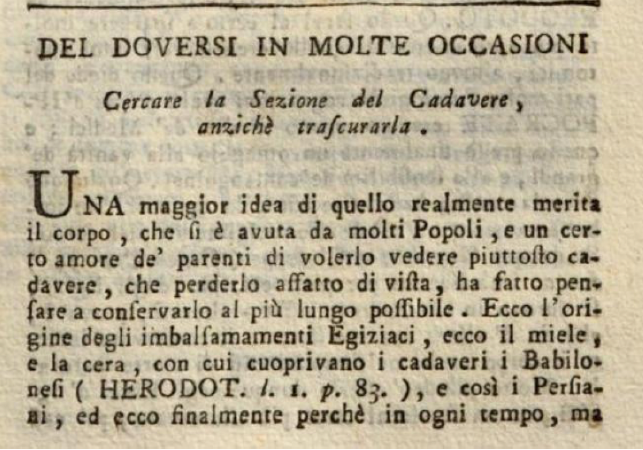
“He obtained a degree in medicine and philosophy on 31 October 1623, as can be seen from his original diploma which has been perfectly preserved despite the destructive effects of time.” (translated from the Italian)

Marco Osimo 1875

Original Books and manuscripts of past centuries known to historians throughout the ages have sometimes been lost forever to the ravages of time or war. Every so often, these works disappear from the public eye and are preserved in an intentional or accidental state of hibernation, only to reappear centuries later.

In late 2024, Manfred Niekisch, a German biologist, nature conservationist, and former director of the Frankfurt Zoo, died at the age of 73. He left a vast archive covering a wide range of topics, including taxonomy, ecology, behavior and reproduction of reptiles, amphibians and birds, not a place one would expect to find any items of Jewish interest, let alone of importance.

In April 2025 I was contacted to assess the historical significance of a single item from Niekisch’s massive collection. A thematic outlier, it is a small leatherbound volume, the contents of which comprise a seventeenth century medical diploma, and for a Jewish student, nonetheless. I was enlisted to address whether this item has any unique value or contribution to Jewish or medical history. This article constitutes the substance of my response. We will attempt to breathe a little life into this comatose medical document, resuscitate some long-forgotten and little-known archives, and perform at least a preliminary examination of the life of a remarkable, if little-known, Jewish medical graduate of the Early Modern period.


The Graduate- Leon Cantarini

The name of our graduate is Leon Cantarini. Leon, the son of Shmuel Cantarini, was one of eight children and a member of a prominent dynastic family in Early Modern Italy. Leon was also known as Yehuda HaKohen Katz Me’ha-Hazzanim. The synonymous Italian and Hebrew family name purportedly derives from family members having led the synagogue services as the hazzan, or cantor. Standard literature searches, including main search engines, library databases (such as the National Library Israel), or archival records (such as Internet Archives and Haithi Trust) yield next to nothing about our graduate. The few brief biobibliographical entries for him are scant, inconsistent, and often error filled.

Much of what we know about Leon is found in a comprehensive nineteenth century Italian biography of the Cantarini family by Marco Osimo, himself a medical graduate of Padua centuries later in 1851. This work was seemingly inaccessible or unknown to many of Leon’s biographers. In this essay we draw on the work of Osimo, correct some earlier biographies (including Osimo), and add much important previously unknown archival material to flesh out the existing skeletal biography of Leon Cantarini.


Dates of Birth and Death

Confusion abounds regarding the dates of both Leon’s birth and death. We begin with his date of death, as Leon’s birth date is inferred therefrom. The Jewish Encyclopedia entry for “Cantarini, Judah (Leon) ben Samuel Ha-Kohen,” authored by Louis Ginzberg and Israel Berlin, reads, “Italian physician and rabbi; born about 1650 at Padua; died there April 28, 1694.”[1] While the description is clearly of our graduate, the dates are grossly in error. Perhaps they confused Leon’s date of death with his date of birth. These dates were unfortunately perpetuated by others.[2] Osimo, the definitive biographer of the Cantarini family, places Leon’s date of death in July of 1651 based on a decree from July 20, 1651, announcing the election of Leon’s pupil to a community position, replacing his mentor upon the latter’s death. While this proves that Leon had already died by this date, it does not pinpoint his date of death.

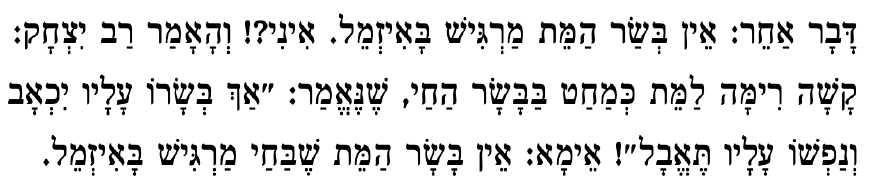
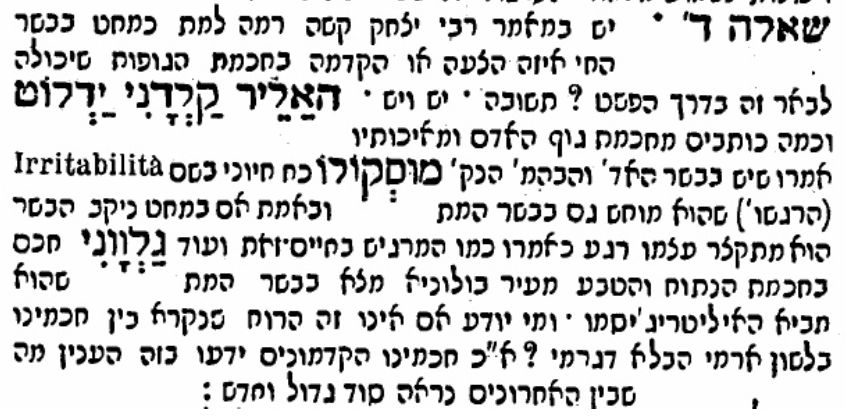
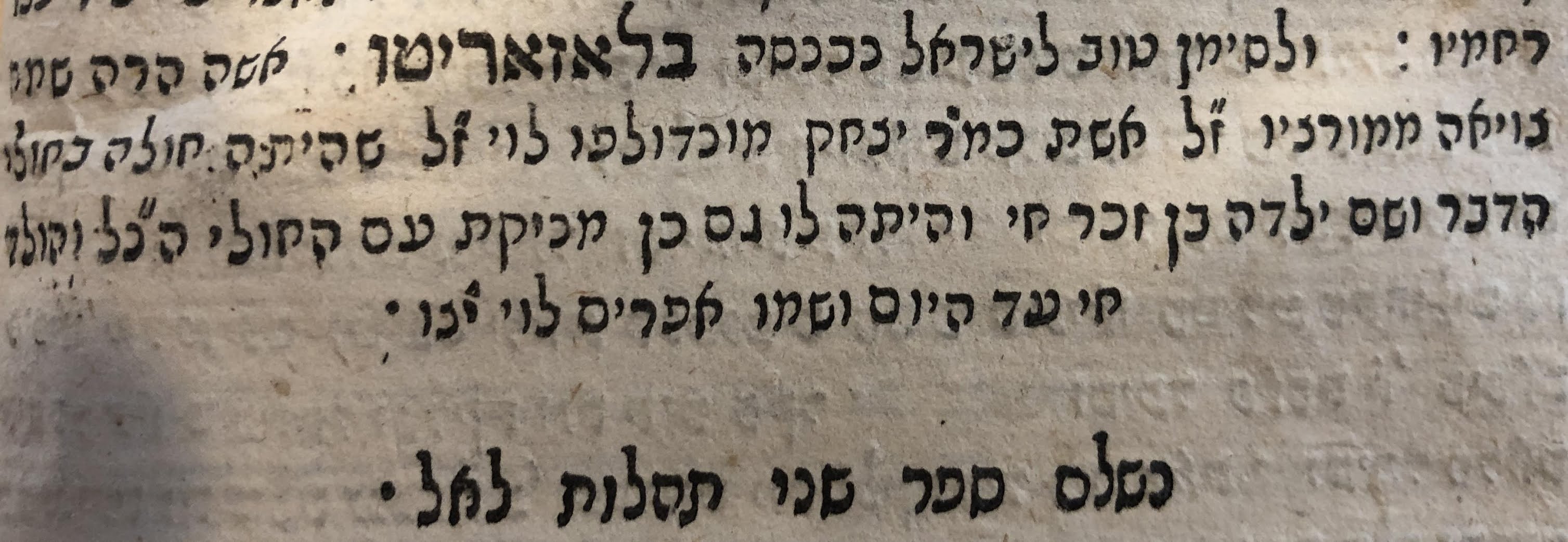
There is a single unexpected, unimpeachable source that states the exact Hebrew date of Leon’s death. Leon’s relative, Isaac Hayyim Cantarini, also a rabbi and graduate of Padua’s medical school, engaged in a correspondence with the Christian theologian Christian Theophil Unger from 1717 to 1719. The exchange was first published by Shadal in his Otzar Nehmad in 1860.[3] While scholars have studied these letters for obvious reasons, they also contain a wealth of biographical information about the Jewish Italian scholars of this period. In a list of the dates of death of a number of prominent members of the Italian Jewish community, we find the following

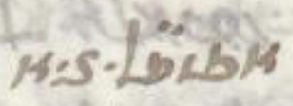
The date of Leon’s death is listed as 26 Nisan 5410, corresponding to April 27, 1650. He is buried in the ancient (Via Wiel) cemetery of Padua,[4] though his tombstone does not remain.

There is one non-Jewish source, published in 1728, which correctly lists the exact date of Leon’s death.[5]

This is because the Christian author was familiar with the letter exchange of Cantarini and Unger, unlike his Jewish counterparts who only learned of it through the journal of Shadal published over a century later.

There is no independent source confirming the day or year of Leon’s birth. What is known with certainty is that he died at the age of fifty-six, a fact recorded in multiple sources, including a memorial book for the Jewish community of Padua.[6] Since Osimo dated Leon’s death in 1651, he placed his date of birth fifty-six years earlier, “around 1595.” The year 1595 is widely quoted as Leon’s birth year, based on Osimo. Since we now know the exact date of Leon’s death as being in 1650, we would revise his date of birth to “around 1594.”

Leon’s Father’s Name

The name of Leon’s father was Shmuel. Yet, he is also referred to as Simon, including on Leon’s medical diploma (see below). Simon (or Simeon) today is the English name for Shimon. What is the origin of this alternate name. The answer is surprisingly found in the aforementioned letter exchange between Isaac Cantarini and Christian Theophil Unger.

Among the numerous questions posed by Unger to Cantarini is why, for example, Rabbi Menahem Porto is called by the first name Emanuel instead of his Hebrew first name.[7] Cantarini answers that while all Italian Jews have a given Hebrew name, many have an additional secular or vernacular “translation” or substitute for their Hebrew name. He provides two examples. One is the name Mandolin for Menahem. The other is the name of one of his own children: “In my home I have a young child whom I named Shmuel, but in la’az (vernacular) he is called Simon, which is (synonymous with the Hebrew) Shimon.” This analysis of Isaac Cantarini’s child’s name provides direct insight into the double name of Leon’s father, after whom this child was likely named. It appears that while today our English correlate for Shmuel is Samuel, and for Shimon is Simon, at that time Simon was the accepted latinized form for Shmuel.

Leon’s Relationship to Isaac Hayyim Cantarini

The historical record of Leon Cantarini is dwarfed by his more famous relative, Isaac Hayyim Cantarini,[8] whose writings contribute to Leon’s biography as well. Isaac, a physician, rabbi, poet and orator, is one of the towering figures of Early Modern Jewish history. How were Leon and Isaac related? Nepi and Ghirondi identify Isaac as Leon’s “nekhed.”[9] While this typically means grandchild, perhaps they were using the term to mean descendant. Leon was in fact Isaac’s uncle, the brother of Isaac’s father, Ventura Yaakov Yitzchak. Isaac, born in 1644, would have been only six years old at the time of Leon’s death, precluding any substantive personal relationship. Nepi and Ghirondi state that they viewed a eulogy written by Isaac for his uncle Leon.[10] It is unclear to me when this eulogy would have been written, given Isaac’s age at the time of Leon’s death, though perhaps he wrote some form of eulogy when he was older to commemorate his uncle’s yartzheit (anniversary of his death). Isaac clearly had great reverence for his uncle Leon, always referring to him in a highly praiseworthy fashion. In his historical work, Pahad Yitshak, Isaac refers to Leon twice describing him as expert in both Torah and medicine.[11]

Leon Cantarini the Rabbi

Leon obtained his rabbinic ordination in 1618, at the age of twenty-four.[12] Rabbi Judah Saltara, who would later serve as a witness for his medical graduation (see below), was one of the granting rabbis. In the Padua community archives (pinkassim) for the years 1603-1630, his name appears on two occasions (October 28, 1621, and October 31, 1625) in his rabbinic capacity serving as judge for routine community matters.[13] Leon founded a yeshivah in the Ashkenazi synagogue, where he taught Talmud. He also officiated as preacher and delivered sermons and eulogies in both Padua and Venice.

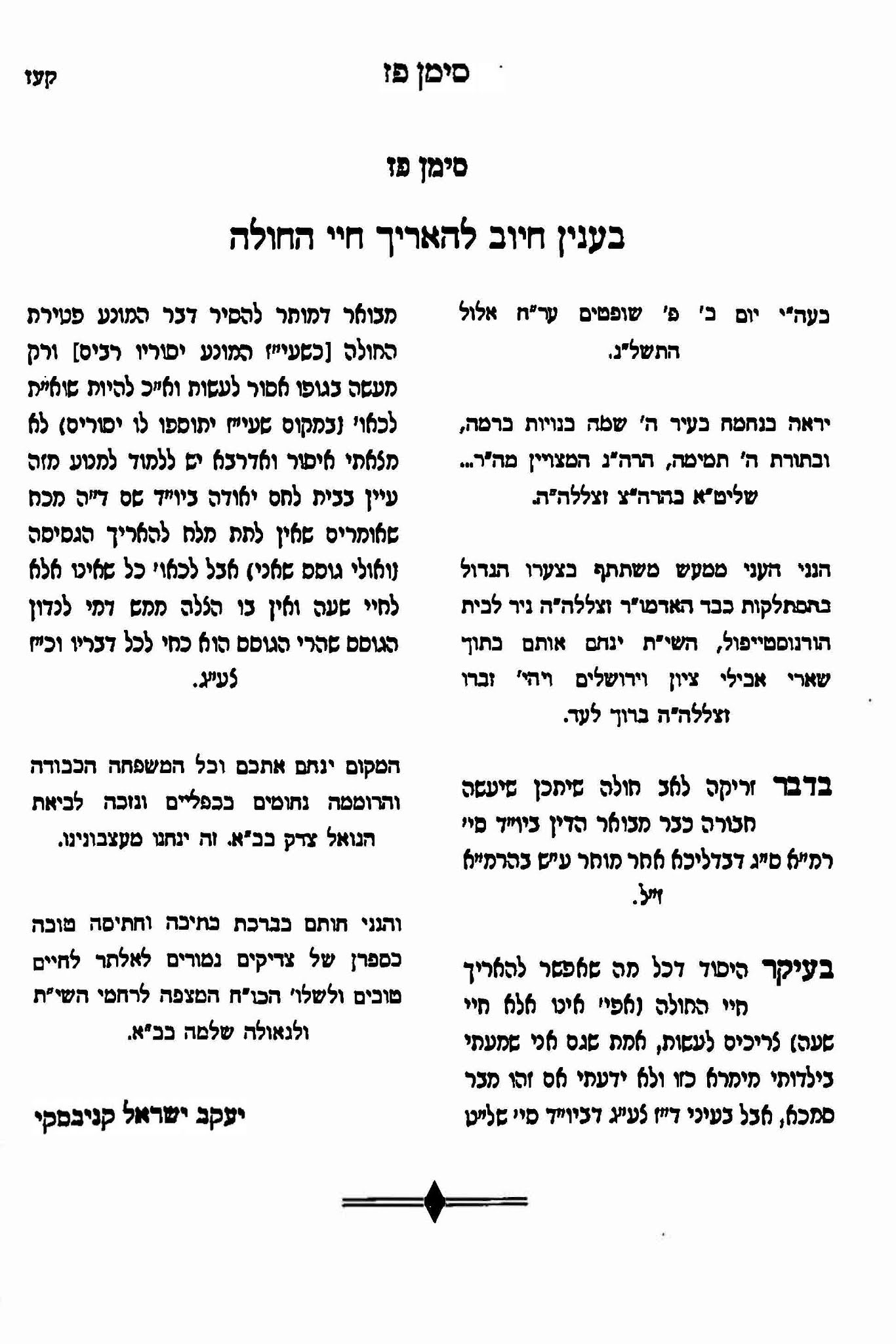
I am aware of only one published responsum from Leon,[14] which he penned to Yaakov ben Yisrael Levi dealing with a dispute between three sons regarding the disposition of their father’s estate after their father had left very explicit and equitable instructions. Leon was clearly well versed in rabbinic literature, citing multiple references to support his position, and dealt among other issues with the propriety of bypassing the biblical requirement to grant a double portion to the firstborn.

Osimo was in possession of numerous rabbinic related manuscripts of Leon in varying stages of completion, the whereabouts of which are unknown to me. These manuscripts include sermons, biblical commentaries, philosophical and theological treatises. As Osimo was not versed in rabbinic literature, he forwarded Leon’s Jewish related manuscripts to a Rabbi Benedetto Levi of the Rabbinical Institute of Padua for evaluation of their content.[15] The text of Rabbi Levi’s response is provided where he comments on Cantarini’s familiarity and facility with rabbinic literature and philosophy and the areas where his work may or may not have exhibited originality. Osimo bases his laudatory comments in his work on Levi’s analysis.

Leon Cantarini the Physician

Leon’s medical degree was from the University of Padua. This university, over 800 years old, plays a prominent role in Jewish medical history.[16] As the first, and for some time only, medical school in Europe to officially admit Jewish students, it was the hub of Jewish medical training from the sixteenth to eighteenth centuries, during which some 400 Jewish students attended.

Leon graduated from Padua on October 31, 1623. We would be remiss if we did not mention that Leon wasn’t the only Cantarini to walk down the aisle of the Aula Augustiori (Grand Hall) that day to receive his medical diploma. Caliman, his younger brother by two years, graduated right alongside him. These two Cantarini brothers would be the first of a total of eleven members of the Cantarini family who would graduate from Padua over a span of some one hundred and twenty years. There is even an entry in the Padua University Archives which includes both brothers, Clemente (Latinized form of Caliman/Kalman/Kalonymus) and Leo, together.

Leon maintained a large practice among both the Christian and Jewish population of Padua. He is also recognized for his exemplary treatment of the poor, visiting them up to three or four times a day without receiving compensation.

Osimo was in possession of multiple medical manuscripts of Leon, the whereabouts of which today are unknown to me. The medical material he notes as summaries or comments on the works of Hippocrates, Galen and Avicenna, the latter explicitly mentioned in Leon’s diploma, as discussed below, and copies of his medical school lectures.

An entry in the archives of the Venetian Senate mentioning Leon reflects on the challenges and discrimination facing Jews and Jewish physicians at that time. Jews in Italy were obligated to wear distinctive clothing to identify them as members of the Jewish faith.[17] This included a specific color hat, sometimes red, sometimes yellow. This would preclude Leon, or any other Jewish physician, from wearing the black hat (biretta or cappello) which was granted them upon graduation from medical school and associated with the medical profession.[18] On May 15, 1643, Leon requested permission from the Venetian Senate to be exempted from the prohibition against wearing the black cappello on the basis of his medical degree. While Leon’s request was granted, and he was permitted to wear the black cappello both during the day and at night without any hindrance,[19] the Venetian Senate was generally conflicted about whether Jewish physicians should qualify for this exemption.[20] Other Jewish medical graduates of Padua often petitioned for similar exemptions.[21]

Leon Cantarini’s Marriage

On March 10, 1628 Leon married Mindele, daughter of Yosef Kohen Rofeh De Datolis (Tamari). They had three children.[22]

Impact of the Padua Plague of 1631 on Yehudah and the Cantarini Family

Any biographical discussion of Leon would be woefully inadequate, both literally and figuratively, without discussion of the impact on his life of the 1631 Plague in Padua. Indeed, this is exactly how Nepi and Ghirondi introduce his brief biography:[23]

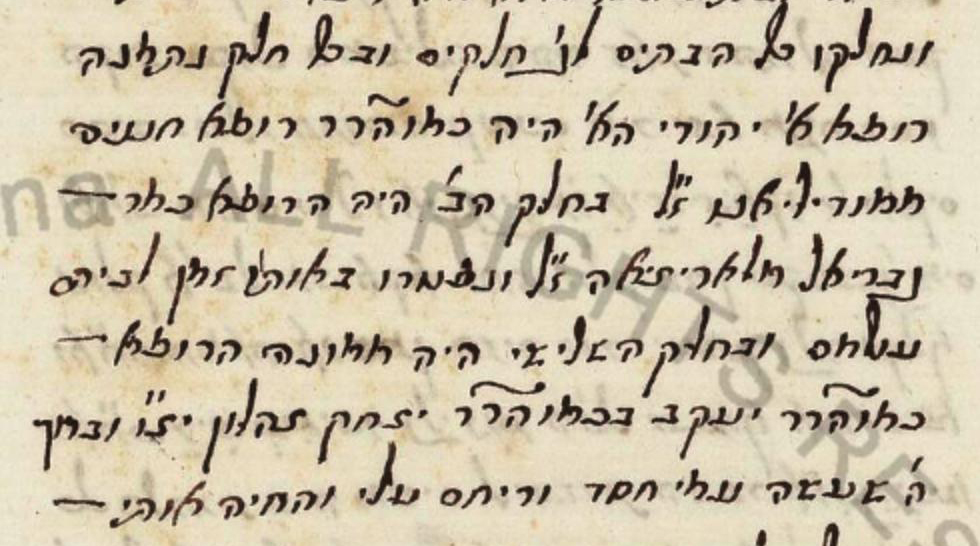
The plague’s toll on the Jewish community of Padua was profound with around a fifty percent fatality. The plague was assiduously chronicled by Abraham Catalano, a physician and one of the administrators of the plague for the Jewish community, in his Olam Hafukh. One of the many remarkable aspects of this unique plague chronicle is Catalano’s scrupulous documentation for posterity of the names of all those involved, including each one of the victims. Catalano includes a passage about the Cantarini family where he singles out our graduate:


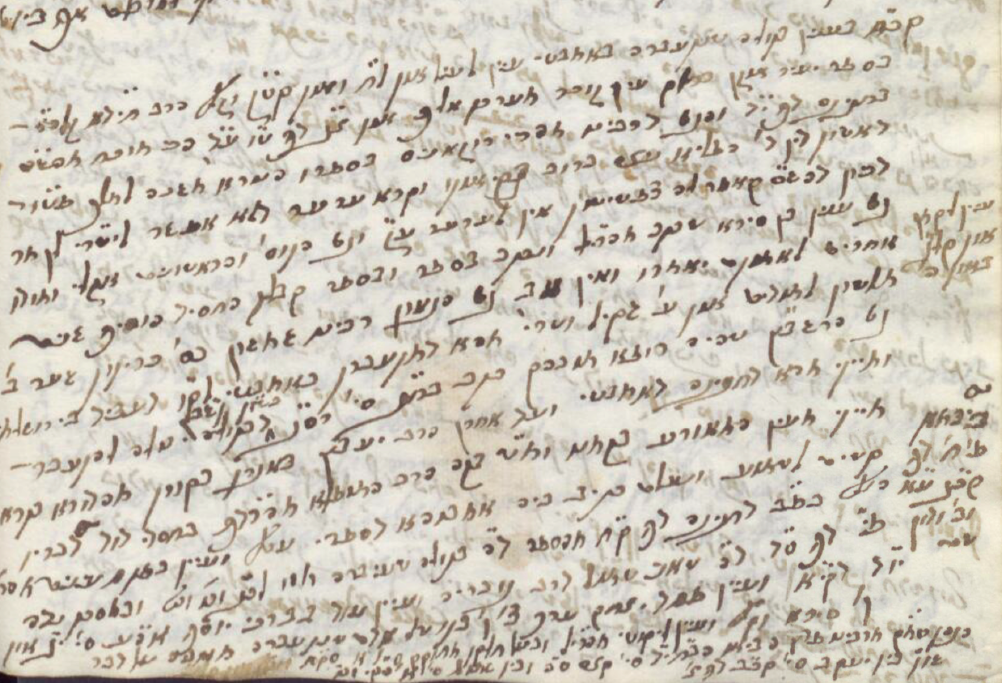
After recording the death of Leon’s brothers in the plague, Catalano writes, “May my mouth speak the praise of God
[24] that their brother the physician, prominent leader (aluf), Rabbi Yehuda Katz was not present in Padua during the plague, having married a woman from Venice and settling there. He provided aid and assistance (during the plague).”

Though the impact of Leon’s family losses during the 1631 plague is inestimable, there is likely one loss that affected him differently than others. Leon’s brother Caliman was also a physician, having graduated together with him on the very same day. Caliman was living in Padua during the plague and served as a physician for the Jewish community. Acutely aware of the raging and highly fatal epidemic in Padua, and concerned for the welfare of his dear physician brother on the medical battlefield, on July 18, 1631, Leon penned a letter to Caliman, advising him of some effective remedies recommended to overcome the dreaded disease, as well as appropriate precautions to prevent the contracting or spread of the infection.[25] Leon specifically recommended the use of emeralds, which since the Black Death had been considered a cure for plague. Leon emphatically warned his brother to exercise extreme caution and diligence in order to preserve his health. It would be only twelve days after the writing of Leon’s letter, on July 30, that Caliman succumbed to the plague at the age of 38. Below is a record of Caliman’s death in the Libro De Morti, the Padua City Death Registry.

His death is recorded in the city death registry alongside his profession, which was unusual for these records. He is also identified as “ebreo.

In order to fully assess the nature of the impact of the plague on the entire Cantarini dynasty, one would need to carefully read every line of Olam Hafukh and to note every time a member of the Cantarini family is mentioned. It turns out that this work has already been done already, by none other than Isaac Hayyim Cantarini. Isaac painstakingly transcribed the entire manuscript of Olam Hafukh by hand. While this manuscript, housed at Columbia University, is well known to Jewish scholars and historians, there is one “key” factor which has gone overlooked. For every mention of a Cantarini family member in the work, Isaac added a notation shaped like a key, akin to an asterisk, referring the reader to the margin, where he noted how the individual was related to him. Below are some examples:

Shmuel Katz MeHazanim, Isaac’s maternal grandfather, died from the plague 8 Tammuz


Menahem Katz MeHazanim, Isaac’s paternal great uncle died on 22 Tammuz


During the plague Leon lost his father, three brothers and many additional extended family members.

Leon Cantarini and the Venice Plague of 1630

While Leon’s absence from Padua during the 1631 plague is recorded for posterity by Catalano, it is not as if he completed evaded the impact of the Bubonic plague. The impact on his life of the Venetian Plague, which preceded that of Padua by just one year, has gone unnoticed. It is unappreciated that the very same bubonic plague, on its way to Padua, devastated Venice in 1630,[26] where Leon was living at the time.

We know from other sources that a young Jewish physician by the name of Isaac Gedalia served as the physician for the Jewish community of Venice during the plague. This is the same physician who wrote a poem in honor of Leon’s graduation, and Leon would certainly have been in contact with him. Tragically, Gedalia met the same fate as Leon’s brother Caliman, and succumbed to the plague. Gedalia died in 1630 at the age of 32 and is buried in the Lido Cemetery of Venice. His epitaph, composed by Rabbi Yehuda Aryeh Modena, reflects his service as a physician to the Jewish community during that time.[27] Below is the epitaph in the autograph of Modena,[28] followed by the transcription of Berliner.[29]


We have not known, however, what medical role if any Leon played in the Venice plague of 1630. Was he simply a bystander, or perhaps worked side by side with Gedalia, his fellow Padua alumnus. Leon’s diploma, discussed below, sheds new light on this question.

Leon Cantarini’s Graduation Diploma

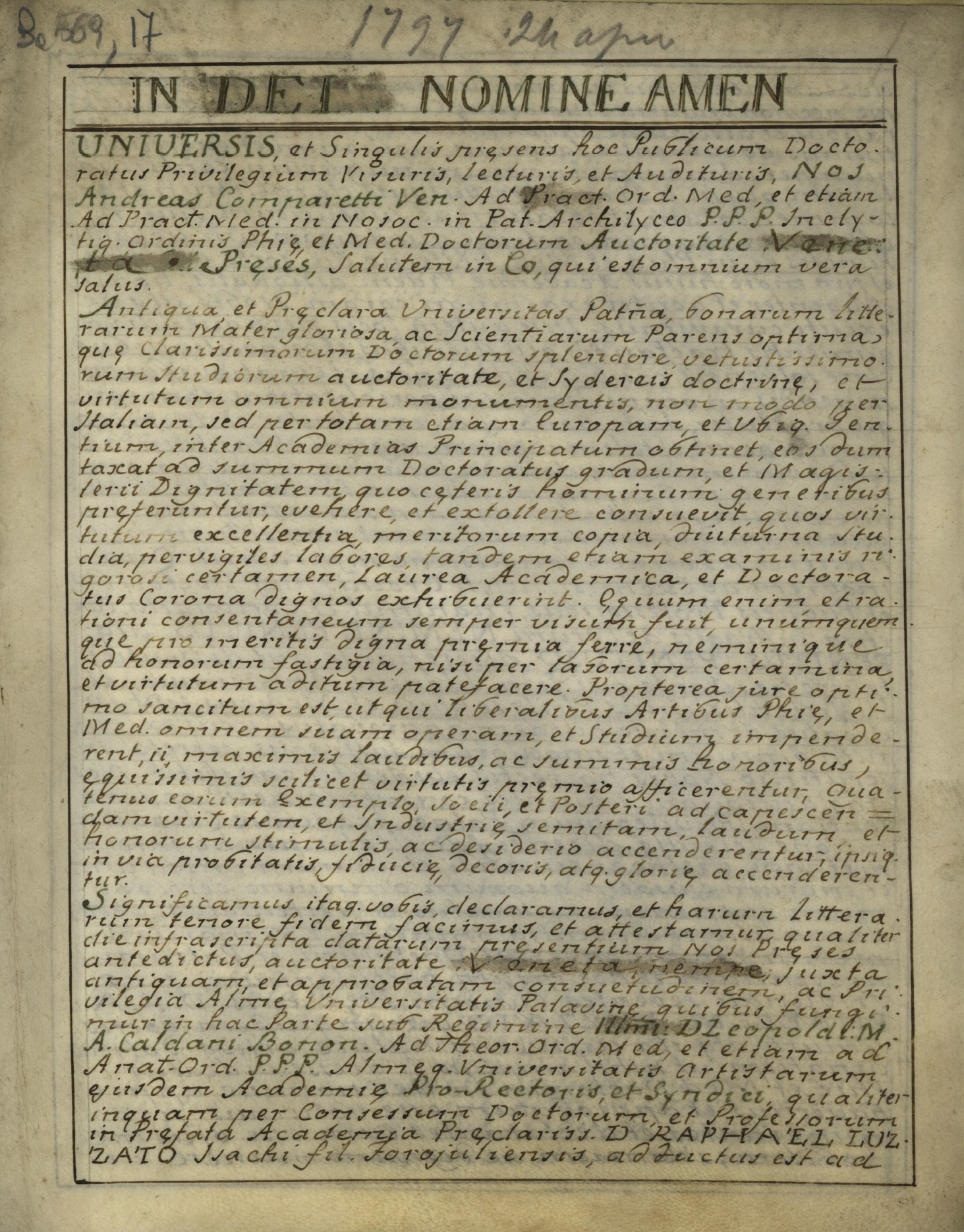
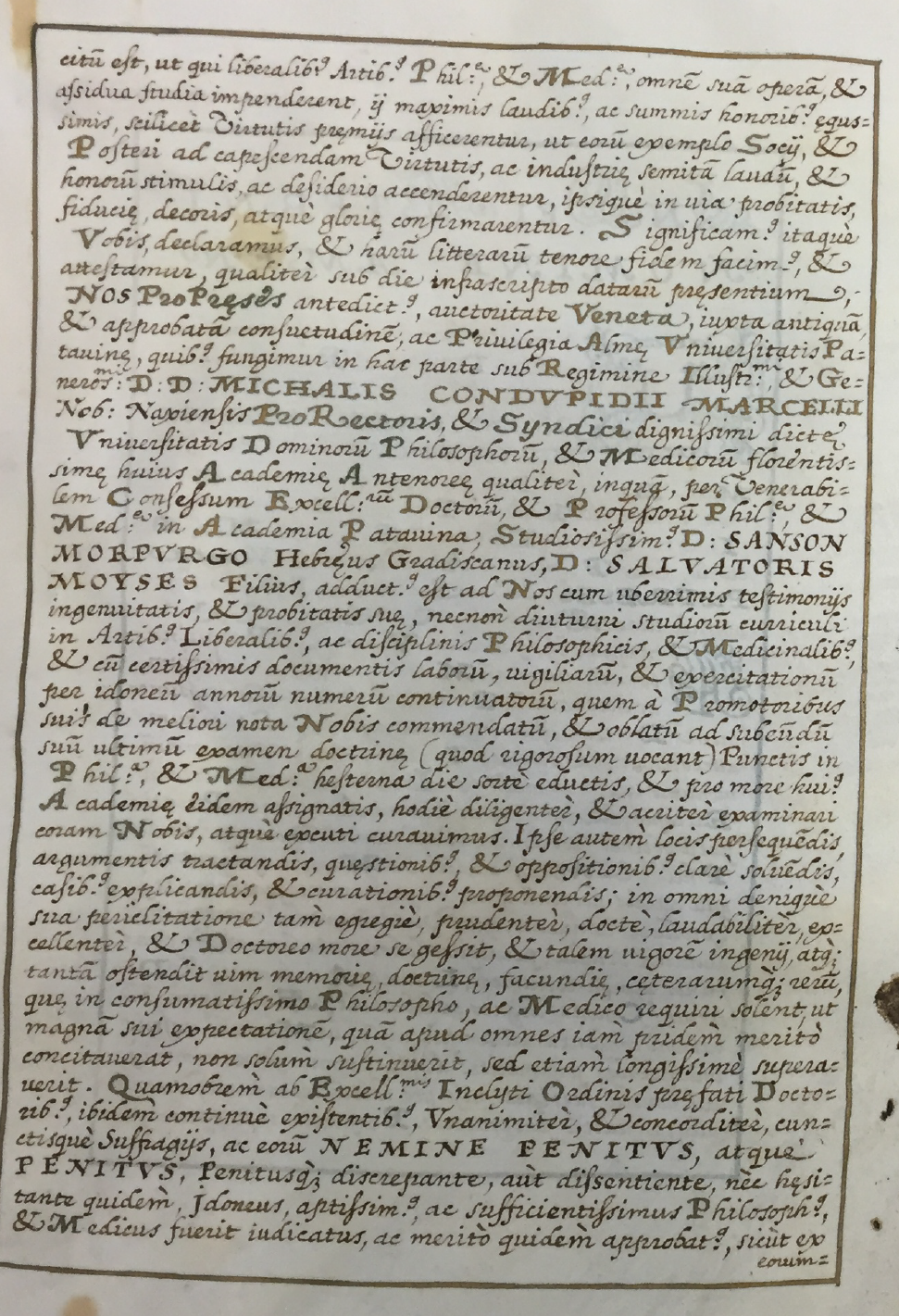
Leon Cantarini’s magnificently bound and meticulously calligraphed medical diploma was ceremoniously placed into his hands on October 31, 1623 accompanied by the traditional pomp and circumstance of the University of Padua graduation. He put it to good use during his lifetime. Over three hundred years later, we find Leon’s diploma in the possession of Marco Osimo, a Padua-trained physician. In his definitive history of the Cantarini family he writes regarding Leon: “He obtained a degree in medicine and philosophy … and his original diploma … has been perfectly preserved despite the destructive effects of time.” The renowned Hungarian Jewish historian David Kaufmann recalled that he had viewed Leon’s diploma at Osimo’s home.[30] The Cantarini biography was published in 1875 and Osimo died in 1881. As the family biographer, Osimo likely procured the diploma from members of the Cantarini family. While details of the journey from Osimo’s home to that of Professor Manfred Niekisch, whose collection contained Leon’s diploma, are unknown, it appears that no one, not Osimo nor Kaufmann, has previously carefully examined Leon’s diploma.

One of the archival items that reflects the unique historical chapter of Jewish medical training at the University of Padua is the medical diploma.[31] Prior to reviewing Leon Cantarini’s diploma, I had identified, in libraries, museums and private collections, eighteen extant diplomas of Jewish medical graduates of the University of Padua, the earliest of which was 1647.[32] One of these is the diploma of Gershon Cantarini (1703),[33] Leon’s grandnephew. Below we review the features found in our “new” graduate’s diploma, as compared to those of his fellow Padua alumni.

Form

Leon’s diploma is a bound quarto booklet with a red Italian tooled leather binding consistent with the typical Padua diploma of this period.

In its original form, a pair of wax seals would have been attached to the binding, as pictured in the diploma of Emanuel di Jacob (Del) Medigo de Dattolis (Menachem Kohen Rofeh Tamari)[34] from 1686,[35] a member of Leon’s wife’s family.[36]

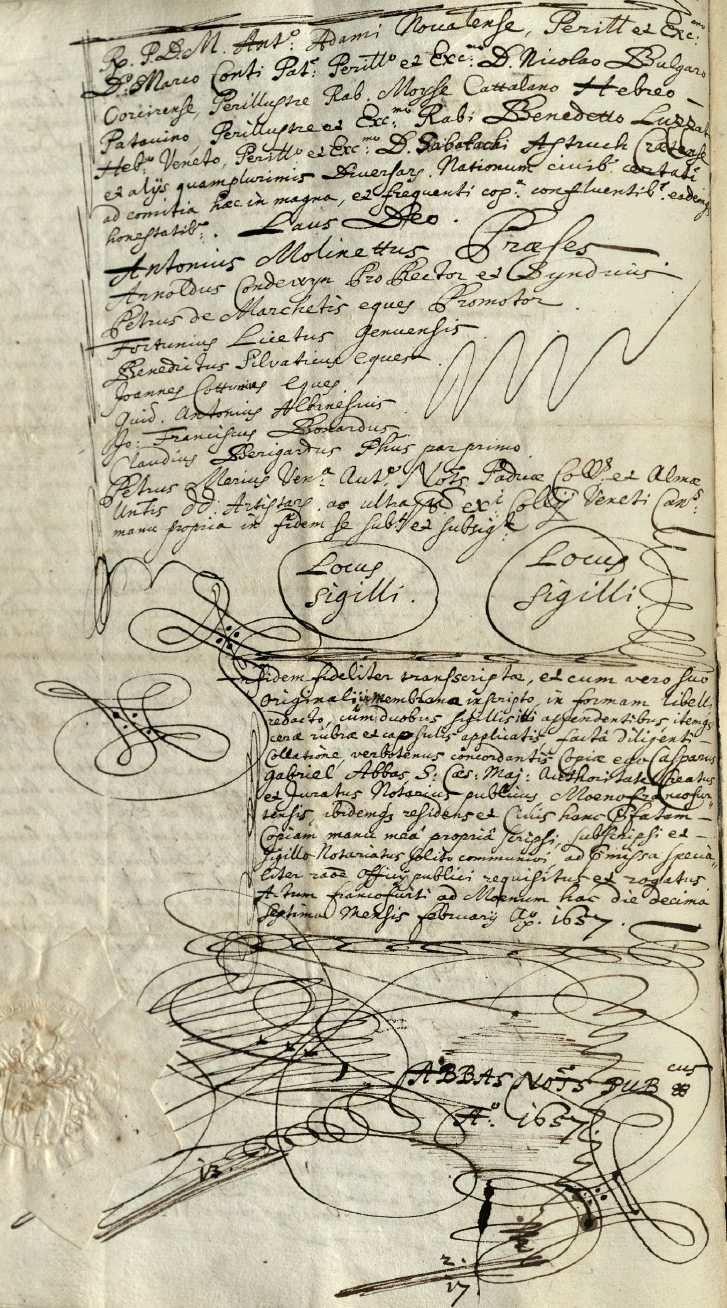
The text is written in period calligraphy appointed with periodic gold leaf lettering. The text of the diploma, written with generous font size and spacing, as well as wide margins, occupies ten double sided pages. This is unusual, as the typical diploma text usually fills four to six sides. 

Content

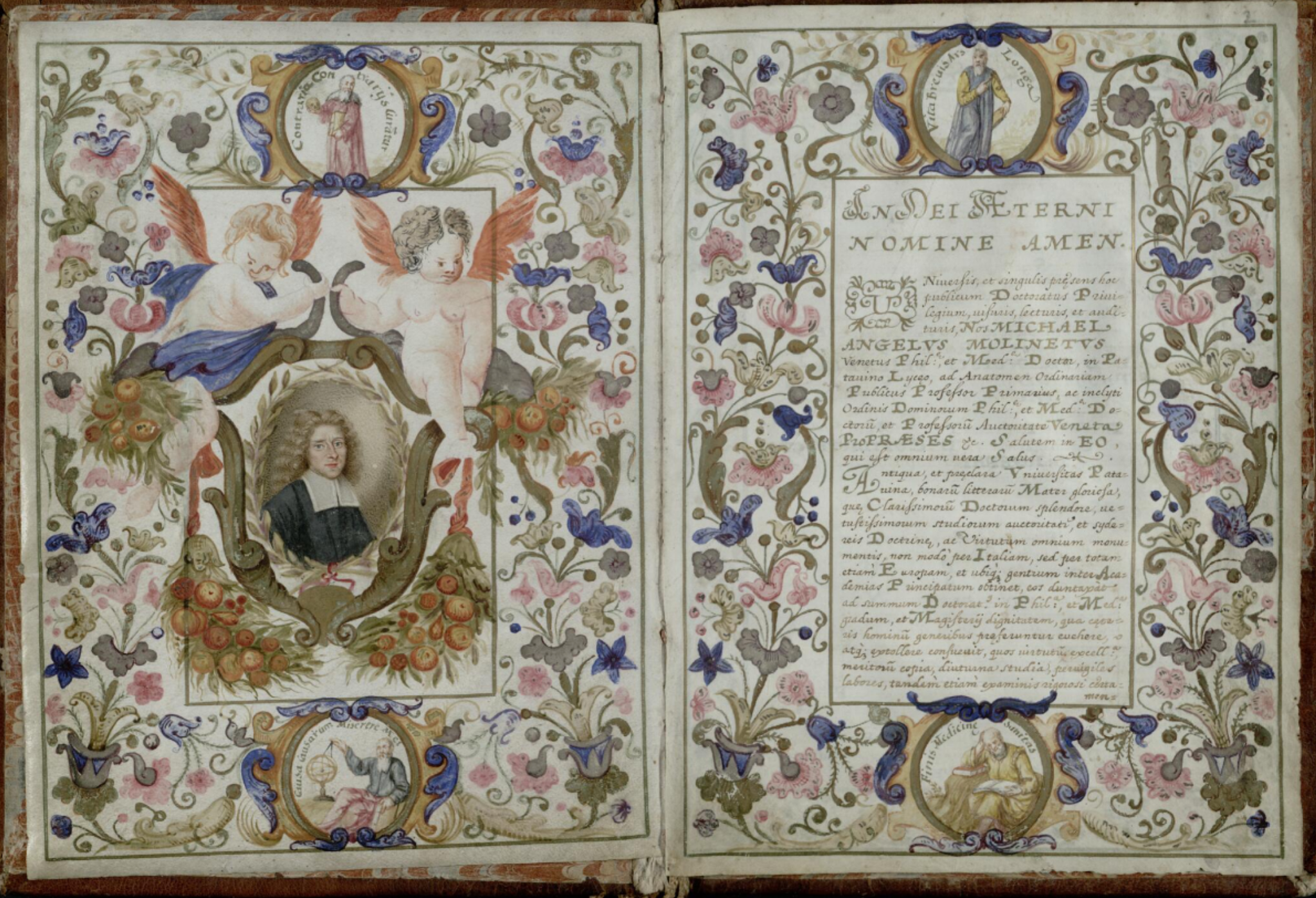
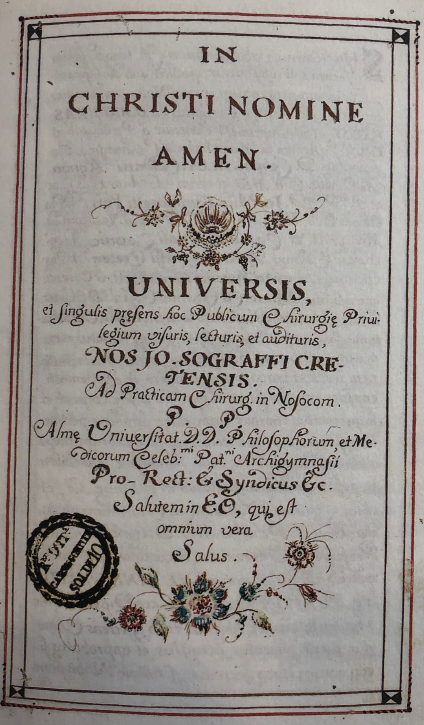
The diplomas of Jewish medical graduates of Padua contain some deviations from the standard issue. As the standard Padua diploma contained a number of Christian references, the university accommodated the Jewish students by allowing certain alterations or emendations:

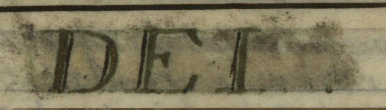
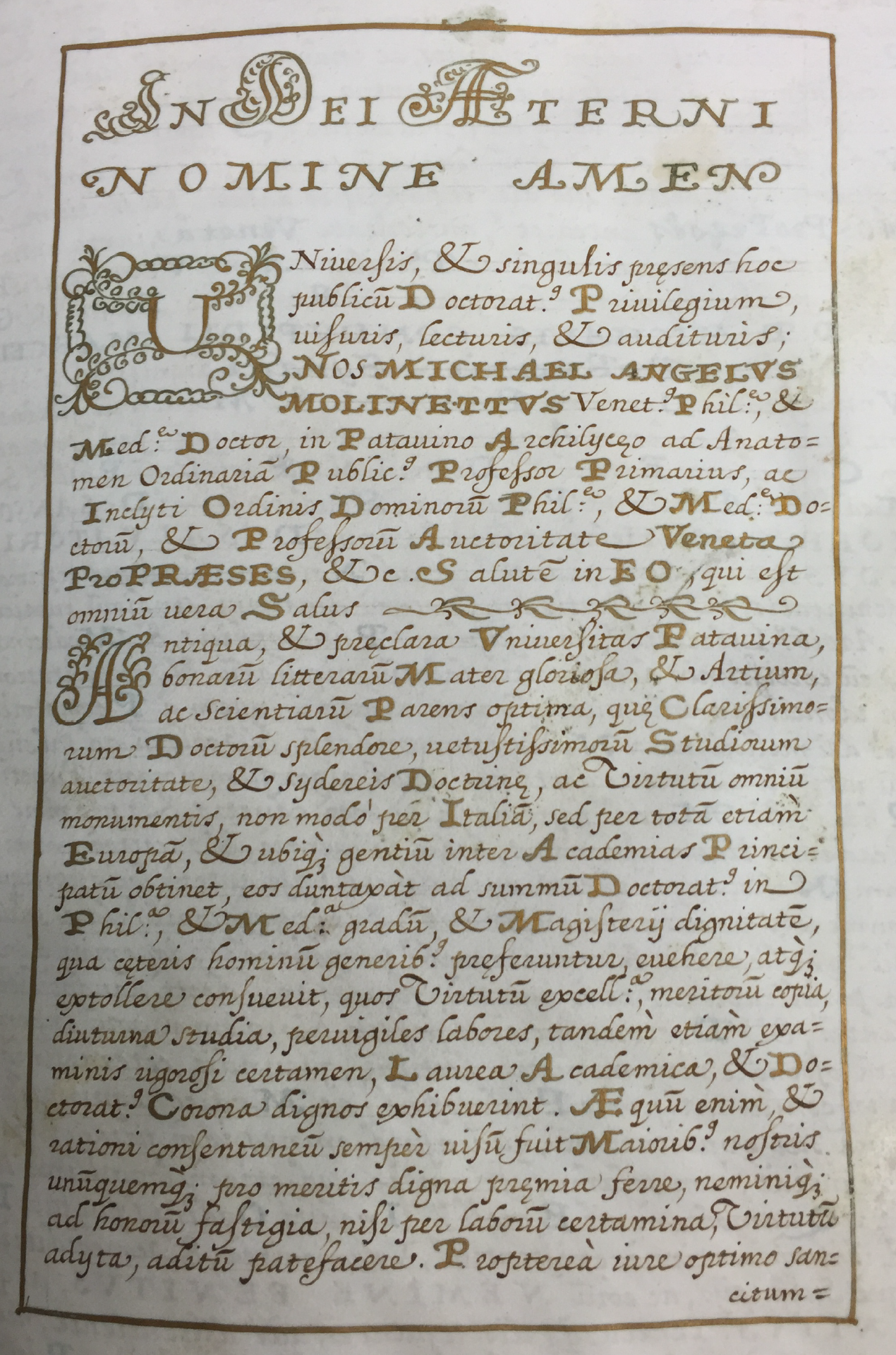
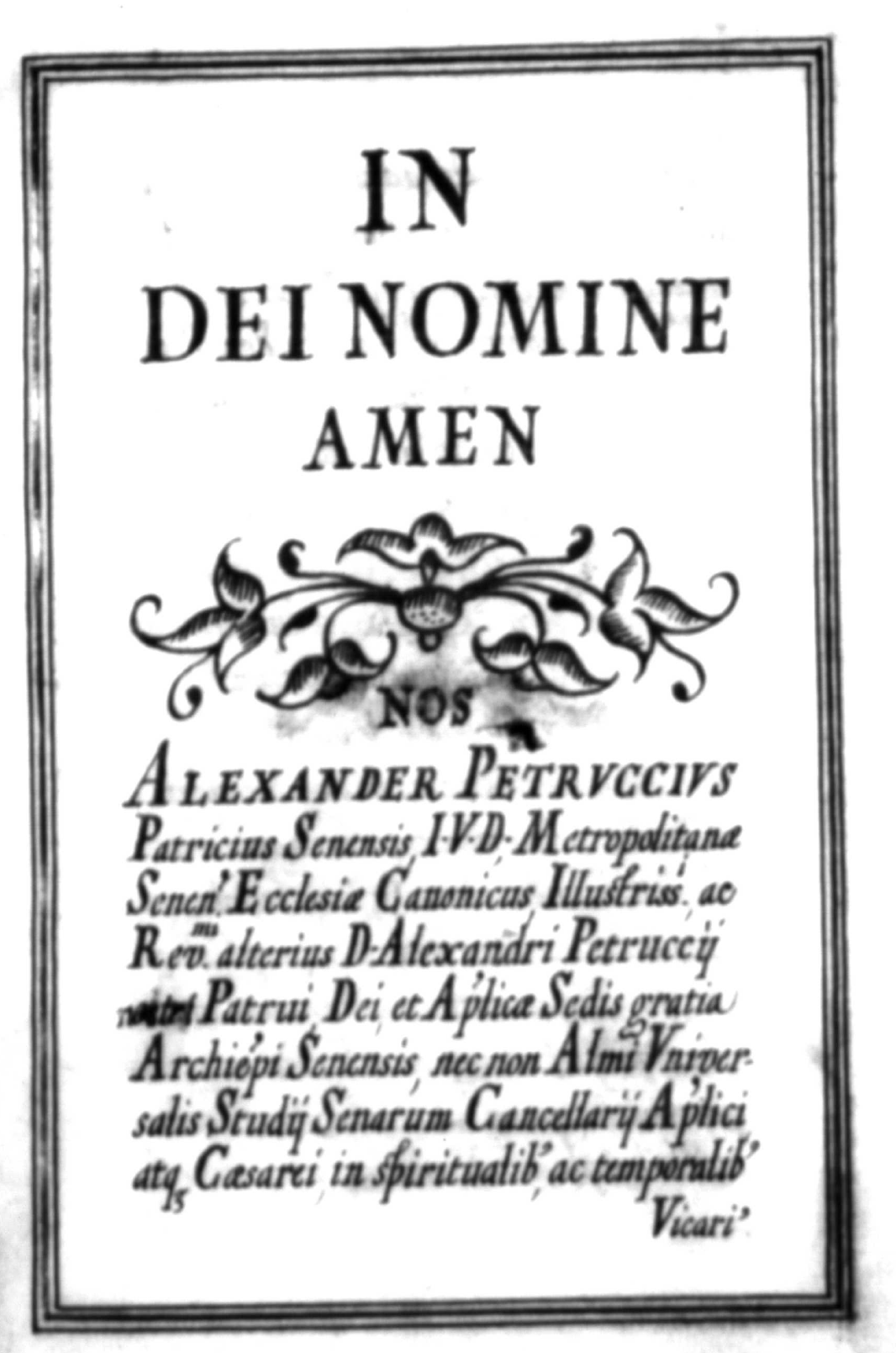
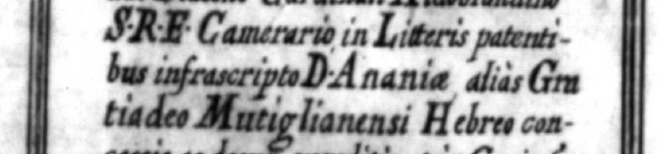
  1. The invocation was changed from “In Christi Nomine Amen” to “In Dei Aeterni Nomine Amen.” Leon’s diploma conforms to this pattern:

  1. The convention for writing the year of the graduation invariably contained a Christian reference, such as anno Domino, anno Christiano, or anno a Christi Nativitate. In many Jewish diplomas this reference is omitted. Here we do not see an alteration of the date and it retains the Christian reference, Anno Christiano.

  1. The graduation for the Christian student was held in the Episcopal palace, a religious venue. This is mentioned in the text of the diploma. The graduation for the Jewish student was convened in a non-ecclesiastical location, a fact reflected in the diploma text. Leon’s graduation was held in the “Aula Augustiori” (grand hall) of the university, the largest hall in the university at the time and not designated for religious use.[37]

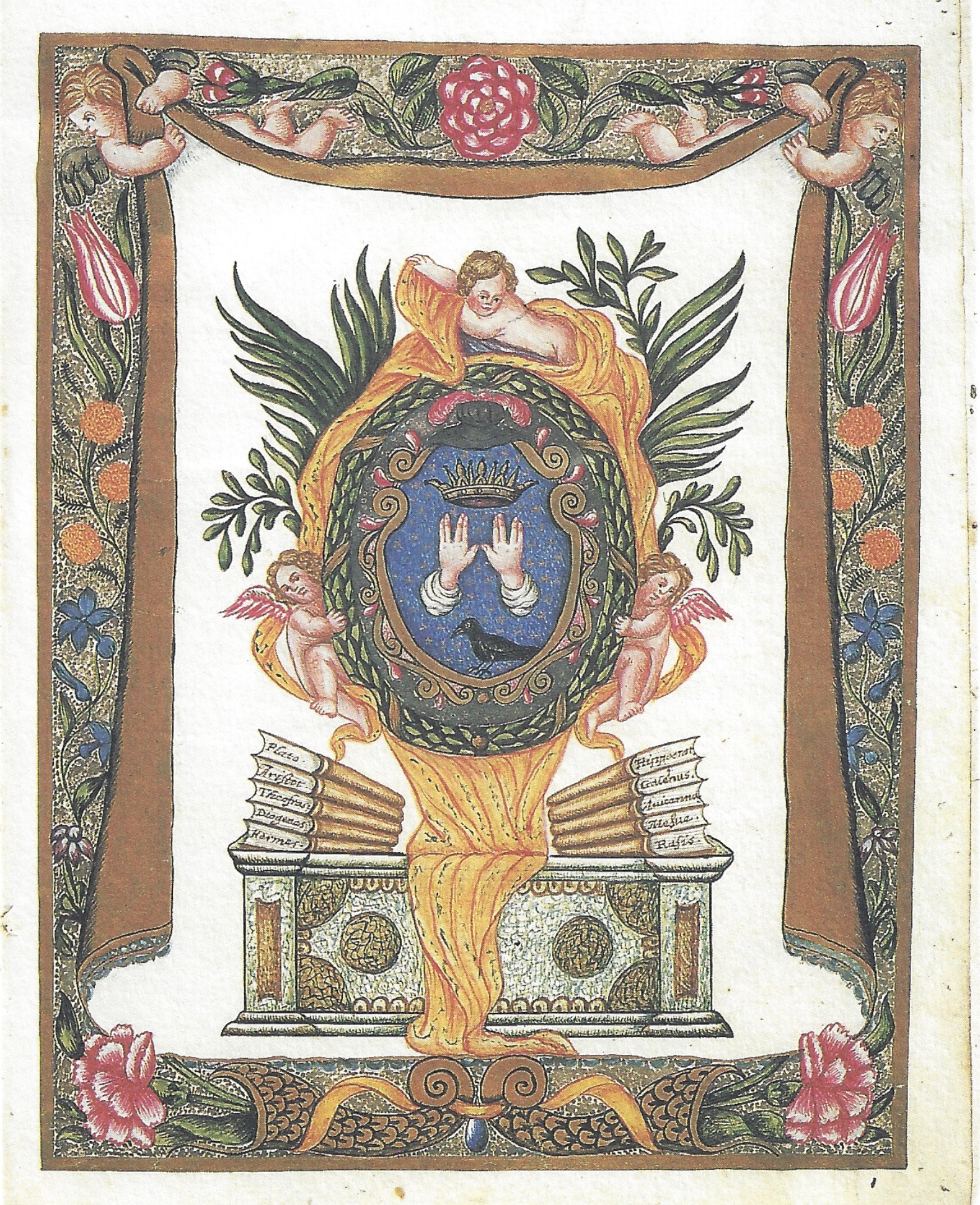
  1. Many diplomas contained ornate illustrations and images, typically of a Christian nature. If the Jewish student diploma were illustrated, it would be with flora and fauna and devoid of any Christian imagery. This diploma has no added illustrations.

  1. The identifier “ebreo” or “hebreus” was added for Jewish students. This was a convention followed consistently in Padua, and less so in other European universities. This was not specifically requested by the student, nor was its presence a reflection of antisemitism.

  1. Witnesses were required to attest to the graduation. Jewish graduates often enlisted Jewish witnesses. Leon’s three witnesses were Jewish.

The above changes are not found uniformly or consistently in every Jewish student diploma, and Leon’s diploma contains all but one of them.

General Diploma Observations

Chronological Precedence

This is the earliest extant diploma for a Jewish medical graduate of the University of Padua of which I am aware. Previously the earliest extant diploma of this type was from 1647.[38]

During the early centuries of the University of Padua Medical School, doctoral degrees were granted exclusively by the Sacred College of Philosophers and Physicians in a Catholic religious ceremony. Non-Catholics who received training at the university could obtain medical degrees through a different pathway outside of the university walls, granted by specific individuals known as Counts Palatine, who received their authority from the Holy Roman Emperor. These ceremonies were held privately before a notary and witnesses.[39] It was only in 1615 that the Collegio Veneto was established to serve the purpose of granting formal degrees to non-Catholic students and essentially replaced the Counts Palatine. Leon was the fifteenth Jewish graduate after the procedure changed.[40]

Faculty Support for Graduation

In order to graduate, a student required the support of a number of faculty to promote his candidacy. Names of the faculty members promoting the graduate are listed in the diploma. One such faculty member identified in the diploma maintained a unique relationship with Leon and the Jewish community regarding an important aspect of the educational experience of the Jewish medical students.

Caesar Cremonin was a Professor of Philosophy in Padua, as philosophy at this stage of history was an integral part of medical training. In fact, the medical diploma for each graduate, including Leon, certified a degree in “Philosophia et Medicina.”

We know from historical records of the Padua Jewish community that Professor Cremonin served as a university representative to the Jewish community on a matter of utmost significance. Since the expansion of the anatomy curriculum during the tenure of Vesalius in the mid sixteenth century, and the subsequent construction during the time of Fallopius of the first historical dedicated anatomical theater, the demand for cadavers for teaching at the university exponentially increased. The university turned to the student body, including the Jewish students, to provide cadavers from their respective communities. As this request ran counter to Jewish law, which prohibited the desecration of the corpse after death, the Jewish community negotiated a compromise arrangement whereby a fee would be paid to the university in exchange for an exemption to provide cadavers.[41] The following entry appears in the Padua Jewish Community Archives from April 19, 1624.[42]

In that the spirit of God has enlightened the esteemed philosopher Senior Caesar Cremonin to declare freedom (from dissection) for our deceased, through the continued annual designated payment to the College of Arts, generation after generation. As a result, they are obligated to allow us to properly bury our dead during the season of dissection. Any violators will be fined, and they have coordinated with us to obtain from the government permission for a required fine for all who violate this agreement in a way amenable and sufficient for our needs.

The continuation of the archival entry mentions the Jewish community member delegated to negotiate with Cremonin. It is none other than our graduate.

The aforementioned Master Caesar and Yehudah Katz have already spoken on this matter and have begun discussion regarding the amount the Jewish community is willing to pay for this privilege.

The archival entry is dated just a few months after Leon’s (Yehudah’s) graduation, and he was an ideal representative for the community given his preexisting relationship with Cremonin, one of his medical school professors and graduation promoters.

Curriculum

The diploma contains a list of the student’s professors and course subject matter. For example, Leon was taught the works of Avicenna by Professor Francisco Bonardo.

Avicenna (980–1037), known in Hebrew sources as Ibn Sina, was a Persian physician of great renown. His main work, The Canon, was considered the authoritative work on medicine for many centuries and is quoted extensively by rabbinic sources. The only extant Hebrew medical incunabula is a copy of Avicenna’s Canon (Naples, 1491). Many Hebrew manuscripts of Avicenna were found in the Cairo Geniza.[42]

The Identity of the Witnesses

Two of Leon’s witness were prominent local rabbis and are known to us from other sources.

  1. Rabbi Jacob Alpron (also known as Helipron or Heilbronn)[44]

Alpron was a Talmudic scholar, author, and translator, most known for his popular work, Mitzvot Nashim,[45] a Hebrew translation of an Italian work on the three mitzvot specific to women, the laws of niddah, hallah, and lighting of Sabbath candles, which, if not observed, “are the three transgressions for which woman die in childbirth” (Shabbat 31b).

  1. Rabbi Leon (Yehudah) Saltaro da Fano (1505-1629)[46]

Saltaro was one of the rabbis who granted Leon his rabbinic ordination five years earlier.[47] It must have been meaningful for him to serve as a witness for his student’s medical graduation.

Saltaro authored a work, Sefer Sha’arei Gan Eden, attempting to identify the location of the Garden of Eden.[48] In his Mikveh Israel on the laws of the ritual bath, inter alia, Saltaro provides insight into the Jewish education of students attending the medical school in Padua. He mentions Avtalyon miModena, the uncle of Yehuda Aryeh da Modena, who in addition to his medical studies at the University of Padua, learned Torah in the Yeshiva of Rabbi Meir Katzenelenbogen (Maharam Padua).[49]

In fact, the Jewish Ghetto of Padua was and remains mere steps from the University of Padua campus, and other students over the centuries pursued Torah study with the prominent rabbis of Padua while enrolled in the city’s famous medical school.

Addenda to the Diploma- New Evidence of Leon’s Medical Involvement in the Venice 1630 Plague

It is not uncommon to find handwritten records appended to Padua diplomas documenting subsequent academic or clinical experiences. Occasionally, a student would present his diploma as part of his application for a medical position and the institution would inscribe acceptance or approval on the diploma itself. We find such an entry in Leon’s diploma that sheds some light on his clinical role in the Venice plague. On the inside of the back cover appears the following entry dated August 1630:

The diploma was presented to the Officio di Sanità in Venice (Provveditori e sopraprovveditori alla sanità) and “admesso” (accepted). This was required in order for Leon to practice in Venice. Until now, we have had no evidence of Leon himself practicing medicine during the plague. These few lines reveal that Leon was indeed providing medical service during the Venice 1630 plague, and like his fellow Padua graduates, including Gedalia and his own brother Caliman, put his life at risk in the process. While the latter two succumbed to the plague, Leon was fortunate to survive and to live for another twenty years practicing medicine and teaching Torah.

Congratulatory Poems for Leon’s Graduation

In seventeenth century Italy it was common for Jews to compose celebratory or commemorative poems for a variety of occasions, such as weddings or funerals. One such occasion that precipitated a poetic response was the graduation of Jewish students from the medical school of the University of Padua. I have identified over one hundred such poems written in the seventeenth and eighteenth centuries, most of which are extant. Rabbi Yehudah Arye Modena compiled an entire book of collected poems in honor of Joseph Hamitz, a fellow graduate of Leon from Padua in 1623.[50]

Sometimes the poems were composed by fellow students or alumni. Isaac Gedalia, a Padua medical graduate of 1622,[51] composed two poems for our graduate, one in Spanish and one in Latin.[52] There is also a record in the Padua city medical archives from April of 1625 of Gedalia treating a number of Jewish patients,[53] one of whom was Jacob Alpron, a witness for Leon’s medical graduation.

April 20 1625
Giacob Alpron Rabi Hebreo di anni 85 in circa ammalato giorni 15 di mal di muchi visitato dall’Ecc.mo Gadilia Hebreo nel ghetto.

Giacob Alpron Rabi Hebreo aged about 85. He was ill for about 15 days with a sore throat [?]. His Excellency Gadilia Hebreo examined him in the Ghetto.[54]


A Diploma for a Rabbi Doctor

Leon was a rabbi by the time he graduated medical school and he is identified as such in his diploma. Just how rare is it find a medical diploma for a rabbi doctor? Throughout history there have numerous attempts to create institutions or formal curricula combining the study of both Torah and Medicine.[55] These initiatives, well intentioned as they may have been, were of only limited duration and success. It was thus left to the individual physician to navigate his Torah study independently, something most physicians did informally. Some however sought more formal training. The Haver degree, a lower and less rigorous form of rabbinic ordination, was one such option. Unlike rabbinic ordination, with its expansive requirements to master specific areas of practical Jewish law, there was no uniform curriculum for the Haver degree.[56] Each location designed its own program. The student would be required to spend a period dedicated to Torah study and display basic competency, as well as character traits consistent with Torah values. Those deemed worthy would receive the title Haver within a few short years or less, typically bestowed by local rabbinic authorities.[57] A number of Padua alumni chose the Haver option,[58] including Leon’s fellow graduate, David Morpurg.[59] We have record of one Padua graduate receiving his Haver degree on the very same day as his medical graduation.[60]

A select few physicians throughout Jewish history chose the more advanced and labor-intensive course of study to obtain rabbinic ordination. These physician-rabbis have garnered the attention of scholars such as Holub,61] Sergei,[62] Epstein,[63] Margalit,[64] Salah,[65] and Steinberg.[66] Of this elite group, a large number received their medical training through apprenticeship, especially prior to the sixteenth century, when, with few exceptions, Jews were barred from university training. There is thus no official diploma to be found for these rabbi doctors.

As the University of Padua was the first European university to officially admit Jewish students and remained a major center of Jewish medical training into the late eighteenth century, many of our rabbi doctors in this period are counted among its alumni.[67] Leon, though less known and not mentioned by the aforementioned scholars, was one of these university-trained rabbi doctors.

Even among this relatively small group of rabbi doctors from Padua, most obtained their rabbinic ordination after completion of their medical training. The average age of the Jewish medical students upon entry to medical school was late teens to early twenties. This would have been too young to obtain rabbinic ordination, which was not typically granted to students of this age.

In 1651, the community of Padua, set specific age requirements for both the Haver and Rabbinic degrees.[68] For unmarried men, the age requirement for Havrut was twenty-five and above, while for married men it was age twenty and above. Rabbinic ordination was restricted to those thirty and above irrespective of marital status, though I am unsure if these age limits were either in force or enforced prior to this date. It is thus rare to find a Padua medical graduate who was already a rabbi at the time of his graduation.

Leon Cantarini is one such example. Born in 1594, Leon obtained his rabbinic ordination in 1618,[69] around the age of twenty-four, and had already been an ordained rabbi for five years by the time he graduated medical school at the (atypical) age of twenty-nine. In his diploma, he is identified as “Rabbi” Leon Cantarini throughout the entire twenty-page text of the diploma.

Of note, in the university records of his graduation, maintained to this day in the archives, he is not identified as a rabbi.

Leo Cantarinius hebreus[70]

Leon’s own brother Caliman, two years his junior, also obtained rabbinic ordination, though we do not know when.[71]

While it was indeed rare for a medical graduate of Padua to have already been a rabbi, another example happens to be one of Leon’s fellow Class of 1623 graduates, Moises Uziel.72 We do not possess Uziel’s diploma, but in his archival record, unlike Leon, he is identified as a rabbi.

Rabi Moises Uziel hebreus

Leon’s however is the only extant Padua medical diploma for a rabbi, and I have not seen any other medical diplomas elsewhere where the graduate was identified as a rabbi.

Conclusion

In sum, I hope our resuscitative efforts have been successfully for both Leon Cantarini and his diploma. Leon’s diploma is the earliest known extant diploma of a Jewish medical graduate of the University of Padua, and I believe it is the only extant diploma (of any kind) granted to a rabbi who is identified as such in the text. Furthermore, it possesses nearly all the alterations, accommodations and features that can be found in the diplomas of the Jewish medical graduates of the University of Padua. Moreover, an addition later appended to the document fills an important historical lacuna in Leon’s biography and established his role in the Venice plague of 1630.

While Leon Cantarini’s diploma may be one of the least artistically adorned of the Jewish Padua graduates, it may also be one of the most historically noteworthy. A rare unicum of no mean significance, this diploma sheds light on one of the greatest chapters in Jewish medical history and its resurfacing has afforded us the opportunity to explore the life of a prominent Early Modern rabbi physician. I look forward to the reawakening of other diplomas and archives from their state of hibernation.

[1] This is all the more perplexing as in the bibliography to the entry they cite the letter exchange published by Shadal mentioned below, wherein we find the exact date of Leon’s death.
[2]
Salah, who has only one line on Leon, follows Ginzberg and Berlin and includes the date of 1694, associating it with Leon’s medical education, which would thus have had to have been postmortem. See Asher Salah, La Republique des Lettres: Rabbins, Ecrivains et Medecins, Juifs en Italie au XVIIIe Siecle (Brill: Leiden, 2007), 120. Friedenwald also followed the JE Jews and Medicine (Johns Hopkins University Press, 1944), 606.
[3]
Otzar Nehmad 3 (1860), 145.
[4] Meir Benayahu, Kabbalistic Writings of Rabbi Moshe Hayyim Luzzatto (Hebrew) (Jerusalem, 5739), 303.
[5] Christoph Wolfii Bibliothecae Hebrae 3 (Hamburg, 1728). Shadal even mentions in his introduction to the Cantarini-Ungar letters that some of the material from Cantarini’s letters were incorporated in the “Bibliotheca shel Vulfius.”
[6] Marco Osimo, Narrazione della Strage Compiuta nel 1547 Contro gli Ebrei d’Asolo e Cenni Biografici della Famiglia Koen-Cantarini (Casale-Monferrato, 1875). 108.
[7] Otzar Nehmad 3 (1860), 144.
[8] On Cantarini, see, for example, H. A. Savitz, Profiles of Erudite Jewish Physicians and Scholars (Spertus College of Judaica Press, 1973), 25-28; C. Facchini, “Icone in sinagoga: emblemi e imprese nella predicazione barocca di I.H. Cantarini”, in Materia Giudaica, 7 (2002), 124–144. I thank Professor David Ruderman for this last reference. Cantarini’s Jewish legal responsa were published in both Yitzak Lampronti’s Paad Yitzak and Samson Morpurgo’s Shemesh Tzedakah. Cantarini authored a work, also entitled Paad Yitzak, in which he records an account of an anti-Jewish incident in the Jewish ghetto of Padua in 1684 relating the anatomical dissection at the University of Padua. For his correspondence with the Christian intellectual Theophilo Ungar, see Y. Blumenfeld, Otzar Nehmad 3 (Vienna, 1860), 128-50. For the definitive work on the Cantarini family, see Marco Osimo, Narrazione della Strage Compiuta nel 1547 Contro gli Ebrei d’Asolo e Cenni Biografici della Famiglia Koen-Cantarini (Casale-Monferrato, 1875). For a comprehensive bibliography on Cantarini, see Asher Salah, La Republique des Lettres: Rabbins, Ecrivains et Medecins, Juifs en Italie au XVIIIe Siecle (Brill: Leiden, 2007), 120-124.
[9] Hananel Nepi and Mordechai Girondi, Toledot Gedolei Yisra′el (Trieste, 1853),198-199.
[10] Ibid.
[11] Pahad Yitshak, 10a and 42a. Nepi and Ghirondi also mention another manuscript of Isaac’s, Lev Hakham, which mentions his uncle Leon. I have been unable to locate a copy.
[12] Osimo, 61.
[13] I thank Pia Settimi and Laura Roumani for their assistance.
[14] It is cited by Marco Mortara, Indice alfabetico dei rabbini e scrittori israeliti di cose giudaiche in Italia : con richiami bibliografici e note illustative (Padova: F. Sacchetto, 1886), 10, though the reference is incorrect. Yaakov ben Yisrael HaLevi, Shu”t Yaakov l’Beit Levi section 8, n. 68 (not 88).
[15] Osimo, 110. The letter appears in the appendix as document (z), but does not seem to be referenced in the text.
[16] Jacob Shatzky, “On Jewish Medical Students of Padua,” Journal of the History of Medicine 5 (1950), 444-447; David B. Ruderman, “The Impact of Science on Jewish Culture and Society in Venice (with Special Reference to Jewish Graduates of Padua’s Medical School,” in Jewish Thought and Scientific Discovery in Early Modern Europe (Yale University Press: New Haven, 1995), 519-553; K. Collins, “Jewish Medical Students and Graduates at the Universities of Padua and Leiden: 1617-1740,” Rambam Maimonides Medical Journal 4, no. 1 (January 2013), 1-8; E. Reichman, “The Valmadonna Trust Broadside Collection and a Virtual Reunion of the Jewish Medical Students of Padua,” Verapo Yerapei: Journal of Torah and Medicine of the Albert Einstein College of Medicine Synagogue 7 (2017), 55-76.
[17]  See Benjamin Ravid, “From Yellow to Red: On the Distinguishing Head-Covering of the Jews of Venice,” Jewish History 6:1-2 (1992), 179-210.
[18] See Benjamin Ravid, “In Defense of the Jewish Doctors of Venice, ca. 1670,” in M. Perani, ed., Una manna buona per Mantova: Man Tov le-Man Tovah: Studi in onore di Vittore Colorni per il suo 92 compleanno. (Leo S. Olschki: Florence, 2004), 479-506.
[19] ASV, Cattaveri, b. 248, reg. 15, 37v-38r, 15 May 1643 (cited in Ravid).
[20] Ravid, “From Yellow to Red,” 190.
[21] Edward Reichman, “From Graduation to Contagion: Jewish Physicians Facing Plague in Padua, 1631” Lehrhaus (thelehrhaus.com), September 8, 2020.
[22] Osimo provides a history of the children. Mindele’s father Yosef De Datolis died in prison in October 1632 and Leon subsequently served as guardian for his under-aged brother-in-law for a brief period of time.
[23] Nepi and Ghirondi, 198-199.
[24] Excerpted from Tehillim, a section of the Ashrei prayer.
[25] Osimo, 109.
[26] See Yaffa Kohen, The Development of Organizational Structures by the Italian Jewish Commnities to Cope with the Plagues of the Sixteenth and Seventeenth Centuries (Hebrew) (Ph.D. Dissertation, Bar Ilan University, 1979).
[27] See Abraham Berliner, Lukhot Avanim: Hebraische Grabschriften in Italien (Frankfurt a. Main 1881), p. 40, n. 59. Berliner erroneously lists the year for Leon Cantarini’s graduation as 1618 instead of 1623.
[28] JTS Library. MS 3551 JTS. Soave’s marginalia mention the poems written by Gedalia for Leon, citing Osimo.
[29] I believe Berliner erred in his transcription. In the second line, middle section, it should be v’tov avad (dalet instead of reish).
[30]
 Zeitschrift für die Geschichte der Juden in Deutschland 4(1890), 98. Kaufmann mentions other diplomas he had seen at Osimo’s home, including those of Leon’s brother Caliman and his nephew Isaac. These are not mentioned in Osimo’s biography and may have been acquired after 1875, the date of the book’s publication.
[31] I have catalogued and analyzed the extant Padua medical diplomas of Jewish students elsewhere. See Edward Reichman, A Catalogue of the Diplomas and Poems of the Jewish medical Graduates of the University of Padua, in Press.
[32] Edward Reichman, ” The Medical Diploma of Moses Crespino from the University of Padua (1647): The Only ‘Jewish’ Medical Diploma in History,” Tradition Online (July 24, 2022).
[33] University of Pennsylvania Library, Call number Mapcase CAJS Rar Ms 531, identifier 9978072224103681. I thank Arthur Kiron for bringing this diploma to my attention.
[34] Modena and Morpurgo, n. 104; Salah, n. 276.
[35] Private Collection of Dr. Aaron Feingold.
[36] Leon married Mindele de Dattolis.
[37] Correspondence with Francesco Piovan, Archivist at the University of Padua Archives (April 24, 2025).
[38] Edward Reichman, ” The Medical Diploma of Moses Crespino from the University of Padua (1647): The Only ‘Jewish’ Medical Diploma in History,” Tradition Online (July 24, 2022).
[39] On the Counts Palatine, see Paul Grendler, The Universities of the Italian Renaissance (Johns Hopkins University Press: Baltimore, 2002), 183-186; Andreas Rehberg, “Le Lauree Conferite dai ContiP di Nomina Papale: Prime Indagini,” in Anna Esposito and Umberto Longo, eds., Lauree Università e Gradi Accademici in Italia nel Mmedioevo e Nella Prima età Moderna (Cooperativa Libraria Universitaria Editrice: Bologna, 2013), 47-76. For discussion of the Counts Palatine in a Jewish context, see Harry Friedenwald, “On the Giving of Medical Degrees During the Middle Ages by Other than Academic Authority,” in his Jews and Medicine 1 (Johns Hopkins University Press, 1944), 263-267; Benjamin Ravid, “In Defense of the Jewish Doctors of Venice, ca. 1670,” in M. Perani, ed., Una Manna Buona per Mantova: Man Tov le-Man Tovah: Studi in onore Vittodire Colorni per il suo 92 compleanno. (Leo S. Olschki: Florence, 2004), 479-506, esp. 480.; Debra Glasberg Gail, Scientific Authority and Jewish Law in Early Modern Italy, Ph.D Dissertation, Columbia University (2016), Chapter 3.
[40] Abdelkader Modena and Edgardo Morpurgo, Medici E Chirurghi Ebrei Dottorati E Licenziati Nell Universita Di Padova dal 1617 al 1816 (Bologna, 1967), 7.
[41] For a more expansive discussion of this historical chapter, see E. Reichman, “The Anatomy of an Auction: A Previously Undissected Body of Literature on the History of the Jews and Postmortem Dissection,” Seforim Blog (https://seforimblog.com), June 13, 2023.
[42] (entry #545) headlined “compromise with the students during the season of dissection.”
[43] Haskell D. Isaacs, Medical and Para-Medical Manuscripts in the Cambridge Genizah Collections (Cambridge, 1994).
[44] On Alpron, see Edward Fram, “Where to Turn? How One Italian Rabbi Understood Ashkenaz, ca. 1600,” Jewish History 37 (2024), 173-208; Marvin Heller, “Jacob ben Elhanan Heilbronn- A Multifaceted erudite scholar,” The Seforim Blog (February 8, 2022).
[45] On this work, see Edward Fram, My Dear Daughter. Rabbi Benjamin Slonik and the Education of Jewish Women in Sixteenth-Century Poland (HUC Press: Cincinnati, 2007).
[46] On Saltaro, see Nepi, Hananel and Mordechai S., Girondi, Toledot Gedolei Yisra′el (Trieste, 1853), 193; Andrew Berns, “The Place of Paradise in Renaissance Jewish Thought,” Journal of the History of Ideas 75:3 (July 2014), 351-371.
[47] Osimo.
[48] Berns, op. cit.
[49] Judah Saltaro Fano, Mikveh Israel (Venice, 1607) 35a-36b.
[50] B’leil Hamitz (Venice, 1623). On amitz and this collection of poems, see David Ruderman, “Padua and the Formation of a Jewish Medical Community in Italy” in his Jewish Thought and Scientific Discovery in Early Modern Europe (Yale University Press: New Haven, 1995), 100-117.
[51] See A. Modena and E. Morpurgo, op. cit., p. 4, n. 10.
[52]  Osimo 61, 109. Osimo does not mention the location of the poems.
[53] Jacob Alpron (Heilpron), Jacob Aboav and Jacob Figlio. See Ufficio di Sanita, vol. 469 for April 20, 24 and 30 for the year 1625. I thank Pia Settimi for this reference.
[54] The scribe describes his illness with forgotten words. Muchi is the plural of Mucus, i.e., phlegm, and Mal di muchi can indicate a respiratory condition, such as a lung infection or bronchitis, with cough, phlegm, or breathing difficulties. I thank Pia Settimi for the transcription and translation.
[55] E. Reichman, “The Yeshiva Medical School: The Evolution of Educational Programs Combining Jewish Studies and Medical Training,” Tradition 51:3(Summer 2019), 41-56.
[56] The famous case of the non-Jew who received rabbinic ordination, was actually a Haver degree. See Shimon Steinmetz, “On non-Jews with rabbinic ordination, real and imagined: some notes on Dr. Leiman’s post on Tychsen,” On the Main Line Blog (September 20, 2011).
[57] While the title was intended as an honorific for religious purposes, such as when being called up to the Torah, it could be used at the bearer’s discretion. See Bunim Tausig miMatersdorf, Minhagei HaKehilos in the environs of Bergenland-Austria (Jerusalem, 5765), 210-218, for a lengthy discussion of both the origin and evolution of the term Haver, as well as a list of decrees from different European locations relating to its practice and application. I thank Rabbi Eliezer Brodt for the important reference.
[58] E. Reichman, “The Physician-aver in Early Modern Italy: A Reunion of Long Forgotten ‘Friends,'” Seforim Blog (https://seforimblog.com), December 4, 2023. The earliest Haver degree
[59] Abdelkader Modena and Edgardo Morpurgo, Medici E Chirurghi Ebrei Dottorati E Licenziati Nell Universita Di Padova dal 1617 al 1816 (Bologna, 1967); Edward Reichman, “From Graduation to Contagion: Jewish Physicians Facing Plague in Padua, 1631” Lehrhaus (thelehrhaus.com), September 8, 2020; S. Simonsohn, Zikne Yehuda (Mosad HaRav Kook: Jerusalem, 5716), 48. Simonsohn mentions the Haver degree but does not provide a reference.
[60] Edward Reichman, “Enhancing the Luster of HeHaver HaRofeh Solomon Lustro, an Illustrative Medical Graduate of the University of Padua,” Korot, in press.
[61] David Holub, Pardes David, 2 vols. (Vienna, 1880 and 1882).
[62] Menachem Mendel Leib Sergei, Meshiv Nefesh (Vilna, 1906).
[63] Rabbi Barukh Halevi Epstein, Mekor Barukh vol. 2 (Ram Publishers, Vilna, 1928), 1113-1130.
[64] David Margalit, Hakhmei Yisrael ke-Rofim (Jerusalem: Mosad HaRav Kook, 1962).
[65] Asher Salah, La République des Lettres: Rabbins, écrivains et medecins juifs en Italie au 18th siècle (Leiden: Brill, 2007).
[66] Avraham Steinberg, HaRefuah Ke-Halakhah 6 ,2nd edition (Jerusalem, 5782), 196-206.See also Edward Reichman, “Jewish Medical History in Barukh Epstein’s Mekor Barukh: When the Doctor’s Became Rabbis, the Jewish People Were Healthy,” Hakirah 38 (in press).
[67] Examples include Isaac Hayyam Cantarini, Isaac Lampronti, Samson Morpurgo, and Shabtai Marini.
[68] HM 3102 photo 811, folio 168b (for date Heshvan 5412-1651 and participants), photo 813 folio 169b decision 74 (for the decision).

ליל מש”ק ליל ראשון של ר”ח חשון התי”ב

הושמה פארטי מצד מעכ”ה שמכאן ולהבא לא יוכלו לתת סמיכה מחברות לשום אחד שאינו נשוי אשר לא יהיה מבן חמשה ועשרים שנה ומחמש ועשרים שנה ולמעלה ואם נשוי אשה יוכלו לתת סמיכה לו מחברות אם יהיה מבן עשרים שנה ומעשרים שנה ולמעלה, ולא יוכלו לתת סמיכה מרבנות לשום אחד אם לא יהיה מבן שלשים שנה ומשלשים שנה ולמעלה, ועל שאר מהפארטי על זה התקפה ובגבורתה תעמוד, ולא יוכלו לכשל פארטי זו אם לא יהיה נועד כל נועדי הקק”י חוץ משנים ושתשאר ע”פ שלשה רביעים מאשר ימצאו אז בועד. ונשאר ע”פ י”ז הן ח’ לאו

[69] Osimo
[70] It appears that at the time of the entry of the archival graduation records for Clemente (Caliman) and Leon, the scribe was not aware of the name of their father. A space for the name was left and the name Simeonis was later added in different ink for both of their entries.

In addition to their separate graduation records, there is an entry for both Clemente and Leon together.

[71] See Pachad Yitzchak 10a and Osimo 59. Caliman is not identified as a rabbi in the university archives.
[72]
Abdelkader Modena and Edgardo Morpurgo, Medici E Chirurghi Ebrei Dottorati E Licenziati Nell Universita Di Padova dal 1617 al 1816 (Bologna, 1967).


The Anatomy of a Mystery: Kohanim, Dissection, and Medical Training Throughout History

The Anatomy of a Mystery: Kohanim, Dissection, and Medical Training Throughout History

Rabbi Edward Reichman, MD

In September of 2024, I accidentally opened the portal to a priestly mystery. While searching for references to the first Jewish students to attend the University of Gottingen Medical School, I came across an antisemitic work published in 1753 about the general dishonesty of Jews and Jewish oaths.[1] Therein were a few disparaging references to Jewish physicians,[2] one of whom was named Lehmann Isaac Kohen. A parenthetical footnote,3 likely precipitated by the student’s last name, caught my attention. The author references an entry in a German newspaper from 1750 regarding Jewish members of the tribes of Aaron and Levi, ritual defilement upon exposure to the dead, anatomical dissection, and the training and practice of medicine.

Further research revealed that the antecedent to this 1750 reference was a brief entry in an earlier issue of the same German newspaper, Braunschweigische Anzeigen, from 1748,[4] posing a query for the readership:

Can one prove from the Old Testament, as well as from the Talmud, or other Jewish scribes, that a Jew from the tribe of Levi or Aaron cannot or may not become a doctor? And whether God has expressly forbidden this in the Old Testament?

It would be eighteen months until a response to this query was published:[5]

In chapter 21, verses 1-11 of the second book of Moses, it is written: The LORD spoke to Moses saying: Tell the priests, Aaron’s sons, and say to them: A priest shall not defile himself by contact with the dead among his people. If, therefore, the Levites are not permitted to approach any dead person and defile themselves thereby, it follows that they are not allowed to observe dissections of corpses or participate in such procedures. And since they are thus prevented from studying anatomy, which is the very foundation of medicine, it also follows that they cannot properly learn medicine and become true medical practitioners.

Brückmann. D.

As to the precipitant for this query, I can only conjecture. Was it perhaps an encounter of the editor with a Kohen who informed him of this idiosyncratic Jewish law as he contemplated attending medical school? I suspect not, and there is no evidence of such. While the city of Braunschweig (AKA Brunswick) did not have a medical school, there were numerous medical schools in Germany where, by this period in history, hundreds of Jews were attending.[6] More likely, it was a hypothetical academic theological question, albeit with some confusion and conflation of the tribes of Kohen and Levi, untethered to any specific reality.

Introduction to a Priestly Mystery

You may wonder why I draw your attention to this passage, which hardly seems novel. Anyone remotely familiar with medical halakha, or Jewish law in general, is certainly aware of the basic laws of purity as they relate to a Kohen. Yet, what is most extraordinary about these few lines, buried in an obscure German eighteenth century local newspaper, is that as far as I was aware at the time, this was the only reference to the issue of Kohanim, anatomy, and medical training in the pre-Modern era. Prior to the discovery of this passage, I had not encountered a single discussion specifically addressing Kohanim training in medicine in either Jewish or non-Jewish sources prior to the late nineteenth or early twentieth centuries.

The issue of anatomical dissection in medical training is a staple of contemporary medical halakhic discourse.[7] The first halakhic references to general anatomical dissection are in the late eighteenth century, with the famous responsa of the Nodah biYehuda and Rabbi Yaakov Emden, yet they contain no discussion about Kohanim.[8] I have recently uncovered clear evidence that the Jewish community of Padua was dealing with the halakhic issue of cadaveric dissection already since the very time of Andreas Vesalius (16th century), long before the days of the Noda biYehuda, but also no specific reference here to Kohanim.

The question of Kohanim, dissection and the practice of medicine has been amply discussed in modern rabbinic literature.[9] Male members of the priestly tribe (Kohen-singular, Kohanim- plural) are proscribed from exposure to ritual impurity, the human corpse being the archetypal example. The prohibited exposure entails not just direct contact, but even being under the same enclosure as a corpse (tumat ohel). As hands-on human anatomical dissection, involving direct and prolonged exposure to a corpse, is a sine qua non of current medical training, the anatomy lab serves as a potential impediment for a Kohen interested in becoming a physician.[10]

Due to these halakhic concerns, numerous rabbinic authorities prohibit outright a Kohen from entering the medical profession, though others offer halakhically acceptable options. Indeed, when the Albert Einstein College of Medicine was established by Yeshiva University, the issue of offering admission to Kohanim was raised.[11] In an article written on the occasion of the first graduating class of Einstein, Myron Kolatch addressed the complex interplay of religion and medicine at the institution:

Frequently cited as an example of how the medical school violates the Torah is its willingness to accept students of priestly descent, kohanim. Leviticus, 21: 1-4 states: “And the Lord said unto Moses: Speak unto the priests the sons of Aaron and say unto them: There shall none defile himself for the dead among his people…

Clearly, the issue has never been settled beyond dispute, and Yeshiva’s policy that each kohen who wants to take up medicine must determine his own course, certainly does not indicate a blatant disregard for the Torah.

Some sixty years hence the halakhic landscape regarding Kohanim and medical school remains largely unchanged. There have been and continue to be Kohanim who attend medical school under halakhic guidance, with varied unique modifications.

Here I do not revisit the detailed halakhic analyses but address the historical contours of the discussions. According to Rabbi Bleich, one of the first halakhic authorities to raise the issue of Kohanim physicians and the prohibition of tumah was Rabbi Isaac Shmuel Reggio in 1854.[12] The context of the case was a Kohen physician who was tasked with confirming the death of a patient who was previously pronounced dead by another physician.13] This particular query was made in the historical context of a Western society that collectively questioned the ability of physicians to accurately diagnose death. As such, it was legislated in many European countries that after the initial preliminary diagnosis of death, a physician was legally required to confirm the diagnosis with serial exams over the next few days prior to burial. [14] In the aforementioned case, the physician chosen for this job happened to be a Kohen.[15]

In addition to this unique case, halakhic discussions regarding Kohanim and medicine have largely addressed two issues: 1) The propriety of a Kohen physician attending to a critically ill patient (gosses)[16] given the high probability of the patient’s demise and subsequent conveyance of impurity. 2) The permissibility of a Kohen physician, who in the course of his practice violates the prohibitions of tumah exposure, to participate in Kohen-specific religious ceremonies, such as bestowing the priestly blessing (nesiat kapayim). Even these discussions only begin in the halakhic literature of the 19th and 20th centuries, with nary a trace prior, and are limited to Kohanim who were practicing physicians. Contemporary halakhic discussions on the Kohen in medical training proceed with an analysis of primary sources and do not cite any responsa or any other references from the premodern era about a Kohen medical student.

If Jews have been training as physicians for millennia, with presumably many Dr. Cohens among them, how could it be that this halakhic topic seems to have escaped serious rabbinic or any historical treatment until so recently? How do we explain the conspicuous silence in the historical record?

As this source from the Braunschweigische Anzeigen seemed purely academic, is found in a non-Jewish secular periodical, and provided no additional references, it contributed little to our mystery. The portal to the priestly mystery had opened a crack, but no wider.

While this source was discovered serendipitously (i.e., hashgachah), surely a fresh dissection of the halakhic and historical literature today, given the expansive and easy access, would reveal many previously unknown sources addressing Kohanim, dissection, and medical training in the premodern era. Or perhaps not. After an extensive search, to date, I have identified exactly one single additional relevant source before the nineteenth century, albeit of significance.

This passage also derives from a non-Jewish source, the work of Carl Wilhelm Friedrich Grattenauer (1770-1838), a German lawyer and anti-Semitic publicist, though it records a Jewish exchange.

In 1817 Grattenauer published a work devoted entirely to the tribe of Aaron,[17] where in the context of ridiculing the archaic Jewish laws related to Kohanim, and lamenting the “obscurantism” of the Rabbis, we find the following passage:

The previous Chief Regional Rabbi Joseph Jonas Frånkel in Breslau, a generally recognized learned and scientifically educated man, had heard that the medical student HI, who also came from the tribe of Aaron, was preparing anatomy here[18] and was thereby contaminating himself according to the ritual law. He therefore summoned him and asked him whether he wanted to give up this anatomical activity, which was contrary to ritual law, or renounce his privilege as a Kohen to give the blessing. The student replied: I renounce this privilege. I would rather acquire a thorough knowledge of medicine and become a sufficient member of civil society. The Rabbi dismissed him… For 20 years, Mr HI has been one of the most skilled local doctors and he is still a Jew [despite the pronouncements of a fanatical Rabbanite].

Rabbi Joseph Jonas Frankel (1721-1793) served as the Silesian district rabbi. Assuming the veracity of the story, this remarkable exchange raises a number of questions: Was this a rare encounter, or did other rabbis engage in the same practice? Does this reflect Rabbi Frankel’s unique opinion, or the halakhic consensus of the time? Was there any room for leniency with respect to Kohanim training in medicine? HI was approached by Rabbi Frankel to address his halakhically concerning practice. Were there other Kohanim who proactively sought rabbinic consultation before applying to, or attending medical school? Was the response of HI typical of other Kohanim who encountered potential halakhic obstacles to medical training, or perhaps a reflection of the cultural milieu of his time.

All told, we have a grand total of two sources before the nineteenth century referring to Kohanim, dissection and medical training, both found in non-Jewish sources, and one of which is essentially irrelevant. I have yet to find any Jewish historical or halakhic sources. The priestly mystery thus still remains- How do we explain this historical “anatomical” anomaly? In this “priestly offering,” I suggest historical and halakhic reasons for this lacuna. I hope my offering will be accepted.

A Suggested Historical Solution

An understanding of the history of medical training, and in particular, of the training in human anatomy throughout the centuries, might assist us in providing an explanation for this glaring omission.

Apprenticeship versus University Training

Universities developed as educational institutions in Europe in the Middle Ages. With respect to medical training in general, in the Middle Ages and Renaissance, Jews were generally barred, with few exceptions, from admission to European universities, which were under Catholic auspices. Jewish physicians were therefore trained almost exclusively through apprenticeship. Postmortem dissection was not a part of apprenticeship training. As such, there would have been no specific halakhic problem for the Kohen medical trainee, and we would not expect to find any such reference in the literature.

Rav Moshe Feinstein, zt”l, in his discussion of medical training for the Kohen, posits a similar, though variant, explanation of the training of the Kohen physician in the past.[19] Rav Moshe prohibited the medical training of Kohanim today, unexceptionably, is it involved required exposure to tumat met. One parenthetical line in his responsum sheds light on our discussion.

ולא יקילו ממה שמצינו מרבותינו הראשונים שהיו כהנים והיו רופאים שהם בכוחותיהם הגדולים למדו כל חכמת הרפואה במסירת כל דבר בעל פה אף בלא שום ראיה והסתכלות במתים ולא נגעו במת מעולם ולא היו באהל אחד עם מתים, אבל בזמננו שא”א זה לכן ודאי אסור

And do not think to be lenient based on the fact that we find among our rabbis of earlier generations those who were both Kohanim and physicians; their exceptional powers enabled them to learn the entirety of medical knowledge orally without the necessity of even gazing upon a human corpse (i.e., practical anatomy lab). They never touched a corpse nor were they ever under the same enclosure as one. Today, however, when it is impossible to train in medicine [without the direct exposure to a human cadaver] it is prohibited.

Rav Moshe preemptively addresses a possible refutation of his position. If it is prohibited for a Kohen to train in medicine, how is it possible that we have a record of Kohen physicians in the past? Rav Moshe suggests that these Kohanim possessed exceptional abilities which allowed them to study medicine without resorting to the dissection or observation of human cadavers (and its resultant tumah exposure). Medical history supports this general idea. Indeed, all Jewish physicians through the Middle Ages, whether Kohanim or not, studied medicine through apprenticeship, without the need to dissect or even be under the same enclosure as a human cadaver.[20]

Priestly Physicians Throughout the Centuries- The Many Dr. Cohens

Who were these Kohanim physicians that Rav Moshe references? Zimmels[21] and Jakobovits[22] identify numerous Kohanim physicians throughout history, starting from Talmudic[23] times. Some of these priestly physicians provided medical care for kings, doges and popes. In fact, we have ample historical evidence of numerous Kohanim who practiced medicine over the centuries. Nathan Koren in his expansive registry of Jewish physicians has over fifty entries with the names Cohen, Coen, Cohn, Katz, Kohen, Kohn, Kahn, or Sacerdote (priest) ranging from the 15th to early 19th centuries.[24]

How did these Kohanim navigate their medical training? A simple explanation is that the majority of Kohanim, along with other Jews who were barred from the universities, trained through apprenticeship, effectively bypassing any halakhic concerns for anatomical dissection. Though there are no available statistics, despite the increasing acceptance and attendance of Jewish students at universities beginning in the sixteenth century, apprenticeship likely remained the predominant mode of medical training for Jewish physicians until the mid-seventeenth to early eighteenth centuries. As apprenticeship training involved no dissection, this would account for the absence of halakhic queries in the literature for this group.

Some Jews however elected to pursue a university education. Jews occasionally attended universities from the Middle Ages onwards, usually requiring special Papal or governmental permission.[25] While anatomy was clearly always part of medical education to varying degrees, and anatomical dissection was performed sporadically across the centuries, the introduction of systematic dissection of the human body as a required part of medical training fully developed only in the sixteenth century. Until this time, even if a Kohen wished to attend medical school, there would have been little halakhic concern.

The status quo would change in the sixteenth century under the guidance of Andreas Vesalius, a young Professor of Human Anatomy at the University of Padua. As divine providence would have it, the very university at which Vesalius established the field of anatomy was the first institution to officially allow, beginning even before the times of Vesalius, Jewish students to train in medicine. By the sixteenth century hundreds of Jews flocked there for this historically unprecedented opportunity.

Given the introduction of systematic anatomical dissection into the medical school curriculum in the 16th century, how could a Kohen now navigate a university medical education? From this point in history, we would expect to see halakhic discussions about Kohanim attending medical school.

One might suggest that Kohanim, being knowledgeable in the potential halakhic pitfalls, simply refrained from becoming physicians once dissection became an unavoidable aspect of medical training. Indeed, Rabbi Jakobovits maintains that less Kohanim entered the field of medicine in the eighteenth century, a statement he buttresses with reference to articles about the matriculation records of some German universities (Frankfurt and Duisburg), and the low number of those with a priestly name as compared to the percentage of Kohanim in the general population: “Even today, the usual proportion of Jews bearing the name “Cohen” alone (others, too, may be of priestly descent) is at least 2-3%.” He adds that this lower percentage of Kohanim in medical school “can only be explained as reflecting the growing misgivings with which the choice of medical career by students of priestly descent was generally viewed.”[26]

While this may have been true in Germany in later centuries, the archives of the University of Padua reveal a different statistical reality. The archival record of Jewish graduates of the University of Padua from the early 16th to the early 19th centuries includes nineteen graduates with the last name of Coen or Sacerdote.[27]

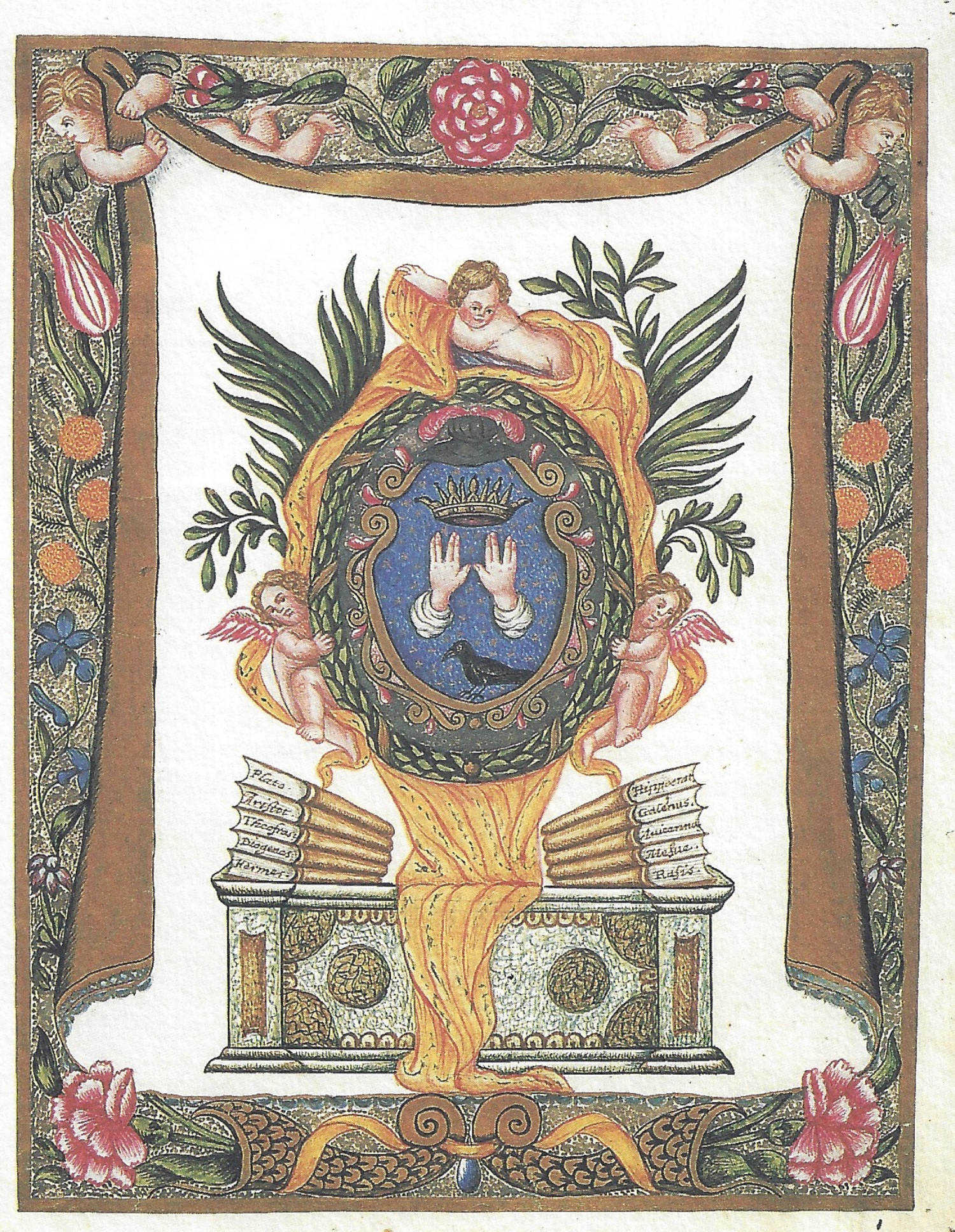
Even if we concede that not all those named Coen, or derivatives thereof, were necessarily Kohanim, many certainly were. Below is the family crest of Samuele Coen as it appears in his Padua medical diploma from 1702.[28] Notice the image of the hand configuration used by the Kohen during the Priestly blessing.

In addition, there are eleven members of the Cantarini family, a family of Kohanim, who graduated as physicians from the University of Padua during this period. Below is the front page of the medical diploma of Grassin Cantarini (1703),[29] here again we find the Kohen’s symbol.

The percentage of Kohanim who attended Padua’s medical school, roughly thirty out of a total of some 350 for this period, is significantly higher than the average percentage of Kohanim in the general Jewish population.[30] How then do we explain the absence of discussion in the literature? It is certainly possible that these relatively few Kohanim, despite their high percentage of the total, simply did not inquire of rabbinic authorities. Alternatively, the few inquiries that did occur where not committed to writing, or did not survive the ravages of time.

More problematic is that some of the Kohen Padua graduates were outstanding Torah scholars and prolific authors, such as Isaac Hayyim Cantarini,[31] Tuviya HaRofe (AKA Tuviya haKohen),[32] and Abraham Sacerdote (AKA Avraham HaKohen).[33] Oe mnight have expected at least one of these scholars to address this issue somewhere in their writings. Yet, there is no mention in any of their extensive writings of any concern with their participation in the anatomy course. Indeed, while Tuviya fondly recalls his medical training in Padua in the introduction to his Ma’aseh Tuviya, there is no mention of any challenge with performing dissection as a Kohen. Cantarini, in his Pahad Yitzhak, devotes a section to a tragic case where a Jewish body was kidnapped by non-Jewish students for the dissection table. Again, no mention of any concern about Kohanim and dissection. In addition, we have an account of Cantarini bringing Abraham Levi, a visiting scholar to Padua, to see the anatomy theater to showcase the highlights of Padua.[34]


While we may not find the names of these three Kohen student scholars etched into the wooden planks of the structure, they all likely took their seats,[35] along with their other non-Kohen Jewish classmates, in the famous anatomical theater at the University of Padua, which was inaugurated in 1595 as the first permanent structure devoted to anatomical dissection, and is still standing to this day.

I suspect that the answer to the conspicuous omission lies elsewhere, based on the history of anatomical training in general, and at the University of Padua in particular.

The Nature of Anatomical Teaching in the Pre-Modern Era

A mention of anatomy lab today evokes an image of a small group of students huddled over a body with dissecting instruments in hand. We also often find reference to the anatomy students designating a name for their cadaver, as they dissect one body for the entire course. Unlike the anatomy labs of today, in pre-Modern times body preservation technologies were not available, and a corpse was only usable for a few days to weeks. The dissections or yesteryear were held in an “anatomical theater.”[36] The format of anatomy teaching involved the professor alone performing the dissection and teaching over the body while others merely observed. Students did not perform any hands-on dissection, partially because there was little time until the decomposition of the body, and thus had no direct contact with the corpse. This can be seen in the frontispiece of Vesalius’ classic work:

This is also reflected in the design of the anatomical theater in Padua, which was built shortly after the tenure of Vesalius, and can be visited today.

There is a central oval table surrounded by coliseum-like concentric rows of progressively elevated platforms. This basic architectural design was copied for other anatomical theaters across the world, such as those below:

University of Bologna: Anatomical Theater (est. 1636)

University of Leiden: Anatomical Theater (est. 1594)

This illustration is from 1610. Parenthetically, the Keeper of the Anatomical Theater of Leiden from 1617-1650 was Professor Otto Heurnius.[37] Heurnius was the promoter for the medical graduation of David de Haro,[38] the first Jewish medical graduate of the University of Leiden.

By the mid 1600’s Jews started attending the University of Leiden in higher numbers. We have numerous matriculation records of Jews with the name Cohen.[39]For example:

Samuel Cohen from Hamburg matriculated to the medical faculty (M) in September 1646.

A Pure Solution

As a medical student in the anatomical theater served only as an observer, and performed no actual dissection, there would have been no concern for impurity conveyed through direct contact with a corpse. The only potential concern for a Kohen in the anatomical theater would have been tumat ohel, whereby impurity is conveyed by being under the same enclosure as a cadaver. While there is general halakhic consensus that impurity conveyed by direct contact applies to the bodies of both Jews and non-Jews, there is a halakhic debate regarding whether a non-Jewish corpse conveys tumat ohel.[40] It is certainly possible that the Kohanim who attended the lectures in the anatomical theater of Padua (and in anatomical theaters at other universities at this time) relied on the permissive position that a non-Jewish corpse does not convey tumat ohel. This would have allowed them to attend dissections without violating any halakhic precepts.

However, there still remained at least a theoretical possibility that the cadaver would be Jewish, in which case the permissive option would no longer apply. For a unique historical reason, this concern was non-existent for the anatomical dissection course at the University of Padua. In fact, the university struggled to provide cadavers for the course and turned to each community represented on campus, including the Jewish community, to provide bodies for the dissection table. However, the Jewish community adamantly refused, citing religious concerns with postmortem dissection. While there was continuous tension about this issue, the Jewish community arranged an agreement to provide large sums of money annually to the university for the privilege of releasing the Jewish community of this obligation. This general agreement, with periodic reassessments and renegotiations, essentially remained in force for some two hundred years.[41] Thus, all the Coens and Cantarinis who attended the University of Padua did not have to worry about the possibility that the cadaver under the scalpel of Vesalius or Fallopius was Jewish.

The Architectural Design of the Padua Anatomical Theater

Moreover, a unique structural feature of the Padua anatomical theater may have further mitigated any potential halakhic concern for a Kohen wishing to study medicine at Padua. The original anatomical theater had a retractable roof[42]  which was opened during dissections to release or eliminate the foul odors of a progressively decaying cadaver. Thus, even tumat ohel may have been a non-issue as in the absence of a roof there would have been no halakhic enclosure to convey impurity. This would have virtually eliminated the halakhic obstacle for a Kohen medical student.

An Alternate Solution for Kohanim

What of a Kohen desirous of a university medical education who would not rely on a permissive ruling regarding tumat ohel and the non-Jewish cadaver? By the 17th century, medical schools struggled to acquire enough cadavers to meet the growing demand of anatomy students. The need to provide a nonperishable substitute led to the production of highly accurate anatomical wax models that were sculpted through direct observation of dissected cadavers. Such models had distinct advantages, as they neither decomposed nor emitted foul odors and were continuously available. They proved essential to the education of generations of medical students who would otherwise, due to the short supply of cadavers, not have access to the anatomical education gleaned from human dissection.[43]

Spectacular wax models were produced throughout Europe, especially in Italy and England, from the seventeenth to nineteenth centuries, some of which can be seen to this day in Museums in Florence (La Specola), Bologna and London.[44]

This seems to me to be an ideal solution for a Kohen who wished to train in medicine in the Early Modern period. The use of wax models, with no human cadavers involved at all, would pose no halakhic problem whatsoever. While I am unaware of any Kohen medical student who ever took advantage of this option, the modern iteration of this concept, as we discuss below, may entirely replace cadaver dissection.

Kohanim in Medical School from the Eighteenth Century Onwards

From the eighteenth and into the nineteenth century, apprenticeship became less accepted and university training was often required for licensure. As a result, Jewish admission to medical schools increased exponentially throughout Europe and the United States. In addition, the anatomy labs began to transition to hands-on dissection for all students. This was simultaneously accompanied by a major cultural movement in Germany, the main location of Jewish medical training at this time, known as the Haskala. This movement was associated with the decreasing religiosity of at least a percentage of the Jewish university students, not to mention the conversion of some to Christianity. A family name of Cohen on a matriculation record in this period, even if identified, is certainly no guarantee of a student knowledgeable or concerned with the issues of tumah.

How would a Kohen navigate medical training in this milieu? The student encountered by Rabbi Frankel in Breslau was training precisely in this context, at the end of eighteenth century. Was the student known by his initials “HI” training in a medical school where he was required to perform hands-on dissection, and this is perhaps why Rabbi Frankel ruled as he did; or perhaps the medical school still had an anatomical theater, as many still did, and Rabbi Frankel did not accept the permissive ruling that tumat ohel does not apply to a non-Jewish cadaver. Was “HI” influenced by the newly forming Haskala movement in Germany at that time, which led him to be less deferential to rabbinic authority?

Two additional examples of Kohanim and medical training from the nineteenth century are illustrative. We have at least one record of a “Cohen” in the early nineteenth century refusing to go to medical school because of the required anatomical dissection. A young Albert Cohen, originally from Paris, describes his initial encounter with anatomical dissection in Vienna in the early nineteenth century:[45]

I went to Vienna, where I pursued my studies at the grammar school and university from 1826-1834. Being now nineteen years old, it became necessary to decide what profession I would adopt. Hitherto all young people of my native place who devoted themselves to literature studied medicine; this was then the only profession open to me. To please my parents, I would have followed the same career, had I ever been able to prevail upon myself to dissect a corpse. Several times I entered the anatomical theatre, but each time I was seized with unconquerable disgust. I therefore requested my parents to allow me to follow my own taste. Henceforth I devoted myself to the study of Oriental languages.

I suspect the parental conversation about his career change may have been a bit more dramatic than reflected in this passage. Nonetheless, we learn that it was anatomy that turned this young Jewish Kohen student away from a career in medicine, though it does not appear to have been halakhically motivated.

Around the same time, Sigismund Cohen, a native of Lower Silesia, the area of modern-day Poland and the rabbinic domain of Rabbi Joseph Jonas Frankel a few decades earlier, attended the University of Viadrina (Frankfurt), graduating in 1846. The topic of his dissertation- Talmudic Medicine:

For a Jewish medical student to write a medical dissertation on a Jewish topic was quite uncommon, to say the least.[46] It is somewhat ironic that a thorough analysis of Biblical and Talmudic law might have led Cohen to the realization that there was a potential halakhic issue with his training and may have preempted the necessity for Cohen to write this dissertation in the first place. Nevertheless, as this dissertation is remarkable on many levels, I offer a few comments.

From a medical and medical historical perspective, Cohen acknowledges his professors by name, one of whom was Jan Evangelista Purkinje, who taught him human physiology. Purkinje, a Czech anatomist and physiologist, was one of the most famous scientists in Europe and his discoveries included the so-called Purkinje Cell in the cerebellum and the so-called Purkinje fibres in the electrical system of the heart, structures familiar to any medical student today.

This dissertation also has great significance in the field of Jewish medical history. While we do not know with certainty the nature of Cohen’s Jewish knowledge and religious observance, the dissertation includes a brief biography as an appendix. An excerpt about his early education is below:

While we find reference to the study of “Pentateuchi origine” and “grammatice Hebraica,” Talmudic study is not specifically mentioned, and there is clearly a strong educational focus on secular studies. The 28-page dissertation itself however contains a wealth of Talmudic references.

I also draw attention to three specific sources cited by Cohen, one from a century earlier, the others contemporary.

1) Benjamin Wolff Gintzburger, Medicina ex Talmudicis, inaugural Dissertation 1743

Benjamin Wolff Gintzburger was one of the first Jewish graduates of the University of Gottingen. It was my search for references to Gintzburger that precipitated this contribution.[47] His medical dissertation, referenced by Cohen, is one of the first works written on Biblical and Talmudic medicine.[48]

Apropos our discussion about dissection, Gintzburger is better known in the halakhic world as the questioner of a (now famous) teshuva to Rabbi Yaakov Emden about performing anatomical dissection on Shabbos.[49]

2) Abraham Hartog Israels, Tentamen hist.-med. Exhibens Collectanea Gynaecologica ex Talmude Babylonica (Grongen, 1845)

Israels graduated from the University of Groningen in 1845, just a year before Cohen, and the topic of his dissertation was obstetrics and gynecology in the Babylonian Talmud.

This dissertation gained notoriety for its fourth chapter, on Cesarean section, which suggests that the rabbis of the Mishnah were able to perform cesarean section with maternal survival, something not recorded in secular medical history until around 1500. This was based on an interpretation of a Mishna in Bechorot.[50]  Cohen discusses this chapter in his dissertation.

3) Eliakim Carmoly, Histoire des Médecins Juifs, Anciens et Modernes (1844)

Carmoly served as the major work of reference in Jewish medical history for this period. Selections were translated into English just one year after publication.[51] While the reliability of Carmoly’s work was called into question by critics,[52] it nonetheless contains a wealth of valuable information.

Returning to our student, regarding Cohen’s presumptive status as a Kohen training in medicine, he devotes a chapter of his treatise to anatomy and cites a passage in the Talmud where dissection was performed.[53] More relevant, in his bio, he includes mention and thanks to those who assisted him during his studies in the anatomical theater:

Anatomical dissection did not appear to be an impediment for this Cohen. However, there is one observation, admittedly a possible over-read or mistranslation, which may indicate specific accommodations for Sigismund in his dissection course.[54] In his lengthy list of professors, Cohen simply mentions the subject and the professor. In his mention of the anatomical theater, he adds, “in the anatomical theater there were guides for me….” Could this possibly be an allusion to specific accommodation provided to Sigismund? Perhaps his professors performed the dissection while he observed but did not touch the corpse directly.

Conclusion: The Opening and Reclosing of the Priestly Portal

Halakhic references to a Kohen attending medical school are noticeably absent from rabbinic literature before the nineteenth century. We have suggested plausible explanations for this anomaly. For much of history, Jewish physicians trained through apprenticeship where formal anatomical instruction was not required. As such, there would have been no halakhic issues for a Kohen, as noted by Rabbi Moshe Feinstein. When Vesalius introduced the comprehensive anatomy course into the medical school curriculum, dissections were performed in anatomical theaters, where students never touched the cadavers. At least some Kohanim may have relied on the permissive ruling that non-Jewish cadavers do not convey tumat ohel. When hands-on dissection became the norm, as Rabbi Lord Jakobovits suggested, it is certainly possible that many religiously observant Kohanim elected to bypass medicine as a career choice, or were perhaps discouraged to do so by local rabbis like Rabbi Frankel. Of the Kohanim who opted for a medical career, some may have sought rabbinic approval, though no records exist. Others, whose priestly-sounding names appear in university matriculation records of the period, may have been less Jewishly educated or less religiously observant. Hence no halakhic questions would have been generated from this latter group.

The portal to rabbinic discussion on this topic only fully opened in the twentieth century. In the modern era we have a diverse halakhic landscape regarding the training of Kohanim in medicine, including discussion about the permissive ruling of tumat ohel, as well as creative solutions to potentially allow direct dissection. I leave these discussions to each Kohen student and his posek but leave you with a final thought.

Given current advances and changing perspectives in anatomical training, we may again soon see the portal close to the corpus of responsa related to the Kohen medical student. Some five hundred years after Vesalius introduced anatomical dissection into medical training, which was accompanied by the exhumation of bodies from their graves, we are now on the cusp of the (re)burial of human anatomy lab and its associated cadavers. With advances in imaging technology and simulation, coupled with the ethical re-evaluation of body procurement methods and preservation, the expansive year-long anatomy course with full body dissection is rapidly becoming a relic of medical history.[55] The classic dissection table is gradually being replaced with the likes of the digital Anatomage table:

If this is not sufficient, it is now possible to produce life-like anatomical models with the use of 3D printing.[56] Even dissection of the model may be possible.

These conceptual descendants and updated versions of the Florentine wax models may soon replace cadaveric dissection altogether.[57] The list of medical schools eliminating or significantly curtailing human anatomy lab courses is continually expanding.

While the impact of the diminution of human dissection on medical education remains to be determined, if phased out, it will certainly have a significant halakhic impact and it may return us to the days of the earlier generations mentioned by Rav Moshe Feinstein when students “learn the entirety of medical knowledge without the necessity of gazing upon a human corpse.” This would potentially open the door for Kohanim to attend medical school (at least for the pre-clinical years) with halakhic impunity.[58] We may notice a commensurate rise in the number of Dr. Cohens in hospital registries. The medical halakhic textbooks may no longer include a chapter on “The Kohen in Medical School,” and the halakhic discussions on this topic may again fall silent. If future scholars at some later stage of history ponder the priestly mystery of the intermittent silence of the historical record on Kohanim, dissection and medical training, I suspect their search engines will direct them to this article.

Appendix:

The Importance of the Study of Broadsides in Jewish (Medical) History – The Kohen Physician Today and the Diagnosis of Death

In June of 2024, I participated as a speaker in a conference entitled, “The Role of Broadsides in Jewish Ritualistic and Cultural Space,” organized by Professor Avriel Bar-Levav of the open University of Israel and held at the new National Library of Israel. It was the first conference of its kind, dedicated solely to the integration of Broadsides into the study of Jewish history. Taking a single printed page (the definition of a Broadside) out of Avriel’s playbook, I briefly share an example of the value of Broadsides for the study of Jewish medical history, as it relates to our topic.

As mentioned in the article above, one of the earliest halakhic sources relating to a Kohen and the practice of medicine addresses the case of a Kohen physician who was asked to confirm the death of a patient in order to facilitate burial. The question was asked in the nineteenth century, in the medical historical context of a generation concerned about the misdiagnosis of death and the resultant institution of a three-day delay in burial to medically confirm a patient’s demise.

While the prolonged delay in burial may be a relic of the past, the necessity to confirm death remains a part of modern medical practice. As such, similar halakhic cases of a Kohen physician involved in the confirmation of death occur to this very day. I share one example here which reflects yet another fascinating and complex chapter in Jewish medical history, evidenced by a broadside found in a miscellaneous collection of broadsides in the Library of Congress.

In 1976 Rabbi Moshe Lemberger was asked about the case of an observant Kohen physician who witnessed a cardiac arrest of a man on the street.[59] The person did not survive. While it is generally prohibited for a Kohen to come in contact with a corpse, if this physician were to officially declare death of the person on the scene, and attest to the absence of foul play, the deceased would be transferred directly to the funeral home for immediate burial.

As per the questioner, if the Kohen physician refused to intervene, the patient would be transferred to the hospital. Burial would certainly be delayed, and in addition, there would be a high likelihood of autopsy, with organs often removed from the deceased without consent. Rabbi Lemberger concluded that this would constitute a case of met mitzvah (a deceased person with no one to attend to their burial), and due to these extenuating circumstances, the Kohen could expose himself to impurity to prevent the delay of burial and likely desecration of the body.

This comment “and often organs are removed from the deceased without consent” reflects a reality in Israel at this time.[60] When Israel established its own hospitals and medical system in the early twentieth century, it struggled to navigate a halakhically acceptable path for the allowance of autopsies, an integral part of standard medical practice. While detailed guidelines for the performance of autopsies were established with rabbinic guidance, many members of the medical community rejected any restrictions on their practice. Despite the legislation, the medical establishment flagrantly disregarded the laws and were known in many cases to perform autopsies, including organ removal, without patient or family consent. This evolved into a notorious autopsy scandal in the young State of Israel, which shattered faith in the medical establishment, with reverberations felt to this day. This ultimately resulted in the reformation and greater enforcement of the law.

I recently discovered a lone broadside buried in a miscellaneous collection housed in the Library of Congress,[61] which though undated, was likely printed around the time of the above responsum.

This Broadside was clearly intended to be posted in a cemetery and is divided into two sections.

On the left side is an accusation that the deceased more likely than not underwent an autopsy upon their death, and that the remaining relative, the likely reader of the broadside, did nothing to prevent it.

Dear Brother,
You are now standing beside the grave of your relative who was dear to your heart and whose flame of life was suddenly extinguished.
We wish to ask you if you have considered the possibility that your loved one has undergone extensive dissection [autopsy] and while the body is here, who knows the location of the internal organs of the body. Perhaps they never merited to a proper burial (more than 50% of bodies are dissected in Jerusalem).
What did you do to prevent this from happening?
As you stand beside the grave, the deceased beseeches you to repent for this. How will you answer?
The answer:
Accept upon yourself to protect your loved ones in the future. With all your power and capability seek to prevent the forced dissection by pathologists done merely for personal advancement.
Do this for the honor of both the living and the dead.
Committee for the protection of the honor of man

On the right side of the broadside is a text to be recited by the remaining relative asking forgiveness from their deceased loved one for allowing them to undergo an autopsy.

This unique broadside contributes to the study of the history of autopsies in Israel, provides valuable information possibly not attainable elsewhere, and adds to the relatively few items of material culture in Jewish medical history.

[1] Johann Georg Estor, Des Marburgischen Vicecanzlers Herrn Johann Georg Estors academische Abhandlung von der Misslichkeit derer Judeneide: aus dem Lateinischen übersetzt (Verlegts Johann George Trausold, 1753).
[2] Pgs. 13-14.
[3] p. 14, n. 12.
[4] Braunschweigische Anzeigen (October 5, 1748), section 80, p. 1608.
[5] Braunschweigische Anzeigen (April 8, 1750), Section 28, column 564.
[6] See Monika Richarz, Der Eintritt der Juden in die akademischen Berufe: Jüdische Studenten und Akademiker in Deutschland 1678-1848 (Schriftenreihe Wissenschaftlicher Abhandlungen des Leo Baeck: Tübingen, 1974; now available in English translation, German Jews and the University, 1678- 1848, by Camden House, 2022.
[7] Avraham Steinberg, HaRefuah KiHalakhah (Jerusalem, 5777), section 10, chapter 3.
[8] Edward Reichman, “The Anatomy of an Auction: A Previously Undissected Body of Literature on the History of the Jews and Postmortem Dissection,” Seforim Blog (https://seforimblog.com), June 13, 2023.
[9] For English language references, see, J. David Bleich, “Kohanim as Medical and Dental Students,” in his Judaism and Healing (Ktav Publishers, 2002), 37-42; Fred Rosner, “Priests’ (Kohanim) Studying and Practicing Medicine,” Journal of Halacha and Contemporary Society 8 (Fall 1984), 48-61; Alfred S. Cohen, “Tumeah of a Kohen: Theory and Practice,” Journal of Halacha and Contemporary Society 15 (Spring 1988), 25-49; Avraham Steinberg, Encyclopedia of Jewish Medical Ethics, trans. F. Rosner (Feldheim Publishers, 2003), s. v., “Kohen.”
[10] To be sure, the potential halakhic concerns do not end there, and a Kohen physician would continually need to navigate potential exposure to a deceased body. Today, this might lead a Kohen to limit his choice of specialty to one with minimal exposure to the critically ill patient. But even this is not sufficient, as the prospect exists of encountering a deceased patient in a hospital setting. Specialties with predominantly outpatient focus might be preferred, and consultation with a competent rabbinic authority should be encouraged.
[11] Myron Kolatch, “The Yeshiva and the Medical School,” Commentary (May, 1960).
[12] J. David Bleich, “Kohanim Studying in Medical School,” (Hebrew) Moshe Hershler, ed., Halakha U’Refuah 3 (Machon Regensburg: Jerusalem, 5743), 199-210, citing Kerem Chemed 8 (5614). This case is not widely known, I suspect because it appeared in a journal article as opposed to a traditional work of responsa.
[13] The Hatam Sofer famously addressed a virtually identical case around the same time. Y. D., 338.
[14] Much has been written about this halakhic chapter regarding delayed burial. For example, see R. Moshe Samet, “Delaying Burial: The History of the Polemic on the Determination of the Time of Death,” (Hebrew) Asufot 3 (1989/1990), 613–665, for an expansive study of this halakhic chapter; Michael Panitz, Modernity and Mortality: The Transformation of Central European Jewish Responses to Death, 1750-1850 (PhD Dissertation, Jewish Theological Seminary, 1989). Rabbi Yehiel Goldhaber has recently added expansive research to this topic.
[15] While the governmental authorities refused to declare such patients dead until the presence of visible external signs (such as gangrene or rigor mortis), they would have already met the halakhic criteria for death according to poskim such as the Hatam Sofer. It thus became a question of a kohen exposing himself to a halakhically dead body, and whether this encounter would be justified under the principle of met mitzvah (a deceased person with no one to attend to their burial).
[16] Shulhan Arukh, Y. D., 370.
[17] Vom Stamme Aaron und dessen angeblichen Vorrechten: ein Beytrag zum Judenwesen. David and Son: Jerusalem,1817), 27-29.
[18] There was no medical school in Breslau at this time though there may have been anatomical training. HI could also have lived in Breslau but trained elsewhere such as at the University of Prague.
[19] Igrot Moshe, Y. D., 3:155.
[20]  Zimmels erroneously assumed that it was not an obligatory part of training. Zimmels, op. cit., 19. He also cites sources that dissection became part of university training only in the eighteenth century, when in fact it began centuries earlier. Not as much was known about the history of the University of Padua in the time of both Zimmels and Jakobovits.
[21] H. J. Zimmels, Magicians, Theologians and Doctors: Studies in Folk Medicine and Folklore as Reflected in Rabbinical Responsa (Goldston and Sons: London, 1952), 178, n. 64.
[22] Immanuel Jakobovits, Jewish Medical Ethics (Bloch Publishing: New York, 1959), 355-356, notes 26 and 27.
[23]  One of the Kohen physicians of the Talmudic period was Rabbi Yishmael. It is his students who performed one of the earliest anatomical dissections in history, and the only one mentioned in the Talmud (Bekhorot 45a). In fact, Preuss suggests that it was specifically Rabbi Yishmael’s students who performed the dissection, as their teacher, being a Kohen, absented himself from the cadaveric examination. See. F. Rosner, trans. and ed., Julius Preuss’ Biblical and Talmudic Medicine (Hebrew Publishing Company: New York, 1978), 43.
[24] Nathan Koren, Jewish Physicians: A Biographical Index (Israel Universities Press: Jerusalem, 1973). His separate list of Jewish doctors in Modern times, not our concern here, has many more priestly names.
[25] See H. Friedenwald, “The Jewish Medical Student of Former Days,” Menorah Journal 7:1(February, 1921), 52-62; Cecil Roth, “The Medieval University and the Jew,” Menora Journal 9:2 (1930), 128-41; idem, “The Qualification of Jewish Physicians in the Middle Ages,” Speculum 28 (1953), 834-43.
[26] Jakobovits, op. cit., 241. Jakobovits relied on scholars such as Lewin, who explicitly mentioned Kohanim in his essay: “Nur vereinzelt findet sich 1738 ein Artz aus priesterlichem Stamme” (Only a few doctors from priestly lineage can be found in 1738.) See Louis Lewin, “Judische Aerzte in Grosspolin,” Jahrbuch der Jüdisch-Literarischen Gesellschaft 9 (1911), 395.
[27] Most of them are not listed by Nathan Koren. Abdelkader Modena and Edgardo Morpurgo (with editing and additions done posthumously by Aldo Luzzatto, Ladislao Munster and Vittore Colorni), Medici E Chirurghi Ebrei Dottorati E Licenziati Nell Universita Di Padova dal 1617 al 1816 (Bologna, 1967).
[28] University of Padua Archives, Raccolta Diplomi, 33 (n. 3841).
[29] Penn Libraries Judaic Collection, Call number Mapcase CAJS Rar Ms 531, identifier 9978072224103681. I thank Arthur Kiron for bringing this diploma to my attention. While the cartouche in this diploma is blank, it was often filled with either text or the student’s portrait.
[30] While the Kohanim represent a high percentage, their objective numbers are still low. While one must also concede that any lists of Jewish physicians we possess are far from complete, the numbers of Kohanim are not likely to vary significantly.
[31] On Cantarini, see, Harry A. Savitz, Profiles of Erudite Jewish Physicians and Scholars (Spertus College of Judaica Press, 1973), 25-28; C. Facchini, “Icone in sinagoga: emblemi e imprese nella predicazione barocca di I.H. Cantarini”, in Materia Giudaica, 7 (2002), 124–144. I thank Professor David Ruderman for this last reference. Cantarini’s Jewish legal responsa were published in both Yitzḥak Lampronti’s Paad Yitzak and Samson Morpurgo’s Shemesh Tzedakah. For his correspondence with the Christian intellectual Theophilo Ungar, see Y. Blumenfeld, Otzar Nehmad 3 (Vienna, 1860), 128-50. For the definitive work on the Cantarini family, see Marco Osimo, Narrazione della Strage Compiuta nel 1547 Contro gli Ebrei d’Asolo e Cenni Biografici della Famiglia Koen-Cantarini (Casale-Monferrato, 1875). For a comprehensive bibliography on Cantarini, see Asher Salah, La Republique des Lettres: Rabbins, Ecrivains et Medecins, Juifs en Italie au XVIIIe Siecle (Brill: Leiden, 2007), 120-124.
[32] Much has been written on Tuviyah. For the most recent contribution, see Kenneth Collins and Samuel Kottek, eds., Ma’ase Tuviya (Venice, 1708): Tuviya Cohen on Medicine and Science (Jerusalem: Muriel and Philip Berman Medical Library of the Hebrew University of Jerusalem, 2021). See also A. Levinson, “A Medical Cyclopedist of the Seventeenth Century,” Bulletin of the Society of Medical History (January, 1917), 27-44; D. A. Friedman, “Tuvia HaRofeh,” (Hebrew) (Palestine Jewish Medical Association, 1940); M. J. Mahler, A Precursor of the Jewish Enlightenment: Dr. Tobias Cohen and his Ma’aseh Tuvia (unpublished thesis for ordination, Hebrew Union College, NY, 1978); N. Allan, “Illustrations From the Wellcome Institute Library: A Jewish Physician in the Seventeenth Century,” Medical History 28(1984), 324-328; D. Ruderman, “On the Diffusion of Scientific Knowledge Within the Jewish Community: The Medical Textbook of Tobias Cohen,” in his Jewish Though and Scientific Discovery in Early Modern Europe (Yale University Press: New Haven, 1995), 229-255; S. G. Massry, et. al., Jewish Medicine and the University of Padua: Contribution of the Padua Graduate Toviah Cohen to Nephrology,” American Journal of Nephrology 19:2(1999), 213-21; E. Lepicard, “An Alternative to the Cosmic and Mechanic Metaphors for the Human Body? The House Illustration in Ma’aseh Tuviyah (1708),” Medical History 52(2008), 93-105; Koroth 20(2009-2010) where five articles are devoted to Tobias Cohen and his work Ma’aseh Tuvia. On the relationship of Cohen with the Jerusalem physician Rabbi Dr. David De Silva, as well as for information about the death of Cohen, see Z. Amar, Pri Megaddim by Rabbi David de Silva Physician of Jerusalem (Yad Ben Tzvi Press: Jerusalem, 2003), 41-45.
[33] See Meir Benayahu, “Rabbi Avraham Ha-Kohen Mi-Zanti U-Lehakat Ha-Rof ’im Ha-Meshorerim Be-Padova,” Ha-Sifrut 26 (1978): 108-40.
[34] See Shmuel Feiner, The Jewish Eighteenth Century: A Jewish Biography, 1700-1750 (Indiana University Press, 2020), 242.
[35] Technically not seats, as they stood in the amphitheater.
[36] See G. H. Schumacher, “Theatrum Anatomicum in History and Today,” International Journal of Morphology 25:1 (2007), 15-32.
[37] Heurnius also spent large sums of money on mummies, idols, stuffed crocodiles, Nile-reed and so on, “with the explicit aim of re-telling the story of the life of Israel’s children under the wise Pharoah.” This would have been exhibited in the anatomical theater. See Klaas van Berkel, et. al., eds., The Book of Nature in Early Modern and Modern History (Peeters Publishers, 2006), 51.
[38] See Edward Reichman, “A ‘Haro’ing Tale of a Jewish Medical Student: Notes on David de Haro (1611-1636): The First Jewish Medical Graduate of the University of Leiden,” Bibliotheca Rosenthaliana 48:1 (2022), 30-52.
[39] These entries are found in the matriculation records of the University of Leiden, Album Studiosorum Academiae Lugduno Batavae 1575-1875.
[40] For recent treatment of this topic, see the works of Tzvi Ryzman, Ratz KaTzvi: Inyanei Kehuna (3 volumes) (2 Adar, 5782); idem, “Kohanim studying medicine,” (Hebrew) in Ratz KaTzvi: Refuah- Pikuah Nefesh (Shevat, 5784), 218-233.
[41] For further discussion of this historical chapter, see Edward Reichman, “The Anatomy of an Auction: A Previously Undissected Body of Literature on the History of the Jews and Postmortem Dissection,” Seforim Blog (https://seforimblog.com), June 13, 2023. Regarding the possibility of their being a Jewish cadaver at other medical schools, I am aware of at least one case, albeit rare, of a Jewish criminal sentenced to death in Amsterdam whose body was transferred to the medical school in Leiden for dissection. See Tzvi Malahi, biNoam Siah (Makhon Haberman: Israel, 5743), 275-276.
[42] https://alcmaeon.pixel-online.org/DM_page3.php?sid=118.
[43] Francesco Galassi, et. al., “Marvels of the Bologna Anatomical Wax Museum,” HAPS Educator 19:2 (Spring 2015), 4-9; R. Ballestriero, “Anatomical Models and Wax Venuses: Art Masterpieces or Scientific Craft Works?” Journal of Anatomy 216:2 (2010), 223-234; A. W. Bates, “’Indecent and Demoralizing Representations’: Public Anatomy Museums in mid-Victorian England,” Medical History 52 (2008), 1-22.
[44] Galassi, op. cit.
[45] Jewish Chronicle (December 23, 1861), 7.
[46] See Edward Reichman, “The History of the Jewish Medical Student Dissertation: An Evolving Jewish Tradition,” in in J. Karp and M. Schaikewitz, eds., Sacred Training: A Halakhic Guidebook for Medical Students and Residents (Ammud Press: New York, 2018), xvii- xxxvii.
[47] An expansive essay on Gintzburger is forthcoming.
[48] For a review of the literature on this topic see Edward Reichman, “Biblical and Talmudic Medicine: A Bibliographical Essay,” The Anatomy of Jewish Law: A Fresh Dissection of the Relationship of Medicine, Medical History and Rabbinic Literature (OU/Maggid/Yeshiva University Press, 2022), 511-521.
[49] She’ilat Ya’avetz 1:41.
[50] For further discussion, see Edward Reichman, “A Matter of Life ‘in’ Death: Postmortem Cesarean Section in Jewish Law,” in The Anatomy of Jewish Law: A Fresh Dissection of the Relationship of Medicine, Medical History and Rabbinic Literature (OU/Maggid/Yeshiva University Press, 2022), 477-508.
[51] History of the Jewish Physicians, from the French of E. Carmoly, by John R. W. Dunbar (J. Murphy: Baltimore, 1845).
[52]  See, for example, “Carmoly, Eliakim” in Singer, Isidore; et al. (eds.), The Jewish Encyclopedia (Funk & Wagnalls: New York, 1901-1906).
[53] Bekhorot 45a.
[54] I thank my dear wife Sara for this observation.
[55] See, for example, Bahar Gholipour, “Med School without Cadavers?  Some medical schools are turning to virtual reality instead of dissection,” Scientific American (October 1, 2019).
[56] Companies like Anatomy Warehouse and GT Stimulators produce such models.
[57] Surgical subspecialties will likely continue to require cadaveric dissection for training.
[58] There would remain potential halakhic issues with clinical rotations, residency, and the continued practice of medicine, which typically necessitate training in hospitals, where the encounter with dying patients would be a certainty. Rabbi Chaim Dovid Halevi provided a nuanced response to a Kohen in medical training even with the elimination of cadaver dissection (Asei Lekha Rav 3:22):

It is clear beyond doubt that even though we all have a status of tamei met (corpse impurity), Kohanim are nonetheless proscribed from any additional exposure to tumah. Therefore today, when the study of medicine is coupled with cadaveric dissection, I do not see a path to permit a Kohen to study medicine. Even if one is able to find a way to study medicine without cadaver dissection (as I understand is done in universities in France and Italy, where they use plastic models to teach anatomy) I still do not see how one could serve as a physician in modern times. Today, in large hospitals, not a day passes without the death of a patient, who would convey impurity. How then could a Kohen work in such a hospital? Theoretically, one could learn anatomy without cadaver dissection and then practice in outpatient clinics as opposed to hospitals. However, there still remains a challenging problem- residency or specialty training. This part of one’s education would surely require training in large hospitals.

Rabbi Halevi’s analysis assumes a Kohen training in an Israeli medical school, where the majority of patients in the hospitals would be Jewis,h and who upon death would unequivocally convey tumat ohel. For a Kohen training in the United States, or anywhere outside Israel, where the majority of patients are not Jewish, the different approaches to the application of tumat ohel to a non-Jewish corpse would apply.
[59] Ateret Moshe Y. D., 244.
[60] Fred Rosner, “Autopsy in Jewish Law and the Israeli Autopsy Controversy,” in Fred Rosner and J. David Bleich, eds., Jewish Bioethics (New York: Hebrew Publishing Company, 1979), 331-348; Zev Farber and Irving Greenberg, “Autopsies I: A Survey of the Debate,” in Zev Farber, ed., Halakhic Realities (Maggid Books: Jerusalem, 2017), 323-417.
[61] Karp Collection of Broadsides, 1307_001. I thank Sharon Horowitz, Reference Librarian of the Hebraic Collection, for furnishing me a copy of the broaside.


Hidden Treasures in Jewish Medical History at the British Library: A Post Cyber-Attack Homage

Hidden Treasures in Jewish Medical History at the British Library: A Post Cyber-Attack Homage

Rabbi Edward Reichman, MD

On October 28, 2023, the British Library (BL) fell victim to one of the worst cyber-attacks in British History.[1] Though its precious holdings thankfully remained physically unperturbed, access by scholars across the globe to the online catalog of its massive and formidable collection, some 170 million items, was disrupted. This incident shook the world’s bibliophiles to the core, and its impact on the academic community is both inestimable and ongoing. From a Jewish perspective, the BL houses one of the world’s greatest Judaica/Hebraica collections, and these unprecedented events remind us not to take for granted the value of this hallowed institution for Jewish scholarship. As of this writing, attempts to access the British Library’s Hebrew Collection online yielded the following results:[2]

In the light of this event, I feel compelled to share the lesser known, though not insignificant, contribution of the BL to the study of Jewish medical history. I explore some exceedingly rare and important items which reflect on the education of Jewish medical students in Early Modern Europe. Most are unica, found only in the BL, and all have previously escaped notice of Jewish medical historians.

I. Congratulatory Poems for Jewish Medical Graduates of the University of Padua

From the Middle Ages through much of the Early Modern period Jews were barred by Papal decree from medical training at European universities. The University of Padua in northern Italy was the first university to officially admit Jewish students for formal medical training, and its role in Jewish medical history has been well-studied. In the early seventeenth century there evolved a practice of writing congratulatory poetry for the Jewish medical graduates of the university. This poetry, which I have discussed previously in this blog,[3] appears in broadside, printed and manuscript form. The BL has unique examples in both broadside and manuscript.

A. Broadsides

The majority of the extant broadsides of this genre are found in the National Library of Israel and the Library of the Jewish Theological Seminary in New York, but the BL’s collection is substantial and contains the very earliest known examples. The BL broadsides, which took me some years to locate, are found in three miscellaneous folders and are not itemized or described in the BL catalog. A scholar of Italian Jewish history[4] directed me to an old shadow NLI catalog, still accessible online until recently, that had skeletal information about a few of these poems in the BL, but no shelfmarks were noted.[5] The librarians of the BL were unaware of these broadsides. After some years, I incidentally came across a reference to a folder of miscellaneous Hebrew broadsides in the BL and hoped that the medical poems would be among them. With the assistance of a young scholar in London,[6] who manually investigated the files on my behalf, I was ultimately able to identify all the poems.

I have identified a total of 57 different printed congratulatory broadsides for Jewish Padua medical graduates, copies of some of which can be found in multiple libraries. The BL holds a total of fourteen different broadside medical poems, nine of which are not found elsewhere.[7] Some of the personalities who are either authors or recipients of these poems include Salomon Conegliano,[8] Isaac Hayyim Cantarini,[9] and Shmuel David Ottolenghi.[10]

While the earliest poem in the JTS Library is from 1643, and in the NLI from 1664, the BL holds two broadsides from the year 1625, the earliest known examples of this genre. Below is an example of one of the 1625 poems:

Year: 1625
Graduate: COLLI, Marchio di Salomon (Machir ben Shlomo)[11]
Author: KOHEN (Katz), Shabtai ben Meir

The following, also only found in the BL, is a rare example of a congratulatory medical broadside for which the author provides a cipher for his name.

Year: 1643
Graduate: BINGEN, Salomon di Abram (Shlomo ben Avraham)[12]
Author: Only the first name is provided, and even this is done through a cipher. No last name is provided.
Location: British Library[13]

Below is the cipher for author’s first name, which I invite the reader to decipher.[14]

(While I am aware of the answer for this cipher, there is another author’s cipher whose solution remains unknown:[15]

Any assistance would be greatly appreciated.)

These early examples are important not only for assessing the beginnings and duration of the congratulatory medical broadsides but for evaluating their artistic elements as well. For example, there are stylistic aspects of the two earliest broadsides in the BL that are not found in any subsequent broadsides.[16]

B) Congratulatory Poems in Manuscript

I have identified dozens of congratulatory poems for Padua graduates that are found only in manuscript. Some are written as if templated for publication as a broadside. There is one manuscript congratulatory poem in the BL that solves a mystery which plagued the great Jewish scholar Meir Benayahu. In an article about a group of physician-poets in Early Modern Italy,[17] Benayahu published a transcription of a lengthy poem[18]written in honor of the graduation of Salomon Lustro from Padua in 1697.[19] Below are a few stanzas at the end of the poem as published by Benayahu.

Since the authorship is not explicit, Benayahu, through creative analysis of assumed allusions in the final lines, suggests Isaac Hayyim Cantarini as the likely author.

Unbeknownst to Benayahu, another manuscript copy of the same poem is found in the BL.[20] The same final verses appear below, though with a different layout:

There is also another key difference, an additional line.

The last line provides the name of the author, one Yitzḥak the son of Yedidia Zecharia meUrbino. As described in the introduction to the manuscript, after Urbino died, his son, Yedidia Binyamin, collected his father’s poetic writings into an untitled manuscript volume, now housed in the BL. This volume contains two poems for Lustro.

II. Training of Jewish Medical Students in the Netherlands and the Sloane Dissertation Collection

In the early to mid-seventeenth century, medical schools in the Netherlands began allowing Jewish medical students to matriculate. Scholars have explored this chapter of Jewish medical history.

Isaac Van Esso[21] and Hindle Hes[22] have produced lists of the Jewish physicians who trained and practiced in the Netherlands; Yosef Kaplan has written extensively about many of these physicians;[23] Manfred Komorowski has amassed an invaluable biobibliographical index of Jewish physicians in the 17th-18th centuries,[24] which includes those from the Netherlands; and Kenneth Collins has addressed the transition of the training of Jewish medical students from Padua to the Netherlands.[25]

The most famous of these Dutch medical schools was the University of Leiden. As opposed to Padua, Leiden routinely required the writing and presentation of dissertations as part of its curriculum. These dissertations are an invaluable source for the history of Jewish medical education, and while the aforementioned scholars have included them in their works to varying degrees, there is more to be learned from them.

Here I distinguish between two categories of dissertations, something not typically noted by Jewish medical historians. While some dissertations were written as part of curricular course work, much like today’s term paper, there was a separate requirement for every student to complete a comprehensive dissertation as a prerequisite for graduation. These graduation dissertations are invariably headlined with the specific phrase “Dissertatio (or Disputatio) Medica Inauguralis.” I shall refer to the non-graduation dissertations as curricular dissertations. The curricular dissertations where generally not preserved by the universities and were thought to be of less significance. Historians often are unaware of the distinction between the two.

This example is the graduation dissertation of Josephus Abarbanel, nephew of Menaseh ben Israel and cousin of Samuel ben Israel, who also trained at (but did not graduate from) Leiden.[26] Note the Jewish or Hebrew date for the year, 5415, something unique to the dissertations of Leiden Jewish graduates.

While the University of Leiden holds many of these dissertations, its collection is not complete. According to librarians and historians, with respect to student dissertations, there is a major gap, or “black hole” in the holdings of the Library of the University of Leiden for the years 1610-1654.[27] It is precisely this period that comprises the cradle of Dutch Jewish medical student training.

Fortunately, there is another major repository of Leiden dissertations, found ironically outside of the Netherlands, that partially fills this lacuna. The physician/scientist Sir Hans Sloane (1660-1753) amassed an impressive collection of plants, minerals, anatomical specimens, printed works, and manuscripts, mostly relating to the fields of medicine and natural history. This collection now resides in the BL. Sloane’s printed book collection includes a large number of medical dissertations submitted at Dutch universities (Amsterdam, Utrecht, Harlingen, but primarily Leiden), in particular a magnificent set of Leiden medical dissertations covering the period of 1593-1746. There are 53 volumes all bound in white vellum, with each volume holding some 20 to 75 dissertations,[28] including exceedingly rare curricular dissertations. In 1997, Jaap Harskamp produced a comprehensive catalog of the dissertations in the British Library based on the Sloane collection.[29]

Many of these works found are not found in any of the major libraries or universities in the Netherlands. Among these handsome volumes we find the dissertations of the earliest Jewish students to study at Leiden, allowing us to gain a window into the nature of their training. Abarbanel’s dissertation pictured above is part of this collection.

Here I highlight the value of this collection for the study of Jewish medical history. In particular, two of the curricular dissertations, authored by Jewish medical students, have been previously overlooked. They both represent “firsts” in the field. We also explore the importance of this collection as an untapped resource for a Padua-esque practice in the Netherlands.

A) Benedict De Castro- the First Jewish Student to Matriculate at the University of Leiden and his Newly Discovered Dissertation

The de Castro Family is an illustrious Sephardic Jewish family of Spanish and Portuguese origin that produced many prominent physicians over the centuries.[30] After the onset of the Inquisition, members of the family emigrated to Bordeaux, Hamburg, and to cities in the Netherlands.

Rodrigo de Castro was a Portuguese physician who escaped the inquisition to Hamburg. He authored a landmark work on gynecology, De Universa Mulierum Medicina, and was held in great esteem by both the medical and Jewish communities. His youngest son was Benedict (also known as Benedictus a Castro, Baruch Nahmias or Benito).[31]

Benedict was a physician to nobles and royalty, including Christina, Queen of Sweden, to whom he dedicated a medical work in 1647.[32] Due to his success, he was the victim of attacks by Christian doctors and Lutheran clergy. One particularly virulent diatribe precipitated his publication of a pseudonymous polemical defense entitled Flagellum Calumniantium.[33] In this work, famous among the apologetic works of Jewish physicians, he counters the lies and slanders and enumerates the great achievements of Jewish physicians.

There is no consensus among scholars as to the medical education of de Castro, something we clarify here for the first time. Friedenwald simply assumes, not unreasonably, that he was a graduate of Padua, though he adds a question mark in the text.[34] Koren writes, “graduated in Leyden,”[35] while Komorowski[36] lists him as a graduate of the University of Franeker (Netherlands). Ruderman acknowledges that “it is not clear from what university he graduated.”[37]

There is no record of Benedict de Castro ever attending Padua, though his brother Daniel graduated in 1633.[38] The university records from this period are generally complete[39] and have also been specifically examined for Jewish graduates.[40]

On November 16, 1620, at the age of 23, we have record of Benedict matriculating to the University of Leiden Medical School,[41] making him the first Jewish student to attend this prestigious institution.


Our next record of Benedict’s medical training is a dissertation he composed in Leiden in 1621, which is part of the Sloane Collection at the BL.

This document has previously escaped notice of Jewish historians. Does this mean that Benedict graduated from Leiden? This dissertation is headlined as a “Disputatio Medica,” sans the word “inauguralis.” It is thus a rare curricular dissertation, confirming Benedict’s continued education at Leiden, though not his graduation. Its historical significance lies in the fact that it is both a dissertation of the first Jewish medical student to attend the University of Leiden (and possibly any Dutch university), as well as the earliest extant dissertation written by any Jewish medical student.

According to the Archivist at the University of Leiden, students had to re-enroll before the secretary every year. However, there are large gaps in these re-enrollment records for this period.[42] From this specific period, only the records of 1622 survived (the previous re-enrollment record is from 1607, and the next is from 1650). De Castro was indeed registered in February, 1622,[43] but there is no record of his ever graduating from Leiden.

There is however a record of Benedict’s matriculating and graduated from another Dutch institution, the University of Franeker.[44] He matriculated on August 3, 1624:

We have a record of his graduation just one month later, on September 3, 1624.[45] A copy of the original archival record of his graduation is below.

As opposed to today, when a student must attend a certain number of years in a university as a prerequisite to obtaining a degree, universities of this period, and in particular in the Netherlands, often gave exams and imprimatur to those who studied elsewhere, either formally or not, but passed the required examination demonstrating the required knowledge and competence.[46] It is thus not inconceivable that Benedict’s previous study at Leiden essentially prepared him for his graduation exams at Franeker. He would not be the only one to take this path. Some decades later, Isaac Rocamora, on the recommendation of Menaseh ben Israel, matriculated at the University of Franeker on March 29, 1647, and received his degree just two days later, on April 1, 1647.[47] Rocamora had also studied previously in Leiden. While we can conjecture as to the reason de Castro elected to complete his studies at Franeker, the basis for Rocamora’s decision is revealed in a letter by Gerhard Johann Voss to Anthony van der Linden, Rector at the University of Franeker, written at the behest of Menaseh ben Israel.[48] Below is a translation of the relevant section followed by a copy of the original letter:

Yesterday, Rabbi Menaseh ben Israel came to see me, accompanied by Isaac Rocamora, a Portuguese Jew. The latter has been studying medicine for the last two years and has made such progress that he is confident that his standard is such as to qualify him for the highest degree in the subject. Owing to his slender means, he prefers that Academy (i.e., University of Franeker) where the fees of graduation are least. This Rocamora has been warmly recommended to me by your friend, Menaseh…

I suspect de Castro’s motivation for transfer may have also been financially motivated.

De Castro was well respected in the Jewish community and at least one subsequent Leiden graduate, David Pina, dedicated his dissertation to him in 1678:

Pina highlights that de Castro served as physician to Queen Christina of Sweden.

B) David de Haro- The First Jewish Medical Graduate of the University of Leiden and his Newly Discovered Dissertation

While Benedict de Castro may have been the first Jewish medical student to attend Leiden, he did not have the distinction of being its first Jewish medical graduate. That would fall to David de Haro. I have elsewhere explored de Haro’s medical education and his challenges as a Jewish student at Leiden, unearthing some remarkable archival documents.[49] One of these documents is de Haro’s 1631 medical dissertation from Leiden.

As with de Castro, this is not de Haro’s graduation dissertation, or “Dissertatio Medico Inauguralis,” and was written for Professor Franco Burgersdijck’s course at the university. This dissertation is also housed in the BL,[50] though inexplicably not part of the Sloane collection. [51] De Haro graduated in 1633 as the first Jewish medical graduate of the University of Leiden.

In March of 1637, shortly after de Haro’s untimely death, we find that his personal library was put up for auction, and a catalog of the holdings was published.[52] According to one scholar, this may be the first printed sales catalog of a book collection of a Jewish owner.[53] Among the offerings, which include medical and Hebrew religious works, we find a copy of Benedict de Castro’s apologetic work (see #23 in the list below)

De Haro’s library also contained a copy of Benedict’s father’s classic work, De Morbis Mulier.[54]

Below is a list of the Hebrew books of de Haro’s collection that were offered for auction, many of which would be found in a Jewish library today.

One of the offerings is of a somewhat medical nature, Shevilei Emunah (#12). This work, written by Meir ben Isaac Aldabi (1310–1360), the grandson of R. Asher ben Yeĥiel, is a compilation of theories in philosophy, theology, psychology, and medicine. The material was culled from the existing literature of that time,[55] as stated by Aldabi in his introduction, but unfortunately there are no references, for which R. Aldabi apologizes. Many rabbinic authorities throughout the centuries turned to this work as a reference for medical knowledge.

C) Congratulatory Poetry for Jewish Medical Graduates in the Netherlands

The congratulatory poetry for the Jewish medical graduates of Padua was most often published as broadsides. Though underappreciated for their medical historical value, these attractive ephemera of Hebrew poems, as well as broadsides of other kinds, have long been prized by collectors for their general Jewish historical and artistic value. As such, they are primarily found in Jewish libraries. Little-known to even those in the field of Early Modern Jewish poetry, the custom of writing congratulatory poetry for Jewish medical graduates continued in the Netherlands (17th-18th centuries) and Germany (18th-19th centuries). However, instead of being published as free-standing broadsides, the poems were appended to medical dissertations with less visibility and circulation. (Padua students were not required to complete graduation dissertations, necessitating the publication of the poems independently.) Furthermore, medical dissertations are not typically found in Jewish collections. While comprehensive treatment of this second chapter of congratulatory poetry remains a desideratum, the BL’s Sloane Dissertation Collection has some rare examples of these “hidden” poems. One example is below:

Graduate: Jehosua Worms (Leiden-1687)
Author: Shlomo (AKA Zalman) ben Yehuda Levi Pikart

There were later physicians named Worms, a father and son, Asher Anshel Worms and Simon Wolf Worms. Perhaps Joshua was the father of Asher Anshel, though I have as yet found no evidence of such. Asher Anshel wrote Seyag Le Torah, a masoretic commentary on the Torah. The work was published posthumously by his son Simon. It was circulated in manuscript prior to publication and was apparently plagiarized by Joseph Heilbronn,[56] a fact alluded to in the book’s introduction. Asher Anshel also wrote also wrote a commentary on the song from the Hagaddah, Chad Gadya,[57] as well as books on algebra and chess. Simon Wolf graduated Geissen in 1768 with a dissertation on the topic of the impurity of the male reproductive seed (tumat zera). This is one of the more unique dissertation topics of a Jewish student I have come across.[58]

III. A Correction to the BL Catalog

While acknowledging the BL’s immense contributions to Jewish scholarship, including Jewish medical history, I humbly submit one very minor correction which might possibly lead scholars to an erroneous conclusion. Above we briefly discuss David de Haro and identify him as the first Jewish medical graduate of the University of Leiden, in 1633. However, perusal of the Sloan Leiden dissertation collection reveals an entry for a dissertation for Jahacobus de Paz from 1631.[59] This dissertation is not found in the University of Leiden Library.

Below is the catalog entry:

A careful analysis of the actual dissertation[60] below reveals that de Paz was Jewish, as he is identified as “Hebraeus,” and that this is a copy of his graduation dissertation, titled “Disputatio Medica Inauguralis.” Perhaps we were in error, and in fact de Paz is the first Jewish medical graduate of Leiden, completing his studies in 1631?[61]

Examination of both the cover and content of the dissertation provides an answer to this question. The bottom of the dissertation’s front cover, which typically lists the date, seems have been torn off the bottom of this copy. The BL catalog lists the publication date as 1631. This date is most certainly derived from the faint penciled numbers on the front cover to the right of the emblem:

How and when these numbers came to be written, and whether they were even meant to refer to the year of publication, I suspect we will never know. But a closer inspection of the dissertation contents reveals that the date of 1631 is decidedly in error. While not found ubiquitously in all of Leiden’s student dissertations, it was common for the students to include a dedication page. Dedicatees included mentors, family members, religious leaders and medical colleagues. Below is a copy of de Paz’s dedication page.

At the bottom of the list, we find the Jewish physicians Isaac Naar[62]  and Josephus Abrabanel (with the variant spelling, adding to the age-old debate, though Josephus himself spelled it Abarbanel).[63] Both Abrabanel, whose dissertation is pictured above, and Naar, graduated Leiden in 1655. Below is Naar’s dissertation:

Indeed, university records clearly list the graduation date of Jahacobus de Paz as July 4, 1658.[64] Here is a dissertation from the same year of another Jewish student, side by side with de Paz.

(Parenthetically, the students Abarbanel, Naar, Moreno, and likely de Paz used the Jewish version of the calendar year on the cover of their dissertations.) Thus, David de Haro still retains his distinction as the first Jewish medical graduate of the University of Leiden.

Conclusion

We have shared just a few of the British Library’s treasures that relate to Jewish medical history. Our picture of the training of Jewish medical students in Early Modern Europe, from the earliest Italian congratulatory poems to the earliest Jewish medical dissertations in the Netherlands, would be wholly incomplete without the library’s contributions. Yet, this is but one epithelial cell to an entire human body with respect to the library’s broader impact.

While I will of course completely overlook the British Library’s trivial and largely inconsequential misdating of de Paz’s dissertation, it behooves us all not to overlook nor take for granted their outsized contribution to the Jewish community’s and the world’s knowledge and scholarship.

[1] See the British Library’s incident report, “Learning Lessons from the Cyber-Attack: British Library Incident Review” (March 8, 2024), https://www.bl.uk/home/british-library-cyber-incident-review-8-march-2024.pdf.
[2]
Many of the Hebrew manuscripts have been digitized. One can find a description of some of these treasures at https://blogs.bl.uk/asian-and-african/2014/11/digital-hebrew-treasures-from-the-british-library-collections.html, though the manuscripts themselves have not been accessible since the cyber-attack.
[3] See Edward Reichman, “How Jews of Yesteryear Celebrated Graduation from Medical School: Congratulatory Poems for Jewish Medical Graduates in the 17th and 18th Centuries- An Unrecognized Genre,” Seforim Blog (https://seforimblog.com), May 29, 2022.
[4] Angelo Piatelli.
[5] The links to this shadow catalog are no longer valid and it appears that the NLI recently incorporated the items into the current online catalog. The BL poems are not cataloged together with, or as part of, all the other Padua congratulatory broadsides, but rather as general poems or posters, and the original sparse information has not been yet significantly updated. They would be difficult to find unless one was looking for them specifically, which I was. These are the only entries in the NLI catalog I could find thus far for British Library congratulatory poems for Jewish medical graduates: system numbers 997009117587405171, 997011007060405171, 997011007064105171, 997009117587905171, 997011007058805171. None of these entries include images.
[6] Hadassah Katharina Wendl.
[7] These poems are all found in three folders in the Oriental and India Office Collections with the shelfmarks, 1978.f.3, 1978.f.4, and 1978.f.5. An annotated list of all these poems, with accompanying images, will appear in a forthcoming volume.
[8] Conegliano established a form of preparatory school to help acclimate the foreign students and to provide a religious environment to serve their needs. On Conegliano, see David Ruderman, Jewish Thought and Scientific Discovery in Early Modern Europe (New Haven, 1995), 111-113.
[9] On Cantarini, see, for example, H. A. Savitz, Profiles of Erudite Jewish Physicians and Scholars (Spertus College of Judaica Press, 1973), 25-28; C. Facchini, “Icone in sinagoga: emblemi e imprese nella predicazione barocca di I.H. Cantarini”, in Materia Giudaica, 7 (2002), 124–144. I thank Professor David Ruderman for this last reference. Cantarini’s Jewish legal responsa were published in both Yitzḥak Lampronti’s Paad Yitzak and Samson Morpurgo’s Shemesh Tzedakah. For his correspondence with the Christian intellectual Theophilo Ungar, see Y. Blumenfeld, Otzar Nehmad 3 (Vienna, 1860), 128-50. For the definitive work on the Cantarini family, see Marco Osimo, Narrazione della Strage Compiuta nel 1547 Contro gli Ebrei d’Asolo e Cenni Biografici della Famiglia Koen-Cantarini (Casale-Monferrato, 1875). For a comprehensive bibliography on Cantarini, see Asher Salah, La République des Lettres: Rabbins, écrivains et medecins juifs en Italie au 18th siècle (Leiden: Brill, 2007), 120-124.
[10] On Ottolenghi, see Asher Salah, op. cit., 493-495.
[11] Abdelkader Modena and Edgardo Morpurgo, Medici E Chirurghi Ebrei Dottorati E Licenziati Nell’Universita di Padova dal 1617 al 1816 (Italian) (Forni Editore, 1967), n. 18. (heretofore, M and M).
[12] M and M, n. 39.
[13] The Oriental and India Office Collections, Shelfmark 1978.f.5.
[14] Feel free to contact me for clues or guesses: ereichma@montefiore.org.
[15] This poem was written for Azriel ben Gershon Canterini, who graduated in 1706. It is housed in the JTS Library Ms. 9027 V6:19.
[16] See Edward Reichman, “Congratulatory Poetry for the Jewish Medical Graduates of the University of Padua (17th -19th centuries),” forthcoming.
[17] Meir Benayahu, “Avraham HaKohen of Zante and the Group of Physician-Poets in Padua” (Hebrew), Ha-Sifrut 26 (1978), 108-140, esp. 127.
[18] Benayahu does not seem to reference the location of the original manuscript.
[19] M and M, n. 133. On Lustro obtaining a Ḥaver degree on the same day as his medical graduation, see Edward Reichman, “The Physician-Ḥaver in Early Modern Italy: A Reunion of Long Forgotten ‘Friends,'” Seforim Blog (https://seforimblog.com), December 4, 2023. See also my forthcoming, “Restoring the Luster to HaRofeh HeHaver Solomon Lustro: The Discovery of his Haver Diploma and Numerous Previously Unknown Congratulatory Poems in his Honor.”
[20] Or 9166, 41v-43r. I thank Ahuvia Goren for bringing this poem to my attention.
[21]See, for example, Isaac Van Esso, “Het Aandeel der Joodsche Artsen in de Natuurwetenschappen in de Nederlanden,” in H. Brugmans and A. Frank, Geschiedenis der Joden in Nederland 1 (Amsterdam: Holkema & Warendorf, 1940), 643-679; idem, “Survey on Jewish Physicians in the Netherlands,” (Hebrew) Koroth 2:5-6 (October, 1959), 201-208.
[22]
Hindle S. Hes, Jewish Physicians in the Netherlands (Assen: Van Gorcum, 1980).
[23]
Yosef Kaplan, “Jewish Students at Leiden University in the Seventeenth Century,” (Hebrew) in Jozeph Michman, ed., Studies on the History of Dutch Jewry Vol. 2 (Jerusalem: Magnes Press, 1979), 65-75; idem, An Alternative Path to Modernity: The Sephardi Diaspora in Western Europe (Leiden: Brill Academic Pub, 2000).
[24]
M. Komorowski, Bio-bibliographisches Verzeichnis jüdischer Doktoren im 17. und 18. Jahrhundert (Munchen: K. G. Saur Verlag, 1991). See also F. A. Stemvers, “Promoties van Amsterdamse Joodse artsen aan Nederlandse Universiteiten Gedurende de 17e en 18e eeuw,” Aere Perennius 34 (October, 1979), 70-77. Stemvers lists the Jewish graduates of the universities of Leiden, Utrecht, Harderwijk and Franeker spanning from 1641-1798, along with the titles of their dissertations.
[25]
Kenneth Collins, “Jewish Medical Students and Graduates at the Universities of Padua and Leiden: 1617-1740,” Rambam Maimonides Medical Journal 4:1 (January, 2013), 1-8.
[26]
On the training of Samuel and his suspected forged diploma from the University of Oxford, see Edward Reichman, “The ‘Doctored’ Medical Diploma of Samuel, the Son of Menaseh ben Israel: Forgery of ‘For Jewry’,” Seforim Blog (https://seforimblog.com), March 23, 2021.
[27] Jaap Harskamp, Disertatio Medica Inauguralis… Leyden Medical Dissertations in the British Library 1593-1746 (Catalogue of a Sloane-inspired Collection) (London: Wellcome Institute for the History of medicine, 1997), preface by R. Breugelmans, Keeper of Western Printed Books, University Library Leiden. Even after this period, the Library of the University of Leiden preserved only the graduation dissertations, as it considered the curricular dissertations of little significance.
[28]
Harskamp, introduction.
[29]
Harskamp, op. cit.
[30] Harry Friedenwald, The Doctors De Castro,” in his The Jews and Medicine 3 v. (Johns Hopkins Press: Baltimore, 1944), 448-459.
[31]
On Benedict de Castro, see Friedenwald, op. cit., and David Ruderman, Jewish Thought and Scientific Discovery in Early Modern Europe (Yale University Press: New Haven, 1995), 299-307.
[32]
Monomachia sive certamen medicum (Hamburg, 1647).
[33]
or an expansive discussion of this work in the context of other apologetic compositions, see Harry Friedenwald, “Apologetic Works of Jewish Physicians,” op. cit., 31-68.
[34]
Friedenwald offers no reference and his ambivalence is reflected in his addition of a question mark, “after his graduation from Padua (?)….”
[35]
Nathan Koren, Jewish Physicians: A Biographical Index (Israel Universities Press: Jerusalem, 1973), 33. See also Hindle S. Hes, Jewish Physicians in the Netherlands 1600-1940 (Van Gorcum: Assen, 1980), 25.
[36]
Op. cit., 33.
[37]
David Ruderman, Jewish Thought and Scientific Discovery in Early Modern Europe (Yale University Press: New Haven, 1995), 299.
[38]
M and M, n. 30.
[39]
Dennj Solera has compiled a comprehensive online database of all Padua students of this period. See https://www.mobilityandhumanities.it/bo2022/banca-dati/.
[40]
For a list of the Jewish medical graduates, see Modena and Morpurgo, op. cit. Friedenwald did not have the benefit of this work.
[41]
For the printed version of the record, as seen here, see Album Studiosorum Lugduno Batavae (Martinus Nijhof: Den Haag, 1875), column 150. The original manuscript is in the Volumina inscriptionum , shelf mark ASF 8. As the digitization department of the Library of the University of Leiden is presently undergoing renovation, I was unable to procure the original. This is the registry where students’ primary enrollment was recorded. In this record it states that de Castro resided in the home of Jacobus Ijsbrandi. I thank Nicolien Karskens, archivist for the University of Leiden Special Collections, for this information.
[42]
See https://collectionguides.universiteitleiden.nl/archival_objects/aspace_c01124_2. These are different records than the initial matriculation records above, which do not have gaps.
[43]
Recensielijst of 1622 , ASF 30, The record notes that he was still residing in the home of Jacobus Ijsbrandi at this time. I thank Nicolien Karskens, archivist for the University of Leiden Special Collections, for this information.
[44]
The University of Franeker is no longer in existence. I thank Martha Kist, archivist at the Tresoar Archive and Library in Leeuwarden, Netherlands for providing copies from the Franeker archives.
[45]
Tresoar, Literature Museum, Archive and Library, Archive nr. 181, University of Franeker, inventory number 104.
[46]
 This practice was particularly common in Dutch universities, and frequently practiced by the Jewish students. See See Wolfgang Treue, “Lebensbedingungen Judischer Arzte in Frankfurt am Main wahrend des Spatmittelalters und der Fruhen Neuzeit,” Medizin, Geschichte und Gesellschaft 17 (1998), 9-55, esp. 48; Kaplan, op. cit, 202.
[47]
Kaplan, 200.
[48]
Bodleian Shelfmark: Rawl. 84 C, fol. 231r (Vossii Epistolae, Col. I, 536) March 28, 1647.
[49]
See Edward Reichman, “A ‘Haro’ing Tale of a Jewish Medical Student: Notes on David de Haro (1611-1636): The First Jewish Medical Graduate of the University of Leiden,” Bibliotheca Rosenthaliana 48:1 (2022), 30-52. The material in this section is largely drawn from this article.
[50]
Shelfmark: General Reference Collection 536.h.29; System number 001598018. The dissertation date is listed as 1632, though the cover page lists 1631 as the publication date. I use the latter. I thank Hadassah Katharina Wendl for her research assistance and in procuring copies of de Haro’s disputation.
[51]
It is not listed in Jaap Harskamp’s list of Leiden dissertation in the BL. The Sloan Collection shelf marks all begin with 1185.g, 1185.h, or 1185.i. The de Haro disputation has an entirely different shelf mark.
[52]
Catalogvs librorvm medicorum, philosophicorum, et Hebraicorum, sapientissimi, atque eruditissimi viri. (Amsterdam: Jan Fredricksz Stam, 1637). A copy of the catalog is held in the Merton College Library in Oxford, Shelfmark 66.G.7(12) (Provenance: ‘Griffin Higgs’). I thank Verity Parkinson of the Merton College Library for her assistance in procuring a copy of the catalog.
[53]
 See Anna E. de Wilde, “Sales Catalogues of Jewish-Owned Private Libraries in the Dutch Republic during the Long Eighteenth Century: A Preliminary Overview,” in Arthur der Weduwen, et. al., eds., Book Trade Catalogues in Early Modern Europe (Brill, 2021), 212-248.
[54]
p. 9 n. 17 in the de Haro catalog.
[55]
See D. Schwartz, “Towards the Study of the Sources of R. Meir Aldabi’s Shevilei Emunah,” (Hebrew) Sinai 114 (1994), 72–77. Schwartz focuses mainly on the philosophical sources, noting that R. Aldabi borrowed from Gershon ben Shlomo’s Sha’ar HaShamayim, as well as from Arabic sources. He does not discuss the origin of R. Aldabi’s medical information.
[56]
Meivin Chiddot (Amsterdam, 1765). Heilbronn attempted to defend himself in a pamphlet, Merivat Kodesh (Amsterdam, 1766), to which, according to C. B. Friedberg, in his classic bibliographical index Beit Eked Sefarim, letter “peh” n. 643, Simon Wolf Worms replied, defending his father, in a pamphlet called Prodogma Chadashah (Amsterdam, 1767). I was unable to find this pamphlet, though I did discover that the last page of Heilbronn’s Meivin Chidot contains a letter written by Heilbronn in his own defense with the identical title, Prodogma Chadashah. I do not know if there is another letter of Simon Wolf Worms of the same title, or if Friedberg erred and misattributed the letter to Worms instead of Heilbronn.
[57] Biur Maspik Chad Gadya (London, 1785).
[58]
See Edward Reichman, “The History of the Jewish Medical Student Dissertation: An Evolving Jewish Tradition,” in J. Karp and M. Schaikewitz, eds., Sacred Training: A Halakhic Guidebook for Medical Students and Residents (Ammud Press: New York, 2018), xvii- xxxvii.
[59]
Shelfmark: General Reference Collection 1185.g.3.(7.); System number: 002801820
[60]
This dissertation is not online. I thank Haddasah Wendl for assistance in procuring a copy.
[61]
De Castro did not graduate from Leiden, and David De Haro graduated in 1633. See Komorowski, 33 and Reichman, “David de Haro,” op. cit.
[62]
Hes, 115-116; Komorowski, 34.
[63]
Hes, 3; Komorowski, 33.
[64]
Hes, 120; Komorowski, 34.


An Unexpected Epistolary Discovery and the Shared Medical Journeys of Tuviya HaRofe and Gabriel Felix (late 17th- early 18th centuries)

An Unexpected Epistolary Discovery and the Shared Medical Journeys of Tuviya HaRofe and Gabriel Felix (late 17th– early 18th centuries)

Rabbi Edward Reichman, MD

On January 26, 2024, I received an e-mail from an independent Italian Hebraica scholar[1] with references[2] and a bibliographical correction regarding a Seforim Blog article I had written about Rabbi Dr. Shimshon Morpurgo (1681-1740), a prominent medical graduate of Padua.[3] In the correspondence, he refers to a manuscript housed in the Jewish Theological Seminary (JTS) Library that not only contains a record of the original semikha granted by Rabbi Yehuda Briel (c.1643-1722) to Shimshon Morpurgo, it also contains a second issuance of semikha from Briel to Morpurgo some years later, after the latter had lost the original document. I clicked on the provided link to peruse the manuscript. The semikha text is not an autograph, but is part of a 380-page miscellany, dating from the late eighteenth century, of the writings of select Italian rabbis of the period from places including Venice, Ferrara, Florence, Mantua and Ancona. It includes responsa, legal contracts, and correspondence. The entire manuscript is in one anonymous hand. 

 While the JTS catalogue does not describe the details of the manuscript, the National library of Israel (NLI) catalogue entry includes an expansive itemization of the contents.[4] Here we find, for example, reference to the two Morpurgo ordinations, though nothing else seemingly of Jewish medical historical interest. Turning to the ordinations in the body of the manuscript, I see the section contains other correspondence of Rabbi Yehuda Briel. Skimming just a few folios ahead, my eye catches an addressee with a familiar name, Tuviya HaRofe. Could this possibly be the famous Tuviya HaRofe, graduate of Padua and author of Ma’aseh Tuviya? I had never read or heard of any direct correspondence between Briel and Tuviya. A careful analysis revealed the answer to be in the affirmative. As I continued browsing, I wondered if there would there be any other surprises. Behold, a few folios later, I find a letter from Rabbi Briel to one Gavriel ben heHaver R’ Moshe. This is most certainly Gabriel Felix, the longtime friend and fellow classmate of Tuviya. These letters are not mentioned in the expansive catalogue description and would thus escape any word search on the NLI site. They can only be found upon inspection of the manuscript itself. Furthermore, to my knowledge, historians, while certainly aware of this manuscript, have not previously noted either of these specific letters. Discovering letters by Rabbi Briel to these two famous figures in Jewish medical history, appearing mere pages apart from each other, who were in their lifetimes “ki’ahim ne’emanim” (like faithful brothers),5 inspired this brief contribution chronicling their shared trailblazing journey of medical training in the late seventeenth century.

Tuviya HaRofe (Tobias Cohen/Cohn/Katz) (1652-1729), author of the Renaissance work Ma’ase Tuviya, is one of the most famous personalities in Jewish medical history.[6] Tuviya and his close friend Gabriel Felix [7] were inseparable from their early years of medical training and beyond. Here is how Tuviya, at around the age of 55, describes his dear friend:[8]

These two Polish students began their medical journey together in 1678 in Frankfurt as the first Jewish students ever accepted to a German medical school. However, for reasons suggested below, they soon transferred to Padua, where they both completed their studies in 1683. Here we present some remarkable rarely seen archival records of their travails, after which we introduce historically overlooked correspondence they maintained with Rabbi Yehudah Briel.

Tuviya and Gabriel- The Frankfurt Years

While the University of Padua had allowed Jews into the medical faculty since the fifteenth century, Germany continued to restrict their acceptance for centuries. Tuviya and Gabriel were the very first Jewish students allowed to attend a medical school in Germany, the University of Frankfurt on Odor. This was only possible through the intercession of Friedrich Wilhelm, the Grand Elector of Brandenburg, Duke of Prussia, who ruled from 1640-1688. Part of the arrangement in exchange for Tuviya and Gabriel’s matriculation, as explicitly stated by the Duke, was for them to provide instruction in Hebrew language and grammar to the German university students. Tuviya and Gabriel happened to be particularly proficient in this area. Another transparent intent was for these young impressionable Jews to become “enlightened” and ultimately convert to Christianity.[9]

Tuviya’s medical application took the form of a poem he wrote for the Grand Duke.[10] Though referenced and transcribed in previous historical literature, the rarely seen image of the poem is presented here.[11] The choice of Hebrew as the language of the sonnet betrays the Duke’s linguistic interests in Tuviya’s matriculation. Note the acrostic, which includes not only reference to the Duke, but to his wife Dorothea as well.

Indeed, Tuviya explicitly states that he will be happy to instruct the university students in the Hebrew language:

There is a Latin version of the poem/petition as well, though the acrostics are literally lost in translation.

The university was not interested in altering its age-old policy in order to admit Jews, concerned that the Jews would pose a religious danger to the Christian students. The Grand Duke nonetheless approved their admission on April 29, 1678, over the university’s objections.[12]

English Translation[13]

Friedrich Wilhelm, Elector, etc.
Highly learned and well-learned scholars, dear faithful subjects, Gabriel Moschowitz and Tobias Moschowitz, both Jews from Poland, having approached us and tendered individual submissions in which they declare that they wish to set forth the study of medicine at our university and to learn German as well and, in return, are willing to teach Hebrew to those who desire to learn it and, at the same time, requested that they may enjoy privileges here like the other students, we have most graciously acceded to their request. We therefore hereby command you to admit both of them and to let them enjoy all the privileges of the other students freely and without hindrance.
We remain . . .

April 29, 1678

To the University of Frankfurt, His Electoral Grace of Brandenburg, Our Gracious Lord, hereby
graciously commands his Councilor and Treasurer Haydekampfen to dispense twenty Thalers to the two Jews Gabriel Moschowitz and Tobias Moschowitz, who desire to move to Frankfurt to study medicine.

April 29, 1678

On June 10, 1678, the Grand Duke reiterated his order, perhaps in response to the university’s continued opposition:

He added that the university should carefully observe whether Jewish students, in conversation with their fellow students, “might have the effrontery to persuade some to join their Jewish faith. In this case, you must report to us expediently so that we may issue further orders.” The Grand Duke hoped for the Jews’ conversion, for “when they interact for extended periods with Christians, they will acquire that much better an opinion of Christianity and perhaps, by the grace of God, they may be converted.”[14]

Tuviya and Gabriel matriculated at the University of Frankfurt on Odor on June 17, 1678.

In gratitude for their historical acceptance as Jews to a German university, Tuviya and Gabriel composed a special grammar tree[15] containing the totality of Hebrew grammar rules in a concise chart form. Though it might seem odd to gift a German ruler a work on Hebrew grammar as a token of appreciation, the historical context deems it perfectly appropriate. This document, as Tuviya’s poem, has been rarely seen[16] and is pictured below. It is likewise housed in Berlin, though at a different institution.[17]

In the circumferential text bordering the document, the authors[18] explain the impetus for its creation. Since the people of Israel have been spread geographically across the world, there evolved inconsistencies in the understanding of Hebrew grammar. The authors lament this fact with literary allusion to the Book of Esther, “How can I (stand by and) observe this tragic loss of knowledge in this field that has befallen my people!” This document therefore sets out to rectify the dire state of knowledge of Hebrew grammar.

In addition to the grammatical aspect, which is beyond the scope of this study, this document is perhaps even more remarkable for the inscription that it bears. The document, created in 1678, contains an inscription at both the header and footer. The texts are similar, though not identical, with the top in Latin and the bottom in Hebrew.

Latin Inscription

serenissimo ac potentionissimo Domino Fridricio Wilhelmo Electori Brandenburgico
Domino nobis Clementissimo, hoc schema arboris quod representat Epitomen
Gramatices Hebraicae sacraficamus, atque electorales ipsius sedes humillime
dependimus servi subjectissimi
Gabriel Felix Moschides
Tobias Moschides

Hebrew Inscription

טבלה זאת מחזקת בתוכה קצור דקדוק לשון הקודש ודוגמת אילן עשייה. אותה הקרבנו לאדונינו הדוכס הגדול המהולל
פרידריך וילהעלם יר
ה להיות לזכרון עולם תוך ביבליאהטעקא שלו המהוללה מעבדיו הנמוכים וצעירים לימים כה דברי
גבריאל רופא מבראדא וטוביה רופא כץ מזלקווי אשר היו שוקדים על שערי חכמי רופאים ופלוסופים בעיר פרנקפורט

English Translation (of the Hebrew)

This chart contains an abridged Hebrew (Lashon HaKodesh) grammar in the schematic form of a tree. This we present before our Master the Grand Duke
Friedrich Wilhelm as a constant reminder (memorial) to be placed in his magnificent library (bibliotek). From his humble and young servants
Gavriel the physician of Brody And Tuviya the physician Katz of Zolkiew. Who prostrate on the doorsteps (gates) of sage physicians and philosophers in the city of Frankfurt

In the Latin version their names appear as Gabriel Felix Moschides and Tobias Moschides, as both of their fathers were named Moshe (Moses). This grammar tree was gifted to Duke Friedrich Wilhelm. The Hebrew inscription mentions specifically that the grammar tree should be placed in Wilhelm’s magnificent library. Wilhelm built a massive personal book collection, which in the course of time ultimately became the German Imperial Library in Berlin,[19] wherein this item sits to this very day. Tuviya’s poem is also found in Berlin, though in a different library, where it has resided since gifted by him to the Grand Duke in the 1670s.

Tuviya and Gabriel achieved the near-impossible and, as Jews, attended the Frankfurt Medical School. Unfortunately, the social experiment was a resounding failure. Not only did the young Jewish students soon transfer to the University of Padua; it would also be some years till another Jewish medical student set foot on campus.[20] Perhaps the not so subtle directive of the Grand Duke to engage the Jewish students in dialogue and proselytize may have led to an uncomfortable or untenable environment for Tuviya and Gabriel. In the introduction to his Ma’aseh Tuviah, Tuviya recalls the extensive and incessant debates with students and faculty in Frankfurt, though he does not explicitly attribute his departure to this experience.

Tuviya and Gabriel- The Padua Years

Upon their transfer from Frankfurt, Tuviya and Gabriel’s matriculation at Padua was uneventful, with no need for political (or Papal) intervention, nor poetic applications or grammar trees. Suffice it say, the University of Padua was more receptive to Jews than Frankfurt. The experience of the Jewish medical student in Padua, a thriving center of Jewish life, Torah, medicine, and intellectual activity, was life altering not only from an educational perspective, but also in terms of the relationships formed with some of the greatest intellectuals[21] and rabbinic personalities of the day.

In a previous post, we documented the Torah learning of numerous medical graduates of the University of Padua in the seventeenth and eighteenth centuries, as reflected in their acquisition of a Ḥaver degree.[22] In addition to students who opted for programmatic learning, others maintained relationships with rabbinic leaders, who served as both informal educators and mentors.

Italy, and in particular Padua, was home to rabbis of great renown in the Early Modern period, as documented by the likes of Hananel Neppi and Mordechai Ghirondi,[23] Marco Mortara,[24] and more recently by Asher Salah.[25] A number of these rabbis, especially from Padua and nearby Venice, maintained relationships with the local medical students, establishing bonds that often endured throughout the students’ lives.

Rabbi Meir Katzenellenbogen (1482-1565), known as Maharam miPadua, served as leader of the Padua community for many decades. We have testimony of at least one young scholar, Avtalyon miModena, shuttling between Maharam’s yeshiva and the medical school, and presumably he was not alone.[26]

Rabbi Yehudah Aryeh de Modena (1571-1648) was a well-known personality of the Italian Renaissance, involved in halakhic discourse, dialogue with non-Jews, choral music performance in his synagogue, and discussions about the propriety of gambling, amongst other endeavors.[27] Though he lived in Venice, the close proximity to Padua facilitated much cross-pollination between these two cities. He maintained a close connection with a number of the medical students at the University of Padua. He not only wrote poems for some of the medical graduates, but in one case he collected and published an entire volume of letters and poems dedicated to his prized student Joseph Hamitz, who graduated in 1623.[28] Perhaps his most famous student from Padua’s medical school was Yosef Shlomo Delmedigo.[29]

One of the more colorful and controversial Jewish figures in Paduan history was Rabbi Moshe Haim Luzzatto (1707-1746), author of the well-known ethical work Mesillat Yesharim. While his works are part of the contemporary cannon of Jewish literature, he was controversial during his brief lifetime for his radical mystical and kabbalistic beliefs. Not only did a number of his family members graduate the medical school of Padua,[30] Ramḥal himself matriculated at the medical school for at least three terms, though we have no record of his graduation.[33] He maintained relationships with numerous Padua medical students[32] and wrote congratulatory poems in honor of their graduations as well.[33] Medical students attended his regular study group, an informal way of continuing their Jewish education, and two in particular, Moshe David Valle and Yekutiel Gordon, went on to become Luzzatto’s staunch advocates and supporters.

Here we draw particular attention to Rabbi Yehudah Briel (1643-1722),[34] another prominent Italian rabbinic figure who was involved in many of the day’s political issues (Shabtai Tzvi/Neemia Hayon controversy, Jewish-Christian debates) and whose responsa appeared, among other places, in Lampronti’s Paad Yitzak and Morpurgo’s Shemesh Tzedakah. Like his rabbinic colleagues, he likewise befriended, mentored and taught the medical students of Padua, and it is in this area that the JTS manuscript sheds new light. While living in Padua, Briel developed connections with medical students which he continued well beyond their years of training, when he served as Chief Rabbi of Mantua.

Rabbi Dr. Yitzḥak Lampronti corresponded with Briel regarding the interpretation of a Talmudic passage referring to spontaneous generation. This now famous exchange is recorded in Lampronti’s magnum opus, Paḥad Yitsḥak and is a focal point of discussions on the relationship of Torah and science.[35] As mentioned above, Briel also granted rabbinic ordination (twice) to Shimshon Morpurgo years after he graduated from Padua. Rabbi Dr. Yitzchak Cantarini, one of the more prominent medical graduates of Padua, penned a magnificent eulogy upon the death of his mentor, Rabbi Briel.[36]

Rabbi Brill and Gabriel Felix

Briel was also known to have had a relationship with Gabriel Felix, though the archival evidence is scant. In 1896, the scholar David Kaufmann published an article in French reproducing a single letter Felix wrote to Rabbi Briel on September 9, 1682.[37]

The depth of their relationship is evident from both the style and content of the letter. Gabriel bemoans the lack of Rabbi Briel’s response to his multiple attempts at communication. Though he anticipates the completion of his medical studies, he shares concerns about graduation due to his financial constraints. He reports a recent serious illness, though it appears that he recovered to the extent that he was able to recite the Hagomel blessing in synagogue. There is no mention by Kaufmann of additional extant correspondence between them.

In the JTS manuscript we find a letter from Briel to Gabriel.[38]

זה האיש מהרר גבריאל בן מעהחבר רמשה יושב בסתר סדרי התלמוד ויודע מהלכם ושבילם, גדול העצה בפסקי דינים לעקר שרשי דברי ריבות ולכרות זלזלם, רב העליליה לו עשר ידות במעלות המדות בשקל הקדש משקלם, דורש טוב לעמו במאמרים טובים וערבים להועילם, אשר עיניו פקוחות על כל נדחי נתחי בני אדם מקטנם ועד גדולם, מימינם ומשמאלם, מכיר את מקומם וטיבם מכשירם ופוסלם ולו בינה לו גבורה להעמידם על תלם, ולהחזירם לאיתנם בעת נפלם מורשי לבבו בחכמות הטבע נתנו חילם, נראה אלי (?) היום והנה בידו מגִלה מגַלה סתרי עולם, קטון וגדול שם הוא במצודת שכלו העלם, מנבכי ים המזימות העמוקות והוציאם לאור מתוך ערפלם, הליכות עולם לו לנוכח עיני הציבם להשכילם, האירו קצת פרקיו ברקיו ולפידיו אופל אדמתי בהלם, וכדברי דבר הלמד מעניינו יתנו עדיהם ויצדקו על כל חלקי החבור כלם, כי לא יטה לארץ מנלם(?) אין על עפר משלם, ולכן כאשר ענותו הרבתני להסכים עמו להרחיב גבולם, בהתחקקם בעט עופרת לדורות עולם, אמרתי מה טוב ומה נעים להראות על פני חוץ יפי מכלולם, כחם ואילם להגלות גלת(?) זהבם ואדרת מהללם הנשלם ובלתי נשלם, אשו(ר) הייא אשור הייא39[ להרים ניסם ולהקים דגלם אל כל צמאי בינה להנחילם, הבא במשפט על כל נעלם ולהסתופף בצלם יומם ולילם כה דברי הצעיר יהודה בכמאליעזר בריאל זל בעיר מנטובה בסישמעו ולמדו ליראה את השנת תמד לפק

It is signed only with the year, 5444 (1683/1684), which postdates the above correspondence by some one to two years. By this time, Gabriel had graduated from medical school.[40]

A section of the archival graduation record of Gabriel Felix (1683)[41]

While Briel does not explicitly refer to Gabriel as a “rofe” (physician), the following description of Gabriel’s capabilities certainly refers to his medical expertise:

אשר עניו פקוחות על כל נדחי נתחי בני אדם מקטנם ועד גדולם, מימינם ומשמאלם, מכיר את מקומם וטיבם מכשירם ופוסלם ולו בינה לו גבורה להעמידם על תלם, ולהחזירם לאיתנם בעת נפלם מורשי לבבו בחכמות הטבע נתנו חילם

In addition to the other references to Gabriel’s thorough scientific knowledge and powers of health restoration, the play on words “nitchei bnei adam” is likely a reference to anatomical dissection and his understanding of human anatomy.

This missive appears to be a request to provide an approbation for a work Gabriel had completed. Gabriel presented him with a scroll (i.e., manuscript) that “reveals the secrets of the world” (מגִלה מגַלה סתרי עולם). Briel responds with very positive review.

Rabbi Brill and Tuviya HaRofe

The JTS manuscript also contains a missive written by Rabbi Briel in response to Tuviya HaRofe.[42]


טובינא דחכימי, דלית ליה טימי, כרב אסי וכרב אמי, הרר טוביה הרופא שלום
וישע רב
רבתי צררוני צרות צרורות ומרורות דמר מורי נרו, אשר השמיעני
בספירי ספורי שפירי ספרו, עד כי בביתי לקשה יום עגמה נפשי
במשנה קצף על משנה שברו, ונוסף עצבוני באשר לא ידעתי היום נתיבות
פתחי נדיבים ואנה אפנה לעזרו, למצוא מעט צרי לצירו, כי ספו תמו מן בלהות
המתנדבים בעם והמשכילים אל דל לאשרו, ורבים מתעשרים ואין כל כי אם קול
ועמו שוברו, האמנם הגאון זכות המצדיק רבים בפועל כפיו ובמאמרו, ואתו עמש
אנכי הצעיר כל א‘(?) אצל יודעו ומכירו, שפכנו שיח וזה הכמוספה(?) פריו ניבו וקצירו
הלא מזער הוא cross out לתמוך ידי קצין עם שרו וטפסרו, הודו והדרו, וידענו אדוידענו
כי לא הגיע לפרק השואל והמקבל יחיד ומיוחד בדורו ואף אנו אמרנו מה נוביל
שיכלא (?) חשיב למחוסר צידה מעיקרו, והכתוב צווח די מחסורו, הלא כלמה תכסה פנינו
ונמצא קולו חומרו ואיסורו, אך מה נעשה אם המסים העודפים, תמידים ומוספים,
אכלו כל יגיענו ולא יניחו לב טוב להוציא חפצו לאורו, האלקים ירחם וינחם וירצה
המרבה והממעיט כפי יכלתו ויתרו ויקים סכת אדוהנופלת ויבנה גדרו ויחבוש
מזורו (?) יחזירהו לאיתנו, ויעטרהו רצונו, ויחכהו הון ועושר וגדולה כשברו, ויהי חמשה
ואלף שירו כעתירתי הקשור בעבותות אהבתו קשר של קיימא עבדו המוכן
לשמוע בקול דברו, יהודה בכמאליעזר באריאל זל הכותב(?) במנטובה בשנת תגיל
בהלפק כז כסלו

This letter is dated December 27, 1682, prior to Tuviya’s graduation from Padua. Tuviya is nonetheless identified as “HaRofe.” In fact, Tuviya similarly self-identified as “HaRofe” even before he attended the University of Frankfurt. It is assumed that he received some medical education through apprenticeship in Poland and thus identified as a physician even before his medical school application. University graduates were often called “rofe mumeh.”

The substance of this correspondence appears to be a response to a request for financial support, the nature and extent of which is assumedly found in Tuviya’s initial letter, not part of the manuscript. Was Tuviya, like his friend Gabriel unable to meet the tuition burden and was requesting assistance from Rabbi Briel? This would not be unprecedented. Carpi records the request of Hayyim Polacco for financial assistance from the Padua Jewish community in 1658 to complete the payments of his Padua medical school tuition, though Carpi believes this to be the only such case.[43] I procured the original request from the archives:[44]

As you can see from the bottom line, the committee voted to approve Polacco’s request by a vote of 16 in favor with 6 opposed. Tuviya was unfortunately not as lucky, and his appeal was met with rejection. What is clear however is the admiration and love Rabbi Briel expresses for Tuviya, reflecting a meaningful relationship between them.

Tuviya would go on to graduate just a few months later, on June 25, 1683.

A section of the archival graduation record of Tuviya HaRofe (1683)[45]

The previously published extant archival record reveals a rich and adventurous shared life of Tuviya and Gabriel, in particular with respect to their medical training. With the light shed by our epistolary discovery, it appears that they shared a common rabbinic mentor during their training as well.

[1] Fabrizio Quaglia.
[2] Quaglia referred me to his comprehensive bibliography of the extant manuscript works of Morpurgo. This work is accessible through the following link, which is associated with the Library of the Hungarian Academy of Sciences- http://opac.mtak.hu:80/F/S35SPDJ8LN795C8XIBHDVNATNIPHLP3YHGES8MRYX62C3BG4MK-91279?func=service&doc_library=MTA01&doc_number=000909393&line_number=0002&func_code=WEB-FULL&service_type=MEDIA%22);
[3] Edward Reichman, “The Illustrated Life of an Illustrious Renaissance Jew: Rabbi Dr. Shimshon Morpurgo (1681-1740),” Seforim Blog (https://seforimblog.com), June 22, 2021.
[4] https://www.nli.org.il/en/discover/manuscripts/hebrew-manuscripts/itempage?vid=MANUSCRIPTS&docId=PNX_MANUSCRIPTS990039344460205171
[5] Introduction to Tuviya HaRofe, Maa’aseh Tuviya (Venice, 1707).
[6]  For the latest contribution, see Kenneth Collins and Samuel Kottek, eds., Ma’ase Tuviya (Venice, 1708): Tuviya Cohen on Medicine and Science (Jerusalem: Muriel and Philip Berman Medical Library of the Hebrew University of Jerusalem, 2021). See also A. Levinson, “A Medical Cyclopedist of the Seventeenth Century,” Bulletin of the Society of Medical History (January 1917): 27-44; D. A. Friedman, Tuviah Ha-Rofe (Palestine Jewish Medical Association, 1940); M. J. Mahler, A Precursor of the Jewish Enlightenment: Dr. Tobias Cohen and his Ma’aseh Tuvia (unpublished thesis for ordination, Hebrew Union College, 1978); Nigel Allan, “Illustrations from the Wellcome Institute Library: A Jewish Physician in the Seventeenth Century,” Medical History 28 (1984): 324-8; David Ruderman, “On the Diffusion of Scientific Knowledge within the Jewish Community: The Medical Textbook of Tobias Cohen,” in Jewish Thought and Scientific Discovery in Early Modern Europe (Yale University Press, 1995), 229-55; S. G. Massry, et. al., “Jewish Medicine and the University of Padua: Contribution of the Padua Graduate Toviah Cohen to Nephrology,” American Journal of Nephrology 19:2 (1999): 213-21; E. Lepicard, “An Alternative to the Cosmic and Mechanic Metaphors for the Human Body? The House Illustration in Ma’aseh Tuviyah (1708),” Medical History 52 (2008): 93-105. See also Koroth 20 (2009-2010), in which five articles are devoted to Tobias Cohen and his Ma’aseh Tuviah. On the relationship between Cohen and the Jerusalem physician R. Dr. David De Silva, as well as for information about Cohen’s death, see Z. Amar, Pri Megaddim by Rabbi David de Silva, Physician of Jerusalem (Yad Ben Tzvi Press, 2003), 41-45.
[7] Much less has been written about Felix. See D. Kaufmann, “Trois Docteurs de Padoue: Tobias Moschides, Gabriel Selig b. Mose, Isak Wallich,” Revue des Etudes Juives 18 (1889), 293-298; D. Kaufmann, “Une Lettre de Gabriel Felix Moschides a R’ Juda Briel,” Revue Des Etudes Juives 32 (1896): 134-7; Louis Lewin, “Die Judischen Studenten an der Universitat Frankfurt an der Oder,” Jahrbuch der Judisch-Literarischen Gesellenschaft 14 (1921), 226-234. Leon Wulman, “A History of the Jewish Physicians in Poland,” in L. Falstein, ed., The Martyrdom of Jewish Physicians in Poland (Exposition Press: New York, 1963), 18-22; E. Reichman, “Notes on the Jewish Renaissance Physician Gabriel Felix: His Grammar Tree and His Family Tree,” Korot 25 (2019-2020), 339-353.
[8] From the introduction to Ma’aseh Tuviya (Venice, 1707).
[9] Nimrod Zinger notes that the universities under Protestant auspices, in particular those affiliated with the Pietistic Movement, were more inclined to admit Jews, as they were interested in the possibility of converting them. He mentions as examples Yitzak Isaac Wallich and his close relationship with Professor Hoffman at Halle, and that the student Avraham Hyman was admitted to Geissen with the intervention of the head of faculty, who was a Pietist. See his Ba’al Shem vihaRofeh (Haifa University, 2017), 263. Olaf Gerhard Tychsen also likely attempted to proselytize the Jewish medical students in Butzow and Rostock. See Edward Reichman, “What Became of Tychsen? The Non-Jewish ‘Rabbi’ and his ‘Congregation’ of Jewish Medical Students,” Seforim Blog (https://seforimblog.com), November 1, 2020. This seems to have been prevalent in German universities. The work of Monika Richarz on the Jews and German universities, cited below, is replete with examples of students being pressured to convert. This is part of a much broader issue throughout Jewish medical history. With few exceptions, Jews who professed their Judaism could not a professor be. Conversion was often the only path to promotion. This topic merits more dedicated research.
[10] Geheimen Staatsarchivs Berlin I_HA_Rep_51_Nr_98.
[11] I am unaware of its previous publication.
[12] Monika Richarz (trans., Joydeep Bagchee), German Jews and the University, 1678- 1848, (Camden House, 2022), 37.
[13] The original is found in Geheimen Staatsarchivs Berlin I_HA_Rep_51_Nr_98. A German transcription of this passage was first published in Louis Lewin, “Die Judischen Studenten an der Universitat Frankfurt an der Oder,” Jahrbuch der Judisch Literarischen Gesellschaft 14 (1921), 217-238, esp. 231. The English translation is found in Richarz (trans., Joydeep Bagchee), op. cit., 245.
[14] Richarz, 37.
[15] For further discussion on the use of schematics and tree diagrams see, Ayelet Even Ezra, Lines of Thought: Branching Diagrams in the Medieval Mind (University of Chicago Press, 2021); J. H. Chajes, The Kabbalistic Tree (Penn State University Press, 2022).
[16] I published a copy in Reichman, “Gabriel Felix,” op. cit. Chajes, op. cit., also published a copy more recently.
[17] StatsBibliotek of Berlin, 15.46 Brandenburg Preuben Berlin Deutsche Geschichte St 9480 ff./ St 7770- St 9480 St 5892.|
[18] I have made a case that Gabriel Felix was the author of the grammar tree. See Reichman, “Gabriel Felix,” op. cit.
[19] Michael Harris, History of the Libraries of the Western World (Scarecrow Press: Lanham, Maryland, 1999), 137-138.
[20] See Lewin, op. cit.
[21] For example, on Yosef Shlomo Delmedigo’s relationship with Galileo, see Stefano Gulizia, “The Paduan Rebbi: A Note on Galileo’s Household and Mediterranean Science in the Seventeenth Century,” Philosophical Readings VII:3 (2105), 43-52. Galileo taught at the university.
[22] E. Reichman, “The Physician-Ḥaver in Early Modern Italy: A Reunion of Long Forgotten ‘Friends,'” Seforim Blog (https://seforimblog.com), December 4, 2023.
[23] Toldoth Gedolei Yisrael U’Ge’onei Italia (Trieste, 1853).
[24] Indice alfabetico dei rabbini e scrittori israeliti di cose giudaiche in Italia: con richiami bibliografici e note illustative (F. Sacchetto: Padova, 1886).
[25] La Republique des Lettres: Rabbins, Ecrivains et Medecins, Juifs en Italie au XVIIIe Siecle (Brill: Leiden, 2007).
[26] Judah Saltaro Fano, Mikve Israel (Venice, 1607), 35a-36b.
[27] See Howard Adelman, “Leon Modena: The Autobiography and the Man,” in Mark R. Cohen, trans. and ed., The Autobiography of a Seventeenth-Century Venetian Rabbi: Leon Modena’s Life of Judah (Princeton: Princeton University Press, 1989), 30.
[28] See N. S. Libowitz, Seridim (The Writings of R. Yosef Chamitz, including Be-Leil Chamitz by R. Yehudah Aryeh Modena) (Darom Books, 5697).
[29] On the relationship between De Modena and Delmedigo, see Ruderman, “The Diffusion of Scientific Knowledge,” in his Jewish Thought, 118-52.
[30] A. Modena and E. Morpurgo, Medici E Chirurghi Ebrei Dottorati E Licenziati Nell’Universita di Padova dal 1617 al 1816 (Italian) (Forni Editore, 1967). See “Luzzatto” in index.
[31] Debra Glasberg Gail, Scientific Authority and Jewish Law in Early Modern Italy, Ph.D Dissertation, Columbia University (2016), 127, n. 56.
[32] See Isaiah Tishby, Messianic Mysticism: Moses Hayim Luzzatto and the Padua School (Oxford: Littman Library of Jewish Civilization, 2008).
[33] See Edward Reichman, “How Jews of Yesteryear Celebrated Graduation from Medical School: Congratulatory Poems for Jewish Medical Graduates in the 17th and 18th Centuries- An Unrecognized Genre,” Seforim Blog (https://seforimblog.com), May 29, 2022.
[34] On Briel, see, for example, Asher Salah, Le Republique des Lettres: Rabbins, Ecrivains et Medecins Juifs en Italie au 18th Siecle (Leiden: Brill, 2007), 99-103, n. 138; David B. Ruderman, Jewish Thought and Scientific Discovery in Early Modern Europe (Yale University Press: New Haven, 1995), 261-268.
[35] Paḥad Yitsḥak, s. v., tseda asura. On the Lampronti-Briel exchange and spontaneous generation, see, for example, Natan Slifkin, “The Spontaneous Sweat-Louse,” in his Sacred Monsters (Jerusalem: Gefen Books, 2007), 349-81; Moshe Meiselman, Torah, Chazal, and Science (Brookline, MA: Israel Bookshop, 2013), 279-95.
[26] See Samuel David Luzzatto in Y. Blumenfeld, Otsar Nehmad 3 (Vienna, 1860), 148-9. The eulogy is a masterpiece of word play, acronyms, and linguistic gymnastics.
[37] D. Kaufmann, “Une Lettre de Gabriel Felix Moschides a R’ Juda Briel,” Revue Des Etudes Juives 32 (1896): 134-7. I have as yet been unable to trace the whereabouts of the original letter. The archivists at the Kaufmann Collection housed in Budapest are unable to locate it.
[38] JTS Library, Ms. 7216, 181ra-181va. I thank Laura Roumani for her corrections of my transcriptions of the letters of both Gabriel and Tuviya.
[39] See Shabbat 119a.
[40] Felix graduated July 9, 1683.
[41] University of Padua Archives, CO. V. 284 c. 37r. I thank Filippo Valle for taking a photograph of the archival record.
[42] JTS Library, Ms. 7216, 177v.
[43] D. Carpi, “II rabbino Chayim Polacco, alias Vital Felix Montalto da Lublino, dottore in filosofia e medicina a Padova (1658),” Quaderni per la storia dell’ universita di Padova 34(2001), 351-352.
[44] I thank Ghila Pace for her assistance in obtaining this copy.
[45] University of Padua Archives, CO. V. 284 c. 36r. I thank Filippo Valle for taking a photograph of the archival record.


The Physician-Ḥaver in Early Modern Italy: A Reunion of Long Forgotten “Friends”

The Physician-Ḥaver in Early Modern Italy: A Reunion of Long Forgotten “Friends”[1]
[2]לפרסומי מילתא ולזכר עולם כתבתי

Rabbi Edward Reichman, MD

Introduction

The Italian Early Modern Period is fertile ground for Jewish medical historical study. Its appeal lies partially in the rich lives and interests of the Jewish physicians beyond the practice of medicine alone. For example, historians have written about physician-poets[3] and physician-philosophers,[4] as well as physician-rabbis. Here I introduce a new category of hyphenated physicians that has escaped notice.

Throughout the millennia, Jewish physicians, in varying degrees, have attempted to maintain their connection to Torah learning and Jewish heritage.[5] This tradition continues to this day. Some advanced to higher levels of Torah study, with a select few even obtaining rabbinic ordination in addition to their medical degrees. These physician-rabbis have garnered the attention of scholars the likes of Holub,[6] Sergei[7]  Epstein,[8] Margalit,[9] Salah,[10] and Steinberg.[11]

Early Modern Italy seems to have provided particularly fertile soil for the nurturing and growth of the physician-rabbi, with a high percentage of members represented. This unique geographic and chronological synthesis of medicine and Torah learning is also reflected in an under-recognized phenomenon. There is yet another group of physicians from Early Modern Italy whose commitment to Torah study, albeit less advanced than rabbinic ordination, was formally recognized by the Jewish community. These physicians, or in some cases, soon-to-be physicians, obtained the prestigious degree of Ḥaver, a lower form of rabbinic ordination.[12]

Little attention has been paid to this not insignificant group of Jewish physicians in Italy who procured a Ḥaver certificate. During this period, the University of Padua was, with few exceptions, the primary place of attendance for university-trained Jewish physicians. Indeed, Modena and Morpurgo, who compiled a comprehensive biobibliography of all the Jewish medical graduates of Padua from 1617-1816, omit any reference whatsoever to graduates who obtained a Ḥaver degree.[13] They do however mention students who later obtained rabbinic ordination, such as Samson Morpurgo or Isaac Lampronti. I assume that they were simply unaware of these achievements rather than considering them too insignificant to include.

Here we bring together the Physician-Ḥaver alumni spanning over a century for a virtual reunion, in celebration of their accomplishments, which seem to have been insufficiently appreciated, if not forgotten, with the passage of time. Unsurprisingly, all our Physician Ḥaverim are also alumni of the University of Padua.

The Origin, Requirements and Benefits of a Ḥaver Degree

The term Ḥaver traces itself back to at least Mishnaic times, referring to one versed and punctilious in the observance of the Torah laws, such as tithing (trumah and ma’aser).[14] Later in history the Ḥaver title became associated with a lower form of rabbinic ordination for those capable of independent Torah study. This title was popular in Europe in the Early Modern Period, including Germany, Austria, Moravia, Poland, Lithuania and Italy.

We learn a number of aspects of the Ḥaver degree in various European cities from the local community archives. For example. certain aliyot, as well as designated haftarot for the Torah reading for both Shabbat and Yom Tov were reserved exclusively for those bearing the Ḥaver title. Age limits for obtaining the Ḥaver title were instituted by different communities. For example, in the Moravian city of Mehrin, the Ḥaver title could only be bestowed upon one who was married for at least two years. In Frankfurt on Main completion of the Yeshiva curriculum was required. In 1651, the community of Padua, where many of our Ḥaver degrees were issued, set specific age requirements for both the Ḥaver and Rabbinic degrees.[15] For unmarried men, the age requirement for Havrut was twenty-five and above, while for married men it was age twenty and above. Rabbinic ordination was restricted to those thirty and above irrespective of marital status.

As opposed to rabbinic ordination, for which there are requirements to master specific areas of practical Jewish law, including a large section of Shulhan Arukh, there does not appear to have been a uniform curriculum for the Ḥaver degree.[16] Each location designed its own program. The student would spend a period of time dedicated to Torah study and display basic competency, as well as character traits consistent with Torah values. Those deemed worthy would receive the title Ḥaver, typically bestowed by local rabbinic authorities, often in the presence of communal leaders (parnasim). While the title was intended as an honorific for religious purposes, such as when being called up to the Torah, it could be used at the bearer’s discretion. Some communities required maintenance of daily Torah learning upon receipt of the Ḥaver title.[17]

Our Ḥaverim

Below are the attendees at our first ever physician-Ḥaver alumni reunion. The participants span from the early 17th to the mid 18th centuries. We begin our event with a tribute to our Guest of Honor, Solomon Lustro, who received his Ḥaver degree on August 13, 1697. Lustro was an obvious choice for this distinction. Not only does he possess a well-preserved and most attractive Ḥaver certificate, but the day of his Ḥaver ceremony was momentous for other reasons and reflects the very nature of the physician-Ḥaver relationship. Moreover, the additional archival evidence related to his Ḥaver title represents a major source for identifying our alumni.

Guest of Honor
HeḤaver Shlomo ben Yitzhak ben Shimon Lustro (Solomon Lustro)
Below is the Ḥaver diploma for Solomon Lustro, dated 26 Av 5457.[18]


Solomon Lustro was a member of a prominent Italian family, a physician and graduate of the University of Padua Medical School, and an accomplished poet.[19] In an essay by the twentieth-century scholar Meir Benayahu on Avraham HaKohen of Zante and his famed circle of physician-poets in Padua (“lahakat ha-rofim ha-meshorerim be-Padova”) in the late seventeenth and early eighteenth centuries, Lustro is identified as one of the three core members, along with the leader, HaKohen, and Shabtai Marini,[20] both of whom also grace this list of physicians who obtained a Ḥaver degree.

Examples of Lustro’s poetry can be found in the National Library of Israel. There are also numerous congratulatory poems written by others in honor of Lustro’s medical graduation from Padua, as was the custom during this period.[20] We will have occasion to refer to them below.1

We possess the full record of the Ḥaver diploma issued to Solomon Lustro in neatly written and spaced cursive Hebrew, accompanied by decorative flourishes and interspersed with larger block letters for names or important terms. Would it not be for the fact that this document is bound along with the community archives of Padua, I would assume this was the presentation copy for Lustro himself. It does appear however that while many of the archive entries are written in informal cursive, some, including a number of our Ḥaver degrees, are written by professional scribes.

The Ḥaver diploma of Solomon Lustro contains an element not found in any other known Ḥaver certificate. While it is not the only one to include personal details of the recipient, it is nonetheless a unicum. Attention to the date provides a clue. In addition to the Hebrew calendar date, the Ḥaver diploma includes the secular date- August 13, 1697. The significance of this date is reflected in another archival document related to Lustro:

This document is also dated Tuesday August 13, 1697, though no Hebrew correlate is included. This is Solomon Lustro’s medical graduation record found in the archives of the University of Padua.[22] Lustro’s Ḥaver degree was granted on the very same day.

While an astute historian might possibly have noticed this from the concordance of dates on the two diplomas, the author of the Ḥaver text chose not to leave this to chance and seized the opportunity to explicitly and expansively note the co-incidence of events. The Ḥaver text includes direct mention of Lustro’s medical graduation and gives details of the ceremonial nature of the event. It appears that the Ḥaver was the earlier of “graduations” on that day.[23]

The text reads: We have heard with our ears that on this very day specifically he is to receive from the sages who are not from our nation

הלווריאה הגדולה

I believe this refers to the great Laurea, or graduation ceremony of the University of Padua. The author then speaks of the fanfare with trumpets and flutes and other instruments, with music filling every corner of the city and the ground trembling with excitement. He adds, “And they will shout long live the scholar Shlomo, long live the scholar Shlomo.”[24] I understand this to refer to the medical graduation festivities, as I do not believe this was customary for the Ḥaver ceremony.

Furthermore, the graduation day is referred to as:

ביום זה שהוא יום חתונתו ויום שמחת לבו דהוה ליה ביומא טבא דידיה

The medical graduation is compared to a wedding day, the day of rejoicing of his heart, akin to a holiday (yom tov). This wedding metaphor for the graduation is not unique to this document and (?as we will see) is found in the congratulatory poetry for Jewish medical graduates of Padua.

COMPARE text to Marini and others much of the text is standard

Lustro’s Ḥaver degree was bestowed by three of the prominent rabbinic figures in Padua- Rabbi Shimon Heilpron, Rabbi Dr. Yitzhak Hayyim Cantarini, himself a medical graduate of Padua (1664), and Rabbi Shmuel David Ottolenghi. Lay leaders of the community (parnasim) were also in attendance.[25]

We have additional archival documents corroborating Lustro’s Ḥaver degree. They come from an untapped source which we use for a number of our Physician-Ḥaver alumni in this contribution. Upon graduation from the University of Padua, it was not uncommon for students to receive congratulatory poems from fellow students, physicians, family members, rabbis, or mentors.[26] This practice spanned from at least the early seventeenth century into the early nineteenth century. While I have yet to do a comprehensive review of the extant congratulatory poems, I have thus far identified several poems wherein the graduate is referred to by the honorific, “heḤaver.”

Two of the congratulatory poems penned for Lustro refer to him as a Ḥaver. One was written by Avraham Paltiel Macchioro,[27] where the word Ḥaver is even bolded. The only extant copy of this poem is found in the British Library.[28]

It is perhaps no coincidence that the author who acknowledged Lustro’s Ḥaver degree, who was also a Padua medical graduate, was himself the recipient of a Ḥaver degree some years earlier (see below). Macchioro certainly appreciated the effort required to obtain such a distinction and intentionally chose to acknowledge it in the text of his poem.

A Congratulatory Poem for Two Graduations- The Only One of its Kind

The other poem for Lustro which mentions his Ḥaver degree is found only in manuscript,[29] and the author is tentatively identified as Moshe Heilpron.[30]

Similar to the text of Lustro’s Ḥaver diploma, we find here the wedding-related expressions about the graduation: the day of his wedding (יום חתונתו) and the day of the gladdening of his heart (יום שמחת לבו). [31] We find these expressions in other congratulatory poems for Jewish medical graduates as well.[32] However, there is something unique in this poem that appears in no other medical congratulatory poem. The author adds:

בחתונת בשמחת התורה

Heilpron refers to the wedding (and the associated happiness) with the Torah. Could this be a reference to Lustro’s receiving of his Ḥaver degree? While I have not come across any congratulatory poems written for one who received a Ḥaver degree, it is certainly conceivable that they exist, though likely uncommon. A congratulatory poem for both a medical and Ḥaver graduation which occurred on the same day would constitute a rarity to the extreme.

One poem for Lustro was authored by Shmuel David Ottolenghi, one the rabbinic signatories of his Ḥaver degree. It is housed in the British Library.[33]

While the letters חבר appear in the poem, the word does not bear the meaning of the rabbinic degree.

Perhaps it is a veiled allusion.

I have identified six other congratulatory poems for Lustro,[34] none of which use the Ḥaver honorific. I suggest that since Lustro received his Ḥaver degree literally on the day of his graduation, it is possible that either the poems were written earlier, prior to the day of graduation, and the day the Ḥaver ceremony, or that the authors were simply unaware of this other event in Lustro’s life.

Our Reunion Attendees

Lustro’s experience and archival records set the stage for the remainder of our reunion. Below we discuss the remaining Physician-Ḥaver alumni in attendance, arranged in chronological order by the date of their graduation from the University of Padua Medical School, as the date of the conferral of the Ḥaver degree is unknown for a number of our alumni. For each alumnus we list the date of their medical graduation from Padua (if known); the date of their Ḥaver degree (if known); the historical source confirming their receipt of a Ḥaver title; a copy of the archival record of their Ḥaver degree (if available); and brief biographical notes (if known).

1) HeḤaver Yehuda (family name unknown)
University of Padua Medical Degree: date unknown, circa early 1600’s
Date of Ḥaver Degree: date unknown
Historical Record of the Ḥaver Degree: transcription found in miscellaneous manuscript of Solomon Marini[35]

This medical and Ḥaver graduate is identified only by his first name, Yehuda. Though we have no date for either Yehuda’s medical or Ḥaver graduation, he is likely the oldest of our alumni. Furthermore, we have Yehuda to thank for our Physician-Ḥaver reunion. It was through serendipity that I discovered a transcription of Yehuda’s Ḥaver diploma in a manuscript of the works of Rabbi Solomon Marini of Padua (1594-1670). In the text of the certificate only the recipient’s first name, Yehuda, appears, and the rabbinic granters of the degree are omitted. Yehuda is identified as a physician having trained at the University of Padua. I have more fully explored Yehuda’s identity elsewhere,[36] and have tentatively concluded it to be Yehuda de Lima, a scion of the de Lima medical dynasty in Poland. As the transcription is found in a manuscript attributed to Rabbi Solomon Marini, it is likely, though by no means certain, that the latter was the rabbi who bestowed the honor. It is this discovery of Yehuda’s Ḥaver transcription that led me to a closer look at the Physician-Ḥaver combination during this historical period.

2) HeḤaver David Morpurg
University of Padua Medical Degree: March 9, 1623[37]
Date of Ḥaver Degree: unknown
Historical Record of the Ḥaver Degree: cited in contemporary scholarly literature.[38]

Morpurg graduated from Padua in 1623 and received the title of Ḥaver from Rabbi Leon da Modena. Da Modena had a significant relationship with a number of Padua medical students.[39] Though a resident of Padua during the plague of 1631, we have no record of Morpurg’s medical practice during these times.[40] His father Shemarya was a rabbi, and distributed funds to the poor during the plague, from which he succumbed. After the death of his father, Morpurg moved to Krakow, where he lived the rest of his life, practicing medicine and serving as a head of the Jewish community. In Krakow, Morpurg was engaged in regulating the work of the paramedical personnel in the Jewish district as well, including determining which practitioners were competent to perform enemas and bloodletting.[41] His son Shimon became a physician,[42] and the physician Aron Morpurg, another relative, graduated from Padua in 1671.[43]

3) HeḤaver Shabtai Hayyim Marini[44]
University of Padua Medical Degree: October 10, 1685
Date of Ḥaver Degree: 18 Kislev 5447- December 4, 1686
Historical Record of the Ḥaver Degree: Padua Jewish Community Archives[45]

Shabtai Hayyim Marini received the title of Ḥaver at the age of 24,[46] one year after his medical school graduation from Padua. It was granted by Rabbi Shimon Heilpron. Marini was one of few who went on to obtain his rabbinic ordination and was one the most prominent Italian personalities of his time.

Below is the record of his rabbinic ordination, also from the Padua Jewish community archives, from January 3, 1700.

Marini was one of the circle of physician-poets in Padua and translated Ovid’s Metamorphosis into Hebrew.[47] A number of Marinis graduated the University of Padua medical school.[48] As the names Solomon, Shabtai and Isaac repeat themselves across the generations of the Marini family, there remains confusion regarding precise familial relationships.

4) HeḤaver Avraham HaKohen miZante (Abram di Sabbato Sacerdote)
University of Padua Medical Degree: August 21, 1693[49]
Date of Ḥaver Degree- before 1693
Historical Record of the Ḥaver Degree: congratulatory poem written in honor of his medical graduation.

Abram Sacerdote, also known as Avraham HaKohen, or Avraham miZante, was the first physician in his family and the first student from Zante to attend the medical school of Padua.[50] He was a prolific poet and a prominent figure and leader of the “lehakat harofim-hemeshorerim,” a group of physician-poets in Italy.[51] The other key members of this circle, Solomon Lustro and Shabtai Marini, both received Ḥaver degrees as well. HaKohen authored a volume of poetry on the Book of Psalms (Tehillim) entitled Kehunat Avraham (Venice, 1719) which contains his portrait on the title page.[52]

The source for his Ḥaver degree is gleaned from the congratulatory poem[53] authored by his medical and literary colleague, and our Guest of Honor, Solomon Lustro.[54] Therein, Lustro refers to HaKohen as ha-Ḥaver ha-Rofeh.

5) HeḤaver Rafael Rabeni[55]
University of Padua Medical Degree: May 10, 1696[56]
Date of Ḥaver Degree: November 19, 1698
Historical Record of the Ḥaver Degree: Padua Jewish Community Archives[57]

In addition to being a practicing physician, Rabeni was the secretary or scribe (sofer) of the Jewish community of Padua. He apparently ran a school for young men studying medicine, possibly similar to the that of Solomon Conegliano, which was designed to facilitate the transition of foreign Jews into the world of a major Italian university.[58] Rabeni learned medicine with Isaac Cantarini, the renowned rabbi-physician, and was acquainted as well as with Antonio Vallisneri, Professor of Medicine at the University of Padua. He engaged in a prolonged polemic with Biagio Garofalo on the nature of Biblical poetry[59] and the Protestant Hebraist Theophil Unger penned a letter of inquiry to him, though Rabeni died before receiving it.[60]

There is an erroneous mention of Rabeni obtaining rabbinic ordination at age 15,[61] but no mention by historians of his genuine Ḥaver degree, obtained at the age of forty-one, and published here for the first time. Rabeni’s degree, although granted the same day as two other physicians, Yosef Foah and Eliezer de Mordo, is entered into the archives as a postscript in a different and less formal hand.

The text of the entry explains why:

בליל הנ”ל ובועד הנ”ל הסכמנו לתת סמיכת החברות להחכם הרופא ר” רפאל רבינו דורש ברבים נודע בשערים שמו וסופר הקק”י ומרוב ענותנותו לא כתב שמו ולכן לפרסומי מילתא ולזכר עולם כתבתי אני שמו ויקרא מעלת החכם הרופא החבר ר” רפאל, בראש הקרואים= שמעון היילפרון

Rafael Rabeni was the scribe of the community and wrote some of the archive entries.[62] He himself received his Ḥaver degree on November 19, 1698, along with Foa and De Mordo (see below). Out of great humility, when he entered the proceedings of the Ḥaver ceremony into the community archives, he omitted his own name from among those who received a Ḥaver degree that day. The author of the postscript, Rabbi Shimon Heilpron, one of the rabbis who granted the degree, chose to rectify this omission and to include Rabeni’s name along with the other Ḥaver recipients to publicize, and as an “eternal memory,” that Rabeni also received a Ḥaver degree that day. As there are no entries by Rabeni in the archives in the following days, I wonder if he was even aware of Heilpron’s addition. Our inclusion of Rabeni in our reunion is due to Rabbi Heilpron, whose efforts over three hundred years ago are bearing fruits.

6) HeḤaver Yosef Foa
University of Padua Medical Degree: May 14, 1696[63]
Date of Ḥaver Degree: November 19, 1698
Historical Record of the Ḥaver Degree: Padua Jewish Community Archives[64]

There are many from the Foa family listed in Asher Salah’s comprehensive biobibliography, but alas, no Yosef.[65] Modena and Morpurgo spell the name Fua.

Foa’s ceremony was held together with de Mordo and Rabeni and the presiding rabbis were Rabbis Shimon Heipron, Rabbi Dr. Isaac Hayyim Cantarini and Rabbi Shmuel Dovid Ottolenghi, the same rabbis who bestowed Solomon Lustro’s Ḥaver degree.

7) HeḤaver Azriel Cantarini (Azriel ben Moshe Hayyim (ben Azriel) Katz min HaHazanim (Cantarini)
University of Padua Medical Degree: November 11, 1697[66]
Date of Ḥaver Degree: April 22, 1701
Historical Record of the Ḥaver Degree: Padua Jewish Community Archives[67]

Cantarini received his Ḥaver degree together with Cervo Marini.

Below is a reproduction of a congratulatory poem for Cantarini. The work is anonymous, and the author may possibly bear the acronym HaTORaH.[68] Cantarini is the author of a book on surgery dedicated to the famous scientist/physician, Antonio Vallisnieri.[69] Azriel’s relative, Isaac Cantarini, was close with Vallisnieri and consulted with him on a number of medical cases.[70]

This poem uses the expression “beyom simhat libo” (the day of the gladdening of his heart) to refer to graduation day, similar to the expression used in Lustro’s Ḥaver diploma and in other congratulatory poems.

8) HeḤaver Avraham Paltiel Macchioro
University of Padua Medical Degree: September 4, 1698[71]
Date of Ḥaver Degree: February 18, 1693
Historical Record of the Ḥaver Degree: Padua Jewish Community Archives[72]

A full record of Macchioro’s Ḥaver degree is found in the Padua Jewish Community Archives. He received his Ḥaver distinction years before the completion of his medical training.

9) HeḤaver Naftali (Cervo) Marini
University of Padua Medical Degree: September 4, 1698[73]
Date of Ḥaver Degree: April 22, 1701
Historical Record of the Ḥaver Degree: Padua Jewish Community Archives[74]

Naftali (Cervo) Marini is the brother of Shabtai Hayyim Marini and the son of the Ḥaver Yitzhak Marini. He received his Ḥaver degree in a ceremony along with Azriel Cantarini.

There is a congratulatory poem written for both for Marini and Isaac Pangalli,[75] who graduated Padua on the same day (September 4, 1698).[76] This is a rare example of one poem written for two graduates. The poem was authored by Shmuel David Ottolenghi. Ottolenghi granted the Ḥaver degree for a number of our alumni, and while the presiding rabbis are not listed for Marini’s Ḥaver degree (or for Cantarini), it is quite possible that he bestowed his degree as well. As the Ḥaver was granted a few years after Marini’s medical training, it would not have been mentioned by Ottolenghi in the text of the poem.

10) HeḤaver Maso di Michele (Della) Bella (Meir, son of Mikhael Alatrini)
University of Padua Medical Degree: December 30, 1698[77]
Date of Ḥaver Degree: April 23, 1701
Historical Record of the Ḥaver Degree: Padua Jewish Community Archives[78]

The Alatrini were called Della Bella in Italian. Michelin Della Bella (grandfather of Meir) was the one who rented the place used for the Sephardi synagogue in Padua, first in 1617 and again in 1629 after it was burnt down by a fire.[79]

11) HeḤaver Eliezer (Lazarus) de Mordo
University of Padua Medical Degree: May 21, 1699[80]
Date of Ḥaver Degree: November 19, 1698
Historical Record of the Ḥaver Degree: Padua Jewish Community Archives[81]

De Mordo received his Ḥaver degree along with Yosef Foah. Eliezer was the first of several members of the De Mordis (Mordo, De Mordio) family, hailing from the Island of Corfu, who would graduate from Padua’s medical school.[82] He has been confused with a later family member of the same name, Lazarus (the son of Shabtai) de Mordis (1744–1823), who was also a Padua medical graduate. There is a brief biography of Eliezer (Lazarus) de Mordo[83] which identifies him as a rabbi and physician in Corfu who authored poetry and prayers.[84] The approximate date given correlates with our graduate. De Mordo’s poems appear in the Harrison Miscellany (Corfu, Ca. 1720), which, in addition to its sixty full-page illustrations from the book of Genesis, consists of prayers, blessings, and poems for a wedding ceremony according to the custom of the Jews of Corfu.[85]

There is also reference to a Rabbi Eliezer de Mordo of Corfu, called a zaken ha-musmakh (learned elder), in a discussion published in 1755 about the propriety of singing the Shema prayer with a musical melody if it may lead to confusing the words of the sacred prayer. This is likely our graduate. As De Mordis was a poet and author of prayers for the liturgy, it follows that he would be consulted specifically on an issue related to music in the synagogue.[86] Eliezer De Mordis was also the signatory to a letter in 1751 attesting to the character of a Jew who appeared in Corfu and claimed to have repented from his former evil ways.[87]

Mordo’s medical diploma is extant and part of the Friedenwald Collection at the National Library of Israel.

Isaac Lustro, possibly Solomon’s father, served as a witness on Mordo’s diploma.

12) Shimshon Morpurgo
University of Padua Medical Degree: August 24, 1700[88]
Date of Ḥaver Degree: January 3, 1700
Historical Record of the Ḥaver Degree: Padua Jewish Community Archives[89]

The reference to Morpurgo’s Ḥaver degree is a postscript appended to the mention of the rabbinic ordination of Shabtai Marini (Padua, 1685) and occupies the last two lines of the section above.

Morpurgo’s Ḥaver was granted, like a number of his predecessors, by Rabbis Shimon Heipron, Rabbi Dr. Isaac Hayyim Cantarini and Rabbi Shmuel Dovid Ottolenghi. Morpurgo later received his rabbinic ordination from Rabbi Yehuda Briel and served as rabbi of Ancona for the latter part of his life. His responsa Shemesh Tzedakah were published posthumously by his son.

Morpurgo’s medical diploma is presently housed in the Italian Jewish Museum in Jerusalem.[90]

13) HeḤaver Moshe David Valle
University of Padua Medical Degree: October 22, 1713[91]
Date of Ḥaver Degree: September 20, 1725
Historical Record of the Ḥaver Degree: Padua Jewish Community Archives[92]

Valle received his Ḥaver degree along with the young Moshe Hayyim Luzzatto and Isaiah Romanin, in 1725. One of the rabbis who granted this Ḥaver certificate to Valle was Shabtai Hayyim Marini, a Padua medical graduate (1685) and earlier recipient of a Ḥaver degree (see above), who later became a rabbi.

While Luzzatto matriculated at the University of Padua Medical School for three terms,[93] we have no record of his graduation as a physician. Valle was both a teacher and student of Luzzatto and was a great Torah scholar and prolific author in his own rite.

14) HeḤaver Mandolin Navarra (Menachem di Isacco)[94]
University of Padua Medical Degree: April 29, 1740[95]
Date of Ḥaver Degree: Before April 29, 1740
Historical Record of the Ḥaver Degree: referred to as Ḥaver is congratulatory poetry written in honor of his medical graduation.

Navarra went on to become a rabbi as well as a mohel (ritual circumciser). Among those for whom he performed the rite were the children of Jacob Grassin Basilea and Raffael Ferrarese, both Padua medical graduates.[96]

The evidence for Navarra’s Ḥaver degree, like for Avraham haKohen miZante, is found in the text of the congratulatory poems written in honor of his Padua medical graduation. In Navarra’s case, I am aware of three such poems. As opposed to Lustro, where the title Ḥaver is found in only two of his nine known congratulatory poems, for Navarra, the title Ḥaver appears in all three of the known congratulatory poems in his honor. Two are reproduced below and one, mentioned by Roth, appears to be no longer extant.

15) HeḤaver Yitzhak Consigli
University of Padua Medical Degree: February 17, 1757[97]
Date of Ḥaver degree: unknown
Historical Record of the Ḥaver Degree: In a letter from Jerusalem dated 1782 there is mention of he-Ḥaver ha-Rofeh Ha-Muvhak Yitzhak Consigli.[98]

The title “muvhak,” loosely translated as “expert,” was likely reserved for those physicians who were university graduates.

There are three extant congratulatory poems written in honor of Consigli’s graduation, none of which mention his Ḥaver title. Perhaps he obtained the title after his graduation. One was authored by Moshe b. Yuda Ḥay Romanin, which was auctioned in Paris in 2006;[99] one in Italian, by an author with the initials M. D. L. R.;[100] one in manuscript of anonymous authorship.[101]

16) HeḤaver Menahem (Mandolin) Azzar
University of Padua Medical Degree: Surgical Degree 1764, Medical Degree 1778[102]
Date of Ḥaver Degree: unknown

In the synagogue of Corfu is a list held of piyyutim authored by different members of the community which were recited on a rotational basis. One of the authors is he-Ḥaver ha-Rofeh ha-Muvhak Menahem Azzar.[103] The title “muvhak,” loosely translated as “expert,” was likely reserved for those physicians who were university graduates.

The Columbia University Library possesses two documents for Azzar.[104] One appears to be an affirmation of his credentials in surgery from Corfu in 1761, along with a transfer letter addressed to the University of Padua. The second (pictured below) is a medical diploma from Padua dated 1778.

The University of Padua archives contains a record for a surgery license dated August 8, 1764:

Conclusion

This concludes our inaugural Physician-Ḥaver reunion. Thank you for joining. We boast seventeen alumni, a respectable showing for our first event, nine of whom graduated medical school between 1696-1700, roughly half the Jewish graduates from this period. Without the efforts of Rabbi Shimon Heiplron, we would not have even known to invite Rafael Rabeni.

As to the timing of the Ḥaver degrees and their relationship to the student’s medical training, it is possible that the students’ marital status played a factor. The typical student graduated medical school around the ages of twenty to twenty-two. If a student were married, he could obtain his Ḥaver either before or shortly after the completion of his medical training. If unmarried, however, he would have to wait at least until the age of twenty-five before receiving the title.

This phenomenon of the Physician-Ḥaver is yet further proof how over the centuries Jewish physicians have attempted to combine their medical practice with Torah learning. While with this preliminary study we begin to rectify the prior oversight of the Physician-Ḥaver combination, there will surely be additions to come, and I expect more attendees at our next reunion.

Addendum- Ḥaver Programs Today

The concept of a Ḥaver degree exists to this day in different forms and is a spiritual descendant of its Italian and German ancestors. Some decades ago, I participated in Rabbi J. David Bleich’s Ḥaver program at RIETS, tailored specifically to medical halakha. Rabbi Bleich, Shlit”a, also teaches a Ḥaver program in the field of law. This tailored, profession-specific Ḥaver learning curriculum is a modern iteration of the Ḥaver concept- a curriculum for the student with a serious interest in Torah learning but not interested, able, or yet ready to commit to a full rabbinic ordination program. Today, Yeshiva University has reconfigured its Ḥaver program and other similar programs, such as the popular Semichas Ḥaver program, have become popular.

[1] My profound thanks to Laura Roumani, who brought many of these Ḥaver records to my attention as she was reading through the Padua Jewish community archives. Laura was also instrumental in aiding in the deciphering of the 17th century Italian Hebrew cursive script. The Padua Jewish Community Archives have only very recently been digitized by the NLI and made widely available for study and research.
[2] See discussion of the Ḥaver degree of Rafael Rabeni below.
[3] Benayahu.
[4] See David B. Ruderman, Jewish Thought and Scientific Discovery in Early Modern Europe (Yale University Press: New Haven, 1995).
[5] See, for example, Edward Reichman, “The Yeshiva Medical School: The Evolution of Educational Programs Combining Jewish Studies and Medical Training,” Tradition 51:3 (Summer 2019), 41-56.
[6] David Holub, Pardes David, 2 vols. (Vienna, 1880 and 1882).
[7] Menachem Mendel Leib Sergei, Meshiv Nefesh (Vilna, 1906).
[8] Rabbi Barukh Halevi Epstein, Mekor Barukh vol. 2 (Ram Publishers, Vilna, 1928), 1113-1130.
[9] David Margalit, Hakhmei Yisrael ke-Rofim (Jerusalem: Mosad HaRav Kook, 1962).
[10] Asher Salah, La République des Lettres: Rabbins, écrivains et medecins juifs en Italie au 18th siècle (Leiden: Brill, 2007).
[11] Avraham Steinberg, HaRefuah Ke-Halakhah 6 ,2nd edition (Jerusalem, 5782), 196-206.
[12] The term Ḥaver dates back to Mishnaic times and has multiple uses and meanings. For a select few of these physicians, the Ḥaver, typically granted to the younger student, was a steppingstone to the more advanced semicha or rabbinic ordination, often restricted to those of a greater age, but most sufficed with the Ḥaver degree alone. I am unsure if a Ḥaver degree was a requirement for the more advanced rabbinic ordination, akin, for example, to a master’s degree and a Ph.D.
[13] Abdelkader Modena and Edgardo Morpurgo, Medici E Chirurghi Ebrei Dottorati E Licenziati Nell Universita Di Padova dal 1617 al 1816 (Bologna, 1967). (Heretofore referred to as M and M.)
[14] See Encyclopedia Judaica, s. v., “Ḥaver.” See also Bunim Tausig miMatersdorf, Minhagei HaKehilos in the environs of Bergenland-Austria (Jerusalem, 5765), 210-218, for a lengthy discussion of both the origin and evolution of the term Ḥaver, as well as a list of decrees from different European locations relating to its practice and application. I thank Rabbi Eliezer Brodt for the important reference. This source bears little mention of the Italian experience. Tausig also includes discussion of the introduction and history of the title “Moreinu,” (rabbinic ordination), a modified and diluted version of the original semiha. He cites Hatam Sofer H. M., 163 who notes that the titles “moreinu” and “Ḥaver” lack any talmudic origins and are later constructs of tenuous halakhic basis serving communal purposes.
[15] HM 3102 photo 811, folio 168b (for date Heshvan 5412-1651 and participants), photo 813 folio 169b decision 74 (for the decision).

ליל מש”ק ליל ראשון של ר”ח חשון התי”ב

הושמה פארטי מצד מעכ”ה שמכאן ולהבא לא יוכלו לתת סמיכה מחברות לשום אחד שאינו נשוי אשר לא יהיה מבן חמשה ועשרים שנה ומחמש ועשרים שנה ולמעלה ואם נשוי אשה יוכלו לתת סמיכה לו מחברות אם יהיה מבן עשרים שנה ומעשרים שנה ולמעלה, ולא יוכלו לתת סמיכה מרבנות לשום אחד אם לא יהיה מבן שלשים שנה ומשלשים שנה ולמעלה, ועל שאר מהפארטי על זה התקפה ובגבורתה תעמוד, ולא יוכלו לכשל פארטי זו אם לא יהיה נועד כל נועדי הקק”י חוץ משנים ושתשאר ע”פ שלשה רביעים מאשר ימצאו אז בועד. ונשאר ע”פ י”ז הן ח’ לאו

[16] The famous case of the non-Jew who received rabbinic ordination, was actually a Ḥaver degree. See Shimon Steinmetz, “On non-Jews with rabbinic ordination, real and imagined: some notes on Dr. Leiman’s post on Tychsen,” On the Main-line Blog (September 20, 2011), here.
[17] Taussig, 214-215.
[18] HM 3109 NLI 990041779830205171 photos 49-50, folios 21b-22a.
[19] For a brief bio and bibliography, see Salah n. 585, Benayahu, Avraham miZante 112-117, M and M, n. 133.
[20] Meir Benayahu, “Avraham HaKohen of Zante and the Group of Doctor-Poets in Padua” (Hebrew), Ha-Sifrut 26 (1978), 108-140.
[21] See E. Reichman, “How Jews of Yesteryear Celebrated Graduation from Medical School: Congratulatory Poems for Jewish Medical Graduates in the 17th and 18th Centuries- An Unrecognized Genre,” Seforim Blog (https://seforimblog.com), May 29, 2022.
[22]  CO. V. 285, c. 123 r. See M and M n. 133. I thank Filippo Valle for this photograph.
[23] The text begins with the word, “bayom,” “on the day of.” Some Ḥaver degrees were granted in the daytime, “bayom,” as is the case here, while others were bestowed in an evening ceremony and begin with the words, “baleilah hazeh.”
[24] Here is my transcription of this section:

וכל שכן כאשר באזנינו שמענו כלם כי בפרט היום דוקא ובעצם היום הזה עתיד הוא על פלא חריפא לקבל מאת מע’ החכמים מתא שלא מבני עמינו הלווריאה הגדולה הנהוגה ליתן לכל החכמים עד שבקהל רופאים היום ינוח ויען שבין כך ובין כךהיו מעלתיהם כלם נושאים ונותנים לתת לו כבוד והדר בכתרה של תורה בפתע פתאום כל ברמה נשמע אח”כ קול המולה גדולה בקלא דלא פסיק מכל פינה ופינה ברחוב העיר מחצוצרות וקול שופר בנבל וכנור מקול גדול ולא יסף נזדעזעו כלם והריעו ותקעו כל העם בכל רם חזק מאד ובפרט המון עם יחי החכם שלמה יחי החכם שלמה והעם ומרעים ומרננים אחריהם ומחללים בחליליהם ובשמחה גדולה ותבקע הארץ לקולם וישמעו גם הם ויאמרו מדוע קול הקריה הומה כזאת והביא (?והבינו והכירו) וידעו כי זו היא הבשורה שאמרו והשמחה היא שאמר הכתוב ולישרי לב שמחה וכששמעו בדבר אחר כל זה הסכימו כלם יחד באגודה א’ פה א’ ובשפה א’ ואמרו זה היום שקוינוהו מצאנו ראינו חובה לעצמנו לתת כבוד והדר להאי צורבא מרבנן ויותר ביום זה שהוא יום חתונתו ויום שמחת לבו דהוה ליה ביומא טבא דידיה כי הפיץ מעיינות חכמתו חוצה וברחובות בחוץ תרועה (?), ואם כן לכבוד ה’ ולתורתו הסכימו מעלותיהם כנף לפרוס גולתא דדהבא אצווריה דא(?) גברא ויאי(?) גולתיה ולעטרת תפארת בסמכה וחברות הסמיכוהו והכטירוהו ויהיה מן הסמוכים לעד לעולם ככל שאר כברייא(?) דילן עד שהלוך ילך ועלה יעלה ויגדל שמו כשם הגדולים אשל בארץ המה כי מובטחים מעלותהם וכלם כי קל חיש(?) יעלה ויבא מהרה ויבצבץ ויפרח כשושנה בחכמה ובינה בע”הו כחפצם וכחפץ וכל מע’ הוריו וכל אוהביו אכי”ר

[25] Shmuel Lustro, Avraham de Pase, and Yitzhak Mi-Marini.
[26] E. Reichman, “How Jews of Yesteryear Celebrated Graduation from Medical School: Congratulatory Poems for Jewish Medical Graduates in the 17th and 18th Centuries- An Unrecognized Genre,” Seforim Blog (https://seforimblog.com), May 29, 2022.
[27] M and M, n. 136. Modena and Morpurgo identify him with Abram di Isaac Macchioro. For more on Macchioro, see Benayahu, op. cit.
[28] The Oriental and India Office Collections, Shelfmark 1978.f.3.
[29] JTS Library Ms. 9027. A copy of the poem from JTS is digitized on the NLI website NLI film no. F40082, NLI system n. 990001116080205171-1, p. 326. I thank Laura Roumani for this reference.
[30] According to Laura Roumani, the heading of the poem says that the author is the brother-in-law of Yitzḥak Lustro, father of Solomon Lustro. In his note in Italian, Soave says that Yitzḥak Lustro married Dolcetta, daughter of Shelomoh Heilpron. According to Soave, Shelomoh Heilpron had a son named Moshe. The author should then be Moshe Heilpron. However, there are no cross-references to prove it.
[31] Below is my transcription of the poem:

צאינה וראינה בנות ציון במלך שלמה בעטרה שנתעטר היום יום חתונתו ושמחת לבו בחתונת בשמחת התורה והחכמה כאשר יצא ביד רמה הוכתר בכתר הפילוסופיה והרפואה בחקירות ודרישות הריאה כשמו כן חכמתו וכשלמה חכם הפליא בתכונתו ה”ה החכם החבר שלמה בן גיסי כרע כאח לי המפואר והנעלה כמה”ר יצחק לוסטרו ובכן באומרים לי בית החכמות נלך שמחתי ועל ידי שיר נאמן זה אליו שלחתי אהבתי ונפשי בנפשו קשורה בתורה וקול זמרה

הנה תורת אל(?) רפואת נפש
גבר שלמה זה בהוד עטרת
עתה לנו הורכב בטיט ורפש
רופא הלא נודע ברוב תפארת
דרש וחקר כל מחופש חפש
כחה וגם בזה ביד גוברת
מרפא לנו או לנשמה דוררשים
לבוא עניו(?) לא תהיו בששים

ויעלו האבר
בין כל אשר דת כח
גבר שלמה זה אנוש הגבר
זרח כאש דת למו
נודע ברוב תפארת
עלה עלי אנשי מרומי קדת(?)
השיב לכל שואל אשר קרהו
שם חק ומשפט לו ושם נסהו

[32] See Benayahu.
[33] The Oriental and India Office Collections, Shelfmark 1978.f.3. I thank Dr. Ilana Tahan for her assistance in identifying the location of this poem.
[34] See Edward Reichman, “Restoring the Luster of Solomon Lustro: Newly identified Congratulatory poems,” Forthcoming.
[35] Library of the Jewish Theological Seminary, Ms. 843, Catalogue Lutzki (L 710 Adler), Elkan Nathan Ms. 987, National Library of Israel System n. 990001130520205171. The manuscript is a miscellany of the writings of Solomon (Shlomo) Marini, including drafts and seed ideas for his sermons, among other items.
[36] Edward Reichman, “The Discovery of a Long Lost “Ḥaver”: A Previously Unknown Ḥaver diploma granted by Rabbi Solomon b. Isaac Marini (1594-1670) to a Medical Graduate of the University of Padua,” Koroth, in press.
[37] M and M, n. 11.
[38] S. Simonsohn, Zikne Yehuda (Mosad HaRav Kook: Jerusalem, 5716), 48. Simonsohn mentions the Ḥaver degree but does not provide a reference.
[39] See Edward Reichman, “Congratulatory Poems for Jewish Medical Graduates of the University of Padua in the 17th and 18th Centuries,” forthcoming.
[40] For the role of Jewish medical graduates of the University of Padua in the Plague of 1631, see Edward Reichman, “From Graduation to Contagion,” Lehrhaus (thelehrhaus.com), September 8, 2020.
[41] For the full Latin text of Morpurg’s diploma, see, Majer Balaban, Historja Żydów w Krakowie i na Kazimierzu 1304-1868 (History of Jews in Kraków and Kazimierz), vol. I (Kraków, 1931), 560. I thank Dr. Andrew Zalusky for this reference, and for the additional information on David Morpurg’s practice in Krakow.
[42] N. M. Gelber, “History of Jewish Physicians in Poland in the 18th Century,” (Hebrew) in Y. Tirosh, ed., Shai li-Yeshayahu (Center for Culture of Poel ha-Mizrachi: Tel Aviv, 5716), 347-371, esp. 350.
[43] M and M, 31.
[44] M and M, n. 100. On Marini, see M. Benayahu, “Rabbi Avraham Ha-Kohen Mi-Zante U-Lahakat Ha-Rof ’im Ha-Meshorerim Be-Padova,” Ha-Sifrut 26 (1978): 108-40, esp. 110-111.
[45] Minute Books of the Council of the Jewish Community of Padua (years 1651-1692), Folio 262v. HM-3104 NLI 990041779800205171.
[46] I thank Laura Roumani for this information.
[47] See Laura Roumani, “Le Metamorfosi di Ovidio nella traduzione ebraica di Shabtai Hayyim Marini di Padova” [Ovid’s Metamorphoses translated into Hebrew by Shabtai Ḥayyim Marini from Padua] (PhD diss., University of Turin, 1992). See also L. Roumani, “The Legend of Daphne and Apollo in Ovid’s Metamorphoses Translated into Hebrew by Shabtai Ḥayyim Marini” [in Italian], Henoch (Turin University) 13 (1991): 319–335.
[48] Modena and Morpurgo, as well as the Jewish Encyclopedia (entry on Solomon Marini) claim that Shabtai Marini (1594-1685), Solomon’s brother, was a physician, though the university does not have record of his attendance. The Ḥaver discussed here is a later Shabtai Hayyim Marini and graduated Padua in 1685. Solomon’s brother Shabtai Marini (1594-1685) may have been Shabtai Hayyim’s grandfather.
[49] M and M, n. 121.
[50] Benayahu, 109.
[51] See Benayahu, “Avraham mi-Zante,” op. cit. On this author and poem, see especially, 115, 124-125.
[52] Sacerdote was 47 years old at the time of this portrait. See also, Salah, op. cit., p. 156-157, n. 227.
[53] JTS Library, Ms. 9027 V5:6.
[54] M and M, n. 133.
[55] For a bio of Rabeni, see Salah, n. 817; Francesca Bregoli, Biblical Poetry, Spinozist Hermeneutics, and Critical Scholarship: The polemical activities of Raffaele Rabeni in early eighteenth-century Italy,” Journal of Modern Jewish Studies 8:2 (2009), 173-198. The biographical information below derives from these sources.
[56] M and M, n. 128
[57] HM 3109 NLI 990041779830205171 photo 55, folio 24b.
[58] Bregoli, 175. On Conegliano and his school, see S. Kottek “Tuviya Cohen in Context,” in Kenneth Collins and Samuel Kottek, eds., Ma’ase Tuviya (Venice, 1708): Tuviya Cohen on Medicine and Science (Jerusalem: Muriel and Philip Berman Medical Library of the Hebrew University of Jerusalem, 2021); Ruderman, Jewish Thought and Scientific Discovery (cit. n. 3), 111–113. For more on the Conegliano family, see D. Kaufmann, Dr. Israel Conigliano (Budapest: Adolf Alkalay, 1895).
[59]  See Bregoli.
[60] S. D. Luzzatto, “Correspondence between C. Theophile Unger and Isaac Hayyim Cantarini,” (Hebrew) in Y. Blumenfeld, Otzar Nehmad 3 (Vienna, 1860), 128-149, esp, 128-131. See also Bregoli, op. cit., 175.
[61] See Salah, op. cit., n. 817.
[63] For example, see the community archive entry for the rabbinic ordination of Shabtai Marini mentioned above.
[63] M and M, n. 131.
[64] HM 3109 NLI 990041779830205171 photo 55, folio 25b.

Below is the transcription of the text:

ליל שלמחרתו יום ד’ י”ו כסליו התנ”ט

להרבות תורה ולהגדיל תושיה עדות ה’ נאמנה לכתם אופיו לא תסולה מפז ומפנינים יקרה נתוועדו מעל’ הרבנים והפרנסים יע”א ובתוכם מע” אהרון הכהן במקום נכנס מעלה והכתירו בכתר חברות התורה עץ חיים היא למחזיקים בה מע” הרופא יוסף פואה ומע” אליעזר מורדו מקורפו הבירה ובמקום שאמרו להתר התירו המצועה שמכאן ולהבא בכל דבר שבקדושה בשם חבר יהיה כל אחד מהם נקרא ולחבר באחדות גמורה אהל למודי התורה בזה דבר למחיה לא יבצר משמה ויעלם על רום המרכבה

כמהר”ר שמעון היילפרון, הרופא יצחק חי כהן מהחזנים, שמואל דוד אוטולינגי רבני עיר הזאת המהוללה

מע” כ”מ יצחק לוסטרו, גבריאל לאונציני, משולם היילפרון פרנסים

אהרון כ”ץ במקום נכנס

[65] See Nathan Koren, Jewish Physicians: A Biographical Index (Jerusalem: Israel Universities Press, 1973), 49.
[66] M and M, n. 135.
[67] HM 3109 NLI 990041779830205171 photo 69, folio 31b
[68] This copy is from the Valmadonna Trust, now in the NLI n. 990040718570205171.
[69] Chirurgia pratica accomodata all’uso scolaresco dedicata all’illustrissimo signor Antonio Vallisnieri … dal dottor Angelo q. Grassin Cantarini (Padova, 1715) There is a copy in the British Library, Identifier: System number: 001490104 Shelfmark(s): General Reference Collection 7482.g.25. UIN: BLL01001490104. This may be the only copy.
[70] See Bregoli, op. cit., 175 and 190 (n. 19).
[71] See Modena-Morpurgo, n. 136.
[72] From HM-3109, Minute book of the council of Padova (years 1692-1710).

HM 3109 NLI 990041779830205171 photo 17-18, folio 6a-6b.
[73] M and M, n. 138.
[74] HM 3109 NLI 990041779830205171 photo 69, folio 32b.
[75] M and M, n. 137.
[76] JTS Library Ms. 9027 V5:22.
[77] M and M, n. 139.
[78] HM 3109 NLI 990041779830205171 photo 69, folio 32b.
[79] I thank Laura Roumani for this information.
[80] M and M, n. 141.

[8] HM 3109 NLI 990041779830205171 photo 55, folio 25b.
[82] See M and M, nos. 141, 213, 219, 220, 228, and 278.
[83] N. Y. ha-Kohen, Otsar ha-Gedolim Alufe Ya‘akov (Haifa, n.d.), 188, paragraph 673.
[84] See also Steinschneider’s Hebräische Bibliographie 21 (1881): 118 regarding the composition of a piyut (either by De Mordis or in his honor) with the acrostic Eliezer (in Hebrew). The text of one of the poems mentioned here, as well as additional acrostic poems by and for De Mordis, can be found in S. Bernstein, Piyutim u-Paitanim Ḥadashim me-ha-Tequfa ha-Bizantinit (collected from manuscripts of the maḥzor according to the custom of Corfu) (Jerusalem, 5701), 58, 59, and 71.
[85] This volume is housed in the Braginsky Collection BCB n. 67 (available online at the Braginskcollection.com). I thank Sharon Liberman Mintz for this reference.
[86] See Daniel Tirney, “Ikare ha-dalet tet” (the Hebrew letters correspond to the initials of the author), O. H., n. 4, p. 12. For more on De Mordo and this musical controversy, see S. Simonsohn, “Some Disputes on Music in the Synagogue in Pre-Reform Days,” Proceedings of the American Academy for Jewish Research 34 (1966), 99-110, esp. notes 31 and 53. I thank Sharon Liberman Mintz for this reference.
[87] See M. Benayahu, Ha-Yahasim she-ben Yehude Yavan li-Yehude Italya (Tel Aviv: Ha-Makhon le-Heker ha-Tefutsot, 5740), 283. There is additional information on De Mordis and his other family members in Salah, Le Republique des Lettres (cit. n. 27), 437–438.
[88] M and M, n. 147.
[89] HM 3109 NLI 990041779830205171 photo 61, folio 27b.
[90] For more on Morpurgo, see, Edward Reichman, “The Illustrated Life of an Illustrious Renaissance Jew: Rabbi Dr. Shimshon Morpurgo (1681-1740),” Seforim Blog (https://seforimblog.com), June 22, 2021.
[91] M and M, n. 184.
[92] Archivio della Comunità Ebraica di Padova, no. 13, p. 213. It was published in RMI 20 (1954), pp. 499-503 by Paolo Nissim.
[93] See Debra Glasberg Gail, Scientific Authority and Jewish Law in Early Modern Italy, Ph.D. Dissertation, Columbia University (2016), 127.
[94] On Navarra, see Cecil Roth, “Rabbi Menahem Navarra: His Life and Time 1717-1777. A Chapter in the History of the Jews of Verona,” Jewish Quarterly Review 15:4 (April, 1925), 427-466.
[95] M and M, n. 241.
[96] See Navarra’s circumcision ledger (1745-1783) at NLI system n. 990001857430205171. The original ledger is housed in the University of Leeds in the Cecil Roth Collection (MS Roth/208). The children of Basilea are listed at numbers 41 and 91, and the children of Ferrarese at numbers 116, 130 and 148.
[97] M and M, n. 267.
[98] Avraham ben Yaakov, Yerushalayim bein haHomot (Megilat Yuhsin), p. 367
[99] Tajan Judaica Auction House, June 27, 2006 (Paris).
[100] JTS Library Ms. 9027 V5:25.
[101] NLI, n. 990002098760205171, p. 33. I thank Laura Roumani for this reference and Dorit Gani of the NLI for her assistance in procuring a copy.
[102] M and M, n. 274.
[103] Otzar Yehudei Sefarad: Toldot Am Yisrael, p. 41.
[104] The following description appears in the Columbia University catalogue: Two diplomas for Menaḥem ben Natan Azar 1. Doctoral Diploma (September 28, 1778) for the Degree of Doctor of Philosophy and Medicine of Menachem (Mandolino) Ben Natan Azzar from the University of Padova, “under Venetian authority,” with three signers. The main signer is Leopoldus Marcus Antonius Caldani Bononiensis (4 leaves, illuminated) — 2. Surgeon Diploma (April 1, 1761) of Menachem di Natan Azzar from the Colleges of Padua and Venice with four signers on behalf of the Venetian “Proveditor General,” Francesco Grimani (1 leaf).


The Anatomy of an Auction: A Previously Undissected Body of Literature on the History of the Jews and Postmortem Dissection

The Anatomy of an Auction: A Previously Undissected Body of Literature on the History of the Jews and Postmortem Dissection

 Rabbi Edward Reichman, MD 

The issue of autopsy and postmortem dissection has been exhaustively explored in halakhic literature.[1] If I were to ask where and when we find the first halakhic discussion about this topic, the immediate response would invariably be the teshuva of the Noda biYehuda, from the late eighteenth century.[2] It may be time to rewrite the medical halakhah history books. On Sunday, May 21 Genazym Auction House held its fifteenth auction. Lot #133 was a work entitled Pachad Yitzchak.

There are multiple works throughout history that bear the title Pachad Yitzchak. The modern reader will surely think of the work of Rav Yitzchak Hutner. The reader of this blog may also think of the first multi-volume halakhic encyclopedia, authored by Rabbi Dr. Yitzchak Lampronti (1679-1756). The volume offered for auction by Genazym is an earlier lesser-known composition of the same name by Yitzchak Hayyim Kohen me-haHazzanim (AKA Isaac Vita Cantarini)[3] published in 1685. 

Buried in Cantarini’s obscure work, in a section peripheral to the main theme of the book, we find a vivid and poetic description of a tragic incident relating to anatomical dissection.[4] Viewed in isolation, this incident merits historical attention due to its gravity. Yet, it merely reflects a much larger historical chapter about the Jews and postmortem dissection which long preceded the time of the Noda biYehuda and has remained largely undissected until now. But first a word about this work, its provenance and its author. 

The Work- Pachad Yitzchak (Amsterdam, 1685)[5]

The main subject of this work is the tale, told in poetic fashion, of the miraculous salvation of the Jewish congregation of Padua during the Austrian-Ottoman War in the year 1684. War erupted between the Austrian and Ottoman Empires in the year 1684 over the city of Buda (today part of Budapest). The virulently anti-Semitic Christian ruler of Padua spread a libel accusing the Jews of supporting the Muslim Turks in their battle against the Austrian Empire. His incitement caused an enraged crowd to break into the Padua Ghetto, yet the Jews miraculously persuaded the Venetian government to subdue the outburst. The Jews of Padua declared the 10th day of Elul as their Second Purim in gratitude for their miraculous salvation. This holiday was celebrated for many generations thereafter. 

However, the work also includes many additional unknown details of the history of the Jewish community and its rabbis. It is from this aspect of the book that we draw our discussion. 

Provenance

Regarding the item’s provenance, it was previously part of the William Gross Family Collection,[6] a significant portion of which has been recently sold at auction by both Kedem[7] and Genazym auction houses. Gross is a well-known prominent collector of Judaica and Hebraica and the selling of his collection is of historic significance. To see the collection of precious items united under one roof now become redistributed and disseminated across the world necessitates a moment of pause and reflection. Yet, this is the life cycle in the world of bibliophilia.[8] For centuries, passionate bibliophiles spent lifetimes amassing extraordinary and unique collections, only to have them subsequently sold piecemeal (for a variety of reasons) while still alive, or by less passionate heirs after death. Sometimes, however, collections are sold en bloc. An allusion to one such example is the image which appears on the bottom of the title page of the copy of Pachad Yitzchak sold at auction.  

This stamp, which is not mentioned in the catalogue description, indicates that this volume was previously part of the collection of Professor Lelio Della Torre. Della Torre was an Italian Jewish scholar of the nineteenth century, and prolific author, who served as a professor of Talmud and rabbinics at the rabbinical seminary in Padua, where Shadal also taught, from 1829 until his death in 1871. During this time, he was an avid collector of Hebraica. David Kaufmann, himself a renowned scholar and bibliophile, sought to procure Delle Torre’s collection upon the latter’s death. Kaufmann not only acquired Della Torre’s collection, but also that of Marco Mortara, a student of Shadal, and later Chief Rabbi of Mantua. Mortara’s collection in turn contained the library of Samuel Della Volta, whose life, work and library we discussed in this blog.[9]  All of these collections are now housed in the Hungarian Academy of Sciences Library in Budapest, to which Kaufmann bequeathed his library. This volume from Della Torre’s library somehow escaped the grasp of Kaufmann and traversed a different path, ultimately landing instead in the Gross Family Collection.[10]

The Author- Yitzchak Hayyim Cantarini (1644-1723)[11]

The Cantorini family were a prominent family of Kohanim who were also associated with the cantorial profession – hence the name Cantarini, or MinHaHazanim, as their Hebrew name reflects. Isaac Cantarini graduated from the University of Padua Medical School on February 11, 1664, one of many Cantarinis who earned their medical degrees from the university.[12] He authored a number of congratulatory poems in honor of Padua medical graduates.

After graduated from Padua, Cantarini went on to become a leading figure in Italian Jewry. He is considered one of the greatest Torah sages of his time, and his responsa have been published in both Yitzhak Lampronti’s Pachad Yitzhak and Samson Morpurgho’s Shemesh Tzedakah.[13] Cantarini wrote halakhic, historical, and homiletic works, as well as medical treatises in Latin. He was a poet, author, physician, and consummate orator; non-Jewish clergy and lay people attended his Shabbat sermons. In the year 5460 there were so many non-Jewish visitors in synagogue when he spoke that the regulars had to ascend to the women’s section (ezrat nashim) to pray.[14] He was a teacher of both Rabbi Moshe Hayyim Luzzatto (Ramchal),[15] as well as Rabbi Yitzchak Lampronti.

Non-Jews sought Cantarini’s sage advice as well, as evidenced by his correspondence with the Christian intellectual Theophilio Ungar.[16]

Cantarini was known by his initials יחכם. He was also quite adept at word play, and Shadal mentions but one small example of his utilizing the acronym of his name in the introduction to a kinah he composed upon the passing of Rabbi Yehuda Briel:[17]

Shadal takes a stab at solving the riddle.

A Fearful Story in Pachad Yitzchak

The following story appears in the pages of Pachad Yitzchak.[18] On the 17th of Shevat 5440 (שנת מ”ת as per Cantarini), a young man by the name of Hananel (AKA Graziadio) Levi[19] died in the Ghetto. His body was prepared for burial, but in the interim, a band of raucous students from the University of Padua stormed the Ghetto, kidnapped the body, and whisked it away to the anatomy room in preparation for dissection and medical student instruction. The Jewish community was in an uproar, riots ensued, and all political channels were pursued to secure the return of the body. When initial efforts failed, some members of the Jewish community on their own initiative attempted unsuccessfully to enter the anatomy lecture hall under cover of night to procure the body. Ultimately, after one week, negotiations succeeded, and the Jews were promised by the University that they needn’t worry about similar infractions in the future, and that the bodies of the Jewish community would no longer be forcefully taken for anatomical dissection. 

Anatomy, the Jews, and the University of Padua- An Undissected Body of Literature

This frightening incident recounted in Pachad Yitzchak is significant in its own right, but here we situate it as part of a much larger narrative of anatomy, the Jews and the University of Padua, which began over a century earlier.

Since the Middle Ages, individual Jewish students experienced numerous hurdles to the completion of their medical training, many rooted in discrimination and antisemitism. It was sometime around the 16thcentury, however, as the result of the synchroneity of two major historical developments, that Jews, as a group, first encountered a new major challenge to their medical education. This challenge, unlike any previous, did not originate with their non-Jewish colleagues or institutions, but was self-imposed by the Jews. Its consequences however were no less severe.

In the beginning of the fifteenth century, the University of Padua became the first European university to officially allow admission of Jewish students for medical training.[20] This policy led to a gradual influx of Jewish students and the creation for the first time in history of a significant Jewish presence and recognizable entity in a consistent fashion on a university campus.[21] This positive development for the broader Jewish community[22] unwittingly evoked unanticipated consequences.

Simultaneous with the expansion of the Jewish community in Padua, a young professor on campus was quietly revolutionizing the study of anatomy. Andreas Vesalius, who arrived in Padua in 1537, began to hold frequent public and private anatomical displays and approached the study of human anatomical dissection in a systematic fashion not previously attempted.[23] He would later come to be known as the founder of modern anatomy. With his innovations came the expansion of the anatomy course in Padua. Anatomy became identified from then on as the most essential course in medical training, and Vesalius, along with the University of Padua, were leading the revolution. 

The Ramifications of Vesalius’ Contribution for the Jewish Community

Vesalius’s work formalized and expanded the teaching of human anatomy at the University of Padua, as well as at medical schools throughout the world. With the expansion of the course came the necessity to supply more cadavers for the dissection tables. To procure cadavers for the anatomy course, the university turned to both the judicial system as well as its students and their communities. Executed criminals served as one steady source of cadavers, but this did not suffice. 

Grave robbing became commonplace in order to supplement the source of bodies. The practice was even encouraged by Vesalius and, though technically illegal, was unofficially tolerated by the government. A ducal document from 1549, during Vesalius’s tenure in Padua, condemns grave robbing,[24] but the ever-present fear and reality of the practice also affecting the Jewish cemeteries.[25] Indeed, one scholar has suggested that one of the historiated letters in the Fabrica specifically depicts a scene of the grave robbing of a body from a Jewish cemetery.[26]

The scene depicts putti (cherubic figures common in Renaissance art) removing a body from a grave. The “o” on the flag held by one of the putti was the symbol Jews were required to wear on their clothing and may reflect that this was a Jewish cemetery depicted.

The emphasis on anatomy begun by Vesalius would continue long into the future. Soon the university would further invest in this venture by building the first example in the world of a permanent anatomical theater, completed in 1595 (after the death of Vesalius), created for teaching anatomy through the dissection of corpses. The theater still stands to this day. 

The supply of cadavers was a perennial challenge for the medical school, and as a result, the university sought additional creative ways to address the issue. At some stage they instituted each community which sent medical students for training at the university would be required to provide a certain number of bodies for the dissection table.[27] The Jewish community, like others on campus, was expected to provide cadavers for the yearly anatomy course. However, the Jewish students and community took issue with this expectation. As elated as Jews were to walk the halls of a premier university for the first time in history, this privilege would not compel the abrogation of ancient Torah principles. Jewish law forbids the dissection of the human body after death absent mitigating circumstances yielding direct and immediate life-saving benefit from the procedure.[28] The prohibitions of desecrating and deriving benefit from the corpse, as well as the obligation to bury the body preclude routine dissection or autopsy. 

This refusal of the Jews to provide bodies sparked outcry from both the university and its students. The tension created from this conflict would play out over centuries. It is reflected, for example, in multiple recorded incidents of Padua medical students attempting to kidnap Jewish bodies to provide for the anatomy course.[29] Although we have no starting date, already in the earliest Vesalian and post-Vesalian days in Padua a compromise was struck with the Jewish community providing a hefty financial compensation to absolve them from the cadaver obligation. However, this was not a one-time incident, and the anatomy issue persisted, with frequent renegotiation of terms over the years and increased tension resurfacing periodically. Despite the Senate’s repeated pronouncements, frequently the graves in the Jewish cemetery were violated. It was not uncommon for gravely ill patients to be transported out of Padua for fear of being dissected upon their death.[30] The Jews were compelled to construct secret hiding places in the Ghetto where the bodies could be concealed until the funeral. Often, they buried the dead under the cover of night to avoid the dissection table.[31]

One would have expected to find halakhic responsa from 16th and 17th century Italy discussing this topic, but the extant halakhic literature is silent. The first cases discussing autopsy only surface in the late 18th century. We do however find reference to this ongoing issue in the Padua Jewish community archives as well as in the administrative records of the city and University of Padua. We share these documents here, many for the first time. While not enshrined in the extant responsa literature, this community response to anatomical dissection surely reflects the considered rabbinic opinion and halakhic analyses of the local Padua rabbinate, to whom the community deferred on such matters. Prominent rabbis who served the Padua community, or were connected with the medical students during the period under discussion include Maharam Padua (1482-1565), Rabbi Yehuda Arye de Modena (1571-1648) and Rabbi Yehuda Briel (1643-1722), Rabbi Dr. Isaac Hayyim Cantarini (1644-1723), Rabbi Dr. Isaac Lampronti (1679-1756), and Rabbi Dr. Shimshon Morpurgo (1681-174), among others, and it is more than likely that they were involved, to some extent, in the discussions of the Jewish community regarding the provision of bodies to the medical school. 

The Padua Jewish Community Archives[32] 1624-1626

The Jewish community archives of Padua contain at least five entries from 1624 to 1626, discussed below, which directly address the anatomy issue. Daniel Carpi, the scholar of Italian Jewish history who transcribed and edited the archives, noted that since the Jews first settled in Padua the medical students requested from the Jewish community to provide to the university a specific percentage of Jewish bodies for use in the teaching of anatomy. The Jews refused and arranged a compromise to pay an annual ransom to absolve them from this obligation. However, the tension related to this matter never ceased, be it because the university continually raised the fee, or because they sometimes would only suffice with the supply of actual corpses for dissection. 

It is in this context that a tragic incident occurred in 1624 which frightened even the non-Jewish community. A group of students, led by a young anatomy professor, interrupted a Jewish funeral procession and attempted to kidnap the body. The agreement discussed in the first archival entry below appears to come on the heels of this incident in the hopes of preventing similar occurrences in the future.

April 19, 1624 (entry #545) compromise with the students during the season/days of dissection

In that the spirit of God has enlightened the esteemed philosopher Senior Cesare Cremonin to declare freedom (from dissection) for our deceased, through the continued annual designated payment to the students of the College of Arts, generation after generation. As a result, they are obligated to allow us to properly bury our dead during the season of dissection, lest anyone fear. Any violators will be fined, and they have coordinated with us to obtain from the government permission for a required fine for all who violate this agreement in a way amenable and sufficient for our needs. The aforementioned master Cesare and Yehudah Katz have already spoken on this matter and have begun discussion regarding the amount the Jewish community is willing to pay for this privilege. Therefore, to facilitate successful completion of these dealings, which will result in a salvation for our community, we present a parti to designate two members of our community,[33] even though they are not members of the committee, to negotiate directly with the aforementioned esteemed philosopher a sum which will then be presented to the community and the committee for a majority vote. 

Subsequent entries reflect the lengthy process of negotiation, implementation, and enforcement. A follow up entry from July 15, 1624 (entry # 554) states that the negotiations had been completed and a sum had been agreed upon with the government representative. The request is to approve the amount and facilitate payment. 

 An entry in the Padua University Archives from December 28, 1624 (pictured below) sheds a slightly different light on the negotiations, which may not have been officially ratified by the university.[34]

Here the university confirms an earlier privilege granted to the Jewish community by which those Jews studying medicine were granted free access to the anatomical theater, and the corpses of deceased Jews were to be left untouched by anatomical dissections due to strong religious objections to the procedure. For this privilege the Jews paid an annual sum of 100 Venetian pounds. The entry concludes, “the final decision on this proposal was delayed until the arrival of the “perillustris domini syndic.”[35] Parenthetically, this reveals that the agreements between the Jewish community and the university regarding Jewish cadavers date back to an earlier time.

An entry in the Jewish community archives some three weeks later (Entry # 566- January 21, 1625) corroborates the delayed decision of the university. It reiterates the need to arrive at an agreement between the Jewish community and the university to prevent the taking of Jewish bodies. A maximum fee of ten Ducat is set. This may have been a counteroffer to the much higher request of 100 ducats and explains why a specific number is mentioned here but not previously. 

May 17, 1626 (Entry #616)
Yet another entry reveals a creative solution to prevent grave robbing during the semester of anatomy.

Regarding designating two community representatives with the power to negotiate with Aharon Altarini to allow temporary burial[36] on his property (for community members) during anatomy season. They are granted permission to spend as much as necessary to appease those who oppose this practice.

While grave robbing was typically done secretly under the cover of night, some claims for Jewish bodies were more brazen. The entry of November 15, 1626 (Entry # 627) mentions a disturbing incident (mikre bilti tahor) of the interference of the medical students of Padua with the Jewish funeral procession of the wife of Moshe Fano (miPano). The incident, reminiscent of earlier similar episodes, appears to have been minor and fortunately did not escalate. Nonetheless, it precipitated another plea to find a long-term compromise with the university regarding the anatomy issue.

The Decree of 1672[37]

 On November 23, 1672, there was a decree reaffirming the Jews’ exemption from providing bodies for dissection and warning those who attempt to disturb the funerals or graves of members of the Jewish community. This decree appears in Jewish and governmental documents discussed below. It is unknown to me if or whether a specific historical event precipitated this reaffirmation.

The Case of Graziadio Levi and the Riots of 1679 

Here we position the story from Cantarini’s Pachad Yitzchak, occurring over a century after Vesalius’ expansion of the field of human anatomy with its subsequent creation of major halakhic and social problems for the Jewish community and its medical students. The event described by Cantarini which transpired in 1679[38] may have been the tipping point which led to a more serious and sustained response from the university. Following the death of a young Jew, Graziadio Levi, armed students stormed the Jewish ghetto in great numbers, kidnapped the corpse and brought it to the medical school in preparation for dissection. Riots ensued[39] and much effort was marshaled to rescue the body and provide a proper Jewish burial. The incident led to the issuance of a ducal letter dated February 27 of that year which rued the incident and emphatically reaffirmed the commitment by the university to protect Jewish corpses.[40]  As we have discussed, the events surrounding that fateful night in 1679 were recorded for posterity by Isaac Hayyim Cantarini in his Pachad Yitzchak. In the context of his recounting of the Levi affair, Cantarini mentions the earlier decree from November 23, 1672, protecting the bodies of the community from dissection. 

A record of the full 1679 decree is found in the Padua Civic Archives,[41] a copy of which I procured and present below. The name of Graziadio Levi is explicitly mentioned in the decree.

Ciscato transcribed the full text of the decree.[42]

The Central Archives of the History of the Jewish People possesses yet another record of the anatomy decrees. This unadorned document is a certified “copia” of the two decrees of 1672 and 1679.[43]

This was perhaps intended for archival records as opposed to public display. 

University (Governmental) Decrees Regarding Jewish Cadavers from 1672 to 1721

The Central Archives of the History of the Jewish People possesses yet another document, even more remarkable, related to the Padua anatomy decrees.[44] It includes not only one or even two decrees, but appears to be a summary or record of multiple decrees on the subject of cadavers, anatomy training at the medical school of Padua, and the Jewish community, spanning from 1672-1721. It includes the decrees of November 23, 1672, and February 27, 1679, as well as others. Furthermore, the presentation of these decrees, as an attractive broadside with calligraphy and illustrated header, indicates that it was likely intended for public display.[45]

Conclusion

In an obscure work published in 1685, recently offered for auction, appears an account of a tragic event involving the Jewish community and the dissection of human cadavers at the University of Padua. We have placed this seemingly isolated incident into a much broader historical context, fleshing out this chapter with new supportive archival material. For hundreds of years, beginning in the late sixteenth century, the Jewish community negotiated with the university for the right not to have Jewish bodies used for the anatomy course. There is no question that the local rabbinate of Padua must have been involved in these discussions and negotiations, though to what extent remains unknown. Refusal of the Jewish community to provide cadavers for dissection created major problems for both the many Jewish medical students who attended the university as well as for the Jewish community at large. The Jewish community’s restrictive position was premised entirely on halakhic grounds and would not have been sustainable throughout this lengthy period without significant rabbinic backing and support. Thus, while the extant published literature on autopsy begins with the Noda biYehudah in the late eighteenth century, there is little doubt that the halakhic discourse on the topic of anatomical dissection began long before.[46]

[1] For general discussions on anatomy and autopsy in Jewish law, see Kalman Kahana, “The Dissection of the Dead in Jewish Law: A Bibliography,” (Hebrew) haMa’ayan 7 (Tevet, 5727), 45-72; Avraham Steinberg, HaRefuah KiHalakhah 6 (Jerusalem, 2017), 512-550; Zev Farber and Irving Greenberg, “Autopsies I: A Survey of the Debate,” in Zev Farber, ed., Halakhic Realities (Maggid Books: Jerusalem, 2017), 323-417.
[2] For a discussion of the historical context of this teshuva, see Edward Reichman, “A Tale of Two Stones,” in The Anatomy of Halakha (Maggid/OU/YU Presses, 2022),
[3] Cantarini and Lampronti share at least one thing in common. They are both graduates of the University of Padua Medical School. Indeed, the passage in Cantarini’s work upon which I draw relates directly to the medical training at the university.
[4] This incident we describe transpired years before the so-called Purim of Buda (or Padua).
[5] The description of the work is drawn from the William Gross Collection Item Description, which is reproduced in the Genazym catalogue. See also M. Heller, The Seventeenth Century Hebrew Book (Brill, 2011), 1077.
[6] On Gross and his collection, see Shalom Sabar, Emile Schrijver, and Falk Wiesemann, Windows on Jewish Worlds: Essays in Honor of William Gross, Collector of Judaica on the Occasion of his Eightieth Birthday (Zutphen: Walburg Pers bv., 2019).
[7] In Kedem’s recent auction of items from the Gross Family Collection (Auction 92, May 2, 2023) we find two items of medical historical interest, one less obvious than the other. The first item is Mikne Avram (Venice, 1523), a Hebrew grammar work written by Avraham de Balmes (Auction 92, Part 1, Lot 4). De Balmes was a physician and his medical diploma from Naples, from the auspicious year of 1492, is the oldest extant Jewish medical diploma, now housed in the Braginsky Collection. On this diploma see, Giancarlo Lacerenza and Vera Schwarz-Ricci, “Il Diploma di Dottorato in Medicina di Avraham ben Me’ir de Balmes (Naploli 1492),” Sefer Yuhasin 2(2014), 163-193. De Balmes was also a student of Yehuda Messer Leon, who has been mentioned numerous times on this blog. Less known is that De Balmes is considered to be the first physician in history to perform a human-to-human blood transfusion. His patient was none other than Pope Innocent VIII. De Balmes transfused blood from three young boys, each of whom was paid a ducat, and infused the blood into the veins of the Pope. According to different reports, the Pontiff “either died or recovered.” See H. M. Brown, “Beginning of Intravenous Medication,” Annals of Medical History 1:2 (1917). Shortly thereafter we find him working in the printing press of Daniel Bomberg.  De Balmes was an expert in Hebrew language and grammar and was sought after by Christians for instruction. Mikne Avramwas published posthumously. A scholarly edition of this work was recently published placing it in the context of contemporaneous linguistic scholarship. See Dror Ben Arye, Mikneh Avram by Avraham de Balmes (Hebrew) (Ramat Gan, Bar Ilan University Press, 2022).

The second item (Auction 92, Part 2, Lot 115) is the spectacular medical diploma of Moshe ben Gershon Tilche from the University of Padua Medical School (1687), which we discussed in Edward Reichman, “Jews, Medicine and the University of Padua: A Behind the Scenes Tour of a New Exhibit at the Jewish Museum of Padua (November 2, 2022- December 31, 2022),” Seforim Blog (https://seforimblog.com), December 1, 2022.
[8] For a lament about the sale and loss of access to great Jewish book collections, see E. Reichman, “The Lost Library by Dan Rabinowitz and the ‘Burial of Souls’ by Yehuda Leib Katznelson: Different Expressions of the Same Sentiment,” The Seforim Blog (April 3, 2019), available at https://seforimblog.com/2019/04/the-lost-library-by-dan-rabinowitz-and-the-burial-of-souls-by-yehuda-leib-katznelson-different-expressions-of-the-same-sentiment/.
[9] E. Reichman, “Samuel Vita Della Volta (1772-1853): An Underappreciated Bibliophile and his Medical ‘Diploma’tic Journey,” Seforim Blog (https://seforimblog.com), November 5, 2021.
[10] When Kaufmann transferred Mortara’s library from Italy to Budapest a number of volumes were also “lost” on the way. See Asher Salah, “La Biblioteca di Marco Mortara,” in Mauro Perani and Ermanno Finzi, eds., Nuovi Studi in Onore di Marco Mortara nel Secondo Centenario della Nascita (Firenze: Giuntina, 2016), 149-168, esp. 157.
[11] On Cantarini, see, Harry A. Savitz, Profiles of Erudite Jewish Physicians and Scholars (Spertus College of Judaica Press, 1973), 25-28; C. Facchini, “Icone in sinagoga: emblemi e imprese nella predicazione barocca di I.H. Cantarini”, in Materia Giudaica, 7 (2002), 124–144. I thank Professor David Ruderman for this last reference. Cantarini’s Jewish legal responsa were published in both Yitzḥak Lampronti’s Paḥad Yitzḥak and Samson Morpurgo’s Shemesh Tzedakah. For his correspondence with the Christian intellectual Theophilo Ungar, see Y. Blumenfeld, Otzar Nehmad 3 (Vienna, 1860), 128-50.  For the definitive work on the Cantarini family, see Marco Osimo, Narrazione della Strage Compiuta nel 1547 Contro gli Ebrei d’Asolo e Cenni Biografici della Famiglia Koen-Cantarini (Casale-Monferrato, 1875). For a comprehensive bibliography on Cantarini, see Asher Salah, La Republique des Lettres: Rabbins, Ecrivains et Medecins, Juifs en Italie au XVIIIe Siecle (Brill: Leiden, 2007), 120-124.
[12] Modena and Morpurgo, Medici, 118; see D. Ruderman, Jewish Though and Scientific Discovery in Early Modern Europe (Yale University Press, 1995), 113-114, regarding families with multiple graduates from the university.
[13] On Morpurgo, See Edward Reichman, “The Illustrated Life of an Illustrious Renaissance Jew: Rabbi Dr. Shimshon Morpurgo (1681-1740),” Seforim Blog (https://seforimblog.com), June 22, 2021.
[14] S. Y. Glicksberg, Ha-Derashah Be-Yisrael (Mosad HaRav Kook, 5700), 203-20.
[15] Ramhal wrote a eulogy for Cantarini. See R. Moshe Hayim Luzzatto, Sefer Ha-Shirim, ed. Y. Zemora (Mosad HaRav Kook, 5710), 4.
[16] This correspondence was published by Shadal. See Y. Blumenfeld, Otzar Nehmad 3 (Vienna, 1860), 128-50.
[17] Ibid.
[18] 45a- 46a.
[19] I discovered a wedding poem written a number of years earlier Graziadio (Hananel) Levi, assumedly the same person, for the wedding of Saul Lustro and Allegra Barukh in 1676. See JTS Library B (NS)CR2.
[20] The university admitted non-Catholics, which included, for example, both Protestants and Jews. On the history of the Jews and the University of Padua, see Edward Reichman, “How Jews of Yesteryear Celebrated Graduation from Medical School: Congratulatory Poems for Jewish Medical Graduates in the 17th and 18th Centuries- An Unrecognized Genre,” Seforim Blog (https://seforimblog.com), May 29, 2022; idem, “Jews, Medicine and the University of Padua: A Behind the Scenes Tour of a New Exhibit at the Jewish Museum of Padua (November 2, 2022- December 31, 2022),” Seforim Blog (https://seforimblog.com), December 1, 2022.
[21] The University of Montpellier was sporadically frequented by Jews in the Middle Ages, but does not compare to Padua, where Jews attended in far greater numbers and had their own student organizations.
[22] To be sure there were residual discriminatory practices towards the Jews at the university. In addition, while the Italian Jewish community viewed this development in a positive light, the Jewish communities in Poland and Germany were more concerned about the possible assimilation of the Jewish students and dilution and diminution of Torah study.
[23] We discuss the relationship of Vesalius to the Jews in Edward Reichman, The Anatomy of Jewish Law (Maggid/OU/YU Press, 2022).
[24] See Ciscato, Gli Ebrei in Padova, p. 297. Later documents, as discussed below, address body snatching in the Jewish community specifically.
[25] Carpi, op. cit., parti 616, discusses a request to delay burial during the season of anatomy at the medical school to preclude grave robbing.
[26] Jeffrey Levine, “Jewish History in Vesalius’s Fabrica,” September 17, 2014 (https://jmlevinemd.com/jewish-history-vesalius-fabrica/).
[27] Paul Grendler, The Universities of the Italian Renaissance (Johns Hopkins University Press, 2004).
[28] See Steinberg, Avraham Steinberg, HaRefuah KiHalakhah 6 (Jerusalem, 2017), 512-550. I realize it may be anachronistic to mention these specific halakhic concerns or formulation, as these were developed later in history starting with Rabbi Yechezkel Landau. Nonetheless, they are halakhic prohibitions and obligations that apply to dissection.
[29] For more on the history of anatomy and graverobbing in rabbinic literature, see Edward Reichman, The Anatomy of Jewish Law (Maggid/OU/YU Press, 2022).
[30] This practice might have violated the prohibition of moving a goses, the halachic equivalent to a “dying person.” A similar question was posed to Rabbi Moshe Stern: Could one move a critically ill patient out of the hospital for fear that, upon his death, his body would be taken for autopsy and dissection without family consent? Rabbi Stern ruled in the negative. See his Be’er Moshe 8, nos. 239, 240, 241, 243. Likewise, Rabbi Moshe Lemberger was asked whether a Kohen physician could expose himself to tum’ah in order to establish cause of death and prevent a likely autopsy. Rabbi Lemberger argues that the Kohen must do so, as this case is akin to a met mitzvah (one who dies without family or friends to bury him). See Lemberger, Ateret Moshe, Yoreh De’ah 2:244.
[31] Hebraische Bibliographie 16 (1876), p. 37.
[32] See Daniel Carpi, Minutes Book of the Council of the Jewish Community of Padua Volume Two: 1603-1630 (Israel Academy of Sciences and Humanities, 1979). All references to the Padua Jewish community archives are from this source. I thank Pia Settimi for kindly bringing these documents to my attention. See also Ciscato, 209-212.
[33] According to Pia Settimi, one of these was Avraham Catalano, who would later coordinate the community response to the plague in Padua in 1631 and author the diary Olam Hafukh about the experience.
[34] ASUPd, ms. 655, f. 13r. I thank Francesco Piovan, Chief Archivist of the University of Padua Archives, for procuring a copy of this document for me.
[35] I am unsure to whom this refers.
[36] The idea of temporary burial was suggested and debated by some prominent rabbinic authorities in the nineteenth century regarding the situation in Cincinnati, OH where graverobbing was rampant. See Reichman, Anatomy of Jewish Law, op. cit., 223-226.
[37] See below for discussion of this decree.
[38] Cantarini lists the Hebrew date of the event as 17 Shevat, 5440. Standard Hebrew date converters place this in 1680, but the Italian decrees all clearly place the year at 1679.
[39] There were broader political issues at play during these riots which are discussed by Cantarini.
[40] See Ciscato, Gli Ebrei in Padova, pp. 299–300; Hebraische Bibliographie 16 (1876), 37. The latter reference discusses an unpublished manuscript by Chaim (Vital) Moshe ben Elisha Cantarini that details this incident. I have been unsuccessful in locating this manuscript. Cantarini, member of an illustrious Italian family comprising many rabbi/physicians, graduated from the medical school in Padua and apparently taught in a yeshiva there as well. As discussed in this essay, this incident is described in great detail by his relative Isaac Chaim Cantarini in the latter’s Pachad Yitzchak.
[41] Archivio civico antico Ducali volume 13 carta 3r. I thank Antonella Ortis for her assistance in procuring this document.
[42] Ciscato, 299. The date of this decree is February 27, 1679. He lists the location as Ducali, Reg. N. N. 123 c. I r.
[43] Ducale: Che sia conservata agli ebrei la facoltà di eseguire le sepolture secondo il loro rito (Emessa in seguito alle proteste degli ebrei contro gli studenti di Anatomia). IT-Pa-47-ovs, Padova – Jewish Community 1679. I thank Ariel Viterbo of the National Library of Israel for bringing this document, as well as the others from the Central Archives, to my attention, and I thank Yochai ben Ghedalia, Yael Franklin and Tami from the Central Archives of the History of the Jewish People for so kindly providing copies of these documents.
[44] 206 Pergamena interessantissima concernente le violazioni di cadaveri degli israeliti che si permettevano gli studenti col pretesto  degli studi anatomici ” =IT-Pa 126 ovs. This broadside does not appear to have been mentioned by Ciscato or Roth, though the decrees were known to them. The Central Archives has another catalogue entry on the dissection of Jewish cadavers in Padua- Sulle violazioni dei cadaveri degli israeliti che si permettevano gli studenti col pretesto degli studi anatomici.  Archivio della Comunità di Padova, n. 206. 8 frames. HM-5157. This is a (poor) microfilm copy of the above broadside, thought the Archives does not identify it as such.
[45] Though he had not seen this document before, Francesco Piovan, the Chief Archivist of the University of Padua remarked, “As far as I can tell from the image, it’s just a summary of laws and decrees. Such summaries (even in print) of private documents and legal norms were quite normal: they can be found, for example, in processual documents. The interesting fact is that your document looks like a kind of ‘manifesto’ (placard), written in beautiful handwriting, and perhaps to be displayed, hung in a frame or fixed on a wooden tablet. In short, it seems destined for public viewing.”
[46] As a postscript, despite the religious limitation of providing bodies for dissection, there was at least some evidence of the interest and fascination amongst the Jews with the new discipline of human anatomy. When Padua’s anatomical theater was first built in 1595, the benches were not only occupied by the registered Jewish medical students, there is record of Jews from the community (non-students) attending dissections. See Cynthia Klestinec, “A History of Anatomy Theaters in Sixteenth Century Padua,” Journal of the History of Medicine and Allied Sciences 59:3 (2004), n. 74. Furthermore, years after the publication of Pachad Yitzchak, when a young Abraham Levi was visiting Padua on his travels, his guide, our very same Rabbi Dr. Isaac Cantarini, as part of showcasing the highlights of the community, included a visit to an anatomy lesson where a cadaver was dissected. Shmuel Feiner, The Jewish Eighteenth Century: A Jewish Biography, 1700-1750 (Indiana University Press, 2020), 242.


Jews, Medicine and the University of Padua A Behind the Scenes Tour of a New Exhibit at the Jewish Museum of Padua November 2, 2022- December 31, 2022

Jews, Medicine and the University of Padua: A Behind the Scenes Tour of a New Exhibit at the Jewish Museum of Padua
November 2, 2022- December 31, 2022
By Rabbi Edward Reichman, MD

The city of Padua (or Padova), just twenty-five miles southwest of Venice, has a rich and expansive Jewish history, though it is not typically on the itinerary of the Jewish traveler to Italy. One might perhaps recognize the city name as the penultimate stop on the train from Florence to Venice. The likes of Rabbi Yehuda Minz (Mahari Minz- 15th century), Rabbi Meir Katzenellenbogen (Maharam Padua- 16th century), and Rabbi Moshe ayyim Luzzatto (Ramḥal- 18th century) all lived and taught there, as did many other great personalities in Jewish history.

One of the centerpieces of the city is the University of Padua, one of the oldest universities in the world, which is celebrating its 800th anniversary this year. To this day, it remains one of the premier universities in Europe. The Jewish history of this city is very much intertwined with the university. One remarkable connection between the two is geographical. As divine providence would have it, the Ghetto of Padua was established literally meters away from the university campus. A casual stroll from Palazza Bo, the iconic architectural center of the University of Padua, to the Ashkenazi Synagogue in the Ghetto, now home to the Jewish Museum in Padua, takes less than five minutes.

A new exhibit at the Jewish Museum of Padua, in collaboration with the University of Padua, explores the unique relationship between the university and the Jewish community in the pre-modern era, with particular focus on the medical training of Jewish students. The exhibit commemorates a key role the university played in Jewish medical history, beginning in the fifteenth century, as the first university to officially allow Jews to gain formal training in the field of medicine. Since the formation of the earliest universities,[1] Jews were officially barred by papal decree from attending, as the universities were by and large under the auspices of the Catholic Church. In the pages of this blog, we have drawn attention to the role the University of Padua played in Jewish medical education.[2] Most recently we focused on a rare genre of poems written in honor of Jewish medical graduates of this institution from the 16th-18th centuries.[3]

I am now delighted to inform you of a new exhibit at the Jewish Museum of Padua- Jews, Medicine and the University of Padua– which will run through December 31, 2022. The exhibit was inaugurated with an event on November 2, 2022. Introductions by representatives of the museum, the Jewish community of Padua and the University of Padua were followed by a recorded video address by Chief Rabbi Dr. Riccardo Di Segni of Rome, himself a prominent physician, on Judaism and medicine. The program concluded with my presentation about the training of Jewish medical students in Padua.[4]

The archival material occupies a large display case[5] and reflects three centuries of history through rare documents, including community and city archives, which have never been on public display. With the exception of the work of Vesalius, all the items are unica.

In addition, displayed throughout the exhibit hall are portraits of Jewish physicians from Padua from the Benvenesti Collection of the Museo d’Arte of Padua, and a slideshow of diplomas and congratulatory poems appears on the big screen.

Please join me for a behind the scenes virtual tour of some of the highlights of the exhibit.

I. Anatomy, Vesalius, and the Jewish Medical Students of Padua

Andreas Vesalius
De Humani Corporis Fabrica (1543)

Library of the University of Padua

On the lower left shelf of the case, we find an early edition of Andreas Vesalius’ De Humani Corporis Fabrica, open to the frontispiece. It is no exaggeration that the field of modern anatomy was born at the University of Padua under the vision of the famed professor of anatomy, Andreas Vesalius (1514–1564).[6] You may wonder why a copy of this volume, one of the most famous works in the history of medicine and anatomy, is part of an exhibit on Jewish medical history.

This monumental development in the history of medicine interfaced with the Jewish community of Padua in a number of ways. Much like this one anatomy book reveals the structures of the entire body, so too, this one book provides a window into a complex chapter of the experience of the Jewish medical student in Padua with respect to anatomy.

Hebrew Anatomical Terms

The anatomical terms detailed in the works of Vesalius – the Tabulae Anatomicae and De Humani Corporis Fabrica – are presented in multiple languages. One of those languages is Hebrew.[7] The reason for this is not specifically related to the Jewish medical students of Padua per se, but rather to the role the Jews played in the translation of medical works and the transmission of classical medical teaching from antiquity to the Middle Ages and Renaissance.[8]

Exactly who is responsible for the Hebrew translations in the Tabulae Anatomicae is unknown. Vesalius may have attended lectures on the Hebrew language by Joannes van Campen at the Pedagogium Trilingue in Louvain.[9] With the Hebrew terminology for the Fabrica, however, Vesalius duly acknowledges some assistance:

I have decided to give in the index principally a simple list of the names of the bones, first presenting those I use in the text; then the Greek; then, any others in Latin taken from authoritative writers, and all that in such way that it may have value. After these will follow the Hebrew, but also some Arabic, almost all taken from the Hebrew translation of Avicenna[10] through the efforts of Lazarus de Frigeis, a distinguished Jewish physician and close friend with whom I have been accustomed to translate Avicenna.[11]

The reference to Avicenna, the eleventh century Persian physician and polymath, refers to the Canon of Avicenna, one of the more influential medical works of that time. A magnificent, illustrated Hebrew manuscript translation of the Canon, which dates from the mid fifteenth century, is found in the University of Bologna,12] and the work was printed later in the fifteenth century. The Hebrew terminology in Vesalius, and its relationship to the Hebrew medical terminology of the Canon, has been studied by both historian and linguist alike.[13] Some have been less than complimentary.[14]

Vesalius credits Lazarus de Frigeis, “a distinguished Jewish physician and close friend,” with assisting him with the Hebrew translation in the Fabrica.[15] While some evidence has come to light about this friend, his exact identity still eludes scholars.[16] De Frigeis is believed to be depicted in the classic illustration on the frontispiece of the Fabrica, visible in the exhibit showcase, wearing characteristically Jewish garb.[17]

Vesalius and the Jewish Medical Students of Padua

Another relationship between Vesalius and the Jews[18] is inferred from his tenure as a lecturer at the University of Padua.[19] As Padua[20] was one of the only institutions of higher learning in the medieval and Renaissance periods to admit Jews,[21] Jews from across Europe flocked to attend.[22] These students however were not versed in either Italian or Latin, the academic language of discourse. They sometimes required translation for their studies. This is evidenced by the existence of a rare manuscript of the Fabrica in Yiddish dating from the late 1500s.[23]

One could imagine a group of German Jewish medical students sitting in the back of Vesalius’s lecture hall hunched over this very manuscript trying to keep pace with the day’s lesson.

Vesalius’s work also formalized and expanded the teaching of human anatomy at the University of Padua, as well as at medical schools throughout the world. The supply of cadavers was a perennial challenge for the medical school and each community which sent medical students for training at the university was required to provide bodies for the dissection table. This presented a unique problem for the Jewish students, as Jewish law forbids the dissection of the body after death. The Jewish medical students and Jewish community went to great lengths to gain exemption from this requirement. This is reflected in the Jewish community archives of this period.[24] There was also fear of grave robbing from the Jewish cemeteries.[25] Indeed, one scholar has suggested that one of the illustrated letters in the Fabrica depicts a scene of the grave robbing of a body from a Jewish cemetery.[26]

The “o” on the flag held by the putti was the symbol Jews were required to wear on their clothing.

In one case in 1676, a Jewish body was stolen before burial by medical students and brought to the anatomy table for dissection. Riots ensued and a compromise was ultimately reached. Isaac Cantarini wrote about this in his Paad Yitzak (1684). Roth recounts a case where disgruntled students kidnapped an etrog that was being transferred between communities on Sukkot and held it ransom in exchange for providing Jewish bodies for dissection.[27]

II. History of Degree Granting for Jewish Medical Students before 1615- Counts Palatine

Padua City Archives (1469-1470)
ASPd, Notarile, vol. 1946
Archivio di Stato di Padova

The oldest and rarest item of the exhibit (bottom left section- front) is a volume of the Padua city archives from the late 15th century. The pages on display document the medical degree-granting process for Jewish students during this period.

In the early centuries of the University of Padua Medical School, doctoral degrees were granted by the Sacred College of Philosophers and Physicians in a Catholic religious ceremony. As such, this pathway to a medical degree was not a viable option for a religious Jew. However, non-Catholics, including Jews, could obtain medical degrees through a different pathway outside of the university walls, granted by specific individuals known as Counts Palatine, who received their authority from the Holy Roman Emperor. These ceremonies were held privately before a notary and witnesses.[28]

On display is a remarkable archival record from February 21, 1469, reflecting this degree-granting process. The passage recounts that the Holy Roman Emperor Frederick III, while visiting Italy, bestowed upon Judah Messer Leon[29] a double doctorate in medicine and liberal arts, in addition to the title of Counts Palatine, granting him the right to confer doctorates upon other Jews of proven worthiness.

Judah Messer Leon was an accomplished physician, professor, and Torah scholar who later taught at the University of Padua Medical School. His work Nofet Tzufim (Abraham Conat: Mantua, 1475), known to this blog audience as the first Hebrew book to be printed in the lifetime of its author,[31]is a treatise on rhetoric, utilizing the classical literary devices of the ancient discipline of rhetoric applied to the Torah. One of the uses for this work was to prepare the Jewish students who matriculated from foreign countries to the medical schools in Italy. Indeed, Messer Leon is purported to have organized a yeshiva where students could receive a comprehensive Jewish education while training in the secular disciplines necessary for higher studies in the humanities, philosophy, and medicine.[31]

In the same archival record, we learn that it would be just one year later that Messer Leon would exercise his privilege as a Counts Palatine. In Padua, on 27 February 1470, Rabbi Dr. Judah Messer Leon bestowed a medical degree upon the Jew Yoanan Alemanno in a private ceremony at his home. Alemanno was a prominent Italian rabbi, philosopher and Kabbalist who also apparently taught Hebrew to the likes of Pico Mirandola. The nature of the ceremony was similar to the conventional Padua University procedure and included presenting the new doctor with a signed book, placing a gold ring on his finger, a wreath on his head, tying a red silk thread around his waist, and kissing him on the cheek.[32] However, while the invocation to the ceremony for the typical Christian student was “In Christi Nomini,” Messer Leon’s invocation for Alemanno was In Dei omnipotentis nomine amen” (in the name of the Omnipotent God, Amen).[33]

This was the precursor to the invocation which would be used for the formal diplomas of Jewish students in the following centuries, “In Dei Aeterni Nomine Amen.” Messer Leon exercised this extraordinary privilege a number of times during his lifetime.

Messer Leon was involved in a Jewish legal dispute regarding the permissibility of wearing academic robes. Issues relating to these robes included the obligation to wear tzitzit, as well as the concern that they might contain sha’atnez.[34]

In 1615, the Collegio Veneto was established to serve the purpose of granting degrees to non-Catholic students and essentially replaced the Counts Palatine. The diplomas on display in this exhibit are from the period of the Collegio Veneto.

III. Diplomas of Jewish Medical Graduates of the University of Padua

Diplomas of Padua Jewish medical graduates are exceedingly scarce. While there have been a few sold at auction over the last few decades,[35] such diplomas are rarely displayed in public. I have thus far identified a total of nineteen extant diplomas of Jewish Padua medical graduates. Only three examples are found in Italy, and all of them are on display at this exhibit. An additional diploma was reproduced for display,[36] and images of others appear on the screen in the exhibit hall. Below I describe the diplomas on display, accompanied by a brief bio of their (original) bearers.

1) Medical Diploma of Moise di Pellegrino (Moshe ben Gershon) Tilche[37]
University of Padua- 1687
Gross Family Collection (Tel Aviv, Israel)

The invocation for the diploma for the typical Padua graduate was “In Christi Nomini.” For Jewish students, such as Tilche, the invocation was typically amended to “In Dei Aeterni Nomini.” Tilche is identified as “Hebreus” in the diploma, which was common for most Jewish students.

This is one of only a few Jewish medical diplomas from Padua that bear the graduate’s portrait, and the only such example displayed in this exhibit. Below the portrait are putti holding a laurel wreath, a book, a ring, and a hat.

This is a remarkable and unique depiction of the features of the Padua graduation ceremony. In addition to placing the wreath and hat on the graduate, a ring was placed on his finger, and books were symbolically opened and closed to represent the transmission of knowledge. This is similar to the ceremony described above performed by Messer Leon. This is the only known such illustration found on any Padua diploma.

The year is listed as “currente anno” instead of the typical term with Christian reference, such as Anno Domini, Anno a Christi Nativitate, or Anno Christiano.

Witnesses: The two witnesses for Tilche’s diploma were the Jewish physician, and graduate of Padua, Isaac Vita Cantarini (AKA Yitsḥak Ḥayyim Cantarini) and the Jew Samuele Pace. A branch of the Pace family was established in Padua by the 17th century. A member of the family, Solomon, received his medical degree from Padua in 1647.[38] Cantarini was a rabbi as well as a physician and was a prominent figure in the Padua Jewish community.[39] Cantarini was both the author and recipient of poems dedicated in honor of Padua medical graduates.

Moshe ben Gershon Tilche signed a letter published in the Jewish legal responsa of Sanson Morpurgo, another medical Padua graduate (1700),[41] about the custom of donning tefillin on ḥol ha-mo‘ed (intermediate days of the holiday).[41]

2) Medical Diploma of Samuele Coen[42]
University of Padua- 1702
University of Padua Archives Raccolta Diplomi, 33 (n. 3841)

There were sixteen medical graduates from the University of Padua from the seventeenth and eighteenth centuries with the last name of Coen, though they were not all related. Samuele was part of the sphere of Rabbi Moshe ayyim Luzzatto (Ramal). It was a common custom for students’ mentors, fellow Padua students or alumni, or family members to compose congratulatory poems, mostly in Hebrew, to celebrate the student’s graduation. There are three students I have identified for whom we possess an extant copy of both a diploma and a congratulatory poem. Coen is one. Coen’s brother Moise, also a Padua medical alumnus (1675), composed a broadside poem in honor of Samuele’s graduation.[43]

Moise served as a witness for the graduation diploma of another Jewish student, Emanuel Colli, whose diploma is housed in the Magnes Collection in California.

In 1741, Coen’s daughter married another graduate of Padua’s medical school, Jacob ben Moses Alpron.[44] Rabbi Moshe ayyim Luzzatto (Ramal) wrote a poem in honor of Alpron’s graduation.

It was not uncommon for the typical Padua medical diploma to include an illustration of the family coat of arms for the graduate. Coen’s diploma is one of a few examples of coats of arms found in diplomas of Jewish students, and the only example in our exhibit. The coat of arms includes the symbol of the Kohen tribe, two hands in the formation used for the priestly blessing. Above the hands appears a crown, and below it appears a raven.

Samuel Coen was clearly a member of the kohen tribe, as were a number of Padua medical graduates including Tuviyah haKohen Rofeh and Isaac Cantarini, for example. Given the introduction of systematic anatomical dissection into the medical school curriculum in the 16th century, I have long wondered why there is no reference in the halakhic literature of this time to the issue of dissection for a Kohen, let alone for a Yisrael. The first references to dissection are in the late 1700s with the famous responsa of the Nodah biYehuda and Rav Yaakov Emden, though they contain no discussion about Kohanim. This is perhaps because the format of anatomy teaching involved the professor alone performing the dissection and teaching over the body. This is reflected in the design of anatomical theater of Padua. Students did not perform hands-on dissection; thus, the only potential issue would be tumat ohel, which at least according to some authorities is not generated by a non-Jewish corpse. However, as the original theater had a retractable roof to eliminate the foul odors during dissection, perhaps even tumat ohel may have been a non-issue.

Returning to the diploma, there are two sets of books on a table under the medallion, all of them labeled with the names of secular authors who were part of the standard curriculum at that time, including Plato, Aristotle, Hippocrates, Galen, and Avicenna.

I had hoped the name Maimonides might have appeared on the spine of one of the books.

Coen is identified as “Hebreus” in the diploma, which was the norm for Jewish students.

The year is listed as “currente anno” instead of the typical term with Christian reference, such as Anno Domini, Anno a Christi Nativitate, or Anno Christiano.

3) Medical Diploma of Moise Valle[45]
University of Padua – 1713
Biblioteca Statale del Monumento Nazionale di Praglia, Fondo Ebraico, 156

Moshe David Valle (1697-1777), one of the more well-known graduates of Padua, was an Italian Rabbi, physician, and kabbalist. He lectured for the Padua confraternity Mevakshei HaShem (seekers of God). He was a prolific author and teacher, as well as student, of Rabbi Moshe Ḥayyim Luzzatto (known as Ramḥal). He authored commentaries on the Torah and Prophets as well as works on Kabbalah.[46]  He is responsible for disseminating the teachings of Ramḥal. Ephraim Luzzatto, physician, poet and fellow graduate of the University of Padua, authored a poem praising Valle’s lectures.[47]

Ramḥal and the University of Padua

As we are discussing Valle, we would be remiss if we did not at least briefly mention the relationship of Ramḥal to the university and its students. Though not part of this exhibit, the relationship of Ramḥal with the students of the university has been explored.[48] It had long been debated as to whether Ramḥal actually attended the university, as evidence was elusive. Debra Glassberg Gail has recently discovered records of his matriculation,[49] though not graduation. I obtained copies of these records confirming the matriculation of Moise Vita Luzzatto at the universitas artistarum,[50] amongst the students of philosophy and medicine.

Matriculation Records of 1723

Moise Vita Luzzato di Giacob ebreo

Matriculation Records of 1725

Moise Vita Luzato di Giacob ebreo

Matriculation Records of 1726

Moise Vita Luzato di Giac ebreo

The Luzzatto family had a long and productive relationship with the university as described below regarding the diploma of Raffaele, which is on display. Some of Ramḥal’s most cherished students, including Yekutiel Gordon and Moshe David Valle, studied medicine in Padua, and I have identified at least eight medical students for whom Ramḥal wrote congratulatory poems upon their graduation.[51]

Returning to the diploma, Valle, as well as the other students represented in this exhibit, had the invocation amended to “In Dei Aeterni Nomini.” Valle is identified as “Hebreus” as well. The year is listed as “currente anno,” devoid of any Christian reference.

Valle was promoted by Bernardino Ramazzini, who was in contact with some of the Christian Hebraists of that time.[52]Ramazzini is also considered the founder of occupational medicine, and in his classic work on diseases of the tradesman he discusses the increased prevalence of scabies among the Jewish population.[53]

Valle is buried in the Jewish cemetery of Padua.

The Diploma Medallion

The Padua diploma typically contains a medallion on the front page, which was designed and intended for the inclusion of a portrait. However, as this option required an additional fee, it was not exercised by all students. As the basic structure of the diploma was templated, for those who refused the portrait option, the medallion nonetheless remained. In these cases, one thus finds the medallion left bare, or filled with text. The three aforementioned diplomas in our exhibit reflect the three possible options. While Tilche chose the premium package, his fellow graduates did not.

4) Medical Diploma of Raffaele Luzzatto[54]
University of Padua 1797
Centro per la Storia dell’Università di Padova

The latest diploma in our exhibit is likewise noteworthy, though not because of its artistic value. Raffaele was a member of the famous Luzzatto family, many of whom graduated the University of Padua Medical School.[55]Raffaele was from the town of San Daniele in the northeastern region of Italy, Friuli.[56] From the end of the 17th to the early 19th century, numerous members of the San Daniele Luzzatto family graduated from the Padua medical school.[57]In fact, Raffaele was in a direct, unbroken line of what would ultimately be six generations of Luzzatto physicians, many of them named Raffaele.[58]

Samuel David Luzzatto (1800–1865), the great scholar and bibliophile, known as Shadal, reports that on a visit to his uncle Isaac in San Daniele, he was shown the medical diploma of Isaac’s father, Raphael.[59] Shadal then commented, “We learn that the poet Isaac was preceded by a Raphael and an Isaac, and was followed by a Raphael and an Isaac, all of them doctors.” This diploma on display may be the very diploma Shadal saw on his visit.

This is a simple unilluminated diploma comprised solely of calligraphic text. The invocation reads “In Dei Nomine,” similar but not identical to the invocations of the other diplomas in this exhibit.

Close inspection reveals that the word “Dei” is written over erased text of a longer word. There are a few additional erasures, including the words under the granting authority of the degree, which reflect the possibility that this diploma was templated for a Christian student, and originally read, “In Christi Nomine.”

Further proof for this theory is that the invocation for the Jewish student usually read, “In Dei Aeterni Nomine,” with the word “Aeterni” added. This is not the case here, as given the limited space of the templated invocation, it would not have been possible to add the additional word. Of note, Luzzatto’s graduation record in the Padua University Archives actually bears the invocation, “in Christi Nomine.”

There are a number of cases where the archival record for Jewish students bears the standard Christian invocation, while the student diploma does not. The archival scribe may have simply followed the usual formula without much thought, and the student would likely never have known otherwise. The diploma, however, was given to the student to possess in perpetuity and therefore the emendation to “in Dei Aeterni Nomine” would have been preferred for a Jewish student.

Luzzatto is also not identified as a hebreus in either the archives or in the diploma. Furthermore, while the diplomas of Tilche, Coen and Valle amended the format for the date to remove any Christian reference, this diploma retains the conventional Christian dating, “Anno a xti Nativ” (shorthand for Anno a Christi Nativitate).” All the aforementioned observations support the suggestion that this diploma was originally templated for a Christian student.

IV. Benvenisti Collection of Portraits of Physicians

Padua’s Museo d’Arte contains the Benvenisti collection of portraits of physicians. Displayed are reproductions of portraits of some Jewish physicians,[60] some of whom graduated from the University of Padua. I highlight two examples below.

1) Sabbato Vita Marini (1662-1748)

Marini’s famous portrait is used for the museum exhibit advertising.

Shabtai Ḥayyim Marini graduated from Padua in 1685[62] and was a close friend and possible teacher of Rabbi Moshe Ḥayyim Luzzatto (Ramḥal).[62] In addition, he translated into Hebrew the first three books of Ovid’s Metamorphoses from the Italian translation of Giovanni Andrea dell’Anguillara.[63] Joseph Almanzi composed an ode to Marini in his Nezem Zahav:

2) Samuele Medoro (1788-1854)

Samuel Medoro (1788-1854), received his training in the University of Padua, served as surgeon in the La Confraternità Israelitica “Sovvegno” di Padova, which endowed medical assistance to Jews throughout Italy, and published many medical articles. He was an active participant in the debate about the requirement for oral suction as part of the circumcision procedure. His handwritten lectures on cicumcision were sold at auction in 2013 by Kedem Auction House in Jerusalem.[64]

Conclusion

If you happen to be in Italy before the end of the year it may just be worth the detour from Venice to catch a rare glimpse of a little-known chapter at the crossroads of Jewish, Italian, medical and academic history. While there, make sure to book a tour with the museum, which includes the synagogue and cemeteries. In the old cemetery are buried Rabbi Meir Katzenellenbogen, who was a teacher and mentor to the Jewish medical students of Padua;[65] Abraham Catalano, physician and author of the work Olam Hafukh[66] on the 1631 plague (a reproduction of which is on display at the exhibit); and Moshe David Valle, who was a staunch supporter of Ramḥal and whose diploma is on display. If you have even the remotest interest in the history of medicine or anatomy, the University of Padua is home to the first and longest standing permanent anatomical theater in the world, completed in 1595, just steps away from the exhibit. In fact, the theater benches were not only occupied by many Jewish medical students over the centuries, there is also a record of Jews from the community (non-students) attending dissections when the theater was first built.[67] It is thus evident that you do not need to be a doctor (or health care provider) to appreciate this medically related exhibit.

I conclude with the following serious offer (though my wife Sara might describe it otherwise). If you make it to the exhibit in person, feel free to contact me, and I would be delighted to give you a tour while you are there- time and time zone permitting. (I have already done it once.)

Appendix- Jews, Medicine and the University of Padua: The Uncut Version

Below are a number of sections I had hoped to include in the exhibit, but for a variety of reasons did not make the cut.

Seforim/Books related to the Graduates

The original exhibit proposal included a section of first or early edition books/seforim related to or composed by Padua medical graduates. Included in this selective list are:

  • Paad Yitzak by Isaac ayyim Cantarini (Padua- 1664), which includes an account of a Jewish body kidnapped for the purpose of dissection by the non-Jewish medical students of Padua.

  • The ubiquitous Ma’aseh Tuviyah by Tuviyah HaRofeh (Padua-1683), one of the most famous graduates from Padua.[68]

  • Mateh Dan by David Nieto (Padua- 1687), patterned after the Kuzari.

  • Paad Yitzak, the first halakhic encyclopedia, by Isaac Lampronti (Padua- 1696).

  • Shemesh Tzedakah, responsa by Shimshon Morpurgo (Padua- 1700).

I also happened upon an article by Professor Joanna Weinberg about the collection of Hebrew printed works in the Antoniana Library of Padua.[69] A number of the items in this collection, all of which were printed before 1663, would be perfect for an exhibit on Jews and Medicine in Padua:

  • Cannon of Avicenna:[70] One of two Hebrew incunabula in this library, it is the only known Hebrew medical incunabula. Could Lazarus de Frigeis have used this copy when assisting Vesalius with the Hebrew terms of the Fabrica? Speculative to be sure, but certainly not out of the realm of possibility. Perhaps marginalia are present in the copy to shed light.

  • Shiltei ha Gibborim by Abraham Portelone:[71] Though neither medical in content nor written by a Padua graduate, it is nonetheless authored by one of the most famous Jewish medical personilites of that time and would certainly have been known to and possibly owned by the Jewish medical students in Padua. In addition, his son was a medical graduate of Padua and was promoted by none other than Galileo.

  • Pesakim from R. Yehuda Mintz and R. Meir Katzenellenbogen:[72] These two Torah giants were leaders of the Padua Jewish community in their day and certainly interacted and taught the Jewish medical students.[73]

  • Sefer Elim by Yosef Shlomo Delmedigo:[74] Delmedigo is one of the greatest alumni of Padua and amongst other things was known for his relationship with Galileo.[75]

In addition to the content of these books, their provenance was also relevant to our exhibit. Many of the Hebrew books held in the Antoniana Library originally belonged to Paduan Jews, evidenced by the family names inscribed on the title pages. I do not think it unreasonable to imagine that some of these works were actually used by Jewish medical students in Padua. Furthermore, I discovered that Pontificia Biblioteca Antoniana was a mere 750 meters from the Jewish Museum and Ghetto. It seemed too good to be true… and it was. The library requested exorbitant restoration fees for the items prior to transfer and regretfully financial constraints precluded this option. Alas, it was not meant be. I had also hoped to obtain Messer Leon’s Nofet Tzufim from the Vatican Library, but not unsurprisingly, was met with the same response and result.

Congratulatory Poems for the Jewish Medical Graduates of Padua

After having researched and written extensively about the congratulatory poems for the Jewish medical graduates of Padua, you might expect to find at least one hard copy of such a poem as part of the exhibit. However, for financial, legal and insurance reasons, the exhibit was limited to items found in Italy, primarily in the environs of Padua. Remarkably, of the over one hundred Hebrew congratulatory poems I have identified, not one is found in Italy. They are primarily found in Israel, America, England and Hungary. There is one single poem in the university archives written in Italian in honor of Samuele Coen,[76] whose diploma appears in the exhibit. The author is one of the University of Padua staff diploma illustrators, and I have yet to determine the story behind its composition. It does not in any way represent the genre of this poetry. In lieu of the physical poems, a slideshow of examples of congratulatory poems, along with examples of additional diplomas, is projected on the screen of the exhibition hall.

Padua Medical Graduates as Mohelim, Performing Circumcision on the Children of Their Fellow Graduates and Mentors

Identifying physicians of Jewish lineage is of great interest to some historians, but my interest lies at the intersection of medical practice and religious observance. The practice of circumcision by physicians is one such interface, and the physician-Mohel combination is not that common even today (with the exclusion of urologists). While this topic merits its own broader study, I have identified a number of Padua medical graduates who were also mohelim. Remarkably, in two cases, the pinkas mohel, or circumcision registry, is still extant, revealing another “medical” connection.

1) David Loria

Loria graduated Padua in 1623. Upon his graduation, Rabbi Yehuda Aryeh Modena composed a poem in his honor which now resides in the Oxford Bodleian Library.[77]

This poem is unique amongst the medical student poems, as it is one of only two medical student poems written in Aramaic.[78]

Loria and Modena maintained connection long after Loria’s graduation from medical school.[79] Indeed, Modena offered to bestow rabbinic ordination upon David Loria, though the latter declined for unknown reasons.[80] Loria was also a mohel and performed the rite for Modena’s grandson, Avtalion, in March 1636.[81] Though a physician in the Ghetto of Padua, Loria Fled Padua during the plague of 1631. However, he made extensive arrangements to provide for the needy.[82]

2) Salomon Lampronti[83]

Salomon was the son of the famous Isaac Lampronti, physician, rabbi, and author of Paḥad Yitzḥak. Isaac (Padua, 1696) and his son Salomon (Padua, 1734) were alumni of Padua’s medical school. Salomon was a mohel and his pinkas survived the ravages of time. Though I was unable to access the entire work, the passage shown in the Kedem auction catalogue[84] happened to include the record of Lampronti’s circumcision of the son of the physician Solomon Zamorani,[85] a Padua graduate of 1753.[86] Zamorani was also a student of the younger Lampronti. I suspect there are children of other Padua medical graduates included in this ledger.

3) Menahem Navarra[87]

Navarra completed his medical studies in 1740, and the poem below was written in honor of his graduation by Isaiah Romanin.[88]

Navarra was a mohel and, like Lampronti, his pinkas mohel has survived. Among those for whom he performed the rite were the children of Jacob Grassin Basilea and Raffael Ferrarese, both Padua medical graduates.[89] Below are examples of some of the entries:

March 27, 1757, son of Yaakov Gershon Basilea (Padua, 1735)[90] 

On December 2, 1769 Navarra circumcised the second son of Raffael Ferrarese (Padua, 1762), one of twins. The milah was performed one month after birth. Note he is called an “uman” (i.e., rofeh uman), which may possibly refer specifically to a university-trained physician.

There is a pinkas Milah housed in the University of Pennsylvania Library[91] which belonged to a member of the Fermi (or possibly Fermo/Firmo) family,[92] though the specific family member remains unknown. The entries run from 1705 to 1736. Therein are multiple references to Shimshon Morpurgo, a rabbi/physician graduate of Padua (1700).[93]

While the dates of the pinkas would align perfectly with the Padua medical graduate Moshe Yaakov son of David Fermo (Padua, 1701), I have no evidence to support his identification as the work’s author.[94] Furthermore, the spine of the work is stamped in gold with the words, Pinḳas mohel leha-R. Firmo. While the “R” typically refers to Rav, perhaps in this case the “R” stands for rofeh, though I admit this is unlikely.

[1] Bologna, founded in 1088, is considered the oldest university in the world.
[2] E. Reichman, “The ‘Doctored’ Medical Diploma of Samuel, the Son of Menaseh ben Israel: Forgery of ‘For Jewry’,” Seforim Blog (here), March 23, 2021; idem, “The Illustrated Life of an Illustrious Renaissance Jew: Rabbi Dr. Shimshon Morpurgo (1681-1740),” Seforim Blog (here), June 22, 2021.
[3] E. Reichman, “How Jews of Yesteryear Celebrated Graduation from Medical School: Congratulatory Poems for Jewish Medical Graduates in the 17th and 18th Centuries- An Unrecognized Genre,” Seforim Blog (here), May 29, 2022.
[4] Three additional lectures accompany the exhibit. For a list of the lectures, including zoom info and recordings, see here.
[5] The exhibit was limited to items found in Padua and its environs.
[6] On Vesalius, see O’Malley, Andreas Vesalius of Brussels. The classic bibliography of works about Vesalius by Harvey Cushing is continuously updated by Dr. Maurits Biesbrouck, Vesaliana: An Updated Vesalius Bibliography here.
[7] On the use of Hebrew in medical literature throughout history, see the excellent survey of H. Friedenwald, “The Use of the Hebrew Language in Medical Literature,” Bulletin of the History of Medicine 2(1934), pp. 77–111. See also J. J. Barcia Goyanes, “Medieval Hebrew Anatomical Names: A Contribution to Their History,” Koroth 8:11–12 (1985), pp. 192–201; A. Goldstein, “Historical Development of Hebrew Medical Terminology,” Koroth 3:11–12 (May 1966); Goldstein, 4:1–2 (December 1966), p. 122; 4:5–7 (December 1967), p. 452; 4:11–12 (December 1968), p. 773. On the use of Hebrew in universities during this period, see, for example, Z. Y. Flashkas, “The Hebrew Language in the Universities of the Middle Ages,” Koroth 2:910 (May 1961), pp. 494495.
[8] On this topic, see, for example, the works Gerrit Bos, Gad Freudenthal, Resianne Fontaine, Lola Ferre, and Maud Kozody.
[9] O’Malley, Vesalius of Brussels, p. 33. For a list of professors of the Hebrew language at the Collegium Trilingue (University of Leuven) during Vesalius’s stay there, see Valerius Andreas, Fasti Academici Studii Generalis Lovaniensis (List of the Academics of the University of Louvain) (Lovanii, apud Hieronymum Nempaeum, 1650), p. 284. I thank Dr. Maurits Biesbrouck for graciously providing me with a copy of the relevant passage in this reference.
[10] On Avicenna (aka Ibn Sina) in Hebrew, see J. O. Leibowitz, “The Preface of Nathan Ha-Meati to his Hebrew Translation (1279) of Ibn-Sina’s Canon,” Koroth 7:1–2 (April 1976), pp. 1–7; Leibowitz, “Ibn Sina in Hebrew,” Koroth 8:1–2 (June 1981), p. 3; B. Richler, “Manuscripts of Avicenna’s Canon in Hebrew Translation: A Revised and Up-to-Date List,” Koroth 8:3–4 (August 1982), pp. 145–168; S. Kottek, “The Hebrew Manuscript of Avicenna’s Canon” (French), Medicina Nei Secoli 8:1 (1996), pp. 13–29; Gad Freudenthal and Mauro Zonta, “Avicenna Among Medieval Jews: The Reception of Avicenna’s Philosophical, Scientific and Medical Writings in Jewish Cultures, East and West,” Arabic Sciences and Philosophy 22 (2010), 217–287.
[11] De Humani Corporis Fabrica (1543), p. 166, translated in O’Malley, Vesalius of Brussels, p. 120.
[12] Mauro Perani and Giacomo Corazzol, Nuovo Catalogo dei Manoscritti Ebraici della Biblioteca Universitaria di Bologna (Minerva Edizioni, 2013), 35-38.
[13] M. Etziony, “The Hebrew-Aramaic Element in Vesalius’s Tabulae Anatomicae Sex,” Bulletin of the History of Medicine 18(1945), 413–424; Etziony, “The Hebrew-Aramaic Element in Vesalius: A Critical Analysis,” Bulletin of the History of Medicine 20 (1946), pp. 36–57; Jacques Pines, “La nomenclature Hebraique dans le oeuvres anatomiques d’Andre Vesale,” Le Scalpel 118 (1965), 8592; Juan Jose Barcia Goyanes, “Los terminos osteologicos de la ‘Fabrica’ y la evolucion del lenguaje anatomico Hebreo en la Edad Media,” Sefarad 42 (1982), 299–326.
[14] Etziony, “Hebrew-Aramaic Element in Vesalius,” 36.
[15] For unclear reasons, the phrase “distinguished Jewish physician” was omitted from the second edition of the Fabrica. See O’Malley, Vesalius of Brussels, p. 120.
[16] S. Franco, “Ricerche su Lazzaro ebreo de Frigeis, medico insigne ed amico di Andre Vesal,” La Rassegna Mensile di Israel 15 (1949), 495–515; J. Pines, “Lazarus Hebraeus of Frigeis, Collaborator and Close Friend of Andreas Vesalius” (French), Le Scalpel 117(January, 1964), 512; Balazs Bugyi, “Rilievi critici sul medico traduttore di Vesalio, Lazarus de Frigeis,” Acta Medicae Historiae Patavinae 11 (1964–1965), 203–205; B. Bugyi, “Critical Notes about Lazarus de Frigeis: Vesalius’s Advisor in Hebrew Terminology,” Koroth 3:11–12 (May 1966), 613–615; Francesco Piovan, “Nuovo documenti sul medico ebreo Lazzaro ‘De Frigeis’ collaboratore di Andrea Vesalio,” Quaderni per la Storia Dell’Universita di Padova 21 (1988), pp. 67–74; D. Carpi, “Alcune nuove considerazione su Lazzaro di Raphael ‘de Frigiis’,” Quaderni per la Storia Dell’Universita di Padova 30 (1997), pp. 218–226. For more of the identity and history of De Frigies, see M. Nevins, “A Face in the Crowd: Vesalius’ Jewish Friend,” Korot 23(2015-2016), 237-256.
[17] See O’Malley, Vesalius of Brussels, 142.
[18] Vesalius also addresses a midrashic tradition that an indestructible luz bone will be the nidus, or origin, of the resurrection of the body in Messianic times. He attributes this notion to an Arabic or magical tradition. He rejects this belief as neither verifiable nor consistent with anatomical observation. See E. Reichman and F. Rosner, “The Bone Called Luz,” Journal of the History of Medicine and Allied Sciences 51:1 (January, 1996), 52–65.
[19] See O’Malley, Vesalius of Brussels, 73–110.
[20] On the University of Padua in general, see, for example, H. Rashdall, The Universities of Europe in the Middle Ages, 3 vols. (Oxford University Press, reissued 1987); L. Rosetti, The University of Padua: An Outline of Its History, trans. Alice W. Maladorno Hargraves (Edizioni Lint, 1987).
[21] On the Jews and the University of Padua, see A. Ciscato, Gli Ebrei in Padova (13001800) (Arnaldo Forni Editore, 1901); Cecil Roth, “The Medieval University and the Jew,” Menora 9:2 (1930), 128–141; S. Dubnov, “Jewish Students at the University of Padua,” Sefer Hashanah: American Hebrew Yearbook (1931), 216219; Jacob Shatzky, “On Jewish Medical Students of Padua,” Journal of the History of Medicine 5 (1950), 444447; Cecil Roth, “The Qualification of Jewish Physicians in the Middle Ages,” Speculum 28 (1953), 834–843; David B. Ruderman, “The Impact of Science on Jewish Culture and Society in Venice (with Special Reference to Jewish Graduates of Padua’s Medical School),” in Gli Ebrei e Venezia, Secoli xivxviii (Atti del Convegno Internationale Organizzato D’all’lnstituto di Storia della Sociata e della Stato Veneziano dell a Fondatione Giorgio Cini, Venezia, 1983), 417–448, reprinted in Ruderman, Jewish Thought and Scientific Discovery in Early Modern Europe (New Haven, 1995); S. Massry et al., “Jewish Medicine and the University of Padua: Contribution of the Padua Graduate Toviah Cohen to Nephrology,” American Journal of Nephrology 19:2 (1999), 213–221; S. M. Shasha and S. G. Massry, “The Medical School of Padua and Its Jewish Graduates” (Hebrew), Harefuah 141:4 (April 2002), 388394; E. Reichman, “The Valmadonna Trust Broadsides: A Virtual Reunion of the Jewish Medical Students of the University of Padua,” Verapo Yerapei: The Journal of Torah and Medicine of the Albert Einstein College of Medicine Synagogue 7 (2017), 55- 76.
[22] For a list of Jewish graduates from the University of Padua medical school in past centuries, see Abdelkader Modena and Edgardo Morpugo, Medici E Chirurghi Ebrei Dottorati E Licenziati Nell’Universita Di Padova dal 1617 al 1816 (Bologna, 1967); E. V. Ceseracciu, “Ebrei laureate a Padova nel cinquecento,” Quaderni per la storia dell’Universita di Padova 13 (1980), 151–168.
[23] This extremely rare manuscript of a unique and unpublished Yiddish translation of Vesalius’s work on anatomy is one of only fifty surviving Yiddish manuscripts predating 1600, of which only five address medical subjects. The manuscript was gifted to the University of Pennsylvania (Rare Book & Manuscript Library LJS 485) in 2015 and is available in digital format online.
[24] See Daniel Carpi, Minutes Book of the Council of the Jewish Community of Padua Volume Two: 1603-1630 (Israel Academy of Sciences and Humanities, 1979), parti 545 and parti 616.
[25] Carpi, op. cit., parti 616, discusses a request to delay burial during the season of anatomy at the medical school to preclude grave robbing.
[26] Jeffrey Levine, “Jewish History in Vesalius’s Fabrica,” September 17, 2014 (here).
[27] For more on the history of anatomy and graverobbing in rabbinic literature, see Edward Reichman, The Anatomy of Jewish Law (Maggid/OU/YU Press, 2022).
[28] Benjamin Ravid, “In Defense of the Jewish Doctors of Venice, ca. 1670,” in M. Perani, ed., Una Manna Buona per Mantova: Man Tov le-Man Tovah: Studi in onore Vittodire Colorni per il suo 92 compleanno. (Leo S. Olschki: Florence, 2004), 479-506, esp. 480. On the Counts Palatine, see also, Debra Glasberg Gail, Scientific Authority and Jewish Law in Early Modern Italy, Ph.D Dissertation, Columbia University (2016), Chapter 3; Andreas Rehberg, “Le Lauree Conferite dai ContiP di Nomina Papale: Prime Indagini,” in Anna Esposito and Umberto Longo, eds., Lauree Università e Gradi Accademici in Italia nel Mmedioevo e Nella Prima età Moderna (Cooperativa Libraria Universitaria Editrice: Bologna, 2013), 47-76.
[29] On Messer Leon and his work, see Isaac Rabinowitz, The Book of the Honeycomb’s Flow by Judah Messer Leon: A Critical Edition and Translation (Cornell University Press, 1983); Daniel Carpi, “Rabbi Yehuda Messer Leon and his Work as a Physician” (Hebrew), Michael 1 (1972), 276-301; idem, “Notes on the Life of Rabbi Judah Messer Leon,” in E. Toaff, ed., Studi sull’Ebraismo Italiano: In Memoria di Cecil Roth (Rome: Barulli, 1974), 39-62.
[30] Marc Shapiro, “Talmud Batra, R. Yudel Rosenberg, R. Mordechai Elefant, and Sexual Abuse,” The Seforim Blog (March 24, 2022).
[31] Rabinowitz, op. cit., xxiii. For more on this yeshiva and other programs throughout history that combined the study of Torah and medicine, see E. Reichman, “The Yeshiva Medical School: The Evolution of Educational Programs Combining Jewish Studies and Medical Training,” Tradition 51:3 (Summer 2019), 41-56.
[32] Carpi, op. cit., “Notes,” 51-52. See also, E. Reichman, “The Yeshiva Medical School,” op. cit.
[33] Daniel Carpi, “Notes on the Life of Rabbi Judah Messer Leon,” in E. Toaff, ed., Studi sull’Ebraismo Italiano: In Memoria di Cecil Roth (Rome: Barulli, 1974), 39-62, esp. 51 and 56-58.
[34] Responsa Maharik, n. 88. See J. David Bleich, “Clerical Robes: Distinction of Dishonor,” Tradition 50:1 (2017), 9-34. For another halakhic chapter involving Messer Leon, see Elliott Horowitz, “Don’t Mess with Messer Leon: Halakhah and Humanism in Fifteenth Century Italy,” in Richard Cohen, et. al., eds., Jewish Culture in Early Modern Europe, Essays in honor of David B. Ruderman (Hebrew Union College Press: Cincinnati, 2014).
[35] The diploma of Israel Olmo (Padua, 1755) was sold at Sotheby’s Important Judaica Auction (November 24, 2009), lot n. 160, and is now part of the Braginsky Collection in Zurich. The diploma of Emanuel Delmedigo De Dattolis (Padua, 1686) was sold by Kestenbaum Auction House Fine Judaica (July 21, 2020), and is now in a private collection .
[36] The diploma of Moises Tilche (Padua, 1687) was reproduced for the exhibit.
[37] Tilche is listed in the work of Abdelkader Modena and Edgardo Morpurgo, Medici E Chirurghi Ebrei Dottorati E Licenziati Nell Universita Di Padova dal 1617 al 1816 (Bologna, 1967), n. 25, p. 46.
[38] See M and M, n. 50.
[39] For extensive bibliography on Cantarini, see, Asher Salah, La Republique des Lettres: Rabbins, Ecrivains et Medecins, Juifs en Italie au XVIIIe Siecle (Brill: Leiden, 2007), 120-124. See additional bibliography in the poem section.
[40] This letter is appended in Shemesh Tzedaka (Venice, 1743) to n. 14, 28a. The pagination is confusing as the headings of the lengthy responsum n. 14 are sometimes labeled as n. 4 (omitting the yod) and sometimes mislabeled as n. 15. See also Salah, Le Republique des Lettres, 630.
[41] For further discussion of this particular controversy, which involved a number of prominent rabbinic authorities of the time, as well as for broader treatment of the clash of Ashkenazi and Sephardi customs in history, see B. S. Hamburger, Gedole ha-Dorot ‘al Mishmar Minhag Ashkenaz, 2nd ed. (Bnei Brak: Makhon Moreshet Ashkenaz, 5754), esp. 4344.
[42] Coen is listed in the work of Abdelkader Modena and Edgardo Morpurgo, Medici E Chirurghi Ebrei Dottorati E Licenziati Nell Universita Di Padova dal 1617 al 1816 (Bologna, 1967). This diploma is also included in a spectacular volume of reproductions of Padua diplomas from 1504 to 1806 issued by the University of Padua in 1998. See G. Baldissin Molli, L. Sitran Rea, and E. Veronese Ceseracciu, Diplomi di Laurea all’Università di Padova (15041806) (Padova: Università degli studi di Padova, 1998).
[43] Jewish Theological Seminary Library Ms. 9027 V5:7. JTS lists the year as 1700, though Modena and Morpurgo, list his graduation year as 1702. The original diploma confirms the date of 1702.
[44] See Modena and Morpurgo, n. 154, p. 65 and n. 211, p. 81.
[45] Valle is listed in Modena and Morpurgo, n. 184, p. 73.
[46] For a list of his works, see here.
[47] Meir Letteris, ed., Ephraim Luzzatto, Eleh Bene ha-Ne’urim (Druck und Verlag des Franz Edlen von Schmid: Wien, 1839), 69-70, n. 50.
[48] On the relationship between Luzzatto and the medical students of Padua, see, for example, Morris Hoffman, trans., Isaiah Tishby, Messianic Mysticism: Moses Hayim Luzzatto and the Padua School (Oxford: The Littman Library, 2008).
[49] Debra Glasberg Gail, Scientific Authority and Jewish Law in Early Modern Italy, Ph.D Dissertation, Columbia University (2016), 127, n. 56.
[50] ASUPd, ms. 233, f. 168; ASUPd, ms. 233, f. 180; ASUPd, ms. 233, f. 187.
[51] Elia Consigli (1723), Emanuele Calvo (1724), Elia Cesana (1727), Jacob Alpron (1727), Marco Coen (1728), Yekutiel Gordon (1732), Israel Gedalya Cases (1733), and Salomon Lampronti, (1734). Most of these poems are not extant. Some are listed in Y. Zemora, Rabi Moshe Ḥayyim Luzzatto, Sefer HaShirim (Mosad HaRav Kook: Jerusalem, 5710).
[52] See David Malkiel, “Christian Hebraism in a Contemporary Key: The Search for Hebrew Epitaph Poetry in Seventeenth Century Italy,” Jewish Quarterly Review 96:1 (Winter 2006), 123-146.
[53] Bernardino Ramazzini, A Treatise of the Diseases of the Tradesman (Andrew Bell: London, 1705), 196-197, cited in Robert Jutte, The Jewish Body (University of Pennsylvania Press: Philadelphia, 2021), 177.
[54] Luzzatto is listed in Modena and Morpurgo, n. 305, p. 107.
[55] See Modena and Morpurgo, and Reichman, “The Valmadonna Trust Broadsides.”
[56] See the website of the Museo del Territorio on San Daniele del Friuli here. The site lists four of this graduates ancestors but does not mention him. He would be the fifth.
[57] See Modena and Morpurgo, 76. There is a misprint showing Luzzatto graduating in 1794. In a note on his relative, Isacco del Raffael, the authors correctly state the year of graduation as 1797.
[58] Cited in D. Mirsky, The Life and Work of Ephraim Luzzatto (New York: Ktav Publishers, 1987), 8.
[59] See Mirsky, Ephraim Luzzatto, op. cit, 8.
[60] Sabbato Vita Marini (1662-1748), Benedetto Frizzi (1756-1844), Medoro Samuele (1788-1854), Amedeo Conegliano (1767–1851), Donato Benvenisti (1787–1835).
[61] For reference to Marini’s graduation from Padua, see Modena and Morpurgo, 41, n. 100. Modena and Morpurgo confuse the two Marinis and reference Friedenwald’s mention of Marini as witness for Pictor’s diploma in association with Shabtai Aharon instead of Shabtai Ḥayyim.
[62] See here. The author of the On the Main Line blog may have confused Shabtai Aḥaron Ḥayim Marini (1685–1762) with Shabtai Ḥayim Marini (1662–1748). The blog cites a passage from the Ḥida’s Ma‘agal Tov (p. 82) that mentions in passing that Chida attended a lecture/sermon of Marini, after which they shared a meal together. A manuscript draft of one of Marini’s sermons was auctioned in November 26, 2013. See here). In the notes for the auction, it states that “many letters written to him (Marini) are featured in the book ‘Iggrot Ramḥal’. The Ramḥal mentions him tens of times in his letters. He was the one who convinced the Ramḥal to leave Europe and immigrate to Eretz Yisrael.”
[63] This translation was published many times between 1500 and 1700, with the last edition in 1832. Marini also adapted Pirke Avot into verses and composed occasional poems for weddings. See Laura Roumani’s critical edition of Marini’s work, “Le Metamorfosi di Ovidio nella traduzione ebraica di Shabbetay Ḥayyim Marini di Padova” [Ovid’s Metamorphoses translated into Hebrew by Shabtai Ḥayyim Marini from Padua] (PhD diss., University of Turin, 1992). See also L. Roumani, “The Legend of Daphne and Apollo in Ovid’s Metamorphoses Translated into Hebrew by Shabbetay Ḥayyim Marini” [in Italian], Henoch (Turin University) 13 (1991): 319–335. See the small volume by Jacob Goldenthal, Rieti und Marini: Dante und Ovid in Hebräischer Umkleidung (Vienna: Gerold, 1851).
[64] https://www.kedem-auctions.com/en/content/handwritten-lectures-dr-samuel-medoro-circumcision-copy-letters-italian-scholars-and
[65] See Reichman, “Yeshiva Medical School,” op. cit.
[66] A rare Italian version of this work is found in Padua and a page is reproduced for the exhibit. It was added in light of our recent experience with Covid-19. There are a number of extant Hebrew manuscript versions of this work, and it was only published in the 20th century by Cecil Roth. See Cecil Roth, ed., Abraham Catalano, “Olam Hafukh,” Kovetz al Yad 4:14 (1946), 67–101.
[67] Cynthia Klestinec, “A History of Anatomy Theaters in Sixteenth Century Padua,” Journal of the History of Medicine and Allied Sciences 59:3 (2004), n. 74.
[68] Much has been written on Tuviyah. For the most recent contribution, see Kenneth Collins and Samuel Kottek, eds., Ma’ase Tuviya (Venice, 1708): Tuviya Cohen on Medicine and Science (Jerusalem: Muriel and Philip Berman Medical Library of the Hebrew University of Jerusalem, 2021).
[69] Joanna Weinberg, “The Collection of Hebrew Printed Books in the Antoniana Library of Padua,” Il Santo 14:3 (September-December 1974): 271-303.
[70] Weinberg, #134.
[71] #121 Weinberg. I discussed this work briefly in two other Seforim Blog entries, E. Reichman, “The Discovery of a Hidden Treasure in the Vatican and the Correction of a Centuries-Old Error,” Seforim Blog (here), January 11, 2022; idem, “Samuel Vita Della Volta (1772-1853): An Underappreciated Bibliophile and his Medical ‘Diploma’tic Journey,” Seforim Blog (here), November 5, 2021.
 [72] #10 Weinberg
[73] In #15 R. Minz addresses the issue of wearing masks (masquerade?) on Purim for both men and women (masquerade?). Maharam Padua (#86) discusses whether a student has to pay a tutor if the tutor flees during a plague.
[74] #12 Weinberg
[75] See the creative essay by Stefano Gulizia, “The Paduan Rebbi: A Note on Galileo’s Household and Mediterranean Science in the Seventeenth Century,” Philosophical Readings VII:3 (2015), 43-52.
[76] Padua University Archives, Raccolta Diplomi, 33. This poem was found folded in the same file as Coen’s diploma and has gone previously unnoticed. For further discussion, see Edward Reichman, Congratulatory Poems for the Jewish Medical Graduates of the University of Padua (University of Padua Press, forthcoming).
[77] MS. Michael 528, 60 recto, number 341. See Simon Bernstein, Divan of Rabbi Yehuda Arye MiModena (Hebrew) (Philadelphia, 1932), n. 79.
[78] I thank Dr. Susan Einbinder and Dr. Richard Steiner for assistance in interpreting this poem. Bernstein omits a letter in the second word of the third line and it should read “b’ulpana d’asuta” i. e., medical school. The other poem in Aramaic was written for Yehudah Matzliaḥ Padova. See Meir Benayahu, “Poems for the Graduation of the Physician Yehuda Matzliaḥ Padua,” (Hebrew) Koroth 7:1-2 (Nisan, 5736), 39-49.
[79] Modena wrote a poem for the birth of Loria’s son Shimon in August 1633. See Bernstein, Divan, op. cit., n. 80. A copy of this poem is in the British Library, The Oriental and India Office Collections, Shelfmark 1978.f.5.


[80] See S. Simonsohn, Zikne Yehudah (Mosad HaRav Kook: Jerusalem, 5716), 46.
[81] See Mark R. Cohen, trans. and ed., The Autobiography of a Seventeenth-Century Venetian Rabbi: Leon Modena’s Life of Judah (Princeton University Press, 1989), 142.
[82] See E. Reichman, “From Graduation to Contagion: Jewish Physicians Facing Plague in Padua, 1631” The Lehrhaus (here), September 8, 2020.
[83] On Lampronti, see Asher Salah, La République des Lettres: Rabbins, écrivains et medecins, juifs en Italie au XVIIIe siècle (Brill: Leiden, 2007), n. 516.
[84] Kedem Auction #22 Catalogue (May 8, 2012), Lot 217.
[85] Entry n. 169, 1774.
[86] Modena and Morpurgo, 95. Zamorani, from Ferrara, was also a student of Solomon Lampronti. See Nepi Ghirondi, Toldot Gedolei Yisrael, p. 133.
[87] On Navarra, see Cecil Roth, “Rabbi Menahem Navarra: His Life and Time 1717-1777. A Chapter in the History of the Jews of Verona,” Jewish Quarterly Review 15:4 (April, 1925), 427-466.
[88] Kaufmann Collection in the Hungarian Academy of Sciences Library in Budapest, Hungary (580, 20). There is also a copy in the British Library (Oriental and India Office Collections, Shelfmark 1978.f.3).
[89] See Navarra’s circumcision ledger (1745-1783) at NLI system n. 990001857430205171. The original ledger is housed in the University of Leeds in the Cecil Roth Collection (MS Roth/208). The children of Basilea are listed at numbers 41 and 91, and the children of Ferrarese at numbers 116, 130 and 148.
[90] M and M p. 87.
[91] CAJS Rar Ms 503. I thank Chaim Meiselman for bringing this to my attention.
[92] Fermi and Fermo were different family names.
[93] The catalogue notes references to Morpurgo on pages 16r and 24r. There is an additional mention of Morpurgo on page 32v (item 167), which is pictured here. The name Morpurgo spans across two lines. On Morpurgo, see E. Reichman, “The Illustrated Life of an Illustrious Renaissance Jew: Rabbi Dr. Shimshon Morpurgo (1681-1740),” Seforim Blog (here), June 22, 2021.
[94] The catalogue identifies references by the author to his family members, but I was unable to find any corroborated genealogical information elsewhere.


How Jews of Yesteryear Celebrated Graduation from Medical School: Congratulatory Poems for Jewish Medical Graduates in the 17th and 18th Centuries: An Unrecognized Genre

How Jews of Yesteryear Celebrated Graduation from Medical School:
Congratulatory Poems for Jewish Medical Graduates in the 17th and 18th Centuries:
An Unrecognized Genre

Rabbi Edward Reichman, MD

Edward Reichman, Professor of Emergency Medicine at the Albert Einstein College of Medicine, is the author of The Anatomy of Jewish Law: A Fresh Dissection of the Relationship Between Medicine, Medical History and Rabbinic Literature (Published by Koren Publishers/OU Press/YU Press, 2022), as well as the forthcoming, Pondering Pre-Modern(a) Pandemics in Jewish History: Essays Inspired by and Written during the Covid-19 Pandemic by an Emergency Medicine Physician (Shikey Press).

Prelude

    As the season of graduation is upon us, I thought to look for a copy of the Hebrew poem I received upon my graduation from medical school. My search however was in vain, as I ultimately realized that no such sonnet was ever composed. When I graduated medical school some years ago, my parents, a”h, were overjoyed. They purchased me a copy of the Physician’s Prayer of Maimonides [1] (which still hangs on my wall) from the then-popular olive wood factory on the bustling Meah Shearim Street in Jerusalem. My extended family, friends, classmates, and mentors shared in my accomplishment, but no tangible expression of their happiness was forthcoming (nor did I expect one). At that time, the notion of someone authoring a poem in honor of my graduation, was, suffice it to say, nowhere to be found in the gyri of my cerebral cortex, with which I had become intimately familiar from my neuroanatomy lectures.

    My transient memory, or more aptly, history lapse may perhaps be forgiven, as I currently spend a portion of my life in Early Modern Europe, immersed in the world of Jewish medical history. It is in this period where we will find the origins of my (only partially misguided) poetic yearnings.

Introduction

    This year I discovered an account of a poem in honor of the graduation of an 18th century Jewish medical student. It appeared some fifty years ago in the pages of Koroth, a journal of Jewish medical history.[2] The poem is housed in the Bibliotheca Rosenthaliana in the Netherlands, part of the Library of the University of Amsterdam. The article, written by the late Professor Joshua Leibowitz, grandfather of the academic field of Jewish medical history, and founding editor of Koroth, discusses the poem’s author, Isaac Belinfante, a poet, bibliophile, and preacher at the Ets Haim Synagogue in Amsterdam, and provides a transcription and commentary of the poem.

    As to the date of the poem, Leibowitz suggests around 1770.[3] About the recipient, whose name appears in the text of the poem, Leibowitz was unable to identify additional biographical information.

    Leibowitz’s most astonishing observation, however, was that “what we have before us is an occasional poem dedicated to a topic not found in Hebrew literature, the graduation of a physician.” This was the first and only poem of this type Leibowitz had encountered.[4]

    Here we revisit this poem and reclaim the lost identity of its recipient, solving one seemingly insignificant historical mystery. In the process, however, we discover that Leibowitz’s observation was profoundly mistaken, though by no fault of his own. This poem is in fact part of a much larger story in Jewish literary and medical history, one that can only now be adequately explored. We reveal an entire genre of literature in Jewish history that has gone largely unrecognized and underappreciated.

Section 1- Solving a 150-year-old Mystery

    Isaac Belinfante was a prominent personality and prolific poet in eighteenth century Amsterdam. He penned poems for friends, preachers, fellow poets, and as far as we know, only one poem for a graduating physician, Moses Rodrigues.

    Until today, the identity of Rodrigues and his medical institution has remained unknown.

The Date of the Poem

    Leibowitz writes that, “The external evidence would favour a date round about the year 1770, as most of the printed poems of Isaac Belinfante appeared at this time.” In fact, we needn’t seek external sources. An examination of the original manuscript reveals the date at the very bottom of the page.[5]


    The “A” is assumedly for annum, and the Hebrew year 5529 corresponds to 1768 or 1769. As we shall see, it refers to the latter. Leibowitz was off by only one year. I suspect he viewed a reproduction of the document, and the bottom of the page, which included the date, was simply left off the copy. Had he viewed the original, this notation would have surely not escaped his keen eye.

The Institution and Identity of the Graduate

    The text of the poem does not explicitly mention the institution. The physical presence of the poem in the Bibliotheca Rosenthaliana in Amsterdam might reflect that the recipient was Dutch or that he graduated from a Dutch university. The author of the poem lived in Amsterdam and the last name of the recipient, Rodrigues, was common in 18th century Amsterdam. However, based on the description of the graduation ceremony in the text of the poem, as well as other factors, Leibowitz writes that “we are inclined to suppose that Dr. Rodrigues obtained his degree abroad, possibly in Padua, as most of the Dutch Jewish physicians in the 17th and 18th centuries bore foreign diplomas.”[6]

Below is the relevant verse:

    The mention of the student’s rejoicing upon exiting the “house of the argument” is clearly a reference to the room where the graduation dissertation/disputation was held. The verse concludes with a description of the placing of a hat (biretta) on the graduate’s head and a ring on his finger. These are known features of the graduation ceremony from the University of Padua,[7] with which Leibowitz was quite familiar.[8]

    There is a spectacular illustration of this ceremony, which has gone unnoticed, found in the diploma of a Jewish medical graduate of Padua from 1687, Moses Tilche.[9]

    However, these elements were not necessarily unique to Padua. Indeed, while disputations were a prominent feature of most European universities, starting from the late fifteenth century (at least), the disputationes before obtaining a doctorate had fallen into disuse in Padua.[10] Leibowitz was not aware of this. The other graduation features were also not unique to Padua and were found in the commencement ceremonies of other European universities. Leibowitz believed this poem to be a unicum, and as such, he had no basis for comparison, or reference points to identify the institution.

    As for the graduate himself, Rodrigues is found nowhere in Friedenwald’s classic work,[11] nor in Nathan Koren’s expansive biographical index of Jewish physicians.[12] Moreover, despite the proliferation of online resources and databases, a Google search yields no results.

    Let us consider Leibowitz’s suggestion that Rodrigues was a graduate of a foreign medical school, such as Padua. Modena and Morpurgo compiled a comprehensive list, based on extensive archival research, of the Jewish students who attended the University of Padua from 1617-1816.[13] There is no Rodrigues listed among the students who either matriculated or graduated from the University of Padua.

    If Rodrigues did not attend Padua, perhaps he trained in Germany, as by this time Jews were widely accepted into German universities.[14] A review of these records again reveals no Moses Rodrigues. He is likewise not found amongst the of Jewish physicians in Poland at the time.[15]

    Having ruled out a foreign institution, we return to the land of the poem’s origin. Komorowski lists the graduation and dissertation of a Moses Rodrigues from Leiden in 1788,[16] but this is some twenty years after our poem was written. Perhaps a relative.

    This brings us to the work of Hindle Hes, who authored a monograph focusing exclusively on the Jewish physicians in the Netherlands.[17] Indeed, it is Professor Leibowitz who suggested to Hes the subject of her study.[18] (Perhaps he had hoped to resolve Rodrigues’ identity.) Hes lists a Mozes Rodrigues who graduated the University of Utrecht July 7, 1769,[19] the year of Belinfante’s poem. This aligns with the recipient of our poem. Rodrigues’ dissertation is pictured below.

    Moses Rodrigues hailed from Madrid and trained and practiced as a surgeon in Paris prior to his stay in Amsterdam. He later completed a medical degree in the University of Utrecht.20 In the University of Utrecht student registry,[21] he is listed as Moseh Rodrigues, Hyspanus, Chirurgus Amstelodamensis (surgeon from Amsterdam), reflecting that he had already been a practicing surgeon. The other students in the registry have no such descriptor, only their names appearing.

    In the four-page introduction to his Latin dissertation,[22] Rodriguez notes that he had been a practicing surgeon for twenty-seven years prior to obtaining his medical degree. Unfortunately, he provides little other personal biographical information. What would compel a practicing surgeon to obtain an additional medical degree later in life? The content of the introduction provides possible insight. At this stage of history, surgery and medicine were unique disciplines with very different training and focus. Surgeons rarely attended universities. Rodrigues strongly advocates for the synthesis and unity of surgical and medical training.

It is one thing, moreover, that I thought it best to advise publicly in this work, namely, that twin arts are by the worst design and custom and are descended from the same father from the intimacy by which they are tied together. I am pointing to the medical and surgical art, which they distinguish with differences in various places, so that the first is concerned with curing internal diseases, the second in curing external diseases. What a distinction, since I see it extended beyond what is equal, as if these parts of medicine were to be separated rather than to be joined together! I wish to subject this work to this admonition, and to prove my endeavors in promoting both arts to good and fair readers, because, when I shall have attained it, I shall seem to have rendered to me the most beautiful fruit of design or of labor.[23]

    Formal university training in medicine would surely advance this objective. It is also possible that despite his years of experience, Rodrigues needed a formal degree to procure a higher-level position in the Netherlands.[24]

    The content of Belinfante’s poem further corroborates our identification.[25]

    In describing the medical practice of Rodrigues, Belinfante invokes distinctly surgical practices. The graduate is described as healing every “netah,” traumatic injury (from the word nituah, anatomy, or in today’s usage, surgery), as well as “one struck from a flying arrow.”[26] He seals the “mouth” of every wound and closes every opening. There are references to his treatment of afflictions of the skin and bone, as well as punctured, mauled or amputated limbs, all the domain of the barber-surgeon. This description would not have been applicable to a typical medical graduate or practitioner of medicine, but was clearly relevant to Moses Rodrigues, a practitioner of surgery. As mentioned above, Rodrigues was identified as a practicing surgeon in his matriculation record. He is also so identified on the cover page of his dissertation.

    While Hes makes no mention of any poem, it is unlikely she would have come across this lone leaflet buried in the archives of the Bibliotheca Rosenthaliana.

    In sum, we have conclusively proven that Moseh Rodrigues, graduate of Utrecht in 1769, is the recipient of Belinfante’s ode. While there is satisfaction in the historical restoration of this one obscure poem, it pales in comparison to the discovery revealed in the next section.

Section 2- An Update to Leibowitz’s Observation- Congratulatory Poems in Honor of Jewish Medical Graduates

    In 1971, Leibowitz was compelled to write an article on the Rodrigues poem owing to his belief in the utter novelty of a sonnet for a Jewish medical graduate in the 18th century. How novel indeed was such an enterprise?

    In the last fifty years, a number of similar poems have come to light. Experts in Jewish Renaissance poetry have written about them;[27] bibliophiles, collectors and libraries own them; Jewish medical historians have footnoted them,[28] but I suspect none of them appreciates the extent of the proverbial forest.

    In the course of my research in the field of Jewish medical history, I have taken note of these poems, the majority of which were written for graduates of the University of Padua.

    Italian Hebrew poetry from the Renaissance and Early Modern Period, often in broadside form, has been and remains an eminently collectible category. These poems, written for a variety of occasions including weddings and funerals, are often part of larger manuscript and book collections of bibliophiles, and while some remain in private hands, many have landed in major institutions.[29] Among these collections, we find poems written for medical graduates of Padua.[30] Thus far, I have identified a record of one hundred poems,[31] mostly in Hebrew, written for sixty five medical graduates, all from the University of Padua during the 17th to early 19th centuries.[32]

    Similar poems can also be found for Jewish graduates in the Netherlands and Germany, though in smaller numbers.[33] The timeline of their appearance mirrors the transition of Jewish medical training from Padua to the Netherlands to Germany.[34]

    Though Leibowitz had no access to other poems, his conjecture was Padua as the student’s place of graduation.[35] While the recipient of that particular poem happened to be a Dutch university graduate, Leibowitz’s instincts were essentially correct. We now know that this genre of poetry for the Jewish medical student, in particular in Padua, was quite common.

Below I provide some observations of the congratulatory poetry for Jewish medical graduates.

Graduates of the University of Padua[36]

    Padua was the first university to allow Jews to formally train in medicine, and for a number of centuries, it was the only one. It is thus in association with the University of Padua that we find the earliest and most plentiful examples of our genre of poetry.

Chronological Span

    The poems range primarily from the 1620’s to the 1780’s, with some outliers expanding the dates from 1600 to 1836. One of the earliest examples is a poem written by Rabbi Yehuda Aryeh De Modena for the graduate David Loria.[37] The original, likely in the author’s hand, resides in the Bodleian Library.[38]

Format

    While the majority of the Padua poems are found in broadside format, some are found in book form, and others in manuscript. The broadside below, in honor of the graduate Jacob Coen (1691), is a typical example.[39]

Authors

    The authors include mentors, fellow students or recent graduates, family members, and poets (e.g., Simha Calimani and Isaiah Romanin). Some of the prominent personalities included among the authors are Rabbi Yehuda Arye de Modena, Rabbi Moshe Hayyim Luzzatto (Ramal), Rabbi Solomon Marini, and Rabbi Isaac Hayyim Cantarini. The example below, written by Ramal in honor of the graduation of Emanuele Calvo (1724),[40] is one of at least eight poems he authored for Padua graduates.[41]

Recipients

    For most of the graduates for whom we possess poems, we have only one example. A number of students however received multiple poems. For example, Joseph Hamitz (Padua, 1623) received eleven poems; Salomon Lustro (Padua, 1697)- eight; Shemarya (Marco) Morpurgo (Padua- 1747)- four. Below is a manuscript copy of a poem by Shabbetai Marini[42] in honor of Lustro. Marini, a fellow alumnus of Padua from 1685, and author of a number of graduate poems, also translated Ovid’s Metamorphosis into Hebrew.[43]

Numbers and Percentage of Students

    What percentage of medical graduates received congratulatory poems? Modena and Morpurgo list a total of 325 Jewish medical graduates from 1617-1816. We have a record of poems for sixty students in this period. We thus have poems for around 20% of the medical graduates from over a 200-year period. These are only the poems of which we are aware. As these poems were typically produced as ephemeral broadsides, there are certainly poems that have not survived. The actual percentage of student poems is thus likely higher.

Location

    The poems and broadsides derive primarily from the following institutions- the National Library of Israel (NLI),[44] the Library of the Jewish Theological Seminary (JTS), the Valmadonna Trust,[45] the British Library, the Bodleian Library, and the Kaufmann Collection at the Hungarian Academy of Sciences in Hungary.[46] In a number of cases, a copy of the same poem is found in more than one library. There are likely poems in both private and public hands that have not yet surfaced.

Congratulatory Poems from Netherlands and Germany

    While the lion’s share of congratulatory poems are connected to Padua, there are examples from other countries as well. In the mid-seventeenth century, universities in the Netherlands (Utrecht, Franeker, Leiden) began accepting Jewish medical students. I have begun exploring the dissertations of Jewish medical graduates of the Netherlands and their value for the study of Jewish medical history. A comprehensive study remains a desideratum. The poems from the Netherlands, and from Germany as well, are not found in broadside form, but rather appended to the medical student dissertations. In Padua there were no dissertations within which to append poems, thus the poems were issued as broadsides. The broadside form was also used for other types of poetry in Italy at this time. Below is an example of a poem for a graduate of the University of Leiden, one of the premier medical schools in the world at this time. Salomon Gumpertz graduated Leiden in 1684 with the following dissertation.

    Appended to the dissertation is a poem written by his relative and fellow graduate, Phillip Levi (AKA Yehoshua Feibelman).

    While there is no poem at the end of Levi’s own dissertation, there is a short prayer in Hebrew composed by Levi himself to celebrate the completion of his medical studies.[47]


Blessed is the Lord who has not withheld his kindness from me and has bestowed upon me kindness and wisdom to learn the discipline of medicine. I hope that God will grant me blessing and success in my efforts and the scattered people of Israel from the four corners of the earth should be gathered, our exile should come to a speedy end, and God should send us to our land through the aegis of our Messiah speedily in our days, Amen.

    The Leiden University Senate was less than enamored by Levi’s addition and despite his graduation with honors censured him for concluding with a prayer insulting Christianity. The prayer ends with a plea to God to hasten the end of the exile by bringing “our Messiah” speedily in our days. The Senate added a warning as well for any future Jewish students to abstain from similar expressions.[48]

    We also find poems attached to medical dissertations of Jewish students in 18th century Germany. However, while in the Netherlands there were only three of four major universities where Jews attended, with Leiden being the most common, in Germany, there were many universities that opened their doors to Jews in the 18th century and onwards.[49] A proper study of the congratulatory poetry for Jewish medical graduates in Germany would be more challenging. Below is one example, a poem in honor of the graduation of Jonas Jeitteles[50] by Avraham HaKohen Halberstadt.

    Jonas was the Chief Physician of the Jewish community of Prague. In 1784, Joseph II granted Jonas and “his successors” the right to treat patients “without consideration of their religion.” He is best remembered for his campaign supporting Edward Jenner’s smallpox vaccination, for which he received the approbation of Rabbi Mordechai Banet.

Congratulatory Poems for Jewish Medical Graduates- A Genre Whose Time has Come

    Even today, manuscripts or books hidden for centuries are occasionally discovered and brought to light.[51] In this case however, it is not one item, nor even one genizah or repository that we have revealed, rather, recently discovered and previously unidentified items in collections across the world that constitute, in their aggregate, a unique genre of poetry. Imagine that just fifty years ago the founder of the field of Jewish medical history was aware of only one example.

    The collection of Jewish medical graduate poems as a whole merits recognition as a unique entity and awaits comprehensive cataloging and research.[52] To be sure, the concept of congratulatory poetry written upon completion of academic study, including medical education,[53] was not limited to Padua, nor was it limited to Jewish students. There was a broader practice of writing congratulatory poems, often in Greek or Latin, at the end of academic dissertations.[54] Nor was the use of the Hebrew language for this poetic expression restricted to the Jewish community. There was even a practice by non-Jews, typically Christian Hebraists, to write congratulatory poems in Hebrew.[55] Comparison of these different bodies of literature will surely be the substance of future dissertations, but there is no doubt that our genre will have a unique place in history.

    Jews throughout history were often restricted in their choice of professions, limited to money lending or medicine. Though allowed to become physicians, Jews were barred by papal decree from obtaining a university education. It was around the 16th century that the first academic institution, the University of Padua officially accepted Jewish students. Next would be universities in the Netherlands, starting in the mid-17th century, followed by Germany in the early 18th century and others. It is in this historical context that the congratulatory poems for Jewish medical students evolved. The collective community elation at the newly allowed entrance into the world’s leading academic institutions is reflected in these sonnets.

Conclusion

    Writing in 1971 about a manuscript of a poem he had recently discovered, Leibowitz claimed that the congratulatory poem for Jewish medical graduates was “a topic not found in Hebrew literature.” We now know just how untrue this statement is. It is not only “found in Hebrew literature,” but it was a common practice spanning over two hundred years and multiple countries. More examples will surely be discovered. While extensive research has been done for the Paduan poems, more work is needed to explore and identify the poems from graduates of the Netherlands, Germany,[56] and other countries.[57]

    For a variety of reasons, the unique genre of poetry for the Jewish medical graduate has all but disappeared in the modern era. This at least partially reflects the dissipation of the novelty of the concept of the university-trained Jewish physician. While arguably a positive trend, it nonetheless behooves us to restore this underappreciated genre to its rightful glory. Though I hesitate to call for a resurrection of the enterprise, partially due to my personal literary ineptitude, at the very least a recollection of the practice would serve to imbue today’s Jewish medical graduates with a renewed sense of pride and historical perspective.


[1] This prayer of a “renowned Jewish physician in Egypt from the 12th century” was first published anonymously in German in 1783 in Deutches Museum 1 (January-June, 1783), 43-45. On the history of the dissemination, attribution and authorship of this prayer, see J. O. Leibowtz, Dapim Refuiim 1:13 (March, 1954), 77-81; Fred Rosner, “The Physician’s Prayer Attributed to Moses Maimonides,” Bulletin of the History of Medicine 41:5 (1967), 440-457. Below is a picture (taken by the author) of a letter written by the Chief Rabbi of England, Rabbi J. H. Hertz, to Sir William Osler about the prayer.


[2] J. O. Leibowitz, “An 18th Century Manuscript Poem by I. Belinfante Honouring a Medical Graduate,” Koroth 5:7-8 (February, 1971), 427-434 (Hebrew) and LI-LIV (English).

[3] My summary of Leibowitz’s assessments is a composite of both the Hebrew and English versions of the article, which contain different information.

[4] As a footnote, he adds that he later discovered one additional poem of this type by Ephraim Luzzatto in honor of Barukh Ḥefetz (AKA Benedetto Gentili). This poem is published in Luzzatto’s collection of poetry. See Meir Letteris, ed., Ephraim Luzzatto, Eleh Bene ha-Ne’urim, (Druck und Verlag des Franz Edlen von Schmid: Wien, 1839), 43-44 (poem no. 27).

[5] Hs. Ros. Pl. B-23;L. Fuks, Catalogue of the Manuscripts of the Biblioteca Rosenthaliana University Library (Leiden, 1973), no. 317. I thank Rachel Boertjens, Curator of the Bibliotheca Rosenthaliana, for kindly providing me a copy of the poem.

[6] For a discussion about a physician from Amsterdam who obtained a foreign diploma, see E. Reichman, “The ‘Doctored’ Medical Diploma of Samuel, the Son of Menaseh ben Israel: Forgery of ‘For Jewry’,” Seforim Blog (link), March 23, 2021. Since the publication of this article, I discovered a record of Samuel’s matriculation at the University of Leiden Medical School on July 1, 1653 (along with his cousin Josephus Abarbanel), thus further buttressing my theory that his Oxford diploma is genuine and that he had received medical training elsewhere prior to obtaining his diploma from Oxford in 1655.

[7] The ceremony also included the symbolic opening and closing of a book to reflect the transmission of knowledge, as well as the placement of a wreath, and a kiss on the graduate’s cheek.

[8] Joshua Leibowitz, “William Harvey’s Diploma from Padua, 1602,” Journal of the History of Medicine and Allied Sciences 12 (1957), 395.

[9] Gross Family Collection, Israel. I thank William Gross for graciously providing me a copy of the diploma. On the diplomas of the Jewish graduates of the University of Padua, see E. Reichman, “Confessions of a Would-be Forger: The Medical Diploma of Tobias Cohn (Tuvia Ha-Rofeh) and Other Jewish Medical Graduates of the University of Padua,”in Kenneth Collins and Samuel Kottek, eds., Ma’ase Tuviya (Venice, 1708): Tuviya Cohen on Medicine and Science (Jerusalem: Muriel and Philip Berman Medical Library of the Hebrew University of Jerusalem, 2021), 79-127.

[10]  Personal correspondence with Francesco Piovan, Chief Archivist, University of Padua (March 18, 2022). The rare disputationes that were offered were only oral, and these were for Paduan citizens who wished to be admitted into a Collegium after their doctorate.

[11] Harry Friedenwald, Jews and Medicine (Johns Hopkins University Press: Baltimore, 1944).

[12] Nathan Koren, Jewish Physicians: A Biographical Index (Israel Universities Press: Jerusalem, 1973).

[13] Abdelkader Modena and Edgardo Morpurgo (with editing and additions done posthumously by Aldo Luzzatto, Ladislao Munster and Vittore Colorni), Medici E Chirurghi Ebrei Dottorati E Licenziati Nell Universita Di Padova dal 1617 al 1816 (Bologna, 1967). While there have been some subsequent additions, this work, based on extensive archival research, remains the definitive reference on the Jewish medical students of Padua. It was published in Italy just four years before Leibowitz’s article was released, and he may not have yet been familiar with it.

[14] On the Jews in German medical schools, see Louis Lewin, “Die Judischen Studenten an der Universitat Frankfurtan der Oder,” Jahrbuch der Judisch Literarischen Gesellschaft 14 (1921), 217-238; Idem, “Die Judischen Studentenan der Universitat Frankfurt an der Oder,” Jahrbuch der Judisch Literarischen Gesellschaft 15 (1923), 59-96; Idem, “Die Judischen Studenten an der Universitat Frankfurt an der Oder,” Jahrbuch der Judisch Literarischen Gesellschaft 16 (1924), 43-87; Adolf Kober, “Rheinische Judendoktoren,Vornehmlich des 17 und 18 Jahrhunderts, ”Festschriftzum 75 Jährigen Bestehen des Jüdisch-Theologischen Seminars Fraenckelscher Stiftung, Volume II, (Breslau: Verlag M. & H. Marcus, 1929), 173-236; Idem, “Judische Studenten und Doktoranden der Universitat Duisberg im 18 Jahrhundert,” Monatsschrift für Geschichte und Wissenschaft des Judentums Jahrg. 75 (N. F. 39), H. 3/4 (March/April 1931), 118-127; Monika Richarz, Der Eintritt der Juden in die akademischen Berufe: Judische Studenten Und Akademiker in Deutschland 1678-1848 (Schriftenreihe Wissenschaftlicher Abhandlungen Des Leo Baeck: Tubingen, 1974); Wolfram Kaiser and Arina Volker, Judaica Medica des 18 und des Fruhen 19 Jahrhundertsin den Bestanden des Halleschen Universitatsarchivs (Wissenschaftliche Beitrage der Martin Luther Universitat Halle-Wittenberg: Halle, 1979); M. Komorowski, Bio-bibliographisches Verzeichnisjüdischer Doktoren im 17. und 18. Jahrhundert (K. G. Saur Verlag: Munchen, 1991); Eberhard Wolff, “Between Jewish and Professional identity: Jewish Physicians in Early 19th Century Germany-The Case of Phoebus Philippson,” Jewish Studies 39 (5759), 23-34.John Efron, Medicine and the German Jews (Yale University Press: New Haven, 2001); Wolfram Kaiser,“ L’Enseignement Medical et les Juifs a L’Universite de Halle au XVIII Siecle” in Gad Freudenthal and Samuel Kottek, Melanges d’Histoire de la Medicine Hebraique (Brill: Leiden, 2003), 347-370; Petra Schaffrodt, Heidelberg-Juden ander Universitat Heidelberg: Dokumente aus Sieben Jahrhunderten (Ruprecht Karls Universitat Heidelberg Universitatsbibliothek, August, 2012); Steffi Katschke, “Jüdische Studenten an der Universität Rostock im 18. Jahrhun-dert. Ein Beitrag zur jüdischen Bildungs-und Sozialgeschichte,” in Gisela Boeck und Hans-Uwe Lammel, eds., Jüdische kulturelle und religiöse Einflüsse auf die Stadt Rostock und ihre Universität (Jewish cultural and religious influences on the city of Rostock and its university) (Rostocker Studien zur Universitätsgeschichte, Band 28: Rostock 2014), 29-40; Malgorzata Anna Maksymiak and Hans-Uwe Lammel, “Die Bützower Jüdischen Doctores Medicinae und der Orientalist O. G. Tychsen,” in Rafael Arnold, et. al., eds., Der Rostocker Gelehrte Oluf Gerhard Tychsen (1734-1815) und seine Internationalen Netzwerke (Wehrhahn Verlag, 2019), 115-133.

[15] N. M. Gelber, “History of Jewish Physicians in Poland in the 18th Century,” (Hebrew) in Y. Tirosh, ed., Shai li-Yesha‘yahu, (Tel Aviv: Ha-Merkaz le-Tarbut shel ha-Po‘el ha-Mizraḥi, 5716), 347–37.

[16]  Komorowski, op.cit., 68.

[17] Hindle Hes, Jewish Physicians in the Netherlands (Van Gorcum: Assen, 1980), 140.

[18] Hes, op.cit., XI.

[19] Hes gleaned her information from an article by David Ezechial Cohen, the Dutch physician and medical historian.

De Amsterdamasche Joodsche Chirurgijns” N.T.v.G. 74 I. (May 3, 1930), 2234-2256, esp. 2252. On Cohen, see Hes, op.cit., 26. Cohen authored a number of articles in the Netherlands Journal of Medicine on the history of Jewish surgeons and physicians in Amsterdam.

[20] Album studiosorum Academiae rheno-traiectinae MDCXXXVI-MDCCCLXXXVI. Accedunt nomina curatorum etprofessorum per eadem secula (Rijksuniversiteit te Utrecht, 1886), 164.

[21] This is not noted by either Hes or Cohen.

[22] De Indicationibus pro re Nata Mutandis, University of Utrecht (July 7, 1769).

[23] Translation by Demetrios Paraschos.

[24] “Although Jews with foreign degrees were permitted to engage in medicine as general practitioners, tolerance was not extended to tertiary education.” George Weisz and William Albury, “Rembrandt’s Jewish Physician Dr. Ephraim Beuno (1599-1665): A Brief Medical History,” Rambam Maimonides Medical Journal 4:2 (April 2013), 1-4.

[25] The second and third stanzas from the original alongside Leibowitz’s transcription.

[26] Line 3 of stanza 2 is an allusion to Tehillim, Chap. 91.

[27] See, for example, Devora Bregman Tzror Zehuvim(Ben Gurion University: Be’er Sheva, 1997), 200 and idem,Shevil haZahav (Ben Gurion University: Be’er Sheva, 1997), 186.

[28] See Abdelkader Modena and Edgardo Morpurgo, Medici E Chirurghi Ebrei Dottorati E Licenziati Nell Universita Di Padova dal 1617 al 1816 (Bologna, 1967).

[29] The institutions include the National Library of Israel (NLI), the Library of the Jewish Theological Seminary (JTS),the Valmadonna Trust, the British Libraryand the Kaufmann Collection at the Hungarian Academy of Sciences in Hungary. The Valmadonna Trust poems were recently integrated into the NLI, and a number of medical poems are featured in S. Liberman Mintz, S. Seidler-Feller, and D. Wachtel (eds.), The Writing on the Wall: A Catalogue of Judaica Broadsides from the Valmadonna Trust Library (London, 2015).

[30] The medical poems are sometimes found hidden and unidentified, together with other Italian occasional poems written for weddings, memorials, or other assorted events. See, for example, the previously unidentified poem written in honor of Abram Macchioro’s graduation from Padua in 1698, which is buried in a large collection of miscellaneous poems (NLI, system n. 990001920200205171, folio 19r).

[31] In book, manuscript and broadside form.

[32] Edward Reichman, “Congratulatory Poems for the Jewish Medical Graduates of the University of Padua,” forthcoming. Only a few of these poems are not extant.

[33] These are not found in broadside form.

[34] See Edward Reichman, “The Mystery of the Medical Training of the Many Isaac Wallichs: Amsterdam (1675),Leiden (1675), Padua (1683) and Halle (1703),” Hakirah 31 (Winter 2022), 313-330.

[35] Returning to the poem briefly, despite being the beneficiaries of a database of sorts, we would not be in any better position today to identify Rodrigues’ institution from internal evidence of the poem alone. While many of the Padua poems share a similar form, they come in many different varieties of size and style. While this poem has certain similar features and conforms to the general style of some of the extant poems of Padua, this alone is not dispositive. Several of the Padua poems mention the university explicitly, but inconsistently; thus, absence of its mention does not preclude the poem’s association with Padua. See, for example, the poem written by Isaiah Roman in in honor of the graduation of Yisrael Gedaliah Cases in 1733 (JTS Library Ms. 9027 V5:26). As to whether the poem’s location in the Netherlands presents a challenge for positing a Paduan origin, suffice it to say that of all extant Padua poems for Jewish medical students, a sum total of one is found in Italy (the poem for Samuele Coen 1702). The others can be found in libraries in Israel, America, England, and Hungary, though I have yet to locate as ingle Padua poem in the Netherlands. Leibowitz’s instincts however were correct, and by pure statistics alone, not knowing the identity of the student, the odds would certainly favor a Paduan source. Fortunately, this entire exercise is rendered moot once the identity of the student has been revealed.

[36] What follows is drawn from my forthcoming work on the congratulatory poems from Padua.

[37] On Loria, see Edward Reichman, “From Graduation to Contagion: Jewish Physicians Facing Plague in Padua, 1631” The Lehrhaus (link), September 8, 2020.

[38] MS. Michael 528, 60 recto, number 341.This poem was published in Simon Bernstein, Divan of Rabbi Yehuda Arye MiModena (Hebrew) (Philadelphia, 1932), n. 79.I thank Sam Sales, Superintendent, Special Collections Reading Rooms, Bodleian Library for his assistance and graciousness in locating and providing copies of this manuscript.

[39] This copy is from the JTS Library, Ms. 9027 V5:5. Another copy is found in the British Library, The Oriental and India Office Collections, Shelfmark 1978.f.3.

[40] JTS Library, Ms. 9027 V5:8. See Y. Zemora, Rabi Moshe Ḥayyim Luzzatto, Sefer HaShirim (Mosad HaRav Kook: Jerusalem, 5710), 10-11.

[41] The other graduates are Elia Consigli (1723), Elia Cesana (1727), Jacob Alpron (1727), Marco Coen (1728), Yekutiel Gordon (1732), Israel Gedalya Cases (1733), and Salomon Lampronti, (1734). On the relationship between Luzzatto and the medical students of Padua, see, for example, Morris Hoffman, trans., Isaiah Tishby, Messianic Mysticism: Moses Hayim Luzzatto and the Padua School (Oxford: The Littman Library, 2008).

[42]  On Marini, see M. Benayahu,“Rabbi Avraham Ha-Kohen Mi-Zanti U-Lehakat Ha-Rof ’im Ha-Meshorerim Be-Padova,”Ha-Sifrut26 (1978): 108-40, esp. 110-111.

[43] See Jacob Goldenthal, Rieti und Marini: Dante und Ovid in Hebräischer Umkleidung (Vienna: Gerold, 1851); Laura Roumani,“Le Metamorfosidi Ovidio nella traduzione ebraica di Shabbetay Hayyim Marini di Padova” [Ovid’s Metamorphoses translated into Hebrew by Shabtai Ḥayim Marini from Padua] (PhD diss., University of Turin, 1992); idem, “The Legend of Daphne and Apollo in Ovid’s Metamorphoses Translated into Hebrew by Shabbetay Ḥayyim Marini” [in Italian], Henoch (Turin University) 13 (1991): 319–335.

[44] The NLI also has reference and reproductions of many of the poems found in the other collections.

[45] See S. Liberman Mintz, S. Seidler-Feller, and D. Wachtel (eds.), The Writing on the Wall: A Catalogue of Judaica Broadsides from the Valmadonna Trust Library (London, 2015).

[46] Prior to their landing in these major libraries and institutions, many of these poems belonged to private collectors including Moses Soave, David Kaufmann and Meir Beneyahu.

[47] See Hes, op.cit., 95.

[48] Philip Christiaan Molhuysen, Bronnen tot de geschiedenis der Leidsche Universiteit 1574-1811 (s-Gravenhage: M. Nijhoff, 1916-1923), vol. 4, p. *194, entry for June 5, 1684.

[49] Examples include Heidelberg, Geissen, Berlin,Duisberg, Halle, Butzow, Rostack, Gottingen, Frankfurt, and Erlangen.

[50] See the biography of Jonas Jeitteles by his son, Yehuda ben Jona Jeitteles, Bnei haNe’urim (Prague 1821).

[51] See David Israel, “Newly Discovered Jewish Genizah in Cairo Grabbed by Egyptian Government” Jewish Press Online (March 24, 2022). Time will tell what hidden gems this cache will reveal. See also, for example, Edward Reichman, “The Discovery of a Hidden Treasure in the Vatican and the Correction of a Centuries-Old Error,” the Seforim Blog (link), January 11, 2022.

[52] The Valmadonna Trust Library, now incorporated into the National Library of Israel, began the process, and identified a separate category of broadside poems honoring Jewish medical graduates. See The Writing on the Wall, op.cit., 166-169.

[53] See Jaap Harskamp, Disertatio Medica Inauguralis… Leyden Medical Dissertations in the British Library 1593-1746 (Catalogue of a Sloane-inspired Collection) (London: Wellcome Institute for the History of Medicine, 1997), 270, where the author lists all the medical dissertations from the University of Leiden housed in the British Library collection that contain congratulatory poetry. There are hundreds on this list alone, and this does not include other Dutch universities.

[54] Bernhard Schirg, Bernd Roling, and Stefan Heinrich Bauhaus, eds., Apotheosis of the North: The Swedish Appropriation of Classical Antiquity around the Baltic Sea and Beyond (1650 to 1800) (De Gruyter: Berlin, 2017),64ff. As dissertations were not typically required for graduation at the University of Padua, the congratulatory poems were usually produced as separately published broadsides. However, I have as yet to find poetry written for non-Jewish medical graduates of the University of Padua.

[55] Andrea Gotz, “A Corpus of Hebrew-Language Congratulatory Poems by 17th-Century Hungarian Peregrine Students: Introducing the Hebrew Carmina Gratulatoria (HCG) Corpus and its Research Potentials,” Acta Universitatis Sapientiae, Philologica 11:3 (2019), 17-32; Jozsef Zsengeller, “Hebrew Carmina Gratulatoria from Franeker by Georg Martonfalvi and His Students,” Reformatus Szemle 114:2 (2021), 125-158.We rarely find these for medical dissertations. One example is the poem by György Magnus, found in the dissertation of Sámuel Kochmeister, “De Apoplexia,” from 1668, submitted at Wittenberg. I thank Andrea Gotz for this reference.

[56] As opposed to the case of Padua, where the poetry was published as ephemeral broadsides, and one can never know how many poems did not survive the test of time, poems found in association with dissertations are more likely to endure. Copies of student dissertations, wherein the poetry would be found, are typically preserved in university archives. We can therefore get a better idea of the true prevalence of this genre of poetry in the Netherlands and Germany. From a comprehensive review of the Jewish student dissertations, we will learn the percentage of Jewish students for whom poems were written, the language and quality of the poetry, and the identification of the authors. Moreover, these dissertations also often contain introductions, acknowledgments, and other appended material, which represent an untapped source of historical and genealogical information.

[57] Other universities opened to Jewish students in the 18thcentury, including Jagalonian University, and the universities of Pest, Lemberg, Prague, Vienna, and Warsaw, for example. Universities in Odessa and Kiev were only established in the mid to late 19thcentury. I have yet to find poems for graduates of these institutions.


The Discovery of a Hidden Treasure in the Vatican and the Correction of a Centuries-Old Error

The Discovery of a Hidden Treasure in the Vatican and the Correction of a Centuries-Old Error

Rabbi Edward Reichman, MD

In 2018, I was invited to speak at a conference co-sponsored by the Vatican and the CURA Foundation entitled, Unite to Cure: A Global Health Care Initiative. The mission of the conference was to “convene leading decision makers in medicine, business, media, advocacy and faith to encourage multidisciplinary collaboration, increase investment in research and innovation… education and better access to health care.”[1] My role, as a physician and rabbi, was to represent the Jewish faith in this dialogue and initiative. While “better access to health care” remains a desideratum, access to information in our age is historically unprecedented. The explosion of technology, communication, and social media have put the world’s vast knowledge, both present and past, within finger’s reach. The present contribution, detailing a fortuitous discovery at the Vatican, recalls an earlier period in Jewish history when access to sacred texts was generally limited. The advent of printing would portend an exponential increase in availability of Jewish books, but a controversy arose in its wake which ironically led to even greater inaccessibility of one of Judaism’s most fundamental texts.

No visit to the Vatican would be complete without a visit to its storied library. In anticipation of my trip, I contacted the Vatican Library to secure a reader’s pass.[2] I then scoured the catalogue and consulted colleagues for items of Jewish medical and general Jewish interest.

While I would only have a brief time to spend in the library I focused my list mostly on medically related works, both in manuscript and printed form. One of the works I included is not typically thought of as such. It is an incunable which was the answer to one of Professor Marc Shapiro’s Seforim Blog quiz questions- what was the first Hebrew book published in the lifetime of its author? The answer is Nofet Tzufim (Abraham Conat: Mantua, 1475) by Judah Messer Leon.[3]

Judah Messer Leon was an extraordinary physician, professor, and Torah scholar. He was granted the title of Count Palatine by the Holy Roman Emperor Frederick III[4] which allowed him to confer doctorates upon other Jews of proven worthiness. Nofet Tzufim is a treatise on rhetoric, utilizing the classical literary devices of the ancient discipline of rhetoric applied to the Torah. One of the uses for this work was to prepare the Jewish students who matriculated from foreign countries to the medical schools in Italy. Indeed, he organized a yeshiva where students could receive a comprehensive Jewish education while training in the secular disciplines necessary for higher studies in the humanities, philosophy, and medicine.[5]

In my pre-visit research of the library catalogue, I noticed the record of a two-volume Mishneh Torah (Giustiniani: Venice, 1550-1551).[6] Being familiar with the controversy surrounding this work, I put it on my list despite its non-medical nature. I took a snapshot of the entry and placed it in my files.

Upon my arrival at the library, I was introduced to the protocols. I found it somewhat ironic that while the manuscripts were requested through a modern digital system, the printed works, housed in a different section, were requested by hand-written paper slip. When I submitted my requests to the librarian, I half expected her to respond, “and by the way, no, we do not have the Menorah.”[7]

The final item I requested was the Giustiniani Rambam. A short while after I submitted my slip, I noticed two massive unidentifiable tomes resting one atop the other on the front desk. It did not initially occur to me that these would be my requested items. I ultimately approached the desk and inquired if my items had arrived, only to be directed to these two plain, unadorned (with neither print nor illustration), nondescript, off white, cloth-covered folios. The covers are shown below:

The two volumes were virtually indistinguishable. As I opened the top volume, I observed the following printer’s mark on the title page.

This is the characteristic printer’s mark of Giustiniani, as expected, consisting of a picture of the Temple in Jerusalem (though more reminiscent of the Dome of the Rock). This was volume two of the Mishneh Torah.[8]

However, when I carefully cracked (almost literally) open the binding of the bottom volume, I noticed something unexpected:

The printer’s mark did not reveal a depiction of the Temple, rather it was comprised of three crowns, the distinct mark of another printing house. At this point, a brief review of the controversy surrounding the Giustiniani Rambam is in order.

Rabbi Meir ben Isaac Katzenellenbogen (1482-1565), known as Maharam Padua, produced a new edition of Rambam’s Mishneh Torah, including his own notes, and providing some of Rambam’s Talmudic references. As Jews were generally prohibited from publishing books at this time, he initially approached a veteran non-Jewish printer of Hebrew books, Marco Antonio Giustiniani. For unknown reasons, this arrangement did not work, and R. Katzenellenbogen instead published his work with Alfonse Bragadini, a novice printer for whom this would be his first publication. Very shortly thereafter, within the year, Giustiniani published a similar edition of the Mishneh Torah, including the notes of R. Katzenellenbogen, though with some alterations and with accompanying criticism, without the latter’s consent. He proposed to charge one gold coin less for purchase, clearly intending to sabotage Bragadini’s newly minted press. Fearing the loss of his significant financial investment, R. Katzenellenbogen approached the then-young R. Moshe Isserles (Rama) to adjudicate what would be one of the first cases in rabbinic literature of copyright infringement.[9]

Rama ruled in favor of R. Katzenellenbogen / Bragadini, but having no recourse in the secular courts, placed a cherem (excommunication) on any Jew who purchased books from Giustiniani until the print run of R. Katzenellenbogen had been sold. Giustiniani reacted fiercely, appealing to the Catholic Church and casting aspersions of blasphemy on the work. The Vatican expanded its inquiry launching a frontal attack on the work of R. Katzenellenbogen and other rabbinic texts as containing objectionable/heretical material. The attack soon included the Talmud and ultimately culminated in the decree to burn all extant copies of the Talmud and related works in 1553 in Campo di Fiori Square, just a few blocks from the Vatican.[10] Other cities in Italy soon followed suit and virtually all the copies the Talmud in Italy in both manuscript and print, as well as related works, including some editions of Rambam,[11] went up in flames.

The printer’s mark bearing the three crowns I observed on the title page of this work is none other than that of the Bragadini Publishing House. Upon further inspection, it became clear that I was looking at the original Bragadini edition of the Rambam Mishneh Torah, volume one, with the notes of the Maharam of Padua, from which the Giustiniani edition was copied. The Vatican library did not list a Bragadini edition of Rambam in its catalogue and was unaware of its existence. The Bragadini is volume one of the Mishneh Torah, and the Giustiniani edition is volume two. By external visual inspection the volumes look virtually identical in size and appearance with similar bland covers, worn and worm-eaten to the same degree. It is quite possible that the librarian who received these volumes some centuries ago opened only the second of two volumes, entering the information accordingly for the two-volume work, and simply never bothered to open the other volume. This theory is possibly corroborated by the fact that pencil markings with the catalogue number of the Vatican Library appear only in the second (Giustiniani) volume (in the upper left hand corner) and not in the first (Bragadini).

Once I realized the cataloguing error, I immediately notified the librarian of this oversight, though she was of course unfamiliar with the historical significance of these volumes, and I was assured that the catalog would be corrected accordingly.

Upon my return home, in April 2018, I followed with an e-mail to the Vatican Library including additional references and a fuller discussion of the historical significance of the different editions. Shortly thereafter, I had the opportunity to visit the private medical historical library and collection of the late, world-renowned neurosurgeon, Dr. James Goodrich, known for his expertise in separating craniopagus conjoined twins (sharing or connected by the brain). I shared the details of my recent Vatican Library visit, to which he responded with his own slightly more dramatic experience at the same library. While inspecting a Medieval anatomy text, he noticed one of the famous illustrations was missing from the volume. He immediately notified the librarian. Within a few moments, he was surrounded by police, hands in the air, being threatened with arrest, himself accused of the theft.

Every few months I would check to see if the catalogue entry had been corrected. Sometime in late 2019 or early 2020, I gave up hope of any correction and did not check further. In November 2021, in preparing topics for an upcoming cruise to Northern Italy on Italian Jewish medical history, I was reminded of the Vatican Library visit and searched the catalogue for the Bragadini Rambam. To my pleasant surprise, the catalogue had been corrected to reflect the two editions, and the entries for both volumes of Rambam had been updated and expanded.

New Entry for the Bragadini Rambam

New Entry for the Giustiniani Rambam

How these two volumes of one set from different printers originally came together remains a mystery, but this “mixed” set of Rambam appears to have been owned by both Jews and non-Jews from at least the 17th century and possibly earlier. Previous ownership of the set by both institutions and individuals, Jews and non-Jews, is reflected by a number of similar inscriptions in the respective volumes.

Both volumes contain the imprint of the library of the Church Santa Pudenziana in Rome:

Volume 1

Volume 2

Both bear the inscription of D. Julius a S. Anast[asi]a with the added information that he purchased (emit) them in 1652.

Volume 1

Volume 2

That a set of Rambam would be owned by non-Jews, be it private or institutional, is not remarkable given the history of Christian Hebraism.[12] Julius de St. Anastasia was a pseudonym for Giulio Bartolocci (1613-1687),[13] an Italian Cistercian Monk and Hebrew scholar who authored a four-volume work on rabbinic literature, Bibliotheca Magna Rabbinica.[14] It was just a year before this purchase date, 1651, that he was appointed professor of Hebrew and Rabbinics at the Collegium Neophytorum in Rome and “Scriptor Hebraicus” at the Vatican Library. He may have purchased the volumes in 1652 either for his private collection or for the Vatican Library. In either case, it is likely that these volumes have been either in his possession or the Vatican Library’s since 1652. The residence of the Rambam volumes in the Biblioteca Santa Pudenziana thus likely precedes this period. Perhaps Bartolocci acquired the works from this library. This helps date another signature that appears on both title pages, one that escapes mention in the Vatican catalogue entry.

Volume 1

Volume 2

In the first I can clearly see the words שלי יצחק, which follow a decorative flourish, though cannot decipher the last name. In the second, I can see remnants of the words שלי יצחק, and the second name is missing entirely. At minimum, this establishes ownership by a man whose first name is Yitzhak sometime before the early to mid-seventeenth century. Who Yitzchak was, and when in the period between the publication of the volumes (1550) and their acquisition by the Biblioteca Santa Pudenziana he took possession, is unknown, though it is intriguing to contemplate. It is almost certain that he was the earliest of the known owners. It is unlikely that Yitzhak would have acquired a set of Rambam from representatives of the Catholic Church, though one can imagine how the Church acquired the works, be it directly or not, sometime after the events of 1553.

Let us consider the possibility that it was Yitzhak who first acquired the mixed set of Rambam during their time of publication. How would this have come about? Why did he not simply purchase both volumes of the Bragadini Rambam? Were both volumes issued together, or was volume two released later? The publication of the two volumes of the Giustiniani Rambam was separated by at least a number of months, with volume one appearing in 1550 and volume two released January 25, 1551.[15] Furthermore, what of the ban implemented by Rama? Would this not have prevented him from buying the Giustiniani Rambam altogether? When was the ban issued and when would he have even heard of it? Lastly, and most importantly, were these volumes not included in the decree to burn Jewish literature. How could they have survived?

In answer to this final question, copies of Rambam’s Mishneh Torah were confiscated and burned, though not as systematically as was the Talmud.[16] Rama’s ban would have had no impact whatsoever on Yitzhak’s purchasing preferences, as Rama explicitly limited his decree to “our country” (i.e., Poland). It is not known whether Italian rabbis adopted a similar stance for their communities.

Furthermore, these very volumes reflect the impact of the feud of their publishers, and of the subsequent burning and imposed censorship. According to the Vatican Library catalogue, they were censored by Lorenzo Franguello in 1575 and again in 1599 by Luigi Da Bologna.[17] Whether it was Yitzchak who presented the work to the censors we may never know.

The impact of the burning of the Talmud on Jewish literature in general has been treated elsewhere, but as my interests lie in Jewish medical history, I conclude by sharing its effect on one of the more prominent figures in Jewish medical history, Abraham Portaleone (d. 1612).[18] Portaleone, descendant of a long line of prominent physicians, and himself physician to dukes and princes, developed a stroke in his sixties leaving him partially paralyzed on one side of his body. His illness sparked reflection that led him to the conclusion that he had not devoted enough of his life to Torah study. To rectify this deficiency, he set out to compose a comprehensive work on prayer and the Temple service, Shiltei haGibborim, which he dedicated to his children. It is an encyclopedia of Renaissance knowledge, including extensive discussions on the composition of the Temple incense, drawing on contemporary botanical studies, as well as unprecedented research into the instruments and music of the Levites accompanying the Temple service.[19]

In his introduction, Portaleone details the nature of his early education, and recalls how while a student studying Talmud with R. Yaakov MiPano, the infamous decree led to the Talmud “being consumed by fire before our eyes.”[20] After the initial burning of the Talmud in Rome, other Italian cities followed suit with their own citywide burnings of the Talmud. Portaleone was witness to one such event. Decades later, as he penned his classic work, Shiltei haGibborim, the Talmud still remained unavailable in Italy. Portaleone was forced to use substitute works that alluded to or quoted the Talmud, if available, but sometimes the information was simply not accessible. For example, in his discussion of the Lechem Hapanim (shewbread) of the Temple, he writes, “Perhaps some place in the Talmud Hazal spoke of this, and I am not aware. As a result of the known decree [preventing access to the Talmud] I have not been able to properly ascertain this.”[21]

In one remarkable instance Portaleone reveals his elation at being able to acquire a bona fide Talmudic reference. He writes that after he completed the chapter on the Lishkat haGazit (Chamber of Hewn Stone), God ordained (“hikra”) that he happen upon a wise man from the city of Tzfat (where the Talmud was available) who had come to Italy to seek financial support for his family. “From his mouth I heard the sugya in the second chapter of Yoma on the laws of the Lishkat haGazit, and I write them here for you (my children) from his mouth…”[22]

In yet another place he excitedly relates of his accessing a small passage from Tractate Chagigah from a tattered manuscript remnant in the library of a great Torah scholar (Gaon) of Verona.[23]

These few, yet remarkable, instances reveal how the absence of access to the Talmud in Italy impacted the life and work of one of Jewish medical history’s most famous personalities.

While our ancestors yearned for access to even one miniscule fragment of the Talmud, we have unfettered access to virtually the totality of rabbinic literature literally at our fingertips, from a device likely smaller in size than the one fragment of Talmud Abraham Portaleone was so overjoyed to discover.

Conclusion

It is incredible to think that for hundreds of years, unbeknownst to the Vatican library, Bragadini has been hiding in plain sight under the cover of his arch nemesis and fierce competitor Giustiniani. Their feud led to one of the greatest tragedies in Jewish history, instigated by the very institution wherein they now lie. Giustinani’s press ceased production in 1552, shortly after and possibly related to his attack on Bragadini, while the Bragadini press, and the three crowns, continued for generations.[24] At long last Giustiniani’s reach from the grave to still overshadow Bragadini has been foiled and a centuries-long error has been rectified.

It is perhaps noteworthy that this discovery occurred while I was a presenter at a Vatican conference. As for the conference itself, the medical issues addressed (including stem cell research, CRISPR gene editing and longevity research) and their halakhic ramifications merit discussion in a different blog. However, let us pause and appreciate how far we have come with respect to religious tolerance.[25] Suffice it to say, had I lived in the times of Bragadini and Giustiniani, I would likely not have been invited to a conference at the Vatican.

[1] See http://vaticanconference2018.com for information about the conference and videos of all the presentations.

[2] I sent a copy of my medical degree and a copy of my semikha klaf. I still wonder whether they read the latter.

[3] VcBA 11013821. On Messer Leon and his work, see I. Rabinowitz, The Book of the Honeycomb’s Flow by Judah Messer Leon: A Critical Edition and Translation (Cornell University Press: Ithaca, 1983).

[4] Frederick also bestowed upon him a doctorate in medicine and liberal arts.

[5] Rabinowitz, op. cit., xxiii. For more on this yeshiva and other programs throughout history that combined the study of Torah and medicine, see E. Reichman, “The Yeshiva Medical School: The Evolution of Educational Programs Combining Jewish Studies and Medical Training,” Tradition 51:3 (Summer 2019): 41-56.

[6] BAVR.G.Bibbia.S.84(1-2).
 

[7] Yesh omrim an alternate version, “If you are interested in seeing the Menorah, follow me.”

[8] Parenthetically, the cover page of the first volume of the 1550 Giustiniani Rambam does not bear the printer’s mark. Rather, in this volume, the printer’s mark appears at the end of the volume. Accorded to Marvin Heller, “Indeed, … this printer’s mark … appears on almost all of Giustiniani’s imprints until his press closed in 1552, including the title page of every tractate of his Talmud, although there are instances where it appears on the verso of the title page or on the last page of the volume.” See M. J. Heller, “The Printer’s Mark of Marco Antonio Giustiniani and the Printing Houses the Utilized It,” in Studies in the Making of the Early Hebrew Book Studies in Jewish History and Culture 15 (2007), 44-53.

[9] On this topic see, for example, D. Amram, The Makers of Hebrew Books in Italy (Albert Saifer, 1983); A. Yaari, Sereifat Hatalmud B’Italia in Mehkarei Sefer (1958), 198-233; Neal Weinstock Netanel, From Maimonides to Microsoft: The Jewish Law of Copyright Since the Birth of Print (Oxford University Press, 2016).

[10] See Menachem Butler, “The Burning of the Talmud in Rome on Rosh Hashanah, 1553,” The Talmud Blog, https://thetalmud.blog/2011/09/28/the-burning-of-the-talmud-in-rome-on-rosh-hashanah-1553-guest-post-by-menachem-butler/ (September 28, 2021), accessed November 3, 2021. Not all scholars connect the copyright controversy with the Talmud burning. See, for example, William Poppers, The Censorship of Hebrew Books (Ktav, 1969), 29-37.

[11] See Natanel, op. cit.

[12] See, for example, Stephen Burnett, Christian Hebraism in the Reformation Era (1500-1660): Authors, Books, and the Transmission of Jewish Learning (Brill, 2012).

[13] See Friederich Bleek, An Introduction to the New Testament (T. and T. Clark, 1877), 315.

[14] Burnett, op. cit., 68 and 183.

[15] 8 Shevat, 5311 according to the title page.

[16] Netanel, op. cit. 113.

[17] For an account of Da Bologna’s less than accurate censorship, see “Christian Censors as Morality Police in the censoring of Hebrew Books – Luigi da Bologna,”
http://judaicaused.blogspot.com/2015/01/christian-censors-as-morality-police-in.html (January 30, 2015).

[18] On Portaleone, see Harry A. Savitz, “Abraham Portaleone: Italian Physician, Erudite Scholar and Author, 1542-1612,” Panminerva Medica 8 (12) (December 1966): 493-5; Samuel Kottek, “Abraham Portaleone: Italian Jewish Physician of the Renaissance Period – His Life and His Will, Reflections on Early Burial,” Koroth 8 (7-8) (August 1983): 269-77; idem, “Jews Between Profane and Sacred Science: The Case of Abraham Portaleone,” in J. Helm and A. Winkelmann (eds.), Religious Confessions and the Sciences in the Sixteenth Century (Brill, 2001). For a full text of his will, see D. Kaufman, “Testament of Abraham Sommo Portaleone,” Jewish Quarterly Review 4 (2) (January 1892): 333-41; Andrew Berns, The Bible and Natural Philosophy in Renaissance Italy (Cambridge University Press, 2014). Shadal discovered a remarkable letter by Portaleone recounting his brush with death on February 25, 1576, when he escaped unscathed from a vicious attack. Although his cloak was perforated in sixteen places from the perpetrator’s sword, miraculously no blood was drawn. See Y. Blumenfeld, Otzar Nehmad 3 (Vienna, 1860): 140-1.

[19] See Y. Katan and D. Gerber, eds., Shiltei haGibborim (Machon Yerushalayim, 5770); Berns, op. cit.

[20] Shiltei haGibborim (Mantua, 1607), 185b. This is the concluding section of the work, which includes biographical details of the author.

[21] End of Chapter 32.

[22] Chapter 23, p. 109.

[23] For discussion of these cases and the other sources of Portaleone, see Y. Katan and D. Gerber, eds., Shiltei haGibborim (Machon Yerushalayim, 5770), 28-29.

[24] Amram, op. cit., 253.

[25] For example, Rabbi Dr. Avraham Steinberg was appointed to the Pontifical Academy of Life in 2017.


Dr. Samuel Vita Della Volta (1772-1853): An Underappreciated Bibliophile and his Medical “Diploma”tic Journey

Dr. Samuel Vita Della Volta (1772-1853): An Underappreciated Bibliophile and his Medical “Diploma”tic Journey

Rabbi Edward Reichman, MD

I came upon the name Samuel Vita Della Volta through my usual historical pathway, the world of Jewish medical history, and my continued quest for medical diplomas of Jewish physicians from the premodern era. While the lion’s share of the diplomas I have identified come from the University of Padua,[1] there are some extant Jewish diplomas from other Italian universities, including Siena, Rome, and Ferrara. One of two Jewish diplomas I have procured from the University of Ferrara is that of Samuel Vital Della Volta, a graduate of 1802.

From an artistic perspective, it pales in comparison to the diplomas of his Paduan predecessors. See, for example, the diploma of the 1695 Jewish Padua graduate, Copilius Pictor (AKA Jacob Mehler), below.[2]

In contrast to this profusely hand illustrated spectacular example of Renaissance art, Della Volta’s is a templated diploma with both text and illustration printed. Only the graduate’s particulars are written, or I dare say squeezed in, by hand. To be fair, by this time not all Padua medical diplomas were as ornate as in the past, as evidenced by the diploma of Andrea di Domenico Rossi (Padua, 1788).[3]

However, the university did not entirely abandon its practice of issuing such diplomas, as evidenced by the diploma of Carlo Tomasini (Padua, 1794).[4]

The diploma below of Jewish Padua graduate Rafael Luzzatto from 1797[5] is more in line with Della Volta’s, though at least Luzzatto’s diploma was hand calligraphed.[6]

This diploma bears the invocation, “In Dei Nomine Amen” (in the name of God, Amen), typical for the Jewish student, instead of the standard invocation, “In Christi Nomine Amen” (in the name of Christ, Amen), used for the Christian students. Close inspection of this diploma reveals that the word “Dei” was written over an erasure of a longer word.

I have a strong suspicion that this was a standard templated diploma and that the calligrapher erased the word “Christi” and replaced it with “Dei.”

While the medical diplomas of the Jewish students of Padua,[7] as well as those from other universities such as Siena,[8] contained unique emendations, one finds no such alterations in Della Volta’s case.[9]

What caught my attention about Della Volta’s diploma was not its esthetics, or lack thereof, but rather its place of residence. This lackluster diploma currently resides in Budapest, Hungary in the Library of the Hungarian Academy of Sciences. The extant diplomas I have identified can be found mainly in Italy, Israel, and the United States. While each diploma has had its unique journey, these are by and large locations where the physicians lived, or their descendants migrated. For example, the diploma of Isaac Hellen can be found in a library in Germany,[10] but this is where Hellen lived and practiced. Della Volta was a Mantuan physician who lived and died in Italy. There is no record of his descendants migrating to Hungary. By what route then did this document reach such a wayward destination? Tracing the circulation of Jewish books “through time and place” is the laudable goal of the wonderful “Footprints” project.[11] While one may not always be able to track the exact journey of a book or manuscript through time, in this case we possess a passport of sorts with only three stops over some two hundred years that lead us directly to our final destination. The origin of this journey lies in the lifelong pursuits of our graduate.

Samuel Vita Della Volta (שמואל חי מלאוולטא) (1772-1853) was a physician and scholar born in Mantua whose writings include Biblical and Talmudic commentaries, sermons, and responsa. His works remain in manuscript and to my knowledge he has not been the subject of an academic biography.[12]

As a modest initiation into his writings, I share with you some observations from a few chapters selected from his unpublished work, Dan Yadin (1797).[13] The work is a miscellany of responsa and halakhic discussions. While the topics I have chosen are medical in nature, this reflects more my interest than the nature of the work.

Chapter 8 – Tefillin and Apoplexy (Stroke)[14]

This chapter takes the form of a classic responsum. The question is about a person who suffers from apoplexy, what today we would call a stroke or cerebrovascular accident (CVA).

While his cognitive function remains intact, he has lost motor function and sensation of his left arm. Is he still obligated to put on his tefillin shel yad, and if so, on which hand?

One of the more remarkable descriptions in Jewish literature of a stroke and its subsequent religious impact appears in the introduction to a work by another Jewish physician, Abraham Portaleone (d. 1612).[15] Portaleone came from a long line of physicians and graduated the University of Pavia in 1563.[16] He served as physician for the Dukes of Mantua, receiving special permission from Pope Gregory XIV to treat Christian patients. While he authored a number of medical works, it is only later in life that he wrote his Shiltei Ha-Gibborim on religious matters. The passage below from the book’s introduction explains why:

In June of 1605, Portaleone, a renowned and accomplished physician, reports how he experienced the sudden loss of function of the left side of his body, incapacitating him for some nine months. While he does not discuss how he observed the mitzvah of tefillin, he does mention his prayer, supplication, repentance, and religious self-reflection, which led him to undertake the writing of his magnum opus. This encyclopedic work was written for his children as a guide to proper religious prayer and observance,[17] focusing on the Temple service. It includes chapters on the musical instruments of the Beit Ha-Mikdash, the composition of the incense, and the details of the daily sacrifices. Della Volta would likely have read, if not owned, this work.

Returning to the halakhic question, Della Volta cites the Shevut Yaakov’s case of one born with only one arm on the right.[18] Rabbi Reischer debates whether such a person would be free of any obligation as he does not possess a yad keihe (non-dominant arm); or whether perhaps since he was born this way, his sole arm has the status of both a dominant and non-dominant arm combined. Rabbi Reischer accepts the latter approach and as such, requires the donning of tefillin. One who sustains a traumatic complete amputation of his non-dominant arm, however, would no longer be required to wear tefillin on that arm. (The obligation to wear tefillin shel rosh remains undisturbed.) Support for this position comes from Rama, the Bach and Mazik Brakhah. Della Volta argues that this would not apply to his case, where the physical arm is completely intact, albeit nonfunctional. With additional support from Rabbi Yeḥezkel Landau’s Dagul MeRevava, he concludes that the one who suffers a stroke with loss of function of his left arm would be required to wear tefillin accompanied by the requisite blessing.

Chapter 25[19] Anatomical Dissection

The topic of discussion for this chapter is anatomical dissection.

This appears to be a narrative bibliography of sorts. Della Volta cites a reference to a passage “at the end of Yoreh De’ah.” The halakha[20] to which he refers is:

אין מפרקין את העצמות ולא מפסיקין את הגידים

One must not separate the bones of the body, nor sever the gidim (however these are to be defined, possibly includes veins, arteries, nerves, and tendons).[21]

This halakha is in the context of a discussion on likut atzamot, collecting the bones for reburial after initial temporary burial, often in caves or kukhin (niches).[22] This halakha is not typically invoked in contemporary halakhic discussions about the prohibition of autopsy. The now famous teshuva of the Noda biYehuda on autopsy (Tinyana Y.D., 210) had already been published in 1776, but Della Volta does not appear to have been familiar with it.

While the Hebrew source seems to oppose dissection, the other sources marshalled appear to be supportive. In his discussion on the use of tefillin in a case of stroke, there is no mention of secular or medical sources, as they would be noncontributory. In a discussion on the value of dissection, such material would certainly be relevant. He cites, for example, the preface to a work on pathology by Christoforo Conradi which lauds the educational benefits of anatomical dissection.[23]

Della Volta cites from a number of additional medical sources, including Biblioteca Medica Browniana Germanica.

Of particular interest is his reference to another Jewish source:

Here he refers to the work of Benzion Raphael Kohen (Benedetto) Frizzi titled, Dissertazione di Polizia Medica sul Pentateuco (Pavia, 1787–1790), which is a thematic analysis of medicine and public health in the Torah and Jewish tradition.[24]

This volume, published in 1789, is one of six such dissertations written by Frizzi over four years. The exact passage referenced by Della Volta begins below:

This may be one of the earliest, if not the earliest, Jewish references to the works of Frizzi.

Frizzi subsequently expanded his research to produce a little-known work in Hebrew of over a thousand pages, P’tah Einayim (Leghorn, 1815–25), addressing the medical and scientific aspects of the Talmud.[25] In a section from this work, not cited by Della Volta, Frizzi addresses another rabbinic passage which is conspicuously omitted from modern halakhic discussions on autopsy.

Frizzi focuses on the statement, “Didn’t Rav Yitzḥak say: The gnawing of maggots is as excruciating to the dead as the stab of a needle is to the flesh of the living.”[26] While this passage and its corollary rabbinic passages has received ample treatment,[27] Frizzi’s lesser-known interpretation is exceptional:

Recent medical research, by the likes of Albrecht Haller and Luigi Galvini, who explored bioelectricity (or animal electricity) and muscle irritability, even after death,[28] led him to consider the possibility that this statement was meant literally, i.e., the corpse experiences physiological pain. At least one posek of his day cited Frizzi’s interpretation as a reason to prohibit autopsy.[29]

A most remarkable aspect of this entry is the signature of the author.

הרופא ולא לו הצעיר וזעיר(?) שמואל חי מלאוולטה

I recently completed an article about the various interpretations of a rarely used physician epithet, “A Physician, and Not for Himself,” after serendipitously discovering its use in a manuscript.[30] After an extensive, though not exhaustive, search, I was able to identify only nine physicians throughout history who have used this epithet. As hashgaah would have it, we now know of at least ten.[31] Its use here, however, does not shed any further light on the meaning of this expression.

Chapters 38,[32] 116[33] and 128[34] Bathhouse Insemination

These three chapters discuss one who is born sine concubito, through artificial insemination, or as in the Talmudic case, through bathhouse insemination.[35]

(Chapter 128)

Della Volta is equally versed in both the halakhic and contemporary medical literature. While his then current medical references, such as Commentarii Medici by Brugnatelli and Brera,[36] may be unfamiliar to us, his halakhic sources ring remarkably familiar. Amongst others, he cites from Ḥida,[37] Mishneh LiMelekh, Maharil regarding Ben Sira, Rashbetz, R. Yaakov Emden, R’ Yitzḥak Lampronti’s Paad Yitzak, elkat Meokek, as well as Frizzi, including Peta Einayim.[38] This reads like a contemporary article on artificial insemination by Dr. Rosner or Rabbi Bleich, though for Della Volta this was a purely hypothetical halakhic question. It would only be in the late 19thearly 20th century that this would take on practical halakhic relevance with the development of therapeutic artificial insemination. Indeed, the very same sources can be found in today’s discussions. In my historical discussion of artificial insemination, I discuss all the aforementioned sources, including Frizzi.

A casual glance at the remainder of Dan Yadin reveals countless detailed references to medical, secular, and Jewish sources, replete with chapter and verse. Della Volta was clearly a doctor of the book. In fact, he wrote for the journal Otzar Nehmad, corresponded with the likes of Shmuel David Luzzatto, Joseph Almanzi and Lelio Della Torre,[39] and contributed an introduction to Shlomo Norzi’s Minhat Shai. But his bibliophilia did not stop at reading and writing; he ventured into the world of book and manuscript acquisition, amassing an impressive library by the end of his life. Della Volta’s name would not appear on a list of prominent Jewish book collectors, nor even as an afterthought for that matter. Names such as Azulai, Oppenheim,[40] Almanzi or Strashun[41] are more likely to come to mind. Yet, his library caught the eye of some of the greatest Jewish scholars of his day, a virtual who’s who of Jewish biobibliographers, including Marco Mortara, Moritz Steinschneider, Shmuel David Luzzatto (Shadal) and Moshe Soave.

Marco Mortara (1815-1894) was one of Shadal’s prize students at the Rabbinical Seminary of Padua and later served as the Chief Rabbi of Mantua.[42] Mortara became a renowned scholar and bibliographer[43] and would go on to collaborate with Steinschneider for decades. Their very first correspondence was about the biographical details of Della Volta. Della Volta’s library was of great interest to Steinschneider, as evidenced by the multiple correspondences to both Shadal and Soave on this matter. It is only from the letters of Shadal to Steinschneider that we learn how Mortara had acquired Della Volta’s library, which by that time contained some 130 unique manuscripts that bibliophiles across Europe had unsuccessfully tried to purchase. How Mortara came to possess such a valuable library, especially given his financial situation, whether by inheritance or monetary acquisition, is a matter of debate.[44] In any case, this represents the first stamp in our passport, but a brief journey for Della Volta’s diploma within the city limits of Mantua. Della Volta’s library and diploma, at least for now, remained in his hometown.

It is in the Summer of 1877 that the second journey of our graduate’s diploma commenced. As librarian of the Budapest Rabbinical Seminary, David Kaufman, a prodigious historian and bibliophile, had acquired the collection of Lelio Della Torre, an Italian Jewish scholar. While in Italy making arrangements for the transfer of the library, he made the acquaintance of Mortara. Kaufmann was well aware of the extent and value of Mortara’s collection, and that it included Della Volta’s library as well.[45] Kaufmann and Mortara would correspond for some time thereafter.

When Mortara died in 1894, you can well imagine the great interest in his collection, which the family was motivated to sell. A number of individuals and institutions, including Kaufmann, were vying for the opportunity, but family and logistical issues delayed the process, not the least of which being the absence of a comprehensive catalogue of the holdings. It would ultimately be David Kaufmann who would walk away with the treasure, his success partially attributed to his earlier visit in 1877, his previous familiarity with the collection, and his continued contact with Mortara and his family.

The transfer of this library from Mantua to Budapest, where it arrived in February 1896, was apparently no small feat, with some of the Mortara collection somehow finding their way into non-Kaufmann hands.[46] Yet, it represents the second entry in our passport and longest journey for our diploma.

Alas, Kaufmann would die only three years after acquiring the Mortara collection. Would Della Volta’s collection now be transferred to the hands of a new scholar in yet another country, perhaps America or Israel? Fortunate for our diploma, its third and final journey would again be only a brief intracity trek, akin to its earlier trip in Mantua. Kaufmann bequeathed his collection to the Hungarian Academy of Science, where it remains to this day.

Fortunate for scholars unable to journey to Hungary, reference, and often digitized copies, of items in the Kaufmann collection can be found on the National Library of Israel website.

I doubt that Della Volta would have envisioned that the final resting place for his collection would be in Budapest, but nor would he have imagined a Jewish doctor in Woodmere writing about, of all the valuable items in his library (including his original compositions), his medical diploma.

[1] See Edward Reichman, “Confessions of a Would-be Forger: The Medical Diploma of Tobias Cohn (Tuvia Ha-Rofeh) and Other Jewish Medical Graduates of the University of Padua,” in Kenneth Collins and Samuel Kottek, eds., Ma’ase Tuviya (Venice, 1708): Tuviya Cohen on Medicine and Science (Jerusalem: Muriel and Philip Berman Medical Library of the Hebrew University of Jerusalem, 2021).
[2] Harry Friedenwald Collection in the National Library in Israel.
[3] G. Baldissin Molli, L. Sitran Rea, and E. Veronese Ceseracciu, Diplomi di Laurea all’Università di Padova (15041806) (Padova: Università degli studi di Padova, 1998), 251.
[4] Baldissin Molli, op. cit., 255.
[5] University of Padua Archives, Ms. V. 106.
[6] This was a period of transitioning away from the smaller diploma booklet to larger size and less illustrated documents. See Baldissin Molli, op. cit.
[7] For further discussion, see E. Reichman, “The ‘Doctored’ Medical Diploma of Samuel, the Son of Menaseh ben Israel: Forgery of ‘For Jewry’,” Seforim Blog, March 23, 2021.
[8] I have only identified one extant diploma from a Jewish medical graduate of the University of Siena. For discussion of this graduate, as well as a picture of his diploma, see E. Reichman, “The Physicians of the Rome Plague of 1656, Yaakov Zahalon and Hananiah Modigliano,” Seforim Blog, February 19, 2021.
[9] The religious references are in any case removed from this standard Ferrara diploma, but neither do we find the often-seen identifier for Jewish students, Hebreus.
[10] Germanisches Nationalmuseum, Studiensaal Archive, HA, Pergamenturkunden, Or. Perg. 1649 Juli 09. On this diploma, see Moritz Stern, “Das Doktordiplom des Frankfurter Judenarztes Isaak Hellen (1650),” Zeitschrift fur die Geschichte der Juden in Deutschland 3 (1889), 252-255.
[11] https://footprints.ctl.columbia.edu.
[12] The most expansive biobibliographical reference I have found is in Asher Salah, La Republique des Lettres: Rabbins, Ecrivains et Medecins, Juifs en Italie au XVIIIe Siecle (Brill: Leiden, 2007), 661-662. See also 428.
[13] NLI 990001918010205171.
[14] Folios 27-28 of the manuscript.
[15] On Portaleone, see H. A. Savitz, “Abraham Portaleone: Italian Physician, Erudite Scholar and Author, 1542-1612,” Panminerva Medica 8:12 (December, 1966), 493-5; S. Kottek, “Abraham Portaleone: Italian Jewish Physician of the Renaissance Period – His Life and His Will, Reflections on Early Burial,” Koroth 8:7-8 (August, 1983), 269-77; idem., “Jews Between Profane and Sacred Science: The Case of Abraham Portaleone,” in J. Helm and A. Winkelmann (eds.), Religious Confessions and the Sciences in the Sixteenth Century (Brill, 2001). For a full text of his will, see D. Kaufman, “Testament of Abraham Sommo Portaleone,” Jewish Quarterly Review 4:2 (January 1892), 333-41; A. Berns, The Bible and Natural Philosophy in Renaissance Italy (Cambridge University Press, 2014). Shadal discovered a remarkable letter by Portaleone recounting his brush with death on February 25, 1576, when he escaped unscathed from a vicious attack. Although his cloak was perforated in sixteen places from the perpetrator’s sword, miraculously no blood was drawn. See Y. Blumenfeld, Otzar Nehmad 3 (Vienna, 1860), 140-1.
[16] For a copy of the text of his diploma, see V. Colorni, Judaica Minora (University of Ferrara Press, 1983), 487-9.
[17] This work has recently been reissued in an expansive, copiously footnoted edition with introductory essays and biography. See Y. Katan and D. Gerber (eds.), Shiltei Ha-Gibborim (Makhon Yerushalayim, 5770).
[18] 1:3.
[19] Folio 78 of the manuscript.
[20] Y. D. 403:6.
[21] For a discussion on the history of anatomical dissection in rabbinic literature, including the identification of the 248 evarim, as well as the gidim, see Edward Reichman, The Anatomy of Jewish Law: A Fresh Dissection of the Relationship Between Medicine, Medical History and Rabbinic Literature (OU Press, YU Press, Maggid Press: Jerusalem, 2021), forthcoming.
[22] For a discussion on the history of Jewish burial practices in antiquity and the use of kukhin, see Patricia Robinson, The Conception of Death in Judaism in the Hellenistic and Early Roman Period (Ph.D. Dissertation: University of Wisconsin-Madison, 1978).
[23] I thank Filippo Valle for his assistance in both translation and research for this passage.
[24] See Ephraim Nissan, Benedetto Frizzi, a Physician, Medical Editor, Jewish Apologist, and Johann Peter Frank’s Pupil, Who Interpreted Moses’ Law as a Sanitary Code in Line with Frank’s Theory of Public Hygiene,” Korot 25 (2019-2020), 259-293.
[25] On Frizzi, see S. Simonsohn, History of the Jews in the Duchy of Mantua (Kiryat Sefer, 1977), 649, n. 226; Friedenwald, op. cit., 115; L. Dubin, “Medicine as Enlightenment Cure: Benedetto Frizzi, Physician to Eighteenth-Century Italian Jewish Society,” Jewish History 26(2012), 201–221. On his work, see B. Dinaburg, “Ben Tzion Hakohen Frizzi and His Work Petaĥ Einayim,” (Hebrew) Tarbitz 20(1948/49), 241–64. For an exchange between Frizzi and Shadal about a work of the latter, see Moshe Shulweiss, “Shmuel Dovid Luzzatto, Pirkei Hayyim,” (Hebrew) Talpiyot 5:1-2 (Tevet, 5711), 41. For a reference to Frizzi dining with Hida, see Aron Freiman, ed., Ma’agal Tov haShalem of Rabbi Hayyim Yosef David Azulai (Mekize Nirdamin: Jerusalem), 94.
[26] Shabbat 13b. Full translation of passage (from Sefaria): Alternatively: The flesh of a dead person does not feel the scalpel [izemel] cutting into him, and we, too, are in such a difficult situation that we no longer feel the pains and troubles. With regard to the last analogy, the Gemara asks: Is that so? Didn’t Rav Yitzḥak say: The gnawing of maggots is as excruciating to the dead as the stab of a needle is to the flesh of the living, as it is stated with regard to the dead: “But his flesh shall hurt him, and his soul mourns over him”(Job 14:22)? Rather, say and explain the matter: The dead flesh in parts of the body of the living person that are insensitive to pain does not feel the scalpel that cuts him.
[27] I am presently working on a more expansive analysis of this passage titled, “On Pain of Death: Postmortem Pain Perception in Rabbinic Literature.”
[28] See, for example, Hubert Steinke, Irritating Experiments: Haller’s Concept and the European Controversy on Irritability and Sensibility, 1750-90, Vol. 76 of Clio Medica, Wellcome Series in the History of Medicine (Amsterdam: Editions Rodopi, 2005); Dominique Boury, “Irritability and Sensibility: Key Concepts in Assessing the Medical Doctrines of Haller and Bordeu,” Science in Context 21:4 (2008), 521-535.
[29] R’ David Zacuto D’Modena (d. 1865). This manuscript responsum by D’Modena on autopsy was published by Yitzhak Raphael, “Two Responsa on Autopsy,” (Hebrew) Sinai 100 (1987), 737-748.
[30] See E. Reichman, “’A Physician, and Not for Himself’: Revisiting a Rare Jewish Physician Epithet That Should So Remain,” forthcoming. For earlier discussions of this expression, see Joshua O. Leibowitz, “‘Physician and Not for Himself,’ An Unusual Hebrew Medical Epithet,” Koroth 7:7-8 (December, 1978), CXXIX- CXXXIII; Meir Benayahu, “Physician and Not for Himself,” Koroth 7:9-10 (November, 1979), 725-725; Abraham Ohry and Amihai Levi, “Physician and Not for Himself,” Koroth 9:3-4 (1986), 82-83 (Hebrew) and 399*-401* (English).
[31] Della Volta does not appear to use this signature elsewhere throughout this manuscript, and I only found it in chapter 25. A review of his other manuscripts, which I did not do, would be instructive.
[32] Folio 89 of the manuscript.
[33] Folio 122 of the manuscript.
[34] Folio 126 of the manuscript.
[35] On bathhouse insemination and the story of Ben Sira in rabbinic literature, see E. Reichman, “The Rabbinic Conception of Conception: An Exercise in Fertility,” Tradition 31:1 (Fall 1996), 33-63, reprinted with additions and revisions in Reichman, The Anatomy of Jewish Law, op. cit.
[36] An eight-volume work published between 1796-1799.
[37] Ya’ir Ozen, En Zokher, ma’areet aleph, n. 93 and Birkei Yosef E.H. 1:14.
[38] Volume 4 (I. Costa: Livorno, 1879), 57b-58a.
[39] See NLI system n. 990001918190205171, pgs. 45, 98, and 116. This is a collection of his letters to Italian maskilim.
[40] See Joshua Teplitsky, Prince of the Press (Yale University Press: New Haven, 2019).
[41] See Dan Rabinowitz, The Lost Library: The Legacy of Vilna’s Strashun Library in the Aftermath of the Holocaust (Tauber Institute Series for the Study of European Jewry, 2018).
[42] On Mortara, see Asher Salah, “The Intellectual Networks of Rabbi Marco Mortara (1815–1894): An Italian “Wissenschaftler des Judentums,” in Paul Mendes-Flohr, et. al. eds, Jewish Historiography Between Past and Present, Studia Judaica, Band 102 (2019), 59-76. On his library, see idem, “La Biblioteca di Marco Mortara,” in Mauro Perani and Ermanno Finzi, eds., Nuovi Studi in Onore di Marco Mortara nel Secondo Centenario della Nascita (Firenze: Giuntina, 2016), 149-168. What follows is drawn primarily from these works.
[43] In addition to countless articles in the periodicals of his day, Mortara is known for his Catalogo della Biblioteca della Communita Ebraica de Montova and Indice Alfabetico dei Rabbini e Scrittori Israeliti di Cose Guidaiche in Italia.
[44] See Salah, “La Biblioteca,” op. cit., 152.
[45] See Salah, “La Biblioteca,” op. cit., 155.
[46] See Salah, “La Biblioteca,” op. cit., 157. Somewhere along the way, Harry Friedenwald acquired a book that was part of the Della Volta library, a prayer book according to the German rite published by the physician and Padua graduate Eliezer Solomon d’Italia. Della Volta added a 9-page manuscript to the copy which includes a history of the d’Italia family chronicles. See H. Friedenwald, Jewish Luminaries in Medical History (Johns Hopkins Press, 1946), 88.


An Illustrated Life of an Illustrious Renaissance Jew Rabbi Doctor Shimshon Morpurgo (1681-1740)

An Illustrated Life of an Illustrious Renaissance Jew Rabbi Doctor Shimshon Morpurgo (1681-1740)

By Rabbi Edward Reichman, MD

Shimshon (AKA Samson or Sanson) Morpurgo is a classic Italian Renaissance personality- physician, rabbi, liturgist/poet, author. Born in 1681 in Gradisca d’Isonzo, close to Gorizia, Morpurgo was brought by his father to Venice as a young boy. He spent his entire life in Italy, training to be a rabbi and physician, practicing medicine, composing prayers and poems, engaging in debate and dialogue with some of the generation’s prominent figures, and ultimately serving as the rabbi of the city of Ancona for the last twenty years of his life. While a definitive biography of Morpurgo remains a desideratum, he has been the subject of a number of dedicated essays.[1] Scholars have addressed his medical practice,[2] his philosophical work,[3] and his lengthy correspondence with Moshe Chagiz regarding the controversies involving both Shabtai Tzvi and Rabbi Moshe Chaim Luzzatto.[4] A collection of his halakhic responsa, Shemesh Tzedakah, was published posthumously by his son, Moshe Hayyim Shabtai,[5] and manuscript examples of his personal correspondence, halakhic responsa, and occasional poems can be found in various libraries.[6]

The present contribution is not primarily intended to expand upon Morpurgo’s narrative biography, though it will enhance it, but rather as a visual supplement. Here we bring to light previously unknown or little-known documents from significant chapters of his life, including his medical diploma, his semikhah and his portrait. It is a rarity to possess such a group of documents for any one figure in the pre-modern era.

Medical Diploma

Morpurgo graduated the famed University of Padua Medical School in 1700 at the age of nineteen. Padua was the first university in Europe to officially open its doors to Jewish students,[7] and hundreds of Jewish students studied there between the sixteenth and nineteenth centuries. A number of diplomas of Jewish graduates from this period are extant in libraries, museums and personal collections.[8] The full text of Morpurgo’s diploma is printed in Edgardo Morpurgo’s book on the Morpurgo family history,[9] but he provides neither a picture of the diploma nor any context to compare this diploma to that of other Padua medical graduates. Indeed, based on the question marks in the text and the occasional misspellings, it leads me to wonder if he had access to the original diploma when writing this text.[10] The original medical diploma, a portion of which is pictured below, is housed in the U. Nahon Museum of Italian Jewish Art in Jerusalem.[11]

The diplomas of the Jewish graduates of the University of Padua Medical School possess unique features which are reflected in Morpurgo’s diploma. For example, the invocation for a standard issue medical diploma from Padua in this period, “In Christi Nomine Amen” (in the name of Christ Amen), is replaced with the non-Christian substitution, “In Dei Aeterni Nomine Amen” (in the name of the Eternal God, Amen). Morpurgo is referred to as Hebreus, typically added for the Jewish graduate. Other changes include the writing of the date as “current year,” as opposed to the typical forms of dating which included Christian reference (e.g., Anno Domini), and the location of the graduation ceremony, which was in a nondenominational venue, as opposed to a church. 

While similar to other Jewish diplomas in form, this is not the case with respect to style. In this regard, Morpurgo’s diploma stands apart from his peers. Most of the diplomas we possess of Padua graduates form this period, whether Jewish or not, are ornate elaborate works of art with magnificently illustrated borders, often including a portrait of the graduate and a family coat of arms. Indeed, Padua University hired its own staff of artists and calligraphers for this purpose. The Morpurgo family had a coat of arms- a depiction of the prophet Jonah in the clutches of the jaws of the whale- which appears in documents and tombstones of the family throughout the centuries.[12] Below are some examples:

Morpurgo’s diploma contains no portrait, no coat of arms, no illustration whatsoever. It is a simple calligraphic text.

Below are some example pages from the diplomas of two Jewish students, both of whom graduated within a year or two of Morpurgo. These diplomas were more the norm.[13]

Diploma of Lazarus De Mordis (1699)[14]

Diploma of Samuel Coen (1702)

Rabbinic Ordination (Semikhah)

As recorded in the preface to his responsa Shemesh Tzedakah, Morpurgo received his rabbinic ordination from Rabbi Yehudah Briel in 1709. Meir Benayahu records the text of the semikhah document in his article on Morpurgo.[15] Rabbi Briel was a mentor to other Padua medical graduates, including Yitzhak Lampronti.[16] 

The original document is housed in the National Library of Israel[17] and is reproduced below. The ordination is handwritten on a simple piece of paper (?parchment) with no ornamentation. 

This stands in stark contrast to the semikhah of Rabbi Brill himself, which is quite ornate.[18] 

The unembellished nature of both Morpurgo’s medical and rabbinic certificates, especially in the historical context of Renaissance Italy, may reflect a preference for simplicity or trait of humility.

Papal Privileges

In 1730, during a severe Influenza outbreak, Morpurgo distinguished himself by providing medical services to both Jew and Christian alike. This was particularly remarkable in light of the Papal decrees prohibiting Jews from treating Christians and reciprocally forbidding Christians from being treated by Jews. At the time, this earned him the approbation and commendation of Cardinal Prospero Lambertini.[19] Lambertini would later go on to become Pope Benedict XIV (1740 –1758). In gratitude, Morpurgo and his heirs received rights to act as superintendents of merchandise arriving at the port of Ancona and intended for use in the Apostolic Palace.[20] I have discovered three extant documents issuing privileges to Morpurgo’s heirs. None of the current bearers of these documents notes the existence of the others examples.

  1. 1787

The earliest example of a Papal privilege for the Morpurgo family dates from 1787. The document, a picture of which appears below, was sold by Sotheby’s Auction House on December 22, 2015.[21] The catalogue entry is titled as follows: Privileges Accorded to the Heirs of Samson Morpurgo, Granted by Filippo Lancellotti, Prefect of the Apostolic Palace, Rome: 1787.

  1. 1793

The second example is from the year 1793. This document is not found in any auction house or museum, but rather on the ancestry research website, MyHeritage.com, accompanying a Morpurgo family tree. While it is not as high quality a reproduction, it is clearly of the same origin as the other two issuances, similar to the third example below. These type of ancestry sites, which include elaborate family trees, often with accompanying historical documents (photos, paintings, etc.), represent an untapped resource for historical research. I will leave it to scholars to debate the use of such material, which may be unprovenanced. 

  1. 1794 

The final example comes from the Umberto Nahon Museum (Jerusalem).[22]

Cardinal Lancellotti, the Prefect who issued the first document above, died in 1794. The latter two were issued by Giuseppe Vinci, assumedly another Prefect of the Apostolic Palace. All three of the documents above were issued under the auspices of Pope Pius VI (1775-1799). It is quite possible that more such documents will surface in the future. 

Portrait of Shimshon Morpurgo

As mentioned above, the diploma of Morpurgo bears no illumination, and thus, no portrait, as is found in the diplomas of some other Jewish graduates. Be it for principled or financial reasons, Morpurgo elected not have his portrait adorn his certificate of medical school completion. He did however sit for a portrait later in life,[23] which represents his rabbinic pursuits exclusively, without allusion to his medical practice.[24]

He is pictured at his desk, with his hand on an open Hebrew book. The top line, spanning across both pages is legible, and reads, “ach bi-zelem yithalekh ish,” a phrase from Tehillim (39:7) with kabbalistic overtones. 

The remaining open pages of the book consist of scrawled lines. Inscriptions in Hebrew characters can be found in the works of European artists of the early modern period.[25] Behind Morpurgo are shelves lined with Hebrew books. Some of the titles are legible, including Rambam and Levush, though I cannot make out the others. 

The artist for the Morpurgo portrait is not known, though it is remarkably similar to the portrait of another rabbi physician of this period, Chakham David Nieto (1654- 1728).[26]


There are so many similarities in fact – the curtains, the chair, the bookshelf,[27] the desk, the quill, the book with a legible Hebrew top line- that I am inclined to suggest that they were either drawn by the same artist, or at the very least one was directly inspired by the other.[28]

The book under Nieto’s hand is an accurate representation of his own Mateh Dan, published in 1714, while the book under Morpurgo’s hand does not appear to be that of his own authorship.[29] This may explain why Nieto is holding a quill as if writing the text before him. 

The artist for Nieto’s portrait is David Estevens, a Dutch Jew. Though we do not know the exact date of Nieto’s portrait, Landsberger writes that inasmuch as the portrait shows certain books written by him in 1714 and 1715, it follows that the portrait must have been painted at a time subsequent to then.[30] He does not identify the books to which he refers. A number of books of Nieto’s clearly appear in the portrait. Mateh Dan was published in 1714 and Pascalogia in 1702. Esh Dat was published in 1715, and though not clearly completely visible, the word “Dat” in English appears on a book resting on its side on the bookshelf. Perhaps Landsberger was referring to this. What Landsberger did not know, is that there is a more obtuse reference to another work of Nieto’s which may bring the date of our portrait forward by a few years. On the notebook behind the book Mateh Dan appears the word “Noticias.” Cecil Roth suggests that this one word was used by Nieto to cleverly claim authorship of an anonymously published controversial work beginning with the same word.[31] This work was published in 1722. Thus, this portrait must have been drawn between 1722 and 1728. 

While there is no way to determine the exact year of Morpurgo’s portrait, we can likewise limit it to within a certain time period based on the internal aspects of the portrait. The card sitting on Morpurgo’s desk displays the name of the city Ancona, though unfortunately I cannot make out the other words on the card. It is in Ancona that Morpurgo settled for the later portion of his life, marrying the daughter of Rabbi Fiametta, the rabbi of Ancona, whose position he filled after the latter’s death. Thus, it is fair to assume that the portrait was drawn somewhere between 1710[32] and 1740.

Parenthetically, this portrait depicts Morpurgo without a beard. Recent discussions have addressed the issue of the beardless rabbis of the Renaissance period and have included Morpurgo’s portrait.[33]

Portrait of Morpurgo’s Son

While researching the portrait of Shimshon Morpurgo, I came across a portrait identified as Joseph Leon Morpurgo (d. 1786), the son of Shimshon.[34]

What makes this portrait of particular interest is less its connection to his father than its correlation with Joseph’s ketubah, presently in the Jewish Theological Seminary Library.

This spectacularly ornate renaissance ketubah is unique in that it contains miniature illustrations of a bride and groom. 

Ketubah of Morpurgo’s son Yosef

Ancona 1755[35]

Are these simply generic representations of a bride and groom, or are they actual portraits of the wedding party? A “head” to “head” comparison between the portrait and the ketubah may provide some insight. 

I will leave it to the reader to decide on the extent of the similarities. The Morpurgo coat of arms also appears on the top of the ketubah.[36]

Morpurgo’s Participation in Weddings and Circumcisions

In addition to his scholarly exploits, we have record of Morpurgo’s social activities as well. Like many of his Jewish Italian Renaissance peers, he wrote occasional poetry, including for the wedding of Shabtai Marini, a fellow medical graduate of the University of Padua, though some fifteen years earlier.[37] Marini has also been identified as a rebbe of Ramchal, though evidence is scant,[38] and translated Ovid’s Metamorphosis into Hebrew.[39]

Morpurgo also wrote a wedding poem for another Marini family wedding in 1721, the union of Benjamin ben Matzliach Rava and Elena bat Gemma and Isaac ben Solomon me-Marini.[40]

We also have record of Morpurgo serving as a witness for the Ketubah of two weddings in the year 1722,[41] with one example below.[42]

We can compare Morpurgo’s signature on the ketubah to that found on the inside cover of Morpurgo’s personal copy of Rashba’s commentary on Kiddushin.[43]

A Pinkas Mohel, or circumcizor’s ledger, from his time (1705- 1736) documents his involvement in varying capacities in the circumcisions of the time, including those of his children.[44]

Conclusion

Shimshon Morpurgo is one of the more remarkable figures in Jewish history, a true Renaissance personality. From an archival perspective, he may possibly be the only pre-Modern Jewish figure for whom we possess a copy of his rabbinic ordination, medical diploma and portrait, in addition to the other notable material included here. These visual supplements to Morpurgo’s biography will hopefully further enhance our appreciation of his illustrious life. 

[1] On Morpurgo, see Edgardo Morpurgo, La Famiglia Morpurgo di Gradisca sull’Isonza 1585-1885 (Premiata Societa Cooperativa: Padova, 1909), 32–34, 65–69, 77, 104; Yeshayahu Sonne, “Letter Exchange Between R. Moshe Chagiz and R. Shimshon Morpurgo,” (Hebrew) Kobetz al Yad, 12 (1937), 157–96; M. Wilensky, “On the Rabbis of Ancona,” (Hebrew) Sinai, 25 (1949), 68–75; M. Benayahu, “Rabbi Shimshon Morpurgo,” (Hebrew) Sinai 84 (5739), 134-165; David Ruderman, “Kabbalah, Science and Christian Polemic: The Debate Between Samson Morpurgo and Solomon Aviad Sar Shalom Basilea,” in his Jewish Thought and Scientific Discovery in Early Modern Europe (Yale University Press: New Haven, 1995), 213-228; A. Salah, La Republique des Lettres: Rabbins, Ecrivains et Medecins, Juifs en Italie au XVIIIe Siecle (Brill: Leiden, 2007), 455-460. On his graduation from the University of Padua, see A. Modena and E. Morpurgo, Medici e Chirurghi Ebrei Dottorati e Licenziati nell’Università di Padova dal 1617 al 1816 (Forni Editore: Bologna, 1967), 62, n. 147. In the eighteenth century, the Inquisition in Mantua routinely confiscated Hebrew books for expurgation. Some of Morpurgo’s books were confiscated in 1732, only to be returned six years later. See S. Simonsohn, The History of the Jews in the Duchy of Mantua (Kiryath Sepher: Jerusalem, 1977), 694, n. 398.
[2] Abraham Ofir Shemesh, “Two Responsa of R. Samson Morpurgo on Non-Kosher Medicines: Therapy vs. Jewish Halakhic Principles,” Journal for the Study of Religions and Ideologies 18:52 (Spring 2019), 3-16. In his introduction to his philosophical work Eitz Ha-Da’at (Venice, 1704), 3b, Morpurgo mentions his plans to write a manual on the laws of treifot which would include extensive anatomical discussions and illustrations. We have no record of this idea ever coming to fruition. Chaim Meiselman wrote a brief article for the University of Pennsylvania Library blog (Pennrare.wordpress.com) entitled, “An Illustrated Manuscript for Terefot: CAJS Rar Ms 480,” (February 27, 2019). Here he discusses an anonymous Italian manuscript on treifot with detailed illustrations and anatomical notes. Could this somehow be related to Morpurgo?
[3]
 Ruderman, op. cit.
[4]
See Sonne, op. cit; Yaakov Shmuel Speigel, “The Beginning of the Ramchal Polemic: Four New Letters from the Manuscripts of Rabbi Shimshon Morpurgo,” (Hebrew) HaMa’ayan 231 (Tishrei, 5780), 324-355; idem, “The Ramchal Polemic: The Complete Letter Sent by R’ Moshe Chagiz to R’ Shimshon Morpurgo,” (Hebrew) Da’at 89 (2020), 371-404. I thank Eliezer Brodt for this source.
[5]
 (Vendramin: Venice, 1743).
[6] See the National Library of Israel’s International Collection of Digitized Hebrew Manuscripts, https://web.nli.org.il/sites/nlis/en/manuscript, s. v., “Samson Morpurgo.”
[7] See E. Reichman, “The Valmadonna Trust Broadsides: A Virtual Reunion for the Jewish Medical Students of the University of Padua,” Verapo Yerapei 7 (2017): 55-76.
[8] See E. Reichman, “The ‘Doctored’ Medical Diploma of Samuel, the Son of Menasseh ben Israel: Forgery or ‘For Jewry’,” Seforim Blog (here), March 23, 2021; idem, “Confessions of a Would-Be Forger: The Medical Diploma of Tobias Cohn (Tuvia HaRofeh) and other Jewish Medical Graduates of the University of Padua,” forthcoming in K. Collins and S. Kottek, eds., Ma’ase Tuviya (Venice, 1708): Tuviya Cohen on Medicine and Science (Jerusalem: Muriel and Philip Berman Medical Library of the Hebrew University of Jerusalem, 2019), in press.[9] Morpurgo, op. cit., 65-68.
[10]  For example, the name of one of the witnesses is written in the book as “Sabbetteo. Vith [?] Marini hil.” while it appears clear in the original- Sabbatheo Vita Marini Phil (short for philosophy and medicine degree).
[11] I thank Dr. Andreina Contessa, former Chief Curator of the museum, for kindly providing me with the images of this diploma.
[12] The pictures of stone below appear on the cover of Marjetka Bedrac and Andrea Morpurgo, The Morpurgos, the Descendants of the Maribor Jews (Center Judovske Kulturne Dediscine Sinagoga, 2018). The fourth image appears at the top of a ketubah for the wedding of Zechariah ben Shemariah Morpurgo and Luna bat Isaac ben Shemariah Morpurgo in Venice on Wednesday, 14 Nisan 5472 (April 9, 1712). The item was auctioned by Sotheby’s, Important Judaica (December 19, 2018), item 153. There is an author named Michael Morpurgo who wrote a book titled, “Why the Whales Came.” I wonder if this is more than coincidence.
[13] For further discussion of these students and their diplomas, see Reichman, “Confessions,” op. cit.
[14] If the graduate requested, a portrait would be drawn in the medallion. There was an addition fee for this service
[15] Benayahu, op. cit., 157.
[16] For more on Briel and his circle of medical students, see Reichman, “Valmadonna,” op. cit.
[17] System n. 990001800790205171.
[18] Venice (1677) JTS B (NS) PP489
[19] The text is preserved in Edgardo Morpurgo, op. cit., 69.
[20] Awarding a person and his heirs for exceptional behavior was common practice in Europe at this time. Other Jewish families benefitted from this practice. For example, Benjamin Ravid writes, “In 1616, in accordance with the privilege granted by the Council of Ten 150 years earlier to David Mavrogonato of Crete that in return for his untiring services to Venice he and his heirs were, among other favors, to be exempted from the special Jewish distinguishing sign, the Cattaveri granted the request of Elie Mavrogonato of Crete to be allowed to wear a black capello.” See Benjamin Ravid, “From Yellow to Red: On the Distinguishing Head-Covering of the Jews of Venice,” Jewish History 6:1-2 (1992), 179-210, esp. 196. Ravid mentions other family members who benefitted from these privileges.
[21]  http://www.sothebys.com/en/auctions/ecatalogue/2015/important-judaica-n09447/lot.14.html (accessed April 17, 2021).
[22] Item number: ICMS-EIT-0825.
[23] C. Roth, The History of the Jews in Italy (Jewish Publication Society: Philadelphia, 1946), opposite p. 401. Roth identifies the portrait as an oil painting in the possession of the Morpurgo family. I have as yet been unable to identify the location of the original work. I have consulted museums, libraries and members of the Morpurgo family to no avail. All the copies of this portrait I have identified all seem to be from this one source. I have found no discussion or source detailing the whereabouts of the portrait or the identity of its author.
[24] A copy of this picture is pinned to the inside cover of Morpurgo’s original medical diploma in the U. Nahon Museum.
[25] Pawel Maciejko has recently added to the scholarship on this topic, which has included studies on the works of Rembrandt. See P. Maciejko, “A Portrait of the Kabbalist as a Young Man: Count Joseph Carl Emmanuel Waldstein and His Retinue,” Jewish Quarterly Review 106:4 (Fall 2016), 521-576, esp. 529-537. Maciejko notes that, “While Hebrew inscriptions were commonplace in Western paintings, representations of Hebrew books were rare.”
[26] On Nieto’s portrait, see Macienko, op. cit., 533-536; OntheMainline Blog, “David Nieto, an Art Mystery and the Joys of Digitized Books”  (October 9, 2009) http://onthemainline.blogspot.com/2009/10/david-nieto-art-mystery-and-joys-of.html (accessed April 17, 2021); F. Landsberger, “The Jewish Artist Before the Time of Emancipation,” Hebrew Union College Annual 16 (1941), 321-414, esp. 387-388.
[27]  A few books on the shelf of Nieto’s portrait appear to bear a title, though I cannot decipher them.
[28] The clarity and detail of the Nieto portrait appears far superior, but this may simply be a reflection of the quality of the reproduction.
[29] The phrase from Tehillim does not appear in his work, Eitz ha-Da’at, or in his responsa, Shemesh Tzedakah, published posthumously by his son, Moshe Hayyim Shabtai.
[30] According to Landsberger, op. cit., the reproduction here in mezzotint, done by I. MacArdell, did not appear until 1728, the year of Nieto’s death. The original oil painting upon which this work is based is lost today.
[31] See OntheMainline blog, “David Nieto, an Art Mystery and the Joys of Digitized Books”  (October 9, 2009) http://onthemainline.blogspot.com/2009/10/david-nieto-art-mystery-and-joys-of.html (accessed April 17, 2021); Cecil Roth, “The Marrano Typography in England,” The Library 5:2 (1960), 118-128, esp. 121-122.
[32] According to Benayahu, op. cit., 139, the earliest documentation placing Morpurgo in Ancona dates from July, 1711.
[33]See http://onthemainline.blogspot.com/2011/01/beards-and-beardlessness-in-italian.html (accessed April 17, 2021). Here the author writes, “apparently the native Jews of Salonica were scandalized by the closely trimmed beards of the Francos who lived among them. They demanded that they grow them or be expelled. The situation of the ex-pat Italians came to the attention of the Italian rabbis, including one of the foremost ones,  Samson Morpurgo (Shemesh Tzedakah #61). Morpurgo interceded on their behalf attempting to prevent the Salonica community from expelling those not sporting a full beard. It is pointed out that Morpurgo himself, as per the above portrait, was beardless.”

There is a portrait on myheritage.com which is identified as being that of Dr. Samson Morpurgo. Attempts to contact the curator of the site to learn more about the portrait were unsuccessful.

It depicts an older man with a salt and pepper beard. This man is dressed in garb similar to Morpurgo and is likewise seated at a desk with a feather and quill. I have no additional information to corroborate this identification and have seen no reference to this portrait elsewhere. If indeed verified, this would not only add to our visual history, it would also alter the discussion about Morpurgo’s beardlessness.
[34] The portrait is found on the MyHeritage.com website. Attempts to contact the curator of the site to learn more about the portrait were unsuccessful.
[35] JTS Library Ketubah 5 record # 265985. I thank Sharon Liberman Mintz for bringing this ketubah to my attention.
[36] Apparently as both the bride and groom were members of the Morpurgo family only one coat of arms was included.
[37] David Kaufmann Collection of Medieval Hebrew manuscripts in the Oriental Collection of the Library of the Hungarian Academy of Sciences, n. 580, p. 21. I thank Kinga Devenyi from the Kaufmann Collection in Budapest for providing a copy of this poem. While the poem is unsigned, Benayahu provides definitive proof that Morpurgo is the author. For additional information on Marini and this poem, see M. Benayahu, “Rabbi Avraham Ha-Kohen Mi-Zanti U-Lehakat Ha-Rof ’im Ha-Meshorerim Be-Padova,” Ha-Sifrut 26 (1978): 108-40, esp. 110-111.
[38] See OntheMainline blog (October 20, 2010), http://onthemainline.blogspot.com/2010/10/ramchals-rebbe-rabbi-sabbato-marini-of.html (accessed April 17, 2021). There, the rebbe of Ramchal, as well as the picture below are identified as Rabbi Dr. Shabtai Aharon Chaim Marini (1685-1762).

According to Laura Roumani, whose dissertation is on Shabtai Hayyim Marini, both the picture and rebbe of Ramchal are Shabtai Hayyim Marini (1662-1748). In addition, according to Roumani, “Shabbetay Aharon Hayyim Marini is not the one born in 1685 who died in 1762. That is Shabbetay son of Aharon Marini who got his degree in medicine in 1705. He belongs to another lineage of the family. Shabbetay Aharon Hayyim Marini passed away in 1809 and was a rabbi in the Spanish synagogue of Padua. He was the son of Shelomoh Marini son of Shabbetay Hayyim and the father of Armellina Stella Rahel Marini who married Avraham Sevi HaLevi who inherited all the autographs of Shabbetay Hayyim Marini.” See Laura Roumani, “Le Metamorfosi di Ovidio nella traduzione ebraica di Shabbetay Hayyim Marini di Padova” [Ovid’s Metamorphoses translated into Hebrew by Shabtai Ḥayim Marini from Padua] (PhD diss., University of Turin, 1992). See also L. Roumani, “The Legend of Daphne and Apollo in Ovid’s Metamorphoses Translated into Hebrew by Shabbetay Ḥayyim Marini” [in Italian], Henoch (Turin University) 13 (1991): 319–335.
[39] Joseph Almanzi composed an ode to Marini in his Nezem Zahav:

[40] JTS Ms. 9027 V2:29. The poem is signed זה שמ”י לעלם and the author is not identified in the JTS catalogue. As per correspondence with Laura Roumani, “The author is Shimshon Morpurgo (who used to sign as Shmi, shin mem being the initials of his name). Elena was the daughter of Gemma second wife of Yishaq Marini, Shabbetay Hayyim Marini’s father. The wedding took place after 1721 (Yishaq was deceased). Though Shelomoh Marini is mentioned, he was not Yishaq Marini’s father. Yishaq was the son of Shabbetay Marini the doctor, brother of Shelomoh.”
[41] National Library of Israel, system number 000301332 and system number 004092777.
[42] system number 004092777. The wedding of Shmuel Moshe Hakohen and Diamante Hakohen.
[43] This sefer is part of the Shimeon Brisman Collection in Jewish Studies at Washington University in St. Louis. http://omeka.wustl.edu/omeka/exhibits/show/brisman/item/6997 (accessed April 16, 2021).
[44] See University of Pennsylvania Library, CAJS Rar Ms 503 (https://franklin.library.upenn.edu/catalog/FRANKLIN_9969495443503681). The catalogue notes references to Morpurgo on pages 16r and 24r. There is an additional mention of Morpurgo on page 32v (item 167), which is pictured here. The name Morpurgo spans across two lines.


The “Doctored” Medical Diploma of Samuel, the Son of Menasseh Ben Israel: Forgery or “For Jewry”?

The “Doctored” Medical Diploma of Samuel, the Son of Menasseh Ben Israel:[1] Forgery or “For Jewry”?

Rabbi Edward Reichman, MD

Menasseh ben Israel is a prominent figure in Jewish history known for his role in the return of the Jews to England in the time of Oliver Cromwell, as well being the first to establish a Hebrew printing press in Holland.[2] Menasseh had two sons and a daughter. His son Samuel, born in 1625, was a Hebrew printer,[3] publishing a number of his father’s works, and also assisting his father with his diplomatic endeavors in England. Here we focus on another aspect of Samuel’s life- his medical career.

In a correspondence dating from the mid seventeenth century, we find information about Samuel’s medical training and degree. The letter, dated Tammuz, 5416 (1655), is from Yehuda Heller Wallerstein to Samuel Ben Israel. Yehuda writes from Salonica and reports how he encountered Jan Nicholas, the brother of Sir Edward Nicholas, British politician and advocate for the resettlement of the Jews in England, who enlightened him as to Samuel’s recent activities: “He informed me that in a short period of time you achieved great success in your study of the sciences and merited, with the assistance of Edward his brother, to present for examination before the professors of the University of Oxford, and to obtain the distinction, ‘Doctor of Medicine and Philosophy’.”[4]

There would appear to be no reason to doubt this account. Menasseh was certainly connected to the influential Sir Edward Nicholas, whose work advocating for the Jews return to England he translated. Samuel is in fact known to have been a physician. However, this account is found in the writings of Abraham Shalom Friedberg, master of historical fiction. While Samuel is an historical figure, Heller Wallerstein is a likely a figment of the author’s imagination and the letters are primarily a vehicle to explore the historical chapter of Shabbetai Zevi, the false messiah, for which this account of the diploma is only peripheral.

The only historical source, upon which the remainder of this fanciful account revolves, is a medical diploma from the University of Oxford granted to Samuel ben Israel on May 6, 1655,[5] and even the veracity of this document is suspect. A number of historians have discussed this diploma, primarily through the lens of Samuel’s famous father Menasseh, and have concluded that it is a forgery. Here we introduce a new perspective to this discussion and view the diploma from the vantage point of Jewish medical history, an aspect strikingly absent from previous discussions. It is only through this lens that we can gain an accurate assessment of its content and context. Was it really a forgery, or merely a product of the historical realities of its age?

A Word on the Medical Training of Menasseh ben Israel, Samuel’s Father

As a backdrop to our discussion about Samuel’s medical training, it is instructive to analyze the medical qualifications and practice of his father. Aside from his activities as a rabbi, statesman and author, Menasseh was also a physician.[6] The medical face of Menasseh has received scant treatment by historians, and perhaps for good reason. It was clearly not a major aspect of his daily life or contribution to Jewish history. His medical personality was manifest only peripherally or secondarily, and inconsistently as well. Nonetheless, understanding Menasseh’s medical identity sheds light not only on Jewish medical history in general, but also on his son’s medical training.

In a number of published works Menasseh refers to himself as a physician. In his letter to the Lord Protector of the Commonwealth, published in 1655, the very same year as Samuel’s diploma, he is identified as a “Doctor of Physick.”

In the work below from 1656 he is called a physician:

Menasseh also referred to himself as “Medicus Hebraeus.”[7] This title was also used to describe Ephraim Bueno, a prominent Amsterdam physician, as well as a friend and supporter of Menasseh.[8] Furthermore, his connection to medicine is reflected in his translation of the aphorisms of Hippocrates into Hebrew [9] and his relationships with a number of physicians.[10]

To my knowledge there is no record of Menasseh obtaining a medical diploma or graduating from a university. One scholar writes, without reference, that he attended medical school at the University of Groningen for a short time, though apparently did not complete his degree.[11] I have seen no evidence to corroborate this assertion and the university has no record of his matriculation in their archives.[12]

Menasseh’s identification as a physician was not consistent. In some works, the medical title is omitted:

Another curious fact is that Menasseh’s Hebrew writings make no mention whatsoever of his role or title as a physician, nor have I seen him identified as a rofeh in any Hebrew literature. Roth suggests that he may have practiced, though evidence is lacking, and that he included his address when he identified as a physician in his English works as a form of advertising.[13] The tombstone of Menasseh in the Ouderkerk Cemetery does not bear the title doctor or physician.[14]

While historians are wont to call Samuel’s diploma a forgery, his own father considered himself a physician without obtaining a degree or diploma. Should we not, to be consistent, consider Menasseh an imposter physician?

Essential to our assessment of the medical titles and careers of both Menasseh and his son is an understanding of the training of Jewish physicians at this period in history. While today the notion of a physician without formal university training culminating in a diploma is anathema, not to mention criminal, this was simply not the case in the Middle Ages and Renaissance, particularly for the Jew. In fact, Jews were universally barred from attending or graduating universities, which were invariably under the auspices of the Catholic Church. Graduation from universities, such as Oxford, included and required statements or oaths avowing one’s belief in Christianity.

This did not prevent Jews from becoming physicians. They pursued an alternate medical educational pathway comprised of independent learning and clinical training through apprenticeship.[15] This enabled them to take licensing exams and earn the title doctor. Some simply self-identified as a physician or rofeh by virtue of their extensive training. The overwhelming majority of Jewish physicians trained through this alternate pathway, and it is likely that Menasseh is counted amongst them. Once universities began to open their doors to Jewish students,[16] a number of academically motivated students chose this conventional pathway. These university-trained physicians initially accounted for only a small percentage of the health professionals in the Jewish community. Thus, the title “rofeh” or “doctor” in this period was not specifically associated with a university degree.[17]

The Medical Diploma of Samuel ben Israel

The full text of Samuel’s medical diploma was first printed by Koenen in 1843.[18] Koenen raises no doubts whatsoever as to the veracity of the document and publishes it, without discussion, comment or context, as part of a collection of important documents in Dutch Jewish history. Through what training or means Samuel attained this diploma is entirely omitted.

After its publication, the diploma was initially accepted by historians and scholars without question. For example, G. I. Polak wrote that Samuel, through extraordinary skill and acumen, was able to obtain his degree in medicine and philosophy from Oxford.[19] Some even took the liberty to provide additional details. For example, Graetz writes in his classic History of the Jews:[20]

Samuel ben Israel … was presented by the University of Oxford, in consideration of his knowledge and natural gifts, with the degree of Doctor of Philosophy and Medicine, and according to custom, received the gold ring, the biretta, and the kiss of peace.[21]

Where could Graetz have derived this detailed information? It actually appears in the Latin text of Samuel’s diploma, which describes the features of the classic graduation ceremony for European universities during this period. The biretta, often called the Oxford Cap, is the ancestor of our contemporary four-cornered graduation cap.

The scholar Adolph Neubauer appears to have been the first person to suspect something was not kosher with Samuel’s credentials, and at his behest, in 1876, Richard Griffith, the Keeper of the Archive at the University of Oxford reviewed the text of the diploma.[22] The following are the summary points of his analysis:[23]

  • Samuel is not mentioned in the Registers of the university as having ever attended or received a degree.
  • Degrees from Oxford were not issued in the month of May, the date of the diploma.
  • The diploma is signed by two specific people, while the typical Oxford degree is conferred by the university and bears a seal, without the signature of any specific person.
  • The degree is granted in both philosophy and medicine, and Oxford never granted degrees in philosophy, either alone or combined with medicine.
  • There are multiple phrases not used in the Oxford diploma and multiple procedural aspects referred to that simply were not part of Oxford’s protocols.

Griffith’s inescapable conclusion is that this is unequivocally not a genuine Oxford diploma. His analysis is unassailable. Griffiths was certainly familiar with the text of the medical degrees from Oxford during Samuel’s time; indeed, he literally wrote the book on the subject.[24]

Based on Griffith’s analysis, Samuel’s diploma is so fundamentally different than the standard Oxford diploma, there would seem to be no reason to obtain an actual Oxford diploma from that time to further compare the two. Even if one were to consider such a comparison, it would be challenging if not impossible to find an extant diploma from Oxford contemporary with Samuel. In response to my query, the Oxford Archives today responded that they do not possess any diplomas from this period, nor, for that matter, are they aware of any held elsewhere. The archivist added that they cannot be sure that diplomas or degree certificates, in the sense we understand the term, were even created or issued at Oxford from the 15th to the 17th centuries. As mentioned, there was however a specific template and wording associated with the granting of degrees at Oxford,[25] and the graduate would receive some confirmation of their degree, albeit perhaps not a formal diploma in the classic sense. The document did however bear the university seal. It is upon this Oxford template that Griffith based his analysis.

After negating any connection to Oxford, Griffith adds that the diploma was rather an adaptation of a form then used by the University of Padua, “with alterations willfully and insufficiently made.” Griffith was familiar with the Padua diploma template from his Oxford position for a curious reason. In the seventeenth century many graduates in medicine desiring to practice in England obtained their degrees outside of the United Kingdom, often at the University of Padua. In order to practice in England, the graduate had to be “incorporated” into either the University of Oxford or Cambridge. As a prerequisite to incorporation the students were required to present their diplomas/degrees from the granting institution.[26]

The Location of the “Original” Diploma

While Koenen published the full text of Samuel’s diploma, he makes no reference as to the location of the original document. Roth notes that he received a photo of the diploma from the Montezinos Library (known today as Ets Haim- Livraria Montezinos) in Amsterdam. A catalogue of the library holdings from 1927[27] states that the library possessed copies of the first and last pages of the diploma, though not the original.[28] The Ets Haim Library today does not have a record of the diploma photographs.[29] I reached out as well to the Bibliotheca Rosenthaliana, the other major Jewish historical collection in Amsterdam, to see if perhaps the diploma ended up there, which it did not.[30] I also contacted the Roth Collection at the University of Leeds to see if perhaps Roth’s copies of the diploma are kept there, and to my dismay, they likewise have no record of Samuel’s diploma.[31]

Without the actual document, it is impossible to definitively comment on its veracity. Access to the original would allow analysis of the ink and paper for dating. Even access to the copies would be useful. For example, the diploma contains signatures of two faculty members of the University of Oxford. A comparative graphological analysis with known signatures of these men could easily confirm the document’s origin. Regretfully, I have access to neither the “original,” nor the copies. I nonetheless offer additional information and analysis in defense of a Jewish physician accused of forgery in the hopes of restoring his reputation. Absent such essential material information for my case, you may feel free to conclude that my diploma (analysis) is a forgery of sorts. I hope to nonetheless persuade you to drop the charges of forgery, though definitive proof beyond a shadow of a doubt awaits the discovery of the “original” diploma.

Was the diploma a forgery?[32]

Samuel’s diploma was beyond doubt not an official Oxford-issued document, as Griffith details, but was it necessarily a forgery? All historians to date familiar with Griffith’s analysis assume the answer to be a resounding yes, some even labelling it a “brazen” forgery.[33] There is no evidence of any suspicion of the document’s veracity during the lifetime of its bearer. As to when the document was supposedly forged, while the theoretical possibility exists that the diploma was a product of the nineteenth century, Roth convincingly dismisses this theory. He concludes, “The hypothesis of a nineteenth-century fabrication may thus be definitely ruled out.”[34] We are thus left with the universally accepted belief that Samuel forged his own diploma.

Kayserling notes that Menasseh, and thus Samuel, had not yet visited England in May of 1655, the date of the document. This would seemingly conclude the case for forgery and leave little room for discussion. Roth however subsequently rejected this assertion upon finding record in the Calendar of State Papers of the period (documents not accessible to his predecessors and only then recently made available) that Samuel had been sent ahead to England prior to his father and was indeed there at that time.[35] 

The accumulated evidence is certainly suggestive of forgery, but is it dispositive? Could there be another plausible explanation behind this diploma? I would like to suggest that its rejection as an official Oxford diploma does not inexorably lead to a verdict of forgery. By placing this diploma into the larger context of Jewish medical training and diplomas, as well as comparing Samuel’s diploma to other known medical diploma forgeries of the time, specifically for the universities of Padua and Oxford, we may be able to offer another alternative to criminality for one not known to be inclined to such behavior, not to mention being the son of a prominent Jewish rabbi and statesman. I endeavor at minimum, to prove reasonable doubt regarding the accusation of forgery.

Griffith’s Omission and the “Jewish” Diploma

Griffith correctly asserts that Samuel’s diploma is modeled after that of Padua. There is however, a key aspect of this supposed forgery that has previously gone unnoticed. What Griffith did not mention, nor was he likely aware, is that the diplomas issued to Jewish students in Padua often differed in a number of ways from the standard university issue. While there was no specific Jewish diploma template per se, as the standard diploma contained a number of Christian references, the diplomas of Jewish graduates invariably contain some combination of omissions or emendations to the standard text.

As part of our investigation into the diploma’s possible forgery, it is important to ascertain whether Samuel’s diploma is a copy of a standard Padua diploma or one of the Jewish variety. Below we list a few of the typical changes found in Padua diplomas of Jewish medical graduates of Samuel’s period, providing examples of each. We then compare them to Samuel’s diploma.

  1. The Headline of the Diploma

The most obvious change to the Jewish diploma meets the eye of the reader immediately upon viewing the document. The headline of the typical diploma reads, “In Christi Nomine Amen” (in the name of Christ, Amen), and it usually appears in larger decorative font, occasionally occupying an entire page.

William Harvey’s Medical Diploma (Padua 1602)

This would clearly have been objectionable to the Jewish student. The diplomas of the Jewish students were therefore usually emended to read, “In Dei Aeterni Nomine” (in the name of the eternal God), or some variation thereof.

Below are a number of emended diplomas of Jewish students:

Diploma of Isaac Hellen (Padua, 1649)[36]

Diploma of Emanuel Colli (Padua, 1682)[37]

  1. The Date

There are number of ways the year of the degree could appear on the typical diploma, and all of them include Christian reference. Examples include Anno Domini, Anno a Christi Nativitate, and Anno Christiano. Two typical examples are below.

Diploma of Giulio Antonio (1679)[38]

Diploma of John Wallace (around 1618)[39]

The date was unaltered for many Jewish diplomas

Diploma of Jacob Levi (Padua, 1684)[40]

Diploma of Isaac Hellen (Padua, 1649)

In some Jewish diplomas however, the Christian reference is omitted, and the date is listed as “currente anno,” current year.

Diploma of Moise Tilche (Padua, 1687)[41]

Diploma of Lazzaro De Mordis (Padua, 1699)[42]

The date alone is not a reliable indicator of the “Jewishness” of the diploma.

  1. The Location of the Graduation Ceremony

The graduation ceremony for the Catholic medical students was held in the Episcopal Palace and this was recorded in the diploma:

Diploma of Giulio Antonio (Padua, 1679)

The degrees of the Jewish students were not granted in the Episcopal Palace, but rather in non-ecclesiastical venues. As such, the words “Episcopali Palatio” are omitted, leaving the phrase “in loco solito examinu,” (in the usual place of examination).[43]

Diploma of Isaac Hellen (Padua, 1649)

This is the case in virtually all Jewish diplomas.

  1. Hebreus or Iudeus

There is one feature of the typical Jewish diploma that is not an emendation or omission, but rather an addition. With few exceptions, the Jewish students were identified as Hebreus or Iudeus. This was the convention in Padua for centuries and was found in other Italian universities as well.[43]

Diploma of Isaac Hellen (Padua, 1649)

Diploma of Emanuel Colli (Padua, 1682)

Diploma of Moise Tilche (Padua, 1687)

There are a few exceptions:

Diploma of Moysis Crespino (Padua, 1647)[45]

Notarized Copy of Diploma of Abraham Wallich (Padua, 1655)[46]

Abraham Wallich graduated Padua in 1655, the same year as Samuel’s diploma. His original diploma is not extant, though we have a notarized copy that he presented to the Jewish community of Frankfurt as proof of his credentials. In this copy, the identifiers of Hebreus or Iudeus do not appear. I suggest that “Iudeus” could have in fact appeared in his original diploma and was possibly omitted here by the copyist. As Wallich was a religious Jew applying to a Jewish institution, it would have been superfluous to add “Hebreus.”

  1. The Details of the Graduation Ceremony.

The standard Padua diploma also included a description of the graduation ceremony. This was not altered in the Jewish diplomas as the Jewish students participated in this ceremony, albeit with some changes. While the location may have been different, and perhaps the oath would have been tailored for the Jewish student, the core of the ceremony for the Jewish student otherwise remained the same. A remarkable pictorial testimony to this fact is the diploma of Moise di Pellegrino (AKA Moshe ben Gershon) Tilche, who graduated Padua in 1687.[47]

Underneath the portrait of the graduate is the illustration, represented with putti, of the features of the graduation ceremony of Padua.

This ceremony involved a golden ring, a wreath and a hat, known as a biretta (though not the four-cornered variety). The opening and closing of books as a representation of the transmission of knowledge was also a part of the ceremony.

Was Samuel’s Diploma modeled after a standard or “Jewish” Diploma from Padua?

In review of the Jewish diplomas from Padua of Samuel’s day, the headline was consistently altered, as was the location of the graduation. The typical Christian recording of the year of graduation was occasionally, though not uniformly altered. The majority of the Jewish graduates, with few exceptions, were identified as either Iudeus or Hebreus.

Which of these additions, omissions or alterations appear in Samuel’s diploma?

  1. The Headline

In his article republishing the existing material on Samuel’s diploma, Neubauer writes, “in order to make the documents concerning this degree accessible to the Anglo-Jewish public, I shall reproduce here the Latin diploma line by line (Neubauer’s emphasis) as given by Koenen.” The text of the diploma he provides begins as follows:

In the original publication by Koenen however, the diploma begins with a short phrase:

Neubauer omitted the introductory words, “In Nomine Dei, Amen,” perhaps assuming they were not part of the diploma, or simply noncontributory to the text. In fact, these four words are crucial in identifying the nature of Samuel’s diploma and reflect one of the major differences found virtually ubiquitously in the Jewish diplomas of Padua.

  1. Date

A typical Christian date is used.

  1. Location of Graduation

The location of the ceremony is given as the Academy of Oxford.

  1. Hebreus or Iudeus

The identifier Hebreus or Iudeus is not found in Samuel’s diploma.

The headline in Samuel’s diploma is clearly consistent with the Jewish form of diploma. The date is of a Christian format, Anno Christiano, and the location is listed simply as Oxford with no reference to an ecclesiastical venue.

The identifier “Hebreus” is conspicuously absent. To be sure, there were certainly other examples where this was true. However, the omission in Samuel’s case is noteworthy, as his own father, Menasseh, self-identified as Medicus Hebreus, as did other Jewish physicians in Amsterdam, such as Ephraim Bueno. Surely the son would have adopted the title of the father.

In sum, the headline of Samuel’s diploma, a crucial element in determining its style, conforms to the Jewish Padua diploma, as does the venue for the degree, which is non-ecclesiastic. While the date retains the Christian reference, this is non-contributory. Samuel’s diploma does however omit the typical Jewish identifier of Hebreus, a title specifically used by his own father, a fact that begs explanation.

Other Medical Diploma Forgeries of the Seventeenth Century

If Samuel’s diploma were indeed a forgery, it would be the only known case of a forged medical diploma by a Jewish physician in the pre-Modern era. To be sure, there have been numerous forgeries of diplomas, including the medical variety, throughout history. Below we discuss two forgeries of the same historical period as Samuel and purported to be from the two very institutions with which Samuel’s diploma is associated. These may shed light on our forgery discussion.

A Forged Medical Diploma from Padua 1628

The diploma of John Wallace sat in the Royal College of Physicians for centuries, assumed to be genuine. It was only recently that Dr. Fabrizio Bigotti took a closer look at the diploma, revealing that it was a clear forgery.[48] Below you see the latinized name of Wallace clearly written in a different pen and different hand than that of the original diploma.

The year of graduation, 1628, was also altered.

The date was proven to be fake, as the authentic signatures at the end of the diploma include Fabrici d’Acquapendente and Adrian van de Spiegel, both of whom had died by 1628. The true date is assumed to be around 1618.

In this case of forgery, Wallace procured an existing diploma and replaced the name and date with his own. There is apparently no record of his medical practice, so it is unclear if his forgery was successful. Perhaps he forged this diploma with intent to present to Oxford for incorporation. I do not know if the RCP checked the Oxford Register of Congregation for the relevant years.[49]

The Frankland Forgery of an Oxford Diploma[50]

In the diary entry for Anthony Wood, Oxford antiquary, for November 15, 1677, we find the following:[51]

Frankland first presented his false credentials in 1667.[52] He was apparently a haughty and disagreeable man disliked by his colleagues at the college. It was his juniors who raised suspicion about his credentials and privately inquired of Dr. Hyde, King’s Professor of Physic, as well as the registrar, to verify his documents. The forgery was confirmed by Oxford in November 1677,[53] when it was determined that Frankland was not listed in the Medical School Register and that he had forged the university seal.[54] Furthermore, Frankland defrauded Cambridge University, which granted him a medical degree solely on the basis of his previously obtained Oxford diploma. Frankland not only forged the university seal of Oxford, which was an integral part of the official document, he seems to have added an element to the diploma which was a tip off as to its forgery. Dr. Brady of Cambridge reported:[55]

This exact issue was also identified by Griffith as one of the elements of Samuel’s diploma that deviated from Oxford protocols. Of course, with Samuel’s diploma, this was one of many deviations from Oxford’s template; for Frankland, this was more essential in identifying the forgery.

These two forgeries from Samuel’s period, and from the very institutions associated with his diploma are instructive. If Samuel was truly a forger, could or should he have pursued the methods of Wallace or Frankland?

A Padua Diploma Forgery ala Wallace

Forging a genuine Padua diploma would have been more challenging than one from Oxford for a number of reasons, both technical and cultural. While objectively few Jewish students attended the University of Padua Medical School,[56] it was the main address for Jewish students wishing to obtain a university medical degree. While far from Amsterdam, the Jews of Europe were all connected. In addition, Amsterdam was a hub of Jewish printing and a number of works by Italian authors were printed there. A forged medical diploma could possibly have been detected by Italian visitors. It would have been risky.

From a technical perspective, the Padua diploma, in Italian Renaissance fashion, was copiously illustrated and meticulously calligraphed, often including a portrait of the graduate. A number of these diplomas are extant in libraries and private collections.[57] It would have been exceedingly difficult to replicate the diploma itself, not to mention that it was typically bound in a gilded leather binding with official wax seals attached by thread.

Picture Courtesy of Professor Fabrizio Bigotti

All these accoutrements would have made the endeavor of forgery prohibitive from the outset.

There could have been another option for a Padua diploma forgery. Abraham Wallach had a notarized copy of his 1655 Padua diploma made for his job application as a community physician in Frankfurt.[58]

Beginning of the copy of the diploma:

Notarization of the diploma:

Perhaps Samuel could have created a similar “notarized” copy, which would not have required the artistry or associated binding and seals. This option would likely not have sufficed for Samuel, who as the “graduate,” would have been expected to possess and present the original.

Could Samuel have obtained an existing Padua diploma and simply replaced the name of the graduate with his own, as Wallace had done? This would certainly have been easier than forging the diploma de novo. However, recall that the Padua diplomas of the Jewish students had some alterations, the most obvious one being the headline change from In Christi Nomine to In Dei Aeterne Nomine, not to mention other more subtle, less noticeable changes. Samuel would have had to procure an old diploma that previously belonged to a Jewish student, an impossible task.

An Oxford Diploma ala Frankland

Should Samuel have created a diploma more in line with the actual Oxford model, as Frankland, whose forged university seal and diploma were sufficient to fool even the Royal College of Physicians and Cambridge University? Had he produced a Frankland-esque diploma no one would have suspected otherwise, as no Jew had ever obtained or presented an Oxford diploma before. While this could have been an ideal forgery,[59] I suggest below why this may not have served Samuel’s needs.

The Medical Training and Practice of Samuel ben Menasseh

Irrespective of the veracity of his diploma, Samuel appears to have been a practicing physician. Samuel is listed as a physician by both Steinschneider[60] and Koren,[61] each of whom provides additional references. He is also listed in an early twentieth century work among a group of exceptionally prominent Jewish physicians across the ages.[62] Moreover, his tombstone identifies him as a physician. To my knowledge we do not have any specific account of his clinical practice.

As we have no direct evidence as to how Samuel trained in medicine, we can only surmise based on the general climate of Jewish medical training at the time, coupled with whatever fragmentary evidence we have of Samuel’s personal medical exposure.

Samuel had personal exposure to both the apprenticeship and university pathways of medical training. His father most likely obtained his education through the apprenticeship pathway. Samuel certainly could have learned the medical art from his father Menasseh, though the biographies of Menasseh reveal that he had little time, if any, for the practice of medicine. It would have been difficult for Samuel to acquire comprehensive medical knowledge without prolonged extensive clinical exposure, something his father could not provide.

Though Menasseh himself may not have had the time to mentor his son, he could have delegated the task to one of his physician colleagues.[63] Ephraim Bueno, for example, was a prominent physician in Amsterdam with whom Menasseh had a relationship.[64] Bueno supported Menasseh’s first publication.[65] They also both shared the distinction of having their portraits drawn by Rembrandt.[66] Perhaps Samuel apprenticed with, or at the very least, was inspired by Bueno.

Had he desired, Samuel could have obtained a formal university medical degree. In the early part of the seventeenth century, this would only have been possible in Italy, and primarily at the University of Padua. Traveling to Padua, however, would entail leaving the family and other potential hardships, such as the language barrier. Fortunately, beginning in the mid-century universities in the Netherlands (primarily Leiden), following in the footsteps of Padua, began opening their doors to Jewish medical students for the first time.[67] In fact, Samuel’s cousin Josephus Abarbanel, who also lived in Amsterdam, graduated from the University of Leiden on June 2, 1655, just a few weeks after Samuel received his Oxford diploma.[68]

Which option/pathway did Samuel choose? Though his diploma is Padua-esque, there is no record of Samuel attending the University of Padua. There is also no record of his attendance or graduation from any school in the Netherlands.

Samuel certainly would not have attended the University of Oxford as a student. Professing Jews were not allowed there. Moreover, it would also have required his presence in England for a prolonged period, which, by all accounts was not the case. Roth writes regarding the likelihood of Samuel obtaining an Oxford degree, “it was as difficult for a Jew to be graduated from it (Oxford) as it would have been for an anthropoid ape.”[69] This unwelcoming climate for the Jews persisted even long after the return of the Jews to England.[70] In fact, in Herman Adler’s lecture on the Jews of England in the late nineteenth century, he comments on the medical degree of Samuel, which he assumed to be authentic: “This fact (granting a medical diploma to the Jew Samuel ben Israel) would seem to show that the university was more enlightened in the year 1655 than it is in 1870.”[71]

Samuel’s “For Jewry” Diploma

I suggest that Samuel trained primarily through the apprenticeship pathway but requested and received university acknowledgement or imprimatur of his medical education and knowledge. The diploma was thus an affirmation of Samuel’s expertise attested to by members of the Oxford faculty. As opposed to today, when a student must attend a certain number of years in a university as a prerequisite to obtaining a degree, universities often gave exams and imprimatur to those who studied elsewhere, either formally or not, but passed the required examination demonstrating the required knowledge and competence. This could explain the unusual nature of the diploma he procured from Oxford.

While many Jewish physicians in this period practiced freely without university education or diplomas, there may have been an additional impetus for Samuel to procure this affirmation from Oxford. The Dutch were generally known for their tolerance, but this apparently did not extend to the Jews and the practice of medicine. According to historians, “Although Jews with foreign degrees were permitted to engage in medicine as general practitioners, tolerance was not extended to tertiary education.”[72] Thus, even though Samuel may have been qualified to practice by virtue of his apprenticeship, and could have practiced freely in other European countries, his practice in the Netherlands would have been limited without a foreign degree.[73]

Do the existing facts and diploma support this theory?

The Signatories

The two signatories on Samuel’s diploma were Dr. John Owen and Dr. Clayton at Oxford. Owen was a friend of Cromwell and Vice Chancellor of the University at that time. Thomas Clayton was Regius Professor of Medicine at Oxford from 1647 to 1665. These were not fictional characters, and if one were to obtain an affirmation of medical knowledge or education, these would be the perfectly appropriate people to attest to such a document. Given Menasseh’s connections, it is not inconceivable that he utilized his influence to arrange for his son’s exams, or that they acceded to Samuel’s request out of deference to Menasseh.

The Absence from the Oxford Register

Griffith highlights the fact that Samuel’s degree is not found in the Oxford Register. Indeed, no professing Jews were listed in the register at Oxford at that time. According to our theory, this absence from the Register is no proof of forgery. There was not the slightest thought of entering this exchange into the official university Register, as not only did it not meet the standard protocols, the recipient was also of the Jewish faith and expressly precluded from such a privilege. Samuel may have assured the examiners that he had no intention of practicing in the United Kingdom, a fact that would have made it easier for them to feel comfortable affixing their names to the document.

Likelihood of Exposure

If indeed Samuel were prone to deceit, what is the likelihood his rouse would have been discovered? His father would certainly have realized.[74] The very purpose of Samuel’s trip was to pave the path for his father’s visit. Samuel was thus expecting his father to later visit England and likely interact with the very same people he did. Indeed, Menasseh appears to have visited Oxford.[75] Surely Samuel’s diploma would have come up in conversation, if only peripherally. This alone could have served as a deterrent for forgery. Additionally, John Owen, a signatory on the diploma, was a close friend of Cromwell’s, and a forgery could have been revealed through this avenue. If one were to arbitrarily choose Oxford faculty for a fake diploma, better not to choose someone whose trail could ultimately lead to disclosure.

A forgery would have been suspected, if not revealed, from another source. Samuel’s cousin Joseph Abarbanel completed his medical training in Leiden at the very same time as Samuel’s diploma was issued, and also lived in Amsterdam. He surely would have been suspicious if Samuel suddenly started practicing medicine after a forged Oxford diploma emerged de novo and appeared, metaphorically, framed on Samuel’s office wall.

The Text of the Diploma- An Oxford-Padua Synthesis ala Samuel ben Menasseh

Working with our new theory, which type of diploma would Samuel have procured or designed had he genuinely presented to Oxford and successfully passed oral exams from the university faculty? This would not have been an official, formal process, but rather a unique private opportunity to confirm his medical expertise with the Oxford faculty. As this was a personalized, non-institutional diploma, the examiners would not have much cared or paid attention as to the diploma’s format and could have left the document particulars to Samuel.

I suggest, therefore, that Samuel designed the document in a way that would best serve his needs and would be well-received by his Jewish clientele in the Netherlands. A brief informal text with attestation from the Oxford professors would have been unfamiliar and unimpressive to his Jewish patients.[76] Virtually the only diploma a Jewish university-trained physician would have possessed in this period is a diploma from the University of Padua.[77] He therefore utilized the familiar Padua template, as awkward and inconsistent with Oxford’s typical diploma it may have been. Furthermore, he made sure to use the emended headline and non-ecclesiastic venue consistent with the “Jewish” diploma.

Why did Samuel not include the term “Hebreus,” which would surely have been familiar to the Jewish viewers of the diploma, not to mention following in the path of his father, who was known as “Medicus Hebraeus?” It is possible that Samuel would have specifically omitted this title given the history of the degree-granting institution. Professing Jews were categorically precluded from attending or graduating Oxford. While the signators may not have paid close attention to the details of the diploma, the word Hebreus after Samuel’s name would likely have caught their eye, especially as it appears adjacent to the graduate’s name.

There are numerous elements in the diploma that were simply untrue. For example, included is a description of the graduation, as cited by Graetz. Did Samuel actually participate in a formal graduation from Oxford? Whether Samuel obtained a genuine diploma of some sort from Oxford can be debated, but there is no doubt that as a professing Jew in England at this time he would never have participated in any formal graduation ceremony. Samuel may have disregarded these details favoring style over substance in order to achieve his objective. The signators would likely not have bothered to analyze the text.

Not a single Jew would have known the difference, let alone read the Latin document, nor would they have questioned further.[78] They would have seen a document that appeared in style and largely in substance similar to the diplomas they had seen previously. Samuel’s father would have been proud of his son’s accomplishment, as would his cousin Josephus Abrabanel, who later graduated from Leiden. Menasseh could also have personally thanked Drs. Owens and Clayton for their kindness when he visited Oxford a short time later. If this construct is true then Samuel’s diploma would not have been a forgery, but rather “for Jewry,” being designed intentionally with the Jewish community in mind, and in the context of Jewish medical history.

Postscript

Whether forged on not, Samuel sadly had but little time to utilize the Oxford diploma dated May 1655. Later that month he returned to Amsterdam, diploma in hand, to persuade his father to go to England and personally lay his case before Cromwell. Two years later, Manasseh ben Israel arrived in London, accompanied by Samuel. Samuel tragically died during their stay. In accordance with Samuel’s dying wish, Manasseh ben Israel conveyed his son’s corpse back to Holland where he was buried on 2 Tishrei, 5418. Below is a picture of the grave of Samuel ben Israel in the Middleburg Cemetery, 1912, shortly after it was renovated.[79]

Here is a picture of the grave and tombstone today:[80]

His medical identity is forever enshrined on his tombstone, where he is referred to as “Doctor Semuel.”[81]

Roth writes, “It seems obvious that the honorific description (on the tombstone) has its basis the supposed Oxford degree.”[82] I beg to differ. Many Jewish physicians were trained through apprenticeship and never obtained university degrees, Samuel’s own father being a case in point, and they were nonetheless known as physicians. I believe Samuel could have been such a physician.

Menasseh himself died shortly thereafter on Nov. 20, 1657, before reaching his home at Middelburg, Zealand.

Which account is closer to the truth? Was Samuel an ambitious and accomplished student of medicine, honestly earning some form of an Oxford diploma, perhaps not unlike Friedberg’s description at the beginning of this article; or was he an unabashed imposter possessing no medical training, brazenly forging a medical diploma, and practicing medicine without proper training? Historians have been quick to condemn Samuel, though they have neglected to incorporate the history of Jewish medical training into their analyses. Ultimately, I suggest that the truth lies in the chasm between these two polar extremes. Closer to which one? I leave to the reader to decide. At the very minimum I believe we have provided enough evidence to at least create reasonable doubt as to whether Samuel the son of the right honorable Menasseh ben Israel committed willful forgery of his medical diploma.

[1] Also known as Samuel Abravanel Soeyro. See Moritz Steinschneider “Judische Aertze,” Zeitschrift fur Hebraeische Bibliographie 18: 1-3 (January-June, 1915), p. 45, n. 1923. Abravanel is taken from his mother’s family and Soeyro from his father’s family. Both names have multiple variant spellings.
[2] Cecil Roth, A Life of Menasseh Ben Israel: Rabbi, Printer, and Diplomat (Jewish Publication Society, 1945); Jeremy Nadler, Menasseh ben Israel: Rabbi of Amsterdam (Yale University Press, 2018). See also the wonderful online exhibit, “Menasseh ben Israel, rabbi, scholar, philosopher, diplomat and Hebrew printer, 1604-1657,” curated by Dr. Eva Frojmovic of the University of Leeds.
[3] For a history of Jewish physicians as printers, see J. O. Leibowitz, “Jewish Physicians Active as Printers,” (Hebrew) Harofe Haivri Hebrew Medical Journal 1 (1952), 112-120; Hindle Hes, “The Van Embden Family as Physicians and Printers in Amsterdam,” (Hebrew) Koroth 6:11-12 (August, 1975), 719-723.
[4] https://benyehuda.org/read/3230#fn:173, Zichronot LiBeit David vol 4 (Achiasaf Publications, Warsaw, 1897).
[5] Friedberg himself references the mention of the diploma in Meyer Kayserling’s The Life and Labours of Menasseh Ben Israel (London, 1877). 63 and 92, n. 241.
[6] Friedenwald mentions Menasseh, but as opposed to his other entries, adds justification for his inclusion in his work: “He is included in this list because several of his works bear his name with the title Medicus Hebraeus,” as well as his identifying as a Doctor of Physick in his letter to the Lord Protector. See Harry Friedenwald, The Jews and Medicine vol. 2 (Johns Hopkins Press: Baltimore, 1944), 739. Menassah is also is listed in Koren under the spelling Manasseh ben Israel. See Nathan Koren, Jewish Physicians: A Biographical Index (Israel Universities Press: Jerusalem, 1973), 89.
[7] Roth, op. cit., Menasseh, 109.
[8] While Bueno is famous for his portrait drawn by Rembrandt, his portrait was also drawn later in life by another Dutch artist, Jan Lievens. The description underneath the painting, Dor Ephraim Bonus Medicus Hebraeus, found in the collection of Joods Historisch Museum Amsterdam, can be seen below:

[9] This work is not extant. See Roth, op. cit., Menasseh, 314, n. 17.
[10] I. M. Librach, “Medicine and Menasseh Ben Israel,” Medical History 4:3 (July, 1960), 256-258 discusses Menasseh’s connection to physicians. Librach suggests that the close relationship between religion and medicine among the Jews has led some historians, notably Henry Milman (1863) to regard Menasseh as a physician as well as a rabbi. For further reference to Menasseh’s physician friends see Ernestine G.E. Van Der Wall, “Petrus Serrarius and Menasseh ben Israel: Christian Millenarianism and Jewish Messianism in Seventeenth Century Amsterdam,” in Yosef Kaplan, et. al., eds., Menasseh Ben Israel and His World (E. J. Brill: Leiden, 1989), 172; George M. Weisz and William Albury, “Rembrandt’s Jewish Physician- Dr. Ephraim Beuno (1599-1665): A Brief Medical History,” Rambam Maimonides Medical Journal 4:2 (April, 2013).
[11] Van Der Wall, op. cit., 165.
[12] Personal communication with Hans Froon of the Central Medical Library in Groningen (December, 2020).
[13] Roth, op. cit., Menasseh, 42, 109, 314, 341
[14] This picture of the epitaph appears in Cecil Roth, “New Light on the Resettlement,” Transactions of the Jewish Historical Society 11 (1924-1927), facing p. 118.
[15] For articles on the training of Jewish medical students, see Harry Friedenwald, “The Jewish Medical Student of Former Days,” Menorah Journal 7:1 (February, 1921), 52-62; Cecil Roth, “The Medieval University and the Jew,” Menorah Journal 19:2 (November-December, 1930), 128-141; Idem, “The Qualification of Jewish Physicians in the Middle Ages,” Speculum 28 (1953), 834-843; Joseph Shatzmiller, “On Becoming a Jewish Doctor in the High Middle Ages,” Sefarad 43 (1983), 239-249. Idem, Jews, Medicine and Medieval Society (University of California Press: Berkeley, 1994), esp. 14-27; John Efron, “The Emergence of the Medieval Jewish Physician,” in his Medicine and the German Jews: A History (Yale University Press: New Haven, 2001), 13-33; Edward Reichman,  “From Maimonides the Physician to the Physician at Maimonides Medical Center: The Training of the Jewish Medical Student throughout the Ages,” Verapo Yerape: The Journal of Torah and Medicine of the Albert Einstein College of Medicine 3 (2011), 1-25; Nimrod Zinger, Ba’alei haShem vihaRofeh (Haifa University, 2017), 242-251.
[16] The University of Padua was the first to formally allow admission of Jews to its medical school.
[17] It is possible that there were titles that distinguished between university and non-university trained physicians, such as rofeh mumheh, but this requires further study.
[18] H. J. Koenen, Geschiedenis der Joden in Nederland (Utrecht, 1843), 440-444.
[19] Gabriel Isaac Polak, Seerith Jisrael: Lotgevallen der Joden in alle werelddeelen van af de verwoesting des tweeden tempels tot het jaar 1770 (Amsterdam, 1855), 549.
[20] Heinrich Graetz, History of the Jews vol. 5 (Jewish Publication Society: Philadelphia, 1956), 38.
[21] Herman Nathan Adler clearly follows Graetz in his, The Jews of England A Lecture (Longmans, Green and Co.: London, 1870), 23.
[22] Since the initial publication of Griffith’s letter was in an obscure inaccessible journal, both the transcription of the diploma as well as Griffith’s letter were later republished. All the documents and articles are reproduced in Rev. Dr. Adler, “A Homage to Menasseh ben Israel,” Transactions of the Jewish Historical Society of England 1 (1893-1894), 25-54, esp. 48-54. This explains why some scholars were unaware of Griffith’s conclusions until years later. For additional comments and analysis, see Cecil Roth, A Life of Menasseh Ben Israel (Jewish Publication Society: Philadelphia, 1934), 221-222 and 337-339; Idem, “The Jews in English Universities,” Miscellanies of the Jewish Historical Society of England 4 (1942), 102-115, esp. 105, n. 14.
[23] Griffith lists fifteen differences in the form of the diploma from that of Oxford.
[24] Statutes of the University of Oxford codified in the year 1636, under the authority of Archbp. Laud, Chancellor of the University, with an introduction on the history of the Laudian Code by C.L. Shadwell, ed. by John Griffiths, 1888. See p. 126. For the study of medicine at Oxford in the seventeenth century see chapter by Robert G Frank Jr. entitled “Medicine” in The History of the University of Oxford, volume IV: Seventeenth Century Oxford (ed. N Tyacke, Clarendon Press, 1997). For a more general study of the period, see Phyllis Allen, “Medical Education in 17th Century England” Journal of the History of Medicine and Allied Sciences 1:1 (January 1, 1946), 115-143.
[25] G. R. M. Ward, Oxford University Statutes (1845), 53-54, 117-118, 128-131.
[26] Oxford’s Register of Congregation during this period contains numerous examples of Padua students applying for incorporation.
[27] Alphei Menasheh Catologus of J. S. Da Silva Rosa (Portugeesch Israelietische Seminarium: Amsterdam, 1927), 25, no. V. lists a picture of the first and last pages of the diploma in the possession of the Montezinos Library.
[28] Roth did not mention if he possessed copies of the entire text of the diploma.
[29] I thank Heide Warncke, Curator of the Ets Haim Library for her assistance.
[30] I thank Rachel Boertjens, Curator of the Bibliotheca Rosenthaliana for her assistance.
[31] I thank Eva Frojmovic and the staff of the Roth Collection at University of Leeds for their assistance. The cataloguing of the Roth Collection is an ongoing process and there is a fair amount of material still uncatalogued. I am hopeful the copies of the diploma will one day surface there.
[32] In the interest of full disclosure, I recently wrote an article entitled, “Confessions of a Would-be Forger: The Medical Diploma of Tobias Cohn (Tuvia Ha-Rofeh) and Other Jewish Medical Graduates of the University of Padua.” I am not however personally inclined to forgery. I would be happy to send the reader a copy of my medical diploma upon request, once I am able to locate it.
[33] David S. Katz, Philo-Semitism and the Readmission of the Jews to England, 1603-1655 (Oxford University Press, 1982), 197.
[34] Roth, op. cit., Menasseh, 338-339
[35] Roth, op. cit., Menasseh, 338-339.
[36] Germanisches Nationalmuseum, reference no. HA, Pergamenturkunden, Or. Perg. 1649 Juli 09.
[37] A copy of the full diploma is accessible through the Magnes Online Collection, http://magnesalm.org (accessed January 5, 2021).
[38] See G. Baldissin Molli, L. Sitran Rea, and E. Veronese Ceseracciu, Diplomi di Laurea all’Università di Padova (15041806) (Padova: Università degli studi di Padova, 1998), diploma C21, p. 151.
[39] See below for further discussion of this diploma, which is a forgery. The body of the diploma, including the relevant phrase cited here, is original and dates to around 1618.
[40] This diploma is housed in the Umberto Nahon Museum of Italian Jewish Art in Jerusalem. See http://www.museumsinisrael.gov.il/en/items/Pages/ItemCard.aspx?IdItem=ICMS-EIT-0076. The museum website provides a description of the diploma and a picture of the outer cover. I thank Dr. Andreina Contessa, former Chief Curator of the U. Nahon Museum, for kindly furnishing me with pictures of the entire diploma. I thank Sharon Liberman Mintz for bringing this diploma to my attention.
[41] The diploma is in the William Gross Collection and is available for viewing at the website of the National Library of Israel, system number 990036743400205171 (accessed January 3, 2021). I thank Sharon Liberman Mintz for bringing this diploma to my attention.
[42] NLI, system number 990035370060205171.
[43] Of course it was not “the usual place of examination,” but this text allowed for the least amount of deviation from the diploma template.
[44] See, for example, the diploma of Chananya Modigliani from Siena, 1628 in the Jewish Theological Seminary Library, MS 8519.
[45] NLI, system number 990034232880205171.
[46] Stadt Frankfurt am Main, Altes Archiv – Städtische Überlieferung bis 1868, Medicinalia, Akten, Nr. 250 (fol. 51-52v).
[47] For an expansive discussion on the diplomas of Jewish medical students from the University of Padua, see Edward Reichman, “Confessions of a Would-be Forger: The Medical Diploma of Tobias Cohn (Tuvia Ha-Rofeh) and Other Jewish Medical Graduates of the University of Padua,” in Kenneth Collins and Samuel Kottek, eds., Ma’ase Tuviya (Venice, 1708): Tuviya Cohen on Medicine and Science (Jerusalem: Muriel and Philip Berman Medical Library of the Hebrew University of Jerusalem, 2019), in press.
[48] Pamela Forde, “Power and Beauty: Fakes and Forgeries,” (December 11, 2015) Royal College of Physicians Museum. I thank Dr. Bigotti of Centre for the Study of Medicine and the Body in the Renaissance, Domus Comeliana Pisa (Italy) for providing me the images of this diploma.
[49] I do not have access to the relevant years.
[50] For the most expansive discussion of the Frankland affair see William Munk, The Roll of the Royal College of Physicians of London vol 1, 1518-1700 (Longman: London, 1861), 358ff.
[51] Andrew Clark, The Life and Times of Anthony Wood, Antiquary, of Oxford, 1632-1695, Described by Himself vol. 2 (Clarendon Press: Oxford, 1892), 392-393.
[52]  Munk, op. cit., 359.
[53] Munk, op. cit., 360.
[54] Munk, op. cit., 363.
[55] Munk, op. cit., 362.
[56] For a list of the Jewish students attending the University of Padua during Samuel’s time, see Abdelkader Modena and Edgardo Morpurgo, Medici E Chirurghi Ebrei Dottorati E Licenziati Nell Universita Di Padova dal 1617 al 1816 (Bologna, 1967). This list has been supplemented over the years, but the overall numbers are not significantly different.
[57] For a collection of diplomas from the University of Padua, see G. Baldissin Molli, L. Sitran Rea, and E. Veronese Ceseracciu, Diplomi di Laurea all’Università di Padova (15041806) (Padova: Università degli studi di Padova, 1998). Only a very small percentage of the diplomas in this book are from the medical school. For examples of diplomas from other Italian universities, see Honor et Meritus: Diplomi di Laurea dal XV al XX Secolo, ed. F. Farina and S. Pivato (Rimini: Panozzo Editore, 2005), a catalogue of an exhibition held in 2006 to mark the 500th anniversary of the founding of the University of Urbino.
[58] For more on Abraham Wallich and other physician family members of the Wallich family, see, Edward Reichman, “The Medical Training of Dr. Isaac Wallich: A Thrice-Told Tale in Leiden (1675), Padua (1683) and Halle (1703),Hakirah, in press.
[59] It is possible that Samuel was simply unaware of the composition and protocols of the Oxford degree, as he would not have had occasion to see one. Perhaps he was attempting to mimic a genuine Oxford diploma, but just erroneously assumed it was similar to that of Padua.
[60] Moritz Steinschneider “Judische Aertze,” Zeitschrift fur Hebraeische Bibliographie 18: 1-3 (January-June, 1915), p. 45, n. 1923. He is listed as “Samuel (b. Menasseh) b. Israel Abravanel-Soeyro (Suerus).”
[61] Nathan Koren, Jewish Physicians: A Biographical Index (Israel Universities Press: Jerusalem, 1973), 126. He is listed as “Soeiro Samuel Abrabanel of Amsterdam, son of Menasseh ben Israel, grad. in Oxford.”
[62] Dov Bear Turis, Shiva Kokhvei Lekhet (Warsaw, 5687), 16. Menasseh is not mentioned in this list.
[63] I thank Heidi Warncke for this suggestion.
[64] On Bueno, see, for example, George Weisz and William Albury, “Rembrandt’s Jewish Physician Dr. Ephraim Beuno (1599-1665): A Brief Medical History,” Rambam Maimonides Medical Journal 4:2 (April 2013), 1-4.
[65] Sefer Penei Rabah (Amsterdam, 1628)
[66] See Steven Nadler, Rembrandt’s Jews (University of Chicago, 2003). Nadler discusses the debate as to whether Rembrandt actually painted a portrait of Menasseh ben Israel. In either case, both Bueno and Menasseh were well acquainted with Rembrandt, who lived in the Jewish quarter of Amsterdam.
[67] Hindle S. Hes, Jewish Physicians in the Netherlands (Van Gorcum, Assen, 1980); Kenneth Collins, “Jewish Medical Students and Graduates at the Universities of Padua and Leiden: 1617-1740,” Rambam Maimonides Medical Journal 4:1 (January, 2013), 1-8; M. Komorowski, Bio-bibliographisches Verzeichnis jüdischer Doktoren im 17. und 18. Jahrhundert (K. G. Saur Verlag: Munchen, 1991). Komorowski, p. 33, lists the dissertations of a handful of Jewish graduates of Netherland universities prior to 1650.
[68] Hes, op. cit., 3, Komorowski, op. cit., 33. Josephus was Menasseh’s first cousin. His dissertation was entitled “De Phthisi.” Joseph’s father, Jonah, joined Bueno in supporting Menasseh ben Israel’s book, Penei Rabah. Joseph Abarbanel was later excommunicated by the Sephardic community for rejecting the prohibition against buying poultry from Ashkenazi Jews. See Yosef Kaplan, An Alternative Path to Modernity: The Sephardic Diaspora in Western Europe (Brill, 2000), 136.
[69] Roth, op. cit., Menasseh, 221. The only Jews who would have attended Oxcam at this time would have been converts to Christianity, though Jews from birth. See Cecil Roth, “The Jews in English Universities,” Miscellanies of the Jewish Historical Society of England 4 (1942), 102-115. This is why Roth comments that the diploma is a “not too skillful forgery of an inherently improbable doctorate.” Roth adds that into the eighteenth century the climate for Jews at the universities in England was so unwelcoming that even native English Jews travelled abroad to Germany, Netherlands, Scotland, or Italy to obtain their medical degrees.
[70] Until the 1800’s Jews could not graduate Oxford or Cambridge unless they professed their belief in Christianity. See Joseph L. Cohen, “The Jewish Student at Oxford and Cambridge,” Menora Journal 3 (1917), 16-23.
[71] Graetz, op. cit., also wrote, “It was no insignificant circumstance that this honor should be conferred upon a Jew by a university strictly Christian in conduct.”
[72] Weisz and Albury, op. cit.
[73] Admittedly, this is also a strong motivation for forgery, but I shall leave this line of argument for the prosecution.
[74] Roth comments that, “it is impossible to believe that Menasseh ben Israel can have been a party to the deception. One can only imagine that he was a victim of it.”
[75] Roth, op. cit., Menasseh, 251-252.
[76] It likely would not have sufficed for the Dutch government either.
[77] While the universities of the Netherlands had begun issuing diplomas to Jewish students, the Padua diploma would still have been far more common.
[78] Would the Dutch government have accepted such a document? The record is silent on this question.
[79] https://www.zeeuwseankers.nl/verhaal/portugese-joden-in-zeeland. In 1911/1912 English Jews visited Middelburg and found the grave in decay. They told the city that a very important person is buried there who played a vital role (together with his father of course) in the readmission of the Jews in England. The gravestone was renovated, and possibly raised at that stage, and a chain was put around it. I thank Heide Warncke, Curator of the Ets Haim Library in Amsterdam for the information and references.
[80] https://www.omroepzeeland.nl/nieuws/100031/Joodse-begraafplaatsen-verstopt-in-Middelburg.
[81] Ephraim Bueno is also identified as a physician on his tombstone. Picture in Weisz and Albury, op. cit.

On the tombstone on the left, the end of the second line reads, Dor (doctor).

Joseph Abarbanel, while identified in the Ouderkerk Cemetery record as a physician, is not identified as such on his tombstone (inscription at the bottom of the document).

I thank Heide Warnicke for her assistance with the translation of these tombstones.

[83] Roth, op. cit., Menasseh, 139. Nadler echoes the same sentiment, adding that no one suspected the ruse in his lifetime as his gravestone identifies him as a doctor. See Nadler, op. cit., 263.


The Physicians of the Rome Plague of 1656, Yaakov Zahalon and Hananiah Modigliano

The Physicians of the Rome Plague of 1656, Yaakov Zahalon and Hananiah Modigliano
Reclaiming a Long-Lost Role and the
Only Known Example of Father and Son Diplomas

By Edward Reichman

Ellen Wells of the Smithsonian Libraries wrote,[1] “The plague of Rome of 1656 was one of the best recorded medical events of the 17th century. It was referred to in most major political and ecclesiastical histories, in diplomatic correspondence and in personal memoirs. Books and pamphlets were issued in profusion. Commemorative prints were published …” The Jewish physician Yaakov Zahalon[2] contributed to this documentary phenomenon from the Jewish perspective.[3] Zahalon is one of the most famous physicians in Jewish history, and his book Otzar HaHayyim, published in Venice 1683, is one of only few original Hebrew medical treatises written in the premodern era. Therein, Zahalon added to the personal memoir genre of the plague.[4]

In the context of his discussion of pestilential fevers and plague, Zahalon records his recollections, both medical and non-medical, of the Bubonic Plague in Rome of 1656.[5] This passage is well-known and has been partially translated by Friedenwald.[6] It is in this passage that we read of Zahalon preaching from the balconies of the Rome Ghetto due to the closure of synagogues during the plague, an account recalled frequently over this past year.[7]

Zahalon was clearly present and practicing medicine in Rome during the epidemic, as he mentions a first-hand encounter with a patient, Shabtai Kohen, who died with fever and groin swelling, typical of bubonic plague. Zahalon diagnosed an intestinal hernia, despite the insistence of the non-Jewish physician that the patient had succumbed to plague. A diagnosis of plague would have necessitated quarantine of Kohen’s entire household. A postmortem exam confirmed Zahalon’s diagnosis. Yet, Zahalon’s exact role during the plague has remained elusive.

Regarding the administration of medical care in the Ghetto during the plague, Zahalon identifies a number of medical roles. An isolation house, called a Lazaretto, was set up in the Ghetto to accommodate those afflicted with plague.[8] The medical care in the Lazaretto was provided by Samuel Gabai, and his father, Ciroccio (Mordechai), who succumbed to the plague.[9]

Zahalon discusses the division of the ghetto into three sections, each with its appointed physician.[10]

The three physicians who equally divided the medical care of the city were Hananiah Modigliano, Gavriel Lariccia, and Yitzhak Zahalon. Who were these three physicians?

On Lariccia, I have found no additional information, and it is possible that this mention by Zahalon may be the only historical record of his existence. As recorded by Zahalon, Lariccia died during the plague.

On Modigliano, we are fortunate to have archival material. Hananiah Modigliano was a graduate of the University of Siena in 1628 and was one of a mere eleven Jewish graduates from this university from the years 1543 to 1695.[11] His medical diploma is extant and housed in the Jewish Theological Seminary Library.[12]

The invocation reads “In Dei Nomine Amen” (in the Name of God, Amen). While I have not seen any other diplomas of this period from the University of Siena,[13] there are a number of extant medical diplomas from this period issued by the University of Padua. The typical Padua diploma invocation reads “In Christi Nomine, Amen” (in the Name of Christ, Amen). The only diplomas that deviated from this norm were those of non-Christian students, in particular diplomas of Jewish graduates. Virtually every Jewish graduate’s diploma begins with the invocation, “In Dei Aeterni Nomine.” It is possible that the University of Siena made the same accommodations for its Jewish graduates as did Padua, few as they may have been.[14] Modigliano was also identified as a Jew in his diploma, with the word “Hebreo” appearing after his name:

This was also commonly found in the diplomas of the Jewish graduates of Padua, where the word “Hebreus” or “Iudeus” would typically, though not always, follow the name of the Jewish graduates.

We next hear of Modigliano on August 14, 1650, when upon the departure of Rafael Corcos,[15] the Roman Jewish community appointed three new worthy teachers, one of whom was the doctor Hananiah b. Rafael Modigliano.[16] As reported by Zahalon, Hananiah tragically died while serving as a physician for the Jewish community in Rome during the Bubonic Plague of 1656.

Modigliano’s son Raphael was also a physician, as well as a rabbi.[17] Extant medical diplomas of Jewish students are exceedingly rare, yet in this case, we are fortunate not only to possess a copy of Hananiah’s diploma, but we also possess the diploma of his son Raphael as well.[18] This is the only known case of extant father and son diplomas. A copy of his medical diploma from the University of Ferrara in 1662 is below:[19]

The invocation, similar to his father’s diploma, reads, “In Dei Nomine, Amen,” and he is likewise identified as “Hebreus.”

Of note, the document explicitly restricts his medical practice to Jewish patients.

We also have record of Raphael delivering weekly Shabbat sermons in the synagogue in Siena. Moses ben Samuel ben Bassa of Blanes records in his manual for preachers, Tena’ei ha-Darshan,[20] that both he and Raphael Modigliano would deliver weekly sermons, after which they would each provide constructive criticism of the other’s sermon.

What of our third and final physician, Yitzhak Zahalon? Regarding the third of the Jewish plague physicians for Rome in 1656, the author does not reveal additional details about him, despite their sharing the same last name. A few sentences later, however, Yaakov Zahalon enumerates the fatalities of the plague at around eight hundred deaths and mentions his cousin, the young skilled surgeon, Yitzhak Zahalon, amongst the casualties.

This has led at least one scholar to identify the physician in charge of one third of the city as the same Yitzhak Zahalon, the surgeon and cousin of Yaakov, the author. Sosland writes, “Three Jewish doctors are mentioned by Zahalon as having charge over the patients. One of them was a first cousin of our author, a certain Isaac Zahalon, a “skilled surgeon” who died toward the end of the epidemic.”[21]

With the physicians in charge of the medical care of the Lazaretto, as well as the different sections of the Ghetto, accounted for by name, we are left to wonder about the role, if any, the author, Yaakov Zahalon, played during the plague. As Sosland notes, “as to the exact role Jacob filled, we have no direct knowledge.”[22]

Zahalon’s medical work was published in Venice in 1683, and unlike the work of his rough contemporary, Tuviya Cohen, whose Ma’aseh Tuviya has been reprinted numerous times, has not yet merited even a second printing.[23] There is however one extant manuscript of Zahalon’s Otzar HaHayyim housed in the Vatican,[24] dated from no later than 1675, and it is in this manuscript that we find the solution to the riddle of Zahalon’s role in the administration of medical care to the Jews in the Rome Ghetto during the plague.

The manuscript appears to reflect that Otzar HaHayyim was initially part of a larger multi-section work entitled Ohalei Yaakov Otzar HaHokhmot. Zahalon’s medical work is labelled as section two, Hokhmat HaRefuah, the only section in the Vatican manuscript.

Below is the section describing the division of the city into three sections, each with its respective physician.

There is one key difference in this passage between the printed edition and the manuscript version. The physician in charge of the third section of the city is not Yitzhak Zahalon, whose identity is ambiguous, but rather, Yaakov ben Yitzhak Zahalon, none other than the author himself! A part of the name was accidentally omitted in the printed work. Zahalon refers to himself here in third person. This correction now facilitates a better understanding of the next sentence in the text, in which Zahalon continues to refer to himself, expressing gratitude to God for having rescued him from the ravages of the plague.

In this vein, I conclude with a comment on Zahalon’s conclusion to his plague passage. Despite the unspeakable tragedies experienced by the Jewish community, Zahalon ends his plague discussion by sharing a positive, though bittersweet, thought reflecting the continuity of the Jewish community:

As a good sign for the people of Israel, a pregnant woman named Zivia, the wife Yitzhak Mondolfo, contracted the plague, and though confined to the Lazaretto, was able to deliver a healthy child, whom she was able to nurse for a period before her demise. In the final line of this section in the printed work, we read that the child was still alive “until today,” and that his name was Efraim Levi. Though Zahalon’s book was published in 1683, this line appears in the manuscript, thus “until today” would be some twenty years after the plague.

While this indeed is some form of consolation, the manuscript adds an additional sentence which yields a far more powerful conclusion.

“And the circumcision was performed there (in the Lazaretto), and I say to you by your blood you shall live, and I say to you by your blood you shall live.” Zahalon concludes with the phrase from Yechezkel 16:6 which is traditionally recited as part of the circumcision ceremony. The allusion here to the plague is obvious.

Omitting this last sentence denies us not only the additional factual information about the performance of the circumcision in the Lazaretto, itself a remarkable event, but also Zahalon’s homiletic flourish which marked the community’s (re)birth after the tragedies of the plague. As I write these words, we are still in this midst of the Covid 19 pandemic, though the dissemination of the vaccines portends, God willing, for its cessation in the near future. These final intended words of Zahalon resonate deeply with us today, perhaps even more so than they would have when Otzar HaHayyim was published, some three decades after the plague.

[1] Ellen B. Wells, “Prints Commemorating the Rome 1656 Plague Epidemic,” Annali dell’Istituto e Museo di Storia della Scienza di Firenze 10 (1985), 15-21.
[2] On Zahalon, see Harry A. Savitz, “Jacob Zahalon, and His Book, ‘The Treasure of Life,’” New England Journal of Medicine 213:4 (July, 1935), 167-176; Harry Friedenwald, “Jacob Zahalon of Rome: Rabbi, Physician, Author and Moralist,” in his The Jews and Medicine 1 (Ktav Publishing House: New York, 1967), 268-279; J. Ph. Hes, “Jacob Zahalon on Hypochondriasis,” (Hebrew) Koroth 4:5-7 (December, 1967), 444-447; A. Danon, A. Kadar and D. V. Zaitchek, “Physiology and Pathology of Lactation in Zahalon’s Work,” (Hebrew) Koroth 4:11-12 (December, 1968), 667-678; D. Margalit, “Shmirath Habriuth by Maimonides and Comment by R. Jacob Zahalon,” (Hebrew) Koroth 5:1-2 (September, 1969), 96-98; Yehoshua Leibowitz, “R’ Yaakov Zahalon Ish Roma uPizmono liShabbat Hannukah 1687,” Sefer Zikaron liHayyim Enzo Sereni: Ketavim al Yehudei Roma (Shlomo Mayer Institute: Jerusalem, 5731), 166-181; Jonathan Jarashow, “Yakov Zahalon and the Jewish Attitude Towards Medicine,” Koroth 9:9-10 (1989), 725-736; Zohar Amar, Maimonides’ Regimen Sanitatis: Commentary of R. Jacob Zahalon on “Hilchot Deot” – Chapter Four, With an Added Brief Preface to the Treatise Ozar ha-Hayyim (Hebrew) (Neve-Tzuf, 2002); Samuel Kottek, “Pediatrics in the work Otzar HaHayyim of Jacob Zahalon,” (French), in Gad Freudenthal and Samuel Kottek, eds., Melanges d’Histoire de la Medicine Hebraique: Etudes Choisies de la Revue d’Histoir de la Medicine Hebraique (1948-1985) (Brill: Leiden, 2003), 183-207; Eliezer Brodt, Bein Keseh Le’Asor (Jerusalem, 5768), 184-185; Eliezer Brodt, “Segulot leZikaron uPetihat haLev,” Yerushateinu 5 (5771), 337-360, esp. 352; Michal Altbauer-Rudnik, “Love For All: The Medical Discussion of Lovesickness in Jacob Zahalon’s The Treasure of Life (Otzar Ha-Hayyim),” in Asaph Ben-Tov, Yaakov Deutsch and Tamar Herzig (eds.) Knowledge and Religion in Early Modern Europe: Studies in Honor of Michael Heyd (Brill: Leiden, 2013), 87-106. For discussion of the sources of Zahalon’s medical work, see Iris Idelson-Shein, “Rabbis of the (Scientific) Revolution: Revealing the Hidden Corpus of Early Modern Translations Produced by Jewish Religious Thinkers.” American Historical Review 126, no. 1. Forthcoming, March 2021.
[3] For the response of the Italian Jewish community to plagues in this period, including the plague in Rome of 1656, see Yaffa Kohen, The Development of Organizational Structures by the Italian Jewish Communities to Cope with the Plagues of the Sixteenth and Seventeenth Centuries (Hebrew) (Doctoral Dissertation: Bar Ilan University, submitted Tishrei, 5740). I thank Naomi Abraham, librarian at Bar Ilan University, for her truly exceptional efforts in making this dissertation available to me in the midst of the Covid pandemic.
[4] For more on this passage and on the plague in the Jewish Ghetto of Rome, see Yehoshua Leibowitz, “Bubonic Plague in the Ghetto of Rome (1656): Descriptions by Zahalon and by Gastaldi,” (Hebrew) Koroth 4: 3-4 (June, 1967), 155-169; Kohen, op. cit., 72-95.
[5] Y. Zahalon, Otzar HaHayyim (Venice, 1683), 21a-21b. Elsewhere we have discussed the Jewish physicians of the 1631 plague in Padua. See E. Reichman, “From Graduation to Contagion: Jewish Physicians Facing Plague in Padua, 1631” Lehrhaus (thelehrhaus.com), September 8, 2020.
[6] See H. Friedenwald, “Jacob Zahalon of Rome,” in his The Jews and Medicine (Johns Hopkins Press: Baltimore, 1944), 268-279.
[7] On Zahalon’s abilities and reputation as an orator, see Henry A. Sosland, A Guide for Preachers: The Or HaDarshan of Jacob Zahalon—A Seventeenth Century Italian Preacher’s Manual (Jewish Theological Seminary: New York, 1987). On the plague sermons, see pgs. 23-28.
[8]  See, for example, Guenter Risse, “Seventeenth-century Pest Houses or Lazarettos: Rome 1656,” in his Mending Bodies, Saving Souls: A History of Hospitals (Oxford University Press, 1999), 190-214.
[9] On the medical members of the Gabai (and Zahalon) families, see S. Plashkes, “Two Jewish Medical Families in 17th Century Italy: Gabai and Zahalon,” (Hebrew) Koroth 3:1-2 (October, 1962), 97-99.
[10] Otzar HaHayyim 21b.
[11] Israele Zoller, “I Medici Ebrei Laureati a Siena negli Anni 1543-1695,” Revista Israelitica 10 (1913), 60-70 and 100-110. In contrast, the University of Padua counts 127 Jewish medical graduates from 1617 to 1695. See A. Modena and E. Morpurgo, Medici E Chirurghi Ebrei Dottorati E Licenziati Nell’Universita di Padova dal 1617 al 1816 (Italian) (Forni Editore, 1967). For Jewish graduates of Padua earlier than this period, see D. Carpi, “Jews who received medical degrees from the University of Padua in the 16th and early 17th centuries,” (Hebrew) in Scritti in Memoria di Nathan Cassuto (Ben Tzvi Publishers: Jerusalem, 1986), 62-91.
[12] JTS, MS 8519. I thank Sharon Liberman Mintz for bringing this diploma to my attention. As part of my research interest in Jewish medical history, I have sought out copies of medical diplomas of Jewish students from previous centuries. Sharon, aware of this interest, notified me of a medical diploma in the JTS collection. The record does not identify the graduate but lists the University of Siena as the granting institution. I had never seen a diploma of a Jewish medical student from this institution; the majority of extant medical diplomas of Jewish students are from the University of Padua. However, due to the Covid 19 pandemic, access to the original diploma, stored in the remote site of the library, has been impossible. Fortunately, the National Library of Israel had taken black and white photographs of this document some years ago, and I was able to acquire copies. Since the onset of the pandemic, I have been focusing of the history of pandemics in Jewish medical history. When I received the copies of the diploma, and read the name, Hananiah Modigliano, it sounded familiar to me. It was a short while until I realized that I had seen the name mentioned in Zahalon’s passage on the plague.
[13] As per the librarian for the University of Siena Archives, the university does not possess any diplomas of this period.
[14] On the differences in the diplomas of Jewish medical graduates of the University of Padua, see E. Reichman, “Confessions of a Would-be Forger: The Medical Diploma of Tobias Cohn (Tuviya Ha-Rofeh) and Other Jewish Medical Graduates of the University of Padua,” in Kenneth Collins and Samuel Kottek, eds., Ma’ase Tuviya (Venice, 1708): Tuviya Cohen on Medicine and Science (Muriel and Philip Berman Medical Library of the Hebrew University of Jerusalem: Jerusalem, 2019), in press; E. Reichman, “The ‘Doctored’ Medical Diploma of Samuel, the Son of Menasseh ben Israel: Forgery or ‘For Jewry’?” Seforim Blog (https://seforimblog.com) (forthcoming).
[15] The Corcos family was a prominent Jewish Italian family. Another Jewish graduate of the University of Siena was Isaac Corcos, who graduated in 1654. See Zoller, op. cit. He may have been a relative and possibly a brother of Raphael Corcos.
[16] See H. Volgstein and P. Reiger, Geschichte der Juden in Rom, 2 vol (Berlin, 1895-1896), 267.
[17] On Raphael Modigliano, see Asher Salah, La Republique des Lettres: Rabbins, ecrivains et medecins juifs en Italie au XVIIIe Siecle (Brill: Leiden, 2007), 428-429.
[18] What makes this even more exceptional is that Hananiah’s diploma is the only known Jewish diploma from the University of Siena, and Raphael’s diploma is one of only two known Jewish diplomas from the University of Ferrara, the other being from 1802 (Samuel Vita Della Volta).
[19] The diploma was originally part of the Valmadonna Trust Library, Ms. 292, and is now incorporated into the National Library of Israel, system n. 990000822160205171. See Benjamin Richler, The Hebrew Manuscripts in the Valmadonna Trust Library (Valmadonna Trust: London, 1998), n. 269.
[20] Columbia University Library, Ms. X 893 T 15, p. 15a. See Sosland, op. cit., 82-83.
[21] Sosland, op. cit., 25. Others just listed the name as Isaac Zahalon without comment. See H. Volgstein and P. Reiger, Geschichte der Juden in Rom, 2 vol (Berlin, 1895-1896), 212-213.
[22] Sosland, op. cit., 25.
[23] Some years ago, Chaim Reich, ah, of Renaissance Hebraica, produced a high-quality reproduction of Otzar HaHayyim. I thank Rabbi Eliezer Brodt, who owns one of these copies, for this information.
[24] The manuscript is available online at https://digi.vatlib.it/mss/detail/Vat.ebr.466. On this manuscript see, Malachi Beit-Arié and Nurit Pasternak, Hebrew Manuscripts in the Vatican Library (Vatican City, 2008), 405. I have only compared the manuscript to the printed edition for this brief passage. A comprehensive comparison remains to be done.


The Medical Training and Yet Another (Previously Unknown) Legacy of Rabbi Dr. Abraham J. Twerski, zt”l

The Medical Training and
Yet Another (Previously Unknown) Legacy
of Rabbi Dr. Abraham J. Twerski, zt”l

by Edward Reichman and Menachem Butler

Rabbi Dr. Edward Reichman is a Professor of Emergency Medicine and Professor in the Division of Education and Bioethics at the Albert Einstein College of Medicine. He writes and lectures widely in the field of Jewish medical ethics.

Mr. Menachem Butler is Program Fellow for Jewish Legal Studies at The Julis-Rabinowitz Program on Jewish and Israeli Law at Harvard Law School. He is an Editor at Tablet Magazine and a Co-Editor at the Seforim Blog.

On erev Shabbat Shira last week, in the course of a typically wide-ranging conversation between the authors of this article, Menachem mentioned that unfortunately Rabbi Dr. Abraham J. Twerski was critically ill. As hashgachah would have it, Menachem had happened upon a little-known precious work from 1997, entitled Sefer Ye’omar le-Yaakov u-le-Yisrael, compiled by Rabbi Dr. Abraham J. Twerski and comprised of letters written to him by Rabbi Yaakov Yisrael Kanievsky, zt”l (1899-1985), known as the Steipler Gaon and author of the multi-volume work Kehillot Yaakov.[1]

Scion of prominent Hasidic dynasties and related to the current Rebbes of Bobov, Karlin, Klausenberg, Talner, and Skver, Abraham J. Twerski was born in Milwaukee in 1930 to Rabbi Yaakov Yisrael Twerski and his wife Devorah Leah (née Halberstam), where he attended public school as a child.[2] After he received his rabbinic ordination from the Hebrew Theological College in Chicago, he began to serve as an assistant rabbi in his father’s congregation in Milwaukee in the 1950s, as Aaron Katz described in his 2015 profile of Rabbi Dr. Abraham J. Twerski (“The Wisdom of Peanuts”) at Tablet Magazine. He married Goldie (née Flusberg) in March 1952; and starting that summer, directed the Hebrew School at his father’s congregation Beth Jehudah, as well as officiated religious lifecycle events in his father’s community in Milwaukee. However, as he would later reflect in an interview “after I had practiced as a rabbi for a number of years, I felt I was not fulfilled in my work and — after consultation with the Steipler Gaon — I went to medical school to become a psychiatrist.”

Abraham J. Twerski wrote to the Steipler Gaon and expressed concerns about the propriety of attending medical school as an Orthodox Jew. He would regularly visit Rav Kanievsky at his home in Bnei Brak and corresponded with him by mail, maintaining an ongoing relationship with him until the Steipler’s passing in 1985. That year, a volume of collection of letters entitled Karyana de-Igarta was published, and included, for the first time, two letters that the Steipler Gaon had sent some thirty years earlier to a young Abraham J. Twerski in Milwaukee, who was then seeking his advice regarding his career choice.

The first letter was written at the end of the Summer of 1955 by a twenty-four-year-old Abraham J. Twerski and in this letter the Steipler Gaon addresses the value of making one’s livelihood through a non-rabbinic profession. As to the specific profession, he adds that medicine may be a preferred choice, as it is a mitzvah to learn, and additionally, excluded from the ban on secular knowledge of the Rashba.[3] However, this is on the proviso that the education is provided by proper teachers and in an environment conducive to Torah observance. As this is clearly not the case in a modern university, he offers some general guidelines, culled from the seforim hakedoshim, if not to guarantee, at least to enhance the chances of success: 1) kove’a itim – learn in-depth at least two hours daily; 2) recite all tefillos with a minyan; 3) regular mikva immersion; 4) meticulous Shabbat observance; and 5) a daily musar seder.[4]

The second question Abraham J. Twerski posed, the following year, was more specific to his situation. He inquired whether it was preferrable for him to be a rabbi in a largely non-observant community (he was serving as an assistant rabbi to his father in Milwaukee at that time), which would involve immersion in an irreligious environment with potential negative impact on the Jewish education of his children; or should he choose a medical career, which would allow him to remain in an environment of Torah observance.

Suffice it say, the Steipler Gaon’s tone in this letter is less than supportive of a career in medicine than its predecessor. His written response is unequivocal, “the rabbinate is much preferred” (adifa yoter viyoter). He lists no less than five reasons not to become a physician, relating to the challenges in maintaining Torah observance and modesty, as well as the time commitment, which would preclude Torah study. He adds on a personal note that given his estimation of the exceptional talents of the young Rabbi Twerski, the latter would likely become a highly successful and sought-after physician. As such, he would find no rest from those constantly “knocking on his door” and seeking his consultation. He was particularly concerned about what would happen to his Torah learning and observance in such a case.[5]

Notwithstanding the serious concerns expressed by the Steipler Gaon, and perhaps now better informed of the potential pitfalls, Abraham J. Twerski proceeded to pursue his medical education, as he wrote, “I went to medical school with the Steipler’s blessing and continued an ongoing relationship with him for years.”[6] Their fathers both grew up as friends in Hornsteipel, “and spent their boyhood years together and were on first name terms,” reminisced Rabbi Dr. Abraham J. Twerski many years later in a biographical memoir of his Hasidic ancestors.[7]

However, several years into his studies at Marquette University’s medical school, Abraham J. Twerski could no longer afford the tuition.[8] His assistance would come from a most unlikely source, as he would later describe in an interview with the Pittsburgh Quarterly:[9]

By that time, I had several children, so my dad and some members of the congregation helped me to pay for school. I applied for a scholarship through a foundation, but it didn’t come through, so in my third year, I fell two trimesters behind on tuition. One day, I called my wife at lunch as always, and she asked, “What would you do if you had $4,000?” I said, “I’m too busy to talk about fantasies.” She said, “But you really do have $4,000!” I said, “From where?” She said, “From Danny Thomas.” “Who’s Danny Thomas?” She said, “The TV star.” Then she read me an article from The Chicago Sun. Local officials had told Mr. Thomas about a young rabbi who was struggling to get through medical school. Thomas asked, “How much does your rabbi need?” They said, “Four thousand dollars.” He said, “Tell your rabbi he’s got it.”[10] So, I did my internship in general medicine, went to the University of Pittsburgh Psychiatric Institute for three years, and then worked two more years for a state hospital.

While the Steipler Gaon’s assessment of the success of Rabbi Dr. Abraham J. Twerski’s medical career was prophetic, his concerns about Torah observance and learning, at least for Dr. Twerski, would turn out to be unfounded. Upon his graduation from medical school several years later, Time Magazine (June 15, 1959) published a brief article about him entitled “Rabbi in White.” It is worth reprinting in its entirety:

Abraham Joshua Twerski, 28, graduated from medical school this week. It was no mean feat, for Twerski is a Jewish rabbi like his father, two uncles, father-in-law, two older brothers and (when they finish their studies) two younger twin brothers. And to keep the Torah as an Orthodox Jew for six years of studies in Milwaukee’s Roman Catholic Marquette University was something like running a sack race, an egg race and an army obstacle course at the same time.

First there was the problem of keeping his religion from growing rusty: he rose each day at 5:30am, put in an hour’s study of the Talmud before early service at Milwaukee’s Beth Jehuda Synagogue, where he is assistant rabbi. Medical school classes began at 8am, and here real complications set in. His full black beard was a sanitary problem in surgery, requiring special snood-like surgical masks. His tallith katan, a small prayer shawl worn by many Orthodox Jews under their shirts, had to be made of cotton instead of wool – which might set off a static spark and ignite the anesthetic in an operating room.

Lectures on Saturday.[11] Religious holidays sometimes required months of advance planning. The nine-day Feast of Tabernacles, for instance, with four days when work is forbidden, fell during a series of lectures before a make-or-break exam in pathology. Abe, as students and professors call him, met the situation by studying by himself all the preceding summer, put himself so far ahead of his class that he could afford to miss the lectures. “I hated like heck to miss them,” he explains, “but I creamed that exam.”

When lectures came on Saturdays – during which Orthodox Jews are forbidden to work, ride in a vehicle or talk on the phone – Abe would have a friend put a sheet of carbon paper under his lecture notes and hope he remembered to use a ballpoint pen. Sabbath restrictions begin on Friday night, just before sundown, and on occasion Fridays only a lucky break in the traffic has saved him from having to abandon his 1952 De Soto and walk the rest of the way home. On Saturdays Abe was not on duty, but sometimes, to follow up on one of the cases he had been observing, he would leave his car in the garage and walk five miles to the hospital and back.

Work on Tishah Be’ab. Abe brought his own kosher food to school every day and ate it in the student lounge, where he also said his midday prayers in a corner, surrounded by chattering fellow students. Hospital duty during the 24-hour fast without food and water at Tishah Be’ab (commemorating the destruction of the Second Temple in 70 A.D.) Dr. Twerski describes as “murder,” and the last six years have left him hollow-eyed and slightly sallow.[12] But he is eagerly looking forward to the next stage: a year of internship in Milwaukee’s Mount Sinai Hospital, followed by a three-year residency in psychiatry.

“Psychiatric training was the motivation for my going into medicine,” he says. “I felt I could be a better adviser to my people and more help to them with their problems.”

The Time Magazine profile of Abraham J. Twerski included just one photograph (wearing “a snood for surgery” over his yarmulke), but members of the Twerski family have shared in recent years nearly a dozen of the other photographs that were taken by George P. Koshollek Jr., a local photographer with The Milwaukee Journal, and later deposited in the LIFE Photo Archive. The following are two photographs of newly-minted physician Abraham J. Twerski, together with his philanthropic patron who supported his medical school studies, the comedian Danny Thomas:

Upon his 1959 graduation from Marquette University Medical School, Rabbi Dr. Abraham J. Twerski left his pulpit in Milwaukee and moved with his family to Pittsburgh, where he completed his psychiatric training at the University of Pittsburgh’s Western Psychiatric Institute four years later, and was then named clinical director of the Department of Psychiatry at St. Francis General Hospital in Pittsburgh, supervised by Sisters of the Third Order of St. Francis, where he advanced his expertise for treating addiction. In 1972, Rabbi Dr. Abraham J. Twerski founded the Gateway Rehabilitation Center with the Sisters of St. Francis.[13]

Returning to our pre-Shabbat conversation, Menachem suggested that perhaps it might be appropriate for us to study through the 1997 volume of Rabbi Dr. Abraham J. Twerski, Sefer Ye’omar le-Yaakov u-le-Yisrael – one of his only Hebrew-language books of more than his eighty-authored volumes published over the past half-century – as a merit for Rabbi Dr. Abraham J. Twerski’s complete recovery. Menachem further asked if I would perhaps identify any medically related material that might be significant or previously unknown. Before Shabbat, I identified one particular letter, the final one in the book, which was of medical relevance, and I printed it out for learning, with Rabbi Twerski in mind. The topic: the obligation to prolong the life of a critically ill patient.

Just two days after our conversation, we read of the tragic passing of Rabbi Dr. Abraham J. Twerski, whose passing took place on Sunday, Chai Shvat 5781 (January 31, 2021). The nature of the letter from the Steipler Gaon to Rabbi Dr. Abraham J. Twerski, and its heretofore unknown origins, compels us to write this brief note l’zecher nishmato (in honor of his memory) and to add yet an additional item to his legacy.

Rabbi Dr. Abraham J. Twerski’s astonishing accomplishments, known to the Jewish community worldwide, are primarily in the fields of mental health, self-esteem, and addiction medicine.[14] We will leave it those with expertise in these areas to recall and recount his manifold contributions, including his voluminous literary output.[15] Here we note a contribution, which though indirect, may be on par with respect to its Jewish communal impact as those more widely known.

The Letter

In the introduction to this 230-page-work, Sefer Ye’omar le-Yaakov u-le-Yisrael, published in 1997 by the Kollel Bais Yitzchok on Bartlett Street in Pittsburgh (and with an effusive approbation from Rav Chaim Kanievsky, son of the Steipler Gaon), Rabbi Dr. Abraham J. Twerski recounts his unique connection to Rav Yaakov Yisrael Kanievsky, the Steipler Gaon. It stemmed back to the city in present-day Ukraine called Hornsteipel, to which they both trace their roots.[16] Rav Kanievsky had lived there in his youth and the appellation “the Steipler” is derived from the name of the town. Rabbi Dr. Abraham J. Twerski, though born in Milwaukee, Wisconsin is a direct descendant of Rebbe Yaakov Yisrael Twerski of Cherkas, the founder of the Hornsteipel Hasidic dynasty, which originated in that city.[17] His father was named Rabbi Yaakov Yisrael Twerski and was known both as the Hornsteipler Rebbe, and as the Milwaukee Rebbe.[18]

The last letter of this volume presents a medical halakhic query Rabbi Dr. Abraham J. Twerski posed to the Steipler Gaon in the Summer of 1973 about his ailing father. “May a son administer an injection to his ill father?” Despite the fact that Rabbi Dr. Abraham J. Twerski was a physician, and injections were part of his clinical scope of practice, he was acutely aware of the potential halakhic ramification of something as simple as an injection. An injection may cause bodily injury, and it is Biblically prohibited for a son to cause a wound to his father.[19] Rav Kanievsky answered that it would be permitted as long as there are no other options: “On the matter of delivering an injection to one’s father, as it may cause a wound, the law is found in Yoreh De’ah #241:3, that when no one else is available, it is permitted … .”[20]

It appears however that between the sending of the query and the completion of the response, Rabbi Dr. Abraham J. Twerski’s father passed away, as Rav Kanievsky offers condolences: “Behold, I who am bereft of good deeds [an allusion to the introduction to the High Holiday Musaf prayer recited by the chazzan] join in your great sorrow upon the passing of the honorable, great rabbi of the Hornsteipel dynasty. May God comfort you among the mourners of Zion and Jerusalem, and may his memory be a blessing for eternity.”[21]

It is the following paragraph, which includes a general comment about end-of-life issues, to which we draw your attention:

“Regarding the principle that one should do everything possible to prolong the life of the ill patient [even if he is in a terminal state (chayei sha’ah)]. In truth I also heard such a notion in my youth, and I do not know if this derives from a ‘bar samcha’ (authoritative source). In my opinion, this requires serious analysis…”

As I [ER] read these words, they were familiar to me. This letter appears in the Steipler Gaon’s collection of letters entitled Karyana de-Igarta,[22] though the questioner is not identified. It is only from this work of their correspondences that we learn that Rabbi Dr. Abraham J. Twerski is the author of the query!

It is not a lengthy halakhic analysis. In fact, the Steipler Gaon goes on to cite only two sources. The citations relate to the passage in Shulhan Arukh, Yoreh De’ah #339 regarding the treatment of a ‘gosses’, one whose death is imminent. Yet this pronouncement of Rav Kanievsky’s on the approach to the patient at the end of life may possibly be his most cited reference on any medical halakhic topic. Moreover, it is one of the more frequently cited sources in contemporary halakhic discussions on the end of life.

In the Modern era, with the likes of respirators and antibiotics, we now have the ability to prolong life to an extent not imaginable in the past. Must we utilize the entire armamentarium of medicine to prolong life in every circumstance, despite any associated suffering? There are some, such as Rav Eliezer Waldenberg, zt”l, who would answer in the affirmative.[23] Others, like Rav Moshe Feinstein, zt”l, allow for circumstances to refrain from aggressive care.[24] This debate has been the substance of halakhic discussions on end-of-life care in our generation.[25]

For someone of the stature of Rav Kanievsky’s to write that the notion to prolong life in all circumstances and at all costs may not derive from a “bar samcha” (authoritative source) is nothing short of revelational. This statement has guided many a rabbinic authority in their general approach to the treatment of the patient at the end-of-life and has certainly been part of the thought process of countless practical halakhic decisions.

It appears that this noteworthy contribution of Rabbi Dr. Abraham J. Twerski, zt”l to medical halakhic discourse, albeit indirect, has gone largely unnoticed. He is not only to be credited for his legendary contributions to broadening the possibilities of mental health in the Jewish community and beyond,[26] but he is also responsible for eliciting this letter of Rav Yaakov Yisrael Kanievsky, which has informed and guided halakhic-decision-making at the ‘end-of-life’ in the Modern era.

Sadly, we now invoke the same sentiment that the Steipler Gaon expressed above about the loss of another great rabbinic leader and member of the Hornsteipler dynasty:

May his memory be a blessing for eternity.

Notes:

[1] See Marc B. Shapiro, “The Tamim: Rabbi Yaakov Yisrael Kanievsky (‘The Steipler’),” in Benjamin Brown and Nissim Leon, eds., The Gedolim: Leaders Who Shaped the Israeli Haredi Jewry (Jerusalem: Magnes, 2017), 663-674 (Hebrew). A full biographical treatise on The Steipler Gaon along the lines of the magisterial scholarly work of The Hazon Ish, in Benjamin Brown, The Hazon Ish: Halakhist, Believer and Leader of the Haredi Revolution (Jerusalem: Magnes, 2011; Hebrew) remains a scholarly desideratum.
[2] In a December 25, 2020 email to Menachem Butler, Rabbi Dr. Abraham J. Twerski clarified some important details of an anecdote from when he participated in the Christmas play at his Milwaukee public school in his childhood. He wrote here:

That’s not quite the way it was. The week after the play, my mother called the teacher, to meet her. The teacher said, ‘I knew that Mrs. Twerski would reprimand me for putting Abraham in the Xmas play. But all she wanted to know was whether Abraham was self-conscious because he was shorter than the other children.’ I said, ‘I thought you were going to reprimand me for putting Abraham in the Xmas play.’ Mrs. Twerski said ‘If what we have given him at home is not enough to prevent an effect of a Xmas play, then we have failed completely.’

[3] For an overview of the controversy, see David Berger, “Judaism and General Culture in Medieval and Early Modern Times,” in Cultures in Collision and Conversation: Essays in the Intellectual History of the Jews (Boston: Academic Studies Press, 2011), 21-116, esp. 70-78. See also Joseph Shatzmiller, “Between Abba Mari and Rashba: The Negotiations That Preceded the Ban of Barcelona (1303-1305),” Studies in the History of the Jewish People and the Land of Israel, vol. 3 (1973): 121-137 (Hebrew); David Horwitz, “The Role of Philosophy and Kabbalah in the Works of Rashba,” (unpublished MA thesis, Yeshiva University, 1986); David Horwitz, “Rashba’s Attitude Towards Science and Its Limits,” Torah u-Madda Journal, vol. 3 (1991-1992): 52-81; and Marc Saperstein, “The Conflict over the Ban on Philosophical Study, 1305: A Political Perspective,” in Leadership and Conflict: Tensions in Medieval and Early Modern Jewish History and Culture (Oxford: Littman Library, 2014), 94-112.
[4] Avraham Yeshaya Kanievsky, Karyana de-Igarta: Letters of Rabbi Yaakov Yisrael Kanievsky, vol. 1 (Bnei Brak: privately published, 1985), 101-103, no. 86 (Hebrew), dated August 31, 1955.
[5] Avraham Yeshaya Kanievsky, Karyana de-Igarta: Letters of Rabbi Yaakov Yisrael Kanievsky, vol. 1 (Bnei Brak: privately published, 1985), 72-74, no. 66 (Hebrew), dated April 5, 1956.
[6] Rabbi Dr. Abraham J. Twerski, “Who is Honored? He Who Honors Others” (Pirkei Avos 4:1) at TorahWeb.org.
[7] See Abraham J. Twerski, The Zeide Reb Motele: The Life of the Tzaddik Reb Mordechai Dov of Hornosteipel (Brooklyn: Mesorah Publications, 2002), 11.

In 1965, Rabbi Dr. Abraham J. Twerski visited Bnei Brak and requested that he be permitted to take a photograph of Rav Kanievsky. After sharing a story about how Rav Meir Shapiro of Lublin convinced Rav Joseph Rosen, the Rogatchover Gaon, to allow him to take a photograph so that future generations would know what “a true Jew should look like,” the Steipler consented to a photograph to be taken.
[8] Financial difficulties for Jewish medical students are certainly not a new phenomenon. Indeed precisely four hundred years before Rabbi Twerski’s financial woes, in 1658, Chayim Palacco, another rabbi training as a physician in the University of Padua Medical School petitioned the Jewish community of Padua for assistance in paying his medical school tuition. The request, the only one of its kind in the archival records, was granted. See Daniel Carpi, “II Rabbino Chayim Polacco, Alias Vital Felix Montalto da Lublino, Dottore in Filosofia e Medicina a Padova (1658),” Quaderni per la Storia dell’ Universita di Padova, vol. 34 (2001): 351-352.

[9] Jeff Sewald, “Abraham J. Twerski, Psychiatrist and Rabbi: The Psychiatrist and Rabbi in His Own Words,” Pittsburgh Quarterly (Winter 2008), available here.

[10] For further details, see “Catholic Danny Thomas to Help Rabbi Become Doctor,” The Wisconsin Jewish Chronicle (27 June 1958): 1 and 3.

[11] The medical student Judah Gonzago, who trained in Rome in the early 1700s, recounts how one of his final (oral) exams was on Rosh Hashana. He recalls how he left the synagogue after the shacharit (morning) service and returned in time to hear the blowing of the shofar. His other trials and tribulations are reminiscent of those of Rabbi Dr. Twerski, though reflect a different historical reality. Though not a rabbi, Gonzago taught Torah in the local Jewish school. See Abraham Berliner, “Memoirs of a Roman Ghetto Youth,” Jahrbuch für Jüdische Geschichte und Literatur, vol. 7 (1904): 110-132 (German), of which excerpts are summarized and translated in Harry Friedenwald, “The Jews and the Old Universities,” in Harry Friedenwald, ed., The Jews and Medicine: Essays, vol. 1 (Baltimore: John Hopkins University, 1944), 221-240.
[12] How Rabbi Dr. Abraham J. Twerski navigated medical school while simultaneously maintaining meticulous religious observance, not to mention finding time for Torah learning, is truly exceptional. It reflects the challenges that every religious Jew faces in pursuing a medical education. These challenges have existed throughout history, though they have evolved over time. See Edward Reichman, “From Maimonides the Physician to the Physician at Maimonides Medical Center: The Training of the Jewish Medical Student throughout the Ages,” Verapo Yerape: The Journal of Torah and Medicine of the Albert Einstein College of Medicine, vol. 3 (2011): 1-25; Edward Reichman, “The Yeshiva Medical School: The Evolution of Educational Programs Combining Jewish Studies and Medical Training,” Tradition: A Journal of Orthodox Jewish Thought, vol. 51, no. 3 (Summer 2019): 41-56. See also Edward Reichman, “The History of the Jewish Medical Student Dissertation: An Evolving Jewish Tradition,” in Jerry Karp and Matthew Schaikewitz, eds., Sacred Training: A Halakhic Guidebook for Medical Students and Residents (New York: Amud Press, 2018), xvii-xxxvii.
[13] See Abraham J. Twerski, The Rabbi & the Nuns: The Inside Story of a Rabbi’s Therapeutic Work With the Sisters of St. Francis (Brooklyn: Mekor Press, 2013).

On his appointment to this position in August 1965, Sister Mary Adele announced: “The addition of Dr. Twerski to our staff is another important move toward our goal of making complete, comprehensive mental health care and treatment available to all the people of the community.” The following month, both Sister Mary Adele and Rabbi Dr. Abraham J. Twerski rejected the suggestion that his appointment embodies any aspect of the ecumenical movement, and she told The Pittsburgh Press: “The appointment came at an opportune time to fit into the spirit… but it was accidental.” See “St. Francis Ecumenical Movement? Rabbi, Catholic Hospital Team Up In Psychiatry: Mental Ward on the Move,” The Pittsburgh Press (26 September 1965): 11
[14] Rabbi Dr. Abraham J. Twerski’s contributions also extend to the sphere of music. A noted composer of Hasidic melodies (and also of musical grammen that he composed to be delivered at celebratory occasions, such as weddings and sheva brachot), one of his best-known (although often unattributed) compositions is “Hoshia Es Amecha,” which he composed more than six decades ago on the occasion of his brother’s wedding, and set to the words from Tehillim 28:9. The song is often chanted on Simchat Torah following each of the hakkafot in the synagogue, and has become a helpful tune to count the minyan-members ahead of starting prayer services. His story of the song’s composition is recorded here. At his request, there were no eulogies delivered at his funeral. Instead, he requested that his family sing “Hoshia Es Amecha,” which he had once described as his “ticket to Gan Eden…because people dance with it.” See the video of the funeral march here.
[15] For example, see Andrew R. Heinze, “The Americanization of Mussar: Abraham Twerski’s Twelve Steps,” Judaism: A Journal of Jewish Life & Thought, vol. 48, no. 4 (Fall 1999): 450-469.
[16] For the geographic map of the Hasidic dynasties that emerged from Hornsteipel, see Marcin Wodziński, Historical Atlas of Hasidism (Princeton: Princeton University Press, 2018), 159,162.
[17] See his book-length tribute to Reb Motele, the father of Rebbe Yaakov Yisrael Twerski of Cherkas ancestor, see Abraham J. Twerski, The Zeide Reb Motele: The Life of the Tzaddik Reb Mordechai Dov of Hornosteipel (Brooklyn: Mesorah Publications, 2002).
[18] See Israel Shenker, “The Twerski Tradition: 10 Generations of Rabbis in the Family,” The New York Times (23 July 1978): 38, which includes a photo of Rabbi Yaakov Yisrael and Devorah Leah Twerski, with their children and their spouses at a family wedding in 1958.

Peter Leo, “He Defies Melting Pot Tradition,” Pittsburgh Post-Gazette (4 September 1978): 15:

Anita Srikameswaran, “Stories That Give People A Lift,” Pittsburgh Post-Gazette (24 September 1997): B2,B7

[19] For treatise on the topic of providing medical care to one’s parent, see Avraham Yaakov Goldmintz, Chen Moshe (Jerusalem: privately published, 2002; Hebrew), available here.
[20] Abraham J. Twerski, Sefer Ye’omar le-Yaakov u-le-Yisrael (Pittsburgh: Kollel Bais Yitzchok, 1997), 177 (no. 86) (Hebrew), dated August 27, 1973.
[21] Grand Rebbe Yaakov Yisrael Twerski passed away on August 7, 1973.
[22] Avraham Yeshaya Kanievsky, Karyana de-Igarta: Letters of Rabbi Yaakov Yisrael Kanievsky, vol. 1 (Bnei Brak: privately published, 1985), 201, no. 190 (Hebrew)
[23] Alan Jotkowitz, “The Intersection of Halakhah and Science in Medical Ethics: The Approach of Rabbi Eliezer Waldenberg,” Hakirah, vol. 19 (2015): 91-115.
[24] See Moshe Dovid Tendler, Responsa of Rav Moshe Feinstein, vol. 1: Care of the Critically Ill (Hoboken, NJ: Ktav Publishing House, 1996). See also Daniel Sinclair, “Autonomy in Matters of Life and Death and the Withdrawel of Life-Support in the Responsa of Rabbi Moses Feinstein,” Jewish Law Association, vol. 23 (2012): 231-245; and Alan Jotkowitz, “Death as Implacable Enemy – Or Welcome Friend in the Theology and Halakhic Decision Making of Rabbis Moshe Feinstein, Eliezer Waldenberg, and Haim David Halevy,” in Kenneth Collins, Edward Reichman, and Avraham Steinberg, eds., In the Pathway of Maimonides: Festschrift on the Eightieth Birthday of Dr. Fred Rosner (Haifa: Maimonides Research Institute, 2016), 73-99.
[25] For a comprehensive review of the halakhic issues at the end of life – well beyond the scope of this brief essay – see, most recently, Avraham Steinberg, Ha-Refuah ka-Halakhah, vol. 6: The Laws of the Sick, the Physician, and Medicine (Jerusalem: privately published, 2017), 338-388 (section 10) (Hebrew).
[26] See, for example, his books in Abraham J. Twerski, Let Us Make Man: Self Esteem Through Jewishness (Brooklyn: Traditional Press, 1987); Abraham J. Twerski, The Shame Borne in Silence: Spouse Abuse in the Jewish Community (Pittsburgh: Mirkov Publications, 1996); Abraham J. Twerski, Addictive Thinking: Understanding Self-Deception (Center City, MN: Hazelden, 1997); Yisrael N. Levitz and Abraham J. Twerski, eds., A Practical Guide to Rabbinic Counseling (Jerusalem: Feldheim, 2005), and his dozens of other works published over the past half-century, including more than fifty works at the catalog of ArtScroll/Mesorah Publications.


Picturing Pandemic Prayer

Picturing Pandemic Prayer

Edward Reichman

(with invaluable assistance and inspiration from Menachem Butler and Sharon Liberman Mintz)

Among the precious items recently offered by Sotheby’s at its auction of important Judaica (December 17, 2020) was a richly illustrated miniature book of prayers written and illustrated by Nathan ben Samson of Meseritch, 1728 (here). Nestled among the spectacular illustrations and prayers reflecting all aspects of life we find the page below:[1]

This largely forgotten prayer recited upon seeing one recently recovered from illness derives from the Talmud. Rav Yehuda said in the name of Rav that four must offer thanks to God with a special blessing. One of them is a person who was ill and recovered. The passage then continues to record the proper blessing, which we today know as hagomel. The Talmud then recounts the following story which seems to deviate from the required practice:[2]

רַב יְהוּדָה חֲלַשׁ וְאִתְפַח. עָל לְגַבֵיהּ רַב חָנָא בַגְדָתָאָה וְרַבָנַן. אָמְרִי לֵיהּ: “בְרִיךְ רַחֲמָנָא דְיַהֲבָךְ נִיהֲלַן וְלָא יַהֲבָךְ לְעַפְרָא“. אֲמַר לְהוּ: פְטַרְתּוּן יָתִי מִלְאוֹדוֹיֵי.

The Gemara relates: Rav Yehuda fell sick and recovered, Rav Hana of Baghdad and the Sages entered to visit him. They said to him: Blessed is God Who gave you to us and did not give you to the dust. He said to them: You have exempted me from offering thanks, as your statement fulfilled my obligation to recite a blessing.

While there are seeming difficulties, the Talmud resolves them and considers this alternative expression of thanks, offered not by the patient himself, acceptable under certain halakhic guidelines. Today we routinely utilize the primary formula mentioned in the Talmud for giving thanks after the recovery from illness- birkat hagomel, recited by the patient, though this template could certainly suffice.

I do not think I am being presumptuous in saying that prayer, in some shape or form, in varying degrees, has been on all of our minds, hearts and lips these past few months. Here I do not discuss personalized improvisational prayer, but rather halakhically required or indicated tefillah. From a halakhic perspective, the types of prayers employed throughout this period have been varied and unique.

The Phases[3] of Pandemic prayer

There have been a number of phases of prayer during this pandemic period, each involving a different aspect or focus of prayer.

Phase 1- Techinah (supplication)

The first phase of prayer we encountered during this pandemic was the composition of special prayers to serve as protection and prevention from Covid 19.[4] We previously discussed one aspect of these prayers, the pitum haketoret.[5] There have been countless prayers of this kind written for plagues and pandemics throughout history. A search on the National Library website for the terms magefah and tefillah will sufficiently confirm this. During pre-modern times, when communities endured plague after plague, these prayers were regretfully all too familiar to the European Jew. The liturgy would have been kept under the Aron Kodesh as opposed to the back storage. Current rabbinic authorities thus had ample precedent upon which to draw to compose these prayers. Though we were previously “immune,” both literally and figuratively to this experience, and were unfamiliar with these prayers, we have now all been “exposed” to them.

Phase 2- Hoda’ah (thanksgiving) After Illness

The next prayer discussion to follow, as patients with God’s help began to recuperate from the disease, was an halakhic analysis of the requirements for reciting birkat hagomel. Issues included both when it should be recited, for example if one suffered only a mild case or conversely still had lingering symptoms,[6] to how it should be recited- whether a minyan is absolutely required and, if so, would a zoom minyan suffice.[7] Nathan ben Samson’s illustration might help with at least one of these questions. In order to recite the blessing, the disease should have been severe enough for one to have been bedridden, and one’s recovery advanced enough that he should begin getting out of bed.

Perhaps the rabbis could have considered resurrecting the alternate blessing from our illustration, d’yahavakh lan, during the pandemic. However, it would not have provided any halakhic advantage, as it too requires a minyan. If anything, it would potentially be even more challenging as this brachah is recited by others who observe the patient’s recovery. Perhaps zoom would not be sufficient for this assessment.

Phase 3- Hoda’ah for Preventing Illness

We now b’ezrat Hashem, find ourselves in phase 3 of pandemic prayer. With the development of a successful vaccine we are seeing a new phase of our prayerful preoccupations. Social media is currently abuzz with discussions about whether one should recite a blessing upon receiving the vaccine, and if so, which one.

I have not seen discussions in the halakhic literature on the recitation of a specific tefillah or brachah for previous vaccinations in medical history, neither for smallpox, nor polio, nor measles, nor any others. While admittedly my search has not been exhaustive, assuming there was indeed no previous vaccination prayer discussion, to what would we attribute the sudden change in halakhic perspective? I submit that the answer is rapidity and simultaneity. The rapidity with which Covid 19 spread across the world, leading to the prolonged closure or restriction of religious Jewish practice throughout the entire globe simultaneously is truly unprecedented. While we have experienced pandemics in the past, there has never been a simultaneous, global, real time, communal sense of tragedy on this scale before. Social media contributed exponentially to this experience. The production of multiple effective vaccinations in a mere few months to potentially rescue us from this abyss is likewise unprecedented.

The very aspects that have made this pandemic unprecedented have led to an unprecedented response to the vaccine. The elation at the vaccine’s dissemination is palpable, and the spiritual desire to find tangible verbal expression of gratitude is unrestrained. Rabbinic authorities are responding to this reality.

Furthermore, many rabbinic authorities are strongly supporting if not requiring vaccination.[8] Thus, as opposed to hagomel, or d’yahavakh lan, almost all of us could potentially have an opportunity to recite this brachah. The question then is which blessing.[9]

Talmudic Prayer Prior to Medical Treatment

There is one rabbinic formula mentioned in the Talmud that is to be recited upon undergoing the medical procedure of bloodletting:[10]

.”דְאָמַר רַב אַחָא: הַנִכְנָס לְהַקִיז דָם, אוֹמֵר: “יְהִי רָצוֹן מִלְפָנֶיךָ האֱלֹהַי שֶיְהֵא עֵסֶק זֶה לִי לִרְפוּאָה, וּתְרַפְאֵנִי. כִי אֵל רוֹפֵא נֶאֱמָן אָתָה וּרְפוּאָתְךָ אֱמֶת, לְפִי שֶאֵין דַרְכָן שֶל בְנֵי אָדָם לְרַפּאוֹת אֶלָא שֶנָהֲגוּ

As Rav Aḥa said: One who enters to let blood says:
May it be Your will, O Lord my God, that this enterprise be for healing and that You should heal me. As You are a faithful God of healing and Your healing is truth. Because it is not the way of people to heal, but they have become accustomed.

This passage has been codified in Shulchan Arukh,[11] and though stated in the context of bloodletting, has been traditionally recited throughout history when undergoing any medical treatment or taking any medications.[12]

This blessing with accompanying illustration appears in another eighteenth century illustrated compendium similar to Nathan ben Samson’s:[13]

The modern reader may be forgiven for believing this scene to possibly depict a vaccination, especially given our current preoccupation with the procedure. You would be sorely mistaken. While it is true that the date of the manuscript, 1724, antedates Jenner by some seventy years, a form of smallpox inoculation was being administered long before. However, the Talmudic source of this blessing is associated with bloodletting, in addition to the fact that the clinician is making his incision in the basilic vein, the common location for bloodletting, not inoculation.[14]

This blessing, not unlike d’yahavakh lan pictured above, has, until now, fallen into disuse and atrophy. It has been resuscitated today by contemporary rabbinic authorities for recitation with vaccination for Covid 19. Rav Asher Weiss, Shlit”a recited this upon receiving his first dose of vaccine.[15]

Shehecheyanu

Another brachah considered for vaccination is shehecheyanu. It certainly seems like a logical choice based on its wording alone: “Blessed are You, our God, Sovereign of all, who has kept us alive, sustained us, and brought us to this occasion.” However, it is far more halakhically complex. Rabbi Dr. Daniel Sperber recited this formula and briefly wrote discussing the different options and the logic behind his decision.[16] Rav Asher Weiss devotes his weekly essay on the parashah of Vayigash, 5781 to this blessing, its parameters, and whether it should be recited upon receiving a vaccination for Covid 19.[17] Rav Weiss concludes that it should not be recited in this case.

Hatov Vihametiv [18]

Rav Yosef Rimon, Shlit”a addresses the propriety of reciting another blessing, related to shehechiyanu, hatov vihametiv, as this blessing requires tangible benefit.[19] Allowing that the vaccine’s benefit is indeed tangible in nature, a remaining question is whether it is entirely beneficial, or perhaps not, as there could be adverse reactions. Should one then preferably, he suggests, recite the blessing upon hearing of the vaccine’s effectiveness rather than upon personally receiving the injection. Rav Rimon concludes that one may recite the blessing depending on one’s subjective perception of the value of the vaccine. Rav Hershel Schachter, Shlit”a recited this brachah upon receiving his vaccine.[20]

Treatment Specific Prayer

A lesser known, event specific, prayer was composed by Rabbi Shmuel Eliyahu, Chief Rabbi of Tzfat:

מודִים אֲנַחְנוּ לָךְ האֱלהֵינוּ וֵאלהֵי אֲבותֵינוּ אֱלהֵי כָל בָשָר. בּוֹרֵא רְפוּאוֹת. שאַתָה חונֵן לְאָדָם דַעַת וּמְלַמֵד לֶאֱנושׁ בִינָה לִמְצֹא וּלְהַמְצִיא חִסּוּן לַמַגֵפָה. יְהִי רָצוֹן מִלְפָנֶיךָ שֶהַחִסּוּן הַזֶה יִמְנַע אֶת הִתְפַשְטוּת הַמַגֵפָה וְיַצִיל חַיִים שֶל אַלְפֵי רְבָבוֹת בָעוֹלָם כֻלּוֹ. אָנָא השְלַח רְפוּאָה שְלֵמָה לְכָל חולֵי עַמֶךָ. הִצִילָנוּ מִכָל תּוֹפְעוֹת הַלְוַאי, רְפָאֵנוּ הוְנֵרָפֵא הושִיעֵנוּ וְנִוָשֵעָה כִי תְהִלָתֵנוּ אָתָה. וְהַעֲלֶה אֲרוּכָה וּמַרְפֵא לְכָל תַחֲלוּאֵינוּ. וּלְכָל מַכְאובֵינוּ וּלְכָל מַכּותֵינוּ. כִי אֵל רופֵא רַחְמָן וְנֶאֱמָן אָתָה. יִהְיוּ לְרָצון אִמְרֵי פִי וְהֶגְיון לִבִי לְפָנֶיךָ. הצוּרִי וְגאֲלִי

This prayer thanks God specifically for granting man the wisdom to discover and create a vaccine for this pandemic and beseeches that it should be effective in saving countless lives across the entire world. When I received my vaccination,[21] as a so-called frontline worker, I personally recited the formula of the Shulchan Arukh above, in addition to this tefillah, which personally deeply resonated with me.

Whether one uses the classic formulation of Rav Asher Weiss, the hatov vihametiv of Rav Schachter, or the shehechiyanu of Rabbi Dr. Sperber is not so much the issue.[22] What is far more important is that the tefillah conversation has shifted from the tefillah of techinah (supplication) to the tefillah of hoda’ah (thanksgiving). While hagomel is also a form of hoda’ah, one must have contracted disease to recite it. This form of hoda’ah is a “healthier” form of thanksgiving and represents an appreciation of the introduction of a cure (or more accurately prevention) of the disease that will potentially end the pandemic for us all. It is an appreciation of the advances in medicine which through Hashem’s guidance have enabled scientists to create a novel and exceptionally effective treatment in a remarkably short time, as Rabbi Eliyahu so beautifully encapsulates in his prayer.
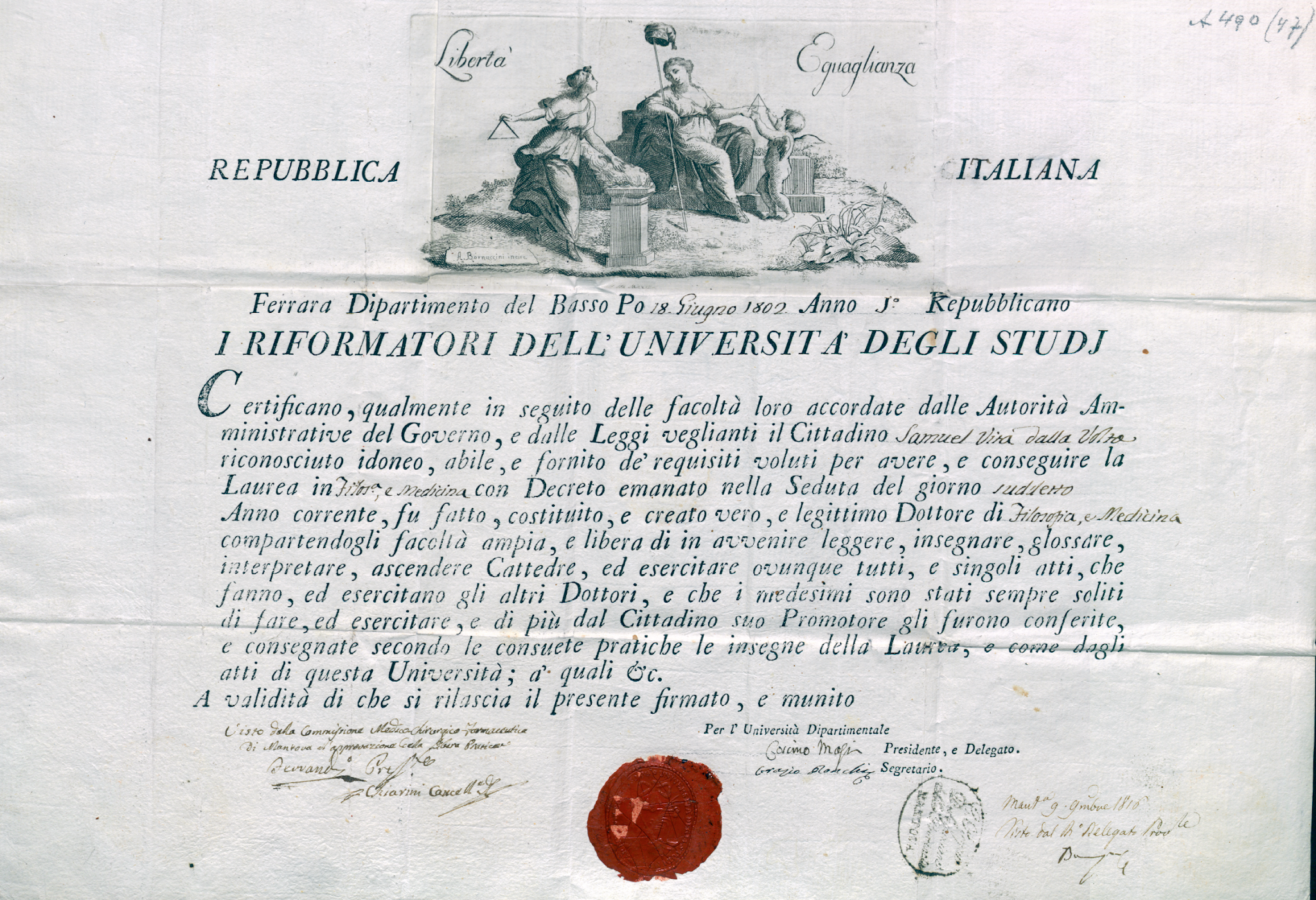
Phase 4- Communal Retrospective Hoda’ah

The fourth and final phase of prayer, which we have yet to experience, is communal gratitude for surviving the plague. This form of prayer can only be expressed once the pandemic has abated. Throughout the centuries, communities that survived bouts of plague offered services of communal prayer and thanksgiving for their survival. I offer one such example.

In the nineteenth century there were multiple cholera pandemics. Jewish communities were profoundly affected by these events. The famous cases of Rabbi Yisroel Salanter (supposedly) making kiddush from the bimah on Yom Kippur and of Rabbi Akiva Eiger recommending social distancing in synagogue to minimize contagion were both associated with cholera pandemics.[23] In 1835, the city of Ferrara experienced a severe cholera outbreak.[24] In gratitude to Hashem for the community’s salvation from this particular event a special community prayer service was instituted.[25] The order of prayers was to be recited in every synagogue in the city of Ferrara in the month of Adar after the Shacharit (morning) service. It included selections from Tehillim as well as specific prayers written for the occasion:

Let us conclude by taking a closer look at our first illustration:

This picture I believe accurately reflects our present state of affairs in the midst of the Covid 19 pandemic. We are collectively as a people beginning to get out of bed on the road to recovery. To be sure, we are not there just yet, but we have transitioned gradually from the prone position to sitting off the side of the bed, with our feet dangling. We are still socially distancing, and as in the picture, there is no one in the room with us. Yet, it appears the door is open. The vaccine has been released and we as a people will soon be walking together unmasked outside and standing together shoulder to shoulder in shul, iy”H. We will then transition to the next and final phase of pandemic tefillah, when this pandemic is behind us- the collective community hoda’ah. I look forward to this final phase of reciting the prayer for the salvation of the world from the Covid 19 pandemic together with you, in person (sorry, no Zoom allowed).

Notes:

[1] Seder Birkat ha-Mazon u-Birkat ha-Nehenin (Grace After Meals and Occasional Blessings), written and illustrated by Nathan ben Samson of Meseritch, 1728 (private collection)

[2] Berachot 54b. translation from Sefaria.org.

[3] I use the term “phase” intentionally to be reminiscent of the phases of the vaccine trials, for which there are also four phases, though the connection is admittedly loose.

[4] See Rabbi Dr. Avraham Steinberg’s compendium on the laws relating to Coronavirus, available here.

[5] Edward Reichman, “Incensed by Coronavirus: Prayer and Ketoret in Times of Epidemic,” Lehrhaus (March 15, 2020), available here.

[6] Steinberg, op. cit.

[7] Rabbi Hershel Schachter, Piskei Corona, available here.

[8] Rabbi Dr. Aaron Glatt, “What Do Poskim Say About The Covid-19 Vaccine?” JewishPress.com (December 24, 2020) (here); HaGaon HaRav Yitzchak Zilberstein: “The Vaccine Has The Authority Of Beis Din” theyeshivaworld.com (December 24, 2020), available here. For a video of Rav Schachter and Rabbi Willig receiving the vaccine see here.

[9] An in-depth halakhic analysis is beyond the scope of this essay.

[10] Berachot 60a. text from Sefaria.org

[11] O. C. 230:4.

[12] Mishnah Berurah 230:6

[13] Seder Birkat ha-Mazon u-Birkat ha-Nehenin (Grace After Meals and Occasional Blessings), written and illustrated by Aaron Herlingen of Geitsch, 1724. The Library of the Jewish Theological Seminary, MS8232. I thank Sharon Liberman Mintz for this illustration.

[14] It is curious that there is no bowl to receive the blood, which one would typically find in illustrations of bloodletting. I also looked at the instruments on the table thinking they might be associated with bloodletting specifically, though could not find definitive evidence.

[15] For a more expansive treatment of vaccination in general by Rav Weiss, see here.

[16] For a video of his reciting the blessing while being vaccinated, see here. For his halakhic analysis, see here. I thank Menachem Butler for these references.

[17] Rav Asher Weiss weekly parashah series, year 23, issue 11.

[18] On the history of this blessing, see Adolf Büchler, “The History of the Blessing HaTov veHaMetiv and the Situation in Judaea after the War,” in Avigdor (Victor) Aptowitzer and A.Z. Schwarz, eds., Zvi Peretz Chajes Memorial Volume (Vienna: Alexander Kohut Foundation, 1933), 137-167 (Hebrew)

[19] I thank Rabbi Warren Cinamon for this reference.

[20] A video is available online here.

[21] Of the Pfizer variety.

[22] On the proviso of course that they are following the guidelines of their posek.

[23] Edward Reichman, “From Cholera to Coronavirus: Recurrent Pandemics with Recurrent Rabbinic Responses,” Tradition Online (April 2, 2020), available here.

[24] Myrna Gene Martin, “Outsiders on the Inside: Italian Jewish Ghettos and Cholera in the 1830s,” European History Quarterly 49:1 (2019), 28-49.

[25] Courtesy of the National Library of Israel, item number 990001066250205171