A Short Note Regarding an Illustrated Title Page and A Possible Unicum

A Short Note Regarding an Illustrated Title Page and A Possible Unicum


There are a series of books, Seder ha-haʻarakhah ve-haHanhagah, that record the tax law and taxes paid by the Mantuan community and were published in Mantua. [1] The taxes were calculated by communally elected assessment formulators.  The taxes were used to support the entire communal infrastructure, including the administration of communal organizations and funds for the poor.  As today, each person would provide an accounting of their funds reducing their taxable income based upon recognized deductions and certain exempted property. The formulators were wholly responsible for the determination of the specific levied taxes and could reject suspect ax filings and impose fines.

The first edition was published in 1651 and each edition covers three years, of which the National Library has 17 editions. The British Library holds 12, seven that are not in the National Library’s collection. Vinograd lists 22 editions, six in neither library. [2] (A full bibliography appears below)

There is, however, at least one edition in the series that was not published in Mantua, the most logical location, but in Venice by Bragadin in 1711.  The likely reason for the change in venue is that from 1707-1712, there were no books printed in Mantua. [3] Nonetheless, these records were so important that the community went to Venice to publish the records.
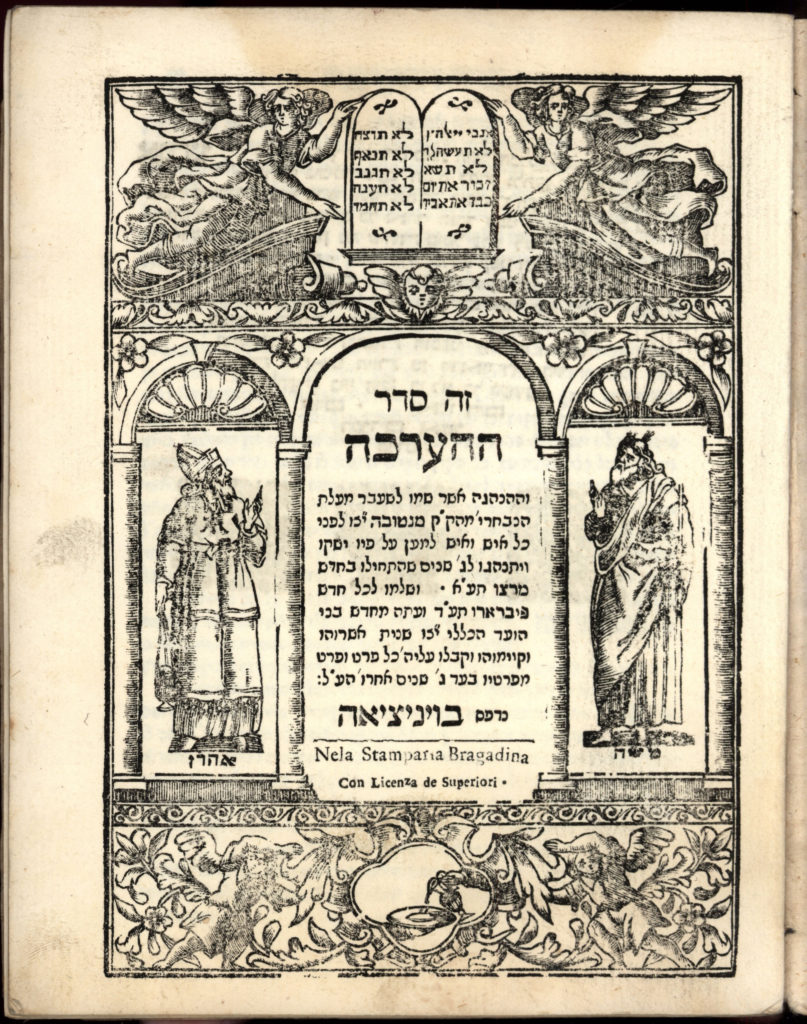
 

Steinschneider, based upon Wolf’s bibliography, does identify this edition of the work. [4] But the book is not extant in the Bodleian Library.[5]  Nonetheless, no modern bibliography, e.g. Vinograd or Friedberg, records the Venice edition nor does the National Library or any other library I can identify (based on a search of WorldCat) own a copy of the book.  There is one copy, however, in the Gross Family Collection in Tel Aviv, and is possibly a unicum – the only extant copy.  Although as Judge Meyer Sulzberger, himself an avid book collector, noted that caution is necessary when identifying a unica, because “that the great weakness about a unicum is that presently one or two other people are found to have the book, and instead of contently agreeing that each of them has a unicum, each feels the value of his possession has been materially impaired.”  To this we can add that without concrete evidence of the book’s singularity, there may be private collections or public ones whose holdings are insufficiently cataloged to make a confident identification regarding the rarity of any book.  Indeed, Sulzberger provides many examples of books thought to unica, only to be identified as “merely” rare.[6]

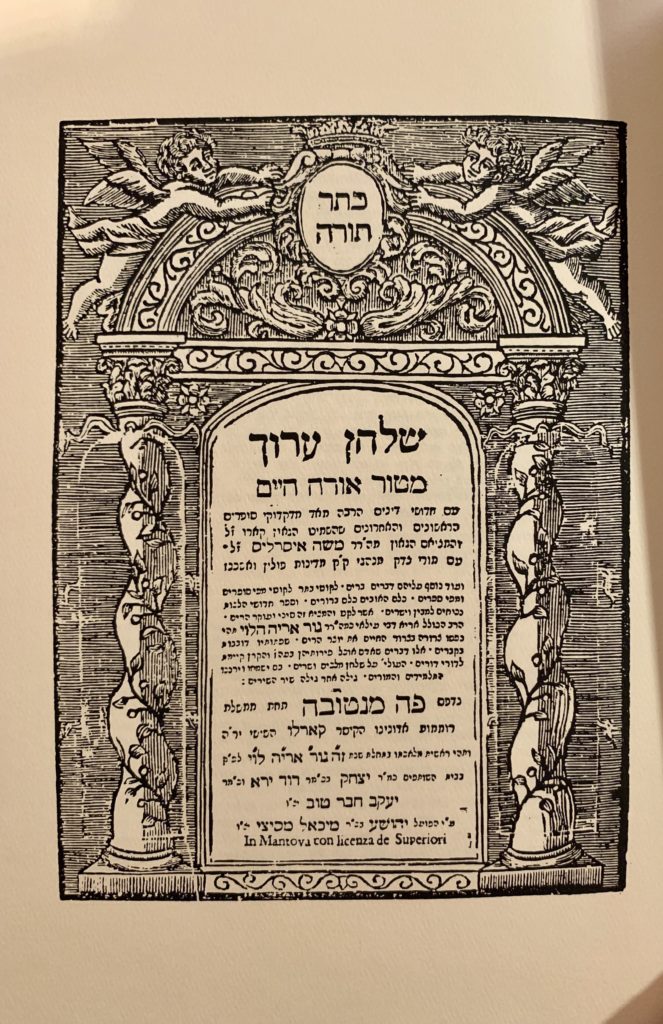
I should also note that the Venice copy has a nice title page with Moses and Aaron. (For a discussion of depictions of Moses and Aaron on Hebrew title pages see our earlier post here.)   A very similar title page appears on a later book printed in Mantua, 1720, Mishlei ve-Eiov, although in this instance it is David and Solomon who flank the title.
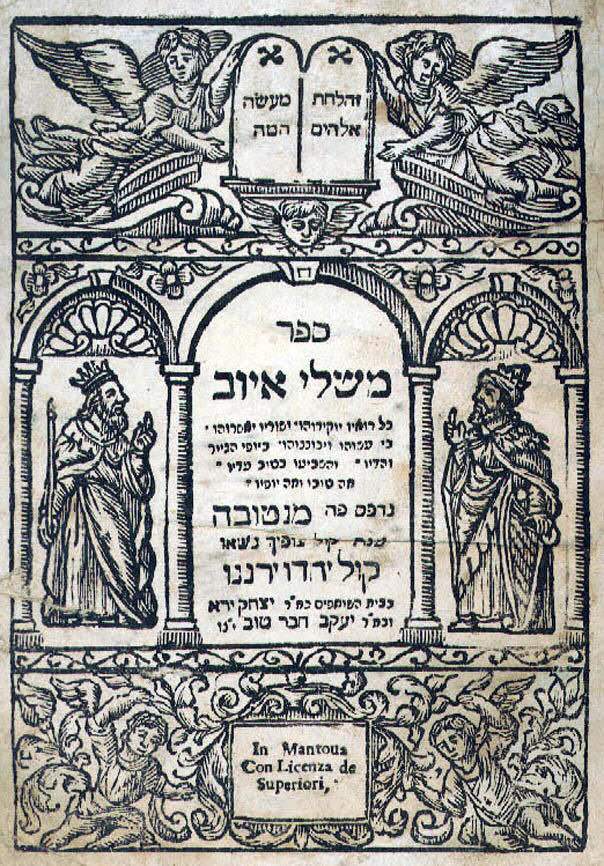
Additionally, the depiction of the Moses, Aaron, Solomon and David are similar to the ones that appear – Rambam, Rashi, R Yosef Karo, Rama, and the author – on the Gur Areyeh, a commentary on Shulkhan Orakh, Mantua, 1722.
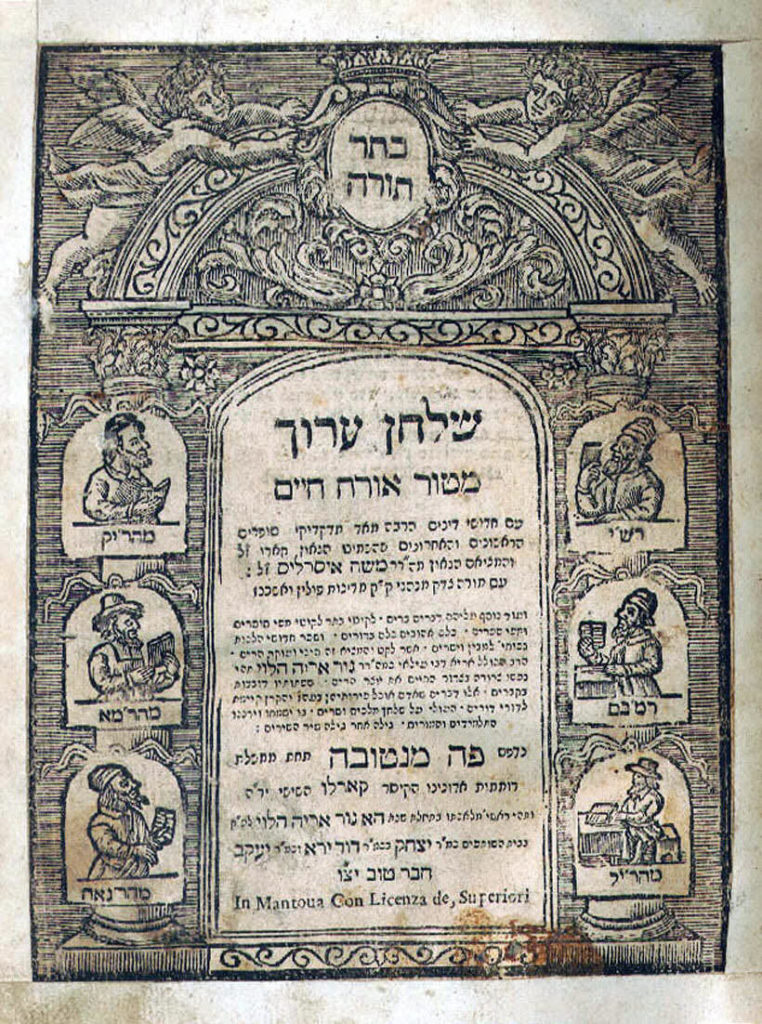
There are two editions of this book printed within a year of one another.  The second printing lacks the images entirely and the first they only appear in Orakh Hayyim, and, although not noted in bibliographies or articles regarding the book, in at least one example the title pictorial title pages also appears in Yoreh Deah.
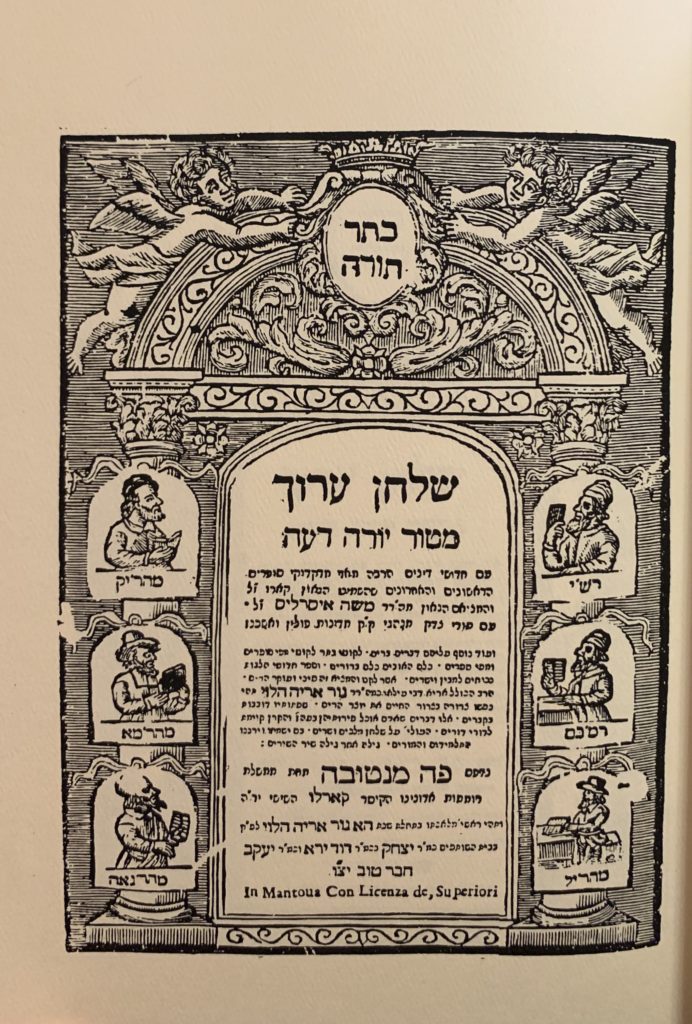
The remaining three (or two) volumes do not contain the images.  This led some to speculate that the images were deliberately removed, and that page was ripped out at the behest of the Mantua rabbinate and a variety of theories are offered, ranging from concern over reproducing human image to the inclusion of the author among such a distinguished group was egotistical, that the Rambam lack ed peyot, or that the portraits are just not flattering. [7]
 

But, both the claim of censorship and the rationale are unsupported.  Most extant copies include that page and there are many earlier examples of books containing human images including of biblical figures, many without peyot, or not dressed in flattering clothing.  There is no independent evidence to suggest anything other than a benign reason, perhaps the woodcuts wore out.  This aligns with the fact that the printer was known for crude lettering so much so that it nearly lost its ability to print at all and only survived because another party stepped in. Thus it is unlikely the lack of the portraits in the later volumes is an instance of censorship.[8]


* The identification of the Gross edition as a unicum is only preliminary and still a work in progress.  The author encourages anyone with additional information regarding this edition to comment or send an email to seforimblog@gmail.com

[1] See Shlomo Simonshon, Tolodot ha-Yehudim be-Duhosot Mantua, vol. 1 (Jerusalem, 1963), 274-86; see also Marvin J. Heller, The Seventeenth Century Hebrew Book: An Abridged Thesaurus, vol. 2 (Leiden: Brill, 2011), 957.

[2] For the NLI listing see here;   Diana Rowland Smith, Second Supplementary Catalog of Hebrew Books in the British Library 1893-1960, vol. 2 (London:  British Library, 1994), 599; Joseph Zedner, Catloglouge of the Hebrew Books in the Library of the British Museum (London, 1867), 510 recording Mantua 1759; Yeshayahu Vinograd, Otsar ha-Sefer ha-Ivri (Jerusalem:  Machon Lebibliograhia Memuhshevet, 1994).

[3] See Ch. B. Freidberg, Tolodot ha-Defus ha-Ivri be-Italia:  Be-Midenot Italiah, Aspnyah-Portugal, ve-Turgemah she-Melfenim (Tel Aviv:  Bar-Yeda, 1956), 20.  Friedberg does not explain the cause of the stoppage.

[4] Moritz Steinschneider, Catalogus Librorum Hebraeorum in Bibliotheca Bodleiana (Berollini:  Ad. Friedlander, 1852-1860) columns 625-66; Johann Christoph Wolf, Bibliothecae Hebraeae, vol. 3 (Hamburg:  Christoph Felgineri Viduam, 1827), 1207-08 (Steinschneider’s citation to Wolf should be corrected to read vol. 3 and not vol. 2).

[5] See A.E. Cowley, A Concise Catalogue of the Hebrew Printed Books in the Bodleian Library (Oxford:  Clarendon Press, 1929), 410 (listing only Mantua).

[6] Meyer Sulzberger, “Books and Bookmen,” Menorah XXXVI (Jan. 1904), 38-40. For other Hebrew unica see Marvin J. Heller, “Unicum, Fragments, and Other Hebrew Book Rarities,” Judaica Librarianship 18 (2014), 130-53.

[7] See Shmuel Weiner, Daat Kedoshim:  Pesak Herem:  Mazkeret Rabanei Italiah (Petroberg: Berman Press, 1897), 38**; Aviad Cohen, “Diuknot Hakhamim:  Bein Halkha le-Maashe,” Mahnayim 10 (1995). See Mifal ha-Bibliographia ha-Ivrei entry Gur Areyeh .

One scholar viewed the selection of personages to grace the title page as an indication of their imporatance.  Specifically the inclusion of the Mahril was used to demonstrate his unique contribution to the formation of the Shulchan Orakh.  See Yisrael Peles, Mevo ve-Hosafot le-Sefer Mahril (Jerusalem:  Machon Yerushalim, 2016), 258. (Thanks to Eliezer Brodt for providing this source).

[8] Friedberg, Tolodot ha-Defus ha-Ivri, 20-21. For another example of spurious reasons for a change to the title page, see Dan Rabinowitz, “Sheti ha-Girsot shel Shu”t ha-Bakh, Mahadurot Frankfort TN”Z:  Totsot shel Shikul Tsniut, Sha’arim be Shut ha-Bach,” Alei Sefer  21(2010), 99-112.


Bibliography of Seder ha-Ha’arakhah


Mantua, 1651(BL)

Mantua, 1656 (NLI)

Mantua, 1670 (V)

Mantua, 1675 (BL)

Mantua, 1679 (NLI)

Mantua, 1682 (V)

Mantua, 1685 (V)

Venice, 1711 (Gross)

Venice, 1714 (Wolf)

Venice, 1717 (Wolf)

Mantua, 1722 (BL)

Mantua, 1722 (BL) (& a variant)

Mantua, 1726 (NLI)

Mantua, 1729 (V)

Mantua, 1732 (NLI)

Mantua, 1735 (NLI)

Mantua 1737 (BL)

Mantua, 1739 (NLI)

Mantua, 1743 (BL)

Mantua, 1747 (NLI)

Mantua, 1750 (NLI)

Mantua, 1753 (NLI)

Mantua, 1756 (NLI)

Mantua, 1759 (NLI)

Mantua, 1773 (BL)

Mantua, 1777 (NLI)

Mantua, 1780 (NLI)
Mantua, 1783 (V)

Mantua, 1786 (NLI)

Mantua, 1789 (NLI)

Mantua, 1793 (V)

Mantua, 1795 (NLI)

Mantua, 1798 (NLI)



Purim Roundup 2019

For a collection of posts on Purim see here.  These deal with topics as diverse as Jewish humor and parodies, a series on the the origins of hamantaschen (and here and here), banging at the mention of Haman’s name, piyutim for Purim, mishcholot manot, identifying the personalities of Megliat Ester in secular sources, how to approach the story of Ester with children by the late Elliot Horowitz, as well as a couple posts regarding his book on Jewish violence and Purim, and mixed dancing on Purim.


Correction and Apology For an Earlier Post

Correction and Apology For an Earlier Post

A few months back we featured a fascinating two-part post about newly discovered documents from Rav Herzog’s Archive.

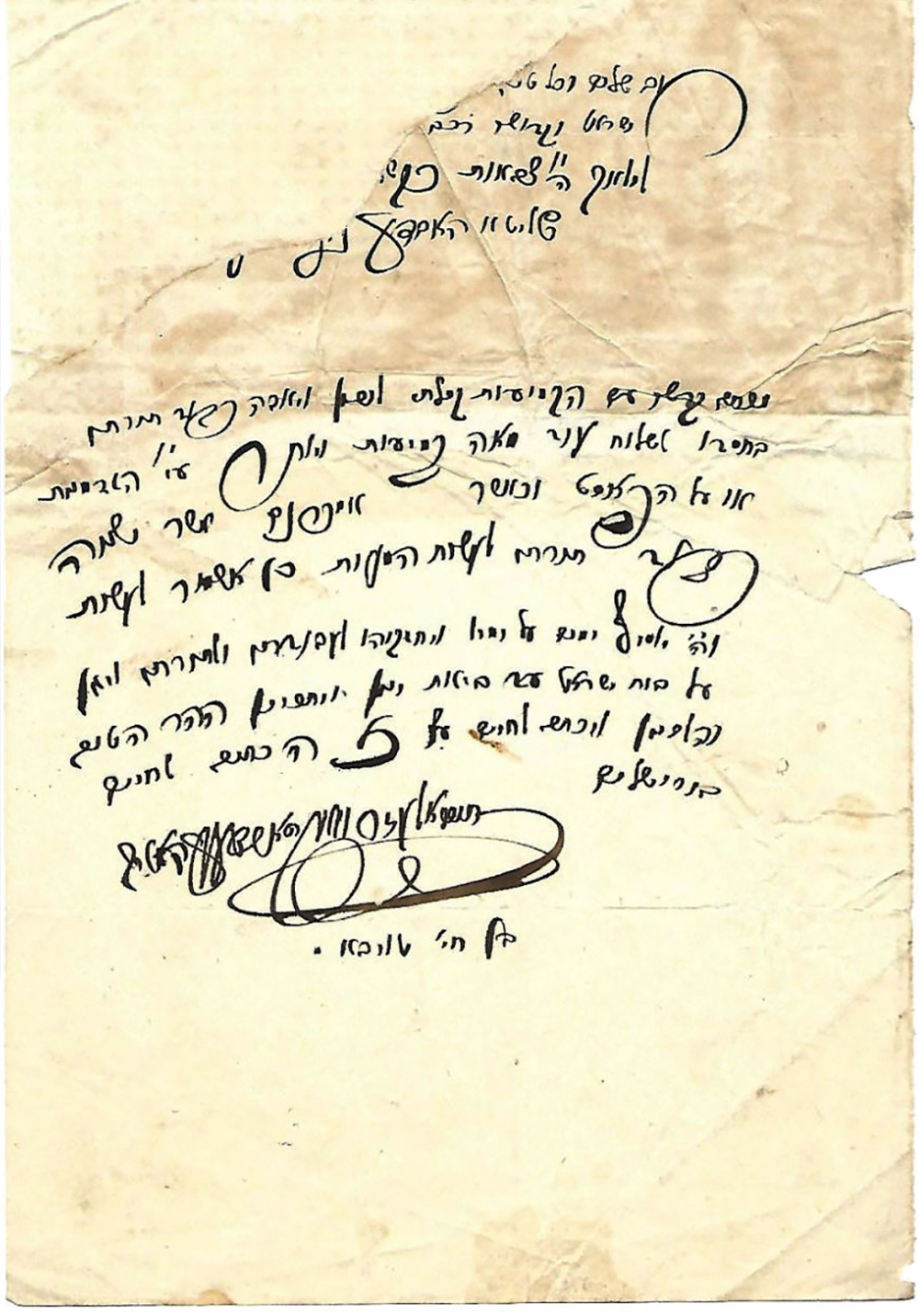
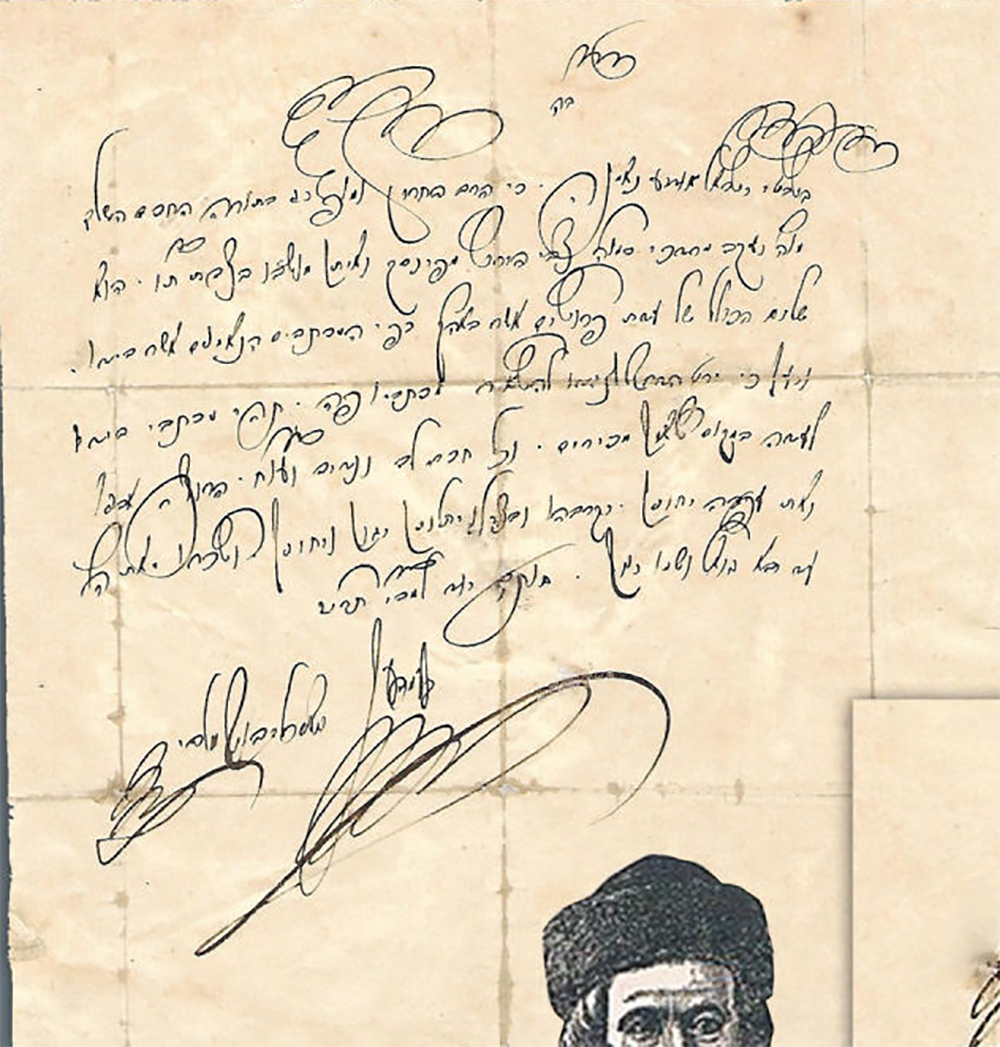
One of the discoveries of the post was a document about Meir Kahane written to President Chaim Herzog by Rabbi Joseph B. Soloveitchik in the summer of 1984 which was surprisingly supportive of Kahane.

A careful examination of the document by the family of Rabbi Soloveitchik reached the opposite conclusion. This letter is a crude forgery. Their conclusion was not derived because they disagree with the opinions expressed in it nor because they know that the Rav would never have expressed such opinions, but because of many characteristics of the signature such as misspelled name, the firm handwriting from the hand of a man suffering from Parkinson’s (comparing it to other autographs of the Rav from even earlier dates and the difference is immense), title and reference of his own father etc. It is simply an egregious forgery.

We apologize to our readers for posting and thereby disseminating this false piece of information.

Seforim Blog Editors.


Test post from the new Seforimblog.com

This is just a test post.


Writing is simple when lorem quis bibendum

Blog Image 03

Mauris ut orci dapibus, sollicitudin metus id, facilisis magna. Praesent pellentesque consequat nibh. Ut egestas velit quis ante tincidunt, eget luctus orci tincidunt. Cras massa augue, facilisis sit amet mattis vel, mollis vel neque. Nam maximus laoreet erat, a sagittis risus auctor non. Interdum et malesuada fames ac ante ipsum primis in faucibus. Praesent at interdum felis. Pellentesque facilisis vulputate justo, in euismod turpis aliquet id. Nam ut nibh eros. Vivamus lacus orci, rhoncus quis sodales et.

Ut enim ad minim veniam, quis nostrud exercitation ullamco.

Mauris ut orci dapibus, sollicitudin metus id, facilisis magna. Praesent pellentesque consequat nibh. Ut egestas velit quis ante tincidunt, eget luctus orci tincidunt. Cras massa augue, facilisis sit amet mattis vel, mollis vel neque. Nam maximus laoreet erat, a sagittis risus auctor non. Interdum et malesuada fames ac ante ipsum primis in faucibus. Praesent at interdum felis. Pellentesque facilisis vulputate justo, in euismod turpis aliquet id. Nam ut nibh eros. Vivamus lacus orci, rhoncus quis sodales et.

Donec interdum felis fringilla posuere pellentesque. Duis elementum blandit justo, eget tincidunt diam sollicitudin sed. Nulla hendrerit tempor nisi non feugiat. Curabitur a auctor nisl. Sed sagittis purus ac felis venenatis, at sagittis ante suscipit. Nulla lacinia eros odio, sit amet fringilla nisl porttitor sit amet. Nunc tempus, nunc a rutrum ullamcorper, lacus purus porttitor lacus, vitae ullamcorper erat erat quis nibh. Sed vitae diam sed quam malesuada gravida sed ac nisl. Fusce sed accumsan purus.


Seforim Blog 2.0: How You Can Help

The Seforim Blog is now in its bar-mitzvah year and over the past thirteen years has grown exponentially.  There are currently over 2,000 email subscribers and an estimated 16,000+ hits a month from all over the world and nearly 7 million hits over the lifetime of the site.  The site has published nearly 950 articles from over 100 different authors.  Articles from the site have been cited in traditional Torah works, academic journals and books and have even formed the basis of entire works.


This period of growth, however, has come with some costs – both monetary and for the readers.  The site is currently very unwieldy lacking a unified homepage with articles listed chronologically, making it difficult to quickly locate relevant articles.  Additionally, the site hosts numerous related articles, for example, customs relating to Chanukah or haggadot, yet those are not easily located or displayed.  Similarly, articles by author are difficult to find and require going through pages of single articles to locate the specific article of interest. Furthermore, for the past few years, we have hired someone to prepare and post articles. We have eschewed commercializing the site and that cost has been borne by the editors and a handful of generous donors.


To assist us in making significant improvements in the site we are for the first-time asking readers and those who benefit from the site to donate to help defray the costs of the upgrade and ongoing expenses. The site is incorporated as a 501(c)(3) charity and all donations are tax deductible and we will provide documentation of any donations. Please donate generously. Remember, donating=loving.


To donate to the Seforim Blog simply click the paypal link below.


Kabbala, Halakha and Kugel: The Case of the Two Handed Blessing

Kabbala, Halakha and Kugel:  The Case of the Two Handed Blessing*
          In parshat Vayehi, Yaakov simultaneously blesses his two grandchildren, Ephraim and Menashe by placing one hand upon each of their heads.  Today, there is a widespread custom of blessing one own’s children on Friday night (although some only do it on the eve of Yom Kippur).  This custom most likely originated with the Hasedi Ashkenaz in the 14th century but quickly spread to the rest of Europe, including France, Spain, and Italy.[1]  The exact details of the blessing, however, are subject to some variation. 
            The earliest sources mention only the priestly blessing and not Yaakov’s.[2] It was not until the 18th century, R. Yaakov Emden propose the specific usage of Yaakov’s blessing to his grandsons “God shall make you like Ephraim and Menashe.”   Likewise, even within those sources they are inconsistent as to whether both hands are to be used or only one.  Some provide that one hand should be used because it has 15 joints the same number of words as in the priestly blessing, while others urge two hands because they contain 60 bones which corresponds to the word “סמך” “somekh” “to lay hands” to be read as the letter “סמ״ך” “samach” and correspond to the numerical value of sixty rather than the literal translation equaling the number of letters in Birkat Kohanim. These sources disagree because of the symbolic nature of the hands vis-à-vis the blessing.
The anonymous book, Hemdat Yamim, states that one should only use the right hand to bless.  Likewise, R. Yitzhak Lampronti records that some refrain from using two hands to avoid “mixing hesed with din” corresponding to the right and left hands respectively.  But he rejects that and he used both hands.
R. Emden firmly rejects the idea of singlehanded blessings.  He explains that Moshe and others used two.  Yaakov was but an exception as he wanted to bless both of his grandsons simultaneously because he was already changing the order and wanted to minimize, as much as possible, the differences between the two.  Further blessing the younger before the older would be an unforgivable insult. Thus, this was a special case where he was compelled to use one hand.[3]    But in the late 19th century, a one handed blessing was suggested because of halakhic reasons.
            In 1779, R. Yehezkel Landau was born in Vilna.  In 1793 he married his cousin, the daughter of Tzvi Hirsch and Mushka Zalkind, Haye Sorah.[4]  Unexpectedly, an event surrounding Landau’s wedding would become a touchstone for birkat ha-banim. 
            R. Landau was among those who were privileged to study with the Gaon and received his particular form of learning that eschewed pilpul and focused on peshat.[5]  Additionally, R. Landau considered himself a talmid muvhak of and prayed in the same synagogue as R. Hayyim Volozhin.[6] That synagogue, the Parnes Kloyz, also claimed a number of other important members including R. Avraham Abele Poswoler, R. Landau’s brother-in-law.[7]  With the death of R. Abele in 1806 R. Landau took over the position as Rosh Av bet Din of Vilna.[8]  The position was first offered to R. Akiva Eiger but he turned it down.[9]  R. Landau held that position until his death in 1870.
            Until this point the discussion regarding whether to use two hands or one is limited to symbolic or kabalistic reasons.  But there are those who argue that there is a legal issue with using two hands and they attribute this view to the Gaon.  Determining the Gaon’s practices is a very difficult task, he did not write a book of customs and instead most of what we have is from second hand or third hand sources, many of which are contradictory or unsupportable.[10] 
            Close to one hundred years after the Gaon died, the siddur, Siddur ha-Gaon be-Nigleh u-Nistar, was published by Naftali Hertz, and for the first time it is recorded that the Gaon only used one hand for a blessing.  The source for this practice is unclear.  The “Nigleh” portion is generally taken from Ma’ashe Rav and Likutei Dinim meha-Gra, neither of which records this practice. 
            R. Barukh ha-Levi Epstein, however, records a story about that Gaon that is related to the prohibition of a non-kohen reciting the priestly blessings in the synagogue.  In Epstein’s commentary on the Torah, Torah Temimah, he posits a novel ruling that not only is a non-kohen prohibited from blessing the congregation but is prohibited from ever using two hands – like the priests – to bless anyone.  According to Epstein, such a practice would violate a biblical commandment. But he wanted to address as to why he is the first to raise this issue and rather than concede that he is the source of this innovative ruling he records a story from “a trustworthy source” that “when the Gaon of Vilna blessed R. Yehezkel Landau the Moreh Tzedek of Vilna at his huppa, the Gaon only placed one hand on R. Landau’s head during the blessing.  Those present asked the Gaon to explain his practice and he replied that only the priests in the temple can use two hands.”[11]  Thus, R. Epstein is able to “toleh atsmo be-ilan gadol” (one should hang themselves on a big tree).
            Indeed, R. Epstein’s version of the Gaon’s position is still accepted today. Two siddurim that were recently published based upon the Gaon’s practices both record that it was his opinion that one must only use one hand because “only the priests in the temple were permitted to use two hands.”  Both cite R. Epstein as their source.[12] 
            That R. Landua received the Gaon’s blessing is attested to on his epithet.
 “חן הוצק בשפתיך כי גברה עליך ברכת אליהו גאון ישראל.”
“Grace was placed upon his lips because he was overtaken by the blessing of Eliyahu Gaon of Israel.”[13]  Nonetheless, the exact details of that blessing are not as clear.  Indeed, the details of R. Epstein’s version that was transmitted by a “trustworthy source” seem somewhat suspect. First, R. Landau would not have been referred to as a מו״ץ because he oversaw the entire bet din system in Vilna and controlled all of the moreh tzedeks.  Hence R. Landau was referred to as Rosh Av Bet Din “Ravad” or ראב״ד.[14]  Second, the Gaon was not known for getting out much.  He no longer studied at all in what was known as the Gaon’s kloyz that was located in the Great Synagogue Courtyard (shulhoyf) but studied in the same house he lived in, a location known as the Slutzki building.[15]  While R. Landau was well-regarded none of the other histories of Vilna that discuss R. Landau and mention the he studied with the Gaon or the Gaon’s blessing also include the Gaon’s attendance at the wedding.[16]  Finally, the Gaon’s commentary to Shulchan Orakh does not mention any issue with a non-kohen using two hands, nor does it appear in any of the books collecting the Gaon’s customs.[17] 
While admittedly none of the above issues are dispostive, there is a far better reason to discount R. Epstein’s version because there is a more reliable alternative version of the story that R. Epstein records, and according to this version, there is nothing to suggest that the Gaon deliberately avoided using two hands nor that there is any reason to do so.  Indeed, stories that are attributed to the Gaon are notoriously unreliable. Already with the first “biography” of the Gaon, R. Dovid Luria cautioned that “the greatness of my teacher, Rabbenu ha-Gadol z’l [ha-Gaon] is such that there are many stories and legends attesting to that greatness there are as many variations, embellishments and deficiencies in every story.”  In this instance, however, we have the benefit of hearing the story directly from the protagonist, R. Landau.
R. Ben-Tzion Alfes
Ben-Tzion Alfes was born in Vilna in 1851 and when he was a young boy spent time in the Gaon’s Kloyz and met R. Landau.  Alfes records in his autobiography that “R. Landau recalled that the Shabbat after he was married, his father-in-law brought him to the Gaon to receive a blessing.  When he arrived the Gaon was in the middle of his lunch meal, eating kugel.[18]  R. Landau was wearing the new fur hat he received for his wedding and when the Gaon went to place his hands on R. Landau’s head, he turned away so that the Gaon wouldn’t dirty the fur hat with his greasy hands.  The Gaon ended up just putting one hand on the hat and blessed R. Landau.  R. Landau lived very long, over ninety and never required eyeglasses, and for the rest of his life he was disappointed regarding his small mindedness of valuing the hat more than the hands of the Gaon.”[19] 
כשהייתי בן עשר דרנו בחדר אצל אחד שהיה לו סבא זקן שהיה מכיר את הגאון רבנו אליהו מווילנא זצ”ל, ונהניתי מאד בשעה שאבי ז”ל ישב אצלו לשמוע ספורים מהגר”א, וכאשר אחרי נשואי קבעתי מקומי ללמוד ולהתפלל בקלויז הגר”א, הכרתי שם זקן אחד שהיה חתן הגאון ר’ אברהם (בעל מעלות התורה) אחי הגר”א, וכן הכרתי את הגאון ר’ יחזקאל לנדא אב”ד דווילנא שכאשר נעשה חתן הביא אותו מחותנו בשבת לפני הגר”א שיברך אותו, והגר”א ז”ל ישב בסעודה שניה של שבת ואכל את הקוגל, והחתן היה מלובש בשטריימיל ורצה הגאון להניח ידיו על ראש החתן לברכו ונסוג החתן לאחוריו שלא ישמין הגאון את השטריימיל בידיו השמנות מהפשטידא, והניח הגר”א ידו אחת על השטריימיל וברכו, והאריך ימים ולמד עד יומו האחרון בלי משקפים, והצטער רבי יחזקאל לנדא כל ימיו, על קטנות המוח שלו שהוקיר את השטריימיל יותר מידיו של הגר”א
According to R. Landau it was his own fault that the Gaon only used one hand and it had nothing to do with symbolism, kabbala and certainly not because of a halakhic concern.  It came down to kugel and fur hats.[20] 
* A different version of this article previously appeared in Or HaMizrach in Hebrew. Dan Rabinowitz, “Birkat ha-Banim be-Sheti Yadim:  Mesoret ha-Gra be-Nedon,” Or HaMizrach 51, 3-4 (2006), 181-85.  Additionally, Professor Daniel Sperber modified and added additional materials to it for Bar Ilan’s Shabbat Torah pamphlet.  Daniel Sperber, “Al Birkat ha-Banim,” Daf Shevoei (University Bar Ilan) Parshat Vehi, 2008, no. 735.
[1] See Yecheil Goldhaver, Be’er Sheva, in Bunim Yoel Tevesig, Minhagei ha-Kehilot (Jerusalem:  Le’or, 2005), 186-89.  See also, Shmuel Ashkenazi, Alpa Beta Kadmeta (Jerusalem, 2010), 207-09.
[2] R. Eliyahu Dovid Rabinowich Toemim, however, incorrectly asserts that the priestly blessing was not part of the blessing of the children.  Instead, he suggests that since the inception of the custom on Yaakov’s blessing was used.  Eliyahu Dovid Rabinowich Teomim, Shu”t Ma’aneh Eliyahu (Jerusalem:  Yeshiva Har Etzion, 2003), no. 122, 349.
[3] Hemdat Yamim, (Venice, 1812), Helek Shabbat, chapter 7, 48; Yitzhak Lamporti, Pahad Yitzhak  ha-Shalem (Jerusalem, 1998), ma’arekhet ha”Bet,” 52; Yaakov Emden, Siddur Ya’avetz (Jerusalem, 1992), 564-65. See Goldhaver who provides many of these sources and the additions of Eliezer Brodt in Yerushatanu 2 (2008), 205-206 (Eliezer also kindly provided additional sources for this post).  For an example of a death bed blessing see Michel Hakohen Brever, Zikhronot Av u-Beno (Jerusalem:  Mossad Harav Kook, 1966) 122
[4] The Zalkinds would later establish a kloyz, with a women’s section, that was alternatively referred to by Reb Herschel Zalkinds Kloyz and perhaps more notably by his wife’s name:  Mushke Leybele Zalkinds kloyz.  The kloyz is no longer extant but was located in Vilna’s Old Jewish quarter on what is today Šv. Mikalojaus Street.   Synagogues in Lithuania, N-Z: A Catalogue, eds. Aliza Cohen-Mushlin, Sergey Kravtsov, Vladimir Levin, et.al. (Vilnius:  Vilnius Academy of Arts Press, 2012) 312.
[5] Shmuel Yosef Fuenn, Kenest Yisrael:  Zikhronot le-Toldot Gedolei Yisrael ha-No’adim le-shem be-Torotum, be-Hokhatum, ube-Ma’asehem (Warsaw, 1886), 517.
[6] Hillel Noach Steinschneider, Ir Vilna (Vilna, 1900), 32. 
[7] For a biography of R. Abele, see Ir Vilna, 19-29.  His third wife, Fagie, was R. Landau’s sister. For more about the Kloyz see Cohen-Mushlin, Synagogues in Lithuania N-Z, 308 and for more details on the building and the Parnes see Aelita Ambrulevičiūtė, Houses that Talk:  Sketches of Vokiečiu Street in the Nineteenth Century (Vilnius:  Auko Žuvys, 2015), 91-95.
[8] Ir Vilna, 32. 
[9] Ir Vilna, 30-31.
[10] See the comments of R. David Luria, “the greatness of my teacher, Rabbenu ha-Gadol z’l [ha-Gaon] is such that there are many stories and legends attesting to that there are as many variations, embellishments and deficiencies in every story.”  R. David Luria, “Letter from ha-Gaon ha-Rav RD”L,” in Yeshua Heschel Levin, Aliyot Eliyahu (Vilna, 1857), 4.
[11] Barukh Halevi Epstein, Torah Temimah: Bamidbar 6:33.  
[12] Siddur Aliyot Eliyahu (Machon Ma’dani Asher, 1999); Siddur Ezer Eliyahu (Jerusalem: Kerem Eliyahu, 1998).
[13] Ir Vilna, 35.
[14] See Ir Vilna, 102.
[15] For more on this building and the history of it and the Gaon’s kloyz see Shlomo Zalman Havlin, “ ‘Ha-Kloyz’ shel ha-Gaon me-Vilna Zts”l, Helek shel ‘Pinkas ha-Kloyz,’” in Yeshurun 6 (1999), 678-85; Dan Rabinowitz, The Lost Library:  The Legacy of Vilna’s Strashun Library in the Aftermath of the Holocaust (Waltham:  Brandeis University Press, 2018), 55-58.
[16] See, e.g. Ir Vilna, 32; Keneset Yisrael, 517-18.
[17] Even the siddur that does provide that the Gaon’s custom was to use just one hand there is no mention that the practice was because of potentially violating a biblical commandment. 
[18] Kugel was among the customary foods eaten on Shabbat across Europe.  Herman Pollack, Jewish Folkways in Germanic Lands (1648-1806):  Studies in Aspects of Daily Life (Cambridge:  M.I.T. Press, 1971), 112, 275n39.  
Hasidic thought imbued kugel with special powers and it occupied a lofty place in its rituals. See Allan Nadler, “Holy Kugel:  The Sanctification of Ashkenazic Ethnic Foods in Hasidism,” in Food and Judaism:  A Special Issue of Studies in Jewish Civilization 15 (Lincoln:  University of Nebraska Press, 2005), 193-214 (my thanks to Shaul Stampfer for calling this source to my attention).  See also Joan Nathan, “Kugel Unraveled,” New York Times Sept. 28, 2005, F1.
Kugel was one of the foods that originated in Germany and spread to eastern Europe and both Jews and non-Jews ate it.  See Pollack, Jewish Folkways, 112. Other traditional foods include fish, cholent, tsimes, farfl, kneydlekh, kikhelekh, lokshn and kasha. For fish see Moshe Hallamish, Ha-Kabbalah be-Tefilah be-Halakha, u-be-Minhag (Ramat Gan:  Bar-Ilan University Press, 2000), 486-506; for the others see Pollack, Jewish Folkways, 100-112.
[19] Ben Tzion Alfes, Ma’ashe Alfas:  Tolodah u-Zikhronot (Jerusalem, 1941), 9-10.
[20] Today if one wants to combine the two, there is a recipe for striemel kugel here


Kol Nidrei, Choirs, and Beethoven: The Eternity of the Jewish Musical Tradition

Kol Nidrei, Choirs, and Beethoven:  The Eternity of the Jewish Musical Tradition  

On April 23, 1902, the cornerstone to the Taharat Ha-Kodesh synagogue was laid, and on Rosh Ha-Shana the next year, September 7, 1903, the synagogue was officially opened.  The synagogue building was on one of Vilna’s largest boulevards and constructed in a neo-Moorish architectural style, capped with a blue cupola that was visible for blocks. There was a recessed entry with three large arches and two columns.  The interior housed an impressive ark, located in a semi-circular apse and covered in a domed canopy. But what really set the synagogue apart from the other 120 or so places to pray in Vilna was that above the ark, on the first floor, were arched openings that served the choir.  In fact, it was generally referred to by that feature and was known as the Choral Synagogue.  The congregants were orthodox, most could be transported to any modern Orthodox synagogue and they would indistinguishable, in look – dressing in contemporary styles, many were of the professional class, middle to upper middle class, and they considered themselves maskilim, or what we might call Modern Orthodox.[1]

The incorporation of the choir should be without controversy.  Indeed, the Chief Rabbi of Vilna, Yitzhak Rubenstein would alternate giving his sermon between the Great Synagogue, or the Stut Shul [City Synagogue], and the Choral Synagogue.[2]  Judaism can trace a long relationship to music and specifically the appreciation, and recognition of the unique contribution it brings to worship.  Some identify biblical antecedents, such as Yuval, although he was not specifically Jewish.  Of course, David and Solomon are the early Jews most associated with music.  David used music for religious and secular purposes – he used to have his lyre play to wake him at midnight, the first recorded instance of an alarm clock.  Singing and music was an integral part of the temple service, and the main one for the Levite class who sang collectively, in a choir.  With the destruction of the temple, choirs, and music, in general, was separated from Judaism.  After that cataclysmic event, we have little evidence of choirs and even music.  Indeed, some argued that there was an absolute ban on music extending so far as to prohibit singing. 

It would not be until the early modern period in the  16th century that choirs and music began to play a central role in Jewish ritual, and even then, it was limited – and was associated with modernity or those who practiced a more modern form of the religion. 
Rabbi Leon (Yehudah Aryeh) Modena (1571-1648) was one of the most colorful figures in the Jewish Renaissance. Born in Venice, he traveled extensively among the various cities in the region.[3] He authored over 15 books, and made his living teaching and preaching in synagogues, schools, and private homes; composing poems on commission for various noblemen; and as an assistant printer.  In 1605, he was living in Ferrara where an incident occurred in the synagogue that kickstarted the collective reengagement with music. Modena explained that “we have six or eight knowledgeable men, who know something about the science of song, i.e. “[polyphonic] music,” men of our congregation (may their Rock keep and save them), who on holidays and festivals raise their voices in the synagogue and joyfully sing songs, praises, hymns and melodies such as Ein Keloheinu, Aleinu Leshabeah, Yigdal, Adon Olam etc. to the glory of the Lord in an orderly relationship of the voices according to this science [polyphonic music]. … Now a man stood up to drive them out with the utterance of his lips, answering [those who enjoyed the music], saying that it is not proper to do this, for rejoicing is forbidden, and song is forbidden, and hymns set to artful music have been forbidden since the Temple was destroyed.[4]
Modena was not cowed by this challenge and wrote a lengthy resposum to defend the practice which he sent to the Venetian rabbinate and received their approbation.  But that did not put the matter to rest. 
In 1610, as he approached forty, Modena received his ordination from the Venetian rabbis and settled in Venice to serve not only as a rabbi but as a cantor, with his pleasant tenor voice.  In around 1628 in the Venetian ghetto, an academy of music was organized with Modena serving as the Maestro di Caeppella . Both in name and motto that academy embraced its subversive nature.  It was called the Academia degli Impediti, the Academy of the Hampered, named in derision of the traditional Jewish reluctance to perform music because of “the unhappy state of captivity which hampers every act of competence.” In this spirit, especially in light of Modena’s responsum on music in 1605, the Accademia took the Latin motto Cum Recordaremur Sion, and in Hebrew, Bezokhrenu et Tzion, when we remembered Zion, based paradoxically on Psalm 137, one of the texts invoked against Jewish music: “We hung up our harps…. How shall we sing the Lord’s song in a strange land?”
On Shemini Atzeret and Simchat Torah in October 1628, a spectacular musical performance was held in the Spanish synagogue, which had been decorated with silver and jewels. Two choirs from the academy sang artistic Hebrew renderings of the afternoon service, the evening service, and some Psalms. Their extensive repertoire lasted a few hours. A throng of Christian noblemen and ladies attended the Simchat Torah service. The applause was great, and police had to guard the gates to ensure order
Beyond his musical endeavors, Modena also served as an expert in Hebrew publishing. The two would create a confluence that enabled the first modern Jewish book of music. 
For Rabbi Leon Modena, his young friend, the musician Salamone Rossi, would herald the Jewish re-awakening. We know very little about Rossi’s life. He was born circa 1570 and died sometime after 1628, possibly in 1630. He is listed as a violinist and composer on the payroll of the Gonzaga dukes, rulers of Mantua, and was associated with a Jewish theater company, as composer or performer or both. In addition, Rossi was also writing motets – short pieces of sacred music typically polyphonic and unaccompanied – for the synagogue using contemporary Italian and church styles. He was specifically encouraged in this endeavor by Modena, who urged the composer to have this music published so that it could have an even greater impact.[5] In 1622 the publishing house of Bragadini in Venice issued thirty-three of Rossi’s synagogue motets in a collection, Shirim asher le-Shlomo, that Modena edited. This extraordinary publication represented a huge innovation. First, the use of musical notations that required a particularly thorny issue to be resolved right versus left. Rossi decided to keep the traditional musical notational scheme and provide those from left to right and write the Hebrew backward, because the latter would be more familiar to the reader.  Second, it was the first time the Hebrew synagogue liturgy had ever been set as polyphonic choral music. Polyphony in the Christian church had begun centuries earlier. Rossi’s compositions sound virtually indistinguishable from a church motet, except for one thing: the language is Hebrew – the lyrics are from the liturgy of the synagogue, where this music was performed.
There was bound to be a conflict between the modern Jews who had been influenced by the Italian Renaissance and who supported this innovation, and those with a more conservative theology and praxis. But the antagonism towards music, especially non-traditional music, remained strong. Anticipating objections over Rossi’s musical innovations, and perhaps reflecting discussions that were already going on in Venice or Mantua, Modena wrote a lengthy preface included the responsum he wrote in 1605 in Ferrara in support of music in which he refuted the arguments against polyphony in the synagogue. “Shall the prayers and praises of our musicians become objects of scorn among the nations? Shall they say that we are no longer masters of the art of music and that we cry out to the God of our fathers like dogs and ravens?”3 Modena acknowledged the degraded state of synagogue music in his own time but indicates that it was not always so. “For wise men in all fields of learning flourished in Israel in former times. All noble sciences sprang from them; therefore, the nations honored them and held them in high esteem so that they soared as if on eagles’ wings. Music was not lacking among these sciences; they possessed it in all its perfection and others learned it from them. … However, when it became their lot to dwell among strangers and to wander to distant lands where they were dispersed among alien peoples, these vicissitudes caused them to forget all their knowledge and to be devoid of all wisdom.”  
In the same essay, he quotes Emanuel of Rome, a Jewish poet from the early fourteenth century, who wrote, “What does the science of music say to the Christians? ‘Indeed, I was stolen out of the land of the Hebrews.’” Using the words of Joseph from the book of Genesis, Modena was hinting that the rituals and the music of the Catholic church had been derived from those of ancient Israel, an assertion that has been echoed by many scholars. Although it can be argued that Modena indulges in hyperbole, both ancient and modern with some attributing the earliest ritual music to Obadiah the convert who noted a Jewish prayer that was only then appropriated for use in Gregorian chants.[6] 
Directly addressing the naysayers, Modena wrote that “to remove all criticism from misguided hearts, should there be among our exiles some over-pious soul (of the kind who reject everything new and seek to forbid all knowledge which they cannot share) who may declare this [style of sacred music] forbidden because of things he has learned without understanding, … and to silence one who made confused statements about the same matter. He immediately cites the liturgical exception to the ban on music. Who does not know that all authorities agree that all forms of singing are completely permissible in connection with the observance of the ritual commandments? … I do not see how anyone with a brain in his skull could cast any doubt on the propriety of praising God in song in the synagogue on special Sabbaths and on festivals. … The cantor is urged to intone his prayers in a pleasant voice. If he were able to make his one voice sound like ten singers, would this not be desirable? … and if it happens that they harmonize well with him, should this be considered a sin? … Are these individuals on whom the Lord has bestowed the talent to master the technique of music to be condemned if they use it for His glory? For if they are, then cantors should bray like asses and refrain from singing sweetly lest we invoke the prohibition against vocal music.
No less of an authority than the Shulhan Arukh, explains that “when a cantor who stretches out the prayers to show off his pleasant voice, if his motivation is to praise God with a beautiful melody, then let him be blessed, and let him chant with dignity and awe.” And that was Rossi’s exact motivation to “composed these songs not for my own honor but for the honor of my Father in heaven who created this soul within me. For this, I will give thanks to Him evermore.” The main thrust of Modena’s preface was to silence the criticisms of the “self-proclaimed or pseudo pious ones” and “misguided hearts.”
Modena’s absurdist argument – should we permit the hazzan to bray like an ass – is exactly what a 19th-century rabbi, Rabbi Yosef Zechariah Stern, who was generally opposed to the Haskalah – and some of the very people who started the Choral Synagogue, espoused. Stern argues that synagogal singing is not merely prohibited but is a cardinal sin.  To Stern, such religious singing is only the practice of non-Jews who  “strive to glorify their worship in their meeting house [בית הכנסת שלהם] so that it be with awe, and without other intermediaries that lead to distraction and sometimes even to lightheadedness.  In the case of Jews, however, there is certainly be a desecration of G-d’s Name when we make the holy temple a place of partying and frivolity and a meeting house for men and women … in prayer. there is no place for melodies [נגונים], only the uttering of the liturgy with gravity [כובד ראש] … to do otherwise is the way of arrogance, as one who casts off the yoke, where the opposite is required: submission, awe and gravity, and added to this because of the public desecration of G-d’s Name – a hillul ha-Shem be-rabbim.” (For more on this responsum see here.)
 Similarly, even modern rabbis, for example, R. Eliezer Waldenberg, who died in 2006, also rejected Modena’s position, because of modernity.  Although in this instance, not because of the novelty or the substance of Modena’s decision but because of the author’s lifestyle.  Modena took a modern approach to Jewish life and was guilty of such sins as not wearing a yarmulke in public and permitting ball playing on Shabbos. 
Despite these opinions, for many Orthodox Jews, with some of the Yeshivish or Haredi communities as outliers, song is well entrenched in the services, no more so than on the Yomim Noraim. Nor is Modena an outlier rabbinic opinion of the value of music and divine service.  No less of an authority than the Vilna Gaon is quoted as highly praising music and that it plays a more fundamental role to Judaism that extends well beyond prayer.  Before we turn to the latter point it is worth noting that at times Jewish music was appropriated by non-Jews – among the most important composers, Beethoven.  One the holiest prayer of Yom Kippur, Kol Nedri, is most well-known not for the text (which itself poses many issues) but the near-universal tune.  That tune, although not as repetitive in the prayer can be heard in the sixth movement of Beethoven’s Quartet in C# minor, opus 131 (you can hear a version here).  One theory is in 1824, the Jews in Vienna were finally permitted to build their own synagogue and for the consecration asked Vienna’s most famous composer to write a piece of music.[7]  Although Beethoven did not take the commission, he may have done some research on Jewish music and learned of this tune.  We could ask now, is Beethoven playing a Jewish music?[8]
R. Yisrael M’Sklov, a student of the Gaon records that he urged the study of certain secular subjects as necessary for the proper Torah study, algebra and few other, but “music he praised more than the rest.  He said that most of the fundamentals and secrets of the torah … the Tikkunei Zohar are impossible to understand without music, it is so powerful it can resurrect the dead with its properties.  Many of these melodies and their corresponding secrets were among the items that Moshe brought when he ascended to Sinai.”[9] 
In this, the Gaon was aligned with many Hassidim who regularly incorporated music into their rituals, no matter where the origin.  Just one of many examples, Habad uses the tune to the French national anthem for the prayer Aderet ve-Emunah.  The power of music overrides any considerations of origin.  Indeed, they hold that not only can music affect us, but we can affect the music itself, we hold the power to transform what was impure, the source and make it pure.  That is not simply a cute excuse, but the essence of what Hassidim view the purpose of Judaism, making holy the world.  Music is no longer a method of attaining holiness, singing is itself holiness.[10]  
Today in Vilna, of the over 140 places of worship before the Holocaust five shul buildings remain and only one shul is still in operation.  That shul is the Choral Synagogue – the musical shul.  Nonetheless not all as it should be.  In the 1960s a rabbi from Israel was selected as the rabbi for the community and the shul.  When he arrived, he insisted that choirs have no place in Judaism and ordered the choir arches sealed up.  We, however, have the opportunity, as individuals and community to use the power of music to assist us on the High Holidays – that can be me-hayeh ma’tim.
[1] See Cohen-Mushlin, Synagogues in Lithuania N-Z, 253-61. For more on the founding of the congregation see Mordechai Zalkin, “Kavu le-Shalom ve-ain:  Perek be-Toldot ha-Kneset ha-Maskili ‘Taharat ha-Kodesh be-Vilna,” in Yashan mi-Pnei Hadash: Mehkarim be-Toldot Yehudei Mizrah Eiropah u-ve-Tarbutam: Shai le-Imanuel Etkes, eds. David Asaf and Ada Rapoport-Albert (Jerusalem:  Merkaz Zalman Shazar, 2009) 385-403. The images are taken from Cohen-Mushlin. 
[2] Hirsz Abramowicz, Profiles of a Lost World (Detroit:  Wayne State University Press, 1999), 293.
[3] Regarding Modena see his autobiography, translated into English, The Autobiography of a Seventeenth Century Rabbi, ed. Mark Cohen (Princeton:  Princeton University Press, 1988); and the collection of articles in The Lion Shall Roar: Leon Modena and his World, ed. David Malkiel, Italia, Conference Supplement Series, 1 (Jerusalem:  Hebrew University Press, 2003).
[4] His responsum was reprinted in Yehuda Areyeh Modena, She’a lot u-Teshuvot Ziknei Yehuda, ed. Shlomo Simonsin (Jerusalem: Mossad Harav Kook, 1956), 15-20.
[5] See generally Don Harrán, Salamone Rossi:  Jewish Musician in Late Renaissance Mantua (Oxford: Oxford University Press, 1999); Michelene Wandor, “Salamone Rossi, Judaism and the Musical Cannon,” European Judaism 35 (2002): 26-35; Peter Gradenwitz, The Music of Israel:  From the Biblical Era to Modern Times 2nd ed. (Portland: Amadeus Press, 1996), 145-58. 
The innovations of Rossi and Modena ended abruptly in the destruction of the Mantua Ghetto in 1630 and the dispersion of the Jewish community. The music was lost until the late 1800s when Chazzan Weintraub discovered it and began to distribute it once again.

[6] See Golb who questions this attribution and argues the reverse and also describes the earlier scholarship on Obadiah.  Golb, “The Music of Obadiah the Proselyte and his Conversion,” Journal of Jewish Studies 18: 43-46.
[7] Such ceremonies were not confined to Austria.  In Italy since the middle of the seventeenth century, special ceremonies for the dedication of synagogues had become commonplace.  See Gradenwitz, Music of Israel, 159-60.
[8] Jack Gotlieb, Funny, It Doesn’t Sound Jewish, (New York:  State University Press of New York, 2004), 17-18; see also Theodore Albrecht, “Beethoven’s Quotation of Kol Nerei in His String Quartet, op. 131:  A Circumstantial Case for Sherlock Holmes,” in I Will Sing and Make Music:  Jewish Music and Musicians Through the Ages, ed. Leonard Greenspoon (Nebraska:  Creighton University Press, 2008), 149-165. For more on the history of the synagogue see Max Grunwald, Vienna (Philadephia:  Jewish Publication Society of America, 1936), 205-21.
[9] R. Yisrael M’Sklov, Pat ha-Shulhan  (Sefat, 1836).
[10] See Mordechai Avraham Katz, “Be-Inyan Shirat Negunim ha-Moshrim etsel ha-Goyim,” Minhat ha-Kayits, 73-74.  However, some have refused to believe that any “tzadik” ever used such tunes.  Idem. 73. See also our earlier article discussing the use of non-Jewish tunes “Hatikvah, Shir HaMa’a lot, & Censorship.” 


Genazym Auctions: Illustrations & the Friendship Between the Hazon Ish and R. Zevin

Genazym Auction:  Illustrations and the Friendship between the Hazon Ish and R. Zevin

The auction house, Genazym, is holding its third auction (the catalog is available here) this week Thursday, August 30th. This auction includes many Hassidic works, letters, autographs, early editions, and some impressive bindings.  Additionally, as at other auction houses, items are already appearing from the Lunzer/Valmadonna collection whose books were sold and auctioned in the past year. 

There are a few items that have aspects that go beyond their texts.  The book, Hok le-Yisrael, Prague, 1798, (lot 27) is notable for its unusual title page.  It contains Dovid and Shlomo (for a discussion of the inclusion of biblical figures on the title-page see here), with the head of Goliath at David’s feet.  David is shown lifting his shirt to expose his belly which is depicted as one of substantial girth.  It is unclear why the illustrator used that particular pose. The remainder of the illustration is unremarkable.  But the text of the title has its own quirk, where it is printed in a handwritten font, both the Hebrew and the German.   

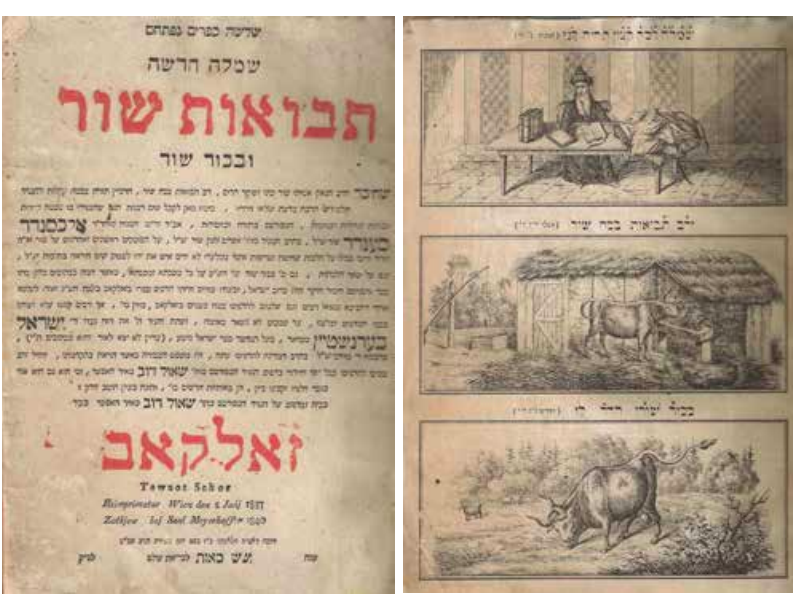
Just to mention one other unique illustrated item I recently came across about to be auctioned off in the forthcoming Genazym auction (lot 26). In a few copies of the 1840 printing of the classic work on Shecitah, Tevous Shor there is a very nice illustration connected to the title and name of the author. 
Some books are especially valued because of their legendary segulah powers.  Recently this has become even more commonplace with this genre expanding exponentially.[1]  At times the source for how these books fall into that genre are murky, but one that has a long history is Hayim ben Attar’s Or ha-Hayim.  The first edition, Venice 1742, (lot 49), in a very nice binding,  is highlighted for its segulah powers that include protection, healing, and children, and the study of it has the power to purify one’s soul. 

Returning to illustrations, a portrait of R. Dov Ber Meisles, the rabbi of Warsaw (and other cities), from 1891, is among the items.  This is not the only illustration that R Meisels appears.  During the late 1860s, there was substantial unrest in Poland when many sought to force the Tsar to bestow greater civil rights to the populace.  The clergy played a large role in this endeavor and R Meisels was among them.  This was viewed as an opportunity for Jews to be accepted by the population.  In this, Meisels had a profound impact and was among the main influencers of Marcus Jastrow to take part in the movement.  Meisels and Jastrow became very close.  When both were imprisoned for their activities, initially Jastrow was kept in isolation but when he was transferred to Meisels’ cell, Jastrow’s spirits were lifted and was able to deal with the remainder of his imprisonment.  In the end, both were expelled from Poland, although eventually permitted to return.  One of the most notable events during this period was the funeral of five protesters who were killed by government forces.  The funeral took place on Shabbos and both Jastrow and Meisles were in attendance.  Their participation is recorded in Aleksander Lesser’s painting, “Funeral of five victims of the demonstration in Warsaw in 1861.”In the center left, Meisels appears with a fur hat next to Jastrow in his canonicals.[2]   
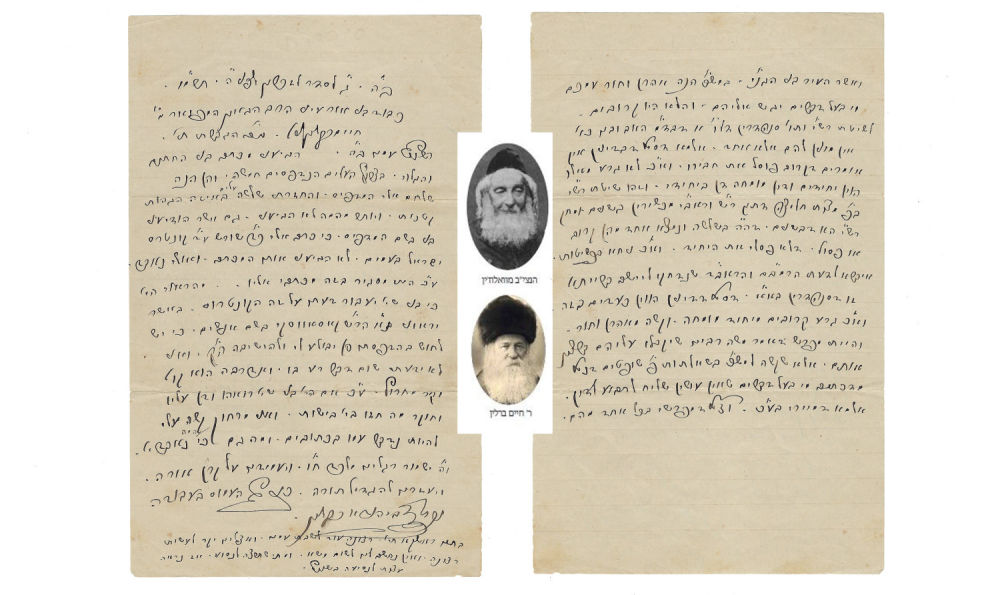
 Another item of ephemera is a letter from the Hazon Ish to R. Yosef Zevin (lot 68)(the envelope confirms that the addressee was R Zevin).  Although there is no doubt about R Zevin’s Zionist leanings, the Hazon Ish carried on a correspondence with him.[3] This is yet another letter showing the connection between R Zevin and the Hazon Ish. (For others, see Yehoshuah Levin, HaShakdan (Monsey: Tuvia’s, 2010), 117). R Zevin included a profile of Hazon Ish and his style of study in the book Ishim ve-Shitot. 

As we have shown in the past, one can learn all kinds of things from the information found in the writeups in the various auction catalogs including seeing actual clear copies of the manuscripts (lot 55). there is a letter of his from 1886 about his essay on Antisemitism called Shar Yisroel which he was about to print. He writes to his son to check it over as someone told him that perhaps some might get angry about and it would cause problems for him and the Yeshiva. This is not the only time that we find the Netziv nervous about his actions and that it would cause possible problems for the Yeshiva.

Two of R Yaakov Emden’s important works, Mitpahat Seforim and his Siddur, both of which are rare are up for sale (lots 75 & 76).  The first of edition of his siddur is critical to actually determining R. Emden’s opinions regarding the liturgy and its attendant customs.  This is so because although there are many alleged reprints of the Siddur, they, in fact, do not include the text that R Emden so carefully edited.  Only recently has the complete siddur been reprinted.  The Mitpahahat is R Emden’s well-known challenge to the Zohar, or parts of it.  Emden points to many passages that appear to be later than when R Shimon bar Yochi lived, the traditional author of the Zohar. R. Emden’s work was subject to some rebuttals, one is Moshe Kunitz Ben Yochi.  But some allege that Kunits freely borrowed from others and that his rebuttals fall short of the mark. 
One final item, also a siddur, is a first edition of Siddur R’ Shabsai MeiRushkov (lot 95) which is considered very rare starting bid is $50,000 and with a sale’s estimate of  $100,000.
[1] See Avraham Ya’ari, Mehkeri Sefer (Jerusalem:  Yehuda, 1958) who discussed a number of books that were written after the author experienced cataclysimic events. See also Eliezer Brodt’s article in the forthcoming Ami Magazine discussing the ubiquity of this phenomenon. 
[2] See Jastrow, “Baer Meisels, Chief Rabbi,” The Maccabean XI, 5 (Nov. 1906), 208-09; idem. XI, 6 (Dec. 1906), 246-48. For Jastrow’s activities during that time see Michael Galas, Rabbi Marcus Jastrow and His Vision for the Reform of Judaism:  A Study in the History of Judaism in the Nineteenth Century, trans. Anna Tilles (Boston:  Academic Studies Press, 2013), 70-88. Even at the end of his life, Jastrow was in America he still counted Meisel among those who influenced him.  See idem. 170.
[3] That is not to say that some didn’t try to write out R Zevin’s connection to Zionism.  See Jacob J. Schacter, “Facing the Truths of History,” Torah u-Madda Journal 8 (1998-1999): 223-24. 


Happy July 4th

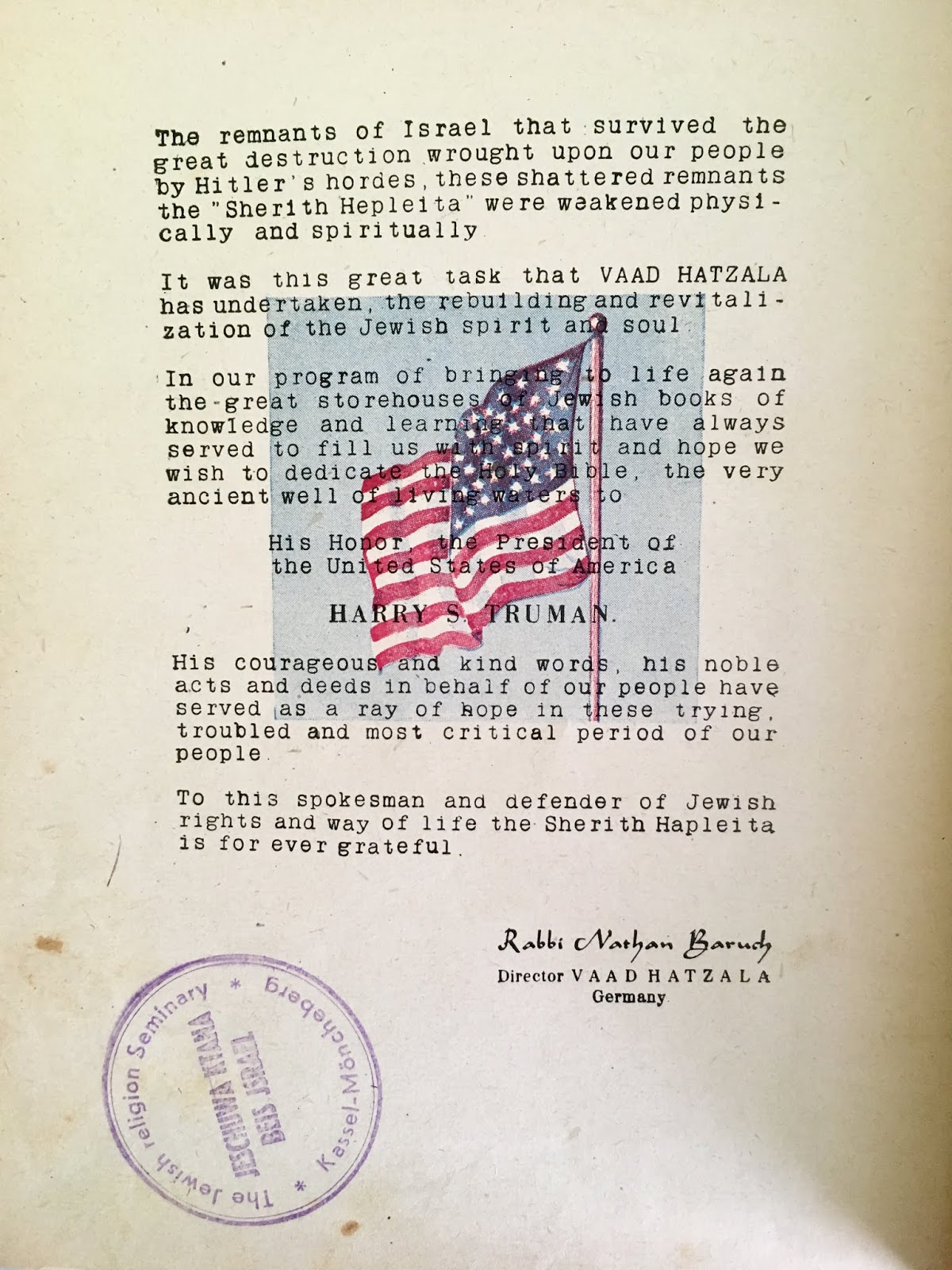
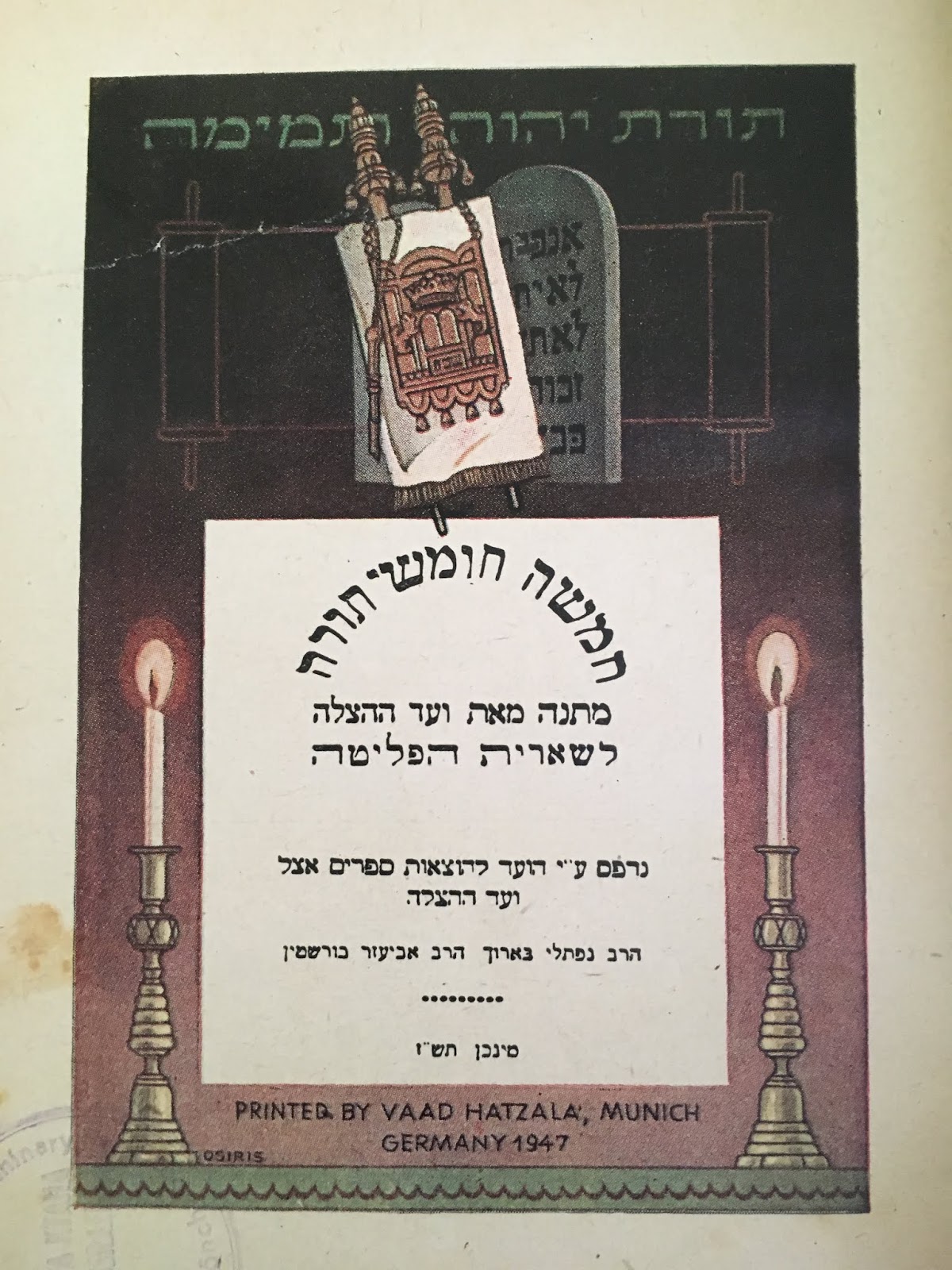
From a Hebrew Bible printed by the Vaad Hatzalah, Munich, 1947, for the use of Displaced Persons (DPs),  the”Sherith Hepleita,” with a dedication to President Harry S. Truman 


The Humble Artichoke

The New York Times recently discussed a novel ruling of the Israeli Chief Rabbinate.  The Rabbanut held that artichokes fall into the category of prohibited foods.  This is not because they are listed as such in the Torah. Rather the expansion of the biblical category is because of a secondary concern, the presence of insects.  Those insects may reside in the heart which without opening the tight leaves that comprise the vegetable one is unable to determine if insects are present, thus, eating artichokes whole risks also ingesting insects.

Jews in Italy, however, took issue with this ruling. They pointed to a long-standing tradition of eating artichokes whole after deep frying.  That tradition places the creation of the dish sometime in the 16th century in the Jewish ghetto in Rome. Indeed, their preparation is so intertwined with Jews, in Italian it is called Jewish-style artichoke—Carciofo alla giudia.  Today many travel books include this delicacy among those to try in Italy listing various kosher restaurants that offer the Jewish Artichoke.  The Rabbi of Rome refused to reform the practice of Italian Jews and continues to eat and provide his hechsher to restaurants which serve this vegetable prepared in the traditional manner.[1]  

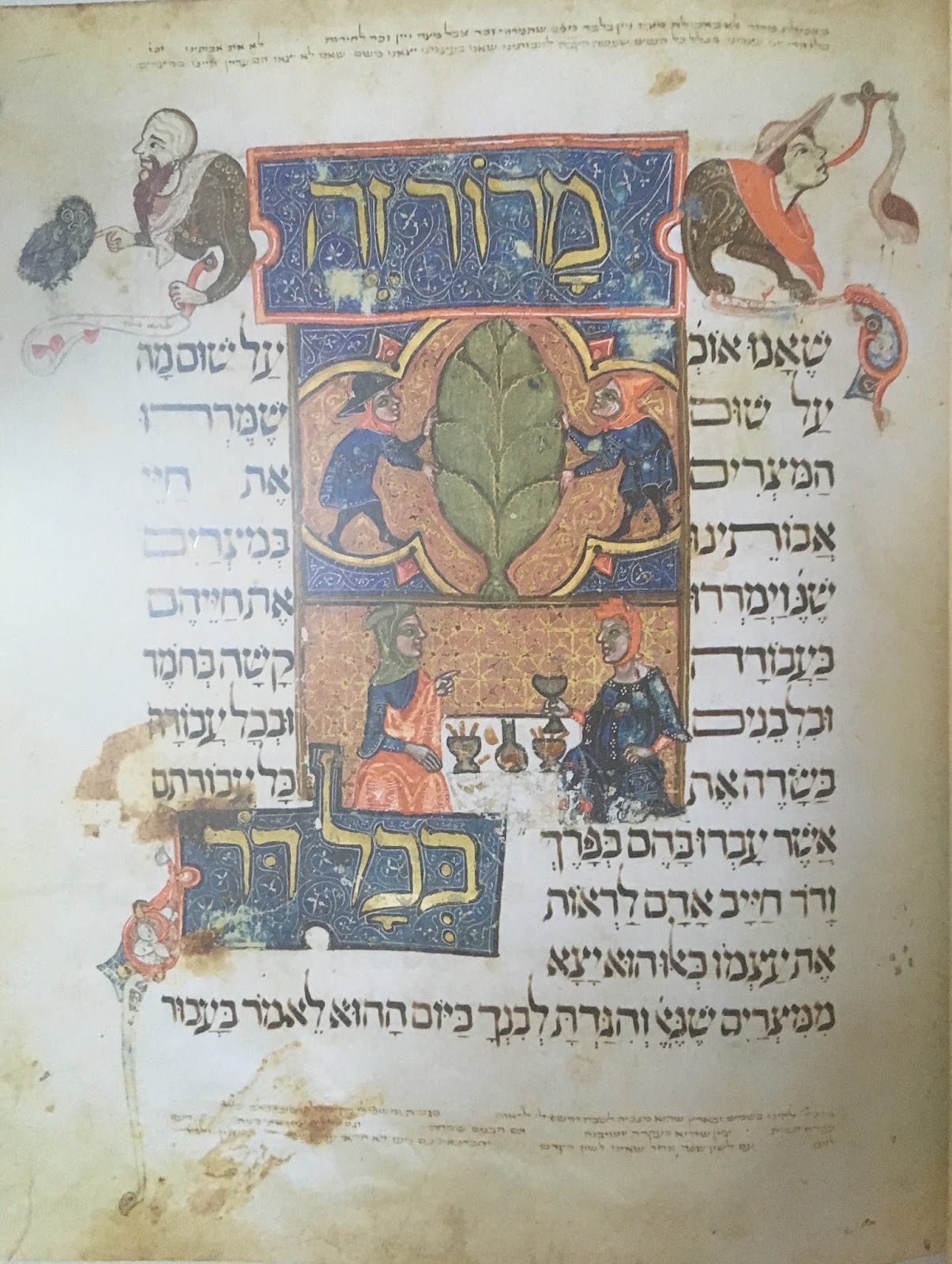
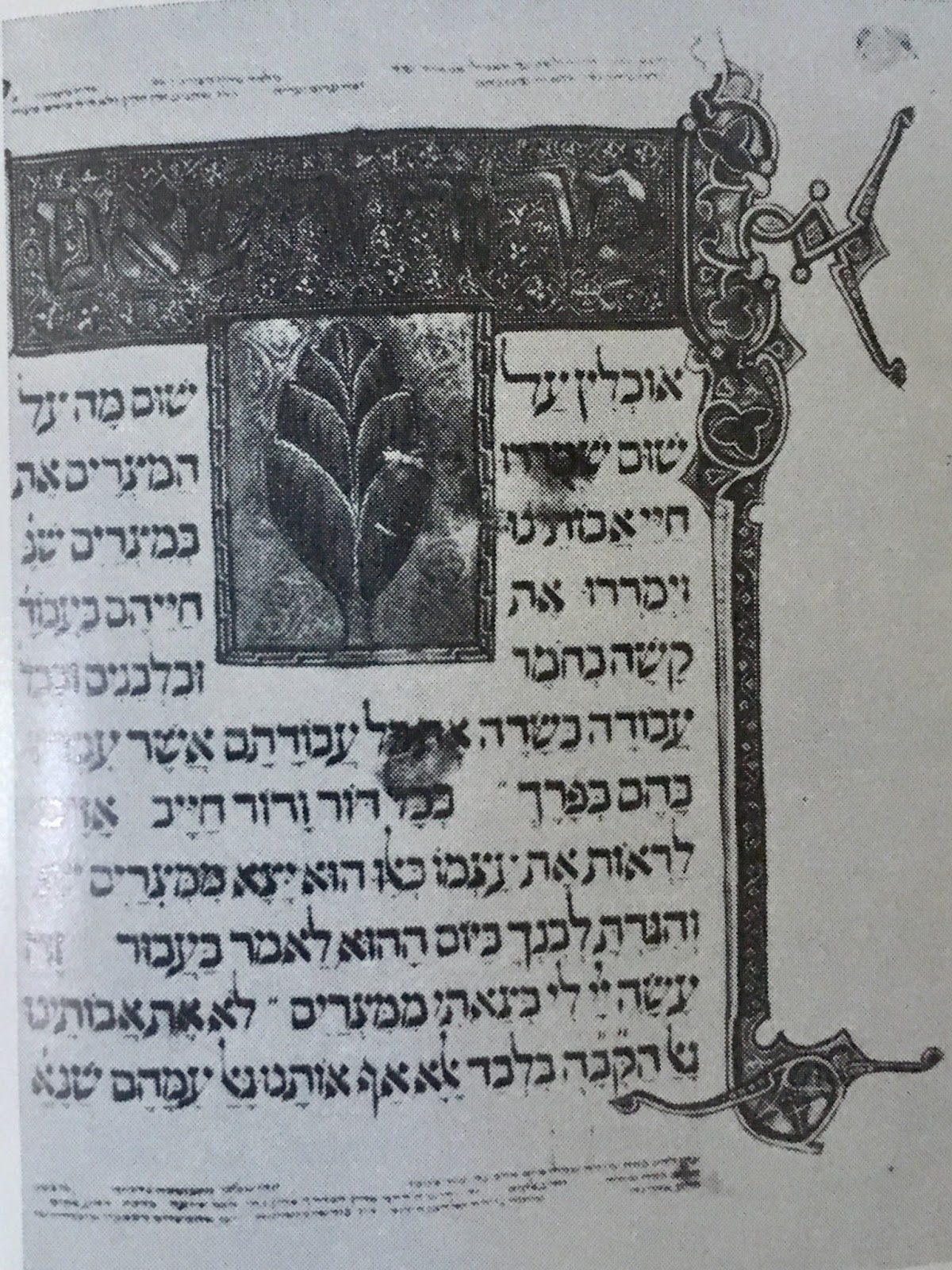
The history of how the fried artichoke became associated with Jews is somewhat murky but likely dates at least to the 16th century.  But we have even earlier manuscript evidence that artichokes were eaten by Jews.  Indeed they were eaten at a time when Jews were especially punctilious regarding food, Pesach.  A number of medieval haggadot contain illustrations of marror, most include a leafy green of some type.  Two haggadot, the Rylands and the Brother, composed in the mid/late-14th century depict marror as an artichoke. [2]  

[1] Regarding the autonomy of the local rabbinate see Teshuvot haRosh, Klal 21, 8-4, 9-2, and generally the sources collected in HaMahkloket beHalakha,  Hanina Ben-Menahem, Neil Hecht, Shai Wosner, eds., vol. 2 (Boston:  Institute of Jewish Law Boston University School of Law, 1993), 753-820. 
Students of history will recall that this is not the first time that the norms and traditions of the Italian Jews came into conflict with the different prevailing norms among other groups of Jews. In the controversy engendered by the publication of the pamphlet Divrei Shalom ve-Emet by Naftali Herz Wessely in the aftermath of Emperor Joseph II’s Edict of Toleration, which called for educational reform among his Central European subjects. After his pamphlet was found objectionable and insulting by leading rabbis, Wessely wrote to rabbis in Italy, believing that many of the ideas he was advocating, like a graded curriculum, a non-exclusive emphasis on Talmud, and use of the general vernacular, were well within the norms of their tradition. In fact, with the exception of only one of the Italian rabbis, R. Ishmael Ha-kohen of Modena, all the others agreed and supported him and helped the controversy die out. These aspects of the Wessely affair are discussed in Lois C. Dubin, “Trieste and Berlin: The Italian Role in the Cultural Politics of the Haskalah,” chapter 8 in Jacob Kats, ed., “Towards Modernity: the European Jewish Model” (New York, 1987) and the series of articles by Yisrael Natan Heschel in Kovetz Beit Aharon ve-Yisrael 8 (1993) titled “דעתם של גדולי הדור במלחמתם נגד המשכיל נפתלי הירץ וויזל.”
[2] The Rylands Haggadah manuscript is discussed in Katrin Kogman-Appel, Illuminated Haggadot from Medieval Spain: Biblical Imagery and the Passover Holiday (University Park:  Penn State University Press, 2006) 91-97.  The Brother manuscript has recently been reprinted in full with an excellent introduction by Marc Michael Epstein in addition to other relevant articles.  The Brother Haggadah:  A Medieval Sephardi Masterpiece in Facsimile (New York:  Thames and Hudson, 2016).  For a discussion of the identification of marror see Zohar Amar, Merrorim: Hameshet Minei haMarror sheAdam Yotseh Bahem Yedei Hovato bePesach (Modiin [], 2008). 


Rare Letters, Controversial & Valuable Hasidic Books – Genazym Auction

Genazym Auction is holding an auction on March 21st that includes many important letters and manuscripts and a small number of books (download a pdf of the catalog here).  Many of the books are Hasidic or owned by well-known Hasidic figures.  For example, the rare first edition of the No’am Elimelekh, 1788, by R. Elimelekh of Lyzhensk (lot 13).  That book, like other early Hasidic books are both fundamental to the Hasidic philosophy and theology and were controversial among those opposed to the new movement.  Indeed, according to Rabbi David of Makov, the book should be “eradicated from our homes.” (R. David of Makov, Shever Poshim, in Morecai Wilensky, Hasidim U-Mitnaggedim, vol. II (Jerusalem:  Mossad Bialik, 1970).  Similarly, the  Tolodot Ya’akov Yosef, was published in Lvov, 1788, is among the most prized Hasidic books.  The book was controversial when it was printed (likely without official approval of the censor) and some copies were destroyed in Brody. According to the legend recorded in Shivhei Ha-Besht the matter of the books was so important it was discussed in the heavenly court at the highest levels. Joseph Perl, in his satire, Megaleh Temirin, locates that bibliocide at “the home of R. Mikhel of Zlotchuv, in compliance with the order of the [Brody] court and the community there.” (See Jonathan’ Meir’s recent critical edition of the Megalah Temirim that provides additional evidence of the book burning.  Sefer Megale Temirin, ed. Jonathan Meir (Jerusalem: Bialik Institute, 2013) 29n10). Ownership of the No’am Elimelekh is also valued as a segulah.  There are other books that are prized not only for their content but also for such secondary reasons, for example, the Homat Eish, (R. Eliezer from Kalktshuv, Bresslau 1799), as the title implies is designed to protect from fire. (See also Avraham Ya’ari, Mehkerei Sefer (Jerusalem:  Yehuda, 1958) 47-54)
Another important Hasidic work is R. Hayyim of Chernowitz’s, Siduro shel Shabbat (lot 14), which is well-known as the source for the Leshem Yihud.  That prayer is among the more controversial prayers, which we have discussed previously here and towards the end of this post. (See also Moshe Halamish, Kabalah: Be-Tefilah be-Halakha ube-Minhag (Ramat Gan:  Bar Ilan University Press, 2000) 45-70 and Daniel Sperber, Minhagei Yisrael (Jerusalem:  Mossad HaRav Kook, 2007) index “leshem yihud”).

Similarly, the Sh”ut Mayyim Hayyim (lot 18) by R. Hayyim Rapoport we have discussed at length here.  The work establishes the existence Ba’al Shem Tov and is an indication of his scholarship. Our post discusses other bibliographical and historic items related to the work. 

   
There are numerous historical and intellectually valuable letters among them the telegram sent from Kobe, Japan, just before Yom Kippur 1941 to the rabbis in Israel requesting clarification, because of the ambiguity of the location of the dateline, as to which day to fast on Yom Kippur. (Lot 48).  A number of opinions are collected in Shitat Kav ha-Tarikh be-Kador ha-Arets, ed. Yehudah Areyeh Blum, (Jerusalem:  [], 1990).  Another book is (admittedly tangentially) related to the geography of the earth, and specifically Jewish astronomical calculations.  An illustration at the top of the title page of Sefer Ebronot (Offenbach, 1772) provides a heliocentric view of the earth.  The same illustrations appear in R. Yehuda Leib Oppenheim’s, Matteh Yehuda (Offenbach, 1722) and with the date displayed Ha-Moshiah ben David.  
R. Eliayhu Guttmacher was a reknown “Ba’al Mofes.”  But he was eventually overwhelmed with petitions for his assistance that he was forced to publish an advertisement in the Ha-Maggid newspaper begging people to stop sending him letters. R. Eliyahu Guttmacher, Mehtav me-Eliayhu (Jerusalem:  Yisrael Bak, 1974) 89-91;  see also Bromberg, Me-Gedolei ha-Torah veha-Hasidut, vol. 24 (Jerusalem:  HaMakhon LeHssidut) 143-52, which prints some of R. Guttmacher’s letters regarding the same; and Glenn Dyner, “Brief Kvetches: Notes to a 19th century Miracle Worker, Jewish Review of Books (Summer, 2014), 33-35. 
An important letter to R. Guttmacher is included in the auction(lot 43):
ויש הכרח ממני לכתוב כאן בקיצור, שבל יאמר מי: הלא נשמע כמה מעשיות אשר נעשים על ידך בעזה”י להציל מצרות רבות, אין זאת רק על ידי קבלת מעשית. וכאשר הגעתי אגרת ממרחק מחכם גדול… בהיותי שאני בקי בקבלה מעשיות ארחם לעשות בבזה שנתייאש מכל הרופאים. בקראי זאת נפלה עלי להיות חשוד בכך… קודם כל אודיע כי בכל התאמצות דחיתי מעלי כל הבא, אבל ראיתי סיבות נפלאות שכן היה רצון ה’. באשר שגדולי ישראל הסיעו הנדכאים עלי. ומה היה לי לעשות אם באו אב ואם ואחד מקרוביהם והביאו לי בנם, בוכים וצועקים לרחם. ישבתי ללמוד עם בחורים בבית המדרש והובא נער מן י”א שנה בכתף אביו וצעק לרחם עליו… והנער לא היה יכול לדבר מאומה… וקולו פעמים בנביחה ככלב ופמעים כעגל…וגם כל העוברים דרך העיר בשמעם עניניו לביתו לראות הנפלאות. ואני ידעתי שאין לי מאומה במה לרפאותו. בכל זאת חשבתי הלא ד’ ברוך הוא שולחו… ולקחתי ספר תהילים ובמקום שנפל אמרתי, והבאתי לכל תיבה כוונה לענין שלפני. וכוונתי היטב בשורש האותיות, ובמיוחד בהזכרת השם הקודש… פתאום הוציא הנער קול אשר נבהלו כולם, והראה באצבע למקום אחד. ואמרתי מהר לפתוח החלון, וכן היה ודיבר הנער ואמר יצאה אחת מן המכשפות ממנו ופתחתי לראות בבטנו כי אמר עוד שלש מכשפות בו… ואמרתי כיון שיש עת רצון אתפלל עוד. וכאשר אמרתי שוב בערך ד’ מינוטין שוב צעק בקול אשר בכל השכונה ברחוב ההוא נבהלו והחלון היה פתוח ושוב אמר הנה כולם יצאו… והיה כזה עוד בכמה אשר יש לכתוב כמעט ספר מכל הענינים, והכל היה בעל כרחי שהפיל עלי בכח. ורק על ידי תפלות ובקשות ולפעמים גם סגולות השכיחות… (עי”ש עוד דברים חשובים בזה, צפנת פענח, מאמר ט).

There are many other interesting items as well, such as R. Shlomo Kluger’s passport (lot 39):

A letter from the Malbim (lot 40) and much more:


Legacy Judaica Auction March 6th: A Sampling of Forgeries and other Eclectic Lots

Legacy Judaica‘s next auction will occur on March 6, 2018.  The 220 lots include very rare books such as the first edition of the Yerushalmi and a letter from R. Tzvi Ashkenazi (Hakham Tzvi) (the entire catalog can be accessed here), there are many other interesting books and letters.
Conditional marriage has been applied since at least the talmudic period if not early.  The exact circumstances and necessary predicates have evolved over time and especially in the modern period when marriage and divorce were slowly wrested from the exclusive control of the clergy and the state began to involve itself permitting some to circumvent the religious process entirely, the issue of annulments became acuter.  Annulments were among the only methods that would free a woman whose husband proceed to receive a secular divorce but not a religious one.  In France, in the early 20th century a scheme to make conditional marriage the norm and avoid later issues was proposed.  But this met with fierce opposition from many rabbis, and to counter that proposal in 1930 in Vilna a book, Ein Tenie be-Nissuin, that contained signatures of 400 rabbis was published in protest.  The book also contains an introduction by the leading Posek, R. Chaim Ozer.  (Lot 21).  
Another contemporary controversy related to something much older, the Talmud Yerushalmi. In the first decade of the 20th century, Shlomo Friedlander published a few volumes from the Kodshim order that hereto had never been published (lot 47).  Allegedly these were from a manuscript, but many doubted their authenticity. R. Meir Don Plotski, the author of the biblical commentary, Kli Hemdah, devoted an entire book, Sha’lu Shelom Yerushalim, (lot 43) to disproving that Friedlander’s edition was legitimate. (Dr. Shlomo Sprecher Zt”L reprinted the book in 1991 with a new introduction and a biography of R Poltski).  Friedlander also published less controversial books including his commentary on the Tosefta (lot 48). 
Although not controversial, another attempt to link the present with the past is a curious book, Sefer ha-Brit ha-Hadash, written by Uziel Haga of Boston (lot 130).  He petitioned and received permission from President McKinley to accompany the U.S. military on a tour of China.  Haga’s purpose was to see first hand and document the lifestyles and customs of Chinese Jews.  Among other items, he asserted that the Jews Kaifeng in the Hunan Province are descendants of the Ten Tribes. If his identification is correct, that may explain Jews’ affinity for Chinese cuisine.  Haga never made it back from China, he was imprisoned and killed by the Boxers.   Although Haga’s book was printed in Pietrekov, one book, Mishberi Yam, (lot 131) was published in China.  
Returning to forgeries, the compendium of R. Zechariah Yeshayahu Yolles, Ha-Torah veha-Hayyim, (lot 24), includes his Dover Mesharim that disproves the attribution of a certain work to R. Mordechai Yaffa (Levush).  Yolles’ position was vehemently disputed by R. Moshe Sofer (although Yolles defended him in a different controversy) and Sofer’s letter appears in this volume.  The book is also noteworthy because it includes a portrait of Yolles in the frontispiece.  
Among the books with distinguished owners include a copy of Mishnei Torah that belonged to R. Yosef Dov Soloveitchik, (Beis HaLevi) (lot 151) and R. Hayim Volozhiner’s copy of Mesorot Seyag le-Torah. Most of R. Hayim’s library was destroyed in a fire, but this book had been on loan to R. Yaakov of Ivenitz, and thus was spared the fate of the rest of books.  (Regarding the two bibliographical topics of fire and lending, see Abraham Ya’ari, Mehkerei Sefer, 47-54 (discussing books printed after the author was saved from fire) and 179-97 (discussing book lending)). As an aside, the Mesorot Seyag le-Torah also likely contains material that is misattributed to its author.  See Wolf Heidenheim, Me’or Eynayim, comments to Exodus 27:17.


The Collected Writings of Moshe Reines Kickstarter

The Collected Writings of Moshe Reines Kickstarter
Moshe Reines was a polymath: Talmudist, Hebraist, historian, investigative reporter, social commentator – a prolific and influential thinker, writer, and author. The son of Rabbi Yitzchok Yaakov Reines, Moshe Reines died tragically in 1891 at the astonishingly young age of twenty-one.  The obituary which appeared in Hamagid had this to say about the young Reb Moshe z”l: “He excelled amazingly in his absolute mastery of Shas…”
The volume (compiled and edited by Eliezer Brodt) awaiting printing is approximately seven-hundred pages. It is filled with fascinating material on the burning issues of 19th century Russian Jewry, from the politics surrounding the founding of the famed Kovno Kollel to the financial problems of the Volozhin Yeshiva, from the challenge of Rabbonus in a changing world to controversial methods of studying Gemara, from the question of Haskalah to the promise of Zionism. These are issues we still grapple with today, and R’ Moshe addressed them all with courage, verve, sensitivity, and wisdom beyond his years. He wrote in an engaging style in magnificent Hebrew, sparking debates in the periodicals of the day. 
We are on the cusp of going to print, but the costs are obviously much higher than originally anticipated. Printing costs alone exceed three thousand dollars, and that does not include the costs of scanning hundreds of pages 
For more detailed information and to fund the project please visit this LINK – only four days to go for this project to be fully funded!:


Lecture Announcement – R. Yechiel Goldhaber – January 4, 2018

EDIT 1.4.2018:
Unfortunately due to the inclement weather this lecture has been canceled. An update will be posted it that changes.

The readership of the Seforim Blog is invited to a lecture by the noted author, Rav Yechiel Goldhaber (link), whose respected research and scholarship is well-known to Seforim Blog readers. 

The shiur will be taking place Thursday, January 4, 7:30 PM at Khal Bnei Avrohom Yaakov, 2701 Avenue N, Brooklyn, NY. Rabbi Goldhaber’s speech will be delivered in English. The subject of this shiur is  “A New source in understanding the Chasam Sofer and Metzitza B’peh.”
This lecture is dedicated לזכר נשמת the late Dr. Shlomo Sprecher ז״ל who coordinated and hosted many of Rabbi Goldhaber’s shiurim, and wrote an important article in Hakirah on the subject of the shiur (link).
Rabbi Goldhaber has authored many wonderful articles, published important documents and written works on a wide range of topics, among them Minhagei Kehilos about customs, Kunditon (link), on the topics of the Titanic, and the so-called Cherem on Spain, as well as two volumes of Ginzei Yehuda, a collection of assorted letters from various rabbis of note.