In Praise of the Soncino Talmud

In Praise of the Soncino Talmud
By David S Farkas*

Not long ago one of our local schools hosted a Giveaway day in its library, making many of the older seforim in its considerable collection free to a good home. As expected, the local citizenry plundered and pillaged, carrying off large numbers of books, many still in quite good condition. I was only able to attend towards the end, “after the last of the gleaners had gone.”[1] Only a few scattered Siddurim and Chumashim were left, when I spotted a box in a corner of the room, filled with small red volumes. Close inspection revealed that the books were none other than the Soncino Talmud, a complete set. My heart sank a little to see this classic work, neglected and abandoned. I felt, in a small way, as though I had seen the tongue of Chutzpith the Translator lying in the dust.[2]

The Soncino Press sees no press at all these days, it seems. Its groundbreaking complete English translation of the Talmud has almost entirely been supplanted by Artscroll’s Schottenstein edition. Indeed, studying with the latter presents a very much different type of engagement with the Gemara, and Artscroll has undoubtedly done a master job of it. Yet for all of its depth and analysis, Soncino to this day brings to the table things that Artscroll does not. What follows, then, is not an attempt to sing the praises of one at the expense of the other, but only to point out some of the unique features of the now-neglected Soncino, and to suggest some of its alleged flaws may have been greatly exaggerated.[3]

To begin with, the canard so many of us heard in our yeshiva days – that Soncino was edited by less than fully-religious Jews – is a terrible misimpression that, to the best of my knowledge, seems to be based purely on the evidence that it was edited by a man named Isidore. Yet Rabbi Yechezkel Epstein (as he is in fact identified, in Hebrew, on the opposite front-page of most volumes) was very much an observant Jew, who attended the Pressburg Yeshivah founded by the Chasam Sofer, and was said to know Shas by heart. The project began with Seder Nezikin in 1935 with a heartfelt prayer to Almighty God, capped with the traditional phrase יה”ר מלפני ה’ כשם שעזרתני לסיים סדר נזיקין, כן תעזרני להתחיל סדרים אחרים ולסיימם.  It concluded in 1948, as printed in Seder Kodshim, with a heartfelt תם ונשלם שבח לבורא עולם, and the traditional Hadran written out nearly in full. We can certainly say of Soncino, if we may modify R. Yosi’s summation of Kelim, “Happy art thou, Soncino – thou began in purity, and finished in purity.”[4]

Moreover, a review of the individual contributors to each volume – a list that, to my knowledge, has never before been assembled – reveals that each and every one of them were strictly orthodox, and not identified with any other stream of Judaism.[5]

The entire series is written in the best of the King’s English. Somewhat amusingly, this itself has sometimes been offered as a reason not to use the Soncino, as though students today are incapable of understanding proper English. It is true that the series occasionally uses words no longer current (such as “dam” for a mother bird or animal, or “usufruct”.) It also actually translates Biblical or Talmudic concepts, rather than simply transliterating them, a device that has become popular today. Still, the language is eminently readable to anyone devoting to it the proper attention, and it is precisely the insistence upon proper translations that sometimes leads to a better grasp of the text.[6]

Turning to more substantive matters, one key item that jumps out is the brevity of the work. In its most compact English-only edition, the entire set – and that includes all sixty tractates, plus a full-length Index volume – comes in at a trim eighteen volumes. Even with the facing Hebrew page, the set numbers no more than 30 or 35 volumes, depending on the edition.[7] Artscroll, by contrast, which incudes only those tractates with Bavli (plus Shekalim, Eduyos, and Midos) comes in at a jaw-dropping, new-bookshelves-requiring, 73 volumes.[8]

And there is something to be said for concision. At times, when I have encountered a difficulty in the (original) text, checking with Artscroll has only made things more difficult. The Artscroll method is generally to translate or paraphrase the entirety of Rashi, and doing so in English sometimes leaves the reader confused. By contrast, Soncino tends to collapse the entirety of every question and answer into one or two lines. Keeping things short and to the point, I have found, often leads to better understanding of the basic give and take of the Gemara.

This brevity is especially important – and here is a key distinction between the two translations – for those who can learn the Gemara in the original, but either lack the time or the patience to do so. Artscroll effectively prevents the user from doing anything on his own. The text is spoon-fed to the user, and because of the interlinear format, the reader never gets entirely away from the English. Though one can go to the full Hebrew text, the Hebrew woven into the English also means users can – and do – simply use the translation.  It is quite often tedious and time consuming to read, in part because the sentences are broken up every few words, and in part because of the copious long and involved footnotes. Soncino, on the other hand, rather than leading the reader by the hand, simply gives him a head start. Quickly perusing a few English-only paragraphs provides the reader with an overview of the upcoming sugya, and allows him to go back into the regular text and then read everything on his own. In essence, it requires the reader to still go back to the traditional Hebrew text, especially if he wants to fully understand the discussion.

That, of course, might well be considered a flaw, rather than a feature. As noted by R. Gil Student, the Soncino does have “limited value in helping one understand the “sugya” (progression of ideas at large).”[9] Artscroll does an excellent job of laying out for the reader where the passage is heading, and identifying what the Gemara intends to accomplish with each step of the discussion. Soncino does none of this, expecting the student to do this on his own. In some volumes, however, the text is broken up into shorter paragraphs, which on their own help the astute reader realize the Gemara’s direction.

Footnotes help, too.  Soncino very often paraphrases Rashi, only without calling attention to the fact. Moreover, it also regularly cites traditional commentators. As noted in the Introduction, these include, in addition to Rashi, “the Tosafists, Asheri, Alfasi, Maimonides, Maharsha, the glosses of BaH, Rashal, Strashun, the Wilna Gaon, etc.” I have also seen cited Rishonim like Rabbeinu Chananel or Ritva, and Achronim like R. Yaakov Emden and R. Tzvi Hirsch Chajes. Of course, and again, in no way does it approach the information provided by Artscroll. Readers with questions will often find them addressed in the lengthy notes of Artscroll, and will even more frequently encounter issues they had never considered. For sheer depth of analysis, Artscroll stands alone. Still, it is a mistake to think that Soncino gives the reader only the bare Gemara by itself.

Yet Soncino also provides information often absent from Artscroll. As the Chief Editor wrote, while he did not attempt to secure uniformity among the several authors – more on that in a moment – he himself added footnotes in brackets containing matters of historical and geographical interest. (To be sure, R. Epstein also added in many pshat based comments, though both functions noticeably decline in frequency as the series progresses into Kodshim.)

Citations to journals like the Jewish Quarterly Review or other German-language periodicals abound. Where parallels to the Gemara exist in Josephus or Apocrypha like Ben Sira, we are informed.  Likewise, parallels in Greek and Roman sources are also frequently noted.[10] Most place names are identified via Obermeyer’s 1929 geographical guide to Talmudic Babylon. Textural variants from the Septuagint are sometimes noted. Herford is also cited on anything that relates to Christianity, though, it may be said, Soncino displays somewhat of an obsession on this topic, and often perceives statements of the sages to be a disguised polemic, with very little justification.[11]

Each of the six Sedarim has its own introduction. The introductions to each of the individual volumes contain very useful summaries of the topic of each chapter, an important feature for learning the Talmud (and quite helpful for review), where the forest can easily be lost sight of. An appendix to Gittin gives what I believe to still be the best short summation of the Talmudic-era medicine described in the 7th chapter of that Masechta, as well as a similar lengthy passage in Avoda Zara. In one of the volumes (Eruvin) diagrams are gamely used, though the technology of the time did not permit anything much more than rudimentary line drawing and shading. Similarly, the anatomical skeleton of an ox is presented in Chulin.

I noted above that the editor did not seek to achieve uniformity of style, and the uneven quality shows. Some volumes are simply better than others. In one or two cases the translation can only be called wooden, and the notes do little more than add an emphatic “Surely not!” after obviously rhetorical questions. Happily, though, in most cases the individuality of the authors accrues to the benefit of the overall translation, providing different perspectives and viewpoints. Thus, for example, the translations of Chulin and Menachos done by Eli Cashdan, a European-born Talmid Chacham of note, are particularly lucid and clear. The translation to Moed Kattan by Dayan Lazarus preserves the poetry of the original in the elegies of the third chapter by translating them into English poetry, in the classic British style of Israel Zangwill and Nina Salaman,[12] The work to the first half of Kesubos by Samuel Daiches, the only barrister at law to participate in the series (though also an ordained rabbi), is particularly rich with citations to both Roman Cannon law and English jurisprudence.[13] And a number of these highly-educated authors find parallels in Talmudic sayings to classics of literature. [14]

In short, there is much to say in favor of the Soncino Talmud. It contains many gems of scholarship and interpretation, some of them not found, to my knowledge, in any other sources. If it is not perfect – no translation ever is – it is far better than it is often given credit for. The Soncino Talmud was, and fill forever remain, a landmark of Torah literature. To echo (via paraphrase) the words of Dr. Shnayer Leiman in these pages a number of years ago, said in connection with a different classic series thought to be out of date: “Hold on to your Soncino Talmuds! Public libraries and private collectors will do well to retain them and keep them precisely on the same shelves they have now occupied these many years.”[15]

Note from the Seforim Blog editors: Prof. Saul Lieberman refers to “responsible English translations of rabbinic texts (like those of Soncino Press)” at the end of his classic poison-pen review of Jacob Neusner’s acumen as a talmudic translator. See Lieberman, Saul. “A Tragedy or a Comedy?” Journal of the American Oriental Society, vol. 104, no. 2, 1984, pp. 315–319.

* Mr. Farkas received his rabbinic ordination from Ner Israel Rabbinical College in 1999. He lives with his family in Cleveland, Ohio, where he serves as Senior Corporate Counsel for a large energy company.   

[1] See Peah 8:1, Bava Metzia 21b

[2] See Chulin 142b.

[3] I have used the device of contrasting with Artscroll to highlight certain aspects of the Soncino. It should be self-understood that these points of preference are in no way intended to derogate that outstanding work, which enjoys deserved worldwide popularity. In the same vein, I use Artscroll as a contrast simply because of its wide-spread use, and not from any intent to disregard the also excellent Koren and Steinsaltz editions.

[4] The foreword and epilogue to the set – what we might today call הסכמות – contain similar sentiment. They are cited, along with brief comments on the Soncino series, in Words, Meaning, and Spirit: The Talmud in Translation (A. Mintz, Torah U’Maddah Journal 1995).

[5] The Complete list of Contributors to the Gemara include the following Rabbis, Doctors, and Misters, in alphabetical order: I. Abraham (Chagigah); Eli Cashdan (Menachos, Chulin); Abraham Cohen (Sotah, Avoda Zara); Samuel Daiches (Kesubos); H. Freedman (Sabbath, Pesachim, Nedarim, Kiddushin, Bava Metzia, Sanhedrin, Zevachim); M. Ginsberg (Betzah); L. Jung (Yoma, Arachin); E. W. Kirzner (Bava Kama); B. D. Klein (Nazir); L. Miller (Bechoros, Temurah); I. Porusch (Kerisos, Meilah); J. Rabinowitz (Taanis)  Jacob Shachter (Sanhedrin) H. M. Lazarus (Moed Kattan, Makkos); A. E. Silverstone (Shevuous);  Maurice Simon (Brachos, Eruvin, Rosh Hashana, Megilah, Gittin, Bava Basra, Bechoros, Tamid); and Israel Slotki (Sukah, Yevamos, Horayos, Bava Basra, Nidah).

The additional Mishnayos were translated by the aforementioned Israel Slotki, and Rabbis/Dcotors H. Bornstein, Phillip Cohen, Isidore Fishman, J. Israelstam, S. M. Lerhrman, and M. H. Segal.

Biographical data is available for many of these figures in Encyclopedia Judaica or Wikipedia. Information can also be found in the Jewish Communities and Records of the United Kingdom database, by clicking on the “rabbinic profiles” tab. (Available here: https://www.jewishgen.org/jcr-uk/Profiles) Note that all the figures listed here are found in the section designated for Orthodox Ministers & Cantors.

I am grateful to Dr. Marc Shapiro, who provided me with very interesting information on some of these men, and who also referred me to Rabbi Benjamin Elton, of the Great Synagogue in Australia, who likewise did the same. R. Elton, in turn, referred me to Professor David Newman, who sent me some photographs of some of the contributors – looking very rabbinic indeed.

[6] This is particularly true for the realia of the Gemara. See for example Pesachim 37a, סריקין מצויירין  which Soncino translates as “Syrian cakes”, but Artscroll transliterates as “decorated Sirikin”; Yoma 38a נחושת קלוניתא which to Soncino is Corinthian Bronze, but to Artscroll, “refined copper.”; In Moed Kattan 27a, in the context of items a mourner may sit upon, such as the chair or ground, אודייני גדולה is listed and translated by Artscroll simply as a “large mortar”, with no additional comment. Soncino translates it as “a large bench for water jugs”, footnoting to the Roman Uranariun and showing the term in parallel passages as אורנריי. Many such examples can be cited.

[7] For more on these different editions see Words, A. Mintz, Id., at fn. 49.

[8] Though this set too, now looks small, compared to the complete Hebrew-language Mesivta edition – a stupendous 136 volumes.

[9] “Tackling the Talmud: One Daf at a Time” (Jewish Action, Fall 2012)

[10] See for example Nazir 4b, showing parallels to the story described therein to the tale of Narcissus found in Ovid.

[11] See, for example, the Commentary to Sukkah 5a, Nedarim 38a and 64b. (I hasten to add, as someone once observed, “Just because you’re paranoid doesn’t mean they aren’t after you.” I myself recently wrote, of a Mishna in Beitzah, that it too, contained a hitherto unnoticed reference to Christianity. See my article Of Fish and Fishermen: An Unknown Christian Passage in the Talmud (Tradition 52:3 2020).)

[12] See also his nifty rendering of the phrase found there on 9b בת שיתין כבת שית לקל טבלא רהטא : “As sixty as six: the sound of a timbrel makes her nimble.”

[13] See there, for example, 17b and 20a.

[14] See Chagigah 13b, in connection with Sandalphon, referencing Longfellow’s similarly named poem; Avoda Zara 4a, comparing R. Chanina’s advice to pray for the government for without it men would swallow each other alive to a phrase in Shakespeare’s Coriolanus.

[15] The New Encyclopedia Judaica: Some Preliminary Observations. (Shnayer Leiman, Seforim Blog, June 5, 2007)


Sukkah 4a “What’s Wrong with This Picture?”

Sukkah 4a “What’s Wrong with This Picture?”

By Eli Genauer

This post is is l’zecher nishmas my uncle and rebbe, Rabbi Sam Genauer ZT”L whose yahrtzeit is the second day of Av. Rabbi Genauer was a talmid of Rabbi Moshe Soloveichik at RIETS.

מסכת סוכה ד׳ עמוד א׳

The maximum height of a Sukkah is twenty Amot. The Gemara discusses a situation where the Sukkah is slightly more than twenty Amot high and one builds a raised platform inside the Sukkah.

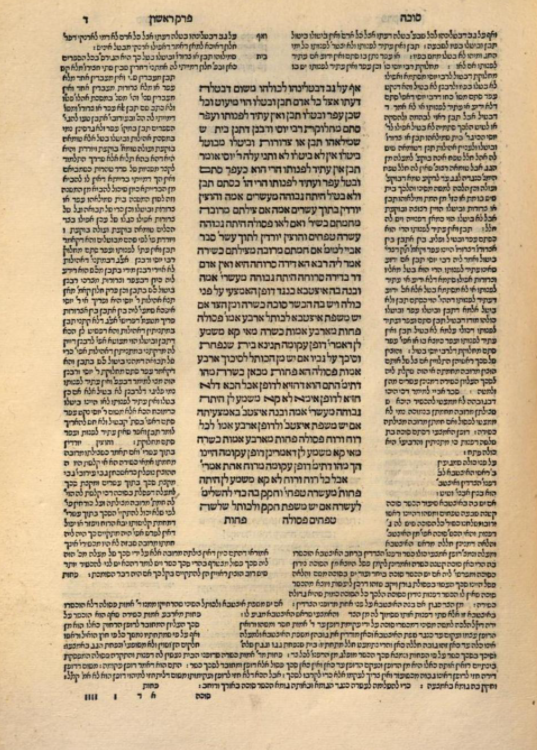
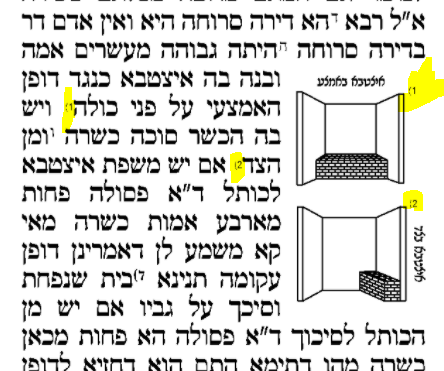
היתה גבוהה מעשרים אמה ובנה בה איצטבא כנגד דופן האמצעי על פני כולה ויש בה הכשר סוכה כשרה

If a Sukkah was more than twenty Amot high and one built a platform (איצטבא) in it opposite the middle wall, and the platform (איצטבא) is the minimum area required for a Sukkah to be kosher, (7 Tefachim by 7 Tefachim) the Sukkah is kosher

ומן הצד, אם יש משפת איצטבא לכותל ד׳ אמות, פסולה, פחות מארבע אמות ,כשר.

And along the side wall: If there are four (or more) Amot from the edge of the platform to the opposite wall, it is Pasul. However, if there are less than four Amot, it is kosher

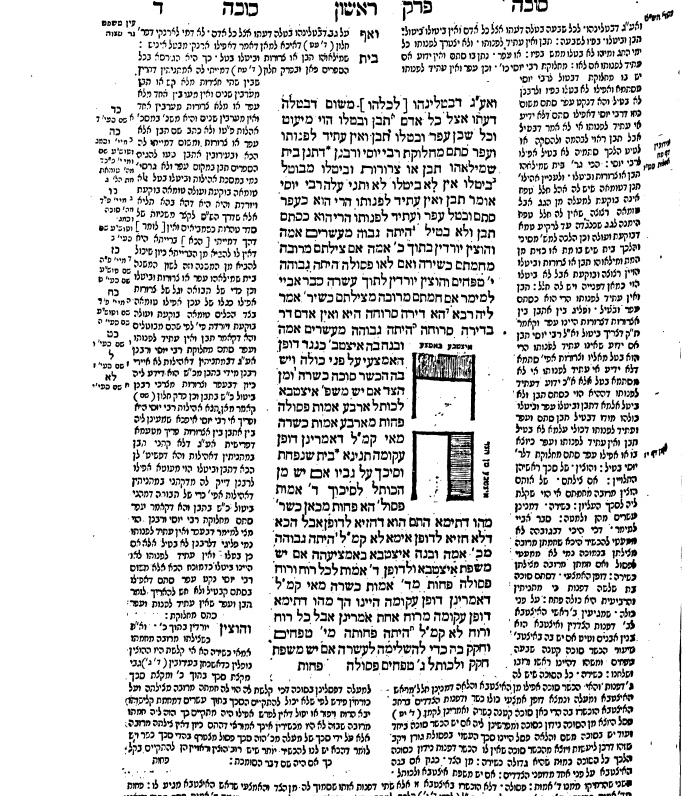
The Vilna Shas has two pictures embedded within the text of the Gemara which illustrate these cases. The first picture illustrates the case of איצטבא כנגד דופן האמצעי על פני כולה and the second picture illustrates the case of מן הצד איצטבא.

Updated Illustration in Vilna HaChadash (2006)

Were these two pictures part of the original text of the Talmud as written down by Rav Ami and Rav Asi?

The website Hachi Garsinan which belongs to the Freidberg Manuscript Society (https://bavli.genizah.org/?lan=heb&isPartial=False&isDoubleLogin=False) has a number of manuscripts of Gemarah Sukkah and none of them have these diagrams included within the text. They include:

British Library Harley 5508
Munich Codex heb. 140
Munich Codex heb. 95
JTS Rab. 218, JTS Rab. 1608
Oxford heb. 2. 51

It is extremely unlikely that any other written manuscript of this section of Talmud contained these two images.[1]

Nevertheless, we do get the impression from the Vilna Shas that these diagrams are part of the body of the Gemara.

The Vilna HaChadash edition (2006) even ties the two modified pictures 1) and 2) to specific words in the Gemara.

Where do these two pictures belong, if not in the body of the Gemara text?

It turns out that there are three sources (a manuscript, the Dfus Rishon of Soncino Pesaro, and Chochmat Shlomo) which point to these illustrations properly being included in Rashi’s commentary. We will then look at how they ended up in the text of the Gemara.

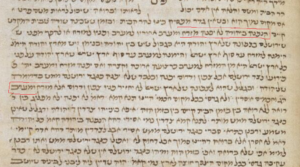
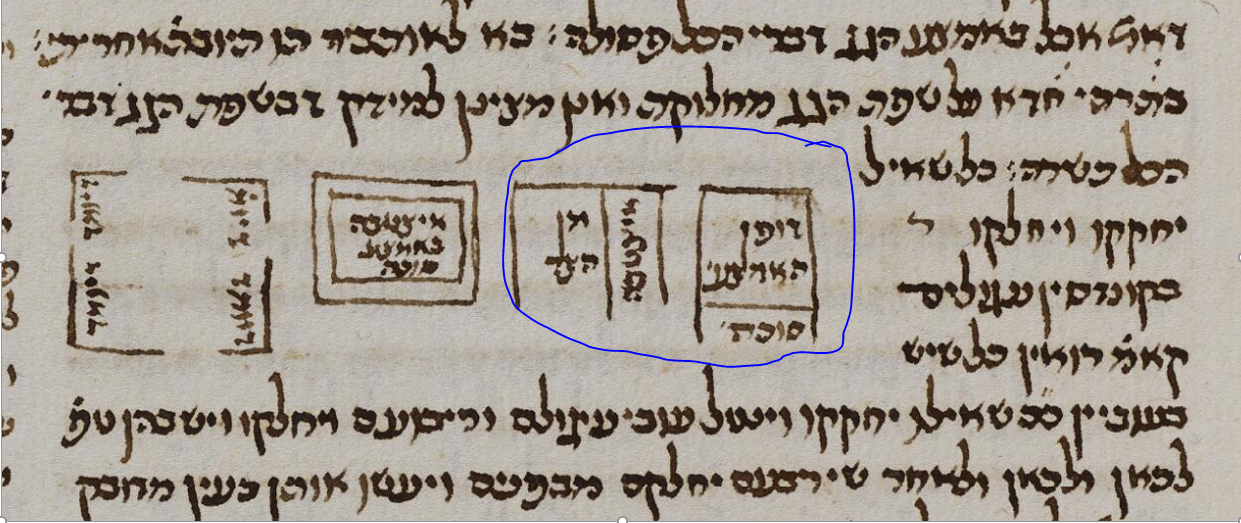
In a manuscript identified as JTS, New York Rab. 832 (JTS, New York, Ms. 6648), pictures illustrating איצטבא בדופן האמצעי ואיצטבא מן הצד are placed alongside two other illustrations on the next page.

Dr. Aharon Arend attributes these pictures to the Rashi on 4a.[2]

Additionally, the Dfus Rishon of Soncino Pesaro (c.1515) places the diagrams in the body of Rashi’s commentary. One diagram is situated next to the Rashi which speaks about the איצטבא being in the middle and the other diagram is in the Rashi which speaks about the איצטבא being on the side.


Bomberg Venice 1521 left empty spaces in the same two comments of Rashi. Bomberg and Pesaro clearly saw them as separate drawings and situated them in the same comments of Rashi:

This Chochmat Shlomo (Cracow 1582) agreed that the two illustrations belonged in Rashi and placed them in the Rashi immediately preceding the first one of Soncino Pesaro (which is the beginning of the Halacha):

Berman Frankfurt an der Oder 1698 used the same shapes as Chochmat Shlomo but, despite clear instructions in Chochmat Shlomo of where to place the pictures (דבור המתחיל דופן האמצעי), inserted them in the text of Gemara.

Amsterdam 1717 finally placed the two pictures where they are today.[3]

The Amsterdam imprint imputed much importance to the Chochmat Shlomo of Rav Shlomo Luria (MaHarshal) in fixing the text and format of its edition.

On the Shaar Blatt it lists the Chochmat Shlomo first in terms of what sources were used for Hagahot:

Additionally, the publisher, Judah Aryeh Leib ben Josef Samuel in his introduction to Masechet Shabbat, writes how corrupt the text of printed editions had become in his time, but that he was able to correct his edition based on the editing work of MaHarshal, MaHarsha and MaHaram Lublin. There is no diagram in Meier Einai Chachamim of MaHaram Lublin or Chiddushei Halachot of MaHarsha on this Gemara so it is most puzzling as to what source he used to overrule the instructions from MaHarshal of whom he writes ״ונתן ה׳ חכמה בלב שלמה הוא ניהו רבינו הגדול הגאון מהרש״ל זצ״ל שהגיה רוב התלמוד״

It seems as if these diagrams were somehow destined to be embedded within the text of the Gemara which is studied today, but I feel that a reference letter or number should be placed above these pictures, and an explanatory note placed on the side of the Gemara which says

בדפוס ראשון הציורים מופיעים ברש״י, ומהרש״ל גם כותב שהם שייכים לרש״י

I recommend specifically that such a notation be placed in the הגהות וציונים section of the next Oz Vehadar edition of Masechet Sukkah just as there are other references to דפוס ראשון and מהרש״ל on the same Amud.[4]

[1] According to Hillel Gershuni of the Friedberg Manuscript Society Hachi Grasinan website, none of the thousands of manuscript pages of Talmud they have studied has contained a diagram

[2] Aaron Ahrend, Rashi’s Commentary on Tractate Sukkah-A Critical Edition, Bialik Institute, Jerusalem 2021

The reference to JTS Rab 832 as Mekor Aleph is on page 27- Reference to these two diagrams pertaining to Sukkah 4a is on pages 505-506

[3] In 1714, R. Judah Aryeh Leib ben Joseph Samuel arranged to have the Talmud printed in Amsterdam by Samuel ben Solomon Marquis and Raphael ben Joshua de Palacio. They began printing with Berakhot, but were forced to discontinue printing in 1717 due to the Haskamot issued for the 1697-1699 Frankfurt on der Oder edition of the Talmud. Judah Aryeh Leib, resumed printing in 1720 in Frankfurt-am-Main at the press of Johann Koelner.

For more information on this edition see “Printing the Talmud : from Bomberg to Schottenstein” Sharon Liberman Mintz; Gabriel M Goldstein; Yeshiva University Museum.; Center for Jewish History ,2005.  Article by Marvin J Heller, page 254.

[4]


More on “New Notes Added in the Koren Talmud”

More on “New Notes Added in the Koren Talmud”

Shalom Z. Berger

In what seems like another lifetime but was just over a year ago, the Jewish world celebrated the 13th Daf Yomi Siyum HaShas. The beginning of the 14th cycle led to a revisiting of the Koren Talmud Bavli that had appeared in print for the first time in concert with the previous cycle. In a Seforim Blog post, Chaim Katz pointed out that the new English edition included some additional notes based on Rav Kook’s Ein Aya, and I responded with a post that offered some background on the efforts put into adding (and, occasionally, subtracting) notes, how it was done and to what purpose.

As I wrote in that earlier post, “Our assumption was that the audience for the new English Talmud would be less familiar with concepts and personalities appearing in the Gemara than Hebrew speakers, so we aimed to make sure that when new concepts or personalities appeared, they would receive a background or personality note.” This was done by creating a database of existing translated notes from the Hebrew Steinsaltz volumes, and inserting them as appropriate.

In a response to my post, Chaim Katz graciously acknowledged the contribution that these additional notes make in the new edition, writing: “But for English speakers that aren’t going to learn the language, or learn Tanach, or Mishna first, the “English” section of your edition is almost perfect. In any case the difficulty for students of the Talmud is not the language; it’s the missing concepts, circumstances, realia and all the other background information that the Koren Edition includes. Ashrekhem and Yasher Kohakhem!”

With that background, I would like to share two examples of additional notes, the first of which appears towards the end of Massekhet Pesahim, which, I hope, makes this a timely contribution. As we are in the midst of the year-long mourning period for Rav Steinsaltz, perhaps this could also serve as a tribute to his memory.

Presenting this on the Seforim Blog will also give me the opportunity to publicly thank individuals who helped me develop the new notes and to acknowledge sources that do not appear in the Koren Talmud Bavli itself. In doing so, I am emulating Rav Steinsaltz in his Gemarot, where, from Massekhet Hagiga until the beginning of Seder Kodashim, there often appears a page at the very end of the volume acknowledging individuals who made contributions to a given volume in various fields. In the first few volumes where this appears, it is a concise paragraph thanking his team of editors, graphics people and those who prepared the indices. Beginning with Massekhet Nedarim, he begins to thank medical doctors who helped him with medical issues in the massekhet (as an example, Prof. Jacob Steinberg of the Einstein Medical School gets a shout-out at the end of Nazir). Baba Kamma has additional thanks to those who helped him with questions of geography, while Sanhedrin mentions by name people who assisted in such areas as climate, botanica, zoology, medicine, geography, Rashi’s use of Old French and more.

Beginning with Massekhet Zevahim these pages ceased to appear, which may be connected with the appointment of senior editors in that volume, as now Rav Steinsaltz is listed as “Editor-in-Chief,” with Yonatan Eliav serving as editor. (I will note that each volume of the Koren Talmud Bavli lists editors, translators, copy editors, language consultants, etc., and the team grew in number as we moved though Shas.) Yonatan Eliav tells me that Rav Steinsaltz was “interested in everything,” that he had a large number of reference works at his disposal that he frequently turned to. It would appear that as time went on and the project became larger and larger – and Rav Steinsaltz became involved in more and more things – that he came to rely on experts in various areas of knowledge for the original Hebrew notes and commentary.

Yonatan Eliav also shared that Rav Steinsaltz was not necessarily interested in making use of the background material in order to explain the Gemara, rather his natural curiosity led him to include edifying information about the topic at hand in the Gemara even if it was not essential to understand the sugya. While I did include some material like that in Massekhet Berakhot, it was no longer a priority for my team as we moved forward. Still, there were a number of occasions when understanding the realia was essential for understanding the Gemara, as exhibited in the two examples below.

Pesahim 75a – Lead from its source

One of the editors, Micky Siev, reached out to me just before Massekhet Pesahim was finalized with the following question: In discussing how the Korban Pesah had to be roasted, the Gemara segues to a discussion about how the punishment of execution by burning was to be conducted. The translated text of the Steinsaltz Gemara originally read:

The Gemara asks: Once there is the reason of Rav Naḥman, why do I need the verbal analogy derived from the sons of Aaron? Even without it, Rav Naḥman’s ruling would require the court to carry out the execution with molten lead, which provides an easier death. They say in answer to this question: If not for the verbal analogy, I would have said that burning the soul while the body remains is not considered burning. And if it were just due to the statement of Rav Naḥman that one must select a kind death, we should add many bundles of branches so that she would die quickly. It therefore teaches us through the verbal analogy that executing with molten lead is considered burning. But if this is so, that the verse says: She shall be burned, to include all methods of burning, for what do I need the expression: In fire? The Gemara answers: To exclude lead from its source; when lead is extracted from the ground it is burning hot and this burning lead cannot be used for executions because its heat does not come from fire.

The original text of the Talmud reads לאפוקי אבר מעיקרו, which is translated here as “To exclude lead from its source.” The underlined sentence at the end is a direct translation of the Hebrew Steinsaltz, which is based on Rashi.

Siev asked me the following question:

The underlined section is the Gemara as explained by Rashi. The question is simply that lead is mined from the ground, and as far as we are aware, is not burning hot when it is extracted from the ground.”

My first reaction was to turn to the Steinsaltz Gemara itself. A parallel sugya appears in Hullin 8a, and the Hebrew Steinsaltz Gemara has a note there that explains how it may be possible for lead that is newly mined to be molten hot, and I suggested translating that note for this sugya, as well. But Siev would have none of that. He insisted that to the best of his knowledge and research, lead is never molten when it is freshly mined.

I am not sure that this question would gain much traction in a traditional bet midrash setting, but it certainly was appropriate to ask in the context of the Steinsaltz effort that puts significant emphasis on questions of realia (in fact, at a family wedding that I attended at the time, a relative who gives shiur at one of the prominent one-year Israel programs and is a serious talmid hakham asked me “what are you learning these days?” I shared this question with him and his reaction was “this is learning?!” But surely, if it appears in the Gemara, תורה היא וללמוד אני צריך).

None of the usual sources offered me anything, so I tried to be creative. I called a neighbor who is a geologist. What I learned was that although both he and his wife studied geology, they studied in Israel, which has no lead deposits, so they could not be of any help. Recognizing that I needed to broaden my search, I posted the question on H-Judaic, a listserv for Jewish studies academics (full disclosure – today, as a measure of hakarat hatov, I serve as one of the volunteer editors at H-Judaic). Within a day Prof. Gerrit Bos, Chair of the Martin-Buber-Institut at Cologne University wrote to me simply “Dan Levene and Beno Rothenberg deal with this problematic issue extensively in their: A Metallurgical Gemara: Metals in the Jewish Sources, London: 2007, pp. 101-107.”

While I could not locate the volume in a search of academic libraries in Israel, the Yeshiva University library had a copy, and my sister, Shulamith Berger, who heads their special collections, had a scan for me in a few hours. All this networking led to the removal of the underlined explanation of “lead from its source,” and its replacement with the following note:

This is an opportunity for me to thank Prof. Bos for the reference, acknowledge that the suggestion appears in the book by Dan Levene and Beno Rothenberg, and thank my sister, Shulamith, for making their work accessible to me.

~~~

Shevuot 23a – Pressed figs from Ke’ila…honey or milk

I mentioned this case in my last post, but would like to come back to it in order, again, to acknowledge the assistance of others in the research I did when developing the note that ultimately appeared in the Koren Talmud Bavli volume.

In this case, I believe that the editor involved was Jonathan Mishkin, who pointed out that the Gemara takes for granted that someone who ate pressed figs from Ke’ila or drank honey or milk could not perform the Temple service because they were likely to be intoxicated.

The Gemara challenges: But perhaps the intoxicating substance referred to in the verse is pressed figs from Ke’ila, as it is taught in a baraita: A priest who ate pressed figs from Ke’ila or drank honey or milk and then entered the Temple and performed the sacrificial rites is liable for violating the prohibition against conducting the Temple service while intoxicated.

The Hebrew Steinsaltz Gemara offers a laconic explanation in a note suggesting that figs from Ke’ila have a high sugar content, which may lead to fermentation, but it says nothing about the other substances that appear to be even more problematic. The page in the Koren Talmud Bavli appears as follows:

The first thing to catch your eye has to be the illustrations – none of which appear in the original Hebrew Steinsaltz Gemara – but there is more. The Background note about the prohibition to enter the Temple when intoxicated is taken from the Steinsaltz Reference Guide to the Talmud, which served as the source for many of the additional notes aimed at giving context to a discussion in the Gemara.

The note on “Pressed figs from Ke’ila…honey or milk” expands on the original Steinsaltz note that figs may ferment. The real challenge is why milk should be considered intoxicating (the story of Yael and Sisera in Judges 4:19 notwithstanding). The two suggestions raised in the note are that milk, too, can ferment and become alcoholic, or that “milk” in this context refers to white date wine, the latter suggestion attributed to Rav Menachem Kasher’s Torah Temimah.

Both of those suggestions, again, came from responses that I received on the H-Judaic list. While the Torah Shelemah is credited with the idea that “milk” may be white date wine (Vol. 28 pp. 273-274 in the milu’im), I would like to acknowledge that I was directed to this source by Prof. Admiel Kosman, who serves as professor of Talmud and Rabbinic Literature at Potsdam University.

After a time, I began to turn to both Bos and Kosman directly with questions like these, as they both proved to be invaluable resources in questions of realia. My public thanks to both.

In closing I would like to reiterate my thanks to Rav Steinsaltz zekher tzaddik li’vrakha and yibadel le’hayyim tovim, Meni Even Yisrael for allowing me to play a role in this project that aims to spread Torah among all Jews. A friend recently sent me a still photo taken from an interview with Amar’e Stoudemire that shows the Koren Talmud Bavi on the shelf behind him. The power of Rav Steinsaltz’ vision to make the library of Sifrei Kodesh available to all Jews who desire to learn is a powerful legacy that is now being fulfilled.

Rabbi Dr. Shalom Berger szberger@gmail.com served as Senior Content Editor for the Koren Talmud Bavli project. He is now involved in developing English language educational programming for Herzog College’s Tanakh department.


“Did The Bach Really Draw a Cow?” Eruvin 20 b – Hagahot HaBach on Rashi “הא אתמר עלה”

“Did The Bach Really Draw a Cow?” Eruvin 20 b – Hagahot HaBach on Rashi “הא אתמר עלה

Eli Genauer

Summary

The diagram in the first edition of the Bach (1824) is much more accurate than how it is depicted in later editions, especially the Vilna Shas. The Bach’s picture features a long feeding trough, (an אבוס), whereas Vilna and others show it looking more like something attached to the animal. The Zhitomir Shas compounds the error by leaving out an essential characteristic of the situation under discussion. The new editions of the Talmud get it much better. The one diagram I found in a manuscript and the diagram in the Soncino Pesaro edition of 1515 (which was based on a manuscript) are very close to the drawing in the Bach (1824).

The picture in the Bach focuses on the relationship between an animal, its feeding trough and a well. One of the key words here is אבוס which is the feeding trough.[1]

מסכת עירובין :משנה י״ז׃

[2]משנה: עושין פסין לביראות …… From Sefaria

MISHNA: One may arrange upright boards [פסין] around a well (in the Reshut Harabim in order to permit drawing water from the well on Shabbat.) [A well is usually at least four Tefachim wide and ten Tefachim deep. Therefore, it is considered a Reshut HaYachid, and it is Asur to draw water from it on Shabbat, as that would constitute a violation of the prohibition to carry from a Reshut HaYachid into a Reshut HaRabim. The Chachamim therefore sometimes made a Kulah that a virtual partition may be built in the area surrounding the well, so that the enclosed area could be considered a Reshut HaYachid.]

Perush Chai (see here):

Gemara on 20b

The Gemara discusses a case where the owner fills a bucket and gives water to an animal or fills a bucket and then pours water into a trough from which the animal then drinks

לא ימלא אדם מים ויתן בשבת לפני בהמתו, אבל ממלא הוא ושופך והיא שותה מאיליה

A person may not fill a bucket with water and hold it before his animal on Shabbat; but he may fill it and pour it out (into a trough.) The animal then drinks of its own accord.

הא אתמר עלה אמר אביי הכא באבוס העומד ברשות הרבים גבוה עשרה טפחים ורוחב ארבעה וראשו אחד נכנס לבין הפסין

The Gemara qualifies the case of pouring water into a trough by saying that the above Baraita is dealing with a cow standing inside a house with windows open to the Reshut HaRabim, eating from a trough that stands in the Reshut HaRabim that is ten tefachim high and four tefachim wide, ( meaning it is a Reshut HaYachid), and one end of this trough extends into the area between the upright boards surrounding a well. Here is what it looks like.

Source: Chavruta English (see here, p. 14).

רש״י הא איתמר עלה כו

הא איתמר עלה כו‘ – כלומר כי בעינן ראשה ורובה בדלא נקיט לה וכי הוי ראשה ורובה שרי וברייתא דקתני לא ימלא ויתן הוא עצמו לבהמתו הא תרצה אביי לקמן דלאו בבהמה העומדת ברהר וראשה ורובה בין הפסין עסקינן אלא בבהמה העומדת בבית וחלונות פתוחות לה לרהר ואיבוס מתוקן לה )ב”ח( לפניה ברהר גבוה יורחב דדהוי רהי ונותן לה שם תבן ומספוא מרהי וראש האיבוס נכנס לבין הפסין ואשמעינן דלא ימלא מן הבור ויגביה הדלי על ראש האיבוס וילך דרך רהר ויטלטל הדלי על האיבוס לפני בהמה ואעג דקייל עומד אדם ברהר ומטלטל ברהי בהמוצא תפילין (לקמן עירובין דצח:). הכא אסור:

The portion of Rashi relevant to the diagram in the Bach is in bold.

בבהמה העומדת בבית – It is a case where the animal is standing in the house which has windows open to the Reshut HaRabim and a trough is positioned in front of it in the Reshut HaRabim and it is 10 tefachim high and 4 tefachim wide which makes it a Reshut HaYachid, and the owner puts animal feed(תבן ומספוא) into the trough in the Reshut HaYachid and the front portion of the trough enters into the area between the upright boards (בין הפסין)

In the Vilna Shas (Eruvin,1881) in the middle of this description in Rashi, there is an indication to look at the Hagahot HaBach.

The Hagahot HaBach are suggestions for textual emendations in the Talmud and Rashi, copied from the notes that the author added to his copy of the Talmud. The Bach died in 1640 but these suggested emendations were not printed until 1824. Here is the title page of this original edition:

The picture is in the bottom right corner of the Daf and looks like this:

Here it is straightened out:

It has all the elements mentioned in Rashi…an animal standing in a house (with a window) connected in some way to an אבוס which extends through the Reshut HaRabim and into the area between the upright posts surrounding the well. Nevertheless, I had two issues with this depiction

  1. Did the Bach really draw a picture of an animal in his Gemara?

  2. The אבוס does not look like a trough positioned on the ground that has substantial dimensions. (10 tefachim high and 4 tefachim wide).

In the first edition of the Hagahot HaBach ( Warsaw 1824), the picture looks like this:[3]

We have all the elements described in Rashi, but the house and animal are depicted by words rather than pictures. The crucial אבוס could easily be a feeding trough which stands on the ground and has significant enough dimensions to make it a Reshut HaYachid. I find this depiction a more accurate one than what appeared in the Vilna Shas.

What was the origin of the depiction in the Bach? We know that the Bach emended the text based on manuscripts he had, or by using his logic to arrive at the proper text.[4] It would be nice if we could find a manuscript with a similar depiction, as this might give us a clue to the source of the Bach. Fortunately, there are two such sources.[5] 

Source #1- Rashi-Commentary on Talmud Bavli (Eruvin and Betsah)

The Bodleian Libraries, University of Oxford Oxford England Ms. Opp. Add. Qu. 23 –15th century (1426-1475), online here.

Emphasis:

Compared to printed Bach:

There is no indication of where the animal is standing, but otherwise it is quite similar, especially its depiction of the אבוס.

Source #2:

Soncino Pesaro 1511(?) – First printed edition of Eruvin.[6] Its source was from manuscripts.

Compared to printed Bach:

There are some differences with the depiction of the Bach, mainly in the positioning of the animal, but this depiction also shows the אבוס being a long substantial structure.[7]

After the printed edition of the Hagahot HaBach appeared in 1824, those Hagahot began to be included in printed Gemarot.[8] I was able to find a number of editions containing this diagram which were printed between 1824 and 1881 when the Vilna edition was published.

The first I examined was Vilna/Horodna 1836 which included the Hagahot Ha’Bach after the Peirush Mishnayot of the Rambam. It was the first printed edition to include these Hagahot on Eruvin after 1824.[9] We already see major changes from the first edition, including the picture of the animal and the change to the depiction of the אבוס. [10]

The second printing I examined was Chernowitz 1847. This printing retained the exact diagram of the 1824 edition:

The third is in the normally reliable Zhitomir edition of 1862.[11] It completely misplaces the אבוס by not having it extend into the area surrounding the well.

It turns out that the depiction attributed to the Bach appearing in the first printed edition of Hagahot HaBach is more in line with the words of Rashi than the “improvements” to that depiction made in subsequent editions.[12]

[1] Manger is defined as a “long open box or trough for horses or cattle to eat from”. I use “trough” as a definition for אבוס. Jastrow ( 1926 edition, page 4)defines it as either a feeding receptacle, bowl for working men, manger, stall or stable. Manger/trough seems to be what is meant here because the dimensions are given as at least ten Tefachim high and four Tefachim wide and it is stated that it is standing on the ground

Steinsaltz English translation renders our case (available on Sefaria) “….eating from a manger or trough that stands in the public domain that is ten handbreadths high and four handbreadths wide.”

[2] All translations are based on Sefaria.org, the William Davidson Talmud based on the Steinsaltz English Talmud.

[3] While there are a few Gemarot at the NLI which were hand copied from the actual Gemara of the Bach, there is not one for Eruvin. Therefore, the first edition of the Bach is our only source for what the Bach’s diagram actually looked like.

[4] Amudim B’Toldot Sefer HaIvri, Hagahot U’Magihim , Spiegel p. 366 , (Ramat Gan, 2005) the paragraph beginning with the words “Sof Davar…”

[5] I examined four other Rashi manuscripts on this Daf and none had a diagram. Also, none of them, nor any other Rashi text I saw include the word “Kazeh”. That would indicate there most likely was no diagram in the original Rashi work. However, we do have one manuscript with a diagram, and more importantly the Soncino Pesaro edition which contains quite a complex diagram. The editors of this edition worked from multiple manuscripts and often decided the text based on a majority. They did not add diagrams on their own and therefore they included this depiction based on the manuscript(s) they had.

[6] After Soncino, until much later, empty spaces were left where Soncino had included a diagram. This Soncino diagram was the reason why an empty space existed in this Rashi in subsequent editions of the Talmud until Amsterdam 1717 which eliminated the empty space. It has stayed that way until today.

Here is Bomberg 1522:

Amsterdam 1646:

Amsterdam 1717:

[7] One possible source for diagrams was the Chochmat Shlomo of the Maharshal which was printed in 1580 in Prague. It included many diagrams left out of the Bomberg Shas. It, however, has no diagram of this case.

[8] The first time it was included in a printed edition of a Gemara was Fuerth 1829 (Maamar al Hadpasat ha-Talmud with Additions, ed. A.M. Habermann. Jerusalem, 1952 [Hebrew] p.132). However, it was only included for Masechet Berachot and Seder Zeraim. In 1832, Masechet Shabbat was printed without the Hagahot Ha’Bach. The rest of the Talmud was not printed there.

[9] See footnote above on the Fuerth edition which did not include Eruvin. There was an edition printed in Vienna from 1830-1833 but according to Maamar al Hadpasat ha-Talmud, it did not include the Hagahot Ha’Bach. There was also an edition of the Talmud printed in Prague between 1830-1835, but it also did not contain the Hagahot Ha’Bach. This makes the Vilna/Horodna edition of 1836 the first to include the Hagahot Ha’Bach on Eruvin. (See pages 133-134 of Maamar al Hadpasat ha-Talmud).

[10] Warsaw 1860 is exactly the same as Vilna/Horodna 1836.

[11]  Maamar al Hadpasat ha-Talmud….p.142 writes”תבניתו פוליו גדול ויפה מאד.”

[12] I examined three of the newer editions of Shas; Vilna HaChadash, Oz Vehdar and Vagshal Nehardea. They all had improved substantially on the picture depicted in the Vilna Shas.

Vagshal can be seen here.


An “Artscroll”™ Illustration in the Vilna Shas-Masechet Shabbat 98b

An “Artscroll” ™ Illustration in the Vilna ShasMasechet Shabbat 98b

By Eli Genauer

לזכר נשמת אבי מורי ר׳ יעקב קאפל בר׳ משה יהודה הלוי גענויער ז״ל. היארצייט שלו י״ד סיון.

For those studying Daf Yomi this week, there is a unique diagram that appears on Shabbat 98b. In the Vilna Shas one can see a closeup “picture” of one of the boards of the Mishkan (“קרש“) which would make Artscroll proud.[1] While one might be familiar with diagrams that appear in the Talmud, those diagrams illustrate comments in the rishonim, mainly Rashi. Most of these are called out specifically by Rashi: “kazeh” “like this.” Artscroll, however, includes their own illustrations beyond those from any of the rishonim. Yet, they were not the first publishers of the Talmud to do so. Indeed, this diagram on page 98b is a much earlier example of a publisher electing to incorporate their own diagrams into the text.

Diagrams in Printed Editions of the Talmud

The use of diagrams is attested to in numerous manuscripts. These diagrams appear in Rashi, Tosefot and even were used by the Geonim.

When manuscripts gave way to printing in the late 1400’s and early 1500’s, those diagrams were excluded in the early printed editions of the Shas. When Daniel Bomberg published the first complete edition of the Shas in the early 1500s, he did not include the actual diagrams, but instead left a space for the book’s owner to pencil in the relevant diagrams (how they would know what the diagram looked like is left unanswered).

Finally starting with 1697, (the Berman Shas of Frankfurt on der Oder) did diagrams start to reappear in the empty spaces (mostly in Eruvin and Sukkah).

What was the source of those diagrams in the Berman Shas and in ones that were printed soon after in the early 1700’s? There were three sources, the Maharshal, Maharsha, and Mahram of Lublin.

This is the Shaar Blatt from the Frankfurt on der Oder 1697 edition:

The Maharshal is the key point person when it comes to diagrams. He had the 2nd edition of the Bomberg Shas (printed circa 1528) and made his notations there. He recognized the importance of the Shas being printed but also the dangers that lay in the fact that if there was a mistake, it would find its way into thousands of hands. He lived at a time when there were still manuscripts around, and he made his corrections based on those manuscripts and also his own logic. Since he had the status of an Adam Gadol, his own logic carried much weight. Originally, he did not set out to write a book with his corrections. Like the Ba’ch, he just made the corrections in his own Gemara. After he died though, his sons printed Sefarim which reflected his notes.[2] Therefore, if in the late 1600’s or early 1700’s you were printing a Shas, and you looked at a previous edition and in Rashi it said “Kazeh” and there was a space, you would look at the Chochmas Shlomo. If he had added a diagram, you would place that diagram in the empty space and feel comfortable that it had good Yichus. There were times that there wasn’t an empty space that the Chochmas Shlomo shows a diagram, and in that case, the printers usually added it.

The 1715 Amsterdam Edition of the Talmud

A complete edition of the Talmud was first published in Amsterdam in the 1640s by Immanuel Benveniste. In the 17th and 18th centuries Amsterdam was counted among the most important cities for the printing of Hebrew books and there were many well-known publishers that followed Benveniste and they printed many important works yet none of them attempted to reprinting the Talmud. Only some sixty years later did Amsterdam see a Talmud come off its presses. This one, that began in 1714, was never completed.

R. Judah Aryeh Loeb ben Joseph Samuel of Cracow appealed to Samuel ben Solomon Marsheses and Raphael ben Joshua de Palasios prominent members of the Amsterdam Sephardic community and asked them to print a new edition of the Talmud. Neither had ever published a book. In 1710, Loeb unsuccessfully sought to publish an edition of the Talmud in Frankurt. Now, in Amsterdam he sought to try again. Marcheses and Palasios formed a printing house specifically to print a “fine and accurate edition,” in an environment that “the workers would not be hurried so that they could work with care, reducing errors, and under the supervision of … the dayyan of the Ashkenaz Rabbinic Court of Amsterdam who would help establish the correct text.”[3] An emissary was sent to visit various Jewish communities to collect subscribers and reduce the burden of the significant printing costs. Relevant to diagrams, the emissary came bearing a gift, the Amsterdam 1710 edition of R. Jacob ben Samuel Bunim Koppelman of Brisk’s (1555-94) Omek Halakahah (first printed in 1510), a book that includes many diagrams to explain difficult passages of the Talmud.[4]

The first volume, Berakhot, was published in 1714[5] and the editors note the sources for their text and likely for the diagrams as well.

  1. Chochmas Shlomo

  2. Chochmas Manoach

  3. Chidushei Halachos of the Maharsha

  4. Maharam Lublin

  5. Sifrei Hashas of Yosef Shmuel ben Zvi – seemingly these were concentrated on Zeraim, Kodshim and Taharos

The volume on Meseches Shabbos was published in 1715 and the top 4 appear in the Hakdamah:

The Source and Purpose of the Diagram in Shabbos 98b

The Gemara in Masechet Shabbat on Daf 98a and b deals with the laws of carrying and discussing some of the details of the boards (“קרשים“) which made up the walls of the Mishkan.[6] These board were comprised of a complex system designed to keep each board straight and provide sufficient support for the entire structure of the Mishkan. Indeed, if one examines modern editions of the Talmud, there is an illustration that appears on the page. But where did it come from and more importantly what is its purpose? As we will show, the first edition to incorporate this diagram was the 1715 Amsterdam edition of the Talmud.

This is how it appears in the 1715 edition.

This image was reprinted in the Vilna Shas in a slightly clearer format although with the same detail and is a bit easier to analyze.


The picture primarily shows that there were three rods (“בריחים”) that connected one board to the next. The rods on the top and bottom went through outer rings, but the rod in the middle went through the width of the board.( “עובי הקרש“) It also shows the sockets on the bottom (“אדנים“) and the grooves (“ידות“) inserted in them which provided stability to the boards as they stood.

As discussed above, manuscripts of Gemarot though generally do not contain pictures, and a check on the invaluable website “Hachi Garsinan” shows that no manuscript of these pages has a picture to illustrate what a board looked like.[7] One might expect Rashi in his description of some of the statements of the Gemara to state his opinion and then write “כזה” (“ like this” ) Then we could expect to find an illustration in any of the number of Rashi manuscripts we have, and we could expect that this illustration (or an empty space for it) would appear in subsequent printed editions. Here we have none.[8]

The most relevant Rashi appears to his comments regarding how the boards stood miraculously.[9] But It does not discuss the fact that the middle rod went through the thickness of the board, but rather the miraculous nature of how the rod bent as it turned the corner. Another potential relevant Rashi explains the statement “the Sages taught, the bottoms of the beams (kerashim) were grooved and the sockets were hollow.” This deals with a completely different aspect of the beams which is how they were shaped on the bottom (and only according to Rabbi Nechemya). Thus, it is unsurprising that the manuscripts of Rashi do not include this diagram.

It was only in the 1715 edition does this illustration first appear. Yet, in the case of the picture of the keresh on Shabbos 98b, we do not find this picture in any of the sources identified by the Amsterdam publishers, not the Maharshal, Chochmas Manoach, Chidushei Halachos of Maharsha, or in Maharam Lublin.

First, we must identify what the diagram is attempting to illustrate. Rather than the more common form of diagrams, this one is not an illustration tied to one of the rishonim, rather it is illustrating two statements of the Gemara, one in the middle of the Daf and one at the very bottom. This, despite the fact that the diagram appears close to Rashi’s commentary on the page, seemingly tying it to his commentary.

Instead, the illustration is the independent product of the Amsterdam publishers and intended to elucidate the text of the Gemara, what did the board system look like. The Mesivta edition of Oz Vehadar also understands that this picture illustrates the words והבריח התיכון בתוך הקרשים. They indicate that Tziyur 6 which except for the detail on the bottom looks very similar to the one in the Vilna Shas, illustrates that statement.

In truth, the main part of the picture showing the middle rod going through the width of the board is not at all aligned with a comment of Rashi. Understanding that it just tries to give a picture of the “קרש” will make it easier to understand for people who study this page. This illustration is designed to explicate the text of the Talmud itself and was the entirely the idea of the publishers of the Amsterdam Talmud.

Why did the editors of the Amsterdam 1715 Shas insert a picture like this? Perhaps they were inspired by diagrams that appeared in a book called Omek Halacha by Jacob ben Simcha Bunim Koppelman which had just been reprinted in Amsterdam in 1710 and was even used in the fundraising campaign for this edition of the Talmud.[10] It has a picture of the grooves that fit into the sockets that is associated with the second aspect of this picture.

Yet, the Amsterdam publishers did not reprint the Omek Halakha’s crude diagram. Like the text and the other aspects of this edition, they included a much clearer and more detailed diagram that is infinitely more helpful in understanding the complicated text. Adding such a picture to a Daf of Gemara was a revolutionary act at that time and once added, it became part of Tzurat HaDaf that we have until today.

[1] As a matter of fact, there is a picture of the “קרש” in the Artscroll Stone Chumash, page 457, similar to the picture of the “קרש” in the Vilna Shas
[2] See Yaakov Spiegel, Amudim be-Toldot ha-Sefer ha-Ivri: Hagahot u-Magihim (Ramat Gan: Bar Ilan Univeristy Press, 2005), 312-17.
[3] Marvin J. Heller, Printing the Talmud: Complete Editions, Tractates, and Other Works and the Associated Presses from the Mid-17th Century through the 18th Century (Leiden: Brill, 2019), 75.
[4] Koppelman published another illustrated book, Ohel Yaakov. See Marvin Heller, The Sixteenth Century Hebrew Book: An Abridged Thesaurus, Volume 2, (Leiden: Brill, 2004), 724-25.
[5] For additional information on this edition see Heller, Printing the Talmud, 74-89.
[6] The categories of work employed to build the Mishkan formed the basis for the Melachot of Shabbat. In this case, the boards of the Mishkan were transported from one location to another giving rise to issues relating to the domains created thereby.
[7]
https://fjms.genizah.org/
[8] The manuscripts I checked on the KTIV website of the National Library of Israel were ones known as Parma 2097, Vatican 138, and Paris 324. All have no diagram in this entire Perek despite containing other diagrams of Rashi in other Perakim. (The two other manuscripts I checked of the total five that were available did not have diagrams in other Perakim either). The general website address for KTIV is https://web.nli.org.il/sites/nlis/en/manuscript
[9] In the book רש״י ,חייו ופירושיו“,כרך ב׳, הוצאת הקדש רוח יעקב, תשנ״ז” page 497, the author Rav Rephael Halpren states that there are 101 diagrams in Rashi included in the Vilna Shas, 51 of them in Masechet Eruvin. He then proceeds to enumerate all of them, including this one on Shabbat 98b. From the positioning of it on the page it certainly does look that way.
[10] Jacob ben Simcha Bunim Koppelman (1555–1594) was a talmudic scholar distinguished for his broad erudition and interest in secular sciences. Early in his life he embarked upon mathematical and astronomical studies, in addition to intensive occupation with traditional Jewish learning. He is the author of Omek Halakhah (Cracow, 1593). In it he elucidates the laws appertaining to Kilayim, Eruvin, etc., with the aid of diagrams and models. See here on Jacob ben Simcha Bunim Koppelman. 

This is it as it appears in the first edition (Cracow 1593):

https://hebrewbooks.org/pdfpager.aspx?req=45068&st=&pgnum=39


The Maharsha’s Map of Yerushalayim – A Taus Sofer? Berakhot 61b

The Maharsha’s Map of Yerushalayim – A Taus Sofer?

“ברכות סא: “הנפנה ביהודה

רש”י – ירושלים בארץ יהודה היא בצפונה של ארץ יהודה בגבול שבין יהודה לבנימין

By Eli Genauer

תנו רבנן, הנפנה ביהודה לא יפנה מזרח ומערב אלא צפון ודרום, ובגליל לא יפנה אלא מזרח ומערב. ורבי יוסי מתיר, שהיה רבי יוסי אומר לא אסרו אלא ברואה ובמקום שאין שם גדר ובזמן שהשכינה שורה. וחכמים אוסרים

Explanation of Rabbi Steinsaltz per Sefaria, the William Davidson edition of the Talmud

In this context, the Sages taught: One who defecates in Judea should not defecate when facing east and west, for then he is facing Jerusalem; rather he should do so facing north and south. But in the Galilee which is north of Jerusalem, one should only defecate facing east and west. Rabbi Yossi permits doing so, as Rabbi Yossi was wont to say: They only prohibited doing so when one can see the Temple, where there is no fence, and when the Divine Presence is resting there. And the Rabbis prohibit doing so.

רש״י-“הנפנה ביהודה

הנפנה ביהודה לא יפנה מזרח ומערב אחוריו למזרח ופניו למערב ולא אחוריו למערב ופניו למזרח מפני שירושלים בארץ יהודה היא בצפונה של ארץ יהודה בגבול שבין יהודה לבנימין ויש מארץ יהודה הימנה [למזרח] עד סוף ארץ ישראל והימנה למערב עד סוף ארץ ישראל שארץ יהודה על פני כל אורך ארץ ישראל היא מן המזרח למערב כרצועה ארוכה וקצרה ואם יפנה מזרח ומערב יהיה פרועו לצד ירושלים או פרועו שלפניו או פרועו שלאחריו אבל צפון ודרום יפנה ובלבד שלא יפנה כנגד ירושלים ממש בדרומה של ארץ יהודה

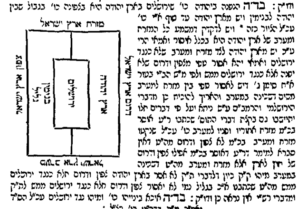
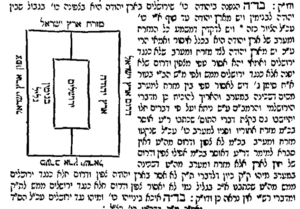
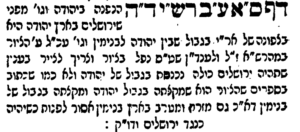
Focusing in on the description of where Yerushalayim is located, it says “Because Yerushalayim is in Eretz Yehuda in the north of Eretz Yehuda, on the border between Yehuda and Binyamin, and there is a part of Yehudah which extends to the east until the edge of Eretz Yisroel, and extends westward until the edge of Eretz Yisroel, because Eretz Yehuda extends the entire length of Eretz Yisroel from east to west as a long and short strap.”

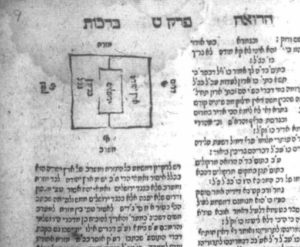
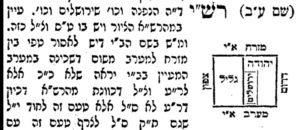
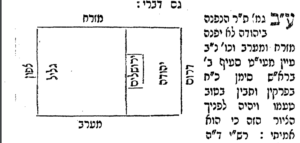
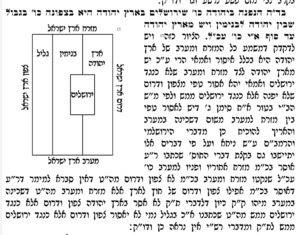
Maharsha – “הציור כזה” – Maharsha draws a map to illustrate the words of Rashi

Vilna Shas – courtesy of hebrewbooks.org

The first thing to consider is does the Maharsha mean that there was a ציור in Rashi?

It does not say “כזה” in Rashi

There was no space left open for a picture in the Bomberg edition of 1520 or the Soncino edition of 1484. This indicates there was no picture on the manuscript that served as the basis for the printed edition. Often חכמת שלמה (Prague 1582) will add a picture or diagram if it was missing from the Bomberg Shas. Here there is no indication of a missing picture in חכמת שלמה.

This manuscript of Rashi on Berachos also does not contain a diagram

The British Library, London, England Or. 5975

Conclusion: Maharsha is drawing a diagram of what he understands Rashi to be saying

We do not have the Ksav Yad of the Maharsha on Berachot so our best knowledge of what he actually drew comes from the Defus Rishon. How was the map represented in that edition?

There were multiple first editions of Chidushei Halachot of Maharsha. The first few Masechtos were printed anonymously. The main one was printed in 1612. Berachos was printed in Lublin in 1621

First edition of Berachos 1621- The picture is the same as the Vilna Shas

courtesy of hebrewbooks.org

Is the map correct? Does it represent the words of Rashi?

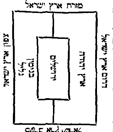
Yerushalayim is represented as being half in Yehuda and half in an area described as Binyamin and Galil. One may argue that the map was not drawn to an exact scale but it seems clear that part of Yerushalayim extends into Binyamin:

The words of Rashi say “Yerushalyim is in Eretz Yehuda in the north of Eretz Yehuda, on the border between Yehuda and Binyamin”. (שירושלים בארץ יהודה היא בצפונה של ארץ יהודה בגבול שבין יהודה לבנימין ) This seems to mean that Yerushalyim is contained within Yehuda and does not extend into Binyamin/Galil.

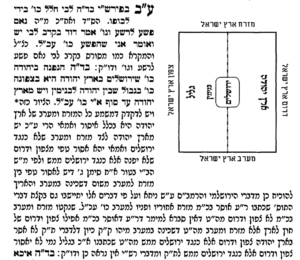
Ginzei Yosef (Bilgoraj 1932 by יוסף אלטר בן מרדכי אפשטיין) calls the map in the Vilna Shas a Taus Sofer and corrects the map to show Yerushalayim completely contained in Yehuda.

courtesy of hebrewbooks.org

There is some space on the east and west sides of Yerushalayim, meaning that Yerushalayim is between the eastern and western borders but does not extend to either border. (see the extra line drawn in on the west side of Yerushalayim). This is in line with the words of Rashi ויש מארץ יהודה הימנה [למזרח] עד סוף ארץ ישראל והימנה למערב עד סוף ארץ ישראל

This is also the opinion of Rav Tziyon Kohen Yehonatan (Djerba 1872-1931) in his Sefer Sha’arei Tziyon ( Dejerba 1932) courtesy of hebrewbooks.org

ולענד״ן שטאות סופר נפל בציור וצריך לצייר בענין שתהיה ירושלים כולה נכנסת בגבול של יהודה ולא כמו שכתוב בספרים שהציור הוא שמקצתה בגבול יהודה ומקצתה בגבול של בנימין דאם כן גם מזרח ומערב בארץ בנימין אסור לפנות כשיהיה כנגד ירושלים ודו״ק

He adds that if Yerushalayim in fact extended any distance into Binyamin, it would require those in Binyamin to also be aware of whether they were facing Yerushalyim or not.

The Sefer D”vash Tamar (Warsaw 1897) by Rabbi Dovid Teitelbaum of Mezeritch draws the map in a similar manner. In this map you can clearly see space between Yerushalayim and the western and eastern borders of Yehuda:

How is the map represented in the newer editions of the Talmud?

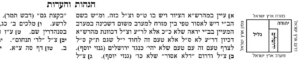
Oz Vehadar (Mahaduras Friedman, 2006, Page 42 Maharsha section, Hagahaos V’He’aros) copies the map of Ginzei Yosef but does not have a line on the western side of Yerushalayim. It seems to indicate that Yerushalayim extends to the western border of Yehuda which is incorrect.

Vilna HaChadash (2006 page 36 in the Maharsha section) redraws the map of the Vilna Shas but still has Yerushalayim extending into Binyamin:

Vagshal (Mahaduras Neherdea, 2008 page 27, Maharsha section) is similar to Vilna HaChadash:

Conclusion: Once something is “uploaded” into the print medium, it has a tendency to remain as it was first printed. In this case, the effects of what many have termed a Taus Sofer have remained for 400 years.