From Medina Raḥamim to Elul Seliḥot: Toward a Prehistory of Nocturnal Penitential Prayer

From Medina Raḥamim to Elul Seliḥot:
Toward a Prehistory of Nocturnal Penitential Prayer

Aton M. Holzer

Shulamit Elizur, the undisputed doyenne of piyyut scholarship, published in 2016 a characteristically magisterial study on the origins of the seliḥot liturgy.[1] This liturgical category – like the prayerbook as a whole – is not attested before the eighth and ninth centuries. The great payyetanim of late antique Eretz Israel – Yose ben Yose, Yannai, and R. Eleazar ha-Qalir – composed qinot, qerovot, and other poetic forms, yet, as Elizur has demonstrated elsewhere,[2] seliḥot cannot be ascribed to this early Eretz-Israeli stratum. Contrary to earlier assumptions that located their genesis in the pre-classical Palestinian milieu, the genre is in fact a Babylonian creation, nurtured in a setting where “primitive” poetic styles persisted well into later centuries. The available evidence indicates that seliḥot entered the liturgical repertoire of the land of Israel only after the late eighth century, and even then only in a limited and sporadic fashion. From Babylonia, the genre subsequently radiated westward, leaving its imprint on Italy, Ashkenaz, and Sefarad.

The seliḥot as they have come down to us consist of two distinct components. The seliḥot proper are payyetanic compositions structured upon the framework of a primordial abecedarian proto-seliḥah preserved in the Seder of R. Saʿadyah Gaon. This early prototype interwove biblical verses drawn alternately from Torah, Writings, and Prophets. Three verses, however – the Thirteen Attributes (Exod. 34:5–6), the Prayer of Moses (Num. 14:19–20), and the Prayer of Daniel (Dan. 9:18–19) – were singled out for repetitive or responsive recitation, while the remaining verses were gradually supplanted by confessional passages (viduy) or thematic prose paragraphs. Elizur contends that the genre most plausibly derives from a pre-classical Palestinian text embedded in the Qedushat ha-Yom blessing for Yom Kippur, where prayers composed entirely of biblical verses were customary. In Babylonia, this early piyyut – and, in due course, the expanding sequence of piyyutim modeled upon it – was transplanted into the Amidah at the selah lanu blessing, thereby establishing the formal locus of the seliḥot within the liturgy.

A second, distinct component of the seliḥot service is the raḥamim – the repetitive litanies beginning with ʾEl raḥum shimekha. This section was not initially bound to the fixed liturgy but was instead recited in assemblies convened during the ashmoret ha-boker (“the third watch of the night,” before dawn) throughout the month of Elul, the Ten Days of Repentance, and Yom Kippur. As with seliḥot, this practice finds no precedent in the late antique liturgy of Eretz Israel, but rather emerges within the Babylonian milieu. In the course of time, the raḥamim were often relocated to the taḥanun following the morning prayer, and, once the seliḥot component was excised from the Amidah, the two elements were joined. Thus, on Yom Kippur, only the evening service retained raḥamim, while the other services preserved seliḥot. In Sephardic communities, the seliḥot rites that remained independent of the fixed liturgy – those recited at ashmoret during Elul and the Ten Days of Repentance – developed in a more fluid and less regimented manner: seliḥot-type piyyutim were freely interwoven with raḥamim-litanies, precisely because their origins lay outside the structured framework of the Amidah.

When, then, did these nocturnal gatherings originate? No documentary evidence attests to seliḥot or raḥamim before the eighth century. Nevertheless, there is reason to suspect that Babylonian Jewish communities had already consecrated the month of Elul to penitential supplication by the close of late antiquity. A fascinating recent study by Michael E. Pregill traces the evolution of traditions surrounding the Golden Calf episode across late antique Judaism, Christianity, and Islam. He demonstrates that the ḥet ha-ʿegel was a charged theme in Eastern Christianity from the fourth century onward, generating a distinctive cross-pollination between Jewish and Syriac Christian traditions in the Sasanian orbit.

A striking motif emerges in the writings of Ephrem of Nisibis (306–373) – who integrates certain midrashic elements, such as the murder of Hur and apologetic defenses of Aaron – namely, the portrayal of Israel as an unfaithful bride:

“The Holy One took the Synagogue up to Mount Sinai
He made her shine with pure white garments, though her heart was dark
She whored with the Calf (bĕ-ʿeglâ gārat), and He came to despise her
He smashed the Tablets, the book of her covenant (kĕtābâ da-qyāmāh).”[3]

This imagery appears to have acquired particular resonance in the Aramaic-speaking milieu, aided by the rendering of saru (Exod. 32:8) as satu in the targumim – a translation evocative of sotah – and echoed, albeit in less explicitly sexualized form, in the Peshitta. The motif was subsequently taken up by Syriac Christian theologians and exegetes such as Theodoret of Cyrrhus and Jacob of Serugh. As Pregill persuasively argues, rabbinic sources themselves came to embrace this image, precisely as both a product of and a response to this polemical environment.

It may therefore be that the month of Elul – the period traditionally associated with Moses’ ascent to atone for the sin of the Golden Calf – was observed with particular intensity, at least on an individual level, within the Babylonian milieu, where the Golden Calf served as a focal point of interreligious controversy.[4] A possible allusion to such a practice appears in Seder Eliyahu Zuta, a distinctive rabbinic midrashic work and moral treatise,[5] likely composed in Babylonia between the fifth and ninth centuries:

“Were it not for God’s forbearance toward Israel during the first forty days that Moses was up on Mount Sinai to bring the Torah to his people, the Torah would not have been given to Israel. By what parable may the matter be illustrated? By the parable of a mortal king who wed a woman he loved with utter love. Having sent for a man to act as a go-between between him and his future queen, he showed the emissary all his nuptial chambers, his halls of state, and his private living quarters. The king then said to the go-between: Go and say on my behalf to the lady, ‘I do not require anything from you. You need make for me only a small nuptial chamber where I can come and dwell with you, so that my servants and the members of my household will know that I love you with utter love.’ Yet even while the king was concerning himself with the measurements of the nuptial chamber [she was to make for him] and while he was dispatching a messenger to convey many, many gifts to the lady, people came and told him: ‘Your future wife has committed adultery with another man.’ At once the king put aside all the plans he had in hand. The go-between was expelled and withdrew confounded from the king’s presence, as is said, While the King was thinking [about the measurements] of His nuptial chamber, my spikenard let go [and lost] its fragrance (Song 1:14)… During the last forty days when Moses went up a second time to Mount Sinai to fetch the Torah, Israel decreed for themselves that the daytime hours of each day be set aside for fasting and self-affliction. The last day of the entire period, the last of the forty, they again decreed self-affliction and spent the night also in such self-affliction as would not allow the Inclination to evil to have any power over them. In the morning they rose early and went up before Mount Sinai. They were weeping as they met Moses, and Moses was weeping as he met them, and at length that weeping rose up on high. At once the compassion of the Holy One welled up in their behalf, and the holy spirit gave them good tidings and great consolation, as He said to them: My children, I swear by My great name that this weeping will be a joyous weeping for you because this day will be a day of pardon, atonement, and forgiveness for you – for you, for your children, and for your children’s children until the end of all generations.” (Ch. 4, Braude translation)

The precedent for individual supplications is reflected within the raḥamim-style litanies themselves – for example, “He who answered Abraham our father … to Isaac his son … to Daniel … to Ezra.” Daniel Boyarin has noted that the prayers of the narrator in the extracanonical 4 Ezra (late first century CE) bear striking affinities to the litanies, confessions, and invocations of the divine attributes that later characterize the seliḥot.[6] Even if one remains cautious about retrojecting the fully developed genre – absent from both Talmuds and unattested in the Palestinian West – back to so early a period, and even if many of Boyarin’s textual parallels must undoubtedly be assigned to later strata,[7] the evidence nonetheless suggests the possibility of an early use of penitential litanies in private devotion. This, in turn, stands in contrast to their later employment within the communal ʿAmidah of fast days, as recorded in m. Taʿanit 2:4.

Other, later developments within “Babylonian territory” – regions under the halakhic and tributary jurisdiction of the Babylonian center by the close of late antiquity – may likewise hint at the existence of such practices and illuminate stages in their historical evolution.

Recent scholarship suggests that rabbinic Judaism maintained a significant presence in the Arabian Peninsula, at least in its northern regions – possibly even reflected in the toponym Khaybar (deriving from ḥaver[8]) – as well as in the Jewish city of Yathrib/Medina, which some now identify as a community of halakhah-observant, rabbinic Jews.[9] This line of research is relatively recent, its conclusions necessarily tentative, yet it opens promising avenues for further inquiry.

While the midrashic material drawn upon by the Qurʾan appears to be of Eretz-Israeli provenance[10] – attesting to the earlier dominance of the Eretz-Israeli center – the Arabian Peninsula after 570 was largely under the sway of the Sasanian Empire or its clients, with direct Sasanian control extending as far south as Najrān and Jeddah. The Ḥijāz itself is later described as long having functioned as a “backyard” of the Babylonian academies:[11]

“’Abdur Rahman bin ‘Abdul Qari said, ‘I went out in the company of ‘Umar bin Al-Khattab one night in Ramadan to the mosque and found the people praying in different groups. A man praying alone or a man praying with a little group behind him. So, ‘Umar said, ‘In my opinion I would better collect these (people) under the leadership of one Qari (Reciter) (i.e. let them pray in congregation!).’ So, he made up his mind to congregate them behind Ubai bin Ka’b. Then on another night I went again in his company and the people were praying behind their reciter. On that, ‘Umar remarked, ‘What an excellent Bid’a (i.e. innovation in religion) this is; but the prayer which they do not perform, but sleep at its time is better than the one they are offering.’ He meant the prayer in the last part of the night. (In those days) people used to pray in the early part of the night.’” (Ṣaḥīḥ al-Bukhārī, Vol. 3, Book 32, Hadith 227)

The “Prophet’s Mosque” of Medina, in its original form, seems to have resembled a synagogue, with the qibla (direction of prayer) even initially facing Jerusalem. In the first decades of the seventh century, before the coalescence of an “Islamic” identity, Jews might actually have been included in the proto-Islamic muʾminūn (“believers”) movement.[12] This hinges, to some extent, on whether the word characterizing the Jews’ relationship to the new movement is umma (“[one] community”), as Fred Donner reads it, or amāna (“secure”), as Michael Lecker would have it.[13]

Regardless, in the early period of Islam Jews and Christians seem to have joined the “community” without having to recant their previous faith or identity, and there was no “conversion” rite or procedure.[14]

The brief “honeymoon” between Muhammad and the Jewish tribes of Yathrib ended abruptly, culminating in the bloody execution of some four hundred men of the Jewish tribe of Banū Qurayẓa.[15] More recent revisionist scholarship, however, tends to regard this episode – attested only in sources written a century or more later – as altered,[16] exaggerated, or even fabricated, serving primarily the purpose of boundary-setting.[17] These retellings were likely shaped by later Muslim conflicts with Jewish communities in Damascus and Baghdad, while the original events, insofar as they occurred, are better understood as a matter of political expediency rather than religious confrontation.[18]

In any case, many Jews appear to have remained in Medina for several decades thereafter. The expulsion of non-Muslims from the Ḥijāz – the western province of Arabia – was long attributed to the second caliph, ʿUmar ibn al-Khaṭṭāb (r. 634–644), who was also credited with the shurūṭ ʿUmar (“Pact of ʿUmar”), the charter assigning dhimmī status to Jews and Christians and thereby marking clear boundaries between them and the emergent Islamic polity. More recent research, however, tends to assign both the expulsion and the Pact not to ʿUmar I, but rather to ʿUmar ibn ʿAbd al-ʿAzīz (r. 717–720).[19]

Jewish sources themselves offer little contemporary testimony datable to this formative period. One exception is an apocalyptic work composed around the mid-eighth century, Nistarot de-Rabbi Shimon bar Yoḥai, pseudepigraphically attributed to R. Shimon bar Yoḥai – cast here as the fiercest rabbinic adversary of Rome.[20] This work strikingly celebrates ʿUmar ibn al-Khaṭṭāb, conqueror of Jerusalem from the Byzantines, as a beneficent figure whose reign would prepare the ground for Israel’s redemption. The text prophesies that the Ishmaelite regime would vanquish Christendom and create the conditions for the advent of the Messiah:

“The second king who will arise from Ishmael will be a friend of Israel. He will repair their breaches and mend the breaches of the Temple; he will shape Mount Moriah and make the whole of it a level plain. He will build for himself there a place of prayer (hishtaḥavayah) upon the site of the ‘foundation stone’ (ʾeven shetiyyah), as Scripture says: ‘and set your nest on the rock’ (Num. 24:21). He will wage war with the children of Esau, slaughter their troops, and capture a great multitude of them. And in the end, he will die in peace and with great honor.”

ʿUmar acquired the epithet al-Fārūq (“the redeemer”) – from the same root as purqan – most likely through Jewish usage.[21] The early Islamic movement may at first have been perceived in terms akin to contemporary Noahides: strict monotheists who acknowledged Israel’s chosenness and with whom joint prayer posed no obstacle. ʿUmar’s acceptance of the Byzantine surrender in 637 and his subsequent activities in Jerusalem – including the readmission of Jewish residents, the clearing of refuse from the Temple Mount, and the construction of an initial “prayer-house” open to all worshippers, Jews among them[22] – could only have deepened Jewish admiration for him and for the movement he led in its formative environment.

It was during ʿUmar’s caliphate that the month of Ramadan, having been unmoored from the solar calendar after 632, fell successively in Iyyar,[23] then in Tishrei (637–639), and thereafter in Elul (640–642). Jews observing the Babylonian rite of raḥamim by night would naturally have assembled in Medina’s spacious prayer-house during the nights of Tishrei and Elul/Ramadan. Before the incorporation of seliḥot, these supplications were recited individually. ʿUmar evidently regarded the practice as salutary but preferred that it be performed collectively; hence, alongside the adoption of seliḥot, the communal ashmoret service became standard across lands under Babylonian influence. Intriguingly, however, the seliḥot embedded in these ashmoret gatherings retained an individualistic tenor for centuries – most clearly visible in the piyyutim of R. Isaac ibn Ghiyyat, composed especially for the nights of Elul. Thus, even as the ashmoret gatherings assumed a communal form, they continued to be conceptualized as assemblies of individuals.[24]

The Geonic treatment of this custom, preserved in R. Isaac ibn Ghiyyat’s Hilkhot Teshuvah (§58), records that both the ninth-century Gaon R. Kohen Ẓedeq b. Abimai of Sura and the renowned eleventh-century R. Ḥayya Gaon of Pumbeditha restricted the practice to the Ten Days of Repentance in their own locales. Yet R. Ḥayya also concedes that in “some places in Persia” the recitation of taḥanunim extended through the entire month of Elul, and R. Isaac ibn Ghiyyat notes that such was likewise the practice in his native al-Andalus. To one line of speculation, then, another may be added: the custom of seliḥot throughout Elul – attested both in Persia at the eastern edge of the Jewish world and in Spain at its westernmost reach, both within the orbit of Babylonian influence – appears to have “skipped over” the very center itself, namely, the Geonic academies of Babylonia.

As Simcha Gross has demonstrated,[25] the Iggeret of R. Sherira Gaon, in recounting the Geonic academies’ greeting to the Islamic conquerors, reflects the rising prominence of the ʿAlids as the Abbasid caliphate matured; in this recension, it is specifically Caliph ʿAlī whom the Geonim are said to have welcomed with great affection. By the late tenth century, the Shiʿite Būyids had assumed control of Baghdad and much of the Iraq–Iran region. Within Shiʿi circles, the prayer service introduced by ʿUmar – the Tarāwīḥ – was condemned as an illegitimate innovation, and both Fāṭimid and Būyid rulers actively suppressed its observance.[26] Indeed, even today Shiʿi sources continue to enumerate its perceived deficiencies: that it is performed at the wrong time (in the early evening rather than at the close of night), that it diminishes the primacy of individual prayer, and that it is conducted with undue haste.[27] It is not difficult to imagine that similar criticisms contributed to the suppression of month-long nocturnal supererogatory prayer within the Geonic academies of Baghdad and its environs – the very setting in which anti-Tarāwīḥ polemics were most vigorously advanced. Moreover, the month of Elul coincided with the kallah, when vast numbers of students converged upon the Geonic centers for intensive study, thereby directing the academies’ energies away from nocturnal penitential assemblies at precisely this season.

Notes:

Many thanks to Prof. Y. Tzvi Langermann, Prof. Shulamit Elizur, and Prof. Gabriel Said Reynolds, for their valuable comments on several of the ideas discussed in this article. Needless to say, all errors remain the sole responsibility of the author.

[1] Shulamit Elizur, “The Origins of the Selihot Piyyutim,” Tarbiz, vol. 84, no. 4 (2016): 503-542 (Hebrew), available here (https://www.academia.edu/36608670).
[2] Shulamit Elizur, “The Character and Influence of the Babylonian Center of Poetic Production: Considerations in the Wake of Tova Beʾeri’s Books,” Tarbiz, vol. 79, no. 2 (2010-2011): 229-248 (Hebrew), available here (https://www.academia.edu/36608504).
[3] Hymns on Faith 14.6, translation in Michael E. Pregill, The Golden Calf between Bible and Qur’an: scripture, polemic, and exegesis from late antiquity to Islam (Oxford University Press, 2020) 216.
[4] Fascinatingly, in Second Temple times the month of Elul appears to have been the season when numerous calves – specifically, since ovine and caprine births occurred earlier in the year, prior to the preceding goren – were brought to the Temple for the tithe of animals (maʿasar behemah). One may wonder whether a symbolic connection was drawn between this practice and the atonement for the sin of the Golden Calf observed at this time of year. See Ze’ev Safrai, Mishnat Eretz Yisrael: Tractate Bekhorot, with Historical and Sociological Commentary (Yavneh: Kvutzat Yavne, 2020), 297–298 (Hebrew).
[5] Lennart Lehmhaus, “‘Were not understanding and knowledge given to you from Heaven?’ Minimal Judaism and the Unlearned ‘Other’ in Seder Eliyahu Zuta,” Jewish Studies Quarterly, vol. 19, no. 3 (2012): 230-258, available here (https://www.academia.edu/1817892).
[6] Daniel Boyarin, “Penitential Liturgy in 4 Ezra,” Journal for the Study of Judaism, vol. 3, no. 1 (January 1972): 30–34, available here (https://www.academia.edu/36253296).
[7] Shulamit Elizur, “The Character and Influence,” p. 243, fn. 54.
[8] See discussion in Raphael Dascalu, “Revisiting the Qur’anic aḥbār in Historical Context,” Journal of Qur’anic Studies, vol. 23, no. 2 (2021): 41-65.‏
[9] See Haggai Mazuz, The Religious and Spiritual Life of the Jews of Medina (Leiden: Brill, 2014).‏
[10] Holger M. Zellentin, “Aḥbār and Ruhbān: Religious Leaders in the Qurʾān in Dialogue with Christian and Jewish Literature,” in Angelika Neuwirth and Michael Sells, eds., Qurʾānic Studies Today (New York: Routledge, 2016), 258-289, available here (https://www.academia.edu/34810735).
[11] See Robert Brody, The Geonim of Babylonia and the Shaping of Medieval Jewish Culture (New Haven: Yale University Press, 1998), 125.
[12] See Fred M. Donner, Muhammad and the Believers: At the Origins of Islam (Cambridge, MA: Harvard University Press, 2010).‏
[13] See summary in Mark R. Cohen, “Islamic Policy Toward Jews from the Prophet Muhammad to the Pact of ‘Umar,” in Abdelwahab Meddeb and Benjamin Stora, eds., A History of Jewish-Muslim Relations: From the origins to the present Day (Princeton University Press, 2013), 58-77, available here (https://www.academia.edu/37423214).
[14] Ilkka Lindstedt, Muḥammad and his followers in context: the religious map of late antique Arabia (Brill, 2024), ‏319.
[15] Meir Jacob Kister, “The Massacre of the Banū Qurayẓa: A Re-Examination of a Tradition,” Society and Religion from Jahiliyya to Islam (Routledge, 2022), VIII 61-VIII 96.‏
[16] JaShong King, “The Message of a Massacre: The Religious Categorization of the Banū Qurayẓa,” Ancient Judaism, vol. 6 (2018): 203-226.‏
[17] See Mohammed Ahmed, “The Literary Role of Jews in Qur’anic Exegesis,” (Ph.D Diss., University of Cambridge, 2025).‏

Gabriel Said Reynolds, who serves as the Jerome J. Crowley and Rosaleen G. Crowley Professor of Theology and Assistant Professor of Islamic Studies at the University of Notre Dame, expresses skepticism regarding the traditional accounts in the Sīra literature about the Jewish tribes of Yathrib and their interactions with Muhammad and his followers. Nonetheless, he emphasizes that the existence of Jewish tribes in the Hijaz is beyond dispute, a fact confirmed by the discovery of rock inscriptions in the region (personal communication).
[18] See e.g. Juan Cole, Muhammad: Prophet of Peace Amid the Clash of Empires (Hachette UK, 2018).‏
[19] Milka Levy-Rubin, Non-Muslims in the Early Islamic Empire: From Surrender to Coexistence (Cambridge University Press, 2011); and Harry Munt, “‘No two religions’: Non-Muslims in the early Islamic Ḥijāz,” Bulletin of the School of Oriental and African Studies, vol. 78, no. 2 (2015): 249-269.‏
[20] See the discussion by John C. Reeves, Trajectories in Near Eastern Apocalyptic: A Postrabbinic Jewish Apocalyptic Reader (Atlanta: Society of Biblical Literature, 2005), 76-77. Translation in ibid., p. 81-82.
[21] Suliman Bashear, “The Title ‘Fārūq’ and Its Association with Umar I,” Studia Islamica, no. 72 (1990): 47-70.‏
[22] Beatrice St Laurent, “Discovering Jerusalem’s First Mosque on the Haram al-Sharif and Capitalizing Jerusalem in the Seventh Century,” Bridgewater Review, vol. 36, no. 1 (2017): 23-28.‏
[23] Ben Abrahamson and Joseph Katz, “The Islamic Jewish Calendar: How the Pilgrimage of the 9th of Av became the Hajj of the 9th of Dhu’al-Hijjah,” Paper presented at the‏ Jamalullail Chair for Prophetic Sunnah International Conference (JCICI), Malaysia, October, 2020, available online here (https://www.alsadiqin.org/history/The%20Islamic%20Jewish%20Calendar.pdf).
[24] Ariel Zinder, “‘There They Stand at Midnight, Time and Again’: Selihot for Repentance Nights by Yitzhak Ibn Giyyat; A Critical Edition with an Introductory Essay and Literary Analysis,” (Ph.D Diss., Hebrew University of Jerusalem, 2014; Hebrew).
[25] Simcha Gross, “When the Jews Greeted Ali: Sherira Gaon’s Epistle in Light of Arabic and Syriac Historiography,” Jewish Studies Quarterly, vol. 24, no. 2 (2017): 122-144, available here (https://www.academia.edu/33854404).
[26] Christine D. Baker, Medieval Islamic Sectarianism (Leeds: Arc Humanities Press, 2019), 55. Incidentally, the Sunni call to the morning fajr prayer – al-ṣalāt khayr min al-nawm (“prayer is better than sleep”) – bears a striking resemblance to the opening of the piyyut of unknown provenance, Ben adam mah lekha nirdam; qum qera be-taḥanunim (“O mortal, why do you slumber? Arise and call out in supplication”)
[27] See, e.g., “Chapter One: The lies, innovations & conjectures behind Tarawih,” available here (https://shiapen.com/comprehensive/tarawih-a-parody-of-prayers/chapter-one-the-lies-innovations-conjectures-behind-tarawih).


Lecture on the Legend of R’ Yehuda Halevi’s Death and more

Lecture on the Legend of R’ Yehuda Halevi’s Death and more

Eliezer Brodt

Earlier today I had a conversation with Rabbi Moshe Schwed of All DafThe conversation was a discussion of the famous Legend of R’ Yehuda Halevi’s death. I also devoted some time to talking about the Cairo Genizah and how some of its discoveries relates to R’ Yehuda Halevi’s final years.

Some of this material appeared earlier on the Seforim Blog back in 2011 (here) and in Hebrew in Yeshurun 25 (2011). A PDF is available (here).

We recorded it and it’s available for viewing here and here, and an audio recording is available here.

This is an experiment which we are trying on the Seforim Blog and we hope to have other presentations from others over time. Feedback or comments of any sort are appreciated.

In addition, one can hear my recent presentation on All Daf, aboutlearning Shas KottonKesuvos Throughout the Ages here and here.

Season One of my series devoted to the seforim of Hagaon Rav Chaim Kanievsky Ztz’l was completed a few weeks ago B”h, and ten episodes are available for viewing here.

IYH Season Two should begin shortly.

Sponsorships are available.


How Jews of Yesteryear Celebrated Graduation from Medical School: Congratulatory Poems for Jewish Medical Graduates in the 17th and 18th Centuries: An Unrecognized Genre

How Jews of Yesteryear Celebrated Graduation from Medical School:
Congratulatory Poems for Jewish Medical Graduates in the 17th and 18th Centuries:
An Unrecognized Genre

Rabbi Edward Reichman, MD

Edward Reichman, Professor of Emergency Medicine at the Albert Einstein College of Medicine, is the author of The Anatomy of Jewish Law: A Fresh Dissection of the Relationship Between Medicine, Medical History and Rabbinic Literature (Published by Koren Publishers/OU Press/YU Press, 2022), as well as the forthcoming, Pondering Pre-Modern(a) Pandemics in Jewish History: Essays Inspired by and Written during the Covid-19 Pandemic by an Emergency Medicine Physician (Shikey Press).

Prelude

    As the season of graduation is upon us, I thought to look for a copy of the Hebrew poem I received upon my graduation from medical school. My search however was in vain, as I ultimately realized that no such sonnet was ever composed. When I graduated medical school some years ago, my parents, a”h, were overjoyed. They purchased me a copy of the Physician’s Prayer of Maimonides [1] (which still hangs on my wall) from the then-popular olive wood factory on the bustling Meah Shearim Street in Jerusalem. My extended family, friends, classmates, and mentors shared in my accomplishment, but no tangible expression of their happiness was forthcoming (nor did I expect one). At that time, the notion of someone authoring a poem in honor of my graduation, was, suffice it to say, nowhere to be found in the gyri of my cerebral cortex, with which I had become intimately familiar from my neuroanatomy lectures.

    My transient memory, or more aptly, history lapse may perhaps be forgiven, as I currently spend a portion of my life in Early Modern Europe, immersed in the world of Jewish medical history. It is in this period where we will find the origins of my (only partially misguided) poetic yearnings.

Introduction

    This year I discovered an account of a poem in honor of the graduation of an 18th century Jewish medical student. It appeared some fifty years ago in the pages of Koroth, a journal of Jewish medical history.[2] The poem is housed in the Bibliotheca Rosenthaliana in the Netherlands, part of the Library of the University of Amsterdam. The article, written by the late Professor Joshua Leibowitz, grandfather of the academic field of Jewish medical history, and founding editor of Koroth, discusses the poem’s author, Isaac Belinfante, a poet, bibliophile, and preacher at the Ets Haim Synagogue in Amsterdam, and provides a transcription and commentary of the poem.

    As to the date of the poem, Leibowitz suggests around 1770.[3] About the recipient, whose name appears in the text of the poem, Leibowitz was unable to identify additional biographical information.

    Leibowitz’s most astonishing observation, however, was that “what we have before us is an occasional poem dedicated to a topic not found in Hebrew literature, the graduation of a physician.” This was the first and only poem of this type Leibowitz had encountered.[4]

    Here we revisit this poem and reclaim the lost identity of its recipient, solving one seemingly insignificant historical mystery. In the process, however, we discover that Leibowitz’s observation was profoundly mistaken, though by no fault of his own. This poem is in fact part of a much larger story in Jewish literary and medical history, one that can only now be adequately explored. We reveal an entire genre of literature in Jewish history that has gone largely unrecognized and underappreciated.

Section 1- Solving a 150-year-old Mystery

    Isaac Belinfante was a prominent personality and prolific poet in eighteenth century Amsterdam. He penned poems for friends, preachers, fellow poets, and as far as we know, only one poem for a graduating physician, Moses Rodrigues.

    Until today, the identity of Rodrigues and his medical institution has remained unknown.

The Date of the Poem

    Leibowitz writes that, “The external evidence would favour a date round about the year 1770, as most of the printed poems of Isaac Belinfante appeared at this time.” In fact, we needn’t seek external sources. An examination of the original manuscript reveals the date at the very bottom of the page.[5]


    The “A” is assumedly for annum, and the Hebrew year 5529 corresponds to 1768 or 1769. As we shall see, it refers to the latter. Leibowitz was off by only one year. I suspect he viewed a reproduction of the document, and the bottom of the page, which included the date, was simply left off the copy. Had he viewed the original, this notation would have surely not escaped his keen eye.

The Institution and Identity of the Graduate

    The text of the poem does not explicitly mention the institution. The physical presence of the poem in the Bibliotheca Rosenthaliana in Amsterdam might reflect that the recipient was Dutch or that he graduated from a Dutch university. The author of the poem lived in Amsterdam and the last name of the recipient, Rodrigues, was common in 18th century Amsterdam. However, based on the description of the graduation ceremony in the text of the poem, as well as other factors, Leibowitz writes that “we are inclined to suppose that Dr. Rodrigues obtained his degree abroad, possibly in Padua, as most of the Dutch Jewish physicians in the 17th and 18th centuries bore foreign diplomas.”[6]

Below is the relevant verse:

    The mention of the student’s rejoicing upon exiting the “house of the argument” is clearly a reference to the room where the graduation dissertation/disputation was held. The verse concludes with a description of the placing of a hat (biretta) on the graduate’s head and a ring on his finger. These are known features of the graduation ceremony from the University of Padua,[7] with which Leibowitz was quite familiar.[8]

    There is a spectacular illustration of this ceremony, which has gone unnoticed, found in the diploma of a Jewish medical graduate of Padua from 1687, Moses Tilche.[9]

    However, these elements were not necessarily unique to Padua. Indeed, while disputations were a prominent feature of most European universities, starting from the late fifteenth century (at least), the disputationes before obtaining a doctorate had fallen into disuse in Padua.[10] Leibowitz was not aware of this. The other graduation features were also not unique to Padua and were found in the commencement ceremonies of other European universities. Leibowitz believed this poem to be a unicum, and as such, he had no basis for comparison, or reference points to identify the institution.

    As for the graduate himself, Rodrigues is found nowhere in Friedenwald’s classic work,[11] nor in Nathan Koren’s expansive biographical index of Jewish physicians.[12] Moreover, despite the proliferation of online resources and databases, a Google search yields no results.

    Let us consider Leibowitz’s suggestion that Rodrigues was a graduate of a foreign medical school, such as Padua. Modena and Morpurgo compiled a comprehensive list, based on extensive archival research, of the Jewish students who attended the University of Padua from 1617-1816.[13] There is no Rodrigues listed among the students who either matriculated or graduated from the University of Padua.

    If Rodrigues did not attend Padua, perhaps he trained in Germany, as by this time Jews were widely accepted into German universities.[14] A review of these records again reveals no Moses Rodrigues. He is likewise not found amongst the of Jewish physicians in Poland at the time.[15]

    Having ruled out a foreign institution, we return to the land of the poem’s origin. Komorowski lists the graduation and dissertation of a Moses Rodrigues from Leiden in 1788,[16] but this is some twenty years after our poem was written. Perhaps a relative.

    This brings us to the work of Hindle Hes, who authored a monograph focusing exclusively on the Jewish physicians in the Netherlands.[17] Indeed, it is Professor Leibowitz who suggested to Hes the subject of her study.[18] (Perhaps he had hoped to resolve Rodrigues’ identity.) Hes lists a Mozes Rodrigues who graduated the University of Utrecht July 7, 1769,[19] the year of Belinfante’s poem. This aligns with the recipient of our poem. Rodrigues’ dissertation is pictured below.

    Moses Rodrigues hailed from Madrid and trained and practiced as a surgeon in Paris prior to his stay in Amsterdam. He later completed a medical degree in the University of Utrecht.20 In the University of Utrecht student registry,[21] he is listed as Moseh Rodrigues, Hyspanus, Chirurgus Amstelodamensis (surgeon from Amsterdam), reflecting that he had already been a practicing surgeon. The other students in the registry have no such descriptor, only their names appearing.

    In the four-page introduction to his Latin dissertation,[22] Rodriguez notes that he had been a practicing surgeon for twenty-seven years prior to obtaining his medical degree. Unfortunately, he provides little other personal biographical information. What would compel a practicing surgeon to obtain an additional medical degree later in life? The content of the introduction provides possible insight. At this stage of history, surgery and medicine were unique disciplines with very different training and focus. Surgeons rarely attended universities. Rodrigues strongly advocates for the synthesis and unity of surgical and medical training.

It is one thing, moreover, that I thought it best to advise publicly in this work, namely, that twin arts are by the worst design and custom and are descended from the same father from the intimacy by which they are tied together. I am pointing to the medical and surgical art, which they distinguish with differences in various places, so that the first is concerned with curing internal diseases, the second in curing external diseases. What a distinction, since I see it extended beyond what is equal, as if these parts of medicine were to be separated rather than to be joined together! I wish to subject this work to this admonition, and to prove my endeavors in promoting both arts to good and fair readers, because, when I shall have attained it, I shall seem to have rendered to me the most beautiful fruit of design or of labor.[23]

    Formal university training in medicine would surely advance this objective. It is also possible that despite his years of experience, Rodrigues needed a formal degree to procure a higher-level position in the Netherlands.[24]

    The content of Belinfante’s poem further corroborates our identification.[25]

    In describing the medical practice of Rodrigues, Belinfante invokes distinctly surgical practices. The graduate is described as healing every “netah,” traumatic injury (from the word nituah, anatomy, or in today’s usage, surgery), as well as “one struck from a flying arrow.”[26] He seals the “mouth” of every wound and closes every opening. There are references to his treatment of afflictions of the skin and bone, as well as punctured, mauled or amputated limbs, all the domain of the barber-surgeon. This description would not have been applicable to a typical medical graduate or practitioner of medicine, but was clearly relevant to Moses Rodrigues, a practitioner of surgery. As mentioned above, Rodrigues was identified as a practicing surgeon in his matriculation record. He is also so identified on the cover page of his dissertation.

    While Hes makes no mention of any poem, it is unlikely she would have come across this lone leaflet buried in the archives of the Bibliotheca Rosenthaliana.

    In sum, we have conclusively proven that Moseh Rodrigues, graduate of Utrecht in 1769, is the recipient of Belinfante’s ode. While there is satisfaction in the historical restoration of this one obscure poem, it pales in comparison to the discovery revealed in the next section.

Section 2- An Update to Leibowitz’s Observation- Congratulatory Poems in Honor of Jewish Medical Graduates

    In 1971, Leibowitz was compelled to write an article on the Rodrigues poem owing to his belief in the utter novelty of a sonnet for a Jewish medical graduate in the 18th century. How novel indeed was such an enterprise?

    In the last fifty years, a number of similar poems have come to light. Experts in Jewish Renaissance poetry have written about them;[27] bibliophiles, collectors and libraries own them; Jewish medical historians have footnoted them,[28] but I suspect none of them appreciates the extent of the proverbial forest.

    In the course of my research in the field of Jewish medical history, I have taken note of these poems, the majority of which were written for graduates of the University of Padua.

    Italian Hebrew poetry from the Renaissance and Early Modern Period, often in broadside form, has been and remains an eminently collectible category. These poems, written for a variety of occasions including weddings and funerals, are often part of larger manuscript and book collections of bibliophiles, and while some remain in private hands, many have landed in major institutions.[29] Among these collections, we find poems written for medical graduates of Padua.[30] Thus far, I have identified a record of one hundred poems,[31] mostly in Hebrew, written for sixty five medical graduates, all from the University of Padua during the 17th to early 19th centuries.[32]

    Similar poems can also be found for Jewish graduates in the Netherlands and Germany, though in smaller numbers.[33] The timeline of their appearance mirrors the transition of Jewish medical training from Padua to the Netherlands to Germany.[34]

    Though Leibowitz had no access to other poems, his conjecture was Padua as the student’s place of graduation.[35] While the recipient of that particular poem happened to be a Dutch university graduate, Leibowitz’s instincts were essentially correct. We now know that this genre of poetry for the Jewish medical student, in particular in Padua, was quite common.

Below I provide some observations of the congratulatory poetry for Jewish medical graduates.

Graduates of the University of Padua[36]

    Padua was the first university to allow Jews to formally train in medicine, and for a number of centuries, it was the only one. It is thus in association with the University of Padua that we find the earliest and most plentiful examples of our genre of poetry.

Chronological Span

    The poems range primarily from the 1620’s to the 1780’s, with some outliers expanding the dates from 1600 to 1836. One of the earliest examples is a poem written by Rabbi Yehuda Aryeh De Modena for the graduate David Loria.[37] The original, likely in the author’s hand, resides in the Bodleian Library.[38]

Format

    While the majority of the Padua poems are found in broadside format, some are found in book form, and others in manuscript. The broadside below, in honor of the graduate Jacob Coen (1691), is a typical example.[39]

Authors

    The authors include mentors, fellow students or recent graduates, family members, and poets (e.g., Simha Calimani and Isaiah Romanin). Some of the prominent personalities included among the authors are Rabbi Yehuda Arye de Modena, Rabbi Moshe Hayyim Luzzatto (Ramal), Rabbi Solomon Marini, and Rabbi Isaac Hayyim Cantarini. The example below, written by Ramal in honor of the graduation of Emanuele Calvo (1724),[40] is one of at least eight poems he authored for Padua graduates.[41]

Recipients

    For most of the graduates for whom we possess poems, we have only one example. A number of students however received multiple poems. For example, Joseph Hamitz (Padua, 1623) received eleven poems; Salomon Lustro (Padua, 1697)- eight; Shemarya (Marco) Morpurgo (Padua- 1747)- four. Below is a manuscript copy of a poem by Shabbetai Marini[42] in honor of Lustro. Marini, a fellow alumnus of Padua from 1685, and author of a number of graduate poems, also translated Ovid’s Metamorphosis into Hebrew.[43]

Numbers and Percentage of Students

    What percentage of medical graduates received congratulatory poems? Modena and Morpurgo list a total of 325 Jewish medical graduates from 1617-1816. We have a record of poems for sixty students in this period. We thus have poems for around 20% of the medical graduates from over a 200-year period. These are only the poems of which we are aware. As these poems were typically produced as ephemeral broadsides, there are certainly poems that have not survived. The actual percentage of student poems is thus likely higher.

Location

    The poems and broadsides derive primarily from the following institutions- the National Library of Israel (NLI),[44] the Library of the Jewish Theological Seminary (JTS), the Valmadonna Trust,[45] the British Library, the Bodleian Library, and the Kaufmann Collection at the Hungarian Academy of Sciences in Hungary.[46] In a number of cases, a copy of the same poem is found in more than one library. There are likely poems in both private and public hands that have not yet surfaced.

Congratulatory Poems from Netherlands and Germany

    While the lion’s share of congratulatory poems are connected to Padua, there are examples from other countries as well. In the mid-seventeenth century, universities in the Netherlands (Utrecht, Franeker, Leiden) began accepting Jewish medical students. I have begun exploring the dissertations of Jewish medical graduates of the Netherlands and their value for the study of Jewish medical history. A comprehensive study remains a desideratum. The poems from the Netherlands, and from Germany as well, are not found in broadside form, but rather appended to the medical student dissertations. In Padua there were no dissertations within which to append poems, thus the poems were issued as broadsides. The broadside form was also used for other types of poetry in Italy at this time. Below is an example of a poem for a graduate of the University of Leiden, one of the premier medical schools in the world at this time. Salomon Gumpertz graduated Leiden in 1684 with the following dissertation.

    Appended to the dissertation is a poem written by his relative and fellow graduate, Phillip Levi (AKA Yehoshua Feibelman).

    While there is no poem at the end of Levi’s own dissertation, there is a short prayer in Hebrew composed by Levi himself to celebrate the completion of his medical studies.[47]


Blessed is the Lord who has not withheld his kindness from me and has bestowed upon me kindness and wisdom to learn the discipline of medicine. I hope that God will grant me blessing and success in my efforts and the scattered people of Israel from the four corners of the earth should be gathered, our exile should come to a speedy end, and God should send us to our land through the aegis of our Messiah speedily in our days, Amen.

    The Leiden University Senate was less than enamored by Levi’s addition and despite his graduation with honors censured him for concluding with a prayer insulting Christianity. The prayer ends with a plea to God to hasten the end of the exile by bringing “our Messiah” speedily in our days. The Senate added a warning as well for any future Jewish students to abstain from similar expressions.[48]

    We also find poems attached to medical dissertations of Jewish students in 18th century Germany. However, while in the Netherlands there were only three of four major universities where Jews attended, with Leiden being the most common, in Germany, there were many universities that opened their doors to Jews in the 18th century and onwards.[49] A proper study of the congratulatory poetry for Jewish medical graduates in Germany would be more challenging. Below is one example, a poem in honor of the graduation of Jonas Jeitteles[50] by Avraham HaKohen Halberstadt.

    Jonas was the Chief Physician of the Jewish community of Prague. In 1784, Joseph II granted Jonas and “his successors” the right to treat patients “without consideration of their religion.” He is best remembered for his campaign supporting Edward Jenner’s smallpox vaccination, for which he received the approbation of Rabbi Mordechai Banet.

Congratulatory Poems for Jewish Medical Graduates- A Genre Whose Time has Come

    Even today, manuscripts or books hidden for centuries are occasionally discovered and brought to light.[51] In this case however, it is not one item, nor even one genizah or repository that we have revealed, rather, recently discovered and previously unidentified items in collections across the world that constitute, in their aggregate, a unique genre of poetry. Imagine that just fifty years ago the founder of the field of Jewish medical history was aware of only one example.

    The collection of Jewish medical graduate poems as a whole merits recognition as a unique entity and awaits comprehensive cataloging and research.[52] To be sure, the concept of congratulatory poetry written upon completion of academic study, including medical education,[53] was not limited to Padua, nor was it limited to Jewish students. There was a broader practice of writing congratulatory poems, often in Greek or Latin, at the end of academic dissertations.[54] Nor was the use of the Hebrew language for this poetic expression restricted to the Jewish community. There was even a practice by non-Jews, typically Christian Hebraists, to write congratulatory poems in Hebrew.[55] Comparison of these different bodies of literature will surely be the substance of future dissertations, but there is no doubt that our genre will have a unique place in history.

    Jews throughout history were often restricted in their choice of professions, limited to money lending or medicine. Though allowed to become physicians, Jews were barred by papal decree from obtaining a university education. It was around the 16th century that the first academic institution, the University of Padua officially accepted Jewish students. Next would be universities in the Netherlands, starting in the mid-17th century, followed by Germany in the early 18th century and others. It is in this historical context that the congratulatory poems for Jewish medical students evolved. The collective community elation at the newly allowed entrance into the world’s leading academic institutions is reflected in these sonnets.

Conclusion

    Writing in 1971 about a manuscript of a poem he had recently discovered, Leibowitz claimed that the congratulatory poem for Jewish medical graduates was “a topic not found in Hebrew literature.” We now know just how untrue this statement is. It is not only “found in Hebrew literature,” but it was a common practice spanning over two hundred years and multiple countries. More examples will surely be discovered. While extensive research has been done for the Paduan poems, more work is needed to explore and identify the poems from graduates of the Netherlands, Germany,[56] and other countries.[57]

    For a variety of reasons, the unique genre of poetry for the Jewish medical graduate has all but disappeared in the modern era. This at least partially reflects the dissipation of the novelty of the concept of the university-trained Jewish physician. While arguably a positive trend, it nonetheless behooves us to restore this underappreciated genre to its rightful glory. Though I hesitate to call for a resurrection of the enterprise, partially due to my personal literary ineptitude, at the very least a recollection of the practice would serve to imbue today’s Jewish medical graduates with a renewed sense of pride and historical perspective.


[1] This prayer of a “renowned Jewish physician in Egypt from the 12th century” was first published anonymously in German in 1783 in Deutches Museum 1 (January-June, 1783), 43-45. On the history of the dissemination, attribution and authorship of this prayer, see J. O. Leibowtz, Dapim Refuiim 1:13 (March, 1954), 77-81; Fred Rosner, “The Physician’s Prayer Attributed to Moses Maimonides,” Bulletin of the History of Medicine 41:5 (1967), 440-457. Below is a picture (taken by the author) of a letter written by the Chief Rabbi of England, Rabbi J. H. Hertz, to Sir William Osler about the prayer.


[2] J. O. Leibowitz, “An 18th Century Manuscript Poem by I. Belinfante Honouring a Medical Graduate,” Koroth 5:7-8 (February, 1971), 427-434 (Hebrew) and LI-LIV (English).

[3] My summary of Leibowitz’s assessments is a composite of both the Hebrew and English versions of the article, which contain different information.

[4] As a footnote, he adds that he later discovered one additional poem of this type by Ephraim Luzzatto in honor of Barukh Ḥefetz (AKA Benedetto Gentili). This poem is published in Luzzatto’s collection of poetry. See Meir Letteris, ed., Ephraim Luzzatto, Eleh Bene ha-Ne’urim, (Druck und Verlag des Franz Edlen von Schmid: Wien, 1839), 43-44 (poem no. 27).

[5] Hs. Ros. Pl. B-23;L. Fuks, Catalogue of the Manuscripts of the Biblioteca Rosenthaliana University Library (Leiden, 1973), no. 317. I thank Rachel Boertjens, Curator of the Bibliotheca Rosenthaliana, for kindly providing me a copy of the poem.

[6] For a discussion about a physician from Amsterdam who obtained a foreign diploma, see E. Reichman, “The ‘Doctored’ Medical Diploma of Samuel, the Son of Menaseh ben Israel: Forgery of ‘For Jewry’,” Seforim Blog (link), March 23, 2021. Since the publication of this article, I discovered a record of Samuel’s matriculation at the University of Leiden Medical School on July 1, 1653 (along with his cousin Josephus Abarbanel), thus further buttressing my theory that his Oxford diploma is genuine and that he had received medical training elsewhere prior to obtaining his diploma from Oxford in 1655.

[7] The ceremony also included the symbolic opening and closing of a book to reflect the transmission of knowledge, as well as the placement of a wreath, and a kiss on the graduate’s cheek.

[8] Joshua Leibowitz, “William Harvey’s Diploma from Padua, 1602,” Journal of the History of Medicine and Allied Sciences 12 (1957), 395.

[9] Gross Family Collection, Israel. I thank William Gross for graciously providing me a copy of the diploma. On the diplomas of the Jewish graduates of the University of Padua, see E. Reichman, “Confessions of a Would-be Forger: The Medical Diploma of Tobias Cohn (Tuvia Ha-Rofeh) and Other Jewish Medical Graduates of the University of Padua,”in Kenneth Collins and Samuel Kottek, eds., Ma’ase Tuviya (Venice, 1708): Tuviya Cohen on Medicine and Science (Jerusalem: Muriel and Philip Berman Medical Library of the Hebrew University of Jerusalem, 2021), 79-127.

[10]  Personal correspondence with Francesco Piovan, Chief Archivist, University of Padua (March 18, 2022). The rare disputationes that were offered were only oral, and these were for Paduan citizens who wished to be admitted into a Collegium after their doctorate.

[11] Harry Friedenwald, Jews and Medicine (Johns Hopkins University Press: Baltimore, 1944).

[12] Nathan Koren, Jewish Physicians: A Biographical Index (Israel Universities Press: Jerusalem, 1973).

[13] Abdelkader Modena and Edgardo Morpurgo (with editing and additions done posthumously by Aldo Luzzatto, Ladislao Munster and Vittore Colorni), Medici E Chirurghi Ebrei Dottorati E Licenziati Nell Universita Di Padova dal 1617 al 1816 (Bologna, 1967). While there have been some subsequent additions, this work, based on extensive archival research, remains the definitive reference on the Jewish medical students of Padua. It was published in Italy just four years before Leibowitz’s article was released, and he may not have yet been familiar with it.

[14] On the Jews in German medical schools, see Louis Lewin, “Die Judischen Studenten an der Universitat Frankfurtan der Oder,” Jahrbuch der Judisch Literarischen Gesellschaft 14 (1921), 217-238; Idem, “Die Judischen Studentenan der Universitat Frankfurt an der Oder,” Jahrbuch der Judisch Literarischen Gesellschaft 15 (1923), 59-96; Idem, “Die Judischen Studenten an der Universitat Frankfurt an der Oder,” Jahrbuch der Judisch Literarischen Gesellschaft 16 (1924), 43-87; Adolf Kober, “Rheinische Judendoktoren,Vornehmlich des 17 und 18 Jahrhunderts, ”Festschriftzum 75 Jährigen Bestehen des Jüdisch-Theologischen Seminars Fraenckelscher Stiftung, Volume II, (Breslau: Verlag M. & H. Marcus, 1929), 173-236; Idem, “Judische Studenten und Doktoranden der Universitat Duisberg im 18 Jahrhundert,” Monatsschrift für Geschichte und Wissenschaft des Judentums Jahrg. 75 (N. F. 39), H. 3/4 (March/April 1931), 118-127; Monika Richarz, Der Eintritt der Juden in die akademischen Berufe: Judische Studenten Und Akademiker in Deutschland 1678-1848 (Schriftenreihe Wissenschaftlicher Abhandlungen Des Leo Baeck: Tubingen, 1974); Wolfram Kaiser and Arina Volker, Judaica Medica des 18 und des Fruhen 19 Jahrhundertsin den Bestanden des Halleschen Universitatsarchivs (Wissenschaftliche Beitrage der Martin Luther Universitat Halle-Wittenberg: Halle, 1979); M. Komorowski, Bio-bibliographisches Verzeichnisjüdischer Doktoren im 17. und 18. Jahrhundert (K. G. Saur Verlag: Munchen, 1991); Eberhard Wolff, “Between Jewish and Professional identity: Jewish Physicians in Early 19th Century Germany-The Case of Phoebus Philippson,” Jewish Studies 39 (5759), 23-34.John Efron, Medicine and the German Jews (Yale University Press: New Haven, 2001); Wolfram Kaiser,“ L’Enseignement Medical et les Juifs a L’Universite de Halle au XVIII Siecle” in Gad Freudenthal and Samuel Kottek, Melanges d’Histoire de la Medicine Hebraique (Brill: Leiden, 2003), 347-370; Petra Schaffrodt, Heidelberg-Juden ander Universitat Heidelberg: Dokumente aus Sieben Jahrhunderten (Ruprecht Karls Universitat Heidelberg Universitatsbibliothek, August, 2012); Steffi Katschke, “Jüdische Studenten an der Universität Rostock im 18. Jahrhun-dert. Ein Beitrag zur jüdischen Bildungs-und Sozialgeschichte,” in Gisela Boeck und Hans-Uwe Lammel, eds., Jüdische kulturelle und religiöse Einflüsse auf die Stadt Rostock und ihre Universität (Jewish cultural and religious influences on the city of Rostock and its university) (Rostocker Studien zur Universitätsgeschichte, Band 28: Rostock 2014), 29-40; Malgorzata Anna Maksymiak and Hans-Uwe Lammel, “Die Bützower Jüdischen Doctores Medicinae und der Orientalist O. G. Tychsen,” in Rafael Arnold, et. al., eds., Der Rostocker Gelehrte Oluf Gerhard Tychsen (1734-1815) und seine Internationalen Netzwerke (Wehrhahn Verlag, 2019), 115-133.

[15] N. M. Gelber, “History of Jewish Physicians in Poland in the 18th Century,” (Hebrew) in Y. Tirosh, ed., Shai li-Yesha‘yahu, (Tel Aviv: Ha-Merkaz le-Tarbut shel ha-Po‘el ha-Mizraḥi, 5716), 347–37.

[16]  Komorowski, op.cit., 68.

[17] Hindle Hes, Jewish Physicians in the Netherlands (Van Gorcum: Assen, 1980), 140.

[18] Hes, op.cit., XI.

[19] Hes gleaned her information from an article by David Ezechial Cohen, the Dutch physician and medical historian.

De Amsterdamasche Joodsche Chirurgijns” N.T.v.G. 74 I. (May 3, 1930), 2234-2256, esp. 2252. On Cohen, see Hes, op.cit., 26. Cohen authored a number of articles in the Netherlands Journal of Medicine on the history of Jewish surgeons and physicians in Amsterdam.

[20] Album studiosorum Academiae rheno-traiectinae MDCXXXVI-MDCCCLXXXVI. Accedunt nomina curatorum etprofessorum per eadem secula (Rijksuniversiteit te Utrecht, 1886), 164.

[21] This is not noted by either Hes or Cohen.

[22] De Indicationibus pro re Nata Mutandis, University of Utrecht (July 7, 1769).

[23] Translation by Demetrios Paraschos.

[24] “Although Jews with foreign degrees were permitted to engage in medicine as general practitioners, tolerance was not extended to tertiary education.” George Weisz and William Albury, “Rembrandt’s Jewish Physician Dr. Ephraim Beuno (1599-1665): A Brief Medical History,” Rambam Maimonides Medical Journal 4:2 (April 2013), 1-4.

[25] The second and third stanzas from the original alongside Leibowitz’s transcription.

[26] Line 3 of stanza 2 is an allusion to Tehillim, Chap. 91.

[27] See, for example, Devora Bregman Tzror Zehuvim(Ben Gurion University: Be’er Sheva, 1997), 200 and idem,Shevil haZahav (Ben Gurion University: Be’er Sheva, 1997), 186.

[28] See Abdelkader Modena and Edgardo Morpurgo, Medici E Chirurghi Ebrei Dottorati E Licenziati Nell Universita Di Padova dal 1617 al 1816 (Bologna, 1967).

[29] The institutions include the National Library of Israel (NLI), the Library of the Jewish Theological Seminary (JTS),the Valmadonna Trust, the British Libraryand the Kaufmann Collection at the Hungarian Academy of Sciences in Hungary. The Valmadonna Trust poems were recently integrated into the NLI, and a number of medical poems are featured in S. Liberman Mintz, S. Seidler-Feller, and D. Wachtel (eds.), The Writing on the Wall: A Catalogue of Judaica Broadsides from the Valmadonna Trust Library (London, 2015).

[30] The medical poems are sometimes found hidden and unidentified, together with other Italian occasional poems written for weddings, memorials, or other assorted events. See, for example, the previously unidentified poem written in honor of Abram Macchioro’s graduation from Padua in 1698, which is buried in a large collection of miscellaneous poems (NLI, system n. 990001920200205171, folio 19r).

[31] In book, manuscript and broadside form.

[32] Edward Reichman, “Congratulatory Poems for the Jewish Medical Graduates of the University of Padua,” forthcoming. Only a few of these poems are not extant.

[33] These are not found in broadside form.

[34] See Edward Reichman, “The Mystery of the Medical Training of the Many Isaac Wallichs: Amsterdam (1675),Leiden (1675), Padua (1683) and Halle (1703),” Hakirah 31 (Winter 2022), 313-330.

[35] Returning to the poem briefly, despite being the beneficiaries of a database of sorts, we would not be in any better position today to identify Rodrigues’ institution from internal evidence of the poem alone. While many of the Padua poems share a similar form, they come in many different varieties of size and style. While this poem has certain similar features and conforms to the general style of some of the extant poems of Padua, this alone is not dispositive. Several of the Padua poems mention the university explicitly, but inconsistently; thus, absence of its mention does not preclude the poem’s association with Padua. See, for example, the poem written by Isaiah Roman in in honor of the graduation of Yisrael Gedaliah Cases in 1733 (JTS Library Ms. 9027 V5:26). As to whether the poem’s location in the Netherlands presents a challenge for positing a Paduan origin, suffice it to say that of all extant Padua poems for Jewish medical students, a sum total of one is found in Italy (the poem for Samuele Coen 1702). The others can be found in libraries in Israel, America, England, and Hungary, though I have yet to locate as ingle Padua poem in the Netherlands. Leibowitz’s instincts however were correct, and by pure statistics alone, not knowing the identity of the student, the odds would certainly favor a Paduan source. Fortunately, this entire exercise is rendered moot once the identity of the student has been revealed.

[36] What follows is drawn from my forthcoming work on the congratulatory poems from Padua.

[37] On Loria, see Edward Reichman, “From Graduation to Contagion: Jewish Physicians Facing Plague in Padua, 1631” The Lehrhaus (link), September 8, 2020.

[38] MS. Michael 528, 60 recto, number 341.This poem was published in Simon Bernstein, Divan of Rabbi Yehuda Arye MiModena (Hebrew) (Philadelphia, 1932), n. 79.I thank Sam Sales, Superintendent, Special Collections Reading Rooms, Bodleian Library for his assistance and graciousness in locating and providing copies of this manuscript.

[39] This copy is from the JTS Library, Ms. 9027 V5:5. Another copy is found in the British Library, The Oriental and India Office Collections, Shelfmark 1978.f.3.

[40] JTS Library, Ms. 9027 V5:8. See Y. Zemora, Rabi Moshe Ḥayyim Luzzatto, Sefer HaShirim (Mosad HaRav Kook: Jerusalem, 5710), 10-11.

[41] The other graduates are Elia Consigli (1723), Elia Cesana (1727), Jacob Alpron (1727), Marco Coen (1728), Yekutiel Gordon (1732), Israel Gedalya Cases (1733), and Salomon Lampronti, (1734). On the relationship between Luzzatto and the medical students of Padua, see, for example, Morris Hoffman, trans., Isaiah Tishby, Messianic Mysticism: Moses Hayim Luzzatto and the Padua School (Oxford: The Littman Library, 2008).

[42]  On Marini, see M. Benayahu,“Rabbi Avraham Ha-Kohen Mi-Zanti U-Lehakat Ha-Rof ’im Ha-Meshorerim Be-Padova,”Ha-Sifrut26 (1978): 108-40, esp. 110-111.

[43] See Jacob Goldenthal, Rieti und Marini: Dante und Ovid in Hebräischer Umkleidung (Vienna: Gerold, 1851); Laura Roumani,“Le Metamorfosidi Ovidio nella traduzione ebraica di Shabbetay Hayyim Marini di Padova” [Ovid’s Metamorphoses translated into Hebrew by Shabtai Ḥayim Marini from Padua] (PhD diss., University of Turin, 1992); idem, “The Legend of Daphne and Apollo in Ovid’s Metamorphoses Translated into Hebrew by Shabbetay Ḥayyim Marini” [in Italian], Henoch (Turin University) 13 (1991): 319–335.

[44] The NLI also has reference and reproductions of many of the poems found in the other collections.

[45] See S. Liberman Mintz, S. Seidler-Feller, and D. Wachtel (eds.), The Writing on the Wall: A Catalogue of Judaica Broadsides from the Valmadonna Trust Library (London, 2015).

[46] Prior to their landing in these major libraries and institutions, many of these poems belonged to private collectors including Moses Soave, David Kaufmann and Meir Beneyahu.

[47] See Hes, op.cit., 95.

[48] Philip Christiaan Molhuysen, Bronnen tot de geschiedenis der Leidsche Universiteit 1574-1811 (s-Gravenhage: M. Nijhoff, 1916-1923), vol. 4, p. *194, entry for June 5, 1684.

[49] Examples include Heidelberg, Geissen, Berlin,Duisberg, Halle, Butzow, Rostack, Gottingen, Frankfurt, and Erlangen.

[50] See the biography of Jonas Jeitteles by his son, Yehuda ben Jona Jeitteles, Bnei haNe’urim (Prague 1821).

[51] See David Israel, “Newly Discovered Jewish Genizah in Cairo Grabbed by Egyptian Government” Jewish Press Online (March 24, 2022). Time will tell what hidden gems this cache will reveal. See also, for example, Edward Reichman, “The Discovery of a Hidden Treasure in the Vatican and the Correction of a Centuries-Old Error,” the Seforim Blog (link), January 11, 2022.

[52] The Valmadonna Trust Library, now incorporated into the National Library of Israel, began the process, and identified a separate category of broadside poems honoring Jewish medical graduates. See The Writing on the Wall, op.cit., 166-169.

[53] See Jaap Harskamp, Disertatio Medica Inauguralis… Leyden Medical Dissertations in the British Library 1593-1746 (Catalogue of a Sloane-inspired Collection) (London: Wellcome Institute for the History of Medicine, 1997), 270, where the author lists all the medical dissertations from the University of Leiden housed in the British Library collection that contain congratulatory poetry. There are hundreds on this list alone, and this does not include other Dutch universities.

[54] Bernhard Schirg, Bernd Roling, and Stefan Heinrich Bauhaus, eds., Apotheosis of the North: The Swedish Appropriation of Classical Antiquity around the Baltic Sea and Beyond (1650 to 1800) (De Gruyter: Berlin, 2017),64ff. As dissertations were not typically required for graduation at the University of Padua, the congratulatory poems were usually produced as separately published broadsides. However, I have as yet to find poetry written for non-Jewish medical graduates of the University of Padua.

[55] Andrea Gotz, “A Corpus of Hebrew-Language Congratulatory Poems by 17th-Century Hungarian Peregrine Students: Introducing the Hebrew Carmina Gratulatoria (HCG) Corpus and its Research Potentials,” Acta Universitatis Sapientiae, Philologica 11:3 (2019), 17-32; Jozsef Zsengeller, “Hebrew Carmina Gratulatoria from Franeker by Georg Martonfalvi and His Students,” Reformatus Szemle 114:2 (2021), 125-158.We rarely find these for medical dissertations. One example is the poem by György Magnus, found in the dissertation of Sámuel Kochmeister, “De Apoplexia,” from 1668, submitted at Wittenberg. I thank Andrea Gotz for this reference.

[56] As opposed to the case of Padua, where the poetry was published as ephemeral broadsides, and one can never know how many poems did not survive the test of time, poems found in association with dissertations are more likely to endure. Copies of student dissertations, wherein the poetry would be found, are typically preserved in university archives. We can therefore get a better idea of the true prevalence of this genre of poetry in the Netherlands and Germany. From a comprehensive review of the Jewish student dissertations, we will learn the percentage of Jewish students for whom poems were written, the language and quality of the poetry, and the identification of the authors. Moreover, these dissertations also often contain introductions, acknowledgments, and other appended material, which represent an untapped source of historical and genealogical information.

[57] Other universities opened to Jewish students in the 18thcentury, including Jagalonian University, and the universities of Pest, Lemberg, Prague, Vienna, and Warsaw, for example. Universities in Odessa and Kiev were only established in the mid to late 19thcentury. I have yet to find poems for graduates of these institutions.


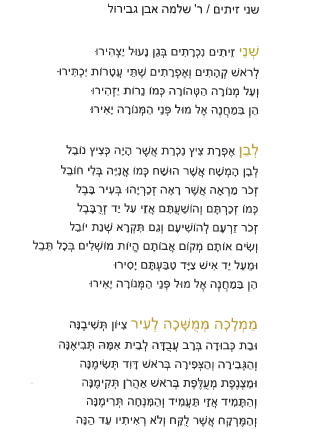
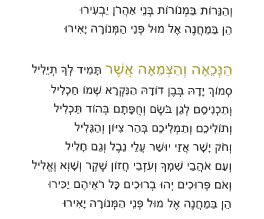
Shnei Zeitim: Two Olive Branches – Piyut by Solomon Ibn Gabirol

Shnei Zeitim: Two Olive Branches

Piyut by Solomon Ibn Gabirol

Translated & Annotated by Ben Zion Katz[1]

Two[2] olive branches[3] cut down in the garden[4] will again produce fresh, pure olive oil[5],

For the leaders of the Kohatites[6] and the Ephratites[7] will be crowned as one[8].

They will shine[9] like candles on the holy Menorah[10]-

There in the camp opposite the menorah, they shined![11]

The son of Ephrat[12] whose ornament[13] was cut off and then dried up[14]

Has now become the anointed one[15] for those who were laid low and directionless[16].

Recall the vision of Zachariah[17] –

As you remembered it, you were saved[18] by the hand of Zerubabel[19],

Their generation remembered and were saved[20], and that year[21] was called a Jubilee Year!

They were resettled[22] in the place of their forefathers where they were given sovereignty[23]

And from the oppression[24] of the hunter[25] they were spared[26], and

There in the camp opposite the menorah, they shined![27]

The interrupted[28] kingship was returned to the city of Zion,

The honored daughter[29], after much work, was brought back to her mother’s home (i.e., Israel),

The Kingship[30], the [beautiful] diadem[31] was placed back on David’s head,

The covered turban[32] was [re]established on the head of Aaron[’s descendants],

The daily sacrifice was reinstated and the meal offering [again] raised up [to the Lord]

The anointing oil[33] that was being used[34] hadn’t been seen in quite a while![35]

The fires are lit [again] in the menorahs by the descendants of Aaron,

There in the camp opposite the menorah, they shined[36]

[Regarding] the depressed and the thirsty who complain to You constantly –

Put your trust[37] in the son of the beloved[38] who is called ruddy[39]

Enter the garden of spices (i.e., Israel)[40] whose canopy is glorious[41]

And lead them, rule over them in Mt Zion and in the Galilee,

[Whence] just laws will be issued[42] with harp and flute.

The nation that loves Your Name and who abandon false prophets, nothingness and idols.

The nation that toiled[43] will now be so blessed, that it will be obvious to all who gaze upon them[44], that

There in the camp, opposite the menorah, they shined![45]

Figure. Synagogue motif quoting Zacharia 4:2-3 with olive branches, from India. Photo courtesy Michael R. Stein.

[1] This piyut reprinted here is from https://web.nli.org.il/sites/nlis/he/Song/Pages/song.aspx?songid=438 (accessed 12/23/20). It can also be found in Siddur Avodat Yisrael edited by Seligman Baer, corrected edition, Breidelheim, 1818, reprinted Jerusalem, no date, pp 640-1. This piyyut is known as a me’orah because it is (fittingly) inserted before the blessing Or Chadash (a new light) on Shabbat Chanukah. I have relied extensively on Baer’s notes for my annotations. I thank Michael R. Stein for the online link to this piyut and for helpful discussions.
[2] The 2 refer to priesthood and kingship; see below.
[3] Zeitim  can mean olives or olive branches or trees; olive branches is better suited to the context and to general synagogue imagry; see Figure.
[4] Lit., “enclosed garden” from Song of Songs 4:12, taken by the rabbis as a metaphor for the Jewish people; see for example Rashi on that verse.
[5] Hebrew yitzhar, is a triple play on words. I have translated literally, but it is also the name of a priestly family (e.g., Exodus 6:18; see also the following note) and can mean (sky)light or zenith.
[6] Kehat, one of the 3 sons of Levy, is the father of Yitzhar. Kehat serves as another stand-in for the priesthood.
[7] King David, who ruled over the united kingdom of Israel and Judah was descended from Ephratites (Ruth 1:2). Efrat is another name for Bet Lehem, a city in Judah (Micah 5:1). I thank another Michael Stein for help with this note.
[8] Lit., “they will be crowned with 2 (royal) wreaths”, but the sense is of combined authority uniting the priesthood and kingship. Note how this unity is presented as the ultimate achievement of the Maccabees, unlike in classical rabbinic thought where the priestly Maccabees were criticized for (also) usurping kingship (see Yerushalmi Horayot 3:2 and Ramban on Gen. 49:10 [I thank Rabbi Joel Guttstein for helping me locate these references.])
[9] This word yazhiru in this line is nearly identical to the word yatzhiru above; see note 5.
[10] If the menorah is also a reference to Israel (“a light unto the nations”) then this line means that the Maccabees were an inspiration to the Jewish people
[11] Numbers 8:2 uses similar terminology describing Aaron the high priest lighting the menorah in the desert tabernacle for the first time. This line is the refrain of the piyut and depending on what precedes it may take on slightly different meanings.
[12] See note 7
[13] This is the term used for an ornament on the miter of the high priest; cf. Exod. 29:6
[14] Cf. Isaiah 28:1 and 40:7, 8
[15] Literally “the son of the anointed one” which is alliterative in the Hebrew with what precedes and follows.
[16] Literally “like a boat without a captain”
[17] The text adds “in the city of Babylonia” immediately following, but Zachariah was one of the last prophets during the era of the rebuilding of the second Temple in Jerusalem after the exiles returned from Babylonia. Perhaps Ibn Gabirol meant that Zachariah was originally from Babylonia, that he originally had this vision in Babylonia or perhaps there is some textual confusion with the name Zerubabel, the Jewish political leader during the early second Temple period; see the following note.
[18] In Zachariah chapter 4 a vision is recounted that has relevance to Hanukah and from which Ibn Gabirol took inspiration for the current piyut. Zachariah sees a 7 branched menorah with 2 olive branches, one on each side. The 2 olive branches are called the 2 sons of oil – i.e., the 2 anointed ones (yitzhar is the word used in Zechariah 4:14 [see note 5]), who represent the priestly and political leaders of the Jews in Zachariah’s time. These 2 institutions, as Ibn Gabirol notes in this piyut, are united in the Maccabees. See the previous note and note 8, above.
[19] See note 17 and the following note.
[20] This line is a bit obscure and is missing in some manuscripts according to Baer.
[21] Literally “she” or “you”.
[22] Literally “placed”.
[23] Literally “where they could rule over all the whole Earth”.
[24] Literally “hand”
[25] A reference to Esau (cf. Gen. 25:27), a stand in for countries that conquered ancient Israel and Judah.
[26] Literally “they took his ring” a reference to Pharaoh giving Joseph his ring as a symbol of transfer of power (Gen. 41:42). An alternative reading to being spared from the hand of the enemy is that Israel will wrest the power from the hand of the oppressor.
[27] See note 11, above.
[28] Literally “extended”
[29] Cf. Psalm 45:14. An alternative to “after much work” could be “with many servants”.
[30] Literally “Queen mother” but this is probably a play on the Hebrew word for strength.
[31] Cf. Isaiah 28:5.
[32] One of the priestly garments; cf. Exod. 29:27 and Lev. 16:4.
[33] Literally “medicines”
[34] Literally “taken”
[35] Literally “till now”; cf. Gen. 45:28.
[36] See note 11, above.
[37] Literally “support your hand”
[38] A reference to the messiah – see note below
[39] For this use of ruddy or red, see Gen 49:12, part of the blessing of Judah, David’s tribe; David was a red head (I Sam. 16:12).
[40] Cf. Song of Songs 6:12.
[41] Or perhaps “whose canopy is royal blue”
[42] Literally sung; cf. Exod. 15:1.
[43] Cf. Exod. 1:14.
[44] Cf. Isaiah 61:9
[45] See note 11, above.


Rambam The Poet?

Rambam The Poet?

Ovadya Hoffman

Most readers are familiar with the general character and productivity of Maimonides, I will therefore keep the preamble to a minimum. The indelible legacy left by Maimonides is that of a legalist and thinker, not of a poet or a preacher. That’s not to say that Maimonides lacked the poetic skill. In fact, even from his purely legal works one can detect his elegant tongue and imaginative faculties, never mind the many missives, introductions and intermittent non-legal material included in his Code which exhibit overt tones of a skillful mouthpiece characterized by his eloquent and passionate appeals, charming metaphors and moving rhetoric.[1] And yet, not much –if any- of his authentic, complete pieces of poetry survived.[2]

One poem ascribed to Maimonides was composed in Arabic depicting the story of Purim. Recently, a dear friend, Jacob Djmal of The Jewish Bookery, showed me a book containing this poem declaring it to be of Maimonidean authorship. I will use this source as my point of departure.

R. Yosef Shabbtai Farhi published a book titled Nora Tehilot in Livorno 1864.[3] On the title page the author states he has translated the book of Esther into colloquial Arabic (“ולכן נתתי אל לבי… להעתיקה בלשון ערבי”) and included a piyyut in Arabic authored, so he claims, by Maimonides (“ונפך שפי’ר[4] פיוט בל’ צח ערבי מהרמב”ם ז”ל יפה אף נעים”). However, Farhi provides no information as to the piyyut’s provenance. One wouldn’t be afoul to suspect that, regardless of the piyuut’s origin, its attribution to Maimonides could easily garner sales. Who would pass up a book containing a rare glimpse of the great Maimonides’ poetic creativity? Again later on (31a) the author titles the aforementioned piyyut “בלשון ערבי מהרמב”ם ז”ל מיוסד על פי מאמרי רז”ל על סדר א”ב… לחן אימפיסאר קירו קונטאר”. So what are we to make of this piyyut? Where did Farhi get it from?

A manuscript housed at the Ben Zvi institute (MS. 1327), dating from a year before Farhi’s book was published, is a handwritten copy of what alleges to be an Arabic translation of Esther authored by Maimonides (“ספר מג'[ילת] אס'[תר] מלערבי הנקרא שרח אל מגלה להר’ משה בר מימון זלה”ה”).[5] At the end of the manuscript (beginning on p. 76) the same piyyut which appears in Farhi’s book is produced here except it lacks any attribution.[6] It could be fair to assume that the copyist only naturally considered the piyyut to be of the same authorship as the translation, Maimonides, although he didn’t state as much. He may have chosen to include it in the manuscript on the belief that it was from Maimonides or he may have harbored doubts as to its authenticity and therefore left it unattributed. In any case, where did this copyist get it from?

Another book titled “פירוש מגלת אסתר בלשון ערבי הנקרא שרח אל מגלה להנשר הגדול ארך הכנפים ורב הנוצה הרמב”ם ז”ל” was published in Livorno 1759 at the behest of Abraham b. Daniel Lombroso.[7] At the end of the first paragraph (2a) it reads: “ואל שרח משחר אליה מלקוטין מן כלאם רבותינו ז”ל ואל תלמודיין אל בבלי ואל ירושלמי” (loosely translated: a translation based on an anthology of both Talmuds). At the conclusion of the translation a number of piyyutim by various authors are produced. One of those piyyutim are evidently of anonymous authorship and simply titled “פיוט בלשון ערבי מיוסד על פי מאמרי רז”ל לחן אינפיסר קיירו אקונטאר” (p. 46a).

With no older documentation of this piyyut, I can only guess that one -possibly Farhi himself- hastily assumed an Arabic poem, appended to an Arabic translation authored, allegedly, by Maimonides belonged to him as well and consequently formalized the attribution.

Addendum

In 1845 Michael Sachs wrote that he was skeptical about Maimonides’ involvement and authorship of poetry.[8] About a year later, in a letter to Sachs upon receiving his book, Samuel D. Luzzatto argued with one of Sachs’ points regarding a particular piyyut ascribed to Maimonides and then marshaled evidence from R. Shimon b. Tsemaḥ (Duran) in his Magen Avot p. 84[a] where it is evident that Maimonides wrote two other piyyutim. However, Luzzatto added, the word “הרמב“ן” in Magen Avot is a printing error and should read “הרמב“ם”; [9] more on this below. Years later, in 1854, Shneur (Senior) Sachs repeated the notion of Maimonides’ aversion to composing poetry and maintained that all which we have from him is a single piyyut.[10] Eliezer Landshuth further attempted to set the record and addressed the later Sachs in his book, quoting Shadal and his emendation to the text of the Magen Avot.[11] I won’t go on to list a record of all the authors who followed suit in quoting the Magen Avot as a source for Maimonides’ authorship of a couple other piyyutim and will suffice to say that as late as the early 1900s Meir S. Geshuri asserted the same claim[12] and he was likewise cited by the celebrated Hayyim Schirmann.[13]

The Magen Avot was first published in Livorno 1785. Here[14] is the page:

Alternatively, here is the text:

כבר כתבתי כי הן הם דברי הרמב”ן בה’ יסודי התורה וכן כתב בתשובה שהנפש צורה בלא גולם ולא גוף אבל זוהר וגזרה ומקור הדעת ואינה צריכה לגוף לפי’ … אבד הגוף לא תאבד היא אלא עומדת בעצמה וקיימת כמו מלאך ונהנית באורו של עולם והוא עה”ב וכן יסג הוא ז”ל במחרך א’ בך רוח בשם נקבה חיה כשגל נצבה. ממקור החיים חוצבה. מידעה שגבה. מגלגל שכל שאבה. חכמתה כים רחבה. ייהי הגיית איש לראש. נשמה שרי דרוש. אכן רוח היא באנוש. וכן יסד בגאולה המתחלת אמרו בני אלהים כמה אתן לפועלי צדק וגם אני מכם מה לבני שאול ולי. וכן בפיוט יפתה עלמת לא נודע מי יסדו אבל אומר כי המיסד סוח יענים יסדו שאומר כי ירמיה יסדו אכל נראה שחכם גדול היה דבר באותו פיוט בסוד הנשמה ובבית א’ אומר על הנשמה שאלה חופש מאשר עובר בה יחלה יום להנפש בו ואל תכבד העבודה כי יסוד נפש חי כלי אובד יום פרידה כאשר קדמת הגוף יהי נמצא הוא קדומה אך לפי תומת מעשיה נרצה או זעומה

Besides for the unintelligible sentences and typos, the most glaring error is, as Shadal and others called attention to, the printing error of רמב”ן instead of רמב”ם. Now, if that’s all one corrects it is now conceivable that Duran ascribed to Maimonides the piyyutim which he mentioned. Somewhat surprising, or not, is that the same errors appear exactly so in the newer edition of Magen Avot published by Mechon HaKtav in Jerusalem 2007, despite the publisher’s claim of it being critically edited.[15]

Of the different manuscripts I consulted in determining the original text only one had a different and coherent read. This manuscript is estimated to be from 15th-16th century and is housed in The Royal Danish Library.[16] In order to grasp the flow of the material it is necessary to include the preceding paragraph (in the image above, it begins four lines above the yellow box). Following, is my transcription of the manuscript:

וכן החכם ר׳ אברהם ז״ל כתב בפי׳ קהלת כי מה שאמ׳ והרוח תשוב אל האלהים אשר נתנה סותר דברי האומרים שהנפש מקרה שהמקרה לא ישוב וכן נראה שזה הוא דעתו כי כתב בפי׳ תלים כי הנפש והנשמה והרוח שם אחד לנשמת האדם העליונה העומדת לעד ולא תמות ונקראה נפש גם רוח בעבור שלא תראה לעין כי אם אלה וכן כת׳ בפרש׳ כי תשא ובכל מקום קורא אותה נשמה עליונה כמו שכתב בפרש׳ ואלה המשפטים ר״ל כי היא אינה מושגת אלא מצד פעולותיה הנקראים נפש ורוח רואה החכם ז״ל כי הנשמה יצאו ממנה כח ההזנה הנקרא נפש וכח ההרגש הנקרא רוח אבל הוא עצם אלהי לפי הנראה מדעתו ולא הכנה לבד. וכן יסד הוא ז״ל במחרך אחד בך רוח בשם נקבה חיה כשגל נצבה ממקור אור יוקבה מצור החיים חוצבה מי דעה אותה שגבה מגלגל שכל שאבה חכמתו היא רחבה ויהי בגויית איש לראש נשמה שדי דרוש וכן רוח היא באנוש. וכן יסד בגאולה המתחלת אמרו בני אלהים במה אתן לפועלי צדק וגם אני מכם מה לבני שאול ולי. וכבר כתבתי כי כן הם דברי הר״ם במז״ל בהלכות יסודי התורה. וכן כתב בתשובה שהנפש צורה בלא גולם ולא גוף אבל טהר וגזרה ומקור הדעת ואינה צריכה לגוף לפי׳ כשיאבד הגוף לא תאבד היא אלא עומדת בעצמה וקיימת כמו מלאך ונהנית באורו של עולם והוא עולם הבא וכן בפיוט יפתה עלמת לא נודע מי יסדה אבל אומרי׳ כי המיסד סורו יענים יסדו אשר אומרים כי ירמיה הנביא יסדו אבל נראה שחכם גדול היה דבר באותו פיוט בסוד הנשמה ובבית אחד אומר׳ על הנשמה שאלה חופש מאשר עובד בה יחידה יום להנפש בו ואל תכבד העבודה כי יסוד נפש חי בלי׳ אובד יום פרידה באשר קדמת גוף יהי נמצא היא קדומה אך לפי תומת מעשים נרצה או זעומה

As observed by others, we see that the correct reading is רמב”ם instead of רמב”ן. But most significantly, we see that some lines from Duran’s discussion of Abraham ibn Ezra’s view [regarding the nature of the soul] were transposed to after the mention of Maimonides, giving the impression that “וכן יסד הוא ז”ל” and “וכן יסד” refers to Maimonides, thereby leading scholars to believe that Duran attributed these piyyutim to Maimonides. Indeed the quoted muḥarrakh[17] “בך רוח” and the geulah[18] “אמרו בני אלהים” are both compositions of ibn Ezra.[19] In conclusion, the basal support, which for years scholars have pointed to for evidence of Maimonides’ rôle as a poet, is negated.

At this point we should make mention of the last piyyut which Duran notes that “some say Jeremiah authored, nevertheless it’s apparent a great sage spoke it”. This piyyut, also of the muḥarrakh genre, has since been identified as being authored by R. Joseph ibn Zaddik (11-12th century) and subsequently published in a collection of his piyyutim.[20]

As I attempted to have this brief essay completed in time for Purim I lay here the pen and hope to return to a discussion of a perplexing and elusive piece quoted by Duran.

[1] See, however, Isadore Twersky, Introdution to the Code of Maimonides (New Haven & London 1980), 250 fn. 29.
[2] Cf. Hayyim Schirmann, Toldot HaShirah Ha’Ivrit BeSfarad HaNotsrit Ubederom Tsarfat (Jerusalem 1997), 280 fn. 6 for bibliographical references. See also addendum below.
[3] https://hebrewbooks.org/34131
[4] A play-on-words of Ex. 28:11 “והטור השני נפך ספיר”; with ‘שפיר’ meaning ‘good, fine’.
[5] See the journal Sarid U’palit (R. Yaakov Moshe Toledano, Tel Aviv n.d.), i p. 65 and Perush Megilat Esther LeHanesher HaGadol Rabbenu HaRambam (trans. Yosef Yoel Rivlin, Jerusalem 1952 [in a note to the latter’s preface 1943 is given as the publication year for Toledano]). Toledano believed this to be an original translation by Maimonides and only alluded to anonymous gainsayers. See however Hartwig Hirschfeld’s critical analysis of the translation in his essay Notiz uber einen dem Maimuni untergeschobenen arabischen Commentar zu Esther (Semitic Studies in Memory of Rev. Dr. Alexander Kohut, Berlin 1897) 248ff. Per Toledano’s dismissal of the translation belonging to Rabbi Maimon, Maimonides’ father, on account of a quote not found in the respective translation, cf. Tiferet Yisrael (R. Shlomo b. Tsemaḥ Duran, Venice c. 1600) 118b, quoting an Arabic translation, which according to his father, was authored by Rabbi Maimon.
[6] https://www.nli.org.il/en/manuscripts/NNL_YBZ000115506/NLI#$FL31920894
[7] https://www.nli.org.il/en/books/NNL_ALEPH001773455/NLI . Cf. above, fn. 5.
[8] Die religiöse Poesie der Juden in Spanien (Berlin 1845), 204.
[9] Ozar Nechmad (Vienna 1857), vol. 8 p. 27. Shadal’s letter is dated 26 Kislev 1846. Leopold Zunz likewise suggested the correction, Literaturgeschichte der synagogalen Poesie (Berlin 1865), 478.
[10] Kerem Hemed (Berlin 1854), viii p. 30.
[11] Amude Ha-Aboda (Berlin 1857), 230.
[12] Rabbenu Moshe ben Maimon, ed. J.L. Fischman (Tel Aviv 1935), 289.
[13] Toldot HaShirah Ha’Ivrit BeSfarad HaNotsrit Ubederom Tsarfat (Jer. 1997), 281 fn. 9; see also Yosef Tobi in Ben ‘Ever La’arav (Tel Aviv 2014), vii 83 fn. 148. Regarding the halachic texts of Maimonides and the Geonim which Tobi cites to demonstrate Maimonides’ assailment of poetry, cf. Boaz Cohen’s Law and Tradition in Judaism (New York 1959), 167ff.
[14] https://hebrewbooks.org/pdfpager.aspx?req=9446&st=&pgnum=171&hilite=
[15] https://hebrewbooks.org/pdfpager.aspx?req=39932&st=&pgnum=552
[16]  http://www5.kb.dk/manus/judsam/2009/sep/dsh/object21822/en/#kbOSD-0=page:174
[17] Arabic for ‘mover’; alternatively, ‘prompter’. Of Spanish style, and often employed by ibn Ezra, the muḥarrakh was usually recited before a reshut for Nishmat Kol Ḥai. On the reason for the given name, cf. Ezra Fleischer’s Shirat Hakodesh Ha’ivrit Beyeme Habenaim (Jerusalem 1975) 399-400, Leon J. Weinberger’s Jewish Hymnography (London & Oregon 1998) 436, Peter Cole’s The Dream of the Poem (Princeton University Press 2007) 537 and an original theory suggested by Ephraim Hazan in Tarbiz (Jerusalem 1977) xlvi 323.
[18] The concluding piece of a Yotser sequence.
[19] The former was published in toto in Jacob Egers’ Diwan LeRabbi Avraham ibn Ezra (Berlin 1886), 21 fn. 67 [beginning “אל מתנשא על כל לראש”], but confused, and thence omitted, by Israel Davidson in Otsar HaShirah VeHapiyyut (New York 1970), i n. 3854 with another “אל מתנשא” incorrectly supplying Egers as a source. Davidson’s reference to David Rosin’s Reime und Gedichte des Abraham ibn Esra (Breslau 1887) “ב 16”, does not yield our piyyut and appears to be incorrect. The latter was published, most recently, in Avraham ibn Ezra – Shirim, ed. Israel Levin (University Tel Aviv 2011), 191; here and other editions have “במה אתן לפועלי חסד ואם אני…” unlike Magen Avot. Cf. Egers, ibid., 165 n. 198; translated into English in Leon J. Weinberger’s Twilight of a Golden Age (University of Alabama Press 1997), 246ff.
[20] Yonah David, Shire Yosef ibn Zaddik (Israel 1982), 55 and elegantly translated into English by Peter Cole, ibid., 139.


Anim Zemiros – A Poem for All Ages by Rabbi Elchanan Adler book review

Anim Zemiros – A Poem for All Ages

By Rabbi Elchanan Adler

Feldheim Publishers, New York, 2020, 192 pages

Reviewed by Myron Wakschlag

Rabbi Myron Wakschlag is a musmach of Rav Ahron Soloveichik zt”l at Yeshivas Brisk of Chicago, and is currently an IT executive in the Washington, DC area. He has researched and published on the early Orthodox rabbinate in America.

It is rare to find a book that is able to successfully illuminate a complex topic, yet still remain captivating and easily accessible. Rabbi Elchanan Adler’s new sefer on Anim Zemiros is just such a book. While Anim Zemiros is familiar to most people, its contents remain largely enigmatic due to its challenging Hebrew terminology and its esoteric meaning. Rabbi Adler has opened up new pathways that enable the reader to unlock both the simple meaning and the profound concepts lying beneath the surface of the text.

In this beautiful volume, Rabbi Adler notes how each stanza of Anim Zemiros is based on specific verses from Tanach or Talmudic/Midrashic passages. This itself is a valuable tool that sheds light on the underpinnings of the text. But the real strength of the book is in its ability to be megaleh amukos, to uncover the deep hidden beauty of the poem and make it accessible to the average reader untrained in the analysis of medieval liturgical poems. Rabbi Adler’s analysis weaves together explanations offered by traditional sources with his own fascinating insights. Rabbi Adler, an esteemed Rosh Yeshiva at Yeshiva University’s Rabbi Isaac Elchanan Theological Seminary for over 20 years, is an erudite scholar and master teacher who has an unusual gift for presenting difficult material in a way that is easy to understand.

The sefer begins with an overview that describes the origin of the formal name Shir HaKavod, the authorship and dating of the work, the origins of its inclusion in the liturgy, and the manner in which it is recited in the synagogue. It then transitions into an analysis of the overall themes, structure, and style of the text, including many interesting observations about the common ideas that are expressed within each section, and numerical allusions that emerge from the text. The next section transitions into the essence of the book, which comprises a textual analysis of each stanza, offering unique insights, explanations, interpretations, and suggestions to explicate the poem based on the full range of rabbinic literature. While it is not an exhaustive treatment of every word in the poem, Rabbi Adler’s choice of what to include helps to capture and hold the reader’s interest.

The book is valuable on many levels. In addition to its primary objective of elucidating both the plain and hidden meaning behind Anim Zemiros, a careful reading of the book allows the reader to acquire a methodology for analyzing piyyutim. Determining exactly what the author of Anim Zemiros meant to convey and what messages he buried beneath the surface is much like solving a mystery. Rabbi Adler employs many analytical tools to uncover the clues and piece together the various threads. It is enlightening to study the manner in which he carefully examines the text to identify nuances and different shades of meaning based on the poem’s rhythm, meter, textual variances, word roots, grammar, alternative translations, vowelization, allegory, and symbolism. He also often adduces prooftexts from Tanach, and contrasts the opinions of the various early and later commentaries to suggest various possibilities in the text. Utilizing this methodology, Rabbi Adler is able to “connect the dots” and uncover the concealed gems that are impossible to discern at first glance.

I owe a great debt of gratitude to Rabbi Adler, not only for giving me a much greater understanding of the magnificence of Anim Zemiros and its prominent place in our liturgy, but also for imparting his approach to analyzing piyyutim and understanding their significance. He has given me a derech to better appreciate medieval liturgical poems in general, and has also provided me with the tools to be able to analyze them on my own.