Life After Death: The Afterlife of Tombstone Inscriptions in the Old Jewish Cemetery of Vilna

Life After Death: The Afterlife of Tombstone Inscriptions in the Old Jewish Cemetery of Vilna

By Shnayer Leiman

The ultimate purpose of any Jewish cemetery is to provide a resting place, with dignity, for the Jewish dead. Jewish law and custom have played a major role in regulating almost every aspect of burial from the moment of death through the funeral itself, the period of mourning that follows the funeral, and – ultimately – the erection of a tombstone over the grave.[1] Once the tombstone is in place, the living return to the cemetery for occasional visits, usually on the anniversary of the death (yahrzeit) of a dear one, or to pray at the grave of a righteous rabbi or ancestor in a moment of need.

And, of course, the living return to the cemetery in order to attend the funerals of others. But the last mentioned occurs only in “living” cemeteries, i.e. cemeteries that still bury the dead. But, at some point, cemeteries run out of space, and/or are forced to close by municipal ordinance. In 1830, after serving Vilna’s Jewish community for well over 250 years, the Jewish cemetery ran out of space and the municipal authorities forced it to close.[2] It was no longer a “living”cemetery and it transitioned into a pilgrimage site, where Jews came to pray at their ancestors’ graves, and at the graves of the great Jewish heroes of the past.

Any such transition comes at a cost. It became necessary to provide for the security of the cemetery, despite the lack of income from regular funerals. Guards had to be hired, fences had to be built and repaired, caretakers had to maintain the cemetery grounds, and guides had to be provided for those searching for specific graves in the cemetery. In this brief essay we will focus on only one interesting phenomenon: the need to identify “celebrity” graves, and to create markers, often on the tombstones themselves, that identified the person buried at the foot of the tombstone as a celebrity, or as a close relative of a celebrity (e.g., אם הגאון רבינו אליהו “The Mother of the Gaon R. Eliyahu [of Vilna],” and אבי הרב הגאונים ר‘ חיים ורש זלמן מוואלאזין The Father of the Rabbis and Gaonim R. Hayyim and R. S[hlomo] Zalman of Volozhin ).[3] Clearly, this need was made necessary – in large part – by the wear and tear on the tombstone inscriptions that made many of them almost impossible to read by the end of the19th century. But it was also made necessary by the passage of time, when a younger generation no longer recognized the names of the deceased, who often were the parents or spouses of celebrities of the past and present.

Our evidence will come mostly from photographs of tombstones in the Old Jewish Cemetery taken during the first decades of the 20th century.[4] These will be supplemented by the hand copies of the same tombstones published mostly in the second half of the 19th century.[5] First, a word of caution.

While photographs don’t lie, they often mislead. Thus, a recent work – and a superb one at that – on the leading 20th century rabbinic figure in Vilna’s long history of rabbinic scholars, i.e., Rabbi Hayyim Ozer Grodzenski (d. 1940), inadvertently suggests that R. Mordechai Meltzer (1797-1883), a distinguished 19th century Vilna Talmudist, was buried in the Old Jewish cemetery of Vilna.[6] The suggestion is based upon a poor photograph of a group of graves in the Old Jewish cemetery. The Hebrew legend under the photograph reads “The tombstone of the Gaon Rabbi Mordechai Meltzer in Vilna.” Here is the photograph, as it appears in the volume, p. 180:

With a magnifying glass, one can barely make out above the second tombstone from the right, the title and name: הרב הגאון ר‘ מרדכי מעלצער The Rabbi and Gaon R. Mordechai Meltzer.” Since the third tombstone from the right is clearly identifiable as marking the grave of R. Abraham Danzig (d. 1820), a distinguished Vilna rabbinic scholar who was certainly buried in the Old Jewish cemetery, there is perhaps some reason to think that R. Mordechai Meltzer was, in fact, buried next to him, in the same cemetery.[7]

Interestingly, the author himself states openly the Rabbi Meltzer left Vilna and ultimately served as Rabbi of Lida (today in Belarus), “where he died in 1883.” Apparently, the author assumes that Rabbi Meltzer died in Lida, but was somehow brought to burial in the Old Jewish cemetery of Vilna.

Alas, it cannot be, for many reasons. Among them:

a) R. Mordechai Meltzer died in 1883. The Old Jewish cemetery was officially closed in 1830. No Jew was buried in the Old Jewish cemetery after 1830. From 1831 until 1941, all Jews who died in Vilna, including its most famous rabbis in that period, were buried in the Zaretcha Jewish cemetery (Vilna’s second Jewish cemetery).

b) R. Mordechai Meltzer, after serving 19 years as Chief Rabbi of Lida, was buried in Lida. A mausoleum was built over his grave, one of the few in the Lida Jewish cemetery, and it became a major pilgrimage site until it was destroyed during the Holocaust and its aftermath.[8]

c) More importantly, here is a clear photograph of the tombstone misidentified in the Grodzenski biography. The photograph will also introduce the first of 6 samples of celebrity markers on tombstones.

Sample1. R. Asher Klatzko (d. 1820).[9]

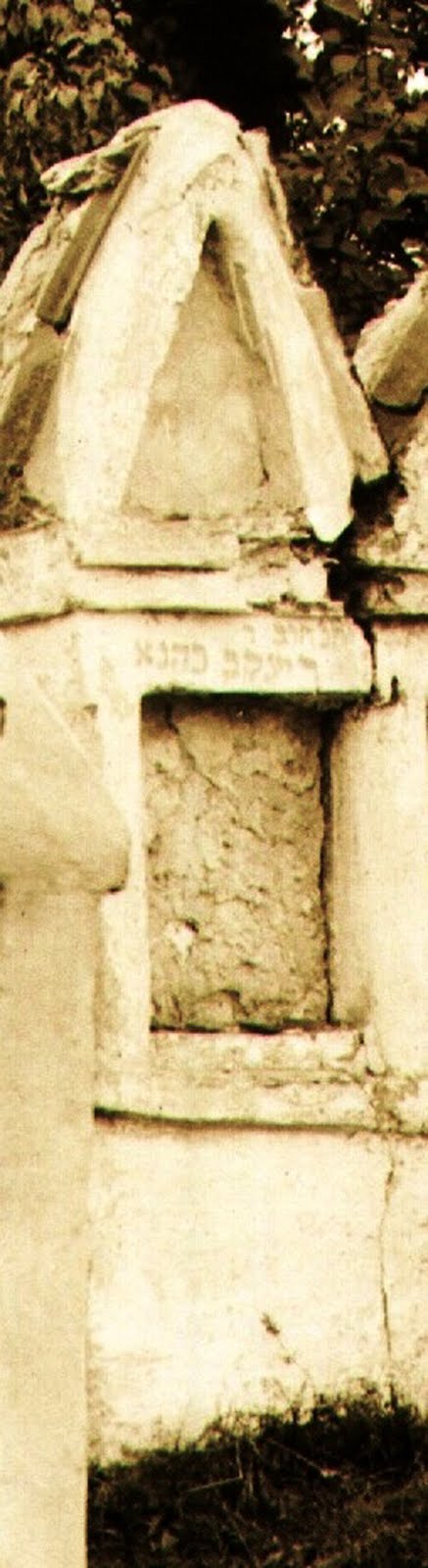
The second tombstone from the right is that of Rabbi Asher Klatzko (d. 1820), father of Rabbi Mordechai Meltzer. One can still read (in the photo) the original epitaph that mentions Asher and his father’s name, Isaac.[10] [Asher was a great talmudic scholar in his own right, and no one would have marked his grave in 1820 with an epitaph that mentions his 23 year-old son, Mordechai, who held no official position at the time. But in 1860 or so, long after the cemetery was no longer a living cemetery, few remembered who “R. Asher son of R. Isaac” was, but everyone knew who R. Mordechai Meltzer was: the head of Vilna’s Ramajles (ראמיילעס) Yeshiva during the first half of the 19th century, an official rabbi of Vilna with the title מורה צדק, teacher of Vilna’s most distinguished rabbis, and among the Vilna leaders who officially greeted Moses Montefiore when he visited Vilna in 1846.[11] And so the top of the tombstone frame was marked:

הוא אבי הרב הגאון ר‘ מרדכי מעלצער “He [Asher, the person buried here] is the father of the Rabbi and Gaon, R. Mordechai Meltzer.” The message seems to be clear: This is a celebrity related grave, not to be overlooked. This is our first sample of a phenomenon that characterizes the Old Jewish cemetery in its second phase, i.e. after it was no longer a living cemetery. Aside from repairing broken tombstones and re-inking the faded epitaphs, the cemetery authorities saw a need to introduce markers that provided new information that identified celebrity graves of one kind or another. Nor did the cemetery authorities hesitate to post those markers on the original tombstones themselves, when there was sufficient space to do so.

Sample 2. R. Yehuda Leib Gordon (d. circa 1825).

The third tombstone from the right, whose epitaph (in the center of the tombstone) is no longer legible, and is not recorded elsewhere, was accorded a celebrity inscription which reads: פנ חותן הרב הגאון ר‘ מרדכי מעלצער Here lies buried the father-in-law of the Rabbi and Gaon, R. Mordechai Meltzer.” The father-in-law, R. Yehudah Leib Gordon, was a member of a distinguished Vilna family that produced a long line of communal leaders and rabbis.[12]

Sample 3. R. Yosef b. R. Shmuel Zaskewitz (d. 1829).

In the same photo as at Sample 2 above, the first tombstone at the right has a celebrity marker at its top. The outer rim of its rooftop reads:

י[פנ ה]רבני המופלג מוה יוסף [בן ה]אבד דקק זאסקעווץ “Here lies buried the outstanding rabbinic authority, our teacher and rabbi Yosef, son of the Chief Rabbi of Zaskewitz.” Inside the rooftop, a celebrity marker has been added. It reads: אבי הרב הגאון ר‘ שמואל שטראשון “The Father of the Rabbi and Gaon, R. Shmuel Strashun.” By 1860 or so, few knew who R. Yosef b. R. Shmuel Zaskewitz was. But every learned Jew in Vilna knew precisely who R. Shmuel Strashun was,[13] and so R. Yosef was now properly identified as the father of R. Shmuel Strashun.[14]

Sample 4. R. Baruch b. R. Shmuel Zaskewitz (d. 1829).

In the same photo as at Sample 2 above, adjacent to R. Yosef b. Shmuel, rests his brother R. Barukh, who also died in 1829. Not surprisingly, he too was accorded a celebrity marker. It reads: דד הרב הגאון ר‘ שמואל שטראשון “The uncle of the Rabbi and Gaon, R. Shmuel Strashun.” In case you don’t know who R. Baruch was, now you know.[14a]

Sample 5. R. Zvi Hirsch b. R. David ha-Levi (d. 1830).

In the same photo as at Sample 2 above, at the extreme left, is the tombstone of R. Zvi Hirsch of Libau, who served with distinction as the lead cantor of the Great Synagogue of Vilna from 1822 until his death in 1830. The original epitaph is legible in the photograph, and has been recorded.[15] It makes no mention of his son. At a later date, perhaps in the 1860’s or later (see below), few remembered who R. Zvi Hirsch was, but everyone knew who his son was. Indeed his son not only eclipsed his father as a cantor, he eclipsed every cantor who would ever serve as lead cantor of Vilna. The son, the legendary “Vilner Balabesel” (Yiddish for: young and married householder in Vilna), R. Yoel David Strashunsky, succeeded his father upon his death in 1830, only 14 years old at the time. At that young age, there was much communal strife as to whether it was appropriate for him to serve as the lead cantor. It was decided that he would share the post with an older cantor until 1836, when in fact, he became the sole lead cantor. There was more trouble ahead, when in 1842 he left Vilna for Warsaw, where he performed in public concerts of operatic music. Ultimately he suffered from severe depression, and – on and off – either lost his voice, or lost his interest in serving as a cantor. He died in a hospital for the mentally ill in Warsaw in 1850, and was buried in Warsaw. He was 34 years old at the time of his death.[16] And so R. Zvi Hirsch too was accorded posthumous celebrity status. The inscription added to the rooftop portion of his tombstone reads:

פנ השץ מקק ליפי ופה קק ווילנא אבי ר‘ יואל דוד שץ דפה “Here lies buried the Cantor from the holy community of Libau and [who also served] here in the holy community of Vilna, the father of R. Yoel David, the Cantor [who served] here.”

Some, but hardly all, of the celebrity markers include the date when they were installed by the cemetery authorities. It is of particular interest to establish the date when R. Yoel David’s name was entered on his father’s tombstone, given the controversy that surrounded his name. It just happens to be that in the case of R. Zvi Hirsch of Libau, the celebrity marker included the date of its instillation, at least initially, but it no longer is entirely legible. The text at the bottom of the rooftop inscription reads:

 _ _נתחדש עי גבאי דצג בשנת תר “It [the grave site][17] was refurbished by the adjutants of the Zedakah Gedolah Society[18] in the year [5]6_ _.” The last two digits are illegible, leaving us with a range of years between 1840 and 1939. We can quickly close the gap a bit, since the photograph at Sample 2 was taken circa 1913.[19] Interestingly, the neighboring grave site just to the right of that of R.Zvi Hirsch Libau in the photograph at Sample 2, was also refurbished by the Zedakah Gedolah Society, and the date of instillation of its new inscription is included. It is the grave site of a pious woman named Roza, about whom we know almost nothing, other than the fact that she died in 1830 or earlier and was buried in the Old Jewish cemetery of Vilna. The text in the rooftop inscription reads: פנ ה[אשההצנועה המפורסמת מ[רתרוזאנתחדש עי גבאי דצג בשנת תרעג

“Here lies buried Mrs. Roza, the woman renowned for her modesty. It [the grave site] was refurbished by the adjutants of the Zedakah Gedolah Society in the year 673.”[20] The Hebrew year [5]673 was mostly in 1913. Almost certainly, both these grave sites were refurbished at the same time, in 1913. By that year, Yoel David Strashunsky was a legendary figure not only in Vilna, but indeed throughout the world of Yiddish speaking Jews. We will examine one more interesting celebrity marker that, as an aside, provides linguistic support for our dating of the R. Zvi Hirsch of Libau celebrity marker to circa 1913.

Sample 6. R. Shmuel b. R. Hayyim Shebsils (d. 1818).[21

Little is known about him, other than that he was a distinguished talmudic scholar, pedigreed, wealthy, charitable, and modest. He adopted the surname Landau, and one of his sons, R. Yitzchak Eliyahu Landau (1801-1876), was appointed rabbi and official preacher (מורה צדק ומגיד מישרים) of Vilna in 1868. Landau was a remarkable preacher and a prolific author who left an indelible impression on all who knew him. In 1870, among many other charitable deeds, he personally raised the funds necessary to rebuild the fence that surrounded the entire Old Jewish cemetery, where his father was buried.[22]

When his father died in 1818, there was no reason for the epitaph on his father’s tombstone to make mention of his 17 year old son. But this would change in 1912, if not earlier. As can be seen on the photo, the outer rim of the tombstone’s rooftop reads: פה מצבת הרב ר‘ שמואל בהרב ר‘ חיים שבתילס “Here is the tombstone of the rabbi R. Shmuel, son of the rabbi R. Hayyim Shebsils [sic].” Inside the rooftop, a celebrity marker has been added. It reads:

אבי הרב ר‘ יצחק אליהו לנדא ממ דפה “ Father of the rabbi R. Yitzchak Eliyahu Landau, [who served as] official preacher here.” Just under, and to the right, of the inscription on the outer rim, one reads: נתחדש עי גבאי דצג בשנת תרעב “Refurbished by the adjutants of the Zedakah Gedolah Society in the year 672.” The Hebrew year [5]672 was mostly in 1912. Here too, few, if anyone, really remembered who R. Shmuel b. R. Hayyim Shebsils was, but every learned Jew knew who R. Yitzchak Eliyahu Landau was. Gems from his sermons were repeated orally, and his books were published and republished in Vilna, Warsaw, and elsewhere. A celebrity marker was necessary in order to identify R. Shmuel b. R. Hayyim Shebsils.

It is interesting to note that the celebrity markers that highlight the names of Cantor Yoel David Strashunsky and Official Preacher R. Yitzchak Eliyahu Landau, share a specific – and ambiguous – Hebrew turn of phrase. Cantor Yoel David is called שץ דפה and R. Yitzchak Eliyahu is called ממ דפה. The term דפה can be rendered as present tense: “who presently serves as…” or past tense: “who served as…” I have preferred the latter sense in the English translations above, largely because in the case of R. Yitzchak Eliyahu Landau, the date of the refurbishing is clearly given as 1912. R. Yitzchak Eliyahu Landau was surely no longer alive in1912; as indicated above, he died in 1876. But it is possible that the celebrity markers come from an even earlier period, and were entered on the tombstones during the lifetime of Strashunsky (in the 1840’s) and Landau (in the 1870’s). When the ink faded, they were redone in 1912.

What argues against this possibility, however, is the written record. None of the 19th century publications of the tombstone inscriptions discussed in this essay record (or even seem to be aware of) any of the celebrity markers.

In sum, our purpose has been to introduce a topic – the afterlife of tombstone inscriptions – that needs to be developed and applied to many Jewish cemeteries, sooner rather than later.[23] Our purpose has not been to present an exhaustive treatment of celebrity markers – one category of the afterlife of tombstone inscriptions — in the Old Jewish cemetery of Vilna. That would require much research, and would result in a hefty monograph, both of which are well beyond our means. The few samples we examined, however, surely serve to underscore the fact that the study of the afterlife of tombstone inscriptions remains a scholarly desideratum.

Notes

[1] For a comprehensive bibliography on the Jewish cemetery, see Falk Wiesemann, Sepulcra Judaica: Jewish Cemeteries, Death, Burial and Mourning from the Period of Hellenism to the Present, A Bibliography (Essen: Druckerei Runge, 2005). For an eminently readable summary of contemporary Jewish halakhic practice and custom relating to erecting tombstones and visiting graves, see Chaim Binyamin Goldberg, Mourning and Halachah: The Laws and Customs of the Year of Mourning (New York: Mesorah Publications, 14th edition, 2012), pp. 382-399.
[2] [] See Israel Klausner, קורות ביתהעלמין הישן בוילנה (Wilno: An-ski Jewish Historical and Ethnographical Society of Vilna, 1935), pp. 30-32.
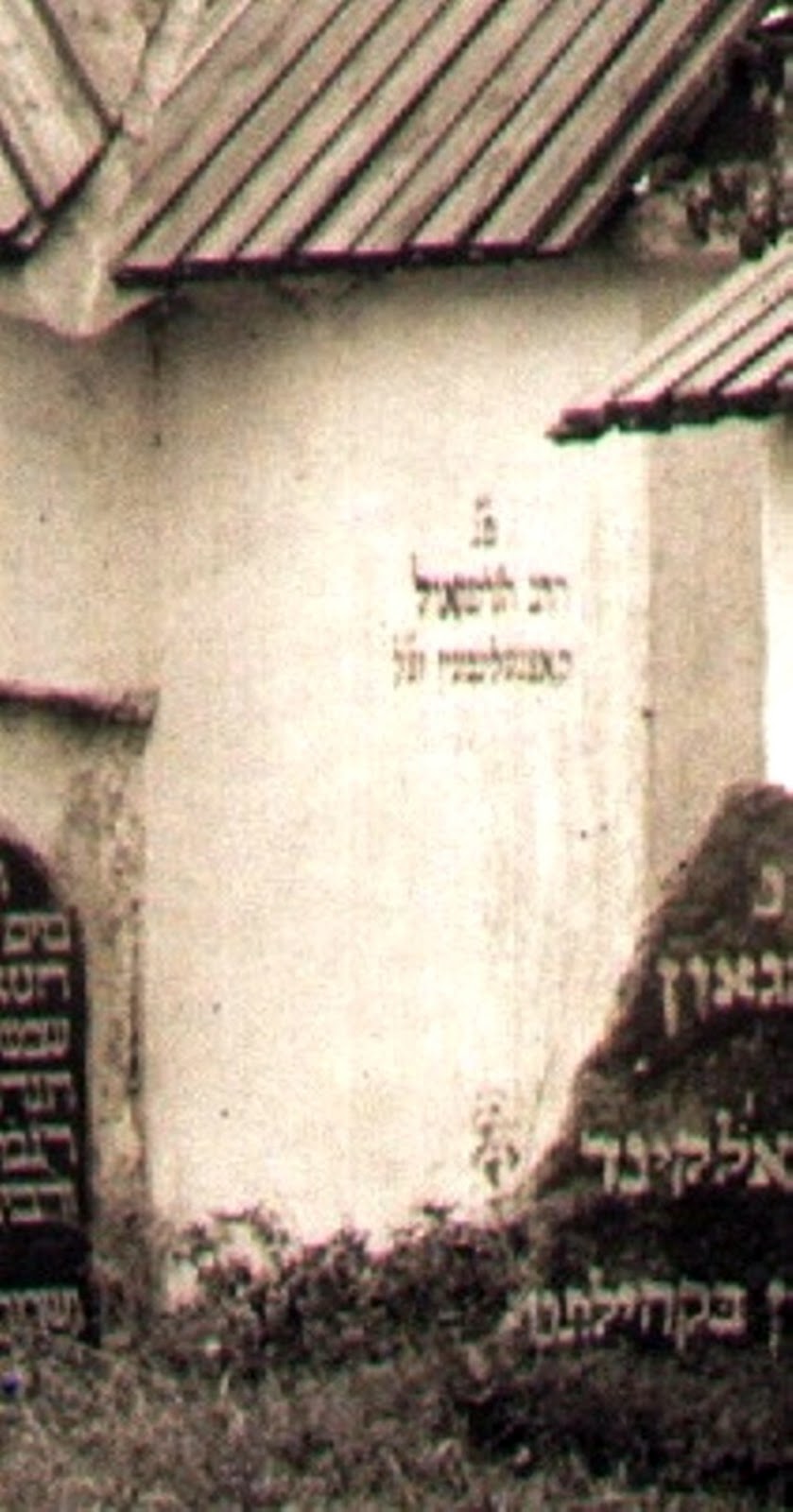
[3] For these markers, see the photographs below:

a) 

b) 

a) Tombstone of R. Yitzhak b. R. Hayyim of Volozhin, and just behind it, the tombstone of Traina, mother of the Gaon of Vilna.
b) Frontal view of Traina’s tombstone (in the center of the photograph, and to the right of R. Yitzhak b. R. Hayyim of Volozhin’s tombstone).

R. Yitzhak b. R. Hayyim died in 1780. At the time, his son R. Hayyim of Volozhin was 31 years old, and had just recently been appointed Rabbi of Volozhin, hardly a large and significant Jewish community in Lithuania at the time. The Yeshiva of Volozhin was not founded until 1802. R. Yitzhak’s son R. Shlomo Zalman was 24 years old when his father died, and relatively unknown. Indeed, R. Yitzhak’ eldest son, R. Simhah, 39 years old at the time, and a practicing rabbi, is not even mentioned by the marker. Clearly, the markers come from a much later period when R. Hayyim and R. Shlomo Zalman were the only names (of R. Yitzhak’s 5 sons) that were known widely by learned Jews, and by visitors to the Old Jewish cemetery of Vilna. For R. Hayyim of Volozhin, see, e.g., Dov Eliach, אבי הישיבות (Jerusalem: Moreshet ha-Yeshivot, revised and expanded edition, 2012); and Shaul Stampfer, Lithuanian Yeshivas of the Nineteenth Century (Oxford: Littman Library of Jewish Civilization, 2015), pp. 15-47. For his younger brother R. Shlomo Zalman, see, e.g., R. Yehezkel Feivel, תולדות אדם השלם (Jerusalem: Makhon Moreshet ha-Gra, 2012).

For the little that is known about Traina, who died in 1742, see Bezalel Landau, הגאון החסיד מוילנא (Jerusalem: Torah mi-Ziyyon, third edition, 1978), p. 15, note 14; and Dov Eliach, הגאון (Jerusalem: Moreshet ha-Yeshivot, 2002), vol. 1, pp. 66-70. For the epitaph on her tombstone, see Klausner, op. cit., p. 56. The marker was surely added after the lifetime of Gaon of Vilna (d.1797), who would not have tolerated seeing the title “Gaon” next to his name, permanently etched in stone as it were, in the Old Jewish cemetery. In photo b, one can actually see how an earlier marker on the upper portion of the tombstone, “פנ אם הגאון רבינו אליהו“, after fading away, was replaced by new marker “פנ אם הגרא” .
[4] Photographs of Vilna’s Old Jewish cemetery abound in a wide variety of publications and periodicals in different languages. These include: Hebrew (e.g., Y. Kremerman, מוילנא ירושלים דליטא‘ עד חיפה [n.p: privately published, 1995]); Yiddish (e.g., Leyzer Ran, אש פון ירושלים דליטא [New York: Wilner Ferlag, 1959]); Russian (e.g., G. Agranovskii and I. Guzenberg, Litovskii Ierusalim [Vilnius: Lituanus, 1992]); Lithuanian (e.g., K. Binkis and P. Tarulis, Vilnius 1323-1923 [Kaunas-Vilnius: Švyturio Bendroves Leidinys, 1923]); German (e.g., Paul Monty, Wanderstunden in Wilna [Wilna: Verlag der Wilnaer Zeitung, 1916]); and English (e.g., Gerard Silvain and Henri Minczeles, Yiddishland [Corte Madera, CA: Ginko Press, 1999]), and total many more publications than can possibly be listed here. Postcard reproductions of photos were produced and sold before, during, and after World War I, serving as a major source for some of the publications mentioned above. Some of these photos are posted on line in various collections of ephemera. Numerous photos, not yet published, are available in private collections. All the photos in this essay (with the exception of the misidentified photo in the recently published Grodzenski volume) are from original photographs and postcards in my possession. Artists have also depicted a variety of scenes from the Old Jewish cemetery (e.g., Walter Buhe, “Wilnaer Judenfriedhof,” 1916; a copy can be viewed online at the Wikipedia entry for Walter Buhe, sub: Images for Walter Buhe).
[5] The hand copies were published mostly by Samuel Joseph Fuenn, קריה נאמנה, second edition (Vilna: Notes and Schweilik, 1915), henceforth: Fuenn; Hillel Noah Steinschneider, עיר ווילנא (Vilna: Romm Publishing Company, 1900), henceforth: Steinschneider; and Israel Klausner (see above, note 2), henceforth: Klausner.
[6] R. Dovid Kamenetsky, רבנו חיים עוזררבן של כל בני הגולה (Jerusalem: n.p., 2021), volume 1.
[7] Our author may have been misled by Leyzer Ran, ירושלים דליטא (New York: Wilner Verlag, 1974), vol. 1, p. 101, who mistakenly identified the same photograph as containing the graves of both R. Mordechai Meltzer and R. Abraham Danzig in the Old Jewish cemetery of Vilna. The same error appears in Y. Kremerman (see above, note 4), p. 267.
[8] See R. Mordechai Meltzer’s posthumous publication, תכלת מרדכי (Vilna: Matz, 1889). On the reverse side of the second title page, the full text of the lengthy epitaph on his tombstone in Lida appears in print. A short biography appears on pp. 20-24, which makes mention of the mausoleum constructed over his grave, and that it has become a pilgrimage site. Cf. A. Manor et al, eds., ספר לידא (Tel-Aviv: Or-Li Publishers, 1970), pp. 91-92.
[9] See Steinschneider, p. 122, note 1.
[10] Klausner, p. 75, notes that the inner epitaph was no longer extant in 1935.
[11] See Isaac Meyer Dik, האורח (Vilna, 1846), pp. 30-31. The place and date of publication are uncertain; and the volume may have been co-authored. For bibliographical discussions, see the sources cited in the entry האורח in מפעל הביבליוגרפיה העברית accessed at:  https://uli.nli.org.il/permalink/972NNL_ULI_C/4upfj/alma99682727008422).
[12] Steinschneider, pp. 123 and 194.
[13] For R.Shmuel Strashun, see Zvi Harkavy’s “,תולדות רשש וכתביו” appended to his edition of מקורי הרמבם לרשש (Jerusalem: ha-Eretz Yisraelit, 1957), pp. 53-58. Cf. David Abraham, פנקסו של שמואל (Jerusalem: Makhon Yerushalayim, 2011).
[14] For the text of the inner epitaph, see Fuenn, pp. 254-255.
[14a] See note 14.
[15] Klausner, p. 74.
[16] A vast literature has developed regarding the history and legends surrounding the life of R. Yoel David Strashunsky. These include novels, plays, and film productions. For one of the many failed attempts to distinguish fact from fiction, but fascinating nonetheless, see Samuel Vigoda, Legendary Voices (New York: M.P. Press, 1981), pp. 390-427.

Some of the more important scholarly studies are: Hillel Noah Steinschneider “תולדות השץ הנפלא מווילנא ר‘ יואל דוד לעוווענשטיין” in תלפיות (Berditchev, 1895), part 12, pp. 8-13; Abraham Z. Idelsohn, “תולדות השץ יואל דוד בעל הביתל” in Hebrew Union College Monthly 20 (May-June 1933), pp. 27-29; Isaac Schiper, “אונבעקאנטע ארכיון– מאטעריאלען וועגען דעם אויפהאלט פון ווילנער בעלהביתל אין ווארשא אין יהאר 1842 Haynt, September 23, 1934, p. 9; Silja Haller et al, eds., Joachim Stutchewsky Der Wilnaer Balebessel (Wiesbaden: Otto Harrassowitz, 2013; and James Loeffler, “Promising Harmonies: The Aural Politics of Polish-Jewish Relations in the Russian Empire,” Jewish Social Studies 20:3 (2014), pp. 1-36 (especially pp. 19-25). קבר
[17] I translate “grave site” [for Hebrew קבר] rather than “tombstone” [for Hebrew מצבה], for –strictly speaking – the form נתחדש can only be the passive verbal form for a masculine noun. But I have some doubts about whether the sign painters in 19th and 20th century Vilna cared very much about Hebrew grammar. See below, in the center of the photograph at Sample 6, where the celebrity marker at the top refers to מצבת, yet under it, the marker specifically states נתחדש. In any event, the masculine noun קבר, ordinarily rendered “grave,” bears secondary meanings including “grave site” and “tombstone.” See Klausner, passim, who uses the term regularly for “grave site” and “tombstone; and cf. A. Even-Shoshan, מלון אבן-שושן (Tel-Aviv: Am Oved, 2003), vol. 5, p. 1623.
[18] The Zedakah Gedolah Society was Jewish Vilna’s official communal institution in charge of public welfare. Given the rampant poverty that prevailed throughout much of Vilna’s Jewish history, this was one of the most important institutions in Vilna. It assumed even greater significance when the Czarist regime abolished Jewish Vilna’s “Kahal” structure in 1844. One of the Zedakah Gedolah’s many tasks was to provide the lion’s share of the funding necessary for the upkeep of Vilna’s Jewish cemeteries. See Israel Cohen, Vilna (Philadelphia: Jewish Publication Society, 1943), pp. 121-122; cf. Israel Klausner, וילנה ירושלים דליטאדורות הראשונים 1495-1881 (Tel-Aviv: Kibbutz Ha-Me’uhad, 1988), pp. 393-394. For a vivid description of how the Zedakah Gedolah provided Passover aid for the poor in late 19th century Vilna, see David Livni, ירושלים דליטא (Tel-Aviv, 1930), vol. 1, pp. 9-43. With the advent of World War I, it fell into a period of steady decline and would ultimately be liquidated under Polish rule in 1931. See Israel Cohen, op. cit., pp. 394-397; and cf. Andrew N. Koss, “Two Rabbis and a Rebbetzin: The Vilna Rabbinate during the First World War,” European Judaism 48:1 (2015), pp. 120-122.
[19] It is clearly a Jan Bulhak photograph, taken between 1912-1915 at the Old Jewish cemetery.
[20] The date תרעג = [5]673 = 1913, and not תרסג = [5]663 = 1903, is confirmed by several different photographs, taken from different angles, of Roza’s grave site (in my personal collection of Vilna materials).
[21] Fuenn, p. 230 and cf. his Introduction, p. xxxi. R. Hayyim’s father’s name was Shabsai. For the form “Shebsil” derived from “Shabsai,” see Alexander Beider, A Dictionary of Ashkenazic Given Names (Avotaynu: Bergenfield, 2001), pp. 409-411.
[22] Steinschneider, p. 97. For the date, see the essay “דער אלטער בית עולם” authored by “במב” in the weekly ווילנער וואכענבלאט, August 12, 1910, pp. 2-3.
[23] Anyone who has frequented, for example, the old Jewish cemeteries in Frankfurt, Mainz, Worms, Prague, and Cracow, will know that celebrity markers are commonplace and mostly late, and that many faded tombstones have been re-inked, often wrongly. Sadly, even the Gaon of Vilna’s epitaph, while yet in the Old Jewish cemetery, was – in part – re-inked wrongly. See the discussion of the Gaon’s epitaph in my “The Paper Brigade’s Recording of Epitaphs in Vilna’s Old Jewish Cemetery: A Literary Analysis,” The Seforim Blog, February 26, 2024 (SeforimBlog.com). It should also be noted that there are different categories of celebrity markers, such as large maps or lists of famous names (often encased in glass) at the cemetery entrance, arrows posted along the route to a celebrity grave, new inscriptions on old tombstones or mausoleums, and entirely redone tombstones (enlarged and enhanced to underscore their celebrity status). I am indebted to Marcin Wodzinski (Professor of Jewish Studies at the University of Wroclaw in Poland), who in a personal communication kindly informed me about yet another factor that plays a role in celebrity markers: the material out of which a tombstone is made, and its malleability. If you cannot easily engrave an inscription on a tombstone, others ways will be found to mark a celebrity grave. Thus, local geophysical factors may well influence the kind of celebrity markers used in a particular cemetery.


The Paper Brigade’s Recording of Epitaphs in Vilna’s Old Jewish Cemetery: A Literary Analysis

The Paper Brigade’s Recording of Epitaphs in Vilna’s Old Jewish Cemetery: A Literary Analysis

Shnayer Leiman

I. Introduction.

Shortly after the Nazis captured Vilna on June 24, 1941, representatives from the “Special Detail of Reich-Administrator Alfred Rosenberg” (Einsatzstab des Reichleiter Alfred Rosenberg) arrived in Vilna. Their task was to loot the literary (and other) treasures of Vilna’s Jewish community, and to ship them to Frankfurt.[1] Under the aegis of Nazi “experts” in Jewish matters, a slave-labor unit consisting at times of some 40 Jews was established.[2] Like the other slave-labor units, the group gathered early in the morning each day at the gate of the Jewish Ghetto. It was then marched outside the Ghetto to the nearby YIVO building at 18 Wiwulskiego Street, which had become the headquarters of Einsatzstab Rosenberg in Vilna. A variety of tasks were performed by the members of slave-labor unit, including the sorting of thousands of books and documents, cataloguing materials, and the preparation of essays on topics selected by, and of special interest to, Einsatzstab Rosenberg. The primary Nazi goal was to loot the best of the materials and to destroy the remaining materials. The primary goal of the members of the slave-labor unit was to stay alive by biding their time, and – at the same time – to rescue from destruction as many literary and artistic treasures as possible. They are the heroes of what is known as “the Paper Brigade.”[3]

II. Issues to be examined. One of the more important compilations of the Paper Brigade, completed in 1942, was a list of 51 epitaphs from Vilna’s Old Jewish cemetery in Shnipishok (in use until 1830)[4] and 140 epitaphs from Vilna’s New Jewish cemetery in Zaretcha (in use until 1941).[5] Given the fact that the vast majority of tombstones of both these cemeteries were destroyed, in part during the Holocaust, and primarily during its aftermath under Communist rule, it is imperative that the compilations of the Paper Brigade, prepared in 1942, be examined for their accuracy, and ultimately for their contribution to historical truth. Fortunately, these compilations have been preserved and can easily be accessed.[6] This study will focus only on the 51 epitaphs from Vilna’s Old Jewish cemetery. It will attempt to address, at least in a preliminary fashion, such questions as:

1. Did members of the Paper Brigade actually visit the Old Jewish cemetery and copy the epitaphs that are recorded in the compilations?

2. What other sources may have been used by the members of the Paper Brigade in preparing their compilation?

3. Why were these 51 epitaphs selected for the compilation, given the approximately 300 tombstones[7] with legible epitaphs that were still standing in the Old Jewish cemetery in 1942?

III. Methodology. We will examine samples of the transcriptions of the 51 epitaphs, as they appear in the compilation, and compare them to the transcriptions of the same epitaphs as published in books prior to the Holocaust and as preserved in photographs. We will look for patterns that repeat themselves in the 51 transcriptions of the epitaphs, patterns that may shed light on how, and from where, they were copied.

Epitaph 1: The Vilna Gaon (d.1797).

Discussion: This copy of the Vilna Gaon’s epitaph, for the most part, preserves the text as it first appeared in Yehoshua Heschel Levin, עליות אליהו (Vilna, 1856), p. 90, and in Shmuel Yosef Fuenn, קריה נאמנה (Vilna, 1860), p. 146 (and second edition: Vilna, 1915, pp. 155-156). Henceforth, we will refer to Levin as L. and Fuenn as F. The opening letters of lines 3-13 spell the acrostic רב אליהו גאון. The closing words of lines 3-13 are poetic, all of them ending with the rhyming letters עים or אים. The narrative portion (lines 14 on) follows the texts of L. and F., but not their line divisions.

What needs to be noted here is that this was not what the Vilna Gaon’s epitaph looked like in 1942. Probably due to both natural deterioration and human negligence, some of the letters on the extreme right of the tombstone were rubbed out or smudged. Attempts were made to re-ink some of the missing letters, often creating imaginary words. See below, for photographs A and B.

Photograph A[8] is a pre-Holocaust photo of the epitaph. Photo B[9] is a post- Holocaust photo, taken circa 1995. Notice line 10 in the epitaph, which must begin with an enlarged letter ג , for it begins the word גאון in the acrostic. But in the photographs, one clearly sees what looks like םכר (which probably was originally ג]ם פר[ישות ). In any event, we are served notice by the very first epitaph that the Paper Brigade did not always record what they saw; they surely did not see the words גם פרישות on the Gaon’s tombstone in 1942. They recorded what they knew from other literary sources.

Epitaph 3: R. Shlomo Zalman, father of the Vilna Gaon (d. 1758).

Discussion: The epitaph is replete with letters in parentheses. Parentheses, of course, do not ordinarily appear on Jewish tombstones. Clearly, then, the Paper Brigade either saw a mostly illegible epitaph, and filled in the missing letters, marking them in parentheses, or they copied the entire text from a published book. There is no need here for guesswork. The epitaph was published previously by three different authors: L. (in 1856); F. (in 1860 and 1915); and Israel Klausner, קורות בית-העלמין הישן בוילנה (Vilna, 1935), henceforth K. Here are the three editions of the epitaph:

L. (p. 27, n. 3):

F. (p. 123; second edition, p. 128):

K. (p. 45):

It should be noted that the Paper Brigade erred in the title of the entry, wrongly listing ר’ אליהו חסיד as the father of ר’ שלמה זלמן. Nevertheless, it seems obvious that the Paper Brigade copied the text of the epitaph almost exactly as it appeared in K., recording כסלו (and not א’ דחנוכה), and even inserting the hyphen that connects the names ישכר and בער. There was no need to visit the Old Jewish cemetery in order to copy the epitaph.

Epitaph 9: R. Avigdor b. Shmuel, father of R. Shmuel – the last Av Bet Din of Vilna (d. 1771).

Discussion: It is certainly worth noting that the format follows exactly that of epitaphs 1 and 8, and many others in the Old Jewish cemetery, namely an acrostic at the right of the epitaph, included in a rhymed poem praising the deceased and mourning his loss, followed by a narrative text listing the titles and name of the deceased and the date of death. More importantly for our purposes, this epitaph was copied almost exactly as it appears in F., p. 165; second edition, p. 171:

But note that F. included two sets of parentheses that would not have appeared on the original tombstone. In line 1, the opening word אבי is marked by parentheses, since all three letters were necessary for the acrostic. In the last line, the word תקל”א [5]531 = 1771 was added (in parentheses) for clarification of the year of death. No such markings or words would have appeared on the original tombstone. Again, it is obvious that the Paper Brigade copied the epitaph from a published text. No visit to the Old Jewish cemetery was necessary.

Epitaph 10: R. Eliyahu b. R. Moshe Kramer (d. 1710).

Discussion: The Vilna Gaon was a great-grandson of R. Eliyahu b. Moshe Kramer and, indeed, was named after him. The epitaph preserved in the compilation is taken directly from F., p. 99; second edition, p. 105:

A photograph of the original epitaph has been preserved, taken shortly before or during World War I. It features a three-line marker that identifies the grave, painted just above the epitaph. These lines may well have been added to the gravesite after F.’s visit in 1860. But an examination of the original epitaph indicates that its line division differed considerably from F.

It is clear that the Paper Brigade did not visit the gravesite itself. Below is a photo of the gravesite and a transcription of its epitaph into modern Hebrew font.[10]

Photo Transcription:

Epitaph 14: R. Yehoshua Heschel: Av Bet Din of Vilna (d. 1749).

Discussion: This was a wooden tombstone, well preserved, and photographed circa 1935 (see K., p. 52). The compilation slavishly follows the line division of F., p. 110; second edition, p. 116:

F

The circa 1935 photograph of the tombstone, however, presents a different line division for lines 8 and 10.

K Photo

In F., lines 8 and 10 end with the words זהב and לעולמו, respectively. In K., in the photo taken at the cemetery, the same lines end with the words פרוים and בך”ו , respectively. This suggests once again that the Paper Brigade did not actually copy epitaphs in the Old Jewish cemetery.

Epitaph 30: R. Noah Mindes Lipschuetz (d. 1797).

Discussion: R. Noah Mindes Lipshuetz, distinguished Kabbalist, was buried next to the Vilna Gaon. They died within three months of each other, and were מחותנים as well. (The Vilna Gaon’s son, R. Avraham, was married to Sarah, the daughter of Rabbi Noah and Mrs. Mindes Lipshuetz.) It was decided that they would share one tombstone, with only a narrow painted ivy decoration separating their epitaphs. The original tombstone, with its epitaphs, can be seen to this very day in the Sudervas Jewish cemetery in Vilnius.

Whatever reservations one may still entertain about the compilation having borrowed information directly from F., will surely be dispelled by a careful reading of F.’s recording of R. Noah Lipshuetz’s epitaph:

F 171

The last line of the epitaph in F. (p. 171; second edition, p. 177) reads:

וי”נ (= ויצאה נשמתו) שנת ג’ טבת לפ”ק תאמי צביה “And his soul departed in the year 3 Teveth, equivalent (not counting the thousands) to the numerical value of “Ta’amei Zeviah.” See Song of Songs 7:4. Now the numerical value of “Ta’amei Zeviyah” (not counting the thousands) is [5]558 = 1797, which works perfectly. But the words “and his soul departed in the year 3 Teveth” are senseless. This, of course, is an error (or: typo, if you like) in F. One need merely look at the original epitaph[11] and read the correct Hebrew text: נפטר ביו’ ג טבת שנת תאמי צביה. “He died on the 3rd day of Teveth in the year “Ta’amei Zeviyah.” But the senseless phrase “and his soul departed in the year 3 Teveth” reappears in the compilation prepared by the Paper Brigade! Had the Paper Brigade visited the Old Jewish cemetery in Shnipishok in 1942, it surely would have seen and recorded the correct text of the epitaph.

————————-

There are two epitaphs included in the 51 listed, that merit special attention.

Epitaph 51: R. Shneur Zalman Kaczerginski (d.1815).

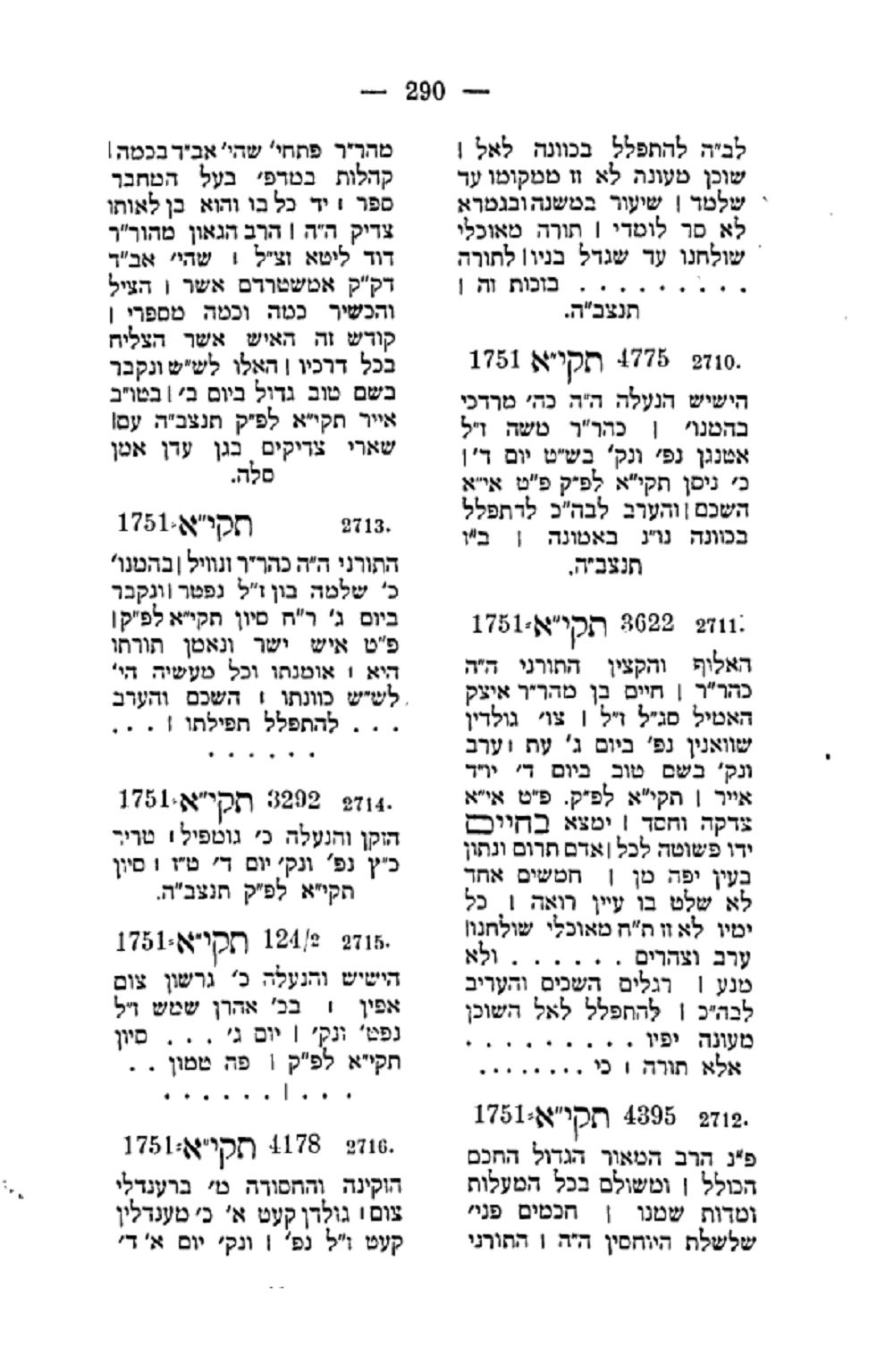
The German title at the top of the entry identifies Kaczerginski as a talmudic scholar and philanthropist who died in 1815. As such, he certainly qualifies for inclusion in a compilation of persons buried in Vilna’s Old Jewish cemetery, which was closed in 1830. Alas, no such person was buried in the Old Jewish cemetery! It turns out that Shneur Zalman Kaczerginski was born in 1817 and died in 1887, and – of course – was buried in the Zaretcha cemetery, Vilna’s second Jewish cemetery. The Paper Brigade borrowed the full text of the Kaczerginski epitaph, word for word, from Hillel Noah Steinschneider, עיר ווילנא (Vilna, 1900), vol. 1, p. 290; once again, a sign that the members of the Paper Brigade read books sooner than copying tombstone inscriptions while standing outdoors in the cold.[12] In other words, the Paper Brigade recorded only 50 genuine entries of epitaphs for the Old Jewish cemetery (Alter Friedhof). “Epitaph 51” properly belongs to the Zaretche Jewish cemetery (Neuer Friedhof). Interestingly, Willy Schaefer, one of the Nazi “Jewish” experts who lorded it over the Paper Brigade, writes specifically in his report on Vilna’s Jewish cemeteries that the Paper Brigade had prepared a 108 page research paper with a total of 190 entries of epitaphs.[13] The 108 page research paper has been preserved (and its epitaphs are cited throughout this essay), but Schaefer’s 190 entries of epitaphs was based on the assumption that 50 epitaphs were copied from the Old Jewish cemetery and 140 from the New Jewish cemetery, i.e. Zaretcha, for a total of 190 epitaphs. In fact, we have 51 numbered entries for the Old Jewish cemetery, plus 140 numbered entries for the Zaretcha cemetery, for a total of 191 numbered epitaphs. One can only speculate as to why epitaph 51 was added to the research paper, and in the wrong place at that. And speculate we will! But before doing so, it should be noted that one key spelling difference separates Steinchneider’s recording of the Kaczerginski epitaph from what appears in the Paper Brigade’s report as Epitaph 51. Steinschneider spells the deceased’s last name as: קאצערגיסקי [Kaczergiski]. He even adds in a footnote that the deceased hailed from a town outside of Vilna called Kaczergisak, and that is why the family name is Kaczergiski. But the Paper Brigade lists the deceased’s last name as Katscherginski (in German) and קאצערגינסקי (in Hebrew).

One suspects this may have to do with the key role played by Shmerke Kaczerginski,[14] a Vilna born partisan, and a prominent member of the Paper Brigade.[15] He may have wished to memorialize a possible ancestor who was overlooked by the editors of the Paper Brigade report on epitaphs in the Jewish cemeteries. Perhaps turned down by the editor of the report on Zaretcha, Kaczerginski was able to persuade the editor of the report on the Old Jewish cemetery to add one more entry, epitaph 51 – but that required a falsification of R. Shneur Zalman Kaczergiski’s date of death, and a slight change in the spelling of his name. Whether Steinschneider’s קאצערגיסקי is interchangeable with the name קאצערגינסקי (and its Yiddish equivalent קאטשערגינסקי ) seems questionable to me; and it remains to be proven whether R. Shneur Zalman Kaczergiski was, in fact, an ancestor of Shmerke Kaczerginski.

Epitaph 31: R. Dov Baer Natansohn (d. 1804).

R. Dov Baer Natansohn is described as being active in Vilna’s Great Synagogue, and serving as an official of Vilna’s Jewish Community Council. We know too that in a later period, members of the Natansohn family would play a leading role among Vilna’s moderate Maskilim in the middle of the 19th century.[16] What’s unique about this epitaph is that it is the only one (of the 50 genuine epitaphs of Jews buried in the Old Jewish cemetery) that is not recorded in F. or K. or in any early source known to me. This is almost certainly an indication that R. Dov Ber Natansohn – at least in the eyes of Fuenn and Klausner – did not quite measure up to the names of those included in their monographs. In any event, one could argue, that this epitaph could only have been recorded by a member of the Paper Brigade who actually visited the gravesite at the Old Jewish cemetery. This may well be the case. But is also possible that a descendant of R. Dov Baer Natansohn in the Vilna Ghetto, kept a copy (or even a photograph) of the tombstone, and handed it to a member of the Paper Brigade, so that the epitaph would be preserved for posterity. It should also be mentioned that Khaykl Lunski,[17] the famed librarian of Vilna’s Strashun Library, was an early advisor to the Paper Brigade. In the Vilna Ghetto, he was busy working on a study of the epitaphs in Vilna’s Old Jewish cemetery.[18] He may well have provided a copy of R. Dov Baer Natansohn’s epitaph to a member of the Paper Brigade.

————————————-

In terms of which groups of Jews (buried in the Old Jewish cemetery) were selected for memory by the Paper Brigade, it is clear that a prior selection had already been made by F. and K. As indicated above, 49 out of the 50 genuine epitaphs were borrowed from the earlier accounts in F. and K. These were elitist accounts that focused primarily on professional rabbis and rabbinic scholars, and Jewish communal leaders. F. precluded women from the entries in his book; K. included women, but (for the most part) only to the extent that they were family members of famous rabbis, such as the Vilna Gaon. Looking specifically at the 50 epitaphs included in the Paper Brigade report, some 25 are distinguished professional rabbis and rabbinic scholars; approximately 8 others relate to the Vilna Gaon and members of his family (including women); approximately 8 relate to Jewish communal leaders; approximately 6 relate to professionals (e.g., doctors, printers, and cantors); with approximately 2 or 3 miscellaneous cases (e.g., the Ger Zedek; and R. Yehudah Asher Guenzberg, father of the Maskil Mordechai Aaron Guenzberg). Clearly, the report was prepared by someone who was sympathetic to the prominent role played by rabbinic culture in Vilna’s early modern period, and who knew where to look for the sources he needed in order to prepare the report.

Some will quibble over the tendency of the Paper Brigade to overlook the common man and woman when listing their selected epitaphs. After all, every Jewish man and woman who died in Vilna between 1592 and 1830 was buried in the Old Jewish cemetery. They seem to forget that it was 1942, under Nazi rule, and in the Vilna Ghetto, that the report was written, hardly the time and place to engage in original sociological research of any kind. At best, they could examine the printed books in the Ghetto library, or perhaps those gathered in the former YIVO building, now the headquarters of Einsatzstab Rosenberg. This they did with great skill, and often, at great risk to their lives.

In sum, it appears unlikely that the Paper Brigade spent much time, if any at all, in Vilna’s Old Jewish cemetery. The primary source for the epitaphs gathered by the Paper Brigade was a series of volumes published by a variety of scholars, including Shmuel Yosef Fuenn, Yisrael Klausner, and Hillel Noah Steinschneider. The content of those earlier volumes influenced the scope of the epitaphs that the Paper Brigade could choose for inclusion in their final report. Finally, we wish to stress that whatever is said here applies only to the Paper Brigade report regarding the Old Jewish cemetery. Even a cursory glance at the Paper Brigade report on the Zaretche cemetery indicates that its author recorded countless epitaphs that had – and have – never appeared in print. As such, it is imperative that the report be examined for the many epitaphs it, and it alone, preserves.

————————

NOTES

[1] For an early account of Alfred Rosenberg and his anti-Jewish “academic” activity, see Max Weinreich, Hitler’s Professors: The Part of Scholarship in Germany’s Crimes Against the Jewish People (New York: YIVO, 1946), pp. 77-78, note 171, and pp. 97-106. A vast literature exists on Rosenberg; for the more recent studies, see the bibliography appended to his entry on Wikipedia.
[2] On up to 40 Jews serving in the slave-labor unit, see Shmerka Kaczerginski, פארטיזאנער גייען: זכרונות פון ווילנער געטא (Buenos Aires: Union Central Israelita Polaca en la Argentina, 1947), p. 63.
[3] For the definitive study on the Paper Brigade, see David E. Fishman, The Book Smugglers: Partisans, Poets, and the Race to Save Jewish Treasures from the Nazis; The True Story of the Paper Brigade of Vilna (Lebanon, New Hampshire: ForeEdge, 2017). Cf. his Embers Plucked From the Fire: The Rescue of Jewish Cultural Treasures in Vilna (New York (YIVO, 1996; second expanded edition, YIVO, 2009); and his “Split Identity: Jewish Scholarship in the Vilna Ghetto,” אין געוועב : A Journal of Yiddish Studies, June 30, 2020, pp. 1-9.
[4]  For a history of Vilna’s Old Jewish cemetery, see I. Klausner, קורות בית-העלמין הישן בוילנה (Vilna: S. An-ski Jewish Historical and Ethnographic Society, 1935); Elmantas Meilus, “The History of Vilnius Old Jewish Cemetery at Šnipiškes in the Period of the Grand Duchy of Lithuania,” Lithuanian Historical Studies 12 (2007), pp. 63-92; and Vytautas Jogela, “The Old Jewish Cemetery in the Nineteenth and Twentieth Centuries,” Lituanus 61:4 (2015), pp. 76-93.
[5] A history of Vilna’s New Jewish cemetery in Zaretcha remains a scholarly desideratum. Tentatively, see I. Klausner, “צו דער געשיכטע פון יידן אין ווילנע: דאס נייע פעלד”, in צייט, October 4, 1933, p. 4; Zalman Szyk, יאר ווילנא 1000 (Vilne: געזעלשאפט פאר לאנדקענטניש אין פוילן, 1939), pp. 418-437; Vida Girininkiene, “The Jewish Cemetery on Olandų Street: History and Reflections,” in Rimantas Dichavičius, Paminklas Paminklui (Vilnius: UAB Balto Print, 2020), pp.19-25; and Irina Guzenberg, Vilnius: Traces of the Jerusalem of Lithuania (Vilnius: Pavilniai, 2021), pp. 691-700.
[6] The compilations of the Paper Brigade are available in Vilnius at the Judaica collection of the Mažvydas National Library of Lithuania. Based upon evidence from the Vilnius archives, Jogela (above, note 4), p. 84, claims that “a certain Goldbergas” compiled the list of 51 epitaphs. Jogela does not identify Goldbergas, but almost certainly it was Eliezer Goldberg, Jewish educator and historian. Prior to the Holocaust, he administered and taught at Vilna’s Esther Rubinstein School for Girls. In the Vilna Ghetto, he lectured widely on Jewish history in the various synagogues and schools. In 1943, he was deported by the Nazis to Estonia, where he perished in 1944. On Goldberg, see Shmerka Kaczerginski, חורבן ווילנא (New York: United Vilner Relief Committee, 1947), p.236; H.S. Kazdan, ed., לערער יזכור בוך: די אומגעקומענע לערער פון צישא שולן אין פוילן (New York: Martin Press, 1954), p. 72 (where Goldberg is described as א ייד א למדן און מיט וועלטלעכער בילדונג ); J. Biber, R. Kostanian, and J. Rozina, eds., Vilna Ghetto Posters: Album-Catalogue (Vilnius: Vilna Gaon Jewish State Museum, 2006), p. 265 (which includes a photograph of Goldberg); and A. Einat, חיי יום-יום בגטו וילנה (Haifa: Moreshet, 2013), pp. 240 and 417. It is too early to speculate how many other hands were involved in selecting the 191 epitaphs included in the Paper Brigade’s final report.
[7] See Klausner, pp. 77-82, who lists 220 named graves that were still standing in 1935. Actually, many of the “named graves” were grave sites with more than one named grave at the site, all of them listed by Klausner. Thus, a total of approximately 240 names are listed. On pp. 83-84, Klausner lists an additional 51 named graves , some of them grave sites, strewn throughout the cemetery. They actually total 55 names. The 240 names plus the additional 55 names yield an approximate total of 300 names.

[8] Photograph A is taken from the late Yeshayahu Epstein’s collection of pre-Holocaust photographs of Vilna. See Yitzchak Alfasi, ed., וילנא ירושלים דליטא חרבה! היתה ואיננה עוד (Tel-Aviv, 1993), p. 10.
[9] Photograph B is taken from the pamphlet Vilniaus Gaonas Elijahu אליהו הגאון מוילנה (Vilnius, 1996), no pagination, issued by the Lithuanian Jewish Community in anticipation of the commemoration of the 200th anniversary of the death of the Vilna Gaon (1797-1997).
[10] The photo and the transcription are taken from S. Leiman, “A Picture and its One Thousand Words: The Old Jewish Cemetery in Vilna Revisited,” The Seforim Blog, January 14, 2016, section A, item 7 and notes.
[11] See above, at Epitaph 1, Photo B, for a full frontal color photograph of the joint tombstone inscriptions of R. Noah Mindes Lipschuetz and the Vilna Gaon; cf. Photo A. In the light of the evidence presented here, R. Noah Mindes Lipschuetz did not die in November of 1797, as claimed by the German heading to Epitaph 30. He died on, or about, December 22, 1797 (= 3 Teveth, 5558), some two and a half months after the death of the Vilna Gaon on October 9, 1797 (= 19 Tishre, 5558). For an alternate reading of the somewhat unclear last lines of the epitaph (that correctly preserves the יום ג’ טבת date of death), see R. Yitzchok Arnstein’s edition of R. Noah Mindes Lipschuetz’ פרפראות לחכמה (Brooklyn: Edison Lithographic Corporation, 1995), Introduction, p. 17.
[12] Steinschneider’s text reads as follows:


[13] See Schaefer’s essay entitled “Friedhöfe und Grabsteine der Juden in Wilna,” dated 1/9/1943 (in the Judaica collection at the Mažvydas National Library of Lithuania). On the title page he refers (in German) to his gathering together of “190 tombstone inscriptions in 108 typewritten pages.”
[14] A vast literature was produced by, and exists on, Shmerke Kaczerginski (1908-1954), Yiddish poet and Vilna partisan. In general, see the entry on him in לעקסיקאן פון דער נייער יידישער ליטעראטור (New York: Congress for Jewish Culture, 1981), vol. 8, columns 48-50; and the more recent bibliography appended to his entry in Wikipedia.
[15] For some of Kaczerginski’s own reflections on the Paper Brigade, see his פארטיזאנער גייען! זכרונות פון ווילנער געטא (Buenos Aires: צאנטראל-פארבאנד פון פוילישע יידן אין ארגענטינא, 1947), pp. 61-69; חורבן ווילנע (New York: United Vilner Relief Committee, 1947), p. 337; and איך בין געווען א פארטיזאן (Buenos Aires: Cultura, 1952), pp. 40-44.
[16] See Mordechai Zalkin, בעלות השחר (Jerusalem: Magnes Press, 2000), p. 34, n. 45, and passim.
[17]  On Haykl Lunski, see Hirsz Abramowicz, Profiles of a Lost World: Memoirs of East European Jewish Life before World War II (Detroit: Wayne State University Press, 1999), pp. 260-264. Cf. Frida Shor, מ”לקוטי שושנים” ועד “בריגדת הנייר”: סיפורו של בית עקד הספרים ע”ש שטראשון בווילנה (Tel Aviv: Probook, 2012); and Dan Rabinowitz, The Lost Library: The Legacy of Vilna’s Strashun Library in the Aftermath of the Holocaust (Waltham: Brandeis University Press, 2019).
[18] S. Kaczerginski, חורבן ווילנע (New York: United Vilner Relief Committee, 1947), p. 198.


Identity of the Unknown Tomb. Who is buried in the unmarked grave next to the Vilna Gaon?

 Identity of the Unknown Tomb.
Who is buried in the unmarked grave next to the Vilna Gaon?

Ariel Fuss & Yoel Kabalkin

Prologue

Among the seven graves in the Ohel of the Vilna Gaon (R’ Eliyahu M’vilna) there is one without an identifying headstone. The sign above the entrance to the Ohel identifies this grave as the resting place for the ashes of the Ger Tzedek of Vilna, Avraham ben Avraham Potocki[1] This identification is accepted without questioning by many books and articles written about the Gaon when the origins of this theory and its veracity are suspect. This article will investigate how this theory came about and the issues with it and will then put forth a new theory as to who the occupant of this grave is.

Introduction

The Vilna Gaon was originally buried in the old cemetery in Shnipishok located in the northern part of Vilna in 1797 (תקנ”ח). Probably sometime in 1949/1950 the soviet government gave notice to the community that they intended to level the cemetery. The Jewish community received permission to move a few graves and chose to move the Vilna Gaon and a few others to the new cemetery in Vilna.[2] Due to Vilna being behind the iron curtain and information being hard to come by, the exact details of this transfer, who was taken, by whom, and to which cemetery was not known. There were conflicting reports about who was moved together with the Gaon until Prof Shnayer Leiman in an article in Jewish Action proved that most of the speculation was for naught.[3] Since most of the graves had been moved along with their headstones, all one needed to do was read them. The Gaon lay among 6 other graves in the newest cemetery in Vilna and contrary to all the different theories on who was worthy of being moved, there was no effort to traverse the cemetery and take other important people that had been buried there. It turns out that those that transferred the Gaon had just taken a part of the row he was buried on and moved everyone together. They clearly wanted to move the Vilna Gaon given his enormous profile and while doing so moved his neighbors. The identities of the graves in order from left to right are,

  1. R Zvi Hersh Pesseles

  2. R Yissachar Ber – The Gaon’s brother

  3. Vilna Gaon – Prof Leiman wrote a convincing article on the Seforim Blog[4] that the headstone is backwards and this is the Gaon’s true grave.

  4. R Noach (Mindes) Lipshutz – The Gaon’s Mechutan. He shares a headstone with his predecessor.

  5. Minda Lipshutz – R Noach’s wife

  6. Devora Pesseles – Tzi Hersh’s mother

  7. Unknown/Ger Tzedek

Thanks to Prof Leiman we now know the identity of six of the graves, but we are still left with 3 unanswered questions.

  1. Who is in the 7th grave?

  2. Why is there no identifying headstone?

  3. Why was R Zvi Hersh’s grave moved to a different location within the group?

Theory

There are many articles and books that mention the Ger Tzedek being buried in the Ohel. As early as 1956 a report in Ha-tzofe discussing moving the Vilna Gaon to Israel mentions that the Ger Tzedek was moved and is buried alongside the Gaon.[5] A 1983 report in the newspaper Davar about the Gaon’s Ohel asserts the same.[6]

This identification is now common knowledge to the extent that tour guides will tell you so and it even states as much on the sign outside the Ohel. There are two reasons for why people have assumed that the community moved the Ger Tzedek.[7] One being that he was an integral component of Vilna’s history and therefore it stands to reason that they would have moved him.[8] Secondly and possibly the main reason for why the theory has such staying power is the lack of a headstone. Since every other grave in the Ohel has a headstone the only reason the last one would not have one is because it lacked one to begin with. The sign outside the Ohel should not be used as proof positive of this identification because it is a late addition and on the same sign it also states that the Gaon is buried with his family which we know to be false. Although this theory is possible, there are many issues with it. Some of these issues are as follows:

  1. Those very same articles which propound this theory are riddled with other factual errors. For example, in the the Ha-zofe article they include R’ Shmuel ben Avigdor; the Gaon’s father; and son R Avrohom, among those that were moved. Just a quick glance at the headstones in the present day Ohel will tell you that this claim is false. This error occurred because as we have stated previously, accurate information from inside the iron curtain was hard to come by. Surprisingly, although we know today that these reports were false, the inclusion of the Ger Tzedek persists.

  2. Since Prof Leiman has shown that those who moved the graves just transferred those that were in the Ohel, it seems odd that they would specifically take the Ger Tzedek and not for example, R’ Moshe Rivkes (the Beer Hagolah), or R Avraham Danzig (the Chayei Adam), and many other important figures that were buried in the same cemetery and warranted preservation too.[9]

  3. There are accounts that contradict this theory. Dr Henry Shoshkes, a renowned Jewish writer and traveling reporter for “Der Tag Morgen Journal”, traveled to Vilna in 1956. While there he went to visit the new kever of the Vilna Gaon. He describes being told by the secretary of the community, one Leib Sarapej,[10] who claimed to have been involved in moving the bodies, that there was nothing of the Ger Tzedek to move. This was because what was buried of him originally was only the ashes of his body and it had dissipated over time.[11] R Yitzchak Zilber who visited Vilna while still behind the iron curtain, spoke with the lay leader of the community at the time of the transfer, a man called Heshel Kab, who was involved in the transfer of the Gaon. He stated that while they searched for the Ger Tzedek’s grave, they could not find his ashes and therefor did not move him.[12]

These issues lead us to question this theory and to try to come up with a better explanation, especially as there doesn’t seem to be a strong basis to this belief to begin with. 

In order to offer up a novel theory we must deal with a greater question first. When looking at the map of the cemetery in Israel Klausner’s book on the Vilna cemetery[13] you will notice that there were 11 people buried in the main sanctuary of the original Ohel, starting from number 20, and ending at 27 (there are 3 joint tombstones). Their identities are detailed in Klausner’s list below:

Out of the said 11 people buried in the original Ohel we know of 6 people who are now interred in the new Ohel. In Bold and in Green I have highlighted which gravestones are today in the new Ohel.

שלמה זלמן אבי הגר”א

[20]

אליהו בן משה מפינסק

[20]

היסו”ד

[21]

חיה אשת היסו”ד

[21]

הרב צבי הירש

[22]

דבורה

[23]

מינדל אשת ר‘ נח ליפשיץ

[24]

ר נח ליפשיץ

[25]

הגרא

[25]

הרב ישכר בער אחי הגרא

[26]

הרב יהושע העשל

[27]

So, once we know who was buried in the same Ohel, several questions immediately come to mind: Why did they move only these six graves and not the other ones from the same Ohel?

Why did they only start from R Zvi Hersh (22) and stop after R Yissachar Ber (26) and leave out R Yehoshua Heshel (27)? Why not move the Gaon’s father (20)? Why not move the YESOD (21), a very central and known figure in Vilna history? To answer these questions, we need to examine the original Ohel a bit closer. In the picture of the Ohel that appears in Klausner’s book we can see that there is a space between the Yesod and his wife (jointly number 21), and R Tzvi Hersh (22).

Why is there an empty wall between the Yesod and R Zvi Hirsch?

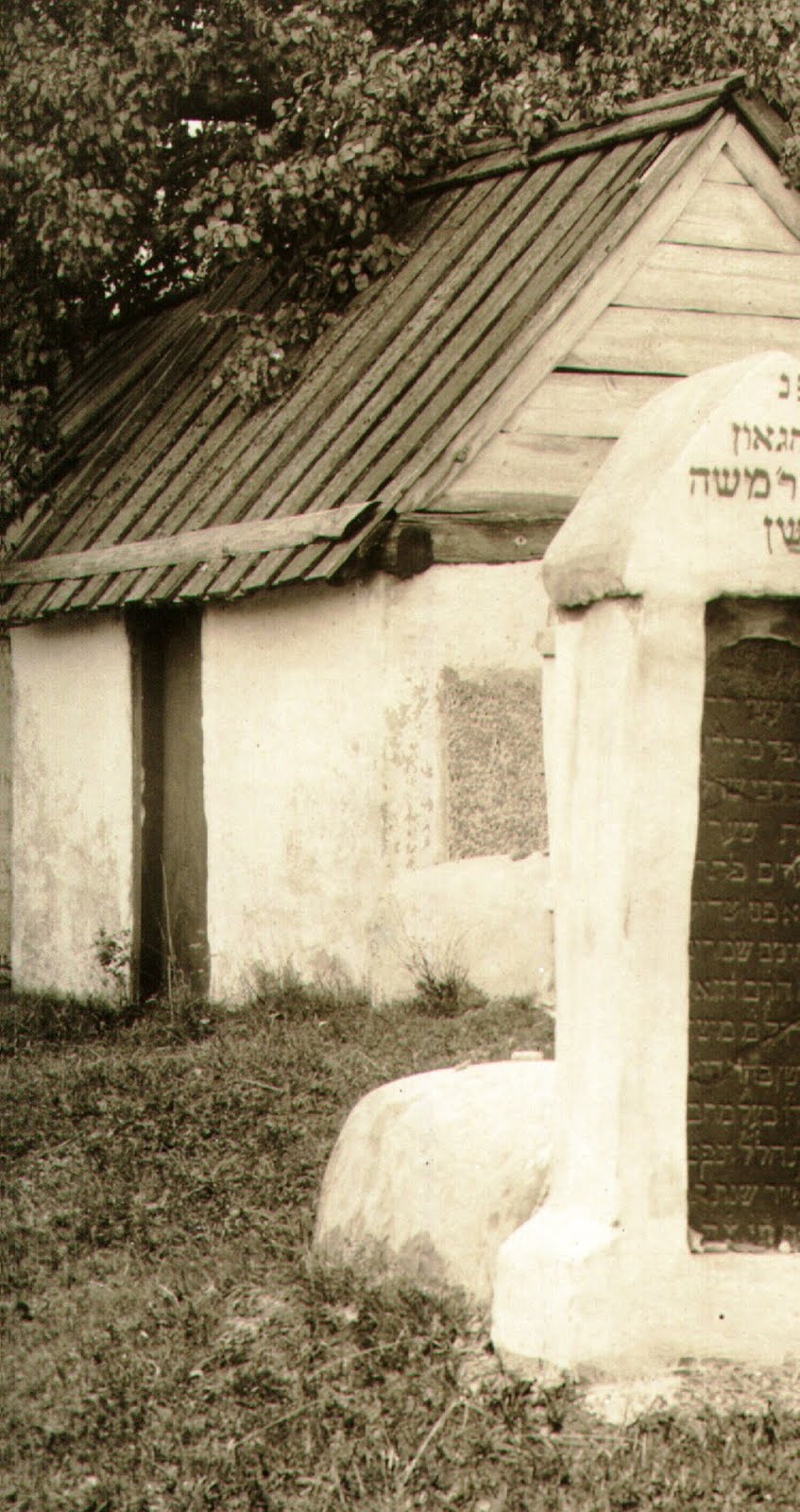
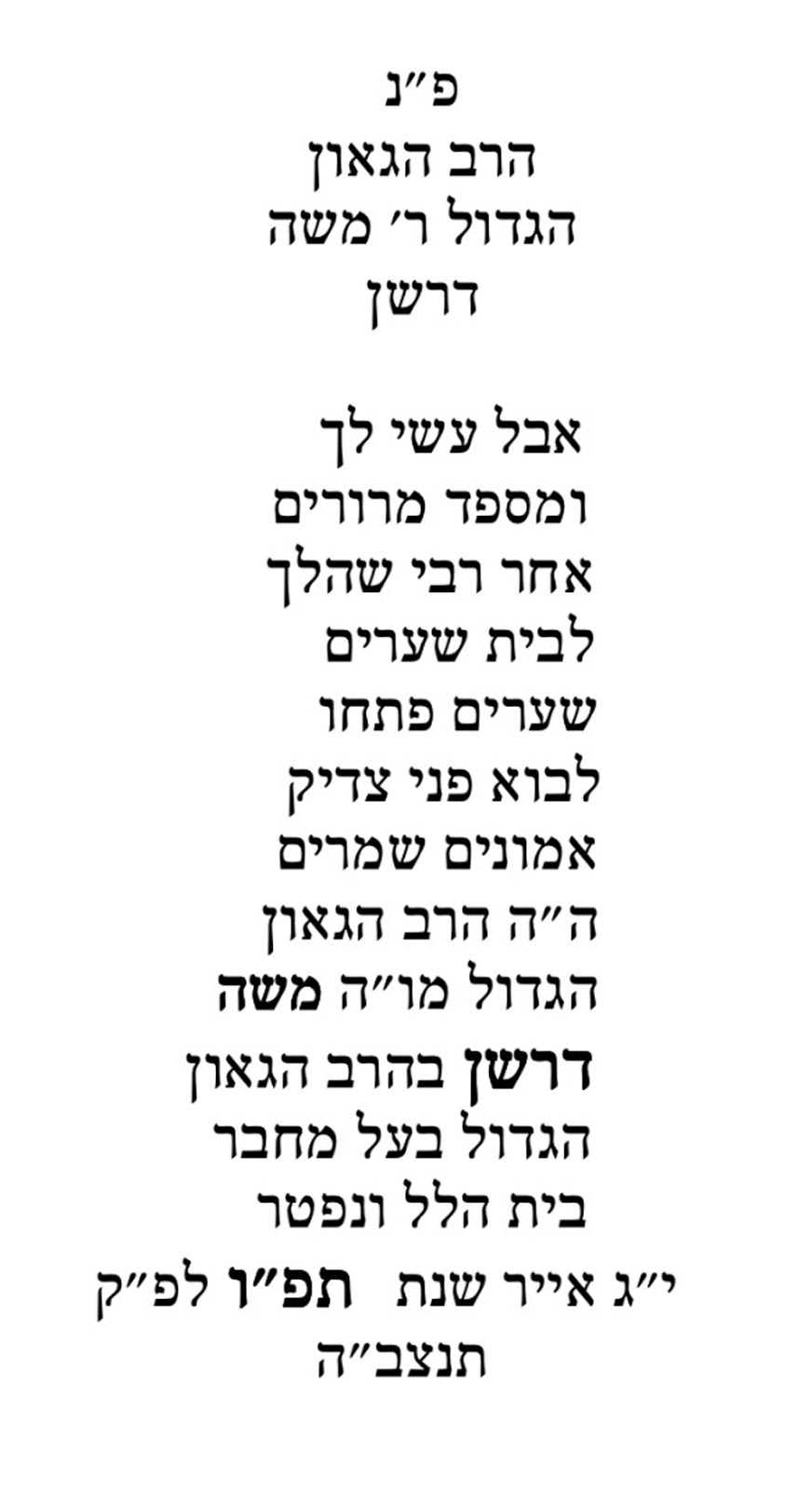
If we look at the picture below, taken at a different (probably earlier) time, one can see that in this area instead of a wall there is a shape of a door!

It is possible that when they made the main entrance to the Ohel on the opposite side, this door was closed. In any event, this gap can explain why the first four graves were not moved; they only took those that were to the right of the door![14] Now that we addressed the first half of our question, we are left with the second: If they took the entire row starting by the door why did they stop by R Yissachar Ber (26) and not take also R Yehoshua Heshel (27)? The evidence points us to the simplest conclusion, that in fact they did transfer him although without his headstone! In other words, of the 11 graves in the Ohel there were 4 to the left of the door and 7 to the right and they moved the entire batch from the door to the wall to the new cemetery, and thus unsurprisingly there are exactly seven graves in the new Ohel of the Gaon.

Thus, I am proposing that the additional grave with no headstone in the Gaon’s Ohel today is not the Ger Tzedek and is not the Chayeh Adam, but Simply Reb Yehoshua Heshel who was originally in the Gaon’s proximity.

This possibility has been generally ignored until now[15] for 2 reasons,

1.Since there were a few others in the Ohel that were not transferred it never struck people as odd why Reb Yehoshua Heshel was not either. However, since we’ve established an explanation for why the other 4 were not moved, it behooves us to find an explanation for why he wasn’t included.

2. The fact that there was no headstone led people to associate the grave with someone who would not have had a headstone to begin with, namely the Ger Tzedek.

Looking at Klausner’s description of Reb Yehoshua Heshel’s tombstone leads us to a possible solution to this second issue. His description is as follows: “the tombstone on the grave of the rav is made of wood and is preserved nicely”;[16] he even provides a picture of it on the next page. This fact, that the tombstone was made of wood as opposed to stone like the others in the Ohel, gives us a possible explanation for why it was not moved along with his body. It is possible that the wood was harder to move or that it possibly broke in the process.

In conclusion, the identification of the 7th grave with the Ger Tzedek doesn’t have much historical basis and is flawed for a few reasons, therefore we offer a new theory. The identity is none other than R Yehoshua Heshel who was buried in the original Ohel together with the rest of the row. This is the most plausible explanation which until now was ignored due to there not being a headstone, and not having an explanation for why these specific 7 graves were chosen as opposed to the others. We showed that a door was added to the Ohel and those that were involved in the transfer moved everyone from the right of the door until the end of the row including R Yehoshua Heshel. The reason his headstone was not moved was because it was made of material that was not conducive to transfer and possibly might have broken along the way.

B.

Essentially, we are left with one remaining question – Why was Rabbi Zvi Hersh moved from the extreme right to the extreme left in the order of the graves?

To propose an answer to this question, we need to go on a long detour. As previously mentioned, in 1956, Dr. Henry Shoshkes, visited the Soviet Union and Vilna, and then reported about his travels in the Tag, a Yiddish newspaper in New York. This was one of the first documented visits to the Jewish cemetery in Vilna after the transfer of the Gaon’s grave and is indirectly the source of many of the rumors surrounding the Vilna Gaon’s grave. In one of the articles describing his visit to the grave there is also a picture of the grave and a better one is published in Dr. Shoshkes’s book[17] – מהקרמלין עד הפרמידות. What is unique about the picture is that it is one of only two pictures that I know of, of the Gaon’s grave after it was transferred but before a new Ohel was erected.[18]

One can see several tombstones one next to the other but clearly there is no tombstone to the right of the Gaon’s headstone. Shoshkes writes that this grave without a headstone is the grave of the Chaye Adam – Rav Avraham Danzig. I believe otherwise.

I am assuming that this picture is taken facing south, with the headstones positioned at the head of the graves.[19] In other words, the headstones are arranged as they were on the outside wall of the Ohel in the old cemetery, but in the opposite direction compared to their current setup in the new Ohel. If we consider the old Ohel’s arrangement, the gravestone that should be to the right of the Gaon is the tombstone of his brother Rav Yissachar Ber. This of course raises the question – Why is it not there?

Let us return to Klausner’s picture and accompanying numbers. We observe that the numbers are in sequential order from left to right but one number is missing – number 26. That number corresponds to R. Yissachar Ber the Gaon’s brother. It is quite peculiar – why is the Gaon’s brother not listed beneath the picture?

For that we must go back to the wider picture of the old Ohel.

And then zoom in on the right upper corner of the Ohel:

What is that sign? We can see and understand it better by looking at an illustration made of the Gaon’s old Ohel. It is not exact but gives a very good idea.

In this illustration we can observe that beneath the plaque in the upper right corner there is a gravestone. By counting the number of gravestones to the right of the door, we reach an undeniable conclusion: there are two separate headstones, that to the right of the Gaon’s gravestone, positioned one on top of the other. The one adjacent to the Gaon corresponds to Klausner’s number 27, which is R. Yehoshua Heshel. On top of that, in the right upper corner, we find the headstone of Reb Yissachar Ber, that Gaon’s brother [26].

To fully comprehend this, we must recall the sequence of events. Initially, R. Yehoshua Heshel passed away, followed by the Gaon, much later. A few months after the Gaon’s burial, his Mechutan, Reb Noach Mindes, passed away and was interned to the left of the Gaon, sharing a joint gravestone. Several years later, when the Gaon’s brother died, there was a desire to bury him next to his brother, resulting in him being “squeezed” in between the Gaon and R. Yehoshua Heshel. Evidently there was sufficient space to accommodate the body, but during placement of the headstones on the outside of the Ohel, there was insufficient space. Consequently, R. Yissachar Ber’s headstone was positioned on top of R Yehoshua Heshel’s headstone.

Therefore, the key point of this story is that although R. Yissachar Ber was buried right next to the Gaon in the old Ohel, the headstone closest to the Gaon on the right side belonged to R Yehoshua Heshel. Based on this observation, I would propose that since, as mentioned, R. Yehoshua Heshel’s wooden headstone was never transferred, those responsible for arranging the headstones in the new cemetery left the grave next to the Gaon without a headstone, aligning it with their understanding of the headstones arrangement in the old Ohel.

We have one final question regarding Shoshkes’s picture: On the left side of the Gaon’s headstone, we can observe two additional headstones. The inscriptions are illegible, but judging by the size and shape of the gravestones, it would be reasonable to assume that the first one belongs to Mindel [24], the wife of Reb Noach. However, the issue lies with the second one. It should be Devorah’s grave [23], but it appears more similar to the gravestone of her son, Reb Zvi Hersch [22]. Why is Devorah’s gravestone missing?

If we examine the gravestones inside the Ohel, it becomes evident that Devorah’s gravestone is significantly taller than the others. It is possible that it was too challenging to set up without the support of an Ohel wall. Indeed, if we observe the current picture of Devorah’s gravestone inside the Ohel, it is clearly seen to be broken into two parts.

Now, let us consider the thesis proposed. I suggest that during the construction of the new Ohel, they reconnected the broken parts of Devorah’s headstone and returned her to her original position in the line-up. However, due to the need to relocate Reb Zvi Hersch, he was placed next to Reb Yissachar Ber instead of being positioned beside his mother, Devorah, where he rightfully belongs.[20]

In conclusion, I firmly believe that the order of the bodies has never been altered, and they are positioned precisely as they were in the old Ohel. However, there seems to have been a mix-up in arranging the headstones. Below, I present a summary outlining my understanding of the arrangement of the bodies in relation to the current placement of the headstones:

In a forthcoming article, I will delve into an in-depth analysis and present fresh evidence and explanations regarding the numerous rumors surrounding the relocation of the Gaon. I will explore questions such as who was responsible for moving him, the timing of the transfers, the frequency of the relocations, the fate of those involved in the process, and the condition of the Gaon’s body.

[1] For the purposes of this article the debate on the historicity of the Ger Tzedek matters little. Whether it happened like the stories or not, the fact is that there was a grave for him in the old cemetery that could’ve been moved. For the debate on the historicity of the Ger Tzedek see the Seforim Blog’s article about the topic here

Also see Magda Teter. (2005). The Legend of Ger Ẓedek of Wilno as Polemic and Reassurance. AJS Review29(2), 237–263. http://www.jstor.org/stable/4131733.
[2] There are some reports who claim that he was moved twice, once to the Zaretcha cemetery which was the cemetery used after the old one was filled up and only later was he moved to his present resting place in the Saltonishkiu cemetery. See footnote number 2 in Lieman’s article in the Seforim Blog.
[3] For a full list of the different reports see his article.
[4] https://seforimblog.com/2012/09/who-is-buried-in-vilna-gaons-tomb/

[5] There is a similar issue with descriptions of the Ger Tzedek’s original burial place. Many of these descriptions assume that he was buried next to the Gaon when in reality he was on the other end of the cemetery.
[6] See further such references in Leiman’s Jewish Action article.
[7] Prof Leiman also introduces the possibility that the Ger Tzedek was moved but was buried without a grave and leaves the seventh grave unidentified.
[8] As we will see later even people that claimed he wasn’t moved said that they searched for his remains but didn’t find anything of substance to move.
[9] This is probably the original reason for all the confusion around who was moved. There are many people who warrant preservation due to their status. Although as we stated previously it is possible that the Ger Tzedek was of a higher profile.
[10] Leib Sarapej later managed to immigrate to the United States, and reunite with his daughter in Richmond, Virginia. In 1970 wrote a letter to the editor of The Forward, in which he mentions his involvement in the transfer of the Gaon’s grave. This is the only first-hand record of someone who was directly involved in the transfer that I know of, and to the best of my knowledge has not been mentioned to date. https://www.nli.org.il/he/newspapers/frw/1970/05/11/01/article/31.
[11]  https://www.nli.org.il/he/newspapers/dertog/1956/10/28/01/article/100. The way the article is written it would sound as if the Goan was then interred in the Zaretcha Cemetery (and not where he is currently buried) as right after Shoshkes describes the Gaon’s new resting place he goes on to describe other parts of the cemetery which were all found in the Zaretcha Cemetery. As odd as it may sound it would seem that Shoshkes had merged his visit to two different cemeteries into one account even though he is writing the article only a short while after being there. It could be that because of this Leyzer Ran, in his book referenced in comment 18 hereafter, wrote next to the picture of the Gaon’s headstone that he is buried in Zaretcha.
[12] See R.Yitzchak Zilber, To Remain a Jew (Jerusalem, 2010), pp. 389-390. Kab also said that the Gaon’s hairs “were as firm as needles”.
[13] Korot bet Halmin Hayashan D’Vilna. Can be found here.
[14]  The grouping can also be derived from Klausner p 45 who when describing the graves divides them into ones on the right and left in exactly this manner.
[15] Although Leiman does include it passing as one of the possibilities.
[16]]

[17] Page 28.
[18] The other such picture appears in Ran L., Jerusalem of Lithuania: illustrated and documented, 1974, p. That picture does not show anything but the headstone and so has limited importance. I suspect the picture in Ran’s book was also provided by Dr. Shoskes, from the same visit.
[19] This does however pose some difficulties for the lack of other graves in the picture. This is an issue I will address inter alia in a future article.
[20] Be it as Leiman purposes in order to have all the men on one side or for some other reason.


A Desperate Plea for Help on Behalf of Vilna’s Old Jewish Cemetery

A Desperate Plea for Help on Behalf of Vilna’s Old Jewish Cemetery in 1919

By Shnayer Leiman

Recently, a brief study was posted online on Meir Zelmanovich, the custodian of Vilna’s old Jewish cemetery, who died a martyr’s death in 1920.[1] Here, we wish to add Zelmanovich’s only published writing, a Yiddish letter that appeared in Vilna’s יידישע צייטונג [Yidishe Tsaytung], on Monday, December 15, 1919.[2] The letter will appear below both in the original Yiddish and in an annotated English translation. It is a significant, and tragic, historical document. Also, mostly due to the recent discovery of a treasure trove of photographs relating to World War I, we will present several newly discovered photographs of Zelmanovich.[3]

For those unfamiliar with Vilna’s old Jewish cemetery, we note that according to a Jewish tradition in Vilna it was founded in 1487. Modern scholars, based upon extant documentary evidence, date the founding of the cemetery to 1593, but admit that an earlier date cannot be ruled out. The cemetery, still standing today (but denuded of its tombstones), lies just north of the center of the city of Vilna, across the Neris River, in the section of Vilna called Shnipishkes (Yiddish: Shnipishok). It is across from, and just opposite, one of Vilna’s most significant landmarks, Castle Hill with its Gedeminas Tower. The cemetery was in use from the year it was founded until 1830, when it was officially closed by the municipal authorities. Although burials no longer were possible in the old Jewish cemetery, it became a pilgrimage site, and thousands of Jews visited annually the graves of the righteous rabbis and heros buried there, especially the graves  of the Ger Zedek (Avraham ben Avraham, also known as the son of Graf Potocki, d. 1749), the Gaon of Vilna (R. Eliyahu ben R. Shlomo Zalman, d. 1797), and the Hayye Adam (R. Avraham Danzig, d. 1820). Such visits took place even after World War II.

Briefly, the historical context of the letter was the battle for control of Vilna in the aftermath of World War I. During the years 1914 to1922, nine different governments ruled in Vilna, making life miserable for its residents. Almost certainly, the greatest concentration of Jewish suffering in this period took place in 1919, when the Polish legionnaires unleashed a pogrom against Vilna’s Jews. Zelmanovich’s Letter to the Editor appeared in print in December 1919 and records in detail the damage to the dead; he left it for others to record the damage to the living.[4] This stage of Polish rule came to an end when the Russians recaptured Vilna in July of 1920. Russian rule lasted for some six weeks, and was followed by Lithuanian rule. On October 8, 1920 the Poles once again recaptured Vilna. Sadly, on October 10, 1920 Meir Zelmanovich was one of a handful of Jews murdered by the returning Polish legionnaires.

1. The Original Yiddish Version of Zelmanovich’s Letter.

2. An Annotated English Translation of Zelmanovich’s Letter.

The Hostile Incidents at Vilna’s Old Jewish Cemetery: (A Letter to the Editor)

Please provide me with a platform to describe the hostile incidents that have taken place – from Passover[5] until today – at the old Jewish cemetery.

Immediately after Passover, the fence (surrounding the cemetery) was breached, and horses were allowed to enter the cemetery. The officers in charge of the horses chose to move into my house, and helped themselves to whatever they could find. It was only when my daughter came down with typhus, that they left the house and encamped on the cemetery grounds. They burned the wooden tombstones, and broke stone tombstones as well. They smashed the tombstones of R. Yisrael Kreines’ father,[6] R. Yaakov Landau,[7] Rekhl the mother of R. Shimon Strashun,[8] R. Mordechai Meltzer’s wife,[9] and a few others. They were about to destroy the wooden tombstone of the Chief Rabbi, R. Hillel,[10]ho died in 1706,[11] but I managed to hide it while it was still whole.

The official rabbi,[12] Rabbi Rubinstein[13] was heavily involved in rectifying matters. We were able to arrange for the horses to be removed from the cemetery. The officers of the Zedakah Gedolah Society[14] arranged for the fence to be repaired at a cost of 7000 rubles. Now, however, the soldiers have returned with saws and axes and have pulled back and rearranged the fence so that anyone could enter the cemetery from the nearby public passage way. Thus, they once again are tearing down the rooftops of the mausoleums.

Regarding the Gaon’s[15] mausoleum, they have now, for a second time, torn down its roof, and also smashed its windows. They have also begun to break down its walls.

They tore off the rooftops of the mausoleums of R. Noah Petletzis[16] and R. Shmuel Landau.[17] Just last night, they placed the carcasses of 5 horses next to the mausoleums.

All our communal Jewish activists are obligated to come and view for themselves the devastation that is taking place in the old Jewish cemetery. And, at the same time, they are obligated to rescue whatever can still be rescued.

Meir Yisrael Zelmanovich,
Custodian of the Old Jewish Cemetery

———-

3. Newly Discovered Photographs of Meir Zelmanovich.

a) Meir Zelmanovich at the Mausoleum of R. Menahem Manes Chajes.


b) Photograph of Meir Zelmanovich at Vilna’s Old Jewish Cemetery.

The top photograph (left) is clearly the original that ultimately appeared in the postcard that was produced in 1916 (right) and discussed in our earlier study.[18] The photograph’s clarity and detail are far superior to that of the postcard, a clear reminder that some postcard reproductions need to be taken with a grain of salt.[19]

The bottom photograph, it seems to me, is a magnificent likeness of Meir Zelmanovich. Someone scribbled in the date 1916, which almost certainly is when it was taken.[20]


Notes

[1] S. Leiman, “In Praise of Ephemera: A Picture Postcard from Vilna Reveals its Secrets more than One Hundred Years after its Original Publication,” The Seforim Blog, July 27, 2020 (here). Cf. The Leiman Library (www.leimanlibrary.com), texts, item 143.

[2] Issue 181, p. 2, columns 1-4. The newspaper lists the Jewish calendrical date as well, 23 Kislev. For a brief history of Vilna’s short-lived יידישע צייטונג (it ceased publication in 1920), see D. Flinker, et al, eds., עיתונות יהודית שהיתה (Igud ha-Olami shel ha-Itonaim ha-Yehudim: Tel-Aviv, 1973), p. 246.

[3] In July of 2020, a huge collection of rare photos of Vilna was sold at auction on Ebay. The photos were made by a professional photographer who served as a photo correspondent working with the German 10th army, which occupied Vilna during World War I. Fortunately, about half of the photos were acquired by a coalition of scholars and patrons of scholarship in Lithuania who realized how significant these photos were. I am indebted to my Lithuanian colleague, Dr. Andrius Kulikauskas, for sharing the above information with me, after the fact. What Andrius could not know is that I too was a bidder in that auction (without knowing all the fine details about who took the photographs), and managed to acquire four photos taken at the Old Jewish cemetery in Vilna, including the two photos of Meir Zelmanovich reproduced below.

[4] For a fuller account of the pogrom itself, see the study cited above in note 1.

[5] Vilna’s Jewish community celebrated Passover in 1919 from the evening of April 14 through April 22. The Russian Red Army ruled in Vilna through April 18, 1919. On April 19, the Polish legionnaires replaced the Russian Red Army. Almost immediately, a pogrom ensued against the Jews, leading to much death and destruction. Vilna remained under Polish control during the period that Zelmanovich published his “Letter To The Editor.”

[6] R. Yisrael Gordon Kreines (1778-1856) was a learned Torah scholar adept in Russian. In 1837 he was appointed Rabbi of Vilna, largely for the purpose of fulfilling the Czarist regime’s requirement that a rabbi be appointed who could record in Russian all births, marriages, and deaths in the Jewish community. See H.N. Steinschneider, עיר ווילנא (Vilna, 1900), pp. 192-195. Kreines’s father, R. Avraham Gordon was a major lay leader (פרנס ) of Vilna who died in 1780. See S. Y. Fuenn, קריה נאמנה (second edition, Vilna, 1915), p. 187-188.

[7] R. Yaakov Landau (circa 1793-1828), a learned rabbinic scholar, was the oldest son of R. Shmuel Landau, also a rabbinic scholar of note (see below, note 17). R. Yaakov was the older brother of R. Yitzhak Eliyahu Landau (1801-1876), who served as rabbi and official preacher (מורה צדק ומגיד מישרים) of Vilna from 1868 until his death in 1876. R. Yaakov’s Landau’s full given name was Avraham Yaakov. Unfortunately, he died at an early age. His epitaph is preserved in Fuenn, pp. 253-254. Y. Klausner, קורות ביתהעלמין הישן בוילנה (Vilna, 1935), p. 63, note 2, reports that R. Yaakov Landau’s tombstone was no longer standing in 1935.

[8] R. Shimon Strashun (circa 1823-1905) was a distinguished rabbinic scholar who resided in Vilna, and was the son of a distinguished rabbinic scholar who also resided in Vilna, R. Avraham David Strashun (19th century). Avraham David’s first wife, חנה (d. 1824), was the mother of R. Shimon Strashun. See Steinschneider, p. 191. Assuming there is no error here on the part of either Steinschneider or Zelmanovich, it is possible that her full name was חנה רחל. The Yiddish name Rekhl is a common variant of the name Rokhl. See, e.g., A. Beider, A Dictionary of Ashkenazic Given Names (Bergenfield, 2001), pp. 560- 562, especially p. 561, column 2.

[9] R. Mordechai Meltzer (1797-1883) served as an official rabbi in Vilna with the title מורה צדק . He was the head of Vilna’s Ramajles (ראמיילעס) Yeshiva during the first half of the 19th century, where he trained many of Vilna’s most distinguished rabbis. In 1864, he was appointed Chief Rabbi of Lida (today in Belarus), where he served with distinction until his death in 1883. His wife, Sarah Devorah, died in 1830, and was buried in Vilna’s old Jewish cemetery. See Steinschneider, pp. 122-126.

[10] For a brief account of R. Hillel b. R. Jonah ha-Levi, and for the text of his epitaph, see Fuenn, p. 104. Wooden tombstones were commonplace in the old Jewish cemetery; not everyone could afford a stone tombstone. The wooden tombstone of R. Hillel b. R. Jonah ha-Levi, rescued by Zelmanovich, almost certainly no longer exists. A photograph of the tombstone, however, was preserved in the An-Ski Museum in Vilna, and published in Klausner, p. 42.

[11] The Yiddish original gives the Jewish year: [5]466.

[12] Under Czarist rule, the Russian government required Jewish communities to appoint a kazyonny ravvin “an official rabbi,” fluent in Russian, who – among his various responsibilities — would be responsible for recording (in Russian) births, marriages, and deaths. Rabbi Rubinstein’s initial appointment in Vilna was as kazyonny ravvin. Zelmanovich uses the Yiddish (and German) title ראבינער here to indicate Rabbi Rubinstein’s status at the time.

[13] Rabbi Isaac Rubinstein (1880-1945) was appointed “official rabbi” (see previous note) of Vilna in 1910. With the outbreak of World War I, the more traditional rabbis were forced to flee Vilna, and Rubinstein – for all intents and purposes – was the only functioning rabbi in Vilna. In this difficult period, and later under Polish rule, Rubinstein repeatedly interceded on behalf of the Jewish community, with great success. He served as a member of the Polish senate from 1922-1939. In 1928, he was appointed Chief Rabbi of Vilna. A leading religious Zionist, and a superb speaker, he managed to flee Vilna in 1940 (then under Soviet domination), and made his way to the United States in order to enlist aid on behalf of East European Jewry.

[14] The Zedakah Gedolah Society was Jewish Vilna’s official communal institution in charge of public welfare. Given the rampant poverty that prevailed throughout much of Vilna’s Jewish history, this was one of the most important institutions in Vilna. It assumed even greater significance when the Czarist regime abolished Vilna’s “Kahal” structure in 1844. One of the Zedakah Gedolah’s many tasks was to provide the lion’s share of the funding necessary for the upkeep of Vilna’s Jewish cemeteries. With the advent of World War I, it fell into a period of steady decline and would ultimately be liquidated under Polish rule in 1931. See Israel Cohen, Vilna (Philadelphia, 1943), pp. 121-122 and pp. 394-397. Cf. Andrew N. Koss, “Two Rabbis and a Rebbetzin: The Vilna Rabbinate During the First World War,” European Judaism 48:1 (2015), pp. 120-122.

[15] The reference is to the mausoleum of R. Elijah b. Solomon (1720-1797), the Vilna Gaon, which never fully recovered from the damage inflicted upon it by the Polish legionnaires.

[16] Noah Bloch Petletzis (d. 1809) was an exceedingly wealthy Jew who donated generous sums of money to Vilna’s various educational and charitable institutions. He singlehandedly provided the entire funding for the construction of the women’s section (עזרת נשים) in Vilna’s Great Synagogue. See Fuenn, p. 223-224; cf. Klausner, p. 66. He should not be confused with the Maskil Noah Bloch (d. 1846) who, after much controversy about exactly where in the Zaretcha cemetery he should be buried, was finally laid to rest. See H.N. Steinschneider, עיר ווילנא (Jerusalem, 2003), vol. 2, pp.48-49 (edited by M. Zalkin).

[17] R. Shmuel Landau (d. 1818) was a son-in-law of R. Hayyim Landau (d. 1797) of Brody, a founder and key supporter of the קלויז of Brody. On the “kloyz” of Brody, see N.M. Gelber, תולדות יהודי ברודי (Jerusalem, 1955), pp. 62-73. Not surprisingly, R. Shmuel adopted his father-in-law’s surname and brought it to Vilna. He was an exceedingly modest rabbinic scholar, whose 3 sons, all named Landau, would become well-known rabbinic scholars. R. Shmuel Landau’s epitaph (or, at least, a portion of it) was preserved by Fuenn, p. 230; cf. Klausner, p. 63.

[18] See above, note 1.

[19] Notice, e.g., the different facial expressions in the two photographs. When the two photographs are enlarged, it becomes obvious that the original photograph preserves much detail no longer visible in the postcard, including the fine detail of the vast terrain to the left of the mausoleum (alas, only partially captured by the scans presented her, but quite visible to the naked eye.)

[20] That all the photographs gathered here are, in fact, genuine likenesses of Meir Zelmanovich seems likely. Certainly the family photo published in the earlier study (see above, note 1) identifies him by name. His German passport of 1916 offers additional proof. During the German occupation, all residents of Vilna were required to have — and to carry at all times – a German passport (we would call it: an identity card). Zelmanovich’s German passport lists his correct name, age, and address (at the Old Jewish cemetery), and includes his passport photo! I am indebted to Regina Kopilevich, researcher and tour guide extraordinaire, for retrieving Zelmanovich’s passport from the many preserved in the Lithuanian State Historical Archives (Lietuvos Valstybes Istorijos Archyvas). Here is Zelmanovich’s passport photo:

Yet another unmistakable likeness of Meir Zelmanovich can be seen in two photographs preserved in the archives of the Ghetto Fighter’s House Museum at Kibbutz Lohamei Hagetaot. Both photos were taken in 1916 at the old Jewish cemetery. One photo (catalog number 31468) depicts Meir Zelmanovich and a teenager (almost certainly his son Sholom) standing next to the legendary tree that hovered over the ashes of the martyred Ger Zedek of Vilna, in the old Jewish cemetery’s south eastern corner. Another photo (catalog number 31467) depicts the father and son (now wearing an overcoat) standing at a pathway in the center of the old Jewish cemetery. The photos are available online, so there is no need to post them here. I am deeply grateful to art historian Dr. Vilma Gradinskaite of Vilnius for bringing my attention to the photos preserved in the archives of the Ghetto Fighter’s House Museum.


Cemeteries and Response to Criticism

Cemeteries and Response to Criticism

Marc B. Shapiro

In my last post here I said that when it is safe, I will go to Baghdad to visit the grave of the Ben Ish Hai. I cannot find a picture of the Ben Ish Hai’s grave online, but you can see it in R. Yaakov Moshe Hillel’s beautifully produced recent book, Ben Ish Hai, p. 337. However, this is from the old cemetery in Baghdad, and because of a government order the remains in this cemetery were moved in the early 1960s. So it remains to be seen if the grave can now be located.[1] R. Hillel, p. 336 n. 480, claims that the precise location cannot be identified.

כיום, לא ניתן לזהות את קבריהם, בשל תנאי אקלים קשים השוררים בבבל אשר גרמו להתפוררות המצבות, ומחוסר רישום מדוייק של חלקות הקבורה.

Yet until we can go in and actually examine the spot, we cannot be certain if this is the case. There have been other examples of graves thought to have been lost, which have then been found. The best-known example is the grave of R. Israel Salanter, which was only located twenty years ago.[2]

While there is no doubt that the Ben Ish Hai was buried in Baghdad, there is also a tombstone for him on the Mount of Olives in Jerusalem.

According to a famous story, which is also told on the tombstone, the Ben Ish Hai’s body was not only magically transferred to Jerusalem on the day he died, but the grave-digger testified to burying him on the Mount of Olives and wanted payment for his labor.[3] I guess we can say that the Ben Ish Hai was buried three times: twice in Baghdad and once in Jerusalem.

It is hard to know whether the entire story of the burial in Jerusalem is a legend, or if there actually was a grave digger who figured out a way to make some money and invented the story to get paid for digging the grave. Assuming the latter is the case, the grave digger must have known his crowd, that not only would they be inclined to believe such a story, but that they would also not think of actually confirming the story by digging up the grave. Truth be told, it would have to be a very fearless grave digger to leave the grave empty, because one never knows if it will be opened, so it is possible that some unknown person is actually found beneath the tombstone. It is also possible that the grave digger did not have any bad intent, but just had a very vivid imagination. In any case, it is fascinating that such a tombstone exists in the most special Jewish cemetery, and even more incredible that there are people who actually believe that the Ben Ish Hai is buried there.

Supposedly, the Ben Ish Hai’s tombstone on the Mount of Olives is the only one that is standing upright, as all others are horizontal. (Maybe someone in Jerusalem can confirm this.) It is worth noting that R. Yitzhak Kaduri paid the grave in Jerusalem no mind, and even joked about it.[4] R. Shmuel Eliyahu has stated that while the Ben Ish Hai is buried in Baghdad, his spirit came to Jerusalem.[5]

Similar to the story with the Ben Ish Hai’s burial place, R. Abraham Joshua of Apt is buried in Medzhybizh, near the Baal Shem Tov’s grave, but there is a legend that angels carried his body to Tiberias, and there is a stone marking his grave there as well.[6]

This last summer I was in Marrakech, Morocco. In the local Jewish cemetery, R. Jacob Timsut is buried. Yet, “one month after the deceased rabbi was buried in Marrakech, a letter arrived from Jerusalem announcing the marvelous appearance of a tombstone with the name of Rabbi Ya’aqov Timsut in the well-known cemetery on the Mount of Olives.”[7] So once again, you can visit the tzaddik’s grave in its original spot or in Jerusalem.

Regarding tombstones even though the deceased is not buried there, I must call attention to the fascinating comments of R. Hayyim Nathan Dembitzer (1820-1892). R. Dembitzer was a dayan in Cracow and author of the responsa volume Torat Hen. Yet his claim to fame is his historical writings. As a real historian, he was prepared to accept the truth from where it came, and it is significant that in his work Mikhtevei Bikoret (Cracow, 1892), he included correspondence with Heinrich Graetz. Here is the title page and the first two pages of this book.


Look at how respectfully he refers to Graetz, which is the sort of thing that would have driven R. Samson Raphael Hirsch and R. Esriel Hildesheimer crazy.

Dembitzer’s respectful scholarly interactions with Graetz, in which he did not let religious differences interfere, is parallel to how certain important rabbinic figures related respectfully to Louis Ginzberg. I dealt with this matter in Saul Lieberman and the Orthodox, and it has also recently been discussed by R. Moshe Maimon.[8] Interestingly, in Mikhtevei Bikoret R. Dembitzer also includes correspondence with Nachum Sokolow.

Dembitzer’s two-volume Kelilat Yofi is focused on the rabbis of Lvov as well as other Polish rabbis, and is essential for anyone doing research on the Polish rabbinate. In this work, vol. 1 p. 41a, he mentions that Elyakim Carmoly had written that in earlier years in Lvov they would place tombstones in the cemetery for the deceased scholars of the city even if they had died and were buried elsewhere.

Dembitzer does not give an exact reference for Carmoly, only mentioning that his comment is in Ha-Karmel. Fortunately, I was able to find Carmoly’s article and it appears in Ha-Karmel, April 17, 1867, p. 302. Carmoly’s has two proofs for his contention. The first proof is that in R. Gavriel ben Naftali Hertz’s Matzevat Kodesh (Lemberg 1864), vol. 2, in the second half of the book (there is no pagination here), we find the following tombstone for R. Elijah Kalmankash, who served as rav of Lvov.

The tombstone explicitly states:

.וישכב עם אבותיו ויקבר במקום קבר אביו ולא ידע איש את קבורתו עד היום הזה

This is a clear proof that at least for this rabbi, a tombstone was placed in the ground even though he was not buried there.

Carmoly also notes, as his second proof, that in Matzevat Kodesh, vol. 2, p. 22a, it records, from the Lvov cemetery the text of the tombstone of R. Petahiah, son of R. David Lida who was rav of Amsterdam. His date of death is given as 1721. Here is the text of the tombstone as recorded in Matzevat Kodesh.

(Following R. Petahiah’s tombstone, Matzevat Kodesh records the tombstones of another son and son-in-law of R. Lida.) However, Carmoly tells us that we know that R. Petahiah died and was buried in Frankfurt. R. Markus Horowitz in his Avnei Zikaron (Frankfurt, 1901), p. 290 (no. 2712), published many years after Carmoly’s article, records the text of his tombstone as follows.

As you can see, the date of death is 1751, thirty years later than the date given on the tombstone in Lvov. In other similar cases, I would say that we are dealing with two different people, but the specificity of the tombstone texts makes it hard to deny that they are both for the same person (and Petahiah was hardly a common name).[9] Carmoly’s conclusion is that the community of Lvov put up a tombstone for R. Petahiah to memorialize him, even though he was buried in Frankfurt. Neither Carmoly nor R. Dembitzer offer an explanation as to why the Lvov tombstone places his death thirty years too soon, but they would probably view this as just a simple error.

Dembitzer not only agrees with Carmoly in the case of R. Petahiah, but offers another example of this phenomenon. R. Zvi Hirsch ben Zekhariah Mendel had served as rav in Lvov, but later he was rav in Lublin and died there around 1700. However, there was a tombstone for him in Lvov which gave his date of death at 1655. R. Dembitzer does not explain the discrepancy of the dates of death, and presumably he would say that when the tombstone was put up in Lvov to honor the deceased former rav of the city (who was not buried there), they simply got the date of death wrong. Interestingly, Shlomo Tal accepted the statements of Carmoly and R. Dembitzer, and in summarizing their position speaks of “many fictitious tombstones.”[10]

Dembitzer also makes the astounding assertion that there are graves in the Lvov cemetery for rabbis who never existed! His proof is that there is a tombstone for a Rabbi Eliezer ben Moshe ha-Kohen Proops (פרופס), who is said to have been av beit din in Amsterdam before he came to Lvov. Yet R. Dembitzer states that no such person was av beit din in Amsterdam, and we thus see that the people who made the tombstones did so for rabbis who never existed![11]

כי גם זאת לפנים בלבוב, להקים ג”כ מצבות אבנים ולחקוק עליהם שמות חכמי ישראל אשר לא מתו ולא נקברו לא בלבוב, וגם לא במקומות אחרים, יען כי לא היו ולא נבראו ולא באו עוד לעולם . . . ומי לידינו יתקע אם לא עשו זכרונות במצבות אבנים כאלה גם לשאר גאונים אשר בדו מלבם וקראו בשמותם עלי אדמה, וקבעו גם כן זמן לפטירתם

This is a very strange assertion, and even if it is correct, it refers to one case only, while R. Dembitzer uses it to make a generalization. The only one I know who took note of R. Dembitzer’s assertions was R. Hayyim Eleazar Shapira in a letter to R. Leopold Greenwald.[12] R. Shapira rejects R. Dembitzer’s claim in a very sharp tone.

ולא יאומן כי יסופר כי מרב גדול בתורה יצאו דברי הבל כאלו אשר כל השומע ויודע יצחק להם, ליתן מצבות ומקום בעד אותן שאינם נקברים שם ולכתוב שקר גמור “פ”נ” על להד”ם ולהשחית הקרקע שלא נקברו שם אין כדאי להטפל בדברי ריק כאלו. ואם בשביל קושיות שמצאו כמו ב’ מצבות כמו שני יוסף בן שמעון בשתי עיירות כלומר בתי קברות הנה שערי תירוצים לא ננעלו ונמצאו באמת שנים ששמותיהן שוות או לא העתיקו המצבות במקום אחד כראוי

Shapira makes the obvious point that two people with the same name can be buried in different cemeteries without them being the same person. However, this does not explain how there can be two tombstones for R. Petahiah, the son of R. David Lida, or how there can be a tombstone for another rabbi in the Lvov cemetery when we know that he was buried elsewhere.

Regarding what we have discussed, I would only add that in the new Jewish cemetery in Vienna (the same one that R. Israel Friedman, the Chortkover Rebbe, is buried in), there is a tombstone for three members of the Chevra Kadisha who perished in the Holocaust. While it looks like a normal grave, none of the three men mentioned on the tombstone are actually buried there.[13] Here is the tombstone.

I owe this information and the picture to Dr. Tim Corbett, whose book on the Jewish cemeteries of Vienna will hopefully soon be published.

Since I just mentioned R. Hayyim Eleazar Shapira, let me mention something else he says that is fascinating. In the past two posts I discussed apostate rabbis. It is bad enough when an average person apostatizes, but for a rabbi to do so could have had terrible consequences on the community in that it could lead to many weak of heart to follow. Can anyone imagine, however, someone apostatizing as an act of teshuvah? It sounds crazy, but R. Shapira reported that he had it by tradition that such an incident happened in medieval times.[14]

The story he tells is that there was a popular preacher who in his public talks inserted all sorts of heretical ideas. After he was rebuked by one of the rabbis for preaching his heresies, the man confessed his sins and asked what he should do to repent. The rabbi told him that his repentance would not help, as for years he has gone from place to place spreading his heresy. How could he possibly repent for this? The rabbi said that what he must do is convert to Christianity. The Jewish world would then hear about this and this would remove the legitimacy from any of his sermons, as people would assume that even before his apostasy he was a heretic. Only by doing this could he destroy the impact he made with his earlier sermons.

Let me mention one final responsum for now. In the eighteenth century, R. Elijah Israel of Rhodes dealt with the case of someone who converted to Islam in Izmir, and then wished to come to Rhodes in order to return to Judaism.[15] Practicing Judaism after converting to Islam was illegal, and could endanger everyone in the community. The man was therefore warned not to come to Rhodes, where Muslim merchants might recognize him, but he ignored this warning. Making matters worse, the man had already once before converted to Islam and reverted to Judaism, meaning that there was no way that the Jewish community could have any dealings with him.

Israel permitted letting the authorities know about this man, as he was regarded as a danger to the community. The punishment for his “crime” of leaving Islam would have been severe and could even have included the death penalty, but R. Israel allowed informing the authorities as the man had the status of a rodef. He writes:

מי שמסכן רבים כגון שעוסק בזיופים במקום שהמלכיות מקפידות דינו כרודף ומותר למוסרו למלכות ע”כ וכ”ש וק”ו במי שהמיר דת ורוצה לחזור לדתו שההקפדה היא גדולה שהוא בזוי גדול לדעתם פן תצא כאש חמתם ח”ו ובערם ואין מכבה שמותר למוסרו כדי להציל את ישראל

* * * * * *

In the most recent issue of Dialogue 8 (2019), pp. 35-83, Rabbi Herschel Grossman published a lengthy review of my Limits of Orthodox Theology.[16] Normally I, like any author, would be very happy that so many years after a book’s appearance people are still interested in examining it and engaging with its arguments. Unfortunately, that is not the case with the present review which, it must be said, is nothing less than slanderous. Had the author taken issue with my interpretation of texts and shown why I am mistaken, this would have been a fine way to approach the book. It could be that I would even acknowledge that in some cases his understanding is preferable to mine. As readers of this blog know, I am perfectly willing to acknowledge when I have erred and am happy to credit those who called my attention to these errors. This is how scholarship is supposed to work, and anyone who writes, especially someone who writes a great deal using lots of different sources, will sometimes make a mistake. I myself have called attention to my own errors, without anyone prompting me, as I think it is important for all of us to be as exacting as we can.

However, this is not what the review is about, or, I should say, not what it is mainly about. In future posts I will come to the issue about how to interpret specific texts (and I will defend my readings), but first I must explain why I said that the review is slanderous. It is because Grossman accuses me of saying things that I never said, and throughout he misunderstands the purpose of the book, and of academic Jewish studies as a whole. In general, it is obvious from the review that although Grossman has never met me or even spoken to me, and I have never done him any wrong, he sees me as an enemy that he has to destroy.[17] With such a preconceived notion, it is no wonder that he comes to such incorrect conclusions as to what I am trying to say, and can write a review that is so mean-spirited and dripping with contempt. Based on e-mail correspondence with readers, I do not believe that anyone who has read the book will be taken in by the review’s distortions. However, those who haven’t read the book will probably come away with a false understanding, so it is important to clear this matter up before getting to any arguments over how to interpret particular sources.

Before going through the article itself, let’s look at the end where Grossman says that the book “falls short of its promise to prove that the Rambam was wrong in presenting his Principles as central to Judaism” (p. 83). I think everyone who has read the book knows that of all the things I try to do, one thing I do not do, and indeed it would have been incomprehensible to even imagine such a task, is attempt to prove that the Rambam was wrong. Even if I were a theologian, which I am not, I could not imagine myself ever trying to prove the Rambam (or R. Bahya, R. Saadiah, Ibn Ezra, etc. etc.) wrong. This is simply not how I operate.

The notion that I attempted to prove the Rambam wrong is so far from what I was trying to do in the book, that as mentioned, I don’t believe that anyone who actually read the book, or any of the other reviews, would have concluded as such. What they would have seen is that I try to show that the Rambam’s principles were disputed by others, and thus did not receive complete acceptance. I try to prove this point, but this is very different than trying to “prove that the Rambam was wrong.”

I don’t even know how one would be able to prove the Rambam, or any other Jewish thinker, “right or wrong” on theological matters. Is it possible to “prove” that creation was ex nihilo or from pre-existent matter, or can we ever “prove” that prayers should not be addressed to angels? Today, unlike in medieval times, most of us assume that by their very nature, theological discussions are not subject to “proof”. The most one can do is try to show which position makes more logical sense and is in line with biblical and rabbinic teachings.[18]

In his conclusion, Grossman also writes, in opposition to my supposed error, “that the Rambam’s Principles of Judaism remain the correct affirmation of Jewish belief.” Again, this sentence has nothing to do with my book, as it assumes that I claimed that the Rambam’s principles are incorrect. Had he understood what the book is about, and he wished to dispute with me, he would instead have written “that the Rambam’s Principles of Judaism are the generally accepted [or: halakhically binding, or: rabbinically sanctioned, etc.] affirmation of Jewish belief.”

Let us now start at the beginning. Grossman begins his review—and I will be going through it page by page responding to his attacks—by stating that “the academic approach to matters of Torah learning is radically different from that of the talmid chochom” (p. 36). This is an incorrect statement, as many followers of the academic approach are themselves talmidei hakhamim. What Grossman should have written is that the academic approach is different than the traditional approach. With regard to academic works, Grossman states: “Many of the conclusions of these works are at variance with accepted Torah teachings” (p. 35). No doubt that this is a true statement, but of course, the issue we will have to get into is what is the definition of “accepted Torah teachings.” As all readers of this blog are aware, R. Natan Slifkin’s books were banned because they were seen to be at variance with “accepted Torah teachings,” so the fundamental issue will be which teachings are supposedly accepted.

Grossman writes as follows in explaining the difference between a traditional Torah scholar and an academic scholar:

[For] the talmid chochom, a difficulty in the words of the authority creates a challenge for him to discover the true meaning of the authority. For many academics, a difficulty is proof that the authority is wrong (p. 36).

Grossman identifies me as one of the academics who try to show that an authority is wrong, so let us see whether this is indeed the case. He begins by stating about my book: “Its thrust is that the Rambam erred in codifying these Principles.” We have already seen this unbelievable distortion in his conclusion, as if one of my goals was to show that the Rambam was mistaken.

Grossman further states that “while some earlier scholars have disputed whether some of the Principles deserve to be listed as basic to Judaism . . . all have conceded that the tenets expressed by the Principles are correct” (p. 36). This statement is grossly inaccurate, as virtually every page of my book demonstrates (and in various blog posts I have also cited numerous authorities who disagree with certain of Maimonides’ principles).[19] Even if all of Grossman’s criticisms of particular points of mine are correct (and I will come back to this), it still leaves loads of sources at odds with the Rambam. The sentence is nothing less than shocking, since rather than acknowledging that other authorities disagreed with certain Principles of the Rambam, but claiming that these authorities’ views are to be rejected for one reason for another, Grossman states that “all have conceded” that the Rambam’s views are correct. It is hard to know how to reply to such a statement that completely disregards the truth that everyone can see with their own eyes.

In Limits, p. 26, I quoted the following from R. Bezalel Naor, who was repeating what he heard from R. Shlomo Fisher: “The truth, known to Torah scholars, is that Maimonides’ formulation of the tenets of Jewish belief is far from universally accepted.” R. Naor informed me that R. Fisher made this statement in explaining R. Judah he-Hasid’s view about post-Mosaic additions to the Torah. In other words, R. Judah he-Hasid’s view is not in line with Maimonides’ Principles, but this is not the only such example of Torah sages diverging from the Principles.

Grossman continues by stating that I conclude “that the Rambam’s formulation of the underlying beliefs of Judaism was his own innovation” (pp. 36-37). What does this sentence mean? Apparently, he wants the reader to think that I said that the Rambam just invented his Principles out of thin air, which is of course incorrect as I never said this. If the meaning is that the very notion of a list of doctrines formulated as Principles of Faith, with all that this entails, was the Rambam’s innovation, there is nothing controversial about this at all, and I discuss whether the Rambam was the first to do this and what led him to do so.

Grossman continues: “Even such basic tenets as the belief in God’s unity, or in God’s non-corporeality, says Shapiro, are the Rambam’s own assertions and subject to dispute, with no firm basis in the Torah or in Chazal” (p. 37). I never say that these tenets are the Rambam’s own assertion without any prior basis (as if the Rambam invented these ideas). When it comes to the belief in God’s unity, I state explicitly that no Jewish teacher has ever disputed this (although how they understood God’s “unity” was subject to dispute). As for God’s incorporeality, I will come back to this in greater detail in a later post, where I will also deal with R. Isaiah ben Elijah of Trani’s claim that divine incorporeality is not a principle of faith, as well as Maimonides’ view that in its simple meaning (but only in its simple meaning), the Torah itself teaches God’s corporeality (for the benefit of those people who at the beginning of their studies are not able to understand the profound concept of a deity without form). Since I will then analyze this matter in great detail, I do not want to get into it here. For now, I will simply say that in the book I discussed whether divine incorporeality was accepted by all Jews at all times, and if corporeal views of God can be found in the Talmud (as was stated by R. Isaiah ben Elijah of Trani).

On p. 37 Grossman writes:

Shapiro, who mocks the opinions of Rabbeynu Nissim, R. Moshe Feinstein, Chazon Ish, Arizal, and R. Ya’akov Emden, among others, goes one step beyond Kellner in his belief that he, Shapiro, is better able than Rambam to interpret explicit verses of the Torah (as we shall see below).

This is nothing less than slander since I never, not even once, mock the opinions of any of these great rabbis or anyone else. When I read this sentence, I had no clue what he was talking about, as this is not how I operate, and was shocked when I went to the sources he refers to. Let us look at what Grossman regards as “mocking”.

For my mocking of R. Nissim, he refers the reader to p. 84 in my book where I write that R. Nissim “puts forth the strange and original position that there is one particular angel before whom prostration is permitted.” This is mocking?[20]

For my “mocking” of R. Moshe Feinstein’s opinions he provides three sources.

On p. 101 n. 73, I discuss R. Moshe’s rejection of the authenticity of a passage in Avot de-Rabbi Nathan. I write that R. Moshe’s “rejection of the authenticity of this passage should be viewed as part of his pattern of discarding sources that do not fit in with his understanding. He does so even when the sources are neither contradicted by other writings of the authors involved nor by other versions of the text in question.” Where is the mocking?

On p. 157, I write: “Although R. Moses Feinstein was the greatest posek of his time, he seems to have had no knowledge of Maimonidean philosophy. He was therefore able to state that Maimonides believed in the protective power of holy names and the names of angels, as used in amulets.” Where is the mocking?[21]

The last source where I am said to be mocking R. Moshe’s opinion is p. 159 of my book. Here is the page.

All I do here is cite R. Moshe’s comment about those who oppose kollels by citing the Rambam. I have also seen R. Moshe quoted as saying that it is noteworthy that those who oppose kollels based on the Rambam only adopt this one “humra” of the Rambam. The Rambam has lots of other humrot, yet people don’t adopt these stringencies. They only want to be “mahmir” in accordance with the Rambam so as not to support kollels. To say that I am mocking R. Moshe’s opinion is not only slander, it is completely incomprehensible.

Regarding the Hazon Ish, Grossman refers to p. 17. On this page I mention the views of many who held that the Thirteen Principles are the fundamentals of Judaism, and I include a passage from the Hazon Ish. I don’t see any mocking.[22] He also refers to p. 65 n. 124, where I mention a number of sages, including the Hazon Ish, who say that the Rambam’s view that belief in divine corporeality is heresy (Hilkhot Teshuvah 3:7) does not refer to someone who does not know any better, and thus the Rambam is not in dispute with Rabad who criticizes the Rambam on precisely this point. In response to those authorities who made this argument, I wrote: “They obviously never saw Guide I, 36, cited above, p. 48.” In this source, Maimonides specifically rejects the notion argued by the Hazon Ish and others that Maimonides is not speaking of the person who does not know any better. In fact, R. Kafih goes so far as to say, in his commentary to Hilkhot Teshuvah 3:7, that Maimonides saw Rabad’s comment and Guide 1:36 was written specifically in response to it, in order that people not assume that Rabad’s position can be regarded as theologically sound.

Regarding R. Isaac Luria, Grossman points to p. 90, where I write:

Finally, I must mention R. Isaac Luria’s view that Moses’ understanding of divine matters was inferior to that of certain kabbalists (including himself!). This notion is elaborated upon by R. Shneur Zalman of Lyady (1745-1813), who asks, “’How did Rabbi Isaac Luria, of blessed memory, apprehend more than he, and expound many themes dealing with the highest and most profound levels [penimiyut], even of many Sefirot.”

Again, I don’t know where there is any mocking. Incidentally, a reader has made a very good case that I am incorrect, and R. Isaac Luria and R. Shneur Zalman should not be cited as opposing Maimonides’ principle. In a future post, I will present this argument, which R. Chaim Rapoport told me he agrees with.

Regarding R. Emden, Grossman refers the reader to p. 16 n. 63. Nowhere in this note do I mock an opinion of R. Emden. What I do say is that his sexuality was complex. In retrospect, I regret including this comment, since it is not really relevant to the matter at hand. Yet there is no question that when it comes to sexual matters, there is something very much out of the ordinary, especially for rabbinic greats, in how R. Emden writes about these things. This is something that I believe is acknowledged by everyone who has studied R. Emden’s writings, including the most haredi among us, even if they won’t put such statements in writing. Mortimer Cohen, in his book on R. Emden, famously pointed to sexuality to explain how R. Emden could have attacked R. Eybeschütz the way he did, with such outrageous accusations. Still, I believe that Jacob J. Schacter is correct when he states: “[W]hile it is clear that Emden had a complex and contentious personality, all this emphasis on his sexuality is really irrelevant to his attack on Eybeschütz.”[23] I for one am not comfortable with psychological interpretations, even if in this case such an interpretation can be used as a limud zekhut for some of the shocking things R. Emden says, and if I was writing the book now I would leave out the passage mentioned above. Yet where is the mocking? The only mocking I see is how Grossman continuously mocks me.

Grossman writes: “Shapiro does not refrain from adducing explicit Talmudic passages as contradictions to the Rambam, presuming that the Rambam overlooked or ignored them, something which innumerable Talmudic scholars in past centuries have considered inconceivable” (pp. 37-38). In the book I never say that the Rambam overlooked talmudic passages. I do say that he did not accept the outlook of every talmudic passage (which Grossman terms, “ignored them”). The Rambam famously held that not every passage in the non-halakhic sections of the Talmud is binding.

Grossman continues:

Shapiro is unimpressed by all these arguments; nor is he averse to dismissing Rambam’s opinion based on his, Shapiro’s, own reading of a Talmudic passage, even where there is no doubt that the Rambam had a different reading for it. An academic, he obviously feels, is privileged to interpret the Talmud better than the Rambam was [!], even where this presumption leads to bizarre conclusions (p. 38).

The only thing that is bizarre here is Grossman’s statement, for I can assure everyone that in the book I do not engage in talmudic debate with the Rambam, dismiss the Rambam’s opinion, and think that I am able to interpret the Talmud better than the Rambam. If someone offers, say, a new interpretation of a talmudic passage, does this mean he thinks he can interpret the Talmud better than Rashi or the Rambam?

Another false statement is found on p. 38 where Grossman states: “Although he is to be commended for the amount of research he has invested into his work—the citations he has amassed are voluminous—it seems that many of the references were culled from secondary sources without examining the originals.” I can state with absolute certainty—and other than Grossman, I don’t think anyone else has ever raised such an accusation of scholarly malpractice—that I have examined every original source cited in the book. Not only that, but I have examined every source in every book I have published and in every blog post. I have never cited a source that I have not examined “inside” unless I indicate so. This does not mean that I have never misinterpreted a source, and in subsequent posts I will examine some examples where Grossman offers a different reading. But for now, suffice it to say that it is nothing less than slander to state that I included sources in the book that I did not examine myself (and this, by the way, was before the existence of the various digital databases. Librarians at JTS and YU can remember me as I was constantly there during the time I was writing the book.)

The final point for now is Grossman’s conclusion of the first part of his review:

To analyze the errors in this book would require a book in itself, nor is this the purpose of this article. The purpose is to show the lack of basis for Shapiro’s assertions (1) that the Rambam’s Principles have no basis in Talmudic literature; (2) that he created these Principles either to advance his philosophic conclusions or for polemic purposes; and (3) that many authorities thought the Principles “were wrong, pure and simple” (p. 38).

Point 1 is incorrect. I never state that the Rambam’s Principles have no basis in talmudic literature. Every single one of the Principles can find support in the Talmud (even if others might disagree with how to interpret the talmudic passages), and I cite examples of this in the book. What I do say is that the concept of Principles of Faith put forth by Maimonides, that one can commit endless sins but if he believes in the Principles he is still a Jew in good standing (albeit a sinning Jew) with a share in the World to Come, and if he denies or doubts even one of the Principles, even if he did not know any better and even if he fulfilled all the mitzvot, he does not have a share in the World to Come, such a concept is not found in talmudic literature. I am hardly the first to say this. Many of the Rambam’s rabbinic critics made this point, and as far as I know, all of the academic scholars who have studied the Rambam have said likewise. Furthermore, even if there are talmudic sources for the substance of Rambam’s Principles, this does not mean that there is compelling talmudic sources to explain why the Rambam categorized these particular beliefs as Principles, denial of which is heresy. Often, we must look to his philosophical assumptions, which he regarded as part and parcel of Torah, to explain why he raised certain beliefs to the level of Principles while others did not. We must also look to his philosophical assumptions to understand why he read certain talmudic passages the way he did, and was thus led to formulate his Principles in a certain fashion.

I would also like readers to examine the following statement by the rabbinic scholar, R. Reuven Amar.[24] Based on what Grossman writes, I assume that he will regard this as equally blasphemous to anything I have written.

דאם כי ודאי אין חכמת הרמב”ם ז”ל כשאר בעלי החכמה ובעלי הדעה וגדולה חכמתו ושיעור קומתו ולבו רחב כאולם בכל חכמה ומדע מ”מ בעיקרי האמונה אין דבריו כמפי הגבורה אחר שלא קיבלם איש מפי איש עד משה רבינו ע”ה כי אם משיקול דעתו ובינתו וכפי שהודה וכתב בעצמו בהקדמת ח”ג מהמורה נבוכים, בענין מעשה המרכבה ומעשה בראשית ועיין בזה במגדל עוז פ”א מיסודי התורה ה”י וכן ראיתי בספר שומר אמונים (להרב ר’ יוסף אירגס זצ”ל) בויכוח ראשון סעיף ח’ ט’ שהתבסס על זה

Regarding point 2, Grossman sees it as problematic to say that the Rambam created the Principles to advance his philosophical conclusions. Yet this is a perfectly reasonable approach. After all, wouldn’t the Rambam want the Jewish people to hold philosophical truths, and what better way to achieve this than to put these truths in the form of Principles of Faith that everyone has to know? This approach is commonly held among scholars of the Rambam. As for the accusation that I say that the Rambam created the Principles for polemical purposes, I never say that with regard to the Principles as a whole. I do say this about aspects of two of the Principles, and I will return to this in a future post. The fact that I am being attacked on this matter is ironic, as my approach is actually more conservative than what is found in almost all works of modern scholarship on the Rambam.

As for point 3, I do not say that “many authorities thought the Principles” were wrong. What I do say is that many authorities thought that individual Principles were mistaken. By writing “the Principles,” Grossman leads readers to think that I said that many authorities rejected the Principles in their entirety, but all readers of my book know that this is not the case.[25]

I want to conclude with the following from R. Mordechai Willig, which has some relevance to my discussion and which I think readers will find of interest.[26] R. Willig’s entire shiur is worth listening to, but for the purpose of this post I only want to cite one small section.

As we know, not all the Ikrei Emunah were etched in stone without any dispute from the beginning of time. . . . Are in fact the Rambam’s Thirteen Principles accepted le-halakhah for the last X hundred of years and you can’t go against it, or perhaps not? There are those therefore who are trying to get around certain of his Ikrim. The Sefer of Albo himself who wrote the Sefer Ikrim didn’t accept all the Thirteen of the Rambam. One might argue that we don’t really find anywhere to my knowledge significant dispute about the other Ikrim of the Rambam, but perhaps not all Thirteen were accepted, but we’ll call [it] Twelve and a Half. The first part of Ikkar number 5 was accepted, and the second part which is so complex, perhaps it never really was accepted. So there are Thirteen Principles but one of them, number 5, we only accept part of the Principle, not the entirety of the Principle. . . . It’s against the Rambam, but this half of that Principle was never accepted. But the rest was accepted.

In the next post I will continue with my response (and it looks like it will take many posts before I am finished, unless I first tire of this endeavor).


[1] Sipurim me-ha-Hayyim: Kitzur Shivhei ha-Ben Ish Hai (Jerusalem, 2009), p. 47.
[2] See here.
[3] See e.g., here.
[4] See R. Kaduri, Divrei Yitzhak, pp. 173-174.
[5] See here.
[6] See here.
[7] Yorma Bilu, Saints’ Impresarios: Dreamers, Healers, and Holy Men in Israel’s Urban Periphery, trans. Haim Watzman (Brighton, MA, 2010), p. 65.
[8] “Perek be-Hithavut ha-‘Olam ha-Torah’ be-Artzot ha-Berit le-Ahar ha-Milhamah,” Hakirah 26 (2019), pp. 31-52.
[9] See, however, Solomon Buber, Anshei Shem (Crakow, 1895), pp. 28-29, who is skeptical.
[10] Peri Hayyim (Tel Aviv, 1983), p. 149.
[11] Kelilat Yofi, pp. 41a-b. See also Buber, Anshei Shem, p. 32.
[12] Greenwald, Otzar Nehmad, p. 117.
[13] There is also a section of this cemetery where hundreds of Christians are buried. The Nazis refused to allow these people to be buried elsewhere as under the Nuremberg Laws they were regarded as Jewish (and halakhically, some of these people would indeed have been Jewish).
[14] Shapira, Divrei Torah, vol. 5, no. 27.
[15] Ugat Eliyahu (Livorno, 1730), no. 22
[16] Limits appeared in 2004. I wonder if it is only very negative reviews that come out so long after a book’s appearance. Another example is Haym Soloveitchik’s review of Isadore Twersky’s revised edition of Rabad of Posquiéres. The book appeared in 1980 and the review appeared in 1991. See Soloveitchik, “History of Halakhah – Methodological Issues: A Review essay of I. Twersky’s Rabad of Posquiéres,” Jewish History 5 (Spring 1991), pp. 75-124.
[17] Grossman did correspond with me and ask me questions which I tried to the best of my ability to answer. He also challenged some of what I said in his emails to me. Yet I have to say that I am quite hurt that he was not honest with me in this correspondence. On July 16, 2018, he began his correspondence with me by telling me that he was writing an article on the Thirteen Principles. In this email he also said that my book was well-written. (Buttering me up, I guess.) On July 17 he wrote to me: “Thank you for your communication! You are helping me tremendously.” I guess I was helping him to bury me. Also on this day he wrote to me about his article: “maybe you can help me with the writing!” I am sorry to see now that this was all part of a grand deception on his part.

In his email to me of October 11, 2018, Grossman wrote that he completed his article on the Thirteen Principles, “and have cited you in a few places.” Is this how an honest scholar operates, by deceiving the person he has been emailing with? I responded to his questions and explained how I view things, as I do with anyone who contacts me. I would have done the same thing had he been honest with me and told me that he was writing an article devoted to disputing my ideas. His friendly demeanor in his emails led me to assume that we were engaged in a form of scholarly collaboration in trying to understand important texts and ideas. So imagine my surprise to see that contrary to what he wrote to me that he cited me “in a few places,” the entire review is an attempt to tear me down. Furthermore, Grossman has been telling people that he wants his article to destroy my reputation as a scholar. What type of person treats his fellow Jew in this fashion?
[18] In a wide-ranging article which deals among other things with R. Kook’s view of heresy, the important scholar R Yoel Bin-Nun explains why R. Kook rejected the Rambam’s approach to heresy. R. Bin Nun also states that if you take what the Rambam says seriously, the Rambam himself, if he were alive today and saw how theological matters are no longer regarded as subject to conclusive proofs, would not regard people who disagreed with his Principles as heretics. In R. Bin Nun’s words (emphasis added):

שיטת הרמב”ם ברורה: יסוד שתלוי באמונה, ואין בו הוכחה שכלית, וכל החכמים מתווכים עליו, אי אפשר להגדיר את מי שאינו מאמין בו כ”כופר” או כ”מין”. עצם העובדה שהדבר נתון בוויכוח שכלי בין החכמים מאפשר ומחייב לבנות את עולם האמונה, אך אינו מאפשר לשפוט ולדון את הכופרים. רק ודאות שכלית מוחלטת מאפשרת לדון אדם כמזיד בשאלות של אמונה וידיעה

“Kahal Shogeg u-Mi she-Hezkato Shogeg o To’eh: Hiloniyim ve-Hiloniyut be-Halakhah,” Akdamot 10 (2000), p. 263.

In other words, according to R. Bin-Nun, based on the Rambam himself there is no justification today for calling people heretics because they reject one (or more) of the Thirteen Principles. (When he refers to hakhamim disputing matters, he is not referring to Torah scholars, but the general scientific-intellectual world.) Whether R. Bin Nun is correct in his analysis of the Rambam is not my purpose at present (and I do not find his position compelling). I only wish to show that this outstanding scholar presents a very tolerant view, one that rejects the Thirteen Principles as determining who is a heretic. I wonder, though, how far he would take this. Lots of scientists and philosophers argue for atheism, and there is no absolute proof for God’s existence. Does this mean that now even atheists are not to be regarded as heretics?
[19] For one example, R. Pinhas Lintop, see here. I write as follows in this post:

Naor calls attention to R. Lintop’s view of Maimonides’ Thirteen Principles. Unfortunately, I did not know of this when I wrote my book on the subject. R. Lintop is no fan of Maimonides’ concept of dogma or of Maimonides’ intellectualism in general. He rejects the notion that otherwise pious Jews can be condemned as heretics merely because they don’t accept Maimonides’ principles. He even makes the incredible statement that of the great rabbis, virtually all of them have, at the very least, been in doubt about one fundamental principle.

הנה לא הניח בן לאברהם . . . כמעט אין אחד מראשי חכמינו, החכמים הצדיקים כו’ כו’, אשר לא יטעה או יסתפק באחד משרשי הדת

Are we to regard them all as heretics? Obviously not, which in R. Lintop’s mind shows the futility of Maimonides’ theological exercise, which not only turned Judaism into a religion of catechism, but also indoctrinated people to believe that one who does not affirm certain dogmas is to be persecuted. According to R. Lintop, this is a complete divergence from the talmudic perspective.

Lintop further states that there is no point in dealing with supposed principles of faith that are not explicit in the Talmud.

הגידה נא, אחי, בלא משוא פנים, היש לנו עוד פנים לדון על דבר עקרים ויסודות את אשר לא נזכרו לנו בהדיא במשנה וגמרא?

As for Maimonides’ view that one who is mistaken when it comes to principles of faith is worse than one who actually commits even the worst sins, R. Lintop declares that “this view is very foreign to the spirit of the sages of the Talmud, who did not know philosophy.” As is to be expected, he also cites Rabad’s comment that people greater than Maimonides were mistaken when it came to the matter of God’s incorporeality.

[20] In R. Meir Mazuz’s recent Bayit Ne’eman, no. 196 (13 Shevat 5780), p. 2, he writes about the Ralbag:

וזו הסיבה שרלב”ג פירש דברים מוזרים

Does this mean that R. Mazuz was mocking Ralbag? R. Joseph Zechariah Stern writes (Zekher Yehosef, Even ha-Ezer, no. 61, p. 237):

ועיקר דברי חוט השני הוא נגד סוגיא דעלמא . . . ואשר בכלל דבריו זרים

Was R. Stern mocking anyone?

Eliezer Waldenberg writes about R. Abraham Halevi, author of Ginat Veradim (Tzitz Eliezer, vol. 8, no. 15, p. 80):

כי בתוך דברי התשובה שם וכן בתוך דברי התשובה שלפניה יש שם ג”כ דבריו [!] מוזרים מאד שכמעט קשה לשומעם

Was R. Waldenberg mocking anyone? And what about when rabbis use even harsher language, saying things like אינו נכון כלל? Does this mean that they are mocking the view they are rejecting? Everyone who studies rabbinic literature knows that nothing could be further from the truth. Stating that a view is strange or unusual, and even rejecting a view in harsh terms, has nothing to do with mocking.
[21] That rabbinic scholars often do not study Maimonides’ philosophy is nothing new. R. Jacob Emden noted that if the rabbinic scholars knew philosophy, they would have protested Maimonides’ proof for God’s existence in Mishneh Torah, Hilkhot Yesodei ha-Torah 1:5, as it is based on the eternity of the world. See Birat Migdal Oz (Warsaw, 1912), p. 20a:

כי הנה המופת הראשון שעשה ע”ז הדרוש בח”ב מס’ [מספרו] הנ”ל מתנועה נצחית תדיר’ (והיא שמצאה חן בעיניו והציגה לבדה עמנו פה בס’ המדע) לקוחה מאריסטו מניח הקדמות, לא יודה בה בעל הדת שהיא בנויה על פנת החדוש. לו ידעו הרבנים התלמודיים בפילוסיפיא לא היו שותקים לו בכאן

[22] Perhaps the “mocking” he sees is the beginning of the paragraph where I write:

To return to the point already mentioned above, if there is one thing Orthodox Jews the world over acknowledge, it is that Maimonides’ Thirteen Principles are the fundamentals of Jewish faith. The common knee-jerk reaction is that there is room for debate in matters of faith, as long as one does not contradict any of these principles.

I then cite a number of great figures who speak of the centrality of the Thirteen Principles (including the Hazon Ish). I used the expression “knee-jerk” as synonymous with “instinctive,” but even stronger, in that the reaction to any divergence from the Principles is strong and immediate, coming from a place of feeling which is prior to any intellectual reaction. Needless to say, there is no mocking.

Regarding statements about the centrality of the Thirteen Principles, let me repeat what I have said elsewhere, and which I will return to in future posts, that the expression “the Thirteen Principles” is more of a shorthand statement about correct belief rather than an affirmation of the Principles themselves in all of their particulars. To give an example of what I mean, it is easy to find statements of rabbis stating that one should not engage with ideas or texts that diverge from the Thirteen Principles. This is a shorthand way of saying that you should not study heresy. However, when the rabbis say that you should not study matters that diverge from the Principles, do any of them mean that you should not study Rashi’s commentary to Deuteronomy 34:5, as it presents a talmudic view about the authorship of the final verses of the Torah that is in opposition to Maimonides’ Eighth Principle? Certainly not, which shows that what Torah scholars mean when they speak of the “Thirteen Principles” is not necessarily what the masses understand by this.
[23] “Rabbi Jacob Emden: Life and Major Works” (unpublished doctoral dissertation, Harvard University, 1988)), p. 409.
[24] Re’ah Besamim, p. 40, appendix to his edition of Besamim Rosh (Jerusalem, 1984). Among R. Amar’s other works, mention should be made of his five volume Minhagei ha-Hida.
[25] In Limits, p. 4, I refer to “those scholars who thought that Maimonides’ Principles were wrong.” While in the context of the book, everyone knew that I meant “certain of Maimonides’ Principles” (namely, the ones I discuss), now that I see how the sentence could be misused by being quoted out of context, I wish that I had been more exacting in my language.
[26] See his shiur, “Selichos: Halacha, Hashkafa and Teshuva,” available here, at minute 45:30.


A Picture and its One Thousand Words: The Old Jewish Cemetery of Vilna Revisited*

A Picture and its One Thousand Words: The Old Jewish Cemetery of Vilna Revisited*
by Shnayer Leiman
A. The Photograph.
            Recently, I had occasion to publish the above photograph – a treasure that offers a glimpse of what the old Jewish cemetery of Vilna looked like in the inter-war period.[1] Indeed, it captures the oldest portion of the rabbinic section of the old Jewish cemetery. The purpose of this essay is to identify the persons buried here and – where possible – to reconstruct and print the epitaphs on their tombstones. Seven partially legible inscriptions can be seen by the naked eye, as one moves from left to right across the photograph. An empty frame that once held a tombstone can be seen in the center of the photograph, as well. With the aid of a magnifying glass, as well as literary evidence, we shall attempt to identify all those buried here and to restore the full texts of their epitaphs. In effect, we shall engage in a virtual tour of a Jewish cemetery that – sadly — exists today almost entirely underground.
            Briefly, the old Jewish cemetery was the first Jewish cemetery established in Vilna. According to Vilna Jewish tradition, it was founded in 1487. Modern scholars, based on extant documentary evidence, date the founding of the cemetery to 1593, but admit than an earlier date for its founding cannot be ruled out.[2] The cemetery, still standing today (but denuded of its tombstones), lies just north of the center of the city of Vilna, across the Neris (formerly: the Vilia) River, in the section of Vilna called Shnipishkes (Yiddish: Shnipishok). It is across the river from, and just opposite , one of Vilna’s most significant landmarks, Castle Hill with its Gediminas Tower. The cemetery was known as the Piramont[3] cemetery, also (in Yiddish) as der alter feld or der alter beys eylam [so in Lithuanian Yiddish; in Ashkenazic Yiddish: beys oylom]. It was in use from the year it was founded until 1831, when it was officially closed by the municipal authorities. Although burials no longer were possible in the old Jewish cemetery, it became a pilgrimage site, and thousands of Jews visited annually the graves of the many righteous heroes and rabbis buried there, especially the graves of the Ger Tzedek (Avraham b. Avraham, also known as Graf Potocki, d. 1749), the Gaon of Vilna (R. Eliyahu b. Shlomo, d. 1797), and the Hayye Adam (R. Avraham Danzig, d. 1820). Such visits still took place even after World War II.[4]
            The cemetery, more or less rectangular in shape, was spread over a narrow portion of a sloped hill, the bottom of the hill almost bordering on the Neris River.[5] The photograph captures some of the oldest mausoleums and graves at exactly that spot, i.e. at the bottom of the hill almost bordering on the Neris River. The tombstone inscriptions face north, toward the top of the hill. As one moves from  left to right across the photograph, one is in effect moving uphill toward the entrance of the cemetery, a gate built into the northern portion of the cemetery fence.[6] We shall move from left to right, and begin with the first tombstone inscription.
1. R. Menahem Manes Chajes (1560-1636).
R. Menahem Manes was among the earliest Chief Rabbis of Vilna. Indeed, his grave was the oldest extant grave in the Jewish cemetery, when Jewish historians first began to record its epitaphs in the nineteenth century.[7] R. Menahem Manes’ father, R. Yitzchok Chajes (d. 1615), was a prolific author who served as Chief Rabbi of Prague. Like his father, R. Menahem Manes published several works in his lifetime, including a dirge entitled סליחה על שני קדושים  (Lublin, 1596)[8]; a treatise in rhyme encompassing all the laws of ערב שבת, entitled קבלת שבת (Lublin, 1621)[9]; and left still other works in manuscript form (e.g., a commentary on פרשת בלק, entitled דרך תמימים, now in the Bodleian Library at Oxford University).[10] His epitaph reads:[11]
2. R. Shaul Katzenellenbogen (ca. 1770-1825).


Son of the Chief Rabbi of Brisk, R. Yosef Katzenellenbogen,[12] R. Shaul frequented Vilna as a youth in order to converse with the Gaon of Vilna. After meeting with the young Shaul, the Gaon purportedly said: “ראה זה רך בשנים וטעם זקנים מלא”.[13] Ultimately, R. Shaul settled in Vilna where he served with distinction as a מורה צדק. Influenced by the Gaon’s methodology and piety, it is no coincidence that he was asked to write letters of approbation for the first printed editions of works by the Gaon[14] and by (and about) his favorite disciples, R. Shlomo Zalman[15] (d. 1788) and his brother R. Hayyim of Volozhin[16] (d. 1821). R. Shaul’s glosses on the Talmud are included in the definitive edition of the BabylonianTalmud (ed. Romm Publishing Co.: Vilna, 1880-1886). He left an indelible impression on all who knew him; and especially on his students, among them R. David Luria[17] (d. 1855) and R. Samuel Strashun[18] (d. 1872) – two of the leading rabbinic scholars of 19th century Lithuania. He was honored at his death by being buried next to some of Vilna’s greatest rabbis, despite the fact that he was one of the last rabbis buried in the old Jewish cemetery. In 1826, a kloyz was established in Vilna in his memory. Called “Reb Shaulke’s [probably pronounced: Shoelke’s or Sheyelke’s] kloyz,” it remained in continuous use until, and even during, the Holocaust.[19]
The inscription that can be seen on the photograph reads:


This is simply an informational sign (almost certainly of early 20th century origin) that indicates to the visitor that R. Shaul was buried in this mausoleum. In fact, he was buried between R. Menahem Manes Chajes (d. 1636) and R. Moshe Rivkes (d. 1672), author of באר הגולה, and ancestor of the Vilna Gaon. His tombstone inscription, not visible in the photograph, reads:[20]
3.     R. Moshe, Dayyan of Vilna (ca. 1670-1740).
Little is known about R. Moshe, other than – as indicated on his epitaph – he served with distinction as a dayyan in Vilna.[21] Some of his Torah teachings are preserved in his son R. David’s, מצודת דוד (Altona, 1736).[22] R. Moshe was popularly known as “R. Moshe Charaz,” חר”ז being an abbreviation for חתן ר’ זאלקינד “son-in-law of R. Zalkind.” R. Zalkind should probably be identified with R. Shlomo Zalkind b. Barukh, who lived in the second half of the 17th century, and was a respected lay leader of Vilna’s Jewish community.[23] R. Moshe’s epitaph stands outside a second mausoleum, with its own entrance, separate from the first mausoleum (where R. Menahem Manes Chajes, R. Shaul Katzenellenbogen, and R. Moshe Rivkes were buried). The epitaph reads:[24]


4. R. Hillel b. Yonah (d. 1706).
The empty frame in the third mausoleum from the left held a wooden tombstone that existed into the 20th century.[25] Before it was removed for repair, it was photographed in situ, and the photograph was preserved at the Ansky Museum in Vilna. The photograph was published just prior to the onset of World War II.[26] The epitaph on the tombstone commemorates the life and death of R. Hillel b. Yonah, Chief Rabbi of Vilna, and his wife Rachel (d. 1710). They were the only occupants of the third mausoleum. R. Hillel served as Chief Rabbi of Chelm prior to his appointment as Chief Rabbi of Vilna in 1688. Some of his Torah teachings are preserved in R. David b. R. Moshe’s מצודת דוד (Altona, 1736).[27] The joint epitaph reads:[28]
5. R. Moshe Darshan (d. 1726).
R. Moshe Darshan was born in Vilna in 1641. His father, R. Hillel b. Naftali Hertz, was the celebrated author of בית הלל (on Shulhan Arukh Yoeh De’ah and Even ha-Ezer), who served on the rabbinic court of R. Moshe b. Yitzchok Yehuda Lima of Vilna (author of  חלקת מחוקק on Shulhan Arukh Even ha-Ezer) from 1651-1666, and later served as Chief Rabbi of Altona-Hamburg, and then Zolkiev.[29] R. Moshe was appointed ראש בית דין and דרשן of Vilna and served in that capacity until his death. His epitaph reads:[30]
6. R. Yaakov Kahana (d. 1826).[31]
R. Yaakov b. R. Avraham Kahana, a disciple of the Vilna Gaon, was the son-in-law of R. Yissakhar Ber (d. 1807), a brother of the Vilna Gaon.  Supported regally by his father-in-law, R. Yaakov suddenly found himself without support upon the death of his father-in-law. The Vilna kehilla immediately appointed him trustee of its various charities, in order to provide him with a dignified income, while enabling him to continue his pursuit of Torah study. R. Yaakov authored a classic commentary on B. Eruvin, גאון יעקב (Lemberg, 1863 and later editions).[32] His epitaph reads:[33]
7. R. Eliyahu Hasid (d. 1710).
R. Eliyahu was the son of R. Moshe b. David Kramer, who served as Chief Rabbi of Vilna from 1673 to 1687.[34] R. Eliyahu served as an administrator of Vilna’s צדקה גדולה and also as a dayyan. He was a great-grandfather of the Vilna Gaon, and the Gaon was named after him.[35] The epitaph reads:[36]
8. R. Yosef b. Elyah (d. 1718).
A communal leader (ראש, אלוף, מנהיג) in Vilna about whom little else is known.[37] That he was buried in proximity to R. Eliyahu Hasid (d. 1710), and that at a later date R. Moshe Darshan (d. 1726) was buried in proximity to him, is sufficient proof of his prominence, perhaps in wisdom and certainly in wealth. His epitaph reads:[38]
————————-
B. A Visit to the Old Jewish Cemetery in 1940.
            Known affectionately as “Reb Dovid,” Rabbi Meshulam Dovid Soloveitchik is currently Rosh Yeshiva of the Brisk Yeshiva in the Givat Moshe (also called: Gush Shemonim) section of Jerusalem. A descendant of R. Hayyim of Volozhin (d. 1821), and a scion of the Soloveitchik dynasty – his grandfather was R. Hayyim Soloveitchik (d. 1918), Rosh Yeshiva of Volozhin and Chief Rabbi of Brisk; and his father was R. Yitzchok Zev Soloveitchik (d. 1959), last Chief Rabbi of Brisk, and founder of the Brisk dynasty in Jerusalem) – he is a leader of the Haredi community in Israel.
A still active nonagenarian, he was born circa 1923. Upon the outbreak of World War II, he fled from Brisk and made his way to Vilna, which – largely due to the Molotov-Ribbentrop Pact of August 23, 1939, and Stalin’s subsequent decision to hand Vilna over to  Lithuania – became the newly recognized capital of Independent Lithuania. Reb Dovid, a teenager at the time, resided in Vilna from October 22, 1939 through January 19, 1941, when together with his father (and other members of the family), he embarked on the arduous and dangerous journey that would bring him to the land of Israel, where the family ultimately settled.[39]
            Some 15 volumes of Reb Dovid’s teachings have appeared in print, many under the title: שיעורי רבנו משולם דוד הלוי. These are transcriptions of his lectures as recorded by his students, with focus primarily on Torah and Talmud commentary. One of the volumes, however, includes a riveting account – in R. Dovid’s own words – of how he managed to survive the Holocaust. The memoir includes a brief description of a visit he made to the old Jewish cemetery in Vilna in 1940.[40] The passage reads:[41]

“When in Vilna, I went several times to visit the cemetery where the Vilna Gaon was buried, but it was closed. The gate was kept locked because burials no longer took place in the old Jewish cemetery, which was inside the city limits. Burials now took place in another cemetery [Zaretcha] which was outside the city limits.[42] Moreover, the caretaker who had the keys [to the old Jewish cemetery] lived far from the cemetery. Once, however, I came to the cemetery and found the gate open and went in to visit the Vilna Gaon’s grave. On my way to the grave, I passed an ancient tombstone with the words משיח ה’ inscribed on its epitaph.[43] I could not understand what this signified and who was buried there.[44] From there I reached the Vilna Gaon’s grave, and nearby, the grave of R. Avraham the Ger Tzedek. (At some later date, I chanced upon a pamphlet which contained a eulogy by R. Shaul Katzenellenbogen,[45] of blessed memory, over the author of Ha-Pardes.[46] In this pamphlet about the author of Ha- Pardes, it is stated that when he died a search was made in the old Jewish cemetery for a place where he could be buried. One empty plot was found, to the right of which was buried [R. Moshe Rivkes] the author of Be’er Ha-Golah, and to the left of which was buried R. Manes משיח ה’. Since no one had been buried in the empty plot next to these rabbis for some 85 years,[47] a rabbinic court was convened to decide whether the plot could be used now for the author of Ha-Pardes. The decision was that he should be buried between the two rabbis. They explained that it was a special privilege for the author of Ha-Pardes to be buried next to these righteous persons, and went on to describe the righteousness and piety of R. Manes משיח ה’. It seems likely that this was the tombstone I saw with the words משיח ה’ on its epitaph.”

This delightful account offers important testimony regarding what a living witness observed during a visit to the old Jewish cemetery in Vilna in 1940. On his way to the Vilna Gaon’s grave, R. Dovid saw a tombstone with the words משיח ה’ inscribed on its epitaph. The reference, of course, is to the grave of R. Menahem Manes Chajes (see above, epitaph 1). It is indeed nearby to the Gaon’s mausoleum, and one could easily stop to see it on the way to the Gaon’s grave. The alert reader will surely wonder why in the photograph taken in the inter-war period, which includes the epitaph of R. Menahem Manes Chajes, one cannot make out the words משיח ה’, whereas R. Dovid testifies that in 1940 it was precisely those words that caught his attention. The answer, I believe, is provided by another photograph of R. Menachem Manes Chajes’ epitaph taken in the summer of 1936.[48]
It too, at first glance, seems to have the words משיח ה’ erased. But if one examines the photograph closely, one can make out the words משיח ה’. The white paint that once covered these etched letters has been chipped off. The inter-war photograph, a “group” photograph taken from a distance, could not capture the etched letters that now appeared as black on black. The naked eye of a human being, however, could pick up the etched stone letters that read משיח ה’. So too, a close up photograph of the Chajes epitaph alone, taken in 1936.
R. Dovid adds that, subsequently, he chanced upon a pamphlet that helped him identify the epitaph he had seen. The pamphlet contained a eulogy by R. Shaul Katzenellenbogen over the author of Ha-Pardes, who apparently died in Vilna. Initially, an appropriate burial place could not be found for him in the old Jewish cemetery. But after much search, an empty plot was found between R. Manes משיח ה’ and [R. Moshe Rivkes,] the author of Be’er Ha-Golah. Since no one had been buried in proximity to these rabbis for some 85 years, a rabbinical court had to convene in order to decide the issue. The ruling was in favor of the burial, and special mention was made of the piety of R. Manes משיח ה’, which clearly identified the epitaph that R. Dovid had seen.
            Sadly, I have not succeeded in locating such a pamphlet. If indeed R. Dovid saw such a pamphlet, he cannot be faulted for summarizing its content. It certainly enabled him to identify the epitaph as belonging to the tombstone of R. Menahem Manes Chajes. But problems abound. R. Shaul Katzenellenbogen (see above, epitaph 2) died in 1825. He wrote no pamphlets and published no eulogies. The author of Ha-Pardes was R. Aryeh Leib Epstein, chief Rabbi of Koenigsberg (today: Kaliningrad).[49] He died in 1775 and was buried in Koenigsberg.[50] Thus, R. Shaul Katzenellenbogen, five years old at the time, could not have published a eulogy over him. In fact, it was R. Shaul Katzenellenbogen (as described above in epitaph 2) – and not the author of Ha-Pardes – who was buried between R. Menahem Manes Chajes and R. Moshe Rivkes.
            One suspects that the pamphlet R. Dovid chanced upon was R. Zvi Hirsch Katzenellenbogen’s גבעת שאול (Vilna and Grodno, 1825).
The author, a devoted disciple of R. Shaul,[51] published a eulogy upon the death of his teacher. He writes:[52]

“On the day of his [R. Shaul Katzenellenbogen’s] burial, an oracle was heard – a voice without pause[53]  – that an empty plot had been found between R. Moshe Rivkes, author of Be’er Ha-Golah and the Gaon R. Manes Chajes (who was depicted on his tombstone as משיח ה’, already so in the early generations, in the year [5]386 [= 1626],[54] even aside from the seven virtues listed by the Sages that characterize all great individuals[55]). In that section of the cemetery, the gravediggers did not dare to dig a grave during the last 85 years, for they feared for their lives. For that section of the cemetery was filled with holy and pious Jews.[56] But due to an agreement of the Moreh Zedek’s of our community, they began digging and found an empty plot waiting for this righteous Rabbi’s remains since the week of Creation.

            Here – and apparently in no other pamphlet – we have all the basic elements in R. Dovid’s account, with one glaring exception. Nothing is mentioned about the author of Ha-Pardes, R. Aryeh Leib Epstein. As indicated above, the author of Ha-Pardes in any event had nothing to do with a burial in Vilna. He lived at the wrong time (when empty plots were still available throughout the old Jewish cemetery) and died and was buried in the wrong place (in Koenigsberg). It is possible that we have in R. Dovid’s account a conflation of two unrelated pamphlets, each named גבעת שאול. Aside from R. Zvi Hirsch Katzenellenbogen’s גבעת שאול (cited above), a pamphlet with the exact same title, and also offering a eulogy, was authored by R. Shemariah Yosef Karelitz (d. 1917).[57]
The pamphlet, גבעת שאול (Warsaw, 1892), was a eulogy over Karelitz’ father-in-law, whose name also happened to be R. Shaul Katzenellenbogen (1828-1892), and who had served with distinction as rabbi of Kossovo and then Kobrin (both today in Belarus). This second R. Shaul Katzenellenbogen was a descendant of R. Aryeh Leib Epstein, author of Ha-Pardes. Indeed, on the first title page of Karelitz’ גבעת שאול, R. Shaul Katzenellenbogen is described in bold letters as a member of the Epstein family. On the second title page, he is described in bold letters as a descendant of “R. Aryeh Leib Epstein, author of Ha-Pardes.”
[
            In sum, R. Dovid’s account provides impeccable testimony that the epitaph on the tombstone of R. Menahem Manes Chajes – the oldest tombstone preserved in the old Jewish cemetery – could still be visited and read in 1940.[58] What he claims to have read in a pamphlet at some later date remains problematic and requires further investigation or, as the later commentators would have put it, צריך עיון.
In memory of Khaykl Lunski (ca. 1881-1943), fabled librarian of the Strashun Library, who was the embodiment of the very soul of Jewish Vilna. His last essay – a study of the faded tombstone inscriptions in Vilna’s old Jewish cemetery – was written in the Vilna Jewish ghetto created by the Nazis. It perished together with him during the Holocaust. See Shmerke Kaczerginski, חורבן ווילנע (New York, 1947), p. 198 (henceforth: Kaczerginski). Cf. Hirsz Abramowicz, Profiles of a Lost World (Detroit, 1999), p. 264. Kaczerginski’s description of Lunski’s last years in the Vilna ghetto are worth citing here:
Khaykl Lunski (ca. 1881-1943)
NOTES:

[1] Sid Z. Leiman, “Lithuanian Government Announces Construction of a $25,000,000 Convention Center in the Center of Vilna’s Oldest Jewish Cemetery,” The Seforim Blog, September 13, 2015, available online here, reprinted here. A similar photograph (from a slightly different angle) appears in Leyzer Ran, Jerusalem of Lithuania (New York, 1974), vol. 1, p. 100 (henceforth: Ran). Alas, its lack of clarity renders it mostly useless.
[2] See Israel Klausner, קורות בית-העלמין הישן בוילנה (Vilna, 1935; reissued: Jerusalem, 1972), pp. 3-5 (henceforth: Klausner). Cf. Elmantas Meilus, “The History of the Old Jewish Cemetery at Šnipiškes in the Period of the Grand Duchy of Lithuania,” Lithuanian Historical Studies 12 (2007), pp. 64-67 (henceforth: Meilus).
[3] It was originally called “Pioromont,” because the old Jewish cemetery was adjacent to a street and neighborhood named after Stanislav Pior, an 18th century starosta who owned land in the area (Meilus, p. 88).
[4] See, e.g., the testimony of Chaim Basok, who together with Rabbi Kalman Farber visited the Vilna Gaon’s grave in the old Jewish cemetery at Piramont after Vilna was liberated by the Russian army in 1944. See Kalman Farber, אולקניקי ראדין וילנא (Jerusalem, 2007), p. 413. I have personally interviewed several former residents of Vilna who visited the Gaon’s grave in the old Jewish cemetery at Piramont between 1945 and 1948.
[5] A detailed map of the cemetery, as it appeared in 1935, is appended to Klausner.
[6] For an artist’s depiction of the gate at the northern entrance to the cemetery, see Sholom Zelmanovitch, דער גר-צדק ווילנער גראף פאטאצקי (Kovno, 1934), opposite p. 44. Notice Castle Hill at the upper right hand corner of the sketch; the inscription above the gate, והקיצו לקץ הימין; and the inscriptions on the sides of the gate, בית עולם ווילנא and zydu kapines. Here is the sketch:
[7] See, e.g., Shmuel Yosef Fuenn, קריה נאמנה (Vilna, 1860), p. 63 (henceforth: Fuenn 1860). Cf. the second and revised edition of קריה נאמנה (Vilna, 1915), p. 67 (henceforth: Fuenn 1915).
[8] Yeshayahu Vinograd, אוצר ספר העברי (Jerusalem, 1994), vol. 2, p. 359, entry 65.
[9] See Moshe Dovid Chechik, “ מהר”ר מנחם מאניש חיות וספר קבלת שבת,” ישורון 17(2006), pp. 668-691.
[10] Adolf Neubauer, Catalogue of the Hebrew Manuscripts in the Bodleian Library and in the College Libraries of Oxford (Oxford, 1886), column 59, entry 293.
[11] We have attempted to transcribe the Hebrew texts exactly as they appear in the photograph. We add in brackets the reconstruction of letters and words that in all likelihood once appeared in the original texts, but were no longer visible when the photograph was taken. For other photographs of the epitaph, see Klausner, p. 36; Zalman Szyk,   יאר ווילנע 1000 (Vilna, 1939), pp. 408 and 416 (henceforth: Szyk); Ran,  vol. 1, p. 101 ; and Reuben Selevan, A Trip to Remember: New York to Europe 1936 (New York, 2009), p. 113. The reconstructions are based mostly on the earlier transcriptions of the epitaphs in Fuenn and Klausner.
Over the years, some of the epitaphs were redone, and the reconstructed texts are often faulty. Enlarged and/or dotted letters (signaling acrostics, names, or dates) were sometimes made small and the dots were omitted. Small letters were sometimes enlarged. Letters and words were added or dropped when a partially erased word could no longer be read. Thus, for example, the first three words of R. Menahem Manes Chajes’ epitaph (in the photograph) read: פה נטמן בו, an impossible construction in Hebrew. It is obvious that one or more words are missing from the opening line of the epitaph. It is also evident the first lines form an acrostic spelling out his name: מנחם מאנש. When the epitaphs were redone, the original line divisions were not always retained. For the letters in bold relating to the year of his death (קדרו ושמים), see below, note 54.  Based upon the earlier transcriptions in Fuenn (Fuenn 1860, p. 63; Fuenn 1915, p. 67) and Klausner (pp. 36-39), and a measure of common sense, the original epitaph probably read:
[12] R. Shaul was also the brother of his father’s successor in the rabbinate of Brisk, R. Aryeh Leib (d. 1837). See Aryeh Leib Feinstein,
עיר תהלה (Warsaw, 1886), p. 30.
[13] Abraham Dov Baer ha-Kohen Lebensohn, אבל כבד (Vilna, 1825), section “תולדות הנאון,” p. 2.
[14] See ספרא דצניעותא (Vilna and Grodno,1820), page following title page.  
[15] See R. Yehezkel Feivel, תולדות אדם (Dyhernfurth, 1809), vol. 2, page following title page.
[16] See R. Hayyim of Volozhin, נפש החיים (Vilna and Grodno, 1824), page following title page.
[17] Samuel Luria, “תולדות הרד”ל,” in R. David Luria, קדמות ספר הזהר (New York, 1951), pp. 12-14.
[18] See Hillel Noah Maggid Steinschneider, עיר ווילנא (Vilna, 1900), vol. 1, p. 163.
[19] See Aliza Cohen-Mushlin, Sergey Kravtsov, Vladimir Levin, Giedrė Mickūnaitė, and Jurgita Šiaučiūnaitė-Verbickienė, Synagogues in Lithuania (Vilnius, 2012), vol. 2, p. 316, item 55. Cf. Ran, vol. 1, p. 112. (The alleged photograph of R. Shaulke’s kloyz in Ran is misidentified; cf. Synagogues in Lithuania, vol. 2, p. 348, n. 248.) The address of the kloyz was Szawelska (later: Žmudskij) [Yiddish: Shavli] 5 (today: Šiauliu 2). The original building no longer stands. During the Holocaust, the kloyz continued to serve as a prayer house and it housed a Yeshiva named in memory of R. Hayyim Ozer Grodzenski (d. 1940). See Kaczerginski, p. 209; cf. Zelig Kalmanovitch, יומן בגיטו וילנה (Tel-Aviv, 1977), pp. 83 and 100 (English edition: Zelig Kalmanovitch “A Diary of the Nazi Ghetto in Vilna,” Yivo Annual of Jewish Social Science 8[1953], pp. 30 and 47).
[20] Fuenn 1860, pp. 236-238; Fuenn 1915, pp. 237-239; Klausner, p. 75.
[21] See Fuenn 1860, p. 100; Fuenn 1915, p. 107; and cf. Klausner, pp. 43-44.
[22] See, e.g. מצודת דוד, pp. 3a, 7a, and 31a.
[23] Fuenn 1860, p. 107, paragraph 50, number 11; Fuenn 1915, p. 113, paragraph 51, number 11.
[24] The text of the epitaph was not recorded either by Fuenn or Klausner. However, it is easily restored by combining the general information they provide with the legible portions of the text in the photograph.
[25] There is good reason to believe that wooden tombstones once proliferated in the old Jewish cemetery, but they did not survive the ravages of time and circumstance. See, e.g., Klausner, p. 38 (who indicates that as late as 1810 the fee exacted by the חברא קדישא for stone tombstones was twice the amount exacted for wooden tombstones) and Szyk, p. 406 (who states that the majority of tombstones in the old Jewish cemetery were made of wood but did not survive). Only two wooden tombstones (in the old Jewish cemetery) survived into the twentieth century; those of R. Hillel b. Yonah and R. Yehoshua Heschel b. Saul, who served as Chief Rabbi of Vilna from circa 1725 until his death in 1749. For photographs of R. Yehoshua Heschel’s wooden tombstone, see Klausner, p. 52; Szyk, p. 416; and Ran, vol. 1, p. 101.
[26] Klausner, p. 42. Cf. Szyk, p. 416 and Ran, vol. 1, p. 100 (mostly illegible).
[27] See, e.g., מצודת דוד, p. 27a.
[28] Fuenn 1860, pp. 97-98; Fuenn 1915, pp. 104-105.
[29] See Eduard Duckesz, אוה למושב (Krakau, 1903), pp. 4-7.
[30] Fuenn 1860, pp. 99-100; Fuenn 1915, pp. 106-107; Klausner, p. 43.
[31]  Moving from left to right on the photograph, R. Yaakov Kahana’s tombstone (tombstone 6) appears to the right of R. Moshe Darshan’s tombstone (tombstone 5). But as one walks uphill from the bottom to the top of the cemetery, one passes the three mausoleums, then the twin gravestones of R. Yaakov Kahana and R. Eliyahu Hasid (tombstone 7), and only then the grave of R. Moshe Darshan.
[32] For biographical information about R. Yaakov Kahana, see Fuenn 1860, p. 239; Fuenn 1915, pp. 239-240; and the third edition of Kahana’s גאון יעקב, entitled גאון יעקב השלם (Jerusalem, 1997), introductory pages. See also Yaakov Polskin, “ספר צוף דבש,” ישורון 4(1998), p. 270, notes 7-9.
[33] Here too, the photograph presents an empty frame. Only the opening lines (i.e. the marker identifying the grave) can still be read. The original epitaph is recorded in Fuenn 1860, p 240; Fuenn 1915, pp. 240-241. Klausner (p. 53) mentions Kahana’s grave but does not record the epitaph.
[34] For biographical information about R. Moshe Kramer, see Fuenn 1860, pp. 95-96; Fuenn 1915, pp. 102-103, and the references cited in the next note.
[35] See R. Avraham b. R. Eliyahu (the Gaon’s son), סערת אליהו (Vilna, 1889), p. 18. Cf. R. Yehoshua Heschel Levin, עליות אליהו (Vilna, 1885), p. 39, note 5.
[36] The opening lines (i.e. the marker identifying the grave) are painted on the upper portion of the tombstone. The epitaph is encased below the tombstone’s upper portion. For the epitaph, see Fuenn 1860, p. 99; Fuenn  1915, pp. 105-106; and Szyk, p. 408.
[37] See Fuenn 1860, p. 107; Fuenn 1915, p. 113.
[38] Here too the opening lines represent the marker identifying the grave, almost certainly added at a later date. For the epitaph, see Klausner, p. 43.      
[39] See  שיעורי רבנו משולם דוד הלוי: דרוש ואגדה (Jerusalem, 2014), pp. 390-396. For the date when R. Dovid left Vilna (January 19, 1941), we have followed Shimon Yosef Meller, הרב מבריסק (Jerusalem, 2003), vol. 1, p. 513.
[40] No precise date is provided by R. Dovid for his visit to the old Jewish cemetery. But since he arrived in Vilna on October 22, 1939, and his first attempts to visit the cemetery were thwarted, we assume the visit took place in 1940, the only full year he spent in Vilna. It is possible, however, that the visit took place late in 1939 or early in 1941.
[41] שיעורי רבנו משולם דוד הלוי: דרוש ואגדה (Jerusalem, 2014), pp. 393-394. The translation provided here is paraphrastic. The original Hebrew text reads:
[42] In 1940, Jewish burials were still taking place in Zaretcha, the successor cemetery to the old Jewish cemetery, which was closed in 1831. Zaretcha (today: Užupis), just outside the Old Town, and across the Vilenka River, was part of the Vilna municipality in 1940.
[43] In the latter part of the 19th century and the first half of the 20th century, the northern gate was no longer used. One entered the old Jewish cemetery from a side entrance on Derewnicka Street. The path from the entrance would lead one to the section where R. Menahem Manes Chajes was buried (on the right) and to the mausoleum where the Vilna Gaon was buried (on the left).
[44] The biblical title משיח ה’ (see, e.g., I Sam. 24:7 and Lam. 4:20), rendered “the Lord’s anointed one,” was usually reserved for kings and would-be messiahs (by their followers), not rabbis. R. Dovid could not identify the occupant of the grave, perhaps because the line with the name מהור”ר מנחם מאנש simply didn’t resonate to a 17 year old yeshiva student. One could claim that the line with R. Menahem Manes’ name was no longer legible in 1940 (as it was not legible in the inter-war photograph that forms the basis of this essay), but this seems highly unlikely in the light of the Selevan photograph taken in 1936. See below, note 48. The Selevan photograph is a close-up photo, and R. Dovid was standing directly in front of the same tombstone. He had no trouble reading poorly painted words.
[45] See discussion below.
[46] See discussion below.
[47] R. Menahem Manes Chajes died in 1636; R. Moshe Rivkes died in 1672. Eighty five years after these dates would be between 1721 and 1757. Since, as we shall see, the author of Ha-Pardes died in 1775, “85 years” cannot be referring to the time that elapsed between their deaths and his. “100 years” and more would have been a more accurate estimate. See below, note 56, for a likely explanation of the “85 years.”
[48] Reuben Selevan, A Trip to Remember: New York to Europe 1936 (New York, 2009), p. 113. I am deeply grateful to the author for granting me permission to scan and post the photograph (taken by his father in 1936) of R. Menahem Manes Chajes’ epitaph.
[49] For a biography of R. Aryeh Leib Epstein, see R. Ephraim Mordechai Epstein, גבורות ארי (Vilna, 1870). Ha-Pardes, only partially published, was an encyclopedic work encompassing many different genres of rabbinic literature. It includes talmudic commentary, listing and exposition of the 613 commandments, responsa literature, halakhic codes, kabbalistic teaching, sermons, eulogies, and more. The first fascicle with the title ספר הפרדס was published in Koenigsberg, 1759. It is a available today in several editions, including: ספרי בעל הפרדס (Bnei Brak, 1978), 2 vols.; and ספרי הפרדס (Jerusalem, 1983), 4 vols. See also מעשה רב חדש (Bnei Brak, 1980), pp. 29-80.
[50] His grave is no longer standing. A sketch of his grave, as it looked in 1904, appears in Festschrift zum 200jahrigen Bestehen des israelitischen Vereins für Krankenpflege und Beerdigung Chewra Kaddischa (Koenigsberg, 1904), sketch IV. The full Hebrew epitaph is printed opposite p. XX.

[51] See the entry on him in Encyclopaedia Judaica (Jerusalem, 1973), vol. 10, column 830.
[52] גבעת שאול, p. 23a. The translation here is paraphrastic. The Hebrew text reads:
[53] See Deut. 5:19 and Rashi’s comment ad loc.
[54] The year of R. Menahem Manes Chajes’ death was recorded on his epitaph with the words: קדרו ושמים. Several of these letters had  protruding dots above them; the numerical value of the dotted letters yields the year of his death. At a very early period, some of the dots could no longer be read. Fuenn (1860, p. 63; 1915, p. 67) writes that he was able to make out dots above the letters ר, ו , and מ. But those letters alone could not possibly refer to his date of death. This passage indicates that in 1825, at least, the dotted letters also includedק   and final ם, totaling [5]386 = 1626. On other grounds, we know that Chajes died in [5]396 = 1636, so it appears likely that the dotted letters also once included the י of ושמים. If not for Fuenn’s testimony, we would claim that the second word by itself, ושמים ( = [5]396) yields the year of Chajes’s death. Cf. Moshe Dovid Chechik (above, note 9), p. 675.
[55] See M. Avot 5:7.
[56] Given that this passage was written in 1825, “85 years” here refers to the period between 1740 and 1825. As the passage itself makes clear, the reference is to the many rabbinic greats who were buried in this section of the cemetery by 1740 – and not later. See above, epitaphs 1,3,4,5,7, and 8, all of which are samples that support the claim that after 1740 no rabbinic greats were buried in this section of the cemetery. Epitaphs 2 and 6 are in harmony with this claim. Epitaph 2 is the epitaph of R. Shaul Katzenellenbogen, the case at hand. Epitaph 6 (R. Yaakov Kahana) is dated 1826, a year after the case at hand and the publication of the passage in R. Zvi Hirsch Katzenellenbogen’s גבעת שאול.
[57] The father of R. Avraham Yeshaya Karelitz (d. 1953), author of חזון איש.
[58] I am deeply grateful to Professor Dovid Katz of Vilnius, mentor and colleague, whose astute comments have enhanced the final version of this essay.