Some Highlights of the Upcoming Taj Art Auction

Some Highlights of the Upcoming Taj Art Auction*

With the proliferation of auction houses and the centralized platform of Bidspirit, there are auctions of Judaica and Hebraica on a weekly, if not more frequent, basis. One of the more recent entrants into this arena is Taj Art, founded in 2021 by Tomer Rosenfeld and Aron Orzel. This Sunday, December 24th, at 7 pm Israel time, Taj Art will be hosting their 11th auction, which includes some items of particular bibliographical and historical note.

The full catalog is available here, and a pdf of the highlights brochure is here.

The first (lot 9) is a work that appears in a story that is a touchstone for the modern feminist agenda.

According to R. Barkuh HaLevi Epstein, he maintained a regular dialogue with Netziv’s first wife, Rayna Batya. Among the topics of conversation was the issue of women studying Jewish literature. Rayna was well-versed and regularly studied an impressive array of Jewish books.

Epstein, in his Mekor Barukh, attempts to place Rayna as less of an anomaly but more as one within a chain, albeit small of women throughout Jewish history that similarly shared Rayna’s interest and erudition of Jewish texts. While there is little doubt that there are examples of such women, many of Epstein’s examples are corrupt at best and deliberate misreading of the sources at worst. Nonetheless, there is little doubt that Rayna was an erudite woman. According to Epstein, Rayna eventually won him over to her position when she identified a responsa that provided that women could study traditional texts. The source was Ma’ayan Ganim. Epstein repeats the position of Ma’ayan Ganim in his commentary on the Torah, Torah Temimah (although without reference to Rayna or a particular episode).

First, we should note that Marc Shapiro has questioned the veracity of the entire story in his article on this site, which is subject to a rebuttal by Y. Lander. Eliyana Adler’s article, “Reading Rayna Batya: The Rebellious Rebbitzen as Self-Reflection,” (available here), collects additional discussions regarding the event and provides her approach to the story. While one can debate the merit and implications for Jewish feminism, it is worth briefly discussing the obscure work Ma’ayan Ganim.

The Ma’ayan Ganim, authored by the Italian rabbi Shmuel Archovalti, was published in 1553 in a small format and consisted of 50 letters intended to guide effective communication. Unlike many other legal systems, Jewish law largely relies on responsa, letters from rabbis in response to queries (although, in some instances, contrived rather than actual). Despite the format, not all letters are legal, and certainly, a text with sample letters intending to serve as a writing tool does not qualify as legally binding. Irrespective of the purpose, the letters demonstrate an interest in the issue that held the interest of many rabbis and others. Similarly, whether or not Epstein created the entire episode or embellished parts of it does not detract from his position that encouraged women’s study of Jewish texts.

While Rayna Batya has enjoyed questionable notoriety, it is disappointing that a woman whose advocacy for women’s study and Jewish women’s rights was well documented and received the respect of leading Jewish rabbis and scholars is today nearly forgotten. Ironically, as Dr. Leiman highlights, the New Jewish Encyclopedia notes that prior Encyclopedias Jewish women were marginalized, it too fails to record Esther. The one exception to this forgetfulness is the Encyclopedia for the Zionist Leaders, which records Esther and some of her accomplishments. Today, however, there is a very robust discussion of many of Esther’s unique contributions and essential ideas that appeared here: https://mizrachi.org/hamizrachi/the-time-of-our-freedom/

It includes translating one of Esther’s articles that appeared in the Jewish press.

Two books are written by R. Yitzhak Chaim Kohen MeChazanim (Cantarini), Et Kets and Pachad Yitzhak (Lot 22). The former was published in 1710 and the latter in 1685. Despite the gap in time, both contain a fully illustrated page that precedes the title page and depicts the Akadeh. Et Kets discusses the messianic era, while Pachad Yitzhak is devoted to discussing the Jews of Padua, avoiding being massacred by an angry mob. Despite the same iconography, the two illustrations were likely done by two different artists and contain subtle but important differences.

Et Kets

The overall depictions are of two different time periods of the Akedah episode. In the first, the illustrations depict Abraham just as he was about to slaughter Isaac and the angel calling to stop him. But, in the second, the illustration is of Abraham going after the ram, not Isaac. The significance of this is tied to the actual books. In Pachad Yitzhak, the book discusses a terrific threat to the Jews and their salvation. Thus, the illustration is similar – the terrific threat to Isaac and salvation. The second work, Et Kets, is a much more positive book. This work has no fear of the prior; instead, it is fully devoted to the Messiah, and thus, the illustration is only of the ram and its sacrifice. Lot 22 is Pachad Yitzhak, the rarer of the two.

Further, different Hebrew words appear in both illustrations. On the first, the word ערכה (prepared or set up) appears across Abraham’s chest. This word expresses Abraham’s readiness to sacrifice Isaac. It would seem, similarly, that the Jews of Padua were willing to sacrifice themselves for God. But the word ערכה only means to prepare and not actually to sacrifice. Thus, Isaac was only prepared but not sacrificed, and so too, the Jews of Padua were placed in danger but ultimately redeemed.

In Et Kets, the words ירא יראה appear. These words reference what Abraham called the place where the Akedah took place. Importantly, Abraham uttered these words after the entire episode. These were words of jubilation on his passing his test and Isaac’s redemption. Again, these words fit well with the content of Et Kets.

These allusions are unsurprising, considering the style of R. Dr. Cantarini. His books are written rather cryptically, with many allusions to Biblical and other themes throughout. (See our fuller discussion here.)

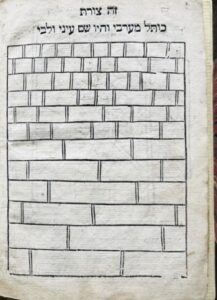
Many Hebrew books include a depiction of the Temple Mount, represented by the Dome of the Rock. However, Lot 43, Zikrohn Yerushalim, published in 1742, consists of a depiction of the Dome of the Rock (surrounded by a Medieval wall and town) but broke new ground in depicting the Kotel to represent the Jewish Temple. This is the first time the Kotel ever appeared in a Jewish book. Yet, only in the 19th century did the Jewish books fully transition to the Kotel rather than the Dome of the Rock.

There are two notable works by R. Emden, his Siddur, (lot 52), and R. Azreil Hildeshiemer’s copy of Meor u-Ketziah (lot 175). This edition of the Siddur is especially important as most of the reprints (until recently) only included the commentary, and the actual text of the Siddur did not reflect many of R. Emden’s approaches and, frequently, a direct conflict between the commentary and the text.

There are some very rare antiquarian books, an incunabulum from Radak, (lot 149), published in 1486 by Soncino. Lot 148 is a leaf from a manuscript of Rambam’s commentary of the Mishna dated to 1222 and transcribed in Yemen. One of the rarest Bomberg volumes of the Talmud is Mesechet Avodah Zarah, lot 32. Of course, because this tractate discusses non-Jews and their relationship to Jews, it was particularly fraught. Indeed, after the resumption of the printing of the Talmud in Basel after the ban in the early 16th century, it omitted this tractate entirely. (There are also two other Bomberg volumes, lots 3334).

Eliyahu HaBakhur (Elia Levita) wrote one of the earliest grammar and dictionaries of Hebrew and Aramaic in the modern period. Lot 86, is the first edition of his Sefer HaBakhur, Isny, 1541.  A more recent reprint was subject to censorship due to including a particular commentary.  See our discussion, “A New Book Censored.”

There are also a few books that contain noteworthy illustrations. Lot 87 is Tzurat ha-Arets, Basel, 1546, which includes astronomical images. Lot 89, is an edition of the fundamental kabbalistic work, Razeil ha-Malakh, that depicts the star of David and kabbalistic amulets.

The issue of rabbinic pay appears to have affected even the greatest of rabbis. Lot 205 is a letter from R. Chaim Ozer to the Vilna community pleading for a raise because he is so destitute that “he will not have money for rent or food.”

In all, there are a number of highly collectible items, and the catalog is certainly worth a closer look.


*This is part our series on upcoming auctions, “Auction Highlights.” These provide the opportunity to revisit previous posts and provide short notes about books and other related items.


Special Sale

Special Sale

By Eliezer Brodt

פרנס לדורו, התכתבות ר’ אליעזר ליפמן פרינץ עם חכמי דורו, ההדיר וביאר מאיר הרשקוביץ, עורכת ראשית אלס בנדהיים, ערך והקדימם מבואות ר’ נריה גוטל, ירושלים תשנ”ב, 503+ 45 עמודים

פרנס לדורות, ר’ אליעזר ליפמן פרינץ הגהות ומאמרות, ההדיר וביאר מאיר הרשקוביץ, עורכת ראשית אלס בנדהיים, ערך משנה ר’ נריה גוטל, ירושלים תשנ”ט, 496 +15 עמודים.

About twenty years ago I discovered two remarkable seforim titled Parnas Ledoro and Parnas Ledorot in a library. Baruch hashem at the time I was able to find copies to purchase. Eventually I found some more copies and was able to supply them to some other friends.

These two volumes are beautifully produced and are “must owns” for those interested in the kind of works that contain fascinating bibliographical materials along side correspondences with many Gedolim and other “book people”. Just to Highlight some of the who’s who that the author R’ Eliezer Liepman Philip Prins corresponded with was the Netziv, R’ Chaim Berlin, R’ Meir Yona, His son R Mordechai, R’ Yaakov Shor the Chafetz Chaim and many others. In addition, the volumes include his glosses on Shas, the Yosef Ometz, Netziv , and numerous articles he wrote. These volumes are fully annotated, along with introductions to each letter, full of valuable background material.

In a recent, beautiful Tablet Magazine article devoted to the Person Behind the production of these remarkable volumes, Mrs. Els Salomon-Prins Bendheim, Dr. Theodor Dunkelgrun writes:[1]

Els Salomon-Prins Bendheim, who died this past January in her hundredth year, happened upon a spectacular library, a collection of more than 6,000 manuscripts, printed editions, and ephemera, when she first visited Jerusalem in 1949 at the age of 26. The library was the life’s work of the Dutch scholar Eliezer Liepman Philip Prins (Arnhem 1835-Frankfurt 1915). Els Salomon-Prins Bendheim was his granddaughter. With time, she discovered, the library had become an archive of sorts. The margins teemed with manuscript annotations and tucked between the pages she found letters from some of the most prominent rabbis and scholars of the 19th and early 20th centuries. The encounter with his books lit a double flame of love and learning within her, and she devoted the rest of her life to safeguarding her grandfather’s memory by editing his correspondence and his marginalia, in Hebrew and in Dutch, faithfully trying to capture the portrait in his library.

Dr. Theodor Dunkelgrun than goes on to describe:

Mrs. Bendheim… gave me copies of the three books (two in Hebrew, one in Dutch) that she had devoted to her grandfather: Liepman Philip Prins: His Scholarly Correspondence (1992), Liepman Philip Prins: His Scholarly Contribution (1999) and Marginalia: An Amsterdam Scholar from the Mediene (2001). Together, those books painted a portrait of a remarkable figure—a learned independent scholar, book collector, contributor to Jewish scholarly journals of the late 19th and early 20th centuries as well as to the Dutch Jewish press. From his home in Arnhem, he had set out to connect with the leading Jewish figures of his time. Eventually, his correspondents would include Solomon Buber, Meir Friedmann (Ish-Shalom), Solomon Geiger, Louis Ginzberg, Esriel Hildesheimer, British Chief Rabbis Nathan Marcus Adler and Herman Adler, Yisrael Meir Kagan (the Chafetz Chaim), Naftali Zvi Judah Berlin (the Netziv), his son Chaim Berlin, and Samson Raphael Hirsch.

It was through his membership of this modern republic of rabbinic letters that Prins had made his greatest contributions to Jewish scholarship, as a connector and go-between with unsurpassed knowledge about the worlds of Jewish scholarship and Jewish books. Aware of the Romm publishing house’s preparations for a new edition of the Babylonian Talmud and with an insider’s intelligence about Amsterdam’s Hebrew printers, Prins managed to secure a unique and invaluable source for Vilna editors to include: a copy of the Frankfurt 1720 edition of the Babylonian Talmud densely annotated by the brilliant Rabbi Jacob Emden (1697-1776) that had come into the possession of Amsterdam’s Proops printing family (Emden’s copy of the Talmud survived, and came to Jerusalem in 1934 when the National Library acquired books and manuscripts from the Romm printing house).

The inclusion of her grandfather’s glosses on Tractate Hullin in the “Vilna Shas” and the acknowledgement of his contribution to what became the Talmud’s canonical edition in the Acharit Davar (the publishers’ general epilogue at the end of Tractate Niddah) were the source of Mrs. Bendheim’s greatest yichus. Several years later, Prins supplied the Moravian scholar David Kaufmann with one of two surviving manuscripts to use for the first edition (1896) of the memoirs of Glikl bas Leib of Hameln (1646-1724), the most important surviving ego-document of any Jewish woman written prior to modern times.

For a short time only these two volumes are available for purchase ($24 for the TWO volumes before shipping). For more information about this email me at Eliezerbrodt-at-gmail.com.

Part of the proceeds will be going to support the efforts of the the Seforim Blog.

Here are the TOC of the two volumes.

Volume I:

Volume II:.

[1] Reprinted here with Permission from the Author.


The Anatomy of an Auction: A Previously Undissected Body of Literature on the History of the Jews and Postmortem Dissection

The Anatomy of an Auction: A Previously Undissected Body of Literature on the History of the Jews and Postmortem Dissection

 Rabbi Edward Reichman, MD 

The issue of autopsy and postmortem dissection has been exhaustively explored in halakhic literature.[1] If I were to ask where and when we find the first halakhic discussion about this topic, the immediate response would invariably be the teshuva of the Noda biYehuda, from the late eighteenth century.[2] It may be time to rewrite the medical halakhah history books. On Sunday, May 21 Genazym Auction House held its fifteenth auction. Lot #133 was a work entitled Pachad Yitzchak.

There are multiple works throughout history that bear the title Pachad Yitzchak. The modern reader will surely think of the work of Rav Yitzchak Hutner. The reader of this blog may also think of the first multi-volume halakhic encyclopedia, authored by Rabbi Dr. Yitzchak Lampronti (1679-1756). The volume offered for auction by Genazym is an earlier lesser-known composition of the same name by Yitzchak Hayyim Kohen me-haHazzanim (AKA Isaac Vita Cantarini)[3] published in 1685. 

Buried in Cantarini’s obscure work, in a section peripheral to the main theme of the book, we find a vivid and poetic description of a tragic incident relating to anatomical dissection.[4] Viewed in isolation, this incident merits historical attention due to its gravity. Yet, it merely reflects a much larger historical chapter about the Jews and postmortem dissection which long preceded the time of the Noda biYehuda and has remained largely undissected until now. But first a word about this work, its provenance and its author. 

The Work- Pachad Yitzchak (Amsterdam, 1685)[5]

The main subject of this work is the tale, told in poetic fashion, of the miraculous salvation of the Jewish congregation of Padua during the Austrian-Ottoman War in the year 1684. War erupted between the Austrian and Ottoman Empires in the year 1684 over the city of Buda (today part of Budapest). The virulently anti-Semitic Christian ruler of Padua spread a libel accusing the Jews of supporting the Muslim Turks in their battle against the Austrian Empire. His incitement caused an enraged crowd to break into the Padua Ghetto, yet the Jews miraculously persuaded the Venetian government to subdue the outburst. The Jews of Padua declared the 10th day of Elul as their Second Purim in gratitude for their miraculous salvation. This holiday was celebrated for many generations thereafter. 

However, the work also includes many additional unknown details of the history of the Jewish community and its rabbis. It is from this aspect of the book that we draw our discussion. 

Provenance

Regarding the item’s provenance, it was previously part of the William Gross Family Collection,[6] a significant portion of which has been recently sold at auction by both Kedem[7] and Genazym auction houses. Gross is a well-known prominent collector of Judaica and Hebraica and the selling of his collection is of historic significance. To see the collection of precious items united under one roof now become redistributed and disseminated across the world necessitates a moment of pause and reflection. Yet, this is the life cycle in the world of bibliophilia.[8] For centuries, passionate bibliophiles spent lifetimes amassing extraordinary and unique collections, only to have them subsequently sold piecemeal (for a variety of reasons) while still alive, or by less passionate heirs after death. Sometimes, however, collections are sold en bloc. An allusion to one such example is the image which appears on the bottom of the title page of the copy of Pachad Yitzchak sold at auction.  

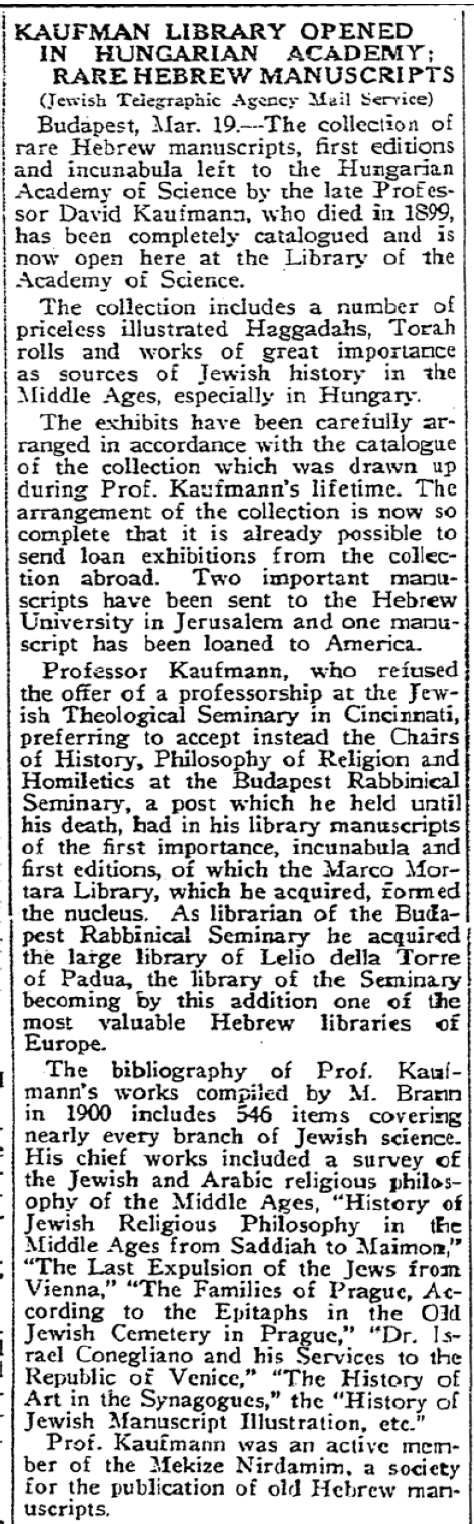
This stamp, which is not mentioned in the catalogue description, indicates that this volume was previously part of the collection of Professor Lelio Della Torre. Della Torre was an Italian Jewish scholar of the nineteenth century, and prolific author, who served as a professor of Talmud and rabbinics at the rabbinical seminary in Padua, where Shadal also taught, from 1829 until his death in 1871. During this time, he was an avid collector of Hebraica. David Kaufmann, himself a renowned scholar and bibliophile, sought to procure Delle Torre’s collection upon the latter’s death. Kaufmann not only acquired Della Torre’s collection, but also that of Marco Mortara, a student of Shadal, and later Chief Rabbi of Mantua. Mortara’s collection in turn contained the library of Samuel Della Volta, whose life, work and library we discussed in this blog.[9]  All of these collections are now housed in the Hungarian Academy of Sciences Library in Budapest, to which Kaufmann bequeathed his library. This volume from Della Torre’s library somehow escaped the grasp of Kaufmann and traversed a different path, ultimately landing instead in the Gross Family Collection.[10]

The Author- Yitzchak Hayyim Cantarini (1644-1723)[11]

The Cantorini family were a prominent family of Kohanim who were also associated with the cantorial profession – hence the name Cantarini, or MinHaHazanim, as their Hebrew name reflects. Isaac Cantarini graduated from the University of Padua Medical School on February 11, 1664, one of many Cantarinis who earned their medical degrees from the university.[12] He authored a number of congratulatory poems in honor of Padua medical graduates.

After graduated from Padua, Cantarini went on to become a leading figure in Italian Jewry. He is considered one of the greatest Torah sages of his time, and his responsa have been published in both Yitzhak Lampronti’s Pachad Yitzhak and Samson Morpurgho’s Shemesh Tzedakah.[13] Cantarini wrote halakhic, historical, and homiletic works, as well as medical treatises in Latin. He was a poet, author, physician, and consummate orator; non-Jewish clergy and lay people attended his Shabbat sermons. In the year 5460 there were so many non-Jewish visitors in synagogue when he spoke that the regulars had to ascend to the women’s section (ezrat nashim) to pray.[14] He was a teacher of both Rabbi Moshe Hayyim Luzzatto (Ramchal),[15] as well as Rabbi Yitzchak Lampronti.

Non-Jews sought Cantarini’s sage advice as well, as evidenced by his correspondence with the Christian intellectual Theophilio Ungar.[16]

Cantarini was known by his initials יחכם. He was also quite adept at word play, and Shadal mentions but one small example of his utilizing the acronym of his name in the introduction to a kinah he composed upon the passing of Rabbi Yehuda Briel:[17]

Shadal takes a stab at solving the riddle.

A Fearful Story in Pachad Yitzchak

The following story appears in the pages of Pachad Yitzchak.[18] On the 17th of Shevat 5440 (שנת מ”ת as per Cantarini), a young man by the name of Hananel (AKA Graziadio) Levi[19] died in the Ghetto. His body was prepared for burial, but in the interim, a band of raucous students from the University of Padua stormed the Ghetto, kidnapped the body, and whisked it away to the anatomy room in preparation for dissection and medical student instruction. The Jewish community was in an uproar, riots ensued, and all political channels were pursued to secure the return of the body. When initial efforts failed, some members of the Jewish community on their own initiative attempted unsuccessfully to enter the anatomy lecture hall under cover of night to procure the body. Ultimately, after one week, negotiations succeeded, and the Jews were promised by the University that they needn’t worry about similar infractions in the future, and that the bodies of the Jewish community would no longer be forcefully taken for anatomical dissection. 

Anatomy, the Jews, and the University of Padua- An Undissected Body of Literature

This frightening incident recounted in Pachad Yitzchak is significant in its own right, but here we situate it as part of a much larger narrative of anatomy, the Jews and the University of Padua, which began over a century earlier.

Since the Middle Ages, individual Jewish students experienced numerous hurdles to the completion of their medical training, many rooted in discrimination and antisemitism. It was sometime around the 16thcentury, however, as the result of the synchroneity of two major historical developments, that Jews, as a group, first encountered a new major challenge to their medical education. This challenge, unlike any previous, did not originate with their non-Jewish colleagues or institutions, but was self-imposed by the Jews. Its consequences however were no less severe.

In the beginning of the fifteenth century, the University of Padua became the first European university to officially allow admission of Jewish students for medical training.[20] This policy led to a gradual influx of Jewish students and the creation for the first time in history of a significant Jewish presence and recognizable entity in a consistent fashion on a university campus.[21] This positive development for the broader Jewish community[22] unwittingly evoked unanticipated consequences.

Simultaneous with the expansion of the Jewish community in Padua, a young professor on campus was quietly revolutionizing the study of anatomy. Andreas Vesalius, who arrived in Padua in 1537, began to hold frequent public and private anatomical displays and approached the study of human anatomical dissection in a systematic fashion not previously attempted.[23] He would later come to be known as the founder of modern anatomy. With his innovations came the expansion of the anatomy course in Padua. Anatomy became identified from then on as the most essential course in medical training, and Vesalius, along with the University of Padua, were leading the revolution. 

The Ramifications of Vesalius’ Contribution for the Jewish Community

Vesalius’s work formalized and expanded the teaching of human anatomy at the University of Padua, as well as at medical schools throughout the world. With the expansion of the course came the necessity to supply more cadavers for the dissection tables. To procure cadavers for the anatomy course, the university turned to both the judicial system as well as its students and their communities. Executed criminals served as one steady source of cadavers, but this did not suffice. 

Grave robbing became commonplace in order to supplement the source of bodies. The practice was even encouraged by Vesalius and, though technically illegal, was unofficially tolerated by the government. A ducal document from 1549, during Vesalius’s tenure in Padua, condemns grave robbing,[24] but the ever-present fear and reality of the practice also affecting the Jewish cemeteries.[25] Indeed, one scholar has suggested that one of the historiated letters in the Fabrica specifically depicts a scene of the grave robbing of a body from a Jewish cemetery.[26]

The scene depicts putti (cherubic figures common in Renaissance art) removing a body from a grave. The “o” on the flag held by one of the putti was the symbol Jews were required to wear on their clothing and may reflect that this was a Jewish cemetery depicted.

The emphasis on anatomy begun by Vesalius would continue long into the future. Soon the university would further invest in this venture by building the first example in the world of a permanent anatomical theater, completed in 1595 (after the death of Vesalius), created for teaching anatomy through the dissection of corpses. The theater still stands to this day. 

The supply of cadavers was a perennial challenge for the medical school, and as a result, the university sought additional creative ways to address the issue. At some stage they instituted each community which sent medical students for training at the university would be required to provide a certain number of bodies for the dissection table.[27] The Jewish community, like others on campus, was expected to provide cadavers for the yearly anatomy course. However, the Jewish students and community took issue with this expectation. As elated as Jews were to walk the halls of a premier university for the first time in history, this privilege would not compel the abrogation of ancient Torah principles. Jewish law forbids the dissection of the human body after death absent mitigating circumstances yielding direct and immediate life-saving benefit from the procedure.[28] The prohibitions of desecrating and deriving benefit from the corpse, as well as the obligation to bury the body preclude routine dissection or autopsy. 

This refusal of the Jews to provide bodies sparked outcry from both the university and its students. The tension created from this conflict would play out over centuries. It is reflected, for example, in multiple recorded incidents of Padua medical students attempting to kidnap Jewish bodies to provide for the anatomy course.[29] Although we have no starting date, already in the earliest Vesalian and post-Vesalian days in Padua a compromise was struck with the Jewish community providing a hefty financial compensation to absolve them from the cadaver obligation. However, this was not a one-time incident, and the anatomy issue persisted, with frequent renegotiation of terms over the years and increased tension resurfacing periodically. Despite the Senate’s repeated pronouncements, frequently the graves in the Jewish cemetery were violated. It was not uncommon for gravely ill patients to be transported out of Padua for fear of being dissected upon their death.[30] The Jews were compelled to construct secret hiding places in the Ghetto where the bodies could be concealed until the funeral. Often, they buried the dead under the cover of night to avoid the dissection table.[31]

One would have expected to find halakhic responsa from 16th and 17th century Italy discussing this topic, but the extant halakhic literature is silent. The first cases discussing autopsy only surface in the late 18th century. We do however find reference to this ongoing issue in the Padua Jewish community archives as well as in the administrative records of the city and University of Padua. We share these documents here, many for the first time. While not enshrined in the extant responsa literature, this community response to anatomical dissection surely reflects the considered rabbinic opinion and halakhic analyses of the local Padua rabbinate, to whom the community deferred on such matters. Prominent rabbis who served the Padua community, or were connected with the medical students during the period under discussion include Maharam Padua (1482-1565), Rabbi Yehuda Arye de Modena (1571-1648) and Rabbi Yehuda Briel (1643-1722), Rabbi Dr. Isaac Hayyim Cantarini (1644-1723), Rabbi Dr. Isaac Lampronti (1679-1756), and Rabbi Dr. Shimshon Morpurgo (1681-174), among others, and it is more than likely that they were involved, to some extent, in the discussions of the Jewish community regarding the provision of bodies to the medical school. 

The Padua Jewish Community Archives[32] 1624-1626

The Jewish community archives of Padua contain at least five entries from 1624 to 1626, discussed below, which directly address the anatomy issue. Daniel Carpi, the scholar of Italian Jewish history who transcribed and edited the archives, noted that since the Jews first settled in Padua the medical students requested from the Jewish community to provide to the university a specific percentage of Jewish bodies for use in the teaching of anatomy. The Jews refused and arranged a compromise to pay an annual ransom to absolve them from this obligation. However, the tension related to this matter never ceased, be it because the university continually raised the fee, or because they sometimes would only suffice with the supply of actual corpses for dissection. 

It is in this context that a tragic incident occurred in 1624 which frightened even the non-Jewish community. A group of students, led by a young anatomy professor, interrupted a Jewish funeral procession and attempted to kidnap the body. The agreement discussed in the first archival entry below appears to come on the heels of this incident in the hopes of preventing similar occurrences in the future.

April 19, 1624 (entry #545) compromise with the students during the season/days of dissection

In that the spirit of God has enlightened the esteemed philosopher Senior Cesare Cremonin to declare freedom (from dissection) for our deceased, through the continued annual designated payment to the students of the College of Arts, generation after generation. As a result, they are obligated to allow us to properly bury our dead during the season of dissection, lest anyone fear. Any violators will be fined, and they have coordinated with us to obtain from the government permission for a required fine for all who violate this agreement in a way amenable and sufficient for our needs. The aforementioned master Cesare and Yehudah Katz have already spoken on this matter and have begun discussion regarding the amount the Jewish community is willing to pay for this privilege. Therefore, to facilitate successful completion of these dealings, which will result in a salvation for our community, we present a parti to designate two members of our community,[33] even though they are not members of the committee, to negotiate directly with the aforementioned esteemed philosopher a sum which will then be presented to the community and the committee for a majority vote. 

Subsequent entries reflect the lengthy process of negotiation, implementation, and enforcement. A follow up entry from July 15, 1624 (entry # 554) states that the negotiations had been completed and a sum had been agreed upon with the government representative. The request is to approve the amount and facilitate payment. 

 An entry in the Padua University Archives from December 28, 1624 (pictured below) sheds a slightly different light on the negotiations, which may not have been officially ratified by the university.[34]

Here the university confirms an earlier privilege granted to the Jewish community by which those Jews studying medicine were granted free access to the anatomical theater, and the corpses of deceased Jews were to be left untouched by anatomical dissections due to strong religious objections to the procedure. For this privilege the Jews paid an annual sum of 100 Venetian pounds. The entry concludes, “the final decision on this proposal was delayed until the arrival of the “perillustris domini syndic.”[35] Parenthetically, this reveals that the agreements between the Jewish community and the university regarding Jewish cadavers date back to an earlier time.

An entry in the Jewish community archives some three weeks later (Entry # 566- January 21, 1625) corroborates the delayed decision of the university. It reiterates the need to arrive at an agreement between the Jewish community and the university to prevent the taking of Jewish bodies. A maximum fee of ten Ducat is set. This may have been a counteroffer to the much higher request of 100 ducats and explains why a specific number is mentioned here but not previously. 

May 17, 1626 (Entry #616)
Yet another entry reveals a creative solution to prevent grave robbing during the semester of anatomy.

Regarding designating two community representatives with the power to negotiate with Aharon Altarini to allow temporary burial[36] on his property (for community members) during anatomy season. They are granted permission to spend as much as necessary to appease those who oppose this practice.

While grave robbing was typically done secretly under the cover of night, some claims for Jewish bodies were more brazen. The entry of November 15, 1626 (Entry # 627) mentions a disturbing incident (mikre bilti tahor) of the interference of the medical students of Padua with the Jewish funeral procession of the wife of Moshe Fano (miPano). The incident, reminiscent of earlier similar episodes, appears to have been minor and fortunately did not escalate. Nonetheless, it precipitated another plea to find a long-term compromise with the university regarding the anatomy issue.

The Decree of 1672[37]

 On November 23, 1672, there was a decree reaffirming the Jews’ exemption from providing bodies for dissection and warning those who attempt to disturb the funerals or graves of members of the Jewish community. This decree appears in Jewish and governmental documents discussed below. It is unknown to me if or whether a specific historical event precipitated this reaffirmation.

The Case of Graziadio Levi and the Riots of 1679 

Here we position the story from Cantarini’s Pachad Yitzchak, occurring over a century after Vesalius’ expansion of the field of human anatomy with its subsequent creation of major halakhic and social problems for the Jewish community and its medical students. The event described by Cantarini which transpired in 1679[38] may have been the tipping point which led to a more serious and sustained response from the university. Following the death of a young Jew, Graziadio Levi, armed students stormed the Jewish ghetto in great numbers, kidnapped the corpse and brought it to the medical school in preparation for dissection. Riots ensued[39] and much effort was marshaled to rescue the body and provide a proper Jewish burial. The incident led to the issuance of a ducal letter dated February 27 of that year which rued the incident and emphatically reaffirmed the commitment by the university to protect Jewish corpses.[40]  As we have discussed, the events surrounding that fateful night in 1679 were recorded for posterity by Isaac Hayyim Cantarini in his Pachad Yitzchak. In the context of his recounting of the Levi affair, Cantarini mentions the earlier decree from November 23, 1672, protecting the bodies of the community from dissection. 

A record of the full 1679 decree is found in the Padua Civic Archives,[41] a copy of which I procured and present below. The name of Graziadio Levi is explicitly mentioned in the decree.

Ciscato transcribed the full text of the decree.[42]

The Central Archives of the History of the Jewish People possesses yet another record of the anatomy decrees. This unadorned document is a certified “copia” of the two decrees of 1672 and 1679.[43]

This was perhaps intended for archival records as opposed to public display. 

University (Governmental) Decrees Regarding Jewish Cadavers from 1672 to 1721

The Central Archives of the History of the Jewish People possesses yet another document, even more remarkable, related to the Padua anatomy decrees.[44] It includes not only one or even two decrees, but appears to be a summary or record of multiple decrees on the subject of cadavers, anatomy training at the medical school of Padua, and the Jewish community, spanning from 1672-1721. It includes the decrees of November 23, 1672, and February 27, 1679, as well as others. Furthermore, the presentation of these decrees, as an attractive broadside with calligraphy and illustrated header, indicates that it was likely intended for public display.[45]

Conclusion

In an obscure work published in 1685, recently offered for auction, appears an account of a tragic event involving the Jewish community and the dissection of human cadavers at the University of Padua. We have placed this seemingly isolated incident into a much broader historical context, fleshing out this chapter with new supportive archival material. For hundreds of years, beginning in the late sixteenth century, the Jewish community negotiated with the university for the right not to have Jewish bodies used for the anatomy course. There is no question that the local rabbinate of Padua must have been involved in these discussions and negotiations, though to what extent remains unknown. Refusal of the Jewish community to provide cadavers for dissection created major problems for both the many Jewish medical students who attended the university as well as for the Jewish community at large. The Jewish community’s restrictive position was premised entirely on halakhic grounds and would not have been sustainable throughout this lengthy period without significant rabbinic backing and support. Thus, while the extant published literature on autopsy begins with the Noda biYehudah in the late eighteenth century, there is little doubt that the halakhic discourse on the topic of anatomical dissection began long before.[46]

[1] For general discussions on anatomy and autopsy in Jewish law, see Kalman Kahana, “The Dissection of the Dead in Jewish Law: A Bibliography,” (Hebrew) haMa’ayan 7 (Tevet, 5727), 45-72; Avraham Steinberg, HaRefuah KiHalakhah 6 (Jerusalem, 2017), 512-550; Zev Farber and Irving Greenberg, “Autopsies I: A Survey of the Debate,” in Zev Farber, ed., Halakhic Realities (Maggid Books: Jerusalem, 2017), 323-417.
[2] For a discussion of the historical context of this teshuva, see Edward Reichman, “A Tale of Two Stones,” in The Anatomy of Halakha (Maggid/OU/YU Presses, 2022),
[3] Cantarini and Lampronti share at least one thing in common. They are both graduates of the University of Padua Medical School. Indeed, the passage in Cantarini’s work upon which I draw relates directly to the medical training at the university.
[4] This incident we describe transpired years before the so-called Purim of Buda (or Padua).
[5] The description of the work is drawn from the William Gross Collection Item Description, which is reproduced in the Genazym catalogue. See also M. Heller, The Seventeenth Century Hebrew Book (Brill, 2011), 1077.
[6] On Gross and his collection, see Shalom Sabar, Emile Schrijver, and Falk Wiesemann, Windows on Jewish Worlds: Essays in Honor of William Gross, Collector of Judaica on the Occasion of his Eightieth Birthday (Zutphen: Walburg Pers bv., 2019).
[7] In Kedem’s recent auction of items from the Gross Family Collection (Auction 92, May 2, 2023) we find two items of medical historical interest, one less obvious than the other. The first item is Mikne Avram (Venice, 1523), a Hebrew grammar work written by Avraham de Balmes (Auction 92, Part 1, Lot 4). De Balmes was a physician and his medical diploma from Naples, from the auspicious year of 1492, is the oldest extant Jewish medical diploma, now housed in the Braginsky Collection. On this diploma see, Giancarlo Lacerenza and Vera Schwarz-Ricci, “Il Diploma di Dottorato in Medicina di Avraham ben Me’ir de Balmes (Naploli 1492),” Sefer Yuhasin 2(2014), 163-193. De Balmes was also a student of Yehuda Messer Leon, who has been mentioned numerous times on this blog. Less known is that De Balmes is considered to be the first physician in history to perform a human-to-human blood transfusion. His patient was none other than Pope Innocent VIII. De Balmes transfused blood from three young boys, each of whom was paid a ducat, and infused the blood into the veins of the Pope. According to different reports, the Pontiff “either died or recovered.” See H. M. Brown, “Beginning of Intravenous Medication,” Annals of Medical History 1:2 (1917). Shortly thereafter we find him working in the printing press of Daniel Bomberg.  De Balmes was an expert in Hebrew language and grammar and was sought after by Christians for instruction. Mikne Avramwas published posthumously. A scholarly edition of this work was recently published placing it in the context of contemporaneous linguistic scholarship. See Dror Ben Arye, Mikneh Avram by Avraham de Balmes (Hebrew) (Ramat Gan, Bar Ilan University Press, 2022).

The second item (Auction 92, Part 2, Lot 115) is the spectacular medical diploma of Moshe ben Gershon Tilche from the University of Padua Medical School (1687), which we discussed in Edward Reichman, “Jews, Medicine and the University of Padua: A Behind the Scenes Tour of a New Exhibit at the Jewish Museum of Padua (November 2, 2022- December 31, 2022),” Seforim Blog (https://seforimblog.com), December 1, 2022.
[8] For a lament about the sale and loss of access to great Jewish book collections, see E. Reichman, “The Lost Library by Dan Rabinowitz and the ‘Burial of Souls’ by Yehuda Leib Katznelson: Different Expressions of the Same Sentiment,” The Seforim Blog (April 3, 2019), available at https://seforimblog.com/2019/04/the-lost-library-by-dan-rabinowitz-and-the-burial-of-souls-by-yehuda-leib-katznelson-different-expressions-of-the-same-sentiment/.
[9] E. Reichman, “Samuel Vita Della Volta (1772-1853): An Underappreciated Bibliophile and his Medical ‘Diploma’tic Journey,” Seforim Blog (https://seforimblog.com), November 5, 2021.
[10] When Kaufmann transferred Mortara’s library from Italy to Budapest a number of volumes were also “lost” on the way. See Asher Salah, “La Biblioteca di Marco Mortara,” in Mauro Perani and Ermanno Finzi, eds., Nuovi Studi in Onore di Marco Mortara nel Secondo Centenario della Nascita (Firenze: Giuntina, 2016), 149-168, esp. 157.
[11] On Cantarini, see, Harry A. Savitz, Profiles of Erudite Jewish Physicians and Scholars (Spertus College of Judaica Press, 1973), 25-28; C. Facchini, “Icone in sinagoga: emblemi e imprese nella predicazione barocca di I.H. Cantarini”, in Materia Giudaica, 7 (2002), 124–144. I thank Professor David Ruderman for this last reference. Cantarini’s Jewish legal responsa were published in both Yitzḥak Lampronti’s Paḥad Yitzḥak and Samson Morpurgo’s Shemesh Tzedakah. For his correspondence with the Christian intellectual Theophilo Ungar, see Y. Blumenfeld, Otzar Nehmad 3 (Vienna, 1860), 128-50.  For the definitive work on the Cantarini family, see Marco Osimo, Narrazione della Strage Compiuta nel 1547 Contro gli Ebrei d’Asolo e Cenni Biografici della Famiglia Koen-Cantarini (Casale-Monferrato, 1875). For a comprehensive bibliography on Cantarini, see Asher Salah, La Republique des Lettres: Rabbins, Ecrivains et Medecins, Juifs en Italie au XVIIIe Siecle (Brill: Leiden, 2007), 120-124.
[12] Modena and Morpurgo, Medici, 118; see D. Ruderman, Jewish Though and Scientific Discovery in Early Modern Europe (Yale University Press, 1995), 113-114, regarding families with multiple graduates from the university.
[13] On Morpurgo, See Edward Reichman, “The Illustrated Life of an Illustrious Renaissance Jew: Rabbi Dr. Shimshon Morpurgo (1681-1740),” Seforim Blog (https://seforimblog.com), June 22, 2021.
[14] S. Y. Glicksberg, Ha-Derashah Be-Yisrael (Mosad HaRav Kook, 5700), 203-20.
[15] Ramhal wrote a eulogy for Cantarini. See R. Moshe Hayim Luzzatto, Sefer Ha-Shirim, ed. Y. Zemora (Mosad HaRav Kook, 5710), 4.
[16] This correspondence was published by Shadal. See Y. Blumenfeld, Otzar Nehmad 3 (Vienna, 1860), 128-50.
[17] Ibid.
[18] 45a- 46a.
[19] I discovered a wedding poem written a number of years earlier Graziadio (Hananel) Levi, assumedly the same person, for the wedding of Saul Lustro and Allegra Barukh in 1676. See JTS Library B (NS)CR2.
[20] The university admitted non-Catholics, which included, for example, both Protestants and Jews. On the history of the Jews and the University of Padua, see Edward Reichman, “How Jews of Yesteryear Celebrated Graduation from Medical School: Congratulatory Poems for Jewish Medical Graduates in the 17th and 18th Centuries- An Unrecognized Genre,” Seforim Blog (https://seforimblog.com), May 29, 2022; idem, “Jews, Medicine and the University of Padua: A Behind the Scenes Tour of a New Exhibit at the Jewish Museum of Padua (November 2, 2022- December 31, 2022),” Seforim Blog (https://seforimblog.com), December 1, 2022.
[21] The University of Montpellier was sporadically frequented by Jews in the Middle Ages, but does not compare to Padua, where Jews attended in far greater numbers and had their own student organizations.
[22] To be sure there were residual discriminatory practices towards the Jews at the university. In addition, while the Italian Jewish community viewed this development in a positive light, the Jewish communities in Poland and Germany were more concerned about the possible assimilation of the Jewish students and dilution and diminution of Torah study.
[23] We discuss the relationship of Vesalius to the Jews in Edward Reichman, The Anatomy of Jewish Law (Maggid/OU/YU Press, 2022).
[24] See Ciscato, Gli Ebrei in Padova, p. 297. Later documents, as discussed below, address body snatching in the Jewish community specifically.
[25] Carpi, op. cit., parti 616, discusses a request to delay burial during the season of anatomy at the medical school to preclude grave robbing.
[26] Jeffrey Levine, “Jewish History in Vesalius’s Fabrica,” September 17, 2014 (https://jmlevinemd.com/jewish-history-vesalius-fabrica/).
[27] Paul Grendler, The Universities of the Italian Renaissance (Johns Hopkins University Press, 2004).
[28] See Steinberg, Avraham Steinberg, HaRefuah KiHalakhah 6 (Jerusalem, 2017), 512-550. I realize it may be anachronistic to mention these specific halakhic concerns or formulation, as these were developed later in history starting with Rabbi Yechezkel Landau. Nonetheless, they are halakhic prohibitions and obligations that apply to dissection.
[29] For more on the history of anatomy and graverobbing in rabbinic literature, see Edward Reichman, The Anatomy of Jewish Law (Maggid/OU/YU Press, 2022).
[30] This practice might have violated the prohibition of moving a goses, the halachic equivalent to a “dying person.” A similar question was posed to Rabbi Moshe Stern: Could one move a critically ill patient out of the hospital for fear that, upon his death, his body would be taken for autopsy and dissection without family consent? Rabbi Stern ruled in the negative. See his Be’er Moshe 8, nos. 239, 240, 241, 243. Likewise, Rabbi Moshe Lemberger was asked whether a Kohen physician could expose himself to tum’ah in order to establish cause of death and prevent a likely autopsy. Rabbi Lemberger argues that the Kohen must do so, as this case is akin to a met mitzvah (one who dies without family or friends to bury him). See Lemberger, Ateret Moshe, Yoreh De’ah 2:244.
[31] Hebraische Bibliographie 16 (1876), p. 37.
[32] See Daniel Carpi, Minutes Book of the Council of the Jewish Community of Padua Volume Two: 1603-1630 (Israel Academy of Sciences and Humanities, 1979). All references to the Padua Jewish community archives are from this source. I thank Pia Settimi for kindly bringing these documents to my attention. See also Ciscato, 209-212.
[33] According to Pia Settimi, one of these was Avraham Catalano, who would later coordinate the community response to the plague in Padua in 1631 and author the diary Olam Hafukh about the experience.
[34] ASUPd, ms. 655, f. 13r. I thank Francesco Piovan, Chief Archivist of the University of Padua Archives, for procuring a copy of this document for me.
[35] I am unsure to whom this refers.
[36] The idea of temporary burial was suggested and debated by some prominent rabbinic authorities in the nineteenth century regarding the situation in Cincinnati, OH where graverobbing was rampant. See Reichman, Anatomy of Jewish Law, op. cit., 223-226.
[37] See below for discussion of this decree.
[38] Cantarini lists the Hebrew date of the event as 17 Shevat, 5440. Standard Hebrew date converters place this in 1680, but the Italian decrees all clearly place the year at 1679.
[39] There were broader political issues at play during these riots which are discussed by Cantarini.
[40] See Ciscato, Gli Ebrei in Padova, pp. 299–300; Hebraische Bibliographie 16 (1876), 37. The latter reference discusses an unpublished manuscript by Chaim (Vital) Moshe ben Elisha Cantarini that details this incident. I have been unsuccessful in locating this manuscript. Cantarini, member of an illustrious Italian family comprising many rabbi/physicians, graduated from the medical school in Padua and apparently taught in a yeshiva there as well. As discussed in this essay, this incident is described in great detail by his relative Isaac Chaim Cantarini in the latter’s Pachad Yitzchak.
[41] Archivio civico antico Ducali volume 13 carta 3r. I thank Antonella Ortis for her assistance in procuring this document.
[42] Ciscato, 299. The date of this decree is February 27, 1679. He lists the location as Ducali, Reg. N. N. 123 c. I r.
[43] Ducale: Che sia conservata agli ebrei la facoltà di eseguire le sepolture secondo il loro rito (Emessa in seguito alle proteste degli ebrei contro gli studenti di Anatomia). IT-Pa-47-ovs, Padova – Jewish Community 1679. I thank Ariel Viterbo of the National Library of Israel for bringing this document, as well as the others from the Central Archives, to my attention, and I thank Yochai ben Ghedalia, Yael Franklin and Tami from the Central Archives of the History of the Jewish People for so kindly providing copies of these documents.
[44] 206 Pergamena interessantissima concernente le violazioni di cadaveri degli israeliti che si permettevano gli studenti col pretesto  degli studi anatomici ” =IT-Pa 126 ovs. This broadside does not appear to have been mentioned by Ciscato or Roth, though the decrees were known to them. The Central Archives has another catalogue entry on the dissection of Jewish cadavers in Padua- Sulle violazioni dei cadaveri degli israeliti che si permettevano gli studenti col pretesto degli studi anatomici.  Archivio della Comunità di Padova, n. 206. 8 frames. HM-5157. This is a (poor) microfilm copy of the above broadside, thought the Archives does not identify it as such.
[45] Though he had not seen this document before, Francesco Piovan, the Chief Archivist of the University of Padua remarked, “As far as I can tell from the image, it’s just a summary of laws and decrees. Such summaries (even in print) of private documents and legal norms were quite normal: they can be found, for example, in processual documents. The interesting fact is that your document looks like a kind of ‘manifesto’ (placard), written in beautiful handwriting, and perhaps to be displayed, hung in a frame or fixed on a wooden tablet. In short, it seems destined for public viewing.”
[46] As a postscript, despite the religious limitation of providing bodies for dissection, there was at least some evidence of the interest and fascination amongst the Jews with the new discipline of human anatomy. When Padua’s anatomical theater was first built in 1595, the benches were not only occupied by the registered Jewish medical students, there is record of Jews from the community (non-students) attending dissections. See Cynthia Klestinec, “A History of Anatomy Theaters in Sixteenth Century Padua,” Journal of the History of Medicine and Allied Sciences 59:3 (2004), n. 74. Furthermore, years after the publication of Pachad Yitzchak, when a young Abraham Levi was visiting Padua on his travels, his guide, our very same Rabbi Dr. Isaac Cantarini, as part of showcasing the highlights of the community, included a visit to an anatomy lesson where a cadaver was dissected. Shmuel Feiner, The Jewish Eighteenth Century: A Jewish Biography, 1700-1750 (Indiana University Press, 2020), 242.



Legacy Judaica: Astrological Title Pages, R. Hutner, and Other Items of Note

Legacy Judaica‘s Spring auction is on May 8, 2022. The catalog includes some especially rare first editions, Siddur ha-Shelah, (no. 119), Mesilat Yesharim (no. 45), a volume of the Bomberg edition of the Talmud (lot 10), and some other items of interest.

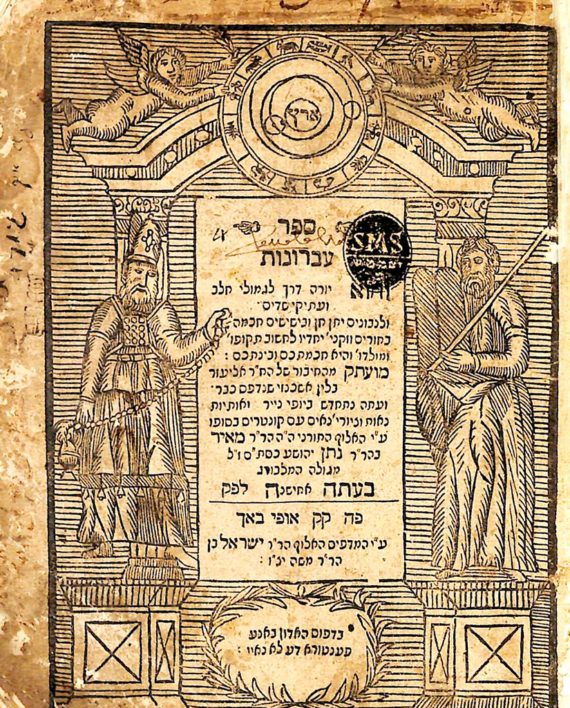
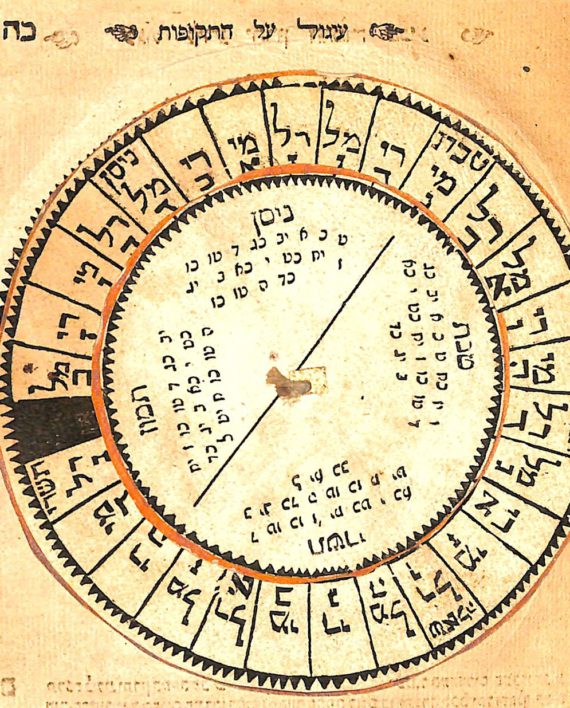
Sefer Evronot, Offenbach, 1722, (lot no. 63) is an unusual Hebrew book because it includes paper cut-outs that are reattached to the book and form an interstellar calculator allowing precise determination of the calendar. Despite the celestial nature of the work, at the top center of the title page, held aloft by putti, is a depiction of the universe. The earth is in the center, but unlike a geocentric approach with the sun circling the earth, there is no reference to the sun, only the planets. The image depicts the orb system of planets and pre-dates even Copernicus’s theory. (See, Ariel Cohen, “The Celestial Host, the Calendar, and Jewish Art,” in Written in the Stars: Art and Symbolism of the Zodiac, ed. Iris Fishof (Jerusalem: Israel Museum, 2001), 18). Israel ben Meir (his father was a noted publisher) and his non-Jewish partner, Bonaventura de Launoy, published the book. (See Marvin Heller, Essays in the Making of the Hebrew Book (Leiden: Brill, 2021), 273-92).

Auction 10 Batch 2 #18b Sefer Ibronos

The Sefer Evronot is not the book for which this title page was designed. Instead, Israel first used the illustration on Abraham ben Hiya’s, Tzurat ha-Arets (Offenbach, 1720). The image is appropriate for the book as it also discusses the solar system’s depiction. This is one of the earliest examples of a title page illustration allusion to the book’s contents and not serving an aesthetic purpose.

Tzurat Ha-Aretz, from the Gross Family Collection

A similar illustration to the title page’s celestial illustration appears in the book. 58a. But the one in the book is less sophisticated than the title page; that one contains a very detailed zodiac. Although it was specifically created for a Hebrew book it didn’t stop the ubiquitous error of depicting Aaron with a bishop’s miter, this time with a cross clearly visible. The Moses and Aaron theme title page first appeared in 1610 in Hanua. One year later, it was used in another book, Nishmat Adam, (lot no. 11), although that one does not have a cross.

The zodiac title page illustration appears on at least two other of Israel’s books that have no association with celestial ideas: a commentary on Birkat ha-Mazon and Zemirot, Mateh Yehuda, (Offenbach,1721) and a Haggadah with the commentary Zera Yehuda (Offenbach, 1721). Israel printed over 40 books, and it is unclear why he decided to use it on these two books that seemingly have no relationship to the image.

There are two items related to R. Hutner’s Torat ha-Nazir. Lot 70, is the first edition published in softcover format in Kovno in 1932. This is the only edition that R. Kook’s approbation appears. The later editions of Torat HaNazir remove it. In some editions, all the approbations are removed and in others, R. Chaim Ozer’s was retained. (although the printers did not alter the original heading, “Letters of the Ge’onim.” See Marc Shapiro, Changing the Immutable (Oxford: Littman, 2015), 157-160.

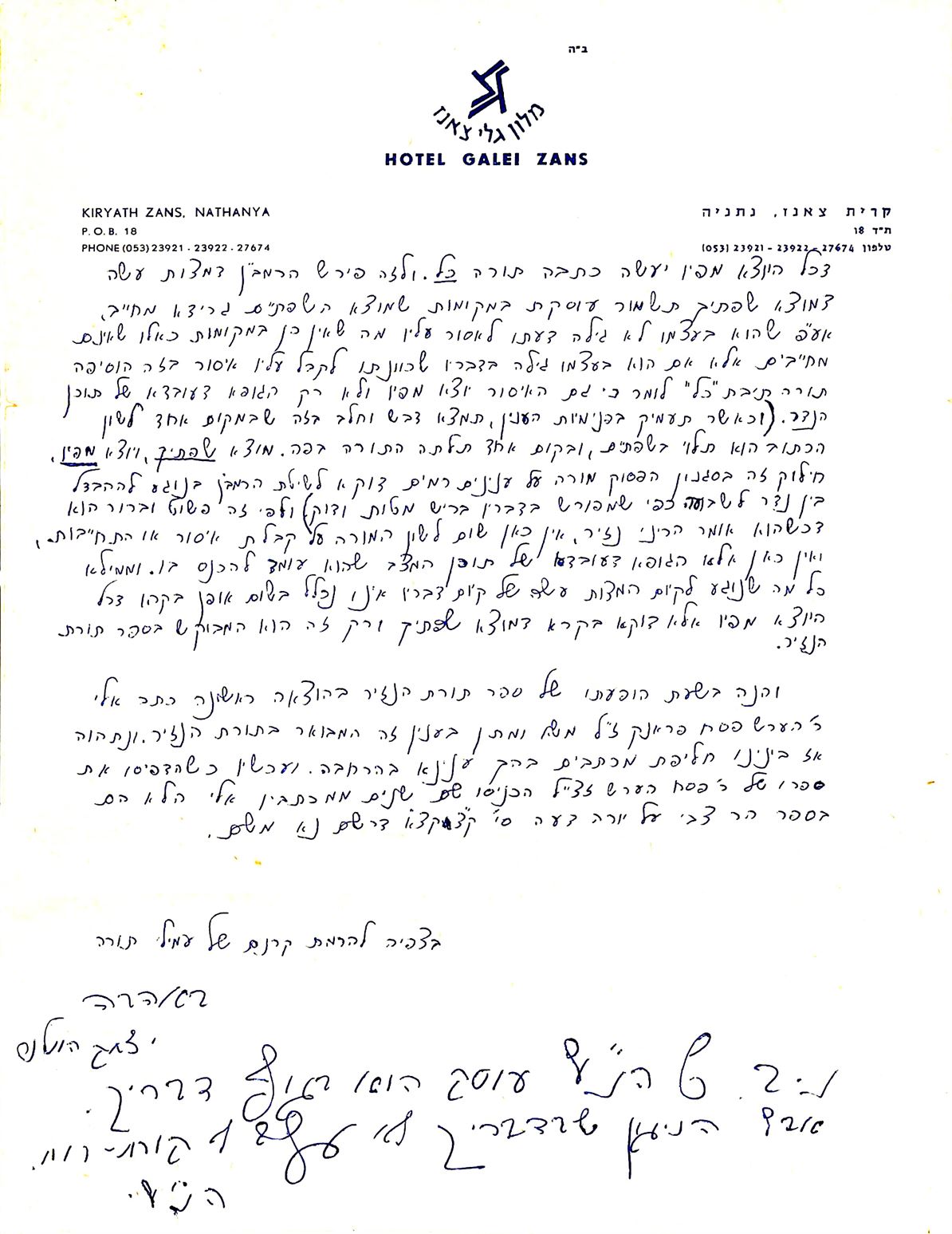
Another item related to the Torat Ha-Nazir is a letter to an unidentified correspondent (lot 236). Apparently, R. Hunter chanced upon that person’s copy of Torat ha-Nazir with their notes. One of which took issue with R. Hutner’s approach, and he defended himself. R. Hutner added a postscript that the tone was inappropriate whatever the objections (in the margins).

Lot 223 is a letter from R. Chaim Ozer regarding cremation.  Although today after the Holocaust it seems difficult to imagine cremation widely accepted by Jews, in the early 20th century, some Orthodox rabbis permitted cremation.  R. Ozer’s letter discusses one the main works, Hayyi Olam.
Lot 77 is two broadsides. One is from a list of Rabbis against Heichal Shlomo, against attending a convention. These Rabbis consistently opposed the creation of Heichal Shlomo and the idea of a Central Organization that controlled and spoke for all Orthodox Jews. The Heichal Shlomo board discussed how best to respond to those objections. Ultimately, Zerach Warhftig, argued against responding as they tried to engage and even discuss changing the name but received no response. (See Protocols of the Merkaz HaRuchani HaOlami, January 28, 1958).

The inauguration of Heichal Shlomo occurred on Lag Be’Omer, 1958, to great pomp and circumstance. The mayor held a cocktail party in the garden, and the gentleman was told to wear suits and hats.

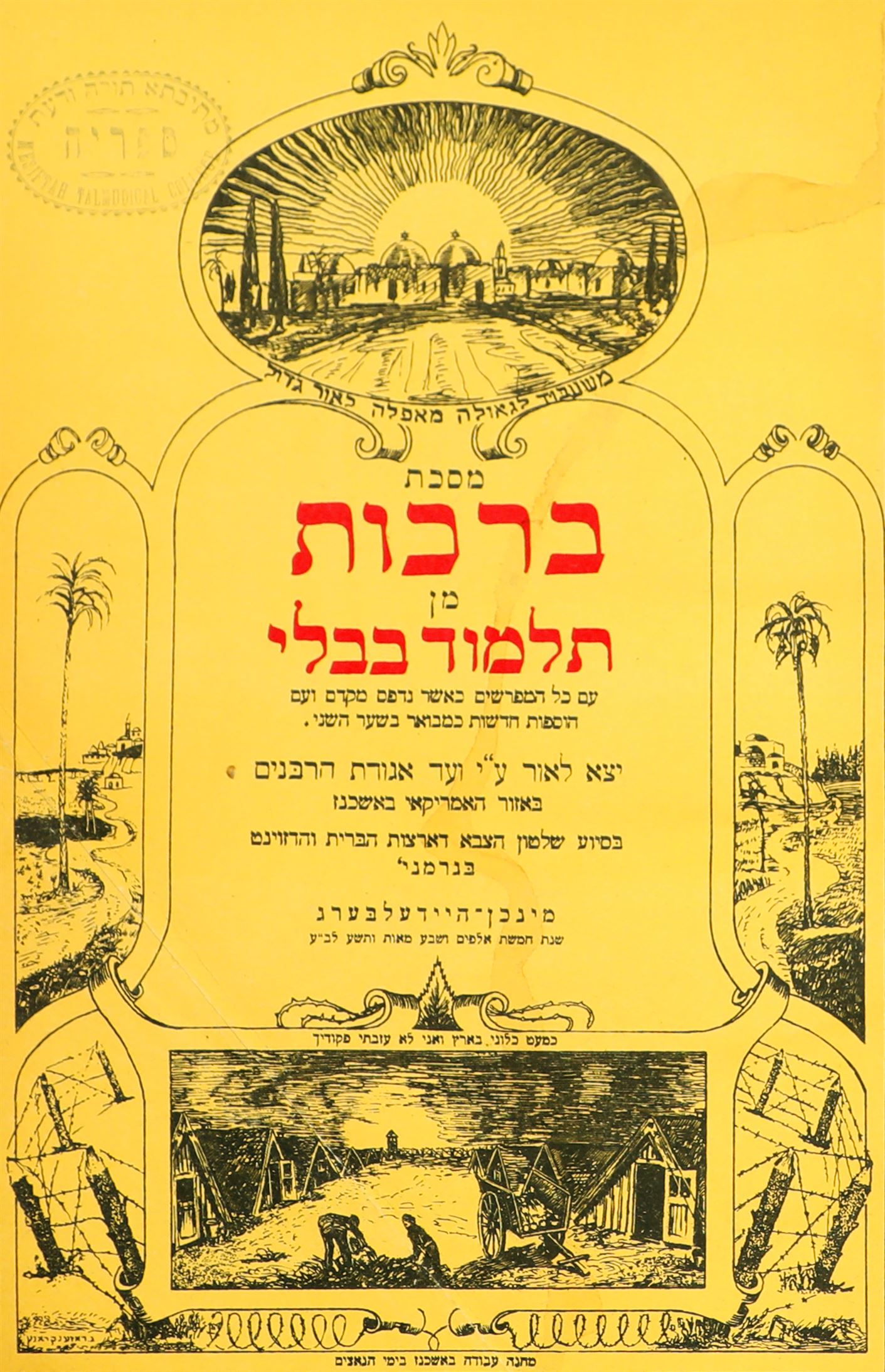
There are both editions of the “Survivors Talmud.” (lots 160 & 161).The first edition, published in Munich in1946, only included Nedarim and Kiddushin. In 1948, the American Army published a complete edition of the Talmud. These are the only editions of the Talmud that any government published before the establishment of the State of Israel. There are three introductions, one in English and two in Hebrew. The English one reads in part:

This edition of the Talmud is dedicated to the United States Army. This Army played a major role in the rescue of the Jewish people from total annihilation and after the defeat of Hitler bore the major burden of sustaining the DPs of the Jewish faith. This special edition of the Talmud published in the very land where, but a short time ago, everything Jewish and Jewish inspiration was an anathema, will remain a symbol of the indestructibility of the Torah. […]

Rabbi Samuel A. Snieg, Chief Rabbi of the United States Zone, “Dedication.”

Munich, Germany, 1948 edition of the Talmud printed under the supervision of the Procurement Division, European Quartermaster General Depot, United States Army.

Interesting personal copies one is R. Chaim Ozer’s Achiezer with his inscription (lot 176), R. Chaim Keanievsky’s personal siddur (lot 181), and R. Yaakov Loberbaum’s, the author of the Nesivot ha-Mishpat, copy of Shev Shema’ata (lot 183) and R Chaim Berlin (item 182) a rare volume of Shut Harshaba that R Hirsch got as a gift from his father (item 179) and two items from the Beis Halevi’s Library (items 192 &194) [One with unpublished glosses].


Dr. Samuel Vita Della Volta (1772-1853): An Underappreciated Bibliophile and his Medical “Diploma”tic Journey

Dr. Samuel Vita Della Volta (1772-1853): An Underappreciated Bibliophile and his Medical “Diploma”tic Journey

Rabbi Edward Reichman, MD

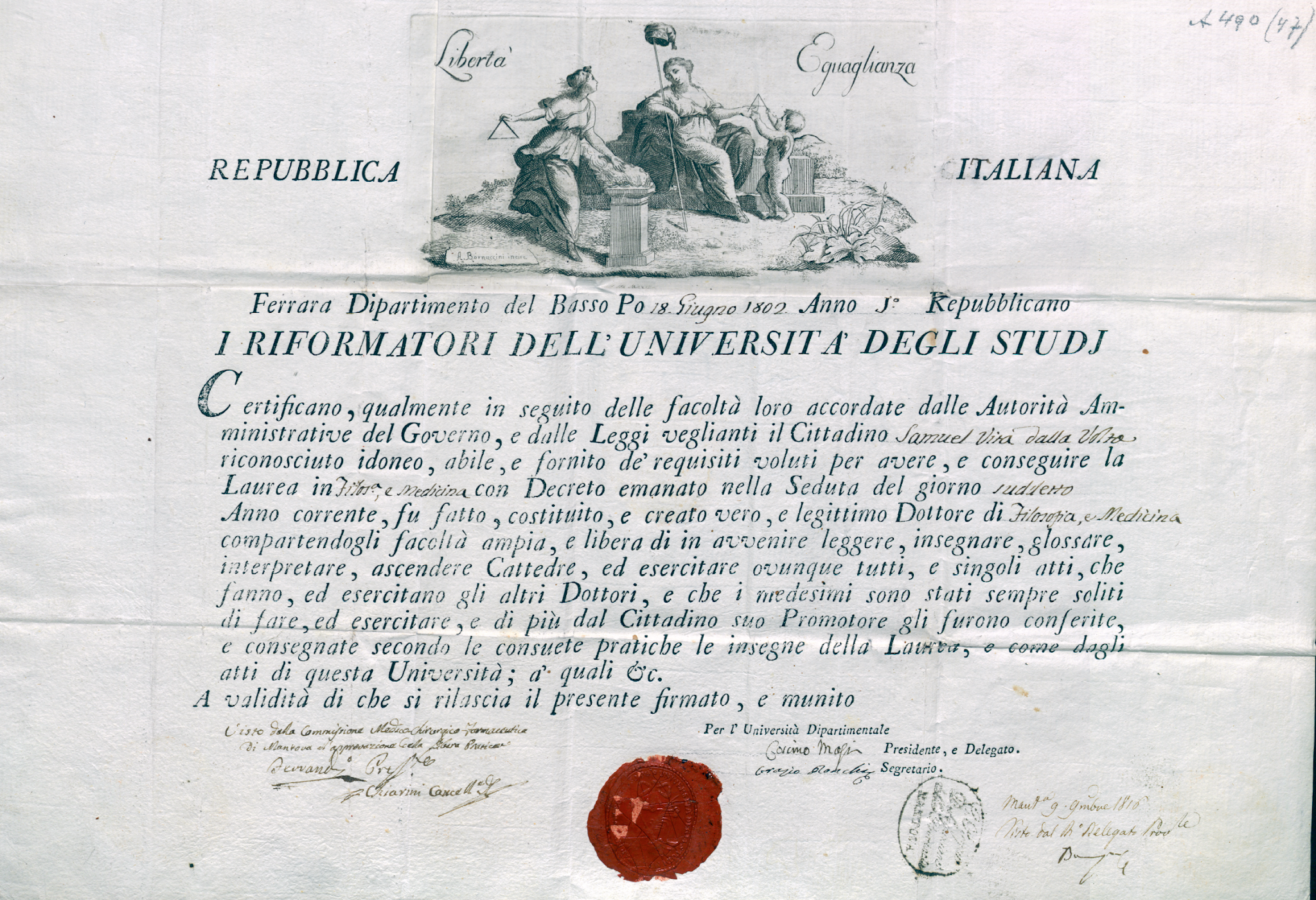
I came upon the name Samuel Vita Della Volta through my usual historical pathway, the world of Jewish medical history, and my continued quest for medical diplomas of Jewish physicians from the premodern era. While the lion’s share of the diplomas I have identified come from the University of Padua,[1] there are some extant Jewish diplomas from other Italian universities, including Siena, Rome, and Ferrara. One of two Jewish diplomas I have procured from the University of Ferrara is that of Samuel Vital Della Volta, a graduate of 1802.

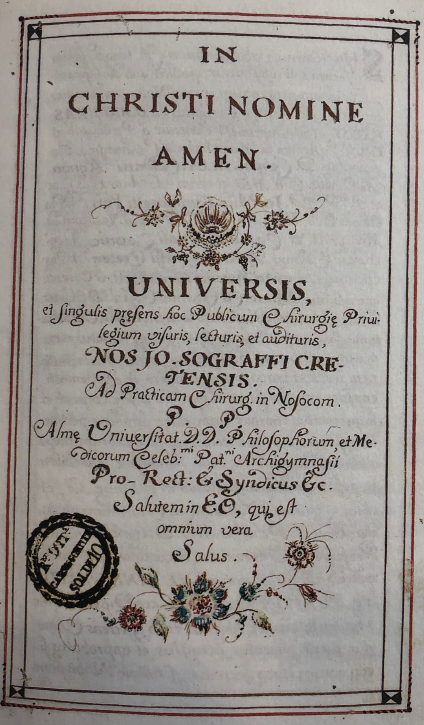
From an artistic perspective, it pales in comparison to the diplomas of his Paduan predecessors. See, for example, the diploma of the 1695 Jewish Padua graduate, Copilius Pictor (AKA Jacob Mehler), below.[2]

In contrast to this profusely hand illustrated spectacular example of Renaissance art, Della Volta’s is a templated diploma with both text and illustration printed. Only the graduate’s particulars are written, or I dare say squeezed in, by hand. To be fair, by this time not all Padua medical diplomas were as ornate as in the past, as evidenced by the diploma of Andrea di Domenico Rossi (Padua, 1788).[3]

However, the university did not entirely abandon its practice of issuing such diplomas, as evidenced by the diploma of Carlo Tomasini (Padua, 1794).[4]

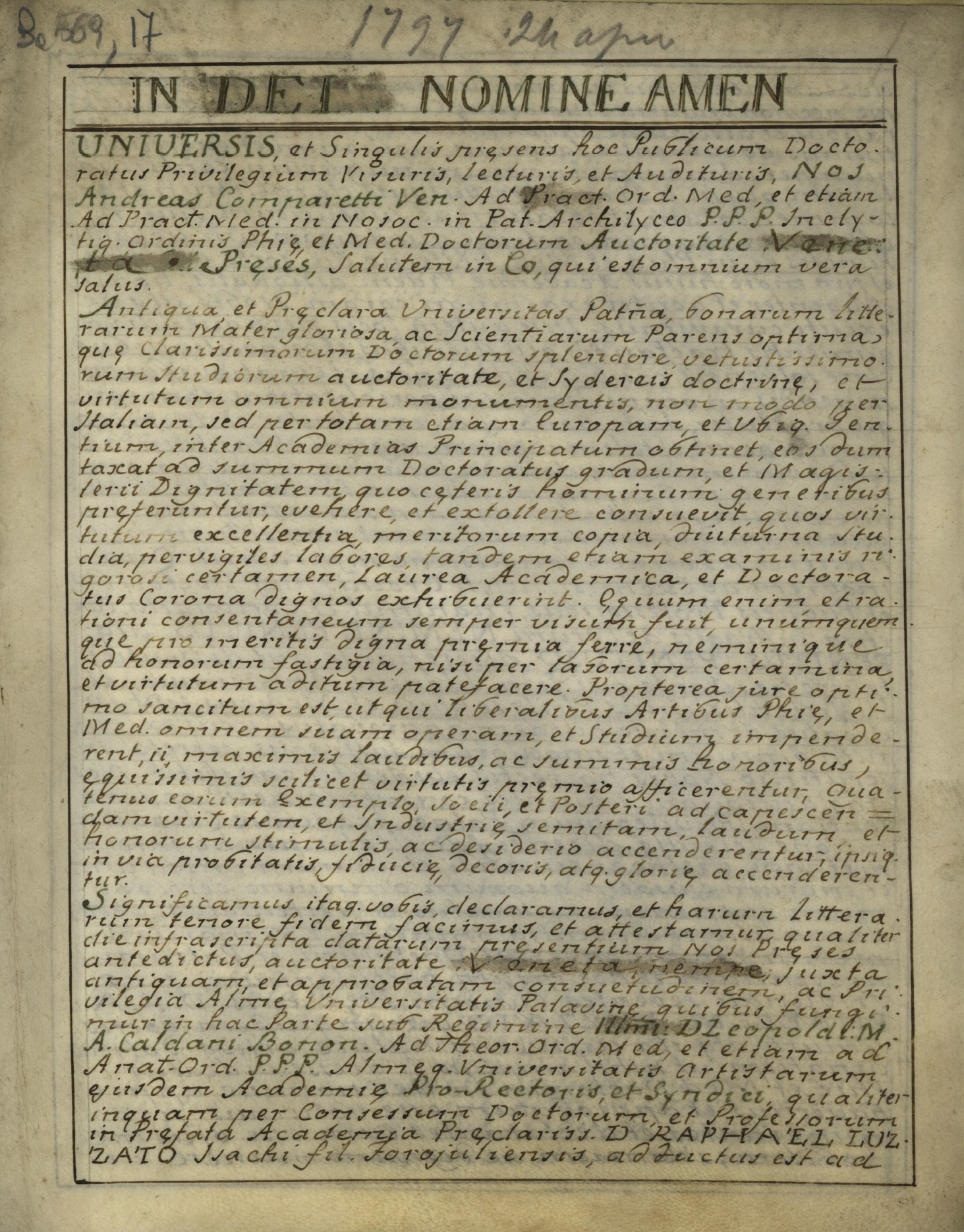
The diploma below of Jewish Padua graduate Rafael Luzzatto from 1797[5] is more in line with Della Volta’s, though at least Luzzatto’s diploma was hand calligraphed.[6]

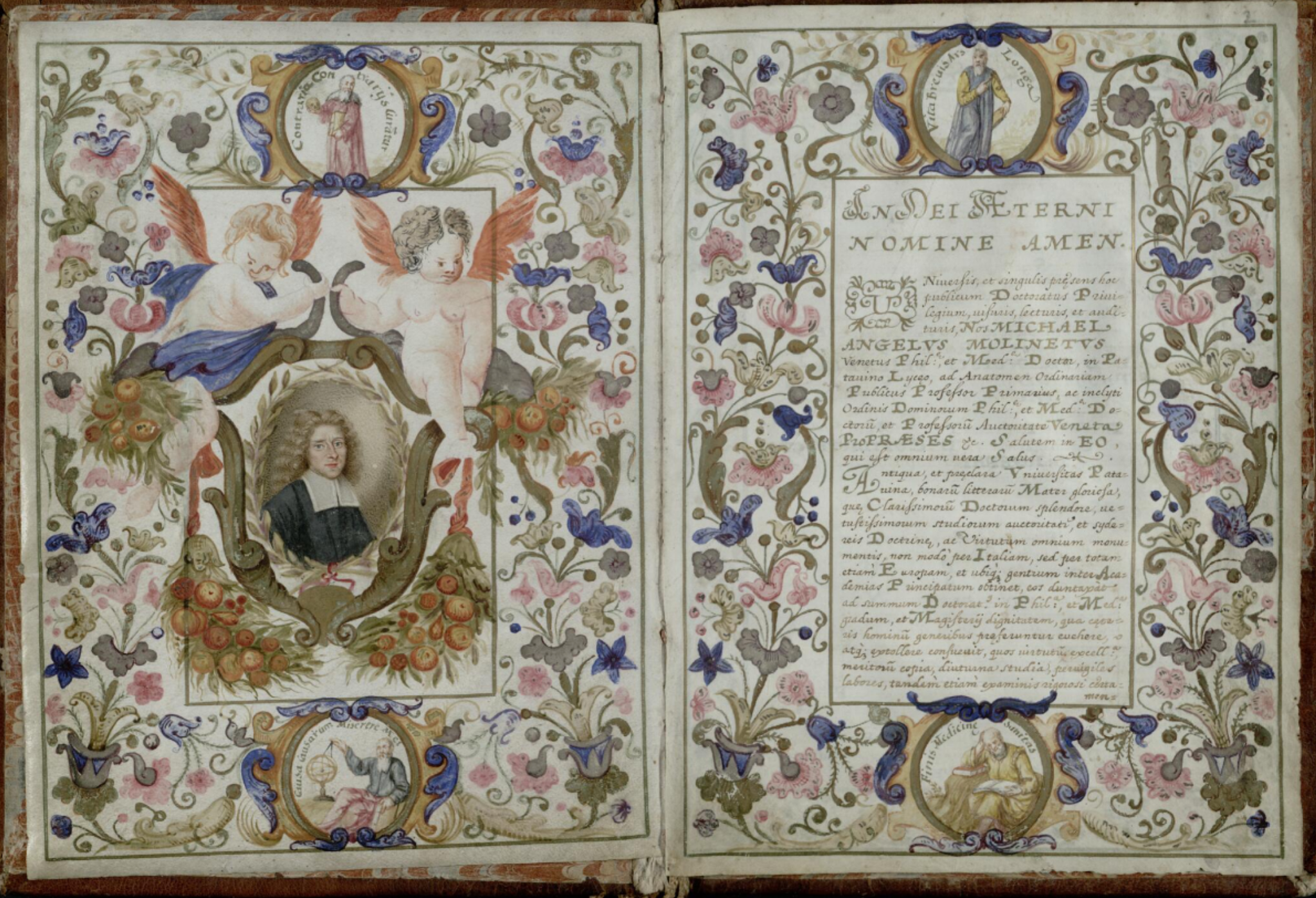
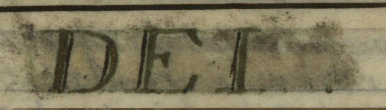
This diploma bears the invocation, “In Dei Nomine Amen” (in the name of God, Amen), typical for the Jewish student, instead of the standard invocation, “In Christi Nomine Amen” (in the name of Christ, Amen), used for the Christian students. Close inspection of this diploma reveals that the word “Dei” was written over an erasure of a longer word.

I have a strong suspicion that this was a standard templated diploma and that the calligrapher erased the word “Christi” and replaced it with “Dei.”

While the medical diplomas of the Jewish students of Padua,[7] as well as those from other universities such as Siena,[8] contained unique emendations, one finds no such alterations in Della Volta’s case.[9]

What caught my attention about Della Volta’s diploma was not its esthetics, or lack thereof, but rather its place of residence. This lackluster diploma currently resides in Budapest, Hungary in the Library of the Hungarian Academy of Sciences. The extant diplomas I have identified can be found mainly in Italy, Israel, and the United States. While each diploma has had its unique journey, these are by and large locations where the physicians lived, or their descendants migrated. For example, the diploma of Isaac Hellen can be found in a library in Germany,[10] but this is where Hellen lived and practiced. Della Volta was a Mantuan physician who lived and died in Italy. There is no record of his descendants migrating to Hungary. By what route then did this document reach such a wayward destination? Tracing the circulation of Jewish books “through time and place” is the laudable goal of the wonderful “Footprints” project.[11] While one may not always be able to track the exact journey of a book or manuscript through time, in this case we possess a passport of sorts with only three stops over some two hundred years that lead us directly to our final destination. The origin of this journey lies in the lifelong pursuits of our graduate.

Samuel Vita Della Volta (שמואל חי מלאוולטא) (1772-1853) was a physician and scholar born in Mantua whose writings include Biblical and Talmudic commentaries, sermons, and responsa. His works remain in manuscript and to my knowledge he has not been the subject of an academic biography.[12]

As a modest initiation into his writings, I share with you some observations from a few chapters selected from his unpublished work, Dan Yadin (1797).[13] The work is a miscellany of responsa and halakhic discussions. While the topics I have chosen are medical in nature, this reflects more my interest than the nature of the work.

Chapter 8 – Tefillin and Apoplexy (Stroke)[14]

This chapter takes the form of a classic responsum. The question is about a person who suffers from apoplexy, what today we would call a stroke or cerebrovascular accident (CVA).

While his cognitive function remains intact, he has lost motor function and sensation of his left arm. Is he still obligated to put on his tefillin shel yad, and if so, on which hand?

One of the more remarkable descriptions in Jewish literature of a stroke and its subsequent religious impact appears in the introduction to a work by another Jewish physician, Abraham Portaleone (d. 1612).[15] Portaleone came from a long line of physicians and graduated the University of Pavia in 1563.[16] He served as physician for the Dukes of Mantua, receiving special permission from Pope Gregory XIV to treat Christian patients. While he authored a number of medical works, it is only later in life that he wrote his Shiltei Ha-Gibborim on religious matters. The passage below from the book’s introduction explains why:

In June of 1605, Portaleone, a renowned and accomplished physician, reports how he experienced the sudden loss of function of the left side of his body, incapacitating him for some nine months. While he does not discuss how he observed the mitzvah of tefillin, he does mention his prayer, supplication, repentance, and religious self-reflection, which led him to undertake the writing of his magnum opus. This encyclopedic work was written for his children as a guide to proper religious prayer and observance,[17] focusing on the Temple service. It includes chapters on the musical instruments of the Beit Ha-Mikdash, the composition of the incense, and the details of the daily sacrifices. Della Volta would likely have read, if not owned, this work.

Returning to the halakhic question, Della Volta cites the Shevut Yaakov’s case of one born with only one arm on the right.[18] Rabbi Reischer debates whether such a person would be free of any obligation as he does not possess a yad keihe (non-dominant arm); or whether perhaps since he was born this way, his sole arm has the status of both a dominant and non-dominant arm combined. Rabbi Reischer accepts the latter approach and as such, requires the donning of tefillin. One who sustains a traumatic complete amputation of his non-dominant arm, however, would no longer be required to wear tefillin on that arm. (The obligation to wear tefillin shel rosh remains undisturbed.) Support for this position comes from Rama, the Bach and Mazik Brakhah. Della Volta argues that this would not apply to his case, where the physical arm is completely intact, albeit nonfunctional. With additional support from Rabbi Yeḥezkel Landau’s Dagul MeRevava, he concludes that the one who suffers a stroke with loss of function of his left arm would be required to wear tefillin accompanied by the requisite blessing.

Chapter 25[19] Anatomical Dissection

The topic of discussion for this chapter is anatomical dissection.

This appears to be a narrative bibliography of sorts. Della Volta cites a reference to a passage “at the end of Yoreh De’ah.” The halakha[20] to which he refers is:

אין מפרקין את העצמות ולא מפסיקין את הגידים

One must not separate the bones of the body, nor sever the gidim (however these are to be defined, possibly includes veins, arteries, nerves, and tendons).[21]

This halakha is in the context of a discussion on likut atzamot, collecting the bones for reburial after initial temporary burial, often in caves or kukhin (niches).[22] This halakha is not typically invoked in contemporary halakhic discussions about the prohibition of autopsy. The now famous teshuva of the Noda biYehuda on autopsy (Tinyana Y.D., 210) had already been published in 1776, but Della Volta does not appear to have been familiar with it.

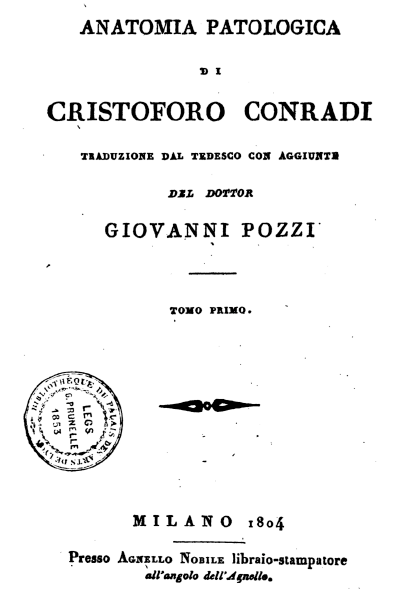
While the Hebrew source seems to oppose dissection, the other sources marshalled appear to be supportive. In his discussion on the use of tefillin in a case of stroke, there is no mention of secular or medical sources, as they would be noncontributory. In a discussion on the value of dissection, such material would certainly be relevant. He cites, for example, the preface to a work on pathology by Christoforo Conradi which lauds the educational benefits of anatomical dissection.[23]

Della Volta cites from a number of additional medical sources, including Biblioteca Medica Browniana Germanica.

Of particular interest is his reference to another Jewish source:

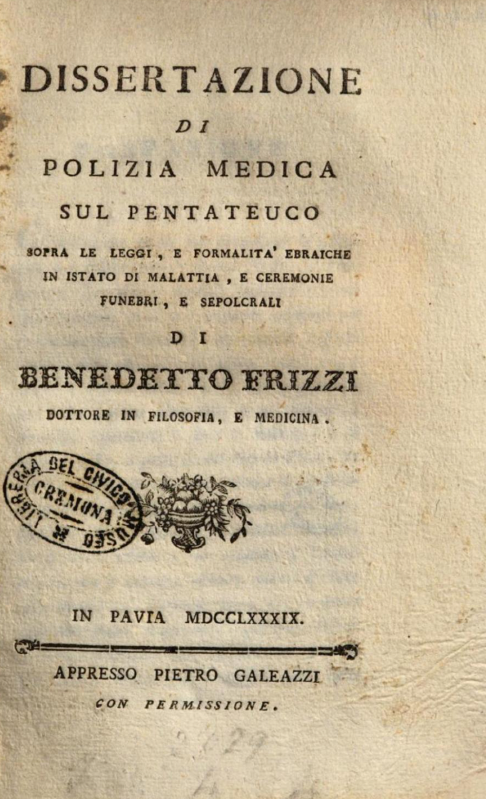
Here he refers to the work of Benzion Raphael Kohen (Benedetto) Frizzi titled, Dissertazione di Polizia Medica sul Pentateuco (Pavia, 1787–1790), which is a thematic analysis of medicine and public health in the Torah and Jewish tradition.[24]

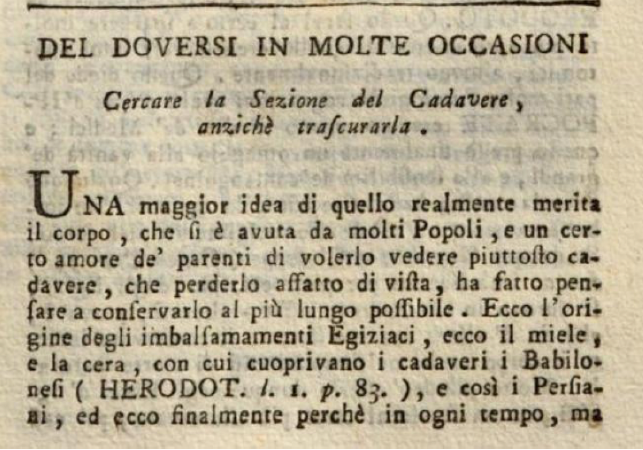
This volume, published in 1789, is one of six such dissertations written by Frizzi over four years. The exact passage referenced by Della Volta begins below:

This may be one of the earliest, if not the earliest, Jewish references to the works of Frizzi.

Frizzi subsequently expanded his research to produce a little-known work in Hebrew of over a thousand pages, P’tah Einayim (Leghorn, 1815–25), addressing the medical and scientific aspects of the Talmud.[25] In a section from this work, not cited by Della Volta, Frizzi addresses another rabbinic passage which is conspicuously omitted from modern halakhic discussions on autopsy.

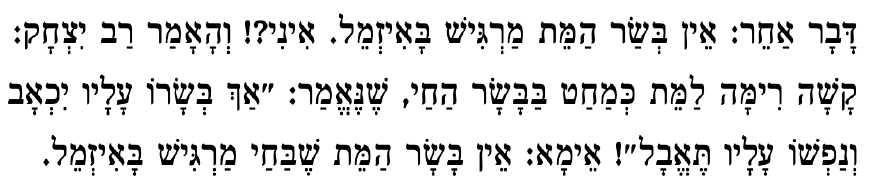
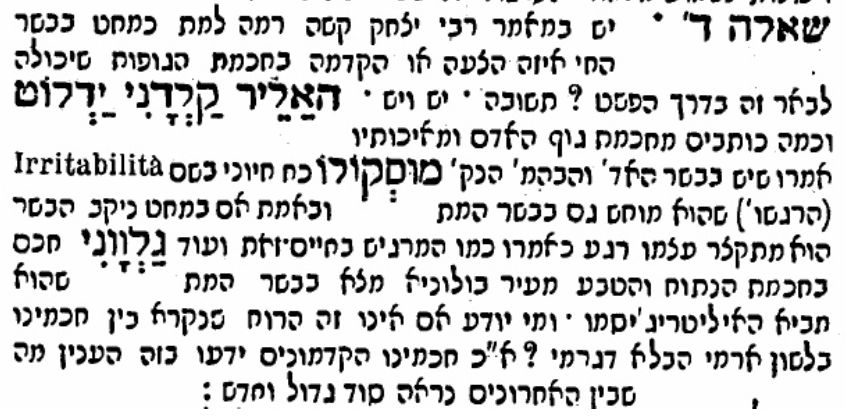
Frizzi focuses on the statement, “Didn’t Rav Yitzḥak say: The gnawing of maggots is as excruciating to the dead as the stab of a needle is to the flesh of the living.”[26] While this passage and its corollary rabbinic passages has received ample treatment,[27] Frizzi’s lesser-known interpretation is exceptional:

Recent medical research, by the likes of Albrecht Haller and Luigi Galvini, who explored bioelectricity (or animal electricity) and muscle irritability, even after death,[28] led him to consider the possibility that this statement was meant literally, i.e., the corpse experiences physiological pain. At least one posek of his day cited Frizzi’s interpretation as a reason to prohibit autopsy.[29]

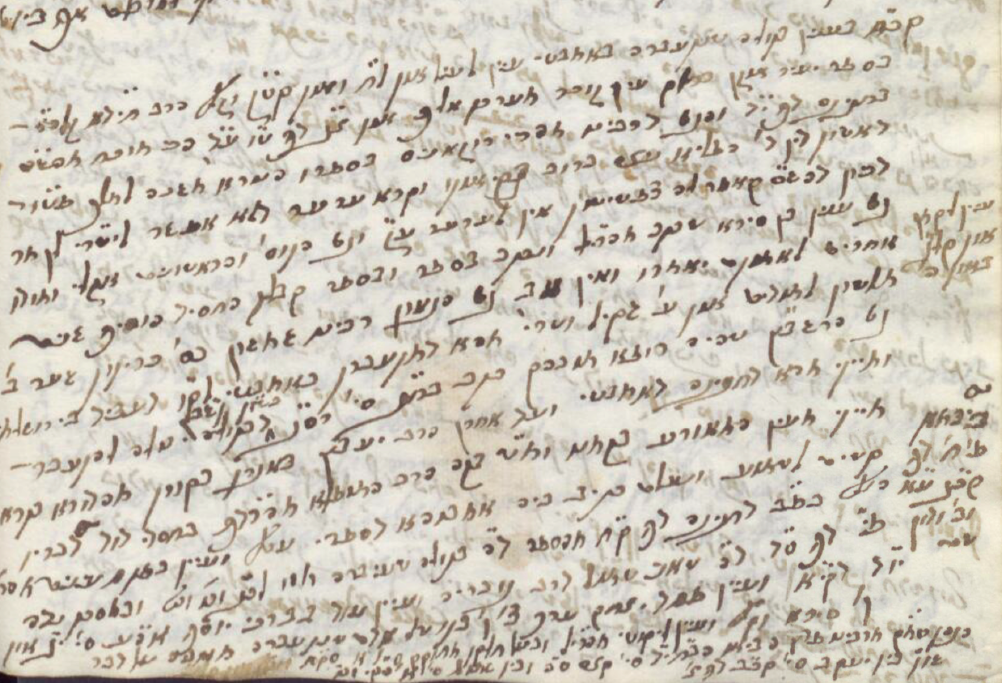
A most remarkable aspect of this entry is the signature of the author.

הרופא ולא לו הצעיר וזעיר(?) שמואל חי מלאוולטה

I recently completed an article about the various interpretations of a rarely used physician epithet, “A Physician, and Not for Himself,” after serendipitously discovering its use in a manuscript.[30] After an extensive, though not exhaustive, search, I was able to identify only nine physicians throughout history who have used this epithet. As hashgaah would have it, we now know of at least ten.[31] Its use here, however, does not shed any further light on the meaning of this expression.

Chapters 38,[32] 116[33] and 128[34] Bathhouse Insemination

These three chapters discuss one who is born sine concubito, through artificial insemination, or as in the Talmudic case, through bathhouse insemination.[35]

(Chapter 128)

Della Volta is equally versed in both the halakhic and contemporary medical literature. While his then current medical references, such as Commentarii Medici by Brugnatelli and Brera,[36] may be unfamiliar to us, his halakhic sources ring remarkably familiar. Amongst others, he cites from Ḥida,[37] Mishneh LiMelekh, Maharil regarding Ben Sira, Rashbetz, R. Yaakov Emden, R’ Yitzḥak Lampronti’s Paad Yitzak, elkat Meokek, as well as Frizzi, including Peta Einayim.[38] This reads like a contemporary article on artificial insemination by Dr. Rosner or Rabbi Bleich, though for Della Volta this was a purely hypothetical halakhic question. It would only be in the late 19thearly 20th century that this would take on practical halakhic relevance with the development of therapeutic artificial insemination. Indeed, the very same sources can be found in today’s discussions. In my historical discussion of artificial insemination, I discuss all the aforementioned sources, including Frizzi.

A casual glance at the remainder of Dan Yadin reveals countless detailed references to medical, secular, and Jewish sources, replete with chapter and verse. Della Volta was clearly a doctor of the book. In fact, he wrote for the journal Otzar Nehmad, corresponded with the likes of Shmuel David Luzzatto, Joseph Almanzi and Lelio Della Torre,[39] and contributed an introduction to Shlomo Norzi’s Minhat Shai. But his bibliophilia did not stop at reading and writing; he ventured into the world of book and manuscript acquisition, amassing an impressive library by the end of his life. Della Volta’s name would not appear on a list of prominent Jewish book collectors, nor even as an afterthought for that matter. Names such as Azulai, Oppenheim,[40] Almanzi or Strashun[41] are more likely to come to mind. Yet, his library caught the eye of some of the greatest Jewish scholars of his day, a virtual who’s who of Jewish biobibliographers, including Marco Mortara, Moritz Steinschneider, Shmuel David Luzzatto (Shadal) and Moshe Soave.

Marco Mortara (1815-1894) was one of Shadal’s prize students at the Rabbinical Seminary of Padua and later served as the Chief Rabbi of Mantua.[42] Mortara became a renowned scholar and bibliographer[43] and would go on to collaborate with Steinschneider for decades. Their very first correspondence was about the biographical details of Della Volta. Della Volta’s library was of great interest to Steinschneider, as evidenced by the multiple correspondences to both Shadal and Soave on this matter. It is only from the letters of Shadal to Steinschneider that we learn how Mortara had acquired Della Volta’s library, which by that time contained some 130 unique manuscripts that bibliophiles across Europe had unsuccessfully tried to purchase. How Mortara came to possess such a valuable library, especially given his financial situation, whether by inheritance or monetary acquisition, is a matter of debate.[44] In any case, this represents the first stamp in our passport, but a brief journey for Della Volta’s diploma within the city limits of Mantua. Della Volta’s library and diploma, at least for now, remained in his hometown.

It is in the Summer of 1877 that the second journey of our graduate’s diploma commenced. As librarian of the Budapest Rabbinical Seminary, David Kaufman, a prodigious historian and bibliophile, had acquired the collection of Lelio Della Torre, an Italian Jewish scholar. While in Italy making arrangements for the transfer of the library, he made the acquaintance of Mortara. Kaufmann was well aware of the extent and value of Mortara’s collection, and that it included Della Volta’s library as well.[45] Kaufmann and Mortara would correspond for some time thereafter.

When Mortara died in 1894, you can well imagine the great interest in his collection, which the family was motivated to sell. A number of individuals and institutions, including Kaufmann, were vying for the opportunity, but family and logistical issues delayed the process, not the least of which being the absence of a comprehensive catalogue of the holdings. It would ultimately be David Kaufmann who would walk away with the treasure, his success partially attributed to his earlier visit in 1877, his previous familiarity with the collection, and his continued contact with Mortara and his family.

The transfer of this library from Mantua to Budapest, where it arrived in February 1896, was apparently no small feat, with some of the Mortara collection somehow finding their way into non-Kaufmann hands.[46] Yet, it represents the second entry in our passport and longest journey for our diploma.

Alas, Kaufmann would die only three years after acquiring the Mortara collection. Would Della Volta’s collection now be transferred to the hands of a new scholar in yet another country, perhaps America or Israel? Fortunate for our diploma, its third and final journey would again be only a brief intracity trek, akin to its earlier trip in Mantua. Kaufmann bequeathed his collection to the Hungarian Academy of Science, where it remains to this day.

Fortunate for scholars unable to journey to Hungary, reference, and often digitized copies, of items in the Kaufmann collection can be found on the National Library of Israel website.

I doubt that Della Volta would have envisioned that the final resting place for his collection would be in Budapest, but nor would he have imagined a Jewish doctor in Woodmere writing about, of all the valuable items in his library (including his original compositions), his medical diploma.

[1] See Edward Reichman, “Confessions of a Would-be Forger: The Medical Diploma of Tobias Cohn (Tuvia Ha-Rofeh) and Other Jewish Medical Graduates of the University of Padua,” in Kenneth Collins and Samuel Kottek, eds., Ma’ase Tuviya (Venice, 1708): Tuviya Cohen on Medicine and Science (Jerusalem: Muriel and Philip Berman Medical Library of the Hebrew University of Jerusalem, 2021).
[2] Harry Friedenwald Collection in the National Library in Israel.
[3] G. Baldissin Molli, L. Sitran Rea, and E. Veronese Ceseracciu, Diplomi di Laurea all’Università di Padova (15041806) (Padova: Università degli studi di Padova, 1998), 251.
[4] Baldissin Molli, op. cit., 255.
[5] University of Padua Archives, Ms. V. 106.
[6] This was a period of transitioning away from the smaller diploma booklet to larger size and less illustrated documents. See Baldissin Molli, op. cit.
[7] For further discussion, see E. Reichman, “The ‘Doctored’ Medical Diploma of Samuel, the Son of Menaseh ben Israel: Forgery of ‘For Jewry’,” Seforim Blog, March 23, 2021.
[8] I have only identified one extant diploma from a Jewish medical graduate of the University of Siena. For discussion of this graduate, as well as a picture of his diploma, see E. Reichman, “The Physicians of the Rome Plague of 1656, Yaakov Zahalon and Hananiah Modigliano,” Seforim Blog, February 19, 2021.
[9] The religious references are in any case removed from this standard Ferrara diploma, but neither do we find the often-seen identifier for Jewish students, Hebreus.
[10] Germanisches Nationalmuseum, Studiensaal Archive, HA, Pergamenturkunden, Or. Perg. 1649 Juli 09. On this diploma, see Moritz Stern, “Das Doktordiplom des Frankfurter Judenarztes Isaak Hellen (1650),” Zeitschrift fur die Geschichte der Juden in Deutschland 3 (1889), 252-255.
[11] https://footprints.ctl.columbia.edu.
[12] The most expansive biobibliographical reference I have found is in Asher Salah, La Republique des Lettres: Rabbins, Ecrivains et Medecins, Juifs en Italie au XVIIIe Siecle (Brill: Leiden, 2007), 661-662. See also 428.
[13] NLI 990001918010205171.
[14] Folios 27-28 of the manuscript.
[15] On Portaleone, see H. A. Savitz, “Abraham Portaleone: Italian Physician, Erudite Scholar and Author, 1542-1612,” Panminerva Medica 8:12 (December, 1966), 493-5; S. Kottek, “Abraham Portaleone: Italian Jewish Physician of the Renaissance Period – His Life and His Will, Reflections on Early Burial,” Koroth 8:7-8 (August, 1983), 269-77; idem., “Jews Between Profane and Sacred Science: The Case of Abraham Portaleone,” in J. Helm and A. Winkelmann (eds.), Religious Confessions and the Sciences in the Sixteenth Century (Brill, 2001). For a full text of his will, see D. Kaufman, “Testament of Abraham Sommo Portaleone,” Jewish Quarterly Review 4:2 (January 1892), 333-41; A. Berns, The Bible and Natural Philosophy in Renaissance Italy (Cambridge University Press, 2014). Shadal discovered a remarkable letter by Portaleone recounting his brush with death on February 25, 1576, when he escaped unscathed from a vicious attack. Although his cloak was perforated in sixteen places from the perpetrator’s sword, miraculously no blood was drawn. See Y. Blumenfeld, Otzar Nehmad 3 (Vienna, 1860), 140-1.
[16] For a copy of the text of his diploma, see V. Colorni, Judaica Minora (University of Ferrara Press, 1983), 487-9.
[17] This work has recently been reissued in an expansive, copiously footnoted edition with introductory essays and biography. See Y. Katan and D. Gerber (eds.), Shiltei Ha-Gibborim (Makhon Yerushalayim, 5770).
[18] 1:3.
[19] Folio 78 of the manuscript.
[20] Y. D. 403:6.
[21] For a discussion on the history of anatomical dissection in rabbinic literature, including the identification of the 248 evarim, as well as the gidim, see Edward Reichman, The Anatomy of Jewish Law: A Fresh Dissection of the Relationship Between Medicine, Medical History and Rabbinic Literature (OU Press, YU Press, Maggid Press: Jerusalem, 2021), forthcoming.
[22] For a discussion on the history of Jewish burial practices in antiquity and the use of kukhin, see Patricia Robinson, The Conception of Death in Judaism in the Hellenistic and Early Roman Period (Ph.D. Dissertation: University of Wisconsin-Madison, 1978).
[23] I thank Filippo Valle for his assistance in both translation and research for this passage.
[24] See Ephraim Nissan, Benedetto Frizzi, a Physician, Medical Editor, Jewish Apologist, and Johann Peter Frank’s Pupil, Who Interpreted Moses’ Law as a Sanitary Code in Line with Frank’s Theory of Public Hygiene,” Korot 25 (2019-2020), 259-293.
[25] On Frizzi, see S. Simonsohn, History of the Jews in the Duchy of Mantua (Kiryat Sefer, 1977), 649, n. 226; Friedenwald, op. cit., 115; L. Dubin, “Medicine as Enlightenment Cure: Benedetto Frizzi, Physician to Eighteenth-Century Italian Jewish Society,” Jewish History 26(2012), 201–221. On his work, see B. Dinaburg, “Ben Tzion Hakohen Frizzi and His Work Petaĥ Einayim,” (Hebrew) Tarbitz 20(1948/49), 241–64. For an exchange between Frizzi and Shadal about a work of the latter, see Moshe Shulweiss, “Shmuel Dovid Luzzatto, Pirkei Hayyim,” (Hebrew) Talpiyot 5:1-2 (Tevet, 5711), 41. For a reference to Frizzi dining with Hida, see Aron Freiman, ed., Ma’agal Tov haShalem of Rabbi Hayyim Yosef David Azulai (Mekize Nirdamin: Jerusalem), 94.
[26] Shabbat 13b. Full translation of passage (from Sefaria): Alternatively: The flesh of a dead person does not feel the scalpel [izemel] cutting into him, and we, too, are in such a difficult situation that we no longer feel the pains and troubles. With regard to the last analogy, the Gemara asks: Is that so? Didn’t Rav Yitzḥak say: The gnawing of maggots is as excruciating to the dead as the stab of a needle is to the flesh of the living, as it is stated with regard to the dead: “But his flesh shall hurt him, and his soul mourns over him”(Job 14:22)? Rather, say and explain the matter: The dead flesh in parts of the body of the living person that are insensitive to pain does not feel the scalpel that cuts him.
[27] I am presently working on a more expansive analysis of this passage titled, “On Pain of Death: Postmortem Pain Perception in Rabbinic Literature.”
[28] See, for example, Hubert Steinke, Irritating Experiments: Haller’s Concept and the European Controversy on Irritability and Sensibility, 1750-90, Vol. 76 of Clio Medica, Wellcome Series in the History of Medicine (Amsterdam: Editions Rodopi, 2005); Dominique Boury, “Irritability and Sensibility: Key Concepts in Assessing the Medical Doctrines of Haller and Bordeu,” Science in Context 21:4 (2008), 521-535.
[29] R’ David Zacuto D’Modena (d. 1865). This manuscript responsum by D’Modena on autopsy was published by Yitzhak Raphael, “Two Responsa on Autopsy,” (Hebrew) Sinai 100 (1987), 737-748.
[30] See E. Reichman, “’A Physician, and Not for Himself’: Revisiting a Rare Jewish Physician Epithet That Should So Remain,” forthcoming. For earlier discussions of this expression, see Joshua O. Leibowitz, “‘Physician and Not for Himself,’ An Unusual Hebrew Medical Epithet,” Koroth 7:7-8 (December, 1978), CXXIX- CXXXIII; Meir Benayahu, “Physician and Not for Himself,” Koroth 7:9-10 (November, 1979), 725-725; Abraham Ohry and Amihai Levi, “Physician and Not for Himself,” Koroth 9:3-4 (1986), 82-83 (Hebrew) and 399*-401* (English).
[31] Della Volta does not appear to use this signature elsewhere throughout this manuscript, and I only found it in chapter 25. A review of his other manuscripts, which I did not do, would be instructive.
[32] Folio 89 of the manuscript.
[33] Folio 122 of the manuscript.
[34] Folio 126 of the manuscript.
[35] On bathhouse insemination and the story of Ben Sira in rabbinic literature, see E. Reichman, “The Rabbinic Conception of Conception: An Exercise in Fertility,” Tradition 31:1 (Fall 1996), 33-63, reprinted with additions and revisions in Reichman, The Anatomy of Jewish Law, op. cit.
[36] An eight-volume work published between 1796-1799.
[37] Ya’ir Ozen, En Zokher, ma’areet aleph, n. 93 and Birkei Yosef E.H. 1:14.
[38] Volume 4 (I. Costa: Livorno, 1879), 57b-58a.
[39] See NLI system n. 990001918190205171, pgs. 45, 98, and 116. This is a collection of his letters to Italian maskilim.
[40] See Joshua Teplitsky, Prince of the Press (Yale University Press: New Haven, 2019).
[41] See Dan Rabinowitz, The Lost Library: The Legacy of Vilna’s Strashun Library in the Aftermath of the Holocaust (Tauber Institute Series for the Study of European Jewry, 2018).
[42] On Mortara, see Asher Salah, “The Intellectual Networks of Rabbi Marco Mortara (1815–1894): An Italian “Wissenschaftler des Judentums,” in Paul Mendes-Flohr, et. al. eds, Jewish Historiography Between Past and Present, Studia Judaica, Band 102 (2019), 59-76. On his library, see idem, “La Biblioteca di Marco Mortara,” in Mauro Perani and Ermanno Finzi, eds., Nuovi Studi in Onore di Marco Mortara nel Secondo Centenario della Nascita (Firenze: Giuntina, 2016), 149-168. What follows is drawn primarily from these works.
[43] In addition to countless articles in the periodicals of his day, Mortara is known for his Catalogo della Biblioteca della Communita Ebraica de Montova and Indice Alfabetico dei Rabbini e Scrittori Israeliti di Cose Guidaiche in Italia.
[44] See Salah, “La Biblioteca,” op. cit., 152.
[45] See Salah, “La Biblioteca,” op. cit., 155.
[46] See Salah, “La Biblioteca,” op. cit., 157. Somewhere along the way, Harry Friedenwald acquired a book that was part of the Della Volta library, a prayer book according to the German rite published by the physician and Padua graduate Eliezer Solomon d’Italia. Della Volta added a 9-page manuscript to the copy which includes a history of the d’Italia family chronicles. See H. Friedenwald, Jewish Luminaries in Medical History (Johns Hopkins Press, 1946), 88.


Legacy Judaica Spring 2021 Auction

Legacy Judaica Spring 2021 Auction

By Dan Rabinowitz and Eliezer Brodt

Legacy Auction Judaica is holding its Spring auction on May 30th (link) and it provides us the opportunity to discuss some interesting bibliographical and historical books and items.

Item #7 is the first edition of Charedim printed in 1601. This is the first appearance of R. Elazar Azkiri’s song Yedid Nefesh in print. For a full discussion of this Tefilah see Bentcy Eichorn, Zemirot Zion, pp. 91-106. This volume also has many unidentified glosses.

Another entry of note is Item #147, the Hida’s copy of the 1545 edition of the Sifra with what may be his marginalia.

An item with important glosses is Item #160 which has the notes of R’ Chaim Sofer known as ‘the Hungarian R’ Chaim,’ on the work Sharei Torah. See also Item #61 which has glosses from R’ Hirsch Berlin.

Item #79, is the first edition, Seder Zera’im. While small portions of the Tiferes Yisrael commentary on the Mishna proved controversial, this volume contains the approbation of R. Akiva Eiger, who is also listed on the subscriber list.

Another controversial work, the late R. Nosson Kamenetsky’s Making of a Godol, is Item #97. This is the first edition, not the later edition which censored material from the first. We discuss some of the controversy, bans, and differences between the editions, in a series of articles here, here, here, and here.

Also a controversial work is Item #100, Pulmus haMussar which discusses the dispute regarding the Mussar movement. Revealing the inner machinations between the parties proved controversial itself and Pulmus was printed just once and it has never been reprinted. Regarding this work, see Eitam Henkin, Ta’arokh le-fani Shulkhan, 123-139.

Item #136’s description contains an interesting cryptic note about the copy of Pe’as Hashulchan: “Includes the rare final page of corrections and polemics”.

Here is the story behind this sentence: In 1799 one of the earliest authorized works of the Gra printed was the Shenos Eliyahu. In the back there was a section called Likutim.

Here is the text of the Gra Related to Mesorah:

In 1821 R’ Wolf Heidenheim wrote about this:

This is what R’ Shklover is referring to in the last page of his work without naming who he was referring to:

Interestingly enough R’ Yitzchaki of Bnei Brak in an article in Yeshurun 5 (1999) pp. 535-537 concludes that R’ Heidenheim was correct. In later editions of the Pe’as Hashulchan has the piece of R’ Shklover added into the proper place in the important introduction of the work. (Thanks to Y. Yankelowitz for his sources and materials).

Another work of the Gra is the first edition of the Biur ha-Gra on Shulhan Orakh (Item #137). This edition removed many standard commentaries (Taz, etc.) but not the Be’er ha-Goleh because he was related to the Gra. A Shulhan Orakh with just the Gra’s commentary proved not viable because when people purchased a Shulhan Orakh they wanted all the standard commentaries in addition to the Gra’s. In the middle of the publication of the Even ha-Ezer volume the publishers decided that they would include the other commentaries even if it meant moving the Gaon’s commentary to the bottom, they received permission from R. Chaim Volozhin to do so.

About Item #18 Messechtas Purim see our discussion earlier on the blog here.

Item #25 is Peirush Megilas Achashverosh, Venice 1565. The description states:

R. Zechariah ben Saruk (1450-c. 1540), was one of the great Chachamim of Spain… With an important introduction, which provides a rare historical glimpse into the travails of Jews who were exiled from Spain as well into as other challenges of that period.

Worth quoting is part of another piece from this interesting introduction:

שהראשונים הניחו לנו לדבר אבל לא לקנטר ואני תמה מאד מן החכם העניו ה”ר שמואל די בידאש נ”ע איך נפל ברשת מאמר האומר אין משיבין על הארי אחר שמת? וזה לשתי סבות הא’ שהוא ידוע לקטני עריסה [רץ המונחים בעריסה] כי קטנם עבה ממתנינו, וההקש והערך שיש בין ידיעתם לידעתנו הוא בערך גלגל ערבות אל נמלה אחת, השנית שהחכמים ההם ע”ה שחברו מה שחברו, האירו לנו בחיבוריהם מפיהם אנו חיים, אם כן מה נהיה כפויי טובה ששתינו מים זכים מבורם ועתה נקנטר כנגדם. ובעת שאמר החכם הנזכר על בעל העטור והרא”ש והרמב”ם ז”ל שהוכו בסנורים, ודברים אחרים, זרים לכל חכם לב לאומרם מאשלי רברבי. ותמהני מחכמתו שאני הייתי מכיר אותו היטב שהוא חכם ועניו איך אמר בהקדמת ספרו מה שסתר אחר כך בספרו? כי אמר בהקדמתו שהסתירה אשר לא יכוןי הסותר לבייש את האשר נעלם ממנו דבר, כי אין זה מורידו מחזקתו. והאמת כן הוא. ובספרו, כשחלק על הגאונים הנזכרים אמר שהוכו בסנורים

ונראה לי דילמא מר נאים כדנפק שמעתתיה מפומיה, כמו שאמרו על רבי יהושע בן לוי, כדאיתא במסכת נדה פרק המפלת. ולא זו בלבד הזהיר לנו חז”ל, אבל גם כן אמרו במוסריהם שלא יחלוק אדם על רבו אפילו בעודו בחיים חייתו, ולכן אמרו בירושלמי לית ריש לקיש מתריס כלפי רבי יוחנן, למפיגל עליה לאפוקי מיניה עובדא. העובדא היה שהוראה רבי יוחנן לתלמידו ריש לקיש שהצפורן אינה מטמא, כמו שהמחלוקת הוא בירשלמי במסכת הורית פרק כהן משוח

ובעבור שזה האיש היה חשוב במדותיו, נאמר שזה היה כשגגה שיוצא מלפני השליט ולכן בכל מה שחלק כנגד גאונים עולם, לא אדבר אלא באחד, בעבור שנשבעתי ואקיימה להיות כנגד כל איש שיחלוק נגד הרא”ש והרמב”ם ז”ל וכו’

על כל שאר הדברים שהטיח כנגדם, ובפרט נגד הראב”ע ז”ל אשר אחר חתימת התלמוד היה רשום ככל הגאונים, אף אלפי שהיה הוא גאון, וראו מה שכתב עליו הרמב”ם לבנו, והוא היה חכם כולל ושלם בכל חכמה. ואנכי ראיתי חדושי הראב”ע ממסכת קידושין [ותוס’ הביאו בקידושין לו א], והם בתכלית הדקות האימות, ובא החכם ר’ שמואל די וידאש, האל יכפרהו לומר עליו, ולא אמר אמת ואינו נכון ודברים אחרים, שאינם ראויים לדבר כנגד האשל הגדול הראב”ע. ומה שאמרתי לא הייתי אומר, אלא שנקרת בפי’ אחד שלו מהמגלה הזאת

Last year this rare work was reprinted based on the first edition and manuscripts with notes and a useful introduction about the work.

Item #37 is the rare work Tal Oros. This work is almost completely unknown to most poskim. One important exception was the Magen Avraham who quoted it numerous times in his classic work on Shulchan Aruch. For additional information about this author see this earlier post on the blog (here).

Previously we have mentioned how we can learn about works found in different people’s libraries. Item #163 is the Beis Halevi’s copy of the classic work of the Malbim on Orach Chaim which sadly was never completed.

An interesting bibliographical scoop about this work can be found in an interview in Mishpacha Magazine in the September 4, 2019 (Issue #776, p. 50) by Rabbi Yonason Sacks. He describes purchasing the Malbim’s own copy which had an important gloss to a specific passage.

The catalog’s letters section is always an important way to learn about interesting unknown historical documents and the like.

Item #229 we learn about a newspaper written in Yeshivas Telz for Purim. This tradition is found already in Volozhin as described by Shaul Stampfer and continues until today.

Item #182 is another Letter of R. Yehiel Mikhel Epstein, author of the Orakh ha-Shulhan.

This letter has a very interesting passage (which the entry downplays) we already wrote about back in 2007 (here). In this letter he wrote not to write to R’ Spektor as he is מוקף מסביב and write to the Netziv even though he is sick.

Shockingly enough R’ Chaim Kanievskey advised R’ Horowitz, the editor of this edition, not to edit out this line.

Item #224 must be highlighted as this is an incredible manuscript, which relates to the famous controversy in Yerushalayim in the 1880’s.

This is a letter from 1887 written by R. Yosef Dov ha-Levi Soloveitchik, the author of the Bes ha-Levi, to his friend R’ Hildesheimer. The catalog description states in part:

During the late 1880’s the old Yishuv of Yerusholayim, then led by the great R. Yehoshua Leib Diskin, was supported by the “Chalukah” system, which was funded by Jews from the Diaspora… He continues that there is still one place that the plague of secular studies has not infiltrated and that is Yerusholayim, and despite the fact that scoffers want to implement secular studies there, the Yishuv, under the leadership of “Rabbeinu HaGadol Me’or Ha’Golah Yochid B’Doreinu B’Torah V’Yirah HaGaon MaHaRIL Diskin Shlit”a, have prevailed and held on to their sacred tradition. However, those who are opposed to the Chachomim are totally persistent in their publications against the Yishuv and the MaHaRIL”. The Beis Ha’Levi therefore requests that R. Hildesheimer publicize that he disagrees with this view, and that he reaffirm that it is forbidden for the school system in the Old Yishuv, which was constituted primarily of students with Lithuanian backgrounds, to implement these changes…

In this letter we see the incredible respect that the Beis Halevi had from R’ Yehoshua Leib Diskin, something known to us from many other sources.

R’ Hildesheimer’s role in this controversy has been discussed a bit by David Ellenson, Rabbi Esriel Hildesheimer and the Creation of a Modern Jewish Orthodoxy, pp. 110-112,123-126.

Many aspects of this fascinating controversy have been dealt with by R’ Eitam Henkin HY”d in various articles.

One important point is from the Beis Halevi letter it sounds like all Lithuanian Gedolim sided with R’ Diskin but this is not so simple at all. R’ Shmuel Salant definitely did not agree with R’ Diskin on this. IYH this will be discussed at greater length in the future.