Breaching the Walls of History with Postscript

Breaching the Walls of History

By Dan Rabinowitz

This essay first appeared in the Jewish Review of Books (Spring 2026) and is republished here. Its postscript appeared in the magazine’s Substack newsletter, which you can subscribe to here.

Last December, on the eighth day of Hanukkah, the American haredi newspaper of record Yated Ne’eman published a long, impassioned article titled “Ufortzu Chomos Migdolai Vetimu Kol Hashmanim,” by Rabbi Michoel Sorotzkin. The Hebrew title is from the fifth stanza of the famous Hanukkah standard Maoz tzur, which many of us never get to: “They breached the walls of my towers and defiled all the oils.” That is to say, the Greeks (and their Hellenized Jewish allies) broke through the defenses of the holy Temple in Jerusalem, leaving, seemingly, all its oils polluted and unusable. One might have expected that such a headline would announce a discussion of, say, the closure of haredi yeshiva day schools in New York City, or the Israeli government’s attempts to draft haredim into the military, or, perhaps, the rampant antisemitism threatening European Jewry.

But Sorotzkin’s article addressed none of these very real challenges to haredi life. The breach he identified, the defilement requiring an elaborate polemic couched in apocalyptic language, was a brief mention I had made of the Brisker Rov’s visit to a library in Vilna, in an article I published in these pages last summer (“Golden Ledgers,” Summer 2025, and republished on the Seforim blog).

The Strashun Library of Vilna was the first Jewish public library; it admitted both male and female patrons and included secular as well as religious books (sifrei kodesh). The historical question at issue itself is trivial—in fact it isn’t really a question. Rabbi Yitzhak Ze’ev Soloveitchik, who was commonly known as Reb Velvel or the Brisker Rov, visited the Strashun Library with at least one, but almost certainly two, of his sons on October 1, 1940, and they checked out the books to read in its famous reading room that the library ledger lists them as checking out.
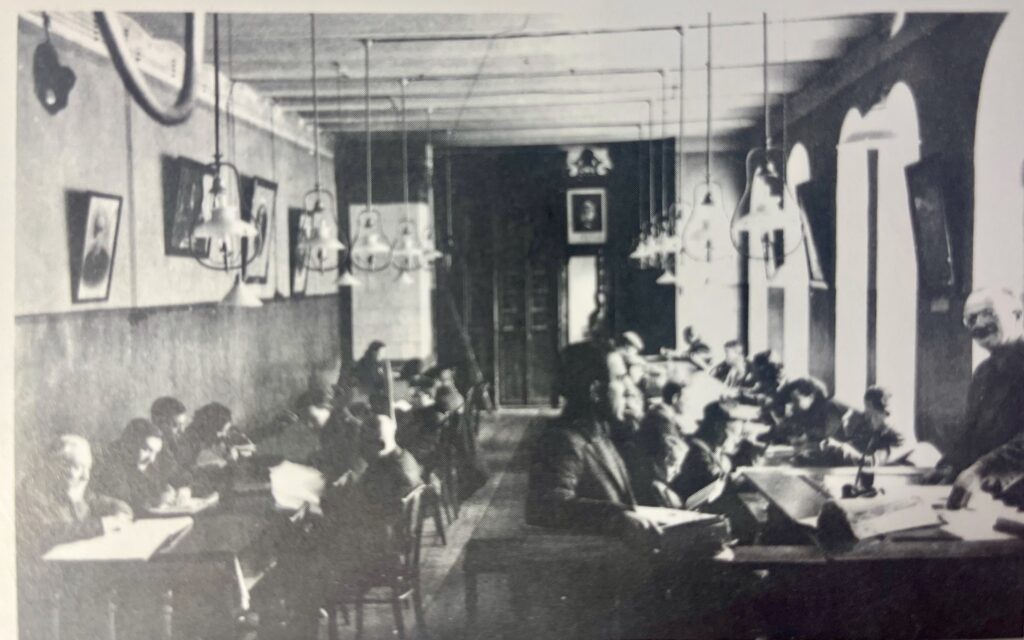
Strashun Library Reading Room. Layzer Ran, Jerusalem of Lithuania, vol. 2, 346.

This is demonstrable beyond any remotely reasonable historical doubt. The interesting question is: Why was it so important to Sorotzkin, a prominent member of the haredi world, to tie himself up in speculative knots denying it not once but twice in one of that world’s leading newspapers? Before answering that question, I should explain how I came to write an article that breached the walls and defiled the oils, when what I was trying to do (if you’ll allow me to mix biblical metaphors) was pluck a brand from the fire.

I go to Vilna at least three times a year. Sometimes I stay at a hotel at the epicenter of the three main streets that formed the Jewish district; other times I stay near German Street where Mattityahu Strashun once lived. My mornings begin with a thirty-minute walk to Lithuania’s National Library. The route passes through streets that once hummed with Yiddish, past buildings that housed yeshivas and Jewish publishers, through spaces that sustained centuries of Jewish intellectual life before the Nazis destroyed it. My afternoons are spent walking those streets comparing what I’ve found in the archives against what I expected to find, evenings reviewing notes and planning the next day’s research. What I’m trying to do is reconstruct the ordinary moments that illuminate the extraordinary history of Jewish Vilna.
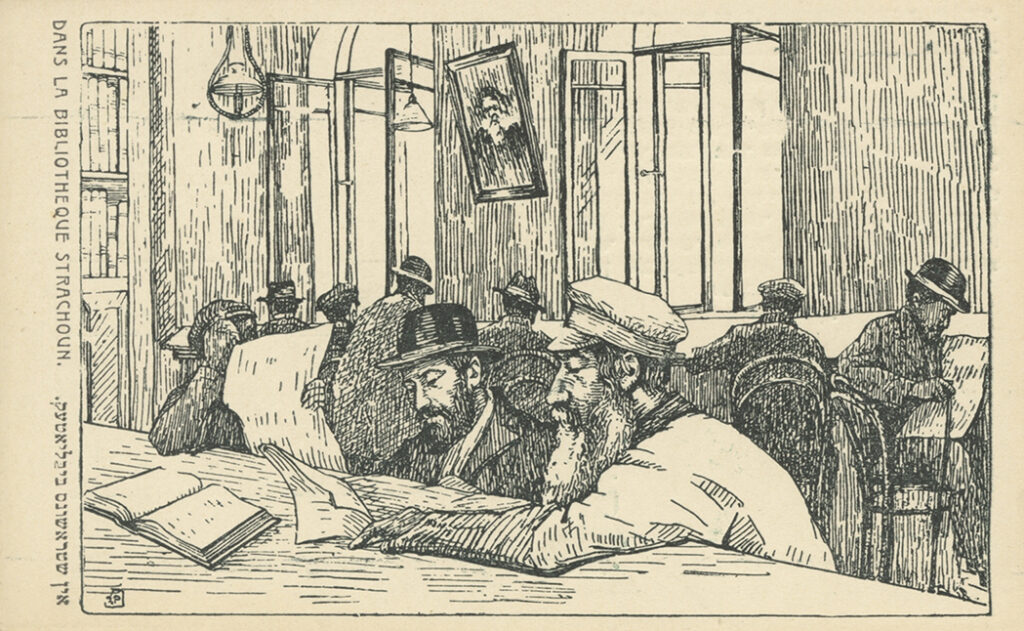
“In the Strashun Library”: a postcard from the “Vilner yidishe geto” (Vilnius Jewish Ghetto) series with illustrations by Ber Zalkind. (Ber Zalkind, Khaykl Lunski/Wikimedia Commons.)

During these walks, I often run into tour groups gathered at one of the few plaques marking the place of Jews in the city’s history. Usually, it’s the plaque noting the line of demarcation where the Nazis established the Vilna Ghetto. This is the tours’ inevitable focus: the annihilation of the Jews. What preceded the destruction—the institutions of learning and publishing, the literary circles and research institutes, the daily life that made Vilna the “Jerusalem of Lithuania”—receives far less attention. There used to be a sign marking where the Great Synagogue complex, the architectural and spiritual center of Jewish Vilna for centuries, stood. That sign is gone now. What remains are markers of death and destruction; all the complexity of Jewish intellectual life before World War II gets compressed into a prelude to catastrophe.

Those of us who study prewar Jewish culture are trying, each in our own way, to reconstruct and understand the life that preceded the catastrophe. That’s how I came to write a book on the Strashun Library several years ago. It’s why I continue to research its workings and the vibrant world of which it and its patrons, including great rabbinic leaders like Yitzhak Ze’ev Soloveitchik and ordinary Jewish readers, were a part.

The Strashun Library opened in 1902 as the first Jewish public library, built from Mattityahu Strashun’s private collection of rare books and manuscripts. From its opening, it became central to Vilna’s intellectual ecosystem. Its reading rooms welcomed everyone: rabbis and historians, secular scholars and traditional students, men and women, those seeking Yiddish literature and those researching Jewish law. By the time it was shuttered in 1940, it held roughly fifty thousand volumes and served a public that spanned the full spectrum of Jewish life.
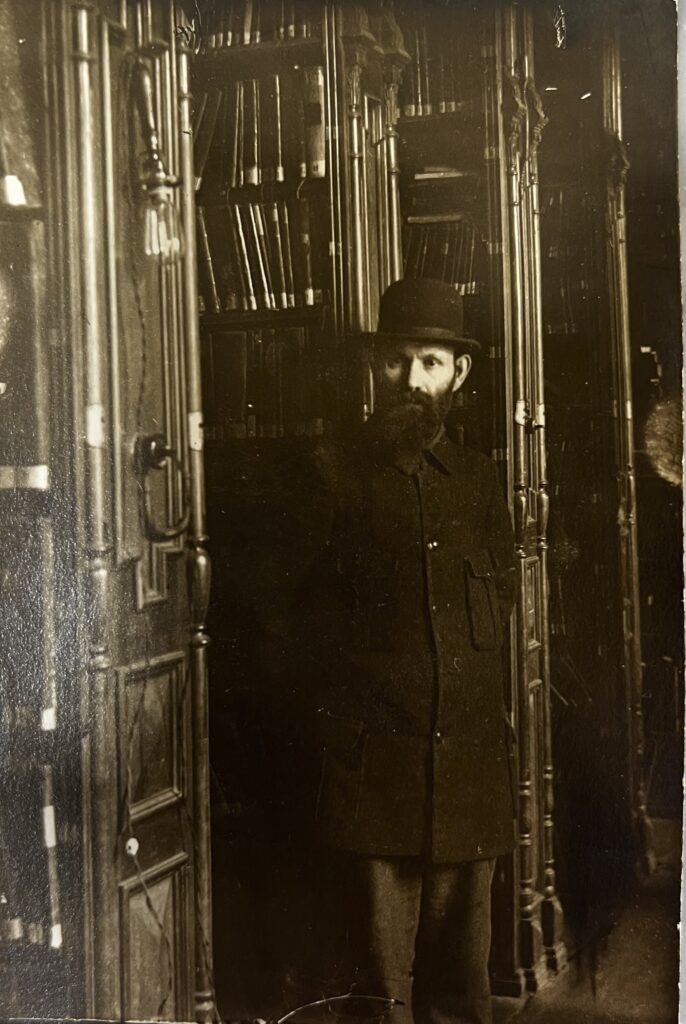
Khaykl Lunski, Librarian of the Strashun Library in the book stacks. Postcard (undated), Private Collection.

When I discovered the library’s checkout ledgers in the National Library of Lithuania archives in 2024, I realized that their spare entries allowed us to reconstruct the day-to-day life of the library: who used it, which books they read, and how it served different strata of Jewish society.

As the first step in a project to digitize and make the ledgers publicly available to other researchers, I spent four very full days scanning thousands of pages, each holding about fifty handwritten entries. As I worked, I browsed the names and tried to quickly register patterns in the data. One of the names that jumped out at me was “Yitzchok Soloveitchik,” who requested a collection of I. L. Peretz’s Hasidic stories, Khasidish. Could this be Rabbi Yitzhak Ze’ev Soloveitchik, the son of Rabbi Chaim Soloveitchik, who founded the famous Brisker approach to talmudic study?

Yitzhak Ze’ev inherited and extended his father’s analytic method and later became one of the most uncompromising voices in Israeli haredi leadership, where he was known as the Brisker Rov. I knew that he and his family had been in Vilna at the time, because I’d found him listed among prominent rabbis in Vaad ha-yeshivos refugee housing records that show, yeshiva by yeshiva, where students, teachers, and refugees were staying. Nonetheless, it could have been another Yitzchok Soloveitchik. Then I looked more carefully at the same ledger page and saw another entry: a Raphael Soloveitchik had requested Maimonides’s Iggeret ha-shemad just a few lines above Yitzchok’s request for Peretz. Now it was clear. The Brisker Rov had a son named Raphael, and although Peretz’s short stories was a surprising choice for his father, the choice of Maimonides’s famous letter on persecution by the scion of a family fleeing persecution and famously devoted to Maimonides made perfect sense.

In short, the ledger documented that the Soloveitchiks had used the library just weeks before the Soviets would permanently close it, which is what I wrote, in passing, in my article. All that I thought I had documented in doing so was that the library served the rabbinic elite alongside ordinary Jews of all kinds, who were reading everything from talmudic commentaries to Yiddish translations of Tolstoy. But merely documenting a prewar Jewish world that was different than is generally imagined in haredi publications like Yated turned out to be an act of desecration.

Rabbi Sorotzkin’s first attack began by quoting the offending lines—or part of them at any rate—from my article: “On the afternoon of October 1, 1940, Reb Velvel came to the Strashun Library with his teenage son . . . His father’s reading for the day was more surprising: I. L. Peretz’s short stories about Hasidim.” (Sorotzkin’s ellipses will turn out to be doing a lot of work here.)

“With this passage,” Sorotzkin wrote, “Mr. Dan Rabinowitz does more than recount an archival curiosity. He stages a tableau.” He went on:

The Brisker Rov, Rav Yitzchok Zev Soloveitchik, appears before us not as generations of talmidim knew him, but as a character in a modern morality play: seated calmly in the Strashun Library of Vilna, immersed in the ironic fiction of I. L. Peretz, surrounded by secular readers, students, men and women alike.

The effect is unmistakable. The reader is invited to marvel at the distance between the “real” man and the image preserved by Torah memory. Hagiography, we are told implicitly, has concealed a richer, more complex inner life—one now revealed by the cold honesty of a library ledger.

It is an elegant narrative. It is also an edifice built on sand. What we encounter here is not historical reconstruction, but a breach—peritzas geder—in the most basic disciplines of historical inference. And once the wall is breached, all the oil may be rendered impure.

Beyond the rhetoric of righteous indignation, Sorotzkin’s argument was simple: The Brisker Rov would never have entered a “mixed, open, modern” library because his “entire being recoiled from even the faintest rei’ach [whiff] of ideological modernity.” Therefore, someone else named Yitzchok Soloveitchik must have. And here Sorotzkin had a candidate:

The Vilna region was saturated with Soloveitchiks. . . . Among them appears a Yitzchok Soloveitchik, a timber merchant, a vald-socher [from Švenčionys]—precisely the kind of educated townsman who would frequent the Strashun Library and read Peretz.

There are just three problems with this line of argument—actually there are more than that, but let’s restrict ourselves to three for the moment:

a. The same ledgers that documented the visit of a “Yitzchok Soloveitchik” also recorded several visits by Rav Pinchas Hirschprung, who would later serve as chief rabbi of Montreal. Rav Chaim Ozer Grodzinski, the preeminent Torah authority in Vilna, held special borrowing privileges at the library, and Rabbi Yisrael Meir Kagan, the renowned Chafetz Chaim, visited and signed the library’s VIP “Golden Book.” If such colleagues could visit the library, can Sorotzkin really be so certain that the Brisker Rov’s “entire being” would have prevented him from doing so?

b. Švenčionys is over eighty kilometers from Vilna, and we have no evidence this timber merchant traveled to Vilna in October 1940. Not to speak of the fact that neither Rabbi Sorotzkin nor I know anything about the reading habits of Jewish timber merchants in the area.

c. The ledger records two Soloveitchiks visiting the library on October 1, 1940. Are we to suppose that this other Yitzchok Soloveitchik also had a son named Raphael, who was also a deep Maimonidean?

This last problem—call it the “Zvei Soloveitchiks problem”—returns us to Rabbi Sorotzkin’s creative use of ellipses. When he quoted my offending lines about Reb Velvel, he elided Raphael—whom I mentioned in those sentences—right out of the picture and never acknowledged that he appeared in the ledger a few lines above his father.

Actually, unlike Sorotzkin’s conjectural Peretz-reading ironist timber merchant, the Brisker Rov had good reason to visit the Strashun Library. He was in the midst of a life-and-death halakhic controversy with his colleague Rav Aharon Kotler about whether refugees should try to flee to Eretz Yisrael or America. To support his position that they should not go to America because of the spiritual danger, the Brisker Rov turned to a passage he remembered from Maimonides’s Iggeret ha-shemad, which he wanted to quote verbatim.

Soloveitchik family memory confirms this. In a footnote to Shiurei Rabbeinu Meir ha-Levi, a collection of the Brisker Rov’s son, he is quoted as saying:

I recall that during the war years, Maran [the Brisker Rov] sought a copy of the letters from the Rambam, because he wanted to study Iggeret he-shemad, in which the Rambam has a lengthy discussion to explain the fundamental idea that a person acclimates to his surroundings and it is prohibited to live in a place which doesn’t allow one to fulfill the mitzvot properly. . . . Initially, however, he was unable to find a copy, and, in the end, he located one in the Strashun Library in Vilna. According to the library’s rules, one was not permitted to remove books from the building. And therefore his son R. Chaim copied it word for word for him.
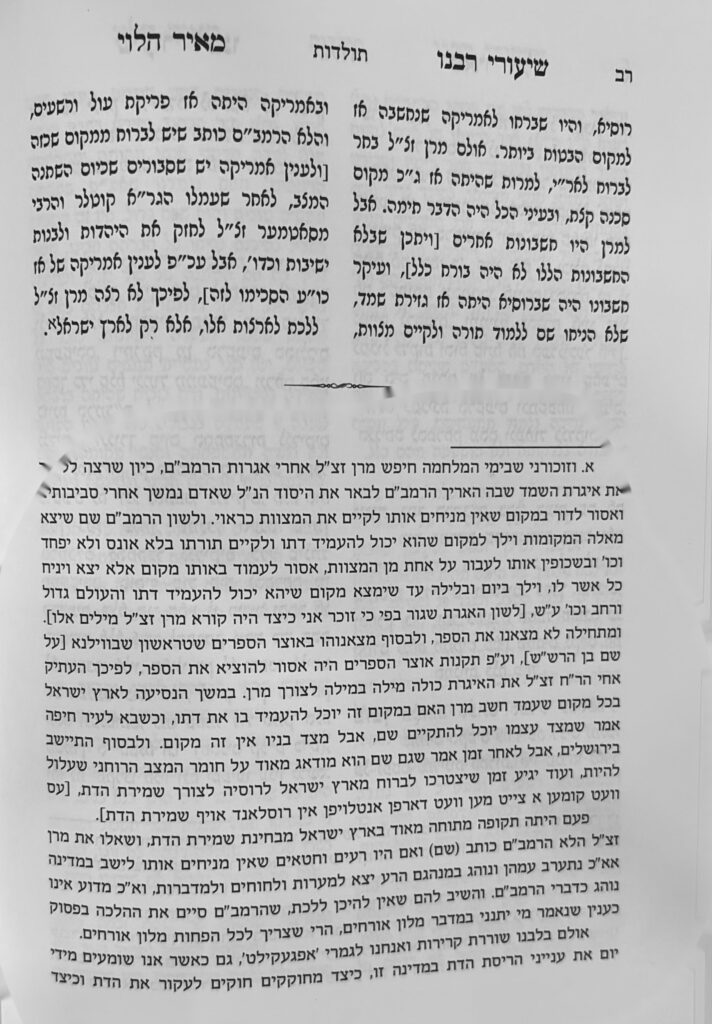
The library ledger records Raphael as the borrower of Iggeret ha-shemad while the family testimony remembers Chaim as the copyist. Perhaps both brothers participated, or Raphael handled the checkout while Chaim copied the passage. Or perhaps the family misremembered which brother accompanied his father to the library. At any rate, there were at least two, and quite possibly three, Soloveitchiks at the Strashun Library on that day. And they were there precisely because the Brisker Rov took his obligations as a halakhic scholar and leader of Torah Jewry so seriously.

When I wrote to Yated Ne’eman to explain all this, the editors—to their credit—published my letter, but they did so alongside a reply from the unflappable Rabbi Sorotzkin. Sorotzkin not only blithely failed to acknowledge his errors of omission and commission but went on to a new and truly gobsmacking theory, titling his response “Veha’emes Vehashalom Ehavu” (Love truth and peace).

The entry for a “Yitzchok Soloveitchik” must, he now admits, refer to one of the famous Soloveitchiks rather than a random timber merchant from Švenčionys. Still, it couldn’t possibly be the Brisker Rov. So, who was it? Here I must quote Rabbi Sorotzkin at length to convey just how far he is willing to go to save Reb Velvel from having gone to a public library:

The presence of a ledger entry bearing the name “Yitzchok Soloveitchik” is taken to indicate the Brisker Rov himself, seated in the reading hall and borrowing secular literature. Yet there exists a far more coherent and internally consistent explanation, one that aligns with the testimony, the ledger itself, the halachic framework governing names and conduct, and the lived reality of the Brisker household.

According to this reading, it was the Brisker Rov’s son, Rav Chaim who entered the Strashun Library as the responsible emissary. Anyone familiar with the family dynamic knows that his keen intelligence, composure, and practical capability marked him as the natural choice for such a mission. His younger brother, Rav Rafael, accompanied him and formally requested the Iggeres HaShemad, which then had to be copied in full—a task of approximately 3,500 words, requiring a prolonged stay. Such an extended presence in a public institution would naturally invite scrutiny. To avoid unnecessary attention, it would have been prudent, even expected, to request an additional book, a routine borrowing that raised no eyebrows and normalized the time spent at the table.

Here the ledger entries themselves become illuminating rather than sensational. Immediately preceding the Soloveitchik entry, two patrons are recorded borrowing works by I. L. Peretz. . . . When Rav Chaim was offered titles by the same author, the specific work recorded — Chassidish — was accepted not as an ideological choice but as a convenient placeholder, a book taken to cover the duration required for copying the Iggeres. . . .

The use of the name “Yitzchok” in the ledger is likewise neither mysterious nor incriminating. Rav Chaim could not identify himself by his own well-known name without drawing attention, particularly given that the sefer of his grandfather, Rabbeinu Chaim Halevi, was already catalogued in that very library. Nor could he identify himself by his father’s full name. Halacha is explicit that one may not refer to one’s father by name, even after death, without alteration. . . . The use of the shortened form “Yitzchok” . . . would have satisfied both the halachic requirement and the practical need for discretion, without uttering an outright falsehood.

It is difficult to imagine anyone believing that a scholarly household in the midst of the “lived reality” of a desperate flight to safety from both the Soviets and the Nazis would strategize over the impossible “mission” of going to a library frequented by other pious Jews to copy a passage from Maimonides. And further, to think that they needed an elaborate cover story involving false names and phony book checkouts so that the Jewish librarians did not penetrate their cover (and what?—inform Rav Kotler about the killer prooftext from Maimonides?). The tradition has a term for such groundless theorizing, pilpul shel hevel, and it is a hallmark of the Brisker tradition to oppose it.

Sorotzkin closes his response on an extraordinary—and, one presumes, unconscious—note of chutzpah. “When suggestive narratives arise from thin evidentiary reeds,” he writes, “methodological restraint becomes not a courtesy but an obligation.” But perhaps I am being unfair, as George Orwell once remarked, “We are all capable of believing things which we know to be untrue, and then, when we are finally proved wrong, impudently twisting the facts so as to show that we were right.”

Sorotzkin’s initial response characterized my work as “peritzas geder,” a breach of protective walls. But what did he think needed to be protected? Not the Brisker Rov’s actual stature or commitment. That he wanted to verify the exact wording of Maimonides’s Iggeret ha-shemad from the richest collection of sifrei kodesh in Eastern Europe to guide his thinking on the refugee crisis illuminates the rigor of his approach to unprecedented questions. What Sorotzkin needed to protect was rather a nostalgic fantasy: one in which the great sages (gedolim) of that generation never entered mixed public spaces, relied on secular institutions, or read fiction. But the infrastructure of Jewish life in places like Vilna was not neatly divided into “Torah” and “secular” categories, and gedolim and their students checked out books from the Strashun Library alongside maskilim, socialists, and ordinary Jews looking for something to read.

I go back to Vilna regularly to identify, amid the destruction and absence, what can be found to resurrect, contextualize, and enrich our understanding of the astounding Jewish culture of prewar Vilna. The Jews of this city—rabbis and students, traditionalists and modernists, Hebraists and Yiddishists—created institutions, filled libraries, published journals, founded schools and research institutes, and argued about everything.

The Brisker Rov spent an afternoon in the Strashun Library in October 1940 with his sons to obtain a text he desperately needed. While his sons diligently copied Maimonides’s text, he requested Peretz’s collection of Hasidic stories. I don’t know why and, of course, it doesn’t matter—only Sorotzkin and his more credulous readers would think that it does. But there is a plausible answer. It turns out that among Peretz’s Hasidic tales is the story “Between Two Mountains,” in which a fiercely strict and intellectual rosh yeshiva called “the Brisker Rov” is taught a lesson in humanism by a former student who has become a Hasidic rebbe. Might not the Brisker Rov have been simply curious to read about his fictional counterpart?

The Holocaust destroyed the Strashun Library and most of the Jewish world of which it was a part. The Soviets shuttered its reading room; the Nazis looted its collections; after the war, the building was destroyed. Yet, the few surviving Strashun Library ledgers reveal precious little moments in the lost history of Jewish intellectual life in Vilna. The final volume documents the last gasp of Eastern European Jewry, not only the local Jewish inhabitants but also the thousands of refugees like the Soloveitchiks who, fleeing Hitler and Stalin, briefly sought safety in Vilna.
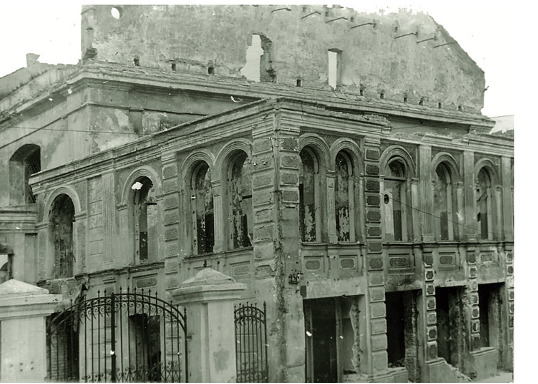
Strashun Library Building in 1945. Vilna Gaon Museum of Jewish History Archive, 1829-1

It seems to me that what we, their descendants, owe them is to see their lives, at least in glimpses, as they were, even if it is through the entries of a humble library ledger. That is a history worth recovering, even when—especially when—it complicates what we thought we knew. Such complication is not desecration; on the contrary, it honors their memories.

Postscript

After writing this response to Rabbi Sorotzkin’s pilpul shel hagiografia, I continued to return to the 1940 ledger, which hasn’t been digitized yet. As I described above, Sorotzkin’s new, and equally implausible, claim was that Chaim Soloveitchik used his father’s name rather than his own, to avoid the commotion of being recognized as the grandson and namesake of the author of one of the library’s own seforim, and to escape the notice of the authorities. In fact, it turns out Chaim checked out books under his own name at least five times in September 1940.

The first entry was on September 6, 1940, weeks before his father and Rafael appear in the ledger together. He checked out the Iggeret ha-shemad twice, on September 12 and September 14. These are, undoubtedly, the visits to transcribe Maimonides’s text, as described in the family testimony recorded in Shiurei Rabbenu Meir HaLevi. Rafael’s borrowing of the same text on October 1, when he visited the library with his father, was probably to check his brother’s transcription against the source.
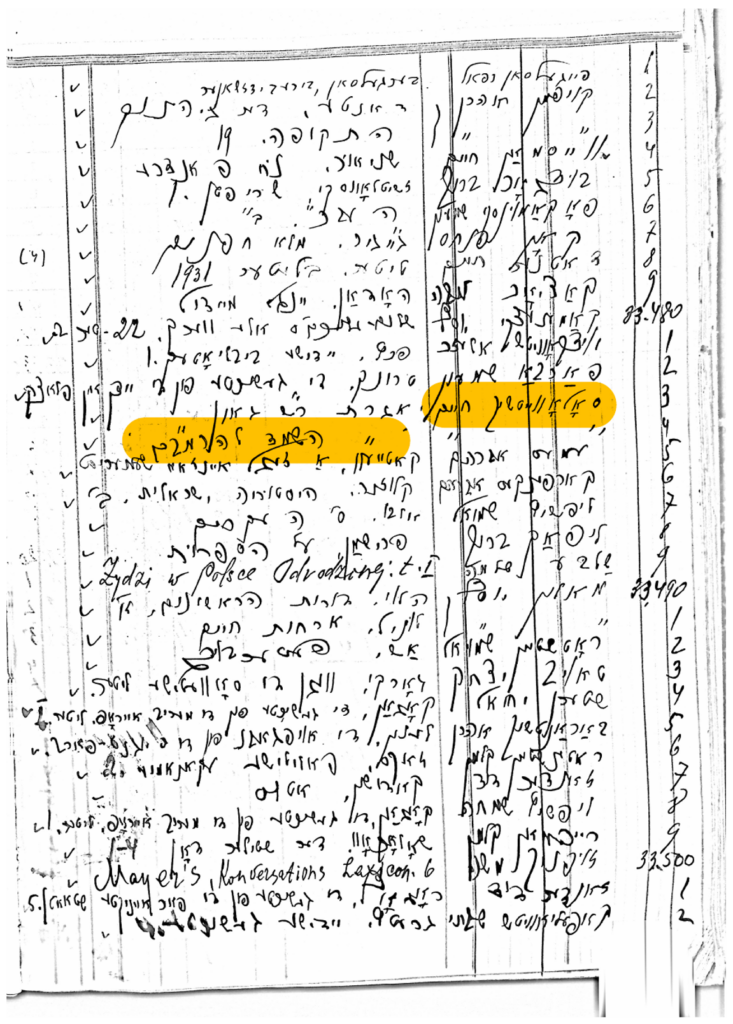
That September, Chaim also read the tenth-century grammarian Dunash ben Labrat, the letters of Sa’adia Gaon and Ramban, the Abudraham’s commentary on the siddur, Samuel David Luzzatto’s essays collected in Bet ha-otzar, and a run of midrashic works, several in modern critical editions such as those of Solomon Buber. This is not the reading of a man sent on an undercover mission to copy one text. It is, rather, the reading of a wide, curious, and learned mind, and the ledger records it without comment or apology.

Of course, this isn’t surprising. As I wrote above, many well-known rabbinic figures used the library without incident. What is surprising is the pseudo-pious lengths to which Sorotzkin went to deny that the Brisker Rov and his sons simply used the Strashun Library, a fact that the family itself had no qualms about memorializing. What the ledgers allow us to do is to see, in a reader’s own name and hand, what he read in one of the great libraries of his world.

The Strashun Library Ledger Project, which is digitizing and making the ledgers publicly available, is a collaboration between the Martynas Mažvydas National Library of Lithuania, the e-Lijah Lab at the University of Haifa, Yale University’s Jewish Studies Department and Library, the Fortunoff Video Archive, and Litvak SIG.


Announcement: Musings of a Book Collector podcast

Announcement: Musings of a Book Collector podcast

Eliezer Brodt

As a curator of knowledge, I enjoy sharing content for people to read, learn, and enjoy. A few years ago, I was privileged to explore another avenue for sharing information by recording an experimental podcast with Rabbi Moshe Schwed on the All-Daf platform. I have come to realize that the podcast format helps me immensely, as it requires me to compile and organize my research, and it enables me to “test it out” before publication—a” Pilpul Chaverim” of sorts.

I would like to continue with this experiment and record additional episodes on various topics for my new podcast, Musings of a Book Collector. Below is a link to my recently launched website, which contains all the information about the Musings of a Book Collector podcast and the various subscription options. Please check out the website and feel free to share your thoughts with me:

https://eliezerbrodt.com/

The first free episode is available here, here and here. It is dedicated to R’ Shlomo Zalman Auerbach and his Halachic work on electricity, Meorei Eish

The second free episode, on new and old Seforim related to Chanukah, titled Sefer Makabi’im, Sdei Chemed and other Chanukah related seforim was just recorded and is available for listening here and here and here.

For information on how to sign up for the longer series about the Meorei Eish and more, please see the website. If you choose to subscribe, kindly send me an email so I can thank you personally and keep you updated with improvements. (Apple/Podbean do not provide me with this information.)
With immense gratitude, 

Eliezer


Parchments Burning, Letters Soaring, and Books Lost and Found: S.Y. Agnon’s Library Fire 100 Years Later

Parchments Burning, Letters Soaring, and Books Lost and Found: S.Y. Agnon’s Library Fire 100 Years Later

Jeffrey Saks

Rabbi Jeffrey Saks, Director of ATID and its WebYeshiva.org program, is Director of Research at Agnon House in Jerusalem and editor of the journal Tradition. Thanks to Prof. Mordecai Schwartz and Andrew Katz of the JTS Library for their assistance, and to Curt Leviant, whose questions prodded this research. 

All day I see the parchment burning, but its letters are soaring to heaven—and even at night my heart will not rest,” wrote S.Y. Agnon a century ago after the burning of his home in Bad-Homburg, Germany [S.Y. Agnon-S.Z. Schocken (Schocken, 2003), Letter #163]. The chilling image is an allusion to the martyr Rabbi Hanina ben Teradyon, burned by the Romans while wrapped in a Torah scroll (Avodah Zarah 18a), and points to Agnon’s perception of the magnitude of the personal tragedy that had befallen him.

The fire broke out on the night of the 4th of Sivan 5684, between the 4th and 5th of June 1924 (as shown in my recent article in Haaretz, May 31, 2024). Aside from the manuscripts of two nearly-completed books, he lost “four thousand Hebrew volumes, most of which had come down to me from my forebears and some of which I had bought with money set aside for my daily bread,” Shmuel Yosef Agnon reported 42 years later in his famous Nobel Prize banquet speech. The importance of the book as object and writing as pseudo-magical act are central symbols in Agnon’s work. It is therefore not surprising that one of the burning meta-literary questions he raises is how writing, and books as memory agents, can save the past from oblivion. In his A City in Its Fullness (Ir u-Meloah), Agnon recreates his beloved Galician hometown of Buczacz, and the Jewish lives and culture that were lost there are memorialized in its pages. But what of the stories that were forgotten, lost, burned, or misplaced? How do the parchments that are burned obtain metaphysical immortality? These are themes he explored in works such as “The Book That Was Lost,” “Forevermore,” “The Sign,” and the yet untranslated “Lefi ha-Tza’ar ha-Sakhar,” among others.

Agnon’s house in Bad-Homburg, Germany, on June 5, 1924, the morning after the fire (courtesy: Agnon House).

After the fire, Agnon, his wife Esther, and their two small children were left almost destitute, with only the clothes on their backs and a few possessions saved from the blaze. What did survive was the memory of the loss, which left its mark on Agnon’s writing for many years to come.

On the eve of Passover 5728 (April 12, 1968) an essay titled “Old and New” appeared in Haaretz, containing twelve short reminiscences written by Agnon about his childhood in Buczacz. Among other things it relates the adventures of the young bookworm S.Y. Czaczkes, as he was known at birth. For reasons not clear (perhaps due to space limitations in that issue) only a third of what Agnon wrote was published. The remaining chapters sat in his archives, and were publshed posthumously in the journal Molad (October-December 1973), 549-562; the two sections were then later united in his volume of non-fiction, MeAtzmi el Atzmi (Schocken, 1976), 351-378. At one point, Agnon writes about the Yiddish writers and the status of mamaloshen in the town:

Other books were in our humble grandmothers’ possession, such as the laws of salting meat and the laws of women and tkhines [women’s prayers], all written in Yiddish and in Yiddish letters. The book Lev Tov and the Simhat HaNefesh I never saw in our parts; needless to say I never saw the book Menekes Rivkah, which even the greatest of bibliographers have not seen. A defective copy of Menekes Rivkah was among the charred remains of my books after the fire that fell upon my house, and I gave the book to my brother-in-law, Rabbi Alexander Marx z”l, and he gave it to the library of the Jewish Theological Seminary in New York. If the book escaped the fire in my house only to be consumed in the fire that befell the library of the Jewish Theological Seminary in New York I do not know (MeAtzmi el Atzmi, 363-364).

Alexander Marx (1878-1953), brother of Esther (Marx) Agnon, was a graduate of the University of Berlin and the Hildesheimer Rabbinical Seminary in that city. There he was influenced by the great bibliographer Moritz Steinschneider, and was a student (and later son-in-law) of Rabbi David Zvi Hoffmann. In 1903 Marx accepted an invitation to join the faculty of the Jewish Theological Seminary (hereafter, JTS). He served as Professor of Jewish History, and published important books and articles in the field of Jewish bibliography. But his most enduring contribution to the institution was in his capacity as the chief librarian of JTS. When Solomon Schechter offered him the position the collection contained some 5,000 volumes and only 3 manuscripts. Upon his retirement after a half-century, there were over 165,000 volumes and 9,000 manuscripts, including some of the most important and rare ever assembled. When Marx had completed his life’s work, the treasure trove he had amassed was considered among the greatest in the world.

Prof. Alexander Marx (Wikimedia Commons).

On the morning of April 18, 1966, flames broke out in the stately tower of the Seminary library at the corner of Broadway and West 122nd Street. The building was a firetrap. Its narrow staircases, inaccessible entrance, and single stairwell made it difficult for the firefighters to do their work. The library was soon a towering inferno and burned all day until the forces had gained control in the evening. Sadly, many of the books saved from the fire were ruined by water sprayed from the firefighters’ hoses. Jews from all communities of Greater New York came to help dry the wet books by placing layers of paper towels between the pages. The volunteer corps included students from Yeshiva University and other Orthodox yeshivot. In normal times their feet would not have trod the flagship of the Conservative movement, but this was a “time to do the Lord’s work” when Torah was burning.

The fire in the library tower at JTS, April 18, 1966. Magazine of the New York Firefighters Association, vol. 17:2 (www.fire-police-ems.com).

Fortunately, the book Menekes Rivkah, which had been saved from the fire in Germany in 1924, was not among the 7,000 books that ascended to heaven in flames in 1966. The fire did not reach the archive containing the manuscripts or the collection of rare books.

What then is this rare book, Menekes Rivkah, which was twice saved from destruction, on two different continents?

Rivkah, daughter of Rabbi Meir Tiktiner (died in Prague on 25 Nisan 5405 [1605]), was a woman preacher, poet, and writer in Yiddish. To the best of our knowledge, she was the first Jewish woman to write an entire book. Menekes Rivkah was published only after her death, in the original Prague edition (1609) and later in the Krakow edition (1618). The book was probably written in the 1580s or 1590s. Only one copy of each of the original editions is extant today. The Prague edition is in the Friedrich-Alexander University in Erlangen-Nuremberg in Bavaria (a digital scan can be viewed at the library’s website). The only extant copy of the Krakow edition was in the possession of Agnon—although it is unknown where, when, and how he obtained it. A Hebrew analysis and survey of the book was published in the 1990s by the scholar Meir Wunderin his book Ateret Rivkah, with a facsimile of the original (Makhon le-Hantzahat Yahadut Galitziah, 1992), and the book also appeared in an English edition, Meneket Rivkah: A Manual of Wisdom and Piety for Jewish Women, introduction and commentary by Frauke von Rohdon (JPS, 2009).

Grave of Rivkah bat Rav Meir Tiktin; Old Jewish Cemetery, Prague (Wikimedia Commons).

Menekes Rivkah belongs to the genre of moral literature and is addressed to married women, but it is likely to have been read by men as well, especially the unlearned who—along with their wives—were limited to “easier” Yiddish religious books. The sources that Tiktiner cites attest to her familiarity with Midrash, Pirkei Avot, and books of Jewish ethics. Most of Menekes Rivkah focuses on the behavior of the wife toward her husband, on instructions for relations with her parents and with her in-laws, and on the education of her children in piety. The author warns her readers against gossip and slander, and against superstition and witchcraft. In addition, she writes about “the wisdom of the body”: rules of health and diet and also matters concerning the laws of niddah.

The question is: Does this rare book, which was in Agnon’s library, possess some special quality that protected it for centuries and saved it from conflagration not once but twice? The answer seems to be: Yes. In a pleasant visit to the JTS library during a visit to New York (on May 15, 2024) I was privileged to hold it in my own hands. In the JTS Register (Academic Year 1925-26), Marx reported on the arrival of Menekes Rivkah in the Rare Book Collection:

Alexander Marx, JTS Register (Academic Year 1925-26), p. 136. Chief Librarian Alexander Marx’s report for the 1925-26 academic year in which he announces the acquisition of a rare copy of the book Menekes Rivkah, published in 1618, not as stated here.

In the acquisition report pertaining to this important item, Marx did not mention that he had received it from his brother-in-law, S.Y. Agnon, but did note that the book had been received and catalogued in November 1924, a date consistent with the fire in early June of that year, after which Agnon’s family with the remnants of their property had taken refuge in the home of Georg Marx, father of Esther and Alexander, in Koenigsberg. We know that Alexander visited the family in Germany at that time [Esterlein Yakirati (Schocken, 2000), Letters #19 and #21]. But when Agnon wrote in 1968 that “I gave the book to my brother-in-law” he was not being precise. In a letter to Esther dated September 25, 1924, we read:

Say hello to Alexander, shlita. I am very sorry that I did not see him. Tell him that if he does not want the book Menekes Rivkah you can send it here to Mr. Schocken, because he is ready to buy it (Esterlein Yakirati, Letter #21, p. 39).

I presume Marx did not receive the copy of Menekes Rivkah as a gift but bought it from his brother-in-law with the budget at his disposal as librarian of the growing collection in New York. (Had this not been the case, the book would probably be found today on the shelves of the Schocken Institute in Jerusalem.) The omission of Agnon’s name from the New York catalogue also indicates that he did not donate it (as the custom is to list the donors), along with the fact that Marx reported it in the list of “books acquired” rather than in the list of donations.

In a letter to his patron S.Z. Schocken [op. cit., #163] written a few weeks after the disaster, Agnon informed him: “Among the books saved from the fire I found several in Yiddish, and since I do not wish to hoard books that I do not need in particular for my work, I have sent them to you as a gift. Accept them from me willingly, the offering of the poor.” Clearly, Menekes Rivkah was not included in the box of books for disposal, for Agnon knew its worth—its cultural value and its monetary value as a “yasom” or “orphan” (in the argot of book collectors). It seems that Agnon, who lost almost all his possessions in the fire, was forced to sell any remaining item of value. There can be no doubt that he was loath to part with such a rare Jewish volume, and, in a story published two years later, he described how he felt when the flames consumed his worldly possessions:

I was content with a crust of bread. True, I did wear new clothes, but that was because all of my old clothes had burned in the fire. When I came to the synagogue and put on my tefillin, my friends did not look on with disapproval, nor did they bombard me with words. On the contrary, they sympathized with one whose house had burned and who did not have a roof over his head. Pay no mind to his new clothes, his old ones all burned; even his tefillin burned and that’s why he’s wearing new ones. I folded my tallit over my head so as not to hear their comments. When I got to the prayer that tells of God opening His hand and satisfying all living beings, I raised my hands to feel my tefillin. I was reminded of how I used to touch my old tefillin, and I thought to myself that those old ones were like a charm that let me live peacefully, and the new ones were to make sure that no one would envy me. I took a breath and sighed [S.Y. Agnon, “Two Pairs,” in A Book That Was Lost (Toby Press, 2008), 84].

The Menekes Rivkah almost disappeared from the world. Beyond a few isolated mentions over the centuries, it was completely ignored until Professor Chone Shmeruk published the first study of it in 1978. (A historiographical survey of Menekes Rivkah appears in the introduction to the English edition by von Rohdon.) Even in the years since, few have investigated the book and its author, and until now we did not know that the ember twice snatched from the fire had come to us via a long chain through the author and bibliophile S.Y. Agnon.

Menekes Rivkah (Krakow, 1618). Courtesy: Library of Jewish Theological Seminary, SHF 1882:2 RB 5715.

The copy preserved at JTS bears the scars and scorches of its long journey. The book has been restored and rebound (the catalog entry is unclear as to when). When Agnon described it as “a defective copy” he meant that the second chapter (except for the first page) and half of the third chapter were missing (out of the seven chapters of the book). In their place are inserted nine pages of the Mishnah Avot in Yiddish (from a Krakow edition of 1617). The original cover (or at least the cover of the book in 1924) was apparently badly burned. The person who restored the book preserved the page that had been inserted as part of the binding of the original cover. As is well-known, bookbinders would use worn-out pages from other books or manuscripts to glue the endpaper to the cardboard or wooden covers of the binding. Those who recall the film “Footnote” will remember how Professor Grossman (Shkolnik’s rival) discovered a lost version of the Jerusalem Talmud hidden in the binding of a Christian book in the Vatican archives. This time, to our surprise, nestled within the cover of Menekes Rivkah, a Yiddish book, we found a text in Latin, black and charred on the outside and clear and legible on the inside. (The directionality can be discerned from the folding of the page.)

The page hidden within the scorched binding of Menekes Rivkah was taken from a manuscript (date unknown) of the poem “On the Nature of Things” (De Rerum Natura), Book XXII, by the Roman poet Titus Lucretius Carus (99-55 BCE). The long poem, consisting of some 7400 dactylic hexameters, presents a summary of Epicurean philosophy to its readers. In an interesting coincidence, it too was almost lost and forgotten during the Middle Ages, but the admirers of the poem and its author brought it back to the consciousness of Renaissance scholars and it has since influenced great and good (as well as evil) men: Lord Tennyson wrote a poem in its honor and the Marquis de Sade was influenced by it.

Binding paper from Titus Lucretius Carus, “On the Nature of Things” (De Rerum Natura), Book XXII. Left: Outer side; right: inner-facing side. Courtesy: Library of Jewish Theological Seminary, SHF 1882:2 RB 571.

In his 2011 Pulitzer Prize-winning study, The Swerve, Harvard historian of culture and literature Stephen Greenblatt tells the tale of papal emissary and obsessive book hunter Poggio Bracciolini (1380-1459), who located the lone surviving copy of De Rerum Natura in a German monastery. Thanks to his resurfacing of the work’s varied and important ideas, suggests Greenblatt, the fuse of the Renaissance was lit. For this reason Greenblatt’s subtitle is How the World Became Modern.

Lucretius denied, among other things, the position of Heraclitus (c. 500 BCE) that “fire is the source of all that is made.” It is therefore fitting that a page from De Rerum Natura was used to wrap and protect Menekes Rivkah and prove that whether it is the source of all that is made or not, fire at least is not the end of all things. (Although, in all honesty, the particular page found in the JTS archives is discussing the virtues of a good, healthy breakfast.) When Martin Buber informed the philosopher Franz Rosenzweig of the fire in Agnon’s home and of the fate of their joint project on a collection of Hasidic tales (whose letters had soared to heaven), Rosenzweig consoled him:

When I received your letter and read about the misfortune that had struck Agnon, I naturally thought first that something had happened to him or to a member of his family, so that as I read on, I felt a great sense of relief. Certainly books and manuscripts are not simply material goods, but even though they are part of the body, they are still a replaceable limb. Frederick the Great rewrote the History of the Seven Years’ War, which his valet had used for kindling; and Carlyle’s French Revolution was also a second draft—the complete first draft was burned while in the possession of [John Stuart] Mill. No, death alone erases, not fire [The Letters of Martin Buber, edited by Nahum N. Glatzer and Paul Mendes-Flohr (Schocken, 1991), #306].

Today, a century after the burning of Agnon’s library, we can appreciate how the works of three great writers—in Latin, Yiddish, and Hebrew—have not been forgotten and have not been erased despite the oblivion and the flames.

POSTSCRIPT: After this research was prepared and recently published in Hebrew I became aware that Prof. Menahem Schmelzer, at the beginning of his own long tenure as librarian at JTS, had made mention of Agnon’s description of his Menekes Rivkah surviving the 1924 fire and his speculations about its fate in New York. Shmelzer’s report appeared as “The Librarian’s Column” in the bulletin News from the JTS Library 1:2 (Spring 1974). Shmelzer confirms that the JTS copy was the same received from Agnon via Marx, although he makes no mention of whether it was purchased, as I suggest above, or donated. He errs in Rivkah Tiktiner’s date of death, saying it was “the middle of the sixteenth century”; her tombstone, likely unknown a half-century ago when Shmelzer wrote, established the date as 1605. He was also unaware of the existence of the sole Prague edition in Erlangen-Nuremberg, nor had he deciphered the nature of the Latin manuscript page in the binding, but he does draw our attention to an early seventeenth-century discussion of Menekes Rivkah by the Christian Hebraist, Gustav Georg Zeltner. It is appropriate to mention Menahem Schmelzer z”l (1934-2022) in the context of all we’ve written above: He had been two years into his post as chief librarian when the fire erupted in 1966. He spent the next two decades, until retirement, committed to restoring the remnants and rebuilding the collection to its former glory. My thanks to Mr. David Selis for bringing this to my attention and for providing a photo of the brief column by Schmelzer, which can be viewed here.

Rabbi Jeffrey Saks, Director of ATID and its WebYeshiva.org program, is Director of Research at Agnon House in Jerusalem. Thanks to Prof. Mordecai Schwartz and Andrew Katz of the JTS Library for their assistance, and to Curt Leviant, whose questions prodded this research.


Hidden Treasures in Jewish Medical History at the British Library: A Post Cyber-Attack Homage

Hidden Treasures in Jewish Medical History at the British Library: A Post Cyber-Attack Homage

Rabbi Edward Reichman, MD

On October 28, 2023, the British Library (BL) fell victim to one of the worst cyber-attacks in British History.[1] Though its precious holdings thankfully remained physically unperturbed, access by scholars across the globe to the online catalog of its massive and formidable collection, some 170 million items, was disrupted. This incident shook the world’s bibliophiles to the core, and its impact on the academic community is both inestimable and ongoing. From a Jewish perspective, the BL houses one of the world’s greatest Judaica/Hebraica collections, and these unprecedented events remind us not to take for granted the value of this hallowed institution for Jewish scholarship. As of this writing, attempts to access the British Library’s Hebrew Collection online yielded the following results:[2]

In the light of this event, I feel compelled to share the lesser known, though not insignificant, contribution of the BL to the study of Jewish medical history. I explore some exceedingly rare and important items which reflect on the education of Jewish medical students in Early Modern Europe. Most are unica, found only in the BL, and all have previously escaped notice of Jewish medical historians.

I. Congratulatory Poems for Jewish Medical Graduates of the University of Padua

From the Middle Ages through much of the Early Modern period Jews were barred by Papal decree from medical training at European universities. The University of Padua in northern Italy was the first university to officially admit Jewish students for formal medical training, and its role in Jewish medical history has been well-studied. In the early seventeenth century there evolved a practice of writing congratulatory poetry for the Jewish medical graduates of the university. This poetry, which I have discussed previously in this blog,[3] appears in broadside, printed and manuscript form. The BL has unique examples in both broadside and manuscript.

A. Broadsides

The majority of the extant broadsides of this genre are found in the National Library of Israel and the Library of the Jewish Theological Seminary in New York, but the BL’s collection is substantial and contains the very earliest known examples. The BL broadsides, which took me some years to locate, are found in three miscellaneous folders and are not itemized or described in the BL catalog. A scholar of Italian Jewish history[4] directed me to an old shadow NLI catalog, still accessible online until recently, that had skeletal information about a few of these poems in the BL, but no shelfmarks were noted.[5] The librarians of the BL were unaware of these broadsides. After some years, I incidentally came across a reference to a folder of miscellaneous Hebrew broadsides in the BL and hoped that the medical poems would be among them. With the assistance of a young scholar in London,[6] who manually investigated the files on my behalf, I was ultimately able to identify all the poems.

I have identified a total of 57 different printed congratulatory broadsides for Jewish Padua medical graduates, copies of some of which can be found in multiple libraries. The BL holds a total of fourteen different broadside medical poems, nine of which are not found elsewhere.[7] Some of the personalities who are either authors or recipients of these poems include Salomon Conegliano,[8] Isaac Hayyim Cantarini,[9] and Shmuel David Ottolenghi.[10]

While the earliest poem in the JTS Library is from 1643, and in the NLI from 1664, the BL holds two broadsides from the year 1625, the earliest known examples of this genre. Below is an example of one of the 1625 poems:

Year: 1625
Graduate: COLLI, Marchio di Salomon (Machir ben Shlomo)[11]
Author: KOHEN (Katz), Shabtai ben Meir

The following, also only found in the BL, is a rare example of a congratulatory medical broadside for which the author provides a cipher for his name.

Year: 1643
Graduate: BINGEN, Salomon di Abram (Shlomo ben Avraham)[12]
Author: Only the first name is provided, and even this is done through a cipher. No last name is provided.
Location: British Library[13]

Below is the cipher for author’s first name, which I invite the reader to decipher.[14]

(While I am aware of the answer for this cipher, there is another author’s cipher whose solution remains unknown:[15]

Any assistance would be greatly appreciated.)

These early examples are important not only for assessing the beginnings and duration of the congratulatory medical broadsides but for evaluating their artistic elements as well. For example, there are stylistic aspects of the two earliest broadsides in the BL that are not found in any subsequent broadsides.[16]

B) Congratulatory Poems in Manuscript

I have identified dozens of congratulatory poems for Padua graduates that are found only in manuscript. Some are written as if templated for publication as a broadside. There is one manuscript congratulatory poem in the BL that solves a mystery which plagued the great Jewish scholar Meir Benayahu. In an article about a group of physician-poets in Early Modern Italy,[17] Benayahu published a transcription of a lengthy poem[18]written in honor of the graduation of Salomon Lustro from Padua in 1697.[19] Below are a few stanzas at the end of the poem as published by Benayahu.

Since the authorship is not explicit, Benayahu, through creative analysis of assumed allusions in the final lines, suggests Isaac Hayyim Cantarini as the likely author.

Unbeknownst to Benayahu, another manuscript copy of the same poem is found in the BL.[20] The same final verses appear below, though with a different layout:

There is also another key difference, an additional line.

The last line provides the name of the author, one Yitzḥak the son of Yedidia Zecharia meUrbino. As described in the introduction to the manuscript, after Urbino died, his son, Yedidia Binyamin, collected his father’s poetic writings into an untitled manuscript volume, now housed in the BL. This volume contains two poems for Lustro.

II. Training of Jewish Medical Students in the Netherlands and the Sloane Dissertation Collection

In the early to mid-seventeenth century, medical schools in the Netherlands began allowing Jewish medical students to matriculate. Scholars have explored this chapter of Jewish medical history.

Isaac Van Esso[21] and Hindle Hes[22] have produced lists of the Jewish physicians who trained and practiced in the Netherlands; Yosef Kaplan has written extensively about many of these physicians;[23] Manfred Komorowski has amassed an invaluable biobibliographical index of Jewish physicians in the 17th-18th centuries,[24] which includes those from the Netherlands; and Kenneth Collins has addressed the transition of the training of Jewish medical students from Padua to the Netherlands.[25]

The most famous of these Dutch medical schools was the University of Leiden. As opposed to Padua, Leiden routinely required the writing and presentation of dissertations as part of its curriculum. These dissertations are an invaluable source for the history of Jewish medical education, and while the aforementioned scholars have included them in their works to varying degrees, there is more to be learned from them.

Here I distinguish between two categories of dissertations, something not typically noted by Jewish medical historians. While some dissertations were written as part of curricular course work, much like today’s term paper, there was a separate requirement for every student to complete a comprehensive dissertation as a prerequisite for graduation. These graduation dissertations are invariably headlined with the specific phrase “Dissertatio (or Disputatio) Medica Inauguralis.” I shall refer to the non-graduation dissertations as curricular dissertations. The curricular dissertations where generally not preserved by the universities and were thought to be of less significance. Historians often are unaware of the distinction between the two.

This example is the graduation dissertation of Josephus Abarbanel, nephew of Menaseh ben Israel and cousin of Samuel ben Israel, who also trained at (but did not graduate from) Leiden.[26] Note the Jewish or Hebrew date for the year, 5415, something unique to the dissertations of Leiden Jewish graduates.

While the University of Leiden holds many of these dissertations, its collection is not complete. According to librarians and historians, with respect to student dissertations, there is a major gap, or “black hole” in the holdings of the Library of the University of Leiden for the years 1610-1654.[27] It is precisely this period that comprises the cradle of Dutch Jewish medical student training.

Fortunately, there is another major repository of Leiden dissertations, found ironically outside of the Netherlands, that partially fills this lacuna. The physician/scientist Sir Hans Sloane (1660-1753) amassed an impressive collection of plants, minerals, anatomical specimens, printed works, and manuscripts, mostly relating to the fields of medicine and natural history. This collection now resides in the BL. Sloane’s printed book collection includes a large number of medical dissertations submitted at Dutch universities (Amsterdam, Utrecht, Harlingen, but primarily Leiden), in particular a magnificent set of Leiden medical dissertations covering the period of 1593-1746. There are 53 volumes all bound in white vellum, with each volume holding some 20 to 75 dissertations,[28] including exceedingly rare curricular dissertations. In 1997, Jaap Harskamp produced a comprehensive catalog of the dissertations in the British Library based on the Sloane collection.[29]

Many of these works found are not found in any of the major libraries or universities in the Netherlands. Among these handsome volumes we find the dissertations of the earliest Jewish students to study at Leiden, allowing us to gain a window into the nature of their training. Abarbanel’s dissertation pictured above is part of this collection.

Here I highlight the value of this collection for the study of Jewish medical history. In particular, two of the curricular dissertations, authored by Jewish medical students, have been previously overlooked. They both represent “firsts” in the field. We also explore the importance of this collection as an untapped resource for a Padua-esque practice in the Netherlands.

A) Benedict De Castro- the First Jewish Student to Matriculate at the University of Leiden and his Newly Discovered Dissertation

The de Castro Family is an illustrious Sephardic Jewish family of Spanish and Portuguese origin that produced many prominent physicians over the centuries.[30] After the onset of the Inquisition, members of the family emigrated to Bordeaux, Hamburg, and to cities in the Netherlands.

Rodrigo de Castro was a Portuguese physician who escaped the inquisition to Hamburg. He authored a landmark work on gynecology, De Universa Mulierum Medicina, and was held in great esteem by both the medical and Jewish communities. His youngest son was Benedict (also known as Benedictus a Castro, Baruch Nahmias or Benito).[31]

Benedict was a physician to nobles and royalty, including Christina, Queen of Sweden, to whom he dedicated a medical work in 1647.[32] Due to his success, he was the victim of attacks by Christian doctors and Lutheran clergy. One particularly virulent diatribe precipitated his publication of a pseudonymous polemical defense entitled Flagellum Calumniantium.[33] In this work, famous among the apologetic works of Jewish physicians, he counters the lies and slanders and enumerates the great achievements of Jewish physicians.

There is no consensus among scholars as to the medical education of de Castro, something we clarify here for the first time. Friedenwald simply assumes, not unreasonably, that he was a graduate of Padua, though he adds a question mark in the text.[34] Koren writes, “graduated in Leyden,”[35] while Komorowski[36] lists him as a graduate of the University of Franeker (Netherlands). Ruderman acknowledges that “it is not clear from what university he graduated.”[37]

There is no record of Benedict de Castro ever attending Padua, though his brother Daniel graduated in 1633.[38] The university records from this period are generally complete[39] and have also been specifically examined for Jewish graduates.[40]

On November 16, 1620, at the age of 23, we have record of Benedict matriculating to the University of Leiden Medical School,[41] making him the first Jewish student to attend this prestigious institution.


Our next record of Benedict’s medical training is a dissertation he composed in Leiden in 1621, which is part of the Sloane Collection at the BL.

This document has previously escaped notice of Jewish historians. Does this mean that Benedict graduated from Leiden? This dissertation is headlined as a “Disputatio Medica,” sans the word “inauguralis.” It is thus a rare curricular dissertation, confirming Benedict’s continued education at Leiden, though not his graduation. Its historical significance lies in the fact that it is both a dissertation of the first Jewish medical student to attend the University of Leiden (and possibly any Dutch university), as well as the earliest extant dissertation written by any Jewish medical student.

According to the Archivist at the University of Leiden, students had to re-enroll before the secretary every year. However, there are large gaps in these re-enrollment records for this period.[42] From this specific period, only the records of 1622 survived (the previous re-enrollment record is from 1607, and the next is from 1650). De Castro was indeed registered in February, 1622,[43] but there is no record of his ever graduating from Leiden.

There is however a record of Benedict’s matriculating and graduated from another Dutch institution, the University of Franeker.[44] He matriculated on August 3, 1624:

We have a record of his graduation just one month later, on September 3, 1624.[45] A copy of the original archival record of his graduation is below.

As opposed to today, when a student must attend a certain number of years in a university as a prerequisite to obtaining a degree, universities of this period, and in particular in the Netherlands, often gave exams and imprimatur to those who studied elsewhere, either formally or not, but passed the required examination demonstrating the required knowledge and competence.[46] It is thus not inconceivable that Benedict’s previous study at Leiden essentially prepared him for his graduation exams at Franeker. He would not be the only one to take this path. Some decades later, Isaac Rocamora, on the recommendation of Menaseh ben Israel, matriculated at the University of Franeker on March 29, 1647, and received his degree just two days later, on April 1, 1647.[47] Rocamora had also studied previously in Leiden. While we can conjecture as to the reason de Castro elected to complete his studies at Franeker, the basis for Rocamora’s decision is revealed in a letter by Gerhard Johann Voss to Anthony van der Linden, Rector at the University of Franeker, written at the behest of Menaseh ben Israel.[48] Below is a translation of the relevant section followed by a copy of the original letter:

Yesterday, Rabbi Menaseh ben Israel came to see me, accompanied by Isaac Rocamora, a Portuguese Jew. The latter has been studying medicine for the last two years and has made such progress that he is confident that his standard is such as to qualify him for the highest degree in the subject. Owing to his slender means, he prefers that Academy (i.e., University of Franeker) where the fees of graduation are least. This Rocamora has been warmly recommended to me by your friend, Menaseh…

I suspect de Castro’s motivation for transfer may have also been financially motivated.

De Castro was well respected in the Jewish community and at least one subsequent Leiden graduate, David Pina, dedicated his dissertation to him in 1678:

Pina highlights that de Castro served as physician to Queen Christina of Sweden.

B) David de Haro- The First Jewish Medical Graduate of the University of Leiden and his Newly Discovered Dissertation

While Benedict de Castro may have been the first Jewish medical student to attend Leiden, he did not have the distinction of being its first Jewish medical graduate. That would fall to David de Haro. I have elsewhere explored de Haro’s medical education and his challenges as a Jewish student at Leiden, unearthing some remarkable archival documents.[49] One of these documents is de Haro’s 1631 medical dissertation from Leiden.

As with de Castro, this is not de Haro’s graduation dissertation, or “Dissertatio Medico Inauguralis,” and was written for Professor Franco Burgersdijck’s course at the university. This dissertation is also housed in the BL,[50] though inexplicably not part of the Sloane collection. [51] De Haro graduated in 1633 as the first Jewish medical graduate of the University of Leiden.

In March of 1637, shortly after de Haro’s untimely death, we find that his personal library was put up for auction, and a catalog of the holdings was published.[52] According to one scholar, this may be the first printed sales catalog of a book collection of a Jewish owner.[53] Among the offerings, which include medical and Hebrew religious works, we find a copy of Benedict de Castro’s apologetic work (see #23 in the list below)

De Haro’s library also contained a copy of Benedict’s father’s classic work, De Morbis Mulier.[54]

Below is a list of the Hebrew books of de Haro’s collection that were offered for auction, many of which would be found in a Jewish library today.

One of the offerings is of a somewhat medical nature, Shevilei Emunah (#12). This work, written by Meir ben Isaac Aldabi (1310–1360), the grandson of R. Asher ben Yeĥiel, is a compilation of theories in philosophy, theology, psychology, and medicine. The material was culled from the existing literature of that time,[55] as stated by Aldabi in his introduction, but unfortunately there are no references, for which R. Aldabi apologizes. Many rabbinic authorities throughout the centuries turned to this work as a reference for medical knowledge.

C) Congratulatory Poetry for Jewish Medical Graduates in the Netherlands

The congratulatory poetry for the Jewish medical graduates of Padua was most often published as broadsides. Though underappreciated for their medical historical value, these attractive ephemera of Hebrew poems, as well as broadsides of other kinds, have long been prized by collectors for their general Jewish historical and artistic value. As such, they are primarily found in Jewish libraries. Little-known to even those in the field of Early Modern Jewish poetry, the custom of writing congratulatory poetry for Jewish medical graduates continued in the Netherlands (17th-18th centuries) and Germany (18th-19th centuries). However, instead of being published as free-standing broadsides, the poems were appended to medical dissertations with less visibility and circulation. (Padua students were not required to complete graduation dissertations, necessitating the publication of the poems independently.) Furthermore, medical dissertations are not typically found in Jewish collections. While comprehensive treatment of this second chapter of congratulatory poetry remains a desideratum, the BL’s Sloane Dissertation Collection has some rare examples of these “hidden” poems. One example is below:

Graduate: Jehosua Worms (Leiden-1687)
Author: Shlomo (AKA Zalman) ben Yehuda Levi Pikart

There were later physicians named Worms, a father and son, Asher Anshel Worms and Simon Wolf Worms. Perhaps Joshua was the father of Asher Anshel, though I have as yet found no evidence of such. Asher Anshel wrote Seyag Le Torah, a masoretic commentary on the Torah. The work was published posthumously by his son Simon. It was circulated in manuscript prior to publication and was apparently plagiarized by Joseph Heilbronn,[56] a fact alluded to in the book’s introduction. Asher Anshel also wrote also wrote a commentary on the song from the Hagaddah, Chad Gadya,[57] as well as books on algebra and chess. Simon Wolf graduated Geissen in 1768 with a dissertation on the topic of the impurity of the male reproductive seed (tumat zera). This is one of the more unique dissertation topics of a Jewish student I have come across.[58]

III. A Correction to the BL Catalog

While acknowledging the BL’s immense contributions to Jewish scholarship, including Jewish medical history, I humbly submit one very minor correction which might possibly lead scholars to an erroneous conclusion. Above we briefly discuss David de Haro and identify him as the first Jewish medical graduate of the University of Leiden, in 1633. However, perusal of the Sloan Leiden dissertation collection reveals an entry for a dissertation for Jahacobus de Paz from 1631.[59] This dissertation is not found in the University of Leiden Library.

Below is the catalog entry:

A careful analysis of the actual dissertation[60] below reveals that de Paz was Jewish, as he is identified as “Hebraeus,” and that this is a copy of his graduation dissertation, titled “Disputatio Medica Inauguralis.” Perhaps we were in error, and in fact de Paz is the first Jewish medical graduate of Leiden, completing his studies in 1631?[61]

Examination of both the cover and content of the dissertation provides an answer to this question. The bottom of the dissertation’s front cover, which typically lists the date, seems have been torn off the bottom of this copy. The BL catalog lists the publication date as 1631. This date is most certainly derived from the faint penciled numbers on the front cover to the right of the emblem:

How and when these numbers came to be written, and whether they were even meant to refer to the year of publication, I suspect we will never know. But a closer inspection of the dissertation contents reveals that the date of 1631 is decidedly in error. While not found ubiquitously in all of Leiden’s student dissertations, it was common for the students to include a dedication page. Dedicatees included mentors, family members, religious leaders and medical colleagues. Below is a copy of de Paz’s dedication page.

At the bottom of the list, we find the Jewish physicians Isaac Naar[62]  and Josephus Abrabanel (with the variant spelling, adding to the age-old debate, though Josephus himself spelled it Abarbanel).[63] Both Abrabanel, whose dissertation is pictured above, and Naar, graduated Leiden in 1655. Below is Naar’s dissertation:

Indeed, university records clearly list the graduation date of Jahacobus de Paz as July 4, 1658.[64] Here is a dissertation from the same year of another Jewish student, side by side with de Paz.

(Parenthetically, the students Abarbanel, Naar, Moreno, and likely de Paz used the Jewish version of the calendar year on the cover of their dissertations.) Thus, David de Haro still retains his distinction as the first Jewish medical graduate of the University of Leiden.

Conclusion

We have shared just a few of the British Library’s treasures that relate to Jewish medical history. Our picture of the training of Jewish medical students in Early Modern Europe, from the earliest Italian congratulatory poems to the earliest Jewish medical dissertations in the Netherlands, would be wholly incomplete without the library’s contributions. Yet, this is but one epithelial cell to an entire human body with respect to the library’s broader impact.

While I will of course completely overlook the British Library’s trivial and largely inconsequential misdating of de Paz’s dissertation, it behooves us all not to overlook nor take for granted their outsized contribution to the Jewish community’s and the world’s knowledge and scholarship.

[1] See the British Library’s incident report, “Learning Lessons from the Cyber-Attack: British Library Incident Review” (March 8, 2024), https://www.bl.uk/home/british-library-cyber-incident-review-8-march-2024.pdf.
[2]
Many of the Hebrew manuscripts have been digitized. One can find a description of some of these treasures at https://blogs.bl.uk/asian-and-african/2014/11/digital-hebrew-treasures-from-the-british-library-collections.html, though the manuscripts themselves have not been accessible since the cyber-attack.
[3] See Edward Reichman, “How Jews of Yesteryear Celebrated Graduation from Medical School: Congratulatory Poems for Jewish Medical Graduates in the 17th and 18th Centuries- An Unrecognized Genre,” Seforim Blog (https://seforimblog.com), May 29, 2022.
[4] Angelo Piatelli.
[5] The links to this shadow catalog are no longer valid and it appears that the NLI recently incorporated the items into the current online catalog. The BL poems are not cataloged together with, or as part of, all the other Padua congratulatory broadsides, but rather as general poems or posters, and the original sparse information has not been yet significantly updated. They would be difficult to find unless one was looking for them specifically, which I was. These are the only entries in the NLI catalog I could find thus far for British Library congratulatory poems for Jewish medical graduates: system numbers 997009117587405171, 997011007060405171, 997011007064105171, 997009117587905171, 997011007058805171. None of these entries include images.
[6] Hadassah Katharina Wendl.
[7] These poems are all found in three folders in the Oriental and India Office Collections with the shelfmarks, 1978.f.3, 1978.f.4, and 1978.f.5. An annotated list of all these poems, with accompanying images, will appear in a forthcoming volume.
[8] Conegliano established a form of preparatory school to help acclimate the foreign students and to provide a religious environment to serve their needs. On Conegliano, see David Ruderman, Jewish Thought and Scientific Discovery in Early Modern Europe (New Haven, 1995), 111-113.
[9] On Cantarini, see, for example, H. A. Savitz, Profiles of Erudite Jewish Physicians and Scholars (Spertus College of Judaica Press, 1973), 25-28; C. Facchini, “Icone in sinagoga: emblemi e imprese nella predicazione barocca di I.H. Cantarini”, in Materia Giudaica, 7 (2002), 124–144. I thank Professor David Ruderman for this last reference. Cantarini’s Jewish legal responsa were published in both Yitzḥak Lampronti’s Paad Yitzak and Samson Morpurgo’s Shemesh Tzedakah. For his correspondence with the Christian intellectual Theophilo Ungar, see Y. Blumenfeld, Otzar Nehmad 3 (Vienna, 1860), 128-50. For the definitive work on the Cantarini family, see Marco Osimo, Narrazione della Strage Compiuta nel 1547 Contro gli Ebrei d’Asolo e Cenni Biografici della Famiglia Koen-Cantarini (Casale-Monferrato, 1875). For a comprehensive bibliography on Cantarini, see Asher Salah, La République des Lettres: Rabbins, écrivains et medecins juifs en Italie au 18th siècle (Leiden: Brill, 2007), 120-124.
[10] On Ottolenghi, see Asher Salah, op. cit., 493-495.
[11] Abdelkader Modena and Edgardo Morpurgo, Medici E Chirurghi Ebrei Dottorati E Licenziati Nell’Universita di Padova dal 1617 al 1816 (Italian) (Forni Editore, 1967), n. 18. (heretofore, M and M).
[12] M and M, n. 39.
[13] The Oriental and India Office Collections, Shelfmark 1978.f.5.
[14] Feel free to contact me for clues or guesses: ereichma@montefiore.org.
[15] This poem was written for Azriel ben Gershon Canterini, who graduated in 1706. It is housed in the JTS Library Ms. 9027 V6:19.
[16] See Edward Reichman, “Congratulatory Poetry for the Jewish Medical Graduates of the University of Padua (17th -19th centuries),” forthcoming.
[17] Meir Benayahu, “Avraham HaKohen of Zante and the Group of Physician-Poets in Padua” (Hebrew), Ha-Sifrut 26 (1978), 108-140, esp. 127.
[18] Benayahu does not seem to reference the location of the original manuscript.
[19] M and M, n. 133. On Lustro obtaining a Ḥaver degree on the same day as his medical graduation, see Edward Reichman, “The Physician-Ḥaver in Early Modern Italy: A Reunion of Long Forgotten ‘Friends,'” Seforim Blog (https://seforimblog.com), December 4, 2023. See also my forthcoming, “Restoring the Luster to HaRofeh HeHaver Solomon Lustro: The Discovery of his Haver Diploma and Numerous Previously Unknown Congratulatory Poems in his Honor.”
[20] Or 9166, 41v-43r. I thank Ahuvia Goren for bringing this poem to my attention.
[21]See, for example, Isaac Van Esso, “Het Aandeel der Joodsche Artsen in de Natuurwetenschappen in de Nederlanden,” in H. Brugmans and A. Frank, Geschiedenis der Joden in Nederland 1 (Amsterdam: Holkema & Warendorf, 1940), 643-679; idem, “Survey on Jewish Physicians in the Netherlands,” (Hebrew) Koroth 2:5-6 (October, 1959), 201-208.
[22]
Hindle S. Hes, Jewish Physicians in the Netherlands (Assen: Van Gorcum, 1980).
[23]
Yosef Kaplan, “Jewish Students at Leiden University in the Seventeenth Century,” (Hebrew) in Jozeph Michman, ed., Studies on the History of Dutch Jewry Vol. 2 (Jerusalem: Magnes Press, 1979), 65-75; idem, An Alternative Path to Modernity: The Sephardi Diaspora in Western Europe (Leiden: Brill Academic Pub, 2000).
[24]
M. Komorowski, Bio-bibliographisches Verzeichnis jüdischer Doktoren im 17. und 18. Jahrhundert (Munchen: K. G. Saur Verlag, 1991). See also F. A. Stemvers, “Promoties van Amsterdamse Joodse artsen aan Nederlandse Universiteiten Gedurende de 17e en 18e eeuw,” Aere Perennius 34 (October, 1979), 70-77. Stemvers lists the Jewish graduates of the universities of Leiden, Utrecht, Harderwijk and Franeker spanning from 1641-1798, along with the titles of their dissertations.
[25]
Kenneth Collins, “Jewish Medical Students and Graduates at the Universities of Padua and Leiden: 1617-1740,” Rambam Maimonides Medical Journal 4:1 (January, 2013), 1-8.
[26]
On the training of Samuel and his suspected forged diploma from the University of Oxford, see Edward Reichman, “The ‘Doctored’ Medical Diploma of Samuel, the Son of Menaseh ben Israel: Forgery of ‘For Jewry’,” Seforim Blog (https://seforimblog.com), March 23, 2021.
[27] Jaap Harskamp, Disertatio Medica Inauguralis… Leyden Medical Dissertations in the British Library 1593-1746 (Catalogue of a Sloane-inspired Collection) (London: Wellcome Institute for the History of medicine, 1997), preface by R. Breugelmans, Keeper of Western Printed Books, University Library Leiden. Even after this period, the Library of the University of Leiden preserved only the graduation dissertations, as it considered the curricular dissertations of little significance.
[28]
Harskamp, introduction.
[29]
Harskamp, op. cit.
[30] Harry Friedenwald, The Doctors De Castro,” in his The Jews and Medicine 3 v. (Johns Hopkins Press: Baltimore, 1944), 448-459.
[31]
On Benedict de Castro, see Friedenwald, op. cit., and David Ruderman, Jewish Thought and Scientific Discovery in Early Modern Europe (Yale University Press: New Haven, 1995), 299-307.
[32]
Monomachia sive certamen medicum (Hamburg, 1647).
[33]
or an expansive discussion of this work in the context of other apologetic compositions, see Harry Friedenwald, “Apologetic Works of Jewish Physicians,” op. cit., 31-68.
[34]
Friedenwald offers no reference and his ambivalence is reflected in his addition of a question mark, “after his graduation from Padua (?)….”
[35]
Nathan Koren, Jewish Physicians: A Biographical Index (Israel Universities Press: Jerusalem, 1973), 33. See also Hindle S. Hes, Jewish Physicians in the Netherlands 1600-1940 (Van Gorcum: Assen, 1980), 25.
[36]
Op. cit., 33.
[37]
David Ruderman, Jewish Thought and Scientific Discovery in Early Modern Europe (Yale University Press: New Haven, 1995), 299.
[38]
M and M, n. 30.
[39]
Dennj Solera has compiled a comprehensive online database of all Padua students of this period. See https://www.mobilityandhumanities.it/bo2022/banca-dati/.
[40]
For a list of the Jewish medical graduates, see Modena and Morpurgo, op. cit. Friedenwald did not have the benefit of this work.
[41]
For the printed version of the record, as seen here, see Album Studiosorum Lugduno Batavae (Martinus Nijhof: Den Haag, 1875), column 150. The original manuscript is in the Volumina inscriptionum , shelf mark ASF 8. As the digitization department of the Library of the University of Leiden is presently undergoing renovation, I was unable to procure the original. This is the registry where students’ primary enrollment was recorded. In this record it states that de Castro resided in the home of Jacobus Ijsbrandi. I thank Nicolien Karskens, archivist for the University of Leiden Special Collections, for this information.
[42]
See https://collectionguides.universiteitleiden.nl/archival_objects/aspace_c01124_2. These are different records than the initial matriculation records above, which do not have gaps.
[43]
Recensielijst of 1622 , ASF 30, The record notes that he was still residing in the home of Jacobus Ijsbrandi at this time. I thank Nicolien Karskens, archivist for the University of Leiden Special Collections, for this information.
[44]
The University of Franeker is no longer in existence. I thank Martha Kist, archivist at the Tresoar Archive and Library in Leeuwarden, Netherlands for providing copies from the Franeker archives.
[45]
Tresoar, Literature Museum, Archive and Library, Archive nr. 181, University of Franeker, inventory number 104.
[46]
 This practice was particularly common in Dutch universities, and frequently practiced by the Jewish students. See See Wolfgang Treue, “Lebensbedingungen Judischer Arzte in Frankfurt am Main wahrend des Spatmittelalters und der Fruhen Neuzeit,” Medizin, Geschichte und Gesellschaft 17 (1998), 9-55, esp. 48; Kaplan, op. cit, 202.
[47]
Kaplan, 200.
[48]
Bodleian Shelfmark: Rawl. 84 C, fol. 231r (Vossii Epistolae, Col. I, 536) March 28, 1647.
[49]
See Edward Reichman, “A ‘Haro’ing Tale of a Jewish Medical Student: Notes on David de Haro (1611-1636): The First Jewish Medical Graduate of the University of Leiden,” Bibliotheca Rosenthaliana 48:1 (2022), 30-52. The material in this section is largely drawn from this article.
[50]
Shelfmark: General Reference Collection 536.h.29; System number 001598018. The dissertation date is listed as 1632, though the cover page lists 1631 as the publication date. I use the latter. I thank Hadassah Katharina Wendl for her research assistance and in procuring copies of de Haro’s disputation.
[51]
It is not listed in Jaap Harskamp’s list of Leiden dissertation in the BL. The Sloan Collection shelf marks all begin with 1185.g, 1185.h, or 1185.i. The de Haro disputation has an entirely different shelf mark.
[52]
Catalogvs librorvm medicorum, philosophicorum, et Hebraicorum, sapientissimi, atque eruditissimi viri. (Amsterdam: Jan Fredricksz Stam, 1637). A copy of the catalog is held in the Merton College Library in Oxford, Shelfmark 66.G.7(12) (Provenance: ‘Griffin Higgs’). I thank Verity Parkinson of the Merton College Library for her assistance in procuring a copy of the catalog.
[53]
 See Anna E. de Wilde, “Sales Catalogues of Jewish-Owned Private Libraries in the Dutch Republic during the Long Eighteenth Century: A Preliminary Overview,” in Arthur der Weduwen, et. al., eds., Book Trade Catalogues in Early Modern Europe (Brill, 2021), 212-248.
[54]
p. 9 n. 17 in the de Haro catalog.
[55]
See D. Schwartz, “Towards the Study of the Sources of R. Meir Aldabi’s Shevilei Emunah,” (Hebrew) Sinai 114 (1994), 72–77. Schwartz focuses mainly on the philosophical sources, noting that R. Aldabi borrowed from Gershon ben Shlomo’s Sha’ar HaShamayim, as well as from Arabic sources. He does not discuss the origin of R. Aldabi’s medical information.
[56]
Meivin Chiddot (Amsterdam, 1765). Heilbronn attempted to defend himself in a pamphlet, Merivat Kodesh (Amsterdam, 1766), to which, according to C. B. Friedberg, in his classic bibliographical index Beit Eked Sefarim, letter “peh” n. 643, Simon Wolf Worms replied, defending his father, in a pamphlet called Prodogma Chadashah (Amsterdam, 1767). I was unable to find this pamphlet, though I did discover that the last page of Heilbronn’s Meivin Chidot contains a letter written by Heilbronn in his own defense with the identical title, Prodogma Chadashah. I do not know if there is another letter of Simon Wolf Worms of the same title, or if Friedberg erred and misattributed the letter to Worms instead of Heilbronn.
[57] Biur Maspik Chad Gadya (London, 1785).
[58]
See Edward Reichman, “The History of the Jewish Medical Student Dissertation: An Evolving Jewish Tradition,” in J. Karp and M. Schaikewitz, eds., Sacred Training: A Halakhic Guidebook for Medical Students and Residents (Ammud Press: New York, 2018), xvii- xxxvii.
[59]
Shelfmark: General Reference Collection 1185.g.3.(7.); System number: 002801820
[60]
This dissertation is not online. I thank Haddasah Wendl for assistance in procuring a copy.
[61]
De Castro did not graduate from Leiden, and David De Haro graduated in 1633. See Komorowski, 33 and Reichman, “David de Haro,” op. cit.
[62]
Hes, 115-116; Komorowski, 34.
[63]
Hes, 3; Komorowski, 33.
[64]
Hes, 120; Komorowski, 34.


The Ghetto Library and Daily Life Under the Nazis

The Ghetto Library and Daily Life Under the Nazis

In giving the public this opportunity to learn more about the spiritual resistance of the Vilna Ghetto, we seek to immortalize the moral heroism of the victims of the Holocaust. And bring to light the phenomenon of the vitality and endurance of the Jewish people – throughout their long existence, laden with suffering and restrictions, it has forced them not to give up but to seek the means of self-expression and foster their traditions and culture no matter what adversity they faced.
Jevgenija Biber, “To the Reader,” Vilna Ghetto Posters

During the Holocaust, resistance took on many forms. In some instances, it was armed resistance, such as in the Warsaw ghetto and the Vilna ghetto uprisings. Other types were religious or spiritual, such as Jews performing mitzvahs or studying Torah in the most horrific situations and, for example, refusing to eat on Yom Kippur in concentration camps where their food rations were already placing them at risk of starvation. However, there is another type, and that was refusing to allow the Nazis to control everyday life. After the Soviets re-entered Vilna in 1944, among the few survivors, some began collecting whatever documents and other materials that they could regarding Jewish life before the war. Eventually, this would form the core collection of a short-lived Jewish Museum. The museum operated until 1948 when the Soviet-controlled government confiscated all the materials and dumped them into a repurposed church. It would be decades before they were placed in more appropriate locations. A portion of those documents went to the Lithuanian Central State Archives. 

Among those in the Archive are posters and broadsides from the Vilna Ghetto period. These are evidence of continuing daily life even after there had been massive deportations and murders of Jews. Nonetheless, when the opportunity presented itself, whether for intellectual events, concerts, or even sports, the Jews ferociously fought to continue to live their lives. 2005, the Vilna Gaon Jewish State Museum in Vilnius published some of these Vilna Ghetto Posters, compiled by Jevgenija Biber, Rocha Kostanian, and Judita Rozina. (Unfortunately, as far as we know, the book is only available at the Museum’s bookstore in Vilnius.)

Basketball Competition at the Jewish Council hall, Sunday, May 31, 1942, Ghetto Posters, Number 6, LCVA, F. r-1421, Ap. 2, B. 94

For example, one poster announces a basketball tournament that includes men, women, and seniors. Another announces the opening of the Jewish ghetto theater, whereas others announce specific plays and other cultural events, such as a night commemorating Haim Nahum Bialik. The theater hall also housed Yom Kippur services in 1942.

Ghetto Posters, number 25, LCVA, F. r-1421, Ap. 2, B. 122

On the intellectual side, there were lectures on Jewish history, one on the zugos, and the pairs of Rabbis in the Mishna. Another was an announcement of sermons delivered on the Yom Tefillah that was declared in February 1942.

Ghetto Posters, number 46, VŽM 1219

One of the most astounding documents was an announcement that on Sunday, December 13, 1942, at noon, a “Celebration of one hundred thousand books loaned by the Ghetto library” since it opened in September 1941. The ghetto library was in the former Mefitsei Haskalah Library. That library was among the three largest in Vilna. The other two, the Strashun Library and the YIVO Library were closed by the Nazis. This was nearly the same circulation numbers, 90,000 yearly, as before the Nazi invasion and ghettoization of the Vilna’s Jews. Most recently, in the portion of the pre-war documents now at the Judaica Centre at the Lithuanian National Library, a reader’s library card was discovered that slightly pre-dates the formation of the ghetto library. This card, from February 21, 1941, provides the library’s rules, including an admonishment not to leave the books in rain or snow, how to calculate due dates, and fines for overdue books.  

From the Judaica Collection of the National Library of Lithuania 

In addition to the poster is a highly detailed description of the library and its operations that survived the Holocaust. In October 1942, Kruk published “The Library and Reading Room in the Vilna Ghetto, Strashun Street.” The document was originally in Yiddish (and the original is at the YIVO Institute in New York, available here), but Zachary Baker translated it into English and added notes. (See Herman Kruk, “Library and Reading Room in the Vilna Ghetto, Strashun Street 6,” translated by Zachary Baker, in The Holocaust and the Book, Destruction and Preservation, ed. Jonathan Rose, University of Massachusetts Press, 2001, 171-200). 

Kruk provides a prehistory and then specifically recounts the library’s activities since it reopened in September 1941. Among other details, before the war, there were 2,000 subscribers, and in 1940-41, with the influx of Jews from all over Eastern Europe, that number doubled. By September 1941, there were 4,700 subscribers. Men and women were represented almost equally, although women had a slight advantage. The fact that the library reached 100,000 books by December is especially remarkable, in that it was closed for several months as it was too cold to operate. 

Kruk notes significant changes in subject matter and books during this period. For example, there was a 600% increase in readership for War and Peace, and books on war, such as All is Quiet on the Western Front and Emile Zola’s War, were also in high demand. The library’s readers of history were focused on books regarding the Crusades and other martyrdom literature. However, there have been significant changes to the library since before the war. Most notably, 15-30-year-olds made up the bulk of readers during the pre-war period, while in 1942, that number had dropped precipitously. Kruk explains that age groups bearing the brunt of forced labor were too tired to contemplate reading at the end of an exhausting day. 

Kruk summarizes the popularity of libraries and readings, even in the face of death: “A human being can endure hunger, poverty, pain, and suffering, but he cannot tolerate isolation. Then, more than in normal times, the attraction of books and reading is almost indescribable.” 


On Libraries, Bibliophiles & Images: Taj Auction 13

On Libraries, Bibliophiles & Images: Taj Art Auctions 13

by Eliezer Brodt and Dan Rabinowitz

Taj Art Auctions will hold its 13th auction this Sunday, April 7th (the catalog is available here). The auction contains many items worth highlighting, especially those related to historic Jewish libraries, as well as other unique books and ephemera.

Recently, arguably, the most significant Jewish library reopened its doors. The National Library of Israel, housed at Hebrew University for decades, moved into its own building, designed by the starchitects Herzog & de Meuron, who count the Tate Modern among other outstanding projects. Books are integral to the Jewish experience, and the library’s location, next to some of the most important institutions of the Jewish state, the Knesset, the Israel Museum, and the Supreme Court, echoes that sentiment. The library’s ground floor houses the Jewish Studies reading room, which contains over 200,000 volumes. The library itself holds over four million books (and counting). These are now accessed by a quartet of robots that fetch requested books. There is even a window to watch them in action. The Scholem room has been transformed from its small, cramped quarters into a spacious room that houses the collections of several kabbalah scholars. Scholem’s desk is still present. There is a permanent exhibit of some of the library’s treasures, but that is only accessible on an official tour.

Nonetheless, it is undoubtedly worth seeking out. An exhibition of manuscripts of one the greatest privately held collections of Judaica, the Braginsky Collection, opens this month. While the National Library’s new building and collection are exceptional, many precursor Jewish libraries existed throughout the Jewish diaspora.

The oldest functioning Jewish library in the world is the Ets Haim Library in Amsterdam, dating from 1616. (An exhibition of its books was held at the National Library of Israel, then known as the Jewish National and University Library, in 1980). Its antiquity is tied to the date the school opened with the same name. This school became well-known for its unique curriculum and success in imparting that curriculum. Unlike the Central and Eastern European schools that almost immediately started studying Mishna and Talmud, the Talmud Torah applied a more systematic approach to Jewish literature. R. Shabbetai Seftil, the son of R. Yeshaya ha-Levi Horowitz (Shelah or Shelah ha-Kodesh), traveled from Frankfurt to Pozen via ship. That journey took him through Amsterdam, where he saw that the students’ studies operated in sequence. First, they studied the entire corpus of Tanakh and then completed the Mishha, and when they matured, they only began studying Talmud, and this approach contributed to their unique success. Seeing the benefits, he broke down crying, “Why don’t we follow the same approach in our countries [of Central and Eastern Europe]? Suppose only we could institute this throughout the Jewish communities. What would the harm be in first completing the Torah and Mishna until the student reaches thirteen and then begins Talmud? With that background, it will take only a year to become proficient in the intricacies of Talmud study, unlike our current approach that requires years to reach that level of fluency.”

In an example of the intertwining nature of the library and the school, the bibliographer R. Shabbetai Bass (1641-1718), who wrote the first Hebrew bibliography, Sifte Yeshenim (today, most well-known for this commentary on Rashi, Sifte Hakhim). Bass was born and lived in what is today the Czech Republic (Czechia). Around 1680, he went to Amsterdam to print Sifte Yeshenim. During that time, he visited the library and school and described the students as “students of giants: young children dancing like locusts and like so many lambs. To my eyes, they were giants, so well-versed in their knowledge of Torah and grammar. They could write Hebrew verse and poetry in meter and converse in clear Hebrew.” He also describes the unique aspect of the library. “Within the midrash, they have a special school, and there they have many books, and all the time they are in the yeshivah, this room is also open, and whoever wishes to study, anything he desires is lent to him. But not outside the beit midrash, even if he provides a large sum of money.”

From Ets Haim Bibliotheek Website

Among the Ets Hayim Library treasures is an Amsterdam print, the first Haggadah with copperplate illustrations. While illustrations in printed Haggados began with the Prague Haggadah of 1526, these were woodcuts. Copperplates, however, produce much finer illustrations. In 1695, the convert, Abraham ben Yaakov, designed and executed these copperplates, and the Haggadah was printed by the famed Amsterdam publisher, Proops. (Copperplates were already used in printing decades before the Haggadah. Perhaps one of the most significant recent examples is a 1635 copper etching by Rembrandt that the Jewish art scholar Simon Schama donated to the Rijksmuseum in Amsterdam last year.)  The illustrations are based on the Christian biblical illustrations of Mathis Marin. While most are innocuous, the temple image at the end of the Haggadah is topped with a cross. In addition to the fine illustrations, the Haggadah also contains a large foldout map of the Jews’s journeys from Egypt to Israel; it is among the first Jewish maps of the Holy Land.

The Ets Hayim Library holds a unique edition of this Haggadah, considered one of its most treasured books. First, it contains an extra title page. But, more importantly, it is hand colored. While the copperplates are a significant improvement, the coloring makes this an especially striking Haggadah. It is listed among 18 Highlights from the Es Haim: The Oldest Jewish Library in the World, published by the library in 2016. The book includes three full-page reproductions of various details of the Haggadah and smaller reproductions of other pages. There are only two other copies of this version. One is at the Hebrew Union College in Cincinnati, and the other is being auctioned at Taj Art Auctions (lot 89). The copy at the auction was a gift from the printer Solomon Proops.

Similar images from the Haggadah’s title page were reused in Menoras ha-Me’or, Amsterdam, 1722, (lot 84), and the Amsterdam Haggadah final illustration of the Beis ha-Mikdash, that if one looks closely, the Christian cross was left intact from the original Mathis Marin illustration, also appears in the beautiful and unique title page adorning Birkas Shmuel, Frankfurt, 1782 (lot 152).

Birkas Shmuel, Frankfurt, 1782 Note the Cross on the Top of the Temple

Amsterdam was home to another significant library, the Rosenthaliana. It was collected in Hanover but eventually landed in Amsterdam. The catalog related to this library attests to the rarity of another book in this auction. This library was amassed by Eliezer (Leeser) Rosenthal (1794-1868). Born in Warsaw, he eventually traveled to Hanover, where he served as a Rabbi. His wife came from a wealthy family that allowed Rosenthal to indulge in his passion, book collecting. At their death, his library comprised more than 5,200 volumes, including twelve incunabula and numerous rare and unique books. After his death, his son, George, commissioned the bibliographer Meyer (Marcus) Roest to complete a bibliography of the library. It was published in two volumes in 1875 and reproduced in 1966. Roest’s work incorporated Rosenthal’s catalog of his library, Yodeah Sefer. Despite the many rare books in the collections, there was at least one book he could not procure, at least a complete copy. In his entry, 1524, for the Ibbur Shanim, Venice, 1679, he says that “it is a terrible loss, that my copy is incomplete, it is missing the last pages, my copy ends at page 95 … and is missing the calendric charts for 150 years, beginning from 1675, my copy is missing from 95 of these charts, from 1731 onward… This is a scarce (yekar mitzius) book and is not listed in R. Hayim Michael’s [Or Meir] or the Shem ha-Gedolim, or Di Rossi’s bibliography.” The National Library of Israel received a complete copy from the Valmaddona Trust, which was digitized and available online. (One can bid on four of the Valmadonna books, Talmud Bavli, Seder Zeriam, Lublin, 1618, lot 70 , as well as lots 12, 54, and 68). A complete copy of the book appears in the auction at lot 2. (For more on calendar books, see Elisheva Carlebach, Palaces of Time: Jewish Calendar and Culture in Early Modern Europe, and pp. 51-55 regarding Ibbur Shanim. His work is also a source for the Tu be-Shevat seder, see our post, “Is there a Rotten Apple in the Tu be-Shevat Basket“). The book has its own intersting history that is briefly described in the timely post, “Kitniyot and Mechirat Chametz: Paradoxical Approaches to the Chametz Prohibition.”

Yet another seminal Jewish library was that of R. Dovid Oppenheim (1664-1736), considered “the greatest Jewish bibliophile that ever lived.” (See Alexander Marx, Studies in Jewish History and Booklore, 213). Oppenheim started his rabbinic career in Moravia, moved to Prague, and was eventually elevated to Bohemia’s Chief Rabbi. At age 24, his library consisted of 480 books, and by 1711, his library stood at over 2,100 books, missing only 140 books from those listed in Shabbetai Bass’s bibliography of all Hebrew books. After his death (with some additions from his son, Yosef), the library rose to 4,500 printed books and 780 manuscripts. Although Oppenheim lived in Prague, the library was in Hanover. This was due to the heavy book censorship, which included the potential for confiscation by the authorities. Oppenheim visited his library, but perhaps because his time was limited, his works do not indicate that he was acquainted with the book’s contents. Instead, he should be considered a consummate bibliophile, and his collection consisted of rarities and special beautiful and unique copies, with a considerable number on blue paper. For example, there were 51 books printed on vellum, 40 of which he commissioned himself, out of about 200 known books printed on that medium until 1905.

After his death and multiple attempts to sell the library, it eventually went to the Bodleian Library at Oxford University. A complete history of the library was most recently accounted for by Joshua Teplitsky in his Prince of the Press: How One Collector Built History’s Most Enduring and Remarkable Jewish Library. But before its final resting place, there were a handful of catalogs of the library or various aspects of it. The first complete printed catalog of the library was issued in 1782 and was intended to elicit interest from potential Jewish and non-Jewish buyers. Thus, it contains two title pages, one in Hebrew and the other in Latin. This rare bibliophilic item is lot 156.

Finally, the auction also includes books from the library of R. Nachum Dov Ber Friedman, the Sadigur Rebbe. His library was recently described in Amudei Olam by R. Zusya Dinklos, pp. 419-39. Aside from traditional works, the library also held Haskalah works, as the one in lot 71.

Illustrated Books

We discussed Ibur Shanim, and in addition to its rarity, it is also among the small number of Hebrew books that contain illustrations. Because the book’s purpose was to elucidate and explain Hebrew calendrical calculations, including the determination of the tekufos (which he vehemently criticizes some Rishonim and others for dismissing them as old wives tales), there are a handful of tutorial images.

Ibur Shanim
Gross Family Collection

Likewise, Sefer ha-Ivronot, Offenbach, 1722 (lot 73) includes celestial images, in this instance, a movable wheel of the heavenly apparatuses. While there was some speculation that the title page image depicting a heliocentric universe was deliberately to align with the book’s contents, that is unlikely as the image was reused in at least three other books printed in Offenbach that are unrelated to astronomy.

Moshe Hefetz, perhaps more well-known for the 19th-century modification of his portrait attached to the first edition of his Melechet Machshevet, which depicts him bare-headed, authored a book on the Bet ha-Mikdash, Haknukas ha-Bayis, 1696, (lot 20), within which several Temple elements are illustrated.

Two books contain eclectic images of the Jewish star. Igeret Ayelet Ahavim, Amsterdam, 1665 (lot 140) and the first edition, 170 Amsterdam, Raziel HaMalach, (lot 120) include unusual adaptations of the star. (For another kabbalistic rarity, lot 116, is the kabbalist, Rabbi Yosef Erges’ personal copy of the Rosh ha-Shana and Yom Kippur machzorim with his kabbalistic additions.)

Iggeres Ayyeles Ahahuvim
From the Gross Family Collection

Razeil ha-Malakh
From the Gross Family Collection

There are a handful of artistic title pages, with at least two Greek gods, Hercules and Venus (see lots 10 and 48), and some potentially objectionable ones that Marc Shapiro discussed in his book Changing the Immutable (lots 64 & 78).

One of the most unusual title pages is a special one that its owner inserted into the book. The title page, taken from a non-Jewish architectural image by the 18th-century engraver Franz Carl Heissig, was filled in by hand with the book’s publication information (lot 5).

Finally, while censorship in Jewish books is somewhat common, undoing censorship is less common. Lot 62 is a unique copy of the Shu’T Maharshal that includes the otherwise expunged name of an informer. Other copies only refer to the person obliquely; this copy, although crossed out, the name is still visible. For more on this see Elchanan Reiner, “Lineage (Yihus) and Libel:  Mahral, the Bezalel Family, and the Nadler Affair,” in Elchanan Reiner, ed., Maharal: Biography, Doctrine, Influence, 101-26 (Hebrew).