The Meaning of Ayelet Ha-Shaḥar at Tehillim 22:1

The Meaning of Ayelet Ha-Shaḥar at Tehillim 22:1

By Mitchell First
MFirstAtty@aol.com

The phrase השׁחר אילת is found at Tehillim 22:1. The entire verse reads: “la-menatzeaḥ al ayelet ha-shaḥar mizmor le-David.” What is the meaning of השׁחר אילת ? This is the only time this phrase appears in Tanakh. Its meaning is so unclear that Radak offers five interpretations!

Literally, השׁחר אילת means: “doe of the dawn.” A male deer would be an ayal. An ayalah is a female deer (=a doe).[1] Ayelet is the construct state of ayalah. It means “ayalah of the…”

There are two times in Tanakh where the root איל has the meaning “strength.” These are at Tehillim 22:20: eyaluti, and 88:5: eyal.[2] Accordingly, some suggest that that the meaning of the phrase in our verse is “strength of the morning,” i.e., “sunrise.”3 But the איל words in those verses lack a dagesh in the yod. Our ayelet has a dagesh in the yod. With the dagesh, the meaning in Tanakh is always the “deer/doe” meaning.[4]

An amora in the Jerusalem Talmud (Berakhot 1:1 and Yoma 3:2) explains ayelet ha-shaḥar by taking the position that the light of morning first appears like two horns on the horizon and then illuminates the entire horizon. He probably means that there is a similarity to the antlers of a deer which branch out in different directions. In this interpretation, the verse is referring to the morning light.[5] But the word used in Tehillim 22:1 is ayelet, referring to a female deer, and 99% of the time, these have no antlers![6] (Of course, a response could be that the verse is speaking about male deer and for some poetic reason chose to use the female form.[7])

The above amora also mentions an alternative view that ayelet means כוכבתא .כוכבתא literally means “star,” but is commonly translated here as a reference to the planet Venus. Could ayelet have meant “star” at Tehillim 22:1?[8] This is very unlikely because nowhere else in Tanakh do ayal, ayalah, ayelet or other forms of איל have such a meaning.[9]

Many interpret ayelet ha-shaḥar as a musical instrument. Note for example that Tehillim chapter twelve begins as follows: la-menatzeaḥ al ha-sheminit mizmor le-David. Most likely, ha-sheminit is a musical instrument, one of eight strings. The format of our verse, 22:1, perfectly parallels the format of verse 12:1. But try as I might, I cannot imagine a musical instrument with a name like “doe of the dawn.”[10]

Rashi and Radak mention a view that the doe symbolizes Bnei Yisrael who seek the redemption symbolized by the word shaḥar.[11]

The key to solving our problem is the introductory sentence of psalm 56: la-menatzeaḥ al yonat eilem reḥokim. There are several possible interpretations of the words yonat eilem reḥokim, but most likely the reference is to a dove that is far away and the only issue is the meaning of eilem (אלם).[12] A “dove that is far away” cannot possibly be a reference to a musical instrument. The commentary in the Soncino edition writes here that it “is doubtless the title of a song to whose melody the Psalm was sung.”

This must be the approach we should take to verse 22:1. The introductory sentence is pointing to a well-known song called ayelet ha-shaḥar and telling the conductor to use the tune of this song. This approach is taken in the Encyclopaedia Judaica (13:1321)[13] and in the commentary on our verse in the Soncino edition: “In all probability, the name of a melody to the accompaniment of which the Psalm was to be rendered.”[14] Among our Rishonim, Ibn Ezra takes this approach as well on both verses, 22:1[15] and 56:1.

Although this “tune instruction” approach does not fit the word על perfectly, we should be able to live with it. The entry in the Encyclopaedia Judaica takes the position that al ayelet ha-shaḥar may have been the name of the song, but this is unlikely. It is too coincidental that the song at 56:1 would begin with al as well. Rather,על is a common word used in those first line instructions in the book of Tehillim. Sometimes it is an instruction regarding the specific musical instrument to be used and other times, like here, it can be an instruction with regard to the tune. (For examples of other times where the introductory verse likely refer to a tune, see the introductory verses to chapters 45, 57-59, 60, 69,75, and 80, and the commentary in the Soncino edition on each.)

——

Here are the five approaches that Radak had mentioned: 1) the name of a musical instrument, 2) strength of the morning, implying that the psalm was said at sunrise, 3) the name of a morning star, 4) an allusion to David fleeing from Saul, and 5) a way of referring to the Israelites. He preferred the last approach.

As to Rashi, here is what he offers: 1) the name of a musical instrument, 2) a way of referring to the Israelites, 3) the Sages’ homiletical approach that it refers to Esther (see Yoma 29a) and 4) strength, citing Menachem Ibn Saruk.[16]

Uriel Simon[17] points out that Ibn Ezra wrote two poems based on the theme that Israel is an ayelet. But as a commentator, he does not even mention this view in his standard commentary, since it is not at all a plain sense approach.[18]

Finally, it is interesting to offer a contemporary parallel to our interpretation of ayelet ha-shaḥar as an instruction regarding the tune of the psalm by referencing a well-known song. Nowadays we might say: “To the tune of Mary Had a Little Lamb.” (I thank Dr. Richard Gertler for this suggestion.)

[1] I am here reminded of the phrase “Doe a deer, a female deer” that I heard in the film The Sound of Music when I was a little child. That phrase finally came in handy!

[2] The Targum gives ayelet the strength meaning at 22:1, translating it as תקוף.

[3] This is the position taken by R. Saadiah Gaon. See Uriel Simon, Four Approaches to the Book of Psalms (1991), p. 51. It is referred to at the beginning of Ibn Ezra, although Ibn Ezra does not mention R. Saadiah by name.

[4] At Shir Ha-Shirim 2:7 and 3:5, אילות has the “deer/doe meaning” even without the dagesh.

[5] These statements in the Jerusalem Talmud are best understood in light of a statement at Yoma 29a.

[6] Female deer only have antlers when they have excess testosterone. This is very rare. Rashi (Yoma 29a) points out that ein karnayim le-nekeivah.

[7] In a different context, it is interesting to note the poetic license taken by the Israel Postal Company with their logo. For decades they have used a deer with antlers, intending an allusion to Gen. 49:21 (a verse that describes the delivery of imrei shefer.) But this verse refers to an ayalah. For further discussion, see my Links to Our Legacy (2021), pp. 205-208. (In recent years, their logo has been modified. Unless you knew, you cannot tell that a deer or any animal was intended originally.)

[8] Malbim is one who had adopted this interpretation.

[9] But “morning star” is a common understanding of the phrase ayelet ha-shaḥar in modern Hebrew.

[10] My son Shaya jokingly suggested that it could be a musical instrument that looked like a doe and was used to wake people in the morning! (My son’s wife is named Ayelet. It was his engagement to her in 2019 that inspired me to do this research.)

[11] See further Shir Ha-Shirim 6:10.

[12] As to eilem, perhaps it means “silent” or is a reference to a tree. Accordingly, the Encyclopaedia Judaica entry suggests “speechless dove far-off” and “dove of the far-off terebrinths.”

[13] This entry was authored by Nahum Sarna.

[14] Similarly, Robert Alter, The Book of Psalms (2007), p. 71, writes that the reference is to “a musical instrument of some sort, or alternately, to a melody.” Hebrew & Aramaic Lexicon of the Old Testament, eds. L. Koehler and W. Baumgartner (1995, revised edition), p. 40, has: “beginning of a song?” Finally, Daat Mikra follows the “tune instruction” interpretation in its main commentary (but suggests that the song is about the morning star) and then offers many other suggestions in the footnote.

[15] He thinks that the allusion is to a love song, since that word ayelet is used in the expression ayelet ahavim at Mishlei 5:19.

[16] Based on the manuscript evidence provided at Alhatorah.org, most likely the last was not in the original comment of Rashi and was added by others later.

[17] Four Approaches to the Book of Psalms, p. 240.

[18] But Simon points out that he does mention and reject it in an earlier recension of his commentary on Tehillim.


Legacy Judaica Spring 2021 Auction

Legacy Judaica Spring 2021 Auction

By Dan Rabinowitz and Eliezer Brodt

Legacy Auction Judaica is holding its Spring auction on May 30th (link) and it provides us the opportunity to discuss some interesting bibliographical and historical books and items.

Item #7 is the first edition of Charedim printed in 1601. This is the first appearance of R. Elazar Azkiri’s song Yedid Nefesh in print. For a full discussion of this Tefilah see Bentcy Eichorn, Zemirot Zion, pp. 91-106. This volume also has many unidentified glosses.

Another entry of note is Item #147, the Hida’s copy of the 1545 edition of the Sifra with what may be his marginalia.

An item with important glosses is Item #160 which has the notes of R’ Chaim Sofer known as ‘the Hungarian R’ Chaim,’ on the work Sharei Torah. See also Item #61 which has glosses from R’ Hirsch Berlin.

Item #79, is the first edition, Seder Zera’im. While small portions of the Tiferes Yisrael commentary on the Mishna proved controversial, this volume contains the approbation of R. Akiva Eiger, who is also listed on the subscriber list.

Another controversial work, the late R. Nosson Kamenetsky’s Making of a Godol, is Item #97. This is the first edition, not the later edition which censored material from the first. We discuss some of the controversy, bans, and differences between the editions, in a series of articles here, here, here, and here.

Also a controversial work is Item #100, Pulmus haMussar which discusses the dispute regarding the Mussar movement. Revealing the inner machinations between the parties proved controversial itself and Pulmus was printed just once and it has never been reprinted. Regarding this work, see Eitam Henkin, Ta’arokh le-fani Shulkhan, 123-139.

Item #136’s description contains an interesting cryptic note about the copy of Pe’as Hashulchan: “Includes the rare final page of corrections and polemics”.

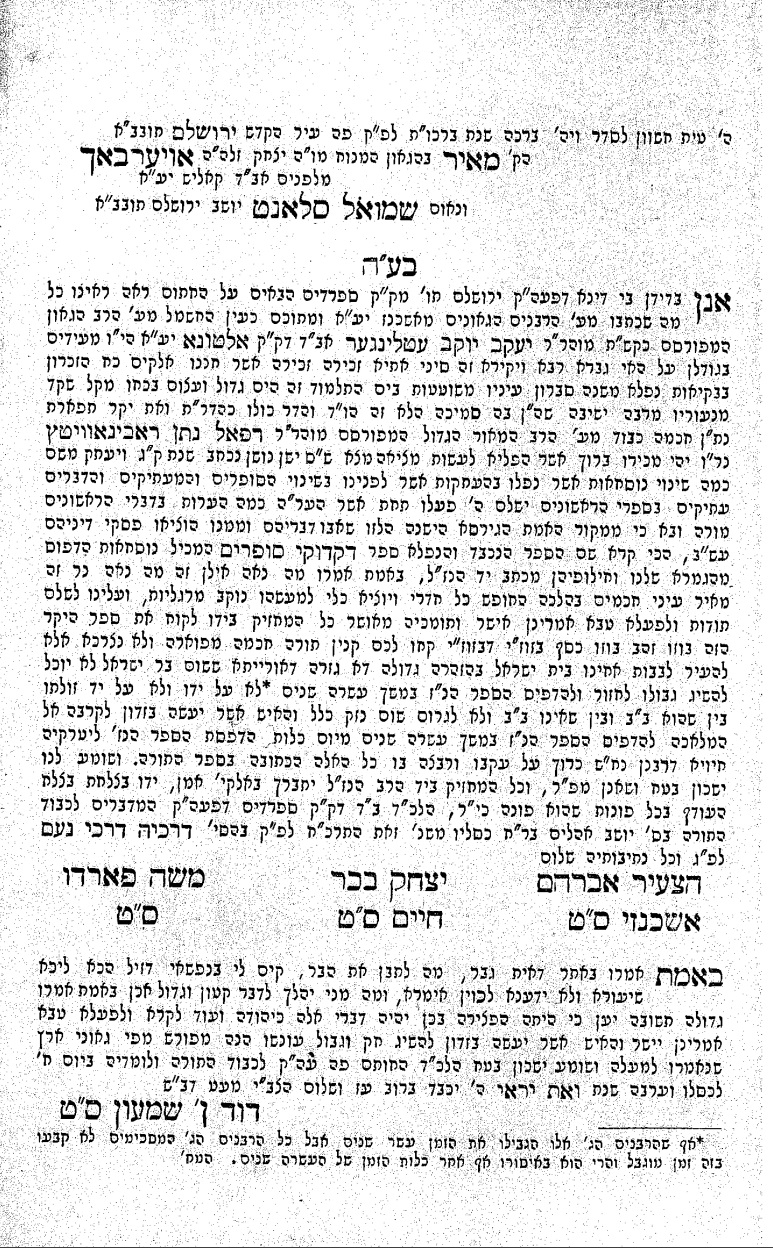
Here is the story behind this sentence: In 1799 one of the earliest authorized works of the Gra printed was the Shenos Eliyahu. In the back there was a section called Likutim.

Here is the text of the Gra Related to Mesorah:

In 1821 R’ Wolf Heidenheim wrote about this:

This is what R’ Shklover is referring to in the last page of his work without naming who he was referring to:

Interestingly enough R’ Yitzchaki of Bnei Brak in an article in Yeshurun 5 (1999) pp. 535-537 concludes that R’ Heidenheim was correct. In later editions of the Pe’as Hashulchan has the piece of R’ Shklover added into the proper place in the important introduction of the work. (Thanks to Y. Yankelowitz for his sources and materials).

Another work of the Gra is the first edition of the Biur ha-Gra on Shulhan Orakh (Item #137). This edition removed many standard commentaries (Taz, etc.) but not the Be’er ha-Goleh because he was related to the Gra. A Shulhan Orakh with just the Gra’s commentary proved not viable because when people purchased a Shulhan Orakh they wanted all the standard commentaries in addition to the Gra’s. In the middle of the publication of the Even ha-Ezer volume the publishers decided that they would include the other commentaries even if it meant moving the Gaon’s commentary to the bottom, they received permission from R. Chaim Volozhin to do so.

About Item #18 Messechtas Purim see our discussion earlier on the blog here.

Item #25 is Peirush Megilas Achashverosh, Venice 1565. The description states:

R. Zechariah ben Saruk (1450-c. 1540), was one of the great Chachamim of Spain… With an important introduction, which provides a rare historical glimpse into the travails of Jews who were exiled from Spain as well into as other challenges of that period.

Worth quoting is part of another piece from this interesting introduction:

שהראשונים הניחו לנו לדבר אבל לא לקנטר ואני תמה מאד מן החכם העניו ה”ר שמואל די בידאש נ”ע איך נפל ברשת מאמר האומר אין משיבין על הארי אחר שמת? וזה לשתי סבות הא’ שהוא ידוע לקטני עריסה [רץ המונחים בעריסה] כי קטנם עבה ממתנינו, וההקש והערך שיש בין ידיעתם לידעתנו הוא בערך גלגל ערבות אל נמלה אחת, השנית שהחכמים ההם ע”ה שחברו מה שחברו, האירו לנו בחיבוריהם מפיהם אנו חיים, אם כן מה נהיה כפויי טובה ששתינו מים זכים מבורם ועתה נקנטר כנגדם. ובעת שאמר החכם הנזכר על בעל העטור והרא”ש והרמב”ם ז”ל שהוכו בסנורים, ודברים אחרים, זרים לכל חכם לב לאומרם מאשלי רברבי. ותמהני מחכמתו שאני הייתי מכיר אותו היטב שהוא חכם ועניו איך אמר בהקדמת ספרו מה שסתר אחר כך בספרו? כי אמר בהקדמתו שהסתירה אשר לא יכוןי הסותר לבייש את האשר נעלם ממנו דבר, כי אין זה מורידו מחזקתו. והאמת כן הוא. ובספרו, כשחלק על הגאונים הנזכרים אמר שהוכו בסנורים

ונראה לי דילמא מר נאים כדנפק שמעתתיה מפומיה, כמו שאמרו על רבי יהושע בן לוי, כדאיתא במסכת נדה פרק המפלת. ולא זו בלבד הזהיר לנו חז”ל, אבל גם כן אמרו במוסריהם שלא יחלוק אדם על רבו אפילו בעודו בחיים חייתו, ולכן אמרו בירושלמי לית ריש לקיש מתריס כלפי רבי יוחנן, למפיגל עליה לאפוקי מיניה עובדא. העובדא היה שהוראה רבי יוחנן לתלמידו ריש לקיש שהצפורן אינה מטמא, כמו שהמחלוקת הוא בירשלמי במסכת הורית פרק כהן משוח

ובעבור שזה האיש היה חשוב במדותיו, נאמר שזה היה כשגגה שיוצא מלפני השליט ולכן בכל מה שחלק כנגד גאונים עולם, לא אדבר אלא באחד, בעבור שנשבעתי ואקיימה להיות כנגד כל איש שיחלוק נגד הרא”ש והרמב”ם ז”ל וכו’

על כל שאר הדברים שהטיח כנגדם, ובפרט נגד הראב”ע ז”ל אשר אחר חתימת התלמוד היה רשום ככל הגאונים, אף אלפי שהיה הוא גאון, וראו מה שכתב עליו הרמב”ם לבנו, והוא היה חכם כולל ושלם בכל חכמה. ואנכי ראיתי חדושי הראב”ע ממסכת קידושין [ותוס’ הביאו בקידושין לו א], והם בתכלית הדקות האימות, ובא החכם ר’ שמואל די וידאש, האל יכפרהו לומר עליו, ולא אמר אמת ואינו נכון ודברים אחרים, שאינם ראויים לדבר כנגד האשל הגדול הראב”ע. ומה שאמרתי לא הייתי אומר, אלא שנקרת בפי’ אחד שלו מהמגלה הזאת

Last year this rare work was reprinted based on the first edition and manuscripts with notes and a useful introduction about the work.

Item #37 is the rare work Tal Oros. This work is almost completely unknown to most poskim. One important exception was the Magen Avraham who quoted it numerous times in his classic work on Shulchan Aruch. For additional information about this author see this earlier post on the blog (here).

Previously we have mentioned how we can learn about works found in different people’s libraries. Item #163 is the Beis Halevi’s copy of the classic work of the Malbim on Orach Chaim which sadly was never completed.

An interesting bibliographical scoop about this work can be found in an interview in Mishpacha Magazine in the September 4, 2019 (Issue #776, p. 50) by Rabbi Yonason Sacks. He describes purchasing the Malbim’s own copy which had an important gloss to a specific passage.

The catalog’s letters section is always an important way to learn about interesting unknown historical documents and the like.

Item #229 we learn about a newspaper written in Yeshivas Telz for Purim. This tradition is found already in Volozhin as described by Shaul Stampfer and continues until today.

Item #182 is another Letter of R. Yehiel Mikhel Epstein, author of the Orakh ha-Shulhan.

This letter has a very interesting passage (which the entry downplays) we already wrote about back in 2007 (here). In this letter he wrote not to write to R’ Spektor as he is מוקף מסביב and write to the Netziv even though he is sick.

Shockingly enough R’ Chaim Kanievskey advised R’ Horowitz, the editor of this edition, not to edit out this line.

Item #224 must be highlighted as this is an incredible manuscript, which relates to the famous controversy in Yerushalayim in the 1880’s.

This is a letter from 1887 written by R. Yosef Dov ha-Levi Soloveitchik, the author of the Bes ha-Levi, to his friend R’ Hildesheimer. The catalog description states in part:

During the late 1880’s the old Yishuv of Yerusholayim, then led by the great R. Yehoshua Leib Diskin, was supported by the “Chalukah” system, which was funded by Jews from the Diaspora… He continues that there is still one place that the plague of secular studies has not infiltrated and that is Yerusholayim, and despite the fact that scoffers want to implement secular studies there, the Yishuv, under the leadership of “Rabbeinu HaGadol Me’or Ha’Golah Yochid B’Doreinu B’Torah V’Yirah HaGaon MaHaRIL Diskin Shlit”a, have prevailed and held on to their sacred tradition. However, those who are opposed to the Chachomim are totally persistent in their publications against the Yishuv and the MaHaRIL”. The Beis Ha’Levi therefore requests that R. Hildesheimer publicize that he disagrees with this view, and that he reaffirm that it is forbidden for the school system in the Old Yishuv, which was constituted primarily of students with Lithuanian backgrounds, to implement these changes…

In this letter we see the incredible respect that the Beis Halevi had from R’ Yehoshua Leib Diskin, something known to us from many other sources.

R’ Hildesheimer’s role in this controversy has been discussed a bit by David Ellenson, Rabbi Esriel Hildesheimer and the Creation of a Modern Jewish Orthodoxy, pp. 110-112,123-126.

Many aspects of this fascinating controversy have been dealt with by R’ Eitam Henkin HY”d in various articles.

One important point is from the Beis Halevi letter it sounds like all Lithuanian Gedolim sided with R’ Diskin but this is not so simple at all. R’ Shmuel Salant definitely did not agree with R’ Diskin on this. IYH this will be discussed at greater length in the future.


R. Shlomo Yosef Zevin and Yeshiva Students being Drafted to the Army, views of women, and more

Shlomo Yosef Zevin and Yeshiva Students being Drafted to the Army, Views of Women, and More

Marc B. Shapiro

1. In an earlier post I wrote about R. Shlomo Yosef Zevin and the famous essay about how yeshiva students need to serve in the army, an essay which is widely attributed to him. See here. In the post I cited important information uncovered by David Eisen that complicates the issue (as we see the Zevin family itself is of two minds on the matter), and we were left with no absolute proof that R. Zevin wrote the essay. I encourage all readers interested in the topic to read the six emails from Eisen quoted in my post, as they became the primary source material for all who wish to explore this matter.

One of the points that Eisen’s sources disagree about is when the essay was attributed to R. Zevin. R. Nachum Zevin, R. Zevin’s grandson, claims that it was only attributed to him after R. Zevin’s passing in 1978, but R. Menachem Hacohen states that already in the early 1970s he had seen the essay and it was believed that R. Zevin wrote it. As Eisen reports, one of the chief librarians at the National Library told him that he believes that already in the 1960s the essay was attributed to R. Zevin.

I am now able to put the matter to rest and establish beyond any doubt that R. Zevin is indeed the author of the essay. One of R. Zevin’s close friends was the author R. Zvi Harkavy, who served as an army chaplain. Harkavy regarded R. Zevin as his teacher, referring to him as מו”ר. In 1959 it was announced that Harkavy would publish a bibliography of all of R. Zevin’s writings, which were estimated to be over 1000 items, including material written under a pseudonym.[1] As far as I can tell, this never appeared. In Harkavy’s Ma’amrei Tzvi, p. 26, he includes a 1969 letter he received from R. Zevin is which Harkavy is addressed as ידידי הדגול. I mention all this only to show that when Harkavy speaks about R. Zevin you rely on what he says.

It has often been said that the identification of R. Zevin with the essay on yeshiva students and the army was only made years after its 1948 appearance, and this casts doubt on it having been being written by R. Zevin. I can now say that this is incorrect. In 1951 (Iyar 5711) Harkavy published an article in the Jerusalem Torah periodical Ha-Hed, which was a journal that R. Zevin himself often published in. (Unfortunately, very few issues from this periodical can be found on Otzar haChochma.) In Harkavy’s article he identifies R. Zevin as the author of the essay. Not only was Harkavy, because of his close friendship with R. Zevin, in a position to know that he wrote it, but R. Zevin never denied authorship in subsequent issues of Ha-Hed.

This shows without any doubt that R. Zevin is the author of the essay, and from this point on no one—including members of the family—should deny his authorship. Here is Harkavy’s article.

R. Nochum Shmaryohu Zajac called my attention to the recently published memorial volume for R. Yehoshua Mondshine,Sefer, Sofer, ve-Sipur. On p. 327 R. Mondshine wonders why R. Zevin—whom he seems to believe was indeed the author of the essay—would have felt it necessary to keep his authorship secret. R. David Zvi Hillman suggests that R. Zevin felt that if it was known that he wrote it, he would not have been welcome at the Brisker Rav’s home. He adds that it could have also created problems with the Habad synagogue he attended, as well as with his good friend R. Yehezkel Abramsky.

In going through the various issues of Ha-Hed, I discovered a picture of great interest in the Shevat 5711 issue.

On the right is Leah Seliger. She was a learned woman who edited the collected writings of her late husband, R. Joseph Seliger, 

Kitvei Ha-Rav Dr. Yosef Seliger (Jerusalem, 1930). The woman in the middle is R. Kook’s wife, Raize Rivka. Until recently I knew of only one other published picture of her, and this appears at the beginning of Pinchas Grayevski, Benot Tziyon vi-Yerushalayim, vol. 7 (Jerusalem, 1929; I think Dr. Yehudah Mirsky called my attention to this picture). The woman on the left is Miriam Berlin, the widow of R. Naftali Zvi Judah Berlin. I do not know of any other published pictures of her.

Shimon Steinmetz called my attention to this additional picture of R. Kook’s wife that can be found here.

2. In my post here I discussed these words from Exodus 15:16:

בִּגְדֹל זְרוֹעֲךָ יִדְּמוּ כָּאָבֶן

However, I neglected to mention one additional point. How come there is a dagesh in the כ when according to the grammatical rules it should not be there? R. Aaron of Lunel in his Orhot Hayyim offers an explanation. He states that if there was a dagesh people would read the last two words as יִדְּמוּךׇ אָבֶן, “stones are similar to you,” which is not a respectful thing to say to God.[2]

3. In my last post here I discussed the Hazon Ish’s opinion on the dispute between Maimonides and Rabad about an unwitting heretic, and the Hazon Ish’s assumption that Maimonides actually agreed with Rabad in this matter. It must be clarified that the Hazon Ish is not certain about his suggestion that there was no disagreement between Maimonides and Rabad when it came to someone who was completely “innocent” in his heresy. The Hazon Ish4. A couple of years ago in my post here I mentioned that in part two of the post I would have an excursus on the nature of women. For some reason I forgot to include this excursus in all the subsequent posts, so here it is.[4]

On the matter of the creation of women, and whether they are created “better” or “worse” than men, Shaul Regev calls attention to a strange comment by R. Jacob Matalon, Toldot Yaakov (Salonika, 1597), p. 7d (printed together with his She’erit Yaakov).[5] There are many comments in rabbinic texts that have a negative view of women, and most of these comments are based on a belief that women are inherently inferior to men. Yet not many texts are as explicit as R. Matalon in regarding women as almost a different species, standing between apes and men.

ובין החי למדבר הקוף ובין הקוף םמדבר [צ”ל למדבר] ומשכיל הם הנשים והאנדרוגינוס

Women obviously speak, so מדבר must mean speak with intelligence.

A passage similar to what R. Matalon says, but without mention of an ape, is found in Gersonides’ comment to Genesis ch. 3 (p. 110 in the Ma’aliyot edition).

והנה קראה האדם שם אשתו ‘חוה’, כאשר השיג בחולשת שכלה, רוצה לומר שלא עלתה מדרגתה על שאר הבעלי חיים עילוי רב, ואם היא בעלת שכל, כי רוב השתמשותה אמנם הוכן לה בדברים הגופיים, לחולשת שכלה ולהיותה לעבודת האדם. ולזה הוא רחוק שיגיע לה שלמות השכל, אלא שעל כל פנים היא יותר נכבדת מהם, וכולם הם לעבודתה

Gersonides is known for his negative view of women, and this reputation comes from passages like this. Here Gersonides states that women are on a higher level than animals, but not by much. Furthermore, just like the animals are at the service of women, so women’s role is to serve men. In discussing this passage, Menachem Kellner writes: “Gersonides apparently found Darwin’s missing link: woman!”[6]

For another explanation which Modern Orthodox women will probably regard as insulting, but more traditional women will probably see as a compliment, see R. Meir Mazuz, Bayit Ne’eman, no. 52 (parashat Terumah 5777), p. 1, who quotes R. Nissim Gaon as follows: The verse in Proverbs 1:8 states: אל תטוש תורת אמך – “Forsake not the teaching of thy mother”. Yet since women don’t have Torah knowledge, תורת אמך cannot mean this. Rather, it means the special holiday foods that the mother makes.

Readers can correct me if I’m wrong, but I do not believe that R. Mazuz’s understanding is correct, and I think R. Mazuz was citing R. Nissim from memory. That is, R. Nissim’s comment has nothing to do with women lacking Torah knowledge and identifying their cooking as תורת אמך. Rather, he cites the verse simply as a general statement about the importance of tradition. Here is the passage of R. Nissim Gaon as cited by R. Maimon the father of Maimonides.[7]

וכתב רבינו נסים במגילת סתרים כי כל מנהגי האומה באלו המנהגות כמו זה. והראש בראש השנה, החלב בפורים ובמוצאי פסח, והפולים ביום הושענא רבה. ואותם המנהגות אין לנו לבזותם ומי שהנהיגם זריז ומשתדל הוא כי הם מעיקרים נעשים ולא יבוזו במנהגי האומה וכבר אמר הנביא ע”ה ואל תטוש תורת אמך, דת אומתך אל תעזוב

Regarding the role and responsibilities of women, R. Mazuz has another interesting comment.[8] As part of his argument that women are not obligated in hearing parashat Zakhor, he says that this commandment is connected to the commandment of destroying Amalek, and women are not able to do this. How do we know that women cannot destroy Amalek and therefore are not commanded in it? “Because if she sees blood and even if she sees a mouse she becomes afraid, so how could she kill Amalek?” While many will not appreciate what they see as R. Mazuz’s flippant tone (which is obviously a joke, as he is well aware that there are women soldiers and doctors), do even feminists wish to claim that killing comes as easy to women as to men? Do they really want to be “equal” with men in this matter? I, for one, have always assumed that if women were running the world, there would be many fewer wars, as only someone who is blind to reality cannot see that men are naturally more inclined to violence than women.

Here is another interesting point relevant to the subject of women: Rashi, Menahot 43b s.v. היינו, in explaining the talmudic passage dealing with the blessings that a man recites in the morning, states that a woman is to regarded as a maidservant to her husband (i.e., to do his wishes), much like a slave is to his master: דאשה נמי שפחה לבעלה כעבד לרבו

Rashi’s comment is not surprising and has often been quoted. Indeed, although it will trouble modern readers, lots of similar comments can be found in rishonim and aharonim.[9] Furthermore, in at least three places the Talmud refers to a wife with the term shifhah.[10] Yet for a reason I can’t explain, R. Moshe Feinstein was very troubled by this comment of Rashi, and this led him to write something quite problematic.[11] See Dibrot Moshe, Gittin p. 511 (also in Iggerot Moshe, vol. 9, Orah Hayyim no. 2):

ולולי דמסתפינא הייתי אומר שצריך למחקו דח”ו לרש”י לומר דברי הבל כזה, דמן התורה הא ליכא שום שעבוד על האשה לבעלה חוץ מתשמיש ולענין תשמיש הוא משועבד לה יותר דהא עליו איכא גם איסור לאו . . . ואינה מחוייבת לעשות רק עניני הבית ולא עבודת שדה ומעט עשיה בצמר שהיא מלאכה קלה ממלאכות שדרכן של בנות העיר בזה

R. Moshe states that in no way can a woman be generally regarded as under her husband’s authority as only in a few areas does she have obligations to him (much like he has to her). He continues to expound on the way a husband is obligated to treat his wife in order to show that she is far removed from being a maidservant.[12] This is all true, and it would be easy to quote authorities who write similarly. Yet they did not see this as in any way contradicting Rashi’s statement. Understandably, some have expressed great surprise upon seeing how R. Moshe refers Rashi’s comment as הבל (as they do not accept R. Moshe’s point that Rashi could never have said דאשה נמי שפחה לבעלה כעבד לרבו).

R. Shlomo Aharon Gans goes so far as to say that if thegadol ha-dorhad not been the one to say this, it would be forbidden to write such a thing. He adds the following, bringing support for the notion expressed in Rashi that a wife is like a maidservant (not that she is a maidservant, but she is like one)[13]:

ולא הבנתי דהא הויא קנין כספו, ועי’ תורא”ש קידושין ה’ דהוא מושל עליה ומשעובדת לו וכדכתיב והוא ימשל בך, וא”כ מאי קשיא ליה כ”כ בדברי רש”י אלו

This conception, that a wife is like a maidservant, was actually criticized by R. Hayyim Hirschensohn who called attention to the “barbaric” way Jews treated their wives in the small towns of Galicia, where the wives did not even eat at the same table with their husbands.[14]

וה’ יסלח לו כי ההרגל הרע של בני מדינתו להתגאה על נשותיהן אשר לוקחים אותן רק לרקחות וטבחות ואין מסיבות בשלחן עם בעליהן וחושבים אותם כחמת כו’ [מ”ש: ראה שבת קנב ע”א] ואלמלי עלמא צריכי להו היו בעי רחמי דלבטלי מן העולם ח”ו, ההרגל הפראי הזה אשר בעירות הקטנות בגאליציא ובקצת ערי פולין גרם להרב הנז’ לבלי להרגיש את העלבון אשר עלב לבנות האבות והאמהות אשר קמו גם הן לאם לבנות את בית ישראל

As a curiosity, it is worth noting the opinion of R. Menasheh Klein that a husband should not help his wife with household tasks such as cleaning the dishes, as that is “women’s work”, while the husband works outside the home. (And what about when the wife also works outside the home?) Instead, the husband should use that time for learning Torah and other spiritual pursuits.[15]

כי לכן נתן לו הקב”ה אשה לאדם שיהי’ לו לעזר שתעשה לו צרכי הבית והוא יהיה פנוי בזמן שיש לו ללמוד תורה ולעבודת השם ולא לכבס ולהדיח הכלים אחרי האכילה ולסדר את המטות החיוב על הבעל לפרנס את אשתו ובניו ושאר הזמן כל רגע ורגע ינצל ללימוד התורה ולעבודת השי”ת שמו. ובעונ”ה נשתנה הוסת שהבעלי בתים הצעירים נעשים בעלת בתים מבשלים ומדיחים הכלים והולכים לחניות לקנות צרכי הבית איינקויפען בלע”ז בקיצור עושים כל מלאכת הנשים והנשים עושים מלאכת האנשים

I can only imagine what the reaction of a newlywed wife would be if her husband would tell her that no, he has no plans to help clean the table and do the dishes because that is women’s work.

Related to this is the following story told by R. Yosef Wineberg, the grandson of the Slonimer Rebbe. It is obviously designed to make the “Litvish” look bad.[16]

A newly married Litvishe couple was once sitting together. The wife asked her husband to please make her a cup of tea. He immediately jumps up, puts on his hat and jacket and walks out the door. About an hour later, the husband returns home, removes his hat and jacket and makes her a cup of tea. Puzzled by his strange behavior, she asks for an explanation.

He explains: when you first asked me to make you a cup of tea, I was upset. I am a Talmid Chacham, a scholar, and you are meant to “serve” me, not the opposite. Not wishing to get into an argument, I went to my Rav to ask him what I should do.

The Rav explained to me that “ishto k’gufo”, that the Halacha considers us like one person. Therefore, making tea for you is identical to making tea for me. As I feel no compunctions with serving myself, I returned home to fulfill your request.

In order to show that the husband is the boss of the household, R. David Kimhi states that while the husband calls his wife by her name, the wife does not call her husband by his name, but by some title which shows his superior status.[17]

כי האיש הוא הקורא לאשתו בשמה ולא האשה לאישה, אלא דרך כבוד בלשון אדנות קוראה לו ולא בשמו, כי כל מי שיש לו מעלה אל אחר אין ראוי לאשר למטה ממנו לקרוא אותו בשמו, כמו אביו או רבו או אדניו . . . וכן האשה לבעלה כי אדניה הוא כמו שאמר: והוא ימשוך בך

One of the proofs he offers for this idea is that in Genesis 17:17 Abraham refers to Sarah by her name, but in Genesis 18:13 Sarah refers to Abraham as “my lord” (אדני). Another proof he mentions is that when God changes the names of Abraham and Sarah he says to Abraham (Gen. 17:15): “Thou shalt not call her name Sarai.” From this we see that Abraham called his wife by her name. However, when Abraham’s name was changed the Torah states (Gen. 17:5): “Neither shall thy name any more be called Abram.” Sarah was not told this, Radak states, as she didn’t refer to her husband by his name. This was rather a general statement, that among those people who call Abraham by his name, they no longer would do so.

Although Radak states that a husband calls his wife by her name, we know that this was not always the case. Thus, we are told that R. Jacob Moellin in speaking to his wife would not call her by her name. When he referred to her in conversation with others, he would call her mein hausfrau (my housewife).[18] The text that records this information notes that already in the Talmud, Shabbat 118b, we find that R. Yose referred to his wife as “my house,” and I think most assume that this was done as a term of respect.[19] The text further notes that the general practice was that both husband and wife did not refer to each other by their first name. Such a practice was also found in the Sephardic world.[20] What this shows us is that contrary to what Radak records, the practice need not have anything to do with the husband being regarded as “superior” to his wife.

With all the discussions in rabbinic literature that show the essential differences between men and woman, let me mention another curiosity that, if you want to be cute, you can say that in one place the Talmud actually refers to women as men. I have in mind Zevahim 67b which, in discussing the burnt offerings brought by two women after childbirth, states:

חטאת לזו ועולה לזו עשה שתיהן למעלה . . . אימור דא”ר יהושע בחד גברא בתרי גברי מי אמר

In this passage, the word גברי, which means “men”, refers to the case of the two women (although the principle enunciated applies to all people).[21]

While on the male-female topic, let me mention something else that is relevant. We all know that the name Avi (short for Avraham) is quite popular. Yet how many know that this is already a biblical name, but used for a woman (2 Kings 18:2)?

I want to return to the notion already mentioned in this note, and found in a number of earlier works, that an ape stands between animals and humans. The Sefat Emet, Genesis 18:1, expands on this as follows:

ובין חי למדבר קוף. ואנו נאמר כי אחר מדבר אדם, שעל זה נאמר “אדם” אתם קרוין אדם ולא האומות. וישמעאל הוא הממוצע לכן נקרא פרא אדם, ולכן יד כל בו וידו בכל, כי על ידו יש התקשרות בין מדריגות מדבר למדריגת אדם

When he writes כי אחר מדבר אדם it means that after the level of מדבר, which means “humanity”, there is the level of אדם, which is the level of the Jewish people. He then adds that the Arabs stand between מדבר and אדם which is why they are called פרא אדם. Often פרא אדם is used to show that the Arabs are on a lower level than other nations. However, here we see that the Arabs are on a higher level, and closer to the Jews than the other nations, as among the nations of the world only the Arabs are also called אדם—no doubt because of their monotheism, see Yevamot 61a—even if this word is placed together with the negative term פרא.

The Sefat Emet’s comment is derived from the Zohar,[22] which explains פרא אדם as meaning one who possesses the “beginnings of אדם”. The Zohar also places the descendants of Ishmael on a higher level than the other nations because they are circumcised. Circumcision was widely practiced even in pagan Arabia, so the reference to circumcision alone would not be enough to date this passage of the Zohar to the post-Islamic period.

R. Jacob Emden, however, cites a different passage in the Zohar that assumes the existence of the Islamic world, meaning that it could not have been written by R. Shimon ben Yohai.[23] He writes:

הנה לפניך שבימי בעל ספר הזוהר כבר היתה אמונת מחמד הישמעאלי בעולם (שנתחדשה בימי אמוראים האחרונים על”ב) כי קודם זמן זה היו כל הישמעאלים עובדי אלילים גמורים, ככל יתר גוי הארצות.

R. Emden also cites another Zoharic passage that assumes Islamic rule in the Land of Israel. He comments:[24]

הרי כי בימי בעל ספר הזוהר היתה אומת ישמעאל שולטת בארץ הקדושה, ודבר ידוע הוא ומפורסם, שלא הגיעו הישמעאלים לממשלה כללית עד שנת שע”ד לאלף החמישי . . . נמצא עכ”פ יותר מחמש מאות שנה אחר רשב”י חובר ספר הזוהר, ואולי מאוחר עוד הרבה מזה, ואיך אפשר להסכים זה עם שמות האומרים אותם הדברים, והמה חבריו או תלמידיו של רשב”י, לפי המובן בלשונו של בעל ספר הזוהר, הלא זה כדבר שאין לו שחר

He cites a third such example and writes:[25]

מלכות ישמעאל לא נתפרסמה ולא נתפשטה בימי תנאים ואמוראים. כי היו אז ממלכה שפלה קטנה וירודה

Returning to the matter of how women have been viewed, R. Joseph Solomon Delmedigo mentions that jokers—ליצני הדור—come up with all sorts of gematrias. When it comes to women not all of them are negative. For example, the gematria of אשה is דבש, and אשה יפה = שמחה גדולה. However he also cites a gematria which is not very complimentary to women. זכר=ברכה and נקיבה=בקללה. R. Delmedigo sees this as a big joke, but it is actually mentioned by R. Hayyim the brother of the Maharal in his Iggeret ha-Tiyul, section ז, and it is also found in Ba’al ha-Turim, Gen. 1:27 (with some differences as to which letters are actually included in the gematria).

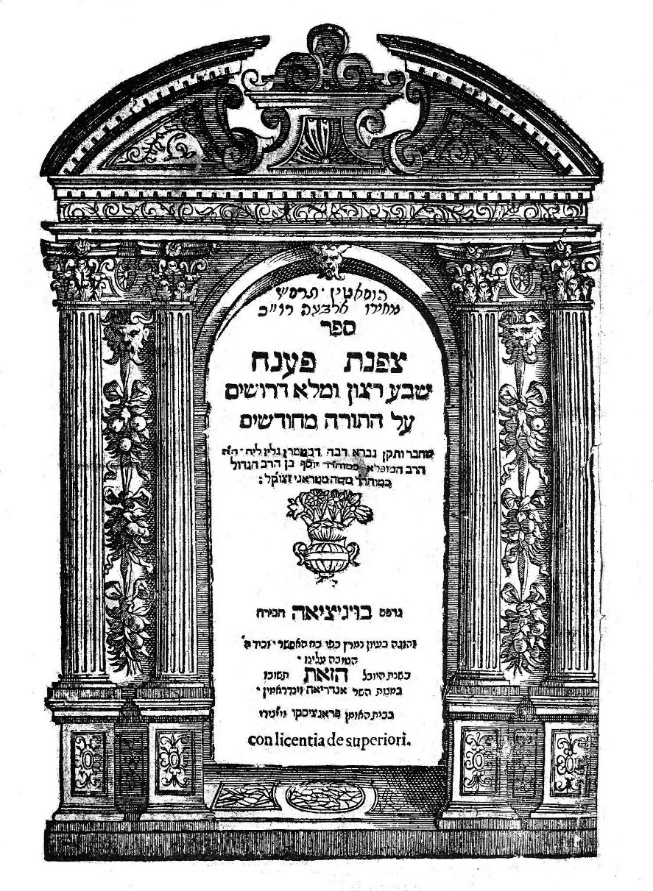
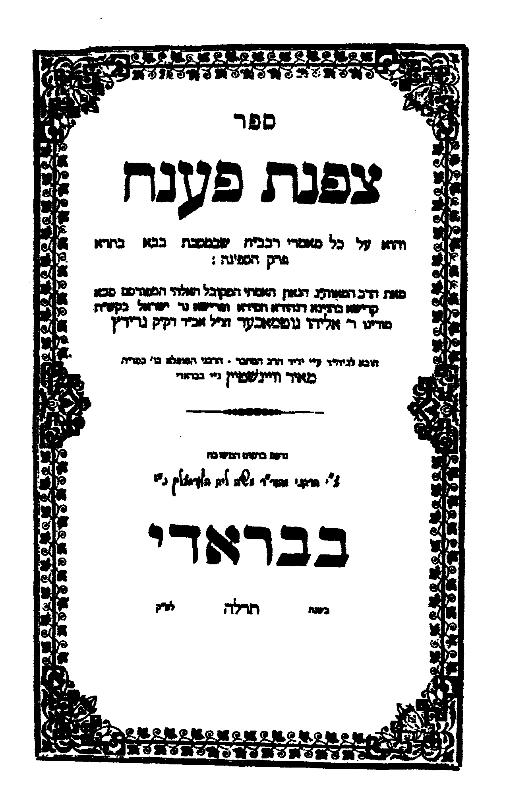
In 1807 R. Jacob Samson Shabbetai Senigallia[26] published his talmudic commentary Shabbat shel Mi. Here is the title page of the Livorno first edition. (It has been reprinted a number of times).

Here is what appears in the book on p. 89b. He is trying to explain why chapters 5 and 6 in tractate Shabbat are next to each other. Chapter 5 begins במה בהמה and chapter 6 begins במה אשה, and according to R. Senigallia this is because “birds of a feather flock together.”

If he was trying to make a joke, I can understand what he wrote. But who ever heard of making a joke in the middle of a talmudic commentary? Presumably, he was being serious, which leaves us with a very offensive comment.

There is, to be sure, humor in the Talmud, but I don’t know of any examples in talmudic commentaries. Yeshayahu Leibowitz quipped that the Sages must have had a good sense of humor, since they included the following text in the Talmud [27]: תלמידי חכמים מרבים שלום בעולם. In all seriousness, however, there are indeed humorous passages in the Talmud, as pointed out by R. Moses Salmon.[28] Here is one example he gives (Bava Batra 14a):

The Rabbis said to R. Hamnuna: R. Ammi wrote four hundred scrolls of the Law. He said to them: Perhaps he copied out the verse תורה צוה לנו משה

R. Salmon claims that anyone with a bit of sense can see that R. Hamnuna’s reply is a wisecrack made in response to the obvious exaggeration about R. Ammi.

Nehemiah Samuel Libowitz states that even in the Zohar we have passages that show a humorous side.[29] One of the many examples he points to is Zohar, Bereshit, p. 27a:

וימררו את חייהם בעבודה קשה בקושיא. בחומר קל וחומר. ובלבנים בלבון הלכתא. ובכל עבודה בשדה דא ברייתא. את כל עבודתם וגו’ דא משנה

I have no idea what to make of the following comment from R. Oury Cherki, dealing with humor, which does not sound like something that would be said by a leading kiruv figure (De’ah Tzelula: Olam ve-Adam be-Mishnat ha-Rav Kook [Jerusalem, 2015], p. 246). Rather, it sounds like something one of the maskilim of old would say.

התורה שבעל-פה אינה מובנה ללא שותפות רוח האומה. לכן כשלומדים הלכה רצוי להצטייד בחוש הומור, שכן לפעמים הדברים נראים משונים למדי. למשל, הכנת כוס תה בשבת. התלמוד אומר שאסור לשפוך מים קרים לתוך החמים אבל מים חמים לתוך הקרים מותר, כי יש כלל ש”תתאה גבר”, התחתון גובר. כששופכים מים חמים לתוך הקרים המים הקרים מתחממים ומתבשלים מה שאין כן ההפך – המים החמים מתקררים. יש כאן בהחלט סוג של הומור

I also found the following interesting comment by Moshe Meisels, the editor of Ha-Doar, in a letter to Chaim Bloch.[30] He suggests that the talmudic prohibition against a non-Jew observing the Sabbath is an example of rabbinic wit, and is not to be understood literally.

ואגב, לא אהא בבחינת מורה הלכה לפני רבו אם אינני מתאפק מלהביא מעין חידוש שנתחדש לי הקטן באחד המאמרים התמוהים בתלמוד מן הסוג הנ”ל, והוא אמרם: עכו”ם ששבת חייב מיתה, שנאמר יום ולילה לא ישבותו וכו’. ואין צורך להרבות דברים על הזרות שבדבר: מה איכפת למי אם שבת או לא שבת, ומה היא הראיה מאותו פסוק, המוסב על קיץ וחורף וכו’, ומה ענינו לכאן ולעכו”ם דוקא? ונראה לי שכל המאמר בא בדרך חידוד, וזה מובנו: עכו”ם ששבת מן הדין שיהא חייב מיתה בדיניהם. מדוע? ישראל שלא שבת חייב מיתה, משום שעל א-לוהיו נאמר וישבות ביום השביעי וכו’, אבל עובד כוכבים ומזלות, שעליהם נאמר יום ולילה לא ישבותו, מן הדין שעובדיהם יהיו חייבים מיתה אם שינו מדרך אלהיהם ושבתו

On the matter of non-Jews observing the Sabbath, R. Yaakov Koppel Schwartz makes a fascinating suggestion, which he acknowledges has no support in the rishonim and therefore he has doubts whether it is correct.[31] The prohibition against labor on the Sabbath is in remembrance of the fact that we were slaves and God redeemed us. Therefore, it is understandable why non-Jews are forbidden to commemorate the Sabbath by abstaining from work, as this has no connection to them. However, there is another reason given for the Sabbath and that is so that we remember the creation of the world. Non-Jews are also supposed to acknowledge this and therefore there should be nothing wrong with non-Jews having some sort of celebration in honor of the Sabbath.

אבל הכיבוד והקידוש של יום השבת, שהוא משום אמונת חידוש העולם, שייך שגם הגויים יהיו בהם ואינם מנועים מלכבד ולענג את השבת

If we follow R. Schwartz’s approach, this is something that could be suggested for Noahides whose “religion” is lacking any rituals, which for most people is an essential component of their religion.

* * * * * * * *

[1] Ha-Tzofeh, June 16, 1959, p. 2.

[2] Orhot Hayyim, Or Etzion ed. (Merkaz Shapira, 2017), p. 106, quoted by R. Joseph Karo, Beit Yosef, Orah Hayyim 51 (end). Regarding negative expressions directed against God, there is an interesting passage in R. Yedidiah Solomon Raphael Norzi, Minhat Shai, Deut. 8:3. To understand it one must know that the old French word “fi” expressed disdain or disgust. See here. The issue Norzi discusses is that the verse reads:

‘כִּי עַל-כָּל-מוֹצָא פִי-ה

Norzi cites a view that in this case there should be a dagesh in the word פי even though that is not in accord with the general rule, because without the dagesh, reading it as “fi” would be disrespectful to God:

כי לשון גנאי הוא בלשון צרפת וחלילה לשם יתברך

Norzi completely rejects this and states that the rules of biblical grammar are not to be changed because of how words sound in languages other than Hebrew (and there are indeed examples where biblical Hebrew words sound like profanity in other languages).

ואין לנו לחוש ללשון צרפת שאין מבטלין דרכי לשון הקדש מפני שאר לשונות

See also Samuel David Luzzatto, Prolegomena to a Grammar of the Hebrew Language, trans. Aaron D. Rubin (Piscataway, N.J., 2005), pp. 133-134.

Regarding the pronunciation of פ, R. Meir Mazuz points out that the Vilna Gaon, Commentary to Tikunei Zohar, section 19, p. 38d (p. 166 in R. Zuriel’s edition), mistakenly believed that Sephardim pronounce פ with and without a dagesh the same way (just as they pronounce ת with and without a dagesh the same way). R. Mazuz notes that the Vilna Gaon’s point is repeated by R. Baruch Epstein, Mekor Barukh, vol. 1, p. 397b (without mentioning the Gaon). See Mazuz, Bayit Ne’eman (Humash), vol. 1, p. 13 (first pagination).

[3] Hazon Ish, Yoreh Deah 62:21.

[4] In my earlier post I cited R. Samson Raphael Hirsch as adopting the notion that women are created on a higher spiritual level than men. I neglected to note that Shaye J. D. Cohen earlier discussed Hirsch’s approach. See Cohen, Why Aren’t Jewish Women Circumcised (Berkeley, 2005), pp. 165ff.

[5] “Eshet Hayil: Kavim li-Demutah u-le-Ma’amadah shel ha-Ishah be-Hagut ha-Yehudit ha-Shesh Esreh,” in Ephraim Hazan and Shmuel Refael, eds. Mahbarot li-Yehudit (Ramat-Gan, 2012), p. 286.

[6] Torah in The Observatory (Boston, 2010), p. 287. I earlier discussed Ralbag here.

[7] See R. Yaakov Moshe Toledano, Sarid u-Falit (Tel Aviv, [1945]), p. 8.

[8] Bayit Ne’eman no. 153 (parashat Vayikra 5779), p. 2.

[9] See e.g., R. Israel Ibn Al Nakawa, Menorat ha-Maor, ed. Enelow, vol. 4, pp. 32-33, who instructs a wife as follows (using the word שפחה that so troubled R. Moshe):

ועושה צרכיו בעצמה ולא על ידי אחרים. ואפי’ היו לה כמה עבדים וכמה שפחות, תעמוד היא ותשרתנו, ותקראנו אדוני . . .ויהיו עיניה תלויין לו, כעיני שפחה אל יד גבירתה

For a translation of this passage, see here. Maimonides, Mishneh Torah, Hilkhot Ishut 15:20, says that a wife should regard her husband כמו שר או מלך.

Radak, Gen. 3:16, writes:

והוא ימשול בך: לצוות עליך מה שירצה כאדון על עבד

Ramban, Gen. 3:16, explains that as a result of Eve’s sin, the relationship of man and woman was changed. From that point on:

 והוא יחזיק בה כשפחה ואין המנהג להיות העבד משתוקק לקנות אדון לעצמו אבל יברח ממנו ברצונו

R. Bahya ben Asher, Gen. 3:16, writes:

ואל אישך תשוקתך: שאע”פ שהאשה משועבדת ברשות הבעל ומנהג העבד לברוח מן האדון כדי שלא ישתעבד, גזר בזאת שתהיה משתוקקת לבעל ושתרצה להשתעבד לו בהפך מן המנהג

See also R. Chaim Rapoport’s letter in my Iggerot Malkhei Rabbanan, p. 172.

R. Avraham Blumenkrantz, Gefen Poriah, p. 352, quotes approvingly another rabbi who states as follows (emphasis added):

Her tears are ever ready to flow at the most miniscule suggestion of being dealt with as a maidservant. She will concede you the service of והוא ימשל בך. She will consent to call you בעלי, but don’t accent the דגש in the בית too heavily. She must constantly be reassured that there is honor and dignity in her subservience. Honor her more than you honor yourself. She must be compensated for her subjugation, and be made to feel that she has a genuine share in the dignity of the throne.

Do haredi women really feel that they are subservient or subjugated? Do haredi men feel this way about their wives? Hasn’t haredi society accepted the notion of separate but equal when it comes to men and women?

[10] Sanhedrin 39a, Yevamot 113a, Nedarim 38b.

[11] As is well known, and I have written about previously, R. Moshe often rejected the authenticity of texts that he found problematic. Another example of this with regard to Rashi on the Talmud is found in Iggerot Moshe, Even ha-Ezer, vol. 4, no. 64:1. Here R. Moshe says to delete words in Rashi even though, as he notes, these words are found in “Rashi” on the Rif and in R. Nissim. See the strong responses to R. Moshe quoted in R. Yonason Rosman, Petihat ha-Iggerot, pp. 605-606. One of these responses is from R. Menasheh Klein in his notes to R. Eyal Shraga, Minhat Ish, vol. 1, pp. 302-303. R. Klein writes:

וח”ו ואטו עד כמה נילך ונמחוק בדברי רבותינו ז”ל שנאמרו ברוה”ק, ולולי דמספינא הייתי אומר דאיזה תלמיד טועה כתבו, אבל פשוט דדברי רש”י נכונים וליכא כאן טעות כלל

When R. Klein suggests—לולי דמספינא—that a “mistaken student” is responsible for the problematic passage in Iggerot Moshe, he does not mean it seriously. This is just his respectful way of saying that R. Moshe’s position is completely without basis. He uses the same language in Mishneh Halakhot, vol. 12, Yoreh Deah no. 214. There he responds to R. Moshe’s statement that he doesn’t know who R. Menahem Tziyoni is, but since he quotes a heretical—in R. Moshe’s opinion—passage from R. Judah he-Hasid’s commentary on the Torah, therefore R. Tziyoni’s work must be banned together with R. Judah he-Hasid’s commentary.

[12] R. Moshe also famously states that women do not have any less holiness than men. See Iggerot MosheOrah Hayyim vol. 4, no. 49 (p. 81). See also the new Mesorat Moshe, vol. 4, p. 476. This position is at odds with many earlier writers who saw men as holier because they are commanded in more mitzvot. This is also Maimonides’ position in his commentary to Horayot 3:7. See R. Chaim Rapoport’s discussion in Kovetz Hearot u-Veurim, no. 908 (2006), pp. 138ff. Yet see R. Dov Halbertal, Erekh ha-Hayyim be-Halakhah (Jerusalem, 2004), vol. 2, p. 399, who has a different approach and makes the point that just because a Kohen and Levi are to be saved before an Israel, no one would say that the Kohen and Levi have more holiness. See also R. Yitzhak Barda, Yitzhak Yeranen, vol. 11, p. 249, that women are holier than men. He offers an original explanation of this notion.

שהאשה שהקב”ה הפריש ממנו, מהצלע שלו, הוא מופרש, וממילא כל מופרש קדוש, ואז האשה יותר קדושה מהאיש. ובזה מובן למה האיש מקדש את האשה, לא אומר לה הרי את אשתי, או כל סממן לשון של נישואין, חברה או שותפה וכו’, זולתי: הרי את מקודשת לי! לפי שהקב”ה קבע כל מופרש קדוש

[13] Kinyan Shlomo, Yevamot, p. 89. See also R. Natan Einfeld, Minhat Natan: Kiddushin, pp. 139-140, who cites other sources in rejecting R. Moshe’s point.

[14] Malki ba-Kodesh, vol. 4, p. 50a. See R. Menasheh Klein, Mishneh Halakhot, vol. 12, no. 351, for a defense of the practice of husbands and wives eating separately.

[15] Mishneh Halakhot, vol. 7 no. 155 (called to my attention by R. Aviad Stollman).

[16] The story is recorded by R. Chaim Dalfin, Faces and Places Boro Park (Brooklyn, 2017), p. 149.

[17] Commentary to Gen. 17:15. See the rejection of Radak’s opinion in R. Betzalel Stern, Be-Tzel ha-Hokhmah, vol. 1, no. 70.

[18] Maharil, Likutim (p. 610 in the Makhon Yerushalayim edition).

[19] On the other hand, R. Meir Schiff (Maharam Schiff), Gittin 52a, explains that R. Yose referred to his wife this way because she was a bad wife: אשה רעה. Yet the proof he brings for this is actually from a different R. Yose. See R. Judah Leib Maimon, ed., Sefer ha-Gra, vol. 1, p. 110 in the note. Regarding “bad wives”, R. Elazar of Worms is quoted as follows in R. Alexander Suslin, Sefer ha-Agudah, ed. Brizel, Yevamot, no. 78 (p. 41):

מי שיש לו אשה רעה יסבול יקבל ברצון ויקבל בשמחה ולא יראה פני גהינם

What does R. Elazar mean that if you suffer under a bad wife you will not see gehinnom? R. Moses Guedemann explains that with a bad wife you already saw gehinnom in your lifetime, so there is no need to see if after death. See Ha-Torah ve-ha-Hayyim, trans. Friedberg (Warsaw, 1897), vol. 1, p. 194:

כי פני הגיהנם כבר ראה בחייו

Regarding “good wives” see R. Shlomo Hoss, Kerem Shlomo, no. 43, who writes:

אין לך כשרה בנשים אלא אשה שעושה רצון בעלה: אהע”ז ס”ס ס”ט (אך אשת חיל כזאת מי ימצא)

R. Solomon Zvi Schueck was shocked at R. Hoss’ final comment, that one cannot find a wife who does the wishes of her husband. R. Schueck writes that based on this passage he assumed that R. Hoss must not have had a good wife.

נראה לי שהי’ לו אשה רעה, וממנה דן על כל הנשים שבישראל

See She’elot u-Teshuvot Rashban, Even ha-Ezer, no. 99 (p. 88b). He further tells us that he asked one of R. Hoss’ students who confirmed that this was indeed the case.

[20] See Tuvia Preschel, Ma’amrei Tuvyah, vol. 5, p. 142.

[21] See Or Torah, Shevat 5780, p. 460.

[22] Exodus 86a, 87a.

[23] Mitpahat Sefarim, ch. 4 (at the beginning; p. 20 in the Jerusalem 1995 edition). In R. Reuven Rapoport’s edition of Mitpahat Sefarim, with his commentary Itur Soferim, p. 13, R. Rapoport sees it as obvious that this passage in the Zohar is a later interpolation much like there are Savoraic additions in the Talmud.

[24] Mitpahat Sefarim, ch. 4 (p. 27 in the Jerusalem 1995 edition).

[25] Mitpahat Sefarim, ch. 4 (p. 54 in the Jerusalem 1995 edition). Regarding the larger issue that R. Emden points to, see Ronald C. Kiener, “The Image of Islam in the Zohar,” Jerusalem Studies in Jewish Thought 8 (1989), pp. 43-65.

[26] See the recent discussion of R. Senigallia by R. Moshe Maimon in the Seforim Blog here.

[27] Sihot al Pirkei Ta’amei ha-Mitzvot (Jerusalem, 2003), p. 289.

[28] Netiv Moshe (Vienna, 1897), pp. 45-46.

[29] “Halatzot ve-Divrei Bikoret be-Sefer ha-Zohar,” Ha-Tzofeh le-Hokhmat Yisrael 11 (1927), pp. 33-45. For more on humor in the Talmud, see Yehoshua Ovsay, Ma’amarim u-Reshimot (New York, 1946), ch. 1; Meyer Heller, “Humor in the Talmud” (unpublished masters dissertation, Hebrew Union College, 1950), available here; R. Mordechai Hacohen, “Humor, Satirah, u-Vedihah be-Fi Hazal,” Mahanayim 67 (5722), pp. 8-19; and Ezra Brand’s post here. From Brand I learned that David Lifshitz wrote an entire doctorate on the subject. See also my posts here and here where I discuss Siftei Hakhamim’s comment that Moses thought God was joking with him, and how this has been censored in a recent edition. See also J. Chotzner, Hebrew Humor and Other Essays (London, 1905); Nehemiah Samuel Libowitz, Ha-Shomea Yitzhak (New York, 1907).

[30] See here (Chaim Bloch Collection, Leo Baeck Institute, 7155-7156, 1/13).

[31] Likutei Diburim, vol. 4, pp. 24-25.


Response to Criticism Part 4; Rabbi Zvi Yehuda and the Hazon Ish

 Response to Criticism Part 4; Rabbi Zvi Yehuda and the Hazon Ish

Marc B. Shapiro

Continued from here.

1. In Limits,p. 14 n. 55, I write

I should call attention to a significant philosophical and halakhic point which appears to have gone unnoticed. The Vilna Gaon (R. Elijah b. Solomon Zalman (1720-97) apparently believed that the First and Second Principles are the only true Principles in Judaism. According to him, one who believes in God’s existence and unity, despite his other sins, is regarded as a Jew in good standing and he is thus able to be included in a minyan (quorum for public prayer). None of the numerous discussions regarding whether a Sabbath violator maybe in included in a minyan seems to have taken note of the Gaon’s comment, which appears in his commentary on Tikunei Zohar, 42a.

Grossman writes:

Apparently, concludes Shapiro, since the Gaon cites only idolatry as invalidating prayer and does not cite the rest of the Thirteen Principles, he is disputing Rambam’s classification of the others as binding fundamentals. However, this source has no bearing on the Principles. The Gaon’s comment refers to counting one for a minyan and to having one’s prayer accepted by God. He is clearly not referring to the Principles, since [in his commentary to Tikunei Zohar] he includes in the metaphor of the scorpion the sin of consorting with gentile women, which is unrelated to any Principle. (p. 48)

The first thing to note is that I never said that the Vilna Gaon disputed “the Rambam’s classification of the others [other Principles] as binding fundamentals.” Of course the Gaon held that people must believe that there is prophecy, that God gave the Torah, that there will be a Messiah, etc. But that is not what I am referring to when I say that for the Gaon the First and Second Principles are the only true Principles in Judaism. As I explain, for the Rambam the Thirteen Principles are special in that if you deny any of them you are to be regarded as having removed yourself from the Jewish people. When the Gaon makes the fascinating comment that belief in the First and Second Principles are enough to be regarded as part of the Jewish people, thus enabling one to be counted in a minyan, this means that as far as he is concerned (in this passage at least), only these beliefs qualify as Principles in the absolute sense that denial of them removes you halakhically from the Jewish people. If I were writing the book today, I would say that the Gaon focuses on three Principles, since he includes belief in the unity of God and an affirmation of God’s corporeality (Principle no. 3) certainly violates God’s unity.

I have to say, however, that while the Gaon’s comment is of great importance when it comes to the issue of Sabbath violation, I am no longer sure about the correctness of my larger point. It could just as well be that when the Gaon derives from the passage in Tikunei Zohar that if you believe in God and His unity, despite your other sins, you are still a Jew in good standing, it does not necessarily mean that these are the only true Principles. It could be that he is merely explicating the meaning of the passage in Tikunei Zohar, which relates to God, but that if it was a different passage he could have spoken about different principles, for example, as long as you believe in the Messiah and the resurrection even if you sin you are still a Jew in good standing. Here is some of what the Gaon writes:

כ”ז שמאמין באחדותו ית’ אפי’ עובר כמה עבירות אינו מומר לכל התורה ואעפ”י שחטא ישראל הוא ומצטרף למנין כמ”ש עבריין כו’ ונכלל תפלתו בכלל ישראל . . . אבל עקרב הוא המודה בעבודת כוכבים ומשתחוה לאל אחר וכן בבת אל נכר אז הקוץ ח”ו מסתלק מצדו וזהו פירוד הגמור וז”ש ואיהו פוסק וברח כו’ ר”ל יוסף במדרגתו ומסתלק הקב”ה ממנו כלל וכלל ואין תפלתו עולה כלל

In the Mishneh Torah, Hilkhot Teshuvah 3:7, the Rambam says that if you believe that God has a physical form you are a heretic, and Rabad famously defends those who did not know any better. According to Rabad, although these people are wrong they are certainly not heretics because of their mistake. Regarding this dispute there is R. Hayyim Soloveitchik’s famous statement in defense of the Rambam’s position that “one who is nebech an epikores is still an epikores.”[1]

In Limits I referred to the Hazon Ish’s opinion that the Rambam actually agrees with Rabad when dealing with a heretic who does not know any better. I further note, in agreement with R. Hayyim, that the Hazon Ish’s suggestion cannot be correct, and the Rambam, Guide 1:36, specifically rejects the Hazon Ish’s point. In fact, R. Kafih thinks that the Rambam saw Rabad’s criticism of what he wrote in the Mishneh Torah, and the end of Guide 1:36 was written in response to Rabad and is the Rambam’s defense of his position that faulty education or simply ignorance is no defense when it comes to belief in God’s corporeality.[2] In truth, even if we did not have this chapter of the Guide, the Hazon Ish’s position cannot be sustained, as it is in opposition to the Rambam’s entire conception of immortality which is a natural process. Thus, there is no room to raise questions about “fairness” or why does God not judge an ignorant person mercifully and grant him a share the World to Come if through no fault of his own he believes that God has a physical form.

Grossman, on the other hand (p. 49), claims that a close reading of the Guide supports the Hazon Ish’s position that someone who does not know any better, and who has no one to teach him, is not to be regarded as a heretic. Suffice it to say all scholars of the philosophy of the Rambam agree with R. Hayyim in this matter. Furthermore, the issue is not whether we regard someone as a heretic or not. There could be societal reasons that determine whether or not one is to be regarded as such. The dispute between the Rambam and Rabad is regarding someone who doesn’t know any better and denies a principle of faith, does such a person have a share in the World to Come? It is clear, as Rabad recognized, that according to the Rambam the answer is no. That is why I wrote that when the Hazon Ish explained the Rambam to really be agreeing with Rabad—that an unwitting heretic has a share in the World to Come—that this approach should be seen as in opposition to the Rambam’s position, even though the Hazon Ish was offering his approach as an interpretation of the Rambam.[3]

Grossman then writes (p. 49 n. 65): “In another example of the same hubris towards a giant of Torah scholarship, Shapiro, on p. 37, asserts that the Chazon Ish’s acceptance of Torah She-be’al Peh as having Divine authority (Iggeros 1:16 [should be 15]) is disputing Rambam. Chazon Ish there is merely emphasizing Rambam’s Eighth Principle, but Shapiro claims that Chazon Ish actually ‘added a new dogma.’”

The reader who turns to my book, p. 37, will find that contrary to what Grossman states, I do not mention anything about Torah she-be’al peh. The issue I was concerned with is the authority of Aggadah. In one of his most often quoted letters (Kovetz Iggerot Hazon Ish, 1:15), the Hazon Ish writes that all aggadot have their origin in the sages’ prophetic power, and one who denies this is a heretic.

משרשי האמונה שכל הנאמר בגמ’ בין במשנה ובין בגמ’ בין בהלכה ובין באגדה, הם הם הדברים שנתגלו לנו ע”י כח נבואי שהוא כח נשיקה של השכל הנאצל, עם השכל המורכב בגוף . . . נרתעים אנחנו לשמוע הטלת ספק בדברי חז”ל בין בהלכה בין באגדה, כשמועה של גידוף ר”ל, והנוטה מזה הוא לפי קבלתנו ככופר בדברי חז”ל, ושחיטתו נבילה, ופסול לעדות, ועוד, ולכן נגעו דבריך בלבי

Incidentally, in the published version of the letter it has

והנוטה מזה הוא לפי קבלתנו ככופר כדברי חז”ל

Here is the section of the actual letter of the Hazon Ish where you can see that it should read ככופר בדברי חז”ל.

Searching on Otzar haChochma, I see that almost everyone who cites this passage corrects the printing error.

It is with regard to this statement about aggadah, and this statement alone, that I spoke of a new dogma—which can perhaps already be seen in the Maharal if not earlier—that is not held by the Rambam who, together with the entire geonic and medieval Sephardic rabbinic tradition, did not have such a view about the binding nature of all aggadot. The reader of Grossman’s article who does not examine my book would think that I claimed that the Rambam did not believe that Torah she-be’al Peh has divine authority. Yet the difference of opinion between the Rambam and the Hazon Ish is over a different matter, namely, what is included in Torah she-be’al Peh. In fact, this is not really a dispute between the Rambam and the Hazon Ish, but a dispute between two traditions regarding how to understand Aggadah.

Incidentally, in the Hazon Ish’s letter just mentioned, in discussing the difference between prophecy and ruah ha-kodesh, he says something directly in opposition to the Rambam’s view.

אבל יש הבדל יסודי בין נבואה לרוה”ק. נבואה, אין השכל המורכב של האדם משתתף בה, אלא אחרי התנאים הסגוליים שנתעלה בהם עד שזכה לזוהר נבואי, אפשר לו להיות לכלי קולט דעת. . . , מבלי עיון ועמל שכלי, אבל רוה”ק היא יגיעת העיון ברב עמל ובמשנה מרץ, עד שמתוסף בו דעת ותבונה בלתי טבעי

In the published version of the letter there are three periods after the word דעת which I have underlined in. Usually when there are three periods it means that something has been removed from the letter, but in this case nothing has been removed. In fact, in the original letter there are only two periods, followed by a comma, and I don’t know why the Hazon Ish used these periods.

Continuing with Grossman, he sees it as obvious that the Hazon Ish’s opinion regarding an unwitting heretic is exactly what the Rambam held, and in support of this he points to Hilkhot Mamrim 3:1-3. Here the Rambam states that Karaites, who were raised with heretical beliefs and don’t know any better, are not to be judged like the original Karaite heretics who consciously rejected the Oral Law. With those who don’t know any better the Rambam counsels “not to rush to kill them,” but to draw them close to Torah with words of peace. (The words “not to rush to kill them” were removed from some printings.)

Does this passage have any relevance to the Rambam’s view of unintentional heresy? The answer is no, as here the Rambam is only counseling tolerance when dealing with Karaites who don’t know any better. He is only concerned with how we should relate to them. Rather than hating them and hoping for their destruction, which is normally the case with regard to heretics, the Rambam tells us that we should relate to the Karaites in a positive way and attempt to convince them to abandon their mistaken path. However, from the theological perspective, a heretic has no share in the World to Come and cannot be exculpated based on the argument that he does not know any better. I make this argument in Limits, p. 12, and it is also affirmed by R. Chaim Rapoport.[4]

Not only is this the peshat in the Rambam, but no other understanding works within the context of his philosophical system. That is, the Rambam’s entire philosophical understanding of the World to Come does not work with the notion that an unwitting heretic can also have a share in the World to Come. Any interpretations that assume otherwise are simply not in line with the Rambam’s approach, an approach that was well understood by both his supporters and opponents who argued at great length about this matter. It was also recognized by R. Hayyim who knew the Guide of the Perplexed well. R. Velvel, in discussing the passage in Hilkhot Mamrim pointed to by Grossman, stated exactly what I have just explained. Here are his words as quoted by R. Moshe Sternbuch[5]:

.הרי מפורש בדבריו [הרמב”ם] דמה שהוא אנוס מועיל רק לענין שראוי להחזירם בתשובה ולמשכם לחזור לאיתן התורה, אבל כל זמן שלא חזרו הם מומרים באונס, ושמם מומרים ואפיקורסים

If I were to argue in the fashion of Grossman, I could say that by asserting that the Hazon Ish is simply following what the Rambam says in Hilkhot Mamrim, that Grossman shows disrespect to R. Hayyim and R. Velvel, by not even seeing their positions as worthy of discussion.

There is a parallel to what we have been discussing elsewhere in the Mishneh Torah. In Hilkhot Avodah Zarah 2:5 the Rambam states that the repentance of heretics (minim) is never accepted. Yet in Hilkhot Teshuvah 3:14 the Rambam states that heretics who repent have a share in the World to Come. The Rambam was asked about this apparent contradiction and he replied that indeed there is no contradiction.[6] In Hilkhot Avodah Zarah he is speaking about how the Jewish community is to relate to heretics. As far as the community is concerned, even if a heretic repents the community is not to accept him, as one can never be sure that his repentance is authentic. However, Hilkhot Teshuvah is referring to the heretic’s relationship with God. As far as God is concerned, a true repentance is always accepted. (I don’t know of anyone today who accepts the Rambam’s opinion in this matter. If, say, a leading atheist philosopher or Reform rabbi decided to become Orthodox, not only would the community accept him, but people would make a very big deal of this and he would become a sought-after speaker at Orthodox synagogues.)

Grossman writes:

In an attempt to list various authorities who took issue with Maimonides, Shapiro tells us that “[i]n Abarbanel’s mind, only limited attention . . . should be paid to Maimonides’ early formulation of dogma, and it would certainly be improper to make conclusions about his theological views on the basis of a text designed for beginners.” (p. 50)

My citing of Abarbanel on p. 7 of my book has nothing to do with authorities who took issue with Maimonides. The mention of Abarbanel is with reference to my discussion about how the Thirteen Principles do not appear as a unit in the Mishneh Torah or the Guide, and in this regard I cited Abarbanel who writes as follows in Rosh Amanah, ch. 23:

This explains why he did not list these principles in the Guide, in which he investigated deeply into the faith of the Torah, but mentioned them rather in his Commentary on the Mishnah, which he wrote in his youth. He postulated the principles for the masses, and for beginners in the study of Mishnah, but not for those individuals who plumbed the knowledge of truth for whom he wrote the Guide.

Following his misunderstanding of my point, Grossman spends the next page explaining that Abarbanel accepts the truth of the Rambam’s Principles, a fact that I never denied. However, Abarbanel also believes that for the most profound understanding of the Rambam’s theological views, one needs to turn to the Guide. As I mention in the book, pp. 32-33, Abarbanel also does not accept the Maimonidean concept of Principles of Faith.

Regarding the Rambam positing Thirteen Principles of Faith, which I claimed is a novelty of the Rambam, let me cite R. Moses Sofer who says exactly this.[7]

י”ג העיקרים המציא הרמב”ם שהוא היה הממציא הראשון בזה, ואשר לפנים לא ידענום

Grossman’s final comment in the first half of his review is as follows (p. 52):

Another example of Shapiro’s proofs that Rambam’s theology differs from one work to another is the following. In his Commentary on the Mishna, Rambam states that “lack of belief in any of the Principles makes one a heretic.” [Quotation from Limits, p. 8] Yet, in his Mishneh Torah, he writes (Shapiro’s translation): “Whoever permits the thought to enter his mind that there is another deity besides God violates a prohibition, as it is said: You shall have no other gods before me . . . and denies the essence of religion – this doctrine being the great principle on which everything depends.”

This proves, says Shapiro, that one is not considered a heretic for such thoughts since the Rambam does not say that one who holds these beliefs is a heretic. However, the very source he adduces clearly says the opposite. The words kofer be-ikar,[8] used by the Rambam in this quotation, are a synonym for “heretic,” even according to Shapiro’s rendition of the words as one who “denies the essence of religion.”

If the Rambam writes that recognition of God as the source of all existence is a Principle upon which all of Judaism stands, it is obviously a Principle of faith.

I don’t think that anyone who reads these paragraphs will have a clue as to what my point was. What I noted is that in the Commentary on the Mishnah, in discussing Principles of Faith, Maimonides speaks of belief (or knowledge, depending on how you translate). This is a mental state. However, in Hilkhot Teshuvah, in discussing what makes someone a heretic, Maimonides writes: “One who says”.[9] In other words, he speaks of verbalizing one’s heresy publicly, not simply belief. If all we had was Hilkhot Teshuvah, one could conclude that even one who has heretical ideas, but conducts himself as a good Jew publicly, does not lose his share in the World to Come.

In the book I then turned to Hilkhot Yesodei ha-Torah 1:6 which speaks about one who imagines that there is another God, and by doing so denies the essence of Judaism. A similar comment can be found in Hilkhot Ishut 8:6 where the Rambam writes: “For the sin of idol worship is so great that even when a person thinks of serving [idols] in his heart [without acting upon it] he is considered wicked.” I noted that while a person who believes something heretical like this has, in his mind, denied the essence of Judaism, as long as his heresy is not publicly voiced he apparently is not to be regarded as a complete heretic with all the communal implications this implies. (For example, if you found someone’s private diary which revealed that he denied certain basic principles of faith, as far as the community is concerned he would apparently remain a Jew in good standing as he never publicized his heresy. But he would still have no share in the World to Come.)

It is clear that the Rambam believes that one who affirms a heretical doctrine loses his share in the World to Come, no matter what the reason he does so. But we need to ask why the Rambam specifically uses the formulation of “one who says”. The easiest answer is that he was simply adopting, and making wider use of, the language found in the Mishnah, Sanhedrin 10:1, which also categorizes two types of heresy by using the expression “one who says.”

It makes sense to assume that only one who publicly verbalizes his heresy is to be treated as a heretic by the larger community, but despite the language in the Mishnah, I think many will still wonder why in Hilkhot Teshuvah, which speaks of losing one’s share in the World to Come, Maimonides also uses the language “One who says.” I don’t have an answer to this question. All I did in the book was note that the Rambam’s formulation in the Mishneh Torah is different than what he writes in the Commentary on the Mishnah. Although I have found some rabbinic discussions of this problem, I am surprised that none of the major commentaries take up the issue of why the Rambam uses the word האומר in defining heresy. It seems that they would agree with R. Uri Tieger[10] who writes:

לאו דוקא האומר אלא אפי’ חושב כן ולא מוציא בפיו

It is noteworthy, though, that immediately following these words R. Tieger offers an alternative approach which speaks to the very point I was discussing

וי”א דאף דכל הני שרשי איסורם הוא במחשבה מ”מ לא נחתם עונם עד כדי שיקראו מינים ואפיקורסים עד שיוציאו הדברים בפיהם

R. Avraham Gottesman also raises the issue, and he too sees the Rambam’s formulation in the Mishneh Torah as possibly significant.[11]

‘האומר . . . הרי שלא הזכיר גם שם ממחשבה. ואולי תנא ושייר או לא רצה להחזיקו לאפיקורס ע”י העדר אמונת מחשבה כי רבות מחשבות בלב איש שאין בהם ממש וגם רוב מחשבות אין הקב”ה מצרפן למעשה חוץ ממחשבות ע”ז כדאיתא בגמ

All this is important and worth exploring. But let us return to Grossman, who again attempts to make me look like a fool. He states: “This proves, says Shapiro, that one is not considered a heretic for such thoughts since the Rambam does not say that one who holds these beliefs is a heretic.” Grossman makes this false statement based on my discussion on pp. 8-9. Yet if he had only turned to page 13, at the end of my discussion of this matter, he would have found that I write as follows:

We must therefore conclude that Maimonides’ use of the words “one who says” in describing a heretic is only in imitation of Mishnah Sanhedrin 10:1 where the same formulation is found, and not too much should be read into this. One who believes in a corporeal God or in the existence of many gods, even without saying so publicly, is indeed a heretic as far as Maimonidean theology is concerned. Such a one will not face any penalties from an earthly court, but he is certainly denied a share in the world to come.

In other words, my conclusion is the exact opposite of what Grossman attacks me for (and is indeed in line with Grossman’s own opinion).

As for the word האומר as opposed to המאמין, R. Nissim of Marseilles writes as follows with reference to the usage of the term האומר in Mishnah, Sanhedrin 10:1.[12]

והאומר אין תורה מן השמים, ולא אמר “המאמין” כי באמירה לבד הוא מזיק לרבים וכופר בתורה ואף אם יאמין כמונו שהיא רבת התועלת כי הוא מחטיא הכונה והופך קערה על פיה . . . ועל זה אמרו ז”ל: “האומר” כי אף אם יפרש ויתקן דבורו באיזה צד מן התקון ‘והפירוש, לא יועיל לו שלא יקרא כופר. כי הוא מביא אחרים להחליש תקותם בתורה, ומחטיא כונת השם ית

This is a very original approach that some might wish to use to explain the Rambam as well. According to R. Nissim, what is important is the public declaration as this has the result of leading others to heresy. In fact, even if you really don’t believe what you are saying, since you are publicly stating a heretical position this is enough for you to be regarded as a heretic.

I have now responded to every comment of Grossman in the first half of his review, where he discusses broad themes. The second half of the review, which we turn to next, discusses specific points about the Principles. For those who have asked why I am taking the trouble to respond to every single point of Grossman, the answer is that it gives me a chance to revisit texts that I spent so much time on years ago. Secondly, it gives me the opportunity to share much new material that I think will be of interest to readers.

Before ending I would like to add a few more points. Earlier I mentioned that R. Hayyim knew the Guide of the Perplexed well. Some might be wondering what the basis for this statement is, because unlike the Rogochover, R. Hayyim does not discuss the Guide in his works. I am relying on R. Joseph B. Soloveitchik who testified that R. Hayyim wanted to write a commentary on the Guide (as well as on the Minhat Hinnukh), but he never had the time.[13] Here is how he is quoted in R. Zvi Yosef Reichman, Reshimot Shiurim: Sukkah, p. 258:

ואמנם כלל גדול אצלנו שאין להקשות על סתירה שבין ספר היד לספר מורה הנבוכים, כי כן קבל רבינו שליט”א מפי זקנו מו”ר הגר”ח זצוק”ל, וזקנו זצ”ל קבע כך כמופלג גדול בספר מורה נבוכים שרצה לכתוב עליו פירוש. גם חשב לכתוב הערות על הספר מנחת חינוך. ברם שתי המחשבות לא יצאו לפועל מפני טרדות בזמן; וחבל

R. Hayyim’s knowledge of the Guide is noteworthy since, as R. Aharon Rakeffet has commented many times, R. Moshe Soloveichik “never held the book in his hands.” While this might be an exaggeration, the underlying point is that R. Moshe had no interest in, or knowledge of, the Guide. I can’t say whether there is any influence of the Guide on R. Hayyim’s commentary on the Mishneh Torah. R. Eliyahu Soloveitchik actually cites the Guide as standing in opposition to R. Hayyim’s famous explanation of the two types of kavanah, found in Hiddushei Rabbenu Hayyim Halevi, Hilkhot Tefillah 4:1.[14]

Another noteworthy difference between R. Hayyim and the Guide is the following: The Rambam in Guide 2:45 explains that the books of the Prophets were produced from a higher level of divine inspiration than the books of the Hagiographa. However, R. Hayyim held that the difference between the Prophets and the Hagiographa is that the divine inspiration in the Prophets was originally intended to be spoken, and only later was written down. On the other hand, the divinely inspired books of the Hagiographa were originally intended to be written down. Thus, the difference between the Prophets and the Hagiographa has nothing to do with levels of prophetic inspiration.

This view of R. Hayyim is recorded in a number of different places, including by his son, R. Velvel.[15] R. Hershel Schachter also quotes this opinion from the Rav, who was passing on what his father, R. Moses, reported. Here is the passage in R. Schachter’s Nefesh ha-Rav, p. 240.

This entire passage is copied, word for word, in R. Gershon Eisenberger’s Otzar ha-Yediot Asifat Gershon, p. 411. But following a “tradition” that has now become somewhat popular in certain circles, Nefesh ha-Rav is not mentioned by name. Instead it is referred to as  ספר אחד [16]

Returning to the passage from R. Soloveitchik quoted by R. Reichman, it is also of interest that R. Hayyim is quoted as saying that there is no point in calling attention to contradictions between the Mishneh Torah and the Guide. No reason is given for this, but no doubt it is because the works had different purposes, and this can explain different, even contradictory, formulations.

Regarding the Hazon Ish, in my book I assumed that he, and a number of other scholars who explained Hilkhot Teshuvah 3:7 similar to him (including R. Ahron Soloveichik, Parah Mateh Aharon, Sefer Mada, p. 194[17]), never saw what Maimonides wrote in Guide 1:36 where he explains why an honest error in matters relating to principles of faith does not change one’s fate. As mentioned already, R. Kafih states that these words were written in response to Rabad’s criticism in Hilkhot Teshuvah 3:7, where he states: “Why has he [Maimonides] called such a person a heretic? There are many people greater than and superior to him who adhere to such a belief on the basis of what they have seen in verses of Scripture and even more in the words of those aggadot which corrupt right opinion about religious matters.”[18]

I now believe that while it is certainly likely that some of the others I mention in my book had not seen the Guide, I would not say this about the Hazon Ish. Benjamin Brown has reasonably claimed that formulations in the Hazon Ish’s writings show that he was influenced by the Guide.[19] R. Yehoshua Enbal has harshly criticized Brown’s assertion that there was significant influence of the Guide on the Hazon Ish, but Enbal does not deny that the Hazon Ish knew the Guide.[20] It is reported that th Hazon Ish cited R. Moses Alashkar that Maimonides expressed regret about having “published” the Guide, and that if the work hadn’t already been spread so far, he would have removed it from circulation.[21] (This statement is not found in R. Alashkar’s works.) It seems to me that only one who had at least some idea of Maimonides’ philosophy, and why it could be viewed as problematic, would feel it necessary to identify with such an idea.

Can we point to any specific examples of influence of the Guide on the Hazon Ish? This is something that needs to be investigated and I am not prepared to offer an opinion on the matter. I would just note that R. Moshe Zuriel claims that a passage in the Hazon Ish about Divine Providence has its origin in Maimonides words in the Guide.[22]

2. Earlier in the post I discuss the Hazon Ish’s letter,Kovetz Iggerot1:15, which may be the most famous of all of the Hazon Ish’s letters. I also provide an image from the actual handwritten letter. For this I thank Mrs. Hassia Yehuda who graciously allowed me to take pictures of this and the other letters I will discuss.

Mrs. Yehuda is the widow of Rabbi Dr. Zvi Yehuda (1926-2014). Yehuda was a very close student of the Hazon Ish from 1941 until the early 1950s. During some periods he learned with him almost every day for 2-3 hours, and the Hazon Ish became a father-like figure to him. The letter in Kovetz Iggerot 1:15 was sent to Yehuda, and this is what Yehuda himself wrote about this letter (published here for the first time).

As with another close student of the Hazon Ish, Chaim Grade, Yehuda chose a different path than what his teacher would have preferred: He enlisted in the IDF, attended university, and became part of the Religious Zionist world.

Here is a picture that you can find on the internet.

From the Hebrew Wikipedia page for the Hazon Ish we learn the picture was taken in Ramat ha-Sharon when the Hazon Ish was visting a yeshiva ketanah there and testing the students. The man to the right of the Hazon Ish is R. Elijah Dessler. The young man to the right of R. Dessler is Yehuda. The man on the far left is R. Shmuel Rozovsky. Here is another picture from the same event where you can see R. Rozovsky clearly.

Here is a picture of Yehuda from much later in life.

The letters of the Hazon Ish to Yehuda are important as they present us with his responses to a curious young man who started to question things. We are not dealing with someone like Chaim Grade who would throw out traditional Judaism entirely. Rather, Yehuda was beginning to open himself to a more liberal type of Orthodoxy, one which valued academic studies and engaging with the outside world. Yehuda later taught Mishnah on Israel Radio and collaborated with Pinhas Kehati in writing the famous Mishnah booklets. In these booklets Yehuda’s role was acknowledged, but when the booklets were later incorporated into Kehati’s published volumes unfortunately there was no longer any acknowledgment. After coming to the United States, Yehuda completed his doctorate at Yeshiva University and his dissertation is titled “The Two Mekhiltot on the Hebrew Slave”.[23]

In Brown’s book on the Hazon Ish, he quotes from a lengthy interview with Yehuda which was included as an appendix to Brown’s doctoral dissertation. With the approval of Brown, I have uploaded Yehuda’s very interesting interview here. You can also listen to Yehuda being interviewed about the Hazon Ish at Torah in Motion here. Yehuda also published two articles about the Hazon Ish in Tradition.[24]

Because the published version of the Hazon Ish’s letters does not reveal who they were sent to, people have no idea that Yehuda was the recipient of a number of important letters that are often cited. The earliest of the letters from the Hazon Ish to Yehuda is 1:41. According to Yehuda (in unpublished comments on the Hazon Ish’s letters to him), this letter is from 1944. Here we get a glimpse of the strong connection between the Hazon Ish and Yehuda, as the Hazon Ish ends the letter with הדו”ש הדבוק באהבתך. The content of the letter is also of interest as the Hazon Ish writes:

רב שלומים, מאד הנני מתענין לדעת משלומך, וחידה סתומה היא בעיני, שלא התראית עמדי טרם עזבך עירנו, ומה קרה אשר הכאיב לבבך הטוב, אשר מנעך משפיכת רוחך? ואשר מהרת לברוח. לא אוכל להאמין שתעזוב את התורה, כי נפשך קשורה בה בחביון נשמתך ואצילות נפשך העדינה, נא אל תכחד ממני דבר, והודיעני הכל

The Hazon Ish had apparently heard that Yehuda was going to abandon full-time Torah study. He was disappointed with this information and asked Yehuda to explain what was going on.

Yehuda replied to the Hazon Ish and this led to the Hazon Ish’s next letter to Yehuda, which is found in Kovetz Iggerot 1:42. In this letter the Hazon Ish offers guidance to Yehuda, designed to keep him on what today we would call the haredi path:

הריני מאחל לך שתהא דעתך נוחה מחכמתך בתורה, ואל יוסף כח מנגד להדריך מנוחתך, ולנדנד איתן מושבך, שים בסלע קנך, ושמה בסתר המדרגה, הוי שקוד ללמוד תורה, וראה חיים שתחת השמש אין לו יתרון אך למעלה מן השמש יש לו יתרון

Kovetz Iggerot 1:19 was also sent to Yehuda, and it was written after the letters already mentioned. In this letter the Hazon Ish deals with Yehuda’s choice to leave the yeshiva world:

באמת לא מצאתי את המסקנא כדרך הנכונה, אך בידעי שאי אפשר לאכף עליך לעשות נגד רצונך הטבעי . . . לא הרהבתי בנפשי להרבות דברים בשבח הישיבה . . . ואולי תבוא שעה מוצלחת ועבר עליך רוח ממרום בבחינת יעבור עלי מה! ותכיר ישיבתך בישיבה להיותר מתאימה לנפשך ולמשאה בחזות הכל

Kovetz Iggerot 1:14 is the last of the fourteen letters the Hazon Ish sent to Yehuda. This was written when Yehuda’s life choice had been made and the Hazon Ish recognized that his pleas to Yehuda to remain in the yeshiva world had gone unanswered. We see in this letter the Hazon Ish’s great love for Yehuda together with his great disappointment that his dear student had chosen a different path for his life. I don’t think there is another published letter from the Hazon Ish where he writes with such emotion. It is a tribute to Yehuda’s memory that the world can see how the Hazon Ish loved him, and I am happy to be able to reveal who the addressee of this letter is, as over the years many people have wondered about this, and sections of this letter have often been reprinted.

Here is some of what the Hazon Ish wrote to Yehuda:

רב הרגלי לערוך את החיים בודאות גמורה של י”ג העיקרים שעם ישראל עליהם נטעו הקנו לי אהבת התורה בלי מצרים. עשיר אני גם באהבת זולתי, וביחוד לצעיר מצוין בכשרונות, ולב מבין. צעיר השוקד על התורה מלבב אותי וצודד את נפשי, וזכרונו ממלא את כל עולמי, ונפשי קשורה בו בעבותות אהבה בל ינתקו

בראותי בך מפנה פתאומי, אשר כפי שתארתיו, מובנו לבכר החיים של השוק על החיים של התורה אשר בישרון מלך, נפגשתי במאורע רציני בלתי רגיל, והייתי צריך להבליג יום יום על גודל הכאב, ולא יכולתי להשתחרר מרב היגון, הבלתי נשכח כל היום. מצד אחד הייתי מתפלל על תשובתך ומצד השני היה מתגבר עלי היאוש, ובאהבת האדם את עצמו הייתי מסתפק אולי צריך להשתדל להשכיח את כל העבר, ולומר וי לי חסרון כיס, ומצד שלישי אהבתי אליך לא נתנני מנוחה. אבל אורך הזמן שעזבתני עזיבה גמורה ואין לך שום חפץ בי, הכריע הכף לפנות אל השכחה שתעמוד בי בעת צוקה, ומה כבד עלי שבאת לעורר אהבה ישנה, אשר תאלצני להאמין בתקוות משעשעות, אבל כח היאוש אינו רוצה להרפות ידו, ועוד נשאר בלבי, כמובן . . . [הנקודות במקור] אבל בערך אולי תבין מצבי. הכותב בכאב לב חפץ באשרו

The letters of the Hazon Ish to Yehuda have recently been donated to the National Library of Israel. See here.

3. In previous posts I discussed how letters from the Rabbi Isaac Unna archive formerly kept at Bar-Ilan University were being sold at auction. The final shoe has now dropped as what appears to be the remaining items in the archive are now up for auction. The lot is described as follows: “Large Archive Of C. 350 Documents And Letters To, And Accumulated By, RABBI ISAK UNNA Concerning The Campaign To Protect Kosher Slaughter (Shechitah) In Germany.” You can see it here. Thus ends this disgraceful saga in which the family donated numerous historically important documents to Bar-Ilan to be preserved in an archive for scholars to use, and instead these items ended up being sold to the highest bidder.

4. For a while I have been fascinated by the over-the-top language in various charity appeals. It is not enough to stress the importance of the cause, but people feel that they need to speak about how the giver will benefit as well. Furthermore, all sorts of phony stories about “yeshuos” are included in these appeals. However, I don’t recall ever seeing such a blatant falsehood as what appeared right before Purim here in an appeal from the Vaad Harabanim fund. This is the text of the appeal.

Group Of Frum Men Travelling To Dangerous Arab Territory

Thursday 25th of February 2021 07:01:23 AM

A hand-selected group of talmidei chachamim arrived in Iran from Israel this morning, sent on an important mission by Rav Chaim Kanievsky himself. Rav Kanievsky sent the emissaries to pray at the tombs of Mordechai & Esther on behalf of all those who donate to Vaad HaRabbanim’s matanos l’evyonim campaign.

The tomb has been preserved against all odds by Iranian Jews for centuries, despite attempts and even threats by the government to destroy it. The group of travellers runs considerable safety risk appearing externally Jewish and carrying Israeli passports through the hostile Arab country. They do it all for the sake of the hundreds of widows, orphans, and talmidei chachamim who are turning to Vaad HaRabbanim for help.

Funds collected will be distributed to poor people on the day of Purim, in keeping with the observance of the mitzvah of matanos l’evyonim.

Names are being accepted for the prayer list at the tomb for the next few days only.

Where to begin? First of all, Iran is not an Arab country. Second, Israeli passport holders are not allowed into Iran. Quite apart from this, think about the idiocy of this appeal. They expect the reader to believe that in the midst of Covid, with Ben Gurion Airport closed, a group of Israeli talmidei chachamim flew to Iran of all places. And we are also expected to believe that R. Chaim Kanievsky sent these talmidei chachamim to Iran. Anyone who did a little research would have also learned that the tomb was closed because of Covid and even Iranian Jews could not go there.

The story is so obviously phony that I wonder how anyone could so brazenly actually post it. And yet, as with all these ridiculous stories, some people appear to have fallen for it. On the page that you donate here it tells us that $7799 was raised for this idiotic appeal. On this page the appeal begins dramatically: “Right now, a plane full of talmidei chachamim is headed to Iran on a special mission from Rav Chaim Kanievsky himself.” It would have been bad enough had the appeal said that one or two people are going to Iran, but a “plane full”! Of course, if there was actually a group of talmidei chachamim traveling to Iran then the cost of this junket would be more than the $7799 raised, so the snake oil salesman who prepares the next phony appeal might consider the fact that people donating to charity would prefer that it actually go to the poor, not to fund a group of people going on a trip.

* * * * * * * *

[1] R. Elhanan Wasserman, Kovetz Ma’amarim (Jerusalem, 2006), p. 11. R. Shimshon Pinkus, Nefesh Shimshon: Be-Inyanei Emunah, p. 99, notes that there are those who have claimed that R. Hayyim’s statement is not to be taken literally, and that he too agrees that one who does not know any better is not to be regarded as a heretic. R. Pinkus responds as follows to this distortion of R. Hayyim’s view:

כפי שקיבלתי את הדברים מבית בריסק – הגר”ח התכוון כפשוטו ממש! יהודי החסר את ידיעת עיקרי האמונה – אף שלא באשמתו – אינו מחובר לאמונת ישראל. וכשאין דבר המחבר אותו לנצחיות הרוחנית, מציאותו מנותקת ואין לו חלק לעולם הבא.

[2] See his edition of the Guide of the Perplexed, 1:36, n. 37.

[3] R. Joseph B. Soloveitchik discusses the unwitting heretic in Shiurei Ha-Grid: Tefillin, ST”M Tzitzit, p. 84 and ibid., note 7:

בשחיטה, שדין פסול מומר מיוסד על ההשוואה לעכו”ם, אין אנו פוסלים את כל אלו שמומרותם לא בקעה ועלתה מתוך מעשה איסור מיוחד. ובנוגע לאיסורים מסוימים הגורמים למומרות, אנו יודעים כי רק שבת, עבודה זרה ואפיקורסות מחדשים פסול כזה. ברם בסת”ם, שלגביהם גם אפיקורס בשוגג פסול משום שאיננו מאמין, אף על פי שלא חטא, מכל מקום אין הפסול תלוי בחטא, כי אם במצב הגברא ובחלות שמו. מאמין בקדושת התורה כשר, ואילו אינו מאמין פסול . . . אמנם, באפיקורס בשוגג לא חל שם רשע כל כך, שהרי איננו כופר במזיד, ומכל מקום נקרא אפיקורס, ומהווה חלות מיוחדת בגברא, אף על פי שאינה מושרשת במעשה עברה זדוני

[4] See his letter in my Iggerot Malkhei Rabbanan, pp. 286-287.
[5] Teshuvot ve-Hanhagot, vol. 4, p. 452.
[6] Teshuvot ha-Rambam, ed. Blau, vol. 2, no. 264. R. Joseph Karo, Kesef Mishneh, Hilkhot Avodah Zarah 2:5 and Hilkhot Teshuvah 3:14, did not have Maimonides’ responsum and thus offered a different suggestion.
[7] She’elot u-Teshuvot Hatam Sofer, Even ha-Ezer, no. 148.
[8] The proper transliteration is kofer ba-ikar (or ikkar) as there is a kamatz under the ב not a sheva.
[9] In his commentary to Hilkhot Teshuvah 3:7, R. Kafih writes:

כל “האומר” שהזכיר רבנו בהלכות הללו אינה סתם אמירה ודבור, אלא מי שהוא בדעה וסברא שכך הוא הדבר

[10] Le-Dofkei Teshuvah, p. 168.
[11] Emunah Shelemah, p. 158. Others who deal with the issue include R. Yitzhak Hecht, Sha’arei Kodesh, vol. 3, pp. 212-213, and R. Mordechai Movshovitz, Shalmei Mordechai, vol. 1, p. 4. R. Movshovitz writes:

וצריך לומר דלאו בדווקא נקט אומר אז חשוב מין, אלא כל שאומר רק במחשבה, הרי הוא עובר דהרי הוא כופר בעיקר

[12] Ma’aseh Nissim, ed Kreisel (Jerusalem, 2000), p. 160.
[13] See also R. Shimon Herschler, Gishmei Berakhah p. 495 (included in Herschler, Seh la-Bayit: Hiddushim u-Derushim al ha-Moadim [London, n.d.], who quotes Zalman Levine, the son of R. Hayyim Avraham Dov Ber Levine, the famous Malach, that his father studied the Guide of the Perplexed with R. Hayyim. Despite his father’s extremism, Zalman attended RIETS and shaved his beard. See Chaim Dalfin, Chabad and Gedolim II (Brooklyn, 2021), p. 155 n. 61. Although it is generally assumed that the title “Malach” was given to the elder R. Levine because of his piety, Dalfin quotes a report that the term was coined “to humiliate those individuals who joined Rabbi Haim Dovber Levine. The sentiment was that they put themselves on a pedestal making themselves ‘holier than thou'”. Habad Portraits (Brooklyn, 2015), vol. 3, p. 54 n. 89.
[14] “Ha-Tefillah be-Aspaklaryat ha-Rambam,” Yeshurun 9 (2001), p. 658. See similarly R. Moshe Yitzhak Roberts in his edition of R. Moses Trani, Beit Elokim: Sha’ar ha-Tefilah (Lakewood, 2008), section Kiryat Moshe, p. 269.
[15] Hiddushei Rabbenu ha-Griz ha-Levi, Menahot 30a.
[16] In the past I have referred to this phenomenon, and another example was recently mentioned by R. Yaacov Sasson in the Seforim Blog here.
[17] On this page R. Soloveichik also points to what he sees as a contradiction between how the Rambam regards unwitting heretics in Hilkhot Teshuvah and his position in Hilkhot Mamrim regarding people brought up in Karaite society, a matter already discussed in this post. He writes

אבל לכאורה זה סותר מה שכתב הרמב”ם בפ”ג מהל’ ממרים ה”ג שהצדוקים והקראים שנתגדלו וחונכו ע”י הוריהם להיות כופרים בתורה שבעל פה יש להם דין של תינוקות שנשבו ויש להם חלק לעולם הבא

In the copy of Parah Mateh Aharon on Otzar haChochma the words I have underlined are also underlined, and the following comment has been added:

פרי המצאת המחבר, ובר”מ שם ליתא (!) ולפי”ז אזדא כל תמיהת הרהמ”ח

The unknown author correctly notes that in Hilkhot Mamrim the Rambam never says that people brought up in Karaite society, who are unwitting heretics, have a share in the World to Come.
[18] Translation in Isadore Twersky, Rabad of Posquières (Cambridge, MA, 1962), p. 282.
[19] Ha-Hazon Ish (Jerusalem, 2010), pp. 171-172.
[20] Yeshurun 29 (2013), p. 938.
[21] Pe’er ha-Dor, vol. 4, p. 150.
[22] Le-Sha’ah u-le-Dorot, vol. 1, p. 283.
[23] The word מכילתא means “a measure”, yet why should the halakhic midrash be given this title? Isaac Baer Levinsohn, Beit Yehudah (Vilna, 1858), vol. 2, p. 48, suggests that the work was actually called מגילתא, but in the popular pronunciation came to be called מכילתא as ג without a dagesh sounded a lot like כ without a dagesh. This pronunciation of ג without a dagesh can still be heard among Middle Eastern Jews. Levinsohn, ibid., who is discussing halakhic midrash, also points out that Wolf Heidenheim, in his machzor for Shavuot in Yetziv Pitgam, vocalizes the words ספרא וספרין as Safra ve-Safrin, instead of Sifra ve-Sifrin. The words are also vocalized this way in Shlomo Tal’s Rinat Yisrael machzor.

Yet as Levinsohn points out, this would mean “writer and writers” –סופר וסופרים. Heidenheim was, of course, a great scholar (and Tal was also quite learned), so it doesn’t make sense that this is simply a mistake. Does anyone know of a source that ספרא should be read as Safra and not Sifra?
[24] “Hazon Ish on the Future of the State of Israel,” Tradition 18 (Summer 1979), pp. 111-117, “Hazon Ish on Textual Criticism and Halakhah,” ibid. (Summer 1980), pp. 172-180.


Book Announcement: New Work on the Kabbalah of the Ramban

Book Announcement: New Work on the Kabbalah of the Ramban

By Eliezer Brodt

פירושי וחיבורי תלמידי הרשבא על קבלת הרמבן, תשט עמודים, מוסד הרב קוק

One of the most important classical commentaries on the Torah is that of R. Moses Nachmanides, Ramban (See here). In addition to his more straightforward comments, the commentary contains significant kabbalisitic ones as well.  Usually, these will be introduced by ועל דרך האמת. Many skip these parts when learning the work. Almost immediately after the composition of the commentary, students of kabbalah, most notably those of the school of the Rashba, devoted entire works to explain those sections of the Ramban. A new volume collects all of these works.  This volume, edited by Joshua Sternbuch, Rabbi Dovid Kamenetsky and others, are republished from manuscripts with notes, in one beautifully printed volume, by Mossad Ha-Rav Kook. (Previously most of these works were printed in various places, but not easy to find or use).

The volume includes a very useful introduction about the works in the volume (A PDF of it is available upon request) and includes numerous indexes.

Here is the Table of Contents:


Hirschian Humanism After the Holocaust: An Analysis of the Approach of Rabbi Shimon Schwab

Hirschian Humanism After the Holocaust:
An Analysis of the Approach of Rabbi Shimon Schwab
By Rabbi Shmuel Lesher

Rabbi Shmuel Lesher is a Machon Beren Kollel fellow at RIETS / Yeshiva University. Prior to completing his rabbinic ordination at RIETS, Rabbi Lesher studied at the Mirrer Yeshiva in Jerusalem and Yeshiva of Greater Washington in Silver Spring, Maryland. Rabbi Lesher lives in Washington Heights, with his wife Leora and their three children.

This is his first contribution to the Seforim Blog.

In 1959, Rabbi Shimon Schwab[1] made a unique contribution to the way his community and others commemorate the Holocaust. Shortly after he joined the rabbinate of K’hal Adath Jeshurun in Washington Heights, Manhattan, R. Schwab was asked by R. Joseph Breuer[2] to compose a special Tisha B’av kinnah for their kehillah. Although it was originally written for the KAJ community, many other congregations have adopted the custom of reciting it on Tisha B’av.[3] To be sure, there have been others who authored kinnot to commemorate the Holocaust.[4] However, it appears that, especially in America, R. Schwab’s kinnah is perhaps one of the first written by a rabbinic figure to gain widespread popularity.

In addition to his innovative Holocaust kinnah, the events of the Holocaust played a significant role in how R. Schwab interpreted and perpetuated the Torah Im Derekh Eretz philosophy to which he was heir. According to R. Schwab, Torah Im Derekh Eretz was seen by R. Samson Raphael Hirsch as the ideal model. However, openness to secular culture has historically been the minority opinion among gedolei yisrael.[5]

R. Schwab reached this conclusion after re-evaluating his position multiple times throughout his life. In a speech he delivered in 1990,[6] he recalled how the events of Kristallnacht (Nov 9, 1938 – Nov 10, 1938), and later the Holocaust, shook his belief in Torah Im Derekh Eretz to the core. How could R. Hirsch have believed the humanism of Germany would lead to an uplifted and righteous society when the same humanistic society ended up committed genocide without much protest from the “enlightened students of Schiller and Goethe?”[7] R. Hirsch must not have seen German humanistic Bildung[8] as anything more than a time-bound compromise in order to save his community from assimilation.[9] R. Schwab was referring to an essay he wrote in 1934 entitled Heimkehr ins Judentum (Homecoming To Judaism).[10] Here R. Schwab claimed R. Hirsch only intended Torah Im Derekh Eretz as a temporary allowance. This book was the first substantial rejection of Torah Im Derekh Eretz written by someone who grew up in the Hirschian community.[11]

An English version of this essay, prepared by K’hal Adath Jeshurun translator Gertrude Hirschler, appeared in 1978.[12]

Around the same time he published Heimkehr ins Judentum, R. Schwab wrote to a number of Eastern European Torah leaders asking them about the permissibility of incorporating secular studies into a yeshiva curriculum.[13] Dr. Marc B. Shapiro notes that this was yet another sign of the waning popularity of Torah Im Derekh Eretz at the time, even in Germany itself.[14] Apparently, R. Schwab, who had studied in Lithuanian yeshivot, was not convinced of the permissibility of what had been established as normative practice in his own country. Dr. Shapiro’s analysis is correct. However, consider R. Schwab’s query in light of his unequivocal rejection of Torah Im Derekh Eretz in his Heimkehr ins Judentum. Based on the dates of his letters and the responses of his interlocutors, it appears that even as he published Heimkehr ins Judentum, R. Schwab felt the viability of Torah Im Derekh Eretz was still an open question — or at least one still worthy of inquiry.[15]

Later in his life, after re-assessing R. Hirsch writings, R. Schwab came to believe that his earlier view was incorrect. In this later re-evaluation, R. Schwab felt that Hirsch did, in fact, wholeheartedly believe in the significance of humanism for society. After this realization, in 1966, R. Schwab wrote an essay entitled, “Elu ViElu: These and Those,” which showed the validity and necessity of both the “Torah Only” approach of many gedolei yisrael and the Hirschian “Torah Im Derekh Eretz” approach. R. Schwab wrote this 47-page pamphlet in the form of a series of dialogues intended as the “echoes of endless discussions amongst our searching youth.”[16]

On the 48th anniversary of Kristallnacht, in 1986, R. Schwab echoed his previous concern, expressing that in a post-Holocaust world, although he accepted R. Hirsch’s Torah Im Derekh Erech application to science, medicine, and history, he could no longer believe in the power of culture and secular humanism.[17] Although R. Hirsch celebrated Schiller, and all the values of ethics and humanism he represented, this vision was “broken by the shattering of windows and the screaming of frightened children in the night.”[18] “We do not extend Torah Im Derekh Eretz to include philosophy, ethics, morality or humanism…No longer are we going to seek out Schiller to teach us about humanity. It no longer interests us.”[19] He therefore discouraged the study of these disciplines, stating unequivocally:

“The age of Humanism was a passing episode in the annals of history…The lessons of Kristallnacht – don’t believe there is Torah among the goyim (gentiles). Let us not make the same mistake as our ancestors, to believe there is any other ethical culture for us beside the Torah.”[20]

However, as forceful as this statement was, it is unclear if this was in fact R. Schwab’s final position. In his last comments on the matter in 1990, he argued for Torah Im Derekh Eretz as an ideal model.[21] Although he did caution about the dangers of the arts and literature influencing our moral compass, he did not vouch for a complete break with those disciplines.[22] As indicated by the title of his essay, R. Schwab believed, “Elu ViElu divrei Elokim hayim” – These and those are the words of the Living God.[23] Both the “Torah Only” approach of the majority of gedolei yisrael, and the “Torah Im Derekh Eretz” approach are of equal validity and importance for the Jewish community.[24] However, as the Holocaust demonstrated, we should be cautious when approaching secular humanism. Ultimately, there is no other true ethical code that produces an uplifted and righteous society other than the Torah. Although commitment to both disciplines – Torah and humanism – was seen by R. Hirsch as the ultimate goal, it appears that the same cannot be said for R. Schwab.[25]

Although R. Schwab apparently regained some of his conviction in Hirschian humanism, the Holocaust challenge has been posed to the Hirschian position and to religious humanism in general. How can one believe the study of the humanities can guarantee humaneness? R. Aharon Lichtenstein marshals the words of the literary critic George Steiner:

“We now know that a man can read Goethe or Rilke in the evening, that he can play Bach and Schubert, and go to his day’s work in Auschwitz. To say he has read them without understanding or that his ear is gross, is cant. In what way does this knowledge bear on literature and society, on the hope, grown almost axiomatic from the time of Plato to that of Mathew Arnold, that culture is a humanizing force, that the energies of the spirit are transverse to those of conduct?”[26]

R. Lichtenstein notes this is a “terrifying question for believers in the self-sufficiency of secular humanism, [and] a formidable one for advocates of religious humanism.”[27] In response to this challenge, R. Lichtenstein argues as long as the ultimate source of morality is the Torah and our humanism is fettered in religious conviction, religious life can gain much from the study of the humanities.[28]

We cannot know how R. Hirsch himself would respond to this challenge, however, one can certainly hear echoes of Hirschian thought in R. Lichtenstein’s defense of religious humanism.[29] According to the Hirschian authority Dayan Isidor Grunfeld, R. Hirsch argued for a religious humanism anchored by divine revelation. In fact, Grunfeld loosely translated Torah Im Derekh Eretz, the slogan most commonly associated with R. Hirsch, as “God-rooted religious humanism.”[30]

In this view, an irreligious or secular humanism is bound not to elevate man, but rather to debase him. Religious humanism, on the other hand, embraces the intrinsic dignity of man because he was created in the image of God.[31] For R. Hirsch, this principle is fundamental to his view of all of mankind joined in one universal “brotherhood.”[32] By ceasing to regard man as being of a higher and divine origin, secular humanism, paradoxically results in the diminishing of man’s value.[33]

In fact, R. Hirsch in his commentary on the Torah, argues for the intrinsic value of Torah Im Derekh Eretz, or culture, even in the face of the potential negative impact of secular culture:

“Culture starts the work of educating the generations of mankind and the Torah completes it; for the Torah is the most finished education of Man…culture in the service of morality is the first stage of Man’s return to God. For us Jews, Derekh Eretz and Torah are one. The most perfect gentleman and the most perfect Jew, to the Jewish teaching, are identical. But in the general development of mankind culture comes earlier…

But of course, where culture and civilisation are used in the service of sensuality and degeneration only gets all the greater. But still such misuse of culture does not do away with the intrinsic value and blessing of Derekh Eretz.”[34]

Although what can be called “low culture” or “degenerative humanism” corrupts Torah ideals, this does not negate the intrinsic value of “good and true culture.” Indeed, according to R. Hirsch, “Jews rejoice whenever or wherever culture elevates people to a perception of true values and to nurture goodness.”[35]

Perhaps the Hirschian response to the Holocaust challenge is that if we do not believe we are the ultimate arbiters of truth and morality, fundamentally, our value system remains sacrosanct even when it is not recognized by society, namely, even in Nazi Germany. The utter failing of a secular humanistic society does not undermine the value of a God-fettered humanism. Even after the horrors of the Holocaust, Hirschian humanism remains intact. In the words of Jacob Breuer, Torah Im Derekh Eretz is indeed a “Timeless Torah.”[36]

Notes:

Thank you to Dan Rabinowitz and the editors at the Seforim Blog for their assistance. Thank you to my father-in law R. Hanan Balk and Yehuda Geberer who shared some important sources with me. I am indebted to my rebbe and mentor R. Netanel Wiederblank in general, and in particular for his advice and insight into this topic.

[1] R. Schwab served as a rabbinic leader K’hal Adath Jeshurun from his arrival in 1958 until his passing in 1995. For biographical details on R. Schwab, see R. Moses L. Schwab, “Rav Simon Schwab: A Biography,” in Moreshet Tzvi – The Living Hirschian Legacy: Essays on ‘Torah im Derech Eretz’ and the Contemporary Hirschian Kehilla (New York: K’hal Adath Jeshurun, 1988), 45-51. For other essays in this volume, see the Table of Contents:

See also R. Moshe L. Schwab, “Biography of Rav Shimon Schwab,” in Rav Schwab on Prayer (Brooklyn: ArtScroll Mesorah, 2001), ix-xx available here; R. Eliyahu Meir Klugman, “The Ish Ha’Emes: The Man of Impeccable Integrity, Rabbi Shimon Schwab,” The Jewish Observer, vol. 28, no. 5 (Summer 1995): 11-22, available here.
[2] Rabbi Dr. Joseph Breuer, the grandson of R. Samson Raphael Hirsch, was the founding Rav of K’hal Adath Jeshurun in Washington Heights, Manhattan. For biographical details on R. Breuer, see David Kranzler and R. Dovid Landesman, Rav Breuer: His Life and His Legacy (New York: Feldheim, 1998) and Dr. Ernst J. Bodenheimer and R. Nosson Scherman, “Rav Dr. Joseph Breuer zt”l, One Year After His Passing,” The Jewish Observer, vol. 15, no. 6 (May 1981): 3-10, available here.
[3] See R. Avrohom Chaim Feuer and R. Avie Gold, eds., Tefillah L’Moshe: The Complete Tisha B’av Service (Brooklyn: Artscroll Mesorah, 1992), 392-394, who cite the background story to the kinnah from R. Schwab himself. Also see Moshe Schwab, “A Biography of Rav Shimon Schwab,” Rav Schwab on Prayer, xix, who also references the story. For the text of R. Schwab’s Holocaust Kinnah, see here, courtesy of ArtScroll/Mesorah.
[4] For other kinnot composed for the Holocaust, see Mordechai Meir, “Zakhor Na Ha-Bikhiot Bi-Tahom HaGoyot: Kinnot L’zekher HaShoah,” Akadamot, vol. 9 (2000): 77-99 (Hebrew), available here; and Jacob J. Schacter, “Holocaust Commemoration and Tish’a be-Av: The Debate Over ‘Yom ha-Sho’a’,” Tradition: A Journal of Orthodox Jewish Thought, vol. 41, no. 2 (Summer 2008): 164-197, available here, especially 194-195n36-41 for sources on R. Joseph B. Soloveitchik’s position. See also Jacob J. Schacter, “The Rav and the Tisha B’Av Kinot,” in Zev Eleff, ed., Mentor of Generations: Reflections on Rabbi Joseph B. Soloveitchik (Jersey City: Ktav, 2008), 303-314, available here, and earlier in Jacob J. Schacter, “Rabbi Joseph B. Soloveitchik zt”l on the Tisha B’Av Kinos,” Jewish Action, vol. 54, no. 4 (Summer 1994): 11-12, available here.

[5] Anonymous, “A Letter Regarding ‘the Frankfurt Approach’,” ha-Ma’ayan, vol. 6, no. 4 (1966): 4-7 (Hebrew)

A translation of this anonymous essay appears in Shnayer Z. Leiman, “From the Pages of Tradition – R. Shimon Schwab: A Letter Regarding the “Frankfurt’ Approach,” Tradition: A Journal of Orthodox Jewish Thought, vol. 31, no. 3 (Spring 1997): 71-77, available here. Dr. Leiman writes in 77n4 that members of ha-Ma’ayan’s editorial board confirmed his suspicion that the Anonymous author was R. Shimon Schwab.
[6] R. Shimon Schwab, “Torah Im Derech Eretz – A Second View,” in Selected Speeches: A Collection of Addresses and Essays on Hashkafah, Contemporary Issues and Jewish History (New York: C.I.S. Publishers, 1991), 236-252, the transcript of an address delivered at K’hal Adath Jeshurun on February 19, 1990.
[7] Ibid.
[8] Referring to the German tradition of self-formation through acculturation and education attributed to Wilhelm Von Humboldt (1791-1810).
[9] R. Shimon Schwab, “Torah Im Derech Eretz – A Second View,” in Selected Speeches: A Collection of Addresses and Essays on Hashkafah, Contemporary Issues and Jewish History (New York: C.I.S. Publishers, 1991), 239.
[10] R. Shimon Schwab, Heimkehr ins Judentum (Homecoming To Judaism) (Frankfurt: Hermon-Verlag, 1934; German).
[11] Marc B. Shapiro, Between The Yeshiva World and Modern Orthodoxy: The Life and Works of Jehiel Jacob Weinberg 1884-1966 (Portland: Littman Library, 1999), 152. Dr. Shapiro notes that one of the first articles written by the great Jewish historian Jacob Katz was a review of Heimkehr ins Judentum. See Jacob Katz, “Umkher oder Rückkehr – Review of ‘Heimkehr ins Judentum’, by Simon Schwab,” Nahalat Tsevi, vol. 5 (1935): 89-96, available here; and Jacob Katz, With My Own Eyes: The Autobiography of an Historian, trans. Ziporah Brody (Hanover, NH: New England Universities Press, 1995), 96.
[12] R. Shimon Schwab, Heimkehr ins Judentum (Homecoming to Judaism), trans. Gertrude Hirschler (New York, 1978).
[13] See Marc B. Shapiro, Between The Yeshiva World and Modern Orthodoxy: The Life and Works of Jehiel Jacob Weinberg 1884-1966 (Portland: Littman Library, 1999), 152, who notes that a copy of the original letter exists in the Joseph Rozin Archive, Yeshiva University. The four Eastern European rabbis who are known to have responded in writing are R. Elhanan Wasserman, R. Barukh Ber Leibowitz, R. Avraham Yitzhak Bloch, and R. Yosef Rozen. Their replies are printed in Yehuda (Leo) Levi, Shaarei Talmud Torah (Jerusalem: Feldheim, 1981), 296-312 (Hebrew) and R. Bloch’s response was first published in Proceedings of the Association of Orthodox Jewish Scientists, vol. 1 (New York: AOJS, 1966), 107-112, available here. For more on the background of R. Schwab’s letter and the responses he received, see Jacob J. Schacter, “Torah u-Madda Revisited: The Editor’s Introduction,” The Torah u-Madda Journal, vol. 1 (1989): 1-22, available here, especially 15n1-2; Yehuda (Leo) Levi, “Rabbi Samson Raphael Hirsch-Myth and Fact,” Tradition: A Journal of Orthodox Jewish Thought, vol. 31, no. 3 (Spring 1997): 5-22, esp. 11, available here, and Marc B. Shapiro, “Torah im Derekh Erez in the Shadow of Hitler,” The Torah u-Madda Journal, vol. 14 (2006-2007): 84-96, esp. 85-86,95 available here.
[14] See Marc B. Shapiro, Between The Yeshiva World and Modern Orthodoxy: The Life and Works of Jehiel Jacob Weinberg 1884-1966 (Portland: Littman Library, 1999), 152.
[15] There seems to be some discrepancies among those who record the story. Marc B. Shapiro dates the letter to 1933, whereas Jacob J. Schacter says it was 1934. Most surprising, is R. Dr. Norman Lamm’s assertion that the question was posed from America. See R. Norman Lamm, Torah Umadda: The Encounter of Religious Learning and Worldly Knowledge in the Jewish Tradition (Northvale, NJ: Jason Aronson, 1990), 39. Either way, contrary to what Dr. Levi writes that R. Schwab was still a student in a Lithuanian yeshiva when he posed the question, R. Schwab had already left the Mir Yeshiva by 1931. By September of 1933 he had already accepted a rabbinic position in Ichenhausen, Bavaria. See Moshe L. Schwab, “Biography of Rav Shimon Schwab,” Rav Schwab on Prayer, x-xi. It appears more likely that R. Schwab sent his letters as he started making arrangements to open a yeshiva in Bavaria. This is, in fact, how I heard the story from R. Dovid Landesman, R. Breuer’s biographer. See his R. Dovid Landesman, There Are No Basketball Courts In Heaven (McKeesport, PA: Jewish Educational Workshop, 2010), 142-143. Nevertheless, there is reason to believe that Dr. Levi’s record of the story should be the most accurate. In addition to publishing the four responses to R. Schwab, Dr. Levi writes in his Torah Study: A Survey of Classic Sources on Timely Issues (New York: Feldheim, 2002), 363n13, available here, that R. Schwab himself shared R. Yosef Rozen’s response with him personally. It is unlikely that Dr. Levi would not have gotten the context of the letters accurately from R. Schwab. Perhaps one can suggest in Dr. Levi’s defense, that R. Schwab may have posed the question at least twice. Once when he was a yeshiva student in Lithuania and then again in writing later when opening a yeshiva in Bavaria.
[16] It was published by Philipp Feldheim, Inc., and included a brief preface by R. Dr. Joseph Breuer. See also the related essay by R. Joseph Breuer, “Torah im Derech Eretz: A Hora’at Sha’ah?” Mitteilungen, vol. 26 (August – September 1965): 1-2 (German), and then translated into Hebrew as R. Joseph Breuer, “Torah ‘im Derekh Erez. —Hora’at Sha’ah?” ha-Ma’ayan, vol. 6, no. 4 (1966): 1-3 (Hebrew). See also Shnayer Z. Leiman, “Rabbinic Responses to Modernity,” Judaic Studies, no. 5 (Fall 2007): 1-122, available here, especially pp. 57-96 on R. Samson Raphael Hirsch, and esp. 84-85n122 on this article by R. Breuer. It is beyond the scope of this essay to explore this article by R. Schwab.
[17] R. Shimon Schwab, “Kristallnacht: A Historical Perspective,” in Selected Writings: A Collection of Addresses and Essays on Hashkafah, Jewish History and Contemporary Issues (New York: C.I.S, 1988), 81-87. See also R. Shimon Schwab, “Fifty Year After Kristallnacht,” in Selected Speeches: A Collection of Addresses and Essays on Hashkafah, Contemporary Issues and Jewish History (New York: C.I.S. Publishers, 1991), 30-36, the transcript of an address delivered at K’hal Adath Jeshurun on October 30, 1988.
[18] R. Shimon Schwab, “Kristallnacht: A Historical Perspective,” in Selected Writings: A Collection of Addresses and Essays on Hashkafah, Jewish History and Contemporary Issues (New York: C.I.S, 1988), 84-86.

For further on R. Samson Raphael Hirsch and Friedrich von Schiller, see the annotated translation of R. Samson Raphael Hirsch’s address delivered at “the Celebration of the Israelitischen Religionsgesellschaft’s School in Frankfurt am Main on November 9, 1859 on the Eve of the Schiller Festival,” which was first translated to English in Marc B. Shapiro, “Rabbi Samson Raphael Hirsch and Friedrich von Schiller,” Torah u-Madda Journal, vol. 15 (2008-2009): 172-187, available here. Several years later, in 2012, the official publication committee of R. Samson Raphael Hirsch’s writings for the Hirschian community published an English translation of R. Samson Raphael Hirsch, “Address Delivered on the Eve of the Schiller Centenary,” in The Collected Writings of Rabbi Samson Raphael Hirsch, vol. 9: Timeless Hashkafah (New York: Rabbi Dr. Joseph Breuer Foundation, 2012), 137-152, with the translation having been decades earlier by Gertrude Hirschler.
[19] R. Shimon Schwab, “Kristallnacht: A Historical Perspective,” in Selected Writings: A Collection of Addresses and Essays on Hashkafah, Jewish History and Contemporary Issues (New York: C.I.S, 1988), 86.
[20] Ibid. Also see Rav Schwab on Prayer, 54 where R. Schwab noted on November 10th, 1990, on the anniversary of Kristallnacht, that “this nation [Germany] of poets and thinkers’ was, at its core, really nothing but a horde of highly organized wild animals. All their developments in medicine, science, art, music, and philosophy did not make them one iota more human.”
[21] R. Shimon Schwab, “Torah Im Derech Eretz – A Second View,” in Selected Speeches: A Collection of Addresses and Essays on Hashkafah, Contemporary Issues and Jewish History (New York: C.I.S. Publishers, 1991), 236-252. In fact, in his Ma’ayan Beit Ha-Shoevah (Brooklyn: ArtScroll Mesorah, 1994), Parshat Yitro, 194 (Hebrew) he takes a more humanistic approach to explain the very same Midrash he mentioned as the lesson of Kristallnacht – “If a person tells you there is Torah among the nations of the world, do not believe him. However, if a person tells you there is wisdom among the gentiles, believe him (Eicha Rabba 2:13).
[22] R. Shimon Schwab, “Torah Im Derech Eretz – A Second View,” in Selected Speeches: A Collection of Addresses and Essays on Hashkafah, Contemporary Issues and Jewish History (New York: C.I.S. Publishers, 1991), 246.
[23] A reference to Eruvin 13b.
[24] R. Shimon Schwab, These and Those (New York: Feldheim, 1966), 40-42.
[25] For more on the development of R. Schwab’s position vis a vis Torah Im Derekh Eretz as well as his criticisms of Modern Orthodoxy and Torah u-Madda, see Zev Eleff, “American Orthodoxy’s Lukewarm Embrace of the Hirschian Legacy, 1850-1939,” Tradition: A Journal of Orthodox Jewish Thought, vol. 45, no. 3 (Fall 2012): 35-53, available here; and Zev Eleff, “Between Bennett and Amsterdam Avenues: The Complex American Legacy of Samson Raphael Hirsch, 1939-2013,” Tradition: A Journal of Orthodox Jewish Thought, vol. 46, no. 4 (Winter 2013): 8-27, esp. 20-26, available here.
[26] George Steiner, Language and Silence: Essays, 1958-1966 (London: Faber and Faber, 1967), 15-16.
[27] R. Aharon Lichtenstein, “Torah and General Culture: Confluence and Conflict,” in Jacob J. Schacter, ed., Judaism’s Encounter with Other Cultures – Rejection or Integration? (Northvale, NJ: Jason Aronson, Inc, 1997), 217-292, quote at 316.
[28] Ibid., 317.
[29] Ionically, R. Lichtenstein was critical of R. Hirsch’s humanism. He wrote that, “it is precisely the sense of accommodation and concession – at times, even apologetics – that is persistent, if not pervasive. The humanism is genuine and genuinely Jewish; and yet at many points, the sense that we are dealing with an element that has been engrafted is inescapable.” See R. Aharon Lichtenstein, “Legitimization of Modernity: Classical and Contemporary,” in Moshe Z. Sokol, ed., Engaging Modernity: Rabbinic Leaders and the Challenge of the Twentieth Century (Northvale, NJ: Jason Aronson, Inc., 1997), 3-33, quote at 30. See also R. Aharon Lichtenstein, “‘Mah Enosh’: Reflections on the Relation between Judaism and Humanism,” Torah u-Madda Journal, vol. 14 (2005-2006): 1-61, available here, where although he does not quote R. Samson Raphael Hirsch, he does quote from his son in Dr. Mendel Hirsch, Humanism and Judaism, trans. J. Gilbert (London: Beddo Press, 1928), at 51n2. See also Mendel Hirsch, “Humanism and Judaism,” in Jacob Breuer, ed., Fundamentals of Judaism: Selections from the works of Rabbi Samson Raphael Hirsch and outstanding Torah-true thinkers (New York: The Rabbi Samson Raphael Hirsch Society, 1949), 167-179, available here. This critique predates R. Lichtenstein. See Gershom Scholem, “Politik der Mystik, Zu Isaac Breuer’s ‘Neuen Kusari’,” Jüdische Rundschau, vol. 39, no. 57 (17 July 1934): 1-2 (German), available here and cited in Mordechai Breuer, The Torah Im Derekh Eretz of R. S.R. Hirsch (New York: Feldheim, 1970), 61n117, available here.
[30] Dayan Isidor Grunfeld, Introduction to Horeb (London: Soncino, 1962), xciii.
[31] See R. Akiva’s statement in Avot (3:14), “Beloved is man for he was created in the image [of God].”
[32] R. Samson Raphael Hirsch, The Pentateuch, trans. Isaac Levy (London: L. Honig & Sons, 1959), Genesis 5:1.
[33] Dayan Isidor Grunfeld, Judaism Eternal, vol. 1: S.R. Hirsch – The Man and His Mission (London: Soncino, 1956), xx.
[34] R. Samson Raphael Hirsch, The Pentateuch, Genesis 3:11.
[35] Ibid.
[36] See the title of Jacob Breuer, ed., Timeless Torah: An Anthology of the Writings of Rabbi Samson Raphael Hirsch (New York: The Rabbi Samson Raphael Hirsch Society, 1957).