Disenchantment with Zionism? Leon Roth and Yeshayahu Leibowitz on the Qibyā Raid
Disenchantment with Zionism?
Leon Roth and Yeshayahu Leibowitz on the Qibyā Raid
Warren Zev Harvey[1]
The infamous Qibyā reprisal raid (peʿulat tagmul), led by Major Ariel Sharon, later to become Israel’s Prime Minister, was the first military operation for which the young State of Israel was severely condemned by the UN, major nations, and the world Jewish community. It was carried out on the night of October 14, 1953, in response to many terror attacks by Arab fidāʾiyūn who had infiltrated Israel from Jordan, from the vicinity of the village of Qibyā. In particular, the raid was carried out in response to an attack on the town of Yehud, in which Sultana (Suzanne) Kanias, her three-year-old daughter Shoshana, and her one-and-a-half-year-old son Benny were murdered. Her thirteen-year-old son, Yitzhak, was seriously wounded, and died three years later. The raid was officially named “Operation Shoshana.”
When they saw the Israeli soldiers approaching, most of the men of Qibyā fled, and the village was conquered easily. The Israelis blew up more than 40 buildings, killing 69 residents, mostly women and children.
In the wake of the Qibyā raid, many leading Jewish personages in both Israel and the Diaspora wrote responses to it, probing its ethical and political dimensions.[2]
Among those responding were two of the foremost Maimonidean philosophers of the 20th century, Leon Roth (1896-1963) and Yeshayahu Leibowitz (1903-1994), both renowned professors at the Hebrew University of Jerusalem.
Roth’s response (“The Moral Issue”) appeared as a Letter to the Editor in The Jewish Chronicle (London) on 4 December 1953.[3] Leibowitz’s response (“After Qibyā”) appeared in the Israeli biweekly Beterem on 15 December 1953 and 15 January 1954. Roth’s intervention came near the close of a sustained Anglo-Jewish debate (October 23 – December 11, 1953), initiated by The Jewish Chronicle’s editorial “Right Is Might.”[4] Participants in this debate included Norman Bentwich (twice),[5] Selig Brodetsky, Abraham Cohen (twice), Albert Montefiore Hyamson, Harry Samuels, Ernst Akiba Simon,[6] Sefton David Temkin, and Robert Weltsch. Leibowitz’s response, by contrast, inaugurated a long Israeli debate (December 15 – March 15), whose participants included Rabbi Benjamin (Yehoshua Radler-Feldman / Hatalmi), Yuval Elitzur (twice), Amitai Etzioni, Pepita Haezraḥi (twice), Eliezer Schweid, and Ernst Akiba Simon (twice).
Leon Roth, known in Hebrew as Ḥayyim Yehudah Roth (ח״י רות, Ḥerut = Freedom), was born in London and educated at Oxford.[7] He was the older brother of the historian Cecil Roth.[8] During World War I, he served as a lieutenant in the Jewish Legion of the British Army. He co-founded the Department of Philosophy at the Hebrew University of Jerusalem in 1928 together with Samuel Hugo Bergmann, and became its first Aḥad Haʿam Professor.[9] He later served as Rector of the University (1940-1945) and Dean of Humanities (1949-1951). He was the author of many lucidly argued works in English and Hebrew on Greek, medieval, and modern philosophy, including Spinoza, Descartes, and Maimonides (1924) and Judaism: A Portrait (1960).[10] In July 1951, at the age of fifty-five, he resigned his chair at the Hebrew University of Jerusalem and returned to England,[11] despite efforts by the University and senior figures in the Israeli government to persuade him to remain.[12] He died suddenly of a heart attack on 2 April 1963 while visiting Wellington, New Zealand, where he is buried.[13]
Yeshayahu Leibowitz was born in Riga and studied chemistry and medicine at Berlin and Basle. He was the older brother of the Bible scholar, Neḥamah Leibowitz. He moved to Jerusalem in 1935, and taught biochemistry, organic chemistry, and neurophysiology at the Hebrew University. During Israel’s War of Independence, he served as a platoon commander in the Haganah. A selection of his trenchant Hebrew essays on Jewish philosophy appeared in English translation under the title, Judaism, Human Values, and the Jewish State (1992). He was fifty years old when he wrote his response to the Qibyā raid, an intervention that marked the beginning of his long and influential engagement with the tensions between political sovereignty, religious commitment, and moral responsibility.
In his response to the raid, Roth asked two main questions: (1) Do we as Jews today have an obligation to traditional Jewish values? (2) What manner of human beings could have carried out the Qibyā raid? In his response to the raid, Leibowitz, in effect, engaged with Roth’s two questions, and gave thought-provoking replies. Although Leibowitz did not mention Roth, it seems clear that he had read his response and was in conversation with it – at least with regard to the second installment (January 15), if not also with regard to the first one (December 15).
Roth’s Response
Whereas the debate in the Jewish Chronicle had focused on whether Diaspora Jews should publicly criticize the Israelis, Leon Roth was interested in a different question. His concern, rather, was Judaism itself. “The problem,” he wrote, “is whether…Judaism…can acquiesce in this incident.” The Qibyā raid, he continued, “is the type of action which we have been accustomed to say that Judaism taught the world to condemn and from which Jewry itself has so often suffered.” If we do not censure the Israeli raid, we hypocritically deny our own sacred values and our own past. Roth asked: “Shall we still be able to say that we demand one law for all and that we do not do to others what we do not wish others to do to us? That the lex talionis is not Jewish; that we abhor the spilling of blood, even of animals; that we are commanded in the Pentateuch to care for the non-Jew (‘love the stranger’), as was noted by the rabbis of another day, thirty-six times?… Dare we repeat the old commonplace of which we were once so proud that Jewish courts were so careful to avoid the shedding of blood that they disallowed all circumstantial evidence and in practice all but abolished the death penalty?” In other words, if we abandon our Jewish values, can we still consider ourselves Jews?
This was Roth’s first question. Do we as Jews today have an obligation to traditional Jewish values? However, he also had a second question, namely: What manner of human beings could have carried out the Qibyā raid?
Roth phrased his second question as follows: “The real tragedy is…for the Israelis… What manner of men are these who could contrive this action, or what persons could carry it out? And what manner of men are those who, arrogantly dismissing the moral issue, bemuse themselves and us with their Realpolitik?” If the conduct of the Israelis was not Jewish, then what was it?
Roth left his two questions unanswered. It was up to Leibowitz to answer them.
Leibowitz’s Response
Like Roth, Leibowitz begins his response to the Qibyā raid by raising the question of our relationship today as Jews to our traditional values. However, he does not speak simply about “Jews,” but Jews in the State of Israel. The “true religious and moral significance” of our Jewish political independence, he argued, is that it is “a test” or “a trial” (Hebrew: nissayon, like the nisyonot of Abraham) of our traditional values. In the Diaspora, Leibowitz explained with wry irony, we enjoyed “spiritual benefits from conditions of exile, foreign rule, and political impotence.” We spoke well about morality, but our morality “was never tested.” Diaspora existence (Hebrew: galut) “was a form of escapism.” True, we did not engage in mass murder, but we did not have an army to do so. We did not have the power to be moral. We could suffer for our values, but could not act on their behalf. “Now we are being tested.”
The notion that morality presupposes power is of course Nietzschean. But not only Nietzschean. The distinguished Israeli philosopher of education, Ernst Akiba Simon, who was the only personage who participated in the debates on Qibyā in both the Jewish Chronicle and Beterem, called Leibowitz’s attention to a relevant passage in Rabbi Judah Halevi’s philosophic dialogue, The Kuzari, I, 113-114.[14] In that passage, Halevi’s rabbinic protagonist boasts to the King of the Khazars that the Christians and the Muslims are engaged in terrible wars, but we Jews are virtuous, meek, and do not kill anyone. The King immediately retorts: “Your humility is not by choice! As soon as you have a moment of triumph, you’ll kill too [idhā aṣabtum ẓafra, qataltum]!”[15]
Again like Roth, Leibowitz distinguishes between our traditional values and Realpolitik. It is possible to find a moral justification for the Qibyā raid, but “we shouldn’t try to do so,” because it was an atrocity (zevaʿah). He compared the Qibyā raid to the raid on the city of Shechem by Jacob’s sons (Genesis 34).[16] The sons gave a moral justification for their act, saying: “Should one deal with our sister as with a harlot?!” (ibid., v. 31). Nonetheless, Jacob cursed the act, saying: “Simeon and Levi…weapons of violence their kinship… Cursed be their anger… I will scatter them” (ibid., 49:5-7). There are acts, insisted Leibowitz, that may be morally or politically justifiable, but are accursed. He concluded his response to the Qibyā raid with the chilling words: “We may find ourselves erecting our Third Commonwealth upon the curse of Jacob our Father.”
Leibowitz also engaged with Roth’s second question, “What manner of men are these who could contrive this action,” carry it out, or defend it?[17] In his own response, Leibowitz asks: “From where have these youths come who felt no inhibition…to perform the atrocity?” Leibowitz, unlike Roth, gives an explicit answer. He replies: “They were nurtured on the values of a Zionist education… Their conduct is among the consequences of applying the religious category of holiness [Hebrew: qedushah] to social, national, and political interests… The concept of holiness – which is absolute and beyond all categories of human thought and evaluation – is transferred to the profane. From a religious standpoint only God is holy, and only His imperative is absolute. All human values…are profane… Country, state, and nation… are never holy… They are always subject to criticism.” The moment secular Zionist education transformed the old religious categories, like “holiness,” into social, national, or political categories, it created a generation of Israelis who did not have the ability to criticize their government. They held the State and its policies to be sacred. The secularization of religious concepts is accordingly dangerous and can be fatal. Leibowitz never tired of preaching: Only God and His commandments are “holy” or absolute. The orders of David Ben-Gurion or Ariel Sharon should always be subject to criticism. It was, according to Leibowitz, the secularizing Zionist education that made possible the atrocity of Qibyā.
Disenchantment with Zionism?
Both Roth and Leibowitz devoted decades to the creation of a renewed Hebrew culture in Zion. In the years before the proclamation of the State of Israel, both lectured and wrote extensively on questions of government, citizenship, and education with an eye to preparing Palestinian Jews for independence. Yet both were controversial personalities, who were at times accused of anti-Zionism and even treason. When in 1947 Roth advocated the extension of the British Mandate in Palestine, he was widely denounced as a traitor.[18] Roth had argued that the required conditions for Jewish independence had not yet been achieved, and the premature proclamation of the Jewish State would necessarily lead to a bloody war with the Arabs whose end could not be foreseen. Similarly, when in the 1980s Leibowitz advised young Israeli soldiers to refuse to serve in the occupied territories,[19] he was widely denounced as a traitor.
Did Roth or Leibowitz ever become disenchanted with Zionism?
Roth left Israel in the summer of 1951. His abrupt departure (Hebrew: yeridah) was related to his disappointment with the nationalistic policies of the newly proclaimed State, in particular the discrimination against its Arab citizens. However, he never stated that he was disenchanted with cultural Zionism.
After his departure from Israel, Roth lectured throughout the world on the subject of Judaism, emphasizing its ethical and universalist dimensions. In his classic 1960 book, Judaism: A Portrait, he does not discuss Zionism at all. He avoids the subject entirely.[20] However, he does discuss the Land of Israel. Although he criticizes Rabbi Judah Halevi’s version of Judaism, which he characterizes as “a mystical and geographical nationalism,”[21] he stresses that when Halevi himself, like the rabbinic protagonist of his Kuzari, ascended to the Land of Israel, he did so ultimately because of a “moral ideal,” that is, “he journeyed to the Holy Land in order to live the life of holiness.”[22] Roth himself, while rejecting “mystical,” “geographical,” and Realpolitikal Zionism, remained faithful to the Zionism of his youth, a Zionism based on moral idealism and holiness. The Land of Israel, he wrote, “is the land where Judaism was begotten and flourished, and where its holy men, under the influence of the divine spirit, lived the life of holiness.”[23] Nonetheless, he chose to conclude his Judaism: A Portrait with a paean to Jewish universalism: “As God is found everywhere, so man can live everywhere. He can survive even in the inside of a whale. And just as God can put man there, so from there can man seek for God, and so too can God find man [Jonah 2:1-11]. ‘Lord, Thou hast been our dwelling place in all generations’ [Psalms 90:1].”[24] Not Jerusalem, not London, but the Lord is our dwelling place.
As for Leibowitz, he was very often asked if he had become disappointed with Zionism, and he always gave the same answer. No, he replied, all his expectations for Zionism have been fulfilled. He never expected Zionism to solve our moral or religious problems. Zionism, for him, was simply a program to achieve Jewish political independence in the Land of Israel.[25] “We were fed up being ruled by the gentiles,” he used to say. Zionism, as he understood it, was intended to provide a political arena in which individual Jews could struggle for their own diverse values and aspirations. It was intended to provide only the arena, not the values and aspirations.
Leibowitz may never have become disappointed in Zionism, but there were, I believe, three times when he became disappointed in Israelis.
The first disappointment came right at the beginning of the State. In the years preceding its proclamation, Leibowitz had called upon the Palestinian rabbinic authorities to prepare Jewish law for the governance of a modern state (hilkhot medinah). He entreated them to enact bold halakhic rulings concerning government, technology, and economics, subjects which had understandably been neglected in the Diaspora. However, after the establishment of the State, it became quite clear that neither the rabbis nor the religious public were desirous of enacting such rulings. This lack of a will for halakhic initiative on the part of religious Israelis profoundly disappointed him.
The second disappointment was the Qibyā raid. Leibowitz became disappointed in the secular (or secularizing) Zionist education, but still believed that those Israeli youth who were educated in the religious Zionist schools were immune to the distorted nationalism that he had perceived among the perpetrators of the Qibyā raid.
The third disappointment came after the Six-Day War with the radicalization of the Religious Zionist public. This was surely Leibowitz’s greatest disappointment. The religious Zionist youth, reared on torah u-mitzvot, who he had thought should be immune to aberrant nationalism, had now become the most nationalistic and least critical of all sectors in Israeli society. This was a hard blow that left Leibowitz staggered and reeling for the rest of his life.
Qibyā and Us
Written more than seventy years ago, the responses of Leon Roth and Yeshayahu Leibowitz to the Qibyā raid confront difficult existential questions which remain pertinent in today’s Israel and for today’s Zionism. The admonitions of those two maverick Maimonideans have not lost their relevance. Far from it, they have become more urgent.
Appendix 1
Reproduced here is the original page featuring Leon Roth’s Letter to the Editor (“Professor Roth on the Moral Issue”), The Jewish Chronicle (December 4, 1953): 21.

Appendix 2:
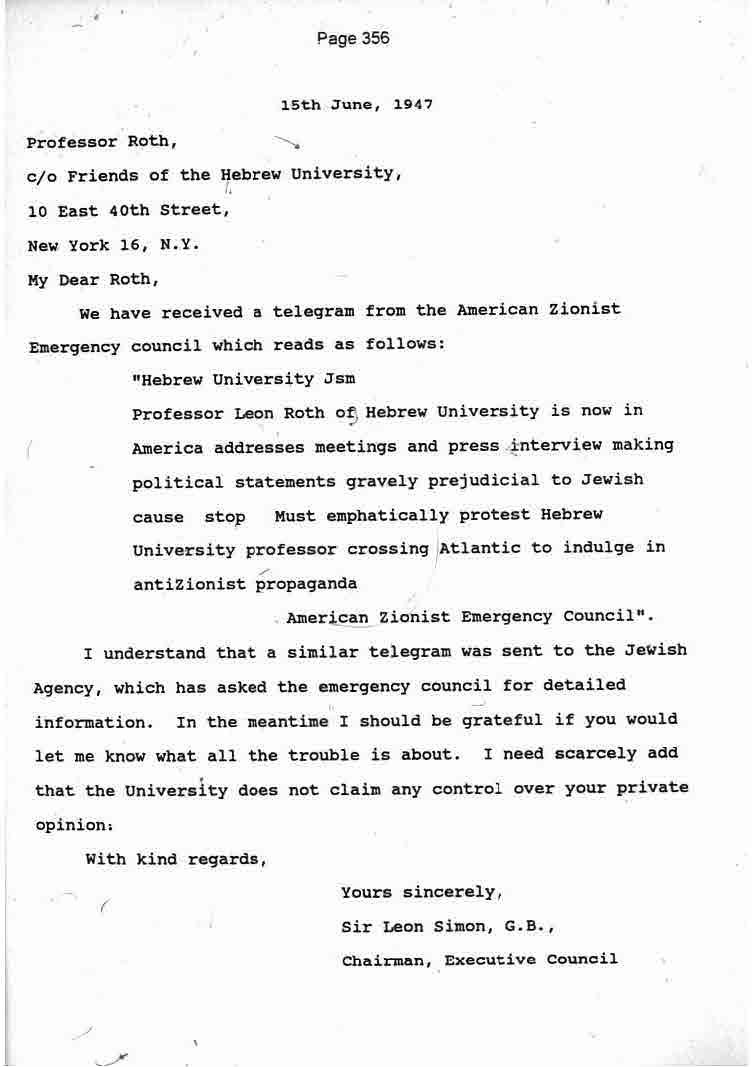
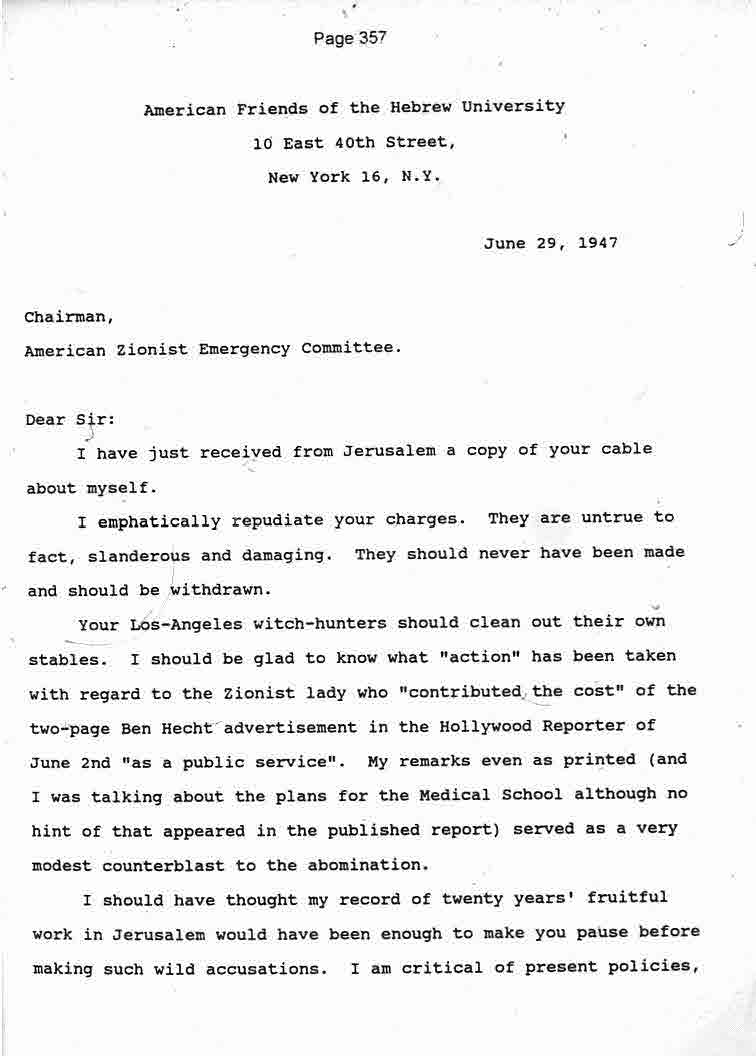
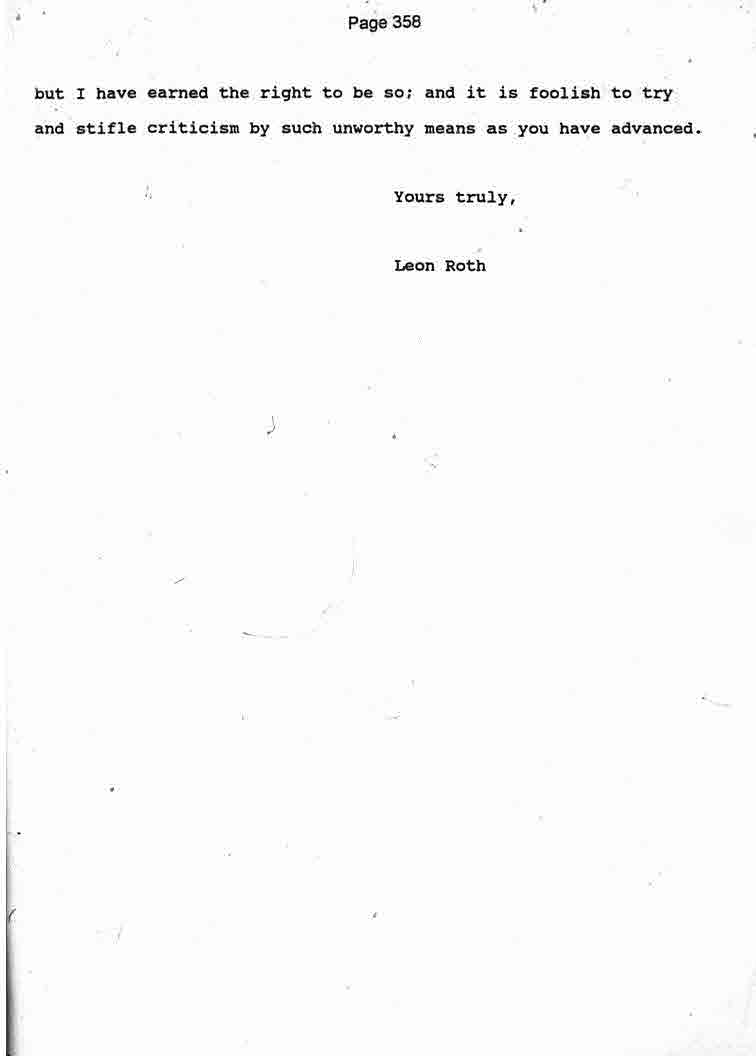
Reproduced here is the full exchange of correspondence between Leon Roth and Sir Leon Simon following Roth’s public remarks in the United States in June 1947 opposing the proposed partition of Palestine. The documents include Simon’s letter conveying the protest of the American Zionist Emergency Council, Roth’s reply rejecting the accusations, and related communications. The texts are reproduced here in full, without alteration, from Jan Katzew, “Leon Roth – His Life and Thought: The Place of Ethics in Jewish Education” (PhD dissertation, Hebrew University of Jerusalem, 1997), Appendix, pp. 355-358.
Appendix 3
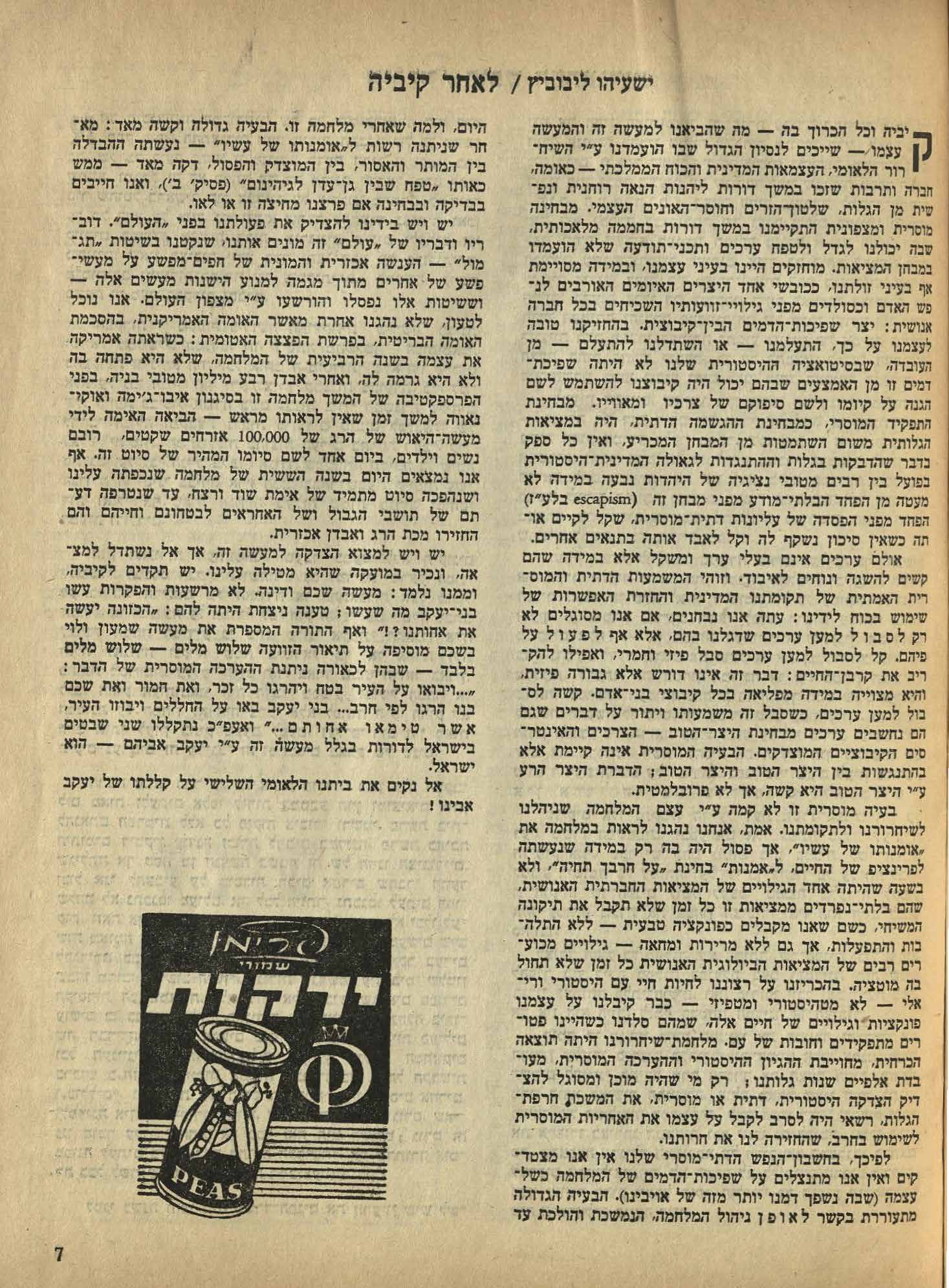
Reproduced here is Leibowitz’s original article “After Qibyā,” Beterem, no. 189 (15 December 1953): 7 (Hebrew).
Appendix 4
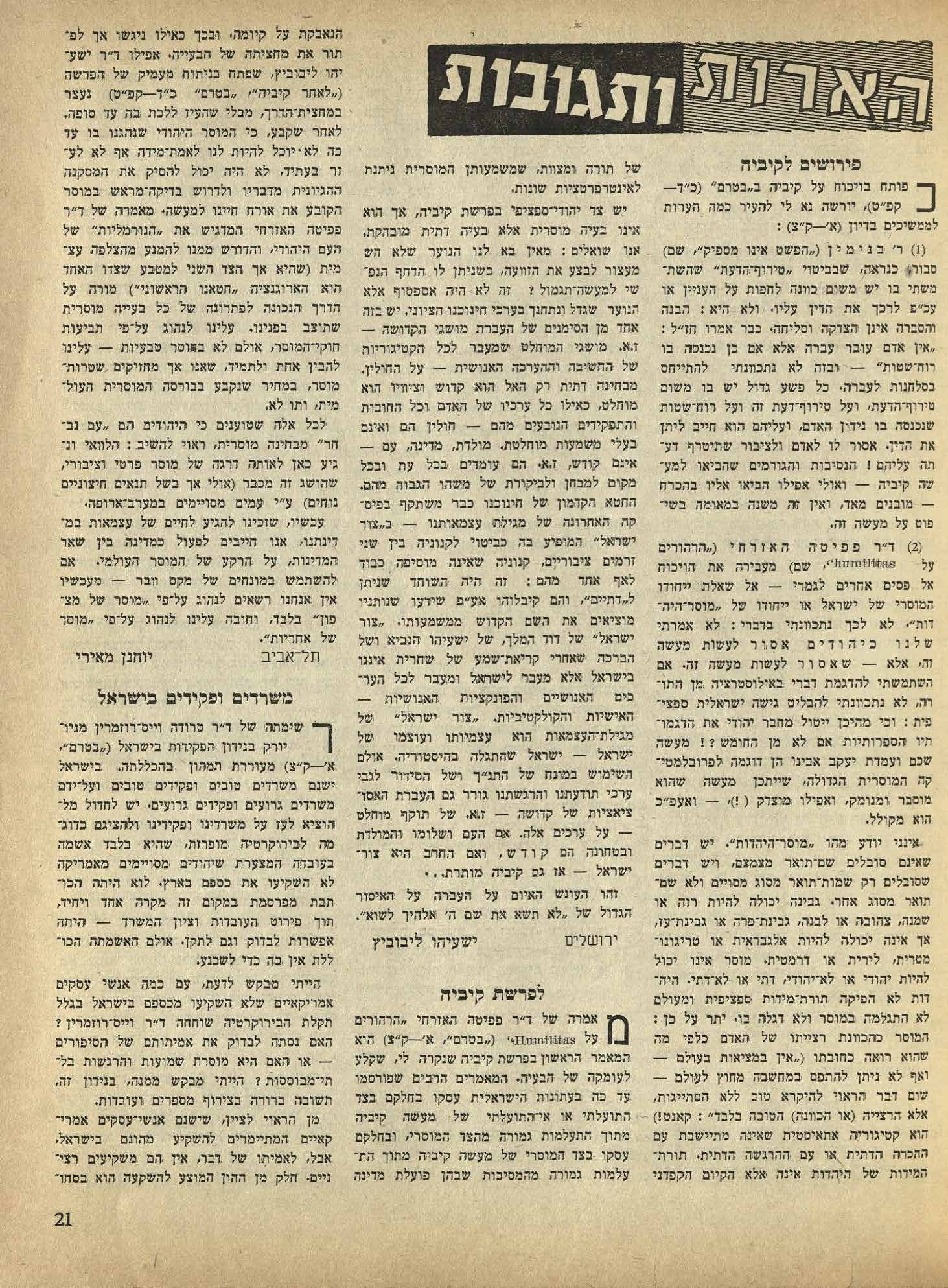
Reproduced here is Leibowitz’s follow-up article, “Letter – Commentaries on Qibyā,” Beterem, no. 191 (15 January 54): 21 (Hebrew).[26]
Appendix 5:
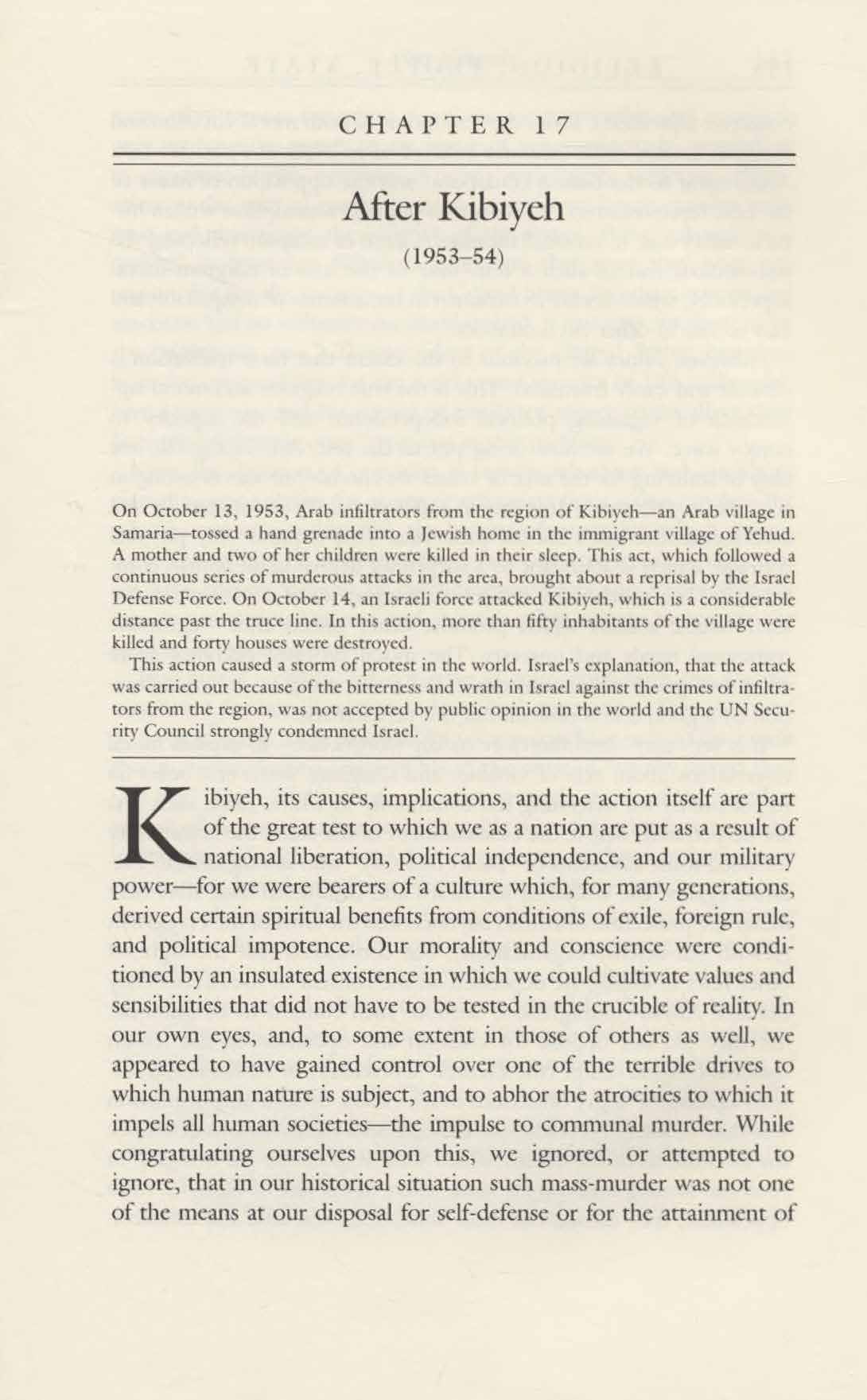
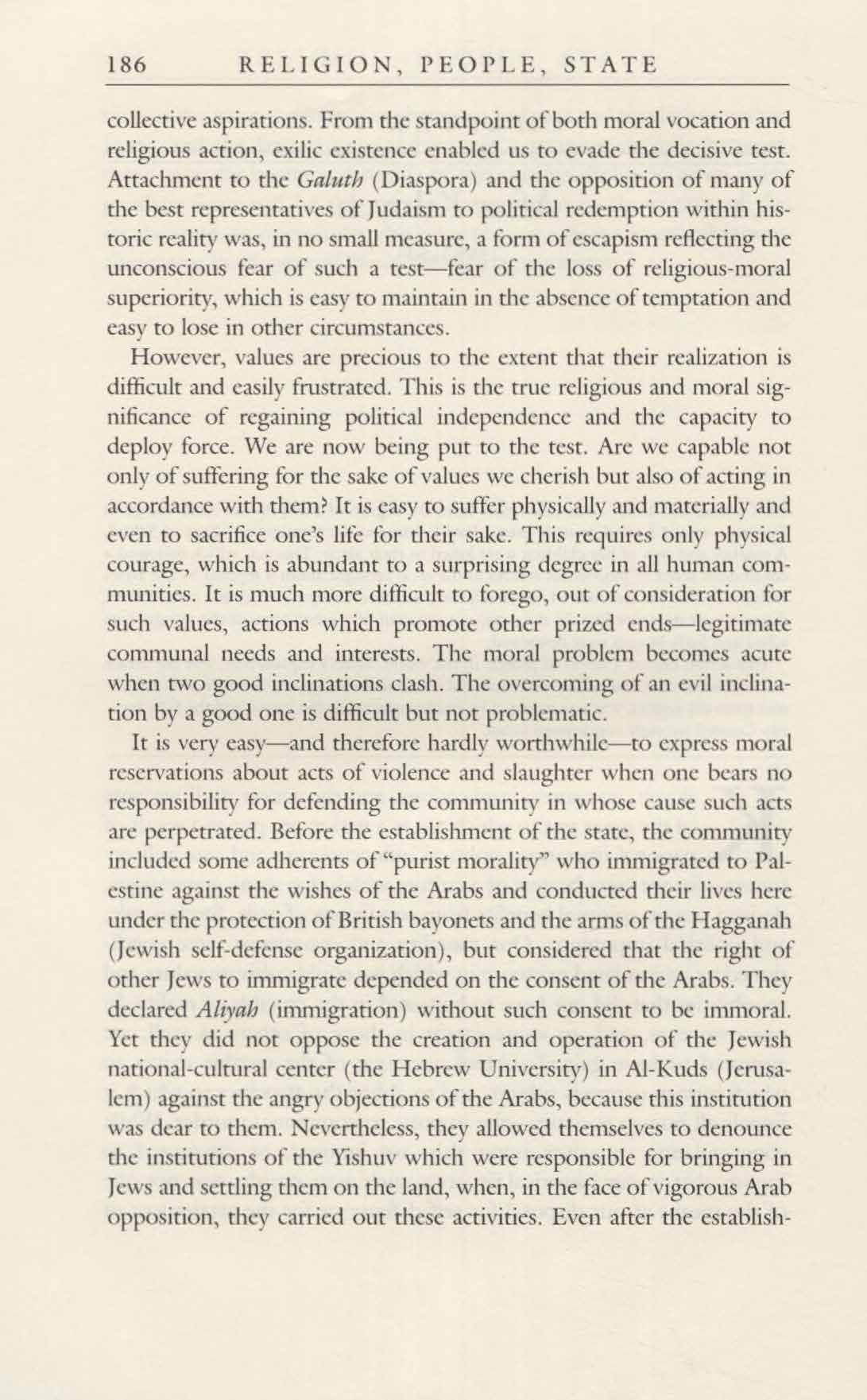
Reproduced here is the Hebrew text of “After Qibyā” as it appears in Yeshayahu Leibowitz’s 1954 book Torah u-Mitzvot ba-Zeman ha-Zeh. Passages reproduced from the original Beterem article of 15 December 1953 (see above, Appendix 3) are printed in plain font. Material drawn from the follow-up article in Beterem of 15 January 1954 (see above, Appendix 4), written in reply to Pepita Haezraḥi, appears in bold. Material first added in Torah u-Mitzvot ba-Zeman ha-Zeh is underlined.
The original December 15 text was copied in Torah u-Mitzvot ba-Zeman ha-Zeh with only minor changes; e.g., “emet, lefanim nahagnu” instead of “emet, anaḥnu nahagnu”; or “maʿaseh zevaʿah shel hereg” instead of “maʿaseh yeʾush shel hereg.”
The material deriving from the January 15 article was incorporated in it with many stylistic changes; e.g. “ha-problematikah ha-musarit ha-maḥridah” instead of “ha-problematikah ha-musarit ha-gedolah”; or the placement of “ha-hadgamah, etc.,” before “maʿaseh Shekhem, etc.,” instead of vice versa. It will be noted that Leibowitz’s well-known criticism of the secularization of religious concepts seems to have had its origin in his reply to Pepita Haezraḥi. His remarks about “tzur yisraʾel” repeat an urban legend. In point of fact, the dictum mentioning tzur yisraʾel was included already in the early draft of the Declaration of Independence by Mordecai Beham and Harry Davidowitz, written around April 22, 1948.[27]
The controversial paragraph on the Jerusalem “tzaddiqim,” added in Torah u-Mitzvot ba-Zeman ha-Zeh, illustrates the chasm in those days between Leibowitz and the Hebrew University “peace camp,” which consisted of famed professors like Samuel Hugo Bergmann, Martin Buber, Judah Leon Magnes, Gershom Scholem, Ernst Akiba Simon.” Roth also was not usually considered to be one of the members of that camp. See Bergmann’s article cited above, note 7.
The final sentence originally read: “al naqim et beytenu,” etc., which is stronger, simpler, and less preachy than the revised version.
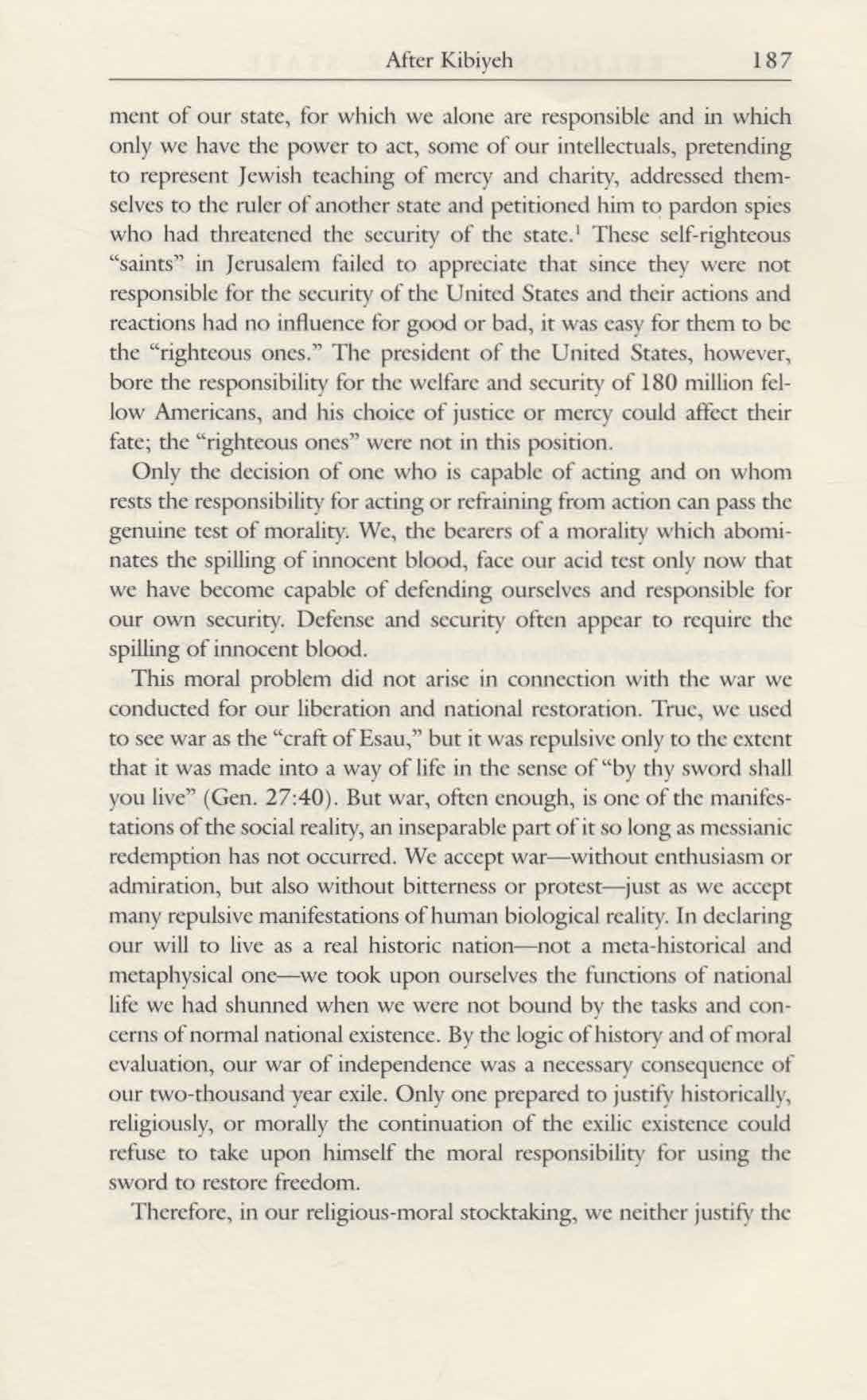
After Qibyā
קיביה וכל הכרוך בה – מה שהביא למעשה זה והמעשה עצמו – שייכים לנסיון הגדול שבו הועמדנו ע”י השיחרור הלאומי, העצמאות המדינית והכוח הממלכתי – כאומה, חברה ותרבות שזכו במשך דורות ליהנות הנאה רוחנית ונפשית מן הגלות, שלטון-הזרים וחוסר-האונים העצמי. מבחינה מוסרית ומצפונית התקיימנו במשך דורות בחממה מלאכותית, שבה יכולנו לגדל ולטפח ערכים ותכני-תודעה שלא הועמדו במבחן המציאות. מוחזקים היינו בעיני עצמנו, ובמידה מסויימת אף בעיני זולתנו, ככובשי אחד היצרים האיומים האורבים לנפש האדם וכסולדים מפני גילויי-זוועותיו השכיחים של חברה אנושית : יצר שפיכות-הדמים הבין-קיבוצית. בהחזיקנו טובה לעצמנו על כך, התעלמנו – או השתדלנו להתעלם – מן העובדה, שבסיטואציה ההיסטורית שלנו לא היתה שפיכת-דמים זו מן האמצעים שבהם יכול היה קיבוצנו להשתמש לשם הגנה על קיומו ולשם סיפוקם של צרכיו ומאווייו. מבחינת התפקיד המוסרי, כמבחינת ההגשמה הדתית, היתה במציאות הגלותית משום השתמטות מן המבחן המכריע, ואין כל ספק בדבר שהדבקות בגלות וההתנגדות לגאולה המדינית-היסטורית בפועל בין רבים מטובי נציגיה של היהדות נבעה במידה לא מעטה מן הפחד הבלתי-מודע מפני מבחן זה ( escapism בלע”ז) – הפחד מפני הפסדה של עליונות דתית-מוסרית, שקל לקיים אותה כשאין סיכון נשקף לה וקל לאבד אותה בתנאים אחרים.
אולם ערכים אינם בעלי ערך ומשקל אלא במידה שהם קשים להשגה ונוחים לאיבוד. וזוהי המשמעות הדתית והמוסרית האמיתית של תקומתנו המדינית והחזרת האפשרות של שימוש בכוח לידינו : עתה אנו נבחנים, אם אנו מסוגלים לא רק לסבול למען ערכים שדגלנו בהם, אלא אף לפעול על פיהם. קל לסבול למען ערכים סבל פיזי וחמרי, ואפילו להקריב את קרבן-החיים : דבר זה אינו דורש אלא גבורה פיזית, והיא מצוייה במידה מפליאה בכל קיבוצי בני-אדם. קשה לסבול למען ערכים, כשסבל זה משמעותו ויתור על דברים שגם הם נחשבים ערכים מבחינת היצר הטוב ; הבעייה המוסרית מתעוררת בכל חריפותה בהתנגשות בין היצר הטוב והיצר הטוב ; הדברת היצר הרע ע”י היצר הטוב היא קשה, אך לא פרובלמטית.
נוחה מאד – ולכן גם זולה ועלובה מאד – היא מוסריות המסתייגת ממעשי אלימות ושפיכות-דמים מבלי שתהא בצידה של מוסריות זו גם האחריות לעניינים ולערכים שלמענם או בשמם נעשים מעשים אלה ונשפך דם זה. לפני הקמת מדינתנו היינו עדים במחננו לבעלי מוסריות צרופה, שהם עצמם עלו לא”י נגד רצונם של הערבים וחיו ופעלו בה בחסותם של הכידונים הבריטיים והאקדחים של ההגנה, אולם את זכות עלייתם של יהודים אחרים התנו בהסכמתם של הערבים, ואת העליה בכוח – שלא בהסכמת הערבים – פסלו כלא-מוסרית ; הם לא התנגדו להקמתו ולקיומו של המרכז התרבותי-לאומי היהודי באל-קודס (ירושלים) על אפם ועל חמתם של הערבים – כי המוסד הזה היה יקר בעיניהם -, אך הם הרשו לעצמם לגנות את פעולתם של מוסדותינו שהיו אחראים להעלאת יהודים וליישובם על הקרקע כשהללו עשו את המוטל עליהם על אפם ועל חמתם של הערבים. ואף אחר הקמת מדינתנו שרק לה אנו אחראים, ורק בה יש בידנו סיפק לעשות, פנו אנשי-רוח בקרבנו, שנתעטפו באיצטלת תורת החסד והרחמים של היהדות, אל שליטה של מדינה אחרת ודרשו ממנו לחון מרגלים שהתנכלו לבטחונה של המדינה ההיא(הזוג יוליוס ואתל רוזנברג בארה”ב, שנמצאו אשמים בריגול לטובת ברה”מ לשם השג מידע סודי על החימוש הגרעיני; הם נידונו למיתה והוצאו להורג ב-19.6.1953). ולא חלו ולא הרגישו צדיקים אלה בירושלים, שמאחר שאין הם האחראים לבטחונה של ארצות-הברית ושמעשיהם ותגובותיהם אינם משפיעים על בטחון זה לא לטובה ולא לרעה – קל ונוח להם להיות “צדיקים” ; ואילו בידו ובאחריותו של נשיא ארצות-הברית הופקדו שלומם ובטחונם של 180 מליון מבני-עמו, ומידת-הדין או מידת-הרחמים שבה הוא נוקט עלולה להשפיע על סיכון קיומם מחמת הפצצה האטומית. ולא הבינו צדיקי- ירושלים שאין הם רשאים לדון את נשיא ארצות-הברית עד שיגיעו למקומו.
המבחן הממשי של המוסריות אינו אלא בהכרעתו של מי שסיפק בידו לעשות והאחריות לעשיה או לאי-עשיה עליו. הנסיון המוסרי שלנו הגיע כשנעשינו אנו – נושאי המוסר המתעב שפיכת דם נקי – בעלי-יכולת ואחראים לעניני הגנה ובטחון, ענינים שבעיותיהם נראות לפעמים כניתנות לפתרון ע”י שפיכת דם נקי.
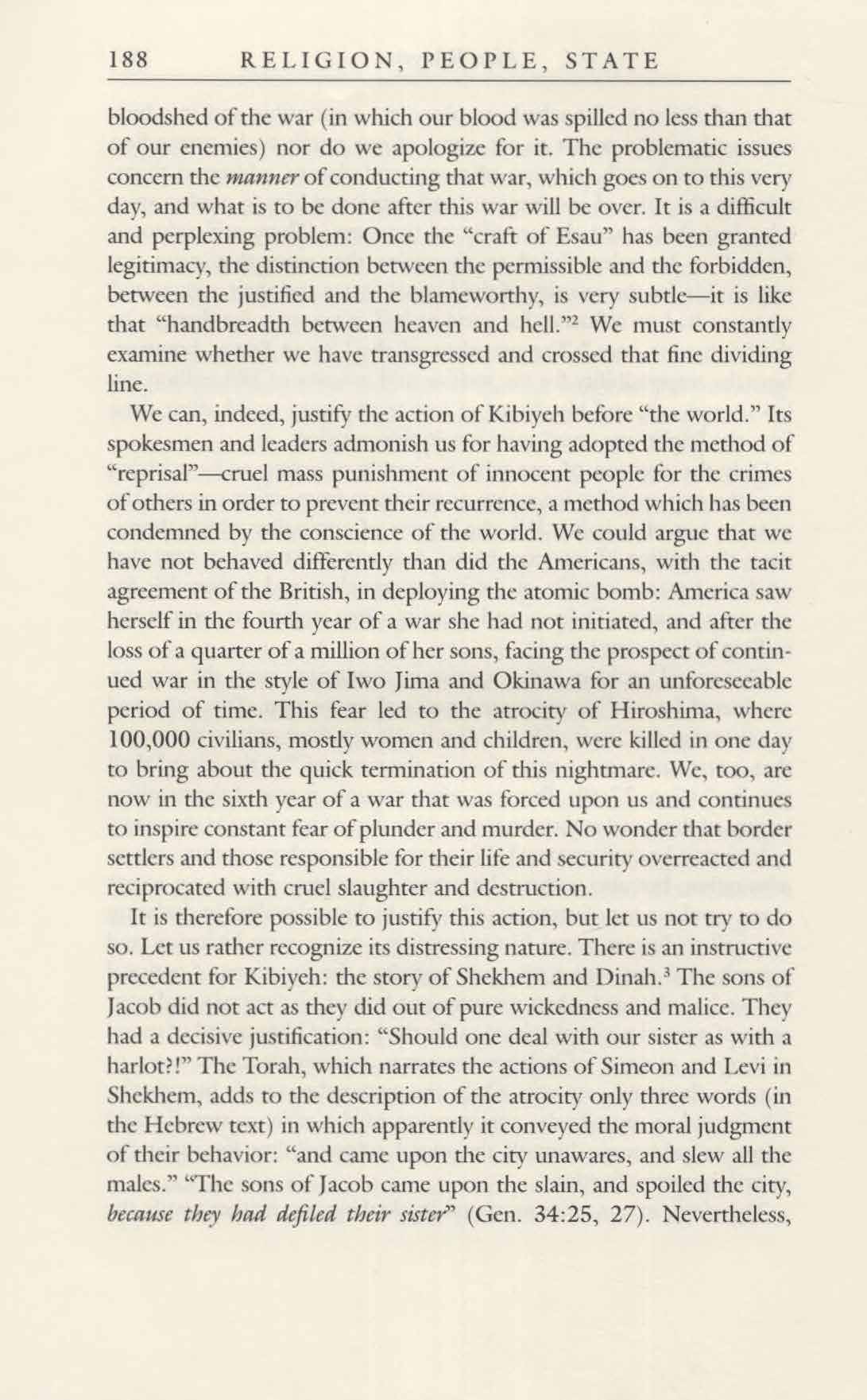
בעייה מוסרית זו לא קמה ע”י עצם המלחמה שניהלנו לשיחרורנו ולתקומתנו. אמת, לפנים נהגנו לראות במלחמה את “אומנותו של עשו”, אך פסול היה בה רק במידה שנעשתה לפרינציפ של החיים, ל”אומנות” בחינת “על חרבך תחיה”, ולא בשעה שהיתה אחד הגילויים של המציאות החברתית האנושית, שהם בלתי נפרדים ממציאות זו כל זמן שלא תקבל את תיקונה המשיחי, כשם שאנו מקבלים כפונקציה טבעית – ללא התלהבות והתפעלות, אך גם ללא מרירות ומחאה – גילויים מכוערים רבים של המציאות הביולוגית האנושית כל זמן שלא תחול בה מוטציה. בהכריזנו על רצוננו לחיות חיי עם היסטורי וריאלי – לא מטאהיסטורי ומטפיזי – כבר קיבלנו על עצמנו פונקציות וגילויים של חיים אלה, שמהם סלדנו כשהיינו פטורים מתפקידים וחובות של עם. מלחמת-שיחרורנו היתה תוצאה הכרחית, מחוייבת ההגיון ההיסטורי וההערכה המוסרית, מעובדת אלפיים שנות גלותנו ; רק מי שהיה מוכן ומסוגל להצדיק הצדקה היסטורית, דתית או מוסרית, את המשכת חרפת-הגלות, רשאי היה לסרב לקבל על עצמו את האחריות המוסרית לשימוש בחרב, שהחזירה לנו את חרותנו.
לפיכך, בחשבון-הנפש הדתי-המוסרי שלנו אין אנו מצדיקים ואין אנו מתנצלים על שפיכות-הדמים של המלחמה כשלעצמה (שבה נשפך דמנו לא פחות מזה של אויבינו). הבעייה הגדולה מתעוררת בקשר לאופן ניהול המלחמה, הנמשכת והולכת עד היום, ולמה שאחרי מלחמה זו. הבעייה גדולה וקשה מאד : מאחר שניתנה רשות ל”אומנותו של עשו”, נעשתה ההבדלה בין המותר ואסור, בין המוצדק והפסול, דקה מאד – ממש כאותו “טפח שבין גן-עדן וגיהנום” (פסיק’ ב’), ואנו חייבים בבדיקה ובבחינה אם פרצנו מחיצה זו או לאו.
יש ויש בידינו להצדיק את פעולתנו בפני “העולם”. דובריו ודבריו של “עולם” זה מגנים אותנו על שנקטנו בשיטות “תגמול” – הענשה אכזרית והמונית של חפים-מפשע על מעשי-פשע של אחרים מתוך מגמה למנוע הישנות מעשים אלה, בשיטות שנפסלו והורשעו על-ידי מצפון העולם. אנו נוכל לטעון, שלא נהגנו אחרת מאשר האומה האמריקנית, בהסכמת האומה הבריטית, בפרשת הפצצה האטומית : כשראתה אמריקה את עצמה בשנה הרביעית של המלחמה, שלא היא פתחה בה ולא היא גרמה לה, ואחרי אבדן רבע-מיליון מטובי בניה בפני הפרספקטיבה של המשך מלחמה זו בסיגנון איבו-ג’ימה ואוקינאוה למשך זמן שאין לראותו מראש – הביאה האימה לידי מעשה-הזוועה של הרג 100,000 אזרחים שקטים, רובם נשים וילדים, ביום אחד לשם סיומו המהיר של סיוט זה. אף אנו נמצאים היום בשנה הששית של מלחמה שנכפתה עלינו ושנהפכה סיוט מתמיד של אימת שוד ורצח, עד שנטרפה דעתם של תושבי הגבול ושל האחראים לבטחונם וחייהם והם החזירו מכת הרג ואבדן אכזרית.
יש ויש למצוא הצדקה למעשה זה, אך אל נשתדל למצאה, ונכיר במועקה שהיא מטילה עלינו. יש תקדים לקיביה, וממנו נלמד : מעשה שכם ודינה. לא מרשעות והפקרות עשו בני-יעקב מה שעשו : טענה ניצחת היתה להם : “הכזונה יעשה את אחותנו” ? ! ואף התורה המספרת את מעשה שמעון ולוי בשכם מוסיפה על תיאור הזוועה שלוש מלים – שלוש מלים בלבד – שבהן לכאורה ניתנת ההערכה המוסרית של הדבר : “…ויבואו אל העיר בטח ויהרגו כל זכר, ואת חמור ואת שכם בנו הרגו לפי חרב.. בני יעקב באו על החללים ויבוזו העיר, אשר טימאו אחותם…”. ואעפ”כ נתקללו שני שבטים בישראל לדורות בגלל מעשה זה ע”י יעקב אביהם – הוא ישראל.
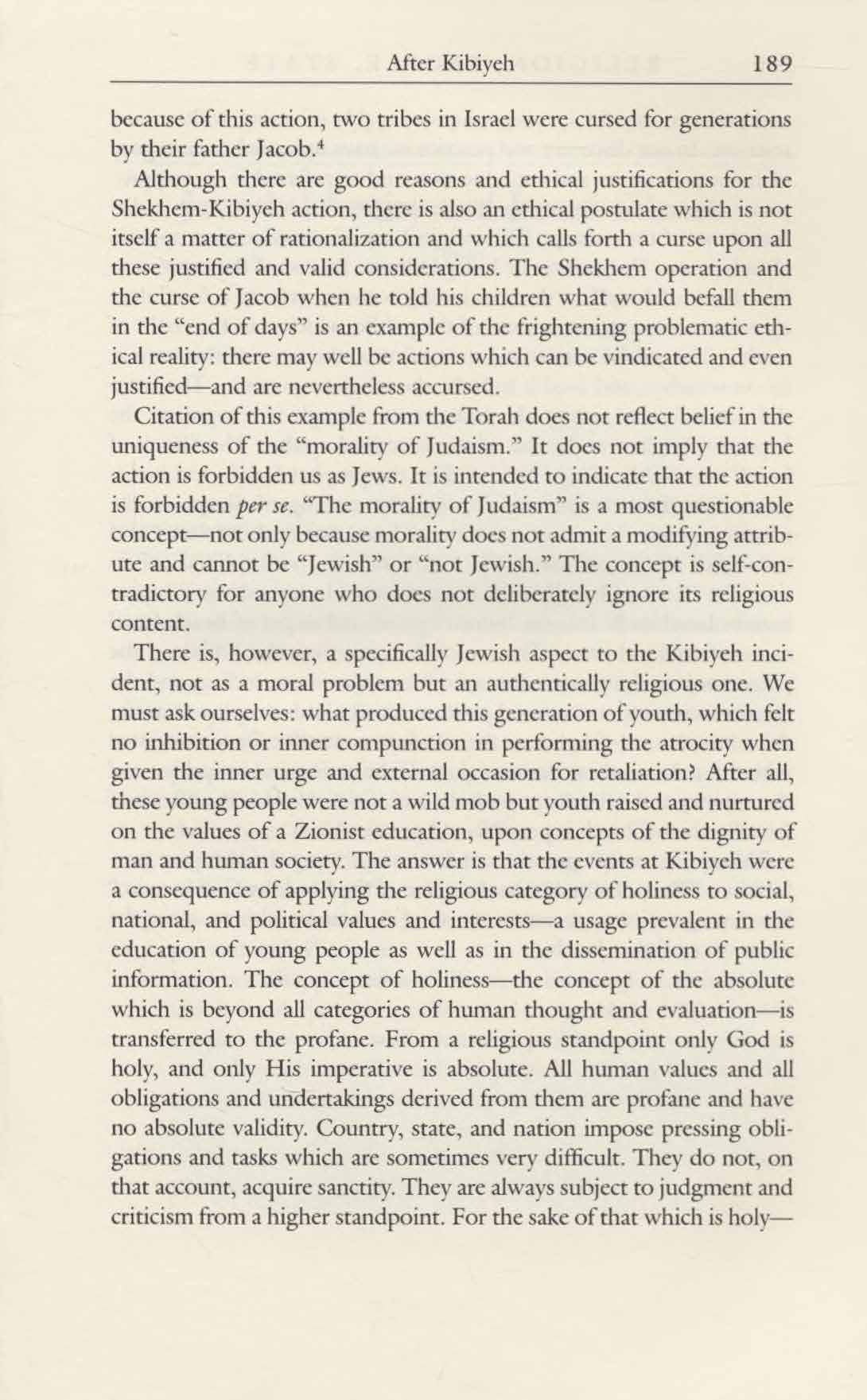
אפשר ואפשר לנמק ולבסס, להסביר ולהצדיק את מעשה שכם-קיביה מבחינת כל עקרונות המוסר הניתנים לשיקול ולחישוב ראציונלי. אולם קיים גם פוסטולט מוסרי, שאינו כלל בגדר שיקול וחישוב, ושממנו נובעת קללה על כל השיקולים והחישובים המוצדקים והנכונים הללו. מעשה-שכם וקללת יעקב אבינו, בשעה שחזה לבניו את ואחרית-הימים – זוהי דוגמה לפרובלימטיקה המוסרית המחרידה, שייתכן מעשה שהוא מוסבר ומנומק, ואפילו מוצדק (!) – ואעפ”כ הוא מקולל.
ההדגמה מן התורה – אין משמעותה האמונה בייחודו המוסרי של ישראל או בייחודו של “מוסר-היהדות”. אין משמעותה שלנו כיהודים אסור לעשות מעשה זה ; אלא זוהי הדגמה שאסור לעשות מעשה זה. “מוסר-היהדות” הוא מן המושגים המפוקפקים ביותר – ולא רק משום שאין המוסר סובל שם-תואר מצמצם ואינו יכול להיות “יהודי” או “לא-יהודי” : עצם המושג “מוסר-היהדות” הוא סתירה מיניה וביה בשביל כל מי שאינו מתעלם בכוונה מן התוכן ומן המשמעות הדתיים של היהדות – ז. א. בשביל מי שאינו מזייף את היהדות. המוסר כהכוונת רצייתו של האדם כלפי מה שהוא רואה כחובתו (“אין במציאות בעולם – ואף לא ניתן להיתפס במחשבה מחוץ לעולם – שום דבר הראוי להיקרא טוב ללא הסתייגות, אלא הרצייה [או הכוונה] הטובה בלבד” : קאנט !) או כלפי מה שהוא מבין בטבע המציאות (הסטואה; שפינוזה) – המוסר הוא קטיגוריה אנתרופוצנטרית-אתיאיסטית, שאינה מתיישבת עם ההכרה הדתית או עם ההרגשה הדתית ; זו אינה מכירה אלא את “הטוב והישר בעיני ה’ “ – לא את ”הטוב והישר”! ואינה מעריכה את “החכם בחכמתו” אלא את “המשכיל ויודע את ה’ “. עובדה היסטורית- אמפירית היא – במחילת עצמותיהם של שד”ל, אחה”ע והרמן כהן – שהיהדות לא הפיקה תורת-מידות ספציפית ומעולם לא התגלמה במוסר ולא דגלה בו. תורת-המידות של היהדות אינה אלא הקיום הקפדני של תורה ומצוות שמשמעותן המוסרית ניתנת לאינטרפרטציות שונות.
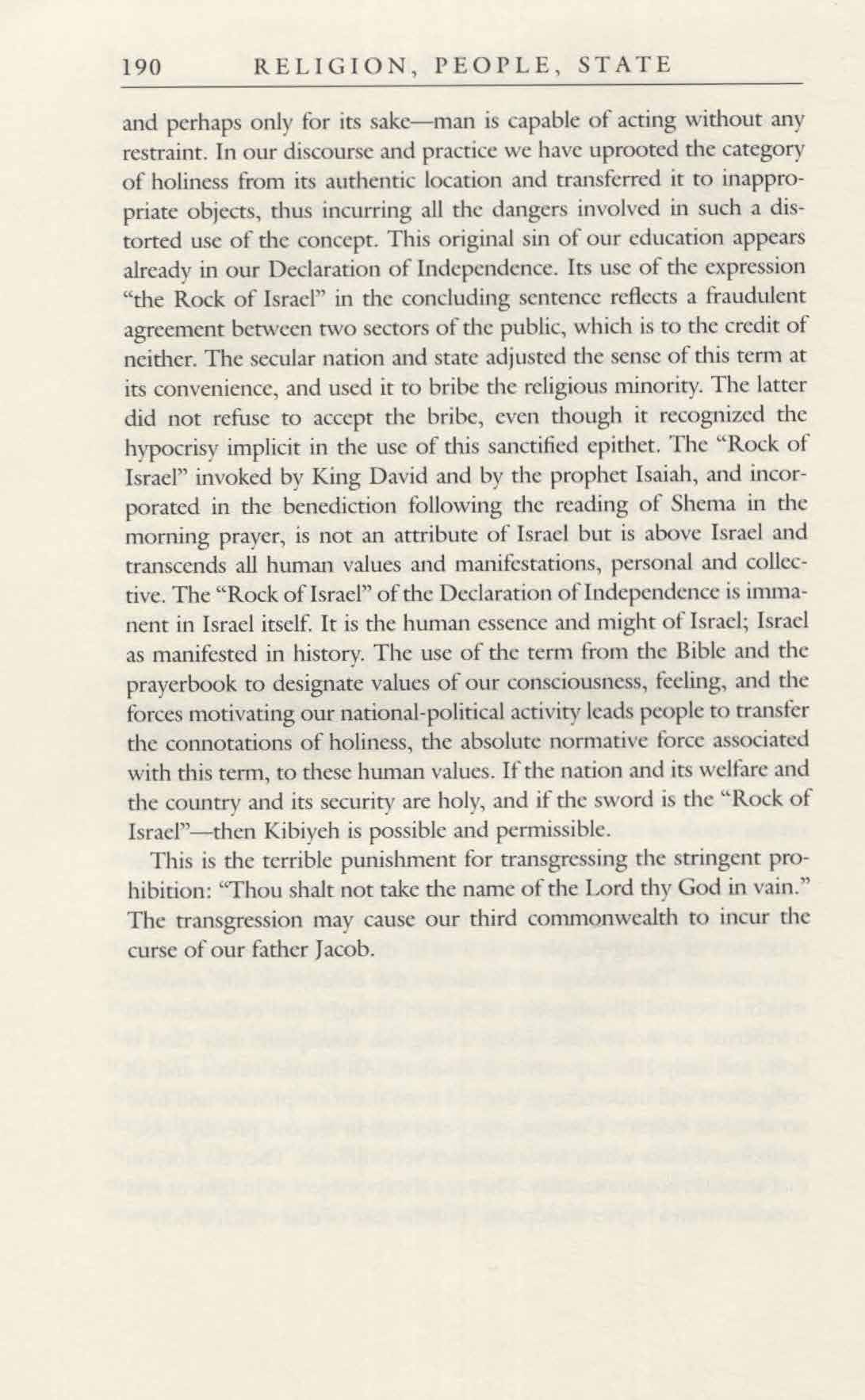
יש, אמנם, צד יהודי ספציפי בפרשת קיביה, אך הוא אינו בעייה מוסרית אלא בעיה דתית מובהקת. אנו חייבים לשאול את עצמנו : מאין בא לנו הנוער הזה, שלא חש מעצור ומניעה נפשית לבצע בידיו את הזוועה, כשניתן לו הדחף הפנימי או החיצוני למעשה-תגמול ? והרי נוער זה לא היה אספסוף, אלא הנוער שגדל ונתחנך בערכי חינוכו הציוני, במושגי ערכי האדם והחברה. דבר זה הוא מן התוצאות של השימוש בקטיגוריה הדתית של קדושה לענינים ולערכים חברתיים, לאומיים ומדיניים שימוש שהוא רווח אצלנו בחינוך הנוער ובהסברה ציבורית : מושגי קדושה – ז. א. מושגי המוחלט שמעבר לכל הקטגוריות של החשיבה וההערכה האנושית – מועברים על החולין, מבחינה דתית רק האל הוא קדוש ורק צוויו הוא מוחלט, ואילו כל ערכיו של האדם וכל החובות והתפקידים הנובעים מהם – חולין הם ואינם בעלי משמעות מוחלטת. מולדת, מדינה, עם – חובות ותפקידים נעלים הם, המחייבים לפרקים אף למעשים קשים מאד, אך לעולם אין הם נעשים קודש, ז. א.לעולם הם עומדים למבחן ונתונים לביקורת של משהו הגבוה מהם. על דברים שבקדושה – ואולי רק עליהם – מסוגל האדם לפעול ללא כל מעצור. אנו עוקרים את הקטגוריה של קדושה ממקומה ומעבירים אותה על דברים שלא להם נועדה, עם כל הסיכון הכרוך בשימוש מסולף זה. החטא הקדמון הזה של חינוכנו כבר משתקף במגילת עצמאותנו – ב”צור ישראל” המופיע בסיומה כביטוי לקנוניה בין שני זרמים ציבוריים, קנוניה שאינה מוסיפה כבוד לאף אחד מהם : העם והמדינה החילוניים, שהוציאו מושג זה ממשמעותו, נתנו את המונח כשוחד למיעוט הדתי, וזה לא נמנע מלקבלו, אעפ”י שידע את הדו-פרצופיות הגלומה בשימוש זה בכינוי הקדוש. ו”צור ישראל” של דוד המלך, של ישעיהו הנביא, של הברכה שאחרי קריאת-שמע של שחרית – אינו בישראל אלא מעבר לישראל ומעבר לכל הערכים, הגורמים והגילויים האנושיים – האישיים והקולקטיביים כאחד. “צור ישראל” של מגילת העצמאות הוא בישראל עצמו – הוא עצמותו ועוצמתו האנושיים של ישראל : ישראל שנתגלה בהיסטוריה. אולם השימוש במונח של התנ”ך והסידור לגבי ערכי תודעתנו והרגשתנו האנושיים ולגבי הכוחות המניעים של פעולתנו הלאומית-מדינית – שימוש זה גורם שגם האסוציאציות של קדושה – ז.א. של תוקף מוחלט – הכרוכות בכינוי זה מועברות על ערכים אלה. אם העם ושלומו והמולדת ובטחונה הם קודש, ואם החרב היא-היא “צור ישראל” – אז גם קיביה אפשרית ומותרת…
זהו העונש האיום של העבירה על האיסור החמור של “לא תשא את שם אלהיך לשוא”.
מתוך עבירה על איסור זה אנו עלולים להקים את ביתנו השלישי על קללתו של יעקב אבינו.
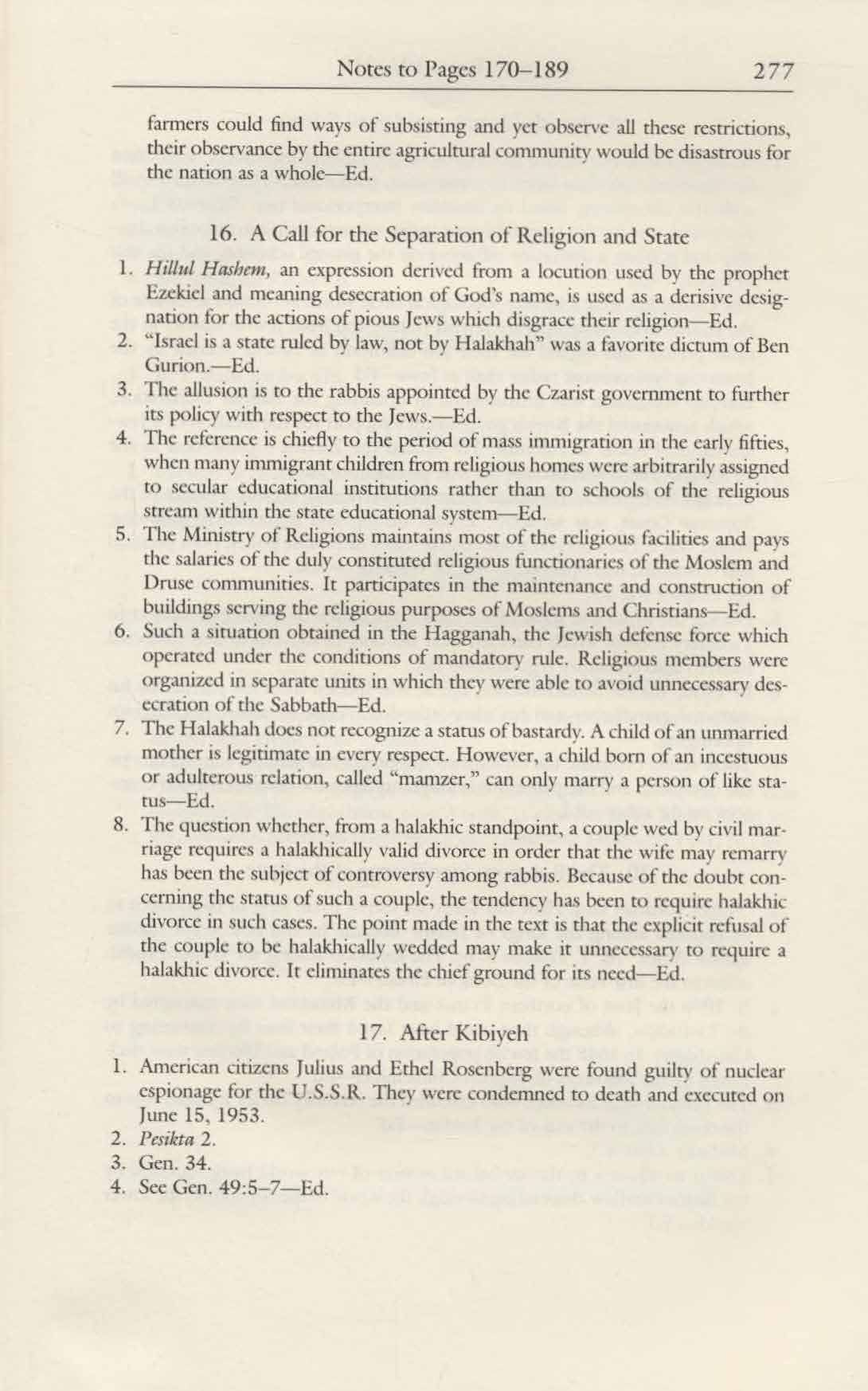
The text was also translated by the philosopher Eliezer Goldman on the basis of later versions, while taking into consideration the earlier ones, as published in Yeshayahu Leibowitz, Judaism, Human Values, and the Jewish State (Cambridge, MA: Harvard University Press, 1992), 185-190, 277.
Appendix 6
Halakhic Engagements with the Qibyā Raid and the Renewal of the Laws of War
By Menachem Butler
The present appendix situates the halakhic discussion of the Qibyā raid within the context of recent scholarly efforts to recover, contextualize, and critically assess Jewish legal discourse on sovereignty, military service, and war in the State of Israel. It does not seek to adjudicate the halakhic permissibility of Qibyā, but rather to map the emergence, structure, and internal tensions of the halakhic discourse the episode generated.
Among the more recent of these scholarly efforts is the Milḥemet Mitzvah series, edited by Aviad Hacohen, Yitzchak Avi Roness, and myself. This multi-volume project is devoted to the halakhic, historical, and ideological foundations of military obligation in modern Israel, bringing together newly translated primary sources alongside contemporary scholarship in order to reconstruct the formative debates through which categories such as milḥemet mitzvah, collective obligation, and the relationship between Torah study and national defense were rearticulated under conditions of Jewish statehood.[28] A forthcoming volume in the Milḥemet Mitzvah series will extend this inquiry to the Qibyā raid and its halakhic aftermath, situating the episode within the longer arc of post-1948 Jewish legal reflection on war, retaliation, and civilian harm. Whereas the volumes published to date focus primarily on the War of Independence and its immediate halakhic reverberations, the events of October 1953 mark a subsequent – and in many respects decisive – moment in the development of modern halakhic thought on warfare. The halakhic debates of 1948 were largely oriented toward questions of obligation, authority, and participation in collective defense; Qibyā, by contrast, compelled a direct confrontation with issues that had previously remained largely implicit, including the legitimacy of retaliatory violence, the halakhic status of civilian populations, and the reconciliation of inherited legal norms with the operational realities of modern warfare.
At the center of the halakhic discourse on Qibyā stands Rabbi Shaul Yisraeli’s extended responsum, which quickly became the unavoidable point of reference for subsequent Religious Zionist engagement with the episode and, more broadly, with questions of war, responsibility, and state violence.[29] Written in close proximity to the events of 1953, it constitutes one of the earliest systematic attempts to evaluate Qibyā through halakhic reasoning rather than through moral intuition or political necessity. Its enduring influence lies not only in its substantive conclusions, but in the methodological seriousness with which it applies classical legal sources to a modern military operation involving civilian casualties. As the literature surveyed here demonstrates, the responsum quickly assumed a canonical role, shaping subsequent Religious Zionist halakhic treatments of military force and the limits of legitimate violence under conditions of Jewish sovereignty.
Beyond ethical, philosophical, or political reactions, Qibyā also generated a sustained halakhic discourse that sought to situate the events within inherited legal categories while testing their elasticity in the face of modern military power. This body of writing reflects neither straightforward apologetics nor wholesale repudiation, but a concerted effort to articulate norms of legitimacy and restraint within a legal tradition long shaped by political powerlessness. Rabbi Yisraeli’s responsum first appeared in Ha-Torah ve-ha-Medinah, a journal founded in the early years of the State of Israel by leading figures within the Religious Zionist movement to confront, in a systematic halakhic register, the unprecedented challenges posed by Jewish sovereignty.[30] Conceived as a forum for the renewal of hilkhot medinah – of the laws of statehood – the journal brought together senior rabbinic authorities from Israel and the Diaspora to deliberate questions of governance, security, agriculture, economics, and public authority that had long remained underdeveloped in the absence of Jewish sovereignty. Under Rabbi Yisraeli’s editorial leadership, Ha-Torah ve-ha-Medinah rejected both apologetics and abstract theorization, insisting instead on rigorous engagement with concrete realities and on the integration of classical halakhic mastery with intimate knowledge of contemporary conditions.
The programmatic ambitions of Ha-Torah ve-ha-Medinah were articulated with unusual clarity by Rabbi Yisraeli himself in a contemporaneous interview reflecting on the aims and methods of the forum he edited.[31] From the outset, he rejected the assumption – prevalent even among committed religious thinkers – that “the laws of state and society do not exist at all within the Torah,” insisting instead that Jewish law is capable of sustaining “ordinary political life” without recourse to miracles or messianic suspension. Against both those who regarded the state as a theological aberration and those who treated halakhah as relevant only to the private sphere, Rabbi Yisraeli framed the task of the forum as reconstructive rather than apologetic: to recover areas of halakhah long relegated to the category of “law for the messianic era” and to clarify them through sustained engagement with classical sources and contemporary realities alike. It was precisely this commitment – to determining positions “not on the basis of moral agitation or political excitement alone, but on the basis of solid halakhic sources” – that governed the inclusion of the Qibyā raid among the journal’s most urgent and controversial subjects. Read against this backdrop, Rabbi Yisraeli’s responsum on Qibyā emerges not as an exceptional intervention prompted by political pressure, but as a paradigmatic test case within the programmatic framework of Ha-Torah ve-ha-Medinah, oriented toward collective responsibility and the exercise of coercive power by a Jewish state. Published as “The Qibyā Incident in Light of Halakhah,”[32] the responsum exemplifies the journal’s ambition to subject even the most morally fraught acts of state violence to sustained halakhic scrutiny rather than rhetorical evasion. In this capacity, it functions as the foundational text for the halakhic discussion of Qibyā and as a formative intervention in the development of Religious Zionist legal thought on war and sovereignty.
A crucial caveat is therefore in order. The halakhic engagement with Qibyā examined here unfolded largely in advance of, and largely independent from, the broader moral reckoning with the operation in Israeli public discourse. As Efrat Seckbach has shown, Qibyā was framed for decades within Israeli collective memory as a tragic, defensive, or even necessary act, and only much later came to be stabilized as a paradigmatic moral transgression.[33] The early rabbinic and halakhic discussions surveyed in this appendix thus did not emerge in response to sustained public condemnation, nor were they shaped by a settled moral consensus regarding the operation’s illegitimacy. Rather, they developed within a discursive environment in which the moral meaning of Qibyā remained fluid, contested, and largely underdetermined in the public sphere. This temporal and discursive disjunction is analytically significant: it cautions against retrojecting later ethical judgments onto early halakhic reasoning and underscores that these responsa were formulated in a context where halakhic analysis functioned not as post hoc legitimation, but as an initial site of normative articulation under conditions of unresolved moral uncertainty.
Unlike Professor Leon Roth’s moral indictment or Professor Yeshayahu Leibowitz’s theological warning, Rabbi Shaul Yisraeli’s intervention is deliberately juridical: it insists that Qibyā be evaluated as a matter of halakhic classification rather than moral expression or prophetic protest. He opens his analysis by sharply delimiting the scope of halakhic categories traditionally invoked to justify violence outside the context of war. He examines, and ultimately rejects, the applicability of rodef, judicial punishment, and collective liability, emphasizing that none can justify the foreseeable killing of non-combatants, especially children. This refusal to rely on expansive constructions of culpability constitutes an important boundary-setting move and signals resistance to dissolving halakhic distinctions under the pressure of political exigency.
Having rejected these alternatives, Rabbi Yisraeli treats milḥamah as the sole halakhic category within which the events of Qibyā can be assessed. War, in his account, is governed by norms distinct from those that regulate interpersonal violence or judicial punishment: it is structured by collective agency and strategic necessity rather than individualized culpability. On the basis of classical discussions of siege warfare and national defense, he argues that halakhah does not require absolute differentiation between combatants and civilians where such distinctions cannot be operationally maintained. Yet this claim is narrowly framed. Civilian harm is neither trivialized nor treated as halakhically neutral, and Qibyā is not presented as unproblematic. Instead, the operation is situated within ezrat Yisrael miyad tzar – assistance to Israel against an enemy threat – understood as a form of defensive war oriented toward deterrence and protection. This classification permits halakhic authorization of the operation while leaving intact a residue of moral unease that resists full juridical resolution.
The most consequential element of the responsum lies in Rabbi Yisraeli’s treatment of milḥemet mitzvah. He rejects the claim that defensive war is obligatory solely by virtue of pikuaḥ nefesh, noting that halakhah does not, as a rule, require one to endanger one’s life for the sake of others. To address this problem, he recasts defensive war as a binding collective obligation, grounded not in emergency rescue but in biblical models of national preservation and reprisal. In doing so, he relocates the normative basis of military action from individual ethical calculus to communal responsibility, thereby providing a conceptual structure that would prove influential for later halakhic discussions of warfare. Yet the responsum does not resolve its own tensions. Rabbi Yisraeli repeatedly signals unease and declines to subsume Qibyā under familiar categories of punishment or self-defense. The argument moves between legal authorization and acknowledged moral disquiet, registering the pressure placed on inherited halakhic frameworks by the conditions of modern, state-sponsored violence.
Subsequent halakhic and scholarly treatments of Qibyā have largely proceeded from Rabbi Yisraeli’s responsum.[34] These later authors have extended, modified, or even contest his conclusions, but they all have done so within the conceptual framework he set in place.[35] The responsum thus operates less as a conclusive ruling than as a point of orientation, shaping the terms in which questions of halakhic authorization and the moral burdens of sovereignty would thereafter be posed.
The reception of Rabbi Yisraeli’s responsum has been mapped most systematically by Professor Gerald J. Blidstein,[36] who reconstructs the emergence of a post-Qibyā discourse in which Rabbi Yisraeli’s analysis furnished later decisors with a conceptual grammar for addressing civilian harm within the logic of war. By relocating the discussion from individualized self-defense to the framework of collective warfare, the responsum made it possible to engage questions of civilian casualties without negating civilian status – a shift that both constrained and expanded the scope of permissible violence. Blidstein devotes particular attention to the post-Qibyā expansion of rodef. Whereas classical halakhah construes the rodef narrowly, later writers increasingly attribute derivative responsibility to civilian populations through functional analogies that blur the distinction between combatants and non-combatants. What concerns Blidstein is not merely the expansion itself, but the manner in which it proceeds: descriptive claims about the realities of modern warfare are allowed to perform normative work without explicit halakhic argument. This slippage between descriptive realism and legal authorization constitutes the central ethical risk identified in Blidstein’s essay. Modern warfare undoubtedly challenges classical distinctions, but difficulty alone does not license their abandonment. When empirical claims dictate legal conclusions, halakhah risks mirroring military practice rather than governing it; Qibyā thus becomes emblematic of the moral hazards confronting halakhic reasoning under conditions of sovereignty.[37]
A wider historical and jurisprudential framing is offered by Professor Arye Edrei, who situates Qibyā within a longue durée narrative of halakhic reactivation. In his account, Jewish law entered modernity with the laws of war largely dormant, and the advent of sovereignty transformed war from an abstract category into an unavoidable halakhic reality.[38] Within this framework, Qibyā marks a shift from questions of the obligation to wage war (jus ad bellum) to questions of how war is to be conducted (jus in bello).[39] Rabbi Yisraeli’s responsum exemplifies this shift through its methodological boldness: classical categories are not merely applied but reconfigured in order to address deterrence, civilian entanglement, and asymmetric warfare. Edrei emphasizes the ambivalence of this renewal – necessary for halakhic relevance yet destabilizing long-standing assumptions about civilian immunity and proportionality. He further traces the interpretive trajectory from Qibyā to later conflicts, particularly Lebanon, showing how early interpretive decisions acquired precedential force. While acknowledging internal pluralism and critique, Edrei argues that sovereignty established a shared framework in which war became central to halakhic self-understanding, thereby exposing halakhic discourse to the pressures inherent in regulating state violence.
The internal complexity of Rabbi Yisraeli’s position is examined by his disciple, Rav Prof. Neria Guttel, who situates the Qibyā responsum within Rabbi Yisraeli’s broader intellectual biography and his sustained involvement in the institutions of Religious Zionism.[40] Rav Guttel opens with a polemical claim: Rabbi Yisraeli has been remembered within the movement through what he describes as a “rather flat, highly plastic, and one-dimensional image,” whereas his actual halakhic posture was “far more complex.” This mischaracterization, Rav Guttel argues, obscures the disciplined character of Rabbi Yisraeli’s legal reasoning.[41] In the case of Qibyā, his refusal to extend the categories of rodef or collective punishment is presented not as moral hesitation but as fidelity to halakhic boundaries that resist ideological inflation. At the same time, Rabbi Yisraeli’s decision to legitimate the operation within the framework of war reflects his acceptance of what Rav Guttel elsewhere describes as the inescapable responsibilities generated by sovereignty and institutional participation. For Rav Guttel, this combination of legal authorization and acknowledged discomfort belongs to a broader pattern of rebuke issued from within loyalty rather than from withdrawal. The responsum thus exemplifies a mode of halakhic engagement that neither sanctifies state violence nor dissociates itself from it, and Rav Guttel cautions that later readings which extract permissive conclusions while neglecting this internal tension risk reproducing precisely the flattening of Rabbi Yisraeli’s thought that his essay seeks to correct.[42]
A more narrowly focused doctrinal analysis is offered by Yitzchak Avi Roness, who examines Rabbi Yisraeli’s reconceptualization of milḥemet mitzvah. Challenging the grounding of defensive war in pikuaḥ nefesh, Roness argues that Rabbi Yisraeli instead relocates it within a theory of collective obligation rooted in national preservation.[43] This move expands the halakhic space for legitimating military action while simultaneously exposing the ideological dimensions of interpretive choice. Roness further shows how this reconceptualization is operationalized in Qibyā, where retaliatory action is legitimated as part of an ongoing defensive war rather than as an immediate act of rescue; while enhancing doctrinal coherence and halakhic relevance, the shift weakens the internal tools available for critique, increasing reliance on strategic judgment and assessments of national interest.
Taken together, this body of halakhic literature demonstrates that the moral and political unease elicited by Qibyā was neither external to Jewish legal thought nor resolved outside it, but was internalized, debated, and reformulated within halakhic categories themselves. Far from functioning merely as a vehicle of retrospective legitimation, halakhic discourse became a sustained arena of normative contestation, in which inherited legal frameworks were pressed to account for the realities of sovereign violence, retaliation, and civilian harm. Readers approaching Qibyā primarily through ethical theory or political critique may therefore profit from attending to these halakhic engagements, not as exercises in doctrinal closure, but as serious and often unsettled attempts to articulate responsibility, restraint, and moral remainder within a legal tradition newly compelled to confront the burdens of political power.
Appendix 7
Ariel Sharon on the Qibyā Operation:
A Contemporaneous Record of the 1965 Eshkol-Sharon Meeting
By Menachem Butler
The following is an annotated English translation of an Historical Document from the 1965 meeting between Levi Eshkol and Ariel Sharon, as recorded contemporaneously by Eshkol and published by Arnon Lamfrom and Ze’ev Elron.[44]
A revealing retrospective window onto the logic of Qibyā is provided by this document. Speaking twelve years after the operation, amid a bitter intra-Zionist political struggle, Sharon rejected the claim that Qibyā marked a departure from prior practice, maintaining instead that most earlier reprisal actions had likewise targeted civilians and that the later distinction between military and civilian objects was largely retrospective. The novelty of Qibyā, in his account, lay not in intent but in its successful outcome: the seizure of an entire village, the large-scale demolition of houses, and the operation’s deterrent impact on the Arab population, its achievement of security, and its “restoration of honor to the IDF. Civilian deaths are acknowledged but minimized: he was aware of no more than a dozen men killed in the conquest of the village, but unaware of the deaths of the many women, children, and others who were hiding silently in the houses. Read against the contemporaneous responses of Leon Roth and Yeshayahu Leibowitz, this document does not resolve the moral problem of Qibyā so much as confirm its depth, exemplifying – without euphemism – the subordination of ethical language to state power, deterrence, and prestige that Roth feared Judaism could not survive and that Leibowitz denounced as the sacralization of the profane.
Historical Document
Ariel Sharon came on the initiative and with the knowledge of the Chief of Staff [Yitzhak Rabin].
He wishes to set matters on their factual truth. Ben-Gurion’s declaration concerning Qibyā motivates him.
I [Sharon] carried out the act and reported it. This group [Rafi] is capable of anything. The tendency is not a matter concerning Pinhas Lavon. The matter is directed against civilian objects, to bind the government’s hands from action. On the other hand, there is a feeling that we are not responding [today] sufficiently and adequately. The public expects action. Ben-Gurion’s intention is [on the one hand] to bind [the government], and [on the other hand] in order to cause the government to fail.
At a house gathering in Nazareth, [Shimon] Peres said that the army and the paratroopers [–]. He spoke of their contributions [operations?] and also related many military secrets. This is not fair.
And now to the matter of Qibyā. Ben-Gurion says that in his time operations were carried out against military objects, and that Pinhas Lavon is responsible for the operation against civilian objects. He [Sharon] examined and found that this is not correct and not true. Moshe Dayan also scoffs. It is true that in that period [before the establishment of Unit 101 in the summer of 1953] these operations simply did not succeed. There was an operation against Sharafat [Sharfaṭ] near Jerusalem, 7.2.1951. The mukhtar’s house and additional houses were blown up. On 8.2.1951, in Dir Bṭut [Balut], an attack on civilians that did not succeed.
25.9.1951, an attack on a-Ṣafi – Dead Sea, did not succeed, although five civilians were killed.
6.1.1952, three attacks: I. Beit Jala, II. Beit Furiq, III. Idna – Beit Govrin.
23.1.1953, two attacks on Falama near Qalqilya.
18.5.1953 [19.5.1953], operations against the village of Husan near the approaches [Mavo] of Beitar. An operation against Far‘un near Tulkarm. An operation near Midya near Ben Shemen. And against Bedouin civilians in the south along the Beersheba–Hebron road.
Almost all the operations were not carried out properly. Most of the operations in those days were carried out against civilians. Both Tawfiq [1960] and Nuqeib [1962] were also operations against civilians.
Precisely against military objects did operations begin in the days of Pinhas Lavon: the raid on the Legion camp at ‘Azzun – [east of] Qalqilya, after the murder of a Jew in Ra‘anana, end of June 1954. The aggressive operation against an Egyptian position near Kissufim.
Ariel [Sharon] was wounded there.
A third operation – the kidnapping of Legion personnel at Beit ‘Ur al-Tahta, Lower Beit Horon, near Latrun. Another operation against the police station at Tzurif in January 1955 was not carried out; we were turned back en route because of new information. In the days of Pinhas Lavon there was strict insistence on meticulous execution. He himself received reprimands for deviation. There was a severe prohibition on using fire in houses prior to inspection with flashlights.
And now Qibyā.
He, Ariel, planned and was responsible for the execution. He was on site. He led the men. He checked the houses, gave instructions what to blow up. There were [?] five names there. The order was no different from other orders: to blow up the maximum number of houses and to strike men, exactly as in all orders for previous operations. The difference was that this time the operation succeeded, and incidentally it had a first-degree impact on the Arabs, as well as on the IDF – which had almost previously lost its prestige – and also on the Arabs. The Arabs were not accustomed to large and successful operations on our part. They had become accustomed to the IDF coming and blowing up some house at the edge of the village. This time the IDF came, took control of the village. There was a deathly silence in the village. There were 10–12 fatalities, all during the occupation and penetration action. This was reported already in the morning [after the operation].
But 40–50 [people] were blown up in houses. Apparently some of the inhabitants hid in the houses; we did not see them. In one case, an explosives officer heard the crying of a child after he had already ignited the fuse. He endangered himself, jumped into the house, and took the girl out. After that, no people were seen.
I was summoned to Ben-Gurion three or four days later in Jerusalem. I reported on the operation. He was satisfied with the operation and said: “It is not important what the world will say. What is important is what the Arabs in the region will think.” The conversation ended.
A month before he resigned – his final resignation – he summoned me and asked whether perhaps I remember who gave the order in the Qibyā operation. I answered that I do not remember who gave the order; I remember to whom I reported the operation. He, Ben-Gurion, said: “I was ashamed of that operation.” And Ariel said: “I do not know what your view of it is today. I will remind you of what you said to me then.” I repeated his words and explained to him how the operation was carried out. Ben-Gurion did not retract his words and said that he had been ashamed at the time.
In any event, Ben-Gurion knows the truth and heard the description from me, and the things that he, Ben-Gurion, said then [thus!], 1963. He was also angered to hear my words.
And further: all along, the situation and the manner of searching for a way against Pinhas Lavon influenced me [Sharon]. Moshe Dayan also mocks the way and the method of theirs [of the Rafi people] to seek means to blacken Pinhas Lavon.
- This article is based on a talk given at the Limmud Festival, Birmingham UK, December 2025. A Hebrew version appeared in Yashar, 21 January 2026, available here. See also my more extensive discussion: Warren Zev Harvey, “After Qibyā: Yeshayahu Leibowitz, Leon Roth, and Neḥamah Leibowitz,” in Aviezer Ravitzky, ed., Yeshayahu Leibowitz, Between Conservatism and Radicalism: Reflections on His Philosophy (Jerusalem: Van Leer Institute, 2007), 354-365 (Hebrew), available here. I thank Mr. Menachem Butler for providing links to various relevant materials, adding much historical and bibliographical information to the notes, and authoring the important Appendices 6 and 7. ↑
- See Efrat Seckbach, “The Qibyā Operation in Israeli Public Memory, 1953-1985,” Iyunim Bitkumat Israel, no. 27 (2017): 274-301 (Hebrew), available here, who documents that the dominant Israeli public opinion initially tended to see the operation as justified, minimized civilian casualties, and avoided moral evaluation, but from the mid-1970s onward, in the wake of the Yom Kippur and Lebanon Wars, Qibyā came to be remembered as a paradigmatic moral transgression.On the halakhic dimensions of the Qibyā raid, including contemporary rabbinic responses and their later reception, see Appendix 6, by Menachem Butler, “Halakhic Engagements with the Qibyā Raid and the Renewal of the Laws of War.” ↑
- Leon Roth, “Letter – Professor Roth on the Moral Issue,” The Jewish Chronicle (4 December 1953): 21, reprinted in Raphael Loewe, “Note,” in Leon Roth, Is There a Jewish Philosophy? Rethinking Fundamentals (Oxford: The Littman Library of Jewish Civilization, 1999), xviii-xx, available here. See also below, Appendix 1. The British discussion of the Qibyā raid was exacerbated by the intervention of Dr. Cyril Garbett, Archbishop of York: “Archbishop Accuses Israel: ‘Cruel Massacre’ of Arab Villagers,” The Jewish Chronicle (13 November 1953). The Board of Deputies of British Jews issued an immediate reply, rejecting his censure as “provocative and one-sided” (ibid.). ↑
- “Right Is Might,” The Jewish Chronicle (October 23, 1953): 16. David F. Kessler was the Chronicle’s managing director and John Maurice Shaftesley its editor. On the editorial’s contemporary reception, see David Cesarani, The Jewish Chronicle and Anglo-Jewry, 1841–1991 (Cambridge: Cambridge University Press, 1994), 206, who shows it was widely regarded as an important moral statement. It was praised by Ernst Akiba Simon and Selig Brodetsky, and endorsed by Rabbi Leo Baeck who personally congratulated Kessler. It was sharply criticized by the Israeli Embassy in London, although Ambassador Eliahu Elath later conceded to Kessler that the criticism had been warranted. ↑
- In his first intervention (“Israel Border Conflict – The Deputies’ Statement, 23 October 1953), Bentwich repudiated an apologetic statement issued by the Board of Deputies in response to the Foreign Office’s censure of Israel, and he criticized the Qibyā action as “a shocking indefensible act which violates the fundamental ethic of Judaism.” In his second intervention (“Professor Bentwich’s Reply,” 27 November 1953), he responded directly to Rabbi Abraham Cohen, President of the Board of Deputies. He rejected his claim (20 November 1953) that condemnation of the reprisal raid was permissible only for those who could swear they themselves would not retaliate in a similar situation, and he insisted that he himself would oppose the Qibyā action “in any circumstances.” Roth’s December 4 letter continued Bentwich’s criticism of Cohen’s opinion that although the Qibyā action was morally wrong, Jews should not hasten to condemn it. ↑
- Simon, Professor of Education at the Hebrew University of Jerusalem, was in England in October 1953 on a lecture tour under the auspices of the Leeds Zionist Association and the Zionist Federation. In his lectures Simon emphasized the tension between Jewish moral consciousness and political existence, warning that “Israel will not solve your educational problem – you must solve it yourself,” and calling for “a new equilibrium between Jewish consciousness and Jewish existence.” See “Needs of Jewish Education: Professor Simon’s Lectures,” The Jewish Chronicle (October 9, 1953): 5. ↑
- See Raphael Loewe, “Memoir about Leon Roth,” in Raphael Loewe, ed., Studies in Rationalism, Judaism and Universalism – In Memory of Leon Roth (London: Routledge & Kegan Paul, 1966), 1-11, available here. ↑
- See Irene Roth, Cecil Roth, Historian Without Tears: A Memoir (New York: Sepher-Hermon Press, 1982), 114, for an anecdote from Irene and Cecil Roth’s 1935 visit to Palestine. When in Safed, Cecil Roth mentioned to “an elderly man clad in a long silk caftan” that he had a brother in Jerusalem named Leon: “[T]he man grew excited. ‘Do you mean Professor Leon Roth, the philosopher?’ he said in surprise. ‘How is it possible that you did not say so at once? To have such an eminent scholar in one’s family and not to proclaim it from the housetops – this I cannot understand.’ Then he continued, ‘I, too, am something of a philosopher. I have published a number of pamphlets on the subject.’ Cecil had never heard of these pamphlets, but he was amazed at the fact that their author, a complete stranger and seemingly far removed from western Jewish thought, should know of his family.” See also Cecil Roth, “Types Seen in Palestine,” Opinion: A Journal of Jewish Life and Letters 5, no. 12 (October 1935): 13-15; and idem, “Jerusalem, Paradise of Ethnologist,” The Palestine Post (30 April 1935), reporting a visit to his brother in Jerusalem. ↑
- See Samuel Hugo Bergmann, “On the Figure of Prof. H. Y. Roth,” Haaretz Literary Supplement (12 April 1963): 3 (Hebrew); and Neve Gordon and Gabriel Motzkin, “Between Universalism and Particularism: The Origins of the Philosophy Department at the Hebrew University and the Zionist Project,” Jewish Social Studies 9 (2003): 99-122; and see also Tal Meir Giladi, “Jerusalem Divided: The Hebrew University’s Philosophy Department Between Rotenstreich and Bar-Hillel,” in Yfaat Weiss and Uzi Rebhun, eds., The History of the Hebrew University of Jerusalem: The Nation-State and Higher Education (Jerusalem: Magnes, 2024), 767-798 (Hebrew). See soon Niv Perelsztejn, “The Genesis of Israeli Philosophy, 1917-1967: Cross-cultural Dialogue or Academic Isolation” (Ph.D. dissertation, Haifa University, to be submitted in Spring 2026). ↑
- For a list of his publications, see Raphael Loewe, “Bibliography of the Writings of Leon (Hebraice Hayyim Yehudah) Roth,” in Raphael Loewe, ed., Studies in Rationalism, Judaism and Universalism – In Memory of Leon Roth (London: Routledge & Kegan Paul, 1966), 523-536, available here. ↑
- The Israeli press framed Roth’s departure as an expression of disillusionment with the policies of the State and the University. See, e.g. “Prof. Roth Returns – Disillusioned – to England,” Maariv (15 March 1951): 4 (Hebrew), available here. ↑
- Loewe reports that Roth’s resignation was met with resistance not only by the University but also by senior figures in the Israeli establishment, who regarded him as a major national asset and sought to retain him through offers of high office. Proposals were made that he assume the presidency of the University or, alternatively, enter the government as Minister of Education; but “he was not to be dissuaded,” and in July 1951 he returned to England. See Loewe, “Memoir about Leon Roth,” 1-11, esp. 5, available here. ↑
- A photograph of his tombstone, taken by Mr. Menachem Butler during an Aseret Yemei Teshuvah visit to Karori Cemetery in Wellington, New Zealand, on Sunday, 23 September 2012, as part of his High Holiday tour of New Zealand, has been published in David Assaf, “A Book Dedication: ‘I Will Go and Return to My First Husband’ – A Farewell Gift from Ḥayyim Yehudah Roth,” The OnegShabbat Blog (11 March 2012), available here. (Note: the post was originally published in March 2012 and has been updated periodically in subsequent years, including the addition of the tombstone photograph.) ↑
- Ernst Akiba Simon, “Letter – After Qibyā and Rabbi Judah Halevi,” Beterem, no. 190 (1 January 1954): 21 (Hebrew). ↑
- Warren Zev Harvey, “Judah Halevi on War and Morality,” in Aviad Hacohen and Menachem Butler, eds., Praying for the Defenders of Our Destiny: The Mi Sheberach for IDF Soldiers (Cambridge, MA: The Institute for Jewish Research and Publications, 2023), 317-318, available here. ↑
- See Elliott Horowitz, “Genesis 34 and the Legacies of Biblical Violence,” in Andrew R. Murphy, ed., The Blackwell Companion to Religion and Violence (Blackwell Publishing, 2011), 163-182, available here. ↑
- The discussion of Roth’s second question does not appear in Leibowitz’s original article of 15 December 1953, but was introduced only in his follow-up piece of 15 January 1954, and was written in explicit response to Pepita Haezraḥi, “Thoughts on Humilitas,” Beterem, no. 190 (1 January 1954): 9-11 (Hebrew); see below, Appendix 4. Since Leibowitz’s discussion appeared a full six weeks after Roth’s letter in the Jewish Chronicle, there is no reason to doubt that he was influenced by it. The length and thoughtfulness of Leibowitz’s reply to Dr. Haezraḥi reveals the great respect he had for the independent-minded young philosopher, then 32. ↑
- Nearly three decades ago, my student Rabbi Dr. Jan Katzew documented the controversy that erupted in 1947 around Leon Roth’s public opposition to the proposed partition of Palestine. While on a visit to the United States on behalf of the Hebrew University of Jerusalem, Roth was quoted in “Professor Gives Some Opinions on Palestine,” Los Angeles Times (3 June 1947): 4, arguing that partition was impracticable and warning that it would leave “two sore spots that will eventually lead to violence.” His remarks, made less than six months before the United Nations vote on partition, provoked heated reactions from American Zionist leaders, who accused him of anti-Zionist agitation. In a letter of protest, Sir Leon (Arie) Simon, then Chair of the University’s Executive Council and later its President, cited a telegram from the American Zionist Emergency Council charging that “Professor Leon Roth of Hebrew University is now in America … making political statements gravely prejudicial to the Jewish cause.” Roth rejected the accusation as “untrue to fact, slanderous and damaging,” insisting on his right, “after twenty years’ fruitful work in Jerusalem,” to criticize prevailing policies. See Jan Katzew, “Leon Roth – His Life and Thought: The Place of Ethics in Jewish Education” (PhD dissertation, Hebrew University of Jerusalem, 1997), 72-74; the full exchange between Roth and Simon is reproduced below in Appendix 2 (from Katzew’s appendix, pp. 355-358). ↑
- See Yeshayahu Leibowitz, Judaism, Human Values, and the Jewish State (Cambridge, MA: Harvard University Press, 1992), 241-248. ↑
- When taken to task by Shubert Spero for omitting reference to the State of Israel and Zionism, Roth responded: “I fancy that the reviewer has fallen into the conventional confusion between the ‘Land of Israel’ and the ‘State of Israel.’ The State of Israel has worries which neither I nor your reviewer can, or has the right to try to, solve; but are they, all or in part, connected with Judaism? In any case would it not be wiser for us to try and make up our minds first what Judaism is and only afterwards…what our attitude to the new State is to be?” See Leon Roth, “Communications – Are There Authoritative Beliefs?” [Response to Shubert Spero], Tradition: A Journal of Orthodox Jewish Thought 5, no. 1 (Fall 1962), 123-124, available here. After forsaking the State of Israel in 1951, Roth devoted his final years to trying to clarify what Judaism is. ↑
- Leon Roth, Judaism: A Portrait (New York: Viking Press, 1960), 104. ↑
- Ibid., 107. ↑
- Ibid., 107. ↑
- Ibid., 230-231. ↑
- See, Judaism, Human Values, and the Jewish State, pp. 191-192. ↑
- In this article, Leibowitz responded to Pepita Haezraḥi, “Thoughts on Humilitas,” Beterem, no. 190 (1 January 1954): 9-11 (Hebrew); and Rabbi Benjamin, “The Plain Sense Is Not Sufficient…,” ibid., 11 (Hebrew). ↑
- See Warren Zev Harvey, “Theopolitical Notes on Israel’s Declaration of Independence,” Journal of Ecumenical Studies 56 (2021): 338-346, available here. ↑
- Milhemet Mitzvah, vol. 1: Halakhic Foundations, Religious Authority, and Military Service in Israel’s War of Independence, eds. Aviad Hacohen, Yitzchak Avi Roness, and Menachem Butler (Cambridge, MA: The Institute for Jewish Research and Publications, 2025), available here; and Milhemet Mitzvah, vol. 2: Religious Leadership and Halakhic Responsibility in the Military Service Debate, eds. Aviad Hacohen, Yitzchak Avi Roness, and Menachem Butler (Cambridge, MA: The Institute for Jewish Research and Publications, 2025), available here. ↑
- See Neria Guttel, “Missing from the Book – Review of War in Light of Halakhah,” in Aviad Hacohen, Yitzchak Avi Roness, and Menachem Butler, eds., Milhemet Mitzvah, vol. 2: Religious Leadership and Halakhic Responsibility in the Military Service Debate (Cambridge, MA: The Institute for Jewish Research and Publications, 2025), 318-328, who offers a detailed analysis of the systematic marginalization of Religious Zionist halakhic treatments of war in the Encyclopedia Talmudit and the editors’ deliberate preference for citing ḥaredi authorities while excluding Religious Zionist halakhic thinkers. ↑
- See Aharon Kampinsky, “Torah Publications,” in Rabbinism and Politics in Religious Zionism (Boston: Academic Studies Press, 2024), 37-52, on the establishment of Ha-Torah ve-ha-Medinah as a halakhic forum for questions of sovereignty, governance, security, and agriculture in the early years of the State of Israel; see also Asher Cohen and Aharon Kampinsky, “Religious Leadership in Israel’s Religious Zionism: The Case of the Board of Rabbis,” Jewish Political Studies Review 18, nos. 3-4 (Autumn 2006): 119-140. ↑
- “Creators on Their Works – Rabbi Shaul Yisraeli: Editor and Reviewer,” ha-Tsofeh Literary Supplement (7 January 1955): 5-6 (Hebrew), available here. ↑
- Shaul Yisraeli, “The Qibyā Incident in Light of Halakhah,” Ha-Torah ve-ha-Medinah, nos. 5-6 (1953-1954): 71-113 (Hebrew), available here, and later revised and expanded as “Military Actions for the Protection of the State,” in ʿAmud ha-Yemini (Tel-Aviv-Jaffa: Moreshet, 1966), 162-199 (Hebrew). ↑
- See Efrat Seckbach, “The Qibyā Operation in Israeli Public Memory, 1953-1985” (cited above, n. 2). Her otherwise comprehensive study does not engage the contemporaneous halakhic discussions of Qibyā, treating them neither as part of Israeli public discourse nor as relevant to the formation of public memory. This omission accords with her focus on secular political, cultural, and media arenas, but it also underscores the extent to which halakhic discourse operated in a largely parallel register, marginal to the sites in which Israeli collective memory of Qibyā was shaped. The absence of halakhic material from this historiography thus reinforces the claim that early rabbinic and halakhic engagements with Qibyā unfolded independently of the later moral reckoning traced here. ↑
- See Michael J. Broyde, “Just Wars, Just Battles, and Just Conduct in Jewish Law: Jewish Law Is Not a Suicide Pact!,” in Lawrence H. Schiffman and Joel B. Wolowelsky, eds., War and Peace in the Jewish Tradition (New York: Yeshiva University Press, 2004), 1-43, available here, who treats Rabbi Shaul Yisraeli’s responsum on the Qibyā incident as the earliest sustained modern halakhic engagement with civilian harm in asymmetric warfare and traces its subsequent elaboration in the pages of Teḥumin. In his reading, Rabbi Yisraeli’s argument is taken to permit the targeting of civilians who materially assist hostile operations through a widened application of the rodef doctrine, extending even to indirect or expressive forms of support. This analysis reflects a later stage in the reception of Yisraeli’s responsum, in which its categories are preserved but pressed beyond the narrower limits they bear in the original text. ↑
- See also Aviad Hacohen, “Ethics and War: A Select Bibliography,” in Eli Bloom, ed., Arakhim be-Mivhan Milhamah: Values in the Test of War – A Symposium in Memory of Ram Mizrachi (Jerusalem: Moreshet, 1985), 252-256 (Hebrew), available here. ↑
- Gerald J. Blidstein, “The Treatment of Hostile Civilian Populations: The Contemporary Halakhic Discussion in Israel,” Israel Studies 1, no. 2 (Fall 1996): 27-45, available here; and Gerald J. Blidstein, “The Ethical and Legal Status of Hostile Civilian Populations in Contemporary Halakhic Thought,” State, Government, and International Relations, vols. 41-42 (1997): 155-170 (Hebrew), available here. ↑
- See also his related articles in Gerald J. Blidstein, “The Massacre at Shechem, Collective Punishment, and Contemporary Halakhic Thought,” Et Ha-Da’at 1 (1997): 48-55 (Hebrew), available here; Gerald J. Blidstein, “The Ethics of Warfare Revisited,” Me’orot Journal 6, no. 2 (2008): 2-5, available here; and Gerald J. Blidstein, “The Case of Shechem: Maimonides’ Normative Reading,” in Daphne Barak-Erez and Gidon Sapir, eds., Essays in Honour of Izhak Englard (Ramat-Gan: Bar-Ilan University Press, 2010), 375-387 (Hebrew), available here. ↑
- Arye Edrei, “From Qibyā to Beirut: The Renewal of the Jewish Laws of War in the State of Israel,” in Yossi Goldstein, ed., Yosef Daʿat: Studies in Modern Jewish History in Honor of Yosef Salmon (Beer Sheva: Ben-Gurion University of the Negev, 2010), 95-127 (Hebrew). An earlier version appeared in Arye Edrei, “Law, Interpretation, and Ideology: The Renewal of the Jewish Laws of War in the State of Israel,” Cardozo Law Review 28, no. 1 (October 2006): 187-227, available here. ↑
- See Suzanne Last Stone, “The Jewish Law of War: The Turn to International Law and Ethics,” in Sohail H. Hashmi, eds., Just Wars, Holy Wars, and Jihads: Christian, Jewish, and Muslim Encounters and Exchanges (New York: Oxford University Press, 2012), 342-363. ↑
- See Neria Guttel, “‘He Whom One Loves, He Rebukes’: The Complexity of Rav Shaul Yisraeli’s Attitude toward the Personalities, Institutions, and Philosophy of Religious Zionism,” in Yishai Arnon, Yehuda Friedlander, and Dov Schwartz, eds., Studies in Religious Zionism: Developments and Changes (Ramat-Gan: Bar-Ilan University Press, 2012), 145-167 (Hebrew), available here. ↑
- See also Neria Guttel, “The Rabbinate and the State,” ha-Tsofeh Literary Supplement (22 June 2001): 11-12 (Hebrew). ↑
- See further Neria Guttel, “Combat in an Area Dense with Civilian Population,” Teḥumin, no. 23 (2003): 18-31 (Hebrew), expanded and published in Neria Guttel, “Combat in an Area Dense with Civilian Population,” in Eyal Karim, ed., Ha-Milhamah ba-Terror (Kiryat Arba: ha-Makhon le-Rabanei Yishuvim, 2006), 43-105 (Hebrew), available here. Although not concerned with the Qibyā responsum as such, the article addresses the same operational problems that first emerged there and illustrates how later halakhic discussion of civilian harm can press earlier categories toward more permissive conclusions while leaving aside the hesitations and limits that shape Rabbi Yisraeli’s original analysis. ↑
- Yitzchak Avi Roness, “Halakhah, Ideology and Interpretation: Rabbi Shaul Yisraeli on the Status of Defensive War,” Jewish Law Association 10 (2010): 184-195, available here. ↑
- Arnon Lamfrom and Ze’ev Elron, “Historical Document: Meeting of Levi Eshkol and Ariel Sharon Concerning the Qibyā Operation – Jerusalem, 3 September 1965,” Yesodot, no. 6 (2024): 269-282 (Hebrew), available here; and see also Ariel Sharon, “The Operation That Restored the IDF’s Honor,” Yediot Ahronoth (18 October 1992): 8-9, 11 (Hebrew), available here, which retrospectively casts the operation as a necessary assertion of deterrence that successfully restored the IDF’s military standing, but gives little attention to the operation’s legal or moral ambiguity. ↑