1

Approbations and Restrictions: Printing the Talmud in Eighteenth Century Amsterdam and Two Frankfurts

Approbations and Restrictions:
Printing the Talmud in Eighteenth Century Amsterdam and Two Frankfurts
by Marvin J. Heller
Approbations designed to protect the investment of printers and their sponsors when publishing a large work such as the Talmud were well intentioned. Unfortunately, the results were counter-productive, resulting in acrimonious disputes between publishers within and between cities. This article discusses the first approbations, issued for the Frankfurt on the Oder Talmud (1697-99), and the resulting dispute with printers in Amsterdam in 1714-17. The background of the presses and the pressmarks utilized by the printers are discussed, giving a fuller picture of the printing of the Talmud in the subject period, as well as addressing antecedent (Benveniste) and subsequent editions.
Approbations for books have multiple purposes, among them commendations, indicating approval or praise for the subject work, confirming that a book’s contents do not contain forbidden or prohibited matter, and to protect a publisher’s investment from competitive editions for a fixed period of time. This article is concerned with the last purpose, here rabbinic approbations (hascoma, pl. hascomot) limiting or preventing rival editions of the Talmud published in the last decade of the seventeenth century into the first half of the eighteenth century.
The restrictive approbations discussed here are unlike those issued previously, such as the first approbations for a Hebrew book, R. Jacob Barukh ben Judah Landau’s (15th cent.) concise halakhic compendium, Sefer Ha-Agur (Naples, 1487), one of seven approbations, that of R. Judah ben Jehiel Rofe (Messer Leone, 15th cent.) stating he has examined ha-Agur, and, “it is a work that gives forth pleasant words. . . . I have, therefore, set my signature unto these nectars of the honeycomb, these words of beauty,” or those in Italy or in Basle, which assured the authorities that nothing untoward or offensive to Christianity was included in the book, or to current approbations, which assure the reader that a work’s contents are in conformity with the community’s religious standards. In contrast, the approbation issued for the Frankfurt on the Oder Berman Talmud, and to subsequent editions, was a license for a fixed number of years, prohibiting other publishers from printing competitive editions that would prevent the printer and his sponsor(s), who would otherwise be reluctant to make the substantial investment required to print such a large multi-volume work as the Talmud, from realizing a return on their investment.
The discord arising from restrictive approbations for printing the Talmud were not the first such disputes. In Amsterdam, disputes between printers arose over editions of the Bible. Johannes Georgius Nisselius and Joseph Athias competed in the mid-seventeenth century over a Sacra Biblia (Hebrew Bible) for the use of students and several years later Athias and Uri Phoebus were involved in controversy over their translations of the Bible into Yiddish, competing for the Jewish market in Poland. Arguing over the right to publish for and sell to that market, they sought to reinforce their positions by seeking approbations from the Polish, as well as the Amsterdam rabbinate.[1] Nevertheless, their competition pales in contrast to the recurring altercations over the right to print the Talmud, which spanned several centuries and much of the European continent.
Raphael Natan Nuta Rabbinovicz writes that the intent in granting this and subsequent approbations was for the good of the community, to insure investors a reasonable return on their investment. The result, however, was that the Talmud was printed only eight times in the century from 1697 to 1797, and the price of a set of the Talmud was dear. Prior to that the Talmud had been printed several times in Italy and Poland within a relatively short period of time, the primary impediment then being the opposition of the Church and local authorities. Rabbinovicz concludes that after 1797 the use of restrictive approbations declined, with the consequence that within four decades, to 1835, the Talmud was printed nine times.[2]
During last decade of the seventeenth century into the first half of the eighteenth century several rival editions of the Talmud appeared, beginning with the Frankfurt on the Oder Talmud (1697-99) followed by two incomplete editions in Amsterdam (1714-17 and 1714), the Frankfurt on the Main Talmud (1720–22), again in Amsterdam (1752–1765), and finally the Sulzbach Red (1755-63) and Black (1766-70). We are concerned with and focus on the early editions, that is, on the dispute between the Frankfurt on the Oder and Amsterdam printers, their dispute resulting from restrictive approbations issued to presses printing the Talmud. This article discusses the background of the Hebrew presses that published these Talmud editions in the seventeenth and eighteenth century; its primary focus, being the disputes resulting from the restrictive approbations.
I Amsterdam – Benveniste Talmud
Amsterdam has a distinguished place in Jewish history. Among the notable features of that city’s Jewish community are its printing-houses, among the foremost in Europe for centuries. Highly regarded, Amsterdam imprints were distributed and sold throughout all of Europe. The preeminence of Amsterdam as a European book center is evident, for it is estimated that the output of the Dutch presses in the seventeenth century exceeded the combined production of all the presses of all other European countries. The number of book-printers totaled 273 at its peak in 1675-99, employing at its height in excess of 30,000 people supported through some facet of the book trade.[3] The important works published by its presses include editions of the Talmud, beginning with the Benveniste Talmud of 1644-47, through the much praised Proops’ Talmud of 1752-65. In addition to complete editions of the Talmud individual treatises, frequently in a smaller format, were also published for students and individuals who did not require or who could not afford a complete Talmud.[4]
The printing of Hebrew books in Amsterdam by Jews begins in 1627, when two printers published books, Manasseh (Menasseh) Ben Israel (1604-57) and Daniel de Fonesca. The former’s press was the first to publish with a Sephardic rite prayer-book, completed on January 1, 1627. Manasseh Ben Israel would achieve acclaim that, together with its founder’s many other achievements, is still recalled today. Manasseh did not publish Talmudic tractates but his press did issue three critical editions of Mishnayot (1632, 1643, and 1646). He also intended to publish an edition of the Talmud but that did not come to pass.
The next printer of Hebrew books of import in Amsterdam was Immanuel (Imanoel) Benveniste. Benveniste is believed to have been among the Jewish refugees from Spain or Portugal, and that he was descended from the illustrious Sephardic family of that name.[5] Beneveniste relocated to Amsterdam because, by the mid-seventeenth century that city offered better opportunities for the distribution of Hebrew books than any city in Italy.[6] Beneveniste was the publisher of the first Amsterdam Talmud, printed from 1644-47. The Benveniste Talmud is in a smaller (c. 260:195 cm.) quarto format than the usual large folio editions.[7]

Fig. 1
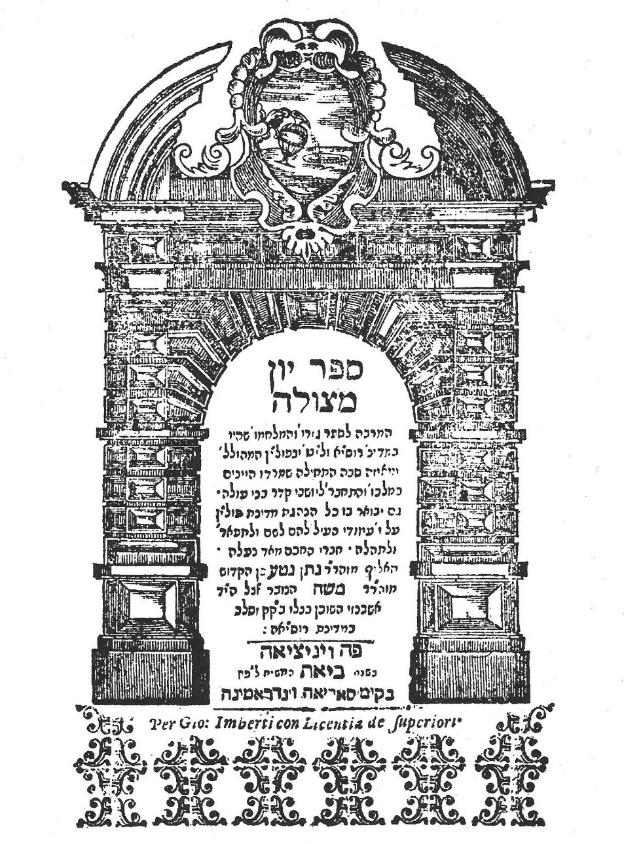
Although not subject to restrictive approbations it is included here due to its relevance to the history of the printing the Talmud in Amsterdam and because the title-pages of Benveniste’s publications are distinguished by his escutcheon, an upright lion facing inward towards a tower; a star is above the lion and the tower. The lion is on the viewer’s right, the tower on the left. At least six forms of Benveniste’s device have been identified. In all cases, excepting his Talmudic treatises, Benveniste’s insignia is set in a crest above an architectural frame surrounding the text of the title page. On the title-pages of the Benveniste tractates his mark appears at the bottom of the page in an ornamental shield, with a helmet in the crest (fig. 1). Given the high regard of most Benveniste imprints this device was subsequently used by several printers in Amsterdam, including two of the following subject editions, as well as by other presses in various locations.[8]
This Talmud has been has been praised for restoring expurgated material. Unlike Benveniste’s other publications, however, the Beneveniste Talmud is not highly regarded. Raphael Natan Nuta Rabbinovicz quotes from an approbation given by R. Moses Judah ha-Cohen, Av Bet Din, of the Ashkenazi community in Amsterdam, for the Berman Talmud (Frankfurt on the Oder, 1697-99) which states that Benveniste, due to his concern over expenses, printed a Talmud edition which was, due to its small size, difficult to learn from. Furthermore, Benveniste used letters that were “the smallest of the small and blurred so that the users eyes become heavy and his sight wanders as if from old age.”[9] This notwithstanding, no less a personage than the Vilna Gaon (R. Elijah ben Soloman Zalman, Gr”a, 1720-70) made use of the Benveniste Talmud, Rabbinovicz writing that “he had heard from a great Talmudic scholar who related that he had seen a Talmud from which the Gr”a had learned by R. Judah Bachrach (1775-1846) av bet din Seiny with his (Gr”a’s) handwritten annotations, brief and varied from his printed annotations, and that it was a Benveniste Talmud.”[10]
II – Frankfurt on the Oder – Michael Gottschalk
Printing with Hebrew letters in Frankfurt on the Oder begins when the Christian printers Joachim and Friedreich Hartmann (1594-1631), who, using new Hebrew fonts and vowels cast by Zechariah Crato (?) of Wittenberg, published a Hebrew Bible in 1595-96. While there are references to an even earlier Bible, half a century earlier, that is uncertain. More than a century later, Johann Christoph Beckmann (1641-1711), professor of Greek language history, and theology at the University of Frankfurt on the Oder, operated a printing-press in Frankfurt on the Oder from 1673 to 1717, which he acquired from his brother Friedreich on June 1, 1673 for 400 Thaler; Friedreich, in turn, had purchased the press for a like amount. Beckmann obtained a travel scholarship from the Brandenburg Elector and, during his travels in Europe came to Amsterdam. In 1663, in that city, Beckmann met Jewish students, the renowned R. Jacob Abendana (1630-85), and studied Talmud. In 1666, Beckmann returned to Frankfurt, where he obtained a position at the university (Viadrina), teaching there until his death in 1717 and serving as rector eight times. Because of the admission of Jewish students, the Viadrina became the “Amsterdam of the East,” both Hebrew and oriental studies being of importance.[11]
Beckmann was granted, initially, on May 1, 1675, a license to employ two Jewish workers, under the direct protection of the university, to print a Hebrew Bible, this despite of the protests of Frankfurt city. By 1693, however, Beckmann found that his responsibilities at the university left him with insufficient time to manage the press. Therefore, he contracted with Michael Gottschalk, a local bookbinder and book-dealer to manage the printing-house, transferring all of the typographical equipment and material to Gottschalk. Their arrangement was noted on the title-pages of the books issued by the press, which stated “with the letters of Lord Johann Christoph Beckmann, Doctor and Professor . . . at the press of Michael Gottschalk.” Gottschalk became the moving spirit of the press for almost four decades.
After printing several varied Hebrew titles Gottschalk approached Beckmann, requesting that he obtain permission to reprint the Talmud. Beckmann petitioned Friedreich III, Elector of Brandenburg (1657-1713, reigned 1688-1713, from 1701 King of Prussia), requesting a license to print the Talmud. Friedreich, in turn, sought the counsel of the Berlin professor Dr. Daniel Ernest Jablonski (1660-1741), from 1691, court preacher at Königsberg for the elector of Brandenburg, Friederick III. Jablonski, a Christian German theologian of Czech origin, an orientalist, had been associated with universities in Holland and England, settling in Lissa in 1686, and from there moving to Berlin. In 1700, Jablonski became a member of the Academy of Sciences in Berlin. Jablonski established a Hebrew press in Berlin, publishing a scholarly edition of the Hebrew Bible based on the Leusden edition (Amsterdam, 1667, Atthias) and a translation of Richard Bentley’s A Confutation of Atheism into Latin (Berlin, 1696). Jablonski, was to become personally involved with Hebrew printing in Berlin, and would be participate in the publishing of two later editions of the Talmud.
When a sponsor was sought for the Frankfurt on the Oder Talmud, Beckmann found one in the Court Jew Issachar (Ber Segal) ha-Levi Bermann (1661-1730) of Halberstadt, known as Bermann Halberstadt or, in his commercial dealings with the non-Jewish world, as Behrend Lehmann. It was Bermann who bore the cost of this Talmud, and whose name is associated with it. Selma Stern observes that Bermann was a pious and observant Jew throughout his life. He was held in high regard by his fellow Jews; and was described as “a second Joseph of Egypt” and “the chosen of the Lord, who warns him about the machinations of his enemies and miraculously rescues him when he is in dire straits.” Bermann was known among his people as “the founder of the Klaus in Halberstadt, the publisher of the Talmud, the man who defeated the first Prussian king at chess and who even in the glittering world of the Court never forgot Eternal Truth, corresponded to the ideal which Jews have had of their great men leaders.”[12]
Beckmann and Bermann entered into an agreement to publish the Talmud, Beckmann transferring his rights to Bermann, and the latter accepting responsibility for publishing the entire edition, making an initial payment of three hundred reichsthalers at the time of the agreement.[13] The printer was to be the Christian, Michael Gottschalk. Approximately half of the sets of this Talmud, known as the Berman Talmud, were distributed by Bermann to yeshivot and penurious scholars who could not otherwise have acquired a complete Talmud. Not only did he spend fifty thousand reichthalers of his own money to publish the Talmud, from which he apparently saw no financial gain, distributing copies to Talmudic students, but afterwards granted permission to the Amsterdam and Frankfurt on the Main printers to publish a complete Talmud, this in spite of the fact that he had approbations preventing republication of competitive editions.[14]
Fig. 2
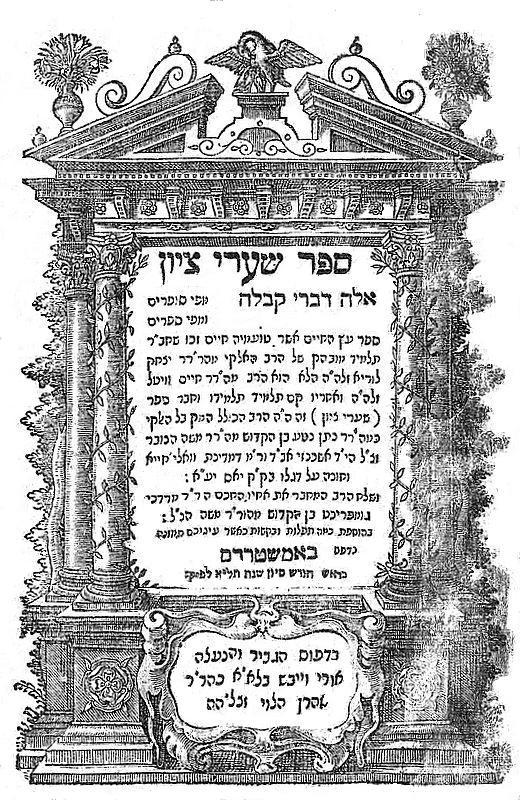
Each volume of this Talmud has two title-pages. The first, a volume header page, has an engraved copper plate title-page (fig. 2) by the craftsman Martin Bernigeroth (1670-1733), Dt. Kupferstecher u. Zeichner (engraver and illustrator).[15] This initial title-page consists of an upright lamb with a pitcher on top of a portico. Below it, on the sides of the page, are Moses to the right and Aaron to the left. Beneath them, similarly situated, are King David with a harp, and King Solomon. Above each figure is that individuals’ name. Avraham Habermann and Avraham Yaari both write that the sheep and laver represent Bermann, who was a Levi. Yaari adds that the sheep further represents Bermann’s “mazel” or constellation, for Bermann was born on the 24th of Nissan (April 23), 1661, the astrological symbol for that month being a sheep.[16]
The second textual tractate title-page follows immediately after the volume title-page. The tractate title-pages are basically copied, with several modifications, from the Benveniste Talmud; but also includes some features characteristic of the Basel Talmud, which is supposed to be the source of this edition. The text concludes in Latin, informing that it is “in accordance with expurgations of the Council of Trent. . . .” and that it was printed in conformity with the Basle edition (1578 – 1581). Between the Hebrew and Latin text is Michael Gottschalk’s printer’s mark (fig. 3), which appears on the title-pages of this Talmud. It is a mirror-image monogram (cipher) of his name, the first usage of such a monogram in a Hebrew book.[17]

Fig. 3
Printed with this Talmud are approbations for the edition. When Johann Christoph Beckmann secured permission in 1695 from the Kaiser, Leopold, and from Friedreich Augustus, Elector of Saxony and King of Poland, to print the Talmud, he was given not only authorization to print the Talmud, but was also granted the sole and exclusive right to do so for twelve years. Leading rabbinic figures, according to Rabbinovicz, issued restrictive approbations, the first instance in which such rabbinic licenses were granted. The rabbis who signed the approbations were R. Naftali ben Isaac ha-Kohen Katz, av bet din (head of the rabbinical court) of Pozna, R. Joseph Samuel of Cracow, av bet din of Frankfurt on the Main, R. David ben Abraham Oppenheim, av bet din of Nikolsburg, and R. Moses Judah ha Kohen and R. Jacob Sasportas of Amsterdam concurred in granting this monopoly, issuing approbations (hascomas) for twenty years.
These approbations were unlike those issued previously in Italy, which assured the authorities that nothing untoward or offensive to them was included in the book, or current approbations, which assure the reader that a work’s contents are in conformity with the community’s religious standards. The approbation issued for this Talmud, and to subsequent editions, was a license for a fixed number of years, prohibiting other publishers from printing competitive editions that would prevent the printer and his sponsor(s), who would otherwise be reluctant to make the substantial investment required to print the Talmud, from realizing a return on their investment.
Oppenheim refers to the burning of the Talmud and other Hebrew books in the Chnielnicki massacres tah ve-tat (1648–49), fires that resulted in the loss of many Hebrew books, resulting in a dire need for Talmudic tractates. Indeed, he writes that the entire Jewish educational system was endangered due to insufficient copies of the Talmud. He praises Lehmann, noting his benevolence in distributing half of the copies to needy students free of charge.[18] Towards the end of his long and flowery approbation Oppenheim forbids the printing of the Talmud by anyone without the permission of Issachar Bermann SG”L, from the day that printing commences until twenty years have elapsed from its completion. This prohibition is “whether for all or for part, even for one tractate only, whether for oneself or for others, and is not to be done by means of guile or ruse.” To enforce his decree R. Oppenheim states that “this decree falls equally upon the purchaser as well as the seller, for that which a rabbinic court declares ownerless is ownerless. Any [such tractate] found in a person’s possession without license, is to be taken forcibly, without payment or deed . . .”[20]
Similarly, R. Joseph Samuel of Cracow begins by praising Berman, noting that all realize that these many days many thought to print the Talmud due to its being unavailable, not to be found, except one to a city and two to a family. He notes, however, that although many wanted to print the Talmud it was to no avail, for it is a large project of much work and difficult to complete, until the Lord aroused the spirit of R. Berman of Halberstadt for the public benefit and the honor of the Torah, to print an entire Talmud on good paper, with fine ink, and diligent workers, well edited. Lest there be many who “bear gall and wormwood” (Deuteronomy 29:17) who also wish to print the Talmud and therefore cause great harm R. Berman’s interests, and “lock the door before him” (cf. Bekhorot 10b) who performs a great mitzvah to benefit the public, for “such is such theTorah, and such is its reward” (Berakhot 21b, Menahot 21b)? He therefore, concurs with the other leading rabbis to decree,
Excommunication and a ban on each and every person who should take it upon himself to print the Talmud in its entirety or in whole or in part without the agreement and knowledge of the noble R. Berman, except for a section needed to learn in yehivot, which is not included in the ban. It is permitted to print only that section and not a complete tractate in order to “magnify the Torah, and make it glorious” (Isaiah 42:21). A blessing should come upon he who hearkens to our words, may blessings of good come upon him and may he receive good from God Who is good. But “he who breaches through a fence, shall be bitten by a serpent” (Avodah Zara 27b) . . . and all the curses written in the Torah shall come upon him. . . .
Even before the privilege for this Talmud had expired the need for a new edition became apparent, numerous appeals being made to Issachar Bermann to republish the Talmud. Gottschalk, who had the rights granted to Beckmann, was also favorable to reprinting the Talmud. The Talmud had sold well and Gottschalk, as a result, had become a wealthy man.[20] Frederick William I of Prussia acceded to their request on May 23, and a new privilege, dated October 13, 1710, was granted to Gottschalk by Joseph I, successor to Leopold, in 1705, to print the Talmud and sell it throughout his domain, albeit with the customary restrictions and with the provision, as with all Hebrew books, that five copies be brought to the Imperial court. Similarly, on January 11, 1711, Frederick Augustus I (Augustus II), Elector of Saxony and King of Poland, also granted such a privilege. Nevertheless, these privileges were not immediately acted upon by Gottschalk and it would be several years before he printed the second of his three editions of the Talmud.[21]
III – Marches and de Palasios and Solomon Proops
Individual tractates were frequently published in Amsterdam, to address the continuing communal need for treatises for study purposes. The printers of these tractates include Moses Mendes Coutinho, Asher Anshel and Issachar Ber, Issac de Cordova, Joseph Dayyan and Moses Frankfurter, the latter two dayyanim (judges) of the Ashkenaz religious court. During the interval between the Benveniste and the Frankfurt on the Oder editions of the Talmud no complete Talmud had been printed. It must have appeared unseemly, however, that in Amsterdam, the center of Hebrew printing, with the greatest number of, and the largest, Hebrew printing-presses, that no Talmud edition had been issued for over six decades.
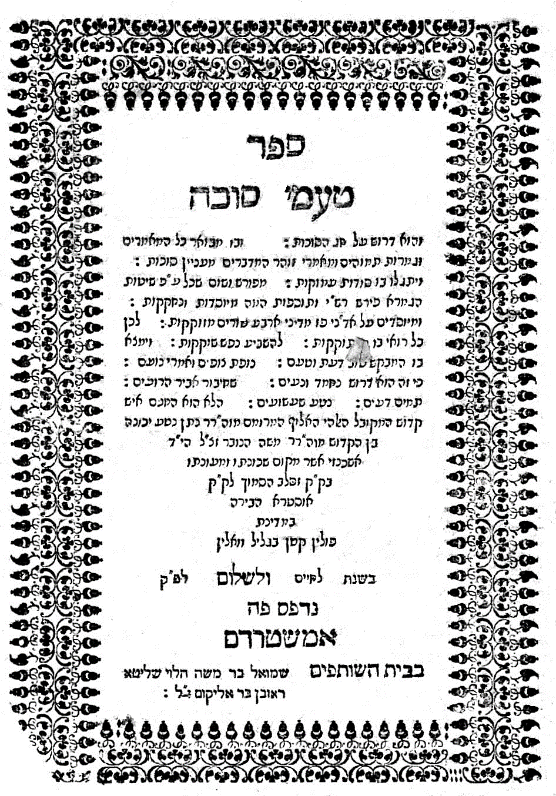
An attempt to correct this, even if that was not the printers’ primary intent, occurred during the interval between the first and second Frankfurt on the Oder editions of the Talmud. two independent editions of the Talmud were begun in Amsterdam in 1714. The first was published by the partners Samuel ben Solomon Marcheses and Raphael ben Joshua de Palasios, the second by Solomon Proops. Both publishers began to print in 1714; both editions are in attractive large folio format; the title-pages of both Talmuds have, as a printer’s device, copies of the Benveniste escutcheon (figs. 4, 5). Most importantly, neither Talmud edition was completed.
Except for a Sephardic rite prayer-book, printed by Samuel Marcheses at the press of Joseph Athias, neither partner, prominent members of the Amsterdam Sephardic community, had previously published any works. Their motivation in establishing a press was for the specific purpose of printing the Talmud. Furthermore, they intended to do so in such a manner as to produce an especially fine and accurate edition. The workers would not be hurried, so that they could work with care, reducing errors, supervised by R. Moses Frankfurter, who would help establish the correct text.[22] Marcheses and de Palasios did so under the influence of R. Judah Aryeh Loeb ben Joseph Samuel Schotten ha-Kohen (1644-1719), av bet din of Frankfurt on the Main, and his father-in-law R. Samuel Settin of Frankfurt n Main. Judah Aryeh Loeb had previously attempted to have a Talmud printed in Frankfurt in 1710 but, due to the prior approbations granted to the Frankfurt on the Oder Talmud his efforts were to no avail, and he was unable to get authorization from the emperor to print the Talmud. In 1713, Judah Aryeh Loeb explored the possibility of obtaining permission to print in Frankfurt from the Kaiser in Vienna, but did not even receive a response to his inquiries. Judah Aryeh Loeb next turned to Amsterdam where, with the assistance of his father-in-law and the agreement of R. Issachar (Ber Segal) ha-Levi Bermann who had the prior approbation he commenced to print the Talmud.[23] Subsequently Samuel Settin arranged for Samuel Marches and Joshua de Palasios to undertake this venture, arranging for R. Zvi Hirsh of Sharbishin, at the time a resident of Amsterdam, to visit various Jewish communities, seeking subscribers to defray the cost of publication.[24]
Printing began with tractate Berakhot in 1714; the following tractates are recorded by Rabbinovicz as having been printed: 1715 – Shabbat and Seder Zera’im: 1716 – EruvinPesahimHagigahMo’ed KatanYomaShekalimMegillah, and Ketubbot: 1717 – BezahRosh Ha-ShanahSukkahTa’anit, and Yevamot.[25] Printing was discontinued in 1717 due to the approbations issued to the Frankfurt on the Oder printer for the Berman Talmud.
The approbations for this edition appear in tractate Shabbat. They are from R. Solomon ben Jacob Ayllon, R. Gabriel ben Judah Loeb of Cracow, R. Samuel ben Joseph Schotten ha-Kohen, R. Baruch ben Moses Meir Rappaport, R. Ezekiel ben Abraham of the house of Katzenellenbogen, R. Menahem Mendel Ashkenazi, R. Isaac Aaron ben Joseph Israel of Metz, and R. Phineas ben Simeon Wolff Auerbach of Cracow. The approbation of R. Menahem Mendel Ashkenazi, at the time Landesrabbiner in Bamberg and Baiersdorf, subjected anyone who violated the copyright to excommunication, placing a
ban, and anathema, and death on anyone who would reprint the Talmud during twenty years from the completion of this edition without the knowledge or permission of the above [Judah Aryeh Loeb] in any manner, whether in its entirety or in part, even a single tractate, excepting a section needed for learning in the yeshivot according to the requirements of the times, whether by himself or by his agent or his agent’s agent, directly or indirectly, whether a member of his household or not a member of his household . . . and he who heeds our words shall be blessed . . .
Marcheses and de Palasios acknowledge the existence of the prior restrictive approbation for the Berman Talmud on the title-pages of their tractates, which note that most of its benefits can be attributed to the Talmud of R. Issachar Bermann of Halberstadt, and also state
[And even though] most of the qualities to be found in this Talmud were acceded to me by the noble, the eminent, the distinguished R. Issachar Bermann Segal of Halberstadt even though the time restricting publication established by the geonim of the land for the above noble (Berman) for printing his Talmud has not yet elapsed. An palanquin to the above eminent noble for this. Now “My eyes and my heart are always toward the Lord” (cf. Psalms 25:15) . . .

Fig. 4. 1714, Berakhot, Marches and de Palasios 

Fig. 5. 1714, Berakhot, Solomon Proops
In the same year, 1714, that Berakhot was published a second Talmud was begun in Amsterdam. The publisher of that edition was Solomon ben Joseph Proops, then a book dealer, Maecenas to numerous Amsterdam publishers, and the founder of the famous Proops press. He had been a book-dealer and financed and partnered in a number of works published at other presses before establishing his own press in 1704. The printing-house founded by Solomon Proops would become one of the most illustrious in the history of Amsterdam Hebrew printing. It issued, almost simultaneously with the Marches and de Palasios edition, a copy of Berakhot with Seder Zera’im, possibly followed by Bezah.
Proops was unable to continue with his proposed Talmud edition, publishing one (two) volume(s) only. Judah Aryeh Loeb, relying on the approbations given his Talmud prior to the Proops edition, objected to the publication of a rival Talmud, and brought the matter before a rabbinic court. The court’s enjoined Proops from printing additional tractates, and trespassing on Judah Aryeh Loeb’s rights as a printer. To avoid further difficulties of this sort, Marques and de Palasios secured approbations from leading rabbinic authorities for their Talmud, prohibiting other printers from publishing a Talmud.
Rabbinovicz observes that Proop’s defense, that he was unaware that Samuel Marches and Joshua de Palasios were already engaged in the publication of the Talmud, was untenable. Proops had to know that R. Judah Aryeh Loeb was publishing tractates in Amsterdam. Proops might argue that he had begun Berakhot prior to the other press, was unaware of their approbations, and having begun, should be allowed to complete his work.
This was not the last law suit concerning the Talmud that Judah Aryeh Loeb had to contest. Although we can sympathize with Judah Aryeh Leib’s difficulties with Solomon Proops, there is a certain poetic justice to his situation, for just as he protested the Proops Talmud in Amsterdam, so too did he face objections from the Frankfurt on the Oder printer. As noted above, Michael Gottschalk, the Berlin and Frankfurt on the Oder printer, who had printed his first Talmud (1697-99) and would subsequently print two additional two editions of the Talmud (1715-22, 1734-39), brought a suit to force Judah Aryeh Loeb and the partners to cease printing their Talmud. In addition to his prior approbations Gottschalk claimed that he had obtained the sole authorization to print his second Talmud, again for twenty years, from Kaiser Joseph I of Germany in 1710, King Frederick Augusta of Poland and Saxony in 1711, Kaiser Karl VI and King Frederick Wilheim in 1715. Gottschalk filed his complaint in mid-1717.
Rabbinovicz writes that he does not know why Gottschalk waited so long to exercise his rights to stop the printing of this edition. Gottschalk had obtained royal permission, as well as rabbinic approbations, as early as 1715. Instead, he permitted Judah Aryeh Loeb to print a number of tractates over a period of several years before he acted. According to Friedberg, in that year, Samuel Schotten took tractates from the Amsterdam Talmud to the book fair in Lippsia (Leipzig).
There were several book fairs of importance in Germany, among the most important being those of Frankfurt on the Main from as early as 1240 and the Leipzig (Lippsia) fair, which predates it, from 1170. Both locations were centers of the printing industry, Frankfurt midway between north and south, Lippsia in the north. Although Frankfurt initially overshadow Leipzig, it later “was forced to yield to the Saxon city. . . . which became . . . the centre of German book publishing.” Leipzig’s importance can be further credited, “not in its number of presses but in its number of shops, its number of book dealers, and publishing houses.” Furthermore, although many German cities had book fairs, “Leipzig was one of the most important fairs eastern and south Eastern Europe and soon utilized the advantage of her connections for the development of the book trade.”[26] It is not surprising then, that Moses Schotten, the son of Samuel Schotten, attended the book fair.[27]
Returning to Friedberg’s account of events, Moses Schotten attended the Leipzig book fair, bringing samples of the tractates printed in Amsterdam. Gottschalk “waited for him and then ambushed him in secret.” Immediately after Schotten arrived in Leipzig Gottschalk contacted the fair officials, that the tractates brought by Schotten should be confiscated. The fair officials did not act, however, instead awaiting instructions from the prince of the district capital, Dresden, who delayed until the conclusion of the fair. In the interim, Schotten was able to sell the tractates that he had brought without hindrance.
Gottschalk returned home, bitter, and submitted a complaint on January 3, 1716 to the king. In it Gottschalk related what had occurred at the fair and petitioned the king for recourse against those who had trampled “with their feet” on his legal rights. The king responded to affirmatively to Gottschalk on February 12, 1716, prohibiting the sale of the Talmud at the fair by anyone except Gottschalk. Several additional tractates were printed in Amsterdam and Schotten returned, in October 3, 1717, to the fair. Gottschalk, when he became aware of this, informed the officials of their obligations and this occasion all the books (tractates) that Schotten brought with him were seized. Moses Schotten justified his actions, stating that he had come only as an agent of his father, Samuel Schotten, from Frankfurt on the Main. If the fair officials had complaints they should bring them to that city. Although Gottschalk was successful in preventing the sale at the fair and the further publication of tractates from this Talmud in Amsterdam ceased in 1717, his victory was short lived. Soon after Judah Aryeh Loeb was able to resume printing in Frankfurt on the Main, publishing a fine and complete Talmud.[28]
III
Frankfurt on the Main Talmud
Printing was relatively late in coming to Frankfurt on the Main, partly due to its proximity to Mainz, an early center of printing. The first Frankfurt printer was Beatus Murner, who printed nine books in 1511-12. Among those nine titles are the first books printed in Frankfurt with Hebrew letters, a 1512 editions of a Birkat ha-Mazon Benedicite Judeorum’ (Hebrew in woodcut) and Hukat ha-Pesach Ritus et celebrate phase judeorum’ by Beatus Murner’s better known brother, Thomas Murner, a Maronite brother and enemy of Martin Luther.
The printing of a significant number of Hebrew books begins in the last decades of the seventeenth century, in about 1675. Four hundred ninety titles, albeit some questionable, are ascribed to Frankfurt in the hundred-year period from 1640 to 1739.[29] Johann Koelner (1708–28), who published a complete Talmud (1720-22) is credited with more than one hundred titles, although that number includes each of the tractates in his edition of the Talmud.[30] This Talmud was initially the completion of the Talmud begun in Amsterdam in 1714 by R. Judah Aryeh Loeb together with Samuel Marches and Joshua de Palasios interrupted by the suit, based on approbations for his edition, brought by Michael Gottschalk
Judah Aryeh Loeb now attempted, successfully, to complete the Talmud he had begun in Amsterdam in Frankfurt on the Main. Given that Gottschalk, based on the approbations he had received for his second Talmud, was able to prevent publication of Judah Aryeh Loeb’s Talmud in Amsterdam, only three years earlier, how was Judah Aryeh Loeb able to publish a complete Talmud only three years later in Frankfurt? Friedberg writes, tersely, that “the eminent, the prominent R. Samson Wertheimer from Vilna, court Jew of Karl VI, influenced him to give Aryeh Loeb ben Joseph Samuel av bet din Frankfurt on the Main authorization to print a new edition of the Talmud. The sovereign acceded to his request and authorized publication of the Talmud in Frankfurt from 1720.”[31] Rabbinovicz remarks that the interruption in the work on the Amsterdam edition and the ensuing great expense, as well as the bribes in the courts until Aryeh Leib succeeded, left him in reduced financial condition, until Samson Wertheimer, became involved, making it possible to continue and publish this fine edition.[32]

Fig. 6
Approbations were also published with this Talmud, primarily reprints from the Amsterdam edition and with one new approbation, from R. Jacob ben Benjamin Katz (Poppers, Shav Ya’akov) (1719). Another example of the continuity of the two editions is that the volumes issued in both cities are alike, the title pages showing minor textual variations only, such as the new place of publication, and on some but not all of the Frankfurt tractates, the inclusion of accompanying Latin text, confirming that it was printed in accordance with the text of the censor Marco Marino (Basle Talmud, 1578-81) and variations of the printer’s mark. Whereas the treatises printed in Amsterdam have a new woodcut of the Benveniste printer’s mark, the Frankfurt volumes, although retaining the outer crest with helmet, replace the lion and tower with the double headed eagle of the Hapsburgs (fig. 6).
Printing began in Frankfurt on the Main in 1720 with tractate Kiddushin, it having been anticipated that they would be allowed to bring the tractates printed previously in Amsterdam to Frankfurt. However, this was not permitted, so that they began to print the remainder of the Talmud, beginning with Berakhot completing the Talmud until Kiddushin that year, except for Seder Zera’im and tractate Ta’anit which were printed in 1722. Another possibility, suggested by Rabbinovicz, is that they were allowed to publicly sell the tractates printed in Amsterdam in Germany, but the market for the tractates printed in Frankfurt exceeded expectations, so that, to complete sets of the Talmud it was necessary to reprint those tractates printed earlier in Amsterdam.[33]
IV Aftermath
The next controversy over rival editions of the Talmud occurred with the second printing of the Talmud by the Proops’ press in 1752 – 1765. This edition, published by Solomon Proop’s sons, Joseph, Jacob, and Abraham, is a large, very fine folio edition. Publication was interrupted for several reasons, but primarily due to the publication of rival editions of the Talmud in Sulzbach by Meshullam Zalman Frankel and afterwards by his sons, Aaron and Naphtali, that is, the Sulzbach Red (1755-63) and the Sulzbach Black (1766-70). The first Sulzbach Talmud is known as Sulzbach red because the first title-page in the volume was printed with red ink, in contrast to Sulzbach black, in which the first title-page in the volume is printed entirely in black ink. Both the red and the black are smaller folio and not highly regarded.
Resolution of the dispute between the two publishing houses was settled by a rabbinic court that determined, among its findings, that despite Proops’ prior approbations the Sulzbach printer did not have to desist from publishing, for the Sulzbach Talmud was less expensive and therefore available to individuals who could not afford the larger and finer Amsterdam Talmud, the latter marketed to a more affluent market.
One other dispute of significance, that embroiled leading rabbis in Europe, was over the rival editions of the Talmud printed by the Shapira press in Slavuta and the Romm press in Vilna of their respective editions of the Talmud in 1835. Both the Amsterdam-Sulzbach and Slavuta-Vilna disputes are beyond the scope of this article. However, they, as well as the controversy surrounding the Frankfurt on the Oder and Amsterdam editions of the Talmud, the subject of this article, confirm Raphael Natan Nuta Rabbinovicz’s observation as to the negative and disruptive results of restrictive approbations.
Even though the intent in granting approbations was for the good of the community, to insure investors a reasonable return on their investment, the result, as noted above, was detrimental. The Talmud was printed only eight times in the century from 1697 to 1797, and the price of a set of the Talmud was dear. Prior to that the Talmud had been printed several times in Italy and Poland within a relatively short period of time, the primary impediment then being the opposition of the Church and local authorities. After 1797 the use of restrictive approbations declined, with the consequence that within four decades the Talmud was printed nine times, this notwithstanding the Slavuta-Vilna rivalry. Given these controversies and their negative outcomes, perhaps a better course for all would have been to apply Hillel’s admonition in Avot.
Be of the disciples of Aaron, loving peace and pursuing peace.
(Avot 1:12)
[1] L. Fuks and R. G. FuksMansfeld, Hebrew Typography in the Northern Netherlands 1585-1815, (Leiden, 1984-87), I pp. 45-48, II pp. 237-40, 297.
[2] Raphael Natan Nuta Rabbinovicz, Ma’amar al Hadpasat ha-Talmud with Additions, ed. A. M. Habermann pp. 100, 155-56 (Jerusalem, 1952) [Hebrew].
[3] H. I. Bloom, The Economic Activities of the Jews of Amsterdam (Port Washington, 1969), p. 45.
[4] Concerning individual tractates not printed as part of a Talmud in this period see Marvin J. Heller, Printing the Talmud: A History of the Individual Treatises Printed from 1700 to 1750 (Leiden, 1999).
[5] The Benveniste family, distinguished and widespread in Spain and Provence, is mentioned as early as 1079 in documents from Barcelona. After the expulsion of the Jews from Spain in 1492 the family was widely dispersed, but primarily throughout the Ottoman Empire where many eminent rabbis were named Benvensite. (“Benveniste,” Encyclopaedia Judaica. Ed. Michael Berenbaum and Fred Skolnik. 2nd ed. Vol. 3 (Detroit, 2007. 382. Gale Virtual Reference Library. Web. 4 Jan. 2012).
[6] A. M. Habermann, The History of the Hebrew Book. From Marks to Letters; From Scroll to Book (Jerusalem, 1968), p. 155 [Hebrew].
[7] In addition to the well-known commercial edition, there was also a deluxe edition, measuring 310 x 225 mm. This was brought to my attention by of Daniel Kestenbaum of Kestenbaum and Company.
[8] Concerning the widespread use of the Benveniste device see my “The Printer’s Mark of Immanuel Benveniste and its Later Influence,” Studies in Bibliography and Booklore XVIII (Cincinnati, 1993), pp. 3-14, reprinted in Studies in the Making of the Early Hebrew Book (Brill, Leiden/Boston, 2008), pp. 54-71. Parenthetically, among the first to employ the Benveniste escutcheon on a tractate title-page was the press of Asher Anshel ben Eliezer Chazzen and Issachar Ber ben Abraham Eliezer of Minden in their edition of Bava Batra (1702). Their other tractate, Bava Mezia (1699) does not have the Benveniste escutcheon.
[9] Rabbinovicz, pp. 95-6.
[10] Rabbinovicz, p. 129 no. 1. Yaakov Shmuel Spiegel, Amudim be-Toldot ha-Sefer ha-Ivri: Hagahot u-Megihim (Ramat-Gan, 1996), pp. 404-05 [Hebrew] adds that the Vilna Gaon learned from and made annotations on the Berlin – Frankfurt on the Oder Talmud of 1715-23. 
[12] Selma Stern, The Court Jew. A Contribution to the History of Absolutism in Central Europe (Philadelphia, 1950), pp. 55-59.
[13] Friedberg. History of Hebrew Typography of the following Cities in Central Europe: Altona, Augsberg, Berlin, Cologne, Frankfort M., Frankfort O., Fürth, Hamberg, Hanau, Heddernheim, Homberg, Ichenhausen, Neuwied, Wandsbeck, and Wilhermsdorf. Offenbach, Prague, Sulzbach, Thannhausen from its beginning in the year 1513 (Antwerp, 1935), p. 37 [Hebrew].
[14] Manfred R. Lehmann, “Behrend Lehmann: The King of the Court Jews” In: Sages and Saints, ed. Leo Jung (Hoboken, 1987), p. 205; Ya’akov Loyfer, Mi-Shontsino ve-ad Ṿilna (Jerusalem: ha-Modia, 2012), p. 139 [Hebrew].
[15] A highly regarded engraver, Martin Bernigeroth is known to have done as many as 1600 engravings, many portraits. His sons, John Martin (1713-1767) and Johann Benedict (1716-1764), were also worked noted engravers. Concerning the former see, Joseph Strutt, A Biographical Dictionary, containing an historical account of all the engravers, from the earliest period of the art of engraving to the present time, and a short list of their most esteemed works . . . I (London, 1785), p. 88.
[16] Avraham Habermann, Title Pages of Hebrew Books, (Tel Aviv, 1969), pp. 63, 130 no. 47 [Hebrew]; Yaari, Printers’ Marks, pp. 49, 152 no. 78.
[17] Avraham Yaari, Hebrew Printers’ Marks (Jerusalem, 1943), pp. 50, 152 no. 79 [Hebrew]; Marvin J. Heller, “Mirror-image Monograms as Printers’ Devices on the Title Pages of Hebrew Books Printed in the Seventeenth and Eighteenth Centuries,” Printing History 40. Rochester, N. Y., 2000, pp. 2-11, reprinted in Studies, pp. 36-38, 363, figs. 21-23.
[18]  Menahem Schmelzer, “Hebrew Printing and Publishing in Germany, 1650-1750,” in Leo Baeck Institute Year Book XXXIII (London, Jerusalem, New York, 1988), p. 375.
[19] “That which a rabbinic court declares ownerless is ownerless’ is discussed in Yevamot 89b, Gittin 36b and Jerusalem Talmud Shekalim 3a. The source for this concept is Ezra 10:8 “And anyone who will not come within three days, as according to the counsel of the princes and the elders, all his property will be forfeited and he will be separated from the congregation of the captivity.”
[20] Institut für angewandte Geschichte – Gessellschaft und Wissenschaft im Dialog e. V. http://www.juedischesfrankfurtvirtuell.de/en/en_C.php
[21] Friedberg, Central Europe, pp. 40-41; William Popper, The Censorship of Hebrew Books (New York, 1899, reprint New York: Burt Franklin, 1968), pp. 111-12.
[22] Ch. B. Friedberg, History of Hebrew Typography of the following Cities in Europe: Amsterdam, Antwerp, Avignon, Basle, Carlsruhe, Cleve, Coethen, Constance, Dessau, Deyhernfurt, Halle, Isny, Jessnitz, Leyden, London, Metz, Strasbourg, Thiengen, Vienna, Zurich. From its beginning in the year 1516, (Antwerp, 1937), p. 43[Hebrew].
[23] Friedberg, Central Europe, pp 44-45; William Popper, The Censorship of Hebrew Books (New York, 1899, reprint New York: Burt Franklin, 1968), p. 115.
[24] Friedberg, Amsterdam, p. 43.
[25] Rabbinovicz, p. 101.
[26] James Westfall Thompson, The Frankfort Book Fair. The Francofordiense Emporium of Henri Estiene: Edited with Historical Introduction Original Latin Text with English Translation on Opposite Pages and Notes (Chicago, 1911, republished New York, 1968), pp. 10-11, 15, 42.
[27] Jewish attendance at book fairs appears to have been common place. It was at the Frankfurt on the Main book fair in 1577 that Ambrosius Froben met R. Simon Guenzburg (Simon zur Gemze) of Frankfurt, a meeting that eventually culminated in the Basle Talmud (1578-81). Concerning this see my Printing the Talmud: A History of the Earliest Printed Editions of the Talmud (Brooklyn, 1992), p. 244-45.
[28] Friedberg, Central Europe, p. 46.
[29] Yeshayahu Vinograd, Thesaurus of the Hebrew Book. Listing of Books Printed in Hebrew Letters Since the Beginning of Printing circa 1469 through 1863 II (Jerusalem, 1993-95), pp. 579-90 [Hebrew].
[30] Vinograd, I p. 459.
[31] Friedberg, Central Europe, p. 67.
[32] Rabbinovicz, p. 111.
[33] Rabbinovicz, pp. 109-10.


Who can discern his errors? Misdates, Errors, Deceptions, and other Variations in and about Hebrew Books, Intentional and Otherwise: Revisited

Who can discern his errors?
Misdates, Errors, Deceptions, and other Variations in and about Hebrew Books, Intentional and
Otherwise: Revisited[1]
by Marvin J. Heller

Marvin J. Heller is the award winning author of books and articles on early Hebrew printing and bibliography. Among
his books are the Printing the Talmud series, The Sixteenth and Seventeenth Century Hebrew Book(s): An Abridged Thesaurus, and collections of articles.

R. Eleazar once entered a privy, and a Persian [Roman] came and thrust him away. R. Eleazar got up and went out, and a serpent came and tore out the other’s gut. R. Eleazar applied to him the verse, “Therefore will I give a man (אָדָם adam) for thee (Isaiah 43:4).” Read not adam [a man] but אֱדֹם edom [an Edomite = a Roman] corrected by the censor to “but a Persian.” (Berakhot 62b)
 “R. Eleazar said: Any man who has no wife is no proper man; for it is said, Male and female created He them and called their
name Adam” corrected by the censor to “any Jew who is unmarried” (Yevamot 63a).[2]
Sensitivity to the contents of Jewish texts by non-Jews, and apostates in their employ, was a feature of Jewish life at various periods, one particularly notable and noxious time being in the sixteenth century when, during the counter-Reformation, the Church undertook to censor and correct those Hebrew books that were not placed on the index and banned in their entirety. In the first example, the understanding based on the reading of adam אָדָם as edom אֱדֹם (Rome) is completely lost by the substitution of Persian for Edom. In the second example “Any man who has no wife is no proper man” was deeply offensive to a Church that required an unmarried and celibate clergy. In both instances the text was altered to adhere to the Church’s sensibilities despite the fact that not only was the original intent lost but that, particularly in the first case, it ceased to be meaningful.
            Books, and even more so Hebrew books, often underwent modifications, textual changes, due to the vicissitudes and complexities of the Jewish condition, frequently involuntary. The subject of “Misdates, Errors, Deceptions, and other Variations in and about Hebrew Books, Intentional and Otherwise,” addresses textual changes, as well as other errors, intentional and unintentional, that may be found in Hebrew books. Addressed previously in Hakirah, this is a companion article, providing additional examples of book errors, variations, and discrepancies. As noted previously, errors “come in many shapes and forms. Some are significant, others are of little consequence; most are unintentional, others are purposeful. When found, errors may be corrected, left unchanged, or found in both corrected and uncorrected forms. . . . Other errors are not to be found in the book per se but rather in our understanding of the book. This article is concerned with errors in and about Hebrew books only. It is not intended to be and certainly is not comprehensive, but rather explores the variety of errors, some of consequence, most less so, providing several interesting examples for the reader’s edification and perhaps enjoyment.”[3]
Among the errors discussed in this article are 1) those dealing with the expurgation of the Talmud; 2) expurgation of other Hebrew works; 3) internal censorship, that is, of Hebrew books by Jews; 4) accusations of plagiarism and forgery; 5) misidentification of the place of printing; 6) confusion due to mispronunciations.
I
            Returning to the beginning of the article, the Talmud, initially banned in 1553 and placed on the Index librorum prohibitorum in 1559, was subsequently permitted by the Council of Trent in 1564, but only under restrictive and onerous conditions. Reprinted in greatly censored form, the introductory quote refers to modifications in the Basle Talmud (1578-81). A condition of the Basle Talmud was that the name “Talmud” be prohibited. Heinrich Graetz explains the Pope’s and Council’s considerations in forbidding the name.
the Council only approved the list of forbidden books previously made out in the
papal office, the opinion of the pope and those who surrounded him served as
a  guide in the treatment of Jewish writings. The decision of this point was left to the pope, who afterwards issued
a bull to the effect that the Talmud was indeed accursed – like Reuchlin’s ‘Augenspiegel
and Kabbalistic writings’ – but that it would be allowed to appear if the name
Talmud were omitted, and if before its publication the passages inimical to
Christianity were excised, that is to say, if it were submitted to censorship
(March 24th, 1564). Strange, indeed, that the pope should have allowed the
thing, and forbidden its name! He was afraid of public opinion, which would
have considered the contradiction too great between one pope, who had sought
out and burnt the Talmud, and the next, who was allowing it to go untouched. At
all events there was now a prospect that this written memorial, so
indispensable to all Jews, would once more be permitted to see the light,
although in a maimed condition.[4]
            Among the most egregious examples of censorship of the Talmud is Bava Kamma 38a. That amud (page) of the Talmud, dealing with financial relations between Jews and non-Jews, was expurgated, almost in its entirety. Prior to the much censored Basle Talmud (1578-1581) the text was completely printed, for example, in the 1519/20-23 Venice edition of the Talmud published by Daniel Bomberg. After the censored Basle Talmud was published, initially, rather than contract the text, large blank spaces were left, clearly indicating that text had been expurgated.
            Abraham Karp notes that in some editions of the Talmud “many expurgated passages are restored, and where deletions are retained, blank spaces are left to indicate the omission to the reader and, no doubt, to permit him to fill in by pen what they dared not to print.”[5] An example of the blank spaces can be seen from the Frankfurt an der Oder Talmud 1697-99, printed by Michael Gottschalk. Such omissions are to be found in almost all seventeenth and early eighteenth editions of the Talmud, a notable exception being the Benveniste edition (Amsterdam, 1644-47).[[6]  Rabbinovitch too notes that blank spaces were left for expurgated text, those omissions being consistent with the Basle Talmud. He adds, however, that this policy was followed until the 1835 Vilna Talmud. At that time government officials prohibited the practice so that the omissions would not be so obvious.[7]  In fact, text was consolidated much earlier, as evidenced, by the illustrations of Bava Kama 38a from the 1734‑39 Frankfurt an der Oder Talmud. This expurgated material is restored in current editions of the Talmud.

Frankfurt an der Oder – 1697-99

Frankfurt an der Oder – 1734-39

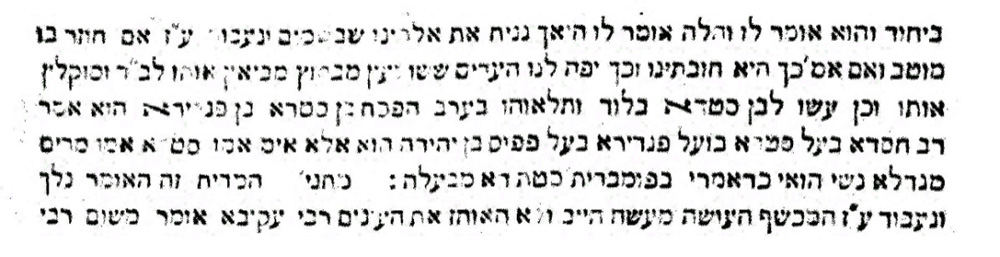
Another example of interest, one that has not fared as well, the text not yet restored in most editions of the Talmud, is to be found in Shabbat 104b and Sanhedrin 67a. The reference there is to Ben Satda, beginning, in the latter tractate “and so they did to Ben Satda
in Lod, and hung him on erev Pesah. Ben Satda? He was the son (ben) of Padera . . .”[8] Popper notes that Gershom Soncino, when publishing “a few of the Talmudic tracts at Soncino during the last decade of the fifteenth century, he took care not to restore any of the objectionable words in the MSS. from which he printed.”[9] Here too the text is complete in the Bomberg Talmud. Two subsequent exceptions in later editions of Sanhedrin where the Ben Satda entries do appear are in the Talmud printed by Immanuel Benveniste and in the edition of Sanhedrin printed in Sulzbach in or about 1696.

Sanhedrin 67a, Benveniste Talmud
However, in two complete editions of the Talmud (1755-63, 1766-70) printed in Sulzbach, the Ben Satda entries are omitted, as is the case of most modern editions of the Talmud.[10]
II
            The Talmud isn’t the only work to have been censored. Amnon Raz-Krakotzkin provides several examples of text in books
that were modified due to the censor’s ministrations. Among them is R. Abraham ben Jacob Saba’s (d. c. 1508) Zeror ha-Mor, a commentary on the Pentateuch based on kabbalistic and midrashic sources.[11] On the passage “They would slaughter to demons without power, gods whom they knew not, newcomers recently arrived, whom your ancestors did not dread” (Deuteronomy 32:17), referring to “Christians in general and priests in particular as ‘demons’ (shadim): ‘For as the nations of the world, all their abominations and vanities come from the power of demons, hence, the monks would shave the hair of their heads  and leave some at the top of the head as a stain.’” This passage continues, referring to bishops and popes, concluding that their entire heads are shaved like a marble with only a bit of hair about their ears, so that they have the appearance of demons, hairless, and like demons, provide no blessings, are like a fruitless tree, and “thus, it is fitting that they bear no sons of daughters.” Raz-Krakotzkin informs that this passage appeared in the first two editions of Zeror ha-Mor printed by Bomberg, and the Giustiniani edition (1545) but was already expurgated by the Cavalli edition (1566), a blank space in place of the text. That space subsequently disappeared and, although a Cracow edition based on the Bomberg Zeror ha-Mor restored the text it remains missing from most later editions.[12] Raz-Krakotzkin continues, citing additional examples.
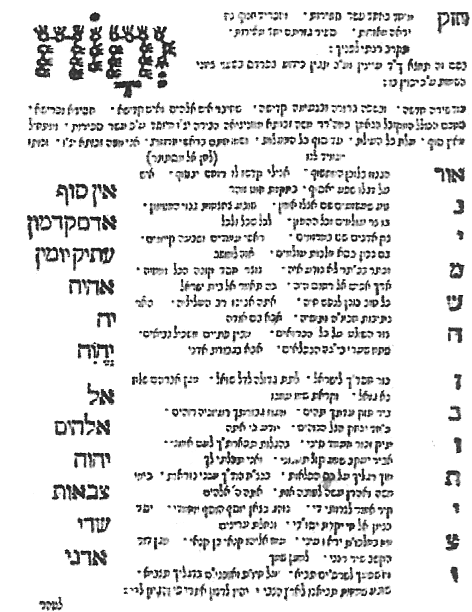
            Early halakhic works were also subject to the ministrations of the censor.[13] Among them are such works as R. Samson ben Zadok’s (thirteenth century) Sefer Tashbez (Cremona, 1556). Samson was a student of R. Meir of Rothenburg (Maharam, c. 1220-1293). When the latter was imprisoned in the tower of Ensisheim, Samson visited him regularly, serving as his attendant and carefully recording in Tashbez Maharam’s teachings, customs, and daily rituals, as well as what he heard and observed, from the time Meir rose in the morning until he retired at night, on weekdays, Sabbaths, and festivals. Although a relatively small work (80: [6], 55 leaves), it consists of 590 entries beginning with Sabbath night (1-17), Sabbath day (18-98), followed by festivals, Sefer Torah, priestly benedictions, prayer, slumber, talis and tefillin, benedictions, issur ve-heter (dietary laws), redemption of the first born, hallah, vows, marriage and divorce, monetary laws, and piety. Expurgation by the censor of Tashbez was done sloppily, for terms such as meshumad and goy, normally excised, remain, but with a disclaimer near the end that they refer to idol worshipers only.[14]
III
Not all errors are due to the ministrations of the censor. Jews, too, at times, have taken their turns at modifying the text of books.
            A recent and perhaps quite surprising example of internal censorship is to be found in R. Solomon Ganzfried’s (1804–1886) Kizzur Shulḥan Arukh. First printed in 1864, that work an abridgement of the Shulhan Arukh for the average person, went through fourteen editions in the author’s lifetime, and numerous editions since then, as well as translations into many languages and has been the subject of glosses.[15] Marc B. Shapiro informs that in the Lublin (1904) edition of the Kizzur Shulḥan Arukh and several other editions the entry (201:4) that “apostates, informers, and heretics –for all these the rules of an onan and of mourners should not be observed. Their brothers and other next of kin should dress in white, eat, drink, and rejoice that enemies of the Almighty have perished,” the words “apostates, informers, and heretics” have been removed. In the Vilna edition (1915) the entire paragraph is removed and the sections renumbered from seven to six. In the Mossad Harav Kook vocalized edition a new halakhah was substituted, but that has since been corrected to reflect the original text. The reason, according to Shapiro, is that with the expansion of Jewish education to include girls, it was felt that schoolchildren, with assimilated relatives, would see this as referring to family members.[16] Several recent editions of the Kizzur Shulḥan Arukh that were examined, in both Hebrew and English, have the original text.
            R. Abraham Isaac Kook (1865–1935), chief rabbi of Jerusalem and first Ashkenazic chief rabbi in Israel (then Palestine),
was a profound, influential, and mystical thinker. Highly regarded by his contemporaries, his strongly Zionist views also resulted in some opposition, but even most of his contemporaries who disagreed with him held him in high regard. Shapiro notes that with time, Kook’s reputation changed. Despite the fact that such pre-eminent rabbis as R. Solomon Zalman Auerbach (1910-95) and R. Joseph Shalom Elyashiv (1910-2012) were unwavering in their high regard of Kook, strong anti-Kook sentiment developed later in religious anti-Zionist circles. Shapiro notes that “Kook has been the victim of more censorship and simple omission of fact for the sake of haredi ideology than any other figure. When books are reprinted by haredi and anti-Zionist publishers Kook’s approbations (hascomas) are routinely omitted.” One of several examples of this modified opinion Shapiro cites is a lengthy eulogy delivered by R. Isaac Kossowsky (1877-1951) praising Kook. When the eulogy was reprinted in She’elot Yitzhak, a collection of Kossowsky’s writings, the name of the subject of the eulogy, Rav Kook, was omitted. In the reprint of She’elot Yitzhak the eulogy is deleted in its entirety.[17]
            Shapiro’s observation about Rav Kook’s approbations is confirmed in several books. R. Eliezer Mansour Settehon’s (Sutton, 1860-1937) Notzar Adam: Hosafah Notzar Adam (Tiberius, 1930), discourses on spiritual development, has approbations from R. Abraham Abukzer, R. Moses Kliers, and R. Jacob Hai Zerihan, and R. Abraham Isaac ha-Kohen Kook. In a description of Notzar Adam in in Aleppo, City of Scholars (Brooklyn, 2005), Kook’s name, Kook’s name is omitted from a list of the book’s approbations.[18]

In a variation of this, two internet sites that reproduce the full text of Hebrew books both include Rav Isaac
Hutner’s (1906-80) Torat ha-Nazir (Kovno, 1932). This, the first edition, has three approbations; a full page hascoma from R. Hayyim Ozer Grodzinski (1863–1940), and the following page two approbations, side by side, from R. Abraham Duber Kahana (1870–1943) and Rav Kook. The first internet site, with more than 53,000 books for free download, follows R. Grodzinski’s approbation with a blank page and then the text. The second, a subscription site with more than 76,000 scanned books, goes directly from R. Grodzinski’s hascoma to the text, dispensing with the blank page, also not reproducing the second page of approbations. It is not clear whether the copies scanned were faulty, the scanning incomplete, or the omission intentional. Nevertheless, to conclude this section on a positive note, surprisingly, given the omission of Rav Kook’s approbation in both scans of Torat ha-Nazir, both sites list and provide an extensive number of Rav Kook’s works.

IV
Accusations of plagiarism accompany the publication of two works by and/or attributed to R. Nathan Nata ben Samson Spira (Shapira, d. 1577). Spira, born to a distinguished family that was, according to the Ba’al Shem Tov, one of the three pure families throughout the generations in Israel (the others being Margulies and Horowitz), served as rabbi in Grodno (Horodno) until 1572, when he accepted a position in Posnan. His grandson was R. Nathan Nata ben Solomon Spira (Megalleh Amukkot, c. 1585-1633). Among Nathan Nata Spira’s works is Imrei Shefer (20: [1], 260 ff.), a super-commentary on Rashi and R. Elijah Mizrahi (c. 1450–1526). The book was brought to press by Spira’s son R. Isaac Spira (d. 1623), Rosh Yeshiva in Kovno and afterwards in Cracow. Work on Imrei Shefer began in Cracow in 1591 but before printing was finished Isaac Spira accepted a position in Lublin where publication was completed at the press of Kalonymus ben Mordecai Jaffe (1597).[19]
The title-pages states that Spira, “gives goodly words (Imrei Shefer)’ (Genesis 49:21) and he gives, ‘seed to the sower, and bread לזורע ולחם (357=1597) to the eater’ (Isaiah 55:10) of Torah.” In the introduction, Isaac informs that the work is entitled Imrei Shefer from the verse, “he gives goodly words” (and the word “he gives הנתן” in the Torah is without a vav), implying the name of the author [Nathan נתן] and Shefer שפר is language of Spira שפירא the family name of the author. Isaac then addresses the existence of an unauthorized and fraudulent edition ascribed to his father, printed in Venice (Be’urim, 1593),
found and brought out by men who lack the yoke of the kingdom of heaven. A work discovered, who knows the identity of the author, perhaps a boy wrote it and wanted to credit it to an authoritative source אילן גדול), [my father my lord]. God forbid that his holy mouth should bring forth words that have no substance, vain, worthless, and empty, a forgery, “[And, behold], it was all grown over with thorns, and nettles had covered it over” (Proverbs 24:31).
Isaac Spira took his complaint to the Va’ad Arba’ah Artzot (Council of the Four Lands), requesting they prohibit the distribution of the Be’urim in Poland. The response of the Va’ad is printed at the end of the introduction,
It has been declared, by consent of the rabbis, and the [communal] leaders of these lands,
that these books shall neither be sold nor introduced into [any Jewish] home in
any of these lands. Those who have [already] purchased them shall receive their
money back and not keep [such] an evil thing in their home.
What was and who wrote the Be’urim, the reputedly plagiarized copy of R. Nathan Nata ben Samson Spira’s Imrei Shefer? The title-page of the Be’urim (40: 180 ff.), printed in Venice in 1593 “for Bragadin Giustiniani by the partners Matteo Zanetti and Komin Parezino at the press of Matteo Zanetti,” states that it was written by ha-Rav, the renowned, the gaon, R. Nathan from Grodno in the year, “For you shall go out with joy בשמחה (353=1593), and be led forth with peace” (Isaiah 55:12). Be’urim does not have an introduction nor a colophon that provides any additional information.
Isaac Spira’s accusation that the Be’urim is a forgery, not to be ascribed to his father, but rather was written by an unknown young man who then attributed it to Spira, is confirmed by R. Issachar Baer Eylenburg (1550-1623), who writes in his responsa, Be’er Sheva (Venice, 1614) and also in his commentary on Rashi, Zeidah La-Derekh (Prague, 1623) that it is obvious that the Be’urim were not the work of the holy Spira, but rather of an erring student “who hung (attributed it) to himself, hanging it on a large tree” (cf. Pesahim 112a).[20]
Among the distinguished sages of medieval Sepharad is Rabbenu Bahya ben Asher ben Hlava (c. 1255-1340). Best known for his popular, multi-faceted, and much reprinted Torah commentary, written in 1291 and first published in Naples (1491),  Rabbenu Bahya was also the author of Kad ha-Kemaḥ (Constantinople, 1515) and Shulḥan shel Arba (Mantua, 1514). The former, Kad ha-Kemaḥ, is comprised of sixty discourses on varied subjects, among them festivals, prayer, faith, and charity, all infused with ethical content. Among the numerous editions of Kad ha-Kemaḥ is a scholarly edition entitled Kitvei Rabbenu Baḥya (Jerusalem, 1970) edited and with annotations by R. Hayyim Dov Chavel (1906–1982).
Among the essays in Kad ha-Kemaḥ is one entitled Kippurim, on Yom Kippur. Part of that discourse includes a commentary on the book of Jonah, read on Yom Kippur. Chavel, in the introduction to his annotations on Rabbenu Bahya’s commentary on Jonah, suggests that Rabbenu Bahya took his commentary from R. Abraham ben Ḥayya’s (d. c. 1136) Hegyon ha-Nefesh, first published by E. Freimann (Leipzig,
1860). Abraham ben Ḥayya, a resident of Barcelona, was a philosopher, mathematician, and astronomer, reflected in his several works, including translations from the Arabic. Hegyon ha-Nefesh “deals with creation, repentance, good and evil, and the saintly life. The emphasis is ethical, the approach is generally homiletical – based on the exposition of biblical passages – and it may have been designed for reading during the Ten Days of Penitence.”[21] Kitvei Rabbenu Baḥya and Hegyon ha-Nefesh are sufficiently alike to support Chavel’s contention that
Rabbenu utilized the Sefer Hegyon ha-Nefesh (or Sefer ha-Mussar) of the earlier sage R. Abraham ben Ḥayya ha-Nasi, known as ṣāḥib-al-shurṭa . . . In it is found this commentary on the book of Jonah. This was already noted by the author of Zaphat ha-Shemen – the usage by Rabbenu of this book is comparable to his use of other works: according to his needs. The reason that he does not mention it in his commentary is, perhaps, because the books of R. Abraham ha-Nasi were well known, and the leading sages, such as the Rambam, Ramban and other leading rabbis utilized it, comparable to “Joshua was sitting and delivering his discourse without mentioning names, and all knew that it was the Torah of Moses” (Yevamot 96b).[22].
We leave accusations of plagiarism and turn to forgery, a well-known case involving a person of repute, Saul Hirsch (Hirschel)
Berlin’s (1740-94) Besamim Rosh.[23] Berlin was a person of great promise; the son of R. Hirschel Levin (Ẓevi Hirsch, 1721–1800), chief rabbi of Berlin, ordained at the age of twenty and in 1768 av bet din in Frankfurt an der Oder. At some point Berlin became disillusioned with what he believed to be antiquated rabbinical authority. He gave up his official rabbinic position in Frankfurt, removing to Berlin. There Berlin was an associate of Moses Mendelssohn (1729–1786), providing, in 1778, an approbation for Mendelssohn’s Be’ur (Berlin, 1783) and was a supporter of the enlightenment figure Naphtali Herz Wessely (1725–1805), writing an anonymous pamphlet in defense of  Wessely’s
Divrei Shalom ve-Emet (Berlin, 1782) entitled Ketav Yosher (1794).[24]
An earlier forgery of Berlin, described by Dan Rabinowitz, this under the pseudonym of Ovadiah bar Barukh Ish Polanya, was Berlin’s Mitzpeh Yokteil (1789), a vicious attack on R. Raphael Kohen, rabbi of the three communities, Altona-Hamburg-Wansbeck, who had opposed Mendelssohn’s Be’ur, and on Kohen’s Torat Yekuteil (Amsterdam, 1772) on Yoreh Deah. The Communities’ beit din placed Ovadiah, the presumed author, under a ban. The ban’s proponents approached R. Tzevi Hirsch, the chief rabbi of Berlin and Saul Berlin’s father, seeking his signature on the ban.[25] It appears that Tzvi Hirsch initially concurred with the ban, but, as he was close to deciding in favor of signing the ban, someone whispered in his ear the verse “woe is me, my master, it is borrowed שאול” (II Kings 6:5), – which he understood to be a play on שאול (borrowed), referring to his son, Saul, the true author of Mitzpeh Yokteil.[26]
 

Turning to Besamim Rosh Saul Berlin’s infamous forgery, it claims to be the responsa of R. Asher ben Jehiel (Rosh, c. 1250–1327), among the most preeminent of medieval sages of European Jewry. The title-page describes it as the responsa Besamim Rosh, 392 responsa from books from the Rosh and other rishonim (early rabbinic sages) compiled by R. Isaac di Molina and with annotations Kasa de-Harshana by the young Saul ben R. Ẓevi Hirsch, av bet din, here (Berlin).[27] It is dated “and will keep you in all places where you goושמרתיך בכל אשר תלך   553 = 1793)” (Genesis 28:15), note Asher אשר in the date. In Besamim Rosh Berlin, having become an adherent of the haskalah, presents ideas inconsistent with and at variance with traditional halakhic positions. Among the novel responsa are removing the prohibition on suicide due to the difficult conditions of Jewish life; permitting shaving on Hol ha-Mo’ed; requiring a shohet to test the sharpness of his knife on his tongue; saying a blessing over non-kosher food; disregarding commandments that are upsetting; not taking Megillat Esther seriously; and that Jews beliefs can change. An example of the responsa, albeit a brief one and without Berlin’s Kasa de-Harshana, is the much quoted responsum concerning “legumes, rice, and millet which some Ashkenazic rabbis prohibit and is the practice in some communities. . .” (105b: no. 138): The responsum states:

This is very strange, for the Talmud permits it and no bet din is known to have made such an enactment. It is not for us to inquire why such an enactment was made and why it was followed by some. Possibly because of the exiles and the confused גירושים והבלבוחים, weighed down in poverty . . . and also due to the small community of Karaites in their midst who were also exiled. . . . unable to distinguish between bread and bread and all leavening from which it is possible to make flour and bread. But, God forbid, that we freely prohibit that which is permitted, and all the more because of the poor and needy, who lack sufficient meat and bread all the days of the festival. . . . “who eat [but] a litra of vegetables for at a meal” (Sanhedrin 94b). Also “a leap year is not intercalated in the year following a Sabbatical year for this reason.” All the more (kal ve-homer) to prohibit most types of food to the poor and needy on festivals and the overly strict (mahmerin) will have to answer on the day of judgement.
            How has Besamim Rosh been received? Soon after its publication R. Wolf Landsberg, in Ze’ev Yitrof (Frankfurt an der Oder, 1793), stated that Besamim Rosh was a forgery, and R. Mordecai Benet (1753-1829) wrote to Berlin’s father, that Besamim Rosh was “from head to foot only wounds and grievous abscesses from sinful, vile men.”[28] R. Hayyim Joseph David Azulai (Hida, 1724–1806) in his Shem ha-Gedolim, one of several works in which he mentions Besamim Rosh, states “I have heard ‘a voice of a great rushing’ (Ezekiel 3:12) that there are in this book strange things. . . . Therefore the reader should not rely on it.”[29] The Hatam Sofer (R. Moses Sofer, 1762–1839), based on the responsum on suicide, also concluded that Besamim Rosh was a forgery.[30] Among the varied modern authorities who quote Besamim Rosh, albeit critically, are R. Solomon Joseph Zevin (1885–1978) and R. Ovadia Yosef (1920-13) the latter writing an approbation for the 1984 edition of Besamim Rosh.[31]
How influential was Besamim Rosh? Fishman writes that “Besamim Rosh is of itself cast as a work of rabbinic literature, a Trojan horse of sorts, capable of injecting reformist viewpoints directly into the camp of halakhic discourse. Indeed, the sheer frequency with which Besamim Rosh has been cited in subsequent halakhic writings [documented by Samet] raises the question of whether the work may not have been effective in introducing unconventional perspectives into rabbinic thought.”[32] Similarly, Shmuel Feiner notes that “Some scholars
regard Besamim Rosh as the beginning of the reform of Judaism.”[33] Finally, knowledge that Besamim Rosh was a forgery was so widespread, that it is even so described in a book dealers catalogue, that of Jakob Ginzburg, in Listing of Rare and Valuable Books (Minsk, 1914), stating “565 Besamin Rosh attributed to the Rosh, poor condition Berlin, 1792, 50 1.”
V
Of less consequence is a common error, if it may be so described, that is, the misleading identification of the place of printing on the title-pages of late seventeenth through the early nineteenth century books. Amsterdam, from the early seventeenth century, was the foremost center of Hebrew printing in Europe. Its reputation was such that printers in other lands, often with the only the most tenuous, if any, connections with Amsterdam, attempted to associate their imprints with that city. In a wide variety of locations the actual place of printing is minimized; what is enlarged is that the letters are באותיות אמשטרדם Amsterdam letters. Mozes Heiman Gans describes this practice,
Amsterdam may have had an embarrassing lack of rabbinical training facilities, but thanks to the Hebrew printing works it nevertheless had a great name in the world of Jewish scholarship. Moreover, the haskamot (certificate of fitness) was also sought by Jewish printers abroad, and so highly-prized were books ‘printed in Amsterdam’ or ‘be-Amsterdam’ that cunning rivals invented the phrase ‘printed ke-Amsterdam’, i.e. in the manner of Amsterdam, hoping to deceive the readers by relying on the similarity of the Hebrew k and b.[34]
            An early example of this practice is in Dessau, where the court Jew, Moses Benjamin Wulff, established a Hebrew press in Anhalt-Dessau.[35] Approval for the press was given on December 14, 1695 by Princess Henriette Catherine of Orange, Prince Leopold I’s mother, acting as regent in her son’s frequent absences in the service of the Prussian army. The first books were published in 1696, among them R. Jacob ben Joseph Reischer’s (Jacob Backofen, c. 1670–1733) Hok Ya’akov and Solet le-Minhah ve-Shemen le-Minhah, and the following year R. Shabbetai ben Meir ha-Kohen’s (Shakh, 1621–1662) Gevurat Anashim, each with a title-page, with a pillared frame topped by an obelisk and the statement,
Printed here [in the holy congregation of] Dessau with AMSTERDAM letters
Under the rule of her ladyship, the praiseworthy and pious Duchess, of distinguished birth HENRIETTE CATHERINE [May her majesty be exalted]
Another notable instance are the title-pages of R. Judah Leib ben Enoch Zundel’s (1645–1705) Hinnukh Beit Yehudah (Frankfurt am Main, 1708), a collection of one hundred forty-five responsa, among them several by the author. Zundel (1645–1705), who succeeded his father as rabbi of the district of Swabia in 1675, subsequently relocated to Pfersee, where he remained until his death. Judah Leib was also the author of Reshit Bikkurim (Frankfurt, 1708), homilies by Judah Leib and his father. The sermons in that work are on festivals and Sabbaths based upon R. Joseph Albo and includes excerpts from a commentary on the Bible which Judah Leib had intended publishing.[36]

 The publisher of these books was Johann Koelner, the distinguished Frankfurt am Main printer (1708-27), credited with publishing half of the Hebrew books printed in Frankfurt up to the middle of the nineteenth century as well as a fine edition of the Babylonian Talmud.[37] Koelner began printing with Hinnukh Beit Yehudah; it is unusual in that there are two title-pages for the book, one noting that it was printed in Frankfurt am Main, the other stating that Hinnukh Beit Yehudah was printed, in an enlarged font with, Amsterdam, in a smaller font, letters, and the place of printing, Frankfurt am Main, also set in a smaller font.[38]

Another way of emphasizing Amsterdam fonts rather than the city in which a book was printed is evident from R. Jacob Uri Shraga Feival’s ben Menahem Nachum’s Bet Ya’akov Esh (Frankfurt an der Oder, 1765) on Job. Here, somewhat unusually, even the reference to the source of the fonts is highlighted, saying with Amsterdam letters. The place of printing is given below in abbreviation in a slightly smaller font as printed here פ”פ דאדר (Frankfurt an der Oder).
In addition to several locations in Germany, such as Hamburg and Jessnitz, we also find this practice in such varied locations as in Zolkiew, for example, R. Aaron Moses ben Zevi Hirsch of Lvov (Lemberg) Ohel Moshe (1765) on grammar; in Lvov, on the title-page of R. Jacob ben Baruch of Tyczyn’s (c. 1640-1725) Birkat Yosef (1784) on Shulhan Arukh Hoshen Mishpat; and with a mahzor that states, in large red letters, that it was printed in Slavuta and, in a small font in German only, that is, it was printed (gedrukt) in Lemberg. We also find this done, somewhat far afield, in Livorno; the title-page of Seder Nezikin of the Jerusalem Talmud (1770), printed with a frame that is like but not exact of the Amsterdam edition of Seder Nashim (1754), by Carlo Giorgi, stating “printed here, Livorno, with Amsterdam letters.
            And then there are inadvertent errors, such as misreading a colophon. Popular books, frequently reprinted, go through numerous editions. At times it is difficult to identify early editions and, as might be expected, books are occasionally misidentified, attributed to the wrong press, misdated, and there are instances when editions are recorded that never existed. All of these errors can be found in R. Leon Modena’s (Judah Aryeh, 1571-1648) Sur me-Ra.[39]
Sur me-Ra, a popular and much reprinted tract opposing the snares and consequences of gambling, was written by Modena when, according to his autobiography, he was only twelve or thirteen years old. Paradoxically, Modena would later become a compulsive gambler, even gambling away his daughters’ dowries. Translated into Latin, German, Yiddish, French, and English, Sur me-Ra is not a straightforward denunciation of gambling but rather a dialogue between two friends, one opposed to games of chance, the other a proponent of such games, both positions well argued, accounting for its popularity. It was first published in Venice in the year בשמחה (with joy, [5]355 = 1594/95) by the Venetian press of Giovanni di Gara as an anonymous tract on the evils of gambling, Modena initially choosing to be anonymous. Sur me-Ra was republished, not long afterwards, twice, according to several bibliographic sources, in 1615. One edition, attributed to a Venice press, appears to be dubious, it not being recorded in any library collection and the sources that list it do so without descriptive details.[40]
The two 1615 Prague editions are recorded in a library listing, one published at the press of Moses ben Bezalel Katz, octavo in format, here consisting of ten unfoliated leaves. The second Prague edition, a bi-lingual Hebrew-Latin edition, is not so much dubious as mislabeled, having been printed several decades later and elsewhere. The Katz edition has an introduction from R. Jacob ben Mattias Treves which concludes “And it came to pass, because the midwives feared God, that he made them houses” (Exodus 1:21) at a goodly בשע”ה (375 = 1615) time, “a time to cast להשלי”ך (75 = 1615) away stones” (cf. Ecclesiastes 3:5).
A bi-lingual Hebrew-Latin edition of Sur me-Ra was purportedly printed in Wittenburg in 1665 by Johannis Haken. This edition is physically small, octavo in format, measuring 18 cm.; otherwise it is an expanded edition of Sur me-Ra, being comprised of [134] pp. and ending on quire Q3 followed by several index pages. There is a Latin title-page with a Hebrew heading, giving the place of printing, printer’s name, and date, followed by considerable preliminary matter in Latin. There is a second Hebrew-Latin title page, lacking all of these particulars about the edition and with a somewhat dissimilar briefer Latin text.
This Wittenburg edition of Sur me-Ra has been incorrectly recorded in at least one major library as a second 1615 Prague Hebrew-Latin edition of that work. The reason for the error appears to be twofold. First, the library copy lacks the first descriptive title-page and the second title page, as noted, lacks identifying information. Moreover, the introduction to the Prague edition is included, with its reference to Prague at the beginning and, at the end, two highlighted dates, although the first “at a goodly בשע”ה (375 = 1615) time” is not highlighted here and a close reading indicates that the second date was set improperly, that is, the Prague edition which concludes with the date “a time to cast להשלי”ך (375 = 1615)” here, reading להשלי”ך, the final khaf being emphasized as if to be included in the enumeration of the letters, which likely misled a reader looking at it too casually, as it results in a figure (395) too large for the Prague edition and too small for the Wittenburg edition.[41]
Another edition of Sur me-Ra was printed in Leiden by Johannes Gorgius Nisselius. An orientalist, Nisselius, poor and unable to obtain a post as a teacher, became a printer. The title-page is misdated תנ”ו (456 = 1696) instead of 1656, attributed by L. Fuks and R. G. Fuks‑Mansfeld to Nisselius’ unfamiliarity with Hebrew chronology, and causing Moritz Steinschneider to describe it as an “edition negligenitissime curate (a very slipshod edition).[42]
Three reported bi-lingual editions of Sur me-Ra, Hebrew with Latin translation, quarto format, are recorded in bibliographic sources. The dates given are 1698, 1702, and 1767. These editions are listed, without further details, in Julius Fürst’s Bibliotheca Judaica, Benjacob’s Otzar ha-Sefarim, and Vinograd’s Thesaurus of the Hebrew Book, each likely repeating the entries in the previous earlier work.[43] That three editions of Sur me-Ra were printed in Oxford within this time frame seems highly unlikely, given that from the first Hebrew book reported for Oxford, Maimonides’ commentary on Mishnayot, with Latin, printed in 1655, concluding with a Bible in 1790, only sixteen titles with Hebrew text are reported. One printing of Sur me-Ra seems reasonable, two less so, three unlikely.
VI
            Mispronunciations and misunderstandings are the source of numerous errors, a problem that persists from biblical times, as in the following passage from Judges (12:36)
And the Gileadites took the passages of Jordan before the Ephraimites; and it was so that when those Ephraimites who had escaped said, Let me cross over; that the men of Gilead said to him, Are you an Ephraimite? If he said, No; Then said they to him, Say now Shibboleth; and he said Sibboleth; for he could not pronounce it right. Then they took him, and slew him at the passages of Jordan; and there fell at that time of the Ephraimites forty two thousand.
R. David Cohen observes that not all typesetting errors can be attributed to the compositor selecting the wrong letters. In Kuntres ha-Akov le-Mishor: le-Taken ta’uyot ha-Defus shel ha-Shas Hotsa’at Vilna he observes that there are mistakes that can only be attributed to hearing. Many printers realized that it was possible to save hours of labor by having type set by a pair of workers, one reading to the setter, who either did not hear correctly or misunderstood due to different dialects. Cohen provides several examples from the 1880-86 Vilna Talmud, for example, פסח in place of פתח, and comments that much ink has been has been spent resolving apparent difficulties that are in reality nothing more than printers’ errors. Among the numerous examples are:[44]
Rosh HaShanah 14a: Rashi בקוביא (dice-playing) – a piece of עצם (bone) . . . other reading עצים (wood).
Megillah 14a: Many prophets arose for Israel מי-הוה, (it should say מיהוי) [double the number of [the Israelites]
who came out of Egypt].
Zevahim 48a: Rashi Midrasha – (Leviticus 4) . . . Should say 6.
           
Similarly, R. Menahem Mendel Brachfeld (Brakhfeld, 1917-84), in his two volume work, Yosef Halel, based on the Reggio di Calabria (1475) and other early editions, provides a lengthy listing of emendations to current texts of Rashi. He informs that numerous errors in more recent editions of Rashi are due to errors in transmission, frequently compounded by editors, printers, and the unkind modifications of censors. Indeed, R. Solomon Alkabetz, the grandfather of the eponymous author of Lekhah Dodi, in his edition of Rashi’s Torah commentary (Guadalajara, 1476), admittedly corrected it according to his own reasoning. Furthermore, explanations of Rashi are often based on these faulty editions.[45] At the beginning of each volume are the detailed emendations and at the end a brief summary of the changes, for example:
Leviticus 10: 16) The goat of the sin-offering, the goat of the additional service of the month and the three goats of sin-offering sacrificed on that day, the he-goat, the goat of Nahshon, and the goat of [Rosh Hodesh], etc. According to this version it is not clear what Rashi is suggesting by the he-goat. In the first edition (Reggio di Calabria) and the Alkabetz edition, the text is three goats of sin-offering sacrificed on that day, take a he-goat and the goat of Nahshon, etc. and with this Rashi alludes to the verse at the beginning of the parasha that speaks about the obligatory offerings of the day, writing take “a he-goat.”[46]
Leviticus 26: 21) Sevenfold according to your sins, seven other punishments, etc. Seven שבע is in the feminine,
and others ואחרים is male. In the first edition and in the Alkabetz edition the text is seven other punishments, as the number of your sins חטאתיכם.[47]
Our text
16) the he-goat, the goat of Nahshon,  and
the goat of [Rosh Hodesh].
21) Sevenfold according to your sins, seven other punishments,
Text first edition
16) take a he-goat and the goat (RH) of Nahshon, the goat of Rosh Hodesh.
21) seven other punishments as the number of your sins.[48]

            Another, quite different, inadvertent, error is of interest. In the late seventeenth- early eighteenth century a small number of printers of Hebrew books employed monograms, formed from the Latin initials of the Hebrew printer’s name, as their devices. Several were mirror-image monograms, which can be read directly and in reverse (mirror) image, resulting in more attractive and certainly more complex pressmarks than the simple interlacing of letters; perhaps graphic palindromes.[49] They are, however, often difficult to interpret; the undiscerning reader is often unaware that the mark is a signet rather than an ornamental device.


Gottschalk device correct usage – Frankfort am Main

 Gottschalk device inverted – Zolkiew


The first usage of a monogram in a Hebrew book is that of the Frankfurt-am-Oder printer, Michael Gottschalk, noted above. Over several decades his mirror-image monogram appears in  all of his Talmud editions, in three forms, all consisting of Gottschalk’s initials interwoven in straight and mirror images (MG), that is, it can be read in straight and reverse images. The last of his mirror-image monograms, employed on the title-pages of the Berlin and Frankfurt an der Oder Talmud editions (1715‑22, 1734‑39) is an elongated form of his initials. Gottschalk’s place in Frankfurt was taken by Professor F. Grillo, who, in association with the Berlin printer Aaron ben Moses Rofe of Lissa, completed the third Talmud. The printer’s device on the title pages of this edition is the elongated Gottschalk Mirror-monogram.  It is correctly placed on most tractates but inverted on tractate Niddah.  The error was quickly corrected, for on the title page of Seder Tohorot, printed immediately after and bound with Niddah, the monogram is right side up. We also find the elongated Gottschalk monogram, inverted, employed in Zolkiew on the title-page of  the responsa of R. Saul ben Moses of Lonzo’s Givat Shaul (1774) by David ben Menahem, who, in this instance, likely did not realize that it was comprised of Gottschalk’s initials.[50]
            At the beginning of the article it was stated that “this article is concerned with errors in and about Hebrew books only.” While the following example might tend to belie that statement, that is so only if the reader does not accept that the Bible is a Hebrew book, even if in translation. With that caveat, we bring an interesting and, from the printer’s perspective, an especially unfortunate error. For centuries the King James Bible was the authoritative English translation of the Bible by and for English speaking non-Jews. First published in 1611 by Robert Barker, it was reissued in 1631 by Barker, together with Martin Lucas, then the royal printers in London. This edition of the King James Bible is now best known as the Wicked Bible, but is also referred to as the Adulterous Bible or Sinners’ Bible. The error is in the Ten Commandments, in which the prohibition against adultery (Exodus 20:14; Heb. Bible 20:13) reads “Thou shalt commit adultery,” the “not” having been omitted, thus accounting for this edition of the King James Bible being referred to as the wicked Bible.
King Charles I was made acquainted with the error and the printers were called before the Star Chamber, where, upon the facts being proved, the printers were fined £3,000 about 34,000 pounds today). Subsequently, Barker and Lucas lost their printer’s licenses. The Archbishop of Canterbury, angered by the mistakes in this edition of the Bible, stated:
I knew the tyme
when great care was had about printing, the Bibles especially, good compositors
and the best correctors were gotten being grave and learned men, the paper and
the letter rare, and faire every way of the beste, but now the paper is nought,
the composers boyes, and the correctors unlearned.[51]
Printed in a press run of 1,000 copies, the wicked Bible was subsequently ordered destroyed; a handful of copies only are extant today.[52]
This article began with censorship, primarily of the Talmud and other Hebrew books, followed by internal censorship of Hebrew books, plagiarism and forgery, errors intentional (misleading) and unintentional, of varying levels of consequence. As noted in the previous article, “what they have in common is the consequence of inadvertently or deliberately misleading the reader. This is a subject that fascinates and certainly deserves further study. Nevertheless, even this overview should caution the reader that not everything in print, no matter how innocuous or well received, is necessarily so, for,”
Who can discern his errors? Clean me from hidden faults. Keep back Your servant also from presumptuous sins; let
them not have dominion over me; then shall I be blameless, and innocent of great transgression (Psalms 19:13-14).[53]


[1] I would like to express my appreciation to Eli
Genauer for reading the article and for his many corrections, my son-in-law, R.
Moshe Tepfer at the National Library of Israel, Israel Mizrahi of Mizrahi Book
Store, and R. Yitzhak Wilhelm and R. Zalman Levine, reading room librarians,
Chabad-Lubavitch Library for providing me with facsimiles of the rare books
described in this article.
[2] William
Popper, The Censorship of Hebrew Books (New York, 1899, reprint New
York, 1968), pp. 59, 60.
[3] “Who can
discern his errors? Misdates, Errors, and Deceptions, in and about Hebrew
Books, Intentional and Otherwise” Hakirah: The Flatbush Journal of Jewish
Law and Thought
12 (2011), pp. 269-91, reprinted in Further Studies in the Making of
the Early Hebrew Book
(Brill, Leiden/Boston, 2013), pp. 395-420.
[4] Heinrich
Graetz, History of the Jews IV (Philadelphia, 1956), p. 589.
[5] Abraham J. Karp, From
the Ends of the Earth. Judaic Treasures of the Library of Congress
(Washington,
1991), p. 47.
[6] Despite having a more accurate text than later seventeenth
and eighteenth editions, the Benveniste Talmud is, with exceptions, not always
highly regarded due to its small size. An
interesting early example of this relates to the handsome Lublin Talmud
(1617-39), from the perspective of the seventeenth century. In correspondence
between a representative of Duke Augustus the Young of Braunschweig [1635-66], founder
of the Ducal Library in Wolfenbuettel and R. Jacob ben Abraham Fidanque, author
of a super-commentary on the Abarbanel’s commentary on Nevi’im Rishonim and a dealer,
Fidanque writes “My lord’s letter arrived today, Wednesday, Erev Rosh Hodesh
Tevet, concerning the Lublin edition of the Talmud. I have one to sell, and it
is very fine in its beauty and its paper, in sixteen volumes and new. If my
lord wishes to give me 40R, that is, forty R. I will send it to him immediately
upon receipt of his response. I will sell it for less, but if my lord wants to
purchase an Amsterdam edition I will sell it for 14R. . . .” (K.
Wilkelm, “The Duke and the Talmud” Kiryat Sefer, XII (1936), p. 494
[Hebrew).
[7] Rabbinovicz, p.
100.
[8] Ben Satda, a
surname of Jesus of Nasereth, is, according to Marcus Jastrow, A Dictionary
of the Targumim, the Talmud Babli and Yerushalmi, and the Midrashic Literature

(Brooklyn, N.Y., n. d.), p. 972, probably of Greek origin. The section on Ben
Satda (Sanhedrin 67a) begins “and so they did to Ben Satda in Lod, and
hung him on erev Pesah. Ben Satda? He was the son (ben) of Padera . . .,
Padera being a name given to both the mother and father of Jesus.” As noted
above, neither this or comparable entries appear in many current editions of
the Talmud.
[9] Popper, p. 21.
[10] A somewhat inconsistent exception is
the Soncino translation of the Talmud. In the edition of Sanhedrin
published by the Traditional press (New York, n. d.) the Ben Satda entry is
omitted from both the Hebrew and English text. However, in the Judaic
and Soncino Classic Library (Judaica Press, Brooklyn, NY) edition, translator
David Kantrowitz, the Ben Satda entry is
available in Hebrew but not in English. However, in the Rebecca Bennet
Publications (1959) Soncino edition of Shabbat and the Judaic and
Soncino Classic Library edition of that tractate the Ben Satda text appears in both the Hebrew and in the English
translation, as well as in the Art Scroll Schottenstein edition of Shabbat.
That entry, however, is incomplete, and the Hebrew portion of the Judaic
and Soncino Classic Library edition notes that the censor has removed part of
the text.
[11] Abraham
Saba rewrote Zeror ha-Mor in Portugal from memory, having lost his writings
after the expulsionof the Jews from Spain.. Saba was imprisoned in Portugal for
refusing to accept baptism. Eventually released, he resettled in Morocco. Less
well known is what occurred afterwards. R. Hayyim Joseph David Azulai (Hida,
1724–1806) informs that Saba, after residing in Fez for ten years, traveled to
Verona, Italy. En route, a storm arose. The captain, in despair, requested Saba
pray for the ship’s safety. He agreed, but on the condition that, if he were to
die at sea, the captain should not bury him at sea, but rather take him to a
Jewish community for proper burial. The captain agreed, Abraham Saba’s prayed
and the storm abated. Two days later, on the eve of Yom Kippur, Saba died. The
captain took his body to Verona, where the Jewish community buried him with
great honor. (Hayyim Joseph David Azulai, Shem ha-gedolim ha-shalem with additions by Menachem Mendel Krengel
I (Jerusalem, 1979), pp. 13-14 [Hebrew].
[12] Amnon
Raz-Krakotzkin, The Censor, the Editor, and the Text: the Catholic
Church and the Shaping of the Jewish Canon in the Sixteenth Century
,
translated by Jackie Feldman (Philadelphia: University of Pennsylvania
Press, 2007), pp. 142. My edition of Zeror ha-Mor,
published by Heichel ha-Sefer (Benei Brak,1990) includes this passage.
[13] Among other censored halakhic works are R. Menahem ben Aaron ibn
Zerah’s (c. 1310-1385) Zeidah la-Derekh (Ferrara, 1554). The entry in Zeidah
la-Derekh
on malshinim (slanderers, informers), comprising almost an
entire leaf, was removed and the enumeration of the prayers comprising the Amidah
was correspondingly adjusted when the second edition (Sabbioneta, 1567) was
printed. The expurgated material has not been restored in subsequent editions. Another
contemporary halakhic work that was also censored is R. Isaac ben Joseph
of Corbeil (d. 1280) of the Ba’alei Tosafot’s Amudei Golah (Cremona,
1556), in which objectionable terms, and occasionally entire paragraphs, were
either substituted or suppressed. Concerning Zeidah la-Derekh and Amudei
Golah
see my “Concise and Succinct: Sixteenth Century Editions of Medieval
Halakhic Compendiums,” Hakirah: The Flatbush Journal of Jewish Law and
Thought
15 (2013), pp. 122-24 and 114-16 respectively.
[14] Isaiah
Sonne, “Expurgation of Hebrew Books,” in Hebrew Printng and Bibliography, Editor
Charles Berlin (New York, 1976), p. 231.
[15] Jacob S. Levinger, “Ganzfried, Solomon ben Joseph,” Encyclopaedia
Judaica
. Ed. Michael Berenbaum and Fred Skolnik, 7 (Detroit, 2007),
379-380.
[16] Marc B.
Shapiro, Changing the Immutable: How Orthodox Judaism Rewrites its History
(Oxford, Portland, 2015), p. 85-89.
[17] Shapiro, pp. 142 ff.
[18] David Sutton, Aleppo, City of Scholars
(Brooklyn, 2005), p. 334 no. 539.
[19] 1575, Birkat
ha-Mazon
, Lublin – Birkat ha-Mazon, facsimile reproduction
(Brooklyn, 2000), with introductions by Dovberush Weber and Eliezer Katzman,
pp. 6-23, 1-10 [Hebrew].
[20] Katzman, facsimile, p. 3; Meijer Marcus Roest, Catalogue
der Hebraica und Judaica Rosenthalishen
Bibliotek. Bearbetet von M. Roest,
with Anhang by Leeser Rosenthal (Amsterdam, 1875, reprint Amsterdam,
1966), II p. 42 n. 243  [Hebrew].
[21] Geoffrey Wigoder, “Abraham Bar Ḥiyya,” EJ 1, pp. 292-294.
[22] Hayyim Dov Chavel, “Kitvei Rabbenu Baḥya (Jerusalem, 1970), pp. 213-14 [Hebrew]. These remarks
are preceded by Chavel in the introduction to Kitvei Rabbenu Baḥya (p.
13), where he writes similarly that “the entire commentary on Jonah (in the
essay on Kippurim) is from this author (R. Abraham
ben Ḥayya). It is not clear to me why he concealed his name. Perhaps the reason
is that his books were very well known. . . .”
[23] Besamim
Rosh
was briefly referred to in “Who can discern his errors? . . .” in
footnote (25). It is addressed here in greater detail. Besamim Rosh has
been the subject of considerable interest. A sample biography includes the
following: Raymond Apple, “Saul Berlin (1740-1794) – Heretical Rabbi,”
Proceedings of the Australian Jewish Forum held at Mandelbaum House, University
of Sydney, 8-9 February 2004, Mandelbaum Studies in Judaica 12,
published by Mandelbaum House,
here; Samuel
Joseph Fuenn, Kiryah Ne’emanah (Vilna, 1860). pp. 295-98 [Hebrew];
Reuben Margaliot, “R. Saul Levin Forger of the book ‘Besamim Rosh’,” Areshet,
ed. Isaac Raphael, (1944) pp. 411-418 [Hebrew]; Moses Pelli, The age of
Haskalah, (Lanhan, 2010) pp. 171-89; idem., “Intimations of Religious
Reform in the German Hebrew Haskalah Literature” Jewish Social Studies 32:1
“(Jan. 1970), pp. 3-13); “No Besamim in this Rosh,” On the Main Line May
12, 2007, here; Dan
Rabinowitz, “Besamim Rosh,” The Seforim Blog, October 21, 2005, here;
Moshe Samet, “The Beginnings of Orthodoxy,” Modern Judaism, 8: 3
(1988), pp. 249-269;
[24] Abraham
David, “Berlin, Saul ben Ẓevi Hirsch Levin,” EJ 3, 459-460.
[25] The ban called for Mitzpeh Yokteil to be
burned  and destroyed with “great shame,”
and, in Berlin, it was so burned in the old synagogue courtyard (Israel
Zinberg, A History of Jewish Literature VIII (New York, 1975),
translated by Bernard Martin, p. 195.
[26] Dan
Rabinowitz, “Benefits
of the Internet: Besamim Rosh and its History
,” The Seforim Blog,
April 26, 2010, here.
[27] Talya
Fishman suggests that Berlin selected di Molina because little was known about
him and “it is probably of significance that this halakhist was ridiculed by
the Shulhan arukh’s (sic) author as one who failed to understand
the teachings of his predecessors and who said things of his own opinion, as if
‘prophetically, with no basis in Gemara or poskim [i.e. decisors]’.
Halakhically erudite readers of Besamim Rosh who learned that it was discovered
and compiled by R. Isaac di Molina might not have suspected the volume’s
dubious provenance, but they might well have been negatively prejudiced in
their assessment of its reliability as a legal source.” (Talya Fishman,
“Forging Jewish Memory, Besamim Rosh: and the Invention of
Pre-Emancipation Jewish Culture” in Jewish History and Jewish Memory: Essays
in Honor of Yosef Hayyim Yerushalmi
, ed. Elishiva
Carlebach
, John
M. Efron
, David
N. Myers
, pp. 78). Zinberg (p. 197) suggests that this
di Molina is a fabricated person, noting that the gematria
(numerical value) of di Molina equals di Satanow,
(137), a maskilic collaborator of Berlin.
[28] Zinberg, p. 197.
[29] Azulai, Shem
ha-Gedolim
II, p. 34 no. 127.
[30] Dan Rabinowitz, “Benefits
of the Internet.”
[31] Fishman, p. 75.
[32] Fishman, p. 81.
[33] Shmuel Feiner, The
Jewish Enlightenment
, tr. Chaya Naor (Philadelphia, 2011), p. 336.
[34] Mozes
Heiman Gans, Memorbook. History of Dutch Jewry from the Renaissance to 1940
with 1100 illustrations and text
(Baarn, Netherlands, 1977), p. 140.
[35] Concerning
Moses Benjamin Wulff see Marvin J. Heller, “Moses Benjamin Wulff – Court Jew in
Anhalt-Dessau,” European Judaism 33:2 (London, 2000), pp. 61-71,
reprinted in Studies in
the Making of the Early Hebrew Book
(hereafter Studies, Brill, Leiden/Boston,
2008), pp. 206-17.
[36]  Yehoshua Horowitz, “Judah Leib ben Enoch Zundel,” EJ 11.

[37] Richard Gottheil,
A. Freimann, Joseph Jacobs, M. Seligsohn,
“Frankfort-on-the-Main,” JE.

[38] The left
image is courtesy of Israel Mizrahi, Mizrahi Book Store.
[39] For a more detailed discussion of Leon (Judah Aryeh) Modena and Sur
me-Ra
see my “Sur me-Ra: Leone (Judah Aryeh) Modena’s Popular and
Much Reprinted Treatise Against Gambling” (Gutenberg-Jahrbuch, Mainz,
2015), pp. 105-22).
[40] Isaac Benjacob,
Otzar
ha-Sefarim: Sefer Arukh li-Tekhunat Sifre Yiśraʼel Nidpasim ṿe-Khitve Yad
(Vilna, 1880), p. 419, samekh 314 [Hebrew];
Ch. B. Friedberg, Bet Eked Sefarim, (Israel, n.d.), samekh
331 [Hebrew]; Yeshayahu Vinograd, Thesaurus of the Hebrew Book. Listing of
Books Printed in Hebrew Letters Since the Beginning of Printing circa 1469
through 1863
II (Jerusalem, 1993-95), p. 266 no. 1084 [Hebrew].
[41] The library in question was contacted and has since
modified their catalogue.
[42] L. Fuks
and R. G. Fuks‑Mansfeld, Hebrew Typography in the Northern Netherlands 1585
– 1815
(Leiden, 1984-87), I pp. 47-48 no. 53; Moritz Steinschneider, Catalogus Liborium Hebraeorum in Bibliotheca
Bodleiana
(CB, Berlin, 1852-60), no. 5745 col. 1351:24.
[43] Isaac Benjacob,
Otzar ha-Sefarim, p. 419, samekh
317 [Hebrew]; Julius Fürst, Bibliotheca Judaica: Bibliographisches Handbuch
der Gesammten Jüdischen Literatur . .
.II (1849-63, reprint Hildesheim,
1960), p. 384; Vinograd, Thesaurus of the Hebrew Book. II pp. 14-15 nos.
6, 8, 15.
[44] David
Cohen, Kuntres ha-Akov le-Mishor: le-Taken ta’uyot ha-Defus shel
ha-Shas Hotsa’at Vilna
(Brooklyn, 1983), pp. 4, 18, 22, 40.
[45] Menahem Mendel Brachfeld, Yosef Halel I (Brooklyn,
1987), pp. 8-9.
[46] Brachfeld, II p. 36. An accompanying footnote notes
that this is also the order in the Rome, Soncino, and Zamora editions, as well
as in many manuscripts on parchment.
[47] Brachfeld, II p. 102. The accompanying footnotes
states that this is also the text in the Rome and Zamora editions.
[48] Brachfeld, II, pp. 13, 33.
[49] A
palindrome is a word, line, verse, number, sentence, etc., reading the same backward as forward, for example, Madam, I’m Adam; able was I ere I saw Elba; and mom.
[50] Concerning
the usage mirror-image monograms see Marvin
J. Heller, “Mirror-image Monograms as Printers’ Devices on the Title
Pages of Hebrew Books Printed in the Seventeenth and Eighteenth Centuries,” Printing
History
40 (Rochester, N. Y., 2000), pp. 2-11, reprinted in Studies, pp. 33-43. The
title-page of Givat Shaul, as does other of works printed in various
locations, as noted above, states that it was printed, in Zolkiew, in small
letters, with fonts, again small letters, and then Amsterdam, in a very large
font.
[51] Louis Edward Ingelbart, Press
Freedoms: a Descriptive Calendar of Concepts, Interpretations, Events, and
Courts Actions, from 4000 B.C. to the Present
, (Greenwood Publishing,
1987), p. 40.
[52] A copy was
recently offered for sale for $99,500. here.
Among other errors in early editions of the Bible are the “Cannibal Bible,”
printed at Amsterdam in 1682, with the sentence “If the latter husband ate her
[for hate her], her former husband may not take her again” (Deuteronomy
24:3); a 1702 edition has the Psalmist complaining that “printers [princes]
have persecuted me without a cause” (Psalm 119:161); and  an edition published in Charles I’s reign,
reads “The fool hath said in his heart there is a God” (Psalm 14:1) here.
[53] Having pointed out the errors of others, I thought, in
all fairness, to note some errors in my own work, both those of consequence and
those less so. Those errors, however, in both categories, being too numerous,
might, given the length of this article, prove excessive and tedious for the
reader. They need, therefore, to be saved for a later day, for a possible
future article.


Deciphering the Talmud: The First English Edition of the Talmud Revisited. Michael Levi Rodkinson: His Translation of the Talmud, and the Ensuing Controversy

In honor of the publication of Marvin J. Heller’s new
book,
Further Studies in the Making
of the Early Hebrew Book (Leiden, 2013), the Seforim Blog is happy to
present this abridgment of chapter 13.
                                                                                                                   
Deciphering the Talmud: The
First English Edition of the Talmud Revisited.
      Michael Levi Rodkinson: His Translation of
the Talmud, and the Ensuing Controversy     
Marvin J. Heller
The Talmud, the quintessential Jewish book, is a
challenging work.  A source of Bible
interpretation, halakhah, ethical values, and ontology, often described as a
sea, it is a comprehensive work that encompasses all aspects of human endeavor.
 Rabbinic Judaism is inconceivable
without the Talmud.  Jewish students
traditionally followed an educational path beginning in early childhood that
culminated in Talmud study, an activity that continued for the remainder of the
adult male’s life.
That path was never easy.  The Talmud is a complex and demanding work, its complexity
compounded by the fact that it is, to a large extent, written in Aramaic, the
language of the Jews in the Babylonian exile, spoken in the Middle East for a
millennium, and used in the redaction of the Talmud.  Jews living outside of the Middle East, and even there after
Aramaic ceased to be a spoken language, found approaching the Talmud a daunting
task.  Talmud study was, for many,
excepting scholars steeped in Talmudic literature, a difficult undertaking,
made all the more so by its language and structure.  After the Enlightenment, when large numbers of Jews received less
intensive Jewish educations, these impediments to Talmud study became more prevalent.
Elucidation of the text was accomplished through
commentaries, most notably that of R. Solomon ben Isaac (Rashi,
1040-1105).  Within his commentary there
are numerous instances in which Rashi explains a term in medieval French, his
vernacular.  In the modern period,
another solution to the language problem presented itself for those who
required more than the explanation of difficult terms, that is, the translation
of the text of the Talmud into the vernacular.
There have
been several such translations of Mishnayot and parts of or entire tractates
beginning in the sixteenth century.  It was not, however, until 1891 that a complete Talmudic tractate
was translated into English. In that year, the Rev. A. W. Streane, “Fellow and
Divinity and Hebrew Lecturer, of Corpus Christi College, Cambridge, and
Formerly Tyrwhitt’s Hebrew Scholar,” published an English edition of tractate Hagigah.  A
scholarly work, the translation, in 124 pages, is accompanied by marginal
references to biblical passages and, at the bottom of the page, notes. The
volume concludes with a glossary, indexes of biblical quotations, persons and
places, Hebrew words, and a general index.
All that was available in English from the Talmud in
the last decade of the nineteenth century were fragmentary portions of
tractates, Mishnaic treatises, and Streane’s translation of Hagigah.  At that time an effort was begun to
translate a substantial portion of the Talmud into English. The subject of this
paper is that pioneer effort to produce an English edition of the Talmud.  This paper addresses the background of that
translation, the manner in which it was undertaken, and its reception.  It is also concerned with the translator’s
motivation and his qualifications for undertaking such an ambitious
project.  The paper does not, however, critique
the translation, that having been done, and done well, as we shall see, in
contemporary appraisals of  the first
English Talmud.
The effort to provide English speakers with a Talmud
was undertaken by Michael Levi Rodkinson (1845-1904), whose background and
outlook made him an unlikely aspirant for such a project.  Rodkinson, a radical proponent of haskalah,
proposed to translate the entire Talmud, not only to making it accessible to
English speakers, but also to transform that “chaotic” work, through careful
editing, into “a readable, intelligible work.”
Rodkinson is a fascinating figure, albeit a thorough
scoundrel.  He was born to a
distinguished Hasidic family; his father was Sender (Alexander) Frumkin (1799-1876)
of Shklov, his mother, Radka Hayyah Horowitz (1802-47).  Radka died when Rodkinson was an infant, and
he later changed his surname from Frumkin to Rodkinson, that is, Radka’s
son.  Some time after, perhaps in his
early twenties, Rodkinson became a maskil, with the result that his
literary oeuvre encompasses both Hasidic and maskilic works.  Rodkinson’s personal life was disreputable,
his peccadilloes including bigamy and other affairs with women.  Subsequently, Rodkinson worked in St.
Petersburg as a stock broker and speculator, and sold forged documents, such as
military exemptions and travel papers.  For these latter offenses Rodkinson was sentenced to a year in prison,
three years loss of honor, and fined 1,800 rubles.  To avoid these penalties, Rodkinson fled to Königsberg, Prussia.
In Königsberg Rodkinson edited a journal, the Hebrew
weekly, ha-Kol (1876-c.1880), described as representing the “radical and
militant tendency of the Haskalah.”  He
was also the author of a number of monographs on various Jewish subjects,
purporting to explain Jewish religious and ritual practice, although certainly
not from a traditional perspective.  The
antagonism engendered by these monographs was  intensified by his personality, arousing such hostility, that,
together with his ongoing legal entanglements, Rodkinson, in 1889, found it
advisable to emigrate to the United States.
That Rodkinson should have left the Hasidic fold, become
a maskil, and adhered to a radical ideology is not that unusual. The
late nineteenth century was witness to the assimilation or casting off of
tradition by large numbers of Jews. 
However, that someone of Rodkinson’s outlook should undertake to translate
the Talmud into English is certainly unusual and perhaps  even unique.  There is, than, a contradiction between his enlightenment
attitudes and personality, and his attempts, through his abridgement and
translation, to spread Talmudic studies. 
Individual maskilim might, as an intellectual endeavor, continue
to study Talmud, but none devoted any effort or energy to bringing the Talmud
to a public that had largely distanced itself from that repository of Jewish
knowledge. 
Nevertheless, Rodkinson’s goal of translating the
Talmud had been, as we are informed in the introduction to Rosh Hashana (sample
volume), his dream for twelve years.  He
had expressed a “desire to revise and correct the Talmud” as early as 1882 in le-Boker
Mishpat
, and subsequently in Iggorot Petuhot and Iggorot
ha-Talmud
(Pressburg, 1885); and Ha-Kol (nos. 298, 299, and 300).  In Iggorot Petuhot (repeated in the
Hebrew introduction to Rosh Hashana) Rodkinson describes the incredible
multiplicity of rabbinic works since the redaction of the Talmud.  He notes the numerous responsa, which, their
great number notwithstanding, have not resolved anything.  The Talmudic page is confused and unclear,
due to its many commentaries and cross-references.  Rodkinson states that previous exegetes, such as the Vilna Gaon,
R. Akiva Egger, R. Pick, and others, rather than clarifying the page,
proliferated works that were printed with the Talmud, adding to the confusion.
It is Rodkinson’s intent to remove the shame of the Talmud from Israel and
restore the Talmud to its original state. 
Thought of this project gives him no rest.  He thinks of it day and night. 
He writes, towards the end of Iggorot Petuhot that he will “offer
and dedicate the remainder of his days on the altar of this work, it will be
the delight of his nights and with it he will complete the hours of the
day.  . . . it will give purpose to his
life.”
Perhaps Rodkinson’s motivation can be found in the
criticism leveled by his opponents, that intellectually, Rodkinson’s weltanschauung
was bifurcated, that is, he suffered from a conflict between his Hasidic past
and radical present.  Joseph Kohen-Zedek
(1827-1903), author of Sefat Emet, a work harshly critical of Rodkinson,
accused him of being “androgynous,” two-faced, “one time he shows his face as a
Hasid, the next as a heretic, and should therefore be called Sama’el instead of
Michael, for he is a destructive angel.”[1]  More recently, Joseph Dan, writing about
Rodkinson’s Hasidic stories, notes that “Michael Ha-Levi-Frumkin Rodkinson is unique
in that he was neither a real Hasid nor a real Maskil, . . .”[2]  Abridging, editing, translating, and, most
importantly, modernizing the Talmud may have been, for Rodkinson, a means of
reconciling these diverse worlds.  The
rationale for the abridged translation, “a work that cannot prove financially
profitable, and that will probably be productive of much adverse criticism in
certain quarters,” is set forth in the English preamble, “A Few Words to the
English Reader,” to Rosh Hashana
Since the time of Moses Mendelssohn the Jew has made
vast strides forward.  There is to-day
no branch of Human activity in which his influence is not felt.  Interesting himself in the affairs of the
world, he has been enabled to bring a degree of intelligence and industry to
bear upon modern life, that has challenged the admiration of the modern
world.  But with the Talmud, it is not
so.  That vast encyclopedia of Jewish
lore remains as it was.  No improvement
has been possible; no progress has been made with it.  Reprint after reprint has appeared, but it has always been called
the Talmud Babli, as chaotic as when its canon was originally appointed.  Commentary upon commentary has appeared yet
the text of the Talmud has not received that heroic treatment that will alone
enable us to say that the Talmud has been improved.[3]
Despite the “venomous vituperation” of the attacks
upon it, a more intimate knowledge of that work would demonstrate that the
Talmud “is a work of the greatest sympathies, the most liberal impulses, and
the widest humanitarianism.”  Many of
the phrases for which the Talmud is attacked were not part of that work, but
rather “are the latter additions of enemies and ignoramuses.”  How did its present situation come about?
When it is remembered that until it was first printed,
that before the canon of the Talmud was fixed in the sixth century, it had been
growing for more than six hundred years (the Talmud was in manuscript for eight
centuries), that during the whole of that time it was beset by ignorant, unrelenting
and bitter foes, that marginal notes were easily added and in after years
easily embodied in the text by unintelligent printers, such a theory as here
advanced is not at all improbable.[4]
Rodkinson rises to the defense of the Talmud, a work
that he feels will be remembered when the Shulkhan Arukh is forgotten,
concluding that the best defense is to allow it to “plead its own cause in a
modern language.”  Others have attempted
to translate it, for example, Pinner and Rawicz, but their attempts were
neither correct not readable, precisely because they were only translations.
If it were translated from the original text one would
not see the forest for the trees. . . . As it stands in the original it is,
therefore, a tangled mass defying reproductions in a modern tongue.  It has consequently occurred to us that in
order to enable the Talmud to open its mouth, the text must be carefully
edited.  A modern book, constructed on a
supposed scientific plan, we cannot make of it, for that would not be the Talmud;
but a readable, intelligible work it can be made.  We have, therefore, carefully punctuated the Hebrew text with
modern punctuation marks, and have re-edited it by omitting all such irrelevant
matter as interrupted the clear and orderly arrangement of the various
arguments.  In this way disappears those
unnecessary debates within debates, which only serve to confuse and never to
enlighten on the question debated. . . .[5]
In the Hebrew introduction Rodkinson writes that the
task of restoring the original, or core Talmud should properly be done by a
gathering of great sages.  However,
there are none today who wish to undertake such a great and burdensome
task.  If he would seek their
assistance, it would take years to arrive at some unity of purpose, and if this
was accomplished, it would take yet more years before anything was done, for
they are occupied with other matters. 
Furthermore, the rabbinic figures appropriate for this undertaking are a
minority of a minority, for “this work is not a matter of wisdom but of
action.”[6]
 Therefore, the project only
requires men who know the language and style of the Talmud, a sharp eye and
ear, who can distinguish between its various parts and contents.  Such men need not have learned in a bet
medrash
(rabbinic house of study) or have earned the titles of professor or
doctor, nor know Latin or Greek.
Actual publication of “The New Talmud” began in
stages.  In 1895, Tract Rosh Hashana (New
Year) of the New Babylonian Talmud, Edited, Formulated and Punctuated for the
First Time by Michael L. Rodkinson and Translated by Rabbi J. Leonard Levy

. . .” appeared, issued in Philadelphia by Charles Sessler, Publisher.  The initial volume, with Hebrew and English
text, has the names of subscribers, Opinions, and a Few Words to the English
Reader from Rodkinson, all repeated in subsequent parts.
That same year, a sample volume, entitled Tract Rosh
Hashana
, was published. Despite the fact that the title-page describes it as
tract Rosh Hashana, the volume actually consists of sample pages of Rosh
Hashana
(Hebrew), together with sample pages of other tractates, in both
English and Hebrew..
The title-page of the sample volume (1895) notes that
it is being “edited, formulated and punctuated for the first time by Michael L.
Rodkinson, author of Numerous Theological Works, Formerly Editor of the Hebrew
‘CALL.’” The title-page is followed by subscription information, which may be
submitted to any one of eight individuals. 
Next are opinions from prominent personalities and Jewish periodicals,
not all of which can be printed due to space limitations.  In only two of these opinions do the writers
state that they have read the advance sheets. 
They are Drs. Szold and Mielziner. The former writes that the
Rev. M. L. Rodkinson has “laid before me a number of Hebrew proof sheets of the
treatise ‘Berachoth’ and the whole of the treatise ‘Sabbath’ in manuscript,”
requesting the work to be read critically, and, if it found favor, to “testify
to its merit.”  He continues that he has
“very carefully read sixteen chapters of the M.S. of treatise Sabbath and it
affords me the greatest pleasure . . . [that it] is of extraordinary merit and
value. . . .”  Dr. Mielziner writes that
he has “perused some advance sheets . . . and finds his [Rodkinson] work to be
very recommendable.”[7]  The remaining endorsements are for the
“planned edition,” among them the letters of Prof. Lazarus, of Berlin, and Rev.
Friedman, of Vienna, dated July, 1885, written in response to Rodkinson’s Ha-Kol
articles.
The most prominent supporter of the projected translation
was Dr. Isaac Mayer Wise (1819-1900), President of Hebrew Union College (HUC),
and, from 1889 to his death, president of the Central Conference of American
Rabbis.  He writes, in a letter dated
January 14, 1895, to an unnamed potential sponsor, “We have the duty to afford
him the opportunity to publish one volume. . . . If this volume is what he
promises, he will be the man to accomplish the task.”[8]  The “Opinions” are followed by “A Word to
the Public,” which informs us that
We have also after 40 years of study and research,
supported by frequent consultations with other like-students, corrected many
errors, discarded much legendary matter, which we have found, are entirely
foreign to the Talmud and its spirit, but have been introduced and “Talmudized”
so to speak, through innumerable reprints, unintentional and intentional errors
. . . and reduced the Babylonian Talmud from more than 5000 to about 1200
pages.  . . .
The entire cost of publication for the Hebrew and
English editions will amount to $7500.00 A sum of gigantic proportions
considering our humble means.  Yet we
are not the least appalled thereby. . . .[9]
The sample volume concludes with four specimen pages
in English of Sabbath, Chapter I; two pages, in Hebrew, of tractate Kiddushin,
with Rashi; four pages of sample sheets of “New Year” in English, tractate Rosh
Hashana
in Hebrew, with Rashi; a long turgid Hebrew introduction; the
Hebrew opinions; and a second, brief, Hebrew introduction.
The first volumes of “The New Edition of the
Babylonian Talmud” were published in 1896, the last in 1903, followed, that
year, by a supplementary volume on the history of the Talmud.
Rodkinson described his approach to translating the
text of the Talmud in the Hebrew introduction to Rosh Hashana, and
afterwards, in response to criticism, in an article in Ner Ma’aravi, and
yet again, translated and in abbreviated form, in The History.  He claims that “in reality we omit nothing
of importance of the whole text, in the shape given out by its compilers, and
only that which we were certain to have been added by the dislikers of the
Talmud for the purpose of degrading it do we omit.”  Omissions fall into seven categories.  Repetitions in both halakhah and aggadah are omitted, whether occurring
in several tractates or in only one. 
For example, “The discussions in the Gemara are repeated sometimes from
one to fifteen times, some of them without any change at all, and some with
change of little or no importance.  In
our edition we give the discussion only once, in its proper place.”  Long involved discussions, repeated
elsewhere, are deleted, with only the conclusion being presented and, “Questions
which remain undecided and many of them are not at all practical but only
imaginary, and very peculiar too, we omit.”  In some instances Mishnayot are combined.  Concerning aggadic material he repeats his
assertion that “any one with common sense, and without partiality, can be found
who would deny that such things were inserted by the Talmud haters only for the
purpose of ridiculing the Talmud.  It is
self evident that in our edition such and numerous similar legends do not find
place.”
The groundwork for the translation, as described in
the Hebrew introduction to Rosh Hashana, had been done many years
earlier.  Rodkinson, therefore,
concludes that he is able to do “one page of gemara with all of the
commentaries necessary for the work,” without the pilpul, for he has
already read all of it in its entirety, as well as the Jerusalem Talmud, the
Tosefta, and Mishnayot in the winter of 1883-84.  Some pages will not even require a full hour, but a half hour
will be sufficient.  He feels that he is
capable of learning and understanding five pages of gemara daily that will [then]
be ready for the press, with the result that, by working five hours a day, the
entire project will only take about 550 days.[10]
As noted above, Rosh Hashana was translated by
Rabbi J. Leonard Levy (1865-1917), rabbi of the Reform Congregation Keneseth
Israel, Philadelphia.  He had officiated
previously in congregations in England and California, and would later be rabbi
of Congregation Rodeph Shalom, Pittsburgh, Pa. 
Levy was the founder of the Philadelphia Sterilized Milk, Ice and Coal
Society, and the author of several books, among them a ten-volume Sunday
Lectures
The title-page of the initial
printing of Rosh Hashana (1895) credits Rodkinson with only having “edited,
formulated, and punctuated” the tractate and Levy for having “translated for
the first time from the above text.” There are photographs of Levy and
Rodkinson, and a four-page preface by the former.  Levy writes in defense of the Talmud, conservatively and
movingly, without repeating the claims made by Rodkinson.  He informs us that he has done the translation
free of charge, for he agrees with the editor that the best defense for the
Talmud is to allow it to speak for itself. He continues that “From my boyhood,
when I sat at the feet of some of the most learned Talmudists in Europe, I
learned to love this wonderful work, this testimony to the mental and spiritual
activities of my ancestors.”[11]
That Levy was the translator of Rosh Hashana
was well known at the time.  For
example, the entry for Levy in capsule bibliographies of officiating Rabbis and
Cantors in the United States in the American Jewish Year Book for 5664,
1903-1904, includes among his accomplishments, “Translation of Tractate Rosh
Hashana of the Babylonian Talmud.”[12]
 Indeed, Rodkinson thanks Levy in
the Hebrew introduction to Rosh Hashana, acknowledging that the
translator, Levy, not only worked without compensation, but also took the time
to go over each and every word with him before it went to press.  Nevertheless, Rodkinson writes, there is
absolutely nothing in the translation that he has not verified to the original.[13]
Levy also translated a portion of the first chapter of
Berakhot, printed in the Atlantic Coast Jewish Annual.[14]
The title-page states “Tract Berakhoth (‘Benedictions’) of the Unabbreviated
Edition of the Babylonian Talmud Translated into English for the first time by
Rabbi J. Leonard Levy . . . Translator of Tract ‘Rosh Hashana’ of the Talmud
Babylonian, etc. etc.  To appear in
Quarterly Parts. . . .”  Levy’s work
here, apparently, was not meant to be an abridgement, or a restoration of the “original
Talmud.”  The English text, from the
beginning of the tractate to the middle of 6a in standard editions, includes
Hebrew phrases and accompanying footnotes.
The title-pages to the “New Edition of the Talmud”
state that they were translated into English by Michael L. Rodkinson.  No other translator or collaborator is
mentioned, nor is anyone else credited with such a role in the History of
the Talmud
.  We have already seen
that in the sample volume, Rodkinson’s role is defined as editing, formulating
and punctuating.  The Prospectus informs
us that “The Rev. Dr. Grossman of Detroit will undertake ‘Yumah,’ and the Rev.
Dr. Stoltz, of Chicago, ‘Moed Katan,’” and that other tractates will be revised
by “competent authorities of English diction,” and the translation of Rosh Hashana
was done by Rabbi Levy.  However, by the
time that the New Talmud was being sold to the public the only name mentioned,
and as translator at that, is Rodkinson. 
While some commentators mention that other hands are visible in the
work, none of the rabbinic figures associated with the translation seem to have
objected to Rodkinson’s omission of their names.  Perhaps this may be attributed, as we shall see, to the responses
to the New Talmud and, most likely, a wish by the more prominent translators,
to distance themselves from it.
How did Rodkinson justify this?  In the introduction to Rosh Hashana
he remarks that books are not called by the names of multiple authors, but
rather by one writer, for example, the redactors of the Talmud, Ravina and Rav
Ashi.[15]  How then, and by whom was the translation
done?  Morris Vinchevsky, who wrote for ha-Kol
for two years, from 1877 through 1878, and was, during that time, a frequent
guest in the Rodkinson home, describes Rodkinson as being driven to translate
the Talmud into English, even though
he did not know a hundred English expressions.  How did he do the translation? Through
‘exploitation’ of indigent young men, with the help of his son (partially), and
the assistance of others.  The principle
was the translation.  Whether the
translations were good or bad – let the forest judge, as Shakespear says (As
You Like It
).  Rodkinson was never
pedantic.  Whether earlier or later, for
better or worse, between impure or pure, never mattered.  Not because he was undisciplined and
anarchic, but because he was preoccupied all his days and involved with matters
that were not within his power.  For
that reason he was not careful about the cleanliness of his teeth, and perhaps
if he had, in his later years, false teeth, he would have carried them in his
pocket, as did the late Imber, owner of ha-Tikva, in his time.[16]
An example of Rodkinson’s difficulty with English can
be seen from the title-page of the sample volume issued in 1895, which refers
to him as, “Formerly Editor of the Hebrew ‘CALL,’” that is, ha-Kol.  The translation of ha-Kol, correctly
rendered on his German title-pages as Der Stimme, is “The Voice”, not
“CALL.”  The family has confirmed that
Rodkinson was not fluent in English. 
Who then, did translate the Talmud into English for Rodkinson? According
to Vinchevsky, the work was done by the “‘exploitation’ of indigent young men”
whom Deinard reports were paid eight dollars a week for their work.[17]  A fuller description is given by Judah D.
Eisenstein (1854-1956), who writes that, not understanding the English
language, Rodkinson employed Jewish high school students.  He translated the Talmud into Yiddish for
them, and they than translated it into English.  After they had worked for him for a short time, Rodkinson,
claiming their translation was unsatisfactory, dismissed them without
payment.  He then hired more young men,
repeating the process.[18]
A  considerable
part of the work appears to have been done by family members.  Mention is made, in the Prospectus, of
Rodkinson’s son Norbert.  Credit is also
due, based on the family’s oral tradition, to Rosamund, Rodkinson’s daughter
from his first marriage, who was his secretary and researcher.  Yet another family member who assisted him
was his nephew Abraham Frumkin. 
Rodkinson also made use of dictionaries, enabling him to also work on
the translation.  Nahum Sokolow
describes the process in a kinder fashion. 
“He didn’t know English – but his son did.  This would have deterred someone else, but not him.  This elderly man began to learn English, and
translated together with his son.  When
there were errors in the first volumes, they worked further to correct those
errors.  A man such as this is a living
melodrama.”[19]
There is a disquieting note to all of this.  It is clear from the above that many of
Rodkinson’s contemporaries knew that his English was insufficient for the
undertaking.  Nevertheless, Isaac Mayer
Wise, referring to Rodkinson’s proposed translation, wrote “he will be the man
to accomplish the task,” unless he meant in the role of editor, still a
daunting venture for someone not proficient in English.  Afterwards, Rodkinson was credited with
translating a difficult, complex work, written in Hebrew and Aramaic, into a
language that, if not foreign to him, was one in which he lacked literary
competence.  Some reviewers did comment
on the work of translating.  Kaufmann
Kohler, for example, wrote in his review, “there are different hands easily
discerned in the book,” and refers to Rodkinson as the editor.  Nevertheless, most reviewers accepted him as
the translator, and he is remembered for that achievement today.
Rosh Hashana
and Shekalim were quickly followed by Shabbat, in two parts.  Printed with Shabbat is a letter,
dated March 24, 1896, from the revisor, Dr. Wise, to the New Amsterdam Book
Company, and three introductory pieces by Rodkinson.  Wise writes:
I beg leave to testify herewith that I have carefully
read and revised the English translation of this volume of the “Tract Sabbath,”
Rodkinson’s reconstruction of the original text of the Talmud.  The translation is correct, almost literal,
where the English idiom permitted it.[20]
The first of Rodkinson’s pieces, the Editor’s Preface,
is the “A few Words to the English Reader” printed with Rosh Hashana,
slightly modified, with new concluding paragraphs.  Rodkinson writes that he is open to criticism that is objective
and will “gladly avail ourselves of suggestions given to us, but we shall
continue to disregard all personal criticism directed not against our work but
against its author.  This may serve as a
reply to a so-called review which appeared in one of our Western
weeklies.”  He concludes with heartfelt
thanks to Dr. Wise for “several evenings spent in revising this volume and for
many courtesies extended to us in general.” 
This is followed by a “Brief General Introduction to the Babylonian
Talmud,” where Rodkinson restates his opinion as to what has brought the Talmud
to its present condition:
Rabana Jose, president of the last Saburaic College in
Pumbeditha, who foresaw that his college was destined to be the last, owing to
the growing persecution of the Jews from the days of “Firuz.” He also feared
that the Amoraic manuscripts would be lost in the coming dark days or
materially altered, so he summoned all his contemporary associates and hastily
closed up the Talmud, prohibiting any further additions.  This enforced haste caused not only an
improper arrangement and many numerous repetitions and additions, but also led
to the “talmudizing” of articles directly traceable to bitter and relentless
enemies of the Talmud. . . . many theories were surreptitiously added by
its enemies, with the purpose of making it detestable to its adherents. . . .
This closing up of the Talmud did not, however, prevent the importation of
foreign matter into it, and many such have crept in through the agency of the
“Rabanan Saburai” and the Gaonim of every later generation.[21]
The third introduction, to tract Sabbath, includes
such remarks as “It has been proven that the seventh day kept holy by the Jews
was also in ancient times the general day of rest among other nations. . . .”[22]
The text of the remaining tractates are entirely in
English.  Much of the text is, as
Rodkinson had promised, revised, although expurgated might be a more accurate
description; particularly involved discussions or material disapproved of by
Rodkinson being omitted.  For example,
in the beginning of Yoma (2a), nineteen of the first thirty-one lines of
gemarah dealing with the parah adumah (red heifer) are omitted.
The first half of the verso (2b) has a discussion of a gezeirah shavah
(a hermeneutic principle based on like terms) concerning the application of the
term tziva (command) to Yom Kippur, also omitted.  There are no references to the standard
foliation, established with the editio princeps printed by Daniel
Bomberg (1519/20-23), nor, except for biblical references imbedded in the text,
are the indices accompanying the Talmud, prepared by R. Joshua ben Simon Baruch Boaz for the Giustiniani Talmud (1546-51)
either present or utilized. 
There are occasional accompanying brief footnotes.  Rodkinson informs the reader in “A Word to
the Public,” at the beginning of Ta’anit, that Rashi’s commentary has,
wherever practical, been “embodied in the text,” denoted by parentheses.  Where this was not practical, due to the
vagueness of the phraseology, it has been made an integral part of the
text.  When Rash’s commentary is “insufficient
or rather vague” he makes use of another commentary.
The New Talmud does not include all of the treatises
in the Babylonian Talmud.  All the
tractates in Orders Nashim and Kodashim are omitted, as well as
tractates Berakhot and Niddah, the only treatises in Orders Zera’im
and Tohorot, respectively.  The
absence of Berakhot, a popular tractate dealing with prayers and
blessings, is surprising, for sample pages, as noted above, were sent out prior
to the publication of this Talmud.  In
fact, Rodkinson had planned to print Berakhot initially, but, as he
relates in the Hebrew introduction, difficulties with the printer prevented him
from completing that tractate.  The New
Talmud was completed with a supplementary volume, The History of the Talmud
from the time of its formation. . . .
Made up of two volumes in one, it is
much more than a history of the Talmud. 
As we shall see, Rodkinson used this book as a vehicle to discuss the
publication of his Talmud, his opponents, and the deleterious consequences of
their opposition.
The translation received favorable mention in Reform,
secular and even Christian journals. 
These reviews are general in nature, acknowledging the difficulties of
the task undertaken, and the concomitant benefit of opening what was previously
a closed work to a wider public.
Excerpts from these reviews are reprinted in The
History
.  Among them are extracts
from The American Israelite, founded by I. M. Wise, which describes the
translation as a “work which is a credit to American Judaism; a book which
should be in every home . . . a work whose character will rank it with the
first dozen of most important books,” and again, after the appearance of volume
VIII, in 1899, “the English is correct, clear, and idiomatic as any celebrated
English scholar in London or Oxford could make it. We heartily admire also the
energy, the working force of this master mind, the like of which is rare, and
always was. . . .” The Home Library review, printed in its entirety,
concludes, “The reader of Dr. Rodkinson’s own writings easily recognizes in his
mastery of English style, and his high mental and ethical qualifications, ample
assurance of his ability to make his Reconstructed Talmud an adequate text-book
of the learning and the liberal spirit of modern Reformed Judaism.  To Christian scholars, teachers, and
students of liberal spirit, his work must be most welcome.”[23]
In the New York Times – Saturday Review of Books
(June 19, 1897) the unnamed reviewer expresses considerable skepticism
concerning the contemporary worth of the Talmud, but concedes it an antiquarian
value comparable to the Egyptian Book of the Dead.  Nevertheless, “looking at Mr. Michael L.
Rodkinson’s work as literature, it is a production which has required a vast
amount of knowledge and infinite patience. 
The knowledge of the Hebrew has been profound, and the intricacies of
the text are all made clear and plain. . . . An amazing mass of material in
these two volumes will delight the ethnologist, the archaeologist, and the
folklorist, for certainly before the publication of this work, access to the
Talmud has been well-nigh impossible to those who were not of Semitic origin.”  The reviewer finds the strongest endorsement
of the work in the testimony of the Rev. Isaac Wise.
Additional reviews, also positive, were published with
the completion of volume VIII on Seder Moed in 1899.  The New York Times reviewer now writes (November 25, 1899)
that “The importance of Mr. Rodkinson’s work need not be questioned.  The Talmud as he has translated it will take
its place in all theological and well appointed libraries indifferent as to
creed.”  A third review (July 7, 1900),
at the time of the appearance of the volume IX, begins “Mr. Rodkinson must be
admired for the courage, perseverance and untiring industry with which he has
undertaken and continues to present the English speaking public the successive
volumes of the Talmud.”  The review
concludes, however, with a cautionary note suggesting Rodkinson “procure for
the coming volumes a more careful revision of the translation, because,
according to the ‘pains (or care) so much more the reward of appreciation.’”
The American Israelite (August 17, 1899) enthusiastically endorses the work
by “the great Talmudist, Rodkinson” taking “special pride” in his “gigantic
work” and urging support for “this great enterprise.”  To the question as to how Rodkinson came to this “exceptional
clearness” it responds “Mr Rodkinson never frequented any Yeshibah in
Poland or elsewhere; so he never learned that Pilpulistic, scholastic
wrangling and spouting . . . he is entirely free from this corruption, and this
is an important recommendation for his English translation.”  The Independent reviewed the
translation at least five times.  The
second review (April 7, 1898) notes the opposition to Rodkinson’s translation, and
concludes, “If it is not satisfactory let a syndicate of rabbis do better.”  The Evangelist (November 18, 1897),
echoing Rodkinson, remarks that the Talmud was previously “almost inaccessible
to even Hebrew students” due to the fact that its text is “to the last degree
corrupt, marginal notes and glosses having crept in to an unprecedented degree,
owing to the fact that it was kept in manuscript for generations after the
invention of printing.”  Previous
attempts to edit the text were hopeless, a complete revision of the text being
required.  “Rabbi Rodkinson has at last
effected this textual revision . . . a very valuable contribution to
scholarship.”
Several of the later volumes include a reproduction of
the Grand Prize Diploma from the Republique Francaise, Ministere du Commerce
de l’Industrie des Postes et des Telegraphes Exposition Universelle de 1900

for, according to the accompanying description, “the first translation (into a
modern language) of the Babylonian Talmud. 
The name of the translator leads those in Group III, Class 13, of the
American Collection Exhibit.  Presented
by the International Jury of Awards, August 18, 1900.”  Here it is.
Praise in Reform, Christian and secular journals,
awards and faint praise from foreign dignitaries notwithstanding, there was
significant criticism of the New Edition of the Babylonian Talmud.  Skepticism at an English translation of the
Talmud was expressed by no less astute an observer of the Jewish scene than
Abraham Cahan:
I hear they are translating the Talmud into modern
languages.  It cannot be done.  They may render the old Chaldaic or Hebrew
into English, but the spirit which hovers between the lines, which goes out of
the folios spreading over the whole synagogue, and from the synagogues over the
out-of-the-way town, over the dining table of every hovel, over the soul of
every man, woman, or child; that musty, thrilling something which should be
called Talmudism can no more be translated into English or German or French
than the world of Julius Caesar can be shipped . . . to the Brooklyn Bridge.[24]
Less nostalgic, more critical, and certainly more
analytical than the positive reviews, were the negative responses to the “New
Edition of the Babylonian Talmud.” 
These reviews were written by individuals with Talmudic training, as
well as scholarly credentials, for whom the Talmud was not a closed book.  They were, therefore, capable of properly
evaluating Rodkinson’s achievement. 
Among the numerous negative articles are three by individuals whose
endorsements for the projected translation had been printed in the prospectus:
B. Felsenthal, M. Jastrow, and Kaufmann Kohler. All took special exception to
Rodkinson’s claim of having restored the original Talmud, apart from their
criticism of the translation.  Indeed, there
is considerable irony in the fact that these reviews were written by Reform
rabbis who had earlier expressed support for the concept of the New Talmud.
Marcus Jastrow (1829-1903), rabbi of Rodeph Shalom
Congregation from 1866 to 1892, when he became rabbi emeritus, is primarily
remembered today for his monumental A Dictionary of the Targumim, the
Talmud, Babli and Yerushalmi, and the Midrashic Literature
(London and New
York, 1886-1903).  He was also editor of
the Department of Talmud of the Jewish Encyclopedia.  Jastrow reviewed Rosh Hashana, edited
by Rodkinson and translated by Levy, in The Jewish Exponent (June 14,
1895), contrasting their respective endeavors:
Let it be said in the premises that, while the edition
of the original text has not a single redeeming feature which the reviewer
would have been but too glad to welcome, especially as he is one of those that,
misled by the editor’s specious representations, recommended his work, however
guardedly this may have been done: there is a great deal to commend in the
translator’s work, which must be welcomed by every friend of Talmudic
literature as a first and, as a whole, successful attempt to lend a modern
(English) garb to that peculiar mode of thought and logical deduction which the
Talmud represents.
Jastrow continues, that instead of the expected
abridgement useful for beginning students, it “claims to be a critical
edition,” eliminating passages added with the “malicious intention of
discrediting that luckless book.”  Not
only are these premises absurd, but “the editor’s interminable and abstruse
prefaces serve to illustrate his utter incompetency to attack a problem of
purgation. . . .” For example, “What can one expect from one who . . .
believes, in all earnestness, that a Christian hand has succeeded in smuggling
the second Psalm (Lamah Rag’shu) into our canon. . . .”  The reviewer notes that there are fourteen
abbreviations in the first twenty-one lines. 
Passages are rendered unintelligible by the lack of a natural sequence.  Jastrow concludes his discussion of
Rodkinson’s contribution: “We gladly leave this dark production of medieval
scholasticism with the gloss of modern scholarship . . . to enter the sunlit
fields of modern English in the translator’s preface and translation.”  Jastrow congratulates Levy for his efforts,
but notes there are mistakes, which reflect the haste with which the work was
done, and inconsistencies in the translation of technical terms.  Jastrow concludes with the wish that the
translator will “give us the benefit of a translation from an entire,
unabridged and unmutilated text
.”
Kaufman Kohler (1843-1926) was a leader of the radical
branch of Reform Judaism and served, from 1903 to 1921, as president of Hebrew
Union College.  His review of Shabbat,
of the “New Talmud Translation by Rodkinson and Wise,” appeared in The
American Hebrew
(July 17, 1896). 
Kohler, whose endorsement stated that he “indorsed the opinions
expressed by” the others, became, after seeing a printed tractate, a severe
critic of the translation.  He writes
that, to his regret, he “must entirely disagree with the venerable President of
the Cincinnati College,” that is, Dr. Wise. 
After comparing the translated text to standard editions he finds it to
be “utterly defective and unreliable.” 
He remarks that “in almost every uncommon word a degree of ignorance is
displayed which is simply appalling. 
The Palestinian town B’nei B’rak, known to every child that learns the
Pesach Haggada, is translated . . . ‘the children of Barak’. . . R. Isaac the
[black]smith as Isaac of Naphia . . . in the note we are informed by the
reviser that Nap’hia is the city whence R. Isaac came.”  Kohler notes that the translator in not
conversant with either traditional or modern dictionaries of Talmudic
terminology.  Rather, he “transcribes
and translates every foreign word in the crudest possible manner.  And yet he pretends to know.”  For example, a form of locust is translated
as Vineyard bird and described in a note 
as unknown to the commentators.  It
is, however, recorded in the dictionaries and “was no bird but a kind of
locust.  Such proofs of ignorance are
given in many a note.”[25]
Kohler takes issue not only with the translation of
terms but also with the fact that, “There are sins against the very spirit of
Talmudic lore which cannot be forgiven.” 
Indeed, “the vandalism perpetrated against the text is
unparalleled.  He mutilates and murders
the finest passages without the least cause. 
He garbles and spoils the best of sentences. . . . The very first page
of the Gemara is so mutilated, bone and marrow of the passages quoted so cut
and spoiled, that a comprehension of the whole is made impossible.”  Kohler concludes:
What he understands by scholarship is brought to light
in his introduction, about which it is not too much to say that, from beginning
to end, it abounds with false and foolish statements.  In one word, the work is a disgrace to Jewish scholarship in
America, and it is a sin to encourage, or support it.
J. D. Eisenstein, (1855-1956), author and editor of
the Hebrew encyclopedia, Ozar Yisrael (1907-13), and editor of such
anthologies as Ozar Midrashim (1915), Ozar Derushim and Ozar
Dinim u-Minhagim
(1918), had written articles for ha-Sanegor, a
Rodkinson publication.  He wrote reviews
of both Rosh Hashana and Shabbat, first published in Ner
Ma’aravi
.[26]  The first review begins with an appreciation
of the Talmud, recognizing that it is a complex and difficult work.  Efforts were made, therefore, as early as
the time of R. Ahai Gaon, to assist students of the Talmud.  The monumental works of Rambam (Maimonides)
and the Rif (Rav Alfas) were designed to address the complexities of the
Talmud, by selecting halakhic material only.  One result of their efforts was an increase, rather than a diminishment,
of Talmud study.  He is not, therefore,
inherently opposed to an abridgement of the Talmud.  Nevertheless, Eisenstein writes, he is ashamed to include this “dwarf”
with those giants, for it is tantamount to comparing a gnat to the Leviathan,
or a dark candle to the sun.  Where
those giants labored for years, this abridger thinks to learn the entire Torah
while standing on one foot, in a time that is neither day nor night.
Eisenstein enumerates eight categories of errors, each
supported by examples, in his review of Rosh Hashana,.  The first, dealing with errors in the
meaning of the Talmud, begins with “the abridgers” statement that he has not
added even a single letter but only removed unnecessary material.  This is reminiscent of the English Bible in
the museum in London, where the copyists transcribed the Ten Commandments,
omitting one word, “not” before 
“adultery,” adding nothing.[27]
 His final category of errors
deals with the abridgement of Rashi.  Eisenstein
finds misrepresentations in the Hebrew abridgement of that exegete, and in
references to Rashi in the English by the translator, Levy.  He concludes this review by stating that his
purpose was not to “shoot arrows of hate, and envy, nor to diminish the
reputation of the author,” but only to review the book, not the writer, and
therefore invites him to respond with reasons, for “it is Torah and we must
learn.”[28]
            In his review of Shabbat
Eisenstein suggests that the Jewish Publication Society undertake a proper
translation of the Talmud, for which we will bless the author [Rodkinson] for
being the inspiration for such a work. 
Noting that Rodkinson has said, correctly, that he would not respond to
personal attacks, Eisenstein writes that with this review he will refrain as
much as possible from mentioning the author; instead he will take that new
invention, the x-ray machine, to reveal the mistakes and errors in Shabbat,
which, perchance the author will agree to acknowledge and correct.  Eisenstein, instead of referring to
Rodkinson, now limits his references to the author.  He reviews the three introductions to Shabbat, and then
enumerates eighteen categories of errors in the abridged translation, supported
by 125 examples.  Rodkinson is accused
of perverting and misrepresenting the intent of the Talmud, mistranslating,
omitting references necessary to the passage under discussion, and for
referring to material that he has omitted.
The Rev. Dr. Bernard Felsenthal (1822-1908), author of
several books in German and English, among them works to be used in Hebrew
studies, was, at the time the New Talmud was published, Rabbi Emeritus of Zion
Congregation, Chicago, where he had officiated from 1863 to 1887.  Felsenthal wrote three pieces in the Reform
Advocate
, the last a review taking four installments to complete, as well
as an open letter to Rodkinson, printed in the American Israelite and
the Chicago Israelite.  He also
wrote a critical letter to the editor in Ner Ma’aravi, in which he
states that he concurs with Eisenstein’s review.[29]
Felsenthal’s letter of endorsement, dated February 14,
1895, was particularly warm, recognizing the need for an abridgement of the
Talmud for students, and even rabbis, who do not have the time to master the “intricacies
of the dialectics” of the Talmud.  He
too, therefore, recommends the “intended publication.”  Three months later (May 11, 1895), however,
Felsenthal writes that his earlier approval of Mr. R.’s literary project was
not in “in the hope that he would lay before us ‘the Original Babylonian
Talmud,’ or the supposed ‘Talmud Yashan,’” but only in so far as it is,
or will be, “an abridgement of the Talmud, a ‘Talmud katzer.’” He
discusses the difficulty inherent in establishing a corrected text, and the
proper manner of approaching such a task. 
Felsenthal concludes, “I would respectfully suggest that Mr. Rodkinson
may descend from his high horse and that he may modestly restrict himself to
the work of editing merely a Talmud katzer for the use of younger
students and autodidacts.”  One week
later, in “An Additional Word Concerning Rodkinson’s New Talmud Edition,” he
observes that it is “not more than right and proper” to note that another copy
of Rosh Hashana has reached him, in which, on both the Hebrew and
English title-pages, the “words have been eliminated by which the editor had
claimed his work to be a restoration of the original Talmud, as it was,
in his opinion, in its pristine form.” 
That being the case, if Mr. Rodkinson restricts himself to an
abridgement or anthology, Felsenthal writes, much of what he said in the
previous issue “falls to the ground and becomes gegenstandlos.”
Subsequently (September 14 – October 5, 1895),
Felsenthal takes Rodkinson to task for his comments, in response to criticism,
that his purpose is “to purge the Talmud from the many falsifications . . . it
received by the hands of its enemies and thereby to restore the real
Talmud, the original Talmud in its pristine form. . . .”  Felsenthal’s introductory remarks, as harsh
as those of Kohler and Eisenstein, dismiss the abridged translation “as an
absolute failure,” neither useful as a school text-book nor for scholarly
purposes, “manufactured, as the author himself naively informs us, in a
mechanical way by the use of lead pencils and a pair of scissors.  Certain pieces, first marked by a red or
blue pencil, are cut out, and the remaining pieces are then glued together as
well as it may be.  In an average, our
manufacturer thus finishes, as he tells us, five pages in one day.”  The result is “a mutilated Talmud,
aye, it is a falsified Talmud.” 
The omission of intricate pilpul, a main characteristic of the
Talmud, which the Talmud itself repeatedly speaks of, is a falsification of
that work.
Felsenthal takes Rodkinson to task for “throwing
aside” passages which demonstrate intolerance or hostility towards gentiles as
foreign to the spirit of the Talmud, claiming the insertions were
surreptitiously smuggled into the text by enemies of the Talmud.  Felsenthal comments, “How, in heavens name,
did now ‘the enemies of the Talmud’ manage to double and treble the bulk of the
Talmud by inserting clandestinely and unbeknown to the rabbis and students such
enormous additions?” In one example at the beginning of the third installment,
a passage Rodkinson claims “never existed in Talmudical Judaism,” but rather is
a falsification, is found to exist in parallel passages elsewhere, including
the same tractate and in the Jerusalem Talmud. 
In the final installment of his review he suggests that Mr. M. L.
Rodkinson take as his next project the revision of the Hebrew Bible, purging it
from the many interpolations and falsifications Christian enemies “smuggled
stealthily into the Sacred Scriptures of the Jews during some dark night while
the Jews were off their guard!”
Felsenthal notes that passages declared by R. “To be
too difficult to be translated are ill selected.”  For example, “the word tzaphun (treasure), and the word is
taken there in the sense of tzaphon (North).  This agadic method of applying Biblical words and of connecting
with them new ideas, is to be met with on almost every page of Talmudical
literature.”  In relationship to another
example cited by Rodkinson, Felsenthal comments, “It is extremely easy, and a
tyro in Talmudic studies might master it.” 
He notes Rodkinson’s infelicitous transliterations, and writes:
And this man, so unlettered and so uncultured; this
man so without any mental discipline and without any methodical training; this
man to whom even the elementary rules of Nikud [vocalization] are an
unknown country; this man who has not the remotest idea what the words ‘canon
of correct criticism’ mean; this man who even to some extent is a stranger in
his particular field of learning, in talmudical literature and what is
pertaining thereto; – this man undertakes to issue a critical edition of the
Talmud!
Not only did individuals providing endorsements
withdraw their support.  At least one of
Rodkinson’s collaborators, R. Levy, the translater of  Rosh Hashana, also, apparently, dissociated himself from
the project.  Richard Gottheil,
reviewing Levy’s translation of Berakhot, writes in the Jewish
Messenger
(May 22, 1896), “I suppose that the word ‘unabbreviated’ is a
disclaimer of any further connection with Mr. Rodkinson’s pseudo-critical work,
with which Mr. Levy’s name was at one time connected.”  Gottheil then praises Levy’s translation,
which he describes “as readable as such a translation can possibly be, even at
the certain expense of minor inaccuracies.”
The tepid reception of the New Edition of the
Babylonian Talmud was recognized in the press. 
For example, the Independent (September 28, 1899), which
expresses ongoing support for Rodkinson and his translation, observes that “We
regret that this enterprise – tho it might be criticized – is not better
patronized. The work should go into a multitude of libraries of Biblical
students.” Chagrin at the negative reviews of the “New Talmud” are voiced in an
editorial in the American Israelite (September 19, 1901), which restates
their initial support for the project. 
The editor writes:
The complaint voiced through the Jewish press that
Rodkinson’s translation of the Talmud is not receiving the support which its
merits deserve is very much in the nature of self accusation.  The truth is that the great undertaking has
never been able to overcome the onslaught originally made upon it.  Recognizing its great value, the late editor
of this paper [Isaac M. Wise] gave to the work . . . his earnest encouragement
and support, which, instead of being seconded by the Jewish press and rabbinate
was met by a torrent of abuse and misrepresentation.  . . . As soon as unbiased reviewers were made aware of its merits
they changed their unfavorable attitudes, but it was too late to overcome the
prejudice created by the first impression. 
. . . the non-Jewish press depended largely upon Jewish sources for
their information in regard to this work, and therefore reflected the
unfavorable opinion expressed by supposed Jewish authorities.[30]
Rodkinson expressed his disappointment in the second
revised printing of tractates Shabbat and Rosh Hashana in
1901.  The title-pages of these
tractates, unlike those of the other tractates in the second (1916-18) edition,
state, “Second edition, re-edited, revised and enlarged.”  Shabbat has a “Preface to the second
edition” dated June, 1901, which reflects Rodkinson’s disappointment at the
reception to his translation.  He
writes:
The translator of the Talmud, who has now reached the
thirteenth volume of his task, covering twenty one tracts of this great work, certainly
cannot point with any great pride to the fact that this is the second edition
of his translation which first appeared in 1896, for he believes that the
opening and bringing to light of a book so long withheld from the gaze of the
curious, and even the learned, should have attracted more attention and
deserved greater consideration than it has received.  However, he is glad to see that thousands of readers have at last
taken advantage of the opportunity of looking into the ‘sealed book,’ and to
such an extent that second editions have become necessary, both of this volume
and of the tract Rosh Hashana of the fourth volume, which he has enlarged upon,
adding many historical facts and legends, so that they now appear as
practically new works.
This is certainly an encouragement to him to continue
his work, with the hope that it will gain the proper recognition and proper
attention which he thinks this great work of the sixth century should receive
at the hands of all scholars and even laymen.
The modifications between the 1896 edition of Shabbat
and the second edition are insignificant. 
In the prefatory material, the photographs of Rodkinson and Wise have
been omitted, and a dedication to Edwin R. A. Seligman, Professor of Political
Science at Columbia University, dated June 15, 1901, followed by the preface to
the second edition, has been added. 
There are unsubstantial modifications to the editor’s preface.  Part one of Shabbat, that is,
chapters one through ten, is five pages longer.  Part two of Shabbat, chapters eleven through twenty-four,
has not been revised and is identical to the first edition.  An example of these modifications is the
first Mishnah, which concluded “or puts something into it, which is drawn to
the inside by the master, – they are both not guilty,” now reads “or puts
something into it which is drawn to the inside by the master, they are both
free.” The following gemara has been modified to include a cross reference,
thus: “We were taught elsewhere:” to “We were taught (Shebuoth, IV.2):”.
As noted above, the Talmud was completed with a
supplementary volume, The History of the Talmud from the time of its
formation . . .
, comprised of two volumes in one.  This book, we are told in the preface, is to some extent based on
the work of Dr. A. Mielziner; as it “contains essentially all that concerns the
Talmud itself, we resolved to take it as a text for our historical
introduction, adding and abating as we deemed necessary.”  The first volume is a history of the Talmud,
from its inception through the Rholing-Block (sic) affair.[31]  It is followed by an appendix, which
includes material on varied subjects, many not pertinent to the books subject
matter, and a second appendix on the Karaites, Reformed Jews and resurrection.
Publication of the History provided an
opportunity to revisit the translation, which, all the previous, detailed
criticism notwithstanding, continued to find approval, at least in non-Jewish
circles.  The Nation (December
24, 1903) noted the “storm which greeted the first volumes, but which now,
happily, is blowing over. . . . Its causes were evidently in great part
personal and racial.  Dr. Rodkinson’s
work, on the other hand, has now passed to a public beyond all such limitations
and jealousies.”  Rodkinson is described
as “a most learned Talmudist of the ancient type,” whose ability to overcome
his early rabbinic education to be able to translate the Talmud into an “English
most able and nervous at that, is only another proof of the possibilities
inherent in the Jewish race and of the transforming and assimilating power of
our civilization.”  Rodkinson’s original
intent of restoring the original text of the Talmud, is compared to the task “of
editing the Arabic text of ‘The 1,001 Nights,’ a similarly gigantic oral and
floating compilation.”  The reviewer
concludes that “the translation should be heartily welcomed, and the iron
industry of the translator – brazen-bowelled as was ever Greek grammarian –
must be admired and commended.  He is
doing a piece of work of which he may well be proud. . . .”  The reviewer is equally pleased with the History.   The Catholic World (November, 1904)
describes the translation as a “memorable event indeed for both scholarship and
religion.”  It is less pleased with Dr.
Rodkinson’s introductory volume, The History of the Talmud, which is “hardly
so instructive as we should have expected.”
Criticism, or disapproval, was not restricted to
reviews, nor was it always direct. 
Solomon Schecter (1847-1915), 
lecturer in rabbinic theology at Cambridge University and, from 1902,
head of the Jewish Theological Seminary, rejected, as reported in the History,
a request from Rodkinson to attend lectures at that insitution.  Schecter puts Rodkinson off, writing, “I
have not at the moment any copy of the hours of the lectures either, nor do I
really think it would be profitable for you to attend an occasional lecture, as
you suggest. . . .”[32]
Criticism was also expressed by simply ignoring the
New Talmud.  Subsequent translations
into English either ignore or are critical of Rodkinson.  Samuel Malter, who translated Ta’anit
(Philadelphia, 1928), refers in passing to the New Talmud, by writing, “and an
uncritical fragmentary English translation (L. Rodkinson), none of which was
of  any aid to me.[33]
 Dr. J. H. Hertz, Chief Rabbi of
England, writes, in the introduction to the Soncino press translation of the
Talmud, “A reliable English translation of the whole Babylonian Talmud has long
been looked forward to by scholars.” In an address praising the Soncino Talmud,
he remarks that “Super-American hurry in the publication must be avoided,” and
in another address, “The Talmud as a Book,” he notes the Goldschmidt German and
Soncino English translations, but makes no mention of the Rodkinson effort.[34]
Michael Levi Rodkinson died of pneumonia on January 6,
1904.  He was buried in the public, that
is, non-denominational, section of Temple Israel Cemetery (then part of Mount
Hope Cemetery), Hastings On Hudson, New York, next to his second wife, Amalia.  His tombstone states that he is the
translator of the Babylonian Talmud. 
Rodkinson left, according to the publication list at the end of the History
of the Talmud
, a number of manuscripts, among them The Fiftieth Jubilee
(a voluminous book of his autobiography). 
His death was briefly noted in an obituary in the New York Times
(January 8, 1904), which stated: “Rodkinson – Dr. Michael L. Rodkinson, editor
and translator of Babylonian Talmud, died Jan. 6, 1904.  Funeral will take place from his residence
Jan. 8, 1904 at 12 0′ clock noon.”  Brief
obituaries also appeared in The American Jewish Year Book (1904) and the
London Jewish Literary Annual.[35]
By the time of Rodkinson’s death even his supporters
had abandoned him.  In the Year Book
of the Central Conference of American Rabbis
, Gotthard Deutsch (1859-1921),
Reform rabbi and professor of Jewish history at Hebrew Union College,
considered by many of his contemporaries, due to his meticulous attention to
detail, to be the foremost Jewish historian in the United States, writes, “Hesitatingly
I mention the name of Michael Levi Rodkinson, who died in New York, January 6,
1904.  While the result of his literary
activity is subject to severe criticism, we have to recognize both his
indefatigable energy and the shortcomings of our own public which considers the
demand of Jewish science rather a pretext for asking charity than a duty which
they owe themselves.”[36]
 The American Israelite, which
had often strongly defended Rodkinson’s translation, concluded its brief
obituary (January 14, 1904) with the remark that “He was rather an odd
character and had a hard struggle all his life to get means of subsistence
while doing his literary work.” A more informative obituary is in The
American Hebrew
(January 16, 1904), which includes biographical
information, and then concludes, “We understand that the widow and the children
were left unprovided for, except for the proceeds from the sale of the Talmud
and the History of the Talmud.”
In 1926, Koheleth America, Deinard’s catalogue
of Hebrew books printed in America appeared. 
He succinctly describes Rosh Hashana and Shekalim,
observing that the approbations are from reformed rabbis “who concur with the
abridging of the Talmud – after they have all entirely forsaken the Torah of
Moses.”  He then remarks that the
success of Rodkinson’s condensation can be seen in I. D. Eisenstein’s review in
his Ma’amre Bikoret, where it is noted that the Reform rabbis who
initially supported the project subsequently publicly regretted giving that
support.[37]
After all of the criticism, the minor renewed interest
notwithstanding, Rodkinson remained generally neglected.  Where recalled, it was more often
negatively, and, concerning his translation, in a disparaging manner.  Rodkinson is not mentioned in Jewish
Publishing in America
, nor in The Jews in America: A History.[38]  In the latter case, Albert Mordell,
reviewing the book for the Publication of the American Jewish Historical
Society,
wrote, “Another woeful lack is that of mention of translations
from Hebrew classics in whole or part, even though some of these translations
were, like M. L. Rodkinson’s Talmud, not of a high order.”[39]   He is also neglected in Meyer Waxman’s A
History of Jewish Literature
, where mention is made of several translations
in various languages.[40]
 Where the New Talmud is remembered it
is negatively, as in Yehuda Slutsky’s comment, “In his later years he devoted
himself to translating the Talmud.  The
value of this translation, printed in two editions, lies only in the fact that
it is a pioneering effort.”[41]  A biographer of Wise writes that “In 1898 he
gave his name to Michael Rodkinson’s quack translation of the Talmud. . . .”[42]   More
diplomatically, Jacob Rader Marcus, writes, that Rodkinson’s translations “were
anything but felicitous and did little to enhance the understanding of the
Talmud by non-Hebraists.”  Most
recently, R. Adam Mintz concludes that “Rodkinson’s work was rejected because
of its poor quality, and not because of an objection on principle to this type
of abridged translation.”[43]
Rodkinson took great pride in his translation of the
Talmud.  Indeed, his tombstone has an
inscription stating that he was the translator of the Babylonian Talmud, certainly
an attribution of questionable accuracy. 
It is ironic that Rodkinson, who did have other earlier accomplishments,
is credited with and remembered for, and negatively at that, a work for which
he was responsible and did oversee, but was, in truth, performed, either in its
entirety or in part, by others.
There is an epilogue to the New
Talmud story. After all of the above it would seem evident that the New Talmud
has been forgotten, only remembered by students of Jewish literary history.
However, that is not entirely the case, for the New Talmud has been revived,
particularly in non-Jewish circles, on the Internet.  The Internet Sacred Text Archive has posted the entire text
of  the “The Babylonian Talmud
Translated by M.L. Rodkinson [1918].”[44]  Their website is cited by a number of other
Internet sites, including at least one for Jewish studies.  The New Talmud is available on CD from both
the Sacred Text Archive, as one of 500 religious texts ($49.95), and from B
& R Samizdat Express, in the latter instance together with several other
Jewish texts ($29.95).  A number of used
and rare book sites offer individual volumes and entire sets of the New Talmud
at a wide range of prices.
Internet Sacred Text Archive and Samizdat Express
simply reproduce the text and are neutral in outlook. Unfortunately, other Internet
sites, more often than not anti-Semitic, reference and quote from the New Talmud.  This is also the case with a number of
anti-Semitic books.  Most surprisingly,
to conclude on a relatively positive note, the New Talmud reappears on the
reading list for college courses, for example, a lecture on “The Tractate Avot
and Rabbinic Judaism,” in Reed College. 
It seems that Michael Levi Rodkinson’s New Talmud has in fact not been
forgotten.  Whatever its shortcomings, it
has found an audience and is alive today in new and unanticipated formats.

[1] Joseph Kohen-Zedek, Sefat Emet (London, 1879),
pp. 1-2. 
[2] Joseph Dan, “A Bow to Frumkinian Hasidism,” Modern
Judaism
XI (1991), p. 184
[3]  Rosh
Hashana
, pp. xiii-xiv.
[4]  Rosh
Hashana
, p. xv.
[5]  Rosh
Hashana
, p. xvii.
[6]  Rosh
Hashana
(Hebrew Introduction), p. vi.
[7] The opinions (pp. [iii]-vi) in English are from M.
Lazarus, M. Jastrow, M. Mielziner, Isaac M. Wise, B. Szold, K. Kohler, B.
Felsenthal, and M. Friedman. They are reprinted in Hebrew, with additional
opinions from B. Landau, S. Morais, and S. Sonneschein.
[8]  Sample
Volume, p. iv.
[9]  Sample
Volume, pp. vii-viii.
[10]  Rosh
Hashana
(Hebrew Introduction), p. xiv.
[11]  Tract Rosh
Hashana (New Year) of the New Edition of the Babylonian Talmud

(Philadelphia, 1895), p. xx.
[12] “Bibliographical Sketches of Rabbis and Cantors.  Officiating in the United States,” American
Jewish Year Book
(Philadelphia, 1903), p. 75.
[13]  Sample
Volume
, Hebrew introduction, p. xix.
[14] Atlantic Coast Jewish Annual (Philadelphia,
February, 1896), pp. 85-110.
[15]  Sample
Volume
, Hebrew introduction, p. xiii.
[16] M. Vinchevsky, HaToren 10 (Dec. 1923), p. 59.
[17] Deinard, Zichronot Bat Ami, p. 37. (G.
Kressel, Leksikon of Modern Hebrew Literature 2 (Merhavia, 1967), p.
838), also notes that the translation was performed by others.
[18] Judah D. Eisenstein, Ozar Zikhronotai (New
York, 1929), p. 109.
[19] Oved (Nahum Sokolow), ha-Tzefira (January 22,
1904), no. 20 Friday supplement, p. 97.
[20] Wise’s letter is not reprinted in the second edition
of the New Talmud.
[21]  Shabbat,
pp. xviii-xix.
[22]  Shabbat
p. xxiv.
[23]  History
II, supplements entitled “Endorsements” (pp. 9-11) and “Some Press Comments”
(pp. 12-18).
[24] Abraham Cahan, “Talmudism at the Brooklyn Bridge,” New
York Commercial Advertiser
, reprinted in Grandma Never Lived in America.
The New Journalism of Abraham Cahan
, Moses Rischin, ed. (Bloomington,
1985), pp. 54-55. Abraham Cahan (1860-1951) was a journalist, editor and
author. He helped found, and was editor from 1902 to his death, of the Jewish
Daily Forward
. He also wrote for a number of English language newspapers,
chronicling the Jewish immigrant experience in America and was the author of The
Rise of David Levinsky
(New York, 1917), considered an American classic.
[25]  It was noted
above that, “not understanding the English language, Rodkinson employed Jewish
high school students.  He translated the
Talmud into Yiddish for them, and they then translated it into English.”  It is not inconceivable that in some
instances the infelicitous mistranslations, such as “the children of Barak,” were
not Rodkinson’s errors but rather the errors of the high school students, who,
although fluent in Yiddish and English, were likely public school students with
only a rudimentary Jewish education and no Talmudic training.  I would like to thank Mr. Joseph I. Lauer
for bringing this possibility to my attention.
[26] J. D. Eisenstein, Ner Ma’aravi, reprinted as Ma’amre
Bikoret
(New York, 1897) and in Ozar Zikhronotai, pp. 285-301.
[27] Eisenstein, Ma’amre Bikoret, p. 20.   
[28] Eisenstein, p. 28. Rodkinson responded in Ner
Ma’aravi
(reprinted in the History), as noted above.
[29] American Israelite (May 30, 1895); Chicago
Israelite
(June 1, 1895); and Ner Ma’aravi I:6 (New York, 1895), pp.
33-34.
[30] The following anecdote, reported to me by a prominent
southern rabbi, succinctly recapitulates the findings in the negative reviews,
from the perspective of an observant user of the “Rodkinson Talmud.”  This rabbi’s father, a Talmudic scholar,
emigrated to the United States from Warsaw in 1927.  In the early 1930s he was offered a position teaching an evening
Talmud class, with the stipulation that it be in English.  The elderly scholar, solely in order to
polish his English, acquired a Rodkinson Talmud.  His son recalls that “As a small child growing up I remember that
one day I found the Rodkinson in the waste can.”  His father explained that Rodkinson was both “a major kofer
(disbeliever) and such “a major am haaretz (ignoramus) that he did not
want to have his stuff around the house.”
[31] Joseph S. Bloch (1850-1923), editor of the Oesterreichische
Wochenscrift
and member of the Austrian Parliament, distinguished himself
in his defense of Judaism against the charges of the anti-Semite August Rohling
(1839-1931), author of Der Talmudjude (1871) and blood libels.  Bloch was yet another opponent of Rodkinson,
including an entire chapter, entitled “M. L. Rodkinson, the Third in the
League,” pp. 139-51, in his My Reminiscences.
[32] History, I pp. 136-37.
[33] Samuel Malter, The Treatise Ta’anit of the
Babylonian Talmud, Critically Edited on the basis of Manuscripts and Old
Editions and Provided With a Translation and Notes
(Philadelphia, 1928), p.
xlvi.
[34] J. H. Hertz, The Babylonian Talmud, Seder Nezikin
(London, 1935), editor I. Epstein, p. xxvii; idem, Sermons Addresses
and Studies by the Chief Rabbi
(London, 1938), II p. 97, and III p. 258.
[35] The American Jewish Year Book (Philadelphia,
1904), pp. 341 and 373; and Jewish Literary Annual (London, 1904), pp.
132 and 146.
[36] G. Deutsch, “Report of the Committee on
Contemporaneous History” in Year Book of the Central Conference of American
Rabbis
XIV (Baltimore, 1904), p. 142.
[37] Ephraim Deinard, Koheleth America, Catalogue of
Hebrew books printed in America from 1735-1925
II (St. Louis, 1926), p. 138
[Hebrew].
[38] Charles A. Madison, Jewish Publishing in America.
The Impact of Jewish Writing on American Culture
(New York, 1976); Rufus
Learsi, The Jews in America: A History (Cleveland and New York), 1954.
[39] Publication of the American Jewish Historical
Society
XLIV (Philadelphia, 1955), p. 125.
[40] Meyer Waxman, A History of Jewish Literature
(1941; reprint Cranbury, 1960), IV pp. 710-11.
[41] Encyclopedia Judaica, XIV (Jerusalem, 1972),
col. 218.
[42]  Sefton D.
Temkin, Isaac Mayer Wise, Shaping American Judaism (Oxford, 1992), p.
303;  Jacob Rader Marcus, United
States Jewry 1776-1985
, IV (Detroit, 1993), p. 358.  
[43] Mintz, p. 125.