Rabbi Yosef Tzvi Dunner (1913-2007), the final surviving musmakh of the Berlin Rabbinical Seminary

Rabbi Yosef Tzvi Dunner (1913-2007):
The Final Surviving Musmakh of the Berlin Rabbinical Seminary
by Menachem Butler

HaRav Yosef Tzvi Dunner, who recently passed away in London at the age of 94, was the scion of a prominent European rabbinical family and father and grandfather of noted British Orthodox rabbis, Rabbi Abba Dunner and Rabbi Pini Dunner, respectively. In a recent email correspondence with Professor Marc B. Shapiro, author of the landmark biographical study of Rabbi Yechiel Yaakov Weinberg[1] and several articles related to the leaders of the Berlin Rabbinical Seminary,[2] he informed me that Rabbi Yosef Tzvi Dunner was the final surviving musmakh of the Berlin Rabbinical Seminary (Orthodox).

In the April 12, 2007 edition of Hamodia: The Newspaper of Torah Jewry, there is a very nice obituary for Rabbi Dunner, (see PDF); however, it is interesting to note how they neglected to make mention of Rabbi Dunner’s studies at Berlin Rabbinical Seminary as they write:

At 19 he wanted to study in the yeshivos of Lithuania, but his father felt that due to the shortage of Rabbanim in Germany, it would be better for him to remain in the country and study in the beis medrash of Harav Yechiel Yaakov Weinberg, zt”l, author of Seridei Eish. For four years, the young Rav Yosef Tzvi studied in this beis medrash, where he was awarded semichah at a young age after astounding those testing him with his penetrating understanding of all four sections of the Shulchan Aruch. He was granted the title yoreh yoreh, yadin yadin.

Professor Shapiro further noted that

This appears to be the first time that the Berlin Rabbinical Seminary has been referred to as the Beis Medrash of R. Yechiel Yaakov Weinberg (with all that this implies). Next time they don’t want to mention that someone received semichah at RIETS, they can say he studied in the Beis Medrash of (supply the name).

For additional biographical information on Rabbi Dunner zt”l, see here and here.

Sources:
[1] Marc B. Shapiro, Between the Yeshiva World and Modern Orthodoxy: The Life and Works of Rabbi Jehiel Jacob Weinberg, 1884-1966 (London: Littman Library, 1999); For a brief discussion of the founding of the Hildesheimer Rabbinical Seminary of Berlin in 1873, see ibid., page 76. See also Michael Meyer, “The Establishment of Rabbinical Schools in Germany – A comparative Analysis” [Hebrew], in Immanuel Etkes, ed., Yeshivot and Battei Midrash (The Zalman Shazar Center for Jewish History and The Ben-Zion Dinur Center for Research in Jewish History, The Hebrew University, Jerusalem 2006), pp. 199-207.
[2] For an assortment of Shapiro’s article/reviews on leaders of the Hildesheimer Rabbinical Seminary of Berlin, see “Letters of Rabbi Jehiel Jacob Weinberg [Hebrew],” Ha-Ma’ayan 32 (Tammuz, 5752 [1992]): 6-20; Review of “David Ellenson, Rabbi Esriel Hildesheimer and the Creation of a Modern Jewish Orthodoxy,” Tradition 26 (Spring, 1992): 104-107; “The Autobiography of Rabbi Esriel Hildesheimer [Hebrew],” Alei Sefer 17 (1993): 149-150; “Letters of Rabbi David Zevi Hoffmann, Rabbi Moses Feinstein, and Rabbi Jehiel Jacob Weinberg [Hebrew],” Ha-Ma’ayan 34 (Tevet, 5754 [1994]): 9-20; “Rabbi David Zevi Hoffmann on Torah and Wissenschaft,” Torah u-Madda Journal 6 (1995-1996): 129-137; “Scholars and Friends: Rabbi Jehiel Jacob Weinberg and Professor Samuel Atlas,” Torah u-Madda Journal 7 (1997): 105-121; “Responsa and Letters of Rabbi David Zevi Hoffmann [Hebrew],” Ha-Ma’ayan 37 (Tammuz, 5757 [1997]): 1-14; “On Targum and Tradition: J. J. Weinberg, Paul Kahle and Exodus 4:22,” Henoch 19 (1997): 215-232; “Rabbi David Tsevi Hoffmann on Orthodox Involvement with the Hebrew University,” Tradition 33 (Spring, 1999): 88-93; “Understanding the Life and Works of Rabbi Jehiel Jacob Weinberg,” Algemeiner Journal (June 6, 2000); “Rabbi Esriel Hildesheimer’s Program of Torah u-Madda,” Torah u-Madda Journal 9 (2000): 76-86; “R. Jehiel Jacob Weinberg on the Limits of Halakhic Development,” Edah Journal 2:2 (2002; online at www.edah.org); “Thirteen Additional Letters by Rabbi Jehiel Jacob Weinberg [Hebrew],” Ha-Ma’ayan 45 (Tevet, 5765 [2005]): 1-17.

New Books from Mossad ha-Rav Kook AND Marc Shapiro lecture (online)

The rumour that we’ve all been waiting for has been confirmed!

Mossad ha-Rav Kook is publishing volume eight of Prof. Daniel Sperber’s Minhagei Yisrael and also reprinting the late Prof. Meir Hershkovics’ biography of Rabbi Zvi Hirsch Chajes (Maharetz Chajes); both will be available next week in Jerusalem. Copies of these volumes will be available at Mossad ha-Rav Kook (02-652-6231) starting the end of this week and should be arriving in America at Biegeleisen in Boro Park (718-436-1165) within a week or two of being published.

Additionally — earlier tonight, Prof. Marc B. Shapiro delivered the second annual Dr. Asher Siev Memorial Lecture at Yeshiva University, entitled “A Non-Orthodox Traditional Approach: Reflections on the Authority of the Moroccan Rabbinate.” The lecture was very well received by those in the audience and the lecture is available for download here [17 megabytes].


Marc B. Shapiro: Obituary for R. Yosef Buxbaum zt”l

Obituary: R. Yosef Buxbaum zt”l
by Marc B. Shapiro

The Torah world lost a very important figure earlier this month, with the passing of R. Yosef Buxbaum at age 62. In fact, I can’t think of anyone, in the entire history of Torah publishing, who achieved as much as he.

There is a lot that can be said about Rabbi Buxbaum, but for the purposes of the Seforim blog his relevant achievement is the founding, and directing for many years, of Machon Yerushalayim. While at one time Mossad ha-Rav Kook was the center for critical editions of the rishonim, this is no longer the case. Make no mistake about it: Mossad ha-Rav Kook deserves enormous credit for its wonderful Kafih and Chavel editions as well its the critical editions of the Ritva, Ran, Rashba and others. But in recent decades Machon Yerushalayim has taken center stage in this area and truly revolutionized Torah study. This is an amazing achievement that began some forty years ago with Otzar Mefarshei ha-Talmud.

Who can learn today without the Machon Yerushalayim edition of the Tur? Only in this editions has the Tur been restored to its pristine glory. Much like the Frankel Rambam — finally completed earlier this month — is now the only acceptable edition for those who are serious about Mishneh Torah, so too the Machon Yerushalayim edition of the Tur has become a requirements for serious Torah scholars.

The Machon Yerushalayim edition of the Shulhan Arukh is also indispensable (although in this case, other publishers are also involved in producing what will be, when complete, the only reliable edition). It is possible to go on about the numerous other important works, from rishonim and acharonim, published by Machon Yerushalayim, as well as the groundbreaking journal Moriah.[1] However, I would like to call attention to what I think is Rabbi Buxbaum’s most lasting achivement, and it has to do with sociology.

It was Rabbi Buxbaum who brought a central tool of crtical scholarship, namely, the ability to edit manuscripts, to the haredi world. He also who taught the haredi world at large how to appreciate a critical edition. It is now no longer regarded as “maskilish” to produce, or use, a critical text. In fact, to repeat what I have already said, those serious about learning know that when they need to examine a responsum of the Rosh, Rashba, Rivash and so many others the Machon Yerushalayim edition is the only place to turn.

Another great achievement — and it remains to be seen if it will last — was that he was able to preside over a unity in Torah scholarship in a way not seen in the last fifty years. Much like his teacher, R. Shlomo Zalman Auerbach zt”l, was unique in that all segments of the Torah world related to with the greatest esteem, Machon Yerushalayim was also able to achieve this rare feat. Rabbi Buxbaum did this by inviting gedolim from all the different camps, and from both the Ashkenazic and Sephardic worlds, to be involved with Machon Yerushalayim. Many of them were given honorary positions in the various sections most suited for them and there was a section devoted to Sephardic Jewry, German Jewry, Hungarian Jewry, etc.

Who else but Rabbi Buxbaum would have been able to bring together in one undertaking, gedolim with such different hashkafot as R. Yitzhak Yaakov Weiss (author of SHU”T Minhat Yitzhak), R. Ovadiah Yosef (author of, among other works, SHU”T Yabia Omer and SHU”T Yehave Da’at), and R. Avraham Shapira, Rosh Yeshiva of Merkaz ha-Rav (who edited Machon Yerushalayim’s edition of Zekher Yitzchak by the gaon of Ponovezh, R. Isaac Jacob Rabinowitz).

Machon Yerushalayim, at one and the same time, has projects with the Edah Haredit, various haredi yeshivot, Yeshivat Shaalvim and Yeshiva Beit El, among others. Where else but under the auspices of Machon Yerushalayim can you find yeshiva bachurim with such divergent hashkafot engaged in the holy work of editing the writings of rishonim and acharonim?

Machon Yerushalayim’s wings extend to the Diaspora as well, and let me just note one example: The R. Yitzhak Elhanan Spektor project is being carried out together with Yeshiva University and when completed will include ten volumes.

To learn more about this incredible man whose loss must be mourned by the entire Torah world, see here (Hebrew).

Sources:
[1] Some might wish to compare Moriah with Yeshurun, and indeed they do have a lot in common. But note that while Yeshurun is more liberal than the typical haredi journal, and will thus publish writings by R. Kook, articles by contemporary gedolim of the religious-Zionist camp, not to mention leading figures of Yeshiva University, are still regarded as off limits by this publication.


Marc B. Shapiro: “Mi-Yosef ad Yosef Lo Kam ke-Yosef”

Seforim blog contributor Dr. Marc B. Shapiro, professor of Judaic Studies at the University of Scranton, has just published a review essay (“Mi-Yosef ad Yosef Lo Kam ke-Yosef”) in English of the following three books Hayyav, Mishnato u-Mahalkhav ha-Politiyim shel ha-Rav Ovadiah Yosef by Zvi Aloush and Yossi Elituv (Ben Porat Yosef: Or Yehudah, 2004); Maran Ovadiah Yosef: Ha-Biographyah by Nitzan Chen and Anshil Pepper (Jerusalem, 2004); Mi-Maran ad Maran: Mishnato ha-Hilkhatit shel ha-Rav Ovadiah Yosef by Binyamin Lau, (Tel Aviv, 2005) in Meorot Journal – A Forum of Modern Orthodox Discourse, formerly The Edah Journal, published by Yeshivat Chovevei Torah.

To download Professor Shapiro’s article, see here [PDF].


Uncensored Books (Dr. Marc B. Shapiro)

Uncensored Books
Marc B. Shapiro


Dan Rabinowitz has provided many examples of censorship in seforim (examples which I look forward to using – with acknowledgment of course – in my own forthcoming book on the subject). What I would like to call attention to are two examples where the publishers would have certainly censored these texts had they known who was being discussed. Presumably, what I mention now has already been pointed out to them and will be excised if the books are reprinted.

1. In the recently published volume of R. Eliyahu Dessler’s letters (Bnei Brak, 2004), p. 166, there is a 1942 letter to Dr. Dov Hyman discussing the Gateshead Kollel. After mentioning how the kollel includes the best young bochurim in England, those who studied in the great yeshivot in Eastern Europe, he writes:

יש שמה צעיר א’ יליד מנשסתר (הוא היחיד מילידי המדינה) ולא אגזם אף מה שהוא אם אומר שמעודי לא ראיתי עלוי בעמקות יחד עם שאר הכשרונות כמוהו זולתי אחד, הוא גדול גדול ממש וכמעט א”א לרדת לסוף עומק דעתו

This passage is referring to none other than the late Rabbi Louis Jacobs — then referred to as Leibl — who was born in Manchester in 1920. In Jacob’s autobiography, Helping with Inquiries (London, 1989), pp. 42, 54, 59 he writes:

When I joined the Kolel, soon after its inception, the other members had all studied at one or other of the famous Lithuanian Yeshivot – Telz, Mir, Slabodka, Kamenitz, Baranowitz, Grodno, and Radin – before coming to England, with the exception of a fiery young Hungarian, Zusya Waltner. . . . As the “babe” of the Kolel (I was only twenty years of age, while some of my colleagues were several years older) and as one who had only studied in a Lithuanian Yeshivah in spirit (I was, so to speak, an honorary Telzer) I was welcomed very good-heartedly by the other members, but with an amused tolerance. . . . Before leaving my account of the Gatesehad Kolel, I feel it would be incomplete unless I said something more about Rabbi Dessler, one of the most remarkable men I have ever met. . . . .I cannot and do not want to forget what I owe to Rabbi Dessler. Although I was never officially his pupil, he was, in many respects, my teacher par excellence. He taught me and so many others to see Judaism in sophisticated terms. He was a great man whose place among the Gedoley Yisrael of the twentieth century remains uncontested.

2. Recently many books by the Gaon R. Eliyahu Rabinowitz-Teomim (the Aderet) have appeared, by publishers with very different hashkafot. The volume of teshuvot, Ma’aneh Eliyahu, was published by Yeshivat Or Etzion in Israel, whose Rosh Yeshivah is R. Hayyim Druckman. It is obvious that the editors have no knowledge of American Jewish history, otherwise, the words I quote (from p. 352) would never have been allowed to appear. The editors no doubt assumed that the Aderet was attacking some phony. The name Jacob Joseph means nothing to them.


וידענו היטב היטב את האיש ואת שיחו תהלוכותיו ותחבולותיו מתחילה ועד סוף . . . ואותו הרב ר’ יעקב, שלא שמש תלמידי חכמים ומלך מעצמו, ע”פ תבונתו, כי פקח גדול הוא, אינו מגיע לקרסולי תלמידי תלמידיו של הגאון חתם סופר ז”ל, לא בתורה ולא במעשים טובים, והרי לפנינו שעזב עיר ווילנא תפארת ליטא, והלך לנוע אל ארצות אמעריקא להיות שם רב ראשון בנויארק כחלומו אשר חלם. והרואה דברי הר”מ פ”ו ה”א מדיעות, יעוי’ שם היטב בלשונו, יראה עד כמה מלאה לבו יראת שמים לעשות כן

He goes on demeaning the Chief Rabbi of New York, but you get the picture.

As long as I am talking about the very interesting sefer Ma’aneh Eliyahu, let me also call attention to something in it that is relevant to what is in the news today. I refer to the problem of rabbis covering up cases of sexual abuse. In no. 32 the Aderet deals with a case where a girl was raped by two young Jewish men. Her family wanted to report this to the police, so that the rapists would receive a fitting punishment. The Aderet writes:

ודברתי אל לבם להשקיט הדבר, לבל יתחלל שם ישראל בעמים מהפקרות ופריצות צעירי הנערים, לאנוס ולנאוף ולחלל שבת ולרצוח, וגם יש סכנה בדבר לריב עם עזי פנים כמותם, ושמעו אלי

We see from this that the practice of covering up these sorts of things is hardly a recent phenomenon.


Plagiarism II (Talmudic Terminology): An Update by Marc Shapiro

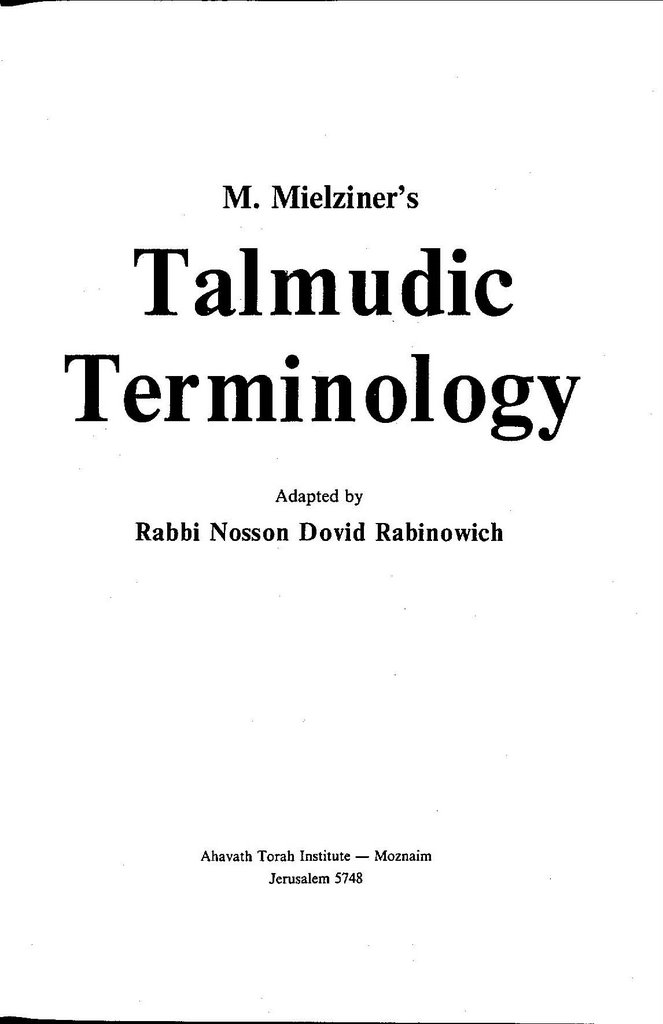
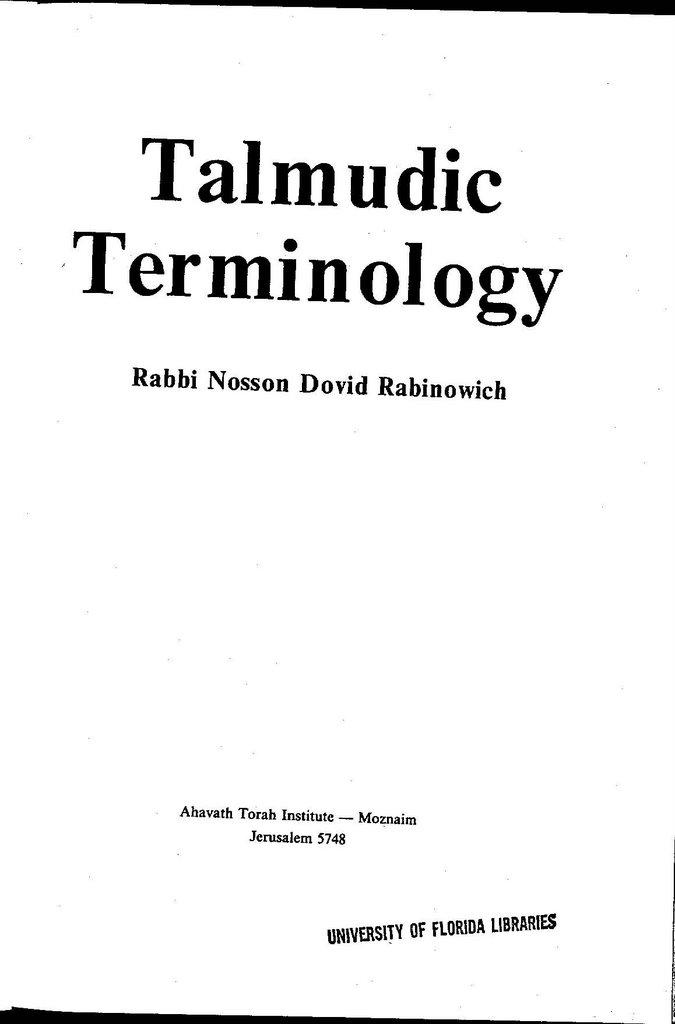
In 1988, Rabbi Nosson Dovid Rabinowich published a book titled Talmudic Terminology. However, as was noted in brief by Dr. Marc Shapiro, this was plagiarized from Moses Mielziner’s Introduction to the Talmud, first published in 1894. This omission, however, has been corrected in Rabinowich’s reprints of his Talmudic Terminology where the title now reads that Rabinowich’s work is “adapted” from Mielziner’s.

While this would appear to be the end of the matter it is not. Dr. Shapiro has investigated this issue further and has sent the following:

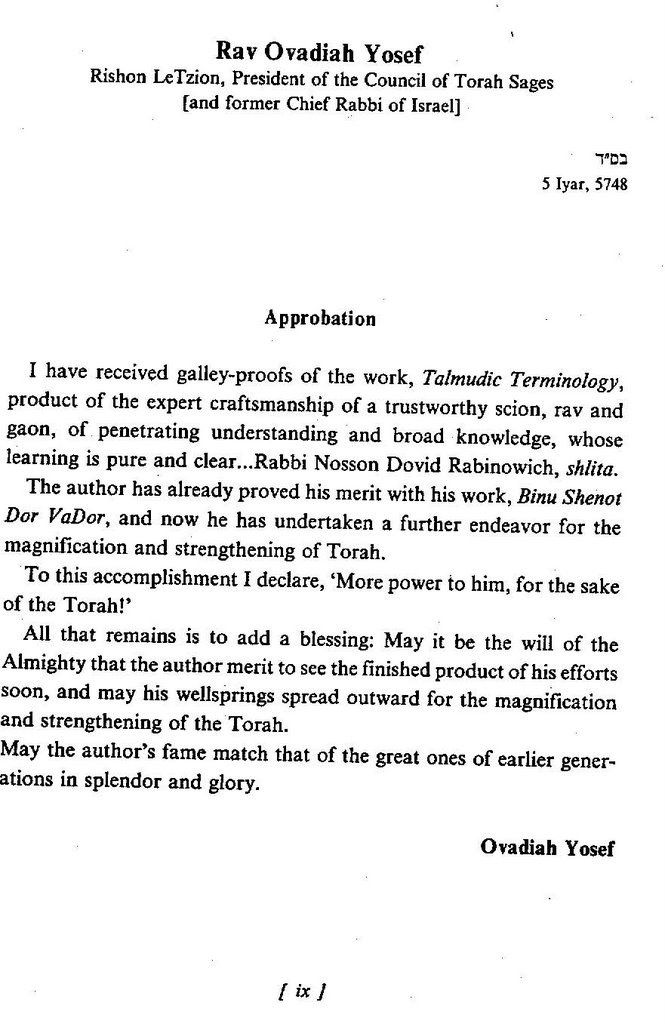
After I published my book Saul Lieberman and the Orthodox a number of people pointed out to me that Nosson Rabinowich’s plagiarism of Mielziner is more extensive than what I point out. I didn’t know what they were referring to since I had the first edition of his book M. Mielziner’s Talmudic Terminology, published in 1988 (in my kuntres, there is a typo, as it says 1998). Or so I thought. I succeeded in locating another copy by interlibrary loan, and lo and behold, the title page does not say M. Mielziner’s Talmudic Terminology adapted by N. Rabinowich but it identifies him as the author. What’s even more fascinating is that the other edition has haskamot of Rabbis Ovadiah Yosef and Aharon Feldman. Obviously, when the scandal broke, Rabinowich quickly produced a new title page and took out the haskamot (and also added a note on p. xv and made a slight change in note 2). p. xv (replacing “some” with “most”.) It is obvious why the haskamot were taken out, since they praise Rabinowich for producing a book which he didn’t write. In fact, Rabinowich is responsible for something very interesting. We find here the first example in history where gedolim put a haskamah on a work written by a Reform rabbi! Unknowingly, Rabbis Yosef and Feldman gave a haskamah to Mielziner. You can be sure this is not something that makes them happy.

Additionally, in an effort to keep the two “editions” the same, Rabinowich did not alter the pagination; this is so, even though he removed the haskamot. Consequently, the “new” edition is missing those pages. I have provided both title pages as well as Rabbis Yosef’s and Feldman’s haskamot (as one can no longer get them).