1

Benefits of the Internet: Besamim Rosh and its History

Benefits of the Internet: Besamim Rosh and its History
By: Dan Rabinowitz & Eliezer Brodt
    In a new series we wanted to highlight how much important material is now available online.  This, first post, illustrates the proliferation of online materials with regard to the controversy surrounding the work Besamim Rosh (“BR”). 

[We must note at the outset that recently a program has been designed by Moshe Koppel which enables one, via various mathematical algorithims, to identify documents authored by the same author. We hope, using this program, to provide a future update that will show what this program can demonstrate regarding the authorship of the BR and if indeed the Rosh authored these responsa.]

Background

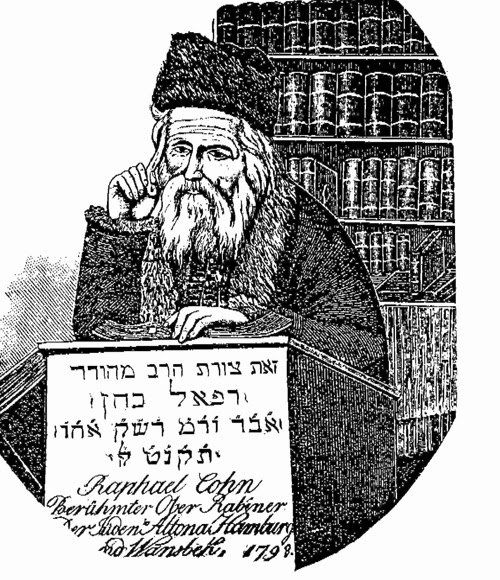
    Before turning to the BR and discussing its history we need to first discuss another work.  R. Raphael Cohen the chief rabbi of triple community, Altona-Hamburg-Wansbeck (“AH”W”), [1] published a book, Torat Yekuseil, Amsterdam, 1772 regarding the laws of Yoreh DeahTorat Yekuseil is a standard commentary and is unremarkable when compared to other works of this genre.  While the book is unremarkable in and of itself, what followed is rather remarkable. 

    Some years later, in 1789, a work with the putative author listed listed as Ovadiah bar Barukh and titled Mitzpeh Yokteil [2] was published to counter R. Raphael Cohen’s Torat Yekuseil (“TY”)Mitzpeh Yokteil (“MY”), was a vicious attack both against the work TY as well as its author, R. Raphael Cohen.  R. Raphael Cohen was a well-known and well-respected Rabbi. In fact, he was the Chief Rabbi of the triple community of AH”W.  The attack against him and his work did not go unanswered.  Indeed, the beit din of Altona-Wansbeck placed the putative author, Ovadiah, and his work, under a ban.

    The Altona-Wansbeck beit din could not limit the ban to just Altona-Wansbeck as the attack in the MY was intended to embarrass R. Raphael Cohen across Europe.  Indeed, the end of the introduction to MY indicates that copies were sent to a list of thirteen prominent rabbis across Europe.  Specifically, copies were sent to the Chief Rabbis of Prague, Amsterdam, Frankfort A.M., Hanover, Bresslau, Gloga, Lissa, etc., “as well as The Universally Know Goan haHassid  R. Eliyahu from Vilna.”  Thus, the intent of the book was to diminish R. Raphael Cohen’s standing amongst his peers. 

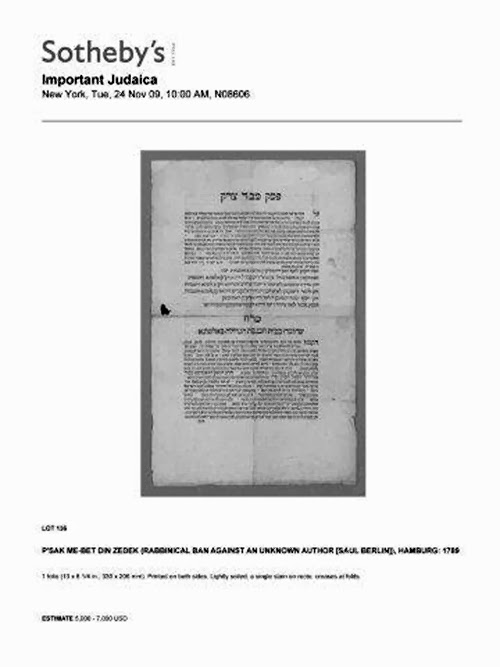
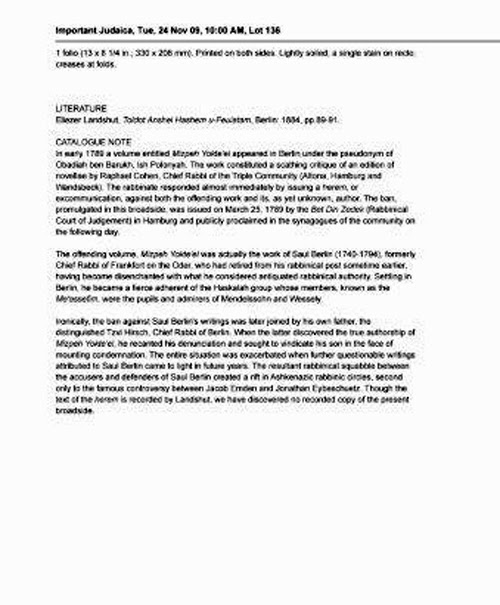
    The Altona-Wansbeck beit din, recognizing the intent of the book, appealed to other cities courts to similarly ban the author and book MY – the ban, entitled, Pesak mi-Beit Din Tzedek, the only known extant copy was recently sold at Sotheby’s (Important Judaica, Nov. 24, 2009, lot 136).[3]


These concerns lead the ban’s proponents to the Chief Rabbi of Berlin, R. Tzvi Hirsch Berlin, and to solicit him to join the ban. Initially, it appeared that R. Tzvi Hirsch would go along with the ban.  But, as he was nearing deciding in favor of signing the ban, someone whispered in his ear the verse in Kings 2, 6:5, אהה אדני והוא שאול – which R. Tzvi Hirsch understood to be a play on the word “שאול” in the context of the verse meaning borrow, but, in this case, to be a reference to his son, Saul. That is, the real author of MY was Saul Berlin, Tzvi Hirsch’s son.  Needless to say, R. Tzvi Hirsch did not sign the ban. [4]

    Not only did he not sign the ban, he also came to his son’s defense.  Aside from the various bans that were issued, a small pamphlet of ten pages, lacking a title page, was printed against MY and Saul. [5]  Saul decided that he must respond to these attacks.  He published Teshuvot ha-Rav. . . Saul le-haRav [] Moshe  Yetz,[6] which also includes a responsum from R. Tzvi Hirsch, Saul’s father.  Saul defends himself arguing that rabbinic disagreement, in very strong terms, has a long history.  Thus, a ban is wholly inappropriate in the present case. 

    R. Tzvi Hirsch explained that while MY disagreed with R. Cohen, there is nothing wrong with doing so.  The author of MY, as a rabbi – Saul was, at the time, Chief Rabbi of Frankfort – Saul is entitled to disagree with other rabbis.  Of course, Saul’s name is never explicitly mentioned. Moreover, in the course of R. Tzvi Hirsch’s defense he solicits the opinions of other rabbis, including R. Ezekiel Landau.  R. Landau, as well as others, noted that aside from the propriety of disagreement within Judaism, the power of any one particular beit din is limited by geography.  Thus, the Altona-Wansbeck’s beit din‘s power is limited to placing residents of Hamburg under a ban but not residents of Berlin, including R. Saul Berlin, the author of MY.[7]

    The controversy surrounding the MY was not limited to Jewish audiences. The theater critic, H.W. Seyfried, published in his German newspaper, Chronik von Berlin, translations of the relevant documents and provided updates on the controversy.  Seyfried agitated on behalf of the maskilim and editorlized that the Danish government should take actions against R. Cohen. It appears, however, that Seyfried’s pleas were not acted upon.[8] 

The Publication of Besamim Rosh


    With this background in mind, we can now turn to the Besamim Rosh.  Prior to publishing the full BR, in 1792, Saul Berlin published examples of the responsa and commentary found in the BR – a prospectus, Arugat ha-Bosem.  This small work whose purpose was to solicit subscribers for the ultimate publication of BR. It appears that while Saul may have been trying for significant rabbinic support, the majority of his sponsors were householders. 

    In 1793, the BR was published.  The BR contains 392 responsa (besamim equals 392) from either R. Asher b. Yeheil (Rosh) (1259-1327) or his contemporaries.  This manuscript belonged to R. Yitzhak di Molina who lived during the same time period as R. Yosef Karo, the author of Shulchan Orakh.  Additionally, Saul appended a commentary of his own to these responsa, Kasa de-Harshana

    The BR contains two approbations, one from R. Tzvi Hirsch Berlin and the other from R. Yehezkel Landau.  R. Landau’s approbation first explains that Rosh’s responsa need no approbation.  With regard to R. Saul Berlin’s commentary, he too doesn’t need an approbation according to R. Landau.  This is so because R. Saul’s reputation is well-known.  R. Landau’s rationale, R. Saul’s fame, appears a bit odd in light of the fact that among some (many?) R. Saul’s reputation was very poor due to the MY. 

    R. Tzvi Hirsch’s approbation also contains an interesting assertion. Saul’s father explains that this book should put to rest any lingering question regarding his son.    

    In addition to the approbations there are two introductions, one from di Molina and the other from Saul. Di Molina explained the tortured journey of the manuscript. He explains that, while in Alexandria, he saw a pile of manuscripts that contained many responsa from Rosh that had never before been published. He culled the unpublished ones and copied and collected them in this collection.  What is worthy of noting is that throughout the introduction di Molina repeatedly asks “how does the reader know these responsa are genuinely from Rosh.” 

    R. Saul, in his introduction, first notes that the concept of including introductions is an invention long after Rosh, and is not found amongst any of the Rishonim. 

    As mentioned previously, the BR is a collection of 392 responsa mostly from Rosh or his contemporaries.  Additionally, R. Saul wrote his own commentary on these responsa, Kasa diHarshena. [9]  This commentary would contain the first problem for Saul and the BR.  In responsum 40, Rosh discusses the position of Rabbenu Tam with regard to shaving during the intermediate days (ho ha-moad).  While Rosh ultimately concludes that one is prohibited from shaving on hol ha-moad, R. Saul, in his commentary, however, concludes that shaving on hol ha-moad is permissible.  In so holding, R. Saul recognized that this position disagreed with that of his father.  Almost immediately after publication, R. Saul printed a retraction regarding this position allowing for shaving on hol ha-mo’ad.  This retraction, Mo’dah Rabba, explains that Saul failed to apprise his father of this position and, as Saul’s father still stands behind his negative position, Saul therefore retracts his lenient position. [Historically, this is not the only time a father and son disagreed about shaving on hol ha-moad.  R. Yitzhak Shmuel Reggio (YaSHaR)and his father, Abraham, disagreed on the topic as well.  As was the case with Saul and his father, the son, YaSHaR took the lenient position and his father the stringent.  Not only did they disagree, after YaSHaR published his book explaining his theory, his father attacked him in an anonymous response.  For more on this controversy see Meir Benayahu, Shaving on the Intermediary Days of the Festival, Jerusalem, 1995.] 

    This retraction, while may be interperated as evidence of Saul humbleness in his willingness to admit error and not stand on ceremony, others used this retraction against him.  The first work published that questioned the legitimacy of BR is Ze’ev Yetrof, Frankfort d’Oder, 1793, by R. Ze’ev Wolf son of Shlomo Zalman.  (This book is very rare and, to my knowledge, is not online.  Although not online, a copy is available in microfiche as part of the collection of books from the JTS Library, and on Otzar Hachomah see below)  The author explains that eight responsa in BR are problematic because they reach conclusion that appear to run counter to accepted halahik norms. In addition, the author states in his introduction, “that already we see that there is something fishy as it is known that the author [Saul Berlin] has retracted his position regarding shaving.” It should be noted that no where does R. Ze’ev Wolf challenge the authenticity of the manuscript for internal reasons – it is incorrectly dated, incorrectly attributed etc.  Apparently, Ze’ev Yetrof, was not well-known as it is not cited by other contemporaries who too doubted the authenticity of BR.  Samat theorizes that either wasn’t printed until later or, was destroyed.[10]  

    The second person to question the legitimacy of BR was R. Rafael Hamburg’s mechutan, R. Ya’akov Katzenellenbogen.  In particular, he wrote to R. Cohen’s student, R. Mordechai Benat. As was the case with Wolf, R. Katzenellenbogen located 13 responsa where he disagreed with the conclusions.  R. Katzenellenbogen indicated that R. Benet shold review the BR himself and apprise R. Katzenellenbogen regarding R. Benet’s conclusions. 

    R. Katzenellenbogen also wrote to Saul’s father, Tzvi Hirsch, and Tzvi Hirsch eventually responded in a small pamphlet.  R. Tzvi Hirsch first deals with the predicate question, is the manuscript legitimate. That is, prior to discussing the conclusions of particular responsum, regarding the manuscript, R. Tzvi Hirsch testifies that he is intimately familiar with this manuscript. He explains that for 11 years, the manuscript was in his house.  In fact, R. Tzvi Hirsch created the index that appears in BR from this manuscript.  Additionally, he had his other son Hirschel (eventual Chief Rabbi of London) copy the manuscript for publication.  Thus, R. Tzvi Hirsch argues that should put to rest any doubt regarding the authenticity of the manuscript.

    R. Tzvi Hirsch then turns to the issue regarding conclusions of some of the responsa. He first notes, that at most, there are a but a small number of questionable responsa.  Indeed, it is at most approximately 5% of the total responsa in BR.  That is, no one questions 95% of the responsa (at least not then).  Second, with regard to the conclusions themselves, that some conclusions are different than the halahik norms, that can be found in numerous books, none of which anyone questions their authenticity.  Thus, conclusions prove nothing.

Leaving the history and turning to the content of BR.  One of the more controversial responsa is the one discussing suicide.  In particular, according to the responsum attributed to Rosh, the historic practices that were applied to a suicide – lack of Jewish burial, no mourning customs – are not applicable any longer.  This is so, because suicides can be attributed to the poor conditions of the Jews and not philosophical reasons.  Thus, we can attribute the motivations of a suicide to depression and remove the restrictions that applied to suicides. 

    This responsum was what lead some, including R. Moshe Sofer (Hatam Sofer), to conclude that the entire BR was a forgery.  Indeed, this responsum was one of the two that were removed in the second edition.  Others, however, point out this responsum and its conclusions are not in any conflict with any accepted halakhic norms.  And, instead, while providing new insight into the current motivations of a suicide, the ultimate conclusion can be reconciled with all relevant laws.  [11]  

This particular example illustrates the problematic nature of merely relying upon a particular conclusion to demonstrate the authenticity or lack thereof of a work. Although R. Sofer was certain this responsum ran counter to a statement of the Talmud, others were easily able to reconcile the Talmudic statement with the conclusion of the responsum.

    Another controversial responsa deals with someone who is stuck on the highway as the Shabbat is fast approaching.  The traveler is thus faced with the following dilemma, stop in a city where he will require the charity of strangers or continue on and get home.  The BR rules that the traveller can continue and is not required to resort to charity.  This, like the responum above, was similarly removed from the second edition. These are the only two responsa removed from the second edition.  Of course, this removal isn’t noted anywhere except that the numbers skip over those two.  In fact, the index retains the listing for the two responsa. 

    Other controversial responsa include one dealing with belief in the afterlife and messianic era, kitnoyot – BR would abolish the custom, and issues relating to mikvah. 

Today, common practice regarding suicide appears, for the most part, to conform with the position of BR.

Status Today

    After its publication in 1793, it would be almost one hundred years before the BR would be reprinted.  In 1881, the BR was reprinted in Cracow.  This edition was published by “the well-known Rabbi Yosef Lazer from Tarnow'” R. Lazer’s was part of a well-known Hassidic family.  His grandfather, R. Menachem Mendel Lazer was the author of Sova Semochot, Zolkiov, 1845.[12] It appears that the BR was the only controversial book that R. Yosef Lazer published.  Although he published approximately 30 books, the are mainly run-of-the mill works, Machzorim, haggadot, as well as some standard rabbinic works. It is unclear what prompted R. Lazer to republish the BR.  Lazer provides no explanation.  Although Lazer’s publishing activities are difficult to reconcile with his publication of the BR, the printers, Yosef Fischer and Saul Deutscher, other publications indicate that they were more open to printing all types of books. For example, the same year they published BR, they published a translation of Kant, Me-Ko’ach ha-Nefesh, Cracow, 1881.  In all events, it appears that Lazer (or perhaps the printers) was aware of the controversy surrounding the BR as he removed Saul Berlin’s introduction as well as two of the more controversial responsa, one discussing suicide and the other allowing one to continue to travel home after sunset on Friday to avoid having to rely upon the charity of strangers.  In addition, one responsa was accidentally placed at the end of the volume, not in its proper order.[13]  Although the two responsa were removed in the text, they still appear in the index. A photo-mechanical reproduction of this edition was published in New York in 1970, and a copy is available on Hebrewbooks. 

    In 1984, the BR was reprinted for only the third time.  This edition, edited by R. Reuven Amar and includes an extensive introduction, Kuntres Yafe le-Besamim, about BR.  Additionally, commentary on the BR by various rabbis is included.  The text of this edition is a photo-mechanical reproduction of the first edition.  This edition contains two approbations, one from R. Ovadiah Yosef, who in his responsa accepts that BR is a product of R. Saul Berlin, but R. Yosef holds that doesn’t diminish the BR’s value.  The second approbation is from R. Benyamin Silber.  But, R. Silber provides notes in the back of this edition and explains that he holds the BR is a forgery and that he remains unconvinced of Amar’s arguments to the contrary.

    In his introduction, Amar attempts to rehabilitate the BR.  Initially, it should be noted that Amar relies heavily upon Samet’s articles on BR, but never once cites him.  Samet had complied a bibliography of works about BR as well as where the BR is cited, Amar also provides the latter in a sixty four page Kuntres, ריח בשבמים, in the back of his edition. In his introduction Amar relates the history of the BR and attempts to demonstrate that many accepted the BR and those that did not, Amar argues that many really did accept BR.  This introduction contains some very basic errors, many of which have been pointed out by Shmuel Ashkenazi in his notes that appear after the introduction.  

Difficulties in Authentication   

    Today, various theories have been put forth to demonstrate that the BR is a forgery.  Specifically, some have pointed to “hints” or “clues” that R. Saul left for the careful reader which would indicate that BR is a carefully created forgery.  For example, some note that the number of responsa, 392, the Hebrew representation of that number is שצ”ב which can be read to be an abbreviation of Saul’s name – Saul ben Tzvi.  Others take this one step further and point to the was R. Asher (Rosh) is referenced – רא”ש – which again can be read R. Saul.  Obviously, these clues are by no means conclusive.  In the academic world, the BR is written off as a “trojan horse” intended to surreptitiously get R. Saul’s masklik positions out in the masses or something similar.  All of these positions, however, rely upon a handful of responsa at best and no one has been able to conclusively demonstrate that the entirety of BR is a forgery. At best, we are still left with the original criticisms – that a few of the responsa’s conclusions espouse positions that appear to be more 18th century in nature than 13th century. [14]   

 R. Yeruchum Fischel Perlow aptly sums up much of what has been written regarding the question of authenticity of BR:

Just about all who have examined [the question of the authenticity of BR] walk around like the blind in the dark, and even after all their long-winded essays, they are left with only their personal feelings about the BR without ever adducing any substantive proofs in support of their position. And, on the rare occasions that they actual do provide proofs for their positions, it only takes a cursory examination to determine that their is nothing behind those proofs. [R. Yeruchum Fischel Perlow, “Regarding the book ‘Besamim Rosh,'” Noam 2 (1959), p. 317. For some reason this article is lacking in some editions of Noam]

    Assuming that one discounts the testimony of Saul and his father regarding the manuscript, it is not easy to determine if the BR is authentic or not.  For example, responsum 192, according to R. Moshe Hazan, one of the defenders of BR, this responsum “is clear to anyone who is familiar with the language and style of the Rishonim, from the Rishonim.” Responsum 192, is attributed to R. Shlomo ben Aderet (Rashba), and discusses the opinion of Rosh that allowed for capital punishment for pregnancy out of wedlock.  Thus, according to R. Hazan, 192 is conclusive proof that BR is authentic. 

    Simcha Assaf, however, has shown that responsum 192 is a forgery – or there is a misattribution.  Assaf explains that if one looks at the date of this incident, responsum 192 could not have been written by Rashba.  Rashba died 10 years prior to this event.  Simcha Assaf, Ha-Onshim Ahrei Hatemat ha-Talmud, Jerusalem, 1928, pp. 69-70.  Thus, the very same responsum whose “language and style” demonstrated that it was from the times of the rishonim has attribution problems.  To be sure, Assaf isn’t saying this responsum isn’t necessarily from the rishonim period, however, it surely isn’t from Rashba.[15]

    Or, to take another example. Talya Fishman argues that “[halakhic literature of the seventeenth and eighteenth centuries . . . climbed to new (and fantastic) heights of theoretical speculation, creating, in effect, a body of non applied law.”  Talya Fishman, “Forging Jewish Memory: BR and the Invention of Pre-emancipation Jewish Culture,” in Jewish History and Jewish Memory, ed. Carlbach et al., Hanover and London: 1998, pp. 70-88.  Based on this understanding of seventeenth and eighteenth century literature, as contrasted with literature from the period of Rosh, she turns to the BR and finds such speculative responsa.  This, according to Fishman, implicitly demonstrates that BR is a product of the seventeenth or eighteenth century. Indeed, Fishman concludes “[i]n short, [BR], has an unusually high concentration of eyebrow-raising cases.”  Id. at 76. 

    But, if one subjects Fishman’s argument to even a minimal amount of scrutiny, her argument, as presented, is unconvincing.  First, in support of Fishman’s “high concentration” of odd responsa, Fishman provides three examples.  That is, Fishman points to three out of 392 responsa that contain “eyebrow-raising cases” and concludes this represents “an unusually high concentration.”  I think that most would agree that less than 1% does not represents an unusually high concentration.  Second, of the three examples Fishman does provide, one is from Kasa deHarshena, which everyone agrees is a product of the eighteenth century.  Third, one of the examples, no. 100, it appears that Fishman misread the responsa.  Fishman provides that responsa 100 is a “bizarre question about whether a one-armed man should don tefilin shel yad on his forehead alongside tefilin shel rosh.”  Id. at 76.  Indeed,  responsa 100 is about a one-armed man and whether because he cannot fulfill the arm portion of tefilin if that absolves him of the head portion.  Nowhere, however, not in BR or Kasa de-harshena, does it mention the possibility of putting the tefilin shel yad on one’s forehead.  Thus, if we discount these two responsa, Fishman is left with a single responsum to prove her generalization about BR.[16]   

    Regarding the manuscript, that too is an unsolved mystery.  We know that a manuscript that may have been the copy which R. Hirschel made is extant but the manuscript from di Molena is unknown.  Additionally, although we know that the Leningrad/St. Petersberg library had Tzvi Hirsch’s copy with his annotations, the current location of that book is unknown. See Benjamin Richler’s post regarding the manuscript here.

    The BR’s most lasting effect may be in that this was to be the first of many newly discovered manuscripts to be accused of forgery because of the conclusions reached.  Subsequent to the BR, responsa or works in other areas of Jewish literature were tarred with cry of forgery because of their conclusions. [See Yaakov Shmuel Spiegel, Chapters in the History of the Jewish Book, Writing and Transmission, Ramat-Gan, 2005, 244-75, (“until the publication of BR, there were no questions raised regarding the authenticity of a book”) Spiegel also demonstrates that we now know that in many instances that the charge of forgery was wholly without basis and today there is no question that some of the books that are alleged forgeries are legitimate.]

Other Works by Saul Berlin

    One final point.  While we discussed Saul’s work prior to BR, there was another book that he wrote, that was published posthumously.  This work, Ketav Yosher, defended Naftail Wessley and his changes to the Jewish educational system.  Indeed, Ketav Yosher, is a scathing attack on many traditional sacred cows. [17]  Ketav Yosher, like MY, was published without Saul’s name, but again, we have testimony that Saul was in fact the author.  In light of the position Ketav Yosher takes, it is no surprise that this book doesn’t help Saul’s standing among traditionalists.  

    Saul may have written additional works as well, however, like the BR itself, there is some controversy surrounding those additional works.  R. Saul’s son, R. Areyeh Leib records an additional 11 works that Saul left behind after he died.  The problem is these very same works – although all remaining in manuscript – have been attributed to someone else.  But, before one jumps to conclusions, it should be pointed out that this story gets even more complicated.  The book which attributes these works to another is itself problematic.  Indeed, whether this list attributing the books to another even exists is a matter debate.  And, while that sounds implausible, that, indeed is the case.  Ben Yaakov, Otzar ha-Seforim (p. 599 entry 994) says there is a 1779 Frankfort Order edition of Sha’ar ha-Yihud/Hovot ha-Levovot that includes an introduction (and other material) that lists various manuscripts which the editor, according to Ben Ya’akov, was a grandson of Yitzhak Yosef Toemim, ascribes to his grandfather – and not Saul. Weiner, in his bibliography, Kohelet Moshe, (p. 478, no. 3922) says that Ben Ya’akov is wrong – not about the edition, Weiner agrees there was a 1779 Frankfort Oder edition, just Weiner says there is no introduction and Toemim wasn’t the editor (and other material is missing). Vinograd, Otzar Sefer ha-Ivri lists such a book – 1779 Frankfort Oder, Hovot ha-Levovot/Sha’ar ha-Yichud, but there is no such edition listed in any catalog that we have seen including JNUL, JTS, Harvard, British Library etc. It appears that Samat couldn’t locate a copy either as although he records the dispute between Weiner and Ben Yaakov, he doesn’t offer anything more.  Thus, Saul’s other writings, for now, remains an enigma.

    It is worthwhile to conclude with the words of R. Matisyahu Strashun regarding Saul and the BR:

“After all these analyses, even if we were able to prove that the entire BR from the begininning to end is the product of R. Saul, one cannot brush the work aside . . . as the work is full of Torah like a pomegranate, and the smell of besamim is apparent, it is a work full of insight and displays great breadth, the author delves into the intricacies of the Talmud and the Rishonim, the author is one of the greats of his generation.”  Shmuel Yosef Finn, Kiryah Ne’amanah, notes of R. Strashun, p. 93.

The Internet


    As hopefully should be apparent, most of the books discussed above or referenced below are available online.  These include the rare retraction that R. Saul published regarding his position on shaving on hol ha-ma’od, Ketav Yosher, the prospectus for BR, as well as the BR itself.  Indeed, not only is the BR online but both editions are online. And, the BR exemplifies why one should be aware of multiple internet sources.  Hebrewbooks has a copy of BR which they indicate is the first edition “Berlin, 1793,” however, in reality it is the later, 1881 Warsaw edition of the BR.  As noted above, that edition, however, is lacking two responsa.  This highlights an issue with Hebrewbooks, the bibliographical data is not necessarily correct.  The JNUL, has the first edition. Indeed, in the case of the JNUL, the bibliographical information is much more reliable than Hebrewbooks. Thus, one needs to use both the JNUL as well as Hebrewbooks if one wants to get a full picture of the BR. Or, another example.  Both the JNUL site as well as Hebrewbooks has MY online; but, the JNUL version was bound with two rare letters at the end and those appear online as well.  Additionally, when it comes to Hebrewbooks, one must be aware that they have removed books that someone presumably finds objectionable so although MY and KY are there now, there is no guarantee it will be in the future.  Similarly, although not online, and unlike the MY the JNUL has, Otzar haChomah has the Ze’ev Yitrof with additional material bound in the back. Besides for all these rare seforim mentioned, many of the other seforim quoted in this post, as is apparent from the links, can now be found on the web in a matter of seconds instead of what just a few short years ago would have taken a nice long trip to an excellent library.
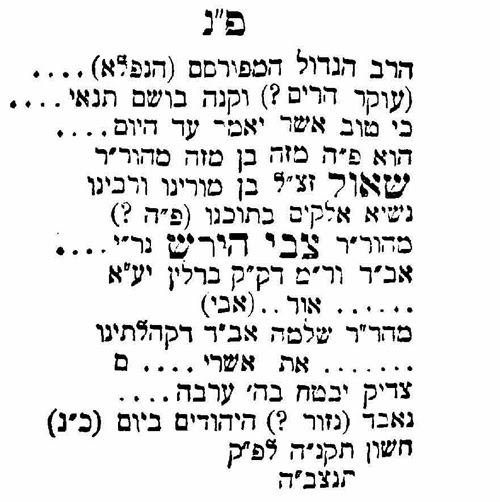
Saul’s Epithet, he was buried in the Alderney Road Cemetery in London, next to his brother, Hirschel, Chief Rabbi 
Notes

[1] For more on R. Raphael Cohen see the amazingly comprehensive and insightful bibliography by the bibliophile R. Eliezer Katzman, “A Book’s Luck,” Yeshurun 1 (1996), p. 469-471 n.2. See also R. Moshe Shaprio, R Moshe Shmuel ve-Doro pp.103-110 especially on the BR see 108-09. C. Dembinzer, Klielas Yoffee, 1:134b, 2:78b writes that the work on TY caused R. Saul to lose his position as Chief-Rabbi of Frankfort and his wife divorced him because of it. See also, S. Agnon, Sefer Sofer Vesipur, p.337. On R. Raphael Cohen and his connection with the Gra and Chasidus see D. Kamenetsky, Yeshurun, 21, p. 840-56. As an aside this article generated much controversy for example see the recent issue of Heichal Habesht, 29, p.202-216 and here.
[2] Regarding the correct pronunciation of this title see Moshe Pelli, “The Religious Reforms of ‘Traditionalist’ Rabbi Saul Berlin,” HUCA (1971) p. 11.  See also R. Shmuel Ashkenzi’s notes in the BR, Jerusalem, 1983 ed., introduction, n.p., “Notes of R. Shmuel Ashkenzi on Kuntres Yefe le-Besamim, note 6.  
Additionally, MY was not Saul’s first literary production, nor was it his first that was critical of another’s book.  Instead, while he was in Italy in 1784, he authored a kunteres of criticisms of R. Hayyim Yosef David Azulai’s Birkei Yosef.  See R. R. Margolis, Arshet pp. 411-417; Moshe Samat, “Saul Berlin and his Works,” Kiryat Sefer 43 (1968) 429-441, esp. pp. 429-30, 438 n.62.  On Chida’s opinion of the BR see for example Shem Hagedolim:

עתה מקרוב נדפס ספר זה בברלין… ועוד יש הגהות כסא דהרסנא. ואשמע אחרי קול רעש כי יש בספר זה קצת דברים זרים ואמרו שהמעתיק הראשון בארץ תורגמה מכ”י הרב יצחק די מולינא ז”ל יש לחוש שהוסיף וגרע. ולכן הקורא בסי’ זה לא יסמוך עליו דאפשר דתלי בוקי סריקי בגדולים עד אשר יחקור ויברר הדברים ודברי אמת ניכירים ודי בזה… (שם הגדולים, ערך בשמים ראש, וראה שם, ערך מר רב אברהם גאון)

See also the important comments of R.Yakov Chaim Sofer, Menuchas Sholom, 8, pp. 227-230 about the Chida.
[3]  Eliezer Landshut, Toldot Anshei Shem u-Puolotum be-Adat Berlin, Berlin: 1884, 89-90 for the text of the ban as well as its history.  Additionally, for the proclamation read in the main synagogue of Altona see id. at 90-1. This proclomation has been described as “one of the harshest condemnations” of the time.  See Shmuel Feiner, The Jewish Enlightenment in the Eighteenth-Century, Jerusalem: 2002, p. 310. 
[4]  Id. at 91. Samat, however, notes that neither Saul nor his father ever admitted Saul’s authorship of MY.  Samat, “Saul Berlin and his Works,” p. 432, 4.  
[5] According to A. Berliner, the author of this pamphlet is R. Eliezer Heilbot. See Samat, id. Saul and MY were not the only ones attacked. The publisher of MY, Hinukh Ne’arim, was also attacked and, not only MY but all the books they published were prohibited by some. The publishers, however, defended their decision to publish MY.  They argued that the whole point of MY was to ascertain if R. Raphael Cohen’s book was riddled with errors or, the author of MY was mistaken.  The publishers pointed to the above mentioned introduction to MY wherein the MY’s author explains that he has sent copies of the book to leading rabbis to determine the question regarding R. Cohen’s book. Thus, MY is either right or wrong, but there can be nothing wrong with merely publishing it.  See id. at 92-3.
Additionally, it should be noted that according to some, Saul authored a second attack on R. Raphael.  R. Raphael published Marpeh Lashon, Altona, 1790, and was soon after attacked in the journal Ha-Meassef by someone writing under the pen-name EM”T.  Many posit that this is none other than Saul.  Katzman, Yeshurun 1, 471 n.3, disagrees and points to internal evidence that it is unlikly that Saul is the author of this critique. 
According to Feiner, these attacks were not one-sided.  Feiner argues that R. Cohen criticizes Saul, albeit in a veiled manner, in Marpeh Lashon.  See Feiner, Jewish Enlightenment, op. cit., 314-15.  
[6] Landshuth, id., suggests that Moshe is a non-existent figure like MY’s putative author Ovadiah. See also, Samet, “Saul Berlin and his Works,” 432 n.4 who similarly questions the existence of Moshe.  Carmilly-Weinberg makes the incredible statement that his Moshe is none other than Moses Mendelssohn.  Carmilly-Weinberg, Sefer ve-Seiyif,  New York, 1967, p. 215, (Carmilly-Weinberg’s discussion about both MY and BR are riddled with errors).  As Pelli notes this is impossible as the letter is signed 1789, the same year MY was printed, and Mendelssohn died three years prior. Pelli resurrects Moshe and links him with a known person from Amsterdam, Saul brother-in-law. See Pelli, HUCA (1971) p. 13 n.75.  Ultimately, however, Pelli rejects this and demonstrates that Moshe is indeed a pseudonym but a well-selected one.  See id.  
[7]  See Landshuth, 93-9; Pelli, 13-15.  See also R. Alexander Sender Margolioth, Shu”t ha-RA”M, Lemberg, 1897, no. 9.    
[8] See Feiner, The Jewish Enlightenment, op. cit., 312-13.  This newspaper is online here, and Feiner provides the relevant issues which are 1789 pp. 484-88, 520-24, 574-81, 680-82, 768-74, 791-802, 867-92, 932-72.   
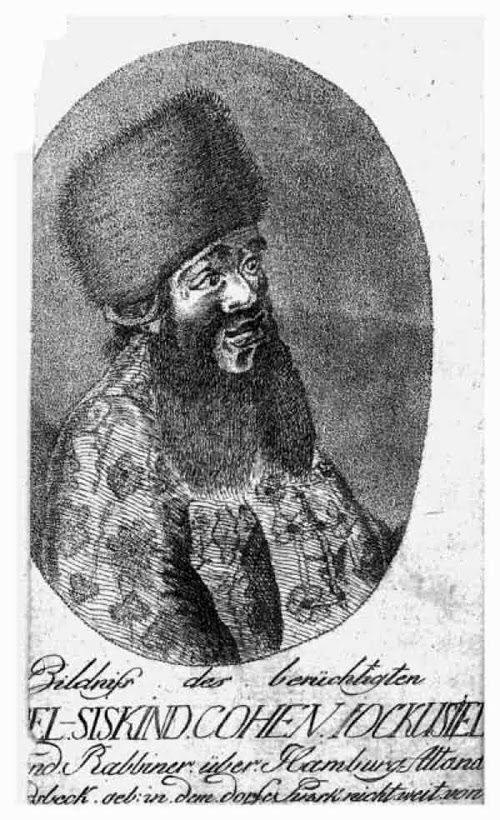
One of which includes this portrait of R. Cohen.
Which is a very different portrait, both in time and look, to the one appearing in E. Duckesz, Ivoh le-Moshav, Cracow, 1903.

[9] For the deeper meaning of the title Kasa de-Harshena, see Moshe Pelli, The Age of Haskalah, University Press of America, 2006, 183 n.51.
[10] See Samat, who discusses the exact progression of the ban.

[11] See Yechezkel Shrage Lichtenstein, Suicide: Halakhic, Historical, and Theological Aspects, Tel-Aviv, 2008, pp. 438-44. See also,Yeshurun 13:570-587 especially pp.578-581; Marc B. Shapiro, “Suicide and the World-To-Come,” AJS Review, 18/2 (1993), 245-63. 
On the issue of suicide there are others who similarly reach the same holding as the BR see Strashun in his מתת-יה pp. 72a-72b (this source is not quoted by Samet or Amar).
[12] Biographical information on R. Yosef Lazer is scant.  For information on his father and grandfather, see Meir Wunder, Me’orei Galicia, Israel, 1986, vol. III, pp. 456, 462-3. See also T.I. Abramsky, “‘Besamim Rosh’ in the Hassidic Milieu,” Taggim, (3-4), 56-58.   
[13] Samat only notes the removal of one responsum, he fails to note that exclusion of the second.  He does, however, note the misplaced responsum.  Additionally, Kuntres ha-Teshuvot ha-Hadash, fails to record that any are missing or that one responsum was moved to the end. 
[14] See Pelli, Age of Haskalah, pp. 185-89, comparing a few responsa with 18th century haskalah literature.
[15] Assaf was not the first to use this responsa and note its historical anacronisms.  Leopold Zunz, also highlights the issues with this responsum (as well as others).  Leopold Zunz, Die Ritus des Synagogalen Gottesdienstes, Geschichtlich Entwickelt, Berlin: 1859, 226-28.  Zunz’s critique is quoted, almost in its entirety by Schrijver, but Schrijver appears to be unaware of Assaf’s additional criticisms of the responsum (and others).
Assaf provides one other example where he shows through internal data that there is a misattribution.  Assaf concludes that he has other examples of historical anacronisms in BR but doesn’t provide them here or, to our knowledge, anywhere else.
[16] For another critique of Fishman’s position see Emile G.L. Schrijver, “Saul Berlin’s Besamim Rosh: The Maskilic Appreciation of Medieval Knowledge,” in Sepharad in Ashkenaz, Netherlands: 2007, pp. 249-259, esp. pp. 253-54. 
[17] Regarding Ketav Yoshor see Pelli, Age, 176-79. See also here and here.

Additional Bibliography:
M. Samet has two articles on the topic, R. Saul Berlin and his Writings, Kiryat Sefer, 43 (1969) 429-41; “Besamim Rosh” of Saul Berlin, Kiryat Sefer 48 (1973) 509-23, neither of which are included in the recent book of Samet’s articles.

To add to Samet’s and Amar’s very comprehensive lists of Achronim who quote BR: (I am sure searches on the various search engines will show even more): Malbim in Artzos Hachaim, 9:41 (in Hameir Learetz); Shut Zecher Yosef,1:32b; Keter Kehunah p. 30; Matzav Hayashar 1:2a; Pischei Olam 2:218,228; Birchat Yitchcak (Eiskson), pp. 6,14,24; Maznei Tzedek, p.26,45,254; R.Yakov Shor, Birchat Yakov, pp.212  Sefer Segulos Yisroel pp.116b; R. Rabinowitz, Afekei Yam 2:14; R. Leiter, Zion Lenefesh Chayah# 43; Shut Sefas Hayam, OC siman 14; R Meir Soleiveitck, Hameir Laretz 45a, 45b, 54b, 55a; Emrei Chaim p.26; R. Sholom Zalman Auerbach, Meorei Eish p. 108 b

In general on BR see: R.Yakov Shor,Eytaim Lebinah (on Sefer Haeytim) p. 256; Pardes Yosef, Vayikrah 220b Pardes Yosef, Shelach p. 517; R.Yakov Chaim Sofer, Menuchas Sholom, 8, pp. 222- 230; Shar Reven p. 54; A. Freimann, HaRosh ; Y. Rafel, Rishonim Veachronim, pp. 123-130; B. Lau, MeMaran Ad Maran, pp.133; S. Agnon, Sefer Sofer Vesipur, pp.337-339.

R. Pinhas Eliyahu Horowitz writes:

ולפעמים תולים דבריהם באילן גדול וכותבים מה שרוצים בשם איזה קדמון אשר לא עלה על לבו… כספר בשמים ראש שחיבר בעל כסא דהרנסא לא הרא”ש וזקני ישראל תופסי התורה יעלו על ראשם… (ספר הברית, עמ’ 232).

The Steipler was of the opinion in regard to the BR that:
שבאמת ניכר מהרבה תשובות שהם מהרא”ש ז”ל רק כנראה שיש שם הרבה תשובות מזויפות שהמעתיק הכניס מעצמו כי ישנם שם דברים מאד מזורים ואיומים  (ארחות רבנו, א, עמ’ רפה)

R Zevin writes in Sofrim Veseforim (Chabad) p.354 :
אלא שבתשובות בשמים ראש המיחוס להרא”ש ושכידוע נמנו וגמרו שמזוייף הוא

R. Yakov Kamenetsky said: “Do you think Just we (he meant people of his own caliber) were fooled? Even R. Akiva Eiger was fooled.” (Making of a Godol, pp.183-184)

About Rav Kook and the BR see: http://www.biu.ac.il/JS/JSIJ/5-2006/Gutel.pdf

R. Avigdor Nebensal writes:

כשמביאם את הבשמים ראש ראוי להזכיר שיש מסתייגים חריפות מהספר הזה (השתנות הטבעים, עמ’ 16).
R Zalman Nechemiah Goldberg writes:
אכן בעיקר הענין אם להביא דברי בשמים ראש בודאי צדק הג”א נבנצל שליט”א שיש להביאו בהסתייגות, ובפרט בענינים אלו שהוחזק למזייף ולמביא עקומות וכוזבות (השתנות הטבעים, עמ’ רסד).
Seforim for Sale, List II

Seforim for Sale, List II
by: Eliezer Brodt
This is the second list of out-of-print seforim.  At the end of the list I provide suggestions, divided by subject matter.  Additionally, where appropriate I have provided information about specific titles.
Most of the titles mentioned here are out of print and, for some of the listed titles; there are only a few copies available. For example, for-some of the titles there are only two copies available for sale while others there are many more available. Thus, these books are on a first come first serve basis. These books will not be available much longer. All these books are brand new and are in mint condition.

Special: If one buys five books he will receive a ten percent discount off that total (not including the shipping). If one buys ten or more books he will receive twenty percent off that total (not including the shipping).
How to Order:  E-mail your order to EliezerSeforim-at-gmail.com. I will than send you a bill based on what is available, sale is first come first serve. Payment has to be done Via Pay Pal. Shipping is available, it’s about $5 a sefer (on average size seforim, some of the books are over sized so they cost a little more to mail). If one buys 5 seforim the price on shipping, goes down a bit. All books will be air mailed out shortly after I receive the money. All questions about information of the seforim should be sent to the above e-mail address. I will be putting up another list or two soon enough. Enjoy!

 I received requests to give a bit of details on the seforim. I will try to in this list for some of the titles. I will also give some details for the ones I mentioned in the first list.

Second list:
Philosophy:

פילוסופיא: א. תורת העיקרים מאת מנחם קלנר, 238 עמודים, כריכה רכה,  $10This is a translation of his book Dogma in Medieval Jewish Thought  ב. עמודי המחשבה הישראלית, שמחה בונם אורבעך- חלק ג' מנשתו הפילוסופית של ר' חסדאי קרשקש 442 עמודים, $14This work is very important if one wants to make a brave attempt to understand R. Crescas complex Philosophy. ג. המחשבה היהודית בימי הביניים, המשך או מפנה, ד"ר נחום אריאלי, תשנ"ה, כריכה רכה, 293 עמודים $11The author is the son of R. Yitzchak Arielie, author of Eynayim Lemishpat (in yeshiva world terms he is the uncle of R. Asher Arielie).

 
Minhag/Halacha

מנהגהלכה
ד. מנהג אשכנז הקדמון ,ישראל תא שמע, ספר חשוב מאוד, $16For anyone involved on any level with the topic of development of Minhaghim this is a very important work. The book includes an in depth overview on Minhag Askenaz and has nineteen chapters dealing with specific topics, ten related to Shabbas, four related to Pesach and five related to Tefilah.

 
Biblical Period

תקופת המקרא:ה. איורי תנ"ך עבריים מלנינגרד, כריכה רכה, $15This work is ILLUMINATIONS FROM HEBREW BIBLES OF LENINGRAD originally published by Baron Ginsburg includes an introduction and New Descriptions by Bezalel Narkiss, 220 pages. [The facsimile editions of the paintings are sold for a few hundred dollars if someone is interested I can get a very reduced price for them.]
ו..תרגום ואגדה בו – אביגדור שנאן $16
This is an important book related to the agadah statements found in Targum Yonason Ben Uziel.

ז.מחקרים בתולדות ישראל – תקופות המקרא, 508 עמודים, כריכה רכה, $15This is a collection of twenty six articles focusing on many aspects related to Tanach.ח.מיהושע ועד יאשיהו $17
Talmudic Period
תקופת התלמוד
ט. הקהילה היהודית בארץ-ישראל בתקופת המשנה והתלמוד– זאב ספראי  $17
י.מחורבן לתקומה, $17
יא.מחקרים בתולדות ישראל, תקופות המשנה והתלמוד, 408 עמודים, כריכה רכה, $15

This is a collection of twenty articles focusing on many aspects related to the Mishana and Talmud
 
Geonic Period

  תקופת הגאונים:יב.לתולדות נוסח השאילתות ירחמיאל ברודי $9
יג.משלי סעיד בן באבשאד, מכון יצחק בן צבי, מהדיר: עזרא פליישר, 319 עמודים, $14 (ספר זה נכתב בסוף תקופות הגאונים, והוא בא מקארו גניזה).
Medieval Period
תקופת הראשונים -ימי הבינים
יד. תרבות וחברה בתולדות ישראל בימי הבינים $20This is an excellent collection of articles related to history of Middle ages, 734 pages featuring articles from many big Guns of the academic world.

טו. מורשת ספרד $20

This work is an excellent collection of articles related to Spanish Jewry, 760 pages.טז.מחובות הלבבות לשירת הלבבות $17Haskalah
השכלה
יז. מגמות וצורות בספרות ההשכלה, $16

יח. השכלה והיסטוריה: תולדותיה של הכרת-עבר יהודית מודרנית, 523 עמודים, ש. פיינר $17.
יט.הקרע שלא נתאחה: פרישת האורתודוקסים מכלל הקהילות בהונגריה ובגרמניה– יעקב כ"ץ $15

This is a hard cover edition the edition being sold currently by Shazar is paperback.
 
Biography

אישים:
כ.החכם המופלא – הרב שלמה הכהן אהרנסון הרב הראשי הראשון של תל אביב חייו ופעלו- יצחק אלפסי, 224 עמודים, $14

כא.בקורות ומסה, דוד תמר, אישים וספרים, – מקובלי צפת וירושלים צרפת מיורן וטבריה, יוצרים ויצירות בחכמת ישראל ובספרות העברית. ראובן מס תשל"ג, 203 עמודים, $12
Misc.
נושאים שונים
כב.ארוס אירוסין ואיסורים: מיניות ומשפחה בהיסטוריה 427 עמודים, $17
כג. קורות – כרך ט חוברת יא-יב תשנ"ב, בטאון לתולדות הרפואה ולמדעי הטבע 270 עמודים, כריכה רכה, חלק בעברית וחלק באנגליש $12This particular volume has a collection of very nice articles. Some are related to Milah, one on Leprosy and some on other very interesting medical topics.
כד. קדושת החיים וחירוף הנפש: קובץ מאמרים $15This is a hard cover version the version being sold currently by Shazar is paperback. This is an excellent collection of articles related to Kiddish Hashem throughout Jewish history.
שואה:כה. האנציקלופדיה של השואה ה' חלקים (סט) $85

פיוט -שירה:
כו.השירה העברית בצפון אפריקה $16
כז.עיונים בשירת המזמורים העברית והאוגריתית $15
כח.השיר דבור על אופניו מאת דן פגיס עריכה עזרא פליישר $17
כט. יסודי צורות הפיוט $8

לשון:
ל.עיונים בבלשנות עברית $17
לא. צורות הקשר והפסק בעברית שבמקרא $18

שונות:

לב. ספרייה וספר בארץ-ישראל בשלהי התקופה העות'מאנית $17

לג. ברנר, אסתרקה, וייצמן השני $12

לד. מנחה לשרה, מחקרים בפילוסופיה יהודית ובקבלה מוגשים לפרופסור שרה א' הלר וילנסקי, $17

לה. תרבות והיסטוריה, עורך יוסף דן, 201 עמודים, כריכה קשה,$11

1. The Elders in Ancient Israel $14
2.Historical Geography of the Bible: The Tribal Territories of Israel  Special price for this book is $75

3.Anthology of Hassidic music Special price for this book is $90

4. Chess in Jewish History and Hebrew Literature $35

5. The Land That Became Israel: Studies in Historical Geography $15

In my first list I tried to include books on wide ranging topics.
Chazal:
If one is interested in Works of Chazal than I recommend item number eighteen. This is a critical edition of the work Pisron Torah, a pretty unknown lost likut of medrashi Chazal (which has been unavailable for a while). The Medrashim are related to Chumash Vayikra, Bamedbar and Devarim. [As an interesting note, R Chaim Kanievsky quotes this work in his writings.] This edition was annotated by E.E. Auerbach and includes a extensive introduction about the work from him. Yakov Zussman refers to this Medrash in his article where he deals with E.Aurbach and his works:ליקוט המדרשים המיוחד במינו מבחינות הרבה (מוסף מדעי היהדות, תשנ"ג, עמ' 107). Rishonim:Three works of critical edition of Rishonim are items number fourת fourteen and fifteen. Item number four is a critical edition of the Kimchi Family on Mishlei the most famous of them being the Radak, it is 569 pages. Number fourteen is a very important collection of Shut from the Rishonim. In an article about the editor of this work E. Kuffer, Professor Ta Shema writes:יותר מכל אלה נתפרסמה בין הלומדים מהדורת תשובות ופסקים מאת חכמי אשכנז וצרפת ספר זה רב הכמות ורב האיכות, לא מש משולחנם של העוסקים בספרות הרבנית של ימי הביניים, לא רק משום תוכנו המקורי והחשוב, אלא גם על שום הערותיו המחכימות של המהדיר המלוות את הספר לכל אורכו, ומפנות את המעיין אל הקשרן הרחב יותר של התשובות (כנסת מחקרים עיונים בספרות הרבנית בימי הביניים כרך ד, עמ' 349).PiyyutIf one is interested in Piyyut I included six titles, 3 of them being texts with critical editions (# 8-10), (#16) a work of a Rishon related to Piyyut (very hard to find for a while) and two volumes of academic works on the topic from some of the experts in the field (# 7,27). Especially worth noting is #27 as it is a very nice size volume (683 pps.) of the collected writings of M. Zulai on the topic of piut which has been out of print for some time.
History Of Chazal era:
If one is interested in the history of Chazal (specifically Mishna era) and time of the Beis ha-Mikdash I highly recommend the excellent work of collected articles from S. Safrai. These two volumes (# 5) have been out of print for some time. For another book related to Talmud see item number three.
Another very important title is the collected writings of E. Auerbach. This valuable collection of two volumes of articles includes many of the over three hundred articles which he wrote of all fields related to his many areas of expertise. Starting from the time period of Chazal and going through Rishonim and Achronim. Dealing with various specific incidents, some texts of Rishonim and of course some of his famous book reviews. These volumes have been out of print for some time and were expensive when they were in print. Another important and useful book is number twenty this is a nice collection of articles related to many different aspects revolving around the Asres Hadebros.
Dead Sea Scrolls:
If one is interested in the Dead Sea scrolls there are two titles (# 17,26). Of special interest in this area is book number seventeen as it includes three works in one volume of Lawrence Schiffman on the topic a renowned expert in this field. It has been unavailable for some time.
History of Sixteenth century:
If one is interested in the history of the Jews in the sixteenth and seventeenth century especially in Poland and Germany I highly recommend this now classic work in the field from Yakov Elbaum (#1). It has not been available for some time it includes a wealth of information about this very important time period. Another important title (#2) also from Yakov Elbaum is Teshuvos Halev Vekabalos Yisurim. This is a very useful book on the topic of Teshuva in the writings of the Chachmei Poland and Ashkenaz from 1348-1648. Another book on Poland and Lithuania is item number nineteen.
Kabbalah:
If one is interested in a book related to history of Kabbalah I recommend the volume Al Hakedusha from Joseph Dan. Of course I must point out item number twenty eight, Binyan Ariel related to the Kabalah of Arizal and R Chaim Vital which has caused much controversy in the past.
Aleph Beis:
If one is looking for works on the development of the writing of the Aleph beis there are two out of print works from Yosef Nevah items number twenty two and twenty three on the list.
Folklore:
If one is interested in Jewish Folklore I highly recommended item number twenty five a collection of some articles of the famous Dov Sadan on the topic (one nice chapter is related to Hamantaschen).
If one is looking for a nice work of short articles on various Achronim I recommend item number twenty four.
Item number twenty one is a book from R Yechazkel Abramasky son for some reason I could not find mention of him in the recent book on Rav Abramsky (perhaps I did not look hard enough).


Seforim For Sale – List 1

Seforim For Sale – List One

Eliezer Brodt

We will be introducing a new feature to the seforim blog.

From time to time we will be offering some hard-to-find seforim and academic books for very reasonable prices.

Most of the titles mentioned here are out of print and, for some of the listed titles, there are only a few copies available. For example, for-some of the titles there are only 5 copies available for sale while others there are many more available. Thus, these books are on a first come first serve basis. E mail your order to EliezerSeforim-at-gmail.com. I will than send you a bill based on what is available. Payment has to be done Via Pay Pal. Shipping is available, its about $4.50 a sefer. If one buys 5 seforim the price goes down a bit. All books will be air mailed out after I receive the money. All questions about information of the seforim should be sent to the above E mail address. I will be putting up another list or two soon enough. Enjoy!

א. פתיחות והסתגרות – $19

ב. תשובות הלב וקבלת יסורים – $16

ג. מחקרי תלמוד חלק א- $12

ד. פירושים לספר משלי לבית קמחי – $19

ה. בימי המשנה ובימי המשנה שמואל ספראי ב' חלקים– $26

ו. מחקרים במדעי היהדות  ב' חלקים – אוסף של מאמרים של אפרים א' אורבך $36

ז. שפת השיר על הפיוט בארץ ישראל הקדום $13

ח. אז באין הכל– $14

ט שארית יוסף– $12

י.מחזורי שבעתות לסדרים ולפרשיות– $18

יא.על הקדושה – $20

יב.בין אשכנז לספרד – $16

יג.מחקרים בספרות המקרא – $17

יד. מורה הפרישות- ר' דוד בן יהשוע מימוני – מהדיר יוסף ינון –  Paul Fenton
מקיצי נרדמים תשמ"ז 55 עמ' + 109 עמ' – $17

טו. תשובת ופסקים מאת חכמי אשכנז וצרפת- מהדיר אפרים קופפר
מקיצי נרדמים תשל"ג, 348 עמ' -$18

טז. ספר העיונים והדיונים ר' משה אבן עזרא- מהדיר אברהם הלקין
מקיצי נרדמים תשל"ה, כז עמ' + 335 עמ' – $18

יז. הלכה הליכה ומשיחיות בכת מדבר יהודה– $19

יח. פתרון תורה- ילקוט מדרשים ופירושים- מהדיר אפרים אורבעך (מבוא הערות ומפתחות) -415 עמ' – $22

יט. יהודי פולין וליטא עד שנת ת"ח– $17

כ. עשרת הדברות -$20

כא. בדרכי היהודי הנצחי- יעקב אברמסקי – בן של ר' יחזקאל אברמסקי – 400 עמ' – $10

כב.על חרס וגומא – $17
 
כג. ראשית תולדותיו של האלפבית– $15

כד. שרי התורה – יצחק אלפסי מאורות מעולם הרבנות – כרמל תשנ"ג 370 עמ' – $14

כה. ש"י עולמות– דן סדן- $10

כו.World of Qumran from within – $45

כז. ארץ ישראל ופיוטיה–  $18

כח. בנין אריאל – יוסף אביב"י – ירושלים תשמ"ז – $20 על הפולמוס עם ספר זה ראה כאן.

כט. ממדיה העולמיים של ההיסטריה היהודית שלום בארון – $11

ל. The Encyclopedia of Jewish Life and thought – $22


Eliezer Brodt: Corrections and Clarifications


Corrections and Clarifications on Two Editions of R. Chaim Berlin’s Responsa: An Egregious Example of Censorship
by: Eliezer Brodt


From time to time I get feed back about some of my previous posts some good some bad – aside from the standard criticism of poor grammar, editing or transliterating, all of which are my fault entirely. The blog does not have a full time editor (its all on a volunteer basis), and the goal of the editors, in general, is to get out posts at high speed with good content (many of which could have been printed in journals) but this avoids the whole long process of printing etc. Sometimes the feedback shows that some things need more clarifications or statements I made are simply wrong and need to be corrected. Thus, I definitely encourage all feedback. When I write posts (although I spend much time researching and writing them) I am still collecting information on these topics which I hope to incorporate at future times (at times I have done so already). Another point, which almost goes without saying, is that I am definitely not trying to Pasken any halachic leniency with what I quote.  I just like to bring interesting, nice points to public knowledge. With this introduction I would like to clarify some issues as a few very important remarks and corrections are in order about a previous post of mine Two Editions of R. Chaim Berlin’s Responsa: An Egregious Example of Censorship

In this post I accused the editors of the new edition for censorship in a few places most notably a leniency about shaking woman hands and a pro-Chassidus statement. I then concluded that there are probably more examples of censorship in this work but I do not have time to go through all four volumes. In general before I write a review on a sefer I read the sefer cover to cover a few times carefully. Since this work has four massive volumes I did not do so. Instead I used the many indexes of the sefer based on topics, Shas and names of the people mentioned etc. I could not find the various pieces so I concluded that there was censorship. I recently received a letter from an old friend who read through this post very carefully and had a few very important comments. I would like to deal with some of his comments. 

On Shaking hands with woman

First of all I accuse the editors of the new edition of censoring this Teshuvah by removing it,  but that is simply a false accusation. This Teshvah is included in the new edition in volume two p.257. 
Second of all my friend writes: “I will admit that when I first saw the teshuvah I too understood it to mean that,  but after a careful reading that R. Chaim Berlin actually never permits shaking hands at all. Rather, R. Berlin brings the Gemarah in Brochos about someone who hands money to a woman in order to look at her, R. Berlin therefore deduces that if the intent is not in order to look at her (as is the case in the one who asked the shaila) then this would not apply and it would be permissible to pass money from his hand to hers. He then adds that it would be better to be careful about this too, but if this proves impossible one should not be machmir etc. that’s all. It would seem quite clear that he is discussing a situation of someone who has a business or runs a store (as the one who asked the shaila, R. Alshvang, did) and needs to hand money (or merchandise) to his customers. This is the case of the above mentioned Gemarah (i.e. passing money, not shaking hands). After finding this teshuvah in the new edition I saw that the publishers of the new edition were kind enough to explain this (and were careful to put this explanation in brackets; the accepted form of an editors addition).”

 
I will admit this argument sounds convincing but I am not sure it is correct. The exact quote of the Teshuvah is as follows:
 
אשר שאל על דבר נתינת ידו לרשעים או לנכרית, הנה ליתן יד לפושעים אין שום איסור בזה אם אין בזה הודאה וחיזוק להנהגותיהם בשרירות לבם. ולתת יד לאשה לשון הש”ס הוא ברכות ס”א א’ המרצה מעות לאשה מידו לידה כדי להסתכל בה, מבואר דאם אינו מכוין לשום דבר וכש”כ שאינו עושה כדי להסתכל בה כמו מעלתו שכל מעשיו לשם שמים אין איסור בזה לרצות מעות מידו לידה. ודאי אם יוכל להזהר בזה מה טוב, אבל אם אי אפשר לו להנצל מזה כגון אם הנכרית הקדימה והושיט לו את ידה ואין דעתו לשום הרהור ח”ו אין להחמיר בזה, ודרכיה דרכי נועם, ואהבת את ה’ אלקיך אמרו חכמים יומא פ”ו א’ שיהא שם שמים מתאהב על ידך, ולא יאמרו על יראי ה’ שהם משוגעים ואינם בעלי דרך ארץ.
 

A simple reading of the first part was about shaking the hand of a Rasha or non-Jewish woman as his answer implies where he says “as long as it does not show any agreement to their behavior”. I would assume that is not referring to just taking money from them. He then goes on to dealing with the story by a Jewish woman as he says “to give a hand to a woman”. To which he answers based on the Gemarah of giving money to a woman… which I think also answers the question of shaking a woman’s hand. It would definitely be helpful to have the original question of R. Alshvang but I do not. The new edition after the words אשר שאל על דבר נתינת ידו לרשעים או לנכרית, stuck in the words

[בהושטת הפרקמטיא או המו”מ בהרצאת המעות, האם צריך להקפיד שלא למסור מיד ליד]

Now they do not write that they did (nor do they mention in the introduction that they ever do this) this making you think R. Chaim Berlin writes that. But aside for that I am not sure that this is true as his reply does not make sense when he answers אין שום איסור בזה אם אין בזה הודאה וחיזוק להנהגותיהם בשרירות לבם. if he was talking about shaking hands then this statement makes sense but if its just about handing over money I am not sure what it means.

 
 One last point I am not concluding via this possible pesak of R. Chaim Berlin that it is permitted to shake woman’s hands that is for one to ask their local Rav as where I come from we go with the strict pesak of R Moshe Feinstein that it is prohibited as he writes:
ולהושיט יד לאשה כדרך הנותנים שלום בהפגשם, פשוט שאסור אף לפנויה שהרי הן נדות וכ”ש לאשת איש (אגרת משה, או”ח, א, סי’ קיג).
 
Other cases of supposed Censorship:
The piece I brought of additions to the Mishana where R. Chaim Berlin writes:

שביארתי מאמרם ז”ל התמוה מאד בשלהי מס’ סוטה מ”ט ב’ על משנתינו משמת רבי בטלה ענוה ויראת חטא א”ל ר”י לתנא לא תיתני ענוה דאיכא אנא א”ל ר”נ לתנא לא תיתני יראת חטא דאיכא אנא. והתמיה מפורסמת איך אמוראים קדושים כאלה ישבחו עצמם בענוה ויראת חטא, והמלך החכם אמר יהללך זר ולא פיך. וביארתי בס”ד על פי מש”כ הרע”ב ז”ל על האי בבא משמת רבי בטלה ענוה שתלמידיו של רבי הוסיפו וכתבו זה במשנה, וכ”כ בתוס’ רע”ק בשם הרמב”ן בחי’ ע”ז ל”ז א’ שהוא תוספת שהוסיף בר קפרא או לוי במשנה, והמה היו תנאים אחרונים תלמידי רבי. ואמרתי שהוא הוא התנא שדברו עמו רב יוסף ורב נחמן, שרב יוסף א”ל לזה התנא שהוסיף במשנה משמת רבי בטלה ענוה א”ל לא תיתני ענוה שאתה מסתיר מדותיך הטובים ושונה במשנה משמת רבי בטלה ענוה ואנא ידענא שגם אתה ענוותן כרבי ועדיין לא בטלה ענוה משמת רבי, וכן א”ל רב נחמן לזה התנא שהוסיף במשנה משמת רבי בטלה יראת חטא א”ל לתנא לא תיתני יראת חטא שאתה מסתיר מדותיך הטובים ושונה במשנה משמת רבי בטלה יראת חטא ואנא ידענא שגם אתה ירא חטא כרבי, ועדיין לא בטלה יראת חטא משמת רבי, כן ביארתי זה המאמר לפי חומר הנושא.  


I could not figure out why this piece was edited out but my friend has a much more logical explanation. In the introduction of the sefer the editors write they hope to collect all the pieces of R. Chaim Berlin on Agadah and print them shortly.


The pieces where he writes: 

ועל דבר כסוי ראש האשה במטפחת אחת, אם אין שערה נראין אין בזה שום איסור, ועדיף טובא מפיאה נכרית, ואין צריך כלל שני כסויין, ואם אך אין השער נראה בחוץ די בכסוי אחד אף ברשות הרבים, ורשאי גם לקרות ק”ש כנגדה,ואין להחמיר עוד בזמן הזה.
 
I also accused the editors of the new edition of censoring this Teshuvah out but that is simply a false accusation. This Teshvah is included in the new edition in volume two p.260.
 
The pieces where he writes:
לדבר עם אשה בשוק לא נאסר אלא לתלמיד חכם ולא למי שאינו מוחזק בתלמיד חכם, וכשם שתלמיד חכם המדבר עם אשה בשוק גורם בזה חלול השם כן מי שאינו מוחזק לתלמיד חכם הנזהר בזה שלא לדבר עם אשתו לעיני הבריות הוא מיחזי כיוהרא, ויש בזה גם כן חלול השם …
I also accused the editors of the new edition of Censoring this Teshuvah out but that is simply a false accusation. This Teshvah is included in the new edition in volume two p.261. Furthermore in both of these last two pieces, in the new edition we have an addition – the exact question posed to R. Chaim Berlin see p.258-259.


 The Piece Pro Chassidus:

 R. Chaim Berlin writes:

ולהתפלל בבית הכנסת של החסידים אין שום חשש בזה, וגזירת רבינו הגר”א ז”ל לא הי’ אלא בזמנו שהקילו אז בכבוד תלמידי חכמים לומדי תורה, ולא כן בימינו שהחסידים חולקים כבוד לכל לומדי תורה והם יראי ה’ ושומרים תורהומצוה. אך על דבר שינוי נוסחת התפלה, אסור לשנות בפרהסיא ממנהגיהם ומנוסחאותיהם ובנוסח הקדושה יאמר קדושת כתר בשביל שנאמרת בקול רם ויש בזה איסור לא תתגודדו, וגם שלא לעורר מחלוקת ח”ו, אבל בתפלה בלחש לא ישנה כבודו ממנהג אבותיו וממנהגו מעולם, ויתפלל שמונה עשרה בלחש כנוסח אשכנז.


I claimed that this piece is censored out from the new edition, this too is a a false accusation. This Teshvah is included in the new edition in volume two p. 261. Furthermore in the new edition we have an addition – the exact question posed to R. Chaim Berlin (p.259):

והנה נא הואלתי לשאול עוד דבר אחד לבד. אם ראוי או נכון להתחבר עם החסידים היינו להתפלל בנוסח שלהם, וגם יש בהם חלוקי דעות ואיזה מהם קודם. ואם הגר”א אשר אסר שני פעמים להתחבר עמהם כלל והרחיקם במאוד למה אנו וכל גדולי ישראל נוהגין לקרבן ולהתקרב להם ודבר טוב ראיתי בהם שבחייהם חיי אחדות יותר ממנו.


Reading Newspapers on Shabbos and reliability of Torah Temimah:

Another piece my friend takes issue with is what I write about newspapers on Shabbos. My friend writes: Whether or not the Netziv read newspapers on shabbos I don’t know. I would be inclined to believe what R’ Chaim Berlin says about this; after all even those who opposed him on Volozhin never accused him of being a liar. But either way to bring ‘testimony’ from Mekor Boruch is ludicrous; everyone knows that! As for R’ Meir Bar Ilan’s ‘testimony’ it might be worth something (if his childhood memories can be trusted) it also might be just an ‘echo’ of Mekor Boruch (i.e. he might have sent it there himself), but the truth is that this is not at all important to the issue at hand, because he doesn’t talk about shabbos at all.
 

First I would like to clarify there have been many many articles written about the Mekor Baruch showing plagiarism and mistakes he made. Others have shown that he is not reliable in his quotes from his father about Chabad. I am not here to add to that all I have to say is anything he wrote about his uncle that was public fact I doubt he played around with or lied about. He received a beautiful haskamah from R. Kook I doubt he would have received one had he said such lies about Netziv his rebbe. Also many people at that time were alive at that time who learnt by the Netziv yet no opposition was expressed as far as we know to date. I am not Chas vesholom calling R’ Chaim Berlin a liar. Perhaps he was expressing his opinion based on a conversation he had with his father early on in life whereas maybe the Netziv changed his mind over time and that was what Mekor Baruch was reporting. As for R’ Meir Bar Ilan he does not write that the Netzv read newspapers on Shabbas. All he says is he did in general and on Shabbas he held it was ok as he wrote in Itur Sofrim. I guess he was not aware of what R. Chaim Berlin said on the topic.

 
Woman covering their Hair:

Much has been written about how the responsa literature can aid in reconstructing the history of the period, this sefer also shows us this. Just to cite one example in volume one (p. 88) of the newer version (which shockingly was not edited out) someone wrote to R. Chaim:
גלוי וידוע לכבודו עד כמה פשתה הנגע בארצינו וביתר שאת בארצות אוירפפה ושדה תיכלה כמעט בכל בנות ישראל שוע ודל אשר גם בעליהן ואבותיהן המה משלומי אמוני היהודים המחזקים בדתינו הקדוש והמה גם הנה אינן ח”ו מפורקי עול בדרך כלל, ובכל זאת עברו ושנו ונעשה להן כהתיר לילך בגליות שער ראשיהן אחת המרבה ואחת המטמעטת, עיר ועיר ומדינה ומדינה כמנהגה וכפי חוקות המאדע שלה. ולא ישמרו את נפשותיהן מזה לילך כן גם בבתי כנסיות ובבתי מדרשות ובמסיבות אנשים שרים סביב לשלחן בעת סעודות נשואין שבת ויום טוב…
 
We see from this that the well known phenomena of woman not covering their hair in previous generations. The question which was posed to R. Chaim was what one should do about saying
berokhot or Shema in front of such a woman. To which R. C. Berlin replied:
לענין קריאת שמע גופא יש מקילין בזמן הזה שכבר נהגו לגלות ראשן ודומה לשער שמחוץ לצמתן… ומעתה למעשה בזמן הזה, מי שאינו מחפש למצוא לו יתד על מה לסמוך, ומקלו יגיד לו, יוכל לסמוך על המקילין. ומי שהוא ירא חטא ורוצה לצאת ידי שמים גם בסתר כבגלוי, ודאין אין לו לסמוך על המקילין.
   Some points which my friend pointed out is one this Teshuvah is on p.78, and the writer was referring to Germany in 1909. Another point which is a typo on my part is it should say: 

מי שאינו מחפש אלא למצוא לו יתד על מה לסמוך, ומקלו יגיד לו, יוכל לסמוך על המקילין.

 Meaning if your looking for a heter you have one but that is not what you should be doing.


One last point my friend made is what R. Chaim Berlin concludes:

והעצה היעוצה לו, לעוצם עיניו, שדבר הזה הוא נקל מאוד… דאם אי אפשר לו באופן אחר, יוכל לסמוך על המתירין עצימת עינים, ומי שעוצם עיניו מראות שוא, יזכה לראות פני שכינה.

In conclusion it is proper to quote the famous words of the Rambam which one should ultimately do:

וממה שראוי שתדעהו שהאדם אין לו לדבר ולדרוש באזני העם עד שיחזור מה שרצונו לדבר בו פעם ושתים ושלש וארבע וישנה אותו היטב ואחר כן ידברו… ועל מה שירשם האדם בידו ויכתבהו ראוי שיחזירהו אלף פעמים אלו יתכן זה… (אגרת השמד, שילת, עמ’ לג-לד).


Women, Simchat Torah, and Censorship

Women, Simchat Torah, and Censorship
By: Eliezer Brodt
A recent book, Mi-pehem, (Bnei Brak,2008), collects interviews that were conducted with various Gedolim. One interview was conducted with Rebbetzin Ginsburg the daughter of R. Yechezel Levenstein. In the course of this interview she described the Simchat Torah celebration at the Mir in Europe:אבל שמחת תורה בישיבה היה משהו
מיוחד. הנשים עמדו בפינת בית המדרש מאחורי מחיצה, ומחכות בהתרגשות לתחילת
ההקפות! (מפיהם, עמ’ 199).


According to this interview, women in the Mir were behind the Mechetziah. But, I recall hearing from others that witnessed Simchat Torah in the Mir in Europe that the women were not behind a Mechetziah. Indeed, when, looking up this source of this interview I realized it was a Hebrew translation of an English article that appears in Daughters of Destiny published by Artscroll. The quote in the original reads: “The woman would stand in a corner of the bais medrash separated from the men and wait excitedly for the Hakofos to begin” (p.76). Thus, according to the original woman were not standing behind the Mechetziah during the ST celebration.

Avraham Ya-ari in his important work on ST, Toldos Chag Simchas Torah provides additional sources discussing woman’s participation in ST celebration from various communities. These sources parallel the original interview of Rebbetzin Ginsburg that women were not behind a Mechetziah but they came in to the Beis hamedrash on this night to watch the dancing up close (pp.251-252).Aside from woman entering the BM on ST woman participated in other parts of the celebration. For example, in Worms we find:מנהג שמחת תורה… מנהג נשים
בין מנחה למעריב הנ”ל באים במלבושיהן היקרים והנאים הטובים שיש להם. ובאם
בחצר החיצון של בית הכנסת ולפני הפתח החיצון של בית הכנסת דנשים ורוב הנשים בפרט
נשים בחורות מחברי’ יד ליד ובראשם נשי חתן תורה וחתן בראשית, והולכין בעיגול סביב
סביב ומשוררין יגדל, וזמירות שרגילין לשורר לכבוד החתן וכלה והכל לכבוד התורה ואחר
כך הולכין לבית הכנסת שלהם… (ר’ יוזפא שמש, מנהגים דק”ק וורמיישא,
א, עמ’ רכ). In Baghdad R. Dovid Sasson describes another custom with woman on ST:בכפור, בשמיני עצרת ובשמחת
תורה
מוציאם בכל בתי הכנסת את כל ספרי התורה ומניחים אותם בהיכל והאנשים
והנשים הולכים מבית כנסת לבית כנסת לנשק כל ספר וספר וקוראים זאת זייארה (מסע
בבל
, עמ’ רכז)In truth something similar to this (but not on ST only on HR and YK) is found earlier in the letters of R. Ovadia Bartenurah where he describes a custom that he saw:גם ראיתי בליל יום הכיפורים
ובליל הושענא רבה אחר שסיימו הצבור תפלת ערבית, פותחים הנאמנים שני שערי ההיכל
צפונה ונגבה ויושבים שם כל הלילה עד הבוקר, ובאות הנשים משפחות מפחות למשתחוות
ולנשק הספרי תורה, ובפתח האחד תכנסנה ונכחו תצאנה. וכל הלילה, זו נכנסת וזו
יוצאת… (אגרת א”י, עמ’ 106).One other point regarding woman and Simchat Torah is Rivkah Tiktiner (died in 1605) composed a song for Simchat Torah in Yiddish. Tiktiner is famous for being the first Jewish woman who wrote a complete work called Minkes Rivkah. Yaari suggests that this song was song while the woman decorated the Sifrei torah (Toldos Chag Simchas Torah, p.464). This song was recently reprinted by Y. Levine with an introduction and a translation in Hebrew (Simchat Torah Leyad). On Rivkah Tiktiner, see Levine’s Introduction (ibid); Z. Gris, Hasefer Kesochen Tarbus, p.172 and here.

Another custom which women are involved in on Simchat Torah is the throwing of the fruit to the children. On this topic see also Y. Gibralter in his memoirs of Kovno who writes:זלמן טרקניסקי הגבאי הראשי נהג לשבת לאחר הקידוש בשמחת תורה כששק מלא תפוחי עץ גדולים ויפים בידיו ולחלקם לילדים כפי שמבוא בהלכה בבית המוסר דקדקו בהלכה בתכלית הדקדוק (יסור
יסרוני
, עמ’ 110).This custom has been the subject of many articles see recently: Avraham Ya’ari, Toledot Chag Simchat Torah, 231-237; Daniel Sperber, Minhagei Yisrael 6:140-154; Shlomo Hamberger, Shorshei Minhag Ashkenaz 4:430-461; Yechiel Goldhaber, Minhagei Hakehilos, 2:147-152; . Y. Tessler, Heichel ha-Besht 20:75-100; Ohr Yisrael 41:187.


The Source for the Recitation of LeDovid

This post is a followup of an earlier post which discusses the origins of reciting le-dovid hashem ori from rosh hodesh Elul through Simchat Torah. In this post I show a few early sources for saying ledovid and some
reasons why some did not say it. For Profesor Leiman’s lecture on this
topic see here. In my discussion of the various reasons given I deal with the various
Balei Shem especially the two balei shem who share the same name, R. Eliyahu Ba’al Shem.מקור אמירת “לדוד ה’ אורי וישעי” באלול ותשרימאתאליעזר יהודה בראדט

בתקופתנו, תקופת האסופות והלקוטות, מתקיים מאמרו של רבי יהושע “אין בית המדרש בלא חידוש” בעצם האסיפה והליקוט – מלאכה שנעשית קשה מיום ליום, כי אין לך יום ויום שאין כמה וכמה ספרים יוצאים בו, ורובם אינם אלא ליקוטים מספרים אחרים. זו ועוד אחרת, שמלאכה זו דורשת עין בוחנת ושימת לב וידע ביבליוגרפי, ועל כולם – סבלנות ומתינות. הנה הקדמתי את הצטדקותי בטרם אכתוב בענין אמירת מזמור “לדוד ה’ אורי וישעי” בימי התשובה והמועדים, שדשו בו רבים וכבר הלכו בו הנמושות[1].

לראשונה הופיע המנהג בספרו של המקובל ר’ בנימן בינוש הכהן מקראטשין, ‘שם טוב קטן’, שנדפס בזולצבאך בשנת תס”ו, כסגולה לצאת בדימוס זכאי בדין: “הא לך סוד גדול. כל האומר מזמור זה מר”ח אלול עד אחר שמחת תורה, ואפילו גזרה רעה כתובה על האדם מן השמים יכולה לבטלה. ומבטל מעליו כל גזרות רעות וקשות, ויוצא בדימוס זכאי בדין. וצריך להזהר מאוד ומאוד שיאמר זה המזמור ערב ובוקר, דבר יום ביומו מר”ח אלול עד אחר שמחת תורה. אזי הוא מובטח, שיוציא שנותיו וימיו בטוב ויערב לו, ויכניע על ידי זה כל מיני מקטרגים”[2]. ספר זה זכה לתפוצה מרובה ובמאה הי”ח בלבד נדפס למעלה מתשע פעמים[3].לאחר עשור, בשנת תע”ו, הדפיס ר’ בנימן בינוש הכהן את ספרו השני בשם ‘אמתחת בנימן’, ובו נאמר: “סדר הנסירה. אחר העמידה של שחרית יאמר מזמור כז – לדוד ה’ אורי… הא לך סוד גדול. כל האומר מזמור זה מר”ח אלול עד אחר שמחת תורה…”[4] (עמ’ נח).

ואולם, כבר בשנת תס”ט נדפס בהמבורג ‘ספר זכירה’ לר’ זכריה בן יעקב סימנר, ואף בו הובאה סגולת אמירת המזמור בימים אלו: “סוד גדול. האומר מזמור כז מראש חודש אלול עד אחר שמחת תורה…”[5]. וכבר הוכיחו רבים, שר’ זכריה סימנר ליקט לספרו מחיבורים רבים שעמדו לפניו, ואף הרבה להשתמש בספר ‘שם טוב קטן’.לאחר חמש עשרה שנה, בשנת תפ”ד, נדפס בברלין ‘ספר היראה’ כנספח ל‘ספר המוסר’ (שנדפס לראשונה בשנת תל”א בלובלין). שם, באות ט, הובאה הסגולה: “מצאתי כתוב סוד גדול, האומר מזמור כ”ז מראש חדש אלול…”. ‘ספר המוסר‘ נדפס שוב בירושלים בשנת תשנ”ו, ושם (עמ’ מה) העיר ר’ שמואל אשכנזי שבעל ‘ספר היראה’ ליקט דברים אלו מ’ספר זכירה’ ועוד ספרים.
לאחרונה מצאנו כמה שציינו מדעתם, כגילוי ומציאה, שהמקור הקדום של אמירת מזמור זה הוא ספר ‘שם טוב קטן’. מהם אמנה את ר’ ברוך כץ, דברי יוסף, בני ברק תשמ”ז, עמ’ קסג-קסו; סידור ווילנא, ירושלים תשנד, עמ’ 148; ר’ שמואל אשכנזי בהערותיו ל‘ספר זכירה’, ירושלים תשנ”ט, עמ’ 367; מהדיר ‘ספר זכירה’ שראה אור לפני ימים אחדים, בני ברק תשס”ט, עמ’ תקסז; ר’ דוד כהן, סידור אזור אליהו, ירושלים תשס”ח, עמ’ פ[6]; ר’ אליהו יוחנן גוראריה, חקרי מנהגים, חולון, תשס”ז, עמ’ 169[7]. אבל יש לציין שמקור זה היה ידוע למחברים גם בשנים עברו, וכבר ציין לו ר’ שמואל דוד הכהן מונק במכתב משנת תשכ”ט, ‘שו”ת פאת שדך’, או”ח, ח”ב, סי’ קכז, אבל ספר זה לא נדפס כי אם בשנת תשס”א. והקדימו ר’ חיים צבי עהרענרייך בחיבורו הנפלא ‘קצה המטה’ שעל ‘מטה אפרים’, שנדפס לראשונה בקליינווארדיין תרפ”ג, סי’ תקפא ס”ק טו.
על ר’ בנימן בינוש בעל ‘שם טוב קטן’ ראוי לציין לדבריו החשובים של ר’ פנחס קצינלנבויגן בספרו ‘יש מנחילין’ [שהיה מונח במשך שנים רבות בכתב יד, ולא היה ידוע כי אם למתי מעט (ראה: מ’ שטיינשניידר, בספרות ישראל, ווארשא תרנ”ז, עמ’418 ), ובשנת תשמ”ו נדפס בירושלים בשלמותו]: “הלא תדעו שזה המחבר אמתחת בנימין שהיה מקובל גדול היה מוהר”ר בנימין ביניש זצ”ל כאשר היה אתי עמי בביתי, בהיותי חונה בק’ וואלירשטיין בשנת ת”פ לפ”ק ושמעתי ממנו דברים נפלאים והיה בעל שם גדול ומעשיו היו מופלאים, כפי הנראה מספרו אמתחת בנימין הנ”ל שהיה ידו בכל…” (עמ’ צה)[8].

מידידי דן רבינוביץ’ שמעתי הערה חשובה: בספר ‘שירי הלוים’ לר’ יצחק טרעבוולא שנדפס בלובלין בין השנים תל”ז-תמ”ב (לאחרונה נדפס מחדש במהדורת צילום, בתוך ספרו של ר’ פרץ שמואל מאנטל, שירת שמואל, בני ברק תשס”ג), שלדברי המחבר בהקדמתו, מטרתו “למען דעת כל עמי הארץ מגידי התהלים האיך יתנהגו ואי זה שיר יאמרו בימים המובדלים”, מובא על כל יום מימות השנה המזמור המתאים לדעתו לאמירה באותו יום, והנה, ברשימה על חודשי אלול ותשרי לא מופיע שיש לומר מזמור לדוד ה’ אורי. זאת אומרת, שאפילו בין השנים תלז-תמב עדיין לא שמעו על מנהג זה ברוב תפוצת ישראל. ויען שספר זה מרבה ללקט מספרים רבים (ואפילו מכת”י) מלפני זמנו, וכמו שמפרט המחבר בסוף הקדמתו (שם עמ’ קעו-קעז), לאור זה יש להניח שהמנהג אכן נתחדש על ידי ר’ בנימן ביניש הכהן.מטעם היותו מנהג מאוחר, ולא מידי גדולי הדור יצא, היססו רבים מלאמרו. רמז לדבר ניתן למצוא ב‘מעשה רב’. בשחרית כתב (סימן כו): “הש”ץ מתחיל מברוך שאמר, ואין אומרים מזמור שיר חנוכת הבית, ולא שאר פסוקים בצבור קודם תפלה ולא אחר תפלה, רק שיר של יום”. וחזר וטרח גם בערבית וכתב (סימן סו): “תפלת ערבית מתחילין והוא רחום, ואין אומרים פסוקים ולא חצי קדיש, וכן אחר עלינו אין אומרים פסוקים ומזמורים“. אין ספק שכוונתו להפקיע מידי אמירת מזמור זה, שאין לו כל מקור מוסמך, מה גם שבסימן נג כתב מפורש: “גם מראש חדוש אלול עד יום הכפורים אין אומרים קאפיטל כז”. [דברי מעשה רב הובאו ב‘פתחי עולם’ לר’ דוב בער קאראסיק, סי’ תקפא ס”ק ט,  אבל לא למעשה, ראה שם ס”ק ב.] אכן ב‘ספר קונדס’, שהוא חיבור שנכתב תוך נימת ביקורת חריפה על יהודי זמנו (ויתרונו שהוא מסיח לפי תומו את מנהגי זמנו בווילנא), מצינו: “יום ראשון מר”ח אלול עומד על מקום אביו בבית המדרש וצועק בקול גדול… ומגיד תהלים פסוק אחר פסוק“. והמהדיר שם הבין שהכוונה הוא לאמירת מזמור לדוד[9].

ב‘מנהגים בית הכנסת הגדול בק”ק אוסטרהא’ מצינו: “ואין אומרים שום מזמור אפילו בחודש אלול ותשרי אין אומרים המזמור לדוד אורי וישעי”. מנהגים אלו נדפסו לראשונה במחזור ‘כל בו’, חלק ג, ווילנא תרס”ה, עם הערות של ר’ אליהו דוד ראבינאוויץ תאומים – האדר”ת, שכתבם בשנת תר”ס. ושם כתב האדר”ת (סוף אות א): “וגם במניעת מזמור לדוד אורי, דעת הגר”א ז”ל כגאוני בתראי ז”ל, וטעמם נראה מושם טורח הציבור… וגם משום ביטול מלאכה… [לאחרונה נדפסו מנהגים אלו בתוך: ‘תפילת דוד’, קרית ארבע תשס”ב, עמ’ קנז-קעז; ‘תפלת דוד’, ירושלים תשס”ד, עמ’ קלט-קנ. חלקם של המנהגים נדפסו על ידי ר’ יצחק ווייס, ‘אלף כתב’, ב, בני ברק תשנ”ז, עמ’ ט-י]. בספרו ‘עובר אורח’, ירושלים תשס”ג, עמ’ צא אות סה, כתב האדר”ת: “סיפרו לי מה שראה בבית הכנסת שמה גיליון הגדול ממה שהנהיג מרן המהרש”א שם ומהם זוכר שני דברים עי”ש… ושני דברים אלו מופיעים ברשימה זו. [אגב, בתפילת דוד, שם כתב: “כך היא גם דעת רבינו… כתיקון המהרש”א, ומשם בקובץ מפרשים בתוך: מעשה רב, ירושלים תשסט, עמ’ סג. אבל בתפלה לדוד,שם, כתב כגאוני בתראי ז”ל… וכן כתב בהנוסח הנדפס במחזור כל בו.] עכ”פ רואים שמייחסים מנהגים אלו למהרש”א ששימש תקופה מסוימת בעיר זו. משמע מכאן שמנהג זה קיים כבר מזמן מהרש”א, שפעל בין השנים שכ”ה-שצ”ב [ראה: ר’ מנחם מענדיל ביבער, מזכרת לגדולי אוסטרהא, ברדיטשוב תרס”ז, עמ’ 42-46; ש’ הורדצקי, לקורות הרבנות, וורשא תרעא, עמ’ 183; ר’ ראובן מרגליות, תולדות אדם, לבוב תרע”ב, עמ’ יז, צ-צא]. אבל ר’ מנחם מענדיל ביבער עצמו מסתייג (שם, עמ’ 26-27): “של נעלי החומר מעליך כי המקום הזה קדוש הוא, במקום הזה התפללו אבות העולם גאונים וצדיקים… המהרש”ל זצ”ל ותלמידיו, השל”ה הקדוש ז”ל המהרש”א ז”ל ועוד גאונים וצדיקים… המנהגים אשר הנהיגו בה הגאונים הראשונים נשארו קודש עד היום הזה. ומי האיש אשר ירהב עוז בנפשו לשנות מהמנהגים אף כחוט השערה ונקה? ולמען לא ישכחו את המנהגים ברבות הימים כתבו כל המנהגים וסדר התפילות לחול ולשבת וליום טוב דבר יום ביומו על לוח גדול של קלף והוא תלוי שם על אחד מן העמודים אשר הבית נשען עליהם. הזמן אשר בו נבנתה וידי מי יסדו אותה ערפל חתולתו, ואם כי בעירנו קוראים אותה זה זמן כביר בשם בית הכנסת של המהרש”א, ולכן יאמינו רבים כי המהרש”א בנה אותה בימיו, אבל באמת לא כנים הדברים…”.
מקור אחר המצדד באי אמירתו של מזמור לדוד ה’ הוא מר’ רפאל גינסבורג, בדינים ומנהגים לבית הכנסת דחברת האחים, ברעסלויא תקצג, עמ’ 21, כתב: “אין לומר מזמור לדוד אורי וישעי כי הוא מנהג חסידים והוי יהורא, וגם על ידי שמאריכים במזמורים יוצאים האנשים מבית הכנסת ואינם עונים על הקדיש שאחריהם”. יש לציין שספר זה נדיר ביותר ועותק של הספר אינו נמצא בספרייה הלאומית!

אמנם מקור אחר המצדד באי אמירתו שמעתי מפי פרופ’ שניאור זלמן ליימן נ”י. ר’ אהרן הלברשטאם מביא בספרו ‘נזר הקודש’ על מנהגי בית ראפשיץ (ברוקלין תש”ס, עמ’ קמז-קמח) סיפור מעניין: “וסיפר הרה”ח ר’ משה דוד שטרום נ”י מטארנא, שפעם בא הרה”ק רבי שמעון מזעליחוב זצ”ל לבית המדרש של רבינו אא”ז הרה”ק רבי ארי’ ליבש מצאנז זצוק”ל, ושאל את האברכים מפני מה אין רבינו מהרא”ל מצאנז אומר לדוד ד’ אורי, ובשינאווע אומרים, ולא המתין לתשובה אלא המשיך להם, אני יספר לכם מעשה שהיה: פעם בימי רבי אליהו בעל שם היה גזירה שהמושל לא היה לו בנים, וביקש ליהודים שיתפללו עליו, ואם לאו הוא מוכן לערוך צו גירוש על כל היהודים, ובא רבי אליהו בעל שם ואמר להפריץ שיהיה לו בן לי”ב חודש, והבעל שם הק’ סיפר זה המעשה להתלמידים שלו, ואמר שאל יחשוב שהיה זה לרבי אליהו בקל, שקודם הלך לצד הקדושה ולא פעל, ואח”כ לצד הטומאה הסטרא אחרא ולא פעל, עד שפעל על זאת עם הסט”א בעצמו, וסיים הבעש”ט בזה הלשון: מיינט נישט אז דער ר’ אליהו האט באקריגען שיתין פולסה דנורא, נאר מען האט עם געוואלט מאבד זיין פין אלעס נפש רוח ונשמה, נאר היות ער האט זיך מוסר נפש געווען פאר יודען האט מאן אין הימעל גוזר געווען אז מען זאל מבטל זיין צוויי תפלות וואס ער האט מתקן געווען, ואחד הוא לדוד ה’ אורי, ואחד כגוונא[10], עכ”ד הבעל שם טוב הקדוש, וסיים ר’ שמעון מזעליכוב, דידוע על הרה”ק רבי אלימלך שלא אמר כגוונא והרה”ק מאפטע לא אמר לדוד ד’ אורי”[11].

שמענו כאן שקבלה היתה בידי הבעש”ט, שר’ אליהו בעל שם תיקן את אמירתו. ועתה יש לעיין באיזה ר’ אליהו מיירי. ידועים שני רבי אליהו בעל שם, אחד הוא בעל שם מחעלם, תלמידו של מהרש”ל, שהיה אב”ד חעלם בפולין, ונפטר בשנת שמ”ג בערך. שנים הרבה לאחר מותו נדפסו דברי תורתו בשני ספרים: ‘תולדות אדם’, זאלקווא ת”פ, והוא מיוחס בשערו וכן בהסכמת ר’ יואל ב”ר אורי היילפרון מזאמשט, המכונה ר’ יואל בעל-שם השני (נכדו של ר’ יואל בעל שם הראשון), לר’ אליהו בעל שם. הספר נדפס שוב בווילמרשדארף תצ”ד ופעמים רבות נוספות. הספר השני הוא ‘מפעלות אלקים’ שנדפס לראשונה באותה עיר בשנת תפ”ד. שניהם מכילים ברובם סגולות והנהגות רפואות על פי קבלה מעשיות, כעין ספר זכירה. למעשה, לא מופיע בהם סגולה זו של אמירת לדוד ה’ אורי. ר’ אליהו דנן היה מפורסם כבעל שם וכפי השמועה עשה גולם, כמו שכתב נכדו בעל ‘חכם צבי’ (שו”ת חכם צבי, סי’ צג), ונינו ר’ יעקב עמדין (שאילת יעבץ, ח”ב, סי’ פב; מגדל עוז, עליית הטבע, ירושלים תשל”ח, עמ’ 237; מגלת ספר, ירושלים תשל”ט, עמ’ 22; מטפחת ספרים, ירושלים תשנ”ה, עמ’ צח; וראה מה שהביא ידידי ר’ יעקב ישראל סטל, ‘ספר גימטריאות’ לרבינו יהודה החסיד, א, אות קנב, ירושלים תשס”ה, עמ’ תתקפ-תתקפב). אגב, על סיפור גולם זה ראה מש”כ ר’ דוד בער טורש, ‘מאזני צדק’, ווארשא תרס”ה, עמ’ 72: “ולולא דמסתפינא אלחוש לך באודנא שאין להכוחך חלילה מכות מרדות גם באצבע צרדה, אם לבך לא יאמין לדברים זרים כמו אלה אשר נתלו על ארזי לבנון אדירי התורה תקיפי בתראי שהיו אחר חתימת התלמוד, כי אביו החכם צבי ז”ל עצמו השמיענו קול עלות חלושה (סי’ עז) דלא חיישינן למעשה נסים אפילו במקום שבאו עדים והעידו נגד המוסר בידנו ממהלך הטבעי אמרינן סהדי שקרי נינהו והטבע קיים עכ”ל”. מאמר סיכום על הידוע לנו אודות ר’ אליהו בעל שם מחעלם כתב ידידי ר’ משה דוד צ’צ’יק, מאסף ‘ישורון’, יז, ירושלים תשס”ו, עמ’ תרסד- תרסז. וראה עוד: ז’ גריס, ‘ספרות ההנהגות’, ירושלים תש”ן, ועמ’ 97-98.
ר’ אליהו בעל שם השני הוא ר’ אליהו ב”ר משה לואנץ, וכלשונו של ר’ חיים מיכל (אור החיים, ירושלים תשכ”ה, עמ’ 186): “הנודע בשם מו”ה אליהו בעל שם על היותו בקי בקבלה מעשית”. היה תלמידו של מהר”ל מפראג (כלילת יופי, ב, דף קכ ע”א-ע”ב), אב”ד בכמה מקומות ובסוף ימיו בווירמייזא, (ר’ יוזפא שמש בתוך: ש’ איידלברג (מהדיר), ‘ר’ יוזפא שמש דקהילות וורמישא’, ירושלים תשנא, עמ’ ס, הביא סיפור מעניין מה ששמע ממנו בוורמיישא בשנת שפ”ג איך נתקיימה קהילה של יהודים בוורמיישא כבר מימי חורבן בית ראשון[12]) ונפטר בשנת שצ”ו, הדפיס כמה ספרים ביניהם ספרי קבלה. חיבורו ‘אדרת אליהו’ על הזוהר שנדפס לאחרונה, שהחיד”א ראהו בכ”י (שם הגדולים, סוף ערך מהר”ם איסרלס), והיה ברשותו של ר’ אפרים זלמן מרגליות (מעלות היוחסין, ירושלים תשס”ד, עמ’ לג וראה א’ זיו, רבינו משה איסרליש, ניו יורק תשלב, עמ’ קעד). הוא גם עסק בכתבי מהרש”ל, אבל לא היה תלמידו (שם, עמ’ לה)[13]. מאמר סיכום על הידוע לנו אודות ר’ אליהו בעל שם כתב א’ עפשטיין, ‘משפחת לוריא’ [בתוך: כתבי ר’ אברהם עפשטיין, א, ירושלים תש”י], עמ’ שמ-שמט. וראה עוד: א’ לאנדסהוטה, עמודי העבודה,  ברלין תריז, עמ’ 16-17; י’ תשבי, חקרי קבלה ושלוחותיה, ב, ירושלים תשנג, עמ’ 419-432; י’ אלבוים, פתיחות והסתגרות, ירושלים תש”ן, עמ’ 148, עמ’ 190 ועמ’ 275; י’ זימר, בתוך: ר’ יוסף יוזפא שמש, מנהגים דק”ק וורמייזא, א, ירושלים תשמח, עמ’ 48-51; דברי ר’ שלמה המבורגר, שם, ב, עמ’ עד.

ואולם, למרות שברור בעליל שמדובר בשני ר’ אליהו בעל שם[14], רבים נבוכו בענין וטעו וערבבו ביניהם ועשאום לאחד. כמו ר’ אפרים זלמן מרגליות ב‘מעלות היוחסין’ (שם) שכתב על ר’ אליהו לואנץ: “ואם הוא מו”ה אלי’ זקנו של הגאון חכם צבי צ”ע לפע”ד לפי שהוא קורא אותו אבד”ק חעלמא”. ר’ חיים נתן דעמביצער, ‘כלילת יופי’, א, דף עח ע”ב העיר על החכם ש’ פין, ‘קריה נאמנה’, וילנא תרע”ה, עמ’ 62, שטעה בזה. ופרופ’ שניאור זלמן ליימן נ”י כתב מאמר על נושא זה והביא רבים שטעו בזה[15]. על כל פנים, שני ר’ אליהו בעל שם פעלו לפני זמנו של ר’ בנימן בינוש הכהן, והיו מפורסמים בזמנם, ועכ”פ צ”ע על איזה מהם כיוון הבעש”ט[16].לאור כל האמור, יש להרחיב את הערת ידידי דן רבינוביץ שהבאתי למעלה. ר’ יצחק טרעבוולא שכאמור אסף וליקט מתוך ספרים רבים שהקדימוהו, לא שמע על תקנתו של ר’ אליהו בעל שם, בין שמדובר בר”א בע”ש מחעלם, בין שמדובר בר”א בע”ש מוורמייזא, ששניהם הקדימוהו בזמנו והיו מפורסמים בזמנם, והרי ספרו ‘שירי הלוים’ נדפס בלובלין בין שנת תל”ז-תמ”ב, ודבר זה אומר דרשני.
אמנם ניתן לישב מבוכה זו בדוחק, שכיוון לר’ יואל בעל שם, והשמועה לא דייקה בשמועתה. ר’ יואל זה חי באותו פרק זמן של ר’ בנימן בינוש מקראטשין, וראה מה שמסופר עליו ב‘קב הישר’ פרק סט (ירושלים תשנ”ט, עמ’ שמד-שמו) ומשם בספרו של חתנו ‘שמחת הנפש’ (בתרגומו של ר’ שמואל לוריא, ירושלים תש”ס, עמ’ נג) וב‘ספר זכירה’ (ירושלים תשנ”ט, עמ’  עג-עד) וב‘מגדל עוז’ לר’ יעקב עמדין (שם)[17]. וראה ב’קב הישר’ פרק ע (עמ’ שנא) שמביא עוד סגולה ממנו.[18] ור’ יואל בעל שם פעל בין השנים תמ”א-תמ”ב כפי המסופר שם. ולפי דוחק זה מתורץ מדוע אין הסגולה מובאת בספר ‘שירי הלוים’ לר’ יצחק טרעבוולא שנדפס בלובלין בין שנות תל”ז-תמ”ב, כי שמא עדיין לא תיקן תקנה זו, ושמא עדיין לא שמע הימנה באותו זמן, ורק ר’ בנימן בינוש הכהן שהדפיס את ספרו בשנת תס”ו, הוא הראשון שהביאה.
אכן, בספר ‘נהרי א”ש’ (עמ’ קפג- קפד) מסופר על רבי שמעון מזעליחוב: “לא היה מביט בשום דברים הנדפסים מספורי צדיקים כי אין לסמוך עליהם כלל, כי כל כותב הסיפור כותב זאת לפי דעתו ורצונו, ומן דעתו מוסיף או גורע וכל הענין מתהפך להיות מהותו של הכותב, ואין לסמוך כעל זה כלל ליקח מן הספורים הללו… אבל רבינו ז”ל סיפר הדברים שקיבל מרבותיו בעלי רוח הקודש דעיילו ונפקי מן איזה רצון טבעי של בני אדם הגשמיים, והם קבלו מרבותיהם זי”ע…”.
אגב, הטעם שכינו אנשים אלו ‘בעלי שם’, כתב ר’ חיים נתן דעמביצער ב‘כלילת יופי’ (שם): “ולאלה אנשי מופת אשר קמו בתוך בני ישראל מן השרידים אשר רוח ה’ נוססה בם לפעול ישועות בקרב הארץ ע”י תפלתם או על פי קבלת מעשיות, היו רגילים לתת להם כנוי בעל נס או בעל שם”. וראה: ח’ ליברמן, אהל רח”ל, א, ניו יורק תש”מ, עמ’ 5; ש’ עמנואל (מהדיר), ‘תשובות הגאונים החדשות’, ירושלים תשנ”ה, עמ’ 124-127; ז’ גריס, ‘ספרות הנהגות’, ירושלים תש”נ, עמ’ 50; מ”ד צ’צ’יק, מאסף ‘ישורון’ (שם, עמ’ תרסה הערה 6). וראה במקורות שציינתי לעיל הערה 6.
סוף דבר. ברור שמקור המנהג אינו בחמדת ימים, כפי שטעו רבים ובעקבות הזיהוי המוטעה פסלו את קיום המנהג, אלא שהקדימו ‘שם טוב קטן’ בכמה שנים. וראה עוד באריכות: ר’ טוביה פריינד, ‘מועדים לשמחה’, ירושלים תשנ”ח, עמ’ עד-עט.למקורות נוספים לאי-אמירת “לדוד ה’ אורי” באלול, ראה: ר’ יצחק טרגר, ר’ אהרן אויערבאך, ‘הליכות שלמה’, ירושלים תשס”ד, פרק א, הערה 3; ר’ שריה דבליצקי, ‘וזרח השמש’, בני ברק תשס”ח, עמ’ לה, אות ב. וראה קובץ ‘אור ישראל’, ניסן תשנ”ח, גליון יא, עמ’ שר’ יהושע מונדשין מביא בשם ר’ יהודה לייכטאג מלימאזוב (שנתגדל בביתו של בעל ‘דברי חיים’) שמקובל מאליהו הנביא שאין לומר המזמור לדוד ה’ אורי בחודש אלול אחר התפילה…
עוד ראוי לציין, שרוב תפוצות ישראל נהגו לומר לדוד בסוף התפילה, אבל כפי שכתב ר’ בנימין הכהן ראוי לומר אחר תפילת העמידה. וראוי לציין שראיתי אצל חסידי ויזניץ שנוהגים לאמרו אחר נפילת אפיים.

[1] במשך שנים רבות היו רבים סבורים שמקור האמירה הוא בספר ‘חמדת ימים’. ראה: ר’ מרדכי שפיעלמאן, תפארת צבי, ג, ברוקלין תשמ”ט, עמ’ תט, תס. אחרים יחסו את המנהג לר’ חיים הכהן מארם צובה, בעל ‘טור ברקת’. ראה: ר’ יעקב ורדיגר, צלותא דאברהם, א, תל-אביב תשי”ח, עמ’ ת-תא ור’ עובדיה יוסף, חזון עובדיה, ימים נוראים, ירושלים תשסה, עמ’ כד, על פי ר’ יעקב רקח, שערי תפילה, ליוורנו תר”ל, דף לח ע”ב. וראה: ר’ ברוך כץ, דברי יוסף, בני ברק תשמ”ז, עמ’ קסג-קפג (הוא המאמר המקיף ביותר בנושא זה, והרבה קנו ממנו במשיכת עט); ר’ מרדכי שפיעלמאן, תפארת צבי, ד, עמ’ עב; פרדס אליעזר, ברוקלין תש”ס, עמ’ פח-קי; ר’ חיים פרידמן, ‘רק לפני 300 שנה!’, קולמוס, גליון יז (תשרי תשס”ה), עמ’ 4-10; ר’ פנחס מייערס, ‘מקור המנהג אמירת לדוד ה’ אורי בחודש אלול אחר התפילה והטעם שיש בזה מנהגים שונים’, המאור, אב-אלול תשס”ט, עמ’ יא-יג [תודה לפרופ’ שניאור זלמן ליימן שהפנני למקור זה]. ועתה ראה את דברי ידידי ר’ יחיאל גולדהבר, מנהגי הקהילות, ב, ירושלים תשס”ה, עמ’ ח-ט, שהוכיח על פי כתה”י שאין לייחס את המנהג לר”ח הכהן מארם צובה, ואע”פ שהמנהג הופיע בסידור ‘שערי רצון’ מר’ שלמה עמאדי בשנת תק”א, ולדברי שער הסידור – הוא “מלוקט מכתבי ר’ חיים הכהן”, זה הוא מהוספות המהדיר. לאחרונה נדפס כתה”י סידורו של מהר”ח ע”י מכון זכרון אהרן (ירושלים תשס”ט), חלק א – לימות החול, ושם אחר שיר של יום ועוד מזמורים שכותב שטוב לאמרם בימים מיוחדים, לא מופיעה אמירת המזמור ‘לדוד ה’ אורי’.

[2]  מהדורת טשערנאוויץ תרט”ו, דף יא ע”א-ע”ב; מהדורת סיגעט תרנ”א, דף י ע”א-ע”ב. אגב, ראוי לציין שאח”כ, בדף יא ע”א כתב שם טוב קטן: “צריך שיאמר בשני וחמישי מימי אלול כשיש לו תעניות וטבילה וכל עשרה ימי התשובה בכלל ובפרט אחר תפילת שמונה עשרה מזמור הנ”ל לדוד ה’ אורי…”. וראה שם, יח ע”א.

[3] ראה: ז’ גריס, ספרות ההנהגות, ירושלים תש”נ, עמ’ 97. ספר שם טוב קטן קיבל הסכמות מר’ דוד אופנהיים ור’ אברהם ברודא.

[4]  ספר זה קיבל הסכמות מהפנים מאירות ור’ נפתלי הכהן כ”ץ.

[5] במהדורת ירושלים תשנט, עמ’ רנט; במהדורת בני-ברק תשסט, עמ’ תקסז.

[6]  יש לציין שבמהדורת תש”ס (עמ’ עו) כתב: “מקור אמירת לדוד ה’ אורי בחודש אלול הוא מאריזל”. וידוע שסידור זה משתנה ממהדורה למהדורה, ואכמ”ל.

[7]  בסידור עליות אליהו, ירושלים תשסד, עמ’ 114 כתב שמקור של אמירת לדוד הוא ר’ חיים הכהן – על פי ר’ יעקב רקח (הובא לעיל בהערה 1) והשם טוב קטן. 

[8] על ר’ בנימן בינוש ראה: ז’ גריס, ספרות ההנהגות, ירושלים תש”נ, עמ’ יט ועמ’ 97; הנ”ל, הספר כסוכן תרבות, תל אביב תשס”ב, עמ’ 41; ע’ אטקס, בעל השם, ירושלים תשס”ב, עמ’ 15-53[=’מקומם של המאגיה ובעלי השם בחברה האשכנזית במפנה המאות הי”ז-הי”ח’, ציון, ס (תשנ”ה), עמ’ 69-104] בפרט עמ’ 35-41; מ’ רוסמן, הבעש”ט מחדש החסידות, ירושלים תש”ס, עמ’ 23-40; מ’ אורון, מ’בעל שד’ לבעל שם, תל אביב תשס”ג, עמ’ 13-27. על ר’ פנחס קצינלנבויגן ראה: ז’ גריס, ספרות ההנהגות, עמ’ יד-טו, יט; הנ”ל, הספר כסוכן תרבות, עמ’ 65-72; ע’ אטקס, בעל השם, ירושלים תשס”ב, עמ’ 22-33; מ’ אורון, מ’בעל שד’ לבעל שם, תל אביב תשס”ג, עמ’ 20-22.

[9]  מ’ זלקין (מהדיר) ספר קונדס, ירושלים תשנ”ז, עמ’ 62. [על מי המחבר של חיבור זה ראה:  שם, מבוא, עמ’ 15-21; I. Davidson, Parody in Jewish Literature, New York 1966, pp. 211, 227-228].

[10]  לגבי תקנת אמירת ‘כגוונא’ אין רצוני להאריך עתה. ולעת עתה אעיר, כי לפי הידוע לנו, המקור הראשון למנהג אמירתו הוא בספר אור ישראל לר’ ישראל יפה, שנדפס לראשונה בשנת תס”ב. [על ספר זה ראה: שניאור זלמן ליימן, ספרים החשודים בשבתאות: רשימתו של הגאון יעב”ץ זצ”ל, ספר הזכרון לרבי משה ליפשיץ זצ”ל, ניו יורק תשנ”ו, עמ’ תתפט- תתצד, עי”ש בפרט בעמ’ תתפט-תתצ.] ראה: מ’ חלמיש, הקבלה, רמת-גן תש”ס, עמ’ 532-536; הנ”ל, הנהגות קבליות בשבת, ירושלים תשס”ו, עמ’ 246-251; מ’ בלוי ונ’ הלוי, ‘מן הזוהר על סידור התפילה’, קולמוס, גליון יז (תשרי תשס”ה), עמ’ 25-29. וראה עוד: ר’ מרדכי שפילמן, תפארת צבי, ה, ברוקלין תשנ”ט, עמ’ קלא-קלב; ר’ חיים פולק, מבאר השבת, ב, ברוקלין תשס”ח, עמ’ ריב-ריז.

[11] נכתב ביידיש קלוקלת, בדומה לעברית שלו, והא לך תרגומו החופשי: אמר הבעש”ט: אל תחשבו שר’ אליהו קיבל את מבוקשו בחינם, אלא שרצו לאבד ממנו נפש רוח ונשמה, אבל היות שמסר נפשו בשביל בנ”י, אמרו בשמים שדי לבטל שתי תקנות שתיקן, אחד הוא אמירת כגוונא והשני הוא אמירת לדוד ה’ אורי.

בדקתי בספר ‘נהרי א”ש’ שהוא אוסף מאמרים מכתבים וליקוטים מרבי שמעון מזעליחוב, ירושלים תשנ”ג, ושם לא מופיע מעשה זה. [פרופ’ שניאור זלמן ליימן העירני שגם במהדורתו השלישית שי”ל בתשנ”ט ויש בה הרבה הוספות, לא מופיע הסיפור.] וראה ר’ מרדכי שפיעלמאן, תפארת צבי, ד, ברוקלין תשנ”ג, עמ’ עב-עג; הנ”ל, תפארת צבי, ה, ברוקלין תשנ”ט, עמ’ קלא. 

[12]  א’ עפשטיין, ‘משפחת לוריא’ [בתוך: כתבי ר’ אברהם עפשטיין, א, ירושלים תש”י], עמ’ שמה-שמו, ליקט כל מה שמובא בשמו של ר’ אליהו בעל שם בספר מנהגי דק”ק ווירמייזא לר’ יוזפא שמש.

[13]  הוא גם עסק בכתבי הרמ”א ומפני זה הכ”י של הרמ”א על הזוהר היה אצלו, משום שהוא קיבל אותו מר’ אלעזר, אחיו הרמ”א לאחר שהוא סידור הדרכי משה, ראה שם הגדולים ומעלת היוחסין שם, וראה א’ עפשטיין, שם, עמ’ שמ. 

[14] הריי”צ שניאורסון ניסה לטעון בספר הזכרונות (ברוקלין תשט”ו) פרק ס, עמ’ 325-330, שהיו שלושה ר’ אליהו בעל שם: מחעלם; מוורמייזא; ועוד אחד בשם ר’ אליהו בעל שם שתורתו נשתקעה באותם שני ספרים שנזכרו לעיל – תולדות אדם ומפעלות אלוקים. כפי הנראה, טעותו נבעה מכך שלא נזכר בשערי הספרים עובדת היותו מחעלם. ואחריו נמשך מ’ הלל שההדיר לאחרונה את ‘תולדות אדם’, ירושלים תשנ”ד, מבוא, עמ’ 34. ויש לציין שבאחת המעשיות בתוך ‘תולדות אדם’ (סימן פו) נאמר בפירוש שמדובר בר’ אליהו בעל שם מחעלם, וכל בניינו נופל ומתמוטט (הערת ידידי ר’ משה דוד צ’צ’יק). וראה דברי ר’ שלמה המבורגר, בתוך: ר’ יוסף יוזפא שמש, מנהגים דק”ק וורמייזא, ב, ירושלים תשמח, עמ’ קפג.

[15] מאמר זה מופיע רק כאן.

[16] יש לציין כי מאז ומעולם טעו חכמים באנשים ששמותיהם היו זהים, וראה רשימתם של האחים התאומים ר’ אליהו דוד רבינוביץ (האדר”ת) ואחיו ר’ צבי יהודה, בספרם שבת אחים (נכתב בהיותם בני י”ג שנה, נדפס לאחרונה מתוך כת”י שנכתב לפני כמאה וחמשים שנה על ידי מכון אהבת שלום), ירושלים תשס”ג, עמ’ סח-פב, צ-צה, ואכמ”ל. כל המעיין שם יקבל תיכף חלישות הדעת, איך צורבים בני י”ג מגלים בקיאות עצומה וידיעות רחבות בלי כל סיוע טכנולוגי…

[17]  וראה ר’ פנחס קצינלנבויגן, ‘יש מנחילין’ (עמ’ צה ועמ’ פט); ש’ מימון, חיי שלמה מימון, (מהדיר פ’ לחובר), תל אביב תשי”ג, עמ’ 137-138; ע’ אטקס, בעל השם, ירושלים תשס”ב, עמ’ 41-50; ש’ פכטר, שמירת הברית, ירושלים תשסז, עמ’ 221-222. 

[18] חלק מסגולותיו נדפסו בספרי ר’ אליהו בעל שם מחעלם, כפי שנאמר בשערי אותם ספרים.