Everything is Illuminated: Mining the Art of Illustrated Haggadah Manuscripts for Meaning
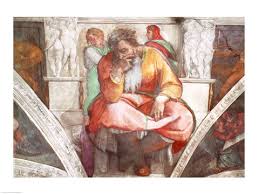
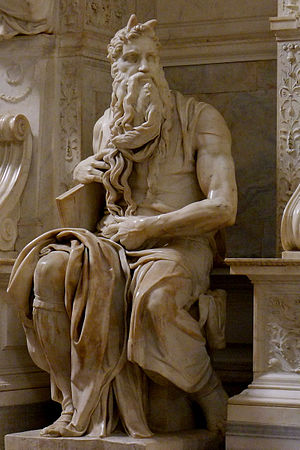
Lest one think that it is highly unlikely that a 16th century Italian Jew would have even entered the chapel, let alone been familiar with this painting, a contemporaneous account of Jewish art appreciation disabuses those assumptions. Specifically, Giorgi Vasari, the 16th century artist and art historian, in his Lives of Excellent Painters (first published in 1560), records regarding Michelangelo’s statute of Moses – that is a full statute depicting the human form and was placed in the church of San Pietro in Rome – that “the Jews [go] in crowds, both men and women, every Saturday, like flocks of starlings, to visit and adore the statue.” That is, the Sabbath afternoon activity was to go to church to admire the statute of Moses, that is more famous for having horns than its Jewish visitors.[2]


But, unlike the rest of the figures in Pharaoh’s army, two figures appear with birds’ heads. Some write this off to carelessness on the illustrator’s part. Epstein, who credits his (then) ten-year old son for a novel explanation, offers that these two figures are Datan and Aviram, two prominent members of the erev rav, those Jews who elected to remain behind. Indeed, they are brandishing whips indicative of their role as nogsim (Jewish taskmasters, or the precursor to Jewish Sonderkommando). While the illustrator included them with the Egyptians, he still allowed them to remain with their “Jewish” bird’s head. This is a powerful idea regarding the idea of sin, and specifically, the Jewish view that even when a Jew sins, they still retain their Jewish identity – their “birds head.” Sin, and including sinners as Jews, are motifs that are highlighted on Pesach with the mention of the wicked son and perhaps is also indicated with this illustration. The illustrator could have left Datan and Aviram out entirely or decided to mark them some other way rather than the Birds’ head. Thus, utilizing this explanation allows for the illustrator to enable a broader discussion about not only the exodus and the Egyptian army’s chase, but expands the discussion to sin, repentance, Jewish identity, inclusiveness and exclusiveness and other related themes.[16]

The Jews in Egypt had sunk to the deepest depths on impurity, far from God. Finally, as we discussed previously, Datan and Aviram are also removed from god and the Jewish people. Again, the illustrator is depicting Jews – they all have the griffin heads – but they are distinct in their interaction with god and the Jewish people.[17]

Instead, it appears that the person to the left is speaking (his hand is over his heart a medieval convention to indicate speech), and they are approaching the older figure on the left. All are griffin headed and Judenhut attired – so Jews and regular ones. Between the splitting of the sea and the manna and quails the Jews complained to Moses. Its possible that this is what is being depicted here, the complaining Jews, and the illustration serves as a testament to God’s patience and divine plan, the theme of dayenu, that even though we complained and did X, God still brought the manna, quail and Torah.[18]

.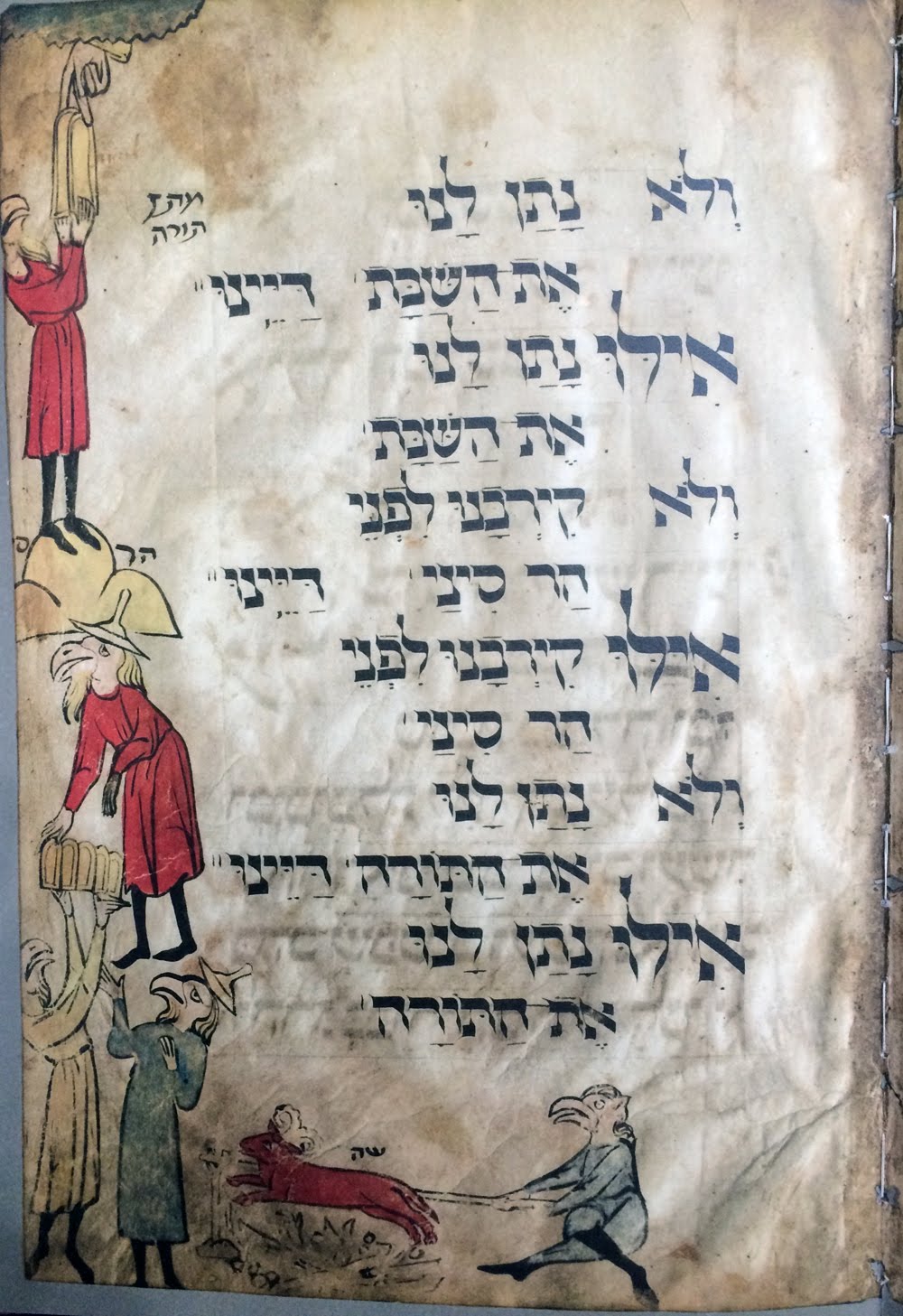
Two tablets were given at Sinai, but the actual Pentateuch is comprised of 5 books. Thus, to capture that the 5 are a continuity of the two, as they are transmitted down, they transform into five tablets. What about the ram/lamb at the bottom? Some have suggested that it is the Golden Calf. But it is unlikely that such a negative incident would be included. Instead, assuming that continuity or tradition is the theme, this lamb is representative of pesah dorot that is an unbroken tradition back to Sinai and unconnected with the Christian idea of Jesus as a stand in for the lamb. Immediately prior to dayenu we have the Pesach mitzrayim with the figure’s cloak blowing back due to the haste.

Thus, the dayenu is bracketed by the historic Pesach and the modern one – all part of the same tradition. [20]
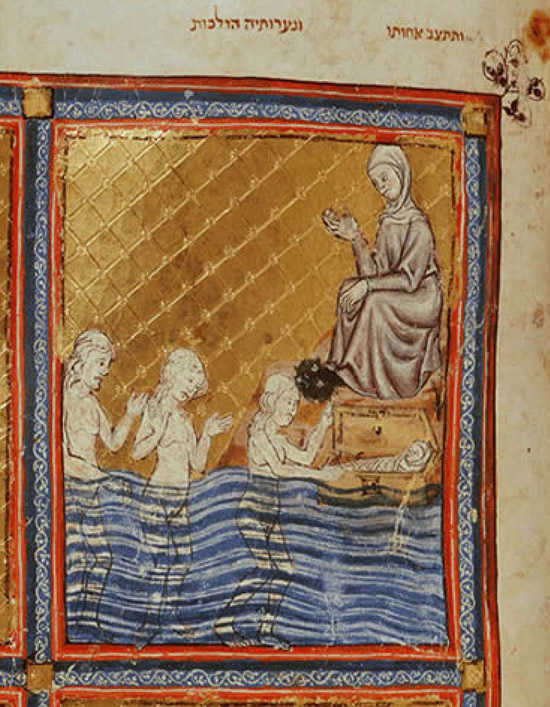
Turning to Spain, one of the most beautiful illuminated haggadot is the “Golden Haggadah.” Just as the Ashkenazi Bird’s Head has depth to the illustrations, the Golden Haggadah can be mined for similar purpose. Each folio is comprised of four panels. And while they appear to simply depict the biblical narrative, they are so much more.
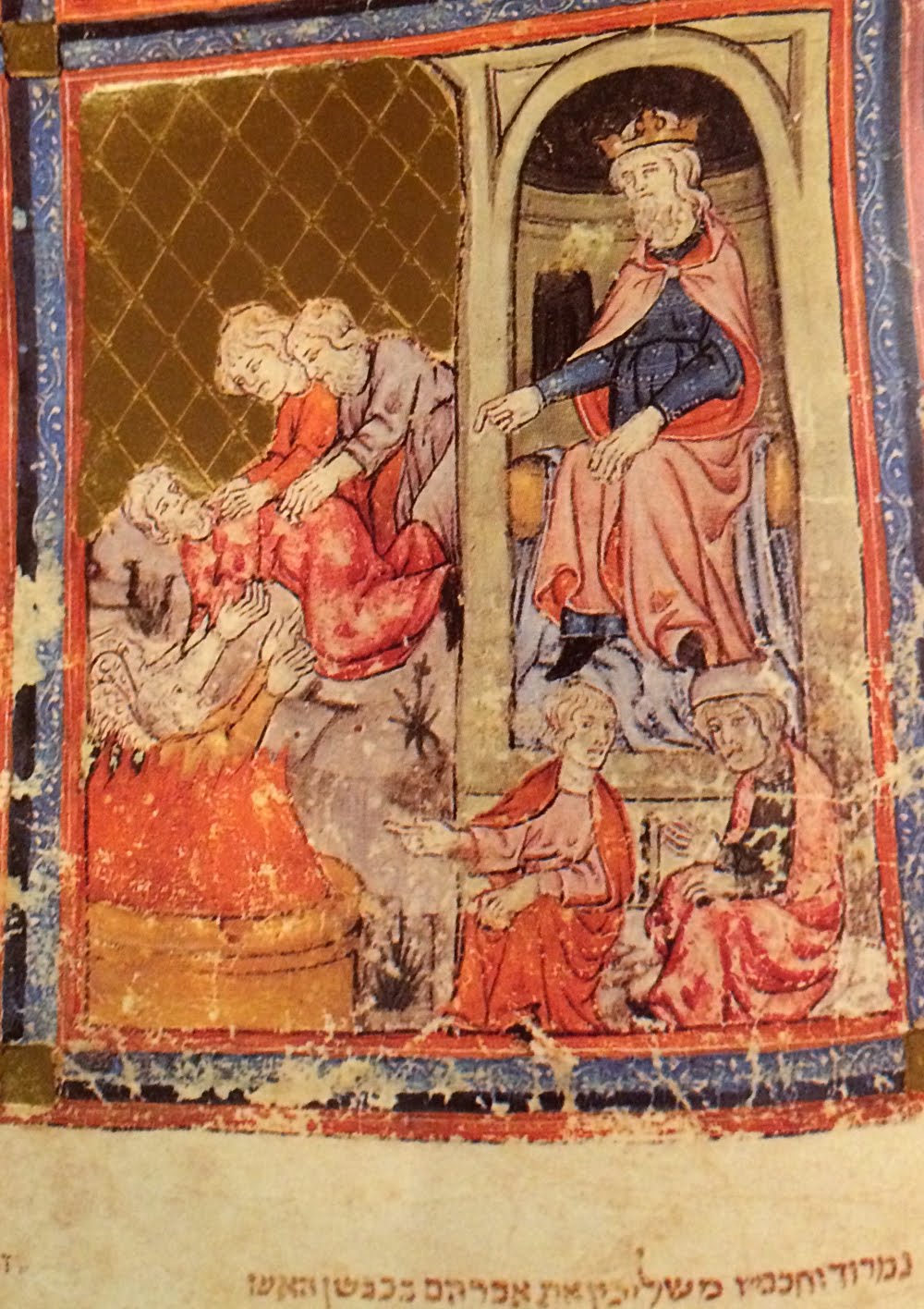
The folio showing the Joseph story has the brothers pointing in the same manner as Pharaoh and Nimrod – the illustrator showing his disdain for the mistreatment and betrayal and equating it with the others.
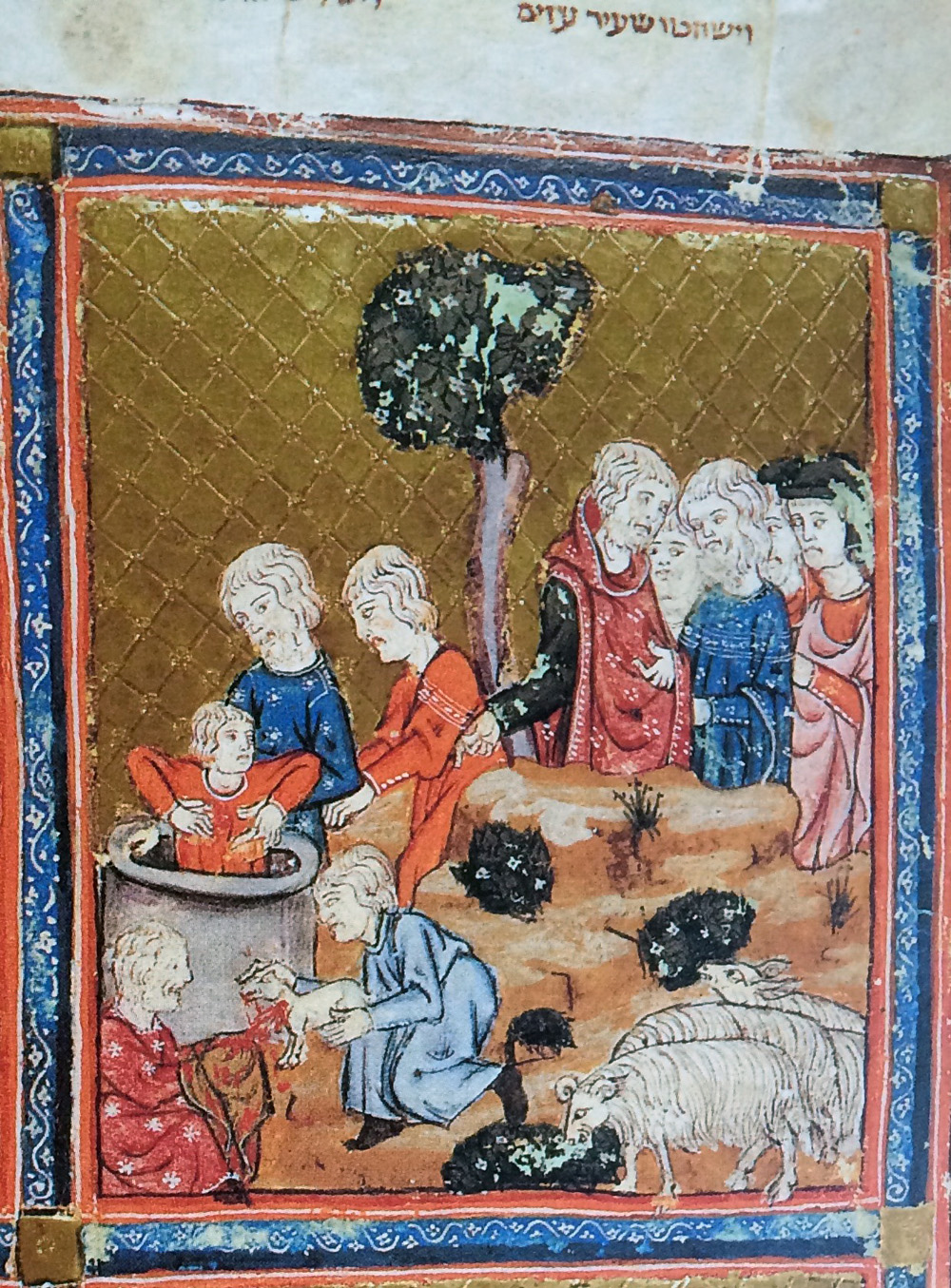
But, that is not all. Counting the panels there are 9 between Nimrod and Joseph and 9 between Joseph and Pharaoh. Taken together, these illustrations “renders an implicit critique of the attitude of that Jewish history is nothing but an endless stream of persecution of innocent Israel by the bloodthirsty gentiles. Yes, it is acknowledged, these gentile kinds might behave villainously in their persecution of Jews. But groundless hatred between brother and brother is on par with such terrible deeds, and sometimes sinat hinam can precipitated treachery as destructive as persecution by inveterate enemies.”[21]

This may be a reference to the midrash that “in the merit of the righteous women the Jews were redeemed.”[22] The difference in the exodus scene is particularly striking if one compares it to the Ashkenaz Haggadah – Moses clearly at the front, and the most prominent woman in the back.

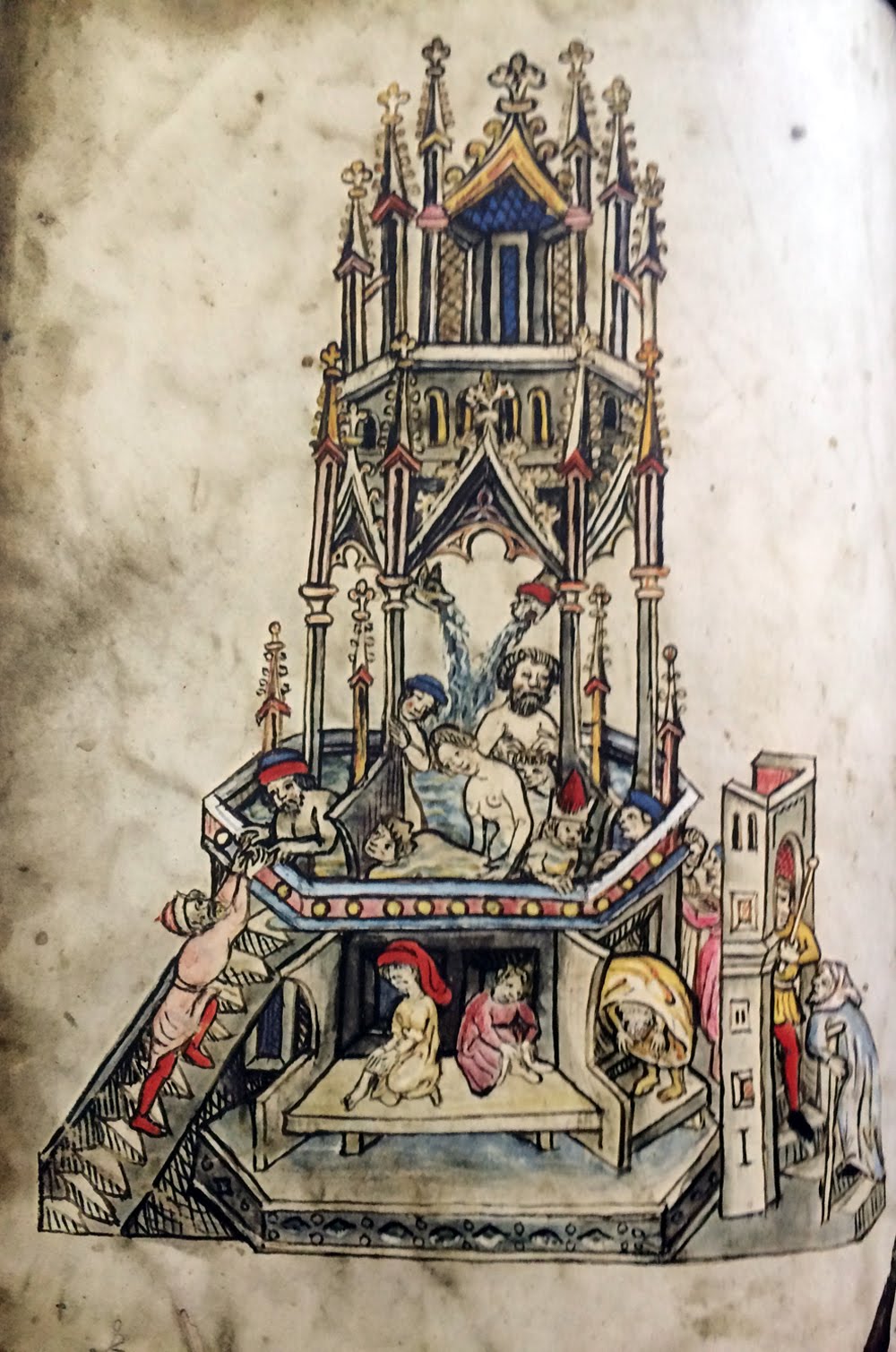

As mentioned above, this image is not connected to the text and instead is solely for aesthetic purposes. The hunting motif is common in many medieval manuscripts, and in some a unicorn is substituted for a deer. While the unicorn has Christological meaning, on some occasions it also appears in Hebrew manuscripts.[26]
Generally, Jews seem to have issues with botany. We struggle to identify which of the handful of fruits and vegetables mention in the Bible and Talmud. But on Passover, the marror an undefined term, proves particularly illusory. Today, there is no consistency regarding what is used for marror with it running the gamut from iceberg lettuce to horseradish root. While we may not be able to identify it with specificity, we know what its supposed to taste like – bitter. Manuscripts may provide some direction here. There are two depictions in illuminated haggadot. One of a leafy green, found in numerous examples, from a fragment from the Cairo Geniza to the Birds’ Head, and that of an artichoke.[30] If it is a leafy green, it must be a bitter one – and that changes based upon time, place and palate. For example, 30 years ago romaine lettuce was only the bitter lettuce widely available. But, among lettuces, it is far from bitter, and today, there are a variety of truly bitter lettuces available, arugula, mustard greens, dandelion, mesclun, etc. Another leafy and very bitter option that is found in illuminated haggadot is the artichoke. The artichoke is extremely bitter without proper preparation. Indeed, from just touching the leaves and putting them in your mouth you can taste the bitterness. The Sarajevo Haggadah and brother to the Rylands both have artichokes.
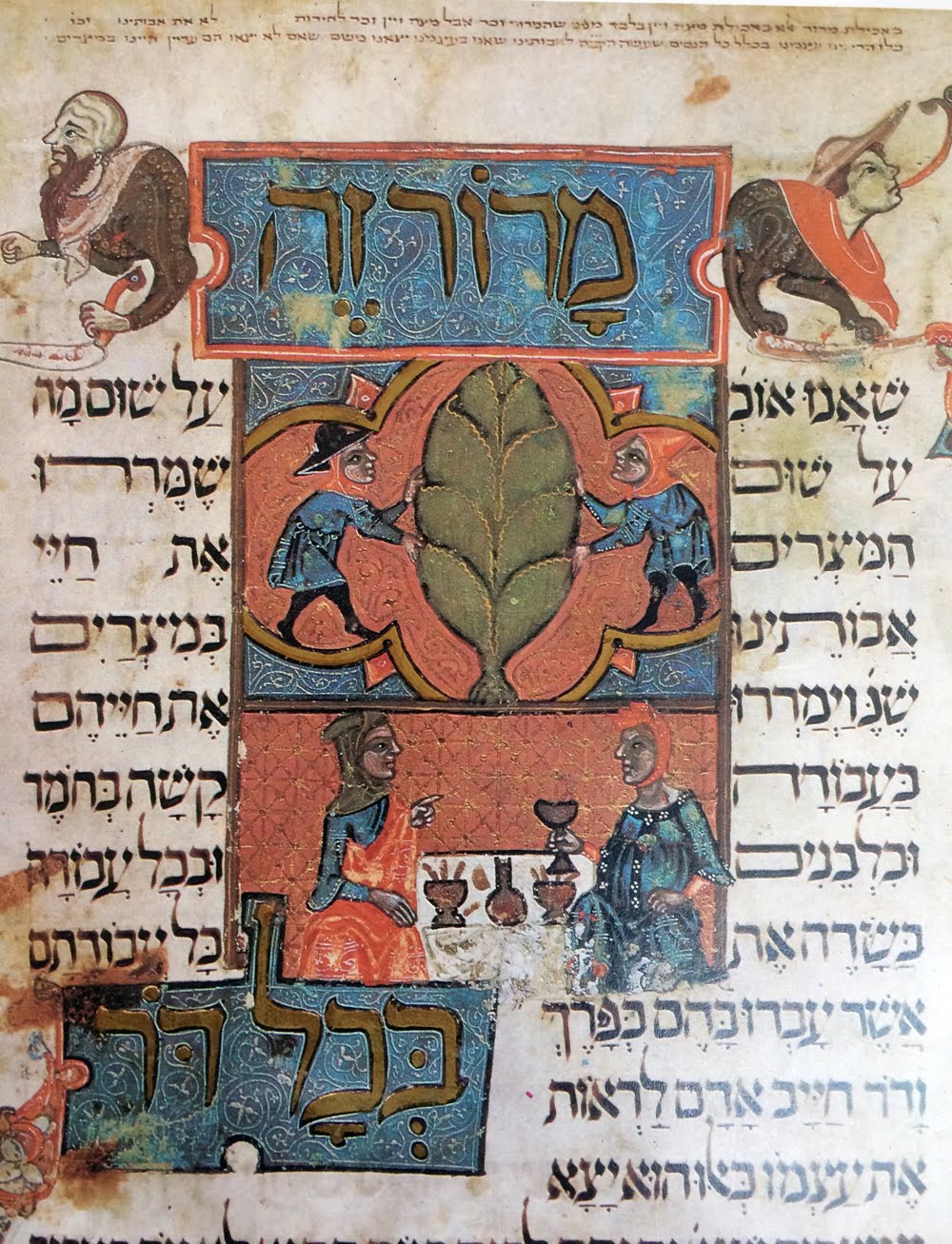
The association of the artichoke with Passover is more obvious when one accounts for Italian culinary history. Specifically, artichokes are associated with Jews and Passover. Carcoifi alla giudia – literally Jewish style artichokes “is among the best known dishes of Roman Jewish cuisine.” Artichokes are a spring thistle and traditionally served at Passover in Italy. Whether or not from a culinary history this dish sprung from the use of raw artichoke for marror is not known, but we can say with certainty that artichokes have a considerable history when it comes to Passover.