The Anonymous Author of Tikkunei Zohar and Ra‘ya Mehemna: An Antinomian or a Radical Maimonidean?

The Anonymous Author of Tikkunei Zohar and Ra‘ya Mehemna: An Antinomian or a Radical Maimonidean?

By Bezalel Naor

Today, it is an accepted fact in scholarly circles that Tikkunei Zohar and Ra‘ya Mehemna form a single unit that postdates the main body of Zohar.[1] More than one reader has been scandalized by statements in Tikkunei Zohar and Ra‘ya Mehemna likening the Mishnah to a shifhah or maidservant.[2] Predictably, in response, there grew an apologetic literature that attempts to justify how such shocking statements are compatible with normative Halakhah.[3]

One cannot rule out altogether the assertion by various secular historians that these pejorative statements betray an antinomian streak,[4] though to be certain, such statements of Tikkunei Zohar and Ra‘ya Mehemna are not situated in the present but deferred to the future. With this proviso, they are no more “antinomian” than the statement of Rav Yosef in the Talmud: “Mitsvot (commandments) are nullified in the future.”[5]

I wish to present a hitherto unexplored possibility. It seems likely that the anonymous author of Tikkunei Zohar and Ra‘ya Mehemna (which surfaced in Spain in the first decades of the fourteenth century)[6] was not so much an antinomian as a radical Maimonidean. It is in this light that we should understand negative statements issuing from the author regarding the study of Mishnah or those comparing the various Talmudic exercises and mental gymnastics to the backbreaking labor to which the Children of Israel were subjected in Egyptian exile.[7] These do not spring from an anti-halakhic mindset but rather from taking at face value Maimonides’ syllabus as laid out in his introduction to Mishneh Torah:

Hence, I have entitled this work Mishneh Torah (Review of the Law), for the reason that a person, who first reads the Written Law and then this [compilation], will know from it the whole of the Oral Law, without having need to read any other book between them [italics mine—BN].

We should be asking ourselves: Are there any historical grounds to assert that in Spain in the early 1300s there were halakhic Jews who openly—we should add, brazenly—promulgated the Maimonidean curriculum to the exclusion of Talmudic studies and the concomitant exercise of pilpul?

I offer the words of Joseph Ibn Kaspi:

Therefore my rabbis, listen to me and God will listen to you! I see that it is the intention of those among you who engage in Gemara, novellae and opinions (shitot),[8] to know proofs for the practical commandments, for you are not satisfied with the tradition from Mishneh Torah composed by Rabbenu Moshe [i.e. Maimonides], though he said: “And one shall have no need of any other book between them [Italics mine—BN].”

Here is an example. Ha-Rav ha-Moreh [i.e. Maimonides] wrote in his laws: “A sukkah that is higher than twenty ammah is invalid.”[9] Yet you despair and are without comfort until you know whether the reason is because “the eye does not rest upon it,” or because “one is not sitting in the shade of the sekhakh (overhead boughs) but of the walls,” or because “the sukkah must be a temporary dwelling,” as written in the Gemara.[10] Even this will not satisfy the very punctilious (mehadrin min ha-mehadrin) until they have added problems and opinions (shitot)[11]: “If you should say,” “one may say,” etc.

Truly, I admit that this is good, but why is the knowledge of proofs an obligation in regard to practical commandments, while not [even] an option,[12] but an outright prohibition when it comes to commandments of the heart? What sin has been committed by these four commandments of the heart (that I mentioned) that you do not treat them in the same manner but are satisfied by a weak tradition of few words, wanting comprehension?[13]

Who was Joseph Ibn Kaspi? Born either in Arles, Provence or Argentière, Languedoc,[14] around the year 1280, he passed in 1345 on the island of Majorca. His was a peripatetic life. The first period of his life was spent in the south of France. Later he gravitated to Barcelona, where his married son David resided. At approximately age thirty-five he travelled to Egypt for several months,[15] hoping to acquire there the intellectual legacy of Maimonides from the Master’s fourth and fifth generation descendants but was sorely disappointed in this respect. He even entertained the thought of traveling to Fez, Morocco in search of wisdom,[16] but that particular journey never materialized.

Ibn Kaspi’s reputation is that of an ultra-rationalist. His naturalistic explanations of events in the Bible far exceed even those of Maimonides; for that reason his opinions were marginalized. Though there is an abundance of manuscripts, it was only in the nineteenth century that Ibn Kaspi’s works were published from manuscript. (A few still remain in manuscript.) To this day, his interpretations have yet to “mainstream.”

My juxtaposing the Maimonidean enthusiast Joseph ibn Kaspi to the anonymous author of the kabbalistic works known as Ra‘ya Mehemna and Tikkunei Zohar may strike the reader of this essai as bizarre. Besides their contemporaneity, what basis is there for this juxtaposition?

Geographically, there are certainly grounds for relating the two authors to one another. Though separated by the Pyrenees, there was much traffic, intellectual and otherwise between Provence and Northern Spain. Some of the greatest families of Provencal scholars originated in Spain: the Kimhis, Joseph and his son David, who excelled as grammarians and Bible exegetes; and the Tibbonides, Judah and his son Samuel, who were the premier translators of classic philosophic works from Judeo-Arabic to Hebrew. And the traffic was two-way. Prominent Provencal families wended their way to Sefarad. The halakhist Rabbi Zerahyah Halevi (“Ba‘al ha-Ma’or”), a native of Gerona, established his career in Narbonne, only to return to Gerona at the end of his days. (His great-grandson was the Talmudist Rabbi Aharon Halevi of Barcelona.)[17] Ibn Kaspi is an example of a Provencal scholar who relocated to Catalonia: Barcelona, and eventually, the Balearic isle of Majorca. Thus, there could easily have been a sharing of ideas between southern France and northern Spain.[18]

In terms of mindset, the border between rationalist philosophy and kabbalah was especially porous at this time. Whoever authored Ra‘ya Mehemna and Tikkunei Zohar, carried with him much Maimonidean baggage. Linguistically, it is apparent to any student of the Ra‘ya Mehemna and Tikkunim that they are rife with the philosophic jargon made popular by the Tibbonides’ translations from Judeo-Arabic.[19] And let us not forget that the very backbone of Ra‘ya Mehemna is an enumeration of the commandments à la Maimonides’ Sefer ha-Mitsvot. (Rabbi Reuven Margaliyot isolated these commandments and presented them in orderly fashion in the introduction to his edition of the Zohar.)

*

When we put it all together it makes perfect sense. As shocking as some of its bold statements may be, the literary oeuvre of Ra‘ya Mehemna and Tikkunei Zohar cannot be construed as issuing from the mind of an antinomian. An antinomian would not go to the bother of constructing a Book of Commandments after a fashion. Rather, I maintain that the downgrading of the study of Talmud in general, and Mishnah in particular, should be attributed to a radical adoption of Maimonides’ curriculum of studies, whereby his halakhic magnum opus Mishneh Torah has superseded the study of Mishnah and Gemara.

In this respect, Maimonides’ devotees in Provence and Spain ventured beyond the Master himself. Maimonides penned a convincing letter to Rabbi Pinhas, the Dayyan (Justice) of Alexandria,[20] that regardless of what he wrote in the introduction to Mishneh Torah, the traditional study of the Talmudic tractates (albeit as summarized in Alfasi’s Halakhot) continues unabated in his beit midrash.[21] The curriculum that Maimonides once proposed remained an abstraction. It seems that Egyptian Jewry was not overly receptive to this innovation. Only well over a century later, did this great intellectual experiment of Maimonides, Mishneh Torah, a “hivemind of halakhah,[22] designed to replace the “dialectics of Abayye and Rava,” find foot soldiers in the likes of Ibn Kaspi and the anonymous author of Ra‘ya Mehemna and Tikkunei Zohar. They launched their campaign from the soil of Provence and Spain.

Our thesis does not ride on the reputation of Joseph ibn Kaspi. Ibn Kaspi’s statement is perhaps the most outspoken and provocative call for adoption of Maimonides’ Mishneh Torah as a way of bypassing Talmudic studies, yet there are other testimonies (from the least expected quarter) that the exclusive study of Mishneh Torah was starting to gain traction in medieval Spain.

The great halakhist Rabbi Asher ben Yehiel (Rosh) emigrated from Germany to Spain at the turn of the fourteenth century and eventually emerged as the Rabbi of Toledo, Castile, where he left his stamp on the shape of Castilian Halakhah.[23] Evidently, Rabbi Asher had cause to fulminate against authorities who decided questions of practical Halakhah based solely on the rulings of Mishneh Torah without recourse to Talmud.

Rabbi Asher writes:

I heard from a great man in Barcelona who was eminently familiar with three orders [of the Talmud, i.e. Mo‘ed, Nashim and Nezikin]. He said: “I am amazed at people who have not studied Gemara and adjudicate based on their reading in the books of Maimonides, of blessed memory, believing that they understand them. I know myself, when it comes to the three orders that I studied, I am able to understand when I read Maimonides’ books. However, his books that are based on Kodashim and Zera‘im—I do not understand at all. And I know that it is that way for them regarding all his books![24]

*

Rabbi Yahya Kafah (1850-1931) was not wide of the mark when he asserted that those statements in Zoharic literature that undercut the Talmud (comprised of Mishnah and Gemara) were designed to enhance the prestige of the Kabbalah. (By the same token, one may safely say that Ibn Kaspi’s desire to streamline the study of Halakhah, stemmed from his valorization of Philosophy.)

Logically, our next question should be: What was Maimonides’ own stake in proposing that his compendium Mishneh Torah take the place of protracted Talmudic studies? Maimonides provides a simple answer to this question in his introduction to Mishneh Torah:

At this time, severe vicissitudes prevail, and all feel the pressure of hard times. The wisdom of our wise men has disappeared; the understanding of our prudent men is hidden. Hence, the commentaries of the Geonim and their compilations of laws and responses, which they took care to make clear, have in our times become hard to understand so that only a few individuals properly comprehend them. Needless to add that such is the case in regard to the Talmud itself—the Babylonian as well as the Palestinian—the Sifra, the Sifre and the Tosefta, all of which works require a broad mind, a wise soul and lengthy time, and then one can know from them the correct practice as to what is forbidden or permitted, and the other rules of the Torah.

On these grounds, I, Moses the son of Rabbi Maimon the Sefardi, bestirred myself…[25]

While perhaps not the ideal curriculum, the exigencies of the time demanded the production of a bold new work on the order of Mishneh Torah that would preserve the practice of Halakhah for the masses ill-equipped to make their way through the labyrinthine discussions of the Talmud or even the decisions of the Gaonica (originally intended to clarify the canons of Jewish Law).

But was there perhaps another purpose of Mishneh Torah that Maimonides kept to himself and was not willing to divulge in writing? In Hilkhot Talmud Torah (Laws of the Study of Torah), Maimonides would proceed to sketch the traditional trivium of Mikra (Bible), Mishnah and Talmud, [26]such that Pardes (the esoteric teachings of Judaism) comes under the rubric of “Talmud”[27]; and that furthermore, the mature scholar who has covered the requisite literature and is thus no longer bound by the daily trivium, “will devote all his days exclusively to Talmud, according to the breadth of his mind and the composure of his intellect.”[28]

Was the condensing of Talmud into Mishneh Torah Maimonides’ master plan to free time for the study of Pardes or esoterica? Should that prove true, then Ibn Kaspi’s interest,[29] and mutatis mutandis that of the Tikkunei Zohar and Ra‘ya Mehemna, was not so very different from that of HaRav HaMoreh.[30]

[1] This fact was recognized two and a half centuries ago by the discerning eye of Rabbi Jacob Emden. See Emden’s Mitpahat Sefarim, Altona 1768, Part 1, chap. 3 (6b); chaps. 6-7 (16b-17b); Lvov 1870, pp. 12, 37-39.

Whereas Zohar itself has come to be associated with the name of Rabbi Moses de Leon, no single name surfaces in regard to Tikkunei Zohar and Ra‘ya Mehemna (though there are some who would attribute the latter to a yet unidentified disciple of De Leon).

It should be mentioned in passing that even in regard to the authorship of the Zohar there has been a sea change in scholarly thinking. Unlike Scholem, who was convinced that the single author of the Zohar was Rabbi Moses de Leon, current thinking (spearheaded by Yehuda Liebes) rejects this notion of single authorship and assumes the Zohar to be a collaborative or composite work on the part of a mystic fraternity or haburah.

[2] See Zohar I, 27b. This is actually a segment of Tikkunei Zohar that the Italian printers in 1558 mistakenly embedded in Zohar. See Editor Daniel Matt’s note to the Pritzker edition of the Zohar, vol. 1 (Stanford, California: Stanford University Press, 2004), p. 170, note 499. See also the Introduction to Tikkunei Zohar (Vilna, 1867), 15b and gloss of the Vilna Gaon, s.v. shalta shifhah.

And see the Tikkunim appended to Tikkunei Zohar (Margaliyot ed.), tikkun 9 (147a).

By the same token, there are passages where the Mishnah is related to Metatron, the “‘eved” (male servant). See e.g. Ra‘ya Mehemna in Zohar III, 29b; and The Hebrew Writings of the Author of Tiqqunei Zohar and Ra‘aya Mehemna (Hebrew), ed. Efraim Gottlieb (Jerusalem: The Israel Academy of Sciences and Humanities, 2003), p. 1, line 3.

Moshe Idel has demonstrated that this motif whereby the Mishnah is juxtaposed to Metatron is to be found in the obscure work of Rabbi Abraham Esquira, Yesod ‘Olam (Ms. Moscow, Günzburg 607, 80a-b). See Idel’s introduction to The Hebrew Writings of the Author of Tiqqunei Zohar and Ra‘aya Mehemna, pp. 23-24, 27-28. Inter alia, Esquira’s text makes mention of “six hundred orders of Mishnah.” This is a reference to b. Hagigah 14a. See Rashi there s.v. shesh me’ot sidrei Mishnah. Thus, p. 23, n. 76 of Idel’s introduction is in need of correction. By the same token, Esquira’s “seven hundred orders of confusion” (“shesh me’ot sidrei bilbulim”) is a parody of the “seven hundred orders of Mishnah” in b. Hagigah 14a. See Idel, ibid. p. 28, n. 105.

Concerning the juxtaposition of the six-lettered Metatron, the servant, to the six days of the work week, see the Vilna Gaon’s gloss to Tikkunei Zohar (Vilna, 1867), tikkun 18 (33b), s.v. be-gin de-Metatron. There is precedent in a Teshuvat ha-Ge’onim (Gaonic responsum) for restricting the activity of the angelic realm to the six days of the week and reserving the seventh Sabbath day for Israel’s sphere of influence. See Tosafot, Sanhedrin 37b, s.v. mi-kenaf ha-’arets zemirot shama‘nu; and Rabbi Reuven Margaliyot, Margaliyot ha-Yam ad locum, and idem, Nitsutsei Zohar to Ra‘ya Mehemna in Zohar III, 93a, note 2.

Later, in sixteenth-century Safed, Rabbi Isaac Luria advised reserving the Sabbath day for the exclusive study of Kabbalah (“as was the custom of the early ones”), while relegating the study of Halakhah to the six work days. This is hinted to in the two verses “Hishtahavu la-Hashem be-hadrat kodesh” (whose initials form the word “Kabbalah”) and “Hari‘u la-Hashem kol ha-’arets (initials “Halakhah”). See Rabbi Hayyim Vital, Peri ‘Ets Hayyim (Dubrovna, 1804), Sha‘ar ha-Shabbat , chap. 21 (103c); Rabbi Jacob Zemah, Nagid u-Metsaveh (Lublin, 1881), 25b. And see Peri ‘Ets Hayyim, Sha‘ar Hanhagat ha-Limmud, s.v. kavvanat keri’at ha-Mishnah (85a): “Know that the Mishnah is Metatron in Yetsirah…”

In the Ra‘ya Mehemna in Zohar III, 279b, the Mishnah is referred to as the “shifhah…the female of the ‘eved, na‘ar (“lad”). “Na‘ar” or “lad” is yet another epithet for Metatron; see b. Yevamot 16b (based on Psalms 37:25) and Tosafot ad loc. s.v. pasuk zeh sar ha-‘olam amaro. Just as Metatron is referred to as “‘eved,” “for his name is like that of his Master” (b. Sanhedrin 38b). Both Metatron and Shadai have the numerical value of 318. (In Ra‘ya Mehemna in Zohar III, 82b it is spelled out that “Metatron is a good servant, a faithful servant to his Master.”)

In Ra‘ya Mehemna, in Zohar III, 276a, three of the most difficult tractates of the Mishnah are singled out for derision, ‘Eruvin, Niddah and Yevamot, as they are assigned the acronym ‘Ani (poor man).  The Vilna Gaon points out that the derogation of the rabbis, students of the Mishnah, is not absolute, but only relative to the “ba‘alei kabbalah” (“masters of the Kabbalah”). See Yahel ’Or, ed. Naftali Hertz Halevi (Vilna, 1882), Tetse, 276a, s.v. ve-i teima.

Earlier in that passage (Zohar 275b) we have the underhanded compliment, Hakham Mufle Ve-Rav Rabbanan” (“Outstanding Sage and Rabbi of Rabbis”), whose initials spell the word “hamor” (jackass). (This cynical remark found its way into the modern mystery novel by Richard Zimler, The Last Kabbalist of Lisbon [Woodstock, NY: The Overlook Press, 1998], p. 44.)

One who found absolutely outrageous the labeling of the Mishnah as a “shifhah” was the Chief Rabbi of Sana‘a, Yemen, Rabbi Yahya ben Shelomo (Sliman) Kafah (1850-1931). See his ‘Amal u-Re‘ut Ru’ah va-Haramot u-Teshuvatam (Tel-Aviv, 1914; limited facsimile edition Jerusalem 1976), p. 12. Available at hebrewbooks.org.

‘Amal u-Re‘ut Ru’ah va-Haramot u-Teshuvatam is Rabbi Kafah’s rejoinder to the bans placed upon him by the various batei din (courts) of Jerusalem—Ashkenazic, Hasidic and Sefardic. It struck Rabbi Kafah as highly ironic that he, a staunch defender of Talmudic Judaism, was placed under the ban, while the Zohar, with its numerous derisions of Talmud and its students, was upheld and, what is more, sanctified. Ibid. p. 14.

The constraints of space do not allow us to explore the controversy regarding the Zohar that erupted in Yemen in the early part of the twentieth century between Rabbi Kafah and his disciples, the self-styled Darda‘im, on the one hand, and their opponents, to whom they referred as ‘Ikeshim. (The first label is based on the Midrashic pun on Darda‘ [1Kings 5:11] as Dor De‘ah, “a generation of knowledge”; the second comes from Deuteronomy 32:5, “dor ‘ikesh u-petaltol,” “a perverse and twisted generation.”) At the instigation of his critics, Rabbi Kafah was jailed on more than one occasion by the Muslim authorities. (Rabbi Kafah alludes to this in ‘Amal u-Re‘ut Ru’ah va-Haramot u-Teshuvatam, p. 14.)

The man who acted as a peacemaker between the warring factions was none other than Rabbi Abraham Isaac Hakohen Kook. While upholding Rabbi Kafah’s status as an unusual Torah scholar, Rabbi Kook conveyed to him that he had erred in taking literally passages that were intended to be understood metaphorically. See Igrot ha-Rayah, vol. 2, ed. RZYH Kook (Jerusalem: Mossad Harav Kook 1961), no. 626 (pp. 247-248); Haskamot ha-Rayah, ed. Y.M. Yismah and B.Z Kahana (Jerusalem, 1988), no. 41 (pp. 46-47); Ma’amrei ha-Rayah, vol. 2, ed. Elisha Aviner (Langenauer) (Jerusalem, 1984), pp. 518-521. An incomplete variant of the letter in Haskamot ha-Rayah was published by Rabbi Moshe Zuriel, Otserot ha-Rayah, vol. 1 (Rishon LeZion, 2002), no. 76 (p. 447). See further Rabbi Zevi Yehudah Hakohen Kook, Li-Sheloshah be-Ellul I (Jerusalem, 1938; photo offset Jerusalem, 1978), par. 107 (p. 46).

For Rav Kook’s involvement with the Yemenite community and facilitating their ‘aliyah at the beginning of the twentieth century, see ibid. par. 42 (p. 21); and recently Ben Zion Rosenfeld, “Yahaso shel ha-Rayah Kook le-Hakhmei ha-Mizrah bi-Tekufat Yaffo 5664-5674 (1904-1914)” [“HaRav Avraham Isaac HaCohen Kook and his Attitude Regarding the Sephardi Sages During His Stay in Jaffa 5664–567 4(1904–1914)”], Libi ba-Mizrah (My Heart Is in the East) 1 (2019), pp. 287-290.

[3] See Rabbi Hayyim Vital, introduction to Sha‘ar ha-Hakdamot (printed as an introduction to the standard editions of ‘Ets Hayyim); Rabbi Shneur Zalman of Liadi, Iggeret ha-Kodesh (4th section of Tanya), chap. 26 (especially 143a). And see Rabbi Dov Baer Shneuri, Bi’urei ha-Zohar (Brooklyn, NY: Kehot, 2015), Bereshit (to Zohar I, 27b), 5a-8d.

[4] Heinrich Graetz, History of the Jews, cited in Gershom G. Scholem, “The Meaning of the Torah in Jewish Mysticism,” in idem, On the Kabbalah and Its Symbolism (New York: Schocken Books, 1970), p. 70, n. 1.

[5] b. Niddah 61b.

Contra Graetz, Scholem, referring to “the ambiguity of certain statements about the hierarchical order of the Bible, the Mishnah, the Talmud, and the Kabbalah, which are frequent in the Ra‘ya Mehemna and the Tikkunim, and which have baffled not a few readers of these texts,” states categorically: “It would be a mistake to term these passages antinomistic or anti-Talmudic” (op. cit. p. 70). Rather, to describe the peculiar posture of the Ra‘ya Mehemna and the Tikkunim, Scholem coins the term “utopian antinomianism” or “antinomian utopia” (op. cit., pp. 80, 82).

Other secular scholars who objected to Graetz’s judgment concerning the controversial passages in the Zohar (or to be more precise, Tikkunei Zohar) were Bernfeld and Zinberg. See Heinrich Graetz, Geschichte der Juden, 7, Beilage 12; Shim‘on Bernfeld, Da‘at Elohim, Part 1 (Warsaw, 1897), pp. 396-397, note 1; Israel Zinberg, A History of Jewish Literature, vol. 3, transl. Bernard Martin (Cleveland: The Press of Case Western Reserve University, 1973), pp. 55-56.

[6] Scholem and Idel would date Tikkunei Zohar and Ra‘ya Mehemna as early as the end of the thirteenth century (bringing the work in contact with Rabbi Moses de Leon). See Idel’s introduction to The Hebrew Writings of the Author of Tiqqunei Zohar and Ra‘aya Mehemna, pp. 10, 25-26, 29. Tishby established the years 1312-1313 as the terminus ad quem for the composition of Tikkunei Zohar based on its Messianic expectations for those years. Cited in Idel, ibid. p. 10, n. 7. See also p. 23. Idel, relying on Liebes, would make the terminus ad quem a year earlier, 1311. (Ibid.)

[7] See Zohar I, 27a:

They embittered their lives with hard labor (‘avodah kashah)—with kushya (difficulty);

with mortar (homer)—with kal ve-homer (a fortiori);

and with bricks (levenim)—with libun hilkheta (clarification of the law);

and with all [manner of] labor in the field—this is Beraita;

all their labor—this is Mishnah.

Though mistakenly embedded by the Italian printers back in 1558 in the text of the Zohar, this is actually a segment from the later work Tikkunei Zohar. See above note 2.

This same anachronistic interpretation of the verse in Exodus 1:14 is found (with slight variations) in the Ra‘ya Mehemna, again embedded in Zohar III, 153a, 229b (though in this case explicitly identified as Ra‘ya Mehemna). See also Tikkunei Zohar, tikkun 21 (Margaliyot ed. 44a); the additional Tikkunim appended to Tikkunei Zohar, tikkun 9 (147a); and the Tikkunim appended to Zohar Hadash (Margaliyot ed.), 97d (where the end of the verse is interpreted, “be-pharekh—da pirkha”), 98b, 99b.

And see now, The Hebrew Writings of the Author of Tiqqunei Zohar and Ra‘aya Mehemna (Hebrew), ed. Efraim Gottlieb and Moshe Idel (Jerusalem: The Israel Academy of Sciences and Humanities, 2003), pp. 39-40.

This degradation of Talmudic hermeneutic was duly noted by Rabbi Kafah (see above note 2). Kafah believed that the not so hidden agenda of the anonymous writer was to promote the study of Kabbalah at the expense of the study of Talmud. See ‘Amal u-Re‘ut Ru’ah va-Haramot u-Teshuvatam, p. 12: “The entire purpose of the author of the Zohar is to cause the Mishnah and the Talmud to be forgotten from Israel, to stop up the mouth of the well of living waters from which flow the ways of the Oral Law, and have them occupy themselves with his new Torah.”

[8] The primary meaning of the Hebrew word shitah is a line; hence, a line of thought. For its derivative usage in medieval rabbinical literature, see Mordechai Breuer, ’Ohalei Torah (Jerusalem: Shazar Center, 2004), pp. 109, 510; Ya‘akov Spiegel, ‘Ammudim be-Toledot ha-Sefer ha-‘Ivri, vol. 2 (Ramat Gan: Bar Ilan, 2005), p. 442; and lately, Hayyim Eliezer Ashkenazi, “Heker ve-‘Iyun be-Sifrei Rishonim (4),” Yeshurun, vol. 40 (Nisan 5779), p. 930, n. 7.

In the London Beth Din Ms. 40 (designated in the microfilm collection of the National Library of Israel, F4708), f.30, this word reads “mishnayot,” rather than shitot, but the reading is unlikely, to say the least. Cf. below n. 11.

[9] Maimonides, MT, Hil. Sukkah 4:1.

[10] The three opinions are found in b. Sukkah 2a.

[11] In the London Beth Din ms. for “shitot” there occurs the grotesquerie “shtuyot” (foolishness).

[12] The London Beth Din ms. has the superior reading eino reshut o makom patur.”

[13] Joseph ben Abba Mari ibn Kaspi, Sefer ha-Mussar/Yoreh De‘ah, chap. 15.

Ibn Kaspi’s Sefer ha-Mussar was published in a couple of collections: Eliezer Ashkenazi of Tunis’ Ta‘am Zekenim (Frankfurt am Main, 1854); and Isaac Last’s ‘Asarah Klei Kesef (Pressburg, 1903). Our particular chapter (15) appeared earlier in the introduction to Ibn Kaspi’s ‘Ammudei Kesef u-Maskiyot Kesef, ed. Salomo Werbluner (Frankfurt am Main, 1848), p. xv. In Ta‘am Zekenim our quote appears on 53a; in ‘Asarah Klei Kesef on p. 70.

Sefer ha-Mussar was written for Ibn Kaspi’s twelve year old son Shelomo residing in Tarascon (Provence). According to the colophon, it was completed in 1332 in Valencia (Catalonia).

[14] Moshe Kahan is of the opinion that Joseph himself was born in Arles, and that it was his ancestors who hailed from Argentière (hence the Hebrew surname Kaspi). See M. Kahan, “Joseph ibn Kaspi—From Arles to Majorca,” Iberia Judaica VIII (2016), pp. 181-192.

[15] Kahan dates the journey between the years 1313-1315, and writes that Ibn Kaspi stayed in Egypt for about five months. Op. cit. p. 182.

In Mishneh Kesef I, ed. Isaac Last (Pressburg, 1905; photo offset Jerusalem, 1970), chap. 14 (pp. 18-19), Ibn Kaspi writes that about two years ago, at approximately age thirty-five, he went down to Egypt. The colophon of the book (p. 168) is datelined Arles, 1317, which would mean that the Egyptian expedition took place about the year 1315.

In Sefer ha-Mussar, which according to the colophon was completed in Valencia in 1332, we receive a slightly different picture. In the introduction, Ibn Kaspi writes that twenty years previous he wandered to Egypt; the total trip, from beginning to end, lasted five months. If we take him at his word, the trip to Egypt was in 1312. What is clear is that the actual sojourn in Egypt was less than five months.

[16] Introduction to Sefer ha-Mussar. In chap. 15, Ibn Kaspi spells out his fascination with Fez: “The Jews find repulsive and abandon today the Guide…the Christians respect and exalt it, and have translated it [to Latin]. All the more so the Ishmaelites; in Fez [italics mine—BN] and other lands, they established study-houses to learn the Guide from the mouth of Jewish scribes.”

[17] See Israel Ta-Shma, Rabbi Zerahyah Halevi (Ba‘al ha-Ma’or) u-B’nei Hugo (Jerusalem: Mossad Harav Kook, 1992), pp. 2, 16; Hayyim Eliezer Ashkenazi, “Heker ve-‘Iyun be-Sifrei Rishonim (4),” p. 933, n. 17.

[18] Though scholars assume a Castilian—rather than a Catalonian—provenance for Tikkunei Zohar and Ra‘ya Mehemna, I do not see that as a major obstacle. Surely, the main flow of traffic was between Provence in the south of France and Catalonia in the north of Spain, but for Jews, Sefarad was an overarching unity, no matter the local potentates into which it was fragmented. Thus, in 1305, the Rabbi of Barcelona, Catalonia, Rabbi Solomon ben Abraham ibn Adret (Rashba) was able to place a newly arrived German émigré, Rabbi Asher ben Yehiel (Rosh) in the rabbinate of Toledo, Castile. (See Avraham Hayyim Freimann, Ha-Rosh ve-Tse’etsa’av, trans. Menahem Eldar [Jerusalem: Mossad Harav Kook, 1986], pp. 28-29.)

Sometimes, within a single family one finds both strands of Kabbalah, Castilian and Catalonian. Isaac ibn Sahula, native of Guadalajara, Castile, author of the bestiary Meshal ha-Kadmoni (1281), as well as a kabbalistic commentary to Song of Songs, was a disciple of Rabbi Moses of Burgos, as well as an assumed associate of Rabbi Moses de Leon. (The first reference to the Midrash ha-Ne‘elam, an early stratum of the Zoharic literature, is found in Ibn Sahula’s Meshal ha-Kadmoni.) His brother, Meir ibn Sahula, on the other hand, prided himself on his Catalonian and Provencal pedigree, being a disciple of “Rabbi Joshua ibn Shu‘aib and of Rabbi Solomon ben Abraham ibn Adret (Rashba), who received from Nahmanides, who in turn received from Rabbi Isaac the Blind, son of Rabad of Posquières, who in turn received from Elijah the Prophet.” So writes Meir ibn Sahula at the conclusion to his commentary on the Bahir, “’Or ha-Ganuz.”

(Yehuda Liebes speculated that the especially acerb remarks that precede this peroration are directed against recent developments in Castilian Kabbalah, namely the Zohar. See Y. Liebes, Studies in the Zohar [Albany: State University of New York Press, 1993], pp. 168-169, n. 50. However, in all fairness, the description of those “who expound books and books of the nations, and transcribe therein their gods, and call them ‘Secrets of the Torah’ [Sitrei Torah],” sounds more like an attack on Maimonides and his followers who construe Aristotelian philosophy as Sitrei Torah, than an assault upon the Zohar. At the end of his lengthy footnote, Liebes conceded this distinct possibility.)

Thus, the division of Spanish Kabbalah into discrete units of Castilian versus Catalonian traditions need not prejudice us against the possibility of penetrations and influences that defy this dyadic model. One needs to complexify the general picture of Spanish Kabbalah in order to appreciate the multiplicity of forces at work. Binaries are helpful as historic guidelines but they can never do justice to the complexity of lived reality.

[19] Tishby collected some of these Tibbonide neologisms, starting with “nefesh ha-sikhlit” or “intellectual soul” (Ra‘ya Mehemna in Zohar III, 29b). See Isaiah Tishby, Mishnat ha-Zohar, vol. 1, 2nd printing with corrections (Jerusalem: Mossad Bialik, 1949), pp. 77-78.

One can well appreciate how the Chief Rabbi of Sana‘a, Yemen, Yahya ben Shelomo Kafah, a most outspoken opponent of the Zohar, typified its author as “the philosopher, author of the Zohar” (“ha-philosoph mehabber ha-Zohar”). See his ‘Amal u-Re‘ut Ru’ah va-Haramot u-Teshuvatam, pp. 12-16.

Besides the obvious use of Maimonidean terminology, there is the subtle copying of categories. An example would be the way in which the author of Tikkunei Zohar patterned his “hamesh minim” (“five species” or “five sects”) of the ‘Erev Rav (Mixed Multitude) after Maimonides’ “hamishah minim” (“five sectarians”). The passage from Tikkunei Zohar was incorporated by the printers in Zohar I, 25a. (The note in Derekh Emet alerts the reader that the material correlates to Tikkunei Zohar, tikkun 50. In the new Pritzker edition of the Zohar, the passage from Tikkunei Zohar has been removed.) Maimonides’ “hamishah minim” are found in MT, Hil. Teshuvah 3:7. This is just a random sample of the pervasive influence of Maimonides on the author of Tikkunei Zohar and Ra‘ya Mehemna.

Cf. the direct quote from Maimonides, Hil. Teshuvah 3:6 in Isaac ibn Sahula’s Meshal ha-Kadmoni (Venice, 1546), Sha‘ar ha-Rishon (10a), s.v. va-yo’el ha-tsevi le-va’er. And see now Sarah Offenberg, “On Heresy and Polemics in Two Proverbs in Meshal Haqadmoni” (Hebrew), Jewish Thought 1 (2019), pp. 64-65. Recently, Hartley Lachter has attempted to demonstrate that the general tenor of Meshal ha-Kadmoni is esoteric; see H. Lachter, “Spreading Secrets: Kabbalah and Esotericism in Isaac ibn Sahula’s Meshal ha-Kadmoni,” Jewish Quarterly Review, Vol. 100, No. 1 (Winter 2010), pp. 111-138.

[20] It should be noted, for whatever it is worth, that Pinhas ben Meshullam was a Provencal rabbi who took up the post of Dayyan of Alexandria, Egypt. It would be pure conjecture on my part to posit that his critique of Maimonides reflected the way in which Mishneh Torah had been received in Provence. It is equally possible that Pinhas’ critique was not based on actual observation of the Provencal reception of Mishneh Torah.

[21] See Igrot ha-Rambam, ed. Yitzhak Shilat, vol. 2 (Jerusalem, 1988), pp. 438-439; quoted in Bezalel Naor, The Limit of Intellectual Freedom: The Letters of Rav Kook (Spring Valley, NY: Orot, 2011), pp. 297-298.

[22] The term “hivemind” referred originally to the coordinated behavior of a colony of insects (bees or ants) which to an outside observer, appears the workings of a single mind. In the age of the Internet, it refers to the collectivity of the users who function as a single mind in expressing their thoughts and opinions. This is, in effect, what Maimonides created in Mishneh Torah. As he stated it so eloquently in the introduction to that work:

I…intently studied all these works, with the view of putting together the results obtained from them in regard to what is forbidden or permitted, clean or unclean, and the other rules of the Torah—all in plain language and terse style, so that thus the entire Oral Law might become systematically known to all, without citing difficulties and solutions or differences of view, one person saying so, and another something else [italics mine—BN]—but consisting of statements, clear and convincing, and in accordance with the conclusions drawn from all these compilations and commentaries that have appeared from the time of Rabbenu ha-Kadosh [i.e. Rabbi Judah the Prince] to the present, so that all the rules shall be accessible to young and old, whether these appertain to the (Pentateuchal) precepts or to the institutions established by the sages and prophets, so that no other work should be needed for ascertaining any of the laws of Israel, but that this work might serve as a compendium of the entire Oral Law…

(Moses Hyamson translation with correction)

[23] See A.H. Freimann, Ha-Rosh ve-Tse’etsa’av, chap. 4 (pp. 32-41).

[24] She’elot u-Teshuvot ha-Rosh 31:9; quoted in Bezalel Naor, The Limit of Intellectual Freedom, pp. 300-301.

[25] Translation of Moses Hyamson with slight alterations.

[26] b. Kiddushin 30a. See Tosafot there s.v. lo tserikha le-yomei.

[27] MT, Hil. Talmud Torah 1:11.

[28] Ibid. 1:12.

[29] In Sefer ha-Mussar, chap. 10, Ibn Kaspi lays out a study plan for his twelve year old son, Shelomo. He advises Shelomo to spend the next two years studying Bible and Talmud. From fourteen to sixteen, he should turn his attention to ethics: Proverbs, Ecclesiastes, Avot with the commentary and introduction of Maimonides, Hilkhot De‘ot of Sefer ha-Madda‘, as well as Aristotle’s Nicomachean Ethics. Starting at age sixteen, for the next two years, he should tackle the Halakhic codes of Alfasi, Rabbi Moses of Coucy [i.e. Sefer Mitsvot Gadol or SeMaG] and Maimonides, and pursue the study of logic. At age eighteen, he would be well advised to study natural science for two years. Finally, at age twenty, Shelomo should commence studying Aristotle’s Metaphysics and Maimonides’ Guide. (He is also advised to take a wife at that time.)

[30] See Maimonides’ famous parable of the King’s palace in Guide of the Perplexed III, 51.


Announcement: Special shiur by Rabbi Yechiel Goldhaber

The readership of the Seforim Blog is invited to a shiur that will be taking place Thursday night [8 Iyaar; 18th April] at 9PM. The shiur will be given by the noted author Rav Yechiel Goldhaber of Eretz Yisroel [link]. He has authored many wonderful articles and works on a wide range of topics most notably Minhagei Kehilos about customs, and Kunditon (link) about the Titanic, and the Cherem on Spain. 
The subject of the Shiur is The influence of the Zohar on Halacha, and it will take place in Brooklyn at 1274 East 23rd Street (the home of Dr. and Mrs. Shlomo Sprecher). 
The shiur is dedicated to the memory of R. Y. Szlafrok, z”l whose 25th Yahrzeit is next Shabbos, 10 Iyaar. 
For reservations, please email goldhabershiur@gmail.com.


Concerning the Zohar and Other Matters

Concerning the Zohar and Other Matters
Marc B. Shapiro
1. In the last issue of Milin Havivin I published an article dealing with the Zohar and the supposed obligation to accept that it was written by R. Shimon ben Yohai. You can see it here. In the article I mentioned authorities who pointed to passages that in their minds were certainly post-Rashbi interpolations.[1] At the end of the article I also published a letter from R. Isaac Herzog in which he briefly deals with the issue of non-literal interpretation of the Torah. We see that he was uncertain as to what the boundaries are in this matter, and thought that this was an issue that needed to be worked out. That is, he did not believe that the last word on this issue had been stated.
Subsequent to publication I found some more interesting material and I also received a number of emails making various points, so now is as good a time as ever to return to the topic.
First, let me mention what David Farkas wrote to me in an email. In the article I cited Bruriah Hutner-David who brings the following proof that R. Zvi Hirsch Chajes rejected the traditional authorship of the Zohar: In order to show that the Targum to Ecclesiastes should be dated to the geonic period, Chajes notes that while the angel Raziel is mentioned in this Targum, he is not mentioned in talmudic literature. Hutner-David notes that Raziel is mentioned in the Zohar, a fact that Chajes was presumably aware of, meaning that he was hinting that the Zohar is also a late work.
Chaim Landerer called my attention to the fact that in a talmudic era Aramaic incantation bowl the name Raziel does appear, and I cited this to show that Chajes was incorrect in his assumption that the name Raziel post-dates the rabbinic period. However, Farkas has correctly noted that the name Raziel in the bowl refers to God, while Chajes was specifically referring to Raziel as a name of an angel. In other words, there is no refutation of Chajes. Yet I still think that Chajes assumed that the name Raziel itself was post-talmudic. Once we see that the name existed in the rabbinic period, even if so far the only evidence of its use is for God, it is certainly possible that it was also used for angels as well. If that is the case, there is no evidence that the use of the word Raziel as an angel’s name points to a post-rabbinic date.
I also found that Saul Berlin notes, in the introduction to his Kasa de-Harsana (his commentary to Besamim Rosh), that unlike all other ancient Jewish books, the Zohar has an introduction. Because of this, he writes that when it comes to the authorship of the Zohar he inclines to the view of his great-uncle, R. Jacob Emden.
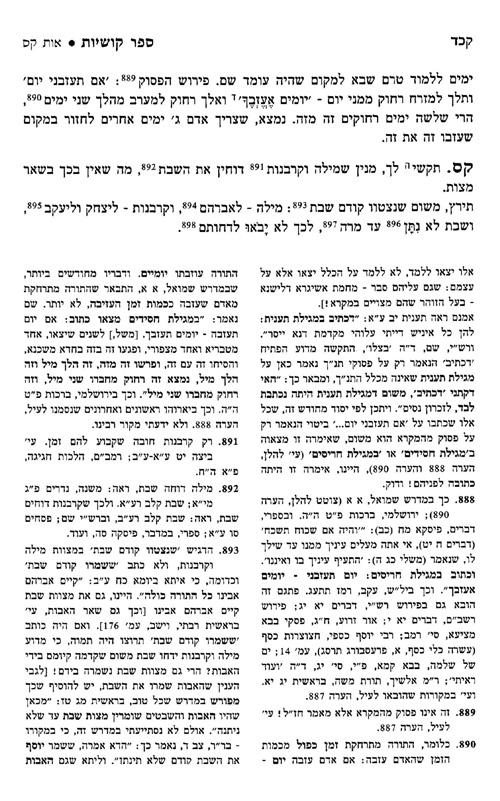
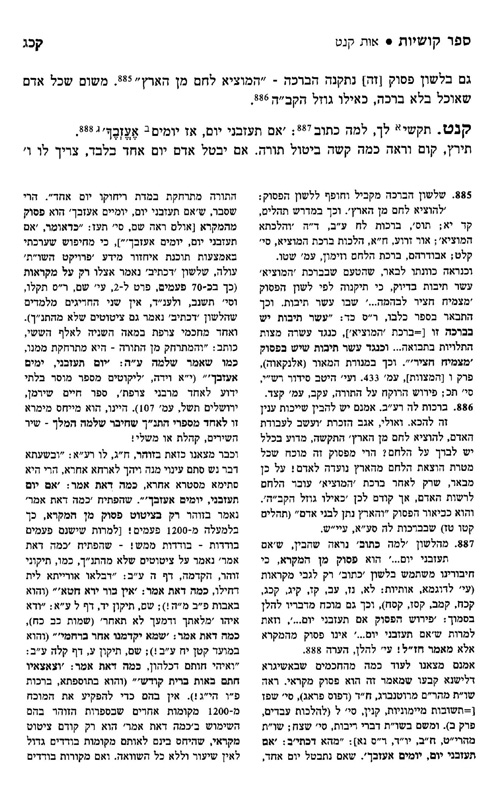
A few years ago the outstanding scholar, R. Yaakov Yisrael Stoll, published the anonymous Sefer Kushyot. Here are pages 123-124.

I ask readers to look at note 887. He discusses a mistake made by many in assuming that an expression is a biblical verse. He then notes that the Zohar also makes the same mistake, and refers to other such mistakes made by בעל הזוהר. He doesn’t say so explicitly, but I think the way he formulates the note lets the reader, who is attuned to these things, know that in his mind בעל הזוהר is not R. Shimon ben Yohai.

Someone called my attention to this video

I have no idea who the speaker is, and if he has ever even read a page of the Zohar, but he does seem very sure of himself. I have no objection to discussing the authorship of the Zohar and the ideas found there, or Kabbalah as a whole. However, I would think that a little humility is called for when discussing a discipline that was a basic part of the religious worldview of so many central figures. Do the names Nahmanides, R. Joseph Karo, or the Vilna Gaon mean anything to this speaker?
In my article, I cited all sorts of texts by Orthodox figures dealing with the authorship of the Zohar. Yet I overlooked the following by R. Joseph Hertz.
The question of the authorship of the Zohar, like that of Sefer Yetzirah, is one of the cruces of Jewish literature. The authorship by Simeon ben Yochai, or by his immediate disciples, though this is still an article of faith with millions of Jews in Eastern Europe, has from internal evidence long proved to be untenable. The Zohar explains Spanish words, contains quotations from Gabirol, and mentions the Crusades.[2]
As noted, in my article cited a number of sources that point to additions to the Zohar. Rabbi Akiva Males commented to me that I neglected to mention R. Isaac Haver, Magen ve-Tzinah, ch. 21. This book was written in response to R. Leon Modena’s Ari Nohem, a work aimed at disproving the antiquity of the Zohar. Unless one’s head is totally in the sand, it is impossible to deny that there are passages in the Zohar that post-date the tannaitic era. For Modena, this was proof that the Zohar could not have been written by Rabbi Shimon ben Yohai. Haver, who wants to hold onto the ancient dating, adopts the only path open to him, arguing that there are indeed many post-tannaitic additions, but the core of the book is ancient.
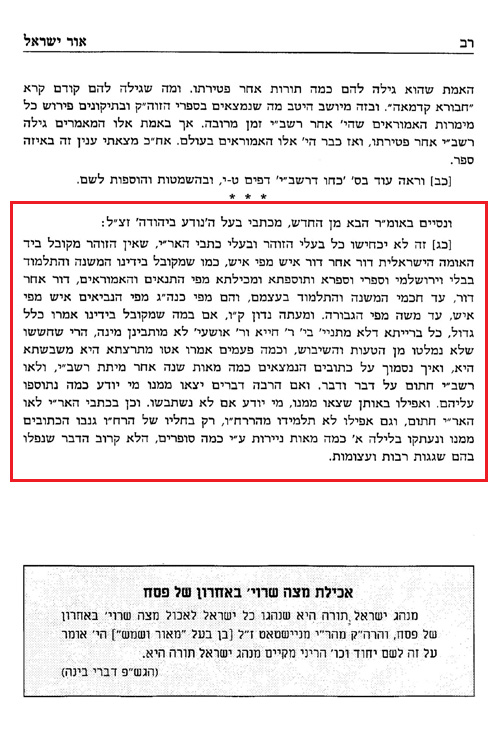
ובאמת ספר הזוהר נכתב כמה דורות אחר רשב”י מה שנכתב ונתקבל משמו ומשאר חבריו ותלמידו שהיו בימיו, וגם זה נעשה בו הוספות רבות עד מאוד מן אחרוני האחרונים אחר שבאו בכתב וניתנו להעתיק ושלטו בו ידי רבים כל אחד מה שנראה בדעתו ומה שנתחדש לו וכתב בגליון על ספר הזוה”ק מן הצד ואח”ז בא ריעהו מעתיק מן המעתיק ומצא בגליון דברים רבים ובמעט התבוננות חשב שזה היה חסרון בגוף ספר והכניסם בפנים.
Haver points out that is how we can explain the obviously late passages, where we see that the Zohar includes material that comes from Rashi and R. Tam. Among kabbalists, it was not unheard of to say that Rashi actually knew the Zohar and was influenced by it.[3] But Haver will have none of this and recognizes that the influence is in the reverse direction, i.e., Rashi influencing the Zohar. He states that anyone who understands the Zohar will recognize these additions.
What does Haver mean when he mentions that there is material from R. Tam in the Zohar? I am aware of one obvious example. It says in Kiddushin 30b that “one should always divide his years into three: [devoting] a third to Mikra, a third to Mishnah, and a third to Talmud.” R. Tam explains why the practice in his day was not in accord with what the Talmud states, an explanation that became very influential and served as a justification for the widespread ignoring of the study of Tanakh in the Ashkenazic world[4]
בלולה במקרא ובמשנה וכו’: פירש רבינו תם דבתלמוד שלנו אנו פוטרין עצמנו ממה שאמרו חכמים לעולם ישלש אדם שנותיו שליש במקרא שליש במשנה שליש בתלמוד.
What he says is that since the Talmud itself contains Bible and Mishnah, there is no need to divide one’s time among the three categories. Rather, by studying Talmud one combines all three areas. I always found this a difficult explanation, for if the Talmud agreed with this perspective, it would have said so, instead of stating that one is to divide one’s time. The intention of the talmudic instruction in Kiddushin was that people become well acquainted with all three subjects, and if they only devote themselves to Talmud, there is a great deal of Bible and Mishnah[5] they will never encounter. (According to Maimonides, Hilkhot Talmud Torah 1:12, once one is already a scholar, he does not need to divide his time between the three areas, but can focus almost entirely on Talmud.)
Despite what R. Tam says, R. Samson Raphael Hirsch claims that it was due to a misunderstanding of this opinion that people were led to stop studying Tanakh.[6] Not mentioned by Hirsch is that even before R. Tam some scholars ignored Tanakh. There were even talmudic Sages who were not expert in Bible. Bava Kamma 54b-55a states:
R. Hanina b. Agil asked R. Hiyya b. Abba: Why in the first Decalogue is there no mention of wellbeing [טוב], whereas in the second Decalogue there is a mention of wellbeing?[7] He replied: While you are asking me why wellbeing is mentioned there, ask me whether wellbeing is in fact mentioned or not, as I do not know whether wellbeing is mentioned there or not.
Tosafot, Bava Batra 113a, s.v. travayhu, cites this text to support its contention about the amoraim: .פעמים  היו שלא היו בקיאין בפסוקין After referring to this strange passage in Tosafot (concerning which there is an entire literature), R. Moses Salmon sarcastically declares[8]: ועל זה סומכים הלומדים עמי הארץ וד”ל
Unlike Salmon, R. Samuel Strashun, in his note to Bava Batra 8a, defended those talmudists who were deficient in knowledge of Bible.
משמע דאפשר שיהיו בעלי משנה או בעלי גמרא ולא בעלי מקרא . . . ודלא כאותן ששופכין בוז על מקצת גדולי זמנינו בש”ס ופוסקים ואין להם יד כ”כ במקרא.
So returning to my question, what does Haver mean when he says that there is material from R. Tam in the Zohar? Well it turns out that R. Tam’s explanation, which we have just been discussing, is also found in the Zohar Hadash (ed. Margaliyot), Tikunim p. 107b:
תקינו רבנן לשלש שנותינו במקרא בתלמוד . . . ואוקמוה דמאן דמתעסק (במשנה) [בתלמוד] כאלו התעסק בכלא בגין דאיהי בלילא במקרא במשנה בתלמוד.
There is no question that this passage is adopted from R. Tam, who lived a millennium after R. Shimon ben Yohai.
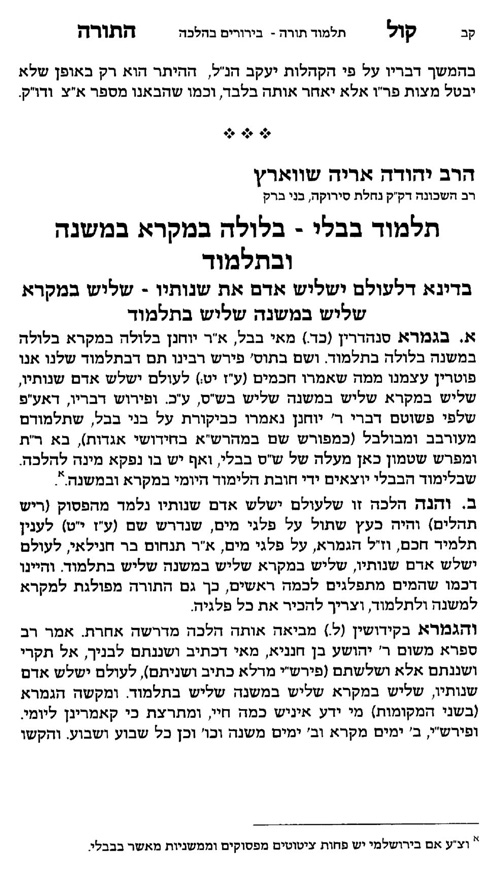
Incidentally, regarding R. Tam’s view, here is a page of an article by R. Yehudah Aryeh Schwartz that appeared in the Agudah journal Kol ha-Torah, Adar 5765 [2005], p. 102 (second pagination).

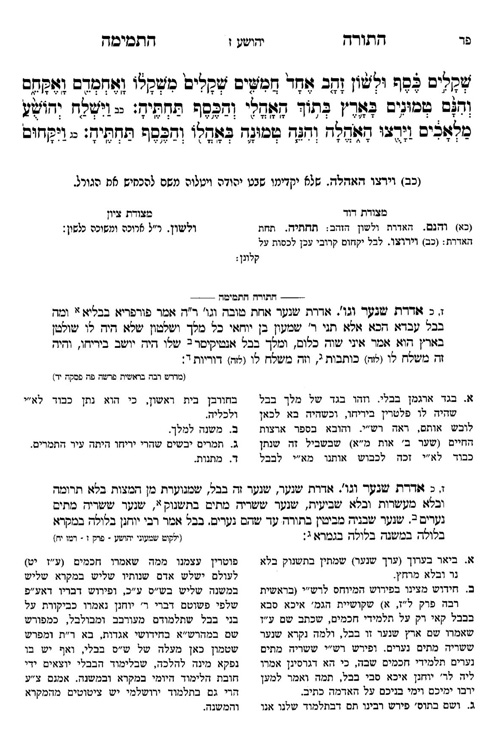
The following page comes from R. Yehiel Michel Stern’s Ha-Torah ha-Temimah on the Book of Joshua, p. 84 no. 3, which appeared in 2009.

As you can see, Stern’s comment is lifted word for word from Schwartz’s article. I am not sure what to make of this. That is, are dealing with a simple plagiarism? Perhaps one of the readers has some insight. (Stern may be the world’s most prolific writer of Torah publications.)

In my article I referred to passages in the Zohar which traditional authorities had claimed were really later interpolations. There are examples of the opposite phenomenon as well, namely, attributing things to the Zohar that are not found there. The most famous instance of this that I know of is found in the Bah, Orah Hayyim 4 (and quoted from there in Be’er Heitev, Orah Hayyim 1:2) that upon waking up if you walk four amot without washing your hands you are subject to the death penalty![9]  This Zoharic text is quoted in the name of the work Tola’at Yaakov, authored by R. Meir Ibn Gabai (1480-ca. 1543). The passage is cited over and over again by aharonim in trying to show the importance of the morning washing. Yalkut Meam Loez, Deut. 4:9, doesn’t even mention the Zohar, stating simply:
ואמרו חז”ל כל המהלך ד’ אמות בלי נטילת ידים חייב מיתה
A few scholars actually point out that this passage is not to be found in the Zohar.[10] One of those who realized this is R. Eleazar Fleckeles, Teshuvah me-Ahavah, vol. 1 no. 14, whom we will come back to later in this post. He writes that he looked in the Zohar and didn’t find the passage referred to. With reference to the Tola’at Yaakov, whom he (falsely) thinks cited the Zohar (since that is what it says in the Bah), Fleckeles writes:
ושארי לי’ מארי’ שעשה רוב ישראל לחייבי מיתות
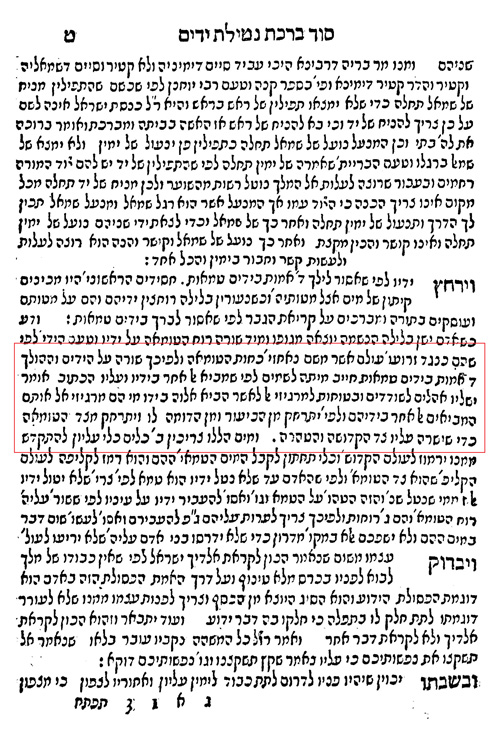
Because very few of the aharonim actually had the sefer Tola’at Yaakov (which is itself a little strange as the book was printed a number of times), they were unable to see that the Tola’at Yaakov never quotes the Zohar!  Here is p. 9a from the Cracow 1581 edition.

If you look in the second paragraph you will see that Ibn Gabai does state that one who doesn’t wash his hands is חייב מיתה, but he doesn’t attribute this to the Zohar. How he derives this idea is worthy of investigation at a different time. For now, it is important to just note that what we have here is an independent idea of a sixteenth-century Kabbalist which for some reason was misquoted by the Bah as if Ibn Gabai was citing the Zohar. This misquotation was to be repeated again and again, down to the present day.

The supposed Zohar text has led to additional stringencies. For example, the hasidic master R. Meshulam Zusha of Anapole stated that that one should not even to put one’s legs on the ground before washing one’s hands.[11]

Here is an interesting story that relates to the false Zohar quotation: A very learned and rich student came to study with R. Simhah Bunim of Peshischa.[12] The problem was that this young man was a bit of an independent thinker, and the Kotzker, who was also there, didn’t think that the young man belonged with them. The story explains how the Kotzker was able to convince the young man to leave. What was it about this man that turned the Kotzker against him? We are told the following:
הוא הגיה בזוה”ק שכתב “ההולך ד’ אמות בלי נטילת ידים חייב מיתה”, והוא הגיה: “והוא שהרג את הנפש”, וזה נגד חז”ל.
So here we have a story of an emendation of a non-existent Zoharic text. And even if we assume that the man was emending the text as it appears in the Bah, we see from the story that the Kotzker thought that the quote was authentic.

I wasn’t sure what to make of this passage. I therefore consulted a learned friend who said that the problem was that the young man who emended the text to read והוא שהרג את הנפש was making a joke at the expense of the (supposed) Zoharic passage. He was saying that you are only deserving of the death penalty if you kill someone while walking the four amot. I then sent him a page from R. Zvi Yavrov, Ma’aseh Ish, vol. 4, p. 113, where it appears that the Hazon Ish took the emendation-explanation just mentioned as an authentic understanding of the passage. The text in Yavrov reads as follows:

על מה שהביא ה”באר היטב” (או”ח סימן א’ סק”ב) שההולך ד’ אמות בלי נטילת ידים שחרית חייב מיתה, אמר רבינו להגאון ר’ שמריהו גריינימן זצ”ל, שמישהו כתב בגליון הספר “והוא שהרג את הנפש” (מבנו הג”ר ברוך שליט”א).

My friend replied by referring me to a discussion on Hyde Park here where the text from Yavrov is also mentioned. One of the commenters there claims that the Hazon Ish was also joking in his remark, and the one who heard this (who was hardly a tyro), or the person who passed on the information to Yavrov, didn’t realize that it was a joke. The commenter also assumes that despite what appears in the Bah and Be’er Heitev, the Hazon Ish would have known that that it wasn’t an authentic quote from the Zohar. I find this very unlikely, as the Hazon Ish is not known to have been an expert in the Zohar, and what reason would there be for him to doubt that which is quoted in numerous earlier sources? 

The one point that the commenter has going for him is that he is correct that there are many examples in this book, and others like it, from which we see that the author does not know how to distinguish between what should and should not be included in a book. The commenter gives an example to illustrate this. In vol. 5, p. 141, Yavrov gives us the following important information about the Hazon Ish, recorded by one of his students: They never saw the Hazon Ish picking his nose! I kid you not.

העיד אחד מגדולי תלמידי רבינו: מעולם לא ראו את הרבי עם אצבע באף (מהרב מרדכי ויספיש)

Regarding this issue, R. Eliezer Melamed – who really is a great halakhic scholar – writes that picking one’s nose in public is forbidden.[13]

ויש מעשים שכשאדם עושה אותם בסתר, אין בכך פגם, אבל בפני אנשים אחרים הם נחשבים למגעילים ואסורים משום ‘בל תשקצו’ ומשום המצוות שבין אדם לחבירו. למשל, המחטט באף או מגרד פצעונים שבפניו, עובר באיסורים אלו. וכן אמרו חכמים (חגיגה ה, א): “כִּי אֶת כָּל מַעֲשֶׂה הָאֱלוֹהִים יָבִא בְמִשְׁפָּט עַל כָּל נֶעְלָם. אמר רב: זה ההורג כינה בפני חבירו ונמאס בה. ושמואל אמר: זה הרק (היורק) בפני חבירו ונמאס בה”. ובמיוחד בעת שאוכלים, צריך להיזהר בכך יותר, כי מעשים מאוסים, וכן דיבורים מגעילים, מבטלים את התיאבון ומעוררים בחילה בקרב הסועדים.
Getting back to the supposed Zoharic passage, R. Yitzhak Abadi discusses this in Or Yitzhak, vol. 1, no. 1. He begins his responsum by pointing out that despite the fact that the Mishnah Berurah records how one is not to walk four amot before washing one’s hands, R. Aaron Kotler did not concern himself with this. Abadi then explains that the words of the Zohar are not intended for everyone,[14] and none of the rishonim write that it is forbidden to walk four amot before washing. He concludes by stating that he is inclined to rule – ולולי דמסתפינא הייתי אומר להלכה למעשה – that the entire practice of negel vasser is no longer relevant to us because ruah ra’ah is no longer a concern.[15] Here again we see that the author of a responsum assumes that the issue he is discussing, of not walking four amot before hand washing, is based on the Zohar, when in fact the Zohar doesn’t mention this at all.

Finally, I must mention that R. Hayyim Joseph David Azulai, Birkei Yosef, Orah Hayyim 1:1, recognizes that there is nothing in the Zohar about being subject to the death penalty for walking four amot. However, he notes that both he and his forefather, R. Abraham Azulai, saw an alternate version which indeed states that one who walks four amot אתחייב מיתא לשמיא. Based on this alternate text, the Hida declares that the Tola’at Yaakov is correct in how he quoted the Zohar, and the criticism of him for the inaccurate quotation is therefore misplaced. Even the Hida didn’t have access to the Tola’at Yaakov, and based on the Bah assumed that the Tola’at Yaakov quoted the Zohar and must indeed have had the alternate text. Yet as we have already seen, the Tola’at Yaakov does not quote the Zohar, and there is no actual alternate version of the text such as quoted by the Hida.

What happened was that someone saw the Bah quoting the Tola’at Yaakov as quoting the Zohar that one who walks four amot is subject to the death penalty. Not finding this passage in the Zohar, this individual inserted it into his text of the Zohar in the section that deals with hand washing in the morning (Zohar, vol. 1 p. 10b). I don’t think this was intended as a forgery. Rather, whoever put it in assumed that it was an authentic Zoharic teaching, found in an alternate text, and he was inserting it where it should be. He thought that it was an authentic Zoharic teaching because the Tola’at Yaakov had testified to it. But as we have already seen, Tola’at Yaakov said nothing of the sort. This alternate girsa can therefore be traced back to the Bah’s misquotation of the Tola’at Yaakov.

How can we explain the Bah? I think the answer is simple. When the Bah cited the Tola’at Yaakov he did not have the book in front of him, and was relying on his memory, the sort of mistake that is found among all of our great sages. That is how this error crept in which has had a great influence on Jewish religious texts and practice for hundreds of years, and yet it all goes back to a simple mistaken quotation.

Returning to my article on the Zohar, Rabbi Akiva Males called my attention to the following paragraphs that appear in an essay by R. Aryeh Kaplan.[16] It would be great if a reader has examined the manuscript and can testify to the accuracy of what Kaplan reported.

Rabbi Yitzchok deMin Acco is known for a number of things. Most questions regarding the authenticity of the Zohar were raised by him, since he investigated its authorship. He was a personal friend of Rabbi Moshe de Leon, who published the Zohar. When questions came up regarding the Zohar’s authenticity, he was the one who investigated, going to the home town of Rabbi Moshe de Leon. The whole story is cited in Sefer HaYuchasin, who abruptly breaks off the story just before Rabbi Yitzchok reaches his final conclusion. Most historians maintain that we do not know Rabbi Yitzchok’s final opinion – but they are wrong.

Around three years ago, someone came to me and asked me to translate parts of a manuscript of Rabbi Yitzchok deMin Acco, known as Otzar HaChaim. There is only one complete copy of this manuscript in the world, and this is in the Guenzberg Collection in the Lenin Library in Moscow. This person got me a complete photocopy of the manuscript and asked me to translate certain sections. I stated that the only condition I would translate the manuscript is if I get to keep the copy. This is how I got my hands on this very rare and important manuscript.

Of course, like every other sefer in my house, it had to be read. It took a while to decipher the handwriting, since it is an ancient script. One of the first things I discovered was that it was written some 20 years after Rabbi Yitzchok investigated the Zohar. He openly, and clearly and unambiguously states that the Zohar was written by Rabbi Shimon bar Yochai. This is something not known to historians, and this is the first time I am discussing it in a public forum. But the fact is that the one person who is historically known to have investigated the authenticity of the Zohar at the time it was first published, unambiguously came to the conclusion that it was an ancient work written by Rabbi Shimon bar Yochai.
Leaving aside for now the important information recorded by Kaplan, there is a good deal that can be said about R. Moses de Leon and the creation of the Zohar, and it is questionable if one can even speak of a single author. One essential point that must be recognized by all who investigate this matter is that De Leon himself was involved in other forgeries, in particular forgeries of geonic responsa.[17] As such, he obviously is not the most reliable source when he announces to the world that he is in possession of a text of mystical lore dating from the tannaitic period.

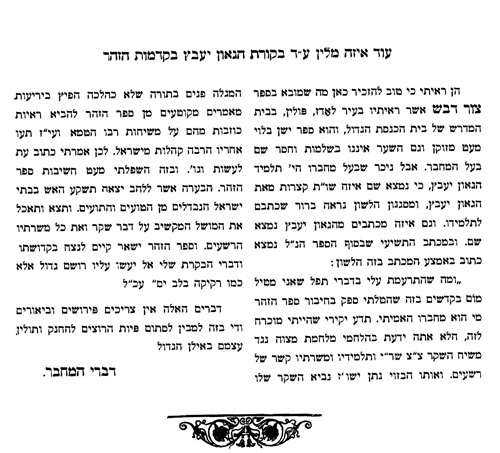
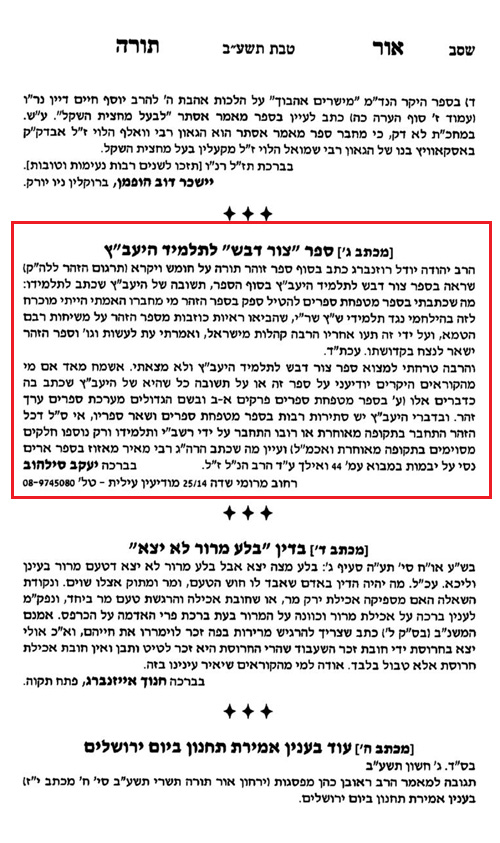
Regarding the Zohar and forgery, I think readers will also find the following interesting.  (Many already know some of the story, but it is worth repeating for those who don’t.) In the journal Or Torah, Tevet 5772, p. 362, a reader, whose knowledge of Jewish bibliography is not that great, had a question. He saw the following page in R. Yudel Rosenberg’s Hebrew translation of the Zohar to Va-Yikra.


This is important information, as Emden confesses that his attack against the Zohar was only designed to pull the wool out from under the Sabbatians, whose ideology was linked to the Zohar. The man who wrote to Or Torah, not knowing anything about Rosenberg, asked for help from the readers. He tried to locate the book Tzur Devash quoted by Rosenberg, but was unable.

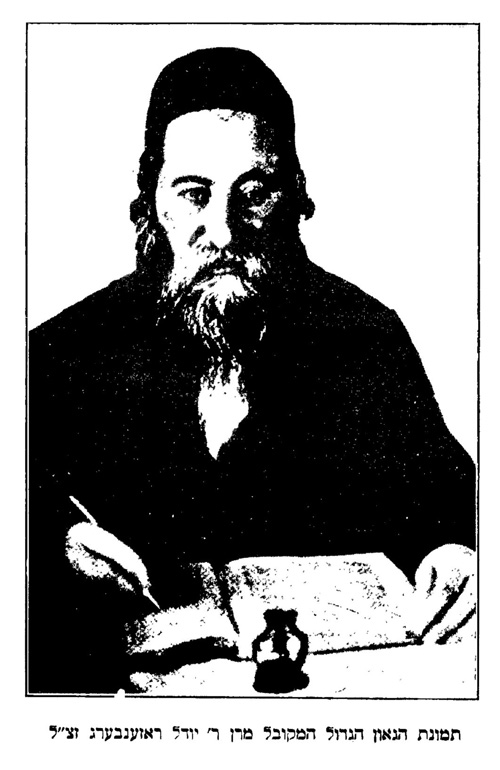
In Or Torah, Adar 5772, pp. 555-557, two individuals let the first writer in on the “not-so-secret” that there is no book Tzur Devash, and that Rosenberg had a long history of making up texts; see here. This is so even though Rosenberg was a respected rabbi and posek. Here, incidentally, is the picture of Rosenberg that appears at the beginning of his Zohar translation.

With some of Rosenberg’s “forgeries”, it seems that what he was doing was creating a form of literature, and anyone who takes the story literally has only himself to blame (much like anyone who thinks that Animal Farm is really about animals has no one to complain to but himself). At times, Rosenberg would even hint to the reader what he was doing, as in Hoshen ha-Mishpat shel ha-Kohen ha-Gadol, where in the preface he mentions that part of the story also appeared in a work of Arthur Conan Doyle. If any reader would have taken the time to find out who this was, he would have realized that we are dealing with a fictional account. At other times, however, Rosenberg offers no such hint, at least none that I am aware of, and what we have appears to be a simple forgery. That would seem to be the case here, with the phony letter from Emden.

The second correspondent in Or Torah also calls attention to R. Yaakov Hayyim Sofer’s discussion in Etz Hayyim 7 (5769), pp. 267-268. While for a long time everyone has known that the Emden letter was a forgery, Sofer identifies another forgery. Rosenberg’s translation (second edition) vol. 1, contains a letter of approbation from R. Hayyim Hezekiah Medini, the Sedei Hemed.[18] Sofer claims, and I think he is correct, that this approbation is a forgery. His prime proof is that in the approbation Medini refers to the Hida as האזולאי. There are many hundreds, if not thousands, of references to the Hida in Medini’s work, and not once does he refer to the Hida as האזולאי, which is a form only used by Ashkenazic rabbis. What Sofer didn’t realize, and further supports his point, is that Rosenberg himself, in his introduction, p. 5a, refers to Hida as האזולאי.

In Or Torah, Iyar 5772, p. 744, another writer called attention to Sedei Hemed, Peat ha-Sadeh, kelalim, mah’arekhet bet, no. 47, where Medini states that it is disrespectful to use this sort of language, referring specifically to the expression האלגאזי.[19] This is another proof, if any was needed, that Medini would never have referred to the Hida as האזולאי. Let me also add that the way Medini (=Rosenberg) concludes the forged haskamah is not like any of his other letters, which are included in Iggerot Sedei Hemed (Bnei Brak, 2006). In the authentic letters, before his name Medini always adds הצב”י or הצעיר , which he does not do in the forged haskamah.. In his authentic letters, he also never closes them by adding to his name רב ומו”ץ בעיר הקדש חברון. Therefore, there can be no doubt that the letter of approbation sent by Medini to Rosenberg is simply another one of the latter’s forgeries.

Now let us turn to the incredible recent publication of a derashah by R. Yehezkel Landau, the Noda bi-Yehudah.[20] But before doing so, it is necessary to say a few words about R. Eleazar Fleckeles, the outstanding student of the Noda bi-Yehudah. (Fleckeles’ grave, entirely ignored by tourists, stands right near that of his teacher.) Ever since the publication over two hundred years ago of the strong comments of Fleckeles downplaying the authority of the Zohar, people have wondered where this came from. It just seemed strange that an 18th-19th century traditional Torah scholar would express himself this way. We now have the answer. Fleckeles was following in his teacher’s footsteps. Thanks to the publication of the Noda bi-Yehudah’s derashah by Michael Silber and Maoz Kahana, a derashah that had previously only appeared in a censored form, we now know that that the Noda bi-Yehudah had a skeptical view of the Zohar, at least in the form that it has come down to us. The issue that the Noda bi-Yehudah was concerned with was the same thing that bothered Emden and Fleckeles, namely, distinguishing the authentic ancient Jewish mysticism from the many later additions that found their way into the Zohar.

What caused the Noda bi-Yehudah in his later years to adopt a skeptical position, one so much at odds with his earlier outlook, is of course worthy of investigation and something for the scholars to fight over (and they already have!).

Regarding Fleckeles, his negative comments about the Zohar that appear in Teshuvah me-Ahavah are well known and have often been cited. In my article I also referred to Fleckeles’ citation of Wessely who quoted R. Jonathan Eibschuetz as supposedly stating that one need not believe in Kabbalah. (Needless to say, it is very difficult to believe that Eibschuetz could have ever expressed himself this way.) In preparing for my Torah in Motion talks on R. Moses Kunitz,[21] I found another relevant text from Fleckeles that as far as I know has gone unnoticed among those who have discussed the matter. It appears in Kunitz’s responsa Ha-Metzaref,[22] which happens to be one of the strangest responsa works ever published. It is also noteworthy in that it contains something extremely rare, namely, a responsum from R. Nathan Adler, the Hatam Sofer’s teacher. Knowing that some people might doubt that the teshuvah could really have been authored by R. Nathan, he also included a letter from the Hatam Sofer testifying to the responsum’s authenticity. 

In Ha-Metzaref, vol. 1 no. 11, Fleckeles again focuses on additions to the Zohar that are not part of the authentic work, but here he adds a new point which is important for an accurate description of Fleckeles’ position. He says that if a Zoharic text is quoted by R. Isaac Luria, R. Moses Cordovero, or R. Menahem Azariah of Fano then you can assume that it is part of the original Zohar, authored by R. Shimon ben Yohai.

One final comment regarding the Noda bi-Yehudah’s derashah: Yehoshua Mondshine somehow got hold of it before it was published by Silber and Kahana. Here is the relevant page, from Or Yisrael, Nisan 5766, p. 202.

Notice how Mondshine doesn’t reveal where this text comes from, something not expected from a careful scholar. Since this is such an amazing passage, and Mondshine’s article was the first time it appeared in print, you can be sure that loads of people must have turned to Mondshine asking him for its source. Presumably, when he was given the text he gave his word not to reveal its source. He might not have even known the source, and was only given the small passage.

2. Due to correspondence with a couple of people, I realized that I forgot to include something about the word מחיה in my last post. So here it is now.

In the Amidah we say מחיה מתים אתה. There is a tzeirei under the yod meaning that this is not a verb. Artscroll correctly translates “Resuscitator of the dead.” Sacks,[23] on the other hand, gives the mistaken translation “You give life to the dead”. The next line reads

מכלכל חיים בחסד, מחיה מתים ברחמים רבים

Is מחיה in this verse a verb? Ifמכלכל  is translated as a verb, then מחיה will also have to be translated this way. The Tehilat ha-Shem siddur has a segol under the yod of מחיה, and with this vocalization it is correct to translate it as a verb. However, for siddurim with a tzeirei the only accurate translation is a noun. Metsudah, which we have seen is consistent in this matter, translates: “Sustainer of the living with Kindliness, Resurrector of the dead with great mercy.” Both Artscroll and Sacks, however, translate מחיה as a verb which is incorrect. But why is it incorrect? It is only incorrect because of the vocalization (tzeirei), but I think that in the sentence מחיה is indeed a verb. This means that it is the vocalization that is incorrect, and that instead of a tzeirei under the yod, there should be a segol, as in the Tehilat ha-Shem siddur[24]. So my recommendation to Artscroll and Sacks would not be to change the translation, but only to change the vocalization.

After reading my last post, Ben Katz sent me an example where of all the translations, only Artscroll gets it right. The last lines of Adon Olam read:
בידו אפקיד רוחי בעת אישן ואעירה
ועם רוחי גויתי ה’ לי ולא אירא

Sacks translates as follows (and Metsudah is similar):

Into His hand my soul I place,
when I awake and when I sleep.
God[25] is with me, I shall not fear;
Body and soul from harm will He keep.
What this means is that God has my soul at all times, when I am awake and when I sleep, and  that that is why I have no fear.

Artscroll translates as follows:

            Into His hand I shall entrust my spirit
            When I go to sleep – and I shall awaken!
            With my spirit shall my body remain.
            Hashem is with me, I shall not fear.
Before getting to what I think is the significant  part of the translation, let us look at the last line: ועם רוחי גויתי, ה’ לי ולא אירא. In his translation, Sacks has turned the order of the sentence around. That is OK as it was done so that the rhyme works (and Sacks deserves enormous credit for having most of the song rhyme in English). The real problem is Sacks’ rendering of the words  ועם רוחי גויתי. There is no way this can be translated as “Body and soul from harm will He keep.” The words imply nothing about keeping from harm. The typical translation sees ועם as referring to God, meaning that God is with my soul and body and therefore I will have no fear.

However, Artscroll gets it right, I think, by translating these words literally: “With my spirit shall my body remain.” To see how Artscroll gets to this translation, we have to look at the previous verse, and that is where we see Artscroll’s brilliance. בידו אפקיד רוחי בעת אישן ואעירה. The other translations understand this to mean that I place my spirit (or soul) in God’s hands when I sleep and when I am awake. The problem with this rendering is that if my spirit is always in God’s hands, then what sense does it make to say that I place it there? If it is always there, during the day and at night, there is nothing for me to place.

Artscroll translates: “Into His hand I shall entrust my spirit when I go to sleep – and I shall awaken!” This is an allusion to the famous Midrash that we are all taught in school, that when you go to sleep your spirit returns to God, and is given back to you in the morning.[26] This isn’t just some random Midrash, but is derived from Psalm 31:6, which states: בידך אפקיד רוחי.[27] In other words, the Midrash is commenting on the exact words used by Adon Olam. This shows that Artscroll’s translation has indeed beautifully captured the correct meaning.

We now can properly understand the next verse. Since my spirit has returned and joined with my body, I know that God is with me and I shall not fear.

3. There is a relatively new publication for all who are interested in Jewish intellectual life. I refer to the Jewish Review of Books, expertly edited by Abraham Socher. Modeled after the New York Review of Books, each issue is full of great material. In the latest issue I published a translation of part of an essay by R. Jehiel Jacob Weinberg on Berdyczewski. Only subscribers can access the essay, but everyone can see the artwork that went along with it. See here. (Due to copyright restrictions, I can’t reproduce the artwork in the post.)

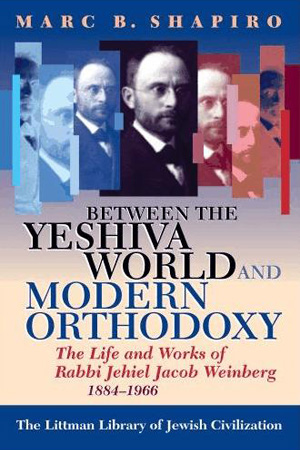
If you examine the picture of Weinberg produced by the artist, you will see that it was modeled after this picture that appears in my book on Weinberg, and also on the front cover of the soft-cover edition.


The original photograph was part of a faculty picture taken when Weinberg taught at the University of Giessen. However, the artistic reproduction adds something that is not found in the original, something that the artist assumed no rabbi should be without; see here.

4. Those outside of the United States who want to post (or read) comments, please access the Seforim Blog site by going to http://seforim.blogspot.com/ncr.  Only by doing this will you be taken to the main site (and not have a country code in the URL). Readers outside the United States do not have access to the comments posted in the U.S. We don’t know why this is, or how to fix it yet, but the above instruction fixes the matter.

* * * *
Quiz

I have an extra copy of one of the volumes of R. Hayyim Hirschensohn’s commentary on Rashi. The person who answers the following question will receive it. Send answers to me at shapirom2 at scranton.edu

1. Tell me the only place in the Shulhan Arukh where R. Joseph Karo mentions a kabbalistic concept? I am referring to an actual concept e.g., Adam Kadmon, Ein Sof, etc.

2. If more than one person answers the above question correctly, the one who answers the following (not related to seforim) will win: Which is the only United States embassy that has a kosher kitchen?

If no one can answer question no. 2, I will do a lottery with the names of those who answer no. 1 correctly.

[1] R. Moshe Zuriel kindly sent me the following additional sources that should be added to my list.

[א] ספר “אור החמה”, ביאור בשלשה כרכים על הזוהר, נלקט ע”י הרב אברהם אזולאי, מביא דברי ר’ אברהם גלאנטי שם על זהר ח”א קסח, והוא בנדפס דף קנט ע”א ראש טור שמאל, “הם דברי מחבר הספר בימי הגאונים או חכמים אחרים שחברו כל המימרות יחד שכתב ר’ אבא, שהיה סופר של רשב”י והם חלקום לפרשיות כל פסוק בפרשה שלו, והם אמרו משלהם”.
[ב] בפירוש ר’ יוסף חיים מבבל (בן איש חי) בשם “בניהו” (דף ד ע”ב בנדפס) פירוש על תיקוני זהר, בתחילת ההקדמה לתקו”ז (ב ע”ב) מזכיר “ועל האי ציפור רמיזו רבנן בהגדה דבתרא דרבה בר בר חנה” כותב הרב: “נראה פשוט בספר בתקונים הראשון אשר הועתק מכתיבת יד חכמי הזוהר כך כתוב ‘קא רמיזו רבנן’ וכו’ אך חכם אחרון שראה דבר זה כתוב בגמרא דבתרא במאמרי רבב”ח הוסיף על הגליון תיבות אלו בהגדה דבתרא דרבב”ח וכו’ ואחר כמה שנים המדפיסים הכניסו בפנים מה שראו כתוב בגליון. ועל חינם הגאון יעב”ץ הרעיש העולם לערער בדבר זה וכיוצא בו”.
[ג] אדמו”ר ר’ יצחק אייזיק קומרנא בספרו “נתיב מצותיך” שביל התורה אלף, מהד’ שנת תש”ל עמ’ קא  כתב: “ור’ אבא היה כותב כל מה ששמע, הן ממנו הן מהחברים וכו’ בסוף ימי רבנן סבוראי תחילת הגאונים היה איש קדוש אאחד שהיה בו נשמת משה רבנו ממש וכו’ וכו’ והוא חיבר ספר רעיא מהימנא וקרא לזוהר חיבורא קדמאה”.
[ד] ר’ צבי אלימלך (מחבר בני יששכר) בספרו “הגהות מהרצ”א” (נמצא בתוכנת אוצר החכמה) על פרשת בא לח ע”א (בנדפס בספר שם דף קכו) כותב: “לפי גירסא הזו ע”כ [על כרחך] צ”ל דהזהר נתחבר בג”ע [בגן עדן] בזמן הגאונים, דהרי רב חסדא אמורא היה בזמן האמוראים” עכ”ל.
[ה] הרב אברהם יצחק קוק, מאמרי הראי”ה, עמ’ 519: מתוך מכתב להרב קאפח: “אפילו אם נשתלשלו דורות רבים והיו בהם הוספות והערות מחכמים שונים, ואם אפילו נתערבו בהם איזה דברים שראויים לביקורת, כמו שעשה הגאון יעב”ץ במטפחתו, אין העיקר בטל בכך”.
[2] Sermons, Addresses and Studies, vol. 3 p. 308. I learnt of this passage from Ben Elton, Britain’s Chief Rabbis and the Religious Character of Anglo-Jewry, 1880-1970, p. 176.
[3] See Studies in Maimonides and his Interpreters, p. 89 n. 376, where I mention that R. Abraham ben ha-Gra, who (for his time) had a critical sense, was among those who thought that Rashi knew the Zohar.
[4] Tosafot, Sanhedrin 24a s.v. belulah. The uncensored text, found in the Venice edition, reads בתלמוד, but the Vilna edition has בש”ס.
[5] Since the Daf Yomi siyum is just about upon us as I write these words, let me add the following: While I don’t think that R. Joseph B. Soloveitchik can be called an opponent of Daf Yomi, I was present at a shiur in the summer of 1985 where he expressed his dismay that due to the growing popularity of Daf Yomi, people were no longer studying all six orders of the Mishnah, much of which has no Talmud and is thus not included in the Daf Yomi cycle. (Due to how the Talmud was printed, Kinnim and Middot are the only tractates of Mishnah included in Daf Yomi. )
[6] Nineteen Letters, Letter Eighteen.
[7] See Deut. 5:15: כבד את אביך ואת אמך כאשר צוה ה’ אלקיך למען יאריכן ימיך ולמען ייטב לך על האדמה אשר ה’ אלקיך נתן לך
R. Samuel Schonblum offers an explanation of the talmudic passage that many will no doubt claim attributes a heretical assumption to one of the Sages. See his edition of R. Isaac Ibn Latif, Rav Pealim (Lemberg, 1885), p. 54:
כפי השקפה הראשונה נוכל לומר כי השנוים שבדברות האחרונות משה אמרן מדעת עצמו כמ”ש הראב”ע ז”ל כמוסיף וגורע ואפשר לומר כי לא נאמר טוב בסיני כלל ע”כ כאשר שאל לו מ”מ [מפני מה] בראשונות לא נאמר טוב ובאחרונות נאמר טוב השיב לו שאלני אם נאמר טוב אם לאו, שאפשר שגם באחרונות לא נאמר טוב כך משה הוסיף או גורע עד שבא לר’ תנחום בר חנילאי ואמר לו כי באמת נאמרו כך בסיני ע”י משה וזה שלא נכתבו על הלוחות הראשונות יען כי היו עתידין להשתבר ע”כ לא נאמר ע”י הדיבור הנעלם רק ע”י משה, ה’ יראני מתורתו נפלאות.
In Limits of Orthodox Theology, I did not discuss the commentary of Ibn Ezra (Ex 20:1) referred to by Schonblum. That is because I assumed that he agreed with the standard medieval view that even though Moses may have written things on his own accord, when these texts were later included as part of the Torah given to the Children of Israel, this was done at God’s direction and that is what sanctified the text. I am no longer convinced of this. All Ibn Ezra says in his commentary to Ex. 20:1 is that minor variations in wording are due to Moses changing God’s original words. Nowhere in his commentary does Ibn Ezra state that Moses’ changes were ever given divine sanction.
[8] Netiv Shalom (Budapest, 1898), p. 33.
[9] I wonder if this exaggeration is related to the seeming exaggerations found in Sotah 4b regarding those who are not careful with netilat yadayim:  כל האוכל לחם בלא נטילת ידים כאילו בא על אשה זונה . . . כל המזלזל בנטילת ידים נעקר מן העולם  See also Yalkut Shimoni, Ki Tisa, no. 386:  כל האוכל בלא נטילת ידים כבא על אשת איש (I say “seeming” exaggerations, because maybe these are not exaggerations. See the story with R. Akiva in Eruvin 21b.) Why were the Sages so strident in this matter? After citing the two rabbinic passages just mentioned, R. Zvi Hirsch Chajes points to an anti-Christian motivation. See Kol Sifrei Maharatz Chajes, p. 1003:
והטעם שהחמירו חז”ל בזה, דענין נטילת ידים הוא הענין הראשון אשר זלזל בו המחוקק לנוצרים, כמבואר בספריהם דשאלו אותו מדוע תלמידיו אוכלים בלי נטילת ידים והשיב מה שיצא מן הפה הוא טמא ומה שהולך לפה הוא טהור, ומפני זה למען לא יהיה לנו השתוות עמהם, החמירו בנטילת ידים, דהמזלזל בזה הוי כמודה להם.
See R. Mordechai Fogelman, Beit Mordechai, part 2, no. 15:2 (p. 224), who uses the Christian angle to explain another talmudic passage dealing with washing of hands. (Those who have read R. Israel Meir Lau’s wonderful autobiography will recognize Fogelman’s name.) See also Abraham Buechler, Am ha-Aretz ha-Gellili, ch. 4.
[10] See e.g., R. Pinchas of Koretz, Imrei Pinhas ha-Shalem (Bnei Brak, 2003), p. 209:
מה שכתב הבאר היטב (או”ח א, ס”ק ב) בשם תולעת יעקב בשם הזוהר, ההולך ארבע אמות בלי נטילת ידים חייב מיתה, הקפיד מאד הרב ז”ל על זה, שאינו בזוהר כלל, וגם במגן אברהם (או”ח ד, א) ובתולעת יעקב עצמו לא כתב בשם הזוהר רק דעת עצמו.
[11] See R. Zvi Elimelech of Dinov, Igra de-Firka, no. 9.
[12] See Menachem Yehudah Baum, Ha-Rabbi Rabbi Bunim mi-Peshischa (Bnei Brak, 1997), vol. 1, p. 212.
[13] See here.

See also R. Shmuel Eliyahu’s responsum on the topic here, R. Yaakov Peretz, Emet le-Yaakov (Jerusalem, 1979), p. 29, and R. Moshe Zuriel, Tziyon be-Mishpat Tipadeh (Bnei Brak, 2007), pp. 107-108. The section in Zuriel’s book is entitled
                               
 בענין הנוהג הנפסד של חיטוט באף ובאוזן, בעת לימוד תורה והתפילה
There might even be enough material for a booklet dealing with the halakhot related to picking one’s nose. I know some of you are laughing right now, but I am entirely serious. See also R. Israel Pesah Feinhandler, Avnei Yoshpeh, vol. 5, Orah Hayyim no. 71, who discusses if it is permissible to pick one’s nose on Shabbat.

See also R. Ovadiah Yosef, Yabia Omer, vol. 5, Orah Hayyim no. 30:

ואתה תחזה שע”פ האמור יש להעיר עמ”ש הגאון מהר”ח פלאג’י בס’ רוח חיים (סי’ שכא סק”ב וסי’ שמ סק”א), ובס’ כף החיים (סי’ ל אות קה), שיש להזהיר לאלה שמקנחים צואת החוטם (ובפרט כשהיא יבשה), שתולשים עי”ז כמה שערות, ואע”ג דדבר שאינו מתכוין מותר, היכא דפסיק רישיה יש להחמיר

There is also the issue of phlegm and hatzitzah that has been dealt with by many. It is interesting that halakhic sources regard putting one’s finger in one’s ear the same way as in one’s nose (e.g., in discussing if you have to wash your hands after this), while contemporary mores sees the latter as being in much poorer taste.

While on the topic of unusual halakhic subjects, let me call attention to a new book by the young scholar R. Yissachar Hoffman, from whom I have learnt a great deal. It focuses on sneezing. In his approbation, R. Gavriel Zinner writes: ראינו חשיבות התורה שיכולים מכל ענין לעשות ספר שלם

Here is the title page.

[14] I heard from a former student of the Lakewood yeshiva that someone once challenged one of R. Abadi’s pesakim by pointing out that the Mishnah Berurah stated that a “ba’al nefesh” should be stringent in the matter. Abadi replied that in the entire yeshiva, of which he was the official posek, maybe there were four people who would fall into the category of what the Mishnah Berurah designates a “ba’al nefesh”.

[15] I asked R. Yehudah Herzl Henkin the following question: Would you have any hesitation telling someone who didn’t believe in demons that it’s OK to only wash one time in the morning, in accordance with the Rambam’s opinion?
He replied:
“I don’t think ruach ra’ah has any operative role nowadays, either, but I hesitate to encourage the abandonment of accepted practices particularly when they are innocuous (as opposed, say, to doing kaparot with a live chicken). There is something to be said for doing what klal Yisrael does even if one doesn’t believe in the activity. That being said, yes, certainly, if the person is bothered about it to that extent, tell him to follow the Rambam.”
Another posek wrote to me: “These are in my view simply matters of minhag yisrael, and not subject to psak in the classical sense of the word. There are questions of minhag ha’avot and the like – but in the end, I do not sense that one would be sinning if one washed only once.”
[16] “The Age of the Universe:  A Torah True Perspective,” pp. 17-18, available here.
[17] See Elliot R. Wolfson, “Hai Gaon’s Letter and Commentary on Aleynu: Further Evidence of Moses de León’s Pseudepigraphic Activity,” JQR 81 (1991), pp. 365-409; and the sources cited by Shmuel Glick, Eshnav le-Sifrut ha-Teshuvot (New York, 2012), pp. 237-238. Meir Bar-Ilan sugests that the Zohar is the first example of what would later become a common practice: the creation of a forgery by attributing one’s own work to an ancient manuscript. In earlier times, pseudepigraphical works made no such claims. See “Niflaot Rabbi Yehudah Yudel Rosenberg,” Alei Sefer 19 (2001), available here
[18] Sofer didn’t realize that the Medini approbation is also found in the first edition, published in 1906.
[19] Medini also says that he will not mention the name of the rabbi who used this expression. Regarding whom he had in mind, see R. Yaakov Hayyim Sofer in Moriah, Av 5769, pp. 143-144. Despite Medini’s feeling, the expression האלגאזי does appear in numerous rabbinic texts.
[20] All bibliographical information for sources cited in this paragraph is found in my article.
[21] Torah in Motion how has a great deal. For only $10.99 you can get a silver membership (good for one month) that allows unlimited access to recorded lectures. See here.
[22] Some have mistakenly transliterated the title as Ha-Matzref. On the title page itself it is spelled in Latin letters Hamzaref; see here.
[23] Regarding the Sacks siddur, I recommend that all listen to the wonderful dialogue between Rabbi Sacks and Leon Wieseltier available here.

I have to say, however, that I was surprised to hear Sacks say at minute 49: “There is no doubt that the actual construction of the Temple was an extraordinarily disastrous moment for the Jewish people.” He then discusses how Solomon, in order to build the Temple, used force labor and thus “turned Israel into Egypt.” What surprises me is that I know of no other Orthodox thinker who sees the building of the Temple as a negative development in Jewish history. Nor, for that matter, have I ever seen an Orthodox thinker read the Bible as criticizing Solomon for this endeavor. If the construction of the Temple was such a negative event, then why on Tisha be-Av are we supposed to mourn its absence?
[24] On my recent trip to Italy, I learnt that the Italian nusah also always puts a segol under the yod of מחיה.
[25] Sacks does not consistently translate ה’ as “Lord”. Metsudah actually translates it as “A-donay”, which I have never seen before.
[26] This is also the meaning of the blessing המחזיר נשמות לפגרים מתים . A similar concept is found among Christians. I am sure many are aware of the Christian prayer recited by children
Now I lay me down to sleep,
I pray the Lord my soul to keep,
If I shall die before I wake,
I pray the Lord my soul to take. Amen.
[27] Midrash Tehillim (ed. Buber), 252::
זהו שאמר הכתוב: ‘בידך אפקיד רוחי’ . . . וכשהוא ישן הוא יגע, ומשלים [ומשליש?] נפשו ונפקדת ביד הקב”ה, ולשחרית היא חוזרת לגופו בריאה חדשה, שנאמר ‘חדשים לבקרים רבה אמונתך’.
See also Devarim Rabbah 5:14
והן ישנים וכל הנפשות עולות אצלו, מנין, שנאמר ‘אשר בידו נפש כל כי’, ובבקר הוא מחזיר לכאו”א נשמתו, מנין, שנאמר ‘נותן נשמה לעם עליה’.
Bereshit Rabbah 78:1 (parallel text in Eikhah Rabbah 3:21) states:
על שאתה מחדשנו בכל בקר ובקר אנו יודעין שאמונתך רבה להחיות לנו את המתים.
See also Tosafot, Berakhot 12a s.v. le-hagid.


A Flat or Round Earth and the Zohar

The Babylonian Talmud (“BT”) clearly held the Earth was flat. R. Azariah de Rossi, in his Me’or Enayim devotes more or less a chapter to understanding the view of the BT on this issue.

De Rossi explains that there a various passages in the BT which assume a flat earth. For instance, De Rossi quotes the BT Baba Basra “the world is like an exadera [three sides are closed] and the north side is open. When the sun reaches the nothwestern side, it bends back and goes above the sky.” De Rossi explains that “anybody who understands this passage correctly realizes that . . . the sun’s circuit is not from above to below . . . and they agree that the nightly darkness is not caused by the sun being at that time below the horizon . . . this is all calcluated on the basis that the earth is flat and that the heavens only cover it like a roof of the exadera.”

De Rossi after noting that this opinion is pervasive in the BT, it is based upon the understanding of some at the time the BT was complied. He explains, however, that if “the sages of blessed memory who believed that the world was flat . . . been informed of what has become known in our times, namely, how the Spaniards . . . discovered the New World in the Northern Hemisphere where the inhabitants have their rest opposite the place where we put our feet. And the same is true of the place under the equator and also beyond it to the south above and below. With one voice [the sages] would have acknowledged that the earth was spherical.”

This last line, of course, was in part why De’ Rossi was controversial. By claiming Hazal based some of their statements upon the science of the day and that had they been exposed to what we now know would have changed their minds was, and continues to be a touchy subject.

But to return to our topic at hand – the flat earth – De Rossi points out that although the BT held the earth was flat not everyone at the time agreed. Specifically, he notes that the Jerusalem Talmud as well as Berashis Rabba seem to imply the earth is round. Additionally, the Zohar states the earth is round. It is this last source, however, which is somewhat problematic. Assuming the BT held the earth was flat and that appears to have been the prevailing attitude, why then would the Zohar disagree. R. Jacob Emden used this passage in the Zohar as one of the many which points to a later dating of when the Zohar was written. R. Emden states succinctly “this opinion is not one shared by Hazal and instead comes from later science.” Thus, according to R. Emden, the fact the Zohar assumes the earth is round lends itself to the notion it could not have been written (at least this part) by R. Shimon bar Yochi.

R. Emden’s challenge of the Zohar was not left unrebutted. R. Moshe Kunits in his Ben Yochi which is devoted to rebutting R. Emden, attacks this statement of R. Emden. Although he attempts to refute R. Emden, one who is aware of the above discussion, realizes how hollow R. Kunits’ argument is. R. Kunits agrees that the BT assumes a flat earth, but then he cites the two sources which do go with the round earth -Jerusalem Talmud and Berashis Rabba. In essence, Kunits is merely regurgitating De Rossi’s sources. In fact, he cites De Rossi as being one who demonstrates that Hazal held the earth was in fact round. Of course, De Rossi’s only sources were the Zohar and the others cited by Kunits. Thus, in the end, Kunits’ arguments are circular. This fallacy is noted by R. Shlomo Yehudah Rappoport in his book to rebut Kunits – Nahlat Yehuda.

Finally, it appears that the idea of a flat earth persisted until at least the 18th century (and if the recently published book, Afeki Mayim, is an indication even until the 21st century). The person in the 18th century to follow this view is a rather surprising one in light of how knowledgable he supposedly was in secular wisdom (at least according to some). The Vilna Gaon is recorded as stating the earth must be flat in order to properly understand the verse in Job (38:13) “that it might take hold of the ends of the earth.”

Sources: De’ Rossi, Meor Einayim (ed. Weinberg) Imrei Binah, Section 1 chap. 11. Zohar, Vaikra, 10a; R. Jacob Emden, Mitpahat Sefarim; R. Shlomo Yehudah Rappoport, Nahlat Yehuda (Lemberg, 1873); R. Kunits, Ben Yochi. On the Vilna Gaon, see R. Y. Engel, Gilyoni HaShas, Shabbat, 74a and R. Reuven Margulies, Nitzozi Ohr on the Zohar cited above.