From Print to Pixel: Digital Editions of the Talmud Bavli

From Print to Pixel: Digital Editions of the Talmud Bavli

Ezra Brand

Ezra Brand is an independent researcher who resides in Tel Aviv. He has an MA from Revel Graduate School at Yeshiva University in Medieval Jewish History, and has studied in the Talmud Department of Bar-Ilan University. He has contributed a number of times previously to the Seforim Blog (tag), and a selection of his research can be found at his Substack blog. His most recent major work is a “Guide to Online Resources for Scholarly Jewish Study and Research”. He is currently working on an overview of names and naming in early Jewish literature. He can be reached at ezrabrand@gmail.com; any and all feedback is greatly appreciated.

Intro – the tzurat hadaf[1]

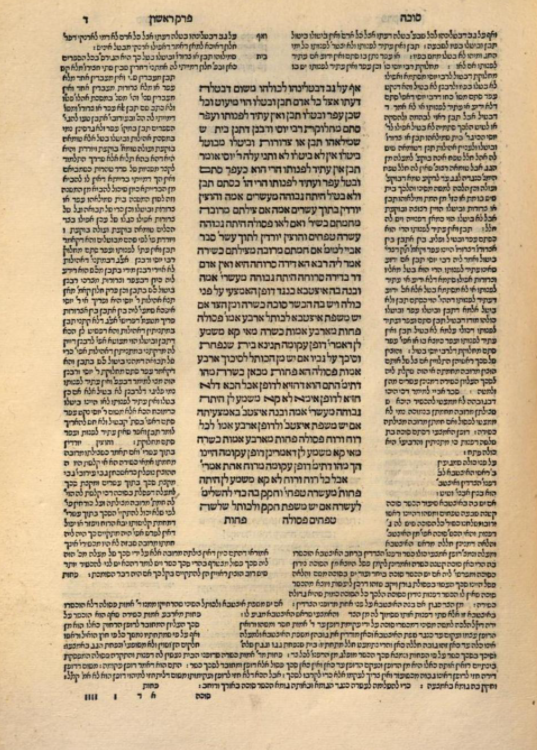
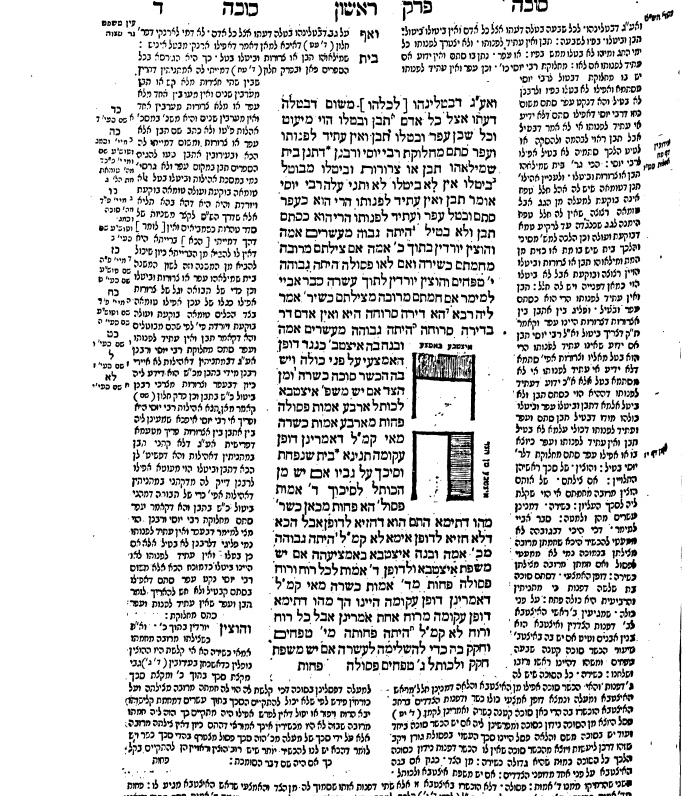
It is a surprising fact that despite incredible advancements in technology, the layout of the Talmud has remained the same for centuries. The Bomberg edition from the 16th century, a groundbreaking achievement, still sets the standard. Yoel Finkelman writes in his recent, impressive overview of the layout of the printed Talmudic page:[2] “What is remarkable about the Gemara’s mise-en-page (the term for tzurat ha-daf in the academy) is not its invention, but its staying power as the normative way to produce texts of the Talmud.”[3] Finkelman then delves into the “history of the tzurat ha-daf of the Gemara.”

For an illustration of the lengths to which traditional publishers have gone to preserve the traditional tzurat hadaf, even in the 21st century, see Elli Fischer and Shai Secunda’s 2012 review article of the then-just-released “Artscroll Digital Library Schottenstein Talmud (English) App”, for the iPad:[4]

Since this elucidation is significantly longer than (and, in fact, already includes the actual text of) the Hebrew/Aramaic original, each Vilna page ends up being reproduced two to five times for every English page (a grey bar shows the reader which segment of the Vilna corresponds to the facing elucidation). This decision, both brilliant and perverse, added well over 10,000 pages, bringing the entire series to 73 volumes. The perversity of adding 10,000 apparently superfluous pages is obvious, but the brilliance of the decision was that it always kept the “original” page before the reader.

The digital daf

At the outset, Finkelman (in the above-mentioned article) highlights that the material manifestation of the written word can be broadly attributed to three factors: 1) The technological and material resources that are utilized to create and disseminate texts, 2) The economic and market forces that influence the demand for knowledge and education, and 3) The cultural perceptions of the role and function of language.[5] The ongoing decline in printing costs during the 20th and 21st centuries, coupled with the increasing accessibility of education, have led to significant advancements in all these factors.[6]

The advent of the internet has opened up entirely new avenues for publishing and designing the daf. Furthermore, for the very first time, readers have the opportunity to customize their reading experience, tailoring it to their unique preferences.

One popular author writes:[7]

“After more than a thousand years as the world’s most important form of written record, the book as we know it faces an unknown future. Just as paper superseded parchment, movable type put scribes out of a job, and the codex, or paged book, overtook the papyrus scroll, so computers and electronic books threaten the very existence of the physical book.”

However, one could plausibly say that the claim of the death of books has been greatly exaggerated. Physical books continue to be highly popular, and their sale has only continued to grow. And Orthodox Jews have yet an additional incentive to continue to buy physical books, as they can’t use ebooks on Shabbat and Chag. Regardless, there’s no question that we are in the middle of a decades-long revolution in how we have the ability to consume text, if one so chooses.

Despite the vast technological advancements that have revolutionized publishing, the digital daf is a peculiar return to pre-printing press methods in at least one regard: nowadays, the Talmud can be studied in isolation, without the surrounding commentaries. Most of the layouts that will be examined below diverge from the traditional tzurat hadaf that has been preserved for more than four centuries. In this way, they resemble the medieval Talmudic manuscripts, which include only the Talmud itself (sometimes accompanied by Rashi’s commentary).[8]

Let’s turn our attention to another aspect that Finkelman highlights: the groundbreaking nature of implementing a universal pagination system. Bomberg himself astutely utilized pagination and indexing as a key selling point.[9] Similarly, one of the numerous revolutionary features of digital editions such as Sefaria and Al-HaTorah is the capacity to reference not only the daf and amud, but also the section number. (I’ll explain the specific details of this later in this piece.) One can cite using section number, and hyperlink directly to that section. Every amud has around 10-15 sections, so this narrowing down is considerable. Even without reference to a specific section, checking a reference is far easier in a digital edition: with a simple “control + f”, one can search for a word from the quote. Gone are the frustrating days of scanning a giant wall of text in an amud to find a quote.

What will be discussed in this review

My focus here will be on modern editions that are available open-access digitally, online.[10] Therefore, I won’t review modern print editions.[11] I will also not review digital editions that, in my opinion, are inferior in every way to the editions discussed here.[12] And I won’t discuss editions targeted towards beginner students.[13]

As one of the resources exclusively pertains to Kiddushin (Katz’s Mahberot Menahmiyot), my sample will be from Tractate Kiddushin, specifically Kid. 2b, which solely features the Gemara without the Mishnah. Images will only be of Gemara, Rashi, and Tosafot, meaning that, I will exclude the surrounding glosses (Mesoret HaShas, etc). I will not be discussing supplementary texts and commentaries, and hyperlinks to outside sources that each has.[14] I will be discussing different customization and viewing options.

Another caveat: This piece is focused on layout, and so it will not discuss the textual accuracy of the editions.[15]

An interesting element of modern editions is the typography; specifically the choices of font. However, this will not be discussed here.[16]

Outline

Intro – the tzurat hadaf 1
The digital daf 2
What will be discussed in this review 4
Outline 5
Tzurat hadaf AND customizable 6
Mercava 6
Shitufta 7
Static PDF 9
Mahberot Menahmiyot (=MM) 9
Gemara Sedura HaMeir 10
Talmud HaIgud – Society for the Interpretation of the Talmud (האיגוד לפרשנות התלמוד) 12
Digital, not customizable 14
Wikisource 14
Pirkei Talmud Me’utzavim – R’ Dan Be’eri 15
Talmud Or Meir 18
Dicta 19
Digital and customizable 20
Sefaria 20
Al-Hatorah 22
Speculation on the future 24
Concluding Thought 27

Tzurat hadaf AND customizable

Mercava

At present, Mercava contains only Tractate Berachot. It includes a menu option that enables users to toggle punctuation and nikud. It is also worth noting that Mercava is presently in beta version, as stated explicitly by the page header. Many of the menu options are grayed out or non-functional, resulting in a suboptimal user experience. Often, it seems that two features cannot be employed simultaneously, without any discernible explanation.

Shitufta

Quite basic. It has section splits, which are the same as those of Sefaria and Al-Hatorah.[17] Like them, it enables linking to a specific section. However, it diverges from the section numbering in Sefaria and Al-Hatorah by commencing from 0 instead of 1, resulting in all section numbers in Shitufta being one less from those of Sefaria and Al-Hatorah.

Static PDF

Mahberot Menahmiyot (=MM)[18]

By Prof. Menachem Katz.

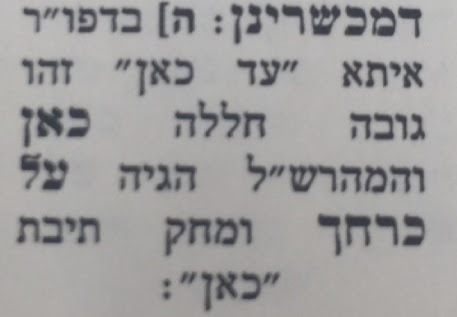
Image of Talmud text, from p. 3, line # 7:

MM is a static PDF. It divides every sentence into a separate line, as opposed to splitting into larger blocks of sections. The lines are numbered. It offers complete punctuation, without nikud.[19] MM displays citations for biblical verses, Mishnah, and Tosefta, as well as additional features discussed in the introduction.

Gemara Sedura HaMeir [20]

With punctuation, and split by line.

Talmud HaIgud – Society for the Interpretation of the Talmud (האיגוד לפרשנות התלמוד) [21]

The text is split into lines and numbered, similar to MM. Due to the nature of the work, the primary purpose of the Talmudic text in the Talmud HaIgud is not for its own sake, but to serve as a basis for subsequent commentary.

Digital, not customizable

Wikisource[22]

The crowd-sourced Wikisource is a sister-project of Wikipedia. It is replete with hyperlinks to primary sources, and to external secondary sources. Like MM, the text contains punctuation but not nikud. Instead of using numbered sections (like Sefaria and Al-Hatorah) or lines (like MM), the text is divided into unnumbered paragraphs. Moreover, these paragraphs are longer than those found in Sefaria and Al-Hatorah.

Pirkei Talmud Me’utzavim – R’ Dan Be’eri[23] [24]

Available as downloaded Word docs, from the Da’at website, for a few chapters. I consider this to be not customizable.[25] Has nikud, punctuation, and is split into numbered lines.

Talmud Or Meir

Has nikud, punctuation, and is split into numbered lines. While there are technically some customization options available, they are limited in scope.[26]

Dicta

Dicta has a suite of powerful tools, which combined could make for an incredible studying experience. These include automated tools for nikud and for Biblical sources.[27] Unfortunately, at this time it appears that the only way to view a passage of Talmud is via search results. There, a link is offered to the page in Sefaria. There is a section called Library, with powerful tools for reading rabbinic works, but only 300 works are currently offered there.[28]

Here’s a screenshot, of what appears after searching the first words of Kidushin 2b (“אי נמי שדות בכסף יקנו”), opening the first result, and scrolling to 2b:

Digital and customizable

Sefaria[29]
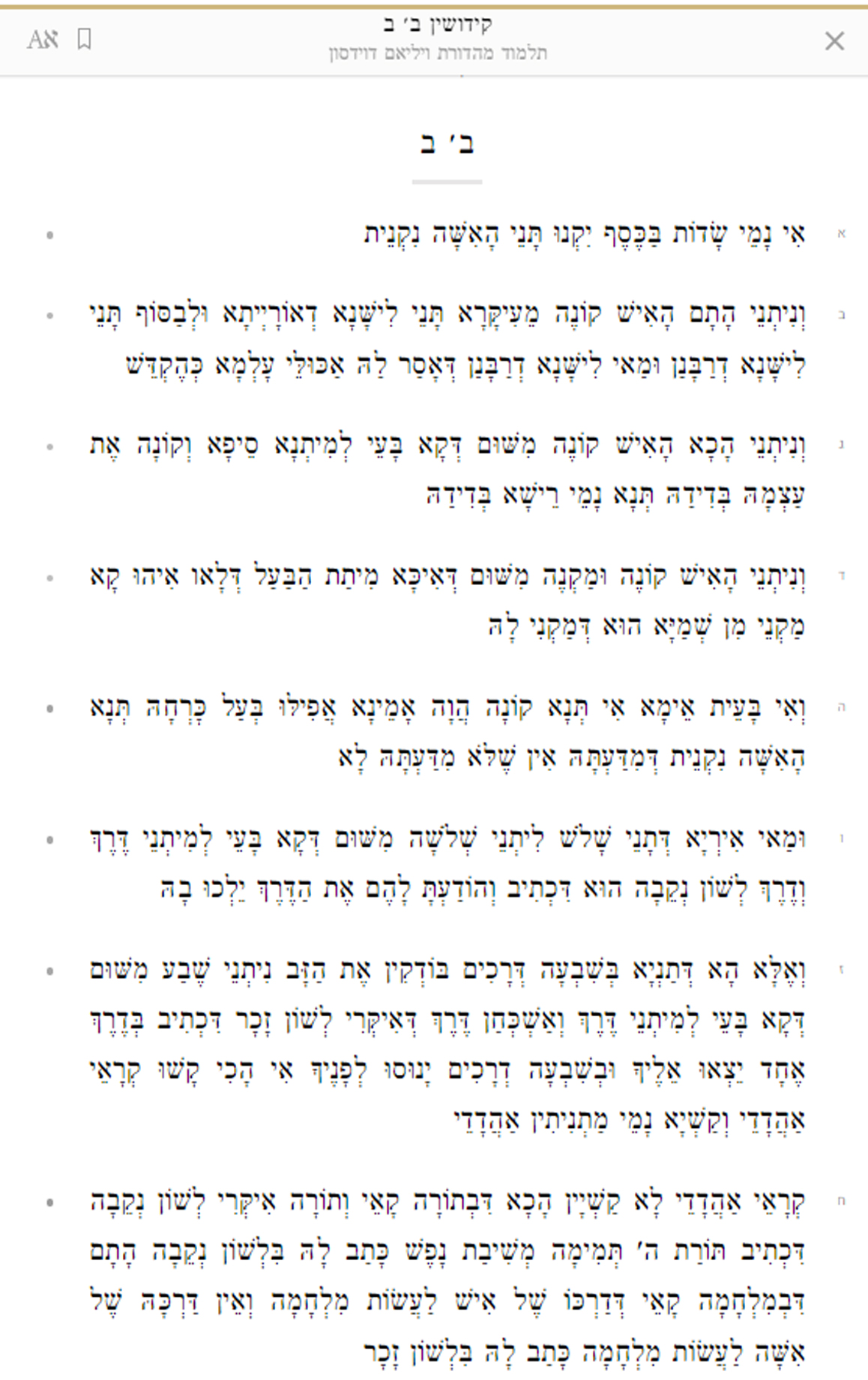
Image of customization options:

Splits into numbered sections. In our example, there are 15 sections. The default Hebrew doesn’t split these into paragraphs, but there is an option to split into paragraphs. Many tractates have nikud, some have punctuation. Our example page doesn’t have punctuation, even though it shows that option. Sefaria gives the option to remove nikud. As mentioned, as with Shitufta and Al-Hatorah, one can hyperlink to a specific section.

Al-Hatorah[30]

The section numbers in circles on the right side of the page are hyperlinked, which is a convenient feature. In the example page we are looking at, there is no nikud, unlike Sefaria. However, there is a period after each section, which provides a slight advantage over Sefaria‘s lack of punctuation, as it helps to break up the passages when viewing with no section breaks.

While Al-Hatorah also includes hyperlinked sections, it does not explicitly label which section is which, unlike Sefaria. Therefore, finding a specific section requires trial and error. As with Shitufta and Sefaria, it is possible to hyperlink to a particular section in Al-Hatorah.

One notable difference is that Al-Hatorah does not expand acronyms, as Sefaria does. For instance, מט is not expanded to מאי טעמא, and אבא is not expanded to איבעית אימא.

Speculation on the future

Secunda and Fischer, in the faraway land of 2012 (cited at the beginning of this piece), envision a future Talmud app:

“First of all, it would be a virtually borderless intertextual web. Talmudic passages that shed light upon one another would be linked in intricate overlapping networks. Passages citing earlier texts—biblical verses, the Mishnah, other rabbinic texts, the apocrypha—would be hyperlinked to the collection in which the cited text originally appears. Passages would also link to later commentaries, super-commentaries, relevant excerpts from legal codes and responsa, manuscript variants, monographs, homiletic interpretations, and, indeed, translations and elucidations. Discussions of Akkadian medicine would call forth images of Babylonian tablets. People, places, historical events, concepts, practices, and all sorts of other realia mentioned in the text would link to relevant explanatory pages, pictures, recordings, and video clips. […] [T]wo new Jewish text websites, themercava.com and sefaria.org, offer promising platforms for crowd-sourced translation, commentary, and discussion of the Bavli and other Jewish texts. […]”[31]

While some aspects of this idealistic vision have been realized, many others have not, at least not yet. Moreover, it remains unclear whether a more crowdsourced and social-media-oriented approach, (suggested in an un-cited part of Secunda and Fischer’s article), would even be desirable. In retrospect, the year 2012 was marked by somewhat utopian thinking, with Wikipedia and Facebook having recently achieved great success in spreading knowledge and connecting people worldwide. It seemed only natural to aspire to something similar in the realm of literature. However, today, with greater awareness of the unpredictable dynamics of such systems (such as misinformation), it is far from clear that such a goal is attainable or even desirable.

In my view, Sefaria, Al-Hatorah, and Dicta are the most promising candidates for realizing the immersive and highly hyperlinked experience envisioned by Fischer and Secunda. Once this is achieved, the resulting research tools are likely to be extremely powerful as well. However, the idea of leveraging comparative sources, as described by the authors, still seems quite far off, particularly with the current set of available tools.

Regarding the social and chavruta aspect discussed by Fischer and Secunda, a new possibility has emerged that was not even envisioned a year ago: an artificial intelligence-powered chavruta. I recently experimented with ChatGPT by providing it with the first paragraph of Kidushin 2b.[32]

As usual, ChatGPT demonstrated impressive coherence and confidence. However, it provided laughably incorrect interpretations. In fact, in some cases, it provided interpretations that were the exact opposite of the correct one.

I conducted a comparable test by inputting a paragraph of Ramban’s commentary on that sugya, requesting an explanation from ChatGPT. To my surprise, ChatGPT provided a reasonably good rephrasing in English. Although some of it was correct and some of it was incorrect, even the incorrect part was not entirely off. However, ChatGPT still requires further yeshiva study before being able to serve as a teacher.[33]

Given the rapid advancements in artificial intelligence and large language models, it appears highly likely that AI will continue to improve its ability to interpret the Talmud, along with all other sources, including digitized manuscripts. It may not be long before we turn to AI to obtain the ultimate p’shat in the Talmud.[34] Furthermore, there is a possibility that AI could eventually bring comparative sources to bear, as previously mentioned.

To update the speculative future envisioned by Fischer and Secunda, my ideal Talmud study experience would be an app with a GPT plug-in acting as a virtual chavruta/Rebbe, to interpret text and answer questions. In fact, something like this is already being tested by Khan Academy.[35]

With current tools, it will even be possible to create a virtual shiur.[36] In the future, it could even be live and interactive, happening in real time.

Another interesting idea that is ripe to be explored is visualization of the Talmudic text. This was put to the test by Yael Jaffe, in a 2015 Columbia dissertation.[37] Jaffe writes in her abstract (bolding is mine):

“This study investigates the effect of access to a visual outline of the text structure of a Talmudic passage on comprehension of that passage. A system for defining the text structure of Talmudic passages was designed by merging and simplifying earlier text structure systems described for Talmudic passages, following principles taken from research on text structure. Comprehension of two passages were compared for students who did traditional reading of a Talmudic passage (the passages had punctuation added, and a list of difficult words and their meanings was appended) (the control condition), and students who read the passage with these same materials as well as with an outline of the text structure of that passage (the experimental condition) […]

The results provide evidence that awareness of the text structure of a Talmudic passage helps readers when the passage is concrete and somewhat well organized. ”[38]

It is interesting to note that Jaffe’s control group had punctuation added. There is, in fact, no good reason why the punctuation should not be added to all the standard Vilna-Romm editions. This is something that I did as a matter of course in my gemaras in my yeshiva days, and I presume that I was not the only one.[39]

Concluding Thought

Will there ever be a single Talmud application to rule them all, similar to how the Bomberg layout remained the standard for 500 years, and continues to do so? Such a scenario is improbable and perhaps even unwanted in today’s rapidly changing and complex digital landscape. It would suggest a lack of progress. We may have to wait for the arrival of the Messiah or, at the very least, the AI singularity to provide the ultimate Talmud super-app.

[1] This piece was written as part of preparation for the workshop “Editions of Classical Jewish Literature in the Digital Era”, to be held at University of Haifa, June 18-20, 2023, at which I’ll be presenting. I want to express my gratitude to Menachem Katz for his efforts in organizing that workshop, and for inviting me to speak there. I’d also like to thank Eliezer Brodt for his helpful comments on an earlier draft of this piece. I would also like to thank my father, my brother, and S. Licht for reviewing, making suggestions, and helping clarify in conversation some of the ideas discussed.
[2] 
Finkelman, ”From Bomberg to the Beit Midrash: A Cultural and Material History of Talmudic Page Layout”, Tradition (Winter 2023), Issue 55.1, p. 14. I’d like to thank Eliezer Brodt for bringing this article to my attention.
[3] Immediately before, he writes (my bolding): “[T]he famous and ubiquitous tzurat ha-daf (page layout) of the Gemara was never exclusively by Talmudists for Talmudists. It was a common practice for producing non-Jewish European glossed texts in manuscript and later print from the high middle-ages though the sixteenth century. Some copyists and later printers of the Gemara—whether those printers were Jews or not—adopted it from contemporary Christian textual production.” This point is also made by Michele Chesner, in her interview on the Seforim Chatter podcast: “With Michelle Chesner discussing old books, Seforim, and more” (April 29, 2020).
[4] “Brave New Bavli: Talmud in the Age of the iPad”, Jewish Review of Books (Fall 2012). Archived here.
[5] Finkelman, pp. 16-17.
[6] Relatedly, I have heard the theory a few times from Prof. Meir Bar-Ilan that the writing down of the Talmud may have occurred due to the spread of the Chinese invention of paper to the West in the early medieval period. For some work on when the Mishnah and Talmud were first written, with previous scholarship cited, see: Yaakov Elman, “Orality and the Redaction of the Babylonian Talmud”, Oral Tradition, 14/1 (1999): 52-99 ; Shamma Friedman, “The Transmission of the Talmud and the Computer Age”, in Sharon Liberman Mintz and Gabriel M. Goldstein, eds., Printing the Talmud: From Bomberg to Schottenstein (2005), pp. 143-154 (esp. pp. 146-148) ;

יעקב זוסמן, “‘תורה שבעל פהפשוטה כמשמעה: כוחו של קוצו של יוד“, מחקרי תלמוד ג, א (תשסה), עמ‘ 209-384 (נדפס שוב כספר ב– 2019) ; נחמן דנציג, “מתלמוד על פה לתלמוד בכתב: על דרך מסירת התלמוד הבבלי ולימודו בימי הביניים“, בראילן ללא (תשסו), עמ‘ 49-112.

[7] Keith Houston, The Book: A Cover-to-Cover Exploration of the Most Powerful Object of Our Time (2016), introduction (available via Amazon Kindle sample). He adds in a footnote: “It is worth introducing “codex” as a technical term: it means specifically a paged book, as opposed to a papyrus scroll, clay tablet, or any of the myriad other forms the book has taken over the millennia.”
[8]
Recently pointed out by Ari Zivotofsky in a Seforim Blog post (“The Longest Masechta is …”, March 31, 2023): “[I]t is worth noting that ambiguity regarding sizes of masechtot only arose when commentaries began to be put on the same page as the text of the gemara. In other words, until the era of the printing press there was no ambiguity as to which masechta was the longest.” See also Finkelman, pp. 18-19 ; Friedman, “Printing”, p. 148. The early Soncino editions also only contained the Gemara and Rashi, see Finkelman, pp. 22-24. And see the recent statement of Yehuda Galinsky (bolding is mine): “The end of the thirteenth century witnessed a discernable growth in the composition of glossed works in Ashkenaz. It was from this time onwards that authors penned influential talmudic and halakhic works from France and Germany with the intention that they be accompanied by a supplementary gloss, which was to be copied alongside the text […] Instead, we find stand-alone commentaries that were copied separately from the text it was interpreting. In contrast to the well-known layout of the printed Talmud page, the writings of Rashi and Tosafot were written and usually copied as stand-alone commentaries and not as actual glosses to be copied on the same page.” (Judah Galinsky, “The Original Layout of the Semak”, Diné Israel, Volume 37 (2023), pp. 1*-26*, pp. 1-2.) A commenter to Zivotofsky’s blogpost pointed out that there is a print edition that contains only the Talmud (with supplementary indexes). It was printed 25 years ago. Here’s bibliographic info according to the National Library of Israel catalog entry:

תלמוד בבלי: כולל כל המשנה והמסכתות הקטנות : נערכו, סודרו והודפסו מחדש בכרך אחד, עם חלוקה לפסקאות, איזכורים מהמקרא, מלווים בשבעה מפתחות בסגנון אנציקלופדי, כולל מפתח ערכים אלפבתי, בעריכת צבי הפרייזלר הרב שמואל הבלין הרב חנוך הבלין (1998).

As an aside, Finkelman states (p. 18) that “The earliest [Talmudic manuscripts] are Geniza fragments from the ninth century”. However, see Friedman, pp. 147-148, that the earliest Talmudic manuscript is a scroll that can be dated to the 7th century.
[9] Finkelman, pp. 25-28. See also the interesting point by Finkelman, p. 41 (based on Jordan Penkower), that Bomberg was also the one to establish the standard method of citation for Tanach in the Jewish world: “In his first Mikraot Gedolot, Bomberg made a significant addition by adding chapter numbers and (in the second edition) verse numbers, features with little Jewish precedent which were based on thirteenth-century Catholic developments.”
[10] See my recent “Guide to Online Resources for Scholarly Jewish Study and Research – 2022”, where I discuss many of the resources discussed in this piece with more breadth. There I also discuss many of the resources excluded from this review for the reasons enumerated further. Bar-Ilan Responsa Project’s Talmud is online, but is not open-access. Bar-Ilan Responsa Project’s Talmud is linked from Yeshiva.org.il’s Talmud pages, top right of page. (See on Yeshiva.org.il in a later footnote.) That version of Bar-Ilan Responsa Project’s Talmud has punctuation, but no nikud, and is not split into sections/paragraphs, and is inferior in every way than the editions discussed here.

For the same reason (not open-access), I have not reviewed any editions on Otzar HaHochma, or other digital libraries which require a subscription.
[11]
Such as Vagshal, Oz VeHadar, Shas Vilna HeChadash, Gemara Sedura. See image here of layout of Gemara Sedura. (See Shimon Steinmetz’s interesting piece here on self-censorship in the Vagshal edition: “Vagshal’s revision of the history of the Vilna Talmud, or, One of the most egregious examples of censorship I have ever seen”.) The best completely static tzurat hadaf edition that I could find available online as open-access is the Moznaim edition, available at Daf-yomi and HebrewBooks. It is a PDF, simply re-typeset. There are also printed editions with punctuation, such as Steinsaltz-Koren; Oz VeHadar; and Tuvia’s. See these news articles from 2016 on Oz VeHadar’s (ongoing?) Talmud edition with nikud and punctuation: here and here. And see the National Library of Israel (=NLI) catalog entry here. See also the NLI catalog entry on Yosef Amar’s 1980 Talmud edition (17 vols.) with nikud based on Yemenite pronunciation, here. And see NLI catalog entries of Koren’s (ongoing?) Talmud edition with nikud and punctuation: Sanhedrin (2014) ; Bava Metzia (2015) ; Sukkah (2016) ; Bava Batra (2017) ; Kidushin (2018).
[12] So I won’t discuss the following: Kodesh.snunit ; Mechon Mamre ; Daf-yomi.com > “Text”. Daf-yomi.com’s “Chavruta commentary” and “tzurat hadaf” are indeed worthwhile. See previous note on Daf-yomi.com’s Moznaim tzurat hadaf edition. The Friedberg Project website Hachi Garsinan technically has a few digital editions of Talmud on their website, but they are all for the purpose of presenting the manuscript variants. So I won’t be reviewing that, since this piece is focused on layout and UX/UI, and in that regard, the edition is sub-par. (Again, this is not necessarily a critique, as this isn’t the point of those editions.) As I say further, in this piece I will not discuss the editions’ textual accuracy. For this reason, I also won’t discuss The Academy of the Hebrew Language’s Ma’agarim edition. Tashma.jewishoffice.co.ils Talmud shows promise, but for now seems to be inferior in every way than the editions discussed here. The website Yeshiva.org.il (פרשני ויקישיבה) has the Chavruta commentary of the Talmud. However, as mentioned, the original PDFs of Chavruta commentary are available on the Daf-yomi.com website, so in my opinion it’s clearly best to use that. There’s no advantage to the text version (except for the ability to copy-paste). Yeshiva.org.il’s Chavruta is fully editable, wiki-style. But I see that as a negative, as you don’t know what you’ll be getting.
[13] Such as Gemara Brura and The People’s Talmud. See more at R’ Josh Waxman’s blogpost, “Some excellent Talmud projects out there” (March 5, 2020).
[14] For example, Sefaria and Al-Hatorah have the Steinsaltz translation and commentary, and Wikisource has extensive links to other resources.
[15] Many of the textual elements of the Vilna-Romm edition have been superseded by better editions (though many are still incomplete). Some examples:

תלמוד: דקדוקי סופרים (השלם); הכי גרסינן

רשי: מהדורות פרופאהרן אהרנד

תוספות ; תוספות ישנים; רבינו חננאל : מהדורות רב קוק

עין משפט: עינים למשפט של ריצחק אריאלי (כל שבעה כרכים זמינים בהיברובוקס, לדוגמא, כאן)

מסורת השס: דקדוקי סופרים השלם; תלמוד האיגוד

ריף: מהדורת שבט

[16] For now, see Yakov Mayer in his recent ground-breaking book on the first edition of Talmud Yerushalmi (which was also printed by Bomberg’s press), who cites previous studies on typefaces used by Bomberg: Yakov Z. Mayer, Editio Princeps: The 1523 Venice Edition of the Palestinian Talmud and the Beginning of Hebrew Printing (2022, Hebrew).

See also the recent book by Simon Garfield, Just My Type: A Book About Fonts (2011 ) for a fascinating, well-written, popular overview of typesetting and fonts. On medieval handwriting styles of Hebrew, see the monumental 3-volume series, under Malachi Beit-Aryeh’s editorship (each area is a different volume):

מפעל הפליאוגראפיה העברית, אסופות כתבים עבריים מימיהביניים (1987-2017)

On second temple era styles, see the various works by Ada Yardeni, especially:

עדה ירדניספר הכתב העברי: תולדות, יסודות, סגנונות, עיצוב (1991).

[17] It is unclear to me who first made these section splits. It’s a question I’d be quite interested in knowing the answer to.
[18] Links to all of parts of MM:

  1. אקדמות למהדורה של התלמוד הבבלימסכת קידושיןמחברות מנחמיות

  2. מסכת קידושין ב עא יד עב

  3. מסכת קידושין יד עבכה עב

  4. מסכת קידושין כה עבכט עא

  5. מסכת קידושין כט עאמא עא

  6. מסכת קידושין מא עאנח עב

  7. מסכת קידושין נח עבסט עא

  8. מסכת קידושין סט עא פב עב

Compare Katz’s similar work on Yerushalmi (which also includes textual variant apparatus, and short commentary, unlike his work on Bavli), available at his Academia.edu site: “פסחן ומצתן של נשים Women on Passover and Matzah”.
[19]
 I personally prefer this style (punctuation, without nikud). See my discussion later.
[20] Tractate Sukka, p. 2 (ב). Not to be confused with Gemara Sedura (no HaMeir). Currently available online: Tractate Sukka (2013, here) and Tractate Avoda Zara (2015, here). See more on the project here.
[21] From the latest volume available online:

נתנאל בעדני, סנהדרין פרק חמישי (תשעב), עמ‘ 4.

See more on the project here.
[22]
See more on the project here.
[23] See also some of R’ Be’eri’s other editions, available on Da’at website, here and here. On R’ Be’eri, see the Hebrew Wikipedia entry on him: דן באריויקיפדיה
[24] Screenshot of downloaded Word document.
[25] To explain: Even though everything in the Word doc can be customized, this isn’t built into the website. Any of the editions in this “Digital” section can be pasted into a Word document and customized.
[26] Notably, the text itself is actually an image, which makes copying it impossible.
[27] Dicta was started by Prof. Moshe Koppel of Bar-Ilan University. He has contributed to Seforim Blog.
[28] As of 15-Apr-23.
[29] See more on the project here.
[30] See more on the project here.
[31] Compare also, at length, Friedman, “Printing”, pp. 150-154 ; Shai Secunda, “Resources for the Critical Study of Rabbinic Literature in the Twenty-First Century” in Compendia Rerum Iudaicarum ad Novum Testamentum (CRINT) 16, Christine Hayes (ed.), (2022), pp. 621-632.
[32] On 15-Apr-23, at https://chat.openai.com/.
[33] I should point out that I did not have access to GPT-4, which is the latest version of GPT. So I could not test whether GPT-4 is more capable at interpreting Talmud. For a discussion of some sources of the Yeshivish dialect of English possibly used as datasets for training ChatGPT-4, see my “From the Shtetl to the Chatbot: Some contemporary sources of Yeshivish content, in light of ChatGPT-4”.
[34] For some preliminary algorithmic research on the Talmud, see, for example, Satlow M., Sperling M. (2017). “Naming Rabbis: A Digital List”; Satlow M., Sperling M. (2020), “The Rabbinic Citation Network”; Satlow M., Sperling M. (2020). “The Rabbinic citation network”, AJS Review ; Zhitomirsky-Geffet M., Prebor G. (2019), “SageBook: toward a cross-generational social network for the Jewish sages’ prosopography”, Digital Scholarship in the Humanities, 34(3), pp. 676–695 ; “A graph database of scholastic relationships in the Babylonian Talmud”, Digital Scholarship in the Humanities, Volume 36, Issue Supplement_2, October 2021, Pages ii277–ii289, https://doi.org/10.1093/llc/fqab015, Published: 22 February 2021. See also Shira Shmidman, “Self-Evident Questions and Their Role in Talmudic Dialectic”, AJS Review (2023), p. 128: “Recently, I analyzed talmudic questions (that open with the phrase baʿei or beʿah minei) and discovered that by charting the questions by the generation in which they were asked, one can identify chronological trends of question asking in the Babylonian Talmud.”
[35] See Sal Khan, “Harnessing GPT-4 so that all students benefit. A nonprofit approach for equal access”, Khan Academy Blog (March 14, 2023). See especially this description: “Khanmigo [=the AI tool] engages students in back-and-forth conversation peppered with questions. It’s like a virtual Socrates, guiding students through their educational journey. Like any great tutor, Khanmigo encourages productive struggle in a supportive and engaging way.” For fun, I asked ChatGPT for a clever name for an AI chavruta/Rebbe. It gave me ten options. One of them is a great one (ChavrutAI), while three of them were hilarious ( AIvrumi; AIsh Torah; RoboRabbi). RoboRabbi could provide many of the intellectual aspects of being a rabbi: psak, eitza, questions in learning, and divrei torah.
[36] With tools like ChatGPT (content), ElevenAI (voice), D-ID (video), one can create any style of shiur. See my “Heimish High-Tech: Video in Yeshivish dialect using Generative artificial intelligence”. For training sources for the Yeshivish dialect, see my article: “From the Shtetl to the Chatbot: Some contemporary sources of Yeshivish content, in light of ChatGPT-4”.
[37] Jaffe, The Relevance of Text Structure Strategy Instruction for Talmud Study: The Effects of Reading a Talmudic Passage with a Road-Map of its Text Structure (2015). See especially ibid. Appendix E (pp. 103-104).
[38] On visualizations, see also this article, and the bibliography cited there:

יעקב אמיד, “עיצוב ייצוגים גרפיים של דיון תלמודי: תחום דעת מתחדש בהכשרת מורים להוראת תלמוד

See also the lengthy intro of Menachem Katz to his Mahberot Menahmiyot (discussed earlier), with relevant bibliography. One good existing resource for outlines and charts for Talmud is Daf Yomi Advancement Forum – Kollel Iyun HaDaf. See Josh Waxman, “Some excellent Talmud projects out there” (cited earlier), #2. A fascinating related project is that of R’ Dr. Michael Avraham on mapping out the logic of the Talmudic sugya, using the tools and notation of modern logic. See his massive series Studies in Talmudic Logic, currently at 15 volumes. Note the surprising claim made in the abstract of vol. 14 of the series (Andrew Schumann, ed., Philosophy and History of Talmudic Logic, bolding is mine): “The Talmud introduces a specific logical hermeneutics, completely different from the Ancient Greek logic. This hermeneutics first appeared within the Babylonian legal tradition established by the Sumerians and Akkadians to interpret the first legal codes in the world and to deduce trial decisions from the codes by logical inference rules. The purpose of this book is (i) to examine the Talmudic hermeneutics from the point of view of its meaning for contemporary philosophy and logic as well as (ii) to evaluate the genesis of Talmudic hermeneutics which began with the Sumerian/Akkadian legal tradition. The logical hermeneutics of the Talmud is a part of the Oral Torah that was well expressed by the Tannaim, the first Judaic commentators of the Bible, for inferring Judaic laws from the Holy Book.”
[39]
My suggestion for breaking the tzurat hadaf into sections: the pilcrow (¶). On the pilcrow, see the entertaining popular book, Shady Characters: The Secret Life of Punctuation, Symbols, and Other Typographical Marks (2013) by Keith Houston, chapter 1. (Available from Amazon for free as a Kindle sample.)

It should be pointed out that trop is an early medieval Hebrew form of punctuating the Biblical text. A few alternatives of punctuating the Torah arose in Geonic times.

On early nikud of Mishnah and Talmud, especially nikud bavli (we use nikud tavrani), see Yeivin:

ישראל ייבין, מסורת הלשון העברית המשתקפת בניקוד הבבלי (תשמה), פרקים בו.

I will point out the following: Tuvia’s edition adds nikud. But once one is past the beginner stage, nikud does little to enhance the reading experience, and in fact many readers find it a distraction. Modern Hebrew rarely uses nikud. Exceptions are for literature geared towards children and beginners (as noted), as well as instances where decoding is especially difficult, such as poetry, transliterated foreign words, and ambiguous words. In contrast, punctuation is a huge boost to faster comprehension, as Jaffe notes. Modern Hebrew texts use standard punctuation, like all modern languages.


The Longest Masechta is …

The Longest Masechta is …

By Ari Z. Zivotofsky

As Jews, we are often intrigued with trivia about our holy books, and the more esoteric and harder to verify, the better. An example of such trivia is the longest masechta in shas. While it is relatively easy to verify that the longest masechta in terms of pages in the Vilna Shas is Bava Batra, with 176 pages,[1] until modern times it was much more difficult to determine which is the largest masechta in terms of words or characters. Once something is difficult to measure, rumors abound, and this topic is no different. To cite just three examples. Meorot haDaf Yomi on 23 Shvat 5770 (vol. 559), stated (in Hebrew) that if not for the lengthy commentary of Rashbam, Bava Batra would have considerably fewer pages and that the Gra had said that really the longest masechta in terms of words is Berachot, although it is only 64 pages. Rabbi Yaakov Klass in the Jewish Press (20 Tammuz 5777 / July 13, 2017) wrote: “as the Vilna Gaon observes, Berachos is actually the longest tractate”. Rabbi Aaron Perry in his “The Complete Idiot’s Guide to the Talmud” (2004) states in a section “the least you need to know” (p. 57): “Brachot (Blessings) is the longest tractate in words”.

As often happens with urban legends. once an assertion is accepted as “fact”, it is then claimed to have been verified. In the journal Ohr Torah (Sivan 5766 [465], p. 719) the claim is made that a computer check was performed and it was found that the largest masechet based on words is Berachot. But alas, it ain’t so and in the next issue of Ohr Hatorah (Tammuz 5766, p. 784) the error was pointed out.

In actuality, and before presenting the results from a computer count, it is worth noting that ambiguity regarding sizes of masechtot only arose when commentaries began to be put on the same page as the text of the gemara. In other words, until the era of the printing press there was no ambiguity as to which masechta was the longest. Prof. Yaakov Shmuel Spiegel (Amudim B’toldot ha’Sefer ha’Ivri: Hagahot u’magihim [Chapters in the History of the Jewish Book: Scholars and Annotations], 2005, 105-106) credits Prof. Shlomo Zalman Havlin in his monumental “Talmud” entry in the Encyclopedia HaIvrit with the idea that the relative size of tractates can be determined based on the number of pages they occupy in the Munich manuscript. This unique manuscript, completed in 1342, was transcribed by one individual and had the entire Bavli in one 577 page volume. Simply comparing the number of pages of the various tractates provides the relative length in terms of characters/words. This ranking may be more accurate that a computer count of the words or letters as the single author may have been more consistent in terms of abbreviations and other factors that can influence the count.

Using the Munich ms, the rank ordering is similar, but not identical to that obtained from a computer count, although in all cases it is clear that Berachot is far from the largest. Using the Munich ms, the top five (with number of pages) are:

Shabbat (55.5)
Hullin (51)
Yevamot (47)
Sanhedrin (45.5)
Bava Kamma (45)

..

Berachot (36) is number 11.

A similar system can be used to estimate the size of masechtot using the monumental one-volume shas edited by Zvi Preisler (Ketuvim Publishers, Jerusalem, 1998). It is straight text of Talmud with no commentaries of Rashi or Tosafot and is a uniform font. References to biblical verses are included and thus sections with more aggadatah might appear slightly longer. The text is arranged in three columns per page. Counting pages in this volume, the longest mesechtot (and number of pages) are:

Shabbat (77⅓)
Sanhedrin (66⅓)
Hullin (58⅙)
Bava Batra (56½)
Pesachim (55⅓)
Yevamot (55⅙)

..

Berachot (47⅓ pages)

The simplest way to answer this question today is with a computer count of the number of words. Using the Bar Ilan Responsa project for this, the number of words in all of shas is about 1.865 million. And the 5 largest tractates are:

Shabbat (118k)
Sanhedrin (107k)
Hullin (90k)
Bava Batra (89k)
Bava Metzia (86.5k)

……

Berachot (73k) is in 11th place

The 5 smallest tractates are Chagigah (19k), Makot (18k), Horayoat (13k), Me’ilah 8k), and Tamid (5k). Other computerized calculations yield slightly different counts, but they do not significantly alter the rankings.

So why might one have been (mis)led to think that Berachot is the largest? It is easy to understand because Berachot does indeed win the prize in one category – words/daf. Berachot is king, with over 1115 words/daf. The next 5 are: Krisos (975), Horayot (972), Megilla (934), Sanhedrin (932 – the last perek probably plays a big role in raising this number!), Taanit (890). What might interest some daf yomi learners are the bottom 5, and those are (from bottom up): Nedarim (383), Meilah (384), Nazir (431), Baba Batra (509), Tamid (512).

The rumor is that the Gra stated that Berachot is the longest tractate, and it is hard to abandon such a tradition. A noble effort was recently made to vindicate that tradition. The book Mitzvah V’oseh (Shmuel David Hakohen Friedman, 2015, ch. 44, p. 564) quotes the famous statement that the Gra said Berachot is the longest in words, corrects this by pointing out that Shabbat is longer, and then gives a clever reinterpretation – the Gra was referring to Yerushalmi. And in the Yerushalmi, the author avers, Berachot is indeed the longest tractate by words. In a collection[1] of “trivia” that Rav Chaim Kanievsky was wont to discuss with his grandchildren, it is quoted that he said Berachot is the longest mesechta in Yerushalmi. That assertion is indeed much closer to being accurate but is still not correct.

In the Bar Ilan responsa project there are two versions of the Yerushalmi, the Vilna edition with almost 795k words and the Venice edition with almost 815k words, both considerably shorter than the Bavli.

In the Vilna edition of the Yerushalmi, the four largest tractates with their word count are:

Shabbat (47,685)
Yevamot (44,369)
Sanhedrin (40,008)
Berachot (39,478).

Using the Venice edition, the top four are:

Shabbat (49,161)
Yevamot (45,293)
Berachot (41,030)
Sanhedrin (41,004)

In the Yerushalmi too, one can use the monumental one-volume Yerushalmi edited by Zvi Preisler (Ketuvim Publishers, Jerusalem, 2006) to estimate the size of masechtot. Counting pages in this volume, the longest masechtot (and number of pages) are: Shabbat (37) and Yevamot (32 ⅔). This is followed by Brachot (30), Sanhedrin (29 7/9) and Pesachim (26 ⅔).

While these numbers are clearly influenced by many extrinsic factors such as which ms text used, abbreviations opened or closed, etc, they demonstrate that although Berachot is much closer to being the largest tractate in the Yerushalmi than it is in the Bavli, it is still behind the unquestioned largest in Bavli and Yerushalmi, Shabbat, and behind Yevamot.

Did the Gra actually make such a statement about what is the largest tractate in shas? There are no early records of it and I have not been able to find any mention of such a claim earlier than the late 20th century. Irrespective, the rumor that he stated that Berachot is the largest is fairly “common knowledge”. Yet it is clear using both counting ms pages and computer tabulated results, Berachot is far from being the largest in either the Bavli or Yerushalmi. Berachot does have one claim to fame in regard to size; it is by far the most words/pages.

[1] It is actually 175 pages; it goes up to page 176, but like all masechtot it starts on daf bet. But that would ruin the beautiful symmetry that the longest parsha in the Torah is naso with 176 pesukim and the longest chapter in Tanach is Tehillim chapter 119 with 176 verses.
[2]
In Gedalia Honigsberg, “HaSeforim”, 5777, ch. 10 is “tests” Rav Kanievsky would give and pages 199-201 is trivia for the grandchildren. On p. 200 it states that the largest mesechta in Bavli is Bava Batra followed by Shabbat. It then quotes in the name of the Gra about Berachot being largest in terms of words but that it is unlikely he said that because in reality Shabbat is larger. It then says that in the Yerushalmi the largest mesechta is Berachot.


Sukkah 4a “What’s Wrong with This Picture?”

Sukkah 4a “What’s Wrong with This Picture?”

By Eli Genauer

This post is is l’zecher nishmas my uncle and rebbe, Rabbi Sam Genauer ZT”L whose yahrtzeit is the second day of Av. Rabbi Genauer was a talmid of Rabbi Moshe Soloveichik at RIETS.

מסכת סוכה ד׳ עמוד א׳

The maximum height of a Sukkah is twenty Amot. The Gemara discusses a situation where the Sukkah is slightly more than twenty Amot high and one builds a raised platform inside the Sukkah.

היתה גבוהה מעשרים אמה ובנה בה איצטבא כנגד דופן האמצעי על פני כולה ויש בה הכשר סוכה כשרה

If a Sukkah was more than twenty Amot high and one built a platform (איצטבא) in it opposite the middle wall, and the platform (איצטבא) is the minimum area required for a Sukkah to be kosher, (7 Tefachim by 7 Tefachim) the Sukkah is kosher

ומן הצד, אם יש משפת איצטבא לכותל ד׳ אמות, פסולה, פחות מארבע אמות ,כשר.

And along the side wall: If there are four (or more) Amot from the edge of the platform to the opposite wall, it is Pasul. However, if there are less than four Amot, it is kosher

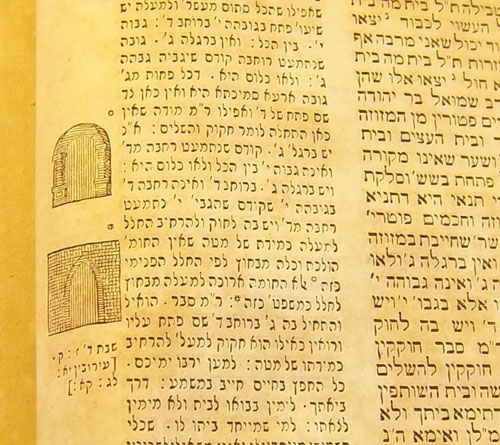
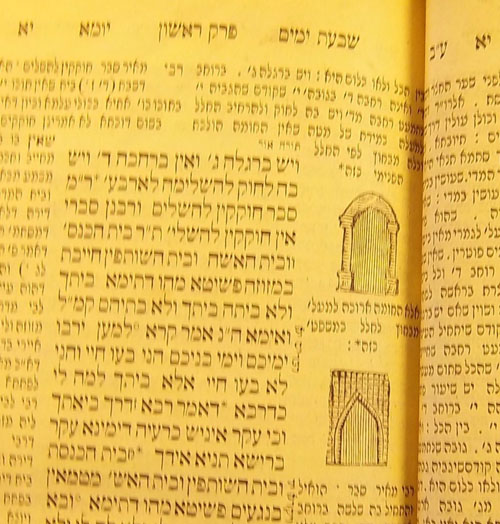
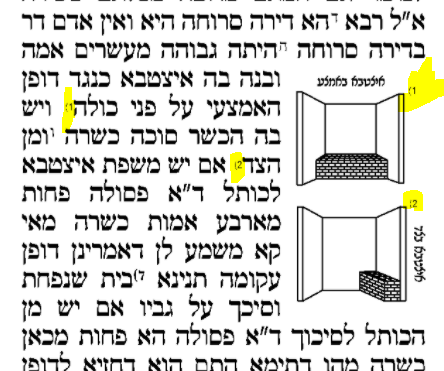
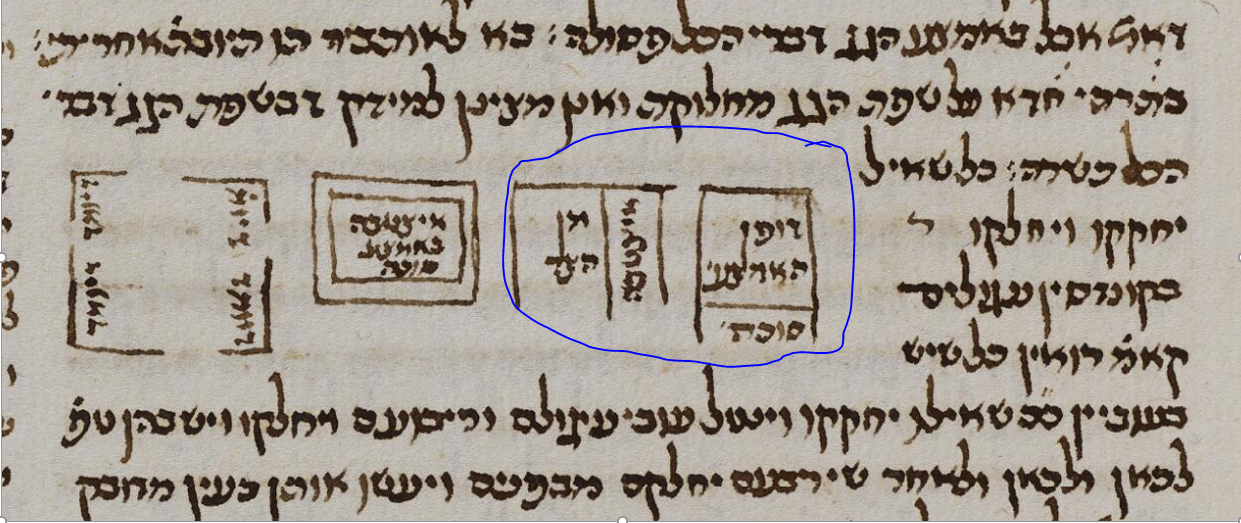
The Vilna Shas has two pictures embedded within the text of the Gemara which illustrate these cases. The first picture illustrates the case of איצטבא כנגד דופן האמצעי על פני כולה and the second picture illustrates the case of מן הצד איצטבא.

Updated Illustration in Vilna HaChadash (2006)

Were these two pictures part of the original text of the Talmud as written down by Rav Ami and Rav Asi?

The website Hachi Garsinan which belongs to the Freidberg Manuscript Society (https://bavli.genizah.org/?lan=heb&isPartial=False&isDoubleLogin=False) has a number of manuscripts of Gemarah Sukkah and none of them have these diagrams included within the text. They include:

British Library Harley 5508
Munich Codex heb. 140
Munich Codex heb. 95
JTS Rab. 218, JTS Rab. 1608
Oxford heb. 2. 51

It is extremely unlikely that any other written manuscript of this section of Talmud contained these two images.[1]

Nevertheless, we do get the impression from the Vilna Shas that these diagrams are part of the body of the Gemara.

The Vilna HaChadash edition (2006) even ties the two modified pictures 1) and 2) to specific words in the Gemara.

Where do these two pictures belong, if not in the body of the Gemara text?

It turns out that there are three sources (a manuscript, the Dfus Rishon of Soncino Pesaro, and Chochmat Shlomo) which point to these illustrations properly being included in Rashi’s commentary. We will then look at how they ended up in the text of the Gemara.

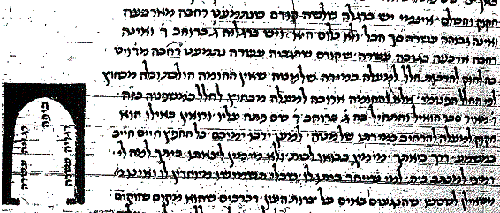
In a manuscript identified as JTS, New York Rab. 832 (JTS, New York, Ms. 6648), pictures illustrating איצטבא בדופן האמצעי ואיצטבא מן הצד are placed alongside two other illustrations on the next page.

Dr. Aharon Arend attributes these pictures to the Rashi on 4a.[2]

Additionally, the Dfus Rishon of Soncino Pesaro (c.1515) places the diagrams in the body of Rashi’s commentary. One diagram is situated next to the Rashi which speaks about the איצטבא being in the middle and the other diagram is in the Rashi which speaks about the איצטבא being on the side.


Bomberg Venice 1521 left empty spaces in the same two comments of Rashi. Bomberg and Pesaro clearly saw them as separate drawings and situated them in the same comments of Rashi:

This Chochmat Shlomo (Cracow 1582) agreed that the two illustrations belonged in Rashi and placed them in the Rashi immediately preceding the first one of Soncino Pesaro (which is the beginning of the Halacha):

Berman Frankfurt an der Oder 1698 used the same shapes as Chochmat Shlomo but, despite clear instructions in Chochmat Shlomo of where to place the pictures (דבור המתחיל דופן האמצעי), inserted them in the text of Gemara.

Amsterdam 1717 finally placed the two pictures where they are today.[3]

The Amsterdam imprint imputed much importance to the Chochmat Shlomo of Rav Shlomo Luria (MaHarshal) in fixing the text and format of its edition.

On the Shaar Blatt it lists the Chochmat Shlomo first in terms of what sources were used for Hagahot:

Additionally, the publisher, Judah Aryeh Leib ben Josef Samuel in his introduction to Masechet Shabbat, writes how corrupt the text of printed editions had become in his time, but that he was able to correct his edition based on the editing work of MaHarshal, MaHarsha and MaHaram Lublin. There is no diagram in Meier Einai Chachamim of MaHaram Lublin or Chiddushei Halachot of MaHarsha on this Gemara so it is most puzzling as to what source he used to overrule the instructions from MaHarshal of whom he writes ״ונתן ה׳ חכמה בלב שלמה הוא ניהו רבינו הגדול הגאון מהרש״ל זצ״ל שהגיה רוב התלמוד״

It seems as if these diagrams were somehow destined to be embedded within the text of the Gemara which is studied today, but I feel that a reference letter or number should be placed above these pictures, and an explanatory note placed on the side of the Gemara which says

בדפוס ראשון הציורים מופיעים ברש״י, ומהרש״ל גם כותב שהם שייכים לרש״י

I recommend specifically that such a notation be placed in the הגהות וציונים section of the next Oz Vehadar edition of Masechet Sukkah just as there are other references to דפוס ראשון and מהרש״ל on the same Amud.[4]

[1] According to Hillel Gershuni of the Friedberg Manuscript Society Hachi Grasinan website, none of the thousands of manuscript pages of Talmud they have studied has contained a diagram

[2] Aaron Ahrend, Rashi’s Commentary on Tractate Sukkah-A Critical Edition, Bialik Institute, Jerusalem 2021

The reference to JTS Rab 832 as Mekor Aleph is on page 27- Reference to these two diagrams pertaining to Sukkah 4a is on pages 505-506

[3] In 1714, R. Judah Aryeh Leib ben Joseph Samuel arranged to have the Talmud printed in Amsterdam by Samuel ben Solomon Marquis and Raphael ben Joshua de Palacio. They began printing with Berakhot, but were forced to discontinue printing in 1717 due to the Haskamot issued for the 1697-1699 Frankfurt on der Oder edition of the Talmud. Judah Aryeh Leib, resumed printing in 1720 in Frankfurt-am-Main at the press of Johann Koelner.

For more information on this edition see “Printing the Talmud : from Bomberg to Schottenstein” Sharon Liberman Mintz; Gabriel M Goldstein; Yeshiva University Museum.; Center for Jewish History ,2005.  Article by Marvin J Heller, page 254.

[4]


Romm Press, Haggadah Art, Controversial Books, and other Bibliographical Historica

Legacy Auctions: Romm Press, Haggadah Art, Controversial Books, and other Bibliographical Historica

Legacy Judaica’s fall auction is next week, September 13, and we wanted to highlight some bibliographical historica.  Lot 95 is Elbona shel Torah, (Berlin, 1929), by R. Shmuel Shraga Feigneshon, known as Safan ha-Sofer.  He helmed the operations of the Romm Press in Vilna.  During his 55-year tenure, he oversaw the publication of the monumental Vilna Shas, among numerous other canonical works that became the model for all subsequent editions. He wrote a history of the press which first appeared in part in the journal HaSofer (vol. 1 27-33 and vol. 2-3 46-57, 1954-55). It was then published in its entirety in Yahadut Lita vol. 1. 1959.  This biography was plagiarized in nearly every respect by the Yated Ne’eman.  It was a near-perfect reproduction (albeit in English rather than the original Hebrew), except that certain names and select passages were omitted presumably because they reference Jewish academics or other materials deemed objectional to Haredi audiences.

In Elbona shel Torah, (51-52), Shafan Ha-Sofer discusses the censorship of Jewish texts from non-Jewish authorities.  There were not only omissions but also additions to the text.  He identifies one of the angels mentioned in the supplications between the Shofar sets with Jesus.  He claims that “Yeshu Sa’ar ha-Pinim” is in fact Jesus of Nazareth.  Nonetheless, he notes that this passage was included in most mahzorim.  Indeed, in the first Romm edition of the Mahzor this angel appears.  He explains that after it was published a rabbi from Yemen, who was unfamiliar with the historic inclusion of the passage, was shocked when he came this passage.  He immediately set about issuing a ban on all the Romm books, classifying them within the category of a sefer torah of a heretic which is consigned to the fire.  But the ban was annulled after a Jerusalem rabbi intervened and explained to his clergy brother that in fact the Romm edition merely followed an accepted text. According to Shafan ha-Sofer, after this brush with what is described as potential financial ruin, later editions of the Vilna Mahzor omit Yeshu.

Two books feature on their title pages an immodest Venus rising.  The title page of R. Moshe Isserles, Torat ha-Hatat, Hanau, 1628, lot 33, depicts in the bottom center of page Venus with a loincloth.  Additionally, on the two sides of the pages two similarly exposed women appear in medieval costume. This particular title page was reused on at least three other books.  A similarly undressed woman appears on the title page of R. Isaac of Corbeil’s Amudei Golah, Cremona 1556, lot 1.

Naftali Hertz Wessley’s, Divrei Shalom ve-Emet, Berlin, 1782, lot 99, (volume 2), is the controversial work wherein he provides his educational program.  Although some of his other works secured the approbations of leading Orthodox rabbi, some of the more traditional rabbis were opposed to Wessley’s reforms advocated in Divrei. See our discussion here, and Moshe Samet, Hadash Assur min ha-Torah (Jerusalem, Carmel, 2005), 78-83; Edward Breuer, “Naphtali Herz Wessely and the Cultural Dislocations of an Eighteenth-Century Maskil,” in New Perspectives on the Haskalah, Shmuel Feiner and David Sorkin eds., (London, Littman Library, 2001), 27-47.. Wessley advocated for the inclusion of some secular studies, separate grades for children of different ages and abilities, and satisfying testing requirements. These and many others of his suggested reforms are now commonplace in Orthodox schools. He was interested in improving all aspects of Jewish education and chided his more acculturated Jews who only adopted his policies as they related to secular subjects but did not otherwise incorporate contemporary intellectual rigor to their Jewish studies. Copies of the originals of the work are rare.

Another book that aroused a controversy is R. Zechariah Yosef Rosenfeld of St. Louis’ work, Yosef Tikva, St. Louis, 1903.  Rosenfeld defends the use of machine manufactured matzot for Passover.  There is a significant literature regarding the use of these matzot, see Hayim Gartner, “Machine Matzah, the Halakhic Controversy as a Test Case for Defining Orthodoxy,” in Orthodox Judaism: New Perspectives, (Jerusalem, Magnes Press, 2006), 395-425 (Hebrew) and Jonathan Sarna, How Matzah Became Square: Manischewitz and the Development of Machine-Made Matzah in the United States, (New York, Touro College, 2005) .

Another Passover item Yaakov Agam’s limited edition of the Haggadah, Paris, 1985, lot 138.  Agam adds a rich color palette to the otherwise spare style of the German illustrator, Otto Geismar. His 1928 haggadah uses minimalism to great effect and has a whimsical flair, yet at times the thick black ink figures are dark and foreboding.  Agam’s offers of a kaleidoscopic version of the haggada that is purely uplifting.


Otto Geismar, Berlin 1928

Yaakov Agam, Paris 1985

Aside from the books, one letter of note, Lot 182.  In 1933 letter from R. Hayim Ozer Grodzensky writes that he had proclaimed a fast in Vilna in response to the rise of Hitler and that “the new persecutions will cause the old to be forgotten.” Despite the fact that R. Ozer recognized almost immediately the threat of Hitler, during WWII he was not as prescient.  As late as March 1940, he was encouraging Jews to remain in Vilna. See Eliezer Rabinowitz, R. Hayim Ozer’s Prophesy for Vilna has Been Fulfilled,” Morgen Journal, May 8, 1940.

Two final items, both relate to the Volozhin yeshiva.  The first is a copy of Meil Tzedakah, Prague 1756, lot 158that belonged to R. Yosef Dov Soloveitchik, the Bet ha-Levi, and rosh ha-yeshiva of Volozhin.  The book also belonged to the Vilna rabbi, R. Abraham Pasveller, and R. Chaim Soloveitchik.  The second, lot 166, is a letter by the R. Naftali Berlin, Netziv, the Bet Ha-Levi’s co-Rosh ha-Yeshiva and eventual disputant.  He writes to the journal HaTzfirah (see these posts (herehere and here) regarding the Netziv and reading the contemporary press), regarding 1886 fire in Volozhin Yeshiva and the rebuilding efforts. Among other things, he sought to publicizes the names of donor and provided a list from memory.  Among the donors was Yisrael Brodsky. Although Brodsky was a major donor to the Volozhin Yeshiva and a highly acculturated Orthodox Jews, some have attempted to portray him otherwise.  See our post “For the Sake of Radin!  The Sugar Magnate’s Missing Yarmulke and a Zionist Revision.”


“Did The Bach Really Draw a Cow?” Eruvin 20 b – Hagahot HaBach on Rashi “הא אתמר עלה”

“Did The Bach Really Draw a Cow?” Eruvin 20 b – Hagahot HaBach on Rashi “הא אתמר עלה

Eli Genauer

Summary

The diagram in the first edition of the Bach (1824) is much more accurate than how it is depicted in later editions, especially the Vilna Shas. The Bach’s picture features a long feeding trough, (an אבוס), whereas Vilna and others show it looking more like something attached to the animal. The Zhitomir Shas compounds the error by leaving out an essential characteristic of the situation under discussion. The new editions of the Talmud get it much better. The one diagram I found in a manuscript and the diagram in the Soncino Pesaro edition of 1515 (which was based on a manuscript) are very close to the drawing in the Bach (1824).

The picture in the Bach focuses on the relationship between an animal, its feeding trough and a well. One of the key words here is אבוס which is the feeding trough.[1]

מסכת עירובין :משנה י״ז׃

[2]משנה: עושין פסין לביראות …… From Sefaria

MISHNA: One may arrange upright boards [פסין] around a well (in the Reshut Harabim in order to permit drawing water from the well on Shabbat.) [A well is usually at least four Tefachim wide and ten Tefachim deep. Therefore, it is considered a Reshut HaYachid, and it is Asur to draw water from it on Shabbat, as that would constitute a violation of the prohibition to carry from a Reshut HaYachid into a Reshut HaRabim. The Chachamim therefore sometimes made a Kulah that a virtual partition may be built in the area surrounding the well, so that the enclosed area could be considered a Reshut HaYachid.]

Perush Chai (see here):

Gemara on 20b

The Gemara discusses a case where the owner fills a bucket and gives water to an animal or fills a bucket and then pours water into a trough from which the animal then drinks

לא ימלא אדם מים ויתן בשבת לפני בהמתו, אבל ממלא הוא ושופך והיא שותה מאיליה

A person may not fill a bucket with water and hold it before his animal on Shabbat; but he may fill it and pour it out (into a trough.) The animal then drinks of its own accord.

הא אתמר עלה אמר אביי הכא באבוס העומד ברשות הרבים גבוה עשרה טפחים ורוחב ארבעה וראשו אחד נכנס לבין הפסין

The Gemara qualifies the case of pouring water into a trough by saying that the above Baraita is dealing with a cow standing inside a house with windows open to the Reshut HaRabim, eating from a trough that stands in the Reshut HaRabim that is ten tefachim high and four tefachim wide, ( meaning it is a Reshut HaYachid), and one end of this trough extends into the area between the upright boards surrounding a well. Here is what it looks like.

Source: Chavruta English (see here, p. 14).

רש״י הא איתמר עלה כו

הא איתמר עלה כו‘ – כלומר כי בעינן ראשה ורובה בדלא נקיט לה וכי הוי ראשה ורובה שרי וברייתא דקתני לא ימלא ויתן הוא עצמו לבהמתו הא תרצה אביי לקמן דלאו בבהמה העומדת ברהר וראשה ורובה בין הפסין עסקינן אלא בבהמה העומדת בבית וחלונות פתוחות לה לרהר ואיבוס מתוקן לה )ב”ח( לפניה ברהר גבוה יורחב דדהוי רהי ונותן לה שם תבן ומספוא מרהי וראש האיבוס נכנס לבין הפסין ואשמעינן דלא ימלא מן הבור ויגביה הדלי על ראש האיבוס וילך דרך רהר ויטלטל הדלי על האיבוס לפני בהמה ואעג דקייל עומד אדם ברהר ומטלטל ברהי בהמוצא תפילין (לקמן עירובין דצח:). הכא אסור:

The portion of Rashi relevant to the diagram in the Bach is in bold.

בבהמה העומדת בבית – It is a case where the animal is standing in the house which has windows open to the Reshut HaRabim and a trough is positioned in front of it in the Reshut HaRabim and it is 10 tefachim high and 4 tefachim wide which makes it a Reshut HaYachid, and the owner puts animal feed(תבן ומספוא) into the trough in the Reshut HaYachid and the front portion of the trough enters into the area between the upright boards (בין הפסין)

In the Vilna Shas (Eruvin,1881) in the middle of this description in Rashi, there is an indication to look at the Hagahot HaBach.

The Hagahot HaBach are suggestions for textual emendations in the Talmud and Rashi, copied from the notes that the author added to his copy of the Talmud. The Bach died in 1640 but these suggested emendations were not printed until 1824. Here is the title page of this original edition:

The picture is in the bottom right corner of the Daf and looks like this:

Here it is straightened out:

It has all the elements mentioned in Rashi…an animal standing in a house (with a window) connected in some way to an אבוס which extends through the Reshut HaRabim and into the area between the upright posts surrounding the well. Nevertheless, I had two issues with this depiction

  1. Did the Bach really draw a picture of an animal in his Gemara?

  2. The אבוס does not look like a trough positioned on the ground that has substantial dimensions. (10 tefachim high and 4 tefachim wide).

In the first edition of the Hagahot HaBach ( Warsaw 1824), the picture looks like this:[3]

We have all the elements described in Rashi, but the house and animal are depicted by words rather than pictures. The crucial אבוס could easily be a feeding trough which stands on the ground and has significant enough dimensions to make it a Reshut HaYachid. I find this depiction a more accurate one than what appeared in the Vilna Shas.

What was the origin of the depiction in the Bach? We know that the Bach emended the text based on manuscripts he had, or by using his logic to arrive at the proper text.[4] It would be nice if we could find a manuscript with a similar depiction, as this might give us a clue to the source of the Bach. Fortunately, there are two such sources.[5] 

Source #1- Rashi-Commentary on Talmud Bavli (Eruvin and Betsah)

The Bodleian Libraries, University of Oxford Oxford England Ms. Opp. Add. Qu. 23 –15th century (1426-1475), online here.

Emphasis:

Compared to printed Bach:

There is no indication of where the animal is standing, but otherwise it is quite similar, especially its depiction of the אבוס.

Source #2:

Soncino Pesaro 1511(?) – First printed edition of Eruvin.[6] Its source was from manuscripts.

Compared to printed Bach:

There are some differences with the depiction of the Bach, mainly in the positioning of the animal, but this depiction also shows the אבוס being a long substantial structure.[7]

After the printed edition of the Hagahot HaBach appeared in 1824, those Hagahot began to be included in printed Gemarot.[8] I was able to find a number of editions containing this diagram which were printed between 1824 and 1881 when the Vilna edition was published.

The first I examined was Vilna/Horodna 1836 which included the Hagahot Ha’Bach after the Peirush Mishnayot of the Rambam. It was the first printed edition to include these Hagahot on Eruvin after 1824.[9] We already see major changes from the first edition, including the picture of the animal and the change to the depiction of the אבוס. [10]

The second printing I examined was Chernowitz 1847. This printing retained the exact diagram of the 1824 edition:

The third is in the normally reliable Zhitomir edition of 1862.[11] It completely misplaces the אבוס by not having it extend into the area surrounding the well.

It turns out that the depiction attributed to the Bach appearing in the first printed edition of Hagahot HaBach is more in line with the words of Rashi than the “improvements” to that depiction made in subsequent editions.[12]

[1] Manger is defined as a “long open box or trough for horses or cattle to eat from”. I use “trough” as a definition for אבוס. Jastrow ( 1926 edition, page 4)defines it as either a feeding receptacle, bowl for working men, manger, stall or stable. Manger/trough seems to be what is meant here because the dimensions are given as at least ten Tefachim high and four Tefachim wide and it is stated that it is standing on the ground

Steinsaltz English translation renders our case (available on Sefaria) “….eating from a manger or trough that stands in the public domain that is ten handbreadths high and four handbreadths wide.”

[2] All translations are based on Sefaria.org, the William Davidson Talmud based on the Steinsaltz English Talmud.

[3] While there are a few Gemarot at the NLI which were hand copied from the actual Gemara of the Bach, there is not one for Eruvin. Therefore, the first edition of the Bach is our only source for what the Bach’s diagram actually looked like.

[4] Amudim B’Toldot Sefer HaIvri, Hagahot U’Magihim , Spiegel p. 366 , (Ramat Gan, 2005) the paragraph beginning with the words “Sof Davar…”

[5] I examined four other Rashi manuscripts on this Daf and none had a diagram. Also, none of them, nor any other Rashi text I saw include the word “Kazeh”. That would indicate there most likely was no diagram in the original Rashi work. However, we do have one manuscript with a diagram, and more importantly the Soncino Pesaro edition which contains quite a complex diagram. The editors of this edition worked from multiple manuscripts and often decided the text based on a majority. They did not add diagrams on their own and therefore they included this depiction based on the manuscript(s) they had.

[6] After Soncino, until much later, empty spaces were left where Soncino had included a diagram. This Soncino diagram was the reason why an empty space existed in this Rashi in subsequent editions of the Talmud until Amsterdam 1717 which eliminated the empty space. It has stayed that way until today.

Here is Bomberg 1522:

Amsterdam 1646:

Amsterdam 1717:

[7] One possible source for diagrams was the Chochmat Shlomo of the Maharshal which was printed in 1580 in Prague. It included many diagrams left out of the Bomberg Shas. It, however, has no diagram of this case.

[8] The first time it was included in a printed edition of a Gemara was Fuerth 1829 (Maamar al Hadpasat ha-Talmud with Additions, ed. A.M. Habermann. Jerusalem, 1952 [Hebrew] p.132). However, it was only included for Masechet Berachot and Seder Zeraim. In 1832, Masechet Shabbat was printed without the Hagahot Ha’Bach. The rest of the Talmud was not printed there.

[9] See footnote above on the Fuerth edition which did not include Eruvin. There was an edition printed in Vienna from 1830-1833 but according to Maamar al Hadpasat ha-Talmud, it did not include the Hagahot Ha’Bach. There was also an edition of the Talmud printed in Prague between 1830-1835, but it also did not contain the Hagahot Ha’Bach. This makes the Vilna/Horodna edition of 1836 the first to include the Hagahot Ha’Bach on Eruvin. (See pages 133-134 of Maamar al Hadpasat ha-Talmud).

[10] Warsaw 1860 is exactly the same as Vilna/Horodna 1836.

[11]  Maamar al Hadpasat ha-Talmud….p.142 writes”תבניתו פוליו גדול ויפה מאד.”

[12] I examined three of the newer editions of Shas; Vilna HaChadash, Oz Vehdar and Vagshal Nehardea. They all had improved substantially on the picture depicted in the Vilna Shas.

Vagshal can be seen here.


An “Artscroll”™ Illustration in the Vilna Shas-Masechet Shabbat 98b

An “Artscroll” ™ Illustration in the Vilna ShasMasechet Shabbat 98b

By Eli Genauer

לזכר נשמת אבי מורי ר׳ יעקב קאפל בר׳ משה יהודה הלוי גענויער ז״ל. היארצייט שלו י״ד סיון.

For those studying Daf Yomi this week, there is a unique diagram that appears on Shabbat 98b. In the Vilna Shas one can see a closeup “picture” of one of the boards of the Mishkan (“קרש“) which would make Artscroll proud.[1] While one might be familiar with diagrams that appear in the Talmud, those diagrams illustrate comments in the rishonim, mainly Rashi. Most of these are called out specifically by Rashi: “kazeh” “like this.” Artscroll, however, includes their own illustrations beyond those from any of the rishonim. Yet, they were not the first publishers of the Talmud to do so. Indeed, this diagram on page 98b is a much earlier example of a publisher electing to incorporate their own diagrams into the text.

Diagrams in Printed Editions of the Talmud

The use of diagrams is attested to in numerous manuscripts. These diagrams appear in Rashi, Tosefot and even were used by the Geonim.

When manuscripts gave way to printing in the late 1400’s and early 1500’s, those diagrams were excluded in the early printed editions of the Shas. When Daniel Bomberg published the first complete edition of the Shas in the early 1500s, he did not include the actual diagrams, but instead left a space for the book’s owner to pencil in the relevant diagrams (how they would know what the diagram looked like is left unanswered).

Finally starting with 1697, (the Berman Shas of Frankfurt on der Oder) did diagrams start to reappear in the empty spaces (mostly in Eruvin and Sukkah).

What was the source of those diagrams in the Berman Shas and in ones that were printed soon after in the early 1700’s? There were three sources, the Maharshal, Maharsha, and Mahram of Lublin.

This is the Shaar Blatt from the Frankfurt on der Oder 1697 edition:

The Maharshal is the key point person when it comes to diagrams. He had the 2nd edition of the Bomberg Shas (printed circa 1528) and made his notations there. He recognized the importance of the Shas being printed but also the dangers that lay in the fact that if there was a mistake, it would find its way into thousands of hands. He lived at a time when there were still manuscripts around, and he made his corrections based on those manuscripts and also his own logic. Since he had the status of an Adam Gadol, his own logic carried much weight. Originally, he did not set out to write a book with his corrections. Like the Ba’ch, he just made the corrections in his own Gemara. After he died though, his sons printed Sefarim which reflected his notes.[2] Therefore, if in the late 1600’s or early 1700’s you were printing a Shas, and you looked at a previous edition and in Rashi it said “Kazeh” and there was a space, you would look at the Chochmas Shlomo. If he had added a diagram, you would place that diagram in the empty space and feel comfortable that it had good Yichus. There were times that there wasn’t an empty space that the Chochmas Shlomo shows a diagram, and in that case, the printers usually added it.

The 1715 Amsterdam Edition of the Talmud

A complete edition of the Talmud was first published in Amsterdam in the 1640s by Immanuel Benveniste. In the 17th and 18th centuries Amsterdam was counted among the most important cities for the printing of Hebrew books and there were many well-known publishers that followed Benveniste and they printed many important works yet none of them attempted to reprinting the Talmud. Only some sixty years later did Amsterdam see a Talmud come off its presses. This one, that began in 1714, was never completed.

R. Judah Aryeh Loeb ben Joseph Samuel of Cracow appealed to Samuel ben Solomon Marsheses and Raphael ben Joshua de Palasios prominent members of the Amsterdam Sephardic community and asked them to print a new edition of the Talmud. Neither had ever published a book. In 1710, Loeb unsuccessfully sought to publish an edition of the Talmud in Frankurt. Now, in Amsterdam he sought to try again. Marcheses and Palasios formed a printing house specifically to print a “fine and accurate edition,” in an environment that “the workers would not be hurried so that they could work with care, reducing errors, and under the supervision of … the dayyan of the Ashkenaz Rabbinic Court of Amsterdam who would help establish the correct text.”[3] An emissary was sent to visit various Jewish communities to collect subscribers and reduce the burden of the significant printing costs. Relevant to diagrams, the emissary came bearing a gift, the Amsterdam 1710 edition of R. Jacob ben Samuel Bunim Koppelman of Brisk’s (1555-94) Omek Halakahah (first printed in 1510), a book that includes many diagrams to explain difficult passages of the Talmud.[4]

The first volume, Berakhot, was published in 1714[5] and the editors note the sources for their text and likely for the diagrams as well.

  1. Chochmas Shlomo

  2. Chochmas Manoach

  3. Chidushei Halachos of the Maharsha

  4. Maharam Lublin

  5. Sifrei Hashas of Yosef Shmuel ben Zvi – seemingly these were concentrated on Zeraim, Kodshim and Taharos

The volume on Meseches Shabbos was published in 1715 and the top 4 appear in the Hakdamah:

The Source and Purpose of the Diagram in Shabbos 98b

The Gemara in Masechet Shabbat on Daf 98a and b deals with the laws of carrying and discussing some of the details of the boards (“קרשים“) which made up the walls of the Mishkan.[6] These board were comprised of a complex system designed to keep each board straight and provide sufficient support for the entire structure of the Mishkan. Indeed, if one examines modern editions of the Talmud, there is an illustration that appears on the page. But where did it come from and more importantly what is its purpose? As we will show, the first edition to incorporate this diagram was the 1715 Amsterdam edition of the Talmud.

This is how it appears in the 1715 edition.

This image was reprinted in the Vilna Shas in a slightly clearer format although with the same detail and is a bit easier to analyze.


The picture primarily shows that there were three rods (“בריחים”) that connected one board to the next. The rods on the top and bottom went through outer rings, but the rod in the middle went through the width of the board.( “עובי הקרש“) It also shows the sockets on the bottom (“אדנים“) and the grooves (“ידות“) inserted in them which provided stability to the boards as they stood.

As discussed above, manuscripts of Gemarot though generally do not contain pictures, and a check on the invaluable website “Hachi Garsinan” shows that no manuscript of these pages has a picture to illustrate what a board looked like.[7] One might expect Rashi in his description of some of the statements of the Gemara to state his opinion and then write “כזה” (“ like this” ) Then we could expect to find an illustration in any of the number of Rashi manuscripts we have, and we could expect that this illustration (or an empty space for it) would appear in subsequent printed editions. Here we have none.[8]

The most relevant Rashi appears to his comments regarding how the boards stood miraculously.[9] But It does not discuss the fact that the middle rod went through the thickness of the board, but rather the miraculous nature of how the rod bent as it turned the corner. Another potential relevant Rashi explains the statement “the Sages taught, the bottoms of the beams (kerashim) were grooved and the sockets were hollow.” This deals with a completely different aspect of the beams which is how they were shaped on the bottom (and only according to Rabbi Nechemya). Thus, it is unsurprising that the manuscripts of Rashi do not include this diagram.

It was only in the 1715 edition does this illustration first appear. Yet, in the case of the picture of the keresh on Shabbos 98b, we do not find this picture in any of the sources identified by the Amsterdam publishers, not the Maharshal, Chochmas Manoach, Chidushei Halachos of Maharsha, or in Maharam Lublin.

First, we must identify what the diagram is attempting to illustrate. Rather than the more common form of diagrams, this one is not an illustration tied to one of the rishonim, rather it is illustrating two statements of the Gemara, one in the middle of the Daf and one at the very bottom. This, despite the fact that the diagram appears close to Rashi’s commentary on the page, seemingly tying it to his commentary.

Instead, the illustration is the independent product of the Amsterdam publishers and intended to elucidate the text of the Gemara, what did the board system look like. The Mesivta edition of Oz Vehadar also understands that this picture illustrates the words והבריח התיכון בתוך הקרשים. They indicate that Tziyur 6 which except for the detail on the bottom looks very similar to the one in the Vilna Shas, illustrates that statement.

In truth, the main part of the picture showing the middle rod going through the width of the board is not at all aligned with a comment of Rashi. Understanding that it just tries to give a picture of the “קרש” will make it easier to understand for people who study this page. This illustration is designed to explicate the text of the Talmud itself and was the entirely the idea of the publishers of the Amsterdam Talmud.

Why did the editors of the Amsterdam 1715 Shas insert a picture like this? Perhaps they were inspired by diagrams that appeared in a book called Omek Halacha by Jacob ben Simcha Bunim Koppelman which had just been reprinted in Amsterdam in 1710 and was even used in the fundraising campaign for this edition of the Talmud.[10] It has a picture of the grooves that fit into the sockets that is associated with the second aspect of this picture.

Yet, the Amsterdam publishers did not reprint the Omek Halakha’s crude diagram. Like the text and the other aspects of this edition, they included a much clearer and more detailed diagram that is infinitely more helpful in understanding the complicated text. Adding such a picture to a Daf of Gemara was a revolutionary act at that time and once added, it became part of Tzurat HaDaf that we have until today.

[1] As a matter of fact, there is a picture of the “קרש” in the Artscroll Stone Chumash, page 457, similar to the picture of the “קרש” in the Vilna Shas
[2] See Yaakov Spiegel, Amudim be-Toldot ha-Sefer ha-Ivri: Hagahot u-Magihim (Ramat Gan: Bar Ilan Univeristy Press, 2005), 312-17.
[3] Marvin J. Heller, Printing the Talmud: Complete Editions, Tractates, and Other Works and the Associated Presses from the Mid-17th Century through the 18th Century (Leiden: Brill, 2019), 75.
[4] Koppelman published another illustrated book, Ohel Yaakov. See Marvin Heller, The Sixteenth Century Hebrew Book: An Abridged Thesaurus, Volume 2, (Leiden: Brill, 2004), 724-25.
[5] For additional information on this edition see Heller, Printing the Talmud, 74-89.
[6] The categories of work employed to build the Mishkan formed the basis for the Melachot of Shabbat. In this case, the boards of the Mishkan were transported from one location to another giving rise to issues relating to the domains created thereby.
[7]
https://fjms.genizah.org/
[8] The manuscripts I checked on the KTIV website of the National Library of Israel were ones known as Parma 2097, Vatican 138, and Paris 324. All have no diagram in this entire Perek despite containing other diagrams of Rashi in other Perakim. (The two other manuscripts I checked of the total five that were available did not have diagrams in other Perakim either). The general website address for KTIV is https://web.nli.org.il/sites/nlis/en/manuscript
[9] In the book רש״י ,חייו ופירושיו“,כרך ב׳, הוצאת הקדש רוח יעקב, תשנ״ז” page 497, the author Rav Rephael Halpren states that there are 101 diagrams in Rashi included in the Vilna Shas, 51 of them in Masechet Eruvin. He then proceeds to enumerate all of them, including this one on Shabbat 98b. From the positioning of it on the page it certainly does look that way.
[10] Jacob ben Simcha Bunim Koppelman (1555–1594) was a talmudic scholar distinguished for his broad erudition and interest in secular sciences. Early in his life he embarked upon mathematical and astronomical studies, in addition to intensive occupation with traditional Jewish learning. He is the author of Omek Halakhah (Cracow, 1593). In it he elucidates the laws appertaining to Kilayim, Eruvin, etc., with the aid of diagrams and models. See here on Jacob ben Simcha Bunim Koppelman. 

This is it as it appears in the first edition (Cracow 1593):

https://hebrewbooks.org/pdfpager.aspx?req=45068&st=&pgnum=39


A Picture is Worth a Thousand Questions – Part II

A PICTURE IS WORTH A THOUSAND QUESTIONS – PART II (Part I)
by Eli Genauer

The classic Vilna Shas, published by the firm of the Widow and Brothers Romm, was completed during the years 1880-86. It was the most complete and accurate edition of the Talmud printed until that time, containing many new Peirushim and using new sources to ensure the accuracy of text. This fact was not lost on the chief editor Shmuel Shraga Feiginsohn as he states in the famous Achris Davar at the end of Maseches Nidah.

“We did not print a Shas like every other Shas,… by copying what came before us like a monkey. We wanted to create something entirely new and to illuminate it with an entirely new light”

My purpose here is to concentrate on one small Sugya in Shas , the commentary of Rashi on it, with the accompanying diagrams in the Vilna edition. I will then show diagrams from some previous editions of the Talmud that are more illustrative and more accurate. Perhaps the reader will then conclude that there were some portions of previous editions that the Vilna Shas should have copied rather than the one that it did.

The Gemara on Yoma 11b discusses doorways that are or not required to have a Mezuzah. It then discusses one type of doorway for which there is a Machlokes between Rav Meier and the Rabbanan and that is the so called Shaar Madai. As Rashi there explains it, a Shaar Madai is a gate in the wall of a city which has within it an arched doorway (Kipah) and was used commonly in Madai. For our own purposes, think of the Shaar Yafo which is substantive structure in itself and within it is the actual doorway into the old city.

As a bit of background, for a doorway to require a Mezuza it needs to have three elements. It has to be at least four Tefachim wide on the bottom and the top, it’s side posts ( Raglayim) have to be ten tefachim high, and it has to have a lintel on top. The Gemara states that the only case of Shaar HaMadia where there is disagreement in Halacha between Rav Meier and the Rabbanan is this: The doorway starts with a width of 4 Tefachim on the bottom, each side of the doorway ( Regel) rises up straight at least 3 Tefachim so that at that point there are still 4 Tefachim between them, but then the doorway starts curving inwards, rising on each side to a height of 10 Tefachim. However, at that point, there is no longer 4 Tefachim in width between the two sides. Rav Meier says that if the gate structure( the Chomah) itself is at least 4 Tefachim wide at a height of at least 10 Tefachim, we apply the concept of “Chokekin L’Hashlim” to this case. Chokekin L’Hashlim is a Halachic concept which literally means that we “excavate to complete ( the required measurement)”.Rav Meier says that if the walls surrounding the archway are thick enough that had they been excavated, the doorway could be made 4 Tefachim wide for a height of ten Tefachim, then the doorway requires a Mezuzah. The Rabbanan disagree and say that even this type of Shaar Madai does not require a Mezuzah.

Let’s go through the Rashi: “V’Yaish B’Ragleha Shlosha” “The sides of the doorway rise up ( at least) three (Tefachim)”….still maintaining a width between them of four Tefachim….but the width between them is not four Tefachim at the height of ten Tefachim…because before the sides rise to the height of ten Tefachim, they narrow to a width of less than four Tefachim…but you can expand the emptied out space contained in the encompassing structure ( The Chomah) to the width on the bottom ( 4 Tefachim)… for the gate structure does not parallel the inner doorway like this (“Kazeh”)…rather the wall ( meaning the gate structure)is longer on top than the doorway opening like this (“Kazeh”)

There are very nice diagrams of the two possibilities mentioned by Rashi in the 1829-1831 edition of the Shas printed in Prague by Moshe Yisrael Landau, grandson of the Nodah B’Yehudah.

It is very clear from the diagrams that the first possibility mentioned by Rashi ( the one that is not referred to in the Gemara) is where both the doorway and gate structure curve inwards so that neither of them has a width of 4 Tefachim on top. The actual case discussed by the Gemara ( the second possibility of Rashi) is where the doorway curves in to be less than four Tefachim on top, but the gate structure itself retains at least the width of four Tefachim on top and is also straight on top.

Similar diagrams appear in the Lemberg small and large folio editions of 1862, and the Vienna edition of 1841. Here is what the small folio version of the Lemberg edition looks like.

Before we take a look at the diagrams presented in the Vilna Shas, let us look at these diagrams in much earlier editions so we can trace their development. The only manuscript copy of Rashi that I was able to obtain (courtesy of Dr. Ezra Chwat at Hebrew University) looks like this.

The first thing you notice is that this manuscript does not have the word “Kazeh” after the first case, rather just referring to the second case. The illustration for the second case shows a curved doorway within a rectangular structure, exactly the way we have seen it in the Prague, Vienna and Lemberg editions. This illustration also seems to indicate that the sides of the inner doorway must be at least 10 Tefachim high before curving inwards. The words “Ragleha Asarah” are inside the doorway structure making it appear that they apply to the sides of the doorway being ten Tefachim before they curve inwards. This seems to be the case where even the Rabbanan agree that a Mezuzuah is needed. The diagram goes against Rashi’s Lashon here which is “She”kodem She’Higbiah Asarah,Nisma’et Rechava Mi’Daled”.

Advancing to the printed edition, we first look at Bomberg 1521.

The Bomberg scholars must have had a Rashi manuscript which had the word “Kazeh” after both the first and second case in Rashi. However, they did not leave any room for it to be filled in by hand as in other Masechtos which have missing drawings. Here is an example of such a situation in the Bomberg Eiruvin.

Moving forward I did not find these diagrams from Yoma 11b in the Constantinople 1585 edition, the Frankfurt on Oder 1698 edition ( even though it has the diagrams from Eiruvin ), or the Amsterdam 1740 edition. I did find fairly accurate diagrams in an Amsterdam 1714 edition but I believe they were drawn in.

The first edition I found these printed diagrams in was Amsterdam 1743 from the Proops printers. Here is what it looks like.

I did not find this diagram ( maybe it is two diagrams?) very helpful in understanding what Rashi meant when he said “Kazeh”. The diagram seems almost humorous to us, but imagine how many eyes studied this diagram and tried to make sense of it.

As mentioned before, by 1831, there were very helpful diagrams in editions printed in Prague, Vienna and Lemberg. The same cannot be said of the Zhitomir edition of 1864 which looks like this.

The first diagram is not nearly as accurate as the one in the previously mentioned editions. It mainly tries to show that the structure of the gate parallels the doorway by “curving” inwards. The second diagram which resembles a tooth, shows the doorway narrowing as it extends upwards with the gate structure maintaining its rectangular shape. My opinion is if a Rashi says Kazeh, the diagram should be as helpful as possible. No one expects a sophisticated illustration but it should be something that clearly shows what Rashi meant. In this case, I think the diagram should look like a doorway within a gate or walled structure.

We finally get to the Vilna Shas. The editors of this Shas clearly had the Vienna, Prague and Lemberg editions at their disposal. They knew what these diagrams could look like. Yet their diagrams look very much like the Zhitomir edition, with a little improvement on the second diagram.

It is possible they did not have the technology to replicate the Prague 1831 edition but that seems unlikely, because in a parallel Sugya in Eiruvin 11b they have diagrams that look like this.

Maybe they had a Rashi manuscript that made the first diagram look like this ^. But even so, I think they should have tried to make things as clear as possible and the two diagrams they chose just do not do that.

Perhaps the ultimate irony in this whole Sugya is that not only may the diagrams be incorrect, but even the term “Shaar Madai” may be incorrect. The Rashash notes that in K’sav Ashuris, a Mem and a Tes look similar, and because of a Ta’us Soferim, the term Madai was used instead of the correct “Shaar Taddi”, which was a gate on the Har Habayis.


R. Y. Emden, Hassidim & the Vilna Shas

The Vilna edition of the Shas printed by the Romm Press has become the standard edition of the Shas. This Shas had many important additions and corrections that prior ones did not. One of those was the inclusion of the comments of R. Jacob Emden.

However, it appears that one comment, a rather important one was left out. R. Emden in Gitten page 60 made a comment regarding the Hassidim, this does not appear in the Vilna Shas. In the Mozonim edition they partially rectified this by providing a partial transcription of the passage. But it seems they were unable to reproduce the entire passage and thus, even in their edition it contains numerous ellipses. Now, in the most recent volume of the journal Ohr Yisrael, R. M.M. Goldstein has provided the complete passage. As will be apparent, this is a very important passage. R. Goldstein got this from the manuscript of R. Emden’s comments which is now housed in the Oxford Library. In the article, R. Goldstein provides of copy of the original manuscript.

In it R. Emden discusses Kabbalah and that this subject is really only for a select few. (He also explains the term aggadah in relation to kabbalah). He then continues to explicate the limited distrubution of kabbalah and says

ואינו מתגלה אלא ליחידי סגולה לא עמוד איש בליעל ורע בסודה, ולהוציא גם ממה שנהגו מתחסדים חדשים מקרוב באו לעסוק בספר הזוהר ואר”י בקבע, ועשו תלמוד והלכות עראי וטפל, אין חפץ ה’ בהם, הלא מזקנים נתבונן שעיקר למודם ותורתם לא היה אלא בנגלה בלבד, וסתרי תורה לא היה נמסרים אלא ליחיד עמוד בחצי ימיו על פי תנאי פרישות הרבה כמו שאמרו פרק אין דורשין, ואף זה לא אשכח ותני רק למבין מדעתו וחכם, והללו עשו פומבי לדבר פתאים בל ידעו מה, כסילים נעדרי דעת, השה אלוה חכמה ולא חלק להם בבינה

[kabbalah] should only be given to a limited set of person, one who can understand its secrets, this excludes the new hassidim who spend their time reading the Zohar and the works of the AR”I, but only spend amount of time on the Talmud and the laws, God does not want them, from our ancestors we have learnt that the majority of ones time should be only in the revealed Torah, the seceret Torah was only for special ones, who where older [at the mid point in life] with conditions of ascetism as is described in the Talmud Haggiah, it is only given to those who can understand by themselves, however, these [the hassidim] they make public things which should be private to those who don’t know anything, idiots totally lacking in knowledge, God who gives wisdom did not give them understanding.

While this is not the only critique R. Emden had of Hassidim it is curious that the Romm printers did not inlcude it. Unfortunatly we don’t know why. It was not as if the Romm press was considered particularly friendly with Hassidim. In fact, one of the reasons Hassidim used the Shapira press was they viewed the Romm one as not in line with Hassidic values. This was so, as the Romm press printed works of maskilim. But, now that this passage has been printed one can hope that in future editions of the Shas this will be included, in it entirety.

Sources: R. M.M. Goldstein, Iyunim u’Biurim b’Mishnato shel Rabbenu haYavetz, in Ohr Yisrael vol. 43 (Nissan 5766) 203-215; for another passage in R. Emden’s writings discussing Hassidim see Wilensky, Hassidim u’Mistnagdim, p. 380; for more on what the Romm edition included see their Achrit Davar at the end of Niddah.


Haredi Robbers

Although we have alluded to the fact that Haredim “borrow” from others without attribution, I have come across a particularly egregious example. Here, is an article discussing the Romm Press and what became known as the Vilna Shas. Although the byline states that it was written “by Yated Ne’eman Staff” this is a wholesale reproduction of R. Shmuel Feigenshon’s article on this topic. Shmuel Feigenshon (Shafan HaSofer) was the editor of the Rom press for many years. He wrote a history of the press which first appeared in part in the journal HaSofer (vol. 1 27-33 and vol. 2-3 46-57, 1954-55). It was then published in its entirety in Yahadut Lita vol. 1. 1959.

The Yated via Dei’ah veDibur, has in turn copied this word for word, including the title headings. Of course, as some of the discussion may be deemed unpalpable to it Haredi readership they skipped a couple of things and in turn this ended up conflating some of the history. And, importantly, although Safan HaSofer wrote some of the article from a first person perspective as he was intimately involved in some of the facts, the Yated has removed that. In fact, there is absolutely no mention of Shafan HaSofer at all. I assume this is because he was a bit of a Maskil and although it is fine to plagerize from a maskil his name should never escape one’s lips.