Bibliography, Why It’s Important

In Professor Daniel Sperber’s latest book, Netivot Pesikah (Jerusalem, Reuven Mass, 2008), one of the areas he discusses the importance of having an awareness of is bibliography. As Eliezer Brodt noted in his review at the Seforim blog, Sperber provides examples where people have gone wrong due to their lack of bibliographical knowledge. Of course, long before Sperber, the importance of Jewish bibliography was already noted by R. Shabbatai Bass, most well-known for his super-commentary on Rashi, Siftei Hakahmim, but also the author of the earliest Jewish bibliography, Siftei Yeshanim.[1] In the introduction to Siftei Yeshanim, Bass discusses generally why bibliography is important. Then, in Ben-Jacob’s bibliography of Hebrew books, Otzar haSeforim, R. Shlomo haKohen of Vilna in his approbation lists numerous examples where people erred due to lack of bibliographical knowledge.

A particularly illustrative example was the republication of the work on the laws of Shabbat, Madanei Asher. A kollel had a group of people working on to study the book and then republish it. Although they studied the book in depth they failed to look up the bibliographical information on the book. Had they done so, they would have discovered that the book is plagiarised from another book, Shulhan Shitim by R. Shlomo Chelm, the author of the Merkevet HaMishnah. Instead, they invested considerable time and effort in ensuring that the wider public has access to a plagiarized work.[2]

Another such example of an egregious error due to lack of bibliographical information can be found in the Machon Yerushalayim edition of the Shulhan Arukh. Included in this edition is the commentary of R. Menachem Mendel Auerbach, Ateret Zekeinim. In Orah Hayyim, no. 54, R. Auerbach discusses whether the word “Hai” – het, yud – should be punctuated with a patach or a tzeri.[3].R. Auerbach states “one should have a tzeri under the letter het . . . and this in accord with what R. Shabbatai writes in his siddur, however, the Maharal of Prague says to use a patach.” Now, when R. Auerbach references R. Shabbatai and his siddur, the Machon Yerushalayim edition includes an explanatory note “Siddur haArizal in the Barukh She’amar prayer.” Thus, according to Machon Yerushalayim, R. Auerbach is quoting the Siddur haArizal compiled by R. Shabbatai Rashkover. That, in and of itself, is a bit odd as this Siddur is more interested – as the title implies – in the Ari and his kabbalistic ideas, rather than on grammar. Therefore, to use it in a discussion of grammar, which the quote in question is dealing with, is a bit odd! Setting that aside, there is a more fundamental mistake here, as the Siddur compiled by R. Rashkover was only published for the first time in Koretz in 1795. R. Auerbach lived from 1620-1689. Thus, he was dead for over 100 years prior to the publication of the Siddur of R. Rashkover. Moreover, the Ateres Zekeinim was first published in 1702 in Amsterdam, also long before the Siddur in question was ever published. The Rashkover’s Siddur was only first written in 1755 and not published until 1797.[4] What is particularly striking about this example is that if one actually examines Rashkover’s siddur, he doesn’t even have a tzeri in the word in question!

Instead, the siddur in question from “R. Shabbatai” is that of R. Shabbatai Sofer, the well-known grammarian. As this R. Shabbatai is a grammarian, and his siddur was written specifically to correct and highlight the proper grammatical readings, – see the lengthy introduction to this siddur, where R. Shabbatai bemoans the carelessness of people towards proper grammar – it makes perfect sense to quote this siddur from this “R. Shabbatai.” This is not the only place R. Auerbach quotes R. Shabbatai, one quote in particular is important as it dispels who the “R. Shabbatai” Auerbach is referring to. In Orah Hayyim, no. 122, Auerbach gives R. Shabbatai’s full name in another discussion about proper grammar. Auerbach refers to “I also saw this in the Siddur of R. Shabbatai of Przemysl.” R. Shabbati of Przemysl is otherwise known as R. Shabbatai Sofer (1565-1635)[5] and that is who is referred to earlier as well.

In conclusion, it is worthwhile noting that the text in question – the correct pronunciation of the word het yud – how R. Sofer actually pronounced that is unclear. There are two versions, but for the details of that one should see the edition of R. Sofer’s Siddur (Baltimore, 1994), vol. 2, p. 56.

Notes:
[1] First printed in Amsterdam in 1680 and in an expanded edition in 1806.

[2] This was pointed on by Y. Tosher in Moriah 7:83-84 (1978): 79. This claim of plagiarism was examined by Yonah Burstein, “Shulhan ‘Arukh by R. Shlomo Chelm (Review),” Ali Sefer 16 (1990):177-179.

[3] See the work Yashresh Ya’akov where he has a very comprehensive discussion about the this word and its punctuation.

[4] See Pinchas Giller, “Between Poland and Jerusalem: Kabbalistic Prayer in Early Modernity,” in Modern Judaism 24:3 (2004): 230, and see Geller’s general discussion regarding the importance of Rashkover’s edition for the development of Lurianic kabbalah on the siddur.

[5] On R. Sofer see Stefan C. Reif, Shabbethai Sofer and His Prayer-Book (Cambridge & New York: Cambridge University Press, 1979).

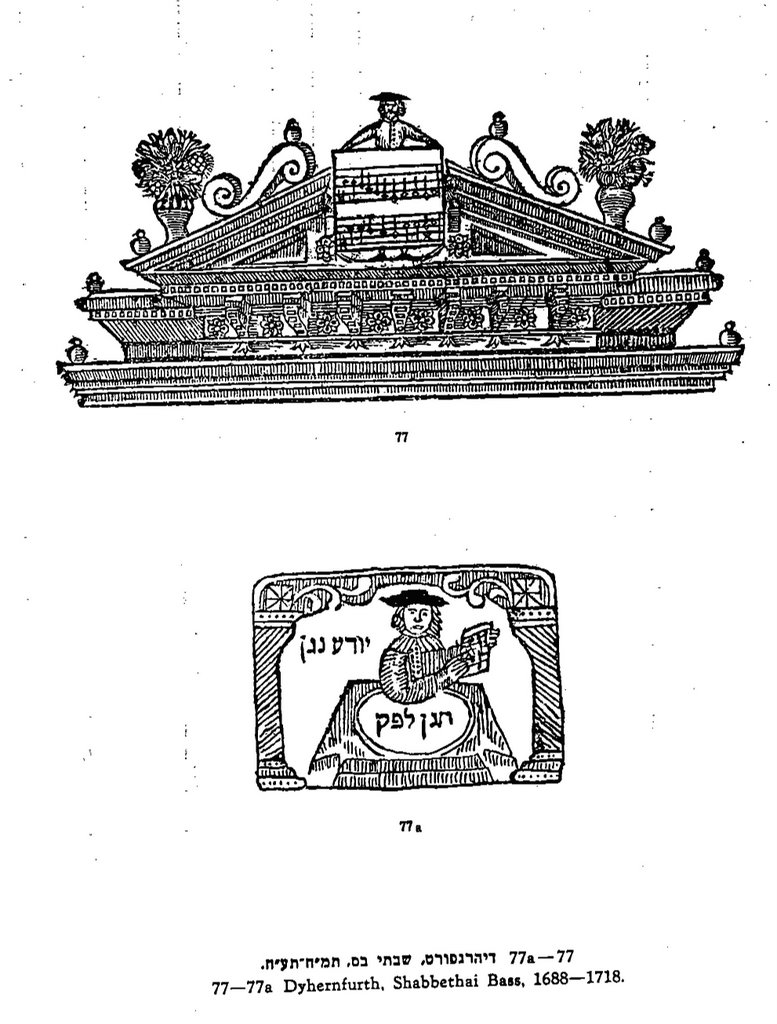


R. Shabbtai the Bassist, the First Hebrew Bibliographer

The JNUL has just put up the first Hebrew bibliography, Siftei Yeshenim. This work is written by R. Shabbtai Bass. R. Shabbtai is perhaps most well known for his commentary on Rashi ‘al haTorah titled Siftei Hakhamim.

R. Shabbtai was born in 1641 in Kalisz, Poland. When he was 14, both his parents were killed in a pogrom by the Cossacks. R. Shabbtai went to Prague. It was in Prague where he would gain his last name and begin his career as a printer. In Prague he began taking music lessons and became a bassist for the Altneushul. He, in all likelihood participated in that shul’s choir which would weekly welcome in the Shabbat with musical accompaniment. [Later on, this music would become central to the debate of allowing for an organ in the Shul as well as playing music in any religious services]. R. Shabbtai took his musical calling seriously and the printers mark he used had musical elements to them. [The two relevant ones are reproduced on the side]. Additionally, he became known as alternatively, R. Shabbtai the Bassist Singer or just R. Shabbtai the Bassist. Aside from gaining an interest in music as well as his general Torah education, he also studied Latin while in Prague.

From Prague, R. Shabbtai, went west, eventually ending up in Amsterdam. It was during these travels he visited numerous libraries and began compiling his bibliography. [Although he did begin the project in Prague, it seems to have really taken off after he left.] In 1680, he published the bibliography in Amsterdam and titled it Siftei Yeshenim the lips of the sleeping ones. This title is appropriate for many reasons. First, it comes from Shir haShirim which has the highest density of book titles, and thus, I think is appropriate for a book listing books. Second, as R. Shabbtai points out in his introduction where he offers ten reasons for bibliography, just reciting the names of books the ignorant can earn a similar reward to those who actually study them. R. Shabbtai based this upon R. Isaiah Horowitz (Shelah).

This work lists about 2,200 titles. Of these, 825 were manuscripts. R. Shabbtai provides an index by category at the beginning of the book. Although the bulk of the lists are books by Jewish authors, he also included about 150 Judaica works by non-Jewish writers.

The work was “updated” in 1806 by Uri Zvi Rubenstein, however, he “demonstrated weak bibliographical abilities and his effort is to be considered a step backwards in the history of Jewish Bibliography.” (Brisman at 13).

After spending about 5 years in Amsterdam, R. Shabbtai he moved to Dyhernfurth and opened his own press. He began to print works of Polish Rabbis and printed some of the seminal works on Halakha. He printed R. Shmuel b. Uri Shraga’s commentary on Even Ezer, the Bet Shmuel as well as R. Avrohom Abeli’s commentary, Mogen Avrohom.
While he was in Dyhernfurth, he hoped to reprint his Siftei Hakhamim which had been printed in Amsterdam in 1680. He had made extensive corrections and additions which he hoped to include. During the interim, he found out that the publisher in Amsterdam was also readying a reprint and had secured the normal copyright harems. Thus, R. Shabbtai was forced to buy out the Amsterdam printer so he could reprint he own book! This is of particular interest in one’s understanding of copyright under Jewish law. It would seem from this case that the author does not automatically hold a copyright to his own works. Instead, copyright is dependent upon who has a money interest. Unfortunately, none of the many articles or books on Jewish law and copyright cite or discuss this case.

R. Shabbtai’s commentary on Rashi has been reprinted many, many times, and now is standard fare even with Humashim which contain no other commentaries other than Rashi and Onkelos. However, this commentary is typically an abriged version – Ikar Siftei Hakhamim. This abrigment was done by the famed Romm Press in Vilna in the 1872 edition of their Torah Elokim. Although we don’t know for certain who did the abrigment as the title page just allows “two talmdei hakamim” were the ones who did this. It is assumed these would have been editors at the Romm Press. At that time R. Mordechi Plungin was the editor at the press. He was involved with the printing of many “classics” such as the Eiyn Yakkov and the Shulkhan Orakh. In this last book, although he always remain anonymous and never takes any credit for anything he does, he included in Yoreh Deah a few comments under the title Miluim. Now, some don’t like R. Plungin (he was a maskil) most notably the father of the Hazon Ish. Thus, in the Tal-man edition of the Shulkahn Orakh his comments were excised.

So, if one follows that opinion, one should view as important and sensitive task as abriging a commentary with some skepticism. Perhaps, as the editors remained anonymous this hasn’t been noticed – yet. Or, the two talmdei hakamim were not R. Plugin. Be it as it may, R. Shabbtai, the bassist, printer, bibliographer, has left an indelible mark across numerous disciplines.

Sources. For biographical sources, you can look at any one of these as they all just regurgitate what the others prior to them do without adding much, if anything. EJ vol. 4 col. 313. Friedberg, B. History of Jewish Typography of Amsterdam et. al., Antwerp, 1937, 53-64; Y. Rafel, Sinai vol. 8 and 9 reprinted in his Rishonim v’Achronim; and the JE here. See also on R. Shabbtai and Jewish bibliograpy in general S. Brisman, “A History and Guide to Judaic Bibliography.” It is worth reading Zinberg’s nice biography of R. Bass in The History of Jewish Literature, vol. 6, pp. 150-52.

For his printers marks, see Ya’ari, Printers marks. On his Siftei Hakhamim see the new bibliography on Rashi commentary, P. Krieger, Parshan-Data, p. 41-46.

Finally, there is a discussion regarding the first edition of Siftei Yeshanim and why in some edition a Siddur is apended to it. For this, see H. Liberman, Ohel Rochel vol. 1 p. 370-71.