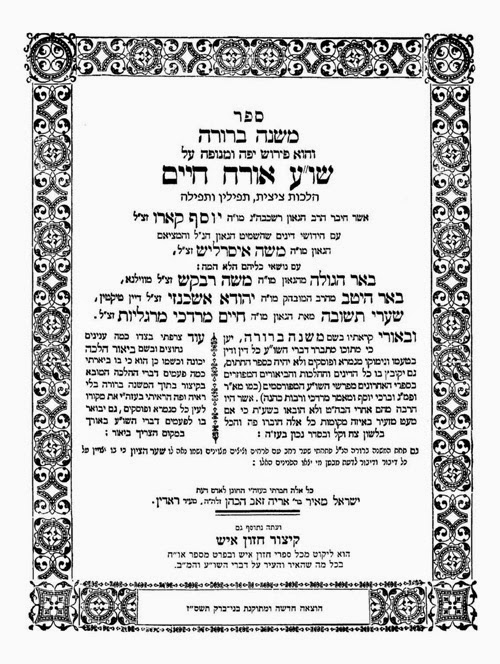
תיובתות דחפץ חיים תיובתות – עלומות בשולי ההדפסה הראשונה של המשנה ברורה חלק א

תיובתות דחפץ חיים תיובתות – עלומות בשולי ההדפסה הראשונה של המשנה ברורה חלק א

מנשה קפלן, רחובות

Copies of the 1884 of the Mishnah Berurah first printing aren’t identical. Working from several surviving exemplars, Menashe Caplan documents the variants: Rav Chaim Elazar Wacks’s haskama appears in some copies but not others; the last line of the introduction comes in three versions (blank, a halakhic gloss, or thanks to three specific donors); a printing warning appears sporadically; three different subscriber lists circulate in different combinations. Nothing is accidental. The Chafetz Chaim sat in the Warsaw press daily for months, and had to personally orchestrate which bundle of haskamot, acknowledgments, and subscriber lists went to which community.

Along the way Caplan raises questions the Chafetz Chaim never addressed: why isn’t financing print runs listed among forms of Torah support in Shem Olam? Why is ribbit devarim absent from Ahavat Chessed? Which edition of the Shulchan Arukh did he copy the base text from? Each puzzle gets the Talmudic refrain teyuvta de-Chafetz Chaim teyuvta — an unanswered challenge.

The piece is dedicated to Rabbi Eitam Henkin הי”ד, (see here and here) who was planning to write a doctorate about the Chafetz Chaim (see here), and would have probably addressed these questions. R’ Eitam HYD was cruelly murdered with his wife Na’ama on the third day of Chol Ha-Mo’ed Sukkos (1 October 2015).

לזכר הרב איתם הנקין הי”ד. חסרונו חי עימנו. אנקדוטות דפוס, ומסביבן, שבאופן טבעי, אותו היינו משתפים, עימו היינו מתייעצים, וממנו היינו לומדים. “ספר משנה ברורה – תהליכי כתיבתו, הדפסתו והפצתו” היה פרק מתוכנן בהצעת הדוקטורט שהרב איתם תכנן לכתוב על הח”ח ואין שום ספק, שכדרכו, היה נכנס לפרטים ולפרטי הפרטים. חבל על דאבדין. המקום ימהר עמידתו בקרוב, יחד עם כל נשמות חללי הטרור האזרחים, חללי צה”ל ומערכות הבטחון – ההרוגים על, ובשביל, עם ישראל ומלכות ישראל – המעלים את חימת המקום, במחיצת פפוס ולולינוס. הרחמן יקום נקמת דמיהם בקרוב.

הקדמה

את ספר משנה ברורה, והמקום המרכזי שתפש ותופש בחיי היהודים שומרי תורה ומצוות אין צריך להציג. מהדורות המשנה ברורה נסקרו היטב ע”י גב’ ברמה (ראו בהמשך) אך עדיין יש פרטים ביבליוגרפים הטעונים בירור ורישום (ולהעיר, אף מקור נוסח המחבר והרמ”א שבספר מ”ב טעון בירור, וכן כמה הערות מתודה1 ).

למען ירוץ בו הקורא נא ראו ראשי תיבות עותקי המ”ב המוזכרים במאמר2.

בתשמ”ד יצא ספרון: כתבי “החפץ חיים”: הרב ישראל מאיר הכהן מראדין: רשימה ביבליוגרפית, הרב משה גליס ואביעד הכהן, בצירוף תעודות ומסמכים לתולדות “החפץ חיים” (המשנה ברורה בעמ’ 76) – אך הוא קצר, ואין בו תיאורים או הערות.

בעבודת המ”א החשובה של גב’ מרב ברמה3: לדרכו של ה”חפץ חיים” בספר “משנה ברורה”, עבודת גמר (מ”א) – אוניברסיטת בר אילן, תשס”ח 2008 – המחברת רשמה, בנספח ו’ (עמ’ 119 ואילך) את מהדורות המשנה ברורה, באופן די מפורט, והוסיפה הערות כהנה וכהנה. הרשימה כוללת את המהדורות הרגילות (מה שקרוי הסטריאוטיפיות) שהן הקשות לרישום. המחברת לא נכנסה לפרטי ההדפסה של חלק א’ – נשוא רשימתנו.

המחברת מציינת (עמ’ 122, הערות למהדורות השונות, הערה 1) שההדפסה הראשונה נדירה ביותר, ומן הסתם, ההדפסה הראשונה אינה מצויה, נכון לאז. אך משנת 2008 נוסף מקור לא אכזב בדמות המכירות האינטרנטיות הפומביות, בעיקר באתר בידספיריט. בציון המהדורות הסטריאוטופיות נפלו שגיאות רישום, כפי שהמחברת ציינה, בצדק, שם בהערה, וגם בבידספיריט יש מוכרים ששוגים ברישום. להלן, בעזרת מפעל הביבליוגרפיה של הספריה הלאומית, יובהר מהי ההדפסה הראשונה ומה סימניה, ובעז”ה נעמוד על וואריאנטים נוספים.

עיקר עבודתה החשובה של הגב’ ברמה עוסקת במתודיקה של החפץ חיים בחיבורו המשנה ברורה, ולא בהיבטים – הצדדיים לתוכן החיבור – שאנחנו מעלים כאן. אגב אורחא, ובשולי עבודתה, בעמ’ 15, המחברת התייחסה להיעדר הסכמת ר’ ישראל סלנטר לספר חפץ חיים, והיא משערת, שההסכמה ניתנה – למרות הסתייגות הרב סלנטר ממתן הסכמות – אך בשל ריבוי שבחי הח”ח, הח”ח הוא זה שנמנע מלהדפיסה (ראה המקור לזה שם בהערה 43). המעיין בהסכמות הקיימות במ”ב יראה די שבחים. סיבה אחרת, ומרתקת, שההסכמה כלל לא ניתנה, הביא הרב אהרן סולוביציק, מהרב הוטנר (פרח מטה אהרן, ספר המדע, תשנ”ז, עמ’ 88, ועמ’ 187)4.

מכיוון שמן השמיים זימנו לנו עותק מההדפסה הראשונה של המשנה ברורה חלק א’ (אמנם לא עותק יפה – תן עיניך למהדורה), וחלק ב’ הראשון שיצא, הלכות שבת (ראו בהמשך), הזדמן לנו לבחון מקרוב, ומשם רשימתנו צמחה. כמעט שלא מדובר על התוכן ההלכתי של החיבור עצמו, אלא על עניינים בדפים שלפני גוף החלק ההלכתי שבספר, ולאחריו, שאף בהם, הלכה, הנהגה, ותלמוד מעורבבים.

מלבד גאונותו ומידותיו, החפץ חיים היה אינדיבידואליסט ו”קנאי” של ממש בכל הנוגע להכנת ספריו לדפוס, מכירתם והפצתם. הערותינו הביו-ביבליוגרפיות נוגעות, איפוא, בו, ובאישיותו הגדולה.

ולהערה שמקומה כאן: בתחילת הדרך כשכבר ידעתי לאן פניי מועדות, החלפתי דברים עם ביבליוגרף מוערך מאוד. הוא העירני שחלק מהשאלות שלי על הח”ח מוגזמות וכי אני מדייק בו, ומפלפל בו, בהגזמה רבתי – משל היה הלכה סתומה ברמב”ם – הרי מדובר בסך הכל בהליכי הדפסה, ובחלק מהמקרים, פכים קטנים, ושוליים, וזה “לא כ”כ מקצועי”. הביקורת במקומה, ממקומה. האומנם שאני הקטן, בע”ב פשוט – איני מסכים לה. הח”ח היה דייקן בכל דבר שכתב ועשה, כתפיים רחבות לו להכרעות פסיקה, קפדן גדול בכל הליכותיו, קפדן טקסטים, קפדן בפרטים, שישב פיזית בבית הדפוס, מדי יום, זמן ממושך, על חשבון לימודיו הקבועים. כל זיז ורז דפוס לא אניס ליה, והיה איכפת לו. איש גדול, שאופיו אופי פרטים – גם בפרטים קטנים וגם בפרטים “קטנים”, וזה חותמו. ברור לנו לגמרי שהח”ח חשב על הכל. אין כאן “פרומקייט”, ואף לא “האדרה” מלאכותית. כי זה האיש הגדול הזה, וזה אופיו. הקורא החושש שהמאמר יעסוק במופלג, שולי ומוגזם, יוכל לפרוש עכשיו.

יובל מאה וחמישים שנה להתחלת הדפסת המשנה ברורה יארע בעז”ה בעוד שנים ספורות (תשצ”ג-ד, 2033-4). היובל צפוי לעורר הד גדול בעולם היהודי, למשוך תשומת לב מכל גווני העולם היהודי, בכתב ובע”פ. כולם יכנסו לטרקלין ההשפעה העצומה של החיבור, ולשיטת עבודתו. רשימתנו אינה אלא סנונית קטנה ב”עטיפה” וב”פרוזדור” של החיבור. משגיאות ושגגות נקני.

סימני ההדפסה ראשונה

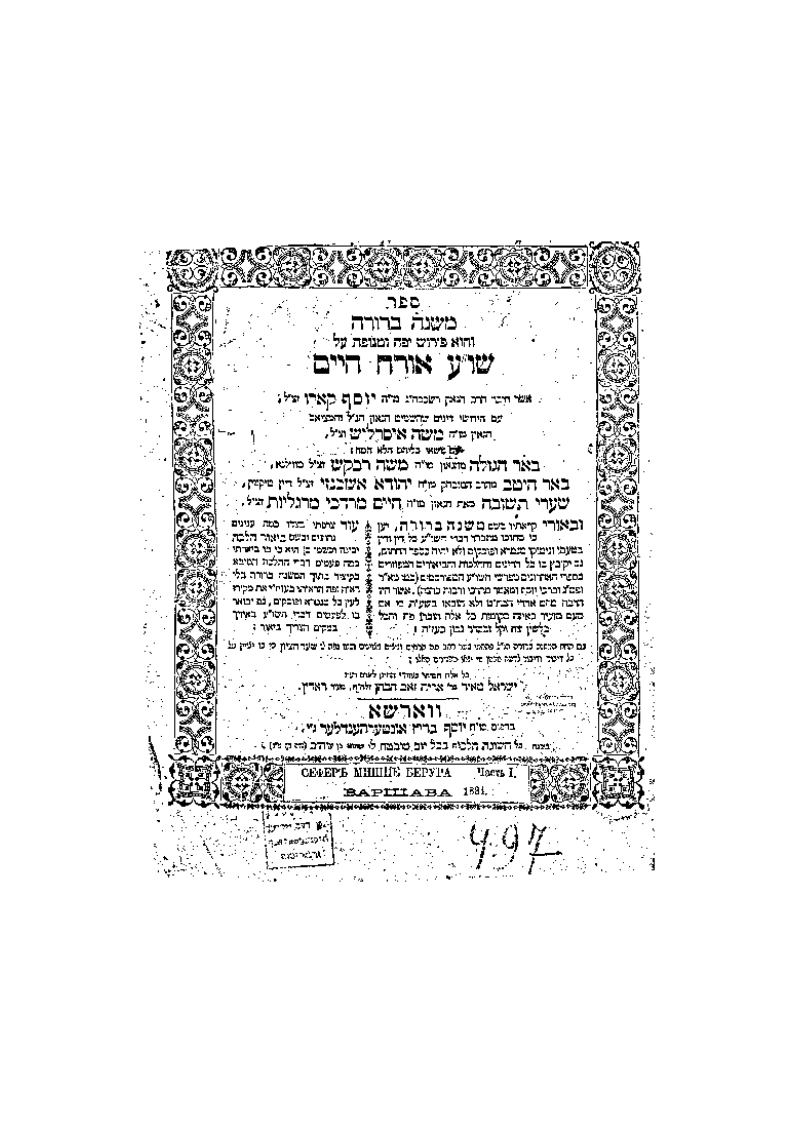
נקודת התחלה ראויה, תהיה במפעל הביבליוגרפי של הספריה הלאומית, על מנת לדעת שהיו שתי הדפסות של המשנה ברורה חלק א באותה שנה לועזית – 1884. באשר להדפסה הראשונה נרשם כך:

המדפיסים שבלועזית – במקור באותיות קיריליות. ‬

5 הסכמות5: ר’ יצחק אלחנן [ספקטור], קאוונא, כב שבט תרמ”ד, ר’ מרדכי קלאצקי לידא, רבני ווילנא: ר’ יוסף ב”ר רפאל [סאקוביץ] ור’ שלמה בר”י [ב”ר ישראל] משה הכהן, יב ניסן תרמ”ג , ר’ בן ציון ב”ר אריה ליב [שטרנפלד], קאלוואריע, כ סיון תר”ם, ו- ר’ שמואל זנוויל במוהרי”ז [יעקב זאב קלפפיש], ווארשא, כא אדר א תרמ”ג

משה מאיר ישר בספרו “החפץ חיים, חייו ופועלו”, כרך א, בני ברק תשנ”ז, עמ’ 222, כותב: ’בקיץ של שנת תרמ”ג הופיע הראשון לששת חלקי ה”משנה ברורה“’. אך בנו של המחבר, ר’ אריה ליב פופקא, כותב “בשנת תרמ”ד הדפיס אבי את חיבורו משנה ברורה ח”א” (מכתבי הרב חפץ חיים, וורשה תרצ”ז, עמ’ 30(

1 דף בסוף: “שמות החתומים”
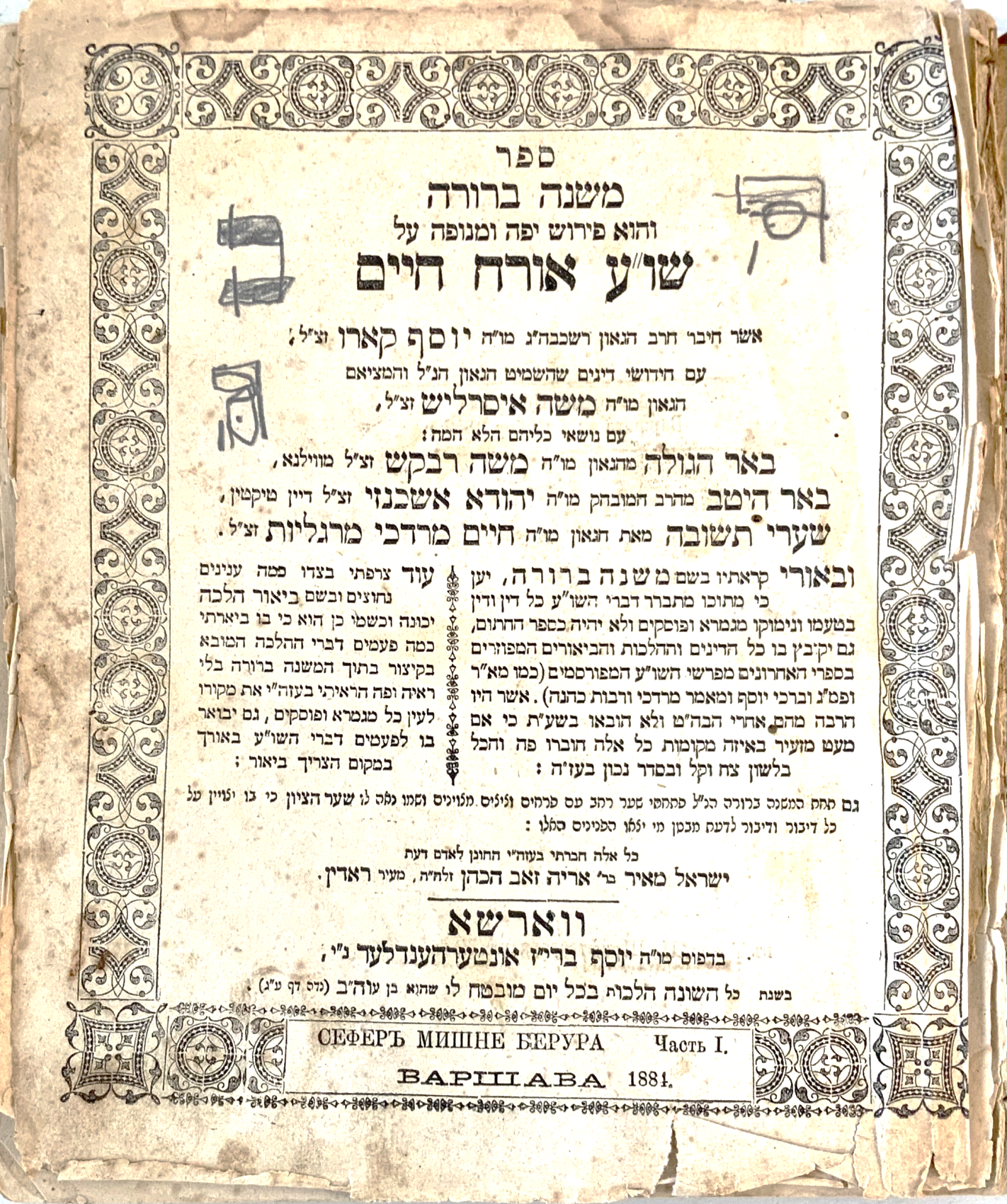
שער משנה ברורה חלק א’ מהדורה ראשונה הדפסה ראשונה– עותק מ”ק
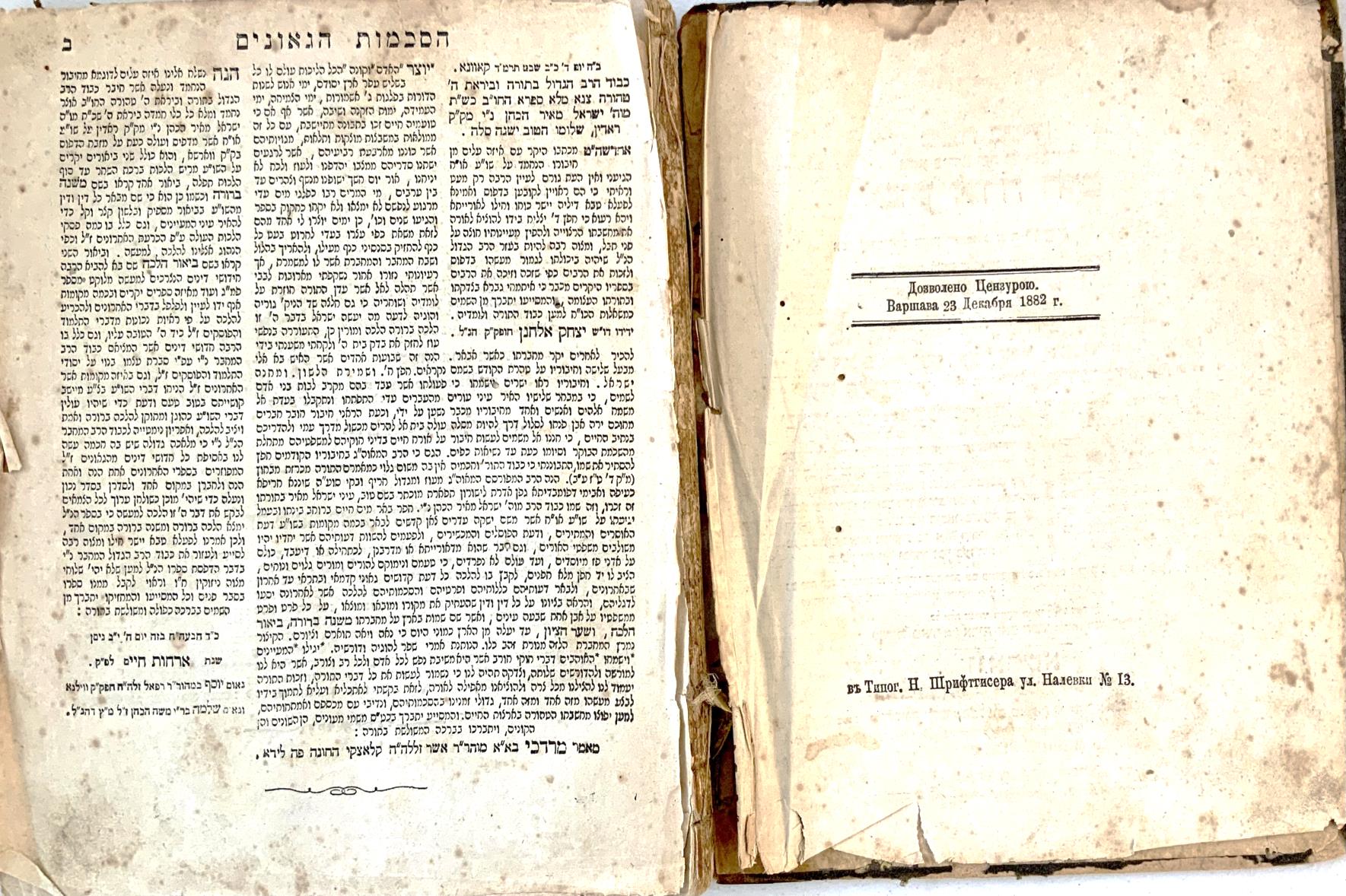
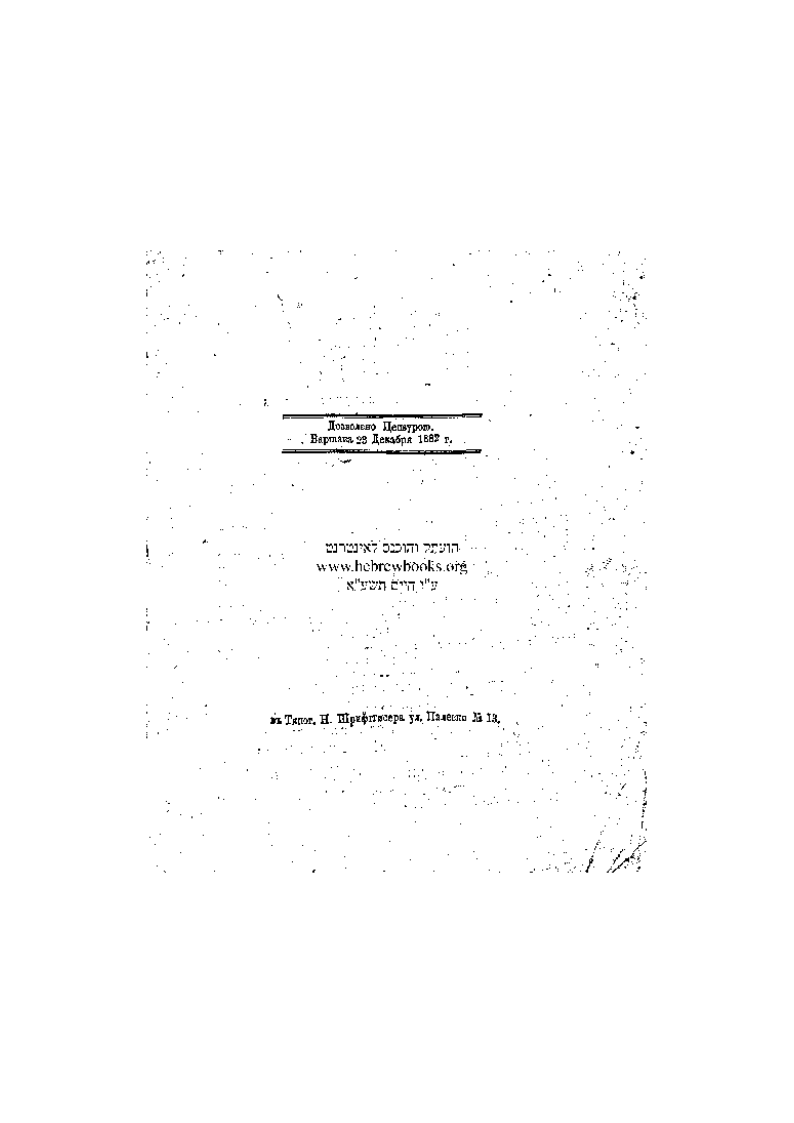
הדפסה ראשונה עמודים 2-3 – אישור הצנזור 23 לדצמבר 1882
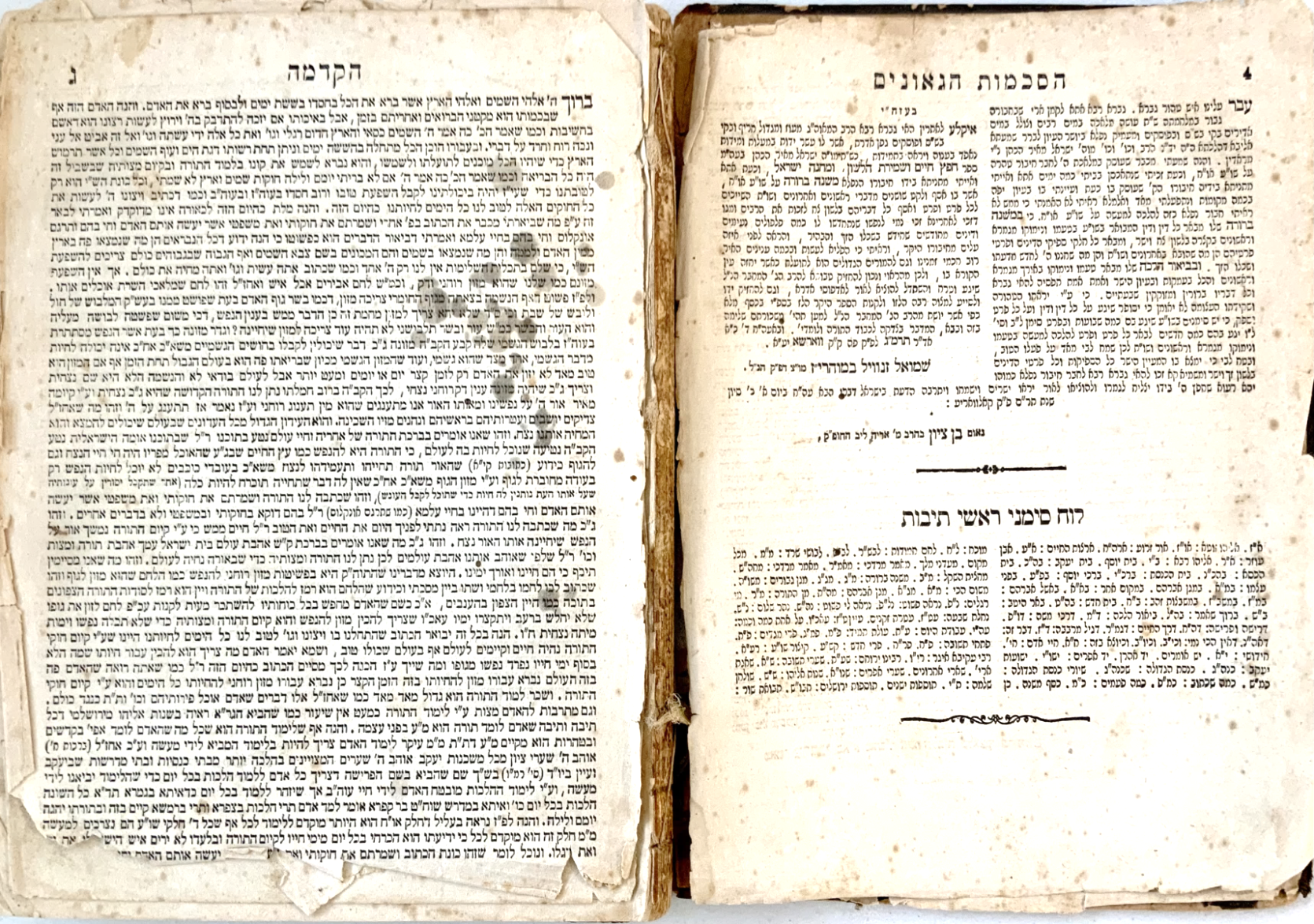
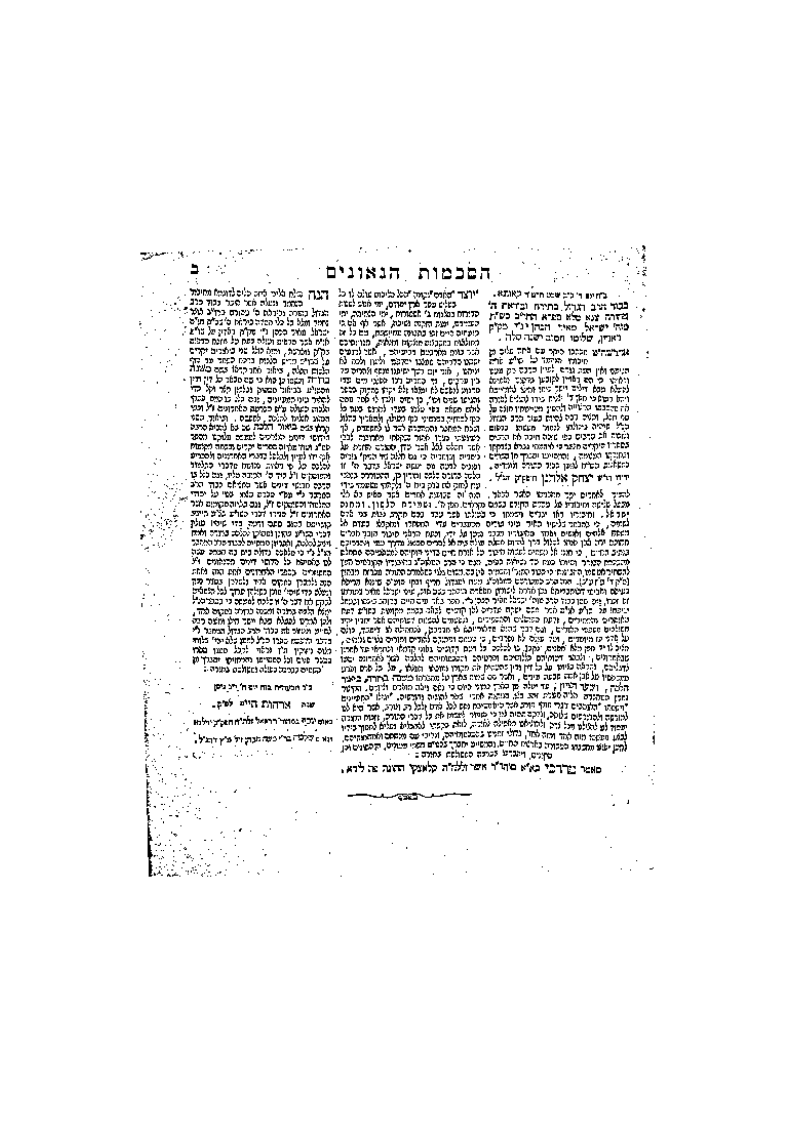
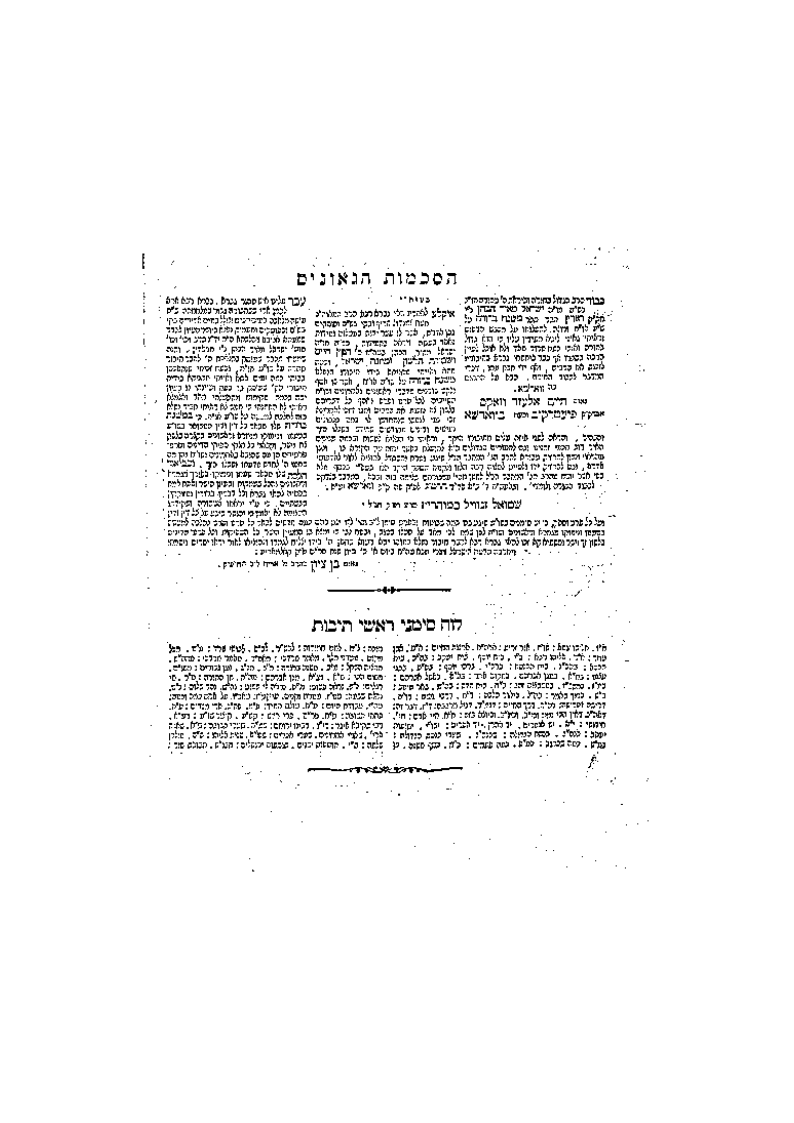
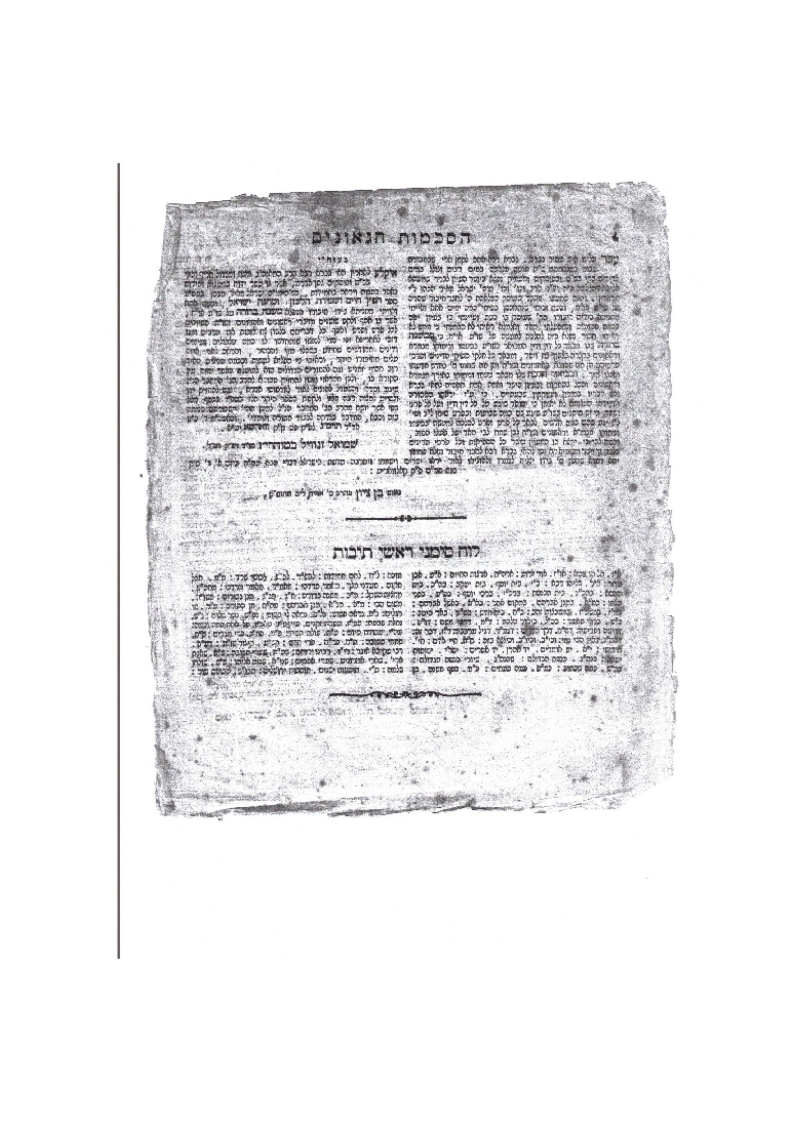
הדפסה ראשונה עמודים 4-5.
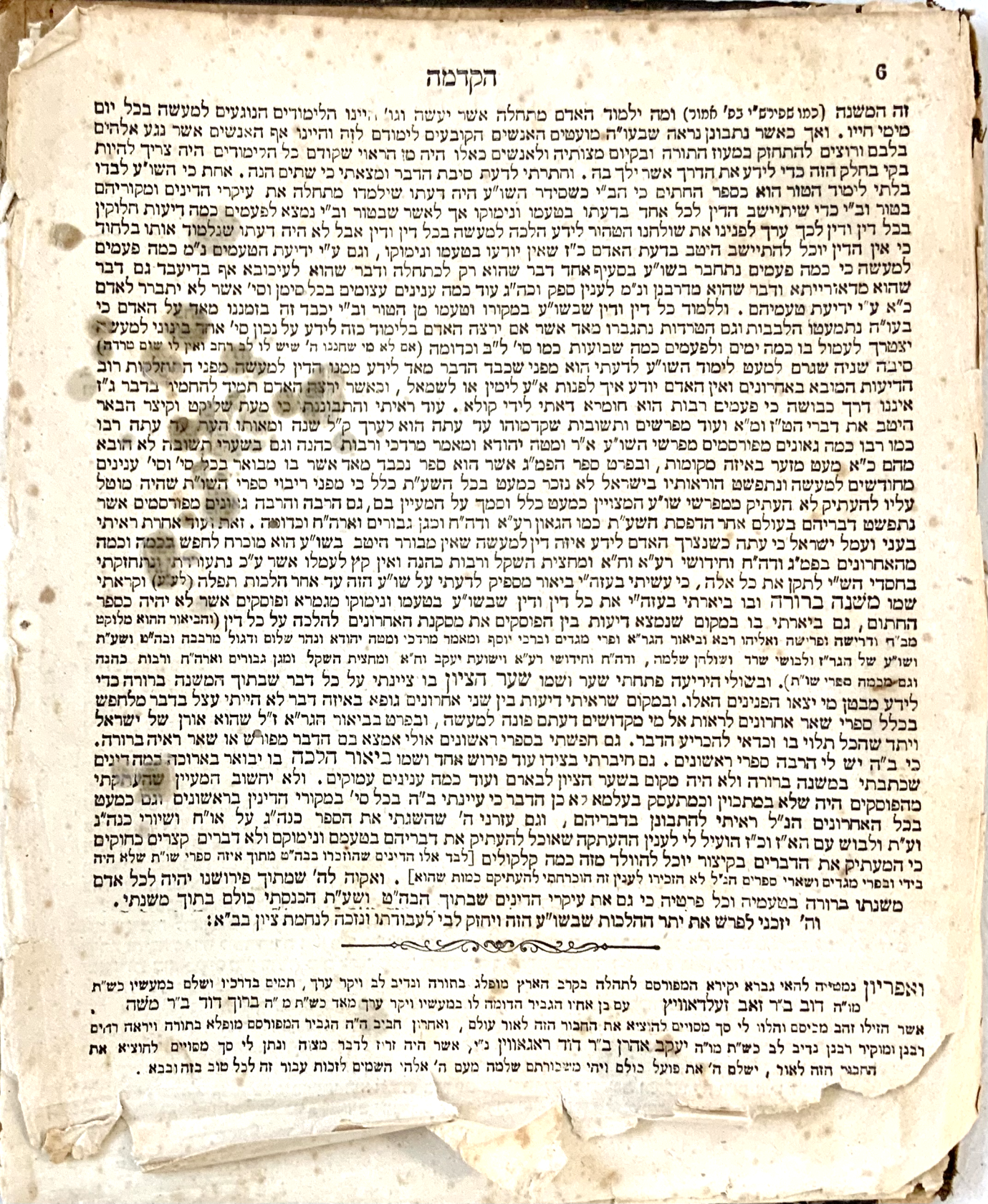
הדפסה ראשונה, עמ’ 6, העמוד השני של ההקדמה, בתחתית, ההודאה לתורמים – עותק מ”ק
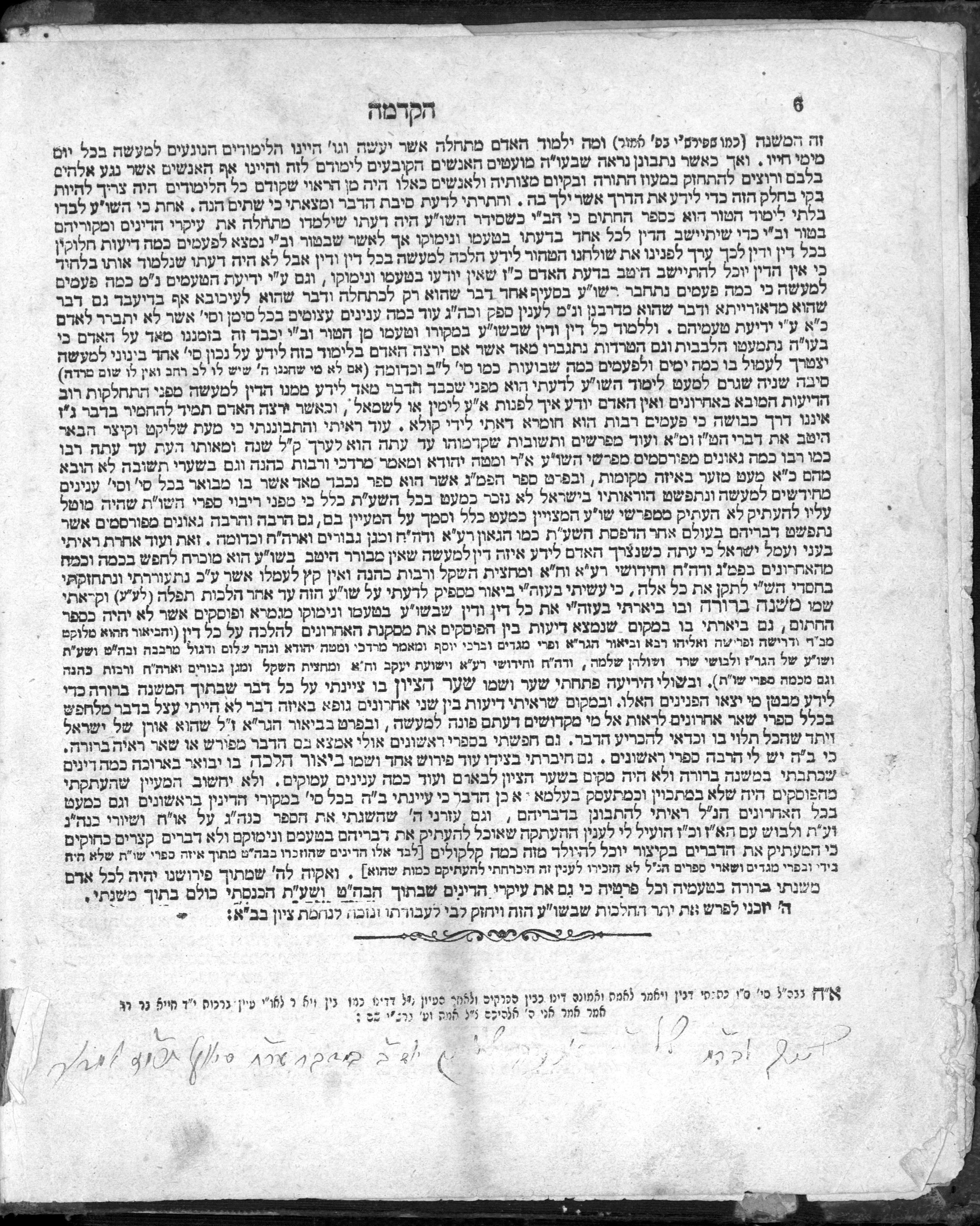
הדפסה ראשונה העמוד השני של ההקדמה, בתחתית, הערה הלכתית – עותק ס”ל

ובאשר להדפסה השניה נרשם כך:

בשער: 1884. הפרט משנת תרמ”ג. מעבר לשער צנזורה מתאריך 1 למאי 1884 וכן שם הספר, שמו של המחבר ברוסית, ושוב התאריך 1884.

לעומת הוצאת 1884 המקורית, יש כאן השינויים הבאים: אין כאן שמו של המדפיס, לא בשער ולא מעבר לשער; תאריך רשיון הצנזורה שונה; בהוצאה המקורית אין שם הספר והמחבר ברוסית, ועוד. כמו כן נשמט כאן הדף האחרון עם רשימת החותמים. בשולי העמוד האחרון נוספה אזהרה מאת המחבר שלא להדפיס הספר ללא רשותו. ‬

בעמ’ 192 יש שינויים בתוכן (ב”ביאור הלכה”): נוספה הערת-כוכב בשולי העמוד; באמצע דבור-המתחיל ’יצא’, במקום “בלבדו שלא הוציא בשפתיו”, תוקן ונדפס : “בלבו שלא השמיע לאזנו משמע”. ‬ [להעיר שבטופס ההדפסה הראשונה שתח”י כתוב “בלבו שלא הוציא בשפתיו”, לא “בלבדו” – שמא זו ט”ד של המפעל?]

עם הסכמות ר’ יצחק אלחנן ספקטור, ר’ מרדכי קלאצקי, ר’ יוסף סאקוביץ, ר’ שלמה ב”ר ישראל משה הכהן, ר’ בן-ציון שטרנפלד ור’ שמואל זנוויל קלפפיש, מההוצאה הקודמת (אף היא משנת 1884).

הסכמת הרב וואקס אינה רשומה במפעל הביבליוגרפיה בשתי ההדפסות. בעותק ה”ב ההסכמה מופיעה. בעותק ההדפסה השניה של 1884 היא מופיעה בעותק לג/2 (מכירה 3.11.24 פריט 45). עכ”פ יש לנו כמה סימנים להדפסה הראשונה: תאריך הצנזור 23 לדצמבר 1882, שם המדפיס נמצא, והפרטים האחרים. כנראה שעורכי מפעל הביבליוגרפיה ראו רק דף חותמים אחד, בעותק שלפניהם, ולא ידעו שיש עוד שניים.

צילומי עותק ה”ב ביחס להסכמת הרב וואקס הבאנו בהערה 5. אמנם הוספה או גריעה של הסכמה היא שינוי, אך לא מסוג עלומות הדפוס שנצביע עליהם. זה לעיתים תלוי-מקום, או תלוי שוק, ודבר טבעי. לעניין אחד השינוי הזה מתווסף: הצורך לסדר ולנתב את העותקים לאנשים וקהילות, באופן שההסכמה “תתאים”, או היעדרה.

מעורבותו העמוקה של הח”ח בהדפסת ספריו

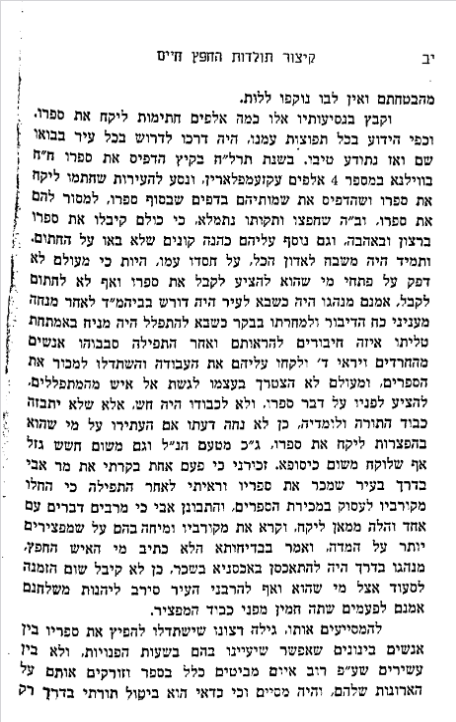
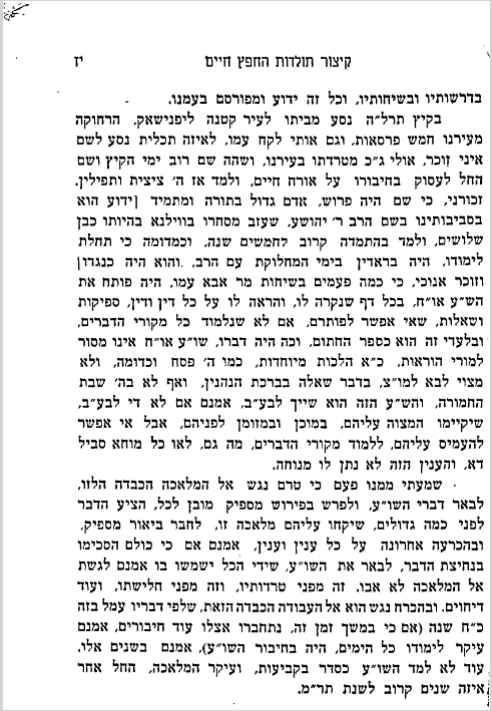
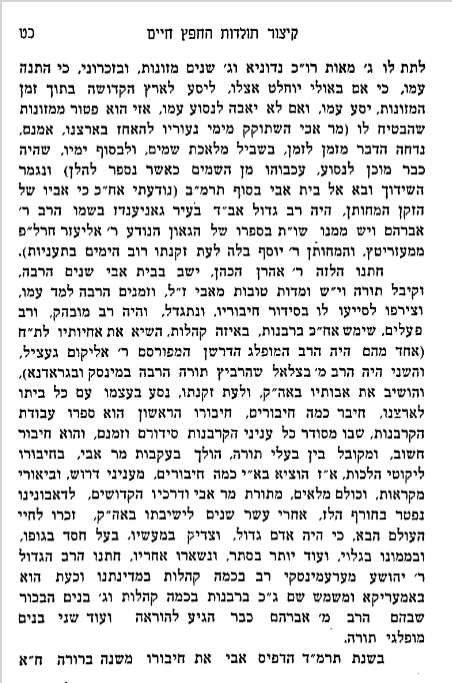
פרטים על מעורבותו של הח”ח, בהדפסת ספריו, מצויים בספר של בן הח”ח, הרב אריה ליב הכהן: תולדות וקורות חייו של החפץ חיים שיצא בשנת 1927 והדפסה חוזרת 1952. חזר ונדפס בראש ספרו האחר של הרב אריה: מכתבי הרב חפץ חיים זצ”ל, מהדורה שניה ניו יורק תשי”ג, אך המדפיס לא שמר על העימוד המקורי, צופף את הדפוס, ועימד מחדש. התיחסותנו תהיה, איפוא, למהדורה המקורית שנמצאת באתר היברובוקס.

קישור להיברובוקס

ליקטנו כמה פרטים מתוך הספר – בסוגריים עגולות מספר העמוד, והערותינו בסוגריים מרובעות באותיות קטנות יותר. בסוף המאמר הבאנו נספח צילומי הדפים הרלבנטים.

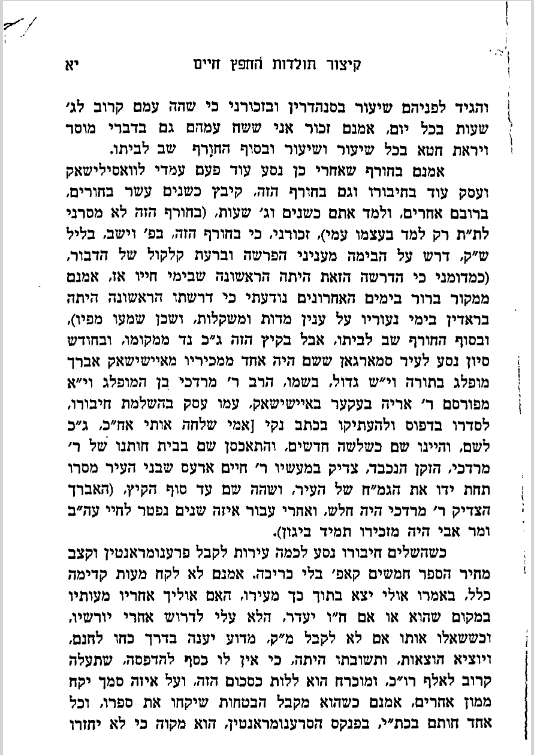
הח”ח נסע בעצמו לגייס חותמים – פרענומערנטן – לספרו החפץ חיים (עמ’ י”א), [כנראה בשנת 1872 שכן הספר יצא בתרל”ג], הוא גייס כמה אלפי ! חותמים (י”ב), [בסוף הספר הדפיס 8 עמודים עם כ- 1,200 שמות], ובשנת תרל”ח הדפיס בווילנה 4,000 עותקים ונסע לחלק לחותמים (י”ב) [זו המהדורה השניה ולא ראינו שיש בה רשימות חותמים].

הנה הקישור למהדורת תרל”ג שבסופה נמצאים 8 עמודי הפרענומערנטן – עמ’ 161-168 לפי עמודי היברובוקס:

קישור להיברובוקס

על המשנה ברורה הח”ח עבד 28 שנים (י”ז). בשנת תרמ”ד הדפיס חיבורו משנה ברורה חלק א’ (כט) [רישום האותיות בשער הוא תרמ”ג. יתכן שהשער הוכן עוד בתרמ”ג אך ההדפסה גלשה לתרמ”ד – עדיין 1983 – והלאה לשנת 1884 ככתוב בתחתית השער. האם יתכן שכתבו את השנה הלועזית מראש? באופן שהספר אכן יצא בקיץ תרמ”ג – 1883 – כפי שהרב ישר כתב בספרו: החפץ חיים חייו ופועלו, הוצאת נצח, תל אביב, תשי”ח – 1958, כרך ראשון, עמ’ ריד? וכמצוטט במפעל הביבליוגרפיה? איננו יודעים6].

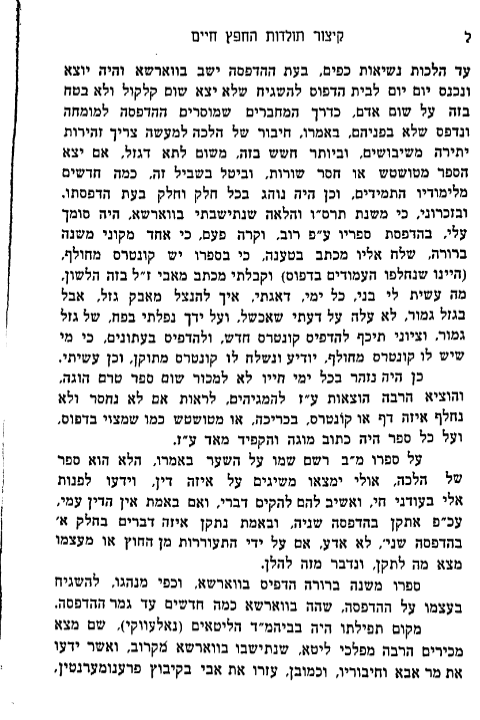
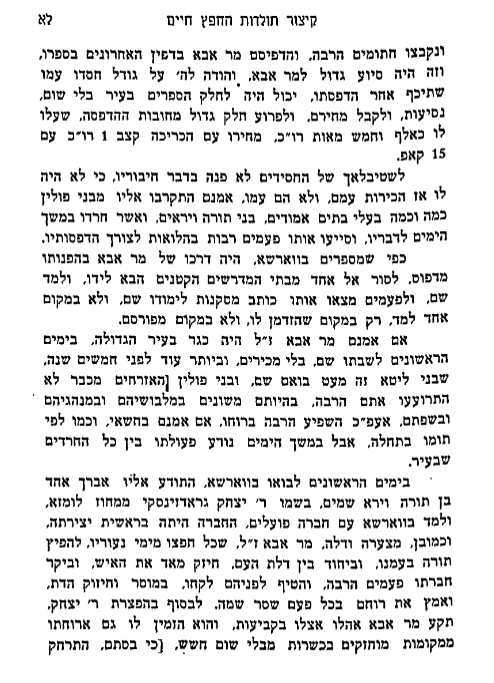
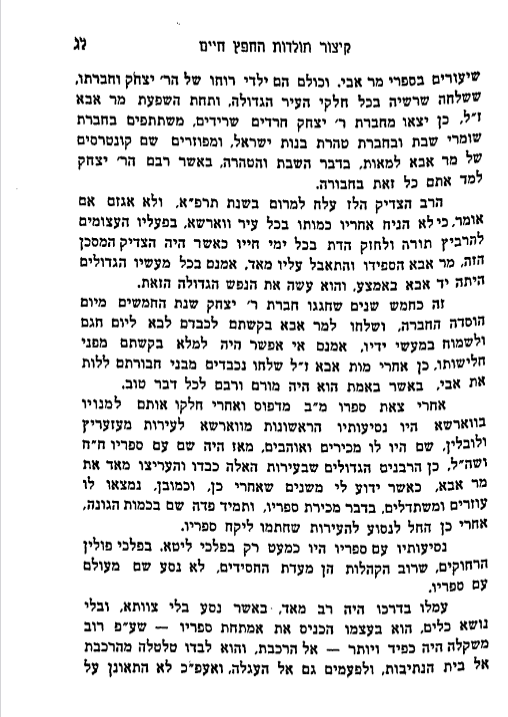
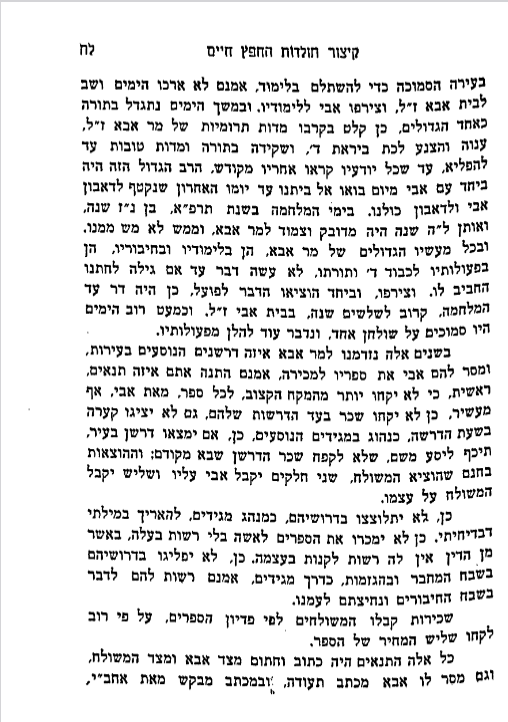
בעת ההדפסה ישב בוורשה ונכנס יום יום לבית הדפוס להשגיח שלא יצא קלקול, לא בטח בשום אדם, ביטל בשביל זה כמה חודשים מלימודיו התמידיים, וכך נהג בכל חלק וחלק בעת הדפסתו (ל).

מקום תפילתו בורשה היה בבית המדרש של הליטאים שעזרו לו בקיבוץ הפרענומערנטן (ל), ונקבצו חתימות הרבה והדפיסם בדפים האחרונים בספרו (לא) [“דפים” גרסינן ולא דף אחד. הגבירים שעזרו לח”ח באופן מיוחד אינם מוזכרים אצל הרב אריה. לכאורה, נעדר אצלו פרט משמעותי, שמא לא מקרי, כי ההודאה לתורמים הללו אינה מופיעה בכל ספרי המהדורה, ועל כך בהמשך דברינו].

אחרי צאת ספר משנה ברורה, הח”ח חילק למנויים בוורשה, ונסיעותיו הראשונות היו למעזריץ ולובלין. נסיעותיו עם ספריו היו כמעט רק בפלכי ליטא. לפלכי פולין הרחוקים שרוב הקהילות חסידים לא נסע מעולם עם ספריו (ל”ג) [“מעולם” ! זו קביעה קטגורית די מפתיעה ומעוררת השתאות. וכי למה לא? הלוא גם חסידים רכשו ולמדו את המ”ב. מ- 1883 ועד 1933, שנת פטירת הח”ח, יחלפו חמישים שנה, וכי לא נסע עם ספריו ל”כרכי פולין הרחוקים” בכל חמישים השנים הללו? טעון בדיקה]

החלק הבא של משנה ברורה דילג להלכות שבת, מפני שראה דחיפות לעורר את הדור על השבת, ורק לאחר הדפסת הלכות שבת התפנה לחזור להלכות נ”כ וברכות הנהנין, לפיכך נדפס על השער של הלכות שבת, בהדפסה הראשונה, “חלק שני”, אם כי כבר בהדפסה הבאה, ועד היום, הוא חלק ג’ (ל”ח). כותרת “חלק שני” היא איפוא סימנה המובהק של ההדפסה הראשונה של הלכות שבת.
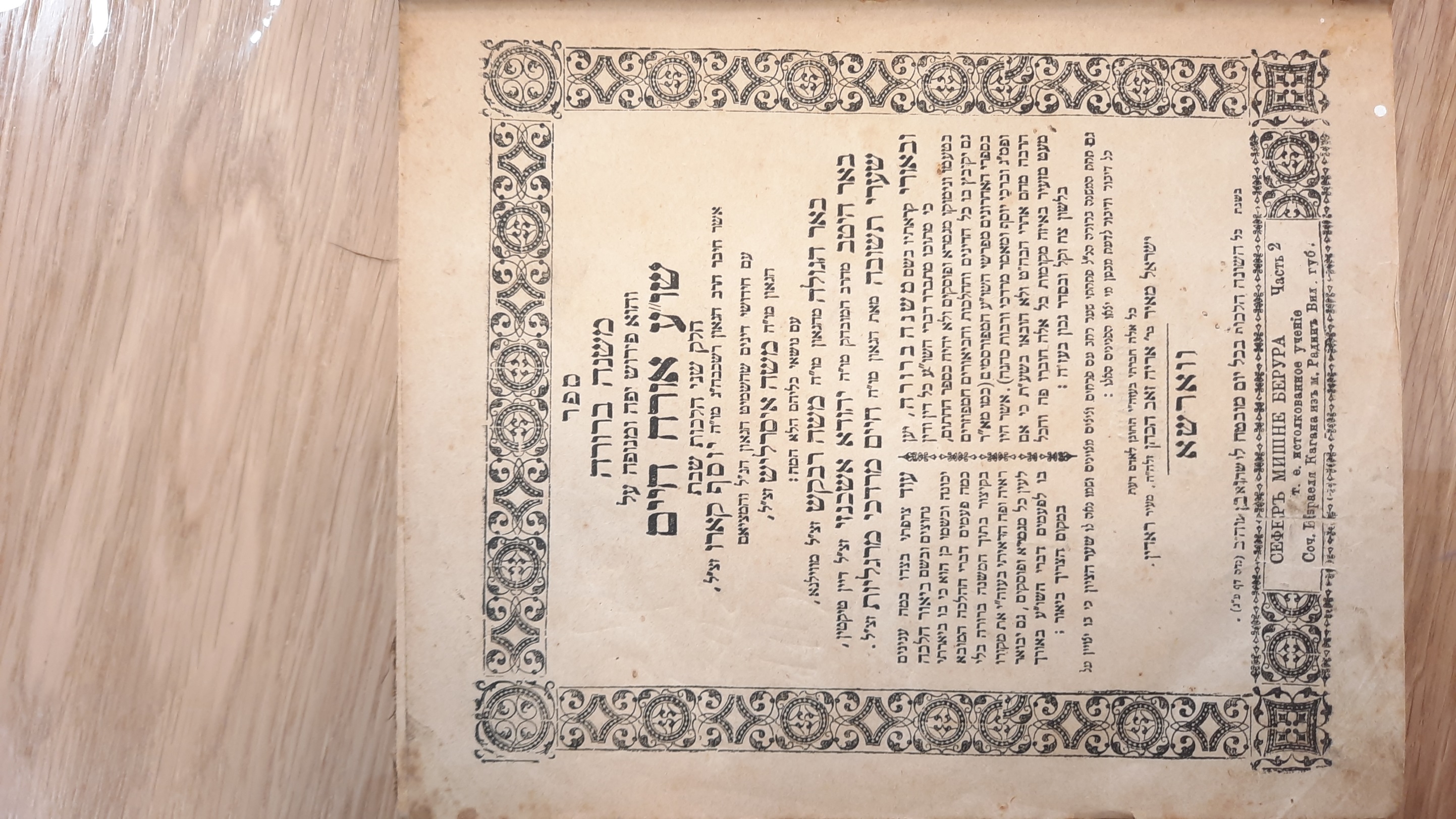
מהדורה ראשונה ויחידאה – תרנ”א – שהלכות שבת הוא חלק שני (מהמהדורה הבאה הלכות שבת הוא חלק שלישי)

ממה שאנחנו יכולים להתרשם, הח”ח לא בטח באיש והשגיח יום יום בבית הדפוס על מלאכת ההדפסה, ביטל מלימודו הרוטיני חודשים רבים, בכל חלק וחלק מהמשנה ברורה שהדפיס. אין ספק שהיה “קנאי” וקפדן גדול בכל הנוגע לתהליכי ההדפסה, והמכירה. לאור מעורבותו המלאה של הח”ח בהדפסה ובהגהה, פשיטא שלא ניתן לייחס מקריות בשינויים שנציג, ואין לנו שום ספק שחותמו של הח”ח, טבוע, על כל שינוי ושינוי, ועל הכל חשב.

“מוגה”

הח”ח הוציא הרבה הוצאות למגיהים ועל כל ספר היה כתוב מוגה, והקפיד על זה מאוד (אצל בנו, עמ’ ל”א)7.

בתי המכירות מציינים בהבלטה, כאשר המלה “מוגה” כתובה, בעט או עיפרון, כי כולי עלמא מאמינים שזה סימן מובהק שהספר יצא מידיו של הח”ח בכבודו ובעצמו, וכי המלה “מוגה” נכתבה על ידו. למרות שהשוואה אקראית של המילה “מוגה” נראית אולי דומה לעין רגילה, לא מקצועית, אך, ככל הנראה, על זה אין לסמוך כלל.

היות והרב אריה היה דייקן גדול והשתתף בכתיבת המשנה ברורה – ברא כרעא דאבוה – הוא מציין שאביו שכר מגיהים, וכי אביו הקפיד שעל כל ספר – “היה כתוב מוגה” גרסינן – ולא “היה כותב”. מדובר, כנראה, באלפי ספרים, ולכאורה, אם הח”ח היה כותב, אישית, על כל ספר “מוגה”, היינו מצפים שטרחה כזו, שלוקחת הרבה זמן ומאמץ, תהיה די חשובה, מרעישה ובולטת, שבנו יציין זאת.

לאחר העלאת הספיקות בשורות הללו, ראינו שגב’ ברמה, הוסיפה בעבודתה החשובה, מקור מפורש יותר (פסקה 3 בעמ’ 122), מבת הח”ח, פייגע זקס, שהמלה “מוגה” נכתבה ע”י הח”ח, או בני משפחתו או המגיהים ששכר. על פי שני ילדי הח”ח, יקום דבר.

בעותקים שבידינו (מ”ק) של הדפסה הראשונה של חלק א’, ובחלק שני המקורי – הלכות שבת תרנ”א – המלה “מוגה” איננה. אין לנו הסבר להיעדר “מוגה” בחלק שני-הלכות שבת (אם נכתב בעיפרון אולי נמחק?). ביחס להיעדר “מוגה” בחלק א’ אולי חסר עמוד חוצץ ששם היה כתוב, או שמא ההיעדר מכוון? איננו יודעים. עיון אקראי בבידספיריט יראה שלא תמיד נמצא את המלה “מוגה”. כנראה שההקפדה לא הייתה מאה אחוז, על אף עדות ילדי הח”ח.

בכל אופן, ולאור ורסיות הדפוס של ההסכמות, ההודאה המיוחדת לתורמים, ודפי החותמים שנעסוק בהמשך – האם “מוגה”, והיעדרו, הם יד המקרה? לאור דברינו צריך להניח שאין מקריות אצל הח”ח. מה הטעם? לא נדע. על כן גם זו תיובתא דח”ח תיובתא, מדוע לא נרשם “מוגה” בכל העותקים, במיוחד שהיה צוות שעסק בזה. על רקע הווריאציות השונות של עמודי הפתיחה של הספר, ודפי החותמים בסוף – “מוגה” מקבל משנה חשיבות. האם “מוגה” שימש אות: הרכב ספר זה דווקא לפלוני? או לקהילה פלונית? אין לנו אפשרות היום לראות כמות גדולה ומייצגת של ספרי ההדפסה הראשונה, ולא נוכל לבדוק ולהיווכח מה היה ה-“כלל ופרט” של הח”ח, או בלשון העידן שלנו, מה היה “תו התקן” של הח”ח.

בתי המכירות והקונים ישימו לב כאשר רואים את המלה “מוגה”. אך אדרבה, יזהר הקונה שרואה את המלה “מוגה”. ממש לא בטוח שזה כתב ידו של הח”ח, והסיכוי הסטטיסטי שכתב ידו הוא זה, הוא, נניח, אחד לעשר בערך, במקרה הטוב, בלקיחה בחשבון את בני המשפחה והמגיהים. תשע כתיבות “מוגה”, ו”מוגה” אחד כת”י הח”ח בעצמו, כמחצה על מחצה דמי?

צילומים של המשנה ברורה ח”א

הספר מצולם במספר אתרים, ונחזור על הסימונים.

עותק הספריה הלאומית סימנו ס”ל, יש לחפש לפי הרשומה:

990011055150205171 , השלישי ברשימה (דרך הקטלוג מגיעים לטופס ה”ב שלהלן ולא לטופס המצולם של הספריה הלאומית).

עותק מלא המצולם בהיברובוקס סימנו ה”ב.

קישור להיברובוקס

עותק בית המכירות Legacy Judaica עם צילומים בודדים סימנו ל”ג/1 – מכירת 13.9.20 פריט 64.

עותק נוסף ממכירה אחרת של Legacy Judaica עם צילומים בודדים ל”ג/2 – מכירת 3.11.24 פריט 45.

העותק ברשותנו סימנו מ”ק.

השינויים בשורות לאחר ההקדמה

אנחנו רוצים להצביע על שינוי מעניין. בטופס ה”ב לאחר סוף ההקדמה המשך העמוד ריק. בעותק מ”ק מופיע הודאה לתורמים. בעותק ס”ל בסוף ההקדמה מודפסות שתי שורות של הערה הלכתית בנוגע לסימן ס”ו:

“א”ה [אמר המחבר מ.ק.] בבה”ל סי’ ס”ו כתבתי דבין ויאמר לאמת ואמונה דינו כבין הפרקים, ולאחר העיון נ”ל דדינו כמו בין ויאמר לאו”י עיין ברכות י”ד חייא בר רב אמר אמר אני ה’ אלהיכם צ”ל אמת וע’ ברש”י שם”.

גירסה קמא מופיעה בביאור הלכה בסימן ס”ו, בד”ה *ואלו הן בין הפרקים וכו’, עמ’ 200, פיסקה שניה.

לפחות בעותק מ”ק נוכל להעיד שמדובר באותו קטע קמא ללא השינוי. ואכתי קשיא מדוע ההערה ההלכתית אינה מופיעה בכל ההדפסה ראשונה? תיובתא דחפץ חיים תיובתא.

ועוד שינוי. בעותק מ”ק, לאחר ההקדמה, מודפס קטע של כמה שורות הודאה, לשלושה תורמים שעזרו בהדפסה: דוב ב”ר זאב זעלדאוויץ, בן אחיו ברוך דוד זעלדאוויץ ו- יעקב אהרן ב”ר דוד ראגאווין. השניים הראשונים “הלוו לי סך מסויים”, והשלישי “נתן לי סך מסויים”. לא מצויין מהיכן הם. הקטע הזה אינו נמצא בעותקים האחרים שראינו. זה מעורר תמיהה. וכי מדוע יישמט נדבתם בעותקים אחרים? ותמיהה כפולה – הכיצד בעל ספר החפץ חיים (שקדם למשנה ברורה) – לא יוקיר להם תודה בכל מהדורת ההדפסה? גם זה תיובתא דחפץ חיים תיובתא.

ההודאה לתורמים – עותק מ”ק

אי אזכור מקום מושבם מושך תשומת לב, במיוחד על רקע ציון ערי חותמי הפרענומערנטן. בגוגל לא מצאנו עליהם פרטים, אבל באתר המצויין עיתונות יהודית היסטורית, נמצאו, כפי הנראה, קצת פרטים על שניים מהם, ונקווה שקלענו, ואכן הם המה. הג’ [הגביר] דוב זעלדאוויץ מוזכר ב”הצפירה” 7.7.1885 כתושב מינסק, וב”המליץ” 8.7.1894 הוא עדיין תושב מינסק. ב- 1896 הוא תושב אודיסה, וב- 1900 כתורם לספריה שיסד ד”ר חזנוביץ (לימים הספריה הלאומית), והוא מהעיר יליסובטגרד (כיום קרופיבניצקי) דרום מזרח לקייב. ז”א שבזמן הקרוב להדפסת הספר, דוב זעלדאוויץ הוא תושב מינסק. המרחק בין מינסק לראדין הוא 192 ק”מ, והמרחק בין מינסק לוורשה הוא 557 ק”מ. גם אם המרחק לא כ”כ רחוק מראדין – הוא מספיק רחוק מוורשה.
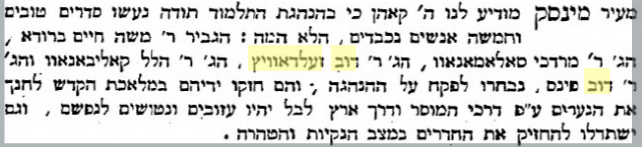
הצפירה 7.7.1885

בהמליץ 9.3.1899 מופיעה ידיעה על פטירת [יעקב] אהרן ב”ר דוד ראגאווין, במינסק. “זה כשנה שב מטאמסק”, ז”א 1898. הוא היה כנראה נדבן גדול, וצויין שישב בטומסק חמש עשרה שנה. זה מביא אותנו לשנת 1883, כך שכנראה היה בעיר טומסק בזמן הדפסת חלק א’ של המשנה ברורה. העיר טומסק היא בירת מחוז טומסק, המחוז הפדרלי בסיביר, במערב סיביר. המרחק בין טומסק לראדין הוא 4,581 ק”מ, והמרחק בין טומסק לוורשה הוא 4,938 ק”מ ! רחוק ממש.
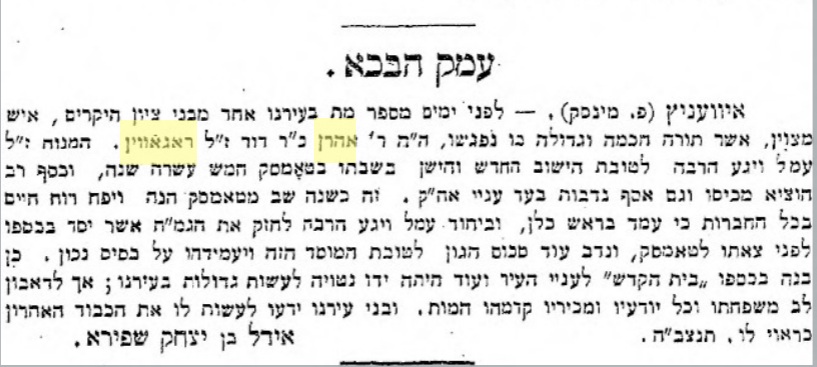
המליץ 9.3.1899

אם כנים דברינו, והאנשים הם המה, הנדבנים רחוקים מוורשה, ומקהילתה, והרבה. לפי הדברים היפים שהח”ח כתב עליהם, הם הלוו לו, והרימו תרומה משמעותית, שכנראה הייתה נחוצה מאוד לח”ח בהדפסת הספר, על כן בדין יזכירם לטובה. ולמה לא יזכירם בכל עותקי ההדפסה הראשונה? מוכרח להיות לזה סיבה, וסיבה כזו שתעמוד במבחן מחבר ספר החפץ חיים. האם יכול להיות שהח”ח לא רצה לציין את תרומתם כדי לא לבייש אחרים, או את אנשי וורשה? הנה נדבנים רחוקים מוורשה, האחד במרחק 557 ק”מ, והשני במרחק 4,938 ק”מ, הם שעזרו, ומתוך שבחם יבוא לגנות את אנשי וורשה חותמי הפרענומערנטן שלא הרימו די? מצד שני, בעותק מ”ק (ראה להלן) מצורף דף חותמי וורשה, ובתחילת העותק ההודאה לתורמים. תיובתא דחפץ חיים תיובתא.

עם סגירת הגליון, ראינו שבית המכירות Winner`s במכירה 148, פריט 174, מיום 30.3.25, מכר עותק של חלק א’ הדפסה ראשונה הכוללת את ההודאה לתורמים, ובסופה עמוד פרענומערנטן מסוג לג/2.

הוצאות הדפסת ספרי לימוד – בכלל החזקת התורה?

הח”ח כתב ספר בשם: שם עולם [חלק ראשון] 1895, וחלק שני 1897. על פי שער הספר, תעודתו, בין היתר, לעודד את החזקת התורה. בחלק ראשון, פרק ט”ו, שכותרתו היא: “בו יבואר גודל חיוב החזקת התורה וגודל שכרה”. בעמ’ 40, עמודה ראשונה, מונה הח”ח את סוגי החזקת התורה: לשלם שכר לימוד התורה של עניים, החזקת ישיבות ות”ת שלא יתמוטטו, החזקת תלמידים ורבנים הלומדים תורה, נתינת סחורה לת”ח להשתכר, ולהשיא בתו לת”ח. בחלק שני, עמ’ 14, בהערה השניה בעמוד, שנמשכת לעמוד 15, הח”ח מרחיב על תמיכת זבולון ביששכר, באופן שסוחר יקח מופלג בתורה ויתן לו כל צרכי חיותו בשלמות, והאופן השני של החזקת תורה, להחזיק ישיבות.

על פי שניים עדים יקום דבר, ועל פי שניים עדים יעדר דבר. די מפתיע, לכאורה, שמימון להדפסת ספרים אינו ברשימה. בשנת 1895, הח”ח הרי כבר אחרי הדפסת שמירת הלשון, ואחרי הדפסת שתי הדפסות מ”ב חלק א’, וגם חלק שני הלכות שבת – בודאי בשנת 1897. קשיי המימון – הרי חש היטב. על כן גם זו – תיובתא דחפץ חיים תיובתא. ודו”ק: אמנם אולי אפשר להסתפק האם סיוע במימון הדפסת ספר היא צדקה במובנו הממוני, אך כאן ההדגשה היא על החזקת התורה, ולכאורה עזרה במימון הדפסת ספר – בודאי ספר יסוד הלכתי – היא החזקת תורה במובן הכי קלסי, ללמוד ולקיים, בין בהלוואה ובין בתרומה. וגם זו – תיובתא דח”ח תיובתא. ומה זה אומר על הנדיבים? מה המצווה שהם קיימו? חסד ודיו?

מחיר הספר לחותמים מראש

הרב ישר (בספרו: החפץ חיים חחיו ופועלו, הוצאת נצח, תל אביב, תשי”ח-1958, כרך ראשון, עמ’ ריג) מצטט מכתב שהח”ח כתב לר’ חיים ליב הכהן מטיקטין, מיום ד בשלח תרמ”ג (ט’ שבט – 17.1.1883) , ובו בקש ממנו להשיג פרענומערנטן לספרו החדש המשנה ברורה. הח”ח צרף דפים לדוגמה של הספר, וכמו בספרו “חפץ חיים” שהיו לו יותר מאלף חותמים, התשלום יהיה כשיקבלו את הספר, במחיר רובל כסף, ושמותיהם יודפסו. אין אנו יודעים מה היה מחיר הספר לקונה הרגיל שלא חתם מראש – אותו מחיר? תמצאו את שמו של ר’ חיים הכהן רשום בעמוד הראשון של דף החותמים השני (טיקטין) – עותקים ס”ל, ה”ב ו- ל”ג/1, עמודה ימנית שורה 17 למטה, ראו להלן התמונה.

באשר למחיר הספר לחותמים מראש, יש אי בהירות. במכתב המצוטט המחיר רובל כסף אחד. הרב אריה, בנו, כותב בעמ’ ל”א (ראה בנספח) שהמחיר היה 1 רובל כסף ו-15 קופייקות (עם כריכה?). עכ”פ בנו מציין שם בעמ’ ל”א שהוצאות ההדפסה היו כאלף וחמש מאות רובל (לשתי הדפסות שנת 1884? לא נראה – רק להדפסה הראשונה). לפי שלושה דפי החותמים הידועים לנו, היו כאלף חותמים. אזי למחיר הפרענומערנטן יש משמעות כלכלית גדולה. לאלף חותמים, ההפרש משמעותי: אלף רובל או רק חמש מאות רובל. אפילו תאמר אלף רובל עדיין השלמת חמש מאות רובל זה סכום נכבד, וההודאה המיוחדת לשלושה מתבררת כמשמעותית ביותר. עכ”פ התיובתא – באשר להיעדר תמיכה בהדפסת ספר בגדר החזקת התורה – ממקומה, לא יצאה.

אין כאן ריבית דברים

דבר אחד ניתן להגיד בבטחה: ציון שם חותם מראש (למרות שמשלם רק עם קבלת הספר), ציון שם המלווה, וציון שם תורם – כולם אינם בכלל ריבית דברים לדעת הח”ח. על רקע ההלכות של ריבית דברים, היה מעניין לדעת מה דעת הח”ח מתי מותר לשבח בדברי ברכה החמים למי שהלווה לו, ולמי שתרם לו8. אגב אורחא, חיפשתי אצל הח”ח בספר אהבת חסד התייחסות לריבית דברים. לא מצאתי, ופניתי לצאט איי אי (בתשלום). בתחילה מסרו קטעים עם ציון לספר. בבדיקות במהדורות שונות שהם ציינו, לא נמצאו הקטעים. חזרתי לצאט, הם בדקו בדיקה חוזרת, חזרו בהם והתנצלו (ומכאן משנה זהירות בשימוש בצאט. אך אדרבה, שימוש מושכל והעמדת הצאט על התיקון מועילה לכלל המשתמשים, וחשובה, כי הצאט מתגבש, למעשה, לסטנדרד עולמי. יש להקפיד לרשום לצאט בצורה ברורה שהציטוט אינו נכון ולבקש, בנימוס, שיתקנו על אתר. הצאט מודה בטעות, מודה לתיקון, ומתקן על אתר. במקרה אחר ביקשנו מאדם אחר שיבדוק אחרי כמה ימים, וראינו שתיקנו הכל. והרי הכל במהירות “תוך כדי דיבור”). אכן אין באהבת חסד התיחסות לריבית דברים, וזה, לכאורה, המקום הטבעי להתייחס לזה. מכיוון שאין מקריות אצל הח”ח, ההשמטה, גם היא תיובתא דח”ח תיובתא.

דפי הפרענומערנטן

חותמים מראש על ספרים – פרענומערנטן – היא תופעה די מוכרת9. יש בזה עזרה כלכלית בקבלת תשלום מראש, אולי גם הנחה מהמחיר המלא לאחר ההדפסה וההפצה, ושוברו בצדו – הוקרה מודפסת. הח”ח, דווקא הקפיד שלא לקבל שום תשלום מראש אלא רק עם קבלת הספר. יש בזה הכרה שהספר ראוי, ומעלין בקודש אם משיגים גם שמות ת”ח חשובים, דבר העוזר לקונה להחליט לקנות. מלבד ההיבטים הללו, אגב אורחא, יש עיסוק גדול סביב עצם רשימות השמות למקצוע הגניאולוגיה, וזיהוי מקומם של אנשים. ספר יסודי הוא ספרו של בערל כהן: פרענומערנטן (1975), שיש בו הקבלת שמות, ערים, וספרים. הוא הקיף הרבה ספרים, ויש לקוות שיום אחד הספר יושלם בספרים שכהן לא רשם.

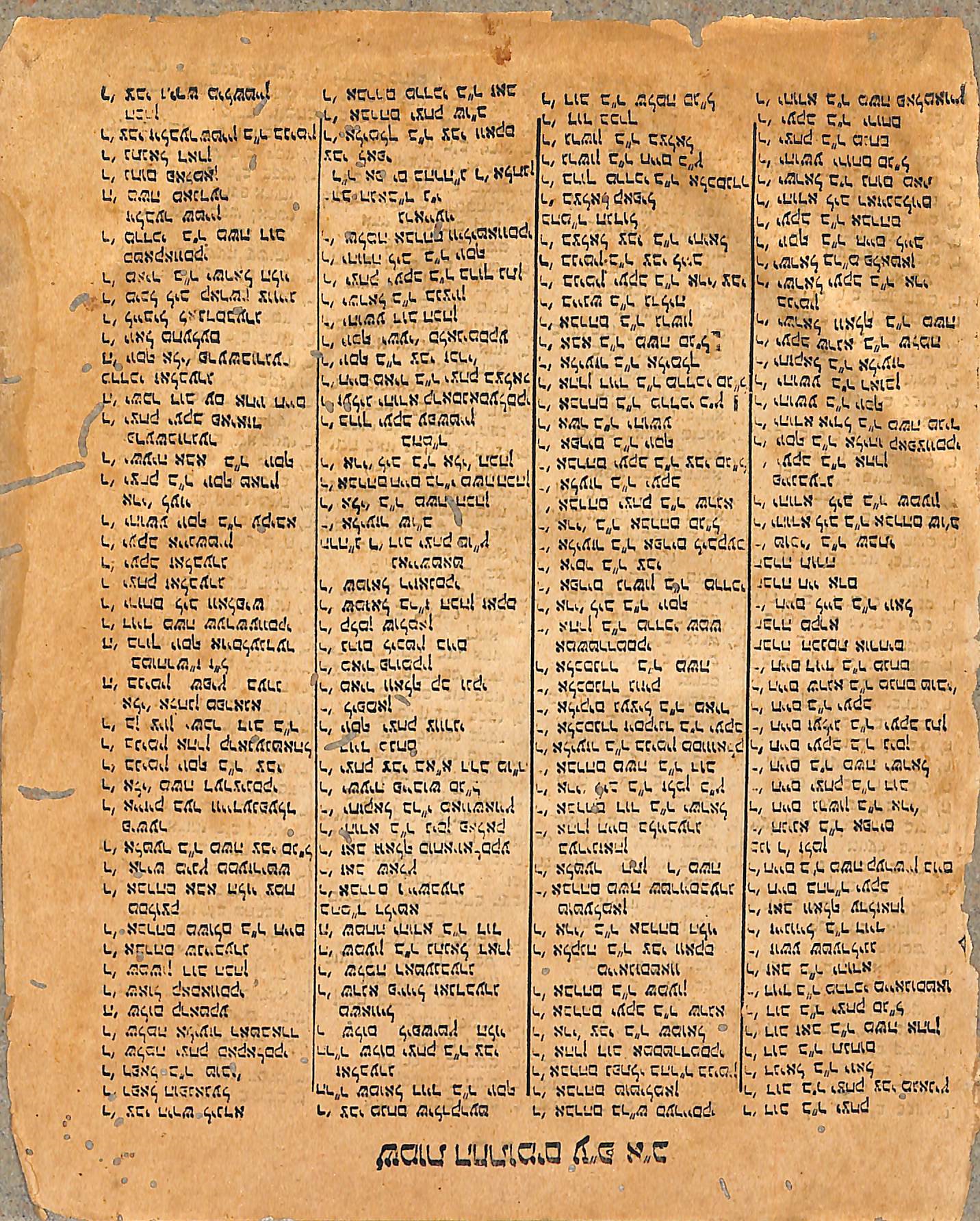
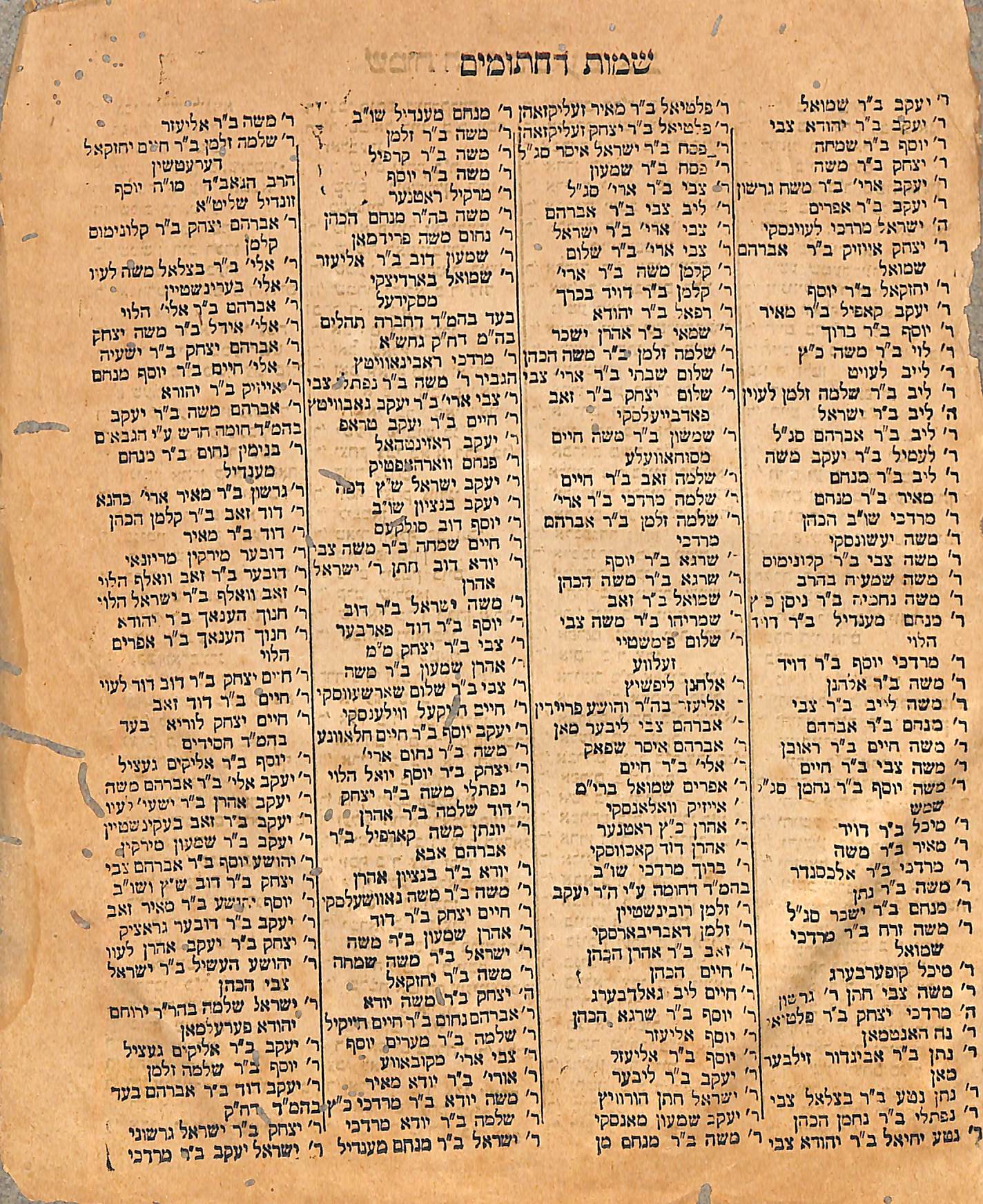
חשבנו שאנחנו יודעים על שני דפי רשימות חותמים – ארבעה עמודים של שמות. בית המכירות ל”ג/1 ציין בהגינות, בתארו את העותק שהעמיד למכירה – שבעותק הנמכר יש דף אחד משני דפים, וצילם את הדף. מדובר בדף אחד שבראשו אנשי העיר טיקטין (וכן נובוגרד, סטוויסק ו-קאלנע). דף טיקטין מופיע גם בעותק ס”ל וגם בעותק ה”ב. בשני העמודים של דף טיקטין מופיעים 325 שמות בשבעה טורים.

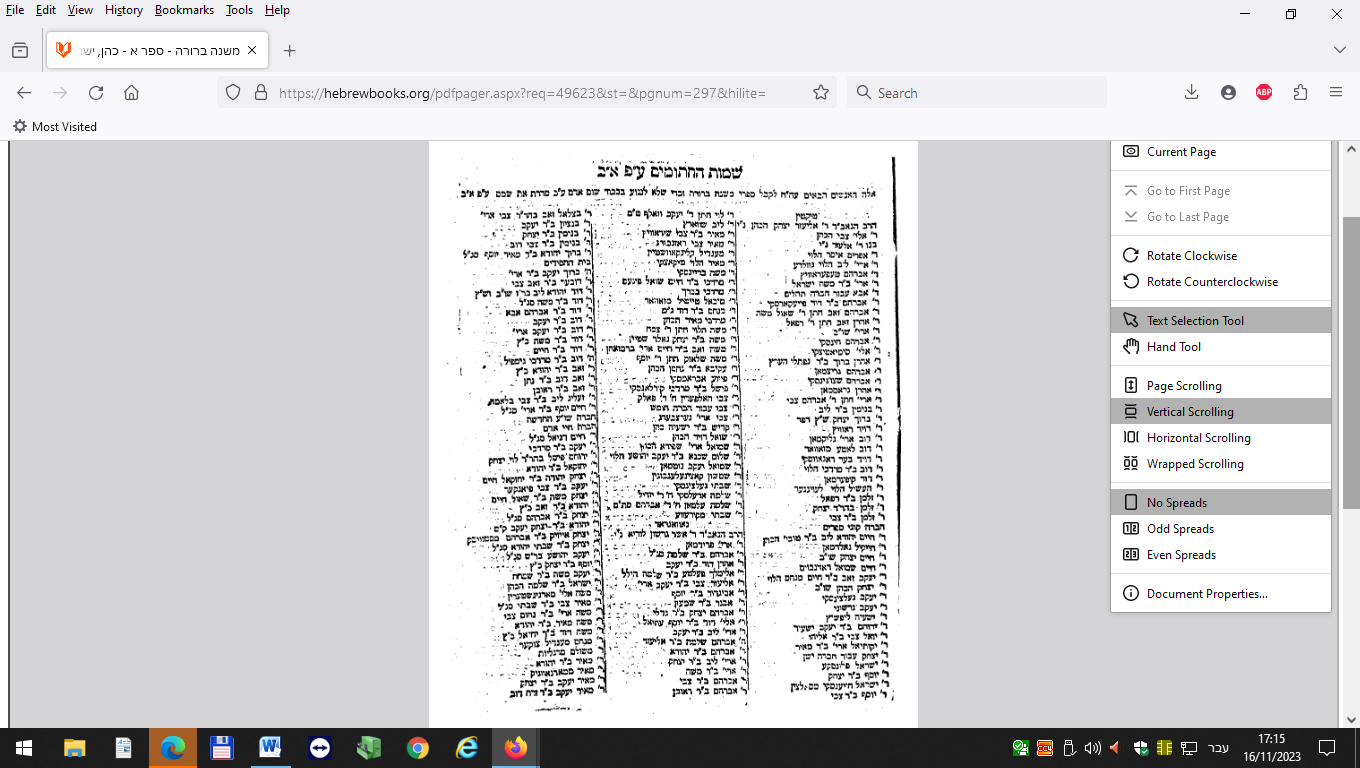
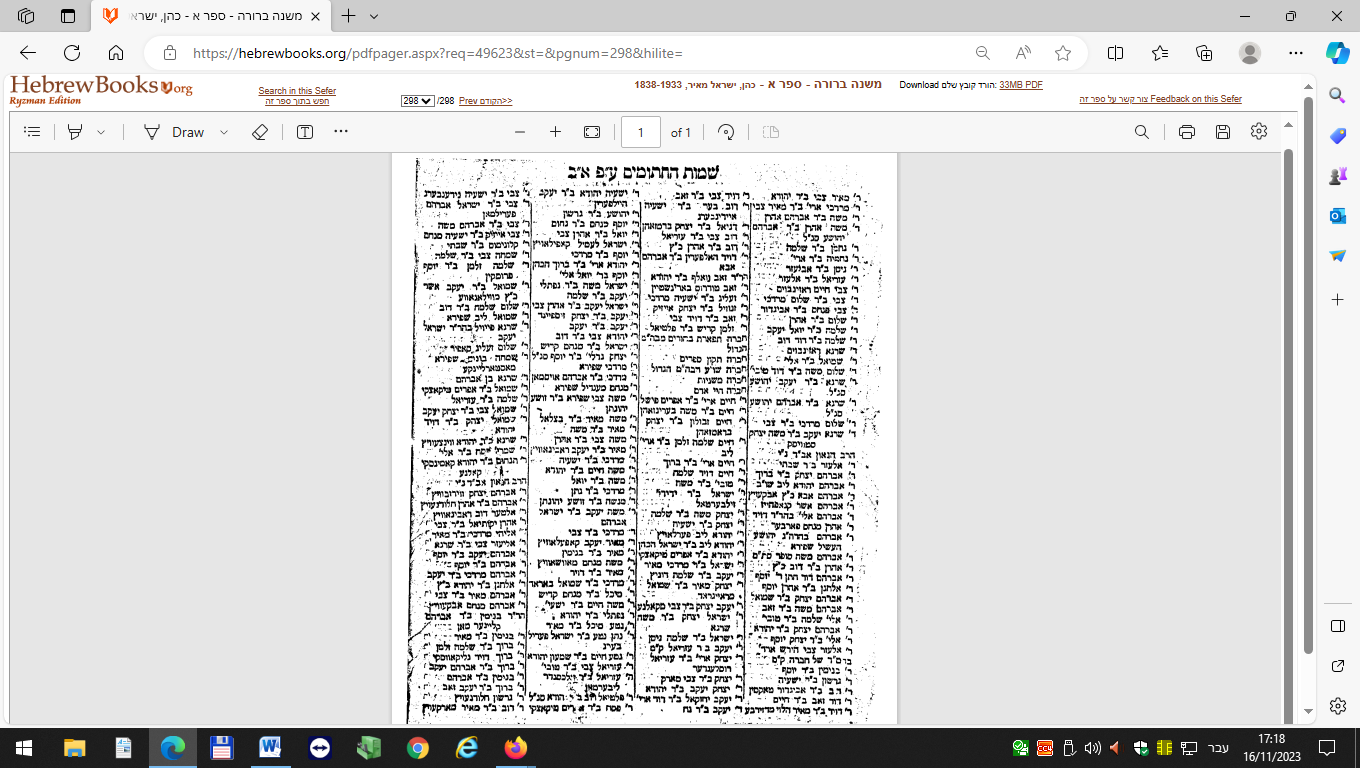
בעותק מ”ק יש רק את הדף השני. בסוף העמודה הימנית בעמוד הראשון מנויי וורשה (והעיר שציצין), 8 עמודות עם 322 שמות. 5.5 עמודות לאנשי ורשה, ועמודה וחצי לאנשי שציצין. הדפים הם בסדר אל”ף בי”ת “כדי שלא לנגוע בכבוד שום אדם” ככתוב בכותרת דף טיקטין. השם החותם בסוף עמ’ 2 בדף טיקטין הוא: ר’ דוב ב”ר מאיר מארקעוויץ, ושם החותם הבא בעמודה הראשונה בדף השני הוא: הר”ר יצחק ב”ר שמואל חונה בוואנסעס (לא איתרנו). אומנם קפיצה מאות דל”ת-דוב, לאות יו”ד-יצחק, אבל הרצף, אפשרי.

עם סגירת המאמר, מצאנו שבית המכירות ל”ג העמיד למכירה עותק מההדפסה הראשונה עם דף שמות חותמים שלישי, השונה משני הדפים שהכירונו. על רקע הערת הרב אריה ליב בן הח”ח (עמ’ ל”ג) שהבאנו לעיל, על כך שהח”ח לא נסע לקהילות החסידים הרחוקות בפולין לחלק את ספריו – היה מעניין לראות שבצילום עמוד החותמים שבאתר בידספיריט ל”ג/2 – עמודה רביעית, שורה 18 מלמטה מופיע: ר’ חיים יצחק לוריא בעד בהמ”ד חסידים. הערים המנויות בדף שלישי זה הם (העתקנו ככתבם): נאיישטאט, גרעאייעוי (גריבה), מייאגוסטאוו, זעלווע, ו-דערעטשין.

האם מותר להעלות השערה שהח”ח הפריד את דפי החותמים, במכוון? באופן שדף חותמי וורשה יהיה צמוד לעותקים שחילק בוורשה ושציצין, דף טיקטין צמוד לעותקי חותמי טיקטין והערים שנמנו, ובשאר המקומות לא צרף את דפי החותמים האחרים10? מדוע לא יצרף את כל שלושה הדפים לכל עותק? מטעמי חיסכון? לא מסתבר. אולי זה נעשה כדי שלא לבייש מי שלא היה בין החותמים? אולי טפסים שנמכרו אחרי ההדפסה לקונים שלא חתמו מראש, לא כללו שום רשימת חותמים? ולמי הלכו ספרים שכללו את התודה לנדבנים בסוף ההקדמה? מצד שני, על המשקל, תודה לחותמים מראש מראש! דבר אחד ברור לנו: היות ואין מקריות אצל הח”ח, על כן תיובתא דחפץ חיים תיובתא.
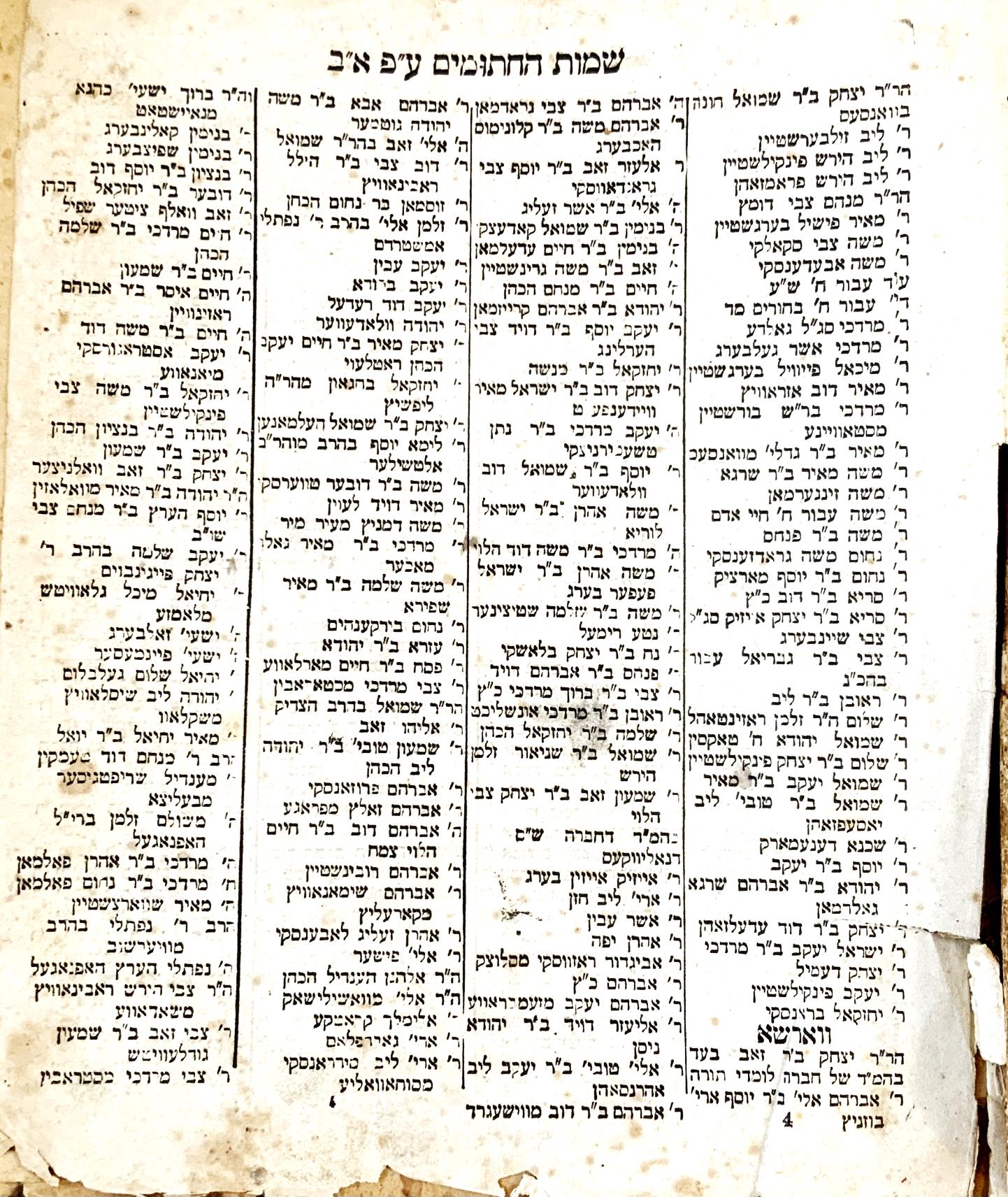
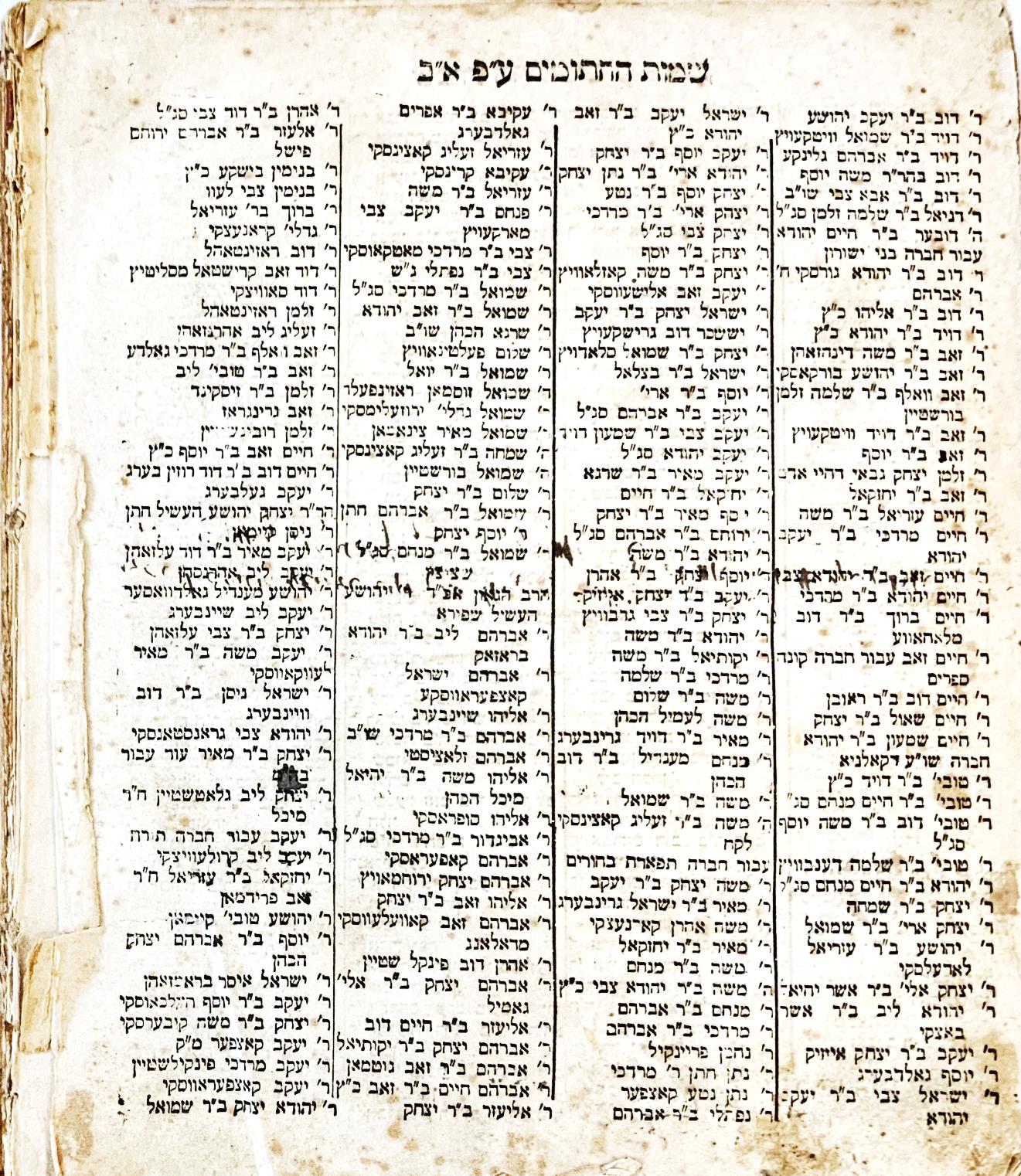
העמוד הראשון של דף החותמים – עותק מ”ק
העמוד השני של דף החותמים – עותק מ”ק
עמוד ראשון של דף החותמים השני (טיקטין) – עותקים ס”ל, ה”ב ו- ל”ג/1
עמוד שני של דף החותמים השני (טיקטין) – עותקים ס”ל, ה”ב ו- ל”ג/1
עמוד ראשון של דף החותמים – באדיבותLegacy Judaica–לג/2
עמוד שני של דף החותמים – באדיבותLegacy Judaica–לג/2

ביחד, בששת העמודים, מופיעים כאלף שמות. היות ואין לנו ידיעה על דפי חותמים נוספים (אולי עוד נגלה!) מעניין ומוצדק לתהות מדוע הח”ח ציין, פחות חותמים למשנה ברורה מספר חפץ חיים? האם מפני שהיו, יחסית, פחות חותמים למשנה ברורה? האם ששת העמודים משקפים את כל החותמים? הזכרנו לעיל שבספר חפץ חיים, מהדורה ראשונה, תרל”ג, הודפסו כ-1,200 שמות של חותמים. מדוע מוצאים פחות במשנה ברורה? האם היו יותר חותמים מהמודפס? ואם היו מדוע נפקד מקומם? אם נכונה השערתינו שהח”ח בחר בקפידה את דף החותמים המסויים, להפצה אישית, באזור או קהילה, ובכלל זה את התודה המיוחדת לשלושה התורמים שבסוף ההקדמה – אין מנוס, וכל השאלות מוצדקות. אם איכשהוא יישבנו בדוחק את התמיהה על השמטת קטע התודה לנדבנים – מה נאמר כאן? ועל כולנה מרחפת התיובתא הגדולה – מדוע הח”ח לא כלל בכל עותקי ההדפסה גם את ההערה ההלכתית, גם את התודה לשלושה התורמים וגם את ששת עמודי החותמים? תיובתא דחפץ חיים תיובתא. ותיובתא בתוך תיובתא: ראינו לעיל שהרב אריה ציין שהנסיעות הראשונות של הח”ח לאחר הדפסת המשנה ברורה חלק א’, היו למעזריץ ולובלין – ולפלא ששתי הערים אינן ברשימת חותמי הספר (אולי אכן עוד יתגלו דפי חותמים?).

גליונות הדפוס

כדאי להתעכב על פרט טכני של הדפוס. בתי דפוס משתמשים בגליונות דפוס בגדלים שונים כדי שקיפולם, וחיתוכם יביא לכמות דפים הדרושים, ולגודל הפיזי של ספר. איש הדפוס, היה מקפל ומסדר את הקונטרסים המודפסים זה אחר זה. כדי למנוע בלבול ושיבוש מקום הגליון כסדרו, בטעות, לעיתים הודפס בצד התחתון של העמוד הראשון בקונטרס, בצד, סימון מספר הקונטרס והדף, למען יקופל, ויונח במקומו הרץ, הנכון. לאחר מכן הספר מוכן לחיתוך, שיפריד את הדפים, ומשם לכריכה. כשהוצאות דפוס ונייר יקרים, עושים חשבון בבחירת גודל הגליון ע”מ להתאימו לגודל הדפים הרצוי, ומשתדלים שהגליונות ינוצלו באופן מלא ללא עודפים, במיוחד כשמקבלים תרומות להדפסה.

גודל הדף של המ”ב הדפסה ראשונה שבידינו הוא: 21.8 על 18 ס”מ. בתחתית העמוד בצד ימין (ראה בתמונה הבאה), בעמוד האחרון של ההלכות, מסומן “לח 6” – עמוד שישי בגליון 38. נוצר עודף לא מנוצל של דף אחד (שני עמודים). כך בשני העותקים (לג/2 לא ראיתי). יש סימונים לגליון לכל החלק ההלכתי מסימן א’ ואילך, אך לא בעמודים הפותחים או בדפי החותמים. בדיקה בדפי הספר תראה שמכל גליון יוצאים 4 דפים, יחד 8 עמודים. היוצא הוא, שלהשלמת הגליון, נשאר דף אחד ריק (2 עמודים), שהיה יכול להתאים, בהנחה שצורף רק דף חותמים אחד. אך דף אחד לא יספיק, שכן דף השער וההקדמה גם הם מחוץ לחשבון, וממילא יש שלושה דפי חותמים. את החשבון ננסה לערוך בהמשך.
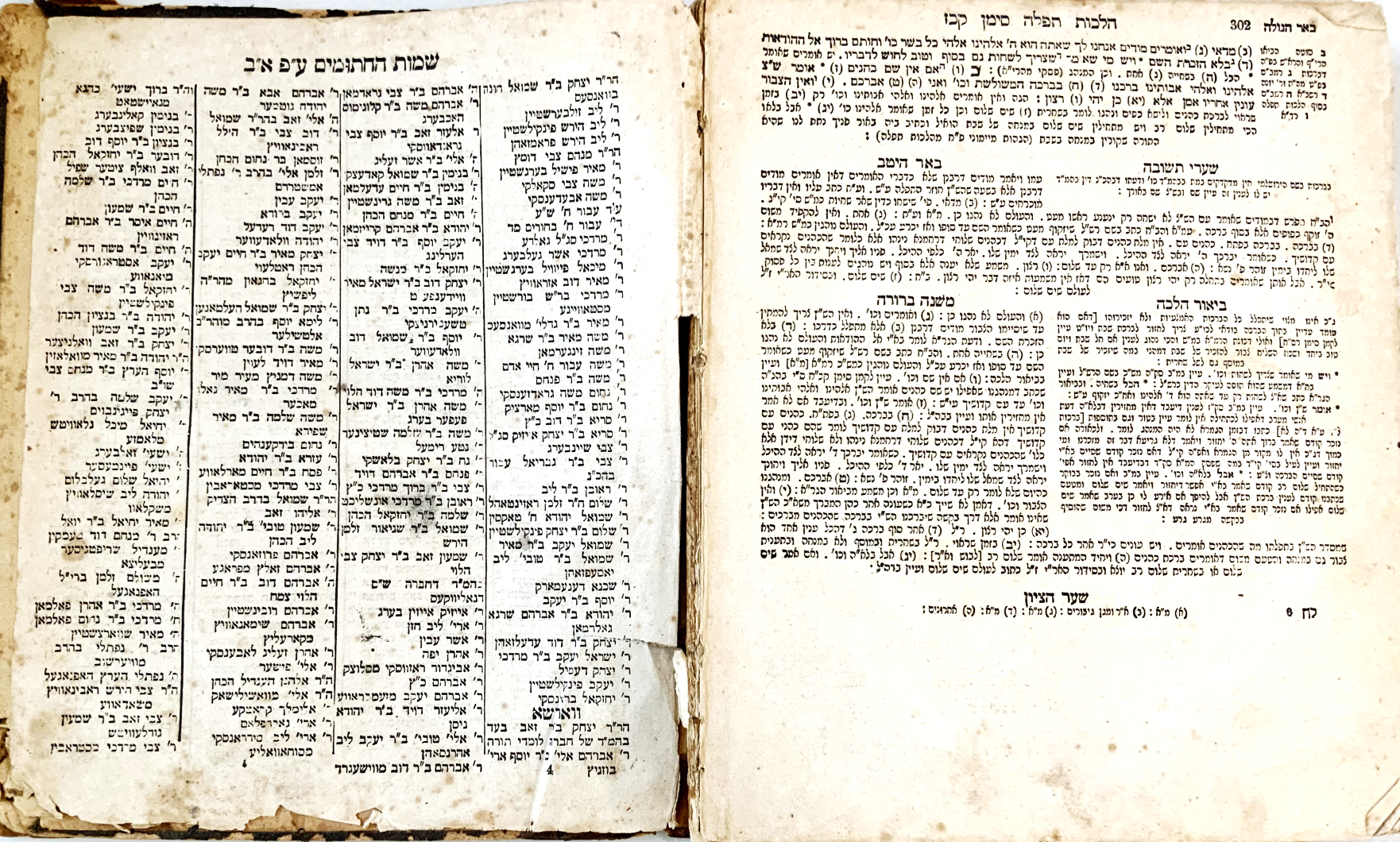
העמוד האחרון של ההלכות ולידו העמוד הראשון של החותמים – עותק מ”ק ללא שורת האזהרה שלא להדפיס ללא רשות. ראה סימון גליון הדפוס בעמ’ 302 צד ימין למטה “לח 6”.

לפעמים רואים ספרים, שנייר דפי ההפרדה, בתחילה וסוף, הם אותם דפי הדפסה, ולפעמים רואים דפי הפרדה מאיכות שונה של דפי הספר, שכנראה באים מנייר זול, או משאריות נייר של בית הדפוס, ולא מגליונות הדפוס של הספר.

לאור שלוש וורסיות של תחתית העמוד האחרון של ההקדמה, ורסיית הסכמת הרב וואקס, ושלושה דפים שונים של חותמים, תכף ננסה לעשות חשבון לגליון הדפוס. היות ובכל הדפים הללו אין סימן גליון, מתחזקת מאוד הנחתנו שהח”ח ברר את כל הדפים הללו בנפרד, וסדר להם צירופים שונים, כנראה בהתאם למקומות, לאנשים ולקהילות ששלח את עותקי ההדפסה הראשונה, או שנסע לשם בעצמו. ושוב, אין מקריות אצל הח”ח. מאי טעמא? איננו יודעים – תיובתא דח”ח תיובתא.

בטרם ניכנס לחשבון, נכון לציין כי בחלק שני (הלכות שבת), שתחת ידינו, דפי הספר קצת יותר גדולים – 22.4 על 18.3 ס”מ, וכל גליון דפוס הכיל 8 דפים-16 עמודים, כאשר הגליונות מסומנים החל מהשער. הגליון האחרון היה רק 3 דפים-6 עמודים. כאן רואים שנייר, כנראה, בוזבז, אך סימון הגליון הוא, על הסדר, מתחילה ועד סוף.

שורת האזהרה שלא להדפיס ללא רשות

בטרם ניכנס לחשבון הגליונות, עלינו להתייחס לואריאציה נוספת. בחלק מעותקי ההדפסה הראשונה מופיעה אזהרה בסוף ההלכות:

“אזהרה בל יזיד איש לחזור ולהדפיס את הספר משנה ברורה בלתי רשותי או רשות ב”ב, המחבר”

אצל כמה מוכרים בבידספיריט מודגשת ההערה הנכונה, שהשורה הזו לא חזרה ונדפסה אח”כ. בעותקי ס”ל, ה”ב, ו- מ”ק היא לא נדפסה. יתכן שהשורה הושמטה בטעות ממטריצת הדפוס הראשונה, וכשהח”ח גילה, הוסיפה. על כן יימצאו טפסים ללא האזהרה, עד ששמו לב, הוסיפוה, והח”ח לא רצה לחזור ולהדפיס את הגליון האחרון של ההלכות – גליון לח – מחדש, בכל הטפסים, כדי לא להטריח ולהכביד על ההוצאות. בהנחה זו, לא מדובר בהשמטה מכוונת. או דילמא שלכתחילה דווקא סבר שלא להגביל, ולא הדפיס את האזהרה, ואח”כ חזר בו והוסיף את השורה למטריצת הדפוס. או איפכא שבמטריצת הדפוס הראשונה ההגבלה הודפסה, והח”ח חשב שנית, והחליט שלא תודפס משם ואילך, ומחק את השורה ממטריצת הדפוס. תיובתא דח”ח תיובתא.

כך או כך, שוברו בצידו. הסכמות כוללות לעיתים איסור הדפסה ללא רשות המחבר, ובדר”כ הגבלה למספר שנים. ההסכמות, לרבות הסכמת הרב וואקס, אינן כוללות הגנה כזו, וכאן, לאו מקרה הוא. מותר לנו להניח שהמסכימים שאלו את הח”ח אם הוא חפץ בהגנה כזו, והח”ח, כנראה השיב בשלילה. אם כך הוא, והרי הח”ח הדפיס את האזהרה – מדוע לא בקש גם מהמסכימים שיציינו את האזהרה? יתכן להסביר שההגנה בהסכמות בדרך כלל נקובה בזמן של כמה שנים, והגבלת הח”ח, ללא הגבלת זמן, לא הייתה נוחה למסכימים.

אפשר והח”ח חשב קדימה (על יסוד הצלחת הספר חפץ חיים?), ודעתו הייתה, שלמחבר, מותר באופן כזה להגביל את ההדפסה, ללא הגבלת זמן, שתהיה רק “בלתי רשותי או רשות ב”ב”. אך נוסח ההגבלה, מעומעם למדי, דבר, שלא היינו מצפים שיצא תחת הח”ח, המדקדק הגדול. “ברשותי” – ניחא שהתכוון לחייו הוא, אך “בני ביתי”? גם אחרי לכתו מהעולם? או במקביל לחייו? מיהם? הכוונה לכל ילדיו? או שמא כל צאצאיו החיים כאן היום, או אף לאחריהם? ניתן להניח שלא נחה דעתם של המסכימים, והם לא חשבו שזה ראוי, וחששם בידם. כשמדקדק בשיעור קומה של הח”ח משאיר הוראה מעומעמת – תיובתא דח”ח תיובתא, בדינא היא.

באופן כללי, הגבלה שלא להדפיס למספר שנים, תסתיים במועדה, כי תלמוד תורה ולימוד תורה חייבים להמשיך, וללא ספרים קשה. אולי רבנים-מסכימים לא ימהרו להטיל הגבלה שיתכן ותמנע תלמוד תורה בעתיד, כי לך תערוב מה יחשבו “בני ביתו” בעוד דור – ובכלל, כמה שני תקופת “בני ביתו”? – הן לעצם הרשות להדפיס והן לשמירת מחירו העממי (ובדומה, אף בימינו, למרות עושר הספרות במאגרים, עדיין יש ספרים שבעלי-זכויות או יורשיהם אינם מרשים להעלות לרשת). גם כך הייתה, אז, מצוקת ספרים קשה11 – מצוקה שאינה קיימת היום כלל.

סוגיית ההסכמות לספרים נדונה הרבה ואכמ”ל. אך הערתנו צריכה תלמוד של הח”ח, לרבות משמעות השמטת השורה במהדורות הבאות. לכתחילה מאי קסבר? ולבסוף מאי קסבר? ולמה חזר בו? ההגבלה הרי יצאה מהח”ח (לא בדקנו את מכתבי הח”ח המרשים להדפיס את הספרים). תהא מסקנת הדין איך שתהא, זה יכול, אולי להתאים, לתשובה שהח”ח נתן, כששאלוהו מדוע אינו ממשיך לחבר את המשנה ברורה על חו”מ (הרב ישר: החפץ חיים, כרך ראשון, הוצאת נצח, תל אביב תשי”ח -1958, עמ’ רח’ הערה 4), והוא ענה: בנוגע לחו”מ אי אפשר לסדר הלכה ברורה מיוסדת על רוב הפוסקים, יען כי כידוע, המוחזק יכול לטעון קים לי כמיעוט פוסקים, ולפיכך הדבר תלוי בהכרעת דיין, לכן לא שייך לכתוב ספר הלכות על כך. מה היה איפוא ה”קים לי” קמא של הח”ח? אפשר והסתמך על “תקנת הקדמונים”12 אם כי לא ראינו ש”בני ביתו” בכלל התקנה.

כך או כך, בין אם שורת ההגבלה הודפסה בתחילה והושמטה, או איפכא, לא הודפסה ונוספה, במכוון, ואף אם נשמטה בטעות והוספה, תיובתא דח”ח תיובתא.

גליונות הדפוס של תחילת הספר וסופו

כעת נחזור לתחתית עמוד מספר 6 בחלק א’ שיש בו שלוש ורסיות: ריק (עותק ה”ב), עם הערה הלכתית קצרה לאחת ההלכות (עותק ס”ל), ו- ההודאה לתורמים (עותק מ”ק). נזכור שגם הייתה ורסיה של תוספת הסכמה של הרב וואקס בעמוד 4, אם כי ניתן לשער שזו הייתה בכל ההדפסה השניה של חלק א’ באותה שנה, אך רק בחלק מההדפסה הראשונה, לפי שמצאונה רק בעותק ה”ב.

הממצאים זהים בעותקים (מלבד לג/2 שלא ראיתי). גיליון א מתחיל בדף ראשון של ההלכות, הוא דף ד’, הרביעי לספר, ובצדו השני עמ’ 8 (2 עמודים). מהדף הבא, עמ’ ה’ לספר, מתחיל גליון ב’ 4 דפים-8 עמודים, במתכונתו, עד סוף ההלכות בספר. זה ממצא מעניין. הרי יש 4 דפים מהשער ועד דף ההלכות הראשון (כולל), וזו הרי מתכונת הגליון של הספר. ולא היא. גליון א הוא של שני עמודים, והוא מתחיל לאחר שלושה הדפים ראשונים (6 עמודים) ללא ציון גליון. זה מתאים מאוד, כאמור, למי שעושה שינויים, ומתכוון לעשות צירופי דפים שונים. בנוסף, לא ברור מדוע גליון א’ הוא 2 עמודים, והספר מסתיים בעמ’ 6 לגליון לח. הרי 2 עמודים זה בדיוק מה שחסר לניצול מלא של גליונות הדפוס, של פנים הספר.
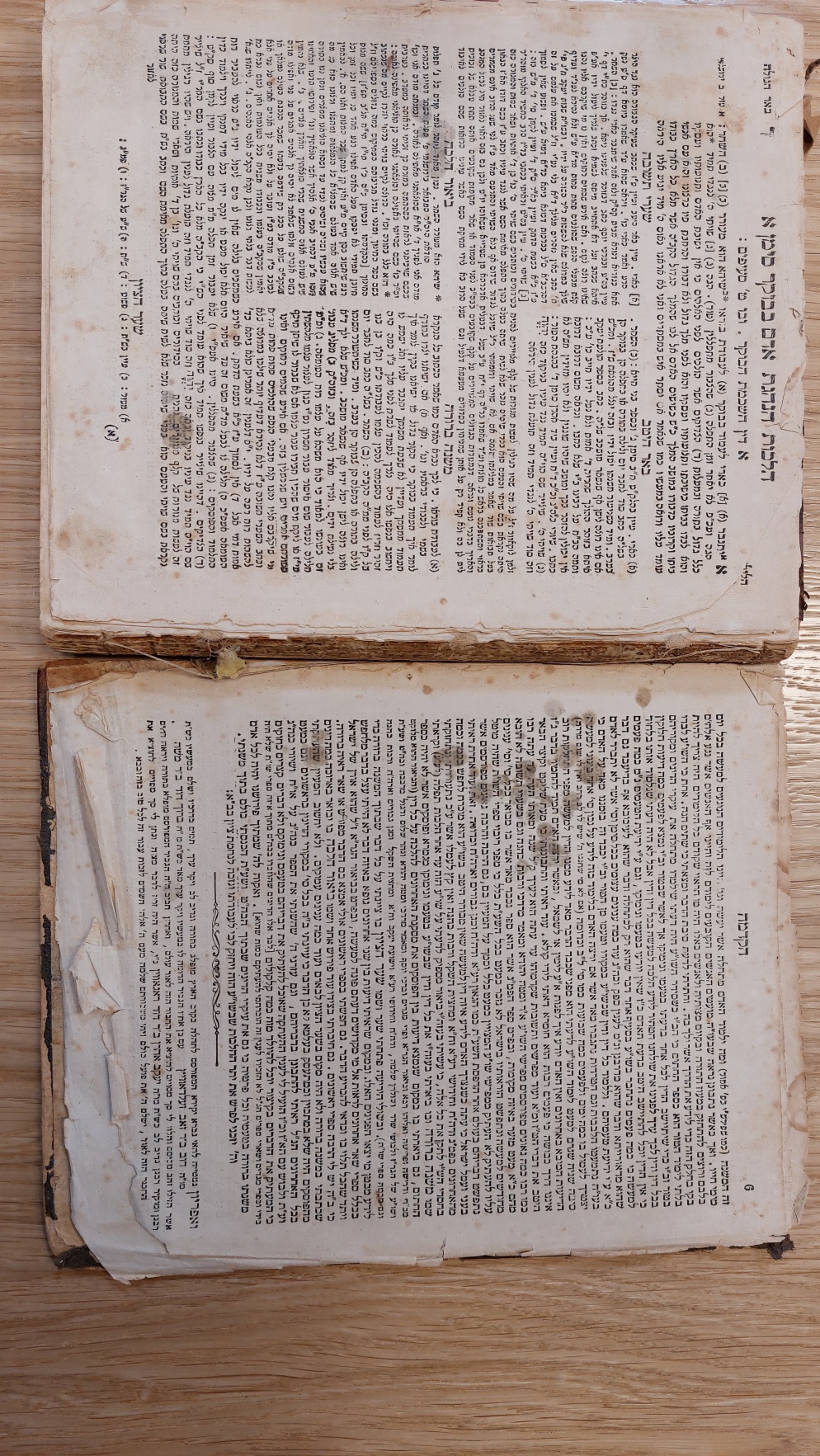
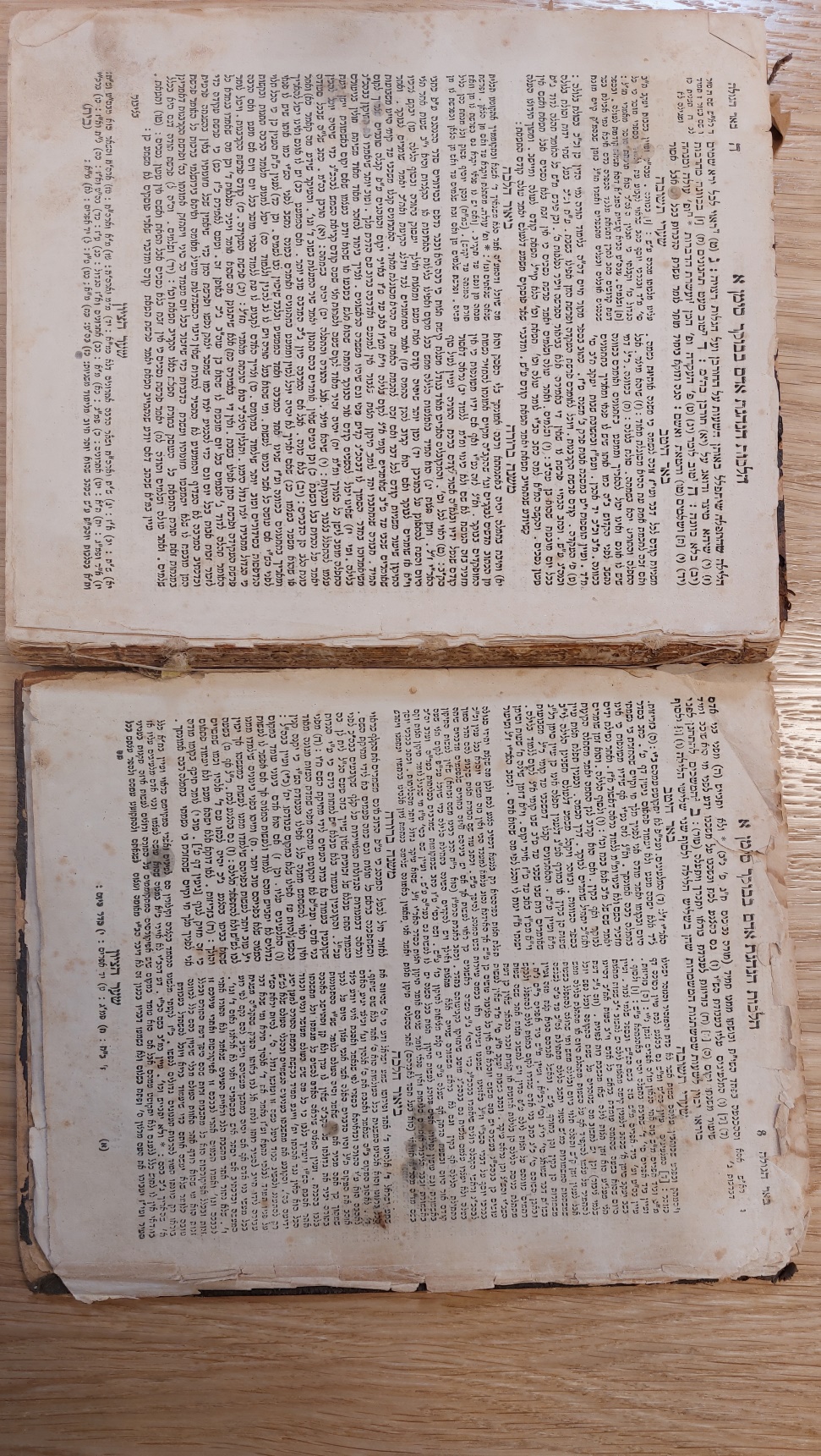
העמוד הראשון של גליון א – דף ד’ התחלת ההלכות
עמ’ 8 העמוד השני של גליון א. דף ה’ מתחיל גליון ב כסדרו

בואו חשבון לגיליון:

דף ראשון – 2 עמודים: עמוד שער ועמוד אישור הצנזורה. העותקים שווים בזה = דף אחד (ושני העמודים הללו אפשר להדפיס 4 פעמים בכל גיליון דפוס).

דף שני – הסכמות. היות והסכמת הרב וואקס נמצאת בהדפסה הראשונה בעותק ה”ב, לזה צריך 2 דפים שונים = 4 עמודים.

דף שלישי – העמוד הראשון של ההקדמה שווה בכולם. אך בעמוד הבא, לאחר ההקדמה יש שלוש ורסיות: ריק, הערה הלכתית, ו- הודאה לתורמים. לזה צריך 3 דפים = 6 עמודים (כדי להדפיס דף אחד עם כל ואריאציה).

עד כאן מנינו 6 דפי דפוס שהם גליון וחצי של דפוס.

לו הח”ח היה מדפיס את ההסכמות באופן אחיד, ובסוף ההקדמה היה מאחד את ההערה ההלכתית ואת ההודאה לתורמים היה לו 4 דפים, שהוא גליון אחד שלם, והיה חוסך חצי גליון דפוס. על רקע זה תמיהתנו מתחזקת, וכי מה הפריע לח”ח שלכל הקונים תודפס ההערה ההלכתית וגם ההודאה לתורמים. התיובתא, איפוא, חוזרת וניעורה.

3 דפי החותמים – 6 עמודים. לזה צריך להדפיס 3 דפים שונים.

לו הח”ח היה מפרסם את כל 6 עמודי הפרנומערנטן יכול היה לצמצם לגליון אחד. ואם היה מדפיס את העמודים הראשונים בשלמותם כאמור לעיל, היה יוצא עם שארית של דף אחד בלבד. מה היו שיקוליו בהפרדת דפי התורמים ולמה לא יזכיר את כולם לכל עותק? התיובתא חוזרת וניעורה מהכיוון הזה.

ומכיון שלא עשה כך, הפיזור יצא לו 9 דפים שהם 18 עמ’. על כן במתכונת הרגילה של גליונות הדפוס המסומנים – 4 דפים שהם 8 עמודים – 9 דפים הם 2.25 גליונות, נוצר “בזבוז” של 3 דפים. מכיוון שאיננו יודעים את כלל הרכבת הואריאציות, תמיד קיימת אפשרות של הכנת סוגי גליונות שונים, באופן שלא יהיה בזבוז. חזקה על הח”ח שחסך ולא בזבז את כספי התורמים. לפי השערתנו לעיל לא נצרכו לשתי מאטריצות דפוס בשל השמטת אזהרת הדפוס של הח”ח, אלא הוסיפו או החסירו שורה למאטריצה, אחרת היה בזבוז נוסף.

נראה לנו שניתן להסיק מכל הממצאים, שליטה וגמישות מלאה של הח”ח בתהליך הדפוס, ושליטה מלאה של הח”ח בסידור הדפים הראשונים והאחרונים של הספר, הדפים שיש בהם שינויים, וצירופיהם. את סידורם לא ניתן להניח ליד המקרה של עובדי בית הדפוס, או עובדי הכריכה. בסבירות גבוהה מאוד, נדרשה השגחה צמודה לסידור הדפים בספרים, לפי הואריאציות השונות, לאחר חיתוך הגליונות והכנסת הדפים, עובר לכריכה, וסידור כל סוג בנפרד.

כל החשבון שעשינו לדפים הוואריאנטים הוא על בסיס ההנחה שצריכת הדפים הוואריאנטים שווה. הנחה זו, כמובן אינה מבוססת, כי איננו יודעים מה הייתה הכמות המדוייקת של הצריכה, ויכול מאוד להיות שהיא הייתה לא שווה. אולי טפסים עם הסכמת הרב וואקס היו רק 20%, או טפסים עם ההודאה לנדבנים היו רק 18%, או טפסים עם דף חותמים פלוני היו רק 15%, וכן הלאה. זאת אומרת שהיה ויסות. יכול מאוד להיות שעבור 9 הדפים הווארינטים, הח”ח השתמש בכל 3 גליונות הדפוס ללא שאריות וללא בזבוז, כי הכפילו דף בגליון, שהיה צריך יותר.

כך או כך, הח”ח היה צריך לדעת ולתכנן מראש כמה טפסים יהיו בהרכב דפים כזה או אחר, ולהתאים את החשבון, מראש, על מנת לעשות שימוש יעיל בגליונות. זו אופרציה מהותית, ארגונית וטכנית גדולה, שבודאי דרשה זמן ומאמץ. זאת אומרת שהנוכחות של הח”ח בבית הדפוס הייתה לא רק להשגחה על ההגהה, אלא, גם, לתכנן, עד הפרט האחרון, את הרכב הטפסים, והכמויות. מכיוון שמלכתחילה הח”ח תכנן שיהיו הרכבי טפסים שונים, היה עליו גם להקפיד להימנע מטעויות. היה צריך לסמן את הערימות הממוינות, ולהשגיח שהם ילכו לחיתוך הדפים ואח”כ לכריכה, ויישארו מסומנים, גם אחרי הכריכה (או ללא כריכה שכן ראינו שמכר טפסים ללא כריכה). מכיוון שהיה חשוב לח”ח הרכב הדפים הוואריאנטים, הייתה צריכה להיות השגחה קפדנית על המיון והסימון של החבילות, ע”מ שלא תהיינה טעויות. אין ספק שהוא ידע היטב שזה מחייב הרבה זמן ומאמץ, שאינו דומה לשום ספר “אחיד” אחר. לא פלא שהיה יום-יום בבית הדפוס. הח”ח היה איפוא איש פנטסטי גם בארגון וסדר.

לא קשה איפוא לדמיין את הח”ח, בני ביתו ומגיהיו, עומדים טרודים ודרוכים בבית הדפוס ביום סידור הטפסים, מול ערימות של גליונות מקופלים ולא חתוכים, של כל החלק ההלכתי, ולפניהם 9 דפים שונים מופרדים וחתוכים לבודדים, בשורה על השלחן, כשהח”ח נותן הוראות: כך וכך עותקים לסדר כאשר דף אחרון של ההקדמה ריק, כך וכך עותקים עם דף חותמים מסויים בסופו, וכך וכך עותקים עם ההודאה לתורמים ודף חותמים כזה או אחר בסופו, וכך וכך עותקים עם סיום ההערה ההלכתית עם דף חותמים מסויים, הסכמת הרב וואקס, וכן הלאה כל האפשרויות השונות שהח”ח תכנן, לפי תוכנית סדורה מראש. הארגון הקפדני הזה המשיך למסעותיו למכירת הספרים, שהיו צריכות להיות מתוכננות עד הפרט האחרון, לאן נוסעים, איזה הרכבי טפסים לוקחים, וכמה. הצורך הארגוני הקפדני הזה כנראה הצריך שהח”ח יסע, אישית, לחלק את הטפסים למנויים, ולמכור את היתר לאחרים. זה מסביר למה הוא טרח לנסוע ולא שלח שליחים. יכול להיות ששלח אחרים לקהילות שהחלוקה הייתה פשוטה – של טופס מסויים, או שניים, אבל לא במקומות המורכבים. איננו יודעים אם יש עלומות הדפסה מסוג זה גם במהדורות הבאות של המ”ב חלק א’, וכן בחלקים הבאים. אם יש תיעוד מסודר של כל הנסיעות של הח”ח להפצת ספריו, בשנים הראשונות, אולי יהיה אפשר לנסות לבנות “תוכנית התאמה” של הרכבי טפסים למקומות. עכ”פ מ- 1884 ועד 1891, השנה בו הוציא את “חלק שני” הלכות שבת – במשך 7 שנים של מכירת חלק א’, לכאורה היה צריך לנדוד למכור את הספר, אישית, כדי להימנע מטעויות, על פי ההרכב ה”מתאים” שהח”ח החליט, די בכל אתר ואתר.

נדמה (דל”ת קמוצה) לעצמנו: מה נכבד המעמד הזה. שולחן ארוך, מעברו, או מאחור, כמה אנשים מסדרים את הדפים הוואריאנטים לפי הוראות הח”ח, זה לכאן וזה לכאן, מעל ומתחת לחלק ההלכתי הלא כרוך. מצרפים את הדפים, כל אחד לפי יעדו או יעודו הוא, מסדרים בערימות, מסמנים, הלאה לכריכה, ומשם בחבילות מסומנות. מחזה גדול ומרשים. מן הסתם בני ביתו ומגיהיו שאלוהו באותו מעמד: רבינו החפץ חיים על מה ולמה צרפתם כך? ועל מה ולמה צרפתם אחרת? והח”ח השיב להם אחת לאחת. ואולי לבסוף, היה גם מי ששאל, לתדהמת כל הסובבים – שמא נער קטון בבית הדפוס או בכריכיה – רבינו הגדול, ולמה לא כל העותקים יהיו מלאים ושווים? והח”ח נשקו על מצחו, נצחתני בני נצחתני. מי יתננו.

כמות ההדפסה הראשונה

בכמה עותקים הח”ח הדפיס את חלק א של המשנה ברורה? איננו יודעים. אפשר לשער שמדובר באלפים – דבר שחייב את הח”ח להתכונן ולהיערך, כלכלית, והפצתית (ובודאי כשהוא מקפיד למי הספרים יגיעו לפי הדפים הוואריאנטים!), ולאותה כמות היה עליו להיערך לחלקים הבאים של המ”ב. כנראה שלא נדפסו די עותקים בהדפסה הראשונה והיה ביקוש גדול להדפסה שניה או שהח”ח חיכה לקבל את ההכנסות מההדפסה הראשונה כדי לממן את ההדפסה השניה. הזכרנו לעיל את דברי הרב אריה בן הח”ח שספר חפץ חיים מהדורה שניה, 1878, הודפס בארבעת אלפים עותקים, בנקל, אפשר לשער שהודפסו אלפים רבים של ספרי משנה ברורה בשנת 1884, בשתי ההדפסות. הח”ח הרי כבר היה ידוע, והיה פעיל במכירת ספריו.

אין לדעת כמה עותקים מההדפסה הראשונה של חלק א’ נמצאים כיום בעולם. אף אם יימצאון חמישים, מאה, מאתיים או אפילו ארבע מאות עותקים, ונדע בכמה מהם מופיעה ההסכמה הנוספת, בכמה ההודאה לתורמים, ההערה ההלכתית או היעדרה, שורת ההגבלה, ובכמה דפי חותמים, או דף חותמים אחד – לא יהיה בזה די כדי לבסס ממצא כללי, אלא רק ממצא מדגמי. לעניינינו, אם מעט ואם הרבה, תיובתות דח”ח תיובתות, במקומן עומדות.

אגב אורחא, מעניין לציין שבערל כהן בספרו פרענומערנטן (1975), שהזכרנו, רשם את המשנה ברורה ורשה 1884 ומציין את אנשי ורשה (עמ’ 88-89, 316), ז”א שדווקא ראה את דף חותמי ורשה, אך את דף טיקטין לא ציין, ולא ראהו, כמו גם את דף החותמים ל”ג/2.

סיכום הוואריאנטים

נסכם את הוואריאנטים:

  1. עם או בלי הסכמת הרב וואקס

  2. בסוף ההקדמה, אחת מאלה:

  1. ריק

  2. ההערה ההלכתית

  3. ההודאה לתורמים

  1. בסוף ההלכות, עם או בלי, ההערה על קבלת רשות

  2. אחרי ההלכות: 3 דפים (6 עמודים) של שמות חותמים

נסכם את הוואריאנטים (מלבד דפי החותמים שסוקרו במאמר) בעותקים הפתוחים לציבור (לא של בתי המכירת):

עותק ס”ל – ללא הסכמת הרב וואקס, בסוף ההקדמה ההערה ההלכתית, אין אזהרת הדפסה

עותק מ”ק – ללא הסכמת הרב וואקס, בסוף ההקדמה הודאה לתורמים, בסוף ההלכות אין אזהרת הדפסה

עותק ה”ב – הסכמת הרב וורקס קיימת, בסוף ההקדמה ריק, בסוף ההלכות אין אין אזהרת הדפסה

סוף דבר

דבר אחד אי אפשר להגיד על הח”ח והדפסת ספריו – מקריות. כל רז הדפסה לא אניס ליה. העולם התורני מתנהל על פי המשנה ברורה מזה 140 שנה באורח החיים. ער, מודע, ומנסה להיזהר בשמירת הלשון מזה 150 שנה. הח”ח כתב עוד חיבורים. את כולם הדפיס תחת השגחתו הקפדנית. כדאי וראוי הח”ח שנדקדק בדרכי הדפוס שלו, כי הוא היה איש גדול גם בזה.

תיובתות דחפץ חיים תיובתות, ואידך זיל גמור. הרב איתם, אייכה?

תגובות והערות תתקבלנה ברצון למייל: menashec@gmail.com

Comments and remarks are welcomed, kindly email: menashec@gmail.com


הערות

  • תודה להרב יוני וידר, הרב הראשי של יהודי אירלנד, העסוק, גם, בכתיבת דוקטורט על החפץ חיים, שהתפנה לקרוא את המאמר, האיר והעיר.

  • לא היה באפשרותי לעיין בסדרה מאיר עיני ישראל.

1. א. אגב אורחא למאמר, לעת עתה לא מצאנו התייחסות הח”ח מאיזה מהדורה, או מהדורות הש”ע, העתיק הח”ח את טקסט המחבר והרמ”א לספר מ”ב. אין ספק שהח”ח היה חייב להחליט על כך, ולהחזיק בידיו את מהדורת הש”ע או מהדורות הש”ע, שממנו ציווה להדפיס. מה היו כל המהדורות שהיו לפניו לבחירה? אף זו איננו יודעים. מדוע הח”ח לא ידבר על זה? האין זה טבעי ובסיסי? הרי בסוף ההקדמה (תשע שורות מהסוף) יכתוב הח”ח “כי ב”ה יש לי הרבה ספרי ראשונים” והוסיף כמה חשוב להעתיק במדוייק כל ספר שציטט. הלוא, לכאורה, ק”ו, עאכ”ו היה מצופה שיפרש מהיכן העתיק את נוסח השו”ע והרמ”א?! לא כן? תעלומה, ותיובתא דח”ח תיובתא.

ב. באשר לדפוסי השולחן ערוך, ראו בקובץ החשוב: רבי יוסף קארו, בעריכת יצחק רפאל, מוסד הרב קוק, תשכ”ט-1969, במאמרים של הרב ראובן מרגליות (עמ’ פ”ט), של נפתלי בן מנחם (עמ’ ק”א), ובמיוחד במאמר של הרב יצחק ניסים: ההגהות על שולחן ערוך (עמ’ ס”ד). נוסח המחבר והרמ”א מחייבת בחירת מקור, ק”ו ההגהות והמקורות שבסוגריים, שכולם נכנסו למהדורות לאחר פטירת המחבר והרמ”א.

ג. אציג הלכה מאתגרת מהרמ”א שנקרתה בדרכנו, המראה, עד כמה צריך עיון מתודי בנוסח הח”ח במ”ב: או”ח סימן נ”ג סעיף כ”ה עוסק בהעברת חזן ממקומו עקב התנהגות לא הולמת. המחבר כותב: “אין מסלקין חזן מאומנותו אלא אם נמצא בו פסול“. הרמ”א הרחיב גם לחזן המזמר מוסיקה או שירה מסויימים, וכך זה מנוסח במהדורה הראשונה של הרמ”א, קראקא ש”ל-1570, שיצאה בחיי הרמ”א: מרנן בשירי הגויים עובדי עבודה זרה. במהדורת קראקא 1646 כשבעים שנים אחרי פטירת הרמ”א: מרנן בשירי עכו”ם (ז”א מה שאינו ע”ז מותר). בדומה, בהגהת הרמ”א בשולחן ערוך שתילי זיתים של התימנים – מרנן בשירי אלילים (זו מהדורה סלקטיבית של הגהות הרמ”א. המחבר, הרב דוד משרקי, הביא נוסח השולחן ערוך ללא הגהות הרמ”א, ונהג להוסיף את הגהות הרמ”א רק במקום שבו הן מסכימות לשיטת השולחן ערוך ולמנהגי תימן על מנת להקל על הלומד!). בגוף השולחן ערוך שבספר משנה ברורה: מרנן בשירי עגבים. ועכשיו לאתגר: בדבור המתחיל של המשנה ברורה (ס”ק פ”ב): מרנן בשירי הנכרים. רואים כאן דבר די פנטסטי. הח”ח שינה את נוסח הגהת הרמ”א באופן שאיננו מתאים לטכסט הרמ”א למעלה. כמה פעמים במ”ב יש כזה? אם הרבה ואם מעט, מכל האמור, המתודה של הח”ח בקביעת נוסח המחבר והרמ”א – היא משימה בפני עצמה.

ד. ראה דיון אקראי: https://forum.otzar.org/viewtopic.php?t=33844, המביא, מקור, שלח”ח היה עותק המהדורה הראשונה של הש”ע שיצאה בחיי רבי יוסף קארו, שכ”ה – 1565. העורך ר’ אליעזר בראדט – ותודה לו – הפנה אותי למכתב הח”ח לר’ אליעזר פרינץ המזכיר שהיה לח”ח עותק דפוס ראשון שנדפס בחיי המחבר (פרנס לדורו, התכתבות אליעזר ליפמן פרינץ עם חכמי דורו. הוצאת כתב, תשנ”ב, עמ’ 310). ומכאן, נראה שהמהדורה הראשונה של הרמ”א קראקא ש”ל-1570 לא הייתה לפניו. היות ולח”ח היה עותק דפוס ראשון של הש”ע הנ”ל, בודאי שם לב שאין שם שום הערות למקורות בסוגריים וברוך שכיווננו לדעת הרב איתם הי”ד להלן (וכנ”ל אין הערות מקורות במהדורה הראשונה של הרמ”א).

ה. בכתבי הרב איתם הי”ד נמצאה ההערה הבאה – ברשות הרבנית חנה הנקין באמצעות העורך ר’ אליעזר בראדט – תודה לשניהם:

“המשנ”ב השתדל והשיג שולחן ערוך דפוס ראשון, והשתמש בו כמה וכמה פעמים כדי לתקן את הגירסאות: במשנ”ב סי’ תנ”א שעה”צ ס”ק ע”א הוא כותב: “וכן ראיתי בספר השולחן ערוך שהדפיס המחבר ז”ל בחייו, שזכני השם יתברך להשיגו”, ובדומה לזה בסי’ שפ”א שעה”צ ס”ק ה’, “וכן מצאתי הגירסא בשו”ע הראשון שהודפס בחיי המחבר”, ובמשנ”ב סי’ תצ”א ס”ק א’, “וכן מצאתי בשו”ע הראשון שהדפיס המחבר בחייו”, ובסי’ תמ”ז ס”ק כ’, “וכן מצאתי הגירסא בשו”ע הנדפס עם נחלת צבי ובשו”ע הראשון שהדפיס המחבר בעצמו (ובדפוסים האחרונים נשתבש הגירסא)”. ושוב הזכיר בקצרה דפו”ר זה בסי’ תקל”ה במשנ”ב ס”ק ג’, ובסי’ תקל”ג בביה”ל ד”ה ואם לקטן, ובסי’ תקל”ו במשנ”ב ס”ק ג’, ובסי’ תקנ”א ס”ק כ”ח. הכל בחלקים ד’-ו’ של משנ”ב. ובקצת מקומות בדק את הגירסה מול “דפוס ישן”, בביה”ל בסי’ תרנ”ו ד”ה אפילו, וראה גם בסי’ תכ”ז ביה”ל ד”ה כשראש – מעניין שגם דוגמאות אלה הם בחלקים ד’-ו’. ואגב את מה שהציונים ברמ”א אינם ממנו, למד המשנ”ב ממה שהם חסרים בשו”ע במהדורות הראשונות – עיין ביה”ל סי’ ת”ח ד”ה ויש לו. — במקום אחד ציין המשנ”ב כראיה את גירסת השו”ע שנדפס בספר עולת שבת, “במחבר שבעולת שבת” (סי’ שנ”ח ס”ק כ’)”.

עד כאן הערת הרב איתם הי”ד. העורך ר’ אליעזר בראדט העירני גם לאזכור כללי לדפוסים אחרים בסימן תכ”ח, שער הציון ס”ק ב’ “ויש ספרי שו”ע ישנים שכתוב בהן…”.

ו. כאמור, נחוץ יהיה לזהות את הדפוסים שהח”ח השתמש בהם להגהות הרמ”א, והדפוסים שהשתמש בהם למקורות שבסוגריים הן במחבר והן ברמ”א (עיין היטב במאמר הרב ניסים בקובץ רבי יוסף קארו שהזכרנו לעיל). לכאורה, לא פחות חשובה השאלה, האם יש משמעות לכך ביחס לפוסק מובהק כמו הח”ח, שלא היה לפניו דפוס ראשון של הגהות הרמ”א, קראקא ש”ל-1570, שנדפס בחיי הרמ”א. וגבוה מעל גבוה, מה, אם בכלל, יש להסיק, היום, הלכה למעשה, בעקבות דיון-המהדורות. האם יתכן בזה נ”מ לדינא? בין לחלוק, ובין השערה שאם המ”ב היה יודע על שינוי אולי היה פוסק אחרת? או דילמא, זה לא משנה כלום, כי המ”ב חוק חקק לנו, על כן אין שום משמעות לדיון-מהדורות. השאלה נכונה בין אם נמצא מעט מקרים של שינוי, ק”ו אם יש מקרים הרבה. קשה לקבל שהח”ח לא היה מוטרד מנוסחים, ומדפוסים, ומי שטוען כך, עליו, להבנתנו, להביא ראיות מובהקות. ושתיקתו, תיובתא דח”ח תיובתא.

ז. פן נוסף שיש להבין במתודיקה של המ”ב: מתי, ומה המשמעות, כאשר הח”ח לא התייחס לדין של פוסק מובהק, במקום מובהק. בביאור הלכה ובשער הציון יש התייחסויות לדעות אחרות בשפע. הנה הלכה שנקרתה בדרכנו. הח”ח מזכיר את שלחן ערוך הרב בעל התניא (“הגר”ז”) לעיתים קרובות, וגם בסימן תמ”ח, “דין חמץ שעבר עליו הפסח” (ובערוה”ש הוסיף לכותרת: “ודיני מכירת חמץ”), הגר”ז מוזכר. הח”ח בביאור הלכה (ד”ה דבר מועט – עמ’ 63) כתב שלאחר תשלום מקדמה במכירת חמץ, היתרה היא בזקיפת מלווה, אך הח”ח נמנע מכל התייחסות לשיטה המיוחדת של בעל התניא, שהקדיש לה פרק מיוחד וסוער בשו”ע הרב (יחד עם דין מכירת בהמה מבכרת), שיתרת התשלום במכירת חמץ אינה יכולה להיות בצורת זקיפת מלווה על החוב (דין חוב-מכר ולא זקיפת הלוואה ויש נ”מ ביניהם). בעל התניא כתב קונטרס על שיטתו, שאבד בשריפה. נכתב ספר מקיף על הנושא ע”י הרב יצחק יוסף בעלינאוו: ספר מכירת חמץ בערב קבלן, תשמ”ה – ואין להשיגו. לשיטת שו”ע הרב, מחוייבים למכור חמץ (וצריך להשאיר חמץ למכירה). ובדווקא מכירת החמץ חייבת להתבצע באמצעות ערב קבלן יהודי, שיהיה ערב לחוב הלא-יהודי שקנה את החמץ, ולנתק את הקשר בין מוכר החמץ לגוי. במהדורת משנה ברורה דרשו (תשפ”ב) חשו בזה, והעירו: “ומשמע מדברי הביה”ל [יותר נכון משתיקת הביה”ל! מ.ק.] שאין לחוש לדברי השו”ע הרב”. זו הנמקה לא מוצלחת, שהרי יכול היה ללא קושי להזכירו ולחלוק או לציין בעצמו “ואין לחוש”. זה דין מובהק של פוסק מובהק במקום מובהק. נחוץ לברר, איפוא, מה משמעות ההתעלמות, וכמה פעמים זה קורה בחיבור כולו. לטעמנו, אין מקריות אצל הח”ח, והוא היה איש גדול שירד היטב לפרטים. ואגב הלכת בעל התניא, מוזר ומפתיע לראות שטופסי הרשאה למכירת חמץ של חב”ד שראינו, לא מצאנו תנאי, שהמכירה תיערך בשיטת ערב קבלן. שאלתי מומחה גדול ומובהק של חב”ד, והוא לא חשב שהשאלה רצינית. הקשיתי עליו: הרי שטרי הרשאת מכירת חמץ מתגלגלים עד שמגיעים לאחרון שמבצע את המכירה, ומי יודע אם יתגלגל לידי למדן משנה ברורה, שאינו ער לשיטת בעל התניא וימכור בזקיפת מלווה – והרי שיטת בעל התניא היא, שאין בלתה, ומכירה בזקיפת מלווה אינה תקפה?! הלה ענה: אכן אם יארע כזה, כל החמץ הזה הוא חמץ שעבר עליו הפסח! הדרא קושיא לדוכתא. מה יותר פשוט מלציין תנאי שיהיה בערב קבלן? כמו כל תנאי אחר? לבעל בית פשוט כמוני, התשובה אינה מתיישבת.

ח. בערוך השלחן (תמ”ח ס”ק כ”ב) לאחר שכתב שהיתרה, מעבר למקדמה, זוקף עליו במלווה, הזכיר את דינו של שו”ע הרב ללא ציון שמו, ובאופן טבעי יישם: “ויש מהגדולים שאמר דמקצת מעות לא מהני ותיקן שהקונה יעמיד ערב קבלן בעד המעות וכבר בארנו שם סעיף ג’ [חו”מ סימן ק”צ] דאין שום חשש בזה וכל רבותינו הראשונים והאחרונים סוברים דמקצת כסף קונה ע”ש ומ”מ טוב גם לעשות ערב קבלן וכן אנו נוהגים”. זה דינו של שו”ע הרב, שמיושם אצל ערוה”ש ללא קושי, למרות שלדעתו אין שום חשש בזה. א”כ התחזקה הקושיה על הח”ח שהתעלם – וגם זו תיובתא דח”ח תיובתא. אמרנו שמיושם באופן טבעי, כי רבנותו של ערוך השולחן הייתה בתחילת דרכו בנוביזיבקוב – עיירה של חסידי צ’רנוביל וחב”ד, והייתה קירבה וכבוד בינו לאדמו”ר חב”ד הצמח צדק. ראה ספרו המונומנטלי של הרב איתם הנקין הי”ד: תערך לפני שלחן, תשע”ט, שעורך האתר, ר”א בראדט התקין, בעמ’ 51-58. פרשת נסיעת הרב אפשטיין ללובביץ’ לפגישה המפורסמת עם הצמח צדק, טופלה לכל פרטיה ודקדוקיה שם בנספח א’, עמ’ 321-348.

ט. העבודה המצויינת של הגב’ ברמה שנציין בהערה 3, טיפלה, ביסודיות, בשיטת הליקוט והעיבוד של הח”ח במשנה ברורה. כאן הוספנו כמה פירורים, שהרב איתם הי”ד היה בודאי מעלה ומפצח אחד לאחד.

2. העותקים שהמאמר מתייחס אליהם: עותק הספריה הלאומית – ס”ל, עותק היברו בוקס – ה”ב, עותק בית המכירות Legacy Judaica – ל”ג/1, עותק נוסף של Legacy Judaica – ל”ג/2, ועותק המחבר – מ”ק.

3. תודה גדולה לעורך ר’ אליעזר בראדט שהפנה אותי לעבודה. הנה הלינק לעבודה המצויינת של גב’ ברמה – וממש כדאי לקרוא ולעיין בה:

4. הח”ח פסק (ח”ח חלק א’ כלל ד’ סעיף י”ב) שצריך לפייס אדם שדבר לשון הרע נגד חבירו, אפילו אם האיש שדבר נגדו אינו יודע מזה. כשגמר הח”ח לכתוב את ספר ח”ח, נסע לרבי ישראל סלנטר לבקש הסכמה. רי”ס אמר לו שלא יוכל לתת הסכמה אלא אם יקרא את כל הספר. הח”ח השאיר את הספר לכמה ימים וחזר לרי”ס. רי”ס אמר לו שעבר על כל הספר בעיון גדול והכל נכון מלבד פסק הח”ח על האיש שאינו יודע שדברו עליו לה”ר שהמדבר חייב לפייסו, ולדעת רי”ס זה אינו נכון, ואם לא יוציא את ההלכה מהספר לא יתן הסכמתו. הח”ח ענה לו שכך הוא הבין את רבינו יונה בשערי תשובה סעיף ר”ז. רי”ס טען שמוכרחים להניח שרבינו יונה מדבר על איש שדברו נגדו, היודע שדברו עליו, אך אינו יודע מה דברו, ולא מדובר על איש שאינו יודע מאומה על כך שדברו עליו, כי אז המפייס רק יצער אותו לחינם. האחד לא הצליח לשכנע את השני. הח”ח הציע, איפוא, שרי”ס יכתוב הסכמה ויסתייג מההלכה הזו. רי”ס השיב שאינו יכול לעשות זאת משום שיש הרבה אנשים שקוראים את הספר, לא מסתכלים בהסכמות, או לא יקראו את ההסכמה היטב, ואז הוא עובר על “לפני עוור”. ההסכמה, איפוא, לא ניתנה.

5. בעותק ה”ב קיימת ההסכמה הנוספת של הרב חיים אלעזר וואקס (זה איות שמו בהסכמה) של ההדפסה הראשונה (צנזור 23 לדצמבר 1882 ושם המדפיס מופיע). כדי שהקורא יראה שמלבד עמוד ההסכמות יתר הדפים זהים להדפסה הראשונה, הבאנו כאן את צילומי ארבעת העמודים הראשונים, ואת עמוד ההדפסה ללא הסכמת הרב וואקס מעותק מ”ק, וסליחה על איכות הצילום. רואים בבירור שהעמוד – ובמלאכת הדפוס הדף משני צדדיו – סודר מחדש.

עותק ה”ב עמוד השער – זהה להדפסה ראשונה
עותק ה”ב העמוד מעבר לשער – זהה להדפסה ראשונה (צנזור 1882)
עותק ה”ב עמ’ 3 – הסכמות, זהה להדפסה ראשונה
עותק ה”ב עמ’ 4 – הסכמות,כולל הסכמת הרב וואקס
אותו עמ’ 4 בהדפסה ראשונה ללא הסכמת הרב וואקס – מעותק מ”ק (סליחה על איכותו, צילמתי מהמקור הגם שכך הנראה העמוד בהוצאות המשוכפלות). רואים בבירור שהעמוד נסדר מחדש

ההסכמה והיעדרה היא פרשה בפני עצמה. הרב וקס היה בעל רקע חסידי מובהק, וישב בוורשה, ובאופן טבעי עולה מחשבה שההסכמה כוונה לעודד את הציבור החסידי לרכוש את הספר. נקדים במעט את המאוחר, בשולי הדיון על דפי החותמים בהמשך המאמר בפרק דפי הפרענומערנטן. מעניין לציין, שלעותק הזה, היינו אולי מצפים לראות את דף החותמים מוורשה מצורף, אך לא היא, ודווקא דף חותמי טיקטין נמצא בעותק זה. לכאורה, הציפייה אינה במקומה, שכן ההנחה היא שהחותמים מוורשה הם הליטאים הקשורים לח”ח, ואכן בנו של הח”ח העיד שמקום תפילתו בוורשה היה בבית המדרש של הליטאים שעזרו לו בקיבוץ הפרענומערנטן (ראו בהמשך בפרק: מעורבותו העמוקה של הח”ח בהדפסת ספריו). שמא, ע”מ שזה לא ייראה מוזר שהרב החסידי נותן הסכמה והחותמים הם מתנגדים, צורף דף חותמי טיקטין הרחוקה 180 ק”מ מוורשה ע”מ לעודד לקנות? לאור דברינו במאמר, קשה לשלול את האפשרות. עכ”פ אין באפשרותנו לערוך בירור, ולא בירור על השמות ולוודא את היותם כולם או רובם מתנגדים. אומנם, הרוצה קצת לחדד, יוכל לעורר ספק-ספיקא שמא תמיד צורפו שני דפי החותמים ודף אחד או שניהם נשרו, אך על החידוד להתאים לממצאים ולהערות להלן בדיון סביב גליונות הדפוס, וסביב דף החותמים השלישי. לבסוף נעיר שהסכמת הרב וואקס אינה רשומה במפעל הביבליוגרפיה. גם כאן עשה הח”ח שימוש בשתי ואריאציות – עם ובלי ההסכמה.

6. אגב אורחא, ראינו דבר קצת דומה בעוד ספר: מסכת סנהדרין דפוס וילנה המפורסם שהיה במחלוקת (עותק ת”י). בשער הראשון: תר”ד, בתחתית השער 1844, ומעבר לעמוד השער (מתחת לאישור הצנזור לב בורובסקי מיום 18 לפברואר 1835!), מודפסת הערה על דינא דמלכותא, של חיים דוד זאהן מוורשה (הוא הרב דוידזון אב”ד והרב הראשי של וורשה) מיום כ”ז תמוז תר”ה! הוא יום 1.8.1845, כשנה אחר כך! ובמסכת עבודת כוכבים שת”י (בספר מאמר על הדפסת התלמוד, עמ’ קל”ו, רשם הכותרת “עבודת כוכבים ומזלות”) לאותו דפוס וילנה, בשער: תר”ד (ובספר הנ”ל עמ’ קל”ד רשם תר”ג). בתחתית השער 1843, ומעבר לעמוד השער מודפסת אותה מודעה הנ”ל של הרב דוידזון מאותו תאריך (מתחת לאישור הצנזור פרופ’ איבן אשקביץ מיום 31 למרץ 1843). זה לשונה:

“הנני מודיע לאחי בני ישראל, כי פסקי התלמוד לענין דיני ממונות, עונש בידי אדם וכדומה, אין להם בזמן הזה כח בפועל, כי לפי התלמוד בעצמו דינא דמלכותא דינא, בלי שום שינוי והתנגדות. ווארשוי יום ה’ כ”ז תמוז תר”ה לפ”ק הק’ חיים דוד זאהן חונה פה ק”ק ווארשויא” [ההגדלות במקור – מ.ק.]

מה גרם למדפיסי וילנה להוסיף את המודעה של הרב דוידזון? לא ברור על רקע איזה חשש. שמא כדי להשקיט את קוני ש”ס וילנה בוורשה שהכל כשר וישר? אולי זו הייתה דרישת הצנזורה? או שזו הייתה מעין “הסכמה נסתרת”? איננו בקיאים בכל פרטי הפרשה הסוערת. עכ”פ רנ”נ רבינוביץ: מאמר על הדפסת התלמוד, מוסד הרב קוק, תשי”ב, עמ’ קלו (והברמן לא העיר על כך), כתב:

“…בחודש אדר שנת ת”ר נשרף בית הדפוס בווילנא, ועל ידי כך ירדו המדפיסים ממצבם ולא עצרו כוח להדפיס עוד אלא רק לאט לאט. ובראשית שנת תר”ג השתתפו עמהם בהדפסה הגביר מו”ה יוסף עלישבערג וחתנו הרה”ג מו”ה מתתיהו שטראשון מווילנא, וקיבלו עליהם שישלימו הדפסת התלמוד על הוצאותיהם. אבל הצענזור מווארשא היה בעוכרם, שלא הניח להביא את הכרכים הנדפסים בכל ממלכת פולין, ושם היו להם שמונה מאות חותמים, ועל כן התנהגה המלאכה גם אצלם בכבדות עד שנשבתה ההדפסה לגמרי בשנת תר”ה, אחרי שהיה חסר להם עוד כל סדר קדשים. וקרוב לאותו הזמן מת המדפיס ר’ מנחם מן, ונשאר הדפוס בידי בנו ר’ יוסף ראובן, והוא שכר מן הממשלה את הזכות להדפיס ספרים עברים לבדו בלי שותף, ובזמן קצר התעשר מזה, והתחיל בשנת תרי”א להשלים את התלמוד אשר לא זכה אביו לגומרו”.

האם יתכן שהדפסת ההערה של הרב דוידזון הייתה מעין הסכמה נסתרת, או אות לאנשי וורשה ופולין, שהגבלת הצענזור מוורשה – “שהיה בעוכרם” – הוסרה או הסתיימה? וכי ניתן לרכוש את הכרכים שכבר נדפסו, לפני תר”ה, ללא חשש? על הבקיאים בפרשה הסוערת, המלאכה לגמור.

בחזרה לשינויי הזמנים, יש כאן קצת “אין מוקדם ומאוחר” שיכול לנבוע מחישובי המדפיס או הצנזורה, או הגבלות שיווק וכיוצ”ב. בעותקי אוסף ליובאוויטש, המצולמים בקטלוג המאוחד, הערת הרב דוידזון איננה מודפסת בשתי המסכתות, ולא ראינום בשום מסכת אחרת המצולמת שם. לעת עתה לא מצאנו מי שהעיר בזה. מעניין שהן בטופס לובביץ’ והן בטופסים שת”י, ספירת הגליונות מתחילה בדפי התלמוד, ולא מהשערים. זה מעורר את האפשרות ששערים הודפסו בנפרד וכך התאפשר לצרף דף אחר, שונה או “מעודכן” יותר, מאוחר יותר. נרחיב את הדיבור בהמשך המאמר בנוגע לתופעה דומה בהדפסת המ”ב. מרחק הזמן מאישור הצנזורה הוא ג”כ פרט מעניין, בכלל, ובמסכת סנהדרין הנזכר 9 שנים! בהדפסה הראשונה של המ”ב האישור הוא מדצמבר 1882, ז”א לפחות שנה וחצי עד להתחלת ההדפסה, ובהדפסה שניה של 1884 האישור הוא ממאי 1884, ז”א קרוב להדפסה. מדוע היה נחוץ אישור חדש? איננו יודעים.

7. גם בזה הח”ח היה יוצא דופן שהקפיד שיהיה כתוב “מוגה” – תופעה לא כל כך מוכרת אצל מחברים (למרות שלא רואים “מוגה” בכל עותקי המ”ב). מחברים השאירו את ההפצה לבית הדפוס או למו”ל, שלעיתים היה רחוק מהמחבר (למשל ר”י קארו היושב בצפת וספריו יוצאים בויניציאה). ואילו הח”ח עסק בהפצה ובמכירה בעצמו, וגם משפחתו. לפעמים נמצא מדפיס שמציין שאם ספר אינו חתום בחתימה או חותמת, הוא נגנב מבית הדפוס, אך זה לא מקרה הח”ח.

8. תיתי לו להרב דוד גוטפרב מח”ס אהבת חסד עם ביאור תורת חסד, תשע”ד. העליתי בפניו את השאלה היאך השבחים שהח”ח העטיר על אלה שהלוו לו, מתיישב עם ריבית דברים, ומה דעתו על השמטת ריבית דברים בספר אהבת חסד, שלכאורה זה מקומו הטבעי. הרי התופעה של שבחים נפוצה והיינו מצפים שהח”ח יעיר. שאלת ריבית הדברים נמצאה ראויה על ידו ומאתגרת. הרב גוטפרב שיתף ת”ח ופוסקים אחרים, והם הציעו כמה כיוונים, אלא שלבעל בית פשוט כמוני, מסופקני: א. נפסק דריבית דברים היא באיסור דרבנן ומבואר ביו”ד קס ס”י דהותרה לצורך תלמוד תורה (מסופקני, כי העירונו במאמר שהוצאות דפוס אינן בגדר החזקת תורה לדעת הח”ח). ב. בספר דרכי אבי מבן המחבר שהח”ח לא היה לו רווחים מספריו ולכן כולו קודש ללמד דעת את העם ולכן הותר לו בזה ריבית דברים (זה צריך חיזוק. ראו במאמר, בדיון סביב ההערה, בסוף ההלכות של ההדפסה הראשונה, שנותן רשות לבני ביתו להדפיס, וכי ההגנה הזו, או כל הגנה אחרת, אינה מופיעה בהסכמות. הח”ח לא סייג את עניין הרווחים. אמנם ההערה לא חזרה על עצמה בהדפסות הבאות, וממ”נ לא ברור מה הייתה כוונתו כפי הדיון שעוררנו, שהרי במחשבה קמא, איך ישלוט בדורות אחריו? על כן צריך חיזוק מפורש). ג. דברי המרדכי, והרמב”ם פ”ה הי”ב דריבית דברים אחר הפירעון מותרת ויתכן שהספר הודפס אחר שח”ח פרע כבר חובו (מסופקני מאוד. הרי הח”ח נסע לחלק הספרים, ומהחותמים קבל, רק אז, את התשלום. כל המכירה התנהלה אחרי ההדפסה. כדי שההשערה תתפוס נצטרך ראייה ברורה שאכן החוב נפרע, ואיך ייפרע לפני ההדפסה? מהלוואה אחרת? מתרומה?). ד. יתכן שלא ניתן כהלוואה ממש אלא כפיקדון עד שיקבל תמורת הספר מהקונים שבזה אין איסור ריבית כלל (אינו נראה, שכן הח”ח קבל תשלום מהחותמים רק עם מסירת הספר, ופשיטא שמי שהלווה לו לא לקח ספרים תחת ההלוואה, ואם מדובר על שני המלווים שהזכירם, היה מציין זאת…). ה. המציאות היתה אז, כנראה, שהח”ח קיבל את ההלוואה כעיסקא, דהיינו שאם לא יהיו רווחים ההלוואה תהיה כתרומה ואם יהיו רווחים ישולם רק מכספי הריווח (כנ”ל אינו נראה. וכי לא חזקה על הח”ח שהיה כותב כך במפורש? הרי אם יש ספק הלכתי, וכי הח”ח לא יהיה הראשון להגיד: עשיתי על פי הכללים?). קיצורו של דבר איני רואה כיצד “הוברח” הח”ח מהבעיה, מקום בו היינו מצפים להתייחסות מפורשת. אולי מוטב להישאר ב”תיובתא”. גם היעדר התייחסות לריבית דברים, צמוד להערות על ריבית, בספר אהבת חסד, תיובתא היא. הרב גוטפרב לא מצא מקום אחר בו דבר הח”ח על ריבית דברים. היות וברור לנו שאין מקריות אצל הח”ח, התיובתות במקומן. לאחר הדברים האלה נתוודענו לקונטרס שפת תמים של הח”ח שהוא מדריך ליושר בעסקים, ואזהרות גזל. כאן גם היה, לכאורה, מקום טבעי לעסוק בריבית, אך לא מצאנו שם התייחסות לריבית. תיובתא דח”ח תיובתא.

9. סביב חותמים מראש, ומסכימים, יש אנקדוטות מעניינות. העירונו על שניים, ברשימה בבלוג הספרנים – הערות על ספרים – גיליון כ”ג, שיצא ע”י הספרן, הביבליוגרף, והידען הגדול רבי אבישי אלבוים (ובהזדמנות זו נודה לו על עזרתו בכל עניין, תמיד, ותכף לבקשה, מענה). בקצרה, הראשון – בספר אבן משה, ווארשא תרי”ט – 1859, כותרתו “הסכמה”, היחידה שיצאה מהרבי מקוצק, שנעשתה ע”י שמשו, בשמו, ובחייו, שיקח ספר אחרי שיודפס (ואין לך הסכמה גדולה מזו!). עד שהספר יצא, הרבי מקוצק נפטר, וברשימת הפרנומערנטן מופיע שמו ולצידו ז”ל. השני – ספר נחלה לישראל, נא אמון (אלכסנדריה), מצרים תרכ”ב – 1862 (ובמקרה הספר הראשון שיצא בעיר זו ראה A Gazetteer of Hebrew Printing, Aron Freimann, New York 1946) – שתי הסכמות שניתנו ע”י שני כמרים (!) נוצרים לספר תורני מובהק. ביבליוגרפים ואספנים יכולים בודאי להוסיף כהנה וכהנה אנקדוטות לרוב.

10. ראה דברינו בהערה 5 לעיל, וצרף לכאן.

11. ראו, אקראית, הערה 14 במאמרו של יצחק ריבקינד: ראש ישיבה אלמוני בוולוזין ר’ יחיאל-מיכל מנשויז, עמ’ 236 בספר טורוב, בוסטון, 1938 – שכאשר המחבר למד בישיבת וולוזין סחו לו סבי-וולוזין, שמלמדים בעיירות הסמוכות היו באים מדי שבוע בשבוע לישיבה כדי להעתיק לעצמם דף או שני דפי גמרא ע”מ ללמד לתלמידיהם.

12. לאחרונה ראיתי הסכמה מעניינת שיכולה, אולי, ללמד על דעת הח”ח. הספר הוא: “קיצור שלחן ערוך מהדורא חדשה וסביב לו ספר מסגרת השלחן והפירוש החדש הנקרא בשם לחם הפנים”, לובלין תרמ”ח – 1888. זו המהדורה השניה של מסגרת השלחן והמהדורה הראשונה של לחם הפנים (ראה הרב יהודה רובינשטיין: תולדות הגאון רבי שלמה גאנצפריד זצ”ל וביבליוגרפיה של ספריו, המעין, ניסן-תמוז תשל”א. בעמ’ 20 ציין שלא ראה מהדורה זו, לובלין תרמ”ח). שם במאמר, הביא את ציטוט הרב גאנצפריד בהסכמתו לספר מסגרת השלחן תר”מ – 1880 שיצא ללא טקסט הקש”ע:

“אך את אשר עלה בדעתו להדפיסו אצל ספרי קצור שו”ע לא ניחא לי מכמה טעמים, אם יש את נפשו הטובה להדפיס חיבור בפני עצמו יהי ה’ עמו, יגדיל תורה ויאדיר”.

שניים מהמסכימים למהדורת לובלין 1888, הוטרדו מכך שהרב גאנצפריד (שנפטר 1886), לא הסכים, בחייו, שהמחבר ידפיס את התוספות הללו יחד עם גוף הספר. ואכן יש לשאול שתיים: א. מדוע לא רצה? ב. אם הרב גאנצפריד לא רצה בחייו אזי למה אחרי מותו הצירוף נכון? השניים – הרב אברהם רויטנברג מתלמיד הרב יוסף שאול נתנזון, והרב יהודא ליביש ליכט – העירו על כך. הרב ליכט כתב:

“אמנם כן כי עתה אשר הרב ר’ שלמה ז”ל הוא בעולם האמת ודאי ניחא ליה למלאות רצונו” (!).

הרב רויטנברג כתב:

“והאומנם כי לא אדע טעמו מדוע אז לא חפץ בזה להיותם נצמדים יחד ספר מסגרת השלחן עם הקיצור שלחן ערוך ויכול להיות יען כי יש להמחבר זכות בהדפסת חיבוריו לכן לא רצה לאבד זכותו אם יבואו פנים חדשות על ספרו.”

רושם פרשת מחלוקת הדפסת הש”ס סלאוויטא-וילנה, עודנו פועם אצלו. הרב רויטנברג, בכנות רבה יש לומר, הוטרד והתלבט מאוד באשר לעצם הלגטימיות להסכים להגבלה על הדפסת הספר מסגרת השלחן שהודפס עכשיו – 1888 – פעם שניה תוך זמן יחסית קצר, והוא די נדחק. נעתיק את דבריו:

“אמנם אודה ולא אבוש כי לפע”ד לא אדע על פי הדין למה יש להמחבר הספר הכח הזה לעצור בעד הרוצה להדפיס חיבורו עוד הפעם אחרי אשר מכר חיבוריו אשר הדפיס המחבר בפעם הראשון. ולא יבוא לידי הפסד. ועיין בחו”מ סימן רצ”ב סעיף כ’ ובסמ”ע ובש”ך שם לענין העתקת ספרים שלא מדעת בעלים דשרי מטעם לא יבוזו כו’. ובאמת יש לדון בזה אם המחבר ספרים לזכות הרבים הוא בכלל לימוד תורה לרבים ויהיה מחויב להיות בחנם משום מה אני בחנם וכו’. אמנם עיקר מה שיכול להנות הוא משום שכר בטילה בעד העת שעוסק בהדפסת החיבור. והדברים ארוכים. וגם לענין פסק דין מבואר בש”ע חו”מ סימן כ”ג דאחרי אשר יצא הפסק דין מתחת יד הדיין הרי הוא כאיש אחר [?-מ.ק.]. וכבר נודע תשובות הגאונים המפורסמים דק”ק ווילנא להדפיס ש”ס בשם טרם כלות הזמן מהסכמות על הש”ס סלאוויטא. אמנם הש”ס סלאוויטא היה נמכר. ולא באו לידי הפסד. רק רצו להדפיס ש”ס עוד הפעם עם הסכמות הראשונים. והאריכו הגאונים בתשובותיהם שהכח שיש בזה ביד הרבנים לעצור בעד המדפיסים עוד הפעם הוא רק תקנת הקדמונים להרבות תורה בישראל. ולא יהיו נמנעים המדפיסים לעשות הוצאות על הדפסת ספרים פן יסיגו גבולם. ועיין בליקוטי שו”ת חתם סופר סימן נ”ז. ולפע”ד גם הזכות שיש להמחבר הספר שלא להדפיס בלתי רשותו הוא ג”כ תקנת הקדמונים מטעם הנ”ל”.

כאן רואים גישה מאוד דומה לאזהרת החפץ חיים, אם כי הח”ח הוסיף את בני ביתו. ז”א, לכאורה, תקנת הקדמונים, אינה מוגבלת בזמן, אלא לאדם. אפשר שזה מקור אזהרת ההדפסה של הח”ח, שאולי לא הייתה מוסכמת על דעת המסכימים. לא ראינו דיון על הגבלת זמן בתשובה הנ”ל של החתם סופר, ואף לא בתשובתו, הוא, שהפנה אליו בליקוטי שו”ת סימן נ”ז: חו”מ מ”א, אם כי עסק שם גם בהגבלת הגבול הגאוגרפי. בין השורות של ההתלבטות של הרב רויטנברג, יוצא, לכאורה – דבר מתוך דבר – שכשם שפטירת הרב גאנצפריד עשתה שינוי, כך תנאי מתן הרשות הוא לחיי המחבר בלבד, ולזה אין הגבלת זמן מוגדרת – כל ימי חייו. זה יתאים לאזהרת הח”ח על קבלת רשות ממנו, אך לא בקבלת רשות מבני ביתו. אם כן בני ביתו מנין? תיובתא דח”ח תיובתא.

נספח – העמודים הרלבנטים מהספר: תולדות וקורות חייו של החפץ חיים, 1927


Reflecting on When the Arukh haShulhan on Orach Chaim was Actually Written

Reflecting on When the Arukh haShulhan on Orach Chaim was Actually Written: Citations of the Mishnah Berurah in the Arukh haShulhan

Michael J. Broyde & Shlomo C. Pill

Rabbi Michael Broyde is a Professor of Law at Emory University School of Law and the Projects Director at the Emory University Center for the Study of Law and Religion.  Rabbi Dr. Shlomo Pill is a Visiting Assistant Professor of Jewish, Islamic, and American Law and Religion at Emory University’s Candler School of Theology and a Senior Fellow at the Emory University Center for the Study of Law and Religion.  They are writing a work titled “Setting the Table: An Introduction to the Jurisprudence of Rabbi Yechiel Mikhel Epstein’s Arukh Hashulchan” (Academic Studies Press, forthcoming 2020).

We post this now to note our celebration of the publication of תערוך לפני שלחן: חייו, זמנו ומפעלו של הרי”מ עפשטיין בעל ערוך השלחן (“Set a Table Before Me: The Life, Time, and Work of Rabbi Yehiel Mikhel Epstein, Author of the Arukh HaShulchan” (see here) (Maggid Press, 2019), by Rabbi Eitam Henkin, הי”ד.  Like many others, we were deeply saddened by his and his wife Naamah’s murder on October 1, 2015.  We draw some small comfort in seeing that the fruits of his labors still are appearing.

According to Rabbi Eitam Henkin הי”ד in his recently published book on the life and works of Rabbi Yechiel Mikhel Epstein, the first volume of the Arukh Hashulchan on Orach Chaim covering chapters 1-241 was published in 1903; the second volume addressing chapters 242-428 was published in 1907; and the third volume covering chapters 429-697 was published right after Rabbi Epstein’s death in 1909.[1] Others confirm these publication dates.[2]

The Mishnah Berurah, Rabbi Yisrael Meir Kagan’s commentary on the Orach Chaim section of the Shulchan Arukh was published in six parts, with each appearing at different times over twenty-three-year period.  Volume one was published in 1884, volume three in 1891, volume two appeared in 1895, volume four in 1898, volume five was published in 1902, and volume six in 1907.

We suspect that while the first volume of the Arukh Hashulchan on Orach Chaim did not appear until 1903, Rabbi Epstein wrote this work some time before this, and its publication and was delayed for economic and government censorship reasons. Rabbi Eitam Henkin notes (in the above biography) that Rabbi Epstein made mention of the very difficult time he had finding the funds to publish his work. Rabbi Epstein himself wrote in an 1886 letter, “to my great distress, I am unable to publish [the next installment of the Arukh Hashulchan] due to the lack of funding . . . publishing is exceedingly expensive.”[3] The high cost of publishing and limited funding actually led to Rabbi Epstein’s initially publishing the Arukh Hashulchan in numerous short pamphlets, each covering just a few of the Shulchan Arukh’s topic headings, rather than in larger volumes.  Eventually, as funds became available, these pamphlets were combined into larger volumes, organized around the “four-pillars” framework of halakhah used by other rabbinic jurists since Rabbi Karo.[4] Likewise, Rabbi Henkin uncovered correspondence in which Rabbi Epstein bemoaned that long-before completed manuscripts of the Arukh Hashulchan were languishing in St. Petersburg awaiting review and approval by Russian government censors.[5]

Appreciating the realities of the funding- and censorship-related delays with which Rabbi Epstein had to contend helps rectify what Rabbi Meir Bar-Ilan described as Rabbi Epstein’s furiously productive writing schedule with the nearly four decade span between when he began writing the Arukh Hashulchan in 1870 and the publication of the final volume of Arukh Hashulchan: Orach Chaim in 1909 (and other volumes considerably after his death by his daughter[6]). Rabbi Meir Bar Ilan described his grandfather’s process as follows:

My grandfather sat each day in the room designated as the local rabbinic courtroom together with his two rabbinic judge colleagues from morning until night, save for two hours in the afternoons . . . He sat at his table with a chair next to him upon which he kept four books related to the topic he was currently dealing with: a volume of Maimonides’ Mishnah Torah, a volume of the Arbah Turim, the Shulchan Arukh, and a small edition of the Talmud.  And thus, looking here and there, he wrote his book, Arukh Hashulchan, page after page.  Occasionally, he would get up and take out another book to look at . . . This book, the Arukh Hashulchan, which is foremost in its genre, was printed directly from the first draft manuscripts, exactly as they were initially produced by the author . . . without edits, erasures, or rewrites.[7]

Even if somewhat hyperbolic in its recollection, the pace of work described by Rabbi Meir Bar-Ilan certainly does not suggest that the writing of the Arukh Hashulchan would have taken more than thirty years. It is likely that the text of Rabbi Epstein’s monumental restatement of halakhah was written and prepared long before it finally appeared in print.[8]

So, when was the Arukh Hashulchan on Orach Chaim actually written? We suspect it was written after 1891 and before 1895.

As noted, the first volume of the Mishnah Berurah was published in 1884, and the Arukh Hashulchan cites it thirteen times.  Mishnah Berurah volume three was published seven years’ later in 1891 and is also cited by the Arukh Hashulchan—in this case, twelve times.  The Arukh Hashulchan cites none of the other four volumes of the Mishnah Berurah, however, which indicates that Rabbi Epstein did not have them.  That would indicate that Rabbi Epstein had completed his manuscript of Arukh Hashulchan on Orach Chaim before the 1895 when the next installment of the Mishnah Berurah appeared. We see in Rabbi Eitam Henkin’s work (p. 312) that he proposes a similar observation, and we are gratified that he shares this inference. While over a decade would pass before the Arukh Hashulchan on Orach Chaim was fully published, and while by this time the Mishnah Berurah, too, was in print in its entirety, Rabbi Meir Bar-Ilan’s account of Rabbi Epstein’s writing process suggests that once written, the Arukh Hashulchan manuscripts were not significantly revisited or edited by Rabbi Epstein. It is not surprising, then, that the Arukh Hashulchan on Orach Chaim does not include references to sections of the Mishnah Berurah that appeared only after 1895.

We are aware of 36 (or 37, if one counts the double reference in number 5, below) references to the Mishnah Berurah in the Arukh Hashulchan[9] none of which are particularly important to the work, and only in one of them (319:22) does the Arukh Hashulchan seem to be actually reacting to something that the Mishnah Berurah directly cited in his own name.  The citations to the Mishnah Berurah in the Arukh Hashulchan themselves generally look like (to quote Rabbi Bar-Ilan) “another book to look at.”  Furthermore, it only looks like he did so in certain areas deeply and other areas much less.  There are six quoted in hilkhot tzitizit, one in hilkhot tefillin, two in hilkhot shema, four citations over three simanim in hilkhot tefilla, and then occasional references scattered throughout hilkhot Shabbat.  This sparse citing suggests that the Arukh Hashulchan neither studied the Mishnah Berurah, nor is responding to it systemically.  So to, the only explanation for the lack of citation to volumes two, four, five and six is that Rabbi Epstein did not have them at the time he was producing his manuscript of the Arukh Hashulchan on Orach Chaim. (We see that Rabbi Eitam Henkin, in his work makes a similar observation on pages 311-313.)

Below is a list of all the cases we are aware of in which the Arukh Hashulchan actually has and cites and quotes this Mishnah Berurah.

  1. Arukh HaShulchan 10:4 contains a reference to Biur Halakhah 10 s.v. veyesh lah.
  2. Arukh HaShulchan 10:7 contains a reference to Biur Halakhah 10 s.v. ela im ken.
  3. Arukh HaShulchan 10:8 contains a reference to Biur Halakhah 10 s.v. veain lah kenafot.
  4. Arukh HaShulchan 11:8 contains a reference to Biur Halakhah 11 s.v. vehu.
  5. Arukh HaShulchan 11:22 contains a reference to both Mishnah Berurah 11:27 and 11:29 and the Biur Halakhah, which explains this.
  6. Arukh HaShulchan 12:4 contains a reference to Biur Halakhah 12 s.v. im nepseku.
  7. Arukh HaShulchan 14:5 contains two references to Biur Halakhah 14 s.v. hetil yisrael.
  8. Arukh HaShulchan 25:23 contains a reference to Biur Halakhah 25 s.v. vehakhi nohug.
  9. Arukh HaShulchan 25:26 contains a reference to Mishnah Berurah 44.
  10. Arukh HaShulchan 62:3 contains a reference to Biur Halakhah 62 s.v. yachol lekrotah bekhol lashon.
  11. Arukh HaShulchan 76:21 contains a reference to Biur Halakhah s.v. kara bemakom.
  12. Arukh HaShulchan 76:4 contains a reference to Mishnah Berurah 77:8.
  13. Arukh HaShulchan 79:11 contains a reference to Mishnah Berurah 5.
  14. Arukh HaShulchan 79:17 contains a reference to Mishnah Berurah 79:29 or Biur Halakhah s.v. aval chalul.
  15. Arukh HaShulchan 87:7 contains a reference to Mishnah Berurah 9.
  16. Arukh HaShulchan 89:23 contains a reference to Mishnah Berurah 89:22.
  17. Arukh HaShulchan 89:24 contains a reference to Mishnah Berurah 89:24 and Biur Halakhah s.v. vekhen okhlin umashkin.
  18. Arukh HaShulchan 91:3 contains a reference to Biur Halakhah 91 s.v. hoyil vekhisah.
  19. Arukh HaShulchan 91:4 contains a reference to Biur Halakhah 91 s.v. yatza.
  20. Arukh HaShulchan 245:8 contains a reference to Mishnah Berurah 245:23.
  21. Arukh HaShulchan 247:13 contains a reference to Mishnah Berurah 247:18.
  22. Arukh HaShulchan 262:4 contains a reference to Mishnah Berurah 262:12.
  23. Arukh HaShulchan 263:19 contains a reference to Mishnah Berurah 263:49.
  24. Arukh HaShulchan 268:6 contains a reference to Biur Halakhah 268 s.v. veshelo bekavanah.
  25. Arukh HaShulchan 271:30 contains a reference to Biur Halakhah s.v. vehu rubo.
  26. Arukh HaShulchan 275:2 contains a reference to Biur Halakhah 275 s.v. leor haner.
  27. Arukh HaShulchan 301:122 contains a reference to Mishnah Berurah 301:176–177.
  28. Arukh HaShulchan 302:32 contains a reference to Mishnah Berurah 303:87-88.
  29. Arukh HaShulchan 302:9 contains a reference to Mishnah Berurah 301:2, 10, 11 and Biur Halakhah s.v. shaveh aleha.
  30. Arukh HaShulchan 306:22 contains a reference to Mishnah Berurah 306:16 and Biur Halakhah s.v. beketav shelahem.
  31. Arukh HaShulchan 319:19 contains a reference to Biur Halakhah 319 s.v. le’ekhol meyad.
  32. Arukh HaShulchan 319:22 contains a reference to Mishnah Berurah 319:21 and Biur Halakhah s.v. beshinui.
  33. Arukh HaShulchan 321:10 contains a reference to Mishnah Berurah 321:37–38.
  34. Arukh HaShulchan 328:39 contains a reference to Mishnah Berurah 328:145.
  35. Arukh HaShulchan 330:7 contains a reference to Biur Halakhah s.v. kol sheloshah yamim.
  36. Arukh HaShulchan 336:21 contains a reference to Biur Halakhah 336 s.v. mutar lelakh.

A question that can only be speculated about is whether the Arukh HaShulchan is ever responding without citation to the Mishnah Berurah (for example, in the case of married women and hair covering in the synagogue in Orach Chayim 75).  Rabbi Eitam Henkin (p. 314) quotes the famous observation of this father, Rabbi Yehuda Herzl Henkin in Shut Benai Banim 2:18 that there are countless times where the Aruch HaShulchan is responding, without citing, the Mishnah Berurah.  Rabbi Eitam Henkin then provides a list of such possible cases.

[1] See Rabbi Eitam Henkin, Ta’arokh Lifanai Shulchan: Chayo Zemano U’mepa’alo Shel Harav Yechiel Mikhel Epstein Baal Arukh Hashulchan, pp. 245-246.

[2] See as well the following article by Rabbi Eitam Henkin where he makes this claim as well:

 ‘ספרי ערוך השלחן – סדר כתיבתם והדפסתם’, חצי גבורים – פליטת סופרים, ז (תשע”ד), עמ’ תקטו-תקלו

Copies of the first editions can be found in the Hebrew University Library.

[3] Kitvei Ha-Arukh Hashulchan, no. 104.

[4] See Rabbi Eitam Henkin’s book at pages 234–235.

[5] See Kitvei Ha-Arukh Hashulchan, no. 56.

[6] See Printing of the Arukh HaShulhan: The Missing Line About Rabbi Epstein’s Daughter for more on the posthumous publication of volumes.

[7] Rabbi Meir Bar-Ilan, From Volozhin to Jerusalem 269-271 (1939-1940) [Hebrew].

[8] See Rabbi Eitam Henkin’s work תערוך לפני שלחן at pages 229–257 for a detailed discussion of the publication difficulties and schedule of the Arukh HaShulchan.

[9] Twice Arukh Hashulchan refers to the work by its formal name, Mishnah Berurah, and all the remaining times by an acronym מ”ב or המ”ב.


The Satmar Rebbe and a Censored Mishnah Berurah, and R. Baruch Rabinovich of Munkács

The Satmar Rebbe and a Censored Mishnah Berurah, and R. Baruch Rabinovich of Munkács

Marc B. Shapiro

1. In my recent interview in Der Veker, available here, I said that I hope to discuss how the Satmar Rebbe was mistaken in identifying a Zionist censorship in the Mishnah Berurah.

In Ha-Maor, Elul 5716, p. 30, M. Abramson tells the following story that appears under the heading על זיוף המשנה ברורה. The Satmar Rebbe was away from home and asked his assistant, R. Joseph Ashkenazi (who is the source of the story), to bring him a book. Ashkenazi brought the first book that came to his hand. It was a Mishnah Berurah printed in Israel. After investigating the history of the printing of the Mishnah Berurah at the National Library of Israel, I concluded that the copy the Satmar Rebbe was given was published by Pardes in 1955 (one year before the event described). Here is the title page.

Later the Rebbe returned the book to Ashkenazi and said that as far as he remembers, the language in section 156 of this copy of the Mishnah Berurah differs from what appears in other editions. Ashkenazi checked an older edition of the Mishnah Berurah and discovered that the Israeli edition had altered the original text.

The original Mishnah Berurah 156:4 reads:

מצוה על כל אדם לאהוב את כ”א מישראל כגופו שנא’ ואהבת לרעך כמוך וכו’ ודוקא רעך בתורה ומצוות אבל אדם רשע שראה אותו שעבר עבירה המפורסמת בישראל ולא קיבל תוכחה מצוה לשנאתו.

I have underlined the words that Abramson calls attention to. While the original text reads: לאהוב את כ”א מישראל, the Pardes edition has לאהוב את עמיתו. Abramson notes, “In this they wanted to show their support for democracy, that one needs to love not just the Jews but also the Arabs.” The Pardes edition also omits the second series of words that I have underlined, which express sentiments that are not very tolerant of the irreligious,[1] as well as some other words.

Here is the uncensored page in the Mishnah Berurah.

Here is the censored page in the Pardes edition.

Upon looking again at the Abramson article, I see that I misremembered, as it does not actually say that the Satmar Rebbe attributed this censorship to the Zionist publisher. He simply noticed the problem in the Israeli edition and said that this Mishnah Berurah is not like the others he has seen. It is Abramson who explicitly blames the Zionists (although perhaps the Rebbe agreed with Abramson). Abramson sarcastically writes that apparently they also provide copies of the Mishnah Berurah “to the children of Mapai and Mapam,” and this explains why they altered and censored the text.

Yet the truth is that what we have just seen has nothing to do with the Israeli publisher, Pardes. I found the same censorship in a Mishnah Berurah that appeared in Warsaw in 1895, and interestingly, it is this very edition that is found on hebrewbooks.org here. In other words, the changes we have seen were inserted under Czarist rule, and the Israeli publisher simply reprinted a copy of the Mishnah Berurah without realizing that it was a censored version.[2]

I know of another example where the altering of a text was blamed on the Zionists, and this time the one doing the blaming was a Mizrachi rabbi, R. Avigdor Cyperstein. In the Mossad ha-Rav Kook Archive of Religious Zionism there is a letter from R. Cyperstein to Dr. Yitzhak Rafael dated May 14, 1967. The relevant section reads as follows:

ידידי היקר – אני רוצה לזכות אותך בזכות הרבים, ובטח לא תחמיץ את המצווה הזו: כעת בכל העולם נפוצים הסידורים תוצרת הארץ הוצאת “בית רפאל”, ת”א – “סדור התפלה השלם” – והנה מצאתי בסידור זה דבר נורא: במעמדות של יום הששי מובא הגמ’ מנחות מד. המעשה באדם אחד שהי’ זהיר במצוות ציצית וכו’ ושם כתוב “באה לבית מדרשו של ר’ חייא, אמרה לו רבי צוה עלי ויעשוני גיורת וכו’, – והמולי”ם הללו העיזו לשלוח יד בגירסת הגמ’, ובמקום ויעשוני גיורת – השליכו את הגיורת החוצה, והכניסו במקומה “עברית” . . . והמרחק-התהום בין גיורת לעברית – אין צורך לבאר, וגם כוונתם הטרופה, בוקעה מזה, ומעלה סרחון, בכי’ לדורות. דומני שאין מי שהוא שהעיז לכבוש את המלכה בבית וכל ישראל – מתפללים מסידור זה, וע”כ מצווה לפרסם זה ברבים, ולתקן בהוצאות החדשות.

It is hard to know whether what R. Cyperstein refers to was indeed a Zionist inspired alteration. I say this because the version ויעשוני עברית is also attested to in a few sources that pre-date Zionism. I think it is more likely that the publisher just assumed that this is a more authentic reading.

Since I have been discussing the Satmar Rebbe, here is as good a place as any to note that contrary to popular belief, the name Satmar does not come from St. Mary. The original meaning seems to be a personal name, and in popular etymology the word came to mean “great village.”[3] Yet even in the Satmar community some believe that the word comes from St. Mary, and because of this they pronounce it as “Sakmar”. In pre-war Hungary this pronunciation was common among many Orthodox Jews, not only Satmar hasidim.[4] For one example of this, here is Samuel Noah Gottlieb’s entry on Satmar in his rabbinic encyclopedia, Ohalei Shem (Pinsk, 1912), p. 425. As you can see, while “Szatmar” appears in the vernacular, in the Hebrew the city is spelled “Sakmar”. There are many more such examples.

This avoidance of saying the word “Satmar” is similar to the way Jews referred in Hebrew and Yiddish to the Austrian town Deutschkreutz. Unlike the case with Satmar, when it came to Deutschkreutz the universal Jewish name was Tzeilem (Kreutz=cross=tzelem). On the other hand, there was a significant Jewish community in the Lithuanian city of Mariampole, whose name comes from Mary. Yet I am not aware of anyone who avoided saying the name of this city. Shimon Steinmetz emailed me as follows:

We might also note other cities with Christian-y names, like Kristianpol. Kristianpoler was a name used even by rabbis, cf. Rabbi Yechiel Kristianpoler, and his son Rabbi Meir. In addition, the Lithuanian town Kalvarija, which has a very Christian association, Jews used it without any issue. On the other hand, the Jews called St Petersburg, “Petersburg,” without the “St.”

One other point about Satmar: In a lecture I mentioned that one of the old-time American rabbis met with the Satmar Rebbe and concluded that when it came to the State of Israel, you simply could not speak to him about it. He was like a shoteh le-davar ehad when it came to this in that no matter how much you tried to convince him otherwise, he refused to listen to reason. Someone asked me which rabbi said this. It was R. Ephraim Jolles of Philadelphia (as I heard from a family member). I don’t think his formulation is too harsh, as anyone who has read the Satmar Rebbe’s writings can attest. It does not bother me if he or anyone else wants to be an anti-Zionist. However, the anti-Zionist rhetoric found in the Satmar Rebbe’s writings, and those of his successors, is often more extreme than what we find among the pro-Palestinian groups. Take a look at this passage from Va-Yoel Moshe, p. 11.

אם נקח כל פירצות הדור והעבירות המרובות הנעשות בכל העולם וישימו אותם בכף מאזנים אחת, ומדינה הציונית בכף מאזנים השני’, [המדינה הציונית] תכריע את הכל, שהוא השורש פורה ראש ולענה של אבי אבות הטומאה שבכל אבות הנזיקין שבכל העולם כולו, והן המה המטמאים את כל העולם כולו.

By what logic can one claim that such an outrageous passage would be anti-Semitic if said by Mahmoud Abbas, Linda Sarsour, Tamika Mallory, or Max Blumenthal, but not so if the very same thing is said in Satmar?

If anyone wants to see the results of this rhetoric, here are two videos with kids from Satmar. In this one the children are being taught that the Zionists started World War II and to hope for the destruction of the State of Israel.


In this video children were told that Netanyahu was in the car and they were to throw eggs at it.

It is very painful to see how children are being indoctrinated with such hatred. Again I ask, if such a video surfaced from a leftist camp, there would be no hesitation in labeling it anti-Semitic. So why are people hesitant to conclude that Satmar is also involved in spreading anti-Semitism?

The general assumption is that the Satmar Rebbe hated Zionism and the State of Israel so much, that he was inclined to believe even the most far-out anti-Semitic canards against the State. I have always found this difficult to believe. Say what you will about the Rebbe, there is no denying that he was very intelligent. Thus, I have a hard time accepting that he could have really believed in Zionist control of the media and other anti-Semitic tropes found in his polemical writings. In other words, I think it is more likely that he did not believe in any of these things but said them anyway in order to convince his followers not to give up the fight against Zionism, a fight that had been abandoned by so many former anti-Zionists after the Holocaust and the creation of the State of Israel in 1948. In such a battle it was necessary to turn Israel not only into something bad, but actually the worst sin imaginable.

R. Nahum Abraham, a Satmar hasid and prolific author, has recently written that the Satmar Rebbe would deny things that he knew were true. He regarded his denials as “necessary lies,” in order to prevent people from being led in the wrong direction.[5] If the Rebbe thought that it was permissible to deny the truth of certain hasidic stories in order to prevent his followers from being influenced by them, isn’t it possible that he would exaggerate the evils of the State of Israel in order to best indoctrinate his followers with an anti-Zionist perspective?

This approach also would explain a big problem that no one has been able to adequately account for. How was the Satmar Rebbe able to have friendly and respectful relationships with people who, based on what he writes, he should have regarded as completely out of the fold due to their involvement with the State of Israel? This includes even men like R. Aharon Kotler who supported voting in the Israeli elections, which the Satmar Rebbe claimed is “the most severe prohibition in the entire Torah.”[6] Yet we know that the Satmar Rebbe respected R. Aharon and others who had a very different perspective.[7] Can’t this be seen as evidence that there is a good deal of ideologically-driven exaggeration in the Satmar Rebbe’s writings, and that not everything he says really reflects his actual views? After all, if he really thought that voting in the elections was the most severe prohibition in the Torah and the State of Israel was completely destroying Judaism, would he still be able to be on good terms with rabbis who instructed their followers to vote and be part of the State?

2. Since I mentioned Munkács in this post, let me return to another recent post here where I discussed R. Baruch Rabinovich, the son-in-law of R. Hayyim Eleazar Shapira and his successor as Munkácser Rebbe. When I wrote the post I was unaware of the fact that R. Baruch’s grandson, R. Yosef Rabinovich, recently published Ner Baruch, which is a collection of Torah writings and letters from R. Baruch. He includes in the volume the haskamot written by R. Baruch. I examined new printings of the volumes with haskamot that I was unaware of and found that R. Baruch’s haskamah to the first edition of R. Yitzhak Adler, Seder Shanah ha-Aharonah (Munkács, 1937) was deleted in subsequent printings. The same thing happened with R. Baruch’s haskamah to R. Judah Zvi Lustig’s Yedei Sofer (Debrecen, 1938). Here is how the page with the haskamot looks in the original printing.

Here is how the page with the haskamot looks in the reprint, where R. Baruch’s haskamah has been deleted.

Another point about R. Baruch: In 1946 he tried to become chief rabbi of Tel Aviv but lost out to R. Isser Yehudah Unterman. This is discussed in Samuel Heilman’s Who Will Lead Us? From a letter that appears in the archive of R. Isaac Herzog, and was sent to an unknown rabbi, we see that in 1950 R. Baruch was also interested in becoming av beit din in Tel Aviv.

This information is, to the best of my knowledge, not recorded anywhere else. In this letter, which I found here (a site that contains more interesting information and pictures about R. Baruch) we that R. Herzog, R. Unterman, and R. Yaakov Moshe Toledano were strongly opposed to R. Baruch receiving this appointment. Although the reason for this opposition is not mentioned, it is perhaps because they felt it was an abomination that someone from the anti-Zionist Munkács dynasty should have such a position in the State of Israel. However, as I have mentioned in my previous post, it is doubtful that R. Baruch ever really shared his father-in-law’s strong anti-Zionism. It is possible that the anti-Zionist statements he made in the pre-war years might not have reflected his actual beliefs but were due to his position as rebbe. That is, as the successor of R. Hayyim Eleazar Shapira he felt that he had to make such statements. It is also the case that had he not continued his father-in-law’s anti-Zionist stance he would not have retained much of a following in Munkács.

When R. Baruch wanted to become chief rabbi of Tel Aviv, a letter in opposition to this was published by Chaim Kugel, head of the Holon Municipal Council:

Is it conceivable that this man . . . who hounded Zionism and Zionists . . . who loyally continued the line of the Munkács court, which cursed and banned any Jew who pronounced the word Zion on his lips . . . is it conceivable that this man will appear as a representative and moral leader in the first Hebrew city, and be a guide to its residents and Zionists?[8]

In those days it was obvious that positions of chief rabbis of important cities would go to Zionist rabbis. Here, for example, is a letter to R. Unterman from David Zvi Pinkas, an important Mizrachi figure and signatory of Israel’s Declaration of Independence.[9] Note how Pinkas tells R. Unterman that the Mizrachi expects him to follow the Mizrachi approach in everything he does. If R. Unterman could not commit to this, then Pinkas would have found another rabbi who could.

In my earlier post I neglected to mention R. Baruch’s Hashav Nevonim that appeared in 2016. This book is full of interesting material, and the more I read from R. Baruch, the more impressed I am. He really was a fascinating figure in so many ways.

There is a good deal I can say about Hashav Nevonim, but let me just call attention to the first essay that appears in the book, focused on conversion. Conversion is a matter often in the news. I have said on numerous occasions that what currently passes as the standard approach to conversion was not the case at all in previous years. To begin with, among the rabbis there were different understandings of what kabbalat ha-mitzvot entailed, and the currently accepted view that a prospective convert must commit to become fully halakhically observant, as practiced today in Orthodox communities, was not the view of many, and perhaps not even the view of most. The notion that a conversion could be annulled after the fact was hardly ever put into practice, although even this is found on occasion and R. Baruch cites some authorities who speak about this very point. Thus, it is not, as has often been alleged, a modern haredi idea with no historical basis although, as mentioned, it was very rare.

After going through the various views on conversion, R. Baruch concludes as follows (p. 47).

מנהג העולם נראה כמקבל דיעה זו, וכל מי שנתגייר, בין ששומר מצוות, ובין שחוזר ועובר עבירות, דינו כישראל, כל שקיבל עצמו עול מצות עם גירותו.

I have underlined the words which are not currently accepted by many (most?) conversion courts and which are at the heart of the controversy regarding voiding conversions. Today, the assumption of many conversion courts is that if someone who converts is later seen violating halakhah in a serious way, we can assume that this person never really accepted the mitzvot at the conversion, and the conversion is therefore not valid. It is this argument which was hardly ever put into practice in previous years and now appears to be quite common, so much so that converts claim to feel that their conversions are always “on condition,” namely, that even many years after converting there is the possibility that the conversion will be declared invalid because of a lack of proper kabbalat ha-mitzvot.

On pp. 27-28, R. Baruch calls attention to the novel view of R. Isaac Benjamin Wolf, author of Nahalat Binyamin (Amsterdam, 1682), a book reprinted a number of times and which carries the haskamah by R. Jacob Sasportas. Here is the title page.

R. Isaac is described as rabbi of מדינת מרק. This refers to the German county of Mark, about which see here.

Here is page 89a in Nahalat Binyanim

According to R. Isaac, in places such as Spain and Portugal, where one could not practice Judaism openly, if a Jewish man marries a non-Jewish woman, and the woman chooses to practice Judaism, both she and her children are regarded as Jewish. How can she be Jewish when she never immersed in the mikveh and there was no beit din to preside over the conversion? R. Isaac says that there is no obligation to immerse in the mikveh when there is danger (as there would be in a place with the Inquisition looking to find Crypto-Jews). Although he does not elaborate, it is obvious that according to R. Isaac kabbalat ha-mitzvot in front of a beit din is not an absolute requirement. In other words, he holds that in a she’at ha-dehak one can convert on one’s own, without a beit din.

This is a fascinating position that is at odds with accepted halakhah, so much so that most people won’t even believe that such a position is possible. R. Baruch is not able to cite anyone who agrees with it. The position of Nahalat Binyamim is discussed by R. Eliezer Waldenberg, who not surprisingly completely rejects it.[10] However, he does cite a medieval view that has some similarity to Nahalat Binyamim:

היה מקום להביא סמוכין לזה משיטת האביאסף שהובא במרדכי ביבמות סו”פ החולץ שמפרש דברי הגמ’ שם שאומרת מי לא טבלה לנדותה שמשמע דבדיעבד הוי גר גמור גם בטבילה בלי ג’.

Unlike R. Waldenberg, R. Hayyim Amsalem, Zera Yisrael, p. 290, does not reject Nahalat Binyamin out of hand. Instead he writes:

חזו דברי גאון קדמון זה לאיצטרופי, ולדון להקל בבני האנוסים ובבני יהודים לענין גיורם וחזרתם לדת, שכל שימולו ויטבלו לשם יהדות בהודעת מקצת מצוות כהלכה, סגי להו אף לכתחילה, אע”פ שאנחנו לא יודעים מה שהיה אח”כ לענין קיום המצוות, וזה אתי אפי’ למ”ד קבלת מצוות מעכבת.

See also Jacob Sofer, Sipurei Yaakov (Lvov, 1913), vol. 2, pp. 7ff. (no. 42), for a lengthy story starring the Maharal. The tale is obviously fictional, but of importance for our purposes is that the story, reported in a hasidic text, tells of a woman who ran away from her non-Jewish husband and married a Jewish man, had children, and was a righteous woman. However, this woman never converted with a beit din, and yet on p. 8a it specifically states that she and her children are to be regarded as Jewish. R. Nahum Abraham points to this as an example of an anti-halakhic hasidic story that cannot be true.[11]

Finally, Nahmanides in his commentary to Yevamot 45b has an interesting view and I do not know if it is accepted.

ואיפשר לומר דגבי קבלת מצוות צריך שלשה אפילו בדיעבד דמשפט כתיב ביה מה התם שנים שדנו אין דיניהן דין אף כאן אינו גר אפילו בדיעבד, אבל מי שהודיעוהו מקצת ענשן של מצות ומתן שכרן של מצות וקיבל עליו בב”ד לטבול ולמול, אם הלך ומל וטבל שלא בפני ב”ד הרי זה כשר ולא פסלינן לזרעיה

3. There are many new books to speak about. One of them is Chaim I. Waxman, Social Change and Halakhic Evolution in American Orthodoxy. The content of the book can be seen from the title. I will be reviewing this book in an academic journal, so I do not need to speak about it here. I would, however, like to call attention to one point that will not be mentioned in my review. Chapter 5 is titled “Tensions Within Modern Orthodoxy.” Not surprisingly, it deals with women rabbis. On pp. 109-110, Waxman refers to R. Jeremy Wieder’s view on the matter (the name is misspelled “Weider”). He quotes from an article in the Yeshiva University Commentator, which summarizes R. Wieder’s position as follows: “[I]n light of the success of the yoetzet halacha program in increasing overall observance in the communities that he has observed, it may be very beneficial to have women rabbis.”

I was quite surprised to see such a liberal position expressed by a YU Rosh Yeshiva, and I checked the source which appears here. R. Wieder is indeed quoted saying, among other things, that there is no binding tradition on the matter of women rabbis since the issue of women in leadership positions is a new question, thus preventing the development of a “stream of Jewish tradition.” However, when I read the article I did not find anything about how it may be “beneficial to have women rabbis.” I then noticed the following at the beginning of the article. “Editor’s Note: This article has been edited to more precisely convey the opinions represented.” In this case, I think the meaning of “more precisely convey” is that what originally appeared was altered (presumably at R. Wieder’s request) in order to prevent controversy. Yet even with the removal of R. Wieder’s view that it may be “beneficial to have women rabbis,” the current text of the article does not alter the substance of R. Wieder’s opinion. Thus, we find the following:

Lastly, Rabbi Wieder talked about the issue from a philosophical standpoint. He argued that expanding the pool of rabbinic students could lead to an increase in qualified rabbinic candidates. Rabbi Wieder added that he has observed the yoetzet halacha program increase overall halachic observance in the communities it serves and he expressed his optimism that women rabbis could generate similar improvement.

These words are certainly in opposition to the OU’s recent statement on women and religious leadership which is available here.

The question I have been asked a few times is if in the current political climate it is possible for a rabbi at a mainstream Modern Orthodox synagogue, or a teacher at a mainstream Modern Orthodox school, to feel free to express support for the ordination of women. Would such a rabbi or teacher risk censure from his colleagues or even the possibility of losing his job? The answer to these questions will determine if we are dealing with a real wedge issue (as I think we are).

Another new book is R. Bezalel Naor’s Shod Melakhim. R. Naor is well known as an outstanding interpreter of R. Kook. His great knowledge of the entire scope of Jewish thought (not just R. Kook) is apparent to anyone who examines his writings. Yet I do not know how many are aware of R. Naor’s achievements when it comes to rabbinic literature. This latest book is a collection of R. Naor’s studies on various halakhot in the Mishneh Torah. As part of R. Naor’s explication of these halakhot, he offers the reader wide-ranging enlightening discussions using numerous sources, both traditional and academic. For those who can appreciate the synthesis of the traditional and the academic approaches to the study of Maimonides, R. Naor’s new book is a real treat.

In the past I have spoken about the late R. Mordechai Spielman’s great work on the Zohar, Tiferet Zvi. The seventh volume of Tiferet Zvi has recently appeared, and can even be purchased on Amazon. Anyone who is interested in how the Zohar has been interpreted, and the impact of the Zohar on later rabbinic literature, will benefit greatly from of R. Spielman’s writings.

A new book (over 600 pages) by Benjamin Brown has appeared. It focuses on the Karlin hasidic dynasty. When I received the book in the mail, the first thought that came to my head is that Brown is a phenomenon. There is no other way to put it. It is not just the quantity of his literary output that is astounding, but also the quality, as everything he writes is worth reading.

____________

[1] Regarding the Hafetz Hayyim’s view of the non-religious, which is very much at odds with current approaches in the Lithuanian yeshiva world (at least in America), see Benjamin Brown, “Ha-‘Ba’al Bayit’: R. Yisrael Meir ha-Kohen, he-‘Hafetz Hayyim,’” in Brown and Nissim Leon, eds., Ha-Gedolim (Jerusalem, 2017), pp. 127ff. Brown also shows that in a few letters the Hafetz Hayyim adopts a more moderate perspective.
[2] In future posts I hope to say a good deal more about the Satmar Rebbe’s writings. For now, let me just respond to someone who emailed me and compared R. Hayyim Eleazar Shapira, the Munkácser Rebbe, to the Satmar Rebbe. It is true that they are similar in terms of their strong opposition to Zionism, and the Satmar Rebbe can be seen as the Munkácser Rebbe’s successor in this matter. However, in terms of their scholarly approach, they are quite different, as the Satmar Rebbe did not have the Munkácser’s critical sense. In fact, I was quite surprised to learn that the Satmar Rebbe accepted as authentic the forged anti-Zionist letters published by Chaim Bloch in his three volume Dovev Siftei Yeshenim. See R. Dov Schwartz, Meshiv Devarim (New York, 2011), pp. 140-141.
[3] See here.
[4] Shimon Steinmetz called my attention to סאקמאר appearing as the name of the city as early as 1859 in R. Hayyim Meir Ze’ev ha-Kohen, Sha’arei Hayyim (Pressburg 1859), in the list of subscribers at the beginning of the book. (You can find this on Google books, but the version of the book on hebrewbooks.org is missing these pages, as well as other pages.) This shows that referring to the city as “Sakmar” was already common. Steinmetz also called my attention to the same thing in the list of subscribers found at the end of R. Hayyim Joseph David Azulai, Kise Rahamim (Ungvar, 1870). In this case, you can see the subscribers in the copy on hebrewbooks.org, but it has been removed from the copy on Otzar ha-Chochmah. If this was removed intentionally, on the assumption that it is not really part of the sefer, it is a big problem, as the subscriber information can be of great historical importance. It is vital that both hebrewbooks.org and Otzar ha-Chochmah scan books in their entirety, without making any changes whatsoever.

R. Yoel Teitelbaum used the term Satmar all the time, and it was on his stationery, but I did find a number of places where he wrote Sakmar, spelled סאקמער and סאקמיר. See e.g., his approbations to R. Abraham Hayyim Reinman, Va-Yetze Perah (Satmar, 1940), R. Asher Steinmetz, Mikveh Yisrael ha-Shem (Jerusalem, 1961), and his letter in Divrei Yoel: Mikhtavim (Brooklyn, 1981), vol. 2, p. 81. See also Esther Farbstein, Be-Seter ha-Madregah (Jerusalem, 2013), p. 862, for a 1949 letter from Budapest to R. Yoel in which the word Sakmar is used. Shimon Steinmetz wrote to me as follows:

I think you can see by his [R. Yoel’s] correct spelling in Latin letters that he didn’t take it seriously, and perhaps not too many Jews did. After all, R. Joel Teitelbaum himself, who I think most people would consider fairly zealous, did not insist or use it very much. . . . This tells me that when people did call it Sakmar, most of them were probably just calling it that because it was already what Jews called it. Perhaps it was even a sly joke to begin with.

[5] Peti Ya’amin le-Khol Davar (n.p., 2017), p. 31
[6] Divrei Yoel, Mikhtavim, no. 90.
[7] In a future post I will publish a letter I received from Moshe Beck dealing with this point. Beck is the chief rabbi of the U.S. Neturei Karta.
[8] Translation in Heilman, Who Will Lead Us?, p. 45.
[9] The letter is found in the Israel State Archives, David Zvi Pinkas collection, 3070/15-פ.
[10] Tzitz Eliezer, vol. 17, no. 42:11.
[11] Heikhal ha-Besht 18 (Nisan 5767), p. 18. For an Arabic version of this story, see Bayit Neeman 96 (26 Tevet 5776), pp. 4-5.


“שוק באשה ערוה”, לאיזה אבר התכוונו חז”ל?

                                          “שוק באשה ערוה”, לאיזה אבר התכוונו חז”ל?
                                                        מאת זאב וגנר
מאמר
זה לקוח מהספר “אוצר רש”י” (בערך “שוק”), העומד לצאת בע”ה
בקרוב והוא מילון אנציקלופדי המכיל כעשרת אלפים ערכים, הכוללים את הגדרותיו
הלשוניות של רש”י במקרא ובתלמוד.
 הנושא הנידון הוא בירור מיקום אבר השוק באדם
(שוק היא לשון נקבה, אך לא נקפיד בכך בהרצאת הדברים), כיצד נוצר הספק בדבר מיקומו
וכן כיצד “מטפלים” במשנה ברורה “סורר” הפוסק שזה החלק העליון
של הרגל בניגוד לדעת רוב שאר הפוסקים.
במילון
אבן שושן מגדיר שוק “חלק הרגל הנמצא בין הברך ובין כף הרגל” וזו המשמעות
המקובלת בשפה העברית המדוברת. לעומת זאת, בעולם התורני ישנה מחלוקת עתיקה בענין זה
והיא, האם שוק הוא החלק התחתון של הרגל (וזו הדעה העיקרית)? או האם זה חלק הרגל
העליון (הנקרא ירך בשפה המדוברת) הנמשך מהברך ועד המותן? עצם העובדה שיש בכלל
מחלוקת הלכתית בענין אומר דרשני וכמדומה אין עוד שום אבר אחר באדם שיש לגביו ספק
בדבר מיקומו (נסו לבקש מאנשים להצביע על שוקם ותווכחו).
ערב
אחד שמעתי הרצאה מאחת הרבניות המרצות בעניני צניעות (שהוא הנושא החביב עליהן),
ובין יתר הדברים אמרה את המשפט הבא: “ישנו אבר אחד באדם והוא השוק, שהוא  החלק התחתון של הרגל, מן הברך ועד הקרסול
(שהוא העצם הבולט ברגל במקום חבור פסת הרגל אל השוק) שאין שום מחלוקת בדבר זהותו
והנחשב ערוה לכל השיטות והדעות ולכן צריך לכסותו כדי שלא יראה אפילו במקצת.
קביעה
זו שהשוק היא ערוה אכן נכונה, כיון שיש גמרא מפורשת האומרת זאת (בברכות כד
ע”א וכפי שנרחיב להלן), אך בדבר המיקום, נראה שההפך הוא הנכון וזהו האבר
היחיד שיש לגביו מחלוקת. רוב המפרשים והפוסקים אכן סוברים ששוק הוא החלק התחתון של
הרגל, וכך ג”כ ניתן להבין מדברי המחבר בשו”ע יו”ד קצה ס”י:
נחתך הולד במעיה (של היולדת) ויצא אבר אבר, בין שיצא על סדר האברים, כגון שיצא
הרגל, ואחריה השוק ואחריה הירך… מכאן רואים בבירור שלדעת הבית יוסף סדר האיברים
הוא שוק ומעליו ירך.
בפירוש
הבועז (מבעל התפארת ישראל) לאהלות פ”א מ”ח אות י”ד מסביר שיש חילוק
בדבר משמעות השוק בין לשון המקרא ללשון התלמוד וכותב כך: וכבר ידוע דלשון תורה
לחוד ולשון חכמים לחוד, דהרי בלשון תורה שוק הניתן משלמים לכהן הן ב’ עצמות ארוכות
של יד הבהמה (כחולין קלב ע”ב), וכן בכל דוכתא שנזכר שם שוק בקרא בין ביד או
ברגל משמעותו ב’ העצמות העליונות שבכל אחד. אבל הכא הרי מוכח שהשוק הוא רק העצם
הארוך התחתון של רגל למטה מהברך, עכ”ד.
כדי
להבין במה מדובר ראוי לפרט את איברי הרגל באדם ובבהמה כפי שרגיל בפי הבריות. הרגל
מתחברת לגוף האדם בכף הירך, החלק הארוך מתחתיו והנמשך עד הברך נקרא ירך. הברך (או
פיקת הברך) מחברת בין הירך והשוק הנמשך מתחתיה 
עד הקרסול ומשם מתחיל כף הרגל ולבסוף האצבעות. (ישנם עוד איברים אך הם אינם
מעניננו). בבהמה לעומת זאת מבנה הרגל שונה. המקום בו מתחברת רגל הבהמה לגוף נקרא
בוקא דאטמא שממנו יורדת הקולית (או הירך, שהוא האבר הארוך הראשון של הרגל הקרוב
לגוף הבהמה) עד עצם הערקוב (שהוא מקביל לברך באדם), מהערקוב יורד השוק עד הערקום
(וזה נחשב האבר השני או האמצעי), האבר המקביל לקרסול בבהמה הוא עצם האיסתווירא
ומשם יורד עצם הרגל (המקביל לכף הרגל באדם והוא האבר השלישי) הנמשך עד הטלפים (שהם
מקבילים לאצבעות כף הרגל).
כאשר
נשווה בין מבנה רגל האדם לרגל הבהמה, ניתן מיד להבחין שלאדם יש שני איברים ארוכים
עומדים המחוברים ע”י הברך, ואילו לבהמה יש שני איברים ארוכים עומדים ואחד
הקצר יותר. מכאן נובע מקור הבעיה כאשר מנסים להשוות ביניהם, כיוון שהחלק השלישי
בבהמה (הסמוך לקרקע) מקביל לכף הרגל באדם אלא שהוא מאונך בניגוד לכף הרגל באדם
שהוא מאוזן ונראה כמעט בוודאות שזה שרש הבעיה מדוע מחליפים בין שוק לירך ולפי הסבר
זה אין ספק שהשוק הוא החלק התחתון של רגל האדם.
לפני
שאנו ניגשים לחלק היותר עסיסי של המאמר, נביא מספר מקורות הדנים במיקום השוק ולמי
שאין בכך ענין יכול לדלג על הדברים. המקור לכך ששוק באשה ערוה הוא בברכות כד
ע”א ולמדים זאת בגמרא מהפסוק בישע’ מז ב-ג “חשפי שבל גלי שוק עברי נהרות
תגל ערותך גם תראה חרפתך”. תלמיד רש”י, המהר”י קרא מפרש על אתר:
שוק – הוא הירך העליון וכך ג”כ מבאר בשו”ת בני בנים (יהודה הרצל הנקין)
ח”ד סימן ט’. מפירושי רש”י השונים, וביחוד לפי המובא בערך איסתוירא
(מנחות לג ע”א ) שהוא מקום חיבור השוק וכף הרגל, נראה לכאורה שהוא סובר ששוק
הוא החלק התחתון של רגל האדם וכן נראה מסנה’ צו ע”ב ד”ה גלי – תגלי
(אצ”ל תגלו) קלעי ראשיכם ושוקיכם ותלכו בגלות. נראה שמדובר בגילוי החלק
התחתון שכן לא מסתבר שיגלו את החלק מעל הברך שלכל הדעות הוא מקום ערוה.
בברכות
סא ע”א מובא: כל העובר אחורי אשה בנהר אין לו חלק לעולם הבא, וברש”י
ד”ה אחורי אשה בנהר – אחורי אשת איש, (כיון ש)מגבהת בגדיה מפני המים… וכן
בב”ב נז ע”ב ד”ה לפי שאין דרכן… להתבזות – שצריכות לעמוד שם
יחיפות לגלות שוק לעמוד בנהר. מהפסוקים האלה, המדברים בהרמת השמלה בשביל שלא תרטב,
קשה להחליט האם מדובר בגילוי החלק התחתון או גם העליון.
בערובין
ד ע”א, רש”י ד”ה ואינו מטמא באהל – שום עצם בלא בשר עד שיהא שם
שדרה שלימה או גולגולת או רוב בנינו, שתי שוקיים וירך אחת. מכאן נראה שמדובר בחלק
העליון, כיון שיותר מסתבר שהחלק החסר הוא היותר תחתון שברגל. באופן דומה מובא
בבכורות מה ע”א ד”ה הואיל, ושם מפרש דשני שוקיים וירך אחד הוי רוב גובה
הגוף, אך מתוס’ יבמות קג ע”א ד”ה “מאן דמסגי” וברש”י
ד”ה “על ליחתא” נראה שמדובר בחלק התחתון.
בספר
שערים המצויינים בהלכה (מגילה יד ע”ב ד”ה שגילתה שוקה), מציין לתשובות
הרדב”ז (סוף חלק ז’, תקנות עגונות סימן כ”ט) הדן בקושיית התוס’ (שם
ד”ה שגלתה) היאך גילתה אביגיל את שוקה (כמובא בש”א כה כ) והלך דוד לאורה
ג’ פרסאות? ומפרש שהיא לא גילתה שוקה (מעצמה), אלא בזמן שהיתה יורדת בסתר ההר נשב
הרוח ונתגלה שוקה והיא לא ידעה מזה… ואפשר שצ”ל “שנתגלה” מעצמו.
עכ”ל. לסיכום, עדיין לא ברור מעל לכל ספק מכל הנ”ל מהו השוק, כיון שיש
צדדים לכאן ולכאן וכפי שמאריך החזון איש באו”ח סט”ז אות ח בענין השוק
ומביא ראיות לכל צד ומסיים “דקשה להכריע בדבר” (אך בסידורים של הוצאת
ארטסקרול באנגלית כן הכריעו בדבר ותרגמו את הפסוק בתהלים קמז י: “לא בשוקי
האיש ירצה” במשמעות ירך (thigh)
שבאנגלית משמעו החלק העליון של הרגל).
כאמור,
השוק נחשב ערווה כפי שקובעת הגמרא ולכן וצריך לכסותו כדי שלא יראה, כדין כל אבר
באשה הנחשב ערווה. לאותם פוסקים 
(המ”ב ועוד) הסוברים שזהו החלק העליון מספיק שהשמלה תגיע עד קמצת מתחת
לברך (ועוד קצת כדי שלא יתגלה בשעת הישיבה) והשאר אינו צריך כיסוי כלל. ולאותם
פוסקים הסוברים שזה החלק התחתון (והיא דעת רוב הפוסקים), צריך ללבוש שמלה המגיעה
עד הקרסול כדי שלא יראה טפח מהשוק (ולהיותר מחמירים כגון בגילוי השער אפילו טפח
אסור יהיה לגלות) ועל אחת כמה וכמה שלא ניתן יהיה לראות את צורת השוק כפי שאסור
הדבר בחלק הגוף העליון של האשה, כדי שלא יראה חיטוב האיברים.
כעת
ניתן לגשת לעיקר הנושא והוא הבעיה ההלכתית שנוצרה עקב השינוי שחל בסגנון לבוש
הנשים בדורות האחרונים. עד שנות העשרים של המאה הקודמת בעולם המערבי לבשו הנשים
שמלות ארוכות עד הקרסול ומאז החלו הנשים אט אט לקצר את אורך השמלות. באותה עת החלה
רוח הציונות לנשב ועמה רעיון שיבת א”י, רעיון שנתפס אליו נוער רב. נוער זה
בניגוד לאופנה המשתנה לבש שמלות ארוכות. כידוע בעניני צניעות כולל מלבושי נשים
המגמה היא להחמיר יותר ויותר, ואילו כאן למרבה הפלא החלו הנשים היהודיות לקצר את
שמלותיהם ולא נשמע קול מחאה. ניתן להניח (וזו השערה בלבד ויתכן שישנן עוד סיבות
שאיני מודע להם) שגורמים כלשהם עודדו תופעה זו כדי להרחיק מסימן ההיכר של הנוער
הציוני. אפילו היום בבתי ספר היותר חרדיים ישנן תקנות  שאוסרות על התלמידות ללבוש חצאית או שמלה ארוכה ומזהירים את ההורים
שישגיחו על לבוש בתם, כיון שכל בת שתתפס בלבוש כזה, אחת דתה להיזרק מבית הספר.
כאמור
הנשים בלי יוצא מן הכלל לבשו שמלות ארוכות שהסתירו את כל הרגל, וכעת נוצר מצב
הפוך, שהנשים החלו  לקצר את שמלותיהם
(בגלל סיבה זו או אחרת תהיה אשר תהיה), וכעת ניתן לראות חלק מהשוק שחז”ל
קוראים לו ערוה והעלול לגרום להרהורים ולבעיות אחרות בעניני צניעות שאין כאן המקום
לפרטן ולמרבה הפלא לא נשמע קול מחאה. בשאלה זו דן בשו”ת אשר חנן (אפללו, חלק
ו-ז אה”ע סימן פ”ח, וכן בחלק ח סימן קס”ב): האם אפשר לאשה ללכת
מחוץ לביתה בשמלה ארוכה עד הקרסול, כיון שיש הסוברים שזה לבוש בלתי צנוע ורחובי?
ועונה שאין שום מקור לכך, וכמו שאסור ללבוש חולצה הדוקה, אין היתר ללבוש גרב הדוק
כדי לכסות את חלק הרגל התחתון. (וכך מובא ג”כ בספר אחותי כלה מאת ר’ אברהם
ארבל, תשס”ז עמ’ קל”ט, בקונטרס באתי לגני סימן י”א, וראה עוד
לקמן).
רוב
הפוסקים כאמור הסיקו הלכה למעשה ששוק הוא החלק התחתון, אך למרבה הפלא,
“הפוסק” שספרו נתקבל כספר היסוד של ההלכה בימינו, החפץ חיים בספרו משנה
ברורה (סימן ע”ה סעיף א סק”ב) הולך בעקבות הפרי מגדים (משבצות זהב סימן
ע”ה סק”א) הקובע ששוק זה מן הברך ולמעלה, (ולפעמים נקרא ירך) וכותב כך:
“אבל פניה וידיה כפי המנהג שדרך להיות מגולה באותו מקום, בפרסות רגל עד השוק
(והוא עד המקום שנקרא קני”א בלשון אשכנז)”. כלומר מדברי המ”ב ברור
מעל לכל ספק שסובר שהשוק הוא החלק העליון (מעל ה”קניא” שהוא ברך בלשון
לעז). בשו”ת מגידות מהפמ”ג (שנדפס מכ”י בברוקלין תשע”ג
ח”א סימן כ”ד וכן כ”ו), דן בענין ומסיים “וצריך עיון בכל
זה”.
דברי
המ”ב הנ”ל גורמים מבוכה לאלה הנוטים להחמיר בעניני צניעות לבוש הנשים,
ולכן מנסים להקהות ולטשטש את דבריו ונביא מספר דוגמאות. בספר הליכות בת ישראל
(יצחק יעקב פוקס, ירושלים תשד”מ) פ”ד ס”ט סוף הערה כ”ח כותב:
הרש”ז אויערבאך שליט”א “כתב לי” שמן הדין אפשר להקל לאשה
הנמצאת בביתה במשך היום ואינה יוצאת לרחוב, שאינה חייבת לגרוב גרביים (גם בנוכחות
אחרים), וכן שאשה בשעת נידתה אינה צריכה לגרוב גרביים בפני בעלה… עיי”ש.
לעומת זאת במהדורה האנגלית שיצאה שנה אח”כ עמ’ 37, משמיט את רוב הדברים וכותב
בקיצור: הגאון רש”ז אויערבאך “כותב” (ולא “כתב לי”) שלפי
הדין אשה אינה צריכה ללבוש גרביים בנוכחות בעלה… (דבר פשוט ומובן ומובן מאליו
ולא קשור כלל לנושא המדובר). היוצא מדבריו שהדברים שכתב במהדורה העברית כנראה גררו
תגובות שרצוי להשמיט דברים אלו, כיון שמעתה כל בנות ישראל יפסיקו לגרוב גרביונים.
בספר
הלבוש כהלכתו (החסר כל פרט מזהה), פט”ו סימן א’ מסרס ומשמיט את דברי
המ”ב על מיקום השוק ומשלבם יחד עם דברי החיי אדם (הקובע ששוק הוא החלק
התחתון), והרי לשונו בדיוק: כתב המשנה ברורה, כל גופה של אשה, מה שדרכה להיות
מכוסה, נקרא ערוה. אבל פניה וידיה, במקום שאין דרכה להיות מכוסה, לא נקרא ערוה,
כיון שרגילים בזה אין כאן הרהור, וכן פרסות רגליה במקום שהדרך לילך יחף, מותר. אבל
זרועותיה ושוקה, אפילו רגילין בכך כדרך הפרוצות, אסור (משנה ברורה עה, ב חיי אדם
ד, ב). במהדורה השביעית (טבת תשע”ה עמ’ 131 הערה ז)  נוספה הארה ארוכה הדנה בנושא ובין השאר כותב
המחבר עלום השם: ולגודל וחומר הקושיות (על המ”ב) נראה לומר שלפי המצב בדורו,
שחלה הידרדרות בקיום התורה בכלל ובעניני הצניעות בפרט (כמבואר בספרו גדר עולם), לא
רצה לכתוב בבירור אלא מה שאין בו שום צד היתר, והעתיק את שתי הדיעות במשפט אחד
וסמך על המעיין שידקדק היטב בדבריו (ומסיים: הנלע”ד כתבתי). לפי דבריו,
המ”ב הסתיר את כוונתו וסמך על בינתו של הלומד להבין את עומק דבריו, שהוא בעצם
סובר שהשוק היא האבר התחתון. כלומר עשה את ספר המ”ב כספר קבלה שרק  יחידי סגולה יודעי סוד יכולים להבינו ולרדת
לעומק דעתו (ומכאן תשובה לאלו השואלים האם החפץ חיים עסק בקבלה).
בספר
בגדי תפארתך מר’ י”א רוזנבוים (ביתר תשע”ד עמ’ 23) מובאת דרך מקורית
נוספת והיא שינוי סדר המילים במ”ב: פרסות הרגל עד השוק [ו(השוק) הוא עד מקום
שנקרא קניא (ברך) בל”א] במקום שדרכן לילך יחף (ואז האזור שמפרסות הרגל עד
השוק מגולה) מותר לקרות כנגדו (היינו כנגד האזור הנ”ל, אבל למעלה מכפות
הרגלים חשיב שוק ואסור לגלותו או לקרות כנגדו, ואינו תלוי במנהג המקומות). כלומר
הוא משכתב מחדש את דברי המ”ב (ולפי השיכתוב מסתבר שהמ”ב סובר שהשוק היא
החלק התחתון) ואח”כ מסביר במפורש “שזה מה שבאמת הח”ח רצה
לכתוב” (אך קרה מה שקרה ובאה יד המלאך ודחפה את ידו של הח”ח ובמקום
לכתוב את הנ”ל כתב מה שכתב ואין להתייחס לדבריו). בדרך זו ניתן לשכתב את כל
התורה כולה כי הלא אנו יודעים יותר מכותבי הדברים מה באמת היתה כוונתם.
בדרך
גאונית דומה נוקט בקונטרס “שוקיו עמודי שש” (חש”מ, ירושלים
תשע”ב) המסביר שהמ”ב בא להגן על כבודו של הפמ”ג, ולכן משנה את
דבריו וכותב בצורה נסתרת (שרק בעלי סוד יכולים להבין) את כוונתו והיא שבאמת השוק
הוא החלק התחתון. בקונטרס התנהגות בין אנשים לנשים עפ”י הלכה (ר’ יוסף יצחק
ראזענפעלד, מאנסי תשס”א) עמ’ ע”ב כותב: “יש אומרים שדברי המ”ב
האלו, לא הוא כתבם”. גם זו שיטה מקורית ביותר. מהיום והלאה כל מה שלא נראה
למאן דהוא בספר כלשהוא יכתוב בצידי הספר “לא הוא כתבם” ושלום על ישראל
(ולקמן מובא סיפור משעשע בנושא לא הוא כתבם).
בספר
הצניעות בהלכה מר’ שמואל הלוי שישא מסביר שיש חוסר הבנה במבנה רגל האדם ביחס לרגל
הבהמה ואם נשוה אותם נגלה שבשניהם השוק הוא החלק התחתון ומסביר שהפ”מ
“טעה” (פשוטו כמשמעו) וחזר בו (בשו”ת מגידות) והמ”ב נגרר
אחריו ולא ידע שהפ”מ חזר בו. יוצא מדבריו שגם הפמ”ג וגם המ”ב טעו
ואין להם הבנה במבנה רגל הבהמה ורגל האדם (וכנראה אינו דורש את הפסוק בקהלת ג יט
“ומותר האדם מן הבהמה, אין”). כלומר, לדבריו אין יותר בעיה לחלוק על
הראשונים, אלא כל דבר שלא נראה למאן דהוא יכתוב שטעה המחבר כיון שלא ידע ונפטרה
הבעיה.
בירחון
ישורון (גליון ל”א עמ’ תתל”ד, מאמר “לדרכי פסיקת המ”ב
והחזו”א”) מר’ יהושע ענבל, כותב שבנושא יסודי אחד מיקל המ”ב, והרבה
פוסקים תמהו על קולתו, ומ”מ המנהג הוא כמו פשרה. לדעת המ”ב שוק הוא החלק
העליון של הרגל, ואין לחלק התחתון דין ערוה. אמנם הוא תמוה… ולכן אנן פוסקים
שצריך לכסות, אבל מקילים שהכיסוי (של חלק “התחתון” של השוק) יהיה
ע”י גרב בצורת הרגל ובצבע הרגל… כלומר מדבריו יוצא הסבר מקורי ביותר, ששני
חלקי הרגל נקראים שוק, אלא יש שוק עליון ושוק תחתון ואנו מקילים בשוק התחתון לגרוב
גרביונים, כלומר הוא ביטל במחי יד את אבר הירך וקורא לו שוק עליון (ולדבריו נראה
שמספיק שאורך השמלה תהיה עד הברך ותו לא).
מומלץ
לכל אחד לעיין בספרים אלא ולא להסתמך על המובא כאן, לכולם יש מכנה אחד משותף והוא,
שהם קובעים בצורה החלטית שהמ”ב והפ”מ טעו בצורה זו או אחרת בדבר מיקום
השוק ולכן אין לקבל את דבריהם להלכה. כותב כך במפורש בספר אחותי כלה (ר’ אברהם
ארבל, תשס”ז עמ’ קל”ח סימן יא) שאין שום ספק שהמ”ב טעה (ובלשונו:
נדחה) וצריך לקיים מצוות לא תגורו מפני איש… ואין נושאים פנים בהלכה וכו’,
ובהמשך דבריו מביא את דברי ר’ שלמה אבינר בספר גן נעול (בענין כח ההכרעה של המ”ב),
המצטט את ר”ח גורדזינסקי בשו”ת אחיעזר, פרקי חיים תר”ע “לאחר
שיביע הח”ח את דעתו, מצווים אנו לא לחלוק על דבריו כנאמר לא תחלוק על
רב”. וכן דברי ר’ אלחנן וסרמן בתולדות הח”ח עמ’ תע”ח “דברי
הח”ח הם כדברי הראשונים שאין לאל ידי האחרונים ואפילו הגדולים לחלוק
עליהם”, ומסיים (א”א הנ”ל, שלמרות דבריהם, הוא) לא מאמין שיצאו
דברים אלו מפי הגדולים הנ”ל, אלא תלמיד טועה כתבם… (ועיין באגרות משה מר’
משה פיינשטיין, יו”ד ח”ג סימן קט”ו, בדבר ספר פירושי התורה לר’
יהודה החסיד וספר “הציוני” על התורה, שמביאים דברים זרים ויש לאסרם…
וע”ז עונה בשו”ת משנה הלכות מר’ מנשה קליין, חי”ב סימן רי”ד
שאינו מאמין שדברים אלו יצאו מפי הגרמ”פ, אלא נראה לפי עניות דעתו שאיזה
תלמיד טועה כתב את התשובה והכניסה בין כתביו לאחר פטירתו… ולא ר”מ
פיינשטיין כתבה).
אפילו
נניח שיש במ”ב איזו שהיא שגגה או ט”ס, המ”ב חוזר על דבריו בסימן
קכ”ח ס”ק ט”ז “בתי שוקים (מה שאנו קוראים מגפיים) – הוא
מנעלים ארֻכים המגיעים עד ארכובות הרגל, היינו סמוך לשוק…” לא מסתבר
שהמ”ב יחזור על אותה שגגה בדבר מיקום השוק פעמיים. במהדורת המ”ב עם
הערות ביצחק יקרא מר’ אביגדור הלוי נבנצל (ירושלים תשס”ד), בהשלמות בסוף
ח”א כותב “שמעתי מאדמו”ר זללה”ה (הכוונה לר’ שלמה זלמן
אויערבאך שהיה פוסק הדור ורבו המובהק) להקל כמשנ”ב, אבל לא רצה להורות לקולא
למי ששאל אותו” (ועיין באגרות משה אה”ע ח”ד סימן ק’ אות ד).
דברים
אלו (של א”א הנ”ל) חמורים ביותר ובעלי השלכות מרחיקות לכת. ראשית הוא
כותב בהחלטיות שהמ”ב טועה ואין לערער בדבר. שנית, קובע שאיזה תלמיד טועה שם
דברי שקר בפי האחיעזר ור’ אלחנן וסרמן. א”כ לדבריו, איבדנו את אמונת החכמים
ואת האמון בכל מה שמובא בספר כלשהוא, ויכול כל אחד לבנות במה לעצמו ולומר לא נראים
הדברים, תלמיד טועה כתבם וכו’ וכו’, ועוד לפי מסקנת דבריו יוצא שמבטל במחי יד את
כל נאמנות מסירת התורה שבכתב ובע”פ ועל זה נאמר “חכמים הזהרו
בדבריכם”.
ידוע
במדע האקולוגיה שכאשר משנים דבר ידוע וקבוע עלולים להתקל בתוצאות בלתי רצויות
וצפויות מראש. לדוגמא נהר הנילוס זרם במשך אלפי שנים וגרם לאדמת מצרים סביבותיו
להיות פוריה ביותר בשל המשקעים שנשא עמו (כמובא בסוף ספר בראשית ותחילת ספר שמות).
כאשר בנו את סכר אסואן, במטרה שתהיה אספקת מים סדירה, הוא חסם את המשקעים ופריון
האדמה ירד בצורה חדה ועמו כמות היבול שהניבה ומעתה היו צריכים לספק זבלים לחקלאים
דבר שהעלה את עלות הגידולים. באופן דומה, בשל הרצון להתרחק מהמלבוש הציוני
והרחובי, שינו את לבוש הנשים שהיה נהוג במשך אלפי שנים, ועקב כך נוצר מצב שאבר
שהיה תמיד מכוסה (ללא קשר שמו), כעת תמיד מגולה לשליש לחצי או לרביע. וכדי לחפות
על הדבר, במקום לחזור למנהג המקורי של לבישת שמלות ארוכות דורשים מהנשים שילבשו
גרביונים יותר ויותר עבים, דבר המאוד לא נוח ביחוד בימי הקיץ הלוהטים, ומסבירים
להם זאת שזו מסירות הנפש שלהם (משהוא בדומה למסירות הנפש של הצפרדעים במצרים שקפצו
לתנורים).
לסיכום
נביא מקצת דברי שבח שנאמרו על המ”ב. בספר שיעורי משמר הלוי על מסכת ערכין,
(משה מרדכי שולזינגר, ב”ב, תשע”ב עמ’ רכ”ב) כותב: יש לדעת, אין כזה
דבר טעות במ”ב… וסיפר שפעם נפגשה בת מבית יעקב עם בחור ישיבה, והבחור אמר
לה שלפעמים מוצאים טעויות במ”ב. הלך אבי הבת אל הרב שך זצ”ל וסיפר לו
דברים כהווייתן, נזדעזע מרן זצ”ל ואמר לו נחרצות, מיד תלך ותנתק את השידוך…
כי לדבר כך זה גובל באפיקורסות.
במ”ב
המבואר ברכת אשר מר’ אפרים פאדאווער (ברוקלין, תש”ע) עמ’ 62, כללי הפסק בנוגע
להמ”ב והבה”ל כותב ששמע בע”פ מהגאון ר’ חיים קנייבסקי… שאלתי את
הגר”ח אם אמת הוא מה שאומרים שכשנדמה שיש סתירה בין דברי המ”ב במקום אחד
לדבריו במקום אחר, שאפשר לתרץ ולומר שאחד מהם נכתב ע”י הח”ח בעצמו והאחר
ע”י בנו או חתנו ושהם כתבו דינם ע”פ מקורות אחרים? והשיב לי רבינו
שליט”א (ר”ח קנייבסקי) שאינו אמת כלל, ובשום אופן א”א לתרץ כן…
והוסיף לי… שאף שאמת הוא שיש סימנים במ”ב שעיקרם נכתבו ע”י בנו או
חתנו זצ”ל, מ”מ הח”ח עבר עליהם בעצמו והסכים עליהם. ונמצא שבסופו
של דבר כל המ”ב יצא מתחת ידו של מרן הח”ח זצ”ל בעצמו…
בחוברת
יחלק שלל, גליון ה’ עמ’ כ”ו סימן ד’, מהליכותיו בתפילה של ר’ הלל זקס מובא
שנזף במי שאמר שהחפץ חיים היה בעצמו לא נוהג בכמה דברים להלכה כפי שכתב
במ”ב… והקפיד על כך מאוד ואמר שזהו דבר שאסור לאומרו… ונסיים בדברי החזון
אי”ש הידועים בקובץ אגרות ח”ב אגרת מ”א: סוף דבר ההוראה המקובלת
מפי רבותינו אשר מפיהם אנו חיים, כמו הב”י ומ”א והמ”ב… היא הוראה
מקוימת כמו מפי סנהדרין בלשכת הגזית…


What is Bothering the Aruch Hashulchan? Women Wearing Tefillin

What is Bothering the Aruch
Hashulchan
?
Women Wearing Tefillin
Michael J. Broyde
mbroyde@emory.edu
Please note that this piece isn’t meant to be construed one way or another as the view of the Seforim Blog.
Introduction
In our previous article,[1]
we focused on the view of the Mishnah Berurah concerning women wearing
tefillin.  In this article, we focus on
the Aruch Hashulchan, whose approach is also complex, reflecting the complexity
of the area.
The Aruch Hashulchan (OC 38:6) states:
נשים ועבדים פטורים מתפילין מפני שהיא מצות עשה
שהזמן גרמא דשבת ויו”ט פטור מתפילין ואם רוצין להחמיר על עצמן מוחין בידן ולא
דמי לסוכה ולולב שפטורות ועכ”ז מברכות עליהן דכיון דתפילין צריך זהירות יתירה
מגוף נקי כדאמרינן בשבת [מ”ט.] תפילין צריכין גוף נקי כאלישע בעל כנפים
ובירושלמי ברכות שם אמרו תמן אמרין כל שאינו כאלישע בעל כנפים אל יניח תפילין אך
אנשים שמחויבים בהכרח שיזהרו בהם בשעת ק”ש ותפלה ולכן אין מניחין כל היום
כמ”ש בסי’ הקודם וא”כ נשים שפטורות למה יכניסו עצמן בחשש גדול כזה ואצלן
בשעת ק”ש ותפלה כלאנשים כל היום לפיכך אין מניחין אותן להניח תפילין ואף על
גב דתניא בעירובין [צ”ו.] דמיכל בת שאול היתה מנחת תפילין ולא מיחו בה חכמים
אין למידין מזה דמסתמא ידעו שהיא צדקת גמורה וידעה להזהר וכן עבדים כה”ג
[עמג”א סק”ג וב”י ולפמ”ש א”ש[:
Women and slaves are
exempt from the mitzvah of tefillin since it is a positive commandment
that is time bound since tefillin are not worn on Shabbat and Yom Tov.  If they wish to adopt this as a stringency,
we should protest.  This is not
comparable to sukkah and lulav from which they are exempt, but nonetheless
recite a blessing. This is because tefillin require extra diligence
regarding cleanliness, as it states in Shabbat (49a) that tefillin need
a clean body like Elisha .In the Jerusalem Talmud (Berachot) it says that
anyone who is not clean like Elisha should not wear tefillin.  Even men must be careful [with cleanliness]
when reciting the Shema and Amida which is why they do not wear them all day,
as I noted in the previous paragraph. 
If this is so, then why should women — who are exempt [from the mitzva
of tefillin] — place themselves under this great risk, since for them,
[wearing tefillin] when the Shema and the Amida are recited is comparable to
men [wearing tefillin] the entire day. 
Therefore, we do not permit them to put on tefillin.  Even though it recounts in Eruvin (96a) that
Michal bat Shaul did don tefillin, and the rabbis did not rebuke her, we
should not extrapolate from this, since they knew that she was very righteous
and could be careful.  Slaves are in the
same situation. [See the Magen Avraham 38:3 and the Bet Yosef; according to
what I have written all makes sense.]
There are a few problems with the Aruch
Hashulchan that are immediately clear. Four come to mind as requiring
resolution in order to understand the Aruch HaShulchan:
·       
Why
does he not cite the primary source for the halacha of rebuking women, which is
the Pesikta?
·       
What
are the characteristics of women who can put on tefillin according to
the Aruch Hashulchan or does he mean that Michal bat Shaul is unique?
·       
Can
all slaves put on tefillin?  Can
any?
·       
What
is the problem with the Magen Avraham and the Bet Yosef that he is seeking to
answer?
In short to understand the Aruch Hashulchan’s
approach, one must first comprehend what is bothering him about other
approaches.  In this case, he tells the
reader what is bother him when he notes in his final parenthetical note [[עמג”א סק”ג
וב”י ולפמ”ש א”ש
in which each word is abbreviate, but crucial to understanding, so we spell it
out:
[עיין
מגן אברהם סעיף קטן ג ובית יוסף ולפי מה שכתב אתיא שפיר[:
[See
the Magen Avraham call note 3, and the Bet Yoesef, and according to what I have
written all is 
logical.]
In this note, Aruch Hashulchan is claiming that
neither the Magen Avraham nor the Bet Yosef have properly solved the problem,
and he thus doing so.  This paper is an
explanation of that.
The
Approach of the Bet Yosef:

Bet
Yosef (OC 38) quotes Tosafot, as well as the Pesikta to explain the reasoning
behind Chazal’s recorded disapproval of Michal bat Shaul wearing tefillin.  Bet Yosef states and elaborates:
כתב הכל בו (סי’ כא) בשם הר”ם שאם רצו הנשים
להניח תפילין אין שומעין להן מפני שאינן יודעות לשמור עצמן בנקיות עכ”ל ובספר
ארחות חיים (הל’ תפילין סי’ ג) הקשה עליו מדאמרינן בריש פרק המוצא תפילין (שם)
דמיכל בת כושי (פירוש בת שאול) היתה מנחת תפילין ולא מיחו בה חכמים. ולי נראה שטעם
הר”ם כמו שכתבו התוספות (ד”ה מיכל) דאיתא בפסיקתא (רבתי פרק כב) שמיחו
בה חכמים ופירשו הם דטעמא משום דתפילין צריכין גוף נקי ונשים אינן זריזות ליזהר
והר”מ רצה לחוש לדברי הפסיקתא:
The Kol Bo (21) writes
in the name of the Maharam that if women wish to wear tefillin, we do
not listen to them, since they do not know how to keep themselves clean.  The Orchot Chaim (Tefillin 3) questioned
this based on the Talmud in Eruvin 96a that Michal bat Kushi (daughter of Saul)
did don tefillin and the rabbis did not rebuke her.  To me, it appears that the view of the
Maharam is like that quoted by Tosafot (sv michal) as it appears in the
Pesikta that the Sages did rebuke her. They explained the reason to be that tefillin
need a clean body and women are not careful about such matters.  Maharam was concerned for the view of the
Pesikta.
The Bet Yosef is clear and simple.  He thinks that there is a dispute between
rabbinic sources about whether any women can ever wear tefillin.  The Babylonian Talmud rules that Michal bat
Shaul can wear tefillin, and she is a model for all other women; the
Pesikta states that such is prohibited to all women, even to women like Michal
bat Shaul.  Some, the Bet Yosef claims,
are concerned with the view of the Pesikta, which they think is normative.
Following his rules to resolve disputes, Rabbi
Karo in the Shulchan Aruch rules against the Peskita and like the Bavli, as
such is the resolution favored by Rambam, Rif and Rosh. Rabbi Karo states
simply:
נשים ועבדים פטורים מתפילין, מפני שהוא מצות עשה
שהזמן גרמא.
Women and slaves are
exempt from the mitzvah of tefillin since it is a positive time bound
commandment.
Nothing is codified to discourage this conduct;
only an exemption is noted.  The view of
our Talmud is codified and nothing else is cited.  According to Rabbi Karo, tefillin are like lulav, sukkah
and shofar, which women need not, but may do, and is a mitzvah for them
to do.  The Peskta is rejected.
The Approach of the Magen Avraham
The Rema, however, adds the alternative:
 הגה: ואם הנשים רוצין להחמיר על עצמן, מוחין
בידם.
If the women wish to be
strict for themselves, we protest.
The Rema seems to be adopting the view of the
Pesikta that we ought to protest such conduct, essentially prohibiting it. Much
is unclear about the Rama, including why and does he mean all women (although
logic inclines one to think that he means all women.)
To explain the position of the Rama, Magen
Avraham (38:3) write:
מוחין כו’ – מפני שצריכין גוף נקי ונשים אינם
זריזות להזהר אבל אם היו חייבים לא היו פטורין מה”ט דהוי רמי אנפשייהו
ומזדהרי כנ”ל דלא כע”ת:
We protest: Since they
need a clean body and women are not particularly careful with cleanliness; but
if they were obligated, they would not be exempt for that reason since they
would accept the mitzvah upon themselves and they would thus be
conscientious.  Such appears to me to be
the rule, and not like the Olat Tamid.
The whole thrust of the Magen Avraham is to
explain the view of the Pesikta in contrast to the Bavli.  The Magen Avraham explains that the Pesikta
rules once one is not obligated in donning tefillin, one is not careful
to be clean and only those obligated are considered careful enough to wear tefillin.  The Magen Avraham’s view is simple and
central.  The halacha follows the
Pesikta’s view which is that the Rabbis made a decree that no one may don tefillin
other than those who are obligated.  Even
Michal bat Shaul may not. The Magan Avraham explains the Rama as clearly
residing in the camp which rules that the halacha follows the Pesikta against
the Bavli.  The whole thrust of the
reasoning of the Magen Avraham is to reject the view of the Olat Tamid who
argues that Rama is codifying only the rule that women who are not clean should
be rebuked.[2]
Understanding the Aruch Hashulchan

The Aruch Hashulchan does not adopt either of
these views.  He thinks that the halacha
is balanced between two textual imperatives, and he thinks that neither the
Magen Avraham nor the Bet Yosef has balanced them correctly, since one accepts
that the Bavli is completely correct and one that the Pesikta is the rule.  Not so the Aruch Hashulchan: he accepts the
ruling of the Pesikta as codified by the Rama that one needs to rebuke women
who don tefillin, but he has to harmonize that ruling with the binding
holding of the Babylonia Talmud, which is the center of his (and our) halachic
universe that Michal Bat Shaul was not rebuked.
How does he do that?  The answer is clear.  He
quotes the Rama’s ruling (twice!) that one rebukes women and then he explains
the rule of the Rama consistent with the Talmud.  He never quotes the view of the Pesikta and explains the
halacha exclusively on the basis of the Bavli.
 His logic is simple and it can be laid out in almost mathematical
form.
1.     
We
are very concerned about physical cleanliness and thus no men wear tefillin other
than during morning prayer time when they are obligated to.
2.     
Men
are obligated and women are not.
3.    Thus,
just like we discourage men from wearing tefillin all day long, we
discourage women from wearing tefillin even during prayer, since they
are not obligated.
4.     But
(just like it is not prohibited for a man who is careful to wear his tefillin
all day long[3]), it is not
prohibited for a woman to wear tefillin if she is careful.  Only exceptional and rare women are careful
in that way.
5.     The
Babylonian Talmudic discussion about Michal bat Shaul is not – as the Bet Yosef
claims – about all women, but only about special and unique women.  The Pesikta claim that the Bavli is wrong
even about these special and unique women has to be rejected as the Bavli is
controlling when directly on point. 
But, in all other cases, we follow the Pesikta, since the Bavli can be
read as only speaking about special cases.
Thus, while he quotes the Rama’s view that we
must object to women donning tefillin, he modifies it in his last
sentence of analysis — exactly because it goes quite clearly and directly
against our Talmud (the touchstone of Jewish law).  Aruch Hashulchan wants to make it clear that we do rule exactly
like the Bavli, but as understood though the lenses of the Pesikta.  When the Peskita and the Bavli directly
conflict or seem to conflict, then we have to adopt the rule of Bavli: when
they do not, we adopt an explanation of the Bavli consistent with that of the
Pesikta.  That explanation focuses on
the rule of cleanliness, and rules that people who might be unclean and who are
not obligated ought to be rebuked when they don tefillin.  In short, the Aruch Hashulchan rules that as
a general rule women are rebuked (as the Pesikta states) but exceptional women
are not, as the Bavli rules, but even the Bavli agrees that women generally
should not don tefillin.[4]
The following things are then apparent from the
Aruch Hashulchan.
·      He
rejects the view of the Magen Avraham that all women and slaves are
categorically prohibited from donning tefillin.
·       
The
Aruch Hashulchan does not cite the Pesikta because he thinks that the ultimate
holding of the Pesikta is wrong, in that Michal bat Shaul is allowed to wear
tefillin without rebuke.  But, he does
not reject the rule of rebuke generally, as he is concerned that women will
cavalierly don tefillin when they are not clean, and that should be
discouraged and rebuked.
·       
The
Aruch Hashulchan thinks that, as a matter of theory, a slave and a cheresh
(who are also not obligated in tefillin) are also allowed to wear tefillin
when concerns of cleanliness are not present. 
It is unclear from his formulation if he adopts the view of the Olat
Tamid that all slaves can wear tefillin, or he adopts the view of the
Tosaphot Yerushalayim that only slaves who are rare and special like Tevi are
allowed to wear tefillin.  But, it is
clear from the Aruch Hashulchan’s formulation with regard to a cheresh
that one who is not obligated but clean may wear tefillin.[5]  (For reasons explained in the previous
article on the Mishnah Berurah, in terms of tefillin law, both slaves
and chereshim are harder cases than women.[6])
In Sum: The Aruch HaShulchan preserves the Talmudic
rule of non-rebuke in a subset of case, as that is the rule codified in the
Talmud.  This is consistent with a
proper methodological understanding of the Aruch Hashulchan, who would be very
hesitant to rule like a Pesikta against a clear Bavli.  He argues with the Magen Avraham and those
many others who codify the rule that rebukes even Michal bat Shaul.  So too, he argues with the Bet Yosef who
simply ignores the Pesikta completely. 
The Aruch Hashulchan codifies both rules while giving priority to the
Bavli when the two sources conflict. 
This approach of the Aruch Hashulchan explains
why he is also comfortable arguing with the inclination of the Magen Avraham
that even men should not wear tefillin other than during the times of
prayer.[7]
 Magen Araham is inclined to rule that
once a man has fulfilled the tefillin obligation, he should not put them
on again, since a man who has already donned tefillin is like a woman
who has not, and neither may don again, (based on the rules of the Pesikta).  Aruch Hashulchab rejects the rule of the
Pesikta as applicable to all women, treating it only as good advice and permits
both very pious and unique men and women to violate it when it is clear that
fears about cleanliness do not apply to them. 
Such men he calls יחידי סגולה and such women he calls צדקת גמורה.
There is one important thing still unclear in
the Aruch Hashulchan.  We do not know
who else fits into the Michal bat Shaul rule besides her?  He classifies women who should not be
rebuked under the heading of צדקת גמורה וידעה להזהר which literally means that “she was a
completely righteous woman who knew to be careful [about cleanliness]”[8]
What is clear, however, is a few things.
1.     
The
Aruch HaShulchan rejects without citing[9]
the view of the Olat Tamid 38:3 that the proper classification of women who may
put on tefillin is as elderly, since the Aruch Hashulchan does not
connect cleanliness to menstruation (other than in some factual way, as he does
in OC 88:4).
2.     
Furthermore,
the Aruch Hashulchan does not limit to the rule of Michal bat Shaul to a
functional null set, like other authorities, who nominally rule like the Bavli
in the case of Michal bat Shaul and the Pesikta in all other cases, but insist
that the Michal bat Shaul case is limited to daughters of kings who are also
wives of kings, as the Levush does (OC 17:2) or various kabbalists (cited by
the Klaf Hachaim 38:9) who limit it to women who cannot have children and do
not menstruate.  These halachic
authorities are trying to solve the problem of the Bavli being in conflict with
the Pesikta as limiting the Bavli to a functional null set and the Aruch
Hashulchan will have none of that.  To
the Aruch Hashulchan, Michal bat Shaul is a functional case, as if he just
sought nominal fidelity to the rule of the Bavli, he would have adopted some
other rule that totally minimizes the Bavli.
3.   The
Aruch HaShulchan, like the Mishnah Berurah before him, rejects without citing
the view of the Gra (38:3) who rules that the Bavli and the Pesikta both agree
that women ought to be rebuked for donning tefillin.
4.     
The
Aruch Hashulchan, like the Mishnah Berurah before him, rejects the rule of the
Magen Avraham that all those who are not obligated in tefillin may not
wear them.
Rather, the Aruch Hashulchan codifies two simple
rules: (1) Women generally should not wear tefillin out of concerns of
cleanliness; (2) special women who are righteous and clean may do so.
Of course, to what extent this has practical
halakhic application is for a different discussion.  For example, there might be other rationales outside of tefillin
law prohibiting such conduct,[10]
or one could look to the view of the Magen Avraham and Pri Megadim and object
to women wearing tefilin due simply
to their lack of obligation.  But, the
Aruch Hahsulchan standing alone as a matter of tefillin law does not
flatly prohibit clean righteous women from wearing tefillin.


[2] As the Pre Megadim
notes in his explanation of the Magen Avraham, the Ashel Avraham 3, Magen
Avraham rules that all those exempt may not put on tefillin.  This is in direct contrast with the Olat
Tamid (38:4) who writes:מהא דאמרנן דלא מיחו בה חכמים משמע
דאם האשה זקנה וידעינן בה שיודעת לשמור את עצמה דאין למחות בה ובה”ג מיירי
התם:
Nevertheless, the source
that says the Rabbis did not rebuke Michal does imply that if a woman is
elderly [i.e., post-menopausal] and we know that she is capable of watching
herself [to stay clean], one should not rebuke her.  And it is such a case that the Talmud has in mind there [i.e. in
me shemeto
, where women are said
to be exempt from wearing tefilin, not categorically forbidden
from doing so].
[3] As Aruch Hashulchan OC
37:3 explicitly notes that uniquely rare men (“יחידי
סגולה“) wear tefillin
all day even nowadays.
[4] Much more can be said
about how the Aruch HaShulchan address tensions between the Bavli and other
Talmudic sources, which needs a much longer essay.   See generally
http://www.torahmusings.com/2011/05/the-yerushalmi-as-a-source-of-halacha/.
[5]Aruch  Hashulchan 37:12 states simply:
וחרש ושוטה ודאי דאין ליתן להם תפילין דבודאי לא
יזהרו בקדושתם:
A cheresh and an insane
person should not be given tefillin since certainly they will not be
careful with their holiness.
Implying that such a person who can be
careful is not prohibited.
[6] See the Mishnah Berurah
article cited in note 1.
[7] See Aruch Hashulchan OC
37:3:
ויש שמשמע מדבריהם שמי שירצה עתה להניחם כל היום
בבטחו שלא יפיח ולא יסיח דעת ומ”מ לא יניחם כל היום [עמג”א סק”ב]
ולענ”ד לא נראה כן וכן שמענו שיש יחידי סגולה ומה גם בדורות שלפנינו שהיו
נושאים כל היום ועכשיו נהגו ג”כ היחידים השרידים ללמוד מעט בהם אחר התפלה
There are those who wish
to derive from their words that one who wishes to don tefillin all day, certain
that he will neither pass gas nor lose focus, still should not do so [Magen
Avraham 37:2] and inmy opinion this does not appear correct, and we have heard
that there are unique special people even in the generations before us who
donned tefillin all day, and even now it is the custom of a few to keep them on
a bit after morning prayers.
[8] As I explain above, I
think it roughly correspondent to the way he understands men who can wear tefillin
all day, who he calls יחידי סגולה (unique and
special people) — special cases which actually do exist, but were not common.
[9] Unlike many of his
contemporaries – including the Mishnah Berurah who cites the Olat Tamid more
than 400 times — the Aruch Hashulchan did not cite the Olat Tamid more than 15
times and even then only when he is cited by others (most commonly, the Aliyah
Rabba).  I suspect that the Aruch Hashulchan
did not actually have the Olat Tamid in his library as it was already a rare
work.
[10] See for example, Piskai
Teshuva 38:3 who provide one such reason or the recent teshuva of Rabbi
Hershel Schachter who provides another.


Fixing a Typesetting Error in Order to Understand The View of the Mishnah Berurah on Women Wearing Tefillin

Fixing a Typesetting Error in Order to Understand
The View of the Mishnah Berurah on Women Wearing Tefillin
by Michael J. Broyde
mbroyde@emory.edu

Please note that this piece isn’t meant to be construed one way or another as the view of the Seforim Blog.
While there has been considerable recent discussion regarding women wearing tefillin, I will not review here the general topic but rather focus specifically only the view of the Mishnah Berurah.  I believe the view of the Mishnah Berurah has been widely misunderstood due to two identical typesetting errors in the text, one in the Mishnah Berurah itself and one in the Biur Halacha.  It is not my intent to address the normative halacha in this article.
Background Sources

Rabbi Karo (OC 38:3) states simply:
נשים ועבדים פטורים מתפילין, מפני שהוא מצות עשה שהזמן גרמא.
Women and slaves are exempt from the mitzvah of tefillin since it is a positive time bound commandment.
Rema adds to his exemption, noting:
 הגה: ואם הנשים רוצין להחמיר על עצמן, מוחין בידם.
If women wish to be strict for themselves, we protest.
is adopting the view of Tosafot and the Pesikta Rabati that we ought to protest such conduct, essentially prohibiting it.
But this blanket statement of the Rema does not sit well with some commentators.  The Olat Tamid[1] (38:4) writes:
ואם הנשים רוצין וכו׳: הטעם כתב בכלבו משום שאינו יודעת לשמור את עצמן בנקיות עכ”ל ואני תמה אם כן למאי הצריכו בגמרא פרק מי שמיתו לפרש מפני שהוא מצות עשה שהזמן גרמא הנשים פוטרות מן התפילין ת”ל דאפילו אס רוצים להחמיר אסורין להניח תפילין, שהרי אינן ידעת לשמרם בטהרה! אלא ודאי דליתא להאי טעמא לפי סוגיות הגמרא וכן אמרינן בר”פ המוצא תפילין דמיכל בת כושי היתה מנחת תפילין ולא מיחו בה חכמים אע”ג דבפסיקתא א’ להיפך דמיחו בה חכמים מ”מ אנן אגמרא דידן סמכינן. מיהו יש  לדחות, הא דלא מפרש גמרא הטעם זה משום שרוצה ליתן טעם גם לעבדים דפטורות ואי משום טעם זה לבד היה נראה דעבדים חייבים שהרי בודאי הם יודעים לשמרם בטהרה ולפיכך מפרש מפני שהוא מצות עשה שהזמן גרמא • דמש”ה גם עבדים פטורים מיהא מהא דאמרנן דלא מיחו בה חכמים משמע דאם האשה זקנה וידעינן בה שיודעת לשמור את עצמה דאין למחות בה ובה”ג מיירי התם:
The Kolbo writes that the reason is because women do not know how to guard themselves with cleanliness.  I was amazed at this, as if that is the case, why does the Talmud in chapter me shemeto need to explain that women are exempt from tefillin because it is a time bound positive commandment?  Wouldn’t it be true [according to Kolbo] that [whether they are exempt or not and] even if they wish to be strict on themselves, it is prohibited from them to don tefillin since they do not know how to watch themselves with purity!  Rather, it must be that this reason [i.e., that women may not wear tefillin due to cleanliness issues] is not correct according to the Talmudic text.  So too, it says in the beginning of the chapter Hamotzee tefillin that Michal Bat Shaul donned tefillin and the Rabbis did not rebuke her; even though one Pesikta says the opposite, that they did rebuke her, nonetheless, we follow our Talmudic source.  However, one could rebut the [previous] proof, [because perhaps] our Talmud [in me shemeto] does not give this explanation [cleanliness] since it wants to offer a reason why slaves are also exempt.  And if it were for this reason [cleanliness] alone, it would appear that slaves are obligated in donning tefillin, since they certainly know to keep themselves clean.  Therefore the Talmud explains [that women are exempt from tefillin] because of the principle of time bound positive commandments, since it is for this reason that slaves are also exempt. Nevertheless, the source that says the Rabbis did not rebuke Michal does imply that if a woman is elderly [i.e., post-menopausal] and we know that she is capable of watching herself [to stay clean], one should not rebuke her.  And it is such a case that the Talmud has in mind there [i.e. in me shemeto, where women are said to be exempt from wearing tefillin, not categorically forbidden from doing so]. 
The Magen Avraham does not agree with this Olat Tamid.  Magen Avraham (38:3) states:
מוחין כו’ – מפני שצריכין גוף נקי ונשים אינם זריזות להזהר אבל אם היו חייבים לא היו פטורין מה”ט דהוי רמי אנפשייהו ומזדהרי כנ”ל דלא כע”ת:
We protest: Since they need a clean body and women are not particularly careful with cleanliness; but if they were obligated, they would not be exempt for this reason since they would accept the mitzvah upon themselves and they would thus be conscientious.  Such appears to me to be the rule, and not like the Olat Tamid.
The whole thrust of the Magen Avraham is to reject the approach of the Olat Tamid) who permits women to wear tefillin when they are clean). Magen Avraham accepts that once one is not obligated to wear tefillin, one is not careful to be clean and only those obligated are careful, whereas Olat Tamid thinks cleanliness is unrelated to obligation. [2]
Now consider whether one ought to rebuke a [male] slave who wishes to wear tefillin.  Like a woman, he is not obligated in the mitzvah of tefillin, but yet he seems to have no practical issue with guf naki factually. If he were to don tefillin (which he is not obligated to at all) should we rebuke him?  One could claim that the Rama (and the Taz for that matter) both implicitly agrees that a slave is not rebuked since only women (and not slaves) are mentioned as subject to rebuke. Pre Megadim (Mishbatzot 38:2) [3] disagrees and states:
מוחין. עיין ט”ז. ומ”א [ס”ק] ג’. ומשמע עבדים אין מוחין שיכולין להזהר. וזה אינו, דגם כן אין זהירים דפטורים, וגם גריעי תו מנשים דעד א’ נאמן באיסורים וספרה לה [ויקרא טו, כח]. ועבדים בסתמן לא [נאמנים] עיין ש”ך יו”ד סימן א’ [ס”ק ב]. גם על כרחך פשיטא אין מניחין שלא יעלו אותו ליוחסין וכדומה:

We Object:  See Taz.  See Magen Avraham 3. And this implies that when a slave dons tefillin one does not object, since they can be careful [about cleanliness].  This is wrong, because they are not careful since they are exempt.  Furthermore, slaves are worse than women [in this mitzvah] since “one witness is believed regarding ritual matters” (as it says in Lev 15:28) “she counts” but slaves are not believed; see Shach YD 1:2.  One must also adopt the obvious position that slaves do not wear tefillin [even though they can keep clean] so that we should not mistake them as full Jews.
Pre Megadim makes a few claims here.  While inferring that Rama and Taz hold slaves are not rebuked and may wear tefillin if they wish, Pre Megadim himself holds this is incorrect for several reasons: (1) all those exempt are rebuked according to the Pesikta, since one who is exempt is not as careful to be clean; (2) slaves are deemed less reliable than women in many Jewish law matters; (3) permitting a slave to wear tefillin might mistakenly lead people to believe he is fully Jewish.
Thus, whether we should deem all exempt individuals as being always insufficiently careful about cleanliness, and therefore object to them wearing tefillin, is a dispute between Magen Avraham and Pre Megadim versus Olat Tamid.
The Typographical Error in Mishnah Berurah 38:12
Now, to the heart of this short note: Mishnah Berurah is uncertain about how to resolve the question of whether a slave who dons tefillin ought to be rebuked.  Since this matter is not one that normative halacha needs to resolve (as slaves no longer existed within Jewish life in the time of the Mishnah Berurah) he simply states (38:12):
הנשים – עיין בפמ”ג שה”ה לענין עבדים ועיין בספר תוספות שבת שכתב בהדיא להיפך ועיין בספר תוספות ירושלים:
Women: See Pre Megadim who states the same rule for slaves.  See also Tosafot Shabbat who writes explicitly the opposite and see the work Tosafot Yerushalayim.[4]
Several difficulties present themselves in this simple Mishnah Berurah, but I want to focus on only one: Who is this Tosafot Shabbat that the Mishnah Berurah is quoting and what does he say?  Hebrewbooks.org and Otzar HaChachma data bases list a few books with that title, but none of them seem to deal at all with tefillin. While the Mishnah Berurah does in several other places quote a work by this title, the work that he quotes is always the famous work “Tosafot Shabbat” which deals with Hilchot Shabbat only or (less frequently) the similarly named work which discusses when does Shabbat begin or end?  Furthermore, no discussion of tefillin or slaves is found in those works at all, as far as I can tell.  None of the other works with this title are relevant either, as far as I could tell: none of them had a section dealing tefillin law.
Luckily, someone pointed out to me that his version of the Mishnah Berurah has a footnote by the editors noting that the word תוספות is a mistake in the typesetting of the Mishnah Berurah.  A similar correction is also noted by other new editions of the Mishnah Berurah as well — I found it in Hotzah Chadashah uMetukenet Benai Brak (5767).  These editions argue that this note (12) in the Mishnah Berurah is supposed to read:
הנשים – עיין בפמ”ג שה”ה לענין עבדים ועיין בספר עולת שבת שכתב בהדיא להיפך ועיין בספר תוספות ירושלים:

Women: See Pre Megadim who states the same rule for slaves.  See also Olat Shabbat who writes explicitly the opposite and see the work Tosafot Yerushalayim.
This makes perfect sense and completely solves the mystery.  The typesetter made a mistake that is easy to understand.  Since on the same line of text already contained the words “tosafot” and the work Tosafot Shabbat was widely cited in the previous volume which was printed (volume 3) whoever was typesetting the work made an error and typeset the wrong word.
Olat Shabbat is another name for the work Olat Tamid (quoted above), who quite clearly, as the Mishnah Berurah notes, permits slaves to wear tefillin, since they are observant of the rules of guf naki.  Olat Tamid was the name used for those sections of the book addressing daily halacha (up to chapter 240 in the Shulchan Aruch) and Olat Shabbat is the name of the same work for those remaining sections that deal with Shabbat and Festival law.  Furthermore, the Mishnah Berurah uses both names at various times without following the exact correspondence to whether he is quoting from the part of the work named Olat Tamid or Olat Shabbat.  For example, in Shar Hatziyun 42:23 he quotes the Olat Tamid on a matter related to tefillin law and he calls him the Olat Shabbat.  The work went by two names.
To summarize:  While the Mishnah Berurah in 38:12 quotes a work call Tosafot Shabbat as discussing whether a slave may don tefillin, as far as can be told, no such work exits.  A work named Olat Shabbat does exist which comments on Siman 38 of the Shulchan Aruch and permits a slave to don tefillin.  All of this makes a case so compelling that several new and critical editions of the Mishnah Berurah have noted this must be a typesetting error in the Mishnah Berurah and so have corrected the text accordingly.[5]
What the Mishnah Berurah does not note at all, but is completely clear once you look at the Olat Tamid inside – by now an obscure book that is hard to find, but which is on Hebrewbooks.org and is quoted above – is that for the same reasons that Olat Tamid contends we do not object to a slave wearing tefillin, Olat Tamid also permits a woman who is careful with guf naki (because she is post-menopausal) to wear tefillin.
Furthermore, Mishnah Berurah is fully consistent with the reading of the halacha found in the Olat Tamid when he explains the Rema’s objection to women donning tefillin in his next note, stating simply and directly (38:13) that:
מוחים בידן – מפני שצריכין גוף נקי ונשים אין זריזות להזהר:
We protest: since they need a clean body and women are not particular to be conscientious about being careful [to be clean].
The Mishnah Berurah thus explains why women do not don tefillin by quoting only the rationale that is consistent with the Olat Tamid’s understanding of the Rama, namely: this halacha is fundamentally about cleanliness, and not necessarily obligation (which categorically excludes all women and all slaves, no matter how clean).  Thus, in contrast to Pre Megadim and Magen Avraham, the Mishnah Berurah leaves out the idea that “אבל אם היו חייבים לא היו פטורין מה”ט דהוי רמי אנפשייהו ומזדהרי” (“but if they were obligated, they would not be exempt for reasons of cleanliness”) since that is not consistent with the Olat Tamid, and the Mishnah Berurah holds the Olat Tamid is correct about even a slave.[6] In other words, slaves should be rebuked because they are not meticulously careful to be clean independent of their lack of obligation to put on tefillin.
The Typographical Error in Biur Halacha 39:3

Chapter Thirty Nine of the Shulchan Aruch addresses who can write tefillin, which is a different question than who can don them, although somewhat related.  This is made clear by the comments of the Mishnah Berurah writing in the Biur Halacha in 39:3 which even more forcefully adopts the view of the Olat Shabbat.  The Shulchan Aruch notes that a convert may write tefillin and the Mishnah Berurah continues in the Biur Halacha 39:3 by stating directly:
כשר לכתוב תפילין – כ”ז איירי בגר צדק. ולענין גר תושב הסכימו הפמ”ג ול”ש ומחה”ש [ועוד הרבה] דפסול מטעם דהא אינו בקשירה והשע”ת[7] המציא דבר חדש דאיירי הד”מ דמכשיר בגר תושב דקיבל עליו כל המצות חוץ מאיסור נבילה וא”כ הלא ישנו בקשירה ובאמת נלענ”ד שגם זה אינו דהלא עכ”פ אינו מוזהר על הקשירה ותדע דאטו אם אשה ועבד יקבלו עליהן מצות תפילין יהיו כשרים לכתיבת תפילין ואם תדחה משום דמוחין לנשים על הנחת תפילין וכדלעיל בסימן ל”ח ז”א דכל זה רק מחמת חומרא בעלמא שחוששין להפסיקתא אבל ש”ס דילן סובר דאין מוחין ע”ז וכדאיתא שם בב”י ועוד עבדים יוכיחו דאין מוחין בהן וכמו שכתבתי לעיל במ”ב בשם התו”ש:
A convert may write tefillin: All this is discussing a proper convert, but as to a ger toshav, the Pre Megadim Levushai Serad, and Machatzit Hashekel [as well as many others] all agree may not write tefillin since they are not obligated to don tefillin.  Sharai Teshuva finds another novel matter here when he notes that the Darchai Moshe permits a ger toshav [to write tefillin] since he accepted all the mitzvot other than eating not kosher meat, since he is permitted to don tefillin.  In truth in my opinion even this is not correct, since such a person is also not obligated in donning tefillin.  And you should know that concerning even a woman and a slave who accept upon themselves to the mitzvah to don tefillin could they write tefillin?[8]  And if you push this off, since we rebuke women on donning tefillin as noted in chapter 38, that is wrong, since this pushing off is only a mere stricture grounded in being fearful of the Pesikta, but our Talmud rules that one does not rebuke on this as is noted by the Bet Yosef, and even further, we do not rebuke slaves as I noted in the Mishnah Berurah there in the name of the Tosafot Shabbat.
And of course, as the standard new editions of the Mishnah Berurah now note, there is a typographical error — the last words in the Mishnah Berurah should read Olat Shabbat here also, changing the ת to an ע, making it clear that the Mishnah Berurah has a consistent preference for the approach of the Olat Shabbat-Olat Tamid over the approach of the Magen Avraham and the Pre Megadim, as a better explanation of the Rama.  (The Mishnah Berurah then continues to explain why women and slaves – who can put on tefillin as a matter of tefillin law – still cannot write them.[9])
According to the Mishnah Berurah, the Rama directs rebuke of women in 38:3 for donning tefillin not as a matter of the minimal technical halacha, but only as a chumra bealma since he is of the view that the Pesikta’s formulation is inconsistent with the Bavli and thus not the formal mandatory rule of halacha ever (just like the Olat Tamid notes).[10] Furthermore, the Mishnah Berurah makes it clear here that he is ruling against the Pre Megadim on the matter of rebuking slaves who don tefillin which he left as an open dispute in 38:12.
A Test Case: The Cheresh

Consider a test case: Should we rebuke a cheresh (fully mentally incapacitated man) who wishes to wear tefillin, if he is competent to maintain cleanliness?  This is an excellent test case.  He is Jewish (like a women is), but exempt from all mitzvot, including tefillin, and he lacks the basic credibility that even a Jewish woman has to label food items as prohibited or permissible, so two of the three reasons of the Pre Megadim apply to him, mandating rebuke.  For our present purposes, his “risk profile” vis-à-vis wearing tefillin thus falls in between a slave and a woman: he is riskier than a (post-menopausal) clean woman and less risky than a slave.
Olat Tamid states (37:1) that since a cheresh can maintain cleanliness, he should not be rebuked for donning tefillin.  The Mishnah Berurah (37:12) rules that way and he cites as precedent for this the classical work Baer Hatev, who in turn cites the classical work Olat Tamid![11]
חרש המדבר ואינו שומע או שומע ואינו מדבר חייב להניח תפילין אבל אין שומע ואין מדבר אין מוחין בידו מלהניחם אם רוצה [בה”ט]:
cheresh who speak but cannot hear, or hear but cannot speak is obligated in tefillin, but one who can neither listen nor speak one does not rebuke them when they don tefillin if they wish. [Baer Hatev]
Thus, from the Mishnah Berurah’s ruling regarding a cheresh, we see that he clearly rejects the view that “one is not obligated may not don tefillin since such a person will not be particularly careful to be clean.” Rather, Mishnah Berurah only cites the Pre Megadim’s view about slaves apparently in deference to the Pre Megadim’s other concern: since slaves are not full Jews, permitting them to wear tefillin might confuse others about their personal status as full-fledged Jews.[12]  Otherwise, Mishnah Berurah adopts the Olat Tamid’s explanation of the Rama in this halachic area – i.e. focusing on cleanliness, and not automatically deeming exempt individuals as incapable of maintaining proper cleanliness.
Conclusion

The Mishnah Berurah does not address the question of whether a carefully clean woman who wants to don tefillin may do so. Such a radical break with tradition would never be raised or considered in a completely hypothetical vacuum by the Mishnah Berurah.  The Mishnah Berurah simply never discusses the matter and he is silent.  How should we understand his silence?  Did he think we ought to rebuke such a woman as a matter of tefillin law[13]?
With all of this data in hand – most importantly, the proper text of the Mishnah Berurah – it is reasonable to conclude that the best way of interpreting the Mishnah Berurah is that he does not think that a woman who is sufficiently careful about guf naki[14] needs be rebuked – as a matter of tefillin law – if she does don tefillin.  Proof to this can be found from: (1) his citation of the Olat Tamid in the case of a cheresh and a slave and (2) the Mishnah Berurah’s referral to the view of the Pesikta as a חומרא בעלמא, a mere stricture, [15] and (3) his focus on cleanliness as the reason for rebuke of women, like the Taz and the Olat Tamid.
Further proof of this is the unstated view of the Mishnah Berurah can be found from: (4) the Mishnah Berurah’s rejection of the formulation of the Magen Avraham that all those who are exempt are prohibited as a matter of tefillin law and (5) the Mishnah Berurah’s sub-silento rejection of the Gra’s view that the Pesikta and the normative Bavli both agree that women ought to be rebuked and (6) the Mishnah Berurah’s implicit rejection of the view of the Levush (and others) that while Michal bat Shaul could put on tefillin because she was unique, no one else can.[16]
There is no other viable theory left other than to accept that — to the Mishnah Berurah — the proper way to understand the Rama’s rule that one should rebuke a tefillin donning woman is limited to one who either is not clean, which is the base line view of the Talmud Bavli or, as chumra be’alma, to rebuke any woman who is “not particular to be conscientious about being careful [to be clean]” as he states in 38:13.

Thus, the purpose of this article is to make an intellectually honest point which hopes to contributes to reasoned discussion: those who have acknowledged the view of the Olat Tamid as permitting slaves, clean women and chereshim to don tefillin, and yet dismiss that view as supposedly rejected by all normative poskim, are mistaken, once the correct text of the Mishnah Berurah is established.
To what extent this has any practical halachic application is for a different discussion.  For example, there might very well be other excellent rationales outside of technical tefillin law prohibiting such conduct,[17] or one could look to the view of the Magen Avraham and Pre Megadim and object to women wearing tefillin due simply to their lack of obligation or one could note that even without the rebuke obligation, tefillin are still no better than tzitzit and our rule is that women do not wear them either as a matter of very old custom. None of this practical halacha is the focus of this paper. [18]
The attached six pages are copies of the front matter and relevant pages from two modern editions of the Mishnah Berurah which note the typographical errors mentioned and correct them.

[1] There are a number of works entitled Olat Tamid in the rabbinic library and this Olat Tamid is the one that the Magen Avraham had which is by Rabbi Shmuel ben Yosef Orgler found at http://hebrewbooks.org/21386 at page 28.
[2] Pre Megadim reinforces this as the correct read of the Magen Avraham in Ashel Avraham 3 where he emphasizes that one who is exempt is not careful.
[3] The Pre Megadim is commenting on the Taz – as he understands the Taz to agree with the Olat Tamid here and to focus only on cleanliness and not level of exemption – and/or is inferring from Rema’s note that we object to women who wish to wear tefillin that Rema would not object to a male slave wearing tefillin.
[4] Tosafot Yerushalayim cited by the Mishnah Berurah is not in chapter 38 of his work (where you would expect it) but in OC Chapter 17.  Tosafot Yerushalayim adopts the reasonable view that only slaves like Tevi of Rabbi Gamliel can don tefillin, as a correspondence to the exceptional case of Michal bat Shaul.  His view is that among people who are not obligated in tefillin, only exceptional individuals are sufficiently careful about cleanliness ought to don.  Tosafot Yerushalyim is itself a fascinating work which attempted to incorporate the view of the Jerusalem Talmud into the normative halacha.
[5] A copy of the page from the Mishnah Berurah Hotzah Chadasha uMetukenet Benai Brak 5767 can be found at the end of this paper with the correction noted on the Hagaot veTekunim 5
[6] See the next section for an explanation,
[7] The corrected text of the Mishnah Berurah notes that this is the Yad Efraim.
[8] Although one could read this as a statement and not a rhetorical question, that would be a mistake as it could create a dispute between this statement and the text of the Shulchan Aruch in OC 39:1.  It would also be inconsistent with other parts of the same Biur Halacha not quoted here.
[9] Who can write tefillin (as opposed to who can don them) is not a topic we focus on now.
[10] This Biur Halacha was pointed out to me by Rabbi Shlomo Brody while he was reviewing a prior draft of this article.
[11] A reader suggested to me that maybe the Mishnah Berurah ruled one should not rebuke a cheresh only because he was aware of the fact that some of his contemporaries considered an intelligent cheresh to be fully obligated in the mitzvah.  I think that is mistaken as the Mishnah Berurah is directly quoting the Baer Hatev who is directly citing the Olat Tamid, who was from the 1600’s and was not speaking about the modern “smart” cheresh. The Mishnah Berurah and Baer Hatev’s source – the Olat Tamid – clearly based this ruling on his view that one who is exempt but clean can wear tefillin.  Moreover, if the Mishnah Berurah were merely showing deference here to the view that a (modern) cheresh is obligated to wear tefillin, then surely he would have strongly urged the cheresh to don tefilin – and not just written that we acquiesce to one who chooses to do so. (Note that Aruch Hashulchan argues in OC 37:4 and objects to a cheresh wearing tefillin, but only because he cannot image such a person being meticulously clean.)
[12] And even that fear is ultimately rejected by the Mishnah Berurah in the Biur Halacha 39:3, as noted above.
[13] What I mean by “tefillin law” is just the halacha of mochen and the like, and not the more general halachic conversation concerning change or minhag or authority, all of which are important, but not part of this article and could form independent grounds for prohibiting (or permitting) this conduct.
[14] Because she is post-menopausal according to the Olat Tamid.
[15] I am uncertain how exactly to translate the term chumra bealma.  In their recent article, Rabbis Dov and Aryeh Frimer translate it as “mere, often unbased, stringency (humra be-alma)” which they note is one of the cases where nachat ruach lenashim does allow such sometimes to be ignored.  See Women, Kri’at haTorah and Aliyyot,” Aryeh A. Frimer and Dov I. Frimer, Tradition, 46:4 (Winter 2013), 67-238 at pages 115 to 117 and particularly note 358.

[16] Reasons five and six are important to digest, in that who the Mishnah Berurah quotes or does not quote is a very telling mark of what he thinks is reasonable.  Here he does not quote Gra’s approach in 38:3 precisely because he has rejected Gra’s approach of harmonizing the Pesikta and the Bavli in 39:3 by calling the Peseikta a chumra be’alma.  So too, he rejects the approach of the Levush and Aruch HaShulchan of limiting the Bavli to the rare and special Michal bat Shaul since the Mishnah Berurah adopts the view of the Olat Tamid and resolves the conflict by insisting that the Pesikta is not the normative halacha.  The view of the Aruch Hashulchan needs its own analysis, which I hope is forthcoming.  For a more general understanding of the Mishnah Berurah, see my forthcoming work (with Rabbi Ira Bedzow) “The Codification of Jewish Law and an Introduction to the Jurisprudence of the Mishna Berura” (Academic Studies Press, 2014).

[17] See for example the modern work Piskai Teshuva 38:3 who gives one such reason and the recent teshuva by Rabbi Hershel Schachter on this matter who gives many such reasons.
[18] Besides these rationales which explain why the Mishnah Berurah simply does not discuss this issue, allow me to speculate in a footnote that perhaps the Mishnah Berurah does not cite the Olat Tamid on the topic of women donning tefillin at all because he rejects in the view of the Olat Tamid that menstruation is a valid concern for guf naki matters and that was the central to the holding of the Olat Tamid.


Critique of the Oz VeHadar Edition of the Arukh HaShulhan

In some of the recent posts we have discussed various new publications of Rabbi Yehiel Mihel Epstein, author of Arukh HaShulhan.

Recently, Makhon Oz VeHadar reprinted the Arukh HaShulhan, and that reprint has been the subject of some harsh criticisms. The critique points to two major problems. First, this edition includes the Piskei Mishnah Berurah which, in the reviewer’s mind, unconscionable. His reasoning is as the Arukh HaShulhan is a “piskei” work in its own right, there is no need to include the work of someone else as it undermines the force of the Arukh HaShulhan’s pesak.

Second, the review highights the biography which is included in the introduction. The reviewer demonstrates that much of this biography comes from two sources, R. Meir Bar-Ilan’s MiVolohzhin l’Yerushalim and R. Maimon’s Sa’are haMeah, neither of which are ever mentioned. R. Lior posits the reason for this exclusion is both of these works are “Zionist” works and thus can not even be cited by some.

Of course, this would not be the first time Oz VeHadar is guilty of such viewpoint censorship. As pointed out previously, another recent Oz VeHadar edition has similar flaws.

You can read the entire article here.


Review – New Volume of Peskei Teshuvos on Mishna Berurah

Over the centuries, throughout our rich history, every time there has been a codification of halacha of any sorts there has been some opposition; the examples abound – the Rif who was opposed by the Bal Hamaor; the Rambam who was opposed by the Raavad. Even after that the Shach and Taz were also not accepted right away. One of the (many) reasons for this opposition was a fear of giving the law “to the simple people” who would then stop asking Rabbanim their questions as they could find the answers themselves in these works.

Another type of secondary source for halacha can be catagorized as likutim (collections). For example this catagory would include commentaries on the Shulchan Orach such as the Keness HaGedolah, Be’er Hetiv, and Sharei Teshvah. With these sorts of books there was an additional fear that the halachos might be not always be quoted correctly and people will fail to check the sources themselves. That fear appears prescient as in recent times many contemporary works err in the way they quote sources – making it almost impossible to even check the original sources. Some Gedolim even write in there haskamos on these works the author is a good person “but as this is a halachic work I can not back everything he says.”

An awareness of the above concerns is illustrated by the story surrounding the Shmiras Shabbas K’hilchasa. This sefer quotes literally thousands of pesakim of R. Shlomo Zalman Auerbach. After seeing the unexpected success to this sefer, R. Shlomo Zalman sat in a room a few hours a day for a few years and reviewed everything making sure anything quoted from him was one hundred percent accurate. This resulted in the third volume of Shmiras Shabbos K’hilchasa. Unfortunately, many works the authors themselves do not double check there own work let alone have a great person review it.

Today, there is no lack of books whose purpose is to be a repository of knowledge on a single topic. For instance, we have books devoted solely to the laws of washing one’s hands, how to bow properly (690 + pages), laws of lechem mishna (348 pages), the yarmulke (112 pages), and the list goes on. As it takes an almost heroic effort to write an entire book of hundreds of pages on but a single, minor topic, in most of the aforementioned cases, the authors indeed put forth a valiant effort to obtain anything and everything that, in the slightest way, remotely impacts on their selected topic.

Relatedly, there is another category of book, in which the author collects everything which discusses yet another book. The book that epitomizes this category of works is called Piskei Teshuvos al’pi Seder HaMishna Berurah (hereinafter “PT”). PT collects and addresses anything and everything which discusses the Mishna Berura. Just as the authors of the first category of books mentioned above go to great lengths, so too did the author of PT glean material from the most obscure sources on some of the most arcane topics.

At the turn of the century two excellent works were written almost the same time one on the whole Shulhan Arukh and one on just the volume of Orach Chaim. One is the Arukh Hashulhan and the other the Mishna Berurah. Each have their benefits (as will perhaps be discussed a different time) however, both were of great necessity as halacha is an endlessly complicated topic which, at that time, was especially evident. Before WWII the Arukh Hashulhan was much more widely accepted than the Mishna Berurah but after the war the Mishna Berurah became the more accepted one. What precipitated this change is unclear, some want to attribute it to the influence of the Chazon Ish who writes that the Mishnah Berurah is like the lishkas hagaziz etc. This is a rather ironic reason in that the Chazon Ish takes issue with the Mishna Berurah hundreds of times. Be that as it may today the more widely used work is the Mishna Berurah. There is even a Mishna Berurah cycle completing the whole Mishna Berurah every few years. However, as the years go by halakha has become larger especially with modern technology applications and the like, making it very hard for one person to master it all. The truth is throughout history there were various Gedolim that were experts in specific areas but not in everything – today such specialization is happening more and more.

As a result, R. Rabinowich came up with a great idea. He decided to put together all the newer sources according to the order of the Mishna Berurah. This idea of collecting the modern sources was actually one of the original goals of the Mishana Berurah as he writes in his introduction – to include all the recent literature from the seforim printed after the Sharei Teshuvah. R. Rabinowich’s work is the PT.

The first volume he released was on the laws of Shabbos. This first volume suffered a bit being the first born child. The sources were not that comprehensive and it did not cover many of the recent issues. The next volume, on the six volume of the Mishna Berurah, did get a bit better in the sources area. After that, the volume on fifth volume of Mishna Berurah came out here the sources got even better (as it much easier to put out a work on this volume thanks in part to the seforim Vayagid Moshe and Seder Arukh). After this he came out with a volume on the second volume of Mishna Berurah which he really out did himself on the sources. And recently the volume on first chelek on the Mishna Berurah came out.

The problem with this work is not that it does not have a wealth of information but rather one has to be careful to double check the sources to see if he quotes the pesak right and if he understood it.

So, thus far, five volumes of the PT have been published – the most recent, fifth volume covers volume one of the Mishna Berura. It is a very popular book. This latest volume was sold out in Israel within a week of publication and a distributor in the US ordered some 5,000 copies. R. Ovadia Yosef in a recent photograph in the Mispachah newspaper has a copy of the book on his table! This new volume of the PT weights in at a mere 995 pages. Readers may wonder how someone could write close to 1,000 pages on the first volume of the Mishna Berura alone? We now have our answer – it can’t be done.

The PT has a numerous flaws. First, the introduction. We are told that it is imperative to closely examine the words of the Mishna Berura because not doing so, “God forbid, could cause a person to err in the minutia of the laws and correctly interpreting them.” (p. 36). This statement is astounding. In the remainder of this volume’s introduction, there is no similar imperative to examine closely, or even cursorily look up, the many books the PT quotes. For that, we are expected to rely upon R. Rabinowich (the author of the PT) for his interpretations of the many, many books quoted – of course, he assumes that there is no need to double-check his work. However, if one were to go directly to Rabinowich’s collection without first reading the Mishna Berura, then one virtually is guaranteed to err. As we shall see, then, if one wants to avoid erring in a matter of law and its minutia, one should look up every single citation in the PT, as many are demonstrably wrong as will be explained below.

The PT instructs that when reading about unheard of laws, “one should make sure to test it logically.” (p. 37). So one would assume that the PT applied the same caveat when he was writing his book – unfortunately he does not. For instance, the PT informs us “that righteous and holy people have the custom [to wear a yarmulke] even when they are in the bath [mikvah] and only when they actually immerse do they remove it.” (p. 26). Or that it is a law that “one must close the door when using the restroom.” But, thankfully, the PT also informs us that “in cases that it is very dark or no one is around one can be lenient and not close the door.” (p. 29). Or, this gem, for example: one needs to wash his hands before invoking God’s name after “touching a Nochri, Yehudi Mumar . . .” but also, thankfully, that is “not an absolute obligation, [but that] one should be careful and strict whenever possible.” (p. 58). And this advice is vital, to be sure: one should not reveal more then necessary when using the bathroom – “however, that which is necessary not to soil oneself or the bathroom floor, or toilet” is permissible. (p. 28).

The PT also suffers from a lack of completeness. For example, the PT has a few columns on the custom of shuckelin (swaying) – but misses many of the sources. (p. 418) (See E. Zimmer, Olam k’Minhago Noheg pp. 72-113 for the sources). Or the entry related to the placement of the Ten Commandments in a synagogue (p. 17-18) — while the PT has a few sources, the bulk are missing. (See R. Goldhaver, Minhagi Kehilot (pp. 45-47) for a much more complete and balanced set of sources).

Next, we have the PT’s comments on the obligation to wear a yarmulke. The PT first quotes the passages in the MB, which in turn quotes the well-known opinion of the Turei Zahav, that not wearing a head covering is a halachic violation. The PT explains the violation is of the command be’chukosheihem lo sei’leichu. Unfortunately, the PT fails to cite anyone who disagrees with that opinion, including, most notably, the Vilna Gaon in his Biur haGra (Orach Hayyim, siman 8 – which is quoted in the famous first teshuva in the Iggeres Moshe). The PT does manage, however, to cite the same Gra to obligate a “complete covering of the head”?! (p. 24 n. 55). In addition, the PT does not cite, or even mention, R. David Tzvi Hoffmann’s view that follows the Gra. It is not only in this section that the PT appears to be blissfully unaware of the Gra’s view. Later in the book, where the PT discusses what someone should do if he prays by accident without a head covering, the PT makes no mention of the Gra’s view. (p. 719) Obviously, the Gra’s opinion on that topic is relevant, even if one were to hold that the Gra’s view is not optimal in the firs instance (i.e., in a post facto scenario, perhaps one can rely upon it).

Not only is the section on yarmulkes lacking in very important sources, it also completely distorts history. The PT makes the amazing statement that one must wear a yarmulke which is “noticeable” and, furthermore, that “this is what all Jews have done forever, in every generation.” (p. 24-25). This is absolutely not the case. There is a long history of even well known rabbis not wearing yarmulkes (or head coverings) at all, let alone ones that are capable of being seen from all sides. One example is a well known portrait of R. Hirsch. In that portrait, R. Hirsch appears bare headed. Of course, there are two possibilities – that he is actually bareheaded or that he is wearing a wig which gives the impression that he is bareheaded (and thus not complying with the PT’s requirement that a yarmulke be a “noticeable covering”). In either case, then, the PT’s absolutist claim is wrong. Not only is the PT’s ruling contrary to historical sources, it is erroneous with respect to halachic sources as well. There are numerous other examples where people either did not wear noticeable head coverings or they went completely bareheaded. Although the PT doesn’t have know about R. Hirsch, he should know that in fact R. Moshe Feinstein explicitly allows for someone to wear a non-obvious head covering. R. Feinstein allows for the wearing of a toupee which (if one has a decent one) will not be obvious.

In support of the position that one must wear a “noticeable covering,” the PT explains (p. 24 n. 57) that this understanding is premised on the prohibition of women wearing wigs. His “logic” is that because both women and men have obligations of head coverings, what is mandatory for one gender, must be for another. Although the PT cites to some sources holding that a wig is insufficient for women, as everyone knows there are many other opinions – as evidence by common custom today – which permit women to wear wigs. No such sources are cited or mentioned in the PT.

There are other similarly misleading statements throughout the PT. For example, the PT discusses the custom which some have to recite L’Shem Yichud prior to performing mitzvoth. He says that “as there are deep secrets in this recitation, there are some who disapproved of this custom . . . [H]owever, this custom has been justified and if Jews are not prophets, they are sons of prophets.” (pp. 63-64). This gives the erroneous impression that the concerns of those who disapproved of such recitations are no longer an issue. The source for this idea, inter alia, is the Siduro shel Shabbos. (p. 63 n. 21). It is correct that that sefer does justify this custom; however, many authorities, both before and after the Sidduro shel Shabbos, have strongly held it is inappropriate to recite this formulation. In no way did that sefer settle the issue.

The PT claims there is a tremendous obligation to wash one’s hands right after getting out of bed even before putting his feet on the ground – he notes a failure to comply is punishable by death. (pp. 5-8) First, he says that this stringency is based on the Zohar(which we do not actually have) , however, he failes to mention that it doesn’t appear in the Gemara or early poskim. Furthermore, buried in a footnote in passing he cites to the Gra who said that after the death of the Ger Tzedek the particular ruach ra which produces the stringency of the washing is no longer present. Nor does he even quote the Sheti Yados (already highlighted by the Hatam Sofer in his notes on Shulchan Orach) that one should not take the death penalty idea literally.

The PT also discusses the issue of reciting partial verses of the Torah and rules that this is not a problem “as it is already known that we are not concerned to split sections and even verses we find many times.” (p. 243) To whom is the PT referring (by use of the word “we”)? Indeed, there are some people who maintain the custom to not split verses. Most famous, perhaps, is the statement of R. Hayyim Volozhin regarding the veZos HaTorah passage when showing the Torah to the congregation.

Aside from misleading statements, there are some statements in the PT, out of which I can make no sense. For example, the PT discusses whether to use a patach or tzerei for the first two words of kaddish. (p. 506). He records that in R. Emden’s siddur and in the Siddur haRav, there is a patach, but “in all the other siddurim it is with a tzerei.” (Id.). First, what does the PT mean by all? Did he check every single siddur, both in published and in manuscript form? Or does he mean the siddurim at his shul or that he had on his bookshelf? Readers are left to guess because the PT does not elaborate further. Similar ambiguities (e.g., statements like “most siddurim”) abound. In any event, the PT is 100% wrong. In historical terms (i.e., how the siddurim vowalized the words in question), the custom up until the 18th century was to have a patach. (For a listing of the siddurim and the history see my article in the latest Ohr Yisrael).

Another example of this type of misstatement is in the PT’s discussion about praying where a married woman’s uncovered hair is visible. First, the PT states “we find that many achronim are lenient in this matter.” But, he then continues: “however, the majority of achronim” disagree. (p. 600). Who is the majority? Is the PT referring to contemporary persons or historic achronim (the period generally is considered to extend from approx. late 15th early 16th century until today)? Additionally, those in the “minority” include R. Moshe Feinstein, the Ben Ish Chai, the Oruch haShulchan, the Seridei Eish – and those are just the ones listed in the PT. Perhaps there are cases where usage of the term “majority” is appropriate but what about when there are such distinguished authorities in the “minority?”

Another example of the necessity to check the PT’s sources is the entry relating to the use of musical tunes whose origins were not Jewish. There, the PT misquotes the Kerach shel Romi. The PT says that even the Kerach shel Romi holds when a tune is specific to idolatry, then it cannot be used. (p. 470 n. 209) But, if one looks up the source, that sefer actually says the opposite.

The above represent some of the issues in the latest volume. I have not gone over the entire 995 pages with a fine tooth comb, but I have no doubt that there are numerous other examples of the kind discussed above. The biggest problem with the PT is, in fact, as Dayan Weiss states in his approbation: that the PT “has lovingly been accepted among klal yisrael.” [He also states that he greatly enjoys the PT.] While it is admirable that people are interested in expanding their knowledge, such efforts should not be at the expense of quality. This appears to be a clear case of trying to make available as much as possible irrespective of the content. Moreover, what is particularly troubling about the above discussed examples is that the PT consistently highlighting either chumrahs or outlandish and dubious “laws.” Relatedly, it seems that the PT’s the errors of omission always manage to omit out sources which would temper or obviate some of the more stringent statements found in the PT. This displays an ideological bias in favor of stringencies over leniencies (or in many cases over actual historical practice).

* I want to thank R. Eliezer Brodt for writing the introduction to this post.