Azariah de’ Rossi’s Annotations on Sefer ha-Kuzari: Identification and Preliminary Analysis
Azariah de’ Rossi’s Annotations on Sefer ha-Kuzari: Identification and Preliminary Analysis
Abstract
This article presents the identification of annotations on a 1547 Venice edition of Sefer ha-Kuzari (The Kuzari) as the work of the Italian-Jewish scholar Rabbi Azariah de’ Rossi (min ha-Adummim). The identification is based on detailed paleographic comparison between these annotations and de’ Rossi’s verified notes on a manuscript of Maimonides’ Guide for the Perplexed (Paris, BnF MS hebr. 691). The article examines the nature of these annotations, their sources, and their significance for understanding de’ Rossi’s interpretative approach and his conception of the relationship between these two major philosophical works.
Introduction
Rabbi Azariah de’ Rossi (1511-1578), one of the most important Jewish scholars in 16th-century Italy, combined traditional Jewish learning with innovative Renaissance research methodologies in his major work Me’or Einayim (The Light of the Eyes).[1] His research spanned various fields, from historiography and chronology through philology and source criticism to philosophy and natural sciences.
Among the works that were central to de’ Rossi’s study were Maimonides’ Guide for the Perplexed and Judah Halevi’s Kuzari. He frequently quoted and referenced these two works in Me’or Einayim, using their ideas as a foundation for his discussions.[2] It appears that de’ Rossi not only quoted and discussed these works but also systematically edited and annotated them.
Chapter 1: Identification of the Annotations
The manuscript of the Guide for the Perplexed preserved in the National Library of France (hebr. 691) includes de’ Rossi’s explicit ownership signature: “This book, the Guide, gracious dweller of heights, belonged to me, Azariah son of Moses min ha-Adummim”.[3] Alongside this signature, numerous marginal notes appear, some signed with the initials “A.E.” (Amar Azariah). These notes provide a reliable reference point for identifying his handwriting.
_html_m1ac91ac9.png)
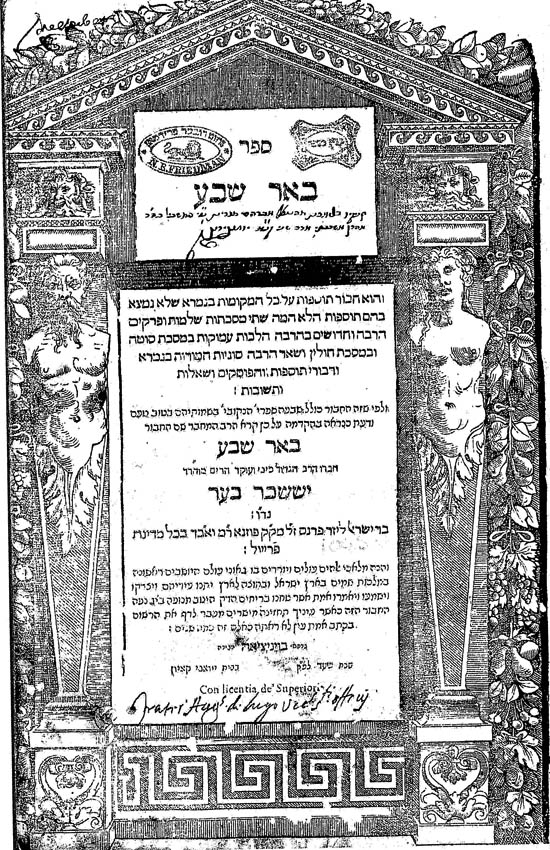
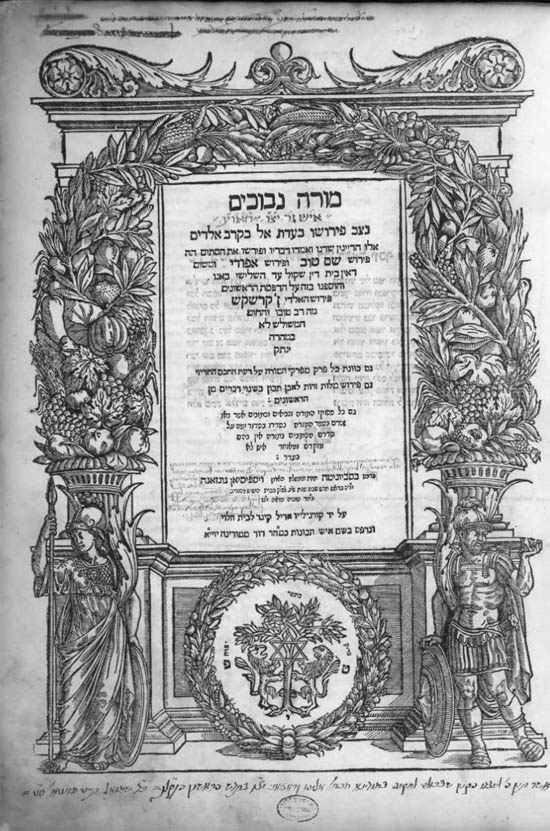
In January 2025, two hundred Judaica items from Mr. Klagsbard’s estate were offered for sale at the Kedem auction house’s 100th public auction. Among them was lot 96, a copy of Sefer ha-Kuzari in Judah ibn Tibbon’s translation, second edition, Venice 1547. While browsing through the catalog and attached images, I was excited to identify the previously unidentified annotations as written by Rabbi Azariah de’ Rossi.[4] A detailed paleographic comparison between the notes on his copy of the Guide and those on the Kuzari confirmed this identification. The similarity is evident in all characteristics: writing style, letter forms (particularly alef, final mem, and qof), and consistent use of certain abbreviations.
Beyond the similarity in the handwriting itself, similar editorial patterns can be identified in both works. In both texts, de’ Rossi created detailed tables of contents at the beginning of the book, using the same system of notation and reference. Additionally, the notes in both works are organized similarly in the margins, with consistent use of square brackets to indicate additions and completions.
Providence arranged that while the copy was sold to a private collector, it was photographed and made publicly accessible in the “Ktiv” digital platform of the National Library of Israel.
Chapter 2: Nature and Sources of the Annotations
Analysis of the annotations on the Kuzari reveals several layers of corrections and notes. The annotations can be classified into two types, similar to his notes on the Guide for the Perplexed. The first type consists of brief interpretative notes, where he generally appears as a concise yet profound philosophical commentator. The second type comprises quotations from other commentators. In his notes on the Guide, he quotes from Narboni, Ibn Kaspi, and a previously unknown commentator named Rabbi Abraham Kashlar.5 In his notes on the Kuzari, he quotes from Abraham Ibn Ezra’s biblical commentary, from Rabbi Nathanel ibn Kaspi’s commentary on the Kuzari, and from other commentators. An example of a quotation from Ibn Kaspi appears in his note on the science of music in Book II:65, which is found in Ibn Kaspi’s autograph manuscript, as we shall discuss below.
In the Kuzari, we also find systematic and extensive corrections to Judah ibn Tibbon’s translation as it appeared in the 1547 Venice edition before him. The Ibn Tibbon family played a crucial role in medieval Hebrew translation: Judah ibn Tibbon (c. 1120-1190), known as “the father of translators,” established their translation tradition and produced the first Hebrew translation of the Kuzari. His son Samuel (c. 1150-1230) became renowned for his precise translation of Maimonides’ Guide for the Perplexed, while Samuel’s son Moses, though also active as a translator, was considered less rigorous than his predecessors.
De’ Rossi believed, as he explicitly stated in his work Imrei Binah,[6] that this Kuzari translation was flawed since it was not produced by Samuel ibn Tibbon, whom he considered the most authorized translator of philosophical works. Interestingly, de’ Rossi made a significant historical error: he was unaware that the translator was actually Judah ibn Tibbon, the patriarch of the family, and instead believed it was Moses ibn Tibbon, Samuel’s son, whose translation methodology he criticized. This misidentification led de’ Rossi to approach the text with particular critical attention, though ironically, he was correcting the work of the very founder of the translation tradition he admired.
In our copy, we can see that de’ Rossi’s corrections to the translation drew upon several distinct sources:
1. Translation corrections based on Judah ben Cardinal’s version, which was available to de’ Rossi.[7] A clear example of this is the correction of the term “Karaites” at the beginning of the book, which does not appear in the Venice edition but matches Cardinal’s translation.[8]
2. Corrections based on Judah ibn Tibbon’s own revisions, which were written as alternative readings. These corrections appear in the margins of various Kuzari manuscripts.[9]
3. Original translation suggestions by de’ Rossi himself, which were later incorporated into subsequent editions.[10]
To understand the sources of these corrections, we must first understand the history of Judah ibn Tibbon’s translation of the Kuzari. As David Zvi Baneth demonstrated in his foundational research, ibn Tibbon’s translation reached us in two distinct basic versions:
1. The first, which Baneth termed “Version T,” reflects ibn Tibbon’s original translation language.
2. The second, “Version S,” is a later adaptation.
Although the two versions are closely related, they differ in their translation methodology and language: Version S presents a more precise and consistent translation that strives to adhere to the Judeo-Arabic original and to translate each term uniformly.
Additionally, as Bar-Asher has shown, another layer of translation by Samuel ben R. Judah ben Meshullam entered ibn Tibbon’s translation. [11] This scholar initially intended to translate the entire book himself but, upon seeing ibn Tibbon’s translation, refrained from completing a full translation. The question of whether he translated the book based on ibn Tibbon’s translation or merely wrote corrections in the margins of ibn Tibbon’s translation remains unresolved.
Over the generations, these versions became intermingled, and later copyists combined them indiscriminately. This process gave rise to mixed and complex versions, which were also reflected in the first printed editions of the book.
Examination of de’ Rossi’s copy, with his annotations on the 1547 Venice edition, shows that he attempted to grapple with this complexity. He utilized various sources to determine the precise text – Judah ben Cardinal’s translation that was available to him, as he testifies in his book Imrei Binah, making his notes a potential source for identifying Cardinal’s largely lost annotations.[12] He also used the margins of Kuzari manuscripts that documented additional versions of ibn Tibbon’s translation, as well as adding notes of his own.
Chapter 3: The Influence of De’ Rossi’s Notes on Rabbi Judah Moscato’s Kol Yehudah
Professor Avishai Bar-Asher’s comprehensive study of the Hebrew translations of the Kuzari and the evolution of Judah ibn Tibbon’s translation[13] concludes with these words:
“It is to be hoped that the discovery of additional material—in other documents preserving translation fragments, in the extensive material preserved in the margins of manuscripts of ibn Tibbon’s translation in its various versions, or in secondary copies that have not yet been examined—will help to further evaluate the hypotheses and preliminary conclusions proposed in this study.”
It appears that one of the most important documents for understanding the evolution of ibn Tibbon’s translation from the edition published with the Kol Yehudah commentary onwards is this document containing de’ Rossi’s annotations.
We will examine two of de’ Rossi’s annotations that demonstrate his influence on Rabbi Judah Moscato, author of Kol Yehudah, which became the canonical commentary on the Kuzari from its first publication in Venice in 1594 until today.
The first concerns a textual matter. In the Kuzari, Book II:57, it states:
.אמר הכוזרי: אתם היום במבוכה גדולה מאלה החובות הגדולות, ואיזו עדה תוכל לשמור כל הסדר הזה
“The Khazar king said: You are today in great confusion regarding these great obligations, and which congregation could maintain all this order.”
_html_m796be417.png)
De’ Rossi was convinced this translation was incorrect. In his Me’or Einayim, he criticizes it and rejects Ibn Kaspi’s attempt to justify it. He notes there that Ben Cardinal translated “in confusion” as “in quiet and rest”.[14] In the margins of his personal copy, he included ibn Tibbon’s alternative translation, “indeed in return and tranquility,” but also proposed his own correction: he crossed out the word “in confusion” and wrote above it “in rest.”
Notably, not by coincidence, the reading “in rest” appears in all editions of the Kuzari with Kol Yehudah onwards, to the puzzlement of Munk and other scholars who wondered about the source of this reading.[15]
It seems likely that de’ Rossi’s suggested correction found its way into Rabbi Judah Moscato’s work, as we find evidence of his influence in other places as well.
Here is another source that apparently shows such influence. In Book II:65, the Kuzari discusses the excellence of music, stating:
…אמר הכוזרי: שמה בלי ספק נגמרה ושמה היתה מעוררת הנפשות, כאשר יאמר עליה, שהיא מעתקת את הנפש ממדה אל הפכה
“The Khazar king said: There, without doubt, it was perfected and there it would stir the souls, as it is said of it that it transfers the soul from one disposition to its opposite…”
De’ Rossi writes in the margin:
כנגן דוד לפני שאול להעביר רוחו הרעה וכנגן אלישע בהסתלקות הנבואה. וכבר חשב האפודי שלזאת הסבה כתוב בקצת מזמורי תהלים למנצח, לפי שהיה השיר המיוחד למזמור ההוא ממה שינצח כח או כחות מה מהנפש להשיבם להיושר והנכון
“Like David’s playing before Saul to remove his evil spirit, and like Elisha’s playing when prophecy departed. The Efodi already thought that for this reason it is written in some psalms ‘To the chief musician,’ because the song designated for that psalm was among those that would overcome some power or powers of the soul to return them to uprightness and propriety.”
_html_5204f255.png)
These words are not found in any of the Efodi’s known works, but it appears that in de’ Rossi’s memory, he confused the Efodi with Rabbi Nathanel ibn Kaspi. The latter writes in his commentary on this passage:[16]
כאשר ראינו משאול כאשר ביעתתהו רוח רעה והיה כנגן דוד לפניו סרה מעליו הרוח הרעה ההיא כמו שמבואר מהספור, והיה בהיות אלהים אל שאול ולקח דוד את הכנור ונגן בידו ורוח לשאול וכו’. וכן היתה חכמת המושאיקא מעוררת הנפשות, כי מצד התלות השכל האינושי בחומר ישיגהו פעמים עכירות ובהלה ושכחה, ובה יקנו יתרון המעלות ויקנו המדות ויחזיקו התכונות. וכן יסירו הנגונים חליי הנפש ויכוונוה לקבל רוח הקדש. ובזה ינוצחו קצת תכונות רעות שבנפש ויוכנעו לעבודת האל, על כן כתב למנצח מזמור לדוד. ולהיות חכמת הנגון בנוייה על סדר הערכים, ר”ל על סדר הערך והיושר מסודר ומתוקן כראוי, על כן אמר דוד שיר המעלות
“As we saw with Saul when an evil spirit troubled him and when David played before him the evil spirit departed from him, as is clear from the story, ‘And it happened, when the spirit from God was upon Saul, that David took a harp and played with his hand; then Saul would become refreshed,’ etc. Thus the science of music would stir the souls, for due to the attachment of the human intellect to matter, it sometimes experiences turbidity, confusion and forgetfulness, and through it they acquire excellence of virtues and acquire good traits and strengthen dispositions. Thus the melodies remove the illnesses of the soul and prepare it to receive the holy spirit. In this way certain evil dispositions in the soul are overcome and subdued to divine service, therefore it is written ‘To the chief musician, a psalm of David.’ And because the science of music is built on the order of proportions, that is, on the order of proportion and uprightness arranged and established properly, therefore David said ‘A Song of Ascents.'”
It seems quite clear that de’ Rossi summarized and abbreviated ibn Kaspi’s comments here, making them the source of his note, though he mistakenly attributed them to the Efodi.
Now, I can find no logical explanation for Rabbi Judah Moscato’s words elsewhere, unless we say that he saw de’ Rossi’s words in this note and understood them in an interesting way.
This is what Rabbi Judah Moscato writes in his book of sermons, Nefutzot Yehudah:[17]
ומקרא מפורש הוא, יבקשו איש יודע מנגן בכינור. והיה בהיות עליך רוח אלהים רעה, וניגן בידו וטוב לך. ועל כתפות האפודי היתה זאת שומה, אל מול פניו, לעומת מחברתו, כי על כן נאמר בקצת המזמורים למנצח, להיות השיר המיוחד אליהם מועיל מאד לנצח התכונות שבנפש, להכניעם ולהשיבם אל תיקון היושר לעבודת האל יתברך. הוא דבר בעל הכוזרי, בהפליגו בשבחי המוסיקה הנמצאת מאז באומתנו, וזו לשונו, מאמר ב, סימן סה: שמה, מבלי ספק, נגמרה ונשלמה, ושמה היתה מעוררת הנפשות, כאשר ייאמר עליה שהיא מעתקת את הנפש ממידה אל הפכה. ע”כ
“And it is an explicit verse, ‘Let them seek a man who is a skillful player on the harp. And it shall come to pass, when the evil spirit from God is upon you, that he shall play with his hand, and you shall be well.’ And upon the shoulders of the ephod this was placed, before him, opposite its joining, for therefore it is said in some psalms ‘To the chief musician,’ as the song designated for them was very beneficial for overcoming the dispositions of the soul, to subdue them and return them to proper rectification for the service of God, blessed be He. This is what the author of the Kuzari said, in his praise of the music found then in our nation, and this is his language, Book II:65: ‘There, without doubt, it was perfected and completed, and there it would stir the souls, as it is said of it that it transfers the soul from one disposition to its opposite.’ End quote.”
_html_75af54d0.png)
It is quite clear that these are the same ideas that originated in ibn Kaspi’s commentary. But how did the words “and upon the shoulders of the ephod this was placed” enter into R. Judah Moscato’s discussion? What does the ephod, and specifically “Efodi,” have to do with King David? It must be that de’ Rossi’s words were before him, and he interpreted the word “Efodi” as referring to David’s ephod.
Conclusion
The identification of Azariah de’ Rossi’s annotations on the Kuzari sheds light both on his interpretative approach and on his influence on subsequent generations. Analysis of the annotations reveals a scholar combining expertise in commentarial literature with meticulous textual criticism, drawing on various sources and traditions. Particularly interesting is his influence on Rabbi Judah Moscato, who incorporated some of his corrections into his Kol Yehudah commentary, which became the canonical commentary on the Kuzari. These annotations thus join a series of testimonies to de’ Rossi’s significant contribution to the development of Jewish exegesis in the late Renaissance period.
The discovery of his annotations on the Kuzari, alongside his known annotations on the Guide for the Perplexed, allows us to better understand his relationship to these two major philosophical works and his conception of the connection between them. Further research into these annotations may shed light on additional questions concerning the textual history of the Kuzari and the development of its interpretation.
[1] On Azariah de’ Rossi, see: Yom Tov Lipmann Zunz, “The Life of R. Azariah min ha-Adummim,” Kerem Hemed 5 (1841), pp. 131-158; 7 (1843), pp. 119-124; Benedetto Levi, Della vita e delle opere di Azaria de’ Rossi [The Life and Works of Azariah de’ Rossi] (Padua: Crescini, 1868); Isaac A. Twersky, “Azariah de’ Rossi 1511-1578,” Katif 6-7 (1969), pp. 175-185; Bezalel Safran, “Azariah de Rossi’s Meor Eynaim” (PhD diss., Harvard University, 1979); Robert Bonfil, “Reflections on the Place of Me’or Einayim by Azariah de’ Rossi in the Cultural Environment of Italian Renaissance Jewry,” Jewish Thought in the Sixteenth Century (1983), pp. 23-48; Meir Benayahu, “The Polemic Over Rabbi Azariah de’ Rossi’s Me’or Einayim,” Asufot 5 (1991), pp. 213-265; Hannah Liss, “The Art of Rhetoric as Peshat? Renaissance Jewish Biblical Exegesis in the Case of Judah Messer Leon and Azariah de’ Rossi,” Tarbut 9 (2000), pp. 103-124; Joanna Weinberg, The Light of the Eyes of Azariah de’ Rossi, New Haven: Yale University Press, 2001; Eadem, “On the Shoulders of Rabbis: The Study of Ancient History in Azariah de’ Rossi’s Writings,” Jewish Studies Quarterly 22 (2007), pp. 49-55; Carmi Horowitz, “Titus and the Gnat in Posen, Prague, and Ferrara: Polemics on Aggadic Interpretation in the Sixteenth Century,” Carmi Sheli [My Vineyard] (2012), pp. 99-116.
[2] See Azariah de’ Rossi, Me’or Einayim, ed. David Cassel (Vilna, 1866; repr. Jerusalem: Makor, 1970); Reuven Bonfil, The Writings of Azariah de’ Rossi, with Introduction and Notes (Jerusalem: Bialik Institute, 1991), pp. 11-130. See also Joanna Weinberg, ed., The Light of the Eyes: Azariah de’ Rossi (New Haven: Yale University Press, 2001), cited above n. 1, for de’ Rossi’s engagement with The Kuzari, as indicated in the index, pp. 789-790, and for his use of The Guide for the Perplexed, as referenced in the index, p. 793.
[3] Paris, Bibliothèque nationale de France, MS hebr. 691, fol. 1r.
[4] Another significant discovery related to Rabbi Azariah de’ Rossi emerged at a public auction: the actual ban (herem) issued by the rabbinical court of Rabbi Joseph Karo (the Beit Yosef) against de’ Rossi’s work Me’or Einayim. This remarkable document, bearing the signatures of eight sages from Safed, was found affixed to one of the surviving copies of Me’or Einayim and was subsequently offered for sale at the “Genazym” auction house. This artifact provides tangible evidence of the considerable controversy that surrounded de’ Rossi’s innovative historical-critical approach to rabbinic literature upon its publication, prompting formal condemnation from one of the most authoritative rabbinical courts of the sixteenth century.
[5] On his commentary to the Guide for the Perplexed and its identification through quotations in de’ Rossi’s notes, see Y. Seewald, ‘Abraham Kashlar’s Commentary on the Guide for the Perplexed: Its Identification, Circle, and Influence on Azariah de’ Rossi’ (in press).
[6] Yemei Olam chapter 36, Cassel edition p. 308 [with full translation of the Hebrew quote to follow]
[7] Yemei Olam, ibid.: “And I remember that I saw Judah ben Cardinal’s translation in part of the Kuzari…”
[8] Cf. Bar-Asher, “Hebrew Translations of the Kuzari,” Sefunot 13 (2023), pp. 185-189.
[9] Such is the annotation found in Ibn Kaspi’s autograph, to Kuzari II:57, “at this time in tranquility and rest” (Paris MS Heb. 677 fol. 47r), which is an annotation by ibn Tibbon, and de’ Rossi copies it in the margin. Similarly, in I:1 – “my soul, in my opinion,” documented in manuscripts as an “alternative version” by ibn Tibbon.
[10] Such is the annotation to Kuzari II:57, replacing “in confusion” with “in rest.”
[11] Cf. Reimund Leicht, “Shemuel ben Yehudah of Marseille: A 14th Century Provençal Translator and Re-Translator, and his Re-Translation of Judah ha-Levi’s Sefer ha-Kuzari” (in process); cited in Bar-Asher, note 7 above.
[12] See Bar-Asher, note 7 above, on the various sources for locating remnants of Cardinal’s translation.
[13] See note 7 above.
[14] See notes 5, 6, and 9 above.
[15] See note 9 above.
[16] See note 8 above, fol. 55v.
[17] First Sermon, Bnei Brak 2000, p. 5.