The Mother Haggados: Models for Modern Analysis of Printed Jewish Illustrations

The Mother Haggados: Models for Modern Analysis of Printed Jewish Illustrations

There is a long tradition of illustrating Haggados, dating back to at least the early Middle Ages. Likely only a small portion of those manuscripts has survived. However, most have been reprinted, and their imagery has been meticulously analyzed and cataloged. These manuscripts can broadly be divided into two categories based on their places of origin: Sephardic or Ashkenazic countries. The former includes the creation cycle and the Exodus story prior to the Haggadah text, while the latter incorporates the imagery into the text. Within these categories, and with the exception of “brother” or “sister” manuscripts, no single manuscript necessarily influenced subsequent ones. Of course, common manuscript imagery appears in many of these manuscripts, with the hunting scene being the most ubiquitous.

Illustrations in printed Haggados, however, are different. They can be traced back to four “mother” Haggados, each the first in its respective region, representing the three main geographical areas of Jewish settlement and centers for printing Hebrew books: Prague, 1526 (Eastern Europe); Mantua, 1560 (Italy); Venice, 1609; and Amsterdam, 1695 (Western Europe). These specific Haggados were reprinted many times, with the illustrations, motifs, and themes appearing in them—sometimes collectively and at other times singularly—finding their way into nearly all subsequent illustrated Haggados. Some of these illustrations reflect influences from manuscripts, and all three were impacted by the broader non-Jewish culture and geographical iconography (though not directly related to the text itself). For example, an Italian Haggadah shows Avraham crossing a river in a gondola, while Prague incorporates Gothic architecture for the Egyptian cities. Additionally, we can sometimes identify specifically Christian iconography or direct borrowing from Christian sources in these and later Haggados. Occasionally, this involves using an image that carries no specific Christian connotations, while in other instances, the usage is clearly identifiable as specifically and uniquely Christian.

While these Haggados are discussed by many scholars, at best they analyze a few images, and even in many instances, they fail to fully account for the nuance of the images. Instead, they focus on external influences or some exotic element of the images. This form of analysis is no longer in vogue, and as it relates to Hebrew manuscripts, it has seen a substantial correction, most notably in the recent works of Marc Michael Epstein and Katrin Kogman-Appel on Hebrew manuscripts.[1] We hope to make a small contribution to redirecting the narrative regarding the imagery of printed Hebrew Haggados. What follows is not intended to be a comprehensive analysis of all printed illustrated Haggados. Indeed, we do not discuss Prague 1526, as we have dealt with that edition on a few previous occasions (here, here, here, here, here, here, and here). Rather, we hope it serves as a minor contribution in applying the current methodology used for Hebrew manuscripts to the Hebrew book.

Mantua 1560: Many Cooks in the Kitchen

The Mantua 1560 Haggadah is the first Italian-illustrated Haggadah, published by Giacomo Rufinelli and it is available here from a copy in the Braginsky Collection (the NLI recently exhibited the manuscripts from Collection, with a companion book, Encounters with Beauty). The woodblock images were overseen and possibly even executed by Yitzhak ben Shmuel Bassan. However, since they are unsigned, the artist is uncertain. Yet, however, as we will see, there may have been multiple artisans involved in creating the woodblocks. Bassan served as the shamash in the first synagogue established in Mantua by Yitzhak Porto.

Mantua 1560 is the first illustrated Haggadah to include a title page. The convention of title pages became standard in Hebrew books only in the early middle period of the 16th century; see our discussion here. Like many Jewish and non-Jewish title pages, it frames the page with architectural elements, such as arches and pillars. These pillars are unique. They are not traditional columns but helical (twisted) pillars, referred to as barley-sugar pillars.

While at first blush, Rufinelli’s incorporation might seem associated with a distinctly Christian structure, closer examination reveals that the printer’s usage served a different purpose, one explicitly aligned with his publishing house. This style is most well-known for its use in St. Peter’s Basilica in Rome, which was constructed in the 4th century by Constantine the Great and this style is claimed to be derived from the famed pillars of the Solomonic temple, the yachin and boaz pillars (although no Jewish sources describe these as helical). These pillars supported the dome above the main altar. The original Basilica was demolished in the early 16th century and rebuilt at the end of that century. It was most famously reproduced by the school of Raphael in “The Donation of Constantine,” completed around 1524, and adorns the ceiling of Sala di Costantino, one of the four Raphael rooms within the Vatican Palace. Nonetheless, Rufinelli most likely used these pillars not to evoke St. Peter’s but for a more local reason, specifically to identify his books as Mantuan in provenance. The local Cortile della Cavallerizza in the Palazzo Ducale in Mantua, designed by Giulio Romano and completed around 1540, predates Rufinelli’s incorporation of these pillars in his books (they appear in the Haggadah and others). The second elevation is notable for its barley-sugar pillars, an early example of the Mannerist school of architecture and among the Palazzo’s most unique and recognizable features.

Cortile della Cavallerizza

Perhaps, in Rufinelli’s mind, these pillars symbolized Mantua, and he treated them as akin to a printer’s device expressing familial or other aspects of the printer. Indeed, while Italianate books in the 16th century regularly incorporated architectural elements into title page designs, we have not located any books that utilize the Solomonic pillars, despite their history and symbolism in Italy, other than Ruffinelli’s Mantuan prints.[2]

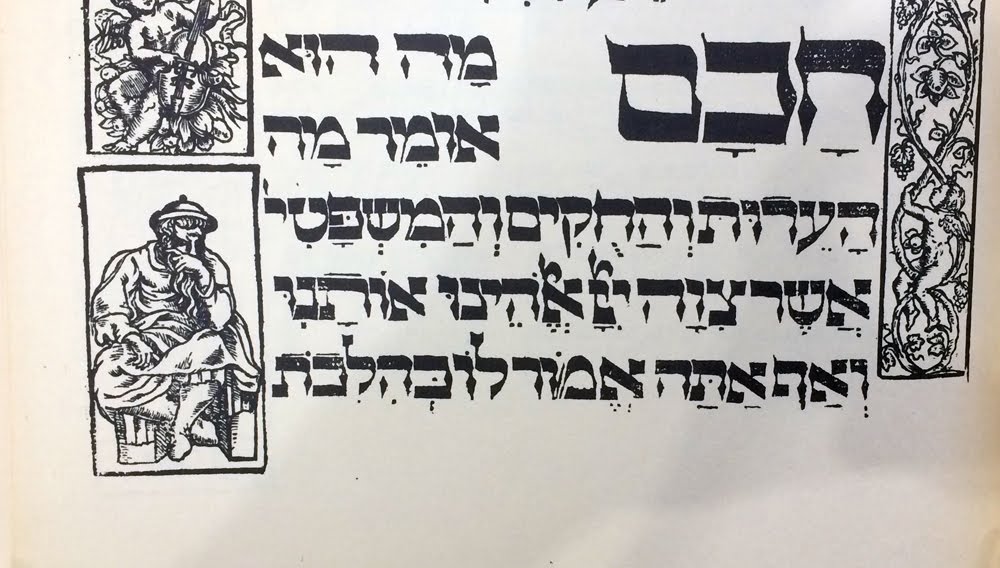
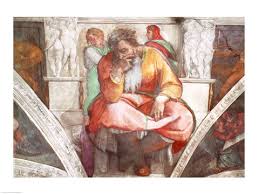
Another image from this Haggadah originates from the Vatican Palace: the depiction of the prophet Jeremiah that Michelangelo painted on the ceiling of the Sistine Chapel. Jeremiah, seated in a contemplative pose with his hand on his beard and legs crossed, is used to illustrate the wise son in the Haggadah. Nevertheless, the image takes on a unique Jewish twist in the Haggadah version. Jeremiah is no longer bareheaded; instead, he wears a Pileus Cornutus, or Jewish hat, the cone-shaped headgear commonly mandated by Christian law.

Mantua, 1560

The first edition of the Maxwell House Haggadah (we discussed the history of the first edition here) also reproduces a well-known Renaissance image of Rembrandt. It includes Rembrandt’s Sacrifice of Isaac, now in the St. Petersburg Museum.

Maxwell House Haggadah, New York, 1932

The illustration of the final son, the one who cannot ask, is also of non-Jewish origin. In this instance, it comes from a biblical illustration by the noted illustrator, Hans Holbein the Younger, and appears in Icones Historiarum Veteris Testamenti, first published in 1538 (page 88). The image is used in a different context, Psalms 53:2, for a fool, but in the Haggadah, it illustrates the son who does not even know how to ask.

Mantua, 1560

Holbein, Icones Historiarum Veteris Testamenti

Determining the source of the remaining images, as well as the number and identity of the artists involved in the production of this Haggadah, is challenging. A close examination of the style and quality of the images suggests that at least three artists contributed. Artist A’s work features detailed, technically accurate German-style drawings, while Artist B’s illustrations resemble almost childlike line drawings that lack perspective and depth. The third artist, Artist C, produces illustrations that are not as crude as those of Artist B, as they possess a sense of perspective. Yet, they are also not executed as well as those of Artist A.

Artists A and B appear on the first page of the Haggadah. In the upper right-hand corner, there is a detailed and precise depiction of a man searching for hametz, dressed in a Germanic style, belted and wearing a beret, with the ceiling and fence rendered with perspective. At the bottom center left is a simple line drawing of the matzah baking scene. The men and women wear Italianate clothing, with the men in unbelted tunics and cloth caps covering their ears or in flat hats, and the women in low-cut dresses with exaggerated shoulders. There is no depth, as the men on the far left overlap on the same plane as the women kneading the dough. Similarly, the two people at the table in the right-center, using the “redler” (dough docker) to mark the matzah, also lack perspective.


Artists A and B are again juxtaposed on facing pages, featuring two images depicting the killing of Jewish babies. On the right page, we see the midrashic image of Pharaoh bathing in the babies’ blood, while the left page shows the act of casting the babies into the water. Here, as well, the illustration on the right side portrays the participants with realism, whereas the left displays simple line drawings. The woman on the far right of the left page, with her hands raised, contrasts sharply with the despondent woman at the far right of the right page, where the anguish of having her child torn from her arms is powerfully conveyed.

Artist C demonstrates intermediate technical skills between those of Artists A and B. Two similar images of the family at the seder demonstrate the distinction between Artists B and C. Artist B’s work consists of line drawings, offering little to no shading or depth on a single plane, whereas Artist C’s piece presents a crowded scene where each figure wears a unique dress, showcasing multiple perspectives and well-rendered depth of perception.

A comparison between two figures, both seated in similar chairs and holding comparable objects, effectively represents the distinct styles of Artists A and C. Rabbi Eliezer, characterized by a disproportionate head and a simpler chair. The king image, however, holds a topped goblet with filigree on the bottom and is seated beneath an elaborate copula. All of the features are well-proportioned and executed within a smaller and more challenging format. These distinctions suggest that the two seated men cannot be the work of the same artist.

Artist C is evident in Moshe leading the Israelites out of Egypt. The large group of Israelites is well drawn (no Artist B line drawings), but Moshe, particularly his head, is not rendered as well as the figures in Artist A’s works.

Similarly, the most recognizable image from this Haggadah, which shows the Messiah on a donkey with Elijah following, displays the hybrid style of Artist C. The Messiah, donkey, Elijah, and especially the figure with the bow and arrow are clearly less refined than those of Artist A, but not as simplistic as Artist B.

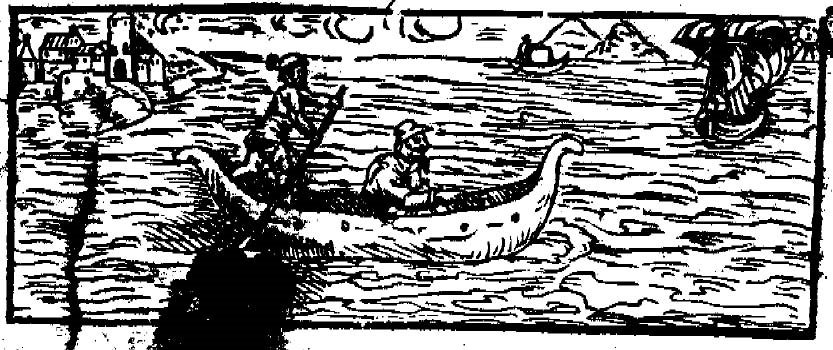
None of the Haggadah’s images are signed. One clue to the influence of Artist C is seen in his illustration of Avraham crossing the river. His boat of choice is a gondola, suggesting that Artist C may have Venetian origins.

The gondola also makes a brief appearance in another of Artist C’s images, titled “Building Pitom and Ramses.” There is a small gondolier crossing the river visible at the top center of the image.


Artist A’s city of origin, or where he may have spent time, cannot be determined from his drawings. The wise son, Jeremiah, is depicted by Artist A, but, despite the origins of this illustration in the Sistine Chapel, we cannot identify Artist A as Roman, nor confirm that he viewed the image firsthand in Rome. It is more plausible that he encountered the images only through drawings, whether printed or otherwise. A comparison of the beard in the Haggadah, with its long, wavy hairs, aligns much more closely with this drawing, now in the Metropolitan Museum of Art, printed in Mantua (although its dating is disputed), rather than with Michelangelo’s bushy, untamed beard in the Sestina.[3]


If, indeed, there are three artists, we can tentatively associate the images with their artists as follows:

Artist A: King on chair (p. 2, 3,36, 37, 42, 70), Jeremiah (p. 9), praying man (p. 9, 14), four sons (p. 10-11), Rosh Hodesh (p. 11), Pharoh bathing in blood (p. 20), Aaron with staff (p. 24), angel with sword (p. 24), R. Yosi (p. 26), King pointing finger (p. 27), Israelites escaping Egypt with Egyptian pursuing (p. 28-29), Paschal lamb (p. 32), matzah (p. 33, 40), maror (p. 34, 38, 40),.

Artist B: matza baking (p. 1), family seder (p. 4, 42), children thrown into the river (p. 21).

Artist C: hare hunt (p. 3), enslaved Israelites building (p. 6, 35), Avraham on gondola (p. 13), young woman (p. 18), Pitom and Ramses (p. 19), R. Eliezer (p. 28), Egyptians drowning (p. 31), Moshe leading the Israelites (p. 38), family seder (p. 41), Elijah entering Jerusalem (p. 45).

Venice, 1609 An Egalitarian Haggadah?

The third “mother” Haggadah was conceived by Israel Zifroni, a printer, editor, and typesetter, and published by Giovanni di Gara in Venice in 1609 (briefly discussed here and here).[4] The images are unsigned and it is unclear if they were executed by Zifroni or he just oversaw their production. There were three editions: in Judeo-Italian, Judeo-German, and Ladino.5 On the title page, Zifroni invokes the verse from Psalms 148:12: “‘Youths and maidens, elders and boys, will praise the name of the Lord,’ who inspired me, Zifroni, to bring this crown of beauty to light, so that no eye will be satiated by its forms. Here, one can always find novelties; these were not done in vain, but with intention and purpose. These will prolong the story, for your eyes withhold my glory and my deeds related to it.” In this epigraph, Zifroni alludes to two unique aspects of the illustrations in his edition: its egalitarianism, as it is for everyone, and the deliberate nature of the illustrations, meant to provide additional commentary to the text and fulfill the obligation that “whoever adds in the retelling is praiseworthy.”

While Zifroni surely intended that the Haggadah be used for all age groups, one of the “novelties” in the illustrations is a focus on a female audience. This inclusivity, emphasizing images depicting women, repeatedly appears throughout the Haggadah. Additionally, there are scenes that do not include women, in previous Haggadahs, and it is unclear from the text if women participated. Nevertheless, Zifroni incorporates them into the narrative.[6]

Zifroni’s intentional and distinct approach is already evident from the title page imagery, which contains six images divided between the processes of searching and burning hametz and matzah baking. The people depicted conducting these processes are exclusively women, with no men present. This gendered approach sharply contrasts with the Prague 1526 and the Mantua 1560, which depict a man searching for Hametz.

Mantua, 1560

Prague, 1526

Similarly, while the baking scene at the bottom of the page is very similar to that of Mantua 1560, nearly all the men depicted are now women. Aspects of the process in Mantua were entirely male, whereas in Zifroni’s they are now exclusively female.

Venice, 1609

Mantua, 1560

In Mantua, the kneading depicts three men, while in Zifroni’s there are three participants as well, but one is a woman. Mantua shows two men mixing the dough, whereas Zifroni’s features two women. Mantua has two men shaping and puncturing the dough, while in Zifroni’s there are two women. Even in the scene at the top of the page depicting the harvesting and checking of wheat, where the heavy labor involved could easily be portrayed as exclusively male, Zifroni still includes one woman at the table checking the wheat.

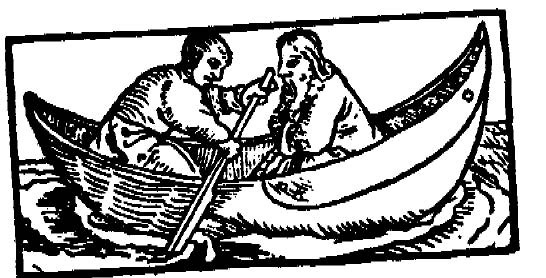
Zifroni’s biblical scenes, when possible, include women. For example, in the scene above depicting Avraham crossing the river in the Prague and Mantua Haggadahs Avraham is shown alone, accompanied only by the rower in Prague (second image below) and the gondolier in Mantua (third image below).

This aligns with the verse in the Haggadah, “that I took Avraham your forefather over the river,” which does not mention anyone else. By contrast, in this seminal scene in the formation of the Jewish people, Zifroni did not limit himself to the literal text. His illustration references the biblical story that includes Sarah. Thus, she is portrayed in the gondola, along with two other women at the dock about to board, while no other men, aside from Avraham, are present, not even Lot. This multitude of women sharply contrasts with the scene on the right, depicting idol worship, where the genders are reversed; here, there is just one woman, and the rest are men.

Another “novel” illustration related to the Israelites time in Egypt. The Talmud offers two reasons why women are obligated to the same degree as men in reciting the Haggadah: they too were included in the Exodus miracle, and, according to Rabbi Avira, they were not just participants, they were the catalyst for the Exodus (Sotah 11b). There are at least three episodes that demonstrate the integral part women played: Shifrah and Pu’ah, women’s roles in the exponential reproduction of the Israelites, and Pharaoh’s daughter saving Moshe. All three feature prominently in Zifroni’s images. While infanticide is illustrated in Prague and Mantua in two panels, one showing the gruesome murder to drain their blood for Pharaoh’s bath and the other showing them being cast in the river, neither Haggadah shows the multiplication of the Israelites. Yet, in Zifroni’s work, in addition to one panel of the babies being cast in the river, he includes two that illustrate the population explosion, specifically highlighting the unique and nearly exclusive role of women.

The first shows four women nursing and raising the children, both alluding to the midrash teaching that Jewish woman in Egypt birthed sextuplets. On the right, one woman is nursing two children while another four are clamoring for sustenance. In the middle, the three other women tend to six children. Two men appear far to the left, only partially depicted with most of their bodies cut from the scene (perhaps alluding to their male parts, their only relevant part in the story). Additionally, as we previously discussed in the article, “Separate Beds,” this printed Haggadah is unique in representing Jewish abstinence. Like the other images, it displays an awareness with rabbinic literature. 

Indeed, this scene is repeated and expanded upon on the next page. Again, a woman nursing six children, this panel now incorporates the earlier part of the story, which emphasizes that the women encouraged their husbands, even after a brutal day of enslavement, to spend time together. This alludes to the Talmudic passage that uses the verse in Shir HaShirim (8: 5), stating that they procreated under the apple tree. The Nile River is included in this scene, not to illustrate infanticide, but to show the women bathing in preparation for their meeting with their husbands.

Even the panel that depicts infanticide is unique in that the largest and most prominent portion of the scene shows Pharaoh’s daughter saving Moshe. Additionally, Shifrah and Pu’ah appear before Pharaoh on the left, unlike any earlier illustrations that omit them entirely.

Contrasting the earlier Haggadahs illustration of the scene with the Israelites safely on the side of the sea and the Egyptians drowning highlights the central role that women play in Zifroni’s version.

In his depiction, the center of the frame shows Miriam playing instruments and singing with the women, while Moshe and the rest of the men are relegated to the right of the panel. In Mantua, (the two images below) Miriam is merely part of the larger group, identifiable only upon close examination.


In Prague, the scene is exclusively male. Likewise, in the scene of the Israelite encampment in the wilderness, Zifroni was careful to include Miriam and her well.

Another scene where there was no need to include women is Avraham meeting Malki Tzedek, where a woman appears at the far right of the panel.

There are other scenes where women take center stage. When eating the matzah, the women at the center distribute it to the men, seemingly indicating that the women are leading the seder. Both Prague and Mantua, show only a lone man.

Mantua, 1560

Women are central in the scene of the Four Questions. Their prominence is particularly noticeable as the image on the following page depicts Rabbi Eliezer and other sages, with him in taking center stage.

Similarly, when Avraham greets the three angels, both he and the angels are shifted to the left of the frame, while Sarah, in the tent, occupies the center.

Finally, most radically, although it is not entirely clear as the top of the head is obscured behind the letter, the wise “son,” upon close examination, it is perhaps a woman. Unlike the other “sons” this child is wearing a skirt whereas the men and boys are in pants!

In conclusion, one prominent and exceptional thematic element in Zifroni’s illustrations is the significant role of women. This leaves little doubt that he intended to portray and elucidate the Haggadah through deliberate images that appeal to and highlight both the feminine and the traditional masculine role in the Exodus.

Amsterdam 1695, A Judeo-Chrisitan Haggadah or an Exemplar for Haggadah Illustrations?

One of the most striking examples of Christian iconography in the Hebrew book is the 1695 Haggadah printed in Amsterdam and illustrated with copperplates by the convert Jacob Bar Abraham. This marks the first use of that technique in a Hebrew book, which allows for a much more refined and precise presentation of images. The Haggadah also includes a fold-out map, though it may not be the first example in a Haggadah.[7] Bar Jacob was originally from the Rhineland and may have even been a Christian preacher.[8] He was not the only convert involved in Amsterdam Jewish printing. According to Yaari, there were at least six others.

These images were used as a template for at least four 18th and 19th-century Haggados in Amsterdam, as well as hundreds of editions printed in Germany and Eastern Europe, and even as far afield as Iran, India, and North Africa.[9] There are at least five 18th-century manuscripts that also utilize Bar Jacob’s images.[10] Despite their popularity throughout the European Jewish world, the source of his images is non-Jewish. Thirteen of the fourteen illustrations in this edition, and six of those on the title page, do not come from any of the three other “mother” Haggados. Instead, these illustrations are sourced from the biblical images created by the Christian artist Matthaeus (Mathis) Merian the Elder.[11] They first appeared in his Icones Biblicae, published in Basel in 1625, and were subsequently incorporated into the most popular Bibles in the Rhineland

Bar Jacob’s source was first identified in 1931, a fact acknowledged by subsequent analyses of this edition. Some critiques are highly critical of Bar Jacob’s model, with one scholar going so far as to assert, without any corroborating evidence, that “there was fierce opposition” to Bar Jacob’s edition.[12] These scholarly critiques generally question the appropriateness of using Christian biblical imagery, the lack of direct relevance of this imagery because it was not designed for the Haggadah, and the failure to follow the “traditional” imagery found in other “mother” haggados. Despite the great scrutiny to which this edition was subjected, the most obvious Christian element that appears in just one of the fourteen images went unnoticed scholars.[13] And in fact, upon close examination, these scholars’ complaints are easily refuted. While Bar Jacob’s source was Merian, he transformed those images to fit the Haggadah, and with one exception, they fall well within the bounds of accepted Jewish imagery and further enhance and clarify the text of the Haggadah.

The six biblical images at the top of the title page predate the Exodus story, which triggered some complaints of them being non-conformist and irrelevant.[14] Yet, this criticism fails to acknowledge the widespread Sefardic manuscript convention, dating back at least to the 14th century, of prefacing the Haggadah with biblical imagery that documents the precursor events to the Exodus. The Sarajevo Haggadah but one of many examples. Indeed, most Jews in Amsterdam in 1695, particularly the wealthier individuals who were likely the target audience for what was presumably an expensive Haggadah, were of Sefardic origin. Some scholars identified examples of borrowing images and motifs from Medieval manuscripts in other “mother” haggados, but they overlook this when it comes to Bar Jacob.

Perhaps the most consistent criticism relates to the disconnect between biblical images and the Haggadah liturgy. Since Merian’s images were designed for the Bible, they do not necessarily correspond directly to the words of the Haggadah. While some parts of the Haggadah reference the biblical story, Merian did not illustrate those specific narratives. To address this limitation, Bar Jacob discovered alternative images and adapted them for the Haggadah. Importantly, Bar Jacob did not merely “cut and paste.” He modified Merian’s images as needed to align with and, crucially, to clarify through illustration the Haggadah and its themes. Since these subtle modifications do not align with traditional scholarly criticism, most remain unmentioned. Although we lack the space to cover all of Bar Jacob’s images and his distinct approach, we will revisit this later. One scholar points out that “the most egregious” example is Bar Jacob’s illustration of the rabbis in Benei Brak. Being that this story post-dated the Bible by many centuries, none of Merian’s images were intended for this scene. Instead, Bar Jacob used Merian’s image of Joseph and his brothers, provoking this scholar’s ire.

From the Gross Family Collection


This is another example of a surface-level examination of printed illustrated Haggadah images. A close look at the image demonstrates that, rather than being an egregious usage of Merian, it perfectly illustrates Bar Jacob’s approach to transforming the image to suit the Haggadah and express the nuance of the text. In adapting Merian’s image, Bar Jacob modified it in three significant ways, all of which render it especially suitable to clarify the text of the Haggadah.

The purpose of the story of the rabbis in Benei Brak is to provide a historical example of people meaningfully discussing the Exodus story all night. The rabbis were so engrossed in conversation that they were unaware that the time for this obligation had ended, and that they were now required to express the Exodus in a different and common format, reciting the Shema. The nocturnal nature of the story is a central element. Thus, in Bar Jacob’s version, the chandelier, which in Merian’s version is unlit, is lit. To further emphasize the fact that this took place at night, Bar Jacob includes two lit candles in the foreground.

Second, the Benei Brak story is predicated on the fact that the rabbis were unaware that the sun had risen. Thus, as opposed to Merian’s version, where Joseph and his brothers are dining in a room with large open windows, Bar Jacob’s version has opaque windows, indicating that the rabbis became aware that the sun had risen only when their students interrupted the discussion. The windows also allow Bar Jacob to avoid the visible church with a cross atop the steeple that is seen through the large opening in Merian’s version.

Third, Bar Jacob has removed the two dogs, a common Christian artistic motif, from the foreground. The Talmud is anti-canine. Indeed, Rabbi Eliezer, one of the sages listed in the Haggadah, stated that “one who breeds dogs is like one who breeds pigs!” Needless to say, it would be highly inconsistent with the text of the Haggadah to retain dogs in the illustration.

The final modification is in the participants’ headgear. In Merian’s version, only Yosef’s head is covered, with a royal turban. Bar Jacob’s version has all the rabbis wearing head coverings. Beyond a possible Jewish halachic requirement to cover one’s head while engaged in Torah study, a close examination of the headgear fundamentally changes the scene’s dynamic. In Merian, the brothers genuflect to who appears to be an Egyptian royal figure. In the Haggadah, all the rabbis are equal in their obligation. This is made clear in the previous statement of the Haggadah, which states that all, whether wise, knowledgeable, and even those proficient in the entire Torah, are equally obligated to discuss the Exodus story all night. Bar Jacob retained a figure at the head of the table, yet his importance is deemphasized because he wears the same hat as the rabbi on his left.

Bar Jacob’s awareness of the limitations of Merian’s illustrations is evident in the one illustration in the text that is not from Merian. Merian’s illustration of Moshe receiving the Torah depicts Aaron meeting Moshe and the Israelites worshipping the Golden Calf. Thus, Merian’s focus is on sin rather than the spiritual importance of receiving the Torah. Therefore, Bar Jacob chose a different image, one that appears in many Amsterdam Bibles (see here, here and here), showing the Israelites celebrating the event.

Yet, there is, one image that seemingly includes an obvious Christian element: a cross. While somewhat unclear due to its minuscule size, Bar Jacob’s depiction of the Temple appears to have a cross on the front of the building’s roof. Bar Jacob did, however, modify the image in another way to clarify the text. Marien’s version features many people outside and inside the Temple. But the text of the Haggadah discussing the Temple is a prayer for the future, and Bar Jacob presented the Temple as empty, symbolic of the fact that Jews today do not have a Temple to visit. We pray that in the future, we will all be among those in its courtyards.

From the Gross Family Collection

Surprisingly, this is not the only instance of a cross in a Hebrew book. For example, in the 1747 Hamburg edition of Mahram Schiff, the bottom image includes two prominent crosses. Likewise, the bottom left image of the 1668 Amsterdam edition of Nahlas Shivah, which uses “Moshiach Bar David Ba” to denote the year, shows a cross in the background.

Finally, we must discuss two additional Haggados, both of which have been repeatedly praised as beautiful examples of illustrated printed Haggados. Unfortunately, upon close examination, they clearly display Christian iconography in an entirely unnecessary and highly problematic manner. The first, Basel 1816, praised by Steinschneider and described as containing “pleasing” woodcuts is the most troubling. In 1997, this edition was even reprinted and colorized to mark the centennial of the first Zionist Congress held in Basel. For centuries, some have claimed a connection between Jesus’ Last Supper and the Pesach seder. Yet, Jews today would reject the notion that they are reenacting the Last Supper. But in the Basel Haggadah the text regarding the three items that one must eat on Pesach is illustrated with the image of Jesus at the Last Supper, surrounded by the Apostles!

The final “Christian Haggadah” is described by Yerushalmi as “undoubtedly the most distinguished illustrated edition produced in Europe during the 19th century,” and the images “welcome a freshness of design.” Alexander Marx praised its “refined artistic taste,” and that the illustrations are “dignified and pleasing and make this edition outstanding among its contemporaries.”[15] Despite these compliments, in truth, most of the images are not fresh but are copies of previous images from the “mother” Haggados, specifically the 1609 Venice Haggadah. In many instances, this “distinguished” edition eliminates the nuance and meaning of those earlier images. In some cases, the images are nonsensical. Finally, many of the designs suffer from blatant non-Jewish imagery.

From the Gross Family Collection

For example, the Venice Haggadah uniquely enhances the image of the Israelites’ encampment with Miriam and her well as part of the theme of emphasizing women’s role in the Exodus. In the Trieste Haggadah, Miriam and a group of women appear in the bottom far right. However, the women seem to be worshipping her as some sort of deity, with one woman bowing to her. The Venice Haggadah includes the scene of Yaakov meeting Lavan after fleeing Lavan’s home. It features four tents in the background, each with one of Yaakov’s wives, as they play a critical role in that story – Lavan’s complaint is that he did not have the opportunity to say goodbye to them, and then Rachel has a calamitous interaction with Lavan. Yet, in the Trieste Haggadah, there are five (!) empty tents.

Finally, in the most egregious image that is not modeled after any of the prior Haggados, Moshe appears before the burning bush, with God depicted as a man with a beard. Of course, direct depictions of God are prohibited. Unfortunately, this is not the only example in Hebrew books depicting God’s face. The title page of the first edition of Minhas Shai, 1742-1744, also includes such an image. However, it appears that, unlike the illustrator of the Trieste Haggadah, the illustrator of that title page was a non-Jew. This is evident from the fact that the artist was unfamiliar with Hebrew, as the letters are crude and obviously copied. Likewise, since the illustrator of the Kaufmann Haggadah was a non-Jew, in the scene with the burning bush God is depicted as a man.[16]


From the Gross Family Collection

The Moss YaKNeHZ: History and Historic Imagery

The four “mother” haggados are not the only examples of thoughtful illustrations in printed haggados. A contemporary work by David Moss, who remains active with his studio in the Artist Colony in Jerusalem, is an exceptional piece that creatively combines the history of illustrated Haggados in both manuscript and print. The original manuscript has been recently acquired (at Sotheby’s auction) and donated to the National Library of Israel, where it is now on display (see here). If one cannot visit, they can still enjoy it in the comfort of their home. Originally, a small number of exact reproductions were produced; however, those are long out of print. Still, copies of a beautiful two-volume reproduction remain available—one volume contains the manuscript, while the other offers explanatory notes. This edition is admittedly missing a few original elements, but it retains many of the most critical aspects, including the papercuts and fold-out pages, leaving most of Moss’s genius still apparent. One version merely reproduces the Haggadah in a flat format, and we recommend splurging for the two-volume version.

As this year’s Pesach begins on Saturday night, we will use Moss’s accompanying illustration of the procedure unique to that evening as an exemplar of his approach. This procedure, referred to by the Talmud by the acronym YaKNHaZ, translates to the order of operations for the blessings: Yayin (wine), Kiddush, Havdalah, and Zeman (the Shehechiyanu blessing). Moss depicts this section with 12 boxes, 11 containing coins adorned with eagles, and the final one showing a hare jumping out of the frame. This illustration references manuscripts, one of the “mother” haggadot, and its subsequent expression, Jewish history more broadly.

Upon closer inspection, the hare makes an appearance not only in the final box but also is present in each of the boxes with eagles, where it is grasped in their talons. The scene of a hare hunt is common in both non-Jewish and Jewish manuscripts, yet in many instances, it is simply aesthetic and disconnected from the text. However, in the Prague 1526 Haggadah, it becomes directly associated with the text. YaKNHaZ sounds similar to the German phrase “Jagen Has,” which means chasing or hunting hares. The Prague illustrator includes an image of hares fleeing from the hunter and seemingly running headlong into a net. In the next illustrated Haggadah, printed in Augsburg in 1534, which mainly uses the Prague illustration, the hare hunt appears on two panels, transforming the narrative from merely evocative of the procedure to becoming symbolic of the Exodus story. The first panel is a copy of the Prague illustration; yet, rather than the hares succumbing to their pursuer, the second panel shows them jumping over the net to safety. The hunter is no longer just a hunter, and the hares are not mere animals of prey. Instead, the hunter symbolizes those who seek to persecute the Jews, while the hares represent God’s promise that the Jews will ultimately prevail against their adversaries.

Moss’s research uncovered that many historically anti-Semitic governments employ the eagle as their symbol. The eleven panels reproduce these symbols. To illustrate those governments’ animosity toward the Jews, the hares are clutched in the birds’ talons. Yet, akin to the optimism of the Augsburg illustrator, the final frame depicts the hare escaping.

In the accompanying commentary, Moss explains that this image proved to be the most controversial in his Haggadah because eagle imagery is not limited to the past. Instead, it is now most associated with the United States. Until recently, one could comfortably distinguish the United States from its eagle predecessor, as it uniquely granted Jews equal rights from its inception. However, during these unprecedented times, one hopes that Moss’s imagery does not turn out to be prescient.

[1] Marc Michael Epstein, The Medieval Haggadah: Art, Narrative & Religious Imagination (New Haven: Yale University Press, 2011); Katrin Kogman-Appel, Illuminated Haggadot from Medieval Spain (Penn State University Press, 2006).
[2] No examples appear in the various collections of Italian books from that period. See, e.g., Harvard College Library Department of Printing and Graphic Arts Catalogue of Books and Manuscripts, Part II: Italian 16th Century Books, Vols. I-II.
[3] See Boorsch and Lewis, The Engravings of Giorgio Ghisi (Metropolitan Museum of Art, 1985), 164-165 (available here).
[4] Regarding Zifroni see Marvin Heller, “Ambrosius Froben, Israel Zifroni and Hebrew Printing in Freiburg im Breisgau,” in Studies in the Making of the Early Hebrew Book (Brill, Leiden, 2008), 131-150.
[5] This edition was analyzed by Bezalel Narkiss in a 1974 reproduction, Tovia Preschel, in the 1973 Diskin Orphan House reproduction, and Ursula Schubert, Jewish Book Arts, 1994, and discussed by Yerushalmi in his Haggadah and History. None mention the uniquely feminine nature of this edition. Instead, they mainly locate it within the Prague and Mantuan traditions, or identify manuscript precursors, or highlight a few additions.
[6] This discussion is largely informed by and indebted to Epstein’s close analysis of the Golden Haggadah. See Epstein, Medieval, 129-200.
[7] See Isaac Yudlov ed., The Haggadah Thesaurus: Bibliography of Passover Haggados (Jerusalem: Magnes Press, 1997) n20; Rehav (Buni) Rubin, Portraying the Land: Hebrew Maps of the Land of Israel from Rashi to the Early 20th Century (Jerusalem: Yad Izhak Bar-Zvi, 2014) (Hebrew), 83-99. For a detailed discussion of the map, see Rubin, id. and David Stern, “Mapping the Redemption,” Studia Rosenthaliana 42-43 (2010-2011), 43-63.
[8] See Abraham Yaari, Studies in Hebrew Booklore (Mossad Harav Kook, Jerusalem, 1958)(Hebrew), 250-251. Habermann asserts without any evidence that while still in the Rhineland Bar Jacob was convinced by Jewish friends, possibly those involved in printing, to convert to Judaism. See A.M. Habermann, The Illustrated Haggada (Safed: Museum of Printing Arts, 1963), 22. Unfortunately, we have very few details regarding his time in the Rhineland, and no information regarding his decision to convert.
[9] See Shalom Sabar, “From Amsterdam to Bombay, Baghdad, and Casablanca: The Influence of the Amsterdam Haggadah on Haggadah Illustration among the Jews in India and the Lands of Islam,” in, The Dutch Intersection.  The Jews and the Netherlands in Modern History (Leiden:  Brill, 2008) ed. Yosef Kaplan, pp. 279-300 and illustrations pp. 498-517.
[10] See, e.g., Oppenheim Haggadah (1719), Cecil Roth Oxford Haggadah (1753), Babad Haggadah (1769), Tel Aviv Haggadah (1771), and Pressburg Haggadah (1777).
[11] Rahel Wischnitzer-Bernstein, “Von der Holbein Bibel zur Amsterdam Haggadah,” MGWJ 75, (1931), 269-286. The Haggadah’s two other images, Moshe and Aaron, flanking the title page, are sourced from the Yiddish translation of Tanakh by Yekuseil Blitz, published in Amsterdam in 1676-78. The Haggadah is not the only Jewish text that was influenced by and adopted Christian illustrations. See Heyd, Milly, “Illustrations in Early Editions of the Tsene-U’rene — Jewish Adaptations of Christian Sources,” Journal of Jewish Art 10 (1984) 64-86.
[12] Ursula Schubert, Umanut ha-Sefer ha-Yehudit (Tel Aviv, Kibbutz Hameuhad, 1994), 50.
[13] This was finally noticed in 2002. See by F. Wiesemann in ‘Kommt heraus und schaut’– Jüdische und christliche Illustrationen zur Bibel in alter Zeit [Katalog zur Ausstellung, Universitäts und Landsbibliothek Düsseldorf) (Essen 2002), p. 30 (cited by Stern, “Mapping the Redemption,” 53n12.
[14] Schubert, Umanut, 48.
[15] Alexander Marx, “Illustrated Haggadahs,” in Jewish History and Booklore (New York: Jewish Theological Seminary, 1944), 275.
[16] Gabrielle Sed-Rajna, ed., Kaufmann Haggáda (Budapest, 1990), 19; Kogman-Appel, Illuminated Manuscripts, 235 n9.

Everything is Illuminated: Mining the Art of Illustrated Haggadah Manuscripts for Meaning

Everything is Illuminated: Mining the Art of Illustrated Haggadah Manuscripts for Meaning
            We have discussed haggadah illustrations in the past (see the links at the end of this post) and we wanted to expand and update upon that discussion for this year. In this post we focus on Hebrew illuminated haggadah manuscripts, and in the follow-up post will turn our attention to printed illustrated haggadot.
            While there is not as large of a body of Jewish art as that of art in general, historically Jews have appreciated the visual arts early in their evolution into a nation.  Aside from the biblical forms, we have evidence of art dating to the second century of the common era in the well-known frescos at the Dura-Europos synagogue.[1] But, such appreciation was not limited to second century Palestinian Jews, as evidenced from the discussion below, this appreciation continued, almost unabated, until the modern period.  It was not just the artist class or wealthy acculturated Jews that were exposed to and admired this medium.  For example, in the 1560 Mantua haggadah, one of the more important printed illustrated haggadot, the wise son appears to be modeled after Michelangelo’s Jeremiah in the Sistine Chapel (view it here: link). 
            

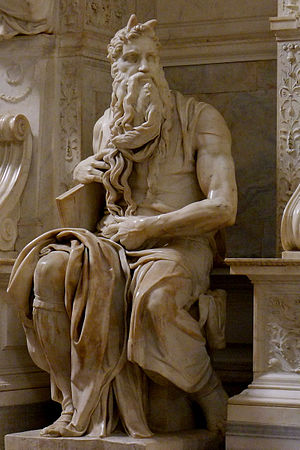
Lest one think that it is highly unlikely that a 16th century Italian Jew would have even entered the chapel, let alone been familiar with this painting, a contemporaneous account of Jewish art appreciation disabuses those assumptions.  Specifically, Giorgi Vasari, the 16th century artist and art historian, in his Lives of Excellent Painters (first published in 1560), records regarding Michelangelo’s statute of Moses – that is a full statute depicting the human form and was placed in the church of San Pietro in Rome – that “the Jews [go] in crowds, both men and women, every Saturday, like flocks of starlings, to visit and adore the statue.” That is, the Sabbath afternoon activity was to go to church to admire the statute of Moses, that is more famous for having horns than its Jewish visitors.[2]

Hebrew Manuscripts Background  
A brief background regarding Hebrew manuscripts before delving into the illuminated haggadah manuscripts. Details regarding manuscripts, the name of the copyist, the date, and the place where the manuscript was written, were supplied not at the beginning of the book – as is the convention with printed books and title pages –  instead in manuscripts this information is provided at the end. For this reason, the scribe’s note containing the information was called a colophon – from the Greek word kolofon, meaning “summit” or “final point.”[3]
Number of Hebrew mss.

A cautious guess of the number of extant Hebrew manuscripts in existence is between 60,000 -70,000 “but no more than 30-40 thousand of them predate the middle of the sixteenth century.”[4] Of the 2-3 hundred thousand Hebrew manuscripts presumed in existence in Europe at the beginning of the fourteenth century, probably no more than four to five thousand are extant today, possibly even less. “From the tenth century (before which information is very scarce) to 1490 (when the influence of printing books began to be felt)” there are an estimated one million manuscripts, meaning, “that 95 per cent of manuscripts have disappeared.”[5]  In addition, the early printed books – incunabula – had similar survival rates.

            The dearth of manuscripts has left a significant hole in our knowledge of major Jewish texts.  For example, there is only one complete manuscript of the Palestinian Talmud (1289) and two partial manuscripts. The Babylonian Talmud fared slightly better, with one complete manuscript (1342) and 63 partial manuscripts in libraries, with only 14 dating from the 12th & 13th centuries.[6] 
One of the partial TPs is known as the Vatican Codex 133 – and worth mentioning is the Vatican and its role regarding Hebrew manuscripts.  While there is no doubt that the Church had a significant hand in reducing the number of manuscripts – in reality the destruction of Hebrew manuscripts was the work of the Jesuits and not the Roman Catholic Church. Indeed, the Church confiscated and, thus in some instances preserved Hebrew manuscripts.  Consequently, we have a number of important Jewish texts that survive in the Vatican library.  Today, many of these manuscripts have been published.  The incomplete manuscript of the TP is but one example.  Additionally, regarding the use of (rather than just reprinting) the Vatican library, for at least late 19th century, Jews had access to the library.  For example, R. Raphael Nathan Rabinowitz, who authored a monumental work on Talmudic variants provides that “I prayed to God to permit me entrance to the Vatican library to record variant readings” his prayer was answered, and he received permission not only to use it during regular hours but “even on days that it was closed due to Christian holidays, when the library was closed to all, and even more so Jews.”[7] In total he spent close to 9 months in the library. In addition, Rabbi Rabinowitz’s presence and special status at the Vatican library was instrumental for the editing of the Vilna Talmud, where he secured permission for the Romm-employed copyists to work with manuscripts of the commentary of Rabbenu Hananel, even though they arrived in Rome during the summer season when the library was closed.
            Of the estimated one million Hebrew manuscripts from the 10th century until 1490, approximately 5% have survived.  As mentioned, religious persecution was one reason, but the main reasons are (1) deterioration from use, (2) accidents, and (3) reuse.  The first two are self-explanatory, the third requires a bit of explanation.  From the times that manuscripts were written on papyrus, unwanted manuscripts were scraped or washed and then reused.  (This papyrus recycling was not confined to reusing for books, papyrus was used from wrapping mummies, burned for its aroma, and used, according to Apices, to wrap meat for cooking). Similarly, leather and parchment were recycled, in the more egregious examples for shoe leather but in many cases for book bindings.  The latter reuse would be critical to the survival of numerous Hebrew manuscripts which have now been reclaimed from bindings.  It is estimated that there are 85,000 such binding fragments.  “The commonest use of written folios, however, was in bindings, whether for binding strips, end papers, or covers.”[8]   
Illuminated Hebrew Manuscripts

            The “earliest examples of Jewish book illumination are tenth-and eleventh-century Bible codices written in the Orient or Near East.  The illuminations are not figurative but consist of a number of decorative carpet pages adorned with abstract geometric or micrographic designs preceding or following the Biblical text.”[9] While these early illuminated manuscripts did not contain human figures, they did contain the first iterations of something unique to Jewish manuscripts, “one form of manuscript depiction unique to Jewish manuscripts is micrography with the earliest examples of this art may be found in the tenth-century Bibles written in the Orient.”[10]  A beautiful example of this art can be seen in the carpet pages for the Leningrad Codex. 


Similar non-representational geometric art was incorporated into Islamic art to avoid graphic representation.  Consequently, symmetrical forms were created which required advances in math theory to accommodate the ever more complex art.
Hebrew manuscripts did not adopt the Islamic convention – for the most part – and the earliest illustrations of human figures appear in Franco-Ashkenazic manuscripts – bibles – of the thirteenth century.
The earliest extant illustrated haggadah[11] is what is known as the Birds’ Head Haggadah dated to the early 1300s. The moniker “Birds’ Head” comes from the fact that the illustrator used birds heads/griffins in place of human heads. This manuscript is not the only Jewish manuscript to use zoophilic (the combination of man and beast) images. Zoophilic images can be found in a variety of contexts in Jewish manuscripts. For example, in the manuscript known as Tripartite Machzor, men are drawn normally while the women are drawn with animal heads.[12]  The name of this Machzor comes from the random fact that the manuscript was split up into three.  At times manuscripts are titled by location (Leipzig Mahzor), history (tripartite) or owner.  In one example, the “Murphy Haggadah” “ suffered a fate all too common to many Hebrew texts.  Before the Second World War the manuscript belonged to Baron Edmond de Rothschild.  During the war it was stolen and sold to an American, F.T. Murphy, who bequeathed it to Yale University, his alma matter.  For years it was known as the “Murphy Haggadah” until, in 1980, a Yale scholar, Prof. J. Marrow, identified as belonging to the Rothschilds.  The manuscript was returned to the Rothschild family and presented by the Baroness Dorothy to the Jewish National Library.[13]
            When it comes to the Birds’ Head manuscript, a variety of reasons have been offered for its imagery, running the gamut from halachik concerns to the rather incredible notion that the images are actually anti-Semitic with a bird’s beak standing in for the Jewish nose trope and the claim that the ears on the “birds” are reminiscent of pigs’ ears. Generally, those claiming halackhic, or more particular pietistic reasons, do so because they are unable “to conceive of such a bizarre and fanciful treatment of the human image as emerging from anywhere other than the twisted and febrile imagination of religious fanatics.”[14] But, in reality the use of bird’s head in lieu of human “reflects a liberal halakhic position rather than an extreme one.”[15]  The camp of Yehuda ha–Hassid would ban all human, animal and celestial depictions, a more liberal position from this perspective permits animal images.  And, while that position doesn’t explicitly permit a depiction half-animal half-human, the zoophilic images appear to show they were allowed, as the illuminator and owner of the Birds Head Haggadah agreed with that position.
            Aside from halakha, and the meaning or lack thereof behind “birds”, a close examination how the illuminator used this convention yields surprising nuance and commentary.      
While most of the images carry a bird’s head, there are a few exceptions. Most notably, non-Jews, both corporeal and spiritual do not. Instead, non-Jewish humans as well as angels have blank circles instead of faces. But, there is one scene that poses a problem. One illustration shows the Jews fleeing Egypt (all with birds’ heads), being pursued by Pharaoh and his army. Pharaoh and his army are depicted faceless.

  But, unlike the rest of the figures in Pharaoh’s army, two figures appear with birds’ heads. Some write this off to carelessness on the illustrator’s part. Epstein, who credits his (then) ten-year old son for a novel explanation, offers that these two figures are Datan and Aviram, two prominent members of the erev rav, those Jews who elected to remain behind. Indeed, they are brandishing whips indicative of their role as nogsim (Jewish taskmasters, or the precursor to Jewish Sonderkommando). While the illustrator included them with the Egyptians, he still allowed them to remain with their “Jewish” bird’s head.  This is a powerful idea regarding the idea of sin, and specifically, the Jewish view that even when a Jew sins, they still retain their Jewish identity – their “birds head.”   Sin, and including sinners as Jews, are motifs that are highlighted on Pesach with the mention of the wicked son and perhaps is also indicated with this illustration. The illustrator could have left Datan and Aviram out entirely or decided to mark them some other way rather than the Birds’ head. Thus, utilizing this explanation allows for the illustrator to enable a broader discussion about not only the exodus and the Egyptian army’s chase, but expands the discussion to sin, repentance, Jewish identity, inclusiveness and exclusiveness and other related themes.[16]

            Once we have identified the Jews within the haggadah, we need to discuss another nuance in their depiction.  The full dress of the adult male bird is one with a beard and a “Jewish hat,” pieus conutus – a peaked hat, or the Judenhut.  Children and young servants are bareheaded.  But, there are three other instances of bareheadness that are worthy of discussion.  (1) Joseph in Egypt, (2) the Jews in Egypt and (3) Datan and Aviram.  The similarity between all three is that each depicts a distance from god or Jewish identity.  Joseph, unrecognizable to his brothers, a stranger in a strange land, and while inwardly a Jew, externally that was not the case.

            The Jews in Egypt had sunk to the deepest depths on impurity, far from God. Finally, as we discussed previously, Datan and Aviram are also removed from god and the Jewish people.  Again, the illustrator is depicting Jews – they all have the griffin heads – but they are distinct in their interaction with god and the Jewish people.[17]  

Using this interpretation of the griffin images, yields yet another subtle point regarding inclusion, and also injects some humor into the haggadah.  The dayenu panel has splitting of the sea, the manna and the giving of the Torah.  The middle panel is less clear. Some posit that it is the Jews celebrating at the sea, but there is no indication of that because in most manuscripts, that includes Miriam, and the Egyptians drowning, not just five random images.

   
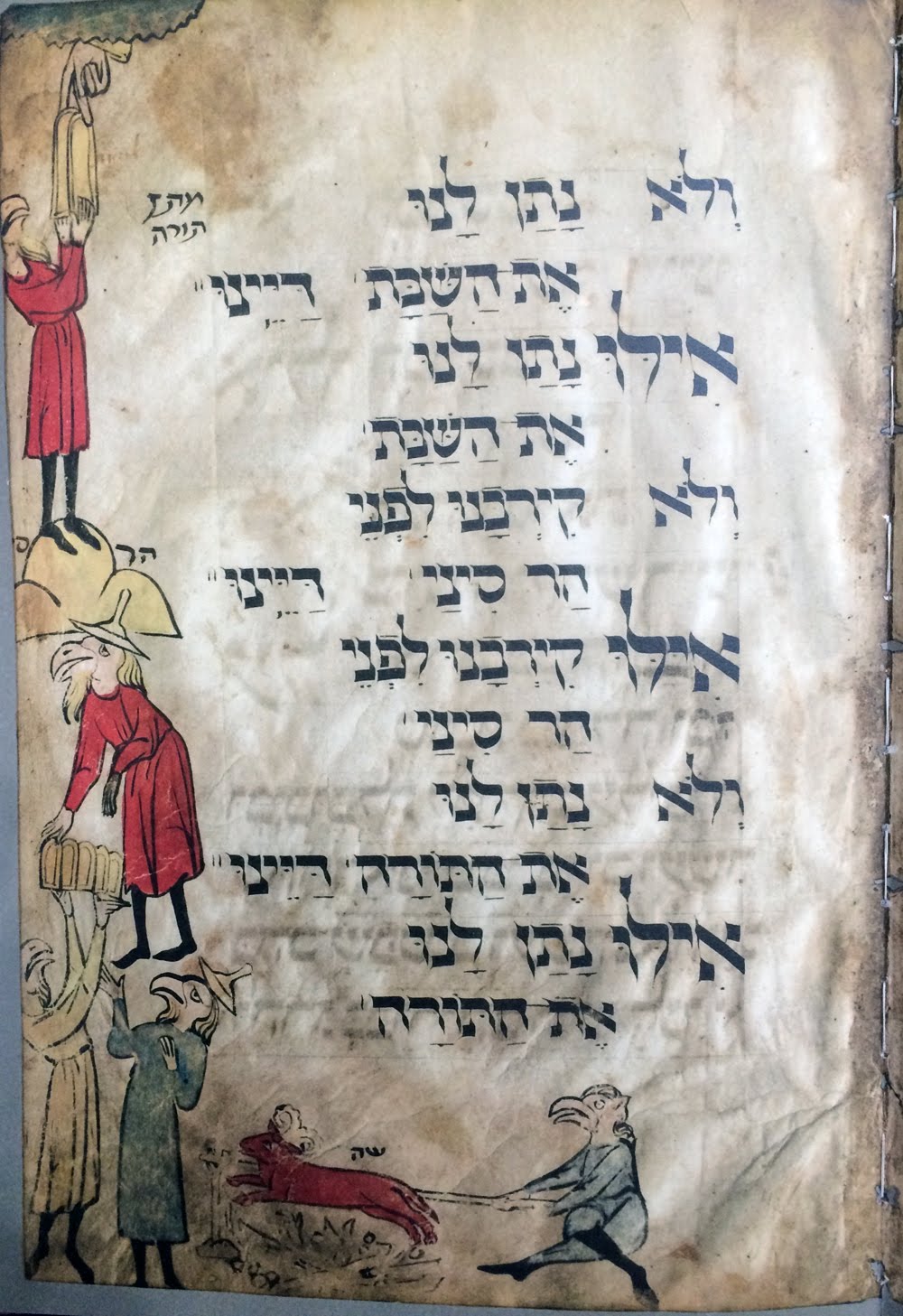
Instead, it appears that the person to the left is speaking (his hand is over his heart a medieval convention to indicate speech), and they are approaching the older figure on the left.  All are griffin headed and Judenhut attired – so Jews and regular ones. Between the splitting of the sea and the manna and quails the Jews complained to Moses.  Its possible that this is what is being depicted here, the complaining Jews, and the illustration serves as a testament to God’s patience and divine plan, the theme of dayenu, that even though we complained and did X, God still brought the manna, quail and Torah.[18] 

            If these are in fact the complainers, we can theorize about another detail of the image.  Above the figure at the left and the right, is faint cursive (enhanced here for visibility as much as possible) that reads: “Dass ist der Meirer (this is Meir) Dass ist der Eisik (this is Issac).”[19]  Thus Meir and Issac are being chided – but not kicked out – for complaining too much (rather than representing an unclear image of the Jews celebrating at the sea or just evidencing poor dancing). 


            Continuing through the dayenu we get to the giving of the Torah, and again, the nuance of the illustrator is apparent

.

            Two tablets were given at Sinai, but the actual Pentateuch is comprised of 5 books.  Thus, to capture that the 5 are a continuity of the two, as they are transmitted down, they transform into five tablets.  What about the ram/lamb at the bottom?  Some have suggested that it is the Golden Calf. But it is unlikely that such a negative incident would be included.  Instead, assuming that continuity or tradition is the theme, this lamb is representative of pesah dorot that is an unbroken tradition back to Sinai and unconnected with the Christian idea of Jesus as a stand in for the lamb.  Immediately prior to dayenu we have the Pesach mitzrayim with the figure’s cloak blowing back due to the haste.

       Thus, the dayenu is bracketed by the historic Pesach and the modern one – all part of the same tradition. [20]  

            It is worth mentioning that the Birds’ Head Haggadah is currently in the news. An item recently appeared about how the heirs of Ludwig Marum and his wife Johanna Benedikt, the owners of the haggadah prior to the Nazi era, are pressing the Israel Museum to recognize their family’s title, and pay them a large sum of money (but only a fraction of its estimated value). The Israel Museum acquired the haggadah for $600 from a German Jewish refugee in 1946.  (link).

            Turning to Spain, one of the most beautiful illuminated haggadot is the “Golden Haggadah.”  Just as the Ashkenazi Bird’s Head has depth to the illustrations, the Golden Haggadah can be mined for similar purpose.  Each folio is comprised of four panels.  And while they appear to simply depict the biblical narrative, they are so much more. 

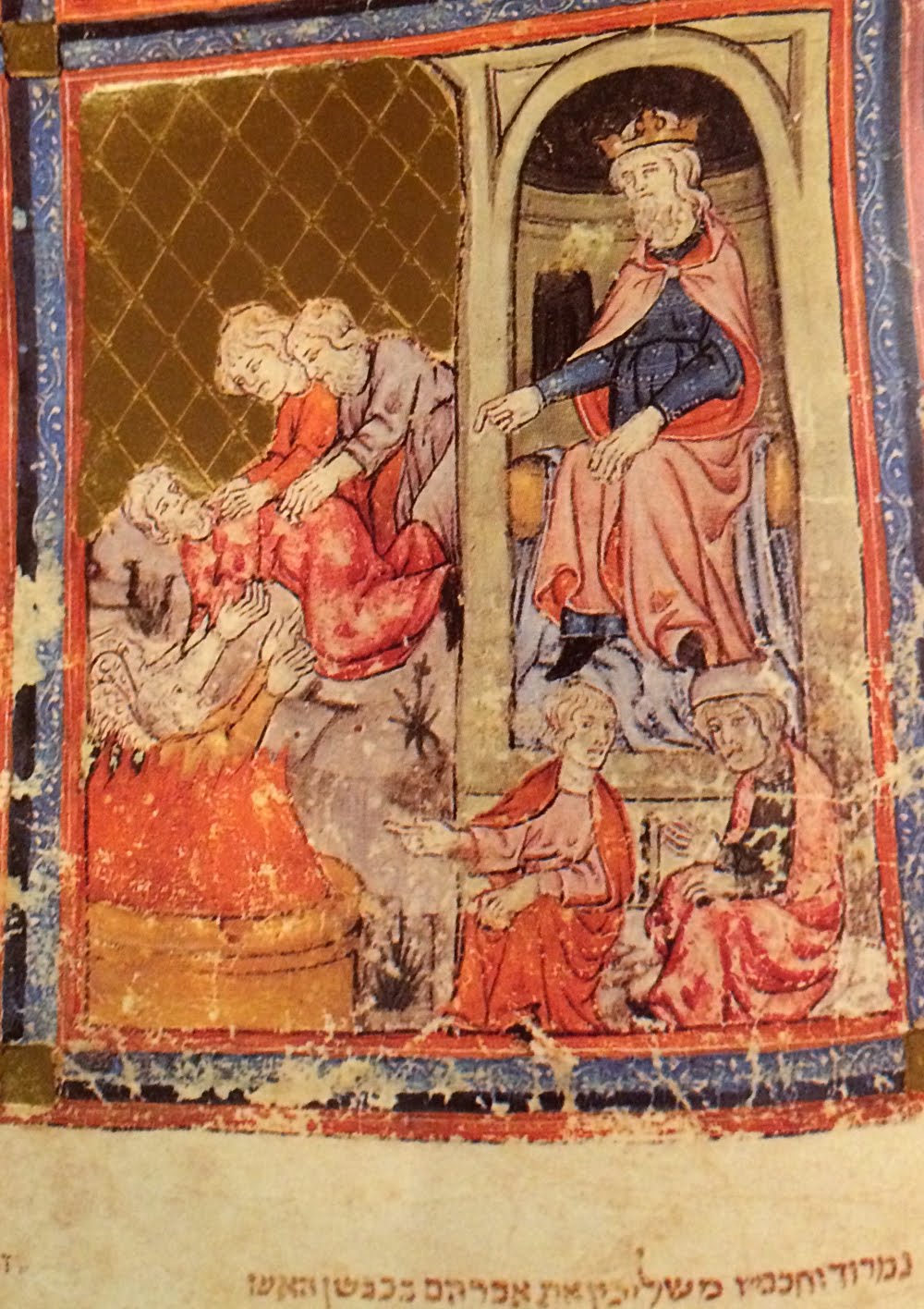
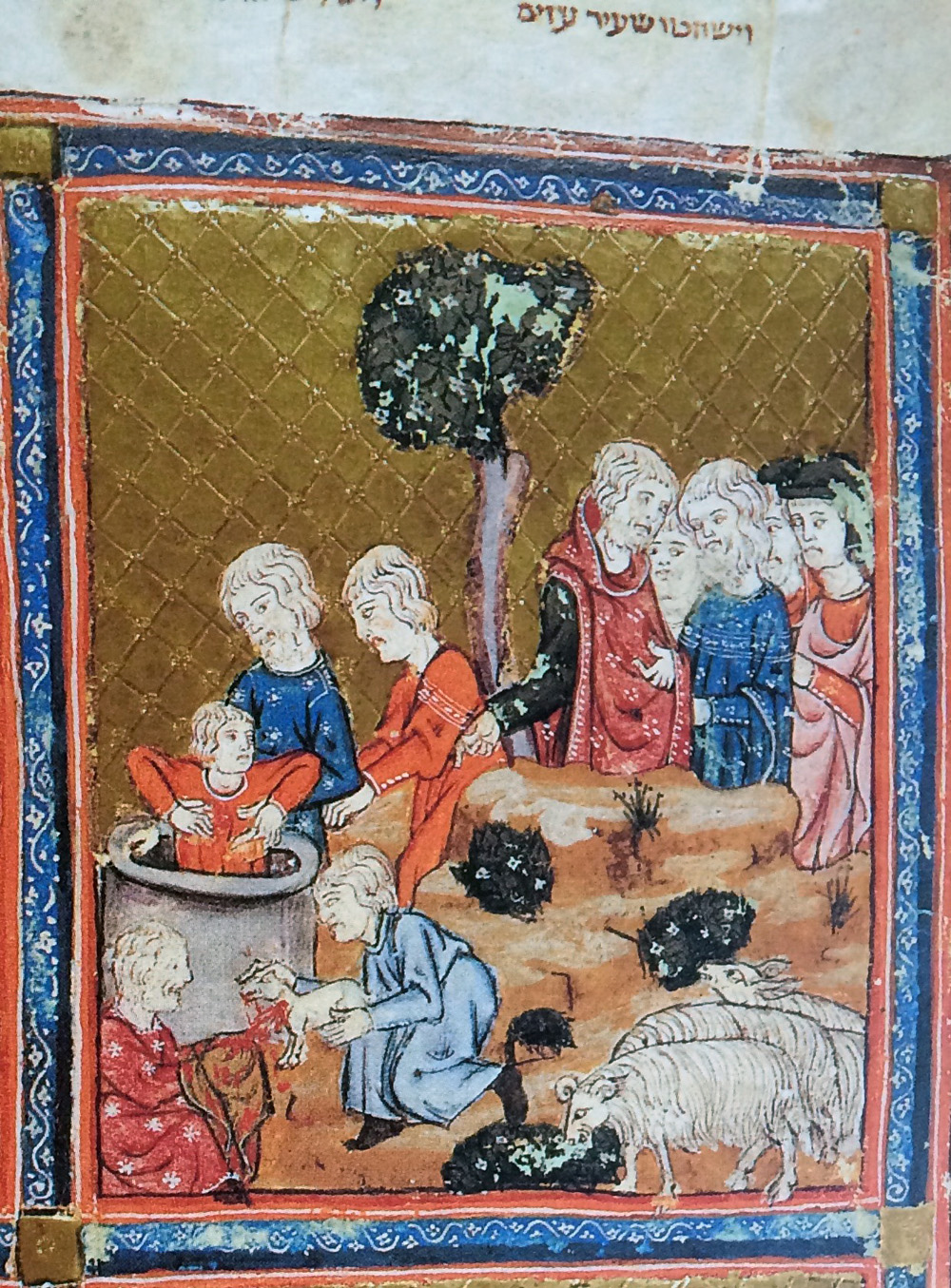
            In an early panel we have Nimrod throwing Abraham into the fire and later Pharaoh throwing the males in the Nile, both Nimrod and Pharaoh are similarly depicted, on the throne, with a pointed finger indicating their equivalence in denying god. 

            The folio showing the Joseph story has the brothers pointing in the same manner as Pharaoh and Nimrod – the illustrator showing his disdain for the mistreatment and betrayal and equating it with the others.

            But, that is not all.  Counting the panels there are 9 between Nimrod and Joseph and 9 between Joseph and Pharaoh.  Taken together, these illustrations “renders an implicit critique of the attitude of that Jewish history is nothing but an endless stream of persecution of innocent Israel by the bloodthirsty gentiles.  Yes, it is acknowledged, these gentile kinds might behave villainously in their persecution of Jews.  But groundless hatred between brother and brother is on par with such terrible deeds, and sometimes sinat hinam can precipitated treachery as destructive as persecution by inveterate enemies.”[21]

            One other striking feature of the Golden Haggadah is the inclusion of women. There are no fewer than 46 prominent depictions of women in the haggadah.  Indeed, one reading of the exodus scene has a woman with a baby at the forefront leading the Jews out of Egypt behind Moses.

            This may be a reference to the midrash that “in the merit of the righteous women the Jews were redeemed.”[22]  The difference in the exodus scene is particularly striking if one compares it to the Ashkenaz Haggadah – Moses clearly at the front, and the most prominent woman in the back.


Of course, it is completely appropriate for the inclusion of women in the haggadah as women and men are equally obligated to participate in the seder. Another example of the prominence that woman play in the Golden Haggadah iconography is the scene of Miriam singing includes the largest images in the haggadah, the women occupying the full panel.  We don’t know why the illustrator chose to highlight women – was it for a patron or at a specific request.[23] 
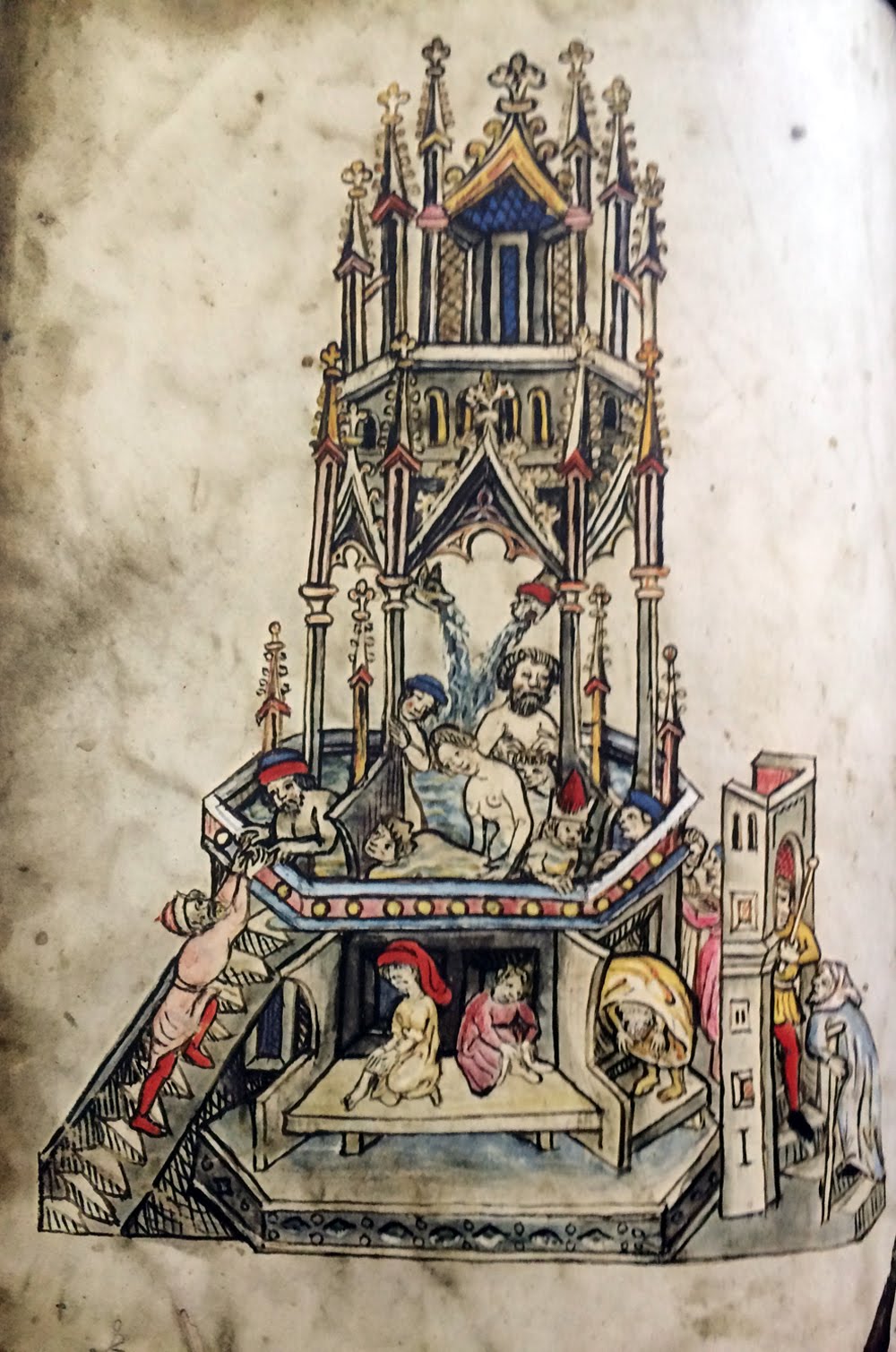
The Golden Haggadah is not the only manuscript that includes women in a prominent role in the illustrations.  The Darmstadt Haggadah includes two well-known illuminations that place woman at the center.  The illuminations adoring other Darmstadt serve a different purpose than the Golden or Birds’ Head, they are purely aesthetic.[24]  Thus, the inclusion of women may not be linked to anything in particular.  At the same time, it is important to note that in terms of reception, that is, how the reader viewed it, the focus on women was not cause for consternation. One other note regarding the haggadah, the last panel is a depiction fountain of youth.  Note that men and woman are bathing – nude – together, which seems odd to a modern viewer (and, again, apparently did not to the then contemporary reader).  And, while admittedly not exactly the same, the 14th century R. Samuel ben Baruch of Bamberg (a teacher of R. Meir of Rothenberg) permitted a non-Jewish woman to bath a man so long as it was in public to reduce the likelihood of anything untoward occurring.[25] 

Before we leave the Darmstadt Haggadah, we need to examine the panel facing the Fountain of Youth. This panel depicts a deer hunt.

 As mentioned above, this image is not connected to the text and instead is solely for aesthetic purposes.  The hunting motif is common in many medieval manuscripts, and in some a unicorn is substituted for a deer.  While the unicorn has Christological meaning, on some occasions it also appears in Hebrew manuscripts.[26]

While the use of the hunting scene in the Darmstadt Haggadah was unconnected to the haggadah, in others it was deployed for substantive purpose.[27] [As an aside, it is possible that Jews participated, possibly Rabbenu Tam, in hunting, or at least its falconry form.[28]] As is well-known, the inclusion of the hare hunt is to conjure the Talmudic mnemonic regarding the appropriate sequence over the wine, candle, and the other required blessings, or YaKeNHaZ.  “To Ashkenazic Jews, YaKeNHaZ sounded like the German Jagen-has, ‘hare hunt,’ which thereby came to be illustrated as such in the Haggadah.”[29]

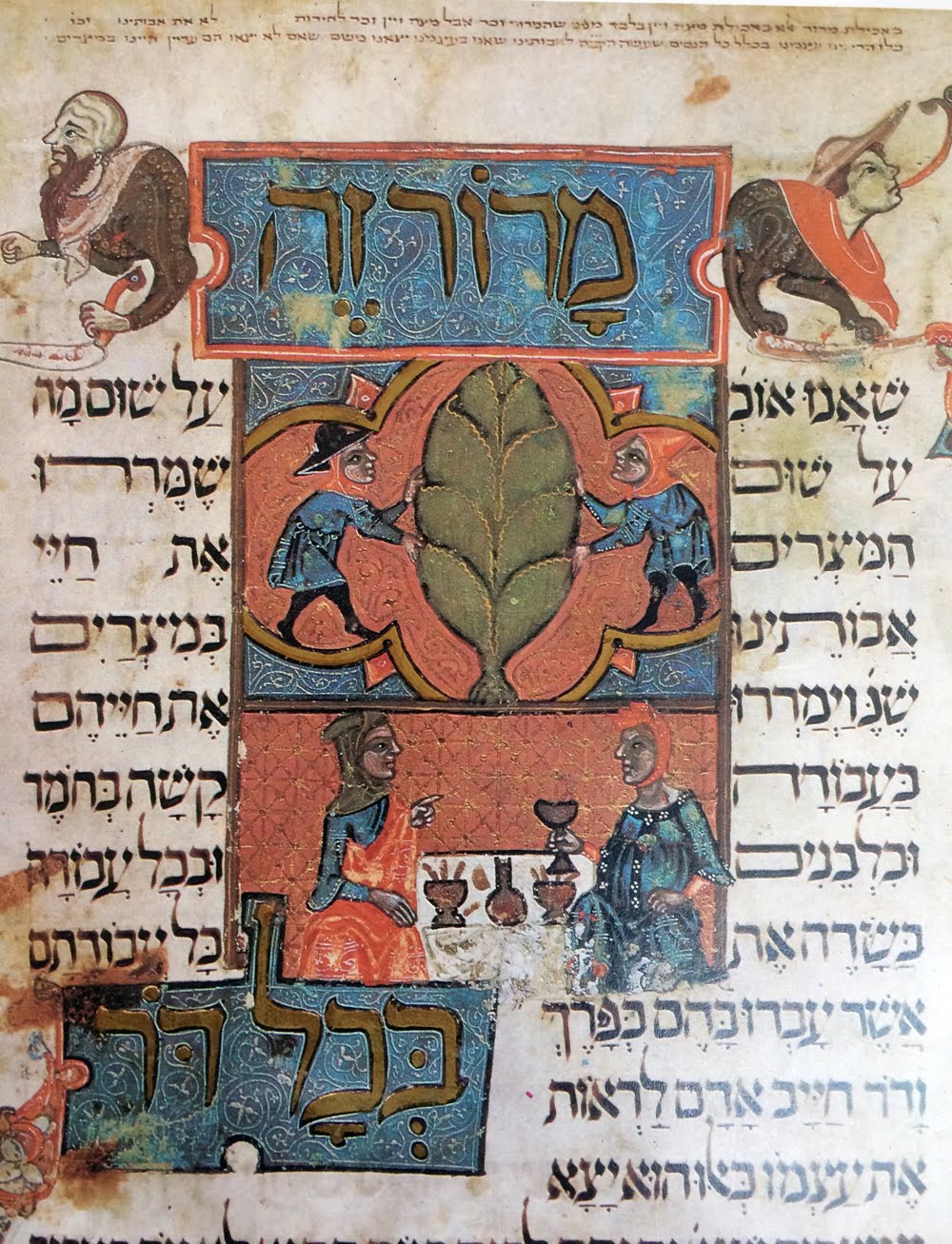
 Generally, Jews seem to have issues with botany.  We struggle to identify which of the handful of fruits and vegetables mention in the Bible and Talmud. But on Passover, the marror an undefined term, proves particularly illusory. Today, there is no consistency regarding what is used for marror with it running the gamut from iceberg lettuce to horseradish root. While we may not be able to identify it with specificity, we know what its supposed to taste like – bitter.  Manuscripts may provide some direction here.  There are two depictions in illuminated haggadot.  One of a leafy green, found in numerous examples, from a fragment from the Cairo Geniza to the Birds’ Head, and that of an artichoke.[30]  If it is a leafy green, it must be a bitter one – and that changes based upon time, place and palate.  For example, 30 years ago romaine lettuce was only the bitter lettuce widely available. But, among lettuces, it is far from bitter, and today, there are a variety of truly bitter lettuces available, arugula, mustard greens, dandelion, mesclun, etc.  Another leafy and very bitter option that is found in illuminated haggadot is the artichoke.  The artichoke is extremely bitter without proper preparation.  Indeed, from just touching the leaves and putting them in your mouth you can taste the bitterness.  The Sarajevo Haggadah and brother to the Rylands both have artichokes.

            The association of the artichoke with Passover is more obvious when one accounts for Italian culinary history.  Specifically, artichokes are associated with Jews and Passover. Carcoifi alla giudia – literally Jewish style artichokes “is among the best known dishes of Roman Jewish cuisine.” Artichokes are a spring thistle and traditionally served at Passover in Italy.  Whether or not from a culinary history this dish sprung from the use of raw artichoke for marror is not known, but we can say with certainty that artichokes have a considerable history when it comes to Passover. 

Horseradish only became popular, in all likelihood, because an early Pesach, would be too soon for any greens and thus they were left with horseradish – which is not bitter at all, instead it is spicy or more particularly hot.  In Galicia in the 19th century the use of horseradish was so ingrained that  permission was even granted and affirmed for people to use less than a kezayit  and still recite the blessing. In light of this, the custom yields the possibility that all sort of other spicy items be used for marror including very hot jalapeño peppers, for example.[31] Since we are discussing herbs, it is also worth noting that recently rulings regarding the use of marijuana and Pesach have been issued both in Israel and the United States (here), for our discussion on marijuana and Pesach please see here.

            One manuscript captures the uncertain identification of marror.  In the Tubingen Haggadah, the place where the illustration for marror is left blank, presumably to permit the owner to fill in what they are accustomed to use.

            Marror is not the only vegetable that is eaten during the seder, another difficult to identify is the karpas.  Today there are a variety of items used, and in reality, any dip-able vegetable will suffice, historically, it seems that lettuce or celery was used. The Birds Head provides that “lattich (lettuce) and eppich (celery) should be used. These are traditional salad foods, which, in the normal course of things, would be dipped or tossed with a dressing.  A dressing can be a simple as vinegar, and indeed, in many medieval haggadot, hometz or vinegar is used to dip.  We can trace the change from the more obviously salad oriented vinegar to saltwater where in the Darmstadt Haggadah, a later hand wrote on top of hometz – mei melekh.  While it appears nearly universal that hometz was used, its disfavor may be connected to a rule unrelated to Passover.  Since the Middle Ages, there is a dispute whether or not vinegar falls under the ambit of stam yenam.  Thus, the change to saltwater may be more of a reflection about views on what constitutes stam yenam and less to do with tears.

            One final food item is the haroset preparation.  Apples are familiar and linked to the midrash regarding birthing under an apple tree, in the Rothschild Machzor and the 2nd Nuremburg haggadah, cinnamon is called for because “it resembles straw.”  It also concludes that “some incorporate clay into the haroset to remind them of the mortar. For those wanting to replicate this addition, edible clay, kaolin, is now easily procured, and there is even a preparation that creates stone-like potatoes, perfect for the seder.
            To be continued… but until then see these posts Halakha & Haggadah, and regarding some illustrations in the iconic Prague 1526 Haggadah, here and also Elliot Horowitz’s discussion.

[1] E.L. Sukenik, The Dura-Europa Synagogue and its Art, Bialik Press, Jerusalem:1947. See also, Gabrielle Sed-Rajna, Jewish Art, transl. Sara Friedman & Mira Reich, Harry N. Abrams, Inc., New York: 1997, 9-13; 20-29;114-39.
[2] Two Prague Haggadahs, Valmadonna Trust Library, Italy:1978, 16 n.16 (the citation should read p. 435, not p. 345)
[3] Binyamin Richler, Hebrew Manuscripts: A Treasured Legacy, Cleveland/Jerusalem: Ofeq Institute, 1990, 20.
[4] Id. at 58.
[5] Colette Sirat, Hebrew Manuscripts of the Middle Ages, ed. & transl. Nicholas de Lange, New York: Cambridge University Press, 2002, 234.
[6] Id. 242-43.
[7] R. N. Rabinowitz, Dikdukei Soferim, Munich: E. Hovner, 1881, vol. 11, Tractate Baba Bathera, 7. 
[8] Sirat, Hebrew Manuscripts, 235-38.
[9] Richler, Hebrew Manuscripts, 45.
[10] Id. 48.
[11] Interestingly, illuminated haggadot did not end with the introduction of printing, there are a number from the 18th century and beyond.
[12] See B. Narkiss, Hebrew Illuminated Manuscripts, Jerusalem: Keter Publishing House, 1969, 106.
[13] Richler, Hebrew Manuscripts, 47.
[14] Marc Michael Epstein, The Medieval Haggadah: Art, Narrative, and Religious Imagination, New Haven & London: Yale University Press, 2011, 50-51. See the other discussions of this book, here.
[15] Id. 51.
[16] Id. 51-53, 71-72.  Much of the discussion regarding this haggadah and the Golden Haggadah is reliant upon Epstein’s thorough analysis of these manuscripts.
[17] Id. 65-68, 71-72.
[18] Id. 87-90.
[19] M. Spitzer & B. Narkiss, “General Description of the Manuscript,” in The Bird’s Head Haggada of the Bezalel National Art Museum in Jerusalem, ed. by M. Spitzer, Tarshish Books: Jerusalem, 1967, 23.
[20] Epstein, The Medieval Haggadah, 90-91.
[21] Id. 162.
[22] Id. 178.
[23] Id. 185-86.
[24] Narkiss, Hebrew Illuminated Manuscripts, 126.
[25] Elliot Horowitz, “Between Cleanliness and Godliness,” in Tov Elem: Memory, Community & Gender in Medieval & Early Modern Jewish Societies, ed. E. Baumgarten, et al., Bialik Institute, Jerusalem:2011, *38-*39.
[26] Piet van Boxel, “The Virgin & the Unicorn: A Christian Symbol in a Hebrew Prayer Manuscript,” in Crossing Borders, Hebrew Manuscripts as a Meeting-place of Cultures, ed. Piet van Boxel & Sabine Arndt, Bodleian Library, University of Oxford:2009, 57-68.
[27] The hare hunt image appears in Seder Zimerot u-Birkat ha-Mazon, Prague 1514, in the Shevuot portion.  Of course, the mnemonic applies to any holiday that potentially falls on a Saturday night.  See B. Roth, “Printed Illustrated Hebrew Haggadot,” Areshet, vol. 3 (1961), 8.  
[28] See Leor Jacobi, “Jewish Hawking in Medieval France: Falconry, Rabbenu Tam, and the Tosefists,” in Oqimta 1 (2013) 421-504, available here.
[29] Y. Yerushalmi, Haggadah & History, The Jewish Publication Society, United States:1997, plate 15.
[30] The various manuscript depictions of marror are collected in Mendel Metzger, La Haggada Enluminee, Brill, Leiden:1973, figs. 242-65.
[31]  Levi Cooper, “Bitter Herb in Hasidic Galicia,” Jewish Studies, an Internet Journal, vol. 12, 2013 (available here). 


Seforim Blog Pesach Roundup

Here’s a roundup of Pesach and Haggadah-themed posts at the Seforim Blog.
I. Racy Title Pages Update II 12.01.2005.
Discusses the title page of the Prague Haggadah of 1526. This particular Haggadah used an illustration of a nude woman in the Haggadah’s quotation of Ezekiel 16:7 (“I cause you to increase, even as the growth of the field. And you did increase and grow up, and you became beautiful: you breasts grew, and your hair has grown; yet you were naked and bare”). This is contrasted with the Venice 1603 Haggadah which not only used an almost identical illustration, but even included a note alterting the reader that this is a picture of a man!
II. Eliyahu Drinking from the Cup 3.29.2006.
Discusses various beliefs about Elijah in connection with the Seder, illuminated from Haggadah illustrations.
III. Prague 1526 Haggadah 3.30.2006.
Discusses this first fully illustrated Haggadah. Since according to rabbinic tradition Abraham was called an Ivri because he came from “the other side” of the river, he is depicted in a row boat. In the Mantua 160 Haggadah a similar idea is shown, only Abraham rides in a gondola!
IV. Separate Beds More on Illustrated Haggadot 4.04.2006.
Discusses the bedroom illustration in the Venice 1629 Haggadah. The Haggadah interprets “our pain” (Deut. 26:7) as referring to the separation of husbands and wives. This is illustrated with husband and wife sleeping in separate beds and a lit lamp.
V. Haggadah, First Hebrew Map, and Forgery 4.10.2006.
Discusses the Amsterdam 1695 Haggadah. This Haggadah innovated by using copper plates rather than woodcuts, making its illustrations – by the convert Abraham b”r Ya’akov mi-mishpahto shel Avraham avinu – exceptionally intricate and pleasing. Includes one of the earliest Hebrew maps of the land of Israel.
VI. Old Haggadot for Free 4.10.2006.
A notice that many important and old Haggadot are available online.
VII. Pesach Journals, Had Gadyah, Plagiarism & Bibliographical Errors 3.27.2007.
Discusses Yeshurun’s special Pesach issue. The author of one of the article’s method of essentially repackaging scholarly journal articles for frum Torah journals is exposed.
VIII. Haggadah and the Mingling of the Sexes 3.27.2007.
The Mantua 1560 edition of the Haggadah shows men and women working together to bake matzot. The editors even included a verse from Psalms 148:12, highlighting old and young, bachelor and virgin, seeing matzah production as a fulfillment of this verse. By contrast, in the 1609 Prague Haggadah although a similar illustration is used there is no woman working the matzah oven. The interpretation of verses appearing to sanction the mingling of young boys and girls is also discussed.
IX. Rabbi Eliezer Brodt on Haggadah shel Pesach: Reflections on the Past and Present 3.27.2007.
Discusses the interesting Haggadah of R. Yedidiah Thia Weil (Rav Korban Nesanel’s son). Among other things of note, the author mentions that he heard that Jews have one more tooth than non-Jews.
X. Pesach Drasha of the Rokeach by Eliezer Brodt, 4.02.2007.
Discusses a newly published derasha of R. Eleazer Rokeach’s Pesach , which mentions his personal Pesach customs, and of which confirms something long recorded in his name, but never known from his own words.
XI. Initial Bibliography of Important Haggadah Literature by Eliezer Brodt, 4.16.2008.
Discusses Haggadot which discuss the historical development of the Haggadah, such as R. Menachem Kasher’s Haggadah Shelemah and Prof. Y. H. Yerushalmi’s Haggadah and History, as well as many others.
XII. The Date of the Exodus: A Guide to the Orthodox Perplexed by Mitchell First, 4.03.2011.
Discusses possible ways of identifying the specific Pharaoh of the Torah and therefore the date of the enslavement and exodus from Egypt.
Chag kasher ve-sameach!


Non-Jewish Iconography in Hebrew Books

As we have discussed on numerous occasions, Hebrew books contain a fair amount of non-Jewish iconography and imagery that is of non-Jewish origin.  See, for example, here, here, here and here.  Of course, Marvin Heller's article on Mars and Minerva appearing on Hebrew title pages, Marvin Heller, "Mars and Minerva on the Hebrew Title-Page," in Papers of the Bibliographical Society of America, 98:3, Sept. 2004, reprinted in Heller's collected articles Studies in the Making of the Early Hebrew Book (which will be reviewed separately in the very near future), is the starting point for much of this discussion. There is an article in this week's Jewish Press that also discusses this issue.  The article is available here

It is, however, worth noting a few things.  First, the article discusses the hare hunt motif that is found in various Jewish books, most notably in the Prague 1526 haggadah and the Mantua 1560 haggadah.  This illustration appears in manuscripts as well, and in the Darmstadt Haggadah, it is not a hare hunt but a deer hunt.  The deer, of course, is a more well known Jewish motif and thus would obviate the issue of representing Jews as a hare.  That said, it is unlikely that the deer hunt in the Darmstadt haggadah can be used to explain the hunting motif as it is likely that the illustrations in that haggadah are of non-Jewish origin.  Indeed, Gutmann notes that the illustrations accompanying this haggadah have no connection to the text and are likely non-Jewish. 

Additionally, it is worth noting,with regard to the Prague 1526 haggadah and its illustrations, there is a book that is devoted to explaining the history and meaning of the Prague 1526 haggadah, Charles Wengrov, Haggadah and Woodcut, Shulsinger Bros., New York, 1967.  Wengrov discusses all the illustration in this, seminal, haggadah.  Additionally, he discusses the history of the various woodcuts, both in their forms in the Prague haggadah as well as the motifs they employ.  Wengrov's discussions encompass both printed and manuscript haggadahs.

Returning to non-Jewish iconography, a most radical but intriguing theory related to this topic can be found in Ruth Mellinkoff, Antisemitic Hate Signs in Hebrew Illuminated Manuscripts from Medieval Germany, Center for Jewish Art -Hebrew University, Jerusalem, 1999.  Mellinkoff offers a completly different theory for the bird's heads in the famous Bird's Head Haggadah. Mellinkoff opines that in reality these are not bird's heads but bird's beaks on human heads.  Thus, she offers that the bird's beaks are substitutions for large or beak-like noses.  She explains that in reality these illustrations are the work of a non-Jewish illustrator who was attempting to subtly use well know anti-Semitic tropes like large noses and, in some illustrations, pigs ears.  See id. pp. 11-29, 35-37.  Aside from the Bird's Head Haggadah, Mellinkoff provides other Hebrew manuscripts that apparently have similar anti-Semitic signs as well. 


Haggadah and the Mingling of the Sexes

I have previously attempted to highlight some of the intricacies and history of illustration in haggadahs. While many of the illustrations which appear in the haggadah are directly related to the text of the haggadah, some also pre-date the haggadah and seder service. That is, although searching for hametz (leaven) happens the night prior to the seder service many times an illustration of cleaning out the hametz and, in turn, searching for it, appears in many haggadahs. Another such illustration is that of the matzo making. There are five basic steps in this process, mixing the flour and water, kneading the dough, rolling out the dough, putting little holes in the dough, and then actually baking it. In the Mantau, 1560 haggadah, an illustration presenting all these steps appears. As you can see, to the far left the process begins with the mixing of the flour and water. This continues through the far right, where the matzo is being put (taken out?) of the oven. An interesting facet of this illustration is the combination of the sexes. That is, both men and women are involved in this process. If one looks closely, (you can click on any of the pages below for a larger image) at the baking stage, a man and a woman are actually jointly operating the oven.Mantua, 1560
This mixing of the sexes was actually highlighted in the next edition which used this illustrations. In the Mantau, 1568 haggadah the same illustration appears. In this edition, however, there is one addition which does not appear in the original. On top of the illustration appears a legend. It says, “צורת אנשים המסרקים ונשים עשות חלות זקנים עם נערים בחורים גם בתולות” “this is an illustration of the men making holes [in the matzo] and the women rolling the dough, the old with the young, both the bachelors and the virgins [unmarried women]” Mantua, 1568
The editors of this edition felt that the inclusion of the sexes in this mitzvah, was a fulfillment of the verse from Psalms 148:12 “the old with the young, both the bachelors and the virgins.” Thus, the combination of a man and a woman at the oven may actually be by design to further highlight this point. It is worthwhile to note that in the Venice, 1609 haggadah, although the same basic illustration appears (the clothing worn is updated) there is no longer a woman at the oven. It is unclear whether this was intentional or not. Venice, 1609
It is not a minor point that the editors of the Mantau, 1568 haggadah used this verse to explain the mixing of the sexes. The interpretation of this verse and specifically the use to justify the mixing of the sexes is the subject of some controversy. R. Yosef Steinhardt [1] (1705-1776) records that soon after he became the Rabbi of a town in Alsace it was brought to his attention that it was “customary” to have mixed dancing on the Holidays. The only restriction on the mixed dancing was a government tax was required to engage in mixed dancing. R. Steinhardt, however, refused to allow for the dancing to proceed. As the government lost some of its revenue he was called to account for his actions. In an effort to convince the official of the correctness of his decision to prohibit mixed dancing, he appealed to the Bible. R. Steinhardt noted that the official was also fluent in the Bible and thus it was appropriate to use in this instance. He cited the verse in Jeremiah 31:13 “Then shall the virgin rejoice in the dance, and the young men and the old together.” He noted that it only says the young men and old engaged in dance together but not the virgin. He went on to cite other verses as well. Although he does not cite the above verse from Psalms, one can safely assume that he would explain this verse in a similar fashion to that of the verse in Jeremiah. Namely, it doesn’t state explicitly that the men and women were together only that they both took part in the praise of god. NOTE:
[1] Shu”t Zikrhon Yosef, Fuerth, 1773, O.H. no. 17, it can also be found in Mishna Berura, Biur Halacha, no. 339. This work also contains an interesting introduction. He quotes his wife, Kreindal, who offered the well-known explanation as to why Yosef lost 10 years of his life for listening to his brothers referring to his father, Ya’akov, as Yosef’s master. For each time Yosef heard this inappropriate title used, he lost a year of his life. But, in the Torah, this title only appears five times. Kreindal explained that as Yosef, to keep the charade that he did not understand his brothers, used an interpreter, Yosef heard and understood it ten times, five times from his brothers and five from the interpreter.

Additionally, the introduction to the Shu’T Zikrhon Yosef is also well known for his scathing comments about Hassidim. According to most auction catalogs, this introduction was ripped out by Hassidim. But, in every edition that I have seen, and every time it has come up for auction it always includes the introduction leading one to question whether this is merely apocryphal.


Prague 1526 Haggadah

The first fully illustrated haggadah was the Prague 1526 haggadah. This haggadah was reprinted in 1977 by Mekor and is now available for everyone at the Jewish National University Library site here. (They have other important haggadas available for viewing including some of the earliest haggadas).

The Prague haggadah is filled with fascinating and important illustrations. As we have seen previously, the Prague haggadah contained nudes, which when appropriated later were removed. This included in the haggadah context as well as in other works.

Aside from these illustrations, there is an illustration of Abraham when God takes him “from the other side of the river.” In the Prague haggadah we have Abraham in a row boat. However, when this was appropriated in the Mantau, 1560 haggadah, the row boat was changed into a gondola.

Also, this haggadah contains brief comments or instructions as well as the text of the haggadah. There are two which bear mention. The first is the passage underneath the Tam – simple – son. Typically, the simple son is understood to be less than stellar. However, in this haggadah, the verse תמים תהיה עם ה’ אלקך (One should be simple with God) (Devarim 18:13). As this verse is claiming this simplemindedness is a good attribute, this seems to indicate that the simplemindedness of the son is something positive.

The second passage comes in the form of an instruction. In the margin at the mention of marror the bitter herb, is the following “It is a universal custom to point at one’s wife [at the mention of marror] as the verse says ‘I have found the woman worse [more bitter] than death. (Kohelet 7:26)'”