Can Orthodoxy Decide Its Own History?
Can Orthodoxy Decide Its Own History?
Rabbi Shmuel Lesher
The Making of a Godol
In his 2004 review of Rabbi Nosson Kamenetsky’s controversy-sparking Making of a Godol,[1] Professor Mordechai Breuer notes a marked change happening within haredi culture, specifically book culture:
The contents of the traditional Haredi bookshelf have expanded and transformed beyond recognition in recent generations. Alongside … the rabbinic classics … the shelves are now filled with books of types our ancestors could not have imagined.[2]
Breuer is referring to the proliferation of a new form of biography, or hagiography, of gedolim, or “Torah scholars” sometimes referred to as “Shivhei Tzaddikim” (Praises of the Righteous).
To be sure, historically, the practice of telling stories of praise and piety about gedolim is not new. Records of this literature can be found as early as the 19th century.[3] However, the recent proliferation and high demand for these works within contemporary haredi society is a fairly recent phenomenon.
It is against this backdrop that, in his review, Breuer celebrates R. Kamenetsky’s publication of Making of a Godol. He correctly notes that this book is not just another routine addition to the existing genre of hagiography. Quite the contrary, employing the rigorous research of an academic, the book makes a serious effort to depict the lives of Lithuanian yeshiva personalities as they truly were, without embellishment or distortion. In stark contrast to those who advocate for the idealized and sanitized portrayal of gedolim as saintly individuals devoid of human flaws or weakness, R. Kamenetsky authored a book whose content was subject to a single test: the test of truth.[4]
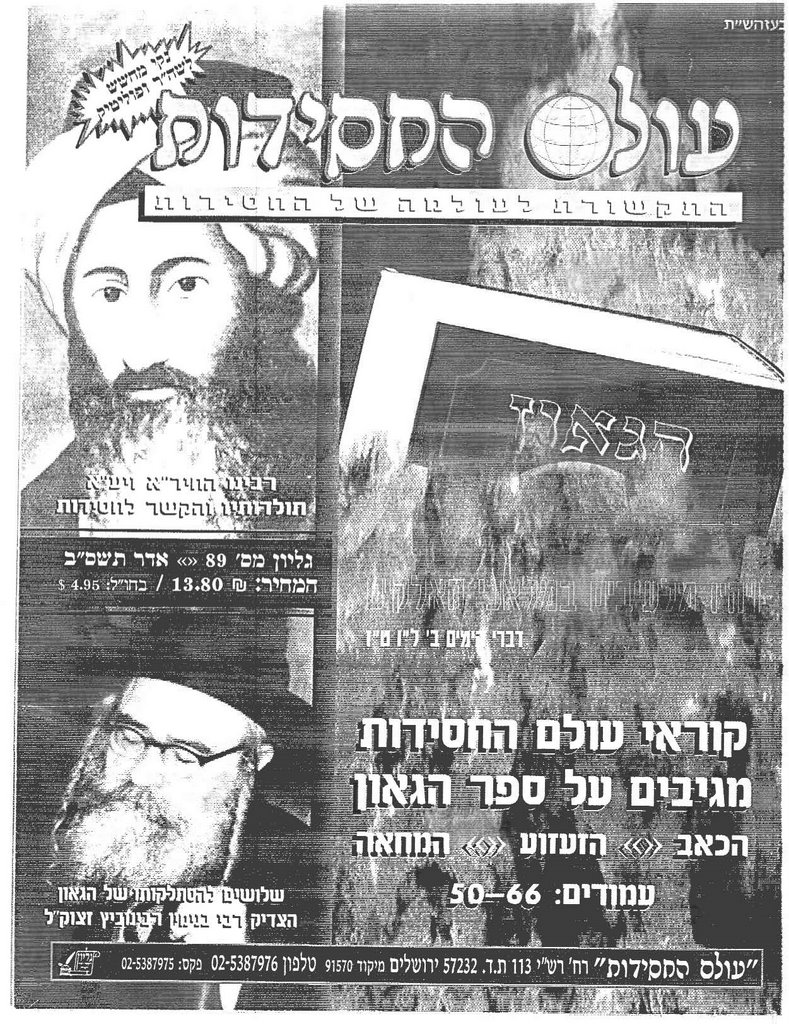
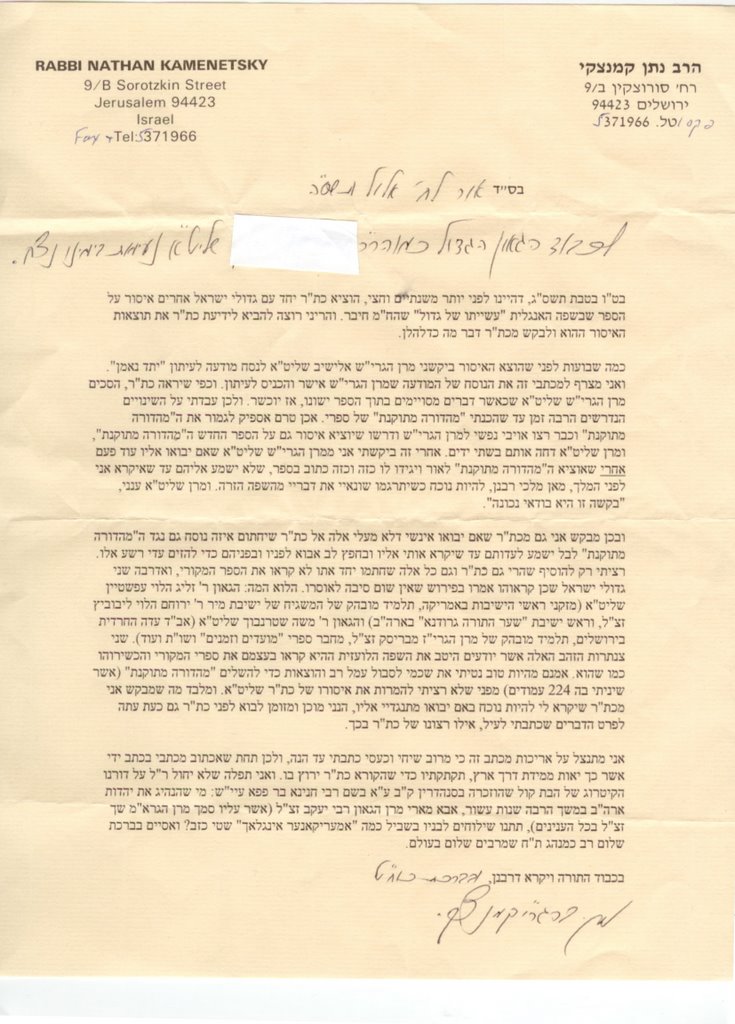
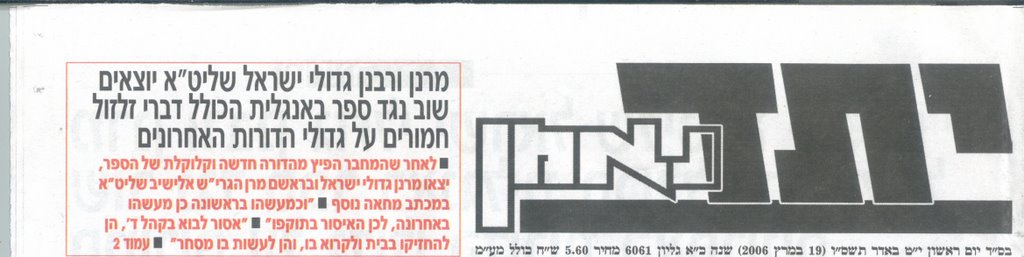
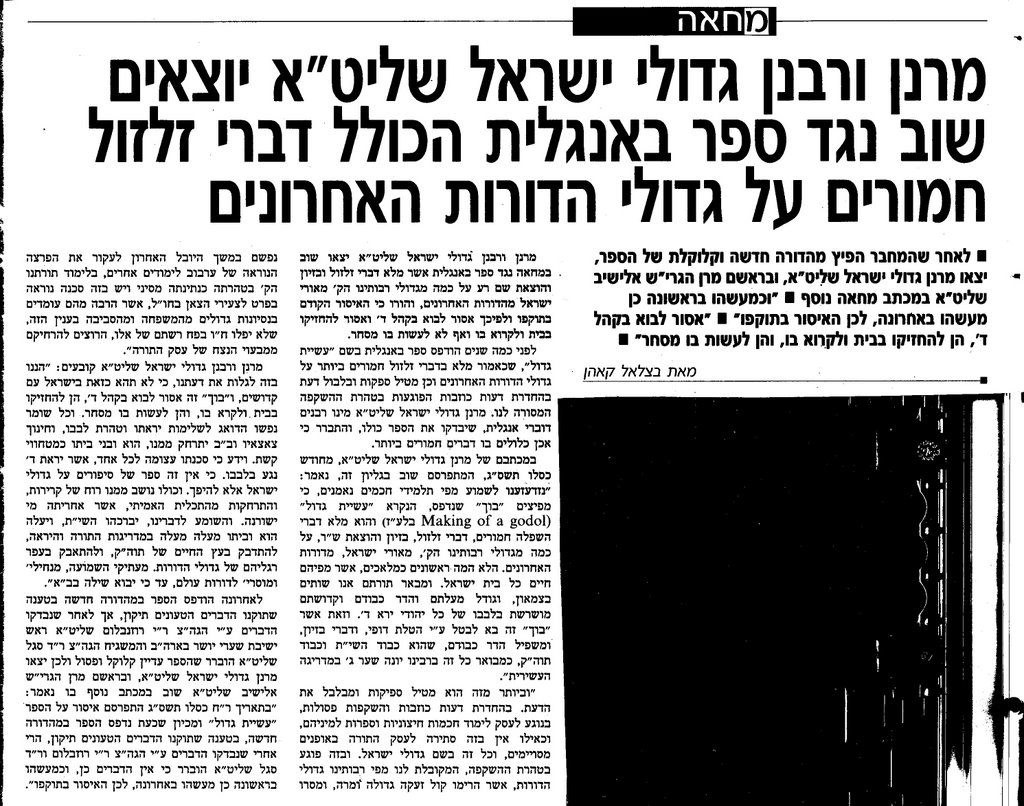
It is for this very reason that others did not celebrate the publication of Making of a Godol. In fact, shortly after the book was published in 2002, it was subject to a ban and removed from bookstores.
Breuer has his own critiques of the book. In addition to a number of serious methodological issues he raises with the book from an academic historical perspective, Breuer takes issue with a number of passages from a religious perspective, some of which may have been the reasons why it was banned within parts of the haredi community:
It is unfortunate that the author did not refrain from delving into minutiae that lack historical significance, including the personal weaknesses of Torah scholars… Yet, the author makes no effort to reconcile this phenomenon with the ideal of shemirat halashon (guarding one’s speech) …. The extensive treatment of such topics, without any attempt to analyze or integrate them into a cohesive picture of the “Making of a Godol” borders on gossip for its own sake. It would have been better to omit such material altogether.[5]
Jewish History: Lashon Harah?
Although Breuer categorizes the inclusion of some trivial and negative descriptions of gedolim in R. Kamenetsky’s book as “bordering on gossip for its own sake,” someone who levels the claim of actual lashon harah (prohibited negative speech) against any and all accurate history-keeping is Rabbi Shimon Schwab.
R. Schwab correctly notes that history must be accurate:
History must be truthful, otherwise it does not deserve its name. A book of history must report the bad with the good, the ugly with the beautiful, the difficulties and the victories, the guilt and the virtue. Since it is supposed to be truthful, it cannot spare the righteous if he fails, and it cannot skip the virtues of the villain. For such is truth, all is told the way it happened.[6]
Clearly, there is little use for inaccurate history books.
R. Schwab further notes that since the canonization of Tanakh, no works of Jewish history were composed by our Sages. It appears that when prophecy ceased, the recording of Jewish history stopped at the same time.[7]
This phenomenon was noted by historian Yosef Hayim Yerushalmi. He writes that after the canonization of the Bible, it appears that Jewish historiography abruptly stopped:
After the close of the biblical canon the Jews virtually stopped writing history…. It is as though, abruptly, the impulse to historiography had ceased.[8]
This, Yerushalmi writes, is remarkable. Biblical Jewry and subsequent generations of Jews drew deep meaning from history. Their people’s history was deeply wedded to their sacred scripture. They came together weekly to read aloud from these passages in synagogues for thousands of years. Generation of scribes would copy and transmit these texts to the next generation with the utmost care and concern for their sacred task.[9]
Moreover, the Torah itself commands the Jewish people to remember “the days of old and to contemplate the years of every generation”:
זכר ימות עולם בינו שנות דור ודור שאל אביך ויגדך זקניך ויאמרו לך
Remember world history, study the generational epochs. Ask your father and he will relate to you, your elders and they will tell you (Devarim 32:7).
Therefore, R. Schwab asks: Why did our great Torah leaders not deem it necessary to register in detail all the events of their period just as the Torah and the prophets had done before them?
R. Schwab’s answer will likely be shocking to all those who love history:
Only a prophet mandated by his Divine calling has the ability to report history as it really happened, unbiased and without prejudice….An historian has no right to take sides. He must report the stark truth and nothing but the truth…if an historian would report truthfully what he witnessed…He would violate the prohibition against spreading loshon harah which does not only apply to the living, but also to those who sleep in the dust and cannot defend themselves any more. What ethical purpose is served by preserving a realistic historic picture? Nothing but the satisfaction of curiosity. [10]
Using the imagery of Shem and Yefet who covered the nakedness of their father Noah when he became intoxicated, preserving their saintly memory of their father (Bereishit 9:23), R. Schwab argues for a more synthetic and sterilized version of Jewish history:
We should tell ourselves and our children the good memories of the good people, their unshakeable faith, their staunch defense of tradition, their life of truth, their impeccable honesty, their boundless charity and their great reverence for Torah and Torah sages. What is gained by pointing out their inadequacies and their contradictions? We want to be inspired by their example and learn from their experience. Rather than write the history of our forebears, every generation has to put a veil over the human failings of its elders and glorify all the rest which is great and beautiful. That means we have to do without a real history book….We do not need realism, we need inspiration from our forefathers in order to pass it on to posterity.
Because a historian must record the facts, and the facts remain lashon harah and therefore forbidden, R. Schwab argues that Torah-true “historians” should engage in the genre of “story-telling” rather than truthful history focusing on telling the stories that will inspire, leaving out the truth if unflattering.
Is R. Schwab correct in asserting that the reading or writing of all accurate history is in violation of the formal prohibition(s) of lashon harah and therefore renders the field of Jewish history decidedly quite “un-Jewish”? Any serious student of history must respond to this question.[11]
It appears from the literature that the standard prohibition of lashon harah only applies to the living. The Gemara in Berakhot (19a) cites Rabbi Yitzhak who states, “Anyone who speaks negatively about the deceased is as if he speaks about a stone. Some say this is because the dead do not know, and some say that they know, but they do not care [about such speech].
Simply understood, R. Yitzhak’s statement means that just as there is no formal prohibition of lashon harah for slandering inanimate objects, there is no lashon harah when speaking negatively about the dead.[12]
Although the Raavya[13] and the Mordekhai[14] quote an ancient heirem (ban) against falsely libeling the deceased which is codified in Shulhan Arukh,[15] this would not constitute formal lashon harah.[16]
Interestingly, the father of the aforementioned R. Nosson Kamenetsky, Rabbi Yaakov Kamenetsky, writes that even this ban, which reaches beyond the scope of normative lashon harah, only forbids false libel. Whereas lashon harah is forbidden when speaking about living persons even when true,[17] one is permitted, according to the elder R. Kamenetsky, to tell negative stories about people from the past as long as they are true. R. Gil Student notes that when applied to history, this principle would provide a heter (allowance) for the accurate, albeit occasionally negative, recording of facts.[18]
On the other hand, R. Binyamin Yehoshua Zilber argues, contrary to the simple reading of the Gemara cited above, the dead do, in fact, know about and are affected by what is said about them. Therefore, he rules that one may not say anything bad about the dead, false or true.[19]
The Allowance of “Toelet”
Either approach one takes to lashon harah about the dead, the allowances to permitted lashon harah would seem to apply to the dead just as it applies to the living. Regarding history, two allowances outlined by the Hafetz Haim seem particularly relevant: one permitting the “sharing of public knowledge”[20] and another based on “toelet” — having a legitimate or constructive purpose.[21] If something is already public knowledge, its inclusion in history books is permitted under the category of “sharing public knowledge.” If it is not already known, I would argue that documenting it for posterity, when it serves a constructive purpose for the historical record, should also be allowed.
Returning to Making of a Godol, R. Kamenetsky was aware of the potential for Breuer’s critique of lashon harah. In defense of his choice to include some less than savory passages in his book apparently for the sake of the historical record, R. Kamenetsky appears to utilize the “toelet argument”:
It goes without saying that R. Mordekhai Schwab [brother of R. Shimon Schwab who supported the study of accurate Jewish history] did not approve of revealing faults in any man without constructive purpose; and neither do I.[22]
R. Kamenetsky makes another argument to support disclosing even unsavory information. He claims there is some form of halakhic statute of limitations on people’s embarrassment. Things that transpired over a century ago are no longer subject to the rules of lashon harah:
I did not give much consideration to concealing then-sensitive matters for the reason that when my father talked about these long-past episodes he specifically applied the verse גם שנאתם גם קנאתם כבר אבדה (Both their [the principals’] enmity and their envy are already bygone)[23]…. In fact, my father considered the passage of only 50 years – a יובל (which the Torah labels ” לעולם [forever]”) – to have enough of a cumulative effect to erase one world and bring a new society in its stead.[24]
This rationale goes well beyond the toelet allowance or limiting lashon harah to the living. If one accepts this contention, any information that is at least 50 years old can be written even if the individual would not want this information shared.
Whatever the assumed allowance is, in recent years, it appears that many, even within the haredi community, have taken a more open approach to the study of Jewish history.
Although Making of a Godol was banned, this did not impede the public’s interest in historical scholarship. Over twenty years after the Making of a Godol ban, interest in the academic study of Jewish history has only grown. Today, there is a new wave of Jewish historians, writers, and podcast hosts who are engaged in rigorous study and writing of Jewish history. In their weekly column in Mishpacha magazine “For the Record,” Yehuda Geberer and Dovi Safier cite directly from historical documents and materials from Jewish history. Geberer hosts a popular podcast entitled “Jewish History Soundbites (here).”Nachi Weinstein of Lakewood, New Jersey, the host of the Seforim Chatter podcast (here), routinely interviews academic historians and professors well outside the typical sources found in the more insulated Yeshiva community.
Although there is still a strong presence of the typical biographical or hagiographical, any careful observer of the Jewish community can discern a largely different approach being taken to the study of Jewish history.
The Ethical Imperative of Accurate Historiography
I have shown that, although debated, there is a halakhic basis for the study of accurate and truthful Jewish history. However, is there a moral imperative to study Jewish history? It may be permitted halakhically, but is there inherent value in the recording of history?
According to Rabbi Samson Raphael Hirsch, we can derive from the Torah itself that there is an ethical value in preserving history. R. Hirsch notes that the Torah “does not hide from us the faults, errors, and weaknesses of our great men” and narrates events simply “because they took place”:
The Torah never hides from us the faults, errors, and weaknesses of our great men. Just by that it gives a stamp of veracity to what it relates . . . The Torah never presents our great men as being perfect, it deifies no man, says of none ‘here you have the ideal, in this man the divine became human’ . . . The Torah is no collection of examples of saints. It relates what occurred, not because it was exemplary, but because it did occur.[25]
In fact, recording the mistakes of our biblical heroes provides more credibility to the Torah.
R.Yehuda Leib Bloch, the Rosh Yeshiva of Telshe, Lithuania makes a similar point:
At the very moment it describes the greatness and holiness of the Patriarchs, [the Torah] does not remain silent about their shortcomings. It does not conceal their flaws, nor does it portray them as divine beings possessing every virtue without defects or shortcomings….Our Torah is a Torah of truth, a Torah of life. It teaches us that a person, by virtue of being human, cannot be divine.[26]
Aside from the lesson of our Patriarchs’ and Matriarchs’ humanity and the credibility gained by the Torah, the fact that the Torah records events simply “because they took place” is significant for R. Hirsch. The very notion that something occurred, in and of itself merits being recorded in the Torah because the Torah values the truth of history. Throughout many of his works, R. Hirsch emphasizes the importance of historical awareness and the necessity of the study of history.[27] One citation will suffice:
To obtain knowledge of Nature and History…is not only something permitted but something which is desirable to the fullest extent, for only a mind armed with such a wide panoramic view on all matters can draw the right conclusions of the Jewish position in the world, in the whole of its speciality.[28]
Censoring the “Inconvenient Truths” of History
Rabbi Dr. Jacob J. Schacter has argued in a number of important essays that there is an ethical imperative to preserving historical truth about our past and “facing the truths of history.”[29]
In support of his position, which he notes has historically been the minority one, R. Schacter draws from R. Yaakov Emden,[30] R. Hirsch,[31] and the Hazon Ish.[32] Critical of hagiographic works that censor or remove “inconvenient truths” about gedolim, R. Schacter writes:
Is overlooking part of the truth, in fact, any less of a lie than actively distorting it? Do not both result in a less than true—let us call it what it really is, i. e., false—picture of the facts or figure being presented? W. E. B. Du Bois wrote: “One is astonished in the study of history at the recurrence of the idea that evil must be forgotten, distorted, skimmed over.”[33]
R. Schacter also responds to R. Schwab’s rationalization for omitting parts of history:
It is interesting that Rabbi Schwab does not deny that “important people” and “good people” have failings and inadequacies. Rather, he suggests that they are best overlooked and forgotten. However, even this…explains only the neglect and disregard of history; it does not justify the distorting of history. While it may explain why one should not write about the past, it does not justify distorting the past when one does write about it. Inventing the past is as foolish as foretelling the future, but more scandalous.[34]
Suffice it to say, although “facing the truths of history” may be difficult, even prohibitive according to some, according to R. Schacter and those of his school, it is imperative.
The Miracle of Jewish Survival
There may be yet another reason to study Jewish history from a religious perspective. In an often-cited passage, R. Yaakov Emden writes that Jewish history very well may be the repository of the greatest miracle known to man:
Who is so blind as to not see the divine providence?… We the exiled nation, a dispersed sheep. After all the troubles and shifts for two thousand years. No nation in the world is as pursued as us….[Our enemies] have brought on us great sufferings but were never able to triumph over us…All these ancient, powerful nations have gone by, their strength has withered, their protection has eroded. But we who cling to G-d are all alive today…Can the hand of chance do all this? I swear by my soul that…these ideas are greater [miracles] in my eyes than all the great open miracles G-d has performed for our forefathers in Egypt, the Sinai Desert, and in the land of Israel. The longer the exile lasts, the more the miracle is confirmed…[35]
If, as R. Emden argues, the story of Jewish people’s survival is even more miraculous and contributes more to our faith than the Exodus, it would follow that the study of the Jewish people’s history and its survival would be a critical part of Jewish education and faith-building.
In fact, R. Emden’s theory of the significance of the Jewish story of survival and its place within history, was felt by Catholic historian Paul Johnson. In the prologue to his A History of the Jews, Johnson gives his fourth and final reason why he chose to write this book and to study the Jewish people:
The book gave me the chance to reconsider objectively…the most intractable of all human questions: what are we on earth for? Is history merely a series of events whose sum is meaningless?….No people has ever insisted more firmly than the Jews that history has a purpose and humanity a destiny. At a very early stage in their collective existence they believed they had detected a divine scheme for the human race, of which their own society was to be a pilot. They worked out their role in immense detail. They clung to it with heroic persistence in the face of savage suffering. Many of them believe it still….The Jews, therefore, stand right at the centre of the perennial attempt to give human life the dignity of a purpose.[36]
For Johnson, the Jews stand at the centre of the very question of history and of human existence itself. Believing and arguing, by their very existence, that mankind does matter, and that there is moral significance to the history of the human race.
In sum, the value of the rigorous and accurate study of Jewish history has been the subject of debate. From the standpoint of halakhah, I have argued that even negative information that can provide a greater understanding of our history is permitted to be recorded if it serves a constructive purpose for the historical record. However, more fundamentally, I believe that the proper study of Jewish history is not only a moral imperative ensuring an accurate picture of the past, it provides us with a deep sense of memory and Jewish identity.
Rabbi Jonathan Sacks notes that although Jews were the first people to write history, biblical Hebrew has no word for “history.” Instead it uses the root zakhor, meaning “memory.”[37] History and memory are not the same thing. History is about facts, memory is about identity. History is about something that happened to someone else. It is “his story.” Memory is my story, the past that made me who I am, of whose legacy I am the guardian for the sake of generations yet to come. While, as I have argued, the study of history is crucial, without memory, there is no identity, and without identity, we are “mere dust on the surface of infinity.”[38]
[1] R. Nosson Kameneksty, Making of a Godol: A Study of Episodes in the Lives of Great Torah Personalities (Mesorah, 2002).
[2] Mordechai Breuer, “Gidulo Shel Gadol (Making of a Godol)” Hamayan 44:2 Teves 5764, pp. 81-82. For more reviews of Making of a Godol see Zev Lev, “Al Gidulo shel Gadol,” Hamayan 50:1 (Tishrei 5770) , pp. 100-104; “Teguvah le-divrei Prof. Lev z”l al ha-sefer “Gidulo shel Gadol” Hamayan 50:7 (Tishrei 5770), pp. 77-104.
[3] See Immanuel Etkes, “On Shaping the Image of ‘the Gedolim’ in Ultra-Orthodox Lithuanian Hagiographic Literature,” in Benjamin Brown and Nissim Leon, eds., The Gedolim: Leaders Who Shaped the Israeli Haredi Jewry (Magnes, 2017), p. 26 (Hebrew). I was introduced to this and several other sources referenced in this article through R. Dovid Bashevkin. See his “Is Jewish History Lashon Harah,” Reading Jewish History in the Parsha (April 10, 2024) (available here).
[4] Breuer, “Gidulo Shel Gadol,” p. 81.
[5] Breuer, “Gidulo Shel Gadol,” pp. 83-84. For more on Making of a Godol and the ban on it see R. Nosson Kameneksty, “Anatomy of a Ban: the Story of the Ban on the Book Making of a Godol; R. Nosson Kamenetsky, “Making of a Ban: A Look At the Banning of Making of A Godol,” YUTorah.org (March 12, 2005) (available here); Marc B. Shapiro, “Of Books and Bans,” The Edah Journal 3:2 (2003) (available here) and his “On Re-Reading a Banned Book: Nathan Kamenetsky’s Making of a Godol,” Jewish Review of Books (Spring 2022); Dovid Lichtenstein, “Supermen or Super Men: Acknowledging the Faults and Mistakes of Gedolim,” Headlines 3: Halachic Debates of Current Events (Mekor, 2021), pp. 385-413 and his Halacha Headlines podcast on the topic.
[6] R. Shimon Schwab, Selected Writings, (1988), p. 233.
[7] Ibid.
[8] Yosef Hayim Yerushalmi, Zakhor: Jewish History and Jewish Memory (Seattle and London, 1982), 15-16.
[9] Yerushalmi’s thesis has been the subject of much debate in academic circles. See perhaps most notably, Robert Bonfil, “How Golden was the ‘Golden Age’ of Jewish Historiography?” History and Theory, Vol. 27, No. 4, Beiheft 27: Essays in Jewish Historiography (Dec., 1988), pp. 78-102. Also see Amos Funkenstein’s Perceptions of Jewish History (University of California Press, Berkeley, 1993); David N. Myers and Amos Funkenstein, “Remembering “Zakhor”: A Super-Commentary [with Response], History and Memory, Vol. 4, No. 2 (Fall – Winter, 1992), pp. 129-148; David Berger, “Identity, Ideology and Faith: Some Personal Reflections on the Social, Cultural and Spiritual Value of the Academic Study of Judaism,” in Howard Kreisel (ed.), Study and Knowledge in Jewish Thought (Ben-Gurion University, 2006), pp. 15-16. Thanks to Dr. Marc Herman and Dr. Tamar Ron Marvin for these sources.
[10] R. Schwab, p. 234.
[11] For a discussion of the position of the Rambam on this question see R. Zev Eleff, “The Intersection of Halakhah and History,” Beit Yitzhak, Vol. 42 (5770), p. 425n4.
[12] It should be noted that R. Yosef Shalom Elyashiv is cited as reading this Gemara differently and thereby prohibits lashon harah spoken of the dead the same as the living. See R. Benzion Kook (ed.), Shiurei Maran HaGrish Elyashiv, Berakhot 19a, with nn. 53-54.
[13] Yoma, no. 531.
[14] Yoma, no. 724.
[15] Orah Hayim 606:4.
[16] Mishnah Berurah 606:16.
[17] Emet Liyaakov al Hatorah, Vayeishev, p. 194.
[18] R. Gil Student, “Toward a Halakhic Philosophy of History,” Torah Musings (March 15, 2011).
[19] Shu”t Az Nidberu 14:68. For more see R. Daniel Feldman, False Facts and True Rumors: Lashon Hara in Contemporary Society, (2015), pp. 228-230 and R. Eleff, pp. 422-431.
[20] Hafetz Hayim 1:2:2.
[21] Ibid. 1:10:2.
[22] R. Nathan Kamenetsky, Making of a Godol, Vol. 1 (Improved Edition, 2004), p. xxv.
[23] Kohelet 9:6.
[24] R. Kamenetsky, Making of a Godol, pp. xxiii-xxiv.
[25] R. Samson Raphael Hirsch, The Pentateuch, Genesis 12:10-13.
[26] R. Yosef Yehuda Leib Bloch, Shiurei Daat, Vayikra Bishem Hashem, p. 157.
[27] See R. Hirsch, “On Hebrew Instruction As Part of General Education,” Judaism Eternal, Vol. 1 (Soncino, 1956), p. 199; The Nineteen Letters, Letter Eighteen (Feldheim, 1995), p. 273; Pentateuch, Devarim 4:32, 6:4, and 16:1. I am indebted to Professor Yehuda (Leo) Levi for many of these citations. See his “Rabbi Samson Raphael Hirsch: Myth and Fact,” Tradition (Spring 1997), 31.3, p. 7 and 18.
[28] Pentateuch, Devarim 4:32.
[29] See his “Haskalah, Secular Studies and the Close of the Yeshiva in Volozhin in 1892,” The Torah u-Madda Journal, vol. 2 (1990), pp. 76-133 (available here) and “Facing the Truths of History,” The Torah u-Madda Journal, vol. 8 (1998-1999), pp. 200-276 (available here).
[30] “Facing the Truths of History,” pp. 203-204.
[31] R. Jacob J. Schacter, “On the Morality of the Patriarchs: Must Biblical Heroes be Perfect?” in Zvi Grumet, ed., Jewish Education in Transition (2007), p. 5.
[32] Koveitz Iggerot Meiet Hahazon Ish, Vol. 2, no. 133.
[33] “Facing the Truths of History,” pp. 230-231.
[34] “Haskalah, Secular Studies,” pp. 111-112.
[35] Siddur Yavetz, Vol. 1, Introduction.
[36] Paul Johnson, A History of the Jews (1988), p. 2.
[37] R. Jonathan Sacks, “A Nation of Storytellers,” (Ki Tavo), Lessons in Leadership (2015), p. 278.
[38] R. Sacks, Morality (2020), p. 15.