Some Harder to Get Seforim and Where to Obtain

In previous posts at the Seforim blog, we have attempted to highlight some of the more recently printed books, which are fairly easy to come by. However, I thought it worthwhile to mention some slightly older books, which are generally more difficult to obtain and where they can be obtained. I will highlight the contents of one store — Moznaim (718-438-7680) — in Boro Park.
First, for literature of the Geonim, they have the Teshuvot HaGeonim. In this set, the majority of volumes are fairly easy to get, but there are two volumes which are less common – Ginzei Schechter and Louis Ginzburg’s Geonica. Both of these are available from Moznaim.
Second, the four volume Auerbach’s edition of R. Avraham b. Azriel’s Arugat HaBosem, which is a key work on piyut/siddur, is available there as well.
Third, Mordecai Wilensky’s Hasidim u-Mitnagdim collects the various early polemics for and against the Hassidic movement, is available in two-volume paperback.
Aside from the Geonim, Moznaim also has an extensive selection of Midrashim – most of the time the most important critical edition of a particular Midrash.
Finally, although not out-of-print or the like, Moznaim also has redone the Mishnayot for Seder Zeraim and Teharot. These include the standard commentaries (e.g. Ra”SH and Rambam) and some other less common ones all with a nice layout. Additionally, they have made corrections based upon manuscript data and the older version of the text is available in footnote form.
These are a sampling of a few which I came across, I am sure there are many more hidden gems to unearth.
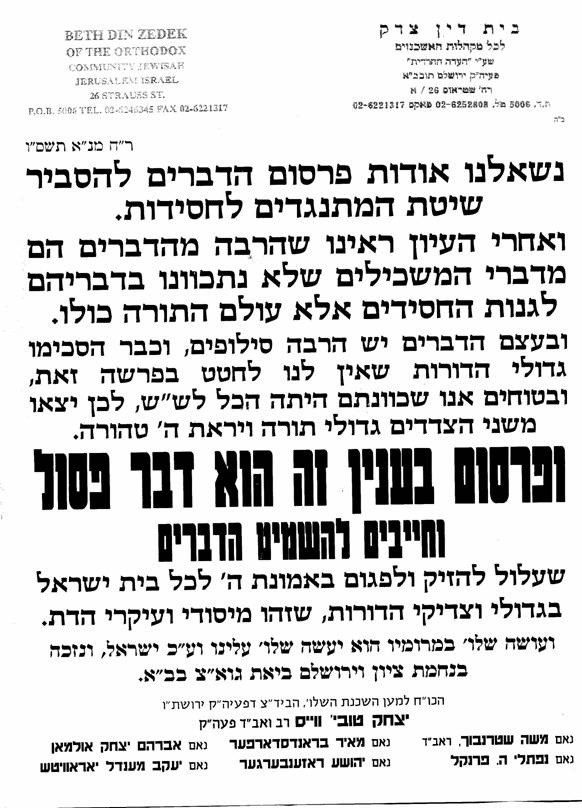


Bedatz Bans HaGaon

As discussed previously, there are some, mainly Hassidim, who had strong objections to R. Eliach’s biography HaGaon. Now it appears that Bedatz of Jerusalem has also issued a ban on the work (thanks to all those who sent this to me). The ban is reproduced on the side. The ban itself contains some interesting language. Specifically, the ban claims that the sources relied upon by Eliach were “maskilik.” You will recall that all Eliach did was reproduce many of the herems and the like from the non-Hassidim at the time. Now, it is correct that most of those polemics were collected by Wilensky in his Hassidim u’Mitnagdim, but the actual texts are those of some of the greatest Rabbis (not maskilim) of that time period.
Additionally, far from advancing haskalah (enlightenment) R. Eliach repudiates it. Many academics claim that the Gra was the precursor to modernity as the Gra advocates for studying secular subjects (among other things). Eliach, however, devotes an entire chapter demonstrating the Gra was against the haskalah. Eliach also includes additional material on this topic in other places as well. In doing so, he demonstrates that far from accepting maskilik or hasklah literature he actually accepts as true many anti-maskilik assertions. One example is particuarly telling. R. Eliach accepts that the Noda B’Yehuda banned R. Naftali Hertz Wessely. The source for this is an article which appeared in the Journal Kovetz Bet Ahron v’Yisrael by R. Y.A. Heschel. R. Heschel’s article is full of errors and wild assumptions. Most notably, R. Heschel assumes that the ban in question is from the Noda B’Yehuda solely because it was found in a stack of papers also from the Noda B’Yehuda. There is no other cooberating evidence. Instead, this is an unsigned letter that contains no other internal or external indica of reliablity. R. Eliach, however, in his attempt to prove the vehemence as well as the universiality of condemnation of the haskalah accepts this as true. Thus, it is somewhat difficult to understand how R. Eliach could be accused of accepting and advancing maskilik ideas and positions.

Finally, it is rather unclear why in August of 2006 the Bedatz is banning a book published in 2002. It was not as if this book was “under the radar.” Instead, immediatly with its publication there were other bans, articles and condemnations of the book. Further, R. Eliach secured the approbation of R. Chaim Kanievsky and was featured in Dei’ah veDibur the Haredi newspaper. While this wouldn’t be the first controversy between Beni Brak and Jerusalem, (famously the controversy over using the Ben Asher Nach was essentially between the two communities) it is a bit strange in its timing.