Hakirah, Metzitzah, and More


Hakirah, Metzitzah
, and More
Marc B. Shapiro

Hakirah has performed a valuable service in dealing forthrightly with the matter of homosexuality. Issue no. 13 (2012) contains R. Chaim Rapoport’s “Judaism and Homosexuality: An Alternative Rabbinic View,” which I think is an outstanding presentation of the alternative to what has seemingly become the “official” haredi position in this matter. This “official” position is, in my opinion, so misguided that I would like to say a few words on the topic, since R. Rapoport did not go far enough in his criticism.
To remind readers, Hakirah no. 12 had a discussion on homosexuality with R. Shmuel Kamenetsky. This was followed by the publication of a document signed by many rabbis which follows R. Kamenetsky’s approach. It is available here. (The document is also signed by an assortment of mental health professionals,  rebbitzens and “community organizers”.)
There are so many problems with the approach found in this document (called a “Torah Declaration”), some already noted by R. Rapoport in his response to R. Kamenetsky, that it would take a lengthy piece to go through them all. Let me just call attention to a few points that I don’t think have been made yet. To begin with, while many rabbis have signed this document, including a number that I know personally, I have yet to speak to someone who actually believes what the document says, and this includes the people who have signed it! Many will regard what I have just said as pretty shocking, in that I have declared that people who signed the document do not believe what it says. Yet I know this to be true, at least with regard to some of the signatories (those that I know personally), and I suspect that other than R. Kamenetsky, it might be that no one who signed the document really believes what it says (and it wouldn’t be the first time that people sign declarations that they really don’t believe in).
Let me explain what I mean. According to the document,
Same-Sex Attractions Can Be Modified And Healed. From a Torah perspective, the question whether homosexual inclinations and behaviors are changeable is extremely relevant. . . . We emphatically reject the notion that a homosexually inclined person cannot overcome his or her inclination and desire. . . . The only viable course of action that is consistent with the Torah is therapy and teshuvah. The therapy consists of reinforcing the natural gender-identity of the individual by helping him or her understand and repair the emotional wounds that led to its disorientation and weakening, thus enabling the resumption and completion of the individual’s emotional development.
The ideas just quoted are the very foundation of the Torah Declaration, and as we see in his Hakirah interview, R. Kamenetsky has been convinced by the dubious proposition that homosexuals can change their sexual orientation. He goes so far as to say that “no one is born gay with an inability to change” (p. 34 [emphasis added]. Not long after the appearance of the interview and the Torah Declaration, the man most prominently identified with the notion that gays can change publicly rejected his earlier viewpoint.)
Whether people can change their sexual orientation is a scientific or psychological issue, no more and no less. The first objectionable point of R. Kamenetsky’s approach is turning this into a matter of theology. Indeed, R. Kamenetsky has created a new dogma in Orthodoxy. According to him, believing that a homosexual can change his orientation is a basic Torah value. The reason for this is stated in the document: “The Torah does not forbid something which is impossible to avoid. Abandoning people to lifelong loneliness and despair by denying all hope of overcoming and healing their same-sex attraction is heartlessly cruel. Such an attitude also violates the biblical prohibition in Vayikra (Leviticus) 19:14 “and you shall not place a stumbling block before the blind.”[1]
There you have it. Human beings are deciding what God can and cannot do and declaring that it is impossible for someone to be created with an inalterable homosexual nature. That this is completely incorrect is acknowledged by none other than the most extreme advocates of reparative therapy. They themselves acknowledge that there is a significant percentage of people who cannot change their orientation. They have never claimed that everyone can change. What the document gives us, therefore, is a theological statement that is rejected by all scientists and psychologists, including the ones who provide the very basis for reparative therapy. That itself should be reason enough to reject it. (On Nov. 29, 2012 the RCA acknowledged “the lack of scientifically rigorous studies that support the effectiveness of therapies to change sexual orientation.” See here.)
This relates to my point above that no one really believes what they signed. To those who doubt what I say, do the following experiment and report back if your results differ. Ask someone who signed the document if he really believes that every homosexual can change his sexual orientation. The answer you will get will be “Of course not everyone. You can never speak about everyone. But many (or most) can change.” In other words, the signatories will acknowledge that they diverge from the document on a basic point. You will have to ask them why they signed a document if they don’t accept everything it says, and the response will probably be that there is much about the document that they do accept, and that is why they signed it. But I repeat my point that this is an unusual document in that I don’t think that there is any signatory, with the possible exception of R. Kamenetsky, who accepts the Torah Declaration on Homosexuality in its entirety.

Furthermore, it is not a “liberal” idea to say that people can’t change their sexual inclinations. By looking at another example we can see that it is indeed nonsense to say that everyone can change their sexual orientation and recreate themselves as typical heterosexuals. There are some men who have strong urges for pedophilia. No matter what they do, and how much therapy they get, they can’t get rid of these urges. (I am obviously not comparing homosexuals with pedophiles, or implying that there is any connection between the two. I am only using the example of pedophiles to make a point.[2]
) If we adopt the theology of the Torah Declaration, it means that even hardened pedophiles, who have abused lots of children, can change, because God wouldn’t create someone without a possibility for a healthy sex life. Yet we know that this isn’t the case, and some people simply can’t change. They might be able to control their urges, but as they have told us again and again, the urges don’t go away. It is hardwired into them. (Is it perhaps the false theological notion expressed in the Torah Declaration that explains why yeshivot continued to allow known pedophiles to work? That is, did the rabbis assume that just because someone sexually abused children last week, there is no reason to think he can’t repent and cease to be a danger this week?)
And what about the people who are created with uncontrollable urges to kill? We know about these people, as they usually become murderers. And what about the people who are created with diseases that kill them before they are able to marry and have children, or the ones created without arms so they can’t wear arm tefillin[3]? In other words, sometimes people are created a certain way and they are not what we regard as normal. That is the world, and we simply can’t understand why things are the way they are. But one thing I would hope that we can agree on is if people can keep their faith in a good God even while knowing that some children are born with terrible illnesses that will cause their death, it certainly should not shake their faith to believe that some people are born with inalterable homosexual urges. A homosexual who can’t be changed hardly presents a challenge to theodicy the way a child with cancer does, so I can only wonder why the Torah Declaration feels that only the former is theologically untenable.
All traditional sources cited in support of the Torah Declaration’s assumption that people can change their orientation only refer to behavior. That is, it is an accepted belief that all people have the ability to control their behavior. Without this belief, the notion of a mitzvah doesn’t make sense. This distinction between orientation and behavior is so obvious that I don’t know how so many learned rabbis overlooked the document’s collapsing the two categories.
The more problematic element of the document, which I have already mentioned and which verges on the blasphemous, is that the Torah Declaration presumes to tell God what he can and cannot do. Based on the human intellects of the authors of the document, they establish as dogma that God would never create someone whose only sexual attraction is to his own gender. This is all very nice, but since when can humans dictate to God what he can and cannot do? If God “wants” to create a person who only has same-sex attraction, He can, and the proper response is silence, since we can’t understand why God would do that. Humans don’t have all the answers, and the Torah Declaration should stop pretending that we do. Whether homosexuality is nature or nurture is something the scientists and psychologists can discuss, but contrary to the document, all of the evidence is that there are plenty of people who cannot be “fixed.”
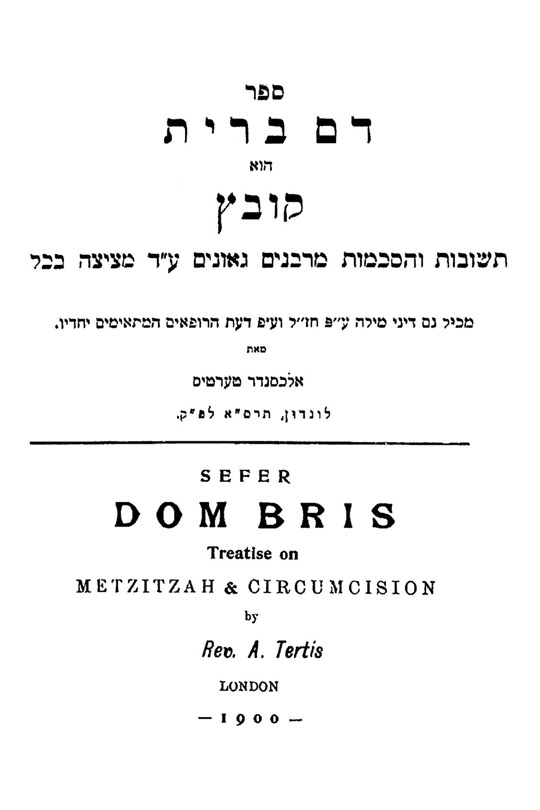
2. In my last post I mentioned that Agudat Israel has transformed itself into a lobbying organization. One of the areas they have been involved with is metzitzah ba-peh, so let me say a few things about this. It is really incredible how for many the debate around metzitzah ba-peh has become one in which the Modern Orthodox are one side, and the traditionalists on the other. I say this because the truth is that the virtually all of the rabbinic greats of Lithuania approved of metzitzah without oral contact. Alexander Tertis’ Dam Berit is a valuable resource that all interested in this matter must consult. Here is the title page.
On p. 33, R. Shlomo Cohen, the famed dayan of Vilna, says the following about metzitzah, which is very relevant to what we ourselves have seen (namely, the rejection of the firm opinions of countless doctors and scientists on the matter, all in the name of tradition).
דבר הזה אינו שייך לרבנים רק לרופאים המומחים ולכן אין לי מה להשיב על שאלתו
According to R. Shlomo, the question of how to perform metzitzah is entirely a medical issue, and the rabbis therefore have nothing to say on this matter, much like in all other halakhot dealing with medical issues the opinions of the doctors are determinative. (It hardly needs to be said that in matters of pikuah nefesh the opinions of thousands of experts, including the world’s most outstanding authorities, cannot be overruled by one idiosyncratic figure who appears to be motivated by non-scientific concerns.) 
Also of interest is that in 1906 R. Hayyim Ozer Grodzinski reported that in Vilna virtually all of the mohalim did metzitzah with a sponge. He wasn’t happy with this, but this was the reality.[4]
An interesting tidbit regarding metzitzah ba-peh is found in the Taz, Orah Hayyim 584:2. Here he mentions that he heard that R. Feivish of Cracow, when he circumcised on Rosh ha-Shanah, would not clean the blood out of his mouth. Rather, he would blow the shofar with the blood in his mouth so that the mitzvot of milah and shofar were joined.
Finally, for those who want to understand why it was only in the nineteenth century that metzitzah came to be regarded as central to the mitzvah of milah, Jacob Katz’s article “Polmos ha-Metzitzah” in his Ha-Halakhah ba-Metzar is crucial. In short, the centrality of metzitzah, and its description as a basic part of milah, is a product of the Orthodox defense of metzitzah in the face of Reform attacks. I think we are seeing something similar today. The digging in of haredi heels in defense of metzitzah ba-peh, complete with over-the-top rhetoric, is understandable (to a certain extent) and due precisely to the fact that it is an outside force that is threatening the practice. Had their own poskim suggested what the government is now insisting on, we would not have seen the same reaction. Yet it is still difficult for outsiders to grasp why some rabbinic leaders of these communities seem entirely oblivious to any medical dangers associated with the practice,  וסלחת לעונם כי רבנים המה
Let me say a few more things about metzitzah ba-peh. 

1. I saw on one of the blogs (I can’t locate it at present) that someone stated as self-evident that metzitzah ba-peh is only done with babies, not adults. The truth is that while the accepted opinion is indeed that metzitzah ba-peh is only done on babies (and maybe also on older child converts – I haven’t been able to find an answer to that), there are indeed opinions that even adult converts have to have metzitzah ba-peh performed on them. R. Moshe Klein (the son of R. Menasheh), Mishnat ha-Ger, p. 71, states without qualification that a convert has to have metzitzah, and if the mohel is afraid of catching a disease he should inquire of a posek if it can be done without the mouth. However, R. Yitzhak Yosef, Yalkut Yosef, Hilkhot Milah 6:1, rejects this viewpoint and states that there is no metzitzah, ba-peh or otherwise, with an adult convert.

2. According to R. Marcus Horovitz, Mateh Levi, vol. 2, Yoreh Deah no. 60, R. Samson Raphael Hirsch was prepared to accept the government’s abolishment of metzitzah without objection. It is difficult to square this assertion with Hirsch’s writings on the topic that show him as a strong defender of the practice.[5] Is it possible that Horovitz’s comment, meant as a criticism of Hirsch, reflects the difficult relationship these two men had?
3. In Iggerot Moshe, Yoreh Deah I, no. 223, R. Moshe Feinstein, in writing to a hasidic rebbe, expresses the standard viewpoint that metzitzah is only a medical procedure and has nothing to do with the mitzvah of milah. There is nothing surprising here. However, his correspondent had written otherwise, that metzitzah was an essential part of the mitzvah. In response to this, R. Moshe writes: חושב אני שהוא רק פליטת הקולמוס. The language R. Moshe uses implies that he did not know that among the hasidim metzitzah isindeed viewed as part of the mitzvah. Is it possible that R. Moshe was unaware of this? I don’t think so. It would appear, therefore, that the words I just quoted are a polite way of R. Moshe telling his correspondent that “what you wrote is without any substance.”
4. In 1994 R. Schachter’s Nefesh ha-Rav appeared. On p. 243 he states that R. Soloveitchik thought that today there is no need for metzitzah at all, not just metzitzah ba-peh. I remember how shocked I was when I read this, and was certain that it had to be wrong. As far as I know, no Orthodox authority has ever agreed to abandon metzitzah entirely, and I therefore couldn’t believe this report. My doubts were strengthened by the fact that R. Schachter quotes the Tiferet Yisrael as agreeing that metzitzah could be abandoned, when the truth is that the Tiferet YisraelShabbat 19:2, says the exact opposite, that metzitzah must be continued no matter what the doctors say.
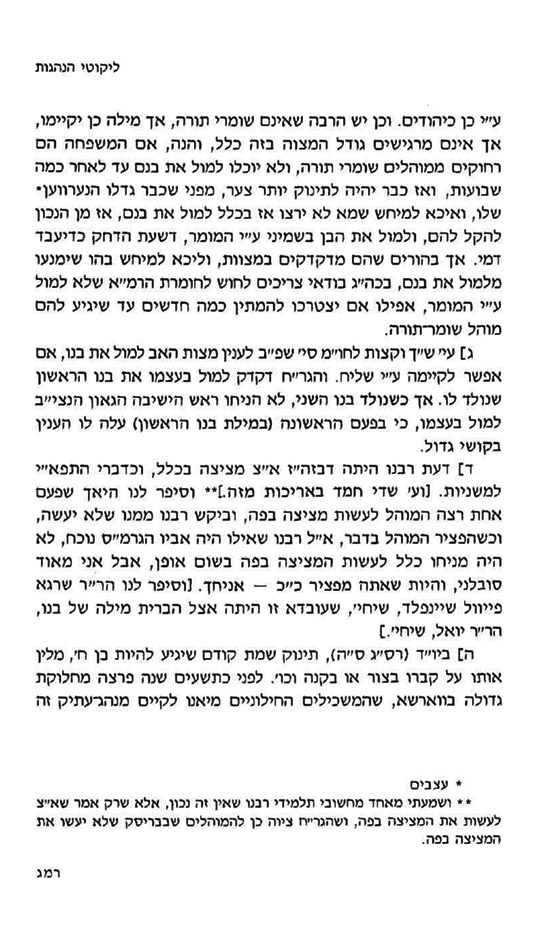
As part of this post I wanted to include this page of Nefesh ha-Rav, so I went to Otzar ha-Hokhmah to download a PDF. Here it is.

Lo and behold, the copy on Otzar ha-Hokhmah is the third edition published in 1999, and there is a note on this page in which R. Schachter states that he has been told that what he wrote was incorrect, and that R. Soloveitchik only opposed metzitzah ba-peh. This makes much more sense and is what I assumed all along, so I was happy to see that my suspicions were confirmed.

R. Schachter recently spoke publicly about metzitzah ba-peh, and he is entirely opposed to it.[6] You can listen to his talk here.
Some might be surprised to hear R. Schachter say, after explaining that the Sages followed the most advanced medicine of their times, “When we look back at Chazal, look at medical statements in the Gemara, we laugh. . . . So you look back in the Gemara, it’s ridiculous, but the Gemara, in the days of the Tannaim, they were following the latest information of the doctors of their generation, of the scientists of their generation.”
I have to say, however, that R. Schachter is mistaken in his description of how the Hasidim understand metzitzah ba-peh. He incorrectly assumes that no one really regards it as a basic part of the mitzvah, i.e., halakhah le-Moshe mi-Sinai. “You know and I know and we all know that it is not halakhah le-Moshe mi-Sinai.” He claims that all those who do say it is halakhah le-Moshe mi-Sinai are exaggerating for rhetorical purposes, much like the expression yehareg ve-al yaavor is used for all sorts of things but is not meant to be taken literally. (R. Schachter himself created a good deal of controversy a couple years ago when he said that the refusal to ordain women was a matter of yehareg ve-al yaavor.)
Finally, I would like to make a general statement about how many in the Modern Orthodox world have been relating to metzitzah ba-peh. There is no question that for those in this segment of Orthodoxy, metzitzah ba-peh should not be done, both for medical reasons and also, I have learnt, for aesthetic reasons. With regard to the latter point, there is a sense among many in the Modern Orthodox world, and I myself have heard this and seen it in writing, that metzitzah ba-peh is “disgusting”. I understand that this is how people feel, but it is an improper feeling. Until the nineteenth century, metzitzah ba-peh was universal at every circumcision. How can observant Jews regard a practice that was basic in every Jewish community of the world as “disgusting”? I understand that it doesn’t fit in with today’s aesthetic sense, and that itself is perhaps reason enough for people not to do metzitzah ba-peh. However, everyone should be careful to avoid any denigration of metzitzah ba-peh that does not originate in medical concerns.
Don’t get me wrong, as I don’t mean that every practice that we find in Jewish communities throughout history should get such a “pass”, but here we are talking about a universal practice over thousands of years. It can’t be denied that there were “repulsive” and “gruesome” practices in Jewish communities.[7] Here are two cited by Shlomo Sprecher in his article mentioned in note 6: 1. Barren women would swallow the foreskin of newly circumcised boys as a segulah so that they could become pregnant. 2. Epileptics drank a potion that contained a girl’s first menstrual blood as a segulah to cure them of their epilepsy.[8]
I recently found another bizarre segulah that also falls under the rubric of “repulsive”, and I think that it would probably also be regarded by law enforcement as a form of sexual abuse. It comes from R. Zvi Hirsch Kaidonover (1646-1712), Kav ha-Yashar, ch. 51. For obvious reasons I am not going to translate this into English.
ועוד סגולה נפלאה לתינוק הנולד שלא יקרה עליו חולי נכפה בר מינן, מיד כשנולד ישימו בפיו ברית קודש של תינוק ויהיה ניצול כל ימיו מחולי נכפה
3. Following one of my previous posts I had correspondence with a reader and the discussion turned to the issue of how much of rabbinic literature is inner directed, that is, from intellectuals to other intellectuals.[9] I assume that this was the mindset of the Sages, and this explains some texts that I don’t think would have been recorded had there been an expectation that the masses would ever see them. In particular, I have in mind the talmudic stories that do not reflect well on certain rabbis. If we understand these texts as scholars talking to other scholars, then it makes sense that they would criticize each other, and even make fun of one another.[10] People in a closed community (in this case, the rabbinic elite) converse with one another in a different way than when outsiders are allowed in.[11] The problem is when the masses are studying Talmud, as today, that they have a difficult time with these texts, and Artscroll needs to explain them in an appealing fashion.
Here is one example of the sort of story I am referring to, that I assume was designed for internal consumption only, as it doesn’t reflect well on one of the Sages who is portrayed as being quite rude and insensitive. Taanit 20a-20b:
Our Rabbis have taught: A man should always be gentle as the reed and never unyielding as the cedar. Once R. Eleazar son of R. Simeon was coming from Migdal Gedor, from the house of his teacher, and he was riding leisurely on his ass by the riverside and was feeling happy and elated because he had studied much Torah There chanced to meet him an exceedingly ugly man who greeted him, “Peace be upon you, Sir”. He, however, did not return his salutation but instead said to him, “Raca,1 how ugly you are. Are all your fellow citizens as ugly as you are?” The man replied: “I do not know, but go and tell the craftsman who made me, ‘How ugly is the vessel which you have made’.” When R. Eleazar realized that he had done wrong he dismounted from the ass and prostrated himself before the man and said to him, “I submit myself to you, forgive me”. The man replied: “I will not forgive you until you go to the craftsman who made me and say to him, ‘How ugly is the vessel which you have made’.” He [R. Eleazar] walked behind him until he reached his native city. When his fellow citizens came out to meet him greeting him with the words, “Peace be upon you O Teacher, O Master,” the man asked them, “Whom are you addressing thus”? They replied, “The man who is walking behind you.” Thereupon he exclaimed: “If this man is a teacher, may there not be any more like him in Israel”! The people then asked him: “Why”? He replied: “Such and such a thing has he done to me.” They said to him: “Nevertheless, forgive him, for he is a man greatly learned in the Torah.” The man replied: “For your sakes I will forgive him, but only on the condition that he does not act in the same manner in the future.” Soon after this R. Eleazar son of R. Simeon entered [the Beth Hamidrash] and expounded thus, A man should always be gentle as the reed and let him never be unyielding as the cedar. And for this reason the reed merited that of it should be made a pen for the writing of the Law, Phylacteries and Mezuzoth.[12]
It appears that we see a continuation of this internal conversation in post-talmudic times. For example, I don’t think the rishonim who so harshly criticize their colleagues — I am referring to the colleagues they respected — would speak this way in a derashah before the common man. However, in internal dialogue they exercised more freedom. I think this can also explain the strange way that R. Isaac of Corbeil, the author of Sefer Mitzvot Katan, is referred to. He is called בעל החוטם. According to tradition, he was called this לפי שהיו לו שערות על החוטם.[13] Here too, I think that this was a humorous nickname that his colleagues knew him as, but not something that the average person would be expected to use. (Those who went to BMT will probably recall how various rabbis would speak of “Whitey Horowitz”. I don’t recall students ever referring to R. Moshe Horowitz this way.)  
I came across another example of what appears to be “internal conversation” from modern times that I think readers will find interesting. Both are found in R. Pinchas Miller’s Olamo shel Abba. Miller’s father, R. Asher Anshel Yehudah Miller, was a posek and author of seforim. I can’t imagine that the following comment, cited in the name of R. Shmelke of Nikolsburg, was something Miller, or R. Shmelke, wanted the masses to hear. Rather, I assume that it was an insider’s joke, designed to be shared among colleagues.
Shabbat 118b states that if Israel observes two Sabbaths properly they will immediately be redeemed. R. Shmelke explained that this refers to Shabbat ha-Gadol and Shabbat Shuvah. It is traditional that on these Sabbaths the rabbis give derashot before the community. R. Shmelke added that the rabbis act as if what they are saying is original to themselves, even though they have taken it from others. The Sages say that if you repeat something in the name of one who said it, you bring redemption to the world (Avot 6:6). Based on this text in Avot, R. Shmelke explained the above talmudic passage as follows: “If Israel observes two Sabbaths properly”, that is, if the rabbis who give the derashot on Shabbat ha-Gadol and Shabbat Shuvah (“two Sabbaths”) actually acknowledge where they get their ideas from (“repeat something in the name of one who said it”), “immediately Israel will be redeemed” (p. 501). This is such a provocative text because not only does it accuse the rabbis of plagiarism, but it states that the redemption itself is being delayed because of their behavior. If it was repeated by the masses it would be regarded as terribly degrading of the rabbis, but seen as a somewhat playful “derashah” to be shared among rabbinic colleagues, it loses much of its sharpness.[14]
There is another interesting passage on p. 326, which despite being humorous, I would have also assumed could only be said among colleagues. Yet Miller’s son tells us that his father used to repeat the following in his derashah at weddings: We know that it is a mitzvah to help the bride and groom to rejoice, but the rabbis come to weddings and instead of doing this, they deliver a long derashah and speak words of mussar to the young couple and thus disturb their joy.[15] That is why at the sheva berakhot we state שמח תשמח רעים האהובים כשמחך יצירך בגן עדן מקדם. In other words, we wish the bride and groom that their joy should be complete like the joy Adam felt when Eve was created for him, because in their time, in the Garden of Eden, there were no rabbis around who were able to disturb their joy!
* * * *
4. I want to call attention to a book that has just appeared. Its English title is Jewish Thought and Jewish Belief and it is edited by Daniel J. Lasker. You can read more about it here. It is available for purchase at Bigeleisen.
This is just the latest in a series of valuable books published by Ben Gurion University Press as part of the Goldstein-Goren Library of Jewish Thought. The articles that I think readers of this blog will find particularly interesting are David Stern, “Rabbinics and Jewish Identity: An American Perspective;” David Shatz, “Nothing but the Tuth? Modern Orthodoxy and the Polemical Uses of History,” Baruch J. Schwartz, “Biblical Scholarship’s Contribution to the Concept of Mattan Torah Past and Present;” Menachem Kellner, “Between the Torah of Moses and the Torah of R. Elhanan;” Tovah Ganzel, “‘He who Restrains his Lips is Wise’ (Proverbs 10:19) – Is that Really True?” and the symposium on Jewish thought in Israeli education, with contributions from R Moshe Lichtenstein and Adina Bar Shalom (R. Ovadia Yosef’s daughter).
Here are a few selections from Shatz’s article:
To be clear, academics, I find, generally shun blogs that are aimed at a popular audience because the comments are often, if not generally, uninformed (and nasty). A few academics do read such blogs, but do not look at the comments. One result of academics largely staying out of blog discussions is that non-experts become viewed as experts. Even when academics join the discussion, the democratic atmosphere of the blog world allows non-experts to think of themselves as experts and therefore as equals of the academicians. Some laypersons, though, as I said earlier, are indeeed experts in certain areas of history.
(In this quotation, one could also substitute “rabbis” or perhaps better, “poskim”, for “academics”, and “areas of halakhah” for “areas of history.”) Shatz is specifically speaking about historians, and contrasting experts vs. non-experts in this area. Yet when it comes to the sort of things I often write about here, I can attest that it is usually non-academics who are the real experts. Time and again I am amazed at the vast knowledge of so many of the people who read this blog. As for the general phenomenon of blogs, there are many people who for whatever reason (usually lack of interest, ability, or patience) are not going to write lengthy articles. Yet they often have a great deal to contribute, much of which is very important to the world of scholarship (almost always in terms of uncovering unknown sources and correcting earlier errors, as opposed to offering new interpretations or original theories). Academics ignore this to their own loss.[16]
In my future book I refer to numerous blog posts, and posts from the Seforim Blog have already been mentioned in a number of scholarly publications. My own reason for writing posts is because most of the material I discuss is, I think, interesting and sometimes even important. While this material is often not of the sort that can be included in a typical article, the genre of the blog post suits them just perfectly. Speaking of the Seforim Blog in particular, its readership encompasses a very large percentage of English speaking traditionally learned Jews of all backgrounds, beliefs, and professions (from Reform rabbis to Roshei Yeshiva and poskim, and everything in between). Thanks again are due to Dan Rabinowitz for providing this unique and wonderful platform.
Here are two more quotes from Shatz:
Be the causes what they may, there is an intramural struggle among the Orthodox, a competition for the soul of Orthodox Judaism, and the primary weapon with which it is being waged is history. For Modern Orthodox Jews today, instead of history being a threat to belief, as in earlier periods, it has become a way of arguing for one version of Othodoxy over another. And it is used for polemical purposes far more than philosophy. There are today few Orthodox philosophers, but comparatively many Orthodox academically trained historians.
Can the Modern Orthodox explain why it is admissible for Hummash and the Sages (in aggadot) to write non-accurately and provide inspiration and memory, but inadmissible for those on the right to write in that genre?
My article in Jewish Thought and Jewish Belief is entitled “Is there a ‘Pesak’ for Jewish Thought.” Those who publish know that it is often the case that only after it is too late does one realize that one’s article or book omits something important. Here too that was the case. In the article I discuss Maimonides’ view in Guide 3:17 that there is no punishment without transgression. That is, he rejects the notion of yissurin shel ahavah. I note that Maimonides claims that this is the opinion “of the multitude of our scholars,” and he cites R. Ammi’s opinion in this regard from Shabbat 55a. What is significant is that later in the sugya the Talmud states that R. Ammi’s opinion was refuted. Maimonides ignores this rejection, and even states that R. Ammi’s opinion is the majority view. This illustrates how Maimonides felt free to reject a talmudic viewpoint in a non-halakhic matter, even when it seems that the opinion is deemed authoritative by the Talmud.
What I unfortunately neglected to mention is that in Guide 3:24 Maimonides also deals with yissurin shel ahavah. Here he acknowledges that there are talmudic sages who accept this notion, but he adds that his own opinion, i.e., the rejection of yissurin shel ahavah, “ought to be believed by every adherent of the Law who is endowed with intellect.” In our own language, we might say that this viewpoint should be obvious to anyone with “half a brain.” Yet this is quite a shocking statement when one considers that there were talmudic sages who had a different perspective. Did Maimonides regard them as lacking intellect?
Here is another point I would like to add: In my Limits of Orthodox Theology I argue that it is most unlikely that Maimonides would choose to establish something as a dogma if it was a matter of debate among the Sages. (If establishing dogma was simply part of the halakhic process, this would not be problematic.) I see that R. Shlomo Fisher apparently has the same perspective, as he writes in his Hiddushei Beit Yishai, no. 107 (p. 413):
וגוף הדברים שכתב הרמב”ם בפה”מ ועשאן עיקר גדול תמוהין מאד. חדא, אם הם עיקר גדול היכי פליג עלה ר’ יהודה.
The issue of deciding matters of hashkafah in a halakhic fashion has also recently been discussed by R. Yaakov Ariel in his new book Halakhah be-Yameinu, pp. 18ff. I have to say that the more I read by Ariel the more impressed I am, as everything he writes is carefully formulated and full of insight. He strikes me as very open-minded with a good grasp of Jewish philosophy. He is, of course, also an outstanding posek. I now understand why it was so important for the haredim, under R. Elyashiv’s lead, to prevent him from being elected Ashkenazic Chief Rabbi of the State of Israel. What the haredim wanted, and were successful in this, was to destroy the Chief Rabbinate as a force to be reckoned with. The way to do this was to make sure that its occupant would be nothing but a “crown rabbi”. That is, they wanted to appoint a chief rabbi who is a figurehead, who interacts with the government on behalf of the haredi leadership, who goes around the world speaking about Jewish topics to the masses, and who can deal with non-Jews. What they absolutely did not want in a chief rabbi was a figure who had any rabbinic standing and who could thus challenge haredi Daas Torah.
At a time when much of the right wing religious Zionist world appears to have gone off the deep end, R. Ariel stands as a voice of sanity. Be it his attack on Torat ha-Melekh (a book which I still plan on discussing) or his strong rejection (together with R. Aharon Lichtenstein and R. Nachum Rabinovitch) of the outrageous letter written by Rabbis Tau, Aviner and others in support of Moshe Katzav, or his defense of women voting (arguing that today R. Kook would not be opposed; Halakhah be-Yameinu, p. 189) he shows that right wing religious Zionism need not be identified with the craziness we have been accustomed to see in recent years. 
Let us return to his recent essay where he argues, in opposition to what I wrote in my article, that Maimonides often does “decide” in matters of hashkafah no different than in halakhah. To illustrate his point, Ariel notes that there is a dispute among the Sages about whether there are reasons for commandments. He claims that Maimonides מכריע ופוסק  in accord with the position that there are reasons. He concludes:
אף על פי שלדעתו כללי ההלכה אינם חלים בענייני אמונה, בכל זאת ניתן להכריע את האמונה על פי דרך הלימוד הנקוטה גם בהלכה.
The notion of a pesak emunah, if it is to be parallel to a pesak halakhah, would mean that after Maimonides gives his pesak, in his mind it is now forbidden to adopt the other viewpoint (just as when Maimonides rules that something is forbidden on Shabbat) .Yet where does Maimonides ever say that there is an obligation to accept his viewpoint about reasons for the commandments? What Maimonides does is show why his viewpoint is correct, and Ariel cites these sources. But just because Maimonides wants his readers to adopt his own viewpoint, in what way is this a “pesak emunah”? Maimonides is simply expressing his strongly held belief. He is not ruling alternative positions out of bounds, as he does in deciding halakhah. This appplies as well to the other examples Ariel brings to prove his point. All he has established is that Maimonides argues for a position in matters such as the nature of prophecy and providence, but that is far removed from the notion that Maimonides saw his opinions as halakhically binding. On the contrary, just because Maimonides tells us what he thinks the Torah’s position is in a matter such as providence, he had no expectation that the masses would (or in some cases even should) follow him in this, and he was fully tolerant of the masses holding to their errant opinions as long as the matter was not an authentic dogma.
5. I have now finished my book on censorship. I can’t say when it will appear as it still has to be properly edited, typset etc., but hopefully this won’t take too long. I have loads of interesting material that for various reasons I was unable to include in the book, so the Seforim Blog will give me a good opportunity to bring it to the public’s attention. Let me begin with something sent to me by Rodney Falk.
Professor Louis Henkin, the son of R. Joseph Elijah Henkin, died in 2010. Here is his obituary as it appeared in Ha-Modia.


Notice what is missing! The obituary won’t even mention who his father was. Had Louis Henkin been a businessman or a doctor this information would not have been excluded, of this there is no doubt. But it is considered a disgrace to R. Henkin’s memory that his son was an intellectual, one who lived the life of the mind, and yet he didn’t become a rav or a rosh yeshiva . People in the haredi world can understand how not everyone is cut out to be a rosh yeshiva or sit in kollel, and these “unfortunates” are therefore forced choose a profession. But apparently, the notion that one who has the brains and intellectual stamina to become a great scholar might choose to devote himself to non-Torah subjects borders on the blasphemous for Ha-Modia. As such, while Louis Henkin can be acknowledged for his achievements, he has to be severed from his father’s house (the same father who sent him and his two brothers to Yeshiva College).
I think Yoel Finkelman has put the matter quite well in discussing the larger issue of which this example is  part and parcel of:
Haredi writers of history claim to know better than the great rabbis of the past how the latter should have behaved. Those great rabbis do not serve as models for the present. Instead, the present and its ideology serve as models for the great rabbis. Haredi historiography becomes a tale of what observant Jews, and especially great rabbis, did, but only provided that these actions accord with, or can be made to accord with, current Haredi doctrine. The historians do not try to understand the gedolim; they stand over the gedolim. Haredi ideology of fealty to the great rabbis works at cross purposes with the sanitized history of those rabbis.[17]
6. Rabbi Jason Weiner, a fine musmach from Yeshivat Chovevei Torah, has recently published a Guide to Traditional Jewish Observance in a Hospital. Formerly assistant rabbi at the Young Israel of Century City, he now serves as Senior Rabbi and Manager of the Spiritual Care Department at Cedars-Sinai Medical Center in Los Angeles. The book comes with approbations from R. Asher Weiss and R. Yitzchok Weinberg, the Talner Rebbe, and the halakhot in the book have been reviewed by Rabbis Gershon Bess, Nachum Sauer, and Yosef Shuterman. The book can be downloaded here.
7. Some readers have asked me about upcoming shul lectures. Here is what is on my schedule through Passover.
Feb. 15-16: Sephardic Institute of Brooklyn
March 1-2: Beth Israel, Miami Beach
March 8-9: Shearith Israel, New York
March 15-16: Beth Israel, Omaha
If any readers are interested in having me speak at their shuls, please be in touch.
8. No one got the answer to the last quiz, so let me do it again. The winner gets a copy of one of the volumes of R. Hayyim Hirschensohn’s commentary on Rashi. If you know the answer to the question, send it to me at shapirom2 at scranton.edu.

What was the first Hebrew book published by a living author?

[1] What does this last sentence mean? How can an attitude violate a biblical prohibition?

[2] As a good illustration of changes in attitude in the last forty years, here is what R. Norman Lamm wrote in his classic article on homosexuality in the 1975 yearbook of the Encyclopaedia Judaica. Such a sentence would, today, be quite politically incorrect, and regarded by gays as incredibly offensive: “Were society to give its open or even tacit approval to homosexuality, it would invite more aggresiveness on the part of adult pederasts toward young people.” 
[3] R. Meir Schiff (Maharam Schiff) is unique in believing that one without arms should put the tefillin shel yad on the head, together with the tefillin shel rosh. This is the upshot of his comment to Gittin 58a.
[4] See R. Sinai Schiffer, “Mitzvat ha-Metzitzah,” p. 106 (printed together with R. Sinai Adler, Devar Sinai [Jerusalem, 1966])
[5] See Eliyahu Meir Klugman, Rabbi Samson Raphael Hirsch, pp. 292-293.
[6] “Following in the Footsteps of Our Fathers,” Nov. 13, 2012.
[7] The words are those of Shlomo Sprecher from his article on metzitzah in Hakirah 3 (2006), p. 51.
[8] Speaking of drinking, take a look at this strange passage. It appears in R. Hayyim Rabbi’s letter at the beginning of R. Haggai Ben Hananyah’s Nimukei Levi (Ashdod, 2008), p. 2. Add this to the long list of texts that I refuse to translate.
בדין חלב אשה. נשאלתי פעם, אם בזמן תשמיש עם אשתו, החלב שלה אסור עליו, או שבעל ואשתו כגופו, ואין בו דין של יונק שרץ. ובפרט לטעם שמא יינק מבהמה טמאה, ובאשתו כגופו שהתירו לו בשעת פיוס וכו’, לא גזרו בזה. ויתכן שמותר כדין פסיק רישיה בדרבנן. ובנידון כזה, שזה חשש גזירה, גם בניחא ליה יש מקום להתיר. כן נראה לכאורה.
[9] The previous post is found here.
In the comments, Yehudah Mirsky wrote:

Fwiw, as I recall, Steve Wald in his book on Eilu Ovrin shows that the genuinely awful am-haaretz passages in Pesachim are a later stammatic addition, and that Jeff Rubinstein argues has a chapter on this in his “The Culture of the Babylonian Talmud” where he argues both that that sugya in Pesachim is sui generis in Hazal and – interestingly – reflects the Stammaim’s needing to justify their very scholastic lifestyle vis-a-vis people who were working for a living. Rubinstein cautions that the whole sugya may have been intended as a series of private jokes and need not necessarily reflect actual social relations between the stammaim and their surrounding society.

[10] Yeshayahu Leibowitz quipped that the Sages must have had a good sense of humor, since they included the following passage in the Talmud: תלמידי חכמים מרבים שלום בעולם. See Sihot al Pirkei Ta’amei ha-Mitzvot (Jerusalem, 2003), p. 289. In all seriousness, however, there are indeed humorous passages in the Talmud, as pointed out by R. Moses Salmon, Netiv Moshe (Vienna, 1897), pp. 45-46. Here is one example he gives (Bava Batra 14a).:
The Rabbis said to R. Hamnuna: R. Ammi wrote four hundred scrolls of the Law. He said to them: Perhaps he copied out the verse  תורה צוה לנו משה
Salmon claims that anyone with a bit of sense can see that R. Hamnuna’s reply is a wisecrack made in response to the obvious exaggeration about R. Ammi.
Nehemiah Samuel Leibowitz states that even in the Zohar we have passages that show a humorous side. One of the many examples he points to is Zohar, Bereshit, p. 27a:
וימררו את חייהם בעבודה קשה בקושיא. בחומר קל וחומר. ובלבנים בלבון הלכתא. ובכל עבודה בשדה דא ברייתא. את כל עבודתם וגו’ דא משנה.
See Leibowitz, “Halatzot ve-Divrei Bikoret be-Sefer ha-Zohar,”Ha-Tzofeh le-Hokhmat Yisrael 11 (1927), pp. 33-45. For more on humor in the Talmud, see Yehoshua Ovsay, Ma’amarim u-Reshimot (New York, 1946), ch. 1; R. Mordechai Hacohen, “Humor, Satirah, u-Vedihah be-Fi Hazal,” Mahanayim 67 (5722), pp. 8-19.
[11] Such a community also establishes special rules for itself, of which I can cite many examples. Here is one, from R. Solomon Luria, Yam Shel Shlomo, Bava Kamma 8:49:
ואם חוזר בפעם השלישי א”כ הוא משולש בחטא, אזי אין מניחין כלל לפדותו מן המלקות אלא ילקה בב”ד ודיו, אם לא שהוא בר אורין שאין ראוי להלקותו
After all we have seen in the last few years, I am quite certain that today the average person would not accept that when it comes to criminal matters that the rabbis should be given special privileges and exemptions.
[12] See also Va-Yikra Rabbah 9:3 where it describes how R. Jannai called his host “a dog”, and then learnt how wrong he was.
[13] See the introduction to the Constantinople 1510 edition of the work, reprinted in the Jerusalem, 1960 edition.
[14] On p. 187 Miller offers a different perspective. Here he quotes another rabbi who said that if necessary it is OK for one to repeat another’s hiddushim in the Shabbat ha-Gadol derashah, because the Sages tell us (Pesahim 6a): שואלין ודורשין בהלכות פסח.  This means:
מותר “לשאול” מאחרים בשעת הדחק ולדרוש בהלכות פסח
[15] I am told that it is still the practice in certain communities for the rabbi to deliver a derashah at a wedding..
[16] I think in particular of S.’s wonderful blog On the Main Line, which routinely provides important, and until now unknown, primary sources that are vital to a wide range of areas of scholarship.
[17] Strictly Kosher Reading, p. 122.


German Orthodoxy, Hakirah, and More

German Orthodoxy, Hakirah, and More
Marc B. Shapiro
1. I recently published a translation of Hirsch’s famous lecture on Schiller. You can see it here.
At first I thought that this lecture remained untranslated into English for so long because of ideological concerns. (I still think that this is the reason it was never translated into Hebrew.) Yet before the article appeared, I was informed that the reason it did not appear in the English translation of the Collected Writings of Hirsch was not due to ideological censorship, but censorship of a different sort (see the article, note 2). I will let readers decide if this was a smart choice or not. I plan on publishing another translation from Hirsch which has also never appeared in English or Hebrew, and which many people will regard as not “religiously correct” for the twenty-first century.
With regard to the Schiller lecture, I thank Elan Rieser who called my attention to the following: Hirsch quoted Schiller as saying about a plant, “What it [the plant] unwittingly is, be thou of thine own free will.” It so happens that this very thought also appears in the Nineteen Letters, Elias translation, p. 56: “The law to which all forces submit instinctively and involuntarily—to this law you, too, are to subordinate yourself, but consciously and of your own free will.” This shows that even in his earliest work, Hirsch was influenced by Schiller.
While on the topic of non-Jewish writers influencing German rabbis, here is another example which might lead some to wonder if we have crossed the line from influence into plagiarism. (I do not think so, as I will explain.) Rabbi Marcus Lehmann (1831-1890) was a well-known German Orthodox rabbi. He served as rabbi of Mainz and was founder and editor of the Orthodox newspaper Der Israelit. Apart from his scholarly endeavors, he published a series of children’s books, and is best known for that. These were very important as they gave young Orthodox Jews a literature that reflected traditional Jewish values and did not have the Christian themes and references common in secular literature. Yet despite their value for the German Orthodox, R. Israel Salanter was upset when one of Lehmann’s stories (Süss Oppenheimer) was translated into Hebrew and published in the Orthodox paper Ha-Levanon. Although R. Israel recognized that Lehmann’s intentions were pure and that his writings could be of great service to the German Orthodox, it was improper for the East European youth to read Lehmann’s story because there were elements of romantic love in it. This is reported by R. Isaac Jacob Reines, Shnei ha-MeorotMa’amar Zikaron ba-Sefer, part 1, p. 46. Here is the relevant passage:
והנה ברור הדבר בעיני כי הרה”צ רמ”ל כיון בהספור הזה לש”ש, ויכול היות כי יפעל מה בספורו זה על האשכנזים בכ”ז לא נאה לפני רב ממדינתינו להעתיק ספור כזה שסוף סוף יש בו מענייני אהבה.
This passage is followed by another, which was made famous by R. Jehiel Jacob Weinberg in Seridei Esh, vol. 2 no. 8. This is Weinberg’s well-known responsum on co-ed groups. He describes how R. Israel Salanter visited R. Esriel Hildesheimer and saw him giving a shiur in Tanakh and Shulhan Arukh before young women. R. Israel commented that if a rabbi from Lithuania would institute such a practice in his community they would throw him out of his position, and rightfully so. Yet he only hoped that he would be worthy enough to share a place in the World to Come with Hildesheimer: הלואי שיהי’ חלקי בג”ע עם הגה”צ ר”ע הילדסהיימר.
Weinberg doesn’t say where he learnt of this story, but it comes from Reines, who heard it directly from R. Israel Salanter. Yet Weinberg’s recollection was not exact. Before World War II, Weinberg had access to Shnei ha-Meorot, and he refers to it in his essay on Reines (Seridei Esh, vol. 4, p. 355, originally published before the War). After the War he no longer had access to this book, and thus was not able to check R. Israel Salanter’s exact words. Although, based on Weinberg, people often repeat Salanter’s comment that he hopes for a share of the World to Come together with Hildesheimer, he never actually said this. Here are his words, as recorded by the only witness, Reines, and I hope that from now on the great R. Israel Salanter will be quoted accurately. (The passage in the parenthesis is a comment from Reines himself.)
הלכתי לבקר גם את ביה”ס אשר לבנות, ששמעתי שגם שם מגיד הרה”ג הנ”ל [הילדסהיימר] איזה שעור, ומצאתי שבחדר גדול ורחב ידים עומד באמצע שולחן גדול וסביב השולחן יושבות נערות גדולות, והרה”ג הנ”ל בראש השלחן מגיד לפניהם שעור בשו”ע (הוא אמר לי אז גם באיזה הלכה שאמר להם אבל שכחתי) והוסיף לומר בזה”ל “ברור הדבר בעיני כי כוונת הרב היא לש”ש, וגם נעלה הדבר בעיני מכל ספק, כי כל התלמידות האלה השומעות לקח מפיו תהיינה לנשים כשירות, תמלאנה כל המצות שהנשים חייבות בהן, תחנכנה ילדיהן על דרכי התורה והאמונה, באופן שיש לומר בוודאות גמורה ומוחלטת כי הרה”ג הנ”ל עושה בזה דבר גדול באין ערוך, בכ”ז ינסה נא רב במדינתינו לעשות ב”ס כזה, הלא יקראו אחריו מלא ומן גיוו יגרשוהו; ואין ספק כי יהי’ מוכרח לנער את חצני’ מן הרבנות כי לא תהלמו עוד”, כל הדברים האלה דבר הרה”ג הצדיק הנ”ל בהתרגשות מיוחדה והתלהבות יתירה
Returning to Lehmann, one of his short stories is titled Ithamar. Eliezer Abrahamson called my attention to the fact that chapter 17 tells the same story as is found in Lew Wallace’s classic American novel, Ben-Hur, Book 3, chs. 2-3. I prefer to call this “borrowing”, rather than plagiarism, since Ben-Hur was a worldwide sensation and Lehmann was not trying to hide his borrowing. At that time, any adult reading Lehmann’s book would know what he was basing the chapter on, and that he was providing a Jewish version of certain episodes. In fact, the name of the main character of Lehmann’s book, Ithamar (not a very common name), is also the name of the father of the main character of Ben-Hur (Judah ben Ithamar ben Hur). By naming his character Ithamar, Lehmann was signaling his debt to Wallace.[1]
Regarding Lehmann’s stories, in the 1990s they also appeared in a censored haredi version. Ha-Modia actually published an article attacking this “reworking”. Here it is, followed by the response. (You can right-click to open larger images, or download it as a pdf here.)

I found these on my computer and don’t remember anymore how I got them (and unfortunately, there is no date visible on the articles). Click them to enlarge.

2. Not too long ago Hakirah 13 (2012) appeared, and as with the previous issues, it is a great collection of articles. The other Orthodox journals have to ask themselves why Hakirah has been so successful in overshadowing them. I think the answer is obvious. Hakirah is not afraid to take risks in what they publish. They don’t mind rocking the boat a bit, and dealing with controversial matters. I want to respond to two articles in the issue. The first is R. Elazar Muskin’s piece in which he discusses a 1954 Yom ha-Atzmaut event in Cleveland, which featured R. Elijah Meir Bloch, the Rosh Yeshiva of the Telz yeshiva. From the article one sees that Bloch had a positive attitude towards the State of Israel. Before reading further, I suggest people look over Muskin’s article again, so you can best appreciate that which will follow. You can find the article here.
Muskin notes that Bloch’s letter justifying his appearance at the Yom ha-Atzmaut event was published in R. Joseph Epstein’s 1969 book Mitzvot ha-Shalom. Although there have been many books that express a positive, or tolerant, view towards Zionism, anti-Zionist extremists chose to focus on this volume. Muskin quotes Gerald Parkoff who wrote as follows in a letter published in the Torah u-Madda Journal 9 (2000), p. 279:

When the first edition of the Mizvot ha-Shalom was published, the unsold inventory, which represented most of the extant copies, was kept in Rabbi Epstein’s garage. As it turned out, the sefer came to the attention of some misguided people[2] who were particularly upset with Rabbi Epstein’s association of Rabbi Eliyahu Meir Bloch with Yom ha-Azmaut. They proceeded to burn the first edition of Mizvot ha-Shalom in Rabbi Epstein’s garage. Subsequently, the perpetrators of this dastardly act were found and brought to a Satmar Bet Din. Financial restitution was then made to Rabbi Epstein.

As Parkoff notes, when the next edition of the work was published, Epstein took out Bloch’s letter, so as not to have another confrontation with the extremists. Yet something doesn’t make sense. Why would Satmar (or Satmar-like) extremists care about a letter from Bloch in Epstein’s book? What does this have to do with them? The extremists certainly had no interest in defending the honor of an Agudist whose ideology is rejected by them just as they reject the Mizrachi position. So why would they care about Epstein’s book at all?
If you compare the first edition of Mitzvot ha-Shalom to the second edition, the answer is, I think, obvious, and it has nothing to do with the Bloch letter. Pages 605-624 from the first edition are omitted in the second edition. The first few pages of this is Bloch’s letter, but beginning on p. 612 there is a section titled “Al ha-Geulah ve-al ha-Teshuvah.” This section is a rejection of R. Joel Teitelbaum’s views (in which, by the way, Epstein refers to the writings of R. Zvi Hirsch Kalischer, R. Yissachar Shlomo Teichtal, and R. Menachem M. Kasher). The very title of the section is an allusion to the Satmar Rav’s book, Al ha-Geulah ve-al ha-Temurah. While Epstein’s views are expressed respectfully, it is easy to see why the extremists would have gone after him, as a means of upholding the honor of their Rebbe. They presumably also saw the following passage, p. 611, as directed against the Satmar Rav, and even if it wasn’t directed against him personally, it is certainly directed against his followers.
אמנם השטן מרקד בין תלמידי חכמים על תלמי הפירוד והפילוג בישראל להטיל קטטיגוריא ביניהם, עד כדי השמצת שמות אהלי תורה ויראה, ועד כדי הורדת כבוד גדולים ארצה בכתבי פלסתר והוצאת דיבה, ללא חשש הלבנת פנים, וחטא מבזה תלמיד חכם, ונמצאים נכשלים בחטאים יותר חמורים מאלה שבאו לצעוק עליהם.
On p. 615 he writes as follows (even referring to the Satmar Rav’s views as “has ve-shalom”):
עיני גדולי וצדיקי הדור רואים נסים ונפלאות (ראה לעיל מבוא, מ”מ 32) – קול דודי דופק – אם אתחלתא דגאולה, אם רק פקידה, אם רק רמז רמיזה “מן החרכים” מאבינו שבשמים לריצוי, לפיוס – בהדי כבשי דרחמנא למה לן – איתערותא דלעילא הקוראת לאיתערותא דלתתא – וכי כל זה אך אור מתעה הוא חו”ש? (ראה “על הגאולה ועל התמורה עמ’ כ’ . . . )

I found a relevant “open letter” in the R. Leo Jung archives, File 2/1, at Yeshiva University. I thank the Yeshiva University Archives for permission to reproduce the letter here.

From this letter we see again that the issue had nothing to do with Bloch. Yet since there were other people attacking the Satmar Rav’s views during this time, I still think we need an explanation as to why these crazies decided to focus on Epstein. From the “open letter” it would appear that this was just another way to attack R. Moshe Feinstein, who wrote a haskamah for Epstein. In the “open letter” it states that if R. Moshe does not retract his haskamah then those behind the letter will take action. This action no doubt includes the burning of Epstein’s sefer.[3]

Here is how these wicked people expressed themselves, sounding just like mobsters:
משה’לע תדע שזה היא האזהרה האחרונה שאם לא תתחרט ברבים על ההסכמה שכתבת להספר הנ”ל לא נבוא עוד בכתב רק בידים נעשה מעשים נבהלים שתסמר שערות ראשך שתבוש להראות פרצופך הטמא.
Regarding R. Elijah Meir Bloch, he was a real Agudist, even serving on the U.S. Moetzet Gedolei ha-Torah. Yet his positive view of the establishment of the State of Israel is not unexpected. I say this because his father, R. Joseph Leib Bloch, Rosh Yeshiva of Telz and also rav of the city – the combination of rosh yeshiva and city rav was not so common [4] – appeared to be inclined to a type of Religious Zionism. Here is his letter to R. Zvi Yehudah Kook, published in the latter’s Li-Netivot Yisrael (Beit El, 2001), vol. 1.
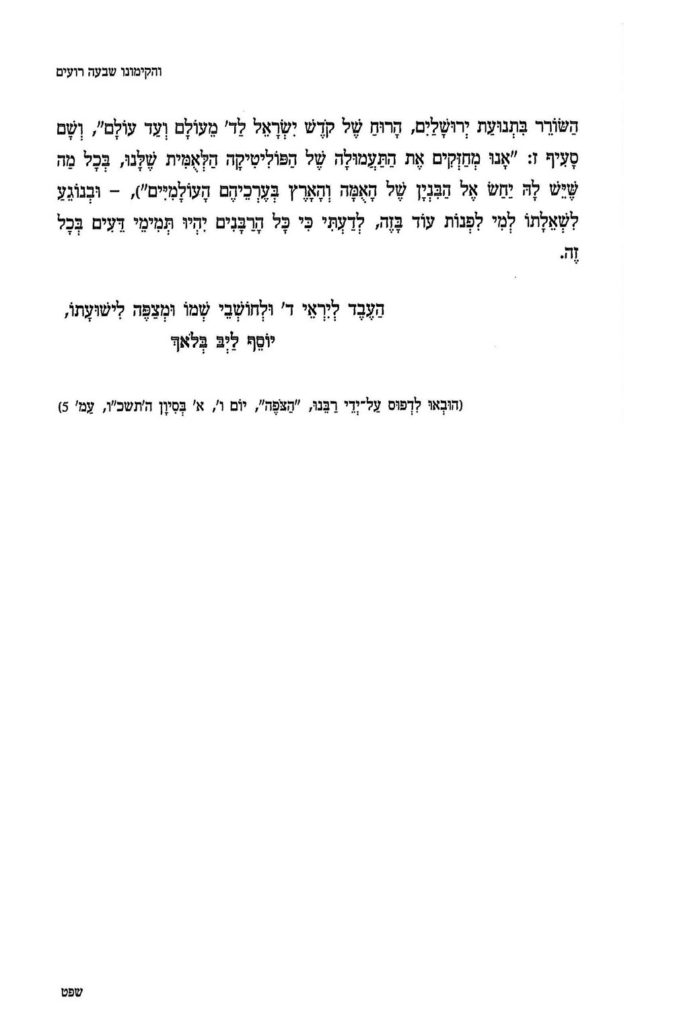
 

I realize that R. Joseph Leib Bloch is usually portrayed as a strong anti-Zionist. This needs further investigation, but it could be that his opposition was only against secular Zionism and what he regarded as the Mizrachi’s compromises with the secular Zionists. From his letter, we see that he had a much different view of R. Kook’s Degel Yerushalayim.[5]
The letter above that of R. Joseph Leib Bloch is from R. Avraham Shapiro, the Kovno Rav, who unlike many other Lithuanian gedolim was a real opponent of Agudat Israel. (Another noteworthy opponent was R. Moses Soloveitchik.) Here is R. Shapiro’s picture.

R. Shapiro also was a supporter of Religious Zionism and a great admirer of R. Kook. Unfortunately, we don’t yet have a biography of his life. Those who want to know a little more about his attitude towards Zionism can see his 1919 letter to R. Kook in Iggerot la-Re’iyah, no. 94. Here he writes as follows:

החלטנו שבהמעשים הפוליטיים להשגת חפצנו באה”ק, כלומר העבודה לפני אסיפת השלו’, נלך ביחד עם הציונים שלא בהתפוררות כבאי כח מפלגה ומפלגה, כי אם כבאי כח כל העם העברים בסתם. למטרה זו נבחרה קומיסיה פוליטית לבוא בדברים עם הציונים, וכבר נעשה הצעדים הדרושים לזה. מקוה אני שתמצא הדרך להתאחדות הפעולות.
We see very clearly from this letter that the Kovno Rav supported working with the non-Orthodox Zionists in order to achieve the Zionist objective, which became a real possibility after the defeat of the Ottoman Empire in World War 1.
In a 1921 letter to R. Zvi Yehudah Kook, Iggerot la-Re’iyah, p. 557, the Kovno Rav refers to the Agudah paper Ha-Derekh in a mocking tone: כפי שראיתי מ”הדרך” לא-דרך. In this letter he tells R. Zvi Yehudah that it is important for the Orthodox in Palestine to be involved in the political process that was set up by the British Mandatory authorities. Yet instead of doing that, he claims that the Orthodox have turned a large portion of the women against them, alluding towards the Eretz Yisrael rabbis’ ruling forbidding women’s suffrage, a ruling which R. Avraham Yitzhak Kook was at the forefront of. Look at these words and remember that the one writing them was one of the greatest poskim of his time, the great rav of Kovno, not some minor Mizrachi figure:
האומנם חושבים הם את השתתפות הנשים לאיסור גמור המפורש בתורה שאין אומרים בו מוטב יהיו שוגגים כו’? לדעתי הסכילו עשה.
This opposition to women voting in Israeli elections has disappeared from the haredi world, for obvious political reasons. Yet examination of haredi writings leads to the conclusion that female suffrage is only a hora’at sha’ah, and that if the haredim ever became a majority the right to vote would be removed from women. But I think that this is more theory than reality, as I can’t imagine that even a haredi society would take this step as the backlash from women would be quite significant. As for the followers of R. Kook, do they also think that female suffrage is hora’at sha’ah and hope for a day when the vote will be taken away from women, for all the reasons R. Kook offered? Based on a recent statement by R. Aviner, it appears that for some of them the answer to this question is yes.
The Kovno Rav ends his letter to R. Zvi Yehudah with these strong words against Agudat Israel:
כנראה אסע אי”ה בקרוב בשביל צרכי צבור ללונדון. כמובן לא בשביל אגודת-ישראל. כנראה אחר כ’ את האספה בפ”ב. מה דעתו עליה? אנכי בכוונה לא נטלתי חלק בה, לפי שכל מעשיהם עד עכשיו אינם רצוים בעיני ואינם בדרך האמת. הדו”ח של רוזנהיים לא הי’ אמת. הקומיסא הפוליטית איננה יודעת מאום מאשר עשו ולכה”פ אנכי איני מסכים על כל דרכיהם שהזיקו רק להאורטודקכסיא ולא לאחרים. אני אומר זאת לכל מפורש מבלי התחבא בהשקפתי.
I mention the Kovno Rav’s opposition to Agudat Yisrael not only for its historical significance, but also because it brings us back to a time when Agudat Israel actually did something other than put on a big Daf Yomi celebration every seven years.[6] There was a time when Agudat Israel tried to accomplish great things, so there was reason to oppose it by those who thought that it was moving in the wrong direction. Today, however, what is Agudat Israel? There was a time when it was a movement, and today it is a lobbying organization, pure and simple, and without much influence at that. I guess that’s what happens when you don’t even have a website or a journal. You sink into oblivion, only to be remembered in another seven years at the next Siyum ha-Shas.
In a 1931 letter to R. Kook, Iggerot la-Re’iyah, no. 273, the Kovno Rav asks R. Kook if he agrees with him that a world congress of rabbis should be convened – אספת רבנים עולמית . I mention this only because in later years it became almost an article of faith in the haredi world that such rabbinic gatherings were absolutely forbidden. The fear was that the gatherings would make decisions at odds with the haredi Daas Torah. The only way to make sure that their followers would not attend these gatherings, where they might actually hear different viewpoints, was for the haredi leaders to ban these gatherings.[7] This is as good an example of any of how the haredi leadership uses its rabbinic “muscle” for political goals. If someone were to ask on what basis can one state that it is forbidden for rabbis with different viewpoints to gather to discuss issues, the answer is obviously not going to be that the Talmud or Shulhan Arukh says it is forbidden. It is forbidden because the gedolim say it is forbidden, i.e., Daas Torah.
R. Jehiel Jacob Weinberg writes as follows about the Kovno Rav (Kitvei ha-Rav Weinberg, vol. 2, p. 234):
ועלי להעיר כי הגאון דקאוונא שליט”א הוא אחד מגדולי הדור בזמננו, אחד המוחות היותר טובים שבתוכנו. ואעפ”י שאנשים ידועים משתדלים להשפילו ולהמעיט את ערכו, מ”מ אי אפשר להחשיך את אור תורתו וחכמתו.
What does Weinberg mean when he speaks of those who oppose the Kovno Rav and try to minimize his importance? Who are these people and what led them to this judgment of the great Kovno Rav? Let me thicken the plot. The late R. Tovia Lasdun wrote to me as follows: “Kovner Rav was a great person, but his views did not always meet the views of the Orthodoxy [!]”[8] By “Orthodoxy” he meant Lithuanian yeshiva world Orthodoxy. From what we have seen already, namely, his anti-Agudah stand and the other points I noted, one can begin to understand why there would be opposition to the Kovno Rav from yeshiva circles.

R. Jeffrey Woolf recorded the following story about the Kovno Rav. He heard it from an eyewitness and it is very illuminating.[9]

The pre-war Jewish community of Kovno (Kaunas, today) Lithuania was divided into different components, divided by the Neris River. On the one side was the general community, which was made up of every type of contemporary Jewish religious and cultural population. Indeed, the community was a bit notorious for a lackadaisical form of religiosity. On the other side of the Williampol bridge, was the famous Slabodka Yeshiva, a flagship of the Mussar Movement. As might be expected, relations between the two sectors were often tense. There was a saying attributed to the Alter of Slabodka, R. Nosson Zvi Finkel זצ”ל, that the bridge from Kovno to Slabodko only went one way.

Coping with the myriad of challenges, modernization and secularization in Kovno was its illustrious rabbi, R. Avraham Dov-Bear Kahana-Shapira זצוק”ל, author of the classic collection of responsa and Talmudic essays דבר אברהם, and known more popularly as the ‘Kovner Rov.’ One central concern of his was the alienation of young Kovner Jews from the synagogue. Thus, when the administration of the Choral Synagogue came to him with an intriguing approach to the problem, he jumped at it.

The idea was to have the synagogue’s cantor, the internationally renowned tenor Misha Alexandrovich, offer public concerts that would feature classical חזנות alongside renditions of serene Italian bel canto compositions. The hope was that this type of cultural evening would draw modernizing young Jewish men and women to the synagogue, where they would socialize and (perhaps) find mates. 

The first concert was a smashing success and more were planned. Everyone was thrilled, except for the heads of the Slabodka Yeshiva. They turned angrily to the Kovner Rov and demanded that he intervene to stop the concerts. They were indecent, the Rashe Yeshiva objected. The led to fraternization between men and women, and in the synagogue. Worse still, they might corrupt yeshiva students.

The Kovner Rav listened quietly, and then firmly rejected the Yeshiva’s objection. “You are responsible only for your yeshiva,” he asserted. “I am responsible for the spiritual welfare of all of the Jews of Kovno.” The concerts, he declared, would continue.

Returning to R. Elijah Meir Bloch, there is another relevant source and that is found in Chaim Bloch’s Dovev Siftei Yeshenim. (There was no familial relationship between the two Blochs.) As we have discussed numerous times, one can’t believe anything that Bloch wrote, and all of the letters of gedolim he published must be assumed to be forgeries. However, this only applies to the letters he published of deceased individuals, but the letters he published of living figures are indeed authentic. In vol. 1 (1959), p. 392, he published a letter he received in December 1944 from Jacob Rosenheim, the president of World Agudat Israel, then living in New York. Chaim Bloch had written to him asking on what basis the Agudah was now supporting the establishment of a Jewish state. Rosenheim replied that this policy was based on the decision of the “gedolei ha-Torah.” He also mentioned that this support was dependent on two important points. (1) The State had to be run according to Torah, and (2) that the new State would be accepted peacefully by the Arabs. He states that if the Arabs and the world governments agree to the establishment of the State, then there is no prohibition of שלא ימרדו באומות. He also adds that there is no prohibition to establish a state without a Temple, i.e., a State before the coming of the Messiah.
Chaim Bloch strongly rejects Rosenheim’s words, and declares that based upon what Rosenheim writes, there is now no difference between the Agudah and the Mizrachi. This was exactly the claim of the Edah Haredit in Jerusalem, and eventually it and the Agudah would go their separate ways.
The end of Rosenheim’s letter is of interest to us, because after stating that he personally doesn’t believe that in the current (end of 1944) circumstances there is any chance of a Torah state, he adds that R. Eliezer Silver and R. Elijah Meir Bloch do think such a Torah state is possible. I don’t know what this says about the political acumen of Silver[10] and R. Elijah Meir Bloch, but it shows that R. Bloch had a very optimistic view of the religious development of the future State.
Rosenheim concludes his letter by stating that, unlike Silver and R. Elijah Meir Bloch, “we” (by which he must mean the rest of the Agudah leadership) regard the creation of a State as a real catastrophe. Rosenheim and the others assumed (correctly) that the non-religious would be the majority and that this would create a very difficult circumstance for Orthodox Jews. Their preference was that the land remain under British control, with religious freedom given to all. Rosenheim’s comments today appear surprising, but we must remember that from the perspective of most Agudists, nothing was worse than having a secular “Hebrew State”. Many of them assumed that Zionist control of the Land of Israel would lead to anti-religious measures (which turned out to be correct in some instances). Others might even have believed that the Zionists were to be suspected of wanting to kill the Orthodox![11]
Regarding R. Elijah Meir Bloch, let me call attention to one more interesting source. In the volume Yahadut Lita, vol. 2, pp. 234-235, Bloch contributed an article on Agudat Israel, in which, as mentioned, he was very involved. In this article he says the following, which fits in very well with what we learn from Muskin’s essay (I have added the emphasis).
“אגודת ישראל” בליטא, כמו מרכז “יבנה”, התענינו גם בהפצת הדיבור העברית והשתמשו בטקסיהם בדגל הכחול-לבן, שכן סיסמתה של ה”אגודה” בליטא היתה ללחום רק נגד הדברים שהם בניגוד להשקפתה, אבל לא נגד דברים נכונים כשלעצמם, אף שאחרים דוגלים בהם בדרך מנוגדת להשקפת העולם החרדית. סיסמתנו היתה שכל דבר טוב שייך לנו, אף שאחרים הרימוהו על נס, ונקבל את האמת ממי שאמרו. אדרבה, בזה יכולנו לרכוש את דעת-הקהל לצדנו בהיות מאבקנו רק נגד הדברים שהם בניגוד למסורת.
As Bloch says, the approach of the Lithuanian Agudah was not to oppose something just because it was supported by the non-Orthodox. Just because the non-Orthodox spoke in Hebrew in their schools and used the blue and white flag didn’t mean that the Orthodox had to avoid these things. (I have to admit that for Agudah members to use the blue and white flag strikes me as very strange, as from its beginning this was a Zionist flag, not a flag for the Jewish people as a whole.)
In his article, Bloch describes how in the 1930s two hundred Agudah halutzim went on aliyah, after hakhsharah at Tzeirei Agudah kibbutzim in Lithuania. Sounding very Zionistic, he notes that among them were those who took part in defense of the yishuv against Arab attacks: ופעלו במסירות למען בנין הארץ.[12]
* * * *
In a previous post I asked two quiz questions. No one was able to answer no. 1, which means that the prize will remain for the winner of a future quiz. These were the questions.
1. Tell me the only place in the Shulhan Arukh where R. Joseph Karo mentions a kabbalistic concept? I am referring to an actual concept e.g., Adam Kadmon, Ein Sof, etc.
2. If more than one person answers the above question correctly, the one who answers the following (not related to seforim) will win: Which is the only United States embassy that has a kosher kitchen?
Nachum Lamm and Ari Zivotofsky both got the answer right for no. 2. The embassy is in Prague and the ambassador is Norman L. Eisen. I had the pleasure of davening with him every morning on my trip to Prague last summer. You can read about him here.
Now let’s turn to the question no. 1. The first thing to note is that there are many halakhot in the Shulhan Arukh. If R. Joseph Karo was a mystic, as in the title of Werblowsky’s book on him,[13] one would expect to see evidence of this in the Shulhan Arukh, and also in the Beit Yosef. Yet we don’t have this, and references to the Zohar and even basing halakhot on the Zohar have nothing to do with whether one should be thought of as a mystic. By the 16th century the Zohar was a canonical text, so referring to it says nothing about whether one is a mystic, neither then nor today.
However, we know that R. Joseph Karo was a mystic because of his book Magid Meisharim, which recounts his visions of a heavenly figure, who taught him over many decades.[14] Interestingly, R. Leopold Greenwald denied that Karo wrote this book. He attributes it to an anonymous לץ.[15] This reminds me of something I noted in an earlier post. See here where I mention how Abraham Samuel Judah Gestetner denies that R. Jacob Emden wrote Megilat Sefer, his autobiography. Gestetner claims that it could only have been written by a degenerate maskil! (There is no doubt whatsoever that Emden wrote the work.)
Despite the fact that the Shulhan Arukh does not generally mention kabbalistic ideas, there is one place, and only one place, where he indeed does so. It is in Orah Hayyim 24:5, where he states that the two tzitzit in front have ten knots, which is an allusion to the ten Sefirot:
כשמסתכל בציצית מסתכל בשני ציציות שלפניו שיש בהם עשרה קשרים רמז להויות

* * *

I am happy to report that this summer, God willing, I will once again be leading Jewish history-focused tours to Central Europe and Italy. (A trip to Spain is being planned, but will not be ready by the summer.) For information about the trip to Central Europe, please see here.
Complete information about the Italy trip will will soon be available on the Torah in Motion website.

To be continued

[1] With regard to Ben-Hur, there are at least eight different Hebrew translations, and they all censor Christian themes in the novel. See Nitsa Ben-Ari, “The Double Conversion of Ben-Hur: A Case of Manipulative Translation,” Target 12 (2002), pp. 263-302.
[2] Why such lashon nekiyah? I can think of many more appropriate ways to refer to such criminals.
[3] In the introduction to Iggerot Moshe, vol. 8, p. 27 (written by the sons and son-in-law), it states that some Satmar hasidim would come to R. Moshe for advice and to receive blessings. But on p. 26 it also records as follows:
בגלל עמדת האגודה לגבי ארץ ישראל וההתנגדות החריפה של חסידות סטאמר לעמדה זו, הוחלט אצלם לתקוף את רבנו ופסקיו (כך ספרו לרבנו אנשי נטורי קרתא בירושלים כאשר היה שם בשנת תשכ”ד). כמטרה להתקפה זו נבחרו תשובותיו בעניין הזרעה מלאכותית ושיעור מחיצה של עזרת נשים. מחלוקת זו שלא היתה לאמיתה של תורה גרמה לרבנו עגמת נפש מרובה. התקפות אלה לא היו רק באמצעות מאמרים ותשובות, אלא גם בהתקפות אישיות חירופים וגידופים, מעשי אלימות, איומי פצצות, הטרדות טלפוניות ושריפת ספריו.
[4] His father-in-law, R. Eliezer Gordon, also held both positions, as did his son, R. Avraham Yitzhak Bloch (who was martyred in the Holocaust). Although in the U.S. the Telz yeshiva adopted a very anti-secular studies perspective, this was not the case in Europe. R. Joseph Leib Bloch was very involved with the Yavneh day school system in Lithuania, which incorporated secular studies (and also Tanakh), and in the context of Eastern Europe can be regarded as a form of Modern Orthodox education. It is also significant that in Yavneh schools Hebrew was the language of instruction for all subjects. The preparatory school (mekhinah) of the Telz yeshiva also contained secular studies (which the government insisted on if students wanted to be exempted from the draft).
The graduates of Yavneh attended universities, in particular the University of Kovno, and they had an Orthodox student group named Moriah. By the 1930s, Lithuania had begun to produce an academically trained Orthodox population. Had the Holocaust not intervened, much of Lithuanian Orthodoxy would have come to resemble German Orthodoxy. This is important to realize since people often assume that Bnei Brak and Lakewood are the only authentic continuation of Lithuania, when nothing could be further from the truth. What R. Ruderman attempted to establish in Baltimore was, speaking historically, the true successor of the pre-War Lithuanian Orthodox society’s dominant ethos. (I am speaking of Orthodox society as a whole, not the very small yeshiva population.)
In speaking of R. Joseph Leib Bloch, Dr. Yitzhak Raphael ha-Halevi Etzion, the head of the Yavneh Teacher’s Institute in Telz, writes as follows:
בדברי על הגימנסיה העברית לבנות “יבנה” בטאלז ובהזכרי על החינוך בעיר בכלל אינני יכול שלא להזכיר את דמותו המופלאה והדגולה של הרב ר’ יוסף ליב בלוך זצ”ל, רבה של טאלז וראש ישיבתה. אחד הרבנים הגדולים והקנאים ביותר של ליטא – היה הראשון שהבין את הנחיצות של חינוך עברי דתי-מודרני לבנות ולבנים.
See “Ha-Zerem ha-Hinukhi ‘Yavneh’ be-Lita,” Yahadut Lita, vol. 2, pp. 160-165.
R. Shlomo Carlebach wrote as follows, after describing the creation of the Kovno Gymnasium, a Torah im Derekh Eretz school established by R. Joseph Zvi Carlebach (Ish Yehudi: The Life and the Legacy of a Torah Great, Rav Joseph Tzvi Carlebach (Brooklyn, 2008), pp. 74, 76):

The Kovno Gymnasium left a deep impression upon the Lithuanian Torah leaders, who could not help but notice the enthusiastic response to the Torah im Derech Eretz educational approach on the part of students and parents. They realized that this approach caused no compromise in Yirat Shamayim. The enormous upheaval in the political and social structure of Jewish society throughout the land, in the aftermath of war, threatened the stability and loyalty of Jewish youth. Under those circumstances, these Torah leaders felt an urgent need to introduce a similar educational program, on a broad scale, by reorganizing existing schools and establishing new ones, where subjects in Derech Eretz would be taught alongside Limuday Kodesh.

At the behest of the Telzer Rav, Rav Joseph Leib Bloch, a world-renowned gaon and Rosh Yeshivah of the equally renowned Telzer Yeshivah, Dr. [Leo] Deutschlaender, director and guiding spirit of the Keren Hatorah Central Office in Vienna, was summoned to Kovno to organize, in consultation with the Rav [Joseph Zvi Carlebach] such an educational system, to be called Yavneh. . . . At its conclusion, he published a summary of the “Yavneh educational project” in the “Israelit”. He reported that separate teachers’ seminaries for men and women had been established in Kovno, in addition to “gymnasium-style high schools in Telz, Kovno, and Ponevesh, and approximately 100 elementary schools spread throughout the land.”

It is interesting that when the late, unlamented, Jewish Observer published a review of this book by R. Yosef Gavriel Bechhofer, the editor felt constrained to insert the following “clarification,” knowing that its readers would be shocked to learn that Lithuanian Torah Jewry was not an enlarged version of Lakewood.

The best part of this “clarification” is the final sentence. I wonder, why does such a careful scholar and talmid hakham as Rabbi Carlebach need to have his book vetted by “gedolei Torah and roshei yeshivos”, who for all their talmudic learning are not known as experts in historical matters? Since the Agudah gedolei Torah and roshei yeshivot are prepared to cover up historical truths (as seen in their signing on to the ban of Making of a Godol), why in this case did they agree to allow the masses to learn what really was going on in Lithuania? Is it because they too feel the need to change the direction of American haredi Orthodoxy to a more secular studies friendly perspective, and this could help set the stage for this?

Returning to Telz, the question remains why Telz in Cleveland adopted such an extremely negative outlook regarding secular studies? Maybe a reader can offer some insight. R. Rakeffet has reported that R. Samuel Volk of YU, who was himself an old Telzer, commented that Telz in Cleveland distorted what Telz in Europe was about.

An interesting story about the Cleveland Telz was told to me by Rabbi M.C., a Cleveland native (and YU musmach). He was at the Telz high school and upon graduating decided to go to YU. R. Mordechai Gifter summoned M.C.’s mother and told her that if her son goes to YU, within a few months he will no longer be religious. She then angrily demanded that R. Gifter return to her all the years of tuition she had paid. She said: “If you tell me that after all the years my son has studied here, it will only take a few months at YU before he becomes non-religious, then the education you offer must be pretty lousy, and I want my money back!”
R. Dov Lior recalls that R. Zvi Yehudah Kook had a similar reaction when at a meeting of roshei reshiva with Minister of Defense Shimon Peres a haredi rosh yeshiva claimed that putting yeshiva students in the army could lead to them becoming non-religious (Hilah Wolberstein, Mashmia Yeshuah [Merkaz Shapira, 2010], p. 296):
הרכין הרב צבי יהודה את ראשו כולו בוש ונכלם. הרי צבא ישראל, צבאנו הוא, ולא צבא הפריץ הנוכרי, ולכן חובה עלינו להשתתף בו. זאת ועוד, האם המטען שהבחורים קיבלו בישיבות אינו חזק דיו שיש לחשוש כל כך לקלקולם?
[5] See his Shiurei Da’at (Tel Aviv, 1956), vol. 3, p. 65 (in his shiur “Dor Haflagah”), where we see that he was also opposed to messianic Zionism, so it appears that he didn’t really understand R. Kook’s ideology.
הגאולה אי אפשר להביא על ידי תחבולות בני אדם ואי אפשר לדעת אותן, נעלה ונעלם הוא ענין הגאולה, ולכן תבא בהיסח הדעת, כי לא ידעו בני אדם אל נכון איזה מצב הוא הראוי לגאולה.

[6] In all the discussions recently about the success of Daf Yomi, I didn’t see anyone note that one of the reasons this success is so surprising is that the whole notion of Daf Yomi goes against what for many years was the outlook of the rabbinic elite. The Shakh, Yoreh Deah 246:5, quoting the Derishah, states that laypeople should not only study Talmud but also halakhah, which he thinks should be their major focus as practical halakhah is שורש ועיקר לתורתינו. It is not hard to understand the point that since a layperson’s time is limited, he will get more out of his learning by focusing on practical material. If, for example, one has an hour a day to learn, what makes more sense: to go through hilkhot Shabbat or to study Talmud? While people today prefer Talmud, the Shakh prefers halakhah, and I don’t know of any rabbinic figures in years past who disagreed with the Shakh. This Shakh is also mentioned in the introduction to the Mishnah Berurah. While it is obvious that one who has time to learn both Talmud and practical halakhah is in the ideal circumstance, how did we get to the situation where those whose time is limited are now encouraged to focus on Talmud? The credit (or blame, depending on your outlook) for this development can, I think, be laid at Artscroll’s door, for Artscroll made learning Talmud exciting for the masses, in a way that halakhah is not, and maybe can never be.
Daf Yomi is so revolutionary precisely due to its democratic ethos, that everyone is welcome to study that which used to be the preserve of only the elites. Much like American universities opened up higher learning to the masses, and created a situation where for the first time in history texts such as Plato and Aristotle were now taught (or spoon-fed) to all, so too, for he first time in history, Daf Yomi allowed Talmud to become a product of mass consumption.
[7] See e.g.. R. Eleazar Shakh, Mikhtavim u-Ma’amarim, vols. 1-2, no. 111.
[8] Rabbi Rakeffet has reported the following story that he was told by R. Bernard Revel’s widow, Sarah. When the Kovno Rav was in New York he was at some gathering with Revel. Revel told him that he had to excuse himself as he had yahrzeit and had to go recite kaddish at a minyan, The Kovno Rav replied: “You also believe in that?” The implication was that the notion of saying kaddish on a yahrzeit was folk religion, not something that Torah scholars take seriously. Mrs. Revel was shocked when she heard the comment, but Rakeffet is probably correct that this was an example of Lithuanian rabbinic humor.
[9] See here.
[10] I heard from a Holocaust survivor that in 1946 Silver came to Kielce. Dressed in a military uniform, he gave a speech telling the people to remain in Poland in order to rebuild Jewish life there. The man who told me this thought that Silver’s speech was directed against the Mizrachi. (Silver was in Poland on July 4, 1946, the date of the infamous Kielce pogrom, yet I don’t know if his visit to Kielce was before or after the pogrom.) Silver was not a chaplain, but rather an emissary of Agudat ha-Rabbanim and Vaad Hatzalah. “The American government agreed to Silver’s wearing an Army uniform so its insignias would add to his protection in areas where anti-Semitism was still rife.”Aaron Rakeffet-Rothkoff, The Silver Era (Jerusalem/New York, 2000), p. 228.
[11] It has been reported that R. Moshe Sternbuch claims that he was told by R. Velvel Soloveitchik that his father, R. Hayyim, once expressed fear of not being left alone with a religious Zionist. He was worried that the latter would kill him, since the Zionists are suspected of shefihut damim. See Mishkenot ha-Ro’im, vol.1, p. 271, quoting Om Ani Homah, Sivan 5732. (I don’t know if Sternbuch is being quoted accurately, but I can’t imagine that R. Hayyim would ever have said this about a religious Zionist. A number of his own students and relatives were religious Zionists!). The exact same fear was, according to Moshe Blau, expressed by R. Joseph Rozin, the Rogochover:
הלא הם [הציונים] חשודים על הכל, הם חשודים גם על שפיכות דמים
See Yair Borochov, Ha-Rogochovi p. 70. (After the killing of Jacob de Haan, this viewpoint was given some basis.) See ibid., where Blau also quotes the Rogochover as saying that the reason he stopped publicizing his anti-Zionist views was because he was asked to do so by his daughter, who was married to R. Yisrael Abba Citron, the rav of Petah Tikvah. Citron was a Mizrachi supporter and it was creating problems for him that his father-in-law was attacking the Zionist movement. Regarding Citron, see the fascinating book-length biography of him that appears at the beginning of his volume of hiddushim, published in 2010.
[12] As Eliezer Brodt noted in his last post, Bloch’s son, R. Yosef Zalman Bloch, Be-Emunah Shelemah (Monsey, 2012), pp. 115-116, quotes a strongly anti-Zionist and anti-Mizrachi letter of the elder Bloch, attempting to leave the impression that when it came to this issue his father had a completely negative attitude. However, as we have seen, the truth is more complicated. In general, Y.Z. Bloch’s book is quite a strange mix of wide learning combined with unbelievable nonsense, a point alluded to much more gently by Brodt. On the very page that he quotes his father’s view of Zionism, he tells us that one who does not believe that God’s individual providence encompasses everything in the world, even the animals, insects, falling leaves, etc. הרי הוא כופר בעיקר, ואין לו חלק לעוה”ב. He says that the sages in earlier times who didn’t have this perspective were tzadikim and they are at present in Olam ha-Ba, but today, after the matter has been “decided” by the Masorah, holding such a position is heretical. Leaving aside the question as to why he feels he is a prophet and can in bombastic fashion declare who has lost his share in the World to Come (something he is fond of doing in this book), does he not realize how many great Torah scholars from even recent generations he has (inadvertently?) condemned as heretics?
This is all so obvious to me that I don’t see any need to cite “authorities.” But for those who want this, let me offer the following. A few years ago, an author writing in Mishpahah asserted that one who believes that animals are not subject to individual providence, it is like he is “eating fowl with milk” (which is a lot less severe than Bloch’s judgment that such a person is a heretic with no share in the World to Come). R. Meir Mazuz, Or Torah, Tamuz 5769, pp. 867-868, responded to this strange assertion by citing many authorities who indeed held this position, and he mentions nothing about it being “rejected by the Masorah.” He concludes:
אבל אטו מי שסובר כדעת הרמב”ם והרמב”ן והרד”ק ורבינו בחיי וספר החינוך ומהרש”א והרמ”ק ומהר”י אירגאס והגר”א נקרא אוכל בשר עוף בחלב?
A large section of Bloch’s book is designed to show that the only acceptable Torah belief is that the sun, planets, and stars revolve around the earth. As for Copernicus, he refers to him as קופירניקוס הרשע שר”י (p. 351 n. 36).
Among his nuggets of wisdom is that astronomy is the most heretical, and anti-Jewish, of all the sciences. P. 387 n. 1:
וצריכה למודעי, דספרי חכמת התכונה גרעי טובא יותר מכל שאר ספרי חכמתם, שמלאים אפיקורסות ושנאת הקב”ה ר”ל, שנאת דת יהודית, ושנאת האמת, שטויות ושגעונות, עד שיש להתפלא מה טעם יהיו “חכמיהם” וספריהם האלו כל כך מטופשים ומלאי ארס הכפירה יותר מכל שאר ספרי חכמיהם.
Since, as he states, these scientists are not only heretics but also stupid fools, one can only wonder how they were able to figure out how to put a man on the moon.
On p. 331 he refers to the view of R. Jacob Kamenetsky (without mentioning him by name) that the first four chapters of Hilkhot Yesodei ha-Torah are not to be regarded as Torah but as פילוסופיא בעלמא. See Emet le-Yaakov (New York, 1998), pp. 15-16. Bloch sees this as absolute heresy, and he quotes R. Yehudah Segal of Manchester as saying that even if the Hatam Sofer or the Noda bi-Yehudah said this, we would not accept what they said, and would be forced to reinterpret their words. Bloch quotes this approvingly, and this illustrates the problem. He is so locked into his dogmatic assumptions that his mind is closed and doesn’t want to be confused with the facts.. If most people were shown an explicit text of the Hatam Sofer or Noda bi-Yehudah that diverges from their dogmatic assumption, they would conclude that their assumption of what is “acceptable” needs to be revised. But Bloch refuses to even acknowledge the possibility that people greater than him might have a different perspective on what constitute the fundamentals of faith.
Bloch advocates this approach even when it comes to the rishonim (p. 117):
ואפילו מה שכתבו עמודי העולם הראשונים ז”ל, אם אינו מתאים עם האמונה הפשוטה הברורה שבה”אני מאמין”, וכפי שנמסרה לנו ה”אני מאמין” מאבותינו ואמותינו הצדיקים והצדקניות, הַניחו אותה בקרן זוית.
On p. 336 Bloch goes further than merely rejecting the Copernican outlook that earth revolves around the sun. He also denies that the earth rotates on its axis. According to him, it is a Torah truth that the earth stands still: שהארץ עומדת על עמדה ואינה זזה כלל.
The absolute craziest thing he says, in a book filled with absurdities, is that the sun, moon, and all the stars [!] revolve around the earth every twenty-four hours!:
שהשמש והירח וכל הכוכבי-לכת וכל הכוכבים וכל צבא השמים סובבים יחד את כדור הארץ בכל עשרים וארבע שעות.
I  guess it is a neat trick that stars so many light years away (i.e., trillions of miles away) are able to circle earth each day. (Our galaxy alone has hundreds of billions of stars.) But seriously, is one supposed to laugh or cry when reading this? How should one relate to a rabbi who so dishonors the Torah by claiming that this is Torah truth, and a required belief of any religious Jew?
On p. 289 Bloch writes:
והא דמצינו לפעמים שאחד מרבותינו הראשונים או אחד מגדולי האחרונים ז”ל אשר מימיהם אנו שותים, אמרו על איזה אגדתא שזה גוזמא, תדע לנכון דלא משום שח”ו לא הרכינו ראשם לכל הנאמר בגמרא, וחשבו שמה שרחוק מהמציאות שלעינינו בהכרח יתפרש רק כגוזמא, אלא דכך היתה קבלתם דזה המאמר המובא בתלמוד לא נאמרה מעיקרא כפשוטה אלא כגוזמא.
Everything in this sentence is incorrect, and is contradicted by numerous explicit statements in rishonim and aharonim.
[13] Joseph Karo: Lawyer and Mystic (Oxford, 1962)
[14] Regarding why R. Joseph Karo doesn’t mention the maggid in his halakhic writings, see Eliezer Brodt, Likutei Eliezer (Jerusalem, 2010), pp. 106ff. As usual, Brodt shows incredible erudition.
[15] Kol Bo al Avelut (Brooklyn, 1951), vol. 2, p. 31, in the note. Greenwald elaborates on this position in Ha-Rav R. Yosef Karo (New York, 1953), ch. 8.