Legacy Auction, agunot, censorship, and other notable items
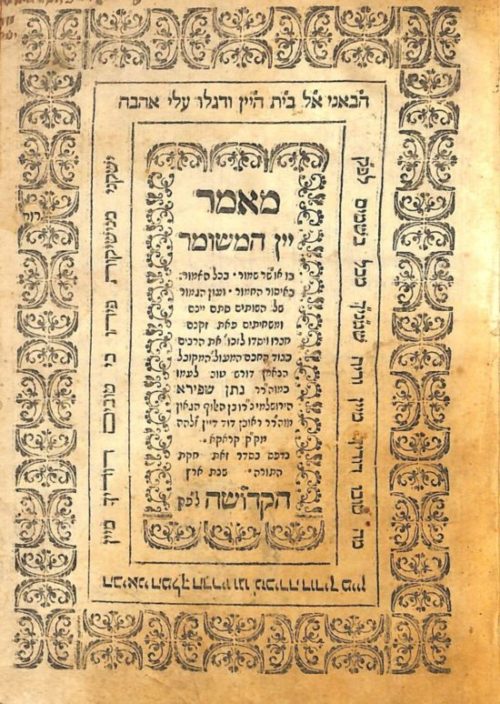
Legacy Judaica will be holding its latest auction on April 4th. The auction includes a few lots regarding agunot and comprehensive attempts to annul marriages. In the early 20th century, especially in the aftermath of WWI, some tried to find global solutions to the massive agunah problem. To those books offering solutions were those which disputed the validity of those solutions. There is a lot of ten historic books on the controversies and a lot of letters from American rabbis. One of the most substantial responses is, Ein Tenai be-nesunin , whose title leaves no doubt as to its position. The book includes an important letter from R. Chaim Ozer and other rabbis. According to some, the book was a response to one of the more eclectic figures invovled in the controversy, R. Yosef Shapotsnik. His book, Lekor le-Asirim Dror, also leaves no doubt as to his position. Although that book does not appear at this auction, Shapotshnik was involved in many other controversies and one of his books on the issue with an eruv in London. (lot 48). One of R. Nathan Shapira’s polemics, one against drinking yayin neskeh, and the other on Lurianic observances of certain mitzvos constitutes (lot 76).
A lesser-known example of censorship are the two “first” editions of R. Yehuda Greenwald’s Shut Zikhron Yehuda, both published in 1923. The first contains a lengthy letter questioning how R. Yosef Hayyim Sonenfeld could associate himself with the Agudah. In the second edition that is replaced with a letter regarding eating on the eve of Yom Kippur. Unfortunately in the second version although they changed the letter they weren’t as thorough as they should have been left the original title in the index. (lot 50).
The version of the Shulkhan Arukh with the commentary Gur Areyeh that contains the portraits of rabbis is lot 47. Regarding the use of the portraits and whether they were offensive see our recent post.
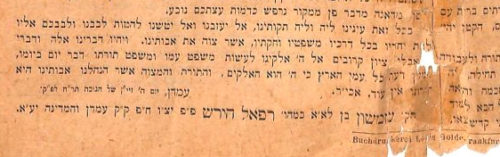
Lot 49 is a large double-sided broadside polemic against the Reform rabbinical conferences signed by R. Samson Raphael Hirsch when he was still the rav and av beis din of Emden. Here is an excerpt:
Lot 13 is Sefer Zichronos of R’ Abohav although quoted by many it was very rare and almost no one saw it inside but rather came to it through secondary sources including the Magan Avhrhom who quotes it often,and was printed by Ahahvat Sholom twice.
Another point of interest related to this work is this work was printed anonymously The Chida deals with this at length in his Shem hagedolim if this is a proper practice. See also most recently Yakav Speigel in Amudim Betoldost Sefer haivri ( BEsharei Hadefus) Chapter Two and see our post here. We also dealt with R Abuhav here.
Lot 12 is the first edition of of ha-Kesav Ve-ha-Kaballah by R. Jacob Zvi Mecklenburg (Leipzig, 1839).
Earlier on the blog (here) we have pointed to pieces only found in the first edition of this work and this particular volume is from the main synagogue in Koningsberg where R. Mecklensberg was the rabbi.
Lot 24 is the Nesivot Mishpat. an interesting tidbit about of this work has been noted in this post
Lot 28 is the Shut Meshiv Davar of the Netziv. The entry notes that there are two editions of the first edition. The one for sale is more complete. Some of the differences have been noted in The series on the seforim blog “The Netziv, Reading Newspapers on Shabbos in General & Censorship” (here, here and here). Part four in the series will hopefully be published shortly dealing with some more differences between the various editions.
Lot 94 is R’ Moshe Koerner and his Toras Moshe. There are two editions of this work, each with a different introduction. This was pointed out by Dr. Sprecher in his introduction to R’ Koerner’s Birchas Moshe which he reprinted. He also printed copies of both introductions. This is not noted in the Mifal bibliography entry on this work. Also, worth pointing to about R’ Koerner is recent excellent article from, Uriel Gellman, “Between Worlds: The Miserable Life of an Itinerant Preacher on the Eve of Modernity”, Jewish Quarterly Review, vol. 109 no. 1, 2019, pp. 54-83.
Lot 82 Sefer Safra Detzniusah DeYakov about this rare book R’ Ephrayim Zalman Margolis who had a excellent collection writes picturesquely about this work:
.והספר היה אצלי ונשרף בעוה”ר בשריפה שהיה פ”ק שנת תק”ן לפ”ק ומאז לא בא לידי
See ( מעלות היוחסין עמ’ סד) for this reference.
Lots 111-112 manuscripts of the Maaseh Rav sound very interesting one hopes that who ever prints them makes them available to the public to study. For now see R Dovid Kamenetsky article here
Lot 102 Zemirot mateh Yehudah. See what the Pre Megadim writes about this work:
בספר נטריקן, יורשלים תשכד, דף טז ע”ב: “ועיין בספר מטה יהודה על זמירות ואדם גדול היה“. וראה שם הקדמה דף ו ע”א.
Lot 103
The Dibuk highlighted in auction entry is dealt with at great length in Sara Zfatman’s excellent book Jewish Exorcism in Early Modern Ashkenaz (heb.).
Lot 162 provides evidence of which edition of the haggadah the Netziv might have used at the seder, R’ Eliezer Ashkenazi ‘s Maasei Hashem. The Netziv quotes this work in his commentary on the Sifri (1:243) and in his work on Chumash Bershis (44:34). This was his personal copy:

Lot 204 is a copy of Teudas Chaver (Prague 1813) signed by the Prague beis din, including R. Elazar Fleckeles, and R. Shmuel Landau, the Noda be-Yehuda’s son.
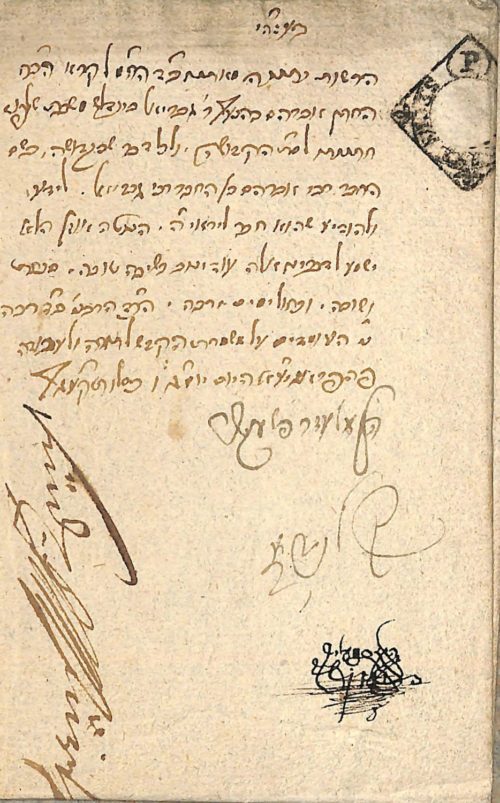
Lot 205 R Chaim Ozer and R Kook, relating to their relationship. See R. Dovid Kamenetsky’s article here