Legacy Judaica Auction, Cremation, R. Kook, and Other Items

Legacy Judaica is holding an auction on Monday, September 23rd, and a few items of note.  The Viennese Schmidt press produced two books with rather striking portraits.  One of R. Shmuel Eidels, Maharsha, and other of R. Yitzkah Alfasi, Rif, which is at lot 54.  Rif is depicted wearing robes and a turban with a long white beard.  Of course, there are no contemporaneous portraits of Rif, and this is a 19th century creation.  (For more on rabbinic portraits see Cohen, Jewish Icons, 114-153).


The first edition of R. Yitzhak Hutner’s, Torat ha-Nazir, contains three approbations from R. Chaim Ozer, R. Avraham Shapiro (Dvar Avraham), and R. Kook.  The next edition omits all three, presumably to avoid including R. Kook’s.  Although later reprints include just R. Chaim Ozer’s, leaving out the page that contains the Dvar Avraham’s and R. Kook’s letters (for example, the copy on Hebrewbooks). (See Marc Shapiro, Changing the Immutable, 157-160, and Eitam Henkin, “Historical Revisionism by the families of R. Kook’s Disciples:  Three Case Studies,” in Hakirah.)’


The polemical offerings include the Berlin 1905 book, Hayyei Olam, (lot 74) that opposes cremation of Jewish bodies.  At the turn of the twentieth century the issue of cremation was debated among Jews, with the rabbis of Hamburg and Altona having opposing views.  Hayei Olam, written by R. Lerner, the rabbi of Altona was against the practice and collects numerous other letters from sympathetic rabbis.  On the other side, R. Arentreu, in Or ha-Emet, and R. Shimon Tzvi Deutsch, in Heker Halakha, defended the practice.  (For more on the issue, see the entries for these works in Shmuel Glick’s Kuntres ha-Teshuvot ha-Hadash and Michael Heiger’s article in Halakhot ve-Aggadadot).


For a more recent controversial book, lot 80 is Making of a Godol, of the recently passed R. Nosson Kamenetsky.  We have discussed this book and its editions and the book, Anatomy of a Ban, which documents the controversy here

For those interested in bibliomancy, the edition of Tanakh recommended for the goral ha-Gra is at lot 123.  Of note is that this edition has two title pages in Hebrew and Latin, and likely not intended for a Jewish audience.

For one of the more bizarre travelogues, it is hard to surpass Sefer ha-Brit ha-Hadasha im ha-Nehar Sambatyyon be-Medinat China (lot 141).  After receiving permission from President McKinley, Uziel Haga accompanied US military forces in China for purposes of surveying the customs and life of Chinese Jews. Another lot of American Judaica, lot 138, is a collection of 10 works from R. Yekusiel Yehuda Greenwald.  R. Greenwald was a prolific author who wrote on many diverse topics. He is perhaps most well known for his book on the laws of mourning, Kol Bo Aveilut, but also wrote books on R. Yonathan Eiybschitz, the reform movement, and the Palestinian Talmud, and was a rabbi in Columbus, Ohio after emigrating from Hungary.

There is a well-known if an inaccurate story that on Yom Kippur, during a cholera epidemic, R. Yisrael Salanter wanted to ensure that those who needed to would eat.  So he got up on the bimah in the Great Synagogue of Vilna and made Kiddush and ate cake.  Although the veracity of the story has been questioned, with an eyewitness reporting that R. Yisrael announced from the bimah that those who needed to eat could do so without first asking their doctor but he ate nothing.  (See Yaakov Mark, Be-Mihitzatam shel Gedolim 68).  Lot 197 is a document from R. Yaakov Tzvi Mecklenburg, author of Kitav veha-Kabbalah, instructing women to remain at home and not attend synagogue for fear of spreading communicable diseases. For more on cholera, Yom Kippur, and R. Yisrael Salanter, see Eliezer Marmalstein, “Eating on Yom Kippur during Epidemics — Cholera — R. Yisrael Salanter’s Permissive Stance and those who Opposed Him,” Kovets Ets Hayyim, (Bobov), vol. 7, 273-294 (Hebrew).


Another “Translation” by Artscroll, the Rogochover and the Radichkover

Another “Translation” by Artscroll, the Rogochover and the Radichkover
Marc B. Shapiro
1. As I discuss in Changing the Immutable, sometimes a choice of translation serves as a means of censorship. In other words, one does not need to delete a text. Simply mistranslating it will accomplish one’s goal. Jay Shapiro called my attention to an example of this in the recent ArtScroll translation of Sefer ha-Hinukh, no. 467.  
In discussing the prohibition to gash one’s body as idol-worshippers so, Sefer ha-Hinukh states:

אבל שנשחית גופנו ונקלקל עצמנו כשוטים, לא טוב לנו ולא דרך חכמים ואנשי בינה היא, רק מעשה המון הנשים הפחותות וחסרי הדעת שלא הבינו דבר במעשה הא-ל ונפלאותיו.

The Feldheim edition of Sefer ha-Hinnukh, with Charles Wengrov’s translation, reads as follows:

But that we should be be destructive to our body and injure ourselves like witless fools—this is not good for us, and is not the way of the wise and the people of understanding. It is solely the activity of the mass of low, inferior women lacking in sense, who have understood nothing of God’s handiwork and his wonders.

This is a correct translation. However, Artscroll “translates” the words המון הנשים הפחותות וחסרי הדעת as “masses of small-minded and unintelligent people.” This is clearly a politically correct translation designed to avoid dealing with Sefer ha-Hinukh’s negative comment about the female masses. I will only add that Sefer ha-Hinukh’s statement is indeed troubling. Why did he need to throw in “the women”? His point would have been the exact same leaving this out, as we can see from ArtScroll’s “translation.” Knowing what we know about the “small-minded unintelligent” men in medieval times, it is hard to see why he had to pick on women in this comment, as the masses of ignorant men would have also been a good target for his put-down.

2. In my post here I wrote:

One final point I would like to make about the Rogochover relates to his view of secular studies. . . . Among the significant points he makes is that, following Maimonides, a father must teach his son “wisdom.” He derives this from Maimonides’ ruling in Mishneh Torah, Hilkhot Rotzeah 5:5:

הבן שהרג את אביו בשגגה, גולה. וכן האב שהרג את בנו בשגגה, גולה על ידו, במה דברים אמורים. כשהרגו שלא בשעת לימוד, או שהיה מלמדו אומנות אחרת שאינו צריך לה. אבל אם ייסר את בנו כדי ללמדו תורה או חכמה או אומנות ומת פטור

He adds, however, that instruction in “secular” subjects is not something that the community should be involved in, with the exception of medicine, astronomy, and the skills which allow one to take proper measurements, since all these matters have halakhic relevance. In other words, according to the Rogochover, while Jewish schools should teach these subjects, no other secular subjects (“wisdom”) should be taught by the schools, but the father should arrange private instruction for his son.

 רואים דהרמב”ם ס”ל דגם חכמה מותר וצריך אב ללמוד [!] לבנו אבל ציבור ודאי אסורים בשאר חכמות חוץ מן רפואה ותקפות [!] דשיך [!] לעבובר [צ”ל לעבור] וגמטרא [!] השייך למדידה דזה ג”כ בגדר דין

He then refers to the Mekhilta, parashat Bo (ch. 18), which cites R. Judah ha-Nasi as saying that a father must teach his son ישוב המדינה. The Rogochover does not explain what yishuv ha-medinah means, just as he earlier does not explain what is meant by “wisdom,” but these terms obviously include the secular studies that are necessary to function properly in society.

Dr. Dianna Roberts-Zauderer takes issue with my assumption that “wisdom” (חכמה), the word used by Maimonides, includes what I have termed “secular studies”. (The Touger translation also has “secular knowledge”). She correctly points out that when the medievals used the word חכמה it means philosophy. She adds: “Does it not make sense that Maimonides would advocate the learning of philosophy? Or that the Rogochover would forbid the learning of philosophy in yeshivot, but only permit it at home with a teacher hired by the father?”
Although the term חכמה often means philosophy, I do not think we must assume that this is its meaning in Hilkhot Rotzeah 5:5. Based on parallel passages in Maimonides’ writings where the same halakhah is mentioned, R. Nachum Eliezer Rabinovitch claims that the word חכמה in this case actually means good character traits.[1] He sums up his discussion as follows:
כוונת רבינו אחת היא בכל המקומות, דהיינו לימוד מדות הנקרא חכמה
Quite apart from this, in my discussion I was dealing with how the Rogochover understood the passage in Maimonides. We have to remember the context of the Rogochover’s letter. He was asked about the study of secular subjects, as was the practice among the German Orthodox. He was not asked about the study of philosophy per se. Furthermore, in the passage cited from manuscript by R. Judah Aryeh Wohlgemuth,[2] which I referred to in the previous post, the Rogochover specifically understands Maimonides’ term חכמה in Hilkhot Rotzeah 5:5 as meaning שאר החכמות, which he identifies with what R. Judah ha-Nasi calls ישוב המדינה. 
Regarding the Rogochover, there are a few things people mentioned to me after seeing my post which I think are worthwhile to record. Dr. Rivka Blau, the daughter of R. Pinchas Teitz, told me that her uncle, R. Elchanan Teitz, would on occasion cut the Rogochover’s hair.
In the post I mentioned how the Rogochover acknowledged that his learning Torah while sitting shiva was a sin, but he did so anyway as the Torah was worth it. R. Yissachar Dov Hoffman called my attention to the following comment about this by R. Ovadiah Yosef, Meor Yisrael, Berakhot 24b:
לפע”ד לא יאומן כי יסופר שת”ח יעבור על הלכה פסוקה בטענה כזו. והעיקר דס”ל כמ”ש הירושלמי פ”ג דמ”ק שאם היה להוט אחר ד”ת מותר לעסוק בתורה בימי אבלו, דהו”ל כדין אסטניס שלא גזרו בו איסור רחיצה מפני צערו.
In the post I mentioned that the Shibolei ha-Leket appears to be the only rishon who adopts the position of the Yerushalmi referred to by R. Ovadiah. R. Yissachar Dov Hoffman called my attention to R. Yehudah Azulai, Simhat Yehudah, vol. 1, Yoreh Deah no. 40, which is a comprehensive responsum on the topic of a mourner studying Torah. R. Azulai notes that a few recently published texts of rishonim record the position of the Yerushalmi. He also mentions that according to some rishonim the prohibition is only to study on the first day of mourning. In studying R. Azulai’s responsum, I found another source that could be used to defend the Rogochover’s learning Torah during shiva. R. Meir ben Shimon ha-Meili writes:[3]
ונראה לומר דלדברי כל פוסקים העיון מבלי הקריאה מותר, שאינו אלא הרהור בעלמא, ולא חמיר אבלות משבת דאמרינן דבור אסור הרהור מותר, וכל שכן הרהור בדברי תורה לאבל שהוא מותר . . . והלכך מותר לו לאבל לעיין בספר, ובלבד שלא יקרא בו בפיו.
R. Meir ben Shimon adds that despite what he wrote, the common practice is for a mourner not to read any Torah books. Yet as we can see, he believes that this is halakhically permitted as long as one does not read out loud.
R. Chaim Rapoport called my attention to the following passage in a new book about the late rav of Kefar Habad, Ha-Rav Mordechai Shmuel Ashkenazi (Kefar Habad, 2017), p. 546:
יצוין בהקשר זה למעשה משעשע, ששח הרב אשכנזי בשם הרה”ח ר’ אליהו חיים אלטהויז הי”ד, אודות אסיפה שכינס הרבי הריי”ץ עם הגיעו לריגה שבלטביה. הרוגצ’ובר נכח באותה ישיבה, ומשנמשכו הנאומים, התקשה הגאון לשבת במנוחה, והוא הסיר את כובעו והשליכו על הבקבוקים שניצבו על השולחן, תוך שערם כוסות שורה על שורה בפירמידה, וכן שפך מים מכוס אחת לשנייה וכדומה.
הרב ד”ר מאיר הילדסיימר [!] ע”ה מברלין, שהיה יקה מובהק, תהה לפשר התופעה והתקשה להכילה. הרבי הריי”ץ חש בפליאתו וציין באוזניו, כי הרוגצ’ובר הינו “שר התורה, וכל רז לא אניס ליה”. השיב הרב הילדסהיימר: “הכול טוב ויפה, אולם נורמאלי זה לא”.
I am surprised that such a passage, using the words “not normal” about behavior of the Rogochover, was published, especially in a Habad work. As is well known, there is a special closeness in Habad to the Rogochover, as he himself was from a Habad family (although it was not Lubavitch but from the Kopust branch of Habad).[4]
Ha-Rav Mordechai Shmuel Ashkenazi also has a number of other stories about the Rogochover. The following appears on p. 211: Once R. Jacob David Wilovsky of Slutzk visited R. Meir Simhah of Dvinsk and told him that he wanted to also visit the Rogochover. R. Meir Simhah attempted to dissuade him, saying that the Rogochover would put him down like he puts everyone down. Yet R. Wilovsky visited him and the Rogochover did not put him down. He said to the Rogochover, “I heard that you put down everyone, but I see that you treat me with respect.” The Rogochover replied, “I put down gedolim, not ketanim.”
In my post on the Rogochover, I showed this page from R. Menahem Kasher’s Mefaneah Tzefunot (Jerusalem, 1976), p. 2.
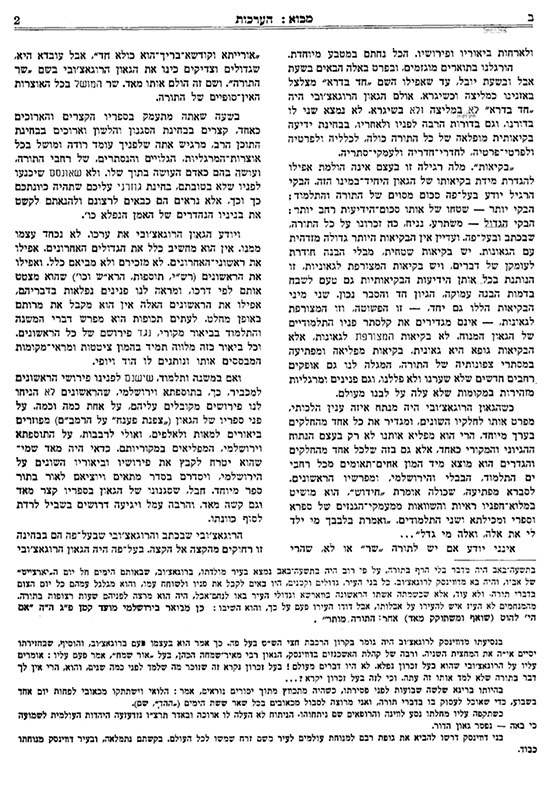
I wrote:
Look at the end of the first paragraph of the note on p. 2. The “problematic” quotation of the Rogochover, saying that he will happily be punished for his sin in studying Torah, as the Torah is worth it, has been deleted. Instead, the Rogochover is portrayed as explaining his behavior as due to the passage in the Yerushalmi. While all the other authors who discuss this matter and want to “defend” the Rogochover claim that his real reason for studying Torah was based on the Yerushalmi, in R. Kasher’s work this defense is not needed as now we have the Rogochover himself giving this explanation!
Yet the Rogochover never said this. R. Zevin’s text has been altered and a spurious comment put in the mouth of the Rogochover. By looking carefully at the text you can see that originally R. Zevin was quoted correctly. Notice how there is a space between the first and second paragraphs and how the false addition is a different size than the rest of the words. What appears to have happened is that the original continuation of the paragraph was whited out and the fraudulent words were substituted in its place. Yet this was done after everything was typeset so the evidence of the altering remains.
I had forgotten that the 1976 edition of Mefaneah Tzefunot, which is the one found on Otzar ha-Hokhmah and hebrewbooks.org, was the second publication of the book. I thank David Scharf for reminding me of this and for sending me copies of the following pages. Here are the Hebrew and English title pages of the first edition.
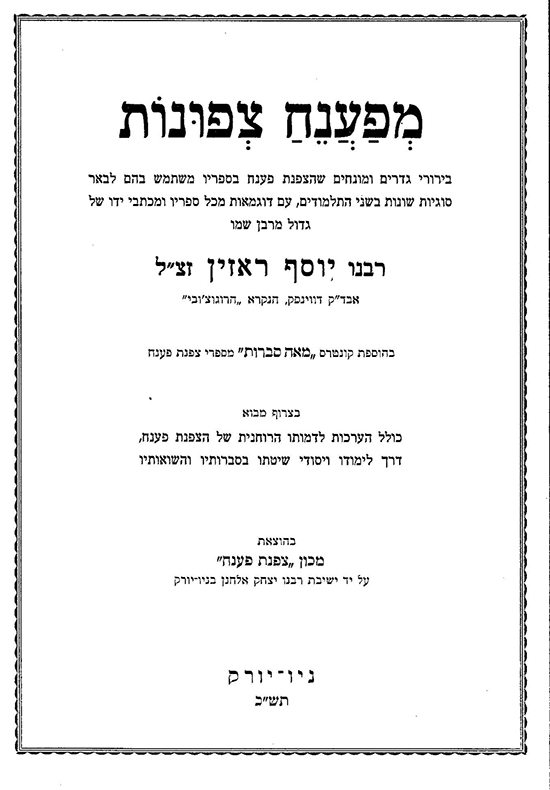
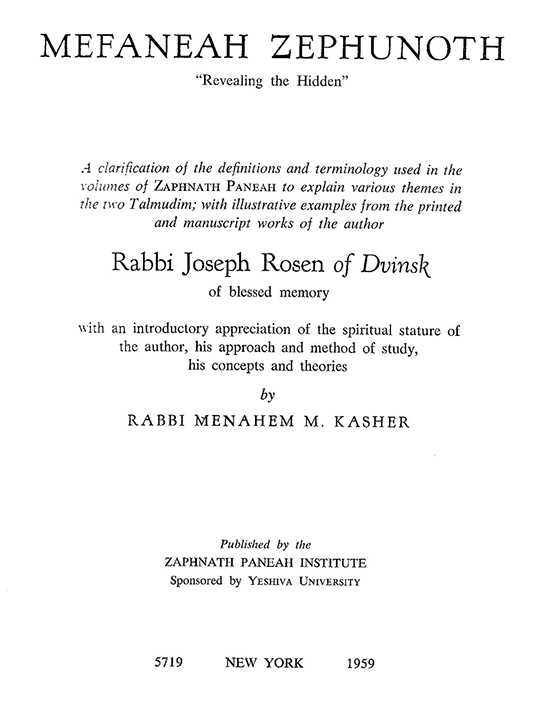
Notice how the two title pages have different publication dates. At that time, Yeshiva University was helping to fund R. Kasher’s work on the Rogochover.[5]
Here is page 2 of the preface.

As you can see, in the original publication the text from R. Zevin appears in its entirety. It is only in the second edition that R. Kasher altered what R. Zevin wrote.
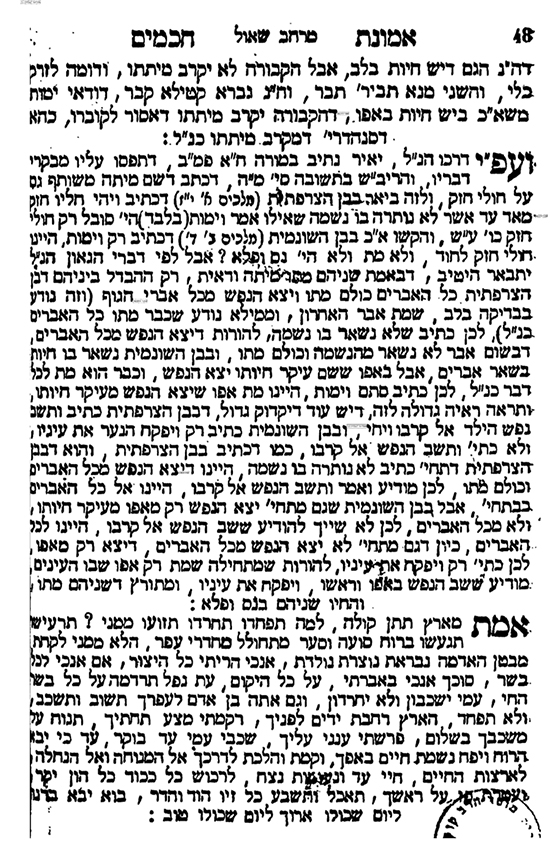
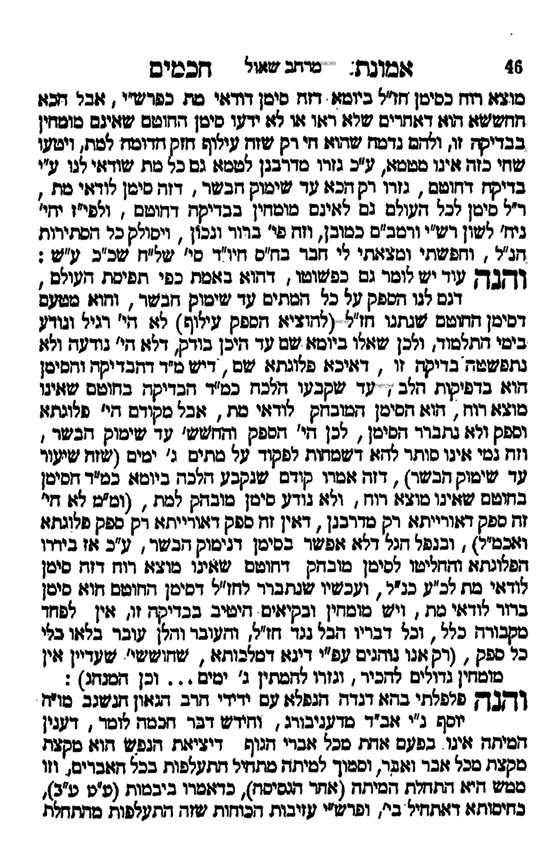
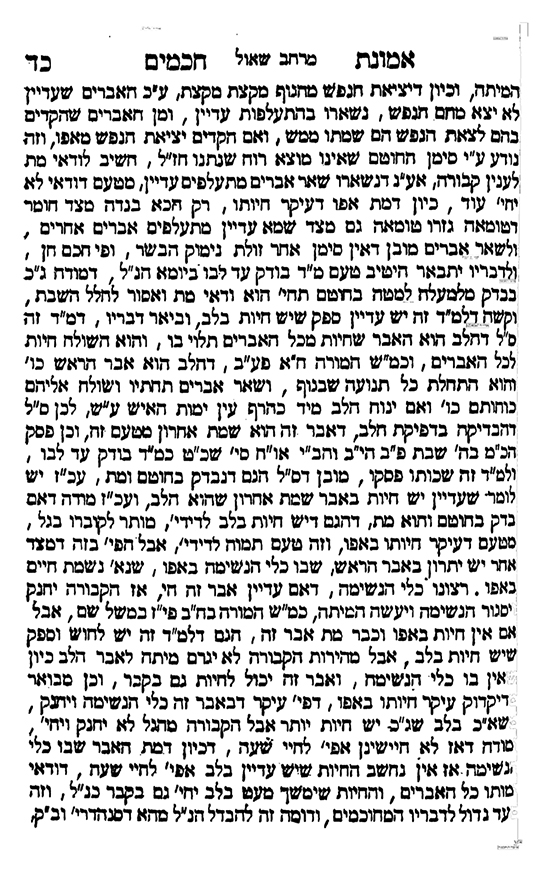
There is a good deal more to say about the Rogochover, so let me add another point. In 1892 R. Dov Baer Judah Leib Ginzberg published his Emunat Hakhamim. Included in it, on pages 23b-24b, is a report of how the Rogochover understood the time of death. I believe that what he states can be used to support the argument that brain death is equal to halakhic death. Here are the pages.
The matter of antinomianism, and in particular the Rogochover violating halakhah in the name of a higher purpose, is of interest to many people. In a future post I will cite an example concerning which I think everyone (or most everyone) will agree that even though the halakhah is clear, nevertheless, even the most pious will not hesitate to violate the halakhah in this particular case, again, because of a larger concern.
For now, I want to call attention to another who, like the Rogochover, was very unusual. R. Shlomo Aviner writes as follows:[6]

בישיבת “מרכז הרב” היה גאון אחד בשם הרדיצ’קובר, שהיה מתנהג בצורה משונה. הוא היה נכנס לשירותים עם ספר הרמב”ם. אמרו לו: אסור! ותשובותו: “הרי גם הרמב”ם עצמו היה נכנס לשרותים!”כשנפטר, היו האנשים נבוכים בהספד שלו, שהרי היה תלמיד חכם, אך התנהג בצורה מוזרה מאד. הרב נתן רענן, חתנו של מרן הרב, הספיד אותו ואמר, שגדולתו היתה אהבת התורה, ומרוב אהבת התורה עשה דברים שלא יעשו. הוא חטא חטאים שנבעו מאהבת התורה.

R. Aviner speaks about a gaon known as the Radichkover who was quite strange. He would go into the restroom holding a copy of the Mishneh Torah. When he was told that this is forbidden, he replied that Maimonides himself went to the restroom! In other words, if Maimonides could go into the restroom then certainly his book can be brought into it. The Radichkover actually tells this story himself about bringing R. Reuven Katz’s book, Degel Reuven, into the restroom.[7]
When he died, people did not know how to eulogize him, because on the one hand he was a great talmid hakham, but on the other hand he acted in a very strange manner. R. Aviner tells us that R. Natan Ra’anan, the son-in-law of R. Kook, delivered the eulogy and said that his greatness was his love of Torah, and due to this great love he did things that were improper. “He sinned yet these sins arose from his love of Torah.”
It is obviously not very common that a eulogy mentions improper things done by the deceased. It is also understandable why, due to his unconventionality, the Radichkover reminds people of the Rogochover. For those who have never heard of him, his name was R. Yaakov Robinson (1889-1966), and before coming to Eretz Yisrael he studied with R. Baruch Ber Leibowitz. You can read more about him here and here. Two responsa in R. Moshe Feinstein’s Iggerot Moshe were sent to the Radichkover. Both of these responsa are from 1933, when R. Moshe was still in Russia.[8]
If you look at the Wikishiva page on the Radichkover here, it says that he died in 1977. So how do I know that this is incorrect and that he died in 1966? Because he died at the same time as R. Jehiel Jacob Weinberg. Here is a page from Beit Yaakov, Shevat 5726, p. 31, and you can see the announcement of both of their funerals.

It is typical of an Agudah publication like Beit Yaakov that it would falsely state that R. Weinberg was connected for many years with Agudat Israel. This is as false as the newspaper’s statement that he served as rosh yeshiva in Montreux.
A number of sharp comments of the Radichkover became well known in the Jerusalem yeshiva world and are mentioned in the two sites I linked to above. See also here for more of his sayings. Here is one I liked, which was written by the Radichkover in one of his works (mentioned here).[9]
הבוקר אחרי התפילה ניגש אלי יהודי ושאל אותי למה אני יושב ב”ויברך דוד”. חשבתי לעצמי, זה שאני יושב בלי אשה, זה לא מפריע לו, זה שאני יושב בלי פרנסה, זה לא מפריע לו, מה כן מפריע לו, שאני יושב בויברך דוד . . .
Here is another great story dealing with the Hazon Ish (mentioned here)
ר’ יענקל היה נתון תדיר בתחושת רדיפה. מעולם לא אכל אוכל שלא הכין בעצמו ועוד שאר דברים ע”ז הדרך. פעם נזעק לביתו של החזון אי”ש בטענה כי אחדים מבני הישיבה ניסו להרעילו. מה עליו לעשות. שאלו החזון אי”ש: “מה שמו בכוס קודם – את התה או את הסם”. הרהר ר’ יענקל קלות וענה: “קודם את התה ואח”כ את הסם”. נענה החזו”א: “אנחנו הרי פוסקים שתתאה גבר”. ונח דעתיה.
In the recently published conversations of the late R. Meir Soloveitchik, Da-Haziteih le-Rabbi Meir, vol. 1, p. 159, the Hazon Ish’s wife is quoted as saying as follows about the Radichkover: 

מה”שברי לוחות”, אפשר לראות ולשער מה היו הלוחות השלמות, כאשר היה בריא

While the Radichkover never published any full-length books, he published a number of short pieces. Here is the first page of his Masa Dumah.

Here is the first page of his Olam Gadol Oleh ve-Olam Katan Shokea.

A short glance at either of these works should suffice to show that we are not dealing with a “normal” talmid hakham. In Olam Gadol, p. 10, he reports that the Rogochover said about him that he was the greatest Torah scholar alive! Here is page 15 of Olam Gadol. It hardly needs to be said that what he includes here about the locked rest rooms is not the typical material found in seforim.

In Masa Dumah, p. 8, he makes the following sharp comment about R. Joseph Kahaneman. “They asked me in the Ponovezh yeshiva, what I have to say about the Ponovezher Rav. I said to them that he is greater than the Maharal of Prague. The Maharal created one golem and he created three hundred golems. The Ponovezh Yeshiva is a factory for am ha’aratzut.”
Excursus
The people who saw the Radichkover sitting during Vayvarekh David were bothered since everyone knows that this is recited standing. The ArtScroll siddur states: “One must stand from ויברך דויד until after the phrase אתה הוא ה’ הא-להים, however there is a generally accepted custom to remain standing until after ברכו.” I don’t like this formulation. On what basis can ArtScroll state that “one must stand”? The word “must” means that we are dealing with a halakhah, i.e., an obligation. But that is not the case at all. Standing in Vayvarekh David is only a minhag, like much else we do in the prayers.[10] As such, I think it would have been proper for ArtScroll to write, “The generally accepted practice is to stand from ויברך דויד” etc.
R. Moses Isserles, Shulhan ArukhOrah Hayyim 51:7, refers to standing in Vayvarekh David, and his language is as follows:[11]
ונהגו לעמוד כשאומרים ברוך שאמר ויברך דוד וישתבח

On this passage, the Vilna Gaon writes: לחומרא בעלמא, “it is only a stringency”. R. Jehiel Michel Epstein, Arukh ha-Shulhan, Orah Hayyim 51:8, also writes that there is no halakhah to stand for Vayvarekh David.
ומצד הדין אין שום קפידא לבד בשמ”ע ומחויבים לעמוד וקדושה וקדיש וברכו.
R. Epstein returns to this matter in Arukh ha-Shulhan, Yoreh Deah 214:23. This passage is not well known as this volume of Arukh ha-Shulhan was only printed in 1991 and is not included in the standard sets of Arukh ha-Shulhan that people buy. R. Epstein writes:
מדינא דגמ’ מותר לישב בכל התפלה לבד שמונה עשרה דצריך בעמידה ושיש הרבה נוהגים ע”פ מה שנדפס בסידורים לעמוד כמו בויברך דוד וישתבח ושירת הים וכיוצא בהם גם זה אינו מנהג לקרא למי שאינו עושה כן משנה ממנהג וראיה שהרי יש מן הגדולים שחולקים בזה.
According to R. Epstein, one does not even violate a minhag by sitting for Vayvarekh David and the rest of the prayers through Yishtabah.
So we see that when it comes to standing, Vayvvarekh David has the same status as Yishtabah, i.e., standing for both is minhag. Yet ArtScroll mistakenly separates the two, regarding the standing for Vayvarekh David as halakhah and the standing for Yishtabah (and everything in between) as “a generally accepted custom.” It is worth noting that the Mishnah Berurah, Orah Hayyim 51:19, only mentions the custom of standing in Vayvarekh David, not the current practice of standing until after Yishtabah. I must note, however, that the Kaf ha-Hayyim, Orah Hayyim 51:43, quotes R. Isaac Luria that one has to stand, צריך לעמוד, during Vayevarekh David. This is similar to ArtScroll’s formulation, but I find it hard to believe that ArtScroll’s instructions are based on kabbalistic ideas.
R. Jacob Moelin (the Maharil) did not stand for Vayvarekh David. See Sefer Maharil, Makhon Yerushalayim ed., Hilkhot Tefilah, no. 1, p. 435, and R. Yair Hayyim Bacharach, Mekor Hayyim 51:7. See also R. Jacob Sasportas, Ohel Yaakov, no. 74, for a report that in Hamburg they did not stand for Vayvarekh David.
R. Samuel Garmizon (seventeenth century), Mishpetei Tzedek, no. 70, was asked about someone who was accustomed to stand in Vayvarekh David (and also in Barukh She-Amar) but now wishes to sit. Is he allowed to? R. Garmizon states that if he mistakenly thought that it was an obligation to stand and has now learned that it is only a pious practice (minhag hasidim), then he is permitted to sit and it is not regarded as if he took on a stringency as an obligation. The Yemenite practice is also not to stand for Vayvarekh David. See R. Yihye Salih, Piskei Maharitz, ed. Ratsaby, vol. 1, p. 118.
While readers might find this all interesting, they might also be wondering what it has to do with the Radichkover, since hasn’t Ashkenazic practice in the last few generations been universally to stand? Actually, this has not been the case. R. Israel Zev Gustman stated that in the Lithuanian yeshivot the practice was to sit for Vayvarekh David, and also for Yishtabah. They only stood for Barukh She-Amar and the kaddish after Yishtabah. See Halikhot Yisrael, ed. Taplin (Lakewood, 2004), p. 117.
R. Shlomo Zalman Auerbach said that the general practice is to sit for Vayvarekh David. See R. Nahum Stepansky, Ve-Alehu Lo Yibol, vol. 1, p. 61:
יש הרבה דברים שכתוב שנהגו לעמוד בהם, ואנחנו רואים שנוהגים שלא לעמוד בהם. ב”ויברך דוד” כותב הרמ”א שנהגו לעמוד – ולא עומדים.
I find this astounding. I have been to Ashkenazic synagogues all over the word and I have never seen people sit for Vayvarekh David. Yet R. Shlomo Zalman says that this is what people do. This passage comes from a discussion of how R. Shlomo Zalman dealt with a young yeshiva student who pressed him that people in the synagogue should stand when someone gets an aliyah and recites Barkhu. R. Shlomo Zalman replied that the minhag is to sit, adding, “You don’t see what people do?!” In other words, the fact that people sit when someone gets an aliyah shows us that this is the minhag and it should not be changed, despite what might appear in various halakhic texts.
Regarding standing during prayers, I have noticed something else. When I was young many of the old timers would sit for the various kaddishes. Today, in the Ashkenazic world, it seems that everyone stands for every kaddish, and this is in line with what R. Moses Isserles writes in Shulhan Arukh, Orah Hayyim 56:1. Also, it seems that for the communal mi-sheberakh for sick people everyone also stands, and in some shuls they announce that everyone should stand. Why is this done? I cannot think of any reason to stand for this mi-sheberakh unless it is a way to get people to stop talking. 

Michael Feldstein recently commented to me that in the last ten years or so he has seen something that did not exist in earlier years, namely, people standing for Parashat Zakhor. I, too, noticed this in my shul, but it has only been going on for a year or two. This year, no one announced that people should stand. Some just stood up on their own and pretty much the entire shul then joined in. Unless the rabbis start announcing that people can sit down, in a few years it will probably become obligatory to stand for Parashat Zakhor, much like it now seems to be obligatory to repeat the entire verse, whereas when I was young the only words to be repeated were תמחה את זכר עמלך. (I always paid attention to this as Ki Tetze is my bar mitzva parashah.) Today, if the Torah reader tries to repeat only these words, they will tell him to go back and repeat the entire verse. What we see from all of this is that customs are constantly being created, and they often arise from the “ritual instinct” of the people, without any rabbinic guidance.

Two final points: 1. In the word ויברך the yud is a sheva nah (silent shewa). 2. The accent is on the second to last (penultimate) syllable, the ב, not on the final syllable, the ר. This word also appears in Friday night kiddush, and it is very common to hear people, including rabbis, make the mistake of treating the yud as a sheva na (vocal shewa) and also putting the accent on the last syllable. Many people also make a mistake at the beginning of kiddush by pronouncing the word ויכלו with the accent on the second to last syllable, the כ, when it should be on the last syllable, the ל. Another common pronunciation mistake is found in the Shabbat morning kiddush. וינח has the accent on the second to last syllable, the י, not on the final syllable, the נ.

Regarding the instructions in the ArtScroll siddur, another example of confusion is found in the commentary on Av Ha-Rahamim, pp. 454-455. ArtScroll writes:
As a general rule, the memorial prayer [Av ha-Rahamim] is omitted on occasions when Tachanun would not be said on weekdays, but there are any numbers of varying customs in this matter and each congregation should follow its own practice. During Sefirah, however, all agree that אב הרחמים is recited even on Sabbaths when it would ordinarily be omitted, because many bloody massacres took place during that period at the time of the Crusades. Here, too, there are varying customs, and each congregation should follow its own.
In the second-to-last sentence, ArtScroll says that “all agree”, but in the very next sentence it states that “there are varying customs.” If there are varying customs, then obviously not “all agree”. Incidentally, R. Zvi Yehudah Kook said Av ha-Rahamim every Shabbat, i.e., even when the accepted minhag is to omit it, since he felt that after the Holocaust this was the appropriate thing to do. See Va-Ani be-Golat Sibir (Jerusalem, 1992), p. 298.
Finally, since I have been speaking about different customs in prayer, I should mention something that I forgot to include in my post here, dealing with China. I believe that, outside of Israel, there is only one Ashkenazic synagogue in the world that has birkat kohanim every day.[12] This is Ohel Leah in Hong Kong. (R. Mordechai Grunberg, who has traveled all over the world as an OU mashgiach and currently works in China, told me that as far as he knows this statement is correct. I had the pleasure to spend Shabbat with him and three mashgichim from the Star-K at the wonderful Chabad House in Shanghai in June 2018.)  
I have no doubt that the reason for the Ohel Leah minhag is because its nineteenth-century community was Sephardic. At some time in the twentieth century (no one was able to tell me when) the liturgy became Ashkenazic, but the daily birkat kohanim was kept. Interestingly, although the liturgy is Ashkenazic, it is nusah sefard. I assume the reason for this is that when they decided to adopt the Ashkenazic liturgy they wanted it to still have a Sephardic flavor, and that is why they chose nusah sefard.
* * * * * * *
2. Simcha Goldstein called my attention to how earlier this year the 5 Towns Jewish Times “touched up” a picture of Ivanka Trump.

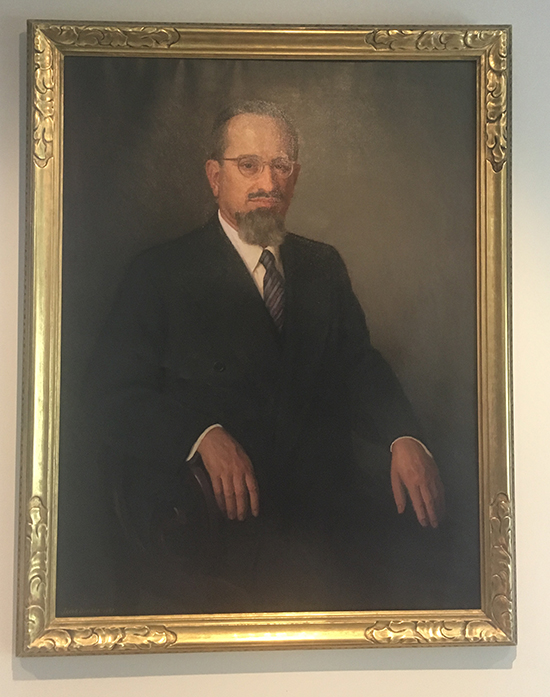
3. Here is a painting of the Rav, R. Joseph B. Soloveitchik. It was commissioned by his wife when he was fifty years old. The Rav later gave this painting to Rabbi Julius Berman, and it is currently hanging in his home. I thank Rabbi Berman who graciously allowed me to publish a picture of the painting.
4. Tzvi H. Adams contributed three fascinating and thought-provoking posts to the Seforim Blog dealing with the impact of Karaism on rabbinic literature. He has now published a comprehensive article on this matter in Oqimta, available here. Its title is “The Development of a Waiting Period Between Meat and Dairy: 9th-14th Centuries.” There is a good deal to say about this article, but let me just make a couple of comments. On p. 4 he writes:

Even many minhagim extant today were arguably initiated as a response to the Karaite movement. For example, many historians agree that the recital of the 3rd chapter from Mishnat Shabbat, “Bamme Madlikin,” on Friday evenings following the prayer service was introduced during the time of the geonim with the intent of reinforcing the rabbinic stance on having fire prepared before Shabbat, in opposition to the Karaite view that no fire may be present in one’s home on Shabbat.[13] Similar arguments have been made for the origins of the custom of reading Pirkei Avot, the introduction of which traces rabbinic teachings to Sinai, on Shabbat afternoons. Recent scholarship has demonstrated that the creation of Ta’anit Esther in geonic times was likely a reaction to Karaite practices. 
Later in the article, p. 57 n. 141, Adams mentions what might be the most prominent example of a response to Karaite practices, namely, reciting a blessing on the Shabbat candle. This blessing does not appear in the Talmud.[14] It is a geonic innovation, and according to R. Kafih it was instituted in opposition to the Karaite view that no fire should be burning in one’s home on the Sabbath.[15] He argues that by adding a blessing to the candle lighting, the geonim created an anti-Karaite ritual. While the Karaites would sit in the dark every Friday night, not only would the Jews have light, but they would recite a blessing before lighting the candle,[16] thus showing their rejection of the Karaite position.[17] R. Meir Mazuz makes the exact same point,[18] as does R. Abraham Eliezer Hirschowitz,[19] Isaac Hirsch Weiss,[20] Jacob Z. Lauterbach,[21] and Naphtali Wieder.[22]
In fact, some have argued that not only the blessing but the candle lighting itself was instituted in response to heretics who did not use fire on the Sabbath. As Lauterbach states, “It was as a protest against the Samaritans and the Sadducees.”[23] R. Kafih sees R. Joseph Karo as sharing this opinion. He writes as follows, quoting Maggid Meisharim (and assuming that what the Maggid says represents R. Karo’s view).[24]
וכתב מרן בספרו מגיד מישרים ר”פ ויקהל ואמר ביום השבת, למימר דדוקא ביום השבת גופיה הוא דאסור לאדלקא, אבל מבעוד יום לאדלקה ליה ויהא מדליק ומבעיר ביומא דשבתא שרי. ולאפוקי מקראים דלית להו בוצינא דדליק ביומא דשבתא ע”ש. נראה שגם מרן ראה בחובת הדלקת נר בשבת גם פעולה נגד דעות הכופרים בתורה שבע”פ שעליהם נאמר ורשעים בחשך ידמו.
Regarding the Shabbat candle, it is also worth noting that R. Judah Leib Landsberg actually stated that the practice of candle lighting was adopted from the Persians. Since the Jews were so attached to what was a pagan practice, Ezra and Nehemiah directed this practice towards a holy purpose, much like the origin of sacrifices was explained by Maimonides.[25]
ואפילו היה דומה למנהגי הפרסיים, לא היה ביד עזרא ונחמיה הכח והרצון לעקור המנהג הנשתרש באומה משנים קדמוניות, ולכבה האש זר “החברים” מבית ישראל. ובכל זאת למען תת לו איזה חינוך קדושה קדשוהו ותקנוהו להדליק האש של חול לנר קודש לקדושת השבת, כסברת הרמב”ם ז”ל בענין קרבנות כנודע.
He later acknowledged that this was not a serious explanation and claimed that the practice of candle lighting went back to Moses.[26]
One final comment about Karaites: Rashi, Sukkah 35b, s.v. הרי יש, has a strange formulation. In discussing the prohibition to redeem terumah so that an Israelite could eat it, Rashi writes:

הרי יש בה היתר אכילה לכהן, וישראל נמי נפיק בה, או לקחה מכהן הואיל ויכול להאכילה לבן בתו כהן, אבל פדיון אין לה להיות ניתרת לאכילת ישראל, והאומר כן רשע הוא


How is it that Rashi refers to one who makes a mistake in this matter as a רשע? Many people have attempted to explain this passage. R. Isaac Zev Soloveitchik noted that there must have been a sect that believed that it was permitted to redeem terumah, and that is why Rashi responded so sharply.[27] Regarding this suggestion of R. Soloveitchik we can say, חכם עדיף מנביא.

R. Tuvya Preschel’s Ma’amrei Tuvyah, volume 3, recently appeared. On p. 67 it reprints an article that appeared in Sinai in 1966. Preschel points out that the notion that terumah can be redeemed is stated by none other than Anan ben David in his Sefer ha-Mitzvot. It appears that Rashi knew of this Karaite opinion and this explains his harsh reaction. This was a great insight by Preschel, Unfortunately, while this insight has been cited by many in the last fifty years, Preschel is almost never given credit.
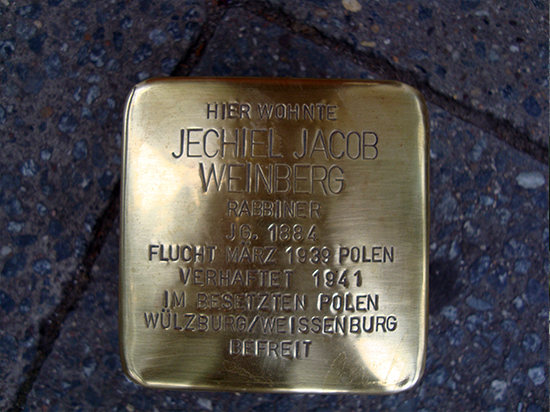
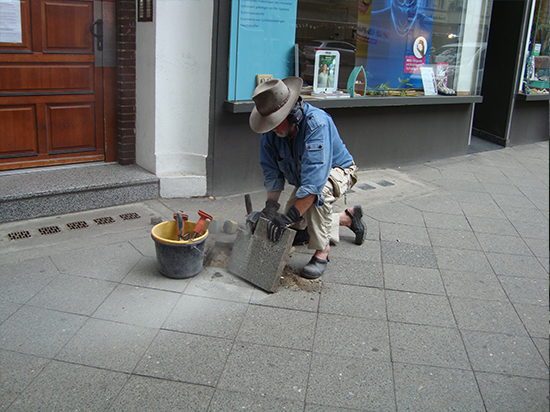
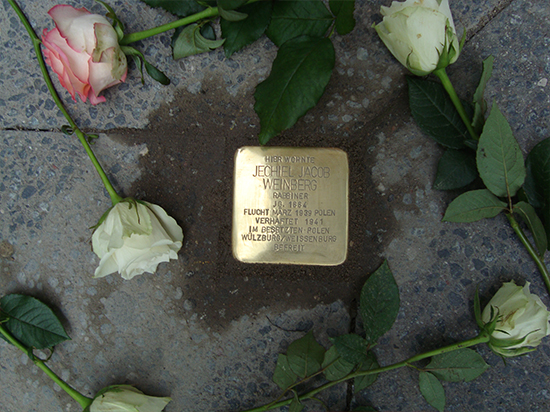
5. Many countries in Europe have Stolpersteins. These are brass plates, created by the artist Gunter Demnig, commemorating martyrs of the Holocaust. They are put in the pavement in front of buildings where the martyrs lived. A few years ago Demnig also started doing this for survivors of the Holocaust. I arranged to have one made for R. Jehiel Jacob Weinberg.
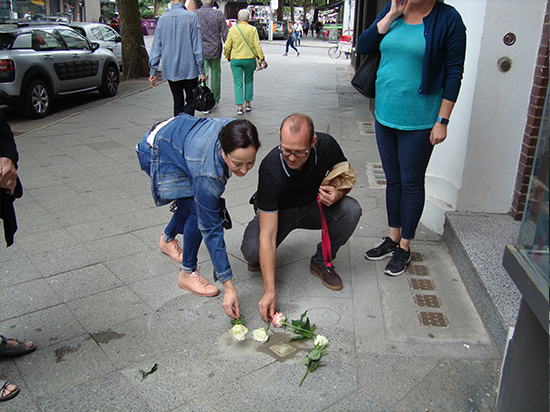
After almost two years of waiting, I am happy to report that on June 18, 2018, a Stolperstein was placed at Wilmersdorfer Strasse 106, in Berlin. There was a little ceremony when the Stolperstein was inserted. Here is a picture of Demnig installing it as well as some other pictures that I think people will find moving.
[1] Yad Peshutah, Hilkhot Rotzeah 5:5.
[2] Yesodot Hinukh ha-Dat le-Dor (Riga, 1937), p. 250.
[3] Sefer ha-Meorot, Moed Katan, ed. Blau (New York, 1964), pp. 73-74 (to Moed Katan 20a).
[4] For a great story about the Rogochover told by R. Menahem Mendel Schneerson, see Likutei Sihot, vol. 16, pp.  374-375.
[5] Yeshiva University’s Gottesman Library also has a large archive of over 2500 letters and postcards sent to the Rogochover. This material was sent to the United States before World War II by the Rogochover’s daughter. I published a lengthy letter from this collection in my article on the dispute over the Frankfurt rabbinate. See Milin Havivin 3 (2007), pp 26-33.
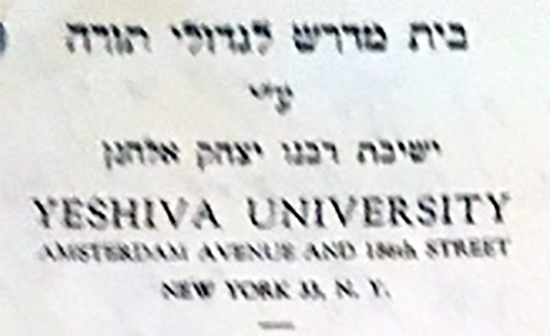
The Zaphnath Paneah Institute at YU no longer exists. When I look at old material from YU, I often come across things that are now only a memory. Here is something I think people might find interesting.

(Unfortunately, the picture I took is not so clear.) The Beit Midrash li-Gedolei Torah was the name of a kollel at YU in the 1940s and 1950s headed by R. Avigdor Cyperstein. I thank his daughter, Mrs. Naomi Gordon, for allowing me to go through his papers where I found the stationery with the name of the kollel. R. Gedaliah Dov Schwartz was actually a member of this kollel. See Ha-Pardes, Tevet 5751, p. 58 and Kislev 5752, p. 1. Today YU has a number of kollels, see here, but none with this name. Does anyone know when this kollel stopped functioning?

[6] Mi-Shibud li-Geulah mi-Pesah ad Shavuot (n.p., 1996), p. 87.
[7] See his Masa Dumah, p. 4.
[8] Iggerot Moshe, Yoreh Deah, vol. 1, nos. 4, 74. The first responsum mistakenly has the place of authorship as London, when it should say Luban. The city name appears correctly in the second responsum, which was written on the same day as the first. See here.
[9] See the Excursus where I discuss standing for Vayvarekh David.
[10] Saying Vayvarekh David is itself only a minhag. See Tur, Orah Hayyim 51:7:
ובתקון הגאונים כתוב יש נוהגים לומר ויברך דוד את ה’

[11] In Darkhei Moshe, Orah Hayyim 51 he writes:

המנהג עכשיו לעמוד מויברך דוד עד תפראתך
From his words we see that people only stood for the first half of Vayvarekh David.
[12] There is a lot of confusion as to how to pronounce the word ברכה in both the singular and plural construct: ברכת and ברכות. The first is pronounced birkat, as there is a dagesh in the כ. The second is pronounced birkhot, as there is no dagesh in the כ, and is parallel to the word הלכות – hilkhot. Interestingly, ברכתי (“my blessing”) does not have a dagesh in the כ even though ברכת does. I don’t think that there is any grammatical rule that can adequately explain all this. We know how the words related to ברכה are pronounced because they are attested to numerous times in Tanakh.

The word הלכות does not appear in Tanakh, and the Yemenite tradition is actually to pronounce it as hilkot, with a dagesh in the כ. See here. When not quoting from Tanakh, the Yemenite tradition is also to pronounce ברכת as birkhat, as in birkhat ha-mazon. See here.
[13] It is not only historians who say this. See R. Yitzhak Yeshaya Weiss, Birkat Elisha (Bnei Brak, 2016), vol. 3, p. 37, and see also R. Shimon Szimonowitz, Meor Eifatekha, p. 4, who cites R. Jacob Schorr and R. Serayah Deblitsky.
[14] A number of Ashkenazic rishonim quote a passage from the Jerusalem Talmud that speaks of a blessing on the Sabbath light, yet this is not found in any extant text and scholars agree that it is not an authentic Yerushalmi text. See the comprehensive discussion in R. Ratzon Arusi, “Birkat Hadlakat Ner shel Yom Tov,” Sinai 85 (1979), pp. 63ff. See also Jacob Z. Lauterbach, Rabbinic Essays (Cincinatti, 1951), p. 459 n. 98 and Sefer Ra’avyah, ed. Aptowitzer, vol. 1, p. 263 n. 10.
[15] See Teshuvot ha-Rav Kafih le-Talmido Tamir Ratzon, ed. Itamar Cohen (Kiryat Ono, 2016), pp. 162-163, and R. Kafih’s commentary to Mishneh Torah, Hilkhot Shabbat 5:1, n. 1.
[16] I use the word “candle”, rather than the plural, “candles”, as the practice of lighting two candles only originated later, in medieval Ashkenaz. See R. Gedaliah Oberlander, Minhag Avoteinu Be-Yadenu: Shabbat Kodesh (Monsey, 2010), pp. 11ff. I was surprised to learn that R. Meir Soloveitchik’s daughters each lit a Shabbat candle and recited the blessing from the time they were three years old. See Da-Haziteih le-Rabbi Meir, vol. 1, p. 323.
[17] In later years we find that some Karaites adopted the practice of lighting candles on Friday night. Se Dov Lipetz, “Ha-Karaim be-Lita,” in Yahadut Lita (Tel Aviv, 1959), vol. 1, p. 142
[18] Bayit Ne’eman 38 (25 Heshvan 5777), p. 3, Bayit Ne’eman 118 (10 Tamuz 5778), p. 2 n. 9. In She’elot u-Teshuvot Bayit Ne’eman, p. 190, he does not present this approach as absolute fact, but states that it is “nearly certain”.

וקרוב לודאי שברכת נר שבת נתקנה בימי הגאונים להוציא מדעת הקראים

[19] Otzar Kol Minhagei Yeshurun (St. Louis, 1917), p. 232.
[20] Dor Dor ve-Doreshav (Vilna, 1904), vol. 4, p. 97. Weiss points to other examples of practices that he suggests were a response to Karaites, such as counting the omer at night, betrothing a woman with a ring, and reciting רבי ישמעאל אומר in the morning prayers. R. Judah Leib Maimon claims that the practice of a Saturday night melaveh malka was instituted by the geonim in opposition to the Karaites, who saw the Sabbath as a difficult and depressing day, in contrast to traditional Jews who find it difficult to part with the Sabbath. See Sefer ha-Gra, ed. Maimon (Jerusalem, 1954), vol. 1, p. 80.
[21] Rabbinic Essays, p. 460. He writes that the blessing was “probably intended as a more emphatic protest against the Karaites.”
[22] “Berakhah Bilti Yeduah al Keriat Perek ‘Bameh Madlikin,’” Sinai 82 (1978), p. 217.
[23] Rabbinic Essays, p. 459. See also Yehudah Muriel, Iyunim ba-Mikra (Tel Aviv, 1960), vol. 2, p. 131.
[24] Commentary to Mishneh Torah, Hilkhot Shabbat 5:1, n. 1.
[25] Hikrei Lev (Satmar, 1908), vol. 4, p. 84.
[26] Ibid, pp. 84, 86ff.
[27] Shimon Yosef Meler, Uvdot ve-Hanhagot mi-Beit Brisk (Jerusalem, 2000), vol. 4, p. 310.


A Letter Concerning Prof. Marc Shapiro’s book “Changing the Immutable”

A Letter Concerning Prof. Marc Shapiro’s book Changing the Immutable
By Eli Meyer Cohen
כבוד…
אחדשה”ט, ברצוני להעיר
כמה הערות בנוגע למש”כ מרק שפירא אודות הדברים המובאים בפי’ ר’ יהודה החסיד. שלדעת
גדולי פוסקי הדור ההוא הגר”מ פיינשטיין, הגרש”ז אויערבאך, הגרי”ש אלישיב
והגרי”י ווייס בעל מנחת יצחק ז”ל, נדפסו שם דברי כפירה  והיות שיודע אני שבטח כבודו יערוך ביקורת כללית על
ספרו, חושבני שדברים אלו יהיו לתועלת עבודתו.
ראשית אציג רקע היסטורי
לסיפור. הדבר קרה בשנת תשל”ו, כפי שמפורש בשני התשובות שכ’ הגרמ”פ באג”מ
יו”ד ח”ג סימנים קי”ד – קט”ו. התשובה הראשונה נכתבה לר’ דניאל
לוי בסוף אדר ראשון, והשניה נכתבה להגרש”ז אויערבאך בח”י תמוז. אני למדתי
אז בארץ וידידי ר’ בערל פיינשטיין נכדו של הגרמ”פ הגיע ארצה ואמר לי שהראש ישיבה
נתן לו שליחות להוליך מכתב בענין זה להגרשז”א ולרב אלישיב, ואכן כן עשה. כעת לאחר
ט”ל שנים שאלתי אותו אם עדיין הפרטים בזכרונו, ומסרם לי כאילו הדבר קרה היום.
הוא נכנס אצל הגרשז”א
וקרא את המכתב [שנדפס אח”כ סי’ קט”ו] לאיטו מלה במלה, ואמר שמלשון המדפיס,
ניתן לשמוע שדעתו היא, שלפי “מחשבת זמננו” לא מתאימים הדברים להדפסה, ומשמע
שכאילו לא יאות הדבר לקיצוני זמננו כהנטורי קרתא [כך אמר], אך הוא טועה בזה כי הדברים
הינם כפירה לחלוטין לכל אדם ולכל הדורות. גם הר’ אלישיב ראה את המכתב ולאחר קריאת המכתב
אמר לר’ בערל שיחזור לרשז”א וימסור לו שיצוה לבנו שהיה מיודעו של המדפיס שיעצרו
את ההדפסה.
וממילא מה שמשתמע מדברי
מרק שפירא שהקטעים הבעייתיים הפריעו להגרמ”פ בלבד וכאילו היתה זו מלחמת יחיד
– אין זה הדבר. אלא שאלו את פוסקי הדור של אז וכולם פסקו שזוהי כפירה, ומוכרחים להוציאם
ולעשות halachic censorship.  אלא שהפוסקים
ביניהם החליטו לא לפרסם את הדברים, משום שהם סברו להשקיט את הדבר, עד שהגיע ר’ בערל
ומכתבו בידו שדעת הגרמ”פ לפרסם את הענין כמפורש בדבריו בסוף התשובה לרש”ז,
[כ”ז מבוסס על עדותו של ר’ בערל הנ”ל שכלל גם את בעל המנח”י ביחד עם
רש”ז והרב אלישיב המוזכרים בתחילת התשובה הנ”ל.]
ומעניין מאוד איך לא הביא
שפירא את ה’מחקר’ של הגרמ”פ ד”ה ‘וכן מש”כ בדבר’. והביא ראי’ מהאב”ע
שלא היה יכול לסבול את הפירוש המופיע בר”י החסיד בענין עציון גבר – שכן מצא את
אותו פירוש בשם א’ יצחקי ועל זה אמר האב”ע “‘חלילה חלילה … וספרו ראוי
להישרף’. וא”כ נמצא שכבר הוא דין פסוק מהאב”ע שצריך לשרוף ספר כזה”.
ומש”כ אודות האב”ע
שגם בספריו יש דברים בעייתיים – ע’ בס’ הכתב והקבלה בראשית כז,יט עה”פ אנוכי עשו
בכורך,  וז”ל: ומה שהוזכר בפי’ האב”ע
לחשבו למשקר ולמכזב, איננו מלשון החכם ראב”ע, כי ידענו מכמה מקומות כי יד אחרים
שלטה בפירושיו”. וע’ גם בתו”ש פרשת שמות עמ’ רנ”ד (לא הובא ע”י
שפירא) שהרבה דברים מהקראים הוכנסו בספר אב”ע ובפרט בחומש שמות.
ועי’ גם בפירושים ופסקים
לרבנו אביגדור הצרפתי בענין המבוכה הידועה בביאור דברי רש”י בשמות ט,י”ד
שכתב רש”י “מכות בכורות”, ויש שגרסו “בְּכוּרוֹת”
– שפי’ זה הגיע מהמלמדים והקראים וטעות בידם, פי’ משום דלקו התבואות והפירות,
וטעות הוא בידם כי לא מצאו ידיהם ורגליהם בבית המדרש”. [ואגב ניתן ללמוד משם חידוש
היסטורי – שהקראים עסקו גם בלימוד פירוש רש”י ולא רק במקרא עצמו].
עוד דבר שראוי לפרסם – וכנראה
נעלם ממרק שפירא – שהגרמ”פ תפס אומנות זו גם בכתבי הרמב”ן – הלא ידוע דברי
הרמב”ן בפ’ לך לך פי”ב פסוק י’ ודע כי אברהם אבינו חטא חטא גדול בשגגה שהביא
אשתו הצדקת במכשול עון מפני פחדו פן יהרגוהו, והי”ל לבטוח בשם שיציל אותו….
גם יציאתו מן הארץ שנצטוה עליה בתחילה מפני הרעה עון אשר חטא… ועל המעשה הזה נגזר
על זרעו הגלות… עכ”ל.
והנה אני רשמתי לעצמו מהכת”י
של הגרמ”פ של ספרו דרש משה עה”ת [שנדפס לאח”ז ע”י ארטסקרול בשנת
תש”נ ושם הושמט הענין! וז”ל: טעות גדול טעה לדבר סרה על אברהם ועל דבר שנהג
כן כל ימיו כמפורש בקרא בכ”מ אשר יבוא אמרי אחי הוא, וכן עשה יצחק, ולכן הוא דין
פסוק שכן צריכים כ”מ להתנהג, ומצוה גדולה למחוק דבר זה מספרי הרמב”ן, ע”כ.
[שוב מצאתי בלשון כעי”ז בדרש משה ח”ב עמ’ י.]
והדבר מובא בס’ קול רם לתלמידו
המקורב לו ר’ אברהם פישעליס ז”ל [שהעתיק דברי רבו בדקדוק עצום] ח”ב ע’ כ”ב,
ושם כ’ שמש”כ הרמב”ן על שרה שחטאה אמנו בענוי זה שעינתה הגר-  “א”א לנו לומר איזה חטא על האבות והאמהות
אם זה לא נאמר מחז”ל הקדושים, ומצינו שהרמב”ן נמי כתב על אברהם אבינו שחטא
חטא גדול…. וגם זה א”א לומר על אברהם אבינו, ויותר טוב לומר שזה טעות סופרים”
עכ”ל.
[אגב ראוי להעיר שרש”ר
הירש ז”ל בבראשית יב, ב בונה עלדברי הרמב”ן, (ועוד) הגם שאין דרכו להביא
הרמב”ן בפירושיו, שמטרת התורה היא להודיענו גם “חסרונותיהם” של האבות
וזהו חלק מהתורת אמת שקיבלנו אנו, ע”ש. ולהגרמ”פ הבנין נופל, כי הרמב”ן
הלזה אינו אמת אלא מזוייף].
ומדי דברי בענין ה’אמת’
אציע לשונו של בעל משנה הלכות בתשובתו (חלק יב, סי’ ריד) על ענין ר”י החסיד הנ”ל,
וזה לשונו: “אבל האמת כי לא אאמין אשר דברים אלו יצאו מפי הגרמ”פ
אלא נלפענ”ד שאיזה תלמיד טועה כתבו והכניסם בין מכתביו… וכמובן גיחוך
זה רחוק מהאמת וקרוב לעניות בדעת וחוצפה נוראה לדבר סרה על דבר שיצא מעטו של הגרמ”פ
זצוק”ל, הלא אם היה מבקש האמת היה יכול בקלות להרים את הטלפון ולברר אצל ר’ דניאל
לוי השואל או אצל מקורביו או אצל רשז”א ואצל הר’ אלישיב המוזכרים בתשובה השניה
שם.
אסיים בהערה אישית שהרגשתי
בקראי ענין זה בספרו של מרק שפירא. בעי’ 59 כשכותב אודות “a recent edition of the
Mikraot Gedolot Pentateuch simply removes one of the Rashbam’s comments…”
ואני מתפלא עליו האם חסר
דיו בקולמוסו מלהזכיר שם המו”ל? ולמה מפחד מלגלות האמת כדרכו וכשיטתו בכל ספרו?
וכעת מוטל עלינו עול המחקר וחיפוש המקור, כיאות למבקשי האמת והחכמה.
בכבוד רב
קטון שבחוקרים
אלי’ מאיר

:Editors note
. For more disscussion about Rashi and makkat bekhorot, see here and here 


וְהָאֱמֶת וְהַשָּׁלוֹם אֱהָבוּ; On Changing the Immutable by Marc B. Shapiro

וְהָאֱמֶת וְהַשָּׁלוֹם אֱהָבוּ; On Changing the Immutable by Marc B. Shapiro
By Yitzchok Stroh
Professor Marc Shapiro’s latest work, Changing the Immutable, contains considerable interesting and pertinent information for the student of Jewish history. As stated on the cover, the author attempts to reveal how the (Jewish) orthodox ‘establishment’ silences both past and present dissenting voices through “Orthodox Judaism Rewriting Its History.” I don’t intend this to be a review of the entire work (that would take a lot more time and space), however I did want to share some of my frustration here, because I sense that the author’s bias affected his objectivity, and I am afraid that many a reader will be left with an impression that in many ways does not reflect the reality of this complex topic. In this article, I would like to examine one passage of Shapiro’s work to illustrate this point. In chapter eight, entitled, “Is the truth really that important?” Shapiro writes:
Because my purpose in this chapter is to chart the outer limits of what has been viewed as acceptable when it comes to falsehood and deception. I will be focusing on the more ‘liberal’ positions. My aim is to show just how far some rabbinic decisors were willing to go in sanctioning deviations from the truth. One must bear in mind, however, that there are often views in opposition to the ones I shall be examining. Perhaps this knowledge can serve as a counterweight to the shock that many readers will experience upon learning of some of the positions I will mention.
One ‘liberal’ position was expressed by R. Moses Isserles, who went so far as to say that one can even slander someone for the sake of preserving the community. The particular case he was discussing concerned a terrible community dispute that had created the possibility that the Jewish population would be expelled from the city. In what many will find a problematic decision, Isserles offered the opinion, which was then put into action, that it was acceptable to provide false information about an individual whom the government suspected of wrongdoing, if this would alleviate the situation. Although the Talmud states, with regard to giving a man up for execution in response to a demand made by non-Jews, that this is not the way of the pious, Isserles defended his approach: “Even if we did not act in accord with the way of the pious, nevertheless, we acted in accord with the law. I have proven that it is permitted to speak leshon hara [slander] in order to preserve peace.”[1]
Here, Shapiro portrays the רמ”א, the primary codifier of halacha for Ashkenazic Jewry, to have ruled that for the sake of preserving the peace, it is acceptable to provide false information to non-Jewish authorities about a presumably innocent individual whom the government suspected of wrongdoing.
Shocking indeed.
Unfortunately, Shapiro fails to present the תשובה of the רמ”א thoroughly and accurately, and as a result, the reader is left with an erroneous understanding of the opinion of the רמ”א. Furthermore, Shapiro fails to present the relevant section of Talmud precisely, which may lead to further misunderstanding. I am not accusing Professor Shapiro of intentional distortion, but חז”ל do teach us הוי זהיר בתלמוד ששגגת תלמוד עולה זדון — so, with this in mind, I would like to offer a more careful presentation of the Rema’s position as a counterweight for those who’ve read this (inaccurately presented) ‘shocking’ position of the רמ”א.
סימן י”א in  שו”ת הרמ”א is written in complicated rabbinic style, and does not provide a full account of what transpired — but, as the רמ”א writes in the introduction to the תשובה, we should be able to extract sufficient background information as necessary for our purposes[2]:  
The תשובה is a כתב התנצלות[3] (a “writ of justification”) defending actions taken by the בית דין of the רמ”א in response to a local crisis, and as the  רמ”א makes it quite clear in his description of the events, the ensuing bitter results were unexpected and troubling:
 … הנה בכל אלה לשלום נתכוונו בעצם וראשונה, אף כי במקרה מרה היתה באחרונה, ואף מקצת עזי פנים היו בקרבנו ועכשיו מהפכים דברינו לתוהו ובהו. מיהו אנו לשם שמים נתכוונו, והכל נמשך אחר המחשבה והכוונה. אף כי אחריתו ראש ולענה. “Behold in this entire incident our intention was peace, first and foremost, even though by happenstance the end was bitter. There were also a few brazen individuals amongst us, who are now turning things into utter chaos. However, our intent was for the sake of Heaven, and ‘everything follows one’s thoughts and intentions’, even though the end was gall and wormwood.”

While it is probably impossible to reconstruct a precise account of the incident, the following is obvious from the details presented in the תשובה: (1) The government did not suspect anyone of any type of wrongdoing[4]. (2) It was not an individual that was slandered; it was a group of about one hundred respectable community leaders or activists that were slandered. (3) False information was never provided to non-Jewish authorities, and those slandered were not slandered publicly — they were slandered in a private ruling by the decision of a בית דין which was then recorded in a written document. (4) Furthermore, the document was fashioned in a manner which made it evident that the ruling was an exaggeration and not an actual account, and (5) it was drafted only to be used as a means of forcing two opposing sides to reconcile a community quarrel. Unfortunately, (6) the document did become public knowledge and its intention was misconstrued by unscrupulous individuals.[5] And (7) there were dire consequences, probably due to involvement of the non-Jewish authorities, but we do not know what those consequences were.
The actual events that led up to this action are described at length and can be summed up as follows:
A group of pretentious rabbinic and lay leaders[6] convened to place a ban on a certain individual, causing him great harm[7]. (The reason for the ban is not clear.) This individual then sought to take revenge upon those who had placed the ban upon him[8] and was joined by others who sympathized with his cause,[9] ultimately splitting the entire community between his supporters and his enemies[10]. This caused a tremendous desecration of G-d’s name as the strife continued to escalate[11], which led to placing the entire community in danger of being expelled by the authorities[12].
The רמ”א and his colleagues attempted to intercede with the individual’s opponents, but were completely ignored[13], and the matter escalated to the point of death threats against the man upon whom the ban had been placed[14]. In an attempt to resolve matters, the רמ”א and his partners decided to write a fictitious halachic ruling[15], containing exaggerated and slanderous accusations against the individual’s opponents, with the goal being that the individual in question would then use this document to extort the ruling written against him from his enemies, whereby both the documents would be exchanged and destroyed. 
Now, before you extrapolate from here that the רמ”א  had a flippant attitude towards honesty, please consider:
(1) The רמ”א and his colleagues were quite concerned about the possibility that this individual might use the document inappropriately (i.e. reveal its contents to the authorities), and to prevent this, they had him swear a strict oath that he would not show the document to anyone else, and that he would only use it to get his opponents to hand over their original חרם document to him[16]. Anyone familiar with the severity of an oath in Jewish law, and the general fear of swearing falsely at that time, will understand why the outcome was quite a surprise to the rabbis who signed this slanderous document. Furthermore, רמ”א had taken additional steps to insure that the document would be null and void if misused, and as the רמ”א concludes in his justification, “אבל לא נחתם להרע בו לשום אדם חלילה לנו מרשע” (…it was not signed to inflict harm upon any person; G-d forbid that we should do evil).
(2) Regardless of the fact that the slanderous ruling and the resulting document were extremely limited in nature and not meant to be seen by the public (and certainly not the government), the רמ”א was clearly still troubled by the elements of dishonesty. He makes it quite obvious that he felt that he had no choice, and that it was entirely out of concern for the safety of the community that made speaking and writing falsely and negatively about fellow Jews necessary in this case. It is this decision that the רמ”א is attempting to justify in his כתב התנצלות – and as we will see, this was hardly taken lightly.
The רמ”א goes on to quote various sources to support his decision, and proceeds, in rabbinic style, to argue the point by analyzing a Talmudic ruling. Shapiro, when he discusses the Talmudic ruling tells only half the story. Shapiro writes, “The Talmud states, with regard to giving a man up for execution in response to a demand made by non-Jews, that this is not the way of the pious.” However, as we shall see, giving a man up for execution in response to a demand made by non-Jews has nothing to do with the pious — indeed, it is strictly forbidden according to the Talmud. The Mishnah in תרומות rules that if non-Jews were to approach a group of Jewish women and demand that they hand over one of them be defiled or else they would defile all of them, that it is forbidden to hand over one of the women. The Talmud Yerushalmi adds that the same rule would apply in a situation where a non-Jew demands of a group of Jews that they hand over one Jew to be executed or else they would all be killed, that it is likewise forbidden to hand over one of them[17]. 
In this תשובה the רמ”א applies an analogy: Just as it is forbidden to save the lives or the innocence of all through giving over one individual to be defiled or killed, so too it would be forbidden to slander, ridicule, and deride one individual, or a group of individuals (even if no one ever became aware of the slander) in order to remove slander and ridicule from the entire community.
However, the רמ”א sees two distinctions between the cases: Firstly, the halachah that forbids giving someone over applies to a situation where it is done with an action, whereas if it is a matter of speech it would be permitted. Meaning that if the powers that be needed information with which they could kill one of the group, and they threatened that unless that information is provided they would kill them all, it would be permissible to give this information — since by merely providing information they are not directly participating in the action of murder, and therefore they would not be considered accomplices to the execution. So too in our situation, since slander is a matter of speech, the Talmud’s aforementioned rule would not apply. And secondly, the prohibition not to give someone over to the gentiles, is only in a case where they do not request a specific individual. However, were the non-Jews to demand a specific individual to defile or kill, and threaten that if he isn’t turned over they would defile or kill the entire group, then it would be permitted to turn him over. The רמ”א compared the situation in his city to a situation where specific individuals are being targeted; therefore he permitted falsehood and לשון הרע to be spoken.
Regarding this second limitation, the רמ”א questions his ruling based on the following anecdote related in the Talmud Yerushalmi: An individual was sought by the royal government, and he escaped to לוד. When the government surrounded the מדינה, ר’ יהושע בן לוי handed him over to them. Until this point in time it had been common for Eliyahu HaNavi to visit R. Yehoshua, but after this incident, אליהו הנביא ceased his visits. Subsequently, R. Yehoshua fasted many fasts, and Eliyahu appeared to him, and said, “Shall I reveal myself to a slanderer?” To which R’ Yehoshua responded, “But have I not acted according to the משנה?”  To this Eliyahu replied, “Can this be considered משנת חסידים?”
It is in response to this that the רמ”א states, “even if we did not act in accordance with ‘the way of the pious’, nevertheless, we acted in accordance with the law.” It seems reasonable to assume that since the slander recorded in the document written by the רמ”א and his colleagues was never meant to be seen by anyone and would have alleviated the threat of expulsion, the רמ”א felt that it was not necessary to follow “the ways of the pious” and was satisfied with following the letter of the law[18]. Hence, Shapiro’s claim in the name of the רמ”א “that it was acceptable to provide false information about an individual whom the government suspected of wrongdoing if this would alleviate the situation” is neither fair nor accurate.
In conclusion, I think it is fair to say that the position of the רמ”א in שו”ת הרמ”א סימן י”א does not represent a radical position which may shock many readers as being “on the outer limits of what has been viewed as acceptable when it comes to falsehood and deception”. Rather, there is no reason not to view this as the position of a responsible community leader of a high moral caliber, and it is unfortunate that he has been portrayed differently.
Postscript:
Although the following does not affect the above, I include it for whatever historical interest it may have: From the language of תשובה י”א in שו”ת הרמ”א (קהלתנו, עירנו, רחובותינו, = our community, our city, our streets) it seems almost certain that the case under discussion took place in the author’s city.  If the author was the רמ”א, that city would be Cracow, Poland where the רמ”א served as Rav from an extremely young age until his passing. However R. Asher Ziv, the Rema’s biographer and editor of his תשובות, suggests that the incident took place in the city of Prague in Bohemia[19]; a city plagued by strife and under the constant threat of expulsion. Since the five תשובות following סימן י”א in שו”ת הרמ”א were written by various rabbanim regarding problems in the city of Prague, it is not unlikely that תשובה י”א also concerns a dispute in Prague.
Based on the above, it would seem plausible to conclude that תשובה י”א was not even authored by the [20]רמ”א; rather it was sent to him by a colleague from Prague[21]. It is additionally possible that the תשובה was in no way connected to the רמ”א, however, since the תשובה was found among the other תשובות relating to Prague it was included accidently. This would not be all that surprising, since we do know that there are תשובות in שו”ת הרמ”א which were erroneously included in the collection[22].
   
Response by Marc B. Shapiro

Let me begin by thanking Rabbi Yitzchok Stroh and the many others who have read my book carefully, especially those who have sent comments. Some readers have pointed out errors or alternative ways to read passages and others have called attention to important new sources. I have already mentioned some of these in past posts and will continue to do so in future posts.
Stroh believes that my presentation of a responsum of R. Moses Isserles is inaccurate and suggests that it was my bias that led to my objectivity being affected. I am not sure what my bias would be in this case, presumably a desire to make use of an important source in support of my argument.
Stroh’s summary of the responsum is helpful, especially since as Stroh notes it is difficult to reconstruct exactly what happened. The beginning of the case was, as Stroh states:
A group of pretentious rabbinic and lay leaders convened to place a ban on a certain individual, causing him great harm. (The reason for the ban is not clear.)
In reading over the responsum, I think that the reason for the ban is explained on p. 56 in Siev’s edition. It states:
עליו נגזרה גזירה ונחתך עליו דין מסור הגמורה
I assume this means that they regarded him as a moser, and that is why he was placed under the ban. Earlier it states regarding this man ודמו להיות מותר which apparently alludes to the fact that a moser should be killed.
Stroh notes that I am mistaken in assuming that the government suspected one of the Jews of wrongdoing and that R. Isserles ruled that false information could be provided if this was the only way to save the community. He also states that contrary to my presentation, it was not one person who was to be slandered but numerous community leaders.
I have read over the responsum and I have to agree that the slander was not directed against one person but against a group, so I thank Stroh for this correction. In fact, I am not the only one to make this mistake, and am indeed in good company (not that this is in any way an excuse). Nachum Rakover also describes the case as being one of slander against an individual.[23]
מוציאי הדיבה קיוו, שאם “ישנו את טעמם”, כלומר ישקרו אודות מישהו מהקהילה, יעלה בידם להחזיר את השלום על כנו.
Based on this, Rakover then has an entire section dealing with if it is OK to sacrifice an individual to save the many.
R. Aryeh Pomeranchik writes:[24]
בתשו’ הרמ”א סי’ י”א למד מזה, דמותר להוציא שם רע על אחד מן הצבור כדי להשקיט בזה המריבה שנפלה בין הצבור ולעשות שלום
R. Aharon David Goldberg writes:[25]
אמנם בתשובות הרמ”א סי’ י”א מפורש דלא כדבריו, שדן בשאלה אם מותר להוציא שם רע על אחד מן הצבור כדי להשקיט מריבה
R. Yitzchak Zilberstein might also make this error (although it could be that he was simply not being exact in his description of the case, as his focus is on the underlying halakhah):[26]
ובתשובות הרמ”א (סימן יא) למד מזה, שמותר להוציא שם רע על אחד, כדי להשקיט בזה מריבה שנפלה בין הציבור ולעשות שלום.
It is certain, however, that R. Zilberstein is mistaken when he states[27] שלמעשה הרמ”א לא התיר, as the entire responsum is indeed a justification of the action which occurred, and R. Isserles states: “Even if we did not in accordance with ‘the way of the pious’, nevertheless, we acted in accordance with the law.”
What about the non-Jewish government? Again, I have to agree with Stroh that there is no evidence that the slander was ever directly reported to the government, although I still assume that R. Isserles would agree that to save the community, one would even be permitted to slander someone to the non-Jewish authorities, not merely to the Jewish community. As I see it, and please correct me if I am wrong, the entire logic of R. Isserles’ responsum leads to this result even if, in the case under discussion, the slander was intended to remain in the Jewish community. How else is one to understand his words (p. 53):
דמותר להוציא שם רע אם כוונתו לשמים ולתכלית טוב כדי לעשות שלום
I thank Rabbi Stroh for setting the record straight.
Regarding giving up a man for execution in response to a demand made by non-Jews, I thought I was clear that we were dealing with a demand for a specific person, the details of which Stroh properly explains. Yet I should have also mentioned that the case must be one where the entire community will itself be killed if they do not give up the man.[28]
In his conclusion, Stroh states that the position of R. Isserles should not be seen as radical. “Rather, there is no reason not to view this as the position of a responsible community leader.” Yet I still think that in the eyes of most people what R. Isserles agreed to will be seen as “on the outer limits of what has been viewed as acceptable.” In fact, R. Daniel Eidensohn, who translates some of R. Isserles’ responsum here, writes as follows: “As far as I know the ruling of the Rema was not accepted and is not cited with approval by anyone else. It is the thinking, however, of one our major poskim and illustrates how important community peace is.”
R. Israel Zev Minzberg finds the permission to slander another for the sake of peace incomprehensible, and states that one cannot rely on this ruling.[29]
דברי התשו’ הנז’ נפלאו ממני ולדעתי אין לסמוך ע”ז למעשה כלל וכלל.
R. Yitzhak Hutner also found the responsum unacceptable and stated that it was not written by R. Isserles.[30] In other words, contrary to Stroh, Rabbis Eidensohn, Minzberg and Hutner do find the conclusion of the responsum surprising, and indeed “on the outer limits”.
Finally, I must note that R. Zilberstein refers to the responsum of R. Isserles in another place where he discusses the following problem:[31] Reuven is a very good and God-fearing student. His brother Shimon is not, and causes Reuven all sorts of serious problems. The teacher of Reuven wants to stop Shimon from doing this, and the only way to do so is to tell Shimon’s father, Yaakov, that Shimon said that he was going to steal from Yaakov in order to hire some thugs who would attack Reuven. When Yaakov hears this, he will take steps against Shimon and this will stop Shimon’s harassment of Reuven. Is it permitted for the teacher to lie about Shimon in order to protect Reuven?[32]
R. Zilberstein concludes that it is permitted to tell Yaakov the falsehood about Shimon, since Shimon is a “ba’al mahaloket”. In addition to citing R. Isserles’ responsum, he also cites an opinion of the Hafetz Hayyim.[33] The Hafetz Hayyim states that if one sees that a certain individual will be a bad influence on his son or student, he should warn him to keep away from this individual. If, however, by telling the truth about this individual, it will not be enough to keep one’s son or student away, the Hafetz Hayyim states that “it is possible” that it is permitted to exaggerate the individual’s wrongdoing, on the condition that one does this le-shem shamayim and not because of any personal grudge.
ולענין הפרט שלא יגדל העולה יותר ממה שהיא אם יספר להם כאשר היא לא יתרחקו מאתו ויכול לבוא מזה ריעותא אפשר דמותר לגדל

Although the Hafetz Hayyim shows some hesitation as to whether this is permissible, R. Zilberstein has no such qualms and concludes that it is permitted to lie for the good purpose of helping Reuven.

This decision provides further proof for my point that there are many voices in the tradition that sanction departing from the truth when they deem it necessary.


[1] Shapiro, Changing the Immutable, p. 255.
[2] All excerpts from שו”ת הרמ”א are from R’ Asher Ziv’s 1970 edition. “יבינו הקורא מעצמו מתוך דברי ענין ההתנצלות בעצמו”. (שו”ת הרמ”א נ”ב ע”ב.)
[3] “כתב התנצלות בענין מעשה שנעשה בשנות טעמים מפני רדיפת שלום” (שם).
[4] כנראה שטעותו של שפירא נובע מב’ קטעים בתשובת הרמ”א, הא’ – ממה שכותב הרמ”א שם עמ’ נ”ד “ובנדון דידן ייחד לנו אחם מהם, שאומר האויב כי נפשותיהם של אלו היה מבקש כמו שנתבאר”, וכנראה ששפירא הבין שהמדובר הוא באויב אינו יהודי מאישי הממשלה, אבל ברור שה”אויב” הוא אותו היהודי שהיה מוחרם מתחלה כפי שמבואר בפירוש בהמשך התשובה שהוא היה האויב של קבוצת הקצינים שהחרימו אותו. עי’ בהמשך דברינו בפנים. 
הב’ – ממה שכותב הרמ”א “ולא היה לנו למסור נפש אחת מישראל …”  ושפירא הבין שהכוונה למסור נפש אחת מישראל לעכו”ם, אבל ברור הדבר כפי שכותב הרמ”א בהמשך דבריו שמדובר אודות מסירה ללעג ולקלס ולהוצאת שם רע כמו שכותב הרמ”א “ולא היה לנו למסור נפש אחת מישראל ללעג ולקלס ולהוציא עליו דברים אשר לא כן. כ”ש על חשובים כמאה מנהיגי המדיניה, כמו שעשו במעשה אשר אבאר למטה” וכפי מה שמבאר הרמ”א למטה לא היה מעולם מסירה לאינו יהודים.
וגם בהקטע שם נ”ה ע”א “דמצינו שפת יתר על קציני ארץ ליתן אותם לפני בני בליעל” כוונתו על המסירה לפני אויביהם היהודי הנ”ל וחביריו.
[5] שם עמ’  “… ומפרש בו (בהפסק דין) דברים זרים אשר לא עלו על לבנו מעולם, והתחברו אליו אנשים רקים … מוציאי דבה…”
[6] שמכנף הארץ שמענו שנתחברו יחד כתרנגולים של בית בוקיא, ועי’ ברש”י יבמות פ”ד ע”א שפי’ בקיאים וחריפים ואין מניחים תרנגול נכרי ביניהם.
[7] שם נ”ה ע”א “וזה המעשה אשר אירע לא ראינו מעשה מעולם כזה לרוע, שמכנף הארץ שמענו שנתחברו יחד כתרנגולים של בית בוקיא כל רועי ישראל האזינו גדולי ארץ גודרי פרץ פרשו מצודתם בנציבותינו על אחד ונלכד בחרמם ובמצודתם וכדגי הים יאסוף במצותם, ודמו להיות מותר וכסהו בעפר.”
[8] שם “הנ”ל רצה על אויביו שהמציאו עליו הדברים לנקום ובהם התעבר הצריח ואף התגבר.”
[9] שם “ונתחברו אליו אנשים לעזרתו, אשר היה להם צר בצרתו.”
[10] שם “ובסבת זה נחלקה הקהלה לשנים …”
[11] Apparently the strife came to be judged before the authorities as the רמ”א writes: “כמו שהיה ידוע מקדמות דנא לכל באי שער עירנו, המעשים הרעים שהיו נגד פנינו, ואויבינו היו פלילים. וכאן כנראה כוונתו לאויבים אינו יהודים כמאמר רז”ל המובא ברש”י ריש פרשת משפטים.  
[12] שם. “ובזה נתמוטטו עמודי ארץ ויסודיה. והיה לחוש בן יפוק ח”ו חורבא מיניה מאת פני המלך והשרים לגרש כל העם הזה כולו כהניה ושריה.”
[13] שם. “פתחנו לשלום ודברנו עם הצד שהיה מנגד להשלים אתו והיינו בעיניהם כמתעתע”
[14] שם. “[ואמרו] כי לא ישקטו עד אשר רצו להרוג אותו” (בדפוסים אחרים כתוב עד שרצו להרוג אותנו).
[15] שם עמ’ נ”ז: “גם מתוך השטר ניכר כי לא דינא עבדנו רק ע”ד גיזום … כי השטר מזויף מתוכו … השטר בטל ומבוטל … כי לא נתקן אלא מפני השלום …”
[16] שם נ”ו: “כי נשבע לנו שבועה חמורה שלא רצה לגלות השטר החתום לעולם ובשמנו לא יהא נקרא. רק שיוכל להתפאר בו שגם לו חתומים כאלה, באולי יכול להוציא ע”י זה השטר החתום עליו (כלומר שטר החרם) ויבואו על ידי זה להשלים אתו, ויבערו שני הצדדים השטרות מן העולם. ואם ככה היה עשה לנו לא היה בדבר אלא קדוש השם יתברך … אבל מעולם לא עשינו בכוונה אחרת כי אם להוציא את שלום. ואם לא קיבל עליו להחזיר לנו את חתימתנו.”
[17] כמובן שכל זה  מיירי אף כשברור הדבר שביכולתם להרוג את כולם, ולדוגמא אם נמצאו כמה יהודים בבנין ויש ביכולת הנכרים להרוג כולם ע”י שיפוצצו כל הבנין, והנכרים מבקשים למסור להם אחד מהיהודים אסור מן הדין למוסרו להם. וביאור הדבר הוא כי אף באם לא ימסרו אחד מהיהודים להנכרים יהיה אותו יהודי נהרג עם האחרים אך אין לנו רשות לברר מי הוא זה שיצא להריגה. אך כאשר הנכרים מבקשים איש פרטי אזי מעיקרא דדינא מותר למסור אותו אמנם עפ”י דברי הירושלמי אינה ממידת חסידות כי למעשה אנו מוסרים אותו להריגה וטוב לנו להניח הדבר בידי שמים אף שעל פי דרך הטבע מן הסתם יהיו כולם נהרגים.
[18] If one were to be מדייק in the language used by the רמ”א in formulating his ruling, he will notice that the רמ”א permits one to be משנה (alter) for the sake of peace, but he never allows one to be משקר (lie) for the sake of peace. This רמ”א would be proof to the opinion of the Lubavitcher Rebbe Ztz”l (שיחות קודש שבת פ’ עקב תשמ”א אות כ”ז עי”ש) who explains that one may be משנה (alter) for the sake of peace, but not be משקר (lie) for the sake of peace.
[19] הר’ זיו שם הערה 64, “אבל קרוב הדבר לומר שהכוונה פה לקהילת פראג העתיקה …”
[20] ואולי זהו הכוונה במש”כ בתוכן הענינים שנדפס בדפוס ראשון של שו”ת הרמ”א, כתב התנצלות בענין רדיפות שלום לגדול אחד, היינו שהתשובה הוא לגדול אחד ולא יצא מידי הרמ”א.
הר’ אשר זיו מילת אלו מתוכן הסימנים והעיר בשולי הגליון, בכל ההוצאות נוסף פה ‘לגדול אחד’. ואולי הבין שהכוונה הוא שהתשוב נכתב אל גדול אחד.
[21] אולם הר’ זיו לא הזכיר שתשובה זו אינו להרמ”א
[22] זיו בהמבוא לשו”ת הרמ”א עמ’ 30
[23] Matarah ha-Mekadeshet et ha-Emtza’im (Jerusalem, 2000), p. 176 (emphasis added here and in subsequent quotations).
[24] Emek Berakhah, p. 41.
[25] Shirat David, Bereshit-Shemot, p. 132.
[26] Hashukei Hemed, Sukkah, pp. 443-444.
[27] Ibid., p. 444.
[28] JT Terumot 8:4.
[29] She’erit Yisrael, Orah Hayyim no. 13.
[30] Sefer ha-Zikaron le-Maran Ba’al “Pahad Yitzhak”, p. 334.
[31] Hashukei Hemed, Makot 11a.
[32] One should not assume that this question, or any of the other strange questions in R. Zilberstein’s works, are actual cases. I think it is obvious that he makes them up in order to have a springboard to discuss various halakhic issues.
[33] Hafetz Hayyim, Kelal 4, Be’er Mayim Hayyim, no. 43.


Truth be Told[1] Comments on Changing the Immutable: How Orthodox Judaism Rewrites its History by Marc B. Shapiro

Truth be Told[1] 
by Aryeh A. Frimer*
Comments on Changing the ImmutableHow Orthodox Judaism Rewrites its History by Marc B. Shapiro (Oxford – Portland, OR: The Littman Library of Jewish Civilization, 2015).
*Rabbi Prof. Aryeh A. Frimer holds the Ethel and David Resnick Chair of Active Oxygen Chemistry at Bar Ilan University, Ramat Gan 5290002, Israel; email: Aryeh.Frimer@biu.ac.il. He has lectured and published widely on various aspects of “Women and Halakha;” see here. His most recent paper is: “Women, Kri’at haTorah and Aliyyot (with an Addendum on Partnership Minyanim),” Aryeh A. Frimer and Dov I. Frimer, Tradition, 46:4 (Winter, 2013), 67-238, available online here.
            I found R. Prof. Marc Shapiro’s new book Changing the Immutable a fascinating read and very hard to put down. The first seven chapters deal with censorship of halakhic and philosophical works, while the eighth focuses on lying and misrepresentation in pesak. As we know from his previous works, Shapiro has a very fluid writing style and the subject matter is always well researched. He does his best to be honest, unbiased and complete in his presentation. He is, moreover, intrigued with exploring the limits of the traditional consensus, which makes for some captivating reading. Yet, despite all these wonderful qualities – or perhaps, because of them, I found the present volume particularly unsettling and disconcerting.
R. Jacob J Schacter’s classic article “Facing the Truths of History” had already sensitized me to the fact that publishers censor and even rewrite portions of the books they bring to press.[2] They do so because they find some of their author’s positions “unacceptable” – views which don’t fit the publishers’ or the intended reader’s “party line.” That such censorship continues unabashedly in the 21st century is disappointing, but then “there is no shame anymore.” But these are, by and large, sins of omission; somehow, with that I could live.
            But what I found particularly troubling with Changing the Immutable was the last chapter, which deals with lying in pesak. After going through the many examples Shapiro cites, the reader is left with one clear impression. One sometimes needs to be careful about trusting a Posek, since he may well be misrepresenting something in his ruling. It could be the source and authority of the prohibition. For example, is the prohibition based on a biblical commandment (positive or negative), rabbinic edict, custom or mere public policy (slippery slope) considerations? Alternatively, the expressed reason may not be the real grounds for the prohibition. In addition, the application may be much broader than halakhically permitted. To my mind these are shocking revelations: these are not sins of omission but commission; the perpetrators are scholars and religious leaders; and these deviations constitute intellectual dishonesty at its worst.
Our author is not insensitive to this dissonance. In an attempt to explain how these scholars justify not being fully honest in pesak, Shapiro writes in the last two pages of the book (pp. 284-285) about “redefining truth.” He indicates that these decisors see nothing wrong in what they are doing, since their ultimate goal is the “higher good”. As they see it, they have ultimately prevented their respective communities and congregants from sinning and deviating from the proper path of shemirat mitsvot. The fact that these scholars have bent the truth, and distorted Jewish law in the process, is of lesser importance. The ends in these cases, justify the means.
It is with these jarring observations that the book comes to an abrupt end, without any further comment or soul-searching. This is despite the fact that on page 239ff, Shapiro brings one citation from Hazal after another about the centrality of truth, and the seriousness of the sin of lying. After all, the Torah itself commands us: “mi-Devar sheker tirhak” – “From untruthfulness, distance thyself” (Exodus 23:7). If what the author writes in the last chapter is true, then Hazal’s eloquent statements about the importance of honesty have become nothing but a mockery. It raises serious moral questions with insufficient and unsatisfying answers. How are we now supposed to educate our children and talmidim as to the cardinal nature of truth and truthfulness?! How are we to live with such a clash between theory and practice?
In the course of our own study of Women’s Tefilla Groups, my brother R. Prof. Dov Frimer and I researched misrepresentation in pesak in the context of women’s issues.[3] Many leading Rabbis were deeply and justifiably concerned that some of the feminist practices introduced were ultimately “bad for the Jews” on public policy grounds.[4] But instead of saying so clearly, some rabbis adduced reasons that were not halakhically sound. Our own research has led us to the clear conclusion that the vast majority of the gedolim do not condone this type of misrepresentation or that discussed in the last chapter of Changing the Immutable. Giving an erroneous ruling – despite one’s good intentions, or even misstating the reason or source for a prohibition, violates the prohibition “mi-Devar sheker tirhak“, if not a variety of other issurim.
We begin our discussion of this issue with the famous Pesak Din (halakhic ruling) promulgated by a conference of rabbis who met in Michalowce Hungary in 1865. This edict initially signed by twenty-five leading rabbinic figures and subsequently by many more, ruled that nine practices (including, inter alia, synagogue choirs, sermons in the vernacular, synagogues weddings, absence of a central bima, canonical robes for the Hazan) were halakhically forbidden. Leading rabbis Moses Schick and Esriel Hildesheimer and many of their colleagues refused to sign. The fundamental claim of Rabbis Schick and Hildesheimer was that, contrary to the impression given by the Pesak Din, the only grounds for some of the edicts were public policy (mi-gdar milta) – not halakhic – considerations.[5] The term “Pesak Din” (legal ruling) was in fact a conscious misnomer, an attempt to hide the truth, and, hence, a flagrant deviation from Jewish law with which they could take no part. R. Schick also argued that, since the Pesak Din was promulgated by a Jewish court, it violated bal tosif, adding a mitsva to the Torah.[6]
Similarly, R. Zvi Hirsch Chajes[7] argues that it is forbidden to call a rabbinic edict a biblical prohibition because it violates not only bal tosif but also mi-devar sheker tirhak. Similarly, R. Chayim Hirschensohn[8] charges those rabbis who forbid women to become involved in politics with violating both bal tosif and lying. R. Chaim Soloveitchik of Brisk[9], maintains that both Ra’avad and Rambam agree that “mi-devar sheker tirhak” forbids a posek from claiming that a rabbinic injunction is biblical. R. Jacob Israel Kanievsky,[10] refuting the suggestion that it is forbidden to take part in elections in the secular State of Israel, writes: “…And your Honor should know that even to be zealous, it is forbidden to teach Torah not according to the halakha (Avot V:8), and that which is not true will not succeed at all.” R. Haim David Halevi[11] prohibits a posek from misrepresenting halakha and/or giving an erroneous reason for a prohibition for two basic reasons: (1) the biblical prohibition of “mi-devar sheker tirhak” and (2) a total loss of trust in rabbinic authority would result should the truth become known (see more below). [See also the related opinions of Rabbis Ehrenberg, Rogeler and Sobel cited below.]
As Prof. Shapiro documents in Changing the Immutable, some posekim dissent. They argued, on various grounds, that “mi-devar sheker tirhak” is not applicable to cases where halakha is misrepresented so as to prevent future violations of Jewish law. Other scholars argue that the dispensation to modify the truth in order to maintain peace (me-shanim mi-penei ha-shalomYevamot 65b) also applies to misrepresenting halakha in order to maintain peace between kelal Yisrael and the Almighty. Yet others maintain that if a posek believes an action should be prohibited because of mi-gdar milta, he may misrepresent the reason for or source of a prohibition; since there will be no change in the legal outcome, mi-devar sheker tirhak does not apply.[12] Finally, some have argued that mi-devar sheker tirhak only refers to lying in court.[13]
But these arguments have been seriously and vigorously challenged. Thus, R. Joshua Menahem Mendel Ehrenberg[14] demonstrates that the consensus of posekim – rishonim and aharonim – is that mi-devar sheker tirhak applies in all cases, inside court and out. R. Ehrenberg further argues that this is true even if it is intended to promote a religious purpose (ve-afilu li-devar mitsva). Similarly, R. Elijah [ben Samuel] of Lublin[15] chastises a colleague for lying in a decision, even though his intentions were noble. R. Ovadiah Yosef[16] discusses at length whether a judge, maintaining a minority position on a three judge panel, can lie and say “I do not know what to rule,” – so that two more judges will be added to the panel and his minority opinion will have a chance to become the majority view; he concludes that it is forbidden. R. Solomon Sobel[17] explicitly states that me-shanim mi-penei ha-shalom only allows one to change the facts, not the halakha. Both R. Jacob Ettlinger and R. Reuben Margaliot[18] maintain that me-shanim mi-penei ha-shalom allows one only to obfuscate by using language which can be understood in different ways, but not to lie; hence, misrepresenting halakhic reasons or sources would also be forbidden.
Also unmentioned is the long list of posekim (including the Radba”z)[19] who maintain that even if one is theoretically permitted to misrepresent Halakha, under certain unique circumstances – one is nevertheless forbidden to do so in practice. This is because “the truth will out.”   Not only will this revelation ultimately lead to a terrible hillul Hashem, but it will undermine peoples’ trust in the rabbinic establishment. In this regard R. Benjamin Lau has observed:[20]
The rabbi is expected to know and present the various aspects of each issue and not to conceal those aspects that are inconsistent with his own point of view. If a rabbi is untrue to the sources and reaches his decision without taking account of conflicting views, he will be seen to be untrustworthy. And a lack of trust between a rabbi and his community of questioners will drive a wedge between that community and the Torah overall. Stating the truth, of course, does not require the decisor to remain neutral; his role requires him to reach a decision one way or the other. But the decision must be reached through disclosure, not concealment, of the alternatives….. Now, when everyone has access to the [Bar Ilan] Responsa Project data base and Google provides answers to all imaginable questions, everyone can check every responsum and examine its trustworthiness. A rabbi who rules in an oversimplified way, whether strictly or leniently, in a area of halakhic complexity will be caught as untrustworthy.
Having lived through the crises and confrontations of women’s prayer groups, women on religious councils, women in communal leadership roles and women’s aliyyot – I can testify that there is great need for both in-depth knowledge and truthfulness. The “hillul Hashem and loss of trust” argument is not just hype – but painfully all too accurate! Many of the rabbis in the 1970s lost control of the religious leadership of their communities because they were unprepared or unwilling to deal with the challenges honestly and head on. Many rabbis simply tried to stonewall the situation, while others were not forthright about the real reason for forbidding such practices. As previously noted, the Rabbis may well have been correct that many of the feminist practices introduced were halakhically unsound or “bad for the Jews” on a variety of public policy grounds.[21] But instead of saying so clearly (as Rav Joseph B. Soloveitchik zt”l had urged and himself practiced), some rabbis waffled, while others prevaricated. But the halakhic truth quickly became known – a consequence of the “information age.” And as a result, many balebatim lost trust in the religious leadership as a whole. For them the conclusion was simply: “Everything boils down to politics.” 
            It is, therefore, critically important to reiterate that the cases cited by our author, exemplify neither pesak in general, nor the consensus view of the posekim. It is forbidden to misrepresent in halakhic rulings as a matter of law and policy.  In essence, then, Prof Shapiro’s scholarly and well-documented book presents the reader with a most fascinating review of an approach within halakhic decision making, which has been rejected by mainstream pesak. Indeed, such cases need to be actively addressed if they are to be uprooted.
Response by Marc B. Shapiro
I understand why Professor Frimer is troubled by what I wrote, and to a large extent my conclusions diverge from his own. All I would say is that the matter is complex, and rather than attempt to simplify matters, as I feel Frimer has done, we must attempt to understand how the same Sages who spoke about the importance of truth could at times countenance departure from it. This is a challenge that requires sensitivity and nuance, and appreciation of changing times and values. When Frimer sees a text that permits false attribution, he sees prevarication and hypocrisy. But a historically attuned outlook would seek to understand rather than condemn. Ironically, it is Frimer who is judging the Sages and decisors, because if their ideas do not conform to his understanding then these ideas are regarded by him as problematic.
Thus, Frimer cites the famous 1865 pesak din of Michalowce and tells us that R. Moses Schick and R. Esriel Hildesheimer opposed it since they saw it as departing from the truth. While their position is certainly significant, what about the fact that among Hungarian rabbis they were a minority, and most of the leading Hungarian rabbis supported the pesak? How is my argument refuted by citing Rabbis Schick and Hildesheimer if they were opposed by most of their colleagues? Doesn’t the fact that most of the Hungarian rabbis opposed Rabbis Schick and Hildesheimer support my position? 
As for the various rabbinic opinions cited by Frimer, I don’t deny that these opinions exist, and in my book I refer to Frimer’s famous article on women’s prayer groups in which he cites these opinions. But I also make the point that there is an alternative tradition which allows much more leeway for authorities to at times diverge from the truth. I also believe, contrary to Frimer, that this is a mainstream position. Since this position is held by R. Ovadiah Yosef and R. Hayyim Kanievsky, I don’t see how it is possible for one to state that it is not a mainstream position.
The point of the chapter, however, was not to advocate for one position or the other, but to focus on the alternative tradition, the existence of which is more or less suppressed today. I was explicit that my aim was to show how far some were willing to go in sanctioning deviations from the truth, and I indicate that there are views in opposition to these. However, my intent was to study the views of those with a “liberal” perspective on the importance of truth. It is this tradition that I wished to explore, and to rescue it, as it were, from the well-intentioned apologetics. I never state that this is the only authentic position. On the contrary, one can find the opposite perspective presented in numerous articles. This is why I thought it was important to present alternative views, from the Talmud until the present, views which I think show that there is a rabbinic conception of the Noble Lie.
I also must dispute the following statement by Frimer: “R. Joshua Menahem Mendel Ehrenberg demonstrates that the consensus of posekim – rishonim and aharonim – is that mi-devar sheker tirhak applies in all cases, inside court and out. R. Ehrenberg further argues that this is true even if it is intended to promote a religious purpose.” How can Frimer state that R. Ehrenberg “demonstrates” such a thing? What R. Ehrenberg does is present an argument, and everyone can evaluate its cogency. The fact is that numerous authorities do not accept R. Ehrenberg’s position, which means that they would not agree that he has proven his case.
To Frimer, and others like him who have the same reaction after reading chapter 7, I can only say that modern views of how to understand texts, and what we today regard as truth, cannot be used as a measure with which to judge people who lived in a very different time and had a very different understanding of these sorts of matters. It is their understanding that I seek to explore, rather than foisting my own value judgments upon them. Unlike Frimer, who is involved in halakhic writing and attempting to influence the community in religious matters, I write from a more “objective” perspective, without such concerns. As such, while Frimer wishes to “uproot” what he regards as unacceptable views of certain poskim. I seek to understand the phenomenon and to describe it.
When, on p. 284, I speak about redefining truth, I am not speaking about poskim per se but about how to understand the entire phenomenon that I have documented in the book. The question is how does the importance of truth coexist with what we have seen, and it is in this context that I discuss how truth need not be seen as equivalent to factual or historical truth.
I agree with Frimer that none of the great poskim supported lying in pesak as a normative option on a regular basis. Yet as I have already indicated,  I believe that there is a tradition that allows for not being frank at certain times, when it is thought that other values are at stake. In the book I state that we should understand this position in a sympathetic fashion even if it is at odds with how today we generally approach matters.
Frimer asks how are we supposed to educate our children and students as to the importance of truth and truthfulness if what I say is correct. This is a good question with which educators need to struggle, but it is not a refutation of what I have written. If my position is correct, the world will not collapse. It will just be one more Torah matter, alongside Amalek, yefat toar, slavery, homosexuality, etc., that at certain times is not in line with contemporary values.
Here are some more comments relevant to the issue of truth.
1. Amichai Markowitz called my attention to a talmudic text that I overlooked. Nedarim 23b states: “The Tanna has intentionally obscured the law, in order that vows should not be lightly treated.” This relates to the issue of the truth not being made available to all. See also Kovetz Iggerot Hazon Ish, vol. 2, no. 78, that one should not reveal to the masses that the Sages forbade things that the Torah permitted.[22]
2. R. Joseph Ibn Caspi writes that at times it is appropriate for members of the intellectual elite to lie.[23] This explains how Joseph lied to his brothers when he accused them of being spies (Gen. 42:9). In support of this view Ibn Caspi cites both Maimonides and Aristotle.[24] The mention of Maimonides no doubt refers to the latter’s notion of “necessary beliefs”, but it is not clear where Ibn Caspi got his quote from Aristotle, since as far as I can determine Aristotle says no such thing.[25]
3. R. Abraham Arbel writes as follows[26]:
ואם מצא לנכון המגדל עז לשבח חכם כהרמב”ם שלא שקר והיה אמיתי, משמע דפשיטא ליה שגם אצל חכם בדרגתו אפשר למצוא שישקר משום כבודו.
R. Arbel also adds the following passage which I am sure will be very troubling to Frimer (as Frimer rejects the notion that “one sometimes needs to be careful about trusting a Posek”). R. Arbel’s words should be understood in line with the many sources I cite in the last chapter of my book.
וע”ע טהרת ישראל (סי’ קפה אות סו) בדין אשה שאמרה שהחכם טהר לה הכתם ועתה מכחיש אותה החכם לומר שלא שאלה אותו, דחישינן שהחכם רואה עתה שטעה שטהר, ובוש לומר שטעה, ולכן משקר עתה לומר שלא שאלה אותו. וכ”כ בהפלאה (קונ’ אחרון סי קטו סק”א( שהחכם לא נאמן להכחיש אשה, שאומרת שהחכם טהר, כשהכתם לפנינו והוא טמא, שהרי הוא נוגע בדבר שהרי טעה.
4. R. Ovadiah Yosef stated that if X tells you something he wrote, you can tell others that you read it in X’s book, and this is not considered a lie.[27]
5. In Changing the Immutable, p. 253, I cite a passage from Devarim Rabbah which states that for the sake of peace, even “Scripture itself” recorded something false. I should have also cited Midrash Tanhuma 96:7, which is even more striking, attributing the falsehood directly to God (as opposed to merely speaking of “Scripture”):
ארשב”ג גדול הוא השלום שהכתיב [שכתב] הקב”ה דברים בתורה שלא היו אלא בשביל השלום.
6. Let me offer another example of censorship in halakhic matters, the sort of thing that Frimer claims must be battled against and “uprooted” for the sake of Torah truth.[28] Here is page 141 from R. Yitzhak Zilberstein’s and R. Moshe Rothschild’s Torat ha-Yoledet.

The matter dealt with is whether a husband can be in the delivery room. The authors quote the opinion that if there is a need the husband can be in the room. In note 2, R. Moshe Feinstein, Iggerot Moshe, Yoreh Deah II, no. 75, is quoted as follows:
הנה אם יש צורך, איני רואה איסור. אבל אסור לו להסתכל ביציאת הולד ממש . . .
However, if you look at the actual text of Iggerot Moshe, what he says is something different.
הנה אם יש צורך איני רואה איסור ואף בלא צורך איני רואה איסור, אבל אסור לו להסתכל ביציאת הולד ממש . . .
I have underlined the words that are deleted by Torat ha-Yoledet. This deletion allows them to present R. Moshe Feinstein as saying that only if there is a need for the husband to be in the room can be there. Yet R. Moshe explicitly states that even if there is no “need”, he can still remain with his wife.

I know that there are some who are thinking that I am making a big deal out of nothing, and that it must have been an accident that the words were deleted as that no one would dare to purposely alter what R. Moshe wrote. I am sorry to say that this is not the case. Here are two pages from R. Pesach Eliyahu Falk’s Levushah shel Torah.[29]

From it we see that someone asked R. Zilberstein about the words that were deleted, and R. Zilberstein did not say that they were deleted in error. On the contrary, he tells the questioner that the words were deleted on purpose, after consultation with “gedolei ha-poskim”. In other words, these poskim disagreed with R. Moshe and therefore instructed R. Zilberstein that when he quoted Iggerot Moshe he should censor R. Moshe’s words so that people should not learn the extent of R. Moshe’s lenient view. After all that I have written in my book, I don’t think people will be surprised by this. Frimer, however, who has assured us that this sort of thing is not “mainstream”, and indeed is “forbidden”, will have to explain how it is that a respected posek like R. Zilberstein, acting on the instruction of other great poskim, could adopt such an approach, an approach which stands as a refutation of Frimer’s point.
As I have said already, I am not claiming that this sort of distortion is an everyday phenomenon. But I do claim that many poskim believe that they have the authority to alter the truth when they think that this is necessary. We can’t pretend that the texts I have cited don’t exist.
7. In his post Frimer writes: “R. Elijah [ben Samuel] of Lublin  chastises a colleague for lying in a decision, even though his intentions were noble.” I don’t think the word “chastises” is appropriate in this case. R. Elijah disagrees with the other rabbi, but the disagreement is not strident. For example, R. Elijah writes as follows in Yad Eliyahu, no. 62:
ע”ד אשר האריך רום מעלתו בלשונו בשפת אמת להעמיד שפת שקר במקומי אני עומד שאינו כדאי להיות רגיל בכך ואף שמותר בו מאיזה טעם שיהיה.
8. In the next issue of Masorah le-Yosef my article on “necessary beliefs” will appear. In this article I discuss how Maimonides and other figures say things that do not reflect their true opinion, but are merely “necessary beliefs”, i.e., “beliefs” that the masses should accept but which are not really true at all. If these authorities think that the masses can be fed false ideas when it comes to theology, why should halakhah be any different?

9. See R. Mordechai Eliasburg, Shevil ha-Zahav (Warsaw, 1897), p. 27-28, who claims that both Nahmanides and R. Jacob Emden recorded things in their writings that they did not really believe.

10. R. Chaim Sunitzky called my attention to R. Israel Weltz, Divrei Yisrael, vol. 3, no. 170, who doesn’t see such a problem with false stories if they lead people in a good direction.

.אין זה נורא כ”כ בספורי מעשיות כאלה כשהכוונה היא לטובה ללמוד ממנה מוסר ודרכי הי”ת
And now for some comic relief. A few weeks ago Ezra Glinter reviewed my book for the Forward. See here.
He used this opportunity to take some hits at the haredi world, focusing on matters that are not mentioned in the book. Rabbi Avi Shafran, who is paid to respond to this sort of thing, penned his own piece for the Forward available here.
The comedy starts in the first two paragraphs which read:
Psst! I’ve got a secret to share. It’s from deep inside the Orthodox Jewish world. Come closer… Okay, here it is: Orthodoxy changes!
It’s not much of a secret, actually. At least in these here parts. But it seems to be an unfamiliar concept for Marc Shapiro, a University of Scranton professor and author of the recent book, “Changing the Immutable: How Orthodox Judaism Rewrites Its History.”
It is obvious that Shafran has never even looked at my book and is only basing his comments on what appears in Glinter’s review. Those who have read the book know that a major theme of it is precisely how Orthodoxy changes. In fact, there is no one in the world today whose scholarship is more associated with the thesis that Orthodoxy changes than me. Much of the criticism of me is on precisely this point, that I have exaggerated the amount of change. Yet here Shafran comes and says that I am ignorant about how Orthodoxy changes. This is what I mean by comic relief.
Shafran then writes:
If a biography of Bertrand Russell can choose to elide the great philosopher’s serial marital infidelities and not be accused of rewriting the past, a hagiography of a great rabbi should certainly be permitted to overlook judgments he made with the best of intentions that in retrospect might seem misguided to some today. Such acts of civility are at times portrayed as scandalous by Shapiro and his reviewer.
A biography of Russel that chooses to omit his marital infidelities would indeed be rightly accused of rewriting the past. As for the second part of the sentence, I agree that a hagiography can leave out material of the sort Shafran mentions, but that is because it is a hagiography! If it intended to be a biography, then no, it cannot overlook mistaken judgments made by the subject, or else it ceases to be biography. I also do not think that it is an act of civility to refrain from writing about such mistaken judgments (as for example, R. Jehiel Jacob Weinberg’s early misjudgment of the Nazi regime).
Shafran provides a few examples of how practice in Orthodoxy has changed, none of which I disagree with. But then again, my book has nothing to do with this. He writes:
One opinion in the Talmud, for example, permits fowl and milk to be cooked together and eaten. Just try ordering milk-braised chicken in your local kosher eatery these days; they’ll sic the mashgiach on you in a Borough Park moment. Men using mirrors was once forbidden as a “womanly” act, a once-true assessment that, for most Orthodox men today, is no longer considered applicable.
Let us say that a new edition of the Talmud was published that deleted the lines that tell us that one opinion permitted fowl and milk to be cooked and eaten together? Would Shafran be OK with this? I assume not, and it is thus unfortunate that he doesn’t know that it is precisely this sort of censorship that my book is focused on. What we have here is not only criticism without having read the book, but criticism without having any clue as to what the book is about. 
And then, to top off the comic relief, Shafran ends his piece as follows:

“Why is that so hard for Orthodoxy’s critics to understand?”

I have been called some different things in my life, but this is the first time I have been referred to as one of “Orthodoxy’s critics”.

Let me also add that Changing the Immutable has sold very well in the haredi world, and this is not surprising since it is not an anti-haredi book at all.

[1] AAF would like to thank Dov I. Frimer, Shael I. Frimer, David A. Kessler and Joel B. Wolowelsky for their insightful comments and suggestions on previous drafts.
[2] R. Jacob J. Schacter, “Facing the Truths of History,” Torah u-Madda Journal, 8 [1998-1999]: pp. 200-273.
[3] Aryeh A. Frimer and Dov I. Frimer, “Women’s Prayer Services: Theory and Practice. Part 1 – Theory,” Tradition, 32:2 (Winter 1998), pp. 5-118. PDF available online
here. See in particular Addendum, part 6.
[4] See our discussion in Frimer and Frimer, supra note 3, Section E therein.
[5] R. Moses Schick in Likutei Teshuvot Hatam Sofer, R. Israel Stern, ed. (London, 1965), sec. 82, pp. 73-75; Meir Hildesheimer, “She’eilot u-Teshuvot Maharam Schick,” Tsefunot, 2:2(6) (Tevet 5750), pp. 87-95, at p. 93; Yona Emanuel, “Me’a Shana lePetirat haRav Azriel Hildesheimer Zatsal,” haMa’ayn, XXXIX, 4 (Tammuz 5759), pp. 1-7, “Al Kinus haRabbanim be-Mikhalovitch” pp. 2-4; Michael K. Silber, “The Emergence of Ultra-Orthodoxy: The Invention of a Tradition,” In The Uses of Tradition, Jack Wertheimer, ed. (New York, Jewish Theological Seminary, 1992), p. 23-84; Mordechai Eliav, “Mekomo shel Rav Azriel Hildesheimer be-Ma’avak al Demutah shel Yahadutr Hungariah,” Zion 27 (1962), 59-86; Nethanel Katzburg, “Pesak Din shel Michalovitch 5726,” in Perakim be-Toldot ha-Hevrah ha-Yehudit be-Yemei ha-Beinayim u-be-Et ha-Hadashah, Emanuel Etkes and Yosef Salmon, eds. (Jerusalem: Magnes, 1980), 273-286; Jacob Katz, The Unhealed Breach: The Secession of Orthodox Jewry from the General Community in Hungary and Germany (Hebrew), Jerusalem, 1994 – see especially Chapter 8.
[6] See Frimer and Frimer, supra note 3, Addendum, part 5.
[7]  R. Zvi Hirsch Chajes, Darkei Hora’asiman 6, first footnote,
[8]  R. Chayim Hirschensohn Resp. Malki baKodesh, II, sec. 4, p. 13.
[9] Cited in R. Zvi [Hershel] Schachter, Nefesh haRav (Jerusalem: Reishit Yerushalayyim, 1994), p.178.
[10] R. Jacob Israel Kanievsky, Keraina deIggarta, letter 203, pp. 219-220.
[11] Responsum to Aryeh A. Frimer, dated 7 Shevat 5756 and published in RespMayyim Hayyim, III, sec. 55.
[12] R. Chaim Kanievsky, Masekhet Kutim, 1:14, Me-taher, note 30, and conversation with Aryeh A. Frimer (February 20, 1995),
[13] R. Zelig Epstein, in a conversation with Aryeh A. Frimer and Noach Dear (March 8, 1996). R. Jerucham Fishel Perlau, Commentary to Rav Sa’adia Gaon’s Sefer HaMitzvot, I, p. 156b.
[14] R. Joshua Menahem Mendel Ehrenberg, Resp. Devar Yehoshua, I, addendum to sec. 19, no. 6 (see also V, Y.D. sec 12). See also R. Nahum Yavruv, Niv Sefatayyim (Jerusalem, 1989) Niv Sefatayyim, kelal 1; R. Eliezer Judah Waldenberg, Resp. Tsits Eliezer 15:12:2.
[15] R. Elijah Rogeler, Resp. Yad Eliyahu, sec. 61 and 62
[16] R. Ovadiah Yosef, Resp. Yabia Omer, II, H.M., sec. 3
[17] R. Solomon Sobel, Salma Hadasha, Mahadura Tinyana, Haftarat Toledot; cited in R. Jacob Yehizkiyah Fisch, Titen Emet leYa’akov (Jerusalem, 1982), sec. 5, no. 36.
[18] R. Jacob Ettlinger, Arukh leNer, Yevamot 65b, s.v. she-Ne’emar avikha tsiva” and “Ko tomeru leYosef,” and R. Reuben Margaliot, Kunteres Hasdei Olam, sec. 1061, at the end of his edition of Sefer Hasidim (Mossad haRav Kook: Jerusalem, 5724). See also R. Moses David Maccabbi Leventhal, “Shinui beDevar haShalom,” Zohar, 3 (Spring 5760), pp. 49-64.
[19] R. Yehuda Herzl Henkin, Resp. Benei Vanim, I, sec. 37, no. 12, argues that such misrepresentation most often results in gossip, hate, unlawful leniencies in other areas, hillul Hashem, and a total loss of trust in rabbinic authority should the truth become known. (This despite the fact that R. Y.H. Henkin maintains that when a posek upgrades a prohibition for a just cause, there is no prohibition of either bal Tosif or lying). Similar views are expressed by Resp. Torah liShma, sec. 371; R. Moses Jehiel Weiss, Beit Yehezkel, p. 77; R. Abraham Isaac haKohen Kook, Orah Mishpat, no. 111 (pp. 117-120) and 112 (pp. 120-129); R. Joseph Elijah Henkin, Teshuvot Ivra, sec. 52, no. 3 (in Kitvei haGri Henkin, II); R. Haim David Halevi, responsum to Aryeh A. Frimer, dated 7 Shevat 5756 – published in Resp. Mayyim Hayyim, III, sec.55; and R. David Feinstein, conversation with Aryeh A. Frimer and Dov I. Frimer, March 19, 1995. See also the commentary of Radbaz to M.T., Melakhim 6:3, where even normally permitted lying is forbidden lest it result in hillul Hashem should the truth be discovered. Similarly, in discussing Sanhedrin 29a and the cause of Adam and Eve’s sin, R. Hanokh Zundel, Eits Yosefad loc., s.v. Ma,” comments that one must be particularly careful how a stringency and its rationale are formulated, for if no distinction is drawn between a stringency and the original ordinance, any error found in the stringency may lead the masses to believe that there is an error in the original ordinance itself.
[20] R. Benjamin Lau, “The Challenge of Halakhic Innovation,” Meorot 8 Tishrei 5771, pp 43-57 at pp. 45-46, available online here.
[21] See our discussion in Section E of Frimer and Frimer, supra note 3.
[22] It could be that the Hazon Ish would not be opposed if this information was revealed in a responsible way. I say this since his language is
והבא להכריז בין המון העם כי חכמים גזרו עלינו דברים שהתורה לא אסרתן כונתו ידועה . . . והתוצאות ידועות
(Emphasis added) This might mean that it is only objectionable if someone makes a big deal out of the fact that a certain prohibition is only rabbinic
[23] Mishneh Kesef (Cracow, 1906), vol. 2, to Gen 42:12 (pp. 93-94).
[24] His quote of Aristotle is: נכון לגדול הנפש שיכזכ בהיות זה הכרחי
[25] See Jane S. Zembaty, “Aristotle on Lying,” Journal of the History of Philosophy 31 (1993), pp. 7-29.
[26] Ahoti Kalah (Jerusalem, 2007), p. 149.
[27] Eliyahu Sheetrit, Rabbenu (Jerusalem, 2014), p. 266.
[28] This example, and also R. Falk’s Levushah shel Torah, were called to my attention by R. Yonason Rosman.
[29] (Jerusalem, 2007), vol. 2, pp. 783-784.


Changing the Immutable: How Orthodox Judaism Rewrites Its History

Changing the
Immutable: How Orthodox Judaism Rewrites Its History
Marc B. Shapiro
I am happy to announce that my
new book is now with the printer and should be at the distributor by May 4. Amazon
and book stores will have the book not long after that. Changing the
Immutable
has taken quite a long time and I hope readers find that it was
worth the wait. One of the main reasons it has taken so long is that some of my
time in recent years has been devoted to my posts on the Seforim Blog. When I
first started posting here I saw it merely as a pleasant diversion. However, I
now see my Seforim Blog posts as an important part of my scholarly
writing.  Throughout Changing the
Immutable
I reference not only my posts but many others that appeared on
the Seforim Blog.
I am making this announcement now
rather than after the book appears because Amazon is offering a pre-order
discount (link). For those who want to wait, I know that Biegeleisen will be selling
it at a very good price.