From Print to Pixel: Digital Editions of the Talmud Bavli

From Print to Pixel: Digital Editions of the Talmud Bavli

Ezra Brand

Ezra Brand is an independent researcher who resides in Tel Aviv. He has an MA from Revel Graduate School at Yeshiva University in Medieval Jewish History, and has studied in the Talmud Department of Bar-Ilan University. He has contributed a number of times previously to the Seforim Blog (tag), and a selection of his research can be found at his Substack blog. His most recent major work is a “Guide to Online Resources for Scholarly Jewish Study and Research”. He is currently working on an overview of names and naming in early Jewish literature. He can be reached at ezrabrand@gmail.com; any and all feedback is greatly appreciated.

Intro – the tzurat hadaf[1]

It is a surprising fact that despite incredible advancements in technology, the layout of the Talmud has remained the same for centuries. The Bomberg edition from the 16th century, a groundbreaking achievement, still sets the standard. Yoel Finkelman writes in his recent, impressive overview of the layout of the printed Talmudic page:[2] “What is remarkable about the Gemara’s mise-en-page (the term for tzurat ha-daf in the academy) is not its invention, but its staying power as the normative way to produce texts of the Talmud.”[3] Finkelman then delves into the “history of the tzurat ha-daf of the Gemara.”

For an illustration of the lengths to which traditional publishers have gone to preserve the traditional tzurat hadaf, even in the 21st century, see Elli Fischer and Shai Secunda’s 2012 review article of the then-just-released “Artscroll Digital Library Schottenstein Talmud (English) App”, for the iPad:[4]

Since this elucidation is significantly longer than (and, in fact, already includes the actual text of) the Hebrew/Aramaic original, each Vilna page ends up being reproduced two to five times for every English page (a grey bar shows the reader which segment of the Vilna corresponds to the facing elucidation). This decision, both brilliant and perverse, added well over 10,000 pages, bringing the entire series to 73 volumes. The perversity of adding 10,000 apparently superfluous pages is obvious, but the brilliance of the decision was that it always kept the “original” page before the reader.

The digital daf

At the outset, Finkelman (in the above-mentioned article) highlights that the material manifestation of the written word can be broadly attributed to three factors: 1) The technological and material resources that are utilized to create and disseminate texts, 2) The economic and market forces that influence the demand for knowledge and education, and 3) The cultural perceptions of the role and function of language.[5] The ongoing decline in printing costs during the 20th and 21st centuries, coupled with the increasing accessibility of education, have led to significant advancements in all these factors.[6]

The advent of the internet has opened up entirely new avenues for publishing and designing the daf. Furthermore, for the very first time, readers have the opportunity to customize their reading experience, tailoring it to their unique preferences.

One popular author writes:[7]

“After more than a thousand years as the world’s most important form of written record, the book as we know it faces an unknown future. Just as paper superseded parchment, movable type put scribes out of a job, and the codex, or paged book, overtook the papyrus scroll, so computers and electronic books threaten the very existence of the physical book.”

However, one could plausibly say that the claim of the death of books has been greatly exaggerated. Physical books continue to be highly popular, and their sale has only continued to grow. And Orthodox Jews have yet an additional incentive to continue to buy physical books, as they can’t use ebooks on Shabbat and Chag. Regardless, there’s no question that we are in the middle of a decades-long revolution in how we have the ability to consume text, if one so chooses.

Despite the vast technological advancements that have revolutionized publishing, the digital daf is a peculiar return to pre-printing press methods in at least one regard: nowadays, the Talmud can be studied in isolation, without the surrounding commentaries. Most of the layouts that will be examined below diverge from the traditional tzurat hadaf that has been preserved for more than four centuries. In this way, they resemble the medieval Talmudic manuscripts, which include only the Talmud itself (sometimes accompanied by Rashi’s commentary).[8]

Let’s turn our attention to another aspect that Finkelman highlights: the groundbreaking nature of implementing a universal pagination system. Bomberg himself astutely utilized pagination and indexing as a key selling point.[9] Similarly, one of the numerous revolutionary features of digital editions such as Sefaria and Al-HaTorah is the capacity to reference not only the daf and amud, but also the section number. (I’ll explain the specific details of this later in this piece.) One can cite using section number, and hyperlink directly to that section. Every amud has around 10-15 sections, so this narrowing down is considerable. Even without reference to a specific section, checking a reference is far easier in a digital edition: with a simple “control + f”, one can search for a word from the quote. Gone are the frustrating days of scanning a giant wall of text in an amud to find a quote.

What will be discussed in this review

My focus here will be on modern editions that are available open-access digitally, online.[10] Therefore, I won’t review modern print editions.[11] I will also not review digital editions that, in my opinion, are inferior in every way to the editions discussed here.[12] And I won’t discuss editions targeted towards beginner students.[13]

As one of the resources exclusively pertains to Kiddushin (Katz’s Mahberot Menahmiyot), my sample will be from Tractate Kiddushin, specifically Kid. 2b, which solely features the Gemara without the Mishnah. Images will only be of Gemara, Rashi, and Tosafot, meaning that, I will exclude the surrounding glosses (Mesoret HaShas, etc). I will not be discussing supplementary texts and commentaries, and hyperlinks to outside sources that each has.[14] I will be discussing different customization and viewing options.

Another caveat: This piece is focused on layout, and so it will not discuss the textual accuracy of the editions.[15]

An interesting element of modern editions is the typography; specifically the choices of font. However, this will not be discussed here.[16]

Outline

Intro – the tzurat hadaf 1
The digital daf 2
What will be discussed in this review 4
Outline 5
Tzurat hadaf AND customizable 6
Mercava 6
Shitufta 7
Static PDF 9
Mahberot Menahmiyot (=MM) 9
Gemara Sedura HaMeir 10
Talmud HaIgud – Society for the Interpretation of the Talmud (האיגוד לפרשנות התלמוד) 12
Digital, not customizable 14
Wikisource 14
Pirkei Talmud Me’utzavim – R’ Dan Be’eri 15
Talmud Or Meir 18
Dicta 19
Digital and customizable 20
Sefaria 20
Al-Hatorah 22
Speculation on the future 24
Concluding Thought 27

Tzurat hadaf AND customizable

Mercava

At present, Mercava contains only Tractate Berachot. It includes a menu option that enables users to toggle punctuation and nikud. It is also worth noting that Mercava is presently in beta version, as stated explicitly by the page header. Many of the menu options are grayed out or non-functional, resulting in a suboptimal user experience. Often, it seems that two features cannot be employed simultaneously, without any discernible explanation.

Shitufta

Quite basic. It has section splits, which are the same as those of Sefaria and Al-Hatorah.[17] Like them, it enables linking to a specific section. However, it diverges from the section numbering in Sefaria and Al-Hatorah by commencing from 0 instead of 1, resulting in all section numbers in Shitufta being one less from those of Sefaria and Al-Hatorah.

Static PDF

Mahberot Menahmiyot (=MM)[18]

By Prof. Menachem Katz.

Image of Talmud text, from p. 3, line # 7:

MM is a static PDF. It divides every sentence into a separate line, as opposed to splitting into larger blocks of sections. The lines are numbered. It offers complete punctuation, without nikud.[19] MM displays citations for biblical verses, Mishnah, and Tosefta, as well as additional features discussed in the introduction.

Gemara Sedura HaMeir [20]

With punctuation, and split by line.

Talmud HaIgud – Society for the Interpretation of the Talmud (האיגוד לפרשנות התלמוד) [21]

The text is split into lines and numbered, similar to MM. Due to the nature of the work, the primary purpose of the Talmudic text in the Talmud HaIgud is not for its own sake, but to serve as a basis for subsequent commentary.

Digital, not customizable

Wikisource[22]

The crowd-sourced Wikisource is a sister-project of Wikipedia. It is replete with hyperlinks to primary sources, and to external secondary sources. Like MM, the text contains punctuation but not nikud. Instead of using numbered sections (like Sefaria and Al-Hatorah) or lines (like MM), the text is divided into unnumbered paragraphs. Moreover, these paragraphs are longer than those found in Sefaria and Al-Hatorah.

Pirkei Talmud Me’utzavim – R’ Dan Be’eri[23] [24]

Available as downloaded Word docs, from the Da’at website, for a few chapters. I consider this to be not customizable.[25] Has nikud, punctuation, and is split into numbered lines.

Talmud Or Meir

Has nikud, punctuation, and is split into numbered lines. While there are technically some customization options available, they are limited in scope.[26]

Dicta

Dicta has a suite of powerful tools, which combined could make for an incredible studying experience. These include automated tools for nikud and for Biblical sources.[27] Unfortunately, at this time it appears that the only way to view a passage of Talmud is via search results. There, a link is offered to the page in Sefaria. There is a section called Library, with powerful tools for reading rabbinic works, but only 300 works are currently offered there.[28]

Here’s a screenshot, of what appears after searching the first words of Kidushin 2b (“אי נמי שדות בכסף יקנו”), opening the first result, and scrolling to 2b:

Digital and customizable

Sefaria[29]
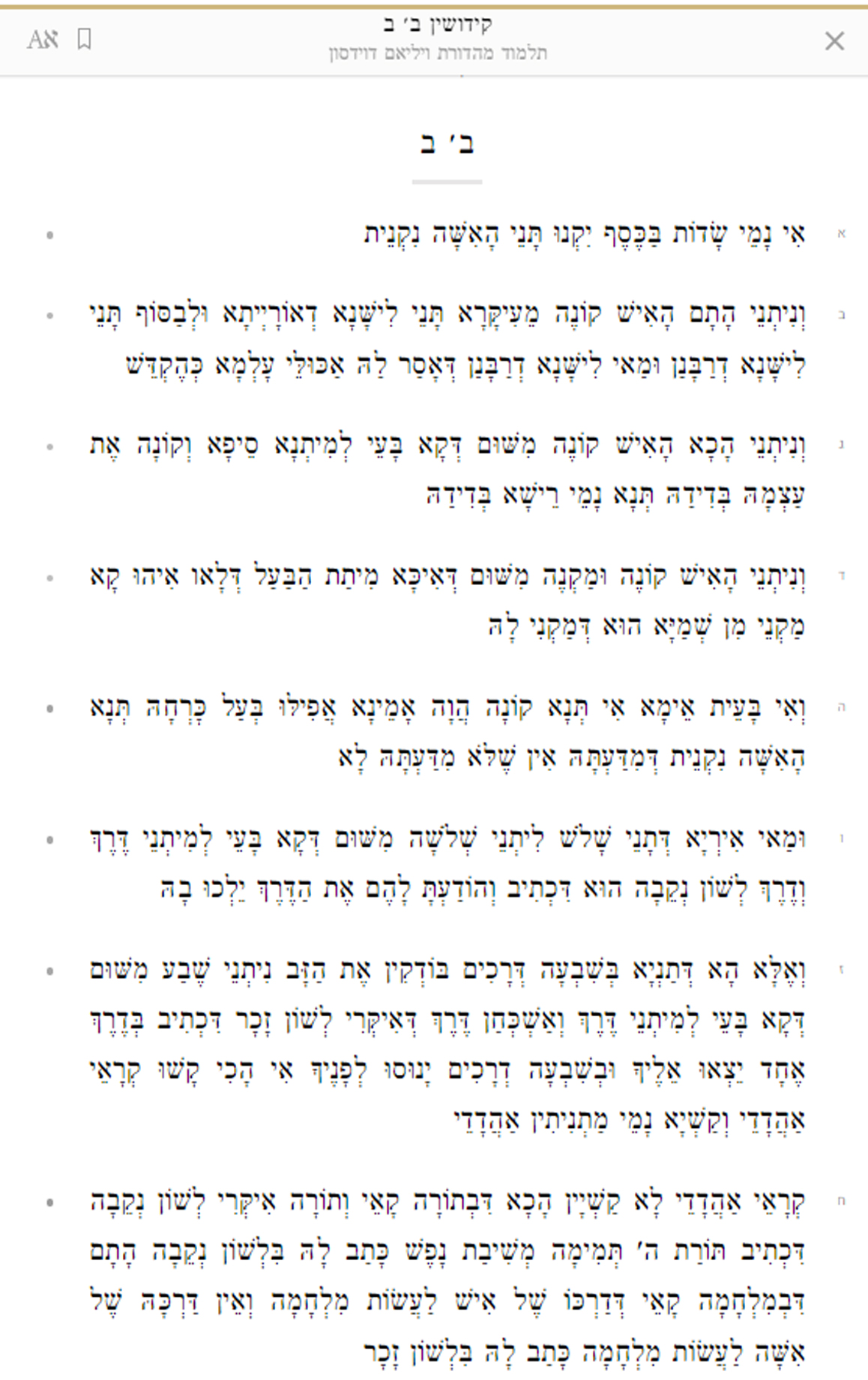
Image of customization options:

Splits into numbered sections. In our example, there are 15 sections. The default Hebrew doesn’t split these into paragraphs, but there is an option to split into paragraphs. Many tractates have nikud, some have punctuation. Our example page doesn’t have punctuation, even though it shows that option. Sefaria gives the option to remove nikud. As mentioned, as with Shitufta and Al-Hatorah, one can hyperlink to a specific section.

Al-Hatorah[30]

The section numbers in circles on the right side of the page are hyperlinked, which is a convenient feature. In the example page we are looking at, there is no nikud, unlike Sefaria. However, there is a period after each section, which provides a slight advantage over Sefaria‘s lack of punctuation, as it helps to break up the passages when viewing with no section breaks.

While Al-Hatorah also includes hyperlinked sections, it does not explicitly label which section is which, unlike Sefaria. Therefore, finding a specific section requires trial and error. As with Shitufta and Sefaria, it is possible to hyperlink to a particular section in Al-Hatorah.

One notable difference is that Al-Hatorah does not expand acronyms, as Sefaria does. For instance, מט is not expanded to מאי טעמא, and אבא is not expanded to איבעית אימא.

Speculation on the future

Secunda and Fischer, in the faraway land of 2012 (cited at the beginning of this piece), envision a future Talmud app:

“First of all, it would be a virtually borderless intertextual web. Talmudic passages that shed light upon one another would be linked in intricate overlapping networks. Passages citing earlier texts—biblical verses, the Mishnah, other rabbinic texts, the apocrypha—would be hyperlinked to the collection in which the cited text originally appears. Passages would also link to later commentaries, super-commentaries, relevant excerpts from legal codes and responsa, manuscript variants, monographs, homiletic interpretations, and, indeed, translations and elucidations. Discussions of Akkadian medicine would call forth images of Babylonian tablets. People, places, historical events, concepts, practices, and all sorts of other realia mentioned in the text would link to relevant explanatory pages, pictures, recordings, and video clips. […] [T]wo new Jewish text websites, themercava.com and sefaria.org, offer promising platforms for crowd-sourced translation, commentary, and discussion of the Bavli and other Jewish texts. […]”[31]

While some aspects of this idealistic vision have been realized, many others have not, at least not yet. Moreover, it remains unclear whether a more crowdsourced and social-media-oriented approach, (suggested in an un-cited part of Secunda and Fischer’s article), would even be desirable. In retrospect, the year 2012 was marked by somewhat utopian thinking, with Wikipedia and Facebook having recently achieved great success in spreading knowledge and connecting people worldwide. It seemed only natural to aspire to something similar in the realm of literature. However, today, with greater awareness of the unpredictable dynamics of such systems (such as misinformation), it is far from clear that such a goal is attainable or even desirable.

In my view, Sefaria, Al-Hatorah, and Dicta are the most promising candidates for realizing the immersive and highly hyperlinked experience envisioned by Fischer and Secunda. Once this is achieved, the resulting research tools are likely to be extremely powerful as well. However, the idea of leveraging comparative sources, as described by the authors, still seems quite far off, particularly with the current set of available tools.

Regarding the social and chavruta aspect discussed by Fischer and Secunda, a new possibility has emerged that was not even envisioned a year ago: an artificial intelligence-powered chavruta. I recently experimented with ChatGPT by providing it with the first paragraph of Kidushin 2b.[32]

As usual, ChatGPT demonstrated impressive coherence and confidence. However, it provided laughably incorrect interpretations. In fact, in some cases, it provided interpretations that were the exact opposite of the correct one.

I conducted a comparable test by inputting a paragraph of Ramban’s commentary on that sugya, requesting an explanation from ChatGPT. To my surprise, ChatGPT provided a reasonably good rephrasing in English. Although some of it was correct and some of it was incorrect, even the incorrect part was not entirely off. However, ChatGPT still requires further yeshiva study before being able to serve as a teacher.[33]

Given the rapid advancements in artificial intelligence and large language models, it appears highly likely that AI will continue to improve its ability to interpret the Talmud, along with all other sources, including digitized manuscripts. It may not be long before we turn to AI to obtain the ultimate p’shat in the Talmud.[34] Furthermore, there is a possibility that AI could eventually bring comparative sources to bear, as previously mentioned.

To update the speculative future envisioned by Fischer and Secunda, my ideal Talmud study experience would be an app with a GPT plug-in acting as a virtual chavruta/Rebbe, to interpret text and answer questions. In fact, something like this is already being tested by Khan Academy.[35]

With current tools, it will even be possible to create a virtual shiur.[36] In the future, it could even be live and interactive, happening in real time.

Another interesting idea that is ripe to be explored is visualization of the Talmudic text. This was put to the test by Yael Jaffe, in a 2015 Columbia dissertation.[37] Jaffe writes in her abstract (bolding is mine):

“This study investigates the effect of access to a visual outline of the text structure of a Talmudic passage on comprehension of that passage. A system for defining the text structure of Talmudic passages was designed by merging and simplifying earlier text structure systems described for Talmudic passages, following principles taken from research on text structure. Comprehension of two passages were compared for students who did traditional reading of a Talmudic passage (the passages had punctuation added, and a list of difficult words and their meanings was appended) (the control condition), and students who read the passage with these same materials as well as with an outline of the text structure of that passage (the experimental condition) […]

The results provide evidence that awareness of the text structure of a Talmudic passage helps readers when the passage is concrete and somewhat well organized. ”[38]

It is interesting to note that Jaffe’s control group had punctuation added. There is, in fact, no good reason why the punctuation should not be added to all the standard Vilna-Romm editions. This is something that I did as a matter of course in my gemaras in my yeshiva days, and I presume that I was not the only one.[39]

Concluding Thought

Will there ever be a single Talmud application to rule them all, similar to how the Bomberg layout remained the standard for 500 years, and continues to do so? Such a scenario is improbable and perhaps even unwanted in today’s rapidly changing and complex digital landscape. It would suggest a lack of progress. We may have to wait for the arrival of the Messiah or, at the very least, the AI singularity to provide the ultimate Talmud super-app.

[1] This piece was written as part of preparation for the workshop “Editions of Classical Jewish Literature in the Digital Era”, to be held at University of Haifa, June 18-20, 2023, at which I’ll be presenting. I want to express my gratitude to Menachem Katz for his efforts in organizing that workshop, and for inviting me to speak there. I’d also like to thank Eliezer Brodt for his helpful comments on an earlier draft of this piece. I would also like to thank my father, my brother, and S. Licht for reviewing, making suggestions, and helping clarify in conversation some of the ideas discussed.
[2] 
Finkelman, ”From Bomberg to the Beit Midrash: A Cultural and Material History of Talmudic Page Layout”, Tradition (Winter 2023), Issue 55.1, p. 14. I’d like to thank Eliezer Brodt for bringing this article to my attention.
[3] Immediately before, he writes (my bolding): “[T]he famous and ubiquitous tzurat ha-daf (page layout) of the Gemara was never exclusively by Talmudists for Talmudists. It was a common practice for producing non-Jewish European glossed texts in manuscript and later print from the high middle-ages though the sixteenth century. Some copyists and later printers of the Gemara—whether those printers were Jews or not—adopted it from contemporary Christian textual production.” This point is also made by Michele Chesner, in her interview on the Seforim Chatter podcast: “With Michelle Chesner discussing old books, Seforim, and more” (April 29, 2020).
[4] “Brave New Bavli: Talmud in the Age of the iPad”, Jewish Review of Books (Fall 2012). Archived here.
[5] Finkelman, pp. 16-17.
[6] Relatedly, I have heard the theory a few times from Prof. Meir Bar-Ilan that the writing down of the Talmud may have occurred due to the spread of the Chinese invention of paper to the West in the early medieval period. For some work on when the Mishnah and Talmud were first written, with previous scholarship cited, see: Yaakov Elman, “Orality and the Redaction of the Babylonian Talmud”, Oral Tradition, 14/1 (1999): 52-99 ; Shamma Friedman, “The Transmission of the Talmud and the Computer Age”, in Sharon Liberman Mintz and Gabriel M. Goldstein, eds., Printing the Talmud: From Bomberg to Schottenstein (2005), pp. 143-154 (esp. pp. 146-148) ;

יעקב זוסמן, “‘תורה שבעל פהפשוטה כמשמעה: כוחו של קוצו של יוד“, מחקרי תלמוד ג, א (תשסה), עמ‘ 209-384 (נדפס שוב כספר ב– 2019) ; נחמן דנציג, “מתלמוד על פה לתלמוד בכתב: על דרך מסירת התלמוד הבבלי ולימודו בימי הביניים“, בראילן ללא (תשסו), עמ‘ 49-112.

[7] Keith Houston, The Book: A Cover-to-Cover Exploration of the Most Powerful Object of Our Time (2016), introduction (available via Amazon Kindle sample). He adds in a footnote: “It is worth introducing “codex” as a technical term: it means specifically a paged book, as opposed to a papyrus scroll, clay tablet, or any of the myriad other forms the book has taken over the millennia.”
[8]
Recently pointed out by Ari Zivotofsky in a Seforim Blog post (“The Longest Masechta is …”, March 31, 2023): “[I]t is worth noting that ambiguity regarding sizes of masechtot only arose when commentaries began to be put on the same page as the text of the gemara. In other words, until the era of the printing press there was no ambiguity as to which masechta was the longest.” See also Finkelman, pp. 18-19 ; Friedman, “Printing”, p. 148. The early Soncino editions also only contained the Gemara and Rashi, see Finkelman, pp. 22-24. And see the recent statement of Yehuda Galinsky (bolding is mine): “The end of the thirteenth century witnessed a discernable growth in the composition of glossed works in Ashkenaz. It was from this time onwards that authors penned influential talmudic and halakhic works from France and Germany with the intention that they be accompanied by a supplementary gloss, which was to be copied alongside the text […] Instead, we find stand-alone commentaries that were copied separately from the text it was interpreting. In contrast to the well-known layout of the printed Talmud page, the writings of Rashi and Tosafot were written and usually copied as stand-alone commentaries and not as actual glosses to be copied on the same page.” (Judah Galinsky, “The Original Layout of the Semak”, Diné Israel, Volume 37 (2023), pp. 1*-26*, pp. 1-2.) A commenter to Zivotofsky’s blogpost pointed out that there is a print edition that contains only the Talmud (with supplementary indexes). It was printed 25 years ago. Here’s bibliographic info according to the National Library of Israel catalog entry:

תלמוד בבלי: כולל כל המשנה והמסכתות הקטנות : נערכו, סודרו והודפסו מחדש בכרך אחד, עם חלוקה לפסקאות, איזכורים מהמקרא, מלווים בשבעה מפתחות בסגנון אנציקלופדי, כולל מפתח ערכים אלפבתי, בעריכת צבי הפרייזלר הרב שמואל הבלין הרב חנוך הבלין (1998).

As an aside, Finkelman states (p. 18) that “The earliest [Talmudic manuscripts] are Geniza fragments from the ninth century”. However, see Friedman, pp. 147-148, that the earliest Talmudic manuscript is a scroll that can be dated to the 7th century.
[9] Finkelman, pp. 25-28. See also the interesting point by Finkelman, p. 41 (based on Jordan Penkower), that Bomberg was also the one to establish the standard method of citation for Tanach in the Jewish world: “In his first Mikraot Gedolot, Bomberg made a significant addition by adding chapter numbers and (in the second edition) verse numbers, features with little Jewish precedent which were based on thirteenth-century Catholic developments.”
[10] See my recent “Guide to Online Resources for Scholarly Jewish Study and Research – 2022”, where I discuss many of the resources discussed in this piece with more breadth. There I also discuss many of the resources excluded from this review for the reasons enumerated further. Bar-Ilan Responsa Project’s Talmud is online, but is not open-access. Bar-Ilan Responsa Project’s Talmud is linked from Yeshiva.org.il’s Talmud pages, top right of page. (See on Yeshiva.org.il in a later footnote.) That version of Bar-Ilan Responsa Project’s Talmud has punctuation, but no nikud, and is not split into sections/paragraphs, and is inferior in every way than the editions discussed here.

For the same reason (not open-access), I have not reviewed any editions on Otzar HaHochma, or other digital libraries which require a subscription.
[11]
Such as Vagshal, Oz VeHadar, Shas Vilna HeChadash, Gemara Sedura. See image here of layout of Gemara Sedura. (See Shimon Steinmetz’s interesting piece here on self-censorship in the Vagshal edition: “Vagshal’s revision of the history of the Vilna Talmud, or, One of the most egregious examples of censorship I have ever seen”.) The best completely static tzurat hadaf edition that I could find available online as open-access is the Moznaim edition, available at Daf-yomi and HebrewBooks. It is a PDF, simply re-typeset. There are also printed editions with punctuation, such as Steinsaltz-Koren; Oz VeHadar; and Tuvia’s. See these news articles from 2016 on Oz VeHadar’s (ongoing?) Talmud edition with nikud and punctuation: here and here. And see the National Library of Israel (=NLI) catalog entry here. See also the NLI catalog entry on Yosef Amar’s 1980 Talmud edition (17 vols.) with nikud based on Yemenite pronunciation, here. And see NLI catalog entries of Koren’s (ongoing?) Talmud edition with nikud and punctuation: Sanhedrin (2014) ; Bava Metzia (2015) ; Sukkah (2016) ; Bava Batra (2017) ; Kidushin (2018).
[12] So I won’t discuss the following: Kodesh.snunit ; Mechon Mamre ; Daf-yomi.com > “Text”. Daf-yomi.com’s “Chavruta commentary” and “tzurat hadaf” are indeed worthwhile. See previous note on Daf-yomi.com’s Moznaim tzurat hadaf edition. The Friedberg Project website Hachi Garsinan technically has a few digital editions of Talmud on their website, but they are all for the purpose of presenting the manuscript variants. So I won’t be reviewing that, since this piece is focused on layout and UX/UI, and in that regard, the edition is sub-par. (Again, this is not necessarily a critique, as this isn’t the point of those editions.) As I say further, in this piece I will not discuss the editions’ textual accuracy. For this reason, I also won’t discuss The Academy of the Hebrew Language’s Ma’agarim edition. Tashma.jewishoffice.co.ils Talmud shows promise, but for now seems to be inferior in every way than the editions discussed here. The website Yeshiva.org.il (פרשני ויקישיבה) has the Chavruta commentary of the Talmud. However, as mentioned, the original PDFs of Chavruta commentary are available on the Daf-yomi.com website, so in my opinion it’s clearly best to use that. There’s no advantage to the text version (except for the ability to copy-paste). Yeshiva.org.il’s Chavruta is fully editable, wiki-style. But I see that as a negative, as you don’t know what you’ll be getting.
[13] Such as Gemara Brura and The People’s Talmud. See more at R’ Josh Waxman’s blogpost, “Some excellent Talmud projects out there” (March 5, 2020).
[14] For example, Sefaria and Al-Hatorah have the Steinsaltz translation and commentary, and Wikisource has extensive links to other resources.
[15] Many of the textual elements of the Vilna-Romm edition have been superseded by better editions (though many are still incomplete). Some examples:

תלמוד: דקדוקי סופרים (השלם); הכי גרסינן

רשי: מהדורות פרופאהרן אהרנד

תוספות ; תוספות ישנים; רבינו חננאל : מהדורות רב קוק

עין משפט: עינים למשפט של ריצחק אריאלי (כל שבעה כרכים זמינים בהיברובוקס, לדוגמא, כאן)

מסורת השס: דקדוקי סופרים השלם; תלמוד האיגוד

ריף: מהדורת שבט

[16] For now, see Yakov Mayer in his recent ground-breaking book on the first edition of Talmud Yerushalmi (which was also printed by Bomberg’s press), who cites previous studies on typefaces used by Bomberg: Yakov Z. Mayer, Editio Princeps: The 1523 Venice Edition of the Palestinian Talmud and the Beginning of Hebrew Printing (2022, Hebrew).

See also the recent book by Simon Garfield, Just My Type: A Book About Fonts (2011 ) for a fascinating, well-written, popular overview of typesetting and fonts. On medieval handwriting styles of Hebrew, see the monumental 3-volume series, under Malachi Beit-Aryeh’s editorship (each area is a different volume):

מפעל הפליאוגראפיה העברית, אסופות כתבים עבריים מימיהביניים (1987-2017)

On second temple era styles, see the various works by Ada Yardeni, especially:

עדה ירדניספר הכתב העברי: תולדות, יסודות, סגנונות, עיצוב (1991).

[17] It is unclear to me who first made these section splits. It’s a question I’d be quite interested in knowing the answer to.
[18] Links to all of parts of MM:

  1. אקדמות למהדורה של התלמוד הבבלימסכת קידושיןמחברות מנחמיות

  2. מסכת קידושין ב עא יד עב

  3. מסכת קידושין יד עבכה עב

  4. מסכת קידושין כה עבכט עא

  5. מסכת קידושין כט עאמא עא

  6. מסכת קידושין מא עאנח עב

  7. מסכת קידושין נח עבסט עא

  8. מסכת קידושין סט עא פב עב

Compare Katz’s similar work on Yerushalmi (which also includes textual variant apparatus, and short commentary, unlike his work on Bavli), available at his Academia.edu site: “פסחן ומצתן של נשים Women on Passover and Matzah”.
[19]
 I personally prefer this style (punctuation, without nikud). See my discussion later.
[20] Tractate Sukka, p. 2 (ב). Not to be confused with Gemara Sedura (no HaMeir). Currently available online: Tractate Sukka (2013, here) and Tractate Avoda Zara (2015, here). See more on the project here.
[21] From the latest volume available online:

נתנאל בעדני, סנהדרין פרק חמישי (תשעב), עמ‘ 4.

See more on the project here.
[22]
See more on the project here.
[23] See also some of R’ Be’eri’s other editions, available on Da’at website, here and here. On R’ Be’eri, see the Hebrew Wikipedia entry on him: דן באריויקיפדיה
[24] Screenshot of downloaded Word document.
[25] To explain: Even though everything in the Word doc can be customized, this isn’t built into the website. Any of the editions in this “Digital” section can be pasted into a Word document and customized.
[26] Notably, the text itself is actually an image, which makes copying it impossible.
[27] Dicta was started by Prof. Moshe Koppel of Bar-Ilan University. He has contributed to Seforim Blog.
[28] As of 15-Apr-23.
[29] See more on the project here.
[30] See more on the project here.
[31] Compare also, at length, Friedman, “Printing”, pp. 150-154 ; Shai Secunda, “Resources for the Critical Study of Rabbinic Literature in the Twenty-First Century” in Compendia Rerum Iudaicarum ad Novum Testamentum (CRINT) 16, Christine Hayes (ed.), (2022), pp. 621-632.
[32] On 15-Apr-23, at https://chat.openai.com/.
[33] I should point out that I did not have access to GPT-4, which is the latest version of GPT. So I could not test whether GPT-4 is more capable at interpreting Talmud. For a discussion of some sources of the Yeshivish dialect of English possibly used as datasets for training ChatGPT-4, see my “From the Shtetl to the Chatbot: Some contemporary sources of Yeshivish content, in light of ChatGPT-4”.
[34] For some preliminary algorithmic research on the Talmud, see, for example, Satlow M., Sperling M. (2017). “Naming Rabbis: A Digital List”; Satlow M., Sperling M. (2020), “The Rabbinic Citation Network”; Satlow M., Sperling M. (2020). “The Rabbinic citation network”, AJS Review ; Zhitomirsky-Geffet M., Prebor G. (2019), “SageBook: toward a cross-generational social network for the Jewish sages’ prosopography”, Digital Scholarship in the Humanities, 34(3), pp. 676–695 ; “A graph database of scholastic relationships in the Babylonian Talmud”, Digital Scholarship in the Humanities, Volume 36, Issue Supplement_2, October 2021, Pages ii277–ii289, https://doi.org/10.1093/llc/fqab015, Published: 22 February 2021. See also Shira Shmidman, “Self-Evident Questions and Their Role in Talmudic Dialectic”, AJS Review (2023), p. 128: “Recently, I analyzed talmudic questions (that open with the phrase baʿei or beʿah minei) and discovered that by charting the questions by the generation in which they were asked, one can identify chronological trends of question asking in the Babylonian Talmud.”
[35] See Sal Khan, “Harnessing GPT-4 so that all students benefit. A nonprofit approach for equal access”, Khan Academy Blog (March 14, 2023). See especially this description: “Khanmigo [=the AI tool] engages students in back-and-forth conversation peppered with questions. It’s like a virtual Socrates, guiding students through their educational journey. Like any great tutor, Khanmigo encourages productive struggle in a supportive and engaging way.” For fun, I asked ChatGPT for a clever name for an AI chavruta/Rebbe. It gave me ten options. One of them is a great one (ChavrutAI), while three of them were hilarious ( AIvrumi; AIsh Torah; RoboRabbi). RoboRabbi could provide many of the intellectual aspects of being a rabbi: psak, eitza, questions in learning, and divrei torah.
[36] With tools like ChatGPT (content), ElevenAI (voice), D-ID (video), one can create any style of shiur. See my “Heimish High-Tech: Video in Yeshivish dialect using Generative artificial intelligence”. For training sources for the Yeshivish dialect, see my article: “From the Shtetl to the Chatbot: Some contemporary sources of Yeshivish content, in light of ChatGPT-4”.
[37] Jaffe, The Relevance of Text Structure Strategy Instruction for Talmud Study: The Effects of Reading a Talmudic Passage with a Road-Map of its Text Structure (2015). See especially ibid. Appendix E (pp. 103-104).
[38] On visualizations, see also this article, and the bibliography cited there:

יעקב אמיד, “עיצוב ייצוגים גרפיים של דיון תלמודי: תחום דעת מתחדש בהכשרת מורים להוראת תלמוד

See also the lengthy intro of Menachem Katz to his Mahberot Menahmiyot (discussed earlier), with relevant bibliography. One good existing resource for outlines and charts for Talmud is Daf Yomi Advancement Forum – Kollel Iyun HaDaf. See Josh Waxman, “Some excellent Talmud projects out there” (cited earlier), #2. A fascinating related project is that of R’ Dr. Michael Avraham on mapping out the logic of the Talmudic sugya, using the tools and notation of modern logic. See his massive series Studies in Talmudic Logic, currently at 15 volumes. Note the surprising claim made in the abstract of vol. 14 of the series (Andrew Schumann, ed., Philosophy and History of Talmudic Logic, bolding is mine): “The Talmud introduces a specific logical hermeneutics, completely different from the Ancient Greek logic. This hermeneutics first appeared within the Babylonian legal tradition established by the Sumerians and Akkadians to interpret the first legal codes in the world and to deduce trial decisions from the codes by logical inference rules. The purpose of this book is (i) to examine the Talmudic hermeneutics from the point of view of its meaning for contemporary philosophy and logic as well as (ii) to evaluate the genesis of Talmudic hermeneutics which began with the Sumerian/Akkadian legal tradition. The logical hermeneutics of the Talmud is a part of the Oral Torah that was well expressed by the Tannaim, the first Judaic commentators of the Bible, for inferring Judaic laws from the Holy Book.”
[39]
My suggestion for breaking the tzurat hadaf into sections: the pilcrow (¶). On the pilcrow, see the entertaining popular book, Shady Characters: The Secret Life of Punctuation, Symbols, and Other Typographical Marks (2013) by Keith Houston, chapter 1. (Available from Amazon for free as a Kindle sample.)

It should be pointed out that trop is an early medieval Hebrew form of punctuating the Biblical text. A few alternatives of punctuating the Torah arose in Geonic times.

On early nikud of Mishnah and Talmud, especially nikud bavli (we use nikud tavrani), see Yeivin:

ישראל ייבין, מסורת הלשון העברית המשתקפת בניקוד הבבלי (תשמה), פרקים בו.

I will point out the following: Tuvia’s edition adds nikud. But once one is past the beginner stage, nikud does little to enhance the reading experience, and in fact many readers find it a distraction. Modern Hebrew rarely uses nikud. Exceptions are for literature geared towards children and beginners (as noted), as well as instances where decoding is especially difficult, such as poetry, transliterated foreign words, and ambiguous words. In contrast, punctuation is a huge boost to faster comprehension, as Jaffe notes. Modern Hebrew texts use standard punctuation, like all modern languages.


In Praise of the Soncino Talmud

In Praise of the Soncino Talmud
By David S Farkas*

Not long ago one of our local schools hosted a Giveaway day in its library, making many of the older seforim in its considerable collection free to a good home. As expected, the local citizenry plundered and pillaged, carrying off large numbers of books, many still in quite good condition. I was only able to attend towards the end, “after the last of the gleaners had gone.”[1] Only a few scattered Siddurim and Chumashim were left, when I spotted a box in a corner of the room, filled with small red volumes. Close inspection revealed that the books were none other than the Soncino Talmud, a complete set. My heart sank a little to see this classic work, neglected and abandoned. I felt, in a small way, as though I had seen the tongue of Chutzpith the Translator lying in the dust.[2]

The Soncino Press sees no press at all these days, it seems. Its groundbreaking complete English translation of the Talmud has almost entirely been supplanted by Artscroll’s Schottenstein edition. Indeed, studying with the latter presents a very much different type of engagement with the Gemara, and Artscroll has undoubtedly done a master job of it. Yet for all of its depth and analysis, Soncino to this day brings to the table things that Artscroll does not. What follows, then, is not an attempt to sing the praises of one at the expense of the other, but only to point out some of the unique features of the now-neglected Soncino, and to suggest some of its alleged flaws may have been greatly exaggerated.[3]

To begin with, the canard so many of us heard in our yeshiva days – that Soncino was edited by less than fully-religious Jews – is a terrible misimpression that, to the best of my knowledge, seems to be based purely on the evidence that it was edited by a man named Isidore. Yet Rabbi Yechezkel Epstein (as he is in fact identified, in Hebrew, on the opposite front-page of most volumes) was very much an observant Jew, who attended the Pressburg Yeshivah founded by the Chasam Sofer, and was said to know Shas by heart. The project began with Seder Nezikin in 1935 with a heartfelt prayer to Almighty God, capped with the traditional phrase יה”ר מלפני ה’ כשם שעזרתני לסיים סדר נזיקין, כן תעזרני להתחיל סדרים אחרים ולסיימם.  It concluded in 1948, as printed in Seder Kodshim, with a heartfelt תם ונשלם שבח לבורא עולם, and the traditional Hadran written out nearly in full. We can certainly say of Soncino, if we may modify R. Yosi’s summation of Kelim, “Happy art thou, Soncino – thou began in purity, and finished in purity.”[4]

Moreover, a review of the individual contributors to each volume – a list that, to my knowledge, has never before been assembled – reveals that each and every one of them were strictly orthodox, and not identified with any other stream of Judaism.[5]

The entire series is written in the best of the King’s English. Somewhat amusingly, this itself has sometimes been offered as a reason not to use the Soncino, as though students today are incapable of understanding proper English. It is true that the series occasionally uses words no longer current (such as “dam” for a mother bird or animal, or “usufruct”.) It also actually translates Biblical or Talmudic concepts, rather than simply transliterating them, a device that has become popular today. Still, the language is eminently readable to anyone devoting to it the proper attention, and it is precisely the insistence upon proper translations that sometimes leads to a better grasp of the text.[6]

Turning to more substantive matters, one key item that jumps out is the brevity of the work. In its most compact English-only edition, the entire set – and that includes all sixty tractates, plus a full-length Index volume – comes in at a trim eighteen volumes. Even with the facing Hebrew page, the set numbers no more than 30 or 35 volumes, depending on the edition.[7] Artscroll, by contrast, which incudes only those tractates with Bavli (plus Shekalim, Eduyos, and Midos) comes in at a jaw-dropping, new-bookshelves-requiring, 73 volumes.[8]

And there is something to be said for concision. At times, when I have encountered a difficulty in the (original) text, checking with Artscroll has only made things more difficult. The Artscroll method is generally to translate or paraphrase the entirety of Rashi, and doing so in English sometimes leaves the reader confused. By contrast, Soncino tends to collapse the entirety of every question and answer into one or two lines. Keeping things short and to the point, I have found, often leads to better understanding of the basic give and take of the Gemara.

This brevity is especially important – and here is a key distinction between the two translations – for those who can learn the Gemara in the original, but either lack the time or the patience to do so. Artscroll effectively prevents the user from doing anything on his own. The text is spoon-fed to the user, and because of the interlinear format, the reader never gets entirely away from the English. Though one can go to the full Hebrew text, the Hebrew woven into the English also means users can – and do – simply use the translation.  It is quite often tedious and time consuming to read, in part because the sentences are broken up every few words, and in part because of the copious long and involved footnotes. Soncino, on the other hand, rather than leading the reader by the hand, simply gives him a head start. Quickly perusing a few English-only paragraphs provides the reader with an overview of the upcoming sugya, and allows him to go back into the regular text and then read everything on his own. In essence, it requires the reader to still go back to the traditional Hebrew text, especially if he wants to fully understand the discussion.

That, of course, might well be considered a flaw, rather than a feature. As noted by R. Gil Student, the Soncino does have “limited value in helping one understand the “sugya” (progression of ideas at large).”[9] Artscroll does an excellent job of laying out for the reader where the passage is heading, and identifying what the Gemara intends to accomplish with each step of the discussion. Soncino does none of this, expecting the student to do this on his own. In some volumes, however, the text is broken up into shorter paragraphs, which on their own help the astute reader realize the Gemara’s direction.

Footnotes help, too.  Soncino very often paraphrases Rashi, only without calling attention to the fact. Moreover, it also regularly cites traditional commentators. As noted in the Introduction, these include, in addition to Rashi, “the Tosafists, Asheri, Alfasi, Maimonides, Maharsha, the glosses of BaH, Rashal, Strashun, the Wilna Gaon, etc.” I have also seen cited Rishonim like Rabbeinu Chananel or Ritva, and Achronim like R. Yaakov Emden and R. Tzvi Hirsch Chajes. Of course, and again, in no way does it approach the information provided by Artscroll. Readers with questions will often find them addressed in the lengthy notes of Artscroll, and will even more frequently encounter issues they had never considered. For sheer depth of analysis, Artscroll stands alone. Still, it is a mistake to think that Soncino gives the reader only the bare Gemara by itself.

Yet Soncino also provides information often absent from Artscroll. As the Chief Editor wrote, while he did not attempt to secure uniformity among the several authors – more on that in a moment – he himself added footnotes in brackets containing matters of historical and geographical interest. (To be sure, R. Epstein also added in many pshat based comments, though both functions noticeably decline in frequency as the series progresses into Kodshim.)

Citations to journals like the Jewish Quarterly Review or other German-language periodicals abound. Where parallels to the Gemara exist in Josephus or Apocrypha like Ben Sira, we are informed.  Likewise, parallels in Greek and Roman sources are also frequently noted.[10] Most place names are identified via Obermeyer’s 1929 geographical guide to Talmudic Babylon. Textural variants from the Septuagint are sometimes noted. Herford is also cited on anything that relates to Christianity, though, it may be said, Soncino displays somewhat of an obsession on this topic, and often perceives statements of the sages to be a disguised polemic, with very little justification.[11]

Each of the six Sedarim has its own introduction. The introductions to each of the individual volumes contain very useful summaries of the topic of each chapter, an important feature for learning the Talmud (and quite helpful for review), where the forest can easily be lost sight of. An appendix to Gittin gives what I believe to still be the best short summation of the Talmudic-era medicine described in the 7th chapter of that Masechta, as well as a similar lengthy passage in Avoda Zara. In one of the volumes (Eruvin) diagrams are gamely used, though the technology of the time did not permit anything much more than rudimentary line drawing and shading. Similarly, the anatomical skeleton of an ox is presented in Chulin.

I noted above that the editor did not seek to achieve uniformity of style, and the uneven quality shows. Some volumes are simply better than others. In one or two cases the translation can only be called wooden, and the notes do little more than add an emphatic “Surely not!” after obviously rhetorical questions. Happily, though, in most cases the individuality of the authors accrues to the benefit of the overall translation, providing different perspectives and viewpoints. Thus, for example, the translations of Chulin and Menachos done by Eli Cashdan, a European-born Talmid Chacham of note, are particularly lucid and clear. The translation to Moed Kattan by Dayan Lazarus preserves the poetry of the original in the elegies of the third chapter by translating them into English poetry, in the classic British style of Israel Zangwill and Nina Salaman,[12] The work to the first half of Kesubos by Samuel Daiches, the only barrister at law to participate in the series (though also an ordained rabbi), is particularly rich with citations to both Roman Cannon law and English jurisprudence.[13] And a number of these highly-educated authors find parallels in Talmudic sayings to classics of literature. [14]

In short, there is much to say in favor of the Soncino Talmud. It contains many gems of scholarship and interpretation, some of them not found, to my knowledge, in any other sources. If it is not perfect – no translation ever is – it is far better than it is often given credit for. The Soncino Talmud was, and fill forever remain, a landmark of Torah literature. To echo (via paraphrase) the words of Dr. Shnayer Leiman in these pages a number of years ago, said in connection with a different classic series thought to be out of date: “Hold on to your Soncino Talmuds! Public libraries and private collectors will do well to retain them and keep them precisely on the same shelves they have now occupied these many years.”[15]

Note from the Seforim Blog editors: Prof. Saul Lieberman refers to “responsible English translations of rabbinic texts (like those of Soncino Press)” at the end of his classic poison-pen review of Jacob Neusner’s acumen as a talmudic translator. See Lieberman, Saul. “A Tragedy or a Comedy?” Journal of the American Oriental Society, vol. 104, no. 2, 1984, pp. 315–319.

* Mr. Farkas received his rabbinic ordination from Ner Israel Rabbinical College in 1999. He lives with his family in Cleveland, Ohio, where he serves as Senior Corporate Counsel for a large energy company.   

[1] See Peah 8:1, Bava Metzia 21b

[2] See Chulin 142b.

[3] I have used the device of contrasting with Artscroll to highlight certain aspects of the Soncino. It should be self-understood that these points of preference are in no way intended to derogate that outstanding work, which enjoys deserved worldwide popularity. In the same vein, I use Artscroll as a contrast simply because of its wide-spread use, and not from any intent to disregard the also excellent Koren and Steinsaltz editions.

[4] The foreword and epilogue to the set – what we might today call הסכמות – contain similar sentiment. They are cited, along with brief comments on the Soncino series, in Words, Meaning, and Spirit: The Talmud in Translation (A. Mintz, Torah U’Maddah Journal 1995).

[5] The Complete list of Contributors to the Gemara include the following Rabbis, Doctors, and Misters, in alphabetical order: I. Abraham (Chagigah); Eli Cashdan (Menachos, Chulin); Abraham Cohen (Sotah, Avoda Zara); Samuel Daiches (Kesubos); H. Freedman (Sabbath, Pesachim, Nedarim, Kiddushin, Bava Metzia, Sanhedrin, Zevachim); M. Ginsberg (Betzah); L. Jung (Yoma, Arachin); E. W. Kirzner (Bava Kama); B. D. Klein (Nazir); L. Miller (Bechoros, Temurah); I. Porusch (Kerisos, Meilah); J. Rabinowitz (Taanis)  Jacob Shachter (Sanhedrin) H. M. Lazarus (Moed Kattan, Makkos); A. E. Silverstone (Shevuous);  Maurice Simon (Brachos, Eruvin, Rosh Hashana, Megilah, Gittin, Bava Basra, Bechoros, Tamid); and Israel Slotki (Sukah, Yevamos, Horayos, Bava Basra, Nidah).

The additional Mishnayos were translated by the aforementioned Israel Slotki, and Rabbis/Dcotors H. Bornstein, Phillip Cohen, Isidore Fishman, J. Israelstam, S. M. Lerhrman, and M. H. Segal.

Biographical data is available for many of these figures in Encyclopedia Judaica or Wikipedia. Information can also be found in the Jewish Communities and Records of the United Kingdom database, by clicking on the “rabbinic profiles” tab. (Available here: https://www.jewishgen.org/jcr-uk/Profiles) Note that all the figures listed here are found in the section designated for Orthodox Ministers & Cantors.

I am grateful to Dr. Marc Shapiro, who provided me with very interesting information on some of these men, and who also referred me to Rabbi Benjamin Elton, of the Great Synagogue in Australia, who likewise did the same. R. Elton, in turn, referred me to Professor David Newman, who sent me some photographs of some of the contributors – looking very rabbinic indeed.

[6] This is particularly true for the realia of the Gemara. See for example Pesachim 37a, סריקין מצויירין  which Soncino translates as “Syrian cakes”, but Artscroll transliterates as “decorated Sirikin”; Yoma 38a נחושת קלוניתא which to Soncino is Corinthian Bronze, but to Artscroll, “refined copper.”; In Moed Kattan 27a, in the context of items a mourner may sit upon, such as the chair or ground, אודייני גדולה is listed and translated by Artscroll simply as a “large mortar”, with no additional comment. Soncino translates it as “a large bench for water jugs”, footnoting to the Roman Uranariun and showing the term in parallel passages as אורנריי. Many such examples can be cited.

[7] For more on these different editions see Words, A. Mintz, Id., at fn. 49.

[8] Though this set too, now looks small, compared to the complete Hebrew-language Mesivta edition – a stupendous 136 volumes.

[9] “Tackling the Talmud: One Daf at a Time” (Jewish Action, Fall 2012)

[10] See for example Nazir 4b, showing parallels to the story described therein to the tale of Narcissus found in Ovid.

[11] See, for example, the Commentary to Sukkah 5a, Nedarim 38a and 64b. (I hasten to add, as someone once observed, “Just because you’re paranoid doesn’t mean they aren’t after you.” I myself recently wrote, of a Mishna in Beitzah, that it too, contained a hitherto unnoticed reference to Christianity. See my article Of Fish and Fishermen: An Unknown Christian Passage in the Talmud (Tradition 52:3 2020).)

[12] See also his nifty rendering of the phrase found there on 9b בת שיתין כבת שית לקל טבלא רהטא : “As sixty as six: the sound of a timbrel makes her nimble.”

[13] See there, for example, 17b and 20a.

[14] See Chagigah 13b, in connection with Sandalphon, referencing Longfellow’s similarly named poem; Avoda Zara 4a, comparing R. Chanina’s advice to pray for the government for without it men would swallow each other alive to a phrase in Shakespeare’s Coriolanus.

[15] The New Encyclopedia Judaica: Some Preliminary Observations. (Shnayer Leiman, Seforim Blog, June 5, 2007)


An “Artscroll”™ Illustration in the Vilna Shas-Masechet Shabbat 98b

An “Artscroll” ™ Illustration in the Vilna ShasMasechet Shabbat 98b

By Eli Genauer

לזכר נשמת אבי מורי ר׳ יעקב קאפל בר׳ משה יהודה הלוי גענויער ז״ל. היארצייט שלו י״ד סיון.

For those studying Daf Yomi this week, there is a unique diagram that appears on Shabbat 98b. In the Vilna Shas one can see a closeup “picture” of one of the boards of the Mishkan (“קרש“) which would make Artscroll proud.[1] While one might be familiar with diagrams that appear in the Talmud, those diagrams illustrate comments in the rishonim, mainly Rashi. Most of these are called out specifically by Rashi: “kazeh” “like this.” Artscroll, however, includes their own illustrations beyond those from any of the rishonim. Yet, they were not the first publishers of the Talmud to do so. Indeed, this diagram on page 98b is a much earlier example of a publisher electing to incorporate their own diagrams into the text.

Diagrams in Printed Editions of the Talmud

The use of diagrams is attested to in numerous manuscripts. These diagrams appear in Rashi, Tosefot and even were used by the Geonim.

When manuscripts gave way to printing in the late 1400’s and early 1500’s, those diagrams were excluded in the early printed editions of the Shas. When Daniel Bomberg published the first complete edition of the Shas in the early 1500s, he did not include the actual diagrams, but instead left a space for the book’s owner to pencil in the relevant diagrams (how they would know what the diagram looked like is left unanswered).

Finally starting with 1697, (the Berman Shas of Frankfurt on der Oder) did diagrams start to reappear in the empty spaces (mostly in Eruvin and Sukkah).

What was the source of those diagrams in the Berman Shas and in ones that were printed soon after in the early 1700’s? There were three sources, the Maharshal, Maharsha, and Mahram of Lublin.

This is the Shaar Blatt from the Frankfurt on der Oder 1697 edition:

The Maharshal is the key point person when it comes to diagrams. He had the 2nd edition of the Bomberg Shas (printed circa 1528) and made his notations there. He recognized the importance of the Shas being printed but also the dangers that lay in the fact that if there was a mistake, it would find its way into thousands of hands. He lived at a time when there were still manuscripts around, and he made his corrections based on those manuscripts and also his own logic. Since he had the status of an Adam Gadol, his own logic carried much weight. Originally, he did not set out to write a book with his corrections. Like the Ba’ch, he just made the corrections in his own Gemara. After he died though, his sons printed Sefarim which reflected his notes.[2] Therefore, if in the late 1600’s or early 1700’s you were printing a Shas, and you looked at a previous edition and in Rashi it said “Kazeh” and there was a space, you would look at the Chochmas Shlomo. If he had added a diagram, you would place that diagram in the empty space and feel comfortable that it had good Yichus. There were times that there wasn’t an empty space that the Chochmas Shlomo shows a diagram, and in that case, the printers usually added it.

The 1715 Amsterdam Edition of the Talmud

A complete edition of the Talmud was first published in Amsterdam in the 1640s by Immanuel Benveniste. In the 17th and 18th centuries Amsterdam was counted among the most important cities for the printing of Hebrew books and there were many well-known publishers that followed Benveniste and they printed many important works yet none of them attempted to reprinting the Talmud. Only some sixty years later did Amsterdam see a Talmud come off its presses. This one, that began in 1714, was never completed.

R. Judah Aryeh Loeb ben Joseph Samuel of Cracow appealed to Samuel ben Solomon Marsheses and Raphael ben Joshua de Palasios prominent members of the Amsterdam Sephardic community and asked them to print a new edition of the Talmud. Neither had ever published a book. In 1710, Loeb unsuccessfully sought to publish an edition of the Talmud in Frankurt. Now, in Amsterdam he sought to try again. Marcheses and Palasios formed a printing house specifically to print a “fine and accurate edition,” in an environment that “the workers would not be hurried so that they could work with care, reducing errors, and under the supervision of … the dayyan of the Ashkenaz Rabbinic Court of Amsterdam who would help establish the correct text.”[3] An emissary was sent to visit various Jewish communities to collect subscribers and reduce the burden of the significant printing costs. Relevant to diagrams, the emissary came bearing a gift, the Amsterdam 1710 edition of R. Jacob ben Samuel Bunim Koppelman of Brisk’s (1555-94) Omek Halakahah (first printed in 1510), a book that includes many diagrams to explain difficult passages of the Talmud.[4]

The first volume, Berakhot, was published in 1714[5] and the editors note the sources for their text and likely for the diagrams as well.

  1. Chochmas Shlomo

  2. Chochmas Manoach

  3. Chidushei Halachos of the Maharsha

  4. Maharam Lublin

  5. Sifrei Hashas of Yosef Shmuel ben Zvi – seemingly these were concentrated on Zeraim, Kodshim and Taharos

The volume on Meseches Shabbos was published in 1715 and the top 4 appear in the Hakdamah:

The Source and Purpose of the Diagram in Shabbos 98b

The Gemara in Masechet Shabbat on Daf 98a and b deals with the laws of carrying and discussing some of the details of the boards (“קרשים“) which made up the walls of the Mishkan.[6] These board were comprised of a complex system designed to keep each board straight and provide sufficient support for the entire structure of the Mishkan. Indeed, if one examines modern editions of the Talmud, there is an illustration that appears on the page. But where did it come from and more importantly what is its purpose? As we will show, the first edition to incorporate this diagram was the 1715 Amsterdam edition of the Talmud.

This is how it appears in the 1715 edition.

This image was reprinted in the Vilna Shas in a slightly clearer format although with the same detail and is a bit easier to analyze.


The picture primarily shows that there were three rods (“בריחים”) that connected one board to the next. The rods on the top and bottom went through outer rings, but the rod in the middle went through the width of the board.( “עובי הקרש“) It also shows the sockets on the bottom (“אדנים“) and the grooves (“ידות“) inserted in them which provided stability to the boards as they stood.

As discussed above, manuscripts of Gemarot though generally do not contain pictures, and a check on the invaluable website “Hachi Garsinan” shows that no manuscript of these pages has a picture to illustrate what a board looked like.[7] One might expect Rashi in his description of some of the statements of the Gemara to state his opinion and then write “כזה” (“ like this” ) Then we could expect to find an illustration in any of the number of Rashi manuscripts we have, and we could expect that this illustration (or an empty space for it) would appear in subsequent printed editions. Here we have none.[8]

The most relevant Rashi appears to his comments regarding how the boards stood miraculously.[9] But It does not discuss the fact that the middle rod went through the thickness of the board, but rather the miraculous nature of how the rod bent as it turned the corner. Another potential relevant Rashi explains the statement “the Sages taught, the bottoms of the beams (kerashim) were grooved and the sockets were hollow.” This deals with a completely different aspect of the beams which is how they were shaped on the bottom (and only according to Rabbi Nechemya). Thus, it is unsurprising that the manuscripts of Rashi do not include this diagram.

It was only in the 1715 edition does this illustration first appear. Yet, in the case of the picture of the keresh on Shabbos 98b, we do not find this picture in any of the sources identified by the Amsterdam publishers, not the Maharshal, Chochmas Manoach, Chidushei Halachos of Maharsha, or in Maharam Lublin.

First, we must identify what the diagram is attempting to illustrate. Rather than the more common form of diagrams, this one is not an illustration tied to one of the rishonim, rather it is illustrating two statements of the Gemara, one in the middle of the Daf and one at the very bottom. This, despite the fact that the diagram appears close to Rashi’s commentary on the page, seemingly tying it to his commentary.

Instead, the illustration is the independent product of the Amsterdam publishers and intended to elucidate the text of the Gemara, what did the board system look like. The Mesivta edition of Oz Vehadar also understands that this picture illustrates the words והבריח התיכון בתוך הקרשים. They indicate that Tziyur 6 which except for the detail on the bottom looks very similar to the one in the Vilna Shas, illustrates that statement.

In truth, the main part of the picture showing the middle rod going through the width of the board is not at all aligned with a comment of Rashi. Understanding that it just tries to give a picture of the “קרש” will make it easier to understand for people who study this page. This illustration is designed to explicate the text of the Talmud itself and was the entirely the idea of the publishers of the Amsterdam Talmud.

Why did the editors of the Amsterdam 1715 Shas insert a picture like this? Perhaps they were inspired by diagrams that appeared in a book called Omek Halacha by Jacob ben Simcha Bunim Koppelman which had just been reprinted in Amsterdam in 1710 and was even used in the fundraising campaign for this edition of the Talmud.[10] It has a picture of the grooves that fit into the sockets that is associated with the second aspect of this picture.

Yet, the Amsterdam publishers did not reprint the Omek Halakha’s crude diagram. Like the text and the other aspects of this edition, they included a much clearer and more detailed diagram that is infinitely more helpful in understanding the complicated text. Adding such a picture to a Daf of Gemara was a revolutionary act at that time and once added, it became part of Tzurat HaDaf that we have until today.

[1] As a matter of fact, there is a picture of the “קרש” in the Artscroll Stone Chumash, page 457, similar to the picture of the “קרש” in the Vilna Shas
[2] See Yaakov Spiegel, Amudim be-Toldot ha-Sefer ha-Ivri: Hagahot u-Magihim (Ramat Gan: Bar Ilan Univeristy Press, 2005), 312-17.
[3] Marvin J. Heller, Printing the Talmud: Complete Editions, Tractates, and Other Works and the Associated Presses from the Mid-17th Century through the 18th Century (Leiden: Brill, 2019), 75.
[4] Koppelman published another illustrated book, Ohel Yaakov. See Marvin Heller, The Sixteenth Century Hebrew Book: An Abridged Thesaurus, Volume 2, (Leiden: Brill, 2004), 724-25.
[5] For additional information on this edition see Heller, Printing the Talmud, 74-89.
[6] The categories of work employed to build the Mishkan formed the basis for the Melachot of Shabbat. In this case, the boards of the Mishkan were transported from one location to another giving rise to issues relating to the domains created thereby.
[7]
https://fjms.genizah.org/
[8] The manuscripts I checked on the KTIV website of the National Library of Israel were ones known as Parma 2097, Vatican 138, and Paris 324. All have no diagram in this entire Perek despite containing other diagrams of Rashi in other Perakim. (The two other manuscripts I checked of the total five that were available did not have diagrams in other Perakim either). The general website address for KTIV is https://web.nli.org.il/sites/nlis/en/manuscript
[9] In the book רש״י ,חייו ופירושיו“,כרך ב׳, הוצאת הקדש רוח יעקב, תשנ״ז” page 497, the author Rav Rephael Halpren states that there are 101 diagrams in Rashi included in the Vilna Shas, 51 of them in Masechet Eruvin. He then proceeds to enumerate all of them, including this one on Shabbat 98b. From the positioning of it on the page it certainly does look that way.
[10] Jacob ben Simcha Bunim Koppelman (1555–1594) was a talmudic scholar distinguished for his broad erudition and interest in secular sciences. Early in his life he embarked upon mathematical and astronomical studies, in addition to intensive occupation with traditional Jewish learning. He is the author of Omek Halakhah (Cracow, 1593). In it he elucidates the laws appertaining to Kilayim, Eruvin, etc., with the aid of diagrams and models. See here on Jacob ben Simcha Bunim Koppelman. 

This is it as it appears in the first edition (Cracow 1593):

https://hebrewbooks.org/pdfpager.aspx?req=45068&st=&pgnum=39


ArtScroll and More

ArtScroll and More
by Marc B. Shapiro
Continued from here.
1. As mentioned, I believe that on occasion ArtScroll is unaware that the text it is explaining is a censored text. Sometimes it might even be an internally censored text (i.e., censored by Jews so as to avoid difficulties with the non-Jewish authorities). This same problem is often found with aharonim. How about with rishonim? For example, was Rashi ever misled by an internally censored text? I would hesitate to say so but this is exactly what is suggested by R. Elijah David Rabinowitz-Teomim (the Aderet), though he piously prefaces his remarks with the words לולי דברי רש”י.
Sanhedrin 58b states:
Resh Lakish said: A heathen who keeps a day of rest, deserves death, for it is written, “And a day and a night they shall not rest” (Gen. 8:22), and a master has said: Their prohibition is their death sentence. Ravina said: Even if he rested on a Monday.
The Aderet sees it as obvious (פשוט) that the original version of Ravina’s statement was “Even if he rested on Sunday,” and this was changed to “Monday” due to fear of the Christians.[1] Rashi, however, offers an explanation as to why “Monday” is mentioned, meaning that if the Aderet is correct then even Rashi was misled by the altered text.[2]
As part of his explanation on this passage, Rashi also writes: אחד בשבת ששובתין בו הנוצרים. This is the authentic version of Rashi which appears in the early Talmud printings. It is also found in Steinsaltz and Oz ve-Hadar. The censored Vilna Talmud, followed by ArtScroll, omit the word הנוצרים.
Even in the censored Vilna Talmud the word הנוצרים appears in Ta’anit 27b where we find the following:

Our Rabbis have taught: The men of the Mishmar prayed over the sacrifice of their brethren that it may be favorably accepted, whilst the men of the Ma’amad assembled in their synagogues and observed four fasts, on Monday, Tuesday, Wednesday and Thursday of that week. On Monday [they fasted] for those that go down to the sea; on Tuesday for those who travel in the deserts; on Wednesday that croup may not attack children; on Thursday for pregnant women and nursing mothers, that pregnant women should not suffer a miscarriage, and that nursing mothers may be able to nurse their infants; on Friday they did not fast out of respect for the Sabbath; and certainly not on the Sabbath. Why did they not fast on Sunday? — R. Johanan said: Because of the Christians (הנוצרים). R. Samuel b. Nahmani said: Because it is the third day after the creation of Man. Resh Lakish said: Because of the additional soul. For Resh Lakish said: Man is given an additional soul on Friday, but at the termination of the Sabbath it is taken away from him, as it is said, “He ceased from work and rested” [shavat va-yinafash], that is to say, once the rest had ceased, woe! that soul is gone.

There is something very strange about this passage, and yet it is not noted in Soncino, ArtScroll, Koren, or by R. Zvi Hirsch Chajes whom I could have expected to pick up on it. I assume that most people read this passage without even realizing the problem, which for the rishonim was not a problem as I will explain. The Sages, in describing what went on in Second Temple days, make clear that the men of the Ma’amad did not fast on Sunday. R. Johanan, who lived in third-century Eretz Yisrael, says that this was because of the Christians. Rashi explains that the Christians “make this day [Sunday] their holiday.”[3] R. Gershom, in his commentary on the passage, writes that the Christians’ “holiday is on Sunday and if the Jews would fast they [the Christians] would be angered.”[4]
The problem with all this is that in the days of the Second Temple there was no significant Christian community for Jews to be concerned with. Furthermore, these early followers of Jesus would not have observed the Sabbath on Sunday.[5] I think the answer to this problem is that the talmudic sages regarded Jesus as a student of R. Joshua ben Perahyah who flourished in the latter part of the second century BCE (i.e., ca. 130-100 BCE). In other words, in the talmudic conception Jesus lived at least a century earlier than the historical record tells us, and the amoraim assumed that the Christianity as they knew it was also practiced centuries before. Robert Travers Herford writes: “R. Johanan transferred to the time of the Temple a feature of the religious life of his own totally different time.”[6] The predating of Jesus’ life was also shared by the rishonim, which explains why the chronological problem did not trouble them.
Ketubot 102b states:

If a man died and left a young son with his mother, [and while] the father’s heirs demand, ‘Let him be brought up with us’, his mother claims, ‘My son should be brought up by me’, [the son] must be left with his mother and may not be left with anyone who is entitled to be his heir. Such a case once occurred and [the heirs] killed him ער”ה.

What does ער”ה mean? The first thing to note is that these letters are not part of the original talmudic text. In talmudic manuscripts, the writings of the rishonim, and also the early printed editions in Pesaro and Venice, the uncensored text reads “killed him on the eve of Passover.”[7] Because this is the authentic reading, this is how it appears in Steinsaltz, Koren, and Soncino. ArtScroll, however, translates the last words of the passage as “They butchered him on the first evening of his stay,” reading ער”ה as ערב הראשון.
ArtScroll’s action is quite strange, as there is absolutely no question what the authentic reading of the text is. Not only does ArtScroll translate the false acronym, but it even offers an explanation of it. “They were so eager for his blood that he did not even last a single night with him. They killed him on the evening of his arrival.” This is wildly incorrect as the acronym ער”ה is simply a printer’s invention.
ArtScroll continues its explanation as follows:

The words ערב הראשון, the first evening, are not actually found in the Baraisa. Rather, the Baraisa contains an acronym – ער”ה – which is read as ערב הראשון (see Rosh; Mesoras HaShas). Another interpretation of this acronym reads it as ערב הפסח, on Pesach eve (Meiri; Hagahos Yavetz)

This note also needs to be corrected as there is no dispute among rishonim about how to how to read the acronym, as the acronym did not exist in the days of the rishonim. It is an invention of one of the printed editions. Thus, contrary to what the note states, Meiri never gave an interpretation of the acronym to mean ערב הפסח. Rather, these words were in his text of the Talmud, and they were also in the Rosh’s text of the Talmud and appear in the manuscripts of the Rosh. The printed version of the Rosh has been “corrected”, just like the text of the Talmud and Rif was “corrected”.[8]
Why did printed editions of the Talmud begin to use the acronym? This talmudic passage was cited by anti-Semites to support the blood libel, namely, that Jews would kill Christian children before Passover to use their blood.[9] Thus, this “correction”, like so many others, was designed to undermine anti-Semitic attacks against the Talmud.[10]       
Seth Leibowitz called my attention to the Stone Chumash, p. 407, where in the introduction to the Ten Commandments it states:

Rambam (Moreh Nevuchim II:32) comments that they only heard the first two [commandments] from God, but they could hear only the sound of the Divine voice, as it were, and could not understand the words He was saying. . . . Thus, the people experienced prophecy, for they heard God’s voice, but their faith in Moses was reinforced, because only he understood what God was saying.

The first thing to note is that the reference should be II:33 not II:32. The passage just quoted states that the people experienced prophecy. Does Maimonides say this? Guide 2:33 is a very difficult chapter and any interpretation given can be challenged with alternative perspectives. (See Yaakov Levinger, Ha-Rambam ke-Filosof u-khe-Fosek, ch. 3.) Yet I think I am on safe ground in saying that Maimonides does not believe that what the people as a whole experienced is to be regarded as prophecy. While Guide 2:33 might be ambiguous in this matter, the previous chapter, 2:32, states explicitly: “As for the Gathering at Mount Sinai, though through a miracle all the people saw the great fire and heard the frightening and terrifying voices, only those who were fit for it achieved the rank of prophecy, and even those in various degrees.”
Shem Tov explains:
ואחר שסלק הרב אלו הטעיות אשר יראה מהם שהשם ינבא כל איש מבני אדם, סלק מעלינו ספק גדול והוא מעמד הר סיני אשר אנשים ונשים סכלים ובלתי ראויים כל היו נביאים וזה יביא לחשוב שהשם ית’ ינבא כל מי שירצה מבלתי שיהיה מוכן, ואמר שאף שכלם היו רואים האש הגדולה ושומעים הקולות הנוראות המפחידות וזה היה על צד הפלא, לא הגיע למדרגת הנבואה אלא הראוי לה והראויים יתחלפו מדרגותיהם ג”כ
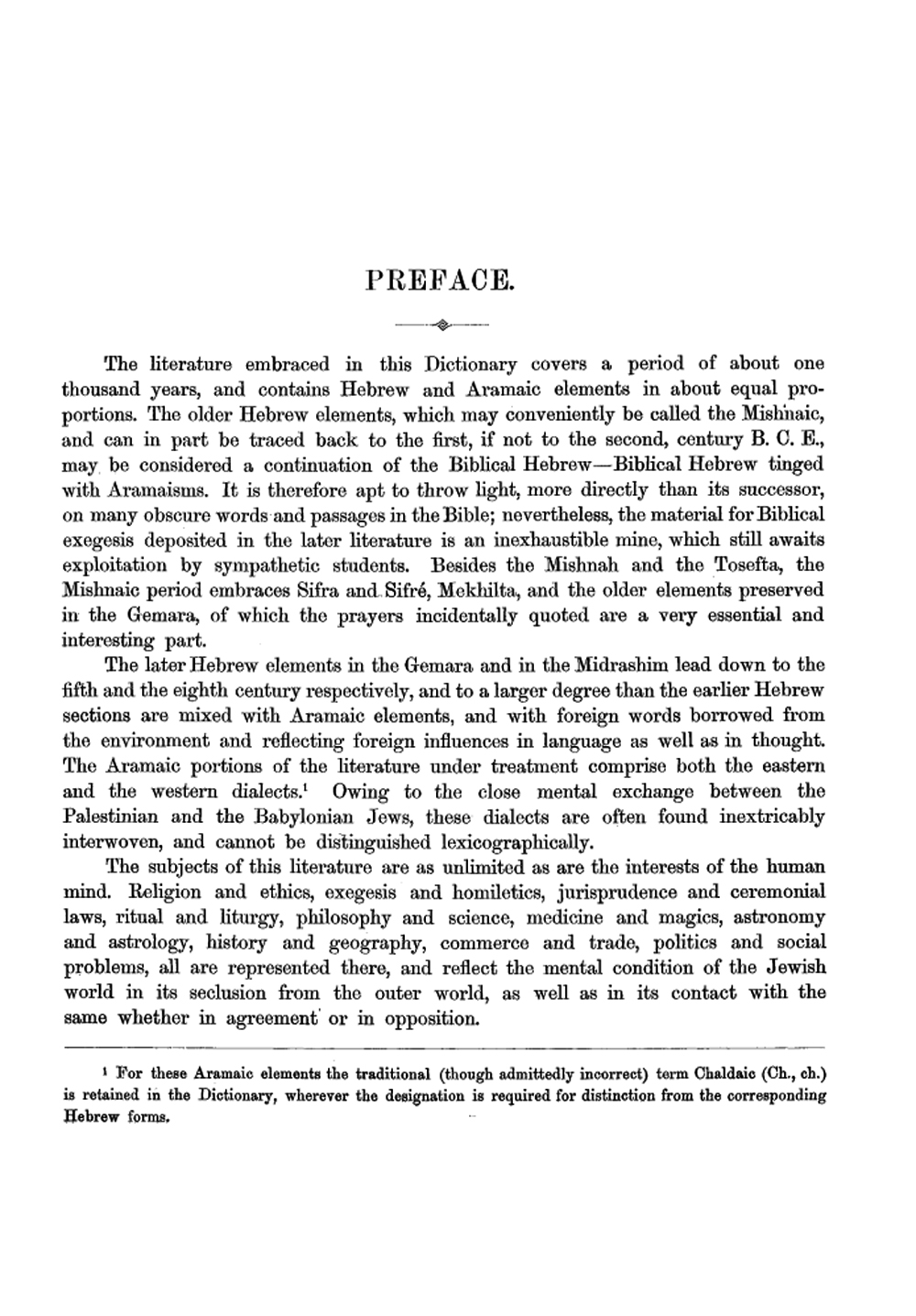
Finally, so that all the attention is not on ArtScroll, the following point was called to my attention by Benjamin Apfel. Here is the first page of Jastrow’s introduction to his dictionary. Read the last paragraph.

Here is the first page of Philip Birnbaum’s introduction to his translation of sections of the Mishneh Torah.[11]
The first paragraph is lifted from Jastrow. Would it have been so difficult for Birnbaum to simply add a note indicating that he was adapting Jastrow’s words?
2. In my post here I referred to selections from Rashbam’s commentary on Psalms that were recently printed from manuscript. This should be distinguished from Rashbam’s commentary on Psalms published in Vienna in 1816 by Isaac Satanow. Here is the title page which tells us that the manuscript comes from the royal library in Berlin.
This commentary on Psalms is a forgery. While the volume is attributed to Rashbam it was actually written by Satanow. Regarding this forgery, David Rosin writes as follows:[12]
הכי קרא שמו יצחק ויהי כצחוק בעיניו להתחפש במעטה רבנו שמואל ולעשות מעשהו ולעבוד עבודתו. זר מעשהו ונכריה עבודתו, כל השומע יצחק לו
3. In my post here I quoted R. Moses Isaac Ashkenazi in his Ho’il Moshe that King David is not to be regarded as a prophet as he only had ruah ha-kodesh. One of the commenters wrote:

Rashi Megilla 14a quotes a Halachot Gedolot which names David as [a] prophet. Rashi speaks specifically about prophets as opposed to Ruach Hakodesh, and excludes Daniel based on Megilla 3a.

 Another commenter was more strident:

Wonderful example how modern scholars have no place in the Torah world! As first commenter pointed out, Dovid Hamelech is prominent in the list of 48 neviim, and there are scores of sugyos based on the nevuah of DH. The makom mizbeach, etc. Pure AmHaaRatzus!

I am not sure if I am the am ha-aretz he is referring to, which in any case would be uncalled for since I never said that David only had ruah ha-kodesh and was therefore not a prophet. All I did was point out that R. Moses Isaac Ashkenazi said this. When I called the commenter’s attention to the fact that his strong words were directed against R. Ashkenazi, he wrote:

I wouldn’t start up with Hoil Moshe, but was pointing out the danger of someone reading this post, and then taking it at face value. For anyone fluent in Shas they will find numerous references to DH’s nevua. Ruach HaKodesh wouldn’t work for all the halachos we learn out from DH. . . . I do thoroughly enjoy your posts, but find them quite dangerous. I would prefer my children at least stick to Artscroll and have their basics –DH’s nevua – straight!

Now let me say something that I did not put in the comments because I want the entire audience to see it, not just the tiny group that reads the comments. The commenter just quoted is a perfect example of one who is certain of something, and certain that the opposing position is incorrect, and this leads to very harsh language. Let’s leave aside R. Moses Isaac Ashkenazi who is not an important scholar. All would agree that R. Moses Sofer, the Hatam Sofer, is important and certainly not an am ha’aretz (which is the term the commenter used). Yet the Hatam Sofer is explicit that David was not a prophet and only had ruah ha-kodesh, which is exactly what R. Ashkenazi states and what the commenter so harshly attacks. Here are the Hatam Sofer’s words in Torat Moshe ha-ShalemBa-Midbar, p. 74.

הנה לא מצינו לישראל מלך שיהי’ גם נביא משולח לעם כי אם משה רבינו ע”ה, דכתיב גבי’ (דברים ל”ג ה’) ויהי בישורון מלך, אבל שארי נביאים לא היו מלכים והמלכים לא התנבאו, ודוד המלך ע”ה רה”ק הו”ל ולא נבואה, ולכן אחז”ל (גיטין נ”ט ע”א) מימות משה עד רבי לא מצינו תורה וגדולה במקום אחד, דאלו כל הנביאים היו עליהם בגדולה השופט והמלך שבימיו, וכל המלכים אפי’ דוד ושלמה היו הנביאים שבדורם גדולים מהם בתורה . . . שהרי אין מלך נביא.

This notion, that the kings were not prophets (other than Moses), is also stated in Zohar, Terumah, p. 154a, and this is presumably the Hatam Sofer’s source. I don’t deny that there are other authoritative sources that contradict this, including passages in the Talmud. Some of them are cited by R. Reuven Margaliyot in his note to the Zohar, ad loc., and we can speculate as to why the Hatam Sofer preferred the Zohar over these other sources. I cite this only to show that commenters should be very careful before labeling something as am ha’aratzus, as you never know whom you might be insulting with this comment.

4. The latest book in my series with Academic Studies Press has recently appeared. It is Sara Reguer, My Father’s Journey: A Memoir of Lost Worlds of Jewish Lithuania. (Reguer is the granddaughter of R. Simcha Zelig Reguer, the dayan of Brisk.) Here is the book’s description.

Born into a leading Lithuanian-Jewish rabbinic family, Moshe Aron Reguer initially followed the path of traditional yeshiva education. His adolescence coincided with World War I and its upheavals, pandemics, and pogroms, as well as with new ideas of Haskalah, Zionism, and socialism. His memoir, recently discovered and here translated and published for the first time, discusses his internal struggles and describes the world around him and the people who influenced him. Moshe Aron Reguer wrote his memoir at the age of 23, on the eve of his departure for Eretz Israel in 1926. However, his story did not end there, but continued in British Mandated Palestine and the United States. He kept in touch with the family in Brest-Litovsk until the Nazis destroyed Jewish Lithuania, and some of their correspondence is included within this volume.

Anyone who is interested in Jewish Lithuania and the great yeshivot will find this book of value.

I also want to call attention to the recent publication of Menachem Kellner, Jewish Universalism, edited by Hava Tirosh-Samuelson and Aaron W. Hughes. Kellner’s work has made a great impact, not only in Jewish scholarship but among thinking Jews in general. This small volume is a wonderful read and contains an intellectual portrait of Kellner written by James A. Diamond as well as a lengthy interview with Kellner.

This book is number 12 in Brill’s Library of Contemporary Jewish Philosophers. Here is what has appeared so far and what if forthcoming (taken from the Brill website).

Published Volumes

Vol. 1: Eliezer Schweid: The Responsibility of Jewish Philosophy
Vol. 2: Jonathan Sacks: Universalizing Particularity
Vol. 3: David Novak: Natural Law and Revealed Torah
Vol. 4: Eugene B. Borowitz: Rethinking God and Ethics
Vol. 5: Elliot N. Dorff: In Search of the Good Life
Vol. 6: Judith Plaskow: Feminism, Theology, and Justice
Vol. 7: David R. Blumenthal: Living with God and Humanity
Vol. 8: Moshe Idel: Representing God
Vol. 9: Lenn E. Goodman: Judaism, Humanity, and Nature
Vol. 10: Avi Sagi: Existentialism, Pluralism, and Identity
Vol. 11: Elliot R. Wolfson: Poetic Thinking
Vol. 12: Menachem Kellner: Jewish Universalism

Forthcoming Volumes

Vol. 13: J. David Bleich: Where Halakhah and Philosophy Meet (est. October 2015)
Vol. 14: Michael Fishbane: Jewish Hermeneutical Theology (est. October 2015)
Vol. 15: Norbert M. Samuelson: Reasoned Faith (est. November 2015)
Vol. 16: Arthur Green: Hasidism for Tomorrow (est. January 2016)

5. The issue of truth-telling in halakhic matters, discussed in the last chapter of my new book, has been of interest to many people. I did not want to be too lengthy in my response to Aryeh Frimer here, because it was not my own independent post. So let me now add some more details. DG reminded me of the following source. According to R. Jacob Moellin, when the Talmud states that a law is rabbinic but a verse is brought as an asmachta, this was done so as to mislead the people into thinking that it is a Torah law so that they would observe it more carefully.[13] In other words, the Sages were engaging in falsehood for a higher purpose.

This is exactly the sort of thing that Frimer claimed is not part of mainstream halakhic thought, a point which I disputed. It also is very relevant to my discussion of the dispute between the Hatam Sofer and R. Zvi Hirsch Chajes regarding “raising the prohibition”. Here are the Maharil’s words, as quoted by his student.

כל היכא דאיתמר מדרבנן הוא וקרא אסמכתא בעלמא, הכי פירושו ודאי תקנתא דרבנן הוא והם יצאו ובדקו ומצאו להם סמך מקרא, וסמכו דבריהם עליו כדי להחזיקם שיהיו סבורים דהוא מדאורייתא ויחמירו בו, ולא אתו לזלזל ולהקל בדברי חכמים

In the notes to this text, the editor informs us that one of the manuscripts has a different version. Instead of כדי להחזיקם שיהיו סבורים it reads להטעות הבריות שהם סבורים. This text is even more explicit that the Sages were not being honest with the masses. This manuscript has a handwritten note explaining that instead of reading להטעות הבריות it should say להטעים לבריות because the word להטעות is a דבר מגונה . In other words, the person who made this “correction” was troubled by the explicit statement that the Sages would deceive people, even if it was for a higher cause.

If there is one thing people have learnt from my posts over the years, it is that whenever you find a passage that diverges radically from what others think is appropriate, you will find those who deny the passage’s authenticity. In this case, the most prominent of the deniers is R. Joseph Engel[14]:

לענ”ד לא מיסתברי כלל ולא אאמין כלל שיצאו מפה קדוש המהרי”ל ז”ל

R. Simhah Klein writes[15]:
וכי ישקרו חז”ל לחזק דבריהם שיהיו סבורין דהוא דאורייתא

However, R. Eliyahu Bohbut is not at all bothered by the claim of the Maharil that the Sages engaged in a form of deception vis-à-vis the masses. After quoting the passage he explains matter-of-factly[16]:

כלומר דאסמכתא באה כביכול “להטעות” את העם שיסברו דאיכא איסור דאורייתא “ויחמירו בו”

Regarding one of the other matters I discussed in the book, namely, so-called “Orthodox history”, the folllowing appears in Divrei David (p. 30a), a collection of teachings of R. David Moses Friedman, the first Chortkover Rebbe.

פ”א סיפרו לפניו על איזה מעשה שאדמ”ור מרוזין זי”ע סיפר אותו פעם בסינגון זה ופעם בסיגנון אחר אמר על זה מרן אדמ”ור זי”ע שהסיפורי מעשיות שמספרים הצדיקים הוא לפי מה שצריך באותו שעה

This is an acknowledgment that the stories told by the rebbes are not really history, as they are designed to serve the needs of the present. As I think most people today realize, haredi “historical” writing in general is as much about the present as the past, and it is precisely because of this that authors feel it is legitimate to cover up or even alter the historical record in order to best serve the religious needs of the present.

Finally, a few people have asked about what I wrote on p. 244, that the strand of Jewish tradition that countenances falsehood “deserves to be understood in a sympathetic manner as well”. This does not mean that people need to agree with those who countenance falsehood, and I certainly do not. However, in writing an academic study as opposed to a polemic, it is important to recognize that approaches that today we might regard as unacceptable, were viewed very differently in other times and cultures (and for some, these “other times and cultures” continue into our own day). I am interested in understanding what leads people to diverge so dramatically from a value that I regard as important. In my book I did not set out to judge them, but in a sympathetic manner, i.e, with a sensitivity to their worldview, attempt to understand them. (When I used the word “sympathetic”, I did not mean that I approved of what I was describing, only that I was sensitive to the motivations behind the approach.) By the same token, when I see that great figures from earlier years have written troubling things about non-Jews or women, I also approach this in a sympathetic manner, understanding that for these people, living in a vastly different time and often suffering under terrible anti-Semitism, it made sense that they would express certain thoughts that today pretty much everyone regards as unacceptable. One need not be a complete historicist to acknowledge that all people are influenced by their era, for good and for bad. This is what I mean by understanding in a sympathetic manner.

Coming Soon: R. Ysoscher Katz and Modern Orthodox Halakhah; The Nineteenth- and Early Twentieth-Century Dispute Regarding the Historicity of the Hanukkah Miracle; R. Steinman and the Messianic Belief; R. Mazuz’s Short-Lived Entry into Politics; and a response to R. Aharon Lopiansky’s article in Dialogue.


[1] See his note in Mekabtzi’el 36 (2009), p. 64.
[2] Was Maimonides ever misled by a censored text? According to R. Eliyahu Zini, Eretz Hemdatenu, p. 75, this was indeed the case. Mishneh Torah, Hilkhot Avodah Zarah 9:13 states:
 המוכר ביתו לעבודה זרה דמיו אסורין בהנייה ויוליך אותם לים המלח
As Kesef Mishneh and others point out, the origin of this halakhah is Gittin 44a. Yet the authentic reading there is המוכר ביתו לגוי (the Vilna Talmud has לעובד כוכבים). As Dikdukei Soferim ha-Shalem (Jerusalem, 2001), ad loc., informs us, לגוי is the reading in all surviving manuscripts and early printings. Meiri, ad loc., explains the halakhah as follows:
שהמוכר בית לגוי בארץ ישראל ר”ל לאחד מעובדי האלילים דמיו אסורים מתורת קנס על שנתן לעובדי האלילים חנייה בקרקע
Since Maimonides had the reading לעבודה זרה, R. Zini concludes that the talmudic manuscript he used had been altered. This is much more compelling than the explanation offered by Kesef Mishneh and Lehem Mishneh that Maimonides interpreted לגוי to mean לעבודה זרה.
Yet there is no doubt that R. Zini is incorrect. As has been pointed out by many, one who examines Tosefta, Avodah Zarah 7:2, will see that this, and not Gittin 44a, is the source for Maimonides, and Kesef Mishneh and Lehem Mishneh were simply unaware of this source. It is significant that לעבודה זרה appears even in manuscripts of the Tosefta. 

Regarding Tosefta, Avodah Zarah 7:2 and Gittin 44a, I assume that only one of the versions preserves the authentic text, but I don’t think we can determine which one it is. The only thing that remains to be explained is why Maimonides did not codify the halakhah in Gittin 44a. (It could be that his version of Gittin 44a was indeed the same as that which appears in the Tosefta, but this has nothing to do with censorship.)

[3] Kesef Mishneh, Hilkhot Melakhim 10:9, cites Rashi. You can see the uncensored text of Kesef Mishneh in the Frankel edition. The version of Kesef Mishneh that appears in older editions of the Mishneh Torah is a censored text, and instead of recording Rashi’s statement about Sunday, the following appears: או בע”ש ששובתים בו הישמעלים. For printers in the Christian world there was no problem speaking about Muslim beliefs and practices, so in this case the original statement, made with reference to Christians, was substituted with one referring to Muslims. The printers who made this “correction” had the same misconception as many today, namely, that Friday is a day of rest for Muslims. It is not. Friday is a day of gathering for prayer, but Muslims do not have a sabbath, i.e., a day of rest.
[4] Interestingly, I found an anonymous medieval Italian text that records a “minhag tov” not to eat meat on Sunday. One reason offered is kevod Shabbat, namely, by having meat so soon after Shabbat one lessens the special nature of this day in which meat is the main dish. (Obviously, meat was not regarded as an everyday meal in this author’s time and place.) The second reason is מפני קלון הנוצרים. What this means is that since Sunday is the Christians’ holy day, Jews should avoid eating a special food like meat on that day. See Minhag Tov, ed. Weiss (Budapest, 1929), p. 230, no. 47.
[5] See Reuven Kimelman, “Birkat ha-Minim and the Lack of Evidence for an Anti-Christian Jewish Prayer in Late Antiquity,” in E. P. Sanders, et al., eds., Jewish and Christian Self-Definition (Philadelphia, 1981), vol. 2, p. 242.
[6] Christianity in Talmud and Midrash (London, 1903), p. 172. His first name “Robert” never appears in his works, as he went by “R. Travers Herford”. I supplied the first name in full as I did not want people to assume that we are dealing with “Rabbi Travers Herford”. Herford wrote a number of works about the Pharisees. His positive portrayal of them was in opposition to the standard Christian view. This highly impressed R. Zvi Yehudah Kook, who suggested translating Herford’s works into Hebrew. See his letter here where he writes:
חשבתי אז להעירו ע”ד ספריו החשובים של החכם האנגלי הרפורד, – היודע ואוהב את היהדות באופן נפלא, –  ע”ד תורת היהדות הפרושית וערכה העולמי, כהמשכה האמיתי של הנבואה בחיוניותה הנמשכת עד היום. כדאי וחשוב מאד היה לתרגמם לעברית, בשביל הנוער שלנו המתחשב מאד עם דבריו של גוי, וביחוד לעומת הרבוי של תרגומי דברי תפלות, שזכו ומזכים בהם את ספרותנו החדשה. אולי יואיל כ’ לזכות במצוה זו בהתמחות זריזותו ושקידתו
Herford’s commentary on Pirkei Avot is full of interesting points. To give one example, he argues that the proper vocalization of אמרו  in Avot 1:5: באשתו אמרו קל וחומר באשת חבירו, is amaro, not amru. (R. Mazuz told me that this is definitely incorrect.)
[7] See Dikdukei Soferim ha-Shalem, ad loc., Saul Lieberman, Tosefta ki-Feshutah, Ketubot, p. 365.
[8] See R. Yonatan Binyamin Buchinger in Or Yisrael 46 (Tevet 5767), pp. 237ff., ibid. 48 (Tamuz 5767), pp. 240-241, ibid. 51 (Adar Sheni 5768), p. 246. The authentic text of the Rif, which reads ערב הפסח, is found in the Constantinople 1509 edition. See Hilkhot Rav Alfas, ed. Zaks (Jerusalem, 1969), vol. 2, p. 128.
[9] See Ariel Toaff, Blood Passover (available online) ch. 8 n. 8. (Unfortunately, this book continues to give ammunition to anti-Semites.)
[10] See F. H. Wettstein, Halifat Mikhtavim (Cracow, 1900), p. 97; R. Dovid Cohen, He-Akov le-Mishor (Brooklyn, 1993), to Ketubot 102b (p. 106); Soncino’s note, Ketubot 102b.
[11] Maimonides’ Mishneh Torah (New York, 1967).
[12] Introduction to his edition of Rashbam on the Pentateuch, p. xix. See also Reuven Elitzur, Degel Mahaneh Reuven (n.p., n.d.), pp. 365ff. Not knowing who Satanow was, R. Yisrael Yaakov Fisher of the Edah Haredit refers to him as ר’ יצחק מסטנוב ז”ל. See Even Yisrael, vol. 8, no. 9. I found the same lack of awareness in R. Aryeh Leib Neimark, Even Yaakov (Slutzk, 1910), p. 57b: יפה פירש החכם מהר”י סאטנאב
[13] Sefer Maharil, ed. Spitzer (Jerusalem, 1989), Likutim, no. 70 (p. 629).
[14] Beit ha-Otzar, vol. 1, kelal 190 (p. 118b).
[15] Peleitat Soferim 1 (2012), p. 87 n. 7.
[16] Shoshanat ha-Amakim (Jerusalem, 2008), p. 257.


ArtScroll and More

ArtScroll and More
Marc B. Shapiro
In an earlier post here I discussed ArtScroll’s use of a censored talmudic text.[1] This happens quite a bit and it is not always clear if the translators were aware that they were working with an inauthentic text. However, for many passages there is no question that they realize that what they are translating is not authentic but was added because of fear of non-Jewish reaction. Here is a chart someone drew up showing how the various new Talmud editions deal with the matter of censorship.

It is significant that even in the Hebrew ArtScroll the text that is used is censored. ArtScroll has never publicly explained why they have adopted this approach, but I think it is obvious that unlike other publishers, ArtScroll is still worried about creating anti-Semitism and thus continues to print a censored Talmud. While I think everyone agrees that the ArtScroll Talmud translation is a masterpiece, opinions will obviously differ as to whether ArtScroll made a mistake in not restoring the Talmud to its pre-censorship state.[2]
ArtScroll’s approach is different than that of other publishers who are very happy that they can now include the complete uncensored words of the Talmud. Ezra Chwat’s words express the feeling of every publisher other than ArtScroll.[3]
אין צורך להדגיש את החשיבות של הנגשת הסוגיה המקורית לעשרות אלפי הלומדים את הגמרא כפי שיצא מפיהם הקדושים של האמוראים, ושלא יסתפקו ב”גירסא” שאושרה על ידי הכנסייה.
Yet R. Leopold Greenwald had the exact opposite approach, and he was upset when he heard that a new Talmud was being printed that reinserted the censored texts. His words reflect the approach later adopted by ArtScroll [4]:
ומה מאד דאבה נפשנו בראותנו, כי מכריזים גם עכשיו על “המציאה הגדולה”, כי בירושלים מדפיסים כעת תלמוד עם כל ההשמטות שהשמיטו הצנזורים במשך מאות שנים. ועל זה אנו קוראים: שקול טובתך! בני ישראל לא ישבעו עונג מהטובה הזאת, לא ספרותנו ולא חכמתנו יתעשרו מהשמטות הללו, לא בזמננו ולא בהדורות שאחרינו. כבר שבענו צרות ומכאובות. ולהיות בפי כל מחבל בודאי אסון הוא. איפוא הם חכמי ירושלים? האם אינם רואים כי מזה לא תושע יהודה וכי צוררי ישראל ישיגו חומר מסוכן חדש?
For those who are unaware of the details, let me just mention that I am not referring to a word here or there that was censored and has not been restored by ArtScroll. Sanhedrin 43a has a number of lines dealing with the execution of Jesus and his disciples. While the entire section is found in Soncino (in translation), Steinsaltz, Wagshal and Oz ve-Hadar, it is not to be found in ArtScroll. Both the English and Hebrew editions of ArtScroll tell the reader that a section has been deleted from the Vilna Shas. However, in Sanhedrin 67a, where another section has been deleted and is found in the other editions just mentioned, ArtScroll does not inform the reader of the deletion.
An allusion to the Sanhedrin 67a text is found in Va-Avo ha-Yom el ha-Ayin, attributed to R. Jonathan Eybeschuetz. This explosive text, which remained in manuscript for almost three hundred years, has just appeared in print, edited by Pawel Maciejko.[5] Va-Avo ha-Yom el ha-Ayin is very important to understanding the controversy over R. Eybeschuetz. (I hope that the manuscript Gahalei Esh, a treasure trove of documents dealing with eighteenth-century Sabbatianism, will also soon appear in a scholarly edition.) Quite apart from the radical theological notions found in Va-Avo ha-Yom el ha-Ayin, Maciejko describes the work as follows: “[I]t is blatantly pornographic (in fact, it is possibly the only truly pornographic text ever written in the rabbinic idiom.)”[6]
Speaking of pornography let me add the following. Not long ago I was visiting a certain synagogue for Shabbat. When it came time for Torah reading I took out the chumash that was near me. It happened to be the one published by R. Aryeh Kaplan. I actually am not a fan of this chumash for use in synagogue as its focus is entirely philological, and doesn’t deal with any of the issues that a typical person would want explained in reviewing the Torah portion. But this was what I had so I used it. In Exodus 35:22 an unusual word appears: כומז. It means some sort of golden bodily ornament. The word also appears in Numbers 31:50. According to the Exodus passage, this was one of the items the Israelites in the desert donated at the time of the building of the Tabernacle. The passage is Numbers refers to booty taken from the Midianites. Among the different interpretations Kaplan offers for כומז is “a pornographic sculpture.” This is quoted in the name of R. Aaron Alrabi (fifteenth century). I was quite shocked when I saw this and later saw that this interpretation is also quoted by R. Kasher in Torah Shelemah, which must have been where Kaplan saw it.
Alrabi wrote a commentary on Rashi which was published in Constantinople in 1525. In this work, on Exodus 35:22, Alrabi writes:
יראה לי שהוא תכשיט מצוייר צורת רחם האשה כדי שישתוקק רואהו לפועל המשגל והצנועות היו מביאות אותו עליהן בחדריהם לתת תשוקה לבעליהן העין רואה והלב חומד בו, והיה זה לכונה טובה לכן הותרו לשרת בקדש
What this means is that the item in question had a picture of a woman’s private parts. The Israelite women would have their husbands look at it in order to sexually excite them before they had marital relations. Since this pornographic viewing was for a good purpose, it was permitted for these items to be donated for use in building the Tabernacle. Here is the original text.
Those who want to see the book in its entirety can view it here.
I find this explanation quite strange. I don’t know what led Alrabi to his original understanding and why he did not find any of the prior explanations compelling.
Incidentally, one of the other explanations cited by Kaplan is that כומז means a chastity belt. R. Ephraim ben Shimshon (12th-13th centuries) writes[7]:
הכומז היה כלי כמנעול שקושרת האשה פתחה שלא יודעו להם שם אדם, כי אם בעלה לבד, והוא גודר הערוה.
This is how he understands Shabbat 64a which states that כומז means דפוס של בית הרחם. Soncino translates this as “cast of the womb” and ArtScroll translates it the exact same way. Koren translates “a mold [in the shape] of the womb.” In general I would say that disagreeing with these three translations is not a smart thing to do, yet in this case I must do just that. The translations I have cited are incorrect as they do not reflect what the Talmud is saying. בית הרחם in Shabbat 64a does not mean “womb” but rather something else. In order not to cause problems for those with internet filters I won’t spell it out completely, but I think the reader already understands.[8]
Rashi, Exodus 35:22, in summarizing the Talmud leaves no doubt in this matter:
כלי זהב הוא נתון כנגד אותו מקום לאשה
The very text in Shabbat 64a also lets us know that this matter has nothing to do with a “womb”, as immediately following the explanation of דפוס של בית הרחם the Talmud explains that the wordכומז  is an acronym of כאן מקום זימה “here is the place of lewdness”, and there is no issue of lewdness with the womb. ArtScroll itself, in its note on this latter passage, explains the matter well: “The place encased by this ornament is the part of the body which is the focus of lewdness.” In other words, in its commentary ArtScroll tells us that we are not dealing with the womb at all, but with another part of a woman’s anatomy. As such, it was a mistake for ArtScroll in its translation to adopt Soncino’s rendering of כומז as “cast of the womb”.
In his commentary to Berakhot 24a s.v. תכשיטין שבפנים, Rashi explains that a כומז is a chastity belt. From the context of this talmudic passage we see that it also had ornamental significance:
כומז דפוס של בית הרחם שהיו עושין לבנותיהן ונוקבין כותלי בית הרחם כדרך שנוקבין את האזנים ותוחבין אותו כדי שלא יזדקקו להן זכרים
In its commentary, ibid., ArtScroll summarizes Rashi as follows: “The kumaz was an ornament that covered a woman’s private parts.”
Let me return to Shabbat 64a where כומז is explained as being an acronym for כאן מקום זימה. The Maharal, Gur Aryeh, Ex. 35:11, writes:
מפני שהוקשה להם לרז”ל שאין דרך לשון הקודש לקרא שם מיוחד לדברים שהם ערוה . . . כל דבר ערוה אין הכתוב נותן לו שם מיוחד . . . וכאן למה קרא כומז שם מיוחד אל הכלי הזה שהוא דפוס בית רחם, ולכך דרשו רז”ל שהוא כאן מקום זימה והשתא אין שם מיוחד לכלי זה רק כאילו נקרא כאן זימה.
I don’t understand the Maharal’s point. Just because there are no words in leshon ha-kodesh for sexual organs, why should we assume that there is no name for an item designed to cover a sexual organ?
Returning to the matter of “pornographic viewing” as described by Alrabi, I wonder if this could also have halakhic significance. I mention this only because of the controversy some years ago by an answer given by R. Shlomo Aviner that in a she’at ha-dehak (i.e., there are serious marital sexual issues) it would be permitted for a husband and wife to together view explicit pictures in a book. See here.
The entire conversation with R. Aviner was a set-up, and the anti-Aviner website used it to attack R. Aviner, and portray him as permitting viewing of pornography. Yet it is obvious that he was referring to sexual self-help books (which would have explicit pictures) since he refers to books found in Steimatzky. R. Moses Feinstein had earlier permitted a soon-to-be-married man to read sexual self-help books.[9] There is no indication in R. Feinstein’s responsum that he is also including the viewing of pictures in such books, but I do not know if he would regard this as a problem if the pictures are not of real people but are drawings.
Let us return to the subject of chastity belts. In the Wikipedia entry for “Chastity Belt” one finds the following:
Gregory the Great, Alcuin of York, Bernard of Clairvaux and Nicholas Gorranus all made passing references to ‘chastity belts’ within their exhortatory and public discourses, but meant this in a figurative or metaphorical sense within their historical context.
The first detailed actual mention of what could be interpreted as “chastity belts” in the West is in Konrad Kyeser von Eichstätt’s Bellifortis (1405), which describes the military technology of the era.
As we have seen, Rashi and R. Ephraim are not referring to chastity belts in a metaphorical sense. Thus, their mention of the item is of general historical significance, and Rashi (1040-1105) might be the earliest recorded example of someone referring to a chastity belt. Eric John Dingwall wrote an entire book on the subject of chastity belts entitled The Girdle of Chastity (Scranton, 1959). On p. 14 he writes: “There can be little doubt that the idea of such a device, at least in a somewhat modified form, was current at least as early as the second half of the twelfth century.” He then cites the late twelfth-century Guigemar Epic, written by Marie de France, as a source of this. Yet Rashi’s mention of the chastity belt predates this source by around a century.
See also here where as part of a museum exhibition on chastity belts it states:
Until the 12th century, there are no textual memories related to chastity belts at all (not even any allusions without actually using the term) where the reference is not in a theological or mythological context.
This sentence is incorrect, for as we have seen Rashi referred to chastity belts many decades before Marie de France, who is also cited in the museum exhibition as the first one to refer to the item. What we have here is a good example where scholars make judgments based exclusively on their knowledge of medieval Latin, Romance and Germanic literature. Exposure to what appears in medieval Hebrew texts would have caused them to alter these judgments.
Returning to ArtScroll, here is an example where I believe that ArtScroll has printed something that they know is incorrect, but did so in the interest of good Jewish-Gentile relations. I think it is a noteworthy example as it has nothing to do with a censored text, but focuses on the explanation of the Talmud. Avodah Zarah 6a states that according to R. Yishmael it is forbidden to do business with idolaters because of Sunday. Rashi explains that this means that one can never do business with idolaters since one cannot do business with them three days before and three days after their holiday, and this includes the entire seven-day week.
It doesn’t take much imagination to realize what the Talmud is referring to by “Sunday”, and in the uncensored text it actually has  נוצרי, נוצרים or  יום הנוצרי instead of “Sunday”. Yet ArtScroll in its translation states that the Talmud is referring to “Babylonian pagans who observe a sun-worshiping festival every Sunday.” It is true that Meiri states as much.[10] Meiri also claims that when the Talmud uses the word נוצרים it does not mean followers of ישו הנוצרי, but refers to the use of the term in Jeremiah 4:16, which Meiri claims is derived from the word נבוכדנצר.[11] While it is true that R. David Kimhi also sees the word in Jeremiah 4:16 as related to נבוכדנצר, it is Meiri alone who claims that this is also intended when the Talmud refers to נוצרים.
It is certainly appropriate that ArtScroll cited Meiri’s explanation in a note, but how is it that this is the only explanation cited, when other than Meiri everyone else has assumed, with good reason, that נוצרים refers to Christians? This can only be an example of ArtScroll shading the truth for apologetic reasons. People can debate the appropriateness of this, but there can be no doubt that ArtScroll is not being frank in its presentation here.
In the ArtScroll Hebrew edition it also quotes Meiri and states the that Talmud is not referring to Christians. Yet unlike in the English edition, in the Hebrew ArtScroll there is a note which states: “See Rambam, Hilkhot Avodat Kokhavim 9:4”. If you open up the Mishneh Torah what you find is that the Rambam states:
הנוצרים עובדי עבודה זרה הן ויום ראשון יום אידם הוא
In other words, by referring to the Mishneh Torah after mentioning Meiri, ArtScroll is alerting readers to the fact that the Rambam does not agree with Meiri and believes that the passage in Avodah Zarah 6a indeed refers to Christians. Yet this is never spelled out in ArtScroll, and you need to take their suggestion to consult the Mishneh Torah in order to learn that not everyone agrees that when the Talmud mentions those who make Sunday their holiday that it is referring to Babylonian pagans. (In fact, as already mentioned, only Meiri advocates this position.) Does the average person who learns daf yomi realize this?
In case anyone has any doubts as to what I am saying, please note the following. After referring to Maimonides, the note in the Hebrew ArtScroll calls attention to the Venice edition of the Talmud with Rashi, and to Dikdukei Soferim. Again, only one who examines these sources will learn that they offer an interpretation at odds with Meiri. If you look at the Venice Talmud or Dikdukei Soferim (or even Steinsaltz) you will find that in Avodah Zarah 6a Rashi explains:
נוצרי, ההולך בטעותו של אותו איש שצוה להם לעשות להם יום איד בא’ בשבת
In other words, Rashi tells us, just like Maimonides, that when the Talmud refers to those who celebrate נוצרי יום it means the Christians who follow Jesus.I find it significant that even in the Hebrew edition ArtScroll feels the need to only allude to the explanation of Rashi and Maimonides, while presenting Meiri’s explanation as the standard understanding of the text. ArtScroll certainly knows that this is not the standard understanding, and ArtScroll itself cannot believe that Meiri’s understanding is what the Talmud really means. After all, every other medieval commentator agrees with Rashi and Maimonides. In this case, the only explanation is that ArtScroll is following a long apologetic tradition, which was based on fear of what the non-Jews would say if they knew the true meaning of certain talmudic passages.

Another example of this tendency was called to my attention by R. Moshe Maimon. Ketubot 15a discusses the case of A killing B, when A actually intended to kill another person. In its discussion the Talmud refers to “Canaanites”, which in the current context simply means non-Jews. In fact, in all manuscripts and early printings what appears is not “Canaanites” but “goyim”.[12] “Canaanites” is simply a “correction” of the censor. Yet ArtScroll has a note explaining that “The Canaanites were the pagan people who lived in Eretz Yisrael before the Israelites entered the land.” The implication of this comment is that the halakhah stated in the Talmud was only applicable with the ancient Canaanites but not with regard to other non-Jews. This is false and ArtScroll knows it is false, but it is no different than the “note to reader” found in many seforim that all the halakhot about non-Jews only refer to the pagans in faraway places. In the latter case everyone knew (and knows) that these words are not to be taken seriously, but I would assume that the typical user of the ArtScroll English Talmud does not realize this. It is noteworthy that the ArtScroll Hebrew Talmud does not include the note about the Canaanites.[13]
In 1728, an era in which Jewish-Gentile relations were not the best, R. Jonathan Eybeschuetz printed Tractate Berakhot with many deletions, as this was the only way he was given permission to publish the volume. Here is the title page.
The volume can be found at hebrewbooks.org here. True to form, R. Jacob Emden accused R. Eybeschuetz of being in league with the bishop of Prague and intent only on making money from his new printing.[14] There was also a lot of controversy about this edition, not only because of the many deletions but even more so because of the instances where the talmudic text was rewritten. While non-Jewish censorship has a long history, this latter practice, of Jews agreeing to rewrite sections of the talmudic text, was a new and more dangerous phenomenon. Other tractates were later printed, but R. Eybeschuetz had nothing to do with them, and in any event the controversy focused on Berakhot as the other tractates simply printed the censored text from the earlier Basel edition, but did not add anything new.[15]
In his recent outstanding study of this episode, which makes use of manuscript sources, Pawel Maciejko writes:
In both academic scholarship and Jewish collective memory, the best-known controversies concerning Rabbi Jonathan Eibeschütz (1690-1764) are those about his kabbalistic tract Va-avo ha-yom el ha-‘ayin . . . and about the allegedly Sabbatean amulets that he distributed to the members of the communities of Metz and Altona, Hamburg, and Wandsbeck in the 1750s. However, during his early years, the most important controversy concerning Eibeschütz was not the dispute surrounding his suspected Sabbateanism and the heterodox writings attributed to him but rather the outrage engendered by his friendly relations with the local Catholic clergy and his alleged involvement in the publication of heavily censored editions of the Pentateuch, the Talmud, and the prayer book. In the eyes of many contemporaries, the damage caused by the appearance of these latter publications vastly overshadowed any harm stemming from the heretical views expressed in Eibeschütz’s kabbalistic works and amulets.[16]
Maciejko notes that R. Moses Hagiz was so outraged by R. Eybeschuetz’s Talmud that he asked other rabbis to issue a ruling that it be burnt!
Shortly after the publication of R. Eybeschuetz’s Talmud someone wrote a defense of it, explaining why it was necessary to print a censored Talmud.[17] Raphael Kirchheim, who published this document, cites another who states that its author was none other than R. Eybeschuetz, since the author refers to R. Abraham Broda as his teacher.[18] R. Broda had served as rosh yeshiva in Prague, and later rav of Metz and Frankfurt.
While Maciejko also accepts this view,[19] the reference to R. Broda as the author’s teacher, מורי ורבי, would appear to show that R. Eybeschuetz could not have written the letter, since he was not a student of R. Broda.
We have good information about R. Eybeschuetz’s life, but there still is a lot we don’t know. Even though R. Eybeschuetz is not recorded as R. Broda’s student in the standard biographies, one could claim that it is possible that he studied for a short time under him, and for some reason this fact was not known to the biographers.[20] Yet in this case we can indeed make the definitive statement that R. Eybeschuetz did not study with R. Broda since R. Eybeschuetz tells us this himself. Some thirty years after R. Broda’s death in 1717 his Eshel Avraham was published (Frankfurt, 1747). Here is the title page.
Among those who provided an approbation was R. Eybeschuetz, who at that time was in Metz. His respect for R. Broda is great, but he leaves no doubt that he never studied with him:
ממש רובי חכמי ישראל בדור הזה השלימי’ המה שותי מימיו ואף אני אם לא זכיתי לאורו לחזות לרבי מקמא כי בבואי לפראג שנת תע”ל כבר חמק דודי ופנה הודו לכאן ק”ק מיץ היא העיר אשר כעת אני יושב בה בתוך עמי, מ”מ נפתולי נפתלתי עם גדולי תלמידיו הרבני’ וחכמי’ מובהקים ושלימים במדע אשר נשארו שם ושמעתי’ תמיד בבי מדרשי’ בדיבוק חברי’
Returning to the document published by Kirchheim, it describes the history of the banning of the Talmud in the years before R. Eybeschuetz printed his volume. Interestingly, it tells about the confiscation of Jewish books from the Jews of Prague, which were then handed over to the Jesuits to be examined for anything against Christianity. From other sources we know that the Jesuits burnt the copies of the Talmud they confiscated, and “[i]n the 10 years from 1715 to 1725, very few copies (according to some sources, none) of the Talmud existed in Bohemia.”[21]
This need for copies of the Talmud explains why R. Eybeschuetz had to take the step he did. The document also tells of the punishment of a man from Nikolsburg who was caught smuggling Talmuds into the Prague ghetto. He was forced, in chains, to clean the streets for a year. The smuggled Talmuds were supposed to be burnt, but this was somehow prevented (probably with a good bribe).
The only way to print a Talmud in Prague was to remove everything the Jesuits viewed as offensive to Christianity. They also viewed certain aggadot as objectionable, such as the description of God wearing tefillin in Berakhot 6a, and these too had to be removed.[22] The document tells us that having the Church agree to publication of the Talmud, even with these restrictions, was regarded as a great achievement. It also tells us that all the important rabbis in Prague permitted the publication of the bowdlerized Talmud.[23]
וכאשר הגיעו לידינו רשימה אספנו להגאון מורנו ורבנו האב”ד ור”י נר”ו בצירוף כל חכמי רבינו [!] עירנו אשר ת”ל המה גדולים בחכמה ובמנין וטבעם יצא בכל ארץ לעיון במילין אם כשר ונאות לעשות כן אם לא ואחר הלנת דין פעמים ושלש ומשא ומתן עלתה הסכמה להדפיס מס’ ברכות הנודע הגהתן וסדר זרעים אשר לא יחסר בו דבר, אך ממסכת שבת והלאה לא עבר הסכמתן כי לא נודע עדיין טיב הגהות נוצרים בו אם מעט אם רב
The document then quotes a statement issued by the scholars of Prague defending their decision, a statement that was only intended to be viewed by other learned Jews. In justifying their decision to publish a censored Talmud – since this was all they were permitted and it was a censored Talmud or nothing – we find the following very interesting passage:[24]
ודאי שנכון הדבר לעשות לבלי כושל ועיכוב כלל כי ודאי שניתן הש”ס להצילו באחד מאיבריו ולא יהיה הש”ס חמור מג”ע וש”ד אשר ק”ל יהרג ואל יעבר קימו לן אם מיחדים על אחד ימסר להם ואל יהרגו וכ”ש הדבר בש”ס שבזמן שמיחדים לומר השמיטו דא מאתכם שיהא הנשאר לפליטה שישמיטו זאת ולא יצאו כולם לבית השריפה מבלי שריד באהלינו אהל תורה ובפרט כי חז”ל שיסדו התלמוד לא על זה יסדו להיותו בדפוס גלוי לכל עמים כי אם כתבוהו בכתיבה תמה ומסרו זאת לזרע אמונים להנחיל לבניהם אחריהם לחלקם ביעקב ולהפיץ בישראל.
The last sentence is making the point that there are certain things in the Talmud that should not be published for all to see, as these are the sorts of things that could create great problems with non-Jews. The Prague scholars then state that it is actually a good thing to cut out certain passages from the Talmud. In other words, they are acknowledging that even without Christian demands, it would be best in internally censor certain passages so as to prevent problems from arising. This is exactly what ArtScroll is doing today. No one is forcing them to self-censor, but they see matters as the sages of Prague who wrote (emphasis added)[25]:
וזה לערך ר’ שנה שהחל להתפשט ספרינו בדפוס לתקנות אחינו למען יהיו להם הספרים בנקל ומצוי, אמנם בדברים כאלו תקנתם קלקלתם שגורמים סכנה לכל ספריהם ומטילים איבת הנוצרים עלינו ודאי ראוים שדברים אלו יהיו חוזרים לאיתנם הראשון מבלי לחוקקם בעט ברזל ועופרת.
They are not saying that the censored matters should be forgotten about. Rather, they should be only be passed on in a non-published form (“Torah she-Ba’al Peh”) to advanced students who study the Talmud; they should not be put down in print for all to see and thus create a Christian backlash. The sages of Prague make the same point about strange Aggadot that are not to be taken literally and can only be understood by a few, and which have become subject to Christian mockery. These too should be omitted[26] להציל דברי חז”ל. When possible, the Prague sages state, one should not delete an entire passage but simply change certain words. In this way the sense of the passage is not changed for any learned person, but problematic words are removed thus helping to blunt anti-Semitic attacks:[27]
ומכ”ש לשנות הלשון במילות ושמות נרדפים באופן שלא ישתנה הענין פשיטא שמותר
The Prague sages then state that if necessary it is even permitted to alter (i.e., falsify) halakhic rulings that appear in the Talmud in order to prevent anti-Semitism (which obviously could lead to real danger). They note that R. Solomon Luria disagrees but that the accepted practice is not in accord with what he wrote, a point that was later made by R. Moses Feinstein:[28]
דעת מהרש”ל להחמיר אף במקום סכנה. אמנם מעשים בכל יום שמהפכין הדין ומשנין מדרכי השלום בהפקעת הלואה וכדומה ולא שמענו פוצה פה לעולם וכן נראה היפוכו בדברי מהר”ם רבק”ש בש”ע ח”מ סי תכ”ה ודברים המה מועתקים בספרים רבים.
It is interesting that the Prague sages quoted the famous words of R. Moses Rivkes in his commentary to Shulhan Arukh, Hoshen Mishpat 425:5, who responds to a particular anti-Gentile law as follows:
The Rabbis said this in relation to the pagans of their own times only, who worshipped stars and the constellations and did not believe in the Exodus or in creatio ex nihilo. But the people in whose shade we, the people of Israel, are exiled and amongst whom we are dispersed do in fact believe in creatio ex nihilo and in the Exodus and in the main principles of religion, and their whole aim and intent is to the Maker of heaven and earth, as the codifiers have written. .  . . So far, then from our not being forbidden to save them, we are on the contrary obliged to pray for their welfare.[29]
Some, such as Jacob Katz,[30] have seen R. Rivkes’ words as reflecting a new tolerant approach. However, the sages of Prague, who were closer to the time R. Rivkes lived, saw his words as merely designed for non-Jewish eyes and not to be taken seriously by Jews. R. Rivkes’ comment would therefore be no different than the declarations found at the beginning of many seforim that all negative statements about non-Jews are only directed towards pagans but have nothing to do with the Christians of Europe who worship God and allow the Jews to dwell among them.
Unlike what has been described by the Prague sages, Maciejko does not view the “corrections” in R. Eybeschuetz’s Talmud as simply defensive. He writes:
Eibeschütz believed that there was no final, fixed, and canonized text of the Talmud. . . . Eibeschütz put himself in the shoes of the ancient sages and saw himself not as expurgating but rather as creating the text of the Talmud.[31]
Maciejko further writes:
Eibeschütz seems to have been the only early modern Jewish author who believed that the talmudic sages needed to be edited for style. For themselves, such changes were only possible thanks to the editorial freedom Eibeschütz granted himself in his “Apology and Answer of the Rabbis Prague”: Eibeschütz considered the talmudic text open and unfinished and therefore felt free to “correct” it even in instances in which he experienced no external pressure from the church or from any other powerbrokers. As for the character of these changes, one thing can be said with certainty: most of them aimed to create a neater and simpler text of the Talmud, one that avoids intricate grammatical constructions or potentially misleading expressions.[32]
It is hard for me to accept that R. Eybeschuetz could have viewed himself as “updating” the Talmud. Yet Maciejko is correct that we are confronted with the fact that R. Eybeschuetz’s Talmud contains linguistic and stylistic changes that were not required by the censor. Unlike Maciejko, I would explain matters in the following way: Since the Talmud was already being published in a censored fashion, with numerous passages deleted or rewritten, R. Eybeschuetz saw no reason not to make other changes that would create a more user-friendly text. However, this has nothing to do with the talmudic text being “open and unfinished” as Maciejko puts it. It wasn’t that he was improving on the original Talmud or seeking to replace it, but since the Talmud he was publishing was already “damaged”, as it were, he did not see a problem making other changes if these changes could be of assistance to the reader. Furthermore, everyone who bought this Talmud knew that it was a she’at ha-dehak publication and that it was only to be used if one had no access to an uncensored text. I have no doubt that R. Eybeschuetz felt the exact same way, and thus I would need more evidence before accepting Maciejko’s theory.
Maciejko makes a further claim that R. Eybeschuetz’s “editing” of the Talmud hints to his secret universalist religious views that are also found in Va-Avo ha-Yom el ha-Ayin. This is a much more provocative claim than what I discussed in the previous paragraph, and I am curious as to what other scholars will have to say about it.
In addition to being given permission to print an expurgated Talmud, the non-Jewish authorities also permitted “strange” aggadic passages to remain if a good explanation could be provided for them. In R. Eybeschuetz’s edition of Berakhot such explanations are found at the back of the volume, and the reader is alerted to them by a note on the talmudic page.[33]
Until Hebrewbooks.org put the Prague edition of Berakhot online, it was a very rare book, and Maciejko knows of only three copies in existence.[34] In 1981 Professor Shnayer Leiman republished R. Eybeschuetz’s explanations to Berakhot.[35]
To be continued


[1] See also Jeremy Brown’s post here and regarding Brown’s post see David Zilberberg’s earlier post here.
[2] Only in the last year or so have I started to examine the ArtScroll Talmud on a regular basis and I am continuously impressed. This has to be one of the most significant Torah publications of the twentieth century. Since that is the case, I don’t see why such effort is being put into producing the new Koren Talmud. While it sometimes has points that do not appear in ArtScroll, I don’t know why anyone would prefer it over ArtScroll. I have had a chance to use both ArtScroll and Koren in reviewing some sugyot in Berakhot with my son, and in my mind ArtScroll always comes out on top. I even found one place where Soncino is to be preferred to Koren (although generally this is not the case). In Berakhot 29a it states: “Corresponding to what were these twenty-four blessings of the Amida prayer of the fast days instituted?” Unlike Soncino, Koren provides no note to this sentence and most people who read it will have no clue what it is talking about since when they look in the siddur they will not find twenty-four blessings in the Amidah on fast days (as they will assume that the fast days referred to are Yom Kippur, Tisha be-Av, etc.). ArtScroll helpfully explains as follows: “On certain public fast days decreed in times of drought, an additional six blessings, enumerated in the Mishnah in Taanis 15a, are added to the eighteen regular blessings of the Shemoneh Esrei, for a total of twenty-four blessings.” I would only add that the proper transliteration of עשרה is esreh, not esrei.
[3] See here where Chwat also posts a page of R. Hananel from the censored Sanhedrin 43a.
[4] See his letter in Moshe Chaim Ephraim Bloch, Heikhal le-Divrei Hazal u-Fitgameihem (New York, 1948), p. 8. For more opposition to publishing the censored talmudic texts, see Eliezer Zvi Zweifel, Saneigor (Warsaw, 1885), pp. 265-266
[5] (Los Angeles, 2014). Regarding the Sanhedrin 67a text, see Maciejko’s English introduction, pp. xlviii-xlix.
[6] P. xix.
[7] Perush ha-Torah (Johannesburg, 1950), p. 69.
[8] David Brodsky also discusses בית הרחם as a synonym for “va–na”. See A Bride Without a Blessing (Tübingen, 2006), pp. 55, 65, 84. In Alcalay’s English-Hebrew dictionary, s.v. va–na, it gives three Hebrew definitions, one of which is .בית הרחם
[9] Iggerot Moshe, Even ha-Ezer 1, no. 102. This appears in the second to last paragraph of the responsum. The last paragraph is where R. Moshe presents his famous view that living in the Land of Israel is not an obligatory mitzvah, a mitzvah hiyuvit, but rather a mitzvah kiyumit.Here is a good time to cite an email I received from a Lakewood scholar which I think is quite insightful, and relates to the “immodest” title pages I discuss in my recent book. This scholar writes:

There is one comment that I want to make right now regarding the pictures of the topless women that appeared and then disappeared in seforim. In addition to a point that I already once made that perhaps in earlier times the breasts were associated more with breastfeeding than with romance (it certainly was associated with that as well as can be seen from the Song of Songs, but not exclusively as today; perhaps it was more like a woman’s hair which can be seen in pictures), I would like to add a stronger point regarding these pictures.

It would seem to me that before photography when it wasn’t possible to produce real live looking pictures, people would be inclined to consider drawing an ערוה. But after the advent of real photographs, one gets the feeling that he is looking at a real image of a woman. It is for this reason, perhaps, that pictures of topless women became taboo. Once photographs began to be associated with ערוה, paintings and drawings followed since they are so similar to photographs. In other words, they became guilty by association.

If there is any merit to this argument (or speculation) then one can go a step further and say that the advent of color motion pictures which is more alive caused further stringency in this area. A picture of a woman is not that “problematic”, but to watch her video is already more like “mingling without a mechitza”. Once the women are struck from the videos, it is natural that they should be expunged from the magazines as well. It is worth noting that both the laws outlawing pornography and the invention of photography coincided with one another. It would seem that it wasn’t outlawed as long as it was only in the form of a drawing, painting, or sculpture.

While it is true that earlier sources do speak of the sexual nature of breasts (see my post here note 19), I think that my correspondent has put his finger on a very important point. It would appear that breasts were more commonly associated with breastfeeding which meant that it was not problematic to show them in pictures. We even find such a portrayal on two tombstones in the old Sephardic cemetery in Altona. Here are the pictures as they appear in Michael Studemund-Halevy and Gaby Zuern, Zerstoert die Erinnerung Nicht. Der Juedische Friedhof Koenigstrasse in Hamburg (Munich, 2002), p. 109.

There are also a whole series of paintings and sculptures showing the Virgin Mary breastfeeding, obviously showing that this was not regarded as immodest in Christian circles.

The non-sexual nature of breasts also explains Shabbat 13a:

 עולא כי הוי אתי מבי רב הוה מנשק להו לאחוותיה אבי חדייהו
(Perhaps because he found this text so strange, the Hatam Sofer interpreted it allegorically: היה מנשק החכמה. See Hiddushei Hatam Sofer, ad loc.)In response to the email from the Lakewood scholar, S. commented as follows

Another point which I think needs to be brought up about nude art is just how ubiquitous it was in Europe, statues, frescoes, and title pages in books, etc., very much influenced by Classical culture, which was of utmost importance in European learning and culture. If you’re in Venice or Prague or any major city in Europe you can’t avoid seeing it. The style of title pages may have changed, as styles do, so it is not surprising that Jewish printing culture changed as well. And eventually these seforim became one, two, and three centuries old and were only seen by individuals. Nudity in art was not ubiquitous in Eretz Yisrael and America, and it is not surprising that we woke up in the 20th century in American and EY and found these things surprising. My point is that it doesn’t necessarily have to do with them seeing breasts as sexual or not (what about thighs and bare midriffs? And seforim even depicted nude women bathing in the mikveh.) It is also important to note that in the writing of many great people they refer to specific editions they used, and it is clear that they saw it and neither defaced or said anything about it. So attitudes might be a European city vs. non-European city thing as well.

In an earlier post here I dealt with this picture which appears in the Venice 1574 edition of the Mishneh Torah.

Jacob D. called my attention to Shlomo Zalman Havlin’s comment in Yeshurun 29 (2013), p. 791 n. 7. Here Havlin states that when he attended the Chevron yeshiva its library had the Venice 1574 Mishneh Torah, but the yeshiva attempted to keep this edition from students due to the “immodest” picture reproduced above. Havlin also notes that some great rabbis were involved in the publication of this edition of the Mishneh Torah, including R. Menahem Azariah of Fano and R. Moses Provencal.

[10] Meiri to Avodah Zarah p. 4.

[11] Meiri to Avodah Zarah p. 4, Ta’anit 27b (p. 97). Regarding Meiri’s claim, see Lawrence Zalcman, “Christians, Noserim, and Nebuchadnezzar’s Daughter,” JQR 81 (1991), pp. 411-426. Zalcman argues that Meiri did not just make up his interpretation for apologetic reasons, but was aware of Mandaeans who were known as natzurai and were linked to Nebuchadnezzar.
[12] See Dikdukei Soferim ha-Shalem, ad loc.
[13] The Talmud pages used by ArtScroll in its most recent printings are taken from Oz ve-Hadar’s edition (minus certain notes that appear only in the Oz ve-Hadar Talmuds). This means that ArtScroll omits the Shitah Mekubetzet, citing Meiri’s and R. Jonathan of Lunel’s tolerant comments, which appears in the standard Vilna edition, Bava Kamma 38a and 113a.
[14] Hit’avkut, p. 2a.
[15] See R. Raphael Rabbinovics, Ma’amar al Hadpasat ha-Talmud, ed. Haberman (Jerusalem, 1952), pp.112ff.; David Leib Zuenz, Gedulat Yehonatan (Petrokov, 1930), vol. 1, pp. 12ff.
[16] “The Rabbi and the Jesuit” On Rabbi Jonathan Eibeschütz and Father Franciscus Haselbauer Editing the Talmud,” Jewish Social Studies 10 (Winter 2014), pp. 147-148.
[17] The defense was published in installments in Ha-Magid, May 9, 16, 23, 30, 1877. Sections of the document appear in  Zweifel, Saneigor, pp. 264-265, and in Saul Pinchas Rabinowitz’s edition of H. Graetz, Divrei Yemei Yisrael, vol. 8, p. 464 in the note. The complete document was published in Zuenz, Gedulat Yehonatan, pp. 135ff., but he does not identify its source, leading the reader to assume that he is quoting from a manuscript.
[18] See Ha-Magid, May 9, 1877, pp. 170-171. (The reference to R. Broda as his teacher appears on p. 171.) As we shall see, R. Eybeschuetz had a great deal of respect for R. Broda. Yet R. Jacob Emden’s father, the Hakham Zvi, had a different perspective. See Yehezkel Duckesz, Ivah le-Moshav (Cracow, 1903), p. 14.
[19] “The Rabbi and the Jesuit,” p. 166.
[20] S. points out an interesting source which gives an unknown, but presumably true, biographical detail of R. Eybeschuetz’s life in the spiritual autobiography of an apostate Jew named Salomon Duitsch, A Short Account of the Wonderful Conversion to Christianity of Solomon Duitsch … Extracted from the Original Published in the Dutch Language (London 1771).S. wrote to me as follows:

Prone to mystical visions and ascetic practices like fasting, he was regarded locally as a tzadik, but he eventually became convinced of Christianity. When this became known was forced to divorce his wife. After a period of wandering he ended up in Altona. He still looked Jewish and his issues were unknown there. He writes of meeting and staying the night at R. Eybeschuetz, who was very delighted to host him on account that R. Eybeschuetz was educated and taken care of as an orphan in the house of his great-grandfather in Nikolsburg. This information about a Nikolsburg period in R. Eybeschuetz’s life, and who this great-grandfather might be, is not mentioned in the biographies, and is a reminder that much information about people’s lives is not necessarily in books.

[21] Maciejko, p. 150.
[22] For details see ibid., pp. 169ff.
[23] Ha-Magid, May 16, 1874, p. 180.
[24] Ibid., May 23, p. 188.
[25] Ibid.
[26] Ibid., May 30, 1877, p. 199.
[27] Ibid. In my post here I discussed how R. Jehiel Michel Epstein engaged in self-censorship in the Arukh ha-Shulhan in order not to have problems with the non-Jewish authorities. Rabbi Shalom Baum called my attention to Arukh ha Shulhan, Orah Hayyim 480:1, for another example of this. I have underlined the words which any educated reader would understand were not to be taken seriously (since how could contemporary Jews ask God to pour out his wrath on the Babylonians who departed the historical stage over two thousand years ago?):
ואחר ששתו הכוס השלישי נוהגין לומר שפוך חמתך וגו’ ולפתוח הדלת כדי לזכור שהוא ליל שמורים ובזכות אמונה זו יבא משיח וישפוך חמתו על הבבליים שחרבו בהמק
[28] Ha-Magid, May 30, 1877, p. 199. Regarding the views of R. Luria and R. Feinstein, see my Changing the Immutable, p. 42.
[29] I have used the translation in Jacob Katz, Exclusiveness and Tolerance (Oxford, 1961), p. 165.
[30] Ibid., pp. 164ff.
[31] “The Rabbi and the Jesuit,” p. 167.
[32] Ibid., pp. 173-174.
[33] I don’t know why this procedure was not required for the other tractates published in Prague.
[34] “The Rabbi and the Jesuit,” p. 179
[35] Or ha-Mizrah 29 (1981), pp. 418-428. Leiman’s publication remains valuable because of his introduction and notes.


Leket Yosher – A Closer Appraisal in Light of a Recent Controversy

In a recent discussion in the journal Or Yisrael concerning the permissibility of using ArtScroll gemaras — for PDFs of the articles, see here — one source deserves closer scrutiny. In particular, some authorities who are against the use of ArtScroll gemaras cite to a passage in the Leket Yosher in support of their opinion. Thus, an examination of the Leket Yosher is appropriate.

The Leket Yosher was compiled by R. Yosef ben Moshe (1423-c.1490), a student of R. Israel Isserlein (1390-1460), the author of the Terumat HaDeshen. The Leket Yosher records R. Isserlein’s customs and rulings. The Leket Yosher was the first work to base itself on the four part division of the Turim, however, only the sections on Orach Hayyim and Yoreh Deah are extant. While it appears that there was a third part on Even haEzer which is no longer extant, it is unclear whether there ever was a part on Hoshen Mishpat. [1] Leket Yosher [2] was not published until 1903 (Orach Hayyim; and in 1904 Yoreh Deah was published) by R. Ya’akov Freimann from Munich manuscript in R. Yosef’s own hand.[3] It has been published at least three times and today is typically available as part of a set of three minhagim works, Leket Yosher, Yosef Ometz and Noheg KaTzon Yosef.

The passage used by some in the discussion in Or Yisrael regarding ArtScroll, records the disapproval of R. Isserlein of the practice of “spoiled, rich kids” who used a revolving table to avoid having to get up and get a book. (vol. 2, p. 39). The passage reads in full:

“אותם הבחורים העשירים המפונקים שעשו להם שולחנות כשיושבין במקומן הופכין השולחן לאי זה צד שירצו ועליו הרבה ספרים לא טוב הם עושים, אדרבה כשמבקש אחר הספר ובא לו בטורח גודל זכור באותו מעשה מה שרוצה ללמוד, כמדומה לי שמצאתי לו סמך ב[יורה דעה] בסימן ג’ (שפח) ‘ולא כאלו שלומדין מתוך עידון’ וכו”

“Those rich, spoiled students that had made a revolving table which allowed for them to turn the table to get which ever book they wanted [without having to get up] such behavior is inappropriate. Instead, one who gets up to get a book and exerts themselves will remember that they had to look for the book [and will remember what the book said]. It seems to me [R. Yosef] that support for this position [that frowns upon the turntable] can be found in Yoreh Deah where it says “one should not study in luxury.'”

Thus, argue those you compare the turntable to ArtScroll Talmuds, Torah study should not be easy, and one should struggle in preforming that commandment. In other words, because studying with Talmud with an ArtScroll is easy, it is inappropriate for Torah study. As an initial matter, the comparison is somewhat strained in that the Leket Yosher is referring to those who are lazy and does not necessarily speak to someone who uses ArtScroll because they cannot otherwise study gemara (or the additional commentaries that ArtScroll provides) at all. But setting aside this difficulty, it does not appear that the Leket Yosher’s opinion in this regard is agreed upon by all. For example, R. Yitzchak Hutner, in his approbation to the Otzar Mifarshei HaTalmud, explains why the Otzar is a good thing. As many are aware, the Otzar collects all (or almost all) the literature on a particular passage of the gemara (or mishna as is the case with the volume on Hallah). This avoids the need to look through many books to see what, if anything, they have to say on a particular passage. R. Hutner cites to a statement from the Hazon Ish, that “people confuse looking (hipush) with study” and, according to R. Hutner, the Otzar eliminates that problem. Thus, it can be argued that both according to R. Hutner and the Hazon Ish, there is no benefit or merit per se in the act of getting a book or looking to see if that book has anything relevant. This appears in conflict with the Leket Yosher.

Similarly, when the Vilna Shas was printed many years ago, the story goes that the printers said that whoever finds a mistake in this heavily invested shas will get rewarded. In the excellent book, Derech Etz Chaim (p. 568) about R’ Isser Zalman Meltzer, they record a story that a printer of a current Yerushalmi visited the Steipler with the idea to print a Yerushalmi in a similar format to the Talmud Bavli and to have, amongst other things, many commentaries in the back. When the Steipler heard this, he said that R. Meltzer used to complain that there’s a very big printing mistake in the Vilna Shas. Specifically, that in the Vilna Shas many commentaries in the back, but each commentary is 3 pages so you have to look 50 times for the same thing. R Isser Zalman wanted that they should put it in order of the Blatt, so he recommended that they not make the same mistake and do the same for the Talmud Yerushalmi.[4]

Setting aside R. Hutner and Hazon Ish, what is worthwhile to point out is the passage immediately preceding the above quoted passage in the Leket Yosher. The Leket Yosher records the following question and answer:
“ושאלתי לו קטן שהולך בדרך לא טובה כגון משכב זכר ועובר על לאו לא תגנוב אם מותר ללמדו תורה ואמר הן”

“And I asked [R. Isserlein] a student who sin, with sins such as homosexuality or stealing should they be taught Torah? Answer, Yes.”
To be clear, the the Leket Yosher allows for the teaching of homosexual students. Now, obviously this passage, although immediately preceding the discussion about the revolving table, is not germane to the later topic, but I have never seen this passage quoted anywhere else, even though it appears to be espousing a fairly unique position both in the realm of Jewish education and attitudes towards homosexuality. [I have been informed that it is mentioned in R. M. Ashkenazi, Hilkhot Talmud Torah, however, even so it is not well-known by any definition.]
Since we are on the topic of the Leket Yosher it is also worthwhile to point out some of the other interesting observations related to the Leket Yosher. Perhaps the most important fact to come from the Leket Yosher is that the assumption, first espoused by the Taz and expanded upon by others, that the Terumat HaDeshen was not the product of actual questions and answers and instead R. Isserlein made up the questions himself and therefore, according to some, the Terumat HaDeshen is not authoritative. As R. Freimann demonstrates, however, this is incorrect. Instead, actual events as recorded in the Leket Yosher can be matched with teshuvot in the Terumat HaDeshen thus demonstrating that the questions in Terumat HaDeshen were based upon actual events and were not fabricated.[5]

Perversely, the criticism of the Terumat HaDeshen was turned on its head and applied to the Leket Yosher. Specifically, the Sanzer Rebbi in his Divrei Yatziv (E.A. 39), claims that one cannot rely upon the Leket Yosher as it records actual events and one cannot decide halakha from events. This is inapposite of those who complain that the Terumat HaDeshen is not reliable because the questions do not relate to real events. It appears that the position of the Sanzer Rebbi has not been accepted as R. Moshe Feinstein (which is especially noteworthy in light of his general disapproval of newly discovered works), R. Ovadiah Yosef, Daayan Weiss, R. Shlomo Zalman Auerbach and many others all cite with approval the Leket Yosher. Moreover, the Sanzer Rebbi himself is at least five other places[6] in Divrei Yatziv cites with approval the Leket Yosher. In only one other instance does he couch his citation of the Leket Yosher (E.A. 78) with a disclaimer “that is is unclear whether the Leket Yosher is reliable.”

Other interesting comments in the Leket Yosher include: R. Yosef, in 1456, records that he saw Halley’s Comet [7] (vol. 2, pp. 17-8), R. Isserlein used to tell Torah riddles on the first days of Pesach and Shavous and Purim (vol. 1, pp. 103-4), R. Isserlein’s daughter-in-law, Redel, studied Torah (vol. 2, p. 37), and the restriction against walking behind a woman is no longer applicable (id.).

Notes:

[1] See Freimann’s introduction XIII. Friemann’s introduction appears at the beginning of volume two on Yoreh Deah. The first volume, on Orach Hayyim has no introduction.

[2] Aside from being unique in it use of the Turim’s division, the Leket Yosher, has another unique attribute. As Professor Y.S. Spiegel has pointed out the title employed, Leket Yosher, hints not only to the authors own name (as is a a somewhat common practice – see Spiegel for more on this practice) but also to R. Yosef’s teacher, R. Isserlein as well. Specifically, the numerical value of Leket Yosher and is ישראל יוזלין Yisrael is for R. Isserlein Yozlin is for Yosef. See, Y.S. Spiegel, Toldot Sefer haIvrei, vol. 2 p. 411.

[3] For additional biographical and bibliographical information see generally Freimann’s introduction. For some reason neither R. M.M. Kasher in Sa’arei HaElef or Glick in Kuntres HaTeshuvot HaHadash or in the earlier version by Boaz Cohen has an entry for Leket Yosher.

[4] It is, however, worth pointing out that R. Isser Zalman Meltzer held that part of ameilus batorah is getting up a taking a sefer out of the bookshelf. Thus he would never allow anyone to get him a sefer. He would get it himself. According to R’ Shach explained that there were 2 reasons for this. One is because he didn’t want anyone to help him, and two because of his ameilus batorah.

Likewise, in the same book (p. 181) they record that R. Aharon Kotler uses the Gemara in Menochot where Avumy forgot something that he said. He turned to his talmid R. Chisda to remind him how he explained a certain topic. The gemara asks why he didn’t send his talmid to come to him. Rashi says that it’s because of yegata u’motzasa (he worked and he found). R’ Aharon deduces that going yourself is part of the learning.

In an effort to avoid having to get up to get books R. Teichtel writes to his father R. Yissachar Teichtel, author of Am habonim Semacha, that when R. Yissachar visited R. Menachem Zemba, he had sitting on the table in front of him, a gemara with Rambam and all of chazal so that way he wouldn’t have to waste time and get up every time he needed to look up something. (letters in Tal Talpios, mentioned here, on page 44).

R. Meir Bar-Ilan, in a beautiful chapter of his classic MiVolozhin l’Yerushalayim (p. 269), in describing how his uncle, the R. Yechiel Michel Epstein, author of the Arukh HaShulhan, wrote his work said that R. Epstein also had a Rambam, shas and Shulchan Orach on the table and reference everything without having to move.

[5] See id. at XIV and id. note 40 discussing those who make the claim that the Terumat HaDeshen was not addressing actual cases and thus cannot be relied upon and specific statements in Leket Yosher that connect to the Terumat HaDeshen. R. Freimann discussed most of the literature on this topic only a few further cites should be added. To wit, Y.A. Dinari, Hakhme Ashkenaz be-Shelei Yemi HaBenayim, Jerusalem, 1984, pp. 303-5; Zevin, Soferim veSeforim, vol. Teshuvos, p. 14; R. P. Horowitz, Sefer HaBrit, p. 162, discussing the phenomenon of fictional responsa.

See also the comments of R. Munk in Pa’as Sadecha, who specifically rejects the notion that the Leket Yosher is not a reliable work. Instead, R. Munk states that the Leket Yosher was written with extreme care and can be relied upon.

In the newest edition of the Terumat HaDeshen, edited by Shmuel Avitan (Jerusalem, 1991), the editor is completely dismissive of R. Freimann. Although Avitan neither mentions Freimann by name nor explains why Freimann is wrong. This attitude is particularly striking in that R. Freimann devotes some 50 pages to an extensive and well documented introduction of the Leket Yosher as well as related topics. Avitan, on the other hand, is satisfied with a two page introduction that adds almost nothing to either the Terumat HaDeshen the work or R. Isserlein the person and in fact borrows heavily, many times without citation, from R. Freimann’s introduction. [It appears Avitan was not even aware of Dinari’s work.] For example, Avitan deals with when R. Isserlein refers to “one of the great ones – אחד מהגדולים” if R. Isserlein is referring exclusively to the Maharil. Freimann was the first to demonstrate that this reference is not exclusive to the Maharil. Avitan, also comes to the very same conclusion, without mentioning Freimann or even as Avitan is wont, “the introduction to the Leket Yosher.”

Aside from claiming that the responsa are fictional, others have made a distinction between the “teshuvot” and the “pesakim” of R. Isserlein. See Dinari, Hakhme Ashkenaz, p. 303-4 n. 223.

[6] Divrei Yatziv Orach Hayyim nos. 179, 236, 295, 297; Yoreh Deah 31.

[7] For a later mention of seeing a comet see Glikel Zikhronot, ed. C. Turnyanski, Jerusalem, 2006, p. 605 n. 314.


An Attack and Defense of the ArtScroll Talmud and Addendum to the Dec. 2007 Book List

Ohr Yisrael no. 50 (Tevet, 5768); 256 pages.

The new issue of Ohr Yisrael, no. 50. has a couple of articles I wanted to highlight. First, they have a section devoted to essentially whether the ArtScroll Gemara is a good thing or not. While in the United States the English version has been around for awhile, only recently has the Hebrew edition been on the market and it appears that it is very popular. Thus, there are those who are questioning if this is a positive step or not. Many of the articles are highly negative towards Artscroll and some even claim that if a person cannot learn Gemara without such an aid they should not be doing so at all.

The final article in this section is by R. Chaim Rapoport, a frequent contributor at the Seforim blog, and is the most comprehensive of the bunch. R. Rapoport demonstrates that ArtScroll — and he points out it is not only ArtScroll anymore but others have published Gemaras that explain the text — is not new. Rather, in the late 19th and early 20th century a similar work, HaMadrich, was published with many outstanding approbations. [This portion of the article, as R. Rapoport notes, is heavily based upon R. Yehoshua Mondshein’s article on HaMadrich that appears in Kovets Zekhor l’Avrohom, (2000-2001), 349.]

Thus, R. Rapoport argues if those gedolim gave approbations then, they would have no problem today with the ArtScroll.

R. Rapoport in the second half of the article does point out a few (according to him) deficiencies in ArtScroll Gemaras as well as the ArtScroll Siddur. R. Rapoport notes that ArtScroll Gemaras use an academic commentary to explain the half flesh/half dirt mouse discussed in the Mishnah in Hullin (9:6). Specifically, ArtScroll quotes approvingly R. Samson Raphael Hirsch’s comments on how to understand such Aggadot. Additionally, R. Rapoport notes that, at times, ArtScroll appears to have selectively quoted Rishonim to “conform with modern sensibilities.”

Second, this issue contains an article on the customs surrounding Brit Milah by R. Yaakov Hayyim Sofer. Additionally, there is a very comprehensive article on the publication of R. Wolf Boskowitz’s works.

Finally, there is a section on Shemittah and “Amirah leAkum.”

Menachem Mendel Krochmal, Zemer Na’ah l’Kovod haTorah, (Brooklyn, NY, 2007); 73 pages. This is a reprint of the Amsterdam, 1675 edition and includes an introduction that includes biographical information on R. Krochmal. Additionally, as this work is for Simchat torah and when dedicating a new Torah, included are R. Krochmal’s teshuvot discussing hilchot sefer torah. The book can be purchased at Biegeleisen or by contacting Shmuel Stefansky at 718.437.4044

Dovid Felbarbaum, Halichot Kodesh (Brooklyn, NY, 2007), 20, 316 pages. A collection of customs, nusachei teffilah, and other daily acts by Chief Rabbi of Kassan, R. Yisrael Tzvi Rattonberg. To purchase this book, aside from Beigeleisen, the following are provided, 718.336.8971 or 718.972.4078.