Book Announcement: Volume Five of Amudim beToldot haSefer haIvri

Book Announcement: Volume Five of Amudim beToldot haSefer haIvri

By Eliezer Brodt

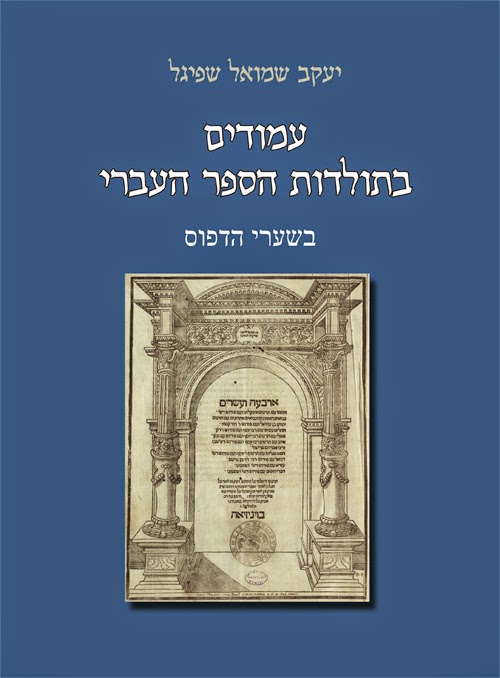
I am very happy to announce the recent publication (and Sale) of an important work, which will be of great interest to readers of the Seforim Blog, the fifth volume of, Amudim be-Toldot ha-Sefer ha-Ivri by Professor Yaakov Shmuel Spiegel, of Bar-Ilan University’s Talmud department.

As I have written in the past, Professor Spiegel is one of the most prolific writers in the Jewish academic scene, authoring of over 160 articles and 18 books (16 of those are publications for the first time of works which remained in manuscript). Many suspect that he knows the secrets of Hashbot Hakulmos (automatic writing) (about which see here).

His articles cover an incredibly wide range of subjects related to many areas of Jewish Studies, including history of Rishonim, piyutim authored by Rishonim, bibliography and minhaghim, to name but a few. His uniqueness lies not only in the topics but also that his work has appeared in all types of publications running the gamut from academic journals such as Kiryat SeferTarbizSidraAlei Sefer, Assufot, TeudahKovetz Al Yad and also in many prominent Charedi rabbinic journals such a YeshurunYerushasenuChitzei Giborim, Moriah, Sinai and Or Yisroel. It is hard to define his area of expertise, as in every area he writes about he appears to be an expert!

Worth noting that recently thanks to the hard work of a dear friend of mine, all of his published articles are available for free download here.

He has edited and printed from manuscript many works of Rishonim and Achronim on Massekhes Avos and the Haggadah Shel Pesach (and IYH some more are on the way). He is of the opinion, contrary to that of some other academics, that there is nothing non-academic about printing critical editions of important manuscript texts. Although there is a known “belief” in the academic world, “publish or perish,” which some claim is the cause of weak articles and books, at times, Spiegel’s prolific output does nothing to damper the quality of his works.

Another point unique to Speigel’s writings, besides his familiarity with all the academic sources, he shows great familiarity with all the classic sources from Chazal, Geonim, Rishonim and Achronim, to even the most recent discussions in Charedi literature – this bekius (breadth) was apparent well before the advent of search engines of Hebrew books and Otzar Ha-hochmah. Alongside all this is his penetrating analysis and ability to raise interesting points.

Another point of interest is although he is an Academic and from the Mizrachi world, he is on very good terms with various Charedei scholars. In his first few volumes, he thanks R’ Yehoshua Mondshine and Rabbi Dovid Tzvi Hillman for their useful comments. In other volumes he thanks R’ Yaakov Stahl. In his two most recent volumes he thanks Rabbi Shaul Alter, Rosh Yeshiva of Ger who has started reading and commenting about his material.

Some of his articles were collected into a volume called Pischei Tefilah u-Mo’ad, which was reviewed a few years back here on the Seforim Blog. This volume is currently out of print.

One of Professor Spiegel’s main areas of interest has been the History of the Jewish Book. He has written numerous articles on the subject and published four books on this topic in a series called Amudim be-Toldot ha-Sefer ha-Ivri

Volume one was first printed in 1996 and is called Amudim be-Toldot ha-Sefer ha-IvriHaghot u-Maghim. It was reprinted with many important additions in 2005 (copies are still available). It was reviewed by Dan Rabinowitz and myself, a few years back here on the Seforim Blog.

The second volume is called Amudim be-Toldot ha-Sefer ha-Ivri; Kesivah Vehatakah. This volume is currently out of print and will hopeful be the subject of a book review by Dan Rabinowitz and myself in the near future.

The third volume is called Amudim be-Toldot ha-Sefer ha-Ivri;Bisharei Hadefus and is out of print. (See here).

The fourth volume is called Amudim be-Toldot ha-Sefer ha-Ivri:Hadar Hamechaber (copies are still available).

I think that anyone who has an interest in the Jewish Book will enjoy this work immensely.

In the near future I hope to review this work in depth.

I am selling copies of this work; part of the proceeds helps the efforts of the Seforim Blog.

For more information about purchasing this work, feel free to contact me at Eliezerbrodt@gmail.com

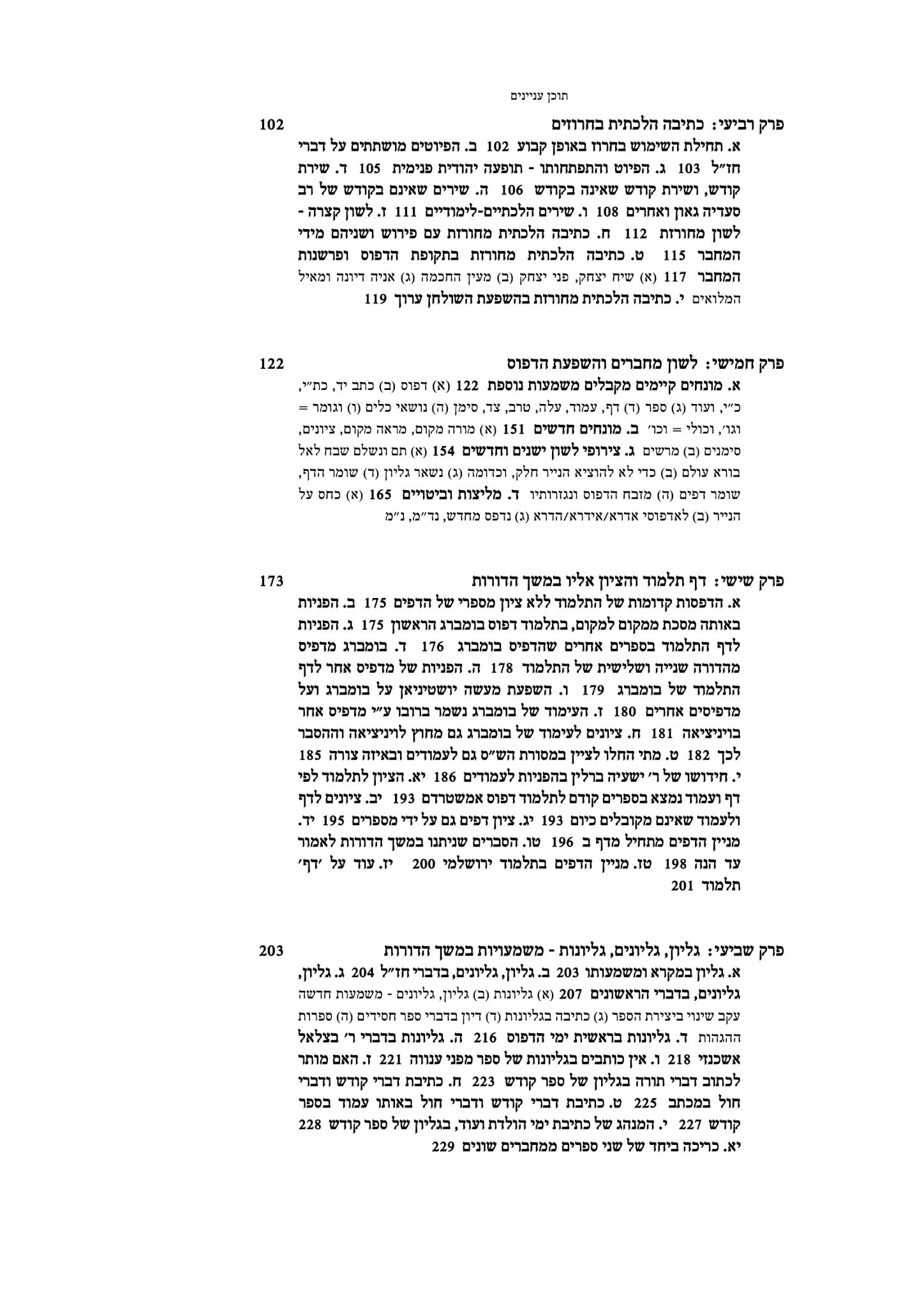
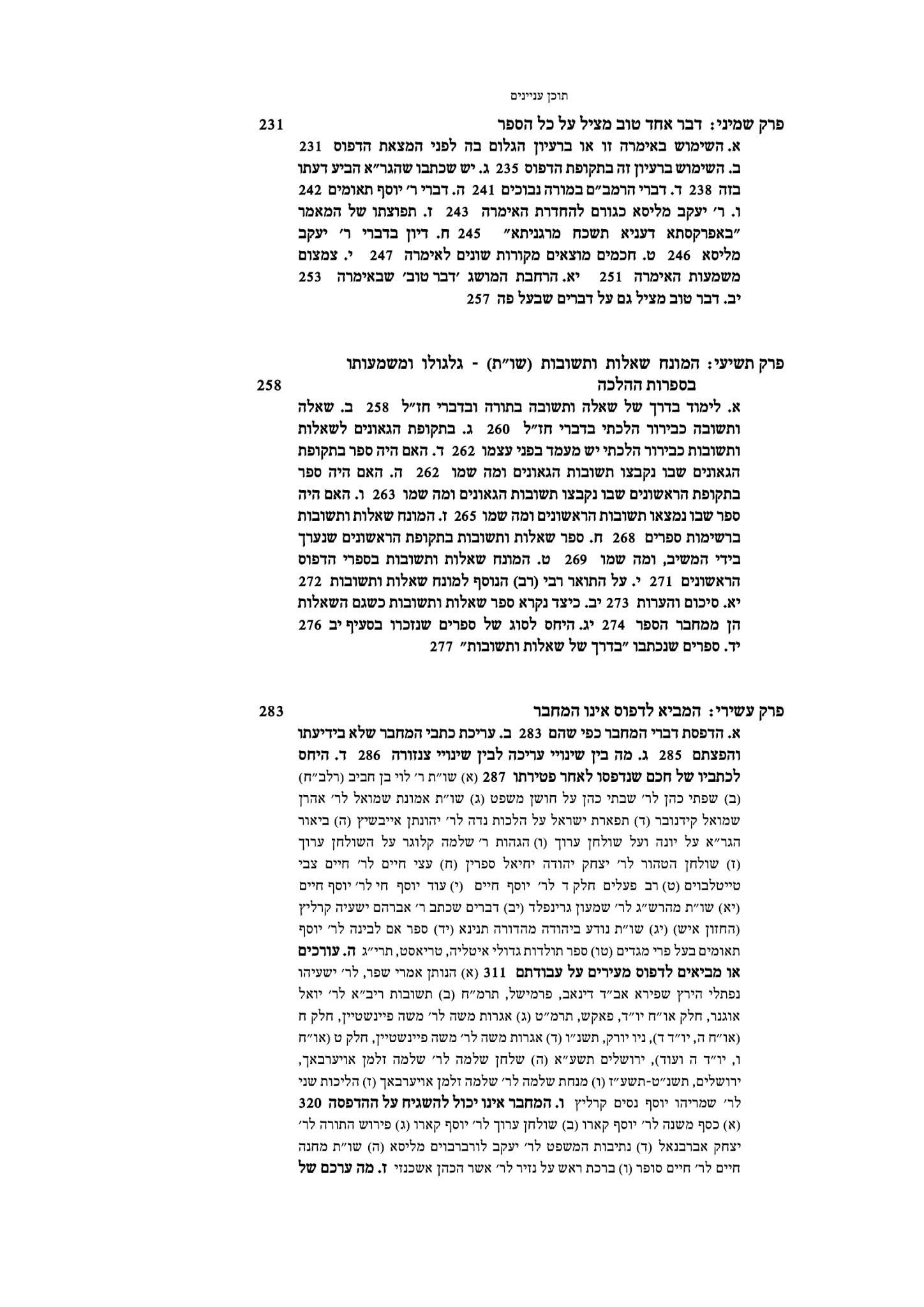
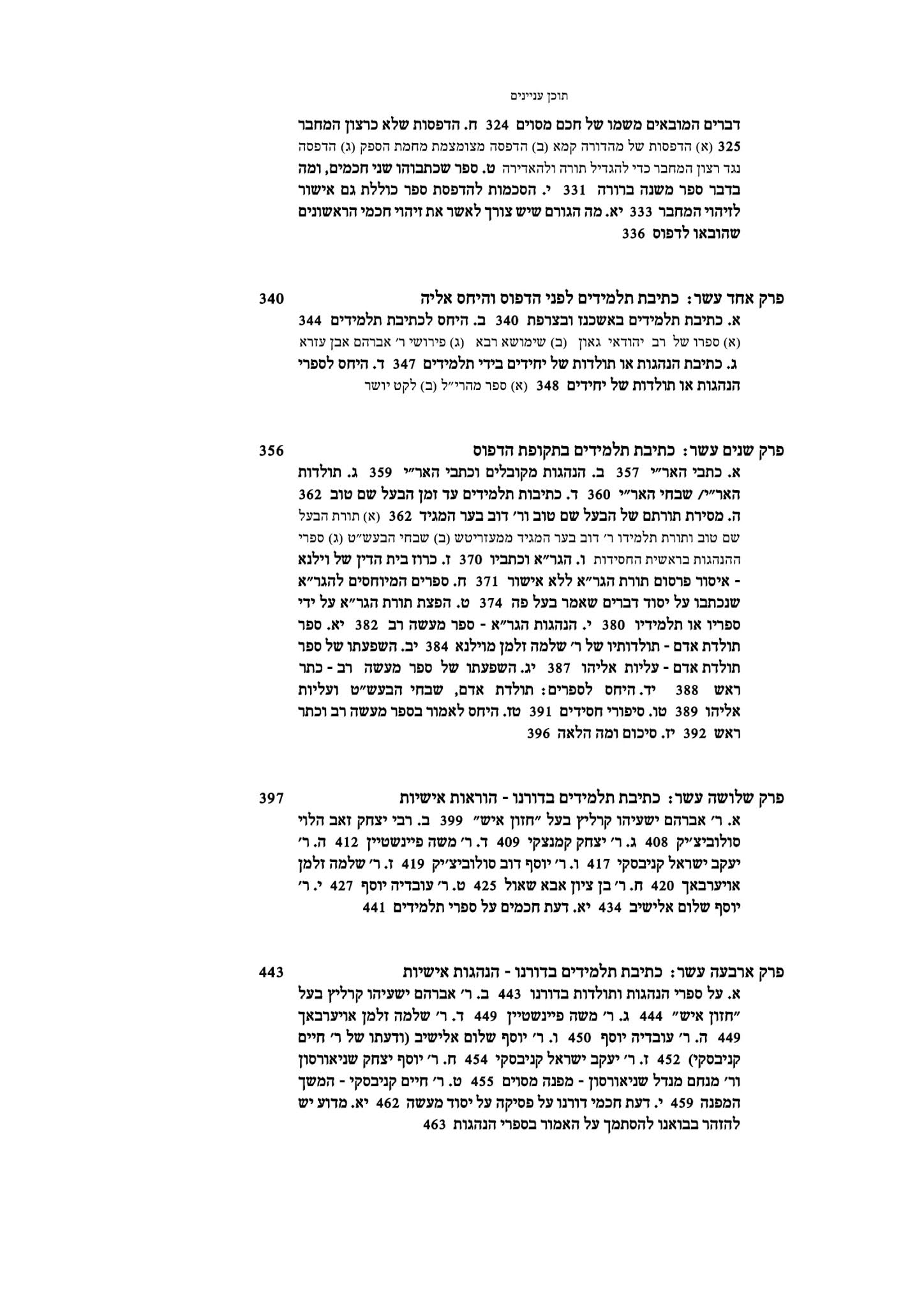
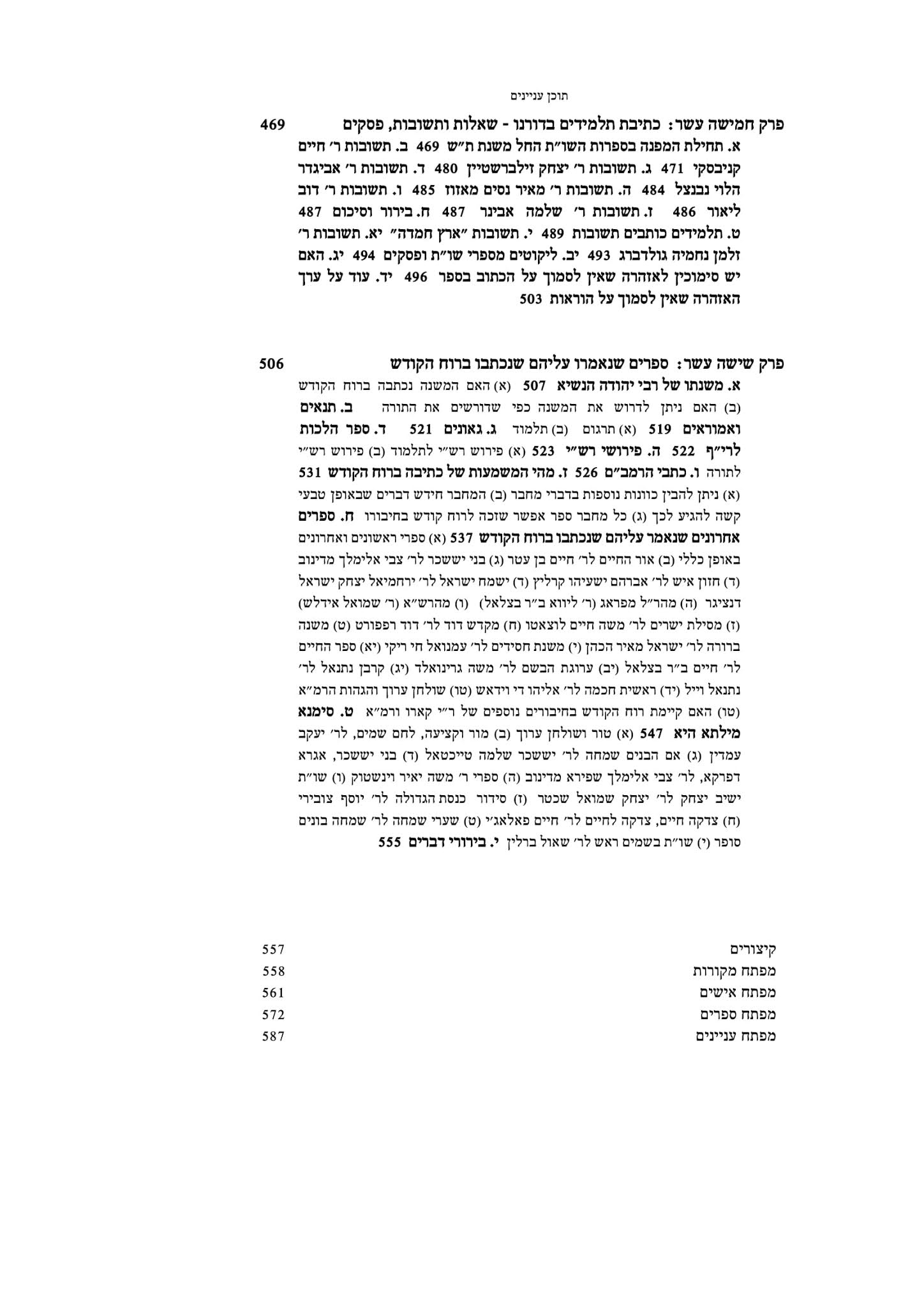
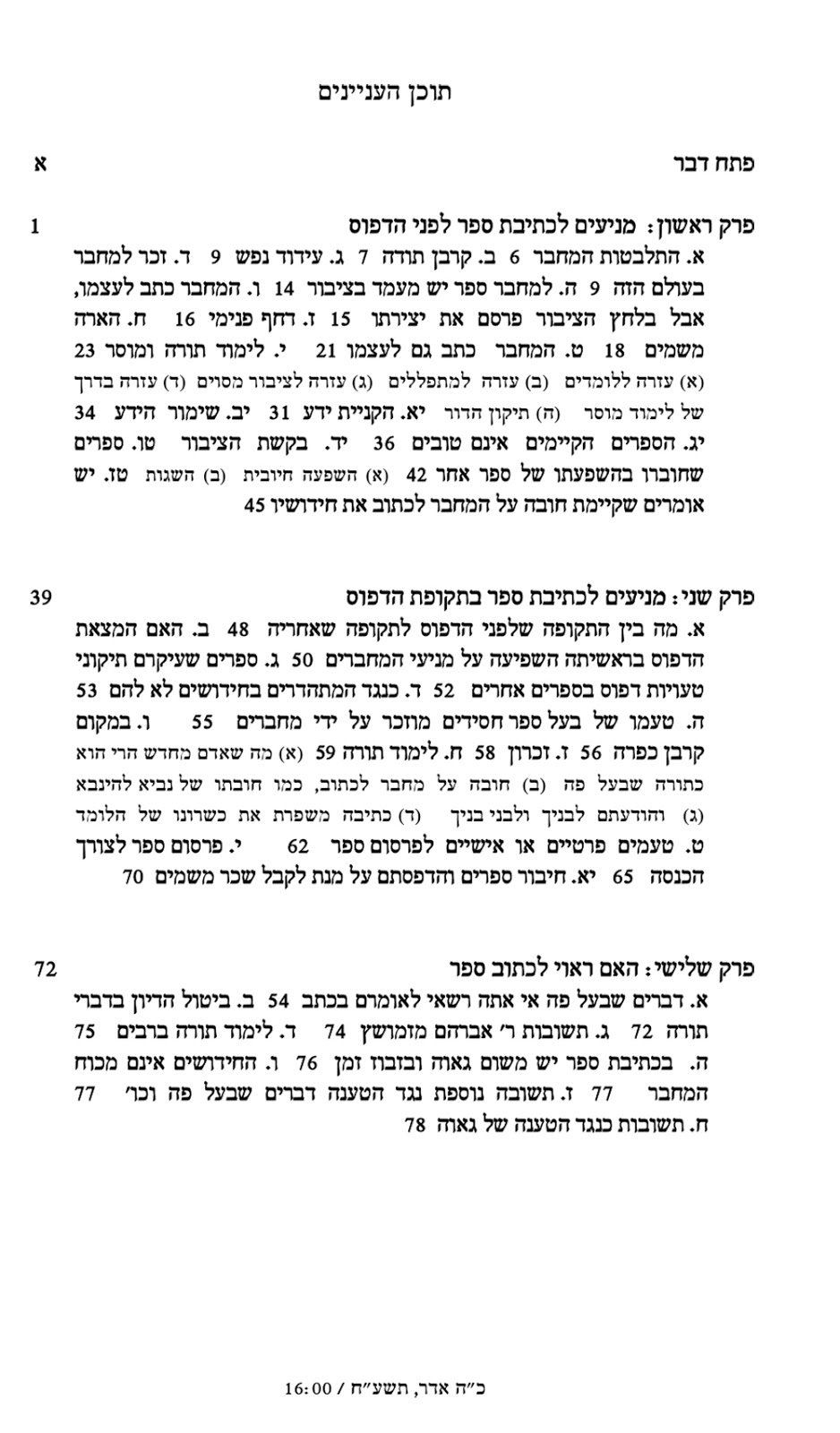
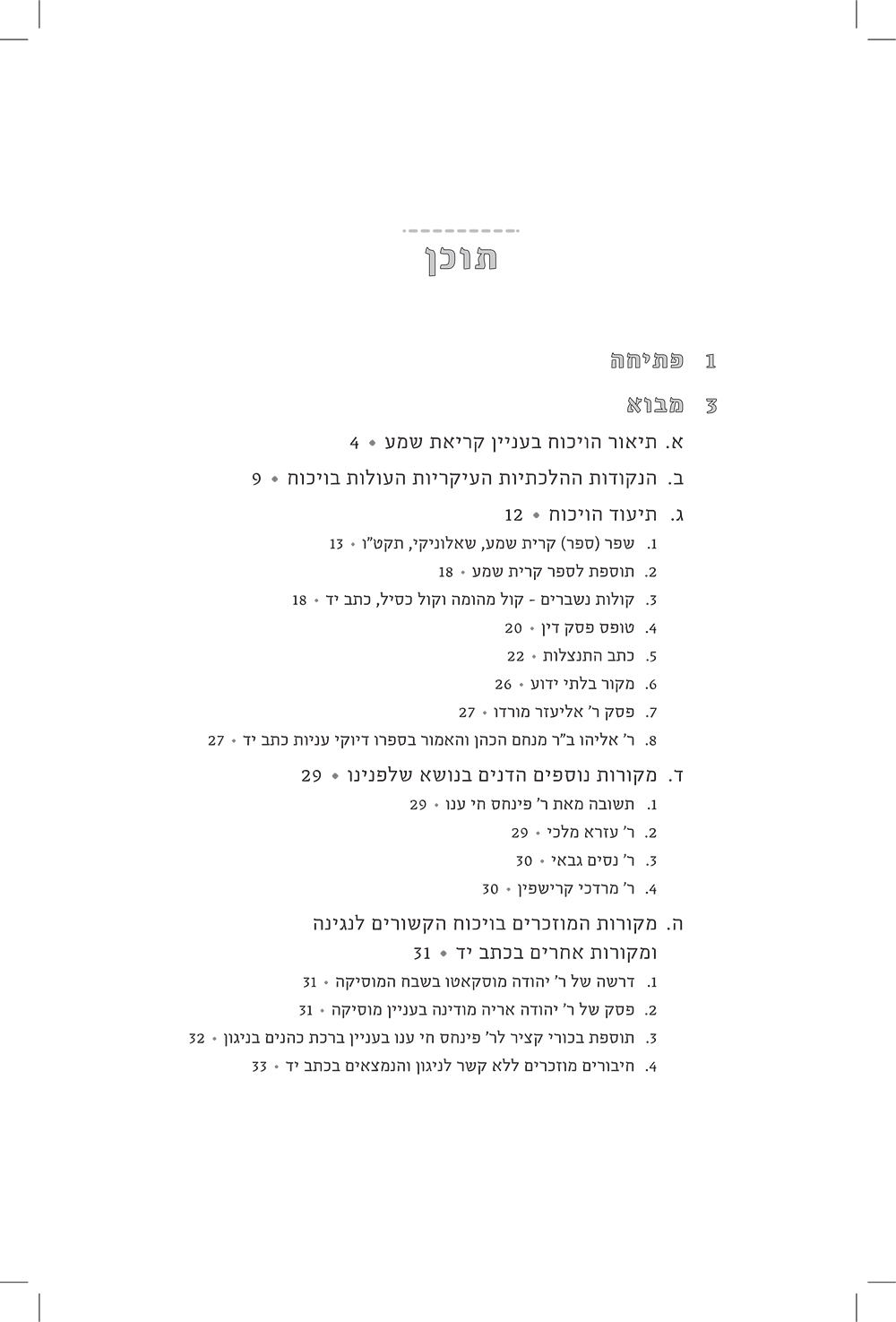
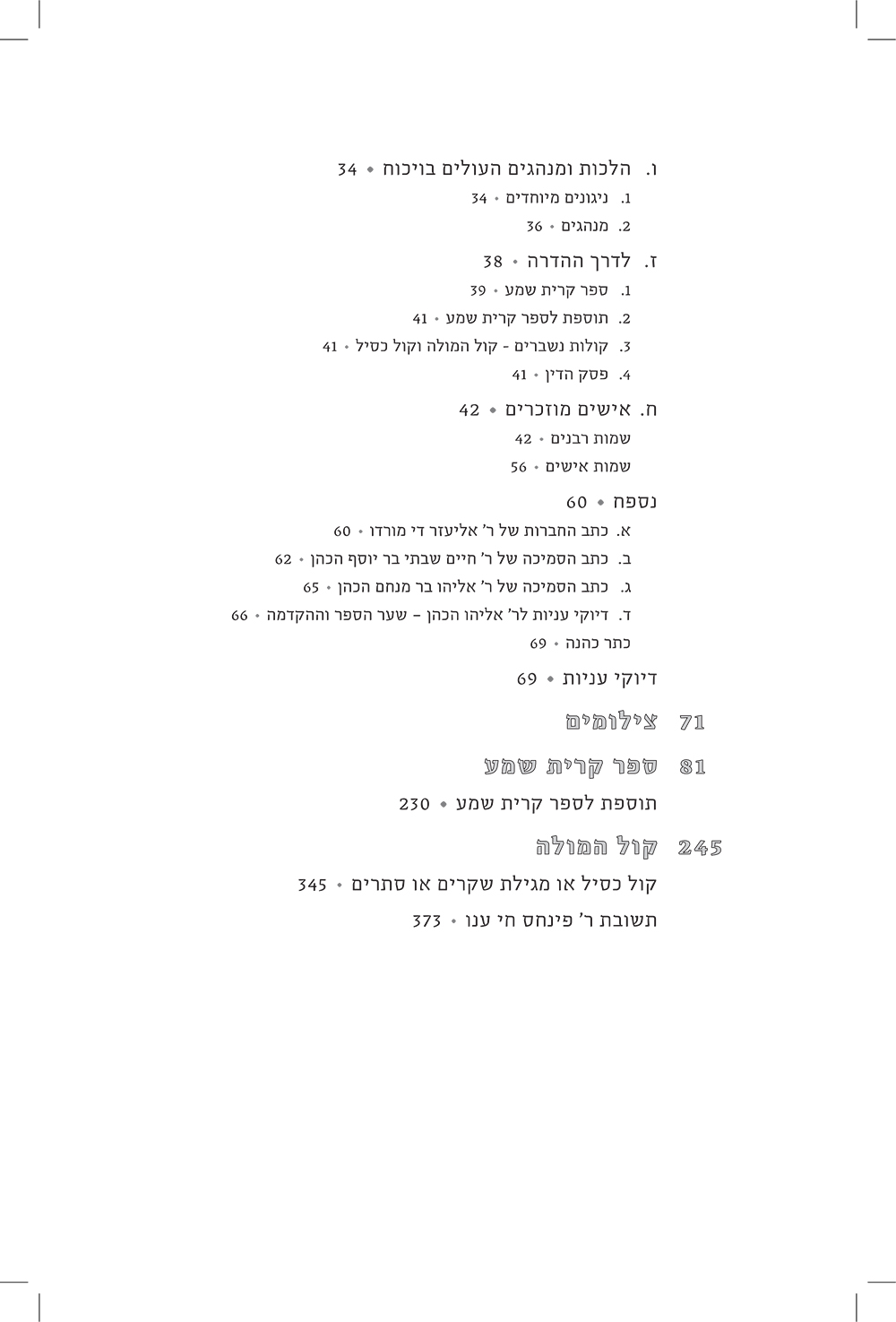
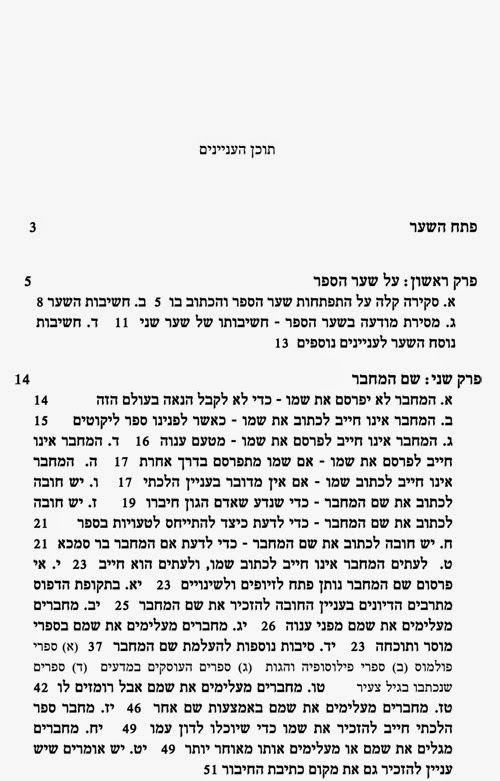
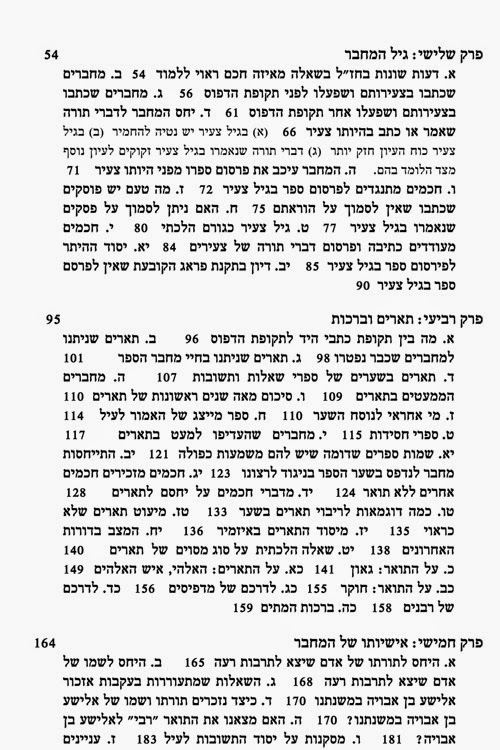
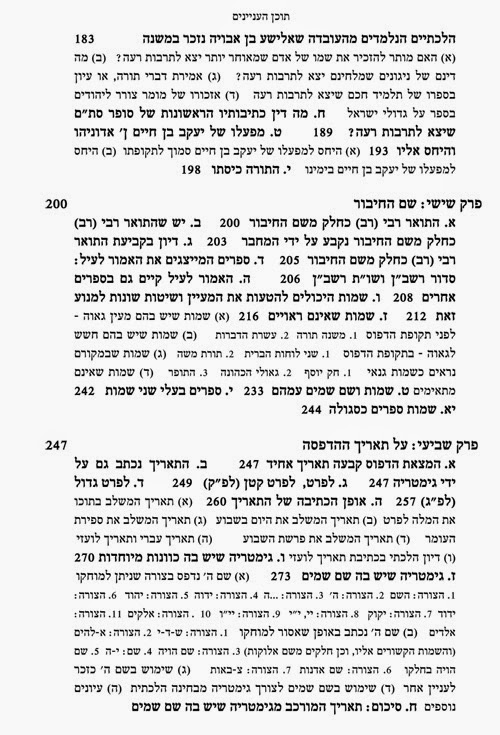
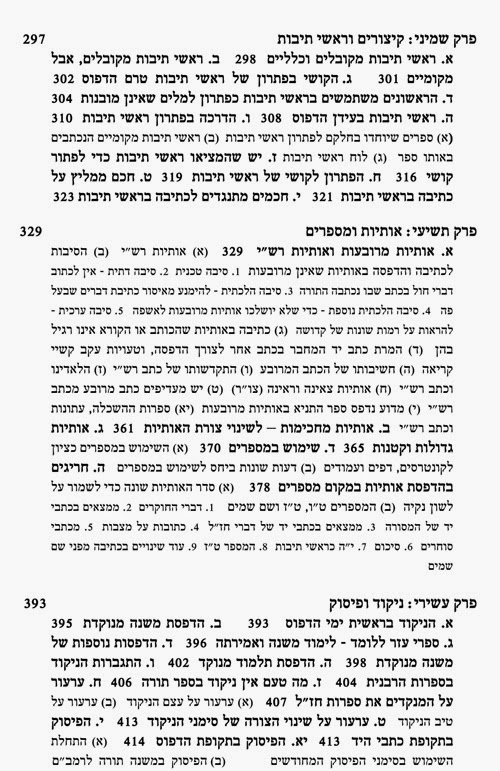
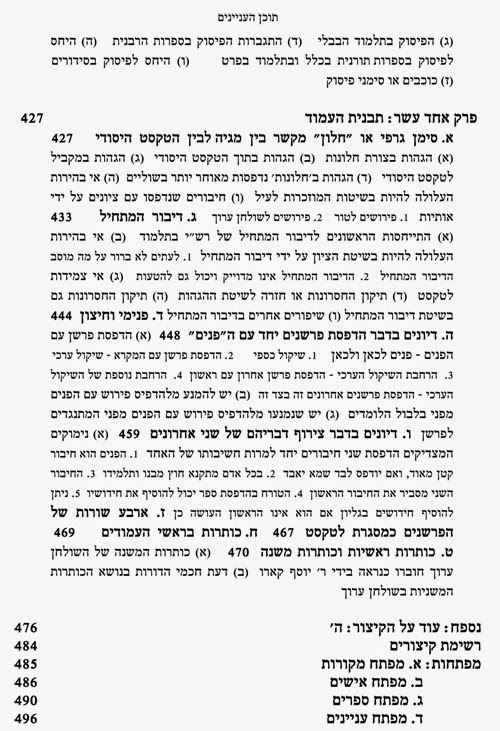
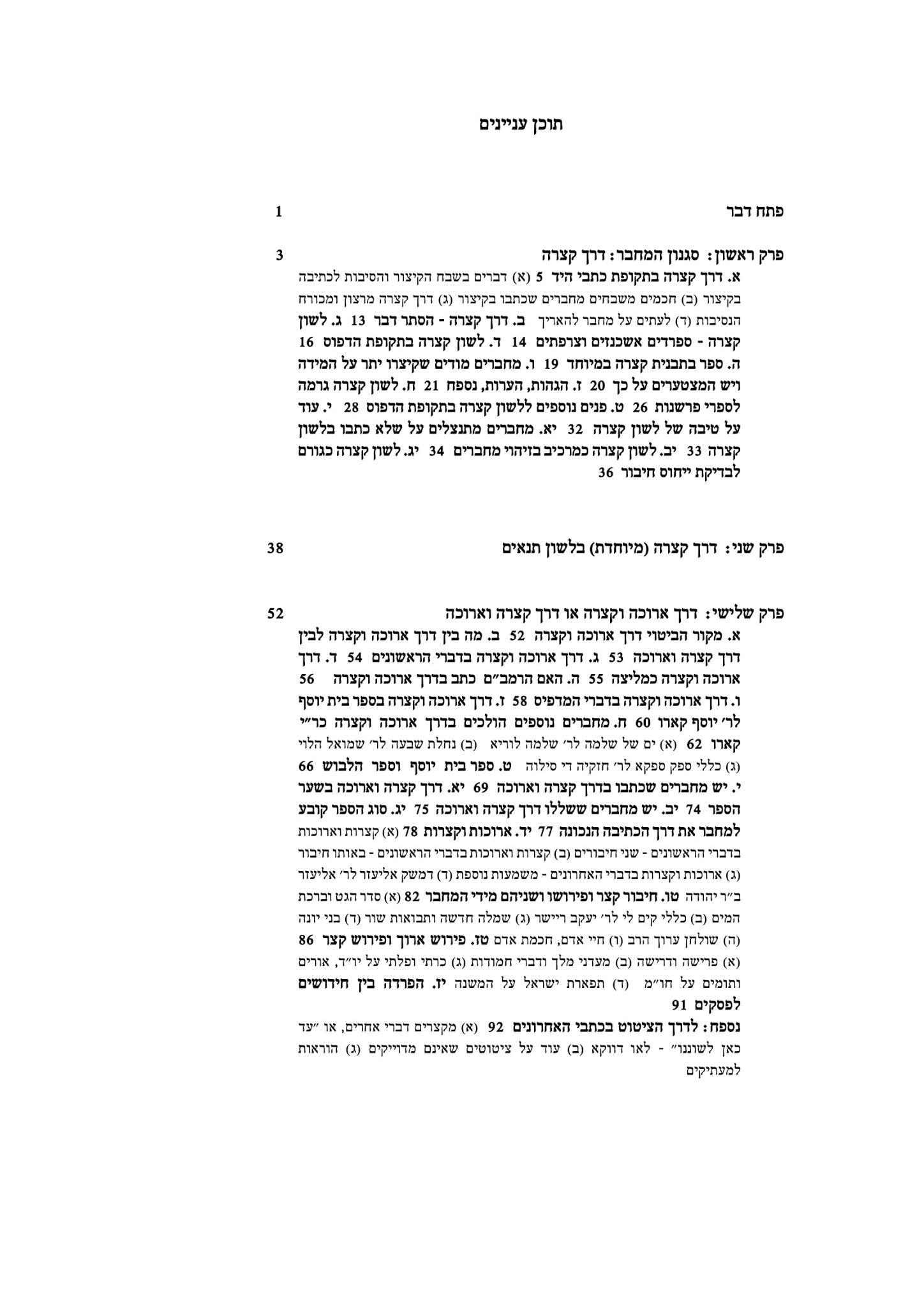
To get a sense of what exactly this new book is about, here are the beginning of the Table of Contents (or view the entire Table of Contents as a PDF):


New Book Announcement: Some New Works by Professor Yaakov Shmuel Spiegel

New Book Announcement: Some New Works by Professor Yaakov Shmuel Spiegel
By Eliezer Brodt
עמודים בתולדות הספר העברי, הדר המחבר, 521 עמודים וישמע קולי, 385 עמודים
I am very happy to announce the recent publication of an important work, which will be of great interest to readers of the Seforim blog. The forth volume of, Amudim be-Toldot ha-Sefer ha-Ivri by Professor Yaakov Shmuel Spiegel, of Bar-Ilan University’s Talmud department.
As I have written in the past, Professor Spiegel is one of the most prolific writers in the Jewish academic scene, authoring of over 160 articles and 18 books (16 of those are publications for the first time of works which remained in manuscript).  Many suspect that he possesses Hashbot Hakulmos (automatic writing) (about which see here).
His articles cover an incredibly wide range of subjects related to many areas of Jewish Studies, including history of Rishonim, piyutim authored by Rishonim, bibliography and minhaghim, to name but a few. His uniqueness lies not only in the topics but also that his work has appeared in all types of publications running the gamut from academic journals such as Kiryat SeferTarbizSidraAlei Sefer, Assufot, TeudahKovetz Al Yad and also in many prominent Charedi rabbinic journals such a YeshurunYerushasenuMoriah, Sinai and Or Yisroel. It is hard to define his area of expertise, as in every area he writes about he appears to be an expert!
He has edited and printed from manuscript many works of Rishonim and Achronim on Massekhes Avos and the Haggadah Shel Pesach. He is of the opinion, contrary to that of some other academics, that there is nothing non-academic about printing critical editions of important manuscript texts. Although there is a known “belief” in the academic world, “publish or perish,” which some claim is the cause of weak articles and books, at times, Spiegel’s prolific output does nothing to damper the quality of his works. Another point unique to Speigel’s writings, besides his familiarity with all the academic sources, he shows great familiarity with all the classic sources from Chazal, Geonim, Rishonim and Achronim, to even the most recent discussions in Charedi literature – this bekius (breadth) was apparent well before the advent of search engines of Hebrew books and Otzar Ha-hochmah. Alongside all this is his penetrating analysis and ability to raise interesting points.
Some of these articles were collected into a volume called Pischei Tefilah u-Mo’ad, which was reviewed a few years back here on the seforim blog. This volume is currently out of print.
One of Professor Spiegel’s main areas of interest has been the History of the Jewish Book. He has written numerous articles on the subject and even published two books on this topic in a series called Amudim be-Toldot ha-Sefer ha-Ivri.  Volume one was first printed in 1996 and is called Amudim be-Toldot ha-Sefer ha-IvriHaghot u-Maghim. It was reprinted with numerous additions in 2005 (copies are still available). It was reviewed by Dan Rabinowitz and me, a few years back here on the Seforim Blog.
The second volume is called Amudim be-Toldot ha-Sefer ha-Ivri; Kesivah Vehatakah. This volume is currently out of print and will hopeful be the subject of a book review by Dan Rabinowitz and myself in the near future.
The third volume is called Amudim be-Toldot ha-Sefer ha-Ivri;Bisharei Hadefus
I think that anyone who has an interest in the Jewish Book will enjoy this work immensely.
In the near future I hope to review this work in depth.
I am selling copies of this work. Copies are also available at Biegeleisen. For more information about purchasing this work, or for some sample pages, feel free to contact me at Eliezerbrodt@gmail.com
To get a sense of what exactly this new book is about, I am posting the Table of Contents here:


Also, worth mentioning is about ten months ago Professor Spiegel printed a book from manuscript called וישמע קולי.
Here is the description and Table of contents of the book.


For more information about purchasing this work, or for sample pages of the introduction to this work contact me at Eliezerbrodt@gmail.com


Chapter from Y. S. Spiegel’s Amudim be-Toldot ha-Sefer ha-Ivri (Volume Three)

Yaakov Shmuel Spiegel’s
new book has just appeared, as announced here. It is titled Amudim be-Toldot ha-Sefer
ha-Ivri: Be-Sha’arei ha-Defus. The Seforim Blog is happy to present this selection from pages 84-90.
Those interested in purchasing a copy of the book should contact Eliezer Brodt
at eliezerbrodt@gmail.com
י. חכמים מעודדים כתיבה ופרסום דברי
תורה של צעירים
מן
הראוי לדעת כי היו חכמים שעודדו כתיבה תורנית של תלמידי חכמים צעירים, וראו בכך מנוף
להכשרתם לעתיד. ר’ יונה נבון רבו של החיד”א נהג כן ביחס לתלמידו, ומן הסתם כך
נהגו חכמי ירושלים באותה העת, אף שאין לנו ידיעה מפורטת על כך.[1]
מאוחר
יותר שמענו על נוהג מעין זה גם בג’רבה. ר’ כלפון משה הכהן כתב באחת מתשובותיו את
סדר הלימוד הרצוי כדי לגדל דור של תלמידי חכמים. הוא עמד גם על הדרך שבה ילמד
המורה את תלמידו לכתוב תשובות להלכה, וכך כתב:[2]
ויזרזם
לעיין בדבר ולערוך עלי גליון בכתב ידם נוסח תשובה על זה כפי מה שתקיף ידיעתם מאותם
המקורות, ולהביא איש איש מה שכתב בזה לפניו, ויקח בידו את כל הכתוב מהם, וישאל לכל
אחד מסקנתו בזה טעמו ונימוקו. וכל אחד ישיב לפניו הנראה לו בעל פה. ואח”כ
יראה אם מה שכתוב ממנו מתאים אל מה שאמר בעל פה…
גם
ממקורות נוספים אנו למדים כי בתוניס[3]
ובין חכמי הספרדים בירושלים, היה נהוג שיש ללמד את התלמידים כיצד יש לכתוב תשובות
הלכתיות. אמנם כתיבות אלו היו כתיבות פנימיות, שעברו את הביקורת של הרב. אם הרב
עבר עליהן ומצאן שהן כהלכה, יש להניח שיש אפשרות לפרסמן ברבים.[4]
דברים
בזכות הדפסת חדושי תורה של חכם צעיר שמענו מפי ר’ חיים אלעזר שפירא:[5]
שמעתי בשם גאון מובהק
וצדיק אחד ז”ל, שהיה כמה פעמים נותן הסכמות לתלמיד חכם חריף ובקי צעירי ימים
על חיבוריהם ואמר, אם כי אין החיבור נחוץ להעולם להדפיסו, אך עכ”פ ע”י
זה מלהיב ומרהיב לבבם לשבת ולעסוק בתורה בעיון לחבר החיבורים, כי בדבר שרוצים
לפרסם ולהדפיס לעיני העולם מדקדקים הרבה למצוא דרך סלולה, שלא ישיגו עליו על
חידושיו, וע”י זה מיגעים ומתמידים בתורה ביותר.
נמצא
שההסכמה אינה מאשרת בהכרח שהחידושים ראויים להדפסה. מטרתה העיקרית היא לעודד את התלמידים
שיעסקו בתורה, והמסכים סומך על התלמיד שדבריו ראויים.
על
ר’ אליהו בומבך מסופר כי דרשת הבר מצוה שלו הפליאה מאוד את השומעים, ולכן:[6]
הבחור
אליהו העלה את דרשתו על ספר, ולבקשת רבים חפץ להדפיסו ולהפיצו בישראל להנות בהם בני
אדם, ואסכים מריה על ידיה הוא אביו הגדול שהתייעץ בדבר עם אביו הה”ג[7]
מיאברוב, ונמנו וגמרו להדפיסו כליל בהדרו, למען הלהיב לבבו להוסיף אומץ בשקידה על
דלתי התורה, וגם משום קנאת סופרים תרבה חכמה, להרבות התמדה אצל בני גילו.
יא. יסוד ההיתר לפירסום ספר בגיל צעיר
ראינו אפוא שהיו חכמים שהתנגדו לפרסום ספר בגיל צעיר.
אבל יש הסבורים אחרת, והתירו לעשות זאת כפי שיבואר עתה.
במסכת עבודה זרה דף יט ע”ב נאמר:
אמר
רבי אבא אמר רב הונא אמר רב, מאי דכתיב כי רבים חללים הפילה (משלי ז, כו), זה
תלמיד שלא הגיע להוראה ומורה. ועצומים כל הרוגיה (שם), זה תלמיד שהגיע להוראה
ואינו מורה. ועד כמה, עד מ’ שנין. והא רבא אורי, התם בשוין.
האמור
בסוגיה זו שימש יסוד לקביעת גיל התמנות תלמידים לדיינים, נושא שהיה בו ויכוח גדול
בין מרן ר’ יוסף קארו לבין ר’ משה מטראני (מבי”ט), ונזקקו לו גם חכמי הדור
בתשובותיהם.[8] עמדתו של
ר”י קארו היא:[9]
וכתב
הר”ש בר צמח בסי’ קנ”ח[10]
וכן מנהג פשוט בכל קהלות תוגרמא להעמיד ת”ח בחורים שהגיעו להוראה לדין
ולהורות במקום שיש גדולים מהם בחכמה והם זקנים יותר מארבעים שנה ולא נשמע מעולם
פוצה פה ומצפצף, וכן ראיתי מורי הר”י בירב היה ממנה במקומו פה צפת תוב”ב
דיינים שלא הגיעו למ’ שנה… למדנו כי כל מי שהגיע להוראה בחכמתו אעפ”י שאינו
אלא בן י”ח שנים יורה יורה ידין ידין, וכל המעכב על ידו מעכב אותו מלעשות
מצות עשה מן התורה לדון את חבירו דכתיב בצדק תשפוט עמיתך (ויקרא יט, טו).
לאמור,
ניתן למנות דיינים גם לפני שהגיעו לגיל ארבעים.
הרדב”ז
היה בין אלה שנזקקו לויכוח, ובין שאר דבריו כתב:[11]
אבל
האידנא שכבר יש כמה הלכות פסוקות וכמה ספרים וכמה שאלות לגאונים ז”ל אם הגיע
להוראה יכול שפיר להורות מתוך הספרים אפילו בפחות ממ’, שהרי יכול לעמוד על מה
שכתוב בספרים. וגדולה [מזו] כתוב בהגהה [הגהות מיימוניות הל’ תלמוד תורה פ”ה ה”ב]
שכל פסק שאדם רואה בפירוש בספר מספרי הגאונים יכול להורות אפילו בימי רבו ואפילו
תלמיד גמור, רק לא יורה דבר מלבו ולא יסמוך על ראיותיו ולא ידמה מילתא למילתא
מדברי עצמו ע”כ… ומעשים בכל יום שהבחורים מורים הוראות ואין פוצה פה ומצפצף.
ומיום בואי פה באו אלי כמה קונדרסים מצפת תוב”ב מורים והם בחורים, ומהטעם
שכתבתי.
לאמור,
יש הבדל בין זמן התלמוד שבו הלימוד היה בעל פה, לבין זמן הגאונים ואילך שבו הדברים
נכתבים בספר. כדבריו כתב גם הרשד”ם, שאף הוא נזקק לויכוח. אלו דבריו:[12]
אמנם נראה בעיני דבר ברור, דבזמננו הרשות נתונה על כל פנים
לכל תלמיד חכם שהגיע להוראה אפילו שלא הגיע לשנים, כל עוד שלא יהיה בפני רבו מובהק,
דבזה איני רוצה לסמוך על הטעם הנזכר, כיון דחמיר כל כך דיש בו מיתה, אבל אשארא
סמכינן להורות, כיון שהחבורים הם המורים. וכל זה בתנאי שזה התלמיד בדוק ומנוסה
למעיין ומבין בתלמוד ובספרי הפוסקים והמחברים ז”ל. זה אני אומר כפי האמת ממה
שהורוני מן השמים כפי הדין החתוך, אבל אין ספק שראוי לגדור גדר בזמננו זה כי רבו
בקיעי הזמן, השועלים קטנים מחבלים כרם ה’ צבאות, היו עבדים ליצרם כל ימיהם, ובלא
דעת ותבונה ביד רמה יושבים על כסא ההוראה, ושרים לפי ערכם בחכמת התורה, ושלא היה
להם עסק אחר כל ימיהם הולכים לרגליהם כעבדים. על זאת ישתומם כל חסיד, כי אין ספק
כי בזה יצא משפט מעוקל, ושופט כל הארץ מלכנו יושיענו ויקיים מקרא שכתוב ואשיבה
שופטיך כבראשונה (ישעיהו א, כו) גו’.
לאמור,
רדב”ז ורשד”ם הסכימו אף הם שמותר להורות גם לפני גיל ארבעים אבל נימוקם
שונה מנימוקו של ר’ יוסף קארו, ויש בו חידוש. לאמור, כיום אין האדם מורה הוראה,
אלא הספרים הנמצאים בינינו הם הם המורים. לאמור, המורה מגלה לציבור את הכתוב בספר,
ותו לא. זאת כמובן בתנאי שהוא מבין את הכתוב בספר, וכמו שהדגיש זאת רשד”ם.
ר’
עובדיה הדאיה דן בנושא זה באורך רב, וכדי שלא להאריך אביא מדבריו רק מה שנוגע
לענייני ספרים:[13]
ודע
דמכל האמור תשובה מוצאת למה ששמעתי… ומעיד בגודלו שראה לכמה גאונים שקדמוהו,
שהיו מדקדקים שלא ליתן הסכמתם על ספר שו”ת אם מחברו פחות מארבעים שנה.
באופן
דהנך רואה דאין מקום לכל דברי המפקפקים הנ”ל, והוא הדבר גם על המפקפקים בענין
ההסכמות[14]
ומכל שכן לדברי מהרשד”ם והרדב”ז ודעמייהו דבזה הזמן דרבו ספרי הפוסקים והתשובות
אין התלמיד חכם המורה אלא הספר, דודאי דאין מקום חשש פקפוק בזה. דהרי כל מה שהעלה
על ספר הוא ממה ששאב מדברי הפוסקים ראשונים ואחרונים. וא”כ לא הוא המורה, אלא
הספרים שמהם שאב. וא”כ כל שניכר מספרו שהוא מעיין ומבין בתלמוד ובספרי הפוסקים
והמחברים ובעל סברה, ודאי דיכולים להסכים על ספרו בלי שום פקפוק.
מדבריו
עולה כי מותר להסכים על ספר שו”ת, שמחברו לא הגיע לגיל ארבעים. ההסבר לכך הוא
כפי שכבר ראינו לעיל. לאמור, לא החכם הוא המורה, אלא הספרים הם המורים. כמובן כל
זאת בתנאי שאנו רואים כי המחבר אכן מבין את אשר לפניו.
אלא
שבהמשך התשובה (אות כד) הרב הדאיה מסתייג קצת:
הן
אמת דכבר ראיתי להרב פנים במשפט (למר בריה דהרב פתח הדביר) בסי’ יו”ד שכתב
פקפוק זה בענין ההסכמות מגאוני אשכנז שהביא דברי הגאון מרדכי בכהמר”ר צבי
הירש ז”ל שכתב בהקדמתו לספר עמודי עולם…[15]
האמנם נראה ברור כי כל הגאונים הנ”ל תפסו במושלם להלכה כדעת מור”ם
ז”ל ביו”ד סי’ רמ”ב סל”א שפסק להדיא דאין לאדם להורות עד מ’
שנה אם יש גדול ממנו בעיר אף על פי שאינו רבו, יעו”ש. אמנם אנן בדידן שקבלנו
הוראות מרן ז”ל, ועינינו הרואות דהשמיט דין זה בשלחנו הטהור כאשר עשה
הרמז”ל בחיבורו. וגם ראינו לכל גדולי הפוסקים הנ”ל, ששתו בחלקות בין זמן
התלמוד לזמן הזה, ודאי דאין לנו לחוש לזה. ומכל שכן דיש לומר בשופי, דגם
מור”ם לא דיבר אלא בהוראה שבע”פ ומשום כבוד רב העיר דקשיש מיניה. אך אם
ההוראה היתה בכתב בדרך שו”ת ועינינו הרואות דהיא הוראה נכונה, מה מקום לחשוש
שלא להסכים עליה, ובפרט דספר שו”ת נמסר לרבנים והם כבר יכולים להכריע בדעתם
הרחבה ובבינתם אם לקרב אם לרחק, ואין שום חשש תקלה ח”ו. וכן אתה תחזה להרב
פנים במשפט שם שסיים וז”ל, מיהו חזינן לגאוני רבני ספרד דלא חשו לכך ולא
נמנעו לתת הסכמה לספר פסקים שחיבר אחד שהוא פחות ממ’ שנה. ונראה טעמם שהמרביץ תורה
לא יסמוך לגמרי על ספר אותו הפוסק, אם לא ישא ויתן בענין בכל ספרי הפוסקים והמוסכם
לדעתו מפי סופרים ומפי ספרים יורה ידין עכ”ל. ומכל שכן לפי מה שבא בנותן טעם
הרב ריח שדה ז”ל, שיש מקום לחוש לזה לרפיון התורה, בראותם כי אינם מתחשבים
הרבנים הגדולים לדבריהם, דבודאי דאדרבא דחיובא רמיא על רב העיר לחזק את ידיהם ביתר
שאת, להוסיף אומץ וחוזק בלימודם להגדיל תורה ולהאדירה, ואיתיה בזכייה, שעל ידו
מלאה הארץ דיעה, והתורה רבה בישראל, ומה’ יפיק רצון, ועליו תבא ברכת טוב, אמן.
שומע
אתה מדבריו, כי נכון הוא שהיו רבנים אשכנזיים שמיאנו לתת הסכמה על ספר שמחברו לא
הגיע לגיל ארבעים, וזאת בהסתמך על דברי הרמ”א. אבל חכמי הספרדים אינם פוסקים
כמותו, אלא כמרן בשולחן ערוך שלא הזכיר את המגבלה של גיל ארבעים, ולכן חכמי
הספרדים הסכימו על ספרים שמחברם צעיר.
ברם,
הרב הדאיה מחדש שאפשר שגם הרמ”א יסכים לכך, כיון שהאיסור של גיל ארבעים חל רק על הוראה בעל פה. מה עוד שיש חשיבות לעודד
מחברים צעירים, כדי להגדיל תורה.
בדומה
לכך כתב גם ר’ עובדיה יוסף:[16]
ולפ”ז
כיון שאין לנו הגבלה של ארבעים שנה לענין הוראה, כל שהגיע להוראה, וכדתנן אל תסתכל
בקנקן אלא במה שיש בו [אבות ד, כ]. מעתה גם בחיבורים ופסקים אין לנו להגביל הזמן
שלא להדפיס עד מ’ שנה. ואף על פי שיש לחלק בין הוראה לשעתה ובמקומה, לחיבורים
המתפרסמים בכל תפוצות ישראל להבין ולהורות לשעה ולדורות, מ”מ אין לנו שום
יסוד מוסד לאסור בזה, מאחר שהמחבר הגיע להוראה ע”פ עדות גדולי הדור אשר יתנו
עדיהם ויצדקו. ואף על פי שהרמ”א ביו”ד (סי’ רמב סל”א) כ’ שאין לאדם
להורות עד ארבעים שנה. ע”ש. [וע”ע בתשובת המבי”ט סי’ רפ[17]].
אנן בדידן בתר הוראות מרן אזלינן. ובפרט שהעיד בגדלו שכן המנהג פשוט וברור, ומעשה
רב של רבו הגאון מהר”י בי רב. וכנ”ל. ואף להרמ”א י”ל דשאני
דין מחבר ספר בהלכה להפיצו ברבים, דיהיב דעתיה טפי לעיין היטב בספרי הפוסקים לבל
ימצא שם בדק, ואינו דומה למורה הוראה ומשיב לשואלו דבר בדרך הוראת שעה, שיש מקום
לחוש פן לא יעיין היטב בהלכה וידמה מילתא למילתא, בעוד שרב המרחק ביניהם, ויהי בכזיב
בלדתה אותו.[18]
לאמור,
לדעת חכמי הספרדים, אם ניתן למנות דיין שלא הגיע לגיל ארבעים ודאי שניתן גם לחבר
ספר לפני גיל ארבעים.[19]
אמנם לדעת חכמי האשכנזים, שיש הגבלה של גיל ארבעים למינוי דיינים, יש מקום לטעון
שאולי אין לחבר ספר לפי גיל ארבעים. ברם לדעת ר”ע יוסף, אדם המחבר ספר הרי
חזקה עליו שהוא בודק בעומק את דבריו טרם שיפרסמם. בזה הוא עדיף ממורה הוראה, שצריך
להשיב כמעט באופן מיידי. עדיפות זו של מחבר ספר היא הנותנת לו היתר לפרסם ספר גם
לפני גיל ארבעים.
אלא
שבהמשך הדברים סייג ר”ע יוסף מעט את דבריו:
וא”כ
גם לענין חיבורים ופסקים יש להקל להדפיסם ולהגדיל תורה ולהאדירה, ועל צד היותר טוב
יודיע המחבר בהקדמתו שלא יסמכו על חיבורו לפסוק ממנו למעשה כי אם אחר העיון היטב.
אבל להמנע מלהדפיס מכל וכל, היא חומרא המביאה לידי קולא, שכמה הפליגו חז”ל
בעונש מי שמונע בר (סנהדרין צא סע”ב).
ר”ע
יוסף לא הדגיש בדבריו עד עתה באיזה ספר מדובר, והדעת נותנת שכוונתו היתה לכל ספר
תורני. אכן ביחס לספר הלכתי נוספה עתה הסתייגות מסויימת. לעומתו, ר”ע הדאיה
ציין בדבריו במפורש שהוא מדבר על ספר שו”ת, ואפשר שרק לגביו התיר פרסום בגיל
צעיר. מכל מקום הצעתו של ר”ע יוסף שיש להודיע כי אין לסמוך על החיבור לפסק
הלכה, דומה שהשפיעה על מחברים רבים כפי שנראה בהמשך.
גם
ביחס לאשכנזים הביע ר”ע יוסף בהמשך תשובתו הסתייגות מסויימת:
ומעתה
נראה דעכ”פ לחבר ולהדפיס חיבורים בהלכה בדיני ממונות אף להרמ”א ודעימיה
יש להקל גם בפחות מארבעים שנה. ואף על פי שעדיין יד הדוחה נטויה לומר שבהדפס
חיבורים בהלכה גרע טפי, כי הדבר נשאר לדורות עולם, ויורו המורים שאינם בקיאים
לעמוד על שרש הדברים ועיקרם, ועי”ז רבה המכשלה, מכל מקום כיון שלא כל חכם
מצוי לפסוק דיני ממונות רק הבקיאים בש”ס ופוסקים, וברוח מבינתם יעמדו על דברי
המחבר היכונו דבריו אם לא, ומה גם שכל זה לאחר קבלת ההסכמות מגדולי הדור שיודעים
ומכירים המחבר בחכמתו ויראתו, לכן אין לחוש לזה כלל. ומצוה קעביד להגדיל תורה
ולהאדירה.
בין
חכמי האשכנזים[20] מצאתי
התייחסות לנושא בדברי ר’ יוסף ליברמן, ואביא את מסקנתו:[21]
להדפיס
דברים הנוגעים להלכה יש להמנע עד היותו בגיל מ’ שנה, ואם כתב לפני כן ורוצה
להדפיסם אחרי כן בהיותו כבר בן מ’, צריך לעבור עליהם עוד פעם, דאם לא כן מאי אהני
שמדפיס אח”כ, אדרבא עוד גרע דמטעה הבריות שאינם יודעים שמשנות ילדותו הם. וצעיר
הרוצה להדפיס צריך ת”ח מבוגר בן מ’ לעבור עליהם בעיון. אבל כל זה רק במי
שמעצמו מברר ופוסק הלכה מראיות וסברות שלו, ואין בכלל זה מחברי ליקוטי הלכות מדברי
פוסקים קודמים, כגון ספרי “כהלכתו” של דורינו שאינם אלא מאספים דברי
קודמיהם, באלה אם רבני גאוני הזמן יסכימו שהמחבר הולך ישר וראוי לכך הרי הם מזכי
הרבים.
ר’
נתן גשטטנר סבור אחרת. אלו דבריו:[22]
הרי
חזינן עד כמה חרדו גדולי עולם אלו זכר צדיקים לברכה שלא לפרסם פירות בוסר הנוגעים
להלכה, ומכל שכן ספרי לקוטים של הלכות פסוקות אשר יד הכל ממשמשים בהם ואינם
מיועדים דוקא לתלמידי תכמים היודעים להבחין בין תכלת לקלא אילן, הרי ודאי שאינו
ראוי לעסוק בכאלה אלא לתלמיד חכם מופלג שהורגל לעיון והתעמקות שנים רבות, ואף
שתקנת גאוני פראג[23] נראה שלא
נתפשטה, דהא עינינו הרואות שהרבה גדולים הבאים אחריהם הדפיסו ספריהם בהלכה טרם
שמלאו להם ארבעים לבינה, ואף הגאונים הללו לא תקנו זאת אלא בקהלתם וכמבואר בלשון
הכרוז “ראינו לתקן תיקון בקהלתינו”. אבל עכ”פ ניתן ללמוד מדבריהם
הקדושים כי לאו כל הרוצה ליטול את השם יבוא ויטול, ואין ראוי לעסוק בפרסום הלכות
הנוגעות למעשה אלא לתלמידי חכמים בעלי עיון שדעתם נתיישבה עליהם.
גם
נראה דעיקר הקפידא היתה שלא להדפיס קודם שנת הארבעים בירורים הלכה למעשה, אבל
לענין הדפסת ספר של ביאורי סוגיות ופלפולא דאורייתא, שאינו בא להסיק ולפסוק הלכה,
הנה בזמן הזה של עוקבתא דמשיחא שנתקיים בנו אמרם (סוטה מט:) חכמת סופרים תסרח
ויראי חטא ימאסו והאמת תהא נעדרת… ודאי שחיוב גמור על השרידים אשר ה’ קורא,
תלמידי חכמים צעירים העוסקים בתורת ה’, להפיץ מעייני חכמתם חוצה, ויש בכל ספר
שמחברו הוא ירא שמים ישר הולך משום קידוש שם שמים ברבים, להראות לעיני עם הארץ כי
לא פסקה אהבת התורה מישראל… ואדרבה חשיבות גדולה היא לעורר ולעודד את צעירי הצאן
לחדש חידושין דאורייתא ולכתבם עלי גליון וגם לפרסמם בדפוס, אבל בתנאי שהדברים הם
פרי עיון והעמקה ויגיעה בגופי תורה.
העתקתי
חלק ניכר מדבריו, כדי שהמעיין יראה מה בינו לבין ר”י ליברמן.

[1]       ראה על
כך מ’ בניהו, רבי חיים (לעיל הערה 35), עמ’ יא-יב.
[2]       שו”ת
שואל ונשאל, ח”ה, יו”ד סי’ קיט. הוא חזר על כך במקומות נוספים. ראה
בספרו ברית כהונה, ג’רבה, תש”א, או”ח מערכת ל, אותיות טו (שם גם ציין
למקומות נוספים שבהם חזר על דבריו), טז.
[3]       ראה ר’
מאיר מאזוז (נאמ”ן), דרכי העיון, בני ברק, תשע”ב2, דפים
קנח-קס, ואף שמדובר שם בג’רבא, שלא היה לה כל כך קשר לתוניס, בכל זאת המחבר כתב
בראשית דבריו כי הוא מדגים את דרך “העיון התוניסאי”, וראה גם דבריו בדף
קנח ע”ב ד”ה נעבור.
[4]       הנה
החיד”א בשו”ת חיים שאל ח”א סי’ סג הדפיס תשובה של רבו, ואחריה סי’
סד הדפיס את תשובתו שבה דן בדברי רבו, ולפי מ’ בניהו, רבי חיים (לעיל הערה 35),
עמ’ יא, הערה 24, החיד”א היה אז בן חמש עשרה-עשרים שנה.
[5]       דברי
תורה, ירושלים, תש”מ, ח”ו, אות מה.
[6]       ראה
לעיל הערה 118, בתולדות המחבר (אין ציוני דפים).
[7]       הרב
הגאון, הרב הגדול.
[8]       על
הויכוח ראה מ’ בניהו, ‘האסכולות של המבי”ט ושל מרן רבי יוסף קארו וההתכתשות
ביניהן’, אסופות, ג (תשמ”ט), עמ’ טז-כד, ובספרות שם, וחזר על כך בספרו יוסף
בחירי, ירושלים, תשנ”א, עמ’ מח-נג. באור ישראל סד (תשע”ב), עמ’ לד-לו,
נדפסה תשובתו של ר’ מרדכי הענא מכתב יד בעניין זה.
[9]       שו”ת
אבקת רוכל סי’ רא. תשובה זו אנונימית, אבל כבר קבעו כי היא של ר”י קארו, שהרי
הוא מזכיר בה את ספרו בית יוסף.
[10]     לפנינו
נמצא כן בתשב”ץ, ח”א, סי’ קנט.
[11]     שו”ת
רדב”ז, ח”ו, סי’ ב אלפים קמז.
[12]     שו”ת
רשד”ם, חו”מ, סי’ א, מהד’ ר”ד אביטן, ירושלים, תשס”ח, דף ח
ע”א.
[13]     שו”ת
ישכיל עבדי, ח”ב, חו”מ, סי’ א, אותיות כב, כג.
[14]     כדאי
לציין: הרב הדאיה סבור שההסכמות בדורנו אין להן כל תוקף, כיון שברור שהמסכים לא
עבר על כל הספר אלא המסכימים “סומכים על חזקה על חבר שלא יוציא מתחת ידו דבר
שאינו מתוקן, וגם סומכים על המעיין שבדעתו הרחבה יכול להכריע אם לצדק אם לשבט ולכן
אין שום צורך בהסכמות, ולא נצרכה אלא לברכה”. כך כתב בהסכמתו לספרו של
ר”מ מימון, הלכה למשה, ירושלים, תשי”ח.
[15]     הבאנו את
הדברים לעיל, ראש סעיף ו.
[16]     שו”ת
יביע אומר, ח”ד, חו”מ, סי’ א.
[17]     שורה זו
במקור.
[18]     מליצה על
פי בראשית לח, ה: והיה בכזיב בלדתה אותו. כלומר, המורה הוראה יכול לטעות.
[19]     ר’ אברהם
יקותיאל אוהב ציון, שו”ת יעלת חן, ח”א, ירושלים, תשס”ט, בהקדמה
שערי ח”ן, דף א ע”ב, כתב שאם חיבר את התשובות בהתיעצות עם חבריו, ניתן
לפרסם אותן לפני שהמחבר הגיע לגיל ארבעים.
[20]     על פי מה
שכתב ר’ צבי יברוב, מעשה איש, בני ברק, תשנ”ט, ח”ב, עמ’ ע-עא, עולה כי
החזון איש תמך בהדפסת ספר בגיל צעיר ואילו רז”ר בענגיס התנגד לכך.
[21]     משנת
יוסף, שבעים דרשות ומאמרים, ח”א, ירושלים, תשנ”ח, מאמר ז, עמ’ פז.
[22]     שו”ת
להורות נתן, חי”א, סי’ צג, אותיות ז-ח.
[23]     על תקנה
זו נעמוד לקמן בסעיף יב.


New Book Announcement: Amudim be-Toldot ha-Sefer ha-Ivri (Volume Three)

New Book
Announcement: Amudim be-Toldot ha-Sefer ha-Ivri (Volume Three)
By Eliezer
Brodt
I am very
happy to announce the recent publication of an important work, which will be of
great interest to readers of the Seforim blog. The third volume of, Amudim
be-Toldot ha-Sefer ha-Ivri
by Professor Yaakov Shmuel Spiegel, of Bar-Ilan
University’s Talmud department.
As I have
written in the past, Professor Spiegel is one of the most prolific writers in
the Jewish academic scene, authoring of over 160 articles and 18 books (16 of
those are publications for the first time of works which remained in
manuscript).  Many suspect he possesses Hashbot
Hakulmos
(automatic writing).
His
articles cover an incredibly wide range of subjects related to many areas of
Jewish Studies, including history of Rishonim, piyutim authored by
Rishonim, bibliography and minhaghim, to name but a few. His uniqueness
lies not only in the topics but also that his work has appeared in all types of
publications running the gamut from academic journals such as Kiryat Sefer,
Tarbiz, Sidra, Alei Sefer, Assufot, Teudah, Kovetz
Al Yad
and also in many prominent Charedi rabbinic journals such a Yeshurun,
Yerushasenu, Moriah, Sinai and Or Yisroel. It is
hard to define his area of expertise, as in every area he writes about he
appears to be an expert!
He has
edited and printed from manuscript many works of Rishonim and Achronim on Massekhes
Avos and the Haggadah Shel Pesach. He is of the opinion, contrary
to that of some other academics, that there is nothing non-academic about
printing critical editions of important manuscript texts. Although there is a
known “belief” in the academic world, “publish or perish,” which some claim is
the cause of weak articles and books, at times, Spiegel’s prolific output does
nothing to damper the quality of his works. Another point unique to Speigel’s
writings, besides his familiarity with all the academic sources, he shows great
familiarity with all the classic sources from Chazal, Geonim, Rishonim and
Achronim, to even the most recent discussions in Charedi literature – this bekius
(breadth) was apparent well before the advent of search engines of Hebrew books
and Otzar Ha-hochmah. Alongside all this is his penetrating analysis and
ability to raise interesting points.
Some of
these articles were collected into a volume called Pischei Tefilah u-Mo’ad,
which was reviewed a few years back here
on the seforim blog. This volume is currently out of print.
One of
Professor Spiegel’s main areas of interest has been the History of the Jewish
Book. He has written numerous articles on the subject and even published
two books on this topic in a series called Amudim be-Toldot ha-Sefer ha-Ivri.  Volume one was first printed in 1996 and is
called Amudim be-Toldot ha-Sefer ha-Ivri: Haghot u-Maghim. It was
reprinted with numerous additions in 2005 (copies are still available). It was
reviewed by Dan Rabinowitz and me, a few years back here
on the Seforim Blog.
The second
volume is called Amudim be-Toldot ha-Sefer ha-Ivri; Kesivah Vehatakah.
This volume is currently out of print and will hopeful be the subject of a book
review by Dan Rabinowitz and myself in the next few months.
I think
that anyone who has an interest in the Jewish Book will enjoy this work
immensely.
In the near
future I hope to review this work in depth. Next week the blog will feature
some sample pages of this new work.
For a short
time I will be selling copies of this work for $32. The price includes airmail
shipping (to the US UK or Canada). Copies are also available at Biegeleisen.
For more information about purchasing this work, feel free to contact me at
Eliezerbrodtatgmail.com
To get a
sense of what exactly this new book is about, I am posting the Table of Contents
here:


Review of Amudim be-Toldot Sefer ha-I…

Review of Amudim be-Toldot Sefer ha-Ivri Haghot u-Maghimby Eliezer Brodt and Dan Rabinowitz
Yaakov S. Spiegel, Amudim be-Tolodot Sefer ha-Ivri Haghot u-Maghim (Chapters in the History of the Jewish Book Scholars and their Annotations), Ramat Gan, 20052, 689 pp.

In 1996, Bar Ilan Press published Amudim be-Toldot Sefer ha-Ivri Haghot u-Maghim from Professor Yaakov S. Spiegel. Shortly thereafter, this edition sold out due to its popularity. A few years later Amudim be-Toldot Sefer ha-Ivri Kitevah ve-haTakah (volume two) was published.  More recently, Amudim be-Toldot Sefer ha-Ivri Haghot u-Maghim was reprinted with over seventy five pages additional pages full of many important additions. In this new edition, Spiegel apologizes to the people who purchased the first edition of his work and would now have to buy the new one if they want the updates.  Spiegel offered that the requirement for a completely new edition rather than an addendum was out of his control.  Although the importance and quality of the book will be obvious shortly, it has not been reviewed or discussed properly in academic journals except for a short review on Hamayan (37, 3: 69-75). This post hopefully is a start in rectifying this omission.  This volume is the first of two (current) volumes discussing the History of the Jewish book – specifically the creation and alteration of the Jewish books.  That is, this volume covers annotating or editing texts.  Essentially, this work is divided into two parts, (Spiegel divides it into four parts) the first, discusses the permissibility of editing texts and the second discusses annotators and editors.  The first portion begins with the sugyah of editing texts in the time of the Mishana (sifrei torah) and moves into the topic of the prohibition of having a unedited sefer. These two chapters play an important role in the background of this topic of editing seforim.  Spiegel then moves into the era of the geonim and rishonim dealing at great length with there methods of editing or annotating texts. He discuses at great length the methods of Rabbenu Gershom, Rashi and Rabbenu Tam.  As is well known Rabbenu Tam prohibited the editing or annotating texts Spiegel discusses the complete background of Rabbenu Tam's opinion going through the myriad of sources when Rabbenu Tam's restriction applies. This discussion includes an analysis of Rabbenu Tam's work Sefer Hayashar and his famous disagreement with R Meshulem. Spiegel, as he does in each of the chapter, quotes all the previous sources on the topics and rechecks it all carefully and comes out with many new important conclusions. Spiegel then proceeds to deal with the different works of haghot in the times of rishonim and the nature of these works. Of particular interest is his sections on the Haghot Ashrei (pp. 183-90) and on the Ravad's comments on the Ramabam discussing if those comments are plain haghot or hasaghot (pp. 198-207).  The second section of the book surveys the story of Haghot u-Maghim from the beginning of the printing press, in approximately 1456, until 1840. He begins with chapters on the importance of the printing press (see also pp. 300-06) and moves in to the job of the annotators and editors and their methods. Dealing with topics such as, did Rabbenu Tam only speak to instances where one is erasing the text and substituting another but if one merely notes an alternative reading and preserves the original that is OK? Or, is it only applicable to manuscripts or does it apply to printed works as well?  The distinction being, in the case of a manuscript, that manuscript may be the only copy and, if one alters the text, the original is forever lost.  Additionally, Spiegel discusses at length the important question of whether one can correct texts based on logic or textual support. An interesting section is where he brings a bunch of sources that there is a special will from God that these mistakes happened and should remain (pg 262-269). There are chapters on the various 'editors' such as R. Betzalel Ashkenazi, R. Yoel Sirkes (Bach), Maharshal, Maharsha, Maharam, R. Jacob Emden, R. Y. Pick, Gra, Rashash, and a host of others.  For each one Spiegel discusses which version of the Talmud they were addressing their emendation and whether their emendations were based on manuscript evidence or their own determination that the text was corrupted. These questions are very important. For example, Spiegel notes that the Maharshal (p. 315) and Maharsha (p. 323) did use manuscript evidence many times whereas the Maharam (p. 325) did not use manuscript evidence frequently.   As to the Bach's emendations, Spiegel notes that weren't published until the 19th century, but the Bach's comments were addressed at earlier, different version of the Talmud.  Thus, at times, it is unclear what the Bach is changing.  Indeed, Spiegel shows how some commentaries have misunderstood the Bach's comments. Spiegel deals with at length what the Bach's goals were. Spiegel also shows that there were additions to the work after the Bach's death. As to the Bach's usage of manuscripts Spiegel shows it's still not proven that the Bach  used them as most of the changes can be found in Ein Yakkov.    Spiegel devotes a long chapter dealing with the Gra notes amongst the topics he discusses are what was the Gra's point in his comments, and to why there are contradictions in his notes on Shas to his other writings (pg 450). As to the question of whether the Gra used manuscripts Spiegel concludes that it appears that he did not [although he did visit libraries and saw old seforim (pg 454-457)]. Another whole section Spiegel devotes to is discussing Rabinowich's Dikdukei Soferim at length. This is especially important in that Dikdukei Soferim is a collection of variant readings of the Talmud.  As many great Rabbis of Rabinowich's time praised this work, this tends to show these Rabbis' position on emending texts. Spiegel shows the may people who used it and how those who did not use it could have benefited from availing themselves to Dikdukei Soferim. Spiegel deals with various theories why it was not used widely. He concludes that it appears that the Dikdukei Soferim is becoming more widespread. He even quotes recent sales of Dikdukei Soferim and notes how quick it sold out after being reprinted after being out of print for quite a while. Although a Otzar haChochma search comes up with well over 2000 hits in over a thousand seforim (of course not all this are good hits as there search engine is still limited although useful). It still does not appear that the Dikdukei Soferim is used widely in the main yeshiva circles. Perhaps that will change.
Spiegel deals extensively with the position of the Hazon Ish regarding manuscripts.  This topic, one which has gotten much attention (see, e.g. the Shnayer Z. Leiman, Kook, Moshe A. Bleich articles in Tradition, Hevlin in Meah Shearim as well as the articles in Beis HaVaad), is discussed in detail with the backdrop of all the nuances Spiegel raises throughout this work. Spiegel discusses the curious fact that the Chazon Ish himself did sometimes use the manuscripts of Gemarah when learning (p. 567 n.126). Spiegel concludes this section with a discussion on to more recent printings of the Shas such as the shas Vilna, Frankel and Oz veHadar. It appears that the methodology of both Shas Vilna (the original one) and Oz veHadar in deciding which texts to use etc are not clear. This is especial important to know with Oz veHadar what the methods that they use as they advertise as if they are making incredible important changes but one only wonders what they are ad on what basis they are made. The last section of the sefer is devoted to the various annotators and editors to various editions of the Ramabam including the editions of Bragadin and Justintine. Spiegel also deals with when were the divisions of halachot put into the Rambam (pp. 637-638).  He also deals at length with the Amsterdam edition and the comments of R. Sholom Leon and showing its influence on later editions. R. Sholom Leon authored other seforim  including Mesectas halacha Le moshe miSinia which was recently printed in a annotated edition including a nice introduction. The editor of this new edition was not aware of Spiegel discussion regarding R. Leon. Spiegel has an interesting discussion about a third work called Merkevet ha-Mishna by R. Leon that was not known to many people and thus people made a mistake attributing a source (pp. 648-49). It is amazing to see Spiegel's mastery of the Talmud and the sources with all its nuances throughout the book. The amount of classical seforim quoted and discussed is breathtaking many very rare works are quoted. Another point is the respect and tone he uses when he speaks about all the authors, a problem some have with many academic books. Another thing is he is not embarrassed to admit mistakes he made – he could have easily left out a specific footnote instead he writes it and explains that he made a mistake (see, e.g., p. 259).  From the above, it should be apparent that this book contains a wealth of information regarding the issue at hand, emending texts.  While that alone would be enough to recommend in the strongest terms this book, it must be noted that Spiegel, mainly in the many footnotes, covers an amazing amount of tangential topics.  Here are some examples:p.29 n. 8 Spiegel has a discussion about the sefer Kol Dodi quoted by Agnon (for more on this work see this post ).p. 41 n.12 sources regarding the custom of placing a possul sefer torah in the ark and whether this violates the prohibition of "al tiskon be-ohelkha" (one should not have uncorrected texts in their home).
p. 65 n.105 testimony from R. Yaakov Katz that Rav Hai Goan was a copyist. 
p. 75 n.153 noting that la"z the term used to indicate a translation should not contain the quote mark as it is not an abbreviation. 
p. 80 n.177 noting that Krochmel in his Moreh Nevukeh haZeman quotes the Mahritz Heyos only as "Hakham Eched."
p. 89 n.29 discusses R. Zevin's offhanded comment that the rishonim did not use "nusach aher."
p. 102 n.110 discusses "nusach Sefard" and whether it is more reliable.
p. 103 n.115 notes that although a statement from the Rosh (responsa, klal 20, no. 20) is used by multiple authors to show that Ashkenazik customs have a long history, those many authors ignored the other implication of the statement regarding the "nusach haTalmud shel beni Ashkenaz."
p. 105 n.123 who authored rashi on Horyois.p.105 n. 126 if one learnsa small daf is it considered a Complete daf.p.107 n.132 discussing the issue of when the Talmud records a pusuk differently than our Sifrei Torah.  p. 131 n.14 corrections of rashi that were later added into the printed edition of Shas.p. 142 n.55 when Rashi says Hachei Garseninon did he have a different version in front of him.
p. 170 n.64 the common meaning of the word "sefer" – as in yodeah sefer which sefer?
p. 218 n.7 Spiegel explains the melitza used by the printers of the 1494 Nevim to describe what they did.  The melitza includes the line "lower the high and raise the lower" (Ezekiel 21:31).  Dr. M. Glaser explained that in the early printing presses the letters would be set and they faced upwards, the printer would coat them in ink and then place the paper on top.  This is in contrast to how writing was done previously – from above. 
p. 230 n.67 citing examples of books where the Soncino press accused the Bomberg press of using (illegally?) Soncino editions.
p. 234 n.79 discussing the alleged apostasy of Yakkov ben Hayyim Ibn Adoniyahu, the editor of the Mikrot Gedolot and other seminal texts.
p. 268 n.95 many sources that say the Havah Minah of the gemarah is true and important.  p. 318 -21  he discusses the methods of R Dovid Meubin a talmid of the Maharshal in annotating the Gemarah including many general rules that he mentions in his sefer.p. 329 -35 discuses the notes of the Levush on shas if they were really from him and dealing with R. Zechariah criticism on this.p. 426 n.18 discuses about Fogelman work on R. Menasha Milyah.p. 464 n.167 the Gra's opinion on the laining on Rosh Chodesh.p. 540 n.29 the plagiarism of the Tolodos Adam.p. 587 n.41 deals with a bit if Chaim Bloch was a forger.p. 652 n.185 Kapach opinon on the Teshuvos of Rambam to Chachemei Lunel.  In the academic world Spiegel work has gotten some attention for his discussion of the Chazon Ish and manuscripts.  Specifically, Benny Brown in his unpulished dissertation, The Hazon Ish Halakhic Philosophy, Theology and Social Policy As Expressed in His Prominent Later Rulings  (Hebrew) pp. 129-40, & Appendix pg 111- 113  deals with Spiegel's discussions with comments and additions. As has been noted here Sperber in his recent work Nesivos Pesikah uses Spiegel's discussions on this topic. And, in his doctorate on R. Betzalel Askenazi B. Toledano uses Spiegel's comments on R. Betzalel. Finally, others have used Spiegel's work, but as Spiegel notes only sometimes do they give Spiegel credit, (see here for more and see the introduction p. 13 and the notes therein and page 183 n.132).  Finally, although Spiegel's work is very comprehensive, there are some additions to some of the topics discussed in the sefer:   In the beginning of the book Spiegel has a chapter about אין כותבין ספרים תפלין ומזוזות במועד ואין מגיהין אות אחת אפילו בספר העזרה בספרים אחרים גורסים ספר עזראTo add to his long list of sources see Archaei Tanamim Vamorim (Rebbe of Rokeach) (Blau edition 2:666-67) and R. Meshulam Roth, Shut Kol Mevaser 2:2823. For the chapter (pp. 39-83) about המחזיק בספר מוטעה אל תשכן באהליך עולה see Efodi in his Maseh Efodie p. 18 in the introduction. For his chapter about Rabbenu Tam's methods of amending texts see also R. Yakov Shor (intro to Sefer haIttim p. vii) where he says he followed Rabbenu Tam's method in his edition of the Sefer haIttim and did make corrections on the actual text.  In chapter twelve where he discusses the Mesectos which are not learned (407-414) Spiegel mentions Nedarim as not being learnt (p. 407). See also the Merei in his Seder Hakabbalah (p. 128 Ofek Edition) where he writes דעו בעדות נאמנה שלא נשנית מסכת נדרים בישיבה זה ק' שנהOn Nedarim see also R. Reven Margolis, Mekharim beDarkei HaTalmud, pp. 81-84; R. Zevin, Sofrim Veseforim (geonim) pp. 46-48; the extensive discussion of R. Zev Rabanovitz in his Shaerei Toras Bavel (pp. 299-310). About Meschates Moed Koton see the important comment of R. Yissacar Tamar, Alei Tamar Moed Koton pg 312; and Yeshurun 20:702. Another mesectah not really learnt in the time of the Rishonim was Mesectas Avodah Zarah see; Professor Chaim Solovetick, Hayayin Byemei Habenyaim pp. 133-36. When discussing Meshtas Chagigah (pg 409) he brings the famous story from the Menorot haMeor that:מעשה בתלמיד אחד, שהיה מתייחד במקום אחד, והיה למד בו מסכת חגיגה. והיה מהדר ומהפך בה כמה פעמים, עד שלמד אותה היטב והיתה שגורה בפיו, ולא היה יודע מסכתא אחרת מן התלמוד זולתה, והיה שונה בה כל ימיו. כיון שנפטר מן העולם הזה, היה לבדו באותו בית שהיה לומד בו מסכת חגיגה, ולא היה שום אדם יודע פטירתו. מיד באה אשה אחת, ועמדה עליו, והרימה קולה בבכי ובמספד, ותרבה אנחתה וצעקתה, כאשה שהיא סופדת על בעלה, עד אשר נקבצו ההמון, ואמרה להם, ספדו לחסיד זה, וקברוהו בכבוד גדול, וכבדו את ארונו, ותזכו לחיי העולם הבא, שזה כבדני כל ימיו ולא הייתי עזובה ולא שכוחה בימיו. מיד נתקבצו כל הנשים וישבו עמה סביב למטתו ועשו עליו מספד גדול, והאנשים נתעסקו בתכריכיו ובכל צרכי קבורתו, וקברו אותו בכבוד גדול. ואותה אשה בוכה במר נפש וצועקת. אמרו לה, מה שמך. אמרה להם, חגיגה שמי. וכיון שנקבר אותו חסיד נעלמה מן העין אותה אשה. מיד ידעו שמסכת חגיגה היתה, שנראית להם בצורת אשה, ובאה בשעת פטירתו לספוד לו ולבכותו ולקברו בכבוד, מפני שהיה שונה בה ושוקד עליה ללמוד אותה. והלא דברים קל וחומר, ומה חסיד זה שלא למד אלא מסכתא אחת בלבד כך, הלמד תורה הרבה ותלמוד הרבה ומעמיד תלמידים הרבה על אחת כמה וכמה. It should be noted that there are eleven versions of the story see S. Askenazi notes to Kav Hayashar and updated to 15 versions in his Alpha Beta Kadmita Deshmuel Zeria pp. 331-36. [These sources were not know to Y. Hacohen in his new annotated edition of the Magid Mesharim (p. 292). The Otzar Yad Chaim (pg 198) goes so far as to say that because of this story some say it's a segulah to learn this Mesechtah on a yarzheit. [See also Megedaim Chadashim introduction to Chaggiah.] In regard to The famous abrevation ענ"י which Mescetas were hard add R. Emden who writes on the Zohar which says עני איהו תמן בסימן עירובין נדה יבמות "בנה סוד על הלצה בעלמא, שהיתה מצויה בפי עוסקי התלמוד בישיבה, שלא יכלו לירד לעמקן של מסכתות הללו החמורות מאד, מחמת ריבוי החלוקות החדודות שבהן, הודו ולא בושו בעניות דעתם וקוצר יד השגתם, שלא יכלו להשוות כל הסוגיות השונות והסתירות הנמצאות בהן, לתרצם וליישבם כדרך שעשו בשאר כל המסכתות, חוץ מאלו קשות ולא מצאו כל אנשי חיל ידיהם. ונתנו בהן סימן על דרך הצחות, שלא יתפלא אדם, גם אם יאמר החכם למצוא פשר דבר לא יוכל, שכבר צווחו בהן קמאי דקמאי ולא אסקו בידייהו, אלא כמאן דמסיק תעלא מבי כרבא ועניא דקרי אבבא, היאומן שדברים כאלה יצא מפי תנא, אין צריך לומר מפי משה רבנו וא משאר נשמות מעולם הנעלם".  (מטפחת ספרים עמ' מו).  See also S. Askenazi, Alpha Beta Kadmita Deshmuel Zeria pp. 422-24. For General sources on this topic of which Mesctas were learnt (partially based on Spiegel) see M. Breuer, Ohelehi Torah, pp. 90-94.  On page 280 Spiegel discusses the famous correction of a godal that the beracha of Pidyon Haben is אשר קרש עובר and not אשר קדש he brings some attribute it to R. Chaim Berlin. In the Zecher Daver, the Aderes has a fascinating chapter showing fifty seven examples how a kutzo shel yud makes a difference.  The Aderes cites his friend, R. Chaim Berlin, who told him this (p. 20). On this see also R. Chanoach Erentru in his Eiyunim Bdevrei Chazal Vleshonoim pp. 144-45; R. Yissacar Tamar, Alei Tamar Shekalim (p. 17) writes he does not believe it's a mistake.Additionally, although Spiegel cites to one of Prins' books discussing this issue, פרנס לדורו p. 460 a discussion regarding this topic appears on page 455 of the same book as well as the other book from Prins, פרנס לדורות on page 270.   On pp. 287-88 Spiegel discusses the Tana De be Eliyeahu with the perish Zikukin Denoroah Ubiyorin. But, see the strong words of the Radal against this pirish in his intro to Pirkei de Reb Eliezer p. 11 saying how this is what the Cherem against changing texts was referring to. See also A. Epstein (Kesavim vol 2, pp. 368-69); M. Ish Sholom, intro to his edition of Tana De be Eliyhu (pp. 4-7). Although Spiegel writes at the outset of his list of those who used Dikdukei Soferim that its not complete – the following can be added: R Sholom Albeck in his incredible sefer, Mishpachet Sofrim where he used the Dikdukei Soferim on almost every page (this sefer has a very warm haskamahs from the Maharsham and R Eleyahu Meisles amongst others). Another work well worth mentioning is the Shaerei Toras Bavel from R Zev Rabanovitz he also used Dikdukei Soferim extensively [in his work on Yerushalmi he also amends texts – but according to R Zevin in Sofrim Vseforim a bit to much]. Another person who used the Dikdukei Soferim was R. Greubart in Chavalim Beniymim (last page of volume 3, he also mentions seeing a shas from 600 hundred years ago in Chicago). Another person who used it was R. Yeruchem Leiner in his Tifres Yeruchem (pp. 115, 189). Another is R. Elyashiv in his teshuvot (1: p. 478) and in his work on Sotah he uses the Munich ed. in the Talmud HaYisraeli edition (p. 234). A Bar Ilan search shows that others not included in Spiegel list use or used it such as Beis Mordechaei and Shevet haLevei (four times), the latter being very interesting as he is close to the camp of Chazon Ishnicks. Bar Ilan search also shows that some of the Gedolim which Spiegel shows used it used it even more than he shows such as R Zodok and the Or Someach.   In Spiegel's discussion of the Adres using Dikdukei Soferim Spiegel does not have too many sources (p. 491). To add to this: first in Knesses haGedolaih the Adres uses it in at least two places – these two pieces are now printed in back of his Har haMorieah printed by Ahavat Sholom pp. 253 and 254. In his sefer Megilat Simanim which explains all the Simanim in Shas he used the Dikdukei Soferim numerous times (see index) this work was printed after Spiegel printed his sefer. In his Tefilah leDovid (Ahavat Sholom edtion pp. 8-9,23, 25, 121, 125, 137) (which is the best edition of thos work) we see he was involved in switching texts some times based on manuscripts of Rishonim.  On page 500 Spiegel leaves one thinking that A. Epstein was not pro the Dikdukei Soferim, which is not true at all (see Epstein's Kesavim vol 2  p. 354) where he criticizes Halevei for בכל ספרו לא נמצא זכר החיבור הנחמד דקדוקי סופרים, שנאספו ובאו בו נוסחאות כתבי יד שונים וספרים עתיקים. (see also pgs 83,51,357).  Another very interesting passage in regarding Dikdukei Soferim was written by A. Berliner:בדרכי לברלין השתמשתי בשעת הכושר לבקר במינכן את ידידי המלומד רבינוביץ ולהציץ למעבדתו הרחונית בה נעשית היצירה הגדולה דקדוקי סופרים שהכרך הששי מאותו הספר הענקי יצא בזמן האחרון. כאן השתוממתי והתפעלתי מאוסף כתבי היד ודפוסים יקרי המציאות, המשמשים יסוד לרבינוביץ בעבודתו. ובאמת ניתן לומר, שאותו מפעל גדול ונהדר, להוציא את התלמוד הוצאת ביקורתית על יסוד כתבי היד ואינקונאבלים הוא מפעל לאומי, הראוי לתמיכה מצד כל אלה, שיש להם הבנה למדעי היהדות ולב פתוח ועד לקידומם. איני יודע חתימה נאה לפרשת מסעי מאשר להביע את משאלתי מי יתן ואותו מפעל גדול יוכתר בהשלמה וסיום מוצלחים". (ששה חדשים באיטליה עמ' עב). On page 426 Spiegel deal with the reliability of M. Fogelman (Plungin) see the interesting piece by A. Korman in Musagim Behalcha p. 203. See also the recent article from D. Kamentsky in Yeshurun vol 20.  On pages 428-29 Spiegel deals a little with the Kol Hatohar.  It should be added the recently printed work Olam Nistar Bemaddei Hazman by R.Shucat pp. 262-91 (see also this post discussing Shucat's work generally.)   To the disscusion of Chazon Ish and manuscripts see also Maseh ish 1:93; 2:72, 218; 3:92  Finally to add to Spiegel's sources on pages 555, 569 regarding the yarhzeit of Yehoshua bin Nun. R. Hamburger, in his Shorshei Minhag Ashkenaz (3:262) points to one such source that Lag b'omer is the yarzeit. Additionally, in the Megillas Ta'anis, the last section, there's a section called Megilas Taanis Basra. In many versions of this text, the death of R' Yehoshua bin Nun is on Lag b'omer. Professor Shulamis Elitzur, in a recent incredible book, Lama Tzamnu, deals with this at great length and brings many early sources from ancient piyutim which verify this (pp. 18, 26, 34, 39, 66, 120, 126, 172). 


Where’s Shai Agnon Revisited

You may recall that in a prior post we noted that in the Reinetz edition of the Pirush Ba’al HaTurim al HaTorah is a victim of censorship. Specifically, Reinetz quotes a story about how quickly the Tur wrote his commentary on the Torah. In the early edition of Reinetz’s work, Shai Agnon is cited as the source while in later editions Agnon is removed.

In the comments, however, some took issue with the need to cite to Agnon as Agnon was ultimately citing to another work, Kol Dodi, and thus, according to some commentators, so long as Reinetz cites to the Kol Dodi it is ok. These commentators’ opinion is premised on the notion that Kol Dodi is another work. As was noted in the comments there is no such published work. Although there is no published work with that name that contains this story, there is still some abiguity as it could be Agnon was cited to an earlier work in manuscript. Now, however, we can put that all to rest and conclusively show that the only source is Agnon.

As mentioned previously, we hope to provide comprehensive reviews of Y.S. Spiegel’s Tolodot Sefer HaIvri, in that vein, we came across the following footnote (vol. 1, p. 29 n.8) where Spiegel discusses Agnon’s Kol Dodi:

יש לציין לדברי ש”י עגנון בספרו ספר סופר וסיפור, ירושלים, תשל”ח, עמ’ ק, בשם ספר קול דודי:”בשעה שהיו ישראל עולין לרגל היו מביאין עמהם ספרי תורה שלהם והיו מגיהין אותם מספר עזרא הסופר שהיה מונח בעזרה.” פירוש מעניין שלא מצאתיו במפרשים. אמנם כפי שכתבה לי בטובה בתו גב’ אמונה ירון, ותודתי נתונה לה בזה, כינה אביה בשם קול דודי את חידושיו עצמו (וראה שם ברשימת המקורות, עמ’ תנט, שנאמר על ספר קול דודי שהוא כת”י המחבר.) וכן אמר עגנון עצמו לדוד כנעני, כפי שכתב האחרון בספרו ש”י עגנון בעל פה, תל אביב, תשל”ב, עמ’ 34-35

I wish to cite to Shai Agnon’s statement in his work Sefer Sofer v’Sippur where he cites in the name of the work Kol Dodi . . . this statement in the name of Kol Dodi is very nice, however I have not found it in any other commentaries. But, according to what Emunah Yaron, Agnon’s daughter told me, her father used the title Kol Dodi for stories of his [Agnon’s] own creation . . . Furthermore, Agnon himself told David Kenanin as much . . . .

Thus, there is no doubt that in fact the only source for this story regarding the Ba’al HaTurim is Agnon and Reinetz cannot be absolved removing Agnon’s name and citing to Kol Dodi, a fictitious work.

Update:

In the comments to this post Professor Lawrence Kaplan kindly brought to our attention a great article by G. Scholem that appeared in Commentary Magazine titled ‘Reflections On S.Y. Agnon’ (Commentary Dec. 1967 44:6) where Scholem reviews Agnon the person and his works.

Scholem refers to Agnon’s famous anthology, Yamim Noraim and writes “With his caustic sense of humor he [Agnon] included a number of highly imaginative (and imaginary) passages, cullled from his own vineyard, a nonexistent book, Kol Dodi (‘The Voice of my Beloved’), innocently mentioned in the bibliography as ‘a manuscript in possession of the author.”’

Professor Kaplan then adds: It also follows that one cannot excuse Agnon for this (in my view rather innocent) deception on the grounds that he only referred to Kol Dodi in Sefer, Sofer, ve-Sippur, which he did not prepare for publication.

The truth is that Scholem made a mistake as in the bibliography of both Sefer, Sofer, ve-Sippur and Yamim Noraim, Kol Dodi is listed and described as “כת”י המחבר” meaning a manuscript of the author – himself not as Scholem translates it “a manuscript in possession of the author.” Scholem’s description of Kol Dodi is based on the English version translation! Addtionally, in the three places which Agnon quotes from this work in his Sefer, Sofer, ve-Sippur it appears to be a collection of stuff he heard from people on topics similar to the Sefer, Sofer, ve-Sippur. But it do not appear that Agnon was trying to fool anyone to a nonexistent book


The Pitfalls of Disagreeing with the Gra

Sunday, the second day of Hol HaMo’ad, was the 210th yahrzeit of the Gra. The Gra, a towering figure in modern Judaism, was not immune from criticism. His views, like any other’s were subject to scrutiny. And, at times, there were those who disagreed with the Gra’s conclusions. While this criticism should come as no surprise (and especially so in light of the Gra’s dim view of deference to prior authorities), some felt the Gra should be immune from any criticism. Thus, we find the Gra’s dissenters taken to task for merely arguing with the Gra’s position.
Additionally, this post will be the beginning of a series of posts devoted to reviewing and highlighting one of the most important books in the history of the Jewish book to be published in recent memory. Dr. Yaakov Shmuel Spiegel (who has a terrific Hebrew Wikipedia entry here)has published two volumes of Amudim b’Tolodot Sefer HaIvri. Both volumes are tremendously rich in material and appear to have gone virtually unnoticed. (Unfortunately, Spiegel soon after the publication of the first volume came out with a revised edition. All citations are to the first edition of the first volume.)
As mentioned above, the first part of this post, is the first in a series discussing Spiegel’s book. The second part, although related to Spiegel is not discussed by Spiegel, and instead, is from another important bibliography work, Ohel Rochel.
There is but one review in HaMayaan [and in the latest AJS review of Spiegel’s second volume]. In fact, although those who have read it have recognized its import it has not stopped some from hiding their use of the book. Thus, a couple of weeks ago the Hiddushei HaBach were published on portions of the Talmud. Spiegel has an amazing discussion about the Hagot haBach. Spiegel discusses the history, what the Bach was doing, which edition of the Talmud he had. Perhaps most importantly, Spiegel discusses the errors that have crept into the Bach – mainly because the editors of the Vilna Shas removed the introduction to the work. The introduction explains certain devices that were employed to make clear which words the Bach was removing. Both the device (quotation marks) as well as the explanatory notes no longer appear, thus Spiegel provides numerous examples of people who based their Torah on an incorrect understanding of what the Bach was doing.

Returning to the new Hidushei HaBach, in the introduction they discuss the Bach’s other works. Of course, they discuss the Hagot HaBach and they rely heavily (read almost in entirety) on Spiegel. But, the only times they cite (p. 19 n. 1; p.43 n. 55; p. 46 n.65, n. 67) to Spiegel they use the following abbreviation עמודים בתולדות ה”ה. They do not provide what that means, and only a reader who was already aware of Spiegel’s book would have any idea. This is deliberate as although they are willing to use his book they are unwilling to let others know that.

In this post, however, I will not focus on the Bach, rather as mentioned above, we are going to discuss the Gra, and the first example focuses on the Hagot HaGra. This portion of the post mainly comes from Spiegel (Amudim: Haghot u’Maghim pp. 422-426, 461).

R. Gershon Henoch Leiner, the Radzyner Rebbi, published Sidrei Tahros. Sidrei Tahros is an attempt to fill a gap in the talmud. There are some mesechtot that do not have any talmudic commentary. While some, Zeraim for instance, have at least Yerushalmi, the mesechtot of Tahoros do not. Thus, R. Leiner culled the corpus of Rabbinic literature, Talmud, Midrash, Zohar, etc. and collected the relevant statements to create a “talmud” (it is even labeled as such – the legend on the page reads Gemara) on the two mesechtot of Ohelot and Kelim. Additionally, he wrote his own commentary on these volumes. The volume on Kelim was published in 1873 and included a map that can be seen here. The volume on Ohelot was published in 1903. After that both books were not republished until 1960 in a photomechanical reproduction.

Soon after it came out, people took issue with the entire concept – the concept of “creating” a gemara. Those who came out against him, did so in the newspaper Halevonon (available here – see the 1875 nos. 34, kovod levonon (machberes sheni year 11) 6 tamuz edition and see Ir Vilna vol. 1 p. 60 n. 7 for some choice quotes). Someone responded in Hamaggid (also available online see 17 Av, 1875). Much of this criticism was more focused on the concept of the Sidrei Taharos, (creating a “new” gemara) for our purposes, however, we are going to focus on one point, R. Leiner’s disagreements with the Gra.

In his commentary, R. Leiner takes issue with some of the Gra’s textual emendations. For instance R. Leiner states:
ודע דדברי הגר”א ז”ל בזה בספרו . . . לא איתברר לן ולא זכינו לעמוד בסוד דבריו ז”ל . . . דרכו בקודש נסתרה ונעלמה מאתנו

This is but one of the times R. Leiner disagrees with the Gra. At one time, R. Leiner is willing to attribute his disagreement not to the Gra, but instead, R. Leiner claims that perhaps the difficult statements in the Gra were not made by the Gra. Instead, a student misunderstood and thus it is now necessary to figure out what in fact the Gra said. Setting aside this justification (which, when it comes to the Gra’s notes on the Talmud is difficult to believe in light of the fact much comes from the Gra’s hand itself), R. Leiner still disagreed with the Gra for whatever reason it may be.

R. Yosef Refael and R. Betzalael HaKohen, Dayanim in the Vilna Bet Din were against the whole notion of the Sidrei Tahros. But, they also singled out R. Leiner’s disagreements with the Gra. Specifically, they say

ובהשגות המחבר [ר’ גרשון] על רבינו מאור הגולה הגר”א ז”ל כתב הרבה נגד כבוד הגר”א ז”ל בכמה מקומות ומדקדק עליו בדקדודי עניות לבד אשר אין מהצרוך להשיב עליהם כלל, וגם במהלליו את רבינו הגר”א ז”ל התנכר כנגדו כובד וכאילו היה חלילה אחד מחבריו . . . ובכמה מקומות תלה דברים זרים בפירוש הגר”א ז”ל, אשר לא יטעה כל המתחיל ללמוד לפרש כזאת

Another example is that of R. Barukh Brody in his book Bet Ya’akov where he states:

ועל של עתה באתי כי זה לא כביר נדפס ילקוט על מס’ כלים . . . והנה בעברי על פני דבריו באיזה מקומן ראיתי כי יצא בילקוטו באבני נגף נוכח תורת הגר”א ופגע ונגע בכ”מ [= בכמה מקומות] בכבוד רבינו הגר”א ומשיג על דבריו בעזות וחוצפה מאד, ושמתי עיוני על השגותיו ומצאתי ראיתי כי מלבד שאין קטן ערך כמוהו ראוי להתוכח עם ארי ארי[ה] דבי עילאה הגר”א ז”ל, בר מכל דין לא הבין ולא רצה להבין דברי הגר”א הקדושים רק שנאה וחוצפה מדברת מתוך גרונו . . . חכמתו המעט נסתקלה ממנו ולא הבין אפילו פשט הפשוט שבדברי הגר”א ז”ל

R. Brody thus accuses R. Leiner of brazeness, chutzpah, and that R. Leiner “is unable to understand even the simplest explanations.” Harsh words indeed all for disagreeing with the Gra.

The second example deals with a recently discussed book. In our discussion of Teffilah Zakah, we noted that various editions of the Hayye Adam were altered. In this case, we are going to deal with R. Danzig’s other well-known work the Hokhmat Adam. In the prior discussion the removal was due to the inclusion of a controversial book, in this case it was R. Danzig’s own words. [1]

The Hokhmat Adam was published after the Hayye Adam. In the Hayye Adam at various times, he take issue with the opinions of the Gra. R. Danzig was no stranger to the Gra, R. Danzig’s son married the grand-daughter (Gittel Vilner) of the Gra. It appears that R. Danzig’s disagreements with the Gra did not go unnoticed or unopposed.

In the first edition of the Hokhmat Adam, R. Danzig addresses criticisms. R. Danzig notes, inter alia, that the Gra himself would be more than happy to have people disagree with him. It appears, however, that only one copy remains of R. Danzig’s original words. This copy was discovered by Chaim Lieberman, one of the great bibliographers of the past generation, in what was R. Shmuel Straushun’s former library (a portion of the library is now housed in YIVO). The page, in relevant part, reads as follows:

והנה לא נמצא בחיבור זה מדברי מחותני הגאון רשכבה”ג מו’ אלי’ החסיד, והוא לסיבת כי שמעתי דבת רבים המתרעמים עלי שהשגתי עליו באיזה מקומות בחיבורי [חיי אדם] ובלתי ס[פק] שהאנשים המתרעמים לא ידעו דרך הפוסקים שכך דרך תה”ק זה בונה וזה סותר והתלמיד חולק על הרב כמש”כ בש”ע [יו”ד ס’ רמ”ב סע’ ג] ודרך זה היה נוהג אף בזמן תנאים ואמורים, ובודאי ניחא להגר”א מה שאני מפלפל בדבריו ממי שהוא אומר שפיר קאמר כדאר”י [=כדאמר רבי יוחנן] על בר לקישא. ולכתוב דבריו אף אם לא יהיה נ”ל זה לא אוכל, ולכן אחזתי במדת השתיקה להסיר תלונתם מעלי והם עתידים ליתן את הדין כי מנעו נ”ר [=נחת רוח] להגר”א לפלפל בדבריו, ודין אותי לכף זכות ידונו אותו משמים לזכות

This is not the text that appears in Hokhmat Adam, rather a slightly different text appears. These changes, however, as been demonstrated by Ch. Lieberman are significant. The following is how it appears (prior to the Binat Adam section):

והנה דברי מחותני גאון ישראל וקדושו אשר מימיו אנו שותים המקובל אלקי החסיד המפורסם מהו’ אלי’ חסיד דקהילתינו לא הבאתי כלל דבריו כמעט רק איזה גרגרים והוא לסיבה כי שמעתי דיבת רבים המתרעמים עלי על שבאיזה מקומות בחיברי חיי אדם השגתי עליו, ובלתי ספק שאנשים האלה אינם בקיאי’ בלימוד הפוסקי’ שכן דרך תה”ק זה בונה וזה סותר והתלמוד חולק על הרב והטור על אביו הרא”ש כמש”כ בש”ע ובפוסקי’, וזה ניחא להון כדאמר ר’ יוחנן על ר”ל דמיני ומיני’ רווח שמעתתא, ובודאי זהו נחת רוח להגואן יותר ממי שיאמר שפיר קאמר ועתידין ליתן את הדין על שמונעים נחת רוח מהגואן, והדן לכף זכות ידונו משמים לזכות

Lieberman points to four major changes. First, the honorifics surrounding the first mention of the Gra. Second, in the first iteration, R. Danzig decided to totally avoid any mention of the Gra while in the second iteration he cites “some small statements” of the Gra. Third, in the later iteration the statement of R. Yochonon is filled in. That is it provides the text. Lieberman allows that perhaps this was done to avoid “confusion” with another statement of R. Yochonon. R. Yohonon (Ketubot 84,b) says about Resh Lakish “what can I do my peer disagrees with me.” Rashi explains that “peer” means equal. Thus, perhaps the reader would think that R. Danzig was comparing himself with the Gra. Instead, the reader is now directed to the statement of R. Yohonon (Pesachim 88,a; Megilah 14,b) generally discussing Resh Lakish providing numerous answers to questions. Finally, in the later iteration the language “it is impossible for me to write what I don’t actually believe” is missing in it entirety. (For Lieberman’s article see Ohel Rochel, vol. 1, 473-74 [first printed in Kiryat Sefer, 37 (1962) pp. 413-14]).

Note:
[1] For examples of R. Danzig’s disagreements and some responses see Eliach, HaGoan, vol. 2 pp. 706-09.