Hakirah, Metzitzah, and More


Hakirah, Metzitzah
, and More
Marc B. Shapiro

Hakirah has performed a valuable service in dealing forthrightly with the matter of homosexuality. Issue no. 13 (2012) contains R. Chaim Rapoport’s “Judaism and Homosexuality: An Alternative Rabbinic View,” which I think is an outstanding presentation of the alternative to what has seemingly become the “official” haredi position in this matter. This “official” position is, in my opinion, so misguided that I would like to say a few words on the topic, since R. Rapoport did not go far enough in his criticism.
To remind readers, Hakirah no. 12 had a discussion on homosexuality with R. Shmuel Kamenetsky. This was followed by the publication of a document signed by many rabbis which follows R. Kamenetsky’s approach. It is available here. (The document is also signed by an assortment of mental health professionals,  rebbitzens and “community organizers”.)
There are so many problems with the approach found in this document (called a “Torah Declaration”), some already noted by R. Rapoport in his response to R. Kamenetsky, that it would take a lengthy piece to go through them all. Let me just call attention to a few points that I don’t think have been made yet. To begin with, while many rabbis have signed this document, including a number that I know personally, I have yet to speak to someone who actually believes what the document says, and this includes the people who have signed it! Many will regard what I have just said as pretty shocking, in that I have declared that people who signed the document do not believe what it says. Yet I know this to be true, at least with regard to some of the signatories (those that I know personally), and I suspect that other than R. Kamenetsky, it might be that no one who signed the document really believes what it says (and it wouldn’t be the first time that people sign declarations that they really don’t believe in).
Let me explain what I mean. According to the document,
Same-Sex Attractions Can Be Modified And Healed. From a Torah perspective, the question whether homosexual inclinations and behaviors are changeable is extremely relevant. . . . We emphatically reject the notion that a homosexually inclined person cannot overcome his or her inclination and desire. . . . The only viable course of action that is consistent with the Torah is therapy and teshuvah. The therapy consists of reinforcing the natural gender-identity of the individual by helping him or her understand and repair the emotional wounds that led to its disorientation and weakening, thus enabling the resumption and completion of the individual’s emotional development.
The ideas just quoted are the very foundation of the Torah Declaration, and as we see in his Hakirah interview, R. Kamenetsky has been convinced by the dubious proposition that homosexuals can change their sexual orientation. He goes so far as to say that “no one is born gay with an inability to change” (p. 34 [emphasis added]. Not long after the appearance of the interview and the Torah Declaration, the man most prominently identified with the notion that gays can change publicly rejected his earlier viewpoint.)
Whether people can change their sexual orientation is a scientific or psychological issue, no more and no less. The first objectionable point of R. Kamenetsky’s approach is turning this into a matter of theology. Indeed, R. Kamenetsky has created a new dogma in Orthodoxy. According to him, believing that a homosexual can change his orientation is a basic Torah value. The reason for this is stated in the document: “The Torah does not forbid something which is impossible to avoid. Abandoning people to lifelong loneliness and despair by denying all hope of overcoming and healing their same-sex attraction is heartlessly cruel. Such an attitude also violates the biblical prohibition in Vayikra (Leviticus) 19:14 “and you shall not place a stumbling block before the blind.”[1]
There you have it. Human beings are deciding what God can and cannot do and declaring that it is impossible for someone to be created with an inalterable homosexual nature. That this is completely incorrect is acknowledged by none other than the most extreme advocates of reparative therapy. They themselves acknowledge that there is a significant percentage of people who cannot change their orientation. They have never claimed that everyone can change. What the document gives us, therefore, is a theological statement that is rejected by all scientists and psychologists, including the ones who provide the very basis for reparative therapy. That itself should be reason enough to reject it. (On Nov. 29, 2012 the RCA acknowledged “the lack of scientifically rigorous studies that support the effectiveness of therapies to change sexual orientation.” See here.)
This relates to my point above that no one really believes what they signed. To those who doubt what I say, do the following experiment and report back if your results differ. Ask someone who signed the document if he really believes that every homosexual can change his sexual orientation. The answer you will get will be “Of course not everyone. You can never speak about everyone. But many (or most) can change.” In other words, the signatories will acknowledge that they diverge from the document on a basic point. You will have to ask them why they signed a document if they don’t accept everything it says, and the response will probably be that there is much about the document that they do accept, and that is why they signed it. But I repeat my point that this is an unusual document in that I don’t think that there is any signatory, with the possible exception of R. Kamenetsky, who accepts the Torah Declaration on Homosexuality in its entirety.

Furthermore, it is not a “liberal” idea to say that people can’t change their sexual inclinations. By looking at another example we can see that it is indeed nonsense to say that everyone can change their sexual orientation and recreate themselves as typical heterosexuals. There are some men who have strong urges for pedophilia. No matter what they do, and how much therapy they get, they can’t get rid of these urges. (I am obviously not comparing homosexuals with pedophiles, or implying that there is any connection between the two. I am only using the example of pedophiles to make a point.[2]
) If we adopt the theology of the Torah Declaration, it means that even hardened pedophiles, who have abused lots of children, can change, because God wouldn’t create someone without a possibility for a healthy sex life. Yet we know that this isn’t the case, and some people simply can’t change. They might be able to control their urges, but as they have told us again and again, the urges don’t go away. It is hardwired into them. (Is it perhaps the false theological notion expressed in the Torah Declaration that explains why yeshivot continued to allow known pedophiles to work? That is, did the rabbis assume that just because someone sexually abused children last week, there is no reason to think he can’t repent and cease to be a danger this week?)
And what about the people who are created with uncontrollable urges to kill? We know about these people, as they usually become murderers. And what about the people who are created with diseases that kill them before they are able to marry and have children, or the ones created without arms so they can’t wear arm tefillin[3]? In other words, sometimes people are created a certain way and they are not what we regard as normal. That is the world, and we simply can’t understand why things are the way they are. But one thing I would hope that we can agree on is if people can keep their faith in a good God even while knowing that some children are born with terrible illnesses that will cause their death, it certainly should not shake their faith to believe that some people are born with inalterable homosexual urges. A homosexual who can’t be changed hardly presents a challenge to theodicy the way a child with cancer does, so I can only wonder why the Torah Declaration feels that only the former is theologically untenable.
All traditional sources cited in support of the Torah Declaration’s assumption that people can change their orientation only refer to behavior. That is, it is an accepted belief that all people have the ability to control their behavior. Without this belief, the notion of a mitzvah doesn’t make sense. This distinction between orientation and behavior is so obvious that I don’t know how so many learned rabbis overlooked the document’s collapsing the two categories.
The more problematic element of the document, which I have already mentioned and which verges on the blasphemous, is that the Torah Declaration presumes to tell God what he can and cannot do. Based on the human intellects of the authors of the document, they establish as dogma that God would never create someone whose only sexual attraction is to his own gender. This is all very nice, but since when can humans dictate to God what he can and cannot do? If God “wants” to create a person who only has same-sex attraction, He can, and the proper response is silence, since we can’t understand why God would do that. Humans don’t have all the answers, and the Torah Declaration should stop pretending that we do. Whether homosexuality is nature or nurture is something the scientists and psychologists can discuss, but contrary to the document, all of the evidence is that there are plenty of people who cannot be “fixed.”
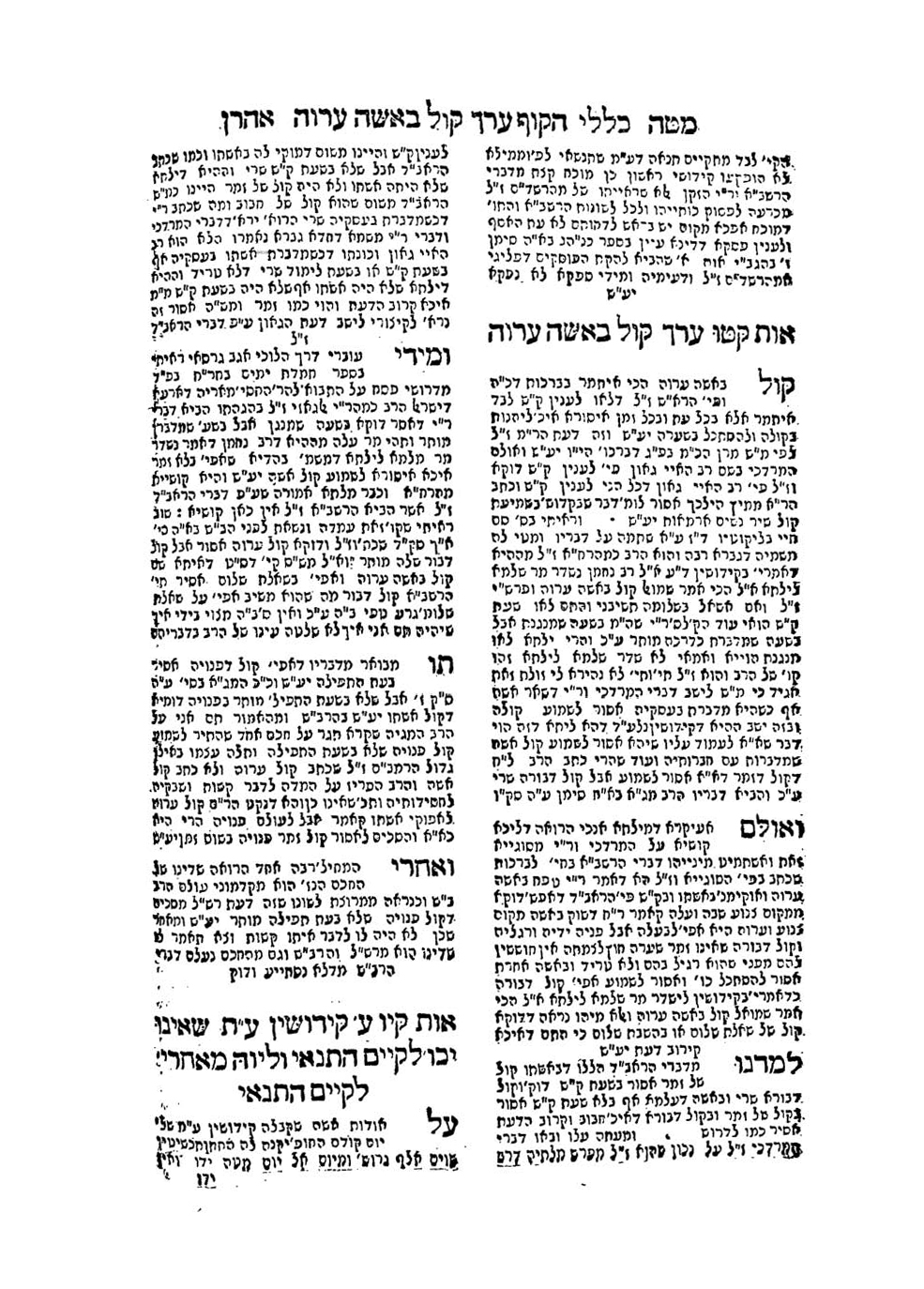
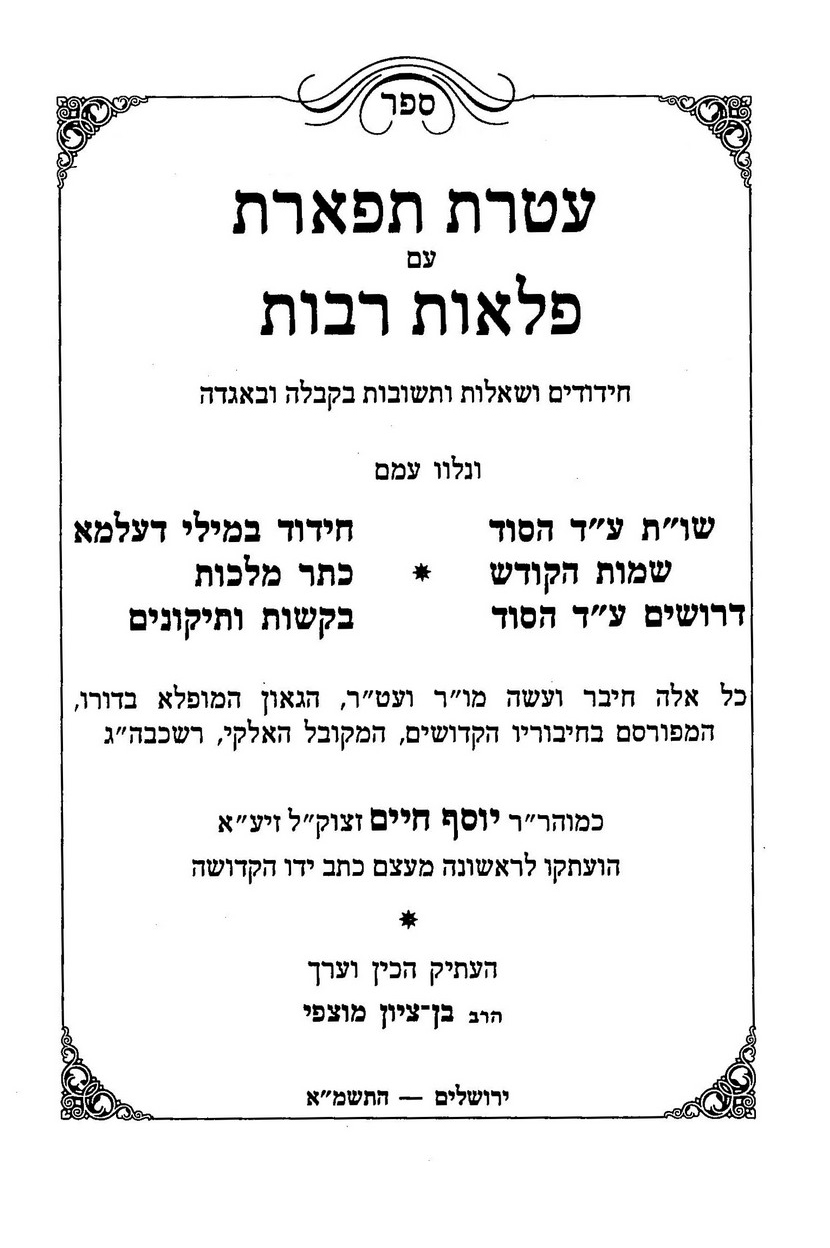
2. In my last post I mentioned that Agudat Israel has transformed itself into a lobbying organization. One of the areas they have been involved with is metzitzah ba-peh, so let me say a few things about this. It is really incredible how for many the debate around metzitzah ba-peh has become one in which the Modern Orthodox are one side, and the traditionalists on the other. I say this because the truth is that the virtually all of the rabbinic greats of Lithuania approved of metzitzah without oral contact. Alexander Tertis’ Dam Berit is a valuable resource that all interested in this matter must consult. Here is the title page.
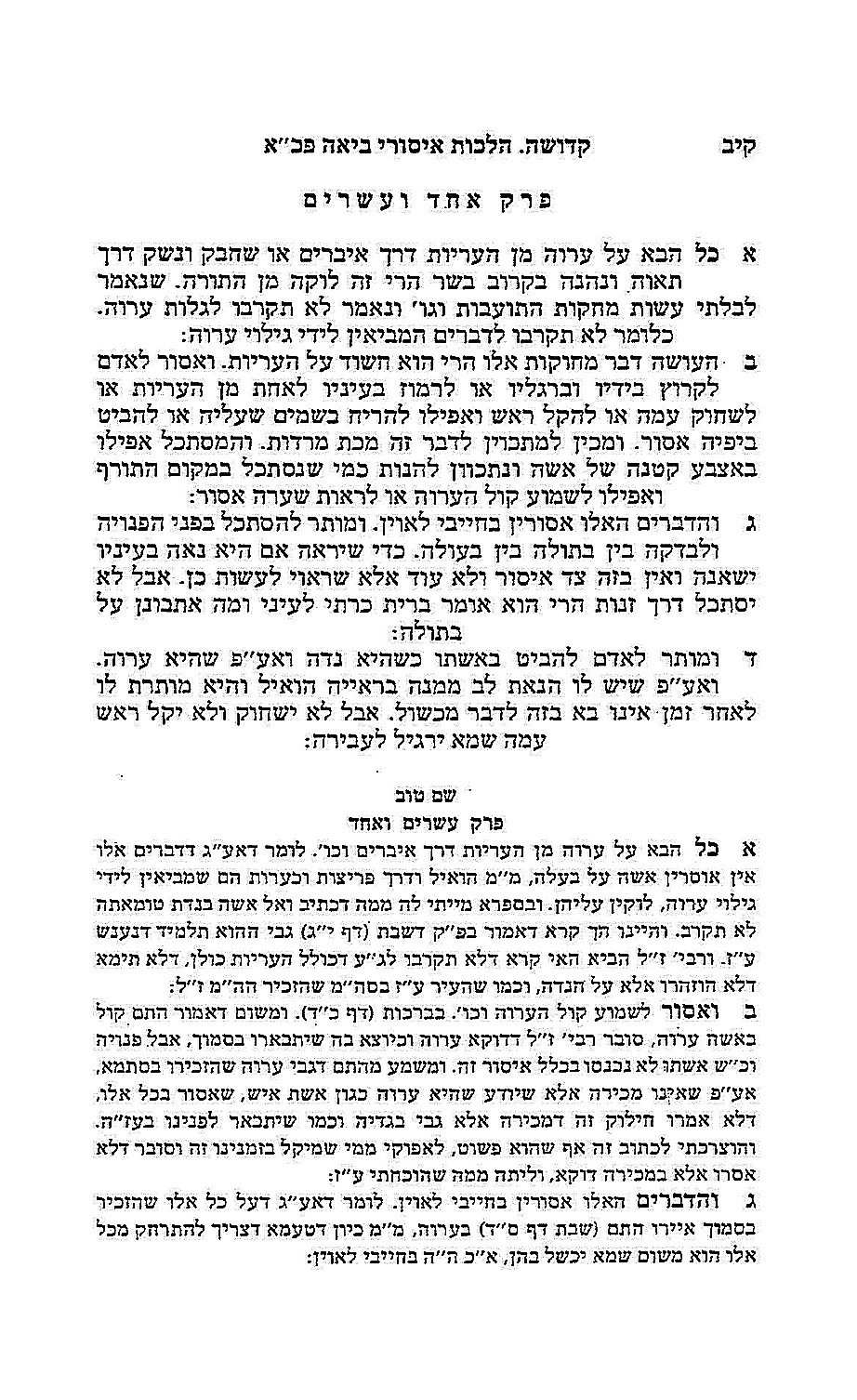
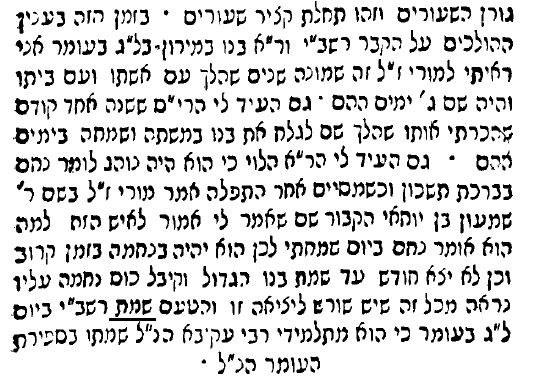
On p. 33, R. Shlomo Cohen, the famed dayan of Vilna, says the following about metzitzah, which is very relevant to what we ourselves have seen (namely, the rejection of the firm opinions of countless doctors and scientists on the matter, all in the name of tradition).
דבר הזה אינו שייך לרבנים רק לרופאים המומחים ולכן אין לי מה להשיב על שאלתו
According to R. Shlomo, the question of how to perform metzitzah is entirely a medical issue, and the rabbis therefore have nothing to say on this matter, much like in all other halakhot dealing with medical issues the opinions of the doctors are determinative. (It hardly needs to be said that in matters of pikuah nefesh the opinions of thousands of experts, including the world’s most outstanding authorities, cannot be overruled by one idiosyncratic figure who appears to be motivated by non-scientific concerns.) 
Also of interest is that in 1906 R. Hayyim Ozer Grodzinski reported that in Vilna virtually all of the mohalim did metzitzah with a sponge. He wasn’t happy with this, but this was the reality.[4]
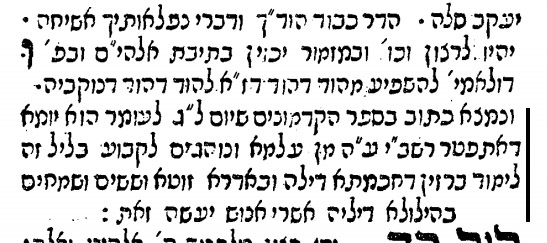
An interesting tidbit regarding metzitzah ba-peh is found in the Taz, Orah Hayyim 584:2. Here he mentions that he heard that R. Feivish of Cracow, when he circumcised on Rosh ha-Shanah, would not clean the blood out of his mouth. Rather, he would blow the shofar with the blood in his mouth so that the mitzvot of milah and shofar were joined.
Finally, for those who want to understand why it was only in the nineteenth century that metzitzah came to be regarded as central to the mitzvah of milah, Jacob Katz’s article “Polmos ha-Metzitzah” in his Ha-Halakhah ba-Metzar is crucial. In short, the centrality of metzitzah, and its description as a basic part of milah, is a product of the Orthodox defense of metzitzah in the face of Reform attacks. I think we are seeing something similar today. The digging in of haredi heels in defense of metzitzah ba-peh, complete with over-the-top rhetoric, is understandable (to a certain extent) and due precisely to the fact that it is an outside force that is threatening the practice. Had their own poskim suggested what the government is now insisting on, we would not have seen the same reaction. Yet it is still difficult for outsiders to grasp why some rabbinic leaders of these communities seem entirely oblivious to any medical dangers associated with the practice,  וסלחת לעונם כי רבנים המה
Let me say a few more things about metzitzah ba-peh. 

1. I saw on one of the blogs (I can’t locate it at present) that someone stated as self-evident that metzitzah ba-peh is only done with babies, not adults. The truth is that while the accepted opinion is indeed that metzitzah ba-peh is only done on babies (and maybe also on older child converts – I haven’t been able to find an answer to that), there are indeed opinions that even adult converts have to have metzitzah ba-peh performed on them. R. Moshe Klein (the son of R. Menasheh), Mishnat ha-Ger, p. 71, states without qualification that a convert has to have metzitzah, and if the mohel is afraid of catching a disease he should inquire of a posek if it can be done without the mouth. However, R. Yitzhak Yosef, Yalkut Yosef, Hilkhot Milah 6:1, rejects this viewpoint and states that there is no metzitzah, ba-peh or otherwise, with an adult convert.

2. According to R. Marcus Horovitz, Mateh Levi, vol. 2, Yoreh Deah no. 60, R. Samson Raphael Hirsch was prepared to accept the government’s abolishment of metzitzah without objection. It is difficult to square this assertion with Hirsch’s writings on the topic that show him as a strong defender of the practice.[5] Is it possible that Horovitz’s comment, meant as a criticism of Hirsch, reflects the difficult relationship these two men had?
3. In Iggerot Moshe, Yoreh Deah I, no. 223, R. Moshe Feinstein, in writing to a hasidic rebbe, expresses the standard viewpoint that metzitzah is only a medical procedure and has nothing to do with the mitzvah of milah. There is nothing surprising here. However, his correspondent had written otherwise, that metzitzah was an essential part of the mitzvah. In response to this, R. Moshe writes: חושב אני שהוא רק פליטת הקולמוס. The language R. Moshe uses implies that he did not know that among the hasidim metzitzah isindeed viewed as part of the mitzvah. Is it possible that R. Moshe was unaware of this? I don’t think so. It would appear, therefore, that the words I just quoted are a polite way of R. Moshe telling his correspondent that “what you wrote is without any substance.”
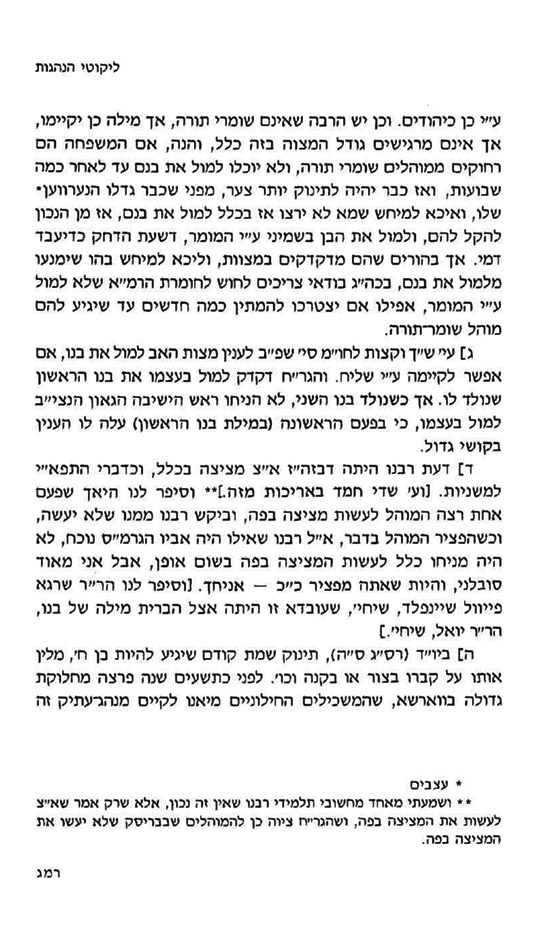
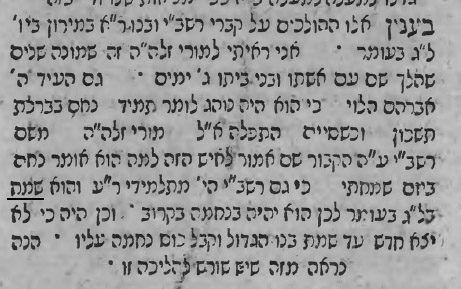
4. In 1994 R. Schachter’s Nefesh ha-Rav appeared. On p. 243 he states that R. Soloveitchik thought that today there is no need for metzitzah at all, not just metzitzah ba-peh. I remember how shocked I was when I read this, and was certain that it had to be wrong. As far as I know, no Orthodox authority has ever agreed to abandon metzitzah entirely, and I therefore couldn’t believe this report. My doubts were strengthened by the fact that R. Schachter quotes the Tiferet Yisrael as agreeing that metzitzah could be abandoned, when the truth is that the Tiferet YisraelShabbat 19:2, says the exact opposite, that metzitzah must be continued no matter what the doctors say.
As part of this post I wanted to include this page of Nefesh ha-Rav, so I went to Otzar ha-Hokhmah to download a PDF. Here it is.

Lo and behold, the copy on Otzar ha-Hokhmah is the third edition published in 1999, and there is a note on this page in which R. Schachter states that he has been told that what he wrote was incorrect, and that R. Soloveitchik only opposed metzitzah ba-peh. This makes much more sense and is what I assumed all along, so I was happy to see that my suspicions were confirmed.

R. Schachter recently spoke publicly about metzitzah ba-peh, and he is entirely opposed to it.[6] You can listen to his talk here.
Some might be surprised to hear R. Schachter say, after explaining that the Sages followed the most advanced medicine of their times, “When we look back at Chazal, look at medical statements in the Gemara, we laugh. . . . So you look back in the Gemara, it’s ridiculous, but the Gemara, in the days of the Tannaim, they were following the latest information of the doctors of their generation, of the scientists of their generation.”
I have to say, however, that R. Schachter is mistaken in his description of how the Hasidim understand metzitzah ba-peh. He incorrectly assumes that no one really regards it as a basic part of the mitzvah, i.e., halakhah le-Moshe mi-Sinai. “You know and I know and we all know that it is not halakhah le-Moshe mi-Sinai.” He claims that all those who do say it is halakhah le-Moshe mi-Sinai are exaggerating for rhetorical purposes, much like the expression yehareg ve-al yaavor is used for all sorts of things but is not meant to be taken literally. (R. Schachter himself created a good deal of controversy a couple years ago when he said that the refusal to ordain women was a matter of yehareg ve-al yaavor.)
Finally, I would like to make a general statement about how many in the Modern Orthodox world have been relating to metzitzah ba-peh. There is no question that for those in this segment of Orthodoxy, metzitzah ba-peh should not be done, both for medical reasons and also, I have learnt, for aesthetic reasons. With regard to the latter point, there is a sense among many in the Modern Orthodox world, and I myself have heard this and seen it in writing, that metzitzah ba-peh is “disgusting”. I understand that this is how people feel, but it is an improper feeling. Until the nineteenth century, metzitzah ba-peh was universal at every circumcision. How can observant Jews regard a practice that was basic in every Jewish community of the world as “disgusting”? I understand that it doesn’t fit in with today’s aesthetic sense, and that itself is perhaps reason enough for people not to do metzitzah ba-peh. However, everyone should be careful to avoid any denigration of metzitzah ba-peh that does not originate in medical concerns.
Don’t get me wrong, as I don’t mean that every practice that we find in Jewish communities throughout history should get such a “pass”, but here we are talking about a universal practice over thousands of years. It can’t be denied that there were “repulsive” and “gruesome” practices in Jewish communities.[7] Here are two cited by Shlomo Sprecher in his article mentioned in note 6: 1. Barren women would swallow the foreskin of newly circumcised boys as a segulah so that they could become pregnant. 2. Epileptics drank a potion that contained a girl’s first menstrual blood as a segulah to cure them of their epilepsy.[8]
I recently found another bizarre segulah that also falls under the rubric of “repulsive”, and I think that it would probably also be regarded by law enforcement as a form of sexual abuse. It comes from R. Zvi Hirsch Kaidonover (1646-1712), Kav ha-Yashar, ch. 51. For obvious reasons I am not going to translate this into English.
ועוד סגולה נפלאה לתינוק הנולד שלא יקרה עליו חולי נכפה בר מינן, מיד כשנולד ישימו בפיו ברית קודש של תינוק ויהיה ניצול כל ימיו מחולי נכפה
3. Following one of my previous posts I had correspondence with a reader and the discussion turned to the issue of how much of rabbinic literature is inner directed, that is, from intellectuals to other intellectuals.[9] I assume that this was the mindset of the Sages, and this explains some texts that I don’t think would have been recorded had there been an expectation that the masses would ever see them. In particular, I have in mind the talmudic stories that do not reflect well on certain rabbis. If we understand these texts as scholars talking to other scholars, then it makes sense that they would criticize each other, and even make fun of one another.[10] People in a closed community (in this case, the rabbinic elite) converse with one another in a different way than when outsiders are allowed in.[11] The problem is when the masses are studying Talmud, as today, that they have a difficult time with these texts, and Artscroll needs to explain them in an appealing fashion.
Here is one example of the sort of story I am referring to, that I assume was designed for internal consumption only, as it doesn’t reflect well on one of the Sages who is portrayed as being quite rude and insensitive. Taanit 20a-20b:
Our Rabbis have taught: A man should always be gentle as the reed and never unyielding as the cedar. Once R. Eleazar son of R. Simeon was coming from Migdal Gedor, from the house of his teacher, and he was riding leisurely on his ass by the riverside and was feeling happy and elated because he had studied much Torah There chanced to meet him an exceedingly ugly man who greeted him, “Peace be upon you, Sir”. He, however, did not return his salutation but instead said to him, “Raca,1 how ugly you are. Are all your fellow citizens as ugly as you are?” The man replied: “I do not know, but go and tell the craftsman who made me, ‘How ugly is the vessel which you have made’.” When R. Eleazar realized that he had done wrong he dismounted from the ass and prostrated himself before the man and said to him, “I submit myself to you, forgive me”. The man replied: “I will not forgive you until you go to the craftsman who made me and say to him, ‘How ugly is the vessel which you have made’.” He [R. Eleazar] walked behind him until he reached his native city. When his fellow citizens came out to meet him greeting him with the words, “Peace be upon you O Teacher, O Master,” the man asked them, “Whom are you addressing thus”? They replied, “The man who is walking behind you.” Thereupon he exclaimed: “If this man is a teacher, may there not be any more like him in Israel”! The people then asked him: “Why”? He replied: “Such and such a thing has he done to me.” They said to him: “Nevertheless, forgive him, for he is a man greatly learned in the Torah.” The man replied: “For your sakes I will forgive him, but only on the condition that he does not act in the same manner in the future.” Soon after this R. Eleazar son of R. Simeon entered [the Beth Hamidrash] and expounded thus, A man should always be gentle as the reed and let him never be unyielding as the cedar. And for this reason the reed merited that of it should be made a pen for the writing of the Law, Phylacteries and Mezuzoth.[12]
It appears that we see a continuation of this internal conversation in post-talmudic times. For example, I don’t think the rishonim who so harshly criticize their colleagues — I am referring to the colleagues they respected — would speak this way in a derashah before the common man. However, in internal dialogue they exercised more freedom. I think this can also explain the strange way that R. Isaac of Corbeil, the author of Sefer Mitzvot Katan, is referred to. He is called בעל החוטם. According to tradition, he was called this לפי שהיו לו שערות על החוטם.[13] Here too, I think that this was a humorous nickname that his colleagues knew him as, but not something that the average person would be expected to use. (Those who went to BMT will probably recall how various rabbis would speak of “Whitey Horowitz”. I don’t recall students ever referring to R. Moshe Horowitz this way.)  
I came across another example of what appears to be “internal conversation” from modern times that I think readers will find interesting. Both are found in R. Pinchas Miller’s Olamo shel Abba. Miller’s father, R. Asher Anshel Yehudah Miller, was a posek and author of seforim. I can’t imagine that the following comment, cited in the name of R. Shmelke of Nikolsburg, was something Miller, or R. Shmelke, wanted the masses to hear. Rather, I assume that it was an insider’s joke, designed to be shared among colleagues.
Shabbat 118b states that if Israel observes two Sabbaths properly they will immediately be redeemed. R. Shmelke explained that this refers to Shabbat ha-Gadol and Shabbat Shuvah. It is traditional that on these Sabbaths the rabbis give derashot before the community. R. Shmelke added that the rabbis act as if what they are saying is original to themselves, even though they have taken it from others. The Sages say that if you repeat something in the name of one who said it, you bring redemption to the world (Avot 6:6). Based on this text in Avot, R. Shmelke explained the above talmudic passage as follows: “If Israel observes two Sabbaths properly”, that is, if the rabbis who give the derashot on Shabbat ha-Gadol and Shabbat Shuvah (“two Sabbaths”) actually acknowledge where they get their ideas from (“repeat something in the name of one who said it”), “immediately Israel will be redeemed” (p. 501). This is such a provocative text because not only does it accuse the rabbis of plagiarism, but it states that the redemption itself is being delayed because of their behavior. If it was repeated by the masses it would be regarded as terribly degrading of the rabbis, but seen as a somewhat playful “derashah” to be shared among rabbinic colleagues, it loses much of its sharpness.[14]
There is another interesting passage on p. 326, which despite being humorous, I would have also assumed could only be said among colleagues. Yet Miller’s son tells us that his father used to repeat the following in his derashah at weddings: We know that it is a mitzvah to help the bride and groom to rejoice, but the rabbis come to weddings and instead of doing this, they deliver a long derashah and speak words of mussar to the young couple and thus disturb their joy.[15] That is why at the sheva berakhot we state שמח תשמח רעים האהובים כשמחך יצירך בגן עדן מקדם. In other words, we wish the bride and groom that their joy should be complete like the joy Adam felt when Eve was created for him, because in their time, in the Garden of Eden, there were no rabbis around who were able to disturb their joy!
* * * *
4. I want to call attention to a book that has just appeared. Its English title is Jewish Thought and Jewish Belief and it is edited by Daniel J. Lasker. You can read more about it here. It is available for purchase at Bigeleisen.
This is just the latest in a series of valuable books published by Ben Gurion University Press as part of the Goldstein-Goren Library of Jewish Thought. The articles that I think readers of this blog will find particularly interesting are David Stern, “Rabbinics and Jewish Identity: An American Perspective;” David Shatz, “Nothing but the Tuth? Modern Orthodoxy and the Polemical Uses of History,” Baruch J. Schwartz, “Biblical Scholarship’s Contribution to the Concept of Mattan Torah Past and Present;” Menachem Kellner, “Between the Torah of Moses and the Torah of R. Elhanan;” Tovah Ganzel, “‘He who Restrains his Lips is Wise’ (Proverbs 10:19) – Is that Really True?” and the symposium on Jewish thought in Israeli education, with contributions from R Moshe Lichtenstein and Adina Bar Shalom (R. Ovadia Yosef’s daughter).
Here are a few selections from Shatz’s article:
To be clear, academics, I find, generally shun blogs that are aimed at a popular audience because the comments are often, if not generally, uninformed (and nasty). A few academics do read such blogs, but do not look at the comments. One result of academics largely staying out of blog discussions is that non-experts become viewed as experts. Even when academics join the discussion, the democratic atmosphere of the blog world allows non-experts to think of themselves as experts and therefore as equals of the academicians. Some laypersons, though, as I said earlier, are indeeed experts in certain areas of history.
(In this quotation, one could also substitute “rabbis” or perhaps better, “poskim”, for “academics”, and “areas of halakhah” for “areas of history.”) Shatz is specifically speaking about historians, and contrasting experts vs. non-experts in this area. Yet when it comes to the sort of things I often write about here, I can attest that it is usually non-academics who are the real experts. Time and again I am amazed at the vast knowledge of so many of the people who read this blog. As for the general phenomenon of blogs, there are many people who for whatever reason (usually lack of interest, ability, or patience) are not going to write lengthy articles. Yet they often have a great deal to contribute, much of which is very important to the world of scholarship (almost always in terms of uncovering unknown sources and correcting earlier errors, as opposed to offering new interpretations or original theories). Academics ignore this to their own loss.[16]
In my future book I refer to numerous blog posts, and posts from the Seforim Blog have already been mentioned in a number of scholarly publications. My own reason for writing posts is because most of the material I discuss is, I think, interesting and sometimes even important. While this material is often not of the sort that can be included in a typical article, the genre of the blog post suits them just perfectly. Speaking of the Seforim Blog in particular, its readership encompasses a very large percentage of English speaking traditionally learned Jews of all backgrounds, beliefs, and professions (from Reform rabbis to Roshei Yeshiva and poskim, and everything in between). Thanks again are due to Dan Rabinowitz for providing this unique and wonderful platform.
Here are two more quotes from Shatz:
Be the causes what they may, there is an intramural struggle among the Orthodox, a competition for the soul of Orthodox Judaism, and the primary weapon with which it is being waged is history. For Modern Orthodox Jews today, instead of history being a threat to belief, as in earlier periods, it has become a way of arguing for one version of Othodoxy over another. And it is used for polemical purposes far more than philosophy. There are today few Orthodox philosophers, but comparatively many Orthodox academically trained historians.
Can the Modern Orthodox explain why it is admissible for Hummash and the Sages (in aggadot) to write non-accurately and provide inspiration and memory, but inadmissible for those on the right to write in that genre?
My article in Jewish Thought and Jewish Belief is entitled “Is there a ‘Pesak’ for Jewish Thought.” Those who publish know that it is often the case that only after it is too late does one realize that one’s article or book omits something important. Here too that was the case. In the article I discuss Maimonides’ view in Guide 3:17 that there is no punishment without transgression. That is, he rejects the notion of yissurin shel ahavah. I note that Maimonides claims that this is the opinion “of the multitude of our scholars,” and he cites R. Ammi’s opinion in this regard from Shabbat 55a. What is significant is that later in the sugya the Talmud states that R. Ammi’s opinion was refuted. Maimonides ignores this rejection, and even states that R. Ammi’s opinion is the majority view. This illustrates how Maimonides felt free to reject a talmudic viewpoint in a non-halakhic matter, even when it seems that the opinion is deemed authoritative by the Talmud.
What I unfortunately neglected to mention is that in Guide 3:24 Maimonides also deals with yissurin shel ahavah. Here he acknowledges that there are talmudic sages who accept this notion, but he adds that his own opinion, i.e., the rejection of yissurin shel ahavah, “ought to be believed by every adherent of the Law who is endowed with intellect.” In our own language, we might say that this viewpoint should be obvious to anyone with “half a brain.” Yet this is quite a shocking statement when one considers that there were talmudic sages who had a different perspective. Did Maimonides regard them as lacking intellect?
Here is another point I would like to add: In my Limits of Orthodox Theology I argue that it is most unlikely that Maimonides would choose to establish something as a dogma if it was a matter of debate among the Sages. (If establishing dogma was simply part of the halakhic process, this would not be problematic.) I see that R. Shlomo Fisher apparently has the same perspective, as he writes in his Hiddushei Beit Yishai, no. 107 (p. 413):
וגוף הדברים שכתב הרמב”ם בפה”מ ועשאן עיקר גדול תמוהין מאד. חדא, אם הם עיקר גדול היכי פליג עלה ר’ יהודה.
The issue of deciding matters of hashkafah in a halakhic fashion has also recently been discussed by R. Yaakov Ariel in his new book Halakhah be-Yameinu, pp. 18ff. I have to say that the more I read by Ariel the more impressed I am, as everything he writes is carefully formulated and full of insight. He strikes me as very open-minded with a good grasp of Jewish philosophy. He is, of course, also an outstanding posek. I now understand why it was so important for the haredim, under R. Elyashiv’s lead, to prevent him from being elected Ashkenazic Chief Rabbi of the State of Israel. What the haredim wanted, and were successful in this, was to destroy the Chief Rabbinate as a force to be reckoned with. The way to do this was to make sure that its occupant would be nothing but a “crown rabbi”. That is, they wanted to appoint a chief rabbi who is a figurehead, who interacts with the government on behalf of the haredi leadership, who goes around the world speaking about Jewish topics to the masses, and who can deal with non-Jews. What they absolutely did not want in a chief rabbi was a figure who had any rabbinic standing and who could thus challenge haredi Daas Torah.
At a time when much of the right wing religious Zionist world appears to have gone off the deep end, R. Ariel stands as a voice of sanity. Be it his attack on Torat ha-Melekh (a book which I still plan on discussing) or his strong rejection (together with R. Aharon Lichtenstein and R. Nachum Rabinovitch) of the outrageous letter written by Rabbis Tau, Aviner and others in support of Moshe Katzav, or his defense of women voting (arguing that today R. Kook would not be opposed; Halakhah be-Yameinu, p. 189) he shows that right wing religious Zionism need not be identified with the craziness we have been accustomed to see in recent years. 
Let us return to his recent essay where he argues, in opposition to what I wrote in my article, that Maimonides often does “decide” in matters of hashkafah no different than in halakhah. To illustrate his point, Ariel notes that there is a dispute among the Sages about whether there are reasons for commandments. He claims that Maimonides מכריע ופוסק  in accord with the position that there are reasons. He concludes:
אף על פי שלדעתו כללי ההלכה אינם חלים בענייני אמונה, בכל זאת ניתן להכריע את האמונה על פי דרך הלימוד הנקוטה גם בהלכה.
The notion of a pesak emunah, if it is to be parallel to a pesak halakhah, would mean that after Maimonides gives his pesak, in his mind it is now forbidden to adopt the other viewpoint (just as when Maimonides rules that something is forbidden on Shabbat) .Yet where does Maimonides ever say that there is an obligation to accept his viewpoint about reasons for the commandments? What Maimonides does is show why his viewpoint is correct, and Ariel cites these sources. But just because Maimonides wants his readers to adopt his own viewpoint, in what way is this a “pesak emunah”? Maimonides is simply expressing his strongly held belief. He is not ruling alternative positions out of bounds, as he does in deciding halakhah. This appplies as well to the other examples Ariel brings to prove his point. All he has established is that Maimonides argues for a position in matters such as the nature of prophecy and providence, but that is far removed from the notion that Maimonides saw his opinions as halakhically binding. On the contrary, just because Maimonides tells us what he thinks the Torah’s position is in a matter such as providence, he had no expectation that the masses would (or in some cases even should) follow him in this, and he was fully tolerant of the masses holding to their errant opinions as long as the matter was not an authentic dogma.
5. I have now finished my book on censorship. I can’t say when it will appear as it still has to be properly edited, typset etc., but hopefully this won’t take too long. I have loads of interesting material that for various reasons I was unable to include in the book, so the Seforim Blog will give me a good opportunity to bring it to the public’s attention. Let me begin with something sent to me by Rodney Falk.
Professor Louis Henkin, the son of R. Joseph Elijah Henkin, died in 2010. Here is his obituary as it appeared in Ha-Modia.


Notice what is missing! The obituary won’t even mention who his father was. Had Louis Henkin been a businessman or a doctor this information would not have been excluded, of this there is no doubt. But it is considered a disgrace to R. Henkin’s memory that his son was an intellectual, one who lived the life of the mind, and yet he didn’t become a rav or a rosh yeshiva . People in the haredi world can understand how not everyone is cut out to be a rosh yeshiva or sit in kollel, and these “unfortunates” are therefore forced choose a profession. But apparently, the notion that one who has the brains and intellectual stamina to become a great scholar might choose to devote himself to non-Torah subjects borders on the blasphemous for Ha-Modia. As such, while Louis Henkin can be acknowledged for his achievements, he has to be severed from his father’s house (the same father who sent him and his two brothers to Yeshiva College).
I think Yoel Finkelman has put the matter quite well in discussing the larger issue of which this example is  part and parcel of:
Haredi writers of history claim to know better than the great rabbis of the past how the latter should have behaved. Those great rabbis do not serve as models for the present. Instead, the present and its ideology serve as models for the great rabbis. Haredi historiography becomes a tale of what observant Jews, and especially great rabbis, did, but only provided that these actions accord with, or can be made to accord with, current Haredi doctrine. The historians do not try to understand the gedolim; they stand over the gedolim. Haredi ideology of fealty to the great rabbis works at cross purposes with the sanitized history of those rabbis.[17]
6. Rabbi Jason Weiner, a fine musmach from Yeshivat Chovevei Torah, has recently published a Guide to Traditional Jewish Observance in a Hospital. Formerly assistant rabbi at the Young Israel of Century City, he now serves as Senior Rabbi and Manager of the Spiritual Care Department at Cedars-Sinai Medical Center in Los Angeles. The book comes with approbations from R. Asher Weiss and R. Yitzchok Weinberg, the Talner Rebbe, and the halakhot in the book have been reviewed by Rabbis Gershon Bess, Nachum Sauer, and Yosef Shuterman. The book can be downloaded here.
7. Some readers have asked me about upcoming shul lectures. Here is what is on my schedule through Passover.
Feb. 15-16: Sephardic Institute of Brooklyn
March 1-2: Beth Israel, Miami Beach
March 8-9: Shearith Israel, New York
March 15-16: Beth Israel, Omaha
If any readers are interested in having me speak at their shuls, please be in touch.
8. No one got the answer to the last quiz, so let me do it again. The winner gets a copy of one of the volumes of R. Hayyim Hirschensohn’s commentary on Rashi. If you know the answer to the question, send it to me at shapirom2 at scranton.edu.

What was the first Hebrew book published by a living author?

[1] What does this last sentence mean? How can an attitude violate a biblical prohibition?

[2] As a good illustration of changes in attitude in the last forty years, here is what R. Norman Lamm wrote in his classic article on homosexuality in the 1975 yearbook of the Encyclopaedia Judaica. Such a sentence would, today, be quite politically incorrect, and regarded by gays as incredibly offensive: “Were society to give its open or even tacit approval to homosexuality, it would invite more aggresiveness on the part of adult pederasts toward young people.” 
[3] R. Meir Schiff (Maharam Schiff) is unique in believing that one without arms should put the tefillin shel yad on the head, together with the tefillin shel rosh. This is the upshot of his comment to Gittin 58a.
[4] See R. Sinai Schiffer, “Mitzvat ha-Metzitzah,” p. 106 (printed together with R. Sinai Adler, Devar Sinai [Jerusalem, 1966])
[5] See Eliyahu Meir Klugman, Rabbi Samson Raphael Hirsch, pp. 292-293.
[6] “Following in the Footsteps of Our Fathers,” Nov. 13, 2012.
[7] The words are those of Shlomo Sprecher from his article on metzitzah in Hakirah 3 (2006), p. 51.
[8] Speaking of drinking, take a look at this strange passage. It appears in R. Hayyim Rabbi’s letter at the beginning of R. Haggai Ben Hananyah’s Nimukei Levi (Ashdod, 2008), p. 2. Add this to the long list of texts that I refuse to translate.
בדין חלב אשה. נשאלתי פעם, אם בזמן תשמיש עם אשתו, החלב שלה אסור עליו, או שבעל ואשתו כגופו, ואין בו דין של יונק שרץ. ובפרט לטעם שמא יינק מבהמה טמאה, ובאשתו כגופו שהתירו לו בשעת פיוס וכו’, לא גזרו בזה. ויתכן שמותר כדין פסיק רישיה בדרבנן. ובנידון כזה, שזה חשש גזירה, גם בניחא ליה יש מקום להתיר. כן נראה לכאורה.
[9] The previous post is found here.
In the comments, Yehudah Mirsky wrote:

Fwiw, as I recall, Steve Wald in his book on Eilu Ovrin shows that the genuinely awful am-haaretz passages in Pesachim are a later stammatic addition, and that Jeff Rubinstein argues has a chapter on this in his “The Culture of the Babylonian Talmud” where he argues both that that sugya in Pesachim is sui generis in Hazal and – interestingly – reflects the Stammaim’s needing to justify their very scholastic lifestyle vis-a-vis people who were working for a living. Rubinstein cautions that the whole sugya may have been intended as a series of private jokes and need not necessarily reflect actual social relations between the stammaim and their surrounding society.

[10] Yeshayahu Leibowitz quipped that the Sages must have had a good sense of humor, since they included the following passage in the Talmud: תלמידי חכמים מרבים שלום בעולם. See Sihot al Pirkei Ta’amei ha-Mitzvot (Jerusalem, 2003), p. 289. In all seriousness, however, there are indeed humorous passages in the Talmud, as pointed out by R. Moses Salmon, Netiv Moshe (Vienna, 1897), pp. 45-46. Here is one example he gives (Bava Batra 14a).:
The Rabbis said to R. Hamnuna: R. Ammi wrote four hundred scrolls of the Law. He said to them: Perhaps he copied out the verse  תורה צוה לנו משה
Salmon claims that anyone with a bit of sense can see that R. Hamnuna’s reply is a wisecrack made in response to the obvious exaggeration about R. Ammi.
Nehemiah Samuel Leibowitz states that even in the Zohar we have passages that show a humorous side. One of the many examples he points to is Zohar, Bereshit, p. 27a:
וימררו את חייהם בעבודה קשה בקושיא. בחומר קל וחומר. ובלבנים בלבון הלכתא. ובכל עבודה בשדה דא ברייתא. את כל עבודתם וגו’ דא משנה.
See Leibowitz, “Halatzot ve-Divrei Bikoret be-Sefer ha-Zohar,”Ha-Tzofeh le-Hokhmat Yisrael 11 (1927), pp. 33-45. For more on humor in the Talmud, see Yehoshua Ovsay, Ma’amarim u-Reshimot (New York, 1946), ch. 1; R. Mordechai Hacohen, “Humor, Satirah, u-Vedihah be-Fi Hazal,” Mahanayim 67 (5722), pp. 8-19.
[11] Such a community also establishes special rules for itself, of which I can cite many examples. Here is one, from R. Solomon Luria, Yam Shel Shlomo, Bava Kamma 8:49:
ואם חוזר בפעם השלישי א”כ הוא משולש בחטא, אזי אין מניחין כלל לפדותו מן המלקות אלא ילקה בב”ד ודיו, אם לא שהוא בר אורין שאין ראוי להלקותו
After all we have seen in the last few years, I am quite certain that today the average person would not accept that when it comes to criminal matters that the rabbis should be given special privileges and exemptions.
[12] See also Va-Yikra Rabbah 9:3 where it describes how R. Jannai called his host “a dog”, and then learnt how wrong he was.
[13] See the introduction to the Constantinople 1510 edition of the work, reprinted in the Jerusalem, 1960 edition.
[14] On p. 187 Miller offers a different perspective. Here he quotes another rabbi who said that if necessary it is OK for one to repeat another’s hiddushim in the Shabbat ha-Gadol derashah, because the Sages tell us (Pesahim 6a): שואלין ודורשין בהלכות פסח.  This means:
מותר “לשאול” מאחרים בשעת הדחק ולדרוש בהלכות פסח
[15] I am told that it is still the practice in certain communities for the rabbi to deliver a derashah at a wedding..
[16] I think in particular of S.’s wonderful blog On the Main Line, which routinely provides important, and until now unknown, primary sources that are vital to a wide range of areas of scholarship.
[17] Strictly Kosher Reading, p. 122.


Torah Under Wraps

Torah Under Wraps

by Yoav Sorek

translated by Daniel Tabak

Their publications are not allowed to get out. Their roiling Internet forums are blocked by filters. The articles they publish omit the names of professors considered verboten. A cohort of Haredi scholars [1] challenge the academy and their natural surroundings, unafraid to deal with subjects deemed taboo in the yeshiva world. Few Religious Zionists have penetrated this alternative ivory tower, but one of them—Eitam Henkin, may his blood be avenged—succeeded in breaking down barriers.

*

One needs to strengthen oneself with faith; one should not entertain philosophical questions nor even glance at the books of philosophers,” said Rabbi Nahman of Bratslav already at the end of the eighteenth century. This motto is particularly popular today, in the post-modern era of “religious strengthening,” in which religiosity is perceived as synonymous with simplicity and unsophistication. Yet that very approach also runs counter to the Jewish mind, which is by its nature anything but naive. The legacy of Jewish erudition constitutes part of the DNA not only of the academy, but of even the most Haredi sectors of the yeshiva world, and it finds expression in the spirited Jewish Studies scholarship flourishing under the radar in circles that are presumed to recoil from it.

Israelis distant from the world of Jewish Studies were offered a glimpse of it in the amusing film “Footnote,” but it portrayed only the nerve center of the field’s academic milieu, when in reality a great deal more is out there. In the reading rooms of the National Library, and in many houses in Bnei Brak and Jerusalem, many scholars sit and study the same topics as academics but without academic degree, without traveling to conferences, without aspirations toward an academic appointment. The history of medieval and modern rabbinic authorities, the stories of their compositions, the manuscripts and their provenances, variant customs, disputes both ancient and alive—all of these preoccupy a non-negligible group of yeshiva graduates, Haredi in dress and behavior, who publish articles in “non-academic” journals of Torah scholarship and produce corrected editions of sacred texts, some of which can even be considered quasi-critical editions.

They number Hasidim and Mitnaggedim, the truly God-fearing and those trapped in the Haredi lifestyle who cut corners, those lacking any academic title and others who have earned one—sharp and knowledgeable one and all, still faithful to, and actively participating in, the intra-Haredi discourse. Some of them evidence a dual non-conformism in their lives: on the one hand, they have opted to put distance between themselves and the safe space of the yeshiva, pasturing in the treacherous fields of scholarship; on the other hand, they are Haredim who hail from circles thoroughly suspicious of academia and would not dream of lending credence to its guiding assumptions. Nearly every remarkable personality in the field originates in the circles of Ashkenazi religious zealots, yet the scholarly discussion—which takes place not only on journal pages but in the lively Internet forums of Be-Hadrei Haredim and Otzar HaHochma—is not private, and sometimes a handful of others participate. Rabbi Yoel Catane of Yeshivat Sha‘alvim, editor of the journal HaMa’yan, is one of those others, as his home is in the Religious Zionist world, and his publication represents the enlightened German Zionist Orthodoxy of bygone years. The late Eitam Henkin also was one of them—a Torah scholar and brilliantly wide-ranging scholar who took prominent part in the back and forth of these torani scholars.

In National-Religious society, there are, to be sure, many others involved in Jewish Studies scholarship, but one would be hard-pressed to find the same kind of polemical verve that exists amongst Haredi scholars. According to K., a young Haredi scholar, the passion attests to the fact that the scholarly endeavor is for them an existential need:

The Haredi does his research in order to mask his own crisis of faith in a world that forbids thinking. Those who try to identify the composer of a liturgical poem or the copyist of an unknown manuscript, and those who uncover a forgotten rabbinical position held by R. Joel Sirkes, and those who wade through tomes to reconstruct a partially extant word in an Akkadian inscription, are all really fleeing forbidden thoughts. They release the tension between the silent extinguishment of faith in the Haredi world and the soul aflame with newly forged ideas by running for the hills of manuscripts and book archives.

K.’s criticism begins with the Procrustean bed of Haredi yeshiva education:

The Haredi kollel fellow is force-fed a diet of Torah study characteristic of the Lithuanian yeshivas of the previous century. Should he not be of a mind to rebel completely, the only somewhat legitimate pursuit open to him is Jewish Studies. In that way he can edit the novellae of the Rosh to tractate Nazir without raising too many eyebrows. For that reason Haredi scholars, at least initially, are more involved in editing and less with research or writing articles. And if they are open to producing scholarship, the closer the subject matter is to our time, the better: better on the modern rabbinic authorities than the medieval ones, better on the medievals than the Ge’onim, and God forbid not on the Talmud—don’t even mention the Bible. Preference is given to writing biographical pieces and endless discussions of historical chronology, such as clarifying the years of rabbi X’s rabbinic post in town Y, rather than anything deep about his method of study.

Not everyone agrees with K.’s psychological diagnosis. “Some have ventured into the academic world not out of frustration with the kollel world, but because they were introduced to scholarship in minute doses and became enchanted by it,” says R. Yosef Mordechai Dubovick, a Boyaner Hasid who recently completed his doctorate on Rabbenu Hananel. He says that this field presents something the young prodigy would find difficult to resist.

We have been taught and trained to question, explore, plumb the depths and not be satisfied with a superficial reading or understanding. When the intellectual yeshiva student is exposed to new tools and unfamiliar hermeneutical lenses and modes of understanding, his natural curiosity—nurtured so well—gobbles them up.

It’s ‘spontaneous academia,’” says Rabbi J., who would prefer to avoid equating it with academia. “It develops independently, without institutional bodies to dictate rules and regulations. It is anarchic, autodidactic, and exhilarating. It is a breathtaking demonstration of unfettered intellectual ability.”

A Scholar is Born

Rabbi Dr. Zvi Leshem, Director of the Gershom Scholem Library at the National Library of Israel, has occasionally bumped into scholars from the very heart of the Haredi world. “They are not the typical kollel fellow because the scholarly approach is not that of yeshiva students,” he says. He continues:

Look, when I began working here I met a senior rosh yeshiva from a respected hesder yeshiva, and I told him about those who come from the yeshiva world to do research here. He was at a loss. “What sort of thing do they research?” he asked me, and I responded in turn with the example of Hemdat Yamim.[2] “Why would they research Hemdat Yamim,” the Torah scholar asked me, “when they can buy it in any seforim store?” That is the mainstream approach. Those who embark on scholarship are atypical.

They may be exceptional and individualist, but one unmistakable quality binds them all together: they are autodidacts. This is evident in how they handle material in a foreign language. Some of these scholars have never studied English or German systematically yet refer to non-Hebrew sources in their articles. Each apparently bridged the gap in his own way.

Anyone interested in this phenomenon is invited to open, for example, a volume of Yerushaseinu, an annual tome published by the Institute for German Jewish Heritage (Machon Moreshet Ashkenaz). Some of the articles published therein would be perfectly suitable for any standard academic journal; among the numerous footnotes adorning the pages one finds references to scholarly literature in Hebrew and other languages. Other publications include Yeshurun, Moriah (published by Machon Yerushalayim, which for decades already has been involved in the professional editing of medieval and modern rabbinic literature), the Chabad journal Heikhal Ha-Besht, and others. Torani scholars fondly remember the journal Tzfunot, which met its demise over a decade ago, and in the meantime they publish in Torah supplements to Haredi newspapers, primarily in Kulmos of the newspaper Mishpacha. Likewise, the new scholarly journal Chitzei Gibborim – Pleitas Soferim, published in Lakewood, NJ, is at the moment taking its first steps.

Prominent names in the field include Mordechai Honig, a Hasid from Monsey who is extremely knowledgeable in medieval rabbinic literature; Yaakov Yisrael Stahl, a scholar of Franco-German Jewry forced to lower his profile in connection with academia; Moshe Dovid Chechik, a historian who until recently co-edited Yerushaseinu and currently co-edits Chitzei Gibborim; Yehudah Zeivald, a Boyaner Hasid who is quite busy with philosophy and Hasidism; Yitzchak Rosenblum, who had to move from Kiryat Sefer to Bet Shemesh on account of the library he opened, and currently teaches at the Haredi yeshiva high school Nehora; Yaakov Laufer, a scholar who focuses on linguistics and on the conceptual mode of Torah study; Betzalel Deblitsky, a prodigious zealot from Bnei Brak who runs the forum associated with Otzar HaHochma (the monumental digitization project of the Jewish library); Nachum Grunwald of Lakewood, NJ, a Chabadnik who grew up a Satmar-Pupa Hasid and serves as editor of Heikhal Ha-Besht; Aharon Gabbai, a rising star from Bnei Brak who graduated from a Lithuanian yeshiva, of course; Yechiel Goldhaber, slightly older than the rest, a historian and bibliographer whose scholarship is famous, and for whom the National Library is a second home; and Avraham Shmuel Taflinsky, who has toiled for the past few years in uncovering the sources of the aforementioned Hemdat Yamim.

Once we are mentioning the denizens of the National Library, mention must be made of the all-important tool in their scholarly work—the Internet. The global web of knowledge enables Haredi men from conservative yeshivas, whose library holdings are what you would expect, to come in contact with Jewish Studies scholarship and its historical-critical mindset. Most Haredi scholars have a home Internet connection, but not all. Zvi Leshem relates that some come to the library not to peruse ancient manuscripts or converse with the university’s scholars who use it as their place of study, but simply to work at a place that provides Internet access.

“In the digital age, Jewish Studies scholarship has successfully managed to wiggle its way, however constrainedly, into Haredi and yeshiva circles via databases such as Otzar HaHochma,” Mordechai Honig relates. “Until recently, it was the books. The birth of a Haredi scholar was generally triggered by incidental exposure to academic scholarship that invitingly charmed him. For me, it was Ephraim Urbach’s The Tosaphists, which I purchased at age fifteen.”

No one can deny the love story between digital media and the world of Haredi scholarship, with the latter exercising its acumen also in its use of technology. Along those lines, a weekly Internet journal popped up several years ago which, in the course of a couple years, became an especially favored forum for the group of torani scholars. It bore the name Datshe (ДАЧА), a Russian word that made its way into yeshivish slang, which evokes a leisurely space in which people enjoy life, a kind of rare legitimation of self-indulgence and letting loose a bit. The journal, founded and edited by Yitzchak Baruch Rosenblum, was, according to its subtitle, “where sages of Israel come to relax.” The publication insisted upon respectable discussion and high-caliber argumentation, but one also could find among the directives to its readers and writers the following note of caution, which furnishes an additional explanation to the choice of digital format: “Please preserve the low profile of this publication. One can print it for ease of reading but should not show it to just anyone. Wisdom belongs to the discreet.”[3]


Instead of Polemic, Shock

Along with Internet databases and online journals, forums also have an important place in the discourse of these scholars. After many long years in which the forum Soferim u-Sefarim on the site Be-Hadrei Haredim served as the water cooler for torani scholars, the baton was passed to the forums of Otzar HaHochma. A lengthy, fascinating thread recently began there, for example, whose purpose is to generate a list of “dissenting opinions [made by lone rabbinic scholars],” that is, halakhic positions taken by well-known decisors over the generations when their colleagues were of a different mind. The thread reveals the foundational analytic-halakhic erudition of the discussants, expert not only in bibliography and history but also in a wide range of positions expressed by medieval and modern rabbinic authorities on scores of issues.

The administrator of the Otzar HaHochma forums is, as was said above, Betzalel Deblitsky (under the username “Ish Sefer”). What had been permissible on Be-Hadrei Haredim the fearless zealot Deblitsky bans, censoring discussions and silencing voices he deems unworthy of being heard. But even those who miss the great openness that marked the forum of yore understand that the change is permanent—discussions of relevance within the scholarly community take place principally on the new forum.

Zeal, parenthetically, is a relative matter: the strict filter Netiv, which runs according to the guidance of a confidential rabbinic board, blocks the Otzar HaHochma forum on account of its content being deemed subversive and problematic. To take but one example, the forum has an intense, politically-charged discussion surrounding one of the veteran decisors of the Edah Haredit in Jerusalem—R. Yitzhak Isaac Kahana. A broadside that circulated in Jerusalem against R. Kahana’s book Orhot Tohorah and his lenient rulings on questions regarding menstruation inflamed not only the physical Haredi street but the virtual one as well, engendering scathing posts on the forum in support of each side. A symptom of one of the forum’s pathologies is partially manifest in this case: the deletion of threads by the moderator, who perceived them as deviating from the Haredi party line. Over three pages of posts inexplicably disappeared from the site, only to return the next day, redacted.

Rabbi Eitam Henkin was among those disappointed by the limits set on the forum’s discourse as compared with past fora, but he nevertheless realized that this was the place to be. Under the username “Tokh Kedei Dibbur,” Henkin took part in discussions on the forum, and at the same time carried on extensive personal e-mail correspondence with scholars who were active on it. This became the gateway through which Israeli reality penetrated the Haredi ivory tower—users discovered that the man murdered together with his wife, in front of his children, in the middle of Sukkot, was none other than “their very own” Rabbi Eitam. The forum was filled with emotional threads of eulogy and anguish, memorial initiatives and activities to be done in his merit, and the revelation of the many connections that Henkin had weaved amongst his Internet friends.

It is difficult not to resort to superlatives when speaking about Eitam Henkin. Anyone who had followed his abundant Torah publications — which were marked by eloquent prose, intellectual honesty, and the self-confidence of someone on home turf — had trouble believing the subject of conversation was so young. Even the conversation about him on the forums sketches a fascinating profile. The user known as “Meholat Ha-Mahanayim wrote:

The distinguished victim, may God avenge his blood, was wondrously knowledgeable about the entire history of our people, and specifically the history of Lithuanian Torah scholars and their writings. I merited corresponding with him a bit here, and as much as he was honest, fair, and truth-seeking, he was also intensely and diligently exacting […] None of his responses contained any triviality; his prose was shot through with words of Torah and wisdom, brimming with old wine […] One could discern his constant drive for the truth from his responses. He was never too flustered for a retort, and he always based what he said on the most solid of foundations. Even when he argued for an alternative position, he was a fair and honest opponent, unafraid to admit he was wrong when necessary.”

None other than Deblitsky (“Ish Sofer”), who is so distant from Henkin’s worldview and rarely treats anything with a velvet glove, eulogized Henkin at length. The forum’s moderator wrote:

His statements stood out in their richness, sharpness, and precision—they have no equal. The wide range of people who corresponded with him is astounding. Despite their working in various fields, his correspondents unanimously attested to the immense benefit they gained from him and to the rich sources with which he magnanimously and pleasantly inundated them. Many a time in answering some inconsequential question, he would—as soon as you could say Jack Robinson[4] whip out one of his many lists, chock-full and cornucopian, while noting that he was collecting additional material on the matter and it would have to wait until a future opportunity […]

Many have mentioned honesty and artlessness among his noble qualities. I would like to emphasize one thing that no one like me realized until they fell prey to it: his sharp and resolute style tended to invite polemic, but anyone who responded harshly as a tit-for-tat comeback found himself embarrassed and pathetic upon discovering the affable and unpretentious man behind those words.

Further on, Deblitsky touched on Henkin’s transcendence of the entire sectoral framework. According to him, Henkin noted in a personal communication “that his unique pedigree as a son and grandson of American rabbis who did not fit in with any of the specific groups of Torah-observant Jews enables him to view himself as free of the shackles of sometimes artificial classification and group affiliation. One could say that this feeling largely allowed him to cast a critical eye upon and evaluate phenomena from all sectors without bias.” Deblitsky claimed this to be evident in the independent stance Henkin took in a slew of polemics, in which his misgivings and speculations were spelled out numerous times in private messages, as he took pains to publish in the forum only those things that he could wholeheartedly stand behind.

“I, for one, find exaggeration on both sides,” wrote Henkin to Deblitsky regarding the polemic within the forum surrounding the figure of the late Rabbi Aharon Lichtenstein. “Be it the disparaging vitriol about him […] or, on the other side, those feigning innocence, as if he was just another link in the chain of Torah sages throughout the ages, some of whom have always engaged to some degree in general culture.” Henkin conceded to Deblitsky that even within the National-Religious community opposition to Rabbi Lichtenstein had existed: “It was undoubtedly quite grating for a regular yeshiva student (excluding those from Har Etzion and to “the left”) to see citations from non-Jewish culture and the like in a Torah article. In this case (of criticism within the National-Religious community—Yoav Sorek), however, opposition to that approach was disjoined from ad hominem attacks.”

“We should be very sad that ‘sectoral’ boundaries make no exceptions for Torah giants,” wrote Henkin in another e-mail to Deblitsky.

The definitive assignment of each person into specifically this community or that one is often artificial. It is absurd that the public considers many comedians, musicians, and low-brow entertainers (for purposes of this example) as “Haredi” because they attended heder and wear a hat in the synagogue, while thousands of families who give their all for Torah and are punctilious about every jot and tittle (not to mention that for them television, secular newspapers, and the like are not even up for discussion) are “not Haredi” because they wear a colored shirt and also rejoice on Yom Ha-‘Atzma’ut. Although people can only see externals, they can ascertain what they will have to account for in the Heavenly court, whether they will be asked about Torah study, honesty in business, and hoping for the redemption,[5] or whom they cast their vote for in national elections.

Henkin wrote the following when describing Rabbi Dov Lior’s Torah greatness. “I can say unhesitatingly that we are talking about a serious heavyweight in Torah erudition and jurisprudence who has the entire Talmud and Shulhan Arukh in his head—incredible!” Still, he noted that the Haredim do not respect him simply because his stance on Zionist matters “meant he was to be associated with only one camp and perforce rendered off-limits for the other camp, even if for him the only thing in his world is Torah, pure and simple. (Elements of Western culture or academia, which are accepted in large segments of his camp, he derides at every turn.)”

In these citations of Henkin one can hear the Haredi lilt. As Deblitsky and others in the forum pointed out multiple times, Henkin had the ability to converse with various people in language they were comfortable with. In private communication with another user in the forum, Henkin disclosed that when he would write on Otzar HaHochma, he would adopt the appropriate style and cautiously promote topics close to his heart.

What motive could there be for entering this lion’s den? Henkin had faith that every place has its bright spots, and he was happy to become acquainted with people he would not have otherwise met. He described himself as “attempting to pursue peace, even in a place where they pursue the likes of me.” As he wrote another time under the username “Tekhelet Domah in the somewhat-calmer forum of Be-Hadrei Haredim: “I try my utmost not to hate anyone and not to write off any community that believes itself to be doing God’s will, even those which, in accord with their own aforementioned belief, would write me off and disparage my Rebbe in an unacceptable way.”

Professor in All But Name

After Henkin’s murder, a debate arose between his acquaintances and family over the the respective value he assigned to the two antipodes of academic study and religious study. Not surprisingly, the tension between the two constantly taxes many torani scholars. In the Otzar HaHochma forum and others, it is not uncommon to find a venomous and disparaging treatment of classic academics, who are caricatured as wasting their time on the trivial or unnecessary because they do not know how to study Torah, plain and simple. In the acerbic language of one forum contributor: “they are incapable of studying a page of Talmud without Schottenstein and a dictionary.”

In this way, the methodology of the elderly professor David Halivni, for example, has been pilloried and subject to sharp ridicule, perhaps also on account of his past affiliation with the Conservative movement. Along the lines of the approach with which he is associated (which presumes that most Talmudic passages were edited by a generation of anonymous sages, termed stamma’im, during the Savoraic period), the user “Afarqasta De-‘Anya” writes that he read Halivni’s introductions to two tractates and concluded: “Halivni did not write them himself; rather, he composed specific passages in which even he did not fully understand what he was writing or what he intended. His editor and publisher added stammaitic passages, thereby integrating the scattered pieces into what appears to be a single, unified text.”

This derision may, of course, result from an inferiority complex afflicting those with no proper academic training, or from the ignorance of those whose intellectual horizons do not extend beyond the narrative in which they were raised. In any case, it is far from being the consensus of the community of torani scholars: some have integrated into academia in recent years, others recognize that the yeshiva world’s disdain toward Jewish Studies is outdated. As Dubovick notes, Jewish Studies of this past generation is not what it had been previously, when scholars had no connection to the traditional study hall, and their scholarship at times revealed their ignorance and at other times could not sort the wheat from the chaff. In this generation, the preeminent scholars in the field are also serious Torah scholars.

Yet, anyone who publishes in Haredi journals or seeks legitimacy from the Haredi street cannot write without inhibition. “They must be careful about how they write, whom they cite, and even what titles they bestow,” explains Zvi Leshem. “I recall someone here who wanted to cite Rabbi Saul Lieberman’s Tosefta Ki-Feshutah, but he could not figure out which was the worse option—writing Rabbi Lieberman or Professor Lieberman. In the end he simply omitted his name.”

Though many of them already bear the title Dr., generally the torani scholars are not in the academic race for positions and recognition, and that fact profoundly impacts their lives. “The disconnect from the academic world and all its rivalry makes it easy for a scholar to share his wisdom with his colleagues, without having to worry about material or future scholarship being stolen, as well as to partake of his colleagues’ wisdom,” says R. Yoel Catane. “At the same time, the pressure to publish quality articles in the academic world, and the need to subject one’s research to peer review, occasionally yields excellent results that cannot be achieved in torani scholarship.”

“The fact that we are not part of that competition,” explains G. to me, “grants us peace of mind, intellectual freedom, the freedom to choose our areas of research without the need for prerequisite courses that are not entirely necessary, and the freedom to develop our ideas as we see fit. I see Haredi scholars benefitting from the sort of freedom enjoyed by the first generation of scholars in the Wissenschaft des Judentums movement.”

Between Seclusion and Entrenchment

The heightened awareness of Jewish sages to the development of their tradition preceded by centuries the Wissenschaft des Judentums movement, which set the critical modern gaze upon the Jewish library. Across the generations there were Ge’onim, medievals, and moderns engaging in textual criticism, historicizing customs, unearthing deep-rooted errors, and looking askance at what the ignorant perceived as a “Judaism” that could not be questioned.

Even from the narrower, more modern perspective of relations between the academy and Haredim, the group that forms the subject of this article certainly cannot claim originality. The “Bibliography of the Hebrew Book,” a superb academic project that catalogs all titles printed in Hebrew and other Jewish languages through the ages, is currently led by Yitzchok Yudlov, an erudite Haredi with no academic schooling. Among the founders of the project Rabbi Shmuel Ashkenazy (Deutsch), raised in Batei Ungarin, stands out. Ashkenazi, one of the most famous Haredi scholars of the book, serves today as an honorary member of the Mekize Nirdamim Society, a venerable publisher identified with the Wissenschaft movement. Two Haredi scholars also stand out among the employees of the National Library: Yehoshua Mondshine, an independently-minded Habadnik known for his scholarship on Hasidism, who passed away this past Hanukkah[6] after a terrible illness; and Meir Wunder, may he live a long life, a bibliophile and historian who wrote, among other things, his monumental project Meorei Galitziya (Luminaries of Galicia). A similar undertaking for Hungarian sages was brought into being by the late Haredi scholar Yitzchak Yosef Cohen, who worked within the framework of Machon Yerushalayim, the most famous of the Haredi publishers with a scholarly inclination. Also worthy of note are Yitzchak Yeshaya Weiss and Moshe Alexander Zusha Kinstlicher, both prolific scholars in the field of rabbinic history, who edited the now-defunct Tzfunot.

What, then, distinguishes the members of this young group from all their predecessors? Perhaps it is the fact that the integration that had once seemed so organic has become more complicated as a result of two parallel processes: the seclusion of Haredi society, and the entrenchment of the academy’s formality. The world of the learned, from all walks of life, for whom knowledge and curiosity are essential, has been replaced by the reality of evaluative categories within the halls of the academy, and an inflexible, censorial “hashkafah within the Haredi camp. Few are those who seek to restore the former glory of scholarship, back when its throne did not have to be an academic chair nor its crown a black hat.

—————————

A DUAL DESTINY

The doctoral advisor of Eitam Henkin, may God avenge his blood, was convinced that his student had chosen academia over the halakhic discourse of the yeshiva. Others attest that Henkin viewed halakhic discourse, in fact, as paramount.

*

Although his world was built upon foundations quite different from those of his Haredi interlocutors, Eitam Henkin had no difficulty finding a shared language with torani scholars. An autodidact to the core, he also held fast to the truth, was intellectually curious, loved profound discussion, and was prepared to swim against the tide. And as can be expected from anyone who has an independent love for knowledge, it turns out that he also wrote for—or at least corrected and made changes to—the Hebrew Wikipedia. On his user page, under the username “Shim‘on Ha-Eitan” (which he used in other contexts, such as on the site Mida), he opted for a pithy self-description that speaks volumes: “a Jerusalemite with diasporic roots, whose world is Torah and whose occupation is writing and research.”

Henkin began his doctoral research under Prof. David Assaf of Tel-Aviv University. He dedicated it to the biography of R. Israel Meir Ha-Kohen of Radun, the Hafetz Hayyim (1839-1933), one of the mythic personalities who have exercised incredible influence on contemporary Orthodoxy. Assaf, who deeply admired Henkin, published a eulogy on his blog Oneg Shabbat that aroused immediate contention. He wrote:

Eitam was a wunderkind. I first met him in 2007. At the time he was an avrekh meshi (by his own definition), a fine young yeshiva fellow, all of twenty-three years old. He was a student at Yeshivat Nir in Kiryat Arba, with a long list of publications in Torah journals already trailing him. He contacted me via e-mail, and after a few exchanges I invited him to meet. […] We spoke at length, and I have cared about him ever since. From his articles and our many conversations I discerned right away that he had that certain je ne sais quoi. He had those qualities, the personality, and the capability—elusive, unquantifiable, and indefinable—of someone meant to be a historian, and a good historian at that.

I did not have to press especially hard to convince him that his place—his destiny—did not lie between the walls of the yeshiva, and that he should not squander his talents on the niceties of halakha. He needed to enroll in university and train himself professionally for what truly interested him, for what he truly loved: critical historical scholarship. […]

Eitam, hailing from a world of traditional yeshiva study that is poles apart from the academic world, slid into his university studies effortlessly. He rapidly internalized academic discourse, with its patterns of thinking and writing, and began to taste the distinct savors of that world.

In the continuation, Assaf heaps praise upon his young student. The sharp opposition that he posed between “the niceties of halakha” and critical scholarship, however, engendered grievances on the part of several Oneg Shabbat readers, particularly those familiar with Henkin’s other side. His brother Dr. Yagil Henkin criticized Assaf’s piece relatively delicately. “He believes Eitam saw himself primarily as a scholar, not a rabbi with plans to fill a rabbinic post,” he told Yosef Ehrenfeld in the newspaper Shevi‘i. “I have a different take on the matter […] His first and foremost desire was to be a Torah scholar, but he also wanted to be an academic scholar. In everything that interested him and everything he engaged in, he strove to do his best, to go the extra mile.”

Rabbi Dr. Michael Avraham protested Assaf’s denigration of Torah discourse, leading with the following cynical preface:

I am unable to restrain myself from making the objective academic comparison (apparently the product of systematic methodology and critical-historical scholarship) between “squandering one’s time on the niceties of halakha” and “entering the precincts (heikhalot) of the academy.” I won’t lie: a quiver of holiness washed over me upon reading those words, but I nevertheless summon my courage and dare to murmur something in the heart of the sanctuary (heikhal). May its priests, Levites, and prophets forgive me after kissing their sacred, perfumed feet.”

Offended, Assaf responded with a stinging riposte of his own, explaining that he was not deriding the yeshiva’s methods of study; rather, he was convinced that Eitam, as a young man who had needed to choose his intellectual path, was inclined more towards academic methods of study and writing. This assertion would seem to fit the activity of Eitam’s final years, but it somewhat contradicts the testimony of Deblitsky, according to which Henkin viewed his thoroughly halakhic composition about Sabbath law—a book that has yet to be published[7]—as his most important work.

Translator’s Notes:

This article was first published in Hebrew in Mekor Rishon (30 October 2015), and is translated here with permission of Mekor Rishon and the author. The translator would like to thank Shaul Seidler-Feller for his invaluable assistance. A groysn shkoyekh!

[1] A preliminary terminological distinction in order to forestall confusion:

  • A hoker is someone with the skills to conduct sustained research on a topic of interest and produce noteworthy scholarship. Such a person may have academic training and credentials, but the subjects of this article, for the most part, do not. I translate ‘hoker’ as ‘scholar.’

  • A hoker torani is such a scholar who happens to be firmly ensconced in the world of Torah, and whose research interests center around topics related to that world. Owing to the lack of suitable English adjective, I will leave the adjective in the Hebrew, yielding “torani scholar.”

  • A talmid hakham is someone with measurably significant Torah erudition, but that knowledge does not necessarily have any bearing on his ability to produce scholarship. I will retain the standard translation of ‘Torah scholar.’

[2] A compilation of customs, prayers, and kabbalistic practices printed about 300 years ago that has had tremendous influence ever since. It nevertheless generated controversy regarding its author’s identity and its content due to suspicions of Sabbateanism.

[3] Cf. Prov 11:2.

[4] The closest idiomatic equivalent of tokh kedei dibbur, Henkin’s username.

[5] cf. Shabbat 31a.

[6] Hanukkah 5775 (24 December 2014). A tribute has been published on these pages by Eli Rubin, “Toil of the Mind and Heart: A Meditation in Memory of Rabbi Yehoshua Mondshine,” the Seforim blog (13 December 2015), available here (http://seforim.blogspot.com/2015/12/toil-of-mind-and-heart-meditation-in.html).

[7] The book, Zeh Sefer Esh Tamid, has since been published by Mossad HaRav Kook in April 2016.
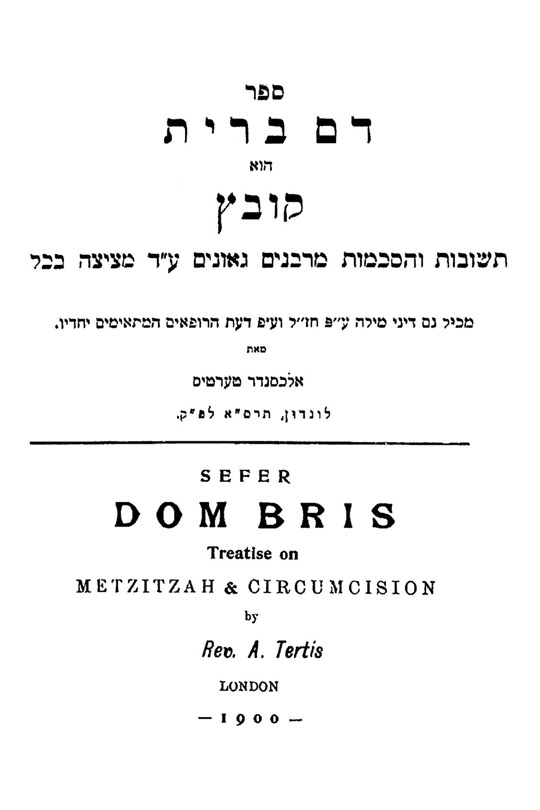


Answers to Quiz Questions and Other Comments, part 1

Answers to Quiz Questions and Other Comments, part 1
By Marc B. Shapiro
It is now time to announce the names of those who were able to answer the quiz questions I posed. The only two people to answer both questions correctly were Alex Heppenheimer and Yonason Rosman. I fortunately had two CDs so both of them received the prize.

Question no. 1 was: The word for turkey is תרנגול הדו. There is a dagesh in the dalet. Why? Bring a proof for your answer from Berakhot between page 34a and 38a.

Alex Heppenheimer emailed as follows: “The dagesh represents a missing nun in the word הדו. The Aramaic form, in Berachot 36b, is הנדואי. (There is also similarly הנדויין in Yoma 34b and ר’ יהודה הנדואה in Kiddushin 22b.)”

This is correct. The name India (and thus also Hindu) originates with the Persians and Greeks for the land beyond the Indus River. You can see in the Aramaic terms referred to by Heppenheimer that the nun is part of the word. See also the Targum to Esther 1:1 where הדו is translated as .הנדיא Bava Batra 74b, Avodah Zarah 16a, and Bekhorot 37b have other forms of the word, all including the nun.[1] Berakhot 37b refers to נהמא דהנדקא, i.e., “Indian bread.” Targum Ps. Jonathan to Gen. 2:12 translates translates חוילה as הינדקי.

(As to why turkey was referred to by those in Spain, and later the rest of Europe, as “Indian fowl”, that is because when it was first brought back to Europe it was believed to be coming from the area around India, which is where Columbus himself thought that he had ended up.)

For those who are interested in grammatical matters like how the dagesh is used, let me recommend a new book, Adir Amrutzi’s Dikdukei Aviah (Tel Aviv, 2010). In speaking of nuns that drop off, on p. 13 he calls attention to Kiddushin 70a where the word אתרונגא appears. The nun in this word shows us that the plural of etrog is not etrogim, but etrugim, with a dagesh in the gimel and a kubutz under the resh. The singular word etrog should be written as אתרג (All this follows the pattern of tof-tupim [תף-תפים], dov-dubim [דב-דבים]. When the vav holam is in the word, the holam sound remains: חול-חולות, עוף-עופות).

Returning to India, the passage in Berakhot 36b reads: “The preserved ginger which comes from India (הנדואי) is permitted.” The problem is that when you look at Rashi, for his translation of הנדואי he writes: כושיים.

Cushi’im means “Ethiopians” (Translating “Cush” as “Ethiopia” does not imply that it corresponds to the borders of modern day Ethiopia. Some even prefer “Nubia” to Ethiopia”, as Ethiopians are Semitic while Nubians are “Hamitic” [and Cush was a son of Ham]. It perhaps also can refer generally to black Africa. This can explain Pesahim 94a which states that Egypt is one sixtieth of Cush. Also, the Targum to II Chron. 21:16 translates כושים as אפריקאי.)

So where does Rashi get the idea that Cushites are Indians? Did he not know that הנדואי means India? In his commentary to Kiddushin 22b he writes as follows:


הנדואה: מארץ כושי כוש מתרגמינן הנדואה

We see the same identification by Rashi in Yoma 81b.[2] Since the book of Esther distinguishes between India (הדו) and Cush, and Rashi identifies הנדואה with Cush, one might be tempted to conclude that Rashi didn’t realize that הנדואה is the same as הדו. But is it possible that he wouldn’t know this?

And to confuse matters even more, in Avodah Zarah 16a, where הינדואה is mentioned, Rashi explains that it means ארץ הדו.

So not only do we have the problem of Rashi identifying הנדואה as Cush, but we also have the problem of consistency, because in one instance he identifies the place correctly. To add one more thing to the mix, in his commentary to Sukkah 36a Rashi states that Cush is further from the Land of Israel than it is from Babylonia. This means that Rashi thought that Cush is to the east of Babylonia. In other words, Rashi does not believe that Cush is Ethiopia.[3]

So where does Rashi get this notion? He actually gives us his source in his commentary to Yoma 34b, where he refers to the Targum to Jeremiah 13:23. This verse famously states: “Can the Cushi change his skin, or the leopard his spots?” If you look at the Targum on this verse Cushi is translates as .הנדואה In the Targum to Isaiah 11:11 Cush is also identified as India.

So again, I ask, what is going on here? How could the Targum translate Cushi as “Indian”?

P. S. Alexander writes as follows: “It was a common view in ancient geography, shared by Ptolemy and probably also the author of the book of Jubilees . . . that Ethiopia was joined to India in the east. It is this idea that lies behind the [talmudic] statement that Cush and Hodu are adjacent.”[4] He also notes that the Indians dark skin was one reason for the identification. Furthermore, Alexander tell us, there was an ancient belief that there was a land connection between Ethiopia and India south of the Indian Ocean.

Since we have been speaking of India,[5] let me share with you what I found in R. Hayyim Hirschensohn’s Nimukei Rashi on Bamidbar (a copy of which I will give out to the winner of my next quiz[6]). On p. 81b he suggests that the revolt in India against English rule was a punishment of England for splitting the Land of Israel when it created Transjordan.

Returning to the quiz, my second question was: There is a rabbinic phrase that today is used to praise a Torah scholar, but in talmudic days was used in a negative fashion. What am I referring to?

Megillah 28b speaks of a צנא דמלא סיפרי . Today this expression is used to praise scholars. Yet if you look at the talmudic passage its meaning is the exact opposite. Rashi explains:
אינו אלא כסל שמילאוהו ספרים ואין מבין מה בתוכה אף שונה הלכות ולא שימש ת”ח ללמוד שיבינוהו טעמי משנה ופעמים שדברי משנה סותרין זה את זה וצריך לתרצה כגון הכא במאי עסקינן וכגון הא מני רבי פלוני היא וכגון חסורי מיחסרא אינו יודע מה שונה.

Rashi’s explanation should remind people of a phrase used by R. Bahya Ibn Paquda in Hovot ha-Levavot 3:4. In its medieval Hebrew translation it became famous: חמור נושא ספרים. I first heard this expression in yeshiva. Only later did I realize that it came from R. Bahya, and only some time later did I learn that R. Bahya didn’t invent it. Rather, it originates in the Quran 62:5.[7]

* * *

Since this post is not up to my normal length, let me make some more comments. At least one person thinks that my criticism of Artscroll regarding Kalir is unfair. If you recall, I originally criticized them for identifying Kalir as a tanna. In my last post I mentioned that in the first edition of the Artscroll Machzor this identification is rejected, and only in subsequent editions does the Machzor state that Kalir was a tanna. I also claimed that Artscroll knows the truth but in order to mollify its critics, changed what it originally wrote.

This, incidentally, is not the only time that I assume that Artscroll knows what it is writing is incorrect, but writes so anyway. I have a good example of this in the book I am currently working on, so I don’t want to give it away now. I already noted another example in Limits, where I call attention to the introduction to the Artscroll Chumash which states: “Rambam sets forth at much greater length the unanimously held view that every letter and word was given by God to Moses” (emphasis added). This statement, that the view of the Rambam is unanimously held, is false. Furthermore, Artscroll knows it is false, and in its commentary to Deut. 34:5 it mentions the talmudic view that the last verses were given to Joshua.[8]

Here is another example along these lines that I think readers will find interesting. It comes from the new Artscroll Midrash Rabbah, and was called to my attention by R. Avrohom Lieberman (who already called my attention to the Kalir change in the Machzor).

In explaining Tikun Soferim, Artscroll’s note states that this “cannot, Heaven forbid” be taken literally. Yet the editors of Artscroll, who are learned men, know perfectly well that there are traditional sources that state precisely this (See Limits, pp. 98ff). There is no question that the intent of the words “Heaven forbid” is to make the reader think that Artscroll’s perspective is unanimously held.

Since we are now on the subject of Artscroll (the most important and influential Orthodox publishing venture of all time), and lots of people want me to post more on this topic, let me give one final example.[9] It comes from Ecclesiastes, as I dealt with this book in the last series of posts. The upshot of what I and others have already pointed out is something everyone already knew, namely, that Artscroll has a religious agenda. Much like the New York Times’ agenda can be seen not only in the editorial page, but in the news reports as well, so too Artscroll’s agenda is seen not only in the “overviews,”[10] but in the selection of commentaries also. There is enough material for a very long and detailed article spelling all this out.

Eccl. 2:8 states: .עשיתי לי שרים ושרות
What does this mean? The simple explanation is that the author, traditionally Solomon, is telling us about all the wonderful things he amassed with which to enjoy himself, and among them are “men singers and women singers.” Artscroll translates the passage as “I provided myself with various musical instruments.” Now this might be an apologetic translation, but if so, it is not Artscroll that is to be too criticized, but the Talmud, Gittin 68a, since according to Rashi this is how the Talmud explains the words.[11] Artscroll is obviously within its rights to adopt this understanding, even if one assumes that this explanation is not in accord with the simple sense of the verse.

The problem comes with the next passage in the Artscroll commentary which states: “Rav Yosef Kara, Alshich, Metzudas Zion and others translate ‘singers.’” I will get to Kara and Alshich shortly, but let’s begin with Metzudat Tziyon, since this is easiest for most people to access as it appears in the Mikraot Gedolot. He writes as follows:

שרים: משוררים זכרים. ושרות: משוררות נקבות

So now I ask my fair-minded readers: Is Artscroll’s statement that Metzudat Tziyon translates שרים ושרות as “singers” accurate? I think the answer is clearly “no”. Metzudat Tziyon translates the words in question as “male singers and female singers,” and yet—don’t tell me you are surprised—in Artscroll this morphs into “singers”. Why would Artscroll fudge the translation? The answer is obvious. They don’t want people to think that Solomon would have listened to women singing. I am not sure why this is so problematic for them. After all, if Solomon engaged in idolatry (at least according to the biblical text’s simple meaning),, hearing women sing is not so far-fetched. In fact, in his comment on some other words in the verse, R. Jacob Lorberbaum[12] writes as follows):

רמז על שעבר על לא ירבה נשים שהזהירה התורה

Lorberbaum, therefore, has no difficulty in seeing the verse as pointing to misdeeds of Solomon.

Let us now see what Kara and Alshich say on the verse, since they too were quoted by Artscroll. Kara’s commentary is printed in Otzar Tov, ed., Berliner and Hoffmann (Berlin, 1886-1887), p. 10: עשיתי לי שרים ושרות: תיקנתי לי זכרים ונקיבות לשורר לפניי

Alshich explains the verse to be referring to משוררים ומשוררות

So we see that the commentators Artscroll refers to are explicit that the meaning of the passage is “male and female singers.”

Among other sources that interpret this way are Kohelet Rabbati, ad loc:


שרים ושרות: זמרין וזמרתא

Yalkut Shimoni, Kohelet no. 968:

עשיתי לי שרים ושרות: משוררים זכרים ונקבות.

See also the Targum to Eccl. 2:8, where שרים ושרות is translated as .זמריא וזמריתא

R. Moses Almosnino, Yedei Moshe (Tel Aviv, 1986), Eccl. 2:8 (p. 58), even explains why the female singers were desirable, as they helped create a better harmony:


על כן אמר שהיו לו שרים ושרות שהם המשוררים והמשוררות, אנשים ונשים יחד, שבהתמזגם יהיו הקולות ערובות, שקול האשה דקה וקול האיש הוא קול יותר עב, ובהתמזגם יחד יצא השיר בנועם.

When the Jews returned from Babylonia to the Land of Israel in the days of Ezra and Nehemiah, the Bible (Ezra 2:65, Nehemiah 7:65) states explicitly that they came with משוררים ומשוררות, “male and female singers.”

As for how Solomon could listen to women sing, for those who feel the need to answer this question, perhaps Solomon agreed with those authorities who feel that there is no blanket prohibition on hearing a woman’s singing voice,[13] a viewpoint that has recently been resurrected by Rabbis Moshe Lichtenstein,[14] David Bigman[15] and Avraham Shammah.[16] According to this perspective, only singing that is sexually arousing is forbidden.[17] Let us not forget that the Talmud speaks of a woman’s voice. It is the post-Talmudic authorities who clarify that this refers to a singing voice, but does this mean any singing voice or only one that in the minds of normal men could be arousing?

R. Marc Angel agrees with the rabbis mentioned in the last paragraph. He writes: “When the prohibition of “kol ishah” is applied to all instances of women singing in the presence of men, this is a distortion of the intent of the halakha. . . . Men and women may sing in the presence of those of the other gender, as long as the songs are of a religious nature, or of a general cultural nature (e.g., opera, folk songs, lullabies).”[18]

R. Yonatan Rosenzweig doesn’t go so far as to permit one to attend a concert with a female singer, but he does say that since today many people are used to hearing recordings of women’s voices, that possibly it is even permissible to watch a woman singing on television.[19]

A number of years ago there were ads in New York Jewish papers for a concert by Neshama Carlebach. The ads stated that the concert was open for women, as well as for men for whom the singing was permissible. This was a very strange formulation. Knowing that R. Mordechai Tendler was Neshama’s posek, I asked him about this. He explained to me that the language originated with him and was based on the notion that the prohibition against kol ishah is not a blanket prohibition, but depends on whether the singing is sexually arousing. (This approach can be supported by the view found in some rishonim that kol ishah that is not sexually arousing is only forbidden during keriat shema. Otherwise, there is no prohibition.[20]) Therefore, men who are used to hear women sing and will not be aroused by Neshama are permitted to attend the concert, and this explains the strange language in the ads.[21] Tendler also told me that this view of kol ishah as being what we can call a “situational prohibition” rather than an absolute issur, was held by his grandfather, R. Moshe Feinstein.[22]

This opinion, that whether or not a woman’s singing voice is prohibited depends on how men will react to it, will no doubt strike some as “unorthodox.” This approach is definitely not as widely held today as in years past. Yet many people reading this post can recall a time when kol ishah, as a general prohibition, was simply not an issue for the Modern Orthodox, or even for many of the more right-wing Orthodox. This was no different than the situation in Germany, where pretty much all of the Orthodox, including members of Hirsch’s community, saw no problem in attending the opera.

If you went back to the 1960s, other than the hasidim and the tiny yeshiva world, it would be hard to find an Orthodox Jew in New York City who didn’t see the Broadway performance of “Fiddler on the Roof.” I would even assume that that there were some roshei yeshiva who saw it. Until the 1980s there was no problem with Modern Orthodox synagogues sponsoring trips to Broadway musicals. My own shul even put on a performance of “Fiddler on the Roof” in the early 1980s. That would be unimaginable today at almost all Orthodox shuls.[23] (Yet somehow YU is able to continue its long tradition of a fundraising night at the opera, and I have not heard of any attempt by the roshei yeshiva to end this practice.)

Until the 1980s, girls would also have solo singing roles in the musical productions put on by many Modern Orthodox yeshiva high schools and summer camps. (Was there a Modern Orthodox summer camp where girls did not sing?) Readers can correct me if I am wrong, but as far as I know, only Ramaz, Flatbush, and SAR still have girls singing solos.[24] The other schools that have girls sing have them do so in groups, or at least with one other girl.

To bring us back to the earlier era, where women singing was acceptable in the Modern Orthodox world, let me quote Rabbi Marc Angel:

I was raised in the Sephardic community of Seattle, Washington, and well remember our many family gatherings where romances were sung. Jews of great piety sang right along with those of lesser piety. I do not remember anyone ever objecting to the singing of love songs by men and women. In the early 1980s, Haham Dr. Solomon Gaon, himself a Judeo-Spanish-speaking rabbi, taught classes in Sephardic folklore at my Congregation Shearith Israel in New York City. I well remember him singing love songs, enthusiastically and nostalgically. Both of us participated in a program of Sephardic culture sponsored by the Hebrew College of Boston. A female soloist sang a selection of romances, after which Haham Gaon not only applauded loudly but rose to speak in praise of the singer for her beautiful rendition of the songs. Haham Gaon, who served as chief rabbi of the Spanish and Portuguese Congregations of England and as head of the Sephardic Studies Program of Yeshiva University in New York, was a very prominent Orthodox Sephardic rabbi and a man of impeccable piety.[25]

R. Eliezer Berkovits wrote:


Nowadays, the singing of a woman is not fundamentally different from what the original Halakhah termed “her regular voice.” A woman’s voice, even when she is singing, is nothing unusual today, and it is no more distracting during the Shema prayer than that of a man singing. Only in specific amorous situations as in the Song of Songs, may it have a sensual quality.[26]
In Hirsch’s famous Schiller speech, delivered at his Frankfurt school, a note states that male and female students alternatively sang songs.[27] As I pointed out in my own note to the speech, girls were permitted to sing at Hirsch’s school. Mordechai Breuer, Modernity Within Tradition, p. 411 n. 11, calls attention to a report in Jeschurun 18 (1885), p. 11, of a public function at the school at which a teenage girl sang in the presence of a crowded audience.

In Between the Yeshiva World and Modern Orthodoxy, p. 216, I quote Jacob Rosenheim who attempts to explain why Hirsch permitted girls to sing at public examinations in the higher grades (and I also note that this passage was censored in the Netzah translation). A halakhic justification of hearing unmarried girls sing was actually penned by R. Isaac Unna, the rav of Mannheim. The short responsum appears in his Shoalin ve-Dorshin no. 2.

Unna cites the Ba’er Heitev thatקול פנויה מותר . In context, what this means is exactly what it says, namely, that unlike a married woman’s (singing) voice, which is always prohibited, the singing of an unmarried woman is permitted to be heard. When he says this is permitted, he means if it doesn’t cause sexual thoughts. (Moderate sensual thoughts would be permitted according to Maimonides, as I mention below.) If it does, then of course it is forbidden. But this prohibition is a general prohibition against arousing oneself sexually and has nothing to do with the prohibition of kol ishah, which only refers to married women and is apparently based on the assumption that the voice of a married woman is always sexually arousing.[28]

In recent generations, poskim have all written that the פנויה referred to here is one who does not have the status of a Niddah, that is, a pre-pubescent girl. The first source to adopt this approach seems to be the eighteenth-century Peri Megadim, Orah Hayyim 75:3. As far as I can tell, none of the early poskim who discuss the matter even mention this point, and they all assume that פנויה mean an unmarried woman, of any age. This approach also continued among certain poskim even subsequent to the Peri Megadim.

See for example this page R. Jacob Pardo’s Apei Zutrei (Venice, 1797), Even ha-Ezer 21:8:

Pardo is very clear that פנויה means exactly what it says. He compares the halakhah of kol ishah to that of hair covering, and just like only a married woman has to cover her hair, so too it is only a married woman’s voice that is prohibited, not the voice of a single woman. (As mentioned already, this would only be prohibited if it was sexually arousing.) As for extending the prohibition to unmarried women, he sees this as an excessive stringency and applies the rabbinic phrase kol ha-mosif gorea, noting that the people will not listen to such a ruling and this will turn them into brazen sinners.

This is not to say that Pardo approves of listening to single women sing. He doesn’t, and applies to such singing the rabbinic phrase מוטב שיאכלו ישראל בשר תמותות כשרות, which comes from Kiddushin 22a and is stated with reference to something distasteful. It is distasteful, yet permitted nonetheless. Pardo’s careful distinction between what is preferred behavior and what the halakhah actually requires is seen in this comment as well, where he refers to Job. 31:1: “[I made a covenant with mine eyes;] how then should I look upon a maiden?”[29]


הן אמת דלבטל ההרהור יש להחמיר ע”ד ומה אתבונן על בתולה. אך אינו מן הראוי להשוותה לנשואה לאסור מפאת הדין.

Here is a page from R. Aaron ha-Levi, Mateh Aharon (Salonika, 1820), p. 260b, where we see some more interesting comments, including defending a rabbi who permitted listening to the voice of a single woman.

And finally, here is a page from R. Hayyim Kasar’s Shem Tov, a twentieth-century commentary on the Mishneh Torah, Hilkhot Issurei Biah 21:2. While Kasar is quite strict in forbidding a man to hear the voice of an ervah, even if he is not familiar with her, he is also clear that a penuyah means an unmarried woman and that there is no blanket prohibition on hearing her voice, just like there is no blanket prohibition on seeing the hair of an unmarried woman.

I would only add that this makes perfect sense according to Maimonides. If, as Maimonides says, one is permitted to look at an unmarried woman and enjoy her beauty,[30] it stands to reason that one can listen to the singing of an unmarried woman and also enjoy it.[31]

Returning to German Orthodoxy, Der Israelit was the newspaper of the German separatist community. Yet it seems to have had no problem highlighting an Orthodox female opera singer and stressing her commitment to Orthodoxy.[32] Mordechai Breuer called attention to this last point, and I assume that he didn’t have any knowledge of opera or he would have pointed out that the female singer referred to by the paper, Rosa Olitzka (1873-1949), was quite famous in her day. Here is a picture of her.

Right after telling us that Olitzka is the daughter of the hazan of the Berlin Adass Jisroel (i.e., R. Esriel Hildesheimer’s separatist community), Der Israelit mentions her starring as Carmen in the London Opera production. One can find a good deal of material about Olitzka online,[33] and can even purchase recordings of hers.[34] Maybe a reader knows whether she remained observant in her later years.

Breuer also refers to the JüdischePresse’s review of the opera “Samson and Delilah”.[35] While Der Israelit was the paper of the Frankfurt Orthodox, Jüdische Presse was published by the Orthodox of Berlin.[36]

The view that kol ishah is not an absolute prohibition, but depends on whether or not the singing is sensual in nature, was also held by R. Joseph B. Soloveitchik, at least according to R. Aharon Rakeffet.[37] Rakeffet has also reported on a number of occasions that the Rav attended the opera in Berlin.[38] At the Maimonides School first Hanukkah Banquet in 1939, “the program included Betty Brooks, a prominent radio personality singing a variety of Jewish and English songs, Mabel Wingert, a dancer, and Frost and Helene, society dancers.”[39]

R. Ovadiah Yosef’s viewpoint on kol ishah is also worth noting, especially as it has undergone a change. In the first volume of Yabia Omer, published in 1954, R. Ovadiah deals with the following question (Orah Hayyim no. 6):

נשאלתי בדין קול זמר של אשה בגרמפון או ברדיו, אם יש בו משום קול באשה ערוה, וצריך להזהר שלא לשמעו בעת ק”ש ותפלה.
His formulation reflects the notion we have already seen, expressed by some rishonim, that the prohibition of kol ishah is a special prohibition related to shema (and prayer), rather than a general prohibition on hearing women sing (which if sexually arousing would be forbidden on other grounds.)

Here is how he formulates the question and answer in the table of contents:

קול זמר של אשה ברדיו וגרמפון, אין צריך להזהר מלשמעו בשעת ק”ש ותפלה, כשאינו מכיר את המשוררת, ואין בזה משום קול באשה ערוה
We see from here that there is no problem of kol ishah when you are not familiar with the female singer. In other words, you can recite shema and tefillah while hearing this. Again, however, this is not related to the wider issue of sensual songs. If you are “turned on” by hearing a song even if you don’t know the singer, then it is forbidden at all times. But by the same token, since the prohibition of kol ishah is exclusive to shema and tefillah, the implication is that a woman’s voice at other times is not prohibited if it doesn’t arouse sensual feelings.

Based on this understanding of R. Ovadiah’s responsum, I don’t think there is a contradiction between this teshuvah and R. Ovadiah’s well known love for the music of the Egyptian singing sensation Umm Kulthum.[40] Here is what Umm Kulthum looked like in her younger years.

If R. Ovadiah’s responsum in Yabia Omer intended a blanket prohibition on hearing the voice of a woman you are familiar with, rather than just confining this prohibition to shema and tefillah, then we would be confronted with a tremendous contradiction between the responsum and how R. Ovadiah lived his own life. It is not like R. Ovadiah wrote something in his responsum and did something else in his private life where people couldn’t see. His love of Umm Kulthum’s music was something everyone knew about, and he listened to it in the company of others. Clearly, therefore, his responsum which prohibits listening to the singing of one you are familiar with only applies during shema and tefillah. At other times, it is only prohibited if one is sexually aroused by the music, and since R. Ovadiah was not, he was permitted to listen to Umm Kulthum. Rabbi J. David Bleich is therefore incorrect when he summarizes R. Ovadiah’s responsum as follows: “Rabbi Yosef concurs in this ruling but adds that it is forbidden to listen to a female vocalist who is known to the listener even if the woman in question is known to him only through photographs.”[41] (I hope no one attempts to argue that R. Ovadiah didn’t know what Umm Kulthum looked like. She was only the most prominent celebrity in Egypt, with her picture everywhere.)

I was also informed by R. Avraham Yosef that his father, R. Ovadiah, later retracted his ruling in this responsum that if you are familiar with the singer that you can’t hear her voice in shema and tefillah. I later saw that R. Ovadiah himself states as much in Yabia Omer, vol. 9 no. 108:43:

ומה שכתבתי שם שאם ראה אותה בתמונה ג”כ, אסור, אינו מוכרח, שיש לומר . . . “ביודעה ומכירה”, זהו רק כשראה אותה בחיים חיותה במלא קומתה

If you hear her voice while you are saying shema or reciting blessings, R. Ovadiah advises וירכז מחשבתו לכוין בברכותיוR. Ovadiah’s words בחיים חיותה במלא קומתה might be taken to imply that even if you know the woman from television, there still is no prohibition of kol ishah.

R. Avraham Yosef states that while it is permitted to hear a woman sing even if you know what she looks like, it is not permitted to attend a live performance or even watch on television. R. Avraham assumes that alllive and television performances are prohibited, not only those that could be sexually arousing.[42] It also needs to be stated that despite how I interpreted R. Ovadiah, that female singing is only prohibited if it is sensual music, the upshot of what R. Ovadiah states throughout his writings is that by definition a live female singer is sexually arousing and thus prohibited. Although I think the evidence shows that R. Ovadiah agrees that theoretically kol ishah is only forbidden if it leads to <>hirhurim >, in practice he assumes that <>alllive female singing falls into this category. (I wonder, however, if he would also forbid the live singing of a very old woman, which would in no way be sensual.)


I found another interesting passage regarding kol ishah in the Meshivat Nefesh of R. Yohanan Luria (16th century). On p. 144, after explaining how the women of the desert could sing in front of the men (Ex. 15:21), he writes:

ומזה הטעם ראוי למחות לנשים המשוררות לכלות לפני האנשים רק הבתולות שמותרים בזה כדי לחבב הבחורים לקפוץ עליהם לשם אישות.

He makes the same point on the previous page, and concludes (p. 143):

רק הבתולות ראוי להם שיחבבו עצמם על הבריות לקפוץ אחריהם

What it means is that while married women can’t sing in front of men, unmarried women are permitted to do so in order to attract the attention of the young men, similar to what they did in Temple days when they would dance before the eligible bachelors.

Some might be wondering, how was this permitted since married men will also hear the women sing, and being that they are not in the “market” for a wife, what permission is there for them to listen to and be physically attracted to the young women? I think the answer is obvious, that those men who would have had improper thoughts were not supposed to listen to the women, just as I presume they were not supposed to watch the single women dance in Temple days. Yet the Sages did not ban this dancing because of what some men might be thinking, and similarly, Luria permits the singing by single women and is not concerned that some married men might also be listening. The logic behind Luria’s position is that young men looking for brides are supposed to be attracted to young women. The latter dress up nicely so that the men look at them, they put on makeup for this purpose, and yes, they sing in front of the men, all in order to make themselves attractive.

Here is the title page of Luria’s sefer.

I already mentioned the opera, so before concluding I refer you to S.’s post here.

He points to an early eighteenth-century communal decree in Altona-Hamburg-Wandsbek forbidding attendance at the opera, except for on Hanukkah and Purim when it was permitted. The text is also found in Simhah Assaf, Ha-Onshin Aharei Hatimat ha-Talmud, p. 116.

Finally, I would like to point to a very interesting source that as far as I know has never been mentioned in any of the many halakhic articles dealing with kol ishah. I refer to R. Joseph Hayyim’s Imrei Binah, ch. 3, no. 79. Here is the page.

For those who are unclear as to what he means, he explains it himself in his book Ateret Tiferet im Pelaot Rabot. Here is the title page of the book, which for some reason is not on hebrewbooks.org or Otzar ha-Hokhmah. The text that appears in Imrei Binah also appears in this book, and R. Joseph Hayyim’s explanation is found on p. 116 (no. 202).

According to R. Joseph Hayyim, if the singing of an individual woman is accompanied by instruments, meaning that there are “many voices”, then it is permissible. This is an incredible limud zekhut, because pretty much every singer today is accompanied by music.[43]
[1] Referring to the beginning of Esther, where Ahasuerus is said to rule from Hodu to Cush, the Talmud, Megillah 11b, states:
From Hodu to Cush: Rav and Samuel gave different interpretations of this. One said that Hodu is at one end of the world and Cush at the other, and the other said that Hodu and Cush adjoin one another, and that [the meaning is that] as he ruled over Hodu and Cush, so he ruled from one end of the world to the other.
This passage should immediately raise a couple of questions in people’s minds. 1. Since there is no doubt that both amoraim knew where India and Ethiopia were located, why did one of them explain that the two countries are next to each other? How come he didn’t accept the common identification of Cush and Ethiopia? 2. According to the first opinion, that Hodu is at one end of the world and Cush at the other, are we to understand from this that he thought that the world was flat? (I realize that “end of the world” could be used the same way we use it today, but I wonder if that is the peshat.)

[2] See also his commentary to Isaiah 18:1, where he regards Cush as being in the East.

[3] In the last post I spoke a bit about what Rashi regarded as beautiful, based on his commentary to Song of Songs. We also find from other comments of his that he did not regard Cushim as beautiful. Based upon what we have already seen, I assume that for Rashi a Cushi would have an Indian complexion. (See Moed Katan 16b regarding the skin of the Cushites.) In his commentary to Gen. 12:11 he speaks of “black and repulsive people, brothers of the Cushim.” In Num. 12:1 the Torah speaks of the Cushite that Moses married. Rashi does not take this literally and writes: “Because of her beauty she is called Cushite, as one calls his handsome son ‘Cushite’ in order that the evil eye should not have power over him.” (This same passage appears in Midrash Tanhuma 96:13, and see Yitzhak Aviner, Heikhal Rashi [Tel Aviv, 1960], vol. 4, p. 234, that it was inserted from Rashi into the Tanhuma). I think it must be very hard to teach this Rashi in elementary and even high school. One can easily see that if one of the students is a “person of color” or the student’s parent is, that the assumption of this Rashi could be very hurtful to the student. Has any reader had to deal with this?

For the same approach by Rashi, and here too it appears to be his own interpretation (although obviously based on the earlier rabbinic understanding of Cushite), see Sukkah 53a, where it mentions that Solomon had two Cushite servants. Rashi writes:

תרי כושאי: על שם שהיו יפים קרי להו הכי
See Arukh la-Ner, ad loc., who questions Rashi’s explanation, since while the Sages speak of Tziporah as being called Cushite in Num. 12:1 because of her beauty, they never say that a man would be called Cushite if he was handsome. This is precisely why I noted that what Rashi writes here is apparently his own interpretation.

Incidentally, the Artscroll translation to this passage makes as unfortunate error. While the Talmud speaks of “two Cushites”, Artscroll translates תרתי כושאי as “two Cutheans.”


The Vilna Talmud’s version is תרתי כושאי, while Rashi has תרי. Rashi’s text preserves the correct version (see also Arukh ha-Shalem, s. v. כש, p. 348 n. 4) as תרי is masculine while תרתי is feminine. In R. Meir Mazuz’s new book, Darkhei ha-Iyun, p. 5, he deals with these words and calls attention to the common grammatical error when people write תרתי דסתרי. Since דסתרי(=(הסותרים is masculine, the proper formulation is ether תרי דסתרי or תרתי דסתרן.

For more on the identification of Cushite with ugliness, see Jonathan Schorsch, Jews and Blacks in the Early Modern World (Cambridge, 2004), chs. 3-4, and Abraham Melamed, The Image of the Black in Jewish Culture (London, 2003).
[4] “Toponomy of the Targumim,” (unpublished doctoral dissertation, Oxford University, 1974), p. 134.

[5] I think readers will find this document interesting: link (pdf).

It contains the Chief Rabbinate of Israel’s acknowledgment that Hinduism is monotheistic. I don’t even think that one can speak of shituf when it comes to Hinduism. What you have in Hinduism are manifestations of the one God, and this does not appear to violate any Noahide commandment. This is significant since in the Jewish imagination Hinduism has often been seen as a classic example of real idolatry. Thus, right at the beginning of many seforim it states that passages dealing with Gentiles are only referring to idolators in places like India.


Related to the latter point, there is an unbelievable error by the great R. Judah Aszod. In 1833 the Hatam Sofer responded to the following query of a Hungarian rabbi: During Christian religious ceremonies that pass through the city, are Jews permitted to put candles in their windows? The fear was that if the Jews don’t do that, their homes would be attacked on Christian thugs (Hatam Sofer, Yoreh Deah, no. 133 [end]). The Hatam Sofer concluded that while it was permissible to indirectly request a non-Jew to light the candle, it is absolutely forbidden for a Jew to do so.

הישראל אסור לעשות וצריך למסור נפש ע”ז
The same issue is dealt with by the Hatam Sofers’s son in Ketav Sofer, Yoreh Deah no. 84, and a similar issue by his grandson in Da’at Sofer, Yoreh Deah, no. 59. See also R. Eliezer Deutsch, Peri ha-Sadeh, vol. 3 no. 10.

In the Hatam Sofer’s responsum he speaks of the candle lighting that takes place in “India”.

ולענין מה שמסבבים בארץ הודו בע”ז שלהם, וכל הדרים באותו המבוי צריכים להדליק נרות, ויהודים הדרים שם אם אינם מדליקים הם בסכנה מפני ההמונים.
There is no doubt whatsoever that the word “India” is not to be taken literally and that the Hatam Sofer is referring to local Christian practices. After all, he was responding to the question of a Hungarian rabbi! The responsa by his son, grandson, and Deutsch don’t even feel that it is necessary to point this out, as it is so obvious.

It is incredible is that R. Judah Aszod, Yehudah Ya’aleh, Yoreh Deah, no. 170, takes the Hatam Sofer to really be speaking of India, even though as just mentioned, he was responding to a halakhah le-ma’aseh question from Hungary, not from a rabbi in Bombay! This misunderstanding contributes to Aszod’s lenient decision.


לענ”ד הח”ס דוקא קאי על ארץ הודו שמסבבים בע”ז שלהם . . . משא”כ במדינתינו אינו חק המדינה כ”א באיזו מקומות ולא עפ”י המושל אלא מרשעת שונאי ישראל, והדלקת הנרות אצלם נמי רק אין כוונתם להעביר על הדת כ”א שיהודים ישמחו עמהם וזה מותר משום איבה כברמ”א ביו”ד ססי’ קמח . . . וגם בזה”ז לא עובדי ע”ז הן לא מקרי אליל שלהם עכו”ם כמ”ש הש”ך סי’ קנא ס”ק יז.
In this passage he cites two sources. The second one is the Shakh, whom he cites as claiming that the Christian religious item (I assume he means the crucifix) does not have the status of an אליל. However, the Shakh actually says the exact opposite of what Aszod quotes him as saying.

ודוחק לומר דכיון דבזמן הזה לאו עובדי עבודת כוכבים הן לא מיקרי אליל שלהם עבודת כוכבים
The other source he cites is R. Moses Isserles, whose comments are indeed quite significant. I don’t understand why this source is not cited in support of celebrating Thanksgiving even by those who assume that there is some religious component to the holiday.

אם נכנס לעיר ומצאם שמחים ביום חגם ישמח עמהם משום איבה דהוי כמחניף להם ומ”מ בעל נפש ירחיק מלשמוח עמהם אם יוכל לעשות שלא יהיה לו איבה בדבר
Presumably, the opponents of Thanksgiving assume that there is no enmity in not celebrating, so the Rama’s permission doesn’t apply. I wonder though, do the people in Lakewood who require the non-Jewish bus drivers to work on Thanksgiving really think that this insistence doesn’t create enmity?
Returning to the responsum of Aszod, the problems I have pointed to were noted by R. Hayyim Eleazar Shapira, Minhat Eleazar, vol. 1 no. 53:3, and he is dumbfounded. It is precisely with regard to this sort of responsum, where the errors are obvious (misunderstanding the clear meaning of the Hatam Sofer, misquoting the Shakh), and it was published posthumously, that people are often tempted to claim that it is not authentic. I won’t go this far, but is it possible that a student wrote the responsum and Aszod just signed his name without examining it carefully?
[6] As with the other volumes of this series, one can find lots of interesting passages in vol. 4. Here are just a few. P. 56b: Moses opposed the eating of meat, but he could not forbid it because the people would regard this as heresy. P. 98b: Hirschensohn mentions the notion, already expressed by the Vilna Gaon, that sometimes the Talmud’s explanation of the Mishnah is to be understood as a form of derash. In other words, the explanation is not in accord with what the Mishnah really intended. He also refers to Berdyczewski and writes zikhrono li-verakhah after his name. P. 14a: There is no obligation in contemporary times for married women to cover their hair.

וזהוא ההיתר שנוהגים היום ברוב המדינות שהנשים מבנות ישראל הולכות בגלוי הראש, אם שהראשונות שבטלו את המנהג היו נקראות עוברות על דת משה אבל הבאים אחריהם אחרי שכבר נתבטל המנהג אין בזה איסור עוד.
This source has not been mentioned in any of the recent discussions about women’s hair covering. I hope to soon discuss Hirschensohn’s viewpoint at greater length, including his radically new understanding of שער באשה ערוה. I will do so as part of a larger discussion of the issue of women’s hair covering.
[7] See S.’s post here.

[8] R. Moshe Taub reminded me of Artscroll’s commentary to Deut. 34:5, which I neglected to mention in my book.
[9] I had been planning to offer one further example, but I was shown to be wrong. Let me explain: A little while ago R. Natan Slifkin had a post on werewolves, citing R. Efraim ben Shimshon’s strange comments in this regard. See here.

Slifkin earlier had written about this in his Sacred Monsters. None of this was a revelation to me since I had earlier seen the material from R. Efraim in R. Yosef Aryeh Lorincz’ Pelaot Edotekha, vol. 2, pp. 136-137. Not surprisingly, Lorincz takes this all very seriously. Readers might recall that I mentioned Lorincz’ book here. I called attention to his discussion of whether it is permitted to eat the flesh and drink the blood of demons. After this post I had a correspondence with someone who wanted to know what I thought about what Lorincz had written. I told him although I don’t know what the halakhah is in this matter, I nevertheless promise to eat the first demon that Lorincz is able to capture. I further told him that I would even volunteer to shecht it. My correspondent wasn’t seeing the comedy in this, as he thought that this was a very serious issue, that someone whom we are told to respect for his Torah knowledge could actually, in the twenty-first century, be discussing such a matter as a real halakhic problem. He was also adamant that if such a book was published by someone who taught at a Modern Orthodox school, the principal should immediately fire the author. Further correspondence revealed that he also didn’t think that anyone who believed in demons should be allowed to teach at Modern Orthodox schools.

My response to him was that I don’t think we need to get all out of shape about demons. To begin with, and readers can correct me if I am wrong, I don’t think that most people in the American haredi world really believe in demons. Yes, I know they study the talmudic passages that refer to demons, and will mention them as the reason for washing one’s hand three times in the morning, but based on conversations I have had with people in the haredi world (admittedly, most of them from the intellectual elite), I don’t think that they take it seriously. (When I say they don’t “believe” in demons, I mean real belief in the role of demons and how they affect humanity, as expressed in the Talmud and elsewhere.) It is almost like the emperor has no clothes, in that they don’t believe it but continue acting as if they do, afraid of what will happen if they are “outed”. (I have found a similar phenomenon with regard to Daas Torah. I have discussed this issue with many people in the haredi world, and have yet to find even one who accepts the version of Daas Torah advocated by so-called Haredi spokesmen and Yated Neeman.) But even if I am wrong in this, there are lots more important things to keep out of Modern Orthodox schools than an occasional reference to demons. How about the negative comments about non-Jews and even racist statements (sometimes under the guise of Torah) that children are exposed to in Modern Orthodox schools? How about rebbes telling the students that there is such a thing as spontaneous generation, which is akin to telling the students to sign up with Flat Earth society?

Getting back to werewolves, there is someone much better known than R. Efraim who refers to them, namely, Rashi. In his commentary to Job 5:23, Rashi explains that חית השדה means werewolf. (He offers the Old French, for which see Moshe Catane, Otzar ha-Loazim, no. 4208, and Joseph Greenberg, Otzar Loazei Rashi be-Tanakh, p. 211) He further adds that this is also the meaning of אדני השדה (See Kilayim 8:5). I have to admit that I was all set in this post to mention that Artscroll, which always cites Rashi’s interpretation, in this example chose to omit it. Without even examining the commentary, I was sure that Artscroll would choose to avoid mentioning anything about werewolves. Yet when I actually opened up the commentary, prepared by R. Moshe Eisemann, I was pleasantly surprised to see that he indeed tells the truth, and the whole truth, i.e.,, that Rashi was referring to a werewolf. I found something else in this volume that I didn’t expect. In an appendix he discusses whether the commentary attributed to Rashi was actually written by him. Unfortunately, Eisemann did not feel that he should inform the reader which academic sources he used in preparing this appendix.
[10] I don’t understand why Artscroll uses this word. The overviews found at the beginning of their books are actually not overviews. (Look up the word if you are not sure what it means). They should have been called what they are, namely, “introductions.”
[11] The Talmud explains sharim ve-sharot as מיני זמר, and Rashi, Eccl. 2:8, clearly based on the Talmud, explains sharim ve-sharot as מיני כלי זמר. Either Rashi’s text of the Talmud also included the word כלי , or this is how he understood the talmudic expression מיני זמר. (Literally, מיני זמר means “types of music”, and when the word כלי is added it means “various musical instruments.”)
[12] His commentary, Ta’alumot Hokhmah, is found in the standard Mikraot Gedolot.
[13] According to R. Jehiel Jacob Weinberg, the Rambam’s opinion is that kol ishah is only forbidden if one derives sensual pleasure from it. See Seridei Esh, vol. 2 no. 8.
[14] See here.
[15] See here.
[16] See here.
[17] R. Yuval Sherlo does not permit one to attend the opera, but if one is stuck in a situation, such as a soldier at a military event, then he rules that it is permissible to remain even though women are singing. See here.
[18] Conversations 12 (Winter 2012), pp. 43, 47; also available here. At the end of the article, Angel concludes: “Married women need not cover their hair, as long as their hair is maintained in a modest style. The wearing of wigs does not constitute a proper hair-covering for those married women who wish to cover their hair. Rather, such women should wear hats or other head coverings that actually cover their hair.” He also discusses hair covering on YouTube here.
[19] “Kol Ishah Bimeinu,” Tehumin 29 (2009), p. 143.
[20] See Seridei Esh, vol. 2 no. 8, and see also the helpful summary of positions available here.

[21] In support of this view, one can cite Hagahot Maimoniyot, Hilkhot Keriat Shema 3:16:
וקול אע”ג דאינה נראית לעינים הרהור מיהא איכא וכל אלה דוקא שאין רגילות להגלות אבל בתולה הרגילה בגלוי שער לא חיישינן דליכא הרהור וכן בקול לרגיל בו
[22] It seems to me that Tendler’s description of R. Moshe’s opinion is contradicted by Iggerot Moshe, Orah Hayyim 1, no. 26, Orah Hayyim 4, no. 15.

[23] For a contemporary example of an Orthodox synagogue allowing women to sing, see here.

[24] See e.g., here, here, here and here.
[25] Foundations of Sephardic Spirituality (Woodstock, VT, 2006), p. 186.
[26] Jewish Women in Time and Torah (Hoboken, 1990), p. 62. Berkovits also understood the matter of women’s hair covering in the same fashion, and did not regard it as an obligation in contemporary times (heard from Berkovits’ son, Prof. Avraham Berkovits).

[27] See here.
[28] Note the language of the Shulhan Arukh, Even ha-Ezer 21:1: ואסור לשמוע קול ערוה או לראות שערה

I don’t think anyone today assumes that there is a prohibition in seeing the uncovered hair of an ervah, if one is not sexually aroused, the reason being that we see it all the time and are thus used to it. By the same logic, if one is unaffected by hearing a woman sing, even if she is married, there should be no prohibition even according to how I explained the Ba’er Heitev. This is indeed the conclusion of R. Aharon de Toledo, Divrei Hefetz (Salonika, 1795), p. 113a:

עלה בידינו דהא דאמרי’ קול באשה ערוה היינו כשהיא הומיה ושוררת שירי עגבים ומתכווין ליהנות ממנה
However, the subsequent words of Toledo show that he only permits listening to a woman who is singing non-sensual songs on her own. He specifically forbids female songs directed towards men, as in a concert.

[29] The verse from Job is used in an Aggadic sense in Bava Batra 16a and Avot de-Rabbi Nathan, ch. 2, and then used by Maimonides in Hilkhot Issurei Biah 21:3.


ומותר להסתכל בפני הפנויה ולבודקה, בין בתולה בין בעולה, כדי שיראה אם היא נאה בעיניו, יישאנה; ואין בזה צד איסור. ולא עוד, אלא ראוי לעשות כן. אבל לא יסתכל דרך זנות, הרי הוא אומר “ברית, כרתי לעיני; ומה אתבונן, על בתולה”
Since he cites a verse from the book of Job, it appears that looking דרך זנות is only a rabbinic prohibition.
[30] Commentary on Sanhedrin 7:4. What this means is that one can look at a possible future wife and appreciate her beauty, for after all, one is supposed to be attracted to her. As we have seen already, in Hilkhot Issurei Biah 21:3, Maimonides adds a caveat. He states that is forbidden to look at an unmarried woman דרך זנות. What this means is that while one can look at and admire the beauty of a single woman (what I earlier referred to as “moderate sensual thought), one cannot leer at her, i.e., with lascivious intent.
[31] When Maimonides speaks of enjoying an unmarried woman’s beauty, I am certain that he is speaking of a Jewish woman, whom you can marry.
[32] Breuer, Modernity Within Tradition, p. 150. See Der Israelit, April 5, 1894, p. 503. See my post here, where I deal with the unsubstantiated rumor that Hirsch attended the opera. I quote from Prof. Breuer’s email to me where he writes: “When I went to the opera as a boy of 13-14 years my father [Isaac Breuer] did not express his dissatisfaction.”

[33] See e.g. here.
[34] See e.g. here.
[35] Modernity Within Tradition, p. 150.
[36] Since I am speaking about German Orthodoxy, let me use this opportunity to correct something I wrote. In Between the Yeshiva World and Modern Orthodoxy, p. 53, I record the recollection of Judith Grunfeld, “daughter of a learned German rabbi,” that she had never heard of a prohibition against women singing in front of men until she went to Poland (where she taught at the Beth Jacob school). Dr. Yitzchok Levine pointed out to me that Grunfeld’s father, while living in Germany, was actually Hungarian.
[37] Listen to his shiur from Feb. 8, 2010, available here, beginning at 48:20. Rakefet also quotes R. Aharon Lichtenstein that the Rav held that in modern times there is no obligation for married women to cover their hair. Listen to the shiur just mentioned beginning at 62 minutes. I will return to this point in a future post when I deal with R. Michael Broyde’s article on the topic.

[38] See, however, R. Hershel Schachter, Mi-Peninei ha-Rav, p. 269, that the Rav told YU students that due to kol ishah it was forbidden for them to sell tickets to the opera (presumably referring to the annual YU fundraising event). This is not necessarily a contradiction to Rakefet’s point. If the Rav felt that a woman’s singing voice was only prohibited if it was sexually arousing, who can say if that applies to the person you sell the ticket to? Perhaps that is why he told them it was prohibited.
[39] Seth Farber, An American Orthodox Dreamer: Rabbi Joseph B. Soloveitchik and Boston’s Maimonides School (Hanover, NH, 2004), p. 165 n. 19.
[40] See Zvi Alush and Yossi Elituv, Ben Porat Yosef (Or Yehuda, 2004), p. 37. See p. 408 that to this day he listens to her music, and see also the testimony to this in Or Torah, Tevet 5770, pp. 383-384. According to R. Avraham Shammah, cantors used her tunes for various tefillot, a practice that continues to this day. See here, p. 10.
[41] Contemporary Halakhic Problems, vol. 2 p. 151. One could be led to this summary by reading the conclusion of the responsum, which states as follows:

המורם מכל האמור דביודעה ומכירה אפי’ ע”י תמונה אסור לשמוע קולה בגרמפון או ברדיו, אבל אם אינו מכירה מותר, ואין בזה משום קול באשה ערוה.
However, this conclusion needs to be read in conjunction with the question as well as the summary of the answer in the table of contents, both of which are quoted in the text and clearly state that the issue is kol ishah in the context of shema and tefillah.

[42] See here.

[43] For another important limud zekhut by R. Joseph Hayyim, see here. In the newly translated text, we see that R. Joseph Hayyim believed that the practice of European Jewish women to go with uncovered heads can be justified, and is not to be regarded as sinful.


Review: Contemporary Uses and Forms of Hasidut, edited by Shlomo Zuckier

Contemporary Uses and Forms of Hasidut. Edited by Shlomo Zuckier. Yeshiva University Press, 2022. 516 pages. ISBN 978-1-60280-398-5.

REVIEWED BY BEZALEL NAOR

When the ‘Ilui of Denenburg was in Lublin, he visited the Rabbi of the city, the Gaon Rabbi Shneur Zalman [Fradkin]. Upon parting, he asked him if there is to be found in Lublin another gaon. Rabbi Shneur Zalman replied: “There resides here Rabbi Zadok HaKohen, a great gaon.” The ‘Ilui of Denenburg went to the “Kohen,” who received him with great honor.

(Shmuel Ungar, Sefer Toledot Hakohen mi-Lublin, ed. Zevi Moskowitch [Jerusalem, 1966], chap. 9, p. 36)

When the famous Gaon, Rabbi Yosef Rosen, may he live, the Rabbi of Denenburg, visited him and wished to engage him in pilpul (Talmudic dialectic), [Rabbi Zadok Hakohen] said to him: “When the Men of the Great Assembly instituted the blessing, ‘You bestow knowledge upon men,’ their intention was not that one should demonstrate ones prowess in pilpul. But since ‘from the LORD a man’s steps are set’ [Psalms 37:23], perhaps it is for this reason that His Honor has come to me. Though His Honor is an ‘ilui, he should know that I was an ‘ilui. While I was yet young, I won over all the gedolim (greats) who engaged me in pilpul. Yet, I saw afterward, that it is impossible to merit to the ‘crown of Torah’ unless we latch onto the door of the disciples of the Ba‘al Shem Tov, may his merit protect us.”

(Shlomo Gavriel Margaliyot, “Toledot Rabbeinu ha-Kohen ha-Mehaber,” Introduction to Rabbi Zadok ha-Kohen, Sihat Mal’akhei ha-Sharet [Lublin, 1927], 2a)

For the better part of the twentieth century, Yeshiva University—under its rashei yeshivah, Rabbi Moshe Soloveichik, his elder son Rabbi Yosef Dov Soloveitchik (referred to simply as “the Rav”), and younger son Rabbi Ahron Soloveichik—was the vanguard of the much vaunted “Brisker derekh,” the novel method of Talmudic analysis developed by Rabbi Hayyim Soloveichik of Brisk de-Lita (Brest-Litovsk), Moshe’s father. This methodology was later transported to Yeshivat Har Etzion (in Gush Etzion), when Rabbi Yosef Dov’s son-in-law Rabbi Aharon Lichtenstein became rosh yeshivah there in 1971. The Soloveichik Family, descendants of Rabbi Hayyim of Volozhin, the premier disciple of the Vilna Gaon, carried on the Mitnagdic tradition of Torah li-shemah (study of Torah for Torah’s sake) as outlined in Rabbi Hayyim’s work Nefesh ha-Hayyim, and as put into practice for the better part of the nineteenth century in the Volozhin Yeshivah, ‘the mother of yeshivot.”

And then there was Shagar. ShaGaR (acronym of Shimon Gershon Rosenberg) (1949-2007), himself a product of the Dati-Le’umi (Religious Zionist) world (identified by their knitted yarmulkas, or kippot serugot) posed a challenge to the monolithic world of Brisk. With an impressive armamentarium of spiritual works—Habad, Likkutei Moharan (by Rabbi Nahman of Breslov), Mei ha-Shilo’ah (of the Izhbitser Rebbe)—his teachings found a chink in the armor of the time-hallowed derekh ha-limmud (method of study). One could say, Shagar was a Litvak’s worst nightmare. Students of the Gush, the so-called “Harvard of yeshivot hesder,” who evidently were dissatisfied with the traditional diet of the yeshivah, were taken by the siren song of Shagar, who dispensed a post-modernist presentation of Hasidic thought.

And then the unthinkable occurred. The refracted light of Hasidism bounced back to the “mother ship,” Yeshiva University, and in 2013, Rabbi Moshe Weinberger, an American Hasidic rebbe (a graduate of Yeshiva University), was appointed “Mashpi‘a” of Yeshiva University. (Previously, the title “mashpi‘a,” or “spiritual influencer,” was synonymous with Lubavitcher yeshivot.)

The meeting between the Vilna Gaon’s heirs and the Ba‘al Shem Tov’s heirs was happening.

The present volume, edited by Rabbi Dr. Shlomo Zuckier, a polymath of some distinction, and published under the auspices of Yeshiva University, is testimony to this paradigm shift within the world of Yeshiva University and Yeshivat Har Etzion.

The thought occurs to this writer that the confrontation of Shagar and Rabbi Aharon Lichtenstein in the Gush, might have taken place a generation earlier had Rabbi Abraham Joshua Heschel become faculty at Yeshiva University. (There exists documentation to substantiate the negotiations between Heschel and Yeshiva University.) Within the halls of Yeshiva University there would have held forth the Rav and the Rebbe; the scion of the Beit Harav mi-Volozhin, and the descendant of the Apter Rov (his namesake, Rabbi Abraham Joshua Heschel), author of Ohev Yisrael; Rabbi Levi Yitzhak of Berdichev, author of Kedushat Levi; the royal house of Ruzhin; and the Rebbe of Novominsk. A generation earlier, the encounter of the Man of Halakhah and the Man of Aggadah might have produced a marvelous cross-pollination.

A single example will illustrate the fecundity of their mutually complementary thought: Prophecy.

Where the Rav, the Ish ha-Halakhah (based on Maimonides, of course) “worked overtime” to glean the halakhic takeaway of the entire prophetic enterprise, and arrived finally at the notion of imitatio Dei (“ve-halakhta bi-derakhav”), the Rebbe, the Ish ha-Aggadah, dismissed imitatio Dei. While the Man of Halakhah sought the dimension of “prophecy needed for generations” (“nevu’ah she-hutzrekhah le-dorot,” b. Megillah 14a), the Man of Aggadah searched for precisely the “teaching of the hour” (hora’at sha‘ah).

After quoting Maimonides’ Hilkhot De‘ot 1:6 (“And in this way, the prophets called God by all those epithets [kinuyim]—“Long Suffering,” “Master of Lovingkindness,” “Righteous,” “Straight,” etc.—to make known that they are good and straight ways, and a man is obligated to conduct himself by them and to emulate Him to his ability”), Rabbi Yosef Dov Soloveitchik confides:

I always had difficulty in regard to the role of the prophets of Israel. On one hand, we rule that a prophet may not innovate to add or subtract even a jot; on the other hand, the word of the LORD required prophets, and their prophecy was written down for generations. What is the purpose of their prophecy inasmuch as they were unable to innovate any matter of Halakhah? Certainly, they rebuked Israel, and rebuke was one of the purposes for which our prophets were sent. However, I still have difficulty saying that in their prophecy they told Israel nothing in the Halakhic sense.

But now all is crystal clear. There is an entire Torah in the books of the Prophets—the Torah of the ways of the LORD, the Torah of the epithets that obligates man in imitating his Creator. … Tout court, prophecy came to teach man how to participate in the attributes of the Holy One, blessed be He, and to attain His epithets.

(Yosef Dov Soloveitchik, Shi‘urim le-Zekher Abba Mori [Jerusalem: Mossad Harav Kook, 2002], vol. 2, pp. 188-189)

In revolt against Maimonides, and nurtured on the iconoclasm of Pshysucha and Kotzk, Heschel, proponent of divine pathos, searches for exactly the “teaching of the moment,” the prophet’s experience of the moment. (As one of the authors in the collection, the late Ya‘akov Elman, wrote, “Individualism in Przysucha-Kotzk-Izbica-Lublin involves not just individual humans, but also individual moments in time and circumstance” [p. 87].)

Heschel writes:

Prophetic sympathy is by no means identical with the imitation of God, which in the broadest sense is also a biblical motif (cf. Lev. 19:2). The difference is the more significant because the resemblance, too, is obvious. Imitatio, the pattern of which is a concrete life-history, is realized as a practical way of life. Sympathy, whose object is an inner spiritual reality, is a disposition of the soul. The prototype of imitatio is an unchanging model; a constant traditional knowledge of it indicates a ready path to be followed. Pathos, on the other hand, is ever changing, according to the circumstances of the given situation. The content of sympathy is not fixed by any predetermination. What is abiding in it, is simply the orientation toward the living reality of God.

Imitatio is concerned with a past, sympathy with a present, occurrence. Imitatio is remote from history; what is at stake in sympathy is an actual historical situation.

(Abraham Joshua Heschel, The Prophets [Peabody, Mass.: Hendrikson, 2010], Part Two, p. 102)

And again, in even more strident terms:

The goal of sympathy is not to become like unto God, but to become effective as a prophet through approximation to the pathos of God. In sympathy, divine pathos is actually experienced in the moment of crisis; in imitatio, the fixed pattern is transmitted. In the former case, an assimilation or creative understanding is necessary; in the latter, mere knowledge is sometimes sufficient.

In imitatio, the whole being of the deity is often taken as the pattern; in sympathy, only its aspect as pathos is taken as the pattern.

(Ibid. pp. 102-103)

We read that when a meeting was arranged between Rabbis Heschel and Soloveitchik in the 1960s to map out a strategy for confronting the Vatican, at their initial encounter, these two Jewish leaders (whose parallel paths traversed Warsaw, Berlin and New York) discussed (at Rabbi Soloveitchik’s insistence)—Yiddish literature. Perhaps the time has come for the denizens of the worlds of Halakhah and Aggadah to discuss—Prophecy.


A Printing Mistake and the Mysterious Origins of Rashbi’s Yahrzeit*

A Printing Mistake and the Mysterious Origins of Rashbi’s Yahrzeit*
by Eliezer Brodt
In this post I would like to deal with tracing the early sources for the great celebrations that take place worldwide on Lag Ba-Omer, specifically at the Kever of Rashbi (R. Shimon b. Yochai) in Meron.[1] A few years back on the Seforim Blog I dealt with some of these issues (link). More recently in Ami Magazine (# 22) I returned to some of the topics. This post contains new information and corrections that I have found which were not included in those earlier articles.
The period of Sefirat ha-Omer is traditionally considered a time of great mourning. The most well-known reason given for the mourning – offered by the Geonim and Rishonim – is due to the death of twenty-four thousand students of R. Akiva who, according to the Gemara in Yevamot 62b, died during this time of the year for not having accorded respect to each other. Because this is deemed a mourning period, we refrain from shaving, taking haircuts, dancing, listening to music, and making weddings.[2] Sefer Ha- Tadir[3] writes:
ומנהג בין פסח לעצרת לומר מסכת אבות בכל שבת ושבת קודם המנחה משום מעשה תלמידי ר”ע… י”ב אלפים זוגות תלמידים היו לו לר”ע… שלא נהגו כבוד זה לזה… (ספר התדיר, עמ’ רכב).
However, the prohibitions associated with sefirah are suspended on Lag Ba-Omer, and many early sources offer reasons for additional levels of simcha on Lag Ba-Omer, which includes omitting tachnun on that day. Additionally, there is a custom to celebrate Lag Ba-Omer at the kever of Rashbi in Meron, amidst great celebration, complete with music, dancing, and bonfires. The remainder of this post at the Seforim Blog will offer some reasons for this practice.
R. Yehoshuah Ibn Shu’eib, a student of the Rashba and a great Mekubal, was unsure of the reason for the custom in his day of taking a break from mourning on Lag Ba-Omer, until he heard some say that it is because the students of R. Akiva stopped dying on that day.[4] He writes:
ולכן נהגו לגדל שפם עד עצרת, ואין כונסין נשים בזה הפרק, ואף על פי שיש טעם אחר במדרש על אותן שנים עשר אלף זוגות תלמידי דר’ עקיבא שמתו מן הפסח עד העצרת. ומה שנהגו רוב העם להגדיל שפם עד ל”ג לעומר לא מצינו בו ענין, ובתוספות פי’ כי מה שאמר ל”ג אינו כמו שנוהגין, אלא ל”ג יום כשתסיר שבעת ימי הפסח ושבעה שבתות ושני ימי ראש חדש שהן ששה עשר יום שאין אבלות נוהג בהם, נשארו מן הארבעים ותשעה ימים ל”ג, וזהו מאמרם ל”ג יום לעומר. שמעתי שיש במדרש עד פרס העצרת והוא חמשה עשר יום העצרת באמרם פרס הפסח פרס החג שהם חמשה עשר יום בניסן ובתשרי, וכשתסיר חמשה עשר יום מארבעים ותשעה יום נשארו שלשים וארבעה, והנה הם שלשים ושלשה שלימים ומגלחין ביום שלשים וארבעה בבקר כי מקצת היום ככולו. (דרשה לפסח יום ראשון)
Some other Rishonim, including the Manhig and Meiri, also give this reason, while others say that the students only stopped dying on the thirty-fourth day of the Omer, the day after Lag Ba-Omer. Thus, according to them, there would be no reason for festive celebrations on Lag Ba-Omer.[5] See, for example, the Tashbetz who writes:
וכן אירע לר’ עקיבא שהעמיד ארבעה ועשרים אלף תלמידים וכולם מתו מן הפסח ועד פרס העצרת אחר עבור ל”ג לעומר, כי פרס הוא חצי חדש שהם חמשה עשר ימים, כמו שנזכר בפרק מעשר בהמה בבכורות [נח א]. וכן בתוספתא [שקלים פ”ב מ”א] אמרו, איזהו פרס, אין פחות מט”ו. וט”ו ימים קודם עצרת, הוא יום ל”ד לעומר. ולזה נהגו להתאבל באותם ימים שהם מהפסח עד ל”ג לעומר ולא נהגו איסור ביום ל”ד לפי שמקצת היום ככולו. וכולם מתו מפני שהיתה עינם צרה זה לזה (מגן אבות, אבות, א:א).
If one looks in the Tur, the Shulhan Arukh as well as the various early commentaries, one will not find any other reason as to why there should be simcha on Lag Ba-Omer, other than that the students of R. Akiva stopped dying on Lag Ba-Omer. Be that as it may, this particular reason offers no insight into the connection between Meron, and more specifically Rashbi, and Lag Ba-Omer.
The most well known explanation to the connection between Rashbi and Lag Ba-Omer is that Rashbi died on that day, and he was one of the students of R. Akiva. Assuming for a moment that this is factually correct, it is quite strange that we celebrate Rashbi’s death. We don’t celebrate the yarzheit of Avraham Avinu, Moshe Rabbeinu, David HaMelech, or any other great people with bonfires. Rather, halakha states the opposite – to fast on a yahrzeit, especially on those days that great people died. This problem is addressed by the Sho’el u-Meshiv (5:39) and because of this question and others, he was very skeptical of the celebration that takes place at Meron. R. Aryeh Balhuver, in his Shem Aryeh (no. 13), points out that because of the celebration that takes place at Meron for Rashbi, people began to be lenient about fasting on the yarzheit of their parents.
Another problem is that neither Chazal nor any of the Rishonim mention Rashbi dying on Lag Ba-Omer; and as a general rule we do not make any form of a Yom Tov on a day that is not mentioned in Chazal. This issue was addressed by the Chatam Sofer in his teshuvot (Y.D. 233) and because of this, he too was very skeptical of the way Lag Ba-Omer is celebrated.
So what is the source that Rashbi died on Lag Ba-Omer? R. Yehosef Schwartz writes in his Tevuot Ha-Aretz (p.224) that he searched all over for the reason for the great simcha at Meron on Lag Ba-Omer, and concluded that it must be because Rashbi died on Lag Ba-Omer. R. Jonathan Eybeschutz, the Ba’al ha-Tanyah, Reb Zadok ha-Kohen, and the Arukha ha-Shulhan also say that Rashbi died on Lag Ba-Omer.
The Shem Aryeh (no. 14) writes that when we celebrate the yahrzeit of Rashbi, we are celebrating that he died a natural death, at the proper time and place, and not at the hands of the Romans, who did not bury the people they killed. The Gemara in Shabbat 33b–34a relates that the Romans wanted to kill Rashbi, and he ran away and hid in a cave for many years until the Romans stopped hunting him.
What appears to be an earlier source for some who say that Rashbi died on Lag Ba-Omer is R. Hayyim Vital, quoting in the name of the Arizal, found in the Peri Etz Chaim. Indeed, R. Hayyim Vital states that Rashbi died on Lag Ba-Omer, and he was one of the students of R. Akiva who died during Sefirah. In truth, it is a mistake to give R. Vital credit for this. The source of this mistake was based on a simple printing mistake in two edition of the Peri Etz Chaim. One was printed in Koretz 1785 (p. 108a).
The other was printed in Dubrowno 1802 (p. 124b).

In the first printed edition of the Peri Etz Chaim, which was printed in 1782 (p. 101a), it does not say that at all. Instead of saying “she-meit” (that he died) it has a very similar, but entirely different word, samach (was joyous). The letter chet was apparently confused for a tav in the later version, causing the whole mistake![6] (Interestingly, the Aderes in his work Zecher Davar has a whole collection of cases where a problem arose due only to a קוצו שלו יוד.)
In the Shaar ha-Kavanot from R. Vital first printed in 1752, where the same piece appears, it also reads samach (p. 127) like the first edition of Peri Etz Chaim. In a later edition of of Peri Etz Chaim printed in 1819 it also reads samach. These would seem to confirm that the error is indeed she-met rather than samach.
The late Meir Benayahu z”l and, more recently, R. Yaakov Hillel, confirmed, based on many early manuscripts that this reading that does not have Rashbi dying on Lag be-Omer, is the correct reading from the writings of R. Chaim Vital. Recently, R. Yaakov Hillel printed the Sefer Shaar Ha-Tefilah from a manuscript of R. Hayyim Vital’s actual handwriting, and in that location (p. 312), as well, the passage states that it was the day of Simchat Rashbi, not the day he died.[7]
Interestingly, the Chida in his work Birkhei Yosef, printed in 1774, writes that Rashbi died on Lag Ba-Omer. But in a later work of his, Ma’aret Ayin, printed in 1805, he writes that the Prei Etz Chaim is full of mistakes and this statement regarding Lag Ba-Omer and Rashbi’s death day is one of them. So the Chida’s conclusion is that it is not a reference to Rashbi’s day of death at all. This conclusion is accepted by later authorities, including Takfo Shel Nes (p. 59a), Shu”t Rav u-Po’alim (1:11), and Tziyun LeNefesh Chayah (no. 65).[8]
The Lubavitcher Rebbe[9] wrote in a letter to R. Zevin that there is a printing mistake in the Peri Etz Chaim.

הרה”ג הוו”ח אי”א נו”מ וכו’ מהורשי”ז שי’
שלום וברכה!
במקרה ראיתי, בספרית כ”ק מו”ח אדמו”ר שליט”א, את ספרו “המועדים בהלכה” מהד”ת, ומצאתי שם בפרק ל”ג בעומר העתקת לשון הפרע”ח (דפוס דובראוונע ודפוס לאשצוב) שער ספה”ע פ”ז בהערה, וז”ל: והטעם שמת רשב”י ביום ל”ג בעומר כי הוא מתלמידי רע”ק שמתו בספה”ע.
והנה ידוע, אשר קטע זה מוקשה הוא הן בנגלה, כי רשב”י הוא מהחמשה תלמידים שסמך רע”ק אח”כ, הן מצד הנסתר ע”פ המבואר, בפע”ח שם ובסידור האריז”ל, מדריגת הכ”ד אלף תלמידים שמתו ומדריגת ה’ תלמידים הנ”ל. וכבר עמד ע”ז בשו”ת דברי נחמי’ חאו”ח סל”ד סק”ז. וסיים: ואולי יש ט”ס בפע”ח שם במ”ש כי הוא כו’ כנ”ל וצ”ע בדפוס קארעץ ששמעתי ששם נשמט זה.
ואמת כן הוא, אשר בפע”ח דפוס קארעץ לא נמצא קטע הנ”ל. וכן בסידורי האריז”ל ובשני פע”ח כת”י, שישנם באוסף הכת”י אשר לכ”ק מו”ח אדמו”ר שליט”א, חסר כל ענין זה. כן לא מצאתי לביאור הנ”ל בכל דרושי דא”ח שראיתי לע”ע.
וז”ל ספר הכוונות (ענין ספה”ע דרוש יב) בטעמי מנהגי ל”ג בעומר: כי הרשב”י ע”ה הוא מחמשה תלמידיו הגדולים של רע”ק ולכן זמן שמחתו ביום ל”ג בעומר. ועד”ז הוא במשנת חסידים.

– ובעהמ”ס ד”נ כנראה לא ראה את סה”כ, מדאינו מביאו – ומכמה טעמים מהנכון, לפענ”ד, לתקן את הנ”ל בספרו, או עכ”פ להעיר על הספקות שבדבר, בהזדמנות הראשונה. ..

The question then is, what is the earliest printed source that Rashbi died on Lag Ba-Omer. Avraham Yaari and Meir Benayahu demonstrate that the earliest source to mention Lag Ba-Omer as the yarzheit of Rashbi is none other than the Chemdat Yamim. R. Yaakov Hillel also confirms this in his Aid ha-Gal ha-Zeh (p. 13).
The Chemdat Yamim was first printed in the 1730s and has been the source of controversy and debate until today. Some go out of their way to attack it, claiming it has strong ties to Shabbetai Tzvi. Others strongly defend it, saying it is a very special work. Whatever the case is, Chemdat Yamim has been established by many as the source of many different customs that we observe today. It is not necessarily the earliest source, but in the first few years after it first appeared, Chemdat Yamim was printed many times, becoming a bestseller as it were. Because of this, many customs contained therein became widespread. One notable example is the celebration of Tu Be-shevat. After the Chemdat Yamim was printed, many works about the customs of Tu Be-shevat were printed based on it. What is very interesting is that Chasidim, who are principally against the Chemdat Yamim, are very into this concept that Lag Ba-Omer is the yarzheit of Rashbi.[10]

If one looks at all early mentions of Lag Ba-Omer and the Arizal one will not see any mention of it being the yarzheit of Rashbi. Here are some examples:
The Magen Avraham, first printed in 1692, writes when talking about days when we do not say Tachanun writes:
מעשה באחד שנהג כל ימיו לומר נחם בבונה ירושלים ואמרו בל”ג בעומר ונענש על זה מפני שהוא י”ט [כונת האר”י] (מגן אברהם סי’ קלא ס”ק יז)
When talking about Lag Ba-Ome , the Magen Avraham writes:
ומרבים בו קצת שמחה – וכתו’ בכוונות שגדול אחד היה רגיל לומר נחם בכל יום ואמרו גם בל”ג ונענש (מגן אברהם סי’ תצג ג)
We see that he makes no mention of it being the yarzheit of Rashbi when he referencing to the Arizal and Lag Ba-Omer. It is generally accepted that the Magen Avraham is responsible for bringing the writings of the Arizal into the world of halakhic discourse. The question, however, is regarding the Magen Avraham’s source for this specific Arizal. In general R. Yosef Avivi shows that the Magen Avraham when quoting from the Arizal was using the work Shulhan Arukh Shel Arizal.[11] There are many works similar to this work, one was called Nagid U-metzaveh; another was called Lechem Min Hashamayim. In both of these works, the whole story with the Arizal and Nachem appears with the version that this was the day of Simchat Rashbi, and not the day he died.
Now in this work, the story as quoted above appears and no mention of it being the yahrzeit of Rashbi, but rather that it was the day of Simchat Rashbi. However we cannot say, for certain, that his source was the Shulhan Arukh Shel Arizal because he specifically quotes the Sefer Hakavanot as his source. Now the problem with this is, which Sefer Hakavanot was the Magen Avraham referring to? The only edition printed before the Magen Avraham was from R. Moshe Terniki printed in Venice in 1620. In that edition of Sefer Hakavanot, there is nothing about Lag Ba-Omer. In a personal communication, R. Yosef Avivi suggested to me that it was the Sefer Hakavanot that was written in Cracow in 1650 and the Magen Avraham had it in manuscript. This edition of Sefer Hakavanot was later printed under the name Peri Etz Chaim in 1785.[12]
Another example of an early source who quotes the Arizal about Lag Ba-Omer but makes no mention of it being his yahrzeit can be found in the Ateret Zekenim from R. Menachem Auerbach, first printed on the side of the Shulhan Arukh in 1702 (it was written much earlier). He also cites the story of the Arizal:
מנהג ארץ ישראל שנוהגין לילך על קברי רשב”י ז”ל ור”א בנו ביום ל”ג בעומר והעיד ר”א הלוי שהוא היה נוהג תמיד לומר נחם בברכת תשכון וכשסיים התפלה א”ל ר”י לוריא ז”ל משם רשב”י הקבור שם שאמר לו אמור לאיש הזה למה הוא אומר נחם ביום שמחתי ולכן הוא יהיה נחם בקרוב וכן היה שמת לו בנו הגדול (סי’ תצג).
Here too we see a version of the story that has nothing about it being the yahrzeit of Rashbi.
Another example of an early source that quotes the Arizal about Lag Ba-Omer, but makes no mention of it being his yahrzeit can be found in the Sefer Shirei ha-Levim. This work was first printed in 1677; it includes anything having to do with the topic of Shir Shel Yom including the Arizal’s custom that he found in different sources.[13] When talking about Lag Ba-Omer he writes:
ל”ג בעמור שייך מזמור לז על שם שנאמר בו צופה רשע לצדיק וגו’ וזה שייך על רשב”י וחבריו שנשארו מתלמידי ר”ע כמבואר בגמרא ולא שלט בהם המלאך המות ביום ההוא וכן מיום ההוא והלאה כי קצת דיעות. וכתב בספר כוונת האר”י הנדפס שהלך האריז”ל עם אשתו ובניו לגלח על קבר רשב”י ועשה משתה ושמחה ג’ ימים לג לד לה ולמדו ספר הזוהר על קברו לכבודו של רשב”י וחביריו שנשתיירו והעמידו תורה באותו שעה, וע”ש מעשה נפלא על אחד שנענש על שאמר נחם בתפילת יח בעת שמחתו אבל ספר כוונת של הקדוש ר’ חיים וויטל…
I am not sure which printed edition of Sefer Hakavanot he was referring to that contains this passage. However we see here also no mention of it being yahrzeit of Rashbi.
The Mishnat Chassidim, first printed in 1727, collected lots of material from the Arizal. When talking about Lag Ba-Omer, also makes no mention of it being the yarzheit of Rashbi.[14] He just writes:
ועל ידי ר’ שמעון בן יוחאי שהיה אף הוא תלמידו נתקיים העולם לפיכך אין להתאבל ביום זה כלל על החרבן שלא יענש אל מצוה לשמח שמחת ר’ שמעון בן יוחאי ואם דר בארץ ישראל ילך לשמוח על קברו.
Next is the historical work Divrei Yosef from R. Yosef Sambary, completed in 1672 but only printed a few years ago, (although parts were printed by Adolf Neubauer in 1887). When he records the story with the Arizal about someone saying Nachem at the kever of Rashbi, he does not even mention it was on Lag Ba-Omer; he, too, records the story stressing that it was a day of Simcha not the yahrzeit of Rashbi (p. 188).
It is also worth pointing out that the Shelah ha-Kadosh, an earlier work that was influenced by the Arizal, when talking about Lag Ba-Omer, also makes no mention of it being the yahrzeit of Rashbi.
The Divrei Nechemiah, written by the grandson of the Ba’al ha-Tanyah, writes (no. 34) that there is a printing mistake in the Peri Etz Chaim when he says that it was the yahrzeit of Rashbi. However he concludes:
אך המפורסמות אין צריך ראיה שכבר נתפרסם בכל העולם מכמה דורות ע’ הלולא דרשב”י בל”ג בעומר ומסתמא יש מקור לזה בזוהר או בכתבי האר”י ז”ל.
In short it is quite amazing that the whole source for Lag ba-Omer being the day of Rashbi’s death is based on a printing mistake found in only one version of the story with the Arizal, while all other versions I have found of the story does not say anything about it being the yahrzeit of Rashbi!
Returning to the origins of going to Meron on Lag Ba-Omer, Avraham Yaari, has a very detailed article where he collects many early sources[15] for going to Meron in general[16] from famous travelers such as R. Binyomin Me-Tudela in the 1170s, R. Pesachyah Me-Regensburg, but these early sources make no mention of going to Rashbi’s Kever, only to the kevarim of Hillel and Shammai[17] who are also buried in Meron.[18] The first source that Avraham Yaari found that mentions going to Rashbi’s kever is from the twelfth-century in the travels of R. Yaakov HaKohen. After that, he found it in other sources.[19] None of these sources mention to these kevarim at a specific time. In the beginning of the fourteenth century, however, a student of the Ramban mentions going to the kevarim of Hillel and Shammai in Meron on a specific date in the month of Iyar, on Pesach Shnei. We have other early sources that mention going to those kevarim on Pesach Sheini. In the famous letter of R. Ovadiah me-Bertinoro (1488) and the travels of R. Moshe Basola (1521-1523), we also find mention of going to Meron to visit the kevarim of Hillel and Shammai on Pesach Sheini. From many of these sources, we see that the reason they went was to daven for water, and that at times, water would miraculously appear from the caves. However, it is important to stress that while we have many accounts of going to Meron even during the month of Iyar none mention going to the kever of Rashbi during that time of year.
Avraham Yaari and Meir Benayahu cite many sources that clearly demonstrate that the Mekubelei Tzefat would go to Meron to the kever of Rashbi a few times during the year to learn Zohar. However, the first source we have for someone going to Rashbi’s kever specifically on Lag Ba-Omer, is the Talmdim of the Arizal, who say that the Arizal once went to the kever of Rashbi on Lag Ba-Omer while still living in Egypt. When recording this testimony, R. Hayyim Vital writers that he is not sure if this occurred before the Arizal was well versed in Kabbalah. But he stresses that he was doing something done by others before him. We do not know to whom R. Hayyim Vital referred. Meir Benayahu concluded that the custom of going to Meron on Lag Ba-Omer was begun by the Mekubelei Tzefat.
Although Yaari concedes that Mekubelei Tzefat were very into going to the kever of Rashbi, that is not how the minhag to go specifically on Lag Ba-Omer developed. Yaari shows that the custom of going to Meron was taken from an earlier custom of going to Shmuel Hanavi’s Kever on his yahrzeit, which was on the twenty-eighth day of Iyar.[20] The Tur brings down from the Behag that one should fast on this day. We have many early sources of prayers that were recited on this day at Shmuel Hanavi’s Kever.[21] In the travels of Meshulem Me-Volterrah from 1481, the travels of R. Ovadiah me-Bertinoro (1488) and the travels of R. Moshe Basola (1521-1523) we also find mention of going to Shmuel Hanavi’s Kever on his yarzheit. In these sources, we also see that they used to light many big flames. Avraham Yaari believes this to be the source of the minhag to go to Kever of Rashbi.
In sum, the above indicates that there are early sources for people going to Meron during the month of Iyar, on Pesach Sheni, to the kevarim of Hillel and Shammai. The Mekubelei Tzefat went to Rashbi’s kever throughout the year and Meir Benayahu feels that the minhag of going Lag Ba-Omer originated from them too. While Yaari feels that the custom of going to Meron on Lag Ba-Omer was taken from an earlier custom to go to Shmuel Hanavi’s Kever on his yahrzeit, it is also clear that the Arizal did, in fact, go to the kever of Rashbi on Lag Ba-Omer at least once.
However it appears to this writer that it is more likely that the custom of going to Meron to the Kever of R. Shimon Bar Yochai on Lag Ba-Omer grew out of the earlier minhag of going to Meron in the month of Iyar, to the kevarim of Hillel and Shammai on Pesach Sheini which is only a few days before Lag Ba-Omer, and not from the Minhag of going to Shmuel Hanavi’s Kever on his yahrzeit, which was on the twenty eighth day of Iyar, which is not even in Meron. Possibly support to this can be found in the travels of R. Moshe of Basola who writes that after going to kevarim of Hillel and Shammai on Pesach Sheini, the crowd would go to the cave where Rashbi and his son hid for thirteen years and they would spend a few days and nights celebrating in Meron.[22]
In the work Arugat Ha-Bosem, written in 1234, I found a very interesting version to the earlier quoted, famous Gemara of why the sefirah period is considered a time of mourning. He writes:
מה טעם מנהג בישראל אין עושין מלאכה בין פסח לעצרת, משתקשע החמה עד למחרת שחרית, ואמרו לנו שני טעמים אחד על פטירת תלמיד הילל ושמאי, דאמ’ שמוני’ אלף תלמיד’ היו להילל הזקן ושמאי מגבת ועד אנטיפרס, וכולן מתו מפסח עד עצרת על שאלה ונוהגים כבוד זה לזה… [ערוגת הבשם, א, עמ’ 75].
This version would be possible additionally support, that originally in Iyar Jews went to the kevarim of Hillel and Shammai on Pesach Sheini. However I was unable to find any other manuscript that records such a reading of this Gemara.[23]
R. Shemaryhu Adler has a very interesting insight into the deaths of the talmdim of R. Akiva during sefira and when they start dyeing. In this piece he also says as a fact that Rashbi died on Lag B’Omer.
נראה טעם הגון ונכון לעצומו של יום לג בעומר דהוא בכלל יום טוב. ובהקדם להבין עוד מה דלכאורה תמוה דלמה לכולהו הני שיטות ליכא התחלה לאבילות כי אם מזמן התחלת ספירת העומר והיינו מיום ב’ דפסח דאיזה שייכות יש לאבילות ךדלמידי ר”ע לזמן התחלת ספירת העומר כיון דיבמות ס”ב ע”ב אמר כולם מתו מפסח ועד עצרת וסתמא תנא מפסח מנ”ל דזהו מיום ב’ דפסח ולא מיום א’.
נראה ע”פ דאמר במנחות סח ע”ב יתיב ר”ט וקא קשיא ליה מה בין קודם לעומר לקודם שתי הלחם אמר לפניו יהודה בר נחמיה לא אם אמרת קודם לעומר כשן לא הותר מכללו אצל הדיוט כו’ שתק ר”ט צהבו פניו של רבי יהודה בר נחמיה אמר לו ר”ע יהודה הבצו פניך שהשבת את זקן תמהני אם תאריך ימים אר”י ב”ר אלעי אותו הפרק פרס הפסח היה עשעליתי לעצרת שאלתי אחריו יהודה בן נחמיה היכן הוא ואמרו לי נפטר והלך לו עכ”ל הגמרא יעו”ש
ומזה נראה דהי’ קודם פסח ט”ו יום ונשאו ונתנו בענינא דעומר וע”י דצהבו פניו של יהודה בן נחמיה במה דהשיב את ר”ט ועי”ז קפד ר”ע מסברא לומר דבעת שהגיע זמן הקרבת העומר דהוא זמן התחלת ספירת העומר ביום ב’ של פסח מצאה הקפידה מקום דתיחול כיון דעיקר דהשיב לר”ט היה בענינא דעומר וכיון דקפידת ר”ע היה על מה דתלמידו יהודה בן נחמיה התכבד בתשובתו לר”ט ולא נהג בו כבוד כראוי ומצאה הקפידה מקום לנוח בזמן הקרבת העומר דזהו היתה סיבה להא דהשיב הזקן ר”ט שפיר התפשטה קפידת ר”ע ג”כ על כל תלמידיו שלא נהגו כבוד זה לזה והלכך שפיר התחילה פטירתן מאותו זמן דעיקר הקפידה חלה והיינו מיום ב’ דפסח שהוא זמן הקרבת העומר והלכך שפיר שייכא אבילות דתלמידי ר”ע לזמן התחלת ספירת העומר וכנ”ל
ועיין כי רשב”י היה מתלמידי ר”ע והיה קפדן גדול וכדאמר במעילה יז ע”ב… וא”כ הו”א כיון דר”ש ג”ג נפטר ביום ל”ג בעומר נהי דכבר היה זה זמן טובא אחר שמתו תלמידי ר”ע כיון דאמר ביבמות ס”ב והיה… מ”מ כיון דקפידת ר”ע על מניעת נהיגת כבוד חלה בזמן בעומר שוב פטירת ר”ש דהיתה בזמן ימי העומר והיינו ל”ג בעומר ג”כ מקפידת ר”ע רבו על דהיה קפדן ובודאי לא נהג כבוד, והלכך לשלילת מחשבה כזו עושים קצת שמחה להראות דפטירת רשב”י אינו בגדר קפדנותו של ר”ע רבו ומטעמא דנהי דרשב”י היה קפדן מ”מ לא היתה לבד התכבדות בקלונו של חברו ח”ו דז”א דרשב”י הי צדיק גמור ועיקר קפדנותו לא היתה כ”א לכבוד השי”ת וקנאותו וזהו עיקר הלולא דרשב”י (שו”ת מראה כהן, סי’ כט אות ג).
R. Eliezer Dunner, in his work Zichron Yosef Tzvi, offers a very novel reason for the celebration on Lag Ba-Omer. He says that we know that R. Akiva was a strong supporter of Bar Kochba. He suggests that R. Akiva students were soldiers in his army to fight the Romans and they died in this time period of Sefirah. During this time, on Lag Ba-Omer, the Jews were winning, that is why they turned this day into a great day of celebration.
ידענו כי ר’ עקיבא היה הולך ונוסע ומלמד בכל תפוצת הארץ ובכל מקום היה לו תלמידים הרבה מאוד ועין שחושב לבר כוזבא כמשיח קרא כל תלמידיו להלחם בצד בר כוזבא ותחת רגליו נגד חיל האויבים… ואף על פי שבתחילה חלשו היהודים את אויביהם לפי חרב אחר כך גברו הרומיים ולכדו מישראל עיר ועיר ובאותה זמן היתה מלחמה בכל יום יום ובכל מלחמה נפלו ומתו הרבה אנשים מחיל בר כוזבא ובהן כמה תלמידי ר’ עקיבא וכששקעה החמה בכל יום ויום פסקה המלחמה ואז נקברו כל המתים. ואפשר שבתוך כל המלחמות הללו שהיו יום יום ושבהם גברו האויביהם על ישראל היה יום אחד והוא ל”ג בעומר שגבר בו ישראל אותו יום שבו היה להם ישעות ה’ בעת צרתם יום גבורה ותשועה אותו יום קבעו ליום שמחה לדור דורים וכמו כן שמעתי גם מפי הרב דק”ק פוזנא מוהר”ר זאב פיילכענפעלד ז”ל (זכרון יוסף צבי, סי’ תצ”ג).
However, this original explanation, while giving us new insight into the mourning period during sefirah does not help us understand the connection to Rashbi. Avraham Korman in his Pinu’ach Aggadot (pp. 190-210) cites others (not R. Dunner) that tie the death of the talmidim of R. Akiva to the rebellion of Bar Kochba and he goes further to explain the connection between this and Rashbi and other minhagim of Sefirah.
There is a custom in many chasidic courts to use bow and arrows on Lag Ba-Omer. Many explanations are offered, but Korman says that perhaps the bows and arrows serve as a reminder of the war that the students of Rebbe Akiva fought against the Romans. As an aside, although most sources for bow and arrows on Lag Ba-Omer are found in chasidic seforim, I have found a possible source that in Vilna in the early 1800’s they also used bow and arrows on Lag Ba-Omer.[24]
R. Mordechai Ha-Kohen suggests based on this connection between the students of R. Akiva and the battle of Bar Kochba, that we can understand another issue. The Tur brings an old minhag that woman would refrain from doing work at night from after sunset the whole sefirah. He says the reason was the woman too participated in the battles against Bar Kochba they acted as nurses and helped the fallen soldiers and buried the dead every day after sunset when the fighting stopped. Therefore he says a custom developed that woman today do not do work after sunset.[25]
The earliest source who ties the mourning period during sefirah period for the deaths of the students of R’ Akiva and the battle of Bar Kochba that I found was in the magnum opus of the famous Galician maskil, Nachman Krochmal, who write in his Moreh Nevuchei Ha-zman:
אכן נראה כי גברה עתה המחשבה והעצה למרוד גם בין קצת החכמים וביחוד בין התלמידים והבחורים, ויש זכר לדבר גם בתלמוד ובמדרשות, ד”מ השנים עשר אלף תלמידים שהיו לר’ עקיבא מגבת ועד אטניפרוס וכולם מתו מפסח ועד עצרת (כלומר שעזבוהו כולם בזמן קצר לעת המרידה ולבסוף ספו תמו במלחמה) [מורה נבוכי הזמן, שער י, עמ’ קט].
Support to this theory can possibly be found in the Iggeret R. Sherirah Gaon according to Gedaliahu Alon. R. Sherirah Gaon writes:
והעמיד ר’ עקיבא תלמידים הרבה והוה שמדא על התלמידים של ר’ עקיבא והות סמכא דישראל על התלמידים שנייים של ר’ עקיבא דאמור רבנן שנים עשר אלף תלמידים היו לו לר’ עקיבא מגבת ועד אנטיפטרס וכלם מתו מפסח ועד עצרת (אגרת ר’ שרירא גאון, ב”מ לוין, עמ’ 13).
Alon suggests that the words and “there was a Shemad” implies they were killed by the government.[26] However, it is not so simple that this is all historically true as there are many different discussions to what extent was R. Akiva was actively involved in the rebellion. It is well known that the Rambam writes:
וביתר שמה והיו בה אלפים ורבבות מישראל והיה להם מלך גדול ודימו כל ישראל וגדולי החכמים שהוא המלך המשיח, ונפל ביד גוים ונהרגו כולם והיתה צרה גדולה כמו חורבן המקדש (הל’ תעניות ה:ג).
Elsewhere he writes even more clearly:
אל יעלה על דעתך שהמלך המשיח צריך לעשות אותות ומופתים ומחדש דברים בעולם או מחיה מתים וכיוצא בדברים אלו, אין הדבר כך, שהרי רבי עקיבא חכם גדול מחכמי משנה היה, והוא היה נושא כליו של בן כוזיבא המלך, והוא היה אומר עליו שהוא המלך המשיח, ודימה הוא וכל חכמי דורו שהוא המלך המשיח, עד שנהרג בעונות, כיון שנהרג נודע להם שאינו… (הל’ מלכים יא:ג).
The Meiri writes:
וכן בדבור הזה עמד בן עוזיבא ועשה עצמו משיח, וטעו רבים אחריו, ואף ר’ עקיבא היה נושא כליו (סדר קבלה, מה’ אופק, עמ’ 77).
R. Hamberger in his Meshichei Sheker u-Mitnageidheim (pp. 676-681) has a long list of people who agree with the Rambam.
Zecharia Frankel in Darkei HaMishna (p. 128) concludes that he did not really have much to do with the rebellion[27]. Y. Derenberg concludes that R. Akiva and his students were very involved with Bar Kochba.[28] R. Issac Halevi in his Dorot Ha-Rishonim (5, pp. 602- 628) downplays R. Akiva’s role completely saying he did not really endorse Bar Kokhba for that long. From the Rambam and Meiri quoted above it seems they disagree. Aharon Heyman concludes that R. Akiva and his students were actively involved with Bar Kochba (Toledot Tanaaim ve-Amoraim 3, pp. 1002-1004).
To conclude with a well-known cute story related to R. Akiva and Bar Kochba: R. Zevin brings from R. Chaim Soloveitchik:
פעם אחת נסע רבי חיים ברכבת… היה שם איש אחד מן המסיתים, שהירבה דברים להוכיח שאותו האיש הוא המשיח… בתוך הויכוח נענה אחד ואמר להמסית וכי מי יודע יותר בטיבו של אותו האיש התנאים, שהיו בדורו והכירו אותו ואת מעשיו או אתה שאתה רחוק ממנו כאלפיים שנה? והרי התנאים של אותו דור דנוהו ותלוהו. השיב המסית אותם התנאים הרי אנו רואים, שטועים היו שכן טעה רבי עקיבא וחשב את בר כוכבא למשיח. נסתתמו טענותיו של היהודי ורבי חיים כשראה שיד המסית על העליונה, נענה ואמר וכי זו מנין לך שרבי עקיבא טעה בבר כוכבא? נתלהב המסית הרי הרגו את בר כוכבא! אם כן משיב רבי חיים בנחת הרי אתה מודה שמשיח שנהרג אינו משיח. (אישים ושיטות, עמ’ ס).
* Thanks to R. Yosef Avivi for his help with some of the issues related to the writings of the Arizal.
[1] Much has been written about all the customs of Lag Ba-Omer. The best collections of material on the topic appear in Avraham Yaari, Tarbiz 22 (1951); Meir Benayhu, Sefunot 6 pp. 11-40, summarized in Sefer Vilnai 2:326-330] and R. Betzalel Landau, Maseh Meron (1966). See also David Tamar, Eshkolet Tamar, pp. 116-120]. See also R. Shelomo Joseph Zevin, Moadim Bahalcha pp. 359-64; Shmuel Ashkenazi, Avnei Chain pp. 103-11. For more recent collections of sources see: R. Yaakov Hillel, Aid ha-Gal ha-Zeh, pp. 3-29; Moshe Blau, Yeshurun 15 (2008), pp. 854-872; Tuviah Freund, Moadim le-Simcha; Pardes Eliezer s.v Lag ba-Omer;Yitzhak Tessler, Pinnenei ha-Chag.
As I have noted in my previous post at the Seforim blog on the topic of Lag ba-Omer, Freund and Blau have each plagiarized greatly from the works of Landau, Yaari, and Benayahu.
[2] For a detailed discussion, see R. Gedaliah Oberlander, Minhag Avoteinu be-Yadeinu (Merkaz Halakhah, 2005), pp. 528-547.
[3] On this work see R. R.N. Rabinowitz, Ohel Avraham (1898) pp. 14-15; Y.Yudolov, Yeshurun 24 (2011), pp. 893-919.
[4] Dershos Ri Ibn Shu’eib, 1, p. 222.
[5];Peri Chadash, 493:2. See also Beis Yosef and Aruch Ha-shulchan.
[6] For more on this edition, see R. Yosef Avivi, Binyan Ariel, pp. 68-71 and his Kabbalat Ha-Ari, 2, pp. 705-06.
[7] One can see pictures of the manuscripts in the article from Moshe Blau cited in footnote one.
[8] It would appear to me that Reb Yosef Engel also did not think that Rashbi died on Lag B’omer as in his work Otzros Yosef he has many pages on Lag b’omer and talmidei R. akiva etc and he makes no mention that it was the day he died.
[9] Thanks to an anonymous commenter for pointing to this letter.
[10] For a partial list of sources regarding the Chemdat Yamim controversy, see my Likutei Eliezer, p. 2. It’s worth mentioning that a new three volume edition of the Chemdat Yamim has just been printed in Benei Brak. The edition is very nice and was based upon the first edition. However, the 250 page introduction is extremely amusing.
[11] See R. Yosef Avivi, Kabbalat Ha-Ari, 2, pp. 752-753.
[12] See R. Yosef Avivi, Kabbalat Ha-Ari, 2, pp. 593-598, 670-672, 705-06. See also Zeev Gries, Safrot Ha-hanhaghot, pp. 81-84, 87-90; Yaakov S. Speigel, Pitchei Tefilah u-Moed, pp. 308-309.
Edit 6.22.11: However after reading this post R. Bentzion Meisles (In a personal communication) showed me that this whole piece with the Arizal going to Meron does indeed appear in the Sefer Hakavonos of R. Terniki, (In the 2006 edition it appears on pp. 5-6) and it too says שמחתי.
[13] On this work see here and here.
[14] See R. Yosef Avivi, Kabbalat Ha-Ari, 2, pp. 757-759.
[15] The actual sources can be seen in his works Masaot Eretz Yisrael and Iggerot Eretz Yisrael.
[16] Much has been written about davening at kevarim in general see Yehezkal Lichtenstein, Me-Tumah Le-Kedusha, pp. 218-242, 293-386.
[17] M. Zulay published very early Piyutim that seem to show that Hillel and Shammai were brothers! See his Eretz Yisrael u-Piyuteh, pp. 539-545.
[18] On going to the kevarim of Hillel and Shammai see M. Weiss, Kivrei Avos, 129-132; Elchanan Reiner “Pilgrims and Pilgrimage to Eretz Yisrael (1099-1517),” (PhD dissertation, Hebrew University of Jerusalem, 1988), 295-320.
[19] General sources for going to the Kever of Rashbi can be found in M.Weiss, Kivrei Avos pp. 179-81; Z. Vilnai, Mazavos be-Eretz ha-Kodesh pp. 117-150.
[20] On this being his date of death see the Tur (O.C. 580); S. Elitzur, Lamu Tzamnu, pp. 177-180.
[21] M. Zulay, Eretz Yisrael U-piyuteh, pp. 401-412. For more regarding Shmuel ha-Navi and visiting his grave, see M. Weiss, Kivrei Avot, pp. 113-16; Lamu Tzamnu pp. 177-80; Reiner op. cit. pp. 306-20; Y. Lichtenstein, Me-Tumah Le-Kedusha, pp. 298-230.
[22] The Itinerary of R. Moses Basola (David ed.) p.91.
[23] See Makhon Talmud Yisraeli, Yevamot 62b.
[24] Kundes p. 49. For more on this 1824 parody see here. For more sources on using bow and arrows on Lag Ba-Omer: see the sources listed by Landau, ibid pp. 124-26; Moadim le-Simcha pp. 155-59; Pardes Eliezer pp. 229-49; ha-Koton ve-Halachosov chapter 24 p. 59 n. 22; Zikhronot Av u-Beno p. 231; A.S. Sachs, Worlds that Passed (Philadelphia, 1928), p. 112.
[25] Ishim Utekufot, pp. 102-105.
[26] Toldos Hayehudim Beretz Yisroel, 2, pp. 43-44.
[27] See also J. Brull in his Mavo Le-Mishna, 2. pp. 121-122. For more sources on all this see: G. Alon, Toldos Hayehudim Beretz Yisroel, 2, pp. 16-47; S. Safrai, R. Akiva Ben Yosef, pp. 26-33; M. Cohen, Ishim Utekufot, pp. 92-112; R. Y. Tamar, Alei Tamar, Tannis, pp. 390-392;C. Kulitz, Rosh Lechachochim; Ibid, Ben Ha-aliyah; collection of articles in Mared Bar Kochba, Ed. A. Oppenheimer; R. Hamberger, Meshichei Sheker U-misnagdim, pp. 138-155, 665-681.
[28] Maseh Eretz Yisroel, pp. 220-228.


A Young Man Holding a Torah Scroll and a Young Woman Holding a Book: The Life and Afterlife of Two Illustrations

A Young Man Holding a Torah Scroll and a Young Woman Holding a Book:
The Life and Afterlife of Two Illustrations

By Rachel Manekin

Rachel Manekin is Professor Emerita of Jewish Studies at the University of Maryland. Her area of specialization is the social, political, and cultural history of Galician Jewry. She is the author of The Jews of Galicia and the Austrian Constitution: The Beginning of Modern Jewish Politics (Zalman Shazar Center for Jewish History, 2015, Hebrew), and most recently, The Rebellion of the Daughters: Jewish Women Runaways in Habsburg Galicia (Jerusalem: Magnes Press, 2024; Hebrew). Her previous essay at The Seforim Blog was in Rachel Manekin and Charles (Bezalel) Manekin, “The Ḥafetz Ḥayyim’s Statement on Teaching Torah to Girls in Likutei Halakhot: Literary and Historical Context,” The Seforim Blog (27 May 2020), available here.

The 1922 illustration below of a young man holding a Torah scroll has gained a new life within the context of recent Bais Yaakov scholarship and a partial image of it appears on the main page of the Bais Yaakov Project website.[1]

This article calls into question this use of the illustration and shows that it has no connection to the Bais Yaakov movement, or Orthodox women, at least in interwar Poland. The article first traces the origin of the illustration and the context in which it was used after its first publication, and then examines the campaign proposed in 1933 to mobilize Bais Yaakov students in Poland to support financially the writing of a Torah scroll. Finally, the article presents an interwar illustration of a young woman holding a book with a tall Hanukkah menorah in the background. The latter was used as a symbol of Bais Yaakov in Viennese publications in the German language, but never appeared in Polish Yiddish publications of the Bais Yaakov movement. The article suggests a possible reason for that.

The illustration of the young man holding the Torah scroll appeared first on a postcard, one in a set of ten “art postcards” drawn by Uriel Birnbaum, the son of the general secretary of Agudath Yisrael, Nathan Birnbaum. The postcards were produced by the Viennese Tseirei Agudath Yisrael organization (Agudas Jisroel Jugendgruppe) and sold for fundraising purposes. The price of each set was 500 krone. Indeed, in May 1922 the Austrian Orthodox weekly Jüdische Presse published advertisements for this set.[2]

In 1924 the Viennese Menorah Journal published two of the postcards in a long article dedicated to Uriel Birnbaum.[3]

Each postcard had a black and white illustration of a Biblical theme with a Biblical verse under it. One can see the original envelope and some of the postcards (including the youth with the Torah scroll) in an advertisement published on February 28, 2023, on the website of Kedem Auction House:[4]

The postcard with the illustration of the youth holding a Torah scroll as if rescuing it from the whirlwind in the background (perhaps symbolizing the First World War) appears with the verse from Jeremiah 1:7, “Do not say I am a youth, for to whomsoever I shall send thee thou shalt go and whatsoever I shall command you thee thou shalt speak” (אַל תֹּאמַר נַעַר אָנֹכִי כִּי עַל כָּל אֲשֶׁר אֶשְׁלָחֲךָ תֵּלֵךְ וְאֵת כָּל אֲשֶׁר אֲצַוְּךָ תְּדַבֵּר). The import in this context is that one should not excuse himself from obeying God’s commandment, interpreted here as spreading Torah study, by claiming to be a youth.

The youth is wearing a long kapota reaching his feet, as did many at the time, and his head, especially the back of it, is all colored in black and so one cannot see the skullcap. Still, it is obvious that this is a young male, not only because of the Biblical verse under it, but also because it is absolutely inconceivable that a female carrying a Torah scroll would appear in an Agudath Yisrael sponsored postcard in the 1920s (or, for that matter, today).

After its original publication as a postcard, the illustration was used always in the context of male Torah study. To the best of my knowledge, it first was featured in the 1925 booklet of Keren ha-Torah (חוברת של קרן התורה) which included several other of Uriel Birnbaum’s postcard illustrations.[5] The illustration appears at the top of a rabbinical appeal (קול קורא) that was published in the wake of the First Assembly of Agudath Yisrael (1923) to support Keren ha-Torah. It stretches over several pages and is signed by major Agudah rabbinical figures of the time, with the afetz ayim and the leaders of the Czortków and Ger Hasidic dynasties appearing first. The illustration was edited to include only the image and not the Biblical verse. Keren ha-Torah was established during the First Assembly in the purpose of supporting yeshivas, many of which collapsed during the First World War.

It should be noted that contrary to claims in recent scholarship on Bais Yaakov, there is no evidence that the First Assembly of Agudath Yisrael in 1923 mentioned the Bais Yaakov schools, and the published reports of the assembly included nothing about the support of religious education for girls.[6] During the 1924 meeting of the Central Council of Agudath Yisrael in Kraków, several delegates called for actual steps to be taken by Keren ha-Torah to support Bais Yaakov schools. Indeed, after major rabbinical figures supported this idea, the participants at a special meeting in the winter of 1925 drew up a plan to financially support the establishment of a teachers’ seminary and improve professionally the Bais Yaakov school system, all under the leadership of R. Dr. Shmuel Leo Deutschländer, the director of Keren ha-Torah. It was only during the Second Assembly of Agudath Yisrael (1929) that Bais Yaakov was mentioned.[7]

Birnbaum’s illustration of the youth with a Torah scroll later appeared in Luach Blätter der Agudas-Jisroel Jugendgruppe-Wien, the periodical of the Viennese Tseirei Agudath Yisrael, for the year 1931, this time with the Biblical verse.

A 1937 publication of Keren ha-Torah also included this illustration, albeit without the Biblical verse. It appeared on the title page of the first chapter which was dedicated to the discussions on male Torah education in the Second Assembly of Agudath Yisrael (1929).[8]

The same 1937 publication included a chapter with supplements the largest of which discussed in detail the Bais Yaakov schools. The heading of this chapter had an illustration of a young woman holding a book to which we will return below.

First, however, I wish to discuss the aforementioned campaign for writing a Torah scroll which was introduced in a Bais Yaakov Journal article in the Hebrew month of Iyar, 1933, titled: “The ‘Yehudis’ Camp’s Own Torah Scroll Will Be Written Through the Students of the Bais Yaakov Schools in Poland.”[9]

The article describes the plan for purchasing letters by Bais Yaakov students for a Torah scroll to be written for the Yehudis summer camp.[10] Camp Yehudis, according to articles published in the 1933 journal, was the first permanent summer camp built for Orthodox children, boys and girls. The journal includes two photographs of children in the camp, one of boys and another of girls.

Clearly, this summer camp was not intended exclusively for Bais Yaakov girls as can be seen also in a photograph kept in the YIVO archives of boys in the camp playing chess.[11]

The plan to have Bais Yaakov students raise money for writing a Torah scroll was proposed by Yoel Unger, a Warsaw Agudah activist and the director of one of the Bais Yaakov schools in the city. Unger was in charge of the Yehudis association,[12] and it was he who came up with the initiative to build a summer camp. Indeed, the camp was built in 1931 in the village of Długosiodło, 73 km north-east of Warsaw.[13] In the years prior to that, the Yehudis association rented camp facilities for the summer, first in 1929 in Marązy and then in 1930 in Otwock. The aim of the summer camp was to provide children, many of whom came from impoverished families, with an opportunity to enjoy fresh air and water as well as physical exercises in a country setting. In doing that, it followed what was already a norm for non-Orthodox Jewish organizations in interwar Poland. In later years the summer camp added a sanatorium for children who were at risk of tuberculosis.[14]

The number of girls in the new camp exceeded the number of boys,[15] perhaps because boys went to cheder also in the summer months.

Why was obtaining a Torah scroll necessary for a summer camp for children that apparently did not even have its own synagogue?[16] The girl campers, according to Esther Goldshtof, prayed on Friday night and on Sabbath morning in the forest surrounding the camp while sitting on benches.[17] It is not clear from the articles in the Bais Yaakov Journal whether the boys – all younger than 13 – did the same or whether they prayed in the town’s synagogue. Of course, one could place a Torah scroll in one of the rooms and have the boys pray and hear the Torah reading there. But it is more likely that Unger intended to use the money raised also for the camp itself, which struggled with a deficit because of the high expenses of running it.[18] Only a small number of children paid the full tuition, while the rest received a discount or went there for free.[19] The camp did receive financial support from the Viennese Keren ha-Torah, the Warsaw Jewish community, German Jewish organizations, the American Joint, as well as some large donations from rich Jews. Small donations from individuals also helped as those apparently accumulated to large sums.[20] In addition, Bais Yaakov raised money from their students to support the camp, mostly with the help of teachers in the three Bais Yaakov schools in Warsaw and some from Bais Yaakov schools in Rzeszów, Sosnowiec, Częstochowa, Wolbrom, Szydłowiec, Bychawa, Płock, Bełchatów, and Pińczów. Those were small sums amounting to 10-60 zlotys.[21]

This was the context of Unger’s somewhat ambitious plan to recruit Bais Yaakov teachers to raise money for writing a Torah scroll, as explained in the 1933 Bais Yaakov Journal article.

Reaching Bais Yaakov teachers would be relatively easy since one could use advertisements in the Bais Yaakov journal to which all teachers were required to subscribe, or contact Bais Yaakov schools directly, the addresses of which were kept in the central Bais Yaakov office in Kraków. There was no parallel journal or a central office with the addresses of all cheders and Talmud Torahs. The 1933 Bais Yaakov Journal article explained that “the mitzvah of writing a Torah scroll, which only individuals are able to fulfill, will be done now through the Bais Yaakov students with their own efforts.” Unger refers here to the positive commandment obligating every individual Jew to write a Torah scroll for himself or hire a scribe to do it for him. Since this is an expensive endeavor, it is allowed to pay for it in partnership with others.[22] At the same time, the article added, the money collected would also support Bais Yaakov students who cannot afford the camp tuition. Clearly, Unger himself explained that the money raised was meant not only for writing the Torah scroll.

Unger proposed that the Yehudis association would send to all Bais Yaakov schools signature forms with a picture of a Torah scroll. The price of purchasing a letter to be written in the scroll would be 25 groshen (pennies), and the names of all those who purchased a letter would be inscribed in a special book. However, each Bais Yaakov student would need to purchase a letter and sell at least one additional letter. A student who sold at least ten letters would receive gratis an additional letter in her name. The teachers responsible for selling 200 letters would have their names etched forever on a special board, and in addition they would be able to have a whole word in the Torah scroll on their name with a great discount.

But Unger proposed even more than this. The day that the writing would commence would be declared a holiday (יום טוב) in all Bais Yaakov schools. On this day the teachers would deliver lectures about the mitzvah of writing a Torah scroll,[23] and organize celebrations and special programs. When the writing of the Torah scroll would be completed – scheduled for 15th of the Hebrew month of Av – a three-day Siyum celebration would take place in Długosiodło with the participation of all Bais Yaakov teachers, students’ delegations, the central administrations of Yehudis and the Bais Yaakov schools in Warsaw, Kraków, and Łódź. Unger also proposed that at the time of the Siyum celebration a special conference for Bais Yaakov teachers and operatives (‘askanim) would take place in Długosiodło to discuss all the problems of the movement. It is to be expected, he wrote, that the Bais Yaakov teachers would understand the important significance of this campaign, which would for sure be a wellspring of joy and enthusiasm for Bais Yaakov children and would unite them into one family that owned its own Torah scroll. It would also help the camp financially and enable it to develop so it could accept more children in need. “That is why our teachers,” Unger envisioned, “will work for the campaign with energy and dedication.” Unger added that in the following days the Yehudis association would send out the first circular with instructions regarding this important campaign.

But this ambitious and elaborate plan never came to pass, as is clear from two articles published in the Agudah newspaper, Dos Yudishe Togblat, a month after the death of Sarah Schenirer, which provided an opportunity to relaunch the project.[24] The first article, written by Abraham Mordechai Rogovy, who was involved in many aspects of Bais Yaakov, reports that the Education Center (מרכז החינוך) of Agudath Yisrael has now proclaimed for Benos and Bais Yaakov girls a campaign of writing a Torah scroll for the summer camp to memorialize Sarah Schenirer. The initiator was Yoel Unger, who had already made a name for himself as an expert fundraiser. Rogovy does not mention purchasing letters or fulfilling the mitzvah of writing a Torah scroll (the word “mitzvah” does not appear at all), but rather that there is not a more beautiful monument for Schenirer “than a Torah scroll written in partnership (בשותפות) with tens of thousands of Jewish religious girls.” The life-ideal of Schenirer, he continues, was always to connect Jewish girls to the Torah, so that their entire being and every thread of their gentle souls would feel the connection of Israel and the Torah (ישראל ואורייתא). He also writes that “there is no better manifestation of the wish to remain loyal to the teachings of Sarah Schenirer a”h than to join a common Torah campaign that should include all the Benos and the Bais Yaakov students,” or that the “Torah campaign will be transformed into a great manifestation of the Benos and Bais Yaakov idea.” Interestingly, there is no mention of the role of Bais Yaakov teachers; rather Rogovy calls on the (male) ‘askanim of Bais Yaakov and the (female) activists of Benos “to throw themselves with energy in the collection.” According to Rogovy, the writing of the Torah scroll is expected to start on 33 of the ‘Omer )May 21) and be completed on the 15th of Av (August 14). Like Unger’s original plan, Rogovy also talks about a “grandiose” Siyum celebration after which everyone will travel to Schenirer’s tombstone in Kraków, where they will announce that a Torah scroll in her memory was completed.

The second article presents an undated letter that Schenirer wrote to Bais Yaakov girls, presumably following Unger’s 1933 article in the Bais Yaakov Journal, encouraging them to buy letters for the Torah scroll. The article explains that although the project was not carried out then “for various reasons” it has now been renewed by the initiators. “‘Keren ha-Torah’ with Agudath Yisrael are about to write a Torah scroll named after Sarah Schenirer, may she rest in peace.”

Schenirer’s letter, which has hitherto been unnoticed, reveals an important point not indicated in any of the articles cited above, namely, the audience for the Torah scroll. Ascribing to the Warsaw ‘askanim the establishment of the Yehudis summer camp, Schenirer explains that they thought that the boys who benefit from the camp should have a Torah scroll of their own so they would not have to use a Torah scroll that was already donated to some “bais midrash” [in the area]. By buying letters, Schenirer writes, the girls would not only be “fulfilling the mitzvah of writing a Torah scroll,” but also be participating in writing a Torah in which it is written עֵץ חַיִּים הִיא לַמַּחֲזִיקִים בָּהּ וְתֹמְכֶיהָ מְאֻשָּׁר. In short, Schenirer saw the goal of the project to provide a sefer Torah for the boys in the camp, and to involve girls in the mitzvah of its production by buying letters.

While the article does not explain why the first campaign never got off the ground, one may speculate that the sum collected just was not enough for the project. (Schenirer writes in the beginning of her letter that she knows that more than one will complain about being asked again for money, especially at such difficult time.) Perhaps the initial project was frowned upon by some parents or rabbis. After all, the idea that Bais Yaakov girls would be fulfilling the mitzvah of writing a Torah scroll made little sense since according to most religious legal opinions, women are exempt from this mitzvah, not to mention that most girls were minors.[25] Indeed, Unger’s 1933 article does not mention rabbinical support for his proposal. The second initiative avoided, as we have seen, mentioning buying letters or referring to it as the mitzvah of writing a Torah scroll, and instead talked simply about a “collection.”

Apparently, the second initiative did not materialize either; had a Torah scroll in memory of Schenirer been written, it would have surely been reported in the Bais Yaakov journal or in Dos Yudishe Togblat.

We now come to the illustration mentioned above of the young woman holding a large book with a tall Hanukkah menorah in the background that is found in the 1937 Keren ha-Torah publication.[26]

In fact, this illustration had appeared already in 1935 on the title page of a Keren ha-Torah booklet containing a report written by Deutschländer on the activities of the central office of the Bais Yaakov schools.[27]

Although the publications where this illustration appeared do not have the name of the artist, the style of the illustration suggests that it might also have been Uriel Birnbaum.

The unusually large book that the young woman is holding and the tall menorah in the background are not explained. We may speculate that the young woman in the illustration portrays a Bais Yaakov teacher as a modern “Judith”, a heroine who saves the Jewish people. Whereas the classical Judith held in her arms the head of the decapitated enemy general, Holofernes, this Judith holds a book (ספר, בית ספר). European artists have painted the scene of Judith carrying the head of Holophernes for centuries.

Connecting the illustration to Judith would explain the Hanukkah menorah in the background, for in the Jewish medieval tradition, Judith was associated with Hanukkah.[28] Moreover, Sarah Schenirer, who established the first Bais Yaakov school, records in her 1933 published memoir that she was inspired by the sermon delivered by R. Moshe David Flesch in Vienna on the Sabbath of Hanukkah which described the greatness of Judith and called contemporary Jewish women to take as an example the historical Jewish women heroines.[29] Schenirer subsequently wrote a dramatization of the story of Judith for girls.[30]

Starting on December 13, 1920, after Schenirer and her students staged the play in the Orthodox Warsaw avazelet high school during a visit there, the published version was advertised on the front page of the Warsaw daily newspaper of Agudath Yisrael, Der Yud, for several weeks (first as the most beautiful present for “children” and later as a present for “girls”).

However, the above illustration of the young woman did not appear in the Bais Yaakov Journal or in any other Polish Agudath Yisrael publication. The illustrator for the Viennese publication was apparently unaware of the modesty requirements in the Polish Bais Yaakov movement, especially the style of the dress and the length of the sleeves. In illustrations of women and girls appearing in textbooks for school age Bais Yaakov students, the women were portrayed with long sleeves reaching the wrist.[31]

* * *

To sum up: we began by mentioning that Birnbaum’s illustration of the young man holding the Torah scroll appears prominently in recent academic forums where Bais Yaakov is discussed.[32] We have claimed that this illustration was neither appropriated nor used by the Bais Yaakov movement in any of its publications. In fact, it is inconceivable that it would do so. But it is understandable why some today would like the illustration to have been of a woman, or at least be relevant to women. Such an interpretation accords nicely with the narrative in recent scholarship that Bais Yaakov provided Orthodox women in Poland, for the first time, the opportunity to have a strong connection with Torah study. The same is true of the aforementioned proposed campaign to write the Torah scroll. That interpretation bolsters the contemporary reading of the Bais Yaakov movement in interwar Poland as a movement that brought Torah to women by involving them in the mitzvah of writing a Torah scroll and by teaching them classical texts and commentaries (albeit not of the Talmud) in the Kraków seminary. In various writings I have shown this reading to be mistaken.[33]

In fact, the Bais Yaakov movement was from its inception a deeply conservative movement of religious revival aimed at Polish Orthodox girls and young women, in an age when various ideologies (Zionism, Socialism, Bund, etc.) competed for their attention. Through mostly supplementary education and youth activities, the movement promoted a model of a Jewish woman that emphasized piety and modesty in dress, and that educated girls to accept with pride and joy their traditional roles as Orthodox women. This is why it enjoyed and benefited from broad rabbinic support from the outset.[34] The small number of zealous Hasidic leaders who opposed the Bais Yaakov schools did so only after Agudath Yisrael, their ideological foe, took it under its auspices. It also explains why of all the Polish and Lithuanian innovations in Orthodox Jewish female education during and after the First World War (e.g., the Warsaw avazelet high school or the girls’ Yavneh high school in Telz), Sarah Schenirer’s afternoon school in Kraków, which taught young girls prayer, strict Orthodox observance, and Biblical stories, was adopted by the Polish Agudath Yisrael as the model for the development of the Bais Yaakov school network. The Bais Yaakov teachers’ seminary provided the teachers for these schools. Schenirer, a pious woman with a burning zeal for bringing Jewish women back to Orthodoxy, played a major role as the public face of the movement, primarily as its chief promoter in the towns and Polish countryside, and as the “spiritual mother” of the movement.[35] But the portrait of her as instituting women Torah study for its own sake, or of encouraging life-long study of Torah, a portrait that accords with modern progressive sensibilities, does not stand up to sober historical inquiry.[36]

Notes

[1] The illustration appears as a frontispiece of a chapter in Naomi Seidman, Sarah Schenirer and the Bais Yaakov Movement: A Revolution in the Name of Tradition (Liverpool: Littman Library, 2019), 226.
[2] Jüdische Presse, May 12, 113; Jüdische Presse, May 19, 120.
[3] Menorah: jüdisches Familienblatt für Wissenschaft, Kunst und Literatur, May 1924, 17. See also Der Israelit: Ein Centralorgan für das orthodoxe Judentum, October 6, 1930, 22.
[4] See the auction site here.
[5] Shabtai Scheinfeld (ed.), Ḥoveret shel Keren Ha- Torah, Vienna 1925, 24. For a digitized copy see https://hebrewbooks.org/43310.
[6] For a detailed discussion on this issue see Rachel Manekin, “Torah Education for Girls in the Interwar Bais Yaakov School System: A Re-Examination,” Zion, vol. 88, no. 2 (2023): 219-262, esp. 238-244, 238n71 (Hebrew). In 1929 Leo Deutschländer recounted that “just a few months” after the First Assembly, Keren ha-Torah took up its task “according to five main directions,” the fifth of which was to establish and expand the Bais Yaakov organization of schools for girls. If that is the case, then the decision of Keren Ha-Torah to support the Bais Yaakov schools was taken at its first founding meeting on December 25, 2023. But no practical steps were taken until the September 1924 meeting of the Central Council of Agudath Yisrael in Kraków.
[7] Der Israelit: Ein Centralorgan für das orthodoxe Judentum, Blätter, September 19, 1929, 2, §2c.
[8] Programm und Leistung: Keren Hathorah und Beth Jakob 1929-1937: Bericht an die dritte Kenessio Gedaulo, London/Vienna 1937, 5.
[9] See Naomi Seidman’s blog post, “When Bais Yaakov Girls Commissioned a Sefer Torah,” available here. The illustration of the youth with the sefer Torah (including the Biblical verse) accompanies the blog post giving the impression that it is part of the original 1933 article on the campaign. The following corrects inaccuracies in the blog post and adds details concerning the proposed campaign that did not come to fruition. Cf. Seidman, Sarah Schenirer and the Bais Yaakov Movement, 166.
[10] “An-eigene sefer-torah far der kolonye ‘yehudis’ vert gishribn durch di shilerins fun di beis yakov shuln in Poyln” (The ‘Yehudis’ camp’s own sefer Torah will be written through the students of the Bais Yaakov schools in Poland), Bais Yaakov 104 (1933), 15-16.

[11] YIVO Archives, ID: RG 120 / yarg120po705.01, “Description: Dlugosiodlo, 1920s-1930s. Boys playing chess at the Yehudia summer camp for religious children. Photographed by Leo Forbert.” The description erroneously calls the camp “Yehudia”.
[12] The Yehudis association was founded in 1928 for the purpose of religious education of girls. Among its aims it listed also the establishment of summer camps for girls from religious schools and ensuring that poor children attend school. Its organizing committee included Alexander Zusha Friedman, Yoel Unger, Yehudah Leib Orlean, and others. See “Oyfruf funem ferband far relig. yudishe techter ertsihung in varsha ‘yehudis’” (call of the association for a religious education for girls in Warsaw “Yehudis”), Der Yud, April 2, 1928, 4.
[13] “Gilaygt a yesod… fun der gruntshtayn chagigah in dlugashadle” (placing a foundation… about the cornerstone celebration in Długosiodło), Bais Yaakov 69 (1931), 2-3. Gershon Eliezer Friedenson, who wrote the article, says that when he visited the socialist Medem sanatorium five years earlier he was ashamed and jealous for not having a truly-Jewish similar institution. See also “Fayerleche grunt-shtayn leygn fun der ershter ortodoksisher zumer-kolonye ‘yehudis’ in dlugat-shadle” (the festive cornerstone placing of the first orthodox summer camp ‘Yehudis’ in Długosiodło), ibid., 14; “Der fayerliche chanukat-habayis fun der ershter ortodoksisher zumer-kolonye ‘Yehudis’” (The festive opening celebration of the first Orthodox summer-camp ‘Yehudis’), Dos Vort, June 26, 1931, 4.
[14] See the article in a Yiddish newspaper on a visit of journalists organized by the camp, “A bezuch in der chasidisher… ‘medem-sanatarye’ in dlugashadle” (A visit in the chasidic ‘Medem-sanatorium’ in Długosiodło), Unzer Białystoker Expres, January 13, 1939, 14. ‘Medem’ was the famous Tsysho sanatorium for children named after the Bundist leader Vladimir Medem. The article, which praises the camp and includes two photographs, also mentions the physical exercises as well as the play and the songs performed by the girls for the journalists. See also the photographs published in the art section supplement, Forverts, March 26, 1939.

[15] A[lexander] Z[usha] Friedman, “Di arbit far der zumer kolonye ‘Yehudis” in licht fun tsifern” (the work for the summer camp ‘Yehudis’ in light of numbers), Bais Yaakov 104 (1933), 9-11.
[16] An article by Unger written after the camp was built lists the rooms in the building in the following manner: six rooms for sleeping, a dining hall, an office, a lounge for the [female] teachers, an isolation room [for the sick], two washrooms, pantry, kitchen with separate facilities for milk and meat dishes, wardrobe room, porches, “etc.” Had there been a synagogue in the building it would have certainly been listed. see Yoel Unger, “Fir yohr ‘yehudis’ arbit” (four years of the ‘Yehudis” work), Bais Yaakov 104 (1933), 5-6, especially 6.
[17] Esther Goldshtof, “Dos leben oyf unzere kolonye” (the life in our camp), Bais Yaakov 104 (1933), 8.
[18] The deficit in the summer of 1933 amounted to 8,000 zloty, and in addition the camp needed to complete things like running water and electricity, see A[lexander] Z[usha] Friedman, “Di arbit far der zumer kolonye ‘yehudis” in licht fun tsifern” (the work for the summer camp ‘Yehudis’ in light of numbers), Bais Yaakov 104 (1933), 11.
[19] Twenty-five children paid full tuition in 1931 and 100 in 1932. 310 children received a discount in 1931 and 180 in 1932 while 55 children went for free in 1931 and 75 in 1932, ibid., 9-10.
[20] “Der fayerlicher chanukat-habayit fun der ershter ortodoksisher zumer-kolonye ‘yehudis’” (the festive dedication celebration of the first Orthodox summer camp ‘Yehudis’), Dos Yudishe Togblat, June 22, 1931, 5.
[21] “Reshimeh fun menadvim letovas der ‘yehudis’ kolonye in dlugashadle”, (a list of contributors for the benefit of ‘Yehudis’ camp in Długosiodło), Bais Yaakov 104 (1933), 15-16.
[22] For the mitzvah obligating individuals to write a sefer Torah and the question whether it applies also to women see the article by R. Eliezer Melamed, available here; and the sources presented by Barry Gelman, here.
[23] This mitzvah is not about the laws of the Torah scribe or about the mechanisms of inscribing a Torah, but rather about the mitzvah that applies to each individual Jew.
[24] A[braham] M[ordechai] Rogovy, “Di heyntige hatcholah (tsu di shloyshim fun froy scheniere a”h) (Todays beginning: at the shloshim of Mrs. Schenirer, may she rest in peace), Dos Yudishe Togblat 169, April 2, 1935, 3; “A brief fun Sarah Schenirer a”h tsu di Bais Yaakov kinder vegen koyfn otiyos in der sefer-Torah far der ‘yehudis’ kolonye (A letter from Sarah Schenirer, may she rest in peace, to the Bais Yaakov children regarding buying letters in the Torah scroll for the Yehudis camp), Ibid., 6. The issue number is different on every page, but the correct date and issue number is as written on the front page.
[25] According to the “Sha’agat Aryeh” there is no reason to exempt women, see Aryeh Leib Gintsburg, Sha’agat Aryeh, 69-70 (https://hebrewbooks.org/14616), but his is a minority opinion.
[26] Programm und Leistung: Keren Hathorah und Beth Jakob 1929-1937: Bericht an die dritte Kenessio Gedaulo, London/Vienna 1937, 295.
[27] L[eo] Deutschländer, Tätigkeitsbericht der Beth Jacob Zentrale, Vienna 1935.
[28] On Judith, see Kevin R. Brine at al. (eds.) The Sword of Judith: Judith Studies across the Disciplines, open access, 2010, especially chapter 2, “The Jewish Textual Traditions” by Deborah Levin Gera.
[29] Sarah Schenirer, Gezamelte Shriftn, New York 1955, 9. This is the American edition (with some corrections to the original Polish 1933 edition) available online, see https://hebrewbooks.org/41613.
[30] The image below comes from the Moreshet auction house, which can be accessed here.
[31] See Eliezer Gershon Friedenson at al., Yiddish loshn: ilustrirte alef-bais un layen-buch far ershtn shul-yor, Lodz 1933.
[32] Cf. the website of the 2023 international conference on Bais Yaakov held at the University of Toronto, available here. The illustration also adorns the cover of the conference program, available here.
[33] See, for example, Manekin, “Torah Education for Girls.”
[34] The claim that Bais Yaakov was “controversial among the Orthodox at the outset,” and that Schenirer herself aroused orthodox opposition initially, is made among others by Seidman, Sarah Schenirer and the Bais Yaakov Movement, 5; its basis is the author’s interpretation of a story circulating in Bais Yaakov when she was a student there: “When she [Schenirer] would walk around the towns of Poland in her efforts to found Bais Yaakov schools, Jewish boys would throw stones at her. She would bend down, pick up the stones, and say to her assailants, ‘From these stones will I build my school.’”

According to Seidman’s interpretation of the story, Schenirer “was seen by some in the Orthodox community as a dangerous innovator, and had thus faced opposition (stones), which she turned into support (schools).” Seidman cites for this E. G. Friedenson’s 1936 children’s anthology about Schenirer, Di mamis tsavoah: Zaml-buch far kinder un yugnt (The Mother’s Last Will: An Anthology for Children and Youth), 35-36. However, the story in Friedenson, which appears in the chapter on “Stories and Bon Mots” (mayselach un gute verter) and not in the chapter on “Life and Deeds,” differs significantly: “Mrs. Schenirer once visited a shtetl accompanied by its teacher. At that time, the idea of Bais Yaakov was not yet well known and fully developed as today, and its leaders and teachers were mocked at. When Sarah Schenirer had arrived in the city, a few young rascals (לאבוזיס; the Yiddish term comes from the Polish łobuz, ‘rogue’. See also Alexander Harkavy’s Yiddish dictionary for לאבוסעס) threw stones into [the classroom] (איר ארנגיווארפן) and one stone hit the teacher who, because of this, felt upset. We will have not just one stone – Schenirer said with a smile – they will throw stones and we will build with the stones our Bais Yaakov.” For a Hebrew translation see Em be-Yisrael, vol. 2, Yechezkel Rotenberg (ed.), Bnei Berak 1960, 41-42.

The story, apparently the first time to appear in print, and which may or may not have any basis in fact, refers to one incident in which ignorant rascals threw stones into somewhere, presumably, the school, and struck a teacher – providing Schenirer in the story with an occasion for a bon mot. Decades later, the story appears to have morphed into a tale of “violent opponents” throwing stones at Sarah Schenirer herself. See Chava Weinberg Pincus, “An American in Cracow,” in Daughters of Destiny: Women who Revolutionized Jewish Life and Torah Education, compiled by Devora Rubin, Brooklyn 1988, 189-208, esp. 200: “It was her courage and idealism that made her pick up the rocks thrown at her by violent opponents to Bais Yaakov. Rocks in hand, she would turn to her talmidos saying, ‘We will take these rocks and turn them into bricks with which we will build Bais Yaakow’.” See Shoshanah Bechhofer, “Identity and Educational Mission of Bais Yaakov Schools: The Structuration of an Organizational Field as the Unfolding of Discursive Logics,” Ph.D. Dissertation, Northwestern University, 2005, 121-122.

Clearly, לאבוזיס are not simply “Jewish boys,” nor can they represent Orthodox opposition to Schenirer as a “dangerous innovator,” since such opposition to her did not exist, even among the zealots who opposed Bais Yaakov as an Agudah project.
[35] Schenirer’s travel to towns throughout Poland was aimed to convince local Agudah askanim to spend the money needed to open an afternoon Bais Yaakov school (housing and salary for the teacher, an appropriate space for the school, school expenses, etc.), as well as to convince parents to send their daughters to the school. As described in Yehudah Leib Orlean’s eulogy after Schenirer’s death, convincing ‘askanim was not always easy, although the people felt for her and the gedolei yisroel understood her, both placing their greatest trust in her. See Bais Yaakov journal 125 (1935), 6, and in Hebrew translation Em be-Yisrael, vol. 3, 49-50. According to Schenirer, many parents did not understand the importance of the Bais Yaakov education or were satisfied with sending their daughters to the school for one year, just enough for them to learn to pray and write in Yiddish. Even then, girls were occasionally late or missed school with all kinds of excuses. Other parents thought it was too difficult to attend two schools. See Sarah Schenirer, Tsu vos darf men Bais Yaakov shulen? Populare agitatsye-broshur far’n Bais-Yaakov-gedank )’Why Does One Need Bais Yaakov Schools? A Popular Agitation Brochure for the Bais Yaakov idea’), Warsaw 1933, 25-31. The brochure includes a proclamation by Agudath ha-Rabbanim signed by many rabbis (among them Ḥayim Ozer Grodzinski, Zalman Sorotzkin, and Aharon Walkin) calling parents not to send their daughters to Jewish secular schools, which were “akin to Molekh” (e.g., the Tarbut schools), but rather to Bais Yaakov. Clearly, such an endorsement was needed not to support Schenirer herself, but rather to convince parents of the importance of sending their daughters to Bais Yaakov. It should be noted that annual statistics of Bais Yaakov students do not take into account the number of years they attended the school.
[36] See Manekin, “Torah Education for Girls.” The memorial issue of the Bais Yaakov journal published after Schenirer’s death which includes about three dozen articles about her written by different personalities and students, praised her dedication, idealism, enthusiasm, piety, warmth, charity, modesty, and teaching yidishkeit rather than her learning or teaching Torah, something that was not even mentioned. One of the articles emphasized her simplicity (פשטות), explaining that “when she decided to devote her efforts to the education of girls, she did not make herself important as dealing with the problems of the education of daughters, did not aggrandize her mission, did not try to win personalities for her plan; in general, she avoided any advertisement or propaganda noise, but rather simply sat down to learn yidishkeit with children with seriousness and honesty, so her path did not only not arouse opposition (because of the fear of teaching girls Torah etc.), but on the contrary, it only aroused great satisfaction and approval of all circles.” See A. Y. Lipmanovitch, “Der Koyech fun Pashtus” (the power of simplicity), Bais Yaakov 125 (Iyar/Sivan 1935), 18.