Kitniyot and Stimulants: Coffee and Marijuana on Passover
Kitniyot and Stimulants: Coffee and Marijuana on Passover
One of the more interesting customs for Pesach in that of refraining from kitniyot. There is much discussion regarding the origins of this mysterious custom. That is, the exact time this custom began, as well as it initial rationale is cloaked in mystery. That is not to say that numerous reasons haven’t been offered, only that we probably will never know for certain why this was enacted. Moreover, what exactly is encompassed in this custom is similarly cloaked in mystery. We have food items running the gamut. Aside from the standard fare of rice, we have those prohibiting such seemingly odd foods as garlic and carrots. Thus, it should come as no surprise that many have included foods that there is no legitimate reason for doing so. Indeed, as we shall see, in some instances the foods in question are prohibited although it is clear that the persons prohibiting them have no idea what exactly the foods are. This hearkens to the idea espoused by Dr. Daniel Sperber, discussed in this article, and expanded upon in this book, that if one understanding of history, bibliography and other relevant areas is lacking this may lead one to make grievous errors in halakhic matters. In this post we will deal with two foods, both of which were prohibited under the rubric of kitniyot, and, apparently, those who made these decisions were unaware of the actual characteristics of the foods in question. The two items we shall deal with are coffee and cannabis (hemp, hemp seed, and marijuana). [Our discussion below is with the recognition that one must always comply with all relevant federal and state laws and we limit our discussion to what position Jewish law takes regarding this topic.]
Coffee
Coffee was introduced to Western Europe in the 17th century. [See David Liss’s excellent fictionalized account of the burgeoning coffee trade in Jewish Amsterdam, The Coffee Trader. (Avner Gold has an Artscroll book, A Scandal in Amsterdam, that uses much of the same material, one wonders if it was “influenced” by Liss’s book.)] With its introduction, some rabbis began dealing with its halakhic status, which blessing is required and, as relevant here, whether it is permissible on Passover. R. Ya’akov Reischer (1670-1733), in his Shevut Ya’akov (vol. 2 no. 5), deals with both these questions. Regarding the first, he holds a shehakol is the correct blessing. Regarding the issue of Passover, he permits coffee. He is skeptical that coffee would be considered kitniyot because “he has been told” that coffee is grown on trees, and whatever one may think about the scope of kitniyot, it does not encompass tree fruits. But, R. Reischer hedges a bit and notes that even if coffee would be deemed kitniyot, as coffee is roasted, or, as he refers to it “burnt prior to Passover” this renders coffee unfit for even a dog and permissible on Passover.
R. Yosef b. David of Breslau, in Hok Yosef (no. 457, first published in 1730), however, disagrees. He first questions the argument regarding roasting or burning the beans and notes that the roasting process is an integral part of coffee process. More fundamentally, he argues that indeed coffee is kitniyot. He notes that his father-in-law, R. Abraham Broda, similarly held that coffee is kitniyot and prohibited.
R. Hayyim Yosef David Azulai (HIDA), disputes this holding in very strong terms. HIDA explains (Shu”t Tov Eyin, no. 8) that these rabbis “should be forgiven [for holding coffee is prohibited as kitniyot] because coffee is the fruit of a tree.” Regarding this classification HIDA is not speaking from second hand accounts like R. Reischer, rather HIDA notes that “a few years ago I saw a coffee tree in Amsterdam in the botanical gardens, as well as in Pisa and thus there is no reason to be strict regarding coffee.” HIDA in his travelogue describes in detail his visit to the Amsterdam botanical gardens, Hortus Medicus. On the 18th of Iyar, 1778, in the afternoon, HIDA went to the gardens. He says “that these gardens are truly indescribable they are so beautiful, all the plants and grasses are in rows, and everything is so clean, it is a testament to human intelligence. Every plant is labeled. There are plants from America, Portugal and Turkey all in rows according their nationalities. The wall have holes where fires can be lit to control the temperature of the gardens and ensure that the plants can survive even in the cold climate of Amsterdam. Among the plants I saw was the coffee plant.” (Ma’agel Tov ha-Shalem p. 150-51 ) While HIDA is unwilling to accede that these rabbis were completely unaware that coffee is tree fruit, it begs the question what those who prohibit coffee were thinking in considering coffee kitniyot.
It is not only those who prohibit coffee who seem to be unaware of exactly what they are discussing. More recently, R. Yitzhak Isa’ak Weiss (1875-1944), one of the Spinka Rebbis, discusses “two” types of coffee, one grown on trees and the other grown “in gardens.” He ultimately holds that both types of coffee are permitted, but the issue is that coffee always grows on tress. There are two major types of coffee, arabica and robusta, both of which grow on trees. Perhaps what R. Weiss is discussing is another type of coffee – one that was commonly substituted for coffee – but is not in fact coffee. The common substitute, which has its own history and own halakhic issues, is chicory. [See. R. Y. Goldhaver’s excellent articles regarding chicory and its treatment under Jewish law in Yeshurun 19:792-834, 20:839-864] Chicory is indeed a bush and not a tree and perhaps is what R. Weiss is discussing.
Today, for most (with Passover, one can almost always find a group that prohibits something) coffee is not deemed kitniyot and is Kosher for Passover. Indeed, one of the more common haggadot is the one produced by the Maxwell House Coffee company. (For more on the Maxwell House haggadah see our post, “On The Maxwell House Haggadah.”) One scholar has commented on this phenomenon: “As always, entrepreneurs, Jewish and otherwise, capitalized on wives’ and mothers’ desires to have just the right foods on the table for Passover, that longest standing of traditions. Maxwell House coffee, reportedly, caused a stir at many seder meals when it introduced a new ‘tradition’ of drinking coffee rather than tea at the end of the sumptuous holiday banquet. A decade or so later, the company would print its own Haggadah to insure a ‘unique relationship between a product and a people.” (Jeffrey S. Gurock, Orthodox Jews in America (Bloomington: Indiana University Press, 2009), p. 151.) Maxwell House even advertised in Yiddish in HaPardes: [Thanks to M. Butler for these two sources.]
Marijuana
In 2007, the Green Party in Israel made headlines in coming out that Ashkenzim should not smoke marijuana on Passover. There were articles from the Jerusalem Post on the topic as wellasotherpublications. Most are notable only in that how poor they are in substance. Indeed, another recent example can be found here. Although from reading these articles one may get the sense that rabbis haven’t discussed the marijuana, indeed there is at least one responsa on cannabis, the plant from which marijuana is derived, and its status on Passover.
R. Yitzhak Ya’akov Weiss (1902-1989), in Shu”t Minhat Yitzhak (vol. 3 no. 138(b)), discusses cannabis on Passover. Specifically, he is dealing with two foods, cannabis and cotton-seed oil, but we will focus on cannabis. Prior to engaging in this discussion we should note that the cannabis plant produces three things: (1) hemp which is fibrous and can be used to make clothing, and was commonly used to make strong rope; (2) hemp seed, which is used in food and in some homeopathic remedies; and (3) as a narcotic referred to as marijuana. [See also Y. Felix, Marot ha-Mishna, Jerusalem: 1977, p. 131; and Z. Amar, “Hashish and the Hashishim in Eretz Yisrael and Syria During the Medieval Period,” in Ariel 120 (1997), pp. 277-282 (he discusses, among other topics the band of assassins that are associated with the narcotic).] R. Weiss first notes that cannabis shouldn’t be questionable at all for Passover as Rambam, in the laws of prohibited mixing of seeds, labels cannabis as a vegetable and not kitniyot. However, R. Weiss points out that there is an internal problem with the Rambam, one that many of commentaries on Rambam have dealt with, but not to R. Weiss’s satisfaction. It should be noted that one commentary, Radbaz (1479-1589 or 1463-1573), in his discussion of this issue makes it apparent that he is aware of cannabis’s narcotic use. He explains that “in Egypt they eat [smoke?] cannabis and become high and those who do report that it makes them very happy . . . in other places they use cannabis to make clothing like linen.” Returning to the conflict in Rambam, R. Weiss’s solution is that there is no conflict and instead Rambam is referring to two distinct plants both of which are called cannabis. He arrives at this conclusion by noting that cannabis is defined differently. Some define cannabis as a fiber and others refer to it as a food item. Thus, he concludes that there must be two different plants which share the same name. This conclusions is of course wrong. There are not two distinct plants but a single plant that has a variety of uses. [Additionally, it should be noted that R. Weiss “proves” his point by referencing a Mishna that contains nikkudot. He doesn’t identify which edition he is referring to – Kehati or some other, but using such a source is highly questionable. The Kaufmann Mishna, one of the oldest examples of a nikkud mishna doesn’t contain both mentions of cannabis in the Mishna and therefore it is impossible to determine if the nikkud follows that advocated by R. Weiss.]
R. Weiss, based upon his non-existent two plant types, concludes that hemp would be included in the prohibition of kitniyot. In so doing, R. Weiss provides yet another example of someone incorrectly categorizing a food based on lack of knowledge of the plant itself. In all events, this responsum of R. Weiss, even though it is incorrect, is not referred to in any of the above cited articles. Indeed, the Star-K reaches the opposite conclusion and lists hemp and hemp seed as permitted on Passover (so long as one ensures there are no errant grains mixed in). Thus, it appears that marijuana would equally be deemed non-kitniyot.
Even if one accepts that marijuana is kitniyot, there is another reason that smoking it on Passover would be permitted. This is so as R. Ya’akov Emden, (Mor u-Kitziya no. 511) discusses using tobacco on Passover where there is a fear that the tobacco may have been soaked in beer. R. Emden explains that using such tobacco poses no problem on Passover for many reasons. In fact, he is so sure that such tobacco is permitted he “would have announced that Jew can affirmatively soak his tobacco in beer prior to Passover, but for the fact that am haratzim would view this as wrong.” [In part this sweeping permission is due to the fact that tobacco is inedible and thus immediately after the beer is mixed in it is no longer edible.] R. Emden concludes that he “remembers that his father [R. Tzvi Ashkenzi, Hakham Tzvi] used to laugh at those who displayed piety (mit-hassdim) and purchased Kosher for Passover tobacco.” R. Emden’s rationale applies with equal force to marijuana. In particular, R. Emden explains that smoking is merely deriving benefit and not considered ingesting the item in question. This is so even if one derives benefit through one’s mouth. R. Emden goes further to allow one to use snuff where one is partially ingesting the tobacco. Thus, according to R. Emden, smoking something that contains hametz (beer) is not a problem, surely something that is kitniyot would pose no problem. Therefore, presuming one is smoking marijuana, this would be allowed on Passover even according to those who consider it kitniyot.
What is particularly surprising is that if one is resorting to Jewish law to determine the status of marijuana, this question is not limited to Passover. Indeed, irrespective of marijuana’s status vis-à-vis Passover, various Rabbis have opined that using marijuana is always prohibited. For example, R. Moshe Feinstein (Shu”t Iggerot Moshe, Y”D vol. 3, no. 35) was asked about “the Yeshiva bochorim that have begun to smoke hashish (marijuana)” and if this is permissible. R. Feinstein replies unequivocally that according to Jewish law the practice is prohibited. Similarly, R. Shlomo Zalman Auerbach prohibits the use of marijuana. (Nishmat Avraham, O”H no. 155, no. 4) He also deals with the issue of if one is under the influence what is their halakhic status. (Shulchan Shelmo, Refuah, vol. 2, p. 223).
Additional Sources Regarding Kitniyot Generally:
Israel Ta-Shma, “Prohibition of Kitniyot on Pesach,” Early Franco-German Ritual and Custom (Jerusalem: Hebrew University Magnes Press, 1992), p.271-282 (Hebrew)
R. Shlomo Yosef Zevin, Ha-Mo’adim be-Halakha, pp. 305-312
There is also a chapter on kitniyot in Mo’adim le-Simcha although there are some inaccuracies contained therein. Additionally, some of those inaccuaries are the same that appear in the early article in Minhag Yisrael Torah vol. 2 no. 457, thus providing yet another example of plagiarism on the Mo’adim le-Simcha‘s part.
Who was Reb Shlomo?
Who was Reb Shlomo? by Natan Ophir (Offenbacher)
Natan Ophir’s book, Rabbi Shlomo Carlebach: Life, Mission, and Legacy, has just appeared. This is a complete biography of Carlebach’s life (not a hagiography) and is essential for anyone with an interest in Carlebach. The Seforim Blog is happy to include this excerpt from the book, pp. 413-419.
1. Who was Reb Shlomo?
Who was Reb Shlomo Carlebach? This question was deliberated in the obituaries after his death. Elli Wohlgelernter of The Jerusalem Post tried to describe Shlomo’s elusive uniqueness:
The obituaries referred to Rabbi Shlomo Carlebach as the “Singing Rabbi,” but that’s like describing Yankee Stadium as just some ballpark in the Bronx…. To have spent any time with Shlomo – that’s all he was called, never Rabbi Carlebach – was to understand this: he was his own kind of rabbi and they were his own songs, and they will be sung for as long as Jews gather to sing and dance….He was part hippie, part yippie, part beatnik, and part New Age. He was Dylan, Elvis, Arlo and Seeger all rolled into one, with a touch of Sholem Aleichem and Mark Twain.[1]
Indeed, Shlomo just didn’t seem to fit into any restrictive defining label. Menachem Daum, in a video report for Religion News and Ethics,labeled Rabbi Carlebach as the “most unorthodox Orthodox rabbi.” Moshe Stern, the internationally renowned cantor, characterized Carlebach as a combination of “a prodigal tzaddik, a musical genius, perhaps a religious exegete, a hippie in religious-ultra-orthodox garb.” Stern highlighted the all-encompassing nature of Reb Shlomo’s personality which defied categorization:
His greatest strength was and remains chiefly his ability to be all encompassing, a kind of prototype for felling the divides,for blurring the borders. This, it seems, is what the ears and souls of many in that younger generation latched onto, seeking as they did an escape path from the rigid categorizing enforced on them by the split reality of Israeli life.[2]
Similarly, Robert L. Cohen asks: Was there ever such an “embodied paradox, a bundle of contradictions?”[3] Cohen enumerates some of the seemingly contradictory aspects of Shlomo’s life. For example:
A thoroughgoing traditionalist, with Orthodox yeshiva education and rabbinical ordination, he outraged the Orthodox; a man for whom “pluralism” was an alien, ill-fitting concept, he was an implicit pluralist – teaching and singing everywhere, honoring rabbis of every denomination and encouraging others’ unorthodox paths.[4]
Shlomo was equally at home with the Admor of Amshinov, the homeless in Riverside Park, and Hadassah women. But there were subtle differences in how he presented himself. It was a different type of Shlomo comforting soldiers in hospitals during the Yom Kippur War, and another Shlomo singing for Christians in Poland and Germany.
A 1994 obituary by Yossi Klein Halevi in The Jerusalem Report used the term “Pied Piper of Judaism” to describe how Shlomo “taught an orphaned generation numbed by the Holocaust and assimilation how to return to joy.” Halevi captured the uniqueness of Shlomo’s concerts:
A Shlomo concert was part 60s-style happening, part Hasidic revival…. Shlomo always appeared with an entourage – strung-out street people, rebellious yeshivah boys, spiritual seekers, groupies… The only constant was Shlomo himself: his beautiful melodies; his deep, sure voice; his at-once profound and hokey rap ranging from Hasidic stories to exhortations for people to love each other, to mocking and very funny critiques of both ultra-Orthodoxy and Reform Judaism.[5]
The question of who was Reb Shlomo was often a reflection of how people related to him. Sometimes, it was Rabbi Shlomo Carlebach officiating in rabbinical functions such as weddings. Most disciples preferred the appellation “Reb Shlomo” to indicate a Hasidic closeness and warmth.[6] But for many followers, it was simply “Shlomo,” the best friend, informal confidant, eschewing titles or other artificial barriers. He was the rabbi poised at the entrance to his shul on West 79th St. to welcome all with a bear hug. In the setting of Manhattan’s street corners, he was a “holy brother” to many a “holy beggar.”
With a natural ease, Reb Shlomo also assumed the role of a charismatic prayer leader. For example, on Hoshana Rabbah services at West 79th St., wearing a white kittel and black gartel, he was like a choirmaster orchestrating the musical accompaniment of trumpet, violin and
singing congregation. In the full hour-long video dated September 26, 1994 at the Carlebach Shul, one can see the epitome of the new religious structure invented by Reb Shlomo: integrating a selection of his songs for the Hallel, each setting a different mood and spiritual direction; the symbolic waving of the lulav and arava with joyful dancing, and interjections in English creating a thoughtful direction.[7]
This is the Shlomo leading a new form of religious experience specifically adapted to the Orthodox community.
Shlomo was able to blend in to so many different types of communities because he reflected sundry images to diverse audiences. Prof. Shaul Magid uses the metaphor of a mirror:
Most remember him as a mirror: They saw in him what they wanted him to be, or what they imagined themselves to be…. each of his followers heard what he or she wanted and constructed him in their image. The Orthodox offer one reading, the neo-Hasidim another, Diaspora Jews another, Israeli Jews another; leftists read him one way, Jewish militants another. The point is none of them really know… He bequeathed a “Judaism of uncertainty” (“what do we know?” was his catchphrase) so that everything could be reviewed and revised, in the spirit of love and not separation, on compassion and not exclusion.[8]
Nonetheless, of all the images of Shlomo, the most well-known is that of the Singing Rabbi, the father of modern Hasidic music.
2. The Foremost Songwriter in Judaism?
Ari Goldman,in The New York Times obituary in 1994, designated Shlomo Carlebach “the foremost songwriter in contemporary Judaism.”[9] Recently, Goldman reiterated this statement, adding that it has never been disputed.[10] In 1997, music historian,Robert L. Cohen, referred to Shlomo as “the most prolific composer of liturgical folk melodies in this, perhaps any, century.”[11] In a later article, Cohen explained that Carlebach “opened the gates for a new generation of niggun makers” by creating music with a Hasidic flavor that could be accessible to young Americans:
Shlomo Carlebach had a phenomenal gift for melodies that conveyed yearning and joy, sweetness and exultation all at once… His
example inspired an entire generation to set traditional, and some original, verses to their own new melodies… The result has been a garland of new Jewish music – of new wings for our prayers.[12]
This type of recognition recurs in various Jewish encyclopedias and year books.Mark K. Bauman in the 2011 Jewish American Chronology, recognized Shlomo as “the twentieth century’s most prolific and influential composer of Jewish music and a key ambassador of spirituality,
especially to Jewish youth.”[13] Judah M. Cohen, in the Encyclopaedia Judaica entry, defined Carlebach’s extraordinary influence:
At the time of his death, Shlomo Carlebach had become a legend of sorts, having recorded over 25 albums, composed up to 5,000 songs, performed on five continents, released two official songbooks, amassed a broad following, granted semikhah to both male and female students, and given away nearly all his earnings. Several of his songs, moreover, had become “traditional” during Jewish events; revelers would sing such songs as “Esa Einai,” “David Melekh Yisrael,” “Am Yisrael Chai,” and “Od Yeshoma.”[14]
Mark Kligman, professor of Jewish Musicology at Hebrew Union College in New York, in his survey of contemporary Jewish music in the American Jewish Year Book (2001) stated: “Jewish musical artists of today consider Shlomo Carlebach the father of contemporary Jewish music.”[15] Kligman explains that the most innovative part of Shlomo’s musical success was “the blending of Hassidic song with folk music”:
Combining the participatory ease of folk music, the energy of the newly created music from Israel, and the religious fervor of the Hassidic niggun,he succeeded in moving liturgical music out of the synagogue and into a wide range of other settings, including concert halls and night clubs, and used his music to educate and inspire Jews to renew their Jewish identity and discover the beauty of Jewish life.[16]
Nonetheless, not all Jewish musicologists have recognized Shlomo’s importance. Cantor Macy Nulman in his 1975 comprehensive encyclopedia of Jewish music does not have an entry for Shlomo Carlebach.[17] Similarly, in his 1992 masterful survey of Jewish musical traditions, Hebrew University Professor of Musicology, Amnon Shiloah, does not mention Shlomo.[18] Presumably, part of the reason is that popular Hasidic folk songs are not on the same level as professional music. Indeed, Shlomo’s musical success is remarkable considering that he never really trained as a professional musician, and apart from a few voice lessons in Manhattan, was not an expert cantor. Or as Shlomo self-effacingly explained in an interview to Elli Wohlgelenter:
I don’t think I have a good voice. I think my voice is just good enough to inspire people to sing with me. If I would have a gevalt voice like, let’s say, Moshe Koussevitzky, then nobody would want to sing with me, because then they’ll think they don’t want to miss my voice, but my voice is just good enough to make them sing.[19]
Shlomo’s self-comparison to the renowned cantor Moshe Koussevitzky highlights a key ingredient of his musical success. Rather than impress an audience by a beautiful recital, Shlomo led a sing-along of catchy tunes. A typical Carlebach tune is easy to follow.[20] At Shlomo events, participants quickly learned his new songs thus furthering their popularity.
MusicologistVelvel Pasternak explained that if judged by objective musical standards, Shlomo was not the most outstanding composer, singer or guitarist, but his success was due to an uncanny ability to strike an immediate responsive chord in the ears of his listeners:
Even a seemingly banal sounding melody became a hypnotic and mesmerizing chant. The simplicity of his melody line, the intensity of his performances, the charisma of his personality, served to create a worldwide musical following.[21]
Furthermore, by adapting the form and fervor of a Hasidic farbrengen (see above, Chapter 6), Shlomo constructed a new hybrid of folk singing and semi-prayer. To quote the insightful appraisal of Motti Regev and Edwin Seroussi:
Armed with a guitar, dressed like an “orthodox hippie,” and using the most basic harmonies and short, repetitive melodies, Carlebach appeared at concerts that became a kind of unorthodox prayer that recalled the traditional Hassidic tish, an assembly of Hassidim around the table of the rebbe, held on special dates, and characterized by singing and dancing.[22]
In sum, the amalgamation of a Hasidic tish, inspirational storytelling, emotional insights, and ethical exhortations created the innovative Carlebachian musical experience. Samuel C. Heilman, professor of Sociology at Queens College CUNY, describes Shlomo Carlebach as a product of a synergy between Hasidic, Israeli, and American trends:
He attached himself to Hasidic prayer styles from which he took the idea of expressive enthusiasms in prayer and devotional ecstasy as part of Jewish outreach. From American new folk idioms, he took the guitar, rhythms, the practice of sing-alongs, the “talking blues,” concertizing, and the idea of making recordings. From Israeli culture, he borrowed the idea of shirah b’tzibbur, i.e., choral singing as a tool of social solidarity. All these he mixed syncretistically to develop his particular style.[23]
Indeed, this description sums up the secret of the appeal to Reb Shlomo’s music. He was able to bring together the popular folk music of the 1960s and the fervor of Hasidic niggunim to create a new genre of music. But Heilman goes further and explains:
Contemporary Carlebach minyanim have elevated him and his approach to a kind of mythic status. Reb Shlomo, as devotees refer to him these days, is the modern Jew’s counterpart to the Hasidic rebbes and other immortals that the Haredi world has enshrined. Like these rebbes, he is frequently resurrected in stories, songs, aphorisms, and teachings that are meant to shape the attitudes and religious character of those who invoke his memory.[24]
.
[1] Elli Wohlgelernter, “Simply Shlomo,” The Jerusalem Post, April 20, 1995.
[2] Ronit Tzach in Yediot Aharonot, Seven Day Magazine, Feb. 4, 2005, 34. Cited in Shmuel Barzilai, Chassidic Ecstasy in Music (Frankfurt am Main: 2009), 152.
[3] This witty aphorism is a quote from Charles Caleb Colton (1780–1832), Lacon or Many things in Few Words: Addressed to Those Who Think,vol.1, CCCCVII, p. 1980.
[4] Robert L. Cohen, “Jewish Soul Man.” Moment, August 1997, 59–64, 83.
[6] Shlomo explained the advantages of using the designation “Reb” rather than “Rabbi” by playfully distinguishing the letters. “Rabbi” is a combination of Ra (Hebrew for “bad”) and Bi (“he gets by”), whereas “Reb” is a shortened form of “Rebbe,” and in Hebrew means “Rabbi” with the letter yod, signifying the Divine Presence – “God is so tremendous inside” – God’s Light in you. Shlomo’s explanation can be heard on segment 4:53–5:11 in part 4 of “Rabbi Shlomo In Concert”, YouTube, http://bit.ly/1bq3rE0. This is from his concert in Feb. 1994 in Miami Beach.
[12] Robert Cohen, “New Wings for Our Prayers: On American Jewish Music,” Open the Gates!, vol. 1, 2005, excerpted in Tikkun, March 27, 2008, Tikkun.org, http://bit.ly/17Qyw1k. Cohen’s essay accompanies the CD American-Jewish Music for Prayer and describes Jewish religious folk music, its inspiration in the Hasidic movement and its cultural roots in American folk music. The CD includes 18 different composers and performers of prayerful melodies and #17 is “Ein Keilokeinu” of Shlomo Carlebach.
[13] Mark K. Bauman, Jewish American Chronology: Chronologies of the American Mosaic (Santa Barbara, California: 2011), 119.
[15] Mark Kligman, “Contemporary Jewish Music in America,” in David Singer and Lawrence Grossman (eds.), American Jewish Year Book. New York: 2001, vol. 101, 88–140.
[17] Macy Nulman, The Concise Encyclopedia of Jewish
Music (New Zealand: 1975).
[18]Amnon Shiloah,Jewish Musical Traditions (Detroit: 1992). His book is based on a course in Hebrew that Shiloah prepared for the Open University in the years 1985–1987.
[20] A typical Carlebach tune has two contrasting sections of only eight bars each, with the second one in a higher register, melodic sequences, and constant syncopation (with the rhythm accenting a normally weak beat) – see Motti Regev and Edwin Seroussi, Popular Music and National Culture in Israel (Berkeley–Los Angeles–London: 2004), 129.
[21] Velvel Pasternak, “A Musical Legacy,” Aquarian Minyan Newsletter, Autumn–Winter, 1995, reprinted in David Wolfe-Blank (ed.), The Aquarian Minyan KhaZak! Khazak!, 388–389.
[23] Adapted from Samuel C. Heilman, Sliding to the Right: The Contest for the Future of American Jewish Orthodoxy (Berkeley and Los Angeles: 2006), 291.
The Anonymous Author of Tikkunei Zohar and Ra‘ya Mehemna: An Antinomian or a Radical Maimonidean?
The Anonymous Author of Tikkunei Zohar and Ra‘ya Mehemna: An Antinomian or a Radical Maimonidean?
By Bezalel Naor
Today, it is an accepted fact in scholarly circles that Tikkunei Zohar and Ra‘ya Mehemna form a single unit that postdates the main body of Zohar.[1] More than one reader has been scandalized by statements in Tikkunei Zohar and Ra‘ya Mehemna likening the Mishnah to a shifhah or maidservant.[2] Predictably, in response, there grew an apologetic literature that attempts to justify how such shocking statements are compatible with normative Halakhah.[3]
One cannot rule out altogether the assertion by various secular historians that these pejorative statements betray an antinomian streak,[4] though to be certain, such statements of Tikkunei Zohar and Ra‘ya Mehemna are not situated in the present but deferred to the future. With this proviso, they are no more “antinomian” than the statement of Rav Yosef in the Talmud: “Mitsvot (commandments) are nullified in the future.”[5]
I wish to present a hitherto unexplored possibility. It seems likely that the anonymous author of Tikkunei Zohar and Ra‘ya Mehemna (which surfaced in Spain in the first decades of the fourteenth century)[6] was not so much an antinomian as a radical Maimonidean. It is in this light that we should understand negative statements issuing from the author regarding the study of Mishnah or those comparing the various Talmudic exercises and mental gymnastics to the backbreaking labor to which the Children of Israel were subjected in Egyptian exile.[7] These do not spring from an anti-halakhic mindset but rather from taking at face value Maimonides’ syllabus as laid out in his introduction to Mishneh Torah:
Hence, I have entitled this work Mishneh Torah (Review of the Law), for the reason that a person, who first reads the Written Law and then this [compilation], will know from it the whole of the Oral Law, without having need to read any other book between them [italics mine—BN].
We should be asking ourselves: Are there any historical grounds to assert that in Spain in the early 1300s there were halakhic Jews who openly—we should add, brazenly—promulgated the Maimonidean curriculum to the exclusion of Talmudic studies and the concomitant exercise of pilpul?
I offer the words of Joseph Ibn Kaspi:
Therefore my rabbis, listen to me and God will listen to you! I see that it is the intention of those among you who engage in Gemara, novellae and opinions (shitot),[8] to know proofs for the practical commandments, for you are not satisfied with the tradition from Mishneh Torah composed by Rabbenu Moshe [i.e. Maimonides], though he said: “And one shall have no need of any other book between them [Italics mine—BN].”
Here is an example. Ha-Rav ha-Moreh [i.e. Maimonides] wrote in his laws: “A sukkah that is higher than twenty ammah is invalid.”[9] Yet you despair and are without comfort until you know whether the reason is because “the eye does not rest upon it,” or because “one is not sitting in the shade of the sekhakh (overhead boughs) but of the walls,” or because “the sukkah must be a temporary dwelling,” as written in the Gemara.[10] Even this will not satisfy the very punctilious (mehadrin min ha-mehadrin) until they have added problems and opinions (shitot)[11]: “If you should say,” “one may say,” etc.
Truly, I admit that this is good, but why is the knowledge of proofs an obligation in regard to practical commandments, while not [even] an option,[12] but an outright prohibition when it comes to commandments of the heart? What sin has been committed by these four commandments of the heart (that I mentioned) that you do not treat them in the same manner but are satisfied by a weak tradition of few words, wanting comprehension?[13]
Who was Joseph Ibn Kaspi? Born either in Arles, Provence or Argentière, Languedoc,[14] around the year 1280, he passed in 1345 on the island of Majorca. His was a peripatetic life. The first period of his life was spent in the south of France. Later he gravitated to Barcelona, where his married son David resided. At approximately age thirty-five he travelled to Egypt for several months,[15] hoping to acquire there the intellectual legacy of Maimonides from the Master’s fourth and fifth generation descendants but was sorely disappointed in this respect. He even entertained the thought of traveling to Fez, Morocco in search of wisdom,[16] but that particular journey never materialized.
Ibn Kaspi’s reputation is that of an ultra-rationalist. His naturalistic explanations of events in the Bible far exceed even those of Maimonides; for that reason his opinions were marginalized. Though there is an abundance of manuscripts, it was only in the nineteenth century that Ibn Kaspi’s works were published from manuscript. (A few still remain in manuscript.) To this day, his interpretations have yet to “mainstream.”
My juxtaposing the Maimonidean enthusiast Joseph ibn Kaspi to the anonymous author of the kabbalistic works known as Ra‘ya Mehemna and Tikkunei Zohar may strike the reader of this essai as bizarre. Besides their contemporaneity, what basis is there for this juxtaposition?
Geographically, there are certainly grounds for relating the two authors to one another. Though separated by the Pyrenees, there was much traffic, intellectual and otherwise between Provence and Northern Spain. Some of the greatest families of Provencal scholars originated in Spain: the Kimhis, Joseph and his son David, who excelled as grammarians and Bible exegetes; and the Tibbonides, Judah and his son Samuel, who were the premier translators of classic philosophic works from Judeo-Arabic to Hebrew. And the traffic was two-way. Prominent Provencal families wended their way to Sefarad. The halakhist Rabbi Zerahyah Halevi (“Ba‘al ha-Ma’or”), a native of Gerona, established his career in Narbonne, only to return to Gerona at the end of his days. (His great-grandson was the Talmudist Rabbi Aharon Halevi of Barcelona.)[17] Ibn Kaspi is an example of a Provencal scholar who relocated to Catalonia: Barcelona, and eventually, the Balearic isle of Majorca. Thus, there could easily have been a sharing of ideas between southern France and northern Spain.[18]
In terms of mindset, the border between rationalist philosophy and kabbalah was especially porous at this time. Whoever authored Ra‘ya Mehemna and Tikkunei Zohar, carried with him much Maimonidean baggage. Linguistically, it is apparent to any student of the Ra‘ya Mehemna and Tikkunim that they are rife with the philosophic jargon made popular by the Tibbonides’ translations from Judeo-Arabic.[19] And let us not forget that the very backbone of Ra‘ya Mehemna is an enumeration of the commandments à la Maimonides’ Sefer ha-Mitsvot. (Rabbi Reuven Margaliyot isolated these commandments and presented them in orderly fashion in the introduction to his edition of the Zohar.)
*
When we put it all together it makes perfect sense. As shocking as some of its bold statements may be, the literary oeuvre of Ra‘ya Mehemna and Tikkunei Zohar cannot be construed as issuing from the mind of an antinomian. An antinomian would not go to the bother of constructing a Book of Commandments after a fashion. Rather, I maintain that the downgrading of the study of Talmud in general, and Mishnah in particular, should be attributed to a radical adoption of Maimonides’ curriculum of studies, whereby his halakhic magnum opus Mishneh Torah has superseded the study of Mishnah and Gemara.
In this respect, Maimonides’ devotees in Provence and Spain ventured beyond the Master himself. Maimonides penned a convincing letter to Rabbi Pinhas, the Dayyan (Justice) of Alexandria,[20] that regardless of what he wrote in the introduction to Mishneh Torah, the traditional study of the Talmudic tractates (albeit as summarized in Alfasi’s Halakhot) continues unabated in his beit midrash.[21] The curriculum that Maimonides once proposed remained an abstraction. It seems that Egyptian Jewry was not overly receptive to this innovation. Only well over a century later, did this great intellectual experiment of Maimonides, Mishneh Torah, a “hivemind of halakhah,”[22] designed to replace the “dialectics of Abayye and Rava,” find foot soldiers in the likes of Ibn Kaspi and the anonymous author of Ra‘ya Mehemna and Tikkunei Zohar. They launched their campaign from the soil of Provence and Spain.
Our thesis does not ride on the reputation of Joseph ibn Kaspi. Ibn Kaspi’s statement is perhaps the most outspoken and provocative call for adoption of Maimonides’ Mishneh Torah as a way of bypassing Talmudic studies, yet there are other testimonies (from the least expected quarter) that the exclusive study of Mishneh Torah was starting to gain traction in medieval Spain.
The great halakhist Rabbi Asher ben Yehiel (Rosh) emigrated from Germany to Spain at the turn of the fourteenth century and eventually emerged as the Rabbi of Toledo, Castile, where he left his stamp on the shape of Castilian Halakhah.[23] Evidently, Rabbi Asher had cause to fulminate against authorities who decided questions of practical Halakhah based solely on the rulings of Mishneh Torah without recourse to Talmud.
Rabbi Asher writes:
I heard from a great man in Barcelona who was eminently familiar with three orders [of the Talmud, i.e. Mo‘ed, Nashim and Nezikin]. He said: “I am amazed at people who have not studied Gemara and adjudicate based on their reading in the books of Maimonides, of blessed memory, believing that they understand them. I know myself, when it comes to the three orders that I studied, I am able to understand when I read Maimonides’ books. However, his books that are based on Kodashim and Zera‘im—I do not understand at all. And I know that it is that way for them regarding all his books![24]
*
Rabbi Yahya Kafah (1850-1931) was not wide of the mark when he asserted that those statements in Zoharic literature that undercut the Talmud (comprised of Mishnah and Gemara) were designed to enhance the prestige of the Kabbalah. (By the same token, one may safely say that Ibn Kaspi’s desire to streamline the study of Halakhah, stemmed from his valorization of Philosophy.)
Logically, our next question should be: What was Maimonides’ own stake in proposing that his compendium Mishneh Torah take the place of protracted Talmudic studies? Maimonides provides a simple answer to this question in his introduction to Mishneh Torah:
At this time, severe vicissitudes prevail, and all feel the pressure of hard times. The wisdom of our wise men has disappeared; the understanding of our prudent men is hidden. Hence, the commentaries of the Geonim and their compilations of laws and responses, which they took care to make clear, have in our times become hard to understand so that only a few individuals properly comprehend them. Needless to add that such is the case in regard to the Talmud itself—the Babylonian as well as the Palestinian—the Sifra, the Sifre and the Tosefta, all of which works require a broad mind, a wise soul and lengthy time, and then one can know from them the correct practice as to what is forbidden or permitted, and the other rules of the Torah.
On these grounds, I, Moses the son of Rabbi Maimon the Sefardi, bestirred myself…[25]
While perhaps not the ideal curriculum, the exigencies of the time demanded the production of a bold new work on the order of Mishneh Torah that would preserve the practice of Halakhah for the masses ill-equipped to make their way through the labyrinthine discussions of the Talmud or even the decisions of the Gaonica (originally intended to clarify the canons of Jewish Law).
But was there perhaps another purpose of Mishneh Torah that Maimonides kept to himself and was not willing to divulge in writing? In Hilkhot Talmud Torah (Laws of the Study of Torah), Maimonides would proceed to sketch the traditional trivium of Mikra (Bible), Mishnah and Talmud, [26]such that Pardes (the esoteric teachings of Judaism) comes under the rubric of “Talmud”[27]; and that furthermore, the mature scholar who has covered the requisite literature and is thus no longer bound by the daily trivium, “will devote all his days exclusively to Talmud, according to the breadth of his mind and the composure of his intellect.”[28]
Was the condensing of Talmud into Mishneh Torah Maimonides’ master plan to free time for the study of Pardes or esoterica? Should that prove true, then Ibn Kaspi’s interest,[29] and mutatis mutandis that of the Tikkunei Zohar and Ra‘ya Mehemna, was not so very different from that of HaRav HaMoreh.[30]
[1] This fact was recognized two and a half centuries ago by the discerning eye of Rabbi Jacob Emden. See Emden’s Mitpahat Sefarim, Altona 1768, Part 1, chap. 3 (6b); chaps. 6-7 (16b-17b); Lvov 1870, pp. 12, 37-39.
Whereas Zohar itself has come to be associated with the name of Rabbi Moses de Leon, no single name surfaces in regard to Tikkunei Zohar and Ra‘ya Mehemna (though there are some who would attribute the latter to a yet unidentified disciple of De Leon).
It should be mentioned in passing that even in regard to the authorship of the Zohar there has been a sea change in scholarly thinking. Unlike Scholem, who was convinced that the single author of the Zohar was Rabbi Moses de Leon, current thinking (spearheaded by Yehuda Liebes) rejects this notion of single authorship and assumes the Zohar to be a collaborative or composite work on the part of a mystic fraternity or haburah.
[2] See Zohar I, 27b. This is actually a segment of Tikkunei Zohar that the Italian printers in 1558 mistakenly embedded in Zohar. See Editor Daniel Matt’s note to the Pritzker edition of the Zohar, vol. 1 (Stanford, California: Stanford University Press, 2004), p. 170, note 499. See also the Introduction to Tikkunei Zohar (Vilna, 1867), 15b and gloss of the Vilna Gaon, s.v. shalta shifhah.
And see the Tikkunim appended to Tikkunei Zohar (Margaliyot ed.), tikkun 9 (147a).
By the same token, there are passages where the Mishnah is related to Metatron, the “‘eved” (male servant). See e.g. Ra‘ya Mehemna in Zohar III, 29b; and The Hebrew Writings of the Author of Tiqqunei Zohar and Ra‘aya Mehemna (Hebrew), ed. Efraim Gottlieb (Jerusalem: The Israel Academy of Sciences and Humanities, 2003), p. 1, line 3.
Moshe Idel has demonstrated that this motif whereby the Mishnah is juxtaposed to Metatron is to be found in the obscure work of Rabbi Abraham Esquira, Yesod ‘Olam (Ms. Moscow, Günzburg 607, 80a-b). See Idel’s introduction to The Hebrew Writings of the Author of Tiqqunei Zohar and Ra‘aya Mehemna, pp. 23-24, 27-28. Inter alia, Esquira’s text makes mention of “six hundred orders of Mishnah.” This is a reference to b. Hagigah 14a. See Rashi there s.v. shesh me’ot sidrei Mishnah. Thus, p. 23, n. 76 of Idel’s introduction is in need of correction. By the same token, Esquira’s “seven hundred orders of confusion” (“shesh me’ot sidrei bilbulim”) is a parody of the “seven hundred orders of Mishnah” in b. Hagigah 14a. See Idel, ibid. p. 28, n. 105.
Concerning the juxtaposition of the six-lettered Metatron, the servant, to the six days of the work week, see the Vilna Gaon’s gloss to Tikkunei Zohar (Vilna, 1867), tikkun 18 (33b), s.v. be-gin de-Metatron. There is precedent in a Teshuvat ha-Ge’onim (Gaonic responsum) for restricting the activity of the angelic realm to the six days of the week and reserving the seventh Sabbath day for Israel’s sphere of influence. See Tosafot, Sanhedrin 37b, s.v. mi-kenaf ha-’arets zemirot shama‘nu; and Rabbi Reuven Margaliyot, Margaliyot ha-Yam ad locum, and idem, Nitsutsei Zohar to Ra‘ya Mehemna in Zohar III, 93a, note 2.
Later, in sixteenth-century Safed, Rabbi Isaac Luria advised reserving the Sabbath day for the exclusive study of Kabbalah (“as was the custom of the early ones”), while relegating the study of Halakhah to the six work days. This is hinted to in the two verses “Hishtahavu la-Hashem be-hadrat kodesh” (whose initials form the word “Kabbalah”) and “Hari‘u la-Hashem kol ha-’arets (initials “Halakhah”). See Rabbi Hayyim Vital, Peri ‘Ets Hayyim (Dubrovna, 1804), Sha‘ar ha-Shabbat , chap. 21 (103c); Rabbi Jacob Zemah, Nagid u-Metsaveh (Lublin, 1881), 25b. And see Peri ‘Ets Hayyim, Sha‘ar Hanhagat ha-Limmud, s.v. kavvanat keri’at ha-Mishnah (85a): “Know that the Mishnah is Metatron in Yetsirah…”
In the Ra‘ya Mehemna in Zohar III, 279b, the Mishnah is referred to as the “shifhah…the female of the ‘eved, na‘ar (“lad”). “Na‘ar” or “lad” is yet another epithet for Metatron; see b. Yevamot 16b (based on Psalms 37:25) and Tosafot ad loc. s.v. pasuk zeh sar ha-‘olam amaro. Just as Metatron is referred to as “‘eved,” “for his name is like that of his Master” (b. Sanhedrin 38b). Both Metatron and Shadai have the numerical value of 318. (In Ra‘ya Mehemna in Zohar III, 82b it is spelled out that “Metatron is a good servant, a faithful servant to his Master.”)
In Ra‘ya Mehemna, in Zohar III, 276a, three of the most difficult tractates of the Mishnah are singled out for derision, ‘Eruvin, Niddah and Yevamot, as they are assigned the acronym ‘Ani (poor man). The Vilna Gaon points out that the derogation of the rabbis, students of the Mishnah, is not absolute, but only relative to the “ba‘alei kabbalah” (“masters of the Kabbalah”). See Yahel ’Or, ed. Naftali Hertz Halevi (Vilna, 1882), Tetse, 276a, s.v. ve-i teima.
Earlier in that passage (Zohar 275b) we have the underhanded compliment, “Hakham Mufle Ve-Rav Rabbanan” (“Outstanding Sage and Rabbi of Rabbis”), whose initials spell the word “hamor” (jackass). (This cynical remark found its way into the modern mystery novel by Richard Zimler, The Last Kabbalist of Lisbon [Woodstock, NY: The Overlook Press, 1998], p. 44.)
One who found absolutely outrageous the labeling of the Mishnah as a “shifhah” was the Chief Rabbi of Sana‘a, Yemen, Rabbi Yahya ben Shelomo (Sliman) Kafah (1850-1931). See his ‘Amal u-Re‘ut Ru’ah va-Haramotu-Teshuvatam (Tel-Aviv, 1914; limited facsimile edition Jerusalem 1976), p. 12. Available at hebrewbooks.org.
‘Amal u-Re‘ut Ru’ah va-Haramotu-Teshuvatam is Rabbi Kafah’s rejoinder to the bans placed upon him by the various batei din (courts) of Jerusalem—Ashkenazic, Hasidic and Sefardic. It struck Rabbi Kafah as highly ironic that he, a staunch defender of Talmudic Judaism, was placed under the ban, while the Zohar, with its numerous derisions of Talmud and its students, was upheld and, what is more, sanctified. Ibid. p. 14.
The constraints of space do not allow us to explore the controversy regarding the Zohar that erupted in Yemen in the early part of the twentieth century between Rabbi Kafah and his disciples, the self-styled Darda‘im, on the one hand, and their opponents, to whom they referred as ‘Ikeshim. (The first label is based on the Midrashic pun on Darda‘ [1Kings 5:11] as Dor De‘ah, “a generation of knowledge”; the second comes from Deuteronomy 32:5, “dor ‘ikesh u-petaltol,” “a perverse and twisted generation.”) At the instigation of his critics, Rabbi Kafah was jailed on more than one occasion by the Muslim authorities. (Rabbi Kafah alludes to this in ‘Amal u-Re‘ut Ru’ah va-Haramot u-Teshuvatam, p. 14.)
The man who acted as a peacemaker between the warring factions was none other than Rabbi Abraham Isaac Hakohen Kook. While upholding Rabbi Kafah’s status as an unusual Torah scholar, Rabbi Kook conveyed to him that he had erred in taking literally passages that were intended to be understood metaphorically. See Igrot ha-Rayah, vol. 2, ed. RZYH Kook (Jerusalem: Mossad Harav Kook 1961), no. 626 (pp. 247-248); Haskamot ha-Rayah, ed. Y.M. Yismah and B.Z Kahana (Jerusalem, 1988), no. 41 (pp. 46-47); Ma’amrei ha-Rayah, vol. 2, ed. Elisha Aviner (Langenauer) (Jerusalem, 1984), pp. 518-521. An incomplete variant of the letter in Haskamot ha-Rayah was published by Rabbi Moshe Zuriel, Otserot ha-Rayah, vol. 1 (Rishon LeZion, 2002), no. 76 (p. 447). See further Rabbi Zevi Yehudah Hakohen Kook, Li-Sheloshah be-Ellul I (Jerusalem, 1938; photo offset Jerusalem, 1978), par. 107 (p. 46).
For Rav Kook’s involvement with the Yemenite community and facilitating their ‘aliyah at the beginning of the twentieth century, see ibid. par. 42 (p. 21); and recently Ben Zion Rosenfeld, “Yahaso shel ha-Rayah Kook le-Hakhmei ha-Mizrah bi-Tekufat Yaffo 5664-5674 (1904-1914)” [“HaRav Avraham Isaac HaCohen Kook and his Attitude Regarding the Sephardi Sages During His Stay in Jaffa 5664–567 4(1904–1914)”], Libi ba-Mizrah (My Heart Is in the East) 1 (2019), pp. 287-290.
[3] See Rabbi Hayyim Vital, introduction to Sha‘ar ha-Hakdamot (printed as an introduction to the standard editions of ‘Ets Hayyim); Rabbi Shneur Zalman of Liadi, Iggeret ha-Kodesh (4th section of Tanya), chap. 26 (especially 143a). And see Rabbi Dov Baer Shneuri, Bi’urei ha-Zohar (Brooklyn, NY: Kehot, 2015), Bereshit (to Zohar I, 27b), 5a-8d.
[4] Heinrich Graetz, History of the Jews, cited in Gershom G. Scholem, “The Meaning of the Torah in Jewish Mysticism,” in idem, On the Kabbalah and Its Symbolism (New York: Schocken Books, 1970), p. 70, n. 1.
Contra Graetz, Scholem, referring to “the ambiguity of certain statements about the hierarchical order of the Bible, the Mishnah, the Talmud, and the Kabbalah, which are frequent in the Ra‘ya Mehemna and the Tikkunim, and which have baffled not a few readers of these texts,” states categorically: “It would be a mistake to term these passages antinomistic or anti-Talmudic” (op. cit. p. 70). Rather, to describe the peculiar posture of the Ra‘ya Mehemna and the Tikkunim, Scholem coins the term “utopian antinomianism” or “antinomian utopia” (op. cit., pp. 80, 82).
Other secular scholars who objected to Graetz’s judgment concerning the controversial passages in the Zohar (or to be more precise, Tikkunei Zohar) were Bernfeld and Zinberg. See Heinrich Graetz, Geschichte der Juden, 7, Beilage 12; Shim‘on Bernfeld, Da‘at Elohim, Part 1 (Warsaw, 1897), pp. 396-397, note 1; Israel Zinberg, A History of Jewish Literature, vol. 3, transl. Bernard Martin (Cleveland: The Press of Case Western Reserve University, 1973), pp. 55-56.
[6] Scholem and Idel would date Tikkunei Zohar and Ra‘ya Mehemna as early as the end of the thirteenth century (bringing the work in contact with Rabbi Moses de Leon). See Idel’s introduction to The Hebrew Writings of the Author of Tiqqunei Zohar and Ra‘aya Mehemna, pp. 10, 25-26, 29. Tishby established the years 1312-1313 as the terminus ad quem for the composition of Tikkunei Zohar based on its Messianic expectations for those years. Cited in Idel, ibid. p. 10, n. 7. See also p. 23. Idel, relying on Liebes, would make the terminus ad quem a year earlier, 1311. (Ibid.)
They embittered their lives with hard labor (‘avodah kashah)—with kushya (difficulty);
with mortar (homer)—with kal ve-homer (a fortiori);
and with bricks (levenim)—with libun hilkheta (clarification of the law);
and with all [manner of] labor in the field—this is Beraita;
all their labor—this is Mishnah.
Though mistakenly embedded by the Italian printers back in 1558 in the text of the Zohar, this is actually a segment from the later work Tikkunei Zohar. See above note 2.
This same anachronistic interpretation of the verse in Exodus 1:14 is found (with slight variations) in the Ra‘ya Mehemna, again embedded in Zohar III, 153a, 229b (though in this case explicitly identified as Ra‘ya Mehemna). See also Tikkunei Zohar, tikkun 21 (Margaliyot ed. 44a); the additional Tikkunim appended to Tikkunei Zohar, tikkun 9 (147a); and the Tikkunim appended to Zohar Hadash (Margaliyot ed.), 97d (where the end of the verse is interpreted, “be-pharekh—da pirkha”), 98b, 99b.
And see now, The Hebrew Writings of the Author of Tiqqunei Zohar and Ra‘aya Mehemna (Hebrew), ed. Efraim Gottlieb and Moshe Idel (Jerusalem: The Israel Academy of Sciences and Humanities, 2003), pp. 39-40.
This degradation of Talmudic hermeneutic was duly noted by Rabbi Kafah (see above note 2). Kafah believed that the not so hidden agenda of the anonymous writer was to promote the study of Kabbalah at the expense of the study of Talmud. See ‘Amal u-Re‘ut Ru’ah va-Haramot u-Teshuvatam, p. 12: “The entire purpose of the author of the Zohar is to cause the Mishnah and the Talmud to be forgotten from Israel, to stop up the mouth of the well of living waters from which flow the ways of the Oral Law, and have them occupy themselves with his new Torah.”
[8] The primary meaning of the Hebrew word shitah is a line; hence, a line of thought. For its derivative usage in medieval rabbinical literature, see Mordechai Breuer, ’Ohalei Torah (Jerusalem: Shazar Center, 2004), pp. 109, 510; Ya‘akov Spiegel, ‘Ammudim be-Toledot ha-Sefer ha-‘Ivri, vol. 2 (Ramat Gan: Bar Ilan, 2005), p. 442; and lately, Hayyim Eliezer Ashkenazi, “Heker ve-‘Iyun be-Sifrei Rishonim (4),” Yeshurun, vol. 40 (Nisan 5779), p. 930, n. 7.
In the London Beth Din Ms. 40 (designated in the microfilm collection of the National Library of Israel, F4708), f.30, this word reads “mishnayot,” rather than shitot, but the reading is unlikely, to say the least. Cf. below n. 11.
[10] The three opinions are found in b. Sukkah 2a.
[11] In the London Beth Din ms. for “shitot” there occurs the grotesquerie “shtuyot” (foolishness).
[12] The London Beth Din ms. has the superior reading “eino reshut o makom patur.”
[13] Joseph ben Abba Mari ibn Kaspi, Sefer ha-Mussar/Yoreh De‘ah, chap. 15.
Ibn Kaspi’s Sefer ha-Mussar was published in a couple of collections: Eliezer Ashkenazi of Tunis’ Ta‘am Zekenim (Frankfurt am Main, 1854); and Isaac Last’s ‘Asarah Klei Kesef (Pressburg, 1903). Our particular chapter (15) appeared earlier in the introduction to Ibn Kaspi’s ‘Ammudei Kesef u-Maskiyot Kesef, ed. Salomo Werbluner (Frankfurt am Main, 1848), p. xv. In Ta‘am Zekenim our quote appears on 53a; in ‘Asarah Klei Kesef on p. 70.
Sefer ha-Mussar was written for Ibn Kaspi’s twelve year old son Shelomo residing in Tarascon (Provence). According to the colophon, it was completed in 1332 in Valencia (Catalonia).
[14] Moshe Kahan is of the opinion that Joseph himself was born in Arles, and that it was his ancestors who hailed from Argentière (hence the Hebrew surname Kaspi). See M. Kahan, “Joseph ibn Kaspi—From Arles to Majorca,” Iberia Judaica VIII (2016), pp. 181-192.
[15] Kahan dates the journey between the years 1313-1315, and writes that Ibn Kaspi stayed in Egypt for about five months. Op. cit. p. 182.
In Mishneh Kesef I, ed. Isaac Last (Pressburg, 1905; photo offset Jerusalem, 1970), chap. 14 (pp. 18-19), Ibn Kaspi writes that about two years ago, at approximately age thirty-five, he went down to Egypt. The colophon of the book (p. 168) is datelined Arles, 1317, which would mean that the Egyptian expedition took place about the year 1315.
In Sefer ha-Mussar, which according to the colophon was completed in Valencia in 1332, we receive a slightly different picture. In the introduction, Ibn Kaspi writes that twenty years previous he wandered to Egypt; the total trip, from beginning to end, lasted five months. If we take him at his word, the trip to Egypt was in 1312. What is clear is that the actual sojourn in Egypt was less than five months.
[16] Introduction to Sefer ha-Mussar. In chap. 15, Ibn Kaspi spells out his fascination with Fez: “The Jews find repulsive and abandon today the Guide…the Christians respect and exalt it, and have translated it [to Latin]. All the more so the Ishmaelites; in Fez [italics mine—BN] and other lands, they established study-houses to learn the Guide from the mouth of Jewish scribes.”
[17] See Israel Ta-Shma, Rabbi Zerahyah Halevi (Ba‘al ha-Ma’or) u-B’nei Hugo (Jerusalem: Mossad Harav Kook, 1992), pp. 2, 16; Hayyim Eliezer Ashkenazi, “Heker ve-‘Iyun be-Sifrei Rishonim (4),” p. 933, n. 17.
[18] Though scholars assume a Castilian—rather than a Catalonian—provenance for Tikkunei Zohar and Ra‘yaMehemna, I do not see that as a major obstacle. Surely, the main flow of traffic was between Provence in the south of France and Catalonia in the north of Spain, but for Jews, Sefarad was an overarching unity, no matter the local potentates into which it was fragmented. Thus, in 1305, the Rabbi of Barcelona, Catalonia, Rabbi Solomon ben Abraham ibn Adret (Rashba) was able to place a newly arrived German émigré, Rabbi Asher ben Yehiel (Rosh) in the rabbinate of Toledo, Castile. (See Avraham Hayyim Freimann, Ha-Rosh ve-Tse’etsa’av, trans. Menahem Eldar [Jerusalem: Mossad Harav Kook, 1986], pp. 28-29.)
Sometimes, within a single family one finds both strands of Kabbalah, Castilian and Catalonian. Isaac ibn Sahula, native of Guadalajara, Castile, author of the bestiary Meshal ha-Kadmoni (1281), as well as a kabbalistic commentary to Song of Songs, was a disciple of Rabbi Moses of Burgos, as well as an assumed associate of Rabbi Moses de Leon. (The first reference to the Midrash ha-Ne‘elam, an early stratum of the Zoharic literature, is found in Ibn Sahula’s Meshal ha-Kadmoni.) His brother, Meir ibn Sahula, on the other hand, prided himself on his Catalonian and Provencal pedigree, being a disciple of “Rabbi Joshua ibn Shu‘aib and of Rabbi Solomon ben Abraham ibn Adret (Rashba), who received from Nahmanides, who in turn received from Rabbi Isaac the Blind, son of Rabad of Posquières, who in turn received from Elijah the Prophet.” So writes Meir ibn Sahula at the conclusion to his commentary on the Bahir, “’Or ha-Ganuz.”
(Yehuda Liebes speculated that the especially acerb remarks that precede this peroration are directed against recent developments in Castilian Kabbalah, namely the Zohar. See Y. Liebes, Studies in the Zohar [Albany: State University of New York Press, 1993], pp. 168-169, n. 50. However, in all fairness, the description of those “who expound books and books of the nations, and transcribe therein their gods, and call them ‘Secrets of the Torah’ [Sitrei Torah],” sounds more like an attack on Maimonides and his followers who construe Aristotelian philosophy as Sitrei Torah, than an assault upon the Zohar. At the end of his lengthy footnote, Liebes conceded this distinct possibility.)
Thus, the division of Spanish Kabbalah into discrete units of Castilian versus Catalonian traditions need not prejudice us against the possibility of penetrations and influences that defy this dyadic model. One needs to complexify the general picture of Spanish Kabbalah in order to appreciate the multiplicity of forces at work. Binaries are helpful as historic guidelines but they can never do justice to the complexity of lived reality.
[19] Tishby collected some of these Tibbonide neologisms, starting with “nefesh ha-sikhlit” or “intellectual soul” (Ra‘ya Mehemna in Zohar III, 29b). See Isaiah Tishby, Mishnat ha-Zohar, vol. 1, 2nd printing with corrections (Jerusalem: Mossad Bialik, 1949), pp. 77-78.
One can well appreciate how the Chief Rabbi of Sana‘a, Yemen, Yahya ben Shelomo Kafah, a most outspoken opponent of the Zohar, typified its author as “the philosopher, author of the Zohar” (“ha-philosoph mehabber ha-Zohar”). See his ‘Amal u-Re‘ut Ru’ah va-Haramot u-Teshuvatam, pp. 12-16.
Besides the obvious use of Maimonidean terminology, there is the subtle copying of categories. An example would be the way in which the author of Tikkunei Zohar patterned his “hamesh minim” (“five species” or “five sects”) of the ‘Erev Rav (Mixed Multitude) after Maimonides’ “hamishah minim” (“five sectarians”). The passage from Tikkunei Zohar was incorporated by the printers in Zohar I, 25a. (The note in Derekh Emet alerts the reader that the material correlates to Tikkunei Zohar, tikkun 50. In the new Pritzker edition of the Zohar, the passage from Tikkunei Zohar has been removed.) Maimonides’ “hamishah minim” are found in MT, Hil. Teshuvah 3:7. This is just a random sample of the pervasive influence of Maimonides on the author of Tikkunei Zohar and Ra‘ya Mehemna.
Cf. the direct quote from Maimonides, Hil. Teshuvah 3:6 in Isaac ibn Sahula’s Meshal ha-Kadmoni (Venice, 1546), Sha‘ar ha-Rishon (10a), s.v. va-yo’el ha-tsevi le-va’er. And see now Sarah Offenberg, “On Heresy and Polemics in Two Proverbs in Meshal Haqadmoni” (Hebrew), Jewish Thought 1 (2019), pp. 64-65. Recently, Hartley Lachter has attempted to demonstrate that the general tenor of Meshal ha-Kadmoni is esoteric; see H. Lachter, “Spreading Secrets: Kabbalah and Esotericism in Isaac ibn Sahula’s Meshal ha-Kadmoni,”Jewish Quarterly Review, Vol. 100, No. 1 (Winter 2010), pp. 111-138.
[20] It should be noted, for whatever it is worth, that Pinhas ben Meshullam was a Provencal rabbi who took up the post of Dayyan of Alexandria, Egypt. It would be pure conjecture on my part to posit that his critique of Maimonides reflected the way in which Mishneh Torah had been received in Provence. It is equally possible that Pinhas’ critique was not based on actual observation of the Provencal reception of Mishneh Torah.
[21] See Igrot ha-Rambam, ed. Yitzhak Shilat, vol. 2 (Jerusalem, 1988), pp. 438-439; quoted in Bezalel Naor, The Limit of Intellectual Freedom: The Letters of Rav Kook (Spring Valley, NY: Orot, 2011), pp. 297-298.
[22] The term “hivemind” referred originally to the coordinated behavior of a colony of insects (bees or ants) which to an outside observer, appears the workings of a single mind. In the age of the Internet, it refers to the collectivity of the users who function as a single mind in expressing their thoughts and opinions. This is, in effect, what Maimonides created in Mishneh Torah. As he stated it so eloquently in the introduction to that work:
I…intently studied all these works, with the view of putting together the results obtained from them in regard to what is forbidden or permitted, clean or unclean, and the other rules of the Torah—all in plain language and terse style, so that thus the entire Oral Law might become systematically known to all, without citing difficulties and solutions or differences of view, one person saying so, and another something else [italics mine—BN]—but consisting of statements, clear and convincing, and in accordance with the conclusions drawn from all these compilations and commentaries that have appeared from the time of Rabbenu ha-Kadosh [i.e. Rabbi Judah the Prince] to the present, so that all the rules shall be accessible to young and old, whether these appertain to the (Pentateuchal) precepts or to the institutions established by the sages and prophets, so that no other work should be needed for ascertaining any of the laws of Israel, but that this work might serve as a compendium of the entire Oral Law…
(Moses Hyamson translation with correction)
[23] See A.H. Freimann, Ha-Rosh ve-Tse’etsa’av, chap. 4 (pp. 32-41).
[24]She’elot u-Teshuvot ha-Rosh 31:9; quoted in Bezalel Naor, The Limit of Intellectual Freedom, pp. 300-301.
[25] Translation of Moses Hyamson with slight alterations.
[26]b. Kiddushin 30a. See Tosafot there s.v. lo tserikha le-yomei.
[29] In Sefer ha-Mussar, chap. 10, Ibn Kaspi lays out a study plan for his twelve year old son, Shelomo. He advises Shelomo to spend the next two years studying Bible and Talmud. From fourteen to sixteen, he should turn his attention to ethics: Proverbs, Ecclesiastes, Avot with the commentary and introduction of Maimonides, Hilkhot De‘ot of Sefer ha-Madda‘, as well as Aristotle’s Nicomachean Ethics. Starting at age sixteen, for the next two years, he should tackle the Halakhic codes of Alfasi, Rabbi Moses of Coucy [i.e. Sefer Mitsvot Gadol or SeMaG] and Maimonides, and pursue the study of logic. At age eighteen, he would be well advised to study natural science for two years. Finally, at age twenty, Shelomo should commence studying Aristotle’s Metaphysics and Maimonides’ Guide. (He is also advised to take a wife at that time.)
[30] See Maimonides’ famous parable of the King’s palace in Guide of the Perplexed III, 51.
Beyond the Masthead of the Beys Yaakov Journal, 1923-1980 – Part 2: ‘Abomination’ or Scandal? Mistranslation, Journalism, and the Halivni Controversy
Beyond the Masthead of the Beys Yaakov Journal, 1923-1980 – Part 2:
‘Abomination’ or Scandal? Mistranslation, Journalism, and the Halivni Controversy
By Dan Rabinowitz and Menachem Butler
In Part 1 of this study, it was argued[1] that the Beys Yaakov Journal cannot be understood simply as an ideological mouthpiece of Agudath Israel, nor as an instrument of Orthodox withdrawal. Across decades, its editors repeatedly confronted intellectual challenges in public, publishing voices and materials that lay beyond the formal boundaries of Agudah authority and resisting the impulse toward protective silence. That does not mean it adopted liberal positions; rather, its conclusions fit squarely within the traditions of Ultra-Orthodox theology. The journal’s Orthodox commitments were genuine, but they were not understood to require insulation from controversy or the suppression of methodological dispute. In this second installment of “Beyond the Masthead of the Beys Yaakov Journal, 1923-1980,” the controversy surrounding Rabbi Professor David Weiss Halivni serves as an especially revealing test case for these dynamics.
Rabbi Professor David Weiss Halivni passed away on June 28, 2022. On July 17, the New York Times published a lengthy obituary under the headline and subheadline:
“David Weiss Halivni, Controversial Talmudic Scholar, Dies at 94. He was considered too radical by many Orthodox rabbis and too regressive by many Conservative Jewish leaders. But his work was widely praised.”[2]
NY Times July 17, 2022 Obituary
The framing is revealing. Halivni is positioned between two opposing camps, too radical for one and too regressive for the other. This symmetrical construction reduces a complex methodological dispute to a narrative of ideological extremity and obscures the substantive nature of Orthodox objections. The obituary further characterized Halivni’s scholarship as grounded in the “controversial idea” that the Talmud is “riddled with inconsistencies and incongruities” resulting from the vulnerabilities of largely oral transmission, “subject to the flaws resulting from fallible memories.” It reproduced Agudath Israel’s denunciation of his work as an “abomination,” accusing him of daring “to enter the domain of the holy” and to suggest that the transmitters of the Talmud altered the text unknowingly. At the same time, Halivni was quoted defending his position: “divine origin does not preclude critical study, since critical study seeks to purge the text of human error.”
Beyond this polemical exchange, the obituary devoted substantial attention to Halivni’s innovative approach to Talmudic study, illustrating it through an extended discussion of a sugya in Mo’ed Katan. What was “pioneering” about Halivni’s work, the obituary explained, was his effort to “burrow[…] deeply into the history of how the Talmud … came to be compiled,” and to argue that its transmission, “for generations, largely oral,” was inevitably “subject to the flaws resulting from fallible memories.” Halivni therefore sought to “restore the pristine state of the Talmud,” in one student’s formulation, by identifying “incorrect editorial surmises” and exposing moments in which later transmitters resorted to “forced readings” in order to reconcile contradictions. As the obituary emphasized, Halivni’s method aimed to “iron out the inconsistencies and gaps and restore logical coherence” by tracing a concept’s provenance and, where necessary, reconstructing earlier textual strata. This methodological claim entailed a far-reaching reassessment of traditional assumptions about the formation and internal coherence of the Talmud.[3]
David Weiss Halivni (1927-2022) was born in Poljana Kobilecka in interwar Czechoslovakia and received rabbinic ordination in Sighet at the age of fifteen. Deported to Auschwitz in 1944, he survived the camps as the sole remaining member of his family.[4] After immigrating to the United States in 1947, he combined advanced yeshiva learning with formal academic study, ultimately joining the faculty of the Jewish Theological Seminary and later Columbia University.[5] In his later years he made aliyah and taught at Bar-Ilan University. Beginning in 1969, he published the first volume of his monumental Mekorot u-Mesorot,[6] which developed a sustained program of source-critical Talmudic interpretation,[7] aimed at distinguishing between tannaitic dicta and later amoraic and editorial strata.[8] It was this methodological ambition, more than questions of biography or institutional affiliation, that made Halivni a focal point of Orthodox critique.
Such sustained engagement with technical Talmudic scholarship is unusual for The New York Times. Yet this was not the paper’s first encounter with Halivni’s work. On the eve of Rosh Hashanah in 1977, The New York Times Magazine published a lengthy profile of Halivni by Israel Shenker under the title “A Life in the Talmud.”[9] There, Shenker described Halivni as “a respected public enemy at the pinnacle of modern scholarship” and reported that “The ultra-Orthodox Israeli political party Agudath Israel called it an ‘abomination,’” citing an editorial in Beys Yaakov Journal. The juxtaposition of scholarly daring and religious denunciation supplied the dramatic architecture that the 2022 obituary would later reprise.
The New York Times narrative, however, is fundamentally flawed. It misidentifies the institutional character and editorial posture of the Beys Yaakov Journal, misconstrues the nature of its engagement with contested scholarship, and rests on a tendentious, if not deliberate, mistranslation of a pivotal passage. More importantly, it mislocates the center of Orthodox resistance to Halivni’s work. The critique in that article in Beys Yaakov Journal, and the journalistic distortions surrounding it, should not be mistaken for the principal arena of Orthodox opposition. The more consequential controversy unfolded within the American Modern Orthodox world, particularly at Yeshiva University and among its associated intellectual networks, circles far more familiar to the Times readership and far more central to the internal struggles of American Judaism during the period under review. As we will demonstrate in a subsequent installment of this series, it was there, rather than in Israeli party politics, that the most sustained and institutionally significant resistance to Halivni took shape.
Israel Shenker: A Scholar “Trapped in a Newsman’s Body”
To grasp the significance of Israel Shenker’s mischaracterization of the Beys Yaakov Journal, one must first understand Shenker himself. He was no ignorant sensationalist, no journalist stumbling blindly into a world he did not understand. On the contrary, he was widely (and aptly) described as “a scholar trapped in a newsman’s body.”[10] Fluent in Hebrew and Yiddish and possessed of formidable erudition, Shenker moved comfortably among texts, languages, and learned worlds that lay beyond the reach of most reporters.
That independence was visible early. While enrolled at the University of Pennsylvania, Shenker reportedly completed his degree without attending classes, preferring to work alone in the library and appearing only for examinations. As his niece later recalled, he “did not attend classes because he did not need to,” a habit that remained a defining feature of his intellectual life: self-directed, book-centered, and impatient with institutional mediation.[11]
Across several decades at The New York Times, Shenker profiled an extraordinary range of cultural and intellectual figures. Yet the range was not random. He gravitated toward individuals who combined mastery with eccentricity, authority with paradox: Groucho Marx,[12] whose comic persona masked a sharp literary intelligence; Jorge Luis Borges,[13] blind yet hyper-lucid; Noam Chomsky,[14] the dissident linguist who destabilized both politics and grammar; Vladimir Nabokov,[15] the aristocratic stylist and relentless classifier; Pablo Picasso,[16] whose genius lay in permanent disruption. Alongside them appeared scientists and system-builders such as Isaac Asimov, polymaths of prodigious output and explanatory ambition.[17]
Shenker brought the same sensibility to Jewish intellectual life. He wrote about scholars such as Uriel Simon,[18] Salo Wittmayer Baron,[19] and Solomon Zeitlin,[20] figures whose authority derived not from popular appeal but from textual mastery and historical depth. He became one of the Times’ principal correspondents on Jewish culture, though with telling selectivity: the Jewish Theological Seminary consistently dominated his institutional coverage,[21] while nearly every other yeshiva or rabbinical seminary in New York went largely unremarked[22]; the Second Avenue Deli became his emblem of Jewish urban life,[23] while nearly every other Jewish restaurant remained invisible.[24] Shenker’s choices reveal a consistent pattern: he favored sites and figures that condensed Jewish meaning into legible symbols.[25]
Much of his Jewish writing was light in tone but not trivial. He reported on a snobbish kosher hotel in England[26]; obscure and declining Jewish communities[27]; the phenomenon of “miraculous” pareve cheesecake[28]; the Twerski rabbinic dynasty[29] and other Hasidic groups[30]; itinerant soferim repairing pesul Torah scrolls[31]; Hebrew book publishing[32]; dreydl manufacturers[33]; the economics of yarmulkes and skullcaps[34]; the professional culture of kosher certification and supervision[35]; and prayer groups on El Al flights so numerous they gathered at the rear of the plane and disrupted its altitude.[36] These were not throwaway curiosities. They were chosen because they dramatized ingenuity, adaptation, and excess.
Other pieces were more substantial. Shenker produced one of the most comprehensive journalistic profiles of Isaac Bashevis Singer,[37] wrote with open admiration about Harry Austryn Wolfson, the legendary Harvard scholar of Jewish philosophy,[38] and reported sympathetically on the Lubavitcher Rebbe’s public call for kindness on the occasion of his seventieth birthday.[39] He covered Holocaust conferences, theological debates, Jewish cultural institutions, and scholarly gatherings with genuine seriousness.[40] Many of these essays were later revised and collected in his 1985 volume Coat of Many Colors, a book that stands as the fullest expression of his intellectual commitments.[41]
Shenker’s first sustained engagement with talmudic scholarship came in 1971, with a profile of Rabbi Adin Steinsaltz,[42] then deeply immersed in producing a new edition of the Talmud.[43] The article was largely respectful, yet it included a pointed dismissal attributed to Rabbi Louis Finkelstein, chancellor of the Jewish Theological Seminary, belittling Steinsaltz’s achievement.[44] The move is revealing. Even where admiration was warranted, Shenker could not resist inserting institutional tension, foregrounding controversy where extended methodological explanation might have sufficed.
That instinct became even more pronounced in Shenker’s 1975 feature, “Responsa: The Law as Seen by Rabbis for 1,000 Years,” based on interviews with Rabbi Moshe and Rabbi Solomon B. Freehof.[45] The pairing itself was astute, recognizing responsa as a transdenominational genre spanning Orthodox and Reform authority. Yet the article in The New York Times was framed by a prominent callout box – “A Responsum Sampler” – that juxtaposed grave contemporary questions, such as homosexuality and women wearing pants, with deliberately quirky cases,[46] including ritual slaughter under hypnosis[47] and a woman who swallowed a fly.[48] Responsa appeared less as a discipline of burdened responsibility than as a theater of ingenuity and oddity. The irony is that Rabbi Feinstein explicitly rejected such a portrayal. “You can’t wake up in the morning and decide you’re an expert on answers,” he insisted, stressing that authority emerges only through long recognition of sound judgment. More pointedly, he framed pesak as religious accountability: “A rabbi who replies to people’s questions works harder than a doctor dealing with a case of life and death. The doctor is responsible only to his patient, but the rabbi is responsible to God.” This ethic of burdened responsibility, articulated in the interview itself, stands in tension with the broader journalistic framing. Rabbi Feinstein articulated the same conception programmatically in the introduction to the first volume of Iggerot Moshe,[49] where he repeatedly describes his rulings not as demonstrations of mastery but as obligations imposed by circumstance. His responsa, he writes, emerge from “darkness,” composed only because he felt compelled to give instruction; the decisor must rule according to “what his eyes see and what appears true to him,” even amid doubt and fear of error. Authority, in this account, lies not in brilliance or certainty but in the willingness to assume responsibility for guidance. This was an ethic that closely parallels his insistence in the Times interview that “the rabbi is responsible to God,” not to ingenuity or acclaim. [50]
Shenker was plainly fascinated by the genre; he devoted nearly thirty pages to responsa literature in Coat of Many Colors. Whether the emphasis on eccentricity reflected his own priorities or editorial intervention is difficult to determine. Shenker’s own reflections offer some guidance. In a 1986 profile, he described himself as writing “as a reporter more than anything else,” insisting that he was “not interested in arguing any ideas of [his] own.”[51] Baruch Halpern’s account is especially suggestive. A leading scholar of the Hebrew Bible and ancient Israel, he explains that when Shenker worked for Time in postwar Europe, managing its Paris bureau, Shenker deliberately forwent by-lines out of a “corporatist sense of mission,” valuing collective authorship over individual credit.[52] Only later, at The New York Times, did Shenker embrace what Halpern memorably termed “that sacred by-line,” situating his career within a broader shift toward intellectual individuation.[53]
Shenker openly admired religious intellect even while identifying as a nonbeliever. He spoke candidly of his fascination with rabbinic literature – not for its piety, but for what he called “the determination to find excuses for impossible things.” Talmud and responsa were, in his words, “endlessly fascinating.” This posture, respectful yet detached, drawn to paradox rather than normativity, helps explain both his genuine engagement with Jewish learning and his recurrent tendency to foreground eccentricity or scandal at the expense of internal meaning.[54]
That stance was reflected not only in Shenker’s writing but also in the manner in which he chose to live. In his later years he withdrew from institutional journalism altogether and settled in rural Scotland, where his wife Mary, born into the Sagman family of Glasgow, had familial roots. There he described himself as a solitary reader moving from library to library, drawn to places that functioned as what he called “intellectual hospices.”[55] Writing in 1985 about a residential library in Wales founded by William Gladstone, Shenker offered an implicit self-portrait: a scholar without a pulpit, a journalist without a platform, committed less to intervention than to observation, and to books rather than communities. From that deliberately marginal and proudly nonconfessional vantage point, Judaism appeared not as a living system governed by internal norms, but as a repository of endlessly fascinating textual ingenuity. This orientation is also visible in Shenker’s books. Beyond Coat of Many Colors, Shenker published a series of substantial monographs that further attest to the breadth and seriousness of his intellectual interests, including studies of lexicography and the history of language,[56] literary travel[57] and eighteenth-century intellectual culture,[58] and contemporary Jewish and Israeli public life.[59]
Seen against this background, Shenker’s treatment of David Weiss Halivni cannot plausibly be dismissed as a product of ignorance or linguistic incapacity. He possessed the philological competence to read the Hebrew of the Beys Yaakov Journal accurately and the cultural literacy to recognize the specifically Orthodox stakes of Halivni’s project. The resulting mischaracterization was therefore interpretive rather than inadvertent: a reframing of a bounded intramural methodological dispute in the idiom of public scandal. In this instance, Shenker’s erudition did not guard against distortion but conferred authority upon it.
To see why this reframing proved so consequential requires closer attention to the article itself and to the broader Orthodox debate over the academic study of the Talmud in which it intervened. Only within that broader context does the inadequacy of the binary framework later imposed upon Halivni come into focus. In a subsequent installment of this series, we will examine specific episodes in his life, consider his distinctive approach to Talmudic study, and then turn to the controversy it provoked. His trajectory across worlds often presumed to be mutually exclusive, including the traditional yeshiva culture of Eastern Europe, the postwar Orthodox institutions of America, and the emerging academic study of rabbinic literature, forms an essential backdrop to that debate.
The 1969 Beys Yaakov Journal Article: Engaging the Challenge
In early 1969, the Beys Yaakov Journal published “A Cry of Alarm Concerning the New School of ‘Talmud Critics’!”[60] by “Harav Yitzhak M. Shmueli” (almost certainly a pseudonym).[61] The article appeared in issue no. 116, shortly after the publication of the first volume of Halivni’s Mekorot u-Mesorot (1969).[62] It was not a reflexive polemic or an immediate rebuttal, but a considered response to a scholarly methodology that had already begun to exert influence within academic and semi-academic Jewish discourse.[63] Shmueli’s article reflects the Journal’s longstanding editorial posture: the intellectual challenges of modernity, particularly those circulating in print and academic venues, cannot be met with silence or denial. Rather than ignoring them, the Beys Yaakov Journal insisted on direct and public engagement.[64]
The article offers a sweeping critique of the Jewish Theological Seminary (JTS) and its Talmudic scholarship, with Halivni serving as the central exemplar. After briefly dismissing academic biblical criticism as a spent and methodologically compromised enterprise, Shmueli turns to what he presents as a more urgent danger: the emergence of academic Talmudic criticism within the Jewish Theological Seminary. He notes that Mekorot u-Mesorot bears the subtitle Biʾurim Talmudiyim and explicitly links this nomenclature to the Biʾur associated with Moses Mendelssohn, whom he identifies, in conventional Orthodox polemic, as a progenitor of German Reform Judaism.[65] The terminological parallel is presented as symptomatic rather than incidental.
Shmueli’s extended polemic against biblical criticism should be read less as his operative argument than as a genealogical warning. By tracing “Ḥokhmat Yisrael” back to German biblical criticism and Wissenschaft des Judentums, he establishes a historical cautionary tale rather than mounting a detailed refutation.[66] Once the discussion turns to Talmud, however, the tone shifts markedly: denunciatory generalizations give way to named books, cited introductions, concrete methodological claims, and extended quotation of traditional authorities. The rhetorical genealogy sets the stage; the argument itself unfolds as a focused dispute over the limits of legitimate Talmudic method.
Beyond an Internal Scholarly Debate
Shmueli’s concern, however, was not confined to an intramural scholarly dispute that might otherwise have remained limited to a narrow academic readership. The urgency, he argued, arose from Halivni’s entry into the broader intellectual public. In 1963, Halivni authored the Encyclopaedia Britannica entry “Source Criticism,” appended to the encyclopedia’s discussion of the “Talmud.” There he did not merely note philological problems in passing, but presented “source criticism” as a discrete scholarly method whose central task was to distinguish between the original statements of rabbinic authorities and the forms those statements assumed through oral transmission. A paragraph from that Britannica entry was later reprinted on the inside cover of Mekorot u-Mesorot: Seder Nashim (1969) under the heading, “From the author’s statement in the Encyclopaedia Britannica.” It reads:
“Source criticism seeks to differentiate between the original statements as they were enunciated by their authors and the forms they took as a consequence of being orally transmitted; that is, between the sources and their later traditions. It is not to be confused with the kind of analysis – frequently carried out by the rabbis or the Talmud – which merely traces the historical sources of a given passage without judging whether or not the passage faithfully reflects these sources. Source criticism claims that the transmission of the Talmud was not, and perhaps could not have been, verbatim, and that the text became altered in transmission, with the result that many statements in the Talmud have not come down in their original form. Instead, what survives is the form assumed in the last phase of transmissional development. While such a study is pertinent to most ancient texts, it is particularly relevant to the Talmud, which primarily consists of quotations and their interpretations.”[67]
On Halivni’s account, talmudic transmission “was not, and perhaps could not have been, verbatim,” with the result that many passages survive only in the form assumed in the final phase of transmissional development. The Talmud, he argued in that encyclopedia entry, is therefore particularly susceptible to such analysis, since it largely consists of quotations and interpretive strata. By articulating this claim in the idiom of general textual criticism and situating it within a major English-language reference work addressed to a broad, non-confessional readership, Halivni effectively relocated questions of talmudic authority from the internal norms of the beit midrash to the evaluative jurisdiction of modern academic scholarship. What might otherwise have remained an internal scholarly controversy was thus recast as a public representation of the Talmud within a wider intellectual culture.
It is precisely this public and methodological self-positioning that made the volume contentious. By placing the critical premise at the threshold of the book, Halivni indicated that the issue at stake was not merely philological refinement but the conceptual framework within which the Talmud itself would be understood. The decision to reproduce this paragraph prominently on the inside cover of Mekorot u-Mesorot was therefore more than bibliographic notice. It framed the book from the outset as an intervention in the academic discourse of textual criticism and positioned its central thesis as a methodological claim rather than an incidental observation. Before encountering Halivni’s detailed readings, the reader is confronted with a declaration about the nature of talmudic transmission and the legitimacy of critical reconstruction. In this sense, the reprinted Britannica passage functions as a programmatic preface, signaling that the project’s claims about the Talmud’s layered development are not ancillary but foundational.
This concern about public legitimation was not new. Long before the appearance of Halivni’s Mekorot u-Mesorot, Orthodox critics had already accused JTS, particularly under Finkelstein, of attempting to translate rabbinic tradition into a civic idiom aimed at American elites, a trajectory that would later culminate in highly visible episodes such as the Seminary’s 1957 convocation attended by Chief Justice Earl Warren.[68] This dynamic can already be seen by the early 1930s, such critiques had evolved from responses to discrete initiatives into a sustained indictment of Finkelstein’s leadership. In a widely circulated Yiddish pamphlet responding to the accumulated controversy surrounding the Seminary,[69] Dr. Aaron Rosmarin retrospectively gathered earlier charges, first voiced in The Jewish Forum,[70] Der Tog,[71] and The Jewish Spectator ,[72] into a comprehensive critique of what he presented as a coherent institutional strategy: the deliberate public repositioning of JTS through interfaith initiatives and universalist ethical rhetoric, designed to render Judaism intelligible and respectable to Christian and civic authorities while eroding the internal boundaries of rabbinic tradition.[73] Read in this longer perspective, the anxieties later articulated by Shmueli in the late 1960s appear not as episodic reactions to a single event, but as the continuation of an established polemical grammar through which the Seminary had long been contested within Haredi and Orthodox circles.
Yet the controversy did not unfold solely in the register of political denunciation or institutional suspicion. It also took the form of an internal methodological dispute over the norms of Talmudic scholarship.
Substantive Scholarship, Not Political Condemnation
Shmueli did not confine his critique to rhetorical denunciation. The article prominently featured, in a separate callout box at the top center of the page, the complete four-paragraph letter of the Ḥazon Ish addressing the use of manuscripts and textual emendation in Talmudic interpretation.[74] Given the Ḥazon Ish’s stature as one of the most authoritative scholars of his generation, his methodological positions were widely regarded as normative and were adopted, explicitly or implicitly, by many traditional Orthodox rabbis and scholars. Crucially, the Ḥazon Ish does not reject manuscript evidence as such; rather, he rejects its elevation into a corrective authority over the received text as transmitted and interpreted through the classical rabbinic canon. By foregrounding the Ḥazon Ish’s objections instead of invoking partisan rhetoric or institutional polemic, Shmueli cast the controversy as a serious methodological dispute internal to the discipline of Talmud study.
The letter reads in full:
“To interpret a sugya and to emend the Gemara on the basis of the ‘Munich’ manuscript – does this mean that all the sages of the generation, from the time of the Rishonim until now, all failed to apprehend the truth, because a single scribe erred and added material to the Gemara of his own accord, thereby causing all the sages to stumble?
I am not of them nor of their multitude. The manuscripts that were in the hands of the early authorities of blessed memory – they gave their lives for them, and the providence of the Blessed One, that the Torah not be forgotten from Israel, hovered over them. And when they began to print the Gemara, the sages of the generation gave their lives for its refinement and correction. And even if, at times, one may benefit from manuscripts to cleanse corruptions that arise over the course of time, with regard to a matter that issued from the hands of all our masters without any hesitation – Heaven forbid to disturb it.
Consider this yourself. When there are three manuscripts before us and two agree, we follow the two and set aside the one. And who can say to us that the ‘Munich’ manuscript is not from that one that was nullified by the majority in its own time? And who can say that it was not known to those lacking precision? In any case, it is null and void, like a broken potsherd, in the face of the received version.
And because a scribe erred and omitted a few words, as scribes are wont to err – shall we build towers? Perhaps indeed it is so, that the scribe omitted them and it is not from the sages, but when we rely on the tradition, the Torah of Rashi and Tosafot and all the sages – certainly this is the Torah. And I have almost never seen any benefit in arriving at the truth through variant readings uncovered from the genizot. Rather, they are all a benefit for distorting judgment and perverting the truth. It would have been fitting to consign them to burial, for the loss outweighs the gain.”
By reproducing this letter in full, Shmueli makes clear that his opposition to Halivni’s methodology rests on principled epistemological and methodological grounds rather than on ideological reflex. The Ḥazon Ish’s critique does not deny the existence of manuscript variation or the occasional value of textual witnesses; rather, it rejects the privileging of isolated manuscripts over the cumulative authority of the received tradition as transmitted and interpreted through generations of rabbinic scholarship.[75]
Crucially, Shmueli explicitly acknowledges that multiplicity, difficulty, and textual variation are intrinsic features of Torah she-baʿal peʿh. He concedes that variant readings and unresolved tensions have always belonged to the tradition, and he invokes major figures such as the Ḥatam Sofer and R. Israel Salanter to underscore that truth in Torah does not reside in surface simplicity. This concession sharply distinguishes his position from any naïve textual absolutism. What he rejects is not complexity itself, but the elevation of conjectural reconstruction into a corrective authority over the received text and its interpretive canon. In this way, Shmueli situates his argument squarely within a substantive Talmudic debate. He contends that even academically rigorous methods, supported by extensive philological evidence, remain subject to serious internal critique from within the Orthodox scholarly tradition itself. The article therefore represents intellectual engagement rather than political denunciation or fundamentalist rejection.
A full reading of Shmueli’s article makes clear that his deepest concern is not the existence of critical hypotheses as such, but their translation into public authority. Again and again, the danger he identifies lies in institutional legitimation: a book published by a major Israeli press, authored by a faculty member of the Jewish Theological Seminary, and disseminated to a broad readership through venues such as the Encyclopaedia Britannica. For Shmueli, the methodological question becomes urgent precisely at the point where speculative reconstruction threatens to become normative representation. The issue, in other words, is not academic experimentation behind closed doors, but the public pedagogy of Judaism to Jews and non-Jews alike.
Acknowledging Lieberman’s Authenticity
One of the most revealing features of Shmueli’s polemic is his careful distinction between Halivni and Saul Lieberman. Despite the breadth and intensity of his critique of the JTS approach, he is markedly restrained in his treatment of Lieberman. This restraint is deliberate. Lieberman’s Orthodox credentials were exceptionally strong and widely recognized across multiple sectors of the Orthodox world.[76] Upon his arrival in Palestine in 1928, he was appointed director of Machon Harry Fischel, a flagship Orthodox research institute devoted to advanced talmudic and halakhic scholarship, an appointment facilitated by leading rabbinic figures, including R. Isser Zalman Meltzer and R. Avraham Yitzhak Hacohen Kook.[77] At the same time, Lieberman pursued rigorous academic training at the Hebrew University under Prof. Jacob Nahum Epstein, the foremost architect of modern academic Talmud. Far from disqualifying him, this dual formation reflects the still-open willingness of segments of the Orthodox rabbinic elite in the interwar period to recognize exceptional Torah mastery even when pursued through unconventional scholarly frameworks.[78]
This standing remained intact even as Lieberman later contemplated accepting a position at the Jewish Theological Seminary. Before doing so, he consulted major Orthodox authorities, among them R. Isser Zalman Meltzer and R. Yaakov Moshe Charlap. Their responses ranged from principled refusal to issue a ruling to cautious, conditional acquiescence, but none denied Lieberman’s stature as a preeminent talmid ḥakham.[79] As Marc B. Shapiro has shown, Lieberman’s move to JTS did not erase his reputation within elite Orthodox circles; rather, it exposed unresolved tensions within Orthodoxy itself concerning the boundaries between institutional affiliation, scholarly method, and personal halakhic authority.[80] Lieberman thus occupied a liminal position: fully embedded in the Lithuanian rabbinic elite, deeply shaped by its intellectual ethos, yet operating at the outer limits of what Orthodoxy could comfortably accommodate.
It is precisely this status that explains Shmueli’s careful tone. To indict Lieberman directly would have required confronting not a marginal figure but a scholar whose legitimacy had been affirmed – explicitly or tacitly – by many of Orthodoxy’s leading authorities. Shmueli’s restraint therefore reflects less an endorsement of Lieberman’s methodology than an acknowledgment of the exceptional difficulty of dislodging a figure whose authority derived not from institutional politics alone, but from recognized and formidable Torah greatness. Shmueli’s own rhetoric reflects this distinction with care. He refers to Lieberman explicitly as a “renowned scholar, erudite in Torah she-baʿal peh,” even as he directs his most sustained and forceful criticism toward Halivni and the methodological program embodied in Mekorot u-Mesorot. This differentiation is significant. It underscores the Beys Yaakov Journal’s capacity for discriminating judgment rather than indiscriminate rejection of academic scholarship.
This, despite the fact that Lieberman’s earliest major work, Al ha-Yerushalmi, had already exemplified a disciplined form of textual criticism, drawing on manuscripts, parallel traditions, and internal philological analysis to clarify and correct the text of the Jerusalem Talmud. This could easily have provided fodder for Shmueli, yet he remained silent regarding Lieberman’s method. Recently published letters show that even the Ḥazon Ish engaged Lieberman seriously on these questions. Their correspondence reveals a principled disagreement over method, particularly regarding emendations grounded in manuscript evidence, while also demonstrating that such philological argumentation could be treated as a legitimate subject of rabbinic dispute rather than dismissed outright as heresy. Of course, since this correspondence had not yet been published, it cannot explain Shmueli’s silence on Lieberman’s approach.[81]
Copy of Al ha-Yerushalmi Gifted to R. I.Z. Meltzer from Lieberman
This nuance is essential for understanding the Beys Yaakov article’s invocation of the Ḥazon Ish. Lieberman is not cast as a theological threat or ideological provocateur, but as a formidable talmid ḥakham whose methods, though troubling to some, remained bounded within an elite scholarly discourse. Halivni, by contrast, is portrayed as extending those methods in a more expansive and publicly consequential direction, one that, in Shmueli’s view, exceeded the implicit safeguards that had contained earlier forms of academic intervention. The result is a portrait of Orthodox engagement with academic Talmud that is internally differentiated, historically self-aware, and intellectually serious, far removed from caricatures of reflexive or indiscriminate rejection.
That differentiation, however, depended upon the boundaries of scholarly containment. It held only so long as the debate remained internal to a learned community. Nowhere does Shmueli’s anxiety emerge more sharply than in his discussion of Halivni’s contribution to the Encyclopaedia Britannica.[82] Written in English for a general readership unfamiliar with the internal conventions of Talmudic study, Halivni’s article marks, in Shmueli’s view, the point at which an intramural scholarly debate enters the public register. At that point, silence becomes irresponsible. What is at stake is no longer a disputed method within a learned guild, but the public representation of the Talmud itself: its authority, coherence, and standing before a wider audience.
Yet the subsequent reception of the controversy would hinge less on Shmueli’s carefully drawn distinctions than on the interpretation of a single line in the Beys Yaakov article itself.
The Mistranslation That Changed Everything
After developing its substantive critique, the Beys Yaakov article closes with a pointed rhetorical question:
!?האפשר לשתוק נוכח שערוריה נוראה מעין זו
The phrase is best rendered: “Is it possible to remain silent in the face of such a terrible scandal?”
Here we arrive at Shenker’s most consequential error. Shenker isolated the noun שערוריה (sha’aruriyah) and translated it as “abomination.” This was not a neutral lexical choice, but a serious mistranslation with far-reaching interpretive consequences.
In classical and rabbinic Hebrew, as well as in modern Hebrew, שערוריה denotes a scandal or public outrage, an event or claim that provokes alarm, indignation, and moral disquiet. Rooted in the semantic field of סער and סערה, it evokes turbulence and upheaval, suggesting commotion and protest rather than ritual pollution or theological deviance.[83] The term therefore belongs to the register of public scandal and polemical critique, not to the technical vocabulary of halakhic or theological condemnation. It conveys gravity, even urgency, but it does not imply that the object in question lies beyond the bounds of religious legitimacy. By contrast, Biblical and rabbinic Hebrew possess precise and well-established terms for “abomination,” most prominently תועבה (toʿevah) and the ש־ק־ץ family (שקץ, sheqets; שיקץ, shiqets). These terms function as technical markers of religious repugnance and exclusion.[84] תועבה denotes what is abhorrent before God, a term reserved for practices that are religiously intolerable, most prominently idolatry and acts explicitly proscribed as violations of the divine order. שקץ, by contrast, marks what is ritually defiling and categorically repugnant, designating objects or acts that are not merely objectionable but intrinsically contaminating within the cultic and halakhic system. In such usage, these terms do not merely register protest or indignation. They function as categorical markers of religious illegitimacy, designating acts or objects as intrinsically defiling and wholly intolerable within the normative order of divine law.
An Orthodox polemicist seeking to convey that level of categorical condemnation would almost certainly have employed one of these terms. Shmueli does not. His diction is emphatic but restrained, signaling moral alarm and scholarly urgency rather than theological excommunication. Translating שערוריה as “abomination” imputes to the article a category of judgment absent from the Hebrew. The difference is not rhetorical but semantic: the mistranslation shifts the text from protest to proscription, from scandal to heresy. One is reminded of the rabbinic topos of qotzo shel yod, the barely perceptible stroke of the yod (understood by Rashi as its right leg and by Rabbeinu Tam as its curved crown) whose alteration can overturn an entire halakhic construction.[85] Shenker’s substitution performed precisely such a transformation. There is no plausible pathway by which the language of “abomination” could have entered the public narrative surrounding Halivni other than through this mistranslation. In doing so, it recast an argument urging engagement with a grave scholarly challenge as a declaration of religious intolerance and obscured the article’s actual posture, which was not to brand Halivni’s work as heretical but to insist that a development of profound intellectual and communal consequence cannot responsibly be met with silence.
The consequences of this lexical substitution extended far beyond Shenker’s 1977 profile. Once “abomination” entered the New York Times archive as the purported Orthodox verdict on Halivni, it became available for repetition as journalistic fact. Thus, when the Times published its 2022 obituary of Halivni, it reproduced Shenker’s framing and relied on the same source. The obituary’s headline, casting Halivni as a “controversial” scholar rejected by “many Orthodox rabbis,” thus rested in part on a mistranslation that had already transformed a bounded Hebrew critique of scholarly method into a sweeping theological denunciation. In this way, a single erroneous word became the pivot of a durable public narrative.
The Effect of Sensationalism
Israel Shenker’s mistranslation did not merely distort a phrase; it altered the character of the intellectual activity in which the Beys Yaakov Journal was engaged. The original article undertook a demanding and careful task: it presented a sophisticated academic methodology to an Orthodox readership, explained why that methodology posed serious difficulties within the traditional epistemology of Talmudic study, marshaled substantive scholarly objections, above all the position of the Ḥazon Ish, acknowledged internal differentiation within Orthodoxy, and articulated strong disagreement grounded in textual and methodological analysis. By rendering the article’s culminating language as invoking an “abomination,” Shenker recast sustained scholarly critique as fundamentalist denunciation, collapsing methodological dispute into theological outrage and substituting caricature for argument.
This inversion is especially consequential in light of the documented record of the Beys Yaakov Journal of reflective engagement with modernity, both in its prewar Polish incarnation[86] and in its postwar Israeli continuation.[87] Beys Yaakov was not a polemical broadsheet but an educational and intellectual forum that repeatedly confronted modern scholarship rather than retreating from it. Shenker’s portrayal effaced that history and compounded the distortion by mischaracterizing the journal as “an official publication” of Agudath Israel. It was not. Published by the “Central Beys Yaakov of Israel” and later by the “Bais Yaakov Women’s College,” the journal functioned as an educational organ aligned with Agudah but not as a party instrument. The distinction is substantive. Educational journals cultivate explanation and debate; party organs enforce discipline.
The encounter with Rabbi Professor David Weiss Halivni was therefore neither a reflexive ban nor an eruption of obscurantism, but a serious internal reckoning with a scholarly development understood to carry public and pedagogical consequences. The episode demonstrates how readily Orthodox intellectual life in the mid-twentieth century has been recast through external narratives that confuse methodological dispute with theological denunciation. To understand the controversy properly requires moving beyond journalistic distortion to the jurisprudential problem Halivni’s scholarship forced into view. The debate was not about temperament or piety, but about first principles: whether historical reconstruction can be insulated from normativity; whether halakhic authority rests on procedural continuity or on claims of historical transparency; and whether Orthodox institutions possess mechanisms capable of absorbing critical candor without destabilizing the structures of authority they seek to preserve. It is to that institutional and conceptual terrain that we now turn.
[to be continued…]
Appendix 1: Yitzhak M. Shmueli, “A Cry of Alarm Concerning the New School of ‘Talmud Critics’!” Beys Yaakov, vol. 10, no. 4 [#116] (1969): 4-5 (Hebrew), available here:
Yitzhak M. Shmueli,
“A Cry of Alarm Concerning the New School of “Talmud Critics”!
“Ḥokhmat Yisrael” – that enterprise which was founded and ardently desired at the initiative of the various exponents of “Reform,” in all its forms – there is no falsehood and distortion more dreadful than it. This “root that bears gall and wormwood” – its earliest growth began in Germany, and there it affixed to itself the flattering yet deceptive name: “Wissenschaft des Judentums” (“the Science of Judaism,” in a literal translation from German). Within the bosom of this poisoned “science” arose all the movements of assimilation and derision away from Judaism. Generations of upright Jews fell into this trap. Many – far, far too many – this very “Ḥokhmat Yisrael” led all the way to the gates of apostasy, Heaven forfend.
All the venomous “wisdom” of the founders and disseminators of this “science” concerning “Judaism” in fact drew its sustenance from the sources of malice inherent in German, gentile “Biblical Criticism.” There were German scholars who regarded themselves as immense experts in the knowledge of the “East” (“Orientalistics,” in the foreign tongue), and, being afflicted with hatred of Israel, jealousy and the impulse of enmity toward the Book of Books burned within them. From this was born their aspiration “to criticize the Bible” in the most bizarre forms. And the matter is well known to the discerning. Several of the Christian researchers in Germany, foremost among them the orientalist Wellhausen – notorious for his attacks and his arrogant “discoveries” against the integrity and originality of the Bible – in fact founded the modern school of “Biblical Criticism.” And to our shame, even a few scholars from among our brethren, the Children of Israel, adhered to this path, taking hold of the seeds of self-directed malice, and lent their hand and their strength to the expansion and dissemination of this poisonous “science,” whose very point of departure was permeated with hatred of Israel.
This is neither the place nor the proper hour to display publicly all the falsehoods and malicious distortions that have accumulated around this discipline of “Biblical Criticism,” which, from the moment Jews too began to engage in it, cloaked itself in the new guise of “Ḥokhmat Yisrael.”
The historical truth is that this entire “science” known as “Biblical Criticism” has long since been exposed as false – and of all the mountains of nonsense and all the towers of lies that were heaped up and constructed by the celebrated “Biblical critics,” there remains no longer one stone upon another, one brick upon another, most evidently so. Indeed, it is precisely the scientific discoveries of the most recent period – and first and foremost the discovery of the “hidden scrolls” – that have decisively demolished the foundations of this deceptive “science.”
From time to time, modern Israeli archaeologists burst forth in cries of astonishment: Behold and see, to what degree everything found in the Holy Scriptures is precise!
And the historical truth is being clarified from every perspective. For these “Biblical critics,” not a few of whom are in fact complete ignoramuses regarding the Torah of Israel as a Torah of life and as the Torah of eternity, are accustomed to “correcting” the books of the Bible in accordance with whatever arises from their most confused and wildly unrestrained imagination. And suddenly, from ancient caves, hidden scrolls are found dating from nearly two thousand years ago, and everything written within those original and authentic scrolls – which renowned scholars examine and scrutinize – contradicts and refutes those sophistic vapidities and heaps of nonsense that were crowned with the title “Biblical science.”
And beyond this, the archaeologists engaged in excavations at historical sites in the Land also have something to say. And they demonstrate – as, for example, the Israeli archaeologist Dr. Moshe Kochavi recently demonstrated, who organized and directed the excavations in the Negev and in the Judean Mountains:
“The geographical record in Scripture has been proven by the discoveries in our excavations to be an exceptionally precise and reliable measure! In the Book of Joshua, chapter 15, there is found a detailed delineation of the boundaries of the tribe of the sons of Judah, their cities and their settlements, and all the discoveries made by our archaeological unit, which encompassed approximately twenty-five sites from the period of the kings of Judah, definitively confirmed that the entire division into districts – in the wilderness, in the hill-country, in the lowland, and in the Negev – is completely accurate; it accords with the standards demanded by every rigorous modern geographer!”
Ḥazal already said: “Yehudah ve-‘od la-qera” – that is, is there any further need whatsoever to confirm what is written in the Torah? In this generation, therefore, the whole-hearted faithful of Israel – loyal to the Torah and continuers of the heritage of Judaism – can, for their part, dispense with all those “authoritative confirmations” as well as the “scientific corroborations” of those “rigorous modern geographers.” But those great “sages” of Biblical Criticism – what answer can they possibly offer in the face of all the archaeological discoveries?
II.
And behold, there has emerged the newest fashion of “Talmud Criticism,” as a link integrated into the chain of distortions of “Ḥokhmat Yisrael” – which contains no “wisdom,” and whose association with “Israel” is exceedingly dubious.
It is a sacred obligation to raise a mighty voice of protest against the new “school” of the pretentious “Talmud critics,” who are liable to mislead pure souls among the Children of Israel. It is a double obligation to sound the alarm and to warn, since the dangerous initiative to harm – Heaven forbid – the foundational sources of the Oral Torah has now issued forth from a group of scholars concentrated around the “Schechter Seminary” in New York, whose official name is the “Jewish Theological Seminary,” and which is known as the “spiritual center” of the Conservative (“traditionalist”) movement in America.
As the first swallow heralding the emergence of the new method, there has now appeared, published by “Dvir” in Tel Aviv, a book entitled Sources and Traditions – Explanations in the Talmud. Its author, David Halivni, presents himself as an “expert in Talmudic research” who grew up within the walls of the “Schechter Seminary” in New York, in the company of Professor Louis Finkelstein, head of the Seminary, and Professor Saul Lieberman, the Seminary’s chief scholarly authority.
A public alarm must be sounded regarding the dangerous and destructive tendency of these “Talmudic explanations,” for of itself there surfaces the characteristic comparison with that famous “commentary” on the Torah by Moses Mendelssohn, the founding father of Reform in Germany! And if one extends this historical comparison further, the author of this “Talmudic research” likewise employs an innocent formulation and continually lifts his eyes heavenward…
“‘Blessed is the Omnipresent’ – thus opens the book’s ‘Preface’ – ‘who has merited me to see in print my explanations… May it be His will that just as He has merited me to see in print my explanations on the Order of Nashim, so may He merit me to see in print my explanations on the other orders and other books.’”
As it appears, the destructive hand is raised openly, and the plan is rather broad: to attack all the orders of the Shas and the other sources of Ḥazal, by means of that rusted and poison-saturated weapon called “Sources and Traditions”…
In the author’s scientific idiom this is called “textual truth,” since he strives to demonstrate that the Talmud is supposedly filled and replete with “inaccuracies,” “changes in sources,” “deviations from the simple interpretation,” and the like – claims and arguments that were habitual upon the tongues of all the “Biblical critics.”
From the words of the “Introduction” it is plainly evident that the author knows the truth, and merely intends to rebel against it! He himself writes that variations in textual versions, together with the difficulties bound up with them, have long since become part of the traditions… and indeed, one who has grown accustomed to this – precisely in this he perceives the distinctiveness of the Torah, and that its very diversity is its superior virtue…
The author even knows how to cite the words and opinions of the great Torah authorities, the giants of spirit of the later generations, such as the Ḥatam Sofer or Rabbi Israel Salanter, who explained that the essence of the distinctiveness of the Oral Torah lies precisely in this: that not everything appears revealed and simple at first glance…
This was the considered view of the author of the Ḥatam Sofer (in his novellae to tractate Ketubbot):
“The forced explanations (the resolutions offered to account for the difficulties arising in the comparison of the words of Ḥazal) – most of them are true… however, the rationalizations and inventions – most of them are false, and they are what cover over the face of truth.”
And Rabbi Israel Salanter, founder of the Mussar movement, stated this explicitly (in the introduction to his work Tevunah):
“What is truth? Truth does not live by simplicity alone, for simplicity is but one branch among the ways of proof; and for the most part the cherished difficulties stand ready to wage war against simplicity and to dislodge it…”
And despite all this, the arrogant audacity of a young scholar such as he has not been satisfied – a man who presents himself as a survivor of the Holocaust and as a remnant of the Auschwitz camp – to the point that he dared to approach the holy and to voice such a venomous and destructive notion, as though “the tannaim who transmitted the baraitot and dicta” altered much and did not even sense the alterations… whereas this “new star” from the Talmudic factory of the “Schechter Seminary” knows how to decipher “the truth in its truest sense” and to “correct” very many passages in the Talmud, by inserting “corruptions” and “errors” into the accepted and sanctified text!
Is it possible to remain silent in the face of such a terrible scandal?
III.
The source of a great danger has been exposed – one that is public-spiritual in character, and not merely literary-scholarly. We have no dispute with the author of this “collection of explanations,” who, notwithstanding everything, is himself compelled to concede that this is in essence not a new invention of his own, and that there have already been such researchers within the domain of “Ḥokhmat Yisrael” who attempted to “explicate” the sugyot of the Shas by a textual “critical method”…
The gravity of the danger is inherent in this fact: that it is an “official product” of the “Schechter Seminary,” and consequently it will be recognized and accepted as a “scientific discovery,” and perhaps even as a “scientific challenge” on the part of the Conservative movement in America.
Several years ago, the heads of the “Schechter Seminary” in America made numerous efforts to confer upon themselves a name and standing as a “Talmudic” research institution. Above all, they relied upon the personality of Professor Saul Lieberman, a renowned scholar and master of knowledge in the disciplines of the Oral Torah. It was not difficult to grasp that the spiritual leadership of the Conservative movement could not remain indifferent to the mighty historical phenomenon that became apparent in America with the establishment and flourishing of several advanced yeshivot for Torah study and rabbinic instruction. The “rabbis” of the Conservatives were truly alarmed by the rise of the power and influence of Haredi Judaism (Orthodox Judaism) in America, and they sought to demonstrate that among them too a “spiritual revival” was taking place, and that they too intended to return and to revivify the connection with the heritage of Judaism.
In accordance with the manner of the Conservatives and of all varieties of Reform, who are oriented primarily outward and whose chief concern is to find favor in the eyes of the gentiles, so they then arranged (some years ago) a grand celebration “in honor of the Talmud,” to which the Chief Justice of the Supreme Federal Court in Washington, Earl Warren, was invited. And the great surprise of the celebration was that the Chief Justice of the highest judges in America delivered an enthusiastic address concerning “the ethics of the Talmud,” and set forth several of the principles of Talmudic ethics as a model and exemplar of justice and uprightness!
The speech of the Chief Justice was not an isolated occurrence in America, where in recent times interest in the sources of Judaism has grown. Thanks to authoritative English translations, Christian scholars obtained some access to the treasures of the Talmud. One scholar, an expert in international law, a gentile from birth, published in the pages of an important scholarly journal a special study on the “spirit of true democracy” which he discovered in the Talmud.
And it is an interesting matter that the scholar paid attention there to that foundational principle in halakhic clarification in the Talmud: that “these and those are the words of the Living God.” The expert in international law translated this into his own terms, as an expression of democracy and freedom of expression – that one does not silence the “minority opinion” and does not disregard the rational arguments of the “opposing side,” but rather grants (as is done in the Talmud!) full right even to the minority opinion to explain its outlook. Even after the ruling has been decided on the basis of the majority view – which precisely accords with formal democracy – the “Talmudic sage” continues to voice and present his opinion upon the pages of the Talmud!
In various forms and through various channels, some of the perspectives of the Talmud began to penetrate American society. The growth in the number of yeshiva students in America – many of whom are regarded as authoritative experts in the domains of modern science – transmitted many of the moral principles of the Oral Torah into the broader world.
Until there arose a young “Talmudic researcher,” among the trainees of the “Schechter Seminary,” and proclaimed from every possible platform that fidelity to the text of the Talmud is doubtful, and that one must begin “Talmudic criticism”…
This matter did not suffice with the preparation of the anthology of “Sources and Traditions,” whose entire purpose is to obscure the sources and to undermine the traditions, but he even offered his “merchandise” (apparently upon the recommendation of the heads of the “Schechter Seminary”) to the editorial board of the world-renowned Encyclopaedia Britannica.
From his pen emerged the article “Source Criticism,” appended to the entry “Talmud” in volume 21 of the Encyclopaedia Britannica. What is the entire tendency of this article – particularly when it appears in English and is directed to the general public and to scholars for whom both the sources of the Talmud and the spirit of the Talmud are foreign – what can it lead to? Destructive views such as these: “that one should not lose one’s reason because of the analyses of the sages of the Talmud, who were not precise in the historical sources.” Both absolute ignorance is embedded in them, and an evil spirit of slander and self-degradation drips from them!
IV.
This figure did not emerge merely to testify concerning himself; rather, he also serves to testify concerning the entire “Schechter Seminary.” And the matter exceeds the limited framework of “literary activity” in the domain of “Talmud Criticism.” The “Schechter Seminary” embodies the “fortress of spirit” of the Conservative movement in America – and not only in America.
In recent years, the “Conservative” leaders have revealed an aspiration for “conquest,” and they seek precisely to transform themselves into a “global spiritual movement.” Concurrently, part of their leadership issues “public declarations,” as though their entire purpose is “to preserve and to draw from the sources of Judaism.”
It is indeed true that the great Torah authorities in America, foremost among them the Gaon Rabbi Aharon Kotler, of blessed memory, related from the outset with great suspicion to all “signs of rapprochement” on the part of the Conservatives, since, according to da‘at Torah, even their “tendencies” bear a pronounced character of Reform. The great Torah authorities in America therefore warned that rabbinic organizations in the United States should not blur the “dividing line” between the Jewish communities and the Conservative associations. A fierce spiritual campaign was waged on this matter in the public consciousness of American Jewry. And now one sees plainly what may be expected even from the learned “masters of sources” within the Schechter Seminary.
Appendix 2: Menashe Unger, “A Survivor of Auschwitz Creates a New Method in Talmudic Interpretation,” Der Tog (10 March 1969): 5-8 (Yiddish)
Menashe Unger,
“A Survivor of Auschwitz Creates a New Method in Talmudic Interpretation”
Der Tog (10 March 1969): 5-8 (Yiddish)
Dr. David Halivni Weiss, a survivor of the Nazi extermination camp at Auschwitz, has developed a new method in the study of the Talmud, a method that has aroused wide and serious interest.
In an earlier article we described how the fifteen-year-old Eliyahu David Weiss Halivni was sent to the death camp at Auschwitz already possessing rabbinic ordination; how, under conditions of mortal danger, he studied Gemara together with fellow Jews in Auschwitz and in other death camps; and how, after liberation, he arrived in America. At the age of eighteen he began studying at the Rabbi Chaim Berlin Yeshiva, where he again received rabbinic ordination, this time from Rabbi Moshe Binyamin Tomashov. He later pursued studies at New York University and at the Jewish Theological Seminary, under the guidance of the eminent scholar Rabbi Professor Saul Lieberman. He ultimately became professor of Talmud at the Jewish Theological Seminary and at Columbia University.
His book has now appeared: Mekorot u-Mesorot: Biʾurim ba-Talmud (Sources and Traditions: Explanations in the Talmud), on the Order Nashim, published by Dvir in Tel Aviv. The volume comprises 728 pages, with an introduction of nineteen pages. The book has made a powerful impression in the world of Talmudic scholarship.
What constitutes the new method of Rabbi David Halivni Weiss?
Rabbi Halivni Weiss first emphasizes that more than four hundred Tannaim and more than three thousand Amoraim lived under widely differing historical and social conditions over a period of approximately six hundred years. It is therefore understandable that at times an Amora did not fully comprehend a teaching of a Tanna transmitted to him. There were Tannaim who possessed extraordinary memories and transmitted the teachings of earlier authorities in the academies. Yet even when their memory was exceptional, they were not always able to convey the precise wording exactly as the original Tanna had formulated it. As a result, discrepancies arose, and the Amoraim were compelled to discuss these matters in the academies in order to reconcile the transmitted teachings.
The Amoraim even leveled accusations against such Tannaim, declaring: “The Tannaim are destroyers of the world” (Sotah 22a), because they failed to transmit the halakhah of the Mishnah exactly as the earliest Tanna had stated it. Accordingly, one must strive to return to the original formulation of the halakhah, or to the original statement of the earliest Tanna.
How is this accomplished? By making systematic use of variant manuscripts of the Talmud, Midrash Halakhah, the Tosefta, and the interpretations of many early authorities that have been discovered in recent times in various libraries. We know that Rabbi Judah the Prince, the redactor of the Mishnah, himself sometimes transmitted a halakhah according to his own conceptual framework, and not exactly as the Tanna had originally stated it, in order to render it more intelligible.
To clarify this approach, we will offer one example, drawn from the first Mishnah in Tractate Berakhot. The Mishnah opens: “From when does one recite the Shema in the evening?” It states that from the time the priests enter to eat their terumah one may recite the Shema until the end of the first watch, according to Rabbi Eliezer. The Sages say until midnight, and Rabban Gamliel says “until the rise of dawn.” However, in Avot de-Rabbi Natan it is stated that Rabban Gamliel says “until the rooster crows.”
This raises a difficulty: why did Rabbi, the redactor of the Mishnah, transmit Rabban Gamliel’s opinion as “until the rise of dawn,” whereas Avot de-Rabbi Natan reports it as “until the rooster crows”? One might assume that these refer to the same point in time, that the crowing of the rooster coincides with the appearance of the morning star. Yet from the Tosefta in Tractate Taʿanit (1:6) we see that these two temporal markers are not identical.
The discussion there concerns a fast that begins in the morning, as distinct from fasts such as the Ninth of Av, which begin in the evening. A dispute is recorded between Rabbi and Rabbi Eliezer ben Rabbi Shimon. Rabbi maintains that one may eat “until the rise of dawn,” meaning until the appearance of the morning star, which is still considered night, whereas Rabbi Eliezer ben Rabbi Shimon rules “until the rooster crows.” From this it is evident that the two times are not the same.
Rabbi Halivni Weiss therefore concludes that Rabban Gamliel originally stated only that one may recite the Shema “throughout the entire night,” without specifying any precise endpoint. The later Tannaim then debated how long the measure of “the entire night” extended. Since Rabbi held that night ends with the rise of dawn, and since Avot de-Rabbi Natan indicates that he indeed held this position, Rabbi incorporated into the Mishnah the formulation that Rabban Gamliel says “until the rise of dawn.” In Avot de-Rabbi Natan, however, both views were preserved: Rabbi’s position, “until the rise of dawn,” and that of Rabbi Eliezer ben Rabbi Shimon, “until the rooster crows,” because the redactor of Avot de-Rabbi Natan apparently accepted the latter view and therefore recorded both.
A similar phenomenon appears in the text of the Passover Haggadah, where it states: “They would recount the exodus from Egypt all that night,” without specifying an endpoint. By contrast, the Tosefta at the end of Tractate Pesahim states: “They recount the exodus from Egypt until the rooster crows.”
Rabbi David Halivni Weiss has thus developed a method that may be described, in a certain sense, as Talmudic textual criticism, but in a positive and constructive manner. Already the Netziv writes in his Haʿamek Sheʾelah (Sheʾiltah 136, section 1) that “it is the way of the Talmud to reinterpret the Mishnah so as not to uproot the halakhic ruling.” That is, the Sages did not wish the accepted halakhah to stand in contradiction to an explicit Mishnah, and where necessary they even corrected the wording of the Mishnah so that it would conform to the accepted halakhah.
Rabbi Halivni Weiss presents a striking illustration from Tractate Taʿanit (26b). The Mishnah there states that on three occasions during the year the priests raise their hands in blessing four times a day, and it enumerates Shaharit, Musaf, Minhah, and the closing of the Temple gates. These occasions are fast days, Maʿamadot, and Yom Kippur. The Gemara asks: is there a Musaf prayer on a fast day? It answers: “Something is missing, and this is how it should read: On three occasions during the year the priests raise their hands whenever they pray.” We thus see that the Gemara itself emended the Mishnah.
Why did the Amoraim do this? Rabbi Halivni Weiss explains that Musaf was recited only on a communal fast. In Babylonia there was never a communal fast, as the Gemara itself notes, because only the Nasi could proclaim such a fast, and Babylonia lacked a Nasi, unlike the Land of Israel. In the Land of Israel, communal fasts did exist, but after the abolition of the Nasiate in the year 425 they ceased there as well. In the Mishnaic period, however, Rabbi correctly included Musaf among the prayers recited on such days.
Later Amoraim, who lived in Babylonia and knew no communal fasts even in the Land of Israel, were perplexed by the Mishnah’s implication that Musaf was recited on a fast day. In order to harmonize the Mishnah with the accepted halakhah, they therefore emended its wording and inserted the phrase “whenever they pray.”
Rabbi David Halivni Weiss places primary emphasis on the textual foundations of the Mishnah and the Gemara. He demonstrates, on the basis of early sources, that there existed variant versions of the Mishnah, such as the Mishnah of Rabbi Meir and the Mishnah of Rabbi Akiva, which differed in wording.
As an example, he points to the opening Mishnah in Tractate Kiddushin: “A woman is acquired in three ways: by money, by document, and by intercourse.” The Gemara in Kiddushin (9a) asks: “By document, how?” and answers that if a man writes, “You are betrothed to me,” the woman is betrothed. Rabbi Halivni Weiss asks how the formulation “your daughter” enters the discussion, when the Mishnah speaks of a woman. He explains that this baraita originally referred not to Kiddushin but to Ketubbot, chapter four, where the Mishnah states that a father has rights over his daughter’s betrothal by money or by document. The redactor of the Gemara in Kiddushin apparently possessed such a version and connected the baraita to the Mishnah in Kiddushin because it was the closest relevant context.
This, then, is the path of study of Professor David Halivni Weiss. He proceeds through all the tractates of the Order Nashim, Yevamot, Ketubbot, Nedarim, Nazir, Sotah, Gittin, and Kiddushin, offering on every folio his elucidations and explanations, thereby clarifying many passages that have long remained obscure. At times a single incisive observation resolves a complex Talmudic difficulty and causes an entire accumulation of questions, which scholars had struggled to answer, to fall away.
Rabbi David Halivni Weiss is an outstanding disciple of the eminent Rabbi Professor Saul Lieberman, who takes great pride in his student. Professor Rabbi David Halivni Weiss is the youngest professor of Talmud at the Jewish Theological Seminary. He is engaged in a monumental scholarly undertaking that will be appreciated by all the leading Torah scholars of the generation. Having published his major work on the Order Nashim, he is already preparing a commentary on the Order Moʿed, with the aim of completing a comprehensive work on the entire Talmud.
Rabbi David Halivni Weiss emerged from the valley of death as a fragile child, a living remnant who endured the years of torment in the death camps while preserving his Jewish identity. He has remained a deeply observant Jew, meticulous in every detail of halakhic observance. Through his new method he has conferred a great benefit upon the world of Torah scholarship with his work Mekorot u-Mesorot, which will surely be highly esteemed by all students of Torah throughout the world.
Appendix 3: The 1957 Warren Convocation and the Circulation of Talmudic Self-Incrimination Discourse
Shmueli notes in his article in the Beys Yaakov Journal the wider efforts of JTS to translate talmudic discourse into a public idiom of modern legal and ethical relevance, and specifically a visit by Chief Justice Earl Warren.[88] During the 1950s, under the leadership of JTS Chancellor Louis Finkelstein, the Seminary promoted what it termed an “ethics of the Talmud,” presented as a normative program rather than antiquarian scholarship. Finkelstein described this enterprise as a kind of “fifth Shulḥan Arukh,” positioning the Talmud as a source of authoritative guidance for contemporary life.
The scope and aims of this project are documented in a substantial exchange between Finkelstein and Saul Lieberman in the mid-1950s.[89] In a detailed letter dated July 22, 1955, Finkelstein outlined his ambition to develop what he explicitly termed a “fifth Shulḥan Arukh,” by which he meant a systematic exposition of rabbinic ethics derived from the talmudic corpus. The letter makes clear that the two had discussed the matter repeatedly and that Finkelstein regarded Lieberman as indispensable to its realization. He credited Lieberman not only for scholarly guidance but for shaping his understanding of the ethical dimensions of rabbinic literature, remarking that he sought to render “Professor Lieberman as an institution” into a durable intellectual framework. Lieberman’s reply articulates a distinctive conception of legal-ethical obligation. Jewish law, he argued, establishes only the minimal standards necessary for social existence; genuine ethical responsibility begins beyond that threshold. Ethical expectations vary according to intellectual and moral stature. Conduct that might be considered blameless in an ordinary individual could be ethically culpable in a scholar. Rabbinic literature, he maintained, preserves numerous episodes illustrating such graduated responsibility, and only a sustained analytical study of the entire corpus could yield a systematic code of rabbinic ethics. He wrote:
“I might have stated to you my position on Jewish law and legal ethics. I believe that they are only the minimum without which no society can exist. The real legal ethics begin beyond this minimum. Each individual is legally bound by an ethical system conditioned to his individual character, temperament and general stature. A certain behavior on the part of an ordinary man may rightly be considered blameless under the circumstances, but the same behavior on the part of a learned man should be considered ethically criminal. In between the ignorant small man and the learned great man there are numerous gradations of ethical principles which correspondingly should guide the individual according to his status. Rabbinic literature abounds in episodes which highly illuminate the particular ethical principles with which we are concerned. The general idea is that none is exempt from the moral duty to aspire for perfection, thus raising the standards of the ethical principles required by the law for the particular individual.”[90]
This initiative took institutional form in September 1957 with the inauguration of the Lehman Institute of Ethics,[91] marked by a scholarly convocation on “Law as a Moral Force,”[92] attended by Chief Justice Earl Warren and described by one speaker as graced by the presence of “the most beloved citizen of our land.”[93]
Contemporary coverage makes clear that the convocation was designed not only as an internal scholarly gathering but as a publicized civic event. Reporting on the occasion, The New York Times noted that Warren had “enrolled” at the Seminary for a three-day convocation held over the weekend of September 13-14, 1957, devoted to Jewish law and its relevance to contemporary legal problems, and described both his participation in scholarly discussions and his attendance at Sabbath eve services. Finkelstein was quoted as framing the event as a gesture of civic-cultural deference: the Seminary, he declared, sought to honor Warren by sharing with him “our most treasured possession – the Talmud and its teaching.”[94] The report further translated rabbinic jurisprudence into American legal idiom, describing the Mishnah’s interpretive authority as “analogous to a Supreme Court decision,” and noting that Saul Lieberman’s Friday night lecture addressed procedural doctrines, especially self-incrimination and double jeopardy, that resonated directly with American constitutional discourse.[95] A contemporaneous Jewish Telegraphic Agency report similarly quoted Warren as remarking that several American constitutional safeguards, including those against self-incrimination and double jeopardy, appeared to derive from talmudic law. While noting that protection against self-incrimination was “perhaps not as sacred now as in ancient times,” Warren nonetheless affirmed its continuing place within American jurisprudence.[96] The episode illustrates the dynamic that Shmueli sought to resist: talmudic law presented as a moral-jurisprudential resource whose public legitimacy is ratified through elite American recognition.
According to Louis Finkelstein’s later recollection, Warren was so struck by Lieberman’s lecture that, despite an understanding that he would not speak publicly, he insisted on addressing the assembled audience. Warren reportedly expressed astonishment that such teachings were “almost a secret,” asking how it was that “nobody knows about it.” Public attention followed quickly. Finkelstein recalled that former President Harry S. Truman, then visiting New York, read the New York Times account of the event and declared, “If it is good enough for him, it is good enough for me,” before arriving at the Seminary together with Judge Samuel Rosenman, himself not merely a jurist but a leading Democratic insider and former presidential adviser closely associated with Roosevelt and Truman. Shmueli’s polemic thus draws upon a real and widely publicized episode in which the Talmud was presented to prominent representatives of the American political and legal establishment as a jurisprudential and ethical resource.[97]
Although the text of Lieberman’s lecture, “Law as a Moral Force in Rabbinic Literature,”[98] has not been preserved (and no recording was made, as it was delivered on the Sabbath eve), the intellectual aims of the convocation inaugurating the Herbert H. Lehman Institute of Ethics are articulated with unusual clarity in the published preface to Professor Shalom Spiegel’s address, Amos versus Amaziah.[99]
The conclave was explicitly convened to explore the moral dimensions of law as articulated in ancient Hebrew sources and to assess their relevance to contemporary legal and civic problems. Chief Justice Earl Warren and former President Harry S. Truman were among the featured participants, and Warren was quoted as remarking on the “sense of humility” that follows from recognizing that “most of the good things that we find in our law and in our own institutions come from the wisdom of men of other ages.” Spiegel’s address, identified in the prefatory material as one of the principal lectures of the weekend, framed prophetic confrontation and biblical justice through the idiom of constitutional adjudication and judicial review; Truman reportedly described it as “one of the best [lectures] I have ever heard in my life.”[100] In this respect, Spiegel’s published address offers a reliable index of the conceptual register within which Lieberman’s now-lost lecture was heard.
The episode circulated widely beyond the English-language press. Coverage in the Yiddish press highlighted the unusual image of the Chief Justice of the United States Supreme Court sitting in the Seminary, wearing a yarmulke and studying Talmud together with Finkelstein and Lieberman.[101] It was largely through this reportage that the episode entered the retrospective memory of circles associated with Yeshiva University. Decades later, Rabbi Hershel Schachter recalled in writing that R. Joseph B. Soloveitchik reacted sharply to Yiddish newspaper accounts of Lieberman’s talmudic exposition, particularly the suggestion that repentance could nullify liability to punishment in an earthly court, a claim difficult to reconcile with Makkot 13b. He reportedly dismissed such reports as devarim betelim (‘idle talk’) and invoked the Ra’avad’s critique of Maimonides.[102]
Samuel J. Levine has recently suggested that Chief Justice Warren’s later invocation of Jewish law in Miranda v. Arizona (1966) may be traced to his widely reported 1957 visit to the Jewish Theological Seminary. According to Levine, the JTS encounter helped prepare the conceptual ground for Miranda, as contemporary accounts of the visit already portrayed Jewish law as an antecedent to Anglo-American constitutional protections, particularly in the area of self-incrimination.[103] That framework, however, was already in circulation at least a year earlier and cannot be attributed solely to the 1957 Seminary visit.
Newly available correspondence complicates any linear account of influence running from Warren’s 1957 visit to the Seminary to Miranda (1966). In early 1956, Rabbi Norman Lamm, then a pulpit rabbi in Springfield, Massachusetts, published in Judaism a substantial essay written at the height of public controversy over the Fifth Amendment, explicitly framing ein adam mesim atzmo rasha (“no man can render himself legally wicked”) as the halakhic analogue of the constitutional privilege against self-incrimination.[104] Far from offering a casual comparison, Lamm argued that halakhah went beyond the Fifth Amendment by rendering all criminal confessions inadmissible, even if voluntarily offered.[105] This was the argument Warren would later cite in his majority opinion.
On March 19, 1956, more than a year before Warren’s appearance at the Seminary, Justice William O. Douglas wrote to Lamm that he had read the essay and found it “uncommonly suggestive,” praising its “penetrating analysis.”[106] The letter demonstrates that Lamm’s comparative formulation had already circulated within the Court at the moment of its publication, independently of the later public staging of the JTS symposium. Although the precise circumstances under which Warren first encountered the essay remain unknown, Douglas’s correspondence establishes that the argument had entered the Court’s intellectual orbit well before the 1957 visit.[107]
Contemporary Jewish press coverage of Miranda indicates that Warren’s footnote was promptly read in genealogical terms. An editorial in the Wisconsin Jewish Chronicle, titled “Grandpappy of the Fifth Amendment,” presented the decision as evidence that “the ancient Talmudic law” lay at the root of modern constitutional protections. Citing Lamm’s formulation of ein adam mesim atzmo rasha, it described the Talmud as the “great, great, great grandpappy” of the Fifth Amendment and treated the Court’s ruling as a contemporary reaffirmation of an ancient legal principle.[108] Similarly, the St. Louis Jewish Light interpreted Warren’s reference to “ancient times” as an acknowledgment of Lamm’s 1956 formulation, stressing that halakhah not only anticipated but surpassed the Fifth Amendment in stringency.[109] In both instances, a comparative footnote was taken as evidence of a historical lineage linking Jewish jurisprudence to American constitutional doctrine.
The JTS episode should therefore be understood not as the origin of Warren’s engagement with Jewish law, but as a conspicuous public moment that consolidated and legitimated a line of juridical reflection already underway.
This pattern of influence and circulation is also visible, albeit indirectly, in the later secondary literature produced within the Seminary’s own intellectual milieu. Aaron Kirschenbaum, whose Self-Incrimination in Jewish Law emerged from the JTS faculty orbit,[110] neither mentions Warren’s widely publicized 1957 visit to the Seminary nor notes Warren’s later reliance on Norman Lamm’s 1956 essay in his majority opinion in Miranda v. Arizona. He does, however, call attention to Warren’s use of other secondary legal scholarship.[111] The omission is striking, since Enker and Elsen themselves cite Lamm’s essay on the halakhic analogue to the Fifth Amendment,[112] thereby situating Lamm’s argument squarely within the very body of legal literature on which Warren drew.
Indeed, Kirschenbaum explicitly situates his own engagement with self-incrimination in the political and legal climate of the early 1950s. Reflecting on his years at JTS, he recalls how he and his fellow students felt an almost compulsive need to render Moses, Hazal, and Maimonides “relevant,” reading classical sources through the selective lens of modern rights discourse. Under the pressures of the McCarthy era, he writes, congressional investigations and compelled testimony rendered the constitutional privilege of silence a matter of urgent moral significance. The formula “I refuse to answer… because my response would constitute self-incrimination” became, for him, not merely a legalism but a moral idiom. It was precisely this Fifth Amendment protection, he explains, that “captivated” him and first drew him into the surrounding legal literature.[113]
Whatever the precise channels through which Jewish legal analogies entered American constitutional discourse, the Lehman Institute convocation represented a highly visible attempt to stage talmudic law as a public moral resource within elite American civic culture, and it was precisely this institutional posture that drew Orthodox critique. Yet the controversy surrounding the Lehman Institute and the 1957 Warren convocation was not without precedent. From the mid-1930s onward, Louis Finkelstein’s efforts to reposition the Jewish Theological Seminary as a locus of public moral and cultural authority had already provoked sustained criticism from Orthodox and right-wing observers, who viewed such initiatives as compromising rabbinic integrity in pursuit of external validation. Programs aimed at engaging Christian intellectuals or framing Judaism in universal ethical terms were repeatedly denounced in the Orthodox and Yiddish press as apologetic accommodation, and at times as missionary entanglement. Figures such as Aaron Rosmarin cast these projects as oriented less toward the cultivation of internal rabbinic tradition than toward securing legitimacy before non-Jewish audiences and American cultural elites.
Notes
Throughout this article, individuals are occasionally referred to by surname alone, in keeping with established scholarly convention. This practice is adopted solely for stylistic consistency and carries no implication of disrespect. ↑
Joseph Berger, “Rabbi David Weiss Halivni, Scholar Devoted to the Talmud, Dies at 94,” The New York Times (18 July 2022): A17. ↑
See David Weiss Halivni, The Book and The Sword: A Life of Learning In The Shadow of Destruction (New York: Farrar Straus and Giroux, 1996); and Netiʻot Ledavid: Jubilee Volume for David Weiss Halivni, eds. Yaakov Elman, Ephraim Bezalel Halivni, and Zvi Arie Steinfeld (Jerusalem: Orhot Press, 2004). ↑
For the fullest methodological exposition of his theory of Talmudic redaction, see David Weiss Halivni, The Formation of the Babylonian Talmud, trans. Jeffrey L. Rubenstein (Oxford: Oxford University Press, 2013). See also H.A. Alexander, “David Halivni and Shamma Friedman: Conflicting Trends in Talmud Criticism,” Conservative Judaism, vol. 39, no. 3 (Spring 1987): 45-57; Ari Bergmann, Halevy, Halivni and the Oral Formation of the Babylonian Talmud (PhD diss., Columbia University, 2014) and Ari Bergmann, The Formation of the Talmud: Scholarship and Politics in Yitzhak Isaac Halevy’s Dorot Harishonim (Berlin: de Gruyter, 2021); and earlier in Irwin H. Haut, The Talmud as Law or Literature: An Analysis of David W. Halivni’s ‘Mekorot Umasorot’ (New York, Bet Sha’ar Press, 1982). A fuller treatment of Halivni’s method and its reception will be presented in subsequent essays in this series. ↑
For the subsequent editions in this series, see David Weiss Halivni, Mekorot u-Masorot: Seder Nashim (Tel-Aviv: Devir, 1969; Hebrew); David Weiss Halivni, Mekorot u-Masorot: Seder Moed, from Yoma to Hagiga (Jerusalem: Jewish Theological Seminary, 1975; Hebrew); David Weiss Halivni, Mekorot u-Masorot: Shabbat (Jerusalem: Jewish Theological Seminary, 1982; Hebrew); David Weiss Halivni, Mekorot u-Masorot: Eruvin-Pesahim (Jerusalem: Jewish Theological Seminary, 1982; Hebrew); David Weiss Halivni, Mekorot u-Masorot: Seder Nashim, second edition (Toronto: Otsereinu, 1992; Hebrew); David Weiss Halivni, Mekorot u-Masorot: Bava Kamma (Toronto: Otsereinu, 1993; Hebrew); David Weiss Halivni, Mekorot u-Masorot: Bava Metzia (Jerusalem: Magnes, 2002; Hebrew); David Weiss Halivni, Introduction to ‘Mekorot u-Masorot’, first edition (Jerusalem: Magnes Press, 2009; Hebrew); David Weiss Halivni, Introduction to ‘Mekorot u-Masorot’, second edition (Jerusalem: Magnes Press, 2012; Hebrew); David Weiss Halivni, Mekorot u-Masorot: Sanhedrin, Shavu’ot, Makot, Avodah Zarah, Horayot (Jerusalem: Magnes, 2012; Hebrew); David Weiss Halivni, Mekorot u-Masorot: Zevahim-Menahot (Jerusalem: Magnes Press, 2023; Hebrew); and see David Weiss Halivni, The Formation of the Babylonian Talmud, ed. and trans. Jeffrey L. Rubenstein (Oxford: Oxford University Press, 2013). ↑
A comprehensive bibliographical listing of Halivni’s writings, including digitized scans, is available on the Academia.edu page (here) curated by Menachem Butler in collaboration with Professor Halivni’s family. ↑
Israel Shenker, “A Life in the Talmud,” The New York Times Magazine (11 September 1977): 44-45, 74-82, available here. ↑
Margalit Fox, “Israel Shenker, 82, a Reporter With the Instincts of a Scholar,” The New York Times (17 June 2007): 23. ↑
Israel Shenker, “Groucho, at 81, Discusses Favorite Topic- Women,” The New York Times (4 May 1972): 50; Israel Shenker, “Groucho Marx Uses Room Service to Press Suit,” The New York Times (5 June 1975): 40. ↑
Israel Shenker, “Borges, a Blind Writer With Insight,” The New York Times (6 April 1971): 48. ↑
Israel Shenker, “Former Chomsky Disciples Hurl Harsh Words at the Master,” The New York Times (10 September 1972): 70. ↑
Israel Shenker, “The Old Magician at Home,” The New York Times Book Review (9 January 1972): 2. ↑
Israel Shenker, “Picasso, 90 Today, Assayed By Critic, Curator, 3 Artists,” The New York Times (25 October 1971): 42. ↑
Israel Shenker, “Asimov, ‘on Fire to Explain,’ Writes 100th Book – About Himself,” The New York Times (18 October 1969): 35; Israel Shenker, “I.B. Singer As Traveler,” The New York Times (13 March 1983): 66-70. ↑
Israel Shenker, “A Religious Zionist Urges Compromise on Occupied Lands,” The New York Times (15 June 1978): 12. For contemporaneous coverage of the Oz V’Shalom movement – founded in response to Gush Emunim – see “Orthodox Group in Israel Forming Peace Movement to Oppose Gush Emunim,” The Jewish Week (11 June 1978): 24. ↑
Israel Shenker, “Professor, 80, Looks to Volume 18 of Jewish History,” The New York Times (26 May 1975): 31. ↑
Israel Shenker, “Solomon Zeitlin, Long a Professor of History and Rabbinics, Dies,” The New York Times (30 December 1976): 26. ↑
Israel Shenker, “Shabuoth Group Sifts Gossamer Threads of Torah, Particularly the Ten Commandments,” The New York Times (24 May 1969): 25; Israel Shenker, “Rabbi Gives Views on Birth Control: Cites Jewish Law and Bible on Marital Ethics,” The New York Times (30 November 1969): 50; Israel Shenker, “Rabbi Finkelstein to Retire; Joy of Study Undiminished,” The New York Times (28 September 1971): 41; Israel Shenker, “Two Are Named as Heads of the Jewish Theological Seminary,” The New York Times (28 October 1971): 43; Israel Shenker, “Rabbi to Give Nixon a Kingly Blessing,” The New York Times (19 January 1973): 16; Israel Shenker, “Adele Ginzberg, at 90, Says, ‘So What?’,” The New York Times (16 May 1976): 50; Israel Shenker, “Japanese Christian Is Awarded A Doctorate by Jewish Seminary,” The New York Times (31 May 1977): 33. ↑
See also Shenker’s profile of Rabbi Benjamin Kamenetzky, son of the renowned Torah scholar Rabbi Yaakov Kamenetsky, who fielded religious inquiries through a public telephone ‘Hot Line to the Rabbi’, in Israel Shenker, “On Wednesday, the Rabbis Answered the Phones,” The New York Times (19 May 1978): B1. ↑
See also Israel Shenker, “Deli Waiters Turn Polite for the 4th,” The New York Times (5 July 1969): 38; Israel Shenker, “Delicatessen Puts Clock Back 20 Years,” The New York Times (12 March 1974): 41; Israel Shenker, “For Customers Over 65, The Food Is Half-Price,” The New York Times (25 September 1974): 46; and Israel Shenker, “In Delis, 2d Ave. Is a Palace,” The New York Times (22 April 1977): C19. ↑
There were, of course, rare exceptions. See, for example, Israel Shenker, “Knishes and Latkes, Yes! But Chicken Wellington?” The New York Times (10 March 1971): 45; Israel Shenker, “Taste for Business Builds Brooklyn Knish Empire,” The New York Times (9 May 1971): 80; and Israel Shenker, “They Sing in Praise of Matzoh Brei,” The New York Times (19 November 1973): 44. ↑
Including, for example, Israel Shenker, “Ideological Labels Changing Along With the Label-Makers,” The New York Times (12 November 1970): 45,48; Israel Shenker, “Man and Machine Match Minds at M.I.T.: 5th Conference on Artificial Intelligence Seeks Ways to Smarter Computers,” The New York Times (27 August 1977): 8; Israel Shenker, “Lowell’s Sacco-Vanzetti Papers Are Opened After 50 Years,” The New York Times (10 December 1977): 12; Israel Shenker, “Freiheit Editor’s 75th Birthday Party Is in a Class by Itself: ‘Preserving the Language’,” The New York Times (12 February 1978), 48; Israel Shenker, “Webster, Noah (1758-1843): A Clearly Defined Reputation,” The New York Times (14 April 1978): B1, B5. ↑
Israel Shenker, “Behind the Scenes at the Savoy,” The New York Times (23 June 1985): 19, 36. ↑
Israel Shenker, “Lonely Sea Gate’s Streets Still Belong to Its People,” The New York Times (2 January 1972): A6; Israel Shenker, “Despair Fills Lower East Side Synagogues,” The New York Times (19 March 1974): 4; Israel Shenker, “What’s Nu? Bagel-and-Bus Tours of Jewish New York,” The New York Times (5 May 1976): 89. ↑
Israel Shenker, “The Miraculous Cheeseless Cheesecake: The Cheesecake Without Cheese,” The New York Times (5 July 1978): C1, C7. ↑
Israel Shenker, “The Twerski Tradition: 10 Generations of Rabbis in the Family,” The New York Times (23 July 1978): 38. See also Edward Reichman and Menachem Butler, “The Medical Training and Yet Another (Previously Unknown) Legacy of Rabbi Dr. Abraham J. Twerski, zt”l,” The Seforim Blog (2 February 2021), available here. ↑
Israel Shenker, “Hasidic Group Marks Its 100th Year,” The New York Times (2 June 1971): 46; Israel Shenker, “Hasidic Feat: Simple as Aleph, Beth, Gimel,” The New York Times (3 November 1977): A18. ↑
Israel Shenker, “Brooklyn Brothers Use Scribes’ Ancient Art in Torah Repairs,” The New York Times (27 July 1977): B1. ↑
Israel Shenker, “It’s Onward and Uptown For Hebrew Publishing,” The New York Times (1 August 1976): 40. ↑
Israel Shenker, “Dreydl Makers in City Preparing for What’s a Dreydl? You Shouldn’t Ask,” The New York Times (28 September 1970): 45; and Israel Shenker, “C.C.N.Y’s President Loses Dreydl Crown in Spin-Off,” The New York Times (7 December 1972): 106. ↑
Israel Shenker, “Brides and Bar Mitzvahs Bring a Rush on Yarmulkes,” The New York Times (20 June 1977): 31 ↑
Israel Shenker, “The Day the Waldorf Went Kosher,” The New York Times (23 Dec 1977); 20; and Israel Shenker, “With Them, It’s Always Strictly Kosher,” The New York Times (15 April 1979): 32-33, 36-38, 40, 42. ↑
Israel Shenker, “On El Al, They’d Rather Walk: It’s Up and Down the Aisles, Even at Meal Times,” The New York Times (15 November 1968): 93. ↑
Israel Shenker, “Isaac Singer’s Perspective on God and Man,” The New York Times (23 October 1968): 49, 94; Israel Shenker, “A Bit of Reality by I.B. Singer and Son,” The New York Times (17 April 1970): 44; and Israel Shenker, “The Man Who Talked Back to God: Isaac Bashevis Singer, 1904-91,” The New York Times Book Review (11 August 1991): 11. ↑
Israel Shenker, “Harvard’s Resident Sage Marks 85th Birthday Today,” The New York Times (2 November 1972): 45, 86, available here. He later wrote Wolfson’s obituary in Israel Shenker, “Harry Wolfson, 86, Philosopher of Religion at Harvard, is Dead,” TheNew York Times (21 September 1974): 32, available here. For another contemporaneous tribute, see Mark Jay Mirsky, “Our Greatest Sage: Elegy for Harry Wolfson,” The Village Voice (13 January 1975): 39-41, available here. ↑
Israel Shenker, “Lubavitch Rabbi Marks His 70th Year With Call for ‘Kindness’,” The New York Times (27 March 1972): 39. ↑
Israel Shenker, “Israeli Historian Denies Jews Yielded to the Nazis ‘Like Sheep’,” The New York Times (6 May 1970): 2; Israel Shenker, “How Yiddish Survives At 2 New York Schools,” The New York Times (16 January 1974): 68; Israel Shenker, “An Awesome Reliving of Auschwitz Unfolds at St. John’s,” The New York Times (4 June 1974): 39; Israel Shenker, “The Holocaust: Did God Want It?” The New York Times (6 June 1974): 38; Israel Shenker, “The Holocaust Was ‘Radical Counter-Testimony’ to Religion,” The New York Times (9 June 1974): E5; Israel Shenker, “Scholars at Holocaust Conference Here Seek Answers to the Unanswerable,” The New York Times (4 March 1975): 13; Israel Shenker, “Jewish Cultural Arts: The Big Debate,” The New York Times (13 January 1976): 42; Israel Shenker, “Diverse Views Given on U.S. Jewish Experience,” The New York Times (22 March 1976): 55; and Israel Shenker, “Conference Ponders Who’s a Jew and Why,” The New York Times (26 May 1976): 18; ↑
Israel Shenker, Coat of Many Colors: Pages from Jewish Life (Garden City, NY: Doubleday, 1985). ↑
Israel Shenker, “Israeli Scholar Preparing New Edition of Talmud,” The New York Times (19 September 1971): 78. ↑
And on the controversy two decades later on Rabbi Adin Steinsaltz’ edition of the Talmud, see Haim Shapiro, “Talmudist Continues Down Path of Peace,” The Jewish Week (25 August 1989): 2, 31; Leon Wieseltier, “Unlocking the Rabbis’ Secrets: Review of ‘The Talmud’, by Adin Steinsaltz,” The New York Times Book Review (17 December 1989): 3, 31; Haim Shapiro, “Moving Up The Charts: Rabbi Adin Steinsaltz’s English Translation of the Talmud is Becoming A Surprisingly Hot Seller Abroad,” The Jerusalem Post Magazine (9 March 1990): 7-8; Jonathan Sacks, “Steinsaltz the Polymath,” The London Jewish Chronicle (2 March 1990): 27; Jacob Neusner, “Letter – Steinsaltz’s Say-So,” The Forward (7 December 1990): 6; Jacob Neusner, “Along with the Sizzle, Plenty of Beef: Review of ‘The Talmud: The Steinsaltz Edition, vol. 1: Tractate Bava Metzia. Part 1’, by Adin Steinsaltz,” in Jacob Neusner, ed., Approaches to Ancient Judaism: New Series, vol. 2 (Atlanta: Scholars Press, 1990), 57-65; Emanuel Rackman, “Carved in Stone: Some Powerful Rabbis Won’t Accept New Talmud Interpretations,” The Jewish Week (22 February 1991): 31; and Chaim Rapoport, “On Publishing the Talmud in Translation and With New Commentaries,” Ohr Yisroel, vol. 13, no. 2 (December 2007): 53-88 (Hebrew). ↑
Israel Shenker, “Israeli Scholar Preparing New Edition of Talmud,” TheNew York Times (19 September 1971): 78. Professor Louis Finkelstein held a very different view on another aid to Talmudic study, a concordance of the Talmud. In that instance, he praised the work describing it as “important as the Dead Sea Scrolls,” because “except for the rare scholar” it was nearly impossible to identify parallel, and potentially related, Talmudic terms. Perhaps JTS sponsorship of the concordance may account for the different treatments of the two works. See Harry Gilroy, “Index to Talmud is Reported Half Finished,” TheNew York Times (1 April 1968): 42. As well, JTS was involved in the publication of the El Am Talmud. See Moses Eskolosky, “New Key to Talmud’s Treasure Trove,” The United Synagogue Review, vol. 18, no. 1 (July 1965): 14-17; and Elie Wiesel, “A Proposal on How to Learn Talmud with Children,” Forverts (22 September 1967): 2, 5 (Yiddish). ↑
Israel Shenker, “Responsa: The Law as Seen by Rabbis for 1,000 Years,” The New York Times (5 May 1975): 33, 61. ↑
Israel Shenker, “Hats Are Off to Kremlinologists, an Endangered Species in Era of Détente,” The New York Times (20 September 1974): 41, 77. ↑
Israel Shenker, “When a Patient’s Dreams Put Him to Sleep, He May Defy Analysis,” The New York Times (17 December 1976): 29. ↑
Israel Shenker, Coat of Many Colors: Pages from Jewish Life (Garden City, NY: Doubleday, 1985), 74. ↑
Moshe Feinstein, “Introduction,” in Iggerot Moshe, vol. 1 (New York: New York: Noble Book Press Corp., 1959), 3-4 (Hebrew).↑
See also Tovia Preschel, “Profile of Rav Moshe Feinstein,” The Jewish Press (27 July 1962): 3; Emanuel Rackman, “Halachic Progress: Rabbi Moshe Feinstein’s Igrot Moshe on Even ha-Ezer,” Judaism: A Quarterly Journal, vol. 13, no. 3 (Summer 1964): 365-373; Aaron Kirschenbaum, “Rabbi Moshe Feinstein’s Responsa: A Major Halachic Event,” Judaism: A Quarterly Journal, vol. 15, no. 3 (Summer 1966): 364-373, available here; “Orthodox Jewish Leader Points To A Remedy For Today’s Many Problems,” The American Examiner (16 April 1970): 1-2; Marvin Schick, “Rabbi Moshe Feinstein: A Genius in Learning, Service and Loving Kindness,” The Long Island Jewish World (17 April 1986): 6-7; Harel Gordin, “Torah Sage of America: Rabbi Moses Feinstein,” in Benjamin Brown and Nissim Leon, eds., The Gedolim: Leaders Who Shaped the Israeli Haredi Jewry (Jerusalem: Magnes Press, 2017), 430-455 (Hebrew); and Aviad Hacohen, “Everything Is according to the American Custom: A New Custom for a New Country,” in Joseph Isaac Lifshitz, Naomi Feuchtwanger-Sarig, Simha Goldin, Jean Baumgarten, and Hasia Diner, eds., Minhagim: Custom and Practice in Jewish Life (Berlin: de Gruyter, 2019), 235-324, available here. ↑
Ira Wolfman, “Israel Shenker, A Jewish Writer, Sweet and Sour,” The Long Island Jewish World (24 July 1986): 16. ↑
Baruch Halpern, From Gods to God: The Dynamics of Iron Age Cosmologies (Tübingen: Mohr Siebeck, 2009), 7. ↑
Margalit Fox, “Israel Shenker, 82, a Reporter With the Instincts of a Scholar,” The New York Times (17 June 2007): 23. ↑
Ira Wolfman, “Israel Shenker, A Jewish Writer, Sweet and Sour,” The Long Island Jewish World (24 July 1986): 16. ↑
Israel Shenker, “In Wales, A Bookworm’s Holiday,” The New York Times (2 June 1985): 32. ↑
Israel Shenker, Words and Their Masters (Garden City, NY: Doubleday, 1974); Israel Shenker, Harmless Drudges: Wizards of Language: Ancient, Medieval, and Modern (Bronxville: Barnhardt, 1979). ↑
Israel Shenker, Following Tocqueville through Joyce’s Dublin (New York: Random House, 1972). ↑
Israel Shenker, In the Footsteps of Johnson and Boswell (Boston: Houghton Mifflin, 1984). ↑
Israel Shenker and Mary Shenker, As Good as Golda: The Warmth and Wisdom of Israel’s Prime Minister (New York: Random House, 1970). ↑
Yitzhak M. Shmueli, “A Cry of Alarm Concerning the New School of ‘Talmud Critics’!” Beys Yaakov, vol. 10, no. 4 [#116] (1969): 4-5 (Hebrew), available here, with translation in Appendix 1 below. ↑
See Shmuel Ashkenazi, Iggeret Shmuel, vol. 1 (Jerusalem, 2021), 404 (Hebrew), who subjects another article by “Rabbi Yitzhak M. Shmueli” to sustained critique, describing it as a conspiratorial construction lacking evidentiary support. Through close examination of manuscripts, historical context, and philological detail, Ashkenazi argues that Shmueli’s claim of deliberate textual manipulation for anti-Hasidic purposes is unsupported and rests on conjecture rather than demonstrable proof; see ibid., 401–404. The episode is instructive insofar as it illustrates a broader feature of Shmueli’s polemical style. Apart from this case, Shmueli published only a small number of additional essays on the same figure, most of which are similarly rhetorical and accusatory in tone rather than analytically substantiated; see Beys Yaakov, nos. 113–114 (September 1968): 28-30, 36 (Hebrew); and Beys Yaakov, nos. 160–161 (May 1973): 4-6 (Hebrew). ↑
Yitzhak M. Shmueli’s article against Halivni in Beys Yaakov constitutes an explicit counter-intervention to the laudatory presentation of David Weiss Halivni’s work published days earlier in Menashe Unger, “A Survivor of Auschwitz Creates a New Method in Talmudic Interpretation,” Der Tog (10 March 1969): 5-8 (Yiddish), translated below in Appendix 2. Unger’s review introduced Mekorot u-Mesorot to a broad Yiddish-reading public, highlighting Halivni’s Holocaust biography, his punctilious Orthodox observance, and, above all, his standing as a distinguished disciple of Professor Saul Lieberman. Framed in these terms, the article suggested that Halivni’s method warranted acceptance within Orthodox circles, treating Lieberman’s imprimatur and Halivni’s personal piety as sufficient markers of legitimacy. It is precisely this public strategy of legitimation, rather than the mere circulation of a scholarly monograph, that the Beys Yaakov article appears designed to contest. ↑
See, for example, the Dan Rabinowitz, “Between Authority and Inquiry: Beyond the Masthead of the Beys Yaakov Journal, 1923-1980 – Part 1,” The Seforim Blog (22 December 2025), available here. ↑
On this motif, see Zev Eleff and Menachem Butler, “Moses Mendelssohn and the Orthodox Mind,” The Lehrhaus (9 January 2017), available here; see, now, Yoav Schaefer, “Haskalah in Berlin: Moses Mendelssohn, Immanuel Kant, and the Foundations of Reform Judaism,” in Stanley M. Davids and Leah Hochman, eds., Re-forming Judaism: Moments of Disruption in Jewish Thought (New York: CCAR Press, 2023), 147-164. ↑
For a more differentiated historical account of Wissenschaft des Judentums and its complex relationship to modern biblical criticism, see Edward Breuer and Hanan Gafni, “Jewish Biblical Scholarship between Tradition and Innovation,” in Magne Sæbø, ed., Hebrew Bible-Old Testament, The History of Its Interpretation, vol. 3: From Modernism to Post-Modernism (The Nineteenth and Twentieth Centuries) (Göttingen: Vandenhoeck & Ruprecht, 2013), 262-303.These studies present a more differentiated genealogy than the schematic lineage invoked by Shmueli. ↑
David Weiss Halivni, “Talmud: Source Criticism,” Encyclopedia Britannica, vol. 21 (1963): 645, available here. ↑
For documentation of the 1957 Lehman Institute convocation inaugurating the Lehman Institute of Ethics, including Chief Justice Warren’s participation, contemporaneous press coverage, later recollections, and the subsequent circulation of talmudic self-incrimination discourse within Supreme Court circles, see Appendix 3 (“The 1957 Warren Convocation and the Circulation of Talmudic Self-Incrimination Discourse”). ↑
Aaron Rosmarin, An Answer (To the Polemic surrounding the Jewish Theological Seminary) (New York: 1943; Yiddish). ↑
Aaron Rosmarin, “Whither the Jewish Theological Seminary?” The Jewish Forum, vol. 17, no. 8 (September 1934): 239-246; Aaron Rosmarin, “Whither the Jewish Theological Seminary?” The Jewish Forum, vol. 17, no. 10 (November 1934): 315-319; Aaron Rosmarin, “Whither the Jewish Theological Seminary?” The Jewish Forum, vol. 18, no. 1 (January 1935): 6-8. ↑
Aaron Rosmarin, “‘Hold-up’ on Sukkot,” Der Tog (28 September 1934): 9 (Yiddish). ↑
Aaron Rosmarin, “American Jewry Awake,” The Jewish Spectator, vol. 4, no. 1 (November 1938): 18-21; Aaron Rosmarin, “Editorial: Missionaries in a Rabbinical Seminary,” The Jewish Spectator, vol. 7, no. 2 (December 1941): 4-5; Aaron Rosmarin, “Is The Jewish Theological Seminary of America Becoming A Den of Missionaries?” The Jewish Spectator, vol. 7, no. 3 (January 1942): 13-16; Aaron Rosmarin, “Editorial: ‘Honors’ for Dr. Finkelstein,” The Jewish Spectator, vol. 13, no. 2 (December 1947): 5; Louis Feinberg and Aaron Rosmarin, “Post-Scripts to the Finkelstein Controversy,” The Jewish Spectator, vol. 13, no. 4 (February 1948): 29-30. ↑
Dr. Aaron Rosmarin’s polemical posture is further complicated by the later fact that he refused to grant his wife a gett, a biographical episode that bears directly on the themes of halakhic coercion and moral accountability that animate his broader critique of rabbinic authority. See Marc B. Shapiro, “Saul Lieberman and his Ketubah, Driving on Shabbat, an Unusual Marriage Practice, Girls born on Friday, and More,” The Seforim Blog (28 January 2026), available here, and the forthcoming essay by Aviad Hacohen and Menachem Butler, “Trude Weiss-Rosmarin as a Philosopher of Halakhic Accountability: The Agunah Crisis and the Lieberman Clause in Postwar America,” which situates Weiss-Rosmarin’s polemic against rabbinic institutional impotence within the longer history of Orthodox–Conservative conflict over authority, jurisdiction, and moral responsibility in Jewish divorce law. Although Rosmarin’s anti-JTS campaign spanned more than a decade and generated a substantial polemical corpus across Yiddish and English venues, it has not yet been reconstructed systematically as an object of intellectual or institutional history; a full study of his sustained polemic against the Seminary remains a scholarly desideratum. ↑
For extended discussion of the Ḥazon Ish’s approach to manuscripts and textual emendation, see Moshe Bleich, “The Role of Manuscripts in Halakhic Decision-Making: Hazon Ish, His Precursors and Contemporaries,” Tradition: A Journal of Orthodox Jewish Thought, vol. 27, no. 2 (Winter 1993): 22-55; Benjamin Brown, “The Method of Study of the Ḥazon Ish in Contrast to the Approach of Critical Scholarship,” in The Ḥazon Ish: Halakhist, Believer and Leader of the Haredi Revolution (Jerusalem: Magnes Press, 2011), 384-397 (Hebrew); and Hannah Kehat, “Fortifying the Status of Torah in the Thought of the Ḥazon Ish,” in Aviad Hacohen, Yitzchak Avi Roness, and Menachem Butler, eds., Milḥemet Mitzvah, vol. 2: Religious Leadership and Halakhic Responsibility in the Military Service Debate (Cambridge, MA: The Institute for Jewish Research and Publications, 2025), 157-241. ↑
The Ḥazon Ish’s position will be analyzed in greater detail in our forthcoming article at The Seforim Blog. ↑
See David Golinkin, “Was Professor Saul Lieberman ‘Orthodox’ or ‘Conservative’?” The Seforim Blog (2 December 2014), available here; and Tuvia Preschel, “R. Saul Lieberman and His Scholarly Work,” in Ma’amarei Tuvia: Reshimot u-Ma’amarim, vol. 2 (Jerusalem: Mossad HaRav Kook, 2017), 155-56. Preschel’s study remains, to date, the most reliable biographical treatment of Lieberman, albeit partial. By contrast, Elijah J. Schochet and Solomon J. Spiro, Saul Lieberman: The Man and His Work (New York: Jewish Theological Seminary of America, 2005), authored by two of Lieberman’s students, fails to do justice to either the man or his scholarship. Despite its publication by an academic press, the volume is largely hagiographic in character, relying heavily on unverified anecdotes and making little effort to reconcile these with the historical record. The authors’ uncritical devotion to Lieberman results in significant apologetic distortion, aimed at rehabilitating his standing among his students and within segments of the Orthodox world. For a more balanced and methodologically rigorous analysis of Lieberman’s complex relationship with Orthodox Judaism, see Marc B. Shapiro, Saul Lieberman and the Orthodox (Scranton: University of Scranton Press, 2007).A comprehensive critical biography of Lieberman and a full assessment of his scholarly legacy remain a desideratum. For now, see the Festschriften for Saul Lieberman in ha-Doar, vol. 43, no. 23 (5 April 1963; Hebrew); Researches in Talmudic Literature in Honor of the Eightieth Birthday of Saul Lieberman (Jerusalem: Israel Academy of Sciences and Humanities, 1983), (Hebrew); Saul Lieberman Memorial Volume (Jerusalem: Israel Academy of Sciences, 1983; Hebrew); Saul Lieberman Memorial Volume, ed. Shamma Friedman (New York and Jerusalem: The Jewish Theological Seminary of America, 2005; Hebrew); Saul Lieberman (1898-1983): Talmudic Scholar, ed. Meir Lubetski (Lewiston: The Edwin Mellen Press, 2002), and see also Elijah J. Schochet and Solomon Spiro, Saul Lieberman: The Man and His Work (New York: The Jewish Theological Seminary of America, 2005), and Marc B. Shapiro, Saul Lieberman and the Orthodox (Scranton: University of Scranton Press, 2007).Professor Aviad Hacohen is at work on a biography of Professor Saul Lieberman; for now, see Aviad Hacohen, “Two Scholars Who Were in Our City: Correspondence between Saul Lieberman and Jacob David Abramsky,” ha-Tsofeh Literary Supplement (21 April 1984): 5 (Hebrew), available here; Aviad Hacohen, “Schlemiel, Schlimazel, and Nebbich: Letters from Saul Lieberman to Gershom and Fania Scholem,” Haaretz Literary Supplement (25 April 2000): H1 (Hebrew) , available here; Aviad Hacohen, “The Tannah from New York: A Selection of Professor Saul Lieberman’s Letters,” Jewish Studies, no. 42 (2003): 289-301 (Hebrew), available here; Aviad Hacohen, “Six Days and Seven Gates: Between Israeli President Izhak Navon and Professor Rabbi Saul Lieberman,” Oneg Shabbat (9 June 2023), available here; Aviad Hacohen, “Lieberman Kifshuto: Personal Letters Revealing the Sensitive and Playful Side of a Talmudic Genius, On the 40th Yahrzeit of Professor Saul Lieberman,” Makor Rishon, Sabbath Supplement, no. 1338: Parashat Tzav (31 March 2023): 8-11 (Hebrew), available here; Aviad Hacohen, “The Generation Did Not Appropriately and Duly Appreciate Mr. Schocken [Eulogy by Rabbi Prof. Saul Lieberman for Shlomo Zalman Schocken, March 1960],” Haaretz Literary Supplement (28 April 2024): 1 (Hebrew), available here; Aviad Hacohen, “The Story of the Rabbi Who Rejected the Maxim: ‘Torah Scholars Increase Peace in the World’,” Haaretz Literary Supplement (25 May 2023): 8 (Hebrew), available here; and Aviad Hacohen, “‘A Lithuanian Mind in Its Lithuanian Essence, From Volozhin to Jerusalem’: R. Shaul Lieberman’s Intellectual Kinship with the Legacy of Lithuanian Torah & Its Bearers,” in Martin S. Cohen, ed., Essays in Jewish Studies in Honor of Rabbi Prof. David Golinkin (Jerusalem: Schechter, 2025), 101-139 (Hebrew), available here. ↑
See Ari (Yitzchak) Chwat, “‘Hokhmat Yisrael in Its Holiness’: Rav Kook’s Vision for True Critical-Scientific Study,” Talelei Orot, vol. 13 (2007): 943-976 (Hebrew); and Ari (Yitzchak) Chwat, “Rabbi Kook’s Connections with Prof. Rabbi Saul Lieberman as a Model for His Attitude Towards Critical Torah Research,” Tzohar, vol. 35 (2009): 59-66 (Hebrew), among other sources. ↑
Aviad Hacohen, “‘A Lithuanian Mind in Its Lithuanian Essence, From Volozhin to Jerusalem’: Rabbi Shaul Lieberman’s Intellectual Kinship with the Legacy of Lithuanian Torah and Its Bearers,” in Martin S. Cohen, ed., Shir Ha-Ma’alot L’David: Essays in Jewish Studies in Honor of Rabbi Prof. David Golinkin (Jerusalem: Machon Schechter, 2025), 101-139, available here. ↑
Saul Lieberman, “Letter to S.A. HaLevi and the editors of ha-Pardes,” in Jehiel Jacob Weinberg, Kitvei ha-Gaon Rabbi Yehiel Ya’akov Weinberg, vol. 2, ed. Marc B. Shapiro (Scranton: University of Scranton Press, 2003), 449-450 (Hebrew). ↑
Marc B. Shapiro, Saul Lieberman and the Orthodox (Scranton: University of Scranton Press, 2006), esp. chs. 2-4. ↑
See Shmuel Glick and Menachem Katz, “‘A Threefold Cord’: On Saul Lieberman and His Relationship with the Hazon Ish and Jacob Nahum Epstein,” in Shmuel Glick, Evelyn M. Cohen, Angelo M. Piattelli, et al., eds., Meḥevah le-Menaḥem: Studies in Honor of Menahem Hayyim Schmelzer (Jerusalem: Schocken, 2019), 269-289 (Hebrew). ↑
David Weiss Halivni, “Talmud: Source Criticism,” Encyclopedia Britannica, vol. 21 (1963): 645, available here. ↑
See Ludwig Koehler and Walter Baumgartner, The Hebrew and Aramaic Lexicon of the Old Testament (Leiden: Brill, 1994), s.v. סער, סערה; cf. modern Hebrew dictionaries, s.v. שערוריה, which define the term as scandal, public outrage, or moral tumult. ↑
Koehler and Baumgartner, Hebrew and Aramaic Lexicon, s.v. תועבה (denoting what is religiously abhorrent, especially in contexts of idolatry or forbidden practice); s.v. שקץ (a detestable or ritually impure object, frequently in cultic contexts). ↑
See b. Menahot 29a, Rashi and Tosafot ad loc., s.v. Qotzo shel yod. For the modern afterlife of this rabbinic proverb, see Ben-Ami Feingold, “Kotzo Shel Yod: The Anatomy of a Satire,” Jerusalem Studies in Hebrew Literature, vol. 2 (1983): 73-103 (Hebrew); and Michael Stanislawski, For Whom Do I Toil? Judah Leib Gordon and the Crisis of Russian Jewry (New York: Oxford University Press, 1988), 125-128. ↑
See Yossef Fund, A Banner for Youngsters: The Agudat Israel Children’s Press (Jerusalem: Carmel, 2021), 67-71 (Hebrew). ↑
See Yossef Fund, Separation or Participation? Agudat Israel Confronting Zionism and the State of Israel (Jerusalem: Magnes, 2009; Hebrew); and Yossef Fund, Assemble Youngsters of Yehuda!: The Youth Movements of Agudat Israel (Jerusalem: Carmel, 2023; Hebrew). ↑
For a foundational analysis of the internal intellectual dialectic at JTS, between an elite philological-textual tradition and a more publicly engaged mode of scholarship oriented toward translating rabbinic learning into contemporary civic and ethical discourse, and for an account that explicitly situates Finkelstein’s mid-century initiatives within that institutional tension, see Jonathan D. Sarna, “Two Traditions of Seminary Scholarship,” in Jack Wertheimer, ed., Tradition Renewed: A History of the Jewish Theological Seminary, vol. 2: Beyond the Academy (New York: Jewish Theological Seminary of America, 1997), 54-80. ↑
See Elijah J. Schochet and Solomon Spiro, Saul Lieberman: The Man and His Work (New York: The Jewish Theological Seminary of America, 2005), 197-199. ↑
Harvey E. Goldberg, “Becoming History: Perspectives on the Seminary Faculty at Mid‑Century,” in Jack Wertheimer, ed., Tradition Renewed: A History of the Jewish Theological Seminary, vol. 1: The Making of an Institution of Jewish Higher Learning (New York: The Jewish Theological Seminary of America, 1997), 355-437, esp. 371. ↑
Louis Finkelstein, “Earl Warren’s Inquiry into Talmudic Law,” in Earl Warren: The Chief Justiceship (Berkeley: The Regents of the University of California, 1977), 1-24, esp. 4-5, recalling Warren’s weekend at JTS and describing Saul Lieberman’s lecture on the talmudic prohibition of self-incrimination and its relevance to Anglo-American constitutional protections. ↑
For the address delivered by the event’s principal patron, emphasizing the civic and moral framing of the convocation, see Simon H. Rifkind, “The Law as a Moral Force,” The Reconstructionist, vol. 23, no. 13 (1 November 1957): 8-12; reprinted in full, including the complete opening remarks, in Simon H. Rifkind, One Man’s Word: Selected Works of Simon H. Rifkind, vol. 1, eds. Adam Bellow and William Keens (New York: Keens Co., 1986), 367-374. Rifkind opened: “The annual convocations of this institution of higher learning are always grand occasions. To this convocation, however, I should like to attribute special virtues. First, because it is graced by the presence of the Chief Justice of the United States, who is also the most beloved citizen of our land. Second, because of its theme, since it is dedicated to the concept of the ‘law as a moral force.’ I feel obliged to recite the traditional prayer of gratitude. She-heḥeyanu ve-kiyyemanu ve-higgiʿanu la-zeman ha-zeh.” ↑
Richard Amper, “Warren Studies Talmudic Law Here,” The New York Times (14 September 1957): 1, 10, reporting that Chief Justice Earl Warren “enrolled” at the Jewish Theological Seminary for a three-day program on Jewish law and its contemporary relevance, including lectures by Louis Finkelstein and Saul Lieberman and Warren’s attendance at Sabbath services. ↑
Ibid.; and see Harvey E. Goldberg, “Becoming History: Perspectives on the Seminary Faculty at Mid‑Century,” in Jack Wertheimer, ed., Tradition Renewed: A History of the Jewish Theological Seminary, vol. 1: The Making of an Institution of Jewish Higher Learning (New York: The Jewish Theological Seminary of America, 1997), 355-437, esp. 371-372. ↑
For contextual discussion of the Warren-JTS episode as part of a broader mid-century encounter between American legal culture and Jewish studies, see Shira Billet, “Harry S. Truman’s Bible and Earl Warren’s Talmud: A Forgotten Story in the Encounter between American Law and Jewish Studies,” Dine Israel, vol. 38 (2024): 11*-36*, available here. ↑
The title of this lecture was noted in “To Discuss Moral Force,” New Jersey Jewish News (13 September 1957): 2, available here. ↑
Shalom Spiegel, Amos versus Amaziah: Address Delivered at the Jewish Theological Seminary of America Weekend Convocation on “Law as a Moral Force,” September 14, 1957 (New York: Jewish Theological Seminary of America, 1957). ↑
See also Harry S. Truman’s letter to Louis Finkelstein, Sept. 17, 1957, as found in the Library of the Jewish Theological Seminary of America, in which Truman wrote that he had long known Amos 7 “word for word” and added: “I wish you would tell that able and distinguished rabbi [Shalom Spiegel] that I have never had a more pleasant experience than listening to his lecture.” This letter is quoted in Shira Billet, “Harry S. Truman’s Bible and Earl Warren’s Talmud: A Forgotten Story in the Encounter between American Law and Jewish Studies,” Dine Israel, vol. 38 (2024): 11*-36*, esp. 12*n9, available here. ↑
“Earl Warren, Chief Justice of the Supreme Court, Studies Gemara at the Jewish Theological Seminary,” Der Tog (15 September 1957): 1-2 (Yiddish). ↑
See Hershel Schachter, MiPninei HaRav (Jerusalem: Flatbush Beth Hamedrosh, 2001), 223 (Hebrew), and then further in Hershel Schachter, “In a Court of Law, a Person Cannot Render Himself an Evildoer,” in Eretz ha-Tzvi (New York: The Michael Scharf Publication Trust of Yeshiva University Press, 1992), 237-240 (Hebrew). In an essay at The Seforim Blog, Yaacov Sasson notes that Lieberman’s reported explanation is difficult to square with Makkot 13b, which states explicitly that repentance does not absolve one from liability to capital punishment administered by an earthly court. He suggests a possible distinction between repentance prior to gmar din and repentance after sentencing, but stresses that such a harmonization is strained, departs from the plain sense of the sugya, and sits uneasily with the dominant trajectory of later halakhic interpretation. See Yaacov Sasson, “Gems from Rav Herzog’s Archive (Part 1 of 2): Giyus, Professor Lieberman and More,” The Seforim Blog (23 May 2018), available here. ↑
Newton M. Roemer, “Chief Justice Warren Studies Talmud,” New Jersey State Bar Journal, vol. 1, no. 1 (Fall 1957): 15. ↑
Norman Lamm, “The Fifth Amendment and Its Equivalent in the Halakha,” Judaism: A Quarterly Journal, vol. 5, no. 1 (Winter 1956): 53-59. ↑
Rabbi Norman Lamm’s engagement with Fifth Amendment discourse predates his 1956 essay and can already be traced in his public sermonic rhetoric during the height of McCarthy-era investigations. In 1954, the Springfield Union reported on a Sabbath sermon delivered by Lamm on the occasion of Albert Einstein’s seventy-fifth birthday, in which he praised Einstein’s resistance to Senator Joseph McCarthy and explicitly invoked the Fifth Amendment as a constitutional idiom of principled restraint under political pressure. The report describes Lamm’s interpretation of Einstein’s guarded response to congressional inquiry (“probably he was wrong”) as a lesson in the moral and civic meaning of the privilege against self-incrimination. See “Einstein’s Courage in Challenge to ‘Demagogue’ McCarthy Hailed,” Springfield Union (13 March 1954): 23. ↑
William O. Douglas to Norman Lamm, “Letter from Justice Douglas about Article on the Fifth Amendment and Halacha,” (19 March 1956), The Lamm Legacy, available here. ↑
Alan M. Dershowitz, Chutzpah (Boston: Little, Brown, 1991), 365 n.4, points that both Miranda v. Arizona, 86 S. Ct. 1602, 1619 n.27 (1966), and Garrity v. New Jersey, 87 S. Ct. 616, 627 n.5 (1967), cited Rabbi Norman Lamm’s article. In each instance the reference appears in a comparative-law footnote and serves an illustrative rather than doctrinal function. The citations demonstrate that Lamm’s argument was known to members of the Court and regarded as jurisprudentially suggestive, but they do not, standing alone, establish that halakhic doctrine exerted a determinative influence on the Court’s constitutional analysis. ↑
“Editorial: Grandpappy of the Fifth Amendment,” Wisconsin Jewish Chronicle (5 August 1966): 6. ↑
“Editorial: Jewish Law Revisited,” St. Louis Jewish Light (3 August 1966): 4. ↑
Aaron Kirschenbaum, Self-Incrimination in Jewish Law (New York: The Burning Bush Press, 1970). ↑
Specifically, to Arnold N. Enker and Sheldon H. Elsen, “Counsel for the Suspect: Massiah v. United States and Escobedo v. Illinois,” Minnesota Law Review, vol. 49, no. 1 (November 1964): 47-91. ↑
Ibid., 67n66, they cite Norman Lamm, “The Fifth Amendment and Its Equivalent in the Halakha,” Judaism: A Quarterly Journal, vol. 5, no. 1 (Winter 1956): 53-59. See the retrospective in Samuel J. Levine, “Rabbi Lamm, the Fifth Amendment, and Comparative Jewish Law,” Tradition: A Journal of Orthodox Jewish Thought, vol. 53, no. 3 (Summer 2021): 146-154. ↑
Yet his autobiographical account of those same years, when he was at JTS, makes no reference to Earl Warren’s 1957 visit, an omission that bears directly on the interpretive frame through which his work might otherwise plausibly be read. Aaron Kirschenbaum, Self-Incrimination in Jewish Law (New York: The Burning Bush Press, 1970), which emerged from the Seminary’s intellectual orbit, could easily be situated within the narrative of Warren’s celebrated encounter with rabbinic jurisprudence. Kirschenbaum himself, however, locates the origins of his interest elsewhere: in the political and legal pressures of the McCarthy era and in the contemporaneous moral salience of the Fifth Amendment privilege against self-incrimination. See Aaron Kirschenbaum, Autobiography (Tel Aviv: Olam Hadash, 2014), esp. 92 (Hebrew). ↑
From Print to Pixel: Digital Editions of the Talmud Bavli
From Print to Pixel: Digital Editions of the Talmud Bavli
Ezra Brand
Ezra Brand is an independent researcher who resides in Tel Aviv. He has an MA from Revel Graduate School at Yeshiva University in Medieval Jewish History, and has studied in the Talmud Department of Bar-Ilan University. He has contributed a number of times previously to the Seforim Blog (tag), and a selection of his research can be found at hisSubstackblog. His most recent major work is a “Guide to Online Resources for Scholarly Jewish Study and Research”. He is currently working on an overview of names and naming in early Jewish literature. He can be reached at ezrabrand@gmail.com; any and all feedback is greatly appreciated.
Intro – the tzurat hadaf[1]
It is a surprising fact that despite incredible advancements in technology, the layout of the Talmud has remained the same for centuries. The Bomberg edition from the 16th century, a groundbreaking achievement, still sets the standard. Yoel Finkelman writes in his recent, impressive overview of the layout of the printed Talmudic page:[2] “What is remarkable about the Gemara’s mise-en-page (the term for tzurat ha-daf in the academy) is not its invention, but its staying power as the normative way to produce texts of the Talmud.”[3] Finkelman then delves into the “history of the tzurat ha-daf of the Gemara.”
For an illustration of the lengths to which traditional publishers have gone to preserve the traditional tzurat hadaf, even in the 21st century, see Elli Fischer and Shai Secunda’s 2012 review article of the then-just-released “Artscroll Digital Library Schottenstein Talmud (English) App”, for the iPad:[4]
Since this elucidation is significantly longer than (and, in fact, already includes the actual text of) the Hebrew/Aramaic original, each Vilna page ends up being reproduced two to five times for every English page (a grey bar shows the reader which segment of the Vilna corresponds to the facing elucidation). This decision, both brilliant and perverse, added well over 10,000 pages, bringing the entire series to 73 volumes. The perversity of adding 10,000 apparently superfluous pages is obvious, but the brilliance of the decision was that it always kept the “original” page before the reader.
The digital daf
At the outset, Finkelman (in the above-mentioned article) highlights that the material manifestation of the written word can be broadly attributed to three factors: 1) The technological and material resources that are utilized to create and disseminate texts, 2) The economic and market forces that influence the demand for knowledge and education, and 3) The cultural perceptions of the role and function of language.[5] The ongoing decline in printing costs during the 20th and 21st centuries, coupled with the increasing accessibility of education, have led to significant advancements in all these factors.[6]
The advent of the internet has opened up entirely new avenues for publishing and designing the daf. Furthermore, for the very first time, readers have the opportunity to customize their reading experience, tailoring it to their unique preferences.
One popular author writes:[7]
“After more than a thousand years as the world’s most important form of written record, the book as we know it faces an unknown future. Just as paper superseded parchment, movable type put scribes out of a job, and the codex, or paged book, overtook the papyrus scroll, so computers and electronic books threaten the very existence of the physical book.”
However, one could plausibly say that the claim of the death of books has been greatly exaggerated. Physical books continue to be highly popular, and their sale has only continued to grow. And Orthodox Jews have yet an additional incentive to continue to buy physical books, as they can’t use ebooks on Shabbat and Chag. Regardless, there’s no question that we are in the middle of a decades-long revolution in how we have the ability to consume text, if one so chooses.
Despite the vast technological advancements that have revolutionized publishing, the digital daf is a peculiar return to pre-printing press methods in at least one regard: nowadays, the Talmud can be studied in isolation, without the surrounding commentaries. Most of the layouts that will be examined below diverge from the traditional tzurat hadaf that has been preserved for more than four centuries. In this way, they resemble the medieval Talmudic manuscripts, which include only the Talmud itself (sometimes accompanied by Rashi’s commentary).[8]
Let’s turn our attention to another aspect that Finkelman highlights: the groundbreaking nature of implementing a universal pagination system. Bomberg himself astutely utilized pagination and indexing as a key selling point.[9] Similarly, one of the numerous revolutionary features of digital editions such as Sefaria and Al-HaTorah is the capacity to reference not only the daf and amud, but also the section number. (I’ll explain the specific details of this later in this piece.) One can cite using section number, and hyperlink directly to that section. Every amud has around 10-15 sections, so this narrowing down is considerable. Even without reference to a specific section, checking a reference is far easier in a digital edition: with a simple “control + f”, one can search for a word from the quote. Gone are the frustrating days of scanning a giant wall of text in an amud to find a quote.
What will be discussed in this review
My focus here will be on modern editions that are available open-access digitally, online.[10] Therefore, I won’t review modern print editions.[11] I will also not review digital editions that, in my opinion, are inferior in every way to the editions discussed here.[12] And I won’t discuss editions targeted towards beginner students.[13]
As one of the resources exclusively pertains to Kiddushin (Katz’s Mahberot Menahmiyot), my sample will be from Tractate Kiddushin, specifically Kid. 2b, which solely features the Gemara without the Mishnah. Images will only be of Gemara, Rashi, and Tosafot, meaning that, I will exclude the surrounding glosses (Mesoret HaShas, etc). I will not be discussing supplementary texts and commentaries, and hyperlinks to outside sources that each has.[14] I will be discussing different customization and viewing options.
Another caveat: This piece is focused on layout, and so it will not discuss the textual accuracy of the editions.[15]
An interesting element of modern editions is the typography; specifically the choices of font. However, this will not be discussed here.[16]
Outline
Intro – the tzurat hadaf 1 The digital daf 2 What will be discussed in this review 4 Outline 5 Tzurat hadaf AND customizable 6 Mercava 6 Shitufta 7 Static PDF 9 Mahberot Menahmiyot (=MM) 9 Gemara Sedura HaMeir 10 Talmud HaIgud – Society for the Interpretation of the Talmud (האיגוד לפרשנות התלמוד) 12 Digital, not customizable 14 Wikisource 14 Pirkei Talmud Me’utzavim – R’ Dan Be’eri 15 Talmud Or Meir 18 Dicta 19 Digital and customizable 20 Sefaria 20 Al-Hatorah 22 Speculation on the future 24 Concluding Thought 27
At present, Mercava contains only Tractate Berachot. It includes a menu option that enables users to toggle punctuation and nikud. It is also worth noting that Mercava is presently in beta version, as stated explicitly by the page header. Many of the menu options are grayed out or non-functional, resulting in a suboptimal user experience. Often, it seems that two features cannot be employed simultaneously, without any discernible explanation.
Quite basic. It has section splits, which are the same as those of Sefaria and Al-Hatorah.[17] Like them, it enables linking to a specific section. However, it diverges from the section numbering in Sefaria and Al-Hatorah by commencing from 0 instead of 1, resulting in all section numbers in Shitufta being one less from those of Sefaria and Al-Hatorah.
MM is a static PDF. It divides every sentence into a separate line, as opposed to splitting into larger blocks of sections. The lines are numbered. It offers complete punctuation, without nikud.[19] MM displays citations for biblical verses, Mishnah, and Tosefta, as well as additional features discussed in the introduction.
Gemara Sedura HaMeir [20]
With punctuation, and split by line.
Talmud HaIgud – Society for the Interpretation of the Talmud (האיגוד לפרשנות התלמוד) [21]
The text is split into lines and numbered, similar to MM. Due to the nature of the work, the primary purpose of the Talmudic text in the Talmud HaIgud is not for its own sake, but to serve as a basis for subsequent commentary.
The crowd-sourced Wikisource is a sister-project of Wikipedia. It is replete with hyperlinks to primary sources, and to external secondary sources. Like MM, the text contains punctuation but not nikud. Instead of using numbered sections (like Sefaria and Al-Hatorah)or lines (like MM), the text is divided into unnumbered paragraphs. Moreover, these paragraphs are longer than those found in Sefaria and Al-Hatorah.
Available as downloaded Word docs, from the Da’at website, for a few chapters. I consider this to be not customizable.[25] Has nikud, punctuation, and is split into numbered lines.
Has nikud, punctuation, and is split into numbered lines. While there are technically some customization options available, they are limited in scope.[26]
Dicta has a suite of powerful tools, which combined could make for an incredible studying experience. These include automated tools for nikud and for Biblical sources.[27] Unfortunately, at this time it appears that the only way to view a passage of Talmud is via search results. There, a link is offered to the page in Sefaria. There is a section called Library, with powerful tools for reading rabbinic works, but only 300 works are currently offered there.[28]
Here’s a screenshot, of what appears after searching the first words of Kidushin 2b (“אי נמי שדות בכסף יקנו”), opening the first result, and scrolling to 2b:
Splits into numbered sections. In our example, there are 15 sections. The default Hebrew doesn’t split these into paragraphs, but there is an option to split into paragraphs. Many tractates have nikud, some have punctuation. Our example page doesn’t have punctuation, even though it shows that option. Sefaria gives the option to remove nikud. As mentioned, as with Shitufta and Al-Hatorah, one can hyperlink to a specific section.
The section numbers in circles on the right side of the page are hyperlinked, which is a convenient feature. In the example page we are looking at, there is no nikud, unlike Sefaria. However, there is a period after each section, which provides a slight advantage over Sefaria‘s lack of punctuation, as it helps to break up the passages when viewing with no section breaks.
While Al-Hatorah also includes hyperlinked sections, it does not explicitly label which section is which, unlike Sefaria. Therefore, finding a specific section requires trial and error. As with Shitufta and Sefaria, it is possible to hyperlink to a particular section in Al-Hatorah.
One notable difference is that Al-Hatorah does not expand acronyms, as Sefaria does. For instance, מ“ט is not expanded to מאי טעמא, and אב“א is not expanded to איבעית אימא.
Speculation on the future
Secunda and Fischer, in the faraway land of 2012 (cited at the beginning of this piece), envision a future Talmud app:
“First of all, it would be a virtually borderless intertextual web. Talmudic passages that shed light upon one another would be linked in intricate overlapping networks. Passages citing earlier texts—biblical verses, the Mishnah, other rabbinic texts, the apocrypha—would be hyperlinked to the collection in which the cited text originally appears. Passages would also link to later commentaries, super-commentaries, relevant excerpts from legal codes and responsa, manuscript variants, monographs, homiletic interpretations, and, indeed, translations and elucidations. Discussions of Akkadian medicine would call forth images of Babylonian tablets. People, places, historical events, concepts, practices, and all sorts of other realia mentioned in the text would link to relevant explanatory pages, pictures, recordings, and video clips. […] [T]wo new Jewish text websites, themercava.com and sefaria.org, offer promising platforms for crowd-sourced translation, commentary, and discussion of the Bavli and other Jewish texts. […]”[31]
While some aspects of this idealistic vision have been realized, many others have not, at least not yet. Moreover, it remains unclear whether a more crowdsourced and social-media-oriented approach, (suggested in an un-cited part of Secunda and Fischer’s article), would even be desirable. In retrospect, the year 2012 was marked by somewhat utopian thinking, with Wikipedia and Facebook having recently achieved great success in spreading knowledge and connecting people worldwide. It seemed only natural to aspire to something similar in the realm of literature. However, today, with greater awareness of the unpredictable dynamics of such systems (such as misinformation), it is far from clear that such a goal is attainable or even desirable.
In my view, Sefaria, Al-Hatorah, and Dicta are the most promising candidates for realizing the immersive and highly hyperlinked experience envisioned by Fischer and Secunda. Once this is achieved, the resulting research tools are likely to be extremely powerful as well. However, the idea of leveraging comparative sources, as described by the authors, still seems quite far off, particularly with the current set of available tools.
Regarding the social and chavruta aspect discussed by Fischer and Secunda, a new possibility has emerged that was not even envisioned a year ago: an artificial intelligence-powered chavruta. I recently experimented with ChatGPT by providing it with the first paragraph of Kidushin 2b.[32]
As usual, ChatGPT demonstrated impressive coherence and confidence. However, it provided laughably incorrect interpretations. In fact, in some cases, it provided interpretations that were the exact opposite of the correct one.
I conducted a comparable test by inputting a paragraph of Ramban’s commentary on that sugya, requesting an explanation from ChatGPT. To my surprise, ChatGPT provided a reasonably good rephrasing in English. Although some of it was correct and some of it was incorrect, even the incorrect part was not entirely off. However, ChatGPT still requires further yeshiva study before being able to serve as a teacher.[33]
Given the rapid advancements in artificial intelligence and large language models, it appears highly likely that AI will continue to improve its ability to interpret the Talmud, along with all other sources, including digitized manuscripts. It may not be long before we turn to AI to obtain the ultimate p’shat in the Talmud.[34] Furthermore, there is a possibility that AI could eventually bring comparative sources to bear, as previously mentioned.
To update the speculative future envisioned by Fischer and Secunda, my ideal Talmud study experience would be an app with a GPT plug-in acting as a virtual chavruta/Rebbe, to interpret text and answer questions. In fact, something like this is already being tested by Khan Academy.[35]
With current tools, it will even be possible to create a virtual shiur.[36] In the future, it could even be live and interactive, happening in real time.
Another interesting idea that is ripe to be explored is visualization of the Talmudic text. This was put to the test by Yael Jaffe, in a 2015 Columbia dissertation.[37] Jaffe writes in her abstract (bolding is mine):
“This study investigates the effect of access to a visual outline of the text structure of a Talmudic passage on comprehension of that passage. A system for defining the text structure of Talmudic passages was designed by merging and simplifying earlier text structure systems described for Talmudic passages, following principles taken from research on text structure. Comprehension of two passages were compared for students who did traditional reading of a Talmudic passage (the passages had punctuation added, and a list of difficult words and their meanings was appended) (the control condition), and students who read the passage with these same materials as well as with an outline of the text structure of that passage (the experimental condition) […]
The results provide evidence that awareness of the text structure of a Talmudic passage helps readers when the passage is concrete and somewhat well organized. ”[38]
It is interesting to note that Jaffe’s control group had punctuation added. There is, in fact, no good reason why the punctuation should not be added to all the standard Vilna-Romm editions. This is something that I did as a matter of course in my gemaras in my yeshiva days, and I presume that I was not the only one.[39]
Concluding Thought
Will there ever be a single Talmud application to rule them all, similar to how the Bomberg layout remained the standard for 500 years, and continues to do so? Such a scenario is improbable and perhaps even unwanted in today’s rapidly changing and complex digital landscape. It would suggest a lack of progress. We may have to wait for the arrival of the Messiah or, at the very least, the AI singularity to provide the ultimate Talmud super-app.
[1] This piece was written as part of preparation for the workshop “Editions of Classical Jewish Literature in the Digital Era”, to be held at University of Haifa, June 18-20, 2023, at which I’ll be presenting. I want to express my gratitude to Menachem Katz for his efforts in organizing that workshop, and for inviting me to speak there. I’d also like to thank Eliezer Brodt for his helpful comments on an earlier draft of this piece. I would also like to thank my father, my brother, and S. Licht for reviewing, making suggestions, and helping clarify in conversation some of the ideas discussed.
[2] Finkelman, ”From Bomberg to the Beit Midrash: A Cultural and Material History of Talmudic Page Layout”, Tradition (Winter 2023), Issue 55.1, p. 14. I’d like to thank Eliezer Brodt for bringing this article to my attention. [3] Immediately before, he writes (my bolding): “[T]he famous and ubiquitous tzurat ha-daf (page layout) of the Gemara was never exclusively by Talmudists for Talmudists. It was a common practice for producing non-Jewish European glossed texts in manuscript and later print from the high middle-ages though the sixteenth century. Some copyists and later printers of the Gemara—whether those printers were Jews or not—adopted it from contemporary Christian textual production.” This point is also made by Michele Chesner, in her interview on the Seforim Chatter podcast: “With Michelle Chesner discussing old books, Seforim, and more” (April 29, 2020). [4] “Brave New Bavli: Talmud in the Age of the iPad”, Jewish Review of Books(Fall 2012). Archived here. [5] Finkelman, pp. 16-17. [6] Relatedly, I have heard the theory a few times from Prof. Meir Bar-Ilan that the writing down of the Talmud may have occurred due to the spread of the Chinese invention of paper to the West in the early medieval period. For some work on when the Mishnah and Talmud were first written, with previous scholarship cited, see: Yaakov Elman, “Orality and the Redaction of the Babylonian Talmud”, Oral Tradition, 14/1 (1999): 52-99 ; Shamma Friedman, “The Transmission of the Talmud and the Computer Age”, in Sharon Liberman Mintz and Gabriel M. Goldstein, eds., Printing the Talmud: From Bomberg to Schottenstein (2005), pp. 143-154 (esp. pp. 146-148) ;
יעקב זוסמן, “‘תורה שבעל פה‘ פשוטה כמשמעה: כוחו של קוצו של יו“ד“, מחקרי תלמוד ג, א (תשס“ה), עמ‘ 209-384 (נדפס שוב כספר ב– 2019) ; נחמן דנציג, “מתלמוד על פה לתלמוד בכתב: על דרך מסירת התלמוד הבבלי ולימודו בימי הביניים“, בר–אילן ל–לא (תשס“ו), עמ‘ 49-112.
[7] Keith Houston, The Book: A Cover-to-Cover Exploration of the Most Powerful Object of Our Time (2016), introduction (available via Amazon Kindle sample). He adds in a footnote: “It is worth introducing “codex” as a technical term: it means specifically a paged book, as opposed to a papyrus scroll, clay tablet, or any of the myriad other forms the book has taken over the millennia.”
[8] Recently pointed out by Ari Zivotofsky in a Seforim Blog post (“The Longest Masechta is …”, March 31, 2023): “[I]t is worth noting that ambiguity regarding sizes of masechtot only arose when commentaries began to be put on the same page as the text of the gemara. In other words, until the era of the printing press there was no ambiguity as to which masechta was the longest.” See also Finkelman, pp. 18-19 ; Friedman, “Printing”, p. 148. The early Soncino editions also only contained the Gemara and Rashi, see Finkelman, pp. 22-24. And see the recent statement of Yehuda Galinsky (bolding is mine): “The end of the thirteenth century witnessed a discernable growth in the composition of glossed works in Ashkenaz. It was from this time onwards that authors penned influential talmudic and halakhic works from France and Germany with the intention that they be accompanied by a supplementary gloss, which was to be copied alongside the text […] Instead, we find stand-alone commentaries that were copied separately from the text it was interpreting. In contrast to the well-known layout of the printed Talmud page, the writings of Rashi and Tosafot were written and usually copied as stand-alone commentaries and not as actual glosses to be copied on the same page.” (Judah Galinsky, “The Original Layout of the Semak”, Diné Israel, Volume 37 (2023), pp. 1*-26*, pp. 1-2.) A commenter to Zivotofsky’s blogpost pointed out that there is a print edition that contains only the Talmud (with supplementary indexes). It was printed 25 years ago. Here’s bibliographic info according to the National Library of Israel catalog entry:
תלמוד בבלי: כולל כל המשנה והמסכתות הקטנות : נערכו, סודרו והודפסו מחדש בכרך אחד, עם חלוקה לפסקאות, איזכורים מהמקרא, מלווים בשבעה מפתחות בסגנון אנציקלופדי, כולל מפתח ערכים אלפבתי,בעריכת צבי ה‘ פרייזלר … הרב שמואל הבלין … הרב חנוך הבלין (1998).
As an aside, Finkelman states (p. 18) that “The earliest [Talmudic manuscripts] are Geniza fragments from the ninth century”. However, see Friedman, pp. 147-148, that the earliest Talmudic manuscript is a scroll that can be dated to the 7th century. [9] Finkelman, pp. 25-28. See also the interesting point by Finkelman, p. 41 (based on Jordan Penkower), that Bomberg was also the one to establish the standard method of citation for Tanach in the Jewish world: “In his first Mikraot Gedolot, Bomberg made a significant addition by adding chapter numbers and (in the second edition) verse numbers, features with little Jewish precedent which were based on thirteenth-century Catholic developments.” [10] See my recent “Guide to Online Resources for Scholarly Jewish Study and Research – 2022”, where I discuss many of the resources discussed in this piece with more breadth. There I also discuss many of the resources excluded from this review for the reasons enumerated further. Bar-Ilan Responsa Project’s Talmud is online, but is not open-access. Bar-Ilan Responsa Project’s Talmud is linked from Yeshiva.org.il’sTalmud pages, top right of page. (See on Yeshiva.org.il in a later footnote.) That version of Bar-Ilan Responsa Project’s Talmud has punctuation, but no nikud, and is not split into sections/paragraphs, and is inferior in every way than the editions discussed here.
For the same reason (not open-access), I have not reviewed any editions on Otzar HaHochma, or other digital libraries which require a subscription.
[11] Such as Vagshal, Oz VeHadar, Shas Vilna HeChadash, Gemara Sedura. See image here of layout of Gemara Sedura. (See Shimon Steinmetz’s interesting piece here on self-censorship in the Vagshal edition: “Vagshal’s revision of the history of the Vilna Talmud, or, One of the most egregious examples of censorship I have ever seen”.) The best completely static tzurat hadaf edition that I could find available online as open-access is the Moznaim edition, available at Daf-yomi and HebrewBooks. It is a PDF, simply re-typeset. There are also printed editions with punctuation, such as Steinsaltz-Koren; Oz VeHadar; and Tuvia’s. See these news articles from 2016 on Oz VeHadar’s (ongoing?) Talmud edition with nikud and punctuation: here and here. And see the National Library of Israel (=NLI) catalog entry here. See also the NLI catalog entry on Yosef Amar’s 1980 Talmud edition (17 vols.) with nikud based on Yemenite pronunciation, here. And see NLI catalog entries of Koren’s (ongoing?) Talmud edition with nikud and punctuation: Sanhedrin (2014) ; Bava Metzia (2015) ; Sukkah (2016) ; Bava Batra (2017) ; Kidushin (2018). [12] So I won’t discuss the following: Kodesh.snunit ; Mechon Mamre ; Daf-yomi.com > “Text”. Daf-yomi.com’s “Chavruta commentary” and “tzurat hadaf” are indeed worthwhile. See previous note on Daf-yomi.com’s Moznaim tzurat hadaf edition. The Friedberg Project website Hachi Garsinan technically has a few digital editions of Talmud on their website, but they are all for the purpose of presenting the manuscript variants. So I won’t be reviewing that, since this piece is focused on layout and UX/UI, and in that regard, the edition is sub-par. (Again, this is not necessarily a critique, as this isn’t the point of those editions.) As I say further, in this piece I will not discuss the editions’ textual accuracy. For this reason, I also won’t discuss The Academy of the Hebrew Language’s Ma’agarim edition. Tashma.jewishoffice.co.il’sTalmud shows promise, but for now seems to be inferior in every way than the editions discussed here. The website Yeshiva.org.il (פרשני– ויקישיבה)has the Chavruta commentary of the Talmud. However, as mentioned, the original PDFs of Chavruta commentary are available on the Daf-yomi.com website, so in my opinion it’s clearly best to use that. There’s no advantage to the text version (except for the ability to copy-paste). Yeshiva.org.il’s Chavruta is fully editable, wiki-style. But I see that as a negative, as you don’t know what you’ll be getting. [13] Such as Gemara Bruraand The People’s Talmud.See more at R’ Josh Waxman’s blogpost, “Some excellent Talmud projects out there” (March 5, 2020). [14] For example, Sefaria and Al-Hatorah have the Steinsaltz translation and commentary, and Wikisource has extensive links to other resources. [15] Many of the textual elements of the Vilna-Romm edition have been superseded by better editions (though many are still incomplete). Some examples:
See also the recent book by Simon Garfield, Just My Type: A Book About Fonts(2011 ) for a fascinating, well-written, popular overview of typesetting and fonts. On medieval handwriting styles of Hebrew, see the monumental 3-volume series, under Malachi Beit-Aryeh’s editorship (each area is a different volume):
On second temple era styles, see the various works by Ada Yardeni, especially:
עדה ירדני‘ ספר הכתב העברי: תולדות, יסודות, סגנונות, עיצוב (1991).
[17] It is unclear to me who first made these section splits. It’s a question I’d be quite interested in knowing the answer to. [18] Links to all of parts of MM:
Compare Katz’s similar work on Yerushalmi (which also includes textual variant apparatus, and short commentary, unlike his work on Bavli), available at his Academia.edu site: “פסחןומצתןשלנשיםWomenonPassoverandMatzah”.
[19] I personally prefer this style (punctuation, without nikud). See my discussion later. [20] Tractate Sukka, p. 2 (ב). Not to be confused with Gemara Sedura(no HaMeir). Currently available online: Tractate Sukka (2013, here) and Tractate Avoda Zara (2015, here). See more on the project here. [21] From the latest volume available online:
See more on the project here.
[22] See more on the project here. [23] See also some of R’ Be’eri’s other editions, available on Da’at website, here and here. On R’ Be’eri, see the Hebrew Wikipedia entry on him: דןבארי – ויקיפדיה [24] Screenshot of downloaded Word document. [25] To explain: Even though everything in the Word doc can be customized, this isn’t built into the website. Any of the editions in this “Digital” section can be pasted into a Word document and customized. [26] Notably, the text itself is actually an image, which makes copying it impossible. [27] Dicta was started by Prof. Moshe Koppel of Bar-Ilan University. He has contributed to Seforim Blog. [28] As of 15-Apr-23. [29] See more on the project here. [30] See more on the project here. [31] Compare also, at length, Friedman, “Printing”, pp. 150-154 ; Shai Secunda, “Resources for the Critical Study of Rabbinic Literature in the Twenty-First Century” in Compendia Rerum Iudaicarum ad Novum Testamentum (CRINT) 16, Christine Hayes (ed.), (2022), pp. 621-632. [32] On 15-Apr-23, at https://chat.openai.com/. [33] I should point out that I did not have access to GPT-4, which is the latest version of GPT. So I could not test whether GPT-4 is more capable at interpreting Talmud. For a discussion of some sources of the Yeshivish dialect of English possibly used as datasets for training ChatGPT-4, see my “From the Shtetl to the Chatbot: Some contemporary sources of Yeshivish content, in light of ChatGPT-4”. [34] For some preliminary algorithmic research on the Talmud, see, for example, Satlow M., Sperling M. (2017). “Naming Rabbis: A Digital List”; Satlow M., Sperling M. (2020), “The Rabbinic Citation Network”; Satlow M., Sperling M. (2020). “The Rabbinic citation network”, AJS Review ; Zhitomirsky-Geffet M., Prebor G. (2019), “SageBook: toward a cross-generational social network for the Jewish sages’ prosopography”, Digital Scholarship in the Humanities, 34(3), pp. 676–695 ; “A graph database of scholastic relationships in the Babylonian Talmud”, Digital Scholarship in the Humanities, Volume 36, Issue Supplement_2, October 2021, Pages ii277–ii289, https://doi.org/10.1093/llc/fqab015, Published: 22 February 2021. See also Shira Shmidman, “Self-Evident Questions and Their Role in Talmudic Dialectic”, AJS Review (2023), p. 128: “Recently, I analyzed talmudic questions (that open with the phrase baʿei or beʿah minei) and discovered that by charting the questions by the generation in which they were asked, one can identify chronological trends of question asking in the Babylonian Talmud.” [35] See Sal Khan, “Harnessing GPT-4 so that all students benefit. A nonprofit approach for equal access”, Khan Academy Blog (March 14, 2023). See especially this description: “Khanmigo [=the AI tool] engages students in back-and-forth conversation peppered with questions. It’s like a virtual Socrates, guiding students through their educational journey. Like any great tutor, Khanmigo encourages productive struggle in a supportive and engaging way.” For fun, I asked ChatGPT for a clever name for an AI chavruta/Rebbe. It gave me ten options. One of them is a great one (ChavrutAI), while three of them were hilarious ( AIvrumi; AIsh Torah; RoboRabbi). RoboRabbi could provide many of the intellectual aspects of being a rabbi: psak, eitza, questions in learning, and divrei torah. [36] With tools like ChatGPT (content), ElevenAI (voice), D-ID (video), one can create any style of shiur. See my “Heimish High-Tech: Video in Yeshivish dialect using Generative artificial intelligence”. For training sources for the Yeshivish dialect, see my article: “From the Shtetl to the Chatbot: Some contemporary sources of Yeshivish content, in light of ChatGPT-4”. [37] Jaffe, The Relevance of Text Structure Strategy Instruction for Talmud Study: The Effects of Reading a Talmudic Passage with a Road-Map of its Text Structure (2015). See especially ibid. Appendix E (pp. 103-104). [38] On visualizations, see also this article, and the bibliography cited there:
See also the lengthy intro of Menachem Katz to his Mahberot Menahmiyot (discussed earlier), with relevant bibliography. One good existing resource for outlines and charts for Talmud is Daf Yomi Advancement Forum – Kollel Iyun HaDaf. See Josh Waxman, “Some excellent Talmud projects out there” (cited earlier), #2. A fascinating related project is that of R’ Dr. Michael Avraham on mapping out the logic of the Talmudic sugya, using the tools and notation of modern logic. See his massive series Studies in Talmudic Logic, currently at 15 volumes. Note the surprising claim made in the abstract of vol. 14 of the series (Andrew Schumann, ed., Philosophy and History of Talmudic Logic, bolding is mine): “The Talmud introduces a specific logical hermeneutics, completely different from the Ancient Greek logic. This hermeneutics first appeared within the Babylonian legal tradition established by the Sumerians and Akkadians to interpret the first legal codes in the world and to deduce trial decisions from the codes by logical inference rules. The purpose of this book is (i) to examine the Talmudic hermeneutics from the point of view of its meaning for contemporary philosophy and logic as well as (ii) to evaluate the genesis of Talmudic hermeneutics which began with the Sumerian/Akkadian legal tradition. The logical hermeneutics of the Talmud is a part of the Oral Torah that was well expressed by the Tannaim, the first Judaic commentators of the Bible, for inferring Judaic laws from the Holy Book.”
[39] My suggestion for breaking the tzurat hadaf into sections: the pilcrow (¶). On the pilcrow, see the entertaining popular book, Shady Characters: The Secret Life of Punctuation, Symbols, and Other Typographical Marks (2013) by Keith Houston, chapter 1. (Available from Amazon for free as a Kindle sample.)
It should be pointed out that trop is an early medieval Hebrew form of punctuating the Biblical text. A few alternatives of punctuating the Torah arose in Geonic times.
On early nikud of Mishnah and Talmud, especially nikud bavli (we use nikud tavrani), see Yeivin:
ישראל ייבין, מסורת הלשון העברית המשתקפת בניקוד הבבלי (תשמ“ה), פרקים ב–ו.
I will point out the following: Tuvia’s edition adds nikud. But once one is past the beginner stage, nikud does little to enhance the reading experience, and in fact many readers find it a distraction. Modern Hebrew rarely uses nikud. Exceptions are for literature geared towards children and beginners (as noted), as well as instances where decoding is especially difficult, such as poetry, transliterated foreign words, and ambiguous words. In contrast, punctuation is a huge boost to faster comprehension, as Jaffe notes. Modern Hebrew texts use standard punctuation, like all modern languages.
Saul Lieberman and his Ketubah, Driving on Shabbat, an Unusual Marriage Practice, Girls born on Friday, and More
Saul Lieberman and his Ketubah, Driving on Shabbat, an Unusual Marriage Practice, Girls born on Friday, and More
Marc B. Shapiro
For a long time, I have had an interest in Saul Lieberman. It has been almost twenty years since my book Saul Lieberman and the Orthodox appeared.[1] I have also dealt with Lieberman in many Seforim Blog posts. A few years ago, I did a series of eighteen classes on Lieberman on Torah in Motion. You can watch the classes on Youtube here or listen to the podcasts here. A letter from Lieberman that has recently come into my hands allows me to turn to Lieberman again. Yet before doing so, I must note at the same time that I was researching, writing, and teaching about Lieberman, Aviad Hacohen also published a number of works on Lieberman. His latest is a lengthy article on Lieberman and the Lithuanian Torah world that appeared in the recently published Rabbi David Golinkin Jubilee volume titled Shir ha-Ma’alot Le-David. It can be read here. In his article, Hacohen includes this nice photograph of Lieberman speaking with R. Aharon Lichtenstein.
We can also look forward to Hacohen’s forthcoming volume of Lieberman’s letters which will be vital for any future scholarship on Lieberman.
While Lieberman was always careful not to do anything that would be at odds with the Orthodox rabbis, there was one exception to this, and that was his ketubah. In order to help solve the Agunah problem, Lieberman proposed including in the ketubah a clause that the husband and wife authorize the beit din to award compensation if either party refuses to come to the beit din to halakhically end the marriage. For those married under Conservative auspices, the beit din mentioned in the ketubah would be the newly formed beit din of the Rabbinical Assembly and the Jewish Theological Seminary.[2]
A lengthy letter from Lieberman to R. Isaac Herzog, dated November 22, 1954, was recently placed at auction, available here. I thank a student who purchased the letter and sent it to me, enabling me to see page 4 which is missing from the auction site. After this post appears, I will present the letter to a suitable archive for safekeeping. This letter is of great significance, as Lieberman explains what motivated him to develop his addition to the traditional ketubah. We are also given insight into how he viewed the Orthodox and Conservative rabbis. Those who wish can see the complete letter in one PDF here.
In the letter, Lieberman begins by saying that he had not written to R. Herzog—who was a very close friend[3]—because he did not want to create difficulties for R. Herzog by bringing him into the controversy swirling around his proposed ketubah. He explains that certain non-Orthodox rabbis had begun to perform marriages for women who were only divorced civilly. This led people to think that the obligation of a get was not a serious matter. Lieberman notes that in circumstances where the husband does not want to give a get, it is usually possible to convince him to do so. The problem is that these “menuvalim” demand so much money to issue the get, that the women are unable to pay this: ואין מי שיתבע את עלבון העלובות
Lieberman then turns to what in his time was a well-known agunah case. I do not wish to go into details but only mention that the woman involved was the famous Trude Weiss-Rosmarin, who after her experience became a critic of the Orthodox approach in Jewish marriage and divorce law. In Lawrence Grossman’s great new book, Living in Both Worlds: Modern Orthodox Judaism in the United States, 1945-2025, p. 204, he writes that Weiss-Rosmarin was “perhaps the first woman from an Orthodox background to publicly demand the wholesale revision of the system [of Jewish divorce law].” In Weiss-Rosmarin’s 1953 article, “Wanted: Equality for Jewish Women,”[4] and in her later article “The Agony of the Agunah,”[5] she called for batei din to assume the authority of issuing divorces instead of husbands. She further claimed that “Jewish law is male-made and inevitably the male prerogatives are protected at the expense of the rights of women. While Jewish law is chivalrous in certain areas, ‘chivalry’ is not enough for the modern woman.”[6] Because of her strong stand in the matter of agunah, Weiss-Rosmarin has even been called the “the first feminist Jew and the first Jewish feminist.”[7] You can read about her here.
Lieberman says that when he saw how the rabbis did not do anything to help Weiss-Rosmarin, that he came to the conclusion that he must do something. His answer to the agunah problem was his ketubah. If the beit din orders payments based on the ketubah, he believed that this would be upheld by the secular court. Lieberman states that originally he wanted the beit din that would be in charge of this to have: רבנים יראי שמים ובקיאים בדיני גיטין וקדושין. He even reveals that R. Abraham Price of Toronto agreed to serve on this beit din, which means that R. Price accepted the halakhic legitimacy of Lieberman’s ketubah. However, the Rabbinical Council of America threatened to put the Orthodox rabbis in herem if they joined Lieberman’s proposed beit din.[8] Lieberman adds that since the RCA did not allow for Orthodox rabbis to join this beit din, there was no longer any possibility that the beit din would be able to write gittin. Rather, its only role would be to compel the man who refused to give a get to do so. He tells R. Herzog that he reformulated the ketubah, so that any recognized beit din can compel the man to issue a divorce and also require monetary payments.
Lieberman adds that the Orthodox assertion that Conservative rabbis wish to involve themselve in matters of gittin is laughable. It is of interest how Lieberman distinguishes between Orthodox and Conservative rabbis, something that only comes across in the Hebrew words he uses for “rabbi”:
כל הצעקה של הרבנים שהרבייס הקונסרבטיביים רוצים להכנס לענייני גיטין היא מצחיקה
Lieberman continues that the Conservative rabbis have no need for the income they could get from doing gittin, and they can make more money from other things. They have not gotten involved in kashrut, which is less complicated than gittin and has much more money in it. Lieberman adds that the fact that the Conservative rabbis accepted his proposal is a very positive thing, since if any of them now perform a wedding before the woman has received a get, they will be expelled from the Rabbinical Assembly. All Conservative rabbis are therefore forced to explain to their communities that civil divorce is meaningless and the woman is still regarded as married.
Lieberman then tells about the “young rabbis” who were in an uproar about his proposal. By this he means the rabbis of the Rabbinical Council of America. He says that they were claiming that it is forbidden to alter any of the formulations used in the ketubah, and that this is based on the fact that it is also forbidden to alter the text of a get from what the Sages have decreed.[9] Lieberman notes that he did not pay them any mind, and was happy to let them show their ignorance in public. He adds that the RCA rabbis have now begun screaming that the beit din of the Conservative rabbis has permitted kohanim to marry divorced women and to drive to synagogue on Shabbat.[10] Lieberman says that this is completely false. To begin with, they do not have a beit din. What this apparently means is that the Conservative movement does not have a national beit din that could issue rulings for the movement. Lieberman adds that a number of Conservative rabbis, mostly his students, demanded that any rabbi who performs a wedding between a kohen and a divorced woman, or permits his congregants to drive on Shabbat, should be expelled from the Rabbinical Assembly. Yet at the convention of the Rabbinical Assembly this proposal was rejected.
Already in 1952 the Committee on Jewish Law and Standards permitted Conservative rabbis to perform weddings between kohanim and divorced women.[11] As for driving on Shabbat, the famous responsum that permitted driving to synagogue, and only to synagogue, on Shabbat, was authored by Rabbis Morris Adler, Jacob Agus, and Theodore Friedman. It was reprinted in Mordecai Waxman, ed., Tradition and Change: The Development of Conservative Judaism (New York, 1958). Here is part of the preface to the responsum from which you see background:
The responsum printed below is the collective effort of three men who prepared it for the approval of the Law Committee of the Rabbinical Assembly. It secured the support of a majority of the Law Committee and it was subsequently presented at a convention of the Rabbinical Assembly (1950). However, in conformity with the policy of the Assembly not to give approval to legal provisions which have not been unanimously approved by the Law Committee, it was not voted upon. It thus remains as the opinion of a group of men, but has no official status.[12]
Although the responsum did not have official status as a ruling of the Conservative Movement, because of the support it received on the Committee on Jewish Law and Standards—the new name of the Law Committee beginning in 1948—it was regarded by the Conservative Movement as a halakhically acceptable option.[13] The way the Committee worked is that “a unanimous opinion is recorded as such and becomes binding upon every member of the Rabbinical Assembly. Where there is a difference of opinion, the opinion which dissents from the majority becomes a minority opinion, and the minority opinion also may be followed by the members of the Rabbinical Assembly.”[14]
In a 2023 article that appeared on the Rabbinical Assembly website here, it states that the responsum “was approved by the Law Committee,” which must mean “approved” as an acceptable option.
The halakhic position advocated by Adler, Agus, and Friedman is summed up in this paragraph from the responsum:
Refraining from the use of a motor vehicle is an important aid in the maintenance of the Sabbath spirit of repose. Such restraint aids, moreover, in keeping the members of the family together on the Sabbath. However, where a family resides beyond reasonable walking distance from the synagogue, the use of a motor vehicle for the purpose of synagogue attendance shall in no wise be construed as a violation of the Sabbath but, on the contrary, such attendance shall be deemed an expression of loyalty to our faith.[15]
Since we are dealing with a halakhic teshuvah, they also had to come up with a way to permit driving to synagogue that could be in line with halakhic sources. The way they did this was by asserting that driving a car is only a rabbinic prohibition. When it comes to the electricity that the car uses, that was not a difficult point to argue, but how could they assert that combustion of gasoline to produce power is also only a rabbinic prohibition? Their solution is to claim that burning is only a Torah-prohibited act when used for the purposes that the Sages recorded, such as cooking, heating, or lighting. “Burning for the sake of power was not included in this list” (p. 369). They also claim that any heat produced by the car’s combustion of gas is not intended or desired so it is a pesik reisha de-lo niha leh “which is permitted by the latest authorities” (p. 369). For good measure they add that the combustion is a melakhah she-einah tzerichah le-gufah according to the opinion of Tosafot, since the combustion is not for the purpose of burning but in order to cause the car to move.
After concluding that driving a car on Shabbat is only a rabbinic prohibition, they then claim that rabbinic prohibitions can be set aside when they prevent the fulfillment of a mitzvah, in this case the mitzvah being attendance at synagogue which is “indispensable to the preservation of the religious life of American Jewry.”[16]It is important to remember that the permission to drive on Shabbat was only for the purpose of attending synagogue. In 1961 Friedman clarified that the permission to drive on Shabbat was only intended to apply to the synagogue one normally attends, not to allow people to drive to a bar mitzvah at another synagogue. This outlook was affirmed in a statement adopted by the Committee on Jewish Law and Standards.[17]
It continues to amaze me that the majority of the Committee on Jewish Law and Standards, and no doubt the overwhelming majority of all Conservative rabbis, supported the Adler, Agus, and Friedman responsum. In the responsum it states: “To continue unmodified the traditional interdiction of riding on the Sabbath is tantamount to rendering attendance at the synagogue on the Sabbath physically impossible for an increasing number of our people.” This was always a foolish argument. In the 1950s there were plenty of Orthodox synagogues that had members who drove to synagogue on Shabbat. There were even Orthodox synagogues that left the parking lot open. But they never officially said that this was permissible. They just looked the other way, and many of the children of those who drove to synagogue became completely observant. In fact, over time, a number of those who drove to an Orthodox synagogue also became observant, precisely because they were never told that it was OK to drive on Shabbat and instead were given a religious goal—Shabbat observance—to strive for. This is the exact model today of Chabad synagogues.
In Rabbi Robert Gordis’ dissenting opinion from the majority of the Committee on Jewish Law and Standards, he wrote: “All experience teaches that the task of winning back the erring and the estranged, heartrendingly difficult as it is, is more often successfully achieved by traditional religion than by its non-traditional forms.”[18] Gordis also states: “To modify Jewish law in order to bring it into conformity with their [Sabbath violators’] way of life is tantamount to amending the Constitution of the United States so as to harmonize it with the viewpoint of an anarchist. . . . Had there been a large number of Elisha ben Abuyas or general Sabbath violators in their day, the Rabbis would not have consulted them as to how Sabbath observance should be conceived of.”[19]
Why couldn’t the Conservative movement simply ignore the fact that people in the synagogue had driven there on Shabbat instead of seeking to offer halakhic justification? Were they afraid that if congregants felt that the rabbi viewed them as sinning by driving to synagogue, that the congregants would be inclined to join a Reform temple where they wouldn’t be judged? Did they really think that people would stop coming to synagogue if they did not permit driving on Shabbat? The authors of the responsum were certainly aware that the people who drove to synagogue on Shabbat did not restrict themselves to only driving there, but they also drove throughout the Sabbath to wherever they wanted to go. So, what in the end did they think would be accomplished by this responsum? How did they not see that once the permission was granted, that even rabbis and cantors would avail themselves of it rather than moving within walking distance of their synagogues?[20] In 2003 Rabbi Ismar Schorsch, chancellor of the Jewish Theological Seminary, said that the decision to allow driving to the synagogue on Shabbat was a mistake,[21] but by this time, there were hardly any Conservative rabbis in the United States who would agree with him.[22]
Returning to Lieberman’s letter, he notes that “the rabbi from Boston,” by which he means R. Joseph B. Soloveitchik, also attacked him—without mentioning Lieberman by name—regarding the proposed addition to the ketubah. This is interesting, as I am unaware of any public communication from the Rav in which he attacked Lieberman. However, in 1954 R. Emanuel Rackman, working “with the direction of” R. Soloveitchik, expressed opposition to the Lieberman Ketubah. Rackman would later claim that the Rav’s opposition was “mild” and that the Rav admitted that he would have been able to work out a mutually satisfactory version of the ketubah with Lieberman.[23] Also of note is that in 1959, R. Norman Lamm published a critique of the Lieberman Ketubah.[24] Knowing Lamm’s connection to R. Soloveitchik, it is hard to believe that he would have published this article without the Rav’s approval. It is noteworthy that at this point in the letter Lieberman also refers negatively to musmakhim of RIETS as רבייס.
Lieberman continues that he would never change a text established by the Sages, but there is no problem changing the ketubah’s language. He cites R. Simeon ben Zemah Duran that one is even allowed “to lie” in the ketubah (the quotation marks are found in the letter). The case of R. Duran is about a young woman who was not a virgin but they wrote “virgin” in the ketubah, and R. Duran says that there is no problem in doing this.[25][26]
Lieberman adds that the Rabbinical Council of America has an ally in their opposition to Lieberman’s ketubah, namely, Professor Mordechai Kaplan, who viewed Lieberman as more dangerous than all the Orthodox rabbis.
Lieberman concludes the main part of the letter that he is prepared to accept the ruling of a beit din in Israel. His condition is that the beit din be composed of R. Herzog, R. Isaac Zev Soloveitchik (the Brisker Rav), and a third rabbi that they would agree on. If they rule that his ketubah is forbidden, he will abandon it. Since the ketubah he prepared was for the Conservative movement, it mentioned that the parties have to come to the Conservative beit din. However, Lieberman says that one can insert the name of any beit din in the ketubah, “as longs as it is a beit din that does not accept bribery.”
The remainder of the letter contains comments on a Torah article of R. Herzog.
It is noteworthy that R. Herzog dealt with the Lieberman ketubah at a meeting of the Moetzet ha-Rabbanut ha-Rashit on March 10, 1955.[29]
In attendance at the meeting, representing the Rabbinical Council of America, were Rabbis David Hollander and Herschel Schacter. At the meeting, R. Herzog said that although Lieberman is a great Torah scholar, he is not a gadol ba-Torah that we are all obligated to listen to. He adds that he does not see Lieberman’s addition to the ketubah as halakhically problematic. However, he has strongly protested the notion that a Conservative beit din will have any involvement in this matter. In 1953 R. Herzog wrote to British Chief Rabbi Israel Brodie and mentioned that years before he had already suggested a proposal similar to that of Lieberman.
See also this 1953 letter to South Africa Chief Rabbi Louis I. Rabinowitz where he repeats what he told R. Brodie.
We see from both these letters that R. Herzog had no objection to Lieberman’s ketubah and even wondered if Lieberman’s proposal based on his own prior suggestion.[30]
Great Torah scholar that he was, the ability to stand up to voices on his right was not one of R. Herzog’s strengths. As such, it was not long before he was dragged into a strong condemnation of the Lieberman Ketubah. Here is how Amihai Radzyner sums up what happened:
It appears that Rabbi Herzog was not at all sure that the new clause in the ketubah posed a halakhic problem (unlike the Conservative rabbinical court issue) and therefore decided that the Rabbinate would discuss the matter further and consider issuing an official protest. Later, Rabbi Herzog formulated a relatively moderate objection, in which he expressed doubt regarding the halakhic claim that the new clause would inevitably lead to coerced (and thus invalid) divorce (גט מעושה). Herzog drafted a statement to this effect, which he sent to members of the Chief Rabbinate Council. The moderate nature of the statement did not please Rabbi Reuven Katz, who insisted that would “assist criminals, God forbid.” He demanded a stronger wording that would express solid opposition to this “serious matter.” His demands seem to have been heeded: the Rabbinate ultimately would issue a statement in which Rabbi Herzog would warn congregations in the U.S. of the grave danger posed by the Conservative ketubah, in accordance with the wishes of the American Orthodox leadership. This statement – an appeal to rabbis of the United States signed by Israel’s two Chief Rabbis – refers to the Conservative ketubah as the “defiant ketubah” (כתובה חוצפנית) and states that the amendment will not solve the problem of “chained women,” and also warns that the new language, in conjunction with the new rabbinical court, could lead to a rift within the Jewish people.[31]
Here is the statement of the Chief Rabbinate, which includes the attack on the Lieberman ketubah, that Radzyner refers to.
It would be great to see how R. Herzog explained to his good friend Lieberman why he was forced to issue the condemnation, complete with its derogatory description of the Lieberman Ketubah. Unfortunately, no such letter exists in the archive, but Lieberman well understood the pressures R. Herzog was under.
Here are some additional points relevant to my Saul Lieberman and the Orthodox.
1. Mesorat Moshe, vol. 3, p. 389: Someone asked R. Moshe Feinstein if you can rely on Lieberman’s Tosefta. R. Moshe replied that Lieberman is a religious Jew so there is no fear that he would alter the text of the Tosefta.
2. In September 2025 Legacy Judaica, see here, put this letter up for auction from R. Chaim Kanievsky.
He replies that there is no prohibition to use the works of Lieberman. Asked about purchasing works published by JTS, he replies that he does not know. See here where I published the letter from Lieberman recommending that R. Kanievsky receive the Rothschild Prize, and see also here.
See also R. Meir Mazuz, Makor Ne’eman, vol. 3, no. 1337, who permits use of Tosefta ki-Feshutah.
3. See Ha-Ma’yan64 (Tamuz 5784), p. 119 n. 27, that R. Amos Tabanchik reports that R. Elazer Shakh gave R. Noah Shimanovitz a copy of Tosefta ki-Feshutah as a present. Also of note is that the ArtScroll English translation of Mishnah, Kilayim 8:4 cites Tosefta ki-Feshutah.
4. In Saul Lieberman and the Orthodox, I mentioned that R. Shemaya Grunbaum, a Satmar hasid, published a letter from Lieberman in his book,Siyata di-Shemaya al Masekhet Shabbat (Jerusalem, 1970), pp. 159-160. He does not refer to Lieberman by name, but as “hakhamehad”. However, Lieberman’s identity is only slightly veiled, as R. Grunbaum leaves in the letter’s reference to Ha-Yerushalmi ki-Feshuto. He obviously intended that those “in the know” would recognize with whom he was corresponding.
After R. Grunbaum’s book appeared, he sent it to Lieberman and asked Lieberman to send him his recently published Sifrei Zuta/Talmudah shel Kesarin. R. Grunbaum also apologized that due to reasons beyond his control, he could not mention Lieberman by name and thus referred to him as “hakham ehad”.[32]
5. In Ha-Mashbir5 (2025), I published a few letters from Lieberman to Heschel. See here. In one of the letters, Lieberman offers some notes to Heschel’s Torah min ha-Shamayim. Here is Heschel’s reply to Lieberman’s letter.[33]
6. I am writing this right before Thanksgiving, so it reminded me that it is reported that Lieberman did not saytahanunon Thanksgiving. Shearith Israel in Manhattan also does not say tahanun on Thanksgiving. In fact, they say a partial Hallel, from הללו את ה’ כל גוים until the final הודו לה’ כי טוב.[34]
7. David Sarna reports that Lieberman did not accept the Manhattan eruv and that he would not allow a bat mitzvah girl to address the congregation at the JTS synagogue.[35]
* * * * * * * *
I want to call Seforim Blog readers’ attention to the wonderful Youtube channel of Kerem: Bein Torah le-Hokhmah here. The main feature is R. Yonason Marton’s daily daf yomi and other shiurim. While his shiurim are in Yiddish, the summaries available in the show notes on Youtube are in Hebrew. R. Marton’s shiurim are a unique combination of traditional lomdus and academic scholarship. In addition, Kerem has hosted numerous academic scholars whose videos are also on the Youtube channel. Kerem is a unique institution led by special people, and I wish it much success as it continues to grow.
Appendix
We routinely use the word “virgin” in the ketubah, together with the applicable monetary amount, unless the woman has been previously married. We even do so if the couple is living together. As mentioned, this is allowed because as long as the future husband knows the truth, it does not matter what is written in the ketubah. That this is the law has been affirmed in modern times by R. Moshe Feinstein[36] and many others. In fact, this is so well established that I think it is a “known truth” that before marriage the husband needs to know if his future wife is a virgin, and that the ketubah is invalid if he gets married without knowing the truth. Indeed, how could it be any different, as we see from Ketubot 11b that if the man marries a woman thinking she is a virgin and she is not, that it is a mekah taut?
It will therefore come as a surprise for many that this view is not accepted by all. For instance, R. Shalom Mordechai Schwadron[37] deals with a case of an orphan woman who not only was not a virgin, but who had a child out of wedlock. She later got engaged to a man who did not know about her past. R. Schwadron ruled that in the interests of peace they could write “virgin” in the ketubah and keep the husband in the dark. As for the incorrect monetary amount, R. Schwadron has a few suggestions on how to deal with this as well, including having the woman sign a document foregoing the extra ketubah money due a virgin. This document would have to be kept with the beit din as the husband would not be aware of it.
I think people will also be surprised by the following, not merely the ruling of R. Joseph Hayyim but the entire situation he describes, as it is so foreign from our experience. I apologize if what follows is a little too explicit, but everything comes directly from Rav Pealim, vol. 1, Even ha-Ezer, no. 2.[38] R. Joseph Hayyim describes the following case. A man betrothed a woman on the assumption that she was a virgin. At the time, her father, mother and all her relatives “knew” that she was a virgin. However, between the betrothal and the marriage her parents learned that she had been intimate a few times with another man.
The practice in Baghdad was that on the night of the wedding, after the bride and groom went into their room, female relatives of the bride and groom would sit outside the door. In addition, a few male relatives and friends of the groom would also be there. They were all waiting to see the dam betulim. After the husband finished his marital duty, he would get dressed, open the door, and leave.[39] The women would then come in to see the dam betulim. If they saw it, they would make the loud celebratory sound we have all heard from women from Arab countries, which is called zaghrouta. If they did not see the dam betulim, that meant the groom did not do his job properly, and he would come back to try again.[40]
In the particular case of the responsum, the parents of the woman came up with a trick to spare her embarrassment: The bride put blood on the sheet, but it was not her blood. However, someone who was close to the family of the bride knew the truth and was worried that the marriage was not halakhically binding. After all, the man married her under false pretenses as he thought she was a virgin, and so it was written in the ketubah.
R. Joseph Hayyim replies that the marriage is binding and the husband should not be told that he was fooled, as this will lead to great shame for the bride and her family. As for the matter of the ketubah, R. Joseph Hayyim says that the bride and her relatives must be told that in the event of her being able to collect the ketubah money, she can only claim that which a non-virgin is entitled to.
Both R. Schwadron and R. Joseph Hayyim are cited by R. Netanel Meoded in his own responsum where he concludes that one should not inform a man that the woman he is marrying, whom he thinks is a virgin, was sexually active before their engagement. See Mizrah Shemesh, vol. 2, no. 31.
R. Joel Roth, writing from a Conservative perspective, argues for removing the word betulta from the ketubah. See Roth, Hakol Kol Yaakov, ed. David Golinkin (Jerusalem, 2023), pp. 361ff.
Let me now turn to another strange thing. In previous centuries there was a belief among some that a girl who was born on Friday did not have betulim. Quite apart from the absurdity of the belief, the halakhic problem it would create is obvious, since as R. Abraham Zvi Klein notes, it would mean that with any woman whose birthday is unknown, there would be no ta’anat betulim because perhaps she was born on Friday. To this I would add, since there is no mention of this “medical” point in the Talmud or rishonim, it is shocking that anyone took it seriously. In R. Eliyahu Bar Shalom’s standard work, Mishpat ha-Ketubah,[42] he feels it necessary to write:
גם לנולדת ביום ששי יש כתובת בתולה ככל שאר הנישאות, אף שיש שמועה שאין לה בתולים
What is the origin of this belief? The first reference I found is in R. Isaac Lampronte of Ferrara’s (1679-1756) halakhic encyclopedia Pahad Yitzhak. R. Lampronte was also a doctor, so his recording of this medical legend is itself noteworthy.
In Pahad Yitzhak, s.v. na’arah, R. Lampronte mentions that in Italy the practice is that if a girl is born on Friday this fact is recorded, precisely in order to deal with the halakhic issue already mentioned. That is, if the husband will later assert that there was no dam betulim, this would not be regarded as a valid claim. R. Lampronte states that despite the Italian practice, he did not find any mention of the unique nature of girls born on Friday either in the Talmud or poskim, and that there is also no mention of it in scientific or medical works. He therefore claims that the assumption that girls born on Friday lack betulim should not be relied upon, as on the contrary, sometimes girls born on Friday indeed have belutim.
R. Hayyim Joseph David Azulai, who lived in Italy, also mentions the belief that girls born on Friday lack betulim. He says that he was told about this from distinguished people in Italy and Amsterdam. He also cites from the then unpublished section of Pahad Yitzhak just mentioned. As with R. Lampronte, R. Azulai is surprised by this biological assumption, because if it is true, the Sages would have mentioned something about it.[43]
Many people have cited the Pahad Yitzhak and Hida, however, the story does not end there. There was another great rabbi in Italy, R. Daniel Tierni of Florence (died 1814), author of the commentary on the Shulhan Arukh, Ikarei ha-Dat (הד”ט – playing on the abbreviation of his name). In his commentary to Yoreh Deah 21:10, he tells us that he saw additions that R. Lampronte made to the Pahad Yitzhak. These additions have not appeared in print, so we must be grateful for what R. Tierni preserved. Here R. Lampronte states that the entire matter is a complete falsehood, sheker gamur.[44] Yet R. Tierni adds that everywhere in Italy where he has lived, they are careful to record in the communal record whenever a baby girl is born on Friday to avoid problems when she later gets married. He notes that the non-Jews also do this. As for why there are girls born on Friday who have betulim, he explains this through astrology, and suggests that it depends when on Friday they are born, since only certain hours on Friday are under the rule of Venus.
As late as 1902, R. Isaac Raphael Ashkenazi (1826-1908), the rav of Ancona, writes that the practice of his city is to record the girls who are born on Friday, and he thinks this is what other communities should do as well.[45]
Riddles
It has been a long time since I included a riddle, and I now have a bunch of books that I can give away to those who get the right answers. If you have the answers, email them to me at shapirom2 at scranton.edu
1. Where do we find that Shammai not only disagrees with Beit Shammai, but also agrees with Beit Hillel?
2. In the days of the tannaim a certain item was unquestionablymuktzeh. However, in the post-talmudic period, some hold that this item is no longermuktzeh. What item am I referring to? Provide the actual source in the Talmud and later authorities to justify your answer.
I asked ChatGPT this question but the answer it provided was phony, complete with a non-existent citation from R. Moshe Isserles. I am sure ChatGPT will provide other answers, and perhaps one of them might be correct
* * * * * *
[1] This book began as an invited lecture in memory of Lieberman sponsored the Union of Traditional Judaism. One of the organizers of the event was Rabbi Ronald Price. I mention this because R. Price is the author of the newly published book, Divrei Halev: Thoughts of Rabbi Professor David Weiss Halivni on the Weekly Torah Portion. Here is part of the book’s description on Amazon:
Divrei Halev is the result of a multi-year collaboration between Rabbi Ronald D. Price and his teacher, the world-renowned Talmudic scholar Rabbi Professor David Weiss Halivni, of blessed memory. Nearly every week from 2008 to 2012, Rav Halivni shared a thought with Rabbi Price on the weekly Torah portion, which the student faithfully recorded. Divrei Halev includes over two hundred brief divrei Torah spread across all fifty-four parashiyot.
I was one of those privileged to write a blurb for the book, together with Professors Gershon Bacon Reuven Kimelman, David Novak, and Dr. Elana Stein Hain. In the interests of space, my blurb was edited, so here is a good opportunity to record my unabridged blurb.
Rabbi Halivni’s greatest contribution was of course his groundbreaking talmudic scholarship. Yet anyone who had the pleasure of davening with Rabbi Halivni on Shabbat, as I did in the late 1990s and early 2000s, saw a different side of him, that of a rav of a kehillah, a spiritual leader, whose spoken word on Shabbat was able to both enlighten and inspire. Those of us who were able to experience this, and those who never had the opportunity, owe a great debt to Rabbi Ronald Price for bringing the words of our teacher to life.
Let me now share another story about Halivni. On Erev Pesah 2001 or 2002 I was walking to shul on the Upper West Side and I saw Halivni coming down the street. I asked what brought him to my neighborhood, as I knew he did not live in the area. He told me that he wanted to find a minyan that said Hallel after maariv. I took him to Ohab Zedek and was told that they do not say maariv. We started out in search of another shul and came upon the Chabad minyan on the Upper West Side, where we davened. I remember being very impressed by two things at this minyan. First, that the Chabad rabbi and at least a couple of other Chabad attendees knew who Halivni was. Second, how they treated him with the greatest respect.
[2] Subsequent to publication of my Saul Lieberman and the Orthodox, Monique Susskind Goldberg discussed Lieberman’s Ketubah in id. and Diana Villa, Za’akat Dalot: Pitronot Hilkhati’yim le-Be’ayat ha-Agunot bi-Zemanenu (Jerusalem, 2006), pp. 104ff. On p. 112, she also discusses a proposed adjustment to the ketubah by R. She’ar Yashuv Cohen.
Whether the Lieberman Ketubah could be civilly enforced was at the center of the famous 1980s N.Y. case, Avitzur vs. Avitzur. See here and here. Contrary to all the naysayers, the court upheld the legitimacy of the Lieberman Ketubah from the standpoint of American law. The National Jewish Commission on Law and Public Affairs, an Orthodox organization, got involved with the case together with the Jewish Theological Seminary to support the plaintiff whose husband had refused to appear before the beth din of JTS and the Rabbinical Assembly in order to give her a get. Nathan Lewin told me that R. Moshe Sherer, the head of Agudat Israel, asked Lewin to become involved with the case. Even though it did not focus on the Orthodox community, Sherer—and the Agudah rabbinic leadership he must have consulted—thought it was important that the principle that the government could, in certain circumstances, require people to go to beit din be upheld.
[3] According to Chaim Herzog, Lieberman was his parents’ closest friend. See Elijah J. Schochet and Solomon Spiro, Saul Lieberman: The Man and His Work (New York, 2005), p. 53. On this page, Schochet and Spiro write that “Lieberman enjoyed the respect of R. Yosef Shalom Eliashiv, the av beit din of Jerusalem.” If one consults the source they offer for this sentence, Yitzhak Raphael’s eulogy for Lieberman in Sinai 93 (Nisan-Iyar 5783), p. 91, one finds that Raphael’s actually refers to R. Elyashiv’s grandfather, the kabbalist R. Solomon Elyashiv.
[4] Congress Weekly, Aug. 17, 1953, cited in Regina Stein, “The Boundaries of Gender: The Role of Gender Issues in Forming American Jewish Denominational Identity, 1913-1963” (unpublished doctoral dissertation, Jewish Theological Seminary, 1998), p. 319.
[5] Conservative Judaism 20 (Fall 1965), pp. 51-54.
[6] Stein, “The Boundaries of Gender, p. 320.
[7] See Naomi Salfati, “On Feminist Judaism, Jewish Feminism and the Advancement of Women’s Roles in Jewish Tradition” (unpublished master’s dissertation, Hebrew University, 2014), p. 16, available here. Salfati discusses Weiss-Rosmarin’s article, “The Unfreedom of Jewish Women,” which also deals with the “unfairness of Jewish marriage laws to divorced and abandoned women.”
Weiss-Rosmarin is also known for her book Judaism and Christianity The Differences. In Alan Brill’s newly published A Jewish Trinity: Contemporary Christian Theology through Jewish Eyes, Weiss-Rosmarin’s approach, which is the “standard” view Jews are taught, is specifically rejected throughout the book. In the very first paragraph of A Jewish Trinity, Brill writes: “For many Jews and Christians, Weiss-Rosmarin’s basic unbridgeable theological divide between the religions remains a truism. This book rejects Weiss-Rosmarin’s simple zero-sum declaration by asking whether the Jewish theological vision and the Christian theological vision are fundamentally irreconcilable, or can the positions be conceptually bridged.”
[8] In a December 3, 1954, statement, the RCA and the Rabbinical Alliance of America condemned the Lieberman ketubah, stating that it had “the gravest implications to the sanctity of Jewish family life and represents the most disastrous disavowal of the principles of Jewish law.” See Benjamin Steiner’s important article, “The Lieberman Clause Revisited,” American Jewish Archives 69 (2017), p. 54.
[9] For criticism of the Lieberman Ketubah from another angle, see R. Eliezer Waldenberg, Tzitz Eliezer, vol. 5, pp. 23ff., vol. 21, no. 62. See also R. Joseph Elijah Henkin, “Tikun o Harisah,” Ha-Pardes, Shevat 5755, pp. 20-22. R. Isaac Herzog responded to this article, see Tehukah le-Yisrael al Pi ha-Torah, vol. 3, pp. 208-209.
At a 1953 gathering of Conservative rabbis and JTS faculty, Lieberman discussed his proposal, which he referred to as a takkanah. He said as follows, clearly exasperated with the American Orthodox rabbinate.
I saw that some of you were accused of being frightened by the Orthodox rabbis. I want to tell you that I am not frightened by them at all.
I want, therefore, to give you a point of information. In truth, they were frightened, and I want you to know why they were frightened. They weren’t afraid that the בית דין would issue some תקנות. No, not at all. They were afraid that the בית דין will issue תקנות in accordance with the law.
As a matter of fact, one of the very important members of the Orthodox rabbis said so in so many words: If this בית דין of the Rabbinical Assembly will issue a תקנה, that will be תקנתו קלקתו. It will be a great misfortune because they will get authority and that is the reason why they oppose this. Many of them think that that בית דין will begin to move in this line, the movement can become strong and it will affect them.
Now about this תקנה. I would like to tell you that this תקנה has nothing to do with the בית דין that will be established—and I hope it will be established soon; but this I would like to see you adopt immediately because it has a tremendous practical value.
David Golinkin ed., Proceedings of the Committee on Jewish Law and Standards of the Conservative Movement 1927-1970 (Jerusalem, 1997), vol. 2, pp. 810-811.
[10] These two points are mentioned by Rabbi Hollander at the meeting with the Moetzet Ha-Rabbanut ha-Rashit. See below. Hollander refers to Conservative rabbis permitting these matters, not a Conservative beit din.
[11] See here. The basis for the Committee on Jewish Law and Standard’s ruling was the responsum of Rabbis Ben Zion Bokser and Theodore Friedman published in Proceedings of the Committee on Jewish Law and Standards of the Conservative Movement 1927-1970,vol. 3, pp. 1459-1462.
[12] Waxman, Tradition and Change, p. 351.
[13] Regarding the change of name from Law Committee to Committee on Jewish Law and Standards, see here.
It is of interest that in 1992 the Conservative movement in Israel, known as Masorti, issued a ruling forbidding travel to synagogue by car on Shabbat in Israel. See here. See also Rabbi David Golinkin’s responsum on this matter here.
[14] Formulation of Rabbi Aaron Blumenthal in Proceedings of the Committee on Jewish Law and Standards of the Conservative Movement 1927-1970, vol. 3, p. 1464.
[15] Waxman, Tradition and Change, p. 361.
[16] Waxman, Tradition and Change, p. 370.
[17] Proceedings of the Committee on Jewish Law and Standards of the Conservative Movement 1927-1970, vol. 3, pp. 1186-1188.
[18] Waxman, Tradition and Change, p. 390.
[19] Waxman, Tradition and Change, p. 390. See also ibid., pp. 392ff. for Rabbi Ben Zion Bokser’s rejection of the permission to drive on Shabbat
[20] For the recent debate of the Committee on Jewish Law and Standards regarding use of an electric car on Shabbat, see here. In this article, Rabbi Danny Nevins is quoted: “Those who accept the 1950 CJLS minority position permitting people to drive to synagogue in a gas-powered car would be justified extending this permission to electric cars.” Yet as mentioned above, the 1950 CJLS position permitting people to drive to synagogue on Shabbat was the majority position, not the minority.
[22] Regarding driving to synagogue on Shabbat, I think many will be surprised by some of the lenient views that have been expressed. Following this paragraph is a responsum from Kollel Eretz Hemdah’s Be-Mareh ha-Bazak, vol. 3, no. 38, in which they rule that it is permitted for a non-Jew to drive a Jew to synagogue on Shabbat if this is vital to keep the person connected to Judaism. They also state that this should not be done every week. According to what is stated at the beginning of the volume, all responsa published in the book were approved by R. Shaul Yisraeli.
R. J. Simcha Cohen suggested that for people who could not walk to synagogue in Century Village in West Palm Beach, that they could get on the bus that transports people along set routes within the community’s confines. This would only apply if the driver was not Jewish. See Cohen,Shabbat: The Right Way(Jerusalem, 2009), pp 181ff. He also includes R. Moshe Dovid Tendler’s letter opposing this leniency. R. Tendler writes: “The heter would destroy the sanctity of the Shabbos. It would be extended to other ‘good deeds’ like visiting parents, hospital patients, attending rallies and even earning money on Shabbos to pay yeshiva tuition.” R. Yosef Carmell, the head of Eretz Hemdah, also replied, and he followed the approach already approved by R. Yisraeli.
If the bus is clearly labeled as a ‘Shabbat bus,’ is announced as appropriate only for those too weak to walk on their own, and even then only to be used for transportation to and from shul, it could be positive, provided that someone familiar with the community feels it would be necessary. (One must, of course, verify that only non-Jewish drivers are used.) However, we would recommend monitoring public impression (not only before implementation but also after) so as to gauge whether people view this as either a religious farce or a sweeping abrogation of hilchot Shabbat (in which case the service should be discontinued).
We would also like to suggest the aforementioned ruling of Rav Yisrael, zt”l (Be-mareh ha-bazak IIII:38) of having the Shabbat bus run only occasionally (or perhaps alternate weeks, etc.) so as to stress that we are dealing with a she’at ha-dechak.
R. Carmell understood R. Cohen to be referring to a special Shabbat bus run by the Jewish community. But what he was referring to was the already existing bus that transports people, free of charge, to different places within Century Village.
Significantly, when asked by the community of Century Village, Boca Raton, R. Hershel Schachter gave his permission for people who can’t easily walk to take the communal bus to synagogue. See here.
See also R. Schachter, Nefesh ha-Rav, p. 233, that R. Soloveitchik opposed having a “Shabbat bus”. The Rav noted that although this could be justified halakhically, since driving to synagogue on Shabbat had become a symbol of the Reform and Conservative movements, this means that even driving to synagogue in a halakhically permissible manner is now forbidden.
R. Ben Zion Uziel earlier gave permission for Jews to use public transportation to go to synagogue, but only in a place where the majority of riders are non-Jewish. SeeMishpetei Uziel, vol. 1,Orah Hayyim, no. 9, Mahadura Tinyana, vol. 1, Orah Hayyim, no. 32.
At the end of his book, R. Cohen offers a different suggestion, namely, a rickshaw attached to a bicycle. He writes:
Accordingly, a rickshaw bicycle driven by a non-Jew would also not be prohibited because of the concern that he might repair the bicycle on Shabbat, since a Gentile may repair anything he wishes on Shabbat. . . Using all the methods mentioned above, one could arrange, well within the bounds of Halacha, for a bicycle rickshaw to transport Jews who are unable to walk to and from the synagogue on Shabbat. This would involve no Biblical violations at all.
In Hakirah 37 (2025), Avi Kadish published a memoir which describes how he became religious. He reports that R. Moshe Feinstein permitted him to ride to synagogue on Shabbat in the car driven by his father. This only happened twice, as Kadish’s father realized that his son was uncomfortable using the car. From then on, every Shabbat they walked the two hours fifteen minutes each way to synagogue. What makes R. Feinstein’s ruling so interesting, is that Kadish was over bar mitzvah age. (Kadish notes that R. Avraham Pam had also given such a ruling with regard to a katan.) Kadish publishes the following comment from R. Shabbetai Rapoport:
I see no halakhic novelty here. If your father was going to shul anyway, why should there be any reason to forbid you to go with him? Rav Moshe’s opinion was that there is no difference between partnership with a Sabbath violator and partnership with a gentile. The ḥumra that a passenger in a car causes more fuel to be burned is mentioned in his writing, but only as a ḥumra. Therefore, this ruling fits his halakhic methodology quite well. The [real] novelty is that he did not fear any criticism that might have arisen, and this is indeed characteristic and correct [of Rav Moshe].
I don’t understand R. Rapoport’s point. The novelty is that Kadish was receiving benefit from a melakhah done on Shabbat by a Jew.
R. Shlomo Zalman Auerbach has an interesting pesak in Minhat Shlomo, Orah Hayyim, no. 3 (end). He rules that one who accepts Shabbat early is able to be driven by a non-Jew, and in a “tzorekh gadol” can also be driven by a Jew. He says that there is no ziluta de-Shabbat involved.
הואיל וליכא בכה”ג זילותא דשבתא שהרי אצל כולם עדיין הוא חול
R. Yitzhak Yosef states that for someone who drives to synagogue on Shabbat, it is better that he arrange to be taken by a non-Jew, unless this will lead to communal problems (e.g., others who are currently walking to synagogue might now feel that it is OK to have a non-Jew take them). Thus, he requires a local rav who knows the situation to make such a decision. SeeYalkut Yosef, Hilkhot Shabbat, vol. 5, p. 61.
Regarding using an autonomous taxi on Shabbat, see R. Eitan Kupietzky in Ha-Ma’yan, Tevet 5784, pp. 35-42. According to R. Aharon Goldberg, R. Shlomo Zalman Auerbach’s grandson, R. Auerbach had no objection to use of a car on Shabbat if there are no halakhic violations with this car, and that this could actually enhance Shabbat observance. In response to the objection that use of such a car would destroy Shabbat as we know it, a concern that was at the center of the Hazon Ish’s approach to use of electricity on Shabbat, he replied:
ההלכה היא לא איך שנראה לנו, אלא אם זה מותר אז מותר!
See Aryeh Edrei and Amir Mashiah, “Arba Amot shel Halakhah: Ha-Rav Shlomo Zalman Auerbach,” in Binyamin Brown and Nissim Leon, eds. Ha-Gedolim (Jerusalem, 2017), pp. 720-721. Along these lines, a new pesak has recently appeared from R. Menachem Perl, the head of the Tzomet Institute. According to him, one can make use of an iRobot vacuum on Shabbat as long as it is activated before Shabbat. See here.
Because the world is changing so much when it comes to technology, I think that due to pressing circumstances the future will bring a number of lenient rulings regarding Shabbat. For example, the day is not far off when in major cities one will not be able to enter an apartment building, or even a private apartment in such a building, without using an electronic keypad or key card. It is hard to imagine that poskim will rule that Jews are not allowed to live in these buildings, as that would mean the end of Orthodox communities in many places.
[23] Stein, “The Boundaries of Gender,” pp. 331, 338.
[24] Norman Lamm, “Recent Additions to the Ketubah,” Tradition 2 (Fall, 1959), pp. 93-118.
[25] The case R. Duran discusses is of a girl who might not have even been twelve years old. She was kidnapped by non-Jews and brought to Tunis where she was redeemed (“bought”) by a Jewish man who proceeded to have sex with her. Another man then removed her from Tunis—he must have paid the first man—to bring her to her father. On the way he married her, and that is when the ketubah was written stating that the young woman was a virgin. By this time, she was checked by women and showed signs of physical maturity, and the halakhic significance of this is discussed by R. Duran. The fact that the girl was raped by her first “redeemer” is not even discussed as it is not relevant to the halakhic issue R. Duran focuses on.
In general, when one sees responsa that refer to sexual relations with young girls, one need not assume that we are dealing with a case of rape, as it is possible that the husband was also very young. See e.g., Teshuvot Hakhmei Tzarfat ve-Lotir, no. 14:
בועל בעילת מצוה ופורש בתנוקת מפני צחצוחי זיבה
See also ibid., no. 52.
[26] See Appendix.
[27] See Saul Lieberman and the Orthodox, p. 20, where I discuss Lieberman’s relationship with Kaplan, and that it seems that after the Agudas ha-Rabbonim put Kaplan in herem, Lieberman observed the herem. See also my earlier post here. See also here where I discuss the burning of Kaplan’s siddur and show that contrary to what has often been said, this was not sanctioned by Agudas ha-Rabbonim.
[28] Regarding Lieberman and the Brisker Rav, see the passage from R. Mordechai Elefant’s memoir I posted here.
[29] Israel State Archives, Chief Rabbinate files, 15796/2-גל, new file locator: 000ier0.
[30] The letters to Brodie and Rabinowitz are found in Israel State Archives, Herzog files 4255/11-פ, new file locator: 000bvq8. There is another letter to Brodie in Herzog, Tehukah, vol. 3, pp. 201-202. See also Herzog, Tehukah, vol. 3, p. 201, from a 1954 letter to Haim Cohn, where he again mentions Lieberman’s ketubah with reference to his own suggestion. This last reference and the manuscript letter to Brodie published here are mentioned in Amihai Radzyner, “Reform or Necessary Change: The Attempt to Translate the Ketubah into Hebrew and the Reactions to It,” Hebrew Union College Annual 93 (2022), p. 176 n. 111. However, he does not mention R. Herzog’s letter to Rabinowitz.
[31] Radzyner, “Reform or Necessary Change,” p. 176.
[32] This letter is found in the Saul Lieberman Archives, Arc. 76/6, Library of the Jewish Theological Seminary of America. I thank the Library for permission to publish this letter as well as the letter from Heschel to Lieberman below.
[33] This letter is found in the Saul Lieberman Archives, Arc. 76/6, Library of the Jewish Theological Seminary of America.
[34] This was confirmed by Zachary Edinger, Ritual Director at Shearith Israel.
[35] Sarna, Growing up Conservadox, pp. 30, 32.
[36] Iggerot Moshe, Orah Hayyim, vol. 4, no. 118.
[37] Teshuvot Maharsham, vol. 7, no. 152.
[38] In some communities there was even a practice after the wedding night of a public recitation of a blessing known as birkat betulim. Maimonides, however, saw this as a disgraceful breach of modesty as well as a berakhah le-vatalah. See Ezra Brand’s post here.
[39] He would leave and not return to her, because the practice in Baghdad was that husband and wife did not sleep alone in the same room until after she had gone to the mikveh. This was also the practice in Djerba (it no longer is), and there is a source for this in the rishonim. See R. Meir Mazuz, Asaf ha-Mazkir, pp. 299-300.
Regarding the Baghdad practice described by R. Joseph Hayyim, see Ketubot 12a:
In Judea, at first they would appoint for them two groomsmen [shushvinin], one for him and one for her, in order to examine the groom and the bride at the time of their entry into the wedding canopy [and thereafter, to ensure that neither would engage in deception with regard to the presence or absence of blood from the rupture of the hymen]. . . . In Judea, at first the groomsmen would sleep in the house in which the groom and bride sleep, [in order to examine the sheet on which the marriage was consummated immediately following intercourse].
[40] See Tosafot, Kiddushin 12b. s.v. mishum, that according to R. Tam, this custom is to be regarded as peritzut.
דהיינו פריצותא לפי שצריך או עדי ביאה או עדי יחוד ודבר מכוער שמעמיד עדים על כך
[41] See Roth, Hakol Kol Yaakov, ed. David Golinkin (Jerusalem, 2023), pp. 361ff.
[42] Vol. 3, p. 124.
[43] Ayin Zokher, ma’arekhet bet, no. 3.
[44] See, similarly, R. Joshua Solomon Ardit, Hina ve-Hisda, vol. 1, p. 164a. I saw this reference in Zev Wolf Zicherman, Otzar Pelaot ha-Torah, vol. 3, p. 926.
 CCCCVII, p. 1980.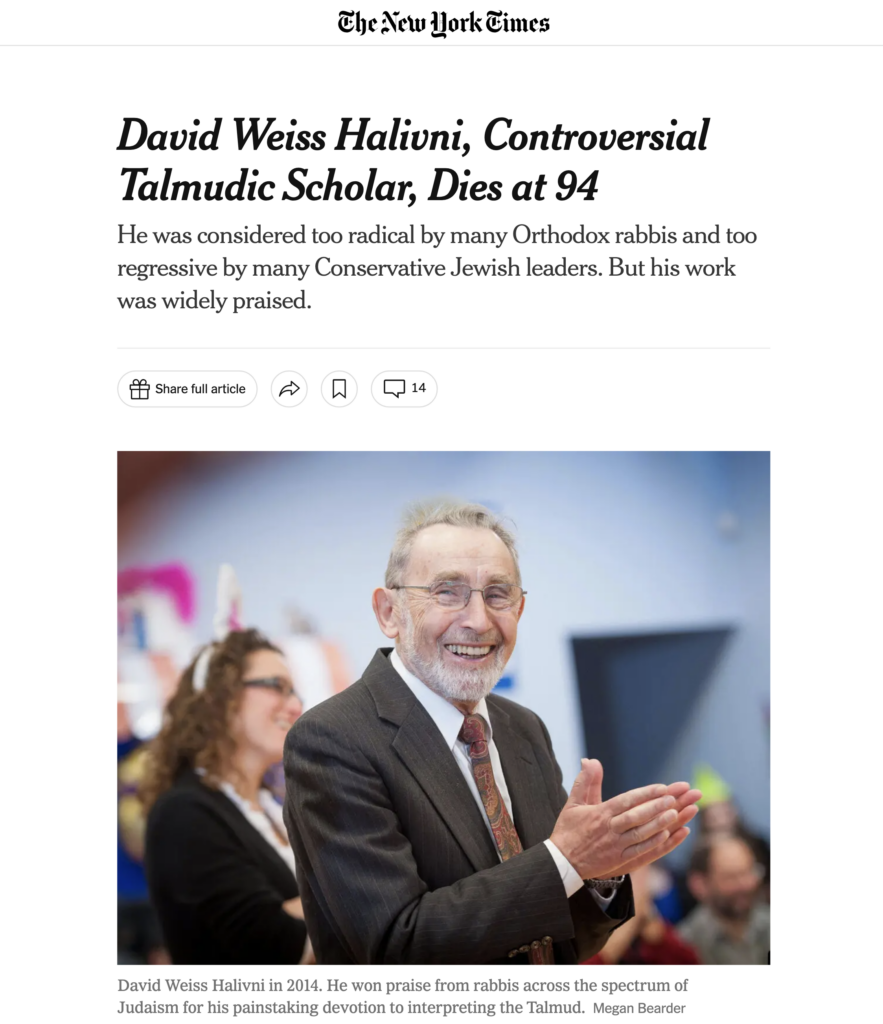
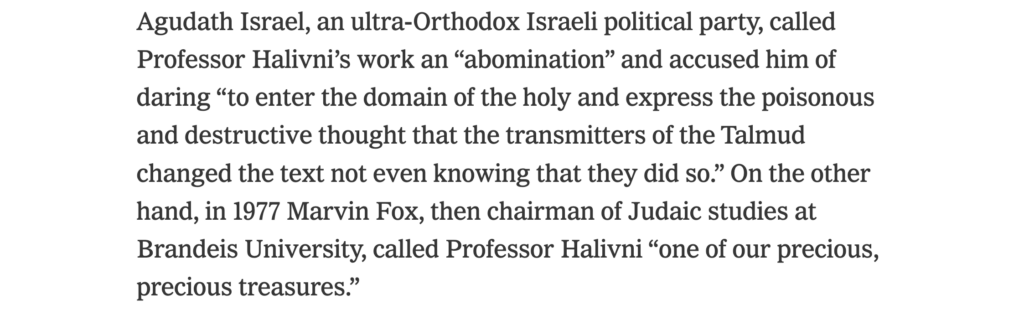
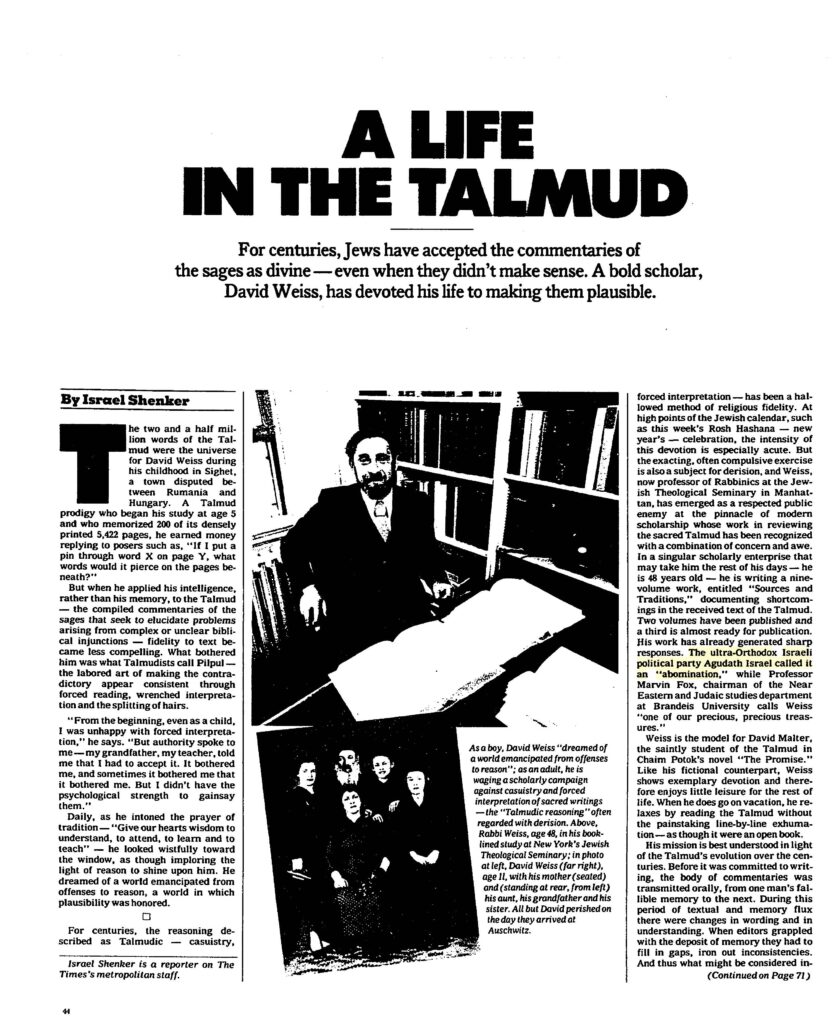
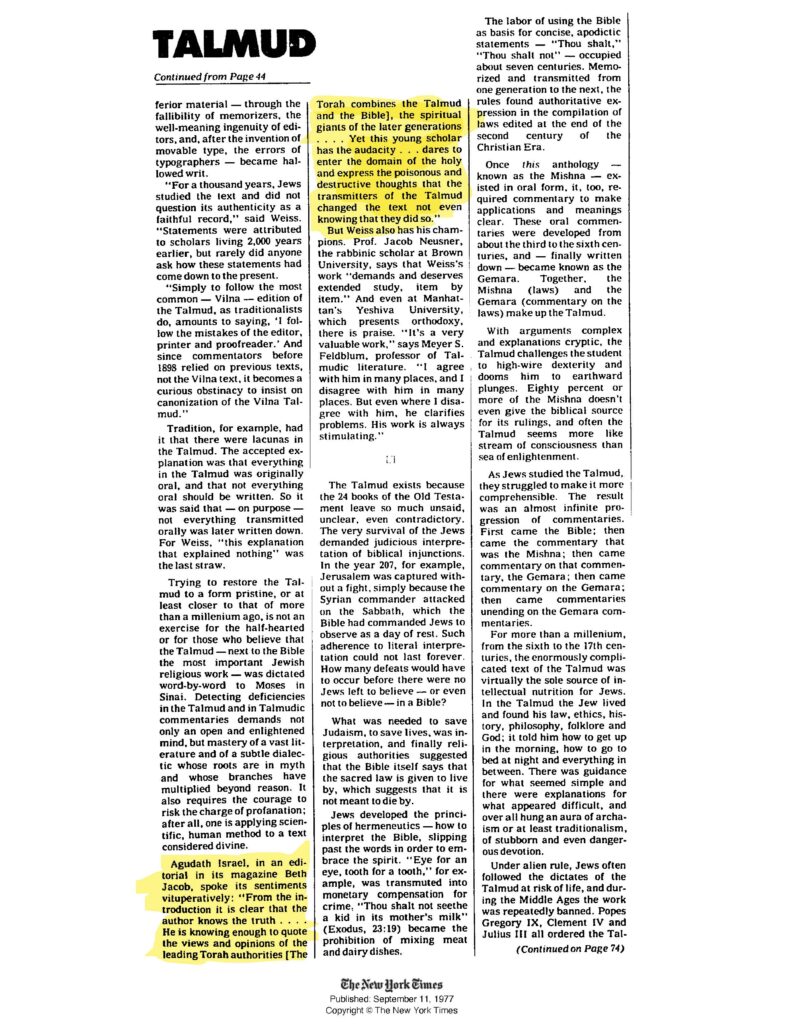
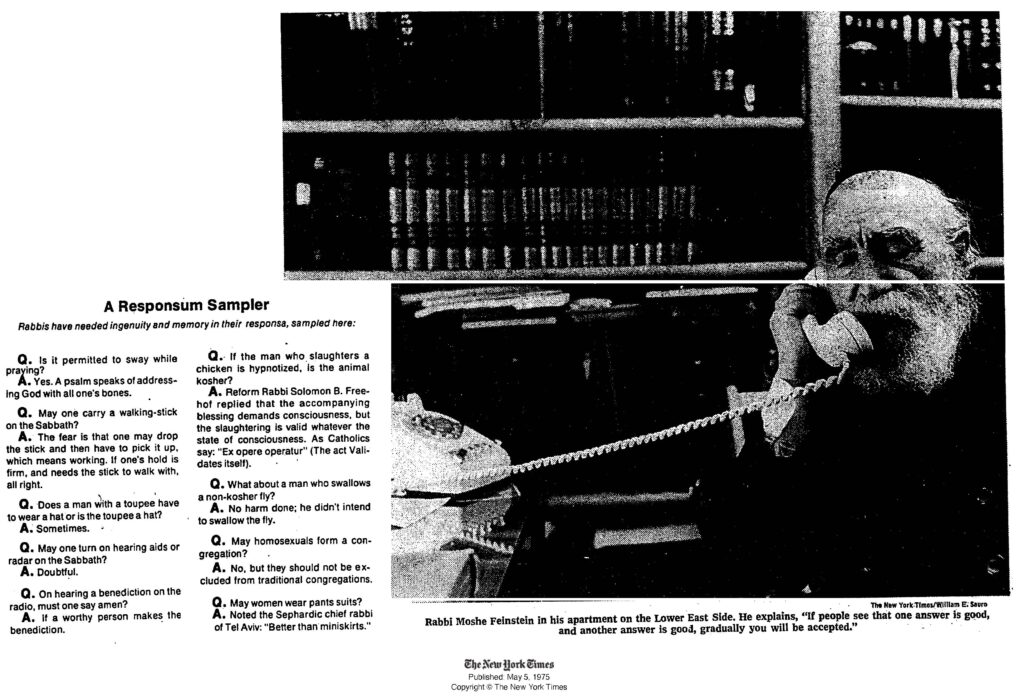
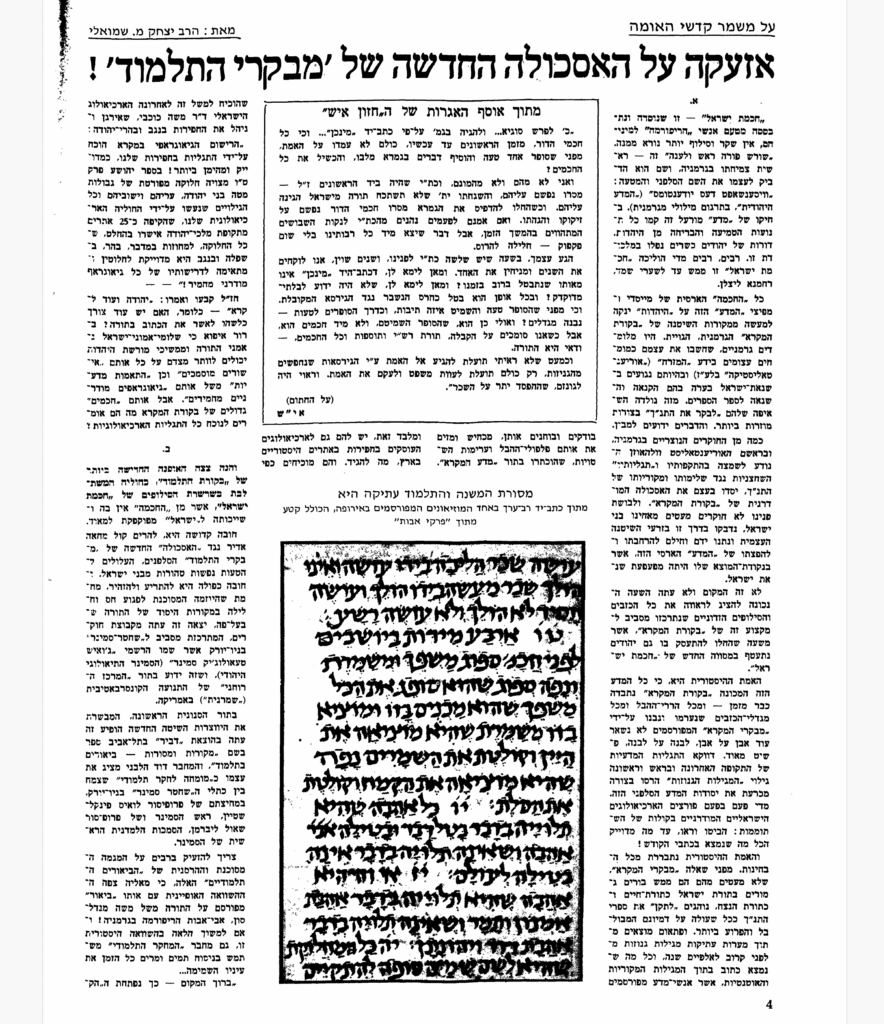
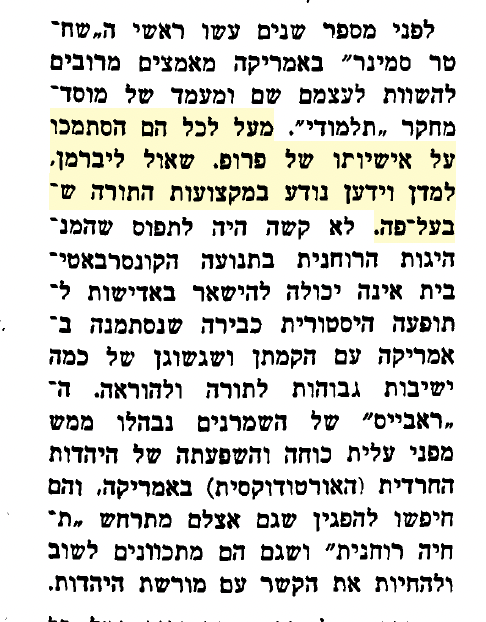 This, despite the fact that Lieberman’s earliest major work, Al ha-Yerushalmi, had already exemplified a disciplined form of textual criticism, drawing on manuscripts, parallel traditions, and internal philological analysis to clarify and correct the text of the Jerusalem Talmud. This could easily have provided fodder for Shmueli, yet he remained silent regarding Lieberman’s method. Recently published letters show that even the Ḥazon Ish engaged Lieberman seriously on these questions. Their correspondence reveals a principled disagreement over method, particularly regarding emendations grounded in manuscript evidence, while also demonstrating that such philological argumentation could be treated as a legitimate subject of rabbinic dispute rather than dismissed outright as heresy. Of course, since this correspondence had not yet been published, it cannot explain Shmueli’s silence on Lieberman’s approach.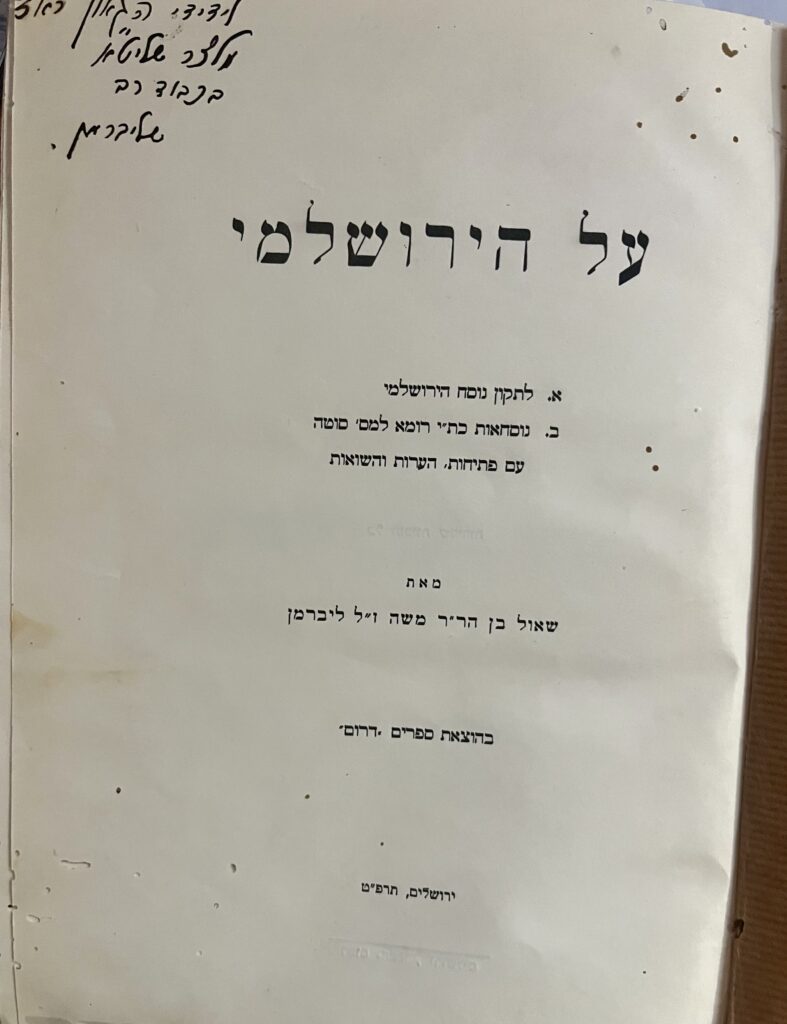
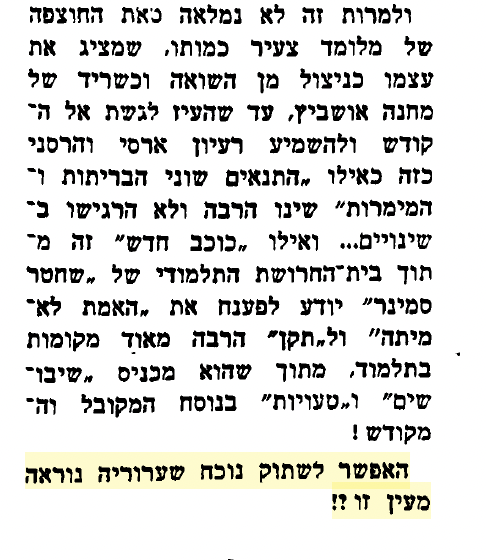
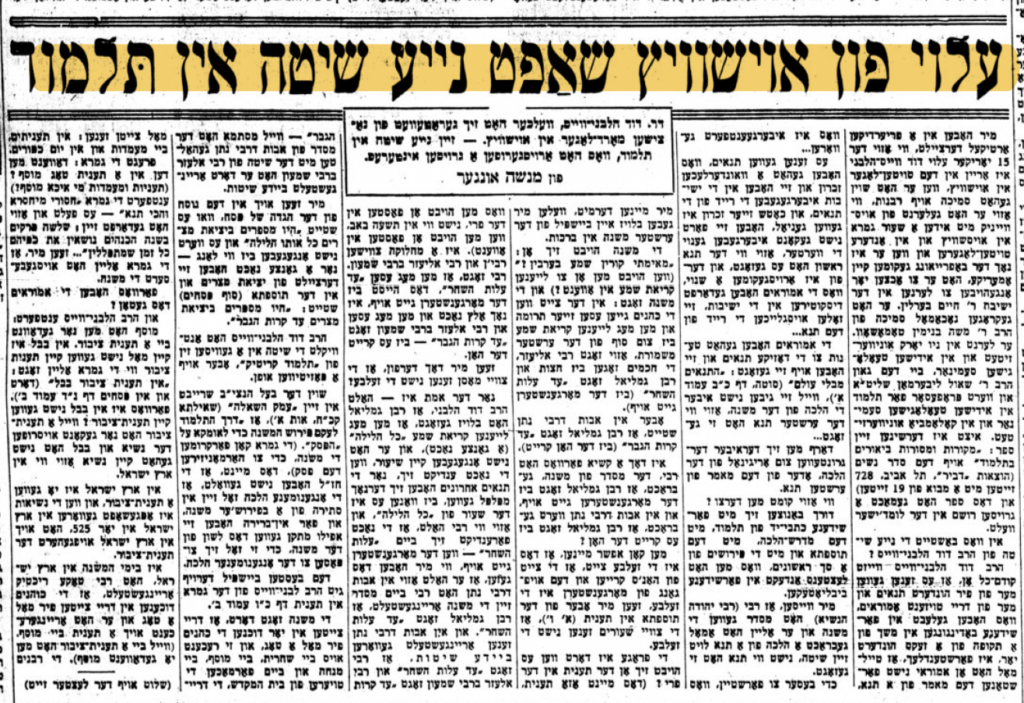
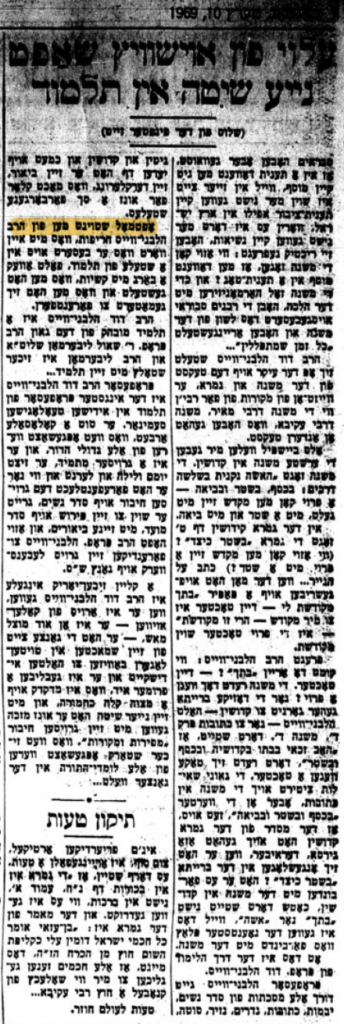


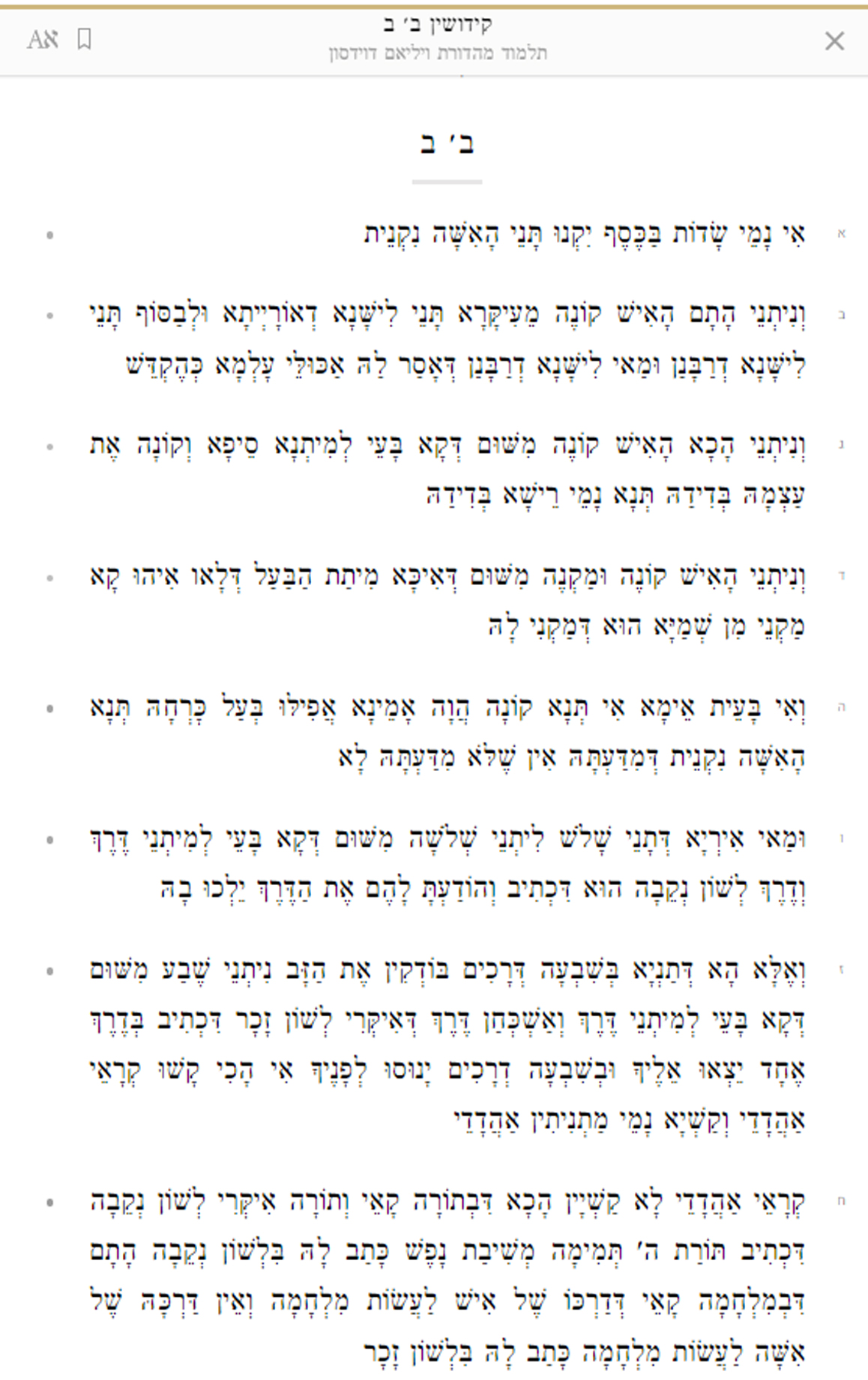


-1.jpg)
-2.jpg)
-3.jpg)
-4.jpg)
-5.jpg)


