Comments on recent books by R. Benji Levy and R. Eitam Henkin; R. Joseph B. Soloveitchik; and the first color photographs of R. Jehiel Jacob Weinberg.

Comments on recent books by R. Benji Levy and R. Eitam Henkin; R. Joseph B. Soloveitchik; and the first color photographs of R. Jehiel Jacob Weinberg

Marc B. Shapiro

1. Benji Levy, Covenant and the Jewish Conversion Question: Extending the Thought of Rabbi Joseph B. Soloveitchik (Cham, Switzerland, 2021)

The last few decades have seen a lot of discussion regarding conversion, and what is and is not required before someone is accepted into the Jewish community. This is obviously a halakhic matter, as conversion is a halakhic procedure and the rabbis supervise it and are the ones to decide who is to be accepted for conversion. The issue also has a sociological component and in the State of Israel it has national and political significance as well. The fact that halakhic conversion standards in the last generation have become stricter, and conversions have even been revoked, shows that we are dealing with a matter that is far from simple. As most are aware, this has led to a good deal of tension in Orthodoxy.

Rabbi Joseph B. Soloveitchik (1903-1993) was the leading Orthodox thinker in the post-World War II era. Combine this with his standing as a great talmudist and it is obvious that he will have important insights in the matter of conversion. It is to this that R. Benji Levy turns his attention in this valuable new book which analyzes the Rav’s halakhic thinking together with his philosophical perspectives. It is a book which all students of the Rav’s thought will want to examine.

Before his discussion of the Rav’s position, Levy deals extensively with earlier rabbinic views on the status of an apostate. This is helpful in and of itself, but also in terms of seeing the novelty of the approach advocated by the Rav. Bringing the Rav’s notions of Covenant of Fate and Covenant of Destiny into the halakhic arena, Levy argues the Rav arrived at his position by positing that holiness is not inherent, something one is born into. As such, one can lose this holiness. For the Rav, this is not only stated with regard to people, as he also that he felt that there is no such thing as holiness “inherent in an object.” Rather, holiness is “born out of man’s actions and experiences” (Levy, pp. 58-59, quoting from the Rav, Family Redeemed, p. 64). As is well known, R. Meir Simcha of Dvinsk had the same perspective. The Rav also offers this perspective when it comes to niddah. See Nathaniel Helfgot, ed., Community, Covenant and Commitment, pp. 325-326: “The entire concept of tum’at niddah, ritual impurity of the menstruant, is not an inherent description, but rather a relational one, for the niddah herself is not ritually impure at all. The ritual impurity expresses itself only in relation to the other.” This is definitely not the mainstream perspective in rabbinic literature.

In chapter 5, Levy gives us a good summary of the different halakhic positions regarding conversion. In the popular mind, this is often reduced to strict or lenient positions. But this is not really accurate, as the fundamental issue under dispute is what exactly does kabbalat ha-mitzvot means. It is often unclear which side is lenient and which is strict. For instance, if a rabbi voids a conversion because someone is thought to have converted without proper acceptance of mitzvot, this can be seen as strict when it comes to conversion. But the voiding of the conversion means that this individual does not need to fast on Yom Kippur, and if he is married he can leave his wife without giving her a get. So from this perspective, the voiding of the conversion is “lenient.”

Levy also calls attention to a fascinating “hiddush” of the Rav when it comes to conversion. According to the Rav, not only does a convert need to accept all the mitzvot, but he must also commit to a life of study of Torah. “A convert who wants to enter the congregation and accept upon himself the yoke of mitsvot, but is unprepared to toil in Torah, this is lacking in their conversion” (pp. 134-135). As Levy notes, this position is in line with the Rav’s stress on serious learning as opposed to the “sentimentality of ceremonialism” (p. 135). Levy adds that this stress on study “achieves a radicalization of the overall conversion process” (p. 135). I wonder, though, is this something that the Rav actually insisted on, or was this simply a point he mentioned in shiur like so many other ideas that sound appealing but are without practical significance? In fact, do we have any evidence that the Rav ever supervised conversions? If so, it would be fascinating to know what he required from future converts and how he guided them.[1]

Levy claims that R. Aharon Lichtenstein’s position in his famous article, “Brother Daniel and the Jewish Fraternity,” is not identical with the Rav’s outlook. This was surprising to me, as it is generally understood that R. Lichtenstein’s 1963 article was an attempt to explain the Rav’s approach in the wake of the Brother Daniel episode. Levy, p. 84, quotes the Rav as saying that “however much an irreligious Jew attempts to cast off his faith, he is fated to be unsuccessful.”[2] He contrasts this with R. Lichtenstein’s statement that there is “a point beyond which the apostate cannot go and yet remain a Jew” (p. 84). Yet these statements are not in opposition. The Rav is referring to an irreligious Jew, not an apostate. A document I recently published which quotes the Rav’s explanation of his position makes this very clear.[3] It also shows that R. Lichtenstein’s points are directly in line with those of the Rav, and knowing their relationship, the article itself must have been written under the close guidance of the Rav.

Usually people think of Jewish identity as an inherent part of someone, an inheritance that cannot be given up. Yet the Rav departs from the usual approach and considers Jewish identity as something that can be lost, but only in extreme circumstances. One who is not religious does not lose his halakhic standing as a Jew. However, one who actually converts to another religion is regarded by the Rav as having severed his connection to the Jewish people, and for most intents and purposes would no longer be regarded as Jewish. (I do not know how he would regard the child of an apostate woman.)

As such, I must also reject Levy’s conclusion that for the Rav a Jew may lose his individual holiness, but his “holiness qua member of the Jewish collective is unshakeable.” It is this point that I believe to be mistaken, and as noted already, I assume that the Rav’s settled position is as explained by R. Lichtenstein. I also believe that we need not be concerned that in shiur the Rav offered a different reading of a text, as what he said in shiur was often provisional, an exploration of different possibilities.[4] In the case at hand we have more than one testimony that R. Lichtenstein’s description, that in many ways an apostate is not to be regarded as Jewish, is exactly in line with the Rav’s position. With this in mind, we also need to review Levy’s discussion of the Brother Daniel controversy (pp. 186f.). To say that the Rav supported the ruling of the Israel Supreme Court and leave it at that creates a misinterpretation. Yes, the Rav agreed with the Supreme Court that Brother Daniel was not to be regarded as Jewish. Yet the Court’s assumption was that halakhah would regard him as Jewish. However, since the Law of Return is a secular law, the Court had to decide based on how the law was understood by “the ordinary simple Jew,” and such a Jew would never regard a Catholic religious figure as being part of the Jewish people. The Rav could not be more adamant that the Court was in error, as in his view, even from a purely halakhic perspective, Brother Daniel could not be regarded as Jewish.[5]

One final point: Levy deals with authorities who have seen circumcision or immersion as conveying what can be termed “limited sanctity” or “partial conversion.” There is another source that should be added to this discussion. R. Hershel Schachter records the Rav’s understanding that the Patriarchs had moved beyond the status of benei Noah, but had not yet achieved the full status of kedushat Yisrael. Nevertheless, they still had some kedushat Yisrael.[6] This puts them somewhere between non-Jews and Jews, a “partial Jew” if one might use the term.

2. Eitam Henkin, Studies in Halakhah and Rabbinic History (Jerusalem, 2021).

It has been eight years since the murder of R. Eitam Henkin, and the deep sadness over what was taken from us remains. A glance at what Henkin was able to accomplish in his short life— three books and numerous articles, all of the highest caliber—shows us what the future would have held for him in both rabbinic and academic scholarship. As Eliezer Brodt puts it in his introduction to Henkin’s Studies in Halakhah and Rabbinic History: “He was a unique combination of an outstanding talmid hakham and historian who was also blessed with exceptional research and writing skills.” Fortunately, in his short years R. Eitam left us with much to treasure.

Studies in Halakhah and Rabbinic History, published through the great efforts of Seforim Blog editor Eliezer Brodt, is a treat for anyone who values Torah and Jewish scholarship. All of us are in great debt to Brodt for this labor of love, which began immediately after Henkin’s murder, when Brodt was the prime mover behind the publication of Ta’arokh Lefanai Shulhan, Henkin’s posthumously published book on R. Jehiel Mikhel Epstein and the Arukh ha-Shulhan. The essays in the current volume are translations of many of Henkin’s important Hebrew articles, and the translators, volunteers all, also deserve our great thanks.

The first section of the book focuses on halakhah. R. Eitam deals with the kosher status of strawberries, modern utensils and absorption of taste, the sale of land in Eretz Yisrael to non-Jews, and other topics. The second section, which has more than 250 pages, deals with the girls’ dance on the 15th of Av, the famous (or infamous) Bruriah story, the Shemitah controversy, the Novardok yeshiva, haredi revisionism when it comes to Rav Kook, and a number of other topics. The final section focuses on R. Joseph Elijah Henkin, offering a general survey of his life and significance, and a second article dealing with his statements about R. Shlomo Goren and the Langer Affair.

There is so much that can be said about this this rich book, but in the interests of space I will only offer a few comments. I am certain that in future posts I will have the opportunity to come back to it.

In chapter 2, Henkin discusses the fascinating issue of absorption of taste in modern utensils. If the halakhic concept of beliah is based on actual absorption, then when dealing with stainless steel, which does not absorb, the halakhic issues should disappear. Following this line of thinking, it could still be appropriate, for a variety of reasons, to have separate meat and dairy stainless steel utensils. But if one mistakenly cooked dairy in a meat stainless steel pot that had been used with meat in the last day, bediavad the food should be OK to eat and the pot should not need to be kashered. If one were to follow this approach, stainless steel would be treated just as Sephardim treat glass, which can be used for milk and meat as the glass does not absorb.

In response to such a claim about stainless steel, Henkin puts forth the original argument that the real issue is not the new type of materials we use for utensils, but that our ability to perceive taste is not what it used to be. In other words, if our taste buds have deteriorated, then we can no longer use them as the basis of determining if there are beliot.

To prove that our sense of taste has weakened compared to the days of the Sages, Henkin did an experiment:

I took a wooden spoon (an old one, like utensils in the average kitchen) and for about half a minute I used it to stir milk that had been boiled in a glass cup. I then washed the spoon well, and then stirred with it, also for a half minute, about half a cup of tea which had been boiled in a small metal pot (a cezve). At the same time, I stirred the same amount of tea using a new metal spoon. I tasted it myself and gave it to my family to taste (as mesihim lefi tumam, without knowledge of the experiment) and no one could discern any difference in taste between the cups. Even when the family members were asked to guess which of the two cups was “dairy,” the success of the guesses wavered as expected at around 50% (pp. 25-26).

The results he obtained led Henkin to conclude that our sense of taste has weakened. This is because it is clear from the talmudic sages that milk leaves a taste in wooden spoons, and yet in reality we see that this is not the case.

This is a very interesting point that I will leave to scientists to discuss, but I do not think it fundamentally changes the problem. Even if our sense of taste has weakened, and we cannot taste what in previous generations we would have been able to, the fact is that stainless steel by definition does not absorb taste. So even if in the days of the Sages they could sense the flavors absorbed in wood, they would not have been able to taste anything had they used stainless steel. Thus, we return to the question of whether there should be a halakhic concept of beliot when it comes to stainless steel.

I must also mention that Henkin’s teacher, R. Dov Lior, specifically states that one can use stainless steel for both meat and dairy (although in practice he requests that two other poskim agree with this position). [7] I find it hard to believe that this will ever become an accepted practice, but is there any halakhic reason why not, or is it only be a matter of continuing what we have done in the past even if there is no strict halakhic reason to do so? Must we assume, as stated by R. Yaakov Ariel, that the entire concept of beliah is a halakhic notion, which like other halakhot operates according to its own rules that are not tied to scientific facts?[8]

Finally, I must note that unfortunately when the essays were translated no attention was paid to Henkin’s website here. On occasion, Henkin corrected his essays, and when the essays were translated R. Eitam’s corrections should have been included. For example, in chapter 24 he discusses R. Shlomo Goren and the Langer affair. On p. 413 n. 17, he mentions various rabbis who were identified as having been on R. Goren’s special beit din that concluded that the Langer children were not mamzerim. Yet on his website here he notes that two of the names he mentioned are not correct. There are other articles of his where he added more material on the website, so readers who want the most up-to-date scholarship of Henkin are recommended to check there.

3. At the end of my last post I mentioned that the next post would include an unknown article by R. Joseph B. Soloveitchik. I was mistaken, for not only is the article not unknown, but it is also included in R. Nathaniel Helfgot’s collection of the Rav’s letters and public statements, Community, Covenant and Commitment, pp. 263-265. Helfgot tells us that the article appeared in the Rabbinical Council Record (no date is given). I thought it was unknown because I found it in Jewish Horizon, Sep.-Oct. 1964, and didn’t at first realize that it was also reprinted in Helfgot’s book. What accompanies the Rav’s article is another article that is pretty much unknown. Although it is recorded in the bibliography of R. Lichtenstein’s writings found hereI have never seen anyone refer to it. While new material from the Rav is obviously very exciting, the same can be said for anything from R. Lichtenstein’s pen.

Since I promised something new from the Rav, how about the following which I believe is the first time that the Rav’s name ever appeared in print. It is from the German Orthodox paper Der Israelit, February 7, 1929, and mentions the shiurim for advanced students that the Rav delivered at an Ezra youth movement gathering in Berlin.

In my Torah in Motion classes on the Rav’s letters, available here, I also discussed the Rav’s reason for rejecting numerous pleas that he put forth his candidacy for the Israeli Chief Rabbinate after the 1959 death of R. Isaac Herzog. A lot has been written about this episode.[9] However, we also have the Rav’s testimony from the 1970s that he was again approached about becoming Chief Rabbi.[10] And there is even one other testimony about the Rav and the Chief Rabbinate, but this time I am referring to the Chief Rabbinate of the United Kingdom. Bernard Homa, Footprints on the Sands of Time (Gloucester, 1990), p. 127, writes as follows about the discussion of who would succeed Chief Rabbi Joseph Hertz:

I was one of the representatives of the Federation on the London Board for Shehita, where I served as Vice-President from 1946 to 1948. I also represented the Federation in 1947 on the committee, under the Chairmanship of Sir Robert Waley Cohen, dealing with the appointment of a successor to Dr. Hertz, who had passed away in 1946. I recall two items worthy of mention. Among the several names that came up was that of the famous Rabbi Joseph Ber Soloveitchik of Boston. There was no discussion as to his merits but he was quickly excluded from consideration for a very silly reason. The Chairman reported that he had been informed that he did not know how to use a knife and fork properly.[11] His informant was clearly unaware that in the U.S.A. table customs are different from those in this country and the allegation against him was thus not only trivial, but entirely without foundation.[12]

In my article in Hakirah 32 (2022), I published a number of letters from the Rav. Let me share an additional letter, to R. Irwin Haut, which was originally supposed to be included in my article. Unfortunately, I only have the first page. (The family also only has the first page. If any reader has the complete letter, please be in touch.) I thank Professor Haym Soloveitchik for granting me permission to publish it.

יג אדר השניתשיט
March 23, 1959

Dear Rabbi Haut:

Acknowledge receipt of your letter. 

1. Liquids which were cooked or boiled before the Sabbath and remained on the covered gas range during the בין השמשות period may be put back, after being removed for the night to the refrigerator, on the covered flame on Saturday morning, provided that the liquid foods do not reach the temperature of יד סולדת. If, however, the liquids are kept near the flame so that their temperature remains above the house temperature, we do not have to concern ourselves with the aspect of יד סולדת

2. I would advise you to put a a [!] tin or tin-foil cover on the [next page missing]

The issue here is heating up liquids on Shabbat, and the position of the Rav is more liberal than the standard Orthodox approach today which is not to allow any reheating of liquids (other than Yemenite Jews who follow Maimonides’ opinion). To understand the Rav’s position, we must first note that this was actually the opinion of his mother, Rebbetzin Pesha, who was a scholar in her own right. In this case, I think we can say that the Rav was simply following his family tradition.

This is what appears in Yeled Sha’ashuim, p. 30, a book devoted to R. Ahron Soloveichik[13]:

Rebbitzen Pesha would place cold soup on the hot Shabbos blech and be careful to remove the soup before it became יד סולדת בו. She was not concerned about the איסור חזרה because the psak of the Rama is that if the food was on the Shabbos blech for the duration of בין השמשות on Friday night and was later removed from the Shabbos blech, then there is no איסור חזרה. The only question then is whether there it is forbidden from the standpoint of the איסור בישול. Rebbitzen Pesha reasoned that it is permitted to do this on the basis of ספק ספיקא. First of all, there is a מחלוקת ראשונים as to whether in דבר לח we say אין בישול אחר בישול. The view of חכמי ספרד is that even in דבר לח we say אין בישול אחר בישול. But, in this case, one removes the soup from the Shabbos blech before it reaches the heat of בישול. The soup becomes only lukewarm. There is a מחלוקת רשי ותוספות whether this is permitted or it is אסור מדרבנן גזירה שמא ישכח וזה יגיע לידי בישול. The question in this case revolves only around an איסור דרבנן. Rebbitzen Pesha, therefore, reasoned that it is permitted on the basis of ספק ספיקא.  

Quite apart from the specific issue of liquids, the Rav’s position allowing food on the blech or even in the oven during bein ha-shemashot to be placed in the refrigerator and returned to the blech or oven the next morning is well known and has been discussed by many. This leniency can be traced to R. Nissim of Gerona who derives it from the Jerusalem Talmud.[14] Let me, however, me add two points. The first is that R. Ahron Soloveichik told me that I could adopt this position in practice. (I only asked about food, not liquids). The second point is that the Rav’s position has been portrayed as only referring to foods, not liquids. Yet we see from his letter to Haut that he, together with his mother, also held this position with regard to liquids.

Having said this, I think people will find the Rav’s instructions to caterers at the Maimonides school of interest. I thank Steven DuBois for calling my attention to this document, which is found here.

In one of these instructions I think it is obvious that the Rav was adopting a more stringent approach because he was dealing with caterers, who will not be as careful in these matters as individuals at home.  As you can see, the Rav only mentions removing solid foods from the refrigerator, but nothing about liquids. I think the reason is clear. An individual at home can be careful that liquids not reach the level of yad soledet bo, but this is not something the Rav was willing to entrust to a caterer who while busily preparing the Shabbat meal will often not be so careful to make sure that the liquid does not reach yad soledet bo.

We only have the first page of the Rav’s letter to Haut, but it is clear that the Rav’s second point is his advice to put a tin or tin foil cover over the stove knobs in addition to the blech. He does not state this as an absolute requirement but as a preferable procedure. However, in his instructions to caterers, this is listed as a requirement.

Let me share some more things related to the Rav, the first one of which comes courtesy of Ovadya Hoffman. In 1993 R. Yitzhak Hershkowitz published the first volume of his responsa Divrei Or. The second section of this volume includes responsa from the sixteenth-century scholar R. Abraham Shtang. In the introduction we find the following sentence:

אחדים מתשובות אלו נדפס ביובל עי ר‘ יצחק זימער

This is a very strange sentence, because what does נדפס ביובל mean? It actually refers to the 1984 Sefer Yovel for R. Joseph B. Soloveitchik where Yitzhak (Eric) Zimmer’s article appears (and Zimmer himself spells his name זימר). As Hoffman notes, this is a sort of “the wise will understand” reference. The editor did not feel that his readership could “handle” the actual title of the book, so instead he refers to it in code.

Growing up, maybe the first thing I knew about practices of the Rav was that he stood up with his feet together for the entire repetition of the Amidah. I recall how certain YU students would imitate this practice of the Rav, which sometimes created problems when people would try to exit the row while the students were standing with their feet together. Regarding the Rav’s practice, see R. Schachter, Nefesh ha-Rav, pp. 123-124, and here.

Maimonides, Mishneh Torah, Hilkhot Tefillah 9:3, actually explicitly states: “Everyone – both those who did not fulfill their obligation [to pray] and those who fulfilled their obligation – stands, listens, and recites ‘Amen’ after each and every blessing.” You cannot be much clearer than this, but nevertheless, there are those who offer a different interpretation of Maimonides. According to them, when Maimonides writes והכל עומדין ושומעין it does not mean literally to stand. Rather, עומדין ושומעין means to be quiet and listen. This argument is made by R. Ovadyah Hadaya[15] and R. Isaac Liebes,[16] and they both make the same point in support of their position. R. Moses Isserles, Shulhan ArukhOrah Hayyim 124:4, writes: “There are those who say that the entire congregation should stand when the prayer leader repeats the prayer. (Hagahot Minhagim).” Both R. Hadaya and R. Liebes note that R. Isserles could have cited Maimonides to support the view that the congregation should stand for the repetition of the Amidah. The fact that he instead cites Hagahot Minhagim shows that R. Isserles also did not understand Maimonides to literally mean that the congregation stands.

The problem with this is that R. Hadaya and R. Liebes were unaware that the reference to Hagahot Minhagim, and all similar references to books in parenthesis, does not originate with R. Isserles. It was added by a later editor, and thus the point made by R. Hadaya and R. Liebes has no relevance to R. Isserles’ opinion.

Two more points about the Rav: I do not think it is widely known that one of the first publications of the Rav—based on notes of a listener—appeared in a Habad publication in 1942. Here is the title page which on Otzar haChochma is called מאמרי קודש פון כק אדמור שליטא.

Here is the first page of the Rav’s article.

In a few of my online classes I dealt with the Rav’s opinion that even in contemporary times the hazakah of tav le-meitav tan du mi-le-meitav armelu (that a woman prefers almost any husband to being single) remains applicable. Here is what appears in R. Elyashiv’s Kovetz Teshuvot, vol. 4, no. 117. It sure seems like R. Elyashiv is rejecting the approach of the Rav.

4. In my post here I stated that Saul Lieberman began his studies at the Hebrew University in 1928. This information is based on Elijah J. Schochet and Solomon Spiro, Saul Lieberman: The Man and His Work, p. 8. However, a reader points out that in the August 16, 1927 entry of the unpublished diary of R. Mitchel Eskolsky, who was studying in Jerusalem at Yeshivat Merkaz ha-Rav, he speaks of meeting Saul Lieberman who was at that time a student at Hebrew University.

Regarding Lieberman, I thank Aron Rowe who called my attention to the fact that JTS has put some talks of Lieberman online. Before this, I had never heard Lieberman’s voice. See herehere, and here.

For those interested in Lieberman, I recently did eighteen classes on him. You can find them on Youtube here, and they are also currently being turned into podcasts which are on Spotify and other platforms. One interesting point about Lieberman which I did not mention is found in his letter to Gershom Scholem, dated July 10, 1967. (Lieberman’s letters to Scholem are found at the National Library of Israel.) Here he states that he was upset that he was not in Israel during the Six Day War, which would have enabled him to suffer together with Israel’s inhabitants. He comforted himself with the knowledge that he was able to have more of a positive impact in the U.S. than his presence would have had in Israel. He tells us what he has in mind, namely, that he permitted collecting money for Israel on the holiday. As Dr. Aviad Hacohen has pointed out to me, this must be referring to Passover, when tensions between Israel and its neighbors were already at a high level, rather than Shavuot, which came out after the war was over. Here are Lieberman’s words:

הצטערתי מאד שלא הייתי בארץ לפני פרוץ המלחמה ובפריצתה ולא זכיתי להצטער עם הציבור במקום הדאגה והצערונֶחׇׇמׇתי היא שהבאתי תועלת כאן הרבה יותר מאשר מציאותי בארץהתרתי כאן לאסוף כספים ביוטוהרבנים שלנו פחדו לעשות כן בפומביופסקתי להם שיטילו את כל האחריות עלימעניין שהרבנים האורטודוקסיים שהתנגדו לכך לא פצו אחז את פיהם למחות נגדיאני מכיר יפה את אמריקה ואת ההתלהבות הגדולה שהיא גם עלול להצטנן קצת במשך שעות

We see that his pesak was for the Conservative movement, and when he says “our rabbis,” he means the Conservative rabbis, which he distinguishes from the Orthodox rabbis.

When people think of Lieberman they often think about another instructor in Talmud at JTS, namely, Rabbi David Halivni. I think readers will enjoy two recent publication by Zvi Leshem that record all sorts of interesting stories about Halivni, much like similar collections have been put together about so many great rabbis. See here and here.

Regarding Halivni, the following is also of interest. In 2006 a two-volume book about R. Menahem Mendel Hager of Visheva was published, Ha-Gaon ha-Kadosh mi-Visheva. Here is the title page.

R. Menahem Mendel was the grandfather of Halivni’s wife, and in the second volume there is a dedication from Halivni and his sons in memory of her. Notice how Halivni is referred to as Ha-Gaon and shlita.

5. Unlike today where there are thousands of color pictures of the current gedolim, in the past pictures of great rabbis were uncommon. Just think of the few that are available of for each gadol who lived before the Second World War. When it comes to R. Jehiel Jacob Weinberg, who died in 1966, we have a good number of pictures of him. However, until now no color pictures of R. Weinberg have ever appeared. I am happy to present the only color pictures of R. Weinberg that I have ever seen. They were taken by R. Weinberg’s nephew, Dr. David Corn, on a visit to Montreux in 1958 or 1959. I thank the Corn family for granting me permission to publish these pictures. The originals are now kept at Ganzach Kiddush Hashem in Bnei Brak.

In this picture we see a young R. Yitzhak Scheiner and a young R. Aviezer Wolfson on the right. Thanks to R. Jeremy Rosen for the identification of R. Wolfson.

Here is Dr. Corn with R. Weinberg.

Here are the remaining pictures he took.

6. In July 2023 I led what I was told was the first ever kosher tour to Tunisia, courtesy of Torah in Motion. Seeing this unique Jewish community up close was an amazing experience for all. 

Here is a beautiful picture from last summer’s trip to Tunisia. The photographer is Alan Messner and it was taken in Djerba. (I encourage everyone who studies Talmud Yerushalmi to check out Alan’s valuable index here.)

Quiz

Please identify the following and email me your answers:

1. There are two se’ifim in the Shulhan Arukh that only contain two words.

2. There is one siman in the Shulhan Arukh whose number is the gematria of the subject of the siman.

Coming next: More on Saul Lieberman, and R. Moshe Zuriel: A Great Teacher in Israel

* * * * * * *

[1] Regarding the Rav and converts, in R. Chaim Jachter’s fascinating new book, Gray Matter, vol. 5, p. 163, he mentions that in a 1985 shiur the Rav stated that non-Jews have a “right to convert.” R. Jachter elaborates on the halakhic implications of this notion.
[2] David Holzer, ed., The Rav Thinking Aloud (Miami Beach, 2009), p. 319.
[3] “Letters from the Rav,” Hakirah 32 (2022), p. 152. Here the Rav is quoted as attributing his position to his father, R. Moses. However, in Reshimot Shiurim: Yevamot (ed. Reichman), p. 211 (to Yevamot 17a), it is attributed to his grandfather, R. Hayyim. After mentioning R. Hayyim’s position that descendants of Jews in Spain who identify as Christians are to be regarded as non-Jews both le-humra and le-kula (meaning their children are also not halakhically Jewish), he adds: והוא חידוש נורא. Levy, p. 82, refers to this page in Reshimot Shiurim, but he focuses on the first possible explanation that the Rav offers, rather than the explanation of R. Hayyim which in practice was what the Rav adopted.

I have to say, however, that the Rav seems to have contradicted himself in a 1965 interview with Ha-Aretz (printed in Community, Covenant and Commitment, pp. 220-221). He stated:

During the “Brother Daniel” episode, I wrote to the Chief Rabbis urging that they should stop attempting to decide this issue according to [formal] Halakhah and decide it based on their emotions. Acccording to [formal] Halakhah, Brother Daniel is a Jew. . . . I prayed that the Justices would not follow the Halakhah.

I must also note that during the Brother Daniel episode in the early 1960s there was only one chief rabbi, R. Isaac Nissim.
[4] It might be an interesting project for someone who listened to many of the Rav’s online shiurim to put together a list of ideas he expressed that are not found in his writings or that are in contradiction to what he wrote. I am sure that there are plenty of examples where the Rav offers an idea that he is not sure about and never would have included in a published work. This is obviously relevant to how much weight we give passages in the series of books The Rav Thinking Aloud.

I thought of this when I read the summary of the Rav’s YU graduate school lecture from the late 1940s published in Hakirah 27 (2019), p. 51:

The commandment of lo tirtzah was not [meant to be] self-evident to the intellect. It is also a hok, as is the eating of hazir. The only difference is that it fits into our moral concept of thinking, whereas hazir doesn’t. [It is not obvious] reasoning that I should not murder someone who stands in my way.

Was this really the Rav’s settled opinion, or was he just trying to be provocative with the students, in order to bring out a point? I do not see how the Rav could have really thought that lo tirzah is a hok, and I do not know of anyone who has made such a claim. After all, the prohibition of murder is one of the Noahide Laws, none of which are hukkim

In Community, Covenant and Commitment, p. 333, the Rav accepts that there are “rational laws.” He adds that when the Jews were commanded about rational laws, “an internal-natural instinct was transformed into a Divinely revealed command.” Furthermore, “the normative field of operation was expanded and deepened and reached the depths and farthest boundaries of idealism, which are unknown to the psychological instincts and predilections.”

In Shiurei Harav, ed. Joseph Epstein (Hoboken, 1974), p. 114, the Rav includes lo tirtzah among the mishpatim, but here too he seems to be denying what we can call a natural law prohibition against murder according to R. Akiva. If one were to follow this approach, I do not see how the prohibition against murder can be regarded as a mishpat.

R. Akiva is saying that since you said “Do not murder,” we don’t murder; but if you did not say it, we might do it. R. Ishmael says that even without God, man would know better. For R. Akiva, a man is capable of murder and is stopped only because of God.

Today, not much proof is needed of R. Akiva’s point of view. There is some devil in man; some satan who can suddenly come to the fore. To prevent this, we need the word of God. For R. Akiva, the mishpatim, those rules for which we think we know the reason should be done on the same basis as the hukim, for which we do not know the reason.

Some might wish to bring proof that the prohibition against murder can be seen as natural law since God judged Cain guilty of murder and this was before the giving of the Torah. Yet this is not a strong point because according to Bereishit Rabbah 16:6, and see also Mishneh Torah, Hilkhot Melakhim 9:1, Adam was already commanded against murder. Yet the fact remains that non-Jews are forbidden to murder, and are called to account for violation of this command. This applies even if they had never heard of God’s revelation to Noah or Moses. Doesn’t this mean that this law is in principle knowable by reason?

Marvin Fox has a different approach.

Ye shall keep my statutes (Lev., 18:5). This refers to those commandments which if they had not been written in Scripture, should by right have been written. These include the prohibitions against idolatry, adultery, bloodshed, robbery and blasphemy [Yoma 67b].” There is no suggestion here that human reason could have known by itself that these acts are evil, nor is it suggested that they are not consistent with man’s nature. What is asserted is only that, having been commanded to avoid these prohibited acts, we can now see, after the fact, that these prohibitions are useful and desirable.

Fox. Interpreting Maimonides (Chicago and London), p. 127. When it comes to Maimonides, the crux of the problem revolves around Guide 2:33 where he categorizes murder (and the other final seven commandments of the Ten Commandments) as belonging to the “class of generally accepted opinions,” as opposed to the first two commandments which are rational, “knowable by human speculation alone.” For the most recent discussion of Maimonides and Natural Law, see Shalom Sadik, Maimonides: A Radical Religious Philosopher (Piscataway, N.J., 2023), ch. 4.

In the Hakirah article mentioned earlier in this note, the Rav also states as follows:

Those who possess greater knowledge and skill possess also the higher ranks in society. Yet Judaism tried to equate the dignity of every individual regardless of his possession of knowledge. [It differentiated] only in regard to his intellectual drive. Where Judaism gave preference to the hakham over the am ha’aretz, it was not with regard to his accumulation of wisdom but simply because he was engaged in this great ethical drive. If a man tries and fails, he is not condemned. [Rather] he receives equal respect [to that] of the hakham.

These are nice sentiments, but the Rav knew full well that this was never how Jewish society functioned. The am ha’aretz, even one who tried, and failed, to become learned in Torah, was never given equal respect to the hakham.

In reading over this note, I see that I have another point to add. I wrote: “After all, the prohibition of murder is one of the Noahide Laws, none of which are hukkim.” I do, however, know of one source that disagrees with my statement. R. David Kimhi, Commentary to Gen. 26:5, writes:

גם יש בשבע מצות שנצטוו בני נח שאין טעמם נגלה אלא לחכמים והם הרבעת בהמה והרכבת האילן ואבר מן החי לפיכך אמרחקותיואמרמצותיכלל לכל המצות השכליות בין בלבבין ביד ובין בפה מצות עשה ולא תעשה

This is a problematic passage. Leaving aside his assumption that ever min ha-hai is a hok, the other two examples he gives, mixed breeding of animals and grafting of trees, are not included in the Seven Noahide Laws. There is a dispute among the rishonim if these actions are forbidden for non-Jews. Those who hold they are forbidden see these as additional prohibitions separate from the Seven Noahide Laws.

In a future post I will deal with the issue of positive commandments that non-Jews might be obligated in. These are also not included in the Seven Noahide Laws which are only negative commandments.
[5] See my “Letters from the Rav,” p. 151.
[6] Eretz ha-Tzvi, p. 140. This is noted by R. Chaim Jachter, Gray Matter, vol. 5, p. 188.
[7] See p. 25 n. 7, where Henkin tells us that after presenting his approach to R. Lior the latter agreed that one should also perform a comparative analysis with stainless steel and other materials. It does not appear that this would have any impact on his halakhic decision, and he has not publicized a retraction. I would say to R. Eitam, and I regret that I did not have the opportunity to do so in his lifetime, that if scientifically it has been shown that there is no absorption in stainless steel, then as I mentioned in the text, I do not see why the comparative study he suggests accomplishes anything.
[8] See his letter in Ha-Ma’yan 53 (Tevet 5773), pp. 90-93. See also the discussion in Nadav Shnerb, Keren Zavit (Tel Aviv, 2014), pp. 314-322.
[9] See Jeffrey Saks, “Rabbi Joseph B. Soloveitchik and the Israeli Chief Rabbinate,” B.D.D 17 (2006), pp. 45-67. See also the lengthy new article by Aviad Hacohen which focuses on the 1935 candidacy of the Rav for chief rabbi of Tel Aviv, but also discusses the period after R. Herzog’s death, “Ki mi-Neged Tir’eh et ha-Aretz ve-Eleha lo Tavo,” in Dov Schwartz, ed., Tziyonut Datit 9 (2023), pp. 153-222.
[10] See David Holzer, ed., The Rav Thinking Aloud (n.p., 2009), p. 143.
[11] R. Meir Mazuz, Mi-Gedolei Yisrael, vol. 1, pp. 197-198, points out that in the first printing of R. Hayyim Joseph David Azulai (Hida), Ma’agal Tov (Livorno, 1879), the printer omitted the details that the Hida recorded about the way Jews in Tunis ate, which their coreligionists in Europe would have viewed as distasteful. This was restored in the Freimann edition, Ma’agal Tov ha-Shalem (Jerusalem, 1934). One of the things the Hida mentions is that in Tunis they ate with their hands, and you can see how uncomfortable it made him (p. 56):

ואוכלים בידיהם ורגליהם וכל שמנונית מלא חפניהם והיה מגביה הגביר חתיכת שומן בעודה בכפו יבלענה ומנקה ידו במטפחת שעל ברכיו והמטפחת נעשה כבית המטבחיים

And they eat with their hands and with their feet, and with all the fat are their hands filled: the g’vir would lift up a piece of fatty meat and, while holding it in his hand, would he swallow it and then wipe his hands on a towel on his knees; and this towel would become like a butcher’s shop.”

The Diary of Rabbi Ha’im Yosef David Azulai, trans. Benjamin Cymerman (Jerusalem, 2006), Part 2, p. 20.

R. Yisrael Dandrovitz has a fascinating article devoted to the issue of eating with silverware, including the dispute over whether the sages of the Talmud ate with silverware or with their hands. He also deals with the practice of many hasidic rebbes to eat with their hands (some only eat fish with their hands). See “Al Ketzeh ha-Mazleg” Etz Hayyim 21 (5774), pp. 238-269.
[12] I was skeptical about this report of the Rav being considered, and wondered if Homa had remembered correctly. But R. Abraham Lieberman called my attention to Meir Persoff, Hats in the Ring: Choosing Britain’s Chief Rabbis from Adler to Sacks (Boston, 2013), p. 116, where we see that the Rav was indeed one of proposed candidates. The documentary evidence provided by Persoff contains nothing about the Rav’s table manners as a reason for him not being invited to interview for the position of Chief Rabbi.
[13] See also R. Bezalel Naor’s letter in Or ha-Mizrah, Nisan 5766, p. 192 n. 1. R. Naor, who is nothing less than a treasure in the world of Jewish scholarship, continues to amaze with his many contributions. His most recent book is Souls of the World of Chaos, which while focused on Rav Kook also encompasses the entire range of Jewish thinkers.
[14] Shabbat 17b in the Rif pages, s.v. u-mihu.
[15] Yaskil Avdi, vol. 2, no. 2.
[16] Beit Avi, vol. 3, no. 115:6.


Marc B. Shapiro – Responses to Comments and Elaborations on Previous Posts II

Responses to Comments and Elaborations of Previous Posts II
by Marc B. Shapiro
In a previous post I wrote as follows:
In Kitvei Ramban, vol. 1, p. 413, Chavel prints the introduction to Milhamot ha-Shem. The Ramban writes:
וקנאתי לרבנו הגדול רבי יצחק אלפאסי זכרונו לברכה קנאה גדולה, מפני שראיתי לחולקים על דבריו שלא השאירו לו כפי רב מחלוקותיהם ענין נכון בכל מה שדבר, ולא דבר הגון בכל מה שפרש, ולא פסק ראוי בכל מה שפסק, לא נשאר עם דבריהם בהלכות זולתי הדברים הפשוטים למתחיל פרק אין עומדין
In his note Chavel explains the last words as follows:
רק בסוף הפרק הזה נמצאה השגה אחת מבעל המאור
Yet what Ramban means by למתחיל פרק אין עומדין are the children who begin their talmudic study with Tractate Berakhot. In other words, it is only the explanations and pesakim of the Rif that are obvious even to the beginner that have not been challenged.[1]
Ephraim responded as follows

WRT the reference of Ramban to פרק אין עומדין, both you and R. Chavel are wrong. Ramban is clearly referring to the gemara’s explanation of the Mishnah’s ruling at the beginning of that chapter of אין עומדין להתפלל אלא מתוך כובד ראש, which is that one should learn an undisputed halakha prior to davening. It is only on those simple and undisputed halakhos that the Maor did not disagree.

Fotheringay-Phipps wrote:

The basic problem with Dr. Shapiro’s (or R’ Mazuz’s, as the case may be) pshat is that Ain Omdin is the fifth chapter of B’rachos, not the first. If the Ramban meant the perek that a kid starting out learns, why would he choose the fifth perek? I think R’ Chavel’s pshat is somewhat of a better pshat, since Ain Omdin is somewhat unusual in that there is only one haga’a from the Ba’al Hamoar in the whole perek, and I incline to think that this is what the Ramban meant.

I presented these comments to R. Mazuz and he replied as follows:

לפי פירוש כת”ר היל”ל הדברים הפשוטים שבתחלת פרק אין עומדין. אולם ידוע שבעדות המזרח התחילו ללמוד מסכת ברכות (וכ”ה בשו”ת הרי”ף סימן רג”ג). בניגוד לנהוג היום בתלמודי תורה להתחיל פרק אלו מציאות. ואבא זצ”ל התחיל לתלמידים בפרק תפלת השחר (ומסתמא כך נהגו בג’רבא) שהוא הפרק הכי קל בין הפרקים א’ ב’ ג’ ד’ במסכת ברכות. לכן יתכן מאד שבימי הראשונים התחילו דוקא בפרק אין עומדין (שהוא קל אפילו יותר מפרק תפלת השחר, ורובו דברי אגדה). וזוהי כוונת הרמב”ן

With regard to his point about the Sephardim beginning their instruction from Berakhot, in R. Mazuz’s new book, Arim Nisi, p. 364, he notes that R. Shakh, Shimushah shel Torah p. 88, refers to the Maskilim’s attempt to institute this in Europe as a “reform.” Yet in reality, this practice has a long history. R. Mazuz writes:

ונעלם ממנו במחכ”ת שכן מנהג הספרדים עד היום הזה, והוא מנהג קדמון מימי הרי”ף והגאונים, ואולי מימי רבי מסדר המשנה שהתחיל בסדר זרעים במסכת ברכות. ולפני כששים שנה הדפיסו באי ג’רבא מסכת ברכות בהשמתטת הקטעים שאין רגילים ללמדם לתלמידים בהסכמת רבני העיר וט”ו מרביצי תורה שבעיר, ויצאו מהם פירות ופירי פירות

Since I mentioned R. Mazuz’s comment vis-à-vis what R. Shakh wrote, I should add that he criticized him on other occasions as well. These criticisms were always offered with proper respect. Yet there are those in the Lithuanian world who have no interest in hearing what another gadol has to say if it not in line with current Daas Torah.[2] R. Mazuz states that he once sent a letter to Yated Neeman pointing out an error R Shakh made, and they refused to publish it. After this paper refused to publish two more of his letters, he stopped sending them, as the hazakhah had been established.[3]
He also tells us that if the editors had a different attitude, he would have also sent in something dealing with the proper way to pronounce the word אחד in Shema, since there was a great deal of discussion in the newspaper by people who didn’t know what they were talking about. The truth is that a dalet without a dagesh is very similar to a zayin[4] and is still preserved among the elders of Yemen and Iraq. He cites one of Ibn Gabirol’s poems which reads:
לאטך דברי שיר דבורה
אשר קרית שמע מפיך יקרא
מיחדת ומארכת באחד
In Peter Cole’s translation:

Take, little bee,
your time with your song,
in your flight intoning the prayer called “Hear”
declaring and stretching “the Lord is one.”[5]

In other word, the bee’s buzzing (zzz) shows us how one can extend the dalet. It is pronounced in the way that the letter can be extended, which cannot be done with a hard dalet.

R. Shakh was a man of truth, and he certainly would have wanted to be corrected. All true scholars are happy when this happens, and this is what intellectual honesty is all about. But Yated Neeman has never been interested in truth or intellectual honesty, but in pushing a religio-political agenda, and therefore not only do they refuse to print such corrections of their gedolim, but they have even published material which they know is untrue. I refer in particular to their slander of R. Kook, stating that he applied the verse Ki Mitzion Tetze Torah to the Hebew University. Even though the truth was pointed out to them they continued to print the slander. One can read all about this in Moshe Maimon Alharar’s book Li-Khevodah shel Torah.

Returning to R. Mazuz and R. Shakh. R. Shakh had written

Whence did Hazal know that the earth was forty-two times larger than the moon, and that the sun was approximately one-hundred-and-seventy times larger than the earth (as explained in the Rambam, Hilkhot Yesodei Hatorah 3:8), if not from the power of the Torah?

Some might recognize this passage as it was subject to a very strong critique by R. Aharon Lichtenstein. I am sure that many in the haredi world were very upset by what R. Lichtenstein wrote, but it pales in comparison to what R. Shakh wrote about the Rav’s Hamesh Derashot.[6] Among his negative comments, he referred to Rav’s Zionist ideas as ממש דברי כפירה.

R. Lichtenstein actually has two replies to the quote from R. Shakh. They are both found in the same essay, but the essay has appeared in two different versions. In the original version he wrote as follows.

Upon reading the passage, one can only reflect, first, that the description cited is nowhere to be found in Hazal, but derives, rather, from medieval astronomers; second, that it is in conflict with the rudiments of contemporary scientific assumptions, and, third, that it hardly consorts with the fact that the selfsame Rambam had explicitly stated, with respect to these very issues, that they were beyond the pale of Hazal’s authority. . . . The high regard properly due the author of the Avi Ezri notwithstanding, one can only conclude that, evidently, when their reach exceeds their grasp, even acknowledged and esteemed talmdei hakhamim may falter.[7]

Yet when this essay was reprinted in Leaves of Faith, vol. 2, the criticism was softened:

In raising this question, he is wholly oblivious not only of the rudiments of astronomy but also of the fact that the selfsame Rambam explicitly states, with respect to these very issues, that they are beyond the pale of Hazal’s authority.

כן בדברי חז”ל. וכמבואר להדיא בהקדמתו לפירוש המשניות (בש”ס ברכות דפוס ווילנא דף נה סע”א וע”ב) שהמקור לזה מספר אלמגסט”י. והוא ספרו של בטלמיוס הידוע בחכמת האסטרונומיא. ועפ”ז כתב הרמב”ם בהלכות יסודי התורה (שם) שהשמש גדולה מן הירח פי 6800. ורלב”ג עה”ת (בפסוק ויאמר אלקים יהי מאורות) חולק על זה וכתב כי השמש גדולה מהירח פי חמשים אלף, כמו שביאר בח”א ממאמר חמישי מס’ מלחמות ה’ ע”ש. וכיום ידוע שהשמש גדולה מן הארץ פי מליון שלש מאות אלף

In response to this citation of R. Shakh in Yated Neeman, R. Mazuz wrote as follows (Or Torah, Adar 5753, pp. 461-462):

והנני להעיר שהרמב”ם כתב כן ע”פ חכמי המדע בימיו ולא נצמא כן בדברי חז”ל. וכמבואר להדיא בהקדמתו לפירוש המשניות (בש”ס ברכות דפוס ווילנא דף נה סע”א וע”ב) שהמקור לזה מספר אלמגסט”י. והוא ספרו של בטלמיוס הידוע בחכמת האסטרונומיא. ועפ”ז כתב הרמב”ם בהלכות יסודי התורה (שם) שהשמש גדולה מן הירח פי 6800. ורלב”ג עה”ת (בפסוק ויאמר אלקים יהי מאורות) חולק על זה וכתב כי השמש גדולה מהירח פי חמשים אלף, כמו שביאר בח”א ממאמר חמישי מס’ מלחמות ה’ ע”ש. וכיום ידוע שהשמש גדולה מן הארץ פי מליון שלש מאות אלף

R. Mazuz’s second letter deals with the nature of darkness. Yated Neeman had printed the Vilna Gaon’s opinion that darkness is not simply the absence of light but its own creation. R. Mazuz responded that this is in opposition to the opinions of the Rambam, Ramban, R. Joel Sirkes, R. Elijah Mizrahi and the Siftei Hakhamim. Subsequent to writing the letter he learnt that this view was also held by R. Saadiah Gaon, Ibn Ezra, Radak, and the Kol Bo (see ibid., p. 946) After pointing out that the Vilna Gaon’s view is held by R. Jacob Emden and the Hida. He concludes:
מכל מקום אין לקרוא לסברא. שהחשך הוא העדר “דברת המינים” ח”ו. ואלו ואלו דברי אלקים חיים
As already mentioned, Yated Neeman does not like to print letters from those who are able to show that the newspaper has erred. Only newspapers interested in the truth do that.

In his Kovetz Ma’amarim, pp. 102ff., R. Mazuz includes another letter he sent to Yated which also was not printed. The paper had published the view of the Steipler and R. Chaim Kanievsky that even Sephardim should pronounce the final vowel of אד-ני as Ashkenazim pronounce the kamatz, since otherwise it appears as it if there is more than one God.

R. Mazuz shows how mistaken this is, and illustrates though various texts that the way the Sephardim pronounce the kamatz today is precisely how it was pronounced in medieval times. For example, he cites one of Ibn Gabirol’s Azharot:

אנכי ה’ / קראתיך בסינַי/ ולא יהיה על פנַי / לך אלהים אחרים
One can easily see that the words are designed to rhyme, so obviously the last syllable of Ado-nai was pronounced the same way as Sinai and panai.
2. Since I just mentioned R. Aharon Lichtenstein, let me quote something else he wrote that relates to what I noted in a previous post.[8] I pointed to the common phenomenon of people rejecting the authenticity of texts that don’t agree with their preconceptions. R. Lichtenstein states:

The Rav had no patience for philosophies that glorified passivity and reliance on miracles. At the beginning of the 1960’s, a few years after the launch of Sputnik, I had occasion to talk with the Rav about those people who claimed that man should not reach out for the heavens, for “the heavens are the heavens of God,” and only “the earth is given to human beings.” The Rav heaped scorn upon them. One of those present jumped up to protest: “But Rabbi, the Ramban in Bechukotai (Vayikra 26:11) speaks about how a person should have faith in the Holy One, and not to delve into matters that are too wondrous for him.” The Rav replied, “I heard from my father, in the name of my grandfather, that the Ramban never uttered that statement!”

Although not identical to the Ramban’s position, there was also a medieval Jewish view that doctors should only be consulted for things like sprained arms, but that when it came to internal diseases one should only resort to prayer. Lest one think that this idiosyncratic position has totally disappeared, I have even found a twentieth-century author who adopts it,[9] leading R. Ovadiah Yosef to strongly reject this view in his haskamah.

3. In a previous post[10] I called attention to an error made by H. Norman Strickman and Arthur Silver. They claimed that according to Radak’s commentary to Gen. 14:14, after the conquest of the Land of Israel the reading of this verse was changed to read “and pursued as far as Dan.” Dr. Strickman has informed me that in the Afterword to his translation of Ibn Ezra to Leviticus, p. 291, he himself corrected the errror. The correct reference is to Radak’s commentary to I Sam. 4:1. Here Radak leaves no doubt that he indeed believes that the text of the verse was changed.
על האבן העזר: כמו הארון הברי’ והכותב אמר זה כי כשהיתה זאת המלחמה אבן נגף היתה ולא אבן עזר ועדיין לא נקראה אבן העזר כי על המלחמה האחרת שעשה שמואל עם פלשתים בין המצפה ובין השן שקרא אותה שמואל אבן העזר שעזרם האל יתברך באותה מלחמה אבל מה שנכתב הנה אבן העזר דברי הסופר הם וכן וירדף עד דן
With this text, we can now understand Radak’s commentary to Gen. 14:4 as also referring to a post-Mosaic change. Without this text, there would be no reason to assume that Radak in Gen 14:14 is not referring to Moses’ prophetically writing the word “Dan.”

As I pointed out in my previous post, in the introduction to his Commentary on the Torah Radak insists on complete Mosaic authorship. In order that there be no contradiction between the sources, we must assume that Radak means that no sections (or even verses) were written by someone other than Moses, but not that there are no minor post-Mosaic changes. In my book I pointed out that Radak understood tikkun soferim literally, that is, the Scribes actually made minor changes to the text of the Torah.[11]

(With regard to false ascription of critical views vis-à-vis the Torah’s authorship, I should also mention that Abarbanel, Commentary to Numbers 21:1, accuses both Ibn Ezra and Nahmanides of believing that the beginning verses of this chapter are post-Mosaic. Yet Abarbanel must have been citing from memory, since neither of them say this. In fact, Ibn Ezra specifically rejects the notion that the verses were written by Joshua.)

4. In a previous post I mentioned R. David Zvi Hillman’s strong attack on R. Kafih. It is only fair to point out that Hillman’s letter was the impetus for an even sharper attack on Hillman. See here, here, and here for the relevant documents.

R. Kafih was a follower of the Rambam who wrote that one should be “among those who are insulted, but not among those who are insulting” (Deot 5:28). While the articles make many good points, the crude language used is entirely unacceptable.

5. With regard to the Netziv and reading newspapers on Shabbat, Dr. Yehudah Mirsky has called my attention to the Netziv’s article in R. Kook’s journal, Ittur Soferim (1888), pp. 11-12, where the Netziv offers halakhic justification for this practice. Unfortunately, this short article was not included in Meshiv Davar, vol. 5, which appeared in 1993. (Presumably, the editors were unaware of it.) This most recent volume of Meshiv Davar is a bit strange, because the editors don’t tell us anything about where they found previoiusly unpublished responsa included here. From a historical standpoint, the most interesting responsum is no. 44. Here the Netziv blasts the new analytic approach of R. Isaac Jacob Reines, which is found in his Hotam ha-Tokhnit and Urim Gedolim.

Other than an anonymous article in Ha-Peles 5 (1903), pp. 673-674, in which Reines’ approach is regarded as falling into the category of “that which is new is forbidden by the Torah,” I don’t know of any other attacks on him. For some strange reason, Saul Lieberman thought that R. Yaakov David Wilovsky’s famous attack against the Brisker method, found in the introduction to his Beit Ridbaz, was directed against Reines. Shaul Stampfer quoted this in Lieberman’s name in the first edition of his masterpiece, Ha-Yeshivah ha-Lita’it be-Hithavutah (Jerusalem, 1995), p. 113 n. 29, but omits Lieberman’s comment in the second edition of this book (Jerusalem, 2005).

6. In a previous post I wrote about the issue of kosher sturgeon. Shortly after the post appeared I read David Malkiel’s article on R. Isaac Lampronte’s Pahad Yitzhak.[12] Malkiel, p. 129, points out that the most famous entry in the work deals with the authority of customs, and focuses on whether a certain type of sturgeon is kosher. Lampronte tell us that the custom in Ferrara was to eat it.

I wrote the post without doing an internet search, which is now the first place people go when beginning their research. Only after the post appeared did I do such a search and I came up with the following very interesting post by Rabbi Seth Mandel.[13] He writes as follows:

I have asked several rabbonim about how it came to pass that if the Noda’ biY’hudah paskened unequivocally that sturgeon is kosher, every book says black on white that it is not. Of the two rabbonim who even were aware of the issue, one said that of course sturgeon is kosher, and the fact that there is none with a hekhsher is either because the rav hamakhshir doesn’t know about the issue, or you can’t get a rav hamakhshir to the fishing plants. . . . The other rov said that of course, no recognized halakhic authority would contradict the Noda’ biY’hudah on this, but since Jews believe they are not kosher, and the only ones pushing their kashrut are the C or R, why should an O rov fight to show they are kosher, as if we accept the way they arrive at their decision? . . . 

I challenge anyone to find a posek who deals with the issue and refutes the Noda’ biY’hudah. I am _not_ saying that I “know” that there is no one; what I am saying is that I have been looking for years, and have found no one. Please do not hesitate to correct me if anyone knows of a source (but one that knows that the Noda’ biY’hudah had a t’shuva on this). The books on the kashrus of fish just take it as a given that since sturgeon, as R. Josh says, do not have scales but rather bony tubercules, they are not kosher. My bottom line is I don’t care if people hold that they are not kosher (I don’t like fish eggs, anyway), but it seems to me inexcusable for these books to distort the Torah by giving the impression that everyone agrees on this issue. The Noda’ biY’hudah is not just anyone. My goodness, he is not even MO, L, or Chareidi, so there go most of the opportunities for saying “WADR to the Noda’ biY’hudah, he is MO/L/ wears a grey hat, and so cannot be representative of true Torah.” The only thing you can say is that he was an opponent of chasidus, but even according to the Chasidim, that is not an issue, since a famous story of the Chasidim is that he repented on his deathbed from all the not nice things he said condemning chasidus (and the story _must_ be true, since it is retold in the CIS Shulman “authorized” biography of him).

Rabbi Mandel wrote this before he was appointed to his current important position in the OU kashrut organization. Somehow, I don’t think he would have expressed himself this way if he was then working in the kashrut industry.[14]

7. I was fortunate to spend back-to-back Shabbatot with Prof. Daniel Sperber. I learnt much from my conversations with him, and I think people will enjoy listening to his presentations. He is currently president of the Jesselson Institute for Advanced Torah Studies at Bar Ilan University, and was kind enough to give me a recent volume published by them, Mi-Sinai le-Lishkat ha-Gazit by Shlomo Kassierer and Shlomo Glicksberg. This book analyzes the relationship between the written and oral law, and the nature of rabbinical authority. What makes the book significant is the combination of traditional and academic study. Anyone who wants to understand the latest thinking on this topic would be wise to consult this book.

8. Many people contacted me following my last post on Rabbis and Communism, so let me add a few further comments. R. Baruch Oberlander called my attention to Likutei Sihot, vol. 33, pp. 248-249. Here the Lubavitcher Rebbe states that there is no contradiction between Judaism and socialism. He adds that in Russia, before the Revolution, he knew many socialists, even radical ones (which I assume means real communists), who were completely Torah observant. See also Iggerot Kodesh, vol. 22, p. 497.

Since my last post mentioned R. Jacob Emden and Abraham Bick’s communist ties, I should also mention Mortimer Cohen, the author of Jacob Emden: A Man of Controversy. This was the first academic defense of Emden, and was subjected to withering criticism by Scholem. Marvin Antelman, who has made attacking Eybschuetz one of his life’s goals, also sets his guns on Cohen, accusing him of having been the “’rabbi’ of a secret sect of Sabbatean communists, who carried on the Frankist conspiracy in Philadelphia” (Bekhor Satan, p. 44).

R. Nathan Kamenetsky wrote to me pointing out that when R. Dovid Leibowitz was let go from Yeshiva Torah va-Daas in the 1930s, one of the complaints against him was that he was promoting communism (whether the complaint was justified I cannot say. Kamenetsky continues: “My son, R’ Yoseph, pointed out that the Torah divides wealth evenly when it sets the law of Yovel. At the conquest of Canaan, the land was divided evenly, and every fifty years thereafter, by which time there would be wealthy lanlords and poor ones, the Torah redistributed the land in its original lots. (The difference between large estates and small ones would then result only from family sizes, by which families with many children would have smaller fields than and those with many children.)”

I had wondered about the meaning of the word ,סוללים and suggested that it refers to a white-collar profession. Kamenetsky writes:

You do not base your suggestion on philology – and nor will I. I also do not think that you are correct sociologically that white-collar workers were assumed to be less religiously observant than other Jews. I believe that Rabbi Graubart meant pharmacists, because, like doctors, they were not expected to be observant. I know this from my father’s attitude (which was grounded in the pre-World War I Jewish environment). For example, when my father would speak of my native Tzitevian, the town where he served as rabbi, and telling an involved story about how a Jewish woman who was suspected by my mother of not using the mikveh found that her husband was carrying on with their goyisheh maid, he added, (not in these exact words) “Naturally, besides the pharmacist’s wife, all the women in the shtetl used the mikveh.” Insofar as doctors, and likely pharmacists too, they weren’t trusted to be profesionally reliable if they were observant! See my Making of a Godol, page 557, (within my discussion about Dr. Einhorn, a mysterious figure), where I quote an article about that doctor which said, “The [townspeople] realized that [Dr. Einhorn’s] way of life, his devoutness, did not harmonize with his profession.”

9. Dr. Yehudah Mirsky called my attention to Mordechai Zalkin, “Bein ‘Bnei Elohim’ li-Vnei Adam’: Rabbanim, Bahurei Yeshivot ve-ha-Giyus le-Tzavah Ha-Russi ba-Meah ha-19,” in Avriel Bar-Levav, ed., Shalom u-Milhamah be-Tarbut Ha-Yehudit (Jerusalem/Haifa, 2006), pp. 165-222. I was unaware of this fabulous article which is a detailed survey of the issue of rabbis and the Cantonist problem. Let me just quote his concluding paragraph, which I was happy to see supports a suggestion I made. Coming from Zalkin, who is an expert in the history of Russian Jewry, it should be taken very seriously.

אין בידינו כלים לבחון את מידת השפעתו ארוכת הטווח של תהליך זה על מערך היחסים הבסיסי בחברה היהודית המזרח אירופית משלהי המא התשע-עשרה. אולם יש מקום להניח שלתחושת האכזבה והתסכול מאופן תפקודה של הרבנות המזרח אירופית בפרשת הגיוס היה חלק לא מבוטל במגמות החילון ובנהייה אחר תנועות אידאולוגיות שהציעו מודלים מנהיגותיים אחרים, שרווחו בקרב יהודי מזרח אירופה במחצית השנייה של המאה התשע-עשרה
Notes
[1] See R. Meir Mazuz’ note in R. Hayyim Amselem, Minhat Hayyim, vol. 2, p. 15.
[2] I stress the “current” Daas Torah, since Daas Torah has been known to change. For example, Yated Neeman will, for obvious reasons, no longer mention the Daas Torah set forth by the Brisker Rav, the Steipler, and R. Shakh, and which was the official haredi position for many decades, namely, that one is not permitted to serve in the Israeli government batei din. With regard to Daas Torah, the quote from R. Itzele that I mentioned in my last post is very interesting
החלק הפוליטי נחוץ, כי על ידו נמשוך את בני הנעורים והרחוב להסתדרותנו. גם הלא אנו רואים, כי כלל ישראל חפץ בו, בוודאי מאת ד’ הייתה זאת. וכלל ישראל הוא גבוה ונעלה מגדולי התורה. ישראל אם אינם נביאים, בני נביאים הם
In the haredi version of Daas Torah, the opinions of the masses are meaningless, indeed they are said to be – by definition – in opposition to Daas Torah (which always makes me wonder how laypeople such as Jonathan Rosenblum are able to understand and explain Daas Torah). Yet R. Itzele places the opinion of the religious masses on a higher level than that of the rabbis (à la kol hamon ke-kol shadai). One reader informed me that R. Avraham Shapira quoted this passage in defense of Zionism, i.e., the religious intuition of the people, who supported Zionism, trumped the view of the gedolim, most of whom opposed Zionism.
[3] Or Torah, Adar 5753, pp. 461ff., 946.
[4] See Shamma Friedman, “Le-Inyan ha-Devorah be-Shiro shel Ibn Gabirol, u-Minhag Ehad bi-Keriat Shema,” Lashon ve-Ivrit, Dec. 6, 1990, p. 31.
[5] Selected Poems of Solomon Ibn Gabirol (Princeton, 2000), p. 69.
[6] See Mikhtavim u-Ma’amarim, vol. 4, p. 107. See also his strong attack on the Rav’s ideology, ibid., pp. 35ff.
[7] “Legitimization of Modernity: Classical and Contemporary,” in Moshe Z. Sokol, ed., Engaging Modernity (Northvale, 1997), pp. 21-22
[8] See here.
[9] R. Reuven ben David, Meshiv Davar (Jerusalem, 1979), no. 2.
[10] http://seforim.blogspot.com/2008/01/clarifications-of-previous-posts-by.html
[11] Limits of Orthodox Theology, p. 99. I also note that Radak doesn’t usually mention the various tikkunei soferim, which probably means that he did not accept them.
[12] “The Burden of the Past in the 18th Century: Authority, Custom and Innovation in the Pahad Yitzhak,” Jewish Law Annual 16 (2006), pp. 94-132
[13] See here.
[14] In a future post I hope to deal with the history of the kashrut industry. For now, let me just note that among the many ways we are more fortunate than those of previous generations is that we can even buy toilet bowl cleaner with a hashgachah (it is parve.). See here. Here is the actual letter of certification.

[15] See http://torahinmotion.org/store/store.htm


Chanukah Controversies, Customs and Scholarship: A Roundup & Update

Chanukah Controversies, Customs and Scholarship: A Roundup & Update

We are working on creating a better system to navigate past posts [please contact us at Seforimblog-at-gmail if you are interested in volunteering]. In the interim, here is a collection of Chanukah-related posts along with some new material:

(As an aside, the Seforimblog’s internal style guide uses the Ashkenazic transliteration of the holiday name. Nonetheless, each author has the freedom to use whichever they prefer.)

Controversies and Contested History

Nearly every aspect of Chanukah has sparked debate. The holiday’s most famous miracle, the oil burning for eight days, became the center of a 19th-century controversy involving the polyglot Chaim Zelig Slonimsky. Both Zerachya Licht (“חז״ל ופולמס חנוכה“) and Marc Shapiro (“The Hanukkah Miracle“) examine this dispute and whether the eight-day miracle was authentic or constructed. Licht explores Slonimsky’s fascinating life in greater detail in his two-part series on “Chaim Zelig Slonimsky and the Diskin Family” (part 1 and part 2). Slonimsky’s other Chanukah legacy, coining the Hebrew term sivivovon for dreidel, is discussed in this post (it pre-dated Ben Yehuda). Other linguistic terms are discussed with characteristic thoroughness by Mitchell First, tracing both “The Identity and Meaning of the Chashmonai” and “The Meaning of the Name Maccabee.” For an earlier treatment of the latter term, see Dan Rabinowitz’s post here. Meanwhile, the divergence between Ashkenazic and Sephardic practices extends even to the menorah lighting ritual itself. Zachary Rothblatt traces “The History behind the Askenazi/Sephardi Divide Concerning Lighting Chanukah Candles.” Reuven Kimmelman’s “The Books of Maccabees and the Al HaNissim Prayer for Hanukah” reveals how the liturgy itself represents a melding of different historical traditions.  While Marc covers another liturgical item,  a potential Maccabean Psalm (here), which opens another window into the holiday’s ancient textual layers.

Games, Mathematics, and Mythmaking

The dreidel’s supposedly ancient Jewish pedigree is thoroughly debunked in “April Fools! Tracing the History of Dreidel Among Neo-Traditionalists and Neo-Hebraists.” Despite persistent legends that brave Jews used dreidels to disguise Torah study during Greek persecution, the game has no such heroic origins. That hasn’t stopped it from generating interesting mathematical questions: which player has the best advantage? How long does a typical game last? Thomas Robinson and Sujith Vijay tackle the latter in “Dreidel Lasts O() Spins.”

Dreidel wasn’t the only Chanukah game. Card-playing customs are explored in “The Custom of Playing Cards on Chanukah,” which highlights an often-overlooked source for Jewish practice: Pauline Wengeroff’s Rememberings: The World of a Russian-Jewish Women in the Nineteenth Century.

Customs, Food, and Forgotten Practices

Many Chanukah customs center on food and celebration. Eliezer Brodt surveys these in “The Customs Associated with Joy and their More Obscure Sources,” and discusses the distribution of real and chocolate coins at the end of this post. But not all customs have survived or been remembered. Eliezer’s very first post for Seforimblog back in 2006, “A Forgotten Work on Chanukah, חנוכת הבית,” examined an obscure Chanukah text, Chanukas ha-Bayis, cited by Magen Avraham. (That initial post launched a prolific collaboration—Eliezer has since contributed dozens of articles, completed his Ph.D. dissertation on the Magen Avraham, and published many books.) His “The Chanukah Omission” identifies a missing tractate, with an update available in his recent talk here, along with a discussion of another lesser-known tractate that touches on Chanukah and involves censorship.

The Menorah in Text and Image

The menorah has been reproduced in countless forms, from the famous depiction on the Arch of Titus to manuscripts, printed books, and ephemera. Steven Fine’s The Menorah: From the Bible to Modern Israel (Harvard, 2016) offers the most comprehensive treatment of how this symbol shaped Jewish identity, and Fine continues to publish on the topic, recent articles are available on his Academia page. The exhibition catalog In the Light of the Menorah: Story of a Symbol (Israel Museum, 1998) contains excellent essays in both Hebrew and English, though oddly, the English version omits nearly all the notes. Another strange omission mars L. Yardeni’s earlier The Tree of Light: A Study of the Menorah (1971): Daniel Sperber notes in his Minhagei Yisrael (vol. 5, 171*) that Yardeni drew extensively on his Journal of Jewish Studies article but credited him only sporadically.

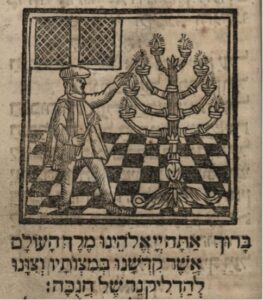
None of these works, however, addresses the menorah in early Hebrew printed books. For that, see our article “The Image of the Menorah in the Early Printed Hebrew,” along with the comments adding further examples.

New and Notable

Daniel Sperber has just published Mei Chanukah, a new work on the berita associated with Chanukah. Due to timing, it will likely only be available in Israel this year. If anyone knows of US distributors, please note them in the comments.

Not all recent scholarship meets the same standard. Akiva Shamesh’s review highlights serious deficiencies in Mitzva Ner Ish u-Beyoto. In another review, “Yemi Shemonah,” Shamesh addresses the “famous” Bet Yosef question: why eight nights of Chanukah rather than seven?

Sefer Minhagim, 1724, Gross Family Collection

Chanukah Samach!


The Hanukkah Miracle

The Hanukkah Miracle

Marc B. Shapiro
In an earlier post I mentioned that I hoped to write about the nineteenth-century dispute about the historicity of the Hanukkah miracle of the oil. This dispute broke out after the publication of Hayyim Zelig Slonimski’s article claiming that Maimonides did not believe in the miracle. Fuel was added to the fire when R. Samuel Alexandrov publicly supported Slonimski and argued that the miracle of the oil was intended to be understood in a non-literal fashion, with the oil representing Torah. (He later retracted this view, presumably due to public pressure.) There is no longer a need for me to write in any detail about this matter after Zerachyah Licht’s recent comprehensive Seforim Blog post here, which also includes Slonimski’s original article.[1]
However, there are a few points I would like to add.
In my post here I wrote:
To give an example . . . of how [R. Samuel Moses] Rubenstein’s later thought broke with tradition, see his Ha-Rambam ve-ha-Aggadah (Kovno, 1937), p. 103, where he claims that the story of the miracle of Hanukkah is almost certainly a late aggadic creation, and like many other miracle stories in aggadic literature was not originally intended to be understood as historical reality:[2]
ספק הוא אם הנס של “פך השמן” הוא אפילו הגדה עממית קדומה, קרוב שהוא יצירה אגדית חדשה מבעל הברייתא עצמו או מאחד מבעלי האגדה, ונסים אגדיים כאלו רבים הם בברייתות וגמרא ומדרשים ע”ד ההפלגה כדרכה של האגדה. ולבסוף הובן נס זה למעשה שהיה. עיין שבת כ”ג א’. [טעם ברייתא זו הובא גם במגילת תענית (פ”ט) אבל כמו שנראה היא הוספה מאוחרת, ועיין (שם) ובפסיקתא רבתי (פיסקא דחנוכה) עוד טעם להדלקת נרות חנוכה[.
During the most recent Hanukkah I was using R. Joseph Hertz’s siddur, the Authorized Daily Prayer Book. Based upon how he describes the holiday and the lighting of the menorah, omitting any mention of the miracle of the lights (pp. 946-947), I assume that he also didn’t accept it literally. Note how he states that the lights were kindled during the eight-day Dedication festival, and this is the reason for the eight days of Hanukkah, rather than offering the traditional reason that the eight days of Hanukkah commemorate the eight days that the menorah miraculously burnt.
Three years to the day on which the Temple was profaned by the blaspheming foe, Kislev the 25th 165, Judah Maccabeus and his brethren triumphantly entered the Holy City. They purified the Temple, and their kindling of the lights during the eight-day festival of Dedication—Chanukah—is a telling reminder, year by year, of the rekindling of the Lamp of True Religion in their time.
Ad kan my words in the prior post. Some time ago I was asked if I know of any other traditional authors who deny the literalness of the Hanukkah miracle. It could be that R. Isidore Epstein should be added to the list, as in his classic work Judaism he describes Hanukkah and the kindling of lights, but mentions nothing about the miracle. However, unlike Hertz whose comments were in a siddur and directed to Jews, Epstein’s book is directed towards a general reader, and can still be used as a college text. Understandably, one would hesitate to include in such a book anything about a miracle. Yet I think it is telling that he does not even say something like, “according to tradition a cruse of oil with enough for one day burnt for eight.”
Another traditional author who must be mentioned in this regard is R. Zev Yavetz. Here is his picture.
And to remind people of what Slonimski looked like, here is his picture.[3]

And here is a picture of R. Alexandrov.
Yavetz was one of the leaders (and founders) of the Mizrachi movement, and Kfar Yavets, a religious moshav, is named after him. After his death, R. Kook wrote about how Yavetz was able to combine Torah and secular wisdom without being negatively affected and distorting religious values.[4] Yavetz is best known for his writings on Jewish history. His magnum opus is his 14 volume Toldot Yisrael. In volume 4, pp. 89-91, he discusses the Hanukkah story.

As you can see, there is no mention of the miracle of the oil. The eight day holiday is portrayed as a commemoration of the original eight day celebration that took place when the Temple was rededicated. I don’t think there is any other conclusion that can be drawn other than that Yavetz did not regard the miracle of the oil as an actual historical event.

In 1900 R. Aryeh Leib Feinstein published his Elef ha-Magen. On p. 35b he writes that whereas R. Judah (bar Ilai) believed in the Hanukkah miracle, R. Yose and R. Judah ha-Nasi did not, and that is the reason why R. Judah ha-Nasi did not include the laws of the Hanukkah lights in the Mishnah.
חיוב נר חנוכה עתה אינו בשביל המלוכה רק מפני הנס שנעשה בפך השמן שהדליקו בו שמונה ימים, ואף שגם טעם זה תלוי במחלוקת שבין ר’ יודא ור’ יוסי בהוריות [יא ע”ב] שלדעת ר’ יודא נסים רבים אירעו בשמן המשחה, ור’ יוסי חולק עליו שלא היה בו שום נס, ומטעם זה ג”כ השמיט רבי דיני נר חנוכה, ולא הזכירו בשום משנה, רק מזכירו לענין ניזקין בשם ר’ יודא שפוטר החנוני, לפי שר’ יודא לשיטתו סובר שנר חנוכה הוא מצוה לזכר הנס שאירע בפך שמן המשחה. אבל רבי פוסק כר’ יוסי לפי שנימוקו עמו. אך התלמוד אוחז בזה כר’ יודא לפי שהנס מהשמן כבר נתפרסם בהאומה.
On p. 36a Feinstein refers to the dispute between Slonimski and the rabbis, and says that many good Jews adopted Slonimski’s position. He tells us that he informed Slonimski that the dispute between him and the rabbis was actually an old dispute.
ואחריו נמשכו עוד רבים וכן שלמים שמהרו ויחליטו כדבריו . . . והראיתיו לדעת שבאמת ענין זה כבר דשו בו רבים, ונחלקו עליו משפחות משפחות, וביחוד ר’ יודא ור’ יוסי בהוריות. אך בכ”ז רבינו הקדוש אף שנטה למלכות בית דוד ולדעת ר’ יוסי, לא ערב לבו לנגוע במנהג ישן שקימו וקבלו עליהם הדורות שלפניו.
Not long ago I was listening to some recordings from R. David Bar-Hayim of Machon Shilo. One of them is entitled “The Story of the Macabees, part 2.” You can find it here. In this lecture, beginning at minute 27, R. Bar-Hayim explains that in his opinion there was no miracle of the oil, and it is simply a legend that developed in Babylonia, “because without that Hanukkah makes no sense for a Jew in galut.” Rather than attempt to summarize his perspective, it is preferable for readers to listen to his entire shiur.
Because of his originality, I would not have been surprised had R. Chaim Hirschensohn adopted the same sort of approach. Yet this is not the case, and R. Hirschensohn writes that the Hanukkah miracle was the final open miracle in Jewish history, by which he means that after this Jewish history is to be explained in a more naturalistic way, just like the history of other peoples. However, he adds that it must also be recognized that the very existence of the Jewish people over so many years in exile is itself a miracle.[5]
נר חנוכה הוא חותם הניסים בדברי ימי עמנו, כמלאכי חותם הנביאים.
אחרי נצחון החשמונאים החלו אצלנו דברי הימים כאשר לכל העמים, אם שאין ספק שגם מקודם היה לנו דברי הימים אבל המסופר לנו המה רק מעשה ניסים ובתוכם עלינו לבקש גרעיני דברי הימים, אבל המסופר לנו אחרי מלחמת החשמונאים כלו דברי הימים אבל הדברי הימים בעצמו הוא כלו מעשה נסים כי בארצות הגולה בנס אנו עומדים.
Since Slonimski claimed that Maimonides did not believe in the Hanukkah miracle, I think it is worth noting that although Maimonides could have stated that Hanukkah commemorates the military victory or the rededication of the Temple, he actually appears to say that the entire holiday is in commemoration of the lighting of the Menorah.[6] There are many sources[7] that state that the real miracle commemorated by Hanukkah is not the oil but the military victory, but this does not seem to be Maimonides’ perspective. Here is what he writes in Mishneh Torah, Hilkhot Hanukkah 3:2-3[8]:
ב. וכשגברו ישראל על אויביהם ואיבדום בחמישה ועשרים בחודש כסלו היה ונכנסו להיכל ולא מצאו שמן טהור אלא פך אחד ולא היה בו להדליק אלא יום אחד בלבד והדליקו ממנו נרות המערכה שמונה ימים עד שכתשו זיתים והוציאו שמן טהור.
ג.  ומפני זה התקינו חכמים שבאותו הדור שיהיו שמונת הימים האלו שתחילתן מלילי חמישה ועשרים בכסלו ימי שמחה והלל ומדליקין בהן הנרות בערב על פתחי הבתים בכל לילה ולילה משמונת הלילות להראות ולגלות הנס וימים אלו הןן הנקראין חנוכה.
In fact, this is the talmudic perspective as well. Shabbat 21b asks what is the reason for the holiday of Hanukkah (מאי חנוכה), and rather than speak about the military victory or rededication of the Temple all it mentions is the miracle of the oil. Many will find this strange, since can this really be the reason for the holiday? It is one thing to say that this is the reason for the eight days of celebration, but can this be the reason for the holiday itself? The Sheiltot of R. Ahai Gaon[9] preserves another version of the talmudic text. Instead of מאי חנוכה it reads מאי נר חנוכה. With this as the question, the answer which explains about the miracle of the oil makes much more sense.[10]
Slonimski did not argue that Maimonides’ philosophy does not leave room for the Hanukkah miracle. He simply pointed out that when Maimonides records the talmudic story of the miracle he leaves out three words: נעשה בו נס. Here is the relevant section of the talmudic text in Shabbat 21b. I have underlined the crucial words:
וכשגברה מלכות בית חשמונאי ונצחום בדקו ולא מצאו אלא פך אחד של שמן שהיה מונח בחותמו של כהן גדול ולא היה בו אלא להדליק יום אחד נעשה בו נס והדליקו ממנו שמונה ימים לשנה אחרת קבעום ועשאום ימים טובים בהלל והודאה.
Here is what Maimonides writes in Hilkhot Hanukkah 3:2, and as you can see the underlined words do not appear.
וכשגברו ישראל על אויביהם ואיבדום בחמישה ועשרים בחודש כסלו היה ונכנסו להיכל ולא מצאו שמן טהור אלא פך אחד ולא היה בו להדליק אלא יום אחד בלבד והדליקו ממנו נרות המערכה שמונה ימים עד שכתשו זיתים והוציאו שמן טהור.
According to Slonimski, the omission of the words נעשה בו נס indicates that Maimonides does not believe that there was any miracle. Rather, Maimonides is telling us that since there was not enough oil to last for more than one day, they used a little of the oil on each of the eight days, until they were able to get more oil.
A weakness in Slonimski’s argument, which of course was pointed out, is that in the very next halakhah, 3:3, Maimonides appears to explicitly mention the miracle.
ומדליקין בהן הנרות בערב על פתחי הבתים בכל לילה ולילה משמונת הלילות להראות ולגלות הנס
 
It is hard to see the underlined words as referring to anything other than the miracle of the oil.
Needless to say, Slonimski would have been very happy to learn that these underlined words, although they appear in the standard printed editions of the Mishneh Torah going back to early printings, do not appear in manuscripts and are not authentic (and have thus been removed from the Frankel edition). Presumably, these words were added by someone to “correct” Maimonides’ omission of the miracle of the oil.[11] (Slonimski, who did not know that להראות ולגלות הנס was a later addition, was forced to claim that these words referred to the military victory.[12])
If this was all we had to go by, I might agree that Maimonides is hinting to us that he did not accept the historicity of the miracle of the oil. However, if we examine Mishneh Torah, Hilkhot Hanukkah, chapter 4, we find that Maimonides mentions “the miracle,” and again, the miracle he refers to appears to be that of the oil.[13]
In 4:12 he writes:
מצות נר חנוכה מצוה חביבה היא עד מאוד וצריך אדם להיזהר בה כדי להודיע הנס ולהוסיף בשבח הא-ל והודיה לו על הנסים שעשה.
In 4:13 he writes
הרי שאין לו אלא פרוטה אחת ולפניו קידוש היום והדלקת נר חנוכה מקדים שמן להדליק נר חנוכה על היין לקידוש היום הואיל ושניהם מדברי סופרים מוטב להקדים נר חנוכה שיש בו זכרון הנס.
 
Isn’t the most likely understanding that these two halakhot refer to the miracle of the oil? In 4:12 he first mentions “the miracle,” which I believe refers to the miracle of the oil, and then mentions “the miracles” in plural, which would also include the military victory. I don’t believe that Maimonides generally leaves esoteric hints in the Mishneh Torah, so I don’t think leaving out the words נעשה בו נס are intended to hint to us that he rejects the historicity of the miracle. In fact, since Maimonides denies the historicity of some events recorded in the Bible, regarding them as dreams or visions, it would not have been a theological problem for him to do so with the miracle of the oil, the source of which is a talmudic aggadah. However, as we have seen, he seems to explicitly affirm this miracle in the Mishneh Torah. Therefore, one who wants to claim that Maimonides did not believe in the miracle (despite what he says in the Mishneh Torah), will have to base this claim on an interpretation of Maimonides’ approach to miracles as set out in the Guide.
As mentioned, Slonimski’s rejection of the miracle of the oil created a great controversy, but what appears to be unknown is that he was not the first of the Hebrew writers to bring this matter to the fore. The newspaper Ha-Magid published articles by both maskilim and traditional Torah scholars. On December 9, 1868[14] Nahum Bruell[15] published an article which states: “In truth, the story of this miracle is not accepted by all sages of the Talmud and Midrash.” He then cites Pesikta Rabbati, ch. 2, which asks why we light נרות on Hanukkah. Its answer is not the story of the miracle but that after the Jews entered the Temple they took eight spears and put נרות on them.
נכנסו לבית המקדש מצאו שם שמונה שפודין של ברזל וקבעו אותם והדליקו בתוכם נרות.
Bruell also cites the medieval tosafist R. Isaac ben Judah ha-Levi who in his Pa’neah Raza,[16] in explaining why the Hasmoneans decreed lighting of the נרות, mentions nothing about the miracle:
נסמכה פרשת נרות לחנוכת המזבח וע”ז סמכו בית חשמונאי לתקן נרות בחנוכה
Although Bruell cited this text to show that not everyone accepted the Hanukkah miracle, I find it impossible to believe that R. Isaac (or any other medieval Ashkenazic sage) did not accept the traditional story of the miraculous burning of the oil. If I am correct that R. Isaac’s explanation is not in place of the Hanukkah miracle but only to offer an additional explanation, then perhaps even a text like Pesikta Rabbati cites the explanation it does, not because it did not know or accept the story of the miraculous oil, but because it wanted to offer another explanation, perhaps one not as well known.
Bruell further suggests that the talmudic aggadah about the Hanukkah miracle was never meant to be taken literally:
ואפשר גם בתשובתם על השאלה מאי חנוכה רמזו לנו כעיון גדול ועמוק כי אין מעצר לד’ להושיע ברב או במעט ואם גם נמשכו כל כוכבי התקוה ורבים חללו את ברית קדש מ”מ מפך שמן טהור המונח בחותמו של כה”ג דהיינו משארית הצדיקים אשר יחזיקו במעזם ויבטחו בד’ נעשה נס, יבא עזרם מעם ד’ עשה שמים וארץ ועוד יזרח להם אור התשועה.
One more point worth noting is about the number 8. According to the traditional story of the miracle of the oil, what is special about the number 8? Most people have probably heard the reason, also accepted by Maimonides, Hilkhot Hanukkah 3:2, that in the days of the Hasmoneans this is how long it would take for those in Jerusalem to get new olive oil.[17] I never understood this explanation as why should getting new oil be a problem. It is not like olive trees are a rare thing in the Land of Israel. In any event, this explanation does not appear in the Talmud but is first found in a geonic responsum.[18]
למה אנו עושין שמונה ימי חנוכה מפני הנס שאירע שטמאו יונים וכו’. ומה טעם יש לשמנה לילות ולא הספיקו ממנו פחות או יותר.
מפני שהשמנים באים מחלקו של אשר כדכתיב (דברים לג, כד) וטובל בשמן רגלו ומקום היה לו שנקרא תקוע כדאמרינן תקוע אלפא לשמן שממנו השמנים יוצאים ומשם עד ירושלים היה מהלך שמנה ימים בין הליכה וחזרה והכי אמרינן במנחות ולפיכך המתין להם עד שיביאו משם שמן טהור וזה שנעשה להם נס לשמנת ימים.
There are a number of difficulties with this responsum. To begin with, we are told that olive oil came from the area of the tribe of Asher which is in the extreme north of the Land of Israel. This information is based on the fact that in Moses’ blessing for the tribe of Asher in Deuteronomy 33:24, he states, “let him dip his foot in oil.” This means that there would be lots of olive trees in Asher’s territory, but since there were plenty of olive trees closer to the Temple, why did they have to travel all the way to the land of Asher which, we are told, would require an eight day round trip. Even if one supposes (without any evidence) that normally they would go there since that was where the best olive oil was to be found, if they only had enough to light the menorah for one day, it is hard to imagine that they would not set out to find olive oil closer to the Temple.
The next point in the responsum is that there was a specific place in Asher’s territory called Tekoa, and that was where the oil came from. It cites Menahot 85b where the Mishnah states that “Tekoa ranks first for the quality of its oil.” Yet as I’m sure most people reading this know, Tekoa is near Jerusalem in the territory of Judah, not in the land of Asher. II Chronicles 11:5-6 states: “And Rehoboam dwelt in Jerusalem, and built cities for defense in Judah. He built even Bethlehem, and Etam, and Tekoa.”
As proof for the statement that it would take eight days to travel to the north and back in order to get the olive oil, we are told והכי אמרינן במנחות. Yet nowhere in Menahot is this information found. In Sefer Abudarham, Seder Hadlakat Ner Hanukkah, this geonic passage is quoted, but instead of referring to Menahot, we are told that the information is found in the Jerusalem Talmud. The same reference to the Jerusalem Talmud also appears in Hiddushei R. Yehonatan mi-LunelShabbat 21b, and Sefer ha-Eshkol, ed. Auerbach, vol. 2, p. 20. For those who assume that Auerbach’s edition of Sefer ha-Eshkol is a forgery, this reference is just another example of the work incorporating passages from other writings.
I don’t have an answer as to why anyone assumed that the oil had to come from the land of Asher, but as for the city of Tekoa, it could be that there was another city also named Tekoa, in addition to the one we know about in the territory of Judah. The Soncino Talmud, Menahot 85b, informs us that both Graetz and Bacher think that the Tekoa mentioned there is in the Galilee, which could be said to include part of the territory of Asher.[19] Furthermore, Samuel Klein, the leading geographer of the Land of Israel, also argues that there was a city named Tekoa in the Galilee.[20]
What about the Tekoa that Amos came from? If you look at R. David Kimhi’s commentary to Amos 1:1, he tells us that Tekoa was a large city in the land of Asher (see also his commentary to Amos 7:10). In his commentary to II Samuel 14:2, he writes, quoting the Talmud in Menahot 85b (except for the first four words):
העיר בחלקו של אשר דכתיב ביה וטוב בשמן רגלי שמושך שמן כמעין
The biblical story Radak is commenting on is when Joab fetched a wise woman from Tekoa and told her to go to King David and pretend to be a mourner. I am surprised that Radak would assume that Joab was summoning a woman from all the way in the territory of Asher. In his response to Radak, R. Profiat Duran (Efodi[21]) states that it is obvious that the story is dealing with a city near Jerusalem.[22]
והשכל הישר ישפוט כי תקוע היה קרוב לירושלם כי איך ישלח לקרות אשה מארץ אשר היה רחוק מירושלם.
Again we have to ask, just because a city named Tekoa happened to be known for its olive oil, why should anyone assume that it is in the territory of Asher? The fact that the tribe of Asher was blessed with having a lot of olive trees in its territory does not mean that the other tribes did not also have a good supply. In fact, it appears to me that the peshat of Menahot 85b, where the Mishnah speaks of Tekoa as having good olive oil, is that it is speaking about the Tekoa near Jerusalem.[23] It is true that in the talmudic discussion Tekoa and the land of Asher are mentioned regarding olive oil, but their only connection would seem to be this, not that Tekoa has anything to do with Asher’s territory.[24]
Jeremiah 6:1 states: “Gather the sons of Benjamin from the midst of Jerusalem, and blow the horn in Tekoa.” Here Jeremiah is telling the tribe of Benjamin, who lived near Jerusalem, to blow the horn in Tekoa in order to warn the people about the danger from the approaching enemy. Malbim on this verse comments that Tekoa is part of Asher. I don’t understand how Malbim could view this as peshat. Why would the people of Benjamin travel to the territory of Asher to blow the shofar? This territory was occupied by foreign troops, the local inhabitants having been deported a long time before. Here are Malbim’s words:
העיזו אתה בני בנימין התאספו מקרב ירושלים, כי בני בנימין לא היו מבני העיר ורצו לחסות שם בירושלים, אומר כי יתרחקו משם, וגם בתקוע שהוא בחלק אשר, תקעו שופר.
Based on Jeremiah 6:1, Efodi states that Tekoa is actually in the territory of Benjamin and not, as I mentioned before, in Judah’s territory.[25]
Returning to our discussion of the Hanukkah miracle, R. Sharon Shalom recently published a very interesting book entitled Mi-Sinai le-Ethiopia (Tel Aviv, 2012). This book, which is a code of halakhah for Ethiopian Jews, has haskamot from R. Nachum Rabinovitch and R. Shabtai Rappaport. It is significant in that it takes into account that it is not so easy for the older generation of Ethiopian Jews to entirely reject their traditions in order to become modern rabbinic Jews. As such, R. Shalom permits certain things that would not make sense in the larger Jewish world but are part of what he terms “Ethiopian halakhah.” For example, R. Shalom permits Ethiopian Jews, especially of the older generation, to carry items regarded as muktzeh when this is related to holy matters, for example, bringing money to synagogue on the Sabbath for charity. This was not regarded as prohibited in Ethiopia and R. Shalom allows the practice to continue today (pp. 170-171).
This is a fascinating book as it attempts to slowly ease the Ethiopian community into the wider halakhic community rather than requiring an immediate abandonment of long-standing practices, something that would certainly be demanded by haredi poskim. You can see R. Shalom discuss his book here, and he is introduced by R. Rappaport.
While the book deserves detailed analysis, I only want to call attention to one additional point that is relevant to this post. Here is R. Shalom’s discussion of Hanukkah, from pp. 214-215 in the book. There is no mention of the Hanukkah miracle in explaining why we celebrate an eight day holiday.


I would like to call readers’ attention to a short essay by R. Nosson Fried on Megilat Antiochus.[26] Here is the title page.
R. Fried points out that in the version of Megilat Antiochus that he published in Kovetz Beit Aharon ve-Yisrael[27] there is no mention of the miracle of the oil. He is quite surprised by this for as he says, “this is the central miracle in commemoration of which they established the lighting on Hanukkah.” He adds that this miracle is not mentioned in Al ha-Nisim or in Pesikta Rabbati which has a good deal to say about Hanukkah. He then notes that all of the Eretz Yisrael paytanim, which includes Yanai and R. Eleazar ha-Kalir, and some of the European paytanim also do not mention the miracle. (Other European paytanim, such as R. Menahem ben Machir, do mention the miracle.) How can this be explained?
R. Fried’s answer is quite unexpected (p. 8): “The sages of the Land of Israel in the time of the Talmudim and Midrashim knew nothing about the miracle of the cruse of oil.” He explains that the story of the miracle is a Babylonian tradition and thus was not known in the Land of Israel, or even by some of the early European paytanim. He writes (p. 9):
שכל אותן המקורות הקודמים, החל מספרי החשמונאים וכלה בפייטני א”י ומקצת מפייטני אירופה הקדמונים, לא ידעו כלל שאמנם היה נס בשמן . . . [הנקודות במקור] לשיטתם נקבע חג החנוכה לזכר הנצחונות והנסים שאירעו לבני חשמונאי במלחמותיהם נגד היונים.
Coming from a haredi writer this is quite surprising, and let me explain why. All of the scholars who have argued against the historicity of the miracle of the oil have pointed out that none of the oldest texts dealing with Hanukkah mention this miracle. This includes 1 and 2 Maccabees, the earliest version of Megilat Ta’anit, tannaitic texts, and Josephus. Josephus even suggests a different explanation for why the holiday is called “Lights.” Those who defend the historicity of the miracle have to explain why these sources chose not to mention it.Before Fried, no traditional author had ever suggested that the miracle story was unknown to the tannaim and later rabbinic authors, and that is for an obvious reason. If you say that the tannaim did not know the miracle, to say nothing of the authors of the Book of Maccabees 1 and 2, the earliest version of Megilat Ta’anit, and Josephus, how is it possible that someone who lived a few hundred years later in Babylonia would know about the miracle? By saying that the people who lived in the Land of Israel close to the time of the events did not know the miracle, Fried is providing an argument that the miracle never happened and that the much later story recorded in the Babylonian Talmud is an aggadah which is not to be regarded as historical but rather teaches a lesson as many aggadot do. In other words, Fried’s argument leads to the same conclusion as Slonimski and R. Alexandrov, and for some reason he doesn’t see it.

R. Tuvyah Tavyomi has another approach to the matter.[28] He claims that since the miracle of the oil was only seen by a small group, the leaders of the generation were afraid that the masses, many of whom were hellenized, would not believe the story and thus not adopt the holiday. Therefore, they ordained the lighting of נרות without giving a reason, hiding the real reason from the people. The masses would believe that it was because of the military victory, while those who knew that holidays are only proclaimed for “out of the ordinary” miracles, they would find out about the story of the oil and would certainly believe it. According to R. Tavyomi, this explains why in the Al ha-Nissim prayer which is to be said by all people there is no mention of the miracle of the oil.
Finally, I was surprised that an article by Avraham Ohayon could be published in Shenaton Shaanan, the annual of Shaanan, a religious teachers college.[29] Ohayon’s article not only critically examines the story of the Hanukkah miracle, which he calls מיתוס נפ”ה (נס פך השמן)  (p. 59), but concludes that that it is most likely that the miracle never happened and was invented by the Sages for religious reasons. On pp. 58-59 he writes:
שתיקתם של המקורות ההיסטוריים, ובמידה מסוימת גם של חז”ל ומקורות הלכתיים בעניין נפ”ה – מעוררת שאלות בקשר למשמעות העובדתית של נס זה: האם הנס התרחש, וכתוצאה ממנו קבעו חז”ל את סממניו ההלכתיים, או שכדי לקבוע הלכות לדורות היה צריך קודם לסמוך להם נס?
חלק הארי של המקורות דלעיל – מחזק יותר את קיומה של האפשרות השנייה. . . .
חז”ל החילו שני שינויים במהותו של החג, ושניהם קשורים זה בזה:
האחד – שינוי עיקרו של הנס, מסגידה לניצחון הצבאי – לנס על-טבעי שהוא נפ”ה.
השני – הענקת צביון דתי לחג על-ידי קביעת איסורים שונים, תפילות מיוחדות ומצוות הדלקת הנרות שמונה ימים – כזכר לנפ”ה.
In a note on this passage, Ohayon cites Gedaliah Alon who explains what would have led the Sages to invent the Hanukkah miracle:
[אלון] תומך בדעה השנייה מן הטעם, שחז”ל רצו להשכיח את שם החשמונאים וגבורתם מזיכרון האומה, ואולם לא יכלו לעקור את חג החנוכה גופו. לכן קבעו טעם אגדי ובדרך זו “קיפלו” בו את תקופת החשמונאים, שהרי סיפור נפ”ה התחיל ממקורות חז”ל בלבד. הוא מביא גם נימוקים ליחס זה של חז”ל לחשמונאים.
Nothing Ohayon writes would be surprising if it appeared in a general academic journal, but as mentioned, his article appeared in a religious journal and that is what I find significant.
Returning to R. Samuel Alexandrov, who as mentioned at first supported Slonimski, Geulah bat Yehudah has a nice article on him[30] as does Ehud Luz,[31] and there is a master’s dissertation on him by Tsachi Slater.[32] Yet I would like to call attention to a few things that these authors have not mentioned. To begin with, R. Alexandrov reports that after the death of R. Shemariah Noah Schneersohn he was asked to take the latter’s place as rav of Bobruisk (R. Alexandrov’s place of residence), yet he refused this offer.[33]
In Mikhtevei Mehkar u-Vikoret (1932), pp. 86-87, R. Alexandrov offers a provocative suggestion in explaining why Maimonides was so opposed to rabbis taking money from the community. He calls attention to Hullin 132b which states: “R. Simeon says. A priest who does not believe in the [Temple] service has no portion in the priesthood.” Rashi explains this to mean a priest who thinks the Temple service is nonsense and rather than having been commanded by God was invented by Moses. As for having no portion in the priesthood, Rashi explains that he does not receive a portion of the sacrificial meat.
Maimonides, Hilkhot Bikurim 1:1, codifies the law as follows:
וכל כהן שאינו מודה בהן אין לו חלק בכהנים ואין נותנין לו מתנה מהן.
According to R. Alexandrov, this is the key to understanding why Maimonides opposes rabbis taking money from the community. R. Alexandrov assumes based on what Maimonides writes in the Guide of the Perplexed that he did not really believe in the value of sacrifices. )R. Alexandrov himself did not believe that there would ever be a return to the sacrificial system.[34]) He further states that Maimonides realized that if he were a kohen he would have no portion in the priestly dues. Since the rabbinate, as the religious leadership of the community, replaces the old system of the kehunah, Maimonides reasoned that just as if he were a kohen he could not receive any priestly dues, so too as a rabbi he could take nothing from the community.
בספרו המורה הלא איננו מודה בקרבנות לפי המובן המורגל, ולכן חש בנפשו הנפש היפה שאין לו חלק במתנות כהונה . . . [הנקודות במקור] ובכן על פי טבעו ורוחו אוסר לקבל שכר רבנות, כי אמנם הרבנות הוא דמות זעיר אנפין של הכהונה בימים הקדמונים, כנודע.
R. Alexandrov also says a few things that some haredi readers will appreciate. For example, he explains Avot 2:2:  וכל תורה שאין עמה מלאכה סופה בטלה וגוררת עון in a very original fashion. He understands מלאכה to mean the work of creating Torah novellae! This passage in the Mishnah is always used against the Israeli haredi approach of shunning work in favor of study, and I have never seen a good justification offered as to why the Mishnah’s words can be so easily set aside. Yet with R. Alexandrov’s explanation, this is no longer a problem.[35]
ומה שאמר “כל תורה שאין עמה מלאכה סופה בטלה וגוררת עון”, יש לכוין על מלאכת החדוש והפלפול וההגיון בתורתנו, ואומר כי תורה שאין עמה מלאכה ר”ל מלאכת החדוש סופה בטלה כי באמת רק כח החדוש הנותן פנים להתורה הקדושה בכל דור ודור לפי הרוח השורר אז, הוא הוא המקיים את התורה הישנה בעם ישראל.
* * * * *
1. Dov Weinstein called my attention to the following very significant responsum by R. Ovadiah Yosef that appeared in the journal Beit Yosef, Iyar 5776, no. 169. Over a century ago, R. Shalom Mordechai Schwadron suggested a way of “cleansing” a mamzer by having the husband send his wife a get and then void it before it is delivered. According to the Talmud, in such a case the marriage is to be regarded as annulled despite the fact that the husband voided the get. The problem the Sages had to deal with was if the husband was allowed to void a get after having sent it, the woman who received it would not know that it was invalid and would remarry. Although it would not be her fault, such a situation would result in her future children being mamzerim. The way around this was to decree that in such a case her original marriage was to be regarded as never having been actualized, something which the rabbis have authority to do. R. Schwadron’s originality comes in suggesting that this mechanism could also be used to solve the problem of mamzerut even after the fact, since if the original marriage is annulled in this fashion, by sending a get and then cancelling it before delivery, there is no subsequent adultery. This proposal, which was never put into practice by R. Schwadron, is discussed by R. J. David Bleich in Contemporary Halakhic Problems, vol. 1, pp. 162ff.
R. Ovadiah’s responsum is of great importance since his approach would solve the problem of mamzerut in many case. In earlier years, R. Isser Yehudah Unterman suggested that R. Schwadron’s approach be followed in a particular case,[36] and R. Zvi Pesach Frank actually did so in another case.[37]

2. Is it significant that a haredi website recently published an article from a woman in which she argues that women should be able to become halakhic authorities? Was the website just looking to stir up trouble or is this a sign of something afoot even in the haredi world?
3. There has recently been a problem with the commenting whereby many comments that have Hebrew in them are rejected as spam. One of the rejected comments was by R. Moshe Maimon and is very insightful. Responding to R. Hershel Schachter’s point, discussed here, that Daas Torah authorities must be poskim, R. Maimon wrote:
Here is the Rambam’s formulation of the ‘Daas Torah’ concept:

כן ראוי להמון שימסרו הנהגתם לנביאים בעלי העינים באמת, ויסמכו על מה שיודיעום שהדעת הפלונית אמתית והדעת הפלונית שקר. ואחר הנביאים – החכמים הדורשים יומם ולילה הדעות והאמונות, עד שידעו ויכירו האמת מן השקר.

I don’t recall seeing this passage from אגרת תימן (Sheilat ed. p. 149) quoted in the various articles on the subject, but at any rate it seems to serve as a clear repudiation of Rav Schachter’s view that only poskim can issue Daas Torah directives.
Regarding Daas Torah, someone challenged my statement in my post here that R. Kanievsky actually declared in a formal way that R. Steinman is to be regarded as the new leader. Readers can look at the actual words where R. Kanievsky indeed declares that everyone is “obligated” to follow what R. Steinman says. (An English translation is found here.) I don’t know of any other such declaration in Jewish history. The gedolim have always been “created” by the religious community at large, and the gadol ha-dor (when there has been such a figure) emerged from this group of gedolim based on public acknowledgment. Yet here we have a declaration from one gadol establishing who the gadol ha-dor is and obligating everyone to follow his guidance. Will this be the new model in the haredi world for how to determine who the gadol ha-dor is?

Thanks to the person who doubted what I wrote, I was motivated to find R. Kanievsky’s statement and I see that I did say something incorrect. I wrote that R. Kanievsky’s statement was made after R. Elyashiv’s death, but in fact it was made shortly before R. Elyashiv’s passing, when he was no longer in the position to serve as leader of the generation.


[1] One source not cited by Licht is a recent article by Yisrael Rozenson that focuses on R. Alexandrov and the miracle of the oil. “‘Asukh shel Shemen Ehad,’ Al Nes ve-Hukiyut be-Mishnato shel Shmuel Alexandrov,” Badad 30 (Elul 5775), pp. 103-116.
[2] There is a good deal of interesting material in R. Rubenstein’s Ha-Rambam ve-ha-Aggadah. Relevant to what I mentioned in the text is that R. Rubenstein claims that many aggadot are not intended to be viewed as historical, and he refers to a number of such examples. See e.g., p. 101, that when the Talmud states that Solomon came up with the idea of an eruv, this is not to be taken literally but only means that it is an old idea which was later attributed to Solomon.
והמצאת היתר זה נעשה בזמן מן הזמנים שלא נדעהו, ומפני שתקנה זו היא המצאה מחוכמת מאד מאנשים חכמים נתנו למיסדי התקנה שם שלמה ואמרו שבשעה שתקן שלמה ערובין וכו’ והוא מאמר אגדי.
He also mentions that some aggadot about biblical figures were created for their dramatic effect and that those who take them literally are missing the point. See p. 94:
אבל באמת ספורים כאלו אינם מעשיות שהיו לא בהקיץ ולא בחלום אלא הן יצירות דרמטיות במעלי האגדה כיד השירה הטובה עליהם. ויצירות כאלו הרבה הן בש”ס ובמדרשים וביחוד מהאנשים הקדמונים שנזכרו בתנ”ך. עיין לדוגמא האגדה ע”ד האבן שבקש עוג מלך הבשן לזרוק על ישראל (ברכות נ”ד א’ [צ”ל ב’]) [מחזה התולי משונאי ישראל המבקשים להמיט רעה על ראשי ישראל וחוזר על ראשיהם עצמם בעטים של ישראל]. והאגדה ע”ד מיתתו של דוד שבת ל’ א’ [צ”ל ב’]) [מחזה על יקרת ערך החיים]. והאגדה ע”ד מפלתו של המן (מגילה ט”ז א’) [מחזה נקמי]. והאגדה ע”ד דוד וישבי בנוב (סנהדרין צ”ה א’) [מחזה מרחמי האב על זרעיו . . .] כל אגדות כאלו אינן מעשיות שהיו אלא יצירות דרמטיות.
I know there are some people who treat aggadot as if they are historical, but when it comes to the sort of aggadot mentioned by R. Rubenstein, do any really disagree with his understanding?
[3] It is perhaps noteworthy that Slonimski’s two sons apostatized and it appears that Slonimski himself, despite being an observant Jew, deserves some blame for this. See Eliyanah Tzalah, “Tenuat ha-Hitbolelut be-Polin,” in Yisrael Bartal and Yisrael Guttman, eds., Kiyum ve-Shever: Yehudei Polin le-Doroteihem (Jerusalem, 1997), pp. 344-345. See also Avraham Aryeh Akaviah, “HaZaS, Hayyim Yehiel Bornstein, Pesah Shapira,” Areshet 5 (1972), p. 387.
[4] S. Arnst, Sefer Yavetz (Tel Aviv, 1934), pp. 34-35.
[5] Apiryon 2 (1925), pp. 99-100.
[6] He also leaves no doubt that the obligation to light the menorah dates from the Hasmonean period. I say this even though R. Moshe Sternbuch argues that Maimonides agrees with R. Sternbuch’s own view that the obligation for individuals to light the Menorah only dates from after the destruction of the Temple. See Moadim u-Zemanim, Hanukah, vol. 6, no. 89. For a rejection of R. Sternbuch’s position, see R. Simhah Lieberman, Bi-Shevilei ha-Nisim, p. 11. R. Lieberman’s many volumes encompass vast areas of Torah scholarship and show incredible erudition. Yet for some reason, I hardly ever see his works quoted, while other books which don’t approach his level of scholarship are quoted very often.
[7] See R. Simhah Lieberman, Bi-Shevilei ha-Nisim, pp. 52ff.; R. Menahem Kasher, Divrei Menahem, vol. 4, pp. 134ff.
[8] This point is made by R. Yaakov Koppel Schwartz, Likutei Diburim (Brooklyn, 2015), p. 159.
[9] Parashat Va-Yishlah, section 26 (p. 177 in the Mossad ha-Rav Kook edition with the commentary of R. Naphtali Zvi Judah Berlin). This source was noted by Nahum Bruell, “Mai Hanukkah,” Ha-Magid, Dec. 2, 1868, p. 373, and Jacob Reifman. See Reifman’s letter in Or ha-Mizrah 18 (Tishrei 5729), p. 95. Regarding this matter, R. Naphtali Zvi Judah Berlin mentions Bruell by name in Ha-Amek She’alah, vol. 1, p. 178. For some reason, the Netziv refers to Bruell as בעל המגי’ which is strange, as Bruell only contributed articles to Ha-Magid but was not the editor.
[10] The Sheiltot, vol. 1, p. 178, preserves another important alternate text of the Talmud. Our version of Shabbat 21b reads: ולא היה בו להלדיק אלא יום אחד
The Sheiltot reads:  ולא היה בו להדליק אפילו יום אחד
The word I have underlined means that the oil they found was not even enough for one day. This means that the burning of the oil for the complete first day was also a miracle, and thus provides an answer to the famous question why there is an eighth day of Hanukkah if there was enough oil for one day, meaning that the miracle was only for seven days.
Of all the answers to this question, the strangest one has to be that of R. Yerahme’el Yisrael Yitzhak Danziger (1853-1910), the Rebbe of Alexander. He claims that the cruse of oil they found was completely empty, and this empty cruse produced enough oil for eight days. He says this even though the Talmud, Shabbat 21b, states explicitly that they found .פך אחד של שמן See R. Danziger, Yismah Yisrael (Bnei Brak, 2007), vol. 1, p. 98a  (Hanukkah, no. 58).
[11] Another addition that is not found in manuscripts is in 3:2 where Maimonides writes:
ונכנסו להיכל ולא מצאו שמן טהור אלא פך אחד
The standard printed versions read:  .ולא מצאו שמן טהור במקדש Even though the word במקדש is not found in manuscripts in this case for some unknown reason Frankel includes this mistaken word in his text and only in the textual note on the page informs the reader that it is not found in the manuscripts.
[12] Ha-Tzefirah, Nov. 28, 1892, p. 1069.
[13] R. Abraham Joel Abelson, the editor of the Torah journal Keneset Hakhmei Yisrael, which appeared from 1893-1900, polemicizes against those who deny the miracle of the oil. Yet interestingly enough, he accepts Slonimski’s point that Maimonides does not mention the miracle, and even explains why Maimonides omits it. Contrary to what I have written, he assumes that the miracle Maimonides refers to in Hilkhot Hanukah, ch. 4, is the military victory, as the lighting of the candles is a commemoration of this (Keneset Hakhmei Yisrael 6 [1896], p. 131.).
אין מקום כלל להקשות על הרמב”ם מה שלא הביא ביד החזקה מהנס של פך השמן, כי אין מדרכו לכתוב בכל הלכותיו טעמים עליהן כידוע, וגם נס פך השמן הלא רק כעין טעם על מה שקבעו הזקנים ימי החנכה לדורות . . . ועיקר הנס הלא הי’ במלחמות החשמונאים שע”ז קבעו להדליק נרות חנכה גם לדורות ולהודות ולהלל לשמו הגדול.
[14] “Mai Hanukkah,” p. 382.
[15] Bruell was the grandson of R. Nahum Trebitch, chief rabbi of Moravia and predecessor to R. Samson Raphael Hirsch in this position. Bruell himself became rabbi of the Reform community of Frankfurt in 1870, succeeding Abraham Geiger.
[16] Beginning of parashat Be-Ha’alotkha.
[17] As we know, the oil in the Temple was made impure by the Greeks, as the Talmud, Shabbat 21b, states: טמאו כל .השמנים שבהיכל
What does this mean? How could the oil have been made impure and what about the halakhic principle of טומאה הותרה בציבור which would have allowed them to light the menorah even with impure oil? Daniel Sperber argues that when the word “impure” is used it does not mean טמא in a technical ritual sense. Rather, it means that the oil was uses for idolatrous purposes and in a colloquial sense it was regarded as טמא. See Sperber, “Al ha-Mesorot be-Hanukat ha-Bayit,” Sinai 54 (1964), pp. 218-225.
[18] Otzar Geonim, ShabbatTeshuvot, p. 23. See also Meiri, Beit ha-Behirah, Shabbat 21b; R. Nissim, Shabbat, p. 9b in the pages of the Rif, s.v. תנו רבנן.
[19] I haven’t found the reference in Bacher. For Graetz, see Geschichte der Juden (Leipzig, 1893), vol. 4, p. 183.
[20] Eretz ha-Galil (Jerusalem, 1967), pp. 20-21. R. Israel Horowitz also believes that there were two cities named Tekoa. See his Eretz Yisrael u-Shkenoteha (Vienna, 1923), index, s.v. Tekoa.
[21] Duran is known as Efodi because this is how his commentary on Maimonides’ Guide of the Perplexed was named by the first printer. Yet he actually referred to himself as Efod אפד, not Efodi. This is usually understood to be an acronym of אני פרופיאט דוראן. Yet Norman Roth sees this as unlikely. He assumes that the name Efod alludes to Arakhin 16a which states that the efod atones for idolatry, “i.e., he sought atonement for his own conversion and for others in his generation.” See Roth, Conversos, Inquisition, and the Expulsion of the Jews from Spain (Madison, 2002), p. 192. See also Maud Kozodoy, The Secret Faith of Maestre Honoratus: Profayt Duran and Jewish Identity in Late Medieval Iberia (Philadelphia, 2015), pp. 4-5, 20, 25-26.
[22] Ma’aseh Efod (Vienna, 1865), p. 199. See also Abarbanel, II Sam. 14:2, who cites Efodi.
[23] See R. Yehosef Schwartz, Divrei Yosef, vol. 3, pp. 14a-b.
[24] Regarding oil and the tribe of Asher, there is a theory that the Bene Israel of India, who for centuries were engaged in oil pressing, originated from the upper Galilee which was famous for its oil. See Shirley Berry Isenberg, India’s Bene Israel (Berkeley, 1988), p. 8.
[25] See Ma’aseh Efod, p. 199.
[26] Megilat Antiochus Murhevet (n.p., 1992).
[27] No. 38 (Kislev-Tevet 5752), pp. 111-121.
[28] Tal Orot  vol. 1, pp. 91ff. This source is cited by Yaakov Rosenblum in Datche 17 (27 Kislev 5768), p. 11.
[29]  “Nes Pakh ha-Shemen ve-Derekh Hatma’ato be-Halakhah,”Shenaton Shaanan 19 (2014), pp. 47-60.
[30] “Rabbi Shmuel Alexandrov,” Sinai 100 (1987), pp. 195-221.
[31] “Spiritualism ve-Anarchism Dati be-Mishnato shel Shmuel Alexandrov,” Da’at 7 (1981), pp. 121-138.
[32] “Leumiut Universalit: Dat u-Leumiut be-Haguto shel Shmuel Alexandrov” (unpublished master’s dissertation, Ben Gurion University, 2014). See also Slater’s recent article, “Tziyonut Ruhanit Datit – Dat u-Leumiut be-Haguto shel Shmuel Alexandrov,” Daat 82 (2016), pp. 285-319.
[33] Mikhtevei Mehkar u-Vikoret (Jerusalem, 1932), p. 56.
[34] See Mikhtevei Mehkar u-Vikoret (Vilna, 1907), p. 12, where R. Alexandrov writes as follows to R. Kook:
ואמנם כן היא שהמוסריות המתפתחת מעצמה באה להחליט כדעת האומר שכל הקרבנות בטלים . . . גם אנכי הנני מסכים כי כל הקרבנות בטלים מפני שלא היו קדושים רק לשעתן.
In Mikhtevei Mehkar u-Vikoret (1932), p. 24, he speaks of the abolishment of sacrifices as a natural result of humanity’s developing sense of morality:
הנה נודעה היא למדי השקפת הרמב”ם ע”ד עבודת הקרבנות איך היתה מוכרחת בזמן הקדום ואיך היא נבטלת לאט לאט מעצמה ע”י התפתחות הרוח של האדם, ובאופן שמין האדם מבטל מעצמו את מצות הקרבנות וכל אבזרייהו מבלי הופעה דתיית  משמי מרומים, והנה תקון דתיי כזה הוא תקון שהזמן עושה, כלומה זה נעשה על פי התפתחות המוסריית האנושיית התלויה בזמן, ובאופן שהכל נעשה יפה בעתו ובזמנו, ולו עמדו כעת מתקנים במין האדם הנאור שהיו חפצים להנהיג את עבודת הקרבנות מחדש אז היה החפץ הזה נדחה מפני המוסריות האנושיות המנגדת לעבודה דתיית כזאת בכל כחה, ואין כל ספק כי יד המוסרית תהיה על העליונה כי לכל זמן ועת לכל חפץ תחת השמים.
In another letter to R. Kook, Mikhtevei Mehkar u-Vikoret (1907), p. 15. Alexandrov explains that the reason why in their day so many of the Orthodox youth, including sons of rabbis, were “going of the derech,” is because they saw their fathers up close and this turned them off religion.
רואה אנכי כי הנסבה הראשית להרחקת בני הרבנים והחרדים מדרכי אבותיהם ואשר עפ”י הרוב הלכו למקום שלא ישובו עוד לנו הוא מפני שנסתכלו במעשי אבותיהם לפני ולפנים . . . כמובן מעצמו שישנם אבות ובנים יוצאים מן הכלל אבל הרוב הניכר הנראה לעינים ילמדנו דעת כי שחת ישראל דרכו מחטאת כהניו ונביאיו ודור לפי פרנסו.
[35] Tal Tehiyah (Vilna, 1897), p. 8a.
[36] Shevet mi-Yehudah, vol. 2, no. 12.
[37] Details of this will be provided in a future post.


The Chanukah Omission

The Chanukah Omission

by Eliezer Brodt

    Every Yom Tov has its famous questions that show up repeatedly in writings and shiurim. Chanukah, too, has its share of well-known questions. In this article, I would like to deal with one famous question that has some not-very-famous answers. A few years ago I dealt with this topic on the Seforim Blog (here). More recently in Ami Magazine (# 50) I returned to some of the topics related to this. This post contains new information as well as corrections that were not included in those earlier articles. The question is, why there is no special masechta in the Mishna devoted to Chanukah, as opposed to the other Yamim Tovim which have their own masechta?[1] Over the years, many answers have been given, some based on chassidus, others based on machshava, and still others in a kabbalistic vein.[2] In this article, I will discuss a few different answers. While, answering this question I will touch on some other issues: what exactly is Megillas Taanis, when was it written, and what role did Rabbenu Hakadosh have in the writing of the Mishna.

A first source and the seven masechtos

At the outset, I would like to point out that the first source I have found thus far that deals with this question is Rabbi Yosef Karo in his work Maggid Mesharim.[3]It is interesting to note, that the most famous question related to Chanukah was also asked by Rabbi Yosef Karo, and is commonly referred to by the name of his sefer, as the “Bais Yosef’s Kasha.[4] That question, is: Why is Chanukah eight days? Since there was enough oil for one night, what exactly was the miracle of the first night? One of the answers given to the question is based on a famous Rambam that gives an important insight about what Rabbenu Hakodesh included in the Mishna. According to the Rambam, the halachos of tefillin, tzitzis, and mezuzos, as well as the nusach of tefillah and several other areas of halacha are not included in the Mishna at all because these halachos are well-known to the masses; there was no need to include them.[5]

אבל דיני הציצית והתפלין והמזוזות וסדר עשייתן והברכות הראויות להן וכן הדינים השייכים לכך והשאלות שנתעוררו בהן אין ממטרת חבורנו לדבר בכך לפי שאנחנו מפרשים והרי המשנה לא קבעה למצות אלו דברים מיוחדים הכוללים את כל משפטיהם כדי שנפרשם, וטעם הדבר לדעתי פרסומן בזמן חבור המשנה, ושהם היו דברים מפורסמים רגילים אצל ההמונים והיחידים לא נעלם ענינם מאף אחד, ולפיכך לא היה מקום לדעתו לדבר בהם, כשם שלא קבע סדר התפלה כלומר נוסחה וסדר מנוי שליח צבור מחמת פרסומו של דבר, לפי שלא חסר סדור אלא חבר ספר דינים (פירוש המשנה, מנחות פרק ד משנה א.

(There are some achronim who posit that this rationale applies to Chanukah, as well. That is, Chanukah was also well-known, and that’s why it was not necessary to include it in the Mishna.[6] Rabbi Yaakov Schorr has a problem with the statement by the Rambam that the laws and details of tefillin and mezuzah were well known—these mitzvos are very complicated and contain many details. Indeed, they are arguably much more complex than Kriyas Shema, which does have its own mesechta. To illustrate this point, the Chofetz Chaim’s son writes that his father spent months working on just two simanim of Hilchos Tefillin for his work, the Mishna Berura.[7] So too, there are many halachos related to Chanukah, and it is hard to believe that everyone knew all the halachos. However, the Maharatz Chayes, who bases his answer to the question on this same concept of the Rambam, adds an important point which would answer Rabbi Schorr’s problem. He says that the masses all knew about lighting the menorah. All the rest of the halachos of Chanukah which are discussed in the Gemara are from after the period of the Mishna, he says, and that is why Rebbe did not include them in the Mishna.[8] Rabbi Schorr resolves his own problem by suggesting that there was a Maseches Soferim devoted to the laws of tefillin, but it was lost. He claims that it forms the basis of the Maseches Soferim which we have today.[9] With this introduction, we can perhaps understand the following answers to our question, which are based on the assumption that there was a Maseches Chanukah which was lost. The Rishonim refer to “seven minor masechtos“; however, the earlier Achronim did not have these masechtos. Today, we do have “seven masechtos “, although, as we shall see, not everyone agrees that these are the same seven masechtos that the Rishonim had. During the period that these masechtos were unknown, there was some speculation as to what they contained. Rav Avraham Ben HaGra quotes his father, the Gra, in regard to what the exact titles of the seven masechtos were, and he told him that amongst the titles was Maseches Chanukah.[10]

אמנם שמעתי מאדוני אבי הגאון נר”ו שהשבע מסכות קטנות המה חוץ מאשר נמצא לנו והן מסכת תפלין ומסכת חנוכה ומסי’ מזוזה. (רב ופעלים הקדמה דף ח ע”א) As far as we know today, we have all the seven masechtos and none of them are about Chanukah.[11]

But it is possible that there was such a masechta which was lost. Rav David Luria (Radal) assumes as much and uses this assumption to understand the Teshuvos Hagaonim and says that it evidences additional masechtos that are no longer extant.[12]

ובא אלינו איש חכם וחסיד זקן ודרש בישיבה כתיב ופן תשא עיניך השמימה וראית את השמש זה נדר ואת הירח זו שבועה… וסדר משנה תוספת על סדרי שלנו ראינו בידו שהיה מביא ולא זכינו להעתיק שסבתו גדולה ונחפז ללכת ואתם אחינו הזהרו בענין זה וטוב לכם (שערי תשובה, סימן קמג).

The Vilna Gaon’s great-nephew reports that the Gra said there was even a masechta titled Maseches Emuna, which also appears to have been lost.[13]

ואמר לי איך ששמע מדו”ז הגאון מו”ה אלי’ ז”ל שהיו כמה וכמה מסכות על המדות כמו מסכתא ענוה ומסכתא בטחון וכדומה רק שנאבדה ממנו.

The one we already had

A different answer given by many [14] is that the reason why Rebbe did not have a whole masechta about Chanukah was because there was one already: Megillas Taanis! In fact, in one of the editions of Megillas Taanis (the original edition with the Pirush ha-Eshel), it says on the frontispiece: “Megillas Taanis, which is Masseches Chanukah.” The Perush ha-Eshel on Megilas Taanis wants to suggest that the Gra did not mean that there was a masechta titled Chanukah. Instead, the Gra meant Megillas Taanis. Indeed, in earlier printings of the Shas, Megillas Taanis was included with the Masechtos Ketanos.[15] Whether or not the Gra himself meant Megillas Taanis, many do say that Megillas Taanis is really Maseches Chanukah, since the most important and lengthy chapter is about Chanukah. Therefore the answer to why Rebbi did not include a masechta about Chanukah was simply because there was one already— Megillas Taanis. This answer is backed up with a statement found in the Behag, which says “that elders of Beis Shamai and Hillel wrote Megillas Taanis.”[16] זקני בית שמאי ובית הלל,… והם כתבו מגילת תעניות… To better understand this, an explanation about the nature of Megillas Taanis is needed. Megillas Taanis is our earliest written halachic text, dating from much before our Mishnayos. Some say it was so well-known that even children knew it by heart.[17] In the standard Megillas Taanis, there are two parts: one written in Aramaic, which is a list of various days which one should not fast or say hespedim on. This part is only two hundred and seventy words long. The other part was written in Hebrew and includes a lengthier description of each particular day. The longest entry in the latter part is about Chanukah. It contains reasons for the Yom Tov and some of the halachos. With this in mind, it’s not so strange to say that there is no need for a special masechta about Chanukah. Since in the earliest written text we have there is a lengthy entry about Chanukah, why would Rabbenu Hakodesh have to repeat it? The problem with this answer is that while Megillas Taanis dates from before our Mishnayos, it contains significant additions from a later time. The Maharatz Chayes and Radal say that the Aramaic part was written very early, at the point when it was not permissible to write down Torah Sheba’al Peh. At a later point, when it was permitted, the Hebrew parts were added. Maharatz Chayes says that it was after the era of Rabbenu Hakodesh. Earlier than him, Rav Yaakov Emden wrote (in his introduction to his notes on Megillas Taanis) that it was completed at the end of the era of the Tannaim. The bulk of the discussion regarding Chanukah that appears in Megillas Taanis is in the Hebrew part. It doesn’t make sense that Rebbi did not include Chanukah in the Mishna because of sections of Megillas Taanis that had yet to be written.[18] The Gedolim who first suggested that Megillas Taanis is the reason that Rabbenu Hakodesh did not include Chanukah in Mishnayos did not realize that it was written at two different time periods. However, Rabbi Dovid Horowitz in an article in Hapeles turns the historical difficulty on its head when he argues, based on Tosafos, that the person who wrote the Hebrew parts of Megillas Taanis was Rabbenu Hakodesh.[19] The problem with Rabbi Horowitz’s point is that it seems most likely that the Hebrew portion was written later than Rabbenu Hakodesh, and most do not agree with Tosafos on this point. [20] Therefore, this answer does not explain the omission of Chanukah from the Mishna according to most authorities.[21] Another answer in the same vein was suggested by Rabbi S.Z. Schick. Rav Schick conjectures that there was a Sefer Hashmonaim written by Shammai and Hillel which recorded the nissim of Chanukah, and therefore, there was no separate Mishna.[22] This seems to be based on the quote from the Behag we brought earlier. Others say this might be a reference to Sefer Makabbim or Megillas Antiyochus. Although it is likely that these two works are from early times, it is not clear how early.[23] As an aside, there is a book bearing the title Maseches Chanukah, but it was written as a parody, similar to Maseches Purim of Rav Kalonymus[24].

Rebellion, Romans, and the Power of Tradition

Another explanation for the Chanukah omission is from the Edos Beyehosef, who quotes a Yerushalmi[25] which relates the following: A child was born to the King Trajanus on Tisha B’av, and the child died on Chanukah. The Jews were not sure whether or not to light neros Chanukah, but in the end, they did. The king’s wife told him to come back from a war that he was in middle of fighting in order to fight the Jews who were rebelling against him!

בימי טרוגיינוס הרשע נולד לו בן בתשעה באב והיו מתענין מתה בתו בחנוכה והדליקו נירות שלחה אשתו ואמרה לו עד שאת מכבש את הברבריים בוא וכבוש את היהודים שמרדו בך חשב מיתי לעשרה יומין ואתא לחמשה אתא ואשכחון עסיקין באורייתא בפסוקא ישא עליך גוי מרחוק מקצה הארץ וגומ’ אמר לון מה מה הויתון עסיקין אמרון ליה הכין וכן אמר לון ההוא גברא הוא דחשב מיתי לעשרה יומין ואתא לחמשה והקיפן ליגיונות והרגן אמר לנשיהן נשמעות אתם לליגיונותי ואין אני הורג אתכם אמרון ליה מה דעבדת בארעייא עביד בעילייא ועירב דמן בדמן והלך הדם בים עד קיפרוס באותה השעה נגדעה קרן ישראל ועוד אינה עתידה לחזור למקומה עד שיבוא בן דוד (תלמוד ירושלמי,סוכה, פרק ה)

The Edos Beyehosef writes that Rabbenu Hakadosh chose not to include Chanukah in the Mishna. If a simple lighting of neiros caused such a reaction from our enemies, all the more so if this would be included in our crucial text—the Mishna.[26]

וכתיבת דיני נר חנוכה יש בה פירסום יותר מהדלקה מפני שהדלקה היא בבתי ישראל בזמן מועט חי’ ימים בשנה חצי שעה בכלל לילה ואפ’ זה סמיה בידן להדליק בפנים אם יש חשש סכנה אבל דבר בכתב קיים כל הימים ומתפשט בעולם על ידי כל אדם המעתיקם כל מה שרוצה… ומפני זה השמיט רבי כתיבת דיני חנוכה…

Rabbi Yehoshua Preil in Eglei Tal relates that the Roman emperor, Antoninus, was a good friend of Rebbi, and he allowed the Jews to start keeping Shabbos and other Mitzvos. However, since he had just become king, allowing the Jews to celebrate Chanukah was dangerous for his kingdom. Therefore, Rebbi did not speak about this Yom Tov openly. [27]

כי הנה אנדריונוס קיסר אחרי הכניעו את המורדים בביתר שפך כאש חמתו על כל ישראל וישבת חגם, חרשם ושבתם כי גזר על שבת ויום טוב מלה ונדה וכיוצא בו, אולם בימי המלך הבא אחריו אנטוניוס פיוס ידידו של רבי רוח לישראל כמעט, אך כנראה לא השיב את גזרת ההולך לפניו בדבר חנוכה, כי באמת יקשה גם על מלך חסיד כמוהו להניח חג לאומי כזה לעם אשר זה מעט הערה למות נפשו ואך בעמל רב נגרע קרנו זה שנות מספר, ועל כן לא היה יכול רבינו הקדוש נשיא ישראל לדבר בזה בפומי…

Rabbi Reuven Margolios answers, along these lines, that the Romans at the time were interested in the Torah She-be’al Peh, specifically concerned that there was nothing in Torah She-be’al Peh that was against the non-Jews. Thus, in order that the Romans shouldn’t have the wrong idea about the Jews’ loyalty to the government, Rebbi did not want to include Chanukah in the Mishna.[28]

ובכן כאשר תלמי המלך בזמנו צוה להעתיק לו התורה שבכתב לידע מה כתיב בה כן התענייה הנציבות לידע תוכן התורה שבעל פה … דרישה כזאת היא אשר יכלה להמריץ את נשיא ישראל להתעודד ולערוך בספר גלוי לכל העמים תורת היהודים וקבלתם יסודי התורה שבעל פה להתודע ולהגלות שאין בה הטחת דברים נגד כל אומה ולשון ולא כל תעודה מדינית. ואחר אשר חשב רבי שספרו יבוקר מאנשי מדע העומדים מחוץ ליהודת שיחרצו עליו משפטם לפני כס הממשלה המרכזית ברומא. נבין למה השמיט ממשנתו דברים חשובים עקרים בתורת ישראל … כן לא שנה ענין חנוכה והלכותיה במשנה, בעוד אשר להלכות פורים קבע מסכת מיוחדת, שזהו לאשר כל כאלו היו למרות רוח הרומיים שחשבום כענינים פוליטיים חגיגת הנצחון הלאומי ותוקת חפשיותו.

Rabbi Dov Berish Ashkenazi writes that since the Chanukah miracle was to show us the authenticity of the transmission of Torah from Moshe Rabbeinu, the story of Chanukah was not written down— it is just based on mesorah[29]. Along these lines, Rabbi Alexander Moshe Lapidos answers that the reason Chanukah isn’t written down is to show the power of Torah She-be’al Peh.[30]

לא נכתבה מגילת חנוכה, לפי שנתקנה להורות תוקף תורה שבעל פה, ותולדתיה כיוצא שלא נכתבה… חנוכה המורה על תורה שבעל פה ע”כ לא ניתנה להכתב…

(תורת הגאון רבי אלכסנדר משה, עמ’ רנו)

Rav Shlomo Zalman Auerbach says something similar. He answers that the main bris between us and Hashem is the Torah She-be’al Peh. The Greeks wanted to take this away from us, yet Hashem made miracles so that it remained with us. That is why this mitzvah is so special to us and that is why it is not written down openly.[31]

יש להבין אם מצוה זו כ”כ חביבה היא לנו, כמו שכתב הרמב”ם שמצוה חביבה היא עד מאד, למה באמת לא ניתנה ליכתב, אולם עיקר כריתת ברית שכרת הקב”ה עם ישראל הוא רק בעבור תורה שבעל פה כמו שכתב בגיטין ס’ ע”ב ומשום כך הואיל ומלכות יון הרשעה רצתה שלא יהי’ לנו ח”ו חלק באלקי ישראל, לכן נתחבבה מצוה זו ביותר שנשארה כולה תורה שבעל פה אשר רק על ידי תורה שבעל פה איכא כריתת ברית בינינו ובין ה’ ולכן אפילו במשניות לא נזכר כלל דיני חנוכה וכל ענין חנוכה כי אם במקומות אחדים בדרך רמז בעלמא.

Another answer given by Rav Alexander Moshe Lapidos is that when Torah She-be’al Peh was allowed to be written, not everything was allowed to be written. Only later on, the Gemara was allowed to be written. Rabbenu Hakadosh only wrote down things that had sources in the Torah, or gezeros (decrees) to make sure one kept things in the Torah. Chanukah does not fall into those categories. Only later on, in the times of the Gemara, was it allowed to be recorded.[32]

דבקושי התירו לכתוב תורה שבעל פה והיו פסקי פסקי. מתחלה סתימת המשנה בימי רבנו הקדוש. ואחר זה בימי רבינא ורב אשי חתימת התלמוד, והשאר היו נוהגין במגלת סתרים עד שלאחר זה הותר לגמרי לפרסם בכתב כל מה שתלמיד ותיק מחדש. ורבנו הקדוש לא הרשה רק מה שהוא לפירוש לתורה שבעל פה ומה שיש לו סמך בכתוב, או מה שהוא לסייג, כמו הלל וברכות, ערובין, נטילת ידים, נר שבת ומגלה (מחיית עמלק). אבל חנוכה שאיננו לא פירוש ואין לו סמך בכתוב, ולא לסייג, לא היה נהוג רק במגלת סתרים בבריתות דר”ח ור”א… רק נרמזה במשנה ב”ק סוף פ”ו ואחריה הורשה לפרסם בכתב בתלמוד.

Rav Shmuel Auerbach writes: ובזה יבואר החביבות המיוחדת שבנס חנוכה, והטעם שאינו מפורש במשנה. בהשתלשלות, כל שלב יסודו מהמצב הקודם, והמשנה שהיא השלב הראשון של תורה שבעל פה, יש לה שייכות לתורה שבכתב, כי היא ראשית החלק הגלוי של תושבע”פ. וחנוכה כל מהותה היא גילוי תושבע”פ בלי מפורש בתורה שבכתב´היינו מציאות שחסר גילו שכינה ונבואה, בזמן של חושך וחורבן, ולזה לא שייך בנס החנוכה כתיבה. ודוקא המציאות שנס חנוכה לא נכתבה במשנה היא הסימן לחביבות מיוחדת, והיינו שחלקי התורה הפחות כתובים הם עילאיים. ומצב של של נס שכולו בתורה שבעל פה, ולא בתורה שבכתב, הרי כל כולו בין הקב”ה לעמו ישראל, ולא מופיע בחלקי התורה שנקראים גם על ידי הגוים בשבעים לשון (אהל רחל, חנוכה, עמ’ ל-לא).

Another answer given by Rav Shmuel Auerbach is: ונתבאר בזה גם הטעם שרבי לא פירוש דיני חנוכה במשנה. אמרו חז”ל עה”פ אילת השחר, שאסתר סוף הנסים, ופירושו, סוף הנסים הכתובים בכתבי הקודש. והמשנה אע”פ שהיא תחילת תורה שבעל פה, מכל מקום דיני המשנה הם דינים שיש להם שורשים בתורה שבכתב, וכל ענינו של חנוכה אינו שייך לתורה שבכתב, אלא הוא כל כולו תושבע”פ, שהתקוף של גילוי האור של תושבע”פ היא דוקא במצב של חושך והסתר פנים, שכבר נפסקה הנבואה, וזכו לכך דווקא מתוך ובגלל החושך, שהוצרכו לעמל ומסירות נפש כדי לגלות את אור התורה (אהל רחל, חנוכה, עמ’ קיח).

The Chasam Sofer’s answer

One of the most famous answers given to this question is by the Chasam Sofer, who is quoted by his grandson Rabbi Shlomo Sofer in the Chut Hameshulash as having said many times that the reason why the miracle of Chanukah is not in the Mishna is because Rabbeinu Hakadosh was a descendant of David Hamelech and the miracle of Chanukah was through the Chashmonaim who illegitimately took away the kingdom from the descendants of David. Since this was not to his liking, he omitted it from the Mishna, which was written with Ruach Hakodesh.[33]

מרגלא בפומי’ כי נס חנוכה לא נזכר כלל במשנה ואמר טעמו כי רבנו הקדוש מסדר המשנה הי’ מזרע דוד המלך ונס חנוכה נעשה על ידי חשמונאים שתפסו המלוכה ולא היה מזרע דוד וזה הרע לרבנו הקדוש ובכתבו המשנה על פי רוח הקודש נשמט הנס מחיבורו (חוט המשולש, דף נ ע”א).

This statement generated much controversy, and many went so far as to deny that the Chasam Sofer said such a thing.[34] The bulk of the issues relating to this answer of the Chasam Sofer were dealt with by Rav Moshe Zvi Neriah in an excellent article on the topic.[35] The most obvious objection to the Chasam Sofer is that the issue is not that Chanukah is never mentioned in the Mishna—in fact, it is a few times. The question is why there isn’t a complete mesechta devoted to it. Another problem raised by Rabbi Neriah is that, as we have seen above, the Behag writes that the elders of Shammai and Hillel, an ancestor of Rebbi, did record the story of Chanukah. Due to these and other issues, some have tried to explain the words of the Chasam Sofer differently.[36] This is not the first statement in the Chut Hameshulash that has been questioned. A daughter of the Chasam Sofer is reported to have said that the work is full of exaggerations.[37] דע לך כי מה שכתוב הרב ר’ שלמה סופר, רבה של בערעגסאס בספרו חוט המשולש על אבא שלי זה מלא הגוזמות. However Rabbi Binyamin Shmuel Hamburger of Bnei Brak, an expert on the Chasam Sofer, writes that today we are able to defend all the statements of R. Shlomo Sofer from other sources, and that it is, indeed a reliable work.[38] This explanation of the Chasam Sofer seems to be based in part on the Ramban, who writes that although the Chashmonaim were great people and without them Klal Yisroel would have been destroyed, in the end they were doomed because they were not supposed to become kings, not being descendants of Yehudah.

זה היה עונש החשמונאים שמלכו בבית שני, כי היו חסידי עליון, ואלמלא הם נשתכחו התורה והמצות מישראל, ואף על פי כן נענשו עונש גדול, כי ארבעת בני חשמונאי הזקן החסידים המולכים זה אחר זה עם כל גבורתם והצלחתם נפלו ביד אויביהם בחרב. והגיע העונש בסוף למה שאמרו רז”ל (ב”ב ג ב) כל מאן דאמר מבית חשמונאי קאתינא עבדא הוא, שנכרתו כלם בעון הזה. ואף על פי שהיה בזרע שמעון עונש מן הצדוקים, אבל כל זרע מתתיה חשמונאי הצדיק לא עברו אלא בעבור זה שמלכו ולא היו מזרע יהודה ומבית דוד, והסירו השבט והמחוקק לגמרי, והיה עונשם מדה כנגד מדה, שהמשיל הקדוש ברוך הוא עליהם את עבדיהם והם הכריתום: ואפשר גם כן שהיה עליהם חטא במלכותם מפני שהיו כהנים ונצטוו (במדבר יח ז) תשמרו את כהונתכם לכל דבר המזבח ולמבית לפרכת ועבדתם עבודת מתנה אתן את כהונתכם, ולא היה להם למלוך רק לעבוד את עבודת ה’ (בראשית מט,י).

It should be noted that not everyone agrees with the Ramban. [i][39] R. Kosman shows[40] that there was some playing around with this piece of the Chasam Sofer. In the first edition it says:

מרגלא בפומי’ כי נס חנוכה לא נזכר כלל במשנה ואמר טעמו כי רבנו הקדוש מסדר המשנה הי’ מזרע דוד המלך ונס חנוכה נעשה על ידי חשמונאים שתפסו המלוכה ולא היה מזרע דוד וזה הרע לרבנו הקדוש ועל כן נשמט הנס מחיבורו

But in the second edition a piece was added to say:

מרגלא בפומי’ כי נס חנוכה לא נזכר כלל במשנה ואמר טעמו כי רבנו הקדוש מסדר המשנה הי’ מזרע דוד המלך ונס חנוכה נעשה על ידי חשמונאים שתפסו המלוכה ולא היה מזרע דוד וזה הרע לרבנו הקדוש ובכתבו המשנה על פי רוח הקודש נשמט הנס מחיבורו

Interestingly enough, the Chasam Sofer in his chiddushim on Gittin explains the Chanukah omission based on the Rambam we mentioned earlier that says that since Chanukah was well-known Rebbe did not include it in the Mishna.[41] Whether or not the Chasam Sofer did say the explanation quoted in the Chut Hameshulash, we have testimony from a reliable source that another gadol said it. The Chasdei Avos cites this explanation from the Chidushei Harim and he ties it to the Ramban mentioned above.[42]

דבשביל שהי’ לבם של בית הנשיא מרה על החשמונאים, שנטלו מהם המלוכה, והוא נגד התורה דלא יסור משבט יהודה, כמו שכתב ברמב”ן ויחי, לכן לא הזכיר רבנו הקדוש דיני חנוכה במשנה.

Rabbi Aryeh Leib Feinstein also offers this explanation on his own and uses it to explain many of the differences between the versions of the miracle of Chanukah found in the Gemara and Megillas Taanis, and to explain who authored the different parts (Aramaic and Hebrew) of Megillas Taanis.[43] Rabbi Avraham Lipshitz says that, based on the answer of the Chasam Sofer, it is possible to answer another famous difficulty raised by many, which is why we don’t mention Chanukah in the beracha of Al Hamichya. Rabb Liphsitz says that in Al Hamichya we mention Zion, which is Ir Dovid. Since the Chashmonaim took away the kingdom at that time from the descendants of Dovid, we do not mention Chanukah in connection to Zion.[44] Another answer suggested by Rav Chanoch Ehrentreu is that the Mishna is composed mostly of various parts from much before Rabbenu Hakodesh, from the time of the Anshei Knesses Hagedolah and onwards, which is before the story of Chanukah took place. When Rebbe began to compose the Mishna there was no place for the halachos of Chanukah, so he did not put them in.[45]With this he answers another problem – we find that the early Tannaim dealt with Chanukah as we see in a beraisa in Shabbos from Ziknei Beis Shammai and Hillel so why isn’t there a Massechtah devoted to Chanukah.

שגוף המשנה על חלקיה העיקריים הוא מעשה אנשי כנסת הגדולה… לאחר ימי אנשי כנסת הגדולה השלימו תנאים במקום שהיה טעון השלמה והוסיפו בשעה שנזקקו להוסיף, וחלקו על פירושה של משנה ראשונה וגם מסרו מחלוקות אלה לדורות. אך המשנה עצמה עתיקה מהלכות חנוכה. לכן ברור שתנאים שנו הלכות בענין חנוכה ונר חנוכה, אך כיון שכבר לא נמצא להם מקום בגוף המשנה נאספו אלה בברייתות

This answer is based on the assumption that there were parts of the Mishna that existed earlier than Rebbe, and that he was just the editor. This topic of when the Mishna was exactly written has been dealt with from the time of the Geonim and onwards and is beyond the scope of this article.[46] However, I would like to make one point that also relates to this and the Chasam Sofer’s answer discussed above. What was Rabbenu Hakodesh’s role in writing the Mishna? Was he an editor that just collected previous material, or did he add anything of his own? Rav Ishtori Haparchi writes in his Kaftor Vaferach that Rebbe never brings something that he does not agree with in the Mishna.

ורבנו הקודש לא יבא לעולם כנגד המשנה שהוא סדרה וחברה

(כפתור ופרח, פרק חמישי)

The Sefer Hakrisus disagrees. He says that Rebbe was mostly an editor. He gathered existing Mishnayos and, together with other Chachomim, chose what to include.[47] מצינו בלשון משנה על רבי הא דידיה הא דרביה… נראה אף על פי שרבי סדר המשניות היו סדורות קודם לכן אלא שסתם הילכתא, וגם על פי עשרים בני תלמידי חכמים זה היה אומר בכה וזה היה אומר בכה והוא בחר את אשר ישר בעיניו אבל המשנה והמסכתא לא זזה ממקומה וסדרה הוא כבראשונה… It would seem that the Chasom Sofer’s answer could only work according to the Kaftor Vaferach and Rabbi Ehrentreu’s answer is only possible according to the Sefer Hakrisus. According to the Sefer Hakrisus, even had Rabbeinu Hakadosh not wanted to include the story of Chanukah for some reason, it was not only his say that was important. This explanation of the Chasam Sofer was the accepted explanation for many years among Jewish historians as to why the Mishna omits the story of Chanukah. For example Zechariah Frankel wrote in his Darchei Ha-Mishnah[48]:

והנה גם מצות חנוכה באה לבד בדרך העברה … ולהדלקת נר חנוכה לא מצינו במשנה אפילו רמז (ועיין ב”ק פ”ו מ”ו). ואפשר שבזמן הבית לא חלקו כ”כ כבוד למצות זאת, כי גם מלכי בית חשמונאי אשר על ידי אבותיהם נעשתה התשועה לישראל, הכבידו עולם על העם ולא נחה דעת החכמים במלוכתם, ומצאו להם די בהזכרתם בתפילה חסדי השם עם עמו, ובמשך הימים כאשר נשכחו הצרות הראשונות תחת המלכים אלה נהגו בנר חנוכה, וגם אז נראה שלא לחובה כ”א למצוה, ונתנו המצוה ביד כל איש ואיש כפי דעתו…

(דרכי המשנה, עמ’ 321).

A while back, Gedaliah Alon wrote a classic article proving that this theory was not true at all. Subsequently, Shmuel Safrai backed this up. They both showed that there is positive mention of the Chashmonaim in many places in halachic literature. Therefore, this explanation does not suffice to explain the omission of Chanukah from the Mishna.[49]

Hidden halachos

The following answers relate to the concept found in the Gemarah numerous times, known as, chisura mechsara, something is missing, when trying to understand a specific statement in the Mishna. The Gemarah says that something is missing and really the Mishna should say this… The question asked by many is how did this happen. Many years ago I heard from one of my High school Rabbyim, Rabbi Lobenstein who heard from his Rebbi, Rav Hutner that this was done on purpose. The whole Heter to write down Torah She Bal Peh was a Horot Sho as Rabbenu Hakodesh saw that it was going to be forgotten. However he did not want all of it to be come accessible to all he wanted to retain a strong part of it to be dependent on Torah She Bal Peh on a mesorah from the past. Therefore he made that certain parts could only be understood based on a transmission from a previous generation. One of the ways he did that was to leave out certain sentences from the Mishna. I later found that Rav Hutner says this concept to explain why there is no special Mishna devoted to the Halchos of Chanukah:

ומקבלת היא נקודה זו תוספת בהירות מתוך עיון בכללי סדור המשנה ובמה שהורונו רבותינו בביאורם. בתוך כללי סידור המשנה נמצא כאלה שאינם נראה כלל כמעשי סידור, כגון אין סדר למשנה, חסורי מיחסרא… וכדומה. והורונו רבותינו בזה כי גם לאחר שהותרה כתיבתה של תורה שבעל פה, ומשום עת לעשות הוכרחו לכתבה או לסדרה לכתיבה, מכל מקום השאירום בשיעור ידוע כדברים שבעל פה גם לאחר שנכתבו, בכדי שגם הכתב יהא נזקק לסיוע של הפה, וסוף סוף לא תעמוד הכתיבה במקומה של הקבלה מפה לאוזן. ודברים הללו הם יסוד גדול בסדר עריכתם של דברי תורה שבעל פה על הכתב… מאורע מועד החנוכה יהא מופקע מתורת כתב, שכן כל עצמו של חידוש מועד החנוכה אינו אלא בנקודה זו של מסירות נפש על עבודת יחוד ישראל בעמים… ופוק חזי דגם במשנה לא נשנו דיני נר חנוכה, ולא נזכר נר חנוכה כי אם אגב גררא דענינים אחרים, והיינו כמו שהורונ רבותינו דגם לאחר שנכתבה המשנה עדיין השאירו בה מקום לצורת תורה שבעל פה על ידי החיסורי מיחסרא וכדומה, ובנר חנוכה בא הוא הענין הזה לידי השמטה גמורה, מפני שאורו של נר חנוכה הוא הוא האור שניתגלה על ידי מסירת נפש על אורות מניעת כתיבתם של דברים שבעל פה. בכדי שעל ידי זה תסתלק יון מלהחשיך עיניהם של ישראל על ידי תרגום דברים שבעל פה, כדרך שהחשיכה עיניהם של ישראל בתרגומם של דברים שבכתב

(פחד יצחק, עמ’ כח-כט).

A little different explanation of the concept of chisura mechsara without tying into Chanukah can be found in the incredible work from the Chavos Yair called Mar Keshisha where he writes as follows:

ובזה מצאנו טעם חכמי משנה שדברו דבריהם בקיצור נמרץ ובדרך זר ורחוק מתכלית הבנתו והמבוקש, וטעם שניהם להרגיל התלמידים בהתבוננות וחידוד, שיבינו דברים ששמעו אף כשהם עמוקים ועלומים, ומתוך כך יוסיפו מדעתם, ויבינו עוד דבר מתוך דבר… ובזה יישבנו גם כן מה שלפעמים דקדקנו בלשון התנא בסידור דבריו ובחיסור ויתור אות אחת… ולפעמים אמרינן חסורא מחסרא במשנה… והכל הוא להלהיב הלבבות ולחדדם ע”י שיעמיקו וידקדקו בלשון התנא, ולפעמים ליישב הדין והמבוקש… (מר קשישא, עמ’ כח-כט; שם, עמ’ נו).

The Rashash says:

ונראה דלפי שהיתר כתיבת המשנה לא היה רק משום עת לעשות וגו’ לכן לא באו בה רק עקרי הדינים בלבד בלי ביאור הטעמים, וכן לא בארה במחלקות הנמצאים בה טענות כל אחד מהצדדים ופעמים לא בארה גם עיקר הדין בשלמותו… וכן חסורי מחסרא והכי קתני, כי לא באה רק שעל ידה יזכרו לגרוס הענינים בשלימותם כפי הקבלה בעל פה, ולזאת תמצא ג”כ רבות שלשון המשנה איננו סובל את הענין כפי ישוב הגמ’ בה רק בדרך רחוק ודחוק, הכי רבינו לא היה יכול לדבר צחות ולבחור לשון ערומים.. שפעמים לא ביאר את הענין בדרך רמז… ויתכן לומר דלכן קראו לאיזו מהם מגילת סתרים

(נתיבות עולם,דף קי”א, ע”א).

Another answer to the mystery of the Chanukah omission is from Rabbi Gedaliah Nadel as I will explain this too has to do with the concept of chisura mechsara. There is a famous concept of various Rishonim and Achronim. Many times, the Gemara uses the phrase chisura mechsara, something is missing, when trying to understand a Mishna. Some Rishonim say that there is nothing actually missing in the Mishna. What appears to be missing is really there, but the naked eye cannot see it. That is what the Gemara means when it says something is missing and then adds the missing text. Just to list some sources for this concept: Rabbenu Bechayh writes:

ורבינו הקדוש שחבר המשנה ולמד אותם ברבים וכתבוה הכל בימיו, כונתו היתה כדי שלא תשכח תורה מישראל שראה הרשעה מתפשטת בעולם וישראל מתפזרין בגלות, על כן הותר לו לעשות כן משום שנאמר:

(תהלים קיט, קכו)

“עת לעשות לה’ הפרו תורתך”, וכתב וחבר המשנה שהיא תורה שבעל פה, ועל כן קראה “משנה” לפי שהיא שניה לתורה שבכתב ורובה לשון הקדש צח כתורה שבכתב… ואחרי כן נתמעטה החכמה וקצרו הלבבות ועמדו רבינא ורב אשי וחברו התלמוד שהוא פירוש המשנה, כי לרוב חכמת רבינו הקדוש וחכמת בני דורו היה פירוש התורה אצלם מבורר ופשוט מתוך המשנה, ואצל דורות רבינא ורב אשי היה עמוק וסתום מאד, ומזה אמרו בתלמוד על המשנה:

(ברכות יג ב)

חסורי מחסרא והכי קתני, שאין הכוונה להיות המשנה חסרה כלל חלילה, אבל הכוונה שהיא חסרה אצלנו מפני חסרון שכלנו מפני שאין אנו מגיעים לעומק חכמת דור של חכמי המשנה…

(רבנו בחיי, כי תשא, לד:כז).

Reb Avrhom Ben HaGra writes:

ומ”ש לפעמים חסורי מחסרא והכי קתני, שמעתי מא”א הגאון החסיד המפורסם נר”ו שאין במשנת רבי שום חסרון בלישנא ומה שהוסיפו הוא מובן בזך הלשון של רבינו הקדוש ז”ל, אפס כדי להסביר לעיני המון הרואים בהשקפה ראשונה לפיהם צריך להסביר יותר, והמעיין בדבריו יראה שהוא כלול בדבריו ביתרון אות אחת, ואחוה לך אחד לדוגמא… (רב פעלים, עמ’ 107).

Reb Yisroel Shklover also writes about the Gra: והיה יודע כל חסורי מחסרא שבתלמוד בשיטותיו דלא חסרה כלל בסדר שסידר רבינו הקודש המתני’

(פאת השלחן, הקדמה).

Rabbi Gedaliah Nadel says that most of Hilchos Chanukah can be found in the Mishna. The Mishna in Bava Kamma (62b) says that if a camel was walking in the public domain with flax, and the flax caught fire from a fire that was in a shop and did damage, the owner of the camel has to pay the damages. However, if the storekeeper’s fire was out in the public domain, then the storekeeper has to pay damages. Reb Yehudah says that if the fire was from neiros of Chanukah, then the storekeeper is not obligated to pay. From here, says Rabbi Nadel, we can learn the basic halachos of Chanukah: the neiros have to be lit outside, over ten tefachim and when people are passing by. The halachos of Hallel and Krias Hatorah are found in other places in the Mishna. The rest of the halachos are side issues.[50]

ולפי זה יש ליישב דענין נס חנוכה ומצות נרות וואדי היה מפורסם לחיוב ולא היה צריך להקדמה כלל, ואף דמ”מ היה צורך להכניס יסוד הדינים במשנה מ”מ לזה סגי לפרש הדברים בדרך רמז במשנה דב”ק. דאם נדקדק בדברי המשנה שם נמצא כל עיקר דין נר חנוכה דילפינן מינה דאיכא חיוב להניח הנר בחוץ ובתוך עשרה טפחים ושיהא בזמן שעוברים בשוק, ורק אנינים צדדים כמו מהדרין וכו’ לא חשש להזכיר. ודין דמדליקין מנר לנר וכו’ איכא למילף מדיני בזוי מצוה. ויתר הלכות חנוכה הוזכר אגב אורחא כל אחד במקומו, וכגון חיוב הלל גבי קרבן עצים (תענית פ”ד מ”ה). וחיוב קריאת התורה גבי דיני קרה”ת (מגילה פ”ג מ”ד ומ”ו), ודין אמירת על הנסים לא נזכר כמו שאר נוסחי תפלות שלא הוזכרו מפני שהיו ידועים ומוסרים

(ליקוט מתוך שעורי ר’ גדלי’, עמ’ מ).

I would like to suggest [51] that this answer is similar to the famous concept of various Rishonim and Achronim [52] mentioned above, nothing actually missing in the Mishna. What appears to be missing is really there, but the naked eye cannot see it. Similarly here, Chanukah is in the Mishna, but it’s not clear to the regular person. As Rav Nadel shows, the basic laws of Chanukah are hidden in the Mishna in Bava Kamma. The Chanukas Habayis, first printed in 1641, is a special work devoted to the halachos of Chanukah. This work explains how all of the halachos of Chanukah are found in a piece of Masseches Soferim—in Haneiros Hallalu.[53] Masseches Soferim, although it was composed at a late date, is really based on an earlier work from the time of Chazal. In other words, it contains halachos which date back to early times.[54] I would like to suggest that perhaps this piece was much earlier—from the times before Rabbenu Hakodesh composed the Mishna. And because it had hidden in it all of the laws of Chanukah, this could be another reason why Chanukah was not included in the Mishna, as there existed a halacha that had in it hidden all of the laws of Chanukah—Haneiros Hallalu.

A famous controversy

This whole issue of the Chanukah omission was a small part of a famous debate. In 1891, Chaim Selig Slonimski wrote a short article in Hazefirah (issue #278) questioning why there is no mention in Sefer Hashmonaim and Josephus of the miracle of the oil lasting eight days. Furthermore, he questioned why the Rambam omits the miracle of the oil when detailing the miracles of Chanukah. He contended that the answer is that a miracle did not actually occur, but the Kohanim created that impression to raise the spirits of the people. As can be expected, this article generated many responses in the various papers and journals of the time and even a few sefarim were written devoted to this topic. A little later, while defending his original article, Slonimski wrote that we do not find the halachos of Chanukah mentioned in the Mishna, only in the Gemara. Rabbi Ginsberg, in his work Emunas Chachimim, pointed out that the halachos are mentioned in Baba Kama.[55] Rabbi Lipshitz in his work Derech Emunah, written to deal with this whole issue, defended this omission based on Chanukah’s mention in Megillas Taanis, as mentioned above. Rabbi Y. Sapir also wrote such a defense.[56]

Appendix one: Megilat Taanis and Chanukah

Earlier I quoted some that some say that the reason why Rebbe did not have a whole masechta about Chanukah was because there was one already: Megillas Taanis! I would like to elaborate on what I wrote earlier and clarify a bit more on the work Megillas Taanis, especially its relationship to Chanukah. Megillas Taanis is our earliest written halachic text, dating from much before our Mishnayos. In the standard Megillas Taanis, there are two parts: one written in Aramaic, which is a list of various days which one should not fast or say hespedim on. This part is only four hundred and seventy words long. The other part was written in Hebrew and includes a lengthier description of each particular day. The longest entry in the latter part is about Chanukah. It contains reasons for the Yom Tov and some of the halachos. A few Achronim already used the MT for Chanukah to show that the famous Bais Yosef’s Kasha of why is Chanukah eight days has been asked by the author of the MT. [58] It would appear that the Bais Yosef did not have a copy of the MT.[59] Be that as it may when one compares the passages about Chanukah in the MT to the Bavli one will find some similarities and many differences. The question is which work influenced which, did the MT influence the bavli or vice versa. The Netziv writes: ת”ר נר חנוכה מצוה כו’ עיקרן של ברייתות אלו המה במגילת תעניות פ”ט, והוסיף שם ואם מתייראין מן הלצים מנחיה על פתח בית (מרומי שדה, שבת דף כא ע”ב). The Chida writes that the Bavli was aware of the MT: מאי חנוכה… דלא על עצם חנוכה שואל, דהרי המשנה סמכה על מגילת תעניות (חדרי בטן, עמ’ צז). There is an interesting little-known correspondence on this topic between the Aderes and R. Yaakov Kahana (Shut Toldos Yakov, Siman 29) about the topic of a Mesechet Chanukah and Megillat Tannis. Rav Kahana was bothered why the Bavli left out most of the MT from its discussion in regard to Chanukah.

וצ”ע מ”ה השמיטו הבעל הש”ס דידן האי בבא ממג”ת הלא דבר הוא… וקצ”ע על בעל הש”ס ירושלמי שלא הביאו האי עובדא דחנוכה המוזכר במג”ת פ”ט המובא בשבת כ”א ב’ וגם פלוגתת ב”ש וב”ה בנרות לא מוזכר שם.

The Aderes responded to R. Kahana: ומה שתמה על הש”ס למה לא הביאו האי בבא דמגילת תענית גם אנכי הערתי בזה ומצאתי תמי’ זו בהגהת הרצ”ה חיות ז”ל ובימי עולמו כתבתי מזה בס”ד ולא אדע אנה. ואשר התפלא מדוע לא נמצא הא דחנוכה בירושלמי באמת גם במשנה לא נמצא אולם בסוף פ”ו דב”ק שם נמצא וגם מעט בירושלמי בשלהי תרומות. ואנכי מתפלא מאד דגם מצות כתיבת ספר תורה לא נמצא במשנה…

R. Kahana wrote a lengthy response. He explained that it does not bother him that the Mishana does not mention this story of Chanukah from MT as the Bavli does not mention any of the incidences in MT. He is more bothered by the omission of the Yerushalmi of this story as found in the MT, as the Yerushlmi does mention other incidences of MT.[59] As to writing a sefer Torah not being mentioned in the Mishna R. Kahana gives a lengthy list of all the Mitzvos that are not discussed in the Mishna (and the list is long). Rabbi Lifshitz writes:

העתקתי כל דברי המגלת תענית כי יש ללמוד ממנו הרבה, האחד כי כל הברייתות המובאות בגמרא אינם ברייתות מאוחרות ודברי אגדה.. רק כולם המה לקוחים מהמג”ת הקדומה הרבה… דרך אמונה, עמ’ 17). Rav Zevin writes: הברייתא של מאי חנוכה שמקורה במגלת תענית והובאה בבלי… (המועדים בהלכה, עמ’ קפז).

We see from all these Achronim that it was obvious to them that the Bavli was written well after the MT. The question is when, was the MT written. Rav Yaakov Emden writes (in his introduction to his notes on Megillas Taanis) that it was completed at the end of the era of the Tannaim. The Chida writes it was written before the Mishna.[60] Earlier I mentioned that while Megillas Taanis dates from before our Mishnayos, it contains significant additions from a later time. Maharatz Chayes and Radal say that the Aramaic part was written very early, at the point when it was not permissible to write down Torah Sheba’al Peh. At a later point, when it was permitted, the Hebrew parts were added. Maharatz Chayes says that it was after the era of Rabbenu Hakodesh. But was it written before the Bavli or after? The Maharatz Chayes concludes that the Bavli did not have the same version of Chanukah as the MT as MT that part of MT was written later. The Maharatz Chayes observes that whenever the Bavli quotes the MT and it uses the words De-khesiv it is referring to the early part written in Aramaic when it says De-tanyah it is referring to the later part.[61] To answer this a bit of background is needed; MT as we have it was first printed in Mantua in 1514. Over the years various editions were printed some with Perushim on them. In 1895 Adolf Neubauer printed a version based on the manuscripts. In 1932 Hans Lichtenstein printed a better version based on the manuscripts.[62] S. Z. Leiman has already noted[63] that this work is to be used with great discretion. As late as 1990, Yakov Zussman noted in his classic article on Halacha and the Dea Sea Scrolls that a proper critical edition was still needed.[64] A little later a student of his, Vered Noam, began working on such a project and in 2003 a beautiful edition of this work was released by the Ben Tzvi publishing house.[65] Over the years Noam has written many articles about her finds unfortunately not all of these important articles are included in this final work printed in 2003.[66] Amongst the points discovered by Noam was that the scholion[67] part (as it was coined by Graetz) exists in two different manuscripts (besides for other fragments) and that each one of these versions are very different and include different things. At a later point these two independent works were combined into a hybrid version which is the basis of our printed text today. The hybrid version included both of the earlier versions and even added things not found in either version of the scholion. In her work, Noam deals with trying to identify when all this was done.[68] One of the key questions in her work is did the scholion have the Bavli or vica versa. She demonstrates that it is not a simple issue and each piece of MT has to be dealt with accordingly to compare the versions and the like. As far as Chanukah is concerned she concludes that most of the parts from the MT are from other sources but parts are from the Bavli but these parts from the bavli that are found in the scholion versions are from a later time. [69] Shamma Friedman argues on Noam’s conclusions in regard to Chanukah; he has many indications to show that as far as Chanukah is concerned the scholion was influenced by the Bavli.[70] One of indications for Friedman was that in one of the two additions of the scholion it says כדאיתא בבמה מדליקין! To clarify this point, in one version of the scholion it says: מצות נר חנוכה נר אחד לכל בית והמהדרין נר אחד לכל נפש והמהדרין מן המהדרין וכו’ כדאיתא בבמה מדליקין. However this passage does not appear at all in the other manuscript of the scholion but it does appear in the Hybrid version with changes. In the Hybrid version it says as follows:

מצות חנוכה נר איש וביתו והמהדרין נר לכל נפש ונפש והמהדרין מן המהדרין בית שמאי אומרים יום ראשון מדליק שמנה מכאן ואילך פוחת והולך ובית הלל אומרים יום ראשון מדליק אחד מכאן ואילך מוסיף והולך. שני זקנים היו בצידן אחד עשה כדברי בית שמאי ואחד כדברי בית הלל זה נותן טעם לדבריו וזה נותן טעם לדבריו זה אומר כפרי החג וזה אומר מעלין בקדש ואין מורידין. מצות הדלקתה משתשקע החמה ועד שתכלה רגל מן השוק ומצוה להניחה על פתח ביתו מבחוץ ואם היה דר בעליה מניחה בחלון הסמוך לרשות הרבים. ואם מתירא מן הגויים מניחה על פתח ביתו מבפנים ובשעת הסכנה מניחה על שלחנו ודיו.

As an aside over here we can see the differences between each version of the manuscripts of the scholion versions one has it in one line one does not have the passage at all and one has a very lengthy version of the passage. Now these words כדאיתא במה מדליקין are not the only factor for Friedman to reach his conclusions in regard to the sources of this passage of the scholion version of MT. He has many other points but just to list one more of them. Friedman has a whole discussion about the origins of the word “Mehadrin.” Louis Ginzburg noted that:

הברייתא שם, מצות חנוכה… והמהדרין וכו’ נראה שהיא בבלית שאין לשון מהדרין לשון חכמי המשנה שבארץ ישראל

(פירושים וחידושים, א, ברכות, עמ’ 279).

Friedman has an article with various proofs to show that this is true.[71] If this is so the fact that MT uses the word Mehadrin would be another indicator that at least in this case the MT was influenced by the Bavli. According to all this it would be impossible to answer that the reason why Rabbenu Hakodesh did not write a Mascetah about Chanukah was because he was relying on MT. As discussed here this part of the MT was written long after the Mishna and possibly even after the Bavli! I would like to conclude this section with some words about the Oz Ve-hador edition of Megilat Taanis. In 2007, the Oz Vehador publishing house released a new edition of Megilat Taanis. A few years back I wrote on the Seforim Blog about some of their censorships in regard to this work. Today I would like to turn to some other issues with this particular edition. In the introduction of this work they explain that one of the benefits of this work is that they used manuscripts and on the side of each page they indicate various differences based on the manuscripts. They write that they only include the differences that are important. They then include a nice long list of all the pieces of manuscripts and Genizah fragments that they used for this work. Ten such items were consulted and used they even give abbreviations for each one of the items in the list. The problem is as follows all this is plagiarized straight from Vered Noam’s edition of the MT printed in 2003. They copied her list and order, word for word, without bothering to even try to cover up their tracks. The reason this is obvious is that Noam made up abbreviations for each of the works, as is common in all critical editions to make it easier when quoting them. Now for whatever reason she decided to choose these abbreviations, for each one of the works Oz Ve-Hador happened to pick the exact same abbreviation. For example, for one genizah fragment she labeled, Gimel Peh and for another one she labeled it Gimel Aleph. Oz Ve-Hador did the same. Now what is interesting is Noam uses all these pieces in her work, as a quick look at her apparatus will show. Oz Ve-Hador only substantially quotes two manuscripts throughout their whole work, the Oxford MS and the Parma MS. They never use any Genizah fragments so why do they even mention them with abbreviations in their introduction? If that is the case, why did they bother to even copy this whole list from her, if they did not even bother to look at any other of the manuscripts or quote them? Why in the world are the abbreviations needed in the first place? The only reason why she has abbreviations is to make the usage of her scientific apparatus user friendly, something which Oz Ve-Hador does not even attempt to do. This would indicate that the person who copied the list did not even have a clue to what it was that he was copying. One other point is that almost all the changes seem to be a minor correction or spelling mistake. When one compares this to the apparatus in Noam’s addition this is absurd. What in the world was their basis for making corrections in the work, only correcting these few things when there are many, many things to correct or at least point out to the reader? Now a careful examination of the MT from Oz Ve-Hador will leave one wondering what exactly they did as far as using manuscripts are concerned. In the Chanukah piece of MT which there are many differences and pieces in each version they were able to come up with three differences! For example the important words כדאיתא בבמה מדלקין or that this whole long piece about Mehadrin etc. does not appear in one version of MT at all, and as explained earlier both of these issues are important. This would indicate to me even more, the person or persons involved in this part of their edition had no real clue to what he was doing, he chose some differences from the manuscripts and that was it. I would even go so far as to say that they did not bother to look at any of the actual manuscripts but rather just used Noam’s work and took a few differences from the two key manuscripts and put them in their work. However I do not have the patience to prove that so it will just remain a strong hunch for now. In short we have yet again another work of Oz Ve-Hador which shows how good and accurate they are in dealing with manuscripts.[72] Another small point of interest to me was that the Oz Ve-Hador edition was careful to never call the Hebrew part of MT the “scholion,” as that was a word coined by Maskilim. One last small point of interest to me in about the Oz Ve-Hador was that they seem to have no problem with the Maharatz Chayes as they quote his piece on the MT word for word with proper attribution. It would seem they argue (as do I) with Rebbetzin Bruriah David who concluded that the Maharatz Chayes was a Maskil.

[1] Chanukah is mentioned a few times in Mishnayos but the issue here is why there isn’t a whole mesechta devoted to it. See Machanayim 34:81-86 [See Tiferes Yeruchem pp. 60, 414]. As an aside, in the Zohar there is also no mention of Chanukah. See Tiferes Zvi (3:397,465) and Rabbi Yaakov Chaim Sofer in Beis Aharon ve-Yisroel (18:2, p. 110) and his Menuchos Shelomo (11: 43). [2] For chassidus sources: see Bnei Yissaschar , Ohev Yisroel and Moadim le-Simcha p. 38. For machshava sources see: R. Teichtal, Mishnat Sachir, Moadim, pp. 411-417; Sifsei Chaim (2:131); Pachad Yitzchak (pp. 29-32); Alei Tamar (Megilah p. 87); Rav Munk, Shut Pas Sadecha, (introduction, p. 7). As to kabbalah, the Yad Neman writes (p. 2b) that when he met Rabbi Dovid Pardo, author of the classic work on Tosefta, Chasdei Dovid, he told him a reason based on kabbalah. As to why the Sugyah of Chanukah in the Bavli is in Messechtas Shabbas, see Rabbi Shmuel Auerbach, Ohel Rochel, p.82, 113; N. Amenach, Sidra 14 (1998), pp. 59-76. For general sources on this topic see Rav Moshe Tzvi Neriyah, Shana Be-shanah 1988, pp. 159-68. It was then included in his Tznif Melucha pp. 177- 182 and then later translated into English in the journal Jewish Thought, Spring 5753, 2:2, pp.23-35. Rabbi Yona Metzger brings most of this piece in his Mayim Halacha (siman 111). (Thanks to my friend Yisroel Tzvi Ickovitz for bringing this and the Shana Be-shanah piece to my attention.) Rav Freund in Moadim Lisimcha relied heavily on this article of Rabbi Neriyah as he drops a few hints in middle of his piece on this topic such as on (p. 34 n.74), but of course without mentioning Rav Moshe Neriyah name as he was a Zionist. The Hebrew Kulmos of Mishpacha magazine, issue 19 (2005), p. 22-23 has a small article on this topic from R. Rosenthal which was then included and updated in his Kemotzo Shalal Rav. He definitely did not use Rav Neriyah article as he has a very small amount of sources on the topic. This year in the latest Hebrew Kulmos, issue 107 (2012), R. Kosman revisited this topic. His article is a rewritten version of Rav Neriyah article on the topic. He also buries the source of Rav Neriyah in one of the last footnotes of his article and does not really add anything to the story as Rav Neriyah presents it. I will mention one nice new point which he adds to this topic. There are also three very important, excellent articles related to this topic from M. Benovitz, See: Tarbitz, 74 (2005), pp. 5-20; Zion, 68 (2003), pp. 5-40; Torah Lishma, 2007, pp. 39-78. I have not included much of the important information found in these articles related to this topic. See also Y. Yerushalmi, Zakor, pp. 24-26. [3] This piece is not found in the regular editions of the Maggid Mesharim but only in one manuscript printed in Tzefunot, 6 (1990), p. 86. He writes: ומסכת מגילה גם כן נאמרה בסיני, כי הראה הקב”ה למשל דור ודור… וענין חנוכה אף על פי שהראהו הקב”ה בסיני, לא ניתן ליסדה בכלל המשנה, לפי שהיה אחר שנחתם חזון. I would like to thank Professor Shnayer Z. Leiman for bringing this important source to my attention. On this work in general see my Likutei Eliezer, pp. 90-118. [4] Although it has been pointed out that many rishonim and even the Megillas Taanis deals with this issue, it’s still called the Bais Yosef’s kasha. [5] Rambam, Perush Hamishna, Menochos 4. See also Melchemes Hashem, (Margolis ed.) p. 82. Regarding the Rambam’s comments in general, see Rabbi Reuven Margolis in Yesod Hamishna Vearichasa (pp. 22-23) who raises some issues with it. He shows that there are many sources that Jews were negligent in Tefilin so how can the Rambam say that there was no need to record the Halachos as they were well known. See my Bein Kesseh Lassur, p. 230. For additional sources on this Rambam see. Y. Brill. Movo Ha-Mishna, pp. 110-112, 156; Z. Frankel, Darchei Ha-mishna, p. 321. [6] The earliest source who gives this answer is Rav Chaim Abraham Miridna, Yad Neman, Solonika, 1804, p. 2b. Subsequently, many others give this answer on their own, such as the Maharatz Chayes (Toras Haneviyim p. 105), Rav Yaakov Reifmann (Knesses Hagedolah (3:90)), Pirish ha-Eshel on Megillas Taanis (p. 58b), Beis Naftoli son (#28), Yad Yitchach (#295) Rav Hershovitz in Minhagei Yeshurun (p. 48) Dorot Harishonim (4:46a) [see also Rav Eliyahu Schlesinger in Moriah (25:123) and in his Ner Ish Ubeso pp. 338-339]. [7] Michtivei Chofetz Chaim, p. 27. [8] Kol Kisvei Maharatz Chayes, vol. 1, pp.105-106. [9] Rav Y. Shor, Mishnas Ya’akov Jerusalem 1990, pp. 33-34. [10] Rav U’Pealyim, Intro, 8a. He also brings this down in his introduction to his edition of Midrash Agadah Bereishis. See also Yeshurun 4:228. On this work see here and Yeshurun, 24:447; Yeshurun, 25: 679-680. [11] See Heiger in his introduction to Masechtos Ketanos p. 6; M. Lerner in The Literature of the Sages, volume I, pp. 400-403; and Rav Brody, The Geonim of Babylonia and the Shaping of Medieval Jewish Culture, 1998, p. 109. [12] Sharei Teshuvah, siman 143; Radal notes to Midrash Rabbah Emor (22:1). See Rav Nachman Greenspan, Pilpulah Shel Torah p. 60 and his Maleches Machsheves p. 6. See also the Radal’s comments in Kadmus Hazohar at the end of section two; Rav Dovid Hoffman, Mishna ha-Rishona, pp.12-14;Yesod Hamishna ve-Arechsa p. 29 (and nt. 15) and 17. [13] See his introduction to his work on Avos, Bais Avos. [14] The earliest source who says this is Rav Yosef Hayyim ben Siman, Edos Beyosef, Livorno, 1800 (2:15). The Chida quotes this explanation in the collection of derashos entitled Devarim Achadim (derush 32). See also his Chedrei Beten, p. 97. Rabbi Lipshitz in Derech Emunah p. 24 also provides this explanation. See also Aishel Avraham in his introduction to his work on Megillas Taanis. [15] Pirush ha-Eshel p. 58, see also his introduction to MT. The piece on pg 58 is not found in the new Oz Vehadar edition as the Pirish Haeshel was printed only partially see this post. See what I wrote in Yeshurun, 25:456. [16] Behag, 3:335. On this statement see V. Noam, Migilat Tannis, pp. 383-385. [17] Rabbi M. Grossburg, Megilat Tannis, p. 26. [18] Mahritz Chayes, vol. 1, pp. 153-54; Radal, Kadmus Hazohar, p. 269. [19] Haples 1:182. On the authorship of the MT and Tosfoes, see: Chesehk Shlomo, RH. 19a; Shut Reishis Bikurim, p. 94; Sharei Toras Bavel, p. 60. [20] For more on all this see the Appendix. Rav Neriyha (above, note two), tries to answer how this answer can work out with the assumption that it was written at two different times but what he says is incorrect. [21] This is a brief explanation of the topic of Migilat Tannis. Here is a list of some of the sources on the time period of the Megillas Taanis and the two versions (and the nature of the work in general): see Y. Tabori, Moadei Yisroel Betekufos Hamishna Vehatalmud, pp. 307-22; Yesod Hamishna ve-Arechsa, p. 12 & n.26, p. 20 ; Rav N. D. Rabanowitz, Beno Shnos Dor Vedor, pp. 28-46; See also the nice introduction to the Oz Vehadar edition of Megillas Taanis; M. Bar Ilan, Sinai 98 (1986) pp. 114-37. See also the important points in Yechusei Tanaim ve-Amorim (Maimon edition) pp. 398-399. [22] Torah Shleimah 3:156a. See also his Shut Rashban, Siman 258 .On the statement of the Be-hag see V. Noam, Megilat Taanis, pp. 383-385. [23] On these works See Radal in his introduction to Pirkei De Reb Eliezer; Iyunim B’divrei Chazal Ubileshonam, p. 116; Binu Shnos Dor Vedor, pp. 121-150; N. Fried in Minhaghei Yisroel, vol. 5, pp. 102-20; Areshet vol.4 p. 166; Y. Tabori, Moadei Yisroel Betekufos Hamishna Vehatalmud, p. 390; Moadim le-Simcha p. 253-265, and Hasmonai U-Banav p. 2, On this Megilah in general see R. M. Strashun, Mivchar Kesavim p. 144; R. M. Leiter, Mamlechet Kohanim pp. 40-159. [24]The manuscript was printed in Areshet, 3:182-191. See also I. Davidson in Parody in Jewish Literature pg 39. One of the things we see from this parody is the widespread custom of playing cards on Chanukah. Another similar parody which also has in it a Masechta Chanukah was printed in New York in 1909 and was called Talmud Yankee. [25] Edos Beyosef (2:15) based on Yerushalmi, Succah 5:1. See Y. Tabori, Moadei Yisroel be-Tekufat ha-Mishna ve-HaTalmud, p. 373 [26] Rabbi Y. Buczvah in Shut Beis Halachmei (#4) does not like this answer as than other yom tovim also should not be included. Regarding this Yerushalmi, see: Yesod Hamishna ve-Arechsa p.22 nt.5; Ali Tamar, Sukkah p. 152; Tzit Eliezer, 19:26. [27] Eglei Tal pp.17-18. [28] Yesod Hamishna ve-Arechsa pp. 21-22. See also Rav Freidman in Machanayim 16:12 and Rav M. Cohen in Machanayim 37:43. [29] Nodeh Besharyim, 110b. [30] Toras Hagon Rebbi Alexander Moshe, p. 256. [31] Halechot Shlomo (p. 306 n.42). See also Shalmei Moed p. 254. [32]This answer is brought by R. Yakov Reiffmann in Knesses Hagedolah (3:90) where he brings that R. Alexander Moshe Lapidos wrote this answer to him. This is historically interesting as it shows that there was a connection between the two even though he was a known maskil (for more on R. Yakov Reiffmann ties with Litvish Gedoilm see here ). As an aside this piece of R. Alexander Moshe Lapidos is omitted from the otherwise excellent, recently printed, collection of all of R. Alexander Moshe Lapidos Torah in Torat Hagoan Reb Alexander Moshe. A similar idea to this is found in Tifres Zvi (3:465). [33] Chut Hameshulsesh, p. 50a. Others bring this answer without saying a source see Shut Beis Naftoli (# 28); Machanyim issue # 17:11. [34] See Mishmar Halevi (Chagigah #46-47); Or Torah (1991) p. 156); Zikhronos u-Mesoros Al ha-Chasam Sofer pp. 13-14; Otzros ha-Sofer (10:96); Hasmonai u-Banov pp. 111-112. [35] Shana Be-shanah 1988 (pp. 159-68, See above note 2. It seems that Rav Neriah was not aware that it was in the Chut ha-Meshulash as he cites only to the Ta’emi ha-Minhagaim (p. 365). [36] Shut MaHaryitz (#78). [37] Me-pehem, p. 171. [38] Rav B. Hamburger in his introduction to his Zikhronos u-Mesoros Al ha-Chasam Sofer, pp. 13-14. [39] Bereshis 49:10. For some sources see Yad Neman (p. 2b); Tzitz Eliezer (19:26), Rav Yaakov Kamenetsky, Emes le-Yaakov pp. 239-40, 271-73 and Chasmonai U-Banav pp.106-113. [40] Kulmos, above note two, p. 13. [41] Chasam Sofer, Chidushim on Gittin,78a. Some want (some of the sources at the end of note two above such as R. Neriyah and R. Kosman) to use this as proof that the Chasam Sofer could not have have said what the Chut ha-Meshulash brings in his name. I think this is a weak issue as the Chasam Sofer could have given different answers at different times. [42] Chasdei Avos (#17). In general on this passage from the Chasdei Avos see Benu Shneos Dor Vedor pg 52-71. [43] Kuntres Aleph Hamagen, pp. 69-72. [44] Yalkut Avrhom, p. 203. For more sources on this topic see Rabbi Reven Margolis, Hagadah Shel Pessach, Ber Miriam, 2002, p. 109; Rabbi Ovadia Yosef, Shut Yabbia Omer, 3:36. [45] Iyunim B’divrei Chazal Ubileshonam, p. 117. [46] This explanation and this whole issue in general gets involved with the famous discussion of what was Rebbe’s role in the writing of the Mishna. Just to list a few basic sources on the topic see: Rav Dovid Hoffman, Mishnah ha-Rishonah; Y.N. Epstein, Movo le-Nussach ha-Mishnah, 2: 692-706; C. Elback, Movo le-Mishna, pp. 99-116; Rav Margolis, Yesod Hamishna ve-Arechsa pp.59-64. Y. Sussman, Mechkarei Talmud, 3, pp. 209-384. See also the excellent doctorate of C. Gafni, The Emergence of Critical Scholarship on Rabbinic Literature in the Nineteenth-Century:Social and Ideological Contexts, pp. 41-111. See also this nice new book on this topic. A. Yoreb, Ha-Shelsheles Mish Lesefer. [47] Sefer Hakriesus, Part 5, Section 2:58. I just mention this issue here briefly for more on this see the important comments of Rabbi Yeruchem Fischel Perlow to the Kaftor Vaferach, pp. 141b- 114b. [48] On Using FrankeI’s work see my Likutei Eliezer, p. 35. I hope to return to the issue of using Frankel’s work shortly but for now see the interesting letter of the Sredei Eish who writes: כבר כתבתי לו כי אני מחוסר ספרים לגמרי… וכן ספרים במקצוע חכמת ישראל, כמו… דרכי המשנה… (יד יוסף, עמ’ תסב-תסג). [49] G. Alon, Mechkarim Betoldos Yisroel, 1:15-25; S. Safrai, Machanyim issue # 37 p. 51-58; M. Cohen, Machanyim issue #37 p. 43; Ben Zion Luria, in his introduction to his edition of Megillas Taanis p.20-32. See also Y. Tabori, Moedei Yisroel Betekufos Hamishna Vehatalmud, pp.372-373; Y. Gafni,Yemei Beis Chashmonyim, pp. 261-276. [50] Likut Me-toch Shiurei Reb Gedaliah, 2003, p. 40. On this work see Y. Shilat, Betoraso Shel Rav Gedaliah, p. 9. [51] Rabbi Nadel connects his answer to the Rambam mentioned in the beginning. The connection to the topic of chisura mechsara is mine. [52] Z. Frankel, Darchei Ha-mishna, p.295; Y.N. Epstein, Movo le-Nussach ha-Mishnah,1, pp. 595-598. [53] Chanukhas Habayis, p.21. [54] See Radal, Kadmus Hazohar, beginning of section three; Rav Dovid Zvi Rothstein, Sefer Torah Menukod, in Kovetz Ohel Sarah Leah, 1999, pp.773 and onwards; Higger, introduction to Masechtos Ketanos; M. Lerner in The Literature of the Sages, volume one pp. 396-403; Rav Brody, The Geonim of Babylonia and the Shaping of Medieval Jewish Culture, 1998, p. 112. [55] pp. 4a-4b. [56] Nes Pach Shel Shemen, p. 30.This controversy generated much discussion. See the article in Sinai, 100:202-09. Amongst those who responded about this was Rav Alexander Moshe Lapidos printed in Torat Hagoan Reb Alexander Moshe p. 456-58. A very sharp response against Slonimski was written by Rav Yaakov Reiffmann, printed from manuscript by M. Hershkowitz in Or Hamizrach (18:93-101). Hershkowitz wrote a bibliography on the topic which, unfortunately the editors Or Hamizrach did not include and, to the best of my knowledge, was never printed. I am currently working on an article collecting all the material on this controversy. A response (from manuscript) on the topic from the Aderes was printed where he wrote to his friend R. Reiffmann after seeing Reifmann’s response here הנני למלא רצונו להגיד לו דעתי על מאמרו הערות בעניני חנוכה, כי כל דבריו כנים ונאמנו בדבר הזה הייתי בר מזלי’, וחלילה לעלות על הדעת כי הרמב”ם לא האמין כלל בגוף נס השמן, וראיותיו צודקות ונאמנות, והחושב על הכהנים מחשבת פיגול במומו פוסל, כפי שידענו מן התורה נביאים וכתובים היו הכהנים העומדים בראש כל ישראל ומהם יצאה תורה לכל העם כולו והם הם שהיו המורים והשופטיםובכל זאת עליהם היו ממונים סנהדרין גדולה ששפטה אותם, ושטות ואולת גדולה לחשוב מה שכתב פלוני על אודות החשמונאים, והיא רק שיחה קלה להשיב לקלי דעת המאמינים לכל דבר ולא לתורתינו ועבדי’ חכמי התלמוד הנאמנים לד’ ולתורתו, אין ספק שמידי מעתיקי הרמב”ם בא אשמת החסרון בדבריו, ואין לדון מאומה מדברי ידידי מעכ”ת שי’ שהר”מ ז”ל האמין בלבבו הטהורה פשוטו כמשמעו, ככל המון בית ישראל, כפשטות ד’ הגמ’, וחלילה לנו להשליך דברי אלקים חיים מבעלי התלמוד אשר מימיהם אנו שותים אחרי גיוינו ולנוע אחרי ספרים חיצונים אשר לא בא זכרם בתלמוד הקדוש ומוקדש קודש הקדשים, ואין המאמר שוה להפסיד העת בבקורתו ילך לו בעל המאמר בשיטתו ואנחנו בשם אלקינו ועבדיו נזכיר אנחנו ובנינו אותו נעבוד כל ימינו לטוב לנו סלה” [57] See for example; Eliyhu Rabah, 670:9; Chida, Devarim Achadim (derush 32); Yemei Dovid, p. 142, 148; Zera Yakov, Shabbas, p.13a; Mahratz Chayis. Shabbas 21b; Shut Minchas Baruch, siman 109; Rav Tavyumi, Tal Oros, 1, p. 93-94. See also R. Illoy, Melchemet Elokyim, p. 203, 215. Rav Kook, Mitzvos Rayehu, (siman 670) [58] As far as a Bar Ilan search shows. See also the article in Ha-mayan 34 (1994), pp. 21-42, about the library of the Beis Yosef. [59] For more on the Yerushalmi’s omission see L. Ginsburg (Ginzei Schechter 2:476) who writes: וראוי להעיר שבתלמוד ארץ ישראל כמעט לא נזכרו דיני חנוכה כלל לא בדברי התנאים ולא בדברי האמוראים ורק בבבל שעובדי האש גזרו על מצוה זו וככל מצוה שמסרו ישראל נפשם עליה נתחזקה מאד בידיהם… See also G. Alon, Mechkarim Betoldos Yisroel, 1:15-2; M. Benovitz, Torah Lishma, 2007, pp. 39-78. [60] Shem Hagedolim, entry for MT. [61] Mahratz Chajes, vol. 1, pp. 153-54; Radal, Kadmus Hazohar, p. 269. The question is who said all this first Krochmal in his Moreh Nevuchei Hazeman (p. 254) brings this idea and adds the Maharatz Chayes proof from the way the Gemara quotes MT and on this last part he attributes it to the Maharatz Chayes. This indicates according to S. Friedman in Zion, 71 (2006), p. 33, in a Yakov Zussman like footnote, that Krochmal was the first to say this actual idea. On the close relationship between them see M. Hershkowitz, Rabbi Zvi Hirsch Chayes, pp. 233-275. However see, A. Rosenthal, Mechkarei Talmud, 2. p. 484. See also R. Elyaqim Milzahagi, Sefer Raviah, pp. 10b-11a, who said this idea himself around the same time. [62] H. Lichtenstein, ‘Die Fastenrolle – Eine Untersuchung zur jüdisch-hellenistischen Geschichte’, HUCA, VIII-IX (1931-2), pp. 317-351 [63] S.Z. Leiman, Scroll of Fasts: The Ninth of Tebeth, Jewish Quarterly Review 74:2 (October 1983), p. 174. [64] Tarbitz, 59 (1990), p. 43, Note 139. [65] For reviews on this work see here. M. Bar Ilan, Moed, 16 (2006), pp. 114-130. [66] See V. Noam in The Literature of the Sages volume two, pp. 339-62. It is worth noting that in 2008 another important page of a manuscript of MT was discovered from the 1300’s See Y. Rosenthal, Tarbiz, 77 (2008), pp. 357-410; V. Noam, Ibid, pp. 411-424. [67] On the name scholion, see S. Friedman, Zion 71 (2006), pp. 31-33. [68] The Scholion to the Megilat Ta‘anit: Towards an Understanding of Its Stemma, Tarbiz 62 (1992-93): 55-99 (in Hebrew); “Two Testimonies to the Route of Transmission of Megillat Ta‘anit and the Source of the Hybrid Version of the Scholion”, Tarbiz 65 (1995-96): 389-416 (in Hebrew). [69] The Miracle of the Cruse of Oil: A Source for Clarifying the Attitude of the Sages to the Hasmoneans? Zion 67 (2001-2): 381-400 (in Hebrew); The Miracle of the Cruse of Oil”, HUCA 73 (2003): 191-226. See also her MT, pp. 266-276. [70] Zion 71 (2006), pp. 5-40. [71] Leshonenu, 67 (2005), pp. 153-160. See also the articles of M. Benovitz cited above in note two. See the latest Hebrew Kulmos, issue 107 (2012), p. 36 for a small article on this topic which was obviously not aware of Friedman’s article on the topic. For more on this word see; Sefer Ha-Tishbi, Erech Hadar; ibid, Raglei Mevaser; Rav Teichtal, Shut Mishna Sachir, Siman 198 [= Mishna Sachir, Moadyim 1, p. 513]; M.B. Lerner, in Torah Lishma, 2007, p. 184. [72] For another recent example of such work by Oz Ve-Hador see the latest Yeshurun 25 (2011), pp. 724-735 in regard to the supposed work of the Malbim on Koheles which was printed from manuscript. [For an updated version of this piece one can e-mail me at Eliezerbrodt@gmail.com]


Some Unusually “Liberal” Statements by Mainstream Rabbinic Figures

Some Unusually “Liberal” Statements by Mainstream Rabbinic Figures
Marc B. Shapiro
I have found a number of statements by mainstream rabbinic figures that, if one didn’t know better, one would think that they were said by liberal Orthodox figures. For example:
ומה אעשה ולבי מרחם על אלמנה [ובפרט בימינו] רחמים גדולים, ואולי אפשר לערער אם אני כשר לדון דין אלמנה, אבל מצד הדין אינני רואה פסול לעצמי.
If a liberal Orthodox rabbi made this statement, I think many would say that he was not “objective” and thus not suitable to serve as a dayan. Yet the statement I just quoted was made by R. Isaac Herzog.[1]
I was surprised to see that R. Ovadiah Yosef stated that had the Hazon Ish been a dayan and seen the pain of agunot first-hand then he would have been more lenient.[2]
רבנו דיבר על החזון איש שהחמיר בענין תרי רובי בעגונות, והחמיר עוד בעניינים אחרים, ואמר רבנו אודות החזון איש, שאם החזון איש היה אב בית דין היה מוכרח להקל, כי כך אמרו הרבה שכאשר הרב מוכרח לומר דברים למעשה הוא מוכרח יותר להקל, ואמר רבנו חבל שלא עשו את החזון איש אב בית דין, כי אם היו ממנים אותו אב בית דין היה מוכרח להקל, כי הוא יושב בביתו וכותב, אם היה יושב בבית דין, והיה רואה את הנשים שבוכות כשבאות לבקש להתיר אותן וכו’ היה מוכרח למצוא צדדים להקל. ובספר אבי הישיבות אמרו על רבי חיים מוולוזין שהיה אומר בתחלה שכל עוד שלא נתמנה לאב”ד היה מחמיר בתרי רובי, ועכשיו שמינו אותו לדיין הוא מיקל בתרי רובי בעגונה.
Regarding R. Hayyim of Volozhin, who is mentioned by R. Ovadiah, see what he writes in Hut ha-Meshulash, no. 8.
שכת”ר נוטה אל החומרא מחמת שאין הדבר מוטל עליו ואף אני כמוהו לא פניתי אל צדדי היתרים העולים מתוך העיון טרם הוחלה עלי עול ההוראה והן עתה שבעוה”ר בסביבותינו נתייתם הדור מחכמים והעלו על צוארי עול הוראה מכל הסביבה שאינם מתירים בשום אופן בלתי הסכמת דעתי הקלה וחשבתי עם קוני וראיתי חובה לעצמי להתחזק בכל כחי לשקוד על תקנת עגונות.
Some people will think that the following statement, which appeals to a dayan’s emotion, is problematic:
והוא הדבר גם כאן על הדיין לראות מעצמו אם היה ענין כזה באחת מבנותיו ח”ו, ובא הבעל נגדה בטענה כזו, האם ירצה שביה”ד יפסקו עליה להוציאה בע”כ מבלי כתובה.
Yet this was said by R. Ovadiah Hadaya.[3] 
In fact, words very similar to those of R. Hadaya were earlier stated by R. Hayyim Palache.[4] He explains that the Sages referred to Jewish women as בנות ישראל and not נשי ישראל in order to teach us that when a dayan and beit din deal with women in difficult halakhic circumstances, they should treat them just like their own daughters. Just like they would move heaven and earth to try to find a heter for their own daughters, so too they should do this with every woman who comes appears before them. Here are some of his words, and I wouldn’t be surprised if they are soon emblazoned on the website of ORA.
שירחם הדיין והב”ד וכל מי שהוא חכם בעל הוראה להשתדל על נשי ישראל כאלו הם בנותיו שיצאו מיריכו ובכן בבא עליהן צרה וצוקה שנעלמו בעליהן באיזה אופן שיהיה ותהיינה צרורות שישים כל מגמתו לחפש בספרי הפוסקים חיפוש מחיפוש עד מקום שידו מגעת וידיעתו מכרעת בינו לשמים אם המצא ימצא להפוך בזכותן כאלו היתה בתו ממש כדי שלא תשאר עגונא כמו שמשתדל האב על בתו?:
.The following sentence sounds very 20th century

כנראה שהר’ ז”ל [רש”י] כאב הבנות הפך בזכותן בכל ואולי מזה הצד הוסיף כפייה לחליצה שלא כדברי שאר הפוסקים.

It states that because Rashi had daughters he was led to decide the halakhah in a certain way. Although it sounds modern, it was actually stated by R. Levi Ibn Habib.[5]
Look at the following sentences that explain a dispute among rishonim about the messianic era based on the environments they were living in.
וכפי הנראה החלוקה באה מסיבת חלוקת הזמנים והמקומות שהיה לכל אחד ואחד, שהרמב”ן ז”ל היה בעת המצור והמצוק שהציקו את ישראל ואכלום בכל פה בימי הבינים בין הקתולים, לכן לא מצא מקום למלאות תקות הגאולה אם לא ביד חזקה וכפיות הרצון הנעשה ע”י נפלאות כבימי פרעה מלך מצרים. אבל הרד”ק ז”ל היה בשעתו ומקומו בין מלכי חסד ועמים רודפי צדק אשר לא שנאו את ישראל והיתה תקוה קרובה, כי ישוב לבם לטוב על ישראל.
This definitely sounds like a liberal Orthodox approach, since traditionalists do not usually say that rishonim are influenced by their environment when it comes to such an important thing as their vision of the End of Days. Yet the passage I quoted actually comes from R. Jonathan Eliasberg, Shevil ha-Zahav (Warsaw, 1897), pp. 64-65.
What about someone who writes words of praise for the woman who does not ask the rabbis if she can wear tallit and tefillin, but simply does it on her own? Believe it or not, such a sentiment is found in the writings of R. Yom Tov Algazi, who served as Rishon le-Tziyon in the 18th century.[6]
והנה בפ”ק דברכות אמרו אין עוז אלא תפילין שנא’ נשבע ה’ בימינו ובזרוע עוזו ועוד אמרי’ התם האי מאן דבעי למהוי חסידא לקיים מילי דברכות מפני שהברכות הן להמשכת החסדים כנודע והוא הנרצה באומרו עוז והדר לבושה שהית’ לובשת תפילין וטלית שנקרא עז והדר ומעיד עליה הכתוב לאמר ותשחק ליום אחרון דשכרה איתה ליום אחרון בעה”ב דאע”ג דאינה מצוו’ ועושה מ”מ יש לה שכר, דגדול המצווה אמרו מכלל דמי שאינו מצוו’ ועוש’ נמי נוטל שכר אבל אף חכמת’ עמדה לה שלא באת’ לשאול לחכמי’ אם תהי’ מנחת או”ל אלא היא מעצמה פיה פתחה בחכמ’ ותור’ חסד על לשונה שהית’ עוש’ מ”ע שה”ג שלא נצטו’ בהם מעצמ’.
If someone says that the Talmud was written by men for men and reflects a male approach in the way it is written, I would normally assume that this person is a feminist who sees patriarchy at every corner and interprets everything through the prism of gender. Yet in fact this was actually said by R. Avrohom Chaim Levin of Chicago.[7]
Even when it comes to women rabbis, I have been surprised by some of what I have found. Take a look at this rabbi’s response to a question:
אישה תוכל לכהן כרבנית קהילה?
אני לא יודע. ברור שיש ראשונים שחשבו שזה בסדר ויש כאלו שסלדו מהרעיון. רש”י על התורה מביא את דברי ‘הספרי’ על הציווי למנות שופטים: התורה אומרת ‘הבו לכם אנשים’, והספרי תמה ‘וכי יעלה על דעתך נשים?’. אנחנו אומרים: רש”י, מורנו ורבנו, על דעתך זה לא עולה? על דעתנו זה עולה. אחרי שזה עולה יכול להיות שאנחנו נוריד את זה, אבל אנחנו לא חושבים שמדובר בשיגעון או טירוף. הציווי לבנות עולם ניתן גם לנשים וגם לגברים, ‘לעבדה ולשמרה’.
This was not said by a liberal rabbi but by R. Aharon Lichtenstein.[8] R. Lichtenstein also deals with this matter in his conversations with R. Haim Sabato.[9] Here he tells us that he simply doesn’t know what will be in thirty years when it comes to women’s ordination. 

איני יודע מה יפסקו פוסקי הדור בעוד שלושים שנה בשאלות סמכות נשים וכדומה. אין לי מושג . . . ידועים דברי הרמב”ם, על סמך הספרי, בעניין המינויים הפורמליים, אך יש פוסקים שלא נרתעו מכך. מה יהיה בעתיד איני יודע. אבל מה שאני יודע זה שהיום חשוב שבנות ישראל תדענה תורה, שתהיינה דבקות בתורה. לגבי כל השאר איני אומר בדיוק. בהדי כבשי דרחמנא למה לך

His position, which recognizes the possibility of change in this matter guided by Modern Orthodox/Religious Zionist halakhic authorities, is much more nuanced than what we have been hearing recently. R. Lichtenstein recognized that changes occur and he was honest enough to admit that he didn’t know what the future will bring.

R. Norman Lamm has also stated that he doesn’t know if women will be ordained, and that his opposition to women’s ordination is “social, not religious.”[10] In another interview he took the middle ground, saying that he doesn’t know if it is halakhically permissible for women to become rabbis, but he also doesn’t know if this is forbidden.[11]
Regarding the general matter of women’s ordination, I have already commented on it here.[12] Let me just add that I think I have read everything coming out of the RCA and its people in the last few months, and I confess that I still don’t see the objection to female clergy. I am not talking about women pulpit rabbis, but what is the problem with a woman chaplain at a hospital or a woman teacher of advanced Torah studies or even a woman posek (poseket)? I realize that there are objections to using the title of “rabbi” for women, and Saul Liebeman focused on this in his letter of opposition. So why not just come up with a different title?
The RCA is apparently opposed to giving learned women any title. However, titles are important, as they are community recognition that someone has reached a certain level. There are women who are learned and it is only fitting that they too have a title. In fact, some women who went into academic Jewish studies would have been just as happy to remain in traditional Jewish studies if there was some way of recognizing their achievements. And before you start putting down the importance of titles, I can tell you that there are learned (and not so learned) men who use the title “rabbi”, even though they have never received semikhah. They do so because they feel the title is important for their community work. By the same token, a title can also be important for women who are involved in teaching Torah and community leadership.
As for the title of “rebbetzin”, or “rabbanit” in modern Hebrew,[13] this has no appeal for many of the Modern Orthodox, as I have mentioned here. This point is also seen in a recent comment by Yakir Englander and Avi Sagi, that the title “rabbanit” is used to create a halo of authority where none exists.[14] Yet as I note in the just mentioned post, there is biblical precedent for calling women by their husband’s title. I subsequently saw that in Shabbat 95a, Rashi, s.v. אשה חכמה claims that אשה חכמה here does not mean a learned woman but the wife or daughter of a scholar who would have picked up some knowledge by virtue of her family situation.[15] Isn’t this the same thing with rebbetzins in the haredi world? Simply by being married to a rabbi they end up more Jewishly learned, especially in practical halakhah, than the typical haredi woman.
For a long time the ones pushing women’s ordination have pointed to a responsum by R. Eliyahu Bakshi-Doron, Binyan Av, vol. 1, no. 65, in which he affirmed that women could be poskot. Here is his conclusion.
I have already noted here that very few rabbis are poskim, but every posek is by definition a rabbi. And since R. Bakshi-Doron is telling us that a women can be a posek, it is easy to see why this responsum has been cited again and again in support of women rabbis. This led the RCA to turn to R. Bakshi-Doron for clarification as to whether he indeed supports women’s ordination. Here is the RCA letter[16] and R. Bakshi-Doron’s response
As you can see, he strongly rejects the notion of women rabbis, seeing this as a Reform innovation. He also says that while women can function as poskot, they cannot be appointed to any such position in an official way, and thus a rabbinic position is also out of the question. (So again I ask, what would be the problem with a woman being given a title if she served as a chaplain or teacher? This does not contradict what R. Bakshi-Doron says.[17]) R. Bakshi-Doron concludes his letter as follows:
ויש להבהיר להם שלא יהא יהירות לנשים כדברי הגמ’ במגילה, וחשך דרא דמברא איתתא. ויש בדבר חוסר צניעות בפרט בדורנו שפרוץ מרובה על העומד ותורה על מכתבכם שיש בו כדי להסיר מכשול.
Rabbi Gordimer did a post on R. Bakshi-Doron’s reply. In it, he translated the last sentence of the final paragraph of R. Bakshi-Doron’s letter.
There inheres in the matter (of women serving as rabbis and licensed halachic authorities) a lack of modesty, especially in our generation, in which immodesty is more prevalent than modesty. I thank you for your letter, which has enabled me to remove a source of misinformation.
Rabbi Gordimer did not translate the final paragraph in its entirety. The first part of it states: “It should be explained to them that haughtiness is not fitting for women, as stated by the Gemara in Megillah.” The exact reference is Megillah 14b.
If this wasn’t enough for the Orthodox feminists to stop citing R. Bakshi-Doron, then his next words will be. He wrote וחשך דרא דמברא איתתא. The first thing to note is that there is a typo here and דמברא should read דמדברא. The source of this passage is Midrash Tehillim 22:20 where it states: חשיך דרא דאתתא דברייתא. This means, “Woe unto the generation whose leader is a woman.” This is definitely not the sort of thing that a typical RCA rabbi would feel comfortable putting in print, or announcing from the pulpit. For those arguing against women rabbis this kind of sentiment would hurt, not help, the cause. I think this is the reason why the RCA has not released a translation of R. Bakshi-Doron’s letter, and as noted, Rabbi Gordimer didn’t provide a complete translation either.
To give an example of how this passage from Midrash Tehillin has been used in the past, R. Yisrael Zev Mintzberg published his Zot Hukat ha-Torah in Jerusalem in 1920. This work is devoted to showing that women are not permitted to vote. Look how he cites the passage in his conclusion on p. 33.
R. Hayyim Hirschensohn referred to this passage as well, in his strong attack on R. Mintzberg in which he goes so far as to say that the latter does not even permit women to be women.[18]
ואחד מרבני ירושלים הרה”ג מוהר”ר ישראל זאב מינצבערג נ”י יצא בקונטרס “זאת חוקת התורה” אשר חוקה הוא חוקק גזרה הוא גוזר בכח הפלפול ובכח הקבלה ובכח האגדה לשלול כל זכיה מנשים אפי’ מלהיות נשים, כל ההולך בעצת אשתו נופל בגהינם, אינון מסיטרא דדינא קשיא, חשיך דרא דאיתתא דבריתא, דא היא גזירת אורייתא, ואי אתה רשאי להרהר אחריה.
R. Shlomo Zalman Ehrenreich also cites the phrase חשיך דרא דאיתתא דברייתא in order to make the following point:[19] Women were not created to bring others to Torah. Rather, their role is to enable their husbands to reach perfection.
האשה לא נבראת לטהר אחרים לאביהם שבשמים כדאיתא במגילה י”ד לא יאי יוהרא לנשי ובמדרש שוח”ט חשיך דרא דאיתתא דברייתא הובא בילקוט שמעוני שופטים ב’ ע”ש. ולפמש”כ דכל עיקר האשה הוא רק לתכלית שהבעל יתקדש על ידה.
Finally, when it comes to the matter of women rabbis, I think people will find the following amusing, or disturbing. There are liberal Muslims in Israel, and these are the people that Israel should be supporting. Recently, a Muslim member of Kenesset, Issawi Frej, journeyed to Bnei Brak to try to convince some leading rabbis to support the appointment of women qadis. The problem is that Minister Yaakov Litzman of the Yahadut ha-Torah bloc is strongly opposed to appointing women as qadis, because he fears that this will then lead to pressure for recognition of women rabbis. Knowing that Litzman and the other haredi Kenesset members take their orders from the rabbis, Frej understood that he had to convince the rabbis of his position. Yet unfortunately for Frej and liberal Muslims as whole, and I think for the rest of us as well, the Bnei Brak rabbis he met with refused to budge. See the story here.
Regarding the issue of yoatzot, I don’t want to get into that in any detail, but I do want to call readers’ attention to the following which surprisingly has not been referred to by any of the supporters of yoatzot. In the Leket Yosher (pp. 35-37 in the Machon Yerushalayim edition) we can see a yoetzet in action. A woman wrote to the wife of R. Israel Isserlein with a halakhic question. The wife inquired from her husband, R. Isserlein, and then replied to the woman. Had she already known the answer she would not have had to ask her husband. This is exactly what yoatzot do in the 21st century. Here is the text.
There is also a text in Niddah 13b that refers to what we can term a yoetzet, yet I have also not seen it cited.
אמר רבי חרשת היתה בשכונתינו לא דיה שבודקת לעצמה אלא שחברותיה רואות ומראות לה.
Rashi explains:
ומראות לה: שהיתה בקיאה במראה דם טמא ודם טהור.
Let me now return to the matter of halakhic decisions and ideology. As mentioned, Rabbi Gordimer is mistaken in stating that Modern Orthodox poskim evaluate matters the same way as haredi poskim. They don’t, and this isn’t even something that they should aspire to. Does this mean that a posek’s general ideology should disqualify him in some people’s eyes? For example, if someone is a recognized posek, does the fact that his ideology on Zionism is diametrically opposed to yours (e.g., R. Moshe Sternbuch) mean that you shouldn’t ask him questions?
Historically, ideological matters were kept separate from halakhah. The various rabbinic organizations in Europe and the United States were comprised of rabbis who held different views about Zionism and other matters. If you were a Mizrachi supporter but the rav of your town was an Agudist, you still asked him all of your halakhic questions, because he was your rav. By the same token, if you were an Agudist and the rav of the town was Mizrachi, he was still the one to answer your halakhic questions. This is how matters worked in Lithuania and Poland and then in the United States. One of the unfortunate results of modern haredi Judaism (and it has precedents in Germany and Hungary) is that this model was destroyed.
A basic feature of “official” haredism, especially in Israel, is the attitude that even if someone is a great posek, he is still disqualified if he doesn’t follow the correct Da’as Torah. It is hard to imagine a greater degrading of respect for Torah scholars than this (which thankfully is not shared by all who identify as haredim, even though it is reflected in all the Israeli haredi newspapers and “official” publications). It is precisely this approach, that of degrading one’s ideological opponents despite their great Torah knowledge, that stands at the root of all the terrible disputes in the haredi world. It also explains why, in recent years, haredi figures and newspapers felt that it was OK to speak so inappropriately about outstanding sages such as R. Ovadiah Yosef, R. Meir Mazuz, R. Shlomo Amar, R. Aharon Leib Steinman, and R. Shmuel Auerbach.
Unfortunately, this approach has now entered the Sephardic world as well, where in the last Israeli elections we saw the worst aspects of Ashkenazic haredi society, i.e., personal denigration for ideological reasons, arise for the first time in the Sephardic world. I will discuss this in detail in a future post when I speak about R. Mazuz’s religious and political outlook, his role in the last Israeli elections, and the vicious things said about him and his yeshiva.
While it is true that it was Ashkenazim who began the personal denigrations, it is a Sephardi, R. Shalom Cohen, who brought it to a new low. I will discuss this in the upcoming post, but for now, suffice it to say that for all the Ashkenazic haredi disrespect for opponents, I don’t know of anyone who has referred to an opponent’s yeshiva in the way R. Cohen referred to R Mazuz’s Yeshivat Kise Rahamim, a yeshiva that has educated thousands of students and today is of much greater significance than R. Cohen’s Porat Yosef. For those who haven’t heard, and it is difficult for me to even repeat this, R. Cohen publicly referred to the great Kise Rahamim yeshiva as a בית הכסא. Can anyone imagine a more disgraceful statement about a place of Torah? This is what happens when people think that they can degrade those who don’t adopt a certain Da’as Torah perspective.
Here is a letter I recently received from R. Mazuz, which I publicize with his permission. 

In it he states:

 גדולה שנאה ששונאים חרדים את החרדים משנאה ששונאים חילונים את החרדים.
It is unfortunate that the disqualification of great Torah scholars due to ideological reasons has also been seen in the Religious Zionist world, though not to the extent that it is found in the haredi world. For some Religious Zionist figures, haredi poskim are disqualified in the exact same way that haredim disqualify Religious Zionist poskim. R. Dov Lior quotes R. Kook as stating that the rabbis we today refer to as haredim cannot arrive at the truth of Torah in any matter.[20]
שמי שחי בדור שלנו ואינו מביט אל האור הזרוע של תהליך גאולת עם ישראל, לא יוכל לכוון בשום דבר לאמתה של תורה. גם אם הם יכולים להתפלפל בעניייני שור שנגח את הפרה, בענייני ההנהגה של כלל ישראל הם לא מכוונים לאמיתתה של תורה.
R. Lior’s statement was made in response to haredi indifference to the Gush Katif expulsion, and he claims to be simply citing R. Kook. Yet if we look at R. Kook, Iggerot ha-Re’iyah, vol. 2, no. 378 (p. 37), we find that R. Kook’s statement is much narrower, and I have underlined the point that R. Kook focuses on.
ואם יבא אדם לחדש דברים עליונים בעסקי התשובה בזמן הזה, ואל דברת קץ המגולה ואור הישועה הזרוחה לא יביט, לא יוכל לכוין שום דבר לאמתתה של תורת אמת.
Even R. Lior’s statement is not entirely clear, since he begins by saying that the haredi rabbis can never arrive at Torah truth, but in the end he only seems to be referring to Torah truth when dealing with communal and national matters. R. Kook would agree with this latter point, but I know of no evidence that he would say that in general the haredi rabbis can never arrive at Torah truth.
R. Zvi Yehudah Kook, basing himself on the same letter of R. Kook cited by R. Lior, stated that one should not ask a haredi posek any halakhic questions.[21]
רבנו לימד את אגרת שע”ח: “ואשר יבוא לחדש דברים עליונים בעסקי התשובה ואל דברת הקץ המגולה ואור הישועה הזרוחה לא יביט, לא יוכל לכוון שום דבר לאמתתה של תורת אמת”. הוא הסביר: “עסקי תשובה – הכוונה לדברים כלליים”. תלמיד שאל: “האם בהלכות שאינן נוגעות לענייני תשובה ואמונה ושאר דברים כלליים – אפשר לשאול רב חרדי”? רבנו הגיב חדות: “הדברים ברורים! מה כוונתך?” התלמיד חזר ושאל: “למשל, האם אפשר לשאול רב חרדי בהלכות בשר וחלב”? רבנו דפק על השולחן והגיב בתקיפות: “חרדיות זה מיעוט אמונה, ומיעוט אמונה זה עקמומיות בשכל, ועקמומיות בשכל צריכה בדיקה.”
This is just the flip-side of the common haredi position that one should not ask a Religious Zionist posek any halakhic questions. As mentioned already, the haredim were the first to push this approach, and I find it unfortunate that some Religious Zionist leaders have responded in kind.
Coming soon: R. Hershel Schachter on poskim as communal leaders, a newly discovered letter from R. Jehiel Jacob Weinberg in which he praises R. Joseph B. Soloveitchik, and a previously unknown picture of R. Moshe Feinstein and R. Soloveitchik.

[1] Pesakim u-KhetavimEven ha-Ezer, no. 229 (p. 1291).
[2] Rabbenu, p. 191.
[3] See R. Ovadiah Yosef, Yabia Omer, vol. 3, p. 300. R. Ovadiah Yosef does not agree with R. Hadaya’s sentiments.
[4] Hayyim ve-Shalom, vol. 2, Even ha-Ezer, no. 1 (p. 2a).
[5] She’elot u-Teshuvot ha-Ralbah, no. 36.
[6] Kedushat Yom Tov (Jerusalem, 1843), p. 87b (emphasis added). This passage was noted by Zvi Zohar in Akdamot 17 (2006), pp. 81-82. He mistakenly identifies the author as R. Israel Jacob Algazi, the father of R. Yom Tov.
[7] This is recorded in R. Yona Reiss’s shiur, “Women’s Issues in Halacha: Female Rabbis, Torah for Women, Saying Kaddish & Bat Mitzvas,” available here, beginning at 18:30.
[8] See here (called to my attention by Marc Glickman).
[9] Mevakshei Panekha (Tel Aviv, 2011), p. 177. The passage below from R. Lichtenstein comes from this page.
[10] See here.
[11] See here.
[12] Regarding the matter of women dayanim that I discussed here, see also R. Jonathan Eliasberg, Darkhei Hora’ah (Vilna, 1884), part 2, ch. 8. R. Eliasberg thinks that a woman can be a dayan, but she cannot be a dayan together with men.
דלעולם אשה כשירה לדון אלא דכמו דאשה חייבת בזימון (להאי שיטה) ומ”מ אינה מצטרפת עם אנשים ועקרו חכמים בשוא”ת משום פריצותא מכש”כ דאשה אינה מצטרפת עם עוד שני דיינים משום פריצותא. אבל לעולם אשה שהיא מומחית כיחיד מומחה דנה וכן ג’ נשים דנות וא”כ א”ש הכל דדבורה ע”כ דדנה ביחידי.

[13] See my discussion of “rabbanit” here, where I note that R. Hayyim Joseph David Azulai uses the term “rabbanit” in his Shem ha-Gedolim, but for him it means a female rabbi. R. Hershel Schachter responded to my comment about the Hida and female rabbis. See here.
[14] Guf u-Miniyut be-Siah ha-Tziyoni-Dati he-Hadash (Jerusalem, 2013), p. 123.
[15] R. Meir Mazuz, Asaf ha-Mazkir, p. 115, calls attention to JShabbat 13:7:
דאמר ר”ש בי רבי ינאי אני לא שמעתי מאבא אחותי אמרה לי משמו ביצה שנולדה ביום טוב סומכין לה כלי בשביל שלא תתגלגל אבל אין כופין עליה כלי.
[16] It is strange that the RCA stationery used in June 2015 still listed Barry Freundel as a member of the Executive Committee, even though at that time he was in prison.
[17] R. Bakshi-Doron might see women rabbis as forbidden due to the prohibition of serarah for women. I haven’t seen this point mentioned by RCA figures, and it is difficult to see the modern position of rabbi as having anything to do with serarah. Regarding this matter, see R. Aryeh Frimer, “Nashim be-Tafkidim Tziburiyim bi-Tekufah ha-Modernit,” in Itamar Warfhaftig, ed., Afikei Yehudah (Jerusalem, 2005), pp. 330-354. On p. 345, R. Frimer cites R. Eliezer Silver’s hiddush that there is no issue of serarah in the Diaspora. On p. 346, he cites R. Isaac Herzog’s view that there might not even be an issue of serarah today in the Land of Israel. See also p. 353 where he prints a 1986 letter he received from R. Shaul Yisraeli that is almost prophetic, since in those days no one in Orthodoxy other than Blu Greenberg was even considering the matter of women rabbis. While R. Frimer had argued in favor of including women on religious councils in Israel, R. Yisraeli responded as follows:
כבודו מדבר על השאלה הספציפית של חברות במועצה הדתית. האם כבודו חושב, שבזה יגמר הדבר? הן כבר עיננו רואות את המפלגות החילוניות שעטו על המציאה, וכולם נעשו לפתע מעונינות למנות את נציגיהם, יותר נכון – נציגותיהן, לגוף הבוחר של רב הראשי לתל-אביב. הן לא נטעה, שמחר-מחרתיים, תופיע דרישה למנות “רבנית” במקום “רב”. והרי גם לזה לא קשה למצוא סימוכין – דבורה הנביאה וחולדה הנביאה.

[18] Malki ba-Kodesh, vol. 2, p. 172.
[19] R. Hayyim ben Betzalel, Iggeret ha-Tiyul, ed. Ehrenreich (Jerusalem, 1957), p. 90.
[20] Devar Hevron: Hashkafah ve-Inyanei Emunah (Kiryat Arba, 2011), p. 232 (emphasis added).
[21] Iturei Yerushalayim, Sivan 5769, p. 5.