Review of Kedushat Aviv: Rav Aharon Lichtenstein zt”l on the Sanctity of Time and Place

Kedushat Aviv:
Rav Aharon Lichtenstein ztl on the Sanctity of Time and Place
Rav Elyakim Krumbein
(Translated
by David Strauss)
Rav Elyakim Krumbein studied with Rav Soloveitchik at YU and made aliya in 1973. He has been a ram at Yeshivat Har Etzion since 1981 and heads its Tochnit Bekiut. He also served as a Pedagogic Advisor at Herzog College. Rav Krumbein’s guides for self-study on the Bavot, Ketubot and other tractates are widely used by Yeshiva students, and he has also written two volumes of study guides on Gittin and Kiddushin entitled Sho’el K’inyan. He is the author of Musar for Moderns and several courses on the Yeshivat Har Etzion’s Virtual Beit Midrash, as well as many articles on Talmud, Halakha, and Jewish thought, including seminal studies on the methodology of Brisk.
Review of Rav Aharon Lichtenstein, Kedushat Aviv: Iyyunim BeKedushat HaZeman VehaMakom, edited and adapted by R. Shai Lichtenstein, asst. ed. R. Chaim Navon (Maggid and Yeshivat Har Etzion, 2017; Hebrew); 512 pp., available here.
Kedushat Aviv: Iyyunim BeKedushat HaZeman VehaMakom consists of previously unpublished writings and lectures of Rav Aharon Lichtenstein ztl. Rav Aharon would periodically carve out time from his enormous duties as a teacher of Torah in order to cultivate this scholarly endeavor, the study of the concept of “sanctity.” He had hoped and planned that the work would develop into a book of three parts, discussing the sanctity of time, place, and personalities. Unfortunately, this dream was not fulfilled during his lifetime. Now, however, Rav Aharon’s son, R. Shai Lichtenstein, has edited and published the present volume, with the help of family members, disciples, and generous donors. (The book’s introduction details which chapters were written by Rav Aharon himself and which are based on recordings and notes.) The volume covers two topics – the sanctity of time and the sanctity of place.
A Book of Thematic Studies
This volume belongs to the genre of thematic studies. It is not a collection of novella on the Talmud or the Rambam or the like, but rather an examination of the various aspects of a particular topic. Such works take upon themselves a formidable task – collecting passages from all across the Talmud in which a particular issue is discussed by Chazal, arranging the principles arising from the sources, and clarifying the inner relationships between the various parts.
These works can be classified according to their various approaches. Some authors attempt to turn an obscure topic into a “Shulchan Arukh” (e.g., the Minchat Kohen on the laws of forbidden food mixtures). Others strive primarily to deal
with the difficulties of the topic and to rule about matters that are subject to doubt (e.g. Shev Shemateta), and, in recent generations, the goal may be to define the concepts in depth (e.g. Shaarei Yosher). Rav Aharon, as a prominent scholar of the Brisker approach, belongs to the latter group. The author immerses himself in the depths of Halakha and takes advantage of his mastery of the Talmudic passages, the Rishonim, and the Acharonim (attested to by indices at the end of the volume).

We were already able to benefit from the essays published in Rav Aharon’s previous book, Minchat Aviv (here), which was previously reviewed at the Seforim blog by Professor Aviad Hacohen (here) some of which constitute comprehensive thematic studies in themselves (see, for example, his examination of the issue of “lishmah”).

The current volume, however, is an entirely new development. The scope is astounding, and the imagination and ambition are inspiring. Leafing through the main headings, most of which are dealt with at length, reveals that the book covers the major issues relating to the sanctity of time and place.

The first part deals with the sanctity of Shabbat and Yom Tov, Kiddush, the sanctity of Yom Kippur, the Sabbatical and Jubilee years, the sanctification of the months, and the intercalations of the calendar. The second part opens with the sanctity of Eretz Yisrael, and then moves on to the sanctity of walled cities, Jerusalem, the Temple Mount, and the Temple and its various parts.

In Kedushat Aviv, Rav Aharon applies the unique scholarly approach that characterizes all of his teachings in order to elucidate the topic of sanctity. We will note below several points relating to the author’s methodological approach.

The grand plan of the work allowed Rav Aharon to give free rein to the fullness of his originality. This originality stems not necessarily from flashes of brilliance, but rather from the author’s fundamental and thorough examination of the material under study.

To illustrate this, let us examine one small element of a discussion concerning the sanctity of Eretz Yisrael, a classic subject in Talmudic scholarship. The chapter opens with a review of some of the well-known doctrines, as taught by the sages of Brisk – first and foremost the distinction between the “sanctity” of Eretz Yisrael and the “name” of Eretz Yisrael. This duality regarding the unique status of the land has a number of practical ramifications, which are quite familiar to anyone at home in the beit midrash.

Thus, for example, the geographical scope of the “name” of Eretz Yisrael extends to the broad boundaries of the land conquered by those who came out of Egypt (as opposed to the narrower borders achieved by the returnees under Ezra). Also, it is never cancelled, even according to those who say that the initial sanctification of Eretz Yisrael did not hold for the future. Thirdly, it obligates only some of the commandments connected to Eretz Yisrael (for example, egla arufa, but not terumot and ma’asrot). Rav Aharon considers these classical matters and declares that “Heaven has left me room to illuminate another facet of the issue.” From here he continues with novel clarifications and further developments that greatly broaden the halakhic concept of Eretz Yisrael, as the traditional dichotomy is restrictive and there is no reason to assume that it is necessarily true.

Rav Aharon argues that in addition to the sanctity of the land of Eretz Yisrael (which obligates the setting aside of terumot and ma’asrot), we can speak of three different concepts that underlie the “name” of Eretz Yisrael:

  1. the chosen land in which the Shekhina rests;
  2. the place where the sanctity of the Temple spreads out gradually (as explained in the first chapter of Keilim), this being reflected in the laws governing the removal of the ritually impure from the camp;
  3. the land where the people of Israel become a united community and in which they fulfill their public duties (e.g., egla arufa).

It is, of course, possible to attribute all of these things to the “name” of Eretz Yisrael and assume that they all apply within the borders of the land conquered by those who left Egypt. But Rav Aharon writes, in his characteristic language, that “one can distinguish between the different aspects.” It is possible, for example, that the indwelling of the Shekhina sanctifies the land independently of any connection to the Temple. It is also possible that neither of these is necessary for regarding the people of Israel as a community dwelling in their own land.

This approach allows for a certain flexibility when we attempt to define the geographical entity of Eretz Yisrael. It may be argued that the covenantal boundaries of Abraham are the determining factor regarding a particular matter, but regarding a different matter, it is the boundaries mentioned in Parashat Mas’ei or the boundaries of the conquests of Yehoshua. This discussion is entirely independent of the idea of the “sanctity” of Eretz Yisrael regarding terumot and ma’asrot, which relates to the land settled by those who ascended from Bavel.

Thus, we are liberated from the fixed idea that anything unrelated to terumot and ma’asrot depends on the boundaries of the land conquered by those who left Egypt. The dichotomous approach is indeed convenient, and it may, in fact, be implicit in the words of the Rambam. However, dissociating from it is important, for example, when we discuss Transjordan. This area was certainly subject to the laws of terumot and ma’asrot during the First Temple period by Torah law, but it is referred to as an “impure land” in Scripture. From this, the Radbaz learns that in Transjordan there is “sanctity of mitzvot,” but no “sanctity of the Shekhina.” We see, then, that the sanctity of the Shekhina is not found in all places conquered by those who left Egypt, despite their possessing the sanctity of the land with respect to mitzvot. According to the conventional terminology, this situation is difficult to explain, to say the least. In this context, Rav Aharon cites the Sifre Zuta: “Transjordan is not fit for the house of the Shekhina.”

Another example relates to the sanctification of the month. It is generally assumed that the sanctity of time depends on human action, as expressed in the blessing, “Mekaddesh Yisrael veha-zemanim, He sanctifies Israel, who sanctify the appointed times.” In Rav Aharon’s chapter on the topic, this statement is treated thoroughly, systematically and in detail.

First of all, we may ask: Who is “Israel” in this context? Does it refer to a court of three, the Great Sanhedrin, the leaders of the people (“Moshe and Aharon,” according to Scripture), the nation of Israel as a collective, or the people of Israel as individuals? The fact that there are so many possibilities necessitates precision in definition, and, as mentioned above, a readiness for liberation from convenient dichotomous thinking.

The added value in this discussion is significant. Some of the options mentioned appear in the existing literature, usually in a narrower and more localized version. For example, the controversy about whether the sanctification of the month requires a Sanhedrin is well-known and has been amply discussed. But here it plays a role not in a “closed” two-sided investigation, but in an open inquiry: Who is “Israel” with regard to the sanctification of the moadim? The horizons of consideration and understanding have thus been greatly broadened.

As for the fundamental question, a distinction must be made between the law in practice and the law in principle; it is possible that in practice the mo’adim are determined by a court, but as representatives of the people. It must also be kept in mind that the process of establishing the mo’adim is complex and has stages that can be distinguished from one another – the deliberations, the final decision, and the actual sanctification. We may propose, for example, that in principle the decision is in the hands of the community, but the court acts on their behalf; regarding the actual sanctification, however, the court acts independently. The practical ramification is that the decision itself must be made in Eretz Yisrael (the place of the people of Israel as a national entity), whereas the actual sanctification can take place anywhere. The identity of the body that performs the actual sanctification is also a central question when it comes to exceptional situations in which human involvement is in doubt – for example, when the month is not sanctified at its appointed time, but is rather “sanctified by Heaven.” Is there still a role for the court in such a case? Rav Aharon demonstrates that this issue is subject to a dispute.

The proceeding discussion turns to the manner in which the calendar is determined in our times, in the absence of a Sanhedrin and authorized judges. Does this prove that in the end the human factor is dispensable? Once again, the answer depends upon differing opinions – whether the calendar in our day is determined in practice by the inhabitants of Eretz Yisrael (Rambam), by an earlier decision made by R. Hillel II and his court (Ramban), or “in Heaven” (Ri Migash). The Ramban’s view is ostensibly the “conservative” one, as according to him, the mechanism for sanctifying the month remains in principle as it was throughout history, with one “slight” deviation – the matter was settled long in advance. Rav Aharon, however, with his penetrating observation, discerns a great difference between projective astronomical calculations and what took place during the time of the Temple. The latter was a direct sanctification of the current month in present time, whereas the court of Hillel established a calendar as a long-term directive, which dictates the mo’adim in advance based on how they fit the pre-determined framework. Thus, it turns out that, contrary to what we might have thought, the Ramban actually agrees with the Ri Migash, and not with the Rambam, that in our time the mo’adim become sanctified on their own, without any direct sanctification on the part of the court.

The volume under discussion is unique in its creative use of biblical verses. The window to this methodology was opened wide by the founder of the Brisker approach of Talmud study, who relied heavily on the idea of “gezeirat ha-katuv,” “Scriptural decree,” beyond what is generally found in the literature of the Acharonim. As a rule, this Brisker approach demonstrates sensitivity and precision with regard to the meaning arising both from the wording and from the context of the biblical text.

For example, we mentioned earlier that Rav Aharon distinguishes between two levels of human involvement in determining the calendar: establishing a system of dates, which can be done in advance, as opposed to immediate and direct sanctification. According to the Ramban, the calendar of R. Hillel II fulfills the first component, but it lacks the direct sanctification. R. Aharon identifies these two aspects in two different passages of the Torah. In Parashat Emor, we read: “These are the appointed seasons of the Lord… which you shall proclaim in their appointed season.” This describes a “proclamation” of a calendar as a framework, which can be done on a comprehensive scale and even long in advance. In contrast, in Parashat Bo we read: “This month shall be to you the beginning of months” – the source for the sanctification of each month in its time based on a sighting of the new moon. Thus it may be suggested that in our time, according to the Ramban (as well as the Ri Migash), we fulfill the command in Emor, but we are unable to carry out what is stated in Bo. From this it may be concluded that this element is not indispensable. On the other hand, according to the Rambam, who maintains that even in our time, the sanctification of the appointed times is executed in a direct manner, we fulfill both elements – the proclamation and the sanctification.

Rav Aharon uses the same method in his comprehensive discussion of the sanctity of Shabbat and Yom Tov, with which the book opens. Here the recourse to biblical texts is more extensive and is consistently present in the discussion. This is already apparent at the beginning of the essay, which is devoted to an examination of the Torah passages dealing with Shabbat, to the distinctions between them, and to their halakhic ramifications.

Rav Aharon’s main argument is that the verses in the passage of “Ve-shamru Bnei Yisrael et ha-Shabbat” in Parashat Ki-Tisa constitute a change with respect to the discussions of Shabbat in Yitro and in Mishpatim. Parashat Ki-Tisa introduces the concept of desecrating the Shabbat, as well as the death penalty for that offense. Prior to these verses, the foundation of Shabbat lay in its being a reminder of the act of Creation, and this foundation gave rise to the melakhot as prohibited actions.

But in Parashat Ki-Tisa, the Torah presents Shabbat as a sign of the covenant and as a focus of the resting of the Shekhina, which is why these verses are found in the context of the commandment regarding the building of the Tabernacle. Only now does performing a forbidden action on Shabbat become its desecration – after it has been established that it has sanctity that is subject to desecration (just as the sanctity of the Temple is desecrated by the entry of something that is ritually impure). The liability for the death penalty is not for the performance of the prohibited labor itself, but for its consequence – the desecration of the sanctity.

Thus, there are “two dinim” regarding the sanctity of Shabbat, and the attribution of various details of the laws of Shabbat to one or the other aspect of the sanctity of the day has halakhic ramifications.

Rav Aharon further explains why the prohibited labor of kindling is mentioned separately in Parashat Vayakhel (on the assumption that there is no halakhic difference between it and any other prohibited labor, on the Tannaitic view that its specification is a mere illustration of separate culpability for each transgression of Shabbat law). Kindling is fundamentally a labor connected to food preparation, and such a labor is prohibited only because of the “covenant” aspect of Shabbat. Therefore, it could not have been prohibited before Parashat Ki-Tisa. Hence the difference in the definition of the sanctity of the day between Shabbat and Yom Tov.

We have presented here only a few fundamental ideas on which the author proceeds to expand and build entire edifices.

Much of the richness of Rav Aharon’s writings derives from his commitment to the truth. By virtue of this commitment, he avoids adherence to conventional ideas and often raises doubts about commonly accepted matters, and thus he entertains many varied possibilities. Some readers will be frustrated by the fact that so much is left in question. In their view, Torah novellae are measured according to their success in clarifying and proving from the sources the opposing sides of the various investigations – “there is no greater joy than the clarification of doubt.” However, from Rav Aharon’s point of view, the ability to maintain a conceptual space in which different possibilities are open is a source of satisfaction. According to the atmosphere of the book, successfully removing a threat to one of the options, thus “proving” that everything is still possible, is a source of relief. This tendency is expressed in phrases such as “it may be argued” or “it may be suggested.” The fact that these possibilities are not directly supported by the views of any of the Rishonim is not a reason to ignore them.

For example, according to the well-known position of the Rambam, the opinion that maintains that a gentile’s purchase of land in Eretz Yisrael cancels the sanctity of the land for the purpose of terumot and ma’asrot further argues that the exemption continues even if the land is bought back by a Jew. This is because the Jew’s purchase falls into the category of “the conquest of an individual,” as opposed to a national acquisition. Rav Aharon explains at length why this is not necessarily so, despite the ruling of the Rambam. It is possible that even according to the view that the gentile’s ownership cancels the sanctity, that sanctity returns when Jewish ownership of the land is restored.

First of all, the Rambam assumes that “the conquest of an individual” is a problem even in Eretz Yisrael itself, and not only in Syria, a matter that is subject to dispute. Second, it may be suggested that when all of Eretz Yisrael is in Jewish hands, the private purchase of a particular field joins the collective ownership and becomes part of the conquest of the community, despite the fact that the purchaser himself is interested only in his private ownership. It is further possible that even if the purchase is the conquest of an individual and it cannot sanctify the land directly, it is able to join the field to the part of Eretz Yisrael that is already holy, and thus is endowed with automatic sanctity. It is also possible that even if the gentile’s purchase of the land cancels its sanctity, it is not fully cancelled (as would be in a situation of destruction or of general foreign occupation), but is rather temporarily frozen, and it is therefore liable to reveal itself once again without another act of sanctification.

In a related matter, the author discusses the view of R. Chayim Brisker regarding the status of the laws relating to the sanctity of the land when the majority of the nation is not found in Eretz Yisrael. According to the Rambam, during the time of the Second Temple, there was no obligation to set aside terumot and ma’asrot, since there was no return of all (or most) of the people of Israel in the days of Ezra, “bi’at kulkhem.” R. Chayim explains that this deficiency is not an independent condition for obligation, but rather a deficiency in the sanctity of the land. In accordance with this understanding, he assumes that the criterion of “bi’at kulkhem” refers to the moment of the sanctification of the land (the time of Ezra’s arrival). If it fails at that point, the situation is irrevocable despite subsequent immigration.

Rav Aharon raises doubts about this in light of the Rambam’s statement, “The Scriptural commandment to separate teruma applies only in Eretz Yisrael and only when the entire Jewish People is located there,” which does not mention this limitation. Even according to R. Chayim’s fundamental assumption, Rav Aharon asks, why not consider the later joining of most of Israel to be a continuation of the conquest, despite the fact that they did not arrive in the days of Ezra? Rav Aharon then proposes a different understanding that undermines the position of R. Chayim.

It is possible that what was suggested above regarding gentile ownership is also true of gentile conquest. In other words, even at a time of destruction, the sanctity of the land is not totally cancelled, but only frozen. This is because the sanctity of the land stems from its designation as the inheritance of the people of Israel. When the people of Israel are not there, the sanctity exists in potential. The people of Israel’s realized possession of and control over the land actualizes this sanctity. It is therefore possible that what is referred to as an “act of sanctification” of Eretz Yisrael is in fact merely the fulfillment of a condition for revealing this sanctity in actuality.

Even if we do not accept this understanding concerning the sanctification of Ezra, it is possible to accept it with regard to the condition of “bi’at kulkhem.” And even if Ezra had to perform some formal act of sanctification, after him – and even in our time, when the second sanctification is still in force – we certainly do not need “bi’at kulkhem” as part of the act of sanctification, but, as stated, as a reality that actualizes the destiny of the land and reveals its full sanctity.

These musings and their like open many theoretical avenues regarding concepts of sanctification and the sanctity of Eretz Yisrael, as well as their application in practice.

What Is Sanctity

Thus far we have noted some of the scholarly qualities of the book, but attention must also be paid to its contents. Given that the book encompasses so many facets of the laws of sanctity, does it also have something important to say about the nature of sanctity in the eyes of Halakha?

The editors of the book have done us a service by appending an essay that addresses this question, and we will make use of it here to deal with the issue, however briefly. The chapters of this volume reveal a conception of sanctity that is not only multi-faceted in itself, but is the object and background for human activity that reciprocally alters its nature. The Torah does not view sanctity as a guest from another world that lands in the human-natural world and transforms its order. On the contrary, it is integrated into the life of the individual, who responds to it with reciprocity and creativity.

Sometimes a person will find himself reacting to the appearance of sanctity with a declaration and with recognition, this in order to receive and integrate it into his earthly life, but without creating a new dimension. On the other hand, a person often does add a new dimension to existing holiness, what Rav Aharon calls its human “stratum.” Another possibility is not to add a new dimension to sanctity, but to “deepen” the existing dimension. These two latter options are certainly distinct, and illustrate once again the author’s close attention to precise definition and classification.

Finally, of course, there are cases in which man’s activity is the primary source of sanctity – whether deliberately initiated or spontaneously generated. At the same time, on the negative side, we must examine the situations in which a person can cancel holiness, or desecrate and impair it without abolishing it altogether, and when existing sanctity is completely indifferent to human actions. The editors illustrate these various avenues using detailed examples from the book.
The pages of Kedushat Aviv faithfully reflect the image of the author, who invested his heart and soul in this work. The volume exemplifies his love of Torah and his passion for truth, and provides an inspiring model of personal creativity. These are the foundations of Rav Aharon’s heritage, now bequeathed to his disciples.


Aryeh A. Frimer Review of Daniel Sperber’s Darka shel Halakha

Lo Zu haDerekh: A Review of
Rabbi Prof. Daniel Sperber’s Darka shel Halakha

by Aryeh A. Frimer

Rabbi Prof. Aryeh A. Frimer is the Ethel and David Resnick Professor of Active Oxygen Chemistry at Bar Ilan University. He has lectured and published widely on various aspects of “Women and Halakha.”

Among his many articles, Rabbi Frimer is the author of “Women and Minyan,” Tradition, 23:4 (Summer 1988): 54-77, available online here; “Women’s ‘Megilla’ Reading,” in Ora Wiskind Elper, ed., Traditions and Celebrations for the Bat Mitzvah (Urim Publications: Jerusalem, 2003), 281-304, available online here (PDF); “Guarding the Treasure: A Review of Tamar Ross, Expanding the Palace of Torah: Orthodoxy and Feminism,” BDD – Journal of Torah and Scholarship 18 (April 2007): 67-106 (English), available online here (PDF); “Feminist Innovations in Orthodoxy Today: Is Everything in Halakha – Halakhic?” JOFA Journal 5:2 (Summer 2004/Tammuz 5764): 3-5, available here (PDF).

Over a three year period, from 5758-5760 (Fall 1997-Summer 2000), Rabbi Frimer delivered in-depth high-level shiurim on “Women and Halakha” to the Women of Rehovot at the Tiferet Moshe Synagogue – Rabbi Jacob Berman Community Center. The basic sourcebook for these lectures was R. Elyakim Getsel Ellinson, haIsha ve-haMitsvot – Vol. I: Bein Isha leYotsra, and this series of classes were regularly recorded as MP3 files, and the source materials, handouts and lecture notes were converted into PDF files and these files are now available here.

Aryeh A. Frimer and Dov I. Frimer are the co-authors of “Women’s Prayer Services – Theory and Practice,” Tradition 32:2 (Winter 1998): 5-118, available online here (PDF); and of the forthcoming “Women, Kri’at haTorah and Aliyyot.”

This is his first contribution to the Seforim blog.

Allow me to begin my review of Rabbi Prof. Daniel Sperber’s new volume Darka shel Halakha, with a few words of introduction.[1] I have the greatest respect for Prof. Sperber both as a scholar par excellence and as a human being. Over the almost 35 years I have been at Bar-Ilan University, we have developed a warm friendship and mutual respect. He writes clearly and beautifully, with great knowledge, sensitivity and depth – and his book Darka shel Halakha is no exception. Nevertheless, I am forced to disagree with his analysis and conclusions. I strongly believe that we have to be sensitive to women’s spiritual needs or as Hazal say: לעשות נחת רוח לנשים (Sifra, Parsheta 2; Hagiga 16b). But at the same time, we have to be honest about what the halakha clearly states – so that, at the same time, we will not be guilty of האהבה מקלקלת את השורה.

The question of women receiving aliyyot, which lies at the center of Darka shel Halakha, is briefly discussed in a baraita cited in the Talmud Megilla (23a) which reads (Source 1):

(1) תלמוד בבלי מסכת מגילה דף כג עמוד א
תנו רבנן: הכל עולין למנין שבעה, ואפילו קטן ואפילו אשה. אבל אמרו חכמים: אשה לא תקרא בתורה, מפני כבוד צבור.

Despite the above negative ruling of the Talmud and, in its wake, of all subsequent codifiers,[2] within the last decade, there have been two major attempts to reopen this issue. One was penned by R. Mendel Shapiro[3] who argues that kevod ha-tsibbur is a social concept – and a woman’s general standing in society was lower than men’s. Nowadays when this is no longer true, a community can be mohel on its kavod – voluntarily set aside its honor. He errs, however, since the vast majority of rishonim and aharonim disagree with his analysis. Kevod ha-tsibbur has nothing to do with social standing. The vast majority of posekim maintain that kevod ha-tsibbur stems from women’s lack of obligation in keri’at haTorah, and expresses itself either in terms of tsniut or zilzul ha-mitsvah. The Tsniut School argues that women should not be at the center of communal ritual unnecessarily – and this is particularly true by keri’at haTorah, from which they are freed. The second school maintains that there is an issue of zilzul ha-mitsva in that the men who are duty-bound should fulfill the mitsva that is incumbent upon them – and not delegate it to those who are not obligated.[4]

The second attempt is that of R. Prof. Daniel Sperber,[5] in Darka shel Halakha, and I would like to focus on two major issues.

Kevod haTsibbur: Instruction or Recommendation?

Firstly, R. Sperber has suggested that the phrase in Megilla 23a “However, the Rabbis declared: a woman should not read from the Torah – because of kevod ha-tsibbur” describes what Hazal believed to be the preferred or recommended mode of conduct, the ideal way of performing keri’at haTorah.

Indeed, ke-darko ba-kodesh, Prof. Sperber surveys all the places where it states אבל אמרו חכמים and shows that some cases are merely expressions of the ideal, while others refer to things that are actually assur. Yet, he concludes [Note 19, p. 21] that that in the case of women’s aliyyot: “לא נראה שמדובר … בתקנת חז”ל אלא שאינו ראוי”

This position is very problematic, particularly in this case of women’s aliyyot which is one of kevod ha-tsibbur.

(1) Firstly, Meiri, Kiryat Sefer, Ma’amar 5, sec. a, writes (Source 2):

(2) מאירי, קרית ספר, מאמר חמישי חלק א
נמצאת למד …שהכל עולין למנין ז’ אפילו אשה וקטן…, אלא שמיחו באשה מפני כבוד צבור…

The word “מיחו” appears many times in the Mishnaic and Tamudic literature and it refers to strongly verbalized objection and public reproof. See for example, Source 3.

(3) מסכת פסחים פרק ד משנה ח
משנה: ששה דברים עשו אנשי יריחו על שלשה מיחו בידם ועל שלשה לא מיחו בידם
רמב”ם: אלו הששה דברים כולם היו שלא ברצון חכמים, אלא שעל שלשה מהם – והם הראשונים – לא מיחו בידם חכמים, ושלשה המנויים באחרונה מיחו בידם.

Clearly, from the Meiri’s perspective, the statement אבל אמרו חכמים by women’s aliyyot is not a simple recommendation.

(2) Secondly, there is a group of rishonim and aharonim who maintain that in the specific case of women’s aliyyot, women cannot receive aliyyot, even in cases of she’at ha-dehak or be-diavad. This school includes the Rambam and Semag and many subsequent aharonim (R. Abraham Pinso; R. Matsli’ah Mazuz; R. Ben-Zion Lichtman, R. Zalman Nehemiah Goldberg and R. Isaac Zilberstein). For example, Rambam (Sources 4 and 5) writes without any qualification that women may not receive aliyyot:

(4) רמב”ם הלכות תפילה ונשיאת כפים פרק יב, הלכה יז
אשה לא תקרא בציבור מפני כבוד הציבור…

(5) הרב מסעוד חי רוקח, מעשה רוקח שם
ורבינו כתב קיצור הדין ד-“אשה לא תקרא מפני כבוד הציבור”, א”כ נאסר לגמרי…

Semag (Source 6) records that minors may receive aliyyot, but makes no mention of women whatsoever. On the contrary, he maintains (Sources 7 and 8) that women cannot motsi men in megilla, even be-di-avad, just as they can’t receive aliyyot.

(6) הרב משה בן יעקב מקוצי, ספר מצוות גדול (סמ”ג), עשין סימן יט
כמה [הם] הקוראים, בשבת בשחרית שבעה .. וקטן היודע לקרות ויודע למי מברכים עולה בשבעה למניין.

(7) ספר מצוות גדול – מצוות מדרבנן, הלכות מגילה
…דאף על גב דנשים חייבות במקרא מגילה אינן מוציאות את הזכרים. ואל תשיבני נר חנוכה דאמרינן בפרק במה מדליקין (שבת כג, א) דאשה מדלקת משמע אף להוציא האיש. דשאני מקרא מגילה שהוא כמו קריאת התורה לכך אינה מוציאה את האיש.

(8) מגן אברהם סימן תרפט ס”ק ה
“וי”א שהנשים אינם מוציאות את האנשים “
אינם מוציאות – ול”ד לנרות חנוכה דשאני מגילה דהוי כמו קריאת התורה (סמ”ג) פי’ ופסולה מפני כבוד הצבור ולכן אפי’ ליחיד אין מוציאה דלא פלוג (רא”ם)

Clearly, according to these authorities, the statement אבל אמרו חכמים is not a simple recommendation.

(3) There is another very large group of posekim (perhaps the majority) led by the R. Yoel Sirkis (Ba”h; Sources 9 and 10) who maintain that one cannot be mohel on kevod ha-tsibbur – particularly in the case of women’s aliyyot. However, bi-she’at ha-dehak – where there is no alternative or no one else eligible – a woman can read, lest keri’at haTorah be cancelled. It is to such cases that the Gemara in Megilla was referring.

(9) הרב יואל סירקיס, בית חדש (ב”ח) טור או”ח סימן נ”ג ד”ה “ואין ממנין”
…אלא הדבר פשוט, כיון שכך תקנו חכמים דחששו לכבוד ציבור, אין ביד הציבור למחול.

(10) בית חדש, טור אורח חיים סימן קמ”ד
… מה שתיקנו חכמים .. משום כבוד הציבור לא תקנו מתחילה אלא היכא שאפשר

For example, in a case of a city with only kohanim cited by Rabbi Sperber himself, Maharam mi-Rothenburg (Source 11) permits women to receive the third through seventh aliya. Otherwise the Torah reading would not occur, for the lineage of the kohanim would be challenged were they to receive the remaining aliyyot. In the language of the Maharam:

(11) שו”ת מהר”ם מרוטנברג חלק ד (דפוס פראג) סימן קח
…ועיר שכולה כהנים ואין בה [אפי’] ישראל אחד נראה לי דכהן קורא פעמיים ושוב יקראו נשים דהכל משלימי’ למנין ז’ אפי’ עבד ושפחה וקטן (מגילה כ”ג ע”א). ונהי דמסיק עלה אבל אמרו חכמי’ לא תקרא אשה בתורה מפני כבוד הצבור, היכא דלא אפשר ידחה כבוד הצבור מפני פגם כהנים הקוראים שלא יאמרו בני גרושות.

Maharam mi-Rothenburg was only willing to permit bi-she’at ha-dehak. This certainly doesn’t sound like a recommendation המלצה. Rather it is permission given only bi-she’at ha-dehak.

It would seem to me that in Darka shel Halakha there is a blurring of the difference between le-khathila and be-di-avad. For example, Hazal say that one should not use a milchig spoon שאינו בן יומו (not used in last 24 hours) to stir hot chicken soup. Similarly, Hazal indicate that one shouldn’t eat out of utensils that haven’t been immersed in a mikva. In both cases, be-di-avad, the food remains perfectly kosher. Hazal’s ruling in both these cases is not a recommendation – but rather a clear directive how one is required to act; under normative conditions, it is assur to act otherwise. This is also true regarding women’s aliyyot Hazal forbade it le-khathila, even though be-di-avad or bi-she’at ha-dehak the aliyya may be valid.

Now it should be appreciated that from Prof. Sperber’s perspective it is important that אבל אמרו חכמים be only a המלצה. Prof. Sperber wants to maintain that there really is no “down side” to women getting aliyyot. However, to my mind, he errs – kevod ha-tsibbur is a takana le-khathila, not a recommendation.

In this regard, I would also like to briefly mention one further crucial point, relevant to both the papers of R. Mendel Shapiro and R. Daniel Sperber – but which we will not be able to develop fully here at the Seforim blog.[6] When Hazal talked about women getting aliyyot, they were referring to a system in which the oleh made the berakhot and read aloud – for himself and the community. However, nowadays, the job of the oleh is bifurcated: the oleh makes the berakhot and ba’al korei reads aloud. This raises a fundamental question: how can one person make berakhot, while another does the ma’aseh ha-mitsva. For there not to be a berakha le-vatalah there must be a mechanism to transfer the reading from the ba’al korei to the oleh. That mechanism is either shom’eah ke-oneh or shelihut. But both mechanisms require that both the oleh and ba’al korei be obligated – otherwise there is no areivut. Since women are not obligated in keri’at haTorah, they can serve neither as the oleh nor as the ba’al korei – me-ikkar ha-din – because the birkhot haTorah of the oleh will be berakhot levatalah. Note that all this has nothing to do with kevod haTsibbur. The only case in which the issue of kevod haTsibbur begins is in the uncommon case where a woman makes the berakhot and reads for herself.[7] Hence, under a bifurcated system, there is a clear downside in allowing women to read or serve as olot – a proliferation of berakhot le-vatala!

Does Kevod haBeriyyot Defer Kevod haTsibbur –
The Rules of Kevod haBeriyyot

Lets now turn to the second issue – and this is Prof. Sperber’s major hiddush in this book. Briefly, Prof. Sperber notes that there is a concept in halakha called kevod ha-beriyyot which refers to shame or embarrassment (בושה או בזיון) which would result from the fulfillment of a religious obligation. The view of the halakha is that kevod ha-beriyyot can defer rabbinic obligations and prohibitions. Hence, Prof. Sperber maintains that if there is a community of women who are offended by their not receiving aliyyot – because of the rabbinic rule of kevod hatsibbur, then kevod ha-beriyyot should defer kevod ha-tsibbur.

Professor Sperber’s book is devoted to describing the use of kevod ha-beriyyot in the halakhic literature. He is by no means the first to do this and the subject is extensively reviewed and analyzed by Rabbis Rakover,[8] Blidstein,[9] Lichtenstein,[10] Feldman,[11] and many others.[12]

Let’s begin with the Gemara in Berakhot 19b:

(12) תלמוד בבלי מסכת ברכות דף יט עמוד ב
(א) אמר רב יהודה אמר רב: המוצא כלאים בבגדו פושטן אפילו בשוק, מאי טעמא (משלי כ”א) “אין חכמה ואין תבונה ואין עצה לנגד ה'” – כל מקום שיש חלול השם אין חולקין כבוד לרב.
(ב) מתיבי: קברו את המת וחזרו, ולפניהם שתי דרכים, אחת טהורה ואחת טמאה, בא בטהורה – באין עמו בטהורה, בא בטמאה – באין עמו בטמאה, משום כבודו. [רוב הראשונים גורסים: באים בטמאה, בא עמהם משום כבודם] אמאי? לימא: אין חכמה ואין תבונה לנגד ה’. תרגמה רבי אבא בבית הפרס דרבנן
(ג)…תא שמע: גדול כבוד הבריות שדוחה [את] לא תעשה שבתורה. ואמאי? לימא: אין חכמה ואין תבונה ואין עצה לנגד ה’! – תרגמה רב בר שבא קמיה דרב כהנא בלאו (דברים י”ז, יא) דלא תסור [מן הדבר אשר יגידו לך ימין ושמאל[ …כל מילי דרבנן אסמכינהו על לאו דלא תסור, ומשום כבודו שרו רבנן.
(ד) רש”י: כל מילי דרבנן וכו’ – והכי קאמר להו: דבר שהוא מדברי סופרים נדחה מפני כבוד הבריות, וקרי ליה לא תעשה – משום דכתיב לא תסור, ודקא קשיא לכו דאורייתא הוא, רבנן אחלוה ליקרייהו לעבור על דבריהם היכא דאיכא כבוד הבריות.

The upshot of this Gemara is that if one is wearing sha’atnez – the wearer is obligated to remove it even in the marketplace, despite any possible embarrassment. The Gemara explains that G-d’s honor/dignity takes priority over that of Man. However, if the garment is only rabbinically forbidden, one can wait until they return home to change. The reason is that kevod ha-beriyyot, the honor of the individual, can defer rabbinic prohibitions.

Prof. Sperber adequately shows that kevod ha-beriyyot has always been an important consideration in pesak. However, an in-depth survey of the responsa literature over the past 1000 years makes it clear that it cannot be invoked indiscriminately. Indeed, as the gedolei ha-posekim make apparent, there are clearly defined parameters which Prof. Sperber seems to ignore. Hence, R. Sperber’s application of kevod ha-beriyyot to the issue of women’s aliyyot is seriously flawed. In this brief presentation, we will discuss nine of the aforementioned principles.

(1) Firstly, kevod ha-tsibbur is merely the kevod ha-beriyyot of the tsibbur.[13] Hence it makes no sense that the honor of the individual should have priority over the honor of a large collection of individuals. Indeed, this is explicitly stated by the 13th century Meiri. [Source 13; Meiri is referring to Source 12ב]
(13) מאירי, בית הבחירה, ברכות דף יט עמוד ב:
{יש גורסים בא בטומאה באין עמו. ואין הדברים נראין} שאין כבוד רבים נדחה מפני יחיד או יחידים, [וכן הוא] באבל רבתי…ואף בתלמוד המערב…

(2) Secondly, The Meiri (Source 14) also emphatically states:
(14) מאירי, בית הבחירה, ברכות דף יט עמוד ב:
…שלא אמרה תורה כבד אחרים בקלון עצמך…

Giving women aliyyot by overriding kevod ha-tsibbur with kevod ha-beriyyot would effectively be honoring women by dishonoring the community – and, hence, cannot be done.

(3) R. Sperber’s suggestion would ask us to uproot completely the rabbinic ban on women’s aliyyot. However, kevod ha-beriyyot can only temporarily set aside a rabbinic ordinance. As stated in the Jerusalem Talmud (Source 15):

(15) תלמוד ירושלמי כלאים פ”ט ה”א, לב ע”א
הרי שהיה מהלך בשוק ונמצא לבוש כלאים, תרין אמוראין (שני אמוראים חולקים בדבר): חד אמר אסור; וחרנה (ואחר) אמר מותר. מאן דאמר אסור – דבר תורה; מאן דאמר מותר – כההיא דאמר רבי זעירא: גדול כבוד הרבים שהוא דוחה את המצוה בלא תעשה שעה אחת.

Many of the commentaries on the Yerushlami and posekim hold that this proviso of sha’ah ahat applies to Rabbinic mitsvot as well – including: Tosafot, Ketubot 103b, end of s.v. “Oto”; Or Zarua, Hilkhot Erev Shabbat, sec. 6; Penei Moshe; Vilna Gaon; R. David Pardo; Arukh haShulhan (Source 16); and others.

(16) ערוך השולחן, יו”ד סימן ש”ג, סעיף ב:
שאני הכא [בכלאים] דהוא לשעה קלה, דכשיבא לביתו יגידו לו ויפשוט. ..ואפי’ באיסור דרבנן תמידי נ”ל דמחוייב להגיד לו, ואין למנוע מצד כבוד הבריות

(4) Next, many posekim including R. Yair Hayyim Bachrach, R. Meir Simha of Dvinsk (Source 17), R. Jeroham Perlow, R. Moses Feinstein, R. Chaim Zev Reines indicate that the “dishonor” that is engendered must result from an act of disgrace – not from refraining to give honor. As Rabbi Meir Simcha of Dvinsk writes:

(17) אור שמח (הרב מאיר שמחה הכהן מדווינסק) הלכות יו”ט פרק ו, הלכה י”ד
גדול כבוד הבריות…זה דווקא במידי דבזיונא הוא לבריות, אבל…ענין של כבוד…מי שרי?

Only in cases where kavod is obligatory (e.g., for a King or mourner) is the absence of kavod considered embarrassing, as indicated by R. Isaac Blazer (Source 18),

(18) שו”ת פרי יצחק, נד (הרב יצחק בלזר)
צריך לומר דסבירא להו לגמרא במקום שהכבוד מחוייב גם העדר כבוד הוא בכלל כבוד הבריות, דהעדר כבוד הוא כמו גנאי… ועיין בכתובות (דף סט) מניין שאבל יושב בראש….

Prof. Yaakov Blidstein discusses burial on Yom Tov sheini shel galuyot, which is permitted because Yom Tov sheni is de-rabbanan, while not burying is kevod ha-beriyyot.[14] However, a long list of posekim will not permit 20 individuals to violate Yom Tov sheni to attend to a burial, when only 10 are required to bury the deceased and the additional 10 would be coming along out of honor. Only the first 10 are permitted.

Similarly, in the case of aliyyot, no act of shame has been performed to all those not called to the Torah (both men and women); they are simply not honored. Kevod ha-beriyyot cannot be activated under such conditions.

R. Daniel Sperber in his book Darka shel Halakha (p. 77, note 104) attempts to challenge this principle – that kevod ha-beriyyot is inapplicable when no act of shame has been performed. He cites the fact that a bride is permitted to wash her face on Yom Kippur (Source 19).

(19) מסכת יומא פרק ח משנה א
משנה: יום הכפורים אסור באכילה ובשתיה וברחיצה ובסיכה ובנעילת הסנדל ובתשמיש המטה והמלך והכלה ירחצו את פניהם והחיה תנעול את הסנדל דברי רבי אליעזר וחכמים אוסרין:
רשי והכלה – צריכה נוי עד שתחבב על בעלה, וכל שלשים יום לחופתה היא קרויה כלה.
ר’ עובדיה מברטנורא: והכלה – צריכה נוי כדי לחבבה על בעלה. וכל שלשים יום קרויה כלה:

R. Sperber assumes that the prohibition against washing on Yom Kippur is rabbinic (when many authorities hold it is biblical) and that the permission to wash stems from kevod ha-beriyyot. Based on this, he wants to demonstrate that the shame here results from something that was not done.

This analysis is in error because the leniency for a bride has nothing to do with kevod ha-beriyyot. What was forbidden was rehitsa shel ta’anug, but not washing of necessity, e.g., for cleanliness. A bride is permitted to wash her face on Yom Kippur, so that her face would not be displeasing in her new grooms eyes – and this is considered laving of necessity. As Rashi and Rav write (Source 19 above), a bride requires beauty.

R. Sperber (p. 83) further cites a responsum of R. Isaiah of Trani, Resp. haRid, sec. 21 which permits the lighting of candles in the synagogue on Yom Tov because of “kevod ha-beriyyot.” R. Sperber attempts to use this example to demonstrate that kevod ha-beriyyot can set aside prohibitions even if it is only to honor those who are attending synagogue.

Unfortunately, he errs in his analysis here as well. Similar teshuvot are found from the Rid, Rosh and Maharam of Rothenburg.[15] And their goal is to show that lighting candles in the synagogue come under the rubric of tsorekh okhel nefesh because they honor people (Rid), the synagogue (Maharam) or the holiday (Rosh). Once it its tsorekh okhel nefesh, it is the tsorekh okhel nefesh which defers the prohibition.

(5) Nearly all authorities – including, inter alia, R. Naftali Amsterdam (Source 20), R. Elhanan Bunim Wasserman, R. Makiel Tsvi haLevi Tannenbaum, Rav Yitzchak Nissim (Source 21), R. Joseph B. Soloveitchik, R. Elijah Bakshi Doron (Source 22), R. Israel Shepansky – maintain that kevod ha-beriyyot requires an objective standard that affects or is appreciated by all.

(20) שו”ת פרי יצחק, נג
הרב נפתלי אמשטרדם: כי הנה כבוד הבריות לא נאמר רק על דבר שהוא גנאי לכל מין האנושי יהיה מאיזה מין שיהיה, כמו מת מצוה או לילך ערום שרוב בני האדם מתביישים מזה. אבל בדבר שהבזיון מתייחס רק לאדם הזה לפי תכונתו, כמו לישא שק או קופה, בזה לא שייך כלל לפטור מטעם כבוד הבריות.

(21) הרב יצחק ניסים, תשובה כתב יד, מרחשון תשכ”ד (יד הרב ניסים)
וכמובן שתלך [הבת מצווה] לפני כן לבית הכנסת להתפלל, אבל לא לעלות לתורה. הלכה מפורשת היא שאין אשה קוראת בתורה בציבור, ואין משנים את ההלכה לפי הרגשות של בני אדם.

(22) הרב אליהו בקשי דורון, שו”ת בנין אב, ח”ב, סימן נ”ה, אות ג’
…כבוד האבל דין הוא שיש לכבד כל האבלים, ובכגון זה כבוד הבריות שיכבדו האבל… אבל אדם פרטי שמחליט לכבד את עצמו…כבודו משיקולים פרטיים אינו יכול לפטור אותו, או לדחות איסור דרבנן.

This view explicitly rejects subjective standards – in which what is embarrassing results from the idiosyncrasies or hypersensitivities of an individual or small group. The vast majority of religiously committed women are not offended when they do not receive an aliyya. Indeed, they understand and accept the halakhic given, although some might clearly have preferred it to be otherwise.

More importantly, does it make halakhic sense that if a group of women – nay, any group, says: “this Rabbinic halakha offends me” – be it mehitsa, tsni’ut, kashrut, stam yeynam, many aspects of taharat ha-mishpahah, who counts for a minyan, and who can serve as a hazzan – then we should have a carte blanche to go about abrogating it. Such a position is untenable, if not unthinkable.[16]

(6) Many leading scholars[17] emphasize that, as in the cases of kevod ha-beriyyot discussed in Berakhot 19b and elsewhere, the shame must result from extraneous factors. Thus, removing the kilayyim garment per se’ is not what causes the shame. Rather, it is that one has no other garment underneath and, hence, remains naked. In such cases, kevod ha-beriyyot can be invoked to nullify the rabbinic commandment which leads to the dishonor. However, kevod ha-beroyyot cannot be invoked to nullify a rabbinic commandment, where the shame comes from the very fulfillment of the rabbinic injunction itself.

Take for example one who is invited to dine with his colleagues or clients, would we allow him to avoid embarrassment by eating fruit and vegetables from which terumot and ma’asrot (which nowadays is Rabbinic) have not been removed, or by consuming hamets she-avar alav haPesah, or by drinking stam yeynam (wine touched or poured by a non-Jew). Or alternatively, suppose someone is at a meeting and is ashamed to walk out in order to daven Minha. And what about prayers at the airport in between flights. Would we allow him to forgo his rabbinic prayer obligation because of this embarrassment?

The answer is that in those cases where acting according to halakha – be it to not eat terumot and ma’asrot, or to not drink stam yeynam, or to fulfill ones prayer obligation – creates the embarrassment, then kevod ha-beriyyot cannot set aside the Rabbinic prohibition. One should be proud to be fulfilling the halakha. Similarly, kevod ha-beriyyot cannot be invoked to uproot the rabbinic consideration of kevod ha-tsibbur which prevents women’s aliyyot. This is because the dishonor stems directly from the very fact that women are not given aliyyot in accordance with the rabbinic guidelines.

(7) That the rabbis of the Talmud were sensitive to women’s spiritual needs is evident from the rabbinic concept of nahat ru’ah (spiritual satisfaction), which was invoked in a variety of instances to permit certain special dispensations for women.[18] R. Sperber maintains that this concept is an expression of kevod ha-beriyyot.[19] Yet, despite this admitted sensitivity, Hazal themselves were not concerned about kevod ha-beriyyot when they ruled that, because of kevod ha-tsibbur, women should not le-khathila receive aliyyot. Hence, how can we?

This argument is all the more true according to the explanation of Rashi on the mechanism of kevod ha-beriyyot deferments. Rashi (Source 12ד cited above) explains that in instances of kevod ha-beriyyot the Rabbis “forgo their honor to allow their edict to be violated.”

(12) תלמוד בבלי מסכת ברכות דף יט עמוד ב
….. כל מילי דרבנן אסמכינהו על לאו דלא תסור, ומשום כבודו שרו רבנן.
(ד) רש”י כל מילי דרבנן וכו’ – והכי קאמר להו: דבר שהוא מדברי סופרים נדחה מפני כבוד הבריות, וקרי ליה לא תעשה – משום דכתיב לא תסור, ודקא קשיא לכו דאורייתא הוא, רבנן אחלוה ליקרייהו לעבור על דבריהם היכא דאיכא כבוד הבריות.

It is one thing if the clash is unexpected, unanticipated and accidental. But in the case of keri’at haTorah, it was Hazal themselves who knowingly set up the rule of kevod ha-tsibbur which precludes women from aliyyot. Why would we expect them to forgo their honor in such a case?

(8) The Rivash (Resp. Rivash, sec 226) forbade sewing baby clothes during hol ha-moed for a newborn’s circumcision despite the parents’ desire to dress him properly and festively for the event. One of Rivash’s rationales is that since all understand that new clothes cannot be sewn on hol ha-moed – because Hazal forbade it, kevod ha-beriyyot cannot be invoked to circumvent this rabbinic prohibition. Similarly, one cannot invoke kevod ha-beriyyot to allow women to receive aliyyot, because all understand that this has been synagogue procedure for two millennia and that the Rabbis of the Talmud themselves prohibited it.

(9) Rivash (ibid.) and Havot Yair (sec. 95) and others rule against extending the leniency of kevod ha-beriyyot beyond those instances explicitly discussed by Hazal – honor of the deceased (כבוד המת), personal hygiene dealing with excrement, undress, and the wholeness of the family unit. New cases may not be comparable in their nature or severity to the original examples. Indeed, as noted by Prof. Blidstein and R. Aharon Lichtenstein,[20] throughout the two millennia of post-Talmudic responsa literature, kevod ha-beriyyot is rarely if ever cited as the sole or even major grounds for overriding a bona fide rabbinic ordinance. It always appears as one of many additional reasons to be lenient (snif le-hakel). This is indeed the case in nearly all the instances cited at length by R. Daniel Sperber in his book Darka shel Halakha.

What’s more, in those instances where kevod ha-beriyyot is invoked essentially alone, it is because the matter being deferred is a mere, often unbased, stringency (humra be-alma). For example, the custom in some communities prohibiting menstruants to enter the synagogue – which Prof. Sperber has returned to repeatedly (Sperber, pp. 74) – is what the posekim call a humra ve-silsul be-alma. Hence, the fact that even in such stringent communities, menstruants visited the sanctuary on the High Holidays – would be a classic example of kevod ha-beriyyot overruling a humra be-alma.

Now Prof. Sperber will respond, that he too would only invoke kevod ha-beriyyot in the case of women’s aliyyot. After all, there is no real down side – at most we have only violated a recommendation. However, as we have argued above, “aval amru hakhamim” is not a recommendation by women’s aliyyot – but a prohibition le-khathilla. What’s more, a woman who gets an aliyya without reading for herself or who is only the ba’alat keria is responsible for generating berakhot levatala. We have also argued that Prof. Sperber has improperly invoked kevod ha-beriyyot for the case of women’s aliyyot because he has not taken into consideration the kelalim of the gedolei ha-posekim.

I would like to close with one last point. Despite the fact that we strongly disagree with Prof. Sperber’s conclusion, he after all did what a Torah scholar is bidden to do. He made a creative suggestion, documented his arguments, published his suggestion in the rabbinic literature for all to examine, and awaits criticism or approval. After thrashing out the issue, back and forth – one hopefully will be able to discern where the truth lies.[21]

However, we take issue with those who would enact women’s aliyyot in practice, hastily undoing more than two millennia of halakhic precedent – simply because an article or two has appeared on the subject. Considering the novelty of this innovation, religious integrity and sensitivity requires serious consultation with renowned halakhic authorities of recognized stature – prior to acting on such a significant departure from normative halakha. It often takes several years time before a final determination can be reached as to whether or not a suggested innovation meets these standards. But that cannot provide adequate justification for haste.

The halakhic process has always been about the honest search for truth – Divine truth.[22] To adopt one particular approach – simply because it yields the desired result, lacks intellectual honesty and religious integrity. It is equivalent to shooting the arrows and then drawing the bull’s-eye. To paraphrase Prof. Yeshayahu Leibowitz: we must always ask ourselves whether we are in reality serving the Divine will or our own.[23]

Notes:
[1] R. Daniel Sperber, Darka shel Halakha – Keri’at Nashim baTorah: Perakim biMediniyyut Pesikah (Jerusalem: Reuven Mass, 2007). The phrase “lo zu ha-derekh” used in the title of this book review appears in Bava Metsi’a 37b and Kalla Rabati 9:19. This critique is essentially the combined text of two lectures given at Bar-Ilan University (17 March 2008) and at Lander Institute, Jerusalem (4 May 2008), and is based on a forthcoming article by Aryeh A. Frimer and Dov I. Frimer, “Women, Kri’at haTorah and Aliyyot” (in review). A complete list of sources and references will be fully delineated therein. The author would like to acknowledge the kind and gracious support of this research afforded by The Bellows Family Foundation. The author also wishes to express heartfelt thanks to Prof. Dov I. Frimer for reviewing the manuscript and for his many valuable and insightful comments.
[2] See, for example, Maimonides, Yad, Hil. Tefilla, sec. 12, parag. 17; R. Joseph Karo, Shulhan Arukh, O.H., sec. 282, parag. 3.
[3] R. Mendel Shapiro, “Qeri’at ha-Torah by Women: A Halakhic Analysis,” The Edah Journal 1:2 (Sivan 5761): 1-55 – available online here; R. Mendel Shapiro and R. Yehuda Herzl Henkin, “Concluding Responses to Qeri’at ha-Torah for Women,” ibid., 1-4 – available online; R. Mendel Shapiro, “Communications,” Tradition 40:1 (Spring 2007): 107-116.
[4] See Aryeh A. Frimer and Dov I. Frimer, “Women, Kri’at haTorah and Aliyyot,” (forthcoming).
[5] (a) R. Daniel Sperber, “Congregational Dignity and Human Dignity: Women and Public Torah Reading,” The Edah Journal 3:2 (Elul 5763): 1-14 – available online; (b) R. Daniel Sperber, “kevod ha-tsibbur uKhevod haBeriyyot,” De’ot 16 (Sivan 5763, June 2003): 17-20 and 44 – available online; (c) R. Daniel Sperber, Darka shel Halakha – Keri’at Nashim baTorah: Perakim biMediniyyut Pesikah (Jerusalem: Reuven Mass, 2007). (d) See also a recording of a lecture given by R. Sperber in Modi’in, Israel, July 3, 2006 – available online.
[6] See note 4, supra.
[7] See, inter alia, R. Yosef Dov Soloveitchik, miBeit Midrasho shel ha-Rav, Hilkhot Keri’at haTorah, p. 31; Shiurei haRav haGaon Rabbi Yosef Dov haLevi Soloveitchik zatsa”l al Inyanei Tsitsit, Inyanei Tefillen veHilkhot Keri’at haTorah, p. 154.
[8] (a) R. Nahum Rakover, haHagana al Kevod haAdam (Jerusalem: Misrad haMishpatim, 5738); (b) R. Nahum Rakover, “Kevod haBeriyyot,” Shana beShana (5742): 221-233; (c) R. Nahum Rakover, Gadol Kevod haBeriyyot: Kevod ha-Adam ke-Erekh-Al (Jerusalem: Sifriyat ha-Mishpat ha-Ivri, 1998).
[9] (a) R. Ya’akov (Gerald J.) Blidstein, “Gadol Kevod haBeriyyot – Iyyunom beGilguleha shel Halakha,” Shenaton ha-Mishpat ha-Ivri 9-10 (5742-5743): 127-185; (b) R. Ya’akov (Gerald J.) Blidstein, “Kevod ha-Beriyyot uKevod haAdam,” in Joseph David, ed., She’eila shel Kavod – Kevod haAdam keErekh Mussari Elyyon baHevra haModernit (haMakhon haYisraeli leDemokratiya and Magnes Press: Jerusalem, 2006), 97-138 – available online.
[10] (a) R. Aharon Lichtenstein, “Kevod haBeriyyot,” Mahanayim 5 (Iyar 5753): 8-15; (b) R. Aharon Lichtenstein, “Kevod Ha-beriyyot: Human Dignity in Halakha” – this is an English translation of reference 10a – available online; (c) R. Aharon Lichtenstein, “Kevod haBeriyyot” – available online; (d) R. Aharon Lichtenstein, “‘Mah Enosh’: Reflections on the Relation between Judaism and Humanism,” Torah u-Madda Journal 14 (2006-2007): 1-61, p. 30ff – available online.
[11] (a) R. Daniel Z. Feldman, The Right and the Good: Halakha and Human Relations (Brooklyn, NY: Yashar Books, 2005 – Expanded edition), 197-214 (chapter 14); (b) R. Daniel Z. Feldman, “K’vod haBeriyyot – Human Dignity,” shiur (18 March 2005) available online; (c) R. Daniel Z. Feldman, “Kavod haBeriyos,” audio shiur (26 June 2007) available online.
[12] (a) “Kevod haBeriyyot,” Encyclopedia Talmudit 27, pp. 477-542; (b) R. Chaim Zev (Wolf) Reines, “Kevod haBeriyyot,” Sinai 27:7-12 (159-164; Nisan-Elul 5710): 157-168; (c) R. Israel Shepansky, “Gadol Kevod haBeriyyot,” Or haMizrah 33:3-4 (118-119; Nisan-Tammuz, 5745): 217-228; (d) Danny Eivers, “Kevod haBeriyyot,” Talelei Orot 7 (5757): 125-135 – available online; (e) R. Benayahu Broner, “Kevod haBeriyyot keBitui leHofesh haPerat,” Talelei Orot 8 (5758-5759) – available online. (f) R. Mark Dratch, “The Divine Honor Roll: Kevod ha-Beriyyot (Human Dignity) in Jewish Law and Thought,” (2001; revised 2006) – available online; (g) R. Hershel Schachter, “Kavod haBriyot,” audio shiur available online; (h) R. Mosheh Lichtenstein, “G-d’s Handiwork: Human Dignity as a Halakhic Factor (Part 2)” – available online; (i) Hershey H. Friedman, “Human Dignity in Jewish Law,” 2005 – available online; (j) R. Daniel Sperber, supra, note 5; (k) Eliezer ben-Shlomo, “kevod haAdam mul Shelom haTsibbur beHashpalat Asir,” Tehumin 17 (5754): 136-144.
[13] Rabbi Judah ben Isaac Ayash, Resp. Bet Yehuda, O.H. 58, s.v. “veKhi teima”; R. Israel Shepansky, supra, note 12c based on Rabbenu Nissim and R. Eliezer ben Nathan (Ra’avan).
[14] Rabbi Judah ben Isaac Ayash, Resp. Bet Yehuda, O.H. 58, s.v. “veKhi teima”; R. Israel Shepansky, supra, note 12c based on Rabbenu Nissim and R. Eliezer ben Nathan (Ra’avan)
[15] Resp. Rosh, Kelal 5, Din 8; Resp. Maharam ben Barukh, III, sec. 387.
[16] See the comments on point of R. Aharon Lichtenstein, supra note 10a and b.
[17] R. Meir Simha of Dvinsk, Or Same’ah, Bava Metsia 32b; Resp. Mishpitei Ouziel, I, Y.D., sec. 28, s.v. “Ulam ma she-katav” – reprinted in Piskei Ouziel biShe’eilot haZeman, sec. 32, s.v. “Ulam ma she-katav,” pp. 175-176; R. Joseph B. Soloveitchick, Divrei Hashkafa, pp. 234-235; R. Joseph B. Soloveitchick cited by R. Zvi (Hershel) Schachter, “miPeninei Rabbenu,” Beit Yitshak 36 (5764): 320ff; R. Jacob Israel Kanievsky, Karaina deIggarta, I, secs. 162 and 163; R. Avigdor Nebenzahl, “Without Fear of G-d there is nothing,” Parsha Values (Yeshiva Netiv Aryeh) – vaYera 5762, available online; R. Yehudah Herzl Henkin, “Amirat sheLo Asani Isha beLahash,” mi-Peirot ha-Kerem: An Anniversary Book for Yeshivat Kerem BeYavneh (5764): 75-81, sec. B.1, s.v. “laAharona”; R. Yehudah Herzl Henkin, Resp. Bnai Vanim, IV, sec. 1, no. 3, “laAharona”; R. Yehudah Herzl Henkin, personal communication to Aryeh A. Frimer (26 November 2007); R. Ari Friedman, Kavod haBerios, Parsha Encounters (Chicago Community Kollel), 8 Tammuz 5765 (15 July 2005) – available online.
[18] Sifra, Parsheta 2; Hagiga 16b.
[19] R. Daniel Sperber, Darka shel Halakha, supra, note 5, pp. 72-74 and note 98 therein.
[20] See: R. Ya’akov (Gerald J.) Blidstein, supra, note 9a, pp. 170-172; R. Aharon Lichtenstein, supra, note 10a, pp. 14-15 and note 10b.
[21] A series of critiques of the analyses of R. Shapiro and R. Sperber have recently been published; see: (a) R. Eliav Shochetman, “Aliyyat Nashim leTorah,” Sinai 135-136 (2005): 271-349; (b) R. Gidon G. Rothstein, ”Women’s Aliyyot in Contemporary Synagogues,” Tradition 39:2 (Summer 2005): 36-58, and R. Gidon Rothstein, “Communications,” Tradition 40:1 (Spring 2007): 118-121. (c) R. Ephraim Bezalel Halivni, Bein haIsh laIsha (Jerusalem: Shai Publishers, 5767): 58-71, 102-105, and in the English section, 12-21. In addition, two prominent religious Zionist rabbis have published responsa highly critical of the practices of Jerusalem’s Kehillat Shira Hadasha in which women are given aliyyot. See: R. Jacob Ariel, “Bet Kenesset Shira Hadasha” available online; R. Jacob Ariel, “Aliyyat Nashim laTorah: Hillul haKodesh,” Hatsofe (12 July 2007) – available online; R. Dov Lior, “Minyanim Mehudashim beHishtatfut Nashim” available online. See also the recent responsa of R. Ahiyya Shlomo Amitai (rabbi of Kibbutz Sedei Eliyahu), “Madu’a Nashim Lo Olot laTorah,” available online; R. Rami Rahamim Berakhyahu (rabbi of Yishuv Talmon), Resp. Tel Talmon, II, sec. 91, note 1, p. 113.
[22] See: R. Aryeh A. Frimer, “Feminist Innovations in Orthodoxy Today: Is Everything in Halakha – Halakhic?” JOFA Journal, 5:2 (Summer 2004/Tammuz 5764): 3-5 – available online.
[23] R. Prof. Yeshayahu Leibowitz, “On Faith and Science,” Rabbi Moshe Zev Kahn – Mr. Samuel G. Bellows Memorial Lecture, Rabbi Jacob Berman Community Center – Tiferet Moshe Synagogue, Rehovot Israel (April 1986).


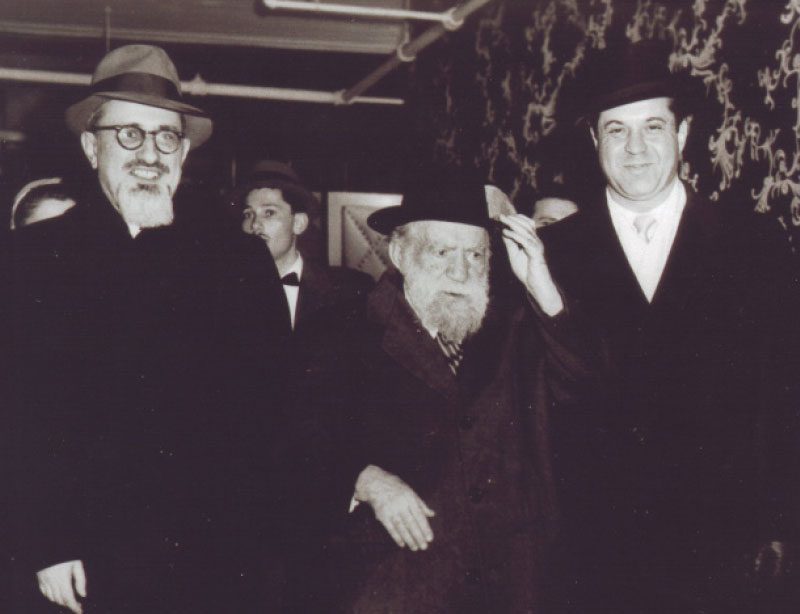
‘And How Can One Behold a Sefer Torah in Distress?’ On the Relationship between Rabbi Chaim Heller and Rabbi Joseph B. Soloveitchik

‘And How Can One Behold a Sefer Torah in Distress?’

On the Relationship between Rabbi Chaim Heller and Rabbi Joseph B. Soloveitchik

by Aviad Hacohen and Menachem Butler


This article, published on the occasion of the anniversaries of the passing of Rabbi Chaim Heller (14 Nisan 5720) and Rabbi Joseph B. Soloveitchik (18 Nisan 5753), may their memories be a blessing, reexamines their relationship through a newly published body of correspondence, situating their bond within the intellectual and material conditions of mid-twentieth-century American Orthodoxy.[1] The letters document both a relationship of unusual personal and scholarly closeness and the economic precarity and institutional instability that affected even leading Torah scholars of the period.

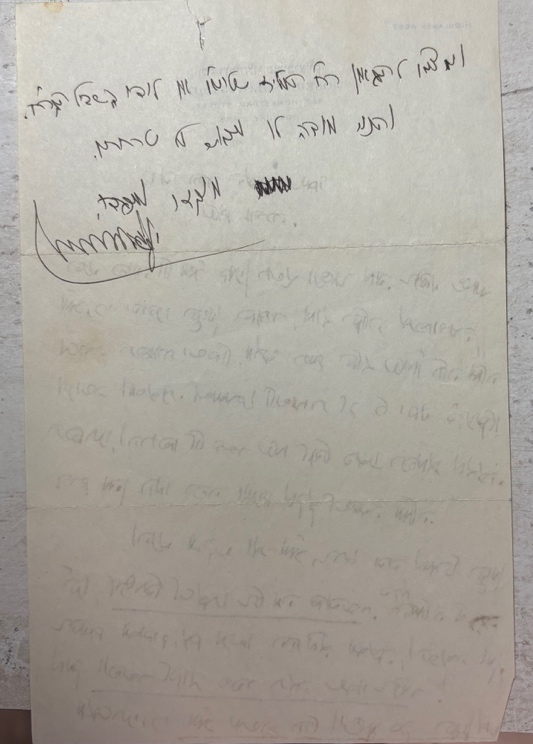
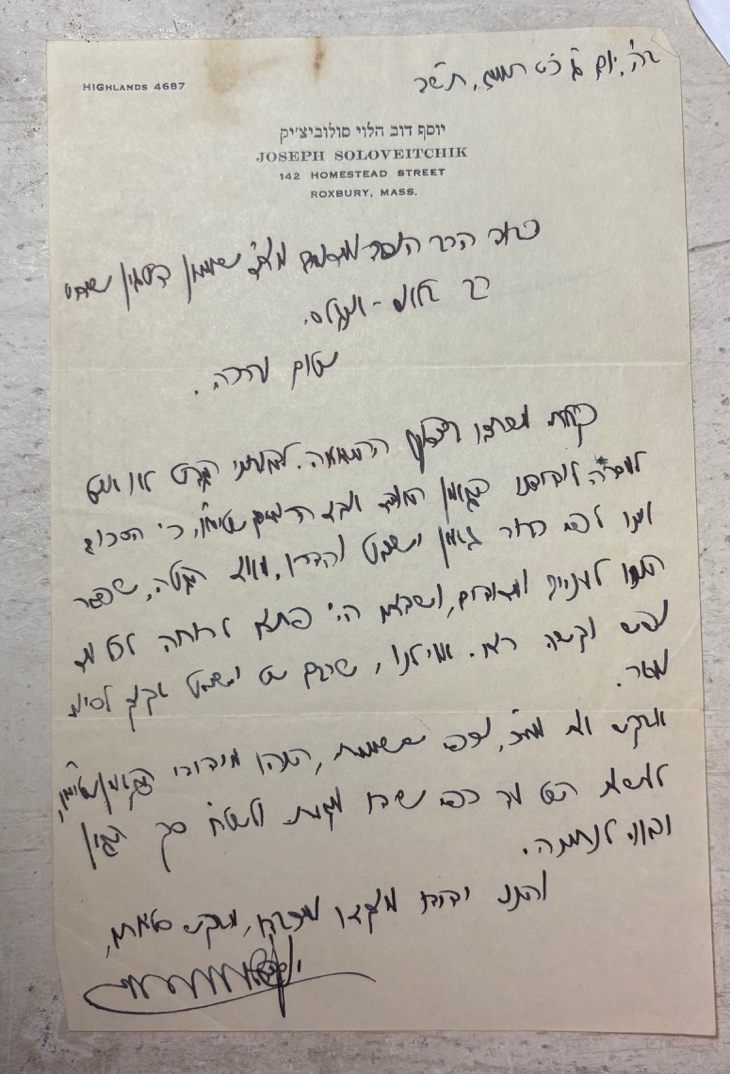
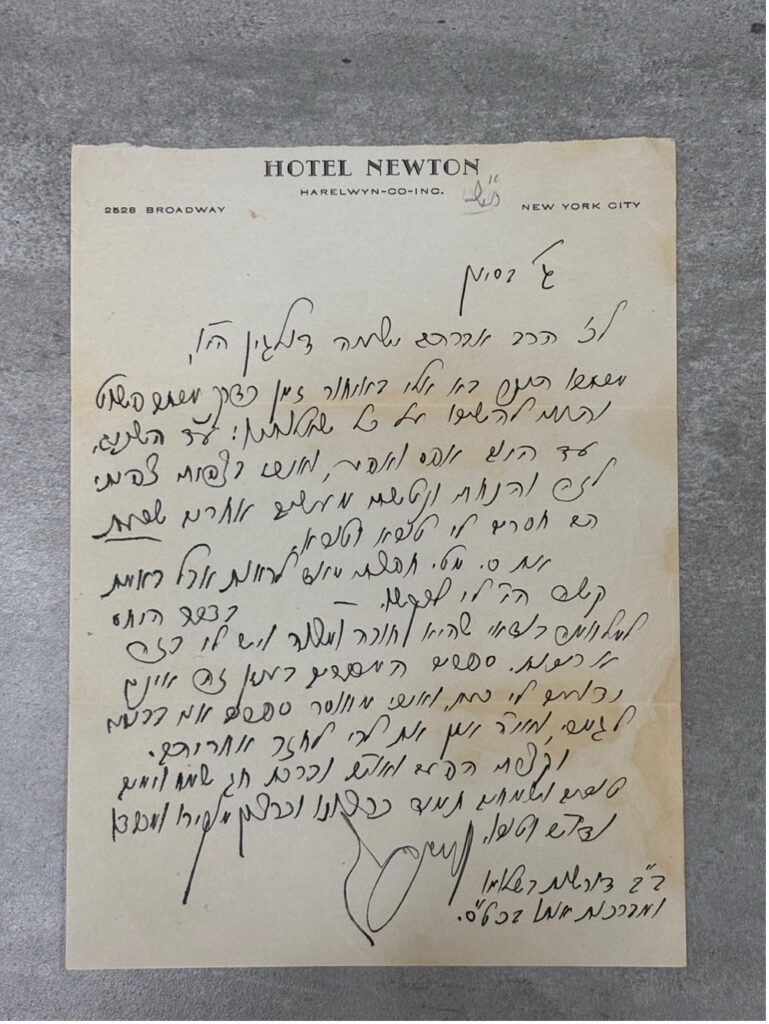
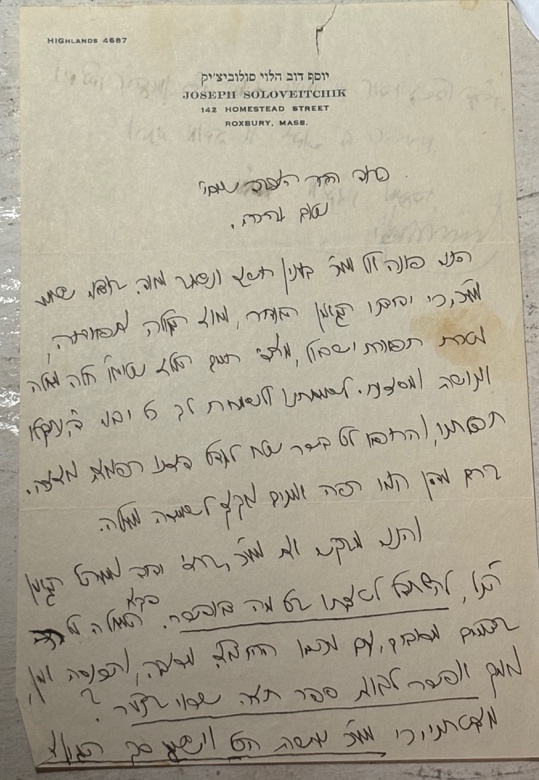
One such document, written by R. Soloveitchik in 1942 at a moment of acute crisis, reads as follows:

“Your esteemed honor has surely heard that our friend, the great and mighty gaon, luminary of the Diaspora and its glory, the crown of Israel’s splendor, our teacher and master Rabbi Chaim Heller, may he live long, has fallen gravely and dangerously ill. To our joy, and to the joy of all who fear God, our prayers have been accepted, and the Healer of all flesh has sent recovery and healing to the great one of our generation. Yet he remains weak and requires exceptional care. I therefore request of your esteemed honor, as a friend of the aforementioned gaon, to exert yourself on his behalf in every possible way. The supervision of the illness has entailed great expense, and even now the outlay is considerable while there is no income – and how can one behold a Sefer Torah in distress? I am confident that your esteemed honor will do all that is necessary, secure a fitting sum, and deliver it to the gaon R. H. Heller, may he live long, or to the fund ‘For R. H.’ I thank him in advance for his efforts. Your admirer and one who honors you.”[2]

In this letter, Soloveitchik addressed his friend Rabbi Simon (Abraham Yeshayahu) Dolgin,[3] then rabbi of Congregation Beth Jacob in the Beverly Hills neighborhood of Los Angeles, where he would serve for more than three decades and build one of the most significant Orthodox communities on the American West Coast. Upon receiving the appeal, Dolgin promptly sent a contribution; it appears, however, that its amount did not meet Soloveitchik’s expectations.

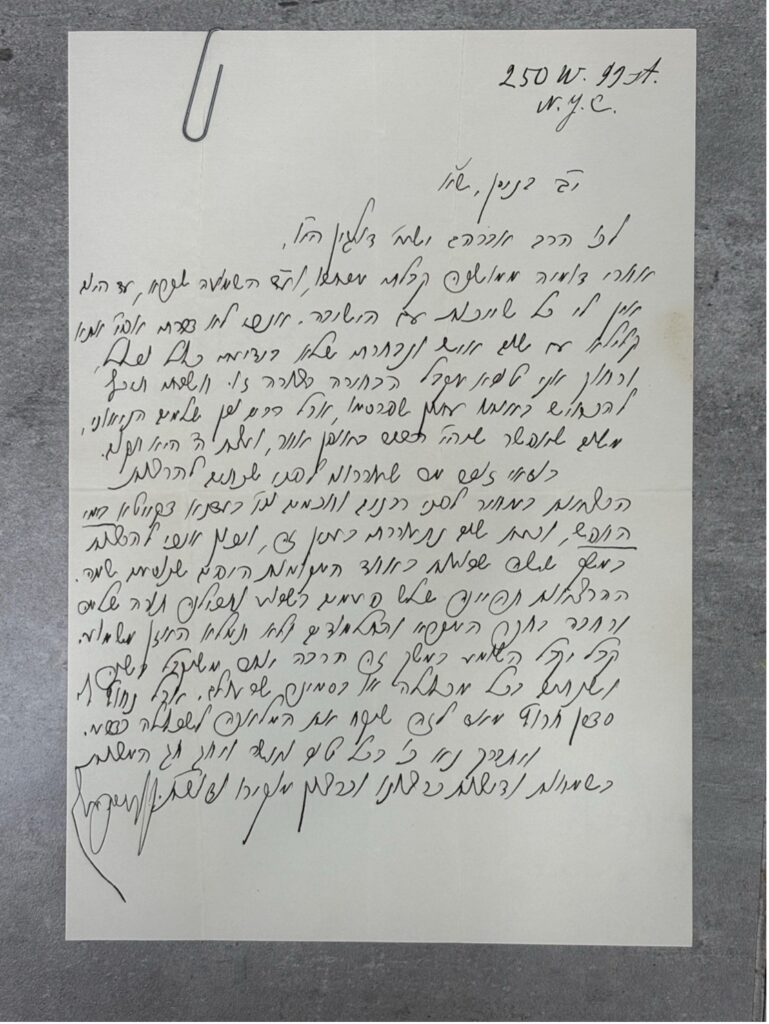
In a subsequent letter of appeal sent to Rabbi Dolgin approximately one month later [=14 July 1942], R. Soloveitchik again wrote:

“I received your letter together with the check. To my great regret I cannot deliver it to our friend, the great gaon, the mighty shepherd, may he live long, for the sum is not commensurate with the honor and majesty of a gaon of Israel, a luminary of the Diaspora, who dispersed his wealth to the poor and destitute, and whose home was open wide to all who were embittered and broken in spirit. Woe unto us, that the rabbi of Israel stands in need of aid and assistance. I request of your esteemed honor – who, as I have heard, is among the friends of the aforementioned gaon – to do all that lies within your power and to send a proper and worthy sum.”

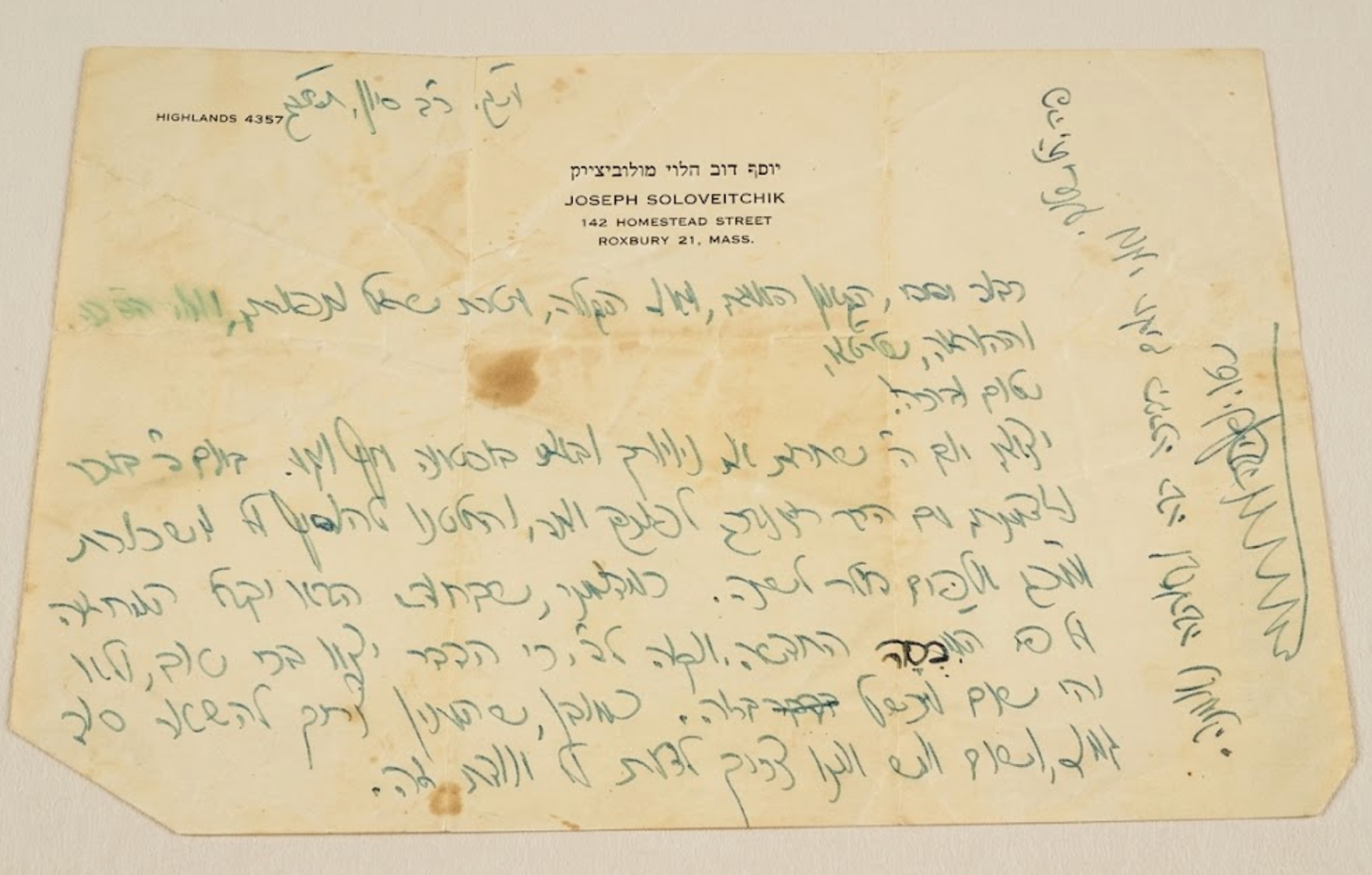
The letters published here for the first time provide a rare window into the distinctive relationship, a bond of unusual personal and intellectual intimacy, and the enduring ties that prevailed for decades between two of the leading Torah scholars in the United States in the twentieth century. At the same time, they illuminate the manifold hardships, including acute financial privation, humiliation, and disappointment, that rabbis of that period were compelled to endure as they sought even minimal means of livelihood with which to sustain their households. This fate did not spare even one of the foremost sages of the generation, R. Chaim Heller, who, in order to support his family, was compelled to piece together sporadic and temporary sources of income until he eventually attained, albeit only in relative terms, a measure of stability and a settled position that afforded him and his family a degree of economic security.[4]

Beyond their intrinsic interest, these letters are of particular importance by virtue of the period in which they were written. They date to the years of the Second World War, from which very little of Rabbi Joseph B. Soloveitchik’s correspondence has survived.

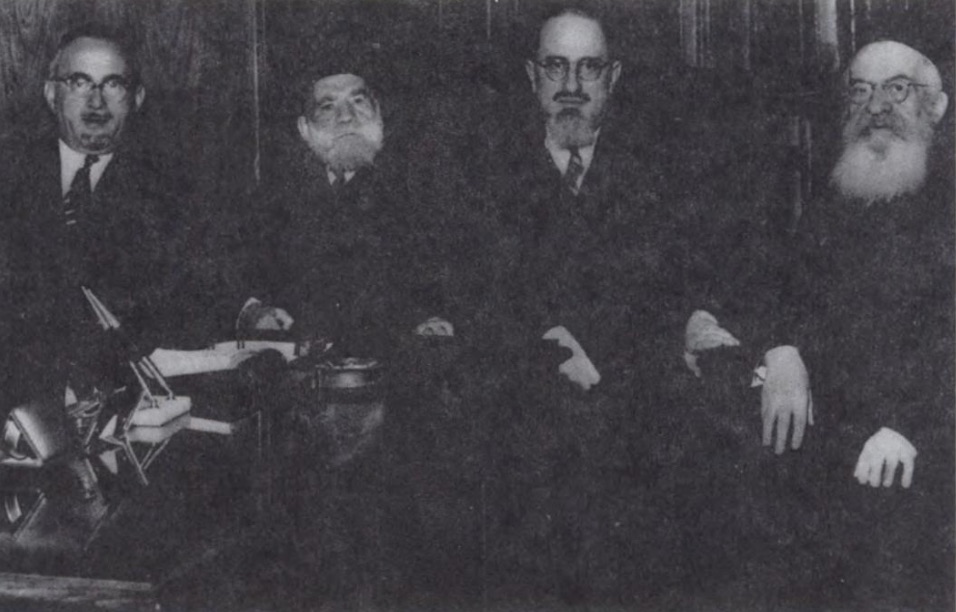
Already in these early letters, the literary Hebrew of R. Joseph B. Soloveitchik and his distinctive stylistic register stand out prominently.[5] They attest both to the profound bond between the two scholars and to R. Soloveitchik’s sustained concern for the welfare of his colleague and intimate friend, R. Chaim Heller. Their connection began years earlier in Berlin.

R. Chaim Heller (1879-1960) was among the leading Torah scholars of the early twentieth century. Alongside his greatness in Torah, he was deeply engaged in the scholarly study of Talmudic literature and biblical translation.[6] His work was characterized by a distinctive methodological orientation that sought to challenge the prevailing assumptions of modern biblical criticism through philological rigor grounded in the resources of the rabbinic tradition. In his introduction to On the Jerusalem Targum to the Torah (New York, 1921), R. Heller sharply criticized what he termed the “mechanical method” of comparing ancient translations in order to posit divergent textual recensions. Against this approach, he argued that the multitude of so-called “variants” in translations such as the Peshitta, the Septuagint, and the Samaritan Pentateuch do not reflect alternative Hebrew originals, but rather systematic exegetical practices. In his view, the translators did not render the biblical text literally, but interpreted and expanded it in light of traditions preserved in Hazal. This thesis enabled him simultaneously to undermine the conclusions of contemporary critics and to reaffirm the centrality and antiquity of the Oral Torah as an interpretive matrix for Scripture.[7]

This distinctive synthesis of traditional learning and critical scholarship was already prefigured in the formative trajectory of his early life. Born in Białystok and raised in Warsaw, he was already in his youth known as “the prodigy of Warsaw.” From the age of ten he ceased studying with melammedim; he never attended a yeshiva and acquired his entire Talmudic learning independently, as an autodidact. He married the daughter of a wealthy member of the Łódź community, and in the home of his uncle in Warsaw encountered the leading sages of the generation, engaging them in rigorous dialectical discussion. Among them were R. Yosef Dov Soloveitchik, author of Beit ha-Levi; R. Isaac Elchanan Spektor of Kovno; and the Netziv of Volozhin. During these years he also formed especially close ties with R. Chaim Soloveitchik, his relative by marriage R. Eliyahu Feinstein of Pruzhany, and R. Eliyahu Chaim Meisel of Łódź. In later years, he received a doctoral degree from the University of Würzburg.

Following the death of Rabbi Malkiel Tzvi Tannenbaum, the community of Łomża was left without a rabbi, and its leaders resolved to appoint Rabbi Heller, already known as a sharp and penetrating scholar and a man of broad learning who held a doctoral degree. By that time he had published studies on the Septuagint and on Maimonides, which drew the respect of both rabbinic and academic circles. Yet after only a few months he resigned his post. Various explanations have been offered for his departure: some point to his reluctance to devote extensive time to communal responsibilities, which he regarded as bittul Torah, while R. Joseph B. Soloveitchik recounted that Rabbi Heller himself expressed concern that members of the congregation might pressure him to act against his convictions.

R. Heller soon left for Berlin, where, in 1922 he established the Beit Midrash ha-Elyon, an advanced institution for rabbinic training that drew a small but serious circle of students. Berlin at the time was a meeting ground of worlds, traditional learning and modern scholarship, and Heller moved between them with unusual authority. In R. Heller’s case, this was not merely a sociological juxtaposition but a fully integrated intellectual stance, in which Wissenschaft methods were appropriated and redirected in defense of the integrity of the Masoretic text and the authority of the Oral Torah.[8] It was there that the young R. Soloveitchik spent several formative years. He was not formally enrolled in the institution, but he attended Heller’s lectures and was deeply influenced by them. What impressed him was not only R. Heller’s mastery of Torah and scholarship, but the range of his mind – the sense that he inhabited both disciplines fully, without strain or concession.

In 1929, R. Chaim Heller was appointed as a Visiting Professor of Bible at RIETS,[9] and “for close to ten years Heller taught in New York while occasionally traveling to Berlin and elsewhere before settling in the United States.” More than a decade later, his name was even floated by Rabbi Dr. Leo Jung as a potential successor as Rosh Yeshiva of RIETS following the death of R. Moshe Soloveichik in 1941.[10] A contemporaneous portrait of Heller’s intellectual profile appears in a 1930 article by R. Yerahmiel Elimelekh (Max J.) Wohlgelernter in the ha-Pardes journal, in which R. Heller is presented not merely as a scholar of unusual range, but as a figure who entered directly into confrontation with modern biblical criticism on its own terms, armed with philological expertise yet grounded in the authority of the rabbinic tradition. Against what R. Wohlgelernter characterizes as the “mechanical” methods of contemporary critics, R. Heller is depicted as demonstrating that the multiplicity of textual variants in ancient translations reflects interpretive practice rather than divergent textual recensions, thereby reasserting the integrity of the Masoretic text and the centrality of the Oral Torah as its interpretive matrix.[11]

In 1937, several years after the rise of the Nazis to power and the intensification of anti-democratic measures directed especially against the Jews, R. Chaim Heller emigrated to the United States and settled in New York. That same year, R. Moshe Feinstein likewise arrived in New York. During this period, R. Heller renewed his connection with R. Joseph B. Soloveitchik, who had come to the United States some five years earlier at the urging of his father, R. Moshe, then Rosh Yeshiva of the Rabbi Isaac Elchanan Theological Seminary. In Boston, R. Joseph B. Soloveitchik led his community with distinction and, alongside his teaching, increasingly assumed a position of broader intellectual and religious leadership, establishing himself as a central figure for a growing circle of students and adherents.[12]

Despite this recognition of his intellectual stature, the conditions that Heller encountered upon his arrival in the United States were markedly different. Like many rabbis who fled Germany on the eve of the Second World War and arrived in the United States as refugees,[13] R. Chaim Heller entered a professional landscape that was structurally inhospitable. The lingering effects of the Great Depression continued to constrain both the rabbinic and academic labor markets.[14] Congregational positions, even in smaller and more remote communities, were typically occupied by long-established incumbents, while the few available posts offered only modest remuneration. Universities, for their part, were in a period of contraction, with limited hiring and little institutional appetite for figures whose scholarly profile did not align neatly with existing departmental frameworks. For a scholar of Heller’s unusually wide and interdisciplinary range, no obvious institutional niche presented itself.

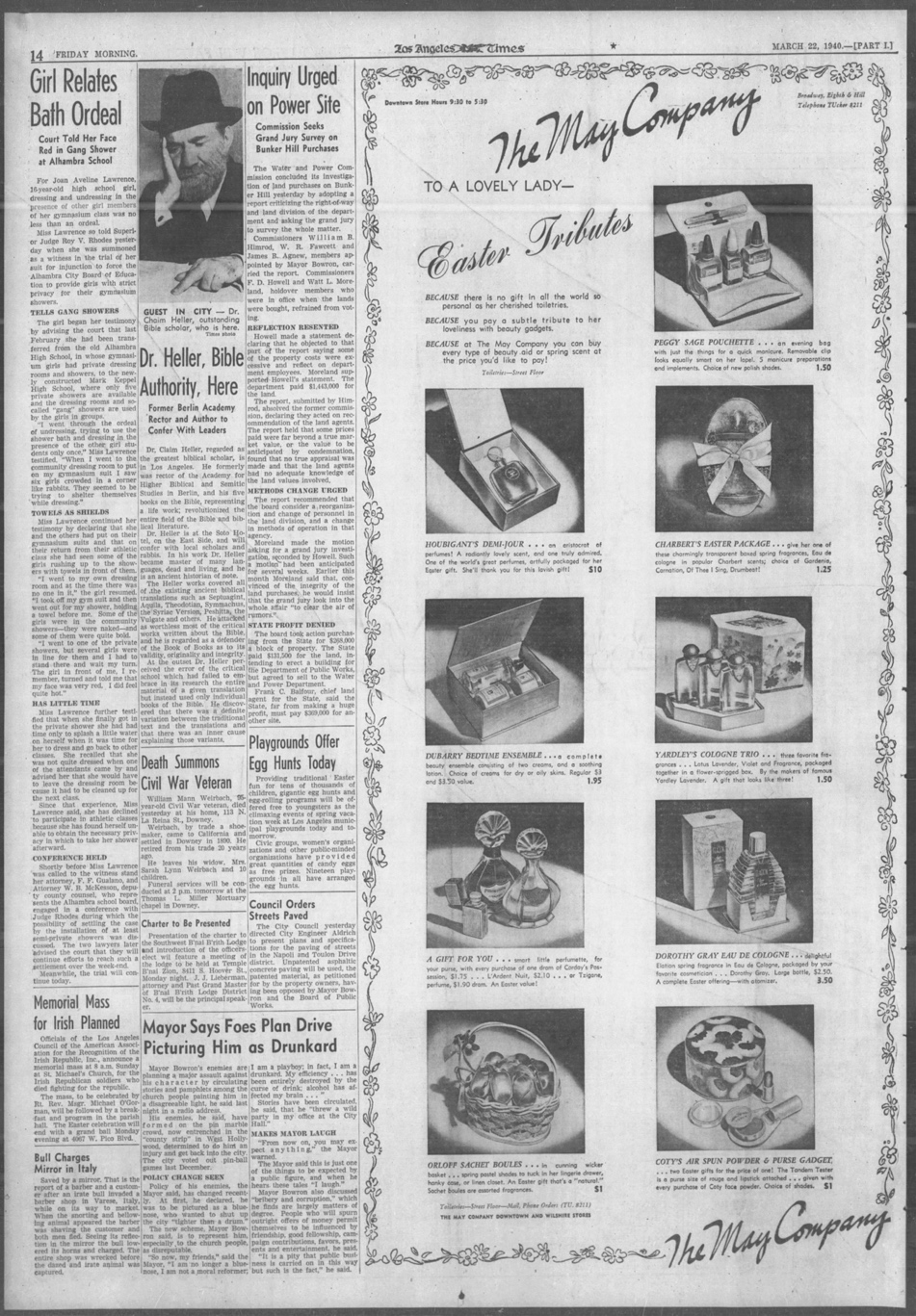
In response, Heller adopted a peripatetic mode of intellectual livelihood. Lacking a stable appointment, he supported himself through public lectures, assembling an income that remained precarious and contingent. This required sustained mobility, persistence, and a readiness to engage even relatively small audiences. At one stage, this itinerant circuit took him as far as Los Angeles, a journey that, under the conditions of the time, entailed considerable logistical and physical demands, where he delivered a series of lectures in his areas of expertise. It was likely in the course of this visit that he first encountered Rabbi Dolgin.

The notice of R. Chaim Heller’s arrival in Los Angeles appeared in the Los Angeles Times, March 22, 1940.

It may be assumed that, in the wake of this visit, the relationship between the two was further strengthened. Expression of this is found in three letters written during those years by R. Chaim Heller to R. Dolgin, which are published here for the first time.


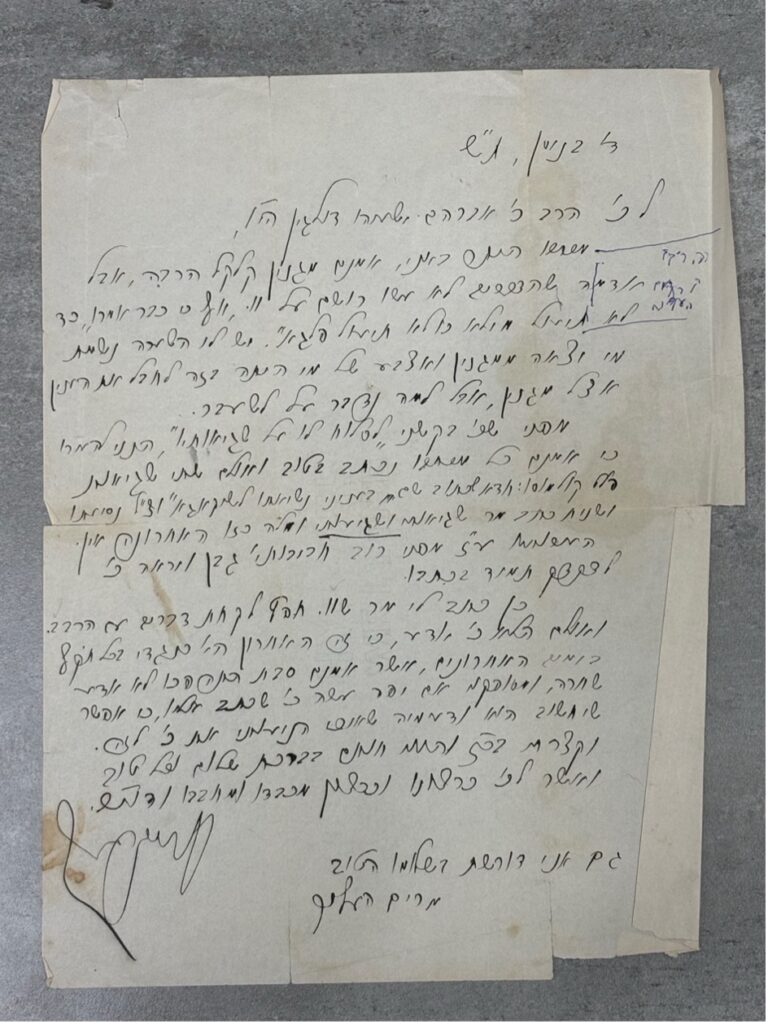
The first letter is dated 4 Nisan 5700 [= 12 April 1940], a short time, approximately three weeks, after R. Chaim Heller’s arrival in Los Angeles. It reads as follows:

“To the honorable Rabbi Abraham Isaiah Dolgin, may he live long: Your esteemed letter has reached me. Although Magnin[15] caused considerable damage, it seems to me that his words made no impression upon ploni, notwithstanding the saying, ‘When a word cannot enter in its entirety, it enters in part.’[16]

I have a conjecture as to whose soul spoke through Magnin, and whose finger was involved in undermining the matter there, but why should we speak of what has passed.

Since Your Honor requested of me “to forgive him for his errors,” I hereby note that, indeed, your entire letter was written well; however, two errors slipped from your pen: first, that you wrote also “concerning the matters of his נשיאתו (nesi’ato, ‘his presidency/bearing’) to Chicago,” whereas it should read נסיעתו (nesi‘ato, ‘his travel’); and second, that you wrote שגיאותי ושגיעותי (shegiyotai, ‘my errors’), and such a latter form does not exist.

I have drawn his attention to this out of my great affection for him,[17] and your honor should take care to be precise in his writing. You also wrote to me that Mr. Sh. desires to discuss matters with Rabbi B. [Bernard Revel[18]]; however, your honor knows that the latter has recently opposed me with full force, though I do not know the cause of his reversal,[19] and I am uncertain whether your honor acted wisely in writing to him, for he and those associated with him may think that I prompted your honor to do so. I have been brief in all this, and I conclude with blessings of peace and all good to your honor, according to your will and the will of one who esteems and cherishes you, and who inquires after your welfare.

Chaim Heller”

In the margin of the letter, his wife added a brief greeting of her own: “I too inquire after his welfare. Miriam Heller.”

The second letter was written approximately two months later, on the eve of the festival of Shavuot, in which R. Chaim Heller gives expression to his frustration that promises made to him, apparently concerning the provision of a stable source of livelihood, had not been fulfilled. It reads as follows:

3 Sivan [5700] [9 June 1940]

To the honorable Rabbi Abraham Isaiah Dolgin, may God preserve and sustain him,

Your esteemed letter reached me with delay, as is the way of ordinary post, and I shall respond to all your inquiries: regarding the matter of the years [?], up to this day there is nothing whatsoever, and I had indeed waited and hoped for this, and accordingly set aside and abandoned other undertakings which I now lack greatly – very greatly.

I very much wished to meet with […], but in truth it was difficult for me to request this.

Concerning the attitude toward the war,[20] it is certainly an obligation and a commandment, and I have much to elaborate on this matter. Books addressing this subject are not presently known to me, for I am entirely without books in my home; with God’s help, I shall set my mind to seeking them out.

I shall be brief this time. With blessings for long life, a joyous festival, and days of gladness always, in accordance with your will and the will of one who esteems and honors you, who inquires after your welfare and goodness.

Chaim Heller

[p.s.] My wife and daughters inquire after your welfare, and bless you with every good, selah.

The third letter was written approximately a year later, on the eve of Passover 5701. At that time, reports in the press in the Land of Israel[21] indicated that R. Heller was about to receive a teaching appointment at Yeshiva University alongside his colleague R. Joseph B. Soloveitchik. Having grown accustomed to disappointment, R. Heller feared that this announcement amounted to no more than a “trial balloon” lacking any concrete foundation. This apprehension, together with his distress at both the substance and the tone of the report, found expression in a letter he addressed to R. Dolgin:


“12 Nisan 5701 [9 April 1941]

To the honorable Rabbi Abraham Isaiah Dolgin, may God preserve and sustain him,

After a long period of silence while confined to bed, I received your letter. Concerning the report that you read: to this day I have no connection whatsoever with the yeshiva.[22] I have not spoken even a word – however slight[23] – with any person, and I was selected entirely without my knowledge; indeed, I am far removed from accepting an appointment in such a manner. I immediately considered issuing a denial in the very newspaper that published the report, but many worthy individuals dissuaded me, on the grounds that matters might yet develop otherwise, and that the counsel of the Lord shall prevail.”

In this connection, he related to his friend his deliberations regarding an additional source of livelihood – delivering lectures to vacationers in the Catskill Mountains during the summer months:

“You surely recall that two years ago I was approached to deliver lectures, for remuneration, before rabbis and scholars, etc., during the summer season (be-idna de-qayta), in the vacation period; and now this matter has again been raised, and I am prepared to lecture for six weeks in one of the pleasant locales to which people travel.

The lectures would be held three times a week and would encompass a comprehensive and wide-ranging treatment of biblical scholarship and the Talmuds, such that ‘the ear would not be sated with hearing’.[24] Over this period, the listener would gain far more than he would in a year or two at any college or seminary in the world. However, I require a highly energetic organizer who will undertake to arrange this enterprise properly. May your honor be blessed with all good and prosperity, and may you celebrate the Festival of Unleavened Bread with joy and delight.”

After several years in the United States, during which he lacked a stable source of livelihood, R. Chaim Heller secured a position on the teaching staff of Yeshiva University and served alongside his colleague R. Samuel Belkin, R. Joseph B. Soloveitchik, and R. Moshe Shatzkes on the RIETS Ordination Board.[25]

Screenshot

Yet, as emerges from a letter cited below, his salary conditions remained far from favorable. Efforts were made to improve them and, over time, met with a measure of success. The literary oeuvre of R. Chaim Heller is vast in scope. Yet, as R. Joseph B. Soloveitchik would later describe in his eulogy, what was published only represents only a minute fraction, “mere remnants of remnants,” of the breadth of his orally transmitted Torah. It should also be borne in mind that the overwhelming majority of his writings were composed prior to his arrival in the United States.

Among his works in the field of biblical scholarship, particular note should be taken of his studies on the textual tradition of the Bible and its various translations: his work on the Jerusalem Targum to the Torah (New York, 5681 [1921]); on the Samaritan Pentateuch (Berlin, 5684 [1924]); on the Septuagint in the Concordance Heikhal ha-Qodesh, with appended notes, commentaries, and investigations in biblical studies (New York, 5704 [1944]); and on the Peshitta, the Syriac translation of the Bible (transcribed into Hebrew script, with notes, glosses, and commentaries by Chaim Heller: Genesis, Berlin, 5687 [1927]; Exodus, Berlin, 5689 [1929]). He prepared a revised edition of the Peshitta to Exodus for publication but did not succeed in completing its printing prior to his death. Among his halakhic works, his annotated edition of Maimonides’ Sefer ha-Mitzvot (first edition, Piotrków, 5674 [1914]) is well known. A subsequent edition of this work was published by Mossad HaRav Kook in Jerusalem (5706 [1946]) – and has since appeared in numerous further editions – and for this work he was awarded the Rav Kook Prize in 5707 [1947]. His writings also include Hiqrei Halakhot, analytical investigations of legal rulings and issues in the section Hoshen Mishpat (vol. I, Berlin, 5684 [1924]; vol. II, Piotrków, 5692 [1932]); as well as studies on various topics in Maimonides and the halakhic decisors concerning the laws of lending and borrowing and their ancillary matters (Chicago, 5706 [1946]). In addition, he published, in jubilee and memorial volumes, several qontrasim that functioned as a kind of Masoret ha-Shas for the Jerusalem Talmud.[26]

Even after R. Chaim Heller had joined the faculty of Yeshiva University, R. Joseph B. Soloveitchik continued to seek ways to assist him, inter alia by working to secure an increase in his salary. Expression of this may be found in a brief letter that he wrote to R. Chaim Heller on 23 Sivan 5713 (5 June 1953), which is likewise published here for the first time:

Erev Shabbat, 22 Sivan 5713 [5 June 1953]

To my honored friend, the true gaon, luminary of the Diaspora, crown of Israel and its glory, pillar of halakhah and instruction, may he live long,

Greetings and blessings!

I departed New York on Thursday morning and arrived in Boston utterly exhausted. On the preceding Wednesday I met with Rabbi Rosenberg at a certain inn, and we resolved to add two thousand dollars annually[27] to your honor’s salary. It seems to me that next month you will receive a check in accordance with the new scale. We trust in God that the matter will be brought to a good conclusion and that no obstacle will arise in connection with it. Naturally, the matter must remain in absolute confidence, and no one need be informed of it.

I conclude with abundant blessing and faithful affection,

Joseph Dov HaLevi Soloveitchik[28]

This quiet intervention on Heller’s behalf was not an isolated act, but part of a sustained pattern of concern. In this connection, it is instructive to recall R. Aharon Lichtenstein’s characterization of R. Joseph B. Soloveitchik, in his eulogy. Reflecting on his father-in-law’s own self-understanding, he writes:

“The personal self-conception that characterized the Rav, of blessed memory, with respect to his own functioning was bound up with educational–pedagogical activity, and this across multiple spheres. He would often remark that when he arrived in the World of Truth, and were he to be asked to specify by virtue of what he merited a share in the World to Come, he would indicate three points: (a) that he studied Torah with his children; (b) that he founded the Maimonides School in Boston; (c) that he was concerned, over an extended period, for the honor and welfare of a certain talmid hakham.”[29]

This final point refers to R. Soloveitchik’s sustained and well-documented efforts on behalf of R. Chaim Heller. The depth of this personal concern was not confined to the private sphere, but found parallel expression in a sustained intellectual and institutional collaboration between the two. A further expression of their bond and cooperation is found in their joint letter of response to Israeli Prime Minister David Ben-Gurion, who in 1958 approached them, among other “Sages of Israel,” to solicit their opinion on the question “Who is a Jew?” Although the inquiry was addressed to each of them separately, the two resolved to compose a joint reply. Thus they wrote, inter alia:

“We are indeed perplexed that the State of Israel now seeks to hew down our traditional branches and thereby smear the ancient glory of Israel which has long been sanctified through the spilt blood and sufferings of preceding generations. It is only because of these roots that we preserve our uniqueness as a holy people and that we are inextricably bound to the Holy Land. … Will the present State of Israel be built up by (maintaining a threat of) destruction to its very sanctity?”[30]

The same bond found further expression in another brief letter issued by R. Joseph B. Soloveitchik some two years later, likewise published here for the first time. The occasion for its dispatch was the forthcoming wedding of R. Joseph B. Soloveitchik’s daughter, Tova, to Rabbi Dr. Aharon Lichtenstein, his most distinguished student.

In September 1959, a small notice appeared in the “Announcements” column of The Commentator, the student newspaper of Yeshiva University, reporting the engagement of Dr. Aharon Lichtenstein, a member of the class of 1953, to Tova Soloveitchik. It appeared alongside advertisements for driving instruction and for Barton’s confectionery (under OU supervision).[31]

Approximately a month and a half later, in November 1959, the parents of the couple sent a formal invitation to family members and acquaintances. The Hebrew text was ornate, replete with distinctive idioms, and clearly bore the imprint of R. Joseph B. Soloveitchik’s unique stylistic signature:

“To our friends in all their places of residence – may your peace flourish without end! We hereby inform you that Tova shall be betrothed and married to Aharon, with the grace of God, on the evening preceding the fourth day of the week, on the twenty-second day of the month of Kislev, in the year five thousand seven hundred and twenty from Creation, according to the reckoning we follow here in Boston, the city situated at the approaches of the sea. Pray assemble at six o’clock on that evening in the Dorothy Quincy Hall, in the John Hancock Building (355 Stuart Street), for the celebration of bride and groom, for the festive meal, and for the joy of a commandment. Rejoice with us in the joy of our offspring’s wedding day and in the gladness of our hearts. Joseph Dov HaLevi and Tonya Soloveitchik; Yechiel and Bluma Lichtenstein.”

By contrast, the English version was brief, formulated in a more formal and utilitarian manner. The period during which the invitations were sent was one of particular intensity in the Soloveitchik household. At that time, R. Soloveitchik received an informal invitation to put forward his candidacy for the position of Chief Rabbi of Israel[32]; concurrently, he was engaged in intensive preparation for the major eulogy for his uncle, the Griz, R. Yitzhak Ze’ev Soloveitchik, later known as the discourse “Mah Dodekh mi-Dod.”[33]

תמונה שמכילה טקסט, נייר, מכתב, ספר תוכן בינה מלאכותית גנרטיבית עשוי להיות שגוי.

On account of the mention of his name as a candidate for the office of Chief Rabbi, an extensive journalistic interview with R. Soloveitchik was conducted in Yedioth Ahronoth.[34] The interviewer, Elie Wiesel (later a Nobel laureate), reported that, following the Rav’s annual Teshuvah Derashah several months earlier, the Israeli consul general in New York had sent a telegram to Jerusalem declaring: “Here is the best candidate to replace Rabbi Herzog.”[35] Wiesel asked R. Soloveitchik whether he would agree to assume the position if it were offered to him. R. Soloveitchik replied that no such offer had yet been made, but added in principle: “One does not decline an invitation that comes from the Land of Israel… When I receive it, if indeed it is sent, I shall consider it with utmost seriousness. I shall ask myself whether I am worthy of so exalted an office.” When Wiesel further inquired whether it was true that his uncle, R. Yitzhak Ze’ev Soloveitchik, had instructed him not to accept the position, R. Soloveitchik dismissed the report: “It is difficult to believe such rumors. In our family there is a tradition not to compose wills… perhaps because we fear death and its reality.”[36]

In the course of the interview, R. Soloveitchik spoke with evident pride of the religious and spiritual revival among youth and young adults in America, yet added that talk of their immigration to the Land of Israel was, at most, “a beautiful dream.” He attributed the gap between the intensification of Jewish and religious consciousness and the reluctance to immigrate, inter alia, to Prime Minister David Ben-Gurion, who, in his view, failed to appreciate the potential inherent in religion to draw youth to Israel and to demand sacrifice on its behalf. “In my view,” said the Rav, “Ben-Gurion is a religious Jew, though it is possible that he himself does not know this.” These remarks, whose precise formulation was itself questioned in contemporaneous discussion, elicited sharp criticism from several prominent figures within American Jewry. Among them was Moshe Meisels, editor of ha-Doar, who, in a pointed “open letter,” challenged both the claim that Israel had lost its ‘messianic’ hold on the Jewish imagination and the attribution of this development to deficiencies in the religious posture of the Israeli state.[37] Questioning the very premise of R. Soloveitchik’s formulation, Meisels asked rhetorically whether it could truly be maintained that “the concept of Israel has lost its messianic content,” and whether the responsibility for such a development could plausibly be laid at the feet of the state. The Rav sought to respond, but was exceedingly occupied with the final polishing of the eulogy for his uncle, R. Yitzhak Ze’ev Soloveitchik, which he was to deliver within a matter of days.[38]

Indeed, as the Yiddish adage has it, a mentsh trakht un Got lakht – man plans, and God laughs. Only a few days after the wedding invitations for his daughter and R. Aharon Lichtenstein had been dispatched, R. Joseph B. Soloveitchik was diagnosed with colon cancer and was required to travel urgently to Boston to undergo life-saving surgery. R. Soloveitchik informed his family, including the bride and groom, on the night that he delivered the eulogy for his uncle. On the following day, he departed for Boston. The couple, of course, immediately announced the postponement of the wedding, and all prayed for the Rav’s recovery.

R. Soloveitchik himself, only fifty-seven years old at the time, confided to those close to him: “I suddenly ceased to be immortal; I became a mortal being.” In the nights preceding the operation, he undertook a profound reckoning of his life. In later years, he described something of his experience during those turbulent days:

“My existential awareness was an absolute one. Non-being did not enter into it. I would not sustain my gaze upon nihility. Whenever I started to think of death, my thoughts were dashed back and they returned to their ordinary objective, to life. When I looked upon my grandson, I always tried to think of him as if he were my contemporary. I believed that we would always do things and play together. Then sickness initiated me into the secret of non-being. I suddenly ceased to be immortal; I became a mortal being.

The night preceding my operation I prayed to God and beseeched him to spare me. I did not ask for too much. All I wanted was that he should make it possible for me to attend my daughter’s wedding, which was postponed on account of my illness – a very modest wish in comparison with my insane claims to life prior to my sickness. The fantastic flights of human foolishness and egocentrism were distant from me that night.

However, this ‘fall’ from the heights of an illusory immortality into the valley of finitude was the greatest achievement of the long hours of anxiety and uncertainty. Fundamentally, this change was not an act of falling but one of rising toward a new existential awareness which embraces both man’s tragedy and his glory, in all its ambivalence and paradoxality. I stopped perceiving myself in categories of eternity. When I recite my prayers, I ask God to grant me life in very modest terms.”[39]

Further testimony to R. Soloveitchik’s state of mind during this period is found in a letter he sent to R. Reuven Katz, Chief Rabbi of Petah Tikvah. At its outset, the Rav explains that he had fallen gravely ill and been confined to bed, describing the experience in stark terms:

“Dark days, filled with anxiety, suffering, and silent loneliness, passed over me. My world was suddenly overturned. Yet the merit of my forefathers stood by me in the hour of wrath, and the Holy One, blessed be He, in His abundant mercy redeemed my soul in peace and did not allow me to die… Even now, as I begin to recover, I have not yet shaken off the physical weakness and the psychological dread that overcame me during those bitter and difficult hours of illness and suffering.”[40]

He then turns to the question of the Chief Rabbinate, noting both the changed circumstances and his own unsuitability for the role:

“However, the recent developments concerning the Chief Rabbinate… have cast a new light upon the situation, and I doubt whether I would be able to engage in Torah study with peace of mind… There is compelling reason to assume that I would become entangled in all the convolutions of politics, a matter that is neither to my spirit nor to my desire… Therefore I am compelled to acknowledge that, under the present circumstances, I am not fit for this office. I am a teacher, and I have in my world nothing but the four cubits of halakhah. I do not wish to depart from them, even were I to be offered an entire kingdom.”

These remarks make clear that R. Soloveitchik’s refusal to consider candidacy for the position of Chief Rabbi was shaped both by the lingering effects of illness and by a principled resistance to political entanglement, together with a self-conception rooted in the life of Torah within “the four cubits of halakhah.”[41]

As a result of his illness, R. Soloveitchik remained in Boston for approximately three months, during which he gradually recovered. In the course of this period, he merited to bring his daughter Tova and his son-in-law, R. Aharon Lichtenstein, under the wedding canopy. In consultation with the family, it was decided to postpone the wedding by only one month following the operation, and it was ultimately held on 26 Tevet 5720 (26 January 1960).[42]

A week before the rescheduled wedding, still confined to his bed and not yet recovered from surgery, R. Soloveitchik insisted on writing to his close friend R. Chaim Heller. The letter, published here for the first time, was not written in his own hand. The script shows that he dictated it, most likely to his wife, and, in his weakened state, managed only to sign his name.

“To my honored friend, the gaon of Israel and its glory, luminary of the Diaspora and pillar of halakhah and instruction, may he live long; greetings and blessings! Although the physicians have forbidden me to engage in writing on account of my extreme weakness, I cannot refrain from writing this letter in order once again to extend a heartfelt invitation to your esteemed honor, to your esteemed wife, and to your distinguished daughter, may they live, to participate in the wedding of Tova and Aharon. Their presence on the day of our heart’s rejoicing will lend joy and splendor to the celebration. With great affection, Joseph Dov HaLevi Soloveitchik.”

His wife, Dr. Tonya Soloveitchik, appended a moving appeal of her own in Yiddish:[43]

January 19, 1960

To the honorable and true gaon, R. Chaim Heller, to his esteemed wife, the rebbetzin, and to their refined daughter, may they live – greetings and blessings!

We had hoped that we would have the opportunity to visit you once more and to invite you personally to the wedding of our Tova. To our regret, however, my husband’s illness has altered our plans, and we have no possibility of coming to New York to do so.

What we are unable to do orally, we must now do in writing: we warmly invite you all to the wedding! Your presence will greatly enhance our joy.

I also wish once again to thank you for the friendship you have shown during my husband’s illness. Your good wishes and blessings gave us strength at a critical time.

With regards and respect,

Tonya Soloveitchik

In the end, R. Chaim Heller did not attend the wedding, apparently due to his frail health and the difficulty of traveling from New York to Boston. Within a few months, on the Fourteenth of Nisan 5720 (10 April 1960), the Eve of Passover, he returned his soul to his Creator.[44] Although the constraints of time and the approaching festival precluded extended eulogies, R. Joseph B. Soloveitchik flew from Boston to New York to attend the funeral, delivered brief words of farewell, recited kaddish at the funeral,[45] and returned to Boston before the onset of Passover. The rabbinic journal ha-Pardes would later note that “his close friend and trusted associate, Rabbi Joseph Dov Soloveitchik of Boston, eulogized him in moving words.”[46] Although these remarks were long thought to have been lost, a partial and mediated record preserved in the Yiddish press makes it possible to recover something of their content:

“A visit to Rabbi Chaim Heller was in the nature of a pilgrimage… When I would arrive at the elevator of the building at 210 West 99th Street… I would experience a sensation as though a curtain had descended, separating between the sacred and the profane. The Temple comprised three divisions: the Holy of Holies, the Sanctuary, and the Courtyard. Rabbi Chaim embodied all three. He conducted himself within the Holy of Holies… his occupation was solely with Torah… The entirety of the Torah lay before him as an open book… Yet he also partook of the character of the Courtyard, engaged with the community of Israel as a whole… From him radiated both the light of immense knowledge and the simplicity of humanity.”[47]

Even in this compressed form, the structure of the eulogy is already fully present: Heller is cast simultaneously as a figure of absolute immersion in Torah, of intellectual breadth, and of human accessibility, an integration that would find fuller expression in Soloveitchik’s later memorial address. Several weeks later, he returned to the task in a more formal setting, delivering a powerful and deeply moving eulogy at a memorial gathering at Yeshiva University.

As is well known, and in keeping with the characteristic reserve of the Lithuanian Torah greats, R. Joseph B. Soloveitchik was generally sparing in his expressions of affection, esteem, and praise for fellow scholars, and rarely employed language of overt admiration. In the case of R. Chaim Heller, however, he departed from this pattern and bestowed upon him an exceptional and uncommon measure of appreciation, the like of which he appears to have granted to few, if any, other Torah scholars.

This finds expression in the great and moving eulogy that R. Soloveitchik delivered for R. Chaim Heller nine weeks after his passing, at a public gathering at Yeshiva University on June 13, 1960, which also included eulogies by the institution’s president, Dr. Samuel Belkin. R. Soloveitchik’s eulogy was published the following year on the occasion of the first yahrzeit under the title “Rabbi Chaim Heller: The ‘Shmuel ha-Katan’ of Our Generation,” and opened with the following words:

“Who was this man who departed from us in silence and with gracious humility? What was his stature, and what were his deeds? Who was R. Chaim, who held no public office and had no need for conventional titles – whose entire greatness was encapsulated in two simple words: ‘R. Chaim,’ greater than ‘Rabban’ was his name? Some years ago… when the president of this institution, Rabbi Samuel Belkin, introduced R. Chaim… he employed the following formulation: ‘R. Chaim belongs to that small company of men of virtue for whom we pray each day in the Amidah: for the righteous, for the pious, for the elders of Your people the House of Israel, and for the remnant of their scribes. R. Chaim,’ the rabbi continued, ‘is of the remnant of Israel’s scribes.’ In this utterance he encapsulated all that was singular and wondrous in the man. At the time, I was seated on the platform beside R. Chaim, and as I beheld him – entirely withdrawn, enclosed and self-contained, as though scorched by the gaze of the audience fixed upon him – his lips murmuring, ‘What does he want of me?,’ and the pained embarrassment of a solitary individual, thrust against his will into a bustling and clamorous crowd, spread across his face…”[48]

תמונה שמכילה בחוץ, לבוש, אדם, מכונית תוכן בינה מלאכותית גנרטיבית עשוי להיות שגוי.

R. Chaim Heller and R. Joseph B. Soloveitchik in New York, in the vicinity of Yeshiva University.

Notes

    1. A shorter, and non-annotated, version of this article appeared in Hebrew as Aviad Hacohen and Menachem Butler, “‘A Sefer Torah in Distress’,” Makor Rishon, Pesach Supplement, no. 1495 (1 April 2026): 10-11, 16 (Hebrew), available here.We are grateful to our friend Aaron R. Katz and to the Dolgin family for granting us access to letters sent by Rabbi Joseph B. Soloveitchik and Rabbi Chaim Heller to the family patriarch, Rabbi Simon (Abraham Isaiah) Dolgin, of blessed memory. We thank Shulamith Z. Berger of the Yeshiva University Archives for providing photographs of Rabbi Joseph B. Soloveitchik and Rabbi Chaim Heller. We are also grateful to Rabbi Moshe Dembitzer, author of several landmark biographical studies of Rabbi Chaim Heller, for sharing with us a forthcoming, as yet unpublished essay on Rabbi Soloveitchik’s graveside eulogy for Rabbi Heller.
    2. The letter bears no date; however, the postmark on the envelope indicates that it was sent from Boston to Los Angeles on June 9, 1942.
    3. On Rabbi Simon (Abraham Isaiah) Dolgin (1915-2004) and his extensive activities, see Jubilee Volume Minḥah Le-Ish: Presented to HaRav Simon A. Dolgin on the Occasion of His 75th Birthday, ed. Itamar Warhaftig (Jerusalem: Ariel, 1990). Ordained at the Hebrew Theological College in Skokie, Illinois, Dolgin assumed the rabbinate of Congregation Beth Jacob (later in Beverly Hills) in 1938 and served there for approximately thirty-two years, during which he transformed it into a prominent Orthodox community and developed a broad educational infrastructure, including the Harkham Hillel Hebrew Academy. In 1971 he immigrated to Israel, where he served as rabbi of the Ramat Eshkol neighborhood and later as Director-General of the Ministry of Religious Affairs. On his correspondence with David Ben-Gurion, see On the Character of the State of Israel: Correspondence between Prime Minister David Ben-Gurion and Rabbi Simon (Abraham Isaiah) Dolgin, ed. Yitzhak Goldshlag (Jerusalem, 1973; Hebrew).
    4. By way of comparison with the present, this phenomenon still finds occasional resonance in the lives of rabbis today.
    5. On this point, see the remark of Rabbi Aharon Lichtenstein, at the conclusion of his discussion of “The Rav as Eulogist” (forthcoming):“It is difficult for me to conclude without saying a word about the literary dimension of these eulogies. For all my admiration of the Rav’s Torah greatness, and of the content of these eulogies – which is, of course, primary – it is hard not to be left in astonishment at his literary and linguistic ability. We are speaking of a person who was not educated in the Hebrew language, and whose knowledge in this area was drawn from reading Haskalah literature. Let us recall: the Rav did not live in a Hebrew-speaking environment, nor did he speak Hebrew fluently. Yet the richness of his language is truly astounding. Were one to read these texts for this purpose alone, I have no doubt that he would be amply rewarded.”
    6. On the most recent biography and intellectual profile of R. Chaim Heller, see the now substantial body of recent scholarship, which has significantly advanced our understanding of his life and work, see Moshe Dembitzer, “The Letters of Rav Chaim Heller,” Hitzei Giborim, vol. 9 (2016): 923-952 (Hebrew), which assembles and analyzes a wide corpus of correspondence and reconstructs key aspects of his personal and scholarly networks; Uriel Banner, “Towards a Profile of Rabbi Chaim Heller,” Asif, vol. 8 (2023): 720-766 (Hebrew), offering a synthetic biographical portrait grounded in both contemporary testimony and archival material; and Moshe Dembitzer, “‘To Show My People a New Type’: The Academic Chapter in the Life of Rabbi Chaim Heller,” Mekhilta, vol. 5 (February 2024): 365-382 (Hebrew), which reconstructs in detail his academic formation and intellectual program, particularly his engagement with philology and the Wissenschaft des Judentums milieu.
    7. For earlier biographical and bibliographical information on Heller, see Jacob I. Dienstag, “Ein ha-Mitzvot: Bio-Bibliographical Lexicon of the Scholarship on Maimonides’ Sefer ha-Mitzvot,” Talpiyot, vol. 9, no. 3-4 [=Rabbi Chaim Heller Memorial Volume] (September 1970): 663-759, esp. 697-702 [#20] (Hebrew), available here, which underscores both his expertise in biblical translation and linguistics and his programmatic effort to defend the integrity of the Masoretic text. For a critical assessment of R. Heller’s methodology, see Marc B. Shapiro, Between the Yeshiva World and Modern Orthodoxy: The Life and Works of Rabbi Jehiel Jacob Weinberg, 1884-1966 (Oxford: Littman Library, 1999), 169-171, who characterizes R. Heller’s work as driven by a dogmatic commitment to the integrity of the Masoretic text and questions the scholarly validity of his attempts to account for all textual variants within that framework. On the polemical reception of Heller’s work among contemporaries, especially R. Yehiel Jacob Weinberg and Paul Kahle, see ibid. On the reception of Heller’s halakhic method within the American-yeshiva world, see Mordechai Gifter, “Halakhic Studies in [Rav Chaim Heller’s] ‘Le-Hikrei Halakhot’,” Talpiyot, vol. 9, no. 3-4 [=Rabbi Chaim Heller Memorial Volume] (September 1970): 913-921 (Hebrew). Rabbi Mordechai Gifter, at the time Rosh Yeshiva of the Telshe Yeshiva in Cleveland and a former student of R. Chaim Heller at Yeshiva College/RIETS in the early 1930s (prior to his subsequent entry to the world of Telshe in Lithuania), presents the work as a sustained program of conceptual halakhic analysis, marked by rigorous coordination of the Rishonim. In contrast to the reading of both Professor Jacob I. Dienstag and Professor Marc B. Shapiro, it is in Rabbi Mordechai Gifter’s reading of R. Chaim Heller that there is a reflection of the work’s reception within advanced yeshiva circles as an instance of high-level lomdus rather than as an idiosyncratic or marginal enterprise.
    8. See Moshe Dembitzer, “‘To Show My People a New Type’: The Academic Chapter in the Life of Rabbi Chaim Heller,” Mekhilta, vol. 5 (February 2024): 365-382 (Hebrew).
    9. “To Join Yeshiva Faculty: Dr. Chaim Heller of Berlin Will Be Professor of Bible,” The New York Times (18 September 1929): 24.
    10. Jeffrey S. Gurock, The Men and Women of Yeshiva: Higher Education, Orthodoxy, and American Judaism (New York: Columbia University Press, 1988), 130-131, 275n21. See also “Rabbi Chaim Heller, Yeshiva U. Professor, Dead at 81,” Yeshiva University News (5 April 1960), 6-7; and Gilbert Klaperman, The Story of Yeshiva University: The First Jewish University in America (New York and London: Macmillan, 1969), 152
    11. See Yerahmiel Elimelekh (Max J.) Wohlgelernter, “Rabbi Chaim Heller: Prince of the Torah and Ruler over the Treasures of Knowledge,” ha-Pardes, vol. 4, no. 2 (May 1930): 26-30 (Hebrew); and for a later popular portrayal in the American context, see Aaron Rosmarin, “Reb Chaim Heller – One in Generations,” The Jewish Criterion, vol. 20, no. 104 (15 September 1944): 175-178. Special thanks to Shimon Steinmetz for pointing us to this article by Dr. Aaron Rosmarin.
    12. See Seth Farber, “Reproach, Recognition and Respect: Rabbi Joseph B. Soloveitchik and Orthodoxy’s Mid-Century Attitude Toward Non-Orthodox Denominations,” American Jewish History, vol. 89, no. 2 (June 2001): 193-214; Seth Farber, “Immigrant Orthodoxy’s Last Stand: The Rise of Rabbi Soloveitchik to Rosh Yeshiva,” in Immanuel Etkes, ed., Yeshivot u-Batei Midrashot: Mordechai Breuer Jubilee Volume (Jerusalem: Shazar, 2006), 417-430 (Hebrew); Seth Farber, “Immigrant Orthodoxy’s Last Stand: The Appointment of Rabbi Joseph B. Soloveitchik as Rosh Yeshivah at RIETS and the Coming-of-Age of American Orthodoxy,” in Bentsi Cohen, ed., As a Perennial Spring: A Festschrift Honoring Rabbi Dr. Norman Lamm (New York, 2013), 173-187; and earlier in Seth Farber, An American Orthodox Dreamer: Rabbi Joseph B. Soloveitchik and Boston’s Maimonides School (Hanover, NH: Brandeis University Press, 2004).
    13. See, for example, Michael A. Meyer, “The Refugee Scholars Project of the Hebrew Union College,” in Bertram W. Korn, ed., A Bicentennial Festschrift for Jacob Rader Marcus (Waltham, MA: American Jewish Historical Society, 1976), 359-375; Michoel Zylberman, “Yeshiva’s Response to World War II and Revel’s Rescue of European Refugees,” The Commentator, vol. 69, no. 4 (16 November 2004): 22-23; and most recently, Cornelia Wilhelm, The Last Generation of the German Rabbinate: German Refugee Rabbis in the United States, 1933-2010 (Bloomington: Indiana University Press, 2024).
    14. On the difficulties faced by immigrant rabbis in securing stable positions in the United States during the interwar and Depression years, including the need to obtain congregational contracts as a condition of entry and the scarcity of viable pulpits, see Jonathan D. Sarna and Zev Eleff, “The Immigration Clause that Transformed Orthodox Judaism in the United States,” American Jewish History, vol. 99, no. 3 (July 2017): 357-376.
    15. Rabbi Edgar F. Magnin (1890-1984) was a prominent American Reform rabbi who served for decades as the spiritual leader of Wilshire Boulevard Temple in Los Angeles, one of the most influential Reform congregations in the United States.
    16. Bereshit Rabbah 56:4; that is, a statement containing lashon hara – if it does not enter in its entirety [into the heart of its recipient], at least part of it enters.
    17. “Out of the abundance of my affection for him”; a common idiom found in the sources of Mishpat Ivri.
    18. Yeshiva’s founding president Rabbi Bernard Revel passed away a few months later, on December 2, 1940, in the prime of his life, at the age of fifty-five (!). For a biography from more than a half-century ago, see Aaron Rakeffet-Rothkoff, Bernard Revel: Builder of American Jewish Orthodoxy (Philadelphia: The Jewish Publication Society of America, 1972). See also Sidney B. Hoenig, “Rabbinics and Research: The Scholarship of Dr. Bernard Revel,” in Leon D. Stitskin, ed., Studies in Judaica in Honor of Dr. Samuel Belkin as Scholar and Educator (New York: Yeshiva University Press, 1972), 401-467; Harvey Horowitz and William M. Kramer, “Stamp of Approval: Oklahoma Oilman and Rosh Ha-Yeshiva Bernard Revel,” Western States Jewish History, vol. 18, no. 3 (April 1986): 256-261; Jeffrey S. Gurock, “An Orthodox Conspiracy Theory: The Travis Family, Bernard Revel, and the Jewish Theological Seminary,” Modern Judaism, vol. 19, no. 3 (October 1999): 241-253; and Moses Mescheloff, “As I Knew Him: Memories of Rabbi Dr. Bernard Revel,” in Menachem Butler and Zev Nagel, eds., My Yeshiva College: 75 Years of Memories (New York: Yashar Book, 2006), 76-80; and William L. Lee, “President Bernard Revel’s Triple Program: Inventing Jewish and Semitic Studies for the Original 1928-1929 Yeshiva College Curriculum,” in Hayyim Angel and Yitzchak Blau, eds., Rav Shalom Banayikh: Essays Presented to Rabbi Shalom Carmy by Friends and Students in Celebration of Forty Years of Teaching (Jersey City, NJ: Ktav Publishing House, 2012), 201-224.
    19. This remark (dated 12 April 1940) may plausibly be connected to the negotiations then underway between Rabbi Joseph B. Soloveitchik and Dr. Bernard Revel concerning the proposed affiliation of Heikhal Rabbeinu Haym ha-Levi, the Boston graduate-level yeshiva founded by Rabbi Soloveitchik in 1939, with RIETS and Yeshiva College. Following a period of negotiation, a formal memorandum of agreement was drafted in May 1940, envisioning the Heikhal as a New England branch of the New York institution, with coordinated academic governance and shared institutional interests. In this context, R. Chaim Heller’s reference to Dr. Revel’s sudden opposition might reflect tensions surrounding these negotiations and suggests that Heller was attempting to advocate on Rabbi Soloveitchik’s behalf before Dr. Revel. See Rabbi Joseph B. Soloveitchik, Community, Covenant, and Commitment: Selected Letters and Communications, ed. Nathaniel Helfgot (Jersey City: Ktav Publishing House, 2005), 168-169 (no. 7, “Memorandum of Agreement Between RIETS, Yeshiva College and the Graduate-Level Yeshiva in Boston Opened by Rabbi Soloveitchik”); and Samuel Pardes, “Observations on Sukkot in Boston on the Occasion of Ha-Pardes’ Jubilee,” ha-Pardes, vol. 14, no. 8 (November 1940): 27-29 (Hebrew), who describes the rapid consolidation of Orthodox communal life in Boston under Soloveitchik’s leadership, including the central role of the Heikhal, thereby providing contemporaneous evidence for the institutional significance of the Boston enterprise. See also Menachem Genack, “Rabbi Nota Greenblatt, zt”l,” Jewish Action, vol. 83, no. 2 (Winter 2022): 67-68, who notes that during the six months in which Rabbi Greenblatt studied at Heikhal Rabbeinu Haym ha-Levi, Rabbi Soloveitchik “sat opposite the sole portrait in the room – that of ‘the Zeide, Reb Chaim’.” Although the proposed affiliation with RIETS and Yeshiva College ultimately did not materialize, Rabbi Soloveitchik’s Boston enterprise continued to consolidate locally.As Maimonides School historian Seth Farber notes, on December 31, 1940, the Maimonides Educational Institute merged with Yeshivat Torat Israel and Heikhal Rabbeinu Haym ha-Levi, forming a unified institution soon relocated to a centrally situated campus serving the Orthodox communities of Dorchester, Roxbury, and Mattapan. In 1962, reflecting shifting demographic patterns in Greater Boston, the Maimonides School relocated to Brookline under the leadership of Rabbi Soloveitchik and his wife, Dr. Tonya Soloveitchik, chair of the School Committee. See Seth Farber, An American Orthodox Dreamer: Rabbi Joseph B. Soloveitchik and Boston’s Maimonides School (Hanover, NH: Brandeis University Press, 2004), 56. See also Seth Farber, “Reproach, Recognition and Respect: Rabbi Joseph B. Soloveitchik and Orthodoxy’s Mid-Century Attitude Toward Non-Orthodox Denominations,” American Jewish History, vol. 89, no. 2 (June 2001): 193-214; Seth Farber, “Immigrant Orthodoxy’s Last Stand: The Rise of Rabbi Soloveitchik to Rosh Yeshiva,” in Immanuel Etkes, ed., Yeshivot u-Batei Midrashot: Mordechai Breuer Jubilee Volume (Jerusalem: Shazar, 2006), 417-430 (Hebrew); Seth Farber, “Immigrant Orthodoxy’s Last Stand: The Appointment of Rabbi Joseph B. Soloveitchik as Rosh Yeshivah at RIETS and the Coming-of-Age of American Orthodoxy,” in Bentsi Cohen, ed., As a Perennial Spring: A Festschrift Honoring Rabbi Dr. Norman Lamm (New York, 2013), 173-187; and Tovah Lichtenstein, “Mrs. Soloveitchik: A Biographical Sketch,” Tradition: A Journal of Orthodox Jewish Thought, vol. 55, no. 2 (Spring 2023): 95-112.
    20. The letter was written in the midst of the Second World War.
    21. “Leading Torah Sages Appointed Heads of Yeshivat Rabbeinu Yitzchak Elchanan in New York: Rabbis Dr. Chaim Heller, Rabbi Yitzhak Rubinstein of Vilna, and Rabbi Joseph B. Soloveitchik,” ha-Tsofeh (4 April 1941): 1 (Hebrew).
    22. This is a reference to the Rabbi Isaac Elchanan Theological Seminary.
    23. An expression from Kabbalistic and Hasidic literature, in its fuller form: “ata qalila de-leit beih meshasha,” meaning a slight utterance devoid of substance.
    24. See Ecclesiastes 1:8.
    25. This photo appears in Aaron Rakeffet-Rothkoff, The Rav: The World of Rabbi Joseph B. Soloveitchik, vol. 2 (Jersey City, NJ: Ktav Publishing House, 1999), 216. 
    26. At the time, a rumor circulated that these booklets were composed as part of a commentary on the entire Jerusalem Talmud; if such a work existed, it has not come down to us.
    27. $2,000 in June 1953 is equivalent to approximately $24,386.94 in present-day value, adjusted for inflation based on the U.S. Consumer Price Index.
    28. This letter was made available to us, through the courtesy of the family of R. Chaim Heller, in August 2012.
    29. See Aharon Lichtenstein, “Eulogy for Rabbi Joseph B. Soloveitchik,” Mesorah Journal, vol. 9 (1994): 8-33, esp. 24 (Hebrew).
    30. The letter was printed in English translation in Joseph B. Soloveitchik and Chaim Heller, Jewish Identity: Who Is A Jew?, ed. Baruch Litvin and Sidney B. Hoenig (New York: Feldheim, 1965), 116-117, and reprinted in a slightly different translation in Rabbi Joseph B. Soloveitchik, Community, Covenant, and Commitment: Selected Letters and Communications, ed. Nathaniel Helfgot (Jersey City: Ktav Publishing House, 2005), 168-169 (#27. “On the ‘Who is a Jew?’ Question [a]”).
    31. The Commentator, vol. 50, no. 1 (24 September 1959): 4. See also Jesse Sodden, “A Jewish Ideal Realized on the American Scene (Interview with Stephen Klein),” The Jewish Forum, vol. 34, no. 6 (June 1951): 105-108; and Morris Freedman, “Orthodox Sweets for Heterodox New York: The Story of Barton’s,” Commentary Magazine, vol. 13, no. 5 (May 1952): 472-480.
    32. On this episode, see Jeffrey Saks, “Rabbi Joseph B. Soloveitchik and the Israeli Chief Rabbinate: Biographical Notes (1959–1960),” Bekhol Derakheha DeAhu (BaDaD), no. 17 (September 2006): 45-67. For a detailed account of an earlier, unsuccessful candidacy and its broader implications, see Aviad Hacohen, “‘You May View the Land from a Distance, but You Shall Not Enter It’: Rabbi Joseph B. Soloveitchik’s Candidacy for the Tel Aviv Chief Rabbinate and the Riddle of His Subsequent Refraining from Visiting Israel,” in Dov Schwartz, ed., Religious Zionism: History, Thought, Society, vol. 9 (Ramat Gan: Bar-Ilan University Press, 2023), 153-222 (Hebrew).
    33. See Gerald J. Blidstein, “Rabbi Dr. Soloveitchik Eulogizes Famed Uncle, The Brisker Rav,” The Commentator, vol. 50, no. 5 (17 December 1959): 1,3. The eulogy was later published as Joseph B. Soloveitchik, “Mah Dodekh mi-Dod,” ha-Doar, vol. 43, no. 39 (27 September 1963): 752-759 (Hebrew), and reprinted in Joseph B. Soloveitchik, Besod Hayahid Vehayahad, ed. Pinchas Peli (Jerusalem: Orot, 1976), 191-253 (Hebrew).
    34. Elie Wiesel, “‘The Immigration of Jewish Youth from the United States Is in the Nature of a Beautiful Dream’…: said Rabbi Joseph B. Soloveitchik, who has been mentioned as a candidate for the position of Chief Rabbi of Israel, in a conversation,” Yedioth Ahronoth Sabbath Supplement (13 November 1959): 7 (Hebrew).
    35. See Jeffrey Saks, “Rabbi Joseph B. Soloveitchik and the Israeli Chief Rabbinate: Biographical Notes (1959-1960),” Bekhol Derakheha DeAhu (BaDaD), no. 17 (September 2006): 45-67, esp. 50.
    36. Elie Wiesel, “‘The Immigration of Jewish Youth from the United States Is in the Nature of a Beautiful Dream’…: said Rabbi Joseph B. Soloveitchik, who has been mentioned as a candidate for the position of Chief Rabbi of Israel, in a conversation,” Yedioth Ahronoth Sabbath Supplement (13 November 1959): 7 (Hebrew).
    37. See Moshe Meisels, “The State of Israel and the Land of Israel: A Sort of Open Letter to Rabbi Joseph B. Soloveitchik,” ha-Doar, vol. 40, no. 5 (4 December 1959): 71 (Hebrew).
    38. Gerald J. Blidstein, “Rabbi Dr. Soloveitchik Eulogizes Famed Uncle, The Brisker Rav,” The Commentator, vol. 50, no. 5 (17 December 1959): 1,3.
    39. These reflections were published only decades later, in Joseph B. Soloveitchik, Out of the Whirlwind: Essays on Mourning, Suffering and the Human Condition, eds. David Shatz, Joel B. Wolowelsky, and Reuven Ziegler (Hoboken, N.J: Ktav, 2003), 131-132. On this, see Dov Schwartz, “Finitude and Suffering: ‘Out of the Whirlwind’,” in From Phenomenology to Existentialism: The Philosophy of Rabbi Joseph B. Soloveitchik, vol. 2 (Leiden: Brill, 2013), 227-289.
    40. Published in full in Marc B. Shapiro, “Letters from the Rav,” Hakirah: The Flatbush Journal of Jewish Law and Thought, vol. 32 (2022): 135-168, at 165-166 (Hebrew). An abridged version appeared in “Rabbi Dr. Joseph B. Soloveitchik Refuses to Stand for the Office of Chief Rabbi of Israel [Letters to MK Haim-Moshe Shapira and Rabbi Reuven Katz],” ha-Doar, vo. 40, no. 19 (11 March 1960): 330 (Hebrew), and a partial English translation is found in Rabbi Joseph B. Soloveitchik, Community, Covenant, and Commitment: Selected Letters and Communications, ed. Nathaniel Helfgot (Jersey City: Ktav, 2005), 173-176 (no. 29, “Declining the Offer to Submit His Candidacy for the Position of Chief Rabbi of the State of Israel [a]”).
    41. See also Menashe Unger, “What Disappointed Rabbi Soloveitchik in the Chief Rabbinate?” Tog-Morgen Journal (11 March 1960): 5 (Yiddish); Menashe Unger, “Rabbi Soloveitchik Reflects upon the Great Responsibilities of the Rabbinate,” Tog-Morgen Journal (14 March 1960): 5 (Yiddish); and Menashe Unger, “Conversation with Rabbi Joseph B. Soloveitchik, ‘The Rabbinate and that of the State Are Two Separate Domains’,” ha-Tsofeh Literary Supplement (18 March 1960): 3-4 (Hebrew). An edited translation appears in Rabbi Joseph B. Soloveitchik, Community, Covenant, and Commitment: Selected Letters and Communications, ed. Nathaniel Helfgot (Jersey City: Ktav Publishing House, 2005), 179-185 (no. 31, “On the Chief Rabbinate of Israel [c]”);
    42. For the literary gift from Rabbi Jehiel Jacob Weinberg to the newlyweds, see Shaul Seidler-Feller, “‘Amru Lo HaKadosh Barukh Hu … Yodea Ani Kavanato shel Aharon Heikh Hayetah Le-Tovah’: On a Short Wedding Wish to the Lichtensteins from the Pen of Rabbi Jehiel Jacob Weinberg,” The Seforim Blog (18 June 2015), available here.
    43. Our thanks are extended to Dr. Vicki Shifris and Dr. Nathan Shifris for their assistance in translating the letter.
    44. R. Chaim Heller passed away at the Hospital for Joint Diseases in Manhattan (now NYU Langone Orthopedic Hospital). See “Rabbi Chaim Heller, Yeshiva U. Professor, Dead at 81,” Yeshiva University News (5 April 1960): 6-7.
    45. See Aharon Benzion Shurin, “The Gaon Rabbi Chaim Heller Who Passed Away on the Eve of Passover,” Forverts (15 April 1960): 6 (Yiddish); and the testimony regarding the recitation of Kaddish attributed to Aharon Benzion Shurin’s brother, Rabbi Israel Shurin, in Hershel Schachter, Mi-Peninei ha-Rav (Jerusalem: Flatbush Beth Hamedrosh, 2005), 266 (Hebrew).
    46. Samuel Pardes, “The Gaon Rabbi Chaim Heller,” ha-Pardes, vol. 34, no. 8 (May 1960): 40 (Hebrew).
    47. We thank Rabbi Moshe Dembitzer for sharing an unpublished forthcoming essay on Rabbi Soloveitchik’s eulogy at Rabbi Heller’s graveside. The present English translation is based on a Hebrew rendering of the text in a forthcoming study by Moshe Dembitzer, “Words of Farewell at the Bier of Rabbi Chaim Heller,” and has been checked against the Yiddish original published by Hillel Seidman, “Rabbi Chaim Heller: His Genius in Torah and in Hokhmat Yisrael,” Tog-Morgen Journal (20 April 1960): 5 (Yiddish). See also Hillel Seidman, “The Combatant for the True Meaning of the Torah: After the Passing of Rabbi Chaim Heller,” ha-Doar, vol. 40, no. 23 (29 April 1960): 443 (Hebrew); and Hillel Seidman, “The Gaon Rabbi Chaim Heller: In His Halakhic Rulings and His Practices,” ha-Doar, vol. 40, no. 24 (6 May 1960): 460-461 (Hebrew).
    48. Joseph B. Soloveitchik, “Rabbi Chaim Heller: The ‘Shmuel ha-Katan’ of Our Generation,” ha-Doar, vol. 41, no. 23 (21 April 1961): 400-405 (Hebrew), reprinted in Ohr ha-Mizrach, vol. 9. 1-2 (September 1961): 1-11 (Hebrew); and then republished under a new title in Joseph B. Soloveitchik, “Rabbi Chaim Heller,” Panim El Panim, no. 514-515 (2 April 1969): 20-25 (Hebrew); and Joseph B. Soloveitchik, “Profile of Rabbi Chaim Heller (On the Tenth Anniversary of his Passing — Eve of Passover, 5720),” Shana be-Shana (1970): 197-221 (Hebrew). It was later reprinted under the title “Peletat Sofreihem” (lit. “The Surviving Remnant of Their Scribes”) in Joseph B. Soloveitchik, Besod Hayahid Vehayahad, ed. Pinchas Peli (Jerusalem: Orot, 1976), 254-294 (Hebrew); and Joseph B. Soloveitchik, Divrei Hagut ve-Ha’arakha, ed. Moshe Krone (Jerusalem: World Zionist Organization, 1982), 137-162 (Hebrew). A translation of this essay appears in Joseph B. Soloveitchik, “A Eulogy for R. Hayyim Heller” (trans. Shalom Carmy),” in Joseph Epstein, ed., Shiurei ha-Rav: A Conspectus of the Public Lectures of Rabbi Joseph B. Soloveitchik (Hoboken, NJ: Ktav Publishing House, 1974), 46-65.


Hirschian Humanism After the Holocaust: An Analysis of the Approach of Rabbi Shimon Schwab

Hirschian Humanism After the Holocaust:
An Analysis of the Approach of Rabbi Shimon Schwab
By Rabbi Shmuel Lesher

Rabbi Shmuel Lesher is a Machon Beren Kollel fellow at RIETS / Yeshiva University. Prior to completing his rabbinic ordination at RIETS, Rabbi Lesher studied at the Mirrer Yeshiva in Jerusalem and Yeshiva of Greater Washington in Silver Spring, Maryland. Rabbi Lesher lives in Washington Heights, with his wife Leora and their three children.

This is his first contribution to the Seforim Blog.

In 1959, Rabbi Shimon Schwab[1] made a unique contribution to the way his community and others commemorate the Holocaust. Shortly after he joined the rabbinate of K’hal Adath Jeshurun in Washington Heights, Manhattan, R. Schwab was asked by R. Joseph Breuer[2] to compose a special Tisha B’av kinnah for their kehillah. Although it was originally written for the KAJ community, many other congregations have adopted the custom of reciting it on Tisha B’av.[3] To be sure, there have been others who authored kinnot to commemorate the Holocaust.[4] However, it appears that, especially in America, R. Schwab’s kinnah is perhaps one of the first written by a rabbinic figure to gain widespread popularity.

In addition to his innovative Holocaust kinnah, the events of the Holocaust played a significant role in how R. Schwab interpreted and perpetuated the Torah Im Derekh Eretz philosophy to which he was heir. According to R. Schwab, Torah Im Derekh Eretz was seen by R. Samson Raphael Hirsch as the ideal model. However, openness to secular culture has historically been the minority opinion among gedolei yisrael.[5]

R. Schwab reached this conclusion after re-evaluating his position multiple times throughout his life. In a speech he delivered in 1990,[6] he recalled how the events of Kristallnacht (Nov 9, 1938 – Nov 10, 1938), and later the Holocaust, shook his belief in Torah Im Derekh Eretz to the core. How could R. Hirsch have believed the humanism of Germany would lead to an uplifted and righteous society when the same humanistic society ended up committed genocide without much protest from the “enlightened students of Schiller and Goethe?”[7] R. Hirsch must not have seen German humanistic Bildung[8] as anything more than a time-bound compromise in order to save his community from assimilation.[9] R. Schwab was referring to an essay he wrote in 1934 entitled Heimkehr ins Judentum (Homecoming To Judaism).[10] Here R. Schwab claimed R. Hirsch only intended Torah Im Derekh Eretz as a temporary allowance. This book was the first substantial rejection of Torah Im Derekh Eretz written by someone who grew up in the Hirschian community.[11]

An English version of this essay, prepared by K’hal Adath Jeshurun translator Gertrude Hirschler, appeared in 1978.[12]

Around the same time he published Heimkehr ins Judentum, R. Schwab wrote to a number of Eastern European Torah leaders asking them about the permissibility of incorporating secular studies into a yeshiva curriculum.[13] Dr. Marc B. Shapiro notes that this was yet another sign of the waning popularity of Torah Im Derekh Eretz at the time, even in Germany itself.[14] Apparently, R. Schwab, who had studied in Lithuanian yeshivot, was not convinced of the permissibility of what had been established as normative practice in his own country. Dr. Shapiro’s analysis is correct. However, consider R. Schwab’s query in light of his unequivocal rejection of Torah Im Derekh Eretz in his Heimkehr ins Judentum. Based on the dates of his letters and the responses of his interlocutors, it appears that even as he published Heimkehr ins Judentum, R. Schwab felt the viability of Torah Im Derekh Eretz was still an open question — or at least one still worthy of inquiry.[15]

Later in his life, after re-assessing R. Hirsch writings, R. Schwab came to believe that his earlier view was incorrect. In this later re-evaluation, R. Schwab felt that Hirsch did, in fact, wholeheartedly believe in the significance of humanism for society. After this realization, in 1966, R. Schwab wrote an essay entitled, “Elu ViElu: These and Those,” which showed the validity and necessity of both the “Torah Only” approach of many gedolei yisrael and the Hirschian “Torah Im Derekh Eretz” approach. R. Schwab wrote this 47-page pamphlet in the form of a series of dialogues intended as the “echoes of endless discussions amongst our searching youth.”[16]

On the 48th anniversary of Kristallnacht, in 1986, R. Schwab echoed his previous concern, expressing that in a post-Holocaust world, although he accepted R. Hirsch’s Torah Im Derekh Erech application to science, medicine, and history, he could no longer believe in the power of culture and secular humanism.[17] Although R. Hirsch celebrated Schiller, and all the values of ethics and humanism he represented, this vision was “broken by the shattering of windows and the screaming of frightened children in the night.”[18] “We do not extend Torah Im Derekh Eretz to include philosophy, ethics, morality or humanism…No longer are we going to seek out Schiller to teach us about humanity. It no longer interests us.”[19] He therefore discouraged the study of these disciplines, stating unequivocally:

“The age of Humanism was a passing episode in the annals of history…The lessons of Kristallnacht – don’t believe there is Torah among the goyim (gentiles). Let us not make the same mistake as our ancestors, to believe there is any other ethical culture for us beside the Torah.”[20]

However, as forceful as this statement was, it is unclear if this was in fact R. Schwab’s final position. In his last comments on the matter in 1990, he argued for Torah Im Derekh Eretz as an ideal model.[21] Although he did caution about the dangers of the arts and literature influencing our moral compass, he did not vouch for a complete break with those disciplines.[22] As indicated by the title of his essay, R. Schwab believed, “Elu ViElu divrei Elokim hayim” – These and those are the words of the Living God.[23] Both the “Torah Only” approach of the majority of gedolei yisrael, and the “Torah Im Derekh Eretz” approach are of equal validity and importance for the Jewish community.[24] However, as the Holocaust demonstrated, we should be cautious when approaching secular humanism. Ultimately, there is no other true ethical code that produces an uplifted and righteous society other than the Torah. Although commitment to both disciplines – Torah and humanism – was seen by R. Hirsch as the ultimate goal, it appears that the same cannot be said for R. Schwab.[25]

Although R. Schwab apparently regained some of his conviction in Hirschian humanism, the Holocaust challenge has been posed to the Hirschian position and to religious humanism in general. How can one believe the study of the humanities can guarantee humaneness? R. Aharon Lichtenstein marshals the words of the literary critic George Steiner:

“We now know that a man can read Goethe or Rilke in the evening, that he can play Bach and Schubert, and go to his day’s work in Auschwitz. To say he has read them without understanding or that his ear is gross, is cant. In what way does this knowledge bear on literature and society, on the hope, grown almost axiomatic from the time of Plato to that of Mathew Arnold, that culture is a humanizing force, that the energies of the spirit are transverse to those of conduct?”[26]

R. Lichtenstein notes this is a “terrifying question for believers in the self-sufficiency of secular humanism, [and] a formidable one for advocates of religious humanism.”[27] In response to this challenge, R. Lichtenstein argues as long as the ultimate source of morality is the Torah and our humanism is fettered in religious conviction, religious life can gain much from the study of the humanities.[28]

We cannot know how R. Hirsch himself would respond to this challenge, however, one can certainly hear echoes of Hirschian thought in R. Lichtenstein’s defense of religious humanism.[29] According to the Hirschian authority Dayan Isidor Grunfeld, R. Hirsch argued for a religious humanism anchored by divine revelation. In fact, Grunfeld loosely translated Torah Im Derekh Eretz, the slogan most commonly associated with R. Hirsch, as “God-rooted religious humanism.”[30]

In this view, an irreligious or secular humanism is bound not to elevate man, but rather to debase him. Religious humanism, on the other hand, embraces the intrinsic dignity of man because he was created in the image of God.[31] For R. Hirsch, this principle is fundamental to his view of all of mankind joined in one universal “brotherhood.”[32] By ceasing to regard man as being of a higher and divine origin, secular humanism, paradoxically results in the diminishing of man’s value.[33]

In fact, R. Hirsch in his commentary on the Torah, argues for the intrinsic value of Torah Im Derekh Eretz, or culture, even in the face of the potential negative impact of secular culture:

“Culture starts the work of educating the generations of mankind and the Torah completes it; for the Torah is the most finished education of Man…culture in the service of morality is the first stage of Man’s return to God. For us Jews, Derekh Eretz and Torah are one. The most perfect gentleman and the most perfect Jew, to the Jewish teaching, are identical. But in the general development of mankind culture comes earlier…

But of course, where culture and civilisation are used in the service of sensuality and degeneration only gets all the greater. But still such misuse of culture does not do away with the intrinsic value and blessing of Derekh Eretz.”[34]

Although what can be called “low culture” or “degenerative humanism” corrupts Torah ideals, this does not negate the intrinsic value of “good and true culture.” Indeed, according to R. Hirsch, “Jews rejoice whenever or wherever culture elevates people to a perception of true values and to nurture goodness.”[35]

Perhaps the Hirschian response to the Holocaust challenge is that if we do not believe we are the ultimate arbiters of truth and morality, fundamentally, our value system remains sacrosanct even when it is not recognized by society, namely, even in Nazi Germany. The utter failing of a secular humanistic society does not undermine the value of a God-fettered humanism. Even after the horrors of the Holocaust, Hirschian humanism remains intact. In the words of Jacob Breuer, Torah Im Derekh Eretz is indeed a “Timeless Torah.”[36]

Notes:

Thank you to Dan Rabinowitz and the editors at the Seforim Blog for their assistance. Thank you to my father-in law R. Hanan Balk and Yehuda Geberer who shared some important sources with me. I am indebted to my rebbe and mentor R. Netanel Wiederblank in general, and in particular for his advice and insight into this topic.

[1] R. Schwab served as a rabbinic leader K’hal Adath Jeshurun from his arrival in 1958 until his passing in 1995. For biographical details on R. Schwab, see R. Moses L. Schwab, “Rav Simon Schwab: A Biography,” in Moreshet Tzvi – The Living Hirschian Legacy: Essays on ‘Torah im Derech Eretz’ and the Contemporary Hirschian Kehilla (New York: K’hal Adath Jeshurun, 1988), 45-51. For other essays in this volume, see the Table of Contents:

See also R. Moshe L. Schwab, “Biography of Rav Shimon Schwab,” in Rav Schwab on Prayer (Brooklyn: ArtScroll Mesorah, 2001), ix-xx available here; R. Eliyahu Meir Klugman, “The Ish Ha’Emes: The Man of Impeccable Integrity, Rabbi Shimon Schwab,” The Jewish Observer, vol. 28, no. 5 (Summer 1995): 11-22, available here.
[2] Rabbi Dr. Joseph Breuer, the grandson of R. Samson Raphael Hirsch, was the founding Rav of K’hal Adath Jeshurun in Washington Heights, Manhattan. For biographical details on R. Breuer, see David Kranzler and R. Dovid Landesman, Rav Breuer: His Life and His Legacy (New York: Feldheim, 1998) and Dr. Ernst J. Bodenheimer and R. Nosson Scherman, “Rav Dr. Joseph Breuer zt”l, One Year After His Passing,” The Jewish Observer, vol. 15, no. 6 (May 1981): 3-10, available here.
[3] See R. Avrohom Chaim Feuer and R. Avie Gold, eds., Tefillah L’Moshe: The Complete Tisha B’av Service (Brooklyn: Artscroll Mesorah, 1992), 392-394, who cite the background story to the kinnah from R. Schwab himself. Also see Moshe Schwab, “A Biography of Rav Shimon Schwab,” Rav Schwab on Prayer, xix, who also references the story. For the text of R. Schwab’s Holocaust Kinnah, see here, courtesy of ArtScroll/Mesorah.
[4] For other kinnot composed for the Holocaust, see Mordechai Meir, “Zakhor Na Ha-Bikhiot Bi-Tahom HaGoyot: Kinnot L’zekher HaShoah,” Akadamot, vol. 9 (2000): 77-99 (Hebrew), available here; and Jacob J. Schacter, “Holocaust Commemoration and Tish’a be-Av: The Debate Over ‘Yom ha-Sho’a’,” Tradition: A Journal of Orthodox Jewish Thought, vol. 41, no. 2 (Summer 2008): 164-197, available here, especially 194-195n36-41 for sources on R. Joseph B. Soloveitchik’s position. See also Jacob J. Schacter, “The Rav and the Tisha B’Av Kinot,” in Zev Eleff, ed., Mentor of Generations: Reflections on Rabbi Joseph B. Soloveitchik (Jersey City: Ktav, 2008), 303-314, available here, and earlier in Jacob J. Schacter, “Rabbi Joseph B. Soloveitchik zt”l on the Tisha B’Av Kinos,” Jewish Action, vol. 54, no. 4 (Summer 1994): 11-12, available here.

[5] Anonymous, “A Letter Regarding ‘the Frankfurt Approach’,” ha-Ma’ayan, vol. 6, no. 4 (1966): 4-7 (Hebrew)

A translation of this anonymous essay appears in Shnayer Z. Leiman, “From the Pages of Tradition – R. Shimon Schwab: A Letter Regarding the “Frankfurt’ Approach,” Tradition: A Journal of Orthodox Jewish Thought, vol. 31, no. 3 (Spring 1997): 71-77, available here. Dr. Leiman writes in 77n4 that members of ha-Ma’ayan’s editorial board confirmed his suspicion that the Anonymous author was R. Shimon Schwab.
[6] R. Shimon Schwab, “Torah Im Derech Eretz – A Second View,” in Selected Speeches: A Collection of Addresses and Essays on Hashkafah, Contemporary Issues and Jewish History (New York: C.I.S. Publishers, 1991), 236-252, the transcript of an address delivered at K’hal Adath Jeshurun on February 19, 1990.
[7] Ibid.
[8] Referring to the German tradition of self-formation through acculturation and education attributed to Wilhelm Von Humboldt (1791-1810).
[9] R. Shimon Schwab, “Torah Im Derech Eretz – A Second View,” in Selected Speeches: A Collection of Addresses and Essays on Hashkafah, Contemporary Issues and Jewish History (New York: C.I.S. Publishers, 1991), 239.
[10] R. Shimon Schwab, Heimkehr ins Judentum (Homecoming To Judaism) (Frankfurt: Hermon-Verlag, 1934; German).
[11] Marc B. Shapiro, Between The Yeshiva World and Modern Orthodoxy: The Life and Works of Jehiel Jacob Weinberg 1884-1966 (Portland: Littman Library, 1999), 152. Dr. Shapiro notes that one of the first articles written by the great Jewish historian Jacob Katz was a review of Heimkehr ins Judentum. See Jacob Katz, “Umkher oder Rückkehr – Review of ‘Heimkehr ins Judentum’, by Simon Schwab,” Nahalat Tsevi, vol. 5 (1935): 89-96, available here; and Jacob Katz, With My Own Eyes: The Autobiography of an Historian, trans. Ziporah Brody (Hanover, NH: New England Universities Press, 1995), 96.
[12] R. Shimon Schwab, Heimkehr ins Judentum (Homecoming to Judaism), trans. Gertrude Hirschler (New York, 1978).
[13] See Marc B. Shapiro, Between The Yeshiva World and Modern Orthodoxy: The Life and Works of Jehiel Jacob Weinberg 1884-1966 (Portland: Littman Library, 1999), 152, who notes that a copy of the original letter exists in the Joseph Rozin Archive, Yeshiva University. The four Eastern European rabbis who are known to have responded in writing are R. Elhanan Wasserman, R. Barukh Ber Leibowitz, R. Avraham Yitzhak Bloch, and R. Yosef Rozen. Their replies are printed in Yehuda (Leo) Levi, Shaarei Talmud Torah (Jerusalem: Feldheim, 1981), 296-312 (Hebrew) and R. Bloch’s response was first published in Proceedings of the Association of Orthodox Jewish Scientists, vol. 1 (New York: AOJS, 1966), 107-112, available here. For more on the background of R. Schwab’s letter and the responses he received, see Jacob J. Schacter, “Torah u-Madda Revisited: The Editor’s Introduction,” The Torah u-Madda Journal, vol. 1 (1989): 1-22, available here, especially 15n1-2; Yehuda (Leo) Levi, “Rabbi Samson Raphael Hirsch-Myth and Fact,” Tradition: A Journal of Orthodox Jewish Thought, vol. 31, no. 3 (Spring 1997): 5-22, esp. 11, available here, and Marc B. Shapiro, “Torah im Derekh Erez in the Shadow of Hitler,” The Torah u-Madda Journal, vol. 14 (2006-2007): 84-96, esp. 85-86,95 available here.
[14] See Marc B. Shapiro, Between The Yeshiva World and Modern Orthodoxy: The Life and Works of Jehiel Jacob Weinberg 1884-1966 (Portland: Littman Library, 1999), 152.
[15] There seems to be some discrepancies among those who record the story. Marc B. Shapiro dates the letter to 1933, whereas Jacob J. Schacter says it was 1934. Most surprising, is R. Dr. Norman Lamm’s assertion that the question was posed from America. See R. Norman Lamm, Torah Umadda: The Encounter of Religious Learning and Worldly Knowledge in the Jewish Tradition (Northvale, NJ: Jason Aronson, 1990), 39. Either way, contrary to what Dr. Levi writes that R. Schwab was still a student in a Lithuanian yeshiva when he posed the question, R. Schwab had already left the Mir Yeshiva by 1931. By September of 1933 he had already accepted a rabbinic position in Ichenhausen, Bavaria. See Moshe L. Schwab, “Biography of Rav Shimon Schwab,” Rav Schwab on Prayer, x-xi. It appears more likely that R. Schwab sent his letters as he started making arrangements to open a yeshiva in Bavaria. This is, in fact, how I heard the story from R. Dovid Landesman, R. Breuer’s biographer. See his R. Dovid Landesman, There Are No Basketball Courts In Heaven (McKeesport, PA: Jewish Educational Workshop, 2010), 142-143. Nevertheless, there is reason to believe that Dr. Levi’s record of the story should be the most accurate. In addition to publishing the four responses to R. Schwab, Dr. Levi writes in his Torah Study: A Survey of Classic Sources on Timely Issues (New York: Feldheim, 2002), 363n13, available here, that R. Schwab himself shared R. Yosef Rozen’s response with him personally. It is unlikely that Dr. Levi would not have gotten the context of the letters accurately from R. Schwab. Perhaps one can suggest in Dr. Levi’s defense, that R. Schwab may have posed the question at least twice. Once when he was a yeshiva student in Lithuania and then again in writing later when opening a yeshiva in Bavaria.
[16] It was published by Philipp Feldheim, Inc., and included a brief preface by R. Dr. Joseph Breuer. See also the related essay by R. Joseph Breuer, “Torah im Derech Eretz: A Hora’at Sha’ah?” Mitteilungen, vol. 26 (August – September 1965): 1-2 (German), and then translated into Hebrew as R. Joseph Breuer, “Torah ‘im Derekh Erez. —Hora’at Sha’ah?” ha-Ma’ayan, vol. 6, no. 4 (1966): 1-3 (Hebrew). See also Shnayer Z. Leiman, “Rabbinic Responses to Modernity,” Judaic Studies, no. 5 (Fall 2007): 1-122, available here, especially pp. 57-96 on R. Samson Raphael Hirsch, and esp. 84-85n122 on this article by R. Breuer. It is beyond the scope of this essay to explore this article by R. Schwab.
[17] R. Shimon Schwab, “Kristallnacht: A Historical Perspective,” in Selected Writings: A Collection of Addresses and Essays on Hashkafah, Jewish History and Contemporary Issues (New York: C.I.S, 1988), 81-87. See also R. Shimon Schwab, “Fifty Year After Kristallnacht,” in Selected Speeches: A Collection of Addresses and Essays on Hashkafah, Contemporary Issues and Jewish History (New York: C.I.S. Publishers, 1991), 30-36, the transcript of an address delivered at K’hal Adath Jeshurun on October 30, 1988.
[18] R. Shimon Schwab, “Kristallnacht: A Historical Perspective,” in Selected Writings: A Collection of Addresses and Essays on Hashkafah, Jewish History and Contemporary Issues (New York: C.I.S, 1988), 84-86.

For further on R. Samson Raphael Hirsch and Friedrich von Schiller, see the annotated translation of R. Samson Raphael Hirsch’s address delivered at “the Celebration of the Israelitischen Religionsgesellschaft’s School in Frankfurt am Main on November 9, 1859 on the Eve of the Schiller Festival,” which was first translated to English in Marc B. Shapiro, “Rabbi Samson Raphael Hirsch and Friedrich von Schiller,” Torah u-Madda Journal, vol. 15 (2008-2009): 172-187, available here. Several years later, in 2012, the official publication committee of R. Samson Raphael Hirsch’s writings for the Hirschian community published an English translation of R. Samson Raphael Hirsch, “Address Delivered on the Eve of the Schiller Centenary,” in The Collected Writings of Rabbi Samson Raphael Hirsch, vol. 9: Timeless Hashkafah (New York: Rabbi Dr. Joseph Breuer Foundation, 2012), 137-152, with the translation having been decades earlier by Gertrude Hirschler.
[19] R. Shimon Schwab, “Kristallnacht: A Historical Perspective,” in Selected Writings: A Collection of Addresses and Essays on Hashkafah, Jewish History and Contemporary Issues (New York: C.I.S, 1988), 86.
[20] Ibid. Also see Rav Schwab on Prayer, 54 where R. Schwab noted on November 10th, 1990, on the anniversary of Kristallnacht, that “this nation [Germany] of poets and thinkers’ was, at its core, really nothing but a horde of highly organized wild animals. All their developments in medicine, science, art, music, and philosophy did not make them one iota more human.”
[21] R. Shimon Schwab, “Torah Im Derech Eretz – A Second View,” in Selected Speeches: A Collection of Addresses and Essays on Hashkafah, Contemporary Issues and Jewish History (New York: C.I.S. Publishers, 1991), 236-252. In fact, in his Ma’ayan Beit Ha-Shoevah (Brooklyn: ArtScroll Mesorah, 1994), Parshat Yitro, 194 (Hebrew) he takes a more humanistic approach to explain the very same Midrash he mentioned as the lesson of Kristallnacht – “If a person tells you there is Torah among the nations of the world, do not believe him. However, if a person tells you there is wisdom among the gentiles, believe him (Eicha Rabba 2:13).
[22] R. Shimon Schwab, “Torah Im Derech Eretz – A Second View,” in Selected Speeches: A Collection of Addresses and Essays on Hashkafah, Contemporary Issues and Jewish History (New York: C.I.S. Publishers, 1991), 246.
[23] A reference to Eruvin 13b.
[24] R. Shimon Schwab, These and Those (New York: Feldheim, 1966), 40-42.
[25] For more on the development of R. Schwab’s position vis a vis Torah Im Derekh Eretz as well as his criticisms of Modern Orthodoxy and Torah u-Madda, see Zev Eleff, “American Orthodoxy’s Lukewarm Embrace of the Hirschian Legacy, 1850-1939,” Tradition: A Journal of Orthodox Jewish Thought, vol. 45, no. 3 (Fall 2012): 35-53, available here; and Zev Eleff, “Between Bennett and Amsterdam Avenues: The Complex American Legacy of Samson Raphael Hirsch, 1939-2013,” Tradition: A Journal of Orthodox Jewish Thought, vol. 46, no. 4 (Winter 2013): 8-27, esp. 20-26, available here.
[26] George Steiner, Language and Silence: Essays, 1958-1966 (London: Faber and Faber, 1967), 15-16.
[27] R. Aharon Lichtenstein, “Torah and General Culture: Confluence and Conflict,” in Jacob J. Schacter, ed., Judaism’s Encounter with Other Cultures – Rejection or Integration? (Northvale, NJ: Jason Aronson, Inc, 1997), 217-292, quote at 316.
[28] Ibid., 317.
[29] Ionically, R. Lichtenstein was critical of R. Hirsch’s humanism. He wrote that, “it is precisely the sense of accommodation and concession – at times, even apologetics – that is persistent, if not pervasive. The humanism is genuine and genuinely Jewish; and yet at many points, the sense that we are dealing with an element that has been engrafted is inescapable.” See R. Aharon Lichtenstein, “Legitimization of Modernity: Classical and Contemporary,” in Moshe Z. Sokol, ed., Engaging Modernity: Rabbinic Leaders and the Challenge of the Twentieth Century (Northvale, NJ: Jason Aronson, Inc., 1997), 3-33, quote at 30. See also R. Aharon Lichtenstein, “‘Mah Enosh’: Reflections on the Relation between Judaism and Humanism,” Torah u-Madda Journal, vol. 14 (2005-2006): 1-61, available here, where although he does not quote R. Samson Raphael Hirsch, he does quote from his son in Dr. Mendel Hirsch, Humanism and Judaism, trans. J. Gilbert (London: Beddo Press, 1928), at 51n2. See also Mendel Hirsch, “Humanism and Judaism,” in Jacob Breuer, ed., Fundamentals of Judaism: Selections from the works of Rabbi Samson Raphael Hirsch and outstanding Torah-true thinkers (New York: The Rabbi Samson Raphael Hirsch Society, 1949), 167-179, available here. This critique predates R. Lichtenstein. See Gershom Scholem, “Politik der Mystik, Zu Isaac Breuer’s ‘Neuen Kusari’,” Jüdische Rundschau, vol. 39, no. 57 (17 July 1934): 1-2 (German), available here and cited in Mordechai Breuer, The Torah Im Derekh Eretz of R. S.R. Hirsch (New York: Feldheim, 1970), 61n117, available here.
[30] Dayan Isidor Grunfeld, Introduction to Horeb (London: Soncino, 1962), xciii.
[31] See R. Akiva’s statement in Avot (3:14), “Beloved is man for he was created in the image [of God].”
[32] R. Samson Raphael Hirsch, The Pentateuch, trans. Isaac Levy (London: L. Honig & Sons, 1959), Genesis 5:1.
[33] Dayan Isidor Grunfeld, Judaism Eternal, vol. 1: S.R. Hirsch – The Man and His Mission (London: Soncino, 1956), xx.
[34] R. Samson Raphael Hirsch, The Pentateuch, Genesis 3:11.
[35] Ibid.
[36] See the title of Jacob Breuer, ed., Timeless Torah: An Anthology of the Writings of Rabbi Samson Raphael Hirsch (New York: The Rabbi Samson Raphael Hirsch Society, 1957).


Chanukah books and Etymology, Miracles (?), Dreidel, Cards and Christmas: A Roundup of Previous Posts

Zerachya Licht, “חז״ל ופולמס חנוכה,” and Marc Shapiro, “The Hanukkah Miracle,” discuss the 19th-century controversy regarding the polyglot, Chaim Zelig Slonimsky, and the connection, or lack thereof, the miracle of the candles burning for eight days. Licht discusses Slonimsky in more depth in a two-part post, “Chaim Zelig Slonimsky and the Diskin Family,” part 1 and part 2.   Marc also discusses a potential Maccabean Psalm in his article here.

Mitchell First traces the history and spelling of two terms associated with Chanukah,  “The Identity and Meaning of the Chashmonai,” “The Meaning of the Name Maccabee,” for an earlier post by Dan Rabinowitz, on the latter term, see here.  First recently published his latest book, Words for the Wise: Sixty-Two Insights on Hebrew, Holidays, History and Liturgy.

A recurring theme of articles in the secular and Jewish presses is whether playing dreidel has any sources and if it is even fun. For example, Howard Jacobson, who won the 2010 Man Booker prize in a New York Times editorial, isn’t a fan. “How many years did I feign excitement when this nothing of a toy was produced? The dreidel would appear, and the whole family would fall into some horrible imitation of shtetl simplicity, spinning the dreidel and pretending to care which character was uppermost when it landed. Who did we think we were – the Polish equivalent of the Flintstones?” Marc Tracy, in Tablet Magazine, expressed his sentiment in his post, “The Unbearable Dumbness of Dreidel.” Although this year, two articles in Tablet, “Adapt, Adopt, Subvert, Survive” and “The Miracle of the Dreidel,” argue for the contemporary relevance of the custom.  For our discussion, see “Chanukah Customs and Sources.” For another discussion regarding dreidel and other Chanukah customs, see “The Customs Associated with Joy and their More Obscure Sources.” Another form of Chanukah gameplay, cards, is dealt with in “The Custom of Playing Cards on Chanukah.” The post highlights an important, often overlooked, source for Jewish customs, the memoir of Pauline Wengeroff, Rememberings: The World of a Russian-Jewish Women in the Nineteenth-Century.

Eliezer Brodt tackles the missing tractate for Chanukah in “The Chanukah Omission,” and with an update in his recent talk, available here.  (And a discussion of the other lesser known tractate that implicates Chanukah and an example of censorship.)The Seforimblog, in 2006, published his first post, “A Forgotten Work on Chanukah, חנוכת הבית,” discusses an obscure Chanukah-related work, Chanukas ha-Bayis, cited by Magen Avraham. Subsequently, Eliezer wrote dozens of articles for the Seforimblog and his Ph.D. dissertation on the Magen Avraham. The serious deficiencies of another work on Chanukah, Mitzva Ner Ish u-Beyoto, are highlighted in a review by Akiva Shamesh.  Shamesh deals with the “famous” question of Bet Yosef, why there are eight and not seven nights of Chanukah, in another book review, “Yemi Shemonah.

Finally, the subject of Greek Wisdom is apprised in Eliyahu Krakowski’s article, “How much Greek in ‘Greek Wisdom.'”

This year, as many, Chanukah coincides with Christmas. For our original bibliography on the topic of the Jewish response to Christmas, otherwise referred to as Nitel, see here. That post should be updated to include Rebecca Scharbach, “The Ghost in the Privy: On the Origins of Nittel Nacht and Modes of Cultural Exchange,” Jewish Studies Quarterly 20 (2013), pp. 340-373. Marc Shapiro’s lecture on the topic is available on YouTube. And for an interesting Christmas card by Edmund Wilson, see Elliot Horowitz’s post, “Edmund Wilson, Hebrew, Christma, and the Talmud.” Horowitz’s other posts include one on Bugs Bunny, Isaiah Berlin on Meir Berlin (Bar-Ilan) and Saul Lieberman, non-Jewish reactions to the synagogue, a discussion of the historical application of Amalek, and regarding reading Biblical books to children.


Lag B’Omer through the eyes of a Litvak in 1925

Lag B’Omer through the eyes of a Litvak in 1925[*]
By Shimon Szimonowitz


Dov Mayani (1903-1952)

A Static and Evolving Chag

Lag B’Omer has infiltrated Jewish culture as a bona fide holiday. While the day is celebrated throughout the Jewish world, it tends to take on added significance in Eretz Yisrael. This age-old disparity has seen a little easement, probably as a result of enhanced communication between the Promised Land and the rest of the world, but the difference is still obvious.

R. Chaim Elazar Shapira of Munkács[1] (1868-1937) states, as a point of fact, “It has been the custom for hundreds of years in the holy land, especially in Meron, to make se’udos accompanied by dancing and music on Lag B’Omer. He goes on to state that conversely, in Chutz L’Aretz, although Chasidim do make Se’udos, “to also have music and dancing as in Meron would be very bizarre[2] since it is not practiced in our lands.”[3] There is no question that a lot has changed since the publication of that Teshuva in 1922.[4]

The purpose of this article is to travel back in time and view Lag B’Omer through the eyes of a Lithuanian Yeshivah student studying in the Chevron Yeshivah in 1925. By comparing his attitude to the festivities to the ones prevalent currently, we can bear witness to the evolution that Lag B’Omer has undergone outside of Eretz Yisrael in the last hundred years. At the same time, it will underscore how little it has changed in Eretz Yisrael.

On his first Lag B’Omer in Eretz Yisrael,[5] in May of 1925, Dov Mayani (1903-1952)[6] penned a letter[7] to his close friend Ari Wohlgemuth[8] who was in Europe at the time.[9] In exquisite prose,[10] Mayani vividly describes the Lag B’Omer celebration in Eretz Yisrael. One can sense surprise and even a measure of bewilderment which Mayani in turn thought he would provoke in his friend back home as well.

Dr. Joseph Wohlgemuth – Ari’s father

On one hand, we see from this letter that very little has changed in almost a century regarding how Lag B’Omer is celebrated in Eretz Yisrael. On the other hand, we see how much has changed in the rest of the world. Today we are accustomed to the festivities in Meron and we see similar events taking place all over, even outside of Eretz Yisrael. What was entirely novel to a Lithuanian Yeshiva student and his German counterpart in 1925 has now become the norm in many circles.

The letter includes many other interesting and valuable tidbits of information regarding the Chevron Yeshiva,[11] but for the purpose of this article we will focus only on the portion concerning Lag B’Omer.

Presented below is a translation of said excerpt of the letter.


The letter

B’Ezras HaShem, Chevron Ir HaKodesh Tibaneh V’Sikonen, Tuesday- Behar Bechukosai

Chavivi!

[Following several handwritten pages concerning various important matters, Mayani continues…] Now I will write to you about our life [in Chevron] … Let me now go over to lighter matters.[12] Today is Lag B’Omer. Today is the day that the entire Yeshiva was desperately[13] waiting for, since they are now able to remove the mask[14] of hair which was covering their faces. You should know that here [in Eretz Yisrael] there are more stringent customs. Starting from Pesach, no man may raise a hand to touch his beard.[15] [The beard] grows and increases until it matures; the hair sprouts and there is no respite from it.[16]  Picture for yourself, that even mine [=my beard] got big and wide, and I already have an idea what I will look like in the future.

Dov Mayani with his friend Yitzchak Hutner in 1928

Rabbi Dov Mayani in his later years

And now on to the topic of the fires… You should know that here there is a custom of lighting a bonfire on Lag B’Omer. And what do they do? They light a bonfire and all the people of the moshav gather next to it and they sing and dance. The source of the custom seems to be in Kabala but it used to have a different character.[17]

Lag B’Omer is the Hilula [lit. a celebration] of Rabbi Shimon Bar Yochai, the anniversary of his death. It is brought in the Zohar that his disciples would come to his grave and light candles in his memory and they would spend the day as a quasi-holiday.[18] The Mekubalim in the days of the holy Ari z”l [R. Yitzchak Luria (1534-1572)] renewed the custom and through the influence of Chasidim and their entire sect[19] it was adopted by the entire nation. It is self-understood what kind of form it has already taken on by now…

On the day [of Lag B’Omer] they gather from the entire land [Eretz Yisrael], mostly from the Chasidim, Sefardim, and the Bucharim, at the grave of Rabbi Shimon Bar Yochai in Meron, near Tzefas, and they make a big fire and they light candles and oil; all that they can get their hands on.[20] They throw all kinds of clothes into the fire, expensive items, and notes with requests on them.[21] This custom, although opposed by many of the Gedolim, still remained strong, and the masses believe in it and in its powers[22] It used to be a Yom Tov of Chasidim and Anshei Ma’aseh, but now it has the character described above, and it is certainly not appropriate to be excited about it.

From all corners of the Land, they come with their sick children, and with the young ones which are to get a haircut for the first time[23] and the hair is then thrown into the fire etc. They break out in dances and circles.[24] In short, these festivities are celebrated with magnificence and splendor.[25]

Lighting of smaller fires is also done throughout the land. In Chevron the townspeople made a fire last night and they invited the entire Yeshiva. The Hanhala [management] of the Yeshiva itself with the Rav [Rabbi Moshe Mordechai Epstein (1866-1933)] at its helm didn’t respond to the invitation at all, and declared that it totally doesn’t recognize it [= the festivities]. But many of the Yeshiva students came to see, and I[26] too was among the onlookers.

They went climbed up on to the roof after Ma’ariv and lit a large bonfire at the center and sang a Chasidic song. The students of the Yeshiva joined in spontaneously and many of them danced around the fire. It was an amazing sight, albeit a bit wild and lacking Jewish flavor. In didn’t find favor in my eyes at all, but it was interesting to watch.

Mainly it was a Chag for their children[27] who went around with fireworks[28] in their hands and with beaming and shining faces.

Analysis

[1] “…here there are more stringent customs…”

Mayani comments that in Eretz Yisroel there are more stringent customs regarding shaving during Sefirah. In HaHar Hatov (p. 49) it is suggested in a footnote that it can be deduced from this comment that in Berlin [whence Wohlgemuth hailed] they were lax regarding the customs of the Sefirah days.

I believe this to be in error. It seems that Mayani was referring to the difference in custom between Lithuania and Eretz Yisroel. In Lithuania, religious Jews refrained from shaving only from Rosh Chodesh Iyar until Lag B’Omer [18 days] and then again from Lag B’Omer until the Sh’loshes Yemei Hagbala [13 days], thus never allowing the beard to grow too long. See Aruch HaShulchan (493:6) where he confirms this to be the custom in Lithuania”.[29] In Eretz Yisrael, the Yeshiva students felt compelled to conform to the local custom which was to observe Sefirah from Pesach until Lag B’Omer. Since they couldn’t shave from Erev Pesach, it forced them to grow their beard for twice as long as they had been accustomed to in Europe.

Regarding laxity with Sefirah, R. Eliezer Brodt pointed me in the direction of a letter dated May 10, 1938, in which Ernst Guggenheim, a French Yeshiva student who traveled to study in the Yeshiva in Mir, reports “everyone has a dirty beard, but in other yeshivot, like the one in Brisk, for example, the whole Yeshiva, with the Rosh Yeshiva in the lead, shaves during this period” (Letters from Mir: A Torah World in the Shadow of the Shoah pp. 127-128). Guggenheim writes again about his beard on May 29th (ibid p. 137) “I wear a quite gorgeous beard at this moment, six-week-old and cleaned on Lag B’Omer. It’s not simply a piece around the chin, but a collar à la Hirshler before he trimmed it. Moreover, soon I will make it disappear even though it is already popular at the Yeshiva.” See Nefesh HaRav p. 191.

[2] “Lag B’Omer is the Hilula of Rabbi Shimon Bar Yochai, the anniversary of his death”

Lag B’Omer is not mentioned anywhere in the Mishnah or Talmud. An early reference to it can be found in the name of R. Zerachya HaLevi of Gerona (c. 1125-1186). Accordingly, R. Zerachya was in possession of an old Sephardic manuscript of the Talmud which alludes to the fact that Rabbi Akiva’s disciples ceased to die on that date.[30] R. Menachem HaMeiri (1249 – 1306) is probably one of the earliest sources to explicitly mention the day of Lag B’Omer. [31] Despite that fact that these Provencal sages[32] do mention this day as the end of the mourning period, they do not mention it as a reason to celebrate it in any shape or form.

There is also very little in the classical Poskim regarding the origins of Lag B’Omer. R. Moshe Isserls (1520-1572), based on Maharil, simply states that one must ‘celebrate a bit’[33] on Lag B’Omer.[34] The Vilna Gaon (1720-1797) indicates that the reason for celebration is the fact that the disciples of Rabbi Akiva ceased to die on that day.[35] This would also appear to be the reason given by the Maharil. The problem is, as pointed out by R. Aryeh Leibish Balchubar (1801-1881), that the reason they stopped dying is because there were none left. Why would this be a reason to celebrate?[36]

R. Avraham Gombiner (c. 1635-1682) relates in the name of R. Chaim Vital (1542-1620), that someone once said Nachem [a prayer with an expression of mourning] on Lag B’Omer and was punished.[37] It would seem that this event was unrelated to Rabbi Shimon Bar Yochai or his place of burial. R. Aaron Alfandari (c. 1700–1774) questions this omission and points out that the reason why the man was punished is only because he said Nachem on the Hilula of Rabbi Shimon bar Yochai and not because it was Lag B’Omer… if it was because of Lag B’Omer”.[38] R. Menachem Mendel Auerbach (1620-1689) prefaces the abovementioned story by saying that it is the custom in Eretz Yisrael to visit the graves of Rabbi Shimon and his son Rabbi Elazar on Lag B’Omer. He identifies the anonymous man mentioned by R. Gombiner as a Rabbi Avrohom HaLevi, and adds that R. Yitzchak Luria delivered a message from Rabbi Shimon bar Yochai to R. Avrohom HaLevi, that the latter is going to be severely punished for saying Nachem on the day of “my happiness”.[39]

Regarding R. Alfandari’s argument that Lag B’Omer was not the reason for R. Avrohom Halevi’s punishment, but rather due to the Hilula of Rabbi Shimon bar Yochai, R. Chaim Yosef Dovid Azulai (Chida, 1724-1806) suggests that Lag B’Omer and Hilula of Rabbi Shimon are one and the same. In other words, the source of celebration on Lag B’Omer was the fact that it was the Hilula of Rabbi Shimon. Still, R. Alfandari viewed these as mutually exclusive. In any event R. Azulai also concedes that the opposition to saying Nachem was confined to the place of Rabbi Shimon’s burial. Interestingly enough, R. Azulai ends his remarks by praising R. Gombiner’s ambiguous wording since it leads to what he sees as a positive conclusion, that one should celebrate on Lag B’Omer regardless of whether he is at the gravesite of Rabbi Shimon or not. He merely points out that the intensity of the celebration is greater near the gravesite.

Although we now know that Lag B’Omer is the Hilula of Rabbi Shimon, we are still left in the dark regarding the exact reason for celebration. The most popular explanation is the one which Mayani mentions here, that it was the anniversary of Rabbi Shimon’s death. R. Azulai mentions this possibility, but elsewhere in his writings he questions it. R. Dovid Avitan in his notes on the Birkei Yosef, argues that R. Azulai’s conclusion was that it was not the anniversary of Rabbi Shimon bar Yochai’s death. This is corroborated by a more reliable manuscript of R. Shmuel Vital’s (1598 – 1677) writings. Instead R. Azulai suggests that perhaps Lag B’Omer was the day that Rabbi Shimon began studying Torah at the feet of Rabbi Akiva.

Lag B’Omer has confounded many halachic authorities throughout the generations.[40] For a more comprehensive treatment of this subject, the reader is referred to R. Eliezer Brodt’s Seforim Blog article: http://seforim.blogspot.co.il/2011/05/printing-mistake-and-mysterious-origins. and for a great lecture on the subject, Professor Shnayer Leiman’s the strange history of Lag B’Omer is strongly recommended.

[3] “…at the grave of Rabbi Shimon Bar Yochai in Meron, near Tzefas…”

It is safe to say that nowadays the name Meron garners instant recognition among most religious Jews. Yet in 1925 this was apparently not the case. Mayani felt compelled to identify Meron as being situated “near Tzefas.” The Chasam Sofer, in his teshuva about the Lag B’Omer festivities, writes that “they gather from all over in the holy city of Tzefas to celebrate the Hilula of Rabbi Shimon bar Yochai”.[41] Throughout the entire Teshuva he fails to mention Meron by name. While it is true that in those days they would gather from all over the Land and converge in Tzefas and then go on to Meron, as recorded by Rabbi Menachem Mendel of Kaminetz (1800-1873) in his Koros Ha’itim, it is still noteworthy that the Chasam Sofer does not mention the name of the town. When discussing the custom of gathering in Meron on Lag B’Omer, R. Aryeh Leibish Balchubar also feels a need to add that this takes place in the village Meron “which is near Tzefas”.[42]

[4]They throw all kinds of clothes into the fire, expensive items… opposed by many of the Gedolim…”

The custom of throwing expensive clothes into the fire in honor of Rabbi Shimon is well documented. One of the earliest descriptions available is found in a letter written by a student of R. Chaim Ben-Attar (1696-1743) in which he writes that R. Chaim went to Meron the day after Purim of 1742 and “lit many clothes” in honor of the Tanna.[43] R. Menachem Mendel of Kaminetz (1800-1873) is an early eyewitness who describes how this was practiced on Lag B’Omer itself. He relates that they would sell the honor of igniting the fire for a large sum of money and the one who bought it would take a large scarf in good wearing condition, light it, and throw it into a bowl of oil. Additional historical accounts of burning clothes are compiled in the introduction to the 2011 edition of R. Shmuel Heller’s Kevod Malachim.

This custom merited the ire of R. Yosef Shaul Nathanson (1808–1875). In a Teshuva concerning an event that took place in 1842, R. Nathanson writes that he has a lot to say about the custom of burning clothing in honor of Rabbi Shimon on Lag B’Omer. He maintains that “they are transgressing the prohibition against wasting[44]  and are engaging in superstitious practices[45] which are forbidden”. He adds that this custom was obviously not practiced in the days of the Ari z”l and he is certain that R. Yosef Karo would not have allowed it. R. Nathanson ends off by saying that he guarantees that if they were to take all that money [wasted on the burning of clothes] and use it to support the poor of Eretz Yisrael, Rabbi Shimon bar Yochai would derive much more pleasure from it.[46] These very sentiments are also expressed by the Sephardic Rishon L’Tzion, R. Rafael Yosef Chazan (c.1741 – 1820).[47]

In 1874 the Chief Rabbi of Tzefas, R. Shmuel Heller (1803-1884), authored a pamphlet named Kevod Malachim, in which he vehemently defended this practice and thereby encouraged its continuation despite of the abovementioned opposition. For a more comprehensive treatment of this fascinating subject, the reader is referred to Prof. Daniel Sperber’s Minhagei Yisroel vol. 8 pp. 72-83.

It is also possible that Mayani was referring to the Teshuva of R. Moshe Sofer (1762–1839) in which he takes issue in general with the festivities in Meron. According to R. Moshe Sofer, turning a day on which no miracle occurred into a Chag, constitutes a transgression of the commandment against adding to the Torah.[48]  Allusion to the lighting of the fires is treated with similar disapproval.[49]


Kever of Rabbi Shmuel Heller

[5] “It used to be a Yom Tov of Chasidim and Anshei Ma’aseh…”

Mayani obviously did some research on Lag B’Omer. In a letter dated April 25, more than a week before Lag B’Omer, he writes:

Here in the Land, Lag B’Omer, the anniversary of the death of Rabbi Shimon bar Yochai and many of his disciples, is a great Chag for the people of the Yishuv. Originally it was [intended] only for the Talmidim and people of a high caliber, but now ‘that there are scarcely any men of high caliber and there is an influx of big-mouths and strongmen’, it has lost it pure character. I heard from people in Jerusalem that very few of the very pious[50] visit the village of Meron on that day.[51]

This sentiment that Lag B’Omer used to be celebrated in a more spiritual manner in earlier times is found in some other sources as well. Among others, R. Nathanson (שואל ומשיב מהדורה חמישאה סימן לט) argues that in all probability back in the days of the Ari z”l, they would only learn by the graveside of Rabbi Shimon and recite prayers so that he should awaken the mercy of Heaven.

[6] “…sang a Chasidic song…”

From his letter one gets the sense that Mayani was a bit prejudiced against chasidim as was typical of a Lithuanian Misnaged. This happens to be far from the truth. On his farewell trip leaving Europe he stayed by a Chasid who was an Agudah leader and in addition to discussing with him Torah topics, Dov Mayani learned many Modzhitzer Nigunim during his stay. According to his daughter this encounter made a deep impression on Mayani’s musical style.[52] She also says that in general her father had an affinity toward Chasidus.[53]

Nevertheless, Mayani can be critical at times of what he called a “Chasid Shoteh”. In a letter describing his fellow passengers on the boat trip to Eretz Yisrael, Mayani describes a Belzer Chasid whose entire Judaism was encompassed in his sidelocks, his beard, his long gabardine, despised Lithuanians, and minimized interaction with any other kind of people (תמצא לו החברה חסיד בלזאי שוטה, אשר כל יהדותו בפאותיו וזקנו וקפוטתו תלויות, ושונא הליטווקים תכלית שנאה וממעט מכל שיח ושיג עם אנשים אחרים.). On the other hand, in that same letter, he describes a Chasid of Chabad in glowing terms, as someone he considers to be a Lamdan and an important man… (גם חסיד ליטאי, מחסידי חב”ד איש למדן וחשוב בעירתו אשר ירד מגדולתו ועשרו לרגל המלחמה ובעוד כוחו עמו עולה לארץ ללמד בה ולהאחז בה).

Later in his life he came even closer to Chasidus. His daughter Rivka states that despite his Lithuanian upbringing and education, her father possessed a Chasidic soul.[54] He especially appreciated the emphasis placed on music. In his later years, he became close to some Chasidic leaders such as R. Yisrael Alter (1895-1977) and R. Simcha Bunim Alter (1898-1992). He was even asked by the latter to deliver sermons in the Gerrer Yeshiva in Tel Aviv in 1941. He also forged a close relationship with R. Chaim Meir Hager of Viznitz (1887-1972) and Reb Arele Roth of Jerusalem (1894-1947), and even prayed with a Gartel given to him by R. Hager.[55]

[*] I would like to express my appreciation to Professor Shlomo Tikochinsky (See note below) and my friend Eliezer Brodt for providing me with important sources for this article. A tremendous debt of gratitude is owed to my mother for spending her precious time editing this article. I also need to mention my friends R. Eli Reisman and Binyamin Steinfeld for reviewing this document and offering insightful edits that have been incorporated in the final version. Many thanks also go to R. Shaul Goldman for reviewing it and contributing to its style and final form.
[1]  חלק ג סימן ס
[2] “כזרות יחשב”
[3]
“כיון שזהו אינו נוהג פה במדינתנו”
[4] Here the present Munkatcher Rebbe can be seen lighting a Lag B’omer fire and dancing in front of it. This is a clear deviation from the teshuva of his Grandfather, the Minchas Elazar. While one can be sure that he found good reason to institute the change, for our purposes this observation helps document the evolution of the Chag.

The same change has recently been observed in Satmar. The present Satmar Rebbe of Monroe is on record for having once spoken out against bonfires on Lag B’omer in Chutz La’aretz, saying that they are against the custom, yet he later reversed himself and instituted perhaps the biggest bonfire festivity outside of Eretz Yisroel. See here for more details and for a link to his original speech against bonfires. See also חידושי תורה מהר”א ט”ב תשס”א אמור/ל”ג בעומר p. 194 where the Rebbe writes:

וזה הענין מה שנוהגין גם בחוץ לארץ להדליק נרות ומאורות בלילה הזה…

[5] He arrived in Eretz Yisrael on the tenth day of Shevat 5685 (February 4th 1925).
[6] He was born Dov Karikstansky. In Yeshiva, he was nicknamed ‘Berel Grodner’ after his hometown Grodno. Shortly after arriving in Eretz Yisrael he Hebraized his surname to Mayani. See אעברה נא p. 71 for the story behind the name change.[7] The letter was transcribed in its original Hebrew and published by his daughter Rivka Monowitz in the digital supplement to her אעברה נא, called ההר הטוב. The letter begins on p. 46 of ההר הטוב. Pictures of the original letter were supplied to me by Professor Shlomo Tikochinsky who transcribed the letters published in ההר הטוב. Almost the entire portion of the letter presented here also appears in the original Hebrew in Tikochinsky’s latest and most fascinating book, למדנות מוסר ואליטיזם p. 243. Prof. Tikochinsky was also kind enough to supply me with the pictures of Dov Mayani.
[7] Ari studied together with Dov at the Slobodka Yeshiva in Europe. Later they studied together at the Berlin seminary where they both became attached to the legendary Rabbi Avraham Eliyahu Kaplan. Ari was from Berlin, where his father Dr. Joseph Wohlgemuth served as a professor of Talmud and Jewish philosophy at the Rabbinical Seminary. The younger Wohlgemuth was constantly struggling to reconcile his “Yekkeshe” upbringing with his Eastern European Lithuanian Mussar education. In this matter Dov and Ari were soulmates who worked together to synthesize these two different worlds. (See אעברה נא p. 127)
[8] Ari studied together with Dov at the Slobodka Yeshiva in Europe. Later they studied together at the Berlin seminary where they both became attached to the legendary Rabbi Avraham Eliyahu Kaplan. Ari was from Berlin, where his father Dr. Joseph Wohlgemuth served as a professor of Talmud and Jewish philosophy at the Rabbinical Seminary. The younger Wohlgemuth was constantly struggling to reconcile his “Yekkeshe” upbringing with his Eastern European Lithuanian Mussar education. In this matter Dov and Ari were soulmates who worked together to synthesize these two different worlds. (See אעברה נא p. 127)
[9]
We can assume that Ari was in his native Germany at the time. One can also glean this information from the last few lines of this letter. Dov writes to Ari that he and another student at the Yeshiva were debating whether Graetz’ book ‘Geschichte der Juden’ [History of the Jews] begins with the Exodus or only after Joshua conquered Eretz Yisroel. Dov says that he remembers reading a half a year ago in a Russian translation of the book about the Exodus, but his friend insists that the book only begins after they entered Eretz Yisroel. He asks Ari to take a look at the book and let him know who is right. It would seem that since Ari was in Berlin he was in the position to easily look up the answer.

For the benefit of the curious reader, it is worth noting that there was merit to both sides of the argument. Graetz begins with the crossing of the Jordan, but then goes back to describe the Exodus. See here.
[10] The letter was written in beautiful Hebrew. It is quite amazing that a Yeshiva student in 1925 mastered Modern Hebrew. See אעברה נא p. 34 for a discussion regarding how Mayani mastered the relatively new language.
[11] There are many interesting parts to the letter, but it is worth mentioning in particular Mayani’s description of Rav Isser Zalman Meltzer’s (1870 – 1953) visit to the yeshivah. Rav Isser Zalman was a brother-in-law of the Slobodka Rav and Rosh Yeshiva, Rav Moshe Mordechai Epstein. Mayani writes that Rav Isser Zalman came to spend the weekend in the city of Chevron to which his brother-in-law had just relocated from Slobodka. He describes an exciting shiur which Rav Isser Zalman delivered on Sunday. He adds that Rav Isser Zalman is a more outstanding Magid Shiur [ר”מ יותר מצויין] than his brother-in-law Rav Moshe Mordechai. He also praises Rav Isser Zalman’s personality by noting that he is a very gentle sweet person with a young spirit which draws his students. Mayani also shares that Rav Isser Zalman had a Yahrtzeit and davened all the Tefillos for the Amud. One cannot help but smile while reading that the musical Mayani admits that he “begrudgingly” (בדיעבד שבעתי מזה רב רצון) immensely enjoyed Rav Isser Zalman’s davening.
[12]
Earlier in the letter Mayani tells Wohlgemuth about how he spent the “יום הזכרון” dedicated in memory of their joint Rebbe, the legendary Rav Avraham Eliyahu Kaplan. In spite of the fact that the Alter of Slobodka had an unspoken agreement with Rav Avraham Eliyahu that the latter was not to attract Slobodka students to the Berlin Seminary, Mayani was attracted to R. Kaplan when he visited Slobodka and subsequently joined R. Kaplan in Berlin. This went against the Alter’s view that the Seminary was only for German-born students who grew up with a “Torah im Derech Eretz” upbringing. See אעברה נא p. 45.
 [13] “בכיליון עיניים”
[14] “מעטה”
[15] “לנגוע בזקנו”
[16]

Utilizing a clever play on the words of the prophet Yechezkel (16:7), Mayani writes:

“ויגדלו וירבו ויבואו בעדי עדים, השער צמח ואין נגדו עזרה”

[17] “ואף צביון לגמרי אחר היה לו”
[18] “ומא דפגרא”
[19] כת was a derogatory term used by Misnagdim when referring to Chasidim.
[20] “ל אשר ידם מגעת”
[21] “ופתקאות בקשה”
[22] “סגולות”
[23] This custom has many sources and is beyond the scope of this article.
[24] “מחול”
[25] “פאר והדר”
[26] “אני הקטן”
[27] In many sources, Lag B’Omer is described as a day focused on children. Among others see Minhagim of Worms (מנהגי וורמיישא ח”א אות צה וח”ב עמוד קע”ה) were it is described as a relaxed day in which the teachers provide their students with goodies.
[28] In the source, it says אבוקות קטנות – “Feuerwerke”. In HaHar Hatov it is mistakenly transcribed as “Feueraserke”.
[29] וכן המנהג שלנו.
[30] See Sefer HaManhig הלכות אירוסין ונישואין סימן קו.
[31] בית הבחירה יבמות סב, ב וע”ע תשב”ץ חלק א סימן קעח.
[32] R. Zerachya, Me’iri, Sefer Hamanhig were all from the Province. See also Kaftor V’Ferach (פרק ז עוד בענין טבריה) where another Provincial sage mentions Lag B’omer as the end of the mourning period.
[33] מרבים קצת שמחה ואין אומרים תחנון.
[34] רמ”א סימן תצג סעיף ב.
[35] ביאור הגר”א שם ד”ה ומרבים.
[36] שו”ת שם אריה סימן יד.
[37] מגן אברהם שם סעיף ב.
[38]  יד אהרן שם.
[39] עטרת זקנים שם.
[40]
R. Yosef Shaul Nathanson (שואל ומשיב מהדורה חמישאה סימן לט) questions why one would celebrate the anniversary of a Tanna’s death. He points out that on the anniversary of Moshe Rabbeinu’s death on the seventh of Adar it is customary to fast, so why would we celebrate on the anniversary of Rabbi Shimon’s death:

תמהתי דהרי אדרבא במות צדיק וחכם יש להתענות ואנו מתענין על מיתת צדיקים ואיך נעשה יום טוב במות רבינו הגדול רשב”י ז”ל ובמות מבחר היצורים משה רבינו ע”ה אנו עושין ז’ אדר בכל שנה ואם הזוהר קרא הלולא דרשב”י היינו לו שבודאי שמחה לו שהלך למנוחה אבל אותנו עזב לאנחה.

R. Aryeh Leibish Balchubar (שו”ת שם אריה סימן יד) penned a responsum in which he criticized the “newfangled” custom of turning a Yahrtzeit into a day of celebration. He insinuates that the Chasidim are responsible for what he sees as a deviation, and he chastised them for doing so:

בימים ההם ובזמן הזה החלו בני עמנו במקצת מחוזות, כמו וואלין פאדליא אוקריינא ועוד, לשלוח ידם במנהגים שנהגו בהם אבותינו ואבות אבותינו מעולם.. ועתה באתי לדבר על מה שכתב הרמ”א ביורה דעה ס”ס ת”ב בשם הרבה פוסקים קדמונים שמצוה להתענות יום שמת בו אביו או אמו… ומשנים קדמוניות נהגו כן כל מדינתנו והוא מנהג וותיקין שנתיסד מקדמונים ואין אדם רשאי לבטלו אם לא ע”פ אונס.

R. Balchubar writes that the Chasidim bring proof from the celebrations on Lag B’Omer that a Yartzeit is a cause for celebration. As can be expected he rejects their claim, by saying that it is not the reason why we celebrate Lag B’Omer:

ואומרים כי חלילה להתענות ביום מיתת הצדיק רק מצוה להרבות בשמחה וראייתם ממה שמרבים בשמחה בל”ג בעומר על קרב הצדיק בוצינא קדישא רשב”י כידוע שמתאספים שמה מכל הארצות ומדליקים שם הדלקות ומאורות רבות וששים ושמחים במקום מנוחתו בכפר מירון הסמוך לצפת. ואומרים בתר רשב”י אנן גררינן וממנו אנו לומדים לעשות כן להצדיקים האלה הקדושים אשר בארץ. ומה שנהגו עד כה להתענות ולהתאבל ביום זה, הוא נתקן רק לפני אנשי ההמון ואנשים פשוטים אשר צריכים להתאבל במיתתם, לא הצדיקים והחסידים המפורסמים אז הוא יום שמחתם כידוע מהמעשה בכתבים ובמגן אברהם וכו’ ומזה נתפשט המנהג הרע הזה כמעט בכל האנשים כי כל אחד יאמר אבי היה צדיק וחסיד וכו’ וכדי לבטל פטפוט דבריהם ושיחה בטלה שלהם נגד תורה שלמה שלנו…

After rejecting the possibility that a Yahrtzeit is a reason for celebrating, R. Balchubar continues with a lengthy discussion regarding the cause for celebration on Lag B’omer.
[41] שו”ת חתם סופר יורה דעה סימן רגל
[42] שו”ת שם אריה סימן יד
[43] אגרות ותשובות רבינו חיים בן עטר אגרת ז’
[44] בל תשחית
[45] דרכי אמורי
[46] שואל ומשיב מהדורה חמישאה סימן לט
[47] חקרי לב מהדורה בתרא יורה דעה סימן יא
[48] בל תוסיף
[49] שו”ת חתם סופר יורה דעה סימן רגל
[50] היראים
[51] ההר הטוב עמ’ 43-44.
[52] אעברה נא עמ’ 58
[53] שם עמ’ 63
[54] היה בעל נשמה חסידית
[55] אעברה נא עמ’ 262-263