Tikkun Olam Revisited

Tikkun Olam Revisited
Shmuel Lesher 

Shmuel Lesher is the assistant rabbi of the BAYT in Toronto, Canada. You may reach him at shmuel.lesh@gmail.com.

Tikkun Olam, translated as either “healing the world” or “repairing the world” is a phrase that evokes a variety of reactions today. This two-word Hebrew phrase has become known to many even outside of the Jewish world as the Jewish term for social action. In fact, while President of the United States, Barak Obama invoked tikkun olam in a speech he delivered in Israel in 2013.[1]

Notwithstanding the terms’ acclaim, there have been those who have severely criticized its popularity. In 2018, Jonathan Neumann, in his book To Heal The World? How the Jewish Left Corrupts Judaism and Endangers Israel writes that the “tikkun olam movement” (a term he coined) is one that is born out of a rejection of traditional Jewish law and practice is synonymous with a politically leftist agenda. In his words:

Tikkun olam has no basis in Judaism. It was conceived by Jews who rejected the faith of their fathers and midwifed by radicals who saw it as a pretext to appropriate Jewish texts and corrupt Jewish rituals — such as the Pesach Seder — to further political ends. Tikkun olam represents…for all the talk of liberation, the enslavement of Judaism to liberal politics.[2]

Neumann argues that the current popularity of tikkun olam actually undermines Jewish peoplehood and “gives sanction to Anti-Zionism and assimilation.”[3]

Neumann is right and he is wrong. He is right that many have used tikkun olam to further their own political agenda without much of a basis in traditional Torah sources. He is also correct to challenge those who have jumped onto the tikkun olam bandwagon. As none other than Rabbi Jonathan Sacks, a vocal advocate for tikkun olam and social action himself, has noted, for some, “social justice has become a substitute for religious observance or G-d.”[4]

This trend is further evidenced by Jack Wertheimer, a professor of American Jewish history at the Jewish Theological Seminary of America and its former provost:

The large majority of non-Orthodox Jews have internalized a very contemporary set of values and ways of thinking about ethical decision making indistinguishable from those of their non-Jewish peers. They have been encouraged in this direction by religious leaders who invented a new commandment in the 1980’s — the injunction to engage in tikkun olam…Whatever act a Jew undertakes in a well-meaning way has come to be seen as an act of tikkun olam.”[5]

However, Neumann is wrong to assert that tikkun olam, a concern for the welfare of general society, has no basis in Judaism. 

Granted, as R. Jonathan Sacks has argued in the context of “progress” and Judaism’s view of social justice, “It is anachronistic to read back into ancient sources ideas that made their appearance centuries later.”[6] Some of the literature on tikkun olam suffers from this mistake. It is intellectually dishonest for an author to use the term “tikkun” used in Kabbalah and Jewish mysticism, or in the Aleinu prayer, “li-taken olam bi-malkhut shakay,” a hope for a world devoid of idol worship that recognizes one single G-d, and repurpose it to support the cause of feeding the hungry, universal health care, caring for those who suffered from AIDS, and other social justice causes.[7] Neumann is certainly on point by noting that the usage of the term “mipnei tikkun ha-olam” in the Talmud and in most of rabbinic literature refers to rabbinic enactments specifically for the Jewish community and not for the betterment of society at large – a far cry from the way in which the concept is used in Jewish social justice activism.[8] However, if one looks beyond the technical usage and context of this one term, there are certainly traditional sources for the importance of Jewish involvement in the betterment of general society.

A Light Unto the Nations

When one takes a look at the sources, from the Talmud until the contemporary halakhic literature, it is clear that the recognition that the Jewish people is charged with the improvement of mankind as a whole has widely been accepted among rabbinic scholars.[9]

There is a Breita (a Tannaic teaching) cited in Gittin (61a) that states that Jews are to support the gentile poor, visit their sick, and bury their dead along with the dead of Israel, and maintain their poor “mipnei darkei shalom, for the ways of peace.” Whereas some authorities interpret this phrase to mean that we adopt a non-discriminatory policy for these social issues in order to avoid non-Jewish animosity,[10] Rambam appears to see a far-reaching principle in the Mishnah. When codifying this law, his formulation is instructive:

Even with respect to Gentiles, our Sages admonish us (tzivu hakhamim) to visit their sick, bury their dead along with the dead of Israel, and maintain their poor as well as the Jewish poor in the interests of peace (mipnei darkei shalom). Behold it is written, “The L-rd is good to all, and His mercies are over all His works” (Psalms 145:9). It is also written, “Its ways are ways of pleasantness and all its paths are peace (vikhol netivoseha shalom)” (Proverbs 3:17).

Rambam is advocating for a positive obligation given to the Jewish community by Hazal to engender peace with non-Jews. Complementing this, Rabbeinu Bahya writes that “tzedek tzedek tirdof”, “one should chase after justice” (Deuteronomy 16:20) includes our obligation to act justly with non-Jews as well.[11]

Rabbi Elazar and Rabbi Yoḥanan state in Pesahim (87b) based on a verse in Hoshea (2:25), that the purpose for the exile of the Jewish people among the nations was so that converts would join them. The Maharsha interprets this to mean not to proselytize, but rather “to spread faith among idol worshipers.”[12] These sources clearly demonstrate a legal and moral concern for the nations of the world.

Going even further, Rabbi J. David Bleich notes, “There are sources indicating that the divine intent is that…the nations of the world adopt the standards that are normative for Jews.”[13] R. Bleich cites the positions of Rabbi Yaakov Ettlinger, the author of the Arukh Laner, Rabbi Samson Raphael Hirsch, and Rabbi Naftali Tzvi Yehuda Berlin, or the Netziv, in support of his thesis.

The Netziv, in a number of places, emphasizes the Jew’s obligation towards general society. In the introduction to Shemot in his Ha-amek Davar, he writes, “It is Hashem’s desire that [gentiles] study Scripture and for that reason [He] commanded it be translated into seventy languages.”[14] Netziv comments on the character of our Patriarchs who “conducted themselves with nations of the world, even…idolaters…with love and with concern for their benefit since that is what sustains creation.”[15] He also writes of the concept of being a “light unto the nations.”[16] In his words, “Israel was created to be an illumination to the nations [of the world] and to cause them to achieve knowledge of Hashem.”[17]

R. Ettlinger interprets the same concept of the Jewish people being a light unto the nations, as serving as a moral example to which they should aspire.[18] R. Ettlinger’s student, R. Samson Raphael Hirsch writes at length of the Jewish people’s obligation to serve as a moral example for all of mankind.[19]

In his landmark 1964 essay on interfaith dialogue, Rabbi Yosef Dov Soloveitchik writes of the double confrontation we face with those outside of our faith community:

We Jews have been burdened with a twofold task: we have to cope with the problem of a ‘double confrontation.’ We think of ourselves as human beings, sharing the destiny of Adam in his general encounter with nature, and as members of a covenantal community…In this difficult role, we are summoned by G-d, who revealed himself at both the level of universal creation and that of the private covenant, to undertake a double mission — the universal human and the exclusive covenantal confrontation.[20]

R. Soloveitchik refers to the Jewish commitment towards society, the “universal human covenant” as the “story [the non-Jewish faith community] already knows.” In his words:

We are human beings committed to the general welfare and progress of humanity, that we are interested in combating disease, in alleviating human suffering, in protecting man’s rights, in helping the needy, etc. – but also what is still unknown to it, namely our otherness as a metaphysical covenantal community.[21]

Notwithstanding the many Torah sources cited above supporting a commitment to the general welfare of society, as well as R. Soloveitchik’s words themselves, I have a feeling that this story is regrettably not known to many, neither in the non-Jewish faith community or in our community. [22]

The Seven Noahide Laws

The Talmud in Sanhedrin (56a) states that non-Jews are obligated in the seven Noahide laws. The Rambam emphasizes a Jew’s obligation to encourage non-Jews to adhere to the seven Noahide laws in the land of Israel.[23] In fact, the Rambam writes that the Jewish courts are obligated to establish judges for non-Jewish residents in order to enforce adherence to the Noahide Laws.[24]

Some contemporary poskim have strongly cautioned against publicizing and encouraging non-Jews to observe the Noahide Laws. Rabbi Moshe Sternbuch was staunchly opposed to Jews in any way encouraging non-Jews to observe the Noahide laws.[25] Although less adamant than R. Sternbuch, Rabbi Moshe Feinstein writes that, although it is permitted to teach the Noahide Laws to gentiles, it best not to publicize this.[26]

Rav Yosef states in Bava Kama (38a) that Hashem saw that the nations of the world were not observing the Noahide laws and therefore, He revoked the prohibitions and permitted them. Based on a number of verses, the Gemara connects Rav Yosef’s statement to the moment in history when Hashem chose to give the Torah to the Jewish people. There are a variety of explanations offered for this passage in the Talmud. The Hatam Sofer cites a ruling of the Pnei Yehoshua who explains this passage to mean that after the giving of the Torah, there is no obligation whatsoever for Jews to influence non-Jews to observe the Noahide Laws as they are no longer commanded to keep them.[27]

However, the Hatam Sofer himself disagrees and posits that the when Rav Yosef stated Hashem permitted the Noahide laws, he only meant to say that non-Jews no longer receive reward for their obligated observance of the Noahide laws, rather they receive reward like an “eino metzuveh,” someone who is not commanded, however they are still punished for violating what they are obligated in.[28] According to this reading of the Gemara, one could still argue that Jews should still encourage the observance of the Noahide Laws. 

Rabbi Yosef Dov Soloveitchik, although not an advocate of interfaith dialogue within a religious context, somewhat surprisingly, does support teaching the Noahide laws:

The Torah was not given to non-Jews directly, but the Almighty has offered it to all of mankind indirectly, as a promise, a vision, an eschatological expectation, the ultimate end of history. The Torah was given to us so many millennia ago. Our task was and still is to teach Torah to mankind, to influence the non-Jewish world, to redeem it from an orgiastic way of living, from cruelty and insensitivity, to arouse in mankind a sense of justice and fairness. In a word, we are to teach the seven mitzvot that are binding on every human being.[29]

The strongest case for a Jew’s obligation to encourage non-Jewish observance of the Noahide laws can be found in the writings of Rabbi Menachem Mendel Schneerson, the Lubavitcher Rebbe, whose approach to social action will be analyzed in depth below. In a letter to Chaplain Brigadier General Israel Drazin, the Rebbe emphasized the importance of the Noahide laws and the Jewish community’s obligation to encourage the observance of these commandments.[30]

The Lubavitcher Rebbe: A 20th Century Hasidic Socio-Mystical Thinker and Social Activist 

One contemporary Jewish thinker who took an active role in general society stands in a league of his own — the Lubavitcher Rebbe, Rabbi Menachem Mendel Schneerson. One would be hard-pressed to find a better example in the 20th century of someone who was both staunchly committed to authentic Torah values and at the same time dedicated to the betterment of general society than the Lubavitcher Rebbe. The Rebbe developed a comprehensive, holistic, and deeply spiritual mandate for what sociologist Philip Wexler refers to as the “resacralization” of society. 

The Re-enchantment and Resacralization of Society

Borrowing from a term coined by Abraham Maslow, Wexler argues that today’s culture is in dire need of “resacralization,” a process of reintroducing values, creativity, emotion, and ritual into society. Instead of the social sciences and education in general assuming a totally secularized approach to the world, according to Wexler, we have now reached, what he deems to be, a post-secular era that demands a paradigm shift and a resacralization.[32]

Menorahs in the Public Square

The Rebbe’s campaign for the public lighting of Hanukkah menorahs is likely the most visible example of the Rebbe’s mission to bring spirituality, light, and a moral awareness to society at large. The public lighting of a giant menorah began in 1974 at the foot of Philadelphia’s Liberty Bell. By the late 1970’s, the practice began to gain visibility and traction. In fact, in 1979, President Jimmy Carter left a one-hundred-day self-imposed seclusion during the Iran hostage crisis in order to light the Chabad menorah in front of the White House.[33] But the Rebbe’s activities did not go without objections. In 1978, Rabbi Joseph Glaser, the head of the Central Conference of American Rabbis (CCAR), the organization of Reform Rabbis, penned a letter to the Rebbe criticizing the public display of religion:

It has come to my attention that the Lubavitcher Chassidim are erecting Hanukkiot and holding religious services in connection therewith on public property in various locations throughout the United States. This is as much a violation of the constitutional principle of separation of church and state as is the erection of Christmas trees…It weakens our hands when we protest this institution of Christian doctrine into the public life of American citizens and thus, it is really not worth the value received.[34]  

In an additional letter, Glaser indicates the future legal efforts that were to come to the fore to stop the Menorah Campaign.[35] He ends his letter with an appeal to the Rebbe to end the menorah lightings immediately.[36] In the Rebbe’s response, he notes that there has already been positive acclaim observed over a number of years as a result of the menorah lightings:

The fact is that countless Jews in all parts of the country have been impressed and inspired by the spirit of Chanukah which has been brought to them, to many for the first time.[37] 

Regarding the constitutional issue, an issue that emerged a number of times throughout his career, the Rebbe was more forceful and unequivocal:

I can most assuredly allay your apprehension on this score. I am fully certain that none of those who participated in or witnessed the kindling of a Chanukah Lamp in a public place (and in all cases permission was readily granted by authorities) felt that his or her loyalty to the Constitution of the U.S.A. had been weakened or compromised thereby…seeing that the U.S. Congress opens [its daily sessions] with a religious invocation…and surely the U.S. Congress, comprising each and every state of the Union, is the place where the Constitution…should be most rigidly upheld.[38]

In his final letter to the Rebbe, Glaser makes a new argument, one that may be quite surprising to today’s reader. Glaser notes that the Rebbe sees some intrinsic value in having Jews attend a public menorah lighting. Glaser counters, “Ultimately the survival of Judaism depends on the home.” It is there that the menorah should be lit. Having people observing the ceremony in public constitutes a “flamboyant religious exercise instead of sacred home ritual.”[39] It is more than ironic that a major figure in the very movement that champions contributing to general society as their raison d’etre, hence the centrality of tikkun olam, claimed that Judaism’s rituals should be relegated to the Jewish home. 

Although it is not explicitly stated in the Glaser correspondence, the Rebbe’s advocacy of menorah lighting was rooted in his deeper conviction in the crucial role religion must play for society as a whole. In a 1990 worldwide menorah-lighting satellite event the Rebbe made this clear:

G-d gave each of us a soul, which is a candle that He gives us to illuminate our surroundings with His light…We must not only illuminate the inside of homes, but also the outside, and the world at large.[40]

The Educational Model of The Lubavitcher Rebbe

Building on the social theories of Max Weber and Emile Durkheim, Wexler argues in his groundbreaking work Social Vision: The Lubavitcher Rebbe’s Transformative Paradigm for the World, that religion, and specifically the socio-mystical community model of Habad Hasidim, has the potential to usher in a new social paradigm for society today.[41]  Wexler documents that the Rebbe’s educational program provided the foundation for an all-encompassing revision of social policy and social life in the United States.[42]

The Lubavitcher Rebbe’s educational agenda made its way into the public square when in 1978 President Jimmy Carter acted upon a congressional resolution to declare R. Schneerson’s 76th birthday “Education Day, U.S.A.,” recognizing the Rebbe’s commitment to general education in the United States for over three decades. 

This was a reflection of the active role the Rebbe took throughout his life in the advancement of education in American society. In 1960, R. Schneerson sent a four-person delegation to the White House Conference on Children and Youth where they argued that “children and youth be granted greater opportunities for specific religious education.”[43] A decade later, a fuller memorandum of Lubavitch policy proposal was entered into the Congressional Record. Here, the Rebbe’s vision for education in the United States is sharply articulated:

An educational system must have a soul. Children are not computers to be fed a mass of informational data, without regard for their human needs for higher goals and ideals in life.[44]

Yet, the Rebbe did not stop at what was taught in the classroom. His approach to educational policy is that it is equally important for an educational model to impact the homes, streets, and the entire social context of the students. According to Wexler, in the new social ethos of Hasidism, as conceived by R. Schneerson, lies an alternative to our current educational system. In such a model, using Wexler’s terminology, pedagogy can be seen as “initiatory, awakening, interactive…imaginative divinization.”[45]

The Non-Denominational Prayer 

The Rebbe’s view of the paramount importance of an education with a soul was given concrete expression in his advocacy for non-denominational prayer in public school classrooms in the United States. In 1962, in the Supreme Court case Engel v. Vitale, this proposition was deemed unconstitutional.[46] The case sparked a great level of controversy about the nature of education in America and how schools should best negotiate the separation of Church and State. Many Jewish groups applauded the decision of the courts.[47] However, the Rebbe, in two powerful letters, one written in 1962 and one in 1964, made his position clear. I cite excerpts of the 1964 letter below at length because I feel it clearly shows the Rebbe’s passion about this issue:

Let me assure you at once that my view… [has] not changed…On the contrary, if there could have been any change at all, it was to reinforce my conviction of the vital need that the children in the public schools should be allowed to begin their day at school with the recitation of a non-denominational prayer, acknowledging the existence of a Creator and Master of the Universe, and our dependence upon Him. In my opinion, this acknowledgment is absolutely necessary in order to impress upon the minds of our growing-up generation that the world in which they live is not a jungle, where brute force, cunning and unbridled passion rule supreme, but that it has a Master Who is not an abstraction, but a personal G‑d; that this Supreme Being takes a “personal interest” in the affairs of each and every individual, and to Him everyone is accountable for one’s daily conduct.

Juvenile delinquency, the tragic symptom of the disillusionment, insecurity and confusion of the young generation, has not abated; rather the reverse is the case…The remedy lies in removing the cause, not in merely treating the symptoms. It will not suffice to tell the juvenile delinquent that crime does not pay, and that he will eventually land in jail (if he is not smart enough?). Nor will he be particularly impressed if he is admonished that law-breaking is an offense against society. It is necessary to engrave upon the child’s mind the idea that any wrongdoing is an offense against the Divine authority and order.

According to the Rebbe’s shrewd analysis, for most people, well-reasoned argumentation or rational decision making, is simply not enough of a foundation to compel the observance of universal moral standards. A deep and lasting moral sensibility is best cultivated through a more basic socio-spiritual sense of a personal relationship with the all-knowing G-d.[48] 

The Rebbe was also a realist. He understood that if society was to change, it would not be enough to relegate his prayer to places of worship or synagogues. Prayer had to be brought to the masses, and especially to the children:

At first glance this seems to be the essential function of a house of prayer and of the spiritual leaders. However, anyone who does not wish to delude himself about the facts of house of prayer attendance, both in regard to the number of worshippers and the frequency of their visits, etc., etc., must admit that shifting the responsibility to the house of prayer will not correct the situation. Nor can we afford to wait until the house of prayer will attain its fitting place in our society, and in the life of our youth in particular, for the young generation will not wait with its growing-up process.

Children have to be “trained” from their earliest youth to be constantly aware of “the Eye that seeth and the Ear that heareth.” We cannot leave it to the law-enforcing agencies to be the keepers of the ethics and morals of our young generation. The boy or girl who has embarked upon a course of truancy will not be intimidated by the policeman, teacher or parent, whom he or she thinks fair game to “outsmart.” Furthermore, the crux of the problem lies in the success or failure of bringing up the children to an awareness of a Supreme Authority, Who is not only to be feared, but also loved. Under existing conditions in this country, a daily prayer in the public schools is for a vast number of boys and girls the only opportunity of cultivating such an awareness.

The Rebbe wholeheartedly believed in the civic utility of prayer. In his view, a more prayerful and soulful education for America’s youth would lead to a more moral America. Accordingly, the Constitution should not be a barrier to the best interests of the country:

To oppose non-denominational prayer “on constitutional grounds” is, in my opinion, altogether a misunderstanding or misrepresentation of the problem. The issue is: Whether a non-denominational prayer wherewith to inaugurate the school day is, or is not, in the best interests of the children. If the answer is “yes,” then obviously it should be made constitutional, for there can be no difference of opinion as to the fact that the Constitution has been created to serve the people, not vice versa.[49]

Following the establishment of “Education Day, U.S.A.” in 1978, the Rebbe delivered a talk at a farbrengen in his Brooklyn synagogue to mark the occasion. In this address, the Rebbe stated that the Torah requires Jews to pay attention to the nation’s educational concerns and not merely to ensure that their own community’s educational needs are met.[50]

In an even broader vision, the Rebbe advocated strongly for a new and independent department of education. Well ahead of his time, the Rebbe encouraged the raising of teacher’s salaries and more federal spending to improve the public schools. He believed this would in turn cause diminishing expenses in the penal system, crime prevention, health and welfare. In the Rebbe’s words, “A morally healthy, strong and united nation is in itself a strong deterrent against any enemy.”[51] Remarkably progressive, as part of his broad vision for a healthy and morally strong society, the Rebbe also advocated for criminal justice reforms, creating alternative energy sources, especially solar energy.[52]

The Moment of Silence Initiative 

Later, in 1981, after the election of Ronald Reagan to the presidency, the debate over the non-denominational prayer took off once again. In May 1982, Reagan proposed an amendment to the constitution that would support non-denominational prayer. While the Rebbe supported this, he understood that it would be the subject of much debate and may never be enacted. Therefore, at this time he vied for the establishment of a daily moment of silence in the public schools which he thought had the potential to gain more support. 

In a 1983 talk the Rebbe delivered, he voiced his support for a moment of silence and also stressed the need for parents to contribute to their children’s education:

The actual situation in this country is that parents have no time — and even those who do have the time do not have the patience — to invest themselves in the education of their children.[53]

The Rebbe’s solution to this was a moment of silence each and every morning in school before classes or instructions began. According to Wexler and other scholars, the moment of silence initiative created an opening for a post-secular turn in education. According to the Rebbe, the teacher’s role during the moment of silence is not to fill it with educational content but rather to “empower the students to go beyond all the normative axioms of education and find their own ways to make good use of an educational opportunity of an entirely different sort.”[54] More broadly speaking, the Rebbe’s support of the moment of silence represents his universalization of contemplative prayer within broader society. Here again we see a shift within the Rebbe’s worldview, of how a successful educational model is to be imagined.

The Contemporary Scene

The Lubavitcher Rebbe notwithstanding, R. J. David Bleich has noted that most community activities done on behalf of tikkun olam have been done in the non-Orthodox camp. He attributed the apparent neglect of broader social causes in the Orthodox community to their manifold commitments to intra-communal values such as Jewish Education, Kashrus, and other important religious activities that take up much time, energy, and attention.[55]

While it may be true that the Orthodox community has a variety of additional community causes that vie for their attention not held by their non-Orthodox brethren, I believe there is a deeper reason for the Orthodox community’s hesitation about involvement in social action. For thousands of years, the Jewish people have been the victims of discrimination, oppression, and antisemitism from the non-Jewish world. This tragic history has caused us to collectively develop a form of communal isolationism as a defense mechanism. Perhaps this is why, on the whole, and understandably so, more traditional communities have generally steered away from taking any active role in promoting religion or values in the public square. 

A few notable exceptions should be made. R. Jonathan Sacks is a towering exception to this rule. A central theme within the career and thought of R. Sacks is the belief in Judaism’s ability and obligation to influence general society. R. Sacks argued that, if understood properly, religion, and particularly Judaism, can be a source of developing a shared and collective vision for society at large.[56] Often in his writings, he emphasized the importance of religion on the world stage arguing that “a Judaism divorced from society will be a Judaism unable to influence society or inspire.”[57] 

There have been others as well. The chief rabbi of South Africa, Rabbi Warren Goldstein has worked to bring the voice of religion and values into the public school system in South Africa. In 2008, as part of the National Religious Leaders Forum, he played a major role in drafting a “Bill of Responsibilities for South African Youth.”[58] However, these exceptions prove the rule. For the most part, the frum community has not taken an active role in the betterment of society at large. 

Although this is understandable, considering our troubled history with society at large, there can be some collateral damage. Over twenty years ago, Rabbi Berel Wein told interviewer and author Faranak Margolese of the book Off the Derech, that he sees a lack of interest in general society and its issues as a contributing factor for today’s youth leaving a life of Torah and mitzvot. In his words:

To a great extent, I think one of the greatest problems that Orthodoxy faces is that it doesn’t promise anything. It should. On an individual basis perhaps it does; but [not] on a national basis. I mean let’s say everybody would vote for the Orthodox parties tomorrow. What would be its platform? What are we going to do? We have no idea. The Torah [has ideas], but someone has to articulate them. What’s our attitude toward labor unions? What’s our attitude toward the poorer section of society? Toward the Arabs? Toward anything? So now the attitude is: do Torah and mitzvot. But doing Torah and mitzvot is not a foreign policy and it’s not a domestic policy either. We don’t promise anything to anyone…We don’t say that we are going to fix the world; we don’t say those things even though it is part of our heritage, even though that’s part of Torah. We don’t express it. It could be the reason we don’t is that we have been under attack for so long; we have been the minority of a minority so we can’t afford grandiose dreams. But I think that if we don’t express grandiose dreams, we doom ourselves to remain the minority within the minority.”[59]

If as a community, we do not want to remain “the minority within the minority,” devoid of any public policy at the national or global level, it would do us well to consider an alternative model. Tikkun Olam, perhaps more accurately understood as care and concern for the society in which we live, is not our only priority. However, following the Lubavitcher Rebbe’s example, more attention must be placed on it. In the last century, Orthodox leaders and public figures, including the Rebbe, R. Sacks, and R. Goldstein have made significant contributions to betterment of general society but there is still more work to be done.

[1] “Remarks of President Barack Obama To the People of Israel at the Jerusalem International Convention Center in Jerusalem” Obamawhitehouse.archives.gov (March 21, 2013).
[2]
Jonathan Neumann, To Heal The World? How the Jewish Left Corrupts Judaism and Endangers Israel (All Points Books, 2018), xvi-xvii.
[3] Ibid. xvii.
[4] R. Jonathan Sacks, To Heal a Fractured World (Schocken, 2005), 9.
[5] Jack Wertheimer, The New American Judaism (Princeton University Press, 2018), 41. Also see Paul David Kerbel, “The Tikkun Olam Generation,” Conservative Judaism 61(3) (January 2010), 88-91. For more on the misuse of the term, see Rabbi Yitzhak Aharon Korff, “The Fallacy, Delusion and Myth of Tikkun Olam,” Jewish News Syndicate (June 3, 2013) (https://www.jns.org/the-fallacy-delusion-and-myth-of-tikkun-olam/).
[6] R.
Sacks, To Heal a Fractured World 78-79.
[7] Jane Kanarek, “What Does Tikkun Olam Actually Mean?” In Or N. Rose, ‎Jo Ellen Green Kaiser, ‎Margie Klein (ed.), Righteous Indignation: A Jewish Call For Justice (Jewish Lights Publishing, 2008), 19-22.

With regards to Aleinu, Mitchell First argues that a very strong case can be made that the word “letaken” in the original version of Aleinu was actually written with a khaf (meaning to establish the world under G-d’s sovereignty), and not with a kuf (meaning to perfect/improve the world under God’s sovereignty). See Mitchell First, “Aleinu: Obligation to Fix the World or the Text?” Hakirah, Vol. 11 (Spring 2011), 187-197.
[8]
 Neumann 133-135. The content of the Talmudic enactments referred to as “mipnei tikkun ha-olam,” are generally additional rabbinic rulings made to account for and circumvent potentially negative outcomes of previous legislature for the Jewish community. For examples of Talmudic applications of the term see Gittin 33a-35a and Gittin 45a. Neuman cites many scholars who have noted the incorrect usage of the term tikkun olam to refer to Jewish social action. See Eugene Borowitz, Renewing the Covenant: A Theology for the Postmodern Jew (Jewish Publication Society, 1996), 51; Gilbert S. Rosenthal, “Tikkun ha-Olam: The Metamorphosis of a Concept,” Journal of Religion, Vol. 85, no. 2 (2005); Levi Cooper, “The Assimilation of Tikkun Olam,” Jewish Political Studies Review 25 no. 3-4 (Fall 2014).
[9] See Rabbi J. David Bleich, The Philosophical Quest (Maggid, 2013), 209-252.
[10] See for example Ramban, Bava Metzia 78b.
[11]  Rabbeinu Bahya, Kad Ha-kemah, Gezel 1:3.
[12]
 Maharsha, Pesahim 87b s.v. lo higlah.
[13] R. Bleich, Philosophical Quest 236-237.
[14] Netziv, Kidmat Ha-emek. Translation adapted from R. Bleich 238.
[15]
Netziv, Ha-amek Davar, Introduction to Bereishit. Translation adapted from R. Bleich 243.
[16]
 Isaiah 49:6.
[17]
 Netziv, Ha-amek Davar, Shemot 12:51. Also see Netziv, Harhev Davar, Bereishit 17:4 and Ha-amek Davar, Bereishit 9:27.
[18] R. Yaakov Ettlinger, Minhat Ani, Bamidbar. See R. Bleich, Philosophical Quest 236-237.
[19] See R. Bleich 239-246. For more on R. Hirsch’s belief in Judaism’s concern for mankind as a whole see my “For the Love of Humanity: The Religious Humanism of Rabbi Samson Raphael Hirsch,” Hakirah, Vol. 33 (Fall 2022), 65-98.
[20] R. Joseph B. Soloveitchik, “Confrontation,” Tradition 6:2 (RCA, 1964) republished in R. Joseph B. Soloveitchik, Confrontation and Other Essays (Maggid, 2015), 100.
[21] Ibid., 104.
[22] For more see David Shatz, Chaim I. Waxman, Nathan J. Diament (ed.) Tikkun Olam: Social Responsibility in Jewish Thought and Law (Aronson, 1997); Yosef ben Shlomo Hakohen, The Universal Jew (Feldheim, 1995); Rabbi Netanel Wiederblank, “Our Responsibility To Humanity,” Yadrim 4, (Sivan 5782), 5-29; R. Jonathan Sacks, “Tikkun Olam: Orthodoxy’s Responsibility to Perfect G-d’s World” (Speech delivered at the Orthodox Union West Coast Convention, December 1997 – Kislev 5758); Rabbi Dr. Jacob J. Schacter, “Tikkun Olam: Defining the Jewish Obligation,” in Rafael Medoff, ed., Rav Chesed: Essays in Honor of Rabbi Dr. Haskel Lookstein, vol. 2 (Jersey City: Ktav, 2009), 183-204.
[23] Rambam, Mishneh Torah, Melakhim 8:9-10.
[24] Rambam, Mishneh Torah, Melakhim 10:11.
[25] R.
Moshe Sternbuch, Teshuvot Vi-hanhagot Vol. 3 no. 317.
[26] R. Moshe Feinstein, Igrot Moshe, Yoreh Deah Vol. 3 no. 89.
[27] Teshuvot Hatam Sofer, Hoshen Mishpat, Vol. 5, no. 185.
[28]
Ibid. Whether non-Jews are obligated in the Noahide laws after the giving of the Torah is the subject of an earlier debate. Tosafot in Hagigah (13a) rule that although it is forbidden to teach Torah to non-Jews, there is no prohibition to teach them the Noahide laws. However, Tosafot cited in the Hagahot Ha-bah (Ibid. no. 40) disagree and state that after the giving of the Torah, gentiles are not obligated in the Noahide laws and there would be a prohibition of teaching them to non-Jews. For more on this see Dovid Lichtenstein, Headlines 2: Halachic Debates of Current Events (Orthodox Union Press, 2017), 125-128.
[29]
Rabbi Joseph B. Soloveitchik, Abraham’s Journey (Ktav, 2008), 182. Thanks to my father-in-law, Rabbi Hanan Balk for pointing this source out to me.
[30]
Letter to Israel Drazin from R. Menachem Mendel Schneerson (October 31, 1986). See “What Could Have Prevented the Holocaust, Chabad.org. For more statements of the Rebbe on the importance of encouraging non-Jews to observe the Noahide laws see R. Menachem Mendel Schneerson, “The Seven Noachide Laws,” Sichos In English Vol. 16 (Kislev-Nissan 5743). This talk was delivered on Shabbat Parshat Beshalach, 15th Day of Shevat, 5743 (1983). Also see “Reach Out to the Non-Jews”, Disc 31, Program 123 (Event Date: 4 Tishrei 5747 – October 07, 1986) Chabad.org.
[31] Feist and Feist: Theories of Personality, 7th edition, (The McGraw−Hill Companies, 2009), 303.
[32] Philip Wexler, Mystical Sociology: An Emerging Social Vision (Westview Press, 2000), 42-46.
[33] Joseph Telushkin, Rebbe (Harper Collins, 2014), 262.
[34] Jonathan Sarna and David G. Dalin, Religion and State in the American Jewish Experience (Notre Dame University, 1997), 288-300 cited in Telushkin 263-268.
[35] The most significant legal case made against public menorah lighting was brought before the Pennsylvania Supreme Court in 1989. See Allegheny County v. ACLU, 492 U.S. 573 (1989). Today, Chabad’s public menorah lightings have become normative in North American society. Several thousand public lightings take place every year under Chabad auspices with an increasing amount of non-Chabad and even non-Orthodox involvement. See Telushkin 269-270.
[36] Telushkin 264.
[37] Ibid. 265.
[38] Ibid. 266.
[39] Ibid. 268.
[40] Ibid. 269.
[41] Philip Wexler, Eli Rubin, and Michael Wexler, Social Vision: The Lubavitcher Rebbe’s Transformative Paradigm for the World (Herder & Herder, 2019).
[42] Wexler 148.
[43] Ibid. 149.
[44]
Cong. Rec. – Volume 116, Part 33 (December 28, 1970, 43738) cited in Wexler 173n12.
[45] Wexler 152.
[46] Engel v. Vitale, 370 US 421 – Supreme Court (1962).
[47] Most, although not all, of the opposition to the public prayer came from the organized Jewish community. See Telushkin 255.
[48] The Rebbe’s point that morality cannot be properly developed merely by reason and rational thinking, is not dissimilar to sociologist Jonathan Haidt’s theory that moral development happens primarily through intuitive and emotional processes rather than cognitive and reason-based judgments. See Jonathan Haidt, “The Emotional Dog and its Rational Tail: A Social Intuitionist Approach to Moral Judgment,” Psychological Review, 108 (2001), 814-834.
[49] R.
Menachem Mendel Schneerson, “Prayer in Public Schools and Separation of Church and State,” 26th of Nissan, 5724 (April 8, 1964) https://www.chabad.org/therebbe/letters/default_cdo/aid/2051611/jewish/Prayer-in-Public-Schools-and-Separation-of-Church-and-State.htm

For the first letter see “Excerpt from the Lubavitcher Rabbi’s שליט”א Letter on the Question of the Regents Prayer, (24th of MarCheshvan, 5723, November 21, 1962)” Chabad.org

https://www.chabad.org/therebbe/letters/default_cdo/aid/1274011/jewish/Non-Denominational-Prayer-in-Public-Schools.htm.
[50] R. Menachem Mendel Schneerson, Sihot Kodesh 5738, Vol. 2 (Vaad Hanachot Hatemimim, 1986), 119-20.
[51]  “Excerpt from a Letter by the Rebbe שליט”א on the Proposal Creation of a Special Department of Education,” in Report on “Education Day–U.S.A.” Legislation, 18-19 cited in Wexler 176n49.
[52] Wexler 194-217.
[53] R. Menachem Mendel Schneerson, “A Moment to Save the World – Part 2”: 10 Shevat 5743 (January 24, 1983) Chabad.org cited in Wexler 168.
[54] Wexler 171.
[55] R. J. David, Bleich, “Tikun Olam: A Jew’s Responsibility to Society,” YUTorah.org (Oct 26, 1988).
[56] See R. Jonathan Sacks, The Persistence of Faith (Weidenfeld & Nicolson, 1991. This book is an expansion on R. Sacks’s BBC Reith Lectures (1990).
[57] R. Jonathan Sacks, “A Judaism Engaged With The World” (2013). Also see his The Politics of Hope (Vintage, 1997); The Home We Build Together (Continuum, 2009); “Reconciling Religion’s Role in the West: An Interview with Rabbi Lord Jonathan Sacks,” Harvard International Review 38:1 (Fall 2016), 52-54 and Rabbi Yitzchok Alderstein, “How the Torah Helped Shape the Modern World,” Jewish Action (Fall 2010).
[58] Jonathan Rosenblum, “Hail to the Chief (rabbi),” Jerusalem Post (July 1, 2011). Also see the South African government’s website for the text of the “Bill of Responsibilities.” I thank Rabbi Daniel Korobkin for pointing this out to me.
[59] Faranak Margolese, Off The Derech (Devora, 2005), 202-203. The interviews with R. Wein were held on August 28, 2000 and January 8, 2001
Benefits of the Internet: Besamim Rosh and its History

Benefits of the Internet: Besamim Rosh and its History
By: Dan Rabinowitz & Eliezer Brodt
    In a new series we wanted to highlight how much important material is now available online.  This, first post, illustrates the proliferation of online materials with regard to the controversy surrounding the work Besamim Rosh (“BR”). 

[We must note at the outset that recently a program has been designed by Moshe Koppel which enables one, via various mathematical algorithims, to identify documents authored by the same author. We hope, using this program, to provide a future update that will show what this program can demonstrate regarding the authorship of the BR and if indeed the Rosh authored these responsa.]

Background

    Before turning to the BR and discussing its history we need to first discuss another work.  R. Raphael Cohen the chief rabbi of triple community, Altona-Hamburg-Wansbeck (“AH”W”), [1] published a book, Torat Yekuseil, Amsterdam, 1772 regarding the laws of Yoreh DeahTorat Yekuseil is a standard commentary and is unremarkable when compared to other works of this genre.  While the book is unremarkable in and of itself, what followed is rather remarkable. 

    Some years later, in 1789, a work with the putative author listed listed as Ovadiah bar Barukh and titled Mitzpeh Yokteil [2] was published to counter R. Raphael Cohen’s Torat Yekuseil (“TY”)Mitzpeh Yokteil (“MY”), was a vicious attack both against the work TY as well as its author, R. Raphael Cohen.  R. Raphael Cohen was a well-known and well-respected Rabbi. In fact, he was the Chief Rabbi of the triple community of AH”W.  The attack against him and his work did not go unanswered.  Indeed, the beit din of Altona-Wansbeck placed the putative author, Ovadiah, and his work, under a ban.

    The Altona-Wansbeck beit din could not limit the ban to just Altona-Wansbeck as the attack in the MY was intended to embarrass R. Raphael Cohen across Europe.  Indeed, the end of the introduction to MY indicates that copies were sent to a list of thirteen prominent rabbis across Europe.  Specifically, copies were sent to the Chief Rabbis of Prague, Amsterdam, Frankfort A.M., Hanover, Bresslau, Gloga, Lissa, etc., “as well as The Universally Know Goan haHassid  R. Eliyahu from Vilna.”  Thus, the intent of the book was to diminish R. Raphael Cohen’s standing amongst his peers. 

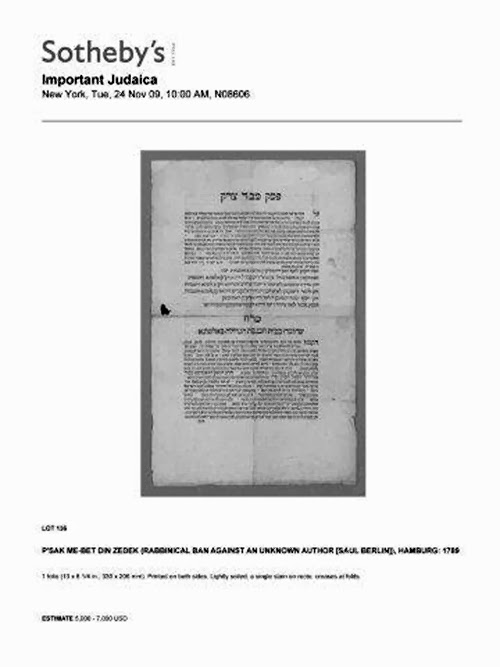
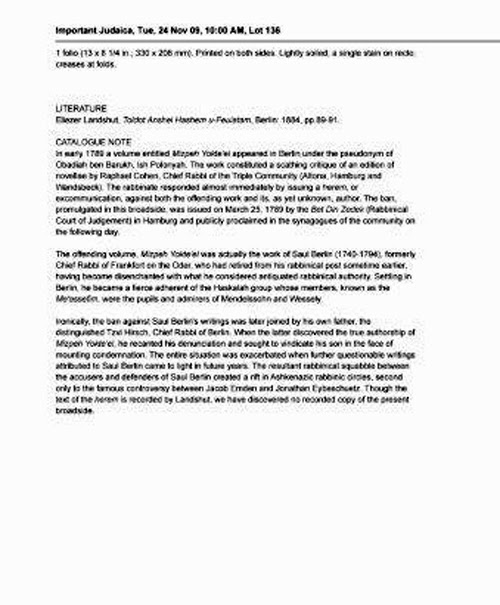
    The Altona-Wansbeck beit din, recognizing the intent of the book, appealed to other cities courts to similarly ban the author and book MY – the ban, entitled, Pesak mi-Beit Din Tzedek, the only known extant copy was recently sold at Sotheby’s (Important Judaica, Nov. 24, 2009, lot 136).[3]


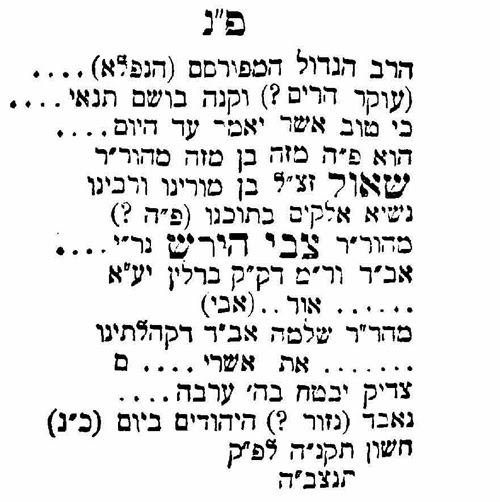
These concerns lead the ban’s proponents to the Chief Rabbi of Berlin, R. Tzvi Hirsch Berlin, and to solicit him to join the ban. Initially, it appeared that R. Tzvi Hirsch would go along with the ban.  But, as he was nearing deciding in favor of signing the ban, someone whispered in his ear the verse in Kings 2, 6:5, אהה אדני והוא שאול – which R. Tzvi Hirsch understood to be a play on the word “שאול” in the context of the verse meaning borrow, but, in this case, to be a reference to his son, Saul. That is, the real author of MY was Saul Berlin, Tzvi Hirsch’s son.  Needless to say, R. Tzvi Hirsch did not sign the ban. [4]

    Not only did he not sign the ban, he also came to his son’s defense.  Aside from the various bans that were issued, a small pamphlet of ten pages, lacking a title page, was printed against MY and Saul. [5]  Saul decided that he must respond to these attacks.  He published Teshuvot ha-Rav. . . Saul le-haRav [] Moshe  Yetz,[6] which also includes a responsum from R. Tzvi Hirsch, Saul’s father.  Saul defends himself arguing that rabbinic disagreement, in very strong terms, has a long history.  Thus, a ban is wholly inappropriate in the present case. 

    R. Tzvi Hirsch explained that while MY disagreed with R. Cohen, there is nothing wrong with doing so.  The author of MY, as a rabbi – Saul was, at the time, Chief Rabbi of Frankfort – Saul is entitled to disagree with other rabbis.  Of course, Saul’s name is never explicitly mentioned. Moreover, in the course of R. Tzvi Hirsch’s defense he solicits the opinions of other rabbis, including R. Ezekiel Landau.  R. Landau, as well as others, noted that aside from the propriety of disagreement within Judaism, the power of any one particular beit din is limited by geography.  Thus, the Altona-Wansbeck’s beit din‘s power is limited to placing residents of Hamburg under a ban but not residents of Berlin, including R. Saul Berlin, the author of MY.[7]

    The controversy surrounding the MY was not limited to Jewish audiences. The theater critic, H.W. Seyfried, published in his German newspaper, Chronik von Berlin, translations of the relevant documents and provided updates on the controversy.  Seyfried agitated on behalf of the maskilim and editorlized that the Danish government should take actions against R. Cohen. It appears, however, that Seyfried’s pleas were not acted upon.[8] 

The Publication of Besamim Rosh


    With this background in mind, we can now turn to the Besamim Rosh.  Prior to publishing the full BR, in 1792, Saul Berlin published examples of the responsa and commentary found in the BR – a prospectus, Arugat ha-Bosem.  This small work whose purpose was to solicit subscribers for the ultimate publication of BR. It appears that while Saul may have been trying for significant rabbinic support, the majority of his sponsors were householders. 

    In 1793, the BR was published.  The BR contains 392 responsa (besamim equals 392) from either R. Asher b. Yeheil (Rosh) (1259-1327) or his contemporaries.  This manuscript belonged to R. Yitzhak di Molina who lived during the same time period as R. Yosef Karo, the author of Shulchan Orakh.  Additionally, Saul appended a commentary of his own to these responsa, Kasa de-Harshana

    The BR contains two approbations, one from R. Tzvi Hirsch Berlin and the other from R. Yehezkel Landau.  R. Landau’s approbation first explains that Rosh’s responsa need no approbation.  With regard to R. Saul Berlin’s commentary, he too doesn’t need an approbation according to R. Landau.  This is so because R. Saul’s reputation is well-known.  R. Landau’s rationale, R. Saul’s fame, appears a bit odd in light of the fact that among some (many?) R. Saul’s reputation was very poor due to the MY. 

    R. Tzvi Hirsch’s approbation also contains an interesting assertion. Saul’s father explains that this book should put to rest any lingering question regarding his son.    

    In addition to the approbations there are two introductions, one from di Molina and the other from Saul. Di Molina explained the tortured journey of the manuscript. He explains that, while in Alexandria, he saw a pile of manuscripts that contained many responsa from Rosh that had never before been published. He culled the unpublished ones and copied and collected them in this collection.  What is worthy of noting is that throughout the introduction di Molina repeatedly asks “how does the reader know these responsa are genuinely from Rosh.” 

    R. Saul, in his introduction, first notes that the concept of including introductions is an invention long after Rosh, and is not found amongst any of the Rishonim. 

    As mentioned previously, the BR is a collection of 392 responsa mostly from Rosh or his contemporaries.  Additionally, R. Saul wrote his own commentary on these responsa, Kasa diHarshena. [9]  This commentary would contain the first problem for Saul and the BR.  In responsum 40, Rosh discusses the position of Rabbenu Tam with regard to shaving during the intermediate days (ho ha-moad).  While Rosh ultimately concludes that one is prohibited from shaving on hol ha-moad, R. Saul, in his commentary, however, concludes that shaving on hol ha-moad is permissible.  In so holding, R. Saul recognized that this position disagreed with that of his father.  Almost immediately after publication, R. Saul printed a retraction regarding this position allowing for shaving on hol ha-mo’ad.  This retraction, Mo’dah Rabba, explains that Saul failed to apprise his father of this position and, as Saul’s father still stands behind his negative position, Saul therefore retracts his lenient position. [Historically, this is not the only time a father and son disagreed about shaving on hol ha-moad.  R. Yitzhak Shmuel Reggio (YaSHaR)and his father, Abraham, disagreed on the topic as well.  As was the case with Saul and his father, the son, YaSHaR took the lenient position and his father the stringent.  Not only did they disagree, after YaSHaR published his book explaining his theory, his father attacked him in an anonymous response.  For more on this controversy see Meir Benayahu, Shaving on the Intermediary Days of the Festival, Jerusalem, 1995.] 

    This retraction, while may be interperated as evidence of Saul humbleness in his willingness to admit error and not stand on ceremony, others used this retraction against him.  The first work published that questioned the legitimacy of BR is Ze’ev Yetrof, Frankfort d’Oder, 1793, by R. Ze’ev Wolf son of Shlomo Zalman.  (This book is very rare and, to my knowledge, is not online.  Although not online, a copy is available in microfiche as part of the collection of books from the JTS Library, and on Otzar Hachomah see below)  The author explains that eight responsa in BR are problematic because they reach conclusion that appear to run counter to accepted halahik norms. In addition, the author states in his introduction, “that already we see that there is something fishy as it is known that the author [Saul Berlin] has retracted his position regarding shaving.” It should be noted that no where does R. Ze’ev Wolf challenge the authenticity of the manuscript for internal reasons – it is incorrectly dated, incorrectly attributed etc.  Apparently, Ze’ev Yetrof, was not well-known as it is not cited by other contemporaries who too doubted the authenticity of BR.  Samat theorizes that either wasn’t printed until later or, was destroyed.[10]  

    The second person to question the legitimacy of BR was R. Rafael Hamburg’s mechutan, R. Ya’akov Katzenellenbogen.  In particular, he wrote to R. Cohen’s student, R. Mordechai Benat. As was the case with Wolf, R. Katzenellenbogen located 13 responsa where he disagreed with the conclusions.  R. Katzenellenbogen indicated that R. Benet shold review the BR himself and apprise R. Katzenellenbogen regarding R. Benet’s conclusions. 

    R. Katzenellenbogen also wrote to Saul’s father, Tzvi Hirsch, and Tzvi Hirsch eventually responded in a small pamphlet.  R. Tzvi Hirsch first deals with the predicate question, is the manuscript legitimate. That is, prior to discussing the conclusions of particular responsum, regarding the manuscript, R. Tzvi Hirsch testifies that he is intimately familiar with this manuscript. He explains that for 11 years, the manuscript was in his house.  In fact, R. Tzvi Hirsch created the index that appears in BR from this manuscript.  Additionally, he had his other son Hirschel (eventual Chief Rabbi of London) copy the manuscript for publication.  Thus, R. Tzvi Hirsch argues that should put to rest any doubt regarding the authenticity of the manuscript.

    R. Tzvi Hirsch then turns to the issue regarding conclusions of some of the responsa. He first notes, that at most, there are a but a small number of questionable responsa.  Indeed, it is at most approximately 5% of the total responsa in BR.  That is, no one questions 95% of the responsa (at least not then).  Second, with regard to the conclusions themselves, that some conclusions are different than the halahik norms, that can be found in numerous books, none of which anyone questions their authenticity.  Thus, conclusions prove nothing.

Leaving the history and turning to the content of BR.  One of the more controversial responsa is the one discussing suicide.  In particular, according to the responsum attributed to Rosh, the historic practices that were applied to a suicide – lack of Jewish burial, no mourning customs – are not applicable any longer.  This is so, because suicides can be attributed to the poor conditions of the Jews and not philosophical reasons.  Thus, we can attribute the motivations of a suicide to depression and remove the restrictions that applied to suicides. 

    This responsum was what lead some, including R. Moshe Sofer (Hatam Sofer), to conclude that the entire BR was a forgery.  Indeed, this responsum was one of the two that were removed in the second edition.  Others, however, point out this responsum and its conclusions are not in any conflict with any accepted halakhic norms.  And, instead, while providing new insight into the current motivations of a suicide, the ultimate conclusion can be reconciled with all relevant laws.  [11]  

This particular example illustrates the problematic nature of merely relying upon a particular conclusion to demonstrate the authenticity or lack thereof of a work. Although R. Sofer was certain this responsum ran counter to a statement of the Talmud, others were easily able to reconcile the Talmudic statement with the conclusion of the responsum.

    Another controversial responsa deals with someone who is stuck on the highway as the Shabbat is fast approaching.  The traveler is thus faced with the following dilemma, stop in a city where he will require the charity of strangers or continue on and get home.  The BR rules that the traveller can continue and is not required to resort to charity.  This, like the responum above, was similarly removed from the second edition. These are the only two responsa removed from the second edition.  Of course, this removal isn’t noted anywhere except that the numbers skip over those two.  In fact, the index retains the listing for the two responsa. 

    Other controversial responsa include one dealing with belief in the afterlife and messianic era, kitnoyot – BR would abolish the custom, and issues relating to mikvah. 

Today, common practice regarding suicide appears, for the most part, to conform with the position of BR.

Status Today

    After its publication in 1793, it would be almost one hundred years before the BR would be reprinted.  In 1881, the BR was reprinted in Cracow.  This edition was published by “the well-known Rabbi Yosef Lazer from Tarnow'” R. Lazer’s was part of a well-known Hassidic family.  His grandfather, R. Menachem Mendel Lazer was the author of Sova Semochot, Zolkiov, 1845.[12] It appears that the BR was the only controversial book that R. Yosef Lazer published.  Although he published approximately 30 books, the are mainly run-of-the mill works, Machzorim, haggadot, as well as some standard rabbinic works. It is unclear what prompted R. Lazer to republish the BR.  Lazer provides no explanation.  Although Lazer’s publishing activities are difficult to reconcile with his publication of the BR, the printers, Yosef Fischer and Saul Deutscher, other publications indicate that they were more open to printing all types of books. For example, the same year they published BR, they published a translation of Kant, Me-Ko’ach ha-Nefesh, Cracow, 1881.  In all events, it appears that Lazer (or perhaps the printers) was aware of the controversy surrounding the BR as he removed Saul Berlin’s introduction as well as two of the more controversial responsa, one discussing suicide and the other allowing one to continue to travel home after sunset on Friday to avoid having to rely upon the charity of strangers.  In addition, one responsa was accidentally placed at the end of the volume, not in its proper order.[13]  Although the two responsa were removed in the text, they still appear in the index. A photo-mechanical reproduction of this edition was published in New York in 1970, and a copy is available on Hebrewbooks. 

    In 1984, the BR was reprinted for only the third time.  This edition, edited by R. Reuven Amar and includes an extensive introduction, Kuntres Yafe le-Besamim, about BR.  Additionally, commentary on the BR by various rabbis is included.  The text of this edition is a photo-mechanical reproduction of the first edition.  This edition contains two approbations, one from R. Ovadiah Yosef, who in his responsa accepts that BR is a product of R. Saul Berlin, but R. Yosef holds that doesn’t diminish the BR’s value.  The second approbation is from R. Benyamin Silber.  But, R. Silber provides notes in the back of this edition and explains that he holds the BR is a forgery and that he remains unconvinced of Amar’s arguments to the contrary.

    In his introduction, Amar attempts to rehabilitate the BR.  Initially, it should be noted that Amar relies heavily upon Samet’s articles on BR, but never once cites him.  Samet had complied a bibliography of works about BR as well as where the BR is cited, Amar also provides the latter in a sixty four page Kuntres, ריח בשבמים, in the back of his edition. In his introduction Amar relates the history of the BR and attempts to demonstrate that many accepted the BR and those that did not, Amar argues that many really did accept BR.  This introduction contains some very basic errors, many of which have been pointed out by Shmuel Ashkenazi in his notes that appear after the introduction.  

Difficulties in Authentication   

    Today, various theories have been put forth to demonstrate that the BR is a forgery.  Specifically, some have pointed to “hints” or “clues” that R. Saul left for the careful reader which would indicate that BR is a carefully created forgery.  For example, some note that the number of responsa, 392, the Hebrew representation of that number is שצ”ב which can be read to be an abbreviation of Saul’s name – Saul ben Tzvi.  Others take this one step further and point to the was R. Asher (Rosh) is referenced – רא”ש – which again can be read R. Saul.  Obviously, these clues are by no means conclusive.  In the academic world, the BR is written off as a “trojan horse” intended to surreptitiously get R. Saul’s masklik positions out in the masses or something similar.  All of these positions, however, rely upon a handful of responsa at best and no one has been able to conclusively demonstrate that the entirety of BR is a forgery. At best, we are still left with the original criticisms – that a few of the responsa’s conclusions espouse positions that appear to be more 18th century in nature than 13th century. [14]   

 R. Yeruchum Fischel Perlow aptly sums up much of what has been written regarding the question of authenticity of BR:

Just about all who have examined [the question of the authenticity of BR] walk around like the blind in the dark, and even after all their long-winded essays, they are left with only their personal feelings about the BR without ever adducing any substantive proofs in support of their position. And, on the rare occasions that they actual do provide proofs for their positions, it only takes a cursory examination to determine that their is nothing behind those proofs. [R. Yeruchum Fischel Perlow, “Regarding the book ‘Besamim Rosh,'” Noam 2 (1959), p. 317. For some reason this article is lacking in some editions of Noam]

    Assuming that one discounts the testimony of Saul and his father regarding the manuscript, it is not easy to determine if the BR is authentic or not.  For example, responsum 192, according to R. Moshe Hazan, one of the defenders of BR, this responsum “is clear to anyone who is familiar with the language and style of the Rishonim, from the Rishonim.” Responsum 192, is attributed to R. Shlomo ben Aderet (Rashba), and discusses the opinion of Rosh that allowed for capital punishment for pregnancy out of wedlock.  Thus, according to R. Hazan, 192 is conclusive proof that BR is authentic. 

    Simcha Assaf, however, has shown that responsum 192 is a forgery – or there is a misattribution.  Assaf explains that if one looks at the date of this incident, responsum 192 could not have been written by Rashba.  Rashba died 10 years prior to this event.  Simcha Assaf, Ha-Onshim Ahrei Hatemat ha-Talmud, Jerusalem, 1928, pp. 69-70.  Thus, the very same responsum whose “language and style” demonstrated that it was from the times of the rishonim has attribution problems.  To be sure, Assaf isn’t saying this responsum isn’t necessarily from the rishonim period, however, it surely isn’t from Rashba.[15]

    Or, to take another example. Talya Fishman argues that “[halakhic literature of the seventeenth and eighteenth centuries . . . climbed to new (and fantastic) heights of theoretical speculation, creating, in effect, a body of non applied law.”  Talya Fishman, “Forging Jewish Memory: BR and the Invention of Pre-emancipation Jewish Culture,” in Jewish History and Jewish Memory, ed. Carlbach et al., Hanover and London: 1998, pp. 70-88.  Based on this understanding of seventeenth and eighteenth century literature, as contrasted with literature from the period of Rosh, she turns to the BR and finds such speculative responsa.  This, according to Fishman, implicitly demonstrates that BR is a product of the seventeenth or eighteenth century. Indeed, Fishman concludes “[i]n short, [BR], has an unusually high concentration of eyebrow-raising cases.”  Id. at 76. 

    But, if one subjects Fishman’s argument to even a minimal amount of scrutiny, her argument, as presented, is unconvincing.  First, in support of Fishman’s “high concentration” of odd responsa, Fishman provides three examples.  That is, Fishman points to three out of 392 responsa that contain “eyebrow-raising cases” and concludes this represents “an unusually high concentration.”  I think that most would agree that less than 1% does not represents an unusually high concentration.  Second, of the three examples Fishman does provide, one is from Kasa deHarshena, which everyone agrees is a product of the eighteenth century.  Third, one of the examples, no. 100, it appears that Fishman misread the responsa.  Fishman provides that responsa 100 is a “bizarre question about whether a one-armed man should don tefilin shel yad on his forehead alongside tefilin shel rosh.”  Id. at 76.  Indeed,  responsa 100 is about a one-armed man and whether because he cannot fulfill the arm portion of tefilin if that absolves him of the head portion.  Nowhere, however, not in BR or Kasa de-harshena, does it mention the possibility of putting the tefilin shel yad on one’s forehead.  Thus, if we discount these two responsa, Fishman is left with a single responsum to prove her generalization about BR.[16]   

    Regarding the manuscript, that too is an unsolved mystery.  We know that a manuscript that may have been the copy which R. Hirschel made is extant but the manuscript from di Molena is unknown.  Additionally, although we know that the Leningrad/St. Petersberg library had Tzvi Hirsch’s copy with his annotations, the current location of that book is unknown. See Benjamin Richler’s post regarding the manuscript here.

    The BR’s most lasting effect may be in that this was to be the first of many newly discovered manuscripts to be accused of forgery because of the conclusions reached.  Subsequent to the BR, responsa or works in other areas of Jewish literature were tarred with cry of forgery because of their conclusions. [See Yaakov Shmuel Spiegel, Chapters in the History of the Jewish Book, Writing and Transmission, Ramat-Gan, 2005, 244-75, (“until the publication of BR, there were no questions raised regarding the authenticity of a book”) Spiegel also demonstrates that we now know that in many instances that the charge of forgery was wholly without basis and today there is no question that some of the books that are alleged forgeries are legitimate.]

Other Works by Saul Berlin

    One final point.  While we discussed Saul’s work prior to BR, there was another book that he wrote, that was published posthumously.  This work, Ketav Yosher, defended Naftail Wessley and his changes to the Jewish educational system.  Indeed, Ketav Yosher, is a scathing attack on many traditional sacred cows. [17]  Ketav Yosher, like MY, was published without Saul’s name, but again, we have testimony that Saul was in fact the author.  In light of the position Ketav Yosher takes, it is no surprise that this book doesn’t help Saul’s standing among traditionalists.  

    Saul may have written additional works as well, however, like the BR itself, there is some controversy surrounding those additional works.  R. Saul’s son, R. Areyeh Leib records an additional 11 works that Saul left behind after he died.  The problem is these very same works – although all remaining in manuscript – have been attributed to someone else.  But, before one jumps to conclusions, it should be pointed out that this story gets even more complicated.  The book which attributes these works to another is itself problematic.  Indeed, whether this list attributing the books to another even exists is a matter debate.  And, while that sounds implausible, that, indeed is the case.  Ben Yaakov, Otzar ha-Seforim (p. 599 entry 994) says there is a 1779 Frankfort Order edition of Sha’ar ha-Yihud/Hovot ha-Levovot that includes an introduction (and other material) that lists various manuscripts which the editor, according to Ben Ya’akov, was a grandson of Yitzhak Yosef Toemim, ascribes to his grandfather – and not Saul. Weiner, in his bibliography, Kohelet Moshe, (p. 478, no. 3922) says that Ben Ya’akov is wrong – not about the edition, Weiner agrees there was a 1779 Frankfort Oder edition, just Weiner says there is no introduction and Toemim wasn’t the editor (and other material is missing). Vinograd, Otzar Sefer ha-Ivri lists such a book – 1779 Frankfort Oder, Hovot ha-Levovot/Sha’ar ha-Yichud, but there is no such edition listed in any catalog that we have seen including JNUL, JTS, Harvard, British Library etc. It appears that Samat couldn’t locate a copy either as although he records the dispute between Weiner and Ben Yaakov, he doesn’t offer anything more.  Thus, Saul’s other writings, for now, remains an enigma.

    It is worthwhile to conclude with the words of R. Matisyahu Strashun regarding Saul and the BR:

“After all these analyses, even if we were able to prove that the entire BR from the begininning to end is the product of R. Saul, one cannot brush the work aside . . . as the work is full of Torah like a pomegranate, and the smell of besamim is apparent, it is a work full of insight and displays great breadth, the author delves into the intricacies of the Talmud and the Rishonim, the author is one of the greats of his generation.”  Shmuel Yosef Finn, Kiryah Ne’amanah, notes of R. Strashun, p. 93.

The Internet


    As hopefully should be apparent, most of the books discussed above or referenced below are available online.  These include the rare retraction that R. Saul published regarding his position on shaving on hol ha-ma’od, Ketav Yosher, the prospectus for BR, as well as the BR itself.  Indeed, not only is the BR online but both editions are online. And, the BR exemplifies why one should be aware of multiple internet sources.  Hebrewbooks has a copy of BR which they indicate is the first edition “Berlin, 1793,” however, in reality it is the later, 1881 Warsaw edition of the BR.  As noted above, that edition, however, is lacking two responsa.  This highlights an issue with Hebrewbooks, the bibliographical data is not necessarily correct.  The JNUL, has the first edition. Indeed, in the case of the JNUL, the bibliographical information is much more reliable than Hebrewbooks. Thus, one needs to use both the JNUL as well as Hebrewbooks if one wants to get a full picture of the BR. Or, another example.  Both the JNUL site as well as Hebrewbooks has MY online; but, the JNUL version was bound with two rare letters at the end and those appear online as well.  Additionally, when it comes to Hebrewbooks, one must be aware that they have removed books that someone presumably finds objectionable so although MY and KY are there now, there is no guarantee it will be in the future.  Similarly, although not online, and unlike the MY the JNUL has, Otzar haChomah has the Ze’ev Yitrof with additional material bound in the back. Besides for all these rare seforim mentioned, many of the other seforim quoted in this post, as is apparent from the links, can now be found on the web in a matter of seconds instead of what just a few short years ago would have taken a nice long trip to an excellent library.

Saul’s Epithet, he was buried in the Alderney Road Cemetery in London, next to his brother, Hirschel, Chief Rabbi 
Notes

[1] For more on R. Raphael Cohen see the amazingly comprehensive and insightful bibliography by the bibliophile R. Eliezer Katzman, “A Book’s Luck,” Yeshurun 1 (1996), p. 469-471 n.2. See also R. Moshe Shaprio, R Moshe Shmuel ve-Doro pp.103-110 especially on the BR see 108-09. C. Dembinzer, Klielas Yoffee, 1:134b, 2:78b writes that the work on TY caused R. Saul to lose his position as Chief-Rabbi of Frankfort and his wife divorced him because of it. See also, S. Agnon, Sefer Sofer Vesipur, p.337. On R. Raphael Cohen and his connection with the Gra and Chasidus see D. Kamenetsky, Yeshurun, 21, p. 840-56. As an aside this article generated much controversy for example see the recent issue of Heichal Habesht, 29, p.202-216 and here.
[2] Regarding the correct pronunciation of this title see Moshe Pelli, “The Religious Reforms of ‘Traditionalist’ Rabbi Saul Berlin,” HUCA (1971) p. 11.  See also R. Shmuel Ashkenzi’s notes in the BR, Jerusalem, 1983 ed., introduction, n.p., “Notes of R. Shmuel Ashkenzi on Kuntres Yefe le-Besamim, note 6.  
Additionally, MY was not Saul’s first literary production, nor was it his first that was critical of another’s book.  Instead, while he was in Italy in 1784, he authored a kunteres of criticisms of R. Hayyim Yosef David Azulai’s Birkei Yosef.  See R. R. Margolis, Arshet pp. 411-417; Moshe Samat, “Saul Berlin and his Works,” Kiryat Sefer 43 (1968) 429-441, esp. pp. 429-30, 438 n.62.  On Chida’s opinion of the BR see for example Shem Hagedolim:

עתה מקרוב נדפס ספר זה בברלין… ועוד יש הגהות כסא דהרסנא. ואשמע אחרי קול רעש כי יש בספר זה קצת דברים זרים ואמרו שהמעתיק הראשון בארץ תורגמה מכ”י הרב יצחק די מולינא ז”ל יש לחוש שהוסיף וגרע. ולכן הקורא בסי’ זה לא יסמוך עליו דאפשר דתלי בוקי סריקי בגדולים עד אשר יחקור ויברר הדברים ודברי אמת ניכירים ודי בזה… (שם הגדולים, ערך בשמים ראש, וראה שם, ערך מר רב אברהם גאון)

See also the important comments of R.Yakov Chaim Sofer, Menuchas Sholom, 8, pp. 227-230 about the Chida.
[3]  Eliezer Landshut, Toldot Anshei Shem u-Puolotum be-Adat Berlin, Berlin: 1884, 89-90 for the text of the ban as well as its history.  Additionally, for the proclamation read in the main synagogue of Altona see id. at 90-1. This proclomation has been described as “one of the harshest condemnations” of the time.  See Shmuel Feiner, The Jewish Enlightenment in the Eighteenth-Century, Jerusalem: 2002, p. 310. 
[4]  Id. at 91. Samat, however, notes that neither Saul nor his father ever admitted Saul’s authorship of MY.  Samat, “Saul Berlin and his Works,” p. 432, 4.  
[5] According to A. Berliner, the author of this pamphlet is R. Eliezer Heilbot. See Samat, id. Saul and MY were not the only ones attacked. The publisher of MY, Hinukh Ne’arim, was also attacked and, not only MY but all the books they published were prohibited by some. The publishers, however, defended their decision to publish MY.  They argued that the whole point of MY was to ascertain if R. Raphael Cohen’s book was riddled with errors or, the author of MY was mistaken.  The publishers pointed to the above mentioned introduction to MY wherein the MY’s author explains that he has sent copies of the book to leading rabbis to determine the question regarding R. Cohen’s book. Thus, MY is either right or wrong, but there can be nothing wrong with merely publishing it.  See id. at 92-3.
Additionally, it should be noted that according to some, Saul authored a second attack on R. Raphael.  R. Raphael published Marpeh Lashon, Altona, 1790, and was soon after attacked in the journal Ha-Meassef by someone writing under the pen-name EM”T.  Many posit that this is none other than Saul.  Katzman, Yeshurun 1, 471 n.3, disagrees and points to internal evidence that it is unlikly that Saul is the author of this critique. 
According to Feiner, these attacks were not one-sided.  Feiner argues that R. Cohen criticizes Saul, albeit in a veiled manner, in Marpeh Lashon.  See Feiner, Jewish Enlightenment, op. cit., 314-15.  
[6] Landshuth, id., suggests that Moshe is a non-existent figure like MY’s putative author Ovadiah. See also, Samet, “Saul Berlin and his Works,” 432 n.4 who similarly questions the existence of Moshe.  Carmilly-Weinberg makes the incredible statement that his Moshe is none other than Moses Mendelssohn.  Carmilly-Weinberg, Sefer ve-Seiyif,  New York, 1967, p. 215, (Carmilly-Weinberg’s discussion about both MY and BR are riddled with errors).  As Pelli notes this is impossible as the letter is signed 1789, the same year MY was printed, and Mendelssohn died three years prior. Pelli resurrects Moshe and links him with a known person from Amsterdam, Saul brother-in-law. See Pelli, HUCA (1971) p. 13 n.75.  Ultimately, however, Pelli rejects this and demonstrates that Moshe is indeed a pseudonym but a well-selected one.  See id.  
[7]  See Landshuth, 93-9; Pelli, 13-15.  See also R. Alexander Sender Margolioth, Shu”t ha-RA”M, Lemberg, 1897, no. 9.    
[8] See Feiner, The Jewish Enlightenment, op. cit., 312-13.  This newspaper is online here, and Feiner provides the relevant issues which are 1789 pp. 484-88, 520-24, 574-81, 680-82, 768-74, 791-802, 867-92, 932-72.   
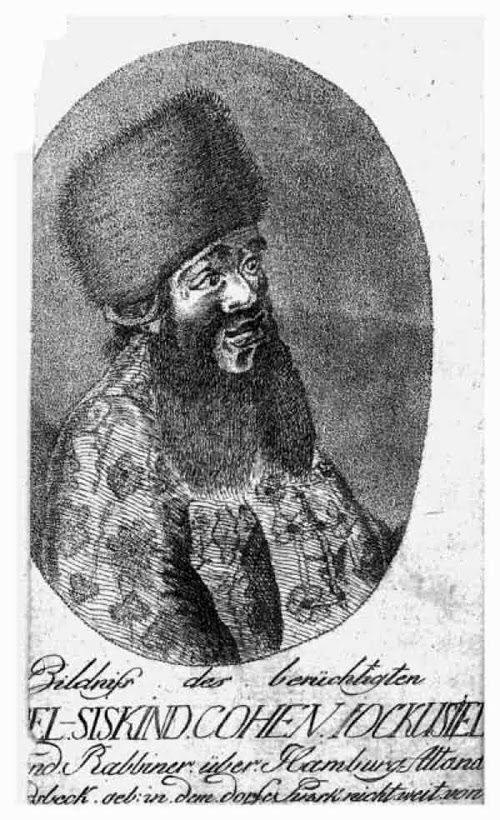
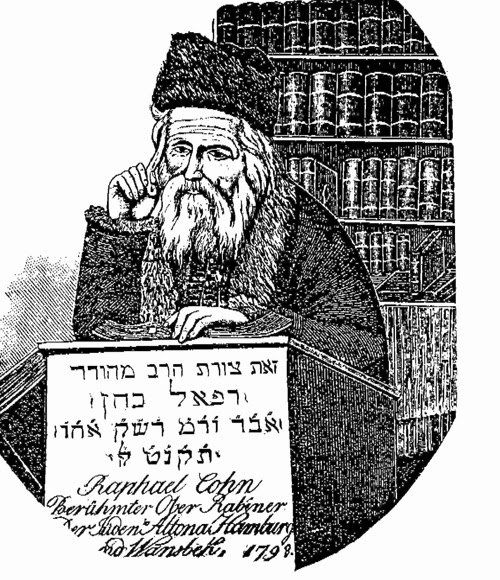
One of which includes this portrait of R. Cohen.
Which is a very different portrait, both in time and look, to the one appearing in E. Duckesz, Ivoh le-Moshav, Cracow, 1903.

[9] For the deeper meaning of the title Kasa de-Harshena, see Moshe Pelli, The Age of Haskalah, University Press of America, 2006, 183 n.51.
[10] See Samat, who discusses the exact progression of the ban.

[11] See Yechezkel Shrage Lichtenstein, Suicide: Halakhic, Historical, and Theological Aspects, Tel-Aviv, 2008, pp. 438-44. See also,Yeshurun 13:570-587 especially pp.578-581; Marc B. Shapiro, “Suicide and the World-To-Come,” AJS Review, 18/2 (1993), 245-63. 
On the issue of suicide there are others who similarly reach the same holding as the BR see Strashun in his מתת-יה pp. 72a-72b (this source is not quoted by Samet or Amar).
[12] Biographical information on R. Yosef Lazer is scant.  For information on his father and grandfather, see Meir Wunder, Me’orei Galicia, Israel, 1986, vol. III, pp. 456, 462-3. See also T.I. Abramsky, “‘Besamim Rosh’ in the Hassidic Milieu,” Taggim, (3-4), 56-58.   
[13] Samat only notes the removal of one responsum, he fails to note that exclusion of the second.  He does, however, note the misplaced responsum.  Additionally, Kuntres ha-Teshuvot ha-Hadash, fails to record that any are missing or that one responsum was moved to the end. 
[14] See Pelli, Age of Haskalah, pp. 185-89, comparing a few responsa with 18th century haskalah literature.
[15] Assaf was not the first to use this responsa and note its historical anacronisms.  Leopold Zunz, also highlights the issues with this responsum (as well as others).  Leopold Zunz, Die Ritus des Synagogalen Gottesdienstes, Geschichtlich Entwickelt, Berlin: 1859, 226-28.  Zunz’s critique is quoted, almost in its entirety by Schrijver, but Schrijver appears to be unaware of Assaf’s additional criticisms of the responsum (and others).
Assaf provides one other example where he shows through internal data that there is a misattribution.  Assaf concludes that he has other examples of historical anacronisms in BR but doesn’t provide them here or, to our knowledge, anywhere else.
[16] For another critique of Fishman’s position see Emile G.L. Schrijver, “Saul Berlin’s Besamim Rosh: The Maskilic Appreciation of Medieval Knowledge,” in Sepharad in Ashkenaz, Netherlands: 2007, pp. 249-259, esp. pp. 253-54. 
[17] Regarding Ketav Yoshor see Pelli, Age, 176-79. See also here and here.

Additional Bibliography:
M. Samet has two articles on the topic, R. Saul Berlin and his Writings, Kiryat Sefer, 43 (1969) 429-41; “Besamim Rosh” of Saul Berlin, Kiryat Sefer 48 (1973) 509-23, neither of which are included in the recent book of Samet’s articles.

To add to Samet’s and Amar’s very comprehensive lists of Achronim who quote BR: (I am sure searches on the various search engines will show even more): Malbim in Artzos Hachaim, 9:41 (in Hameir Learetz); Shut Zecher Yosef,1:32b; Keter Kehunah p. 30; Matzav Hayashar 1:2a; Pischei Olam 2:218,228; Birchat Yitchcak (Eiskson), pp. 6,14,24; Maznei Tzedek, p.26,45,254; R.Yakov Shor, Birchat Yakov, pp.212  Sefer Segulos Yisroel pp.116b; R. Rabinowitz, Afekei Yam 2:14; R. Leiter, Zion Lenefesh Chayah# 43; Shut Sefas Hayam, OC siman 14; R Meir Soleiveitck, Hameir Laretz 45a, 45b, 54b, 55a; Emrei Chaim p.26; R. Sholom Zalman Auerbach, Meorei Eish p. 108 b

In general on BR see: R.Yakov Shor,Eytaim Lebinah (on Sefer Haeytim) p. 256; Pardes Yosef, Vayikrah 220b Pardes Yosef, Shelach p. 517; R.Yakov Chaim Sofer, Menuchas Sholom, 8, pp. 222- 230; Shar Reven p. 54; A. Freimann, HaRosh ; Y. Rafel, Rishonim Veachronim, pp. 123-130; B. Lau, MeMaran Ad Maran, pp.133; S. Agnon, Sefer Sofer Vesipur, pp.337-339.

R. Pinhas Eliyahu Horowitz writes:

ולפעמים תולים דבריהם באילן גדול וכותבים מה שרוצים בשם איזה קדמון אשר לא עלה על לבו… כספר בשמים ראש שחיבר בעל כסא דהרנסא לא הרא”ש וזקני ישראל תופסי התורה יעלו על ראשם… (ספר הברית, עמ’ 232).

The Steipler was of the opinion in regard to the BR that:
שבאמת ניכר מהרבה תשובות שהם מהרא”ש ז”ל רק כנראה שיש שם הרבה תשובות מזויפות שהמעתיק הכניס מעצמו כי ישנם שם דברים מאד מזורים ואיומים  (ארחות רבנו, א, עמ’ רפה)

R Zevin writes in Sofrim Veseforim (Chabad) p.354 :
אלא שבתשובות בשמים ראש המיחוס להרא”ש ושכידוע נמנו וגמרו שמזוייף הוא

R. Yakov Kamenetsky said: “Do you think Just we (he meant people of his own caliber) were fooled? Even R. Akiva Eiger was fooled.” (Making of a Godol, pp.183-184)

About Rav Kook and the BR see: http://www.biu.ac.il/JS/JSIJ/5-2006/Gutel.pdf

R. Avigdor Nebensal writes:

כשמביאם את הבשמים ראש ראוי להזכיר שיש מסתייגים חריפות מהספר הזה (השתנות הטבעים, עמ’ 16).
R Zalman Nechemiah Goldberg writes:
אכן בעיקר הענין אם להביא דברי בשמים ראש בודאי צדק הג”א נבנצל שליט”א שיש להביאו בהסתייגות, ובפרט בענינים אלו שהוחזק למזייף ולמביא עקומות וכוזבות (השתנות הטבעים, עמ’ רסד).


Guide and Review of Online Resources – 2022 – Part I

Guide and Review of Online Resources – 2022 – Part I

By Ezra Brand

Ezra Brand is an independent researcher based in Tel Aviv. He has an MA from Revel Graduate School at Yeshiva University in Medieval Jewish History, where he focused his research on 13th and 14th century sefirotic Kabbalah. He is interested in using digital and computational tools in historical research. He has contributed a number of times previously to the Seforim Blog (tag), and a selection of his research can be found at his Academia.edu profile. He can be reached at ezrabrand-at-gmail.com; any and all feedback is greatly appreciated.[1]

Intro

It’s an exciting time to be a reader of scholarship, and to be engaged with the field. The dramatic shift to “remote” and “virtual” over the past two years may be on par with the shifts to writing and the codex around the 9th century) and the printing press in the 15th.[2]

Digital publishing has become more and more mainstream. As defined by Wikipedia (in entry “Electronic publishing”):

“Electronic publishing (also referred to as publishing, digital publishing, or online publishing) includes the digital publication of e-books, digital magazines, and the development of digital libraries and catalogs. It also includes the editing of books, journals and magazines to be posted on a screen (computer, e-reader, tablet, or smartphone.”

Regarding Hebrew books specifically, and for recent data, Israeli National Library annual statistics for 2020 state (Hebrew, my translation):

“In 2020, digital publishing was significantly expanded. Not all the digital books have been processed [by the library] yet, but already 799 digital books have been registered in the National Library, from publishers, research institutions, private individuals and more […]

For many in the past year, digital publication has become the primary mode of distribution, as opposed to paper. Notable in this area is the relatively small amount of children’s books (8%) compared to the high number of digital reference literature (69%).

The share of [books put out by] associations (43%) is particularly high, especially for reference books in the field of Israeli society and Jewish studies. [The share of books put out by] [p]rivate publishers (37%) include[s] many biographies, rabbinic literature and a few children’s books that have come out. Commercial publishers released most of the digital prose books.”

Specifically regarding rabbinic literature, one scholar pointed out already in 2016: “Searching for ancient original Jewish sources online, it is astonishing how diverse and numerous are the websites that are available.”[3]

At the same time as the trend towards digital publishing and distribution is occurring, there is also a movement towards “open access”. In this context, “open access” means an academic resource, whether databases, journals, or other tools, with no paywalls or subscriptions required to access content.

Over the first few decades of electronic resources, most of the resources were proprietary. They were generally available on a CD, which had to be bought. With the shift to the internet, many of these resources became available online, but required a subscription.

The movement towards freely available scholarship has continued to gain steam, making a huge amount of cutting edge scholarly publications available for free, and for all. In addition, there are a huge amount of grassroots initiatives to make available primary sources for study.

Open-access can be financially sustained in one of the following major ways:

  1. Volunteer work
  2. Funding by institution (esp. non-profit, university, or government) or individual donation
  3. Advertising

The open-source resources in this guide are mostly supported in one of the first two ways.

Besides for full open-access, another model is called “freemium”. Freemium, as I use it in this context, means that some very basic part is provided for free, with the hope that the main product will be bought.

Some examples of freemium content that I’ve found helpful are:

Amazon listing pages for books. Amazon has bibliographical info, blurbs of reviews by scholars and media, crowd-sourced reviews and free excerpts of ebooks for Kindle, called “sample”, and the ability to add to a list.

Another example is JSTOR, with bibliographical info and first page of article.

On these resources, see more detail later in the guide.[4]

Electronic vs. physical – pros and cons

Electronic material has a lot of advantages, though there are some disadvantages.
For the intellectually curious, the relative ease of access is honestly astonishing, and it’s truly a wonderful time to be a book lover (not to mention the higher level of book typesetting).

Of course, physical books have certain advantages, tangible and intangible, that people get roused up about, especially traditionalists. And of course Orthodox Jews don’t use electronic sources on Shabbat and holidays. But electronic sources have their own massive advantages:

  1. Instantly accessible
  2. Searchable
  3. Can do various data analysis
  4. Easily shared and saved via copy-paste and screenshots
  5. Easily highlighted and annotated
  6. Text size can be customized
  7. Takes up far less physical space
  8. Allows for new forms of scholarship (such as Prof. Moshe Koppel’s algorithms for proving authorship, discussed in a number of Seforim Blog posts).[5]

I personally have switched over to electronic texts wherever possible.

Of course, traditional physical seforim and internet-based resources aren’t mutually exclusive. One can have the best of both worlds. In Modern Orthodox yeshivot it’s been a common sight already for many years for people to have a laptop before them. Admittedly, the main use of the laptop is for notetaking, but it can also act as a portal to a world of supplemental seforim.

About this guide

Jewish culture is stereotypically one of the book. There is understandably a huge literature on of books in Jewish history. For one example, on the material aspect of books in Jewish history, see Malachi Beit-Arié’s monumental 700-page book, Hebrew Codicology, recently finalized, and available for free online here and here. With the shift to virtual, Jewish studies haven’t been slacking.

Scope of the Guide

This guide will mostly not cover resources related to the following topics:

  1. Primary sources and studies of Tanach/Bible , Dead Sea Scrolls, Pseudepigrapha (=”Seforim Hitzonim”), meaning works up to the period of Chazal, circa 100 BCE. So for example, I didn’t include Bar Ilan University’s Mikra’ot Gedolot Haketer (מקראות גדולות הכתר – see on this project Wikipedia here (English) and here (Hebrew)) or their weekly Parshat Hashavua sheet.
  2. At the opposite end, the Late Modern period (circa 1850-2000). So it won’t cover resources related to modern Hebrew literature, Haskalah, Zionism, the modern State of Israel, Holocaust, contemporary Jewish thought and hashkafa, or more contemporary seforim (such as R’ Ashlag’s commentary on Zohar, and those of his descendants).

A large part of my annotations are taken from the descriptions provided by the maintainers of the project and from Wikipedia. All translations are my own, unless noted otherwise.

My translation is sometimes loose, and I did not always fact-check. The info in this guide should definitely be double-checked if used for anything more scholarly.

In general, my main intention is to raise awareness and point readers to some of the incredible resources currently available to anyone with an internet connection.

Note: The website of the resource is hyperlinked in the name. In cases where only a part of a website is relevant to the resources under discussion, I try to link to the page on the website that best acts as a portal to the resources.

Another note: It’s quite incredible how much is now available on the internet. At the same time, projects become outdated and links become broken very rapidly. I hope to be able to update this guide every once in a while, but unfortunately the rapid changes in the layout of the internet is one of the blessings and the curses that come with this new medium (victims of the unfortunate phenomenon of “link rot”).

While researching this guide, I constantly found new resources that I was not aware of, and I’m certain (and hoping, in a good way) that this guide will rapidly become more and more outdated as more resources come online, and (negatively) as links break.

Other Guides

There are other guides, such as that of university library guides and other websites.[6] However, many of these guides are meant for students and researchers, and less for the general educated reader with an interest in these topics. In addition, many previous guides are from ten years ago or longer, and many of the links no longer work .

Outline of this Guide

Primary texts

A huge amount of primary texts have been transcribed and scanned, and are readily available.

Primary texts – transcribed

Digital editions in text format.[7]

Open-access

  1. Sefaria . Large number of texts, as well as English translations.
    1. Wikipedia – English: “Sefaria has a vast library of Jewish text, including Tanakh, Talmud, and Jewish prayers alongside sources in philosophy, mysticism, Jewish law, and newer works. Some works, such as Tanakh and Talmud, feature English translations. These are either crowdsourced, provided by publishers, or in the public domain. Contains a complete English translation of Rashi’s commentary on the Torah, the William Davidson Talmud translation,[8] and a complete translation of Ibn Ezra’s Torah commentaries, one of the only resources to have a complete translation of these works in English. Many works are linked with their respective commentaries. For example, clicking on a verse in Tanakh will open a window on the side, allowing the user to open a commentary on that verse.”
    2. Some of the texts available, all highly credible works, and that I’ve personally used in Sefaria for study (all with hyper-linked table of contents, transcribed, searchable, downloadable, ability to make text larger, and many other features):
      1. Steinzaltz-Koren translation into English and commentary on Talmud Bavli
      2. Guggenheimer translation and commentary of Talmud Yerushalmi
      3. Mishnat Eretz Yisrael commentary on Mishnah
      4. Jastrow Dictionary
  2. Al-Hatorah (על-התורה) .
    1. I only discovered this resource while researching this guide. My take: Recommended. Both Al-Hatorah as well as Sefaria are very user friendly and powerful both for looking up references, as well as for studying. However, not all of the transcriptions on Al-Hatorah are complete.
    2. Al-Hatorah has more developed tools for serious study (see my “story” earlier in this piece). While Sefaria has a bit of a cleaner interface and more modern UX/UI with lots of whitespace.
    3. The UX/UI is quite similar to the “Bar Ilan Responsa Project,” where the Table of Contents are set up as “trees”.
    4. From the About page: “ALHATORAH.ORG was founded by Rabbi Hillel & Neima Novetsky and their children, Yonatan, Aviva, Ariella, and Yehuda. Hillel is a musmakh of RIETS (YU) and earned an MA in Jewish History from Bernard Revel Graduate School and a PhD in Bible from Haifa University. Neima earned an MA in Bible from Bernard Revel Graduate School (YU) and teaches in Torah institutions in Israel. The content of the website is the product of an ongoing, worldwide, collaborative effort of Rabbis, scholars, educators, and laypeople.”
    5. See also their mission statement.
    6. Some of the works available there (many from recent critical editions):
      1. Targum Yerushalmi – Neofiti (תרגום ירושלמי – ניאופיטי). See description there: “This targum, based on a single known manuscript (Neofiti 1) in the Vatican Library copied in 1504, is the only known complete text of the “Targum Yerushalmi” on the Torah. Previously known brief extracts related to this targum had long been known in manuscripts of what is referred to by scholars as the “fragment targums”, which are cited in Jastrow’s Dictionary under the rubric “YII” and appear in various editions of Miqraot Gedolot interspersed with Targum Pseudo Jonathan under the rubric “Targum Yerushalmi”. Extensive manuscript pages of related material were also discovered in the Cairo Geniza in the 20th Century. This electronic text has been provided by the Comprehensive Aramaic Lexicon (CAL) project of the Hebrew Union College – Jewish Institute of Religion. It was originally entered under the guidance of Prof. M. Sokoloff for the preparation of his A Dictionary of Jewish Palestinian Aramaic based on the multi-volume editio-princeps of Prof. A. Diez-Macho (1968ff.) and a photographic edition of the manuscript by Makor Press. Additional marginal or interlinear variants have been added by CAL staff based on the photographs.”
      2. Mishnat Eretz Yisrael – modern scholarly commentary on Mishnah. (This commentary also in Sefaria, as mentioned in its entry.)
      3. Steinsaltz-Koren commentary on Talmud Bavli in Hebrew (Sefaria has the English translation and commentary, as mentioned in its entry.)
      4. List of translated works into English.
      5. Visualizations. Very interesting visualizations: timelines, maps, and lists.
  3. Daat (דעת).
    1. Has both books as text, as well as scanned PDFs. Includes lots of out-of-copyright books, as well as recent open-access scholarly books, see here, and here.
    2. Wikipedia – Hebrew: “Daat is a Hebrew website whose main content is texts in the fields of Judaism and the humanities that were collected from various printed sources. The site contains learning and teaching materials in various fields: Bible, Torah Sheba’al Peh, Shabbat and festivals, Jewish history, Jewish thought, literature, studies of the Land of Israel, Shemita, medicine and halakhah, education, Hasidism, family studies, Hebrew law, army and war, the Holocaust, and more. The site includes extensive databases containing entire books, full text of articles published in about 30 different journals, photos and maps, illustrations, photographs and presentations.”
  4. Kodesh.Snunit (סנונית – מאגר ספרות הקודש). Basic rabbinic texts.
    1. Great for referencing Tanach. Often is the first to come up in Google searches in Hebrew. For example, if I come across a reference to “Bereishit 1:1”, I’ll just google בראשית א, and generally the first result is to the first chapter of Bereishit.
  5. Wikitext – Hebrew (וויקיטקסט).
    1. Wikipedia – Hebrew: “In May 2009, the Hebrew Wikitext reached 25,000 text units upon completion of uploading all of Maimonides’ Mishneh Torah.”
    2. Due to the fact that it’s a crowd-sourced project, it very much has the feel of a “work-in-progress”, with lots of individual chapters missing transcriptions, and of uneven editorship.
    3. Despite this, a great resource, and one that many of other websites draw on.
    4. For example of interesting sefer found there, see R’ Heiman’s Toldot Tana’im VeAmora’im. I recently used Wikitext’s transcription to do various analyses of the entire corpus of names of rabbis found in Chazal.
  6. Historical Dictionary Project of the Hebrew Language (המילון ההיסטורי ללשון העברית).
    1. Not especially user-friendly, meant for rigorous research.
    2. Wikipedia – Hebrew: “Includes a database of all the major works of the Hebrew language in antiquity. As of 2012, more than 7,900 works have been typed into the database, which include more than nine million words, and contain more than 36,000 entries. Work on the database continues consistently, both because of the need to update the database according to updated research, as well as due to the discovery of additional ancient works.”
  7. Mamre Institute (מכון ממרא).
    1. Wikipedia: “The Mamre Institute is an Israeli research institute aimed at providing accessible and accurate texts for the Hebrew Bible, Mishnah, Tosefta, Babylonian Talmud, Jerusalem Talmud, Mishneh Torah and Targum Onkelos.”
  8. Ben-Yehuda Project (פרויקט בן-יהודה) .
    1. Wikipedia – Hebrew: “The project includes, among other things, poetry, fiction, translation, research (עיון) and essays in Hebrew from the Middle Ages to the present day. As of October 2021 it includes over 28,000 works, by about 1,000 different authors.”
  9. An Invitation to Piyut (הזמנה לפיוט).
    1. Tremendous database of piyyutim, with a huge number of piyyutim transcribed.
    2. Wikipedia – Hebrew: “A cultural-educational project that works to preserve and revive the traditions of piyyut and prayer of the Jewish people, through a website, publishing, conservation activities, community education and cultural events. The site has about 1,000 columns and articles, including personal columns, memoirs, introductory passages, and reviews. Among the authors of the site are Prof. Ephraim Hazan, Dr. Meir Buzaglo, Prof. Haviva Pedia, Prof. Edwin Seroussi, Rabbi Dr. Benny Lau and many others.”
  10. Grimoar .
    1. Focuses on kabbalistic texts.
    2. Wikipedia – Hebrew: “A database collecting a large amount of Kabbalah books and books of Jewish thought typed and open for use.”
    3. Unfortunately, the website contains no bibliographical information whatsoever, such as on what edition or manuscript the text is based on. In general it’s unclear who hosts the website.
  11. Chabad Library.
    1. Works of Chabad Chasidut transcribed.
  12. Ramhal.net (קהילת הרמח”ל).
    1. Works of the Ramhal transcribed.
    2. From the About page: “The community was founded in 2002 with the aim of making Ramchal’s teachings accessible to the general public.”
  13. Hassidout.org. Works of Kabbalah transcribed.
  14. Moreh Nevuchim (מורה נבוכים) with mark-up.
    1. See description here: Hillel Gershuni and Yohai Makbili, “Guide for the Perplexed – Glossary and bibliography” (2019).

Requires subscription or purchase

  1. Bar Ilan Responsa Project . Massive number of texts, with very high level of accuracy. Requires subscription.
    1. Wikipedia – English: “The database consists of one of the world’s largest electronic collections of Jewish texts in Hebrew. It includes numerous works from the Responsa Literature. The database also includes the Bible and the Talmud (with commentaries); articles about Jewish law and customs; Maimonides’ Mishneh Torah and the Shulchan Aruch with main commentaries; Zohar, Midrashim, and the Talmudic Encyclopedia.”

Primary texts – scanned

Mostly searchable via OCR, and in PDF format.

Open-access

  1. HebrewBooks .
    1. Wikipedia – Hebrew: “Free online digital library for Torah literature. The site contains about 61,000 scanned Torah books and journals, from the beginning of printing to contemporary authors, most of them in Hebrew. The books can be viewed, downloaded and textually searched for in the book’s content. The site is accessible in Hebrew and English.”
    2. HebrewBooks is likely well-known to most readers. However, something that might be less well-known is that HebrewBooks has a new search page, officially in beta: https://beta.hebrewbooks.org/#gsc.tab=0. It’s a much more powerful search engine, with many new, modern features (bringing it closer to the Otzar HaChochma experience).[9]
  2. Israel National Library (הספרייה הלאומית).
    1. Links to seforim accessed via search or direct link, no way to browse. However, the “Halach Brura” index (see later, under section “Index”) often links to it.
    2. Unfortunately, due to many changes and updates to the National Library website over the years, many of the links to the website found at outside websites are now broken.
    3. Presumably, the best way to find the work is to as follows:
      1. Search the name of the work in the National Library website search box (“Merhav”).
      2. Filter for “Available online” AND “Books”
      3. Click on “Online access”
    4. URLs of open-access works appear to following template: “https://www.nli.org.il/he/books/NNL_ALEPH00XXXXXXX/NLI”. For example, Ohev Yisra’el: https://www.nli.org.il/he/books/NNL_ALEPH001091556/NLI
  3. Center for Jewish History.
    1. Links to seforim accessed via search or direct link, no way to browse. Has many primary texts available. Couldn’t find a simple way to search for seforim. However, the “Halach Brura” index (see later, under section “Index”) often links to it. For example, the sefer “Derech Yeshara”.
  4. Portal HaDaf HaYomi (פורטל הדף היומי) .
    1. Has a few hundred scanned seforim, mostly relating to Talmud Bavli, many of them not available elsewhere. Examples: R’ Kashet’s highly methodical works on lomdus ( קובץ יסודת וחקירות ; אמרי במערבא ; פלפולא דאורייתא ; דרכי התלמודים ; see also there R’ Kashash’s similar style work, קובץ מיסודות השס); R’ Amitai’s well-researched and highly-structured works on Torah and science (דע מאיין באו ; הידיעות המדעיות שבדברי חזל ; היחס שבין היקף המעגל לרוחבו ; באהלי שם ; מנא להו ; אמונה טהורה); R’ Pinchuk’s intro to Talmud Yerushalmi (מבוא ללימוד התלמוד הירושלמי); some great works on Talmudic humor (Engleman’s שעשועי ; Lifshitz’s ברוח טובה ).
  5. Goethe University Frankfurt Library.
  6. Massorti.com . Has all of Lieberman’s Tosefet Rishonim and Tosefta Kifshuta available. See links at Halacha Brura > מפרשי תוספתא.
  7. Abuelafia.blogspot.
    1. A number of seforim by the medieval kabbalist R’ Avraham Abulafia, published recently by R’ Amnon Gros. This is R’ Gros’s website.[10]
  8. Google Books.
    1. No way to browse, only search. But relevant works can be found using Halacha Brura’s index (see appendix), see this webpage especially. Has a few hundred scanned manuscripts and early printed works.
  9. Israel613 .
    1. An eccentric website, mostly dedicated to contemporary hareidi works and polemics. However, there are some PDFs of interest, of historical hasidic works. No realy browsing capabilities on the website, but can be found using Halacha Brura’s index (see appendix).
  10. Google Drive. Sometimes individuals upload scans of seforim, and share the links. For example, the full set of R’ Moshe Cordevero’s Or Yakar is currently hosted by an unknown host on Google Drive (see Halacha Brura > Kabbala > “אור יקר, ר’ משה קורדוברו, פרוש על הזהר, ירושלים תשכ”ב”).
  11. Epidat .
    1. See description at the website of European Association for Jewish Studies (EAJS): “Epidat, short for epigraphic database, is a research platform for Jewish funerary epigraphy. Currently, Epidat contains transcriptions, translations, descriptions, and iconographic documentation of 43,838 headstones (with 79,972 digital images) from 233 historical Jewish cemeteries, spanning a period of 900 years (1040-1952) and covering six European countries (Germany, The Netherlands, Poland, Spain, Latvia and Czechia).”

Requires subscription or purchase

  1. Otzar HaHochma (אוצר החכמה).
    1. Generally requires subscription. However, interestingly enough, as of this writing (23-Jan-2022), it appears that the entire basic Otzar HaHochma is open-access, and has been for three months already! As per the pop-up notification on the website, and the banner at the top while browsing: “בס”ד 19/10/2021 . Dear users, the system is undergoing upgrades at this time, some users may experience technical difficulties, therefore we are giving free access to the beta site: beta.otzar.org. This service will be free of charge until further notice. Please note the printing option as well as the add-on packages are available for purchase only on the old website.” Add-ons include seforim from the following publishers (in order of price): Oz VeHodor, Mossad HaRav Kook, Mechon Yerushalayim, Mechon Ahavat Shalom, Mechon Ofek, Mechon Hochmat Shelomo.
    2. Wikipedia – Hebrew: “Otzar HaHochma is a database containing over 110,000 Torah and academic books scanned in the same format as the original printing pages that have undergone optical character recognition, which allows information to be retrieved using a search engine embedded in the system. In version 19.0 (summer 2021) of the database there are 112,749 titles. The update rate of the database is about 5,000 books annually. The database allows the books to be divided into categories, such as: Bible and its commentators; Mishnah and its commentaries; Babylonian Talmud and its commentaries; Jerusalem Talmud and its commentaries; Kabbalah; Mussar; Hasidut; history; disputes (פולמוסים); journals; community books (ספרי קהילות), jubilee books (ספרי יובל), memorial books (ספרי זיכרון), manuscripts and first editions.”

Primary texts – manuscripts – scanned and transcribed

Open-access

  1. Ktiv (כתיב) .
    1. Wikipedia – Hebrew: “The Ktiv project, launched with the 17th World Congress of Jewish Studies in August 2017, is the next stage in the Institute of Microfilmed Hebrew Manuscripts’s life, designed to make photographs of all Hebrew manuscripts in the world accessible to the public on the Internet. Upon its launch, four years after the digitization project began, Ktiv had full scans with an excellent resolution of 45,000 manuscripts (out of 90,000) that together hold 4.37 million pages available to the public. The project was organized in collaboration with the National Library of France (BnF), the Rabbinical Seminary of America (JTS), the Palatine Library, the British Library, the National Library of Austria, the Bavarian State Library, the Rosenthaliana Library, Yad Yitzhak Ben-Zvi, the Vatican Library, Hebrew Union College, The State Library in Berlin, the National Library of Russia, the National Library of Florence, and more.”
    2. See also “Moreshet B’reshet” of the National Library of Israel. From the page: “This page focuses on webpages set up by the National Library over the years. Although these webpages are not updated, they preserve valuable items and information for future generations. Therefore, these sites are maintained and made accessible.”
    3. For example, see the webpage for searching for images of Talmudic manuscripts (עיון בכתבי היד).
  2. Friedberg projects. Each will have its own entry below. See YouTube video for recent discussion of some of these projects (uploaded 2-Feb-2022). Each will have its own entry below. All require registration (free). The first two projects appear to be the ones most actively used and developed: Hachi Garsinan and Genizah Project.
    1. Hachi Garsinan – The Friedberg Project for Talmud Bavli Variants (הכי גרסינן).
    2. Friedberg Genizah Project.
    3. Mahadura – the Friedberg Site for Transcriptions and Synopsis (מהדורא).
    4. Yad Harambam (יד הרמב”ם – פרוייקט פרידברג לשינויי נוסחאות ברמב”ם).
    5. The Nahum Collection of Yemenite Manuscripts (אוסף נחום לכתבי יד תימניים).
    6. The Friedberg Judeo-Arabic Project (פרויקט פרידברג לערבית יהודית).
  3. Hachi Garsinan – The Friedberg Project for Talmud Bavli Variants (הכי גרסינן).[11]
    1. Requires registration (free).
    2. From the webpage:
      1. “The Hachi Garsinan site displays all variant-readings of the Talmud Bavli, including images and transcriptions, with sophisticated comparison tools between the variants.
      2. The “Hachi Garsinan” site is meant to serve the wide range of all Bavli learners and researchers: from academic researchers, through Yeshiva communities and Torah students, as well as anyone interested in exploring the variations of the Talmud Bavli and its transformations throughout the ages.
      3. The site contains high quality digital images of all original textual witnesses that exist for the Talmud Bavli (manuscripts, early printings, Genizah fragments, binding fragments and other fragments), accompanied by precise transcriptions of the text in the image. The site integrates additional functions, including full text search, Sussmann catalog, Dikdukei Sofrim, and also save, copy and print options.
      4. The Amuta was established as a joint venture of the “Friedberg Genizah Project” (FGP) and the “Friedberg Jewish Manuscript Society”(FJMS). The textual witness’ transcriptions, as well as the software for connecting the image and its transcriptions, are prepared by the Amuta Transcription Team.
      5. Five hundred years after the publication of the Talmud Bavli masterpiece in Venice by Daniel Bombergi, the Hachi Garsinan Talmudic project, is a breakthrough presenting all variant-readings in a precise and sophisticated manner.”
    3. See the review by Amit Gvaryahu: ““We Read Thus”: On Hachi Garsinan and Learning Talmud in the 21st century | The Talmud Blog” (June 19, 2016).
    4. Also includes the following foundational works, open-access and user-friendly:
      1. Jacob Sussman, Otzar Kitvey Yad Talmudiyyim (יעקב זוסמן, אוצר כתביהיד התלמודיים)
      2. R’ Raphael Nathan Nata Rabbinovicz, Dikdukei Sofrim (ר’ רפאל נתן נטע ראבינאוויטץ, דקדוקי סופרים)
      3. Many relevant articles (“Ref. Materials > Introductions”).
  4. Friedberg Genizah Project .
    1. Requires registration (free).
    2. From the homepage:
      1. “The Friedberg Genizah Project (FGP) presents a real revolution in the study and research of the field of Cairo Genizah and Jewish Studies in general. Its main task is to computerize the entire corpus of Genizah manuscripts and Genizah-related materials: images, identifications, catalogs, metadata, transcriptions, translations and bibliographical references. In the course of this project a full digitization of the entire Genizah collections has been done, together with a huge database which is accessible to every scholar and student. The project also introduces new designated tools for Genizah research which are based on advanced technologies of image processing.
      2. The Site was developed by Genazim Digital, headed by Professor Yaacov Choueka. Currently it is supported by the Association for the Study of Jewish Manuscripts.”
  5. Mahadura – the Friedberg Site for Transcriptions and Synopsis (מהדורא).
    1. I tried browsing existing projects, got a lot of errors.
    2. From the homepage:
      1. “The Mahadura site is designed to create, preserve and share transcriptions and synopses of manuscripts and early printings. The site is meant for Academics, Biblical and Religious Scholars, anyone who is interested in publishing new transcriptions of ancient Jewish texts and preparation of critical revisions. Currently the site allows the user to create new projects in any area of Jewish studies, including uploading of images and texts and to create new transcriptions of manuscripts and prints in a simple painless way, and to view images and transcriptions, and to try the transcription tools in the existing projects. The creator of each project will be able to define a closed group of colleagues to work together on a project, and then decide when it will be publically available. In the future you will be able to create variant synopsis comparisons, using specialized algorithms.
      2. The Amuta was established as a joint venture of the “Friedberg Genizah Project” (FGP) and the “Friedberg Jewish Manuscript Society”(FJMS).”
  6. Yad Harambam (יד הרמב”ם – פרוייקט פרידברג לשינויי נוסחאות ברמב”ם).
    1. Requires registration (free).
    2. From the webpage:
      1. “The “Yad HaRambam” site was established for the purpose of presenting all versions of the Rambam’s Mishneh Torah (“haYad haHazaka”). It includes images, transcriptions and a sophisticated synopsis (comparison) system between versions.
      2. The site is meant to serve all who want to study the Mishneh Torah; academic researchers, Torah students in Yeshivot, everyone who is interested in historical versions of The Mishneh Torah and its changing unfolding versions through the ages.
      3. The site includes high resolution digital images of early versions of the Mishneh Torah including manuscripts and early printings. Each image is supplemented by an accurate transcription.
      4. The site also integrates additional functions, including full text search on all Rambam textual witnesses, the ability to save, copy and print, personal workspaces, and more.
      5. The Amuta was established as a joint venture of the “Friedberg Genizah Project” (FGP) and the “Friedberg Jewish Manuscript Society”(FJMS). The textual witness’ transcriptions, as well as the software for connecting the image and its transcriptions, are prepared by the Amuta Transcription Team.”
  7. The Nahum Collection of Yemenite Manuscripts (אוסף נחום לכתבי יד תימניים).
    1. Requires registration (free).
    2. From the webpage:
      1. “The aim of this website is to present efficient research tools for researchers interested in the Nahum Collection of Yemenite Manuscripts. The website contains about 80,000 high-quality digital images of the (mostly) handwritten fragments and volumes in this collection. The site also contains short (1-2 lines) identifications of these manuscripts, whenever available, as well as scanned images of the corresponding entries from the relevant catalogs The site is under continuous development, and we hope to include in it more information in the future. The shelfmarks of the various manuscripts were primordially determined by the existing shelfmarks as marked on the manuscripts and in the catalogs, and when these were missing, new serially shelfmarks were given. In addition, there is a correspondence table in the website that enables direct access to the available information according to the entry-number in the above-mentioned catalogs. Viewing entire volumes can be efficiently browsed using special software that simulates the manual flipping of pages as in a real book. This Site was initially developed by Genazim Digital, headed by Professor Yaacov Choueka and is now supported by the Association for the Study of Jewish Manuscripts.”
  8. The Friedberg Judeo-Arabic Project (פרויקט פרידברג לערבית יהודית).
    1. Requires registration (free).
    2. From the webpage:
      1. “This site is designed to assist researchers of the Judeo-Arabic gain a comprehensive and fundamental knowledge of this language, especially in the lexicon, semantics, idiomatic expressions, and word-related areas. This is done by establishing an extensive computerized corpus of titles and advanced software that can search for words and phrases and display their instances in the corpus (or selected parts thereof) with suitable context and various statistics.
      2. For every page of every work in the corpus, a good quality image is available and can be viewed with its transcription, for testing and comparison. In the first stage, the site will contain Judeo-Arabic titles that have already appeared in print, focusing on titles that were written up to the 16th century. With time, the corpus will be expanded, hopefully encompassing all Judeo-Arabic titles in the mentioned group.
      3. When the corpus will be sufficiently broad, advanced tools of computational linguistics and natural language processing will be developed and will reveal interesting structures and linguistic connections that can be discovered only with the help of a computerized system. This Site was initially developed by Genazim Digital, headed by Professor Yaacov Choueka and is now supported by the Association for the Study of Jewish Manuscripts.”
    3. Includes foundational works, open-access:
      1. מרדכי עקיבא פרידמן, מילון הערבית יהודית מימי הבינים : לתעודות הגניזה של ספר הודו ולטקסטים אחרים

  9. Talmud Yerushalmi digital critical edition (תלמוד ירושלמי מהדורה דיגיטלית).
    1. Project of Prof. Menachem Katz of University of Haifa. In beta, only Yevamot is available.[12]
    2. An incredible project, with tremendous potential.
  10. Hebrew Manuscripts : Free Texts . Hosted on archive.org. From the About section: “Hebrew and Judaica manuscripts from Columbia University’s Rare Book & Manuscript Library.” Currently shows 334 manuscripts.
  11. Digitized Items: Hebrew Manuscripts . From the About page: “[t]his project will make 1.5 million digitized pages freely available over the next three years. Portions of the Bodleian and Vatican Libraries’ collections of Hebrew manuscripts […] have been selected for digitization by a team of scholars and curators from around the world.”
    1. Based on my count, links to 773 Bodleian manuscripts, and 641 Vatican manuscripts.
    2. See also here: Hebrew Manuscripts and Printed Books, wide range of ways to browse 806 Bodleian manuscripts.

Requires subscription or purchase

  1. The Sol and Evelyn Henkind Talmud Text Databank ; Primary Textual Witnesses to Tannaitic Literature.
    1. From the home page:
      1. “Welcome to our new integrated website: Cooperative Development Initiative – Created by CDI Systems in partnership with the Saul Lieberman Institute of Talmudic Research of the Jewish Theological Seminary and Bar Ilan University’s Institute for Computerization in Jewish Life.
      2. This new resource upgrades and integrates the three Judaic studies databases developed by these institutions:
        1. The Sol and Evelyn Henkind Talmud Text Databank.
        2. The Index of References Dealing with Talmudic Literature, offering pinpointed citations from hundreds of classic and modern scholarly works directly related to the specific selected passage within Talmudic literature.
        3. Primary Textual Witnesses to Tannaitic Literature.”
    2. See under section “Bibliographic info” for “The Index of References Dealing with Talmudic Literature”.

[1] I’d like to thank Eliezer Brodt, Sholom Licht, and my father and brother for looking over previous drafts of this piece, and providing very helpful comments and feedback. Of course, the final product is mine, for better or for worse.
[2] On the late shift to writing, Yaakov Zussman and others have convincingly argued that Torah Sheba’al Peh was written down only in the post-talmudic era, besides for midrashim in Eretz Yisrael.  For the Jewish shift to using the codex, see Malachi Beit-Arie, Hebrew Codicology (2022), pp. 39ff (the entire book is open-access on Academia.edu). For the influence of the printing press on the Jewish community, see Zeev Gries (2007), The Book in the Jewish World, 1700–1900.
[3] “Apolline Thromas, “12 Digital Resources of the Rabbinic Literature: Radical Change with a Click of the Mouse“, in: Ancient Worlds in Digital Culture (2016).
[4] It should be pointed out that many resources that are behind a paywall can be accessed for free by using easy to use “shadow libraries”. Especially for academic literature, Sci-Hub and Library Genesis (Libgen) are some of the best such libraries. Of course, every person must decide whether they consider this contravention of paywall to be halachic and/or ethical.
[5] Koppel, “Attribution and Misattribution: On Computational Linguistics, Heresy and Journalism” (July 11, 2011): “Some of this work has been applied to topics of particular interest to students of Jewish texts, such as strong evidence that the collection of responsa Torah Lishmah was written by Ben Ish Chai (although he often quoted the work as if it were written by someone else) and that all of the letters in Genizat Harson are forgeries”. Moshe Schorr, “Who Wrote the Late Volumes of Igrot Moshe?” (January 20, 2019): “Given the preponderance of evidence that the later Igrot Moshe volumes are real (and spectacular), I think we can put the various theories of alternative authorship to rest. The claims of the editors — that the latest teshuvot were dictated — explains the ‘steroid spike’, and all available evidence supports their central contention, that they didn’t change the actual content. In short: it’s legit.”
[6] Here are some guides that I found especially useful:

Guides by librarians: 

  1. eBooks | Libraries and Information System | Bar-Ilan University
  2. Talmud & Oral Law | Libraries and Information System | Bar-Ilan University
  3. Jewish History | Libraries and Information System | Bar-Ilan University
  4. המכללה האקדמית הרצוג > ספריות > מאגרים בחוג ללשון עברית
  5. המכללה האקדמית הרצוג > ספריות > מאגרים בחוג למחשבת ישראל
  6. המכללה האקדמית הרצוג > ספריות > מאגרים בחוג לספרות עברית
  7. Center for Jewish History > LibGuides > A-Z Databases
  8. ארון הספרים היהודי המקוון – מאגרי מידע ואתרי ספרים סרוקים | Safranim’s Blog
  9. Recommended Websites – *Jewish Studies – Research Guides at Northwestern University
  10. eTexts – Directory of Judaica online resources – Guides at Penn Libraries
  11. Resources for Doing Research – Jewish Studies – Guides at Johns Hopkins University
  12. Turning the Page: Jewish Print Cultures & Digital Humanities – An EAJS Roundtable

Others: 

  1. מאגר תורני – ויקיפדיה
  2. Torah database – Wikipedia
  3. השפה העברית – קישורים
  4. פורטל הדף היומי > כלי עזר ללומד
  5. הלכה ברורה > ספרייה וירטואלית
  6. Search Engines and Other Web-Resources | The Talmud Blog
  7. Textual Witnesses | The Talmud Blog:
  8. Rabbinics
  9. Online Resources for Talmud Research, Study, and Teaching

For a relevant university syllabus, see Prof. Aaron Ahrend’s syllabus to his course “Research Guidance in Bibliography and Writing”, which I took many years ago in the course of my MA in Talmud at Bar-Ilan, see here. The course and course packet went over many digital tools, however the syllabus available online only gives topic headings, and bibliography of published articles.
[7] On the genre, see Kenneth M. Price, “Electronic Scholarly Editions“, in: Susan Schreibman and Ray Siemens (Eds.),  A Companion to Digital Literary Studies (2008); Greta Franzini et. al., “A Catalogue of Digital Editions”, in Digital Scholarly Editing: Theories and Practices, pp.161-182; Menachem Katz et. al., “Talmud Yerushalmi Digital Critical Edition – IRCDL 2022” (2022).
[8] In the About page there: “includes Rabbi Adin Even-Israel Steinsaltz’s complete Modern Hebrew and English translations of the Talmud”.
[9] Thanks to Eliezer Brodt for bringing this new tool to my attention.
[10]  See Boaz Hus, שאלת קיומה של מיסטיקה יהודית, 2016, pp. 146-147, for a discussion of these editions. (Book available in Kotar here.)
[11] See review here: Menachem Katz, Assael Shmeltzer, Hillel Gershuni, Sara Preis, “The Hachi Garsinan Project as a Critical Edition of the Talmud Bavli“, (September 2017).
[12]
 See full overview here: Menachem Katz et. al., “Talmud Yerushalmi Digital Critical Edition – IRCDL 2022” (2022).


Book review: Asaf Yedidya, Criticized Criticism – Orthodox Alternatives to Wissenschaft des Judentums 1873 – 1956

אסף ידידיה, ביקורת מבוקרת: אלטרנטיבות אורתודוקסיות ל’מדע היהדות’ 1956-1873, 415 עמודים, ירושלים תשע”ג
Asaf Yedidya, Criticized Criticism – Orthodox Alternatives to Wissenschaft des Judentums 1873 – 1956
By Ezra Brand
Criticized Criticism is a book which I think would greatly interest any reader of the Seforim Blog. It deals with the history of the Orthodox “alternatives” to secular Jewish Studies, as well as many important issues that religious Jewish Studies scholars face.[1]  In this, it fills a definitely felt lack in Jewish historiography.  It follows a trend of recent works devoted to the history of specific aspects of Jewish Studies.[2]  The book is especially important since we do not yet have a complete history of Jewish Studies, but rather many works that focus only on slices of it.  For example, there are a number of works on the history of research into the Cairo Genizah, as well as numerous books and articles on individual researchers and institutions.[3] This is part of a larger trend in academia – the study of the history of academic disciplines themselves. Given its scholarship and readability, Criticized Criticism is likely to take a deserved place with other important works on the history of Jewish Studies.
The book does not try to encompass the entire history of the phenomenon it studies. As stated on the cover, it covers an 83-year period, from 1873 until 1956. The significance of the year 1873 is that this is the year that the Rabbinical Seminary in Berlin was opened by R’ Ezriel Hildesheimer. With the establishment of the Seminary, an “alternative,” Orthodox, Jewish Studies had an institutional home.  1956 is the year that Bar-Ilan University was opened. As Yedidya explains, Bar-Ilan was intended by its founders to continue the tradition of providing an “alternative” form of Jewish Studies, but ended up producing scholarship with essentially the same assumptions as mainstream Jewish Studies, for various reasons. The Orthodox alternative tradition no longer had an institutional home.[4]
The book begins with a general overview of the early development of Jewish Studies, starting from the early nineteenth century in Berlin (including a description of what Jewish Studies then entailed, and how it was different from traditional Jewish scholarship), and its subsequent spread to Eastern Europe. In Chapter Two, a short history of early Orthodox reactions to Jewish Studies is given.[5] At the end of this chapter, the program of the book is stated: To analyze Orthodox reactions to secular Jewish Studies, which on the one hand accept the scientific method, and on the other hand accept Orthodox principles of faith as a given. Yedidya states (pg. 72): “The first real attempt in this direction was the establishment of the Rabbinical Seminary headed by R’ Ezriel Hildesheimer in Berlin, which devoted itself among other things to Jewish Studies.” [6] In Chapter Three, the book begins its discussion of the Seminary.
The book discusses many other major figures, such as R’ Yitchak Isaac Halevi and Ze’ev Ya’avetz. Yedidya carefully analyzes their methodology and their underlying ideology.
A major portion of the book is devoted to discussing Orthodox Jewish Studies in Eretz Yisrael in the early twentieth century. Many of the scholars in this group were greatly influenced by R’ Kook, and his influence is discussed extensively. R’ Kook supported studying texts scientifically, and expanding the range of texts studied. However, R’ Kook is portrayed by Yedidya as doing so only in order to counter heretical scholarship: “R’ Kook supported the Orthodox study of ‘Jewish Studies’, as an alternative to the non-Orthodox study” (pg. 273, my
italics). Again: “R’ Kook sought to widen the scope of limmud hatorah […] and to add additional Torah subjects, which would prepare Talmidei Chachamim for intellectual creativity which would allow them to confront with the litereature of Haskalah and secular nationalism” (pg. 282, my italics). However, it appears that in fact R’ Kook believed that scientific Jewish Studies is important for its own sake. R’ Ari Shvat, in a series of articles, shows that R’ Kook had great respect for Jewish Studies, and felt that it inherently had great religious worth.[7] R’ Kook writes: “Subjecting the intellect and causing it to slumber […] is the destruction of the world […] therefore, when the attempt to cause the intellect to sleep comes in the name of ‘faith’, in the name of ‘fear of Heaven’, in the name of ‘diligence in Torah study’ and ‘doing mitzvos’, it is a terrible falsehood […] the hatred of haskalah[8] because of a faith-based bias (הנטיה האמונית) comes from the poison of heresy, which divides the domains (המחלקת את הרשויות)”.[9]
At the end of the book, Yedidya summarizes the common denominator among all the scholars attempting to defend their beliefs and create an “Orthodox alternative.” In the beginning of the book, we are told that the book will discuss scholars who are between two opposite extremes: On one side, traditional Orthodox scholars who refuse to accept the legitimacy, or usefulness, of the scientific method, and on the other side, scholars who look at the discipline of Jewish Studies as they would any other subject. Yedidya explains very nicely how the scholars about whom he writes are different from both of these extremes. Three differences – numbered – are listed for differences from the former, and six for differences from the latter. I’d like to make two observations.
In the enumeration of differences from traditional Orthodox scholars, the second difference listed is the following (pg. 372): “Secondly, from a thematic perspective, they dealt with a wide range of disciplines – Tanach, literature of Chazal, Jewish history, and Jewish philosophy, and did not focus only on specific debates with ‘problematic’ works or with introspective inner-gazing at the roots of the specific movement they are part of.” This may be meant to be implied by Yedidya, but it is important enough that it should have been mentioned explicitly: The scholars discussed by Yedidya wrote almost exclusively on Jewish history, the history of Torah Sheba’al Peh; and Tanach. (These are the titles in Critized Criticism of chapters four, five, and six, respectively. Of course, these scholars also researched traditional Jewish literature, such as R’ Chaim Heller’s edition of Sefer HaMitzvos.) Which of these scholars researched Kabbalah as did Graetz, Shadal, Jellenick, Franck, and later Scholem? Which of these scholars wrote on Jewish philosophy and science in the Middle Ages, as did Steinschneider? Which of them researched piyyutim (Zunz, Shadal, Brody), Karaism (Poznanski), or magic (Blau and Trachtenberg)? It would appear that, in fact, these scholars did not write on any subject that touched on Jews, except in one of three cases: one, if they felt they had to defend something; two, if it was important for educational purposes; three, if it was part of Talmud Torah.
The attempt at creating religious “alternatives” to secular Jewish Studies mostly ended in the 1950s, as pointed out by Yedidya. However, this is not true for the study of Tanach. Defense of the traditional understanding of Revelation, against academic Bible Studies, was relaunched with full force by R’ Mordechai Breuer in 1960. Breuer’s idea of “Bechinot” caused great controversy, but he continued to publish and teach his ideas. The yeshiva that he became associated with, Yeshivat Har Etzion in Alon Shvut, or “The Gush” as it is colloquially known, is now synonymous with an entire method of Biblical hermeneutics, known as the “The Gush method.” R’ Amnon Bazak’s pioneering book, Ad Hayom Hazeh (Tel Aviv 2013), systematically lays out for the first time possible flexibility in the traditional understanding of the Bible. “Orthodox alternatives” are alive and well.[10]
That Criticized Criticism can prompt such lively discussion is a tribute to its author and his presentation of his subject.  The book is an enjoyable and informative read, and I heartily recommend it.


[1] “Jewish Studies” meaning the critical, historical research into Jewish sources, using all tools and methods available, whether
history, philology, realia, or comparison to non-Jewish sources. Recently, a number of religious Jewish Studies scholars have discussed the differences between traditional methods of study and the scientific method. See, for example, the important article by Menachem Kahana (מנחם כהנא, “מחקר התלמוד באוניברסיטה והלימוד המסורתי בישיבה”, בחבלי מסורת ותמורה, רחובות
תש”ן, עמ’ 113-142), and the articles mentioned in the introduction to Sperber’s Neitvot Pesikah (דניאל שפרבר, נתיבות פסיקה, ירושלים תשס”ח). See also further, footnote 10.
[2] One of the first to study at length the history of research in Jewish Studies is the great Jewish historian Salo Baron. His essays on this topic are collected in History and Jewish Historians, Philadelphia 1964.
[3] Some of the researchers have full-length academic monographs devoted to them, usually including both a biography as well as an analysis of their works and methods.  Examples are the following (authors of the biographies in parenthesis; more information can easily be found in online catalogs): Nachman Krochmal (Jay Harris), Shlomo Yehuda Rapoport (Isaac Barzilay), Heinrich Graetz (ראובן מיכאל), Gershom
Scholem (David Biale). Others have only non-academic, popular biographies: Isaac Halevy (O. Asher Reichel), Louis Ginzberg (Eli Ginzberg), Saul Lieberman (Schochet and Spiro). Articles on individual scholars can be found in all the Jewish enyclopedias (Jewish Encyclopedia, both editions of Encyclopedia Judaica, and in the Hebrew Encyclopedia Ha’Ivrit), as well as in the following works: Getzel Kressel, Lexicon Hasifrut Ha’ivrit Bedorot Ha’achronim,  Tidhar, Encyclopedia Lechalutzei Hayishuv Ovonav, S. Federbush, Chochmat Yisrael B’Ma’arav
Eiropa
, 1–3, Jerusalem 5719-5725; Encyclopedia shel HaTziyonut Hadatit, 1-5, Jerusalem 5718-5743. These last two works are the ones usually used in the work under review for biographies of people mentioned in the book; numerous other works can be found in the bibliography. Another important resource is of course Jubilee volumes, memorial volumes, and tribute articles.
[4] This is no longer completely true. The Gush Yeshiva can currently be considered an institution that offers a consistent alternative methodology, at least in regards to Tanach. See later.
[5] For some reason, Maharatz Chajes is not mentioned at all in this section.
[6] My translation of the book’s Hebrew.
[8]  This can be translated either as “Haskalah” (as in the movement) or as “education.”  R’ Kook may have been intentionally ambiguous.
[9] Orot Haemunah, ed. 5745, pg. 98. Quoted by Shvat, “Chochmat Yisrael”, near footnote 88.
[10] There is also a nascent interest in yeshivos in the academic study of Talmud and Rambam. The academic study of Talmud was experimented with by R’ Shagar, and continued in the yeshiva of Otniel, especially by R’ Yakov Nagen (Genack) and R’ Meir Lichtenstein. However, as far as I know it has not produced any “school” of methodology. R’ Shagar ultimately rejected the academic method. See the collection of his essays, B’toraso Yehege (הרב שמעון גרשון רוזנברג – שג”ר, בתורתו יהגה : לימוד גמרא כבקשת אלוקים, בעריכת זוהר מאור, אלון שבות תשס”ט). R’ Nagen discusses the religious advantages and disadvantages of the academic method in his fine article, “Scholarship Needs Spirituality, Spirituality Needs Scholarship: Challenges for Emerging Talmudic Methodologies”, Torah u-Madda Journal 16 (2012-2013), pg. 101-133 . The academic study of Rambam was pioneered by R’ Rabinowitz and R’ Sheilat in Ma’aleh Adumim. R’ Rabinowitz’s commentary on Rambam is in the same tradition as the works described by Yedidya, but is not properly an alternative, as it is not guided by a reaction to the secular, scientific study of Rambam. (The main “secular” academic expositors of Rambam’s Mishneh Torah are David Henshke and Yaakov Blidstein. Henshke used to teach in Ma’aleh Adumim.) An extension of Yedidya’s research past 1956 is desideratum. In addition, it would be interesting to analyze the relationship of the traditional Orthodox (i.e., those who not consider themselves to be participating in scientific study of texts), and especially Chareidim, to academic scholarship. In the past few decades, we have seen a phenomenon of traditional scholars being aware of academic scholarship, and even using it, but not acknowledging it. (For those interested in examples, please contact me.) For a similar phenomenon in regards to popular Chareidi literature, see the fascinating study by Yoel Finkelman, Strictly Kosher Reading: Popular Literature and the Condition of Contemporary Orthodoxy, Boston 2011.


Gems from Rav Herzog’s Archive (Part 2): Sanhedrin, Dateline, the Rav on Kahane, and More

Gems from Rav Herzog’s Archive (Part 2):
Sanhedrin, Dateline, the Rav on Kahane, and More
By Yaacov Sasson
EDIT Please see this post for a crucial correction – it is the conclusion of the Rav’s family that the letter  in the Herzog Archive about Kahane is a forgery.
This post continues from Part 1, here.
V Renewal of Sanhedrin
Another important file in Rav Herzog’s archive is his file on the renewal of Semicha and the Sanhedrin.[1] Among other letters, the file contains an unpublished letter from Rav Herzog to R’ Yehuda Leib Maimon regarding the issue. R’ Maimon was a well-known Mizrachi leader, the first Minister of Religion of the State of Israel, and the most vocal advocate of renewing the Sanhedrin. To that end, he wrote a series of articles on the topic in Ha-Tzofeh and Sinai, which he collected into a book in 1950, entitled Chidush Ha-Sanhedrin BeMedinateinu Hamechudeshet. Renewal of Semicha and Sanhedrin was of course not without opponents. Rav Herzog instructs R’ Maimon to proceed slowly and with caution, as there are a number of unresolved issues regarding renewal of Semicha which require great care and deliberation.
There were two main halachic objections to the renewal of Semicha. The first (not mentioned here by Rav Herzog) is based on the language of the Rambam in Sanhedrin 4:11, the very same halacha in which he suggests the possibility of the renewal of Semicha. The Rambam writes there:
נראין לי הדברים שאם הסכימו כל החכמים שבארץ ישראל למנות דיינין ולסמוך אותן הרי אלו סמוכין ויש להן לדון דיני קנסות ויש להן לסמוך לאחרים אם כן למה היו החכמים מצטערין על הסמיכה כדי שלא ייבטלו דיני קנסות מישראל לפי שישראל מפוזרין ואי אפשר שיסכימו כולן ואם היה שם סמוך מפי סמוך אינו צריך דעת כולן אלא דן דיני קנסות לכל שהרי נסמך מפי בית דין והדבר צריך הכרע.
The intention of the Rambam in his concluding words, Ve-hadavar tzarich hechrea, has been the subject of dispute for hundreds of years, going back to the dispute of the Mahari Beirav and the Ralbach, with some authorities believing that the Rambam was mesupak whether Semicha could in fact be renewed. A novel approach to the issue was suggested by Dr. Bernard Revel in an article in Chorev, Volume 5 (1939). Dr. Revel suggested the possibility that the final three words, Ve-hadavar tzarich hechrea, are not be the words of the Rambam himself, but were added later by another person who disagreed with the Rambam’s innovation.[2] Dr. Revel cited statements of other rishonim which he believed supported his theory. R’ Maimon addressed this issue in the introduction to his book, in the footnote, writing that the three words, Ve-hadavar tzarich hechrea, do not appear in “kama kitvei yad” (several manuscripts), thus supporting Dr. Revel’s hypothesis.
 
However, there is no evidence that any such manuscripts actually exist. The Frankel edition of the Rambam does not cite any alternate nusach that excludes these three words. Additionally, Professor Eliav Schochetman[3] wrote nearly 30 years ago that he found no evidence of any such manuscript in the numerous manuscripts that he consulted from across the world.


There are two potential explanations to what happened here. One potential explanation is that R’ Maimon simply lied about the existence of these kitvei yad in order to advance his agenda of renewing the Sanhedrin. Alternatively, Rabbi Eliyahu Krakowski has suggested a limud zchut – perhaps R’ Maimon forgot what Dr. Revel had written and mistakenly believed that Dr. Revel had uncovered manuscripts supporting his thesis[4], or he never saw it himself and was misinformed as to what Dr. Revel wrote, in which case R’ Maimon would be guilty of carelessness rather than dishonesty.
The second major halachic objection to the renewal of Semicha is the issue of the Samuch’s qualifications. The Rambam in Sanhedrin 4:8 writes that a Samuch must be rauy lehorot be-chol hatorah kula, capable of ruling on the entire Torah. Rav Herzog mentions in this letter to R’ Maimon that the Ralbach objected to renewal of Semicha on the grounds that no one is rauy lehorot be-chol hatorah kula. (This was also the position of the Radvaz, in his commentary on Sanhedrin 4:11.) Rav Herzog adds that if he said so in his generation, anan aniyey de-aniyey mah na’ane abatrei? Rav Herzog then makes a somewhat novel suggestion, one with halachic ramifications for the issue of renewal of Semicha. Rav Herzog suggests that rauy lehorot be-chol hatorah kula does not mean that the Samuch must literally know by heart all the relevant halachic sources. A similar approach was also suggested by the Rav[5] and the Steipler.[6] In the language of the Rav, the Samuch need not possess “universal knowledge”, rather a “universal orientation.” While this approach would certainly remove this barrier to renewal of Semicha, Rav Herzog concludes, however, that the matter requires extensive clarification and discussion, and as long as this point has not been clarified, there can be no possibility of renewing the Sanhedrin.


There are a number of talmidei chachamim in the last century who have deemed others to be rauy lehorot be-chol hatorah kula, in contrast to the position of the Ralbach and the RadvazFor example, in his 1935 recommendation letter for the Rav regarding the Chief Rabbinate in Tel Aviv, publicized by Dr. Manfred Lehmann[7], Rav Moshe Soloveichik wrote that the Rav is rauy lehorot veladun be-chol dinei hatorah like the mufla on the Sanhedrin. In Rav Moshe Mordechai, the biography of Rav Moshe Mordechai Shulsinger (page 275), it is related that the Chazon Ish listed to his student Rav Shlomo Cohen (Rav Shulsinger’s father-in-law) the names of 32 Rabbis whom he believed to be rauy lehorot be-chol hatorah kula and worthy of sitting in the Sanhedrin, among them the Chafetz Chaim and Rav Meir Simcha. It would appear that Rav Moshe Soloveichik and the Chazon Ish also assumed the more lenient definition of rauy lehorot be-chol hatorah kula, in line with the position of Rav Herzog, the Rav and the Steipler.
VI Halachic Dateline
The archive contains an entire file dedicated to the question of the Halachic Dateline.[8] Rav Herzog was of course involved in the Dateline controversy in 1941. At that time, some members of the Mir Yeshiva, among other Jews, were located in Japan for Yom Kippur and they sent a telegram to Rabbis Mishkovsky, Alter, Herzog, Soloveichik, Finkel and Meltzer asking for guidance. Rav Herzog convened a meeting of a number of Rabbis to decide how to proceed, and sent a telegram back to Japan with their instructions. The file contains copies of the telegrams, much of Rav Herzog’s correspondence on the issue, as well as a kuntres on the topic prepared by Rav Tukachinsky that was distributed in advance of the meeting. Most of the significant material in this file has already been published in Kovetz Chitzei Giborim – Pleitat Sofrim Volume 8, in an extensive article by Rav Avraham Yissachar Konig, which was previously reviewed on the Seforim Blog by Dr. Marc Shapiro.[9]
Rav Konig’s most significant contribution is showing that Rav Herzog’s letter as published in Rav Menachem Kasher’s Kav Ha-taarich Ha-yisraeli has been altered from Rav Herzog’s actual letter. Here is Rav Herzog’s letter to Rav Kasher as it appears in the archive:
And this is the letter as printed at the beginning of Rav Kasher’s Kav Ha-taarich Ha-yisraeli:
 
There are three sentences that have been omitted from Rav Herzog’s letter as presented at the beginning of Rav Kasher’s volume. (I would add the following point that Rav Konig failed to mention – Rav Kasher wrote explicitly on page 248 that he presented the letters at the beginning of the volume in full.) The following sentences have been omitted from Rav Herzog’s letter:
הנני להודיע עכשיו שבדיעה זו אני ממשיך ומחזיק היום. אני תפלה שיזכני הקב”ה לעיין בעצם שאלת קו התאריך ולבדוק את כל הדיעות ולהגיע לידי דיעה עצמית. אולם לעת עתה אינני נוקט שום עמדה בהן.
This omission creates the impression that Rav Herzog had a definitive position on the question of the Dateline. However, this is obviously not the case; Rav Herzog never came to any conclusion on the issue of the Dateline, as is clear from the omitted sentences, as well as from a number of other letters in the file. In fact, Rav Konig has shown that in Rav Kasher’s response to this letter, he actually complained to Rav Herzog about these specific sentences for this reason. From Rav Herzog’s original letters, it appears that his position on the question of Japan was one of hanhaga bemakom safek (i.e. instruction on how to act in absence of a clear conclusion on the location of the Dateline) not a definitive hachraa. (Rav Konig elaborates on Rav Herzog’s position at length.) The first sentence above, that Rav Herzog stands by the position of the Rabbinic meeting, in conjunction with Rav Herzog’s statement that he has no definitive opinion on the matter of the Dateline, also implies that the position of the Rabbinic meeting convened by Rav Herzog was also one of hanhaga bemakom safek. (This point is also clear from Rav Herzog’s letter to Dr. Yishurun, also in the file, that the Dateline matter remained unresolved, and the meeting of Rabbis came to no definitive conclusion on the location of the Dateline. They issued their instructions to Japan based on the majority of opinions regarding location of the Dateline, with no consensus on the issue itself.) The altered version of Rav Herzog’s letter creates the false impression that Rav Herzog had a definitive opinion on the Dateline question.
However, I must take issue with one point made by Rav Konig. In his footnote 54, he criticizes Rav Herzog for his language in the telegram sent to Japan. Rav Konig writes that the language of the telegram is misleading, and creates the false impression that the telegram represents the position of the six rabbis (Rabbis Mishkovsky, Alter, Herzog, Soloveichik, Finkel and Meltzer) to whom the telegram from Japan was addressed. This is Rav Konig’s critique, in footnote 54:
Unfortunately, Rav Konig has been misled by an inaccurate translation of Rav Herzog’s telegram. Rav Herzog’s original telegram was written in English, and Rav Konig tells us (footnote 55) that he has relied on the translation to Hebrew as it appears in the Encyclopeida Talmudit, in the addendum to the entry on “Yom”, (coincidentally also in footnote 55.) That translation is taken from Rav Kasher’s Kav Ha-taarich Ha-yisraeli on page 246. This is the telegram sent by Rav Herzog, as it appears in the archive:
An accurate translation to Hebrew would be as follows:
בתשובה למברק שלכם מיום 12.9, אספת רבנים בנשיאותי החליטה שתצומו ליום כיפור ביום רביעי לפי חשבון הנהוג ביפן וכו’
This is the mistranslation in Rav Kasher’s Kav Ha-taarich Ha-yisraeli:
Translated accurately, Rav Herzog’s telegram does not imply that the six Rabbis to whom the question was addressed are providing the answer. The main difference is a subtle, but significant one. Rav Herzog wrote “meeting rabbis my presidency”, which Rav Kasher mistranslated to Asifat Ha-rabbanim, “meeting of the rabbis”, and he neglected to translate “my presidency” at all. As noted by Rav Konig, Asifat Ha-rabbanim (with the hey ha-yedia) implies the known Rabbis, i.e. the Rabbis to whom the question was addressed. Correctly translated, however, Asifat Rabbanim be-nesiuti, “a meeting of Rabbis under my presidency” (without the hey ha-yedia) does not imply that Rabbis Mishkovsky, Alter, Soloveichik, Finkel and Meltzer were involved in the decision. Rav Konig was unfortunately misled by Rav Kasher’s mistranslation, which was also repeated by Encyclopeida Talmudit. The attack on Rav Herzog’s integrity is entirely unwarranted.
There appears to be a second very subtle error in Rav Kasher’s translation. Rav Kasher’s translation states flatly that the Taanit of Yom Kippur is on Wednesday, implying a definitive hachraa. Rav Herzog’s telegram actually says that the decision was that they should fast on Wednesday for Yom Kippur, language which is consistent with a hanhaga bemakom safek. This would also fit with Rav Herzog’s personal addendum, that the Jews in Japan ought to keep Thursday as a fast day as well while eating leshiurim. Given Rav Kasher’s apparently less-than-honest presentation of Rav Herzog’s letter, as noted above, one might surmise that this “error” was also a willfull misrepresentation of the contents of the telegram, intended to advance Rav Kasher’s preferred narrative of a definitive hachraa, in accordance with his own position.
VII Yibum B’zman Hazeh
In addition to the documents related to Rav Herzog’s tenure as Chief Rabbi of Israel, there are also a number of files from his tenure as Chief Rabbi of Ireland. Among his correspondence from his time is Ireland is a fascinating teshuva, written by Rav Kasher in 1936, regarding the issue of Yibum B’zman Hazeh.[10] The background to the question: an Ashkenazi Yavam and Yevama living in Israel want to marry via Yibum, rather than doing Chalitza. Must the beit din protest, or can the beit din allow the Yibum? This teshuva was printed by Rav Kasher in the inaugural volume of Talpiot[11] (1944), and also appears in his Divrei Menachem Volume 1, Teshuva 31. Interestingly, Rav Kasher’s conclusion in the original teshuva differs significantly from the conclusion in the teshuva that he eventually published in Talpiot and Divrei Menachem.
Here is the conclusion of the teshuva as it appears in Rav Herzog’s archive, at the end of page 11 continuing to page 12:


Here is the conclusion of the teshuva as it appears in Divrei Menachem:
 
Originally, Rav Kasher concluded that the beit din should try to convince the couple to do chalitza, but if beit din is unsuccessful, and if the couple is religious, then beit din should teach them to have kavana l’shem mitzvah and need not protest the yibum. The concluding sentences were removed from Rav Kasher’s published teshuva, and the ending simply states that beit din try to convince them to do chalitza. (The teshuva as published is actually quite awkward, as it is clearly building towards the conclusion that they may do yibum, yet ends abruptly without stating this conclusion.) Apparently, Rav Kasher censored his own conclusion. He does stipulate at the end of the original teshuva that he is writing le-halacha ve-lo le-maase until the Gedolei Ha-Rabbanim in Israel agree to permit the yibum. It is possible that Rav Kasher did not receive such approval, and subsequently decided to censor his own conclusion when he published the teshuva.
VIII The Rav on Rabbi Meir Kahane
In addition to the archives of Chief Rabbi Herzog, the archives of his son, President Chaim Herzog, have also been scanned and are available. A very intriguing file in his archive is the file dedicated to Rabbi Meir Kahane.[12] A fascinating document in that file is a letter about Kahane written to Herzog by the Rav in the summer of 1984. The background to the letter: in 1984, Kahane became a member of the Knesset, representing the Kach party. Traditionally, during the process of building a coalition, the president would invite every party to take part in coalition negotiations. Herzog, however, snubbed Kahane and refused to invite him.[13] It was in response to this snub that the Rav wrote the letter below to Herzog, which is surprisingly supportive of Kahane:
 
The Rav starts by mentioning his close relationship with Rav Herzog, and that Chaim Herzog was actually named for his grandfather, the great Rav Chaim Soloveichik of Brisk.[14] The Rav says that he cannot understand how Herzog could invite the representatives of Arafat, but did not invite Kahane. The Rav adds that Kahane is “ktzat talmid chacham” despite his shigonot, and that he is a yarei shamayim who fights for the Torah and kvod shamayim. The Rav says that someone as energetic as Kahane should be moderated and he could contribute.
(Other sources have portrayed the Rav’s view of Kahane far more negatively, claiming that the Rav regarded Kahane’s “selective citation of Jewish sources as a distortion and desecration of Torah.”[15] Additionally, it is related that, at some point in the 1980s[16], the Rav told others that Kahane should not be given a platform to speak at YU.[17] I am not sure how to reconcile this portrayal of the Rav’s view of Kahane with the Rav’s own letter to Herzog that was rather supportive and praising of Kahane.)
The Rav then gives Herzog some gentle mussar for being irreligious and encourages him to keep mitzvot while in public as a Kiddush Hashem. Herzog’s response to the Rav also appears in the same file.
Kahane and Herzog had quite a contentious (non-)relationship, extending far beyond the coalition snub, as is evidenced by the rest of Herzog’s file on Kahane. This is a scathing column that Kahane wrote for the Jewish Press, also found in Herzog’s archive, in which Kahane dubs Herzog “vinegar son of wine”, among other insults:
 
Additionally, Kahane’s Kach party presented Herzog with the inaugural Pras Idud Ha-hitbolelut – “Award for the Encouragement of Assimilation” 5745, as appears below:
 
The above is a sampling of the important and interesting documents contained in the archives. As mentioned, there is certainly much more fascinating material to be found. In the meanwhile, אנו יושבים ומצפים לגאולה שלמה, ייתי ונחמיניה.
[2] http://www.hebrewbooks.org/pdfpager.aspx?req=23218&st=&pgnum=16. See also Rav Chaim David Regensburg’s criticism of this thesis in Kerem Volume 1, pages 93-94 (also reprinted in his Mishmeret Chaim), and the comments of Rav Hershel Schachter brought in Shiurei Ha-rav (Sanhedrin), page 37, footnote 35.
[3] Shenaton Ha-Mishpat Ha-Ivri 14-15, page 235, footnote 77
[4] Dr. Revel did cite statements of other rishonim that he believed supported his view. Perhaps R’ Maimon mistakenly thought that Dr. Revel had supported his view with manuscripts of the Rambam, rather than other rishonim.
[5]  Nefesh Ha-rav page 18 footnote 22 , Shiurei Ha-rav (Sanhedrin) page 27. See also Leaves of Faith (volume 1) pages 121 and 134, where Rav Lichtenstein attributes this approach to Rav Moshe Soloveichik. From the other sources, it would seem that this approach was the Rav’s own. However, the recommendation letter that Rav Moshe wrote might imply that Rav Moshe also followed this approach.
[6] Kitvei Kehillot Yaakov Ha-chadashim, Sanhedrin, page 187.
[7] Sefer Yovel for Rav Yosef Dov Soloveitchik, jointly published by Mosad HaRav Kook and Yeshiva University, at the end of Volume 1 (unpaginated). The transcription, along with an image, is also available here.
Lehmann’s transcription of Rav Moshe’s letter appears to be mostly accurate, with one exception. Towards the end of the letter, Lehmann’s transcription reads as follows:
וגם הם בדור עשירי לעזרא איכא בי’ מכל צד וצד…
This meaningless sentence is obviously an error in transcription. The transcription should read:
וגם הך דדור עשירי לעזרא איכא בי’ מכל צד וצד…
meaning that the Rav has illustrious lineage and zchut avot on both his father’s and mother’s side. (See Brachot 27b for the source of this expression.) It is also clear from Lehmann’s translation that he misunderstood this line entirely and did not realize that it was referring to the Rav and his lineage. See the translation here.
[13] “Rabbi Kahane was the only party leader in the Parliament whom President Herzog refused to see in the consultations that led to the President’s asking Shimon Peres, the Labor Party leader, to form a government.” (New York Times, August 14, 1984)
[14] Herzog himself mentions this in his memoir, Derech Chaim, although it does not appear in the English translation, Living History. Rav Chaim passed away on July 30, 1918, and Herzog was born on September 17, 1918.
[16] The Rav’s last shiur at YU/RIETS was in 1985 (The Rav, Volume 1, page 43), at which point he withdrew from public life due to his illness. Presumably, this incident must have occurred at some point before then.


Joshua Berman: What Orthodoxy Can Gain From Academic Biblical Studies

 
What Orthodoxy Can Gain From Academic Biblical Studies: The Torah as Political Theory[1]

by: Joshua Berman

Joshua Berman is a lecturer in Tanakh at Bar-Ilan University and an Associate Fellow at the Shalem Center. He is the author of Created Equal: How the Bible Broke with Ancient Political Thought (Oxford University Press, 2008) which was the National Jewish Book Award Finalist in Scholarship for 2008.


    In ways that were astonishingly new and counter-intuitive, in ways that served the purposes of no known interest group, the political philosophy of the Torah may be seen to rise like a phoenix out of the intellectual landscape of the ancient Near East. Throughout the ancient world the truth was self-evident: all men were not created equal.  It is in the five books of the Torah that we find the birthplace of egalitarian thought.  When seen against the backdrop of ancient norms, the social blueprint found in the Torah represents a series of quantum leaps in a sophisticated and interconnected matrix of theology, politics and economics. 
    To appreciate the claim that the Torah represents the dawn of egalitarian thought, let us set the claim in historical perspective.  It is only in the European revolutions of the 18th and 19th centuries that the privileges of rank and nobility are rejected, and the entrenched caste, feudal, and slave systems delegitimated.  Greece and Rome had known their respective reformers, yet nowhere in the classical world is there evidence of a struggle to do away with class distinctions.[2] None of the ancient authors championed egalitarianism in their ideal systems. “From the hour of their birth,” wrote Aristotle, “some are marked out for subjection, others for rule.”[3] It was assumed that some would be rich and that many, many more would be poor. Not simply because that’s the way things were, but because that was the way things were actually supposed to be. For Aristotle, justice meant that equals be treated as equals and unequals as unequals.[4] The Greeks and Romans possessed an overwhelming belief in the harmony of various classes. The medieval mindset, too, believed that in an ordered society each socioeconomic class performed its tasks for the common good.[5] Political theorists from classical times through the Italian Renaissance, assumed that independence and freedom could not be achieved by those who did not already possess it.[6]  Social stratification was likewise the norm in the empires and lands of the ancient Near East. Not a culture in the region believed in the ideal of a society without entrenched class divisions that were founded on the control of economic, military, and political power.
    To be sure, the Torah manifestly speaks of multiple classes of individuals within the Israelite polity, an order which may not be termed egalitarian in the full sense of the word. The Torah speaks of those with entitlements and privileges, such as the king, priests and Levites.[7] But the control of economic and political resources enjoyed by these groups is greatly attenuated in contrast to the surrounding cultures of the ancient Near East. Most significantly, the Torah rejects the divide between a class of tribute imposers, which controls economic, and political power and an even larger class of tribute bearers. In its place, the Torah articulates a new social, political, and religious order, the first to be founded upon egalitarian ideals and the notion of a society whose core is a single, uniformly empowered, homogeneous class.
* * *
    The revolution of political thought in the Torah begins with a revamping of theology: for people to think anew about politics, they would first have to think anew about theology. Our view of things political as distinct from things religious is a thoroughly modern notion: not a single culture in the ancient Near East has a word for “religion” as distinct from “state”.  The Tanakh reflects a world in which theological beliefs were intimately bound up with the politics of the times and the support of social hierarchy.
    To appreciate just how intimately politics and theology went hand in hand in the ancient world, imagine that we are archeologists digging up an ancient culture called “America.”  Deciphering its religious texts, we discover that the paramount god of the pantheon was “Commander in Chief,” who resided in a heavenly palace, or temple called “White House,” and would traverse the heavens in his vehicle, Chariot One.  We further discover that Commander in Chief had a consort known as “First Lady”—herself a goddess of apparently meager powers, yet assumed by some to possess a keen aesthetic sense. Our digging would further reveal that opposite “White House” in the heavens, was another temple, this one domed and populated by 535 lesser, regional deities, who routinely schemed and coalesced into partisan groupings, and who were known, on occasion, to have been able to depose Commander in Chief.
    Put differently, what we would discover is that the institutional order “down below” is parallel to the divine order “up above.”  This phenomenon, whereby the political structure of the heavens mirrored that of the earthly realm, was nearly ubiquitous in the ancient world, and it is easy to see why. Political regimes are, by definition, artificial, constructed, and therefore tenuous:  there is no real reason why one person should reign, and not another. A regime can receive immeasurable legitimation, however, if the masses underfoot believe that it is rooted in ultimate reality and unchanging truth; that the significance of the political order has cosmic and sacred basis.  The heavenly order mirrors the earthly order because ancient religion is a mask that covers over the human construction and exercise of power.[8]
    For example, we find that the chief god of the Mesopotamian pantheon, Enlil, utterly resembles his earthly counterpart, the king.  Enlil, like the king, rules by delegating responsibilities to lesser dignitaries and functionaries. Like his earthly counterpart, he presides over a large assembly. He resides in a palace with his wives, children, and extended “house.”[9]  Generally speaking, the gods struggled to achieve a carefree existence and enjoyed large banquets in their honor. Like kings, gods needed a palace, or what we would call a temple, where they, too, could reside in splendor in separation from the masses, with subjects caring for their every physical need.
    If a god wanted something, say a temple repaired, or the borders expanded, he communicated through various agents with the king, and the king was his focus.[10] The gods never spoke to the masses, nor imparted instruction to them.  Ancient creation myths depict the masses serving a single purpose: to toil and offer tribute. Common humans were servants, at the lowest rung of the metaphysical hierarchy. The gods were interested in the masses to the extent that a baron or feudal lord would have interest in ensuring the well-being of the serfs that run the estate and supply its needs.[11] Servants, no doubt, play a vital role in sustaining monarchical order, but from an existential perspective, it is a decidedly diminished and undignified role.
    The Torah achieves a dual accomplishment as it reconfigures theology in a way that supports an egalitarian agenda: it articulates a portrait of the heavens that strips earthly hierarchies of power of their sacral legitimation.  Moreover, it provides a theological grounding for the existence of a homogeneous nation of equal citizens. 
    This is achieved through the Exodus and the revelation at Sinai – stories that would have made a distinct and unusual impression on the ancient mind. The ancients had no problem believing that the gods could split the seas, or descend in fire upon a mountaintop. Yet the Exodus and Sinai stories required an enormous stretch of the imagination, as they required listeners of subsequent generations to believe in political events that were without precedent and utterly improbable, even in mythic terms. Slaves had never been known to overthrow their masters.  Gods had never been known to speak to an entire people. In propagating the story of an enslaved people simply upping and outing, however, the Torah also pre-empted claims of election and immanent hierarchy within the Israelite nation.  The Exodus story effectively disallowed any Israelite to lay claim to elevated status. All Israelites emanate from the Exodus—a common, seminal, liberating, but most importantly equalizing event.
    Although the revelation at Sinai is usually conceived in religious terms, its political implications are no less dramatic, and constitute the bedrock of the egalitarian theology the Torah sought to adduce. Elsewhere, the gods communicated only to the kings, and had no interest in the masses. But at Sinai, God spoke only to the masses, without delineating any role whatever for kings, and their attendant hierarchies.[12]  Archeological findings allow us to grasp the way in which the Sinai narrative transforms the masses into kings. 
    Here’s how it works: As scholars noted more than fifty years ago, the pact, or covenant between God and Israel displays many common elements with what are known in biblical studies as ancient Near Eastern vassal treaties between a great king and a weaker one. In these treaties the more powerful king acts on behalf of a weaker, neighboring king: sensing an opportunity to foster a loyal ally, he may send food during a famine, or soldiers to break a siege.  In return, the lesser king demonstrates his appreciation to the powerful one by agreeing to a series of steps that express his gratitude and loyalty.  In these treaties the vassal king retains his autonomy and is treated like royalty when he visits the palace of the powerful king.  Having been saved from Egypt by God, the Israelites sign on at Sinai to a vassal treaty as sign of loyalty, becoming subordinate partners to the sovereign king, God.
    The theological breakthrough of the Hebrew Torah the transformation of the status and standing of the masses, of the common person, to a new height, and the elimination of nobles, royalty, and the like.  In the Torah, the common man received an upgrade from king’s servant to servant king.[13]
    The ennoblement of the common man is manifested in the very notion that the accounts of Exodus and Sinai should be promulgated among the people as their history. The point requires a note of context for us as moderns.  Although there are over one million inscriptions in our possession from the ancient Near East, there is nowhere evidence of a national narrative that a people tells itself about its collective, national life, of moments of achievement or of despair that is recorded for posterity.
    Stories abound in the ancient Near East—but they revolve around the exploits of individual gods, kings and nobles.[14]  The stories were written, oddly enough, for the gods themselves—as witnessed by the fact that these texts were often discovered in temple libraries, buried, or in other inaccessible locations. Myths were recited to remind the gods of their responsibilities. Texts that detail a king’s achievements on the battlefield were read as a report to a deity about the king’s activities on his or her behalf.  They were not composed for the masses.
    In an age and place such as our own, where literacy is nearly ubiquitous, access to texts of many kinds and the knowledge they bear is unfettered and, in theory, available to all. But in the ancient world physical access to written texts and the skills necessary to read them were everywhere highly restricted. The production and use of texts in the cultures of the ancient Near East as well as of ancient Greece were inextricably bound up with the formation of class distinctions: those who could read and write were members of a trained scribal class who worked in the service of the king.[15]  Writing originated in the ancient Near East as a component of bureaucratic activity. Systems of writing were essential for the administration of large states. The elite in these cultures had a vested interest in the status quo, and had an interest in preventing others from gaining control of an important means of communication. Far from being interested in its simplification, scribes often chose to proliferate signs and values. Both cuneiform writing in Mesopotamia and hieroglyphics in Egypt are systems of writing whose signs and symbols run into the hundreds. The texts produced in Mesopotamia were composed exclusively by scribes and exclusively for scribal use—administrative or cultic, or in the training of yet other scribes.
    The Cambridge anthropologist Jack Goody noted that a culture’s willingness to disseminate its religious literature inevitably reflects an emphasis on the individual within that culture.[16]   The comment sheds light on the Torah’s agenda to establish an ennobled egalitarian citizenry, as the Torah eagerly looks to share the divine word with the people of Israel. Moses reads the divine word to the people at Sinai (Exodus 24:1-8).  Periodically, the people are to gather at the temple and hear public readings of the Torah (Deuteronomy 31:10-13).  It is telling that the Tanakh never depicts priests or scribes as jealous or protective of their writing skills, as was common in neighboring cultures.[17]
* * *
    Turning from theology, we see that the Torah radically revamped regnant notions of political office and the exercise of power, with an egalitarian agenda. The Torah is the first work in history to adopt the rule of law. The great 20th century political philosopher, Friedrich Hayek, saw Athenian political philosophy as the birthplace of the notion of equality before the law,[18] but it is already present in the Torah, especially in Deuteronomy. Elsewhere in the ancient world, the kings composed and promulgated law, but were above it, not subject to it.  By contrast, all public institutions in the Torah—the judiciary, the priesthood, the monarchy, the institution of prophecy—are governed and regulated by law.[19] Moreover, the law is a public text whose dictates are meant to be widely known thus making abuse of power more obvious, and thus safeguarding the common citizenry.  
    Moreover, the most important body of authority in the polity envisioned by the Torah is, none other than the people themselves.  The Torah addresses the fraternal and egalitarian citizenry in the second person, “you”, and charges them with appointing a king and to appoint judges.  Put differently, the Torahh specifies no nominating body for appointing leaders or representatives. Rather, the collective “you”—the common citizenry—bears ultimate responsibility to choose a king and to appoint judges.   From the history of the United States we know how unthinkable it was only a few generations ago for many to contemplate the notion that persons of color or women should play a role in choosing who rules. For the royal monarchies of the ancient Near East, it was equally unfathomable that the masses—who elsewhere were serfs, servants— would hold any sway over those that ruled them.
   Thomas Hobbes recognized the fundamental principle that rule is legitimate only if the people choose to surrender some of their authority to a central figure. But the origins of the idea that a king would be appointed only if the people wanted one are in the Torah. Furthermore, if the people did elect to have a king, the Torah determined that he should be but a shadow of what a king was elsewhere.  Elsewhere kings played central roles in the cult.  In the Torah he plays none.[20]  Elsewhere, the kings aimed to build a strong army.  The Torah calls for him to have a limited treasury and to forego a cavalry, limitations that would leave him commanding only a small army. Moreover, were a royal chariot force to serve as the backbone of the nation’s defense, it would inevitably emerge as an elite military class.[21]  The great jurist of Athens, Solon, extended preferred status to the members of the cavalry over other citizens. But what confers status in the Torah is citizenship in the covenantal community, and this is shared by all. Elsewhere, the king would consolidate his power through a network of political marriages.[22]  The Torah forbids the king from taking a large number of wives.
    Finally, the Torah wrote a page in the history of constitutional thought, one that would not be written again until the American Founding. It pertains to a highly advanced notion of the separation of powers. Classical Greek political thought understood that in the absence of a strong monarch or a tyrant, factionalism threatened the stability of the polity. It was inevitable that the population would contain rich and poor, nobles and commoners. The stratification of the social order led classical theorists to balance power by allotting a share of the rule to each faction within society.
     Yet, the balance of power was not a balance of institutions of government, as we are accustomed to today. Rather, the balance was achieved by allowing each of the socioeconomic factions a functioning role within each seat of government. Thus, for the Roman jurist Polybius the legislative branch of government in the republic was to consist of two bodies: the senate for the nobles and the assembly for the commoners, with each institution permanently enshrined in law.[23]  
      The accepted wisdom that the effective division of power was predicated upon its distribution across preexisting societal seats of power was one that would hold sway throughout most of the history of political thought, from Roman theorists through early modern thinkers.  It is central even to the thinking of Montesquieu, the father of modern constitutional theory, who is credited with the separation of powers into three branches, executive, legislative and judiciary in his 1748 work, The Spirit of the Laws.
    Looking at the English model of his day, Montesquieu held that the legislative power should consist of a body of hereditary nobles and of a body of commoners.[24]   He saw hereditary nobility not as a necessary evil, nor even as an inevitable fact of life, but rather as a boon to effective government. With its inherent wealth and power, the nobility would serve as a moderating force within government against the abuses of the monarch.[25]   Moreover, the fact that the nobility’s strength was derived from its own resources would endow its members with a sense of independence. Together with developed education and time for reflection, this would enable the nobles to contribute to effective government in a way members of the lower classes could not.[26] Montesquieu could not conceive of a classless society, and a regime where the division of powers was purely institutional and instrumental, where the eligibility to hold office was independent of class.
     Here the Torah stands distinct. Elsewhere, political office legitimizes preexisting societal seats of power, and is awarded upon the basis of class and kinship. For the first time in history, the Torah articulates a division of at least some powers along lines of institution and instrument without regard to social standing.  Anyone, according to the law of the king in Deuteronomy, who is “among your brethren” is eligible to be appointed king. Moreover, the king is appointed by the collective “you,” mentioned before. How that selection occurs, apparently, is an issue that the Torah deliberately left open, implying that there is no selecting body that a priori has a greater divine imprimatur than any other.
    The same is true with regard to the judiciary in the book of Deuteronomy. Anyone may be appointed judge, and no less importantly, anyone, in theory, is eligible to participate in the process of appointing judges. The appointment of judges is mandated with the sole purpose of achieving the execution of justice, rather than the assignment of office to perpetuate the standing of a noble class. In this sense, Deuteronomy’s notion of offices that are entirely institutional and instrumental is an idea that would again appear only with the American Founding Fathers.
* * *
     The Torah understood that in order to create an egalitarian order, it would also need to rethink the economic structure of society, for without equity, there is no equality, and it sought to achieve this through radical legislation on several fronts.  The first concerned the allocation of land, the primary source of a livelihood.  Elsewhere, land was owned by the palace and by the temple.[27]  The Torah, in contrast, knows of no land holding for either king or cult.  Instead, nearly the entire land is given to the people themselves, in an association of free farmers and herdsmen, subsumed within a single social class.[28] The idea that wide tracks of available land should be divided among the commoners was without precedent.  Indeed, it is hard to think of another example of this until the American Homestead Act of 1863.  With the Great Plains open to mass settlement, nearly any person 21 years of age could acquire at virtually no cost a tract of 160 acres that would become his after five years of residence and farming. For 2 million new arrivals and other landless Americans, the Homestead Act was an opportunity to acquire assets and to bring equality of economic standing in line with equality before the law.[29]
    The revamping of economic norms is evident in the Torah’s approach to debt-relief.  Royal edicts of debt relief were common in the ancient world, and almost always declared during the first year of a new monarch’s reign, with clear political motivations.[30] The Greek historian Plutarch writes that when the Spartan ruler Agis sought to impose debt relief, the measure was considered by his detractors as nothing more than a Robin-Hood scheme: “By offering to the poor the property of the rich, and by distribution of land and remission of debts, he [bought] a large bodyguard for himself, not many citizens for Sparta.”[31] In contrast, debt-relief in the Torah is enacted every seven years, and is in no way dependent on the will of the king.  Debt relief, which had been a political tool of the ascending king, is now transformed to a legislated right of the common citizen.
    With the release mandated to be enacted every seven years, the inequities of free trade would be leveled out on a more regular basis than they would have been elsewhere in the ancient Near East. For a society predicated upon the principle of the rejection of hierarchy, there could be no more important legislation; equity is a vital component of equality. The release of debts every seven years serves as a hedge against the permanent development of an indigent underclass.[32]
One of the elements that could contribute to a peasant’s descent into the cycle of insolvency was the burden of tribute or taxation.

    In casting God as an economist, the Torah took specific aim at the prevailing norms of taxation in the ancient Near East.  Elsewhere, taxes to the state and to the cult were deeply integrated.[33]  In the Torah, no taxes are specified for the state.[34]  No regime would be able to function without taxing its populace; but the Torah apparently envisioned that taxes would be levied without sacral sanction, as was so prevalent elsewhere.  God would not be invoked as the taxman. Moreover, far less produce is demanded from the people of Israel for the temple than was customary in the imperial cults of the ancient Near East.[35] The priests and Levites that serve in the temple are considered by the Torah to be a divine honor guard.  Whereas elsewhere, cultic personnel controlled vast tracts of land, the Torah balances the status that these groups maintain in the cult by denying them arable lands of their own.  They are dependent upon the people they represent for their subsistence, and in some passages are even grouped together with other categories of the underprivileged: widows, orphans, and aliens. The Torah further legislates that one type of tax should not be paid to the temple at all, but rather, distributed to the needy—the first known program of taxation legislated for a social purpose (Deut 14:27-29; 26:12-15).[36]

      What is most remarkable about the Torah’s economic reforms is the manner in which the new economy is incorporated into a new measure of time.  Elsewhere in the ancient Near East the calendar was based upon readily perceptible astronomical rhythms: the counting of days stems from observing the rising and setting of the sun; of months, from observations of the waxing and waning of the moon; of years, from observing the seasons and position of the sun.  The ancient Near East, however, knows no calendar that incorporates the notion of a week.[37]  The week is the invention of the Torah, and is rooted in the Torah’s account of creation, in which God worked for six days, and rested on the seventh.
    The new unit of time is integral to the Torah’s egalitarian vision. The Sabbath principle regulates the schedule of the laws of social welfare, as a great equalizing force between haves and have-nots. The Sabbath day is a day of rest for all. In the seventh year—the “Sabbatical” year—the field lies fallow and is available for all to enjoy, and debt release, as we saw earlier is enacted in this year. Time itself is marshaled in the establishment of the egalitarian agenda.[38]
    It may be challenged that the institution of the priesthood undermines the central thesis of this essay.  But when seen in ancient Near Eastern perspective, it is clear that the Torah designed a priesthood that would be stripped of many of the powers that priests had in neighboring cultures.  We have already seen how this is true with regard to land-holding and literacy.  To this we may add that nowhere else in the ancient world do we find pejorative accounts concerning the high priests.  The Torah, however, tells us only one substantive story about Aaron – the sin of the golden calf (Exodus 32) – and one substantive story about his sons – the sins of Nadab and Abihu (Leviticus 10), both stories that are pejorative in the extreme.  Elsewhere in the ancient Near East, temples were strictly off limits to all but temple officiates.  Within the Torah, the common men and women of Israel play a more active role in the Temple, than is found anywhere else in the ancient world.  No other culture revealed the laws of the cult to the masses in the way that Leviticus does to the entire populace.  When seen in ancient perspective, the power and mystique of the priesthood is greatly vitiated, and the status of the common citizen greatly elevated.
Throughout the ancient world, the truth was self-evident: all men were not created equal.  The ancients saw the social world they had created, and, behold, it was good.  It was good, they deemed, because it was ordered around a rigid hierarchy, where everyone knew their station in life, each according to their class.  By contrast, the Torah articulates an integrated grand vision. For the first time a society was told that the gods were something other than their own selves writ large, in a vision that radically rethought God as it rethought man.  It introduced new understandings of the law, of political office, of military power, of taxation, of social welfare.  It conceived in radically new ways the importance of national narrative, of technologies of communication, and of a culture’s calibration of time.  Never, in the annals of human thought, has one document revolutionized so much political thought, with so little precedent to inspire it.


[1] This essay is derived from my Created Equal: How the Bible Broke with Ancient Political Thought (Oxford University Press, 2008).


[2] Howard Adelson, “The Origins of a Concept of Social Justice,” in Social Justice in the Ancient World, eds. K. D. Irani and M. Silver (Westport, Conn.: Greenwood, 1995), 26.


[3] Aristotle, Politics, 1:5 (1254a20) [Benjamin Jowett translation]. Available: http://classics.mit.edu/Aristotle/politics.1.one.html. [December 6, 2007].


[4] Aristotle, Politics, 3:9.


[5] Adelson, “The Origins of a Concept,” 32.


[6] Philip Pettit, Republicanism: A Theory of Freedom and Government (Oxford: Oxford University Press, 1997), 162.

[7] There are many areas in which the blueprint laid forth by the Torah sees women as subordinate to men in areas such as the judiciary, the cult, the military, and in land ownership, to name just a few. Yet much of what follows about how the Torah empowered and ennobled the common Israelite is true of women as well as of men.   Moreover, there is evidence that the status of women in the Tanakh was higher than the standing ascribed to women in ancient Near Eastern literature. See Tikva Frymer-Kensky, In the Wake of the Goddesses: Women, Culture, and the Biblical Transformation of Pagan Myth (New York: Free Press, 1992); idem., Reading the Women of the Tanakh: A New Interpretation of Their Stories (New York: Schocken, 2002).
[8] Peter L. Berger, The Sacred Canopy: Elements of a Sociological Theory of Religion (Garden City: Doubleday, 1967), 31-38;  Paul Ricouer, Figuring the Sacred: Religion, Narrative, and Imagination (Minneapolis: Fortress Press, 1995), 54. See also, S. N. Eisenstadt, “Introduction: The Axial Age Breakthroughs–Their Characteristics and Origins,” in The Origins and Diversity of Axial Age Civilizations, ed. S. N. Eisenstadt (Albany: State University of New York Press, 1986), 2-4.  See discussion with regard to ancient Near Eastern religions in J. David Schloen, The House of the Father as Fact and Symbol: Patrimonialism in Ugarit and the Ancient Near East (Winona Lake: Eisenbrauns, 2001), 92.
[9] Thorkild Jacobsen, The Treasures of Darkness: A History of Mesopotamian Religion (Hew Haven, Conn.: Yale University Press, 1976), 4; Jean Bottéro, Religion in Ancient Mesopotamia (trans. Teresa Lavender Fagan; Chicago: University of Chicago Press, 2001), 51, 91, 220; Robert Karl Gnuse, No Other Gods: Emergent Monotheism in Israel (Sheffield: Sheffield Academic Press, 1997), 153.
[10] Henri Frankfort, Kingship and the Gods: A Study of Ancient Near Eastern Religion as the Integration of Society and Nature (Chicago: University of Chicago Press, 1948) 258-59.
[11] S. A. Geller, “The God of the Covenant,” in One God or Many?: Concepts of Divinity in the Ancient World, ed. Barbara Nevling Porter (Casco Bay Assyriological Institute, 2000), 309.
[12] All of this, of course, changes with the rise of the Davidic dynasty and the sacral legitimation given it.  My arguments here concentrate on the vision of society as set forth in the Torah, a vision that, it would seem, was not fully realized at any point in biblical history.
[13] The theological implications of the vassal treaty paradigm are explored in greater depth in my article, Joshua A. Berman, “God’s Alliance with Man,” Azure 25 (Summer 2006) 79-113.
[14] Edward L. Greenstein, “The God of Israel and the Gods of Canaan: How Different Were They?” World Congress of Jewish Studies 12 (1999): A:56*; John Van Seters, “The Historiography of the Ancient Near East,” Civilizations of the Ancient Near East, ed. Jack M. Sasson, et al (4 vols.; Peabody: Hendrickson, 1995) 4:2433-44 (henceforth CANE).
[15] On the general topic, see David Carr, Writing on the Tablet of the Heart: Origins of Scripture and Literature (Oxford: Oxford University Press, 2005).
[16]  Jack Goody, The Logic of Writing and the Organization of Society (Cambridge: Cambridge University Press, 1986), 2.
[17] See, for example, the Admonitions of Ipuwer, a mid-second millennium Egyptian composition in Miriam Lichtheim, Ancient Egyptian Literature, (3 vols.; Berkeley: University of California Press, 1976) 1:155.
[18] F. A. Hayek, The Political Ideal of the Rule of Law (Cairo: National Bank of Egypt, 1955), 6-9.

[19] See Bernard M. Levinson, “The Reconceptualization of Kingship in Deuteronomy and the Deuteronomic History’s Transformation of Torah,” Vetus Testamentum 51 (2001) 532.

[20] Levinson, “The Reconceptualization of Kingship,” 523. The separation of monarchy and cult, however, is distinctly deuteronomic. Many kings are seen offering sacrifices, most notably Solomon (1 Kgs 8:5), and indeed Solomon is the driving force in the construction of the First Temple (1 Kgs 6-8). No protest is registered against kings anywhere in the prophetic literature for performing cultic activities, a note registered only in 2 Chr 26:16-20, with reference to Uzziah.
[21] Shemaryahu Talmon,  “Kingship and the Ideology of the State,” in World History of the Jewish People, ed. Ben-Zion Netanyahu, 8 vols. (Tel Aviv: Massadah, 1963- ) 4:13-14; Mayes, (A. D. H. Mayes, Deuteronomy [Grand Rapids: Eerdmans, 1979], 272) notes that the agenda of attenuating royal prestige by limiting the number of horses accords with other biblical references which suggest that the possession of wealth and horses deny a person the capacity to trust in God (Isa 2:7-9; Mic 5:10ff).
[22] See Patricia Dutcher- Walls, “The Circumscription of the King in Deuteronomy 17:16-17 in its Ancient Social Context,” Journal of Biblical Literature 121:4 (2002) 609; Richard D. Nelson, Deuteronomy: A Commentary (Louisville: Westminster John Knox Press, 2002), 224.
[23] Thomas L. Pangle, Montesquieu’s Philosophy of Liberalism(Chicago: University of Chicago Press, 1973), 118-20.

[24] Montesquieu, Spirit of the Laws, 11:6.


[25] Judith N. Shklar, Montesquieu (Oxford: Oxford University Press, 1987), 87.


[26] Pangle, Montesquieu’s Philosophy of Liberalism, 129.

[27] With regard to Egypt see David O’Connor, “The Social and Economic Organization of Ancient Egyptian Temples,” in CANE 1: 319-29. With regard to Mesopotamia, see Norman Yoffee, “The Economy of Ancient Western Asia,” CANE 3:1387-99.  It would appear that alongside royal estate holdings, some form of private ownership of land was extant in all period and all places in the ancient Near East, with the possible exception of Egypt, where it may be that all lands were considered to be the property of the king. See Snell, Life in the Ancient Near East, 125-28 and the extended bibliography in Chirichigno, Debt Slavery in Israel, 35, n. 1.
[28] Jeffrey A. Fager, Land Tenure and the Biblical Jubilee: Uncovering Hebrew Ethics through the Sociology of Knowledge (Sheffield: JSOT Press, 1993), 88.
[29] On the Homestead Act see Heather Cox Richardson, The Greatest Nation of the Earth: Republican Economic Policies During the Civil War (Cambridge, Mass: Harvard University Press, 1997).
[30] Moshe Weinfeld, Social Justice in Ancient Israel and in the Ancient Near East (Jerusalem: Magnes Press, 1995), 77.
[31] Plutarch, Lives: Agis and Cleomenes 7:7, trans. Bernadotte Perrin (Cambridge: Harvard University Press, 1913) vol. 10, p. 19. See similar sentiments in Roman times, in Cicero, Duties 2, 78-80. See discussion in Weinfeld, Social Justice, 11.
[32] Nelson, Deuteronomy, 192.
[33] Elsewhere, both in the Hebrew Tanakh and in almost all ancient Near Eastern sources, tithes are delivered to the temple or sanctuary. Cf. H. Jagersma, “The Tithes in the OT,” Oudtestamentische Studiën 21 (1981): 123. In Israel as well, the distinction between the royal and temple tithes is not always clear, since temples were ispo facto royal temples (Amos 7:13) and the kings controlled their treasuries (1 Kgs15:18; 2 Kgs 12:19; 18:15) and were responsible for their maintenance (2Kgs 12:7-17; 22:3-7; Ezek 45:17; 2 Chr 31:3-6). See Jacob Milgrom, Cult and Conscience: The Asham and the Priestly Doctrine of Repentance (Leiden: Brill, 1976), 57. For an overview of tithing in the Tanakh and its relationship to tithing in the ancient Near East, see Moshe Weinfeld, “Tithing in the Tanakh: Its Monarchic and Cultic Background,” Be’er Sheva 1 (1973) 122-31 (Heb.).
[34] This is decidedly not the case throughout the Tanakh, however. In 1 Sam 8:15-17 and 1 Kgs 4:7, the tithe is a tax collected through the legal claim of the kingdom as sacral monarchy, belonging to God and the king together. See Frank Crüsemann, The Torah: Theology and Social History of Old Testament Law, trans. Allan W. Mahnke (Minneapolis: Fortress, 1996), 217.
[35] John F. Robertson, “The Social and Economic Organization of Ancient Mesopotamian Temples,” in CANE 1:444-46. Occasions mentioned elsewhere in the Tanakh, however, indicate that major cultic occasions could involve massive economic resources (cf. 1 Kgs 8:5).
[36] Crüsemann, The Torah, 217.
[37] Different systems were adduced for breaking down the month into smaller units in Mesopotamia. See William W. Hallo, “New Moons and Sabbaths: A Case Study in the Contrastive Approach,” Hebrew Union College Annual 48 (1977) 12-13.
[38] Hallo, “New Moons and Sabbaths,” 15; M. Tsevat, “The Basic Meaning of the Biblical Sabbath,” Zeitschrift für die alttestamentliche Wissenschaft 84 (1972): 448; Benjamin Uffenheimer, “Myth and Reality in Ancient Israel,” in The Origins and Diversity of Axial Age Civilizations, ed. S. N. Eisenstadt (Albany: State University of New York Press, 1986), 150-53.