Marc B. Shapiro – Responses to Comments and Elaborations of Previous Posts III

Responses to Comments and Elaborations of Previous Posts III
by Marc B. Shapiro

This post is dedicated to the memory of Rabbi Chaim Flom, late rosh yeshiva of Yeshivat Ohr David in Jerusalem. I first met Rabbi Flom thirty years ago when he became my teacher at the Hebrew Youth Academy of Essex County (now known as the Joseph Kushner Hebrew Academy; unfortunately, another one of my teachers from those years also passed away much too young, Rabbi Yaakov Appel). When he first started teaching he was known as Mr. Flom, because he hadn’t yet received semikhah (Actually, he had some sort of semikhah but he told me that he didn’t think it was adequate to be called “Rabbi” by the students.) He was only at the school a couple of years and then decided to move to Israel to open his yeshiva. I still remember his first parlor meeting which was held at my house. Rabbi Flom was a very special man. Just to give some idea of this, ten years after leaving the United States he was still in touch with many of the students and even attended our weddings. He would always call me when he came to the U.S. and was genuinely interested to hear about my family and what I was working on. He will be greatly missed.
1. In a previous post I showed a picture of the hashgachah given by the OU to toilet bowl cleaner. This led to much discussion, and as I indicated, at a future time I hope to say more about the kashrut industry from a historical perspective.[1] I have to thank Stanley Emerson who sent me the following picture.
It is toilet bowl cleaner in Israel that also has a hashgachah. Until Stanley called my attention to this, I was bothered that the kashrut standards in the U.S. had surpassed those of Israel. I am happy to see that this is not the case. (In fact, only in Israel can one buy a package of lettuce with no less than six (!) different hashgachot. See here)
But in all seriousness, I think we must all be happy at the high level of kashrut standards provided by the OU and the other organizations. This, of course, doesn’t mean that we have to be happy with what has been going on at Agriprocessors. I realize that this is a huge contract, but it was very disappointing to see that the first response of the OU to the numerous Agriprocessors scandals, beginning with the PETA video, has been to circle the wagons and put out the spin. Any changes from the OU only came after public outrage, and if the hashgachah is eventually removed from Agriprocessors, it will once again be due to this outrage. To be sure, we no longer can imagine cases of meat producers locking the mashgiach in the freezer,[2] but it does seem that the company was being given pretty free reign in areas where the hashgachah could have been using more of its influence. (Let’s not forget that Agriprocessors needs the OU more than the reverse.) At the very least, we need some competition in the glatt kosher meat business. Agriprocessors has a near monopoly and as we all know, competition is what forces businesses to operate at a higher standard.
In fact, the entire glatt kosher “standard” should be done away with and turned into an option for those who wish to be stringent. This has recently been tried in Los Angeles, with the support of local rabbis, but I don’t know how successful it has been. The only way this can happen on a large scale is if the OU once again starts certifying non-glatt. The masses have been so brainwashed in the last twenty years that they will not eat regular kosher unless it has an OU hashgachah. There is no good reason – there are reasons, but they aren’t good – why the OU does not certify non-glatt. As is the case with the Chief Rabbinate in Israel, the OU should certify both mehadrin (glatt) and non-mehadrin.
It might be that people in Teaneck and the Five Towns don’t feel the bad economic times. Yet there are many people who are having difficulty making ends meet. It is simply not fair to create a system where people are being forced to pay more money for meat than they should have to. The biggest problem Orthodoxy faces, and the factor that makes it an impossible lifestyle for many who would otherwise be drawn to it, is the enormous costs entailed. Anything we can do to lower this burden, even if it is only a couple of hundred dollars a year–obviously significantly more for communal institutions–should be done.
Returning to Agriprocessors, while the current issue focuses on the treatment of workers, the problem of a couple of years ago focused on the treatment of animals. Yet the two should not necessarily be seen as so far apart. According to R. Joseph Ibn Caspi (Mishneh Kesef [Pressburg, 1905], vol. 1, p. 36), the reason the Torah forbids inflicting pain on animals is “because we humans are very close to them and we both have one father”! This outlook is surprising enough (and very un-Maimonidean), but then he continues with the following incredible statement: “We and the vegetables, such as the cabbage and the horseradish, are brothers, with one father”! He ties this in with the command not to cut down a fruit tree (Deut. 20:19), which is followed by the words כי האדם עץ השדה. This is usually understood as a question: “for is the tree of the field man [that it should be besieged of thee?] Yet Caspi understands it as a statement, and adds the following, which together with what I have already quoted from him will make the Jewish eco-crowd very happy.
כי האדם עץ השדה (דברים כ’ י”ט), כלומר שהאדם הוא עץ השדה שהוא מין אחד מסוג הצמח כאמרו כל הבשר חציר (ישעיה מ’ ו’) ואמרו רז”ל בני אדם כעשבי השדה (עירובין נד ע”א)
Finally, in Rabbi Shmuel Herzfeld’s op-ed on Agriprocessors in the New York Times (see here) he wrote as follows: “Yisroel Salanter, the great 19th-century rabbi, is famously believed to have refused to certify a matzo factory as kosher on the grounds that the workers were being treated unfairly.” Herzfeld was attacked by people who claimed that there is no historical source to justify this statement. While the story has been garbled a bit, the substance indeed has a source. I refer to Dov Katz, Tenuat ha-Mussar, vol. 1, p. 358. Here R. Yisrael Salanter is quoted as saying that when it comes to the production of matzah, one must not only be concerned with the halakhot of Pesah, but also with the halakhot of Hoshen Mishpat, i.e., that one must have concern for the well-being of the woman making the matzah.
אין כשרות המצות שלמה בהידוריהן שבהלכות פסח לבד, כי אם עם דקדוקיהן גם בדיני חשן משפט
2. In my previous post I wrote: “With regard to false ascription of critical views vis-à-vis the Torah’s authorship, I should also mention that Abarbanel, Commentary to Numbers 21:1, accuses both Ibn Ezra and Nahmanides of believing that the beginning verses of this chapter are post-Mosaic. Yet Abarbanel must have been citing from memory, since neither of them say this. In fact, Ibn Ezra specifically rejects the notion that the verses were written by Joshua.” I made a similar point in Limits of Orthodox Theology, p.106 n. 102.
I looked at Abarbanel again and would like to revise what I wrote. I don’t think it is correct to say that Abarbanel was citing from memory, since he quotes Nahmanides’ words. With regard to Ibn Ezra, I now assume that Abarbanel thinks Ibn Ezra is being coy. In other words, although Ibn Ezra cites a view held by “many” that Joshua wrote the beginning of Numbers 21, and then goes on to reject this view, Abarbanel doesn’t trust Ibn Ezra. He thinks that Ibn Ezra really accepts the “critical” view. I see absolutely no evidence for this. Ibn Ezra has ways to hint to us when he favors a critical view, and he never does so with this section. Furthermore, I am aware of no evidence that the “many” who hold the critical view are Karaites, as is alleged by Abarbanel.
What led Abarbanel to accuse Nahmanides of following Ibn Ezra in asserting that there are post-Mosaic verses in Numbers 21? As with Ibn Ezra, Abarbanel sees Nahmanides as hiding his critical view and only hinting to it. Numbers 21:3 reads: “And the Lord hearkened to the voice of Israel, and delivered up the Canaanites; and they utterly destroyed them and their cities; and the name of the place was called Hormah.” Yet as Nahmanides notes, it is in Judges 1:17 that we see the destruction of the Canaanites and the naming of the city Hormah. How, then, can the city be called Hormah in Deuteronomy when it won’t be conquered and named for many years?
Nahmanides writes that the Torah here is relating “that Israel also laid their cities waste when they came into the land of Canaan, after the death of Joshua, in order to fulfill the vow which they had made, and they called the name of the cities Hormah.” In other words, the Torah is describing an event, including the naming of a place, which will only take place a number of years later. This event is described in the book of Judges. The verse in Numbers is written in the past tense, which would seem to render Nahmanides’ understanding problematic. Yet as Chavel points out in his notes to his English edition, this does not concern Nahmanides. “Since there is no difference in time for God, it is written in the past tense, for past, present, and future are all the same to Him.”
This is certainly true with regard to God, but what about the Children of Israel? How are they supposed to read a section of the Torah that speaks about an event as having happened in the past but which in reality has not yet even taken place? These are problems that the traditional commentators deal with, but Abarbanel sees Nahmanides as departing from tradition and offering a heretical interpretation. He is led to this assumption because Nahmanides uses the ambiguous words “Scripture continued” and “Scripture, however, completed the account.” Why didn’t Nahmanides say that Moses wrote this? It must be, according to Abarbanel, that Nahmanides is hinting that this was written down after Moses’ death. In Abarbanel’s words:
כי הרב כסתה כלימה פניו לכתוב שיהושע כתב זה. והניח הדבר בסתם שהכתוב השלימו אבל לא זכר מי היה הכותב כיון שלא היה משה עליו השלום והדעת הזה בכללו לקחהו הראב”ע מדברי הקראים שבפירושי התורה אשר להם נמנו וגמרו שלא כתב זה מזה והרמב”ן נטה אחרי הראב”ע והתימה משלימות תורתו וקדושתו שיצא מפיו שיש בתורה דבר שלא כתב משה. והם אם כן בכלל כי דבר ה’ בזה.
From here, let me return for the third time to what some would see as an aspect of biblical criticism in Radak. To recap, in his commentary to I Sam. 4:1 Radak writes:
על האבן העזר: כמו הארון הברי’ והכותב אמר זה כי כשהיתה זאת המלחמה אבן נגף היתה ולא אבן עזר ועדיין לא נקראה אבן העזר כי על המלחמה האחרת שעשה שמואל עם פלשתים בין המצפה ובין השן שקרא אותה שמואל אבן העזר שעזרם האל יתברך באותה מלחמה אבל מה שנכתב הנה אבן העזר דברי הסופר הם וכן וירדף עד דן.
Dr. H. Norman Strickman convinced me that Radak means that the words “and pursued as far as Dan” are a later insertion, since the city was only named Dan after it was conquered in the days of Joshua (Joshua 19:47). In a comment to the post, Benny wrote:
There is no reason to assume that Radak is not referring to Moses prophetically writing the word Dan. It just means that in the time that the story took place, the name was not Dan. . . . I think that it is definitely possible that Radak understood that Moshe is the one who wrote “Et HaGilad Ad Dan”.
Dr. Yitzchak Berger wrote to me as follows:
I think the commenter ‘Benny’ was right about Radak’s view of Gen. 14:14. At I Sam 4:1 he’s probably merely contrasting the author-narrator’s [i.e. “sofer’s”–MS] perspective with that of the players in the story, concerning the phrases in both Samuel and Genesis (in the case in Samuel there would be no reason for him to introduce a later editor).”
As is often the case in these sorts of disputes, I find myself being moved by the last argument I hear. As I noted in the earlier post, Radak elsewhere insists on complete Mosaic authorship of the Pentateuch. Thus, it is certainly easier to read this text in a way that would not create a contradiction.
While on the subject of Mosaic authorship, let me also add the following. David Singer recently wrote an interesting article on Rabbi Emanuel Rackman.[3] With the recent passing of Rabbi Moses Mescheloff,[4] Rackman, born in 1910, might be the oldest living musmach of RIETS. If this is so, don’t expect this to be acknowledged in any way by the powers at YU.[5] The ideological winds have blown rightward in the last thirty years, and Rackman has moved leftward. He is thus no longer regarded as representative of RIETS or worthy of any acknowledgment.[6]

A similar thing happened at Hebrew Theological College in Skokie. Rabbi Eliezer Berkovits (died 1992) was, in my opinion, the most significant and influential person ever to teach on its faculty. (Unfortunately, they didn’t let him teach Talmud, only philosophy.) Yet not only does HTC currently have no interest in recognizing him, in 2001, some eighteen years (!) after the appearance of Not in Heaven, a very negative review appeared in the Academic Journal of Hebrew Theological College.[7] To show how insignificant Berkovits is in Skokie, neither the author, Rabbi Chaim Twerski, nor any of the editors, realized that his last name is not spelled Berkowitz! Were he alive today, can anyone imagine that HTC would allow him to speak? (It would be interesting to create a list of people who founded or taught at institutions and today would be persona non grata there. A few come to mind, and for now let me just mention R. Zev Gold, the outstanding Mizrachi leader who was one of the founders, and first president, of Yeshiva Torah Vodaas. Gold, who was also a rabbi in Scranton, was one of the signers of Israel’s declaration of independence.[8])
Some people pointed out that in Twerski’s negative review, Berkovits is never even referred to as Rabbi, only as Dr. (A cynic might add that in his zeal to use the title “Dr.” instead of “Rabbi” for those he doesn’t approve of, Twerski even gives R. Judah Leib Maimon a doctorate, referring to him as Dr. Maimon.) In the following issue, Twerski apologizes for any disrespect, noting that while some people took offense at how he referred to Berkovits, others “who know [!] him well have told me that he always preferred to be addressed as ‘Dr. Berkovits.'” I think this is a fair response. After all, would anyone criticize an author for referring to “Dr. Lamm”? Yet I must also say that someone reading the article will not learn that Berkovits was a great talmudic scholar, and I don’t even know if Twerski recognizes this.
Returning to Singer, in his article he writes that Rackman accepted the Documentary Hypothesis. I discussed this issue with Rackman some years ago and this is definitely not what he told me. The most he would say was that he would not regard someone as a heretic if he accepted biblical criticism. Yet he personally was not a believer in the theory. In support of Singer’s assertion to the contrary, he quotes the following passage from Rackman: “The most definitive record of God’s encounters with man is contained in the Pentateuch. Much of it may have been written by people in different times, but at one point in history God not only made the people of Israel aware of his immediacy, but caused Moses to write the eternal evidence of the covenant between Him and His people.” He also quotes another statement by Rackman: “[T]he sanctity of the Pentateuch does not derive from God’s authorship of all of it, but rather from the fact that God’s is the final version. The final writing by Moses has the stamp of divinity – the kiss of immortality.”
Singer misunderstands Rackman. There is no Higher Criticism here, no Documentary Hypothesis. What Rackman is saying is that the stories in the Pentateuch might have been recorded by various people before Moses, but that these stories were later included in the Torah at God’s command, with Moses being the final author. In both of these passages Rackman is explicit that the Torah was written by Moses. Rackman’s position in these quotations is very traditional, asserting that all that appears in the Torah is Mosaic. With this conception it doesn’t matter if, for example, the stories of Noah or the Patriarchs had earlier written versions passed down among the Israelites, since what makes them holy and part of the Torah is God’s command to Moses that they be included in the Holy Book. This was done by Moses’ “final writing.” I can’t see anyone, even the most traditional, finding a problem in this.
While on the subject of Rackman, let me make a bibliographical point. R. Moshe Feinstein, Iggerot Moshe, Yoreh Deah IV, no. 50:2 refers to:
המאמרים של רב אחד שמחשבים אותו לרב ארטאדקאקסי שנדפסו בעיתון שבשפת אנגלית . . . והנה ראינו שכולם דברי כפירה בתורה שבעל פה המסורה לנו.
R. Moshe goes on to further attack the heresy of this unnamed rabbi, who is none other than Rackman. This can be seen by examining Ha-Pardes, May 1973, p. 7, where R. Moshe’s letter first appeared. It is not a private communication but is described as coming from Agudat ha-Rabbonim of the United States and Canada, and R. Moshe signs as president of the organization. Earlier in this issue (it is the lead article) and also in the April 1973 Ha-Pardes, R. Simhah Elberg published his own attack on Rackman, referring to him as ראביי ר. Elberg refers to Rackman’s articles which appeared regularly in the American Examiner, and which so agitated the haredim – and also many of the centrist Orthodox. This paper then joined with the Jewish Week, and became known as the Jewish Week and American Examiner. Rackman continued to publish in the paper until around 2001. (His article discussing my biography of Weinberg was one of the last ones he would write, and it is reprinted in the second edition of One Man’s Judaism [Jerusalem, 2000], pp. 402-404.)
3. Many people were interested in the claim, quoted in an earlier post, that rabbis turned over their own children to become soldiers if these children were no longer observant. If something like this ever happened it would have been very heartless, and there were, of course, many children of gedolim who became non-religious. While in some cases the child choosing a different path led to estrangement with his father, in others, father and son remained close, and I think today everyone realizes that this is the only proper approach to take.
R. Jehiel Jacob Weinberg thought that it might be a good idea for a father to attend his son’s intermarriage, in order not to break ties completely. (Believe it or not, this statement was published in Yated Neeman.) Yet to see how different things were in years past, at least among some parts of our community, consider the following responsum by the important Hungarian posek, R. Jacob Tenenbaum.[9] The case concerned an Orthodox shochet whose son went to the בית האון (This means the non-Orthodox rabbinical seminary in Budapest, against which the Orthodox rabbis carried on a crusade.) The problem was that during his vacations the son came home to his parents’ house. Tenenbaum was asked if this meant that the shochet was disqualified and could no longer serve the community. The father pleaded that he loved his son, and Tenenbaum replied that התנצלות זה הוא הבל. Tenenbaum also rejected the father’s claim that if he doesn’t show love to his son, the latter will go even further “off the derech.”
Tenenbaum demanded that the father make a complete break with his son (that is, if the father wanted to be regarded as a Jew in good standing). The choice was clear: The father had to decide between loving his son and making a living (for if chose the former he would be blacklisted throughout the country):
ואם אביו יתן לו מקום בביתו או יתמכהו באיזה דבר בזה יגלה דעתו שגם בו נזרקה מינות [!] ובזה אין חילוק בין שו”ב לאיש אחר . . . אם יחזיק ידו או יתן לו מקום בביתו הנה ידו במעל הזה אשר בנו פנה עורף לדת ה’ ועל כן צא טמא יאמר לו, ושלא יוסיף עוד ראות פניו אם לא ישמע לדבריו לעזוב דרך רשע.
I know this sounds like a Hungarian extremist approach, but R. Kook had basically the same viewpoint. In Da’at Kohen no. 7, he too is asked about a shochet whose non-religious sons live at home. R. Kook replies that while technically the actions of the sons do not destroy the hezkat kashrut of the father, nevertheless, the matter is very distasteful (מכוער). Even if the father could not be blamed at all in this matter, nevertheless, it is a hillul ha-shem. Since the beit din has the power to legislate in matters beyond the strict law, “there is no migdar milta greater than this.” He explains the reason for his uncompromising viewpoint:
שלא ילמדו אחרים להפקירות עוד יותר, כשרואין שבניו של השו”ב הקבוע הם מחללים ש”ק, ע”כ לע”ד ברור הדבר, שכ”ז שבניו הם סמוכין על שולחנו, ואין פוסקין מחילול ש”ק, איננו ראוי להיות שו”ב קבוע, ומה גם בעדה חרדית.
If this is said about a shochet, how much more would it apply to a rav of a community. It is therefore easy to understand why non-religious children of some well-known rabbis are no longer welcome in their parents’ home. (Other well-known rabbis have a completely different outlook, and reject what they would categorize as the conditional-love approach of Rabbis Tenenbaum and Kook).
4. Since I have mentioned R. Jehiel Jacob Weinberg a few times, I must call attention to something that was pointed out to me by Rabbi Chaim Miller. Miller might be known to some readers for his wonderful editions of the Chumash and Haggadah with a commentary based on writings of the Lubavitcher Rebbe. He has also published the first volume of a multi-volume work on the Thirteen Principles.[10]
I have often been asked if Weinberg gave semikhah to the Lubavitcher Rebbe. There is such a story yet I always found it suspicious that it was never mentioned in the Rebbe’s lifetime. Furthermore, Weinberg never mentions this in his letters. (He does mention that R. Yosef Yitzhak Schneersohn loved him.) So when asked, I always replied that I didn’t believe the story to be correct, as there is no evidence. In fact, I thought that the story was created as a clever way of giving the Rebbe semikhah. There is no record of him receiving semikhah before he arrived in Germany or after he left, so it made sense to have him receive it during his time in Berlin. Once you assume that the semikhah is received in Berlin, who better than Weinberg to give it to the Rebbe? Yet I always assumed that that this was a legend and wondered if the Rebbe even had semikhah.
Rabbi Miller called my attention to the new book, Admorei Habad ve-Yahadut Germanyah, pp. 103ff., where R. Avraham Abba Weingort, who is completely trustworthy (and far removed from Habad), records the testimony of two other reliable people from Switzerland who knew Weinberg well. Although there is probably some exaggeration in the details of the story they tell, they report being told by Weinberg that he indeed gave semikhah to the Rebbe, and the circumstances of how this came about (including requiring that the Rebbe come to some of his shiurim at the Berlin Rabbinical Seminary).[11] I can now better understand why the Rebbe’s contact information given to the University of Berlin was the address of the Berlin Rabbinical Seminary.[12] From now on, whenever I am asked if the Rebbe received semikhah from Weinberg, I will reply yes.
5. In recent years a few volumes from the writings of R. Yehudah Amital have been translated into English, allowing many new people to be exposed to his thoughts. Here is a provocative passage from his newest volume, Commitment and Complexity: Jewish Wisdom in an Age of Upheaval, p. 48:
We live in an era in which educated religious circles like to emphasize the centrality of Halakha, and commitment to it, in Judaism. I can say that in my youth in pre-Holocaust Hungary, I didn’t hear people talking all the time about “Halakha.” People conducted themselves In the tradition of their forefathers, and where any halakhic problems arose, they consulted a rabbi. Reliance on Halakha and unconditional commitment to it mean, for many people, a stable anchor whose purpose is to maintain the purity of Judaism, even within the modern world. To my mind, this excessive emphasis of Halakha has exacted a high cost. The impression created is that there is nothing in Torah but that which exists in Halakha, and that in any confrontation with the new problems that arise in modern society, answers should be sought exclusively in books of Halakha. Many of the fundamental values of the Torah which are based on the general commandments of “You shall be holy” (Vayikra 19:2) and “You shall do what is upright and good in the eyes of God” (Devarim 6:18), which were not given formal, operative formulation, have not only lost some of their status, but they have also lost their validity in the eyes of a public that regards itself as committed to Halakha.
This reminds me of the quip attributed to Heschel that unfortunately Orthodox Jews are not in awe of God, but in awe of the Shulhan Arukh. In truth, Heschel’s point is good hasidic teaching, and R. Jacob Leiner of Izbica notes that one can even make idols out of mitzvot.[13] He points out that the Second Commandment states that one is prohibited from making an image of what is in the heavens. R. Jacob claims that what the Torah refers to as being in the heavens is none other than the Sabbath. The Torah is telling us that we must not turn it into an idol. In this regard, R. Jacob cites the Talmud: “One does not revere the Sabbath but Him who ordered the observance of the Sabbath.”[14]
I believe that the “halakho-centrism” that Amital criticizes has another pernicious influence, and that is the overpopulation of “halakhic” Jews who have been involved in all sorts of illegal activities. A major problem we have is that it is often the case that all sorts of halakhic justifications can be offered for these illegal activities. One whose only focus in on halakhah, without any interest in the broad ethical underpinnings of Judaism, and the Ramban’s conception of Kedoshim Tihyu, can entirely lose his bearings and turn into a “scoundrel with Torah license.” The Rav long ago commented that halakhah is the floor, not the ceiling. One starts with halakhah and moves up from there. Contrary to what so many feel today, halakhah, while required, is not all there is to being a Jew, and contrary to what so many Orthodox apologists claim, halakhah does not have “all the answers.” One of the most important themes in Weinberg’s writings is the fact that there are people in the Orthodox community who, while completely halakhic, are ethically challenged.
Since I already mentioned Rabbi Rakow, let me tell a story that illustrates this. I went to Gateshead to interview him about his relationship with Weinberg. When I got there I had a few hours until our meeting so I paid a visit to the local seforim store. I found a book I wanted and asked the owner how much it cost. He gave me a price, and then added that if I was a yeshiva student there was a discount. When I later met with Rakow I asked him if it would have been OK for me to ask one of the yeshiva students to buy the book at discount, and then I could pay him for it. He replied that there was certainly no halakhic problem involved. After all, the first student acquires the book through a kinyan and then I buy it from him. But he then added: “Yet it would not be ethical.”

Weinberg’s concerns in this area were not merely motivated by the distressing phenomenon of halakhically observant people who showed a lack of ethical sensitivity. His problem was much deeper in that he feared that this lack of sensitivity was tied into the halakhic system itself. In other words, he worried that halakhah, as generally practiced, sometimes led to a dulling of ethical sensitivity. Weinberg saw a way out of this for the enlightened souls, those who could walk the middle path between particularist and universal values. Yet in his darkest moments he despaired that the community as a whole could ever reach this point. This explains why he esteemed certain Reform and other non-Orthodox figures. Much like R. Kook saw the non-Orthodox as providing the necessary quality of physicality which was lacking among the Orthodox, Weinberg appreciated the refined nature of some of the non-Orthodox he knew and lamented that his own community was lacking in this area. It was precisely because of his own high standards that he had so little tolerance for ethical failures in the Orthodox community. Weinberg’s sentiments, which focused on inner-Orthodox behavior, were not motivated by fear of hillul ha-shem. It was simply an issue of Jews living the way they are supposed to. [15]

In his opposition to halakho-centrism, Amital finds a kindred spirit in R. Moses Samuel Glasner and cites the latter with regard to the following case. What should someone do if he has no food to eat, except non-kosher meat and human flesh. From a purely halakhic standpoint, eating non-kosher meat, which is a violation of a negative commandment, is worse than cannibalism. The latter is at most a violation of a positive commandment (Maimonides) or a rabbinic commandment according to others.[16] Yet Glasner sees it as obvious that one should not eat the human flesh, even though this is what the “pure” halakhah would require, for there are larger values at stake and the technical halakhah is not the be-all and end-all of Torah.[17]
Glasner writes as follows in his introduction to Dor Revi’i:
כל מה שנתקבל בעיני בני אדם הנאורים לתועבה, אפילו אינו מפורש בתורה לאיסור, העובר על זה גרע מן העובר על חוקי התורה . . . ועתה אמור נא, בחולה שיש בו סכנה ולפניו בשר בהמה נחורה או טרפה ובשר אדם, איזה בשר יאכל, הכי נאמר דיאכל בשר אדם שאין בו איסור תורה אע”פ שמחוק הנימוס שמקובל מכלל האנושי, כל האוכל או מאכיל בשר אדם מודח מלהיות נמנה בין האישים, ולא יאכל בשר שהתורה אסרו בלאו, היעלה על הדעת שאנו עם הנבחר עם חכם ונבון נעבור על חוק הנימוס כזה להינצל מאיסור תורה? אתמהה!
In other words, the Torah has an overarching ethos (Natural Law?) which is not expressed in any specific legal text, and this can sometimes trump explicit prohibitions.[18]
Glasner has another example of this: Someone is in bed naked and a fire breaks out. He can’t get to his clothes and has two choices: He can run outside naked or put on some women’s clothes. The pure halakhic perspective would, according to Glasner, require him to go outside naked, since there is no biblical violation in this. But Glasner rejects this out of hand:
ובעיני פשוט הדבר דלצאת ערום עברה יותר גדולה . . . כי היא עברה המוסכמת אצל כל בעלי דעה, והעובר עליה יצא מכלל אדם הנברא בצלם אלוקים.
While I don’t know if the Rav would agree with Glasner, he too acknowledged that ethical concerns are a part of halakhic determination, meaning that not everything is “pure” halakhah. “Since the halakhic gesture is not to be abstracted from the person engaged in it, I cannot see how it is possible to divorce halakhic cognition from axiological premises or from an ethical motif.” Yet he adds: “Of course, in speaking of an ethical moment implied in halakhic thinking, I am referring to the unique halakhic ethos which is another facet of the halakhic logos.”[19] I wonder, though, if the approach set out here stands in contradiction to how, in his famous essay, he portrays the Halakhic Man’s mode of thinking. Would Halakhic Man, whose values arise exclusively from the halakhic system, be able to write the following, which acknowledges a significant subjective element?
Before I begin the halakhic discussion of the subject matter I wish to make three relevant observations . . . I cannot lay claim to objectivity if the latter should signify the absence of axiological premises and a completely detached attitude. The halakhic inquiry, like any other cognitive theoretical performance, does not start out form the point of absolute zero as to sentimental attitudes and value judgments. There always exists in the mind of the researcher an ethico-axiological background against which the contours of the subject matter in question stand out more clearly. . . . Hence this investigation was also undertaken in a similar subjective mood. From the very outset I was prejudiced in favor of the project of the Rabbinical Council of America and I could not imagine any halakhic authority rendering a decision against it. My inquiry consisted only in translating a vague intuitive feeling into fixed terms of halakhic discursive thinking.[20]
How often have I seen Orthodox polemicists criticize this very approach?
Finally, with regard to the issue of cannibalism mentioned above, let me point to one more relevant source (I can’t resist). In a previous post I mentioned that since every topic in halakhah has been dealt with in such detail, scholars today have to find new areas to focus on. Because of this, large books constantly appear about all sorts of things that are found in the sources, but to which no one ever gave much thought in previous years. The example I gave was an entire book dealing with the halakhot of sex change operations. The halakhot of cannibalism is one of the last areas which hasn’t yet been given a book-length treatment. However, R. Yosef Aryeh Lorincz has recently published Pelaot Edotekha.[21] The author is a rosh kollel whose previous book won an award from the municipality of Bnei Brak (see here). He is also the son of Shlomo Lorincz, one of the elders of haredi politics. He raises the following question (before reading any further, make sure the digitalis is in easy reach): Is it permitted to eat the flesh and drink the blood of demons?! Let me quote some of what he says on the topic:
יש לעיין באותם השדים שיש להם דמות אדם ומתו מה דין בשרם ודמם האם אסורים באכילה, דפשוטו אינם אדם וגם אינם בהמה אלא בריה בפנ”ע ולא מצינו שאסרה תורה לבשר ודם דשדים, אולם להאמור לעיל דשד הוה מקצת אדם, א”כ הוה כעין חצי שעור ואסורים באכילה, עוד יש לעיין אם בשרו ודמו יש להם טומאה כמת עכו”ם, ואם אסורים בהנאה לשיטות דמת עכו”ם אסור בהנאה.
Whatever you may think about hashgachot on candles and toilet bowl cleaner, I am fairly certain that even if Lorincz can prove that demon’s flesh and blood is kosher, none of the kashrut organizations will be rushing to add their symbol to this product. But in all seriousness, I know that I am not the only one who thinks that it is very unfortunate that we have Torah scholars spending time on this sort of thing.
6. I have been asked to say something about the current conversion controversy. The halakhic problems will be sorted out by the poskim, but let me make a few comments about the historical issue. There have been a number of people who have stated that the lenient approach often associated with R. Uziel is a singular opinion, or that this view was original to him. That this is mistaken can be seen by anyone who examines Avi Sagi’s and Zvi Zohar’s book Giyur u-Zehut Yehudit. In fact, throughout most of Jewish history a lenient approach to conversion was the mainstream approach.
Now it is true that R. Herzog famously states that in earlier times one could be more lenient than today, because in a traditional society when someone converted he was immediately part of a community and was required to be observant.[22] Things are very different today when you can convert and move to a secular neighborhood in Tel Aviv. There is no communal pressure for you to be observant, and the convert can look around and see that the leaders of the Jewish people in Israel, Peres, Olmert and Livni, are not religious. In such a world, R. Herzog didn’t think we could rely on certain leniencies used in the past.

However, despite R. Herzog’s opinion, the lenient approach, which didn’t insist on a convert’s complete observance of mitvot remained popular in modern times. (Contrary to what has often been stated, the lenient approach, and this includes R. Uziel, always insisted on kabbalat mitzvot. The dispute concerns what “kabbalat mitzvot” means, and whether a formal acceptance, without inner conviction, is sufficient.) Until recent years the lenient approach was even a mainstream position, alongside the more stringent (and widespread) approach. Among the adherents of the lenient approach one must mention R. David Zvi Hoffmann, who was the final halakhic authority in Germany until his death in 1921. Almost every Orthodox rabbi in that country, and many in other parts of Western Europe, looked to him as their authority. Others who held this position include R. Unterman and R. Goren. In addition, the Israeli Chief Rabbinate batei din, which were full of haredi dayanim, until recently followed the lenient approach. Many non-Jews were converted in Israel by dayanim who knew perfectly well that these people were not going to live an Orthodox life. Some of them were even intent on marrying people who were living on secular kibbutzim.[23] No one ever challenged the validity of these conversions. The situation was similar in places outside of Israel. See R. Yitzhak Yaakov Weiss, Minhat Yitzhak, vol. 6, no. 107:
לצערנו הרב גם רבנים חרדיים ומומחים מגיירים כעין זה ומחשיבים אותה כבדיעבד.
Unlike what goes on today, in previous generations there were never any classes for future converts. In fact, according to R. Akiva Eger, these classes are improper, since one is not permitted to teach Torah to a non-Jew.[24] Now obviously, this is not the position we accept, but it does illustrate that in reality converts don’t need to know much about Judaism. R. Malkiel Zvi Tenenbaum writes similarly in dealing with a case from England where a man was with a non-Jewish woman and wanted to convert her. The man had stopped eating non-kosher and attended synagogue on Rosh ha-Shanah and Yom Kippur, but he was obviously not a completely observant Jew. Tenenbaum notes that even though it is possible that the only reason the woman is converting is so that she can remain with her husband–apparently she thought that this was in doubt due to his new religiosity– nevertheless, one should not be too exacting with her, other than telling her a few weighty and light mitzvot. This approach should be adopted because ex post facto the conversion will be fine, “and by doing this, we will save the Jew from living with her in a forbidden manner . . . but it is best that she learn everything [relating to Judaism] after she converts, and in particular in this case when we have to hurry to save the husband from sin.”[25]
Even R. Moshe Feinstein’s opinion regarding conversion is not uniform, and you can see changes in his view in the direction of leniency. But leaving that aside, although R. Moshe requires real kabbalat mitzvot, he acknowledges that a rejection of complete halakhic observance might not really be a rejection, because the person might not think that a particular law is really required. For example, what about a case where a woman converted in order to marry a Sabbath violator and was herself now a Sabbath violator? This is the exact sort of conversion that would be thrown out today. The fact that after the conversion she never observed Shabbat would suffice to show that there was no kabbalat mitzvot. Yet R. Moshe disagrees. He says that it depends on the woman’s mindset. In this case, perhaps she never intended on violating the halakhah, but she didn’t believe that Shabbat is really a law! And why should she, when she sees that most Jews don’t keep it? In R. Moshe’s words, she thought that observing Shabbat was hiddur be-alma, that is, something nice, but not required. This means that she never rejected the halakhah of Shabbat, she just didn’t know about it, and people are not required to know every halakhah before they convert. Therefore, R. Moshe concludes that the conversion is valid.[26] In another responsum,[27] R. Moshe explains that even if one rejects a particular mitzvah of the Torah, ex post facto the conversion is still valid:
ולכן צריך לומר שכיון שאיכא עכ”פ קבלת מצות אף שלא בכולן הוא גר ונתחייב בכולן אף שלא קבלם דהוה מתנה ע”מ שכתוב בתורה.
Anyone who reads responsa literature of the last hundred years often comes across cases where a man was intermarried and wanted to convert his wife, or wanted to convert his future wife. Often he had a child with the non-Jewish woman and wanted the child to be converted. A few different issues are discussed in these responsa, in particular nitan al ha-shifhah, but one thing you find very little discussion of is kabbalat mitzvot. The rabbis often give permission to convert the children even though the parents are not religious, and they give permission to convert the non-Jewish spouse even though there is no expectation that the person is going to lead a religious life. This obviously shows us that these rabbis had a different conception of conversion than what is today declared to be the only acceptable approach. Rabbi Yehudah Herzl Henkin[28] has recently called attention to Rabbi Abraham Price’s comments in this regard.[29] Price was the leading rav in Toronto, and he defends the lenient approach (which was being carried out all over the world). Yet today, these conversions would be thrown out. Here is the page from Price’s sefer.
In the recently published responsa of R. Eliezer David Rabinowitz-Teomim (the Aderet), Ma’aneh Eliyahu, no. 65, he discusses converting a Gentile who was involved with a Jewish woman. He raises the issue of whether it is proper to convert the man if he will not be observant. Even though the woman will be spared the sin of intermarriage, the man who is converted will now be violating the prohbitions of Niddah and Shabbat. This means that he was in a better place before he converted, as he was not obligated in these laws. The Aderet never assumes that the conversion won’t be valid because the man will be non-observant. Indeed, his entire responsum is based on the fact that it will be valid, which leads him to wonder if conversions like this are a good idea.
אם הם מדור החדש, וקרוב הדבר שלא תשמור לטבול בזמנה, ויחללו שבת, ויכשלו באיסור נדה החמורה, רחמנא ליצלן, ועוד ועוד, באופן כזה חלילה, צריך ישוב והתבוננות אם לטובלו לדת ישראל.
(There are many other responsa where halakhists show great annoyance that people who convert often don’t live a religious life, but very few of these halakhists mention anything about the conversions not being valid.)
Here is another example that nicely illustrates what I am talking about. It has not been quoted in any of the numerous discussions of the issue and can be added to the lenient side. Yet as I indicated, there is nothing unusual in this case as the approach seen here was very popular. R. Shlomo Sadowsky was a rav in Rochester and in 1918 he published his sefer, Parparaot le-Hokhmah. On page 63 he discusses converting a non-Jewish woman who is married to a Jewish man. In this case, he turned to R. Gavriel Zev Margulies, one of the leading poskim in America. (Joshua Hoffman wrote a wonderful masters dissertation on him.) The decision is made to convert her, and there is no mention of authentic acceptance of mitzvot. The halakhic concern focuses on a different matter, and the two rabbis are guided by the desire to help the man get out of the sin of intermarriage. Here is the responsum.
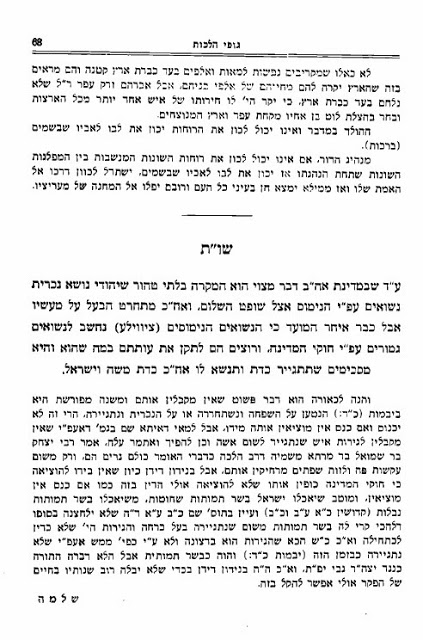
A few pages prior to this, Sadowsky has a responsum from 1906, when he was a rav in Albany. Here he discusses converting the son of a Jewish father and a non-Jewish mother. The mother had no interest in converting. Sadowsky agrees to convert the child who would, of course, be raised in an intermarried home without any Torah or mitzvot. He sent his responsum to the great R. Moses Danishefsky, the rav of Slobodka, and Danishefsky agreed with him. There is absolutely no discussion about the fact that the boy will be brought up without Torah observance. Both Sadowsky and Danishefsky assume that there is a benefit to being Jewish, even if one is being brought up in an intermarried home.[30] Here are the responsa from Rabbis Sadowsky and Danishefsky.

The technical issues are probably easier in this last case, as a child doesn’t need to have kabbalat mitzvot to be converted. Yet it is still significant that the issue of being raised in a non-religious home is not considered. There have been cases in Israel where the rabbinate refuses to convert children in situations like this, since the parents are not religious. The parents are thus forced to raise non-Jewish Hebrew speaking children, who of course will serve in the army and then marry Jewish Israelis.
For another example of converting women where there is no real expectation that they will be “observant” (by current standards), since their husbands were themselves not religious, see this responsum by R. Judah Leib Zirelson, from his Atzei ha-Levanon, no. 63.
I could cite a number of other sources, but it should be obvious by now that the lenient approach is hardly a daat yahid, identified only with R. Uziel. I believe that an examination of the responsa literature reveals that until recently this was a mainstream approach among both rabbis doing conversions and poskim who dealt with this issue. I am not saying that it was the dominant approach, only that it was widespread. As we all know, however, many converts of years past would not be accepted by batei din today. (Nothing I have mentioned so far should imply that R. Druckman’s beit din followed any of the sources mentioned so far. From what I have been able to determine, his beit din required a lengthy instruction period as well as attachment to an Orthodox family during this period, and also complete acceptance of mitzvot. For one relevant article, see R. David Bass in Tzohar 30, available here.)
There is another important source, a pre-modern responsum that is not mentioned by Sagi and Zohar and is directly relevant to the issue of revoking of conversions. It is cited by the Shas member of Kenesset (and author of seforim), R. Hayyim Amselem,[31] as part of his responsum against the revoking of any conversions. R. Simeon ben Tzemach Duran, Tashbetz, vol. 3, no. 47, writes as follows:
מי שלא נתגייר אלא שעה אחת וחזר לסורו לאלתר ועבד ע”ז וחלל שבתות בפרהסיא כמנהגו קודם שנתגייר ומין הוא ומן המורדים הוא, דלא קרינן ביה אחיך כמ”ש למעלה, ואפ”ה חשבינן ליה ישראל משומד וקידושין קידושין . . . וכן ראיתי בתשובה למורי חמי הרב רבנו יונה שכתב כן, וכן כתוב בספר העיטור ובספר אבן העזר, שמעשה הי’ בכותי שקידש ואצרכוה גיטא מר רב יהודה ומר רב שמואל רישי כו’, והדבר ידוע שגזרו עליהם להיות כעכו”ם גמורים כדאיתא בפרקא קמא דחולין.
In other words, in a case where a convert immediately after the conversion practices idolatry and violates Shabbat, the rishonim mentioned hold that the conversion is valid and the person has the status of a sinning Jew. Today, we would be told that such a conversion is completely invalid, as it is obvious that the convert never intended to accept Judaism. The proof of this is that immediately following the conversion he continued in his old ways. Yet these rishonim hold that the conversion is binding.
R. Shlomo Daichovsky, until recently a dayan on the Supreme Rabbinic Court, held this position. Eight years ago he expressed his opinion against R. Avraham Sherman and wrote as follows:[32]
נשותיהן של שלמה ושמשון עבדו עבודה זרה – כך מפורש בתנ”ך. גירותן היתה מפוקפקת מלכתחילה, כלשון הרמב”ם: ‘והדבר ידוע שלא חזרו אלו, אלא בשביל דבר’. בנוסף: ‘הוכיח סופן על תחילתן שהן עובדות עבודה זרה שלהן’. ועוד יותר: ‘לא על פי בית דין גיירום’. יש כאן שלושה חסרונות גדולים. אין לי ספק, כי אם היתה באה גירות כזאת לפני בית הדין ברחובות, היו פוסלים אותה, ללא כל בעיה. יתכן, וגם אני הייתי מצטרף לכך. אף על פי כן, רואה אותן הרמב”ם כישראליות לכל דבר. ומוסיף בהלכה י”ד: ‘אל יעלה על דעתך ששמשון המושיע את ישראל או שלמה מלך ישראל שנקרא ידיד ה’ נשאו נשים נכריות בגיותן’. כלומר, אסור להעלות על הדעת, אפשרות כזו. ובעצם, למה לא?
אין מנוס ממסקנה כי בדיעבד, אינו כלכתחילה. ולא ניתן לפסול גיור בדיעבד, לאחר שנעשתה.
R. Ovadiah Yosef believes that we can void a conversion, but only if there was (or should have been) a certainty before the conversion that the whole thing was a sham. But if there was no reason to think so, even if the convert did not become an observant Jew the conversion is valid. He writes (Masa Ovadiah, p. 438[33]):
“אם באמת היה הדבר גלוי וידוע מראש שאינם מקבלים עליהם עול תורה ומצוות, רק ע”ד האמור: ‘בפיו ובשפתיו כבדוני ולבו רחק ממני’, ואנן סהדי שלא נתכוונו מעולם לקיים המצוות בפועל, אז גם בדיעבד י”ל שאינם גרים. אבל אם לא היה כאן אומדנא דמוכח בשעת הגיור, אע”ג דלבסוף אתגלי בהתייהו, דינם כישראל מומר, שאע”פ שחטא ישראל הוא.
In the famous Seidman case, where R. Goren – based on R. David Zvi Hoffmann’s well-known responsum – converted a woman who was going to be living with a kohen after the conversion, R. Ovadiah agreed that the conversion was valid be-diavad. (See R. Shilo Rafael, “Giyur le-Lo Torah u-Mitzvot,” Torah she-Baal Peh 13 (1971), p. 131).
R. Yitzhak Yaakov Weiss was opposed to voiding conversions carried out by a valid beit din (Minhat Yitzhak, vol. 6, no. 107):
אם היה הגירות נעשה בפני בי”ד כשרים היינו מוכרחים לומר שהבי”ד בדקו היטב בשעת מעשה וראו שמקבלים בלב שלם, ע”כ אף שראינו שאח”כ אין מחזיקין במה שקבלו עליהם אמרינן דהדרו בהו ויש להם דין ישראל מומר
The rabbis at Kollel Eretz Hemdah were asked from Karlsruhe, Germany, about people who convert and continue to violate Shabbat and act no differently than before the conversion.[34] In other words, they fooled the Beit Din. Are they to be regarded as converts? The reply is that while le-hatkhilah one cannot convert people unless they accept to observe the Torah
אי-אפשר לבטל את הגירות של גרים שנתגיירו בבית-דין אורטודוקסי, אף על פי שלא היו כנים בבית-הדין ולא קיבלו על עצמם באמת לקיים את כל מצוות התורה, כל עוד שבאמת הם רוצים להיות יהודים, ורוצים להשתייך לעם ישראל.
As mentioned already, this is a matter that will have to be decided by the halakhic authorities. But I think that what I have written so far is sufficient to establish that there has been a great deal of distortion regarding this issue, often by well-meaning people. (In particular, I noticed that a number of writers, including talmidei hakhamim, have mistakenly claimed that the Bah is the only one to say that the Rambam didn’t require kabbalat mitzvot be-diavad.)
What is important to remember is that it is not just some modern Orthodox and religious Zionist rabbis who oppose the revoking of a conversion, but no less a figure than the Tashbetz. If today’s authorities disagree, that is their right, but it is simply wrong for haredi leaders to say that conversions have always required absolute commitment to mitzvah observance, and that lacking such commitment the conversions were always regarded as having no validity. As is often the case, there are different traditions. The adherents of the stricter approach are attempting to recreate the past, as if there has been only one approach. In fact, there is an even more radical view found in the rishonim. I refer to the Meiri’s position that be-diavad one can convert without a beit din. That is, following circumcision one can then accept the Torah and immerse all by oneself, and ex post facto it is a valid conversion.[35]
I understand that all the discussions about the revoking of conversions have been very difficult for converts. After all, they were taught that once they convert they are as good as any other Jew. They have begun to learn that matters are not so simple. What is one of these converts supposed to think when they see the heading of R. Menasheh Klein’s responsum, Mishneh Halakhot vol. 9, no. 237: גרים כשרים אין להם יחוס וראוי לזרע ישראל לרחק מהם ? 
He explains:
וודאי שיש מצוה לקרב ולאהוב את הגרים אבל אין זה מחייב להתחתן עמהם והרי משה רבינו קבל כמה גרים דכתיב וגם ערב רב עלה אתם ואפ”ה לא נתערבו בהם ולא התחתנו עמהם בני ישראל.
(By the way, the heading of the responsum following this is בענין נשים בעצם אם הם במדרגה אחת עם אנשים. Maybe on another occasion I will return to this, but I think everyone can predict what his conclusion is.)
This is a theme that is found in a number of his responsa.[36] In fact, it appears that if he had his way there would be a complete ban on conversions.[37] Since not every convert will be able to find another convert to marry, I guess he would advise having them marry the community’s losers, as no self-respecting Jew should marry a convert, at least not if you want your children to turn out right.[38] As to why the children of converts don’t turn out properly, Klein has his own theory.[39]
ודע דעלה בלבי מפני מה גרים לא יצליחו בניהם ע”פ רוב לפמ”ש דגר שנתגייר בידוע שנשמתו גם כן היתה מאותם שרצו לקבל התורה מסיני ולכן סופה שתתגייר, והנה כל זה נשמתו אבל נשמת זרעו שממשיך לא היו במעמד הר סיני ולכן אין זרעיו מצליחין . . . ומעתה מי פתי יסור הנה לישא אשה אשר יצאו ממנה בני סורר ומרה, ואם לפעמים ימצא שלא יצאו בדור הזה אולי עד עשרה דרי לא תבזה ארמאה ויחזרו ח”ו לסורם, ועכ”פ ע”פ רוב הכי הוא, והגע עצמך אם יאמרו לו שישא אשה חולנית שבעוד חמשה שנים תמות ורק על דרך נס יש אחת מיני אלף שתחיה או שע”פ רוב תלד בנים חולי גוף או רוח ודאי לא ישאנה . . . וכ”ש הכא שיצאו ממנו ח”ו דורות כאלו וכיוצא בה, מי הוא בעל אחריות שייעץ לאדם לישא אשה כזו.
He then quotes some negative things said about converts in the Zohar, and concludes as follows, in words that the Eternal Jewish Family[40] will never include in its literature and which are very hurtful:
ומעתה מי זה יכול ליעץ לאדם מישראל אשר נתחייבנו עליו ואהבת לרעך כמוך ואמרו ז”ל מה דסני לך לחברך לא תעבד והאיך נעבור על יעצנו רע ח”ו לזרע קודש משרשא קדישא וגזעא דקשוט להתערב ולתתגעל בגיורת המזוהמה בזוהמת הנחש . . . ולכן ודאי דכל מי שחש וחס על עצמו ועל זרעו יראה להדבק בטובים.
It is interesting that R. Moshe Sternbuch expresses the exact opposite approach to converts.[41] We can see the same sort of dispute between them with regard to baalei teshuvah, with Klein having a suspicious and at times negative view toward them, and Sternbuch having the opposite approach. But before one assumes that Klein’s outlook is just another example of the far-out positions he often takes, take a look at the following from R. Kook,[42] commenting on Berakhot 8a which states: “Some say it means: Do not marry a proselyte woman”:
כי ראוי לדאוג שיהיו תולדותיו זרע ברך ד’ בטבעם קשורים ג”כ בקשר טבעי עם ד’. אבל הגיורת, קשורה אינו כ”א בחירי ואיננו חזק כ”כ כהטבעי. ע”כ יש לחוש על קיומו, גם המדות הקדושות שהאומה הישראלית מעוטרות בהן חסרות הנה בהכרח, והמזג פועל על הבנים.
Finally, let me say something about RCA’s agreement with the Chief Rabbinate that all conversions already recognized by the RCA will be accepted in Israel. Unfortunately, I don’t believe that the Chief Rabbinate can deliver on this. That is because, as we have seen in the latest controversy, the dayanim are not bound by the Chief Rabbinate’s agreements. The Chief Rabbinate can accept a convert for its own purposes, but local dayanim have the autonomy to issue their own rulings, as we saw Rabbi Sherman do.
Furthermore, there is no guarantee that the agreement with the Chief Rabbinate will be upheld for a more fundamental reason: It violates the conscience and halakhic standards of the haredi world, which is currently taking over the religious court system. Let me explain what I mean. Many people who converted through RCA rabbis did not become completely observant. Some didn’t become observant at all. (I have already mentioned that this was the case with haredi rabbis as well.) If a dayan feels that such a conversion is invalid halakhically, the fact that the Chief Rabbinate made an agreement that all RCA conversions from previous years will be accepted is irrelevant. An agreement of this nature cannot override halakhah. So the dayan in question will be forced to reject this conversion no matter when it took place.
To show how difficult the situation can become, take a look at this article from Yated Neeman that appeared a few years ago.[43] I think we can get a good sense from it where we are heading with regard to conversion, and why the only solution is to have two separate court systems dealing with this matter. Yes, it is true that people converted by the Religious Zionist courts might not be accepted by the haredim, but so what? In the unlikely event that one of these converts or their children will want to marry a haredi, they can undergo a second haredi conversion. This is hardly a big deal, and certainly not reason enough for the Religious Zionists to entirely abandon their vision of halakhah, all in order to satisfy the haredi demands for a “single standard,” which by definition always means the haredi approach.
[1] In the meantime, see my article in the Forward. R. Menachem Genack responded here.
Contrary to Genack, the Modern Orthodox world would unquestionably still be eating non-glatt if it was available under (what they viewed as) reliable hashgachah. I also think everyone understood that my comments about the D symbol was not in criticism of identifying a product as dairy, but that the OU does not use the DE symbol (Incidentally, neither of these symbols existed when I was growing up. You knew if a product was dairy by looking at the ingredients, and one does not need to be concerned with the equipment unless you are specifically told – as you now are – that a product was made on dairy equipment. Even then, there are poskim who hold that you can ignore the DE and eat the product with meat, since despite what it says on the label, we don’t actually know that the parve food we are eating was produced within 24 hours of a dairy run.) Why do I think the D symbol instead of DE reflects a turn to the right?: I called the OU on three separate occasions and spoke to three different rabbis, and all of them explained that the reason DE is not used is because they have a fear that some small bits of milk might still be in the product. This is an incredible chumra, which incidentally has no real basis, as companies have to be very careful about not allowing milk into products which are non-dairy. (The threat of major lawsuits from people who are allergic to milk is a constant concern for the companies.) Furthermore, to claim that any such milk might exist in large enough quantities not to be batel is incredibly far-fetched. Despite raising these points in all three conversations, I was told that the organization chooses to be strict.
[2] R. Gedaliah Silverstone, who for many years was the leading rav in Washington, D.C. writes as follows (Tokhahat Hayyim, 1928, p. 14):
מעשה היה בעירי שטבח אחד הסגיר את הרב המשגיח בתיבת המקרה לערך חצי שעה ולא נתן לו לצאת, ואמרתי אז בדרוש על הטבח הזה שלכל הפחות היה לו פעם אחת בתיבת המקרה (שנקרא איז באקס) שלו חתיכה של בשר כשר.
For those who don’t read Hebrew: When the Mashgiach was locked in the freezer, Silverstone quipped that at least on one occasion there was a piece of kosher meat found there! See Yosef Goldman, Hebrew Printing in America 1735-1926 (Brooklyn, 2006), p. 765.
[3] “Emanuel Rackman: Gadfly of Modern Orthodoxy,” Modern Judaism 28 (May 2008), pp. 134-148.
[4] See here.
[5] When planning its ninetieth anniversary celebration in 1976, Yeshiva University was upset to find that Mordecai Kaplan was its oldest living graduate. This squelched any plans to make a big to-do in honor of the graduate. See Jeffrey S. Gurock and Jacob J. Schacter, A Modern Heretic and a Traditional Community (New York, 1997), p. 1.
[6] No one has yet written an article focusing on the Rackman-Lamm contest for election to the presidency of YU, and the historical significance of Lamm’s victory. I hope that a capable YU student takes upon himself this task. To do it right, he must interview the people still alive who were on the committee and can testify as to what led them to go with the younger and less distinguished Lamm. Until now, all we have had are rumors and fairy tales. One example of this is the following passage from R. Herschel Schachter’s Mi-Peninei ha-Rav (p. 170).
לפני כעשרים וחמש שנים, לאחר שנפטר הר”ר שמואל בלקין, והיו צריכים לבחור נשיא חדש לישיבה אוניברסיטה, החליט רבנו שאחד מהמועמדים לא היה ראוי לאותה אצלטא בגלל דיעותיו הבלתי-מסורתיות. רבנו כינס את כל הרמי”ם ביחד, וערך וניסח מכתב לועד-הנאמנים של הישיבה שהוא מתנגד מאוד להתמנותו של פלוני, וחתם את שמו למטה, ומסר את המכתב לשאר הרמי”ם שאף הם יחתמו. אחד מהרמי”ם פתח ושאל לרבנו, ומה כל הרעש הזה, מה פשעו ומה חטאתו של אותו פלוני. ענה רבנו ואמר, שיהודי המדפיס במאמר בעתון שלפי דעתו שני חלקי ספר ישעיה נכתבו על ידי שני בני אדם נפרדים, אפיקורס הוא, ואי אפשר למנותו כנשיא של הישיבה. והמשיך הלה לטעון ואמר, דהלא אף באברבנאל גם כן מצינו לפעמים דברים זרים אשר הם נגד מסורות רז”ל חכמי התלמוד. וענה רבנו ואמר, שאף את האברבנאל לא היה רוצה לראות כנשיא ישיבה-אוניברסיטה. ובזה נסתיים הויכוח. כל הרמי”ם שהיו נוכחים בשעת מעשה חתמו על מכתבו של רבנו, המכתב נמסר לועד הנאמנים, ונתבטלה מועמדותו של הלה.
I have it on very good authority (from conversations with two people who were intimately involved in the election process) that the event described here never happened. There might, however, be a kernel of truth in the story, as is often the case with such tales, and perhaps one of the readers can illuminate the matter. As for Rackman and Deutero-Isaiah, since he is not a Bible scholar I am certain that he never expressed his opinion in the way described here (I also hope that the Rav never said what is attributed to him. R Joseph Karo, Kesef Mishneh, Berakhot 3:8 refers to Abarbanel as הנשר הגדול)
What Rackman does say is as follows (One Man’s Judaism, pp. 248-249):
The Talmud itself was not dogmatic, but contemporary Orthodoxy always feels impelled to embrace eveery Tradition as dogma. The Talmud suggests that perhaps David did not write all the Psalms. Is one a heretic because one suggests that perhaps other books were authored by more than one person or that several books attributed by the Tradition to one author were in fact written by several at different times? A volume recently published makes an excellent argument for the position that there was but one Isaiah, but must one be shocked when it is opined that there may have been two or three prophets bearing the same name? No Sage of the past ever included in the articles of faith a dogma about the authorship of the books of the Bible other than the Pentateuch. . . . How material is it that one really believes that Solomon wrote all three Scrolls attributed to him? Is the value of the writings itself affected? And if the only purpose is to discourage critical Biblical scholarship, then, alas, Orthodoxy is declaring bankruptcy: it is saying that only the ignorant can be pious – a reversal of the Talmudic dictum.
The book about Isaiah he refers to is Rachel Margalioth’s The Indivisible Isaiah: Evidence for the Single Authorship of the Prophetic Book, published in 1964 by Yeshiva University’s Sura Institute. (She was the wife of famed scholar Mordechai Margalioth.)
[7] No one has yet written an article focusing on the Rackman-Lamm contest for election to the presidency of YU, and the historical significance of Lamm’s victory. I hope that a capable YU student takes upon himself this task. To do it right, he must interview the people still alive who were on the committee and can testify as to what led them to go with the younger and less distinguished Lamm. Until now, all we have had are rumors and fairy tales. One example of this is the following passage from R. Herschel Schachter’s Mi-Peninei ha-Rav (p. 170).
לפני כעשרים וחמש שנים, לאחר שנפטר הר”ר שמואל בלקין, והיו צריכים לבחור נשיא חדש לישיבה אוניברסיטה, החליט רבנו שאחד מהמועמדים לא היה ראוי לאותה אצלטא בגלל דיעותיו הבלתי-מסורתיות. רבנו כינס את כל הרמי”ם ביחד, וערך וניסח מכתב לועד-הנאמנים של הישיבה שהוא מתנגד מאוד להתמנותו של פלוני, וחתם את שמו למטה, ומסר את המכתב לשאר הרמי”ם שאף הם יחתמו. אחד מהרמי”ם פתח ושאל לרבנו, ומה כל הרעש הזה, מה פשעו ומה חטאתו של אותו פלוני. ענה רבנו ואמר, שיהודי המדפיס במאמר בעתון שלפי דעתו שני חלקי ספר ישעיה נכתבו על ידי שני בני אדם נפרדים, אפיקורס הוא, ואי אפשר למנותו כנשיא של הישיבה. והמשיך הלה לטעון ואמר, דהלא אף באברבנאל גם כן מצינו לפעמים דברים זרים אשר הם נגד מסורות רז”ל חכמי התלמוד. וענה רבנו ואמר, שאף את האברבנאל לא היה רוצה לראות כנשיא ישיבה-אוניברסיטה. ובזה נסתיים הויכוח. כל הרמי”ם שהיו נוכחים בשעת מעשה חתמו על מכתבו של רבנו, המכתב נמסר לועד הנאמנים, ונתבטלה מועמדותו של הלה.
I have it on very good authority (from conversations with two people who were intimately involved in the election process) that the event described here never happened. There might, however, be a kernel of truth in the story, as is often the case with such tales, and perhaps one of the readers can illuminate the matter. As for Rackman and Deutero-Isaiah, since he is not a Bible scholar I am certain that he never expressed his opinion in the way described here (I also hope that the Rav never said what is attributed to him. R Joseph Karo, Kesef Mishneh, Berakhot 3:8 refers to Abarbanel as הנשר הגדול)
What Rackman does say is as follows (One Man’s Judaism, pp. 248-249):
The Talmud itself was not dogmatic, but contemporary Orthodoxy always feels impelled to embrace eveery Tradition as dogma. The Talmud suggests that perhaps David did not write all the Psalms. Is one a heretic because one suggests that perhaps other books were authored by more than one person or that several books attributed by the Tradition to one author were in fact written by several at different times? A volume recently published makes an excellent argument for the position that there was but one Isaiah, but must one be shocked when it is opined that there may have been two or three prophets bearing the same name? No Sage of the past ever included in the articles of faith a dogma about the authorship of the books of the Bible other than the Pentateuch. . . . How material is it that one really believes that Solomon wrote all three Scrolls attributed to him? Is the value of the writings itself affected? And if the only purpose is to discourage critical Biblical scholarship, then, alas, Orthodoxy is declaring bankruptcy: it is saying that only the ignorant can be pious – a reversal of the Talmudic dictum.
The book about Isaiah he refers to is Rachel Margalioth’s The Indivisible Isaiah: Evidence for the Single Authorship of the Prophetic Book, published in 1964 by Yeshiva University’s Sura Institute. (She was the wife of famed scholar Mordechai Margalioth.)
[8] Here is a bit of Jewish Scranton trivia. Many people know that Harry Wolfson and R. Shraga Feivel Mendlowitz lived there. But did anyone know that R. Herschel Shachter was born in Scranton?
[9] Naharei Afarsemon, mahadurah tinyana, no. 15.
[10] See here.
[11] R. Pini Dunner writes: “I asked him [R. Yosef Tzvi Dunner] if he remembered the Rebbe from his time in Berlin (1932-36). He smiled and said he remembered him well – he was the rather modern-dressed young man with the neatly trimmed beard who stood at the back of the shiur room and who would talk in learning after almost every shiur with Rav Yechiel Yaakov Weinberg z”l.” See here.
[12] See Shaul Shimon Deutsch, Larger Than Life, vol. 2 (New York, 1997), p. 75.
[13] Beit Yaakov, vol. 2, p. 256.
[14] Yevamot 6b
[15] I think an important point, which I have not seen anyone make, is that the entire concept of hillul ha-shem has basically disappeared in the United States. This perhaps has had some impact on Orthodox misconduct. What I mean is that in years past people were held back from doing things because of a fear of how it would look to the non-Jewish world, i.e., it would lead to Jews and Judaism being degraded in their eyes. Today, very few Jews think like that. We live in a great country. If a Jew, or an Orthodox Jew, does something illegal, even if he is on the front page of the newspaper, the typical non-Jew does not take this as a reflection on Jews as a whole or on the religion – and we have had many examples to illustrate the empirical truth of this statement. People know that there are scoundrels in every religious group, and one should not judge another person or religion based on the actions of individuals. When we have reached this wonderful point, what room is there for hillul ha-shem as a motivating factor?
[16] See J. David Bleich, Contemporary Halakhic Problems, vol. 1 pp. 194-196.
[17] Ve-Ha’aretz Natan li-Venei Adam (Alon Shvut, 2005), pp. 38ff.
[18] In attempting to explain why there is no explicit prohibition against cannibalism in the Torah, R. Kook expresses a similar concept (Otzarot ha-Re’iyah [2002], vol. 2, p. 89):
לא הוצרכה תורה לכתוב עליו איסור מפורש, שאין האדם צריך אזהרה על מה שקנה לו כבר מושג טבעי בזה.
Weinberg speaks of cannibalism as being against “the will of the Torah,” even though not explicitly forbidden. See Seridei Esh, vol. 3, no. 127 (p. 342). See the discussion in Daniel Sinclair, “Musar u-Mishpat ha-Tiv’i be-Mishpat ha-Ivri: Akihlat Basar Adam ke-Mashal,” available here.
[19] Community, Covenant and Commitment, ed. N. Helfgot (Jersey City, 2005), p. 276.
[20] Ibid., pp. 24-25.
[21] (Bnei Akiva, 2008). The passage I refer to comes from vol. 2, pp. 125-126.
[22] See Pesakim u-Khetavim, Yoreh Deah nos.89, 92. R. Abraham Dov Ber Kahana Shapiro expressed the same sentiments. See Devar Avraham, vol. 3, no. 28.
[23] In referring to such a case, where after conversion the woman would live on a secular kibbutz where she would not be able to observe mitzvot, R. Yehudah Herzl Henkin writes (Bnei Vanim, vol. 2, p. 135):
אם היא סברה שסדורי החיים שבקבוץ לא איפשרו לה דהוי כעין אונס שעומד לבוא עליה לפי דעתה ואינו חסרון בקבלת המצוות אף על פי שלדינא אינו אונס שהרי לא נאנסה להשאיר בקבוץ.
[24] Teshuvot, vol. 1, no. 41.
[25] Divrei Malkiel, vol. 6, no. 19.
[26] Iggerot Moshe, Yoreh Deah I, no. 160. This notion, that even apparently obvious Jewish laws could be viewed by some people as not binding, has all sorts of ramifications and has often dealt with by poskim. One interesting example is Teshuvot Maharam Lublin, no. 15, where R. Meir of Lublin was asked about a man who was caught having sex with a Christian prostitute, and he was sentenced to death. He could escape this sentence by converting to Christianity. (The responsum, which was sent to the city of Apta, deals with a young man held prisoner by the “Ishmaelites” because he was found with an “Ishmaelite” prostitute. Obviously, R. Meir is speaking in code, as Muslims were not in large supply in Apta. I will speak more about this sort of code in a future post.) The local community wanted to know if they had an obligation to ransom him, as it could be that the imprisoned man had the status of a mumar le-teavon. R. Meir rejects this point and offers the following incredible justification:
ופרט בזמנינו זה בעו”ה שרבים נכשלים בעבירה זו שאין להחשיבה כמומר לתיאבון.
See also the famous responsum of R. Akiva Eger (Teshuvot, vol. 1, no. 96), who deals with otherwise otherwise religious Jews who shave with a razor. (While reading his words ask yourself if the community he describes sounds more like a haredi community or a Modern Orthodox one.):
י”ל דהשתחת בתער דנתפשט בעו”ה אצל הרבה לא חשב שזהו איסור כ”כ דלא משמע להו לאינשי דאסור, וכאשר באמת נזכר בג”ע שהשיב להמוכיח שהרבה אנשים חשובים עושים כן, וכיון דבאמת פשתה המספחת בזמנינו גם לאותן הנזהרים בשאר דברים נדמה להם דאינו איסור כ”כ.
R. Eliezer Papo, Pele Yoetz, s. v. hov, writes:
ע”פ מה דקיימא לן אומר מותר אנוס הוא ומאחר שדרך איש ישר בעיניו נמצא שהוא אומר מותר ואנוס הוא.
The last three sources mentioned are quoted by R. Zvi Yehudah Kook, Li-Netivot Yisrael, vol. 1 pp. 154-155.
[27] Iggerot Moshe, Yoreh Deah III, no. 106.
[28] See here.
[29] Mishnat Avraham, vol. 2, p. 274.
[30] R. Moshe Feinstein recognized the logic of this approach. See Iggerot Moshe, Yoreh Deah I, no. 158:
לא ברור הדבר במדינה זו שהוא זכות כיון שבעוה”ר קרוב שח”ו לא ישמור שבת וכדומה עוד איסורים. אך אפשר שמ”מ הוא זכות שאף רשעי ישראל עדיפי מעכו”ם.
Iggerot Moshe, Even ha-Ezer IV, no. 26:
וגם אף אם לא יתגדלו להיות שומרי תורה מסתבר שהוא זכות דרשעי ישראל שיש להם קדושת ישראל ומצותן שעושין הוא מצוה והעבירות הוא להם כשגגה הוא ג”כ זכות מלהיות נכרים.
R. David Horowitz, Imrei David, no. 172, also permits the conversion of the child, and holds out hope that the parents will do teshuvah (apparently even including the non-Jewish mother in this):
מה לנו להתחכם נגד מצות ד’ . . . מצינו כי אדם רע עשוי לעשות תשובה, וגם כאן נאמר כי עוד יבוא יום וישעה אדם אל עושהו ותפקחנה עיני עורים וידעו כי ערומים הם והרבה לחטוא.
[31] Or Torah, Tamuz 5768.
[32] See here.
[33] In Yabia Omer, vol. 10, Yoreh Deah no. 26, he decides that a particular conversion can be voided, and one of the reasons is subsequent non-observance. Yet this was not the main justification for his decision. In addition, this was a special case as it concerned an agunah.
[34] Be-Mar’eh ha-Bazak, vol. 3, p. 149
[35] Beit ha-Behirah, Shabbat 68a.
[36] See e.g., Mishneh Halakhot, vol. 10, no. 239:
ודאי דזרע אברהם יצחק ויעקב המיוחסים מתרחקים מן הגרים כפי האפשר הגם שמקרבים אותם מצד מצות ואהבתם את הגר אבל אין זה מצוה לנו להתחתן עמהם.
I certainly think he is going overboard when he writes (ibid., vol. 15, p. 151): ואין ממנים גר להיות שמש בביהכ”נ
[37] See ibid., vol. 16, p. 384: .ומשבח אני בזה מנהג הספרדים שאין מקבלין בקהלותיהם גרים He is referring to the Syrian ban on converts, which has its own racist elements, as in both the popular and even in some of the rabbinic mind of this community there is a stress on “pure Jewish blood.” This latter point is far removed from opposition to converts in order to prevent intermarriage, and leads to a shunning of all converts, even those converted as babies, as well as a shunning of children and even grandchildren of converts.
[38] ] See ibid., vol. 9, no. 239
[39] See ibid., vol. 10 no. 239.
[40] See here.
[41] Teshuvot ve-Hanhagot, Even ha-Ezer no. 728. See also ibid., vol. 2 no. 623, where he writes: עיקר היחוס הוא כששומרים מצוות.
[42] Ein Ayah, Berakhot 8a.
[43] Available here. The “so-called Orthodox rabbis” referred to in this article are Rabbis Gedaliah Dov Schwartz, Reuven Bulka and Shmuel Goldin. The RCA is described as an “organization of rabbis who call themselves Orthodox, but are known as modern.” The article also defames Rabbis Shear Yashuv Cohen and Shalom Messas. There are a number of falsehoods in the article, but let me just mention one: “The conversion was made for the purpose of marriage, and such types of converts are not to be accepted according to the halocho.” Yet the almost unanimous opinion of poskim, from all circles, is that when confronted with a possible intermarriage, one should convert the non-Jewish partner if all all feasible. The only dispute is how observant the convert must be in order to be accepted.

Emek ha-Netziv : The Manuscript

Emek ha-Netziv : The Manuscript
by Gil S. Perl

Rabbi Dr. Gil S. Perl is dean of the Margolin Hebrew Academy/Feinstone Yeshiva of the South in Memphis. The following selection comes from his new book, The Pillar of Volozhin: Rabbi Naftali Zvi Yehuda Berlin and the World of Nineteenth-Century Lithuanian Torah Scholarship.


The manuscript of ‘Emek ha-Netziv remains in the possession of the Shapira family and there are no additional extant copies. The family are prominent members of a staunchly traditionalist Ḥaredi community in the Geulah neighborhood of Jerusalem. Members of this community generally oppose sustained contact with Western culture and its representative institutions, including universities of any type. The Shapira family seems to harbor additional skepticism toward those researching Netziv , due to the fact that his relative openness to certain aspects of non-traditional culture has made him a controversial figure in some ultra-Orthodox communities.[1]These facts, combined with the sheer value of their manuscript collection,[2] make the family understandably guarded about allowing access to thematerials they possess. However, with the assistance of Rabbi Zevulun Charlop, Dean of the Rabbi Isaac Elchanan Theological Seminary in New York City and a cousin of the Shapira family,[3] I was able to secure brief and accompanied access to the manuscript from which ‘Emek ha-Netziv was taken.[4]

The manuscript is handwritten in three volumes, corresponding to the three volumes of the printed text. The first two volumes were bound, but the binding has completely deteriorated and sections of each volume easily separate from one another. The third volume seems never to have been bound. The pages of all three volumes are severely frayed at the edges.

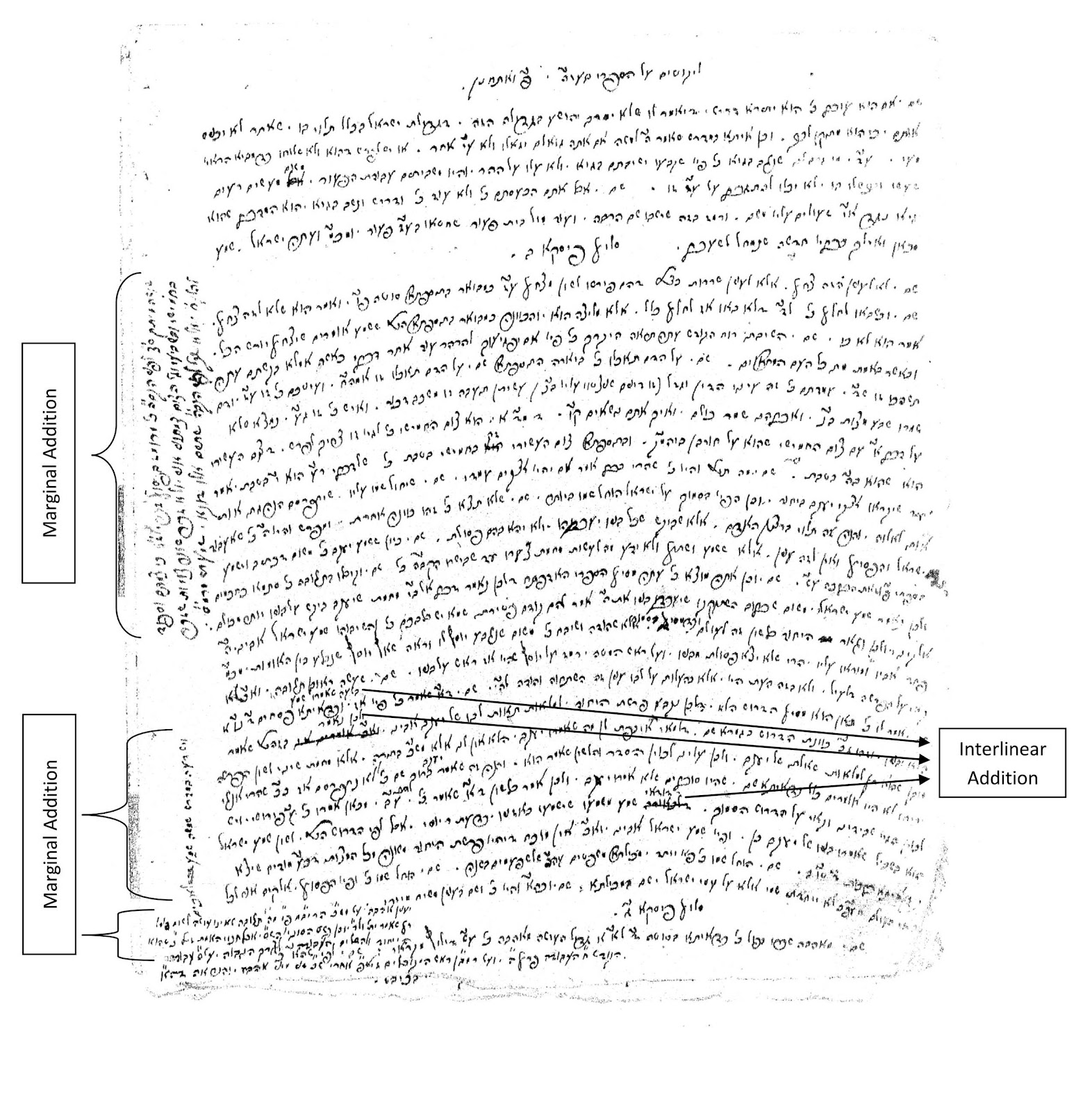
As suspected, the manuscript contains a core text with countless interlinear and marginal additions as well as words and entire lines that have been crossed out:


.

It is important to note that the brackets and parenthesis which appear throughout the printed text do not correspond to these additions. Rather, they correspond to places in which Netziv placed parenthesis or brackets around his own words both in the core text and in the additions. The additions and the notes he appended to the end of the manuscript (referred to by the Netziv as hashmatot )[5] were incorporated without indication into the printed text.


The script of the core text through the first two volumes and half of the third is a fairly consistent narrowly-spaced brown cursive[6] written with a fairly wide-tipped pen. In the second half of the third volume the script of the core text changes to a blacker, wider-spaced cursive seemingly done with a thinner-tipped pen. The script of the later marginal additions varies.

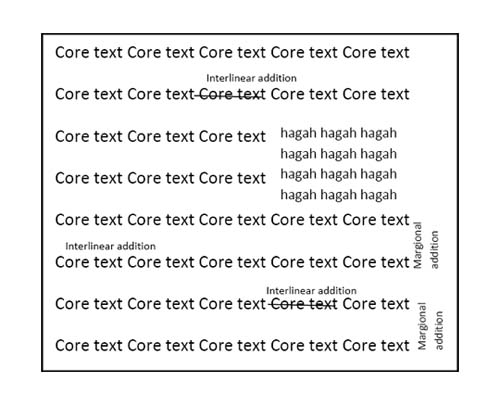
The notes which appear scattered throughout the printed text (referred to by the Netziv as hagahot) were written at the same time as the core text,[7] as evidenced by the identical script used and the intentional indentations left in the text of the core commentary in order to create space for the hagahot. The hagahotalso contain marginal additions. A typical page in the manuscript containing hagahot, then, is represented in the following diagram:

The reference to the newly printed book ‛Emek Halakhah mentioned above appears as an interlinear addition to the core text, thus implying that for that particular section of the commentary on Naso, the core text was written prior to 1845 and the addition was included after 1845. The references to Reb ‘Iẓele are also found in the core text with the word “she-yiḥyeh,” which dates those passages of the core text to the years prior to 1849 as well.[8]

The orderly progression of chapters in the core text, which begin at varying places on the physical page of the manuscript, indicates that Netziv wrote down his comments in this manuscript in proper sequence, following the order of Sifre. [9]That is, one can safely assume that in this particular copy of the manuscript, the core text of Netziv’s comments on Parashat Bamidbar were committed to writing before those of Parashat Naso, and his comments on pesikta’ aleph were committed to writing prior to those of pesikta’ bet.[10] If the core text of the manuscript was written sequentially, and the core text of EH Naso 49 (I:181) was necessarily written prior to the publication of Zev Wolf ben Yehudah Ha-Levi’s 1845 publication of ‘Emek Halakhah, one can deduce that, at the very least, the entire core text until that point was also committed to writing prior to 1845. Likewise, from the appearance of the word “she-yiḥyeh” in the core text of Be-ha‛alotekha andShelaḥ[11] one can assume that the text up to that point was written prior to Reb ’Iẓele’s death in 1849. If we then add that the handwriting remains rather constant in the core text until the second half of the third volume, we have reason to believe that all of the core text until that shift in appearance was committed to writing prior to 1849.

Thus, one can safely conclude that a good portion of the printed edition of‘Emek ha-Netziv was indeed written while Netziv was a young man in his twenties and thirties. As such, the general character and main attributes of the work must be seen as a product of the cultural and intellectual atmosphere of Lithuanian Jewish society in the 1830s and 1840s. At the same time, given the large number of later additions and the lack of any demarcation in the printed text, one can not firmly ascribe a date to any specific passage found in it, with the exception of those which contain explicit or implicit references to the time of composition.

Censorship

The process of preparing ‘Emek ha-Netziv  for publication was painstakingly performed by the Shapira family over the course of many years, and thus the printed text seems to be relatively free of printing errors. However, there are two hints in the printed text which suggest the possibility of editorial censorship.

As noted above, Netziv’s relative openness to sources of information beyond the pale of the current traditionalist canon is a character trait which is at odds with the values of the contemporary ultra-Orthodox community. As we will describe at length in the pages that follow, Emek ha-Netziv  is filled with citations and references to such sources of information. On two such occasions the reference found in the printed text appears to be intentionally altered so as to prevent proper identification of the source. In his comments on ‘Ekev, Netziv writes that for further study one should consult the book called “thirty-two Middot of [sic] in Vilna.”[12] In all probability Netziv is referring to the book published in 1822 called Netivot Olam: Beraita de-32 Middot with the commentary of Ẓvi Hirsch Katzenellenbogen. Katzenellenbogen is known to have been a member of Vilna’s more “enlightened” circles.[13] As such, the possibility exists that the publisher intentionally left out Katzenellenbogen’s name. This prospect is bolstered by the fact that the manuscript contains a name in the standard acronymic form where the printed edition has a blank space. When I asked to look at this reference in the manuscript, it was reviewed by two members of the Shapira family and I was denied permission to look at it. Nonetheless, I did manage to see what seemed like a legible acronym ending in the letter qof.[14] Although it is possible that the editor could not discern the letters of the acronym, if such had been the case one would expect a bracketed editorial note, such as those which appear on several occasions in the printed text where the manuscript is illegible due to stains or frayed edges.[15]

The second possible instance of editorial censorship concerns a passage in Netziv’s commentary on Shoftim which refers the reader to “hakdamat ḥumash besau[16] ve-‘tav’’alef’.[17] The most common referent for the initials tav”alef in the context of Torah commentary is Targum Onkelos, the ancient Aramaic translation of the Bible. However, if the bet of the word “besau” is replaced with adaled so as to read “desau” we might suggest that the tav”alef stands for targum Ashkenaz, German translation, rather than Targum Onkelos. As such, the citation would be of the well-known introduction to Moses Mendelssohn’s Torah commentary, which was printed in Dessau and contains a German translation of the biblical text. The fact that the subject matter under discussion in this passage of Netziv’s commentary correlates to subject matter discussed by Mendelssohn in the introduction to his Bible commentary supports the latter suggestion.

We might raise the question, then, as to whether the printed text was intentionally manipulated so as to prevent easy identification of Mendelssohn’s work or whether the daled of Dessau was simply mistaken as a bet by the printsetter.[18]The fact that this particular citation was underlined in pink pencil in the manuscript bolsters the suspicion that the publishers of ‘Emek ha-Netziv were sensitive to the potential controversy the citation of Mendelssohn might have caused in the ultra-Orthodox community and that they therefore intentionally altered the printed text.[19]

Both of the above instances of possible censorship beg the question as to why the references were included altogether if the printers wished them to remain unidentified. Furthermore, as will be discussed below, the printed text of ‘Emek ha-Netziv contains references to numerous other works that lie well beyond the traditional contemporary ultra-Orthodox canon which were not censored. As such, the evidence for editorial censorship cannot be considered conclusive. Nonetheless, these two passages do raise the possibility that other parts of the text were more cleverly censored or that other citations were completely deleted.
The End of ‘Emek ha-Netziv
The end of Netziv’s commentary on Sifre, as it appears in the printed edition of ‘Emek ha-Netziv , is also an issue of concern to the critical reader. The commentary in both the printed edition and the manuscript comes to an abrupt halt halfway through the parashah of Ki Teẓeh[20] and well before the end of the text of Sifre itself. One is therefore led to question whether Netziv truly ended his commentary there, or whether there was more to the commentary that does not appear in the printed text.

Several factors indicate that Netziv’s commentary did, in fact, extend beyondpiska’ 27 of Parashat Ki Teẓeh.[21] To begin, Netziv starts his commentary at the beginning of Sifre with an introductory double couplet, and thus one would expect a similar poetic composition at the end of the work, but none appears in the printed text or in the manuscript. Furthermore, a statement of completion marks the close of each parashah throughout the text, but none appears at the end of Parashat Ki Teẓeh. Likewise, the completion of the Book of Numbers is marked by two rhyming stanzas of nine lines each,[22] while Deuteronomy, and the commentary as a whole, has no formal conclusion at all.

One must entertain the possibility that the abrupt ending of the work suggests not that the final portion of the commentary is missing from the printed text but that Netziv never completed the commentary. This theory might be supported by the fact that the statements of conclusion which follow everyparashah are in poetic form in the first two volumes, whereas in the third volume, which consists of the Book of Deuteronomy, the statements consist of nothing more than “Piska’ 8 is complete and [so too] the entire portion of ve-’Etḥ anan.”[23] One might interpret this phenomenon as suggesting that the final touches, such as the transformation of abrupt closing statements into clever couplets, were never applied to the third volume of the work.

Such a conclusion seems unlikely, however, when one considers the numerous revisions and recensions to which Netziv subjected the rest of the commentary. One generally does not spend the time editing, expanding, and re-copying a work that one has yet to complete. Furthermore, in his introduction toHa‘amek She’elah Netziv regrets that he has not yet brought his commentary onSifre to press, but he makes no mention of not having completed writing the text. Similarly, in a comment found in his Harḥev Davar, published along with his Ha‛amek Davar in 1878, Netziv writes that while he has not elaborated on a particular point in this work, he will do so at length when God grants him the merit of “publishing the commentary on Sifre.[24] Here too, Netziv does not ask for God’s help in finishing the work, but in bringing it to press. Likewise, Avraham Yiẓḥak Kook, one of the outstanding students of Netziv , publically called upon his teacher to publish his Sifrecommentary in a footnote to a biographical article on Netziv published in 1888.[25]He too seems to suggest that the work was complete.

The physical form of the third volume of the manuscript makes the possibility of missing material rather plausible as well. The printed text contains commentary to every piska’ in Sifre up until piska’ 27 of Parashat Ki Teẓeh.[26] There is no commentary on piska’ot 27-54, but the text resumes with brief comments on piska’54[27] and then ends completely. In the manuscript, piska’ 27 ends at the bottom of a page, which raises the possibility that further commentary followed on subsequent pages which are now lost. The brief comments to piska’ 54 appear on the reverse side of comments labeled as hashmatot; therefore, they may well represent hashmatot to a core commentary, now lost, on the end of Deuteronomy.[28] When one considers the fact that, unlike the first two volumes, the third volume of the manuscript is not bound and does not appear to ever have been bound, the notion that pages from the end of the commentary were lost must be seriously considered.[29]
Conclusions
The conclusion one must draw from the above investigation of the text of‘Emek ha-Netziv is that a historical analysis of the content found in the printed text must be made with caution. The possibility of the text being incomplete must always be considered both in regard to possible editorial censorship and in regard to the possibility that the text originally contained additional chapters that are currently lost. Whereas the core text of the commentary prior to Shelaḥ [30] can be rather definitively dated prior to 1849, the printed text makes no distinction between the core text and later additions. As such, with the exception of a few passages which include embedded historical evidence, no single passage in the printed text can conclusively be dated to the 1830s or 1840s. Nonetheless, there is sufficient evidence, both in Netziv’s own testimony with which this chapter began and in the clues offered by the text and corroborated by the manuscript, to conclude that the bulk of the commentary does indeed reflect a project with which Netziv was engrossed in his early years. Thus, trends which can be identified throughout the printed text and which comprise its general character must indeed be seen as reflective of the intellectual currents of Lithuanian Jewish culture in the 1830s and 1840s.
[1] In recent years, certain circles in the ultra-Orthodox community recommended that Moshe Dombey and N.T. Erline’s adaptation of Barukh Ha-Levi Epstein’s Mekor Barukh, entitled My Uncle the Neẓiv (Brooklyn, N.Y.: Mesorah Publications, 1988), not be read due to its portrayal of Neẓiv as one who did not share all of the values of the contemporary ultra-Orthodox community. See Jacob J. Schacter, “Haskalah, Secular Studies, and the Close of the Yeshiva in Volozhin in 1892,” Torah u-Madda Journal 1 (1989): 76-133; Don Seeman, “The Silence of Rayna Batya: Torah, Suffering, and Rabbi Barukh Epstein’s Wisdom of Women’,” Torah u-Madda Journal 6 (1995-1996): 91-128; Don Seeman and Rebecca Kobrin, “’Like One of the Whole Men’: Learning, Gender and Autobiography in R. Barukh Epstein’s Mekor Barukh,”Nashim 2 (1999): 52-94; Brenda Bacon, “Reflections on the Suffering of Rayna Batya and the Success of the Daughters of Zelophehad,” Nashim 3 (2000): 249-256; Dan Rabinowitz, “Rayna Batya and Other Learned Women: A Reevaluation of Rabbi Barukh Halevi Epstein’s Sources,” Tradition 35: 1 (Summer 2001): 55-69. This position toward Neẓiv, however, was already espoused a century earlier when a series of articles appeared in the Galician newspaper Maḥzike Ha-Da’at (volumes 16, 17, and 18) warning traditionalist Jews to stay away from Netziv’s Bible commentary,Ha‛amek Davar, due to its modern stance toward the authority of the Talmudic Sages. A similar sentiment is reflected in the fact that many ultra-Orthodox houses of study have refused, and continue to refuse, to include Ha‛amek Davar in their libraries.
[2] A value which stands in stark contrast to the overwhelming poverty of most of Geulah’s inhabitants.
[3] See Neil Rosenstein, The Unbroken Chain. (New York: CIS Publishers, 1990) 433-440.
[4] My examination of the manuscript took place in July of 2004 with the assistance of a Summer Travel Grant awarded by the Center for Jewish Studies at Harvard University.
[5] The hashmatot probably represent additions to the text which Neẓiv could not fit in the margins of the page of the core text due to lack of space.
[6] The letters are in cursive form, but Neẓiv generally did not attach his letters to each other. The brown color was probably black when originally applied but has lost its vibrance with the passage of time.
[7] The hagahot seem to have been intended as tangential footnotes to the main commentary in a manner similar to the way in which Netziv’s Harḥev Davar was intended to supplement his Ha‛amek Davar on the Bible. This format was typical of Lithuanian Torah commentary, for reasons which will be explained in Chapter Three below.
[8] I had hoped to demarcate the beginning and end of each addition in my own printed text along with a description of the script used in each addition. The Shapira family, however, was not willing to grant me the sustained access to the manuscript required for such an endeavor.
[9] If it had not been written in order, one would expect to find empty spaces on the bottom of a page where a particular chapter or section ended and new sections beginning on the top of new pages. Instead the end of each section in the manuscript is followed immediately by the beginning of the next section, indicating that they were written sequentially.
[10] There is reason to believe that this manuscript itself is a later recension of an earlier edition. The family showed me what they said were the few extant leaves of an earlier version of the commentary written by Neẓiv which predates the manuscript used for the printed text, but I was not allowed to study them at length. As such, the above analysis does not suggest that Neẓiv actually composed his commentary according to the sequence of the Sifre text, but simply that the transcription of the core text of the commentary into the manuscript at hand was done in sequential order.
[11] See note 14 above.
[12] EH ‘Ekev 4 (III: 52).
[13] See Chapter Two below.
[14] My access to the manuscript was always limited to sitting next to a member of the Shapira family, who would turn to the page I wished to check and look at the specific textual anomaly before deciding whether to let me look as well. In this case I was able to peer over his shoulder and attempt to decipher the acronym. The exact answer this member of the Shapira family gave me was, “Suffice it to say, it is not a siman in Shulḥan Arukh.”
[15] E.g., EH Naso 42 (I: 162); EH Naso 44 (I: 173); EH Matot 1 (II: 279); EHMatot ‛Ekev (III: 45); EH Re’eh 9 (III: 92).
[16] Bet-ayyin-sameh-vav.
[17] EH Shoftim 16 (III: 189).
[18] In cursive Hebrew writing the bet and daled look quite similar.
[19] A glaring example of this type of censorship recently appeared in a photo-offset of the 1926 Frankfurt edition of David Ẓvi Hoffmann’s responsa, Melamed le-Ho‛il, published by the Lebovitz-Kest foundation. In Responsa #56 in the original printing (II: 50), Hoffmann gives his approval, in exigent cases, for an Orthodox Jew to swear before a civil court without a head covering. In the context of his piece, Hoffmann also attests to the fact that Samson Raphael Hirsch instructed the students in the Frankfurt Orthodox school which he founded to cover their heads only for Judaic studies and allowed them to remain bare-headed for their secular studies. The recent photo-offset contains an introduction by a grandson of Hoffmann, David Ẓvi ben Natan Naftali Hoffmann, which gives the reader the impression that the grandson belongs to the ultra-Orthodox community of Jerusalem. Responsa #56, however, permits a practice clearly anathema to that community. Hence, when one turns to page fifty in the off-set, in place of what was earlier Responsa #56, one finds a blank space. I thank Rabbi Moshe Schapiro, librarian at the Mendel Gottesman Library of Yeshiva University, for bringing this example to my attention.
[20] EH Teẓeh (III: 296).
[21] Note that the piska‘ot of Neẓiv do not correspond to those of the Sifre text with which the commentary is printed. In the text of Sifre the last piska’ for which there is continuous commentary is 43, and it then resumes in 54. See Chapter 5.
[22] EH Mas‛ai (II: 334).
[23] EH Ve-’Etḥanan (III: 43).
[24] HrD Num. 6: 19.
[25] Avraham Yizhak Kook, “Rosh Yeshivat Eẓ Ḥayyim,” Kenesset Yisrael, ed. S.J Finn (Warsaw, 1888), 138-147. Also in Ma’amarei HaRe’iyah (Jerusalem, 1984), 123-126.
[26] EH Teẓeh (III: 296). Piska’ot here are according to Netziv’s division. For more on Netziv’s method of dividing piska’ot see Chapter Three below.
[27] EH Teẓeh (III: 299). In the absence of Netziv’s commentary, piska’ot here refer to the division found in the standard Sulzbach edition.
[28] When I asked the Shapira family about the strange ending of work, they too suggested that there might have been more that was lost. When I asked them who had possession of the manuscript prior to them, they declined to give me any names and replied instead, “Suffice it say, it has been handed down, son after son.”
[29] The existence of commentary on the latter parts of Deuteronomy could have been conclusively proven had Neẓiv included a reference to it in his other writings. I have found no such reference, but no conclusions can be drawn from silence.
[30] EH Shelaḥ 1 (II: 10)


Review of Reckless Rites

While it is a bit out of season, I wanted to review Elliott Horowitz’s new book Reckless Rites. In this book, subtitled “Purim and the Legacy of Jewish Violence,” everything is viewed through the prism of the violence inflicted by the Jews upon their enemies at the end of Esther.

While arguably, the violence at the end is only a minor part of the story for some that aspect has clouded everything about the Book of Esther and Purim. First Horowitz looks at how the Book was viewed by non-Jews. Some had a very negative view due to the Jewish revenge. They considered that motif, un-biblical (read non-Christian). Horowitz goes through each of the characters and how first non-Jews interpreted their actions. For instance, Mordechi was treated rather harshly by many of these commentators as was Esther due to her passivity. What is especially fascinating is how these non-Jewish understandings, at times, crept into Jewish thought as well. Thus, Horowitz documents Jews parroting these rather un-Jewish, at it were, interpretations.

Horowitz then tackles the overarching theme of Amalek and how this has been understood throughout history. Some hold there is no obligation of destroying Amalek today while others are willing to label any perceived enemy of Jews as deserving of the harsh consequences of Amalek. Some of these examples are rather disturbing.

After dealing with the Book of Esther specifically, Horowitz turns his focus to Jewish practice on Purim. Specifically, he deals with Jewish violence or violent acts on Purim directed at non-Jews. He provides a discussion of the stereotype of the “mild” (read the wimp) Jew including its origins and whether it is borne out by history. He then discusses numerous, diverse examples spanning from the 5th century until today of Jewish violence. Some is not physical violence, instead it is host desecration or general enmity of non-Jewish symbols while other, most recently Barukh Goldstein is physical violence in its worst form.

In an effort to play down some of these incidents, we have Jewish historians who decided to avoid discussion of such matters, or at times downplay their significance. However, in light of the many examples here, it is very difficult to ignore such examples. Horowitz is very convincing in the scope of this idea and how prevalent this is. It is especially telling when tracing and seeing how systematically Jews have decided to sweep under the rug these examples, it demonstrates that censorship is not limited to any one group and even amongst supposedly dispassionate scholars, they too can fall prey to their own biases.

The detail and research is amazing , Horowitz leaves no stone unturned. All in all, this book sheds new light of the story of Purim, the Book of Esther and Jewish history. It provides a new way of viewing the story of Esther and Jewish ideas towards violence.


Manasseh of Ilya and Y. Barzilay

I recently finished reading Yitzhak Barzilay’s book on R. Manasseh of Ilya. R. Manasseh was a fascinating character. He was a student of the Vilna Goan, but wrote a pamphlet arguing for reconciliation between Hassidim and non-Hassidim. He wrote another work discussing the trop or cantilation marks and yet another, his mangum opus, on the Talmud. It is the later work that he is most well known for, although not necessarily in a positive way. The Tefferet Yisrael (R. Yisrael Lifshitz) on the Mishna quotes a brief passage from this commentary. R. Menasseh’s comments appear on the first Mishna in Perek Alu Mitzhut. (Baba Metziah 1:1). He understands the Mishna in a different fashion than the Talmud, thus provoking some to argue such a position is heritical.

R. Manasseh was a controversial figure. His book on the reconciliation, Pesher Davar, was publicly burnt. His work on Talmud, Alphei Menashe, after either the publisher or some outsider (depending on the source, there are a couple versions of the story), destroyed it right before it was completed. R. Manasseh was forced to reproduce the entire work from memory and find a different printer.

Additionally, although he had a close relationship with the Vilna Goan, the Vilna Goan severed that relationship after learning R. Manasseh had been in contact with R. Shneur Zalman of Lida (Ba’al haTanya).

All this being said, he is ripe for an excellent biography. Unfortunately, Barzilay does not deviate from his norm, and put out another poor work. Although Barzilay has written on many other interesting figures of Jewish history, almost always he fails to do anything substantive or worthwhile with the subjects.

This work is full of gross supposition that are never supported by any facts. For instance we have sentences like this “It may be assumed that in a talented person like Manasseh, his critical faculties must have awakened rather early, and already in his youth he may have arrived at some of his nonconformist views with regard to the Halakhah and its historical development.” (p. 24). Therefore, Barzilay wants to then claim and project back on Manasseh’s early years and label him as a radical even then based only upon “his critical faculties.” While that may be the case, there are also a million other possibilities. For instance, Manasseh was influenced later in life by someone else or he came to his “nonconformist views” based upon years of study and when he was 17 (according to Barzilay, again a guess) he did not hold these views.

Another example, where Barzilay is discussing Manasseh’s frequent trips to his wealthy relatives house who had a terrific library, Barzilay makes the following statement: “The role of this library in Manasseh’s life and intellectual growth cannot be overestimated . . . It may be further assumed, with a high degree of probability, that there also were to be found there the recent works of the Berlin maskilim, as well as those of the enlightened orthodox Jews from both Eastern Europe and the Germanies.” Barzilay then goes on to cite to the many subscribers of various haskalah literature as “proof” this library contained these books. There a basic problem with this argument. Since Barzilay is able to point to where these books went to as the subscriber list, lists both person and place, why then isn’t this rich relatives name ever listed if he was a collector of such works? Instead, Barzilay is satisfied to assume that the books were there as there were many haskalah books that “found [their] way among the Jews of Eastern Europe.”

These are but two examples from a book that is rife with such sloppy work. The only redeeming fact of the book is the extensive quotation from R. Manasseh’s works. As mentioned above, this is not the first book Barzilay wrote that fails miserably. He also did another biography on R. Shlomo Yehudah Rapoport (Shir), the son-in-law of the Ketzot HaChoshen and one of the leading figures of 19th century Eastern European Haskalah. This book is also disappointing.

unfortunate, the only other biography, Ben Porat Yosef, is no gem either. It was written by Mordechai Plungian an editor at the famed Romm press. This is more of an anecdotal than scholarly work. However, this work got Plungian in trouble as some claimed he attempted to make R. Manasseh into a maskil.

What is particularly strange is that a book review of Plungin’s book appeared in HaMagid. At the JNUL site, which contains old Hebrew newspapers, the version they have appears to have that portion blacked out. The review in question appeared in HaMagid on March 8, 1858.

The full citation for Barzilay’s book is Manasseh of Ilya: Precurser of Modernity Among the Jews of Eastern Europe (Manges Press, 1999).


Marc B. Shapiro – Clarifications of Previous Posts

Clarifications of Previous Posts

by Marc B. Shapiro
[The footnote numbers reflects the fact this is a continuation of this earlier post.]

1. I was asked to expand a bit on how I know that R. Barukh Epstein’s story with Rayna Batya is contrived. In this story we see her great love of Torah study and her difficulty in accepting a woman’s role in Judaism. Certainly, she must have been a very special woman, and I assume that she was, for a woman, quite learned. When Mekor Barukh was published there were still plenty of people alive who had known her and it would have been impossible to entirely fabricate her personality. The same can be said about Epstein’s report of the Netziv reading newspapers on Shabbat. This is not the sort of thing that could be made up. Let’s not forget that the Netziv’s widow, son (R. Meir Bar-Ilan) and many other family members and close students were alive, and Epstein knew that they would not have permitted any improper portrayal. It is when recording private conversations that one must always be wary of what Epstein reports.

A good deal has been written about the Rayna Batya story, and Dr. Don Seeman has referred to it as “the only record which has been preserved of a woman’s daily interactions with her male interlocutor over several months.”[15] When challenged about the historical accuracy of Epstein’s recollections, Seeman replied “that there is no evidence to indicate that R. Epstein invented these episodes out of whole cloth.”[16]

I will therefore explain how I concluded that the story is fictional. Let’s begin with the well-attested fact that Epstein was a plagiarizer. My assumption is that when dealing with someone who is not a reputable scholar, one must be very suspicious of what he or she writes when there is no outside evidence to back it up. In fact, when the Torah Temimah first appeared, the editor of this work published a booklet, Sihah Temimah, accusing Epstein of fraudulent behavior.[17] Here are the first few pages of this booklet.
A central feature of his dialogue with Rayna Batya is her producing the book Ma’ayan Ganim by R. Samuel Archivolti. Here it states that mature women who have a desire to study Torah are to be encouraged (Mekor Barukh, p. 1962). Epstein, a young teenager, then attempts to refute her by arguing that the passage from Ma’ayan Ganim is not halakhic, but rather divrei melitzah. The whole dialogue, and in particular the part about her discovering the winning passage in Archivolti, is contrived and designed to lead the reader to sympathize with the fate of the poor woman.

In his Torah Temimah (Deut. ch. 11 n. 68) he cites the passage from Ma’ayan Ganim that as a teenager he supposedly argued against. Anyone reading Torah Temimah would assume that Ma’ayan Ganim is a regular halakhic work, as Epstein refers to it as She’elot u-Teshuvot.[18]

Although at the end of the passage he says that he doesn’t know who the author is, and that Tosafot Yom Tov calls him a grammarian, I believe that this is all part of the literary game he is playing. In other words, he wants to publicize Archivolti’s view, and then to “cover” himself cites Tosafot Yom Tov. In Mekor Barukh, after telling his story, he points out that Archivolti was also a great talmudist and that the only reason the Tosafot Yom Tov refers to him as a medakdek was because he was referring to him in his youth.[19]

Dan Rabinowitz, in his discussion of the issue, writes:

The entire famous Rayna Batya incident must now be called into serious question. Was Rayna Batya so ignorant as to confuse Ma’ayan Gannim with a legitimate book of halakha? How, then, do we reconcile this with her supposed profound learning? It cannot be that R. Epstein was unable to recognize the Ma’ayan Gannim for what it was, for he himself writes that he told his aunt of the true nature of Ma’ayan Gannim. But if he did know what it was, how is it that in his Torah Temima he refers to Ma’ayan Gannim as responsa—and yet in the same paragraph in the Torah Temima he seems to backtrack and wonder how it is that the Ma’ayan Gannim could innovate “new laws about women with reason alone?” The entire Rayna Batya episode is a highly problematic one, raising one perplexing question after another.[20]

As far as the first few questions are concerned, I can only say that the entire report of Rayna Batya discovering the relevant text in Ma’ayan Ganim was made up by Epstein. This book, which was published in Venice in 1553, is an extremely rare volume. There would have only been a few copies of this book in all of Lithuania. (In Torah Temimah Epstein also says that it is a rare book.) It is therefore impossible to imagine that the rebbetzin, sitting in Volozhin, would just so happen to come across this volume on her husband’s bookshelf. Of this, there can be no doubt, and I assumed that Epstein, who was a great bibliophile, later in life came across the book and in his desire to publicize its contents, created the dialogue with Rayna Batya.

Yet thanks to R. Yehoshua Mondshine’s recent article,[21] I see that I was mistaken in my assumption. The truth is that Epstein never even saw the book and thus did not know the true nature of Ma’ayan Ganim. He learnt of the relevant passage, which he places in Rayna Batya’s mouth, from an article that appeared in Ha-Tzefirah, 7 Tishrei, 5656. We see this from the fact that the Ha-Tzefirah quotation mistakenly omits some words, and the same words are omitted in Mekor Barukh. This shows that his knowledge of this book came in 1894 and that he never discussed it with Rayna Batya, who died many years prior to this.

Now that we know where Epstein copied the text from, we can see another element of the literary game he played. He cites Ma’ayan Ganim as follows:
ומאמר חכמינו כל המלמד את בתו תורה כאלו מלמדה תפלות אולי נאמר כשהאב מלמדה בקטנותה.
Yet in Ha-Tzefirah it states:
מאמר רבותינו ז”ל כל המלמד בתו תורה כאלו מלמדה תפלות אינה צריכה לפנים דאיתתא חזינא ותיובתא לא חזינא כי אפשר לחלק שחכמים ז”ל לא דברו אלא כשהאב מלמדה בקטנותה.
Leaving aside the words Epstein omits, he has substituted אולי for אפשר לחלק. In doing so he softened Archivolti’s point. Whereas Archivolti was stating that one can distinguish between teaching a grown woman and a small girl, Epstein has Archivolti prefacing this idea with “perhaps”. I think this is part of Epstein’s confusing game. He wants to bring this view to the public’s attention, but he doesn’t want to come off as too radical. In fact, this אולי, which is his own creation, assumes a life of its own. Thus, in his letter to R. Hayyim Hirschensohn (Malki ba-Kodesh, vol. 6, p. 47), criticizing the latter’s view of teaching women Torah, Epstein writes:

צר לי כי לא אוכל להסכים עמו בזה הן הוא (הרש”ק בעל המכתב הידוע) אינו בטוח בעצמו בדבריו אלה, כנראה מלשונו שכתב “ומאמר חכמינו כל המלמד את בתו תורה וכו’ ‘אולי’ נאמר כשהאב מלמדה בקטנותה” וכו’ ועתה הגע עצמך האם בסברא “פן ואולי” אפשר להתיר מה שנאמר בגמרא מפורש לאיסור. כך דעתי בזה.

In other words, Epstein invents the word אולי and inserts it into Archivolti’s letter, and then he uses this to criticize Hirschensohn! The chutzpah on Epstein’s part is astonishing, but as I see it this is all part of his game.

No one who has discussed Epstein and Rayna Batya was aware of his letter to Hirschensohn, so they could not point out the following obvious fact: When one looks at Mekor Barukh, which was published after his letter to Hirschensohn, one finds him telling Rayna Batya the exact same thing. It is obvious that he uses the language in his letter to Hirschensohn to create the following reply to Rayna Batya, that supposedly occurred some fifty years prior.
והן המחבר בעצמו כמו ‘מודה במקצת’ בזה, באמרו: ‘ומאמר חכמינו’ כל המלמד את בתו תורה כאלו מלמדה תפלות ‘אולי נאמר כשמלמדה בקטנותה’; הרי שבעצמו אינו בטוח בדבריו, וכהוראת הלשון ‘אולי’ ולא ב”אולי” ולא ב”פן” מתירים מה שנאמר מפורש בתלמוד.
(It is possible that I am wrong in assuming that it was his positive view towards women studying Torah which explains why he created the story and cited Ma’ayan Ganim. Perhaps he was simply attempting to create a good story, or even some controversy, and that explains why he seems to be on both sides of the issue, as Dan Rabinowitz points out in the passage cited above.)

Here are the relevant pages in Ma’ayan Ganim, Ha-Tzefirah, Mekor Barukh, and Torah Temimah.
I know that there are people who are very upset at me, believing that I have given ammunition to those who chose to censor and withdraw My Uncle the Netziv. I make no apologies. We must combat falsehoods and plagiarism no matter where they emanate from. If, in the process, some of our own sacred cows are slaughtered, that is the price we must pay.

Returning to Mondshine, he is most concerned with the supposed dialogue between Epstein’s father, R. Yehiel Michel (the author of the Arukh ha-Shulhan), and the Tzemach Tzedek, R. Menachem Mendel Schneersohn. He sees it as an opportunity for Epstein to put all sorts of ideas, including criticisms of Hasidism, into the mouth of the great hasidic leader, something that if he did on his own would have brought down storms of criticism upon him. For example, he has the Tzemach Tzedek say that the hasidim have to be grateful for the opposition of the Vilna Gaon. Had it not been for the great dispute about Hasidism, and the Gaon’s strident opposition, the new movement might have led its followers out of the ranks of halakhic Judaism. (p. 1237). This idea was expressed by R. Kook (Ma’amrei ha-Re’iyah, p. 7) and was probably a common non-hasidic notion. But it is impossible to think that the Tzemach Tzedek would have ever expressed himself this way.

At the time that R. Yehiel Michel is said to have had his conversations with the Tzemach Tzedek, he was the rav of the Habad town Novozypkov.[22] In later years R. Abraham Chen and R. Shlomo Yosef Zevin served as rabbis of the town.[23] I know about this place because my grandmother’s second husband (who was like a grandfather to me) was from there. In fact, during World War One word came to the town that a certain group of Jews was being moved and would be passing through, and that among them was an outstanding young scholar named Shlomo Yosef Zevin. The townspeople came up with the necessary money to remove him from the group. He was chosen as the town’s rabbi and lived in my step-grandfather’s house for about six months. I read somewhere that the townspeople were followers of Kopys/Bobruisk, rather than Lubavitch. As R. Zevin was himself a Bobruisker, this would make sense. R. Yehiel Michel was himself born in Bobruisk, as was his son R. Baruch.

I always tell this story to Habad people in order to impress them with my yichus, that the great R. Zevin lived in my family’s house. Yet on two separate occasions after I told the story to young Habad shluchim, they replied, “Who is Rav Zevin?” It is also very rare to find a young Habadnik who has even heard of Kopust/Bobruisk. Yet without knowing about this it is impossible to understand how R. Zevin could have been a Zionist when the Lubavitcher rebbes were all anti-Zionist. After all, who ever heard of a hasid not following his Rebbe? The answer is that all Lubavitchers were Habad, but not all adherents of Habad were Lubavitch. The ignorance among some in Habad of their own movement probably shouldn’t surprise me, as I have met many hasidim who don’t have a clue about the history of the hasidic movement. And of course, how many Modern Orthodox know the first thing about Hirsch and Hildesheimer?

Mondshine assumes that one of the purposes of Epstein’s stories about his father and the Tzemach Tzedek is to build up his father’s halakhic reputation. His pesakim were subject to attack as being too liberal, and certainly in the hasidic world he was not accepted. In the Lithuanian world he was a much more important posek, and R. Joseph Elijah Henkin stated that in a dispute between the Mishneh Berurah and the Arukh ha-Shulhan, the Arukh ha-Shulhan is to be preferred.[24]

Yet many did not share R. Henkin’s viewpoint. A number of years ago I saw in one of R. Yitzhak Ratsaby’s books that he heard from some gedolim that one should not rely on the Arukh ha-Shulhan. I wrote to him objecting to this lack of respect for the Arukh ha-Shulhan, and also expressing my near certainty that the gedolim he referred to must have been Hungarian, for the Hungarian poskim never accepted the Arukh ha-Shulhan as an authoritative work. On Nov. 22, 1990, Ratsaby wrote to me:
בענין הגאון בעל ערוך השולחן, דוקא הדברים נובעים מליטא, והנני מפרש, הגר”י כהנמן זצ”ל מפוניביז’ (כמדומני שלמד בעצמו יחד עם הערוה”ש) והגר”ח גרינמן שליט”א בן אחותו של החזו”א. זכורני אמנם באגרות משה במקום אחד כתב על ערוה”ש כבר הורה זקן, ובמקום אחר דוחה דבריו. נראה לענ”ד אמנם שבעל ערוה”ש מחדש הרבה סברות ובזה כחו גדול, מאידך בעל משנ”ב מעמיק בעיון היטב הדק. והאמת ניתנה להיאמר שבהרבה מקומות בערוה”ש ראיתי דברים מתמיהים והיפך כוונת הדברים, וכבר הערתי עליו בדרך כלל במקומות שעסקתי בהם בחבורי הנדפסים. ופוק חזי שבישיבות לומדים בקביעות ההלכה מספר משנ”ב, וגם כמעט אין בית היום אשר אין שם משנ”ב. והחזו”א אעפ”י שחולק בהרבה מקומות על המשנ”ב, מ”מ החשיב אותו כהוראה מפי הסנהדרין ומנה אותו בנשימה אחת עם מרן הב”י והמג”א.
(Ratsaby’s recollection is correct. In Iggerot Moshe, Orah Hayyim vol. 1 no. 39, which is his famous responsum on the proper height of a mehitzah, R. Moshe quotes the Arukh ha-Shulhan and uses the expression כבר הורה זקן. Regarding R. Joseph Kahaneman, he actually received semikhah from R. Yehiel Michel.)

The reputation of the Arukh ha-Shulhan has today fallen to such an extent that in a recent publication of the work the rulings of the Mishneh Berurah are included as well. The message of this is that while the Arukh ha-Shulhan is a Torah volume that should be studied, in terms of practical pesak it is the Mishnah Berurah that must be followed. See here for an earlier discussion at the Seforim blog of the recent reprint of the Arukh ha-Shulhan.

2. I was asked if there are any medieval poems in which there is explicit homosexuality. I am unaware of any, and it is precisely because they are ambiguous that there has been controversy about their meanings. This poem by Moses Ibn Ezra is as explicit as I could find
תאות לבבי ומחמד עיני

עופר לצדי וכוס בימיני

רבו מריבי ולא אשמעם

בוא הצבי, ואני אכניעם

וזמן יכלם ומות ירעם

בוא, הצבי, קום והבריאני

מצוף שפתך והשביעני

למה יניאון לבבי, למה

אם בעבור חטא ובגלל אשמה

אשגה ביפיך אד-ני שמה

אל יט לבבך בניב מענני

איש מעקשים, ובוא נסני

נפתה, וקמנו אלי בית אמו

ויט לעול סבלי את שכמו

לילה ויומם אני רק עמו

אפשט בגדיו ויפשיטני

אינק שפתיו וייניקני

כאשר לבבי בעיניו נפקד

גם עול פשעי בידו נשקד

דרש תנואות ואפו פקד

צעק באף, רב לך, עזבני

אל תהדפני ואל תתעני

אל תנף בי, צבי, עד כלה

הפלא רצונך, ידידי, הפלא

ונשק ידידך וחפצו מלא

אם יש בנפשך חיות, חיני

או חפצך להרג, הרגני

Desire of my heart and delight of my eyes –

A fawn beside me and a cup in my hand!

Many admonish me, but I do not heed;

Come, O gazelle, and I will subdue them. Time will destroy them and death shepherd them. Come, O gazelle, rise and feed me With the honey of your lips, and satisfy me.
Why do they hold back my heart, why? If because of sin and guilt, I will be ravished by your beauty – God is there! Pay no attention to the words of my oppressor, A perverse man – come and try me!
He was enticed and we went up to his mother’s house, And he gave his shoulder to my burden. Night and day I was only with him. I undressed him, and he undressed me; I sucked his lips and he sucked mine.
When I left my heart as a pledge in his eyes, The burden of my guilt was also weighted in his hand. He sought enmity, and inflicted his anger, And angrily cried, “Enough; leave me! Do not force me, and do not entice me.”
Do not be angry with me, gazelle, to destruction – Extraordinary is your will, my dear, extraordinary! Kiss your beloved and fulfill his desire. If it is in your soul to give life, revive me – Or if your desire is to kill, kill me![25]

3. When dealing with problematic texts of recent times, the preferred approach is simply to censor them. But with the medievals, there is a simpler method: Say that the text was written by a mistaken student, or even worse, by someone interested in undermining Judaism. In a previous post I mentioned that R. Joseph Zvi Duenner even stated so with regard to the Talmud itself.[26]

Since in modern times we don’t generally have students copying their master’s handwritten texts, the first approach doesn’t make much sense. Yet in a previous post at the Seforim blog,[27] I noted that R. Menasheh Klein used this very argument with regard to R. Moshe Feinstein, even though he was dealing with a responsum published in R. Moshe’s own lifetime. I found another example where Klein uses this exact same approach. He saw something in one of the Steipler’s books, but since it didn’t make sense to him, Klein wrote to the Steipler as follows (Mishneh Halakhot, vol. 7, p. 142a):
היות כי אני מכיר את מעכ”ק וצדקתו נגמר בדעתי שבודאי לא יצאו דברים מפי כ”ק או שיש שם איזה טעות בדפוס מהבחור הזעצער וטעה מעתיק ולא שם על לב כ”ק.
However, here I don’t think Klein should be taken literally. I believe this was just his respectful way of saying that the Steipler was wrong. This is not the case with regard to R. Ovadiah Yosef when he writes that one cannot rely on the responsa in R. Ben Zion Abba Shaul’s Or le-Tziyon, vol. 2.[28] Even though R. Ben Zion was alive, R. Ovadiah claimed that he was powerless to stop his students from taking liberties with the book: הוסיפו וגרעו כפי שעלה בדעתם, וסברו שכן דעת רבם. Not surprisingly, one of R. Ben Zion’s students responded very strongly to this statement.[29]

Prof. Yaakov Spiegel, in his book Amudim be-Toldot ha-Sefer ha-Ivri: Ketivah ve-Ha’atakah, pp. 244ff., discusses the phenomenon of denying the authenticity of responsa. Sometimes the strategy used to reject a responsum is to attribute it to an “erring student.” While on occasion there are scholarly reasons for this assumption, it is almost always the case that the author simply cannot accept that an earlier authority said something. Usually this has to do with halakhah, but there are plenty of examples in theology. For example, R. Issachar Baer Eylenburg assumes that while resurrection is a principle of faith, one is not obligated to believe that this doctrine is found in the Torah. As he puts it (Be’er Sheva to Sanhedrin 90a).
מי שמודה ומאמין על פי הקבלה בתחית המתים אע”פ שהוא אומר דלא רמיזא באורייתא אין ראוי לקראו כופר חלילה ויש לו חלק לעוה”ב.
Although the Mishnah, Sanhedrin 10:1, includes the point that one must believe that resurrection is found in the Torah, Eylenburg assumes that this is a textual error, and indeed, Rambam never mentions this. However, Rashi had this text and explains:
שכופר במדרשים דדרשינן בגמרא לקמן מנין לתחיית המתים מן התורה ואפילו יהא מודה ומאמין שיחיו המתים אלא דלא רמיזא באורייתא כופר הוא הואיל ועוקר שיש תחיית המתים מן התורה מה לנו ולאמונתו וכי מהיכן הוא יודע שכן הוא הלכך כופר גמור הוא.
Eylenberg didn’t like what Rashi said, i.e., it didn’t make sense to him, so he concluded:
לפי דעתי לא יצאו דברים אלו מפה קדוש רש”י אלא איזה תלמיד טועה פירש כן בגליון ונכתב בפנים.
Eylenberg would have been happy to learn what we now know, namely, that the commentary to Perek Helek is, in large measure, not really by Rashi.

I found another example of this in a book that just appeared, R. Menasheh Matloub Sutton’s Mateh Menasheh. (Sutton, who died in 1876, was the rav of Safed.) The second part of the book is a reprint of Sutton’s earlier published Kenesiah le-Shem Shamayim. This work is devoted to a superstitious practice whereby women would burn incense to demons and this was thought to be a help to people who were in various states of distress (e.g., sick, barren, etc.) He includes letters from many great rabbis who agree with him that this is a form of avodah zarah. The problem he has, which he confronts in ch. 2, is that one of the rishonim, R. Isaiah ben Elijah of Trani, is quoted by R. Hayyim Benveniste as follows:
ונראה בעיני המתוק שעושים הנשים מדבש וחלב לרפואה, וכן העישון שמעשנים מותר, שלא חייבה תורה בבעל אוב אע”פ שמקטר לשד אלא מפני שמעלה המת, וכן מעשה כשפים לא נאסרו אלא כשעושים מעשה או כשאוחזים את העיניים כמ”ש, אבל בעישון ומתוק אין בהם כל אלה, וגם אין בהם משום חובר חבר שאינם מתכונים לחבר השדים אלא לרצותם על רפואת החולה ושלא יזיקוהו.
Now it is certainly possible for Sutton to reject R. Isaiah, but it becomes very hard to label the practice as nothing less than idolatry when an outstanding rishon justified it and this rishon is also quoted by Benveniste and the Shiltei Giborim. What to do in such a case? Sutton adopts the tried and true method of declaring that since the position is (in his mind) so objectionable, R. Isaiah could never have said such a thing. It must originate with the “mistaken student” who often makes his appearance when a strange opinion is confronted.
אמינא בקושטא דמלתא כד ניים ושכיב רב אמרה להא שמעתא ועל הרוב שלא יצאו דברים הללו מתחת ידו וקולמוסו אלא שאיזה תלמיד טועה כתבם בגליון קונטריסו והרב שלטי הגבורים אגב ריהטא העתיקם בשמו ובחושבו דתורה דיליה היא מוצאת מעמו ולא פנה לעיין בעיקר הדין נמוקו וטעמו.
Sutton’s book was put out by one of his descendants, Rabbi Harold Sutton, who was a student in the late and much lamented Beit Midrash le-Torah (BMT) together with me. He later went on to become a student of R. Ovadiah Yosef, whose haskamah (together with that of R. Meir Mazuz) adorns the book.

Harold Sutton should not be confused with another young Syrian rabbi, David Sutton. The latter is the author of the ArtScroll book Aleppo: City of Scholars (and from the introduction I learned that he is a son-in-law of R. Nosson Scherman). Zvi Zohar has recently written a very sharp critique of this book. See here.

David Sutton is also the one who delivered the much-talked about lecture “We Believe in Midrashim.” This lecture is the subject of a very harsh attack by Roni Choueka in Hakirah 4 (2007). Choueka sees Sutton’s lecture as a bizayon ha-Torah of the worst sort. When listening to it I didn’t know whether to laugh or to cry. How else is one to respond when one hears a rabbi claim that the fossils are remnants of the giant pets that belonged to Og, who was 800 feet tall and lifted up a stone the size of Manhattan, or that the polar bears came to Egypt complete with their blocks of snow in order to devour the Egyptian children?

Incidentally, in speaking of the Aggadah which describes the great height of Og, the Rashba (commentary to Berakhot 54b) notes that although there is a deep meaning conveyed in this Aggadah, the form in which it is expressed also had a very practical application:
לעתים היו החכמים דורשים ברבים ומאריכים בדברי תועלת והיו העם ישנים, וכדי לעוררם היו אומרים להם דברים זרים לבהלם ושיתעוררו משנתם.
In other words, in order to prevent people from dozing off, the Aggadist would convey his message with outlandish statements. R. Zvi Hirsch Chajes elaborates on this in his Introduction to the Talmud, ch. 26.

4. I have to thank those who have written to me calling my attention to things I did not know. I hope to acknowledge all of you at the proper time. However, many people who send me things have misinterpreted the sources (or the sources they send have been in error).

In the forward of H. Norman Strickman and Arthur M. Silver’s translation of Ibn Ezra to Deuteronomy, p. xiv, the following appears:

It should also be noted that I.E. [Ibn Ezra] was not the only medieval rabbi who believed that there are some glosses or slight changes in the text of the Torah. Thus Rabbi David Kimchi (c. 1160-1235) notes that the word Dan in Gen. 14:14 is post-Mosaic. He argues that the original reading of Gen. 14:14 was “and pursued as far as Leshem.” Rabbi Kimchi maintains that after the tribe of Dan conquered the city of Leshem and changed its name to Dan (Josh. 19:47), the reading of Gen. 14:14 was changed to read “and pursued as far as Dan” as in our texts of Scripture (Radak on Gen. 14:14).

The mention of “Dan” in Gen. 14:14 is used by all critical biblical scholars to prove that the verse must be post-Mosaic. The reason is that since the city would only be conquered in the days of Joshua, and only then be given the name Dan, how could the Torah refer to it this way? Even M. H. Segal, the strong defender of Mosaic authorship, acknowledges the problem. Unlike other scholars he assumes that the verse as a whole is Mosaic. But he also believes that the name “Dan” is a “modernized substitute for the antiquated names Laish or Leshem (Jud. viii, 29, Jos. xix, 47) which stood in the original.”[30]

Yet I was skeptical of what Strickman and Silver wrote as I was aware of Radak’s introduction to his Torah commentary where he is emphatic that the entire Torah is of Mosaic authorship.[31] I looked up Radak to Gen. 14:14 and saw that my skepticism was warranted. Here are Radak’s words:
וירדף עד דן: על שם סופו, כי כשכתב משה רבינו זה לא נקרא עדיין כן, אלא לשם היה נקרא וכשכבשוהו בני דן קראו לו דן בשם דן אביהם.
All Radak says is that the Torah refers to the place as Dan in anticipation of what it will be called in the future. Radak says nothing about the original reading of the Torah being “Leshem” and nothing about the text being changed after Leshem was conquered. As such, Radak cannot be added to the list of those who believe that there are post-Mosaic additions in the Torah.

5. In response to my earlier post at the Seforim blog discussing the meaning of ס”ט, Rabbi Yitzhak Oratz called my attention to Kitvei Ha-Arukh ha-Shulhan, pp. 50-51. In an 1892 letter from R. Yehiel Michel Epstein to R. Hayyim Hezekiah Medini, the author of the Sedei Hemed, we see that R. Yehiel Michel doesn’t know what the acronym stands for, as he writes חכם חיים חזקיאו [!] ס”ט הי”ו. Since the last two acronyms basically mean the same thing one would not put them next to each other, and he must have assumed that the first one meant sefaradi tahor. Yet by 1896 he had learned what it meant and he addresses the Sedei Hemed as מוהר”ר חכם חיים חזקיאו מודיני סופ”י טב טבא הוא וטבא ליהוי.

This is a rare example of an Ashkenazi who knows what the acronym means. For those who have not yet been convinced there is not much more I can say other than that there is a living tradition among the Sephardic scholars for hundreds of years now as to the proper meaning. This is certainly authoritative. Let me also call attention to the end of the introduction of the Peri Hadash on Yoreh Deah (found in the new Machon Yerushalayim edition). He signs his name as follows: חזקיה בן לא”א איש צדיק תמים היה בדורותיו דוד די סילוה נ”ע סופיה טב טבא הוא וטבא להוי אמן.
Also, see R. Yehudah ben Attar’s haskamah to R. Hayyim Ben Attar’s Hefetz Hashem (Amsterdam, 1732). R. Yehudah signs his own name סיל”ט. It is obvious that this is an alteration of ס”ט and means סופיה יהא לטב. 6. Some want to know if any of the letters Chaim Bloch published in Dovev Siftei Yeshenim are authentic. I haven’t carefully investigated every letter, so it is possible that a couple of them are also found in other books. If that is the case, then Bloch included them simply to give the work as a whole a sense of authenticity. There is, however, no doubt that everything that appears for the first time in the work is, in its entirety, a creation of Bloch. Interestingly, when Bloch sent the first volume to the Lubavitcher Rebbe, the Rebbe immediately recognized that the letters from the Rogochover were forged. He wrote to Bloch (Iggerot Kodesh, vol. 19, p. 69):
כן מאשר הנני קבלת הס’ “דובב שפתי ישנים”. ולאחרי בקשת סליחתו נצטערתי על שצויין על כמה מכ’ שהם להגאון הרגצובי – וכל הרגיל בסגנונו יראה תיכף שאינו . . .
The three dots are from the publisher, and I would be very interested to know what was taken out.

Bloch wrote to the Rebbe to defend his publication and the Rebbe responded very strongly. He tells Bloch that originally he thought that it was an innocent error or perhaps someone had misled Bloch as to the Rogochover’s letters. It now surprises him that Bloch continues to earnestly defend their authenticity. The Rebbe is so convinced that they are forgeries that he writes (Iggerot Kodesh, vol. 19, p. 159):

שבאם היתה מציאות, שיבוא הרגצובי ויעיד שהוא כתב המכתבים לא יאמינו לו ולא ישמעו לקולו

I assume that the Rebbe didn’t know that Bloch forged the letters himself, or that the rest of the collection was also forged. If he did know this, then I don’t think he would have been so polite to Bloch. He either wouldn’t have engaged in correspondence with him, or he would have told him that he is a liar and a scoundrel. Instead, after explaining why the Rogochover couldn’t have written the letters, the Rebbe concludes:
ואתו הסליחה על ביטוים אלו, שאולי אינם דיפלומטים ביותר.
One certainly doesn’t need to speak “diplomatically” to frauds, so I would assume that the Rebbe wasn’t aware of the extent of Bloch’s deception.

While on the topic of Bloch (who was previously mentioned at the Seforim blog [32]) I should note that his last Hebrew publication was Ve-Hayah Mahanekha Kadosh (New York 1965), which is directed against R. Moshe Feinstein’s permission for a married woman to be artificially inseminated from a non-Jewish donor. Bloch also wrote to R. Moshe about this, harshly rebuking him for this ruling. R. Moshe’s response (Iggerot Moshe, Even ha-Ezer vol. 2 no. 11) includes the following, which became one of the most famous passages in the Iggerot Moshe:
הנה קבלתי מכתבו הארוך מאד המלא דברי תוכחה על כל גדותיו על מה שלפי דעתו נדמה לו שתשובותי סימן י’ וסימן ע”א מספרי אגרות משה על אה”ע יגרמו איזה פרצה בטהרת וקדושת יחוס כלל ישראל. וניכר ממכתב כתר”ה שהיה סבור שיהיה לי קפידא על דברי התוכחה שלו, ואני אדרבה אני נרגש מזה שאני רואה שנמצאים אנשים בעלי רוח שאינם יראים ולא מתביישים מלומר תוכחה. אבל האמת שאין בדברים שכתבתי ושהוריתי שום דבר שיגרום ח”ו איזה חלול בטהרת וקדושת ישראל אלא תורת אמת מדברי רבותינו הראשונים, והערעור של כתר”ה על זה בא מהשקפות שבאים מידיעת דעות חיצוניות שמבלי משים משפיעים אף על גדולים בחכמה להבין מצות השי”ת בתוה”ק לפי אותן הדעות הנכזבות אשר מזה מתהפכים ח”ו האסור למותר והמותר לאסור וכמגלה פנים בתורה שלא כהלכה הוא, שיש בזה קפידא גדולה אף בדברים שהוא להחמיר כידוע מהדברים שהצדוקים מחמירים שעשו כמה תקנות להוציא מלבן. ואני ב”ה שאיני לא מהם ולא מהמונם וכל השקפתי הוא רק מידיעת התורה בלי שום תערובות מידיעות חיצוניות, שמשפטיה אמת בין שהוא להחמיר בין שהוא להקל. ואין הטעמים מהשקפות חיצוניות וסברות בדויות מהלב כלום אף אם להחמיר ולדמיון שהוא ליותר טהרה וקדושה.
7. Since I mentioned some stories from Halakhic Man that show that the Rav did not have a Modern Orthodox ethos, I will also say something about the following story, which some have wondered about.

Once my father entered the synagogue on Rosh Ha-Shanah, late in the afternoon, after the regular prayers were over, and found me reciting Psalms with the congregation. He took away my Psalm book and handed me a copy of the tractate Rosh Ha-Shanah. “If you wish to serve the Creator at this moment, better study the laws pertaining to the Festival.”

I understand that some people are very troubled by this story, as it bespeaks a real intellectual elitism. Yet, to use an expression popular among the younger generation, I can only say “get over it” (or become an adherent of one of the non-intellectual branches of Hasidism). For better or worse, traditional Judaism has always been a fundamentally elitist religion, dividing the haves (i.e., those who have knowledge) from the have-nots. (Although today we are accustomed to think in terms of bringing Torah study to all, in a future post at the Seforim blog I hope to mention some sources that speak of the danger of allowing the ignorant access to Torah knowledge.) Precisely because we have a notion of ein am ha-aretz hasid we can understand why, in contrast to Christianity, we don’t have women “saints” in our history. Since women have (until recent times) been kept ignorant of Talmud and halakhah, there was no way they could achieve any renown in the area of saintliness.

Regarding the passage from Halakhic Man quoted above, the Rav himself makes reference to R. Chaim of Volozhin’s Nefesh ha-Hayyim, and the ideology of that book is the basis for the Soloveitchik approach. In Nefesh ha-Hayyim 4:2 R. Chaim writes
הרי שהעסק בהלכות הש”ס בעיון ויגיעה הוא ענין יותר נעלה ואהוב לפניו יתברך מאמירת תהלים.
Yet I must also note that one needn’t be a Litvak to have this approach. Here is what R. Eliezer Papo writes (Pele Yoetz, s. v. yediah):
וכבר כתבו הפוסקים שמי שיוכל לפלפל בחכמה ולקנות ידיעה חדשה ומוציא הזמן בלימוד תהלים וזוהר וכדומה לגבי דידיה חשיב בטול תורה.
8. Many people have written to me about Ibn Ezra and post-Mosaic verses, a subject I dealt with in The Limits of Orthodox Theology. Let me therefore point out something in this regard that appears in One People, Two Worlds by Yosef Reinman and Ammiel Hirsch. As I am sure everyone recalls, this was the joint work by the Orthodox Reinman and the Reform Hirsch. What made this so significant is that Reinman is from Lakewood and never before had anyone from that community engaged in such a religious dialogue. The response was fast and furious, and here are the first three pages and the last page of an anonymous attack on him that appeared in Lakewood. In fact, One People, Two Worlds is much worse – or much better, depending on your outlook – than anything done in this area by the Modern Orthodox. The Modern Orthodox who were part of organizations like the Synagogue Council of America and the N.Y. Board of Rabbis never engaged in interdenominational theological dialogue on an equal footing the way Reinman does. Furthermore, it is shocking that a haredi would have co-authored this book for another reason: What will happen if someone reads the book and is more convinced by the Reform rabbi? One would think that this would make the book a possible stumbling block.

I have not read the book cover-to-cover, yet the word on the street is that the debate is pretty one-sided as the Reform rabbi is out of his league. But in glancing through the book I found that in one area it is actually the Reform rabbi who is correct. On p. 16 Hirsch refers to Ibn Ezra’s commentary to Gen. 12:6 and states that Ibn Ezra’s “secret” is a hint to his belief that the verse is post-Mosaic. On pp. 23-24 Reinman writes:

I do not understand how you can represent Ibn Ezra, the illustrious Orthodox commentator, as a closet Reformer. I personally have no idea of the nature of Ibn Ezra’s secret; he has successfully concealed it from me. But be that as it may, how can you ascribe non-Orthodox beliefs to Ibn Ezra? What about all the thousands of pages of solid Orthodox commentary he wrote? Don’t they stand for anything? You obviously need to connect to the time-hallowed texts, but you are grasping at the wind.

They go over this issue a couple of more times and Reinman’s responses are similarly dogmatic. Had Hirsch read my article on the Thirteen Principles (my book hadn’t yet appeared) he could have pointed out that plenty of “Orthodox” commentators and scholars have read Ibn Ezra exactly as Hirsch explained. In other words, it was incorrect for Reinman to respond as if Hirsch was asserting an outrageous canard against an “illustrious Orthodox commentator.”

When I saw this I asked a friend, who studied in Lakewood for many years, if is it possible that Reinman, who has been learning Torah for many decades, is completely ignorant about something that every YU student who takes Intro. to Bible learns in the first few weeks. His reply was that this is exactly the case, and that until he started reading works outside of the typical yeshiva curriculum he too never heard about an issue with Ibn Ezra and post-Mosaic additions. In fact, I would assume that R. Moshe Feinstein also never heard of it, and in his attack on the commentary of R. Yehudah he-Hasid he ironically cites Ibn Ezra condemnation of Yitzchaki’s biblical criticism. (Why Ibn Ezra would condemn Yitzchaki for suggesting that some verses are post-Mosaic, when he does that himself, is explained by R. Joseph Bonfils in his Tzafnat Paneah: Ibn Ezra was willing to accept individual verses as being post-Mosaic but not entire sections, which is what Yitzchaki is referring to. Thus, there is no Documentary Hypothesis in Ibn Ezra’s writings.)

This phenomenon, of great scholars not being aware of things that most people reading the Seforim blog learned years ago, should not surprise us. The traditional yeshiva curriculum is very narrow, and you can spend your life in a yeshiva and unless motivated to expand your horizons, will have no knowledge of entire areas of Jewish thought and history. A good example[33] is seen in this announcement by Agudas ha-Rabbonim, which appeared in Ha-Pardes, November 1975. Yet the beautiful saying which the learned rabbis assume was stated by Hazal was actually stated by Ahad ha-Am, and is perhaps his most famous saying (although the concept can be found in traditional sources, see Taz, Orah Hayyim 267:1)[34] However, for one whose only Jewish knowledge comes from the yeshiva, this information would be unknown, and it is easy to see how such a statement (“more than the Jews have kept the Sabbath the Sabbath has kept the Jews”) could “infiltrate” this closed world and become just another ma’amar hazal.[35] It reminds me of how when I was a kid and my friends and I went to Boro Park for Shabbatons we would have been able to hum niggunim which came from popular songs and commercials, and our hosts wouldn’t have known a thing. At the Rutgers Chabad house in the 1980’s they even had a niggun to the tune of the theme song for Bumble Bee tuna. For those too young to remember it, see it here.

Of course, Ahad ha-Am’s statement is sound Jewish doctrine, as should be expected from one who had a hasidic upbringing (he was born in Skvira). I don’t even think that the saying was original to him. Rather, he was repeating a hasidic idea that he heard in his youth. I say this because Rabbi Uri Topolosky – who is currently rebuilding Orthodox life in New Orleans[36] – called my attention to the following passage in the Sefat Emet to parashat Ki Tisa (from 1873; p. 198 in the standard edition):
ואך את שבתותי כו’ פי’ שלא להיות רצון ותשוקה לדבר אחר בעולם, רק להשי”ת שהוא שורש חיות האדם שתתדבק בו בשבת קודש . . . גם מה שמירה שייך לשבת אדרבה שבת שומר אותנו.
NOTES:
[15] “The Silence of Rayna Batya: Torah, Suffering, and Rabbi Barukh Epstein’s ‘Wisdom of Women.'” Torah u-Madda Journal 6 (1996): 127, n. 62.
[16] Torah u-Madda Journal 7 (1997): 197. Since I mention the fine scholar Don Seeman, let me also call attention to his article “Ethnographers, Rabbis, and Jewish Epistemology: The Case of the Ethiopian Jews,” Tradition 25 (1991): 13-29. In this article he deals with the issue I touched on in two earlier posts, namely, does “halakhic truth” need to correspond to what academics regard as “scholarly truth.”
[17] I thank Eliezer Brodt for calling it to my attention (it is not mentioned in Beit Eked Sefarim). Subsequently, I saw that it is mentioned by Yaakov Bazak, “Al Derekh Ketivat ‘Torah Temimah,’” Sinai 66 (1969): 97.
[18] Thus, R. Moshe Meiselman could write: “In the volume of responsa, Maayan Ganim, the author not only permits motivated women to study the Torah but praises them and urges his audience to encourage them in their work.” See Jewish Woman in Jewsh Law (New York, 1978), 38.
[19] R. Menahem Kirschbaum, Tziyun li-Menahem (New York, 1968), 263, points out that contrary to what Epstein states, Tosafot Tom Tov referred to him as a grammarian when Archivolti was quite old.
[20] Rayna Batya and other Learned Women: A Reevaluation of Rabbi Barukh Halevi Epstein’s Sources,” Tradition 35 (2001): 61.
[21] See here
[22] See Kitvei ha-Arukh ha-Shulhan, part 2, p. 142, where he addresses someone as נכד איש אלקים גדול בעל התניא זי”ע ועל כל ישראל אמן. [23] See ibid., p. 154, for R Yehiel Michel’s 1906 letter of recommendation for R. Zevin. [24] See R. Yehudah Herzl Henkin, Beni Vanim, vol. 2, no. 8. In the introduction to Kitvei ha-Arukh ha-Shulhan one finds the following:
על מעמדו של הערוך השולחן כרבן של ישראל ופוסק הדור [שיש הסוברים שהוא הראשון במעלה ואחרון בזמן והלכה כמותו בכל מקום. עי’ בני בנים] אין כאן המקום להרחיב. What kind of reference is this? Most readers won’t even know what Bnei Vanim is. Why is the author, the volume, and page number not given? Why is R. Joseph Elijah Henkin’s name not mentioned? Furthermore, R. Henkin never said that the halakhah is always in accord with the Arukh ha-Shulhan. (Let’s not forget, the Arukh ha-Shulhan thought you could use electricity on Yom Tov.). His comment dealt only with the Arukh ha-Shulhan vs. the Mishneh Berurah.

For Eliezer Brodt’s review of this work, see here.

I have only skimmed part 2 of this important volume, but since it will probably be reprinted, let me make a few corrections and one addition.The transcription of R. Yehiel Michel’s handwriting on the first page is incorrect.

P. 79 s. v. והנה: The word הארוך should be האריך.

P. 146 s.v. גי”ק. The sentence reads: ורבות נצטערתי והמו מעי לו שירדפו גאון מובהק כמו”ב.

The abbreviation should be כמי”ב – כמותו ירבו בישראל. See p. 152, top line.

P. 173 no. 137: R. Aryeh Jacob Katznelson was the son-in-law of R. Yehiel Michel’s brother-in-law.

P. 193 n. 17: The quotation does not appear in no. 39.

According to Glick, Kuntres ha-Teshuvot he-Hadash, vol. 1 (Jerusalem and Ramat Gan, 2007), 582 (no. 2186), material from R. Yehiel Michel appears in R. Moses Spivak, Mateh Moshe (Warsaw, 1935).
[25] Hayyim Schirmann, Ha-Shirah ha-Ivrit bi-Sefarad u-ve-Provence (Jerusalem, 1954), vol. 1, no. 143; translation in Norman Roth, “‘Deal Gently with the Young Man’: Love of Boys in Medieval Hebrew Poetry of Spain,” Speculum 57:1 (1982): 45.
[26] See here.
[27] see my “Obituary: Professor Mordechai Breuer zt”l,” the Seforim blog (Monday, 11 June 2007), available here.
[28] See Yabia Omer, vol. 9, Orah Hayyim no. 108 (p. 269).
[29] See Shmuel Glick, Kuntres ha-Teshuvot he-Hadash, vol. 1 (Jerusalem and Ramat Gan, 2006), 57.
[30] The Pentateuch: Its Composition and Its Authorship (Jerusalem, 1967), 33.

[31] ואומר בתחלה כי משה רבינו כתב כל התורה כלה מפי הגבורה, מ”בראשית” עד “לעיני כל ישראל” . . . וכן צריך להאמין, כי הכל נאמר ברוח הקודש ומפי הנבואה למשה רבינו עליו השלום

[32] See here.
[33] See Avraham Korman, Ha-Tahor ve-ha-Mutar (Tel Aviv, 2000), 99.
[34] See Al Parashat ha-Derakhim, ch. 51, available here. The actual quote is

יותר משישראל שמרו את השבת שמרה השבת אותם.

[35] R. Herzog was well aware of whose saying he was adapting when, in an article on Taharat ha-Mishpahah published in Ha-Pardes (September 1947, p. 15), he wrote:

לצערנו העמוק והמחריד נפרצו בימינו פרצות גדולות, ואף בארץ הקודש, בחומה זו של טהרת המשפחה, שאפשר להגיד עליה, שיותר ממה ששמרו ישראל עליה שמרה היא על ישראל

[36] See here.


When Rabbi Meir Kahane’s Father Translated the Torah

When Rabbi Meir Kahane’s Father Translated the Torah

By Yosef Lindell

Yosef Lindell is a lawyer, writer, and lecturer living in Silver Spring, MD. He has a JD from NYU Law and an MA in Jewish history from Yeshiva University. He is one of the editors of the Lehrhaus and has published more than 30 articles on Jewish history and thought in a variety of venues. His website is yoseflindell.wordpress.com.

In 1962, the Jewish Publication Society published a new translation of the Torah. The product of nearly a decade of work, the new edition was the first major English translation to cast off the shackles of the 1611 King James Bible. Dr. Harry Orlinsky, the primary force behind the new translation and a professor of Bible at the merged Reform Hebrew Union College and Jewish Institute of Religion, explained that even JPS’ celebrated 1917 translation was merely a King James lookalike, a modest revision of the Revised Standard Version that “did not exceed more than a very few percent of the whole.”[1] This new edition was different. As the editors wrote in the preface, the King James not only “had an archaic flavor,” but it rendered the Hebrew “word for word rather than idiomatically,” resulting in “quaintness or awkwardness and not infrequently in obscurity.”[2] Now, for the first time, the editors translated wholly anew, jettisoning literalism for maximum intelligibility. More than sixty years later, JPS’ work remains one of the definitive English translations of the Torah.

The new JPS may have left the King James behind, but it didn’t satisfy everyone. In addition to making the Torah more intelligible, the editors incorporated the insights of modern biblical scholarship, both from “biblical archeology and in the recovery of the languages and civilizations of the peoples among whom the Israelites lived and whose modes of living and thinking they largely shared.”[3] So when asked by Rabbi Theodore Adams, the president of the Rabbinical Council of America, whether the RCA could accept an invitation from Dr. Solomon Grayzel, JPS’ publisher, to participate in the new translation, Rabbi Joseph B. Soloveitchik demurred. He wrote in a 1953 letter to Adams, “I am afraid that the purpose of this undertaking is not to infuse the spirit of Torah she-be-al peh into the new English version but, on the contrary, … to satisfy the so-called modern ‘scientific’ demands for a more exact rendition in accordance with the latest archeological and philological discoveries.”[4]

Just one year after JPS released its volume, in 1963, R. Soloveitchik’s wish for a more “Torah-true” translation was answered, but likely not in the way he expected. The two-volume Torah Yesharah published by Rabbi Charles Kahane (1905-1978) relies heavily on traditional Jewish commentary in its translation.[5] But as we’ll explore, because of its lack of fidelity to the Hebrew text, it can hardly be called a translation at all.

Here is the title page (courtesy of the Internet Archive):

The strategically placed dots on the title page indicate that Yesharah is an acronym for the author’s Hebrew name—Yechezkel Shraga Hakohen. R. Charles Kahane was born in Safed and received semichah from the Pressburg Yeshiva in Hungary. After immigrating to the United States in 1925 and receiving a second semichah from Yeshiva University’s Rabbi Isaac Elchanan Theological Seminary, he served as rabbi of Congregation Shaarei Tefiloh in Brooklyn for most of his professional career, a shul which drew over 2,000 worshippers for the High Holidays.[6] He was a founding member of the Vaad Harabbanim of Flatbush and helped Rabbi Avraham Kalmanowitz re-establish the Mir Yeshiva in Brooklyn. Today, however, he is known as the father of Meir Kahane, the radical and controversial Jewish power activist and politician who needs no further introduction. The father does not seem to have been directly involved in his son’s activities, but he took pride in Meir’s accomplishments and was a staunch supporter of the Irgun in Palestine, Ze’ev Jabotinsky’s Revisionist Zionist movement, and Jabotinsky’s youth group, Betar.[7]

R. Kahane told the New York Times that Torah Yesharah was inspired by Bible classes he gave to his adult congregants where many people did not understand the text even in translation.[8] (Recall that the new JPS translation was not yet available, and other English translations relied on the archaic King James.) He wanted to rectify this problem; indeed, the title page states that the work is a “traditional interpretive translation,” suggesting that it was intended to be more user-friendly. But calling it user-friendly does not do justice to what Kahane did. Here is most of Bereishit 22—the passage of Akedat Yitzchak:

Most translators try to approximate the meaning of the Hebrew. Not so R. Kahane. Nearly every single English verse here contains significant additions not found in the original. The first verse, for example, which states that the Akedah was meant to punish Avraham for making a treaty with Avimelech, follows the opinion of the medieval commentator Rashbam, who, notes that the words “and it was after these things” connect the Akedah to the previous episode—the treaty with Avimelech (Rashbam, Bereishit 22:1). But it’s hard to imagine that Rashbam, famous for his devotion to peshat—plain meaning—would have been comfortable with his explanation being substituted for the translation itself. Many other verses on this page provide additions from Rashi and other commentators. 

Pretty much every page of R. Kahane’s translation looks similar: Hebrew on one side and an expansive interpretive translation drawn from the classical commentators on the other. Kahane makes no effort to distinguish between the literal meaning of the Hebrew and his interpretive gloss.[9] Dr. Philip Birnbaum, the famed siddur and machzor translator, criticizes this aspect of the work in his (Hebrew) review, noting that Kahane’s interpretations are written “as if they are an inseparable part of the Hebrew source, and the simple reader who doesn’t know the Holy Tongue will end up mistakenly thinking that everything written in ‘Torah Yesharah’ is written in ‘Torat Moshe.’”[10]

To be fair, R. Kahane cites sources for his interpretations, but only at the back of each book of the Torah and only in Hebrew shorthand:

Thus, a reader not already fluent in Hebrew and the traditional commentaries would have little idea where Kahane was drawing his “translation” from and might not grasp how much the translation departed from the Hebrew original.[11]

Yet perhaps this was the point. R. Kahane considered literal translation to be illegitimate. In the preface to Torah Yesharah, Kahane contrasts Targum Onkelos, which is celebrated by the Sages, with the Septuagint translation of the Torah into Greek, which the Sages mourned. Kahane suggests that a Targum, which is an interpretation or commentary, is superior to a direct translation. Targum Onkelos, he writes, was composed under the guidance of the Sages and based on the Oral Law, and therefore it was “sanctified.” According to Kahane, “The Torah cannot and must never be translated literally, without following the Oral interpretation as given to Moses on Sinai. … It is in this spirit that the present translation-interpretation has been written.”[12]

Kahane was not the only Orthodox rabbi of his time to criticize translation unfaithful to rabbinic interpretation. We’ve already noted R. Soloveitchik’s concerns about the new JPS.[13] Similarly, the encyclopedist Rabbi Judah David Eisenstein reported that in 1913, when JPS was preparing its initial translation, Rabbi Chaim Hirschenson of Hoboken, NJ, convinced the Agudath Harabbanim to protest JPS’ efforts so the new work should not become the “official” translation of English-speaking Jewry the way the King James had become the official translation of the Church of England. The Agudath Harabbanim noted the Sages’ disapproval of the Septuagint and explained that only Targum Onkelos and traditional commentators that based themselves on the Talmud were officially sanctioned.[14]

R. Kahane’s approach also harks back to a series of articles in Jewish Forum composed in 1928 by Rabbi Samuel Gerstenfeld, a rosh yeshiva at RIETS (a young Rabbi Gerstenfeld is pictured below), attacking the original 1917 JPS translation. Gerstenfeld labeled the JPS translation Conservative and sought to demonstrate its departure from Orthodoxy by comprehensively cataloging all the places where the translation departed from the halakhic understanding of the verse. So, for example, he criticizes JPS for translating the tachash skins used in the construction of the Mishkan as “seal skins,” because according to halachic authorities, non-kosher animal hides cannot be used for a sacred purpose.[15] He believed that the word tachash should be transliterated, but not translated.[16] Gerstenfeld concludes that the JPS translators “missed a Moses—a Rabbi well versed in Talmud and Posekim, who would have been vigilant against violence to the Oral Law.”[17]

Still, R. Kahane’s interpretive translation with additions goes far beyond what R. Gerstenfeld was suggesting. To give one example: Gerstenfeld quibbles with JPS’ translation of the words ve-yarka befanav in the chalitzah ceremony (Devarim 25:9). The 1917 JPS translates that the woman should “spit in his face” (referring to the man who refuses to perform yibbum). Gerstenfeld notes that rabbinic tradition unanimously holds that the woman spits on the ground. He suggests that “and spit in his presence” would be a better translation.[18] Gerstenfeld’s suggestion is reasonably elegant—it gives space for the rabbinic reading without negating the meaning of the Hebrew. Kahane makes no such attempt to be literal, instead translating that she will “spit on the ground in front of his face.”[19] As we’ve seen, Kahane had no compunctions about adding words.

Thus, there is no English-language precedent for Torah Yesharah of which I am aware. As the preface suggests, R. Kahane was inspired by the Aramaic targumim, but it would seem more by Targum Yonatan Ben Uziel than Targum Onkelos. Onkelos translates word-for-word in most circumstances, typically departing from the Hebrew’s literal meaning to address theological concerns, such as a discomfort with anthropomorphism. Targum Yonatan, on the other hand, seamlessly weaves many midrashic additions into its translation and looks more like Torah Yesharah. For example, at the beginning of the Akedah passage, Targum Yonatan goes on a lengthy excursus suggesting that God’s command to sacrifice Yitzchak was in response to a debate between Yitzchak and Yishmael where Yitzchak boasted that he would be willing to offer himself to God. This digression is akin to Kahane’s addition of the Rashbam into his translation. If anything, Targum Yonatan is more expansive than Torah Yesharah.

Torah Yesharah received a fair amount of press upon its publication. It was even reviewed by the New York Times, which called it “[a] new and unusual translation” that was intended to make the Torah “more meaningful to Americans.” The article quoted Rabbi Dr. Immanuel Jakobovits, then the rabbi of the Fifth Avenue Synagogue in Manhattan (before he became Chief Rabbi of the United Kingdom), as calling it “an original enterprise” and “a most specifically Jewish rendering of the Torah.” While the Times was noncommittal about the work, a critical review in the Detroit Jewish News found Kahane’s language confusing and inferior to the new JPS translation published the prior year.[20] As for Dr. Birnbaum, he praised Torah Yesharah’s reliance on traditional Jewish interpretations and lamented the fact that most other biblical translations “were borrowed from the Christians from the time of Shakespeare,” but criticized the format (as noted above) and some of Kahane’s more tendentious translations.[21]

Despite the interest Torah Yesharah generated, its unique approach was not replicated. One might see echoes of R. Kahane in a better known translation—ArtScroll’s 1993 Stone Edition Chumash. As its editors explained in its preface, the “volume attempts to render the text as our Sages understood it.”[22] To this end, ArtScroll famously follows Rashi when translating “because the study of Chumash has been synonymous with Chumash-Rashi for nine centuries,”[23] even when Rashi is at variance with more straightforward readings of the text. Thus, for example, ArtScroll translates az huchal likro be-shem hashem (Genesis 4:26) based on Rashi as, “Then to call in the name of Hashem became profaned”—a reference to the beginnings of idol worship.[24] However, a more literal translation would run, “Then people began to call in the name of God,” which sounds like a reference to sincere prayer—the opposite of idolatry. It’s also well-known that ArtScroll declines to translate Shir Ha-Shirim literally, adapting Rashi’s allegorical commentary in place of translation.

On the other hand, ArtScroll’s overall approach is different than Torah Yesharah’s. ArtScroll is typically quite literal, translating word-for-word even when the syntax of the verse suffers as a result. An example from the Akedah is again relevant: va-yar ve-hinei ayil achar ne’echaz ba-sevach be-karnav (Genesis 22:13). ArtScroll’s translation, that Abraham “saw—behold, a ram!—afterwards, caught in the thicket,”[25] is awkward, but it preserves the word achar in the precise location that it appears in the Hebrew. When ArtScroll wants to highlight more traditional interpretations of the text in line with Chazal and others, it does so in the commentary, not in the translation itself.[26]

Two recent works—the Koren Steinsaltz Humash (2018) and the Chabad Kehot Chumash (2015)—are much closer to Torah Yesharah in that they insert commentary directly into the English translation. But they still differ in an important respect. Both the Steinsaltz—which is a translation of a Hebrew Humash based on the classes of Rabbi Adin Steinsaltz—and the Kehot “interpolate” a good deal of commentary into the translation (the former is more peshat based and the latter leans more on Rashi and Midrash). Nevertheless, they distinguish between what’s literal and what’s added by using bold font for the literal translation. This approach still has its downsides, as it can still be hard to read the English cleanly without the added gloss getting in the way of the literal meaning.[27] But it’s preferable to Torah Yesharah, where R. Kahane did not provide the reader any means of distinguishing between the text and his additions.

Today, Torah Yesharah is but a historical curiosity. Yet its existence highlights the fact that some mid-20th century Orthodox Jews felt a real need for a translation that followed in the footsteps of Chazal and other traditional commentators. To them, JPS’ translation did not embrace an authentic Torah approach. Before ArtScroll came on the scene, Torah Yesharah filled that niche for a time, but its unusual format blurred the line between the Word of God and the words of His interpreters.

Yosef Lindell is a lawyer, writer, and lecturer living in Silver Spring, MD. He has a JD from NYU Law and an MA in Jewish history from Yeshiva University. He is one of the editors of the Lehrhaus and has published more than 30 articles on Jewish history and thought in a variety of venues. His website is yoseflindell.wordpress.com.

[1] Harry M. Orlinsky, “The New Jewish Version of the Torah: Toward a New Philosophy of Bible Translation,” Journal of Biblical Literature 82:3 (1963): 251.
[2] The Torah: The Five Books of Moses (The Jewish Publication Society, 1962), Preface.
[3] Ibid.
[4]
Joseph B. Soloveitchik, Community, Covenant, and Commitment: Selected Letters and Communications (Nathaniel Helfgot, ed., KTAV, 2005), 110.
[5] Charles Kahane, ed., Torah Yesharah (Torah Yesharah Publication: Solomon Rabinowitz Book Concern, NY, 1963).
[6]
To the New York Times, Kahane described the shul as “progressive Orthodox,” and it likely lacked a mechitzah. See Robert I. Friedman, The False Prophet: Rabbi Meir Kahane (Lawrence Hill Books, 1990), 20. That, however, was not unusual for those times.
[7] The biographical information in this paragraph is drawn from Friedman (see previous note) and Libby Kahane, Rabbi Meir Kahane: His Life and Thought (Institute for the Publication of the Writings of Rabbi Meir Kahane, 2008).
[8] Richard F. Shepard, “Rabbi Publishes New Bible Study; Works on Early Scholars Are Reinterpreted,” New York Times (June 21, 1964), 88.
[9] Here is another example of a large interpretive insertion concerning God’s decision that Moshe and Aharon would not lead the people into Israel because of their sin regarding the rock (Bamidbar 20:12):

That’s quite a few more words than are found in the Hebrew!
[10] Paltiel Birnbaum, “Targum Angli be-Ruah ha-Masoret,” in Pleitat Sofrim: Iyyunim ve-Ha’arakhot be-Hakhmat Yisrael ve-Safrutah (Mossad Harav Kook, 1971), 75.
[11] Of note, Kahane’s translation is available on Sefaria, but with modifications that obscure its radicalness. For one, the format is different: the Hebrew and English are not juxtaposed in the same way. Second, the sources for each verse are cited directly below the translation in parentheses. This is not the way Kahane presented his sources in the original.
[12] Torah Yesharah, xviii-ix.
[13] Among the most intriguing critics of the new JPS was Avram Davidson, who wrote in Jewish Life in 1957 that because the translation was being prepared by non-Orthodox scholars who intended to depart occasionally from the Masoretic text in light of new archaeological discoveries, it was not “being prepared on the Torah’s terms” and was unacceptable. A.A. Davidson, “A ‘Modern’ Bible Translation,” Orthodox Jewish Life 24:5 (1957): 7-11. Davidson later became a science fiction writer of some renown but by the end of his life had become enamored with a modern Japanese religion called Tenrikyo.
[14] J.D. Eisenstein, ed., Otzar Yisrael vol. 10 (New York, 1913), 309. See also the criticism of the 1962 JPS translation and the discussion of Eisenstein and R. Gerstenfeld’s article in Sidney B. Hoenig, “Notes on the New Translation of the Torah – A Preliminary Inquiry,” Tradition 5:2 (1963): 172-205.
[15] Samuel Gerstenfeld, “The Conservative Halacha,” The Jewish Forum 11:10 (Oct. 1928): 533.
[16] Indeed, ArtScroll’s Stone Chumash leaves tachash untranslated. Interestingly, R. Kahane just translates “sealskins” like JPS.
[17] Samuel Gerstenfeld, “The Conservative Halacha,” The Jewish Forum 11:11 (Nov. 1928): 576.
[18] Ibid., 575-76.
[19] Torah Yesharah, 331.
[20] Philip Slomovitz, “Purely Commentary,” Detroit Jewish News (Aug. 21, 1964), 2.
[21] Birnbaum, 76. It’s interesting that Birnbaum was far more critical of non-literal translations of the siddur. When the RCA incorporated the poetic translations of the British novelist Israel Zangwill into its 1960 siddur edited by Rabbi Dr. David de Sola Pool, Birnbaum wrote a scathing review in Hadoar, accusing Zangwill’s efforts as being “free imitations,” not translations, and of having Christian influence. Paltiel Birnbaum, “Siddur Chadash Ba le-Medinah,” Hadoar 40:6 (Dec. 9, 1960): 85. Birnbaum may have been jealous of the RCA’s siddur, which was a direct competitor to his 1949 edition. Also, he was unimpressed with Zangwill in particular, who had married a non-Jew and was not halakhically observant. For more about this, see my article in Lehrhaus here.
[22] Nosson Scherman, ed., The Stone Edition Chumash (Mesorah Publications, 1993), xvi.
[23] Ibid.
[24] Ibid., 23.
[25] Ibid., 103.
[26] Rabbi Aryeh Kaplan’s 1981 Living Torah translation also bears some resemblance to Torah Yesharah in its tendency to follow Chazal, but it too, despite its exceedingly colloquial approach to translation, does not insert large interpretive glosses into the text.
[27] R. Steinsaltz calls the commentary “transparent” and “one whose explanations should go almost unnoticed and serve only to give the reader and student the sense that there is no barrier between him or her and the text,” but I am not sure I agree. See The Steinsaltz Humash (Koren Publishers, 2015), ix.