The Satmar Rebbe and a Censored Mishnah Berurah, and R. Baruch Rabinovich of Munkács
The Satmar Rebbe and a Censored Mishnah Berurah, and R. Baruch Rabinovich of Munkács
Marc B. Shapiro
1. In my recent interview in Der Veker, available here, I said that I hope to discuss how the Satmar Rebbe was mistaken in identifying a Zionist censorship in the Mishnah Berurah.
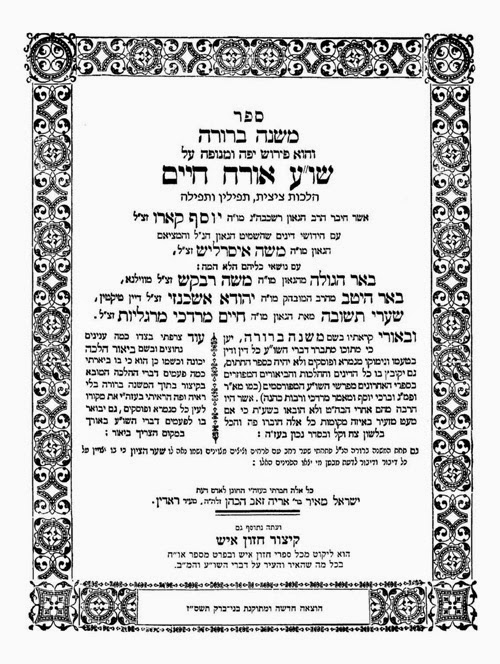
In Ha-Maor, Elul 5716, p. 30, M. Abramson tells the following story that appears under the heading על זיוף המשנה ברורה. The Satmar Rebbe was away from home and asked his assistant, R. Joseph Ashkenazi (who is the source of the story), to bring him a book. Ashkenazi brought the first book that came to his hand. It was a Mishnah Berurah printed in Israel. After investigating the history of the printing of the Mishnah Berurah at the National Library of Israel, I concluded that the copy the Satmar Rebbe was given was published by Pardes in 1955 (one year before the event described). Here is the title page.
Later the Rebbe returned the book to Ashkenazi and said that as far as he remembers, the language in section 156 of this copy of the Mishnah Berurah differs from what appears in other editions. Ashkenazi checked an older edition of the Mishnah Berurah and discovered that the Israeli edition had altered the original text.
The original Mishnah Berurah 156:4 reads:
מצוה על כל אדם לאהוב את כ”א מישראל כגופו שנא’ ואהבת לרעך כמוך וכו’ ודוקא רעך בתורה ומצוות אבל אדם רשע שראה אותו שעבר עבירה המפורסמת בישראל ולא קיבל תוכחה מצוה לשנאתו.
I have underlined the words that Abramson calls attention to. While the original text reads: לאהוב את כ”א מישראל, the Pardes edition has לאהוב את עמיתו. Abramson notes, “In this they wanted to show their support for democracy, that one needs to love not just the Jews but also the Arabs.” The Pardes edition also omits the second series of words that I have underlined, which express sentiments that are not very tolerant of the irreligious,[1] as well as some other words.
Here is the uncensored page in the Mishnah Berurah.
Here is the censored page in the Pardes edition.
Upon looking again at the Abramson article, I see that I misremembered, as it does not actually say that the Satmar Rebbe attributed this censorship to the Zionist publisher. He simply noticed the problem in the Israeli edition and said that this Mishnah Berurah is not like the others he has seen. It is Abramson who explicitly blames the Zionists (although perhaps the Rebbe agreed with Abramson). Abramson sarcastically writes that apparently they also provide copies of the Mishnah Berurah “to the children of Mapai and Mapam,” and this explains why they altered and censored the text.
Yet the truth is that what we have just seen has nothing to do with the Israeli publisher, Pardes. I found the same censorship in a Mishnah Berurah that appeared in Warsaw in 1895, and interestingly, it is this very edition that is found on hebrewbooks.org here. In other words, the changes we have seen were inserted under Czarist rule, and the Israeli publisher simply reprinted a copy of the Mishnah Berurah without realizing that it was a censored version.[2]
I know of another example where the altering of a text was blamed on the Zionists, and this time the one doing the blaming was a Mizrachi rabbi, R. Avigdor Cyperstein. In the Mossad ha-Rav Kook Archive of Religious Zionism there is a letter from R. Cyperstein to Dr. Yitzhak Rafael dated May 14, 1967. The relevant section reads as follows:
ידידי היקר – אני רוצה לזכות אותך בזכות הרבים, ובטח לא תחמיץ את המצווה הזו: כעת בכל העולם נפוצים הסידורים תוצרת הארץ הוצאת “בית רפאל”, ת”א – “סדור התפלה השלם” – והנה מצאתי בסידור זה דבר נורא: במעמדות של יום הששי מובא הגמ’ מנחות מד. המעשה באדם אחד שהי’ זהיר במצוות ציצית וכו’ ושם כתוב “באה לבית מדרשו של ר’ חייא, אמרה לו רבי צוה עלי ויעשוני גיורת וכו’, – והמולי”ם הללו העיזו לשלוח יד בגירסת הגמ’, ובמקום ויעשוני גיורת – השליכו את הגיורת החוצה, והכניסו במקומה “עברית” . . . והמרחק-התהום בין גיורת לעברית – אין צורך לבאר, וגם כוונתם הטרופה, בוקעה מזה, ומעלה סרחון, בכי’ לדורות. דומני שאין מי שהוא שהעיז לכבוש את המלכה בבית וכל ישראל – מתפללים מסידור זה, וע”כ מצווה לפרסם זה ברבים, ולתקן בהוצאות החדשות.
It is hard to know whether what R. Cyperstein refers to was indeed a Zionist inspired alteration. I say this because the version ויעשוני עברית is also attested to in a few sources that pre-date Zionism. I think it is more likely that the publisher just assumed that this is a more authentic reading.
Since I have been discussing the Satmar Rebbe, here is as good a place as any to note that contrary to popular belief, the name Satmar does not come from St. Mary. The original meaning seems to be a personal name, and in popular etymology the word came to mean “great village.”[3] Yet even in the Satmar community some believe that the word comes from St. Mary, and because of this they pronounce it as “Sakmar”. In pre-war Hungary this pronunciation was common among many Orthodox Jews, not only Satmar hasidim.[4] For one example of this, here is Samuel Noah Gottlieb’s entry on Satmar in his rabbinic encyclopedia, Ohalei Shem (Pinsk, 1912), p. 425. As you can see, while “Szatmar” appears in the vernacular, in the Hebrew the city is spelled “Sakmar”. There are many more such examples.
This avoidance of saying the word “Satmar” is similar to the way Jews referred in Hebrew and Yiddish to the Austrian town Deutschkreutz. Unlike the case with Satmar, when it came to Deutschkreutz the universal Jewish name was Tzeilem (Kreutz=cross=tzelem). On the other hand, there was a significant Jewish community in the Lithuanian city of Mariampole, whose name comes from Mary. Yet I am not aware of anyone who avoided saying the name of this city. Shimon Steinmetz emailed me as follows:
We might also note other cities with Christian-y names, like Kristianpol. Kristianpoler was a name used even by rabbis, cf. Rabbi Yechiel Kristianpoler, and his son Rabbi Meir. In addition, the Lithuanian town Kalvarija, which has a very Christian association, Jews used it without any issue. On the other hand, the Jews called St Petersburg, “Petersburg,” without the “St.”
One other point about Satmar: In a lecture I mentioned that one of the old-time American rabbis met with the Satmar Rebbe and concluded that when it came to the State of Israel, you simply could not speak to him about it. He was like a shoteh le-davar ehad when it came to this in that no matter how much you tried to convince him otherwise, he refused to listen to reason. Someone asked me which rabbi said this. It was R. Ephraim Jolles of Philadelphia (as I heard from a family member). I don’t think his formulation is too harsh, as anyone who has read the Satmar Rebbe’s writings can attest. It does not bother me if he or anyone else wants to be an anti-Zionist. However, the anti-Zionist rhetoric found in the Satmar Rebbe’s writings, and those of his successors, is often more extreme than what we find among the pro-Palestinian groups. Take a look at this passage from Va-Yoel Moshe, p. 11.
אם נקח כל פירצות הדור והעבירות המרובות הנעשות בכל העולם וישימו אותם בכף מאזנים אחת, ומדינה הציונית בכף מאזנים השני’, [המדינה הציונית] תכריע את הכל, שהוא השורש פורה ראש ולענה של אבי אבות הטומאה שבכל אבות הנזיקין שבכל העולם כולו, והן המה המטמאים את כל העולם כולו.
By what logic can one claim that such an outrageous passage would be anti-Semitic if said by Mahmoud Abbas, Linda Sarsour, Tamika Mallory, or Max Blumenthal, but not so if the very same thing is said in Satmar?
If anyone wants to see the results of this rhetoric, here are two videos with kids from Satmar. In this one the children are being taught that the Zionists started World War II and to hope for the destruction of the State of Israel.
In this video children were told that Netanyahu was in the car and they were to throw eggs at it.
It is very painful to see how children are being indoctrinated with such hatred. Again I ask, if such a video surfaced from a leftist camp, there would be no hesitation in labeling it anti-Semitic. So why are people hesitant to conclude that Satmar is also involved in spreading anti-Semitism?
The general assumption is that the Satmar Rebbe hated Zionism and the State of Israel so much, that he was inclined to believe even the most far-out anti-Semitic canards against the State. I have always found this difficult to believe. Say what you will about the Rebbe, there is no denying that he was very intelligent. Thus, I have a hard time accepting that he could have really believed in Zionist control of the media and other anti-Semitic tropes found in his polemical writings. In other words, I think it is more likely that he did not believe in any of these things but said them anyway in order to convince his followers not to give up the fight against Zionism, a fight that had been abandoned by so many former anti-Zionists after the Holocaust and the creation of the State of Israel in 1948. In such a battle it was necessary to turn Israel not only into something bad, but actually the worst sin imaginable.
R. Nahum Abraham, a Satmar hasid and prolific author, has recently written that the Satmar Rebbe would deny things that he knew were true. He regarded his denials as “necessary lies,” in order to prevent people from being led in the wrong direction.[5] If the Rebbe thought that it was permissible to deny the truth of certain hasidic stories in order to prevent his followers from being influenced by them, isn’t it possible that he would exaggerate the evils of the State of Israel in order to best indoctrinate his followers with an anti-Zionist perspective?
This approach also would explain a big problem that no one has been able to adequately account for. How was the Satmar Rebbe able to have friendly and respectful relationships with people who, based on what he writes, he should have regarded as completely out of the fold due to their involvement with the State of Israel? This includes even men like R. Aharon Kotler who supported voting in the Israeli elections, which the Satmar Rebbe claimed is “the most severe prohibition in the entire Torah.”[6] Yet we know that the Satmar Rebbe respected R. Aharon and others who had a very different perspective.[7] Can’t this be seen as evidence that there is a good deal of ideologically-driven exaggeration in the Satmar Rebbe’s writings, and that not everything he says really reflects his actual views? After all, if he really thought that voting in the elections was the most severe prohibition in the Torah and the State of Israel was completely destroying Judaism, would he still be able to be on good terms with rabbis who instructed their followers to vote and be part of the State?
2. Since I mentioned Munkács in this post, let me return to another recent post here where I discussed R. Baruch Rabinovich, the son-in-law of R. Hayyim Eleazar Shapira and his successor as Munkácser Rebbe. When I wrote the post I was unaware of the fact that R. Baruch’s grandson, R. Yosef Rabinovich, recently published Ner Baruch, which is a collection of Torah writings and letters from R. Baruch. He includes in the volume the haskamot written by R. Baruch. I examined new printings of the volumes with haskamot that I was unaware of and found that R. Baruch’s haskamah to the first edition of R. Yitzhak Adler, Seder Shanah ha-Aharonah (Munkács, 1937) was deleted in subsequent printings. The same thing happened with R. Baruch’s haskamah to R. Judah Zvi Lustig’s Yedei Sofer (Debrecen, 1938). Here is how the page with the haskamot looks in the original printing.
Here is how the page with the haskamot looks in the reprint, where R. Baruch’s haskamah has been deleted.
Another point about R. Baruch: In 1946 he tried to become chief rabbi of Tel Aviv but lost out to R. Isser Yehudah Unterman. This is discussed in Samuel Heilman’s Who Will Lead Us? From a letter that appears in the archive of R. Isaac Herzog, and was sent to an unknown rabbi, we see that in 1950 R. Baruch was also interested in becoming av beit din in Tel Aviv.
This information is, to the best of my knowledge, not recorded anywhere else. In this letter, which I found here (a site that contains more interesting information and pictures about R. Baruch) we that R. Herzog, R. Unterman, and R. Yaakov Moshe Toledano were strongly opposed to R. Baruch receiving this appointment. Although the reason for this opposition is not mentioned, it is perhaps because they felt it was an abomination that someone from the anti-Zionist Munkács dynasty should have such a position in the State of Israel. However, as I have mentioned in my previous post, it is doubtful that R. Baruch ever really shared his father-in-law’s strong anti-Zionism. It is possible that the anti-Zionist statements he made in the pre-war years might not have reflected his actual beliefs but were due to his position as rebbe. That is, as the successor of R. Hayyim Eleazar Shapira he felt that he had to make such statements. It is also the case that had he not continued his father-in-law’s anti-Zionist stance he would not have retained much of a following in Munkács.
When R. Baruch wanted to become chief rabbi of Tel Aviv, a letter in opposition to this was published by Chaim Kugel, head of the Holon Municipal Council:
Is it conceivable that this man . . . who hounded Zionism and Zionists . . . who loyally continued the line of the Munkács court, which cursed and banned any Jew who pronounced the word Zion on his lips . . . is it conceivable that this man will appear as a representative and moral leader in the first Hebrew city, and be a guide to its residents and Zionists?[8]
In those days it was obvious that positions of chief rabbis of important cities would go to Zionist rabbis. Here, for example, is a letter to R. Unterman from David Zvi Pinkas, an important Mizrachi figure and signatory of Israel’s Declaration of Independence.[9] Note how Pinkas tells R. Unterman that the Mizrachi expects him to follow the Mizrachi approach in everything he does. If R. Unterman could not commit to this, then Pinkas would have found another rabbi who could.
In my earlier post I neglected to mention R. Baruch’s Hashav Nevonim that appeared in 2016. This book is full of interesting material, and the more I read from R. Baruch, the more impressed I am. He really was a fascinating figure in so many ways.
There is a good deal I can say about Hashav Nevonim, but let me just call attention to the first essay that appears in the book, focused on conversion. Conversion is a matter often in the news. I have said on numerous occasions that what currently passes as the standard approach to conversion was not the case at all in previous years. To begin with, among the rabbis there were different understandings of what kabbalat ha-mitzvot entailed, and the currently accepted view that a prospective convert must commit to become fully halakhically observant, as practiced today in Orthodox communities, was not the view of many, and perhaps not even the view of most. The notion that a conversion could be annulled after the fact was hardly ever put into practice, although even this is found on occasion and R. Baruch cites some authorities who speak about this very point. Thus, it is not, as has often been alleged, a modern haredi idea with no historical basis although, as mentioned, it was very rare.
After going through the various views on conversion, R. Baruch concludes as follows (p. 47).
מנהג העולם נראה כמקבל דיעה זו, וכל מי שנתגייר, בין ששומר מצוות, ובין שחוזר ועובר עבירות, דינו כישראל, כל שקיבל עצמו עול מצות עם גירותו.
I have underlined the words which are not currently accepted by many (most?) conversion courts and which are at the heart of the controversy regarding voiding conversions. Today, the assumption of many conversion courts is that if someone who converts is later seen violating halakhah in a serious way, we can assume that this person never really accepted the mitzvot at the conversion, and the conversion is therefore not valid. It is this argument which was hardly ever put into practice in previous years and now appears to be quite common, so much so that converts claim to feel that their conversions are always “on condition,” namely, that even many years after converting there is the possibility that the conversion will be declared invalid because of a lack of proper kabbalat ha-mitzvot.
On pp. 27-28, R. Baruch calls attention to the novel view of R. Isaac Benjamin Wolf, author of Nahalat Binyamin (Amsterdam, 1682), a book reprinted a number of times and which carries the haskamah by R. Jacob Sasportas. Here is the title page.
R. Isaac is described as rabbi of מדינת מרק. This refers to the German county of Mark, about which see here.
Here is page 89a in Nahalat Binyanim
According to R. Isaac, in places such as Spain and Portugal, where one could not practice Judaism openly, if a Jewish man marries a non-Jewish woman, and the woman chooses to practice Judaism, both she and her children are regarded as Jewish. How can she be Jewish when she never immersed in the mikveh and there was no beit din to preside over the conversion? R. Isaac says that there is no obligation to immerse in the mikveh when there is danger (as there would be in a place with the Inquisition looking to find Crypto-Jews). Although he does not elaborate, it is obvious that according to R. Isaac kabbalat ha-mitzvot in front of a beit din is not an absolute requirement. In other words, he holds that in a she’at ha-dehak one can convert on one’s own, without a beit din.
This is a fascinating position that is at odds with accepted halakhah, so much so that most people won’t even believe that such a position is possible. R. Baruch is not able to cite anyone who agrees with it. The position of Nahalat Binyamim is discussed by R. Eliezer Waldenberg, who not surprisingly completely rejects it.[10] However, he does cite a medieval view that has some similarity to Nahalat Binyamim:
היה מקום להביא סמוכין לזה משיטת האביאסף שהובא במרדכי ביבמות סו”פ החולץ שמפרש דברי הגמ’ שם שאומרת מי לא טבלה לנדותה שמשמע דבדיעבד הוי גר גמור גם בטבילה בלי ג’.
Unlike R. Waldenberg, R. Hayyim Amsalem, Zera Yisrael, p. 290, does not reject Nahalat Binyamin out of hand. Instead he writes:
חזו דברי גאון קדמון זה לאיצטרופי, ולדון להקל בבני האנוסים ובבני יהודים לענין גיורם וחזרתם לדת, שכל שימולו ויטבלו לשם יהדות בהודעת מקצת מצוות כהלכה, סגי להו אף לכתחילה, אע”פ שאנחנו לא יודעים מה שהיה אח”כ לענין קיום המצוות, וזה אתי אפי’ למ”ד קבלת מצוות מעכבת.
See also Jacob Sofer, Sipurei Yaakov (Lvov, 1913), vol. 2, pp. 7ff. (no. 42), for a lengthy story starring the Maharal. The tale is obviously fictional, but of importance for our purposes is that the story, reported in a hasidic text, tells of a woman who ran away from her non-Jewish husband and married a Jewish man, had children, and was a righteous woman. However, this woman never converted with a beit din, and yet on p. 8a it specifically states that she and her children are to be regarded as Jewish. R. Nahum Abraham points to this as an example of an anti-halakhic hasidic story that cannot be true.[11]
Finally, Nahmanides in his commentary to Yevamot 45b has an interesting view and I do not know if it is accepted.
ואיפשר לומר דגבי קבלת מצוות צריך שלשה אפילו בדיעבד דמשפט כתיב ביה מה התם שנים שדנו אין דיניהן דין אף כאן אינו גר אפילו בדיעבד, אבל מי שהודיעוהו מקצת ענשן של מצות ומתן שכרן של מצות וקיבל עליו בב”ד לטבול ולמול, אם הלך ומל וטבל שלא בפני ב”ד הרי זה כשר ולא פסלינן לזרעיה
3. There are many new books to speak about. One of them is Chaim I. Waxman, Social Change and Halakhic Evolution in American Orthodoxy. The content of the book can be seen from the title. I will be reviewing this book in an academic journal, so I do not need to speak about it here. I would, however, like to call attention to one point that will not be mentioned in my review. Chapter 5 is titled “Tensions Within Modern Orthodoxy.” Not surprisingly, it deals with women rabbis. On pp. 109-110, Waxman refers to R. Jeremy Wieder’s view on the matter (the name is misspelled “Weider”). He quotes from an article in the Yeshiva University Commentator, which summarizes R. Wieder’s position as follows: “[I]n light of the success of the yoetzet halacha program in increasing overall observance in the communities that he has observed, it may be very beneficial to have women rabbis.”
I was quite surprised to see such a liberal position expressed by a YU Rosh Yeshiva, and I checked the source which appears here. R. Wieder is indeed quoted saying, among other things, that there is no binding tradition on the matter of women rabbis since the issue of women in leadership positions is a new question, thus preventing the development of a “stream of Jewish tradition.” However, when I read the article I did not find anything about how it may be “beneficial to have women rabbis.” I then noticed the following at the beginning of the article. “Editor’s Note: This article has been edited to more precisely convey the opinions represented.” In this case, I think the meaning of “more precisely convey” is that what originally appeared was altered (presumably at R. Wieder’s request) in order to prevent controversy. Yet even with the removal of R. Wieder’s view that it may be “beneficial to have women rabbis,” the current text of the article does not alter the substance of R. Wieder’s opinion. Thus, we find the following:
Lastly, Rabbi Wieder talked about the issue from a philosophical standpoint. He argued that expanding the pool of rabbinic students could lead to an increase in qualified rabbinic candidates. Rabbi Wieder added that he has observed the yoetzet halacha program increase overall halachic observance in the communities it serves and he expressed his optimism that women rabbis could generate similar improvement.
These words are certainly in opposition to the OU’s recent statement on women and religious leadership which is available here.
The question I have been asked a few times is if in the current political climate it is possible for a rabbi at a mainstream Modern Orthodox synagogue, or a teacher at a mainstream Modern Orthodox school, to feel free to express support for the ordination of women. Would such a rabbi or teacher risk censure from his colleagues or even the possibility of losing his job? The answer to these questions will determine if we are dealing with a real wedge issue (as I think we are).
Another new book is R. Bezalel Naor’s Shod Melakhim. R. Naor is well known as an outstanding interpreter of R. Kook. His great knowledge of the entire scope of Jewish thought (not just R. Kook) is apparent to anyone who examines his writings. Yet I do not know how many are aware of R. Naor’s achievements when it comes to rabbinic literature. This latest book is a collection of R. Naor’s studies on various halakhot in the Mishneh Torah. As part of R. Naor’s explication of these halakhot, he offers the reader wide-ranging enlightening discussions using numerous sources, both traditional and academic. For those who can appreciate the synthesis of the traditional and the academic approaches to the study of Maimonides, R. Naor’s new book is a real treat.
In the past I have spoken about the late R. Mordechai Spielman’s great work on the Zohar, Tiferet Zvi. The seventh volume of Tiferet Zvi has recently appeared, and can even be purchased on Amazon. Anyone who is interested in how the Zohar has been interpreted, and the impact of the Zohar on later rabbinic literature, will benefit greatly from of R. Spielman’s writings.
A new book (over 600 pages) by Benjamin Brown has appeared. It focuses on the Karlin hasidic dynasty. When I received the book in the mail, the first thought that came to my head is that Brown is a phenomenon. There is no other way to put it. It is not just the quantity of his literary output that is astounding, but also the quality, as everything he writes is worth reading.
____________
[1] Regarding the Hafetz Hayyim’s view of the non-religious, which is very much at odds with current approaches in the Lithuanian yeshiva world (at least in America), see Benjamin Brown, “Ha-‘Ba’al Bayit’: R. Yisrael Meir ha-Kohen, he-‘Hafetz Hayyim,’” in Brown and Nissim Leon, eds., Ha-Gedolim (Jerusalem, 2017), pp. 127ff. Brown also shows that in a few letters the Hafetz Hayyim adopts a more moderate perspective.
[2] In future posts I hope to say a good deal more about the Satmar Rebbe’s writings. For now, let me just respond to someone who emailed me and compared R. Hayyim Eleazar Shapira, the Munkácser Rebbe, to the Satmar Rebbe. It is true that they are similar in terms of their strong opposition to Zionism, and the Satmar Rebbe can be seen as the Munkácser Rebbe’s successor in this matter. However, in terms of their scholarly approach, they are quite different, as the Satmar Rebbe did not have the Munkácser’s critical sense. In fact, I was quite surprised to learn that the Satmar Rebbe accepted as authentic the forged anti-Zionist letters published by Chaim Bloch in his three volume Dovev Siftei Yeshenim. See R. Dov Schwartz, Meshiv Devarim (New York, 2011), pp. 140-141.
[4] Shimon Steinmetz called my attention to סאקמאר appearing as the name of the city as early as 1859 in R. Hayyim Meir Ze’ev ha-Kohen, Sha’arei Hayyim (Pressburg 1859), in the list of subscribers at the beginning of the book. (You can find this on Google books, but the version of the book on hebrewbooks.org is missing these pages, as well as other pages.) This shows that referring to the city as “Sakmar” was already common. Steinmetz also called my attention to the same thing in the list of subscribers found at the end of R. Hayyim Joseph David Azulai, Kise Rahamim (Ungvar, 1870). In this case, you can see the subscribers in the copy on hebrewbooks.org, but it has been removed from the copy on Otzar ha-Chochmah. If this was removed intentionally, on the assumption that it is not really part of the sefer, it is a big problem, as the subscriber information can be of great historical importance. It is vital that both hebrewbooks.org and Otzar ha-Chochmah scan books in their entirety, without making any changes whatsoever.
R. Yoel Teitelbaum used the term Satmar all the time, and it was on his stationery, but I did find a number of places where he wrote Sakmar, spelled סאקמער and סאקמיר. See e.g., his approbations to R. Abraham Hayyim Reinman, Va-Yetze Perah (Satmar, 1940), R. Asher Steinmetz, Mikveh Yisrael ha-Shem (Jerusalem, 1961), and his letter in Divrei Yoel: Mikhtavim (Brooklyn, 1981), vol. 2, p. 81. See also Esther Farbstein, Be-Seter ha-Madregah (Jerusalem, 2013), p. 862, for a 1949 letter from Budapest to R. Yoel in which the word Sakmar is used. Shimon Steinmetz wrote to me as follows:
I think you can see by his [R. Yoel’s] correct spelling in Latin letters that he didn’t take it seriously, and perhaps not too many Jews did. After all, R. Joel Teitelbaum himself, who I think most people would consider fairly zealous, did not insist or use it very much. . . . This tells me that when people did call it Sakmar, most of them were probably just calling it that because it was already what Jews called it. Perhaps it was even a sly joke to begin with.
[5] Peti Ya’amin le-Khol Davar (n.p., 2017), p. 31
[6] Divrei Yoel, Mikhtavim, no. 90.
[7] In a future post I will publish a letter I received from Moshe Beck dealing with this point. Beck is the chief rabbi of the U.S. Neturei Karta.
[8] Translation in Heilman, Who Will Lead Us?, p. 45.
[9] The letter is found in the Israel State Archives, David Zvi Pinkas collection, 3070/15-פ.
[10] Tzitz Eliezer, vol. 17, no. 42:11.
[11] Heikhal ha-Besht 18 (Nisan 5767), p. 18. For an Arabic version of this story, see Bayit Neeman 96 (26 Tevet 5776), pp. 4-5.
Fixing a Typesetting Error in Order to Understand The View of the Mishnah Berurah on Women Wearing Tefillin
Fixing a Typesetting Error in Order to Understand
The View of the Mishnah Berurah on Women Wearing Tefillin
by Michael J. Broyde
mbroyde@emory.edu
Please note that this piece isn’t meant to be construed one way or another as the view of the Seforim Blog.
While there has been considerable recent discussion regarding women wearing tefillin, I will not review here the general topic but rather focus specifically only the view of the Mishnah Berurah. I believe the view of the Mishnah Berurah has been widely misunderstood due to two identical typesetting errors in the text, one in the Mishnah Berurah itself and one in the Biur Halacha. It is not my intent to address the normative halacha in this article.
Background Sources
Rabbi Karo (OC 38:3) states simply:
נשים ועבדים פטורים מתפילין, מפני שהוא מצות עשה שהזמן גרמא.
Women and slaves are exempt from the mitzvah of tefillin since it is a positive time bound commandment.
Rema adds to his exemption, noting:
הגה: ואם הנשים רוצין להחמיר על עצמן, מוחין בידם.
If women wish to be strict for themselves, we protest.
is adopting the view of Tosafot and the Pesikta Rabati that we ought to protest such conduct, essentially prohibiting it.
But this blanket statement of the Rema does not sit well with some commentators. The Olat Tamid[1] (38:4) writes:
ואםהנשים רוצין וכו׳: הטעם כתב בכלבו משום שאינו יודעת לשמור את עצמן בנקיות עכ”ל ואני תמה אם כן למאי הצריכו בגמרא פרק מי שמיתו לפרש מפני שהוא מצות עשה שהזמן גרמא הנשים פוטרות מן התפילין ת”ל דאפילו אס רוצים להחמיר אסורין להניח תפילין, שהרי אינן ידעת לשמרם בטהרה! אלא ודאי דליתא להאי טעמא לפי סוגיות הגמרא וכן אמרינן בר”פ המוצא תפילין דמיכל בת כושי היתה מנחת תפילין ולא מיחו בה חכמים אע”ג דבפסיקתא א’ להיפך דמיחו בה חכמים מ”מ אנן אגמרא דידן סמכינן. מיהו יש לדחות, הא דלא מפרש גמרא הטעם זה משום שרוצה ליתן טעם גם לעבדים דפטורות ואי משום טעם זה לבד היה נראה דעבדים חייבים שהרי בודאי הם יודעים לשמרם בטהרה ולפיכך מפרש מפני שהוא מצות עשה שהזמן גרמא • דמש”ה גם עבדים פטורים מיהא מהא דאמרנן דלא מיחו בה חכמים משמע דאם האשה זקנה וידעינן בה שיודעת לשמור את עצמה דאין למחות בה ובה”ג מיירי התם:
The Kolbo writes that the reason is because women do not know how to guard themselves with cleanliness. I was amazed at this, as if that is the case, why does the Talmud in chapter me shemeto need to explain that women are exempt from tefillin because it is a time bound positive commandment? Wouldn’t it be true [according to Kolbo] that [whether they are exempt or not and] even if they wish to be strict on themselves, it is prohibited from them to don tefillin since they do not know how to watch themselves with purity! Rather, it must be that this reason [i.e., that women may not wear tefillin due to cleanliness issues] is not correct according to the Talmudic text. So too, it says in the beginning of the chapter Hamotzee tefillin that Michal Bat Shaul donned tefillin and the Rabbis did not rebuke her; even though one Pesikta says the opposite, that they did rebuke her, nonetheless, we follow our Talmudic source. However, one could rebut the [previous] proof, [because perhaps] our Talmud [in me shemeto] does not give this explanation [cleanliness] since it wants to offer a reason why slaves are also exempt. And if it were for this reason [cleanliness] alone, it would appear that slaves are obligated in donning tefillin, since they certainly know to keep themselves clean. Therefore the Talmud explains [that women are exempt from tefillin] because of the principle of time bound positive commandments, since it is for this reason that slaves are also exempt. Nevertheless, the source that says the Rabbis did not rebuke Michal does imply that if a woman is elderly [i.e., post-menopausal] and we know that she is capable of watching herself [to stay clean], one should not rebuke her. And it is such a case that the Talmud has in mind there [i.e. in me shemeto, where women are said to be exempt from wearing tefillin, not categorically forbidden from doing so].
The Magen Avraham does not agree with this Olat Tamid. Magen Avraham (38:3) states:
מוחין כו’ – מפני שצריכין גוף נקי ונשים אינם זריזות להזהר אבל אם היו חייבים לא היו פטורין מה”ט דהוי רמי אנפשייהו ומזדהרי כנ”ל דלא כע”ת:
We protest: Since they need a clean body and women are not particularly careful with cleanliness; but if they were obligated, they would not be exempt for this reason since they would accept the mitzvah upon themselves and they would thus be conscientious. Such appears to me to be the rule, and not like the Olat Tamid.
The whole thrust of the Magen Avraham is to reject the approach of the Olat Tamid) who permits women to wear tefillin when they are clean). Magen Avraham accepts that once one is not obligated to wear tefillin, one is not careful to be clean and only those obligated are careful, whereas Olat Tamid thinks cleanliness is unrelated to obligation. [2]
Now consider whether one ought to rebuke a [male] slave who wishes to wear tefillin. Like a woman, he is not obligated in the mitzvah of tefillin, but yet he seems to have no practical issue with guf naki factually. If he were to don tefillin (which he is not obligated to at all) should we rebuke him? One could claim that the Rama (and the Taz for that matter) both implicitly agrees that a slave is not rebuked since only women (and not slaves) are mentioned as subject to rebuke. Pre Megadim (Mishbatzot 38:2) [3] disagrees and states:
מוחין. עיין ט”ז. ומ”א [ס”ק] ג’. ומשמע עבדים אין מוחין שיכולין להזהר. וזה אינו, דגם כן אין זהירים דפטורים, וגם גריעי תו מנשים דעד א’ נאמן באיסורים וספרה לה [ויקרא טו, כח]. ועבדים בסתמן לא [נאמנים] עיין ש”ך יו”ד סימן א’ [ס”ק ב]. גם על כרחך פשיטא אין מניחין שלא יעלו אותו ליוחסין וכדומה:
We Object: See Taz. See Magen Avraham 3. And this implies that when a slave dons tefillin one does not object, since they can be careful [about cleanliness]. This is wrong, because they are not careful since they are exempt. Furthermore, slaves are worse than women [in this mitzvah] since “one witness is believed regarding ritual matters” (as it says in Lev 15:28) “she counts” but slaves are not believed; see Shach YD 1:2. One must also adopt the obvious position that slaves do not wear tefillin [even though they can keep clean] so that we should not mistake them as full Jews.
Pre Megadim makes a few claims here. While inferring that Rama and Taz hold slaves are not rebuked and may wear tefillin if they wish, Pre Megadim himself holds this is incorrect for several reasons: (1) all those exempt are rebuked according to the Pesikta, since one who is exempt is not as careful to be clean; (2) slaves are deemed less reliable than women in many Jewish law matters; (3) permitting a slave to wear tefillin might mistakenly lead people to believe he is fully Jewish.
Thus, whether we should deem all exempt individuals as being always insufficiently careful about cleanliness, and therefore object to them wearing tefillin, is a dispute between Magen Avraham and Pre Megadim versus Olat Tamid.
The Typographical Error in Mishnah Berurah 38:12
Now, to the heart of this short note: Mishnah Berurah is uncertain about how to resolve the question of whether a slave who dons tefillin ought to be rebuked. Since this matter is not one that normative halacha needs to resolve (as slaves no longer existed within Jewish life in the time of the Mishnah Berurah) he simply states (38:12):
הנשים – עיין בפמ”ג שה”ה לענין עבדים ועיין בספר תוספות שבת שכתב בהדיא להיפך ועיין בספר תוספות ירושלים:
Women: See Pre Megadim who states the same rule for slaves. See also Tosafot Shabbat who writes explicitly the opposite and see the work Tosafot Yerushalayim.[4]
Several difficulties present themselves in this simple Mishnah Berurah, but I want to focus on only one: Who is this Tosafot Shabbat that the Mishnah Berurah is quoting and what does he say? Hebrewbooks.org and Otzar HaChachma data bases list a few books with that title, but none of them seem to deal at all with tefillin. While the Mishnah Berurah does in several other places quote a work by this title, the work that he quotes is always the famous work “Tosafot Shabbat” which deals with Hilchot Shabbat only or (less frequently) the similarly named work which discusses when does Shabbat begin or end? Furthermore, no discussion of tefillin or slaves is found in those works at all, as far as I can tell. None of the other works with this title are relevant either, as far as I could tell: none of them had a section dealing tefillin law.
Luckily, someone pointed out to me that his version of the Mishnah Berurah has a footnote by the editors noting that the word תוספות is a mistake in the typesetting of the Mishnah Berurah. A similar correction is also noted by other new editions of the Mishnah Berurah as well — I found it in Hotzah Chadashah uMetukenet Benai Brak (5767). These editions argue that this note (12) in the Mishnah Berurah is supposed to read:
הנשים – עיין בפמ”ג שה”ה לענין עבדים ועיין בספר עולת שבת שכתב בהדיא להיפך ועיין בספר תוספות ירושלים:
Women: See Pre Megadim who states the same rule for slaves. See also Olat Shabbat who writes explicitly the opposite and see the work Tosafot Yerushalayim.
This makes perfect sense and completely solves the mystery. The typesetter made a mistake that is easy to understand. Since on the same line of text already contained the words “tosafot” and the work Tosafot Shabbat was widely cited in the previous volume which was printed (volume 3) whoever was typesetting the work made an error and typeset the wrong word.
Olat Shabbat is another name for the work Olat Tamid (quoted above), who quite clearly, as the Mishnah Berurah notes, permits slaves to wear tefillin, since they are observant of the rules of guf naki. Olat Tamid was the name used for those sections of the book addressing daily halacha (up to chapter 240 in the Shulchan Aruch) and Olat Shabbat is the name of the same work for those remaining sections that deal with Shabbat and Festival law. Furthermore, the Mishnah Berurah uses both names at various times without following the exact correspondence to whether he is quoting from the part of the work named Olat Tamid or Olat Shabbat. For example, in Shar Hatziyun 42:23 he quotes the Olat Tamid on a matter related to tefillin law and he calls him the Olat Shabbat. The work went by two names.
To summarize: While the Mishnah Berurah in 38:12 quotes a work call Tosafot Shabbat as discussing whether a slave may don tefillin, as far as can be told, no such work exits. A work named Olat Shabbat does exist which comments on Siman 38 of the Shulchan Aruch and permits a slave to don tefillin. All of this makes a case so compelling that several new and critical editions of the Mishnah Berurah have noted this must be a typesetting error in the Mishnah Berurah and so have corrected the text accordingly.[5]
What the Mishnah Berurah does not note at all, but is completely clear once you look at the Olat Tamid inside – by now an obscure book that is hard to find, but which is on Hebrewbooks.org and is quoted above – is that for the same reasons that Olat Tamid contends we do not object to a slave wearing tefillin, Olat Tamid also permits a woman who is careful with guf naki (because she is post-menopausal) to wear tefillin.
Furthermore, Mishnah Berurah is fully consistent with the reading of the halacha found in the Olat Tamid when he explains the Rema’s objection to women donning tefillin in his next note, stating simply and directly (38:13) that:
מוחים בידן – מפני שצריכין גוף נקי ונשים אין זריזות להזהר:
We protest: since they need a clean body and women are not particular to be conscientious about being careful [to be clean].
The Mishnah Berurah thus explains why women do not don tefillin by quoting only the rationale that is consistent with the Olat Tamid’s understanding of the Rama, namely: this halacha is fundamentally about cleanliness, and not necessarily obligation (which categorically excludes all women and all slaves, no matter how clean). Thus, in contrast to Pre Megadim and Magen Avraham, the Mishnah Berurah leaves out the idea that “אבל אם היו חייבים לא היו פטורין מה”ט דהוי רמי אנפשייהו ומזדהרי” (“but if they were obligated, they would not be exempt for reasons of cleanliness”) since that is not consistent with the Olat Tamid, and the Mishnah Berurah holds the Olat Tamid is correct about even a slave.[6] In other words, slaves should be rebuked because they are not meticulously careful to be clean independent of their lack of obligation to put on tefillin.
The Typographical Error in Biur Halacha 39:3
Chapter Thirty Nine of the Shulchan Aruch addresses who can write tefillin, which is a different question than who can don them, although somewhat related. This is made clear by the comments of the Mishnah Berurah writing in the Biur Halacha in 39:3 which even more forcefully adopts the view of the Olat Shabbat. The Shulchan Aruch notes that a convert may write tefillin and the Mishnah Berurah continues in the Biur Halacha 39:3 by stating directly:
כשר לכתוב תפילין – כ”ז איירי בגר צדק. ולענין גר תושב הסכימו הפמ”ג ול”ש ומחה”ש [ועוד הרבה] דפסול מטעם דהא אינו בקשירה והשע”ת[7] המציא דבר חדש דאיירי הד”מ דמכשיר בגר תושב דקיבל עליו כל המצות חוץ מאיסור נבילה וא”כ הלא ישנו בקשירה ובאמת נלענ”ד שגם זה אינו דהלא עכ”פ אינו מוזהר על הקשירה ותדע דאטו אם אשה ועבד יקבלו עליהן מצות תפילין יהיו כשרים לכתיבת תפילין ואם תדחה משום דמוחין לנשים על הנחת תפילין וכדלעיל בסימן ל”ח ז”א דכל זה רק מחמת חומרא בעלמא שחוששין להפסיקתא אבל ש”ס דילן סובר דאין מוחין ע”ז וכדאיתא שם בב”י ועוד עבדים יוכיחו דאין מוחין בהן וכמו שכתבתי לעיל במ”ב בשם התו”ש:
A convert may write tefillin: All this is discussing a proper convert, but as to a ger toshav, the Pre Megadim Levushai Serad, and Machatzit Hashekel [as well as many others] all agree may not write tefillin since they are not obligated to don tefillin. Sharai Teshuva finds another novel matter here when he notes that the Darchai Moshe permits a ger toshav [to write tefillin] since he accepted all the mitzvot other than eating not kosher meat, since he is permitted to don tefillin. In truth in my opinion even this is not correct, since such a person is also not obligated in donning tefillin. And you should know that concerning even a woman and a slave who accept upon themselves to the mitzvah to don tefillin could they write tefillin?[8] And if you push this off, since we rebuke women on donning tefillin as noted in chapter 38, that is wrong, since this pushing off is only a mere stricture grounded in being fearful of the Pesikta, but our Talmud rules that one does not rebuke on this as is noted by the Bet Yosef, and even further, we do not rebukeslaves as I noted in the Mishnah Berurah there in the name of the Tosafot Shabbat.
And of course, as the standard new editions of the Mishnah Berurah now note, there is a typographical error — the last words in the Mishnah Berurah should read Olat Shabbat here also, changing the ת to an ע, making it clear that the Mishnah Berurah has a consistent preference for the approach of the Olat Shabbat-Olat Tamid over the approach of the Magen Avraham and the Pre Megadim, as a better explanation of the Rama. (The Mishnah Berurah then continues to explain why women and slaves – who can put on tefillin as a matter of tefillin law – still cannot write them.[9])
According to the Mishnah Berurah, the Rama directs rebuke of women in 38:3 for donning tefillin not as a matter of the minimal technical halacha, but only as a chumra bealma since he is of the view that the Pesikta’s formulation is inconsistent with the Bavli and thus not the formal mandatory rule of halacha ever (just like the Olat Tamid notes).[10] Furthermore, the Mishnah Berurah makes it clear here that he is ruling against the Pre Megadim on the matter of rebuking slaves who don tefillin which he left as an open dispute in 38:12.
A Test Case: The Cheresh
Consider a test case: Should we rebuke a cheresh (fully mentally incapacitated man) who wishes to wear tefillin, if he is competent to maintain cleanliness? This is an excellent test case. He is Jewish (like a women is), but exempt from all mitzvot, including tefillin, and he lacks the basic credibility that even a Jewish woman has to label food items as prohibited or permissible, so two of the three reasons of the Pre Megadim apply to him, mandating rebuke. For our present purposes, his “risk profile” vis-à-vis wearing tefillin thus falls in between a slave and a woman: he is riskier than a (post-menopausal) clean woman and less risky than a slave.
Olat Tamid states (37:1) that since a cheresh can maintain cleanliness, he should not be rebuked for donning tefillin. The Mishnah Berurah (37:12) rules that way and he cites as precedent for this the classical work Baer Hatev, who in turn cites the classical work Olat Tamid![11]
חרש המדבר ואינו שומע או שומע ואינו מדבר חייב להניח תפילין אבל אין שומע ואין מדבר אין מוחין בידו מלהניחם אם רוצה [בה”ט]:
A cheresh who speak but cannot hear, or hear but cannot speak is obligated in tefillin, but one who can neither listen nor speak one does not rebuke them when they don tefillin if they wish. [Baer Hatev]
Thus, from the Mishnah Berurah’s ruling regarding a cheresh, we see that he clearly rejects the view that “one is not obligated may not don tefillin since such a person will not be particularly careful to be clean.” Rather, Mishnah Berurah only cites the Pre Megadim’s view about slaves apparently in deference to the Pre Megadim’s other concern: since slaves are not full Jews, permitting them to wear tefillin might confuse others about their personal status as full-fledged Jews.[12] Otherwise, Mishnah Berurah adopts the Olat Tamid’s explanation of the Rama in this halachic area – i.e. focusing on cleanliness, and not automatically deeming exempt individuals as incapable of maintaining proper cleanliness.
Conclusion
The Mishnah Berurah does not address the question of whether a carefully clean woman who wants to don tefillin may do so. Such a radical break with tradition would never be raised or considered in a completely hypothetical vacuum by the Mishnah Berurah. The Mishnah Berurah simply never discusses the matter and he is silent. How should we understand his silence? Did he think we ought to rebuke such a woman as a matter of tefillin law[13]?
With all of this data in hand – most importantly, the proper text of the Mishnah Berurah – it is reasonable to conclude that the best way of interpreting the Mishnah Berurah is that he does not think that a woman who is sufficiently careful about guf naki[14] needs be rebuked – as a matter of tefillin law – if she does don tefillin. Proof to this can be found from: (1) his citation of the Olat Tamid in the case of a cheresh and a slave and (2) the Mishnah Berurah’s referral to the view of the Pesikta as a חומרא בעלמא, a mere stricture, [15] and (3) his focus on cleanliness as the reason for rebuke of women, like the Taz and the Olat Tamid.
Further proof of this is the unstated view of the Mishnah Berurah can be found from: (4) the Mishnah Berurah’s rejection of the formulation of the Magen Avraham that all those who are exempt are prohibited as a matter of tefillin law and (5) the Mishnah Berurah’s sub-silento rejection of the Gra’s view that the Pesikta and the normative Bavli both agree that women ought to be rebuked and (6) the Mishnah Berurah’s implicit rejection of the view of the Levush (and others) that while Michal bat Shaul could put on tefillin because she was unique, no one else can.[16]
There is no other viable theory left other than to accept that — to the Mishnah Berurah — the proper way to understand the Rama’s rule that one should rebuke a tefillin donning woman is limited to one who either is not clean, which is the base line view of the Talmud Bavli or, as chumra be’alma, to rebuke any woman who is “not particular to be conscientious about being careful [to be clean]” as he states in 38:13.
Thus, the purpose of this article is to make an intellectually honest point which hopes to contributes to reasoned discussion: those who have acknowledged the view of the Olat Tamid as permitting slaves, clean women and chereshim to don tefillin, and yet dismiss that view as supposedly rejected by all normative poskim, are mistaken, once the correct text of the Mishnah Berurah is established.
To what extent this has any practical halachic application is for a different discussion. For example, there might very well be other excellent rationales outside of technical tefillin law prohibiting such conduct,[17] or one could look to the view of the Magen Avraham and Pre Megadim and object to women wearing tefillin due simply to their lack of obligation or one could note that even without the rebuke obligation, tefillin are still no better than tzitzit and our rule is that women do not wear them either as a matter of very old custom. None of this practical halacha is the focus of this paper. [18]
The attached six pages are copies of the front matter and relevant pages from two modern editions of the Mishnah Berurah which note the typographical errors mentioned and correct them.
[1] There are a number of works entitled Olat Tamid in the rabbinic library and this Olat Tamid is the one that the Magen Avraham had which is by Rabbi Shmuel ben Yosef Orgler found at http://hebrewbooks.org/21386 at page 28.
[2] Pre Megadim reinforces this as the correct read of the Magen Avraham in Ashel Avraham 3 where he emphasizes that one who is exempt is not careful.
[3] The Pre Megadim is commenting on the Taz – as he understands the Taz to agree with the Olat Tamid here and to focus only on cleanliness and not level of exemption – and/or is inferring from Rema’s note that we object to women who wish to wear tefillin that Rema would not object to a male slave wearing tefillin.
[4] Tosafot Yerushalayim cited by the Mishnah Berurah is not in chapter 38 of his work (where you would expect it) but in OC Chapter 17. Tosafot Yerushalayim adopts the reasonable view that only slaves like Tevi of Rabbi Gamliel can don tefillin, as a correspondence to the exceptional case of Michal bat Shaul. His view is that among people who are not obligated in tefillin, only exceptional individuals are sufficiently careful about cleanliness ought to don. Tosafot Yerushalyim is itself a fascinating work which attempted to incorporate the view of the Jerusalem Talmud into the normative halacha.
[5] A copy of the page from the Mishnah Berurah Hotzah Chadasha uMetukenet Benai Brak 5767 can be found at the end of this paper with the correction noted on the Hagaot veTekunim 5
[6] See the next section for an explanation,
[7] The corrected text of the Mishnah Berurah notes that this is the Yad Efraim.
[8] Although one could read this as a statement and not a rhetorical question, that would be a mistake as it could create a dispute between this statement and the text of the Shulchan Aruch in OC 39:1. It would also be inconsistent with other parts of the same Biur Halacha not quoted here.
[9] Who can write tefillin (as opposed to who can don them) is not a topic we focus on now.
[10] This Biur Halacha was pointed out to me by Rabbi Shlomo Brody while he was reviewing a prior draft of this article.
[11] A reader suggested to me that maybe the Mishnah Berurah ruled one should not rebuke a cheresh only because he was aware of the fact that some of his contemporaries considered an intelligent cheresh to be fully obligated in the mitzvah. I think that is mistaken as the Mishnah Berurah is directly quoting the Baer Hatev who is directly citing the Olat Tamid, who was from the 1600’s and was not speaking about the modern “smart” cheresh. The Mishnah Berurah and Baer Hatev’s source – the Olat Tamid – clearly based this ruling on his view that one who is exempt but clean can wear tefillin. Moreover, if the Mishnah Berurah were merely showing deference here to the view that a (modern) cheresh is obligated to wear tefillin, then surely he would have strongly urged the cheresh to don tefilin – and not just written that we acquiesce to one who chooses to do so. (Note that Aruch Hashulchan argues in OC 37:4 and objects to a cheresh wearing tefillin, but only because he cannot image such a person being meticulously clean.)
[12] And even that fear is ultimately rejected by the Mishnah Berurah in the Biur Halacha 39:3, as noted above.
[13] What I mean by “tefillin law” is just the halacha of mochen and the like, and not the more general halachic conversation concerning change or minhag or authority, all of which are important, but not part of this article and could form independent grounds for prohibiting (or permitting) this conduct.
[14] Because she is post-menopausal according to the Olat Tamid.
[15] I am uncertain how exactly to translate the term chumra bealma. In their recent article, Rabbis Dov and Aryeh Frimer translate it as “mere, often unbased, stringency (humra be-alma)” which they note is one of the cases where nachat ruach lenashim does allow such sometimes to be ignored. See Women, Kri’at haTorah and Aliyyot,” Aryeh A. Frimer and Dov I. Frimer, Tradition, 46:4 (Winter 2013), 67-238 at pages 115 to 117 and particularly note 358.
[16] Reasons five and six are important to digest, in that who the Mishnah Berurah quotes or does not quote is a very telling mark of what he thinks is reasonable. Here he does not quote Gra’s approach in 38:3 precisely because he has rejected Gra’s approach of harmonizing the Pesikta and the Bavli in 39:3 by calling the Peseikta a chumra be’alma. So too, he rejects the approach of the Levush and Aruch HaShulchan of limiting the Bavli to the rare and special Michal bat Shaul since the Mishnah Berurah adopts the view of the Olat Tamid and resolves the conflict by insisting that the Pesikta is not the normative halacha. The view of the Aruch Hashulchan needs its own analysis, which I hope is forthcoming. For a more general understanding of the Mishnah Berurah, see my forthcoming work (with Rabbi Ira Bedzow) “The Codification of Jewish Law and an Introduction to the Jurisprudence of the Mishna Berura” (Academic Studies Press, 2014).
[17] See for example the modern work Piskai Teshuva 38:3 who gives one such reason and the recent teshuva by Rabbi Hershel Schachter on this matter who gives many such reasons.
[18] Besides these rationales which explain why the Mishnah Berurah simply does not discuss this issue, allow me to speculate in a footnote that perhaps the Mishnah Berurah does not cite the Olat Tamid on the topic of women donning tefillin at all because he rejects in the view of the Olat Tamid that menstruation is a valid concern for guf naki matters and that was the central to the holding of the Olat Tamid.
The Lost Library by Dan Rabinowitz and the “Burial of Souls” by Yehuda Leib Katznelson: Different Expressions of the Same Sentiment
The Lost Library by Dan Rabinowitz and the “Burial of Souls” by Yehuda Leib Katznelson: Different Expressions of the Same Sentiment
By Rabbi Edward Reichman, MD
Having just completed Dan Rabinowitz’s superb book, The Lost Library, about the Strashun Library in Vilna, I am reminded of a remarkable, little-known short story written by a man who lived during the creation of the famous Strashun Library. He, like Rabinowitz, laments the loss of a famous Jewish library, though the literary nature of the lament differs. Rabinowitz has written a magnificent, captivating, thoroughly researched, historical lament. Our author has chosen the short story to metaphorically express his grief over the “loss” of one of world’s greatest Jewish libraries.
Yehuda Leib Katznelson (1846-1917),[1] a physician, poet, writer, and publicist of Hebrew Literature penned a short story in Hebrew entitled “The Burial of Souls.”[2] A summary of the story follows:
Stylistically based on Megillat Esther,[3] it tells the story of a man, Abul Said Ibn Alsalami, who possessed immense material wealth, and had everything one could wish for, save for one exception. As a child he neglected to study or read and his knowledge was sorely lacking. He realized that nothing could compensate for the lost opportunity and that he would never attain intellectual heights. His response to this fact comprises the substance of the story.
Essential to what follows is the notion that that every person is endowed with a soul while on this earth, a soul that departs and ascends to the heavens after death. However, those who amass much knowledge, and with the intent to share their knowledge and benefit others, commit their learning to paper in the form of a book, are granted an additional soul. This soul remains on earth even after the death of the author, and is embedded in the book he has written. This soul remains dormant until someone learns from this book. At that time the soul is reanimated and elevates the heavenly soul as well. In addition a new soul is replicated to dwell within the body of the book’s reader. While those with only a heavenly soul cannot advance their status after death, those with the additional soul can continue to accrue good deeds in perpetuity. For those who cannot author books, another option is available to obtain an additional soul. They can support houses of learning for those who cannot afford to study or hospitals for the poor and needy. The institutions can be called by the donor’s name and an additional soul will inhabit the walls of the building, surfacing when the children are learning or when the sick are being treated. Regretfully, Abul Said was either unaware or dismissive of the alternate track to obtaining a second soul, and had another more sinister plan.
Abul Said summoned his servant, Abdul Safran,[4] who served as his literary advisor and mouthpiece, and inquired if there was a list of all Hebrew books that have ever been written. The servant responded that indeed a man by the name of Azulai had compiled just such a list. The man instructed his servant to obtain a copy of every book on the list and to spare no expense. The servant scrupulously followed Said’s command sending messengers far and wide in search of every book on the list. The inhabitants of the land were all abuzz. What could Abul Said possibly want with all these books? He is no man of letters. Surely he desires to add a soul and build a massive public library for all to learn and study freely. Alas, Abul Said had other plans.
Meanwhile books arrived at the palace from all over the world. As there was insufficient place for the treasures, all the furniture of the palace was removed, and special shelves were built from floor to ceiling to line all the available walls. Each book was bound in special hand-crafted leather and labeled with gold leaf. Upon completion of the library, it was opened to the public for three days. The totality of the literature of the nation of Israel since its inception, all under one roof.
Abu Safran had succeeded in his mission and presented this remarkable library to Abul Said, though the former could not have been prepared for his master’s next request. “If we burn the entire library will this not curtail all Jewish knowledge?” Aghast at such a suggestion, Safran quickly thought to divert his master from such a plan. He succeeded in dissuading Said from his initial request and suggested the burial of the books instead. Abul Said was amenable to the suggestion, but stipulated that the burial should not be in a Jewish cemetery, but rather in cemetery far from the Jewish community where no one would have access. The servant reluctantly carried out the wishes of his master and the site was marked with a sign that read, “Here lies buried the spirit of Israel.”
And so it was, the entire library was unceremoniously buried in a non-Jewish cemetery. On the night after the books were interred, Abul Said was unable to sleep. He was ultimately drawn into the vast hall which just the day before had housed the library. Suddenly an apparition appeared before him. Where the books had once stood were now full size paintings of their authors, cloaked in shrouds. One painting slowly began to approach Abul Said, getting larger and larger as it drew nearer and nearer. “Do you recognize me!?” shouted the man in the painting. Abul Said was silent. “I am Chaim Yosef David Azulai! It is my book that you used as a guide to gather the books that you ultimately buried.” Azulai proceeded to vilify Abul Said for burying all the additional souls of the authors, thus depriving them all of the benefits when their books are learned on earth. The story concludes with Azulai relating Abul Said’s punishment and the latter’s entreaty to repent. While Azulai considered Said’s actions irrevocable, he nonetheless offered him the opportunity to make partial amends by supporting all future publications and restoring the library to its former glory for all to use.
I read this short story some years ago and found it compelling, though only recently did I come to the realization that Katznelson[5] had not conceived of this fictional tale de novo, but rather was likely expressing his lament about a factual historical event through the vehicle of this story.
Rabbi Chaim Yosef David Azulai (1724-1806) had indeed composed a monumental bibliographical work entitled Shem HaGedolim, which listed all extant Hebrew books until his time. In the course of his research for this project, he amassed one the world’s rarest and most comprehensive collections of Hebrew books and manuscripts up to his time. This is doubtless the work to which the servant Abu Safran refers in our story. When Azulai died, the collection was sold in its entirety by Azulai’s son to the Italian businessman Baruch Almanzi.[6] Almanzi’s son Joseph was a passionate bibliophile and poet and meticulously maintained and enhanced the collection, adding much valuable material. The great Judaica scholars of that time, including Zunz, Steinschneider and Luzzato, were welcomed into the Almanzi’s home to avail themselves of the treasures of this collection in pursuit of their research. In fact, Luzzato compiled a catalogue of the collection. When Joseph Almanzi died, however, there were apparently no heirs interested in maintaining the collection, and it was put up for auction. The name of the protagonist in our story, Alsalami, is perhaps derivative or reminiscent of Almanzi. The British Library purchased the manuscripts of the collection,[7] while the books were sold to an Amsterdam bookseller, ultimately finding their way to Temple Emmanuel in New York City, which subsequently donated the collection to Columbia University in 1893. Katznelson laments the “burial” of these precious books in a “non-Jewish cemetery,”[8] essentially precluding access to this library for the Jewish population who could benefit most from its use.[9]
I exhume this essay to both supplement and complement Rabinowitz’s lament of the loss of a great Jewish library. A number of elements of Katznelson’s story are reminiscent of the Strashun Library story – bookshelves from floor to ceiling covering every wall; open to the public with visitors from across the land; representative of the totality of rabbinic literature. Both the Azulia and Strashun collections began as the library of one scholar/bibliophile and were subsequently expanded and opened for broader access. Fortunately, however, the Strashun library books themselves remain accessible at a Jewish institution, though as Rabinowitz emphasizes, they are bereft of their unity as a distinct library and reflection of a remarkable period of intellectual Jewish history.
Perhaps the fate of the Hebrew book parallels the fate of the Jewish people, condemned to wander with only temporary respite. While the digitizing of large swaths of rabbinic literature, both print and manuscript, including parts of the Strashun Library, might partially mitigate our pain, there is no gainsaying the loss of the unity of the historically priceless Strashun collection. Let us hope that we will one day merit a permanent physical residence for the totality of Jewish/rabbinic literature,[10] but meanwhile, let us follow the instruction of Rabbi Azulai in our story and continue publishing books and supporting institutions for public access of Jewish knowledge. Rabinowitz’s remarkable contribution represents a historical continuation and expression of our longing to preserve the heritage of the books of our people, the people of the book.
[1] For a brief biography, see H. A. Savitz, “Judah Loeb Katznelson (1847-1916): Physician to the Soul of His People,” in his Profiles of Erudite Jewish Physicians and Scholars (Spertus College Press: Chicago, 1973), 56-61; On the literary contribution of Katznelson, see M. Waxman, A History of Jewish Literature 4 (Bloch Publishing: New York, 1947), 154-156. For his contribution, as well the contribution of others, to Biblical and Talmudic Medicine, see ibid., 702ff.
[2] For the full text of the story, see https://benyehuda.org/yogli/008.html. Katznelson introduces the story as a tale told to him as a child by his grandfather about events that transpired eighty years earlier. It is unclear to me whether this is factual or simply a literary device.
[3] The story is littered with literary and content allusions to the Megillah, which are literally lost in translation. My objective here is not to provide a full translation, nor to highlight these allusions, but rather to provide a summary of the story as it relates to our essay.
[4] Safran means librarian in Hebrew.
[5] Or perhaps his grandfather.
[6] The date of Rabbi Azulai’s death, and subsequent sale of his library, coincides with the time of the event mentioned in the story’s introduction, eighty years previous.
[7] See W. Wright, “The Almanzi Collection of Hebrew Manuscripts in the British Library,” The Journal of Sacred Literature and Biblical Record 9(1866), 354-365.
[8] The “burial” analogy was invoked regarding the loss of another important Hebraica collection in an article in Der Orient in 1846 cited by Ismar Schorsch, “Catalogues and Critical Scholarship: The Fate of Jewish Collections in 19th-Century Germany,” Tablet (December 28, 2015): “It is now nearly 20 years that a similar treasure, assembled for the same purpose, was shipped out of Germany to a remote corner of the scholarly world, where buried and inaccessible it is of no value to scholarship. … Let us not commit such a travesty a second time. May the new interest in Jewish scholarship that since then has been aroused contribute to fostering an appreciation for this vital task. It is a matter of honor for Germany, and especially for its Jews, that this collection remain here.”
[9] Katznelson’s story could have equally been written about other Jewish libraries, including the exceptional library of Moses Friedland, which Rabinowitz writes was sold in 1892 to the Imperial Library of St. Petersburg, where it lay “buried” and inaccessible to the Jewish readers. See D. Rabinowitz, The Lost Library (Brandeis University Press: 2019), 52-53. The library of Rabbi David Oppenheim was likewise “buried” in 1829 when purchased by the Bodleian Library of the University of Oxford.
[10] The National Jewish Library in Israel is continually bringing this dream closer to fruition. Another great Jewish library, the Valmadonna Trust Library of the late Jack Lunzer a”h, has been integrated into its collection, though a small portion of the collection was sold at auction.
Do We Cut Off or Bury One’s Head in the Sand?
Do We Cut Off or Bury One’s Head in the Sand?
Review: Elliott Horowitz, Reckless Rites: Purim and the Legacy of Jewish Violence
In 2017, the erudite and eclectic scholar Elliott Horowitz unexpectedly passed away. His oeuvre is exceptionally diverse, having authored more than seventy-five articles and reviews and five books, with topics ranging from studies on Italian art, Jews and coffee, the significance of the beard among Jews, comparing and contrasting Jewish and non-Jewish biblical exegesis, and Jewish violence (see his Academia page for most of them). Seven additional articles appeared on this site, in a similar vein as his others, covering Bugs Bunny, nude imagery in the Haggadah, Isaiah Berlin, Saul Lieberman, among others. He regularly used the “Molkho Institute for Absurdly Abstruse Research” to identify his affiliation in his email signature. Jewish violence was a long fascination of Horowitz. Beginning in 1994, with an article in the Hebrew journal Zion, he revisited the issue in no less than six articles that culminated in his 2006 book, Reckless Rites: Purim and the Legacy of Jewish Violence (Princeton University Press, Princeton, New Jersey). Horowitz documents how the conclusion of the Purim story, culminating in the Jews massacring 75,800 people over two days, was used as a justification for Jewish violence against non-Jews throughout history. Horowitz revisited this topic on this website, “Modern Amalekites from Adolf to Avigdor.” In a later article, he also identified the Biblical story of Dinah as another source for this type of violence.
While arguably, the violence at the end is only a minor part of the story, for some, that aspect has clouded everything about the Book of Esther and Purim. First, Horowitz looks at how non-Jews viewed the Book. Some had a very negative view due to the Jewish revenge. They considered that motif un-biblical (read non-Christian). Horowitz goes through each character and how first non-Jews interpreted their actions. For instance, Mordechai was treated rather harshly by many of these commentators, as was Esther, due to her passivity. What is especially fascinating is how these non-Jewish understandings sometimes crept into Jewish thought. Thus, Horowitz documents Jews parroting these rather un-Jewish, as it were, interpretations.
Horowitz then tackles the overarching theme of Amalek and how this has been understood throughout history. Some hold there is no obligation to destroy Amalek today, while others are willing to label any perceived enemy of Jews as deserving of the harsh consequences of Amalek. Some of these examples are rather disturbing.
After dealing with the Book of Esther specifically, Horowitz focuses on the Jewish practice of Purim. Specifically, he deals with Jewish violence or violent acts on Purim directed at non-Jews. He provides a discussion of the stereotype of the “mild” (read the wimp) Jew, including its origins and whether it is borne out by history. He then discusses numerous diverse examples spanning from the 5th century until today of Jewish violence. Some are not physical violence. Instead, it is host desecration or general enmity of non-Jewish symbols, while other, most recently Barukh Goldstein, is physical violence in its worst form.
Horowitz is compelling in the scope of this idea and how prevalent this is. It is especially telling when tracing and seeing how systematically Jews have decided to sweep these under the rug these examples; it demonstrates that censorship is not limited to any one group, and even amongst supposedly dispassionate scholars; they too can fall prey to their own biases.
To play down some of these incidents, we have Jewish historians who decided to avoid discussion of such matters or, at times, downplay their significance. However, in light of the many examples here, it is challenging to ignore such examples. Indeed, Shaul Magid noted in his review that Horowitz’s book “seems to elicit a kind of cognitive dissonance among peers, as if to say ‘this simply cannot be true’ even given the detailed evidence and argumentation to the contrary. This is often because of the audacity of the thesis and the way it challenges how we understand the present.” Hillel Halkin’s review of Commentary magazine is one example that fails to adequately address Horowitz’s thesis and his substantial evidence. Halkin claims that the book is a distortion of history and places too much emphasis on too few examples. In the next issue, Horowitz responded to Halkin’s criticism, noting Halkin’s misreading of some texts and inability to present any contrary evidence. In his inimical style, Horowitz invokes the Godfather to prove his point.
Halkin remained obsessed with Horowitz’s book and, a year later, returned to it and attempted to compare it and Michael Stanislawki’s book (A Murder in Lemberg), to Ariel Toaff’s Pasque di Sangue that seemingly argued Jews regularly killed non-Jewish children.”, which is riddled with methodological errors and has been entirely discredited (here). This time, not only Horowitz took issue with Halkin. Three scholars, Allan Nadler (who previously wrote a very positive review of Reckless Rites and presciently noted that Horowitz is a “scrupulously honest voice, dealing in exemplary fashion with an important subject that has been ignored by scholars precisely because of its extreme delicacy. In his execution of narrating the repercussions of Haman’s execution, Horowitz has enriched us with a model of historical scholarship. Anything but reckless, “Reckless Rites” is a rare gem of academic work that will make a real difference”), Elisheva Carlebach, and Naomi Gratz, derided Halkin’s attempt to tar Stanislawki and Horowitz. Perhaps it is best to view Halkin’s criticism through the prism of his long history of minimizing Israeli responsibility for violence, Horowitz being but one example. Indeed, Halkin himself seemingly accepted Yigal Amir’s murder of Yitzhak Rabin. Halkin claims that Amir’s error was not in the assassination itself; instead, “What made Yitzhak Rabin’s assassination exceptionally atrocious was not it’s being a murder, but it’s being a cataclysmic political blunder.” Hillel Halkin, “Israel & the Assassination: A Reckoning,” Commentary Magazine,January 1996. Halkin, however, was willing to criticize one person affected by Rabin’s murder, his son. Halkin, under the pseudonym Philologos, pokes fun at Rabin’s son’s pronunciation of the Kaddish he said on behalf of his father. See “On Language,” “Yuval Rabin’s Kaddish,” Forward, November 17, 1995. Perhaps if Amir had butchered a blessing rather than Rabin, Halkin would have found occasion to criticize.
Commentary, however, wasn’t done with Horowitz. In 2010, Commentary published Abby Wisse Schachter’s essay, “The Problem with Purim,” which is generally about feminist views of Purim characters. As an aside, she claims that Horowitz’s book contains “the questionable claim” and the “bizarre thesis” that “Purim has long been the occasion for outbreaks of Jewish animosity and even violence toward Christians.” She asserts that Horowitz’s thesis is based solely on the example of Baruch Goldstein. This is incorrect. As Horowitz demonstrates in his letter to the editor, it is evident that she could not have spent more than ten minutes with the book to arrive at her conclusion. Horowitz shows that Schechter’s article contains other mistakes beyond her discussion of his book.
In the end, there is little doubt that he wrote a well-researched and thorough book that inevitably engenders discussion, whether or not readers agree with Horowitz, is less the point. (See, for example, Eliezer Brodt’s post, “The Origins of Hamenstashen in Jewish Literature (Revisited),” on this site. Brodt references Horowitz’s discussion regarding a Saudi scholar who alleges Jews use blood to make hamenstashen.) Instead, as with all groundbreaking scholarship, a Talmudic approach, one that values discussion over conclusion is the best one can hope for.
Yigdal: A Case Study in Modern Customology
Yigdal: A Case Study in Modern Customology by Dan Rabinowitz
Another blog recently raised the question about the origin of saying Yigdal at the end of services on Friday night. Specifically, they wanted to demonstrate that this custom is not a “modern” or “Young Israel” custom and instead was very old. Although in practice today, this view is perhaps the prevalent custom with most yeshivot and similar minyanim not reciting this and Young Israel and those similar do. In an attempt to refute this postion, the Hertz siddur was marshaled. Chief Rabbi Joseph H. Hertz records that in 1722 in England they said Yigdal Friday night, thus, according to that post, demonstrating the Yigdal custom is old (or at least from 1722).
While the above provides a basic introduction, this topic, and that of Yigdal in general, deserves greater explication.
First, to establish when people said Yigdal on Friday night, a check of early siddurim is necessary. Today this can be done online via the JNUL’s digital project which has numerous early siddurim. The earliest I have located which contains Yigdal is in the 1486 edition of the siddur. From then on, in just about every subsequent edition of the siddur, Yigdal appears at the end of Friday night prayers. This is the case irrespective of the nusach. These early siddurim then show that, at least from the late 15th century on, the almost universal custom was to say Yigdal Friday night. [This is not to say the recitation Friday night is the only custom, in fact there are others, but merely to point out the custom of reciting Yigdal on Friday night has a clear precedent.]
We now must turn to see if there are other issues with the recitation of Yigdal which would label it as “modern.” Admittedly in this search we are somewhat handicapped in that we don’t know what would qualify as a “modern” or as some refer to it “Young Israel” custom, thus, we are forced to utilized gross generalizations, which unfortunately may not be the exact definition of “modern.” Perhaps, as the study of Hebrew grammar has been referred to by some as “modern” it is an emphasis upon grammar which makes Yigdal “modern.” This, however, is not borne out by the commentaries. To the contrary, many grammarians disapprove, on grammatical grounds, of Yigdal. For example, R. Yitzhak Satanow, in both his earlier work on prayer – Iggeret l’Bet Teffilah – and his later and more comprehensive work – V’etar Yitzhak decries the grammar in Yigdal. He notes that Yigdal, among other Hebrew poems, uses incorrect grammar to satisfy the meter of the poem. R. Shelomoh Zalman Hanau also makes the same point. So it would appear there is not an overemphasis on grammar, rather the opposite is the case, it actually presents some grammatical problems.
R. Jacob Emden disapproves of Yigdal because it makes it seem that there are only thirteen requirements to Judaism, while in fact there are many, many others. While this may be an issue with Yigdal it is equally a problem with reciting the Ani Ma’amin prayer which many do at the end of the daily prayers. Additionally, this does not speak to the specific question at hand – reciting Yigdal on Friday night, and not, as these authorities would have it, never. Even though many do not say Yigdal Friday night, and in some siddurim today it does not appear there, many still include it as part of the morning prayers. Again, it appears this would not be the issue with the Friday night recitation.
Now, we must turn to the authorship of Yigdal. For many years it was an open question who actually authored Yigdal. As there is no clear acrostic it was difficult to prove conclusively who was the author. Some said since it is based upon Maimonides’s formulation of the Thirteen Principles of Faith he must also be the author. Others said it was R. Yehiel b. Barukh. They argued his name appears in the last verse of Yigdal – יחי אל and “ברוך” עדי עד. The first option, the Maimonidian authorship, is somewhat problematic for two reasons. First, although Maimonides did formulate Thirteen Principles that does not mean he then wrote every single thing about them which followed. In fact Yigdal is not the only poem to use the Rambam’s principles – there are about ninety-one poems which utilize the Rambam’s principles. Second, at first glance it appears that one of the principles is actually missing from Yigdal. The principle that does not appear is limiting pray to God and no other. But, this has been solved by noting there is in all likelihood a very small error in the text of Yigdal. Two very similar letters – the Resh and the Daled – have been switched. Instead of יורה למכותו it should read יודה למלכותו. Meaning, thank or praise his (God’s) kingdom and “God’s” kingdom alone.
In the 19th century, R. Samuel David Luzzatto (“Shadal”) claimed to have discovered the real author of Yigdal. He did so based upon two manuscripts he called attention to. These state that ר’ דניאל בן יהודה הדיין was סדר Yigdal. Thus, we now have explict evidence of who was the author – we have an author’s byline as it was.
Although this would have appeared to settle the issue, it did not. Soon after, Shadal’s thesis was challenged and instead another person was claimed to be the true author of Yigdal – Immanuel b. Isaac of Rome. The basis for this assertion was Immanuel has a similar poem to Yigdal which actually contains the word Yigdal and then continues to go through the Thirteen Principles of Faith. Additionally, Immanuel’s name can be found in Yigdal – לעמו אל.
But what to do with the manuscript Shadal found which explicitly states it was not Immanuel but instead Daniel b. Yehudah? According to those who espouse Immanuel as the author, they note the word is not חיבר – authored- but instead סדר – which typically means edited.
Now if in fact Immanuel did author Yigdal it would be somewhat understandable why some may take issue with Yigdal. The Yigdal corollary appears in Immanuel’s Machberet, which also contains some risqué poems. This was offensive to some and R. Yosef Karo actually mentions this book by name, a somewhat unusual occurrence in his Shulhan Arukh, and says one should not read it on the Shabbat.
Nevertheless, it appears the consensus on the authorship of Yigdal follows Shadal and declines to read סדר as edited. So we are left with a rather innocuous author of Yigdal. So, on its face it seems there is nothing which leads to the conclusion that Yigdal is a “modern” custom. Instead, in all likelihood the reason that some do not say Yigdal is not due it modernity but rather due to a modern concern. This concern is that of the 16th century Kabbalist, R. Isaac Luria, (“Ari”). The Ari states that certain poems were written without the necessary kabbalistic intent and therefore they should not be recited – Yigdal is one of them. Thus, it would seem that this modern concern is why some have stopped saying Yigdal on Friday night.
Sources: As mentioned above, one can see the siddurim which include Yigdal Friday night at the David and Fela Shapell Family Digitization Project at the Jewish National and University Library; Iggeret l’Bet Teffilah (Berlin, 1772): 7b-8a; Y. Satanow, V’etar Yitzhak (Vienna, 1815): 9; Landshuth, Amudei Avodah (Berlin 1857): 101; D. Oppenheim, “Ha’arot ve-Heherot ‘al Shir Yigdal v’Yud Gimel Ikkarim,” in HaMaggid 11:21 (29th May 1867): Immanuel of Rome, Machbarot, Steinschneider ed. (Lemberg, 1870): 39, end of the fourth section; Samuel David Luzzatto, Mevo l’Machzor Beni Roma, p. 44; Reifmann, Michtavim, in HaKarmel, Shana Bet, 103-04, 165-66; Hartwig Hirschfeld, “Immanuel of Rome and Other Poets on the Jewish Creed,” Jewish Quarterly Review (n.s.) 5:4 (April, 1915): 529-542; idem., “The Author of the Yigdal Hymn,” Jewish Quarterly Review (n.s.) 11:1 (July, 1920): 86-88; Alexander Marx, “A List of Poems on the Articles of the Creed,” Jewish Quarterly Review (n.s.) 9:3-4 (January, 1919): 305-36; Jacob J. Schacter, Rabbi Jacob Emden: Life and Major Works (unpublished PhD dissertation, Harvard University, 1988), 327; Marc B. Shapiro, The Limits of Orthodox Theology, pp. 17-20.
A World War II Liberator’s Letter to his Hometown Rabbi
A World War II Liberator’s Letter to his Hometown Rabbi
By Rabbi Akiva Males
I recently realized that this year, January 26th will correspond to the 26th of Teves. That date marks the tenth Yahrtzeit of a remarkable man — who lived through some extraordinary experiences exactly eighty years ago. I had the honor of knowing Mr. Charles Press (1920 – 2015) for the last eight years of his life. However, others in Harrisburg, PA (where I served as a pulpit Rabbi from 2007 – 2016) enjoyed his friendship for over nine decades. Over the course of those many years, Charlie (as he was lovingly known) was a very active member of his synagogue (Kesher Israel Congregation) and the Jewish community that had nurtured him. With his devoted wife Eunyce (1924 – 2023) at his side, Charlie was also among the most dedicated volunteers that his Shul ever knew.
Charlie was a member of the heroic cohort which journalist Tom Brokaw reverently labeled as “The Greatest Generation”. On several occasions, I had the opportunity to hear him speak about some of his World War II experiences. As the 80th anniversary of those events approaches, I believe some of what Charlie told me needs to be shared with a broader audience.
Measuring over six feet, Charlie was a very tall man — yet one of the gentlest people I ever met. As much as I try, it is hard for me to imagine him as a strapping young man in his early twenties, struggling to stay warm under his olive drab steel helmet, and spending sleepless nights in frigid fox holes, while slugging it out with the Nazis. However, that is exactly what the early months of 1945 were like for Charlie Press.
After the US entered World War II in December of 1941, Charlie saw many of his childhood friends leave Harrisburg to join the fight in both the European and Pacific theaters of war. As an employee of the Pennsylvania Railroad, the powers-that-be saw Charlie’s role as essential to the US war effort. As much-needed personnel and war supplies were constantly being shipped through Pennsylvania from other states, he received a draft deferment. In fact, his superiors pleaded with Charlie to remain at his railroad position in the Keystone State. Nonetheless, as a proud Jewish-American, Charlie yearned to play a more direct role in the fight against the Nazis. Unable to continue observing from the sidelines, he quit his job, enlisted in the US Army, and left the safety of Pennsylvania behind.
Charlie trained to be part of a two-man bazooka team and was assigned to the 90th Infantry Division, 357th Battalion. The bazooka (a shoulder-fired rocket launcher) was a relatively new — and highly-appreciated — weapon which gave US soldiers the firepower they needed to attack the enemy’s tanks and fortifications. In addition to his rifle and personal gear, Charlie also carried the bazooka’s shells and loaded the weapon for his partner (another Jewish GI named Harvey Goldreyer from Queens, NY) who would carefully aim and fire it.
Charlie joined his unit as a replacement following the bloody ‘Battle of the Bulge’ (December 1944 – January 1945). In the months that followed, he and his bazooka partner’s skills were called upon numerous times.
On April 23, 1945, US forces liberated the Flossenburg Concentration Camp. Decades later, this is how Charlie described those events:
I was in the 90th Infantry Division which liberated the Flossenburg Concentration Camp, located about six kilometers (about 3.5 miles) from the German-Czech border as the war in Europe drew to a close in 1945. We were not prepared for what we saw: Still smoldering crematoria and open gravesites of human ashes, piles of corpses and shoes stacked about 20 feet high. When we arrived there were about 70 men and women who survived. They were so emaciated; they were just skin and bones. Speaking with them we found out that this was a political camp as well as an exterminating camp for Jews, Gypsies, and the disabled. The camp guards and personnel had fled before our unit arrived.
In addition, there were [US] soldiers that were captured by the Germans in the Battle of the Bulge and were forced to undergo long forced marches in the cold after being deprived of their overcoats and warm clothing. As the Americans began falling by the wayside the SS guards shot them. Many never made it to Flossenburg.
The German soldiers that were taken prisoners and returned to the camp as prisoners of war were very arrogant in defeat. They [repeated how they] were following orders and were proud that they were Germans.
For many years I never talked about what I saw. My granddaughter had to do a paper for school about who was her hero. That was the first time that I told her about what I experienced at Flossenburg.
Shockingly, in the years since WWII, the outlandish claims of Holocaust deniers have gained traction in some quarters. As a result, in his later years, Charlie became more open about what he had personally witnessed at Flossenburg. What follows is the text of a letter Charlie wrote in Flossenburg and sent to his beloved Rabbi back home — Rabbi David L. Silver (1907 – 2001).
Rabbi David L. Silver — the son of the famed Rabbi Eliezer Silver (1882 – 1968) — founded Harrisburg’s Jewish day school, and led Kesher Israel Congregation for more than 50 years. Charlie Press told me that he had one goal in publicizing this historic letter which contains his eye-witness account:
“Read the letter. Now tell me there was no Holocaust!”
____________________________________
Germany, July 3, 1945
Dear Rabbi,
At present my outfit is located at the Flossenburg Concentration Camp guarding Hitler’s elite. This camp was at one time a living hell for many Jewish, Polish, Czech, and German political prisoners. The atrocities which I have witnessed are uncountable. At this moment I am in a guard tower which is equipped with weapons to hinder any attempted break by the criminals. At one time though, this same tower was occupied by some of the criminals who are now inside the fence.
To the left of this tower is a crematorium where daily human beings were burned. In the rear of this crematorium is a room with small vases in which the ashes of only the German dead were placed and sent to their families. The other prisoners’ ashes and bones were piled in a small ravine and covered up. The rain washed all the dirt off and uncovered the hideous evidence. In another section of the field is where human bodies were stacked crosswise on top of wood, and oil was poured over and lighted. When one row would be burned, the next row would be started, and so they kept the fires burning continuously.
The past few Sundays I have been visiting in a small town called Floso, where there are about fifteen Jewish displaced persons who at one time have been in this camp. We go there and have services and sing songs and tell stories. It’s really wonderful to make them happy although in their hearts there is unrest from what they have gone through. They are having a synagogue rebuilt and as soon as it is finished I am going to try and have services there for all of the soldiers and civilians around. It will be great to go to Shul once more.
I thank you again for the holiday greetings, and hope next Pesach I can be home with the family in a civilian suit, and enjoying a good Pesach-dig Seder.
Mr. Charles Press and Pennsylvania Governor Ed Rendell at the Governor’s Civic Commemoration of the Holocaust in April 2009 (Photo taken by Rabbi Akiva Males)
WWII-era photo of Charlie Press in his US Army uniform — note the 90th Infantry Division insignia
A plaque honoring the 90th Infantry Division at Flossenburg
WWII-era US soldier aiming a bazooka
Kesher Israel Congregation’s 1953 dinner honoring Rabbi David L. Silver
Left to right: Rabbi David L. Silver; Samuel Brenner (President of Kesher Israel); Rabbi Eliezer Silver (father of Rabbi David L. Silver and former Rabbi of Kesher Israel); Rabbi Dr. Samuel Belkin (President of Yeshiva University)
Charlie Press in September of 2014 – just four months before his passing (Photo taken by Rabbi Akiva Males)