Response to the Recent Discussion Relating to the Emden-Eibeschuetz Controversy

Response to the Recent Discussion Relating to the Emden-Eibeschuetz Controversy

By Shnayer Leiman

Whatever else the world may require, it certainly doesn’t need more bans emanating from the Emden-Eibeschuetz controversy. No one is insulted and no apologies are necessary.

All sober comments and criticisms are most welcome – איזהו חכם הלומד מכל אדם. I try to learn from everyone. I’m also a card-carrying member of the class of כל אדם, and I am a teacher, and pray that  at least on occasion – the passage in Pirkei Avos licenses others to learn from me.

Time constraints, and lack of knowledge on my part, make it impossible for me to respond to all the comments, which for the most part addressed everything except the specific focus of my essay: the פני יהושע and his alleged blindness during the Emden-Eibeschuetz controversy.

In general, scholars and amateurs have written extensively on R. Jonathan Eibeschuetz and R. Jacob Emden, often without having read all, or even most, of their works. It is commonplace to write on R. Jonathan Eibeschuetz, with great confidence, without having read a single word of his אורים ותומים or כרתי ופלתי. Indeed, some of the scholars who have written much about him, were – and are  not capable of reading a word of his חידושי תורה. Similarly, everyone feels free to comment on R. Jacob Emden, never having read a word of his ויקם עדות ביעקב, or בית יהונתן הסופר, or ספר התאבקות, or מגלת ספר. Such selective reading of the primary sources can only lead to a one-dimensional and skewed view of history.

I shall respond directly to only one of the comments. After citing a line from the opening of the essay (which reads: “Emden…surely felt that he should have been appointed to succeed them [i.e., his father and grandfather (szl)] in the rabbinate…”), the commentator raises the following question: “Are we talking about the same R. Yaakov Emden who writes in several places of his gratitude to Hashem שלא עשני אבד?”

Citing a famous passage from the writings of R. Yaakov Emden, the commentator feels comfortable that he has captured Emden’s true feelings about the subject and nothing more needs to be, or can be, said. Unfortunately, the commentator chose not to mention the following:

1. R. Yaakov Emden served as Chief Rabbi (אב בית דין) of Emden from 1728 to 1733. One wonders if he recited the blessing on the day he was informed of, and accepted, his appointment as Chief Rabbi?

2. R. Yaakov Emden was one of the 7 finalists among the many candidates who applied to succeed R. Yechezkel Katznellenbogen (d. 1749) as Chief Rabbi of Altona, Hamburg, Wandsbeck. The finalists who lost were: R. Aryeh Leib b. R. Saul, Chief Rabbi of Amsterdam; R. David Frankel, Chief Rabbi of Berlin; R. David Strauss, Chief Rabbi of Fürth; R. Samuel Helman Heilprin, Chief Rabbi of Mannheim; R. Moshe Segal Polak, Chief Rabbi of Mainz; and R. Yaakov Emden of Altona. The finalist who won was R. Jonathan Eibeschuetz. See Zinz, גדולת יהונתן (Piotrkow-Warsaw, 1930), vol. 1, p. 28.

3. Addressing the propriety of R. Jonathan Eibeschuetz’ acceptance of the offer to become Chief Rabbi of Altona, Hamburg, and Wandsbeck, R. Yaakov Emden had this to say in בית יהונתן הסופר (Altona, 1763), p. 7a [authored entirely by R. Yaakov Emden, who, as in several volumes authored by him, created an imaginary narrator who speaks in the third person about him]:

ואולם חי אני כי גם מזה אות ומופת על מיעוט יראתו של המין הלזכי אם היה לו רק איזה רושם של יראת שמיםוכבוד
ת
חהיה לו למנוע מזהואפילו אם היו מבקשים אותו ומחלים פניו להיות לרב בגקהיה מחויב לסרב מפני כבוד מו
.שהוא שוכן שם
ושמו הטוב ומעשיו נודעים בשעריםויש לו חזקת אבות שלשה דורותומובטח שלא תופסק תורה מזרעו

4. Addressing why he was removed from the list of candidates (who would succeed R. Jonathan Eibeschuetz as Chief Rabbi of Altona, Hamburg, and Wandsbeck) in 1765, R. Yaakov Emden writes in מגלת ספר (Warsaw,1897), p. 209:

 שנת תקכ”ה] בשבט התועדו ג”ק על אודות מינוי רב חדש, והיו רבים חפצים להשיבני לנחלת אבותי, וכשעמדו למנין לעשות
רשימה מהראוים לאצטלא זו, נעשית מריבה ביניהם על אודותי, וכמעט היה הרוב על צדי, וכך
היה בודאי אם היו עושים דבר זה בגלוי, לא היה אדם אחר עולה להתמנות רב בג”ק בפעם הזאת. אכן
.התחכמו שלשה מאויבי [פושעי ישראל]…ועשו כן והצליח בידם מה שרצו לסלקני מן מנין הראוים

5. Among the many historians who state specifically that R. Yaakov Emden felt strongly that he should have been appointed to succeed his ancestors as Chief Rabbi of Altona, Hamburg, and Wandsbeck are Yechezkel Duckesz (אבל מתחילה חרה לו מאד וקנאה ושנאה בוערת בו על שלא בחרו אותו הגק לאבד) and David Leib Zinz (גם מספריו נראה שחרה לו על רבינו [ר‘ יהונתןשישב על כסא הרבנות דגק המגיע לו מנחלת אבות). Both were distinguished תלמידי חכמים. Duckesz was a מוסמך of the Pressburg Yeshiva and spent 50 years as rabbi of the “Kloiz” (founded by the חכם צבי) in Altona. Zinz was a Galitzianer whose biographies of R. Jonathan Eibeschuetz, R. Jacob Joshua Falk, and R. Nesanel Weil are frequently reprinted. For the Duckesz passage, see חכמי אהו (Hamburg, 1908), p. 56; for the Zinz passage, see גדולת יהונתן (Piotrkow-Warsaw, 1930), vol. 1, p. 29.

In sum, the commentator is free to explain away all this evidence (and there is more), dismiss it as irrelevant, and claim that the blessing recited every day by R. Yaakov Emden – שלא עשני אבד  captures the essence of his belief and practice throughout his life. What he cannot do is claim that anyone who reads this material differently than he does is creating a second R. Yaakov Emden. There was only one R. Yaakov Emden, and he was far more complex and sophisticated than the commentator makes him out to be.


Dr. Shlomo Sprecher ז”ל: In Memoriam

Dr. Shlomo Sprecher ז”ל: In Memoriam
אין חכמת האדם מגעת אלא עד מקום שספריו מגיעין,
ולכן ימכור אדם כל מה שיש לו ויקנה ספרים, כי דרך
משל מי שאין לו ספרי התלמוד אי איפשר לו להיות
בקי בו, וכמו כן מי שאין לו ספרי הרפואה א”א להיות
בקי בה.
דרכי התלמוד לר’ יצחק קנפאנטון
A person’s wisdom reaches only as far as his library. Therefore, a person should sell everything he owns and
acquire books. For example, one who doesn’t own a set of the Talmud cannot possibly master its content. Similarly, one who doesn’t own the basic medical books cannot possibly be expert in the field of medicine.
          It is with deep sadness that the Seforim Blog joins the thousands who mourn the death of our dear contributor and supporter, Dr. Shlomo Sprecher ז”ל. A distinguished תלמיד חכם and radiologist, R. Shlomo was a world renowned collector of books, who mastered their content, and spent a lifetime sharing his books and his knowledge freely with others. Doubtless, רבי יצחק קנפאנטון had the likes of R. Shlomo in mind, in the passage cited above.
          R. Shlomo was a מרביץ תורה and a מרביץ חכמה to a degree rarely seen in modern times. Despite a professional medical career that in and of itself would have exhausted others, he somehow found time ללמוד וללמד. He learned Torah incessantly, gave public שיעורים on a regular basis, and managed to arrange for others, often younger scholars, to give שיעורים and lectures in his neighborhood. He served with distinction on the editorial boards of ישורון and Hakirah, where he contributed his own studies and, and no less significantly, recruited, indeed cajoled others to publish the results of their research.
          R. Shlomo’s literary legacy includes such gems as:
1.   Introduction and table of contents for the reissue of R. Meir Dan Plotzki’s שאלו שלום ירושלים (New York, 1991).
2.   מבחר כתבי מו”ה מרדכי גומפל שנאבר הלוי לעווינזאהן ז”ל (Brooklyn, 1995). The  English section includes a lengthy introductory essay (by R. Shlomo and Mati Sprecher) on the life and times of Mordechai Gumpel Schnaber – not surprisingly, an eighteenth century rabbinic scholar and physician.
3.   “בסתר בצל: קווים לדמותו הסמויה של הג”ר בצלאל בנו יחידו של המהר”ל מפראג זצ”ל” in
ישורון  2(1997), pp. 623-634.
4.   “הפולמוס על אמירת מכניסי רחמים” in ישורון 3(1997), pp. 706-729.
5.   “Mezizah be-Peh – Therapeutic Touch or Hippocratic Vestige?”
in Hakirah 3(2006), pp. 15-66.
6.   “A Gemeinde Gemeinheit,” (by R. Shlomo and Mati Sprecher), posted on the Seforim Blog, June 9, 2009. An earlier version appeared in a pamphlet distributed at the wedding of Uri and Rivi Sprecher on November 13, 2008.
    In common, all of R. Shlomo’s contributions are characterized by dazzling erudition, lucid presentation, and originality. They advanced discussion significantly. It will certainly be a measure of consolation – and an important contribution to Jewish scholarship – if the family will gather his published studies and publish them in a bound volume. 
Above and beyond R. Shlomo’s intellectual excellence was his excellence of character. Others, more talented than us, will have to write about it. For those of us who experienced it, no further descriptions are necessary. For those of us who never experienced it, we doubt that the breadth and depth of his excellence of character can be adequately described in mere words. R. Shlomo leaves a void that will not easily be filled.
חבל על דאבדין ולא משתכחין.
 Eliezer Katzman
 Shnayer Leiman 


A Note on the הסכמות of the חפץ חיים

A Note on the הסכמות  of the חפץ חיים
By Shnayer Leiman

All the comments to the previous posting (“A Note on R. Bezalel Alexandrov’s משכן בצלאל and its Prenumeranten”) are deeply appreciated. It’s what makes the Seforim Blog required reading for anyone interested in serious scholarship. I cannot possibly address all the comments. The references in the notes to the essay address some of the issues raised. To Yisrael Dubitsky’s important  comments, one should add that privately owned copies of the two parts of משכן בצלאל  are available, at the very least, in New York and Silver Spring, Maryland. Having said that, the fuller editions of  משכן בצלאל  and  ילקוט בצלאל  remain rare books. Hopefully, online resources such as Hebrew Books and Otzar Ha-Hokhmah will scan the fuller texts and make them available to all. Lest Yisrael’s comment about YU’s copy of   משכן בצלאל  be misunderstood by an uninformed reader (“Mishkan Betsalel is available at 4 libraries that reported to OCLC [YU is not one of them]”), rest assured that the Mendel Gottesman Library at YU owns a full edition of  משכן בצלאל. The Gottesman Library lists some 200,000 volumes of Judaica on its on-line catalogue, and these are reported to OCLC. Those 200,000 volumes form the basic books necessary for a Jewish Studies research library. But like many Jewish Studies research libraries, YU has many other collections of Judaica, catalogued and uncatalogued. One of those catalogued collections (not on-line) lists the full edition of  משכן בצלאל , which, courtesy of the YU librarians, I was able to consult when preparing the essay.

While the focus of the essay was not on  הסכמות , since the bulk of the comments focused on the  הסכמות of the  חפץ חיים  , I shall attempt to address that issue, and only briefly.
1. Whether one chooses to recognize the letter of the  חפץ חיים  as a הסכמה  or not, the letter remains one of the three reasons for bringing  משכן בצלאל  to the attention of the public. Any letter of the  חפץ חיים  is a treasure. This particular one is published only in משכן בצלאל   (and in the secondary sources based upon  משכן בצלאל).
2. It should be noted that   משכן בצלאל  contains three letters of approbation. Aside from the letter of the    חפץ חיים, it includes a letter of approbation from R. Avraham Yoffen (1887-1970), Rosh Yeshiva of Nevarodok in Nevarodok, and then of Nevarodok in Bialystok.  The letter is dated 13 Tishre 5680 [October 7, 1919] and was written in Minsk. A third letter of approbation, from R. Yitzchak Isaac Eliezer Hirshowitz (1871-1941), then a Resh Mesivta in the Slabodka section of Kovno, is dated 5 Tishre 5680 [September 29, 1919] and was also written in Minsk. (Rabbi Hirshowitz is famous, in part, for publishing an early translation into Hebrew of the teachings of Rabbi Samson Raphael Hirsch. His book, מיטב הגיון   [Vilna, 1913] was intended for Lithuanian Jewry and carried an enthusiastic הסכמה from R. Chaim Ozer Grodzenski.) The letters of approbation by Rabbis Yoffen and Hirshowitz not only praise R. Bezalel Alexandrov’s learning and piety, they also indicate that both rabbis examined and approved the manuscript of R. Bezalel Alexandrov’s book. All three letters of approbation are printed together immediately following the title page. All three letters are introduced (separately) with the exact same title: מכתב תעודה מהרב הגאון… To consider the last two letters  הסכמות  ,and the first a private letter that has absolutely nothing to do with the book, seems almost ludicrous. A form-critical analysis leads to the ineluctable conclusion that all three letters of approbation are הסכמות. Moreover, it seems highly unlikely that R. Bezalel Alexandrov, a musar enthusiast, would have placed a letter (by the חפץ חיים) that had absolutely nothing to do with the book, in its הסכמות section and thereby mislead potential buyers and readers of the book. Worse yet, he published the “misleading” letter during the lifetime of the חפץ חיים, and after the חפץ חיים was kind enough to be among the first subscribers to the book! In terms of the nature of the הסכמה by the חפץ חיים, it is paralleled by many others that he wrote in response to specific requests for a הסכמה. He was impeccably honest, and did not want to praise a book he did not read, and was not likely to read. Instead, he showered priestly blessings on the author, מעומקא דלבא.
3. If one examines the first page of prenumeranten in משכן בצלאל (posted with the essay), one will notice that the חפץ חיים’s name appears under the general rubric: אלה שמות הפרענומעראנטין דק”ק ווילנא, שליט”א. This seems awkward, since the חפץ חיים lived in Radin, some 85.6 kilometers from Vilna. The names of no other residents of Radin appear on the four- page list of subscribers. Indeed, the likelihood that anyone would attempt to gather subscriptions from the residents of Radin was probably as high as the likelihood of a Jewish book dealer seeking a copy of the first edition of the נועם אלימלך (one of the rarest of Jewish printed books) in the Serengeti in Tanzania. (Berel Kagan has no entry for Radin.) It is well known, however, that the חפץ חיים frequented Vilna in the 1920’s in particular, and often stayed with relatives in Shnipishok (a Vilna suburb), and would meet with R. Chaim Ozer Grodzenski in order to address the needs of כלל ישראל. Similarly, R. Bezalel Alexandrov was not a resident of Vilna. He was there in 1923 for one purpose only (staying at the home of one of the Vilna subscribers, Shmuel Melamed, at 39 Breite Gass), in order to publish his book. And the letter of the חפץ חיים was written in 1923! It seems likely that the two met in Vilna in 1923 and R. Bezalel asked for a הסכמה, and received the letter he printed at the start of משכן בצלאל.
4. It should be noted that the author of מאיר עיני ישראל (cited in note 7 of the essay), in a chapter entitled “הסכמות מרן החפץ חיים זצ”ל לספרי מחברי תקופתו,” includes the הסכמה  by the חפץ חיים  given to R. Bezalel Alexandrov’s משכן בצלאל.  Also, מפעל הביבליוגרפיה   lists 3  “הסכמות”  for  משכן בצלאל.  It did not imagine that one of the letters was a personal letter unrelated to the book being published.
5. Ultimately the issue is one of definition. What is the definition of a הסכמה ? Or to phrase it another way: what elements must be present in a  הסכמה in order for it to be recognized as a legitimate הסכמה? Here are some possibilities. (I will not bring proofs or disproofs for any of these definitions; in fact, these – and many more – have been suggested as possibilities by leading rabbis throughout the generations.)
1.    A הסכמה  is a legal document by an authorized rabbi that provides copyright protection for the author of a ספר. A הסכמה without such a provision is not a הסכמה.
2.    A הסכמה must be written by an authorized rabbi and he must attest to the integrity of the author and to the integrity of the ספר being published . If the הסכמה lacks the one or the other, it is not a הסכמה.
3.     The  הסכמה  must be written by an authorized rabbi and he needs only to attest to the integrity of the author. Nothing else is significant.
4.    A הסכמה is a promotional document, signed by an authorized rabbi, and necessary for sales. The content of letter is of little consequence.
Whichever definition one chooses, a host of questions will remain to be answered. Who is an authorized rabbi? What if the author of the book, an authorized rabbi, writes the הסכמה for himself? Can a father write a  הסכמה for a son? What shall we do with the many הסכמות that do not fit any of the definitions listed above? Thus, there are censored הסכמות, forged הסכמות, reluctant הסכמות, הסכמות  written under duress, and retracted הסכמות, just to list a few of the many categories. Even aside from these questions, many great rabbis (in all periods) refused to seek הסכמות, and published their books without them. Some stated unequivocally (about their books): מעשיך יקרבוך ומעשיך ירחקוך .
In sum, given the uncertain (and changing) definitions of the term הסכמה through the ages, I cannot speak with confidence that I know precisely, in every case, what is and what isn’t a  הסכמה. And I certainly have no monopoly on wisdom. Nonetheless, for the reasons listed above, I am persuaded that R. Bezalel Alexandrov asked the חפץ חיים for a הסכמה in 1923, and printed the one he received. Readers will have to decide for themselves the precise status of the חפץ חיים’s letter printed at the beginning of משכן בצלאל. But whatever they decide, they need to bear in mind the variety of definitions of הסכמה through the ages, they need to examine all the evidence, and they need to realize that their conclusion will be only one opinion among many others, and not necessarily the correct one.


Who is Buried in the Vilna Gaon’s Tomb? A Contribution Toward the Identification of the Authentic Grave of the Vilna Gaon

Who is Buried in the Vilna Gaon’s Tomb?
A Contribution Toward the Identification of the Authentic Grave of the Vilna Gaon
by 
Shnayer Leiman
1. Prologue
           This essay attempts to identify the authentic grave of the Vilna Gaon (d. 1797).1 As will become apparent, it surely is not the grave that Jewish pilgrims are shown today when they visit Vilna. We shall attempt to identify his authentic grave by applying the biblical rule: על פי שני עדים יקום דבר “a matter is established by the testimony of two witnesses.” We shall cite two different kinds of witnesses. One witness will represent primarily  תורה שבכתב, i.e., literary evidence. The other witness will represent primarily תורה שבעל פה  , i.e., oral history.
2. Introduction
            Three Jewish cemeteries have served the Vilna Jewish community throughout its long history. The first Jewish cemetery, often called by its Yiddish name der alter feld (Hebrew: בית עולם הישן), was north of the early modern Jewish Ghetto of Vilna, and just north of the Vilia River (today called the Neris) in the town of Shnipishok. It served as the main Jewish cemetery until 1830, when, due to lack of space, it was closed by the municipal authorities. The following photograph, taken in 1912, presents an aerial view of the first Jewish cemetery, looking north from Castle Hill in the old city. One can see the Neris River flowing south of the cemetery; portions of the fence surrounding the cemetery; and the house of the Jewish caretaker of the cemetery near the north-western entrance to the cemetery. (Each of the following images may be enlarged and viewed in higher resolution by clicking on them.)
            Such famous rabbis as R. Moshe Rivkes (d. 1671), author of באר הגולה, and R. Avraham Danzig (d. 1820), author of  חיי אדם, were buried in der alter feld. See the following photograph for the grave of the חיי אדם in the old cemetery.
            The second Jewish cemetery, in use from 1831 until 1941, was east of Vilna proper, on a mountain overlooking the nearby neighborhood called Zaretcha. Here were buried famous Maskilim such as Adam Ha-Kohen Lebensohn (d. 1878), and famous rabbinic scholars such as R. Shmuel Strashun (d. 1872), R. Avraham Avele Pasvaler (d. 1836), R. Shlomo Ha-Kohen  (d. 1906), and R. Hayyim Ozer Grodzenski (d. 1940). With 70,000 graves in place in 1940, the second cemetery ran out of space, and a third Jewish cemetery was acquired and dedicated by the Vilna Jewish community shortly before the outbreak of World War II. It lies north-west of central Vilna, in Saltonishkiu in the Sheshkines region, and is still in use today by the Jewish community in Vilna.
            The Vilna Gaon, who died in 1797, was, of course, buried in the first Jewish cemetery. That cemetery was destroyed in the Stalinist period circa 1950, but just before it was destroyed we are informed by the sources that the Gaon was moved, perhaps temporarily to the second cemetery,2 but certainly to the third cemetery, where he rests today.
            Let us enter the third cemetery and stand before the Ohel ha-Gra.
            It is a modest and narrow Ohel. When one enters the Ohel, one sees seven graves laid out from left to right, with five tombstones embedded in the wall at the heads of the graves.
            The tour guides inform the visitors that the Gaon is buried in the fourth grave from the left. Indeed, directly above his grave, embedded in the wall, is a tombstone that clearly identifies the grave as that of the Gaon. One wonders who else is buried in the Ohel. The narrow confines of the Ohel, and the poor lighting in the Ohel, make it almost impossible to read the tombstones. One American publication identifies the others as R. Shlomo Zalman, the father of the Gra (d. 1758); R. Avraham, the son of the Gra (d. 1809); R. Yehoshua Heschel, Chief Rabbi of Vilna (d. 1749); R. Shmuel b. Avigdor, last Chief Rabbi of Vilna (d.1793); R. Avraham Danzig, author of חיי אדם; and Avraham b. Avraham, the legendary Ger Zedek of Vilna.  Another American publication presents a different list that includes R. Moshe Rivkes, author of the באר הגולה , and Traina, the mother of the Gaon. In Israel, several published lists know for a fact that R. Shmuel Strashun was moved together with the Gaon, and now rests in the new Ohel. All these accounts are imaginary.3
            When one reads the accounts of the reinterment of the Gaon, and of those buried in his Ohel today, it becomes apparent than more than bodies were moved. Wherever possible, the original tombstones were moved together with the dead and then reset at the head of the graves. All one has to do is read the tombstone inscriptions in order to identify who was moved. Reading from left to right, buried in the Ohel ha-Gra are:
1. R. Zvi Hirsch Pesseles (d. 1817). A relative of the Gaon, whose grandfather, R. Eliyah Pesseles (d. 1771), helped finance the Gaon’s study activity.
2. R. Yissachar Baer b. R. Shlomo Zalman (d. 1807). A younger brother of the Gaon, he was a master of rabbinic literature who was also adept in the exact sciences.
3. R. Noah Mindes Lipshutz (d. 1797). Distinguished Kabbalist, he was the author of  פרפראות לחכמה and נפלאות חדשות. He married Minda (hence: Mindes), the daughter of R. Eliyahu Pesseles, mentioned above (grave 1). A close associate of the Gaon during his lifetime, he and the Gaon share a single tombstone in death.
4. The Gaon.
5. Minda Lipshutz (date of death unknown).  She was the daughter of R. Eliyah Pesseles and the wife of  R. Noah Mindes Lipshutz.
6. Devorah Pesseles (date of death unknown). She was the wife of R. Dov Baer Pesseles, a son of R. Eliyahu Pesseles, and the mother of R. Zvi Hirsch Pesseles (grave 1).
            The seventh grave is unmarked, that is, it is without a tombstone. The tour guides will tell you that it contains the ashes of Avraham b. Avraham, the legendary Ger Zedek of Vilna.4
            A pattern emerges. Clearly, the original plot in the Shnipishok cemetery belonged to the Pesseles family, one of the wealthiest and most distinguished in Vilna. The Gaon found his resting place here due to the generosity of his relatives and friends in the Pesseles family. More importantly, when a hard decision had to be made in 1950 or so regarding who should be moved from the old cemetery in Shnipishok, it was not the greatest rabbis who were moved and reinterred. It was neither R. Moshe Rivkes, nor R. Yehoshua Heschel, nor R. Shmuel b. Avigdor, nor R. Avraham Danzig, nor R. Shmuel Strashun. Nor was it the Gaon’s father, mother, or son. It was the Gaon and the persons to his immediate right and left; the Gaon saved not only himself, but also those buried in proximity to him.
3. The Problem
            While the identification seems reasonable, the ordering of the graves is problematic. Anyone familiar with traditional Jewish cemeteries will know that some keep men and women separate, while others are mixed. Clearly, the old Jewish cemetery in Shnipishok was mixed. But even when mixed, husbands and wives tended to be buried next to each other. So too mothers and sons. Yet in the Ohel ha-Gra, R. Zvi Hirsch Pesseles is buried at the extreme left, whereas his mother Devora is buried at the extreme right. Neither is buried next to his or her spouse. Even more puzzling is the fact that the Gaon rests in between Rabbi Noah Mindes Lipshutz and his wife Minda Lipshutz. Now it may be that Rabbi and Mrs. Lipshutz were not on speaking terms, but this was hardly the way to decide where the Gaon should be buried.
 
            The problem assumes prodigious proportions when we examine Israel Klausner’s קורות בית-העולמין הישן בוילנה, published in Vilna in 1935. Klausner visited the Shnipishok Jewish cemetery, recorded some of the tombstone inscriptions of its most famous rabbis and, more importantly, drew a precise map of the location of each grave. It is important to note his orientation, as he drew the map. Klausner stood at the northern entrance to the Jewish cemetery, looking southward toward the Vilia River. See the depiction of the Ohel ha-Gra in Klausner’s map.
            The graves in the Ohel ha-Gra, from left to right, are numbered 20-27. Some of those numbers represent two graves of persons buried immediately next to each other. Klausner, in his narrative, identifies the occupants of graves 20-27 as follows:
20. a)  ר’ שלמה זלמן אבי הגר”א
       b)               ר’ אליהו שתדלן
21. a)                ר’ יהודה ב”ר אליעזר (יסו”ד)
       b) חיה אשת ר’ יהודה ב”ר אליעזר (יסו”ד)
22.          ר’ צבי הירש פעסעלעס
23.               דבורה פעסעלעס
24.             מינדה פעסעלעס ליפשיץ
25. a)         ר’ נח מינדעס ליפשיץ
       b)            הגר”א
26.            ר’ ישכר בער אחי הגר”א
27.        ר’ יהושע העשיל ב”ר שאול
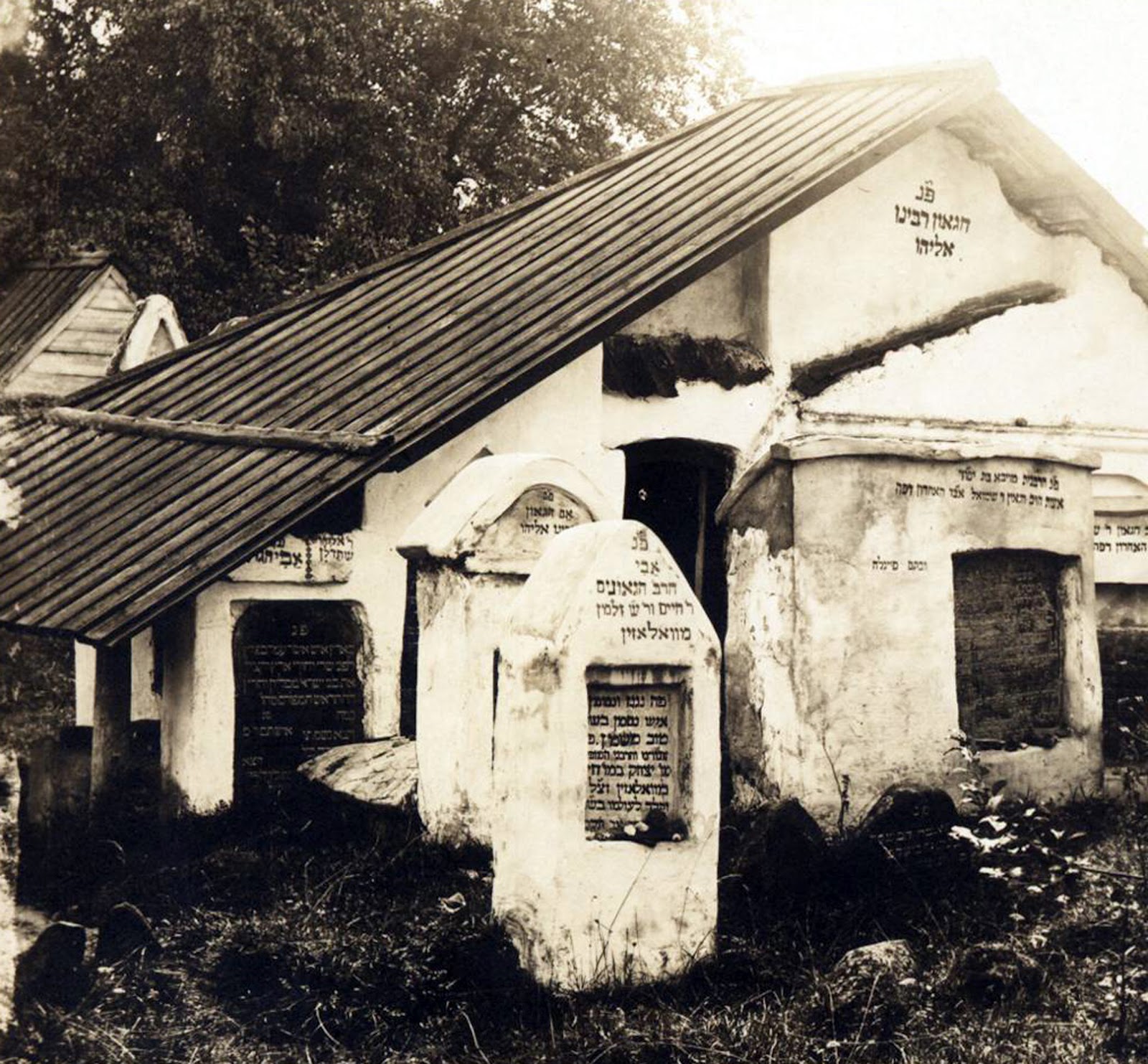
            This, then, is a complete list of all those who were buried in the original Ohel ha-Gra in the old Jewish cemetery. That Klausner has the order perfectly right can be seen from the following photograph.
            Notice the inscription פ”נ הגאון רבינו אליהו in the center of the photograph, near the roof-top of the Ohel. Turning to the extreme left of the Ohel, where the roof slopes down almost to the ground, one can see two grave markers above a single tombstone.
            When enlarged, the inscriptions above the tombstone clearly read (from left to right): פ”נ אבי הגר”א and   ר’ אליהו שתדלן, exactly in the order recorded by Klausner (see above, grave number 20).  When we compare Klausner’s list with the present occupants of the Ohel ha-Gra, it becomes clear that those who moved the Gra from the first to the third cemetery, moved the graves numbered 22-26, a total of six persons altogether, from the original Ohel ha-Gra. The seventh grave, unmarked, remains unidentified and could have come from any part of the old cemetery, and not necessarily from the Ohel ha-Gra.
            When we enter the Ohel ha-Gra today, we need to bear in mind that we are entering from the south and looking north. We see the mirror image of what Klausner depicted on his map. Thus the expected order today should be:
            The expected order solves all our problems. On the extreme right, Devorah and her son R. Zvi Hirsch are buried next to each other. In the center, R. Noah and his wife Minda are buried next to each other. And the Gra is second from the left. It is the actual order that creates our problem. Devorah and R. Zvi Hirsch are separated; neither is buried next to his or her spouse. The Gra is buried in between R. Noah Lipshutz and his wife Minda. אין זה אומר אלא דרשני.
            One more piece of evidence needs to be introduced before we attempt to solve the problem. Israel Cohen, British Zionist and world traveler, visited Vilna twice before World War II. Regarding the Shnipishok cemetery, he records the following: Most famous of all is the tomb of the Gaon Elijah, who lies in the company of a few other pietists on a spot covered by a modest mausoleum which is entered by an iron-barred door.
The tombstones, with long eulogistic epitaphs, are not enclosed within the mausoleum, but stand at the back of it, in close juxtaposition and closely protected by a thick growth of shrubs and bushes.
Israel Cohen, Vilna (Philadelphia, 1943), pp. 415-416. Cf. his Travels in Jewry (New York, 1953), pp. 149-150.
4. The Solution
            It seems obvious that those who moved the Gaon to the new Jewish cemetery made one slight adjustment relating to the ordering of the graves. They moved R. Zvi Hirsch from the extreme right to the extreme left. We will never know with certainty why they did so. What was gained, perhaps, is that now all the males were together on the left, and all the females were together on the right. By moving R. Zvi Hirsch to the extreme left, the Gra was now the third grave from the left. But the actual order today appears to have the Gra as the fourth grave from the left, and buried in between R. Noah and his wife Minda.
            We need to remember that in the old Jewish cemetery the tombstones were outside the Ohel ha-Gra, each tombstone opposite the remains of the person it described, with text of the tombstone facing in a northerly direction. Indeed, every tombstone in the old Jewish cemetery was placed opposite the remains of the person it described, with the text of the tombstone facing in a northerly direction.
            We also need to remember that the Gra and R. Noah shared one tombstone.5
            The Gra’s epitaph was on the right side of the tombstone; R. Noah’s epitaph was on the left side of the tombstone. This was in perfect order, since inside the Ohel, the Gra was to the left of R. Noah, and R. Noah was to the left of, and next to, his wife Minda. In the new Jewish cemetery, the six graves were laid out exactly as in the old cemetery, with the exception of R. Zvi Hirsch as indicated. But it was decided to place the original tombstones inside the Ohel, at the head of each of the graves. Instead of facing in a northerly direction, with texts that could be read only by standing outside the Ohel, the tombstones, now reversed, faced in a southerly direction, with texts that could be read only when standing inside the Ohel. Doubtless, this was done in order to protect the historic tombstones from exposure to the elements, from deterioration, and from vandalism. Also, the tombstones now immediately identified who was buried in each grave. Unfortunately, when the single tombstone shared by the Gra and R. Noah was reversed and set up inside the Ohel, it automatically (and wrongly) identified the third grave from the left as R. Noah, and the fourth grave from the left as the Gra, and caused a split between R. Noah and his wife. In fact, the Gra is the third grave from the left, and R. Noah is the fourth grave from the left – and R. Noah is properly buried next to his wife Minda. In other words, all Jews who visit the grave of the Gra today, pray, and leave qvitlach, at the wrong grave (i.e., at the grave of R. Noah Mindes Lipshutz).
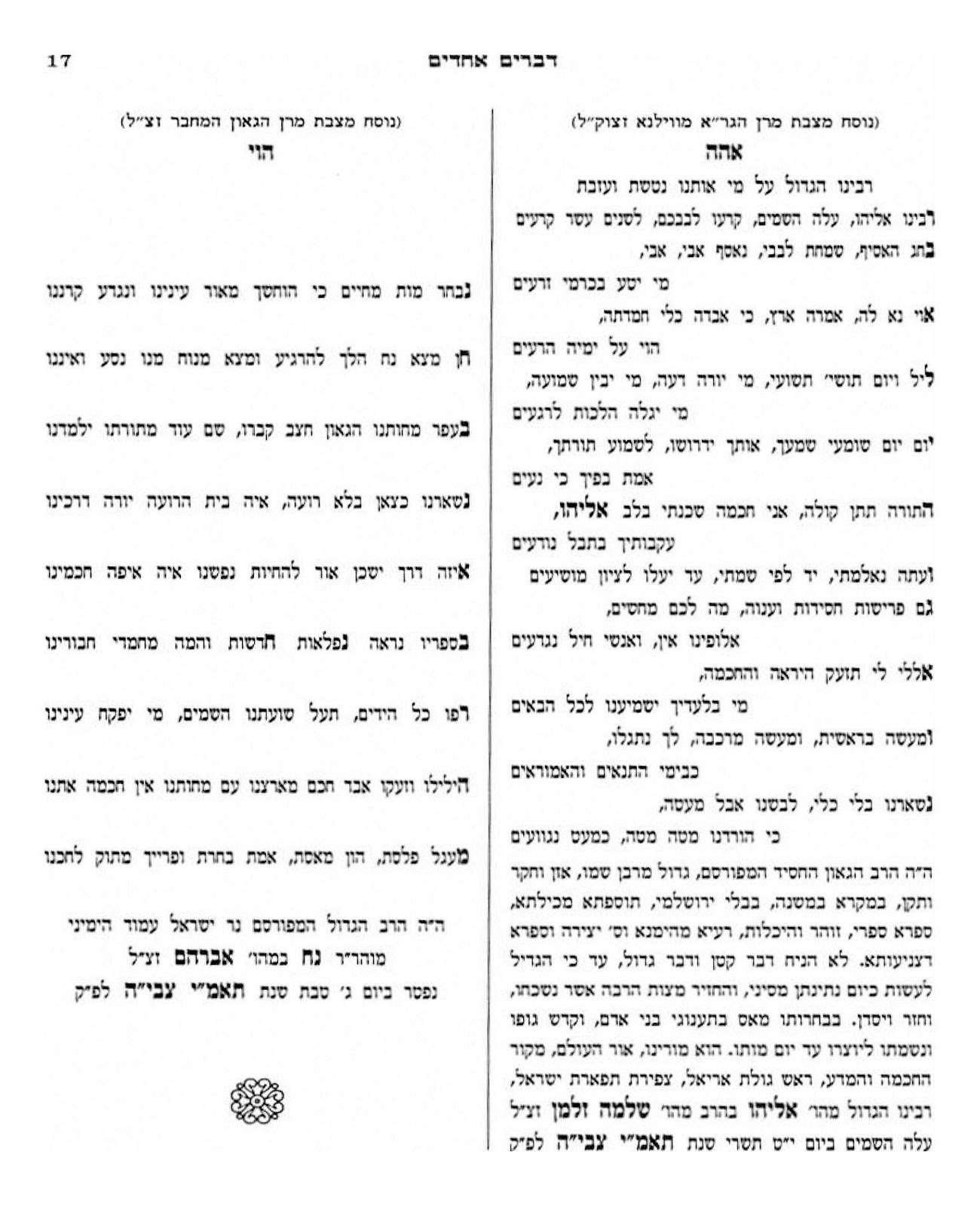
            The above solution was based upon an examination of the literary evidence, and upon an examination of photographs preserved mostly in books. I call this עד אחד  (one witness), that is, the testimony of תורה שבכתב  (i.e., the literary evidence). But a matter established by only one witness is precarious at best.6 Intuitively I was persuaded by the one witness, but hesitated to put the solution in print until more evidence was forthcoming. Fortunately, a surprise second witness has come forward בבחינת תורה שבעל פה  (i.e., oral history). Rabbi Yitzhak Zilber (d. 2003) was a courageous Jew who lived most of his life under Soviet repression between the years 1917 and 1972, before ultimately settling  in Israel. He published a riveting autobiography in Russian in 2003. It has since been translated into Hebrew and English. In his autobiography, Zilber describes how in 1970, under Communist rule, he visited the Ohel ha-Gra in Vilna. The Jew who took him to the Ohel had participated in the transfer of the Gra from the first Jewish cemetery in Shnipishok to the third Jewish cemetery in Saltonishkiu. As they stood before the Gaon’s grave, the Jew turned to Zilber and said:7
            Remember the following forever: the Gaon’s tombstone is above the
           fourth grave from the left, but the Gaon’s body is in the third grave [from
           the left].
על פי שני עדים יקום דבר!  “A matter is established by the testimony of two witnesses.”
NOTES
1
  This essay should not be confused with an earlier essay of mine with a similar title, “Who is Buried in the Vilna Gaon’s Tomb? A Mysterious Tale with Seven Plots,” Jewish Action, Winter 1998, pp. 36-41. The primary focus of the earlier essay was on the identification of the six persons buried together with the Vilna Gaon in his mausoleum (the Ohel Ha-Gra). The primary focus of this essay is on the identification of the  grave of the Vilna Gaon himself. A version of this essay was read at a conference in honor of Professor Daniel Sperber, held at Bar-Ilan University on June 13, 2011. It is presented here in honor of the Vilna Gaon’s  215th yahrzeit on 19 Tishre, 5773.
2
  The claim that the Vilna Gaon was moved temporarily from the first to the second Jewish cemetery appears, among many other places,
in Y. Alfasi, ed., וילנא ירושלים דליטא חרבה (Tel-Aviv, 1993), p. 9; Y. Epstein, “,דער יידישער בית-עולם אין ווילנע”   ירושלים דליטא, October-November 1996, pp. 5-6; and N.N. Shneidman, Jerusalem of Lithuania (Oakville, Ontario, 1998), p. 161. An examination of eye-witness accounts of the reburial of the Gaon, and of much other evidence, yields the ineluctable conclusion that the Gaon was moved only once, directly from the first to the third Jewish cemetery.
3
  See the references cited in the Jewish Action essay (above, note 1).
4
  So reads the Hebrew sign above the entrance to the Ohel Ha-Gra. But the Ohel Ha-Gra was constructed over a three-year period between 1956 and 1958. I cannot say with certainty when the sign first went up, but logic dictates it did not go up before there was an Ohel. In all the early photographs of the Ohel I have seen, there was no sign at all. It surely wasn’t there during the period of Soviet domination of Lithuania, which means it first when up sometime after 1991. As such, it is hardly evidence for who is buried in the Ohel Ha-Gra. More importantly, one of the participants in the reinterment of the Vilna Gaon testified that he and his colleagues wanted to move the remains of Avraham ben Avraham, the Ger Zedek of Vilna, but could not locate his ashes in the old Jewish cemetery. See R.Yitzchak Zilber, To Remain a Jew (Jerusalem, 2010), pp. 389-390.
5
  For side by side transcriptions of the epitaphs on their tombstone, in clear Hebrew font, see R. Noah Mindes Lipshutz, פרפראות לחכמה (Brooklyn, 1995), p. 17.
6
  I was plagued by the remote possibility that the movers, precisely because the shared tombstone required the Gaon to be to the right of R. Noah, switched the remains of the Gaon and R. Noah, and deliberately buried the Gaon in between Minda and R. Noah. (I considered this a remote possibility, because it is highly unlikely that any rabbi would allow such tampering with who was buried to the immediate left and right of the Gaon. As is well known, R. Hayyim Zvi Shifrin [d. 1952] presided over the reinterment of the Gaon. See R. Yaakov Shifrin, קול יעקב [Jerusalem, 1981], pp. 26-30.) If so, all the tombstones are accurately positioned in the Ohel Ha-Gra, even today. Cf. my deliberations in American Jewish Monitor , October 24, 2003, p. 18.
7
  R. Yitzchak Zilber, op. cit. (above, note 4), p. 389.


Life After Death: The Afterlife of Tombstone Inscriptions in the Old Jewish Cemetery of Vilna

Life After Death: The Afterlife of Tombstone Inscriptions in the Old Jewish Cemetery of Vilna

By Shnayer Leiman

The ultimate purpose of any Jewish cemetery is to provide a resting place, with dignity, for the Jewish dead. Jewish law and custom have played a major role in regulating almost every aspect of burial from the moment of death through the funeral itself, the period of mourning that follows the funeral, and – ultimately – the erection of a tombstone over the grave.[1] Once the tombstone is in place, the living return to the cemetery for occasional visits, usually on the anniversary of the death (yahrzeit) of a dear one, or to pray at the grave of a righteous rabbi or ancestor in a moment of need.

And, of course, the living return to the cemetery in order to attend the funerals of others. But the last mentioned occurs only in “living” cemeteries, i.e. cemeteries that still bury the dead. But, at some point, cemeteries run out of space, and/or are forced to close by municipal ordinance. In 1830, after serving Vilna’s Jewish community for well over 250 years, the Jewish cemetery ran out of space and the municipal authorities forced it to close.[2] It was no longer a “living”cemetery and it transitioned into a pilgrimage site, where Jews came to pray at their ancestors’ graves, and at the graves of the great Jewish heroes of the past.

Any such transition comes at a cost. It became necessary to provide for the security of the cemetery, despite the lack of income from regular funerals. Guards had to be hired, fences had to be built and repaired, caretakers had to maintain the cemetery grounds, and guides had to be provided for those searching for specific graves in the cemetery. In this brief essay we will focus on only one interesting phenomenon: the need to identify “celebrity” graves, and to create markers, often on the tombstones themselves, that identified the person buried at the foot of the tombstone as a celebrity, or as a close relative of a celebrity (e.g., אם הגאון רבינו אליהו “The Mother of the Gaon R. Eliyahu [of Vilna],” and אבי הרב הגאונים ר‘ חיים ורש זלמן מוואלאזין The Father of the Rabbis and Gaonim R. Hayyim and R. S[hlomo] Zalman of Volozhin ).[3] Clearly, this need was made necessary – in large part – by the wear and tear on the tombstone inscriptions that made many of them almost impossible to read by the end of the19th century. But it was also made necessary by the passage of time, when a younger generation no longer recognized the names of the deceased, who often were the parents or spouses of celebrities of the past and present.

Our evidence will come mostly from photographs of tombstones in the Old Jewish Cemetery taken during the first decades of the 20th century.[4] These will be supplemented by the hand copies of the same tombstones published mostly in the second half of the 19th century.[5] First, a word of caution.

While photographs don’t lie, they often mislead. Thus, a recent work – and a superb one at that – on the leading 20th century rabbinic figure in Vilna’s long history of rabbinic scholars, i.e., Rabbi Hayyim Ozer Grodzenski (d. 1940), inadvertently suggests that R. Mordechai Meltzer (1797-1883), a distinguished 19th century Vilna Talmudist, was buried in the Old Jewish cemetery of Vilna.[6] The suggestion is based upon a poor photograph of a group of graves in the Old Jewish cemetery. The Hebrew legend under the photograph reads “The tombstone of the Gaon Rabbi Mordechai Meltzer in Vilna.” Here is the photograph, as it appears in the volume, p. 180:

With a magnifying glass, one can barely make out above the second tombstone from the right, the title and name: הרב הגאון ר‘ מרדכי מעלצער The Rabbi and Gaon R. Mordechai Meltzer.” Since the third tombstone from the right is clearly identifiable as marking the grave of R. Abraham Danzig (d. 1820), a distinguished Vilna rabbinic scholar who was certainly buried in the Old Jewish cemetery, there is perhaps some reason to think that R. Mordechai Meltzer was, in fact, buried next to him, in the same cemetery.[7]

Interestingly, the author himself states openly the Rabbi Meltzer left Vilna and ultimately served as Rabbi of Lida (today in Belarus), “where he died in 1883.” Apparently, the author assumes that Rabbi Meltzer died in Lida, but was somehow brought to burial in the Old Jewish cemetery of Vilna.

Alas, it cannot be, for many reasons. Among them:

a) R. Mordechai Meltzer died in 1883. The Old Jewish cemetery was officially closed in 1830. No Jew was buried in the Old Jewish cemetery after 1830. From 1831 until 1941, all Jews who died in Vilna, including its most famous rabbis in that period, were buried in the Zaretcha Jewish cemetery (Vilna’s second Jewish cemetery).

b) R. Mordechai Meltzer, after serving 19 years as Chief Rabbi of Lida, was buried in Lida. A mausoleum was built over his grave, one of the few in the Lida Jewish cemetery, and it became a major pilgrimage site until it was destroyed during the Holocaust and its aftermath.[8]

c) More importantly, here is a clear photograph of the tombstone misidentified in the Grodzenski biography. The photograph will also introduce the first of 6 samples of celebrity markers on tombstones.

Sample1. R. Asher Klatzko (d. 1820).[9]

The second tombstone from the right is that of Rabbi Asher Klatzko (d. 1820), father of Rabbi Mordechai Meltzer. One can still read (in the photo) the original epitaph that mentions Asher and his father’s name, Isaac.[10] [Asher was a great talmudic scholar in his own right, and no one would have marked his grave in 1820 with an epitaph that mentions his 23 year-old son, Mordechai, who held no official position at the time. But in 1860 or so, long after the cemetery was no longer a living cemetery, few remembered who “R. Asher son of R. Isaac” was, but everyone knew who R. Mordechai Meltzer was: the head of Vilna’s Ramajles (ראמיילעס) Yeshiva during the first half of the 19th century, an official rabbi of Vilna with the title מורה צדק, teacher of Vilna’s most distinguished rabbis, and among the Vilna leaders who officially greeted Moses Montefiore when he visited Vilna in 1846.[11] And so the top of the tombstone frame was marked:

הוא אבי הרב הגאון ר‘ מרדכי מעלצער “He [Asher, the person buried here] is the father of the Rabbi and Gaon, R. Mordechai Meltzer.” The message seems to be clear: This is a celebrity related grave, not to be overlooked. This is our first sample of a phenomenon that characterizes the Old Jewish cemetery in its second phase, i.e. after it was no longer a living cemetery. Aside from repairing broken tombstones and re-inking the faded epitaphs, the cemetery authorities saw a need to introduce markers that provided new information that identified celebrity graves of one kind or another. Nor did the cemetery authorities hesitate to post those markers on the original tombstones themselves, when there was sufficient space to do so.

Sample 2. R. Yehuda Leib Gordon (d. circa 1825).

The third tombstone from the right, whose epitaph (in the center of the tombstone) is no longer legible, and is not recorded elsewhere, was accorded a celebrity inscription which reads: פנ חותן הרב הגאון ר‘ מרדכי מעלצער Here lies buried the father-in-law of the Rabbi and Gaon, R. Mordechai Meltzer.” The father-in-law, R. Yehudah Leib Gordon, was a member of a distinguished Vilna family that produced a long line of communal leaders and rabbis.[12]

Sample 3. R. Yosef b. R. Shmuel Zaskewitz (d. 1829).

In the same photo as at Sample 2 above, the first tombstone at the right has a celebrity marker at its top. The outer rim of its rooftop reads:

י[פנ ה]רבני המופלג מוה יוסף [בן ה]אבד דקק זאסקעווץ “Here lies buried the outstanding rabbinic authority, our teacher and rabbi Yosef, son of the Chief Rabbi of Zaskewitz.” Inside the rooftop, a celebrity marker has been added. It reads: אבי הרב הגאון ר‘ שמואל שטראשון “The Father of the Rabbi and Gaon, R. Shmuel Strashun.” By 1860 or so, few knew who R. Yosef b. R. Shmuel Zaskewitz was. But every learned Jew in Vilna knew precisely who R. Shmuel Strashun was,[13] and so R. Yosef was now properly identified as the father of R. Shmuel Strashun.[14]

Sample 4. R. Baruch b. R. Shmuel Zaskewitz (d. 1829).

In the same photo as at Sample 2 above, adjacent to R. Yosef b. Shmuel, rests his brother R. Barukh, who also died in 1829. Not surprisingly, he too was accorded a celebrity marker. It reads: דד הרב הגאון ר‘ שמואל שטראשון “The uncle of the Rabbi and Gaon, R. Shmuel Strashun.” In case you don’t know who R. Baruch was, now you know.[14a]

Sample 5. R. Zvi Hirsch b. R. David ha-Levi (d. 1830).

In the same photo as at Sample 2 above, at the extreme left, is the tombstone of R. Zvi Hirsch of Libau, who served with distinction as the lead cantor of the Great Synagogue of Vilna from 1822 until his death in 1830. The original epitaph is legible in the photograph, and has been recorded.[15] It makes no mention of his son. At a later date, perhaps in the 1860’s or later (see below), few remembered who R. Zvi Hirsch was, but everyone knew who his son was. Indeed his son not only eclipsed his father as a cantor, he eclipsed every cantor who would ever serve as lead cantor of Vilna. The son, the legendary “Vilner Balabesel” (Yiddish for: young and married householder in Vilna), R. Yoel David Strashunsky, succeeded his father upon his death in 1830, only 14 years old at the time. At that young age, there was much communal strife as to whether it was appropriate for him to serve as the lead cantor. It was decided that he would share the post with an older cantor until 1836, when in fact, he became the sole lead cantor. There was more trouble ahead, when in 1842 he left Vilna for Warsaw, where he performed in public concerts of operatic music. Ultimately he suffered from severe depression, and – on and off – either lost his voice, or lost his interest in serving as a cantor. He died in a hospital for the mentally ill in Warsaw in 1850, and was buried in Warsaw. He was 34 years old at the time of his death.[16] And so R. Zvi Hirsch too was accorded posthumous celebrity status. The inscription added to the rooftop portion of his tombstone reads:

פנ השץ מקק ליפי ופה קק ווילנא אבי ר‘ יואל דוד שץ דפה “Here lies buried the Cantor from the holy community of Libau and [who also served] here in the holy community of Vilna, the father of R. Yoel David, the Cantor [who served] here.”

Some, but hardly all, of the celebrity markers include the date when they were installed by the cemetery authorities. It is of particular interest to establish the date when R. Yoel David’s name was entered on his father’s tombstone, given the controversy that surrounded his name. It just happens to be that in the case of R. Zvi Hirsch of Libau, the celebrity marker included the date of its instillation, at least initially, but it no longer is entirely legible. The text at the bottom of the rooftop inscription reads:

 _ _נתחדש עי גבאי דצג בשנת תר “It [the grave site][17] was refurbished by the adjutants of the Zedakah Gedolah Society[18] in the year [5]6_ _.” The last two digits are illegible, leaving us with a range of years between 1840 and 1939. We can quickly close the gap a bit, since the photograph at Sample 2 was taken circa 1913.[19] Interestingly, the neighboring grave site just to the right of that of R.Zvi Hirsch Libau in the photograph at Sample 2, was also refurbished by the Zedakah Gedolah Society, and the date of instillation of its new inscription is included. It is the grave site of a pious woman named Roza, about whom we know almost nothing, other than the fact that she died in 1830 or earlier and was buried in the Old Jewish cemetery of Vilna. The text in the rooftop inscription reads: פנ ה[אשההצנועה המפורסמת מ[רתרוזאנתחדש עי גבאי דצג בשנת תרעג

“Here lies buried Mrs. Roza, the woman renowned for her modesty. It [the grave site] was refurbished by the adjutants of the Zedakah Gedolah Society in the year 673.”[20] The Hebrew year [5]673 was mostly in 1913. Almost certainly, both these grave sites were refurbished at the same time, in 1913. By that year, Yoel David Strashunsky was a legendary figure not only in Vilna, but indeed throughout the world of Yiddish speaking Jews. We will examine one more interesting celebrity marker that, as an aside, provides linguistic support for our dating of the R. Zvi Hirsch of Libau celebrity marker to circa 1913.

Sample 6. R. Shmuel b. R. Hayyim Shebsils (d. 1818).[21

Little is known about him, other than that he was a distinguished talmudic scholar, pedigreed, wealthy, charitable, and modest. He adopted the surname Landau, and one of his sons, R. Yitzchak Eliyahu Landau (1801-1876), was appointed rabbi and official preacher (מורה צדק ומגיד מישרים) of Vilna in 1868. Landau was a remarkable preacher and a prolific author who left an indelible impression on all who knew him. In 1870, among many other charitable deeds, he personally raised the funds necessary to rebuild the fence that surrounded the entire Old Jewish cemetery, where his father was buried.[22]

When his father died in 1818, there was no reason for the epitaph on his father’s tombstone to make mention of his 17 year old son. But this would change in 1912, if not earlier. As can be seen on the photo, the outer rim of the tombstone’s rooftop reads: פה מצבת הרב ר‘ שמואל בהרב ר‘ חיים שבתילס “Here is the tombstone of the rabbi R. Shmuel, son of the rabbi R. Hayyim Shebsils [sic].” Inside the rooftop, a celebrity marker has been added. It reads:

אבי הרב ר‘ יצחק אליהו לנדא ממ דפה “ Father of the rabbi R. Yitzchak Eliyahu Landau, [who served as] official preacher here.” Just under, and to the right, of the inscription on the outer rim, one reads: נתחדש עי גבאי דצג בשנת תרעב “Refurbished by the adjutants of the Zedakah Gedolah Society in the year 672.” The Hebrew year [5]672 was mostly in 1912. Here too, few, if anyone, really remembered who R. Shmuel b. R. Hayyim Shebsils was, but every learned Jew knew who R. Yitzchak Eliyahu Landau was. Gems from his sermons were repeated orally, and his books were published and republished in Vilna, Warsaw, and elsewhere. A celebrity marker was necessary in order to identify R. Shmuel b. R. Hayyim Shebsils.

It is interesting to note that the celebrity markers that highlight the names of Cantor Yoel David Strashunsky and Official Preacher R. Yitzchak Eliyahu Landau, share a specific – and ambiguous – Hebrew turn of phrase. Cantor Yoel David is called שץ דפה and R. Yitzchak Eliyahu is called ממ דפה. The term דפה can be rendered as present tense: “who presently serves as…” or past tense: “who served as…” I have preferred the latter sense in the English translations above, largely because in the case of R. Yitzchak Eliyahu Landau, the date of the refurbishing is clearly given as 1912. R. Yitzchak Eliyahu Landau was surely no longer alive in1912; as indicated above, he died in 1876. But it is possible that the celebrity markers come from an even earlier period, and were entered on the tombstones during the lifetime of Strashunsky (in the 1840’s) and Landau (in the 1870’s). When the ink faded, they were redone in 1912.

What argues against this possibility, however, is the written record. None of the 19th century publications of the tombstone inscriptions discussed in this essay record (or even seem to be aware of) any of the celebrity markers.

In sum, our purpose has been to introduce a topic – the afterlife of tombstone inscriptions – that needs to be developed and applied to many Jewish cemeteries, sooner rather than later.[23] Our purpose has not been to present an exhaustive treatment of celebrity markers – one category of the afterlife of tombstone inscriptions — in the Old Jewish cemetery of Vilna. That would require much research, and would result in a hefty monograph, both of which are well beyond our means. The few samples we examined, however, surely serve to underscore the fact that the study of the afterlife of tombstone inscriptions remains a scholarly desideratum.

Notes

[1] For a comprehensive bibliography on the Jewish cemetery, see Falk Wiesemann, Sepulcra Judaica: Jewish Cemeteries, Death, Burial and Mourning from the Period of Hellenism to the Present, A Bibliography (Essen: Druckerei Runge, 2005). For an eminently readable summary of contemporary Jewish halakhic practice and custom relating to erecting tombstones and visiting graves, see Chaim Binyamin Goldberg, Mourning and Halachah: The Laws and Customs of the Year of Mourning (New York: Mesorah Publications, 14th edition, 2012), pp. 382-399.
[2] [] See Israel Klausner, קורות ביתהעלמין הישן בוילנה (Wilno: An-ski Jewish Historical and Ethnographical Society of Vilna, 1935), pp. 30-32.
[3] For these markers, see the photographs below:

a) 

b) 

a) Tombstone of R. Yitzhak b. R. Hayyim of Volozhin, and just behind it, the tombstone of Traina, mother of the Gaon of Vilna.
b) Frontal view of Traina’s tombstone (in the center of the photograph, and to the right of R. Yitzhak b. R. Hayyim of Volozhin’s tombstone).

R. Yitzhak b. R. Hayyim died in 1780. At the time, his son R. Hayyim of Volozhin was 31 years old, and had just recently been appointed Rabbi of Volozhin, hardly a large and significant Jewish community in Lithuania at the time. The Yeshiva of Volozhin was not founded until 1802. R. Yitzhak’s son R. Shlomo Zalman was 24 years old when his father died, and relatively unknown. Indeed, R. Yitzhak’ eldest son, R. Simhah, 39 years old at the time, and a practicing rabbi, is not even mentioned by the marker. Clearly, the markers come from a much later period when R. Hayyim and R. Shlomo Zalman were the only names (of R. Yitzhak’s 5 sons) that were known widely by learned Jews, and by visitors to the Old Jewish cemetery of Vilna. For R. Hayyim of Volozhin, see, e.g., Dov Eliach, אבי הישיבות (Jerusalem: Moreshet ha-Yeshivot, revised and expanded edition, 2012); and Shaul Stampfer, Lithuanian Yeshivas of the Nineteenth Century (Oxford: Littman Library of Jewish Civilization, 2015), pp. 15-47. For his younger brother R. Shlomo Zalman, see, e.g., R. Yehezkel Feivel, תולדות אדם השלם (Jerusalem: Makhon Moreshet ha-Gra, 2012).

For the little that is known about Traina, who died in 1742, see Bezalel Landau, הגאון החסיד מוילנא (Jerusalem: Torah mi-Ziyyon, third edition, 1978), p. 15, note 14; and Dov Eliach, הגאון (Jerusalem: Moreshet ha-Yeshivot, 2002), vol. 1, pp. 66-70. For the epitaph on her tombstone, see Klausner, op. cit., p. 56. The marker was surely added after the lifetime of Gaon of Vilna (d.1797), who would not have tolerated seeing the title “Gaon” next to his name, permanently etched in stone as it were, in the Old Jewish cemetery. In photo b, one can actually see how an earlier marker on the upper portion of the tombstone, “פנ אם הגאון רבינו אליהו“, after fading away, was replaced by new marker “פנ אם הגרא” .
[4] Photographs of Vilna’s Old Jewish cemetery abound in a wide variety of publications and periodicals in different languages. These include: Hebrew (e.g., Y. Kremerman, מוילנא ירושלים דליטא‘ עד חיפה [n.p: privately published, 1995]); Yiddish (e.g., Leyzer Ran, אש פון ירושלים דליטא [New York: Wilner Ferlag, 1959]); Russian (e.g., G. Agranovskii and I. Guzenberg, Litovskii Ierusalim [Vilnius: Lituanus, 1992]); Lithuanian (e.g., K. Binkis and P. Tarulis, Vilnius 1323-1923 [Kaunas-Vilnius: Švyturio Bendroves Leidinys, 1923]); German (e.g., Paul Monty, Wanderstunden in Wilna [Wilna: Verlag der Wilnaer Zeitung, 1916]); and English (e.g., Gerard Silvain and Henri Minczeles, Yiddishland [Corte Madera, CA: Ginko Press, 1999]), and total many more publications than can possibly be listed here. Postcard reproductions of photos were produced and sold before, during, and after World War I, serving as a major source for some of the publications mentioned above. Some of these photos are posted on line in various collections of ephemera. Numerous photos, not yet published, are available in private collections. All the photos in this essay (with the exception of the misidentified photo in the recently published Grodzenski volume) are from original photographs and postcards in my possession. Artists have also depicted a variety of scenes from the Old Jewish cemetery (e.g., Walter Buhe, “Wilnaer Judenfriedhof,” 1916; a copy can be viewed online at the Wikipedia entry for Walter Buhe, sub: Images for Walter Buhe).
[5] The hand copies were published mostly by Samuel Joseph Fuenn, קריה נאמנה, second edition (Vilna: Notes and Schweilik, 1915), henceforth: Fuenn; Hillel Noah Steinschneider, עיר ווילנא (Vilna: Romm Publishing Company, 1900), henceforth: Steinschneider; and Israel Klausner (see above, note 2), henceforth: Klausner.
[6] R. Dovid Kamenetsky, רבנו חיים עוזררבן של כל בני הגולה (Jerusalem: n.p., 2021), volume 1.
[7] Our author may have been misled by Leyzer Ran, ירושלים דליטא (New York: Wilner Verlag, 1974), vol. 1, p. 101, who mistakenly identified the same photograph as containing the graves of both R. Mordechai Meltzer and R. Abraham Danzig in the Old Jewish cemetery of Vilna. The same error appears in Y. Kremerman (see above, note 4), p. 267.
[8] See R. Mordechai Meltzer’s posthumous publication, תכלת מרדכי (Vilna: Matz, 1889). On the reverse side of the second title page, the full text of the lengthy epitaph on his tombstone in Lida appears in print. A short biography appears on pp. 20-24, which makes mention of the mausoleum constructed over his grave, and that it has become a pilgrimage site. Cf. A. Manor et al, eds., ספר לידא (Tel-Aviv: Or-Li Publishers, 1970), pp. 91-92.
[9] See Steinschneider, p. 122, note 1.
[10] Klausner, p. 75, notes that the inner epitaph was no longer extant in 1935.
[11] See Isaac Meyer Dik, האורח (Vilna, 1846), pp. 30-31. The place and date of publication are uncertain; and the volume may have been co-authored. For bibliographical discussions, see the sources cited in the entry האורח in מפעל הביבליוגרפיה העברית accessed at:  https://uli.nli.org.il/permalink/972NNL_ULI_C/4upfj/alma99682727008422).
[12] Steinschneider, pp. 123 and 194.
[13] For R.Shmuel Strashun, see Zvi Harkavy’s “,תולדות רשש וכתביו” appended to his edition of מקורי הרמבם לרשש (Jerusalem: ha-Eretz Yisraelit, 1957), pp. 53-58. Cf. David Abraham, פנקסו של שמואל (Jerusalem: Makhon Yerushalayim, 2011).
[14] For the text of the inner epitaph, see Fuenn, pp. 254-255.
[14a] See note 14.
[15] Klausner, p. 74.
[16] A vast literature has developed regarding the history and legends surrounding the life of R. Yoel David Strashunsky. These include novels, plays, and film productions. For one of the many failed attempts to distinguish fact from fiction, but fascinating nonetheless, see Samuel Vigoda, Legendary Voices (New York: M.P. Press, 1981), pp. 390-427.

Some of the more important scholarly studies are: Hillel Noah Steinschneider “תולדות השץ הנפלא מווילנא ר‘ יואל דוד לעוווענשטיין” in תלפיות (Berditchev, 1895), part 12, pp. 8-13; Abraham Z. Idelsohn, “תולדות השץ יואל דוד בעל הביתל” in Hebrew Union College Monthly 20 (May-June 1933), pp. 27-29; Isaac Schiper, “אונבעקאנטע ארכיון– מאטעריאלען וועגען דעם אויפהאלט פון ווילנער בעלהביתל אין ווארשא אין יהאר 1842 Haynt, September 23, 1934, p. 9; Silja Haller et al, eds., Joachim Stutchewsky Der Wilnaer Balebessel (Wiesbaden: Otto Harrassowitz, 2013; and James Loeffler, “Promising Harmonies: The Aural Politics of Polish-Jewish Relations in the Russian Empire,” Jewish Social Studies 20:3 (2014), pp. 1-36 (especially pp. 19-25). קבר
[17] I translate “grave site” [for Hebrew קבר] rather than “tombstone” [for Hebrew מצבה], for –strictly speaking – the form נתחדש can only be the passive verbal form for a masculine noun. But I have some doubts about whether the sign painters in 19th and 20th century Vilna cared very much about Hebrew grammar. See below, in the center of the photograph at Sample 6, where the celebrity marker at the top refers to מצבת, yet under it, the marker specifically states נתחדש. In any event, the masculine noun קבר, ordinarily rendered “grave,” bears secondary meanings including “grave site” and “tombstone.” See Klausner, passim, who uses the term regularly for “grave site” and “tombstone; and cf. A. Even-Shoshan, מלון אבן-שושן (Tel-Aviv: Am Oved, 2003), vol. 5, p. 1623.
[18] The Zedakah Gedolah Society was Jewish Vilna’s official communal institution in charge of public welfare. Given the rampant poverty that prevailed throughout much of Vilna’s Jewish history, this was one of the most important institutions in Vilna. It assumed even greater significance when the Czarist regime abolished Jewish Vilna’s “Kahal” structure in 1844. One of the Zedakah Gedolah’s many tasks was to provide the lion’s share of the funding necessary for the upkeep of Vilna’s Jewish cemeteries. See Israel Cohen, Vilna (Philadelphia: Jewish Publication Society, 1943), pp. 121-122; cf. Israel Klausner, וילנה ירושלים דליטאדורות הראשונים 1495-1881 (Tel-Aviv: Kibbutz Ha-Me’uhad, 1988), pp. 393-394. For a vivid description of how the Zedakah Gedolah provided Passover aid for the poor in late 19th century Vilna, see David Livni, ירושלים דליטא (Tel-Aviv, 1930), vol. 1, pp. 9-43. With the advent of World War I, it fell into a period of steady decline and would ultimately be liquidated under Polish rule in 1931. See Israel Cohen, op. cit., pp. 394-397; and cf. Andrew N. Koss, “Two Rabbis and a Rebbetzin: The Vilna Rabbinate during the First World War,” European Judaism 48:1 (2015), pp. 120-122.
[19] It is clearly a Jan Bulhak photograph, taken between 1912-1915 at the Old Jewish cemetery.
[20] The date תרעג = [5]673 = 1913, and not תרסג = [5]663 = 1903, is confirmed by several different photographs, taken from different angles, of Roza’s grave site (in my personal collection of Vilna materials).
[21] Fuenn, p. 230 and cf. his Introduction, p. xxxi. R. Hayyim’s father’s name was Shabsai. For the form “Shebsil” derived from “Shabsai,” see Alexander Beider, A Dictionary of Ashkenazic Given Names (Avotaynu: Bergenfield, 2001), pp. 409-411.
[22] Steinschneider, p. 97. For the date, see the essay “דער אלטער בית עולם” authored by “במב” in the weekly ווילנער וואכענבלאט, August 12, 1910, pp. 2-3.
[23] Anyone who has frequented, for example, the old Jewish cemeteries in Frankfurt, Mainz, Worms, Prague, and Cracow, will know that celebrity markers are commonplace and mostly late, and that many faded tombstones have been re-inked, often wrongly. Sadly, even the Gaon of Vilna’s epitaph, while yet in the Old Jewish cemetery, was – in part – re-inked wrongly. See the discussion of the Gaon’s epitaph in my “The Paper Brigade’s Recording of Epitaphs in Vilna’s Old Jewish Cemetery: A Literary Analysis,” The Seforim Blog, February 26, 2024 (SeforimBlog.com). It should also be noted that there are different categories of celebrity markers, such as large maps or lists of famous names (often encased in glass) at the cemetery entrance, arrows posted along the route to a celebrity grave, new inscriptions on old tombstones or mausoleums, and entirely redone tombstones (enlarged and enhanced to underscore their celebrity status). I am indebted to Marcin Wodzinski (Professor of Jewish Studies at the University of Wroclaw in Poland), who in a personal communication kindly informed me about yet another factor that plays a role in celebrity markers: the material out of which a tombstone is made, and its malleability. If you cannot easily engrave an inscription on a tombstone, others ways will be found to mark a celebrity grave. Thus, local geophysical factors may well influence the kind of celebrity markers used in a particular cemetery.


Comments on This and That, part 1

Comments on This and That, part 1
by Marc B. Shapiro

1. In this post I referred to R. Hayyim Hirschensohn’s Nimukei Rashi, and stated that I thought it was one of his best works. This led to some correspondence with readers regarding the commentary. I have no doubt that I could devote ten posts to Hirschensohn, but then what would happen to everything else I want to discuss? But there are people who want me to call attention to some more interesting comments from Hirschensohn. I know that among them are those who go to hebrewbooks.org and print out some of the sources I refer to and bring them to shul on Shabbat. That is fine, as long as you aren’t looking at it during the rabbi’s sermon. As it is, Hirschensohn writes a good deal about how the rabbis are not given proper respect, and how ignoramuses have all too much power. At least in one respect, however, things have gotten better since Hirschensohn’s day. In Nimukei Rashi, Bereshit, pp. 46a-46b, he speaks about how the people give more respect to the hazzan than to the rabbi. This doesn’t apply anymore because there are hardly any synagogues that still have a hazzan.

In response to requests, let me therefore mention one more very interesting passage in Hirschensohn’s Nimukei Rashi in this post (with more to come in future posts). But my real suggestion is to study it yourself, even though it might make for difficult reading at times. To paraphrase Chazal (Avot 5:22), “no pain, no gain.” Or as R. Tuvia Hanks put it: “It’s supposed to be hard. If it wasn’t hard, everyone would do it. The hard is what makes it great.”[1]

Before quoting the comment in Nimukei Rashi that I have promised, I also want to record one formulation of Hirschensohn that I think it is magnificent. While R. Soloveitchik undoubtedly would disagree with much of what Hirschensohn writes, if he would have heard the following, I know that he would have regarded it wonderful, expressing the essence of what real Torah learning is all about. In his Musagei Shav ve-Emet, Section Penei ha-Hamah, p. 64, Hirschensohn gives his definition of a lamdan. I am sure readers have their own definitions. Some will say that one who knows a few tractates is a lamdan, while other will say that one who gone through the Ketzot ha-Hoshen earns the title. Hirschensohn has his own approach:

אינני קורא למדן (שם זארגני על ת”ח גדול) רק את זה אשר רמב”ם קשה או רש”י סותרות או תוספות מופרך לא מניח לו לישון

When one can honestly say that a difficult Rambam or Rashi keeps you up at night, only then can you be called a lamdan. As I mentioned, this is a formulation that the Rav would have embraced, and he actually lived this way. I heard from Dr. David Fand, a student of the Rav from the 1940s, who studied in Boston’s Yeshivat Heichal Rabbenu Hayyim Halevi, that one night the Rav woke some students up in order to tell them a hiddush.

In Nimukei Rashi, Bereshit, p. 48b, Hirschensohn discusses the comment of Rashi, Gen. 26:8. The verse states that Abimelech looked out his window and saw that Isaac “was amusing himself with Rebekkah.” Upon this verse, Rashi, based on a Midrash, states that Abimelech saw them having marital relations. The question is, of course, obvious. How is this possible that Isaac and Rebekkah would do this in such a way that people could observe him? As Hirschensohn puts it:

ובאמת זה קשה מאד לחשוב כזאת על עולה תמימה כיצחק שיעשה דבר מגונה כזה ונגד היכל מלך

Hirschensohn therefore refuses to take this Midrash literally. He sees it as a mussar derash about how people living among those at a lower moral level can be negatively influenced by them. He offers his own example of this: elderly women in America. (By “elderly”, I think he means women over sixty.) In Europe they used to dress modestly but in America they were negatively influenced to dress in an inappropriate fashion. He continues:

ואינני חושב שחשבו חכמים שבאמת שימש יצחק מטתו ביום לפני חלון פתוח נגד היכל המלך, רק זה אחד מדרכי הדרוש המוסרי לקשור אותו לאיזה צלצול בלשון להפריז הדבר להגדיל את מוסרו.

Hirschensohn’s comment is not surprising. We have come to expect that anytime there is an unusual Midrash, or one that reflects poorly on a biblical figure, that one of the aharonim will argue that it is not meant to be taken literally. This is no different than the attempts to understand various strange Aggadot allegorically.[2] A good rule of thumb is if the Aggadah is strange, then someone will interpret it in a non-literal fashion. I opened up the Artscroll Rashi translation for the verse we are discussing and was therefore not surprised to find the following: “In truth, according to the Zohar, Isaac conducted himself modestly with Rebekkah. Abimelech did not see them in a physical sense; he understood through some astrological means that they were having relations (Maskil LeDavid).”

Regarding the character of Isaac, Hirschensohn writes:

על יצחק אשר ישב ארבעים שנה בלא אשה ולא שם עיניו על בנות הארץ וישב עשרים שנה עם אשתו בלא בנים ולא לקח אשה אחרת עליה אשר לזה הי’ דבר הרגיל מאד בכל איש שם להרבות נשים ופלגשים ושפחות, אות הוא שהי’ מצונן או מצדקתו משל ביצרו, ואיש כזה לא ישמש מטתו נגד חלון פתוח מול היכל מלך.

In dealing with the issue raised, Hirschensohn appears to be correct that there are only two options in describing Isaac. Either that he didn’t have a sexual drive or that he overcame it. Nevertheless, it does strike me as a bit strange to be speaking of the Patriarch in this fashion, although maybe this is just my own prudishness. Here, for example, is what R. Yehiel Michel of Glogau (died 1730) says about this episode with Isaac in his Nezer ha-Kodesh, vol. 3, p. 329a (64:5), a classic commentary on Bereshit Rabbah.

אע”ג דאמר ר”י המשמש מיטתו ביום ה”ז מגונה והיינו כמ”ש המפרשי’ דמיירי אפילו בבית אפל או במאפיל טליתו דאל”ה מה מגונה דקאמר הא אפילו איסורא איכא . . . ולא שרי בכה”ג בת”ח אלא לצורך שעה בראותו שיצר תאותו מתגבר עליו הרבה כדי שלא יבא לידי הוצא’ ש”ז לבטלה או הרהור רע אצ”ל דבאמת הוי נמי כה”ג ביצחק וזה רמז הכתו’ באומרו והיה כי ארכו לו שם הימים כלומר שאירע לו מקר’ כזה להתגבר יצר תאותו ע”י שארכו לו הימ’ שלא נזדווג לאשתו משו’ שמקמי הכי אפילו בצינעא בלילה לא שימש מיטתו פן תתעבר ויתפרסם הדבר לפני אבימלך ועמו אבל אז הי’ צורך שעה לכך ולזה לא נזהר מלשמש אף ביום.

The author might think he is helping Isaac’s reputation with his explanation, but I actually think just the opposite, that what he says reflects negatively on Isaac. Let’s remember who we are speaking about here. We are not talking about some average guy. We are speaking about the Patriarch Isaac, whom many sources portray as the holiest of the Patriarchs. And regarding him R. Yechiel Michel says that it was צורך שעה?! Does he really expect us to believe that it was such an emergency that Isaac couldn’t have waited until the night? With all due respect to the author, who certainly knew who Isaac was, I can’t understand how he could suggest this. Hirschensohn’s description of Isaac is thus much more in line with how the Tradition encourages us to view the Patriarchs. Of course, I understand what is driving R. Yechiel Michel, namely, the reality of Isaac having sexual relations in the daytime. Unless one is prepared to read this in a non-literal fashion, as did Hirschensohn, there is a real problem and I guess the answer he offered was the best one he could come up with.

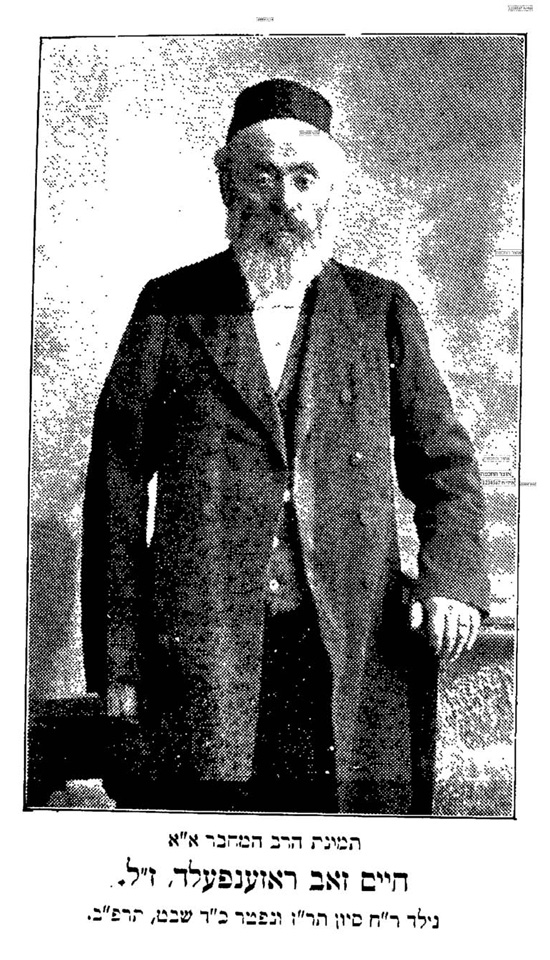
I am sure most readers are with me in not feeling comfortable engaging in speculation about the sexual life of the Patriarchs, and yet the truth is that we find such speculation among the commentators. Let me give one example. The Torah states (Gen. 29:20): “And Jacob served seven years for Rachel; and they seemed unto him but a few days, for the love he had to her.” R. Hayyim Zev Rosenfeld, in his Sefer ha-Hayyim (London, 1922), p. 22, asks a very good question. If you love someone, and desperately want to be with her, then it is not seven years that will seem like a few days, but precisely the reverse. A few days would seem like seven years. So why does the Torah say that the years went by very quickly for Jacob? According to Rosenfeld, the answer is that Jacob’s love for Rachel had no sexual component.

Rosenfeld brings the following support for his contention. In blessing Reuben, Jacob says (Gen. 49:3): “Reuben, thou art my first-born, my might, and the first-fruits of my strength.” As a number of talmudic and midrashic passages explain, the sperm that impregnated Leah was the first one ever to leave Jacob’s body.[3] Since the Talmud tells us that a woman cannot become pregnant from the first intercourse, [4] how is it that Leah became pregnant? The Maharsha, Yevamot 34b, deals with the problem. In what can only be described as an exercise in original Midrash, Maharsha suggests that since Jacob was able to prevent any seminal emissions for more than eight decades, one can assume that in his first intercourse with Leah he also did not ejaculate (so that the sperm not be wasted). Therefore in truth, Leah did not become pregnant from the first intercourse.

Maharsha’s explanation, which shows how far removed Jacob was from carnal pleasures, is cited by Rosenfeld as support for his assumption that Jacob’s love for Rachel was entirely non-sexual:

שפיר נוכל לומר עליו באהבתו אותה שלא היה כונתו תאות המשגל

And since his love was non-sexual, that is why the long time waiting seemed like a short time.

(As is often the case with biblical commentaries, Rosenfeld’s question is better than his answer. We can all point to plenty of examples of non-sexual love in which a short time seems much longer [e.g., a parent longing for a child]. Just because Jacob’s love was non-sexual, why should that mean that seven years seemed like a few days?)

The Rashi dealing with Abimelech, Isaac, and Rebekkah reminds me of how in high school, when we first learnt Rashi intensively, we would sometimes come across texts which created all sorts of problems, and the teachers often didn’t deal with them properly. Would it have been so hard for the rebbe to acknowledge that yes, he too finds certain Midrashim strange? I specifically remember when we learnt Rashi to Gen. 25:26, which quotes a Midrash that explains why Esau was born first even though Jacob was conceived first. At the time, we were studying biology and knew that the biological description in this Rashi was incorrect. In what was for me a prologue to the Slifkin affair, one of the students raised this point. I also recall how his question was pushed aside, as if it was unimportant.[5] (Later, I was surprised to find that even in the nineteenth century R. Akiva Eger was clueless about the anatomy of pregnant women. Here is what he writes in his comment to Berakhot 63b, quoting a medieval source:

דז’ חדרים יש באשה שלשה מימין ושלשה משמאול ואחד באמצע אם תתעבר מימין יהיו זכרים ובשמאל נקבות ובאמצע טומטום או אנדרוגינוס)

Another Rashi which raised a problem, for me at least, was Gen. 24:2. Commenting on the biblical expression, שים נא ידך תחת ירכי, Rashi quotes the Midrash that Abraham asks Eliezer, in taking his oath, put his hands on Abraham’s circumcision.

לפי שהנשבע צריך שיטול בידו חפץ של מצוה, כגון ספר תורה או תפילין, והמילה היתה מצוה ראשונה לו ובאה לו על ידי צער והיתה חביבה עליו ונטלה

I remember in high school thinking that this was very strange. But I assumed that it was only since I was corrupted by modern values that I found this strange, and that those who had a pure “Torah hashkafah” would not even raise an eyebrow. I was even too embarrassed to ask the rebbe about this Rashi (which comes from Bereshit Rabbah).[6] It was only many years later that I found that the great R. Raphael Berdugo (1747-1821), known as the מלאך among Moroccan Jewry, had the same response as a fourteen-year-old American student. He does not hesitate to tell us that he finds this Midrash quite strange (Mesamhei Lev, ad loc.).

שהמילה אין בגופה קדושה אדרבה הוא מקום הבושת ואיך יקח בידו ערות חבירו ויזכיר שמו ית’ . . . גם אם רבינו הקדוש לא הניח ידו למטה מחגורו ק”ו אברהם אבינו ע”ה, גם מאכילת עץ הדעת יבושו בני אדם זה מזה וזילותא הוא לאדם נכבד שיחזיק אחר במבושיו

What this shows us is that when a rebbe is asked about this Rashi by one of his students, he should not put on an act and make believe that he too doesn’t find it strange. Instead, he should be honest, just like Berdugo, and acknowledge that this is indeed an unusual Midrash. Such an honest approach will earn the respect of the students and come in handy as the class comes to other strange Midrashim.[7]

Rosenfeld, whom we just cited, also deals with this passage and has a very interesting formulation (p. 21):

שים נא ידך תחת ירכי: כאשר רמזתי לעיל שהיה כלי הולדה קדוש בעיניו, אך משה אסר זאת בתורתו להיות קדושים.

In other words, the old way of taking an oath, which was acceptable in Abraham’s day, was later rendered invalid due to the heightened moral standards of the Torah. His comment, that Abraham regarded the genitals as holy, is explained by him as follows (p. 19):

שאצל אברהם היתה המילה תיקון הדת להקדיש כלי הולדה שהוא המקור מכל מין האנושית, ולכוף את תאותיו . . . וגם המילה היא מקור הולדה והשפע בא על ידו

I will return in a future post to discuss Rosenfeld, who was very unconventional and expressed all sorts of provocative notions.[8] He was also unusual among those born in Eastern Europe in that he published many books in English. Here is his picture, which appears in his Sefer ha-Hayyim, showing that despite his unusual ideas he certainly had the rabbinic look.


2. I want to now go back to one of my earliest posts, from four years ago, in which I discussed the meaning of the word olam in the Bible and how the words Adon Olam should be translated. See here.

I received many e-mails after this post, and there were many important comments posted online. I told a number of people that I would try to mention their comments in a post. Although I can’t get to all of them, at least with regard to some, better late than never.

With regard to appearances of the word olam in the Torah where modern scholars say it means eternal (or something along those lines[9]) and traditional interpreters understand it to mean “world”, R. Nathan Kamenetsky called my attention to Gen. 21:33, where it is clear from Onkelos, Rashi, and Ramban that the word means “world.”[10] To this I will add that Maimonides also understands olam in this verse to mean “world”. See Mishneh Torah, Hilkhot Avodah Zarah 1:3 (Simon Glazer, in his translation, mistakenly renders it “Everlasting God” instead of “God of the World”, “God of the Universe” or something like that. Similarly, Eliyahu Touger, in his translation of this halakhah mistakenly renders it “eternal God”.) See also the index to Pines’ translation of the Guide under Gen. 21:33 for instances in the Guide where Maimonides refers to the verse, and also Schwartz’ edition of the Guide 2:13 n. 14. We must also translate Maimonides’ opening words of each of the three sections of the Guide (and elsewhere[11]) בשם ה’ א-ל עולם as “In the Name of the Lord, God of the World.”

As for what the words Adon Olam mean, in a comment to the original post, Kovner clinches the meaning, I think. He called attention to Berakhot 7b: “From the day that the Holy One, blessed be He, created the world (olam) there was no man that called the Holy One, blessed be He, Lord, until Abraham came and called Him Lord (adon).” I had forgotten about this passage, and I think it is obvious that the words Adon Olam are based on this text, meaning that the passage should be translated as “Master of the Universe”, or something along those lines. A very learned reader also pointed out to me that this same point is made by R. Pinchas Zebihi in his Mi-Zahav u-mi-Paz (Jerusalem, 1993), at the end where there is a commentary on Adon Olam. See also the online discussion here.

Responding to Kovner, R. Yitzhak Oratz e-mailed me that Kovner’s very point was approved by the Vilna Gaon and repeated by none other than the Brisker Rav. See Dov Eliach, Sefer ha-Gaon, vol. 1, pp. 425-426, where it states that the Gaon was shown this point in the siddur Magid Tzedek and said that the entire siddur was worthwhile for this one point. Ad kan R. Oratz.[12]

With regard to the word olam, it is true that in rabbinic literature it means “world”, but I would be remiss in not mentioning that the older meaning is found as well. Sometimes, it is unclear which the correct meaning is. For example, Mishnah Yadayim 3:5 reads:

אין כל העולם כולו כדאי כיום שניתן בו שיר השירים לישראל

Soncino translates: “The whole world is not as worthy as the day on which the Song of Songs was given to Israel.” Others translate similarly. Yet A. S. Halkin renders it: “All of time is not as worthy as the day on which the Song of Songs was given to Israel.”[13] Halkin’s opinion is noted in a comprehensive article devoted to the very issue here being discussed.[14] Fuderman and Gruber, the authors of this article, also point to two biblical texts “of Hellenistic date” in which they claim olam means “world.” One of them is Dan. 12:7: .חי העולם They translate this as “the life/vital force of the world,” and note that this usage is found in the Jewish liturgy where it has been transformed into חי העולמים, with the same meaning.

The other example they give is Eccl. 3:11: גם את העולם נתן בלבם. They are not the first to translate olam here as “world.” The old JPS also translated it this way: “He hath set the world in their heart.” But in the Soncino edition, which uses the old JPS, the commentary rejects this translation, commenting that “the only signification” olam has in the Bible is “eternity.” The translation would therefore have to read: “He hath set eternity [i.e., a sense of the future] in their heart.” Soncino’s note might be based on Ibn Ezra’s comment to this verse, where he says flatly that in the Bible the word olam only means “eternity,” not “world.” (He says likewise in his Short Commentary to Exodus 31:17; Commentary to Psalms 66:7, 89:4.) Daat Mikra agrees with Soncino, explaining the verse as follows: את העולם: את השאיפה לחיים עולם ונצחיות ולדעת את הנעלם, מה שהיה לפנים ומה שיהיה לאחור [15]

I will leave the meaning of olam in this verse to the biblical scholars to fight over. But I want to return to the point made by Fuderman and Gruber that Ecclesiastes was composed in the Hellenistic period, many centuries after Solomon. Based on this they don’t see it as at all incongruous that the word olam means “world” in this book because we are dealing with a later development of biblical Hebrew.[16] This relates to another interesting point.

At the beginning of the standard Vilna edition of the Mishnah there is an essay on R. Judah the Prince by R. Moses Kunitz. Here is the first page.

This essay is excerpted from Kunitz’ Beit Rabbi (Vienna 1805), most of which is actually a play in six acts.[17] Kunitz is best known for his Ben Yohai which is a valiant, if unsuccessful, defense of the ancient dating of the Zohar against R. Jacob Emden’s Mitpahat Sefarim. He was a very pious man and in his lifetime was treated with great respect.

In the next issue of Milin Havivin I will have information regarding this, so there is no need to repeat it here. Here is his picture.

Kunitz is also famous as one of the rabbis whose responsum to the early Reformers is printed in Nogah ha-Tzedek. This was from a time when the Reformers made it seem that all they were looking for was a more lenient halakhic approach. They also succeeded in receiving letters from two Italian rabbis. Just as these rabbis were not Reform in any way, neither was Kunitz. Not knowing who the Reformers were, he fell into their trap, which is perhaps the best way to put it. Yet as I mentioned, this didn’t greatly affect his standing in the rabbinic world, because people assumed that his was an innocent error. In fact, in all the polemics against the Reformers, none of the great rabbis of the day even mention Kunitz.[18]

A few years ago a new edition of the classic Vilna Mishnah was reprinted, and lo and behold, Kunitz’ essay is missing. The publisher was obviously told that there was some controversy around Kunitz, and he therefore just cut out the essay. Yet if the publisher wanted to censor, he missed the real thing. (I wouldn’t be surprised if following this post, future printings of the Mishnah also cut out what I will now discuss. That is the reason why I don’t call attention to various “interesting” books that have been put up on hebrewbooks.org [including Karaite literature], at least until they are also on Google books. I know that soon after I discuss them, they will be taken down. As it is, a number of anti-hasidic and Haskalah works have already been removed from the site. Sometimes these books have come down within a day or two of being put up, after someone has informed the site that they put up a “dangerous” volume. So you have to be quick when they post the new books and download anything you think might be removed.)

Immediately following Kunitz’ essay, there is another article on the grammar of Mishnaic Hebrew by Solomon Loewisohn. In the very first note he refers to the book of Ecclesiastes, and concludes his comment with והטעם ידוע למשכילי עם Here is the page.


What he is alluding to in this note is that Ecclesiastes is a late biblical book, and thus could not have been written by Solomon. To show this he points to the word חוץ, which in its usage in Ecclesiastes 2:25 is an Aramaism, and thus post-dates the biblical Hebrew of Solomon’s day.[19] To use an expression of the Sages, we live in an olam hafukh. Kunitz’ essay was thought worthy of censorship, and at the same time this note remains in every printing of the Vilna edition of the Mishnah. Yet as I mentioned above, let’s see how long it is before this note, or even the complete essay, is also removed.

Regarding the book of Ecclesiastes, in Limits, p. 26 n. 140, I referred to a comment of R. Israel Bruna which appears to say that Ecclesiastes was not divinely inspired. R. Yonasan Rosman (one of whose seforim I mentioned in an earlier post) has taken issue with me in this. However, he also points out that this is exactly what Maharsha seems to be saying in his commentary to Shabbat 30b. I also found that R. Zvi Hirsch Chajes, in his note to Berakhot 4a and in Kol Sifrei Maharatz Chajes, vol. 2, p. 927, states explicitly that Ecclesiastes was not divinely inspired. R. Michael Broyde has noted that this is also stated by R. David Ibn Zimra in his responsa, vol. 2, no. 722.[20]

Rosman also points out that Maimonides, Hilkhot She’ar Avot ha-Tum’ot 9:6, states that Ecclesiastes (and Song of Songs) are “words of wisdom”, with the implication that these books are not divinely inspired. This expression, “words of wisdom”, comes from Tosefta Yadayim 2:14, where it is explicitly contrasted with ruah ha-kodesh.

ר’ שמעון בן מנסיא אומר שיר השירים מטמא את הידים מפני שנאמרה ברוח הקדש. קהלת אינה מטמא את הידים מפני שהיא מחכמתו של שלמה.

Based on the passage just mentioned, I initially assumed that Maimonides is indeed saying that Ecclesiastes was not written with divine inspiration. I also found that the important commentator R. Masud Hai Rakah is of this opinion. Yet then there is a problem, because according to the Tosefta, Song of Songs was written with divine inspiration and yet Maimonides also refers to this book as “words of wisdom.” Rakah himself raises this problem and can offer no solution,[21] but it is likely that when Maimonides speaks of these books as being “words of wisdom” it does not mean that they are lacking in divine inspiration. We can see this from Hilkhot Talmud Torah 5:4, where he quotes Song of Songs and writes regarding it אמר שלמה בחכמתו. The same words are found in Hilkhot Yesodei ha-Torah 2:12 and Hilkhot Deot 3:3, 4:15, 19 and in these cases Maimonides is quoting verses from Proverbs. Maimonides believed that both Song of Songs and Proverbs were written with divine inspiration, and yet we see that he uses the term “wisdom” with regard to them. The truth is that this phraseology comes directly from the Talmud,[22] and need not have anything to do with whether the text being described is divinely inspired. This whole problem is dealt with by the brilliant R. Meshulam Roth in an article in Sinai 17 (1945) pp. 267ff. With his typical erudition, Roth shows that Maimonides indeed regarded Ecclesiastes as being divinely inspired and in fact states so explicitly in Guide 2:45. Roth also shows how in a few places he describes Solomon as a prophet.[23]

Many might find this entire discussion strange, for they assume that if a book is in the canon that means it must be regarded as having been divinely inspired. I have found such a conception in many books.[24] Yet it is incorrect, and as Shnayer Leiman has shown, the tanna R. Simeon ben Menasia, while he regarded Ecclesiastes as an uninspired book, also thought that it was canonical. Thus, while he states that Ecclesiastes does not defile the hands, he also expounded a verse from Ecclesiastes.[25]

As far as I know, the Sages never “decided” that Ecclesiastes is a divinely inspired book. It would therefore seem to be entirely acceptable for one to hold the position of R. Simeon ben Menasia, which was shared by Beit Shammai and R. Meir,[26] that the book is not a product of ruah ha-kodesh. Obviously, one who rejects the book, or any other biblical text, claiming that it was a mistake to have been included in the Canon, has to be regarded as a sectarian. However, here too I think that there is more room for personal opinions than people often think. For example, what about someone who accepts Ecclesiastes as part of the Canon but thinks that the Sages were wrong in this decision, and that they should have adopted the view that the ideas of this book are not fit to be included in the Bible? This was Samuel David Luzzatto’s early position, although he later became more sympathetic to Ecclesiastes. Yet despite this negative view, Luzzatto never rejected the canonical status of this book.[27]

Or what if someone thinks that the halakhah should have been decided in accordance with Samuel (as understood by a number of rishonim)[28] that the book of Esther should not have been included in the canon? As long as one accepts the halakhah as recorded by the Sages he is not to be regarded as a Zaken Mamre, which shows that acceptance of the halakhah in practice is what is important, but one doesn’t have to think that the Sages were correct. After all, in the story of the Oven of Akhnai (Bava Metzia 59b), while R. Eliezer was forced to accept R. Joshua’s viewpoint, I don’t think there can be any doubt that R. Eliezer still believed that he was correct. How could he not, when God Himself agreed with him? Yet the most R. Eliezer could hope for was that his decision would be adopted by a future beit din, and maybe only after the arrival of the Messianic era. Let us not forget that the Mishnah in Eduyot 1:5 explicitly tells us that minority opinions are recorded so that a later court can rely on them, meaning that there is no problem for one to argue the case of a rejected opinion, as long as one does not adopt it in practice (i.e., before a later court gives its imprimatur to do so).[29]

All this seem to be no different than someone who, after examining a talmudic dispute, thinks that the weight of the evidence shows that the halakhah should be in accordance with Abaye, and yet the Talmud decides the halakhah in accordance with Rava. Such a person accepts the practical halakhah, and this is no different than someone who thinks that the Shulhan Arukh decided the halakhah improperly, but who nevertheless follows the law as recorded. You can even argue that this is a very high level of commitment, namely, one who thinks the halakhah should be different, but nevertheless sublimates his personal feelings and accepts the law as we have it.[30]

Similarly, the assumptions of academic Talmud study lead, in theory, to the undermining of many talmudic conclusions. But the practitioners of this form of study have always insisted that since they don’t seek to change the accepted halakhic practice, there can be no religious objection to their approach.

The only reason the Song of Songs was included in the Canon is because it was interpreted in an allegorical fashion.[31] Does this mean that one must accept that this was the original meaning of the book? Jacob Barth (1851-1914) certainly didn’t think so. Barth was the son-in-law of R. Esriel Hildesheimer and one of the most brilliant Semitists of his day. In addition to teaching at the University of Berlin, he was also a long-time and revered faculty member at the Rabbinical Seminary of Berlin. Just to give one example of this, in discussing the great achievements of German Orthodoxy, R. Jehiel Jacob Weinberg lists the following four men as examples of what German Orthodoxy can be proud of: Hirsch, Hildesheimer, Hoffmann, and Barth.[32]

Here is a picture of Barth.


Barth argued—and taught his students at the Rabbinical Seminary of Berlin—that the Song of Songs was not originally intended as an allegory, but this was a later interpretation of the Rabbis, and as already mentioned it was precisely this interpretation that enabled the book to be included in the Canon.[33] Barth believed that the Song of Songs was actually a collection of different songs, composed in various periods.[34] They were designed to be sung at a wedding and the days of feasting, and give expression to marital happiness and love which are basic to the Jewish family. According to Barth, just like the Psalms were originally written by the Psalmist with specific circumstances in mind, but their meaning for the Jewish people throughout history is not tied to this original intent, the same can be said for the Song of Songs. What it originally meant is different than what it later came to mean for generations of Jews.[35]


To be continued
* * * *
In my last post, available here, I wrote about the issue of lo tehanem. As far as the Modern Orthodox are concerned, based on the Meiri and others, these laws are no longer regarded as applicable in modern times. (Although as I mentioned, the Centrists are trying to bring them back.) Someone sent me a link to Dov Bear’s post available here. Dov Baer included the following text that recently appeared (and highlighted certain sections).

I have already mentioned the Slifkin controversy in this post, and regarding matters of science and Torah there definitely are differences between the Modern Orthodox and the haredim. However, I think that when it comes to matters like lo tehanem, the divide is much more significant. If the haredi/ hasidic world really accepts the outlook of the page printed above, then its understanding of what “Jewish values” are all about is far removed from that of the Modern Orthodox.[36] We can also see how secure haredi Jews in America must feel in order for them to put this sort of material in the English language, for all to see.

In two posts from now, I will discuss a dispute currently taking place in the hasidic world in America about how to relate to non-Jews. For now I will simply note that a common theme among virtually all who abandon hasidic life, in explaining what they found objectionable in their former lifestyle, is the denigration of “the other” found in the hasidic world. In the forthcoming post, I will deal with a brave voice from that world who is putting forth a different approach.


[1] See here.
[2] Here is what Louis Ginzberg wrote about the unusual aggadot (On Jewish Law and Lore [New York, 1970], p. 77 (I thank Gershon Bacon for reminding me of this passage.) There is a lot one can say about this comment.

With your permission I shall commence my lecture by recounting an incident that happened to me. It is a memory from boyhood, which means the time when I had already been liberated from the hard discipline of the master of the heder, and, though yet a child of nine, had begun to study, in the traditional phrase, “by myself.” I was then studying the tractate Baba Bathra. When I reached the tales of Rabbah bar bar Hannah, doubts began to disturb my mind; my peace was particularly troubled by those geese who were so fat that they had streams of oil flowing from them and by the bird that was so big that the waters of the sea reached only to its ankles and its head split the heavens. My joy was great when I came across a book by one of the “enlightened” of the older generation (if my memory is correct it was the Maphteah by Shatzkes), from which I learned that these geese were neither fat nor thin and that the giant bird possessed neither feet nor wings, but that the whole tale was merely a flight of the imagination, or, as the ancients used to say, it was only a parable—the moral I have forgotten. I was a child then; but when I reached maturity I realized that in truth the geese of Rabbah bar bar Hannah were real geese and the giant bird was literally a bird. When regarded as natural creations of the folk imagination, they lost their strangeness and incomprehensibility. On the contrary, it would be all the more strange if we possessed no such tales; in that case it would be extremely difficult to explain so striking a difference between our people and all others, one involving so great a triumph of reason over imagination that the latter had become completely atrophied.


[3] See Torah Shelemah, Gen. ch. 49, note 47.
[4] Do any of the readers know where the Talmud picked up this piece of folklore? I assume it was a common notion in ancient times. See Bereshit Rabbah 45:5, where the matter is disputed. Noda bi-Yehudah, Even ha-Ezer no. 22, recognizes that there are women who do become pregnant after first intercourse, and therefore claims that the Talmud was only giving a general rule, but there are exceptions. See R. Neriah Gutel, Hishtanut ha-Tevaim (Jerusalem, 1995), pp. 88ff.
[5] I assume that the rebbe’s response was due to the fact that the passage quoted by Rashi is a Midrash. If it was Rashi’s own explanation, I don’t think he would have regarded it as a disrespectful question. In general, and readers can correct me if I am wrong, I don’t think that the opponents of Slifkin assume that together with Hazal the greatest rishonim are also infallible on scientific matters (the one exception perhaps being the Lubavitchers when it comes to the Rambam). When I was in yeshiva I never came across a rebbe who thought that, although I can’t remember anyone actually spending time on one of the rishonim and explaining why what he says is not correct scientifically, or, to take a different issue, that perhaps the rishon’s view of women doesn’t reflect how we currently think. Had they done so, it would have had an enormously positive influence on some of the students who instead came to believe that the Torah was out of date and not relevant to their lives.

To give one example of many, the online elucidation of Tosafot, available here, in discussing Tosafot, Shabbat 65b. s.v. sahada, offers the following preface:

Before we approach this Tosfos we must realize that during the times of the Reeshonim, there were very few if any maps in Europe of any of the areas that are being discussed in the G’moro. All the knowledge that they had about the rivers and places was what they gleaned from the G’moro or Midrosh about these places.

What forces the translator to add this comment is that Tosafot rejects Rashi’s explanation (which I will soon come to) and incorrectly states that all rivers flow from east to west. (Among European rivers, the Danube flows west to east.) It turns out that Rashi’s explanation is also geographically incorrect. Rashi, Shabbat 65b s.v. sahada, writes about the Euphrates: שהוא יורד מארץ ישראל לבבל

In other words, Rashi thought that the Euphrates originated in the Land of Israel, and flowed from there to Babylonia. Yet this is incorrect as the Euphrates is not within the Land of Israel. Artscroll recognizes the problem and states that the Euphrates is on the northern border of “Greater Israel,” i.e., the land promised to Abraham. I believe that this is an apologetic explanation. The Euphrates will only be part of the Land of Israel in messianic days. It was never a part of Israel during the First Temple, or during the Second Temple. Yet Rashi is speaking about the river as actually part of the Land of Israel. See Isaac Samuel Reggio, Ha-Torah ve-ha-Filosofyah (Vienna, 1827), p. 63.

[6] See also the various Midrashim cited in Torah Shelemah, Gen. 47:29, where Jacob is speaking to Joseph and he too says שים נא ידך תחת ירכי.
[7] There are other ways of dealing with the Midrash. See e.g., R. Paragi Alush, Ohev Mishpat (Djerba, 1928), vol. 1, no. 3, that Eliezer only touched the organ from outside of Abraham’s clothes. R. Eliyahu Katz, Amar ve-Amarta (Beer Sheva, 1994), Gen. 24:2, finds the Midrash so strange that he can’t take it literally, and even uses the term has ve-shalom with reference to the literal meaning. He does so even though, as far as I can tell, all the standard commentaries on the Midrash and Rashi do take it literally. Here are his words:

תמוה מאד שהמילה נחשבת כחפץ של מצוה. והרי אין בזה מן הצניעות . . . אך ודאי שאין הכוונה ח”ו כפשוטו, אלא הכוונה שהזכיר את המצוה כמו שאומר שנשבע בשם ה’.

[8] For now, here is one just one example. He assumes that Gen.36:31-43 is post-Mosaic.

ואלה המלכים אשר מלכו בארץ אדום לפני מלוך מלך לבני ישראל: מזה נראה כי זמן רב נכתבה פרשה זו, כי ידע כבר את מלכי ישראל.


[9] See Sacha Stern, Time and Process in Ancient Judaism (Oxford, 2003), pp. 75 n. 43, 109ff.
[10] Mordecai Spitz called my attention to Neh. 9:5, where the traditional commentaries also understand olam to mean world.
[11] See Saul Lieberman, Hilkhot ha-Yerushalmi, p. 5 n. 7.
[12] I should also mention that there is dispute about how the word חבלי should be translated in Adon Olam. According to Salomon Speier the meaning is “my portion” and not “my pain” See his note in Journal of Jewish Studies 4 (1953), pp. 40-41. Zebihi, Mi-Zahav u-mi-Paz, at the end, also argues for this understanding. None of the many translations I have checked agree with this. [S. of On the Main Line calls my attention to David Levi’s London 1794 Rosh Hashanah Machzor, where the passage is translated as “Rock of my portion in time of distress.”]
[13] The meaning of olam in Avot 1:2 – על שלשה דברים העולם עומד – has also been called into question. See Judah Goldin, Studies in Midrash and Related Literature (Philadelphia, 1988), p. 34.
[14] Kirsten A. Fudeman and Mayer I. Gruber, “’Eternal King/ King of the World’: From the Bronze Age to Modern Times” A Study in Lexical Semantics.”REJ 166 (2007), pp. 209-242.
[15] R. Elijah Benamozegh translates Ps. 106:48: ברוך ה’ אלקי ישראל מהעולם ועד העולם as “Blessed is the Lord, God of Israel, From World to World,” and Ps. 145:13 מלכותך מלכות כל עולמים as “Your kingship is a kingship of all worlds.” See Israel and Humanity, trans. Maxwell Luria (New York, 1995), p. 184. I wonder if Benamozegh meant these as scientific translations, or if this is to be regarded as derush.
[16] See also Robert Gordis, Koheleth—The Man and His World (New York, 1968), pp. 231-232.
[17] The version of Kunitz’ essay that appears in the Vilna Mishnayot is not identical to that which appears in Beit Rabbi. In particular, a few footnotes have been added. This is not the only example where the editors of the Vilna Mishnayot (Romm) tampered with texts. See Kalman Kahana, Heker ve-Iyun (Tel Aviv, 1960), vol. 1, p. 134 (called to my attention by Eliezer Brodt).
[18] Anyone who wants to visit Kunitz’ grave can find it in the Kozma cemetery in Budapest. For people looking to visit graves, the most famous in the Kozma cemetery is R. Shimon Oppenheim, and he is easy to find. He is not that well known and yet his grave is visited more than many other gedolim who were of much greater significance. This is because R. Shimon promised, as it states on his tombstone, that whoever comes to his grave and recites the Menuhah Nekhonah, his prayers will be answered. (The E-l Male Rachamim commonly recited is an abridged version of the Menuhah Nekhonah, which is found in the kabbalistic work Maavar Yabok) . Since this is a guarantee from a holy rabbi, it is not surprising that his grave would attract people.

So how to find Kunitz’ grave? Unfortunately, the computer print-out provided by the cemetery directs people to the wrong place. If you are standing at R. Shimon’s grave, the plot to the left is that of R. Israel Wahrmann. He was the first chief rabbi of Pest. His grandson, Mor Wahrmann, was the president of the Jewish community from 1883-1892 and a member of parliament from 1869. He was a proud Jew, no question about it. He once even had a duel with an anti-Semite. Neither was killed, but Wahrmann was sentenced to eight days in prison. See Kinga Frojimovics, et al, Jewish Budapest (Budapest, 1999), pp. 214ff., 260. However, he despised the Orthodox (and they detested him). During the debate in Parliament over the Orthodox request to create separate communities, he stood up and started reading sections of the Shulhan Arukh to show how foolish the Orthodox were. All three of his children ended up converting to Catholicism. See Jewish Budapest, p. 216 and R. Leopold Greenwald, Korot ha-Torah ve-ha-Emunah be-Hungaryah (Budapest, 1921), p. 78, and in Apriyon 2 (1925), p. 130.

Two graves to the right of R. Shimon’s is that of Kunitz. Unlike R. Shimon, no one has yet stepped forward to redo Kunitz’ tombstone, which is in bad condition. In another hundred years it will probably be entirely illegible. However, a good portion of it can still be read. This left me perplexed, as it is not the same inscription as that found in Greenwald’s Mekorot le-Korot Yisrael (Humenne, 1934), p. 27. How to explain this?

[19] See R. Meir Mazuz, Kovetz Ma’amarim (Bnei Brak, 2003), p. 60. There are a number of other unusual words in Ecclesiastes, such as pardes (2:5) and pitgam (8:11; both Persian loanwords), which academic scholars have pointed to to show that the book is post-Solomonic. (Pardes is also found in Song of Songs 4:13.) See Shadal in Otzar Nehmad 3 (1860), p. 19, who discusses this and among other points notes that the words כבר and ענין do not appear in any other biblical book. See also Robert Gordis, “Koheleth: Hebrew or Aramaic?” Journal of Biblical Literature 71 (1952), pp. 93-109. In Amos Hakham’s introduction to the Daat Mikra Shir ha-Shirim, pp. 12-13, he rejects the significance of Persian loanwords in dating the text.

Incidentally, R. Moses Isaac Ashkenazi, Ho’il Moshe: Hamesh Megilot ve-Sefer Mishlei (Livorno, 1880), pp. 80-81, states that you can also find some Aramaic words and expressions in Proverbs, as well as later Hebrew forms, none of which could originate in Solomon’s era. Yet this discovery did not trouble Ashkenazi in the slightest.

אין לתמוה אם נפלו בספר זה כמה תיבות ומליצות מל’ ארמי וגם איזו זרות בדקדוק הלשון כמו פעל נשתוה (סימן כ”ז ט”ו) בנין נתפעל ע”ד נשתנה נתרפא נצטרע ודומיהם בלשון חכמים . . . לפי שמפי שלמה יצאו המשלים בל’ מדויק, רק בעברם מפה אל פה דור אחר דור בעוד שקרבת ארם הכניסה בשפת ב”י [בני ישראל] תיבות ומליצות נכריות, נהיה שבבוא יום ונרשמו על ספר כבר הורגלו לאמרם כמו שנמצאו אצלנו, ואם היו מחליפים בהם דברים היו נגרעים מערכם, כי כן יארע לכל משל מאיזה לשון שיהיה שצריך לאמרו כמו שהוא בפי המון העם ואין לתקן בו או להוסיף עליו או לגרוע ממנו

[20] “Defilement of the Hands, Canonization of the Bible, and the Special Status of Esther, Ecclesiastes, and Song of Songs,” Judaism 44 (Winter 1995), p. 70.


[21] Ma’asah Rakah,ad loc.: לא ידעתי למה קרי שיר השירים דברי חכמה דהלא ברוח הקודש נאמר וקדש קדשים הוא He does not ask this question about Ecclesiastes, which shows that he assumes that according to Maimonides Ecclesiastes is only divrei hokhmah.
[22] See R. Zvi Hirsch Chajes, Kol Sifrei Maharatz Chajes, vol. 1, p. 439; Sid Z. Leiman, The Canonization of Hebrew Scripture (New Haven, 1991), p. 173 n. 317.
[23] For examples from the Talmud where Solomon is described in this fashion, see R. Betzalel Zev Safran, She’elot u-Teshuvot ha-Rabaz, vol. 1, Yoreh Deah no. 64 (in the note). Regarding R. Meshulam Roth, it is unfortunate that almost nothing has been written about him. The Tchebiner Rav is reported to have stated that had R. Meshulam been a member of Agudat Israel, the haredim would have crowned him gadol ha-dor. I hope to discuss him in a future segment of my Torah in Motion classes.
[24] Pretty much everyone also seems also to assume that a divinely inspired book included in the Canon had to be have been written in Hebrew. Yet Ibn Ezra, Job 2:11, thinks that the book of Job is a translation from another language, and that is why it is so difficult to understand.
[25] See Leiman, Canonization, p. 113.
[26] Megillah 7a.
[27] Shadal originally thought that Ecclesiastes taught heretical doctrines and was fraudulently attributed to King Solomon. Along these lines, I should note that there were talmudic sages who thought that Solomon had sinned so grievously that he lost his share in the World to Come. See Saul Lieberman, “Hearot le-Ferek Alef shel Kohelet Rabbah,” in Studies in Mysticism and Religion Presented to Gershom G. Scholem (Jerusalem, 1968), pp. 163ff. If someone today expressed agreement with this rabbinic position, I am certain that he would be roundly condemned.
[28] See Broyde, “Defilement of the Hands,” p. 68.
[29] By the same token, someone I know once commented that while in practice he accepts the halakhah as recorded in the Talmud and Shulhan Arukh, some of these halakhot relating to economic matters derive from a very different circumstance than what we have today. He assumes that a future Sanhedrin will revise some of these halakhot which are economically counterproductive and out of touch with how markets work.
[30] See Seridei Esh, vol. 3 no. 54 where R. Weinberg admits that a halakhah in the Shulhan Arukh causes him anguish.

ואודה על האמת, שאיסור זה גורם לי צער גדול

Weinberg was dealing with whether a woman whose father isn’t Jewish can marry a kohen. He would have liked to permit it, but the Shulhan Arukh ruled otherwise. What made the Shulhan Arukh’s ruling so frustrating to Weinberg is the fact that R. Joseph Karo went against his own principle and ruled in accordance with R. Asher, despite the fact that the Rif and Rambam ruled differently. Furthermore, the Vilna Gaon agreed with the Shulhan Arukh. So in the end, Weinberg felt that he must accept the Shulhan Arukh’s ruling. While Conservative halakhists are able, in cases like this, to fall back on conscience, which can trump even biblical law, Orthodox halakhists cannot do so. They must accept the halakhah even if they think it should have been decided differenttly.

[31] Interestingly, Daniel Boyarin has argued that the earliest rabbinic approach to the book was not allegory. He writes as follows:

According to the earliest strata of Rabbinic hermeneutics, the Song of Songs was not an allegory in the sense of paradigms projected onto the syntagmatic axis or concrete entities and events that signify abstractions. Rather it was an actual love dialogue spoken by God to Israel and Israel to God in concrete historical circumstances, or written by Solomon, as if spoken by Israel and God in those circumstances. . . . If the impulse of Origen is to spiritualize and allegorize physical love quite out of existence in the allegorical reading of the Song, the move of the midrash is to understand the love of God and Israel as an exquisite version of precisely that human erotic love. Reading the Song of Songs as a love dialogue between God and Israel is then no more allegorical than reading it as a love dialogue between King Solomon and the Queen of Sheba. The Song is not connected with an invisible meaning but with the text of the Torah and thus with concrete moments of historical memory.

See Boyarin, “The Eye in the Torah: Ocular Desire in Midrashic Hermeneutic,” Critical Inquiry 16 (1990), pp. 543, 549. See also Gerson D. Cohen, Studies in the Variety of Rabbinic Cultures (Philadelphia, 1991), pp. 3-17.
[32] Li-Frakim (1967 edition), pp. 232-233.
[33] “Hartzaotav shel Yaakov Barth al Sefer Yishayahu ba-Beit Midrash le-Rabanim be-Berlin” in Uriel Simon and Moshe Goshen-Gottstein, eds., Iyunei Mikra u-Farshanut (Ramat Gan, 1980), pp. 83-85. (Regarding the dating of Ecclesiastes, discussed earlier in this post, see ibid. for Barth’s view that Ecclesiastes was written ca. 200 BCE.) I have elsewhere discussed the controversy that broke out when R. Raphael Breuer published a commentary to the Song of Songs that interpreted the book in a literal fashion. See Between the Yeshiva World and Modern Orthodoxy, p. 83, and my article on the Frankfurt rabbinate in Milin Havivin 3 (2007), available here.

This commentary was one of the issues that led people to oppose Breuer inheriting his father’s position as rabbi of the Frankfurt separatist community. I find it hard to understand why this commentary aroused such opposition. After all, why can’t the Song of Songs be understood as describing a loving Jewish marriage? Breuer was not denying the allegorical interpretation, only adding an additional level of meaning.

Incidentally, once when a cantor at a wedding sang some words from Song of Songs as the bride walked around the groom, R. Soloveitchik “was not happy. This, after all, was a passuk [verse] in Shir Hashirim which he felt should not be applied to a man and woman in a literal sense.” See Heshie Billet, “Rav Yosef Dov HaLevi Soloveitchik (The Rov) ZT”L: Role Model Par Excellence,” in Zev Eleff, ed., Mentor of Generations (Jersey City, 2008), p. 152. The same opinion is expressed by R. Yosef Lieberman, Mishnat Yosef, vol. 7, no. 101. See also R. Moshe Feinstein, Iggerot Moshe, Yoreh Deah II, no. 142. In addition, Sanhedrin 101a states הקורא פסוק של שיר השירים ועושה אותו כמין זמר . . . מביא רעה לעולם (Avot de-Rabbi Nathan, ch. 36, states that such a person has no share in the World to Come.) However, Kallah Rabati: Baraita, ch. 1, explains this passage as follows: היכי דמי כמין זמר כגון דזמיר ביה ודעתיה על הרהור See also R. Jacob Emden’s note to Sanhedrin 101a:

הקורא פסוק של שיר השירים ועושה אותו כמין זמר נראה דהיינו שמשתמש בו לעשות ממנו זמר לחשוקה אילת אהבים ולחבר אותו לשיר עגבים

This means that there is no objection to singing a song from Shir ha-Shirim in a “kosher” fashion, such as at a wedding or if sung as praise of God. (Emden’s note was published from manuscript in the Wagschal Talmud, and does not appear in the standard editions. I learnt of this from R. David Teherani, Divrei David, vol. 2, Orah Hayyim no. 37.)

See R. Ovadiah Yosef, Yabia Omer, vol. 3, Orah Hayyim 15:5, that in Egypt the practice was to sing verses from Song of Songs in the synagogue between Passover and Shavuot. He also quotes R. Meir Abulafia, Yad Ramah, Sanhedrin 101a who writes:

ויש לפרש דהני מילי מאן דקרי ליה דרך שחוק אבל מאן דמיכוין לשבוחי ביה לקב”ה דרך ניגון שפיר דמי ומילתא צריכא עיונא

Returning to the Rav, it must be noted that he was opposed to all singing under the chupah. See Daniel Greer, “Ma’aseh Rav – V’dok,” in Eleff, ed., Mentor of Generations, p. 177, that at his wedding Rav stopped the cantor from singing Im Eshkochech Yerushalayim. (Others are opposed to all songs which use biblical verses, whether the words are taken whether the words are taken from Song of Songs or from any other biblical text. The only permission would be at a seudat mitzvah. See R. Ben Zion Abba Shaul, Or le-Tziyon, vol. 2, ch. 14 no. 35.) As for the Song of Songs, the Rav also stated that it is “forbidden” to interpret it literally. He even put this into a halakhic context:

בשיר השירים איכא הלכה שאין בו פשט אלא כפי הבנת הרמז הדרש והסוד. המקרא יוצא מידי פשוטו והדרש הופך להיות הפשט

See Reshimot Shiurim, Bava Kamma, ed. Reichman (New York, 2005), p. 494 (to Bava Kamma 83b). See also R. Hershel Schachter, Nefesh ha-Rav, pp. 289-290.

[34] אפריון and פרדס (3:9, 4:13) are among the late Hebrew words he points to show that some sections of the book were composed in the post-exilic period, many centuries after Solomon. R. Moses Isaac Ashkenazi, introduction to Ho’il Moshe: Hamesh Megilot ve-Sefer Mishlei, rejects the notion that based on a couple of individual words one can establish the book’s date. Yet while Ashkenazi defends the Solomonic authorship of Song of Songs and Proverbs (see above, n. 19), he does not believe that Ecclesiastes was written by Solomon. One of his proofs is from Eccl. 1:16: “Lo, I have gotten great wisdom, more also than all that were before me over Jerusalem.” According to Ashkenazi, since Solomon was only the second king to reign in Jerusalem, he never would have written in this fashion. See also 2:7. 9 where the author writes about how he differs “from all who were before me in Jerusalem.” Again, Jerusalem had not been in Israelite hands for that long so it is hard to see Solomon saying this. Ashkenazi also points to the numerous Aramaic words in the book as showing that it had to have post-dated Solomon.
[35] I found a difficult passage in the Netziv’s commentary on Song of Songs, (Metiv Shir). Commenting on the first verse, he writes:

וכן שיר אחות לנו קטנה נאמר בימי א”א [אברהם אבינו] כמבואר בב”ר פ’ לך, ויבואר במקומו, אבל שלמה אסף השירים ברוה”ק וגם הוסיף הרבה משלו ועשאן שיר נפלא אחד.

The Netziv states that the section of Song of Songs beginning with ch. 8:8 (“We have a little sister . . .”) was written in the days of Abraham. What is his proof? Bereshit Rabbah 39:1 states: “R. Berekhiah commenced: We have a little sister (ahot; Song of Songs 8:8), this refers to Abraham, who united (ihah) the whole world for us.” R. Berekhiah continues to find allusions to Abraham in the next couple of verses as well. In other words, R. Berekhiah offers a nice Midrash about how Song of Songs homiletically refers to Abraham. But how does the Netziv possibly derive from this that the verses were written in the days of Abraham? The very next section in Bereshit Rabbi cites a verse from Ecclesiastes and states: “this refers to Abraham.” Does the Netziv assume that this too was written in the days of Abraham? Midrash is full of this type of homiletic comment, so why here does the Netziv think that we can learn something historical from R. Berekhiah’s statement?

[36] See also my post here.