The Paper Brigade’s Recording of Epitaphs in Vilna’s Old Jewish Cemetery: A Literary Analysis

The Paper Brigade’s Recording of Epitaphs in Vilna’s Old Jewish Cemetery: A Literary Analysis

Shnayer Leiman

I. Introduction.

Shortly after the Nazis captured Vilna on June 24, 1941, representatives from the “Special Detail of Reich-Administrator Alfred Rosenberg” (Einsatzstab des Reichleiter Alfred Rosenberg) arrived in Vilna. Their task was to loot the literary (and other) treasures of Vilna’s Jewish community, and to ship them to Frankfurt.[1] Under the aegis of Nazi “experts” in Jewish matters, a slave-labor unit consisting at times of some 40 Jews was established.[2] Like the other slave-labor units, the group gathered early in the morning each day at the gate of the Jewish Ghetto. It was then marched outside the Ghetto to the nearby YIVO building at 18 Wiwulskiego Street, which had become the headquarters of Einsatzstab Rosenberg in Vilna. A variety of tasks were performed by the members of slave-labor unit, including the sorting of thousands of books and documents, cataloguing materials, and the preparation of essays on topics selected by, and of special interest to, Einsatzstab Rosenberg. The primary Nazi goal was to loot the best of the materials and to destroy the remaining materials. The primary goal of the members of the slave-labor unit was to stay alive by biding their time, and – at the same time – to rescue from destruction as many literary and artistic treasures as possible. They are the heroes of what is known as “the Paper Brigade.”[3]

II. Issues to be examined. One of the more important compilations of the Paper Brigade, completed in 1942, was a list of 51 epitaphs from Vilna’s Old Jewish cemetery in Shnipishok (in use until 1830)[4] and 140 epitaphs from Vilna’s New Jewish cemetery in Zaretcha (in use until 1941).[5] Given the fact that the vast majority of tombstones of both these cemeteries were destroyed, in part during the Holocaust, and primarily during its aftermath under Communist rule, it is imperative that the compilations of the Paper Brigade, prepared in 1942, be examined for their accuracy, and ultimately for their contribution to historical truth. Fortunately, these compilations have been preserved and can easily be accessed.[6] This study will focus only on the 51 epitaphs from Vilna’s Old Jewish cemetery. It will attempt to address, at least in a preliminary fashion, such questions as:

1. Did members of the Paper Brigade actually visit the Old Jewish cemetery and copy the epitaphs that are recorded in the compilations?

2. What other sources may have been used by the members of the Paper Brigade in preparing their compilation?

3. Why were these 51 epitaphs selected for the compilation, given the approximately 300 tombstones[7] with legible epitaphs that were still standing in the Old Jewish cemetery in 1942?

III. Methodology. We will examine samples of the transcriptions of the 51 epitaphs, as they appear in the compilation, and compare them to the transcriptions of the same epitaphs as published in books prior to the Holocaust and as preserved in photographs. We will look for patterns that repeat themselves in the 51 transcriptions of the epitaphs, patterns that may shed light on how, and from where, they were copied.

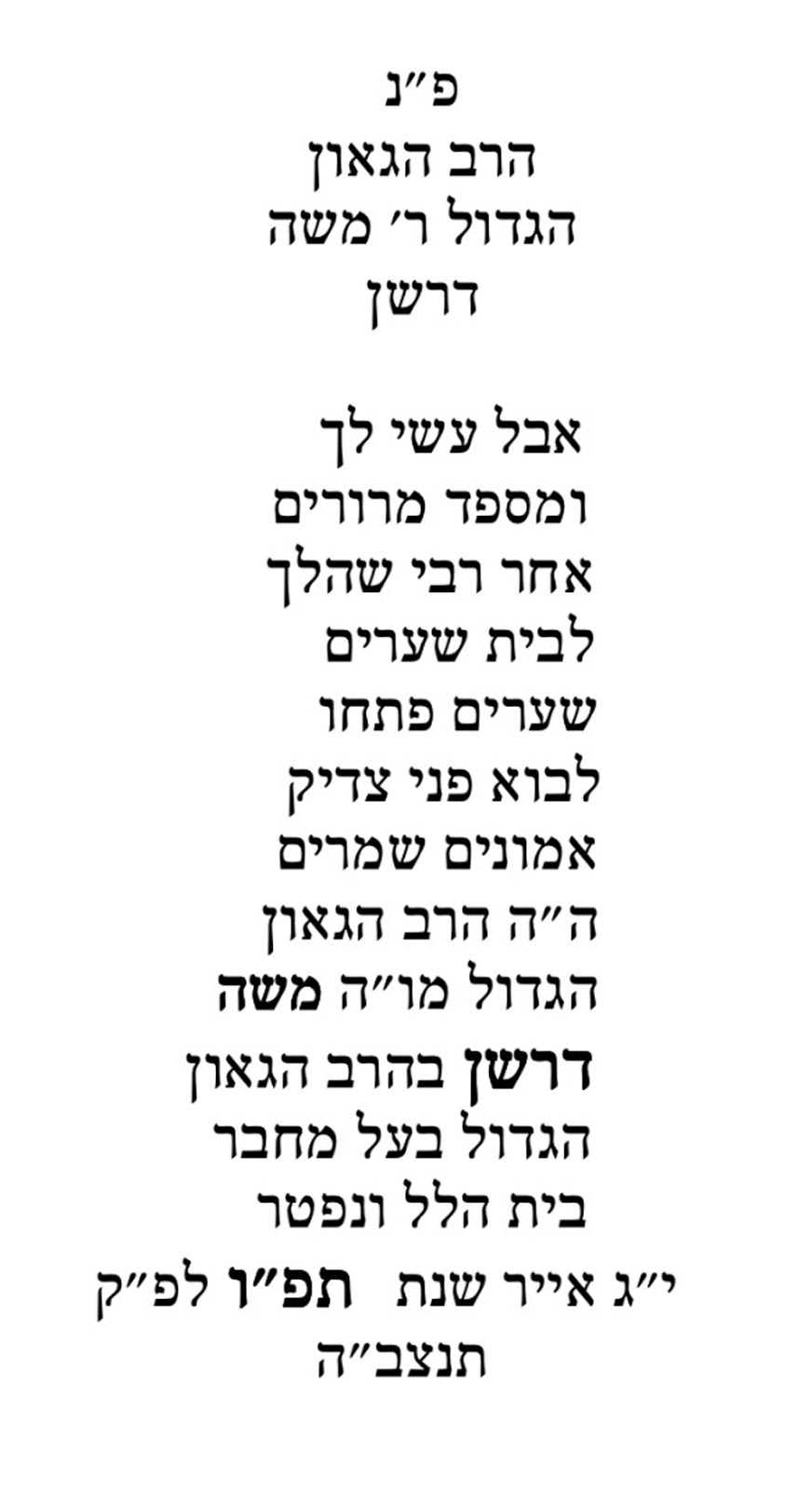
Epitaph 1: The Vilna Gaon (d.1797).

Discussion: This copy of the Vilna Gaon’s epitaph, for the most part, preserves the text as it first appeared in Yehoshua Heschel Levin, עליות אליהו (Vilna, 1856), p. 90, and in Shmuel Yosef Fuenn, קריה נאמנה (Vilna, 1860), p. 146 (and second edition: Vilna, 1915, pp. 155-156). Henceforth, we will refer to Levin as L. and Fuenn as F. The opening letters of lines 3-13 spell the acrostic רב אליהו גאון. The closing words of lines 3-13 are poetic, all of them ending with the rhyming letters עים or אים. The narrative portion (lines 14 on) follows the texts of L. and F., but not their line divisions.

What needs to be noted here is that this was not what the Vilna Gaon’s epitaph looked like in 1942. Probably due to both natural deterioration and human negligence, some of the letters on the extreme right of the tombstone were rubbed out or smudged. Attempts were made to re-ink some of the missing letters, often creating imaginary words. See below, for photographs A and B.

Photograph A[8] is a pre-Holocaust photo of the epitaph. Photo B[9] is a post- Holocaust photo, taken circa 1995. Notice line 10 in the epitaph, which must begin with an enlarged letter ג , for it begins the word גאון in the acrostic. But in the photographs, one clearly sees what looks like םכר (which probably was originally ג]ם פר[ישות ). In any event, we are served notice by the very first epitaph that the Paper Brigade did not always record what they saw; they surely did not see the words גם פרישות on the Gaon’s tombstone in 1942. They recorded what they knew from other literary sources.

Epitaph 3: R. Shlomo Zalman, father of the Vilna Gaon (d. 1758).

Discussion: The epitaph is replete with letters in parentheses. Parentheses, of course, do not ordinarily appear on Jewish tombstones. Clearly, then, the Paper Brigade either saw a mostly illegible epitaph, and filled in the missing letters, marking them in parentheses, or they copied the entire text from a published book. There is no need here for guesswork. The epitaph was published previously by three different authors: L. (in 1856); F. (in 1860 and 1915); and Israel Klausner, קורות בית-העלמין הישן בוילנה (Vilna, 1935), henceforth K. Here are the three editions of the epitaph:

L. (p. 27, n. 3):

F. (p. 123; second edition, p. 128):

K. (p. 45):

It should be noted that the Paper Brigade erred in the title of the entry, wrongly listing ר’ אליהו חסיד as the father of ר’ שלמה זלמן. Nevertheless, it seems obvious that the Paper Brigade copied the text of the epitaph almost exactly as it appeared in K., recording כסלו (and not א’ דחנוכה), and even inserting the hyphen that connects the names ישכר and בער. There was no need to visit the Old Jewish cemetery in order to copy the epitaph.

Epitaph 9: R. Avigdor b. Shmuel, father of R. Shmuel – the last Av Bet Din of Vilna (d. 1771).

Discussion: It is certainly worth noting that the format follows exactly that of epitaphs 1 and 8, and many others in the Old Jewish cemetery, namely an acrostic at the right of the epitaph, included in a rhymed poem praising the deceased and mourning his loss, followed by a narrative text listing the titles and name of the deceased and the date of death. More importantly for our purposes, this epitaph was copied almost exactly as it appears in F., p. 165; second edition, p. 171:

But note that F. included two sets of parentheses that would not have appeared on the original tombstone. In line 1, the opening word אבי is marked by parentheses, since all three letters were necessary for the acrostic. In the last line, the word תקל”א [5]531 = 1771 was added (in parentheses) for clarification of the year of death. No such markings or words would have appeared on the original tombstone. Again, it is obvious that the Paper Brigade copied the epitaph from a published text. No visit to the Old Jewish cemetery was necessary.

Epitaph 10: R. Eliyahu b. R. Moshe Kramer (d. 1710).

Discussion: The Vilna Gaon was a great-grandson of R. Eliyahu b. Moshe Kramer and, indeed, was named after him. The epitaph preserved in the compilation is taken directly from F., p. 99; second edition, p. 105:

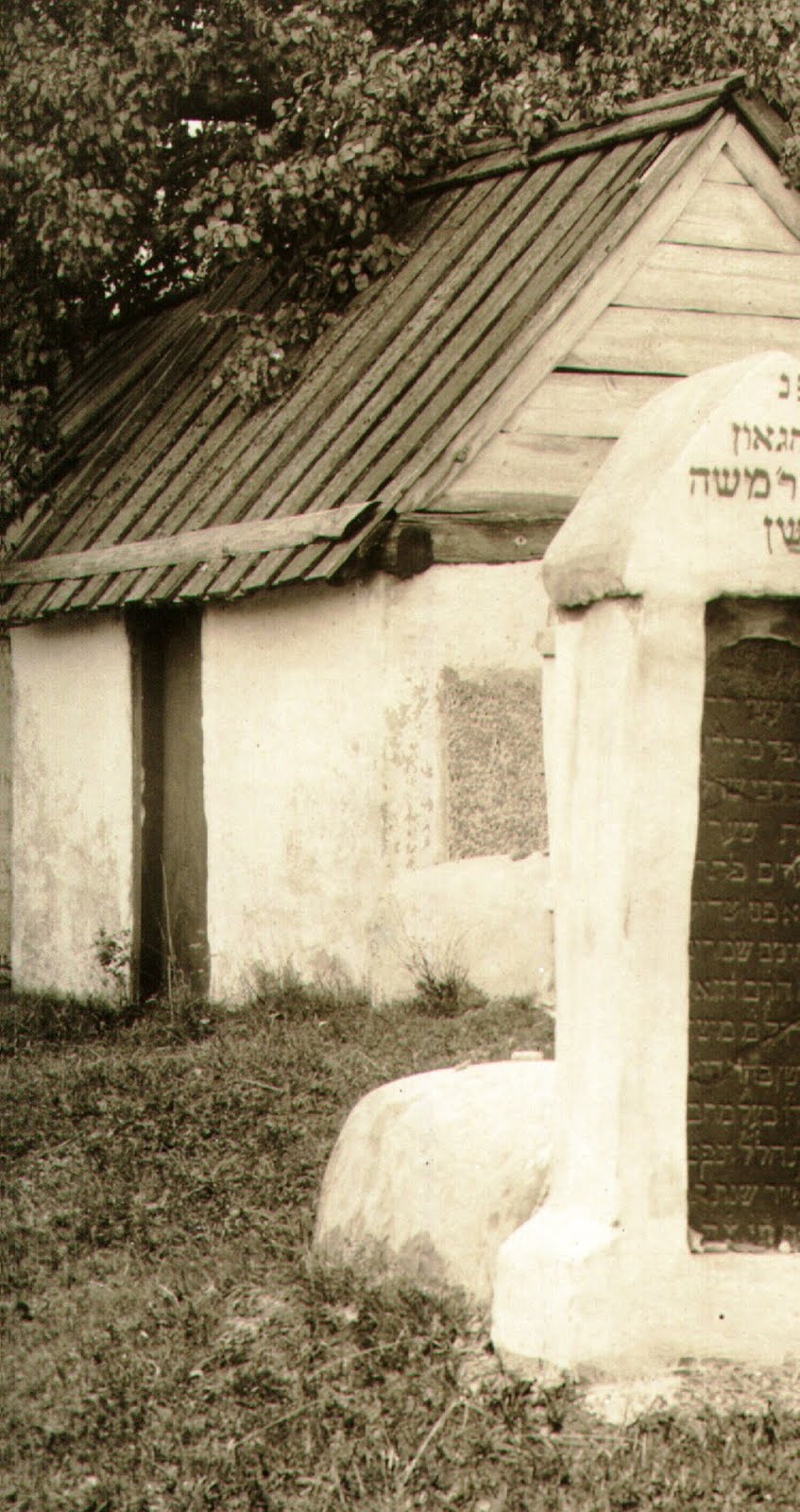
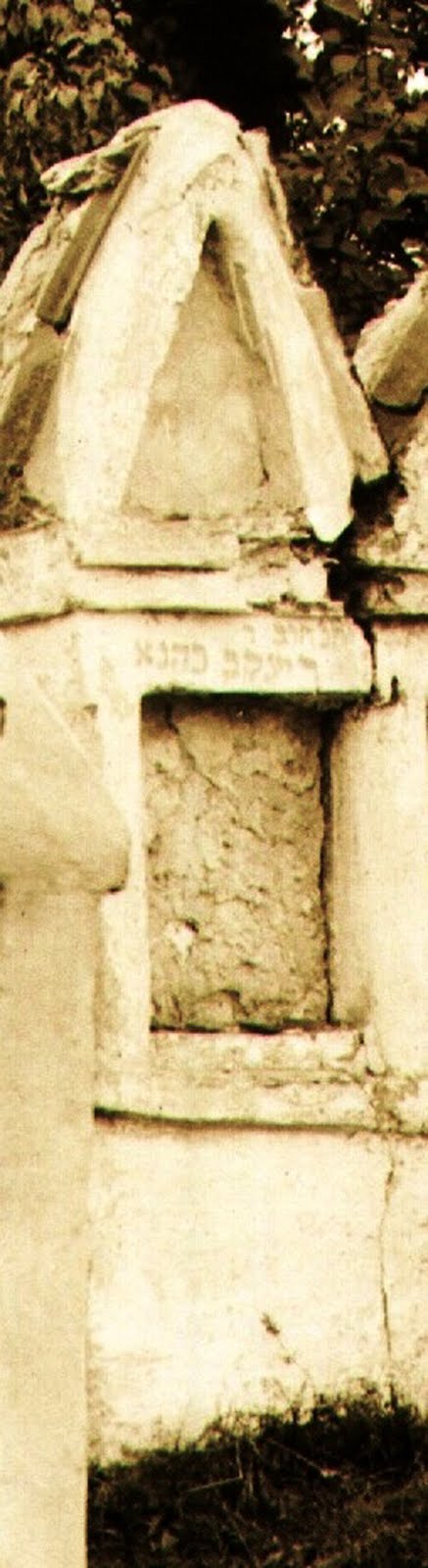
A photograph of the original epitaph has been preserved, taken shortly before or during World War I. It features a three-line marker that identifies the grave, painted just above the epitaph. These lines may well have been added to the gravesite after F.’s visit in 1860. But an examination of the original epitaph indicates that its line division differed considerably from F.

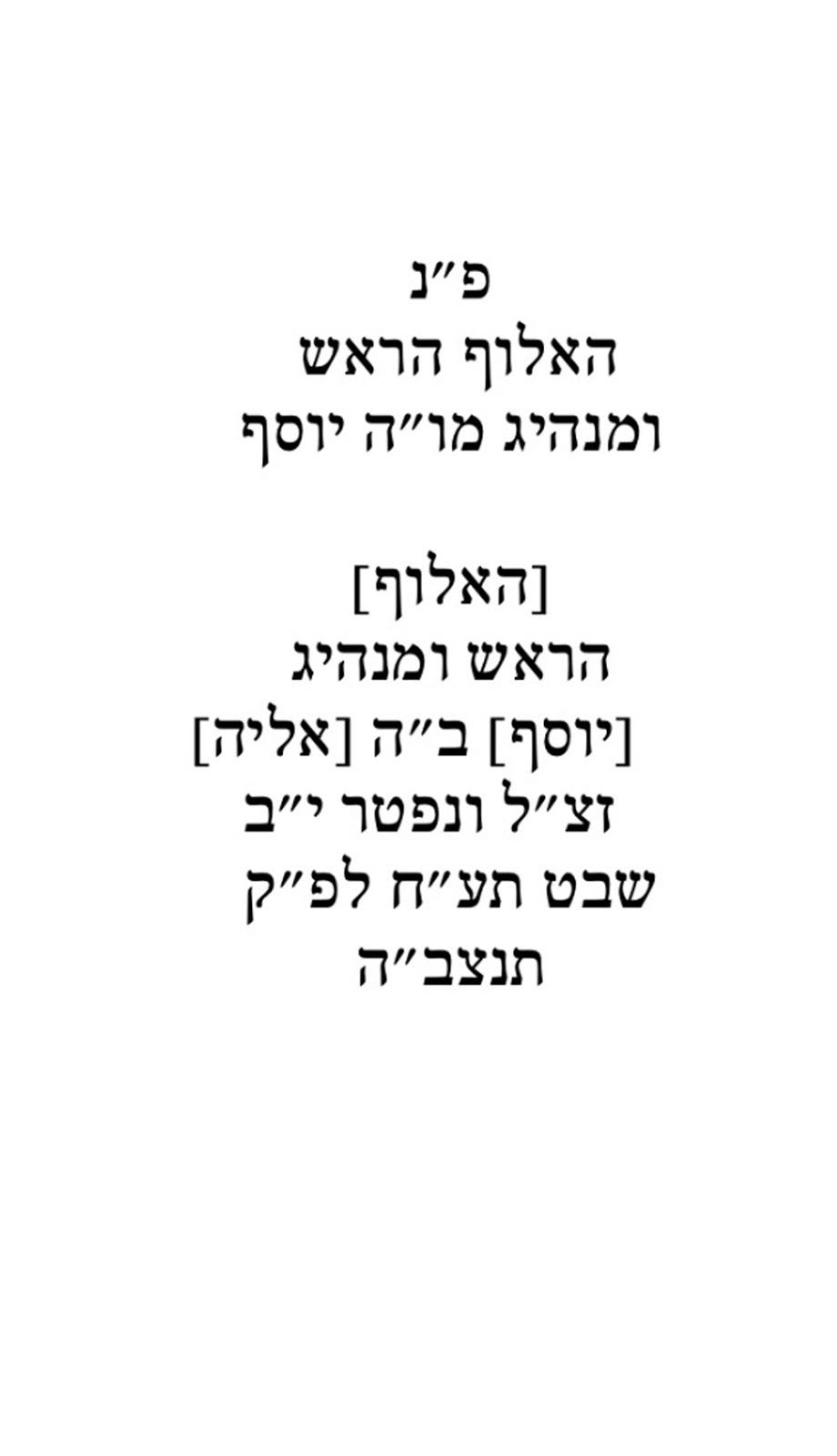
It is clear that the Paper Brigade did not visit the gravesite itself. Below is a photo of the gravesite and a transcription of its epitaph into modern Hebrew font.[10]

Photo Transcription:

Epitaph 14: R. Yehoshua Heschel: Av Bet Din of Vilna (d. 1749).

Discussion: This was a wooden tombstone, well preserved, and photographed circa 1935 (see K., p. 52). The compilation slavishly follows the line division of F., p. 110; second edition, p. 116:

F

The circa 1935 photograph of the tombstone, however, presents a different line division for lines 8 and 10.

K Photo

In F., lines 8 and 10 end with the words זהב and לעולמו, respectively. In K., in the photo taken at the cemetery, the same lines end with the words פרוים and בך”ו , respectively. This suggests once again that the Paper Brigade did not actually copy epitaphs in the Old Jewish cemetery.

Epitaph 30: R. Noah Mindes Lipschuetz (d. 1797).

Discussion: R. Noah Mindes Lipshuetz, distinguished Kabbalist, was buried next to the Vilna Gaon. They died within three months of each other, and were מחותנים as well. (The Vilna Gaon’s son, R. Avraham, was married to Sarah, the daughter of Rabbi Noah and Mrs. Mindes Lipshuetz.) It was decided that they would share one tombstone, with only a narrow painted ivy decoration separating their epitaphs. The original tombstone, with its epitaphs, can be seen to this very day in the Sudervas Jewish cemetery in Vilnius.

Whatever reservations one may still entertain about the compilation having borrowed information directly from F., will surely be dispelled by a careful reading of F.’s recording of R. Noah Lipshuetz’s epitaph:

F 171

The last line of the epitaph in F. (p. 171; second edition, p. 177) reads:

וי”נ (= ויצאה נשמתו) שנת ג’ טבת לפ”ק תאמי צביה “And his soul departed in the year 3 Teveth, equivalent (not counting the thousands) to the numerical value of “Ta’amei Zeviah.” See Song of Songs 7:4. Now the numerical value of “Ta’amei Zeviyah” (not counting the thousands) is [5]558 = 1797, which works perfectly. But the words “and his soul departed in the year 3 Teveth” are senseless. This, of course, is an error (or: typo, if you like) in F. One need merely look at the original epitaph[11] and read the correct Hebrew text: נפטר ביו’ ג טבת שנת תאמי צביה. “He died on the 3rd day of Teveth in the year “Ta’amei Zeviyah.” But the senseless phrase “and his soul departed in the year 3 Teveth” reappears in the compilation prepared by the Paper Brigade! Had the Paper Brigade visited the Old Jewish cemetery in Shnipishok in 1942, it surely would have seen and recorded the correct text of the epitaph.

————————-

There are two epitaphs included in the 51 listed, that merit special attention.

Epitaph 51: R. Shneur Zalman Kaczerginski (d.1815).

The German title at the top of the entry identifies Kaczerginski as a talmudic scholar and philanthropist who died in 1815. As such, he certainly qualifies for inclusion in a compilation of persons buried in Vilna’s Old Jewish cemetery, which was closed in 1830. Alas, no such person was buried in the Old Jewish cemetery! It turns out that Shneur Zalman Kaczerginski was born in 1817 and died in 1887, and – of course – was buried in the Zaretcha cemetery, Vilna’s second Jewish cemetery. The Paper Brigade borrowed the full text of the Kaczerginski epitaph, word for word, from Hillel Noah Steinschneider, עיר ווילנא (Vilna, 1900), vol. 1, p. 290; once again, a sign that the members of the Paper Brigade read books sooner than copying tombstone inscriptions while standing outdoors in the cold.[12] In other words, the Paper Brigade recorded only 50 genuine entries of epitaphs for the Old Jewish cemetery (Alter Friedhof). “Epitaph 51” properly belongs to the Zaretche Jewish cemetery (Neuer Friedhof). Interestingly, Willy Schaefer, one of the Nazi “Jewish” experts who lorded it over the Paper Brigade, writes specifically in his report on Vilna’s Jewish cemeteries that the Paper Brigade had prepared a 108 page research paper with a total of 190 entries of epitaphs.[13] The 108 page research paper has been preserved (and its epitaphs are cited throughout this essay), but Schaefer’s 190 entries of epitaphs was based on the assumption that 50 epitaphs were copied from the Old Jewish cemetery and 140 from the New Jewish cemetery, i.e. Zaretcha, for a total of 190 epitaphs. In fact, we have 51 numbered entries for the Old Jewish cemetery, plus 140 numbered entries for the Zaretcha cemetery, for a total of 191 numbered epitaphs. One can only speculate as to why epitaph 51 was added to the research paper, and in the wrong place at that. And speculate we will! But before doing so, it should be noted that one key spelling difference separates Steinchneider’s recording of the Kaczerginski epitaph from what appears in the Paper Brigade’s report as Epitaph 51. Steinschneider spells the deceased’s last name as: קאצערגיסקי [Kaczergiski]. He even adds in a footnote that the deceased hailed from a town outside of Vilna called Kaczergisak, and that is why the family name is Kaczergiski. But the Paper Brigade lists the deceased’s last name as Katscherginski (in German) and קאצערגינסקי (in Hebrew).

One suspects this may have to do with the key role played by Shmerke Kaczerginski,[14] a Vilna born partisan, and a prominent member of the Paper Brigade.[15] He may have wished to memorialize a possible ancestor who was overlooked by the editors of the Paper Brigade report on epitaphs in the Jewish cemeteries. Perhaps turned down by the editor of the report on Zaretcha, Kaczerginski was able to persuade the editor of the report on the Old Jewish cemetery to add one more entry, epitaph 51 – but that required a falsification of R. Shneur Zalman Kaczergiski’s date of death, and a slight change in the spelling of his name. Whether Steinschneider’s קאצערגיסקי is interchangeable with the name קאצערגינסקי (and its Yiddish equivalent קאטשערגינסקי ) seems questionable to me; and it remains to be proven whether R. Shneur Zalman Kaczergiski was, in fact, an ancestor of Shmerke Kaczerginski.

Epitaph 31: R. Dov Baer Natansohn (d. 1804).

R. Dov Baer Natansohn is described as being active in Vilna’s Great Synagogue, and serving as an official of Vilna’s Jewish Community Council. We know too that in a later period, members of the Natansohn family would play a leading role among Vilna’s moderate Maskilim in the middle of the 19th century.[16] What’s unique about this epitaph is that it is the only one (of the 50 genuine epitaphs of Jews buried in the Old Jewish cemetery) that is not recorded in F. or K. or in any early source known to me. This is almost certainly an indication that R. Dov Ber Natansohn – at least in the eyes of Fuenn and Klausner – did not quite measure up to the names of those included in their monographs. In any event, one could argue, that this epitaph could only have been recorded by a member of the Paper Brigade who actually visited the gravesite at the Old Jewish cemetery. This may well be the case. But is also possible that a descendant of R. Dov Baer Natansohn in the Vilna Ghetto, kept a copy (or even a photograph) of the tombstone, and handed it to a member of the Paper Brigade, so that the epitaph would be preserved for posterity. It should also be mentioned that Khaykl Lunski,[17] the famed librarian of Vilna’s Strashun Library, was an early advisor to the Paper Brigade. In the Vilna Ghetto, he was busy working on a study of the epitaphs in Vilna’s Old Jewish cemetery.[18] He may well have provided a copy of R. Dov Baer Natansohn’s epitaph to a member of the Paper Brigade.

————————————-

In terms of which groups of Jews (buried in the Old Jewish cemetery) were selected for memory by the Paper Brigade, it is clear that a prior selection had already been made by F. and K. As indicated above, 49 out of the 50 genuine epitaphs were borrowed from the earlier accounts in F. and K. These were elitist accounts that focused primarily on professional rabbis and rabbinic scholars, and Jewish communal leaders. F. precluded women from the entries in his book; K. included women, but (for the most part) only to the extent that they were family members of famous rabbis, such as the Vilna Gaon. Looking specifically at the 50 epitaphs included in the Paper Brigade report, some 25 are distinguished professional rabbis and rabbinic scholars; approximately 8 others relate to the Vilna Gaon and members of his family (including women); approximately 8 relate to Jewish communal leaders; approximately 6 relate to professionals (e.g., doctors, printers, and cantors); with approximately 2 or 3 miscellaneous cases (e.g., the Ger Zedek; and R. Yehudah Asher Guenzberg, father of the Maskil Mordechai Aaron Guenzberg). Clearly, the report was prepared by someone who was sympathetic to the prominent role played by rabbinic culture in Vilna’s early modern period, and who knew where to look for the sources he needed in order to prepare the report.

Some will quibble over the tendency of the Paper Brigade to overlook the common man and woman when listing their selected epitaphs. After all, every Jewish man and woman who died in Vilna between 1592 and 1830 was buried in the Old Jewish cemetery. They seem to forget that it was 1942, under Nazi rule, and in the Vilna Ghetto, that the report was written, hardly the time and place to engage in original sociological research of any kind. At best, they could examine the printed books in the Ghetto library, or perhaps those gathered in the former YIVO building, now the headquarters of Einsatzstab Rosenberg. This they did with great skill, and often, at great risk to their lives.

In sum, it appears unlikely that the Paper Brigade spent much time, if any at all, in Vilna’s Old Jewish cemetery. The primary source for the epitaphs gathered by the Paper Brigade was a series of volumes published by a variety of scholars, including Shmuel Yosef Fuenn, Yisrael Klausner, and Hillel Noah Steinschneider. The content of those earlier volumes influenced the scope of the epitaphs that the Paper Brigade could choose for inclusion in their final report. Finally, we wish to stress that whatever is said here applies only to the Paper Brigade report regarding the Old Jewish cemetery. Even a cursory glance at the Paper Brigade report on the Zaretche cemetery indicates that its author recorded countless epitaphs that had – and have – never appeared in print. As such, it is imperative that the report be examined for the many epitaphs it, and it alone, preserves.

————————

NOTES

[1] For an early account of Alfred Rosenberg and his anti-Jewish “academic” activity, see Max Weinreich, Hitler’s Professors: The Part of Scholarship in Germany’s Crimes Against the Jewish People (New York: YIVO, 1946), pp. 77-78, note 171, and pp. 97-106. A vast literature exists on Rosenberg; for the more recent studies, see the bibliography appended to his entry on Wikipedia.
[2] On up to 40 Jews serving in the slave-labor unit, see Shmerka Kaczerginski, פארטיזאנער גייען: זכרונות פון ווילנער געטא (Buenos Aires: Union Central Israelita Polaca en la Argentina, 1947), p. 63.
[3] For the definitive study on the Paper Brigade, see David E. Fishman, The Book Smugglers: Partisans, Poets, and the Race to Save Jewish Treasures from the Nazis; The True Story of the Paper Brigade of Vilna (Lebanon, New Hampshire: ForeEdge, 2017). Cf. his Embers Plucked From the Fire: The Rescue of Jewish Cultural Treasures in Vilna (New York (YIVO, 1996; second expanded edition, YIVO, 2009); and his “Split Identity: Jewish Scholarship in the Vilna Ghetto,” אין געוועב : A Journal of Yiddish Studies, June 30, 2020, pp. 1-9.
[4]  For a history of Vilna’s Old Jewish cemetery, see I. Klausner, קורות בית-העלמין הישן בוילנה (Vilna: S. An-ski Jewish Historical and Ethnographic Society, 1935); Elmantas Meilus, “The History of Vilnius Old Jewish Cemetery at Šnipiškes in the Period of the Grand Duchy of Lithuania,” Lithuanian Historical Studies 12 (2007), pp. 63-92; and Vytautas Jogela, “The Old Jewish Cemetery in the Nineteenth and Twentieth Centuries,” Lituanus 61:4 (2015), pp. 76-93.
[5] A history of Vilna’s New Jewish cemetery in Zaretcha remains a scholarly desideratum. Tentatively, see I. Klausner, “צו דער געשיכטע פון יידן אין ווילנע: דאס נייע פעלד”, in צייט, October 4, 1933, p. 4; Zalman Szyk, יאר ווילנא 1000 (Vilne: געזעלשאפט פאר לאנדקענטניש אין פוילן, 1939), pp. 418-437; Vida Girininkiene, “The Jewish Cemetery on Olandų Street: History and Reflections,” in Rimantas Dichavičius, Paminklas Paminklui (Vilnius: UAB Balto Print, 2020), pp.19-25; and Irina Guzenberg, Vilnius: Traces of the Jerusalem of Lithuania (Vilnius: Pavilniai, 2021), pp. 691-700.
[6] The compilations of the Paper Brigade are available in Vilnius at the Judaica collection of the Mažvydas National Library of Lithuania. Based upon evidence from the Vilnius archives, Jogela (above, note 4), p. 84, claims that “a certain Goldbergas” compiled the list of 51 epitaphs. Jogela does not identify Goldbergas, but almost certainly it was Eliezer Goldberg, Jewish educator and historian. Prior to the Holocaust, he administered and taught at Vilna’s Esther Rubinstein School for Girls. In the Vilna Ghetto, he lectured widely on Jewish history in the various synagogues and schools. In 1943, he was deported by the Nazis to Estonia, where he perished in 1944. On Goldberg, see Shmerka Kaczerginski, חורבן ווילנא (New York: United Vilner Relief Committee, 1947), p.236; H.S. Kazdan, ed., לערער יזכור בוך: די אומגעקומענע לערער פון צישא שולן אין פוילן (New York: Martin Press, 1954), p. 72 (where Goldberg is described as א ייד א למדן און מיט וועלטלעכער בילדונג ); J. Biber, R. Kostanian, and J. Rozina, eds., Vilna Ghetto Posters: Album-Catalogue (Vilnius: Vilna Gaon Jewish State Museum, 2006), p. 265 (which includes a photograph of Goldberg); and A. Einat, חיי יום-יום בגטו וילנה (Haifa: Moreshet, 2013), pp. 240 and 417. It is too early to speculate how many other hands were involved in selecting the 191 epitaphs included in the Paper Brigade’s final report.
[7] See Klausner, pp. 77-82, who lists 220 named graves that were still standing in 1935. Actually, many of the “named graves” were grave sites with more than one named grave at the site, all of them listed by Klausner. Thus, a total of approximately 240 names are listed. On pp. 83-84, Klausner lists an additional 51 named graves , some of them grave sites, strewn throughout the cemetery. They actually total 55 names. The 240 names plus the additional 55 names yield an approximate total of 300 names.

[8] Photograph A is taken from the late Yeshayahu Epstein’s collection of pre-Holocaust photographs of Vilna. See Yitzchak Alfasi, ed., וילנא ירושלים דליטא חרבה! היתה ואיננה עוד (Tel-Aviv, 1993), p. 10.
[9] Photograph B is taken from the pamphlet Vilniaus Gaonas Elijahu אליהו הגאון מוילנה (Vilnius, 1996), no pagination, issued by the Lithuanian Jewish Community in anticipation of the commemoration of the 200th anniversary of the death of the Vilna Gaon (1797-1997).
[10] The photo and the transcription are taken from S. Leiman, “A Picture and its One Thousand Words: The Old Jewish Cemetery in Vilna Revisited,” The Seforim Blog, January 14, 2016, section A, item 7 and notes.
[11] See above, at Epitaph 1, Photo B, for a full frontal color photograph of the joint tombstone inscriptions of R. Noah Mindes Lipschuetz and the Vilna Gaon; cf. Photo A. In the light of the evidence presented here, R. Noah Mindes Lipschuetz did not die in November of 1797, as claimed by the German heading to Epitaph 30. He died on, or about, December 22, 1797 (= 3 Teveth, 5558), some two and a half months after the death of the Vilna Gaon on October 9, 1797 (= 19 Tishre, 5558). For an alternate reading of the somewhat unclear last lines of the epitaph (that correctly preserves the יום ג’ טבת date of death), see R. Yitzchok Arnstein’s edition of R. Noah Mindes Lipschuetz’ פרפראות לחכמה (Brooklyn: Edison Lithographic Corporation, 1995), Introduction, p. 17.
[12] Steinschneider’s text reads as follows:


[13] See Schaefer’s essay entitled “Friedhöfe und Grabsteine der Juden in Wilna,” dated 1/9/1943 (in the Judaica collection at the Mažvydas National Library of Lithuania). On the title page he refers (in German) to his gathering together of “190 tombstone inscriptions in 108 typewritten pages.”
[14] A vast literature was produced by, and exists on, Shmerke Kaczerginski (1908-1954), Yiddish poet and Vilna partisan. In general, see the entry on him in לעקסיקאן פון דער נייער יידישער ליטעראטור (New York: Congress for Jewish Culture, 1981), vol. 8, columns 48-50; and the more recent bibliography appended to his entry in Wikipedia.
[15] For some of Kaczerginski’s own reflections on the Paper Brigade, see his פארטיזאנער גייען! זכרונות פון ווילנער געטא (Buenos Aires: צאנטראל-פארבאנד פון פוילישע יידן אין ארגענטינא, 1947), pp. 61-69; חורבן ווילנע (New York: United Vilner Relief Committee, 1947), p. 337; and איך בין געווען א פארטיזאן (Buenos Aires: Cultura, 1952), pp. 40-44.
[16] See Mordechai Zalkin, בעלות השחר (Jerusalem: Magnes Press, 2000), p. 34, n. 45, and passim.
[17]  On Haykl Lunski, see Hirsz Abramowicz, Profiles of a Lost World: Memoirs of East European Jewish Life before World War II (Detroit: Wayne State University Press, 1999), pp. 260-264. Cf. Frida Shor, מ”לקוטי שושנים” ועד “בריגדת הנייר”: סיפורו של בית עקד הספרים ע”ש שטראשון בווילנה (Tel Aviv: Probook, 2012); and Dan Rabinowitz, The Lost Library: The Legacy of Vilna’s Strashun Library in the Aftermath of the Holocaust (Waltham: Brandeis University Press, 2019).
[18] S. Kaczerginski, חורבן ווילנע (New York: United Vilner Relief Committee, 1947), p. 198.


The Alleged Blindness of R. Jacob Joshua Falk During the Emden-Eibeschuetz Controversy

The Alleged Blindness of R. Jacob Joshua Falk During the Emden-Eibeschuetz Controversy

by Shnayer Leiman

R. Jacob Emden’s animosity toward R. Jonathan Eibeschuetz throughout the Emden-Eibeschuetz controversy could easily be explained away on grounds that are not necessarily bound up with an accusation of heresy. Emden, who proudly depicted himself as “a zealot the son of a zealot,” would hardly pass for Mister Nice Guy. In his autobiography, and certainly in his polemical works, Emden often emerges as a misanthropic, tempestuous, cantankerous, chronically-ill, and incessantly whining social misfit and rabbinic genius who did not suffer either fools or rabbinic scholars gladly. Indeed, he hardly had a kind word to say about most of the rabbis who succeeded his father, R. Zvi Ashkenazi, as Chief Rabbi of Altona, Hamburg, and Wandsbeck, and served during his (Emden’s) lifetime. Emden, whose father and grandfather had served as Chief Rabbis of Altona, Hamburg, and Wandsbeck surely felt that he should have been appointed to succeed them in the rabbinate. That he (Emden) had to live in Altona for some 15 years (1750-1764) as a lay Jew in the shadow of Chief Rabbi Jonathan Eibeschuetz was simply more than he could bear. And the two rabbis lived virtually around the corner from each other in Altona, then a bedroom community for some 200 Jewish families living outside of Hamburg. Not surprisingly, a long list of historians and apologists would suggest that it was jealousy more than heresy that motivated and drove Emden’s animosity toward Eibeschuetz.[1]

It is far more difficult to explain away R. Jacob Joshua Falk’s animosity toward R. Jonathan Eibeschuetz on grounds other than the accusation of heresy. It is called “the Emden-Eibeschuetz” controversy, and rightly so, for those two rabbis initiated the controversy in 1751, would continue the struggle against each other through 1764 (when Eibeschuetz died), and Emden would continue to denigrate Eibeschuetz’ memory for as long as he lived, i.e., until 1776. But during the key early years of the controversy, from 1751 until 1756, the campaign against Eibeschuetz was directed primarily by R. Jacob Joshua Falk, then serving as Chief Rabbi of Frankfurt am Main, and who had formerly served with distinction as Chief Rabbi of Lvov, Berlin, and Metz. He was arguably the גדול הדור, certainly the זקן הדור, and virtually everyone agreed that no other rabbi in the mid-18th century was in a better position to resolve the controversy. He was even-handed, had no axe to grind, and was unrelated to either Emden or Eibeschuetz. Author of the classic work פני יהושע (the first volume appeared in print in Amsterdam, 1739), no one could question either his learning or integrity. In a battle of titans – now Rabbis Falk and Eibeschuetz – that escalated over a five year period, Falk ultimately called for Eibeschuetz to be defrocked. He placed Eibeschuetz under the ban, specifically ruling that he could no longer function as a rabbi, teacher, or preacher either in Altona or anywhere else, until such time that he would appear before a Jewish court of law and his case would be adjudicated . That, of course, never happened. As indicated, defenders of Eibeschuetz could not easily account for Falk’s seemingly acrimonious stance in the Emden-Eibeschuetz controversy.[2]

A possible early mention of Falk’s suffering from blindness appears in an undated letter by R. Nathan Nota Eibeschuetz (circa 1732-1789), son of R. Jonathan Eibeschuetz. The letter was addressed to a rabbinic colleague, an ardent supporter of R. Jonathan Eibeschuetz, and was published surreptitiously by Emden in 1755, during Falk’s lifetime.[3] In it, Nathan Nota Eibeschuetz notes in a postscript that reports have just reached him from a variety of informants that Falk’s [second] wife had died suddenly in Mannheim. Her sudden death had an immediate traumatic effect on Falk, who was overcome with mental confusion and physical pain. Specifically, Eibeschuetz states that Falk “now walks lonely and desolate, depleted of strength, and is no longer able to see.”[4] Although the letter is undated, we know precisely that Falk’s [second] wife died on Monday, October 18, 1751(= 29 Tishre 5512).[5] The letter could only have been written shortly after the event it describes.

It is difficult to assess how much credibility is to be given to such a report. The author of the letter was not an eyewitness to the event he describes. Moreover, he personally viewed Falk as the “enemy,” and could only take delight in describing his mental and physical breakdown.[6] In any event, we know that some four months later Falk obviously recovered, for he remarried on Shushan Purim in 1752,[7] and clearly regained his eyesight (as we will prove below), even if he had lost it temporarily. Doubtless, this report, published in 1755, played a significant role in influencing the later accounts that had much to say about Falk’s blindness during the Emden-Eibeschuetz controversy.

In the 19th century, reports appeared in print that Falk suffered from blindness toward the end of his life. Even if we assume that these reports are accurate accounts of Falk’s state of health in 1756, they speak only of blindness during the last months, weeks, or days of his life.[8] By the 20th century, apologists broadened the period of Falk’s blindness to the entire span of his involvement in the Emden-Eibeschuetz controversy, from 1751 to 1756.[9] Thus, it was claimed that Falk never saw any of the amulets ascribed to Eibeschuetz and never read any of the polemical works published by the Emden forces between 1751 and 1756. He heard only oral reports, and based his rulings upon the misinformation that he was fed. It follows, then, that Falk’s stance in the Emden-Eibeschuetz controversy cannot be used as evidence against the integrity of Eibeschuetz. In the 21st century, more radical apologists would claim that all the letters and broadsides allegedly signed and published by Falk were in fact forged by the anti-Eibeschuetz forces.[10]

Here, we shall attempt to set the record straight. It would seem from a variety of sources that Falk could see perfectly well during the key years of the Emden-Eibeschuetz controversy. He had no problem reading texts as late as August of 1755, when – some 5 months before he died – he published the very last text he would contribute to the literature of the Emden-Eibeschuetz controversy. What follows is a summary list of some key sources, and their dates.

1. Wednesday, August 7, 1754 (=19 Av, 5514). The חיד”א (R. Hayyim Yosef David Azulai, 1724-1806) met with Falk in Worms. An impostor was bankrupting the חיד”א’s fundraising efforts on behalf of the Jewish community of Hebron. The impostor came with forged papers, claiming he was the true emissary of Hebron. He would reach each town and city in Europe before the חיד”א arrived, collect the funds, and abscond. Falk came to the חיד”א’s rescue by comparing חיד”א’s written credentials against his own collection of rabbinic signatures, and as recorded in חיד”א diary, “וירא כי החתימות דידי ודידיה היו לאחדים.” Falk saw that the signatures on both sets of documents were exactly the same, and declared חיד”א to be the only authorized emissary from Hebron.[11] See here:

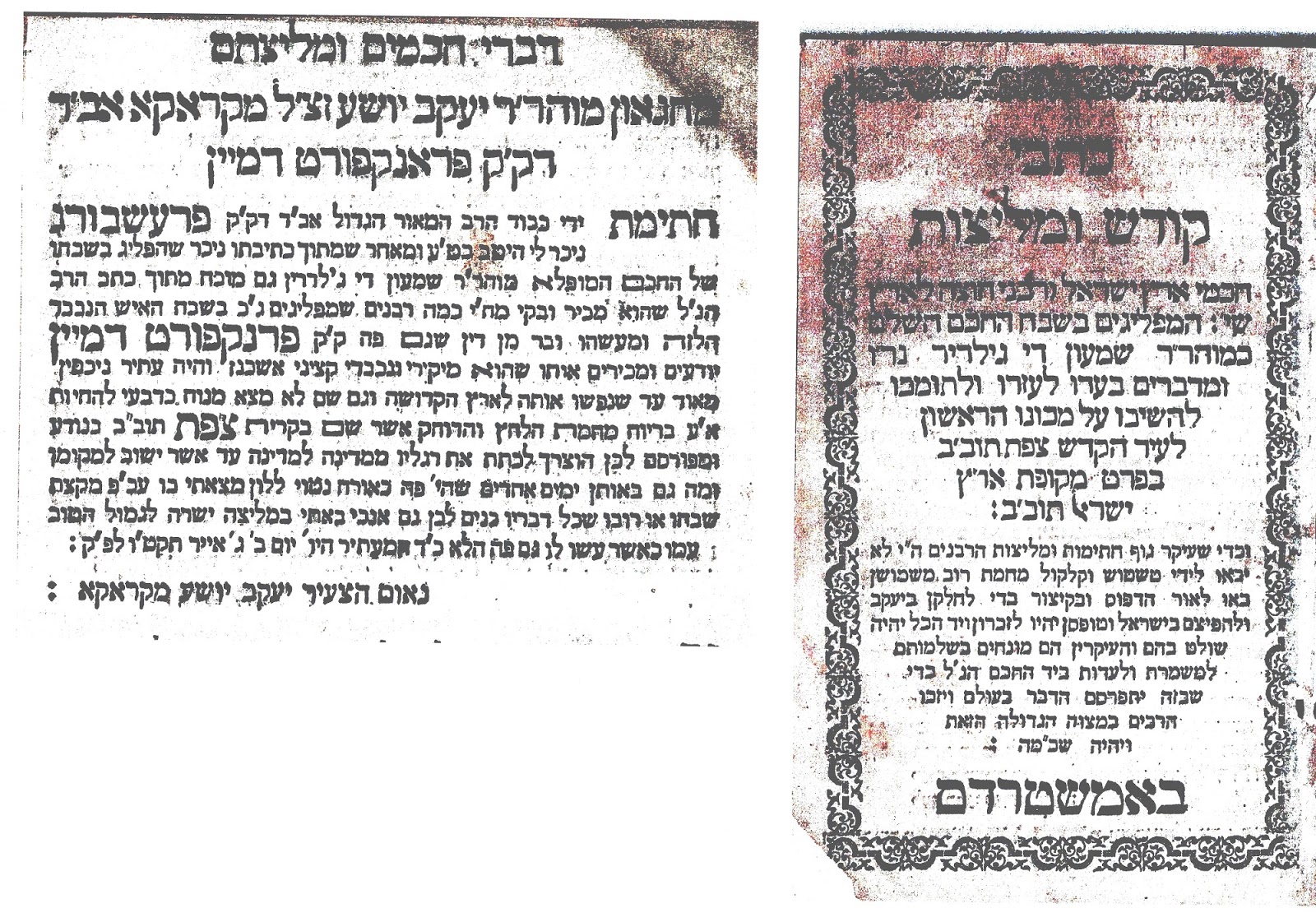
2. Monday, April 14, 1755 (=3 Iyar 5515). Falk wrote a letter on behalf of Simon von Geldern (1720-1788), then an itinerant yeshiva student. Falk writes:

“The signature of the Chief Rabbi of Pressburg [on the letter you showed me] is well known to me, and I recognize it at sight. Since he praises you in his letter… I too agree to write a letter on your behalf.”[12]  See here:


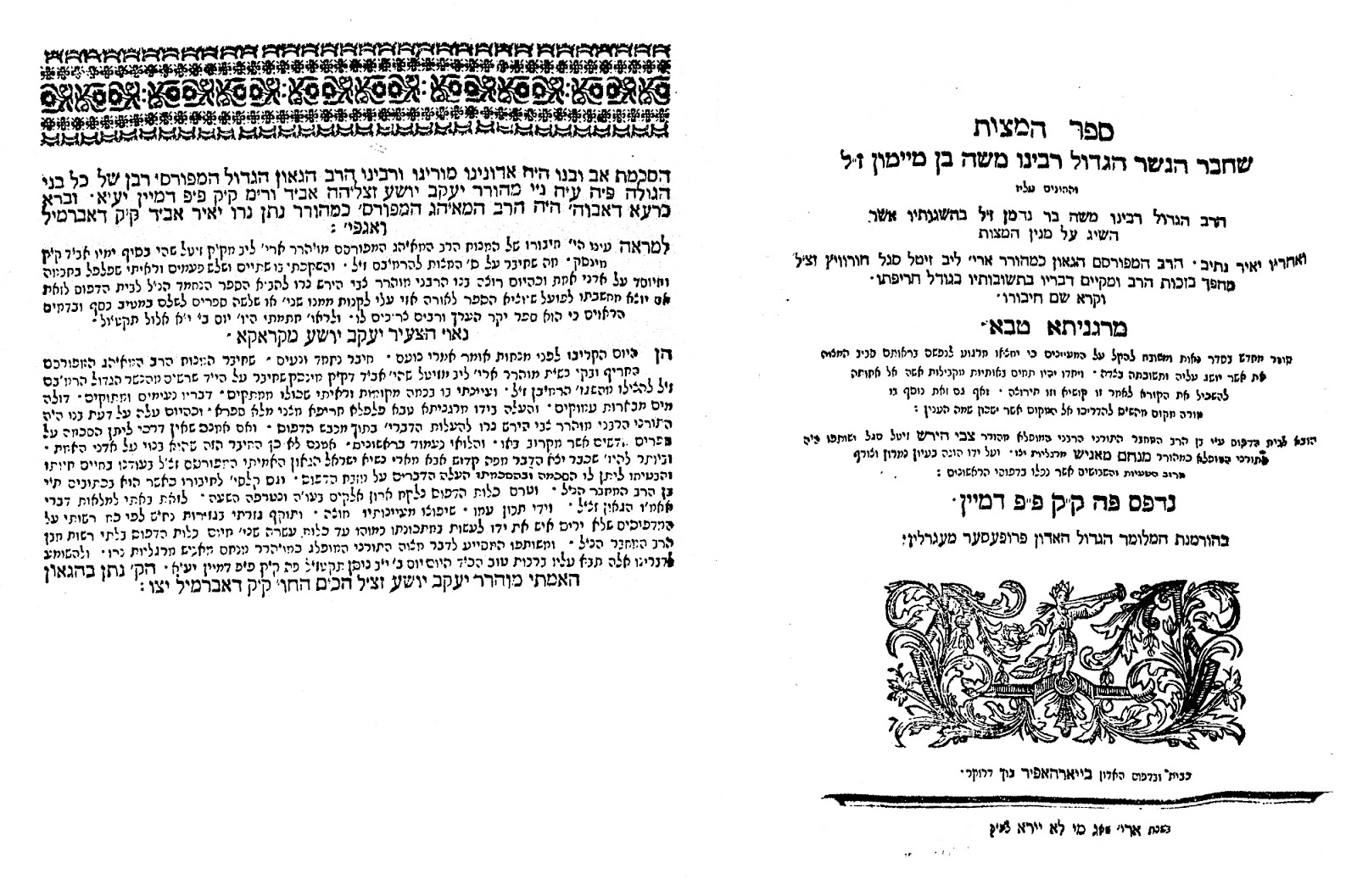
3. Monday, August 18,1755 (11 Elul, 5515). Falk wrote his final letter of approbation for authors of rabbinic works. He wrote 42 altogether. See his הסכמה to R. Aryeh Leib Horowitz’ ספר המצות עם פירוש מרגניתא טבא (Frankfurt, 1756). Falk writes that a copy of R. Aryeh Leib’s מרגניתא טבא was placed before his eyes (italics mine, s.z.l.). He examined it two or three times and saw that the comments were wise and true, and agreed to write a letter of approval.[13] See here.

4. Friday, August 29, 1755 (= 22 Elul 5515). In a broadside entitled חרבות צורים , Falk published his final salvo in the Emden-Eibeschuetz controversy.[14] Some 8 weeks earlier, Eibeschuetz had published לוחת עדות (Altona, 1755), his first published book, and the only one which was devoted to a vigorous denial of the charges made against him that he was a closet Sabbatean. In the book, he addressed the amulets that had been ascribed to him, and called to the stand an impressive list of witnesses for the defense, including many of the leading rabbis in Lithuania, Poland, Bohemia, Moravia, Germany, Italy, Turkey and elsewhere, all of whom attested to his innocence of the charges levelled against him. Falk’s חרבות צורים was the first published book review of לוחת עדות, and a devastating one at that.

For our purposes, what is significant is that Falk indicates that he read the book upon publication, and indeed cites chapter and verse with precision. He even notes that he compared the printed version (in לוחת עדות) of a personal letter that Eibeschuetz had addressed to him in 1754, to the original copy still in his possession, and noticed subtle, if only minor, differences. Apparently, Falk could see quite well, as late as August 29, 1755, when the broadside was penned by him.[15] He died some 5 months later on January 16, 1756 (= 14 Shevat 5516). See here.

In sum, R. Jacob Joshua Falk was not blind during the key years that he participated in the Emden-Eibeschuetz controversy. He may well have suffered from blindness toward the end of his life. If so, this is likely to have occurred sometime after he wrote his final salvo in the Emden-Eibeschuetz controversy on August 29, 1755.[16]

Notes

[1] For a scathing rabbinic critique of Emden’s character, and for samples of the negative impact of his character on his writings, see R. Meir Dan Plotzki, “לכותבי הסתוריא” in דגלנו 2 1922, n. 5-6, pp. 108-110, and n. 10-11, pp. 191-194; and 3(1923), n. 12, pp. 230-233. For a typical historian and apologist who explains away Emden’s animosity as being grounded largely in jealousy, see E. Duckesz, חכמי אה”ו (Hamburg, 1908), pp. 55-63. A wide variety of other motivations for Emden’s animosity have been suggested, including economic factors (see, e.g., M.J. Cohen, Jacob Emden: A Man of Controversy ,Philadelphia, 1937); halakhic issues (see, e.g., Rabbi R. Margulies, סיבת התנגדותו של רבינו יעקב מעמדין לרבינו יהונתן אייבשיץ , Tel-Aviv, 1941); and kabbalistic speculation (see, e.g., Rabbi Y.Y. Safrin, נציב מצותיך [first published in Lemberg, 1858] Jerusalem, 1983, p. 117, and Rabbi A.Y. Schlesinger, קונטרוס שמרו משפט תנינא, Jerusalem, 1914, p. 72a).
[2] On Falk’s role in the Emden-Eibeschuetz controversy, see S.Z. Leiman, “When a Rabbi is Accused of Heresy: The Stance of Rabbi Jacob Joshua Falk in the Emden-Eibeschuetz Controversy,” in D. Frank and M. Goldish, eds., Rabbinic Culture and Its Critics (Detroit, 2008), pp. 435-456.
[3] Emden, ויקם עדות ביעקב (Altona, 1755), pp. 79a-80a (the pagination mistakenly reads: pp. 59a-60a).
[4] Ibid., p. 80. The Hebrew reads: אף גם הוא כעת הולך ערירי וכוחו סר ואור עינו אין אתו.

The plain sense of the phrase אור עינו אין אתו is less than certain. Although some are inclined to render it figuratively, e.g, “his eyes lost their sparkle,” in rabbinic literature it is often rendered literally and refers to loss of sight.

For the figurative sense, see 1 Sam 14:29 ארו עיני (my eyes lit up), Psalm 38:17 ואור עיני גם הם אין אתי (my eyes have lost their luster), and cf. M. Yoma 8:6. The figurative sense, then, refers clearly to the restoration or loss of physical and mental well-being. For the sense “loss of sight,” see, e.g., R. Yosef b. Eliyahu Hazzan, עין יוסף (Smyrna, 1675), introduction; R. Jacob Emden, חלי כתם (Altona, 1775), p. 22b; R. Yissachar Lichtenstein, אהל יששכר (Altona, 1826), letter of approbation by R. Michael May of Breslau; R. Abraham Ha-Levi, אברהם זכרון (Lvov, 1837), letter of approbation by R. Yaakov Orenstein; and R. Yekutiel Yehudah Greenwald, פארי חכמי מדינתינו (Sighet, 1910), p. 38, entry 13. In these (and in other) rabbinic passages, the phrase אור עינו אין אתו is often used interchangeably with the terms עיוור, סומא, and סגי נהור.
[5] See D.A.L. Zinz, עטרת יהושע (Bilgoraj, 1936), p. 19. Her tombstone – moved from the old to the new Jewish cemetery – is preserved to this very day in Mannheim’s New Jewish Cemetery.
[6] Nathan Nota Eibeschuetz adds in the postscript that “starting at her funeral, Falk proclaimed that his punishment was due to his opposition to my [i.e., Nathan Nota Eibeschuetz’] Master, Teacher, and Rabbi, my father the Gaon [Jonathan Eibeschuetz].

[7] Zinz, loc. cit.
[8] See G. Klemperer, “Rabbi Jonathan Eibenschütz,” in Pascheles’ Sippurim 4(1856), pp. 284-5 [also published as a monograph entitled Rabbi Jonathan Eibenschütz (Prague, 1858), pp. 76-77]. Cf. Y. Gastfreund, “תולדות רבי יהונתן אייבענשיטץ” in his אנשי שם (Lyck, 1879), p.17, note. None of these sources provide any detail about a progression from partial to total blindness; they simply assume that at some point toward the end of his life Falk suffered from total blindness.
[9] See, e.g., H.Y.N. Silberberg, קונטרס דרך חיים (Piotrkow, 1931), p. 81.
[10] See, e.g., Y.Y. Vidovsky, “הקדמת המו”ל” in יערות דבש השלם המנוקד (Jerusalem, 2000), vol.1, p. 45, n. 95, whose claims are based upon an egregious misreading of the evidence he presents. Falk’s apologists are not discussed in Y. Barnai’s “יחסה של ההיסטוריוגרפיה האורטודוקסית לשבתאות” in his שבתאות: היבטים חברתיים (Jerusalem, 2000), pp.120-141.
[11] H.Y.D. Azulai, מעגל טוב השלם (Jerusalem, 1934), p. 23.
[12] Simon von Geldern, כתבי קודש ומליצות (Amsterdam, 1760), p. 4b.
[13] A.L. Horowitz, ספר המצות עם פירוש מרגניתא טבא (Frankfurt, 1756), הסכמה printed immediately following the title page (courtesy: HebrewBooks.org). See, however, the הסכמה of Falk’s son on the same page, which raises the possibility that Falk’s הסכמה was dictated by him and recorded by his son. Even so, I don’t think this changes the basic facts recorded in Falk’s הסכמה.
[14] Only one copy of חרבות צורים seems to have survived the vicissitudes of time. It is preserved in a private collection, and the owner, who prefers to remain anonymous, has graciously allowed me to publish the full text anew. I plan to do so in the near future. Here I post a scan only of the opening lines and paragraph, which are relevant to the discussion at hand.
[15] It is possible to claim that Falk was already blind when לוחת עדות was published on June 27, 1755. When a copy reached Falk in Frankfurt, it was read to him by an amanuensis, who also recorded Falk’s response as it was dictated to him. The response was then published in the broadside entitled חרבות צורים. Such a claim, however, is meaningless in terms of apologetics, whose ultimate goal is to dismiss Falk’s testimony as uninformed and meaningless. By June 1755, Falk’s role in the Emden-Eibeschuetz controversy was basically over. It’s everything he said, wrote, and did before June 1755 –when he certainly could see and read – that established his unique and unequivocal stance in the controversy. Moreover, specifically with regard to חרבות צורים, every criticism of Eibeschuetz by Falk is referenced with precision to the appropriate page in לוחת עדות. Every criticism is clever, incisive, and right on target – as one would expect from a tried and tested Sabbatean-buster like Falk. None of the criticisms could be dismissed as the uninformed and meaningless testimony of a blind man who could not read and understand the text of לוחת עדות.
[16] Anecdotal evidence (that can neither be authenticated nor dated with precision) preserves a tradition that Falk wore reading glasses in Lvov. If true, it surely suggests that he was able to see at that early stage in his life (and needed glasses only for reading). Indeed, to the best of my knowledge, no one has ever claimed otherwise. See Zinz, op. cit., pp. 95-6. Elsewhere in the same volume (on p. 25), Zinz writes specifically – without adducing any evidence – that Falk “was blind for several months prior to his death.” This is perfectly consistent with our conclusion


A Picture and its One Thousand Words: The Old Jewish Cemetery of Vilna Revisited*

A Picture and its One Thousand Words: The Old Jewish Cemetery of Vilna Revisited*
by Shnayer Leiman
A. The Photograph.
            Recently, I had occasion to publish the above photograph – a treasure that offers a glimpse of what the old Jewish cemetery of Vilna looked like in the inter-war period.[1] Indeed, it captures the oldest portion of the rabbinic section of the old Jewish cemetery. The purpose of this essay is to identify the persons buried here and – where possible – to reconstruct and print the epitaphs on their tombstones. Seven partially legible inscriptions can be seen by the naked eye, as one moves from left to right across the photograph. An empty frame that once held a tombstone can be seen in the center of the photograph, as well. With the aid of a magnifying glass, as well as literary evidence, we shall attempt to identify all those buried here and to restore the full texts of their epitaphs. In effect, we shall engage in a virtual tour of a Jewish cemetery that – sadly — exists today almost entirely underground.
            Briefly, the old Jewish cemetery was the first Jewish cemetery established in Vilna. According to Vilna Jewish tradition, it was founded in 1487. Modern scholars, based on extant documentary evidence, date the founding of the cemetery to 1593, but admit than an earlier date for its founding cannot be ruled out.[2] The cemetery, still standing today (but denuded of its tombstones), lies just north of the center of the city of Vilna, across the Neris (formerly: the Vilia) River, in the section of Vilna called Shnipishkes (Yiddish: Shnipishok). It is across the river from, and just opposite , one of Vilna’s most significant landmarks, Castle Hill with its Gediminas Tower. The cemetery was known as the Piramont[3] cemetery, also (in Yiddish) as der alter feld or der alter beys eylam [so in Lithuanian Yiddish; in Ashkenazic Yiddish: beys oylom]. It was in use from the year it was founded until 1831, when it was officially closed by the municipal authorities. Although burials no longer were possible in the old Jewish cemetery, it became a pilgrimage site, and thousands of Jews visited annually the graves of the many righteous heroes and rabbis buried there, especially the graves of the Ger Tzedek (Avraham b. Avraham, also known as Graf Potocki, d. 1749), the Gaon of Vilna (R. Eliyahu b. Shlomo, d. 1797), and the Hayye Adam (R. Avraham Danzig, d. 1820). Such visits still took place even after World War II.[4]
            The cemetery, more or less rectangular in shape, was spread over a narrow portion of a sloped hill, the bottom of the hill almost bordering on the Neris River.[5] The photograph captures some of the oldest mausoleums and graves at exactly that spot, i.e. at the bottom of the hill almost bordering on the Neris River. The tombstone inscriptions face north, toward the top of the hill. As one moves from  left to right across the photograph, one is in effect moving uphill toward the entrance of the cemetery, a gate built into the northern portion of the cemetery fence.[6] We shall move from left to right, and begin with the first tombstone inscription.
1. R. Menahem Manes Chajes (1560-1636).
R. Menahem Manes was among the earliest Chief Rabbis of Vilna. Indeed, his grave was the oldest extant grave in the Jewish cemetery, when Jewish historians first began to record its epitaphs in the nineteenth century.[7] R. Menahem Manes’ father, R. Yitzchok Chajes (d. 1615), was a prolific author who served as Chief Rabbi of Prague. Like his father, R. Menahem Manes published several works in his lifetime, including a dirge entitled סליחה על שני קדושים  (Lublin, 1596)[8]; a treatise in rhyme encompassing all the laws of ערב שבת, entitled קבלת שבת (Lublin, 1621)[9]; and left still other works in manuscript form (e.g., a commentary on פרשת בלק, entitled דרך תמימים, now in the Bodleian Library at Oxford University).[10] His epitaph reads:[11]
2. R. Shaul Katzenellenbogen (ca. 1770-1825).


Son of the Chief Rabbi of Brisk, R. Yosef Katzenellenbogen,[12] R. Shaul frequented Vilna as a youth in order to converse with the Gaon of Vilna. After meeting with the young Shaul, the Gaon purportedly said: “ראה זה רך בשנים וטעם זקנים מלא”.[13] Ultimately, R. Shaul settled in Vilna where he served with distinction as a מורה צדק. Influenced by the Gaon’s methodology and piety, it is no coincidence that he was asked to write letters of approbation for the first printed editions of works by the Gaon[14] and by (and about) his favorite disciples, R. Shlomo Zalman[15] (d. 1788) and his brother R. Hayyim of Volozhin[16] (d. 1821). R. Shaul’s glosses on the Talmud are included in the definitive edition of the BabylonianTalmud (ed. Romm Publishing Co.: Vilna, 1880-1886). He left an indelible impression on all who knew him; and especially on his students, among them R. David Luria[17] (d. 1855) and R. Samuel Strashun[18] (d. 1872) – two of the leading rabbinic scholars of 19th century Lithuania. He was honored at his death by being buried next to some of Vilna’s greatest rabbis, despite the fact that he was one of the last rabbis buried in the old Jewish cemetery. In 1826, a kloyz was established in Vilna in his memory. Called “Reb Shaulke’s [probably pronounced: Shoelke’s or Sheyelke’s] kloyz,” it remained in continuous use until, and even during, the Holocaust.[19]
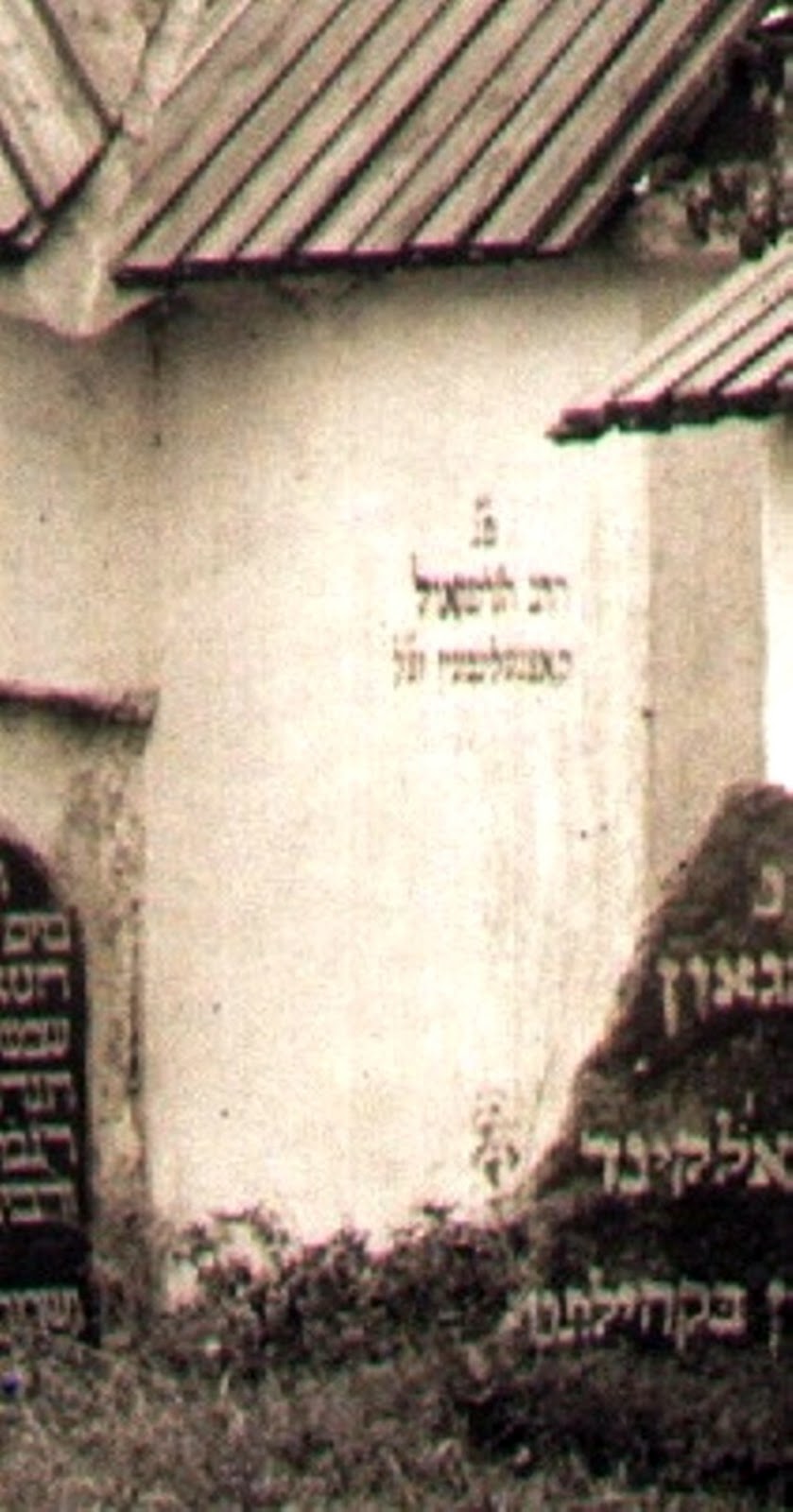
The inscription that can be seen on the photograph reads:


This is simply an informational sign (almost certainly of early 20th century origin) that indicates to the visitor that R. Shaul was buried in this mausoleum. In fact, he was buried between R. Menahem Manes Chajes (d. 1636) and R. Moshe Rivkes (d. 1672), author of באר הגולה, and ancestor of the Vilna Gaon. His tombstone inscription, not visible in the photograph, reads:[20]
3.     R. Moshe, Dayyan of Vilna (ca. 1670-1740).
Little is known about R. Moshe, other than – as indicated on his epitaph – he served with distinction as a dayyan in Vilna.[21] Some of his Torah teachings are preserved in his son R. David’s, מצודת דוד (Altona, 1736).[22] R. Moshe was popularly known as “R. Moshe Charaz,” חר”ז being an abbreviation for חתן ר’ זאלקינד “son-in-law of R. Zalkind.” R. Zalkind should probably be identified with R. Shlomo Zalkind b. Barukh, who lived in the second half of the 17th century, and was a respected lay leader of Vilna’s Jewish community.[23] R. Moshe’s epitaph stands outside a second mausoleum, with its own entrance, separate from the first mausoleum (where R. Menahem Manes Chajes, R. Shaul Katzenellenbogen, and R. Moshe Rivkes were buried). The epitaph reads:[24]


4. R. Hillel b. Yonah (d. 1706).
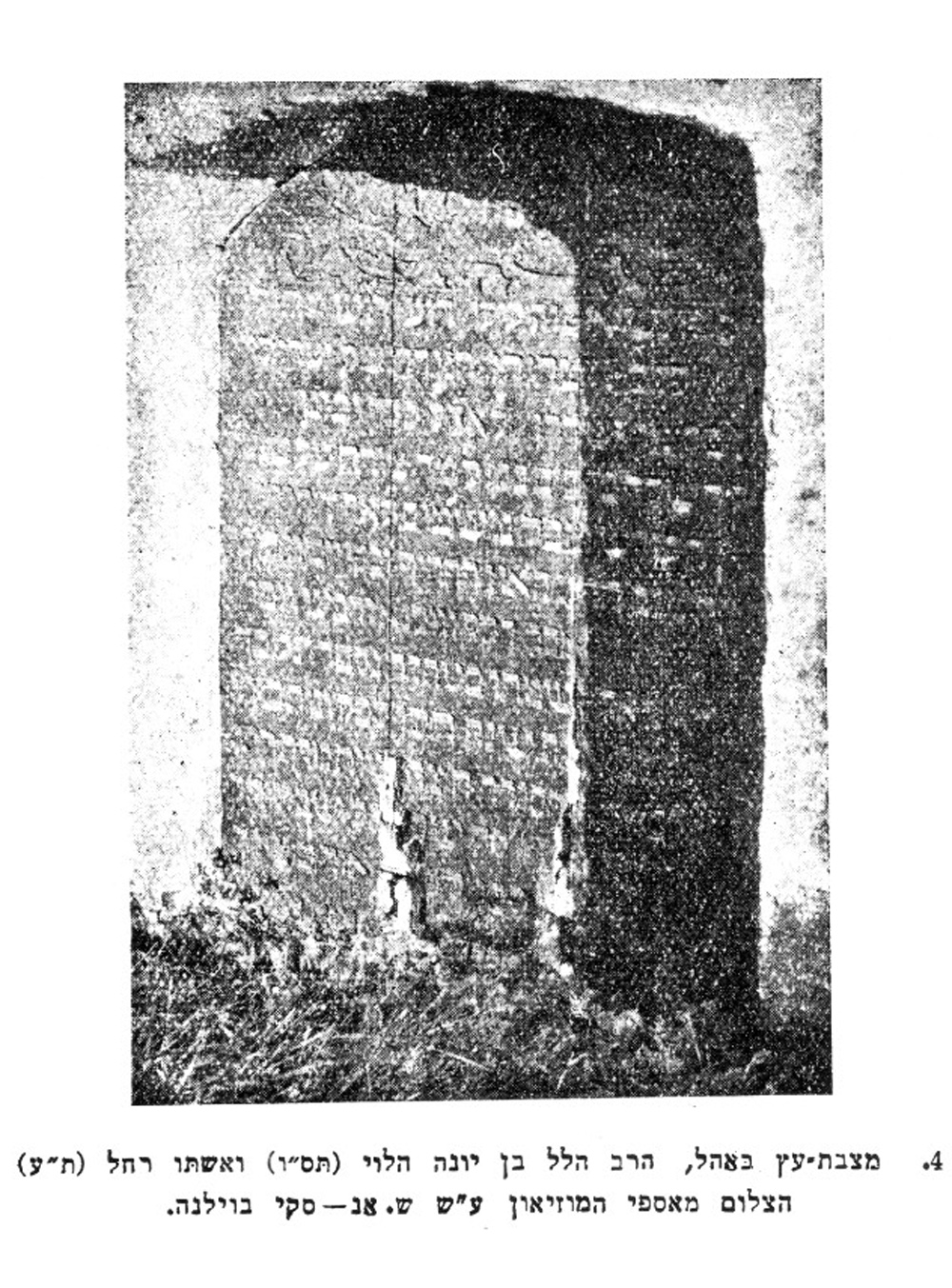
The empty frame in the third mausoleum from the left held a wooden tombstone that existed into the 20th century.[25] Before it was removed for repair, it was photographed in situ, and the photograph was preserved at the Ansky Museum in Vilna. The photograph was published just prior to the onset of World War II.[26] The epitaph on the tombstone commemorates the life and death of R. Hillel b. Yonah, Chief Rabbi of Vilna, and his wife Rachel (d. 1710). They were the only occupants of the third mausoleum. R. Hillel served as Chief Rabbi of Chelm prior to his appointment as Chief Rabbi of Vilna in 1688. Some of his Torah teachings are preserved in R. David b. R. Moshe’s מצודת דוד (Altona, 1736).[27] The joint epitaph reads:[28]
5. R. Moshe Darshan (d. 1726).
R. Moshe Darshan was born in Vilna in 1641. His father, R. Hillel b. Naftali Hertz, was the celebrated author of בית הלל (on Shulhan Arukh Yoeh De’ah and Even ha-Ezer), who served on the rabbinic court of R. Moshe b. Yitzchok Yehuda Lima of Vilna (author of  חלקת מחוקק on Shulhan Arukh Even ha-Ezer) from 1651-1666, and later served as Chief Rabbi of Altona-Hamburg, and then Zolkiev.[29] R. Moshe was appointed ראש בית דין and דרשן of Vilna and served in that capacity until his death. His epitaph reads:[30]
6. R. Yaakov Kahana (d. 1826).[31]
R. Yaakov b. R. Avraham Kahana, a disciple of the Vilna Gaon, was the son-in-law of R. Yissakhar Ber (d. 1807), a brother of the Vilna Gaon.  Supported regally by his father-in-law, R. Yaakov suddenly found himself without support upon the death of his father-in-law. The Vilna kehilla immediately appointed him trustee of its various charities, in order to provide him with a dignified income, while enabling him to continue his pursuit of Torah study. R. Yaakov authored a classic commentary on B. Eruvin, גאון יעקב (Lemberg, 1863 and later editions).[32] His epitaph reads:[33]
7. R. Eliyahu Hasid (d. 1710).
R. Eliyahu was the son of R. Moshe b. David Kramer, who served as Chief Rabbi of Vilna from 1673 to 1687.[34] R. Eliyahu served as an administrator of Vilna’s צדקה גדולה and also as a dayyan. He was a great-grandfather of the Vilna Gaon, and the Gaon was named after him.[35] The epitaph reads:[36]
8. R. Yosef b. Elyah (d. 1718).
A communal leader (ראש, אלוף, מנהיג) in Vilna about whom little else is known.[37] That he was buried in proximity to R. Eliyahu Hasid (d. 1710), and that at a later date R. Moshe Darshan (d. 1726) was buried in proximity to him, is sufficient proof of his prominence, perhaps in wisdom and certainly in wealth. His epitaph reads:[38]
————————-
B. A Visit to the Old Jewish Cemetery in 1940.
            Known affectionately as “Reb Dovid,” Rabbi Meshulam Dovid Soloveitchik is currently Rosh Yeshiva of the Brisk Yeshiva in the Givat Moshe (also called: Gush Shemonim) section of Jerusalem. A descendant of R. Hayyim of Volozhin (d. 1821), and a scion of the Soloveitchik dynasty – his grandfather was R. Hayyim Soloveitchik (d. 1918), Rosh Yeshiva of Volozhin and Chief Rabbi of Brisk; and his father was R. Yitzchok Zev Soloveitchik (d. 1959), last Chief Rabbi of Brisk, and founder of the Brisk dynasty in Jerusalem) – he is a leader of the Haredi community in Israel.
A still active nonagenarian, he was born circa 1923. Upon the outbreak of World War II, he fled from Brisk and made his way to Vilna, which – largely due to the Molotov-Ribbentrop Pact of August 23, 1939, and Stalin’s subsequent decision to hand Vilna over to  Lithuania – became the newly recognized capital of Independent Lithuania. Reb Dovid, a teenager at the time, resided in Vilna from October 22, 1939 through January 19, 1941, when together with his father (and other members of the family), he embarked on the arduous and dangerous journey that would bring him to the land of Israel, where the family ultimately settled.[39]
            Some 15 volumes of Reb Dovid’s teachings have appeared in print, many under the title: שיעורי רבנו משולם דוד הלוי. These are transcriptions of his lectures as recorded by his students, with focus primarily on Torah and Talmud commentary. One of the volumes, however, includes a riveting account – in R. Dovid’s own words – of how he managed to survive the Holocaust. The memoir includes a brief description of a visit he made to the old Jewish cemetery in Vilna in 1940.[40] The passage reads:[41]

“When in Vilna, I went several times to visit the cemetery where the Vilna Gaon was buried, but it was closed. The gate was kept locked because burials no longer took place in the old Jewish cemetery, which was inside the city limits. Burials now took place in another cemetery [Zaretcha] which was outside the city limits.[42] Moreover, the caretaker who had the keys [to the old Jewish cemetery] lived far from the cemetery. Once, however, I came to the cemetery and found the gate open and went in to visit the Vilna Gaon’s grave. On my way to the grave, I passed an ancient tombstone with the words משיח ה’ inscribed on its epitaph.[43] I could not understand what this signified and who was buried there.[44] From there I reached the Vilna Gaon’s grave, and nearby, the grave of R. Avraham the Ger Tzedek. (At some later date, I chanced upon a pamphlet which contained a eulogy by R. Shaul Katzenellenbogen,[45] of blessed memory, over the author of Ha-Pardes.[46] In this pamphlet about the author of Ha- Pardes, it is stated that when he died a search was made in the old Jewish cemetery for a place where he could be buried. One empty plot was found, to the right of which was buried [R. Moshe Rivkes] the author of Be’er Ha-Golah, and to the left of which was buried R. Manes משיח ה’. Since no one had been buried in the empty plot next to these rabbis for some 85 years,[47] a rabbinic court was convened to decide whether the plot could be used now for the author of Ha-Pardes. The decision was that he should be buried between the two rabbis. They explained that it was a special privilege for the author of Ha-Pardes to be buried next to these righteous persons, and went on to describe the righteousness and piety of R. Manes משיח ה’. It seems likely that this was the tombstone I saw with the words משיח ה’ on its epitaph.”

This delightful account offers important testimony regarding what a living witness observed during a visit to the old Jewish cemetery in Vilna in 1940. On his way to the Vilna Gaon’s grave, R. Dovid saw a tombstone with the words משיח ה’ inscribed on its epitaph. The reference, of course, is to the grave of R. Menahem Manes Chajes (see above, epitaph 1). It is indeed nearby to the Gaon’s mausoleum, and one could easily stop to see it on the way to the Gaon’s grave. The alert reader will surely wonder why in the photograph taken in the inter-war period, which includes the epitaph of R. Menahem Manes Chajes, one cannot make out the words משיח ה’, whereas R. Dovid testifies that in 1940 it was precisely those words that caught his attention. The answer, I believe, is provided by another photograph of R. Menachem Manes Chajes’ epitaph taken in the summer of 1936.[48]
It too, at first glance, seems to have the words משיח ה’ erased. But if one examines the photograph closely, one can make out the words משיח ה’. The white paint that once covered these etched letters has been chipped off. The inter-war photograph, a “group” photograph taken from a distance, could not capture the etched letters that now appeared as black on black. The naked eye of a human being, however, could pick up the etched stone letters that read משיח ה’. So too, a close up photograph of the Chajes epitaph alone, taken in 1936.
R. Dovid adds that, subsequently, he chanced upon a pamphlet that helped him identify the epitaph he had seen. The pamphlet contained a eulogy by R. Shaul Katzenellenbogen over the author of Ha-Pardes, who apparently died in Vilna. Initially, an appropriate burial place could not be found for him in the old Jewish cemetery. But after much search, an empty plot was found between R. Manes משיח ה’ and [R. Moshe Rivkes,] the author of Be’er Ha-Golah. Since no one had been buried in proximity to these rabbis for some 85 years, a rabbinical court had to convene in order to decide the issue. The ruling was in favor of the burial, and special mention was made of the piety of R. Manes משיח ה’, which clearly identified the epitaph that R. Dovid had seen.
            Sadly, I have not succeeded in locating such a pamphlet. If indeed R. Dovid saw such a pamphlet, he cannot be faulted for summarizing its content. It certainly enabled him to identify the epitaph as belonging to the tombstone of R. Menahem Manes Chajes. But problems abound. R. Shaul Katzenellenbogen (see above, epitaph 2) died in 1825. He wrote no pamphlets and published no eulogies. The author of Ha-Pardes was R. Aryeh Leib Epstein, chief Rabbi of Koenigsberg (today: Kaliningrad).[49] He died in 1775 and was buried in Koenigsberg.[50] Thus, R. Shaul Katzenellenbogen, five years old at the time, could not have published a eulogy over him. In fact, it was R. Shaul Katzenellenbogen (as described above in epitaph 2) – and not the author of Ha-Pardes – who was buried between R. Menahem Manes Chajes and R. Moshe Rivkes.
            One suspects that the pamphlet R. Dovid chanced upon was R. Zvi Hirsch Katzenellenbogen’s גבעת שאול (Vilna and Grodno, 1825).
The author, a devoted disciple of R. Shaul,[51] published a eulogy upon the death of his teacher. He writes:[52]

“On the day of his [R. Shaul Katzenellenbogen’s] burial, an oracle was heard – a voice without pause[53]  – that an empty plot had been found between R. Moshe Rivkes, author of Be’er Ha-Golah and the Gaon R. Manes Chajes (who was depicted on his tombstone as משיח ה’, already so in the early generations, in the year [5]386 [= 1626],[54] even aside from the seven virtues listed by the Sages that characterize all great individuals[55]). In that section of the cemetery, the gravediggers did not dare to dig a grave during the last 85 years, for they feared for their lives. For that section of the cemetery was filled with holy and pious Jews.[56] But due to an agreement of the Moreh Zedek’s of our community, they began digging and found an empty plot waiting for this righteous Rabbi’s remains since the week of Creation.

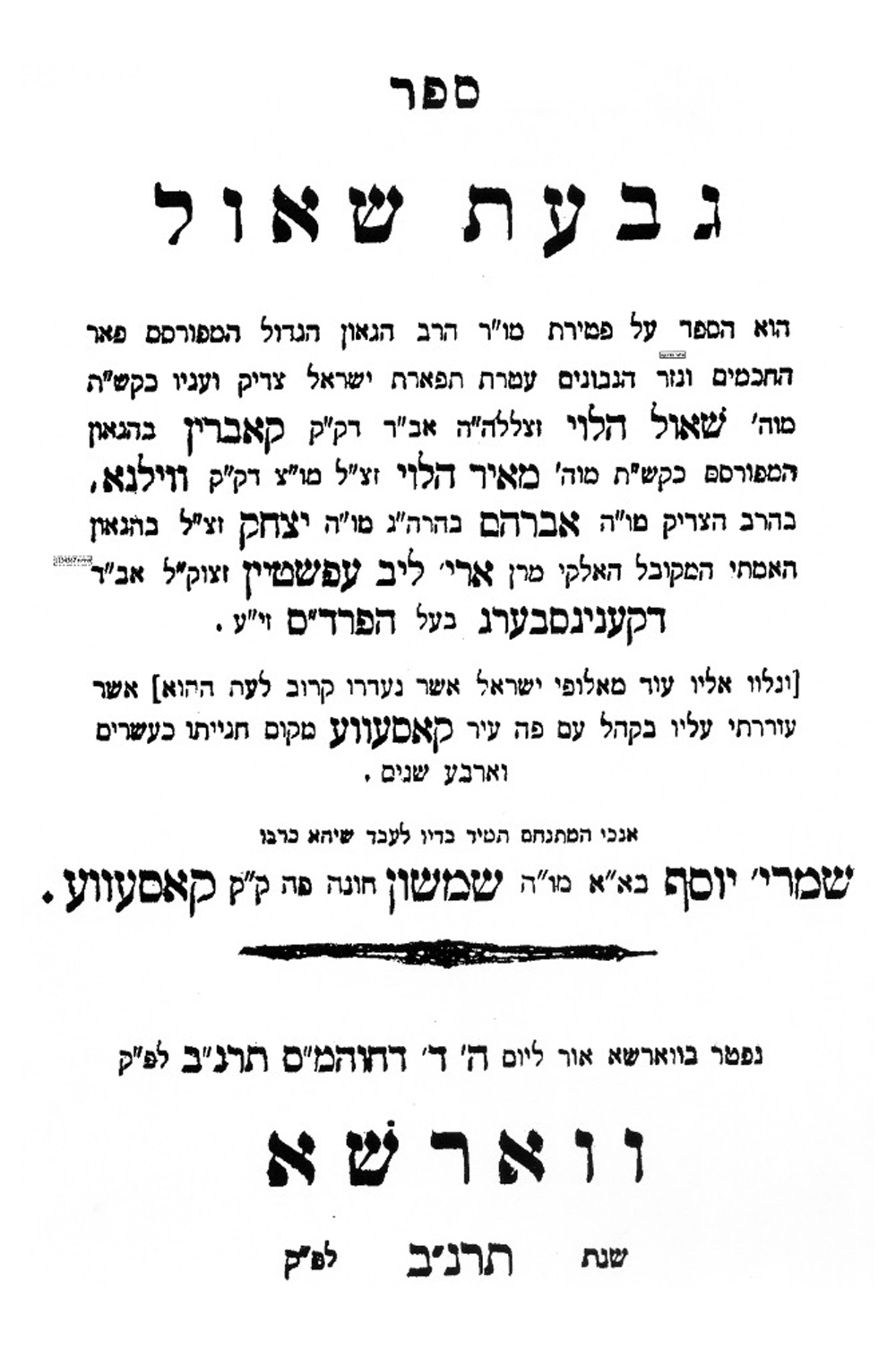
            Here – and apparently in no other pamphlet – we have all the basic elements in R. Dovid’s account, with one glaring exception. Nothing is mentioned about the author of Ha-Pardes, R. Aryeh Leib Epstein. As indicated above, the author of Ha-Pardes in any event had nothing to do with a burial in Vilna. He lived at the wrong time (when empty plots were still available throughout the old Jewish cemetery) and died and was buried in the wrong place (in Koenigsberg). It is possible that we have in R. Dovid’s account a conflation of two unrelated pamphlets, each named גבעת שאול. Aside from R. Zvi Hirsch Katzenellenbogen’s גבעת שאול (cited above), a pamphlet with the exact same title, and also offering a eulogy, was authored by R. Shemariah Yosef Karelitz (d. 1917).[57]
The pamphlet, גבעת שאול (Warsaw, 1892), was a eulogy over Karelitz’ father-in-law, whose name also happened to be R. Shaul Katzenellenbogen (1828-1892), and who had served with distinction as rabbi of Kossovo and then Kobrin (both today in Belarus). This second R. Shaul Katzenellenbogen was a descendant of R. Aryeh Leib Epstein, author of Ha-Pardes. Indeed, on the first title page of Karelitz’ גבעת שאול, R. Shaul Katzenellenbogen is described in bold letters as a member of the Epstein family. On the second title page, he is described in bold letters as a descendant of “R. Aryeh Leib Epstein, author of Ha-Pardes.”
[
            In sum, R. Dovid’s account provides impeccable testimony that the epitaph on the tombstone of R. Menahem Manes Chajes – the oldest tombstone preserved in the old Jewish cemetery – could still be visited and read in 1940.[58] What he claims to have read in a pamphlet at some later date remains problematic and requires further investigation or, as the later commentators would have put it, צריך עיון.
In memory of Khaykl Lunski (ca. 1881-1943), fabled librarian of the Strashun Library, who was the embodiment of the very soul of Jewish Vilna. His last essay – a study of the faded tombstone inscriptions in Vilna’s old Jewish cemetery – was written in the Vilna Jewish ghetto created by the Nazis. It perished together with him during the Holocaust. See Shmerke Kaczerginski, חורבן ווילנע (New York, 1947), p. 198 (henceforth: Kaczerginski). Cf. Hirsz Abramowicz, Profiles of a Lost World (Detroit, 1999), p. 264. Kaczerginski’s description of Lunski’s last years in the Vilna ghetto are worth citing here:
Khaykl Lunski (ca. 1881-1943)
NOTES:

[1] Sid Z. Leiman, “Lithuanian Government Announces Construction of a $25,000,000 Convention Center in the Center of Vilna’s Oldest Jewish Cemetery,” The Seforim Blog, September 13, 2015, available online here, reprinted here. A similar photograph (from a slightly different angle) appears in Leyzer Ran, Jerusalem of Lithuania (New York, 1974), vol. 1, p. 100 (henceforth: Ran). Alas, its lack of clarity renders it mostly useless.
[2] See Israel Klausner, קורות בית-העלמין הישן בוילנה (Vilna, 1935; reissued: Jerusalem, 1972), pp. 3-5 (henceforth: Klausner). Cf. Elmantas Meilus, “The History of the Old Jewish Cemetery at Šnipiškes in the Period of the Grand Duchy of Lithuania,” Lithuanian Historical Studies 12 (2007), pp. 64-67 (henceforth: Meilus).
[3] It was originally called “Pioromont,” because the old Jewish cemetery was adjacent to a street and neighborhood named after Stanislav Pior, an 18th century starosta who owned land in the area (Meilus, p. 88).
[4] See, e.g., the testimony of Chaim Basok, who together with Rabbi Kalman Farber visited the Vilna Gaon’s grave in the old Jewish cemetery at Piramont after Vilna was liberated by the Russian army in 1944. See Kalman Farber, אולקניקי ראדין וילנא (Jerusalem, 2007), p. 413. I have personally interviewed several former residents of Vilna who visited the Gaon’s grave in the old Jewish cemetery at Piramont between 1945 and 1948.
[5] A detailed map of the cemetery, as it appeared in 1935, is appended to Klausner.
[6] For an artist’s depiction of the gate at the northern entrance to the cemetery, see Sholom Zelmanovitch, דער גר-צדק ווילנער גראף פאטאצקי (Kovno, 1934), opposite p. 44. Notice Castle Hill at the upper right hand corner of the sketch; the inscription above the gate, והקיצו לקץ הימין; and the inscriptions on the sides of the gate, בית עולם ווילנא and zydu kapines. Here is the sketch:
[7] See, e.g., Shmuel Yosef Fuenn, קריה נאמנה (Vilna, 1860), p. 63 (henceforth: Fuenn 1860). Cf. the second and revised edition of קריה נאמנה (Vilna, 1915), p. 67 (henceforth: Fuenn 1915).
[8] Yeshayahu Vinograd, אוצר ספר העברי (Jerusalem, 1994), vol. 2, p. 359, entry 65.
[9] See Moshe Dovid Chechik, “ מהר”ר מנחם מאניש חיות וספר קבלת שבת,” ישורון 17(2006), pp. 668-691.
[10] Adolf Neubauer, Catalogue of the Hebrew Manuscripts in the Bodleian Library and in the College Libraries of Oxford (Oxford, 1886), column 59, entry 293.
[11] We have attempted to transcribe the Hebrew texts exactly as they appear in the photograph. We add in brackets the reconstruction of letters and words that in all likelihood once appeared in the original texts, but were no longer visible when the photograph was taken. For other photographs of the epitaph, see Klausner, p. 36; Zalman Szyk,   יאר ווילנע 1000 (Vilna, 1939), pp. 408 and 416 (henceforth: Szyk); Ran,  vol. 1, p. 101 ; and Reuben Selevan, A Trip to Remember: New York to Europe 1936 (New York, 2009), p. 113. The reconstructions are based mostly on the earlier transcriptions of the epitaphs in Fuenn and Klausner.
Over the years, some of the epitaphs were redone, and the reconstructed texts are often faulty. Enlarged and/or dotted letters (signaling acrostics, names, or dates) were sometimes made small and the dots were omitted. Small letters were sometimes enlarged. Letters and words were added or dropped when a partially erased word could no longer be read. Thus, for example, the first three words of R. Menahem Manes Chajes’ epitaph (in the photograph) read: פה נטמן בו, an impossible construction in Hebrew. It is obvious that one or more words are missing from the opening line of the epitaph. It is also evident the first lines form an acrostic spelling out his name: מנחם מאנש. When the epitaphs were redone, the original line divisions were not always retained. For the letters in bold relating to the year of his death (קדרו ושמים), see below, note 54.  Based upon the earlier transcriptions in Fuenn (Fuenn 1860, p. 63; Fuenn 1915, p. 67) and Klausner (pp. 36-39), and a measure of common sense, the original epitaph probably read:
[12] R. Shaul was also the brother of his father’s successor in the rabbinate of Brisk, R. Aryeh Leib (d. 1837). See Aryeh Leib Feinstein,
עיר תהלה (Warsaw, 1886), p. 30.
[13] Abraham Dov Baer ha-Kohen Lebensohn, אבל כבד (Vilna, 1825), section “תולדות הנאון,” p. 2.
[14] See ספרא דצניעותא (Vilna and Grodno,1820), page following title page.  
[15] See R. Yehezkel Feivel, תולדות אדם (Dyhernfurth, 1809), vol. 2, page following title page.
[16] See R. Hayyim of Volozhin, נפש החיים (Vilna and Grodno, 1824), page following title page.
[17] Samuel Luria, “תולדות הרד”ל,” in R. David Luria, קדמות ספר הזהר (New York, 1951), pp. 12-14.
[18] See Hillel Noah Maggid Steinschneider, עיר ווילנא (Vilna, 1900), vol. 1, p. 163.
[19] See Aliza Cohen-Mushlin, Sergey Kravtsov, Vladimir Levin, Giedrė Mickūnaitė, and Jurgita Šiaučiūnaitė-Verbickienė, Synagogues in Lithuania (Vilnius, 2012), vol. 2, p. 316, item 55. Cf. Ran, vol. 1, p. 112. (The alleged photograph of R. Shaulke’s kloyz in Ran is misidentified; cf. Synagogues in Lithuania, vol. 2, p. 348, n. 248.) The address of the kloyz was Szawelska (later: Žmudskij) [Yiddish: Shavli] 5 (today: Šiauliu 2). The original building no longer stands. During the Holocaust, the kloyz continued to serve as a prayer house and it housed a Yeshiva named in memory of R. Hayyim Ozer Grodzenski (d. 1940). See Kaczerginski, p. 209; cf. Zelig Kalmanovitch, יומן בגיטו וילנה (Tel-Aviv, 1977), pp. 83 and 100 (English edition: Zelig Kalmanovitch “A Diary of the Nazi Ghetto in Vilna,” Yivo Annual of Jewish Social Science 8[1953], pp. 30 and 47).
[20] Fuenn 1860, pp. 236-238; Fuenn 1915, pp. 237-239; Klausner, p. 75.
[21] See Fuenn 1860, p. 100; Fuenn 1915, p. 107; and cf. Klausner, pp. 43-44.
[22] See, e.g. מצודת דוד, pp. 3a, 7a, and 31a.
[23] Fuenn 1860, p. 107, paragraph 50, number 11; Fuenn 1915, p. 113, paragraph 51, number 11.
[24] The text of the epitaph was not recorded either by Fuenn or Klausner. However, it is easily restored by combining the general information they provide with the legible portions of the text in the photograph.
[25] There is good reason to believe that wooden tombstones once proliferated in the old Jewish cemetery, but they did not survive the ravages of time and circumstance. See, e.g., Klausner, p. 38 (who indicates that as late as 1810 the fee exacted by the חברא קדישא for stone tombstones was twice the amount exacted for wooden tombstones) and Szyk, p. 406 (who states that the majority of tombstones in the old Jewish cemetery were made of wood but did not survive). Only two wooden tombstones (in the old Jewish cemetery) survived into the twentieth century; those of R. Hillel b. Yonah and R. Yehoshua Heschel b. Saul, who served as Chief Rabbi of Vilna from circa 1725 until his death in 1749. For photographs of R. Yehoshua Heschel’s wooden tombstone, see Klausner, p. 52; Szyk, p. 416; and Ran, vol. 1, p. 101.
[26] Klausner, p. 42. Cf. Szyk, p. 416 and Ran, vol. 1, p. 100 (mostly illegible).
[27] See, e.g., מצודת דוד, p. 27a.
[28] Fuenn 1860, pp. 97-98; Fuenn 1915, pp. 104-105.
[29] See Eduard Duckesz, אוה למושב (Krakau, 1903), pp. 4-7.
[30] Fuenn 1860, pp. 99-100; Fuenn 1915, pp. 106-107; Klausner, p. 43.
[31]  Moving from left to right on the photograph, R. Yaakov Kahana’s tombstone (tombstone 6) appears to the right of R. Moshe Darshan’s tombstone (tombstone 5). But as one walks uphill from the bottom to the top of the cemetery, one passes the three mausoleums, then the twin gravestones of R. Yaakov Kahana and R. Eliyahu Hasid (tombstone 7), and only then the grave of R. Moshe Darshan.
[32] For biographical information about R. Yaakov Kahana, see Fuenn 1860, p. 239; Fuenn 1915, pp. 239-240; and the third edition of Kahana’s גאון יעקב, entitled גאון יעקב השלם (Jerusalem, 1997), introductory pages. See also Yaakov Polskin, “ספר צוף דבש,” ישורון 4(1998), p. 270, notes 7-9.
[33] Here too, the photograph presents an empty frame. Only the opening lines (i.e. the marker identifying the grave) can still be read. The original epitaph is recorded in Fuenn 1860, p 240; Fuenn 1915, pp. 240-241. Klausner (p. 53) mentions Kahana’s grave but does not record the epitaph.
[34] For biographical information about R. Moshe Kramer, see Fuenn 1860, pp. 95-96; Fuenn 1915, pp. 102-103, and the references cited in the next note.
[35] See R. Avraham b. R. Eliyahu (the Gaon’s son), סערת אליהו (Vilna, 1889), p. 18. Cf. R. Yehoshua Heschel Levin, עליות אליהו (Vilna, 1885), p. 39, note 5.
[36] The opening lines (i.e. the marker identifying the grave) are painted on the upper portion of the tombstone. The epitaph is encased below the tombstone’s upper portion. For the epitaph, see Fuenn 1860, p. 99; Fuenn  1915, pp. 105-106; and Szyk, p. 408.
[37] See Fuenn 1860, p. 107; Fuenn 1915, p. 113.
[38] Here too the opening lines represent the marker identifying the grave, almost certainly added at a later date. For the epitaph, see Klausner, p. 43.      
[39] See  שיעורי רבנו משולם דוד הלוי: דרוש ואגדה (Jerusalem, 2014), pp. 390-396. For the date when R. Dovid left Vilna (January 19, 1941), we have followed Shimon Yosef Meller, הרב מבריסק (Jerusalem, 2003), vol. 1, p. 513.
[40] No precise date is provided by R. Dovid for his visit to the old Jewish cemetery. But since he arrived in Vilna on October 22, 1939, and his first attempts to visit the cemetery were thwarted, we assume the visit took place in 1940, the only full year he spent in Vilna. It is possible, however, that the visit took place late in 1939 or early in 1941.
[41] שיעורי רבנו משולם דוד הלוי: דרוש ואגדה (Jerusalem, 2014), pp. 393-394. The translation provided here is paraphrastic. The original Hebrew text reads:
[42] In 1940, Jewish burials were still taking place in Zaretcha, the successor cemetery to the old Jewish cemetery, which was closed in 1831. Zaretcha (today: Užupis), just outside the Old Town, and across the Vilenka River, was part of the Vilna municipality in 1940.
[43] In the latter part of the 19th century and the first half of the 20th century, the northern gate was no longer used. One entered the old Jewish cemetery from a side entrance on Derewnicka Street. The path from the entrance would lead one to the section where R. Menahem Manes Chajes was buried (on the right) and to the mausoleum where the Vilna Gaon was buried (on the left).
[44] The biblical title משיח ה’ (see, e.g., I Sam. 24:7 and Lam. 4:20), rendered “the Lord’s anointed one,” was usually reserved for kings and would-be messiahs (by their followers), not rabbis. R. Dovid could not identify the occupant of the grave, perhaps because the line with the name מהור”ר מנחם מאנש simply didn’t resonate to a 17 year old yeshiva student. One could claim that the line with R. Menahem Manes’ name was no longer legible in 1940 (as it was not legible in the inter-war photograph that forms the basis of this essay), but this seems highly unlikely in the light of the Selevan photograph taken in 1936. See below, note 48. The Selevan photograph is a close-up photo, and R. Dovid was standing directly in front of the same tombstone. He had no trouble reading poorly painted words.
[45] See discussion below.
[46] See discussion below.
[47] R. Menahem Manes Chajes died in 1636; R. Moshe Rivkes died in 1672. Eighty five years after these dates would be between 1721 and 1757. Since, as we shall see, the author of Ha-Pardes died in 1775, “85 years” cannot be referring to the time that elapsed between their deaths and his. “100 years” and more would have been a more accurate estimate. See below, note 56, for a likely explanation of the “85 years.”
[48] Reuben Selevan, A Trip to Remember: New York to Europe 1936 (New York, 2009), p. 113. I am deeply grateful to the author for granting me permission to scan and post the photograph (taken by his father in 1936) of R. Menahem Manes Chajes’ epitaph.
[49] For a biography of R. Aryeh Leib Epstein, see R. Ephraim Mordechai Epstein, גבורות ארי (Vilna, 1870). Ha-Pardes, only partially published, was an encyclopedic work encompassing many different genres of rabbinic literature. It includes talmudic commentary, listing and exposition of the 613 commandments, responsa literature, halakhic codes, kabbalistic teaching, sermons, eulogies, and more. The first fascicle with the title ספר הפרדס was published in Koenigsberg, 1759. It is a available today in several editions, including: ספרי בעל הפרדס (Bnei Brak, 1978), 2 vols.; and ספרי הפרדס (Jerusalem, 1983), 4 vols. See also מעשה רב חדש (Bnei Brak, 1980), pp. 29-80.
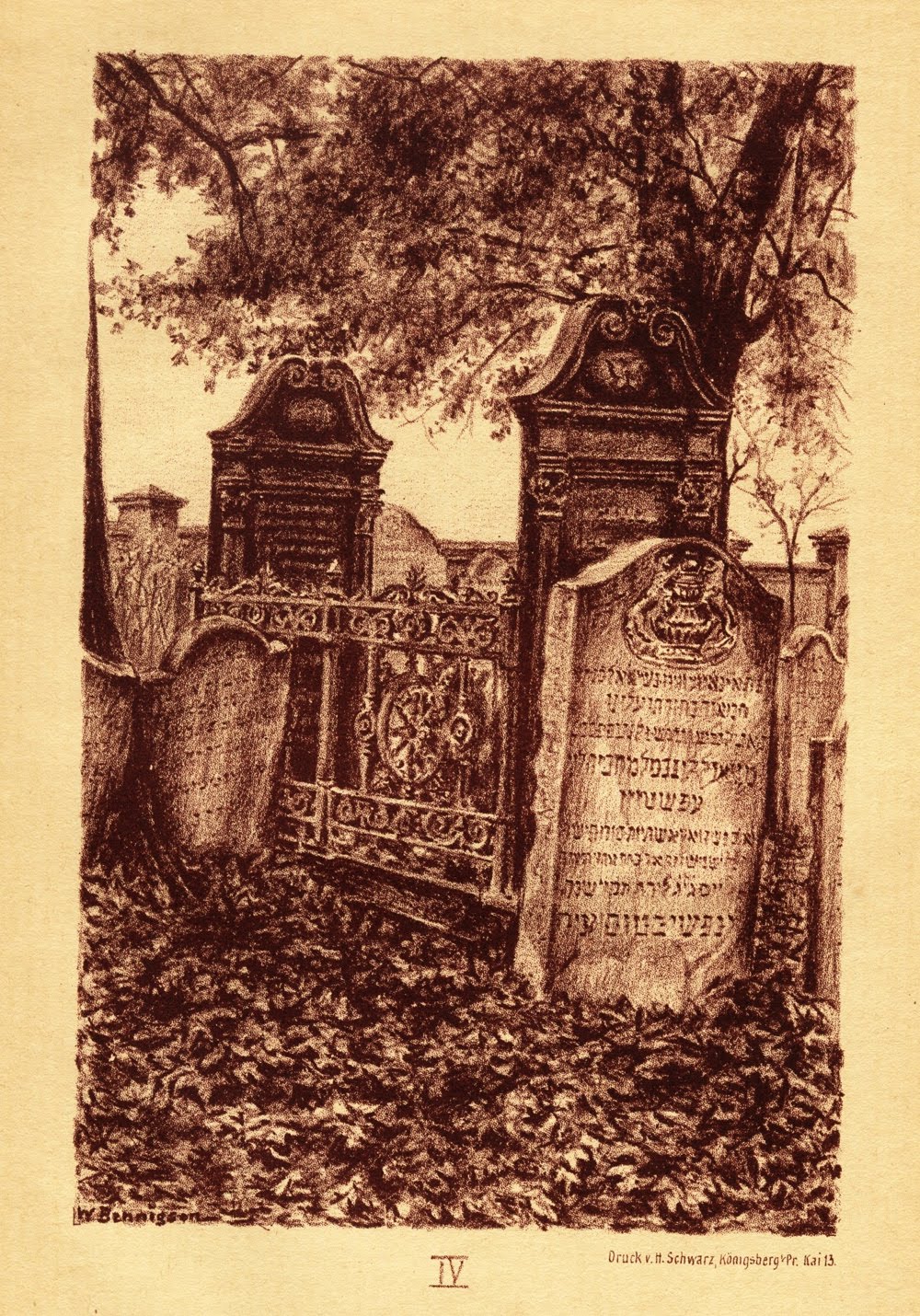
[50] His grave is no longer standing. A sketch of his grave, as it looked in 1904, appears in Festschrift zum 200jahrigen Bestehen des israelitischen Vereins für Krankenpflege und Beerdigung Chewra Kaddischa (Koenigsberg, 1904), sketch IV. The full Hebrew epitaph is printed opposite p. XX.

[51] See the entry on him in Encyclopaedia Judaica (Jerusalem, 1973), vol. 10, column 830.
[52] גבעת שאול, p. 23a. The translation here is paraphrastic. The Hebrew text reads:
[53] See Deut. 5:19 and Rashi’s comment ad loc.
[54] The year of R. Menahem Manes Chajes’ death was recorded on his epitaph with the words: קדרו ושמים. Several of these letters had  protruding dots above them; the numerical value of the dotted letters yields the year of his death. At a very early period, some of the dots could no longer be read. Fuenn (1860, p. 63; 1915, p. 67) writes that he was able to make out dots above the letters ר, ו , and מ. But those letters alone could not possibly refer to his date of death. This passage indicates that in 1825, at least, the dotted letters also includedק   and final ם, totaling [5]386 = 1626. On other grounds, we know that Chajes died in [5]396 = 1636, so it appears likely that the dotted letters also once included the י of ושמים. If not for Fuenn’s testimony, we would claim that the second word by itself, ושמים ( = [5]396) yields the year of Chajes’s death. Cf. Moshe Dovid Chechik (above, note 9), p. 675.
[55] See M. Avot 5:7.
[56] Given that this passage was written in 1825, “85 years” here refers to the period between 1740 and 1825. As the passage itself makes clear, the reference is to the many rabbinic greats who were buried in this section of the cemetery by 1740 – and not later. See above, epitaphs 1,3,4,5,7, and 8, all of which are samples that support the claim that after 1740 no rabbinic greats were buried in this section of the cemetery. Epitaphs 2 and 6 are in harmony with this claim. Epitaph 2 is the epitaph of R. Shaul Katzenellenbogen, the case at hand. Epitaph 6 (R. Yaakov Kahana) is dated 1826, a year after the case at hand and the publication of the passage in R. Zvi Hirsch Katzenellenbogen’s גבעת שאול.
[57] The father of R. Avraham Yeshaya Karelitz (d. 1953), author of חזון איש.
[58] I am deeply grateful to Professor Dovid Katz of Vilnius, mentor and colleague, whose astute comments have enhanced the final version of this essay.


“Ha’Rotzeh Lichanek, Hitaleh B’Ilan Gadol”: Notes on some Literary forgeries of Jewish works in the the Late Modern Period (1756-1965)

Ha’Rotzeh Lichanek, Hitaleh B’Ilan Gadol”: Notes on some Literary forgeries of Jewish works in the the Late Modern Period (1756-1965)

By Ezra Brand

Ezra Brand is an independent researcher based in Tel Aviv. He has an MA from Revel Graduate School at Yeshiva University in Medieval Jewish History, where he focused his research on 13th and 14th century sefirotic Kabbalah. He is interested in using digital and computational tools in historical research. He has contributed a number of times previously to the Seforim Blog (tag), and a selection of his research can be found at his Academia.edu profile. He can be reached at ezrabrand-at-gmail.com; any and all feedback is greatly appreciated.

Introduction

Jewish literary forgeries are a topic often discussed on the Seforim Blog, especially in the postings of Dr. Marc Shapiro (see the tag “Literary Forgery” for some of the relevant posts).[1] A “literary forgery” refers to a writing which claims to have been written by a certain, usually respected, figure, while in fact written by a later, usually much lesser known, writer.

A recent collection of articles on forgeries states: “There has been a growth in the number of publications dedicated to fakes and forgeries for around thirty years now, many of which have focused on books and literary works.”[2]

The classic source regarding literary forgeries in Jewish writing is that of the Talmud Bavli, Pesachim 112a:

חמשה דברים צוה ר”ע את רבי שמעון בן יוחי כשהיה חבוש בבית האסורין […] אמר לו אם בקשת ליחנק היתלה באילן גדול.

Translation by Koren-Steinzaltz, as appears in Sefaria website (bold in the original translation):

Rabbi Akiva commanded Rabbi Shimon ben Yoḥai to do five matters when Rabbi Akiva was imprisoned […] if you wish to strangle yourself, hang yourself on a tall tree.

Koren-Steinzaltz translation adds the explanation:

“This proverb means that if one wants others to accept what he has to say, he should attribute his statement to a great man.”

This interpretation is based on Rashi’s explanation:

אם בקשת ליחנק – לומר דבר שיהיה נשמע לבריות ויקבלו ממך. היתלה באילן גדול – אמור בשם אדם גדול.”

According to Rashi’s interpretation, this source permits fabricating a quote from an authority in order to be believed.[3] 

Based on this interpretation, the term often used in rabbinic writing for “forging” in someone else’s name is “תלה ב”, literally “hung on X”, meaning “ascribed (falsely) to X”.

The great scholar of Mishpat Ivri, Nahum Rakover, devotes a portion of his book on intellectual property in halacha, to a discussion of the sources that permit fabricating a quote from an authority in order to be believed.[4]

Some recent historians seem to imply that the 19th century saw a relative uptick in Jewish literary forgeries. Golda Akhiezer, in a 2018 article on Jewish historical forgeries in the 19th century, writes:[5]

One of the paradoxes of European cultural life of the nineteenth century, especially in the Russian Empire, was a combination of two parallel yet apparently conflicting processes: the emergence and increasing importance of modern science and the rise of multifarious forgeries of historical documents.”[6]

It should be pointed out that this isn’t truly paradoxical. Anthony Grafton famously noted the deep relationship between critical scholarship and forgeries.[7]

Ira Robinson also implies an uptick in Jewish literary forgeries in the 19th century, and gives a somewhat different theory as to why this time period gave rise to so many forgeries:

By the end of the nineteenth and the beginning of the twentieth centuries, the highly charged ideological atmosphere, as well as an ever-growing demand for Jewish books, engendered a situation in which there was great temptation to manufacture documents.[8]

However, it is remains speculative whether in fact there were a relatively larger number of Jewish literary forgeries in the 19th century. This question awaits a more quantitative study of the topic.[9]

Table of Notable Forgeries

It’s important to note that this list is not to be comprehensive. Rather, it’s a collection of especially notable forgeries, and some notes on them. I hope to update this list at a later date, and of course happy to hear suggestions.

Title Editor Earliest date (terminus post quem) Previous posts and bibliography
Divrei Gad Ha’Chozeh Leopold Immanuel Jacob van Dort 1756 10
Mishle Asaf (haskamot) Isaac Satanov 1783-1791 11
Besamim Rosh Saul Berlin 1793 12
Ramschak Chronicle Marcus Fischer 1828 13
Zekher Tzaddikim Mordecai Sultansky 1841 14
Sefer Avnei Zikaron Abraham Firkovich 1845-1872 15
The Roads of Jerusalem Eliakim Carmoly 1847 16
Sefer Ha’Eshkol R’ Zvi Binyamin Auerbach 1863 17
Baraita de-Ma’aseh Bereshit Lazarus Goldschmidt 1894 18
The Protocols of the Elders of Zion series of articles in Russian newspaper 1903
Goral HaAsiriyot (1904); Seder Hagada Le’Maharal (1905); Nifla’ot Maharal (1909); Refa’el HaMalach (1911); Tiferet Maharal MiShpoli (1912); Hoshen Mishpat (1913); Divrei HaYamim Asher LiShelomo HaMelech (1914); and more R’ Yehudah Yudel Rosenberg 1904-1914 19
Yerushalmi on Kodshim Solomon Judah Friedlander 1907–1909 20
Genizat Kherson 1922 21
Der Prager Golem (1917); Kovetz Michtavim Mekori’im MiHaBesht VeTalmidav (1923); Heichal LeDivrei Chazal (1948); Sefer Dovev Siftei Yeshenim (1959-1965) Chaim Bloch 1917-1965 22
Kol Hator R’ Shlomo Zalman Rivlin 1939 23

Forgers

There are two works whose genre can be described as “halachic”: Saul Berlin’s Besamim Rosh (1793) and R’ Zvi Binyamin Auerbach’s Sefer Ha’Eshkol (1863).

It is quite noticeable that perpetrators of literary forgery of Jewish texts were especially prominent outside of mainstream Orthodox Judaism, and created their forgeries for polemical reasons: Karaites (forgeries of Sultan and Firkovich), Maskilim, and anti-Semites (Protocols of the Elders of Zion).

Forgery of tendentious works relating to history are especially common:[24]

  1. Forged tombstone inscriptions and manuscript colophons (Firkovich)
  2. Forged chronicles (Sultanski ; Ramschak Chronicle)
  3. Forged travelogue (The Roads of Jerusalem of R’ Isaac Hilu)
  4. Forged protocols of meetings (Protocols of Elders of Zion)
  5. Forged letters (Genizat Kherson ; Bloch’s Kovetz Michtavim and more)[25]
  6. Fake stories (Rosenberg ; Bloch)

Bloch and Rosenberg, who create forgeries for popular entertainment purposes, are closer to the end of the date range, and both made prominent forgeries about the golem of the Maharal: Bloch’s The Letter of the Maharal on the Creation of the Golem (1923) and Rosenberg’s Nifla’ot Maharal. For Bloch, the polemical motivation of anti-Zionism played a role in other forgeries.

Isaac Satanow is the most playful, self-aware forger of them all. He even added fake “haskamot” to his Zohar Chibura Tinyana from well-known late 18th-century rabbinic figures (R’ Yosef Teomim and R’ Chaim Halberstam of Sanz), having the haskamot point out the possibility that Satanov himself wrote the works, but giving halachic justification for the permissibility of forgery.[26]

Rakover, in his book Zekhuyot Yotzrim (cited above), was misled by Satanow. In his discussion of permissibility in halacha of false quotation and literary forgery,[27] Rakover quotes the “haskamot” to Satanov’s as showing that forging is halachically permitted. It appears that Rakover wasn’t aware that the haskamot themselves are most likely forged.

Two of the first forgers discussed here, Saul Berlin and Isaac Satanow, had similar ideologies, and. Satanow may have assisted in fabricating Besamim Rosh.[28]

Conclusion

The issue of Jewish literary forgeries has received further prominence recently in the scholarship of R’ Moshe Hillel. R’ Hillel has written a number of works exposing forgeries. His most famous work is on Divrei Gad HaHozeh, a work purporting to be from the times of King David, published from an 18th century manuscript by Professor Meir Bar-Ilan in 2015. R’ Hillel argues that it is in fact an 18th century forgery.[29]

Hillel also wrote a book earlier this year called Hazon Tavrimon devoted to R’ Yakov Moshe Toledano (1880-1960), dealing with various historical documents that Toledano “discovered”, demonstrating that they are fake.[30]

Computer algorithms have also played a role in detecting forgeries, or refuting allegations of forgery, most prominently in the work of Professor Moshe Koppel. Some of this work has been featured in the Seforim Blog.[31] Hopefully, this software will be further refined to shed light on additional works that have been accused of being forged, to supplement the traditional tools used for proving authenticity on the one hand, and uncovering forgeries on the other.

[1] Thanks to Eliezer Brodt for reviewing and providing very helpful comments on this piece. I’d also like to thank my father for looking over a previous version of this blog post.

[2] Cécile Michel, Michael Friedrich (eds.), Fakes and Forgeries of Written Artefacts from Ancient Mesopotamia to Modern China (De Gruyter 2020), p. 1. See further bibliography in footnote there.

[3] However, Rashbam there gives a different explanation of the passage. He interprets that it’s not saying anything about deception. Rather, it’s simply giving advice that if you want people to listen to what you have to say, you should study from a master, so that you can then (correctly) quote him. The term “choke” is used simply because the term “high tree” is used.

For a wide-ranging discussion of sources discussing the interpretation of this passage, see Marc Shapiro, Changing the Immutable, pp. 259-261.

[4] See נחום רקובר, זכות היוצרים במקורות היהודיים, תשנ”א, עמ’ 25-36.

See also Shapiro, Changing the Immutable, and bibliography there.

[5] “Historical Research and Forgeries in the Age of Nationalism: The Case of the Russian Empire Between Jews and Russians”, East European Jewish Affairs 48. 2 (2018): 101 – 102.

For a general article on Jewish forgeries, see Cecil Roth, “Forgeries”, Encyclopedia Judaica, 1st edition (1972), pp. 125-126.

[6] In general, Ahiezer ibid. states on p. 110: “Due to the vastness of the topic, it is impossible to provide an exhaustive treatment of Jewish ahistorical writing and forgeries in this article.”

[7] Grafton, Forgers and Critics: Creativity and Duplicity in Western Scholarship, 2019 (2nd edition).

[8] Robinson, “Literary Forgery and Hasidic Judaism: The Case of Rabbi Yudel Rosenberg”, Judaism, 40 (1991), pp. 61-62.

[9] I’d like to thank Eliezer Brodt for raising this point in private communication.
[10] See Hillel, משה הלל, מגילות קוצין: בין דברי גד החוזהלאגרת רבן יוחנן בן זכאי“, על עמנואל יעקב ואן דורט וחיבוריו הבדויים (תשע”ח).
[11] See משה פלאי, “יצחק סאטאנוב ושאלת הזיוף בספרות“, קרית ספר נד תש”ם, עמ’ 817-824 ; בנימין ש’ המבורגר, “האם ניתן לסמוך על יצחק סאטאנוב?“, המעין, גליון טבת תשס”ט, עמ’ 86-91. here
[12] Previous Seforim Blog posts: 2006 ; Rabinowitz and Brodt 2010 ; Shaprio 2007 ; Brodt 2019 ; Maimon 2020. See bibliographies here נריה גוטל, ‏יחסו של הראיה קוק לספר בשמים ראש” “, JSIJ‏ 5, 2006, הערה 4 ; ר’ אליעזר יהודה בראדט, “ציונים ומילואים למדור נטעי סופרים“, ישורון כד (ניסן תשע”א), עמ’ תכה, והערה 5 (עמ’ תכה-תכז).

To those bibliographies can be added: Talya Fishman, “Forging Jewish Memory: Besamim Rosh and the Invention of Pre-Emancipation Jewish Culture,” in Jewish History and Jewish Memory, ed. by Elisheva Carlebach et. al (1998), pp. 70-88; Emile G. L. Schrijver, “Saul Of Berlin’s “Besamim Rosh” : The Maskilic Appreciation Of Medieval Knowledge”, Sepharad in Ashkenaz, Ed. by Resianne Fontaine et. al (2007), pp. 249-259.
[13]  Meir Lamed, “Fischer”, Encyclopedia Judaica, 2nd edition (2007); Meir Lamed, “Lieben, Salomon Hugo”, Encyclopedia Judaica, 2nd edition (2007); Iveta Cermanová, “The Ramschak Chronicle: New Findings about the Genesis, Reception and Impacts of the Forgery”, Judaica Bohemiae 52/2 (2017), pp. 33-67 ; Ahiezer (2018), p. 111 ; E. Randol Schoenberg, Who was the first Ramschak? | Schoenblog.com (February 5, 2021).
[14] Golda Akhiezer, Encyclopedia Judaica, 2nd ed. (2007), “Sultansky, Mordecai Ben Joseph”; גולדה אחיעזר, “מרדכי סולטנסקיקווים לדמותו וכתיבתו ההיסטורית“, קראי מזרח אירופה בדורות האחרונים: ד’ שפירא, ד’ לסקר (עורכים), מכון בן-צבי, ירושלים 2011, עמ’ 170–196; Akhiezer (2018), p. 105.
[15] See the many articles by Dan Shapira, most recently Michael Nosonovsky, Dan Shapira, and Daria Vasyutinsky-Shapira, “Not by Firkowicz’s Fault: Daniel Chwolson’s Comic Blunders in Research of Hebrew Epigraphy of the Crimea and Caucasus, and their Impact on Jewish Studies in Russia,” Acta Orientalia Hung., vol. 73, no. 4 (2020): 633-668, footnote 1, and his two-part popular article in Tablet Magazine in June 2021: “Inventing the Karaites” and “Forging History”. See also: Roth (1972); Haggai Ben-Shammai, “Abraham Firkovich”, Encyclopedia Judaica 2nd ed. (2007); Artem Fedorchuk, “New findings relating to hebrew epigraphic sources from the Crimea,with an appendix on the readings in king Joseph’s letter”, The World of the Khazars: New Perspectives (2007) pp. 109-122; Ahiezer (2018), p. 110 and footnote 40; Malachi Beit-Arié, Supplement: The Forgery of Colophons and Ownership of Hebrew Codices and Scrolls by Abraham Firkowicz, Fakes and Forgeries of Written Artefacts from Ancient Mesopotamia to Modern China (2020), pp.195-206; Yosef Ofer, “Two dedicatory inscriptions in manuscripts of Scripture and the question of their authenticity”, Journal of Jewish Studies (2020).
[16] See here, גרשם שלום, “סשבילי דירושלם המיוחס לריצחק חילומזוייף“, ציון ט, תרצ”ד, עמ’ לט–נג; מיכאל איש-שלום, “על שבילי דירושליםלריצחק בריוסף חילו“, תרביץ כרך ו’, טבת תרצ”ה, עמ’ 197–209; Roth 1972.
[17] Previous Seforim Blog posts: Shapiro 2007a ; Shapiro 2007b ; Shapiro 2008 ; Shapiro 2010. Roth 1972.
[18] Roth 1972; מאיר בר-אילן, “נפלאות ריהודה יודיל רוזנברג“, עלי ספר, יט, תשס”א, עמ’ 178-176, הערה 20.
[19] Previous Seforim Blog posts: 2006 ; Leiman 2010 ; Shapiro 2012 ; Brodt 2013 ; Shapiro 2022. Ira Robinson, “Literary Forgery and Hasidic Judaism: The Case of Rabbi Yudel Rosenberg”, Judaism, 40 (1991), pp. 61-78; Shnayer Leiman, “The Adventure of the Maharal Of Prague in London: R. Yudl Rosenberg and the Golem Of Prague” in Tradition 36:1 (2002), pp. 26-58; א. בנדיקט , “הגדת מהר”ל או אגדת מהר”ל”, מוריה, יד, גליון ג-ד, תשמ”ה, עמ’ קב-קיג; הרב שלמה פישר, “אל תשכן באלהיך עולה“, צפונות ג ניסן תשמ”ד, עמ’ סט; מאיר בר-אילן, “נפלאות ריהודה יודיל רוזנברג“, עלי ספר, יט, תשס”א, עמ’ 178-176; “זיופים וזייפנים” (2013) – פורום אוצר החכמה. ere
[20] Previous Seforim Blog post: 2007 . See bibliography here, ר’ אליעזר יהודה בראדט, “ציונים ומילואים למדור ‘נטעי סופרים’ “, ישורון כד (ניסן תשעא), עמ’ תנד-תנה. See especially R’ Boruch Oberlander’s series of articles in the journal Or Yisra’el . And see also this 2016 article on an unpublished manuscript of Yerushalmi Menahot that should be ascribed to Friedlander, אביעד ברטוב, “ליקוטים מאוחרים לירושלמימסדר קדשים“, נטועים כ (תשע”ו), עמ’ 221. here
[21] Previous Seforim blog posts: Leiman 2010 ; Koppel 2011. Ahiezer (2018), p. 110 and footnote 5.
[22] Previous Seforim Blog posts: Shapiro 2007b ; Leiman 2010 ; Shapiro 2010. See גרשם שלום, “קובץ מכתבים מקוריים”, קרית ספר א, i (1924-5), pp. 104-106; הרב יוסף תבורי, “שפוך חמתך: משמעותו וניסיונות לשנותו”, כרמי של, בעריכת נחם אילן ועוד, (2012), עמ’ 213-221; “שפוך אהבתך על הגויים‘… – זיוף משונה“, פורום אוצר החכמה (2012); “משמת הגרדצ הילמן זצל בטלו אשכולות“, פורום אוצר החכמה (2011) ; Alan Brill, Pour out thy Love Upon the Nations and Miriam at the Seder-Updated”, The Book of Doctrines and Opinions (March 23, 2010); “Fifty Shades of Greatness: The Archive of Rabbi Chaim Bloch (1881-1973) and his colorful personality”, Musings of a Jewish Bookseller (October 17, 2018); R’ David Golinkin, “Dressing as Elijah & Pouring Out Love”, My Jewish Learning.
[23] עמונאל אטקס, “הגאון מווילנה ותלמידיו כציונים הראשונים‘ – גלגוליו של מיתוס“, ציון פ,א (תשע”ה), ע’ 69-114; הנ”ל, הציונות המשיחית של הגאון מווילנה: המצאתה של מסורת (תשע”ט); יוסף אביב”י, “קול התור – דור אחר דור”, מכילתא א (תש”פ), עמ’ 159–336.

Summary at Avivi’s blog קול התור דור אחר דור.

See also the lengthy and detailed thread on Avivi’s article in Otzar HaChochma forum, עליית תלמידי הגרא גירסת רשז ריבלין עמוד 42 – פורום אוצר החכמה: and המאמר על קול התור תשובות והוספות פורום אוצר החכמה.

And see Allan Nadler’s review of Etkes’s and Avivi’s work, “Like Dreamers”, in Jewish Review of Books, Winter 2021, pp. 15-18 (thanks to Eliezer Brodt for pointing out this article).

[25] Compare also Yosef Perl’s famous Megaleh Temirin. This a collection letters ostensibly written by Hasidim, and which is clearly a satire. Wikipedia describes it as follows: “Megalleh Temirin is an anti-Hasidic satirical composition written by Yosef Perl in 1819 as a parodic novel of letters between Hasidim, which became a symbol of the battles of the Jewish Enlightenment movement against the Hasidic movement.” This work was put out in a scientific edition by Jonathan Meir, available on Kotar, with additional volumes of appendices and studies.

[26] Moshe Pelli (משה פלאי, “יצחק סאטאנוב ושאלת הזיוף בספרות“, קרית ספר נד תש”ם, עמ’ 817-824) p. 822, footnote 31 who agrees with Zinberg that the haskamot themselves are most likely written by Satanow. Haskamot being forged by Satanov is also mentioned by Hamburger in his article on Satanow (בנימין ש’ המבורגר, “האם ניתן לסמוך על יצחק סאטאנוב?“, המעין, גליון טבת תשס”ט, עמ’ 86-91), p. 87 footnote 11, citing Encyclopedia Hebraica.

[27] Rakover, pp. 29-31.

[28] Pelli, p. 817 footnote 2.

[29]  ר’ משה הלל, מגילות קוצין.

See also Otzar Hahochma forum (July 2021 and on), חדש מאת רמ הלל מגילות קוצין | גד החוזה או פלוני ההוזה? – עמוד 2 – פורום אוצר החכמה.

See there the attached PDF of Bar-Ilan’s response (March 2022), with a discussion.

[30] ר‘ משה הלל, חזון טברימון: תעודות מזויפות מבית היוצר של האחים טולידאנו מטבריה (תשפ”ב).

See Eliezer Brodt’s Seforim Blog post (March 2, 2022): Book Announcements: Five recent works – the Seforim Blog.

[31] For example, see Moshe Schorr, Who Wrote the Late Volumes of Igrot Moshe? – The Seforim Blog (January 20, 2019).See also his work on Genizat Herson (cited in Koppel’s Seforim Blog blogpost, footnote 7):

מ. קופל, “זיהוי מחברים בשיטות ממוחשבות: “גניזת חרסון””, ישורון כג (אלול ה’תש”ע), תקנט-תקסו.

Koppel’s program has also been used to indicate that Ben Ish Hai is the author of Shu”t Torah LiShmah, see Brodt here, item #33.

Not directly related, but see the announcement of exciting progress on Dicta, a suite of digital tools for traditional Hebrew texts spearheaded by Koppel, reported recently in the Jerusalem Post (August 4, 2022) : New AI technology hopes to change everything we know about Jewish texts – The Jerusalem Post


Crafting the Commandments

Albert D. Friedberg’s Crafting the Commandments has just appeared. The Seforim Blog is happy to present the following excerpt from the book’s conclusion.
Scholars have ascribed far too much importance to Maimonides’ enumeration of the commandments and far too little to the motivations that lay behind his appropriation of R. Simlai’s aggadah as the basis for the enumeration and to the significance that Maimonides attached to this aggadah. The proximate reason for creating an enumeration was his need to have a reasoned and methodical outline of all Torah legislation in front of him, a reminder of topics to guide his preparation of the upcoming code of law, a massive and unique undertaking. Thus we find him saying in the introduction to the ShM [Sefer ha-Mitzvot]:
All this [I would do] in order to guard against omitting any topic [emphasis added] from discussion, for only by including them in the enumeration of the commandments [heading the various treatises] would I insure against such omission.
This sense is reinforced by some of the Rules, especially Rules 7 and 10-14, which are essentially taxonomic rules rather than definitions of what constitutes a mitsvah. I posited that the logically unnecessary identification of this outline with R. Simlai’s count of 613 commandments owed its existence to Maimonides’ desire to incorporate the two fundamental beliefs of the Jewish faith, God’s existence and His oneness, into the legal realm, and thus transform their intellection into obligations, a dramatic departure from the preceding geonic paradigm. I inferred this conclusion from a dispassionate and unapologetic assessment of the mitsvah count. Maimonides stretched the meaning of mitsvat ‘aseh well beyond its common rabbinic usage, relying uncharacteristically on an aggadah of questionable legal worth, a homiletic creation with didactic aims and no pretensions of being precise, and resorted to a contrived and hardly compelling logic to arrive at the numerical target, likely fully aware of the variant results that could be legitimately obtained.
The enumeration, qua a reasoned list of commandments, has diverted the attention of the countless students of his works ever since the ShM left his hands. But I posit that it was not R. Simlai’s dictum that 613 commandments were given to Moses at Sinai that was significant, but rather R. Hamnuna’s accompanying exegesis. Maimonides used R. Hamnuna’s midrashic exegesis that the verses I am the Lord thy God and Thou shalt have no other God before Me specifically formed part of the count of 613 commandments to prove that to intellect the existence of God and His oneness constituted a positive, performative obligation. The credibility of R. Hamnuna’s exegesis was even more firmly established when Maimonides inferred from its language what he believed was a theological truth: the nature of the commandments to believe in the existence of God and to believe in His oneness was categorically distinct from the nature and motivation underlying the rest of the commandments. He explained this distinction by averring that the former were philosophically demonstrable truths, capable of being apprehended without the medium of revelation, while the latter were only conventions, necessitating the mediation of a lawgiver and prophet.
The two articles of faith occupy the most prominent position in the MT, appearing in the opening lines of the Sefer ha-Madda’. In a letter to his disciple, Joseph b. Judah, Maimonides wrote that he undertook to compile a code of law in his zeal for the glory of God, “in seeing a nation bereft of a truly comprehensive book (diwan) of law, and bereft of clear and correct [theological] notions.”  Only the inclusion of these two beliefs in the canon of law could have satisfied the requirements of “a truly comprehensive book (diwan)” containing “correct theological notions.”  In sum, the unequivocal and unique statement found in R. Simlai’s aggadah, that the beliefs in God’s existence and His oneness constituted positive obligations, led Maimonides to appropriate the aggadah, adopt its numerical value of 613, and conflate it with the outline that he was preparing—all despite the constraints that it imposed.
In the second half of the book, I turned my attention to the sub-section of positive commandments and drew some conclusions from the way they are described and defined in the Halakhot. While my readings hinged on what Maimonides actually wrote, I recognized that, being human, Maimonides was bound to make the occasional mistake. That said, the exceptional (but more than occasional) omission of the formulaic phrase “X is a mitsvat ‘aseh” at the start of a topical discussion held my special attention because of the implausibility of it being forgotten: the phrase is rich, bold, highly informative, and consistent with Maimonides’ sustained interest for making categorical distinctions. Additionally, and just as importantly, my readings focused on how Maimonides expressed himself. The rhetoric, the literary presentation of his ideas, and the logic of composition mattered as much to me as the slight inferences one could arrive at by noting the absence or presence of a particular term, elements which have constituted the more traditional way of studying his works.
I began the book’s second section by noting that in the Halakhot, Maimonides moves away from the contrived artificiality adopted in the ShM of using the term mitsvat ‘aseh to designate all types of legal themes: here he applies the term to a very specific case, that of an absolute and unconditional obligation. Combing scriptural and rabbinic sources, Maimonides searches for clear indications of unconditional commands and imperatives to perform well-defined acts. These he designates boldly and prominently at the commencement of each topical
discussion, with a formulaic phrase that states that the directive at hand is a mitsvat ‘aseh. Where Maimonides withholds the mitsvat ‘aseh designation, I theorized that he must have done so because the scriptural and/or rabbinic evidence was insufficient to make such a determination. I tested for this evidentiary insufficiency, and when confirmed, I theorized further that under the influence of reigning Islamic legal theory (which was also heavily if not wholly influenced by rabbinic thinking), Maimonides opts for a softer definition. As a result, certain scriptural directives are categorized as recommendations rather than orders, wise pieces of advice rather than commands. Supporting these with scriptural proof texts, he labels them with the solo term mitsvah, a label that he also uses to designate rabbinical directives. The scriptural mitsvot include such prominent directives as to love and fear God, to imitate Him, to appoint a king, to heed the call of a prophet, to rebuke the sinner, to honor the wise, to testify in court, and a few others.
I conjectured further that Maimonides deliberately withheld the scriptural designation from certain commandments that had been labeled as scriptural in the ShM when the plain reading of the scriptural text did not appear to provide sufficient evidence for them, even when rabbinic interpretation suggested otherwise. To this end, he chose an artful but somewhat concealed literary device to designate them as such, the participle of correct practice. This is the case with such prominent practices as the recitation of the Shema, the binding of the tefillin, the writing and placing of the mezuzah and the study of Torah.
In the heavily politicized atmosphere of Cairo, where Rabbanites were both assiduously courted and continuously attacked by sectarian groups (largely Karaites) over the role of the oral law in interpreting Scripture, Maimonides chose to keep his radical opinions hidden yet recoverable. When applied to the legal sections of the Torah, Maimonides’ peshateh di-qera hermeneutics would likely raise hackles among his own co-religionists and, worse yet, give comfort to the deniers of the oral law. His carefully planted literary cues could lead the reader who is familiar with rabbinic terminology and unburdened by popular and superficial conclusions to discover the Master’s true opinion or at the very least sense his ambivalence.
Maimonides was informed by a hermeneutics of peshateh di-qera that was firmly and demonstrably anchored in the Andalusian tradition. His insistence on presumed philological validity, however, left him uneasily placed, uncomfortably close to sectarian investigation and interpretation. Ironically, this led him at times to mount a struggling defense of his own traditional Rabbanite views, well aware that the plain sense of Scripture did not lend convincing support for such a stance.
Consciously or unconsciously, Maimonides navigated his legal system between the Rabbanites and the Karaites, upholding the former’s respect for authoritative tradition and the latter’s insistence on relying only on philologically informed readings. Maimonides’ extraordinarily novel application of peshateh di-qera to the halakhic corpus threatened the very foundations of a Rabbanism, one that was intimately intertwined with the Talmud and its authority. Nahmanides understood this too well when he criticized Rule 2:
[F]or this book of the master, its content is delightful, full of love [based on Song of Songs 5:16] except for this principle, which uproots great mountains of the Talmud and throws down fortified walls of the Gemara. For the students of the Gemara, this notion is evil and bitter. Let it be forgotten and not said.
Of course, Maimonides would not have conceded this point: he would have maintained that his paradigm flowed quite naturally from the pages of the Talmud. Did not the Talmud’s quest for peshateh di-qera support the distinction between divine and man-made law? Did not the rabbis of the Talmud acknowledge that explicitly stipulated scriptural laws enjoyed an epistemic advantage over and a distinction from man-made laws? To Maimonides the answer to these two questions was a resounding yes.


Thanks to his remarkable codification, Maimonides left an indelible mark on Jewish law. Unfortunately, an important part of his jurisprudence, the exquisitely fine distinctions he made between divine and human law and between command and advice, was never fully appreciated, perhaps because of its radical import—or perhaps because Maimonides, for his own good reasons, hid many of these contributions behind formulaic omissions, terminological nuances, and subtle literary devices. It is this rich and layered nuancing that in some modest way I have tried to recover.


Rav Shmuel Ashkenazi: a Hidden Genius

Rav Shmuel Ashkenazi: a Hidden Genius
By Eliezer Brodt

This Monday night is the first yahrzeit marking the passing of a unique Talmid Chacham, R’ Shmuel Ashkenazi of Yerushalayim, at the age of ninety-eight. R’ Shmuel was one of the hidden giants of the seforim world, in both ultra-orthodox and academic circles. I had the Zechus to learn much from him and in this article, I wish to describe this fascinating but hardly known Gaon and what we can learn from his life. An earlier abridged version of this article appeared in the Ami Magazine last year. IY”H in the future I will expand this essay.

One day back in 2000, while learning in the Mir as a Bochur, I was having a conversation with a friend, R’ Yaakov Yisrael Stahl, and R’ Shmuel Ashkenazi’s name came up, R’ Yaakov described him as an extraordinary Talmid Chacham. A little while later, during one of my daily seforim store trips I noticed a recent arrival, a very heavy sefer (844 pp.) with a peculiar title, Alfa Beta Kadmita de-Shmuel Zeira. I opened it up and immediately put two and two together, realizing that the author is the same R’ Shmuel Ashkenazi I just heard about. Upon purchasing it, I could not put it down. Learning through it I was immediately able to tell that my friend had not exaggerated in the slightest way. It appeared that this person knew literally everything about anything connected to Torah.

First Meeting

At the time, I had been working on researching and publishing my first article which dealt with tracing everything about the custom of not sleeping on Rosh Hashanah. One of the earliest sources quoted was in the name of a Yerushalmi which appeared to have been lost at some point. I had been searching all over for any information on this topic, and it was then that I noticed that R’ Ashkenazi was planning on writing about this topic in the next volume of his. I am not sure why but at the time I did not make an effort to speak with him about this. I returned to the US for a few years, and while in the US I drafted a letter to him listing all of my issues on this topic but I never got around to sending it. When I returned to Eretz Yisroel in 2004, one of the first of my planned stops was to visit R’ Shmuel Ashkenazi. Almost immediately upon returning a newly made friend, R’ Duvid Vieder, a Toldos Aharon Chossid who was close to R’ Ashkenazi, brought me into him to visit. From then on, I began to visit him regularly, this custom continued until a few weeks before the 2020 coronavirus lockdowns. At times I visited him once a week for an hour or so, other times once a month, other times I would speak to him on the phone.

I must preface my reminiscences by saying that, sadly, I did not heed the advice of the Chasam Sofer who told his children and talmidim that since he won’t be around forever, they should “chap arein” and listen to his stories. Unfortunately, this is not the first person with whom this has happened to me. I took for granted that Rav Ashkenazi would be around forever, (he did die at the age of 98!) and assumed I would always be able to ask him again for a particular story or an idea that he mentioned.

What was the connection?

Basically, each visit I would prepare lists of questions to ask him. I would also bring him new seforim or articles (printed out in big letters, to help him read it easier). Sometimes when I would ask him something, he would say he is old and his head does not work, other times it was amazing what he remembered – on the spot. Sometimes he would pull down a file of material stored in – no jokes here – old cornflakes boxes.

I would then scan some of the material. Other times he offhand did not have anything to add on a particular topic but when looking at a particular sefer I would find a note written on the side or in a paper stored in the sefer that would be related to what I was searching. Other times I would find something else which was of great importance. Rarely did I leave his house empty handed. We both shared a love for seforim and information on a wide range of topics.

Love of Seforim

What drew me to him, and particular developed my relationship with him, was our shared love of seforim. I would update him on new seforim. At times he would ask me to purchase it for him or would borrow my copy for a bit. He told me numerous times how he enjoyed visiting and buying seforim from various shops for many years and that he started collecting when he was seven years old! Now he could not go to stores as he was too old; I got to know him when he was over eighty.

When I joined the editorial board of the journal Yeshurun, I would bring him each new volume as it was printed. Each visit he would ask me to check on the shelf where he kept them, to see if he was up to date and if needed, to update him with any missing volumes. A true lover of seforim, his face would lit up at each new volume. I would then point out some of the articles I thought he would enjoy and he would put in markers to read them.

I always wondered if he read the various volumes of Yeshurun I brought him. After he was niftar, while going through his seforim, I found inserted in one rare book a small paper which he wrote: “for more information about this author see the article in Yeshurun”. Then in a different pen he added another cite from another issue from Yeshrun from a few years later.

This small story also demonstrates a bit of his methodology; he would collect all kinds of information and store them at times in a related sefer and would constantly update these notes.

His love for seforim was something unique, the glow on his face when he opened up a new sefer, especially of someone he was into, was simply priceless. He would look carefully at the Shaar and if it was a reprint of an older sefer he would immediately check if they included the front page of the older edition to compare. He had seforim in every space possible in the four rooms of his apartment, including his porch. Many visitors noticed how even his kitchen was lined with seforim!

Dikdueki Sofrim Haskomot

An interesting story happened with me and his library. While working on an article about the Dikdueki Sofrim I was unable to track down some recorded Haskomot that the author R’ R.N.N. Rabinowitz had received for the first edition of his work. I, along with other scholars, had searched numerous copies of the first edition, but with no luck. Late one night, I came to R’ Ashkenazi’s house and mentioned to him my problem. He said “show me the issue inside,” keeping with his custom to take care to always view the source material firsthand (Osiosi Machkemios – a topic he wrote a lot about). I took down his copy of the sefer, and lo and behold it was a first edition with the missing Haskamot! I published these missing Haskamot in my article on the Didukei Sofrim, and attributed this rare and miraculous find to his extraordinary library.

His History:

Where this unique Talmid Chacham came from is simply a mystery. He was born in Yerushalayim and lived in Batei Ungarn. He learned by Rav Yosef Tzvi Dushinsky of the Edah HaChareidis. Originally, his name was Deutsch but, at some point changed it to Ashkenazi. He had four children with his wife who died over forty years ago. Since then, he lived alone in his apartment near some of his children. His son did an excellent job of Kibud Av bringing him food every day and looking on him a few times a day. Yom Tov and Simchos he spent time with his family.

When I and others asked him, who was his Rebbe, he would just smile and say no one in particular. The truth is the Mishnah in Avos states: Knei Lecha Chaver. Aside from the simple peshat, Rashi explains this Mishnah by citing some who say it means via Seforim others commentators explain this as ‘buying a pen’ (see R’ Ashkenazi’s in-depth article on this for sources). R’ Ashkenazi employed all of these methods; his friends and teachers were his seforim and his pen.

R’ Ashkenazi was a short, quiet and unassuming person. Most, having seen him walking on the street, would never believe he was such an erudite Gaon. Many times, R’ Ashkenazi did not express much emotion except to give a pleasant smile and was friendly and polite in conversation. But there were times he got very excited; for example, when he recalled a good story from his younger years or something unique that he discovered years ago. He was very polite and was a real Yekeh; for example as soon as they bentched Rosh Chodesh Kislev his Menorah was already prepared in the window.

R’ Yechiel Goldhaber, a Talmid Chacham and author of numerous articles and seforim had a close relationship with R’ Ashkenazi for many years. He recalled when he was introduced to R’ Ashkenazi for the first time by his father-in-law, he thought to himself who is this simple looking man? He soon learned that this man was a master of all of Torah and swiftly became a close Talmid of his.

Many times, he would tell me he wishes he could come visit my library. In Later years he would spend his Yomim Tovim at his daughter. One Chol Hamoed Succos, when he was over ninety, he made the difficult trek from her house to mine in order to spend time in my library.

He would love to read everything he could get his hands on. I visited him at many different times of day, even late at night and I always found him learning a sefer – even when he was over ninety. He read everything newspapers, books – he was just curious about everything with an incredible thirst for knowledge.

I recall visiting him a few times when he eighty-five and noticed he was learning the Shelah Hakodosh very carefully. I asked him why (of course he had learned through this sefer numerous times before!) and he responded that someone is reprinting the sefer and asked him to go through the sefer and send comments. He therefore sat down to learn the whole sefer, line by line, after which he wrote a ten-page letter with his comments on the sefer.

Over time, I learned again and again that R’ Ashkenazi personally believed his purpose in this world was to help people with the incredible amounts of information that he had gathered over the years of intense learning. This incredible Middah can be seen in this light; he did not feel that he was the “owner” of this extraordinary wealth of information he had collected, and thus gave very willingly without any conditions. He never asked me to cite him when he gave me some rare source even – although I always told him I would; he just was so happy to help someone else.

He would collect and catalog much of what he read. He had all kinds of systems to file the information he had gathered over eighty plus years of learning. When he would read an important article in a magazine or journal, he would cut out the parts and store them in their appropriate place. He gathered information on thousands and thousands of subjects (not an exaggeration in any form) which had some connection to our rich heritage. What’s more astounding is that R’ Ashkenazi never used a computer or the internet; all of his erudition came about simple by learning through thousands of seforim; a great many of them rare or unknown.

Over the years he helped so many people and for many years after he retired, he would visit the National Library of Israel on Tuesdays, where throngs of people would line up in wait to speak with him about all kinds of subjects.

Many years ago, he received a call from a young chassidish Talmid Chacham living in Monsey who was starting to work on publishing a new edition of the classic historical work Seder Hadorot. He started asking him questions about various issues he had. Over many phone-calls R’ Ashkenazi answered many of his difficulties while training him in proper research and writing skills. This year some volumes finally were published (see here). And this was not a onetime occurrence – he helped so many more people. He used to remark to me that when he was younger so many people would come to visit him – until the late hours of the night.

He was an expert in so many different topics, whether it was the standard ones like Tanach, Chazal, Halacha, Minhag or Chassidus or less commonly studied subjects such as Tefilah, Piyut, Dikduk, Kabbalah, Philosophy, Machshavah, History and Bibliography. In all of these areas his expertise was remarkable.

His Uniqueness

A sample of his bekius; one time I noted that the Maharsha often quotes a “Sefer Yoshon Noshon” and asked if we have any idea which sefer this is? He immediately responded that he found it usually refers to R’ Todros Abulafiah’s Otzar Hakavod.

His incredible Bekius was bolstered by an almost photographic memory, as the following story demonstrates. Once someone used the Bar-Ilan Responsa search engine to locate a passage in the Tana DeBei Eliyahu to no avail. He went to ask R’ Ashkenazi who immediately told him where the passage could be found. Checking the Bar-Ilan text, it was discovered that when the sefer was being entered into their database the passage in question had been mistakenly omitted. I first heard this story from someone else, so to make sure it was accurate I asked him about it and he confirmed it. A similar story happened with him and a passage from the Shut Chasam Sofer.

A few years back a friend was working on publishing out an esoteric Rishon on Mesechet Megillah. He thought no one ever heard of this author and randomly mentioned this to R’ Ashkenazi – without batting an eyelash – replied “of course, and one can find material by this author in the work of Rav Shlomoh Alkabetz on Megillas Esther (Manos Halevi). The fellow was stunned in elation; he had just been gifted new and important material for his project.

This remarkable Bekius which even beat out computer search engines, was just one aspect that made him remarkable. He would receive numerous calls and letters from all over the world from people of all walks of life seeking his assistance in tracking down a statement. He had an incredible knowledge of all of Chazal. I do not just mean the “standards”; Bavli, Yerushalmi and Midrash – even all the numerous and very often almost unknown Midrashim printed over the years. He was also expert in what is known as the lost Midrashim. Over the years many Midrashim we had were lost but some traces of them can be found in various Piyutim, cited by Rishonim or in other obscure places. Through his incredible amounts of learning and his phenomenal memory he was able to recall so much in this field.

To illustrate this with some samples. A few years back someone who was editing for publication a never before printed pirush of a Rishon on Avos came across a few statements in the name of Chazal. This person, a Talmid Chacham in his own right and familiar with tracking down such material, could not locate sources for these statements. Immediately he penned a letter to R’ Ashkenazi. A few days after he received a letter from R’ Ashkenazi with various incredible sources for his questions. This was a very common occurrence.

Piyut, Tefilah and language

Earlier, I mentioned his expertise in Piyut, Tefilah and language. A bit of background is needed to explain this. Rabbi Joseph B. Soloveitchik, when describing Rabbi Elazar Hakalir’s greatness, (Koren Mesorat Harav Kinot (pp. 386-388) wrote the following:

The piyutim of Rabbi Elazar HaKalir, including his kinot, serve two purposes. The first is limmud, learning. Every sentence of the piyut quotes m’aamarei Chazal… The second purpose is tokhaha, rebuking the people for their misdeeds and instructing them in the proper way to act. These piyyutim deal with… repentance… acknowledgment of God’s justice. The shali’ah Tzibbur was not merely a chazan…, but was one of the great scholars of the generation who was the principal… moral critic of the people… Rabbi Elazar HaKalir was (also) a master of the Hebrew language and very creative in his use of Hebrew. If not for him, modern Hebrew could not have come into existence. Before HaKalir, the Hebrew language was very rigid. For example, the noun and verbs were fixed in their form… But HaKalir made a critical contribution to the development of the Hebrew language by endowing the language with flexibility… Rabbi Elazar haKalir’s piyutim served two purposes: limmud, study… As for the element of study, one of the dimensions of HaKalir’s piyyutim is that they are compilations of the statements of the sages. Most of us, who are expert in neither Hebrew nor aggadot Hazal, find HaKalir’s corpus of piyutim boring. But it is not boring at all; it is like a gold mine. His piyutim for Yom Tov explain the essence of the Yom Tov. The midrashim concerning Sukkot are replete with information about the sukka, etrog and lulav, and all the explanations in the Midrash, all the ta’amei sukka, the reasons for the sukka, all of the ma’amarei Hazal, are together in the HaKalir’s piyutim for the first day of Sukkot… If one were to study carefully and thoroughly the piyutim of Rabbi Elazar HaKalir for Rosh HaSahana, Yom Kippur, Sukkot, and Pesah, one would find many applicable halakhot and the entire pertinent Midrash, including many midrashim that are unknown to us from any other source.

Rav Ashkenazi was an expert on everything related to Tefilah and Piyut. He somehow read it all and retained it. But in addition, he was able to use his expertise in Chazal and Hebrew language to understand it on a much higher level and as a result was often contacted by the world experts on Tefilah and Piyut for his assistance. These requests came from experts such as Professor Shalom Speigel, Chaim Schirmann, Avraham Haberman, Ezra Fleischer and Daniel Goldschmidt who constantly sought his assistance while working on their Tefilah and Piyut related projects.

In an interview with Ami Magazine printed a few years back, Professor Shulamit Elitzur mentioned:

“there’s another amazing thing I find when doing research. I am constantly coming across midrashim that were lost to the ages… example, everyone knows that Haman was referred to as ‘the Agagi’ because Shaul allowed Agag to live one extra night, which allowed Haman’s ancestor to be born. However, the earliest makor we find in writing in the 16th century; this fact was discovered by Rav Shmuel Ashkenazi of Yerushalayim. But I found a ktav yad of a piyut about Purim that describes this very story and explains how Haman’s ancestor was born, which gives us a source from 1,000 years earlier! And there are many similar examples of lost midrashim being kept alive through unknown piyutim.”

R’ Ashkenazi wrote some articles on Piyut and Tefilah, but we have found much more among his papers and hopefully if I can raise enough funding all his fascinating material on Tefilah will come to light.

When the important Siddur Ezer Eliyahu (sponsored by his late friend Yeshaya Vinograd) was first printed, one can see R’ Ashkenazi’s name in the introduction, thanking him for his assistance (he assisted them for some of the later additions) and his great knowledge in this field.

I mentioned that he had an incredible knowledge of Dikduk and the Hebrew language and used it towards better understanding Piyut and Tefilah. He also authored articles on these subjects and in 1967, when reviewing an important dictionary, wrote a long article demonstrating this very point – and article that garnered much praise. He was very proud of this essay and mentioned it to me many times. A few years ago, I reprinted it with additions he had made in his own copy and a nine-page topical index.

One of the ways he developed this expertise was via learning Tanach so many times. He was an expert in Tanach and all the Rishonic commentaries (including the unknown ones); he even authored a small book of Riddles of Tanach.

He also used his extraordinary skills to become a master editor. However, in addition to the work he was born with an incredible innate sensitivity for text and language which made him one of the best editors out there. For many years he worked at the famous publishing house Mossad HaRav Kook, editing various works. He told me more than once how there was an expert there who would brag (jokingly) that after he read through an article it was impossible to find mistakes. The only person who could still find mistakes was R’ Ashkenazi. He had razor-sharp vision and could immediately spot a mistake.

Many times, I would bring an edited piece of mine to read. As soon as I put it down in front of him, he would take out a red pen and start marking it up and say to me “are you sure it’s been edited?”. He told me he had to mark up everything before he could read it properly, errata were so painful for him to see that it was hard for him to read something on Shabbos! He told me he was punished; when his work Alfa Beta Kadmita de-Shmuel Zeira came out, although he had edited it numerous times, he still found mistakes.

During his learning over the years, he found many people, great Gedolim as well as famous academics, had made mistakes, sometimes quite basic ones. At one point he printed two articles about this. However, he prefaced his articles that his intent was not to mock those who erred but to vividly illustrate that people are human and mistakes will happen. He was a master of humility and never held it over anyone that they did not know what he knew.

He was not only a great expert in all aspects of the Hebrew language but was an expert in Aramaic and Yiddish, both of which he displayed in various publications of his. Related to his expertise in Aramaic, which is very important for learning Gemara, is a very unique essay which he authored related to the Rambam as a translator of the Gemara. One of the world experts in old Yiddish is Professor Chava Turniansky, who has noted on many occasions that one of the people who have always helped her from her days as a student, was R’ Ashkenazi.

Related to this was another talent of his, which at first appears trivial; he was an expert on acronyms. This led to authoring a thesaurus of acronyms together with Dov Yardan, called Otzar Roshei Tevot, with a multitude of obscure and often almost impossible entries. His sensitivity to the text and work in the field of editing drew him to this field. Anyone who learns a lot, especially older material comes across abbreviations, and many times they cause great difficulty in understanding various passages. Abbreviations were employed in writing, sometimes as mnemonic devices and other times simply to save on printing costs. But over time many meanings were forgotten. This work is an extremely useful tool for solving this issue.

Ghostwriting

One day I was in a used bookstore and I noticed a small sefer titled Harif Umishnaso about the Rif. I recalled that this title appeared in the list in beginning of his work, Alfa Beta Kadmita de-Shmuel Zeira which listed out the various works he helped with over the years. I asked R. Ashkenazi if it’s worth buying and what his connection to the book was, as a different name appears on the cover.

R’ Ashkenazi replied “I can tell you it’s an important sefer and worthwhile to buy.” I noticed he was hesitant to continue the conversation. He then said “I will tell you something I did not tell anyone in over forty years – I wrote the whole sefer from beginning to end and it was one of the most important works I ever wrote.” The original plan was to for him to write a series of biographies on various Rishonim – in this book he already references a work on the Ri Migash – but due to a lack of funding this series was discontinued. However, not all of this remained unpenned; he wrote numerous entries in various encyclopedias. It turns out that R’ Ashkenazi had over fifteen different pen names!

I would like to elaborate on this work a bit more and thus cast further light upon R’ Ashkenazi’s uniqueness and greatness. The Rif’s Halachic work is one of the most important sources in Halacha, but what exactly makes it so unique has remained a mystery. R’ Ashkenazi sought to answer this question by collecting and collating all the authentic information we have about the Rif, from the Rif and from other Rishonim. He went through the Rif carefully examining what he did to each Gemara evaluating if remarks or material was added or not and to figure out why, allowing the reader to begin to understand the Rif’s significance. R’ Ashkenazi’s writing methods were honed to precision. He had an uncanny ability to utilize every piece of information without writing an extra letter and assemble it all in perfect order sans speculations commonly found in historical works. At times one does not need grand theories to understand something; just seeing all the known material in proper order helps one understand things. The wealth of material that Rav Ashkenazi commanded in producing this work is outstanding; this book was written in 1967 – long before any of the various search engines used today.

Haggadah Sheleimah

Similar to this is another work by R’ Ashkenazi, Haggadah Sheleimah. I hope to publish an article about this work in the near future, including the numerous additions R’ Ashkenazi found over the years and kept in his files. This work is highly unique for the following reasons. The collected bibliographies by Avraham Ya’ari and Yitzchak Yudlov bear witness to thousands of Haggados written throughout the generations in a multitude of styles, such as Pilpul, Peshat, Kabbalah, Derush and more. However, until 1955 there was no one work on the Haggadah which collected all the sources for each and every Halacha and minhag related to the Seder night. There was no volume which dealt with the various manuscripts of Geonim and Rishonim and at the same time to deal with the exact text of the Haggadah. Haggadah Sheleimah set out to fill those needs, and at the same time offer a running collection of Pirushim culled from over fifty different commentators focusing just on Peshat. In order to produce such an exacting work, it’s not good enough to just be a talented writer, one must also possess a keen understanding of all the material and relay this with incredible clarity. R’ Ashkenazi was such a person; one who sought out the simple Peshat, able to put this myriad of information together in so beautiful a fashion, and with tremendous clarity. His work in Haggadah Sheleimah is so clearly organized and always straight to the point that it is no wonder that to this day Haggadah Sheleimah remains a classic in both the Torah and Academic worlds.

Rav Ashkenazi once explained to me that one has to write precisely and to the point, not lengthily. He said he believed that one of the reasons Rashi’s works survived was due to his concise way it was written, as opposed to various works of Geonim which did not really survive as they were written in a much lengthier format.

Why didn’t he publish his material?

A few years ago, a partial bibliography of his writings was printed in his Alfa Beta Kadmita de-Shmuel Zeira. The listing is close to three hundred articles and seforim that he wrote or assisted in on some level. He started writing under various pen names over eighty years ago. The background to the publication of this volume was, as I mentioned previously, R’ Ashkenazi had been writing and collection information on thousands of topics for over eighty years. Unfortunately, he did not print much of what he gathered. The main reason for this was R. Ashkenazi’s “weakness”; he demanded incredible levels of perfection from himself. Although he strived for great perfection, nonetheless he stressed to me numerous times that he was mistaken in that approach and that I should not follow in his path. In his words it is better I print my work to the best of my current abilities and that worse comes to worse you can always reprint with additions and corrections. Over twenty years ago, R’ Teflinsky somehow convinced R’ Ashkenazi that his material needed to be printed. Together they began compiling some of his material for print, resulting in a volume over eight hundred pages!

After that experience both R’ Ashkenazi and R’ Teflinsky stopped, with no plans of continuing this project. A few years later my good friend, R’ Yaakov Yisrael Stahl and myself were able to convince him to continue. R’ Stahl took upon himself the daunting task to prepare the material for publishing; since, than three more volumes were printed.

Here is a small video clip of R’ Ashkenazi, when we brought him copies of the second and third volumes of his writings, ten years ago.

The topics that these works deal with cover, on some level, virtually everything; sources for expressions and idioms, for minhag, Halacha, the evolution of famous stories, bibliography, corrections of authors’ errors, encyclopedic style information on thousands of topics culled from thousands of seforim – many of them very rare or unknown. (A PDF of the Table of contents of this work is available upon request).

His Letters

Earlier I mentioned the story of someone who wrote him a letter seeking help. This was not a one-time occurrence. He authored well over a thousand such letters in response to such questions. Some requests were for sources to various Halachos or Minhagim, numerous others are various queries related to out rich literature. R’ Ashkenazi always invested his time to answer properly and clearly. Recently, R’ Stahl and I collected these letters for publication and the result is a three-volume set, available for purchase.

Over seventy years ago he purchased a typewriter which he used until his passing.

In an article written by the late Gaon R’ S. Deblitsky, he writes out various proper actions a Rav should “observe.” One of them is to respond to people who write to him, whether the issues are big or small. R’ Ashkenazi was very careful to try to respond promptly. Many people would send him their seforim after they were printed asking him for his comments. He would usually respond with a multi-page letter, beginning by thanking the author for sending it to him, then listing out some criticisms, usually written delicately, while adding all kinds of comments. He always tried to look to say something positive. Some people who heard of him through various channels over the years contacted him before they printed their works. Many times, he would write a collection of comments and corrections to such works. A sample listing of some of those works that benefited from him before going to print include recent editions of: Sefer Zechirah, Kav Hayasher, Sefer Hachayim and many others.

Thanks to the efforts of my special friend Menachem Butler, various academics wrote some praises about the significances of these letters; to partially quote one letter written by the esteemed Professor Shnayer Z. Leiman:

Reb Shmuel was

“bibliographer, bibliophile, and book collector, and his encyclopedic knowledge of all of Hebrew and Yiddish literature remains unparalleled in our time.” His collected writings are an intellectual treasure trove, “covering a wide range of topics in the field of Jewish Studies. Aside from his scholarly distinction, R. Shmuel Ashkenazi wrote in an elegant Hebrew with its own special charm. Not only did he advance discussion, but he did so in an aesthetically pleasing manner. Let it be said openly: this… set will enlighten every reader and will significantly advance scholarship. Anyone concerned with advancing the cause of quality Jewish scholarship will take special delight in the publication of these volumes…During his lifetime [Ashkenazi] corresponded with the greatest Jewish scholars and bibliographers the world over. They wrote to him, for only he could solve the countless historical and literary problems that stumped them…”

Another person to whom Menachem Butler reached out to via his numerous contacts was former editor of Mekizei Nirdamim’s journal Kabez Al Yad, Professor Shulamit Elizur of the Hebrew University of Jerusalem. In her aforementioned interview in Ami Magazine several years ago she said this:

“I am unequal to the task of adequately singing the praises of Rabbi Shmuel Ashkenazi, an erudite bibliophile. His familiarity with rabbinic writings from throughout Jewish history is unparalleled, and he is well-versed in the research literature of academic Jewish studies as well. I first met Rabbi Shmuel Ashkenazi through my teacher, the late Professor Ezra Fleischer. Prof. Fleischer, who was one of the greatest scholars of all time, would often chat with Rabbi Ashkenazi on scholarly topics, and he was careful to send Ashkenazi every article or book he published, knowing that in return he would receive enlightening comments on his work. When I began my own research, Prof. Fleischer instructed me in turn to send my publications to Rabbi Ashkenazi, and I too was privileged to learn a great deal from his comments. It once happened that I was searching for a particular midrashic theme which was alluded to in a liturgical poem (piyut), and although I consulted the leading scholars of Jerusalem who responded that it was a well-known homily, I was unable to locate its specific source. In my hour of need, I turned to Rabbi Ashkenazi, who immediately gave me several references. It emerged that every one of these references post-dated the piyut by almost a thousand years, and that this ancient tradition alluded to in the poem had been transmitted orally for that long period before being committed to writing in the later midrashim. Rabbi Shmuel Ashkenazi’s correspondence is a tremendous resource of Torah and scholarship. Every paragraph encapsulates a great deal in just a few words, and sometimes even with allusions whose explication require deep learning.”

Here is a short letter from Professor Gershom Scholem to R’ Ashkenazi:

Expressions and famous stories

In his writings some of the topics of these are about tracing expressions or the evolution of famous stories. Based on his knowledge, he was able to contribute a lot to these areas even editing some works on these topics.

One such story related to a supposed legend of a portrait of Moshe Rabbeinu which caused a great controversy over a century ago. In 1830, Rav Yisroel Lipschutz started printing his magnum opus, a commentary on the Mishnah titled Tiferes Yisroel. In the section on Maseches Kiddushin first printed in 1843, he brings a story about a king who lived in the time of Moshe, who, after hearing incredible things about this great leader, hired a painter to paint a picture of him so he could have his features analyzed by experts. The people who analyzed the picture reported that the person pictured was evil. The king went in person to visit Moshe Rabbeinu in the midbar and asked him how was it that an analysis of his pictures showed him to be of such wicked character. Moshe told him that the analysis was indeed true; however, after much work, he changed his character and became the great Moshe Rabbeinu.

In 1894 a booklet by the Vilkomir Maggid was printed railing against this story. This booklet presented numerous sources stating that Moshe Rabbeinu was born a kadosh and it was unthinkable to print such a story about him. Indeed, this story was censored out of the 1956 edition of the Tiferes Yisroel. In truth, this ancient legend can be found in various sources and in regard to different luminaries, some claiming it about Aristotle others, Socrates. In fact, R’ Ashkenazi documented it was long used in various Musar and Chasidus sefarim cited as an important lesson that one can change one’s born nature for the good, but not that it actually was true about Moshe Rabbeinu.

Another such story relates to a famous legend about the site where the Beis Hamikdash was built. Told in short, two brothers inherited a field, one brother had a family one did not. At the end of the harvest they divided up the wheat equally. That night the childless brother felt bad for his brother with a large family and said to himself “it’s unfair that while my brother needs more than I, we shared equally”, so he brought over from his pile to his brothers. The other brother thought that since his brother was childless, he should have a larger share of the crop, as consolation, so he added from his share to his brother’s. In the morning each brother realized their piles remained the same and this went on for two more nights. On the third night they met, realized each of their intentions was out of deep consideration for the other and hugged. Numerous people have searched for the early sources for this story. I decided to ask R’ Ashkenazi if he had any material on the subject. He found his file on the story and within was a letter from R’ Yudlov who had been asked by someone in the Education Ministry for the sources on this story. R’ Ashkenazi traced its first appearance in print to 1832 and from there he traced it to other sources.

Bibliography

I would like to conclude with just one more area in which R’ Ashkenazi was truly a legendary master: Bibliography. For many years, R’ Ashkenazi worked in the (now) National Library’s Bibliography of the Jewish Book Project. He also contributed to some of the important bibliographical works and journals written in the past century such as Kiryat Sefer, Otzar Sefer Haivri (Vinegrad) and Sifrei Yerushalyim Harishonim.

A few years back, while working on an article about the origins of eating Hamantaschen (see here), I found an important article from Dov Sadan containing sources on this topic. One of the sources was the interesting, controversial work Machberet Emanuel. I had a nice conversation with R’ Ashkenazi about this work – he had helped Dov Yardan prepare a critical edition of the work and even wrote a long book review on it (which he said he received a lot of Kovod for).

He mentioned two points of interest which will serve as a sample to some of his expertise. One, he noted that Emanuel of Rome wrote a commentary on sefer Mishlei. Interestingly, the preface to the Mishlei commentary sefer is signed Emanuel son of Yaakov, whereas Emanuel’s father’s name was Shlomo. Some have noted that this discrepancy and explained it is a mistake. R’ Ashkenazi suggested this was not a mistake, rather an intentional typo intended by the author to hide his connection to his controversial Machberes Emanuel. The second point he made to me was how the Chida writes in Shem Hagedolim that the best commentary to learn on Mishlei that by Emanuel of Rome. R’ Ashkenazi said he checked into the words of the Chida and he learned through all the works on Mishlei and concluded that the Chida was quite correct. He once had a dream to write a whole work on Mishlei, he even started to pen his comments in a special notebook, but the plans never worked out.

One final last story about R’ Ashkenazi’s bibliographic acumen. In 2009 my special friend Dr. S. Sprecher z”l (about him see this article on the seforim blog here) wished to reprint and distribute a small work called Tshuvah Be’Inyan Kriat HaKetubah, in honor of his son’s upcoming wedding, under that assumption that, just as the title page and the publisher’s introduction indicated, it represented an actual Halakhic Responsum issued in 1835 by the Chief Rabbi of Bialystok, one Rabbi Nechemiah. Sprecher wrote:

However, our close reading of this Tshuvah led us in an entirely different direction. To us, the work’s style manifested clear Maskilic echoes, and its arguments rejecting the binding nature of centuries-old Minhagim were clearly not in accord with 19th–century Halakhic thought. Our reaction was that the work must certainly be pseudepigraphal and could not have arisen from the pen of the Chief Rabbi of Bialystok. In fact, a quick perusal of the reference literature demonstrated that there never was any Chief Rabbi of Bialystok named Nechemiah.

At an impasse, we reached out to Professor Shnayer Z. Leiman, who suggested that the scholar most likely to solve the mystery would be the doyen of Israeli bibliographers, Rabbi Shmuel Ashkenazi. We were rewarded thanks to the tireless efforts of Eliezer Brodt who, on our behalf, pestered the aged Jerusalem sage until he successfully unmasked the name, but not quite the identity, of the author. Rabbi Ashkenazi concluded that the first line of the introductory poem that prefaced the Halakhic query contained the acrostic – “Meir Ish-Shalom”. (His initial contention was that this could not be the noted 19th–century Viennese scholar, Meir Ish-Shalom, because his heretofore known literary output began only some five years later, with his publication of the Sifre in 1864.)

Once Rabbi Ashkenazi had provided the key to the author’s name via the acrostic, it became apparent that all along the title page had been proclaiming that very same message. Let us recall the passage in Bavli Eruvin 13b where it is recorded that the celebrated Tanna, known to us as Rabbi Meir, was actually named Nehorai, according to one opinion; or alternatively, that both Meir and Nehorai were laudatory appellations reflecting his enlightening wisdom, whereas his actual name was Nechemiah. Recall also that the query first originated with Rabbi “Shalom” of Novgorod, and the word “shalom” appears twice more on the title page and is highlighted by the placement of a circle above one of its appearances.

In his copy of this work that Dr Sprecher printed for the Chasunah which I brought him, I found this paper inside:

A few weeks after R’ Ashkenazi’s Petirah the national library held a session devoted to him where Professor Zev Gries, Professor Chava Turniansky and R’ Yechiel Goldhaber spoke about him (here is a link to the whole session). I too had the privilege of being interviewed about him that night (Here is a link to my interview).

Publication of his writings

Last year, immediately after Rabbi Shmuel Ashkenazi was niftar I, along with my special friend Menachem Butler, initiated a campaign to raise funds to publish R. Ashkenazi’s letters via the Seforim blog. Baruch HaShem, and thanks to the help of some readers, enough money was raised to go to print and in the beginning of this past January copies of the book, coming in at over 1,700 pages, (three volumes!) arrived as announced (here). The Letters sold out in a few days. A second edition was printed right before Pesach (see here). Currently copies of the second edition are available for sale.

Future volumes

Already during the Shivah, R’ Stahl began going through the materials of R’ Ashkenazi to sort out what materials are print worthy.

Here is a picture of R’ Stahl taken during one such session which a friend of his humorously put side by side a famous picture of Solomon Schecter when working on Geniza documents.

We never imagined we would find so much print-worthy material that we were not previously aware of; at least eight volumes’ worth of prepared writings which we hope to print. Currently, we are in the process of categorizing the material. Among the topics are: Tefilah, Minhag, articles on Seforim and authors – and much, much more. As we sort and scan R’ Ashkenazi’s legacy, some material is already being sent out to be typed up for publication. Each of the above endeavors comes at a price, and every contribution to the cause helps greatly. IY”H in the near future I will make a more formal announcement with precise details regarding the works slated for print. Anyone wishing to help with funding this project can contact me at Eliezerbrodt@gmail.com