Dr. Leiman’s Post – Two Cases of Non-Jews with Rabbinic Ordination

What follows is an article by Dr. Shnayer Leiman, who I trust is well-known to the readers of this blog. But for the benefit of those who are unfamiliar, Shnayer Leiman is a noted talmid hakham, a professor of Bible and Jewish History and a renowned bibliophile. He has been kind enough to provide the first of (hopefully) many short articles on bibliographical topics of interest. As I am the one who posted this, any typographical errors are my fault alone.

–Dan Rabinowitz
Two Cases of Non-Jews with Rabbinic Ordination:
One Real and One Imaginary
Shnayer Leiman

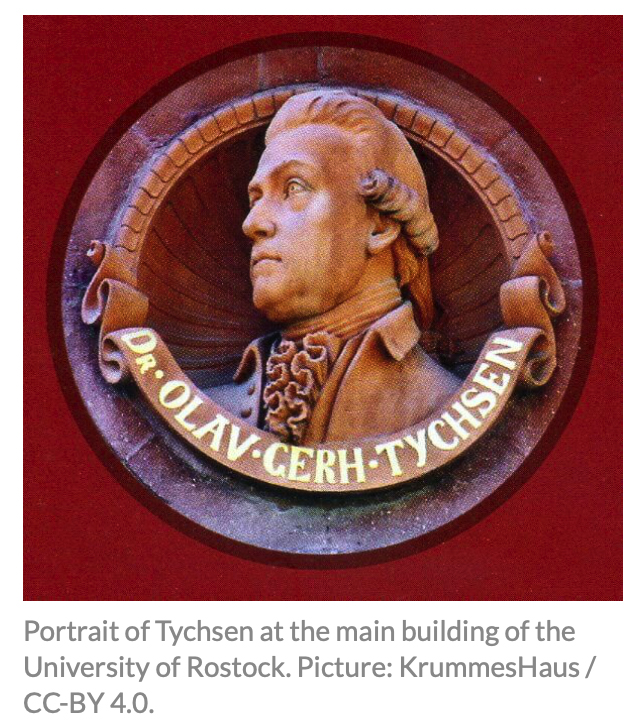
1. Oluf Gerhard Tychsen (1734-1815) was a distinguished Christian Hebraist.[1] A confirmed Lutheran, he devoted his life to Oriental studies, where aside from seminal contributions to Hebrew, Arabic, and Syriac studies, he also made a significant contribution to the decipherment of cuneiform. In 1752, while a student at the Christian Academy in Altona, he also attended the lectures of R. Jonathan Eibeschuetz. From 1755 on, he perused Oriental studies at the University of Jena and then at the University of Halle. In 1759-1760, he served as a missionary to the Jews — with little success — travelling through much of Denmark and Germany. He was thrown out of Altona when he attempted to deliver a conversionary sermon in its main Synagogue. Toward the end of 1760 he was appointed Professor of Oriental Languages at the newly established University of Bützov in Mecklenburg. He later served as Chief Librarian and Museum Director at Rostock. He was a prolific author who published some 40 volumes of scholarly studies during his academic career.

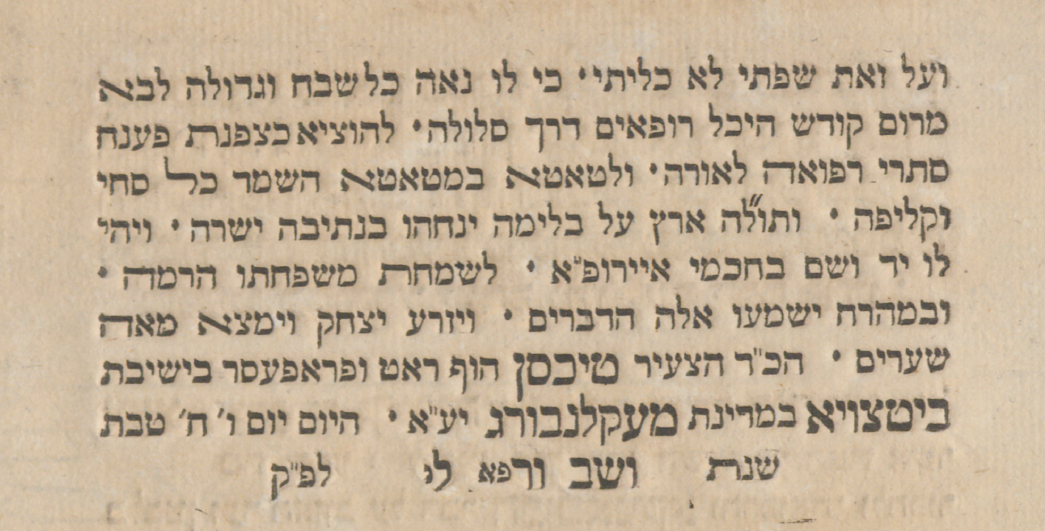
While little honor came his way from the Jewish community in Altona, a rabbi in Kirchheim in Hesse would award Tychsen with rabbinic ordination! Before we present the text of the rabbinic ordination, a word needs to be said about the rabbi and about rabbinic ordination. The rabbi’s name was R. Moshe b. R. Zvi Hirsch Lifshuetz and he served as Dayyan of the Jewish community of Kirchheim in Hesse. Alas, nothing else seems to be known about him.[2] In eighteenth century Germany, two types of rabbinic ordination were prevalent.[3] The higher level of rabbinic ordination bestowed the title of “Morenu” on the recipient. It was usually awarded to a rabbinic candidate who devoted full time to his Torah studies even after marriage, and was intent on serving professionally as a rabbi and rosh yeshivah. The lower level of rabbinic ordination bestowed the title “Haver” on the recipient. It was usually awarded to an accomplished talmudic student when he was about to marry and begin his professional career outside the rabbinate. The rabbinic ordination awarded to Tychsen resembles the lower level of rabbinic ordination. As the text itself makes clear, it was an honorary rabbinic ordination. The text reads as follows:[4]

ויעבור טיכזן מארץ מרחק נדוד מביתו וילך מחיל אל חיל ומישיבה לישיבה למד ויצק מים על ידי גאוני עמו רבים עוסק במלאכת שמים בפלפול ובסברה ה”ה הבחור נחמד המופלא כמ’ אלוף גירהרט טיכזן מהאלזטיין וגם פה עבר עלי הבחור הלז כאשר ראיתיהו שמחתי ואע”ג שאינו בעו”ה נמול רק היה כשותה מים מבארות עמוקות חכמת חז”ל וכמצות ה’ ואהבת לרעך כמוך שמתי על לב לעטרהו ולכבדהו ולסמכהו בסמיכת חכמים שזו תורה וזו שכרה מן השמים להיות קרוא בשם

החבר ר’ טיכזן

לכל דבר שבקדושה ונוצר תאנה יאכל פריו פרי קודש הילולים’ להיות בידו לתפארת ולכבוד התורה ולומדים ולמען שלא תהא האמת נעדרת חקקתי רשמתי וכתבתי דברי בעופרת לכבוד ולתפארת להיות חקוק על לבו ובידו לאות ולמשמרת.

כ”ד המדבר על כבוד התלמידים היום א’ כ”ו למב”י תקי”ט לפ”ק לסדר אלה הדברים אשר דבר.

משה ב”הרב מהור”ר מצבי הירש ליפשיץ יצ”ו מצפה בקרתא קדישא קורך-היים במדינת העסן יע”א

Tychsen traveled a great distance from his home, going from strength to strength, studying at one yeshivah then another, serving the great Gaonim of his people, engaged in the work of the Lord, in pilpul and logical discourse. He is the delightful young lad, the excellent Oluf Gerhard Tychsen of Holstein. He passed through my community as well. When I saw him I rejoiced. Despite the fact that due to our sins he is uncircumcised, he drank from the waters of the deep wells the wisdom of our Sages of blessed memory. And as required by G-d’s commandment: Love your neighbor as yourself, I resolved to crown him and honor him and bestow upon him rabbinic ordination, for such is the Torah and such is its reward from heaven that he be called by the title

The “Haver” R. Tychsen

for all sacred purposes. He who tends the fig tree will enjoy its fruit, an offering of praise, all to his glory and honor, and for the honor of the Torah and those who study it. So that the truth not be withheld, I have recorded this in ink, for honor and glory, to be engraved on the tablet of his heart, and to hold in his hand as a permanent sign.

These are the words of the one who speaks in honor of the students, today, the first day of the week, 26 days in the counting of the Omer, in the year 519 not counting thousands, the parashah of “These are the words that [Moses] spoke,”[5]

Moses the son of Rabbi Zvi Hirsch Lifshuetz, may his Rock and Redeemer watch over him, the rabbinic judge[6] in the holy community of Kirchheim”[7] in Hesse, may He protect it.

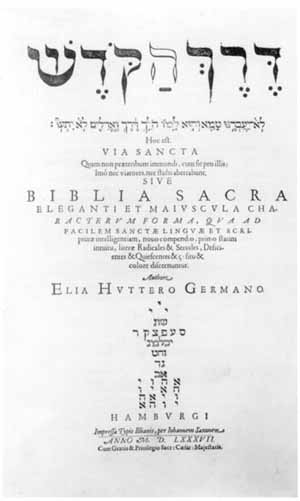
2. Elias Hutter (circa 1553-1609), a pious Christian, studied Oriental languages at the University of Jena and was appointed Professor of Hebrew at the University of Leipzig.[8] His fame rests not so much on his scholarly research as it does on his career as an editor and publisher. He published a series of polyglot editions of the Bible, as well as editions of the Hebrew Bible alone. He is perhaps most famous for his Hamburg, 1587 edition of the Hebrew Bible.[9] Usually bound in one thick folio volume, it is distinguished by the large font he used for the Hebrew letters. Moreover, he printed the root letters of every Hebrew word in the Bible in thick, heavily inked font. In contrast, he printed the non-root letters (such as “vav” copula “and”; or “vav” consecutive, which changes the tense of the verb) in a hollowed-out outline form. Thus, he introduced a major educational tool where a simple glance at the printed biblical text enabled the reader to recognize the root letters of any Hebrew word.

One of the many great Gaonim who lived in the eighteenth century was R. Joseph Teomim (1727-1792) Chief Rabbi of Frankfort on the Oder.[10] His classic commentary on Shulhan Arukh, Orah Hayyim and Yoreh De’ah, the פרי מגדים, is frequently reprinted. In the first edition of the פרי מגדים on Orah Hayyim (Frankfort on the Oder, 1787), R. Joseph Teomim prefaced his commentary with six “letters.” The “letters” were actually an encyclopedic introduction to Jewish law, thought, and practice. Some of the “letters” address such matters as the ideal curriculum for a young Jewish student, and even present lists of which books need to be read and mastered. The “letters” were not always included in the later editions of the פרי מגדים. When Makhon Yerushalayim — a distinguished publishing house for rabbinic literature — undertook to reissue the Shulhan Arukh in a massive, comprehensive, and majestic new edition, it made sure to include the six “letters.”[11] Moreover, as the editors put it: “We have re-edited the letters in clear print, with proper paragraphing and punctuation. We also added notes and references in order to render it easier for the reader to wade his way through these sometimes complex materials.”[12]

In the sixth “letter” (on p. 339 of the Makhon Yerushalayim edition), R. Joseph Teomim notes that the first book that needs to be studied by a Jewish child is the Hebrew Bible in its entirety. He then lists a series of biblical commentaries and tools that are essential for the proper study of תנ”ך. He adds:

גם תנ”ך עם אותיות חלולים, השורש בדיו, והשימושים והחסרים לבינים, טובים מאוד לנער בבחורתו ללמוד מהם

“A young student will gain much by studying from the Tanakh with the hollowed-out letters, i.e., with the root letters inked-in and with the prefixes and suffixes and the vowel letters hollowed-out.”

Since most readers would have no idea which edition of the Hebrew Bible was intended by R. Joseph Teomim, or where to look for it, the editors of Makhon Yerushalayim wisely and correctly indicate in a footnote that the reference is to the Hutter Bible. Alas, they also bestowed a posthumous rabbinic ordination on Elias Hutter, calling him:

הר”ר ע. הוטר

“The Rabbi, Rabbeinu [or: Reb] E. Hutter”

This, of course, is the imaginary case of bestowal of rabbinic ordination on a non-Jew.[13]

Footnotes:

1] See, e.g., Biographisch-Bibliographisches Kirchenlexicon, Hamm, 1997, vol. 12, columns 761-766.

2] It is tempting to identify him with R. Moshe b. R. Zvi Hirsch Lifschuetz of Mannheim (Germany) and Modena (Italy), a supporter of R. Jonathan Eibeschuetz. See לוחת עדות, Altona, 1755, pp. 20b-21b. But R. Jacob Emden assures us that the latter Rabbi Lifschuetz was no longer among the living in 1759. See his ויקם עדות ביעקב, Altona, 1755-1756, p. 85a.

3] In general, see M. Breuer, “הסמיכה האשכנזית” in ציון 33) 1968), pp. 15-46.

4] The text is drawn from L. Donath, Geschichte der Juden in Mecklenburg, Leipzig, 1874, pp. 326-327.

5] The date is problematic. In 1759, the 26th day of the Omer (= 11 Iyyar) fell on a Tuesday (May 8), not on a Sunday. Also, the parashah was פרשת אמור, not פרשת דברים. The latter objection is easily met. The author of the rabbinic ordination was simply introducing his signature with an appropriate biblical flourish: These are the words that Moses [the son of Rabbi Zvi Hirsch Lifschuetz] spoke. Regarding the former objection, one suspects that the typesetter of the Donath volume misread a “ג” for an א.

6] Almost certainly the printed Hebrew text needs to be emended and read: מ”צ פה = מורה צדק פה, and we have translated accordingly.

7] Kirchheim here is perhaps to be identified with the town of Kirchhain in Hesse. On the history of the Jewish community in Kirchhain, see K. Schubert, Juden in Kirchhain, Wiesbaden, 1987.

8] See, e.g., Biographisch-Bibliographisches Kirchenlexicon, Hamm, 1990, vol. 2, columns 1226-1227.

9] See H.C. Zafren, “Elias Hutter’s Hebrew Bibles” in The Joshua Bloch Memorial Volume, New York, 1960, pp. 29-39.

10] See the entry in Encyclopaedia Judaica, Jerusalem, 1971, vol. 15, columns 1011-1012.

11] Shulhan Arukh Ha-Shalem: Orah Hayyim, Jerusalem, 1994, vol. 1, pp. 319-343.

12] Op. cit., p. 320.

13] Turning non-Jews into rabbis (without prior conversion) is not unprecedented in Jewish literature. Apparently, J. D. Eisenstein, in his אוצר ישראל, included a non-Jew on a list of talmudic rabbis who worked for a living. See R. Abraham Isaac Ha-Kohen Kook’s critique of Eisenstein in אגרות הראיה, Jerusalem, 1962, vol. 1, pp. 161-162.

Appendix:
Title Page of 1587 Hutter Bible


What Became of Tychsen?: The Non-Jewish ‘Rabbi’ and his “Congregation” of Jewish Medical Students

What Became of Tychsen?: The Non-Jewish ‘Rabbi’ and his “Congregation” of Jewish Medical Students

By Dr. Edward Reichman, MD

This essay was inspired by two recent Seforim blog posts, one on Professor Shnayer Leiman’s contributions,[1] and the other on a topic related to R’ Yonasan Eybeshutz.[2]


In November 16, 2006 an article by Dr. Shnayer Leiman appeared in the newly formed Seforim Blog entitled, “Two Cases of Non-Jews with Rabbinic Ordination: One Real and One Imaginary.” The “real” ordination was bestowed upon Olaf Gerhard Tychsen (1734-1815). In 1759, Tychsen received the title of Haver, a lower form of rabbinic ordination, by Moses the son of Rabbi Zvi Hirsch Lifshuetz. Tychsen is perhaps the only known case in Jewish history of a non-Jew receiving such an honor or degree.[3]

Leiman provides a biography of Tychsen. He pursued studies in Hindustani, Ethiopic and Arabic, as well as Hebrew and Yiddish and became an Orientalist of international renown making significant contributions to cuneiform studies and numismatics as well.[4] During his early years he also pursued various missionary activities in the Jewish community, largely unsuccessful by his own account. 

As Leiman notes, in 1752, while a student at the Christian Academy in Altona, Tychsen attended the lectures of R. Yonasan Eybeschutz. Leiman essentially leaves us at the point of Tychsen’s ordination, with brief mention of his subsequent academic career. What became of Tychsen’s “rabbinic” career after he received this singular distinction? Did he apply for a rabbinic position? Did he maintain any connection with the Jewish community? 

In fact, Tychsen did continue to maintain a strong connection to both rabbinic literature and the Jewish community in varying degrees throughout his life. He is perhaps best known for his involvement in the premature burial controversy, which would earn him a place of infamy in Jewish history. Tychsen taught at the university in Butzow, the residence of the Duke of Mecklenberg. During this period there was concern that physicians were misdiagnosing death, and as a result, people were being buried prematurely.[5] On February 19, 1772 Tychsen sent a letter to the Duke of Mecklenberg regarding the Jews’ burial practice, interring after waiting only three hours, where it is known that there can sometimes be misdiagnosis of death. Tychsen detailed the Jewish origins of hastening burial in general, reflecting familiarity with rabbinic literature. He claimed that the need to bury quickly was established in countries with hot climates, where the body would decompose quickly, not applicable to a country like Germany. He also reported cases of people who were supposedly buried alive.[6] On April 30, 1772, Duke Friedrich of Mecklenburg-Schwerin, in response to Tychsen’s letter, issued an order prohibiting the Jews in his realm from immediately burying their dead and requiring that they rather wait for three days after death before interment. This began what would become a worldwide halakhic debate about the halakhic definition of death and the time of burial.[7]

Tychsen was also peripherally involved with one of Jewish history’s greatest seforim collections. Rabbi David Oppenheim amassed an extraordinary collection of books and manuscripts which languished in storage for years after his death.[8] Tychsen visited the collection for three weeks, reporting on its manuscripts to the Italian Christian Hebraist Giovanni Bernardo De Rossi. He attempted to arouse the interest of potential buyers, including Catherine the Great, Empress of Russia, Duke Karl Eugen of Wurtemberg, and Archduke Frederick Francis I of Mecklenberg. His efforts were to no avail and the collection ultimately found its home in Oxford, where it remains to this day.[9]

Here we highlight a little-known, though more substantive, connection of Tychsen with the Jewish community. One year after his ordination, toward the end of 1760, Tychsen was appointed Professor of Oriental Languages at the newly established University of Bützow in Mecklenburg. It is in this capacity that Tychsen exercised a rabbinic role, becoming a university campus rabbi of sorts for a select group of Jews at the university. Though he may not actually have had a “minyan” of students, nonetheless, his impact on this select group was profound and long lasting, akin to that of a rebbe.[10]

The interactions of Tychsen with the Jewish community must be viewed through a particular lens. Tychsen was a devout Lutheran Protestant and trained and engaged in proselytizing activities in his early life. This fact remains at least in the background of all his interactions with the Jewish students at Butzow and has been evaluated elsewhere. Whether his relationships with the Jewish medical students were primarily or partially motivated by his proselytizing tendencies, or whether his proselytizing endeavors had ceased by then, is a matter of historical speculation.[11] This is not the focus of the present essay.[12]

In his capacity as a faculty member of the University of Butzow Tychsen encountered a number of Jewish students attending the university’s medical school. Though an Orientalist and not a physician or scientist, he nonetheless served as a mentor for these students to whom he was drawn by shared interests and possibly proselytizing intentions. Tychen served this role for all the Jewish medical students who attended the University of Butzow during its twenty-nine years of existence. 

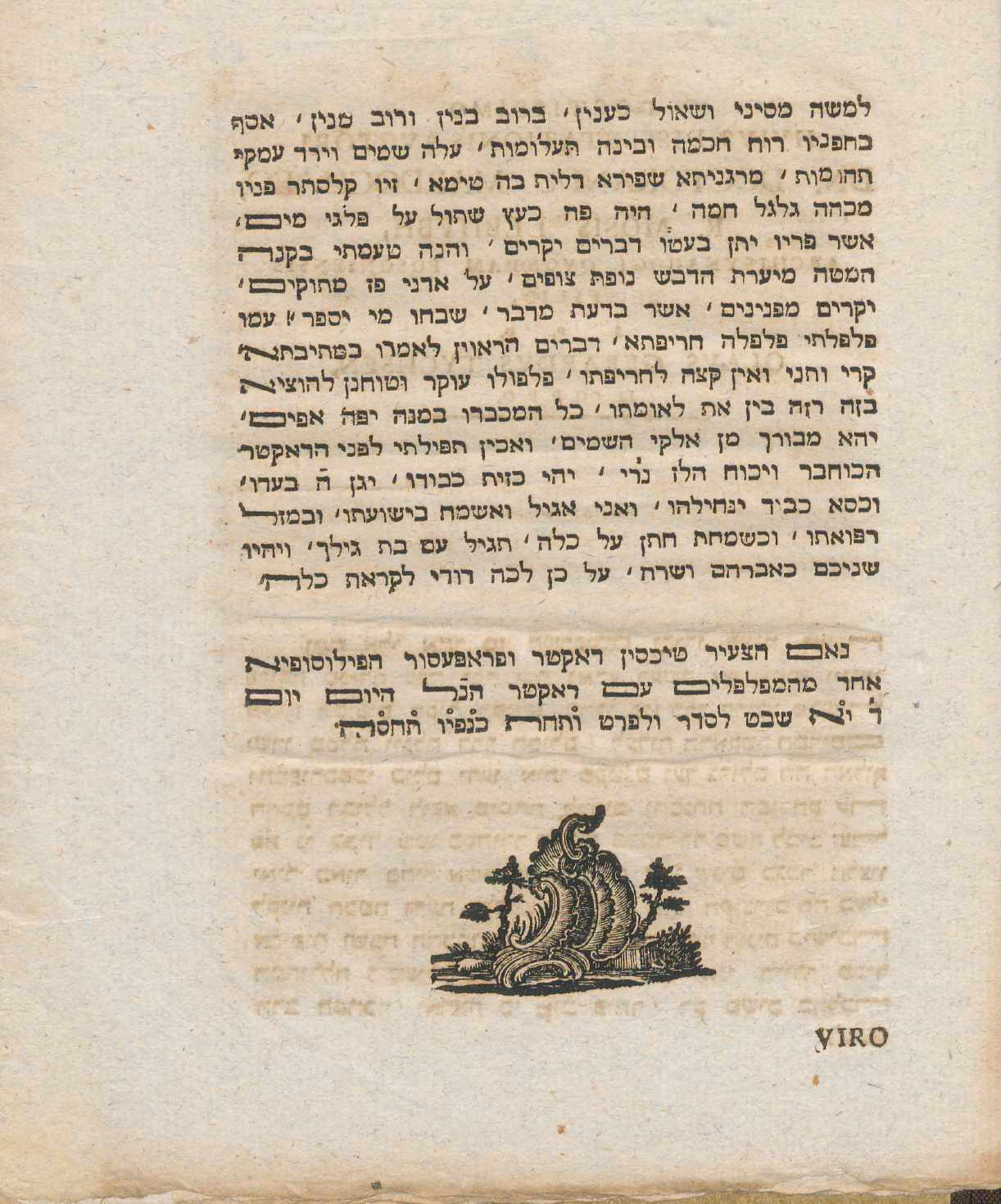
The first Jewish student of the Butzow Medical School, and the first with whom Tychsen developed a relationship was Markus Moses. This relationship has been the subject of a number of dedicated essays.[13] Markus Moses was the son of Moshe ben Meir Harif Lemberger (Lvov), Chief Rabbi of Pressburg and head of its yeshiva. Lemberger, as well as his son Markus, were apparently involved in the Emden- Eybeshutz controversy.[14] Markus (Mordechai) was born in Pressburg in 1729, received a traditional Jewish education, and married. Shortly thereafter, his wife and two young children died. In 1758, after the death of his father, Markus began the study of secular subjects. Over the next few years he traveled to Germany and continued study in various cities, including the field of medicine, ultimately ending up in Butzow in 1763. Aron Isak, the leader of the Jewish community, took him under his wing and orchestrated his admission to the recently founded Butzow Medical School,[15] thus waiving the high taxes imposed upon the Jewish community for new town visitors. The faculty were impressed with Moses’ great intelligence and facility with multiple languages and accepted him, with the approval of the Duke and Professor George Detharding, the head of the faculty, with free tuition. Below is a letter in Hebrew from Paul Theodore Carpov, an Orientalist and Christian Hebraist at Butzow, supporting Moses’ acceptance to the medical school at Butzow and advocating for his financial support as well.[16]

As per the letter, Moses brought with him impressive letters of recommendation not only from the great scholars of “his nation,” but also from those of “our nation.” Carpov also notes the Duke’s approval, as well as the financial issues relating to his application. Carpov was clearly taken by the young Jewish student. 

Below is the record of matriculation of Markus Moses in 1764.

Moses clearly had a predisposition for the field of medicine and was soon relied upon by Detharding to see the latter’s private patients.[17]

Tychsen had a working academic relationship with Moses as evidenced by the multiple research papers Moses wrote under his mentorship. It is remarkable that all of the papers were on Jewish topics. I have found a number of cases, though relatively few in number, of Jewish medical students throughout the centuries who wrote their medical school dissertations on a Jewish related topic,[18] but I have never encountered any student who authored so many Jewish related papers as part of their medical training. The topics included the Samaritan Bible, a discussion of the kosher and non-kosher animals based on the work of Rambam, and an essay on the diseases of the old as reflected in Kohelet (chapter 12).[19] Moses’ graduation dissertation, discussed below, was also on a Jewish topic and was supervised by Tychsen.

Disputatio de Pentateucho Ebraeo-Samaritano, 1765[20]

Essay on kosher and non-kosher animals based on Rambam.[21]

The nature of the relationship Tychsen had with Moses, as well as with other Jewish medical students in Butzow, went far beyond the usual Professor-student model. There wrote each other dozens of letters and continued correspondence for years after graduation.[22] In one letter dated March 16, 1765[23] Moses apologizes for not responding promptly to Tychsen’s previous letter. Moses continues that soon he will either write again, or will see Tychsen in person. Moses signs the letter, hamitavek biafar raglekha.

גבר(א) דכולי() בי החכ(ם) הכולל המפורס(ם) שמו נודע בכל השערי(ם) הפרעפעסאר טיקסן

מרוב טרדות היום אין אוכל לתואר בתואר כראוי לגבר(א) כמותו ובאתי בלישנא קלילא אל תשים עלי חטאת שעדיין לא השיבני על כתב ידו הטהור מה שקבלתי ע”י ערל הבוח(ן) לבות יודע שהזמן גרמ(ה) לי רק זאת יהי(ה) לבו בטוח שהשבוע הבע” (?הא עלינו לטובה) או אכתוב לו או בנשיקת פא”פ (פה אל פה) אדבר בו[24] גם יקבל במתנה צורה של ר’ יהונת(ן) זצ”ל יותר אין לחדש כה המתאבק בעפר רגליו מרדכי מפב (?מפרשברג)ג


In the last line, Moses writes that Tychsen will also receive from him a gift of a portrait of Rav Yehonatan zt”l. Moses was obviously aware of the connection between Tychsen and Eybeshutz and believed this would be a meaningful gift. Eybeshutz died in 1764,[25] and his portrait was disseminated shortly thereafter. This is likely the portrait Moses purchased for Tychsen.[26]

As part of the requirements for the completion of a doctorate in medicine at most German universities, the student was required to engage in a public disputation on the topic of their dissertation. [27] The topic of Markus’ disputation was the analysis of a verse in Yehezkel which, according to Moses, reflects an ancient Jewish practice of placing salt of the skin of an infant as a prophylactic against disease. 

Moses engages in an expansive philological and grammatical analysis of the verse then posits that the Jews practiced this procedure and that it protected them from diseases like smallpox. The reason smallpox was prevalent during his time, Moses argues, is because people no longer routinely applied salt to the skin of infants. Moses is the only one of the Jewish medical students at Butzow who wrote his dissertation on a Jewish topic. 

Moses’ disputation was held on January 22, 1766 (11 Shevat, 5526). The event was held in a church, though Tychsen apparently noted that it was primarily a venue for non-ecclesiastic events. This may have been in deference to the halakhic concern about entering a church.[28] A number of Jewish families attended the event. Copies of the dissertation were sent to those invited to the public discourse, and additional copies were provided for the audience on the day of the event. The ceremony began with a Latin oration by the presiding professor, in Moses’ case, Professor Detharding, and was followed by the student’s reading of his dissertation. Upon completion of the reading, designated opponents presented their arguments and criticisms against the substance of the dissertation, with audience members occasionally allowed to participate. This was then followed by the candidate’s rebuttal. Tychsen served as one of the designated opponents for Moses’ disputation. 

On oath was also part of the graduation ceremony, and it typically involved avowing one’s belief in Christianity. Tychsen intervened with the Duke of Mecklenberg on Moses’ behalf to allow him to take his graduation oath invoking the name of the God of Israel as opposed to the Christian deity. He even publicly conversed with Moses in Yiddish at the graduation.[29] 

Below is the approbation of Tychsen appended to the published dissertation of Moses.

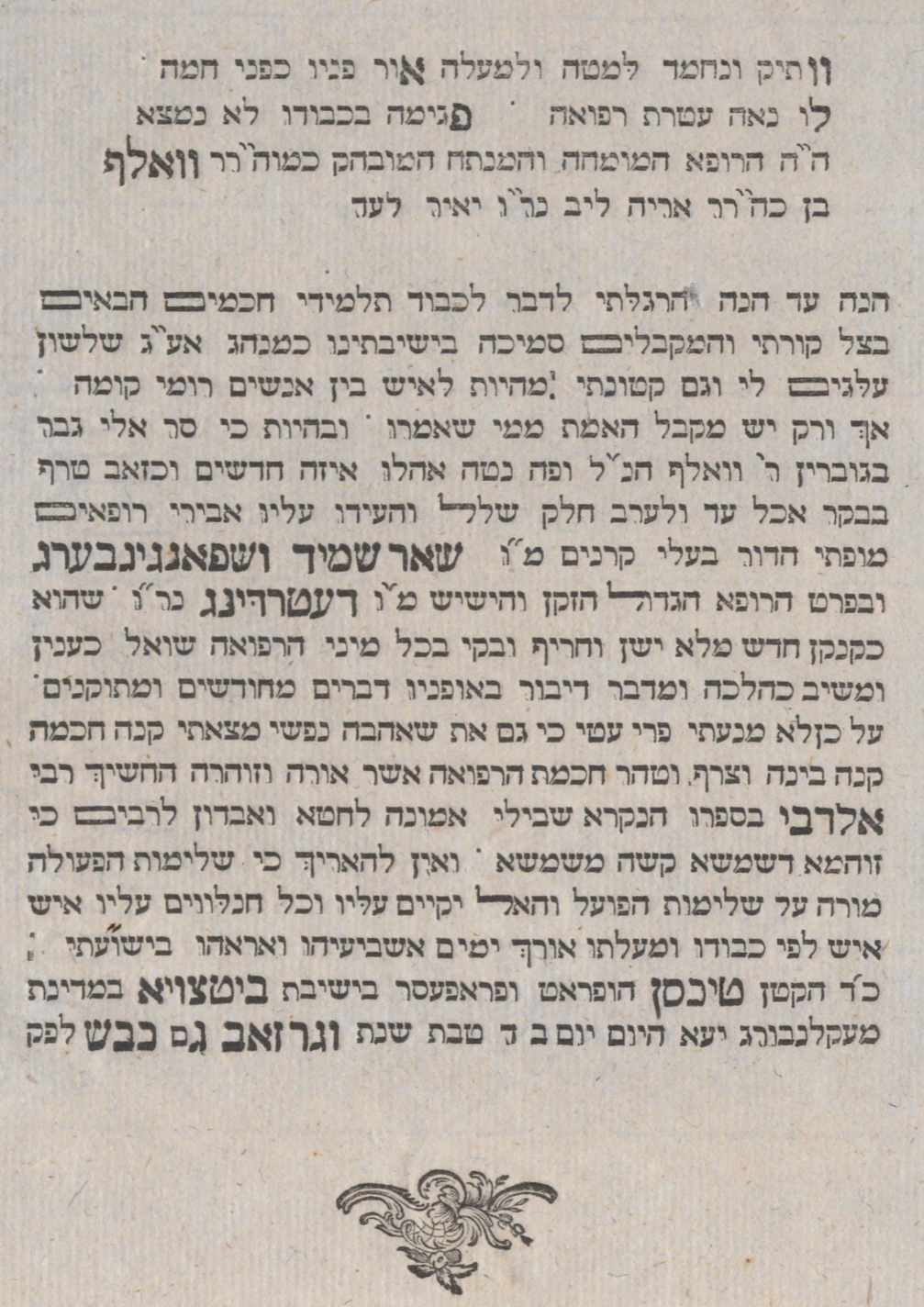
Tychsen’s freely inserts throughout allusions to rabbinic literature. He also uses a chronogram for the Hebrew year, typically done in Hebrew publications, and something Tychsen used frequently, as seen in his letters below. 

At the end of the approbation, Tychsen mentions the upcoming (second) wedding of Moses. Below is the handwritten wedding invitation of Moses to Tychsen.[30]

Both the title and signature of the invitation reflect the type of relationship they had. Moses also adds the clever pun of “hazmanah lav milsa,” assuming that Tychsen will appreciate it. 

The other letters appended to Moses’ published dissertation are also of great interest. In addition to Tychsen, another opponent at the disputation contributed a letter. Karl Leopold Carpov,[31] son of the Orientalist and professor at Butzow, Paul Theodore Carpov, who had written Moses’ letter of recommendation for admission (above). The older Carpov had died the previous year. The younger Carpov describes how beloved Markus was to his father, who considered him as another son, and, impressed by his brilliance, spent days and nights studying with him. Karl himself calls Markus his brother. While many focus on Markus’s close relationship with Tychsen, no mention has been made of his relationship with the other Orientalist, Carpov. 

The remaining letters were written by Judah Levi Strelitz,[32] the brother in law of Moses, and Meier (no other name is written), a fellow medical student. 

Moses was not the only Jewish student Tychsen took under his wings. Over the span of decades, throughout the short existence of the Butzow medical school, he endeared himself to a number of Jewish medical students.[33] He taught them, mentored them, and even financially supported them. They in turn sought his personal advice and recommendations, aided him in his intellectual quests, and invited him to their weddings.

Two Jewish medical students who matriculated in 1783 were also close with Tychsen, Isaac Salomonsen and Wulf Levinson. 

Matriculation record from University of Butzow November 24, 1783
Wulf Levinson and Isaacus Salomonsen[34]

Below is Tychsen’s letter to Levinsohn upon his graduation.[35]

Tychsen includes that the Butzow anatomist August Schaarschmidt and Professor Detharding, who had accepted Markus Moses some twenty years earlier, attest to the student’s qualifications.[36]

Below is the letter of Isaac Salomonsen presenting his dissertation to Tychsen.[37]

Below is Tychsen’s letter of approbation for Salomonsen’s dissertation in 1784. He mentions Isaac’s work in botany, which is in some form a continuation of the work of another Butzow medical student Tzadik de Meza, who died at the age of twenty-three.[38]

In another letter,[39] Salomonsen complained bitterly to Tychsen about his classmate Levinson, who had apparently been slandering him. He adds that the great personalities in the history of medicine, Aesculapius, Hygea and Hippocrates would be mourning and turning over in their graves if they knew how Levinson was misrepresenting and dishonoring them and the University of Butzow.

In the letter below dated 1784 from Salomonsen to Tychsen[40] we find a number of the elements common in Tychsen’s relationship with all the Jewish medical students. 

Salomonsen mentions the money he owes Tychsen and explains and apologizes for the delay in repayment. Tychsen routinely loaned money to the Jewish students. Salomonsen then reports that he was unable to obtain the sefer (shu”t Rabbi Moshe Alshikh) and Arabic coins Tychsen had requested. Tychsen was an avid bibliophile and his magnificent and important library was ultimately bequeathed to the University of Rostock, which absorbed the University of Butzow after its demise. It remains there to this day. Tychsen also collected Arabic coins and is considered the founding father of Islamic numismatics.[41] Salomonsen also mentions his acquaintance with a man named Mussafia[42] and his children, and how he enjoys spending time with them. Mussafia praised Tychsen and recalled something he had written on Tychsen’s behalf. He also possessed a work of Tychsen. Tychsen delighted in his name and reputation being spread throughout the Jewish community.

In sum, “Rabbi” Tychsen appears to have put his rabbinic degree to good use, at least from his perspective, cultivating an extremely devoted, loyal, and admiring, not to mention highly educated congregation. On the surface, he would be the envy of any modern rabbi, though much complexity lies beneath. While we did not focus on his proselytizing endeavors in this essay, perhaps this is one reason why Tychsen still remains to this day the only non-Jew to have received a form of rabbinic ordination. While Tychsen’s contributions to academia are vast, his tenure at the University of Butzow and his relationship with the Jewish students there represents one of the most unique, if lesser known, chapters in Jewish medical history. With the opening of the Rostock digital archives treasure trove we will certainly see further exploration of this topic. 

Edward Reichman

שנת וַתֵּעָצַ֖ר הַמַּגֵּפָֽה לפ”ק  

[1] Yitzhak Berger and Chaim Milikowsky, “Shnayer Leiman: In Appreciation,” (September 11, 2020).

[2] Moshe Haberman, “The Twice-Told Tale of R. Yonasan Eybeshutz and the Porger,” (September 15, 2020).

[3] For additional information on the semicha of Tychsen, see On the Main Line Blog, “On Non-Jews with Rabbinic Ordination, Real and Imagined: Some Notes on Dr. Leiman’s Post on Tychsen,” (September 20, 2011), http://onthemainline.blogspot.com/2011/09/on-non-jews-with-rabbinic-ordination.html.

[4] David Wilk, “Markus Moses’ Doctoral Dissertation or Who Remembers Butzow,” Koroth 9:3-4 (1986), 408-426, esp. 413.

[5] For an overview of this chapter in medical history, see Jan Bondeson, Buried Alive (Norton Publishers, 2001).

[6] For the text of the letter, see Siegfried Silberstein, “Mendelssohn und Mecklenburg,” Zeitschrift fur die geschichte der Juden Heft 4 (1930), 275-290, esp. 278-279. For reference to Tychsen as a key player in the issue of delayed burial, see for example, Rabbi Dr. Jacob J. Schacter’s doctoral dissertation, Rabbi Jacob Emden: Life and Major Works (Harvard University, 1988), 669, 723-724.

[7] For a comprehensive review of this historical chapter, see Moshe Samet, “Delaying Burial: The History of the Polemic on the Determination of the Time of Death,” (Hebrew) Asufot 3 (1989/1990), 613-665.

[8] For what follows see the comprehensive review of Oppenheim and his library by Joshua Teplitsky, Prince of the Press (Yale University Press: New Haven, 2019), 198.

[9] See Rebecca Abrams and Cesar Merchan-Hamann, eds., Jewish Treasures from Oxford Libraries (Bodleian Library, University of Oxford, 2020), and review of Paul Shaviv, Seforim Blog (July 14, 2020).

[10] The University of Butzow was an offshoot of the University of Rostock and later recombined with Rostock upon its demise. In addition, in 1817, Rostock University acquired the private library, including the manuscript legacy, of Tychsen, which included his significant Judaica and Hebraica collection. Over the last few years, the University of Rostock has devoted research efforts to explore the history of the Jewish students at the university with particular focus on their relationship with Tychsen. See Gisela Boeck und Hans-Uwe Lammel, eds., Jüdische kulturelle und religiöse Einflüsse auf die Stadt Rostock und ihre Universität (Jewish cultural and religious influences on the city of Rostock and its university) (Rostocker Studien zur Universitätsgeschichte, Band 28: Rostock 2014); Rafael Arnold, et. al., eds., Der Rostocker Gelehrte Oluf Gerhard Tychsen (1734-1815) und seine Internationalen Netzwerke (Wehrhahn Verlag, 2019). In the latter volume, see especially, Malgorzata Anna Maksymiak and Hans-Uwe Lammel, “Die Bützower Jüdischen Doctores Medicinae und der Orientalist O. G. Tychsen,” 115-133. I thank Malgorzata Maksymiak for her assistance and for providing me access to the Tychsen archives.

[11] See Wilk, op. cit. and Maksymiak, op. cit.

[12] Nimrod Zinger notes that the universities under Protestant auspices, in particular those affiliated with the Pietistic Movement, were more inclined to admit Jews, as they were interested in the possibility of converting them. He mentions as examples Yitzhak Isaac Wallich and his close relationship with Professor Hoffman at Halle, and that the student Avraham Hyman was admitted to Geissen with the intervention of the head of faculty, who was a Pietist. See his Ba’al Shem vihaRofeh (Haifa University, 2017), 263. Tychsen would certainly align with this theory.

[13] Bernhard Mandl, “Egy Magyar Zsido Orvos Nemet- Orszagban (1763-1782): Dr. Markus Moses, a Pozsonyi forabbi fia,” Evkőnyv Kiadja Az Izr. Magyar Irodalmi Tarsulat (1913), 145-165; Idem, Med. Dr. Markus Moses, Sohn der Pressburger Oberrabbiners R. Mosche Charif, praktischer Arzt in Deutschland von 1776 bis 1786: eine Lebensskizze (J. Pollak: Vienna, 1928); Wilk, op. cit.

[14] Die Juden und Judengemeinde Bratislava in Vergangen heit und Gegenwart (Brunn, 1932), 17-18, 85, cited in N. M. Gelber, “History of Jewish Physicians in Poland in the Eighteenth Century,” (Hebrew) in Y. Tirosh, ed., Shai LeYeshayahu: Sefer Yovel LeRav Yehoshua Wolfsberg (HaMercaz LeTarbut shel HaPoel HaMizrachi; Tel Aviv, 5716), 347-371, esp. 360.

[15] By this time, Jews were able to attend medical schools in Germany. Other German universities with Jewish graduates included Frankfurt on Oder, Duisberg, Halle, Geisen and Heidelberg. On the Jews in German medical schools, see Louis Lewin, “Die Judischen Studenten an der Universitat Frankfurt an der Oder,” Jahrbuch der Judisch Literarischen Gesellschaft 14 (1921), 217-238; Idem, “Die Judischen Studenten an der Universitat Frankfurt an der Oder,” Jahrbuch der Judisch Literarischen Gesellschaft 15 (1923), 59-96; Idem, “Die Judischen Studenten an der Universitat Frankfurt an der Oder,” Jahrbuch der Judisch Literarischen Gesellschaft 16 (1924), 43-87; Adolf Kober, “Rheinische Judendoktoren, Vornehmlich des 17 und 18 Jahrhunderts,” Festschrift zum 75 Jährigen Bestehen des Jüdisch-Theologischen Seminars Fraenckelscher Stiftung, Volume II, (Breslau: Verlag M. & H. Marcus, 1929), 173-236; Idem, “Judische Studenten und Doktoranden der Universitat Duisberg im 18 Jahrhundert,” Monatsschrift für Geschichte und Wissenschaft des Judentums Jahrg. 75 (N. F. 39), H. 3/4 (March/April 1931), 118-127; Monika Richarz, Der Eintritt der Juden in die akademischen Berufe: Judische Studenten Und Akademiker in Deutschland 1678-1848 (Schriftenreihe Wissenschaftlicher Abhandlungen Des Leo Baeck: Tubingen, 1974); Wolfram Kaiser and Arina Volker, Judaica Medica des 18 und des Fruhen 19 Jahrhunderts in den Bestanden des Halleschen Universitatsarchivs (Wissenschaftliche Beitrage der Martin Luther Universitat Halle-Wittenberg: Halle, 1979); M. Komorowski, Bio-bibliographisches Verzeichnis jüdischer Doktoren im 17. und 18. Jahrhundert (K. G. Saur Verlag: Munchen, 1991); Eberhard Wolff, “Between Jewish and Professional identity: Jewish Physicians in Early 19th Century Germany- The Case of Phoebus Philippson,” Jewish Studies 39 (5759), 23-34. John Efron, Medicine and the German Jews (Yale University Press: New Haven, 2001); Wolfram Kaiser, “L’Enseignement Medical et les Juifs a L’Universite de Halle au XVIII Siecle” in Gad Freudenthal and Samuel Kottek, Melanges d’Histoire de la Medicine Hebraique (Brill: Leiden, 2003), 347-370; ) Petra Schaffrodt, Heidelberg- Juden an der Universitat Heidelberg: Dokumente aus Sieben Jahrhunderten (Ruprecht Karls Universitat Heidelberg Universitatsbibliothek, August, 2012).

Below is a chart from Richarz of Jewish medical students in Germany at this time. The University of Butzow is not on this list.

[16] http://rosdok.uni-rostock.de/mcrviewer/recordIdentifier/rosdok_ppn859752100/iview2/phys_0007.iview2.

[17] For the history of Moses prior to attending Butzow, see Mandl, op. cit., and Wilk, op. cit.

[18] E. Reichman, “The History of the Jewish Medical Student Dissertation: An Evolving Jewish Tradition,” in J. Karp and M. Schaikewitz, eds., Sacred Training: A Halakhic Guidebook for Medical Students and Residents (Ammud Press: New York, 2018), xvii- xxxvii.

[19] While the first two essays are housed in the Rostock Library, I have not found a copy of this essay.

[20] http://opac.lbs-rostock.gbv.de/DB=1/XMLPRS=N/PPN?PPN=720262623.

[21] http://opac.lbs-rostock.gbv.de/DB=1/XMLPRS=N/PPN?PPN=304865346.

[22] For the letters in the archive just between Markus Moses and Tychsen, see here.

[23] http://purl.uni-rostock.de/rosdok/ppn860182010/phys_0027.

[24] This is an expression of endearment. See another example of a letter to Tychsen, from a Yehoshua Lifshutz of Apta, where the same expressions, peh el peh acronym and nishikat pihu, are used. http://rosdok.uni-rostock.de/mcrviewer/recordIdentifier/rosdok_ppn859752100/iview2/phys_0019.iview2.

[25] While we have no record of R. Eybeshutz himself communicating with Tychsen at the University of Butzow Medical School, he did send a letter to the faculty of medicine at another German medical school, the University of Halle. This letter related to the famous “heartless” chicken question initially posed to Hakham Tzvi. For more on this letter, its record in the Halle University archives, and its impact on the Emden Eybeschutz controversy, see E. Reichman, “A Letter from a Torah Sage of the 18th Century to the Medical Faculty of the University of Halle (January, 1763): The Selective Deference of Rabbi Yonatan Eybeschutz to Medical Expertise,”Verapo Yerapei: Journal of Torah and Medicine of the Albert Einstein College of Medicine Synagogue 6 (2015), 89-112.

[26] National Library of Israel, NLI 997003186660405171. See also Richard I. Cohen, “’And Your Eyes Shall See Your Teachers’: The Rabbi as Icon,” (Hebrew) Zion (1993), 407-452, esp. 418. The artist is Elimelech Polta ben Shimshon. I have as yet been unable to identify this physician. His name is not found among the Jewish medical students in German universities mentioned above.

[27] T. Broman, The Transformation of German Academic Medicine 1750-1820 (Cambridge University Press, 1996), 32ff.

[28] See Maksymiak, op. cit.

[29] See Wilk, op.cit., 417.

[30] http://purl.uni-rostock.de/rosdok/ppn859752100/phys_0081.

[31] Carpov trained at the University of Rostock before the formation of the University of Butzow. See his matriculation record, here.

[32] Strelitz, also known as Levin Hirsch Levi, lived in Altstrelitz and authored a treatise on resurrection (http://rosdok.uni-rostock.de/resolve/id/rosdok_document_0000014475) which was translated into German by Tychsen under the title,”Die Auferstehung der Todten aus dem Gesetze Mosis Bewiesen,” (1766) (http://rosdok.uni-rostock.de/resolve/id/rosdok_document_0000014215). Strelitz later became rabbi of Birnbaum, and then the first rabbi of Stockholm and Chief Rabbi of Sweden. The Jewish community of Stockholm had been founded only a few years before his arrival by Aron Isak, the sponsor of Markus Moses, Levi’s brother-in-law, and the shadchan for Moses and Levi’s sister. See Wilk, 419-420.

[33] Markus Moses (1764), Israel Joseph Meyer (1765), Justus Zadig de Meza, Isaac Heinrich Salomonsen (1783),Wolff Levinsohn (1783), Abraham Levin Spira (? Benjamin Levin, 1773), Simon Marcus (1771) and Moses Marcus(1785, son of Markus Moses). All of them-with one exception-received their doctorate in medicine in the twenty-nine years of existence of the University of Bützow.See Maksymiak,op.cit., which also addresses the emotional aspect of the ties of Tychsen with his students.

[34] http://dfg-viewer.de/show?set%5bmets%5d=http%3A%2F%2Frosdok.uni-rostock.de%2Ffile%2Frosdok_document_0000000177%2Frosdok_derivate_0000004407%2Fmatrikel1760ws-1788ws-Buetzow.mets.xml&set%5bimage%5d=54. Note that word “Judeus” appears after both of their names. It was common to identify students as Jews in university archives. For example, starting in the 1500s, Jewish students at the University of Padua were identified as“Hebrei.” There does not appear to have been any anti-Semitic associations with this identifier.

[35] http://rosdok.uni-rostock.de/mcrviewer/recordIdentifier/rosdok_ppn835297578/iview2/phys_0168.iview2. For Levinsohn’s dissertation, see http://rosdok.uni-rostock.de/resolve/id/rosdok_document_0000016729?_search=23e52c72-2882-421d-bfd5-16b218d11ae3&_hit=0. The letter was not published with the dissertation.

[36] Tychsen appears to make disparaging remarks against the work Shevilei Emunah, by Meir Aldabi. This work,written in the fourteenth century, was a primary reference on medicine in rabbinic literature for many centuries.

[37] http://rosdok.uni-rostock.de/mcrviewer/recordIdentifier/rosdok_ppn835297578/iview2/phys_0166.iview2.

[38] The Rostock archives contains a number of letters between Tychsen and de Meza.

[39] http://rosdok.uni-rostock.de/mcrviewer/recordIdentifier/rosdok_ppn835297578/iview2/phys_0176.iview2.

[40] http://rosdok.uni-rostock.de/mcrviewer/recordIdentifier/rosdok_ppn835297578/iview2/phys_0180.iview2.

[41] Rafael Arnold, et. al., eds., Der Rostocker Gelehrte  Oluf Gerhard Tychsen (1734-1815) und seine Internationalen Netzwerke (Wehrhahn Verlag, 2019); Ursula Kampmann, Maike Mebmann, trans., “Oluf Gerhard Tychsen (1734-1815), https://coinsweekly.com/oluf-gerhard-tychsen-1734-1815/(July 18, 2019).

[42] This was perhaps a relative of Binyamin Mussafia, a famous graduate of the University of Padua in 1625, and author of Musaf HaArukh, a commentary of the Sefer HaArukh.


Akiva Leiman: Gravely Mistaken

Gravely Mistaken
by Akiva Leiman

R. Leiman teaches high school at the Yeshiva of Greater Washington in Silver Spring, Maryland. Additionally, he leads trips to sites of Jewish interest in Eastern Europe. This is his first contribution to the Seforim blog.

One hardly need go far to find errors in published materials, but when even moderate research would suffice to unearth correct information lack of such an effort would seem egregious. Jewish burial sites have often been lost: Nazis or indigenous peoples destroyed cemeteries, acid rain ravages stones, burning candles char monuments and, of course, people just simply forget where things are.[1] Misinformation, however, would seem to be the most preventable culprit in this ever-losing battle to maintain vestiges of our heritage.
A few examples should suffice.[2]
1. In Paul Johnson’s A History of the Jews, in the very first paragraph of the actual text, he says,
There in the Cave of Machpelah, are the Tombs of the Patriarchs . . . . Across the inner courtyard is another pair of tombs, of Abraham’s grandson Jacob and his wife Leah. Just outside the building is the tomb of their[3] son Joseph.
In an endnote he references L.H. Vincent and his depiction of the cave which has been reproduced in EJ XI p. 671. There the caption does read: “Tomb of Joseph.” However, the text of the EJ explicates that, “A Muslim tradition maintains that Joseph was buried here… (t)his tradition is probably due to a corruption of the Arabic name for Esau, whose head, according to aggadic sources fell within the cave…” EJ‘s theory for the mistake aside, Johnson must not have read the text of the article (or: ignored it), for though the diagram’s caption tells us that Yosef is buried in the Cave, the text belies this point.[4] Furthermore, see Joshua 24:32 (providing Shechem as Joseph’s burial place),[5] which must, at the very least, be mentioned in any serious discussion of the final resting place for Yosef.[6]
2. In בשבילי ראדין, by M. M. Palato, Machon B’Shvilai HaYeshivot, (2001), p. 25, we are provided a picture and told “that we are being shown the final resting place of R’ Chaim of Volozhin (d. 5581 – 1821), the most esteemed student of the Vilna Gaon, and he is buried next to his mentor.”[7]
But, R’ Chaim is actually interred in Volozhin[8] and his grave is a regular stopping point for those visiting the Byelorussian town. The picture shown is of the old Ohel over the grave of the Vilna Gaon in the since-destroyed Shnipishok cemetery of Vilna. Of course, R’ Chaim’s grave is not pictured at all.[9]

3. Holy Stones: Remnants of Synagogues in Poland, drawings by Joseph Cempla, Dvir, Tel Aviv (1959) is a beautiful group of renderings of pre-war Poland. From the description for plate number 13 we read:
The gravestone of Rabbi Shalom Shachna in the Lublin Cemetery

Rabbi Shalom ben Joseph Shachna[10] (1510-1550[11]) was one of the greatest Talmudists produced by Polish Jewry. He was the pupil of Rabbi Jacob Polak, head of the Lublin Yeshiva, who created the method of “Pilpul”[12] (casuistics)[13] employed in the study of Talmudic literature.

It is correct that R’ Shalom Shachna was a student of R’ Yaakov Polak, but the stone sketched by Cempla is not R. Shalom Shachna. Here is Cempla’s drawing:

And here is a picture of R’ Shalom Shachna’s grave today in the Old Cemetery of Lublin:

The grave today stands without the adornments found in Cempla’s rendering: no pillars, no arch and no artistic flair filling the arch. Also, Cempla seems to indicate ten or twelve lines of etching while the current stone shows at least fifteen; puzzling, if not insurmountable issues.
A bit more research revealed the obvious error. Within twenty feet of R’ Shalom Shachne stands this prominent headstone:

This is the grave of Rabbi Yaakov Yitzchak Horowitz (d. 9 Av 5575 – 1815), the Chozeh of Lublin.[14] It seems almost certain, upon comparing Cempla’s drawing with that of the Chozeh’s headstone is that Cempla drew the Chozeh’s headstone mistaking it for the tomb of R’ Shalom Shachna which lies in its close proximity.

[1] I can recall, as a young man, visiting the old cemetery in Tzfat immediately after havdalah. I encountered a middle-aged Chassidic Jew at that strange time, and inquired after the grave of Rabbi Chaim Vital (d. 5380) the eminent student and chronicler of R’ Yitzchak Luriah – the Ari Hakadosh (d. 5332). He told me to go up the road and after a bit to ask for directions to Damascus…
[2] For another example see אבי מורי, Dr. S.Z. Leiman, in Who is Buried in the Vilna Gaon’s Tomb? Originally published in Jewish Action, Winter (1998), 59(2), and which can be found online at: http://www.ou.org/publications/ja/5759winter/leiman.htm
[3] Sic, he was the son of Rachel not Leah.
[4] See Z. Vilnai, מצבות קודש בארץ ישראל, pp. 167-176, where (p. 170) sightings of the burial place in Shechem date to 320 AD.
[5] ואת עצמות יוסף אשר העלו בני ישראל ממצרים קברו בשכם
[6] For further discussions, see L. Ginzberg, Legends of the Jews, V1, JPS (2003) p. 430 n. 443. Also, Vilnai pp. 141-144. To come full circle, in Acts 7:16 we are told that Jacob was also buried in Shechem!
[7] See note 1 above.
[8] For a nice photo, see Mishpacha, Special Supplement Succos 5767, pp. 24-25.
[9] The caption also tells us that R’ Zalmaleh of Volozhin, the brother of R’ Chaim and most brilliant student of the Vilna Gaon, is in the photo as well. He is neither in Volozhin, next to his brother, nor in the Gaon’s Ohel. See note 1. His grave has sadly been lost.
[10] I would assume that Shachna was his second, not family name; the stone reads:שלום המכונה שכנה, which would seem to be a nickname rather than a surname.
[11] See S. B. Nissenbaum’s Lekorot HaYehudim B’Lublin, p. 19 for the exact wording on his tombstone. He actually died on Friday Rosh Chodesh Kislev 5319, which was in 1558. See A. A. Akavia לוח לששת אלפי שנה p. 485.
[12] Quotes in original
[13] Parenthetic translation in original
[14]Interestingly, in Y. Alfasi החוזה מלובלין p. 107 nt. 9 there is a discussion if the Chozeh is in fact buried near R’ Shalom Shachna. He relies on a pre-war witness. Today one can go and see for himself, ואין לדיין אלא מה שעיניו רואות.


Dei’ah veDibur Fabrication – Dr. Leiman

As I noted previously, the Haredi mouthpiece Dei’ah veDibur had a rather insightful piece on the falicy of the Golem of Prauge. However, although the article ended with the hope that after bringing this fabrication to the readers attention people will only tell true stories. Shnayer Leiman, however, notes that the story itself in Dei’ah veDibur contains a rather glaring inaccuracy.

The March 1, 2006 issue of _Dei’ah Ve-Dibur_ — a haredi journal — includes an essay entitled: “The Golem of Prague — Fact or Fiction?.” Adducing evidence from a variety of sources, the essay concludes that “it is unclear whether or not the Maharal ever made a golem.”

Much of the blame for leading people to think that the Maharal had made a golem, the essay suggests, rests with Y.Y. Rosenberg [sic: while all the other rabbis mentioned in the essay are entitled “Rav” or “Rabbi,” only Y.Y. Rosenberg, who was a distinguished rabbi with ordination from the greatest rabbis in Poland, is defrocked], whose 1909 volume on the Golem of the Maharal (Sefer Nifla’ot Maharal) is identified as a forgery. The essay concludes with appropriate warnings that one should rely only on literature that is “historically reliable.”

Such a critical reading of Jewish literature — and concern with Historical truth — is certainly a welcome breath of fresh air from a circle that has not always covered itself with glory regarding such matters. Alas, the essay fell into the very trap about which it was warning others: beware! One paragraph reads:

“At one point the author [Y.Y. Rosenberg] of the book actually admitted that he had invented the story. In _Halelu Avdei Hashem_, which contains stories in Yiddish about HaRavMoshe Aryeh Freund zt”l, av beis din of the Eida HaChareidis, Rav Yechezkel Halberstam zt”l of Shineveh, author of _Divrei Yechezkel_, is quoted as having made the following comment. “A shochet ubodek from Antwerp heard from the Rov z”l, who heard from his father the Rov of Honiad (an important Jewish community in Hungary), who heard from the Rov of Shineveh (eldest son of the Divrei Chaim zt”l of Sanz). The Shinever Rov said that whenever he sees the book _Niflo’os Maharal_ it pierces him because the author of the stories personally admitted to him that he fabricated the whole thing.”

Leaving aside significant errors of translation, the Shinever Rov — Rav Yechezkel Halberstam, author of _Divrei Yechezkel_ and eldest son of the Divrei Chaim — died on 6 Teveth, 1898. Rabbi Yehudah Yudl Rosenberg published his _Nifla’ot Maharal_ for the first time in Warsaw, 1909. It can easily be proven that the book did not exist until shortly before it was published in 1909. The Shinever Rov never heard of the book, never saw it, and was not “pierced” by its content.

Indeed, one should rely only on literature that is “historically reliable.”


Identity of the Unknown Tomb. Who is buried in the unmarked grave next to the Vilna Gaon?

 Identity of the Unknown Tomb.
Who is buried in the unmarked grave next to the Vilna Gaon?

Ariel Fuss & Yoel Kabalkin

Prologue

Among the seven graves in the Ohel of the Vilna Gaon (R’ Eliyahu M’vilna) there is one without an identifying headstone. The sign above the entrance to the Ohel identifies this grave as the resting place for the ashes of the Ger Tzedek of Vilna, Avraham ben Avraham Potocki[1] This identification is accepted without questioning by many books and articles written about the Gaon when the origins of this theory and its veracity are suspect. This article will investigate how this theory came about and the issues with it and will then put forth a new theory as to who the occupant of this grave is.

Introduction

The Vilna Gaon was originally buried in the old cemetery in Shnipishok located in the northern part of Vilna in 1797 (תקנ”ח). Probably sometime in 1949/1950 the soviet government gave notice to the community that they intended to level the cemetery. The Jewish community received permission to move a few graves and chose to move the Vilna Gaon and a few others to the new cemetery in Vilna.[2] Due to Vilna being behind the iron curtain and information being hard to come by, the exact details of this transfer, who was taken, by whom, and to which cemetery was not known. There were conflicting reports about who was moved together with the Gaon until Prof Shnayer Leiman in an article in Jewish Action proved that most of the speculation was for naught.[3] Since most of the graves had been moved along with their headstones, all one needed to do was read them. The Gaon lay among 6 other graves in the newest cemetery in Vilna and contrary to all the different theories on who was worthy of being moved, there was no effort to traverse the cemetery and take other important people that had been buried there. It turns out that those that transferred the Gaon had just taken a part of the row he was buried on and moved everyone together. They clearly wanted to move the Vilna Gaon given his enormous profile and while doing so moved his neighbors. The identities of the graves in order from left to right are,

  1. R Zvi Hersh Pesseles

  2. R Yissachar Ber – The Gaon’s brother

  3. Vilna Gaon – Prof Leiman wrote a convincing article on the Seforim Blog[4] that the headstone is backwards and this is the Gaon’s true grave.

  4. R Noach (Mindes) Lipshutz – The Gaon’s Mechutan. He shares a headstone with his predecessor.

  5. Minda Lipshutz – R Noach’s wife

  6. Devora Pesseles – Tzi Hersh’s mother

  7. Unknown/Ger Tzedek

Thanks to Prof Leiman we now know the identity of six of the graves, but we are still left with 3 unanswered questions.

  1. Who is in the 7th grave?

  2. Why is there no identifying headstone?

  3. Why was R Zvi Hersh’s grave moved to a different location within the group?

Theory

There are many articles and books that mention the Ger Tzedek being buried in the Ohel. As early as 1956 a report in Ha-tzofe discussing moving the Vilna Gaon to Israel mentions that the Ger Tzedek was moved and is buried alongside the Gaon.[5] A 1983 report in the newspaper Davar about the Gaon’s Ohel asserts the same.[6]

This identification is now common knowledge to the extent that tour guides will tell you so and it even states as much on the sign outside the Ohel. There are two reasons for why people have assumed that the community moved the Ger Tzedek.[7] One being that he was an integral component of Vilna’s history and therefore it stands to reason that they would have moved him.[8] Secondly and possibly the main reason for why the theory has such staying power is the lack of a headstone. Since every other grave in the Ohel has a headstone the only reason the last one would not have one is because it lacked one to begin with. The sign outside the Ohel should not be used as proof positive of this identification because it is a late addition and on the same sign it also states that the Gaon is buried with his family which we know to be false. Although this theory is possible, there are many issues with it. Some of these issues are as follows:

  1. Those very same articles which propound this theory are riddled with other factual errors. For example, in the the Ha-zofe article they include R’ Shmuel ben Avigdor; the Gaon’s father; and son R Avrohom, among those that were moved. Just a quick glance at the headstones in the present day Ohel will tell you that this claim is false. This error occurred because as we have stated previously, accurate information from inside the iron curtain was hard to come by. Surprisingly, although we know today that these reports were false, the inclusion of the Ger Tzedek persists.

  2. Since Prof Leiman has shown that those who moved the graves just transferred those that were in the Ohel, it seems odd that they would specifically take the Ger Tzedek and not for example, R’ Moshe Rivkes (the Beer Hagolah), or R Avraham Danzig (the Chayei Adam), and many other important figures that were buried in the same cemetery and warranted preservation too.[9]

  3. There are accounts that contradict this theory. Dr Henry Shoshkes, a renowned Jewish writer and traveling reporter for “Der Tag Morgen Journal”, traveled to Vilna in 1956. While there he went to visit the new kever of the Vilna Gaon. He describes being told by the secretary of the community, one Leib Sarapej,[10] who claimed to have been involved in moving the bodies, that there was nothing of the Ger Tzedek to move. This was because what was buried of him originally was only the ashes of his body and it had dissipated over time.[11] R Yitzchak Zilber who visited Vilna while still behind the iron curtain, spoke with the lay leader of the community at the time of the transfer, a man called Heshel Kab, who was involved in the transfer of the Gaon. He stated that while they searched for the Ger Tzedek’s grave, they could not find his ashes and therefor did not move him.[12]

These issues lead us to question this theory and to try to come up with a better explanation, especially as there doesn’t seem to be a strong basis to this belief to begin with. 

In order to offer up a novel theory we must deal with a greater question first. When looking at the map of the cemetery in Israel Klausner’s book on the Vilna cemetery[13] you will notice that there were 11 people buried in the main sanctuary of the original Ohel, starting from number 20, and ending at 27 (there are 3 joint tombstones). Their identities are detailed in Klausner’s list below:

Out of the said 11 people buried in the original Ohel we know of 6 people who are now interred in the new Ohel. In Bold and in Green I have highlighted which gravestones are today in the new Ohel.

שלמה זלמן אבי הגר”א

[20]

אליהו בן משה מפינסק

[20]

היסו”ד

[21]

חיה אשת היסו”ד

[21]

הרב צבי הירש

[22]

דבורה

[23]

מינדל אשת ר‘ נח ליפשיץ

[24]

ר נח ליפשיץ

[25]

הגרא

[25]

הרב ישכר בער אחי הגרא

[26]

הרב יהושע העשל

[27]

So, once we know who was buried in the same Ohel, several questions immediately come to mind: Why did they move only these six graves and not the other ones from the same Ohel?

Why did they only start from R Zvi Hersh (22) and stop after R Yissachar Ber (26) and leave out R Yehoshua Heshel (27)? Why not move the Gaon’s father (20)? Why not move the YESOD (21), a very central and known figure in Vilna history? To answer these questions, we need to examine the original Ohel a bit closer. In the picture of the Ohel that appears in Klausner’s book we can see that there is a space between the Yesod and his wife (jointly number 21), and R Tzvi Hersh (22).

Why is there an empty wall between the Yesod and R Zvi Hirsch?

If we look at the picture below, taken at a different (probably earlier) time, one can see that in this area instead of a wall there is a shape of a door!

It is possible that when they made the main entrance to the Ohel on the opposite side, this door was closed. In any event, this gap can explain why the first four graves were not moved; they only took those that were to the right of the door![14] Now that we addressed the first half of our question, we are left with the second: If they took the entire row starting by the door why did they stop by R Yissachar Ber (26) and not take also R Yehoshua Heshel (27)? The evidence points us to the simplest conclusion, that in fact they did transfer him although without his headstone! In other words, of the 11 graves in the Ohel there were 4 to the left of the door and 7 to the right and they moved the entire batch from the door to the wall to the new cemetery, and thus unsurprisingly there are exactly seven graves in the new Ohel of the Gaon.

Thus, I am proposing that the additional grave with no headstone in the Gaon’s Ohel today is not the Ger Tzedek and is not the Chayeh Adam, but Simply Reb Yehoshua Heshel who was originally in the Gaon’s proximity.

This possibility has been generally ignored until now[15] for 2 reasons,

1.Since there were a few others in the Ohel that were not transferred it never struck people as odd why Reb Yehoshua Heshel was not either. However, since we’ve established an explanation for why the other 4 were not moved, it behooves us to find an explanation for why he wasn’t included.

2. The fact that there was no headstone led people to associate the grave with someone who would not have had a headstone to begin with, namely the Ger Tzedek.

Looking at Klausner’s description of Reb Yehoshua Heshel’s tombstone leads us to a possible solution to this second issue. His description is as follows: “the tombstone on the grave of the rav is made of wood and is preserved nicely”;[16] he even provides a picture of it on the next page. This fact, that the tombstone was made of wood as opposed to stone like the others in the Ohel, gives us a possible explanation for why it was not moved along with his body. It is possible that the wood was harder to move or that it possibly broke in the process.

In conclusion, the identification of the 7th grave with the Ger Tzedek doesn’t have much historical basis and is flawed for a few reasons, therefore we offer a new theory. The identity is none other than R Yehoshua Heshel who was buried in the original Ohel together with the rest of the row. This is the most plausible explanation which until now was ignored due to there not being a headstone, and not having an explanation for why these specific 7 graves were chosen as opposed to the others. We showed that a door was added to the Ohel and those that were involved in the transfer moved everyone from the right of the door until the end of the row including R Yehoshua Heshel. The reason his headstone was not moved was because it was made of material that was not conducive to transfer and possibly might have broken along the way.

B.

Essentially, we are left with one remaining question – Why was Rabbi Zvi Hersh moved from the extreme right to the extreme left in the order of the graves?

To propose an answer to this question, we need to go on a long detour. As previously mentioned, in 1956, Dr. Henry Shoshkes, visited the Soviet Union and Vilna, and then reported about his travels in the Tag, a Yiddish newspaper in New York. This was one of the first documented visits to the Jewish cemetery in Vilna after the transfer of the Gaon’s grave and is indirectly the source of many of the rumors surrounding the Vilna Gaon’s grave. In one of the articles describing his visit to the grave there is also a picture of the grave and a better one is published in Dr. Shoshkes’s book[17] – מהקרמלין עד הפרמידות. What is unique about the picture is that it is one of only two pictures that I know of, of the Gaon’s grave after it was transferred but before a new Ohel was erected.[18]

One can see several tombstones one next to the other but clearly there is no tombstone to the right of the Gaon’s headstone. Shoshkes writes that this grave without a headstone is the grave of the Chaye Adam – Rav Avraham Danzig. I believe otherwise.

I am assuming that this picture is taken facing south, with the headstones positioned at the head of the graves.[19] In other words, the headstones are arranged as they were on the outside wall of the Ohel in the old cemetery, but in the opposite direction compared to their current setup in the new Ohel. If we consider the old Ohel’s arrangement, the gravestone that should be to the right of the Gaon is the tombstone of his brother Rav Yissachar Ber. This of course raises the question – Why is it not there?

Let us return to Klausner’s picture and accompanying numbers. We observe that the numbers are in sequential order from left to right but one number is missing – number 26. That number corresponds to R. Yissachar Ber the Gaon’s brother. It is quite peculiar – why is the Gaon’s brother not listed beneath the picture?

For that we must go back to the wider picture of the old Ohel.

And then zoom in on the right upper corner of the Ohel:

What is that sign? We can see and understand it better by looking at an illustration made of the Gaon’s old Ohel. It is not exact but gives a very good idea.

In this illustration we can observe that beneath the plaque in the upper right corner there is a gravestone. By counting the number of gravestones to the right of the door, we reach an undeniable conclusion: there are two separate headstones, that to the right of the Gaon’s gravestone, positioned one on top of the other. The one adjacent to the Gaon corresponds to Klausner’s number 27, which is R. Yehoshua Heshel. On top of that, in the right upper corner, we find the headstone of Reb Yissachar Ber, that Gaon’s brother [26].

To fully comprehend this, we must recall the sequence of events. Initially, R. Yehoshua Heshel passed away, followed by the Gaon, much later. A few months after the Gaon’s burial, his Mechutan, Reb Noach Mindes, passed away and was interned to the left of the Gaon, sharing a joint gravestone. Several years later, when the Gaon’s brother died, there was a desire to bury him next to his brother, resulting in him being “squeezed” in between the Gaon and R. Yehoshua Heshel. Evidently there was sufficient space to accommodate the body, but during placement of the headstones on the outside of the Ohel, there was insufficient space. Consequently, R. Yissachar Ber’s headstone was positioned on top of R Yehoshua Heshel’s headstone.

Therefore, the key point of this story is that although R. Yissachar Ber was buried right next to the Gaon in the old Ohel, the headstone closest to the Gaon on the right side belonged to R Yehoshua Heshel. Based on this observation, I would propose that since, as mentioned, R. Yehoshua Heshel’s wooden headstone was never transferred, those responsible for arranging the headstones in the new cemetery left the grave next to the Gaon without a headstone, aligning it with their understanding of the headstones arrangement in the old Ohel.

We have one final question regarding Shoshkes’s picture: On the left side of the Gaon’s headstone, we can observe two additional headstones. The inscriptions are illegible, but judging by the size and shape of the gravestones, it would be reasonable to assume that the first one belongs to Mindel [24], the wife of Reb Noach. However, the issue lies with the second one. It should be Devorah’s grave [23], but it appears more similar to the gravestone of her son, Reb Zvi Hersch [22]. Why is Devorah’s gravestone missing?

If we examine the gravestones inside the Ohel, it becomes evident that Devorah’s gravestone is significantly taller than the others. It is possible that it was too challenging to set up without the support of an Ohel wall. Indeed, if we observe the current picture of Devorah’s gravestone inside the Ohel, it is clearly seen to be broken into two parts.

Now, let us consider the thesis proposed. I suggest that during the construction of the new Ohel, they reconnected the broken parts of Devorah’s headstone and returned her to her original position in the line-up. However, due to the need to relocate Reb Zvi Hersch, he was placed next to Reb Yissachar Ber instead of being positioned beside his mother, Devorah, where he rightfully belongs.[20]

In conclusion, I firmly believe that the order of the bodies has never been altered, and they are positioned precisely as they were in the old Ohel. However, there seems to have been a mix-up in arranging the headstones. Below, I present a summary outlining my understanding of the arrangement of the bodies in relation to the current placement of the headstones:

In a forthcoming article, I will delve into an in-depth analysis and present fresh evidence and explanations regarding the numerous rumors surrounding the relocation of the Gaon. I will explore questions such as who was responsible for moving him, the timing of the transfers, the frequency of the relocations, the fate of those involved in the process, and the condition of the Gaon’s body.

[1] For the purposes of this article the debate on the historicity of the Ger Tzedek matters little. Whether it happened like the stories or not, the fact is that there was a grave for him in the old cemetery that could’ve been moved. For the debate on the historicity of the Ger Tzedek see the Seforim Blog’s article about the topic here

Also see Magda Teter. (2005). The Legend of Ger Ẓedek of Wilno as Polemic and Reassurance. AJS Review29(2), 237–263. http://www.jstor.org/stable/4131733.
[2] There are some reports who claim that he was moved twice, once to the Zaretcha cemetery which was the cemetery used after the old one was filled up and only later was he moved to his present resting place in the Saltonishkiu cemetery. See footnote number 2 in Lieman’s article in the Seforim Blog.
[3] For a full list of the different reports see his article.
[4] https://seforimblog.com/2012/09/who-is-buried-in-vilna-gaons-tomb/

[5] There is a similar issue with descriptions of the Ger Tzedek’s original burial place. Many of these descriptions assume that he was buried next to the Gaon when in reality he was on the other end of the cemetery.
[6] See further such references in Leiman’s Jewish Action article.
[7] Prof Leiman also introduces the possibility that the Ger Tzedek was moved but was buried without a grave and leaves the seventh grave unidentified.
[8] As we will see later even people that claimed he wasn’t moved said that they searched for his remains but didn’t find anything of substance to move.
[9] This is probably the original reason for all the confusion around who was moved. There are many people who warrant preservation due to their status. Although as we stated previously it is possible that the Ger Tzedek was of a higher profile.
[10] Leib Sarapej later managed to immigrate to the United States, and reunite with his daughter in Richmond, Virginia. In 1970 wrote a letter to the editor of The Forward, in which he mentions his involvement in the transfer of the Gaon’s grave. This is the only first-hand record of someone who was directly involved in the transfer that I know of, and to the best of my knowledge has not been mentioned to date. https://www.nli.org.il/he/newspapers/frw/1970/05/11/01/article/31.
[11]  https://www.nli.org.il/he/newspapers/dertog/1956/10/28/01/article/100. The way the article is written it would sound as if the Goan was then interred in the Zaretcha Cemetery (and not where he is currently buried) as right after Shoshkes describes the Gaon’s new resting place he goes on to describe other parts of the cemetery which were all found in the Zaretcha Cemetery. As odd as it may sound it would seem that Shoshkes had merged his visit to two different cemeteries into one account even though he is writing the article only a short while after being there. It could be that because of this Leyzer Ran, in his book referenced in comment 18 hereafter, wrote next to the picture of the Gaon’s headstone that he is buried in Zaretcha.
[12] See R.Yitzchak Zilber, To Remain a Jew (Jerusalem, 2010), pp. 389-390. Kab also said that the Gaon’s hairs “were as firm as needles”.
[13] Korot bet Halmin Hayashan D’Vilna. Can be found here.
[14]  The grouping can also be derived from Klausner p 45 who when describing the graves divides them into ones on the right and left in exactly this manner.
[15] Although Leiman does include it passing as one of the possibilities.
[16]]

[17] Page 28.
[18] The other such picture appears in Ran L., Jerusalem of Lithuania: illustrated and documented, 1974, p. That picture does not show anything but the headstone and so has limited importance. I suspect the picture in Ran’s book was also provided by Dr. Shoskes, from the same visit.
[19] This does however pose some difficulties for the lack of other graves in the picture. This is an issue I will address inter alia in a future article.
[20] Be it as Leiman purposes in order to have all the men on one side or for some other reason.


A Mild Case of Plagiarism: R. Abraham Kalmankes’ Ma’ayan Ha-Hokhmah

A Mild Case of Plagiarism:  R. Abraham Kalmankes’ Ma’ayan Ha-Hokhmah
by Shnayer Leiman
1.  The Accusation.

Rabbi Joseph Samuel ben R. Zvi (d. 1703) – more popularly known as ר’ שמואל ר’ חיים ר’ ישעיה’ס – served as a member of the rabbinic court in Cracow for some 26 years, after which he was appointed Chief Rabbi of Frankfurt in 1689.1 An avid collector of books and manuscripts, he made good use of them in listing in the margins of his copy of the Talmud variant readings, emendations, and annotations to the text of, and commentaries on, the Babylonian Talmud. These were published posthumously in the Amsterdam and Frankfurt editions of the Talmud, 1714-21. Today, they are incorporated in every edition of the Vilna Talmud, and every student of the Talmud benefits from the efforts of this great rabbinic scholar.2
One of the many tasks of the leading rabbis in the 17th and 18th centuries was to write letters of approbation on behalf of mostly young rabbinic scholars seeking to publish their manuscripts. R. Joseph Samuel wrote some 40 such letters of recommendation during his lifetime, not an insignificant number in those days.3 This, despite the fact that he looked askance at the recommendations that many of his colleagues were writing, and was less than impressed by the quantity and quality of books being published. Indeed, at one point he called for – and apparently instituted – a moratorium on the publication of rabbinic works in Germany, claiming that many of them were superfluous and some were even harmful.4
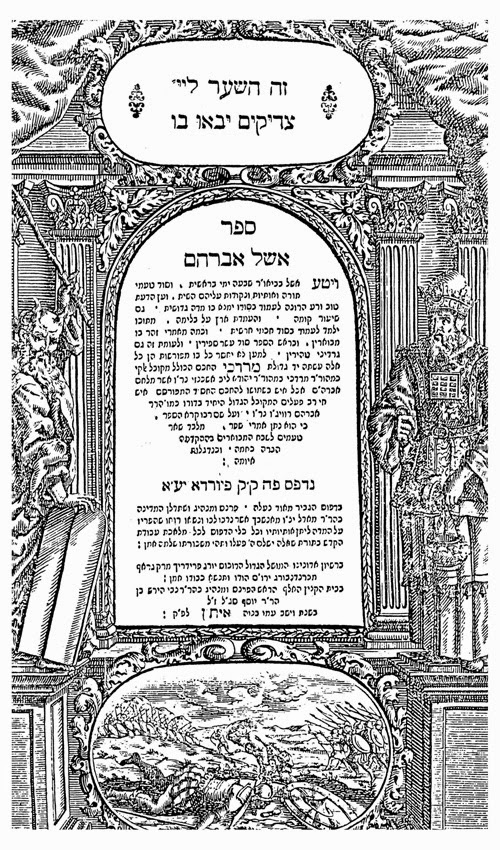
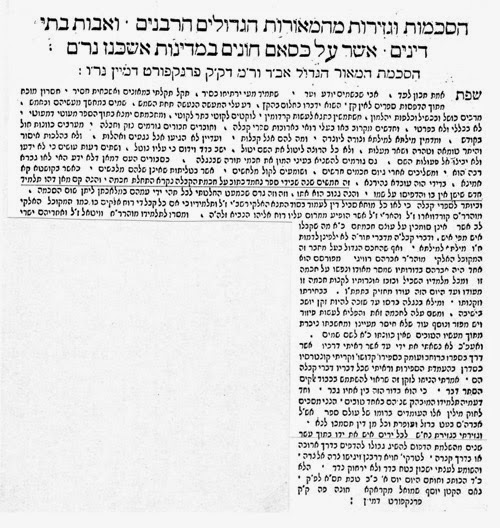
On January 2, 1701, R. Joseph Samuel wrote a letter of approbation for a kabbalistic work by R. Mordechai Ashkenazi, an otherwise unknown author (then) who was a protégé of the distinguished Italian rabbi and kabbalist, R. Abraham Rovigo (d. 1713).5 The book, entitled אשל אברהם, and the letter of approbation, were published later in 1701 in Fürth. After a lengthy critique of the proliferation of works on Kabbalah in the late 17th century, the letter reads, in part:6
They [the new authors of kabbalistic works] are guilty of two evils. First, they neither know nor understand the deeds of God. Second, they cause the common folk to slight the rabbis expert in the exoteric Torah. The common folk assume that rabbis not expert in Kabbalah are not true scholars. So they cast away their expert rabbis, listening instead to the enchanters, whose wisdom is borrowed from others. I can testify that this is true [i.e., that the enchanters’ wisdom is borrowed from others], for I was involved in such a case. I recall vividly how some fifty years ago I owned a copy of a delightful kabbalistic work entitled התחלת חכמה. Some upstart student, a novice with no knowledge based on accumulated learning, printed the book under his own name. He simply plagiarized the entire book.
2.  The Identity of the Plagiarized Book.
No book entitled התחלת חכמה has ever appeared in print. It therefore could not have been plagiarized by anyone. Moreover, R. Joseph Samuel did not reveal the name of the plagiarist and the title of the book in its plagiarized form. This literary riddle was first raised in print early in 1976 by the noted bibliophile, Abraham Schischa of London.7 The solution was not long in coming. That same year, R. Shmuel Ashkenazi, also a noted bibliophile, solved the riddle.8 He correctly identified התחלת חכמה as the title of a kabbalistic book in manuscript form, still available in a variety of contemporary libraries.9 In book form, it was entitled מעין החכמה and it first appeared in print in Amsterdam in 1652.10 The plagiarist who published מעין החכמה under his own name was R. Abraham Kalmankes of Lublin. Ashkenazi provided other useful information as well, but all that is important for our purposes is that he clearly identified R. Abraham Kalmankes as a plagiarist. As such, he agreed fully with R. Joseph Samuel’s characterization (in his letter of approbation) of the novice upstart student. The  late Professor Gershom Scholem also identified R. Abraham Kalmankes as a plagiarist. He would write:11
והוא [ר’ אברהם קלמנקס] הדפיס ס’ התחלת חכמה הגניבה [כך כתוב] על שמו,
וכבר יש רמז לדבר בהסכמת הרב מפרנקפורט לס’ אשל אברהם.

“He [R. Abraham Kalmankes] published the pirated book entitled Hathalat Hokhmah under his own name. The matter is alluded to in the letter of approbation by the rabbi of Frankfurt to the book entitled  Eshel Avraham.”

It is our contention that R. Abraham Kalmankes has received less than a fair hearing in the court of modern scholarship. If we reopen the investigation, it is because much of the evidence has either been misconstrued or overlooked. The reader will have to decide for himself whether or not Kalmankes was, in fact, a  plagiarist, and whether or not he should be better remembered for his seminal contribution to Jewish teaching and literature.
3. מעין החכמה.
            a) Claims of the Author/Editor
מעין החכמה, the first book to appear under R. Abraham Kalmankes’ name, is a short introduction to Lurianic Kabbalah. Indeed, it was among the earliest such works to appear in print. The title page of the quarto sized volume is followed by a one-and-a-half page introduction (pages 2-3). The introduction is followed by the text (pp. 4-22), which consists of 78 tightly-knit chapters (פרקים), perhaps more properly labeled today as paragraphs. Thus, several of the “chapters” consist of no more than15 lines of print (and, sometimes, even less). Scattered throughout the book are occasional comments in parentheses. These may reflect an educational tool used by the original author to clarify a difficult term by means of a gloss, creating — in effect — what we would call today a footnote. Or, as appears likely, these may reflect a second hand, i.e., material added to the base text by someone other than the author, e.g., a later editor of the original manuscript. Our immediate concern, however, will not be with the book’s content or structure, but rather with its authorship. What are the claims of the title page and the introduction? What do they tell us about the authorship of
מעין החכמה?
The title page basically announces the content of the book.12 It is a kabbalistic manual, we are informed, the likes of which has yet to appear in print. It provides the kabbalistic underpinning upon which all of R. Isaac Luria’s teachings rest. The title page then indicates that the book’s secret teachings are being  brought to press [ Hebrew:תעלומים  הוציא לאור] by “the exceedingly wise and young divine kabbalist, R. Abraham, son of the Gaon, Chief Rabbi and Head of the Yeshiva, R. Aryeh Leib, scion of the Kalmankes family of Lublin.” Note that the phrase “being brought to press by” is ambiguous. It is unclear from the title page whether R. Abraham Kalmankes is being presented as the author, editor, or publisher of מעין החכמה.
We perforce turn to the introduction, which – if read carefully – resolves much of the ambiguity of the title page.13The introduction, written and signed by R. Abraham Kalmankes, begins with a justification for the book’s publication. Briefly, Kalmankes, himself a victim and survivor of the Chmielnitzki massacres, informs the reader that he was puzzled by the seemingly endless exile of the Jews, with redemption nowhere in sight. After much reflection – and deeply influenced by kabbalistic teaching – Kalmankes concluded that it was faulty prayer that was prolonging the exile of the Jewish people. Jewish prayer was not piercing the heavens and reaching God on high. He compared the state of the Jewish people to a ship adrift at sea, with no one on board who knows how to steer the ship to safety. Nothing will change, argued Kalmankes, until kabbalistic teaching spreads throughout the Jewish communities. The seeds of redemption were planted by R. Isaac Luria, the master of proper kabbalistic prayer. Alas, he died before redemption set in, but he left a successor, R. Hayyim Vital, who in turn left “a basket full of manuscripts,” i.e. he reduced to writing the kabbalistic teachings of R. Isaac Luria, especially those relating to prayer. Once these teachings were mastered by Jews the world over, redemption would be at hand.
Unfortunately, “the basket full of manuscripts” was not being made available to the Jewish community at large. Kalmankes explains that those who horde the manuscripts refuse to publish them. This, for two reasons. First, for reasons of vanity. By retaining the manuscripts for themselves, they became the masters of esoteric teaching and the power brokers to whom all had to turn for guidance. Second, for reasons of profit. The owners of the manuscripts charged a hefty price for those who wished to view and copy them. Kalmankes decided to put an end to this scandalous state of affairs by acquiring and publishing one of the manuscripts that preserved some of the key esoteric teachings of R. Isaac Luria. Moreover, he “added a few comments of his own, in order to benefit the many readers,” almost certainly a reference to the comments in parentheses mention above. He gave the manuscript a new title, מעין החכמה [Wellspring  of Knowledge], for “just as a wellspring begins with a narrow opening that ultimately widens as it fills with water, so too this book begins with nuggets of wisdom that broaden and deepen as one grows in wisdom.” Kalmankes concludes the introduction with the following signature: “These are the words of the youngest
member of the group, Abraham, son of my father and teacher Rabbi Aryeh, son of the Gaon, our teacher and rabbi, the honorable R. Joseph Kalmankes Yaffe of Lublin.”
            b) Editions
Some of the confusion surrounding מעין החכמה relates to the multiplicity of published kabbalistic works with the title מעין החכמה, some of which have been mistakenly ascribed to Kalmankes in library catalogues throughout the world.
Confusion surrounding Kalmankes’ alleged plagiarism is also due, in part, to variant readings that appear in the later printed editions of מעין החכמה, for which Kalmankes can hardly be held responsible. After brief mention of some unrelated kabbalistic works with the title מעין החכמה, we will list and describe each of the printed editions of Kalmankes’ מעין החכמה.
An anonymous kabbalistic treatise entitledמעין חכמה  (ascribed in part to Moses) is included in the collection entitled ארזי לבנון (Venice, 1601).14 It is unrelated to Kalmankes’ מעין החכמה. The Ashkenazic printing house of the partners Judah Leib b. Mordecai Gimpel and Samuel b. Moses Ha-Levi published yet another anonymous kabbalistic treatise entitled מעין החכמה (Amsterdam, 1651).15 Frequently reprinted, it too is unrelated to Kalmankes’ מעין החכמה.
Four different editions of Kalmankes’ מעין החכמה have appeared in print. They are:
1. מעין החכמה, Amsterdam, 1652. Printed by the Immanuel Beneviste publishing house during the lifetime of its author/editor Abraham Kalmankes, it is the only reliable edition of Kalmankes’ מעין החכמה. As such, we will claim that Kalmankes can be judged only on the basis of this, and no other, edition of מעין החכמה. For a detailed description of the book, its title page, and introduction, see above.16
2. מעין חכמה, Koretz, 1784. This edition was printed by the Johann Anton Krieger publishing house which, in Koretz, was devoted to the publishing of kabbalistic and hasidic works.17 Although Kalmankes’ title of the book is retained, the title page ascribes the book to R. Isaac Luria and makes no mention of Abraham Kalmankes. More importantly, this edition omits Kalmankes’ introduction to the book. The text is a slightly revised and updated version of the Kalmankes edition. It incorporates most of Kalmankes’ parenthetical notes, with slight revision.18 The text was edited in its present form sometime between 1698 and 1784, i.e. well after Kalmankes’ death.19
3. מעיין חכמה, Polonnoye, 1791. Printed by the Samuel b. Yissokhor Baer Segal publishing house, this edition of מעין החכמה  appears at the end of a collection of kabbalistic works whose title page reads: ספר הר אדני.  מעיין חכמה is accorded no title page of its own. It begins with a skewed version of Kalmankes’ introduction, entitled: הקדמת המחבר ספר מעיין חכמה. No such title is applied to Kalmankes’ introduction in the first edition. We have already indicated (see above) that the introduction is omitted entirely from the second edition, so no such title appears there. The introduction to this, the third edition, closes with the name of the author:  אברהם בן מהו’ ארי’ בן הגאון מה’ משה יוסף קלמן מלובלין. In the first edition, however, Kalmankes’ grandfather’s name is given as: הגאון מורנו ורבנא כמוהר”ר יוסף קלמנקס ייפה מלובלין, with no mention of either משה or קלמן. The text that follows is entitled: התחלת החכמה האלהות כפי דרך האר”י אשכנזי ז”ל הנקרא ספר מעיין החכמה. It differs considerably from the text published in the first two editions. It  mostly lacks Kalmankes’ parenthetical comments strewn throughout the first two editions. It regularly omits readings that appear in the first two editions, and often adds material that is lacking in the first two editions. Indeed, it is a different manuscript version of the Lurianic digest that was first published by Kalmankes in 1652.20
4. מעין החכמה, Lvov, 1875. No publisher’s name is given. This is a hybrid version drawn from two earlier printed editions. Kalmankes’ introduction is drawn from the skewed version that accompanies the Polonnoye, 1791 edition. The text is drawn from the Koretz, 1784 edition.21 As such, this edition has no independent value and requires no further discussion.
            c) Relationship of the Published Editions to the Extant Manuscripts
No one has written more intelligently about the history of Lurianic kabbalistic manuscripts than Yosef Avivi.22 What follows is essentially a brief account of the relationship between the published editions of Kalmankes’מעין החכמה and the extant manuscripts, based largely (but not entirely) upon the results of Avivi’s investigations.
Numerous manuscripts copies of the kabbalistic treatise entitled התחלת החכמה, most of them dating to the 17th and 18th centuries, are extant in libraries throughout Europe, Israel, and the U.S. While they vary slightly from each other, they clearly reflect a single recension of an early 17th century kabbalistic treatise. The anonymous treatise, whose original title is unknown, was written by a disciple of Luria in Damsascus and then sent to Italy. There, the manuscript was copied and circulated under a variety of names such as קונטרס ההיכלות, כללי חכמת שיעור קומה, התחלת החכמה, and התחלת חכמה. It was precisely because a manuscript copy of התחלת חכמה came into the possession of R. Joseph Samuel b. R. Zvi of Cracow sometime prior to 1652, that he was so startled when he saw Kalmankes’ printed edition of מעין החכמה. Even after the printed edition made its debut in 1652, new manuscript copies of the kabbalistic treatise were written and circulated under a variety of titles, now including the title מעין החכמה.
Avivi has shown that the  התחלת החכמה manuscripts formed the first part of a larger Lurianic treatise that originally included a second part as well. Whereas the first part focused entirely on עולם האצילות, the second part focused  on עולם הבריאה — and is extant in manuscript form only. The two parts were separated from each other, and largely due to Kalmankes’ publication, the first part became an independent work entitled מעין החכמה. In sum, Kalmankes’ מעין החכמה is an accurate copy (with the addition of occasional glosses by Kalmankes) of an anonymous early 17th century Lurianic treatise that circulated widely under a variety of titles, including the title התחלת החכמה.
4. R. Abraham Kalmankes.
            a) Family History
The accusation of plagiarism leveled against R. Abraham Kalmankes by R. Joseph Samuel b. R. Zvi, and seconded by both R. Shmuel Ashkenazi and  Gershom Scholem, was not accompanied by any discussion of R. Abraham Kalmankes himself. When and where did he live? How did he make a living? What other books did he author? Was he an inveterate plagiarizer?23 Had such an investigation been conducted, we suspect that the accusation of plagiarism would not have been leveled at all.
In a brief biographical account of Kalmankes published in 1992, the author of the account bemoans the fact that so little is known about Kalmankes’ life history.24 Nonetheless, much more is known about him – and his family — than the meager snippets of information recorded in the 1992 biographical account or in the standard discussions of מעין החכמה. We will take as our point of departure the clear reference in Kalmankes’ introduction to מעין החכמה to his distinguished grandfather, “the Gaon, our Teacher and our Rabbi, R. Joseph Kalmankes Yaffe of Lublin.” For our purposes, what is most important about the grandfather is that after an illustrious rabbinic career in Lublin, he spent his last years in Prague, where he died, and remains buried to this day.25 The elaborate epitaph on his tombstone informs us that he died at the age of 56 on Sunday,13 Tishre, in the year 5397 (= October 12, 1636).26 The significance of this information will become apparent shortly, but first we need to turn elsewhere.
In 1678, at the family owned printing press in Lublin, R. Abraham Kalmankes published the only other work he would publish in his lifetime. Entitled ספר האשל, it is a masterful (and typical seventeenth century) rabbinic commentary on the book of Genesis.27It was the first installment of a planned commentary on the entire Torah, but apparently the rest of the commentary either never materialized or was never published.  The commentary is essentially a midrashic-halakhic work, replete with citations from the Midrash, Talmud, Codes (especially R. Joseph Karo’s שלחן ערוך), and kabbalistic literature. The volume itself is accompanied by a series of letters of recommendations by rabbis from Kremenitz, Lublin, Brisk, Pinsk, Grodno, Vilna,28 and more, all attesting to Kalmankes’ rabbinic scholarship. Once again, Kalmankes prefaced his work with an informative introduction. Kalmankes alludes to the many trials and tribulations that accompanied him through life, including hazardous trips to Egypt and the land of Israel. He was near death on several occasions during his travels, but managed to make his way back safely to Lublin.29 Upon his return, he undertook to publish two works in his lifetime. This, in order to fulfill the talmudic dictum: “Happy is he who arrives here [i.e., on High] with his talmudic teaching in hand.”30 Since according to biblical teaching, a matter is established by “two witnesses,” Kalmankes was determined to author two books and publish them, so that he would have them “in hand” when necessary. The first book, ספר האשל, intended for a more or less popular audience, took the form of a commentary on the book of Genesis. The second book, entitled ברכת אברהם, was intended for talmudic scholars only. Kalmankes informs us that the manuscript copy of ברכת אברהם was completed and that he looked forward to its publication. Sadly, it was never published. What  needs to be noted immediately is that Kalmankes never imagined that his earlier publication of מעין החכמה could count as one of his “two witnesses”! (And this was in 1687, long before R. Joseph Samuel b. R. Zvi leveled his accusation of plagiarism in 1701.) Indeed, מעין החכמה is not mentioned at all in Kalmankes’ introduction to ספר האשל. Clearly, he did not consider it a book that he had authored.
Elsewhere in the introduction, Kalmankes notes that he will make a special effort to cite דברי תורה from his grandfather, R. Joseph Kalmankes, who he describes as: “א”א זקני מ”ו הגאון מוהר”ר יוסף קלמנקס, זצ”ל, אשר מנוחתו כבוד בק”ק פראג.”  Kalmankes adds that upon his grandfather’s death in Prague, all of his writings were lost, and that he – Kalmankes – will therefore record his grandfather’s teachings as he heard them from his disciples. “For,” explains Kalmankes, “I merited to sit at his feet only until the age of ten. Thus, I was a child, and have no real knowledge of his novellae.” We, of course, cannot be certain whether Kalmankes sat at his grandfather’s feet in Lublin or Prague (or both). If only in Prague, and if Kalmankes was ten years old when his grandfather died, we have the latest possible date of birth for Kalmankes, namely 1626, for we have already established that Kalmankes’ grandfather died in 1636. Kalmankes, of course, could have been born earlier than 1626, and we have reason to believe that this was the case.
At the other end of the spectrum, it seems likely that R. Abraham Kalmankes died somewhere between 1678 and 1701. That he was still alive in 1678 is attested by the publication of ספר האשל in that year, and by several of the letters of recommendation dated 1678, all of which describe Kalmankes as alive and well. Since Kalmankes never responded to the devastating accusation of plagiarism made against him in 1701 by a leading rabbinic contemporary, it is probably safe to assume that he died before the accusation appeared in print. Though we cannot pinpoint the year of his death with precision, the most likely candidates are either 1692 or 1693. Kalmankes died in Lvov, where he served on its rabbinic court as דיין.31 The text of the epitaph on his tombstone was copied and published in 1863 and reads:32
שנת תתן אמת ליעקב
                          ביום טוב נהפך כי טוב פעמים ואבל ומספד ונהי בכפלים
ט”ו בחודש ניסן נגנז צנצנת המן המאיר באספקלריא המאירה
כבוד מורינו ורבנו ומאורנו נתבקש בישיבה של מעלה
הגאון האלוף עין הגולה מו”ה אשר יעקב אברהם בן הרב מוהר”ר אריה קלמנקש
צלל במים אדירים של תורה וחיבר ס’ אשל אברהם על שמו נקרא
ובשביל שזיכה את הרבים יבוא שלום וינוח על משכבו בשלום
תנצב”ה
Thus, Kalmankes died on 15 Nisan on a Tuesday.33 But in which year? The text states unequivocally that it was in the year whose numerical value was embedded in the biblical phrase תתן אמת ליעקב.34 But the copyist (in 1863) informed his readers that, due to an erasure, he could no longer determine which letters from the phrase were enlarged or highlighted on the original tombstone. This makes it difficult, but not impossible – as we shall see – to calculate Kalmankes’ approximate year of death. Since Kalmankes died on the first day of Passover which fell on a Tuesday, seven candidates (between the years 1678 and 1701) present themselves: 1679, 1686, 1689, 1692, 1693, 1696, and 1699. The Hebrew equivalents for these years are: [5]439, [5]446, [5]449, [5]452, [5]453, [5]456, and [5]459. Now the numerical value of a combination of letters from the phrase תתן אמת ליעקב must add up exactly to one or more of the above Hebrew dates. Only two solutions are possible: [5]45235 and [5]453.36 These are 1692 and 1693, respectively.37 In sum, if we had to give mostly approximate dates for the three generations of the Kalmankes family mentioned by R. Abraham Kalmankes in both of his publications, they would be:
R. Joseph Kalmankes:    1580-1636
R. Aryeh Kalmankes:      1600-167038
R. Abraham Kalmankes: 1620-169339
b) Citation from מעין החכמה in ספר האשל
Critical for our discussion is the fact that R. Abraham Kalmankes cites מעין החכמה in his ספר האשל!40 It is the only reference to מעין החכמה in ספר האשל.The passage reads:41
       או יאמר מאמר הר”י ז”ל באשר נקדים מאמר מהאר”י לור”י[א] הנזכר בספר מעיין החכמה
אשר הביאותיו לבית הדפוס בפ’ י”ד שבשעת הבריאה…
Or we can explain this by citing a passage from R. Isaac of blessed  memory, i.e., by first introducing a passage by R. Isaac Luria Ashkenazi — which is mentioned in chapter 14 of the book מעיין החכמה, which I brought to press [literally: to the publishing house] — which states that during the period of creation…
If one examines chapter 14 of מעין החכמה, the passage cited by Kalmankes in ספר האשל appears exactly as referenced, but Luria’s name appears nowhere in the text of chapter 14! This is precisely because מעין החכמה was a repository of Lurianic teaching which he – Kalmankes – brought to press. Kalmankes never claimed authorship of the book, and he tells us so in his own words in 1678, long before any accusation was leveled against him.
5. Conclusions.
Ultimately, whether or not Kalmankes is viewed as a plagiarist will depend largely on one’s definition of plagiarism.42 In terms of literary (as distinct from oral) plagiarism, a reasonable definition would seem to be:
Plagiarism is the act of appropriating in print another person’s ideas,          writings, or words, and passing them off as one’s own by not providing proper attribution to their original source.
Even aside from the definition itself, the moral opprobrium attached to any specific act of plagiarism will depend on a variety of factors. Thus, it seems to me, that the more literal and lengthy the borrowing, the more heinous the offense. Motive too will surely play a role in determining the severity of the offense. We turn to the specifics of the Kalmankes case.One can certainly sympathize with R. Joesph Samuel’s outrage when, in the 1650’s, he chanced upon a copy of the recently published מעין החכמה. He leafed through its pages and realized instantaneously that it was virtually word for word a printed copy of a manuscript he owned under the title התחלת חכמה. Worse yet, prominently displayed on the title page of the pirated book was the name of the “divine kabbalist,” R. Abraham Kalmankes, a name otherwise unknown to R.Joseph Samuel. He could only conclude that this was a blatant case of plagiarism that called for condemnation. Indeed, he was still upset about the matter some fifty years later!
But, as we have seen, the title page of מעין החכמה is somewhat ambiguous about Kalmankes’ role in its authorship and publication. It simply states that Kalmankes הוציא לאור the תעלומים, i.e., he published the secret or hidden digest of Lurianic teaching. One suspects that R. Joseph Samuel never examined Kalmankes’ introduction to מעין החכמה. Had he done so, he surely would have noticed that Kalmankes admits openly that he is publishing a manuscript that contains a digest of Lurianic teaching, authored by a disciple of Luria – and not by him. Kalmankes’ states unequivocally that his contribution to the volume is limited to the few comments he added (almost always in parentheses) and to the new title, מעין החכמה, he provided for it. It is only in the third edition of מעין החכמה, published in Polonnoye, 1791 – long after Kalmankes’ death – that a skewed version of Kalmankes’ introduction is labeled: הקדמת המחבר ספר מעיין חכמה, in effect suggesting that Kalmankes was the author of מעין החכמה. Anyone who reads this skewed version of Kalmankes’ introduction, and compares it to the original, will realize at once that it is was created in 1791 in order to harmonize its content with that of a different manuscript version of the Lurianic digest (one that lacked Kalmankes’ comments) that was being attached to it.43
 We have also the clear evidence from Kalmankes’ introduction to ספר האשל, published by him in 1678, that he sought to author and publish two books in his lifetime, so as not to be embarrassed when he was called “on High.” He provides the titles of both books, yet makes no mention of the fact that he had authored and published a book called מעין החכמה. He knew full well that this was a book written by others, which he had brought to press. Indeed, as we have seen, he cited מעין החכמה in his ספר האשל. When doing so, he stated openly that it was a Lurianic work that he had brought to press.
            There doesn’t seem to be much evidence here for plagiarism, as defined above. Kalmankes’ מעין החכמה was based upon a Lurianic manuscript that was anonymous and was circulating under a variety of titles. Kalmankes never claimed authorship of the manuscript, and indicated clearly that all he did was to provide the manuscript with a new title and some brief annotation. This he did for the best of motives, namely to bring about the ultimate redemption of the Jewish people. He did not pass off the work as his own (other than the title and the annotations, which were legitimately his own creation); he withheld no proper attribution.
On the other hand, three distinguished scholars, R. Joseph Samuel of the seventeenth century, and R. Shmuel Ashkenazi and the late Professor Gershom Scholem of the twentieth century, were persuaded that Kalmankes was a plagiarist. Perhaps they felt that the appearance of Kalmankes‘ name on the title page of מעין החכמה,  preceded by the words “אב בחכמה ורך בשנים המקובל האלוהי כמוהר”ר,” with no mention of any manuscript or attribution to others, was sufficiently misleading – and, perhaps, even deliberately intended – to create the impression that Kalmankes was the author of the book. If so, they would argue, he deserves to be listed among the plagiarizers. I am not persuaded that this is the case, but in deference to the three distinguished scholars mentioned above, I have allowed the title of this essay to read as it does. At best (or: worst), it is a mild case of plagiarism, if even that.44
NOTES
1 For biographical studies of R. Joseph Samuel b. R. Zvi, see H.N. Dembitzer,
כלילת יופי (Cracow, 1893), vol. 2, pp. 144b-152b; M. Horovitz, Frankfurter Rabbinen (Jerusalem, 1969), ed. J. Unna, pp. 94-97 and 296-297; and idem,
רבני פרנקפורט (Jerusalem, 1972), ed. J. Unna, pp. 67-69 and 212. For the epitaph on his tombstone, see idem, אבני זכרון (Frankfurt, 1901), p. 151. For legendary accounts of R. Joseph Samuel, see E. Sternhell, “,תולדות יצחק” p. 2b, in Y.I. Billitzer, באר יצחק (Paks, 1898); and Y.L. Maimon, שרי המאה (Jerusalem, 1955), vol. 1, pp. 231-233.
2 For an assessment of R. Joseph Samuel’s contribution to the printed text of the Talmud, see Y. S. Spiegel, עמודים בתולדות הספר העברי: הגהות ומגיהים (Ramat-Gan, 2005), second edition, pp. 404-407.
3 See L. Loewenstein, מפתח ההסכמות (Lakewood, 2008), ed. S. Eidelberg, pp. 99-100.
H.N. Dembitzer, op. cit., vol. 2, p. 150a.
See G. Scholem, חלומותיו של השבתאי ר’ מרדכי אשכנזי (Jerusalem, 1938); and Y. Tishby, נתיבי אמונה ומינות (Jerusalem, 1964), pp. 81-107. Cf. the historical vignette in Rabbi P. Katzenellinbogen, יש מנחילין (Jerusalem, 1986), ed. Y.D. Feld, pp. 74-75.
The original reads:
ושתים רעות עושים כי לא ידעו ולא יבינו אל פעולות השם,  גם גורמים להשניא  בעיני המון את חכמי תורה שבנגלה, כסבורים העם דמאן דלא ידע האי לאו גברא רבה הוא, ומשליכים אחרי גיום חכמים חרשים ושומעים לקול מלחשים, אשר בטליתות שאינן שלהם מלבשים, כאשר בקושטא קא אמינא בדידי הוה עובדא, נהירנא זה חמישים שנה שבידי ספר נחמד כתוב על חכמת הקבלה נקרא תחלת חכמה, והנה קם מאן דהו תלמיד חדש שישן אין בו והדפיסו על שמו, והנה גנוב הוא אתו.
A. Schischa, “שלושה ספרים נעלמים,” עלי ספר 2(1976), pp. 237-240.
S. Ashkenazi, “שתי הערות,” עלי ספר 3(1976), pp. 171-173. For an expanded version of Ashkenazi’s comments in עלי ספר, see his אסופה: ארבעה מאמרים מאוצרות הר”ש אשכנזי שליט”א (Jerusalem, 2014), pp. 49-53. Cf. S.Z. Havlin, “הערת העורך,” עלי ספר 11(1984), p. 134.
These include the National Library in Jerusalem, the Bodleian Library at Oxford, and a host of other libraries in Europe and the United States. For an early description of two such manuscripts in the National Library in Jerusalem, see G. Scholem, כתבי יד בקבלה (Jerusalem, 1930), p. 63, manuscript 2512, and p, 117, manuscript 47. The Bodleian Library lists some 10 manuscript copies of התחלת חכמה in its collection. See A. Neubauer, Catalogue of the Hebrew Manuscripts in the Bodleian Library and in the College Libraries of Oxford (Oxford, 1886), column 1001. Cf. the corrections to these listings in M. Beit-Arie and R.A. May, eds., Catalogue of the Hebrew Manuscript in the Bodleian Library: Supplement of Addenda and Corrigenda (Oxford, 1994), passim. A manuscript copy of התחלת חכמה was in the private library of R. Joseph Solomon Delmedigo in 1631. See his נובלות חכמה (Basel, 1631), p. 195a. The precise title of the book varies in the manuscripts, with the most common titles being התחלת חכמה  and
התחלת החכמה.
10 See L. Fuks and R.G. Fuks-Mansfeld, Hebrew Typography in the Northern Netherlands 1585-1815 (Leiden, 1984), vol. 1, pp. 176-177, entry 233.
11 See the undated loose page, in Scholem’s hand, appended to Scholem’s copy of מעין חכמה at the National Library in Jerusalem. Cf. ספריית גרשם שלום בתורת הסוד היהודית: קטלוג (Jerusalem, 1999), vol. 1, p. 312, entry 4188.

12 See the scan of the title page.
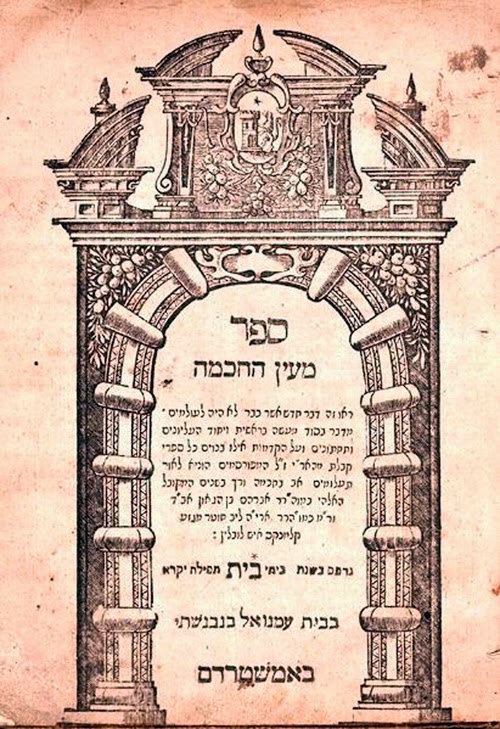
 

13 See the scan of the introduction.
14 The title is so listed on the pages of the treatise itself in ארזי הלבנון, pp. 46b-47a. On the title page of ארזי הלבנון, it is listed as מעיין החכמה. The frequent and easy interchange between the spellings מעין and מעיין and the spellings חכמה and החכמה characterizes virtually all the printed editions of the various books bearing these titles.
15 L. Fuks and R.G. Fuks-Mansfeld, op. cit., vol. 1, p. 195, entry 270,
16 Only a handful of copies are extant world wide. To the best of my knowledge, the first edition of Kalmankes’ מעין החכמה has not been photo-mechanically reproduced, and it is not available online (as of the date this note was recorded). Nor is it available on any of the standard electronic collections of rabbinic literature, such as HebrewBooks, אוצר החכמה, or אוצרות התורה. I am indebted to the National Library in Jerusalem and the Jewish Theological Seminary in New York for making their copies available to me. The scans of the title page and the introduction are reproduced here courtesy of the Bibliotheca Rosenthalia, now in the Special Collections of the University of Amsterdam (online catalogue: http://permalink.opc.uva.nl/item/001748453).
17 H. D. Friedberg, תולדות הדפוס העברי בפולניא (Antwerp, 1932), p. 61.
18 One key revision appears on p. 1, chapter 2, where ספר ויקהל משה is referenced. The book is not mentioned in the first edition of Kalmankes’ מעין החכמה, nor could it have been, since ספר ויקהל משה was not published until 1698. The reference is to R. Moshe Graf, ויקהל משה (Dessau, 1698). It does not appear likely that Kalmankes saw Graf’s work in manuscript form, since מעין החכמה was published in 1652 and Graf was born in 1650.
19 For the date of Kalmankes’ death, see below. The Koretz, 1784 edition was photo-mechanically reproduced in Jerusalem, 1970.
20 The Polonnoye, 1791 edition of מעיין חכמה was photo-mechanically reproduced in Jerusalem, n.d. (circa 1998), in a thin, dark blue, hardbound volume whose spine and outer cover read צדיק יסוד עולם, and whose title page reads הר אדני. (In other words, when seeking a copy in a bookshop of the reprint of the Polonnoye, 1791 edition of מעיין חכמה, whatever else you do, don’t ask for a copy of מעיין חכמה.)
21 As noted by S. Ashkenazi (see above, note 8), the title page of the Lvov edition indicates that its text is based upon the Koretz edition, and reproduces the very biblical phrase used by the Koretz edition for indicating its original date of publication in 1784. But by highlighting a different set of letters within the same biblical phrase, the Lvov edition announces to the reader that its date of publication is 1875.
22 Y. Avivi, קבלת האר”י (Jerusalem, 2008), 3 volumes, passim. See especially vol. 1, pp. 204-208, 443; and vol. 2, pp. 565-568, 840-841. See also, idem, “כתבי האר”י באיטליה עד שנת ש”פ”,” עלי ספר 11(1984), pp. 91-134; and “הערה,” עלי ספר 12(1986), p. 133.
23 “Plagiarism is something people may do for a variety of reasons but almost always something they do more than once.” So T. Mallon, Stolen Words: Forays into the Origins and Ravages of Plagiarism (New York, 1989), preface, p. xiii.
24 Rabbi M.Y.S. Goldenberg, “פתח דבר,” to the reissue of R. Abraham Kalmankes’ ספר האשל (Brooklyn, 1992).
25 On R. Joseph Kalmankes Yaffe of Lublin, see J. Kohen-Zedek, שבת אחים ( St. Petersburg, 1898), pp. 59-76; S. B. Nissenbaum,  לקורות היהודים בלובלין, (Lublin, 1920), second edition. pp. 36-37; S. Buber, אנשי שם (Cracow, 1895), p. 89, entry 217;  and S. Englard, “צפונות יוחסין (א), “ ישורון 3(1997), p. 680, note 6 and p. 694, note 36a.
26 See K. Lieben, גל עד (Prague, 1856), German section, p. 46; Hebrew section, pp. 34-35.
27 R. Abraham Kalmankes, ספר האשל (Lublin, 1678). Few copies have survived. For the copy at the Bodleian Library, see M. Steinschneider, Catalogus Librorum Hebraeorum in Bibliotheca Bodleiana (Berlin, 1860), vol. 1, column 752, entry 4458:1; and A.E. Cowley, A Concise Catalogue of the Hebrew Printed Books in the Bodleian Library (Oxford, 1929), p. 45. For the copy at the British Library, see J. Zedner, Catalogue of the Hebrew Books in the British Museum (London, 1867), p. 14. For the copy at Yeshiva University’s Mendel Gottesman Library, see B. Strauss, אהל ברוך (London, 1959), p. 31, entry 534. To the best of my knowledge, the first edition of Kalmankes’ ספר האשל has not been photo-mechanically reproduced, and is it not available online (as of the date this note was recorded). Nor is it available on any of the standard electronic collections of rabbinic literature, such as HebrewBooks, אוצר החכמה, or אוצרות התורה. A new edition of this exceedingly rare volume was made available by Rabbi M.Y.S. Goldenberg (Brooklyn, 1992) and we are indebted to him. Nonetheless, one needs to use this new edition with caution; the text has been “improved” for the modern reader. A comparison of the texts of the title page, as they appeared in 1678 and 1992, serves as an indicator of the occasional liberties taken with the text. A seemingly enigmatic woodcut (opposite the opening page of the commentary on Genesis) depicting a Jew (Kalmankes?) drawing water from a well (מעין החכמה?) – and framed in an elaborate frame marked by two angelic beings holding up a crown inscribed with the words כתר תורה – was not reproduced in the 1992 edition. See the attached scans:
 
28 The letter of recommendation from Vilna, dated 1673, was written by its Chief Rabbi, R. Moses b. David Kramer (d. 1687), the paternal great-great-grandfather of the Vilna Gaon.
29 These vicissitudes of life may account for the additional first names of Kalmankes, who in ספר האשל is identified as אשר יעקב אברהם קלמנקס. For the practice of changing names and/or adding additional first names when confronted by difficult circumstances, see R. Judah He-Hasid, ספר חסידים (Jerusalem, 1957), ed. R. Margulies, p. 214, paragraph 245 and notes. Cf. A. Teherani, כתר שם טוב (Jerusalem, 2000), vol. 1, pp. 293-315.
30 B. Pesahim 50a and parallels.
31 S. Buber, op. cit., p. 45, entry 101.
32 G. Suchestow, מצבת קודש (Lemberg, 1863), second edition, vol. 1, no pagination, entry 32.
33 The opening line ביום טוב נהפך כי טוב פעמים signals that Kalmankes died on a holiday that fell on the day when כי טוב was said twice. The next line identifies the holiday as 15 Nisan, i.e., the first day of Passover. The day כי טוב was said twice refers, of course, to the third day of creation, i.e. Tuesday. See Gen. 1:10 and 12.
34 Buber, loc. cit., writes with confidence that the highlighted letters are אמ”ת, which would indicate that Kalmankes died in [5]441 or 1681. But in 1681, the first day of Passover fell on a Thursday, not on a Tuesday. Suchestow was more circumspect, indicating it was no longer possible to determine which of the engraved letters were enlarged or highlighted. He left the problem unresolved. The usual practice for highlighting was the placement of a protruding dot over the engraved letters that were to be used for reckoning the year of death. The problem cannot be resolved by emending the second line to read ט”ז בחודש ניסן instead of ט”ו בחודש ניסן, since the second day of Passover can never fall on a Tuesday. See שלחן ערוך, אורח חיים, סימן תכח: א.
35 By highlighting the letters תתן אמ’ת’ לי’עקב’.
36 By highlighting the letters תתן א’מ’ת’  לי’עקב’.
37 These dates are based upon the assumption that the text of Kalmankes’ epitaph, as copied and published by Suchestow in 1863, is an accurate copy of the original. But this may not be the case. Suchestow’s מצבת קודש is marred by egregious errors. He sometimes copied and published as many as four different versions of the same epitaph! In another instance, he divided an epitaph into two parts, creating two dead persons when only one was called for. See the critiques of Suchestow in S. Buber, op. cit. (above, note 25)pp. vi-viii and in R. Margulies, “”,לתולדות אנשי שם  סיני 26(1949-50), p. 113 ( and throughout the later installments to this essay published in סיני between 1950 and 1952). Given that Kalmankes’ tombstone was close to 200 years old when it was copied in 1863, it is likely that the epitaph could be read only with great difficulty. While any attempt at emending the received text is speculative, a slight emendation of the first lines of the epitaph yields the following text:
שנת תתן אמ”ת ליעקב
ביום טוב נהפך טוב פעמים ואבל ומספד ונהי בכפלים
ט”ו בחודש ניסן נגנז צנצנת המן המאיר באספקלריא המאירה
The sense would be that Kalmankes died on 15 Nisan, on יום טוב, on a day when טוב was twice overturned. It was overturned first, because every day of the week of creation was described as  טוב(with the exception of the second and seventh days); and second, because it was יום טוב, a holiday. This would allow for 15 Nisan to fall on a Thursday, and indeed in 1681 (the numerical equivalent of אמ”ת), the first day of Passover fell on a Thursday. If so, Kalmankes may well have died in 1681.
38 These dates are an approximation. We know only that R. Aryeh Kalmankes died in 1671 or earlier, as his name appears with ברכת המתים in several letters of approbation dated 1671 and appended to ספר האשל.
39 These dates, as well, are an approximation. For possible evidence that R. Abraham Kalmankes died in 1681, see above, note 37. If Kalmankes was born in 1620, he would have been 32 years old when מעין החכמה was published in 1652. This fits well with his description on its title page as a רך בשנים. It also fits well with R. Joseph Samuel’s characterization of him (at the time) as an “upstart student.” It would also mean that he was nearing 60 years of age in 1678, when he published ספר האשל. This fits well with his bemoaning the fact – in the introduction to the volume – that the hair on his head and beard had turned gray and that old age was overtaking him.
40   It is astonishing that the author of the most comprehensive study of the Kalmankes family, J. Kohen-Zedek, שבת אחים (see above, note 25), concluded on pp. 67-68, that the authors of מעין החכמה and ספר האשל were two different people named Kalmankes (cousins, of course)! Among his proofs is the alleged fact that the author of ספר האשל was unaware of the existence of מעין החכמה. Alas, Kohen-Zedek overlooked the passage cited here. So too Gershom Scholem, who wrote: “המחבר [של ספר מעין החכמה] לא הזכיר את הספר בספריו הוא, כגון ספר האשל.” See the loose page in Scholem’s hand and the Scholem Library Catalogue, referred to above, note 11. Scholem, however, did not conclude with Kohen-Zedek that the authors of מעין החכמה and ספר האשל were two different people. Even more astonishing is the fact that the late bibliophile, R. Reuven Margulies, cited Kohen-Zedek’s conclusion approvingly. See R. Margulies, “לתולדות אנשי שם בלבוב,” סיני 26(1949-50), p. 219. It appears likely that Scholem (in part) and Margulies were misled by Kohen-Zedek.
41 ספר האשל (Lublin, 1678), p. 8b. We have printed the text as it appears
  in the first edition. In the 1992 edition, it appears on p. 29 as follows:
או יאמר באשר נקדים מאמר הר”י לוריא הנזכר בספר מעיין החכמה אשר הביאותיו לבית הדפוס בפ’ י”ד, שבשעת הבריאה…
 42 In general, see A. Lindey, Plagiarism and Originality (New York, 1952); T. Mallon, op. cit. (above, note 23); and J. Anderson, Plagiarism, Copyright Violation and Other Thefts of Intellectual Property: An Annotated Bibliography with a Lengthy Introduction (Jefferson, North Carolina, 1998).
43 Thus, in the introduction to the first edition of מעין החכמה, Kalmankes states:
וגם מעט מזער מדעתי הוספתי אך לזכות הרבים היא כוונתי (I added but a few comments of my own; my only intention is to benefit the many). In the Polonnoye, 1791 edition this was radically changed to: וגם מעט מזער מדעתי לא הוספתי אך לזכות הרבים היא כוונתי (I added not even the fewest of comments of my own; my only intention is to benefit the many). This change was made necessary because the kabbalistic manuscript now appended to Kalmankes’ introduction, and being published together with it for the first time, did not contain Kalmankes’ additional comments.   
44 I am deeply grateful to Rabbi Menachem Silber for reading and commenting on an earlier draft of this essay. The errors that remain are entirely mine.