Le-Tacen Olam (לתכן עולם): Establishing the Correct Text in Aleinu

Le-Tacen Olam (עולם לתכן): Establishing the Correct Text in Aleinu[1]
By Mitchell First (mfirstatty@aol.com)
 
                    The Jewish obligation of עולם תקון (=improving the world) is widely referred to and it is traditionally assumed that the Aleinu prayer is one of the texts upon which this obligation is based.
                    This article will show that a very strong case can be made that the original version of Aleinu read עולם לתכן (=to establish the world under God’s sovereignty), and not עולם לתקן (=to perfect/improve the world under God’s sovereignty[2]). If so, the concept of עולם תקון has no connection to the Aleinu prayer.[3]
—–
                    It is reasonable to assume that Aleinu was already included in the Amidah of Rosh ha-Shanah (=RH) by the time of Rav (early 3rd century C.E.).[4] But no text of Aleinu is included in the Talmud, nor is a text of Aleinu included in any of the classical midrashim.[5] Therefore, we must look to later sources for texts of Aleinu.
                     When we do, we find that the reading לתכן is found in the text of the RH Amidah in the Siddur Rav Saadiah Gaon (d. 942),[6] and in the text of the RH Amidah in the Mishneh Torah of the Rambam (d. 1204).[7] Moreover, it is found in numerous prayer texts from the Cairo Genizah that include this line of Aleinu.[8] For example, it is found in: 1) a fragment of the RH Amidah first published by Jacob Mann in 1925;[9] 2) a fragment of the RH Amidah first published by Richard Gottheil and William H. Worrell in 1927;[10] 3) a fragment of the RH Amidah first published by Mordecai Margaliot in 1973;[11] and 4) a fragment of Aleinu first published by Mann in 1925.[12] It is found in many other Aleinu prayer texts from the Cairo Genizah as well.[13] (In the fragment of Aleinu first published by Mann in 1925, Aleinu is included in the Pesukei de-Zimra section of the Palestinian shaḥarit ritual.[14])
                     Furthermore, the reading לתכן survives in Yemenite siddurim to this day. It was also the reading in the original tradition of the Jews of Persia.[15]
                    Admittedly, the reading in Europe since the time of the Rishonim has been לתקן. See, for example, the following texts of Aleinu:
                      – Maḥzor Vitry of R. Simḥah of Vitry (daily shaḥarit and RH);[16]
                      – Siddur Ḥasidei Ashkenaz (daily shaḥarit and RH);[17]
                      –Peirush ha-Tefillot ve-ha-Berakhot of R. Judah b. Yakar (RH);[18]
                      –Peirushei Siddur ha-Tefillah of R. Eleazar b. Judah of Worms (RH);[19] and
                      –Sefer Arugat ha-Bosem of R. Abraham b. Azriel (RH).[20]
                   The three main manuscripts of Seder Rav Amram Gaon also read לתקן.[21] But these manuscripts are not from the time of R. Amram (d. 875); they are European manuscripts from the time of the later Rishonim.[22]
                   Earlier than Maḥzor Vitry, we have circumstantial evidence for the reading לתקן in comments on Aleinu that were probably composed by R. Eliezer b. Nathan of Mainz (c. 1090-1170). Here, in Hamburg MS 153,[23] the following explanatory comment about Aleinu is expressed (without a text of the line itself): [24] …בשמך יקראו וכולם מלכותך מתקנים העולם כל ויהיו
                   Another manuscript also largely composed of the comments of R. Eliezer b. Nathan has essentially this same reading, in two places.[25] Another manuscript, which is probably the Siddur of R. Eliezer b. Nathan, has a similar reading: [26] …בשמך  יקראו  וכולם .במלכותך  מתקנים  העולם כל  ויהיו
                    Admittedly, it cannot be proven that לתכן was the original reading. But this seems very likely, as לתכן is by far the better reading in the context. This can be seen by looking at all the other scenarios that are longed for in this section:
                                 הארץ מן  גילולים להעביר עוזך בתפארת  מהרה לראות י-שד במלכות  עולם לתקן /לתכן  יכרתון כרות  והאלילים ארץ רשעי כל אליך  להפנותבשמך יקראו בשר בני וכל יכירו וידעו כל יושבי תבל כי לך תכרע כל ברך תשבע כל לשון ולכבוד שמך יקר יתנו יכרעו ויפולו אלקינו ה׳ לפניך   ותמלוך עליהם מהרה לעולם ועד עול מלכותך את ויקבלו כולם בכבוד תמלוך עד ולעולמי היא שלך  כי המלכות
             Beginning with the second line, להעביר, every clause expresses a hope for either the removal of other gods or the universal acceptance of our God. With regard to the first line, properly understood and its mystical and elevated language decoded,[27] it is almost certainly a request for the speedily rebuilding of the Temple.[28] Taken together, this whole section is a prayer for the rebuilding of the Temple and the establishment of God’s kingdom on earth. This fits the reading לתכן perfectly.[29]
             It is appropriate that this section of Aleinu is fundmentally a prayer for the establishment of God’s kingdom on earth. Most likely, this section was composed as an introduction to the malkhuyyot section of the RH Amidah.[30]
             Moreover, we can easily understand how an original reading of עולם לתכן might have evolved into עולם לתקן, a term related to the familiar term העולם תקון. The term העולם תקון (always with the definite article) is widespread in early rabbinic literature.[31] It is found thirteen times in the Mishnah, and seventeen times in the Babylonian Talmud.[32] The alternative scenario, that the original reading was עולם לתקן and that this evolved in some texts into the unusual reading עולם לתכן, is much less likely.[33]
              Finally, the ב of י-שד במלכות seems to fit better in י-שד במלכות עולם לתכן (=to establish the world under God’s sovereignty) than in either of the two ways of understanding י-שד במלכות עולם לתקן.[34] Also, the use of the word עולם instead of העולם and the lack of an את before the object עולם perhaps fit the reading לתכן better. I leave a detailed analysis of these aspects to grammarians.
                                                    Conclusion
             There is no question that social justice is an important value in Judaism.[35] Moreover, classical rabbinical literature includes many references to the concept of העולם תקון, both in the context of divorce legislation and in other contexts. The purpose of this article was only to show that is almost certainly a mistake to read such a concept into the Aleinu prayer, a prayer most likely composed as an introduction to the malkhuyyot section of the Amidah, and focused primarily on the goal of establishing God’s kingdom on earth. Even if we do not change the text of our siddurim, we should certainly have this alternate and almost certainly original reading in mind as we recite this prayer.[36]


[1]  This essay is a revision of Mitchell First, “Aleinu: Obligation to Fix the World or the Text,” Ḥakirah 11 (Spring 2011), pp. 187-197, available here.
   I would like to thank Yehiel Levy for showing me his Yemenite siddur which read לתכן and inspired this research. I would like to thank R. Moshe Yasgur for sharing his thoughts and for always being willing to listen to mine. I would also like to acknowledge the assistance of Dr. Ezra Chwat of the Institute of Microfilmed Hebrew Manuscripts at the Jewish National and Hebrew University Library, and the assistance of Binyamin Goldstein. Finally, I would like to dedicate this article to my beloved wife Sharon, whose name has the gematria of תקון and who needs no improvement.
[2] The above is how this phrase is usually translated. But The Complete ArtScroll Siddur, p. 161, translates: “to perfect the universe through the Almighty’s sovereignty.” Others adopt this translation as well. See e.g., J. David Bleich, “Tikkun Olam: Jewish Obligations to Non-Jewish Society,” in Tikkun Olam: Social Responsibility in Jewish Thought and Law, eds. David Shatz, Chaim I. Waxman, and Nathan J. Diament, Northvale, N.J.: Jason Aronson, 1997, p. 61.
[3] One scholar who intuited that the original reading may have been לתכן is Meir Bar-Ilan. See his “Mekorah shel Tefillat ‘Aleinu le-Shabeaḥ,’ ” Daat 43 (1999), p. 20, n. 72.
   The articles by Gerald Blidstein and J. David Bleich in Tikkun Olam: Social Responsibility in Jewish Thought and Law assume that the reading is לתקן (see pp. 26, 61 and 98). But the article in this volume by Marc Stern mentions the alternate reading of לתכן, citing R. Saadiah (see p. 165, n. 24).
    In 2005, Gilbert S. Rosenthal wrote a detailed article about the concept of tikkun olam throughout the ages and merely assumed that the reading in Aleinu is לתקן. See his “Tikkun ha-Olam: The Metamorphosis of a Concept,” Journal of Religion 85:2 (2005), pp. 214-40.
[4]  The Jerusalem Talmud, at Avodah Zarah 1:2, includes the following passage: א”ר יוסי בי רבי בון מאן סבר בראש השנה נברא העולם?  רב,  דתני בתקיעתא דבי רב זה היום תחילת מעשיך זכרון ליום ראשון וכו’.   A very similar passage is found at J. Talmud Rosh ha-Shanah 1:3 (where the reading is בתקיעתא דרב).
The sentence from the liturgy referred to (…זה היום) is from the introductory section to the ten verses of zikhronot. A reasonable inference from these Talmudic passages is that Rav composed (at least) the introductory sections to zikhronot, malkhuyyot and shofarot. Aleinu
is part of the introductory section to malkhuyyot. Since the sentence from the introduction to zikhronot quoted corresponds to the present
introduction to zikhronot, it is reasonable to assume that their introduction to malkhuyyot corresponded to the present introduction to malkhuyyot, i.e., that it included Aleinu. Admittedly, Rav could have made use of older material in the introductory sections he composed. The fact that Aleinu has been found (in a modified version) in heikhalot literature is some evidence for Aleinu’s existence in this early period, even though the prayer is not specifically mentioned in any Mishnaic or Talmudic source. (Regarding the dating of heikhalot literature, see below.) On the version of Aleinu in heikhalot literature, see Michael D. Swartz,  “ ‘Alay Le-Shabbeaḥ: A Liturgical Prayer in Ma‘aseh Merkabah,” Jewish Quarterly Review 77 (1986-1987), pp. 179-190. See also the article by Bar-Ilan cited above. For parallels in later sources to the two passages from the Jerusalem Talmud, see Swartz, p. 186, n. 20. See also Rosh ha-Shanah 27a.
      A statement that Aleinu was composed by Joshua appears in a collection of Geonic responsa known as Shaarei Teshuvah (responsum #44). But the statement was probably a later addition by the thirteenth century kabbalist Moses de Leon. See Elliot R. Wolfson, “Hai Gaon’s Letter and Commentary on ‘Aleynu: Further Evidence of Moses De León’s Pseudepigraphic Activity,” Jewish Quarterly Review 81 (1990-91),
pp. 379-380. Statements that Aleinu was composed by Joshua are found in various Ashkenazic Rishonim. This idea seems to have originated with R. Judah he-Hasid (d. 1217).  For the references, see Wolfson, pp. 380-381.
        There is much evidence that Aleinu could not have been composed by Joshua. For example: 1) Aleinu cites verses from the prophet Isaiah (this will be discussed below); 2) ha-kadosh barukh hu was not an appellation for God in Biblical times; and 3) terms are found in Aleinu that are characteristic of heikhalot literature. Also, for almost the entire Biblical period, the word olam is only a time-related word. It is not until Dan. 12:7 and perhaps Eccles. 3:11 that olam means “world” in the Bible. (Olam definitely means “world” at Ben Sira 3:18.) See Kirsten A. Fudeman and Mayer I. Gruber, “ ‘Eternal King/King of the World’ From the Bronze Age to Modern Times: A Study in Lexical Semantics,” Revue des études juives 166 (2007), pp. 209-242. See also Daat Mikra, comm. to Psalms 89:3 and Eccles. 3:11, and R. Abraham Ibn Ezra, comm. to Ex. 21:6 and Eccles. 3:11. (Based on the language of the book, it is
very clear that Ecclesiastes is a late Biblical book See EJ 2:349.)
         Regarding the roots תקן and תכן, the root תקן does not appear in Tanakh until the book of Ecclesiastes, and the root תכן probably did not mean “establish” in the period of the Tanakh (see below).
[5] As noted, Aleinu has been found (in a modified form) in heikhalot literature. There are five manuscripts that include the relevant passage. But four of these only include Aleinu in an abbreviated form and are not long enough to include the phrase עולם לתקן/לתכן. See Peter Schäfer, Synopse zur Hekhalot-Literatur, Tübingen: J.C.B. Mohr, 1981, sec. 551, pp. 206-207. The only manuscript that includes the phrase reads לתקן. But this manuscript, N8128, dates from around 1500. See Ra‘anan S. Boustan, “The Study of Heikhalot Literature: Between Mystical Experience and Textual Artifact,” Currents in Biblical Research 6.1 (2007), p. 137.
    Regarding the dating of heikhalot literature, Bar-Ilan (Mekorah, p. 22, n. 85) estimates this literature as dating from the third through fifth centuries. See also more recently his “Shalshelet ha-Kabbalah be-Sifrut ha-Heikhalot,Daat 56 (2005), pp. 5-37. Moshe Idel, in the second edition of the Encyclopaedia Judaica (11:592) summarizes the subject as follows: Even though it is quite possible that some of the texts were
not edited until this period [=the geonic era], there is no doubt that large sections originated in talmudic times, and that the central ideas, as well as many details, go back as far as the first and second centuries.
[6] Siddur Rav Saadiah Gaon, eds. Israel Davidson, Simḥah Assaf, and Yissakhar Joel, Jerusalem: Rubin Mass, 1941, p. 221. Admittedly, the manuscript which forms the basis for this edition was not composed by R. Saadiah himself. It is estimated to date to the twelfth or thirteenth century.
Neither R. Saadiah nor Rambam recited Aleinu in the daily service.
[7] See the Seder Tefillot Kol ha-Shanah section at the end of Sefer Ahavah. I have looked at the Or ve-Yeshuah edition, the Frankel
edition, the Mechon Mamre edition (www.mechon-mamre.org), and the editions published by R. Yitzḥak Sheilat and by R. Yosef Kafaḥ. All
print לתכן. (The Frankel edition does note that a small number of manuscripts read לתקן.)
    In the standard printed Mishneh Torah, in the al kein nekaveh section of the RH Amidah (Sefer Ahavah, p. 154), only the first ten words were included (up to עוזך),  followed by a וכו׳.
[8] Most of the texts from the Cairo Genizah date from the tenth through the thirteenth centuries. See Robert Brody, The Geonim of Babylonia and the Shaping of Medieval Jewish Culture, New Haven: Yale Univ. Press, 1998, p. 32. All of the texts from the Cairo Genizah that I refer to can be seen at genizah.org.
[9] See his “Genizah Fragments of the Palestinian Order of Service,” Hebrew Union College Annual 2 (1925), p. 329. The fragment
is known as Cambridge Add. 3160, no. 10. When Mann published the fragment, he erroneously printed לתקן.
[10] See their Fragments from the Cairo Genizah in the Freer Collection, New York: The MacMillan Company, 1927, plate XLIII (opposite p. 194). The fragment is labeled F42 at genizah.org.
[11] See his Hilkhot Ereẓ Yisrael min ha-Genizah, Jerusalem: Mossad Harav Kook, 1973, p. 148. The fragment is known as Cambridge T-S 8H23.1.
[12] See above, pp. 324-325. See also, more recently, Ezra Fleischer, Tefillah u-Minhegey Tefillah Ereẓ-Yisre’eliyyim bi-Tekufat ha-Genizah, Jerusalem: Magnes Press, 1988, p. 238. The fragment is known as Cambridge Add. 3160,  no. 5. Neither Mann nor Fleischer printed the full text of Aleinu in this fragment.
[13] See the following fragments: Cambridge Or. 1080 2.46; Cambridge T-S Misc. 10.27, 34.5, and 34.23; Cambridge T-S NS 150.235, 154.19, 155.23, 157.6, 157.37, 157.176, 158.69, 195.55, and 273.38; Cambridge T-S AS 101.64; and New York ENA 1878.8. I was able to find only one fragment that read לתקן: Cambridge T-S NS 122.33. (An interesting fragment is T-S NS 153.64, 8R. Here, only the top line of the letter remains and it is hard to determine if it is the top of a כ or the top of a ק.)
    I have been able to examine most of the Aleinu prayer text fragments from the Cairo Genizah. I would like to thank Prof. Uri Ehrlich of Ben Gurion University of the Negev for referring me to them. (Not all of these Aleinu prayer text fragments were long enough to include the relevant passage.)
[14] Since the second word of the Aleinu prayer is לשבח, it was probably seen as fitting to include this prayer in the Pesukei de-Zimra section. A main theme of both Barukh she-Amar and Yishtabaḥ, as well as of the entire Pesukei de-Zimra, is שבח. See also Ber. 32a: le-olam yesader adam shivḥo shel HKBH ve-aḥar kakh yitpallel.
     A Palestinian practice of reciting Aleinu in Pesukei de-Zimra may also explain a statement found in several Rishonim (e.g., Sefer ha-Maḥkim, Kol Bo, and Orḥot Ḥayyim) in the name of Pirkei de-Rabbi Eliezer (a work composed in eighth century Palestine): מעומד לאומרו צריך לכך לשבח בעלינו יש גדול שבח. The statement is obviously not giving an instruction regarding the RH Amidah recited by individuals. Nor does the language of the statement (לאומרו) fit as an instruction to individuals listening to the repetition of the RH Amidah. The recital of Aleinu in a context outside of the Amidah seems to be referred to. (The statement is not found in the surviving texts of Pirkei de-Rabbi Eliezer.)
[15] See Shelomoh Tal, Nusaḥ ha-Tefillah shel Yehudei Paras, Jerusalem: Makhon Ben Ẓvi, 1981, p. 154 (RH). The Persian-Jewish prayer ritual followed that of R. Saadiah in many respects. At the end of the eighteenth century the Persian Jews were influenced to adopt a Sefardic prayer ritual and their own ritual was forgotten.
[16] Ed. Aryeh Goldschmidt, Jerusalem: Makhon Oẓar ha-Poskim, 2004, pp. 131 (daily shaḥarit) and 717 (RH). The earliest surviving manuscript of Maḥzor Vitry dates to the first half of the 12th century.
[17] Ed. Moshe Hirschler, Jerusalem, 1972, p. 125 (daily shaḥarit), and p. 214 (RH). (This work was published by Hirschler together with another work, Siddur Rabbenu Shelomoh; both are integrated into the same volume.) Siddur Ḥasidei Ashkenaz was compiled by the students of R. Judah he-Hasid (d. 1217) and presumably reflects his text of Aleinu.  Hirschler’s edition of this siddur is based on several manuscripts.
[18] Ed. Samuel Yerushalmi, Jerusalem: Meorei Yisrael, 1979, sec. 2, pp. 91-92. R. Judah flourished in Spain and died in the early thirteenth century. Aside from the text of Aleinu in the manuscript published by Yerushalmi including the reading לתקן, it is also clear from the various explanatory comments by R. Judah that he was working with a text that read לתקן.
[19]Ed. Moshe Hirschler, Jerusalem: Makhon Harav Hirschler, 1992, p. 659. R. Eleazar died circa 1230. The text of Aleinu is found in his commentary to the Aleinu of RH. In his commentary on the daily shaḥarit, only the first two words of Aleinu and the last two (timlokh be-kavod) are recorded. In his Sefer ha-Rokeaḥ, his references to Aleinu in both the RH Amidah and the daily shaḥarit are similarly very brief.
[20] Ed. Ephraim E. Urbach, Jerusalem: Mekiẓei Nirdamim, 1963, vol. 3, pp. 469-470. Sefer Arugat ha-Bosem was composed in 1234, in Bohemia. Aside from the text of Aleinu published here including the word לתקן, it is clear from R. Abraham’s explanatory comment (p. 469, lines 8-9) that he was working with a text that read לתקן.
     Other early European texts of Aleinu include the three texts of Aleinu in manuscript Oxford, Corpus Christi College 133 (late twelfth century; daily, RH and one other) and the text of Aleinu in manuscript Cambridge Add. 667.1 (early thirteenth century, daily). The former has לתקן in the first two; the third Aleinu does not include the second paragraph. I have not been able to check the reading in Cambridge Add. 667.1.
[21] See Seder Rav Amram Gaon, ed. Daniel Goldschmidt, Jerusalem: Mossad Harav Kook, 1971, p. 142.
[22] Ibid., introduction, pp. 11-13. A few fragments of the Seder Rav Amram Gaon have been found in the Genizah, but these are very short and do not include our passage.
[23] This manuscript is generally considered to be largely composed of the comments of R. Eliezer b. Nathan.    See, e.g., Urbach, Sefer Arugat ha-Bosem, vol. 4, p. 24 and the facsimile edition of this manuscript published by Abraham Naftali Ẓvi Rot, Jerusalem: 1980, pp. 21-30. The manuscript itself is estimated to have been copied in the fourteenth century (Rot, p. 21).
[24] See Rot, p. 20a (comm. to RH Aleinu).
[25] See Alter Yehudah Hirschler, “Peirush Siddur ha-Tefillah ve-ha-Maḥzor Meyuḥas le-Rabbi Eliezer ben Natan mi-Magenza (ha-Ravan),” Genuzot vol. 3, Jerusalem:1991, pp. 1-128.  In this siddur commentary (pp. 78 and 114), בשמך  יקראו  וכלם  מלכותך ‘מתקני  העולם כל ויהיו is found in the commentary to daily Aleinu in shaḥarit, and בשמך  יקראו  וכלם מלכותך מתקנין העולם כל ויהיו is found in the commentary to RH Aleinu (One should not deduce from this manuscript that R. Eliezer b. Nathan recited Aleinu daily in shaḥarit.)
[26] See Siddur Rabbenu Shelomoh, p. 212 (commentary on RH Aleinu). Hirschler published this work as the siddur of Shelomoh b. R. Shimson of Worms (1030-1096), but it is probably that of R. Eliezer b. Nathan. See, e.g., Avraham Grossman, Ḥakhmei Ashkenaz ha-Rishonim, Jerusalem: Magnes Press, 2001, pp. 346-348.
[27] Gershom Scholem recognized long ago that Aleinu includes several terms that are not only post-Biblical, but are characteristic of heikhalot literature. See his Jewish Gnosticism, Merkabah Mysticism and Talmudic Tradition, New York: Jewish Theological Seminary, 1965 (2d. ed.), pp. 27-28. He points to the terms yoẓer bereshit, moshav yekaro, and shekhinat uzo. Meir Bar-Ilan (Mekorah, p. 8) also points to the term adon ha-kol. All of this suggests that Aleinu was composed by someone with some connection to heikhalot literature, or composed at a time after terms originating in heikhalot literature came to be in normative rabbinic use. This explains how Aleinu easily came to be borrowed into heikhalot literature. Due to the common terms, the authors of this literature probably saw Aleinu as a text “related to their own hymnology.” Scholem, p. 28.
     In heikhalot literature, Aleinu is found in the singular form לשבח עלי, as a prayer of gratitude purportedly recited by R. Akiva on return from a safe journey to heaven. See the article by Swartz referred to above. (R. Akiva and R. Ishmael serve as central pillars and chief mouthpieces in this pseudepigraphic literature. See EJ 11:591, 2d. ed.).
     Meir Bar-Ilan, Mekorah, pp. 12-24, argues that Aleinu originated in heikhalot literature in the singular, and was then changed to the plural and borrowed into the RH service. I disagree, as do many others. (Bar-Ilan does not claim that Aleinu originated as this prayer of gratitude purportedly recited by R. Akiva. This would be very unlikely. There are too many themes in Aleinu that are out of context and extraneous under the assumption that Aleinu originated as this prayer of gratitude.)
[28] The idiom is based on verses such as Psalms 78:60-61 (צר ויתן לשבי עזו ותפארתו ביד) and 96:6 (במקדשו ותפארת עז), and Isaiah 60:7 (אפאר תפארתי ובית) and 64:10 (ותפארתנו קדשנו בית). This interpretation is probably implicit in the commentary of R. Judah b. Yakar. On לראות מהרה בתפארת עוזך, he writes: פני לראות  ונזכה ,אתה  עוזמו  תפארת  כי  (שם על =) ע״ש  .אפאר תפארתך ובית דכתי׳  המקדש  בית  בתפארת  ולראות  שכינה  See the Peirush ha-Tefillot ve-ha-Berakhot of R. Judah b. Yakar, part II, p. 91. R. Judah’s statements are adopted by R. David Abudarham in his commentary to the Aleinu of RH. See also R. Shemtob Gaugine, Keter Shem Tov, Kėdainiai, 1934, p. 104. Unfortunately, this interpretation of the phrase תפארת עוזך has generally been overlooked. Numerous are scholars who have written that the prayer includes no request for the Temple’s rebuilding.
    Scholem (p. 28, n. 18) notes the following passage found in other heikhalot texts: .עזו בתפארת ומבורך הדרו במושב שמו ברוך The parallel to הדרו מושב strongly suggests that עזו תפארת represents the physical Temple in this passage. For heikhalot texts with this passage, see Mordecai Margaliot, Sefer ha-Razim, Jerusalem, 1966, pp. 107-09, and Martin Samuel Cohen, The Shi‘ur Qomah: Texts and Recensions, Tübingen: J.C.B. Mohr, 1985, pp. 173 and 175.
[29] The use of the root תכן to mean “establish” does require some explanation. In Tanakh, the root תכן means to “weigh,”
“examine,” “measure,” or “place in order.” (At Psalms 75:4, עמודיה תכנתי, the root is commonly translated as “establish,” but even here it probably means something like “properly apportion” or “place in order.” See, e.g., the commentary of S. R. Hirsch.) תכן with the meaning “establish” is not found in the Mishnah or Tosefta.  But תכן may mean “establish” in the Dead Sea text 4Q511: שנה למועדי תכן (DJD VII, p. 221), and perhaps in other Dead Sea texts as well.
     In paytanic literature, an early use of the root תכן to mean “establish” is found in the piyyut Emet Emunatkha (תכנת עולמך ימים בששת כי). This piyyut is preserved in the Siddur R. Saadiah Gaon (p. 110) and in several Genizah fragments. It has a tetrastichic structure (as does Aleinu), and is generally viewed as a pre-classical piyyut, i.e., a piyyut from the late Tannaitic/early Amoraic period. See, e.g., Ezra Fleischer, Ha-Yotzrot be-Hithavutam ve-Hitpaḥutam, Jerusalem: Magnes, 1984, p. 55, n. 47. The Academy of the Hebrew Language, in its Historical Dictionary Project database (Ma’agarim), estimates the date of composition of this piyyut as the late second century C.E.
      In the Musaf Amidah for shabbat, תקנת, not תכנת, may be the original reading. See, e.g., Siddur R. Saadiah Gaon, p. 112 and the Genizah fragment quoted by Fleischer, Tefillah u-Minhegey Tefillah, p. 52. (For more sources on this spelling issue, see Maḥzor Vitry, ed. Goldschmidt,  p. 199, n. 1.)
      Probably, the use of the root תכן to mean “establish” arose based on the usage of the root at Psalms 75:4, or perhaps from the words תכן and תכון (both from the root כון) found numerous times in the Tanakh (Jer. 30:20; Ps. 89:22, 93:1, 96:10, and 141:2; Prv. 12:19 and 20:18; I Kings 2:12; I Ch. 16:30; and II Ch. 8:16, 29:35, 35:10 and 35:16).
[30] Aside from the fact that the theme of the section fits as an introduction to verses of malkhuyyot, the section ends with four words from the root מלך: ותמלוך עליהם מהרה לעולם ועד עול מלכותך את ויקבלו כולם .בכבוד תמלוך עד ולעולמי היא שלך  כי המלכות
     I have little doubt that the first section of Aleinu (which includes the words melekh malkhei ha-melakhim and malkeinu) was also composed at the same time. This is contrary to the view of many scholars who point to the two separate themes in the two sections as evidence of different authors. Aleinu is a short prayer, and in the earliest texts of Aleinu there is no division into sections. Therefore, our
presumption should be one of unitary authorship. Close analysis of the verses cited shows that both sections quote or paraphrase from the same chapter of Isaiah (45:20: u-mitpallelim el el lo yoshia and 45:23: ki li tikhra kol berekh tishava kol lashon; there are quotes and paraphrases of other verses from chapter 45, and from 44:24 and 46:9 as well.) This strongly suggests that both sections were composed at the same time. (I have not seen anyone else make this point.) Terms characteristic of heikhalot literature are found in both sections as well.
        While it cannot be proven that Rav (early third century) was the author of Aleinu, it has been observed that “in some of Rav’s homilies a tendency to a certain mystical thinking is discernible.” See EJ 13:1578 and the citations there, as well as the following statement of Rav at Ber. 55a: .יודע היה בצלאל לצרף אותיות שנבראו בהן שמים וארץ  Also, several Talmudic passages record Rav’s authorship or contribution to the texts of other prayers. Most of these passages are collected at Ismar Elbogen, Jewish Liturgy: A Comprehensive History, tr. Raymond P. Scheindlin, New York: Jewish Publication Society and Jewish Theological Seminary, 1993, pp. 207-208. Most relevant is Ber.12b where the הקדוש המלך and המשפט המלך changes for the Ten Days of Repentance are recorded in the name of Rav.
       Most recently, Ruth Langer is another who believes that the evidence points to authorship of both paragraphs of Aleinu around the period of Rav. She writes: In literary style, it is consistent with the earliest forms of rabbinic-era liturgical poetry from the land of Israel… See Langer, “The Censorship of Aleinu in Ashkenaz and Its Aftermath,” in Debra Reed Blank, ed., The Experience of Jewish Liturgy: Studies Dedicated to Menahem Schmelzer, Leiden and Boston: Brill, 2011, pp. 148-149. As Langer points out, although Rav gained prominence in Babylonia, he had also been a student of R. Judah ha-Nasi in Israel.
[31] העולם תקון was the correct classical term, even though it has now been replaced in popular parlance by עולם תקון. Rosenthal, p. 214, n. 1.
[32] Rosenthal, p. 214, n. 1. It is also found eight times in the Jerusalem Talmud and four times in the Tosefta. Most of the time, the term is used in the context of the laws of divorce, but it is found in other contexts as well (e.g., Hillel’s enactment of prozbol at M. Gittin 4:3). Rosenthal suggests that the concept originated in the context of the laws of divorce, and was later expanded into the other contexts. See Rosenthal, pp. 217-219.
[33] Admittedly, the root תקן can often be translated as “established.” But in many of these cases the context is that of establishing a legal ordinance or procedure, and a better translation would be “instituted.” On the other hand, the musaf Amidah for festivals includes the phrase בתקונו ושמחנו (the subject being the beit ha-mikdash) and this seems to be an example of the root תקן meaning “establish” in a non-legal context. Another such example is the phrase…ממנו לו והתקין found in one of the sheva berakhot (Ketubbot 8a).
     Nevertheless, I strongly believe that לתכן was the original reading in Aleinu. It is easily understandable how an original reading of עולם לתכן might have evolved into עולם לתקן; the reverse scenario is much less likely. Moreover, R. Saadiah’s text in the musaf Amidah for shabbat read שבת תקנת. Yet he recorded לתכן in Aleinu.
[34] As mentioned earlier, in the reading עולם לתקן, there are two ways to translate במלכות: “under the sovereignty” or “through the sovereignty.” If the translation is “under,” establishing a world under the sovereignty of God is a simpler reading than perfecting a world under the sovereignty of God. If one wants to advocate for the translation “through,” it requires investigation whether the prefix ב could have been used to mean “through” in the Tannaitic and Amoraic periods.
[35] See, e.g., Shatz, Waxman, and Diament, eds., Tikkun Olam: Social Responsibility in Jewish Thought and Law, and Jacob J. Schacter, “Tikkun Olam: Defining the Jewish Obligation,” in Rav Chesed: Essays in Honor of Rabbi Dr. Haskel Lookstein, ed. Rafael Medoff, Jersey City: Ktav, 2009, vol. 2, pp. 183-204. For some citations to Biblical verses on justice, see Rosenthal, p. 215, n. 2.
[36] R. Chaim Brovender suggested to me that after Aleinu shifted to becoming primarily a daily prayer,   reciting a statement about perfecting/improving the world would have been seen as appropriate. By the twelfth century, Aleinu was being recited as a daily prayer in shaḥarit in parts of France (see above, n. 16) and probably in parts of Germany and England as well. (For Germany, see above, n. 17, and for England, see Ms. Oxford, Corpus Christi College 133.)
    The recital of Aleinu in the evening prayer in Europe is a slightly later development. For some early references to this practice, see Sefer ha-Minhagot of R. Moshe b. R. Shmuel of Marseilles (early thirteenth cent.), published in Kobeẓ Al Yad 14 (1998), pp. 81-176, at p. 103, and Kol Bo, sec. 11, citing R. Meir of Rothenberg (thirteenth cent.). The recital of Aleinu in the afternoon prayer is a later development.
    Regarding the recital of Aleinu as a daily prayer in Palestine, see above, n. 14.


Lekah Tov – What’s in a Name?

Lekah Tov What’s in a Name?
by Marvin J. Heller[1]

For I give you good doctrine (lekah tov); do not forsake My Torah (Proverbs 4:2).

The entitling of Hebrew books is a subject of considerable interest, varying as it does from the more common manner of labelling comparable works. Book titles generally reflect a book’s subject matter. In contrast, however, Hebrew book titles often reflect a subtle theme, considerably wide-ranging between books with a like title.

This subject has been addressed previously, by me and by others, in the latter case even in book format, and as the subject of encyclopedia articles. My previously addressed book titles are Adderet Eliyahu and Keter Shem Tov.[2] What the books with those titles and Lekah Tov have in common is that the books so entitled frequently do not share common subject matter.

Our listing of editions entitled Lekah Tov, a popular title, is based on the editions recorded in bibliographic works, primarily Ch. B. Friedberg’s Bet Eked Sepharim, which covers the period 1474 through 1950, and Yeshayahu Vinograd’s Thesaurus of the Hebrew Book, which covers titles printed from 1469 through 1863. Shabbetai Bass’ (1641-1718) Siftei Yeshenim (Amsterdam, 1680), the first bibliography of Hebrew books by a Jewish author, records five works entitled Lekah Tov. Isaac Benjacob, in his Oẓar ha-Sefarim, records fourteen works (through 1863) entitled Lekah Tov.[3]

The editions of Lekah Tov described in this article are the earliest editions from the sixteenth and seventeenth centuries and one title from the first decade of the eighteenth century, that is, in 1704. The order of the works addressed in this article is in chronological order, that is the order in which they were printed, rather than the time of writing or the author’s names.

I

We begin with four sixteenth century editions of Lekah Tov, the lead edition being R. Tobias (Tovyah) ben Eliezer’s Lekah Tov, known as Pesiḳta Zuṭarta (Venice, 1546), followed by R. Moses ben Levi Najara Lekah Tov (Constantinople, 1575), then R. Yom Tov ben Moses Zahalon’s commentary on the book of Esther, and R. Abraham ben Hananiah dei Galicchi Jagel’s Lekah Tov (Venice, 1595).

R. Tobias (Tovyah) ben Eliezer: Our first Lekah Tov, by R. Tobias (Tovyah) ben Eliezer (eleventh cent.), is also known as Pesiḳta Zuṭarta. A midrashic commentary on the Pentateuch and the Five Megillot, it published in רננ”ו (306 = 1546) at the renowned press of Daniel Bomberg in folio format (20:93 ff.). Bomberg, a non-Jew, came to Venice from Antwerp, obtained a privilege from the Venetian Senate to print three books, and issued as his first imprint a Latin Psalterium (1515). Soon after, in December, 1515, Bomberg requested and received the right to print Hebrew books, with a monopoly based on the expenses already incurred with such an activity. By the time his press closed, more than four decades later in 1548/49, it had published between two hundred to two hundred fifty titles, covering the gamut of Jewish literature, encompassing liturgy, Talmud, halakhah, philosophy, and grammatical works, books of high quality.

1546, Venice


R. Tobias (Tovyah) ben Eliezer 1880, Vilna
Courtesy of the National Library of Israel

Tobias (Tovyah) ben Eliezer’s (eleventh-twelfth centuries) place of residence has variously been given as Kastoria, Bulgaria, while others suggest Ashkenaz. Isidore Singer and M. Seligsohn suggest that Tobias might have been a native of Mayence (Mainz) and a son of Eliezer ben Isaac ha-Gadol, a teacher of Rashi. Ashkenaz is given suggested because Lekah Tov was written after 1097 and reference is made several times to the tribulations of the Crusades. In parashat (weekly Torah reading) Emor (Leviticus 21:1 – 24:23), for example, Tobias writes about the slaughter of the Jews in Mainz. However, as Tobias also frequently attacks Karaites and shows a knowledge of Mohammedan customs, it is suggested, by Solomon Buber, that that he was a native of Castoria in Bulgaria. Towards the end of his life Tobias settled in Eretz Israel.[4]

The pillared title-page of Lekah Tov has a header that, in a small font, states “There is neither wisdom, nor understanding, nor counsel against the Lord” (Proverbs 21:30). Below it is the phrase “the light of the righteous [will rejoice]” (Proverbs 13:9). Below in a larger font, is the title, given as Pesikta Zutarta, included here because later editions entitle and record Pesikta Zutarta as Lekah Tov.

This edition is on Vayikra, Bamidbar, and Devorim (Leviticus, Numbers, and Deuteronomy). Because the first edition was based on an incomplete manuscript which was lacking a first page, the printer entitled it Pesiḳta based on the word piska leading the words in the text. Tobias had entitled the work Lekah Tov because of the allusion to his name (tov, Tovyah, Tobias) in the title and begins each weekly Torah portion with a header verse with the word tov. For example, parashat Kedoshim begins with “Depart from evil, and do good (tov); seek peace, and pursue it” (Psalms 34:15); parashat Beha’aloscha “How sweet is the light, and it is good (tov) for the eyes to behold the sun!” (Ecclesiastes 11:7); and parashat Hukat “ You are good (tov) and beneficent, teach me Your laws.” (Psalms 119:68).

Tobias supports the literal meaning of the text but also quotes aggadot, midrashim, and the Talmud. He gives the grammatical meaning of words and quotes many halakhot, a recurrent source being R. Achai Gaon’s She’eltot. Tobias frequently refers to his father R. Eliezer, whom he refers to as ha-gadol or ha-kodesh (the great or the holy). As noted above, he attacks the Karaites and has a thorough knowledge of Mohammedan customs.

Tobias’ Lekah Tov has been cited by such leading rabbinic writers as R. Abraham ibn Ezra, R. Asher ben Jehiel (Rosh), R. Zedekiah (ha-Rofei) ben Abraham (Shibbolei ha-Leket), R. Menahem ben Solomon (Sekhel Ṭov, Even Boḥan), Rabbenu Tam, R. Isaac ben Abba Mari (Ba’al ha-Ittur), and R. Isaac ben Moses of Vienna (Or Zarua).[5]

Several editions of Tobias’ Lekah Tov on the Megillahs have been printed. The first reprint on the Torah commentary was in Vilna (1880) followed four years later by a second printing (1884), both by R. Solomon Buber at the Romm press.

R. Moses ben Levi Najara: Our next Lekah Tov is a commentary on the Torah with reasons for the mitzvot by R. Moses ben Levi Najara. This edition of Lekah Tov was printed in Constantinople at the press of the brothers, Jacob and Solomon ibn Isaac Jabez in folio format (20:150 ff.). They had printed previously in Salonica, for a brief interval in Adrianople and, after an outbreak of plague in Salonica in approximately 1570-72, Joseph Jabez sold his typographical material to David ben Abraham Azubib and left that city to join his brother Solomon in Constantinople. Solomon Jabez, had, in 1559, settled in Constantinople, founding a press that was active for about three decades. The brothers, issued more than forty titles in Constantinople.[6]

R. Moses ben Levi Najara was born in Turkey in c. 1502, perchance from a family whose origins were in Nájera, Spain. The family head, Levi Najara, settling in Constantinople after the expulsion of the Jews from Spain in1492. Moses Najara served as rabbi in Danaiditsch, spent time in Safed where at the age of thirty Najara was considered among the leading rabbinic scholars of Safed. In that location Najara was a student of R. Isaac Luria (Ari ha-Kodesh). He subsequently served as rabbi in Damascus. Moses Najara’s son, Israel Najara (c.1555 – c. 1625) was a noted poet, author of Zemirot Yisrael (Safed, 1587).

1575, Constantinople, Moses ben Levi Najara
Courtesy of the National Library of Israel

The title-page of this edition of Lekah Tov has a decorative border of florets, typical of Jabez brother publications. It dates the beginning of work to Friday, 4 Shevat, then gives the year with the chronogram “Truth will sprout from the earth אמת מארץ תצמח (331 = January 10, 1571) [and righteousness will peer from heaven]” (Psalms 85:12). The dating of this edition of Lekah Tov is problematic. With the exception of Shabbetai Bass, who gives the Hebrew chronogram date, the above bibliographic sources date publication as 1575, as does the National Library of Israel, despite the date on the title-page of מארץ (331 = 1571). Avraham Yaari transcribes the text of the title-page and then also dates it 1575.[7] In contrast to the preceeding, Abraham David, M. Franco, and Shimon Vanunu, respectively writing entries for the Najara entry in the Encyclopedia Judaica, the Jewish Encyclopedia, and Encyclopedia Arzei ha-Levanon, all date Lekah Tov to 1571. This is also the case for Isaac Benjacob who, in his Oẓar ha-Sefarim, dates publication to 1571.[8] Perchance, indeed likely, one early source erred and the later works copied and repeated the error without ever seeing the book. Another apparent error is the weekday date for the beginning of work as Friday, 4 Shevat. In 1571 that was a Sunday and in 1575 a Saturday, so that, whichever year is correct, the date for the beginning of work also appears to be in error.

There is an introduction from Najara in which he informs that he has entitled Lekah Tov for it is a good and important study, one that will guarantee the completion of their souls, truly and completely, as it was given at Sinai, to them for a goodly portion. The text follows, organized by parashah, in two columns in rabbinic letters and homilies on the Talmud, Mechiltah, Sifrah, and Sifri.

This is the only edition of Moses ben Levi Najara’s Lekah Tov. Sha’ar ha-Kelalim, published in the beginning of R. Hayyim Vital’s Etz Hayyim, is attributed to Najara in several manuscripts.

R. Yom Tov ben Moses Zahalon: Commentary on the book of Esther by R. Yom Tov ben Moses Zahalon. Entries in this article are supposed to be in chronological order of printing and this Lekah Tov was published two years after the preceding entry. However, bibliographical sources record and discount a possible, albeit questionable, Constantinople [1565], which is not noted in Avraham Yaari’ Hebrew Printing at Constantinople so that we too are discounting it. The definite publication of Zahalon’s Lekah Tov was in Safed on Friday, Rosh Hodesh Sivan, in the year “[Hear, O Lord, and have mercy on me;] O Lord, be my help! ה” היה עזר לי ([5]337 = Friday, May 27, 1577)” (Psalms 30:11) in quarto format (40: 83, 1 ff.) by Eliezer ben Isaac Ashkenazi.

This Lekah Tov is not only the first book printed in Safed, it is the first book printed in Asia, excluding Chinese imprints. Eliezer ben Isaac Ashkenazi who had printed previously in Lublin for almost two decades, leaving, with his son, to dwell in Eretz Israel – printing also, for a short time on the way, in Constantinople – anticipating that he would print books for a European market eager to purchase books from the land of Israel. Eliezer Ashkenazi became partners with Abraham ben Isaac Ashkenazi, mentioned in the colophon (apparently not a relative), the former supplying the expertise and typographic material, the latter the location and the financing.[9]

R. Yom Tov ben Moses Zahalon (Maharit Zahalon, 1558-1638), born to a Sephardic family in Safed, was a student of R. Moses Bassudia and R. Joseph Caro. He received semicha (ordination) from R. Jacob Berab II. Highly regarded by his contemporaries, who often requested his opinion on complex halakhic issues, Zahalon was a person of great integrity, not influenced by status. For example, it was his opinion, although he had the utmost respect for Caro, that the Shulhan Arukh was, “a work for children and laymen.” Zahalon made several trips as an emissary of the community in Safed to Italy, Holland, Egypt and Constantinople.[10]

1577, Safed, R. Yom Tov ben Moses Zahalon
Courtesy of the Library of the Jewish Theological Seminary

Lekah Tov was written by Zahalon at an early age, seventeen or eighteen, to send, as stated on the title page, for mishlo’ah manot (Purim gifts), to his father. Also on the title page is the prayer that, “the Lord should grant us the merit to print many books, for “from Zion shall go forth Torah, and the word of the Lord [from Jerusalem]” (Isaiah 2:3).

On the verso of the title page is a brief introduction, in which Zahalon refers to the burning of the Talmud in Italy and remarks that, “Great was the cry of the Torah before God and when He remembered the covenant that He made with us at Horeb (Sinai), the Lord roused the heart of the printer Eliezer [so that] honor dwelled in our land . . .” He encourages others to also print their books at the press in Safed. A second brief introduction from Joseph ben Meir follows, and then a longer introduction from the author. Zahalon informs that the book was named Lekah Tov because it has a reference to his name and because of the words of earlier sages on, “For I give you good doctrine (lekah tov); do not forsake my Torah” (Proverbs 4:2). The commentary, which is lengthy, includes both literal, homiletic, kabbalistic, and messianic interpretations. Zahalon does not reference a large number of other works. At the end of the volume is a copy of Marco Antonio Giustiniani’s (Justinian) device, a reproduction of the Temple in Jerusalem. Ashkenazi had used this mark previously in Constantinople.[11]


Zahalon was the author of more than 600 responsa, only partially printed (She’elot u’Teshuvot Yom Tov Zahalon, Venice, 1694); additional volumes of responsa and novellae on Bava Kamma were printed in Jerusalem (1980-81); and an extensive commentary on Avot de-Rabbi Natan entitled Magen Avot, still in manuscript.

R. Abraham ben Hananiah dei Galicchi Jagel: Catechism, or handbook on the principles of the faith, for Jewish youth by Abraham ben Hananiah dei Galicchi Jagel (1553-after 1623). This is the first edition of Jagel’s popular and much reprinted Lekah Tov. A small work, it was published as an octavo (80: 18ff.) by the press of Giovanni di Gara in Venice in 1595. Parenthetically, although the name Giovanni is given in non-Hebrew sources, the Hebrew name, which appears on the title-pages is Zoan, that is, Iohannes. The di Gara press, active from 1564 to 1611, is credited with more than 270 books, primarily in Hebrew letters, and only infrequently in non-Jewish languages.[12]

Jagel was born to the Galicchi (Gallico) family, one of the four noble families exiled from Jerusalem to Rome. The family name Jagel is taken from the liturgy of the afternoon Sabbath services (Abraham would rejoice יגל). Much of what is known about Jagel’s life is from Gei Hizzayon, an autobiographical and ethical work in the style of Dante. He settled in Luzzara, in the vicinity of Mantua in the 1570s, where, after his father’s death, he inherited the latter’s banking business, a venture, by his own admission, for which he was unqualified.

Jagel, mistakenly identified as Camillo Jagel, a censor of books from 1611, has been accused of apostasy. This identification has, however, been shown to be false. Jagel also had difficulties with business associates, particularly Samuel Almagiati, which resulted in their arranging his incarceration on several occasions, for carrying a small dagger, dining at night with a Christian, and for slander. In the last and longer imprisonment, he composed portions of Gei Hizzayon. Jagel later practiced medicine, but retained close ties with several Jewish bankers, among them Joseph ben Isaac of Fano, to whom Lekah Tov is dedicated. Jagel instructed Fano’s children, when, perhaps, he wrote Lekah Tov. In 1614, together with another banker, Jagel was kidnapped, but was able to pray three times a day with Tefillin and eat permitted foods only (Gei Hizzayon).

1595, Venice, Abraham ben Hananiah dei Galicchi Jagel
Courtesy of the Dorot Jewish Division, New York Public Library

Lekah Tov, the first catechism by a Jew, is stylistically copied from and conforms to the Catholic catechism of Peter Canisius (1521-97). It summarizes the principles of Judaism, based on Maimonides’ Thirteen articles of Faith, emphasizing Judaism’s moral and ethical aspects. Jagel also copied passages from Canisius = catechism, but without violating Jewish dogma and beliefs. The dedication, in Renaissance style, begins, “how a servant may benefit to find favor in the eyes of his lord,” followed by the introduction, in which Jagel defines his purpose as, to make a fence for the Torah and state the principles of Judaism, so that they should be fluent in the mouths of all, as did the prophets. He concludes that it is in truth a lekah tov (good doctrine, Proverbs 4:2) that I give you. The text is in the form of a dialogue between a rabbi and student, emphasizing the proper conduct for attaining happiness in the hereafter. Seven classes, each of sin and of virtue, are enumerated. The section on love towards one’s neighbor is quoted extensively in the Shelah’s Shenei Luhot ha-Berit.[13]

Lekah Tov has been reprinted thirty times, and translated into Latin, German, English, and Yiddish. Western European editions, beginning with a 1658 (Amsterdam) edition published by Naphtali Pappenheim, to compensate for insufficient Torah study. Pappenheim writes that Lekah Tov, a concise summary of the principles of the Torah, is suitable for all ages. A Yiddish edition (Amsterdam, 1675) by Jacob ha-Levi was intended for those who had difficulty with the Hebrew text and were engaged in earning a livelihood, not studying Torah sufficiently and who felt that it should be read daily by everyone.

Several editions were published by apostates, who found its style comfortable, and Christian-Hebraists, who wished to learn about Judaism, both utilizing it for missionary purposes. Eastern European editions are associated with precursors of the Haskalah in Russia. Jagel’s other works are Eishet Chail (Venice, 1606), an ode to womanhood and a code of behavior; Beit Ya’ar Levanon, a scientific encyclopedia, mostly unpublished; Be’er Sheva, also an encyclopedic compendium, and works on philosophy, astrology, and halakhah, also unpublished.

II

R. Moses ben Issachar Sertels: A Hebrew Judeo-German (Yiddish) glossary on the Prophets and Hagiographa, printed at the renowned Gersonides press in Prague, headed, from 1601, by Moses ben Joseph Bezalel Katz, his name appearing on the title-page. It was published in quarto format (40:284 ff.) in the year “Now I know that the LORD will give victory to His anointed עתה ידעתי כי הושיע ה” משיחו (364 = 1604)” (Psalms 20:7) in conjunction with Sertels’ Be’er Moshe (1605, 40: 104 ff.), a comparable work on the Torah, Hagiographa and Megillot.

Sertels (d. 1614-15) has been described by Aleander Kisch, et. al, as an exegete, resident in Prague in the first half of the seventeenth century. His name a “(סערטלש) is a matronymic from ‘Sarah.’” Olga Sixtová informs that he “shows up at the turn of the 17th century as one of the most active figures in Prague Yiddish (and Hebrew) book printing, as such he deserves more of our attention.” Sixtová writes that Sertel and his family came from Germany, likely from the Wurzburg area. A son, Issachar, died in Venna in 1625 and a daughter, Shendel, in Prague in 1631. His mobility is reflective of a Ashkenaz Jewish family, more so than of a settled Christian population. Sixtová also notes that the surname name Sertel (variously Sertl[e]in, sertl, Sertln), was after Sarah, his mother.[14]

Sertels’ Lekah Tov is described by Moritz Steinschneider as “a glossary on Pent. etc. (Moses explained), in which text is expressed separately and together with the text. Beginning as a paraphrase preceding it, in which is completed the version of words or sentences together with the expositions.”[15] It is similarly described by Otto Muneles, who records Lekah Tov together with “be’er Moŝe . . . lekah. Prag 1604, 40. (Yidd. Glossary on the Prophets and Hagigrapha.).[16] Be’er Moshe, is also glosses and notes in Yiddish.


1604, Prague, R. Moses ben Issachar Sertels
Courtesy of the National Library of Israel

Sixtová writes that Sertel’s glossaries reflect his long years and experience as a teacher. In the preface to Be’er Moshe he suggests that it could be used in place of a teacher, as the rabbis, who wander from place to place lack the time to go through the entire text with their pupils. 

The title-page of Lekah Tov has a somewhat lengthy text which begins that it is an attractive explanation in [Ashkenaz] (Judeo-German), informing that it is done with understanding and wisdom on the twenty-four books [of the Bible], of great benefit to the aged and the young. Further on Sertels notes that it was written with “an iron pen (stylus)” (Jeremiah 17:1; Job 19:24) and he entitled it Lekah Tov and included reasons. The text begins with Joshua and concludes with Daniel and Chronicles. Lekah Tov is primarily set in Vaybertaytsh, a semi-cursive type generally but not exclusively reserved for Yiddish books, so named because these works were most often read by women and the less educated.[17]

Strangely, Lekah Tov, which preceded Be’er Moshe, is recorded as a supplement to that work. Moreover, Lekah Tov, as noted above, is comprised of 284 ff. whereas Be’er Moshe, is comprised of 104 ff.

R. Abraham ben Hananiah dei Galicchi Jagel: As noted above, Jagil’s Lekah Tov has been translated into several languages. An example of these translations is the 1679 Latin edition with the title Catechismus Judaeorum. It was published in London at the press of Anne Godbid & J. Playford in duodecimo format (160: [26], 58, 58 pp.).


1679, Catechismus Judaeorum (Lekah Tov), Abraham Jagel, London
Courtesy of the National Library of Israel

It is a bi-lingual Hebrew-Latin c6atechism, or handbook on the principles of the faith, based on Maimonides’ thirteen principles of faith, for Jewish youth. Lekah Tov was written at a time when catechisms became popular as a genre due to the Reformation and Counter-Reformation. It is the first such work written for Jews. This notwithstanding, Lekah Tov became popular not only with practicing Jews but also with non-Jews and converts as a window into the beliefs of Judaism.

More unusual is this edition, the first Hebrew-Latin translation. It was prepared by an apostate, Ludovicus de Compeigne de Viel, who had been engaged by Colbert, Louis XIV’s minister of finance, to translate Maimonides’ Yad ha-Hazakah into Latin. Originally a convert to Catholicism, he subsequently converted to Protestantism under the tutelage of Henry Compton, Bishop of London.[18]

The title page, entirely in Latin, is followed by a dedication to Compton [3-10], an introduction in Latin with Hebrew [11-19] which traces the history of Jewish theology and works on Judaism, and errata. The text is in Hebrew and Latin on facing pages, each with its own pagination. The Latin text has marginal biblical references. The volume concludes with a prayer and a colophon from Meshullam ben Isaac. De Viel’s purpose, as expressed in the introduction, is to demonstrate the similarity of much Jewish and Christian doctrine. He also paraphrases Jagel’s introduction. The popularity of Lekah Tov with non-Jews may be partially attributed to the false belief, based on a misidentification, that Jagel had converted to Christianity; that unlike other works by apostates it was used to emphasize similarities rather than differences between the two religions; and that c7atechisms were part of the conversionary experience. None of this was Jagel’s intent when he wrote Lekah Tov, which was intended solely for Jewish youth.

Translations of Lekah Tov in our period were p8rinted previously in Amsterdam (1658, 1675 [Yiddish]), 9and reprinted in London (1680 [English]), Amsterdam (1686), Leipzig (1687 [Hebrew-Latin]), Franeker (1690 10[Hebrew-Latin]), Frankfurt am Oder (1691[Hebrew-Latin]), and Leipzig (1694 [Hebrew-German]).[19]

III

R. Eliezer Lipman ben Menahem Maneli (Menli) of Zamosc: Discourses and explanations of Talmudic aggadot and midrashim by R. Eliezer Lipman ben Menahem Maneli (Menli) of Zamosc, published at the Frankfurt on the Oder press of Michael Gottschalk. Originally a bookbinder and book-dealer, Gottschalk was brought into the press by Johann Christoph Beckmann, a professor of Greek language, history, and theology at the University of Frankfurt on the Oder. The latter, to, whom the press originally belonged, found that he had insufficient time to operate the press and he contracted with Gottschalk to operate the press. Among the latter’s publications is the Frankfurt on the Oder Talmud (1693-99).[20]

The title-page has a decorative frame comprised of two cherubim blowing horns at the top, at the bottom an eagle with spread wings. Within the wings is a carriage and figures, and in the middle of this scenario is a depiction of the Patriarch Jacob meeting Joseph in Egypt.[21] The text of the title-page begins “[The] wise man, hearing them, will gain more wisdom (Lekah ha-tov) ישמע החכם ויוסף הלקח הטוב” (cf. Proverbs 1:5). The initial letters of the first four words in that phrase enlarged, spelling the Tetragrammaton.


1704, Frankfurt on the Oder, Eliezer Lipman ben Menahem Maneli
Courtesy of Hebrewbooks.org

The title-page is followed by several pages of approbations, from fourteen rabbis, two pages of material that had been omitted from the text, an introduction that begins “come and partake of my food and drink of the wine that I mixed” (Proverbs 9:5). Below it a listing of the section heads, the author’s apologia, his introduction, further apologia, and finally the text, set in a single column in rabbinic letters.

IV

Seven editions of Lekah Tov have been described in this article, representing editions of that work published in the sixteenth and seventeenth centuries, as well as one work published in 1704. Among them are two editions of Abraham Jagel’s popular Lekah Tov, that is a Hebrew and a bilingual Hebrew-Latin edition. These works are varied, beginning with a midrashic commentary on the Pentateuch and the Five Megillot; a commentary on the Torah with reasons for the mitzvot; a commentary on the book of Esther; a Hebrew-Judeo-German (Yiddish) glossary on the Prophets and Hagiographa; discourses and explanations of Talmudic aggadot and midrashim, and as already noted, two editions of Abraham Jagel’s popular Lekah Tov.

These works encompass Bible commentaries, a glossary, and a Jewish catechism. None of these works are polemic, but rather, in keeping with the verse from which the title is taken “For I give you good doctrine (lekah tov); do not forsake My Torah (Proverbs 4:2), they are intellectually challenging and inspiring. That authors, from disparate places, and perchance cultures chose this title for their works, is clear, for the books described in this article represent “good doctrine.”

[1] I would like to express my appreciation to Eli Genauer for reading this paper and his editorial; comments.
[2] Previous articles on the varied use of a single book titles by Marvin J. Heller are “Adderet Eliyahu; a Study in the Titling of Hebrew Books” in Studies in the Making of the Early Hebrew Book (Brill, Leiden/Boston, 2008), pp. 72-91; and “Keter Shem Tov: A Study in the Entitling of Books, Here Limited to One Title Only,” http://seforim.blogspot.com, December 17, 2019 reprinted in Essays on the Making of the Early Hebrew Book, (Brill, Leiden/Boston, 2021), pp. 85-111. Menahem Mendel Slatkine wrote a two- volume work, Shemot ha-Sefarim ha-Ivrim: Lefi Sugehem ha-Shonim, Tikhunatam u-Te’udatam (Neuchâtel-Tel Aviv, 1950-54) on book names, Abraham Berliner, Joshua Bloch, and Solomon Schechter wrote articles on the subject and there are encyclopedia entires on the subject.
[3] Shabbetai Bass, Siftei Yeshenim (Amsterdam, 1680), pp. 35-36 nos. 44-48; Ch. B. Friedberg, Bet Eked Sepharim, (Israel, n. d), lamed 745-54 [Hebrew]; Isaac Benjacob, Ozar ha-Sefarim (Vilna, 1880, reprint New York, n. d.), p. 17 nos. 329-37; Yeshayahu Vinograd, Thesaurus of the Hebrew Book. place, and year printed, name of printer, number of pages and format, with annotations and bibliographical references I (Jerusalem, 193-95), p. 71 [Hebrew].
[4] Isidore Singer, M. Seligsohn, “Tobiah ben Eliezer,” Jewish Encyclopedia v. 12 (New York, 1901-06), pp. 169-71.
[5] Mordechai, Margalioth, ed., Encyclopedia of Great Men in Israel II (Tel Aviv, 1986), cols. 565-69 [Hebrew]; Shmuel Teich, The Rishonim: biographical sketches of the prominent early rabbinic sages and leaders from the tenth-fifteenth centuries, ed. Hersh Goldwurm (Brooklyn, 1982), p. 186; https://en.wikipedia.org/wiki/Tobiah_ben_Eliezer#Lekach_Tov.
[6] C. B. Friedberg, History of Hebrew Typography in Italy, SpainPortugal, and Turkey (Tel Aviv, 1956), pp. 134, 144 (Hebrew).
[7] Avraham Yaari, Hebrew Printing at Constantinople (Jerusalem, 1967), pp. 117-18 no. 183 [Hebrew].
[8] Isaac Benjacob, Oẓar ha-Sefarim (Vilna, 1880; reprinted New York, 1965), p. 269 no. 380; Abraham David, “Najara,” Encyclopedia Judaica 14 (Jerusalem, ) pp. 760-61; M. Franco, “Moses Najara,” 9 Jewish Encyclopedia (New York, 1901-06), p. 151; Shimon Vanunu, Encyclopedia Arzei ha-Levanon. Encyclopedia le-Toldot Geonei ve-Ḥakhmei Yahadut Sefarad ve-ha-Mizraḥ III (Jerusalem, 2006), p. 1574 [Hebrew]. A possible solution to the misdating was suggested by R. Aharon Berman, who wrote in a private communication dated December 5, 2023, “I would guess that the words on the line after “me’eretz” indicate that we are counting the 4 letters of the word “me’eretz” as part of the date. That is 331 + 4 equals 335.”
[9] Concerning Eliezer ben Isaac Ashkenazi see Marvin J. Heller, “Early Hebrew Printing from Lublin to Safed: The Journeys of Eliezer ben Isaac Ashkenazi,” Jewish Culture and History 4:1 (London, summer, 2001), pp. 81-96, reprinted in Studies in the Making of the Early Hebrew Book (Leiden/Boston, 2008), pp. 106-20.
[10] Hersch Goldwurm, The Early Acharonim: Biographical Sketches of the Prominent Early Rabbinic Sages and Leaders from the Fifteenth-Seventeenth Centuries (Brooklyn, 1989), pp. 127-28; Mordechai, Margalioth, ed., Encyclopedia of Great Men in Israel III (Tel Aviv, 1986), cols. 735-36 [Hebrew]; Abraham Yaari, Sheluhei Erez Yisrael (Jerusalem, 1951), pp. 236 [Hebrew]; Avraham Yaari, Sheluhei Erez Yisrael I (Jerusalem, 1951), pp. 238-40 [Hebrew];
[11] Concerning the widespread us of the temple device see Marvin J. Heller, “The Cover Design, ‘The Printer’s Mark of Marc Antonio Giustiniani and the Printing Houses that Utilized It,’” Library Quarterly, 71:3 (Chicago, July, 2001), pp. 383-89, reprinted in Studies, pp. 44-53; Avraham Yaari, Hebrew Printers’ Marks (Jerusalem, 1943), pp. 11 and 129-30 nos. 16-17 [Hebrew].
[12] Concerning the Di Gara press see A. M. Habermann, Giovanni di Gara: Printer, Venice 1564-1610. ed. Y. Yudlov (Jerusalem, 1982) [Hebrew].
[13] Morris M. Faierstone, “Abraham Jagel’s Leqah Tov and Its History,” The Jewish Quarterly Review LXXXIX (Philadelphia, 1999), pp. 319-50; David B. Ruderman, Kabbalah, Magic, and Science: the Cultural Universe of a Sixteenthcentury Jewish Physician (Cambridge, 1988), pp. 8-24, 158-68.
[14] Executive Committee of the Editorial Board, Aleander Kisch, “Moses Saerteles (Saertels) b. Issachar ha-Levi” J. E. 9, p. 92; Olga Sixtová, “The Beginnings of Prague Hebrew Typography 1512-1569,” in Hebrew Printing in Bohemia and Moravia, Ed. Olga Sixtová (Prague: Academia, 2012), pp. 67-68.
[15] “in ejus Glossario in Pent. etc. (Explicavit Moses), quod seorsim expressum et una cum textu (1604-5. etc.). [Incipit ut Paraphr. praecedens, sed in Ed. I. foll.12 absolvitur, sistitque Versionem verborum seu sententiarum una cum Expositionibus].” Moritz 2Steinschneider, Catalogus Liborium Hebraeorum in Bibliotheca Bodleiana (CB, Berlin, 1852-60), cols. 2428-29 no. 7038.
[16] Otto Muneles, Bibliographical survey of Jewish Prague: The Jewish State Museum of Prague (Prague, 1952), p. 29 no. 63-64.
[17] Concerning the early use of Vaybertaytsh see Herbert C. Zafren, “Variety in the Typography of Yiddish: 1535-1635,” Hebrew Union College Annual LIII (Cincinnati, 1982), pp. 137-63; idem, “Early Yiddish Typography,” Jewish Book Annual 44 (New York, 1986-87), pp. 106-119. In the former article, Zafren informs that the first book in which Yiddish was a segment was major was Mirkevet ha-Mishneh (Sefer shel R. Anshel), a concordance and glossary of the Bible (Cracow, 1534/35). In the latter article he suggests that the origin of Vaybertaytsh, which he refers to as Yiddish type, was the Ashkenaz rabbinic fonts, supplanted by the more widespread Sephardic rabbinic type which prevailed in Italy (p. 112).
[18] Morris M. Faierstone, op. cit.
[19] Charles Berlin and Aaron Katchen, eds. Christian Hebraism. The Study of Jewish Culture by Christian Scholars in Medieval and Early Modern Times (Cambridge, Ma., 1988), p. 44 no. 71; L. Fuks and R. G. FuksMansfeld, Hebrew Typography in the Northern Netherlands 1585 – 1815 (Leiden, 1984-87), II pp. 249 no. 283, 267-68 no. 332; Cecil Roth, Magna Bibliotheca Anglo-Judaica; a Bibliographical Guide to Anglo-Jewish History (London, 1937), pp. 329 no. 5, 428 no. 1.
[20] Concerning the see Gottschalk press and the Frankfurt on the Oder Talmud (1693-99) see Marvin J. Heller, Printing the Talmud: Complete Editions, Tractates, and Other Works and the Associated Presses from the Mid-17th Century through the 18th Century, (Brill, Leiden/Boston, 2019), pp. 47-73
[21] Concerning the eagle motif on the title-page of Hebrew books see Marvin J. Heller “The Eagle Motif on 16th and 17th Century Hebrew Books,” Printing History, NS 17 (Syracuse, 2015), pp. 16-40, reprinted in Essays on the Making of the Early Hebrew Book, (Brill, Leiden/Boston, 2021), pp. 5-29.


Birds’ Heads, Romaine Lettuce, and the Art of Reading a Haggadah

Birds’ Heads, Romaine Lettuce, and the Art of Reading a Haggadah

A persistent question arises with every illustrated Haggadah, whether a fourteenth-century Sephardic manuscript or a mid-twentieth-century Maxwell House edition: what function do these images serve? Are they merely decorative, do they provide commentary, or do they serve as documentary evidence of ritual practice? Furthermore, when these images draw from the visual culture of the surrounding non-Jewish world, as is often the case, does such borrowing diminish their Jewish character, or does it indicate a more complex dynamic?

These questions are more thorny than they initially appear, and scholarly responses have evolved significantly in recent decades. This post synthesizes several strands: our previous discussions of specific manuscripts, insights from Marc Michael Epstein’s influential scholarship on medieval Haggadah manuscripts, and a notable controversy documented by Leor Jacobi. Our aim is to provide a more nuanced and comprehensive guide to interpreting these images.

The Two Mistakes

Anyone who works closely with illuminated Haggadot will recognize two recurring interpretive errors, both of which diminish rather than illuminate.

The first is the “derivative” thesis: the assumption that when an image in a Jewish manuscript resembles one in a Christian context, it is merely borrowed and thus lacks distinctive Jewish meaning. This perspective has informed much scholarship. Medieval Jewish and Christian artists often employed similar pictorial conventions; when similarities are observed, scholars have typically identified the Christian source, labeled the Jewish version as dependent, and concluded their analysis. This approach, however, overlooks the transformation that occurs when such imagery is adapted within a Jewish context and the specific messages it conveys to a Jewish audience.

The second error is more nuanced and may be termed the Wissenschaft snapshot: interpreting manuscript images as direct documentary evidence of ritual practice. For example, treating a depiction of marror as a definitive record of the vegetable used at the Seder, or viewing an illustration of bedikat chametz as a literal representation of the search process. This approach originates in nineteenth-century Jewish scholarship, which sought to extract concrete evidence about historical Jewish life from all available sources.

In 2012, in the comments section of this very blog, Marc Michael Epstein intervened in just such a discussion with a statement worth quoting in full:

Rabbosai (and Marasai): A manuscript is NOT a mirror. Jews depict themselves in their art (or commission art that depicts them) not as they were, but as they desired to be seen. Please please please do not engage in the typical Wissenschaft strategy of looking at illuminated manuscripts for “clues to Jewish life in the Middle Ages” or even to Jewish history. What we can learn from them is histoire des Mentalites, but even that takes a lot of work to get to.

This intervention arose from a debate about whether Sephardic medieval Haggadot depict marror as an artichoke, a topic addressed further below. The methodological insight, however, is broadly applicable: these images provide access to the histoire des mentalités—the internal landscape of aspiration, theological imagination, and communal self-representation. This perspective offers a richer understanding than the Wissenschaft snapshot, though it requires careful interpretation. Importantly, analyzing how a community chose to represent itself constitutes significant historical evidence, even if it does not directly reveal specific ritual practices.

The Birds’ Head Haggadah

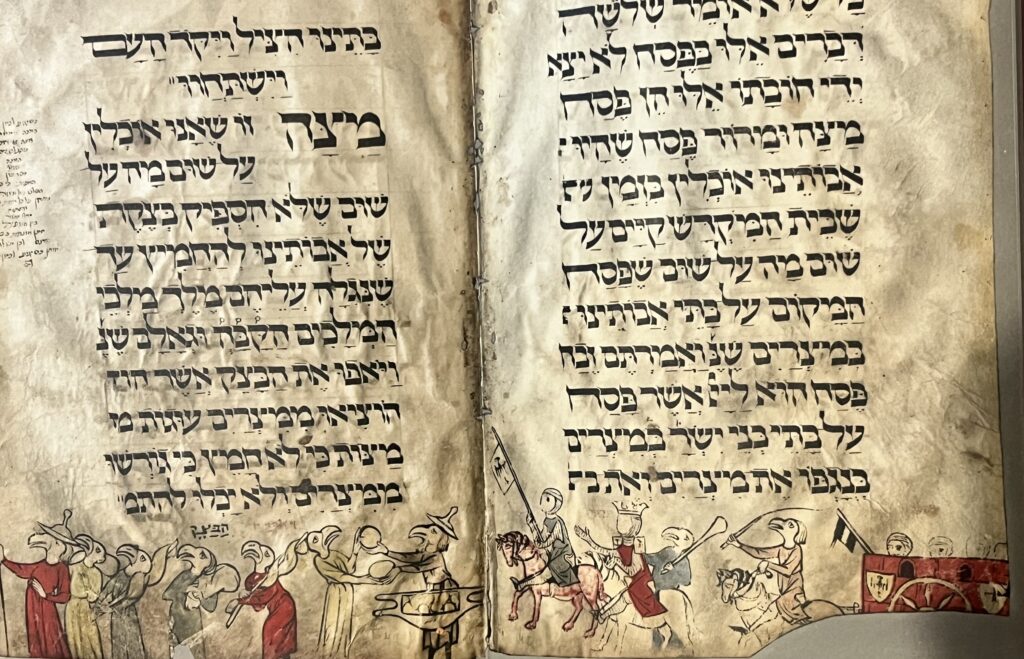
The oldest extant illustrated Haggadah text, dated to the early 1300s (and now in the Israel (now in the Israel Museum, although the exact provenance remains murky like so many Jewish items), takes its name from its most immediately striking feature: nearly all the human figures bear birds’ heads rather than human faces. Non-Jewish figures — Egyptians, angels — are instead shown with blank circular discs where faces should be. The zoophilic imagery has attracted a remarkable range of explanations: halakhic anxiety about depicting human faces too completely; a visual encoding of relative spiritual status; and, at the least plausible extreme, the claim that the birds’ beaks are an anti-Semitic caricature of the Jewish nose inserted by a hostile illustrator.

Birds Head Haggadah, Exodus Scene

Epstein critically examines these theories, ultimately adopting a more nuanced position that acknowledges the halakhic dimension without attributing the imagery to a single cause. As discussed in our earlier review, the most illuminating aspect of his analysis is his attention to an anomaly previously dismissed as carelessness. In the Exodus scene depicting the Israelites fleeing and Pharaoh’s army in pursuit, most figures conform to expectations: Israelites with birds’ heads and Egyptians with blank discs. However, two figures in the pursuing army also have birds’ heads. Epstein, prompted by his ten-year-old son’s observation, suggests these figures represent Datan and Aviram, members of the erev rav who chose to remain with the Egyptians. The presence of birds’ heads is intentional, signifying that even the sin of siding with oppressors does not erase Jewish identity. This artistic choice introduces themes of the wicked son, belonging, apostasy, and the potential for return, all of which are particularly resonant in the context of the Seder.

This approach exemplifies Epstein’s methodology: treating anomalies not as errors to be dismissed, but as interpretive keys to deeper meaning.

The Golden Haggadah

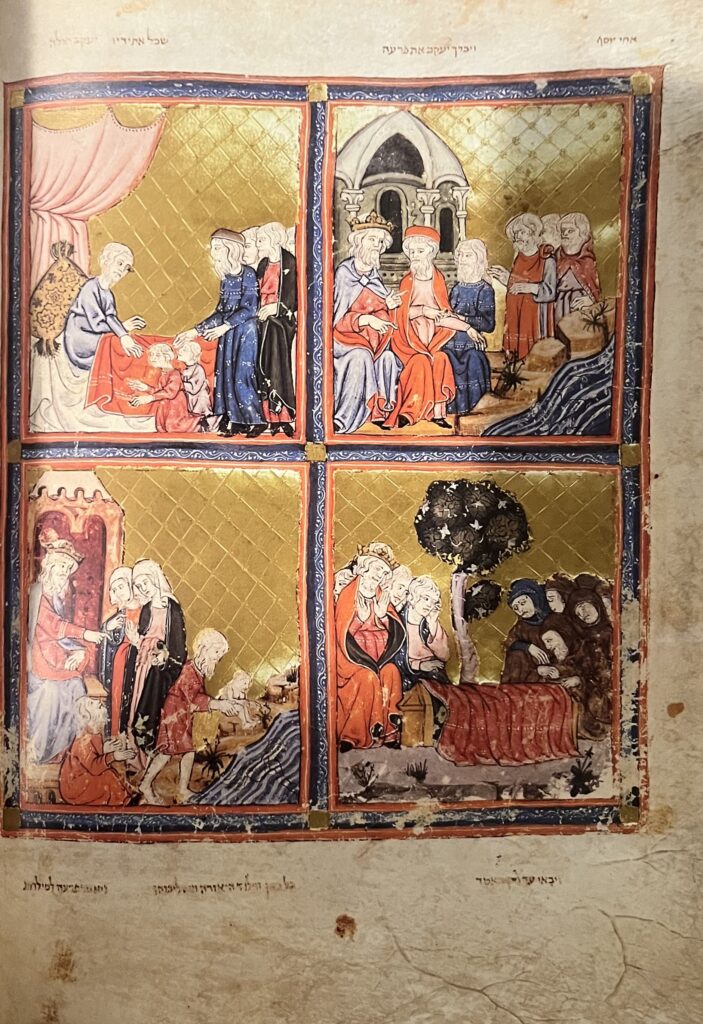
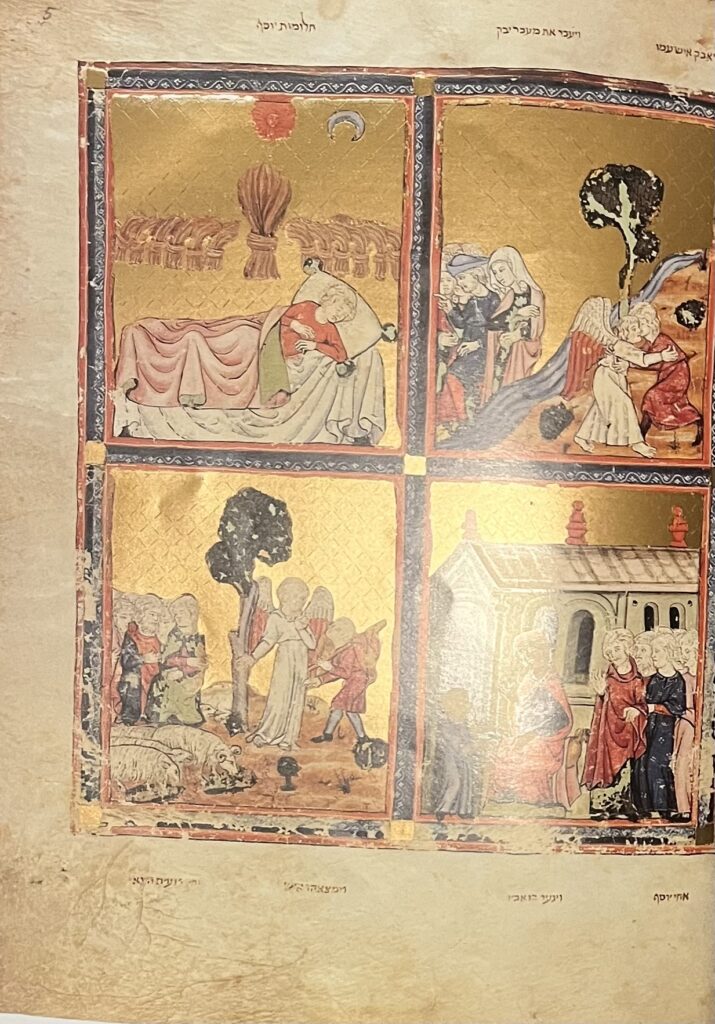
The Golden Haggadah, a Sephardic manuscript from around 1320 distinguished by its extensive use of gold borders and embellishments, illustrates a key structural distinction within the manuscript Haggadah tradition. In Ashkenazic manuscripts, illustrations are integrated throughout the text, appearing in margins and between passages, and typically serve to comment on or extend the Haggadah narrative, such as scenes of Pesach preparations, the search for chametz, or the baking of matzah. In contrast, Sephardic manuscripts concentrate pictorial content before the text in a visual preamble: a series of full-page panels, arranged two or four per page, that trace Jewish history from the patriarchal era or creation through the Exodus, preceding the Haggadah text itself. These images function as a visual overture rather than direct illustrations of the liturgy.

While the Golden Haggadah adheres to Sephardic conventions, Epstein demonstrates that its imagery is more sophisticated than a straightforward chronological sequence. The illustrator establishes a network of visual connections across panels separated by generations, particularly through the motif of water. Water is depicted in scenes such as Jacob before Pharaoh, the drowning of Israelite boys in the Nile, the rescue of infant Moses, and Moses drawing water for Jethro’s daughters. In each instance, the depiction of water, its color, movement, and spatial relationship to the figures, is distinctive and cross-referential, encouraging viewers to interpret these scenes collectively rather than in isolation. The resulting theological argument centers on themes of divine providence, measure-for-measure justice, gratitude, and salvation as continuous threads throughout history. This constitutes visual midrash: interpretive commentary conveyed through imagery, fulfilling the Seder’s purpose of provoking reflection.


The Rylands Haggadah, Its Brother, and the Marror That Wasn’t an Artichoke

The third and fourth manuscripts analyzed by Epstein—the Rylands Haggadah (currently housed at the John Rylands Library in Manchester) and the manuscript referred to as the Brother to the Rylands—are Sephardic codices discussed together in his work. The term “Brother” was introduced by Bezalel Narkiss due to the notable visual similarities between the two manuscripts; Katrin Kogman-Appel has since argued that the so-called Brother likely predates the Rylands and served as its model. For the purposes of this discussion, both manuscripts represent a shared visual tradition, and the direction of influence is less significant than the insights they collectively provide.

Rylands Brother Haggadah

These manuscripts prompted a particularly instructive methodological episode in recent Haggadah scholarship, which unfolded in real time in the comments section of this blog in 2012 and was subsequently documented by Leor Jacobi. The central question was whether depictions of marror in the Rylands, the Brother, and the Sarajevo Haggadah represent an artichoke. David Golinkin had cited these illustrations as evidence that artichokes were used as marror in medieval Catalonia. Upon encountering this question on Erev Pesach 5772, wrote immediately to Epstein, who replied within the hour:

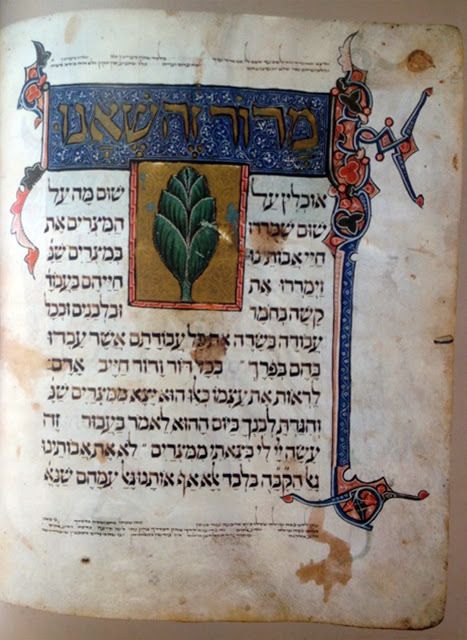
I don’t believe the Sephardic mss show an artichoke, rather they depict an entire head of romaine lettuce. The way to prove or disprove this would be to compare contemporary or roughly contemporary botanical mss.

When the same identification appeared in a post on this blog, Epstein returned with the fuller statement quoted above — “a manuscript is NOT a mirror” — and added the crucial clarification about representational logic:

Also, because a head of Romaine is SHOWN in the haggadah it doesn’t mean that there was a head of (possible unchecked-for-bugs) Romaine on the table. Every image is not a snapshot, but a representation — a combination of the real, the general, the ideal and the symbolic. Showing the head is a way of REPRESENTING Romaine — it says, “We use a type of lettuce that grows with leaves together in a head like this.” It does NOT necessarily mean “We use complete heads of Romaine at the Seder, like this.”

This logic warrants careful consideration. A manuscript illuminator aiming to depict marror must clearly indicate the species. Depicting the entire head of romaine lettuce—leaves clustered in a recognizable form—serves as an effective visual shorthand for this type of lettuce. Illustrating individual romaine leaves would make them nearly indistinguishable from other leafy vegetables. Thus, the whole head functions as the visual vocabulary for the species, rather than as a literal representation of the serving. The same reasoning applies to artichoke identification: if an artist intended to depict an artichoke, the distinctive globed, thistle-shaped head would be unmistakable. The Sarajevo Haggadah’s depiction of veined leaves bound at the base with a cord, as Epstein observes, aligns with characteristics of lettuce rather than artichoke.

Jacobi’s account adds another layer of insight: Epstein posits that artists of later manuscripts (the Rylands and Brother, likely produced after the Golden Haggadah) may have copied a lettuce image from an earlier model and, interpreting the veined and slightly “spiky” leaves, mistakenly identified it as an artichoke. Patrons did not correct this, as they recognized that artichokes were not used as marror and thus interpreted the image as romaine, regardless of the artist’s intent. These images illustrate the challenges of visual transmission when botanical knowledge is limited, but they do not provide evidence of actual Seder practice beyond confirming that romaine was regarded as the standard marror species in Sephardic communities, a fact already established by textual sources.

Rylands Haggadah

The Barcelona Haggadah introduces additional complexity: its marror illustration appears to have been added by a post-medieval artist who, relying on earlier Haggadah images as models, no longer understood the original intent, resulting in a stylized hybrid that is neither distinctly artichoke nor lettuce. As Evelyn Cohen observes, some manuscripts left the marror space blank, indicating that the image was occasionally tailored to the patron’s local practice. This underscores the non-monolithic nature of the visual tradition and the influence of artist-patron relationships on the final product.


In summary, there is no textual or visual evidence that artichokes were ever used as marror. Romaine lettuce, which becomes increasingly bitter as it is chewed—beginning with a mild taste and culminating in pronounced bitterness at the spine, thus symbolizing the intensification of Egyptian servitude—is far better supported as the intended species and is almost certainly what these images depict.

The Printed Haggadah: The Same Logic

The interpretive methodology applied to medieval manuscripts is equally relevant to the printed tradition.The four foundational printed Haggadot—Prague 1526, Mantua 1560, Venice 1609, and Amsterdam 1695—established a visual vocabulary that influenced nearly every subsequent illustrated Haggadah for centuries thereafter. As we have discussed at length in earlier posts (see here, here, and here), these Haggadot draw from both manuscript precedents and the broader visual culture of their respective eras, exhibiting the same patterns of intentional borrowing and creative transformation observed in medieval manuscripts.

The Mantua 1560 Haggadah, the first illustrated Italian Haggadah, exemplifies this dynamic. Its depiction of the Wise Son is modeled unmistakably on Michelangelo’s prophet Jeremiah from the Sistine Chapel ceiling. However, while Michelangelo’s Jeremiah is bareheaded, the Haggadah’s Wise Son wears the Pileus Cornutus, the conical hat mandated for Jews by Christian law (and likely the beginning of the custom of universal Jewish headcovering). Thus, a figure from the Vatican’s most prominent sacred space is appropriated, marked with a symbol of Jewish social subordination, and reimagined as an embodiment of Jewish wisdom at the Seder table. This reflects both dependence and subversion.

Mantua, 1526, The Wise Son

A similar complexity is evident in the title page’s distinctive helical “barley-sugar” pillars. While these are sometimes attributed to their prominent use at St. Peter’s Basilica, suggesting Christian architectural borrowing, the more probable source is local: the Cortile della Cavallerizza at the Palazzo Ducale in Mantua, designed by Giulio Romano and completed around 1540. The printer Ruffinelli appears to have incorporated these pillars throughout his Mantuan publications as a regional identifier, functioning not as a Christian symbol but as a marker of local identity, akin to a colophon. What may appear as Christian iconography is, in fact, civic geography repurposed as a printer’s device.

Prague Haggadah, Kiddush

The warning against treating images as direct records of practice is relevant here as well. R. Shlomo Hakohen Kook criticized the Prague 1526 Haggadah for depicting the wine cup held in the left hand and grasped by the stem rather than cupped at the base, but both critiques conflate artistic representation with ritual documentation. The left-handed depiction results from the woodcut printing process, which produces a mirror image of the original block; copyists working from printed exemplars, rather than the original block, further reversed the image, consistently yielding left-handed figures. This reflects printing history, not halakhic instruction. The issue of cupping the cup is another anachronism: this practice became widespread only after the publication of the Shelah, which appeared more than a century after the Prague Haggadah. Thus, the woodcut cannot be faulted for omitting a custom that did not yet exist.

What We Can and Cannot Learn

The illuminated Haggadah is a remarkable historical source, but its value depends on the questions posed to it. These manuscripts and early printed books are not objective records of ritual practice; rather, they reflect the choices of communities, shaped by artistic conventions, available models, patron preferences, and the expressive possibilities of the visual vocabulary of their era. When interpreted thoughtfully, they reveal the inner imaginative life of the communities that produced them: their understanding of the Exodus, their self-conception, the theological claims embedded in their liturgical texts, and their engagement with and adaptation of surrounding visual cultures.

This constitutes an exceptionally rich body of evidence, surpassing any attempt to treat the images as mere snapshots of Seder table contents. However, extracting meaningful insights requires art-historical expertise, contextual historical knowledge, and a readiness to embrace interpretive ambiguity—qualities that distinguish the approach exemplified by Epstein from earlier traditions.

Readers who have not yet encountered The Medieval Haggadah: Art, Narrative & Religious Imagination (Yale University Press, 2011) — reviewed here when it appeared here — would do well to remedy that before this Pesach. And to spend a few more minutes at the Seder with the pictures. Additionally, Epstein’s recently released book, People of the Image: Jews and Art,  similarly tackles these topics, including discussions of Haggadah illustrations and, like his The Medieval Haggadah, is among the best in the genre. A review of the book is forthcoming.

Related posts: our 2012 review of Marc Michael Epstein’s The Medieval Haggadah: Art, Narrative & Religious Imagination (here); Leor Jacobi on the artichoke controversy and how to read manuscript marror illustrations (here) and earlier discussions about the vegetable here and here; halakhic implications of Haggadah illustrations (here); and our discussions of the Prague 1526 Haggadah (here here, and here), and for our examination of printed illustrations see “The Mother Haggados: Models for Modern Analysis of Printed Jewish Illustrations.”


The 1908 Student Strike at Rabbi Isaac Elchanan Theological Seminary: A Newly Discovered Document

The 1908 Student Strike at Rabbi Isaac Elchanan Theological
Seminary: A Newly Discovered Document
By Eli Genauer

I would like to thank Dr Zev Eleff for his invaluable assistance in helping me frame this article. I would also like to thank Sharon Horowitz of the Library of Congress for providing research assistance.

The Rabbi Isaac Elchanan Theological Seminary (RIETS), present day Yeshiva University, was officially founded on March 20, 1897. RIETS was the first unequivocally Orthodox Jewish seminary on American soil.  Initially, its mission was entirely religious, limited “to promote the study of the Talmud and to assist in educating and preparing students of the Hebrew faith for the Hebrew Orthodox Ministry.”[1] RIETS’ first years were difficult ones.  It did not move into a building of its own until 1904.[2] Additionally, RIETS faced difficulty meeting its financial obligations.  including a student stipend. As a result, in 1906, RIET’s was beset by a major student strike. Among the student’s demands was that RIETS expand its mission beyond religious education and they demanded that they be instructed in secular subjects, including learning English.[3] While that strike was settled, another student strike and a lockout occurred over similar issues in May 1908. The strike was ended when changes were promised by the board of directors.  Yet, that settlement proved fleeting.
By August 1908, the students were striking again. The students’ strike received notice from the national press, when on August 19th,
the New York Times reported:[4]
the Talmuds are lying idle on the shelves of the Rabbi Isaac
Elchanan Theological Seminary at 156 Henry Street, and the drone of the voices
of the students as they walked back and forth reading aloud from the Hebrew
text is heard no more. For the last few weeks the students have not received
the $3.50 a week which they are paid while they are learning to become Rabbis.
Consequently, they have gone out on strike. Boruch Shapiro, Louis Mahler and
Samuel Broida, the leaders of the demonstration, stationed themselves at the
door of the school yesterday and effectively blockaded the entrance of all the
smaller boys. Nathan Lamport of the Lamport Manufacturing Supply Company, at
278 Canal Street, president of the school, and David Abramowitz of 47 Forsyth
Street, the Secretary, do not know what to do.[5]
On August 20th, citing financial reasons, the board locked out the students and
closed the school.[6] As a result of the closure of the school by the board of directors, some of the students and some Rabbinic leaders tried to form a new school called Yeshiva le-’Rabbanim which was designed to address some of the deficiencies of RIETS.[7]
Although the closure of the RIETS has been documented, the August 1908 student strike that led to the closure is not reflected in any published histories discussing the unilateral closing of the school and lockout of the students by the board ofdirectors on August 20th.[8]
One of the difficulties in piecing together exactly what happened during that August 1908 strike, lockout and its immediate aftermath is the dearth of contemporary records. This lacuna is in part attributable to a general lack of documntation of REITS’ early years.  And, “there are no records extant of the Seminary from its inception in 1897 to its merger with Yeshivat Etz Chaim in 1915. Only the Certificate of Incorporation, scattered newspaper accounts, one or two contemporary citations, and passing references in the memoir literature of the time remain as silent witnesses to the great vision and determination of a few men who…created the first Orthodox rabbinical seminary in America.”[9] As an example, in reporting on the August 1908 closure of the school by the board of directors and its aftermath, one scholar quotes mainly from newspaper accounts of the day.[10] There was an important memoir of that period written by Hayim Reuben Rabinowitz, who was an 18 year old student at the time, but Rabinowitz published his account 60 years later.[11]
Recently, however, a contemporaneous account of the events of 1908 has come to light.  This account was discovered as a result of construction at Congregation Bikur Cholim Machzikay Hadath in Seattle, Washington, when workers came upon a box of papers labeled, “Rabbi B. Shapiro Papers, 1920s-1960’s.” Rabbi Boruch Shapiro (1883-1970) was born in Szmorgon, Lithuania and was recognized as a Talmudic genius (Iluy) at an early age.[12] He was a student of, and received ordination from, Rabbi Meir Simcha of Dvinsk, (Or Sameakh), one of the outstanding rabbinic leaders of his time.[13] While in Dvinsk, R. Shapiro also received ordination from Rabbi Joseph Rozin, known as the “Rogatchover Gaon”.[14]  R. Shapiro immigrated to America in the early 1900’s and visited Seattle in 1913 on a fundraising trip. His visit became permanent when he ended up marrying a local woman, Hinda Gershonowitz and remained in Seattle until his passing in 1970. Rabbi Shapiro is perhaps best remembered as the Rav of Congregation Machzikay Hadath in Seattle, a position he held for forty years.
Before arriving in Seattle and shortly after arriving in America, Rabbi Shapiro studied at RIETS. Because he already possessed rabbinic ordination, he was considered in a special class of students, receiving a higher weekly stipend than most others who studied there. [15] He was sent by the school to give lectures at a synagogue in Brooklyn during the Sukkot holiday of 1905 as an example of the quality of students that were studying in the yeshiva.[16]
The box of papers discovered contains Rabbi Shapiro’s account of the events surrounding the student strike in August 1908, and the subsequent founding of the Yeshiva Le’Rabbanim. The account was written on October 7th, 1908 and covers the period from August 20 until that time. Because Rabbi Shapiro was one of the three student leaders of the strike, his account is particularly relevant to filling in the picture of the details of the August 1908 RIETS student strike.[17] Rabbi Shapiro’s writings, it should be noted, reflect that he and his fellow students had been involved in a struggle with, in his view, a dysfunctional and stubborn board of directors for over two years.[18]
Rabbi Shapiro records that:
On Thursday night, 24 Av 5668(20 August 1908), the Rabbi Isaac
Elchanan Yeshiva was closed in a very unseemly fashion. Mr. [Jonathan] Shepp,
the treasurer of the Yeshiva called the police several times to evict the
yeshiva students from the building in which they learned.[19]
But despite all his efforts, the police declined to do harm to the students.
They remained there despite his displeasure until midnight and at that time
they left for their residences.”[20]
After the students of the Yeshiva had concluded that there was no
hope to improve both the physical and spiritual conditions of the Yeshiva due
to the obduracy of the leaders whose concern was only for themselves, the
students decided to separate from the above named Yeshiva and move to “Adas Bnei
Yisroel” at 213 East Broadway, which welcomed them with open arms.[21] On
28Av (25 August-1908), the students of the Yeshiva moved their place of Torah
study to the above mentioned address in the company of well-known rabbis, such
as Rabbi [Shalom Elchanan] Jaffee[22],
Rabbi [Chaim Sholom] Shoher[23],Rabbi
[Aaron] Gordon [24],
and others, who had gathered there to guide them. After much discussion, it was
decided that the yeshiva students would study temporarily in Adas Bnei Yisroel,
and that they would acquire a charter. So that the leaders of Yeshiva Rabbeinu
Yitzchak Elchanan would not collect money in their name, they decided that this
yeshiva would be called “Yeshiva L’Rabanim”. Similarly, they decided to send
out boxes to collect members and to try to establish this yeshiva on a proper
foundation.
From 28 Av 5668 until 12 Tishrei 5669, three meetings of well-known
rabbis and prominent lay leaders were held. At the second meeting, an interim
leadership team for Yeshiva L’Rabanim was chosen: Rabbi Jaffe, chairman; Rabbi
Shoher vice chairman and treasurer; Rabbi [Joseph Judah Leib] Sossnitz,
administrator;[25]
Rabbi Dr. Rabinowitz from Brooklyn, administrator; Rabbi [Judah Leib] Lazeroff,
administrator,[26]
and others. The job of developing a “program” both in religious and secular
studies for this yeshiva was also assigned to the above leaders.
Even before the closure of the Yeshiva Rabbi Isaac Elchanan, the
physical situation of the students was very bad because for seven weeks prior
to the closure, all they received was a half a kilogram of bread per week.
However, the situation since they left the Yeshiva until now was much worse,
and the poverty and embarrassment they suffered is difficult to describe. Many
of them could have found other means of support, but because of their love of
Torah, they accepted their lot and did not abandon Torah study with which they
had been engaged their entire lives.
Many Rabbis, in writing, speech and action, promised to help. From
all the promises very little materialized, aside from Rabbi Lazaroff, who had
spoken up a few times in his synagogue on behalf of the Yeshiva. He assembled a
worthy number of members from whom he collected funds. The prominent Mr.
[Abraham J.] Goldstein and his brother-in-law, Mr. [P.] Feinberg from Jersey
City came to the assistance of the Yeshiva in the beginning. [27]With
the help of other prominent members of their congregation who worked alongside
their honored Rabbi [Shlomo David] Posner, that synagogue supported the yeshiva
a bit.[28]
To describe in detail all the problems faced by this new endeavor
and the stumbling blocks that were placed in front of this new Yeshiva from the
beginning until now would amount to an entire book. The task was difficult and
the conflict with the administration of the Yeshiva Rabbi Isaac Elchanan
weighed heavily on us. Many did not want to support the students of the Yeshiva
since they saw that the “Morgen Journal” had “sold out” to those above
mentioned administrators to do their bidding. They also felt that the “Tageblatt”
was leaning in the direction of those administrators, and not on the side of
the Yeshiva L’Rabanim. Many rabbis knew and admitted that the yeshiva students
were right, but kept silent due to fear. So much so, even those who had joined
the new Yeshiva were not really able to help it.
The primary laborers on behalf of the new Yeshiva were the students
themselves and especially a student council that was chosen from among them to
lead the struggle. The five members of this council were Mr. A.[vraham]
Shapira, Mr.[Ben Zion] Perl, Mr. [Chaim Yechezkel] Mosesohn, Mr. [H.S.] Linfeld
and Mr. B.[aruch] Shapira who was the leader.[29]
The politics were so intense that oftentimes those in the Yeshiva did not
confide in their fellow students for fear that they were supporting the other
side. The council worked diligently with the three main activists, Rabbi B.
Shapira, Rabbi A. Shapira, and Rabbi Perl who were most instrumental.  They abandoned all their other pursuits such
as attending “Preparatory School,” working day and night to battle with the
administration of Yeshiva Rabbeinu Isaac Elchanan.  Nothing was too difficult for them or beneath
their dignity. Their physical situation was worse than the conditions of other
students, as they had no other means of sustenance and they also received a
more meager stipend compared to what they had been entitled to. They suffered
immensely during this time. They knew that they were making great sacrifices
and losing precious time. Nevertheless, they did not consider their own
personal situations so that they could help establish this new Yeshiva on a
proper foundation. There were times that matters grew so bad that many of the
yeshiva students echoed the complaints of the Jews in the desert: they wanted
to return to their previous Yeshiva, but thanks to many of the yeshiva students
and the student council, especially Rabbi B. Shapira, these complaints were set
aside and it allowed the Yeshiva to attain the status it claims today. The
result of what has been done so far is small compared to what needs to be
completed. Nevertheless, laying the foundation, which was the most difficult to
accomplish, has been done. More effort is required to establish this Yeshiva on
a firm foundation and to transform it into an excellent school that will train
great rabbis in Torah, wisdom, fear of Heaven; who will work within the spirit
of ancient Israel and the spirit of this new generation; and who will unite
both old and young, thereby bring blessing to our people, our Torah and our
holy faith.”
In the end, Yeshiva Le-Rabbanim did not exist for very long because it never had substantial financial backing and support from the general community.[30] The attempt to form an alternative yeshiva apparently did not deter some of the student dissidents to return to RIETS. In 1917, in a RIETS publication, Rabbi Baruch Shapiro and his brother Rabbi Abraham Shapiro along with Rabbi Ben Zion Perl are listed among those ordained by RIETS now serving as rabbis in America.[31] Even more curious, the strike leader Rabbi Baruch Shapiro went on a fundraising tour in 1917 to raise money for the Rabbinical College of America, one of whose components was RIETS.[32]
The strike’s impact, however, on one of the most important future leaders of RIETS and Yeshiva University was profound.  Chaim Rabinowitz wrote “The strikes stimulated the mind of a young Rabbi who had recently arrived in America. This young Rav was Rabbi Dov Revel.” Rabinowitz cites a letter that Dr. Revel wrote to Rabbi Zvi Masliansky in the spring of 1908, where he grieves about the turmoil in RIETS that Rabbi Masliansky had told him about and hopes for better days for the Yeshiva. Rabinowitz concludes “the dream of Rabbi Revel came to fruition in 1915 when he became the Rosh Hayeshiva…and instituted great changes in the order of studies.”[33]
Here is a sample page of the document:


[1]
“Rabbi Isaac Elchanan Theological Seminary Association Certificate of
Incorporation,” March 20, 1897, (quoted in Gilbert Klaperman, “Yeshiva
University:  Seventy-Five Years in
Retrospect,” American Jewish Historical Quarterly 54,1 (September,
1964), 6). William Helmreich, however, states that teaching “the language of
the land” and Talmud was articulated in the RIETS charter, and, as such, “the
first such mention of combining secular and religious studies in one
institution.”  William B. Helmreich, “Old
Wine in New Bottles:  Advanced Yeshivot
in the United States,” American Jewish History, 69, 2 (December 1979),
235.  But, the 1897 certificate does not
mention “language of the land,” and Helmreich’s assertion is without
citation.
[2]
Gilbert Klaperman, The Story of Yeshiva University: The First Jewish
University in America
(New York: Macmillan, 1969) 71-72.
[3]Alexander
Dushkin, Jewish Education in New York City (New York: Bureau of Jewish
Education, 1918), 77-78.
[4]
“Boys Go On Strike,” New York Times, August 19, 1908.
[5] The Times
report may have been the result of the RIETS’ students, who, to gain
sympathy to their cause alerted it to the unrest. See Klaperman, Story,
95
[6] The
most complete report on the student unrest from 1906-1908 can be found in Klaperman,
Story, 94-112.
According
to Rabbi Klaperman, the closure and lockout on August 20th was
reported by the Jewish Morning Journal on Friday August 21st,
1908 and the Judisches Tageblatt on Sunday August 23, 1908. Idem.
217n8.
[7] Gurock,
Men and Women, 40; Rabinowitz, “60 Shana,” 553; and Klaperman, Story,
118.
[8] There
are three discussions regarding the closure of RIETS on Thursday, August 20th,
1908
See Klaperman, Story, 111-12. There is no mention of a
strike immediately preceding the board’s action. Rabbi Klaperman does not cite
the Times article in any of his footnotes. Additionally, in footnote 21,
p.218, he writes that there was no clear picture of presidential succession of
RIETS between February 1906 and fall of 1908, despite an indication in the NY
Times article that Nathan Lamport was the president of the school in August of
1908.
The
second is Hayim R Rabinowitz’s recollections that appeared in Hadoar in
1968. Hayim R. Rabinowitz, “60 Shana le-Shvitot be-Yeshivat Rabbeinu Yitzchok Elchanan,”
Hadoar, June 14, 1968, 552-554. In 1908, Rabinowitz was an
eighteen-year-old student at RIETS, and writes at length regarding the
situation leading up to the closing of the school on August 20th,
with the resultant lockout of the students from the building at 156 Henry
Street, but does not mention that the students had been on strike immediately
preceding this event. Although Rabinowitz was a contemporaneous observer, his
reminiscences were only published sixty years after the events in question.
The third discussion is by Jeffrey Gurock.  Jeffrey Gurock, The Men and Women of
Yeshiva: Higher Education, Orthodoxy, and America Judaism
(New York:  Columbia University Press, 1988) 39-40. Citing
Rabinowitz, p.553, he writes “Frustrated, feeling that a double cross was in
the making, RIETS students were once again talking strike in the late spring
and early summer of 1908.” Gurock, however, does not mention that a strike and
blockade of the building took place in August as indicated by the headline of
the New York Times and in the subsequent article.
[9] Klaperman,
Story, 48.
[10] Idem, 217-19.
[11]
Rabinowitz, “60 Shana,” 552-554, quoted extensively in Gurock, Men and Women,39-41.
[12] The
Jewish American Family Magazine and Gazette (Amerikaner Familian Magazin un
Gazetten)
, vol. XXXIX, no. 47, September 19, 1941, 2.
[13]
Rabbi Meir Simcha was the author of “Ohr Sameach”, an important commentary on
Maimonides’ “Mishna Torah”, and of “Meshech Chochmah”, a commentary on the
Torah. Rabbi Meier Simcha wrote of Rabbi Boruch Shapiro “he has the ability to
formulate outstanding novella acceptable to all”. The Jewish American Family,
2.
[14]
Prior to coming to America, Rabbi Shapiro obtained letters of support from two
other leading rabbinic figures in eastern Europe, Rabbi David Hirsch Eisenstein
and Rabbi Shlomo Vilner. The Jewish American,2. Rabbi Vilner wrote that
he never gives ordination to one so young, but in the case of Rabbi Shapiro, he
was willing to make an exception.
[15]
Rabinowitz, “60 Shana,” 553.  Rabinowitz
also refers to Rabbi Shapiro as a “Gadol B’Torah”
[16] Klaperman,
Story, 62.
[17] The
New York Times article identifies him as one of the three student strike
leaders. See also, Rabinowitz, p.553 As early as 1906, R. Shapiro held a
leadership role.   He was among the four
students chosen to represent the students’ views before RIETS’ board of directors.  Rabinowitz, “60 Shana,” 553; The Jewish American,
2, which states that Rabbi Shapiro was chosen as a representative by the
students in dealing with the board.
[18] Regarding
the student’s relationship with the board of directors, Klaperman describes an interaction
between the students and the directors as follows: “The student’s
dissatisfaction and the obduracy of the directors brought about continuous
agitation in the school and highlighted the confusion of aims in the
curriculum” Klaperman, Story, 86.
[19] Klaperman,
Story,99 writes that in 1906, Jonathan Shepp was elected as the new
treasurer, and that Jonathan Shepp was part of the finance committee appointed
on August 31, 1908 to assist in reopening the school after it was closed on
August 20. Klaperman, Story, 99, 113.
[20] Gurock
indicates that the treasurer threatened to call the police, but that in fact
the police were never called.  Gurock, Men
and Women
, 40 (citing Rabinowitz, “60 Shana,” 553).
[21]
Regarding the address of the building to which the students moved, Rabbi
Shapiro was physically at this new address so it is reasonable to assume that
he recorded it correctly. Additionally, on June 3, 2015, there was an auction
of documents associated with the newly founded Yeshiva La-Rabbanim (Kedem
Auction No.8, Lot 301). One of the documents evidences a stamp which says 213
East Broadway. Rabbi Klaperman lists the address
as 123 East Broadway.  Klaperman, Story,
116, 219n38.
[22] Rabbi
Shalom Elchanan Jaffe (1858-1923) was an important early American Orthodox
Rabbi. He received Semicha from both Rabbi Naftali Zvi Yehuda Berlin and Rabbi
Yitzchak Elchanan Spektor. He arrived in America in 1890 and served as a Rav in
St Louis and in Brooklyn before becoming the Rabbi in 1901 of the prestigious
Beth Midrash Hagadol synagogue on the Lower East Side of New York. He was one
of the most influential of Rabbis at the time, especially when it came to the
supervision of kosher meat. Jaffe’s motivations for his involvement with this breakaway
school, may have less to do with issues than his personality.  According to Klaperman, Jaffe was not one
wedded to the idea of secular education, one of the central demands of the
students. “On the other hand, Rabbi Jaffe was the stormy petrel on the rabbinic
scene, known as an impetuous non conformist who rushed in without fear when his
mind was made up.” Klaperman, Story, 117.
[23] Rabbi
Chaim Sholom Shochar (Rabbi H.S. Shoher) came to Boston in 1882 to be the Rabbi
of Bais Avraham synagogue and subsequently served as the Rabbi of Hadrath
Israel and Mishkan Tefillah among other synagogues in Boston. In 1905, he moved
to New York City to become the Rabbi of the prestigious Shaare Zedek synagogue
located at 38-40 Henry Street. In 1910, he is listed as living at 215 East
Broadway, next door to the location of Yeshiva Le-Rabbanim. He authored a
pro-Zionist book Shalom Yerushalyim in 1909 and passed away in 1918.
[24] Rabbi
Aaron Gordon (1845- 1922) known as the Miadziol (Myadel) Iluy, emigrated to
America in 1890 and was the chief Rabbi of Rochester, New York until 1900 when
he moved to New York City. He was one of the founders of the Agudath Harabanim
and served as head of a Bet Din on the lower east side. He served as the Rabbi
of Congregation Talmud Torah Tiphereth Jerusalem at 147 East Broadway. He was a
prolific writer, authoring many books on Halacha, among them Even Meir
(Pietrokov 1909), Teshuvat Meleat Even (Pietrokov 1912), Minchat Aharon
(Jerusalem, 1920) and Sha’arei Da’at (Jerusalem, 1921).
[25]
Rabbi Joseph Judah Leib Sossnitz (1837-1910) was born in Birzhi, district of
Kovno. He has been described as a Talmudic scholar, mathematician and
scientific author. He settled in New York in 1891 and in 1893, founded a Talmud
Torah on 104th street in Manhattan. In 1899, he was appointed a
lecturer in Jewish ethics at the Educational Alliance at 197 East Broadway.
[26]
Rabbi Judah Leib Lazarov (1875-1939), studied inTelz, Mir, Volozhin and Radin
before immigrating to America in 1898.He was hired as a preacher at Beth
Midrash Hayei Adam at 89 Henry Street in 1903 and succeeded Rabbi S.E. Jaffee
as Rabbi of Beth Midrash Hagadol in 1910. He authored a multi volume work Divrei
Yehudah
(New York, 1906-1910).
Except for Rabbi Dr Rabinowitz who was from Brooklyn, all the above
named rabbinic leaders were from the Lower East Side near both Rabbi Isaac
Elchanan Yeshiva on Henry Street and Yeshiva La’Rabanim on east Broadway. They
most likely would have been aware of the struggles of the students with the
board of the Yeshiva and had possibly allowed them to speak in their synagogues
during the May strike. See Klaperman, Story, 104. It is also possible
they were consulted by the students on an ongoing basis even before they tried
to start a new school.
[27] Abraham
J. Goldstein emigrated to America in 1884 and immediately settled in Jersey
City. One book, Distinguished Jews of America, (New York, 1917), describes
him as “a strict Orthodox Jew in every sense”, “one of the richest and most
prominent citizens of Jersey City”, and “a member of almost every Jewish
organization in Jersey City”. He owned a grocery wholesale business, was
president of the Erie Building and Loan Association, and was one of the largest
real estate owners in Jersey City.
[28] Rabbi
Shlomo David Posner (Rabbi S.D Posner) was a Rabbi in Jersey City, New Jersey,
for many decades. He signed his letters “Rav V’Av Beit Din” of Jersey
City.  He authored a book of homilies Eshed
Hanahar
(New York, 1932). In the introduction, he writes candidly about
being a Rabbi in America over many years. He was involved on a national level
in many Rabbinic organizations and he helped raise money for the Jewish
community in Palestine
[29] It
is interesting to note that Rabbi Shapiro refers to this group as Mr. but later,
refers to three of the group as Rabbi. The two Shapiro brothers and Ben Zion
Perl are referred to by Rabinowitz as having Rabbinic ordination already at
that time. Rabinowitz, “60 Shana,” 553.
The four referred to by Rabbi Shapiro aside from himself are:
(1) Rabbi Abraham Shapiro was the brother of Rabbi Boruch Shapiro.
Like his brother, Abraham already possessed Semicha from Eastern Europe at this
time. He later served as a Rabbi in Canton, Ohio and in Utica, New York. He was
considered to be a prominent Musmach of RIETS in later years.
(2) Rabbi Ben Zion Pearl served as a Rabbi in Harlem. He was the
director of the Uptown Talmud Torah Association which had 2,400 students in
1919. In 1925, he was involved in raising money for the building fund of Rabbi
Isaac Elchanan Yeshiva. He passed away in 1929.
(3) Rabbi Chaim Yechezkel Moseson came
from Lodz Poland, learned in the Yeshiva in Lomza Poland and received Smicha
from Rabbi Yechial Michal Epstein, author of the Oruch Hashulchon. He was the
principal of Yeshiva Torah Vadath, Mesivta Tiferes Yerushlayim, and other
Yeshivot. He wrote many articles for Dos Yiddishe Licht, a newspaper
financed by Cantor Yossele Rosenblatt.
(4) Harry Sebee Linfield
(1889-1978), was a rabbi and statistician. His Jewish Statistical Bureau
conducted research on Jews in America and published numerous reports and other
publications on their findings, specifically the Statistics of Jews. He was born in
Lithuania and came to the United States in 1905. He was awarded a PhD by the
University of Chicago in Semitic language in 1916, and the following year was
ordained a rabbi by the Hebrew Union College in Cincinnati
[30] Klaperman,
Story, 118.
[31] Idem.
262
[32] The
Reform Advocate
, December 29, 1917, p.501
[33]
Rabinowitz, “60 Shana,” 553-554.


The Rabbi, the Rebbe, and the Messiah

The Rabbi, the Rebbe, and the Messiah
By Brian Schwartz
If someone were to ask you of an instance where a rabbi was declared the messiah by his followers, the first example that would probably come to mind is the last Lubavitcher Rebbe, R’ Menachem Mendel Schneersohn, who to this very day many of his chasidim regard as the Messiah, despite his death.  Many people would struggle to point to any other similar times in history, besides for the Shabbethai Tzvi affair and his various successors[1], where someone was thought of as the Jewish Messiah. However, throughout the past few hundred years, there have been a handful of rabbis who have been explicitly or implicitly declared the messiah, suggested it, or have been accused of suggesting it. 
Messiahship was a chasidic and mystical phenomenon, with chasidic rebbes; R’ Yisrael Ba’al Shem Tov[2], R’ David of Tulna[3], R’ Yisrael of Ruzhin[4], R’ Nachman of Breslov[5], R’ Yitzchak Isaac Safrin of Komarna[6], R’ David Moshe of Chortkov[7], and mystics; R’ Chaim Vital[8], R’ Chaim ibn Attar[9], R’ Moshe Chaim Luzzato[10], Shukar Kuchayil I[11], and Shukar Kuchayil II[12], and more recently Yisrael Dov Odesser[13], all being labeled one way or another as the Messiah[14].  Despite the characterization of these individuals as the Messiah, most lived on without any scandal associated with the eschatological attribution.  There is one instance however, which unfortunately did cause a great uproar.  I refer to you the case of R’ Menachem Mendel Hagar, the scion of the Vizhnitz chasidic dynasty, and the Transylvanian town of Borşa.
Borşa was a mountain village located in Northern Transylvania, in the Maramureș region of Romania.  In 1830 it had a Jewish population of 250, rising to 1,432 in 1890.  Most of the people in Borşa were chasidim of the Kosov-Vizhnitz dynasty.  In 1855, R’ Yaakov Tzvi Waldman, a chasid himself, though an adherent of R’ Chaim Halberstam of Sanz, was chosen as rabbi of Borşa.  Considered a great talmid chacham by his peers[15], Rabbi Waldman was defrocked by his own kehillah because of his harsh words towards the Vizhnitz Chasidim of his town.  The story behind this is relayed by R’ Avraham Yehuda Schwartz, author of the Sh”ut Kol Aryeh, in two letters he sent; one to the townspeople of Borşa, and one to R’ Menachem Mendel Hagar, the Rebbe of Vizhnitz.  In the letters, he mourns over the great bizuy talmid chacham that transpired because of the people of the town removing Waldman from his position as rabbi, replacing him with a boor, and threatening anyone who still considered him rabbi with excommunication.  

What caused all this to transpire?  In the year 1870, the Chasidim of Borşa decided that since the gematria of “Menachem” (the Vizhnitzer rebbe’s name) is equivalent to that of “Tzemach” (a term used by the prophets to refer to the messiah, see Zachariah 6:12, and Midrash Eicha Rabbah 1:57), Menachem Mendel Hagar, the Rebbe of Vizhnitz must be the messiah.  Reacting to this, Waldman said, “כי אמונה כזאת ועבודת האנשים המאמינים בה זרה.”

Here are the two letters printed in the Toldos Kol Aryeh, and if you look at the footnote to the letter to Borşa on p.147, you’ll notice that it says that it was first printed in the beginning of Shu”t Vayitzbor Yosef:
The Vayitzbor Yosef was written by R’ Yosef Schwartz[16], the grandson of R’ Avraham Yehuda Schwartz.  The copy I initially had, was the second edition printed by R’ Yosef’s nephew in Brooklyn in 1987[17].  Here is the title page:
  
However, a thorough search for the letter through the entire work came up with nothing.  It seems to have vanished.  After an exhaustive hunt, I was finally able to procure a first edition of the Vayitzbor Yosef, and upon examination, I was able to realize the full extent of how doctored the second edition is.  In the second edition, there are approbations added from R’ Yosef Schwartz’s other work Ginzei Yosef, and the index is in the back of the sefer, unlike the first edition where they were printed in the front, right after the hakdamah and before the pesicha.  These changes are quite innocuous.  However, in the second edition, a picture of the original title page is presented with a glaring omission.
Here is how it is presented:
And here is it in actuality:
Notice anything different?  That’s right, on the original title page, there is mention of a separate part of the sefer, “Naftali Savah Ratzon” which is supposed to be a collection of things that the author heard from his father R’ Naftali Schwartz.  If you guessed that the second edition is devoid of this section in its entirety, you would also be correct.  Here is a picture of the beginning of that missing section, which also happens to be printed in the back of the New York edition of Toldos Kol Aryeh:
Having gone through the Naftali Savah Ratzon, I couldn’t find any objectionable material that would have motivated the publishers from removing it.  So what was their motivation?  Remember the missing letter from R’ Avraham Yehuda Schwartz, the Kol Aryeh?  Well, in the first edition, there is another small section right after the pesicha, called “Hashmatah V’hosafa L’kunteres Naftali Savah Ratzon.”

Here is how the second edition appears:
And here is how it’s supposed to look like:
This section is four pages long, and in it can be found the censored letter from R’ Schwartz to the people of Borşa.  It would seem that this sensitive letter was behind the publisher’s motivation to totally remove any mention of the Naftali Savah Ratzon, since it was officially part of it as a hashmatah.  So not only was an important document lifted from the sefer, a whole section became a casualty along with it.  Why the publishers couldn’t just take the letter out and keep the rest of the Naftali Savah Ratzon, I’m not sure.  I guess they wanted as “clean” of a job as possible.
I must point out how Leopold Greenwald, Yaakov Tzvi Abraham, Dr. Yehuda Speigel, and Gedaliah Stein explain the rationale of the people of Borşa’s belief that Menachem Mendel Hagar was the Messiah, and how their explanation is mistaken.  Greenwald[18], Abraham[19], Speigal[20], and Stein both suggest how the belief was formulated as a reaction to Hagar’s sefer, Tzemach Tzadik.  In his work Zichron Borsa[21], Stein explains that since Hagar gave no explanation to the title of his sefer, which was perplexing since it did not have Hagar’s name within its title as do other sefarim, such as “Kedushas Levi” by R’ Levi Yitzchak of Berditchev, or “Ahavas Yonasan” by R’ Yonasan Eibeshutz, his chasidim saw in it an esoteric meaning.  As the gematria of “Tzemach,” which is used to refer the Messiah in Zachariah 6:12, is equivalent to “Menachem,” and likewise the gematria of “Tzaddik,” which is also used in Zachariah 9:9 to refer to the Messiah, is equivalent to “Mendel,” this must mean that their rebbe, R’ Menachem Mendel Hagar is indeed the Messiah! 
This explanation is simply untrue.  In no way, could the work Tzemach Tzadik have had any influence on what happened in Borşa in 1870, when it was only published for the first time in 1885.  As for the reason why it was called Tzemach Tzadik, Hagar’s son Baruch, explains in the preface to the work that he simply named it because the gematria is equivalent to Menachem Mendel.  It is also untenable to argue that a manuscript, or knowledge of one with the title Tzemach Tzadik, was floating around at the time of the dispute, because  R’ Baruch Hagar writes in the preface that the material for the work was only written a few years before his father’s passing in 1885.  Consequentially, we must take the letters of the Kol Aryeh for their simple meaning, that the people themselves came up with the gematria of tzemach and its link to the Messiah and the Vizhnitz Rebbe.
Many leading rabbis of the time came to R’ Waldman’s defense, including; R’ Moshe Schick[22], R’ Chaim Sofer of Munkatch[23], R’ Chaim Halberstam of Sanz[24], R’ Yosef Shaul Nathansohn[25], and the previously mentioned R’ Avraham Yehuda Schwartz. It seems that the only rabbi that came to the defense of the Vizhnitz Chasidim, was R’ Yehuda Modern[26].  What happened next isn’t very clear, but it seems that a tribunal was held by Schwartz to settle things[27], and Waldman was reinstituted as rabbi of Borşa.  Waldman died in Vienna in 1883.
As a side note, take a look at the last page of the letter of R’ Schwartz, printed in the first edition of the Vayitzbor Yosef, on the very bottom:
That is a stamp referring to the responsum of R’ Moshe Schick to Borşa!  I don’t know if this appears in every first edition copy, or if some private owner went to the trouble to specially stamp this, but it would be interesting to find out!


[1] Mordechai Mochiach of Eisenstaedt, Baruchia Russo, Jacob Querido, Abraham Cordozo, Yehuda Leib Prossnitz, and Jacob Frank
[2] See Ba’al Shem Tov Al Hatorah (Jerusalem 1998) in the Hakdamah #23 in the name of Nachum from Chernobyl, though this is seemingly a contradiction to the Iggeres Hakodesh of the Ba’al Shem Tov where he writes that he spoke with the Messiah.
[3] See Aharon Wertheim, Halachos V’halichos B’Chasidus (Mossad Harav Kook, 2002), pp. 20-21 fn. 52
[4] See David Assaf, The Regal Way (Stanford University Press, 2002), pp. 257-261
[5] See Yehuda Leibes, Studies in Jewish Myth and Jewish Messianism (State University of New York Press, 1993) p. 115
[6] See the hakdamah to Chumash Heichal Bracha (Lemberg 1864), “וגם דודי מורי החסיד השלם הצדיק אא”ק מוהר”ר משה הוא קרא אותי בפעם הראשון בשם מורה מורנו בפ’ בהר וקרא לפני או דודו יגאלנו ואמר עשיתי אותך גואל ואמר זה באנפין נהרין.”.  See Heichal Bracha on Leviticus 25:49 where he says that the verse is referring to Mashiach ben Yosef.  See also Megilas Starim (Jerusalem 1944) where he says he was born in the year משיח בן יוסף,  here.
[7] See Nochum Brandwein, Imrei Tov (1891) p.29a where he writes, “כמו ששמעתי מפי מרן הק’ והטהור איש צדיק תמים שמו נאה לו מוהר”ר דוד משה שליט”א. וזאת ידוע כי “משה” עולה :”אלקים אחרים”, כי בכוחו נמתק אלקים אחרים , “משה דוד” עולה: “שטן”,כי בכוחו להמתיק את השטן מישראל, ואז נמשך גאולה לישראל, כי: “משיח” עם הכולל עולה: “משה דוד”, ואז יקויים “ועינינו תראינה מלכותך” ע”י דוד משיח צדקך .  here.
[8] See Chaim Vital, Sefer Hachizyonos (Jerusalem, 2001) pp. 8, 17-18
[9] See Ohr Hachaim, Deuteronomy 15:7 at the end, here.
[10] See Isaiah Tishby, Messianic Mysticism (Littman Library, 2014) pp. 196-199
[11] See Yaakov Sapir, Iggeres Teiman Hasheni (Mainz, 1873)  here and Amram ibn Yachya Kerach, Sa’aras Teiman  (Jerusalem. 1954) pp.36-39 here.
[12] See ibid.
[14]  Though R’ Shalom Shachna of Lublin allegedly wrote on his gemara about the debate in Sanhedrin 98b over the name of the Messiah, “אני אומר שכנא שמו שנאמר לשכנו תדרשו”, referring to Deuteronomy 12:5, See Reuven Margolyos, Margolyos Hayam, Sanhedrin 98b #14, it was probably from a disciple in jest.  See Asher Ziv, Rabbeinu Shalom Shachna Milublin, Hadarom No.57, p.119.
[15] His two volume halachic work, Shu”t Tzvi V’Chamid, was printed from a manuscript in 2008.
[16] Here is a picture of R’ Schwartz with his wife:

[17] Unfortunately, hebrewbooks.org doesn’t yet have the sefer online. You can still look at the first forty pages for free on Otzar Ha-Hochma online with this link, here, even if you don’t have a subscription.
[18] Matzevat Kodesh (New York 1951) p.24 fn.57 here,  L’toldos Hareformatzian Hadatis B’Germania U’bungaria p.20 fn.40 here.
[19] L’koros Hayahadus B’trasylvania (New York) p.84
[20] Toldos Yisrael V’hispatchus Hachasidus B’Rusia H’Karpatis p.32
[21] (Kiryas Motzken, 1984) part 2 pp.68-71
[22] Shu”t Maharam Schick, Yoreh Deah #219,  here.  The published teshuva is written to an anonymous kehillah, though it is attributed to the town of Borşa.
[23] Toldos Sofrim (London, 1962) pp.37-38, here.  From Sofer’s letter we see how this was also part of the greater dispute between the Sanz and Sadigura chasidim, on this see David Assaf, Heitzitz V’Nifga Ch.19.
[24] Measef Ha’be-er year 7 p.42,  here.  I was very pleased when I first saw this letter. In it, Halberstamm argues that even an evil person that learns torah, his torah isn’t נמאסת, how more so then to a righteous person.  He brings a proof from the famous gemara in Chagiga 15b where a fire came down from heaven in front of Yehuda Hanasi to defend Elisha ben Avuya from disparagement.  I always made the same argument to fanatics who would say disparaging remarks about R’ Joseph B. Soloveitchik.
[25] Shu”t Shoel U’Meishiv Sheviah #16, also in Kerem Shlomo Tamuz 5743
[26] Tzfunos no.10 Teves 5751 p.118, here.
[27] See Toldos Kol Aryeh p.79 #122, here.


Marc B. Shapiro – Responses to Comments and Elaborations of Previous Posts III

Responses to Comments and Elaborations of Previous Posts III
by Marc B. Shapiro

This post is dedicated to the memory of Rabbi Chaim Flom, late rosh yeshiva of Yeshivat Ohr David in Jerusalem. I first met Rabbi Flom thirty years ago when he became my teacher at the Hebrew Youth Academy of Essex County (now known as the Joseph Kushner Hebrew Academy; unfortunately, another one of my teachers from those years also passed away much too young, Rabbi Yaakov Appel). When he first started teaching he was known as Mr. Flom, because he hadn’t yet received semikhah (Actually, he had some sort of semikhah but he told me that he didn’t think it was adequate to be called “Rabbi” by the students.) He was only at the school a couple of years and then decided to move to Israel to open his yeshiva. I still remember his first parlor meeting which was held at my house. Rabbi Flom was a very special man. Just to give some idea of this, ten years after leaving the United States he was still in touch with many of the students and even attended our weddings. He would always call me when he came to the U.S. and was genuinely interested to hear about my family and what I was working on. He will be greatly missed.
1. In a previous post I showed a picture of the hashgachah given by the OU to toilet bowl cleaner. This led to much discussion, and as I indicated, at a future time I hope to say more about the kashrut industry from a historical perspective.[1] I have to thank Stanley Emerson who sent me the following picture.
It is toilet bowl cleaner in Israel that also has a hashgachah. Until Stanley called my attention to this, I was bothered that the kashrut standards in the U.S. had surpassed those of Israel. I am happy to see that this is not the case. (In fact, only in Israel can one buy a package of lettuce with no less than six (!) different hashgachot. See here)
But in all seriousness, I think we must all be happy at the high level of kashrut standards provided by the OU and the other organizations. This, of course, doesn’t mean that we have to be happy with what has been going on at Agriprocessors. I realize that this is a huge contract, but it was very disappointing to see that the first response of the OU to the numerous Agriprocessors scandals, beginning with the PETA video, has been to circle the wagons and put out the spin. Any changes from the OU only came after public outrage, and if the hashgachah is eventually removed from Agriprocessors, it will once again be due to this outrage. To be sure, we no longer can imagine cases of meat producers locking the mashgiach in the freezer,[2] but it does seem that the company was being given pretty free reign in areas where the hashgachah could have been using more of its influence. (Let’s not forget that Agriprocessors needs the OU more than the reverse.) At the very least, we need some competition in the glatt kosher meat business. Agriprocessors has a near monopoly and as we all know, competition is what forces businesses to operate at a higher standard.
In fact, the entire glatt kosher “standard” should be done away with and turned into an option for those who wish to be stringent. This has recently been tried in Los Angeles, with the support of local rabbis, but I don’t know how successful it has been. The only way this can happen on a large scale is if the OU once again starts certifying non-glatt. The masses have been so brainwashed in the last twenty years that they will not eat regular kosher unless it has an OU hashgachah. There is no good reason – there are reasons, but they aren’t good – why the OU does not certify non-glatt. As is the case with the Chief Rabbinate in Israel, the OU should certify both mehadrin (glatt) and non-mehadrin.
It might be that people in Teaneck and the Five Towns don’t feel the bad economic times. Yet there are many people who are having difficulty making ends meet. It is simply not fair to create a system where people are being forced to pay more money for meat than they should have to. The biggest problem Orthodoxy faces, and the factor that makes it an impossible lifestyle for many who would otherwise be drawn to it, is the enormous costs entailed. Anything we can do to lower this burden, even if it is only a couple of hundred dollars a year–obviously significantly more for communal institutions–should be done.
Returning to Agriprocessors, while the current issue focuses on the treatment of workers, the problem of a couple of years ago focused on the treatment of animals. Yet the two should not necessarily be seen as so far apart. According to R. Joseph Ibn Caspi (Mishneh Kesef [Pressburg, 1905], vol. 1, p. 36), the reason the Torah forbids inflicting pain on animals is “because we humans are very close to them and we both have one father”! This outlook is surprising enough (and very un-Maimonidean), but then he continues with the following incredible statement: “We and the vegetables, such as the cabbage and the horseradish, are brothers, with one father”! He ties this in with the command not to cut down a fruit tree (Deut. 20:19), which is followed by the words כי האדם עץ השדה. This is usually understood as a question: “for is the tree of the field man [that it should be besieged of thee?] Yet Caspi understands it as a statement, and adds the following, which together with what I have already quoted from him will make the Jewish eco-crowd very happy.
כי האדם עץ השדה (דברים כ’ י”ט), כלומר שהאדם הוא עץ השדה שהוא מין אחד מסוג הצמח כאמרו כל הבשר חציר (ישעיה מ’ ו’) ואמרו רז”ל בני אדם כעשבי השדה (עירובין נד ע”א)
Finally, in Rabbi Shmuel Herzfeld’s op-ed on Agriprocessors in the New York Times (see here) he wrote as follows: “Yisroel Salanter, the great 19th-century rabbi, is famously believed to have refused to certify a matzo factory as kosher on the grounds that the workers were being treated unfairly.” Herzfeld was attacked by people who claimed that there is no historical source to justify this statement. While the story has been garbled a bit, the substance indeed has a source. I refer to Dov Katz, Tenuat ha-Mussar, vol. 1, p. 358. Here R. Yisrael Salanter is quoted as saying that when it comes to the production of matzah, one must not only be concerned with the halakhot of Pesah, but also with the halakhot of Hoshen Mishpat, i.e., that one must have concern for the well-being of the woman making the matzah.
אין כשרות המצות שלמה בהידוריהן שבהלכות פסח לבד, כי אם עם דקדוקיהן גם בדיני חשן משפט
2. In my previous post I wrote: “With regard to false ascription of critical views vis-à-vis the Torah’s authorship, I should also mention that Abarbanel, Commentary to Numbers 21:1, accuses both Ibn Ezra and Nahmanides of believing that the beginning verses of this chapter are post-Mosaic. Yet Abarbanel must have been citing from memory, since neither of them say this. In fact, Ibn Ezra specifically rejects the notion that the verses were written by Joshua.” I made a similar point in Limits of Orthodox Theology, p.106 n. 102.
I looked at Abarbanel again and would like to revise what I wrote. I don’t think it is correct to say that Abarbanel was citing from memory, since he quotes Nahmanides’ words. With regard to Ibn Ezra, I now assume that Abarbanel thinks Ibn Ezra is being coy. In other words, although Ibn Ezra cites a view held by “many” that Joshua wrote the beginning of Numbers 21, and then goes on to reject this view, Abarbanel doesn’t trust Ibn Ezra. He thinks that Ibn Ezra really accepts the “critical” view. I see absolutely no evidence for this. Ibn Ezra has ways to hint to us when he favors a critical view, and he never does so with this section. Furthermore, I am aware of no evidence that the “many” who hold the critical view are Karaites, as is alleged by Abarbanel.
What led Abarbanel to accuse Nahmanides of following Ibn Ezra in asserting that there are post-Mosaic verses in Numbers 21? As with Ibn Ezra, Abarbanel sees Nahmanides as hiding his critical view and only hinting to it. Numbers 21:3 reads: “And the Lord hearkened to the voice of Israel, and delivered up the Canaanites; and they utterly destroyed them and their cities; and the name of the place was called Hormah.” Yet as Nahmanides notes, it is in Judges 1:17 that we see the destruction of the Canaanites and the naming of the city Hormah. How, then, can the city be called Hormah in Deuteronomy when it won’t be conquered and named for many years?
Nahmanides writes that the Torah here is relating “that Israel also laid their cities waste when they came into the land of Canaan, after the death of Joshua, in order to fulfill the vow which they had made, and they called the name of the cities Hormah.” In other words, the Torah is describing an event, including the naming of a place, which will only take place a number of years later. This event is described in the book of Judges. The verse in Numbers is written in the past tense, which would seem to render Nahmanides’ understanding problematic. Yet as Chavel points out in his notes to his English edition, this does not concern Nahmanides. “Since there is no difference in time for God, it is written in the past tense, for past, present, and future are all the same to Him.”
This is certainly true with regard to God, but what about the Children of Israel? How are they supposed to read a section of the Torah that speaks about an event as having happened in the past but which in reality has not yet even taken place? These are problems that the traditional commentators deal with, but Abarbanel sees Nahmanides as departing from tradition and offering a heretical interpretation. He is led to this assumption because Nahmanides uses the ambiguous words “Scripture continued” and “Scripture, however, completed the account.” Why didn’t Nahmanides say that Moses wrote this? It must be, according to Abarbanel, that Nahmanides is hinting that this was written down after Moses’ death. In Abarbanel’s words:
כי הרב כסתה כלימה פניו לכתוב שיהושע כתב זה. והניח הדבר בסתם שהכתוב השלימו אבל לא זכר מי היה הכותב כיון שלא היה משה עליו השלום והדעת הזה בכללו לקחהו הראב”ע מדברי הקראים שבפירושי התורה אשר להם נמנו וגמרו שלא כתב זה מזה והרמב”ן נטה אחרי הראב”ע והתימה משלימות תורתו וקדושתו שיצא מפיו שיש בתורה דבר שלא כתב משה. והם אם כן בכלל כי דבר ה’ בזה.
From here, let me return for the third time to what some would see as an aspect of biblical criticism in Radak. To recap, in his commentary to I Sam. 4:1 Radak writes:
על האבן העזר: כמו הארון הברי’ והכותב אמר זה כי כשהיתה זאת המלחמה אבן נגף היתה ולא אבן עזר ועדיין לא נקראה אבן העזר כי על המלחמה האחרת שעשה שמואל עם פלשתים בין המצפה ובין השן שקרא אותה שמואל אבן העזר שעזרם האל יתברך באותה מלחמה אבל מה שנכתב הנה אבן העזר דברי הסופר הם וכן וירדף עד דן.
Dr. H. Norman Strickman convinced me that Radak means that the words “and pursued as far as Dan” are a later insertion, since the city was only named Dan after it was conquered in the days of Joshua (Joshua 19:47). In a comment to the post, Benny wrote:
There is no reason to assume that Radak is not referring to Moses prophetically writing the word Dan. It just means that in the time that the story took place, the name was not Dan. . . . I think that it is definitely possible that Radak understood that Moshe is the one who wrote “Et HaGilad Ad Dan”.
Dr. Yitzchak Berger wrote to me as follows:
I think the commenter ‘Benny’ was right about Radak’s view of Gen. 14:14. At I Sam 4:1 he’s probably merely contrasting the author-narrator’s [i.e. “sofer’s”–MS] perspective with that of the players in the story, concerning the phrases in both Samuel and Genesis (in the case in Samuel there would be no reason for him to introduce a later editor).”
As is often the case in these sorts of disputes, I find myself being moved by the last argument I hear. As I noted in the earlier post, Radak elsewhere insists on complete Mosaic authorship of the Pentateuch. Thus, it is certainly easier to read this text in a way that would not create a contradiction.
While on the subject of Mosaic authorship, let me also add the following. David Singer recently wrote an interesting article on Rabbi Emanuel Rackman.[3] With the recent passing of Rabbi Moses Mescheloff,[4] Rackman, born in 1910, might be the oldest living musmach of RIETS. If this is so, don’t expect this to be acknowledged in any way by the powers at YU.[5] The ideological winds have blown rightward in the last thirty years, and Rackman has moved leftward. He is thus no longer regarded as representative of RIETS or worthy of any acknowledgment.[6]

A similar thing happened at Hebrew Theological College in Skokie. Rabbi Eliezer Berkovits (died 1992) was, in my opinion, the most significant and influential person ever to teach on its faculty. (Unfortunately, they didn’t let him teach Talmud, only philosophy.) Yet not only does HTC currently have no interest in recognizing him, in 2001, some eighteen years (!) after the appearance of Not in Heaven, a very negative review appeared in the Academic Journal of Hebrew Theological College.[7] To show how insignificant Berkovits is in Skokie, neither the author, Rabbi Chaim Twerski, nor any of the editors, realized that his last name is not spelled Berkowitz! Were he alive today, can anyone imagine that HTC would allow him to speak? (It would be interesting to create a list of people who founded or taught at institutions and today would be persona non grata there. A few come to mind, and for now let me just mention R. Zev Gold, the outstanding Mizrachi leader who was one of the founders, and first president, of Yeshiva Torah Vodaas. Gold, who was also a rabbi in Scranton, was one of the signers of Israel’s declaration of independence.[8])
Some people pointed out that in Twerski’s negative review, Berkovits is never even referred to as Rabbi, only as Dr. (A cynic might add that in his zeal to use the title “Dr.” instead of “Rabbi” for those he doesn’t approve of, Twerski even gives R. Judah Leib Maimon a doctorate, referring to him as Dr. Maimon.) In the following issue, Twerski apologizes for any disrespect, noting that while some people took offense at how he referred to Berkovits, others “who know [!] him well have told me that he always preferred to be addressed as ‘Dr. Berkovits.'” I think this is a fair response. After all, would anyone criticize an author for referring to “Dr. Lamm”? Yet I must also say that someone reading the article will not learn that Berkovits was a great talmudic scholar, and I don’t even know if Twerski recognizes this.
Returning to Singer, in his article he writes that Rackman accepted the Documentary Hypothesis. I discussed this issue with Rackman some years ago and this is definitely not what he told me. The most he would say was that he would not regard someone as a heretic if he accepted biblical criticism. Yet he personally was not a believer in the theory. In support of Singer’s assertion to the contrary, he quotes the following passage from Rackman: “The most definitive record of God’s encounters with man is contained in the Pentateuch. Much of it may have been written by people in different times, but at one point in history God not only made the people of Israel aware of his immediacy, but caused Moses to write the eternal evidence of the covenant between Him and His people.” He also quotes another statement by Rackman: “[T]he sanctity of the Pentateuch does not derive from God’s authorship of all of it, but rather from the fact that God’s is the final version. The final writing by Moses has the stamp of divinity – the kiss of immortality.”
Singer misunderstands Rackman. There is no Higher Criticism here, no Documentary Hypothesis. What Rackman is saying is that the stories in the Pentateuch might have been recorded by various people before Moses, but that these stories were later included in the Torah at God’s command, with Moses being the final author. In both of these passages Rackman is explicit that the Torah was written by Moses. Rackman’s position in these quotations is very traditional, asserting that all that appears in the Torah is Mosaic. With this conception it doesn’t matter if, for example, the stories of Noah or the Patriarchs had earlier written versions passed down among the Israelites, since what makes them holy and part of the Torah is God’s command to Moses that they be included in the Holy Book. This was done by Moses’ “final writing.” I can’t see anyone, even the most traditional, finding a problem in this.
While on the subject of Rackman, let me make a bibliographical point. R. Moshe Feinstein, Iggerot Moshe, Yoreh Deah IV, no. 50:2 refers to:
המאמרים של רב אחד שמחשבים אותו לרב ארטאדקאקסי שנדפסו בעיתון שבשפת אנגלית . . . והנה ראינו שכולם דברי כפירה בתורה שבעל פה המסורה לנו.
R. Moshe goes on to further attack the heresy of this unnamed rabbi, who is none other than Rackman. This can be seen by examining Ha-Pardes, May 1973, p. 7, where R. Moshe’s letter first appeared. It is not a private communication but is described as coming from Agudat ha-Rabbonim of the United States and Canada, and R. Moshe signs as president of the organization. Earlier in this issue (it is the lead article) and also in the April 1973 Ha-Pardes, R. Simhah Elberg published his own attack on Rackman, referring to him as ראביי ר. Elberg refers to Rackman’s articles which appeared regularly in the American Examiner, and which so agitated the haredim – and also many of the centrist Orthodox. This paper then joined with the Jewish Week, and became known as the Jewish Week and American Examiner. Rackman continued to publish in the paper until around 2001. (His article discussing my biography of Weinberg was one of the last ones he would write, and it is reprinted in the second edition of One Man’s Judaism [Jerusalem, 2000], pp. 402-404.)
3. Many people were interested in the claim, quoted in an earlier post, that rabbis turned over their own children to become soldiers if these children were no longer observant. If something like this ever happened it would have been very heartless, and there were, of course, many children of gedolim who became non-religious. While in some cases the child choosing a different path led to estrangement with his father, in others, father and son remained close, and I think today everyone realizes that this is the only proper approach to take.
R. Jehiel Jacob Weinberg thought that it might be a good idea for a father to attend his son’s intermarriage, in order not to break ties completely. (Believe it or not, this statement was published in Yated Neeman.) Yet to see how different things were in years past, at least among some parts of our community, consider the following responsum by the important Hungarian posek, R. Jacob Tenenbaum.[9] The case concerned an Orthodox shochet whose son went to the בית האון (This means the non-Orthodox rabbinical seminary in Budapest, against which the Orthodox rabbis carried on a crusade.) The problem was that during his vacations the son came home to his parents’ house. Tenenbaum was asked if this meant that the shochet was disqualified and could no longer serve the community. The father pleaded that he loved his son, and Tenenbaum replied that התנצלות זה הוא הבל. Tenenbaum also rejected the father’s claim that if he doesn’t show love to his son, the latter will go even further “off the derech.”
Tenenbaum demanded that the father make a complete break with his son (that is, if the father wanted to be regarded as a Jew in good standing). The choice was clear: The father had to decide between loving his son and making a living (for if chose the former he would be blacklisted throughout the country):
ואם אביו יתן לו מקום בביתו או יתמכהו באיזה דבר בזה יגלה דעתו שגם בו נזרקה מינות [!] ובזה אין חילוק בין שו”ב לאיש אחר . . . אם יחזיק ידו או יתן לו מקום בביתו הנה ידו במעל הזה אשר בנו פנה עורף לדת ה’ ועל כן צא טמא יאמר לו, ושלא יוסיף עוד ראות פניו אם לא ישמע לדבריו לעזוב דרך רשע.
I know this sounds like a Hungarian extremist approach, but R. Kook had basically the same viewpoint. In Da’at Kohen no. 7, he too is asked about a shochet whose non-religious sons live at home. R. Kook replies that while technically the actions of the sons do not destroy the hezkat kashrut of the father, nevertheless, the matter is very distasteful (מכוער). Even if the father could not be blamed at all in this matter, nevertheless, it is a hillul ha-shem. Since the beit din has the power to legislate in matters beyond the strict law, “there is no migdar milta greater than this.” He explains the reason for his uncompromising viewpoint:
שלא ילמדו אחרים להפקירות עוד יותר, כשרואין שבניו של השו”ב הקבוע הם מחללים ש”ק, ע”כ לע”ד ברור הדבר, שכ”ז שבניו הם סמוכין על שולחנו, ואין פוסקין מחילול ש”ק, איננו ראוי להיות שו”ב קבוע, ומה גם בעדה חרדית.
If this is said about a shochet, how much more would it apply to a rav of a community. It is therefore easy to understand why non-religious children of some well-known rabbis are no longer welcome in their parents’ home. (Other well-known rabbis have a completely different outlook, and reject what they would categorize as the conditional-love approach of Rabbis Tenenbaum and Kook).
4. Since I have mentioned R. Jehiel Jacob Weinberg a few times, I must call attention to something that was pointed out to me by Rabbi Chaim Miller. Miller might be known to some readers for his wonderful editions of the Chumash and Haggadah with a commentary based on writings of the Lubavitcher Rebbe. He has also published the first volume of a multi-volume work on the Thirteen Principles.[10]
I have often been asked if Weinberg gave semikhah to the Lubavitcher Rebbe. There is such a story yet I always found it suspicious that it was never mentioned in the Rebbe’s lifetime. Furthermore, Weinberg never mentions this in his letters. (He does mention that R. Yosef Yitzhak Schneersohn loved him.) So when asked, I always replied that I didn’t believe the story to be correct, as there is no evidence. In fact, I thought that the story was created as a clever way of giving the Rebbe semikhah. There is no record of him receiving semikhah before he arrived in Germany or after he left, so it made sense to have him receive it during his time in Berlin. Once you assume that the semikhah is received in Berlin, who better than Weinberg to give it to the Rebbe? Yet I always assumed that that this was a legend and wondered if the Rebbe even had semikhah.
Rabbi Miller called my attention to the new book, Admorei Habad ve-Yahadut Germanyah, pp. 103ff., where R. Avraham Abba Weingort, who is completely trustworthy (and far removed from Habad), records the testimony of two other reliable people from Switzerland who knew Weinberg well. Although there is probably some exaggeration in the details of the story they tell, they report being told by Weinberg that he indeed gave semikhah to the Rebbe, and the circumstances of how this came about (including requiring that the Rebbe come to some of his shiurim at the Berlin Rabbinical Seminary).[11] I can now better understand why the Rebbe’s contact information given to the University of Berlin was the address of the Berlin Rabbinical Seminary.[12] From now on, whenever I am asked if the Rebbe received semikhah from Weinberg, I will reply yes.
5. In recent years a few volumes from the writings of R. Yehudah Amital have been translated into English, allowing many new people to be exposed to his thoughts. Here is a provocative passage from his newest volume, Commitment and Complexity: Jewish Wisdom in an Age of Upheaval, p. 48:
We live in an era in which educated religious circles like to emphasize the centrality of Halakha, and commitment to it, in Judaism. I can say that in my youth in pre-Holocaust Hungary, I didn’t hear people talking all the time about “Halakha.” People conducted themselves In the tradition of their forefathers, and where any halakhic problems arose, they consulted a rabbi. Reliance on Halakha and unconditional commitment to it mean, for many people, a stable anchor whose purpose is to maintain the purity of Judaism, even within the modern world. To my mind, this excessive emphasis of Halakha has exacted a high cost. The impression created is that there is nothing in Torah but that which exists in Halakha, and that in any confrontation with the new problems that arise in modern society, answers should be sought exclusively in books of Halakha. Many of the fundamental values of the Torah which are based on the general commandments of “You shall be holy” (Vayikra 19:2) and “You shall do what is upright and good in the eyes of God” (Devarim 6:18), which were not given formal, operative formulation, have not only lost some of their status, but they have also lost their validity in the eyes of a public that regards itself as committed to Halakha.
This reminds me of the quip attributed to Heschel that unfortunately Orthodox Jews are not in awe of God, but in awe of the Shulhan Arukh. In truth, Heschel’s point is good hasidic teaching, and R. Jacob Leiner of Izbica notes that one can even make idols out of mitzvot.[13] He points out that the Second Commandment states that one is prohibited from making an image of what is in the heavens. R. Jacob claims that what the Torah refers to as being in the heavens is none other than the Sabbath. The Torah is telling us that we must not turn it into an idol. In this regard, R. Jacob cites the Talmud: “One does not revere the Sabbath but Him who ordered the observance of the Sabbath.”[14]
I believe that the “halakho-centrism” that Amital criticizes has another pernicious influence, and that is the overpopulation of “halakhic” Jews who have been involved in all sorts of illegal activities. A major problem we have is that it is often the case that all sorts of halakhic justifications can be offered for these illegal activities. One whose only focus in on halakhah, without any interest in the broad ethical underpinnings of Judaism, and the Ramban’s conception of Kedoshim Tihyu, can entirely lose his bearings and turn into a “scoundrel with Torah license.” The Rav long ago commented that halakhah is the floor, not the ceiling. One starts with halakhah and moves up from there. Contrary to what so many feel today, halakhah, while required, is not all there is to being a Jew, and contrary to what so many Orthodox apologists claim, halakhah does not have “all the answers.” One of the most important themes in Weinberg’s writings is the fact that there are people in the Orthodox community who, while completely halakhic, are ethically challenged.
Since I already mentioned Rabbi Rakow, let me tell a story that illustrates this. I went to Gateshead to interview him about his relationship with Weinberg. When I got there I had a few hours until our meeting so I paid a visit to the local seforim store. I found a book I wanted and asked the owner how much it cost. He gave me a price, and then added that if I was a yeshiva student there was a discount. When I later met with Rakow I asked him if it would have been OK for me to ask one of the yeshiva students to buy the book at discount, and then I could pay him for it. He replied that there was certainly no halakhic problem involved. After all, the first student acquires the book through a kinyan and then I buy it from him. But he then added: “Yet it would not be ethical.”

Weinberg’s concerns in this area were not merely motivated by the distressing phenomenon of halakhically observant people who showed a lack of ethical sensitivity. His problem was much deeper in that he feared that this lack of sensitivity was tied into the halakhic system itself. In other words, he worried that halakhah, as generally practiced, sometimes led to a dulling of ethical sensitivity. Weinberg saw a way out of this for the enlightened souls, those who could walk the middle path between particularist and universal values. Yet in his darkest moments he despaired that the community as a whole could ever reach this point. This explains why he esteemed certain Reform and other non-Orthodox figures. Much like R. Kook saw the non-Orthodox as providing the necessary quality of physicality which was lacking among the Orthodox, Weinberg appreciated the refined nature of some of the non-Orthodox he knew and lamented that his own community was lacking in this area. It was precisely because of his own high standards that he had so little tolerance for ethical failures in the Orthodox community. Weinberg’s sentiments, which focused on inner-Orthodox behavior, were not motivated by fear of hillul ha-shem. It was simply an issue of Jews living the way they are supposed to. [15]

In his opposition to halakho-centrism, Amital finds a kindred spirit in R. Moses Samuel Glasner and cites the latter with regard to the following case. What should someone do if he has no food to eat, except non-kosher meat and human flesh. From a purely halakhic standpoint, eating non-kosher meat, which is a violation of a negative commandment, is worse than cannibalism. The latter is at most a violation of a positive commandment (Maimonides) or a rabbinic commandment according to others.[16] Yet Glasner sees it as obvious that one should not eat the human flesh, even though this is what the “pure” halakhah would require, for there are larger values at stake and the technical halakhah is not the be-all and end-all of Torah.[17]
Glasner writes as follows in his introduction to Dor Revi’i:
כל מה שנתקבל בעיני בני אדם הנאורים לתועבה, אפילו אינו מפורש בתורה לאיסור, העובר על זה גרע מן העובר על חוקי התורה . . . ועתה אמור נא, בחולה שיש בו סכנה ולפניו בשר בהמה נחורה או טרפה ובשר אדם, איזה בשר יאכל, הכי נאמר דיאכל בשר אדם שאין בו איסור תורה אע”פ שמחוק הנימוס שמקובל מכלל האנושי, כל האוכל או מאכיל בשר אדם מודח מלהיות נמנה בין האישים, ולא יאכל בשר שהתורה אסרו בלאו, היעלה על הדעת שאנו עם הנבחר עם חכם ונבון נעבור על חוק הנימוס כזה להינצל מאיסור תורה? אתמהה!
In other words, the Torah has an overarching ethos (Natural Law?) which is not expressed in any specific legal text, and this can sometimes trump explicit prohibitions.[18]
Glasner has another example of this: Someone is in bed naked and a fire breaks out. He can’t get to his clothes and has two choices: He can run outside naked or put on some women’s clothes. The pure halakhic perspective would, according to Glasner, require him to go outside naked, since there is no biblical violation in this. But Glasner rejects this out of hand:
ובעיני פשוט הדבר דלצאת ערום עברה יותר גדולה . . . כי היא עברה המוסכמת אצל כל בעלי דעה, והעובר עליה יצא מכלל אדם הנברא בצלם אלוקים.
While I don’t know if the Rav would agree with Glasner, he too acknowledged that ethical concerns are a part of halakhic determination, meaning that not everything is “pure” halakhah. “Since the halakhic gesture is not to be abstracted from the person engaged in it, I cannot see how it is possible to divorce halakhic cognition from axiological premises or from an ethical motif.” Yet he adds: “Of course, in speaking of an ethical moment implied in halakhic thinking, I am referring to the unique halakhic ethos which is another facet of the halakhic logos.”[19] I wonder, though, if the approach set out here stands in contradiction to how, in his famous essay, he portrays the Halakhic Man’s mode of thinking. Would Halakhic Man, whose values arise exclusively from the halakhic system, be able to write the following, which acknowledges a significant subjective element?
Before I begin the halakhic discussion of the subject matter I wish to make three relevant observations . . . I cannot lay claim to objectivity if the latter should signify the absence of axiological premises and a completely detached attitude. The halakhic inquiry, like any other cognitive theoretical performance, does not start out form the point of absolute zero as to sentimental attitudes and value judgments. There always exists in the mind of the researcher an ethico-axiological background against which the contours of the subject matter in question stand out more clearly. . . . Hence this investigation was also undertaken in a similar subjective mood. From the very outset I was prejudiced in favor of the project of the Rabbinical Council of America and I could not imagine any halakhic authority rendering a decision against it. My inquiry consisted only in translating a vague intuitive feeling into fixed terms of halakhic discursive thinking.[20]
How often have I seen Orthodox polemicists criticize this very approach?
Finally, with regard to the issue of cannibalism mentioned above, let me point to one more relevant source (I can’t resist). In a previous post I mentioned that since every topic in halakhah has been dealt with in such detail, scholars today have to find new areas to focus on. Because of this, large books constantly appear about all sorts of things that are found in the sources, but to which no one ever gave much thought in previous years. The example I gave was an entire book dealing with the halakhot of sex change operations. The halakhot of cannibalism is one of the last areas which hasn’t yet been given a book-length treatment. However, R. Yosef Aryeh Lorincz has recently published Pelaot Edotekha.[21] The author is a rosh kollel whose previous book won an award from the municipality of Bnei Brak (see here). He is also the son of Shlomo Lorincz, one of the elders of haredi politics. He raises the following question (before reading any further, make sure the digitalis is in easy reach): Is it permitted to eat the flesh and drink the blood of demons?! Let me quote some of what he says on the topic:
יש לעיין באותם השדים שיש להם דמות אדם ומתו מה דין בשרם ודמם האם אסורים באכילה, דפשוטו אינם אדם וגם אינם בהמה אלא בריה בפנ”ע ולא מצינו שאסרה תורה לבשר ודם דשדים, אולם להאמור לעיל דשד הוה מקצת אדם, א”כ הוה כעין חצי שעור ואסורים באכילה, עוד יש לעיין אם בשרו ודמו יש להם טומאה כמת עכו”ם, ואם אסורים בהנאה לשיטות דמת עכו”ם אסור בהנאה.
Whatever you may think about hashgachot on candles and toilet bowl cleaner, I am fairly certain that even if Lorincz can prove that demon’s flesh and blood is kosher, none of the kashrut organizations will be rushing to add their symbol to this product. But in all seriousness, I know that I am not the only one who thinks that it is very unfortunate that we have Torah scholars spending time on this sort of thing.
6. I have been asked to say something about the current conversion controversy. The halakhic problems will be sorted out by the poskim, but let me make a few comments about the historical issue. There have been a number of people who have stated that the lenient approach often associated with R. Uziel is a singular opinion, or that this view was original to him. That this is mistaken can be seen by anyone who examines Avi Sagi’s and Zvi Zohar’s book Giyur u-Zehut Yehudit. In fact, throughout most of Jewish history a lenient approach to conversion was the mainstream approach.
Now it is true that R. Herzog famously states that in earlier times one could be more lenient than today, because in a traditional society when someone converted he was immediately part of a community and was required to be observant.[22] Things are very different today when you can convert and move to a secular neighborhood in Tel Aviv. There is no communal pressure for you to be observant, and the convert can look around and see that the leaders of the Jewish people in Israel, Peres, Olmert and Livni, are not religious. In such a world, R. Herzog didn’t think we could rely on certain leniencies used in the past.

However, despite R. Herzog’s opinion, the lenient approach, which didn’t insist on a convert’s complete observance of mitvot remained popular in modern times. (Contrary to what has often been stated, the lenient approach, and this includes R. Uziel, always insisted on kabbalat mitzvot. The dispute concerns what “kabbalat mitzvot” means, and whether a formal acceptance, without inner conviction, is sufficient.) Until recent years the lenient approach was even a mainstream position, alongside the more stringent (and widespread) approach. Among the adherents of the lenient approach one must mention R. David Zvi Hoffmann, who was the final halakhic authority in Germany until his death in 1921. Almost every Orthodox rabbi in that country, and many in other parts of Western Europe, looked to him as their authority. Others who held this position include R. Unterman and R. Goren. In addition, the Israeli Chief Rabbinate batei din, which were full of haredi dayanim, until recently followed the lenient approach. Many non-Jews were converted in Israel by dayanim who knew perfectly well that these people were not going to live an Orthodox life. Some of them were even intent on marrying people who were living on secular kibbutzim.[23] No one ever challenged the validity of these conversions. The situation was similar in places outside of Israel. See R. Yitzhak Yaakov Weiss, Minhat Yitzhak, vol. 6, no. 107:
לצערנו הרב גם רבנים חרדיים ומומחים מגיירים כעין זה ומחשיבים אותה כבדיעבד.
Unlike what goes on today, in previous generations there were never any classes for future converts. In fact, according to R. Akiva Eger, these classes are improper, since one is not permitted to teach Torah to a non-Jew.[24] Now obviously, this is not the position we accept, but it does illustrate that in reality converts don’t need to know much about Judaism. R. Malkiel Zvi Tenenbaum writes similarly in dealing with a case from England where a man was with a non-Jewish woman and wanted to convert her. The man had stopped eating non-kosher and attended synagogue on Rosh ha-Shanah and Yom Kippur, but he was obviously not a completely observant Jew. Tenenbaum notes that even though it is possible that the only reason the woman is converting is so that she can remain with her husband–apparently she thought that this was in doubt due to his new religiosity– nevertheless, one should not be too exacting with her, other than telling her a few weighty and light mitzvot. This approach should be adopted because ex post facto the conversion will be fine, “and by doing this, we will save the Jew from living with her in a forbidden manner . . . but it is best that she learn everything [relating to Judaism] after she converts, and in particular in this case when we have to hurry to save the husband from sin.”[25]
Even R. Moshe Feinstein’s opinion regarding conversion is not uniform, and you can see changes in his view in the direction of leniency. But leaving that aside, although R. Moshe requires real kabbalat mitzvot, he acknowledges that a rejection of complete halakhic observance might not really be a rejection, because the person might not think that a particular law is really required. For example, what about a case where a woman converted in order to marry a Sabbath violator and was herself now a Sabbath violator? This is the exact sort of conversion that would be thrown out today. The fact that after the conversion she never observed Shabbat would suffice to show that there was no kabbalat mitzvot. Yet R. Moshe disagrees. He says that it depends on the woman’s mindset. In this case, perhaps she never intended on violating the halakhah, but she didn’t believe that Shabbat is really a law! And why should she, when she sees that most Jews don’t keep it? In R. Moshe’s words, she thought that observing Shabbat was hiddur be-alma, that is, something nice, but not required. This means that she never rejected the halakhah of Shabbat, she just didn’t know about it, and people are not required to know every halakhah before they convert. Therefore, R. Moshe concludes that the conversion is valid.[26] In another responsum,[27] R. Moshe explains that even if one rejects a particular mitzvah of the Torah, ex post facto the conversion is still valid:
ולכן צריך לומר שכיון שאיכא עכ”פ קבלת מצות אף שלא בכולן הוא גר ונתחייב בכולן אף שלא קבלם דהוה מתנה ע”מ שכתוב בתורה.
Anyone who reads responsa literature of the last hundred years often comes across cases where a man was intermarried and wanted to convert his wife, or wanted to convert his future wife. Often he had a child with the non-Jewish woman and wanted the child to be converted. A few different issues are discussed in these responsa, in particular nitan al ha-shifhah, but one thing you find very little discussion of is kabbalat mitzvot. The rabbis often give permission to convert the children even though the parents are not religious, and they give permission to convert the non-Jewish spouse even though there is no expectation that the person is going to lead a religious life. This obviously shows us that these rabbis had a different conception of conversion than what is today declared to be the only acceptable approach. Rabbi Yehudah Herzl Henkin[28] has recently called attention to Rabbi Abraham Price’s comments in this regard.[29] Price was the leading rav in Toronto, and he defends the lenient approach (which was being carried out all over the world). Yet today, these conversions would be thrown out. Here is the page from Price’s sefer.
In the recently published responsa of R. Eliezer David Rabinowitz-Teomim (the Aderet), Ma’aneh Eliyahu, no. 65, he discusses converting a Gentile who was involved with a Jewish woman. He raises the issue of whether it is proper to convert the man if he will not be observant. Even though the woman will be spared the sin of intermarriage, the man who is converted will now be violating the prohbitions of Niddah and Shabbat. This means that he was in a better place before he converted, as he was not obligated in these laws. The Aderet never assumes that the conversion won’t be valid because the man will be non-observant. Indeed, his entire responsum is based on the fact that it will be valid, which leads him to wonder if conversions like this are a good idea.
אם הם מדור החדש, וקרוב הדבר שלא תשמור לטבול בזמנה, ויחללו שבת, ויכשלו באיסור נדה החמורה, רחמנא ליצלן, ועוד ועוד, באופן כזה חלילה, צריך ישוב והתבוננות אם לטובלו לדת ישראל.
(There are many other responsa where halakhists show great annoyance that people who convert often don’t live a religious life, but very few of these halakhists mention anything about the conversions not being valid.)
Here is another example that nicely illustrates what I am talking about. It has not been quoted in any of the numerous discussions of the issue and can be added to the lenient side. Yet as I indicated, there is nothing unusual in this case as the approach seen here was very popular. R. Shlomo Sadowsky was a rav in Rochester and in 1918 he published his sefer, Parparaot le-Hokhmah. On page 63 he discusses converting a non-Jewish woman who is married to a Jewish man. In this case, he turned to R. Gavriel Zev Margulies, one of the leading poskim in America. (Joshua Hoffman wrote a wonderful masters dissertation on him.) The decision is made to convert her, and there is no mention of authentic acceptance of mitzvot. The halakhic concern focuses on a different matter, and the two rabbis are guided by the desire to help the man get out of the sin of intermarriage. Here is the responsum.

A few pages prior to this, Sadowsky has a responsum from 1906, when he was a rav in Albany. Here he discusses converting the son of a Jewish father and a non-Jewish mother. The mother had no interest in converting. Sadowsky agrees to convert the child who would, of course, be raised in an intermarried home without any Torah or mitzvot. He sent his responsum to the great R. Moses Danishefsky, the rav of Slobodka, and Danishefsky agreed with him. There is absolutely no discussion about the fact that the boy will be brought up without Torah observance. Both Sadowsky and Danishefsky assume that there is a benefit to being Jewish, even if one is being brought up in an intermarried home.[30] Here are the responsa from Rabbis Sadowsky and Danishefsky.

The technical issues are probably easier in this last case, as a child doesn’t need to have kabbalat mitzvot to be converted. Yet it is still significant that the issue of being raised in a non-religious home is not considered. There have been cases in Israel where the rabbinate refuses to convert children in situations like this, since the parents are not religious. The parents are thus forced to raise non-Jewish Hebrew speaking children, who of course will serve in the army and then marry Jewish Israelis.
For another example of converting women where there is no real expectation that they will be “observant” (by current standards), since their husbands were themselves not religious, see this responsum by R. Judah Leib Zirelson, from his Atzei ha-Levanon, no. 63.
I could cite a number of other sources, but it should be obvious by now that the lenient approach is hardly a daat yahid, identified only with R. Uziel. I believe that an examination of the responsa literature reveals that until recently this was a mainstream approach among both rabbis doing conversions and poskim who dealt with this issue. I am not saying that it was the dominant approach, only that it was widespread. As we all know, however, many converts of years past would not be accepted by batei din today. (Nothing I have mentioned so far should imply that R. Druckman’s beit din followed any of the sources mentioned so far. From what I have been able to determine, his beit din required a lengthy instruction period as well as attachment to an Orthodox family during this period, and also complete acceptance of mitzvot. For one relevant article, see R. David Bass in Tzohar 30, available here.)
There is another important source, a pre-modern responsum that is not mentioned by Sagi and Zohar and is directly relevant to the issue of revoking of conversions. It is cited by the Shas member of Kenesset (and author of seforim), R. Hayyim Amselem,[31] as part of his responsum against the revoking of any conversions. R. Simeon ben Tzemach Duran, Tashbetz, vol. 3, no. 47, writes as follows:
מי שלא נתגייר אלא שעה אחת וחזר לסורו לאלתר ועבד ע”ז וחלל שבתות בפרהסיא כמנהגו קודם שנתגייר ומין הוא ומן המורדים הוא, דלא קרינן ביה אחיך כמ”ש למעלה, ואפ”ה חשבינן ליה ישראל משומד וקידושין קידושין . . . וכן ראיתי בתשובה למורי חמי הרב רבנו יונה שכתב כן, וכן כתוב בספר העיטור ובספר אבן העזר, שמעשה הי’ בכותי שקידש ואצרכוה גיטא מר רב יהודה ומר רב שמואל רישי כו’, והדבר ידוע שגזרו עליהם להיות כעכו”ם גמורים כדאיתא בפרקא קמא דחולין.
In other words, in a case where a convert immediately after the conversion practices idolatry and violates Shabbat, the rishonim mentioned hold that the conversion is valid and the person has the status of a sinning Jew. Today, we would be told that such a conversion is completely invalid, as it is obvious that the convert never intended to accept Judaism. The proof of this is that immediately following the conversion he continued in his old ways. Yet these rishonim hold that the conversion is binding.
R. Shlomo Daichovsky, until recently a dayan on the Supreme Rabbinic Court, held this position. Eight years ago he expressed his opinion against R. Avraham Sherman and wrote as follows:[32]
נשותיהן של שלמה ושמשון עבדו עבודה זרה – כך מפורש בתנ”ך. גירותן היתה מפוקפקת מלכתחילה, כלשון הרמב”ם: ‘והדבר ידוע שלא חזרו אלו, אלא בשביל דבר’. בנוסף: ‘הוכיח סופן על תחילתן שהן עובדות עבודה זרה שלהן’. ועוד יותר: ‘לא על פי בית דין גיירום’. יש כאן שלושה חסרונות גדולים. אין לי ספק, כי אם היתה באה גירות כזאת לפני בית הדין ברחובות, היו פוסלים אותה, ללא כל בעיה. יתכן, וגם אני הייתי מצטרף לכך. אף על פי כן, רואה אותן הרמב”ם כישראליות לכל דבר. ומוסיף בהלכה י”ד: ‘אל יעלה על דעתך ששמשון המושיע את ישראל או שלמה מלך ישראל שנקרא ידיד ה’ נשאו נשים נכריות בגיותן’. כלומר, אסור להעלות על הדעת, אפשרות כזו. ובעצם, למה לא?
אין מנוס ממסקנה כי בדיעבד, אינו כלכתחילה. ולא ניתן לפסול גיור בדיעבד, לאחר שנעשתה.
R. Ovadiah Yosef believes that we can void a conversion, but only if there was (or should have been) a certainty before the conversion that the whole thing was a sham. But if there was no reason to think so, even if the convert did not become an observant Jew the conversion is valid. He writes (Masa Ovadiah, p. 438[33]):
“אם באמת היה הדבר גלוי וידוע מראש שאינם מקבלים עליהם עול תורה ומצוות, רק ע”ד האמור: ‘בפיו ובשפתיו כבדוני ולבו רחק ממני’, ואנן סהדי שלא נתכוונו מעולם לקיים המצוות בפועל, אז גם בדיעבד י”ל שאינם גרים. אבל אם לא היה כאן אומדנא דמוכח בשעת הגיור, אע”ג דלבסוף אתגלי בהתייהו, דינם כישראל מומר, שאע”פ שחטא ישראל הוא.
In the famous Seidman case, where R. Goren – based on R. David Zvi Hoffmann’s well-known responsum – converted a woman who was going to be living with a kohen after the conversion, R. Ovadiah agreed that the conversion was valid be-diavad. (See R. Shilo Rafael, “Giyur le-Lo Torah u-Mitzvot,” Torah she-Baal Peh 13 (1971), p. 131).
R. Yitzhak Yaakov Weiss was opposed to voiding conversions carried out by a valid beit din (Minhat Yitzhak, vol. 6, no. 107):
אם היה הגירות נעשה בפני בי”ד כשרים היינו מוכרחים לומר שהבי”ד בדקו היטב בשעת מעשה וראו שמקבלים בלב שלם, ע”כ אף שראינו שאח”כ אין מחזיקין במה שקבלו עליהם אמרינן דהדרו בהו ויש להם דין ישראל מומר
The rabbis at Kollel Eretz Hemdah were asked from Karlsruhe, Germany, about people who convert and continue to violate Shabbat and act no differently than before the conversion.[34] In other words, they fooled the Beit Din. Are they to be regarded as converts? The reply is that while le-hatkhilah one cannot convert people unless they accept to observe the Torah
אי-אפשר לבטל את הגירות של גרים שנתגיירו בבית-דין אורטודוקסי, אף על פי שלא היו כנים בבית-הדין ולא קיבלו על עצמם באמת לקיים את כל מצוות התורה, כל עוד שבאמת הם רוצים להיות יהודים, ורוצים להשתייך לעם ישראל.
As mentioned already, this is a matter that will have to be decided by the halakhic authorities. But I think that what I have written so far is sufficient to establish that there has been a great deal of distortion regarding this issue, often by well-meaning people. (In particular, I noticed that a number of writers, including talmidei hakhamim, have mistakenly claimed that the Bah is the only one to say that the Rambam didn’t require kabbalat mitzvot be-diavad.)
What is important to remember is that it is not just some modern Orthodox and religious Zionist rabbis who oppose the revoking of a conversion, but no less a figure than the Tashbetz. If today’s authorities disagree, that is their right, but it is simply wrong for haredi leaders to say that conversions have always required absolute commitment to mitzvah observance, and that lacking such commitment the conversions were always regarded as having no validity. As is often the case, there are different traditions. The adherents of the stricter approach are attempting to recreate the past, as if there has been only one approach. In fact, there is an even more radical view found in the rishonim. I refer to the Meiri’s position that be-diavad one can convert without a beit din. That is, following circumcision one can then accept the Torah and immerse all by oneself, and ex post facto it is a valid conversion.[35]
I understand that all the discussions about the revoking of conversions have been very difficult for converts. After all, they were taught that once they convert they are as good as any other Jew. They have begun to learn that matters are not so simple. What is one of these converts supposed to think when they see the heading of R. Menasheh Klein’s responsum, Mishneh Halakhot vol. 9, no. 237: גרים כשרים אין להם יחוס וראוי לזרע ישראל לרחק מהם ? 
He explains:
וודאי שיש מצוה לקרב ולאהוב את הגרים אבל אין זה מחייב להתחתן עמהם והרי משה רבינו קבל כמה גרים דכתיב וגם ערב רב עלה אתם ואפ”ה לא נתערבו בהם ולא התחתנו עמהם בני ישראל.
(By the way, the heading of the responsum following this is בענין נשים בעצם אם הם במדרגה אחת עם אנשים. Maybe on another occasion I will return to this, but I think everyone can predict what his conclusion is.)
This is a theme that is found in a number of his responsa.[36] In fact, it appears that if he had his way there would be a complete ban on conversions.[37] Since not every convert will be able to find another convert to marry, I guess he would advise having them marry the community’s losers, as no self-respecting Jew should marry a convert, at least not if you want your children to turn out right.[38] As to why the children of converts don’t turn out properly, Klein has his own theory.[39]
ודע דעלה בלבי מפני מה גרים לא יצליחו בניהם ע”פ רוב לפמ”ש דגר שנתגייר בידוע שנשמתו גם כן היתה מאותם שרצו לקבל התורה מסיני ולכן סופה שתתגייר, והנה כל זה נשמתו אבל נשמת זרעו שממשיך לא היו במעמד הר סיני ולכן אין זרעיו מצליחין . . . ומעתה מי פתי יסור הנה לישא אשה אשר יצאו ממנה בני סורר ומרה, ואם לפעמים ימצא שלא יצאו בדור הזה אולי עד עשרה דרי לא תבזה ארמאה ויחזרו ח”ו לסורם, ועכ”פ ע”פ רוב הכי הוא, והגע עצמך אם יאמרו לו שישא אשה חולנית שבעוד חמשה שנים תמות ורק על דרך נס יש אחת מיני אלף שתחיה או שע”פ רוב תלד בנים חולי גוף או רוח ודאי לא ישאנה . . . וכ”ש הכא שיצאו ממנו ח”ו דורות כאלו וכיוצא בה, מי הוא בעל אחריות שייעץ לאדם לישא אשה כזו.
He then quotes some negative things said about converts in the Zohar, and concludes as follows, in words that the Eternal Jewish Family[40] will never include in its literature and which are very hurtful:
ומעתה מי זה יכול ליעץ לאדם מישראל אשר נתחייבנו עליו ואהבת לרעך כמוך ואמרו ז”ל מה דסני לך לחברך לא תעבד והאיך נעבור על יעצנו רע ח”ו לזרע קודש משרשא קדישא וגזעא דקשוט להתערב ולתתגעל בגיורת המזוהמה בזוהמת הנחש . . . ולכן ודאי דכל מי שחש וחס על עצמו ועל זרעו יראה להדבק בטובים.
It is interesting that R. Moshe Sternbuch expresses the exact opposite approach to converts.[41] We can see the same sort of dispute between them with regard to baalei teshuvah, with Klein having a suspicious and at times negative view toward them, and Sternbuch having the opposite approach. But before one assumes that Klein’s outlook is just another example of the far-out positions he often takes, take a look at the following from R. Kook,[42] commenting on Berakhot 8a which states: “Some say it means: Do not marry a proselyte woman”:
כי ראוי לדאוג שיהיו תולדותיו זרע ברך ד’ בטבעם קשורים ג”כ בקשר טבעי עם ד’. אבל הגיורת, קשורה אינו כ”א בחירי ואיננו חזק כ”כ כהטבעי. ע”כ יש לחוש על קיומו, גם המדות הקדושות שהאומה הישראלית מעוטרות בהן חסרות הנה בהכרח, והמזג פועל על הבנים.
Finally, let me say something about RCA’s agreement with the Chief Rabbinate that all conversions already recognized by the RCA will be accepted in Israel. Unfortunately, I don’t believe that the Chief Rabbinate can deliver on this. That is because, as we have seen in the latest controversy, the dayanim are not bound by the Chief Rabbinate’s agreements. The Chief Rabbinate can accept a convert for its own purposes, but local dayanim have the autonomy to issue their own rulings, as we saw Rabbi Sherman do.
Furthermore, there is no guarantee that the agreement with the Chief Rabbinate will be upheld for a more fundamental reason: It violates the conscience and halakhic standards of the haredi world, which is currently taking over the religious court system. Let me explain what I mean. Many people who converted through RCA rabbis did not become completely observant. Some didn’t become observant at all. (I have already mentioned that this was the case with haredi rabbis as well.) If a dayan feels that such a conversion is invalid halakhically, the fact that the Chief Rabbinate made an agreement that all RCA conversions from previous years will be accepted is irrelevant. An agreement of this nature cannot override halakhah. So the dayan in question will be forced to reject this conversion no matter when it took place.
To show how difficult the situation can become, take a look at this article from Yated Neeman that appeared a few years ago.[43] I think we can get a good sense from it where we are heading with regard to conversion, and why the only solution is to have two separate court systems dealing with this matter. Yes, it is true that people converted by the Religious Zionist courts might not be accepted by the haredim, but so what? In the unlikely event that one of these converts or their children will want to marry a haredi, they can undergo a second haredi conversion. This is hardly a big deal, and certainly not reason enough for the Religious Zionists to entirely abandon their vision of halakhah, all in order to satisfy the haredi demands for a “single standard,” which by definition always means the haredi approach.
[1] In the meantime, see my article in the Forward. R. Menachem Genack responded here.
Contrary to Genack, the Modern Orthodox world would unquestionably still be eating non-glatt if it was available under (what they viewed as) reliable hashgachah. I also think everyone understood that my comments about the D symbol was not in criticism of identifying a product as dairy, but that the OU does not use the DE symbol (Incidentally, neither of these symbols existed when I was growing up. You knew if a product was dairy by looking at the ingredients, and one does not need to be concerned with the equipment unless you are specifically told – as you now are – that a product was made on dairy equipment. Even then, there are poskim who hold that you can ignore the DE and eat the product with meat, since despite what it says on the label, we don’t actually know that the parve food we are eating was produced within 24 hours of a dairy run.) Why do I think the D symbol instead of DE reflects a turn to the right?: I called the OU on three separate occasions and spoke to three different rabbis, and all of them explained that the reason DE is not used is because they have a fear that some small bits of milk might still be in the product. This is an incredible chumra, which incidentally has no real basis, as companies have to be very careful about not allowing milk into products which are non-dairy. (The threat of major lawsuits from people who are allergic to milk is a constant concern for the companies.) Furthermore, to claim that any such milk might exist in large enough quantities not to be batel is incredibly far-fetched. Despite raising these points in all three conversations, I was told that the organization chooses to be strict.
[2] R. Gedaliah Silverstone, who for many years was the leading rav in Washington, D.C. writes as follows (Tokhahat Hayyim, 1928, p. 14):
מעשה היה בעירי שטבח אחד הסגיר את הרב המשגיח בתיבת המקרה לערך חצי שעה ולא נתן לו לצאת, ואמרתי אז בדרוש על הטבח הזה שלכל הפחות היה לו פעם אחת בתיבת המקרה (שנקרא איז באקס) שלו חתיכה של בשר כשר.
For those who don’t read Hebrew: When the Mashgiach was locked in the freezer, Silverstone quipped that at least on one occasion there was a piece of kosher meat found there! See Yosef Goldman, Hebrew Printing in America 1735-1926 (Brooklyn, 2006), p. 765.
[3] “Emanuel Rackman: Gadfly of Modern Orthodoxy,” Modern Judaism 28 (May 2008), pp. 134-148.
[4] See here.
[5] When planning its ninetieth anniversary celebration in 1976, Yeshiva University was upset to find that Mordecai Kaplan was its oldest living graduate. This squelched any plans to make a big to-do in honor of the graduate. See Jeffrey S. Gurock and Jacob J. Schacter, A Modern Heretic and a Traditional Community (New York, 1997), p. 1.
[6] No one has yet written an article focusing on the Rackman-Lamm contest for election to the presidency of YU, and the historical significance of Lamm’s victory. I hope that a capable YU student takes upon himself this task. To do it right, he must interview the people still alive who were on the committee and can testify as to what led them to go with the younger and less distinguished Lamm. Until now, all we have had are rumors and fairy tales. One example of this is the following passage from R. Herschel Schachter’s Mi-Peninei ha-Rav (p. 170).
לפני כעשרים וחמש שנים, לאחר שנפטר הר”ר שמואל בלקין, והיו צריכים לבחור נשיא חדש לישיבה אוניברסיטה, החליט רבנו שאחד מהמועמדים לא היה ראוי לאותה אצלטא בגלל דיעותיו הבלתי-מסורתיות. רבנו כינס את כל הרמי”ם ביחד, וערך וניסח מכתב לועד-הנאמנים של הישיבה שהוא מתנגד מאוד להתמנותו של פלוני, וחתם את שמו למטה, ומסר את המכתב לשאר הרמי”ם שאף הם יחתמו. אחד מהרמי”ם פתח ושאל לרבנו, ומה כל הרעש הזה, מה פשעו ומה חטאתו של אותו פלוני. ענה רבנו ואמר, שיהודי המדפיס במאמר בעתון שלפי דעתו שני חלקי ספר ישעיה נכתבו על ידי שני בני אדם נפרדים, אפיקורס הוא, ואי אפשר למנותו כנשיא של הישיבה. והמשיך הלה לטעון ואמר, דהלא אף באברבנאל גם כן מצינו לפעמים דברים זרים אשר הם נגד מסורות רז”ל חכמי התלמוד. וענה רבנו ואמר, שאף את האברבנאל לא היה רוצה לראות כנשיא ישיבה-אוניברסיטה. ובזה נסתיים הויכוח. כל הרמי”ם שהיו נוכחים בשעת מעשה חתמו על מכתבו של רבנו, המכתב נמסר לועד הנאמנים, ונתבטלה מועמדותו של הלה.
I have it on very good authority (from conversations with two people who were intimately involved in the election process) that the event described here never happened. There might, however, be a kernel of truth in the story, as is often the case with such tales, and perhaps one of the readers can illuminate the matter. As for Rackman and Deutero-Isaiah, since he is not a Bible scholar I am certain that he never expressed his opinion in the way described here (I also hope that the Rav never said what is attributed to him. R Joseph Karo, Kesef Mishneh, Berakhot 3:8 refers to Abarbanel as הנשר הגדול)
What Rackman does say is as follows (One Man’s Judaism, pp. 248-249):
The Talmud itself was not dogmatic, but contemporary Orthodoxy always feels impelled to embrace eveery Tradition as dogma. The Talmud suggests that perhaps David did not write all the Psalms. Is one a heretic because one suggests that perhaps other books were authored by more than one person or that several books attributed by the Tradition to one author were in fact written by several at different times? A volume recently published makes an excellent argument for the position that there was but one Isaiah, but must one be shocked when it is opined that there may have been two or three prophets bearing the same name? No Sage of the past ever included in the articles of faith a dogma about the authorship of the books of the Bible other than the Pentateuch. . . . How material is it that one really believes that Solomon wrote all three Scrolls attributed to him? Is the value of the writings itself affected? And if the only purpose is to discourage critical Biblical scholarship, then, alas, Orthodoxy is declaring bankruptcy: it is saying that only the ignorant can be pious – a reversal of the Talmudic dictum.
The book about Isaiah he refers to is Rachel Margalioth’s The Indivisible Isaiah: Evidence for the Single Authorship of the Prophetic Book, published in 1964 by Yeshiva University’s Sura Institute. (She was the wife of famed scholar Mordechai Margalioth.)
[7] No one has yet written an article focusing on the Rackman-Lamm contest for election to the presidency of YU, and the historical significance of Lamm’s victory. I hope that a capable YU student takes upon himself this task. To do it right, he must interview the people still alive who were on the committee and can testify as to what led them to go with the younger and less distinguished Lamm. Until now, all we have had are rumors and fairy tales. One example of this is the following passage from R. Herschel Schachter’s Mi-Peninei ha-Rav (p. 170).
לפני כעשרים וחמש שנים, לאחר שנפטר הר”ר שמואל בלקין, והיו צריכים לבחור נשיא חדש לישיבה אוניברסיטה, החליט רבנו שאחד מהמועמדים לא היה ראוי לאותה אצלטא בגלל דיעותיו הבלתי-מסורתיות. רבנו כינס את כל הרמי”ם ביחד, וערך וניסח מכתב לועד-הנאמנים של הישיבה שהוא מתנגד מאוד להתמנותו של פלוני, וחתם את שמו למטה, ומסר את המכתב לשאר הרמי”ם שאף הם יחתמו. אחד מהרמי”ם פתח ושאל לרבנו, ומה כל הרעש הזה, מה פשעו ומה חטאתו של אותו פלוני. ענה רבנו ואמר, שיהודי המדפיס במאמר בעתון שלפי דעתו שני חלקי ספר ישעיה נכתבו על ידי שני בני אדם נפרדים, אפיקורס הוא, ואי אפשר למנותו כנשיא של הישיבה. והמשיך הלה לטעון ואמר, דהלא אף באברבנאל גם כן מצינו לפעמים דברים זרים אשר הם נגד מסורות רז”ל חכמי התלמוד. וענה רבנו ואמר, שאף את האברבנאל לא היה רוצה לראות כנשיא ישיבה-אוניברסיטה. ובזה נסתיים הויכוח. כל הרמי”ם שהיו נוכחים בשעת מעשה חתמו על מכתבו של רבנו, המכתב נמסר לועד הנאמנים, ונתבטלה מועמדותו של הלה.
I have it on very good authority (from conversations with two people who were intimately involved in the election process) that the event described here never happened. There might, however, be a kernel of truth in the story, as is often the case with such tales, and perhaps one of the readers can illuminate the matter. As for Rackman and Deutero-Isaiah, since he is not a Bible scholar I am certain that he never expressed his opinion in the way described here (I also hope that the Rav never said what is attributed to him. R Joseph Karo, Kesef Mishneh, Berakhot 3:8 refers to Abarbanel as הנשר הגדול)
What Rackman does say is as follows (One Man’s Judaism, pp. 248-249):
The Talmud itself was not dogmatic, but contemporary Orthodoxy always feels impelled to embrace eveery Tradition as dogma. The Talmud suggests that perhaps David did not write all the Psalms. Is one a heretic because one suggests that perhaps other books were authored by more than one person or that several books attributed by the Tradition to one author were in fact written by several at different times? A volume recently published makes an excellent argument for the position that there was but one Isaiah, but must one be shocked when it is opined that there may have been two or three prophets bearing the same name? No Sage of the past ever included in the articles of faith a dogma about the authorship of the books of the Bible other than the Pentateuch. . . . How material is it that one really believes that Solomon wrote all three Scrolls attributed to him? Is the value of the writings itself affected? And if the only purpose is to discourage critical Biblical scholarship, then, alas, Orthodoxy is declaring bankruptcy: it is saying that only the ignorant can be pious – a reversal of the Talmudic dictum.
The book about Isaiah he refers to is Rachel Margalioth’s The Indivisible Isaiah: Evidence for the Single Authorship of the Prophetic Book, published in 1964 by Yeshiva University’s Sura Institute. (She was the wife of famed scholar Mordechai Margalioth.)
[8] Here is a bit of Jewish Scranton trivia. Many people know that Harry Wolfson and R. Shraga Feivel Mendlowitz lived there. But did anyone know that R. Herschel Shachter was born in Scranton?
[9] Naharei Afarsemon, mahadurah tinyana, no. 15.
[10] See here.
[11] R. Pini Dunner writes: “I asked him [R. Yosef Tzvi Dunner] if he remembered the Rebbe from his time in Berlin (1932-36). He smiled and said he remembered him well – he was the rather modern-dressed young man with the neatly trimmed beard who stood at the back of the shiur room and who would talk in learning after almost every shiur with Rav Yechiel Yaakov Weinberg z”l.” See here.
[12] See Shaul Shimon Deutsch, Larger Than Life, vol. 2 (New York, 1997), p. 75.
[13] Beit Yaakov, vol. 2, p. 256.
[14] Yevamot 6b
[15] I think an important point, which I have not seen anyone make, is that the entire concept of hillul ha-shem has basically disappeared in the United States. This perhaps has had some impact on Orthodox misconduct. What I mean is that in years past people were held back from doing things because of a fear of how it would look to the non-Jewish world, i.e., it would lead to Jews and Judaism being degraded in their eyes. Today, very few Jews think like that. We live in a great country. If a Jew, or an Orthodox Jew, does something illegal, even if he is on the front page of the newspaper, the typical non-Jew does not take this as a reflection on Jews as a whole or on the religion – and we have had many examples to illustrate the empirical truth of this statement. People know that there are scoundrels in every religious group, and one should not judge another person or religion based on the actions of individuals. When we have reached this wonderful point, what room is there for hillul ha-shem as a motivating factor?
[16] See J. David Bleich, Contemporary Halakhic Problems, vol. 1 pp. 194-196.
[17] Ve-Ha’aretz Natan li-Venei Adam (Alon Shvut, 2005), pp. 38ff.
[18] In attempting to explain why there is no explicit prohibition against cannibalism in the Torah, R. Kook expresses a similar concept (Otzarot ha-Re’iyah [2002], vol. 2, p. 89):
לא הוצרכה תורה לכתוב עליו איסור מפורש, שאין האדם צריך אזהרה על מה שקנה לו כבר מושג טבעי בזה.
Weinberg speaks of cannibalism as being against “the will of the Torah,” even though not explicitly forbidden. See Seridei Esh, vol. 3, no. 127 (p. 342). See the discussion in Daniel Sinclair, “Musar u-Mishpat ha-Tiv’i be-Mishpat ha-Ivri: Akihlat Basar Adam ke-Mashal,” available here.
[19] Community, Covenant and Commitment, ed. N. Helfgot (Jersey City, 2005), p. 276.
[20] Ibid., pp. 24-25.
[21] (Bnei Akiva, 2008). The passage I refer to comes from vol. 2, pp. 125-126.
[22] See Pesakim u-Khetavim, Yoreh Deah nos.89, 92. R. Abraham Dov Ber Kahana Shapiro expressed the same sentiments. See Devar Avraham, vol. 3, no. 28.
[23] In referring to such a case, where after conversion the woman would live on a secular kibbutz where she would not be able to observe mitzvot, R. Yehudah Herzl Henkin writes (Bnei Vanim, vol. 2, p. 135):
אם היא סברה שסדורי החיים שבקבוץ לא איפשרו לה דהוי כעין אונס שעומד לבוא עליה לפי דעתה ואינו חסרון בקבלת המצוות אף על פי שלדינא אינו אונס שהרי לא נאנסה להשאיר בקבוץ.
[24] Teshuvot, vol. 1, no. 41.
[25] Divrei Malkiel, vol. 6, no. 19.
[26] Iggerot Moshe, Yoreh Deah I, no. 160. This notion, that even apparently obvious Jewish laws could be viewed by some people as not binding, has all sorts of ramifications and has often dealt with by poskim. One interesting example is Teshuvot Maharam Lublin, no. 15, where R. Meir of Lublin was asked about a man who was caught having sex with a Christian prostitute, and he was sentenced to death. He could escape this sentence by converting to Christianity. (The responsum, which was sent to the city of Apta, deals with a young man held prisoner by the “Ishmaelites” because he was found with an “Ishmaelite” prostitute. Obviously, R. Meir is speaking in code, as Muslims were not in large supply in Apta. I will speak more about this sort of code in a future post.) The local community wanted to know if they had an obligation to ransom him, as it could be that the imprisoned man had the status of a mumar le-teavon. R. Meir rejects this point and offers the following incredible justification:
ופרט בזמנינו זה בעו”ה שרבים נכשלים בעבירה זו שאין להחשיבה כמומר לתיאבון.
See also the famous responsum of R. Akiva Eger (Teshuvot, vol. 1, no. 96), who deals with otherwise otherwise religious Jews who shave with a razor. (While reading his words ask yourself if the community he describes sounds more like a haredi community or a Modern Orthodox one.):
י”ל דהשתחת בתער דנתפשט בעו”ה אצל הרבה לא חשב שזהו איסור כ”כ דלא משמע להו לאינשי דאסור, וכאשר באמת נזכר בג”ע שהשיב להמוכיח שהרבה אנשים חשובים עושים כן, וכיון דבאמת פשתה המספחת בזמנינו גם לאותן הנזהרים בשאר דברים נדמה להם דאינו איסור כ”כ.
R. Eliezer Papo, Pele Yoetz, s. v. hov, writes:
ע”פ מה דקיימא לן אומר מותר אנוס הוא ומאחר שדרך איש ישר בעיניו נמצא שהוא אומר מותר ואנוס הוא.
The last three sources mentioned are quoted by R. Zvi Yehudah Kook, Li-Netivot Yisrael, vol. 1 pp. 154-155.
[27] Iggerot Moshe, Yoreh Deah III, no. 106.
[28] See here.
[29] Mishnat Avraham, vol. 2, p. 274.
[30] R. Moshe Feinstein recognized the logic of this approach. See Iggerot Moshe, Yoreh Deah I, no. 158:
לא ברור הדבר במדינה זו שהוא זכות כיון שבעוה”ר קרוב שח”ו לא ישמור שבת וכדומה עוד איסורים. אך אפשר שמ”מ הוא זכות שאף רשעי ישראל עדיפי מעכו”ם.
Iggerot Moshe, Even ha-Ezer IV, no. 26:
וגם אף אם לא יתגדלו להיות שומרי תורה מסתבר שהוא זכות דרשעי ישראל שיש להם קדושת ישראל ומצותן שעושין הוא מצוה והעבירות הוא להם כשגגה הוא ג”כ זכות מלהיות נכרים.
R. David Horowitz, Imrei David, no. 172, also permits the conversion of the child, and holds out hope that the parents will do teshuvah (apparently even including the non-Jewish mother in this):
מה לנו להתחכם נגד מצות ד’ . . . מצינו כי אדם רע עשוי לעשות תשובה, וגם כאן נאמר כי עוד יבוא יום וישעה אדם אל עושהו ותפקחנה עיני עורים וידעו כי ערומים הם והרבה לחטוא.
[31] Or Torah, Tamuz 5768.
[32] See here.
[33] In Yabia Omer, vol. 10, Yoreh Deah no. 26, he decides that a particular conversion can be voided, and one of the reasons is subsequent non-observance. Yet this was not the main justification for his decision. In addition, this was a special case as it concerned an agunah.
[34] Be-Mar’eh ha-Bazak, vol. 3, p. 149
[35] Beit ha-Behirah, Shabbat 68a.
[36] See e.g., Mishneh Halakhot, vol. 10, no. 239:
ודאי דזרע אברהם יצחק ויעקב המיוחסים מתרחקים מן הגרים כפי האפשר הגם שמקרבים אותם מצד מצות ואהבתם את הגר אבל אין זה מצוה לנו להתחתן עמהם.
I certainly think he is going overboard when he writes (ibid., vol. 15, p. 151): ואין ממנים גר להיות שמש בביהכ”נ
[37] See ibid., vol. 16, p. 384: .ומשבח אני בזה מנהג הספרדים שאין מקבלין בקהלותיהם גרים He is referring to the Syrian ban on converts, which has its own racist elements, as in both the popular and even in some of the rabbinic mind of this community there is a stress on “pure Jewish blood.” This latter point is far removed from opposition to converts in order to prevent intermarriage, and leads to a shunning of all converts, even those converted as babies, as well as a shunning of children and even grandchildren of converts.
[38] ] See ibid., vol. 9, no. 239
[39] See ibid., vol. 10 no. 239.
[40] See here.
[41] Teshuvot ve-Hanhagot, Even ha-Ezer no. 728. See also ibid., vol. 2 no. 623, where he writes: עיקר היחוס הוא כששומרים מצוות.
[42] Ein Ayah, Berakhot 8a.
[43] Available here. The “so-called Orthodox rabbis” referred to in this article are Rabbis Gedaliah Dov Schwartz, Reuven Bulka and Shmuel Goldin. The RCA is described as an “organization of rabbis who call themselves Orthodox, but are known as modern.” The article also defames Rabbis Shear Yashuv Cohen and Shalom Messas. There are a number of falsehoods in the article, but let me just mention one: “The conversion was made for the purpose of marriage, and such types of converts are not to be accepted according to the halocho.” Yet the almost unanimous opinion of poskim, from all circles, is that when confronted with a possible intermarriage, one should convert the non-Jewish partner if all all feasible. The only dispute is how observant the convert must be in order to be accepted.