Shnayer Leiman: In Appreciation*

Shnayer Leiman: In Appreciation*

Yitzhak Berger and Chaim Milikowsky

אוצר נחמד ושמן בנוה חכם

 (משלי כא,כ)

In multiple ways, the above-cited biblical phrase, on which the title of this volume is based, calls to mind its distinguished honoree. For one thing, few collections of Jewish writings surpass Shnayer Leiman’s אוצר נחמד – a vast store of literary treasures that encompasses, among much else, an abundance of rare traditional classics. For both its scale and its exquisiteness, the renowned Leiman Library inspires an inevitable sense of awe.

This repository of writings, however, attests to more than the efforts of a great collector. While it is difficult, within Shnayer Leiman’s many spheres of interest, to identify a book that he does not possess, it is equally challenging to find information that he does not know. If the volumes in his home comprise a storehouse of Jewish knowledge, it is hardly an exaggeration to say the same of their illustrious owner.

Indeed, whereas the Leiman Library constitutes an אוצר נחמד because of the “precious treasures” that it holds, we may apply the same Hebrew phrase to the man himself – a “delightful repository” of both knowledge and kindness who has enriched the lives and minds of scholars and laypeople alike. Widely sought out for his erudition and scholarship, Leiman has shared his expertise with countless individuals in academia and beyond, always with his signature pleasantness and soft and inviting demeanor. The success of his heavily attended biweekly classes, offered in his home for many years, owes not only to their rich content but also to the welcoming environment generated by him and his equally gracious wife Rivkah. Not only do Jewish books line the shelves of the Leiman home; their proprietors generously share the Torah that they comprise with an eager and inquisitive Jewish public.

The professional career of Shnayer (Sid) Leiman attests to his intellectual breadth and to the wide admiration he has earned in both academic and communal circles. A Mirrer yeshiva bochur who attained a Ph.D. in Bible under Moshe Greenberg at the University of Pennsylvania, Leiman spent several years as head of the Judaic Studies program at Yale. Later, he would return to New York to head the Bernard Revel Graduate School for Jewish Studies at Yeshiva University. Maintaining a sustained relationship with YU, he then commenced a professorship in Jewish Studies at Brooklyn College of the City University of New York, where he remained for several decades, including a period during which he served as Editor of the Yale Judaica Series. Currently, he holds a Distinguished Professorship at Touro College, assisting in the development of its Ph.D. program in Jewish Studies. In the broader community, Leiman remains a popular speaker across a wide spectrum of populations. He is especially known for his involvement in tours of European cities, where he has fascinated travelers with his lectures on pre-war Jewish communities and rabbinic figures.

Leiman’s scholarship stands out in multiple respects. With a degree in Bible that yielded a pivotal study on the canonization of Scripture – an inquiry demanding expertise in both Biblical Studies and Rabbinics – Leiman has contributed to a strikingly wide array of fields. Shedding the constraints of ever-increasing academic specialization, he has produced well over a hundred essays on such diverse topics – covering a range of eras – as canonization, Masorah, modern and early-modern rabbinic figures, Jewish ethics, modernization and rabbinic leadership, contemporary Jewish issues, and more. Notably, with his superior academic credentials in hand, Leiman has consciously chosen to diversify his writings among professional and more popular outlets, seeking to enrich and inspire the public no less than to advance the frontiers of scholarship. Lists of his publications and more, including the full text of several dozen essays, are conveniently available online at leimanlibrary.com.

Consistent with the breadth of its honoree, the present volume, marking fifty years of his contributions to Jewish Studies, contains essays that span a range of fields: Bible and philology, Masorah, biblical interpretation, philosophy and theology, halakhah and pilpul, works of art and their connection to Jewish law and thought, and the social and intellectual history of medieval and modern Jews of diverse regions and cultures. The eager participation of the authors, along with the kind tributes penned by several of them, reflects the warm admiration toward Shnayer Leiman felt by many. The editors, whom he ably and selflessly guided in their doctoral studies, join in wishing him enduring personal fulfillment and continued success in contributing to Jewish life and scholarship.

כי אם בתורת ה’ חפצו ובתורתו יהגה יומם ולילה

והיה כעץ שתול על פלגי מים אשר פריו יתן בעתו

ועלהו לא יבול וכל אשר יעשה יצליח

Yitzhak Berger

Chaim Milikowsky

יום העצמאות, תשע״ט

May 8, 2019

*Reprinted from *‘In the Dwelling of a Sage Lie Precious Treasures’: Essays in Jewish Studies in Honor of Shnayer Z. Leiman*, eds. Yitzhak Berger and Chaim Milikowsky (New York: Yeshiva University Press, 2020), with permission of YU Press, available to be ordered here.

Table of Contents:


Shnayer Leiman – The New Encyclopaedia Judaica: Some Preliminary Observations

The New Encyclopaedia Judaica: Some Preliminary Observations

by

Shnayer Leiman 1. In 1972, the first edition of the Encyclopaedia Judaica appeared in print. With 25,000 entries, it moved well beyond its distinguished predecessors, such as the Jewish Encyclopedia (New York, 1906), the Universal Jewish Encyclopedia (New York, 1939-43), and the short-lived German language Encyclopaedia Judaica (Berlin, 1928-34). Its special focus on the Holocaust and its aftermath, on the State of Israel, and on the centrality of the Jewish community in the United States, rendered it the most current and useful of all the Jewish encyclopedias. But 35 years have passed since its publication, and there was a felt need for a new version that would update many of the entries in the light of scholarly advance. Also, new entries had to be provided for all that was new in Jewish life during the past 35 years. Early in 2007, the 22-volume second edition of the Encyclopaedia Judaica appeared in print – in hard copy and electronic versions – and it was heralded as yet another milestone in the history of Jewish encyclopedias.

2. A striking difference between the first edition of the Encyclopaedia Judaica (henceforth: EJ) and the second edition of the Encyclopaedia Judaica (henceforth: NEJ [= new Encyclopaedia Judaica]) is the almost complete lack of visual images in NEJ. Whereas EJ contained some 8000 photographs and portraits (judiciously selected from a larger pool of 25,000), NEJ has only 8 pages of photographs in the center of each volume. Thus, for example, the entry on Solomon Dubno (d. 1813) in EJ is accompanied by a striking portrait of him [reproduced below]. The portrait is lacking in NEJ. Similarly, the entry on Vilna in EJ is accompanied by some 9 photographs that make the city come to life; none appear in the NEJ entry on Vilna. The almost complete lack of visual images in NEJ is a fatal flaw that renders it the least attractive (and arguably, the least informative, for often pictures inform even more than words) of all the Jewish encyclopedias listed above in paragraph 1.

3. One of the key selling points of NEJ is that it updates – and allegedly supersedes – the 1972 edition of EJ. In the general introduction to NEJ, we are informed that more than 2,650 new entries were incorporated into NEJ, and that over half of the original entries (in EJ) were revised and updated for NEJ. Indeed, it is a delight to see entries in NEJ for Dina Abramowicz, Zvi Ankori, Gerson Cohen, Lucy Dawidovich, Marvin Fox, Ismar Schorsch, Yosef Yerushalmi and the like – none of whom were accorded entries in EJ. But upon inspection, it turns out that many key entries that needed to be revised and updated were neither revised nor updated. And regarding the new entries, there are serious errors of commission and omission.

Samples of entries that should have been updated, but were not, include:

a) Abraham b. Elijah of Vilna (d. 1808). NEJ reprints EJ, apparently unaware that some 130 printed pages of Abraham b. Elijah of Vilna’s writings on Bible, Talmud, Midrash, and Jewish bibliography were published for the first time, from manuscripts, in 1998 (see Yeshurun 4[1998], pp. 123-254). EJ and NEJ list Abraham b. Elijah of Vilna’s date of birth as 1750. Recent historical studies indicate otherwise and suggest he was born in 1766 (see, e.g., Yeshurun 14 [2004], pp. 982-996). These and other post-1972 studies on Abraham b. Elijah of Vilna surely merited mention in a revised and updated entry. In this instance, NEJ does not reflect the present state of modern scholarship.

b) Adam Ba’al Shem. NEJ reprints the EJ entry by Gershom Scholem, who – in one of the most controversial passages he ever wrote – identified the writings of the Sabbatean prophet Heshel Zoref (d. 1700) with the writings ascribed by Hasidic lore to the legendary Adam Ba’al Shem. The latter’s writings, according to Hasidic legend, formed the basis for the uniquely Hasidic teachings of R. Israel Ba’al Shem Tov. Scholars were quick to challenge Scholem’s identification during his lifetime and after his death. None are cited in the NEJ entry. An entire literature has grown around this particular issue. Much (but not all) of the relevant bibliography appeared in Y. Liebes, ed., גרשם שלום: מחקרי שבתאות, Tel Aviv, 1991, pp. 597-599. None of this appears in the NEJ entry. Once again, NEJ does not reflect the present state of modern scholarship.

c) Chajes, Zevi Hirsch (d. 1855). NEJ reprints the EJ entry. In the intervening years, numerous studies and two major books were published on Chajes, none of which is mentioned in NEJ. Here it will suffice to mention the titles of the two books:

Bruria Hutner David, The Dual Role of Rabbi Zvi Hirsch Chajes: Traditionalist and Maskil, Columbia University Ph.D., University Microfilms, 1971.

Mayer Herskovicz, רבי צבי הירש חיות, Jerusalem, 1972 (reissued: Jerusalem, 2007).

Here too, NEJ does not reflect the present state of modern scholarship.

d) Kalmanovitch, Zelig (d. 1944). NEJ reprints the entry in EJ. The diary (mostly in Yiddish and partly in Hebrew) of this Yiddish scholar — and victim of the Holocaust – is one of the most poignant of the Holocaust diaries. In 1977, Kalmanovitch’s son, Shalom Luria, publish an annotated Hebrew translation of the diary, together with a 50 page introduction that reveals much about Kalmanovitch that was not previously known. See Z. Kalmanovitch, יומן בגיטו וילנה, Tel Aviv, 1977, pp. 9-59. A sizeable and significant fragment of the diary, entirely in Hebrew, was discovered in the Lithuanian Central Archive in Vilna, and published in 1997. See Yivo Bleter 3(1997), pp. 43-113. None of this information appears in the NEJ entry. Regarding the Kalmanovitch entry, then, NEJ does not reflect the present state of modern scholarship.

e) Luria, David b. Judah (d. 1855). NEJ reprints the entry in EJ. No mention is made in either EJ or NEJ that a portrait of Luria is extant (in Vilna) and has been frequently published. See, e.g., Yahadut Lita,Tel Aviv, 1967, vol. 3, p. 62. More importantly, some 230 printed pages of Luria’s hiddushim on Bible, Mishnah, the Jerusalem Talmud, and Midrash Mishle, as well as responsa, were published for the first time, from manuscripts, in 1998-9. See Yeshurun 4(1998), pp. 489-647 and 6(1999), pp. 285-359. NEJ does not reflect the present state of modern scholarship regarding this entry as well.


4. Sins of commission are inevitable in any encyclopedia. The name of the game is to keep them at a minimum, and it is largely the responsibility of the editors to check and recheck possible misspellings, mistaken dates and facts, discrepancies, imaginary references, exaggerated claims, and the like. NEJ is not lacking in sins of commission in all of the above categories. One amusing instance will have to suffice for our purposes.

NEJ contains two entries of interest that appear several pages apart in volume 3. The first entry is entitled: Bloch, Chaim Isaac. The second entry is entitled: Bloch, Hayyim Isaac ben Hanokh Zundel Ha-Kohen. Innocent readers will assume, as they have every right to assume, that these represent two different persons. Alas, they are one and the same person. The first entry is a new one, designed especially for NEJ. The second entry is the old one, reprinted from EJ (minus the handsome photograph [reproduced below] that accompanied the original EJ entry). There are some interesting differences between the two entries. In the first entry, the reader is informed that Rabbi Bloch was born in 1867. Several pages later, however, Rabbi Bloch aged some 3 years, as we are informed that he was born in 1864. In the first entry, we are told mostly about essays he contributed to a variety of Torah journals – though mention is made of the fact that he published books as well. None of their titles are listed. In the second entry, not a word is said about his contribution to Torah journals. Instead, the titles of all his published works are listed. In the bibliographies appended to the two entries, each lists an item not in the other. The primary blame here hardly rests with the authors of the entries; presumably, they performed their assigned tasks as best they knew how. It is the sloppiness of the editors that allowed for the publication of two (sometimes contradictory) entries for one and the same person. Given the premium placed on space in any encyclopedia, this is a sin of no small import.

5. Sins of omission are inevitable in any encyclopedia. As the editors indicate in the general introduction to NEJ: “An obvious problem in the compilation of any encyclopedia is the decision as to which entries are to be included and which excluded …there is always a body of “borderline” entries which potentially could fall in either category. This problem becomes particularly sensitive when dealing with biographies of contemporaries. Which scholars receive entries and which do not? Where is the line to be drawn for rabbis or businessmen or lawyers or scientists? In some subjects, it was possible to fix objective criteria. For example when it came to U.S. Jewish communities, it was decided to include only those numbering more than 4,500.”

One can only sympathize with the impossible task before the editors. It was a no-win situation for them; whatever their decision, they would surely be open to criticism. If nonetheless I join the chorus of critics, it is not because of “borderline” entries. My own sense is that serious sins of omission occurred throughout NEJ, and in a broad range of categories. I shall attempt to illustrate this by selecting at random 5 categories of Jewish life that were of sufficient interest to me that I was even willing to leaf through the pages of NEJ in order to see how they were treated. I am well aware that others may consider unimportant what I consider important. What follows is no more than the personal opinion of one observer. The names listed below have no independent entry in NEJ and, at best, are mentioned in passing in other, often thematic entries.

a) Women. In the publicity relating to NEJ, it was stated openly that in earlier encyclopedias, including EJ, Jewish women were marginalized. They accounted for no more than 1.25% of the entries in EJ. This was a matter that would be rectified in NEJ. I do not know whether, in fact, this has been rectified in NEJ. But here are some omissions that seem striking to me.


1. Adele Berlin. A noted Bible scholar in the Department of Hebrew and East Asian Languages at the University of Maryland, her published books include:

Biblical Poetry Through Medieval Jewish Eyes; Dynamics of Biblical Parallelism; Poetics and Interpretation of Biblical Narrative; JPS Bible Commentary: Esther; Lamentations: A Commentary; Zephaniah: A New Translation with Introduction and Commentary; and more.

2. Esther Rubinstein (1883-1924). An early advocate of religious Zionism, she was a leading Hebraist, Zionist, educator, and social activist in Vilna. Her learned essays on women’s suffrage paved the way for a change in rabbinic attitudes toward this issue. She founded the first religious day school for Jewish women in Lithuania. See the entry in אנציקלופדיה של הציונות הדתית, Jerusalem, 1983, vol. 5, columns 582-585.

3. Rivka Schatz-Uffenheimer (d. 1992) served as Edmonton Professor of Jewish Mysticism at the Hebrew University. Her many books on Kabbalah and Hasidut (e.g., Hasidism as Mysticism; The Thought of R. Moshe Hayyim Luzzatto [Hebrew]; The Messianic Idea from the Spanish Exile On [Hebrew]; R. Dov Baer of Mezhirech’s Maggid Devarav Le-Yaakov: An Annotated Edition [Hebrew] ) are landmarks in the history of Jewish mysticism.

4. Sara Schenierer (1883-1935), educator and author, founded the first Beth Jacob school in Cracow in 1917. In 1923, she founded the first Beth Jacob teacher’s seminary, also in Cracow. By 1927, there were 87 Beth Jacob schools, with over 10,900 students, in Poland alone. The movement spread throughout Europe, and ultimately to the United States and Israel, where it continues to thrive – with well over 50,000 students – to this very day. She also spearheaded a Jewish youth movement for young girls in Poland, wrote children’s literature and plays. Her collected writings were published in 4 volumes in Hebrew in Tel Aviv, 1955-60.

b) Rabbis.


1. R. Shneur Kotler (1918-1982) succeeded his father, R. Aharon Kotler, as Rosh Yeshiva of the Lakewood Yeshiva. He served in that capacity from 1962 until his death. Under his watch, the Lakewood Yeshiva grew from a student body of 200 students to a student body of over 1000 students. He established a system of Kollels throughout the larger Jewish communities in the United States. He was active in Agudat Israel, Chinuch Atzma’i, Torah U-Mesorah and other educational organizations. It was largely due to his leadership that the Lakewood yeshiva and its affiliate institutions number today well over 4000 students.

2. R. Eleazar Menachem Shach (1898-2001) was Rosh Yeshiva of the Ponevezh Yeshiva in Bnei Brak. From 1970 until his death, he was generally recognized by the Yeshiva world and by much of the Haredi world as the Gadol Ha-Dor. He was an occasional supporter of the Shas party, and was the founder of the Degel ha-Torah party. As such, he wielded enormous power in Israeli politics and the world over. He was the author of a monumental commentary on Maimonides’ Code, entitled Avi Ezri.

3. R. Yosef Shalom Elyashiv (b. 1910) succeeded Rabbi Shach as Gadol Ha-Dor. He is, arguably, the single, most powerful figure in the Yeshiva world and in much of the Haredi world. An expert in Jewish law, he has published some 26 volumes of hiddushim on the Talmud and Shulhan Arukh, as well as collections of responsa.

c) Academic Scholars. Two of the women listed above, Adele Berlin and Rivka Schatz-Uffenheimer, could just as easily have been listed under this rubric, with absolutely no bending of the rules. They were listed above only because of the claim that a special effort was made to include as many women as possible in the new entries for NEJ. Despite the claim, they were not accorded entries in NEJ.

1. Gerald Blidstein holds the Miriam Martha Hubert Chair in Jewish Law at Ben-Gurion University. His publications are simply too numerous to be listed here. Suffice to say that he was awarded the Israel Prize in Jewish Thought in 2006.

2. Menachem Cohen, Professor of Bible at Bar-Ilan University, is the head of the Mikra’ot Gedolot Ha-Keter Project – a project that is preparing for publication the Aleppo Codex and its Masorah, the Aramaic Targums, and critical editions of medieval Jewish commentaries on the Bible. Some 10 volumes have already appeared in print under his aegis. They represent the finest edition of Mikra’ot Gedolot ever produced.

3. Yehuda Liebes holds the Gershom Scholem Chair in Kabbalah at the Hebrew University. His many publications include: Studies in the Zohar; Studies in Jewish Myth and Jewish Messianism; and Elisha’s Sin (Hebrew). His annotated versions of Scholem’s studies are indispensable for scholarly research.

4. Haym Soloveitchik, University Professor at Yeshiva University, taught for many years at the Bernard Revel Graduate School of Yeshiva University. His published books include: Halakhah, Economics, and Communal Self Image (Hebrew); Pawnbroking in the Middle Ages (Hebrew); Wine of Non-Jews (Hebrew); Responsa as Historical Sources (Hebrew). Some of his shorter essays (e.g.“Three Themes in Sefer Hasidim”; “Rupture and Reconstruction”) have stimulated more discussion than books by others on the same topics. He was a recipient of the prestigious National Foundation for Jewish Culture Jewish Cultural Achievement Award in Jewish scholarship.

5. Yaakov Sussman is a world class Talmudic scholar who was awarded the Israel Prize for Talmudic Research in 1997. His many publications on the manuscripts, editions, and the history of the publication of the Mishnah, the Jerusalem Talmud, and the Babylonian Talmud; his edition of the “Miqsat Ma’aseh Torah” fragments of the Dead Sea Scrolls; and his edition of the Rechov inscription are the point of departure for all scholarly discussion of those topics.


d) Jewish Communities. As noted above, NEJ allows for an entry on any Jewish community in the United States with 4,500 Jewish residents or more. Thus, e.g., there is an entry on Wilkes-Barre, Pennsylvania which, perhaps, once had that many Jewish residents. According to the entry in NEJ, there were only 3000 Jewish residents in Wilkes-Barre in 2005. It is therefore somewhat surprising that there are no separate entries in NEJ on:

1. Monsey, N.Y.

2. Teaneck, N.J.

3. Far Rockaway, N.Y.

4. Lawrence, N.Y.

5. Cedarhurst, N.Y.

6. Woodmere, N.Y.

7. Kew Gardens Hills, N.Y.

I do not know the exact Jewish population of any of the towns listed above, but I suspect that each has at least 3000, and in all likelihood more than 4500, Jewish residents. In all fairness, NEJ presents a somewhat detailed discussion of Monsey and Teaneck under other rubrics (Rockland County and Bergen County). But I could not locate any discussion of Far Rockaway, the Five Towns, or Kew Gardens Hills. Each of these communities has a rich history, with many
synagogues, schools, and often institutions of national and international repute. They surely merit entries in NEJ.

6. The previous paragraph presents a rather long list of sins of omission relating to women, rabbis, academic scholars, and Jewish communities. One could easily add more names to each of the categories; and certainly so if yet other categories are examined. Doubtless, some will argue that there is simply no room in a 22-volume encyclopedia for so many “borderline” entries. In order to counter such an argument, I will list here four entries – exactly as they appear on the printed page – that found their way into NEJ.

1. Calwer, Richard (1868-1927). German socialist, economist, and politician. He belonged to the reformist wing inspired by Ferdinand Lasalle within the German Social Democratic Party (SPD). Calwer harbored a strong anti-Jewish bias. In a brochure published in 1894, he attacked the SPD’s radical wing as having been “incited by a few Jews who make slander their business,” and deplored that such “specific” Jewish characteristics as “zealousness, contentiousness, and commercial craftiness” had found their way into the party press and literature. He also criticized the SPD for combating anti-Semitism to the extent of creating the impression that Social Democracy had been “Judaized” (verjudet). Calwer left the SPD in 1909. He was a pioneer in Western socialist non-Marxian economics, which he taught until his suicide in Berlin.

2. Cohen, Philip Melvin (1808-1879), pharmacist and civic leader in Charleston, South Carolina. Cohen, born in Charleston, was the son of Philip Cohen, lieutenant in the War of 1812. During the Second Seminole War Cohen served as surgeon to a detachment of troops in Charleston Harbor (1836). In 1838 he became city apothecary. He was a member of the city board of health (1843-49). Cohen was a director of the Bank of the State of South Carolina (1849-55). He was one of the citizens who served as honorary guard at the funeral of John C. Calhoun in 1850.

3. Nagin, Harry S. (1890- ), U.S. civil engineer. Born in Romny, Russia, Nagin went to the U.S. in 1906. From 1924 he was executive vice president of a large steel products company in Pennsylvania. He took out over a hundred patents on steel structures, bridge floors, gratings, concrete, and plastics.

4. Abrams, “Cal” (Calvin Ross; 1924-1997), U.S. baseball player, lifetime .269 hitter over eight seasons, with 433 hits, 32 home runs, 257 runs, and 138 RBIS. Born in Philadelphia to Russian immigrant parents, he moved with his family to Brooklyn when he was a child. Having grown up in Brooklyn in the shadow of Ebbets field, Abrams fulfilled a life-long dream when he signed with the Brooklyn Dodgers after graduating from James Madison High School. But after two weeks in the minor leagues he was drafted into the army., where he served four years. Abrams spent three years in the minor leagues, winning the Southern Association championship with Mobile in 1947 while hitting .336. Abrams, who batted and threw left-handed, played for the Brooklyn Dodgers (1949-52), Cincinnati Reds (1952), Pittsburgh Pirates (1953-4), Baltimore Orioles (1954-55), and Chicago White Sox (1956), and had a perfect fielding percentage in three different seasons, 1950, 1952, and 1956. Abrams is best remembered for one of the most famous plays in Dodger franchise history. In the final game of the 1950 season, with the Dodgers one game behind the Philadelphia Phillies in the pennant race, Abrams tried to score from second with two out in the bottom of the ninth of a 1-1 game on a hit by Duke Snider, but Abrams, who had been waved home by third base coach Milt Stock, was thrown out by the Phillies’ Richie Ashburn. Had Cal scored, the Dodgers would have won the game and forced a playoff with the Phillies for the pennant. Dick Sisler hit a three-run home run in the top of the tenth to win the game – and the pennant – for Philadelphia. It was the closest Abrams ever got to the post-season. Dodgers fans vilified Abrams for years but he was defended by both Ashburn and Phillies pitcher Robin Roberts for the play, who agreed with many others who said that Abrams should not have been sent home by Stock.

————————–

Far be it from me to deny Richard Calwer (a non-Jew), Philip Melvin Cohen, Harry S. Nagin , and Cal Abrams – not exactly household names – their rightful place in Jewish history. But at the expense of Professor Haym Soloveitchik? NEJ inherited the Calwer and Cohen entries from EJ. But the Nagin and Abrams entries are original with NEJ. In the case of Abrams, whose baseball career ended in 1956, this is somewhat surprising, for he obviously didn’t make the cut with EJ in 1972 (in contrast to Hank Greenberg and Sandy Koufax). Now I am well aware that Rav Shach could not hit major league pitching to save his life, and that his lifetime batting average would have paled in significance to Cal Abrams .269 lifetime batting average. But, really, does Cal Abrams take precedence over Rav Shach in a Jewish encyclopedia?


7. In sum, the returns are hardly in. Not for nothing did we label these comments “preliminary observations.” Much more needs to be investigated before one can judge how well NEJ has captured the totality of past Jewish life, and the pulse of present Jewish life, as reflected in the 2007 edition. But until all the returns are in, hold on to your 1972 edition of EJ for dear life! It is not at all clear that NEJ has superseded, or that it will ever supersede, EJ. All public libraries and private collectors will do well to retain their 1972 editions of EJ and keep them precisely on the same shelves they have now occupied for some 35 years.


Shnayer Leiman: Did a Disciple of the Maharal Create a Golem?

What follows is a short essay by Prof. Shnayer Leiman, whose article on this topic, “The Adventure of the Maharal of Prague in London: R. Yudl Rosenberg and the Golem of Prague,” appeared in Tradition 36:1 (2002): 26-58 [PDF].

Did a Disciple of the Maharal Create a Golem?
Shnayer Leiman

I. In March 2006, Dei’ah VeDibur, a Charedi internet newsletter, published an essay on the Maharal and the Golem. Its conclusion was that “it is unclear whether or not the Maharal ever made a golem.”[1]

At the time, I responded on the internet with a congratulatory note praising Dei’ah VeDibur for its sober assessment of the evidence, and for its readiness to admit that it may be that the Maharal did not create a Golem.[2]

Shortly thereafter I received what appeared to be an angry email note from a distinguished academician at the Hebrew University in Jerusalem. It read

“You still haven’t responded to the evidence that a talmid of the Maharal is known to have created a Golem and that this factoid is documented.”

Since I had never claimed that a disciple of the Maharal either did or did not create a Golem, it was unclear to me why I had to respond to such a claim. Nonetheless, I knew precisely what my academic colleague had in mind. The author of the Dei’ah VeDibur essay mentioned in passing that the story connecting the Maharal to the making of a Golem was ”invented at some stage or, alternatively , it was mistakenly attributed to the Maharal while in fact it was his talmid HaRav Eliyahu Baal Shem of Chelm who made a golem (though the Maharal might have played a part).”[3]

Alas, we know precious little about R. Eliyahu (b. R. Aharon Yehudah) Ba’al Shem of Chelm (16th century).[4] In 1564, he joined a coalition of distinguished rabbis including R. Solomon Luria (the Maharshal, d. 1574) — that permitted an agunah to remarry.[5] Most importantly, he was an ancestor of R. Yaakov Emden (d.1776), who preserved the following tradition about him:[6]

As an aside, I’ll mention here what I heard from my father’s holy mouth regarding the Golem created by his ancestor, the Gaon R. Eliyahu Ba’al Shem of blessed memory. When the Gaon saw that the Golem was growing larger and larger, he feared that the Golem would destroy the universe. He then removed the Holy Name that was embedded on his forehead, thus causing him to disintegrate and return to dust. Nonetheless, while he was engaged in extracting the Holy Name from him, the Golem injured him, scarring him on the face.

Thus, there clearly existed a 16th century rabbi by the name of R. Eliyahu Ba’al Shem of Chelm (contemporary sources prove this), and the creation of a Golem was ascribed to him (so according to 17th and 18th century sources).[7] Not a word is mentioned about his being a disciple of the Maharal.

So I sent off a note to my academic colleague in Jerusalem. It read in part:

“There is no evidence that any talmid of the Maharal created a Golem. You write: “this factoid is documented.” Let me assure you that no such “factoid” is documented. The claim has been made – I am well aware of that, but the claim is based on a misreading of texts that I plan to expose in a footnote or essay in a future publication.”

The remainder of this essay is devoted to fulfilling the promise I made to my academic colleague in Jerusalem.

II. The claim that a disciple of the Maharal created a Golem appears most prominently in an essay published by a close friend — and scholarly colleague – of mine, Dr. Shlomo Sprecher, in the Torah periodical Yeshurun. [8] I am certain he will forgive me for correcting him, if I am right. And if I am wrong, I urge him to correct my error publicly, thereby advancing discussion, and pray that he forgives my indiscretion.

The ישורון essay reads in part:[9]

“Regarding R. Eliyahu of Chelm, we know that he studied Torah under the Maharal and that he was a colleague of the Rabbi, author of the Tosafot Yom Tov…. The “true” Golem — according to a reconstruction based upon trustworthy sources — was the creation of R. Eliyahu Ba’al Shem, Chief Rabbi of Chelm, who was a disciple of the Maharal (as mentioned earlier). For whatever reason, the Master and the disciple were confused, with the resulting confusion [as to who created the Golem.]”

In fact, R. Eliyahu of Chelm was neither a student of the Maharal nor a colleague of the Tosafot Yom Tov. Sprecher can hardly be faulted; he was misled by the source he quotes, namely R. Menahem Mendel Krengil (d. 1930) in his commentary to R. Hayyim Yosef David Azulai’s Shem Ha-Gedolim.[10] In turn, Krengil was misled by the source he quotes, R. Yitzhok Shlomo of Ozorkov’s introduction to Mikhlol Yofi (Warsaw, 1883).[11] In turn, R. Yitzhok Shlomo was misled by the source he quotes, R. Yehiel Heilprin’s (d. 1746), Seder Ha-Dorot.[12] In common, all these sources – and others not mentioned here – confused two different rabbis with the same name and cognomen, Eliyahu Ba’al Shem, and compressed them into one person. Despite the best efforts of nineteenth and twentieth century Jewish historians to expose this error,[13] shabashta keyvan d’al ‘al.

The above-mentioned R. Eliyahu Ba’al Shem of Chelm, the ancestor of R. Jacob Emden, may have created a Golem. But he was not a disciple of the Maharal, and he was not a colleague of the Tosafot Yom Tov, and — so far as anyone knows – he never set foot in Prague. Yet another R. Eliyahu Ba’al Shem was R. Eliyahu (b. R. Moshe) Loanz (1564-1636) of Worms.[14] Distinguished kabbalist and author, he was a disciple of the Maharal[15] and a colleague of the Tosafot Yom Tov, but no one ever suggested that he created a Golem! This is not even a case of the proverbial “two Yosef b. Shimons.” For R. Eliyahu Ba’al Shem of Chelm’s father’s name was R. Aharon Yehudah, whereas R. Eliyahu Ba’al Shem of Worms’ father’s name was R. Moshe.[16] Moreover, each was buried in the city where he served as Rabbi. Pilgrimages to the grave of R. Eliyahu Ba’al Shem of Chelm — in Chelm –were commonplace until World War II.[17] The tombstone inscription on the grave of R. Eliyahu Ba’al Shem of Worms – in Worms – was published in the nineteenth century.[18]

Other famous disciples of the Maharal include his son, R. Bezalel; his son-in-law, R. Yitzhok b. R. Shimshon; R. Yom Tov Lipmann Heller, author of Tosafot Yom Tov; and R. David Ganz, author of Tzemah David.[19] No source prior to the twentieth century ever imagined that these — or any other – disciples of the Maharal were involved in creating a Golem. In sum, until new evidence is forthcoming, the answer to the question raised in the title of this note appears to be: “No.”

Notes:

[1] B.Y. Rabinowitz, “The Golem of Prague – Fact or Fiction?” Dei’ah VeDibur, March 1, 2006.

[2] Posting on Mail-Jewish, March 6, 2006.

[3] See note 1.

[4] In general, see J. Günzig, Die Wundermänner in jüdischen Volk, Antwerpen, 1921, pp. 24-26; A. Brik, “רבי אליהו בעל שם זצ”ל מחעלם,” Moriah 7 (1977), n. 6-7, 79-85; and M.D. Tzitzik, “מהר”ר אליהו בעל שם מחעלם,” Yeshurun 17 (2006), 644-667.

שו”ת ב”ח החדשות, ס’ ע”ז [5]

[6]

שו”ת שאילת יעב”ץ, ח”ב, ס’ פ”ב. Cf. his בירת מגדל עוז, Altona, 1748, p. 259a; מטפחת ספרים, Altona, 1768, p. 45a; and מגילת ספר, ed. Kahana, Warsaw, 1896, p. 4. See also שו”ת חכם צבי, ס’ צ”ג, and the references cited in שו”ת חכם צבי עם ליקוטי הערות, Jerusalem, 1998, vol. 1, p. 421 and in the periodical כפר חב”ד, number 351 (1988), p. 51.

[7] See the sources cited by M. Idel, גולם, Tel Aviv, 1996, pp. 181-184 (English edition: Golem, Albany, 1990, pp. 207-212).

[8] S. Sprecher, בסתר בצל’:קווים לדמותו הסמויה של הג”ר בצלאל בנו יחידו של המהר”למפראג זצ”ל in Yeshurun 2 (1997), 623-634.

[9] See the text on p. 629; and the end of note 24 on p. 632.

[10] R. Menahem Mendel Krengil, ed., שם הגדולים השלם, Podgorze, 1905, vol. 1, p. 11b, n. 85. Cf. Krengil’s remarks at p. 12a, n. 90, and at p.117a, n. 12.

[11] R. Eliyahu Loanz, מכלול יופי, Warsaw, 1883, introduction. R. Yitzhok Shlomo of Ozorkov (near Lodz), who wrote the introduction, arranged for this reissue of R. Eliyahu Loanz’ commentary on Koheleth. The introduction is particularly confused and misleading.

[12] סדר הדורות , Karlsruhe, 1769, p. 64a. Cf. סדר הדורות השלם, Jerusalem, 1985, part 1, p.248. The passage reads:

הג”מ אליהו בעל שם אב”ד דק”ק חעלם בווירמז חבר ספר אדרת אליהו פירוש על הזוהר כ”י (הוא היה מקובל גדול ובעל שם וברא ע”י שמות אדם.)

[13] See, e.g., H.N. Dembitzer, כלילת יופי , Cracow, 1888, part 1, pp. 78b-79a; H. Michael, אור החיים , Frankfurt, 1891, pp. 170-171; and E.L. Gartenhaus, אשל הגדולים, Brooklyn, 1958, pp. 92-94.

[14] See J. Günzig, op. cit. (above, note 4), pp. 37-39; N.Y. Ha-Kohen, אוצר הגדולים, Haifa, 1966, vol. 2, p. 184; and the entry in Encyclopaedia Judaica, Jerusalem, 1971, vol. 11, column 420.

[15] See R. Barukh b. R. David of Gniezno, גדולת מרדכי, Hanau, 1615, letters of approbation (reissued: Jerusalem, 1991, p. 3). R. Eliyahu Loanz, in his letter of approbation to this volume, writes:

“ והנה ידוע שמ”ו ה”ה הגאון מהר”ר ליווא מפראג היתה תורתו אומנותו מיום הכיר את בוראו.”

For legendary accounts of R. Eliyahu Loanz and his meetings with the Maharal of Prague and the author of the Tosafot Yom Tov, see R. Moshe Hillel, בעלי שם, Jerusalem, 1993, pp. 10-87.

[16] Already noted by A. Brik (above, note 4), p. 81.

[17] A. Brik (above, note 4), p. 85. Cf. J. Günzig, op. cit., p. 26.

[18] L. Lewysohn, נפשות צדיקים, Frankfurt, 1855, p. 59-60. Cf. E.M. Pinner, כתבי יד, Berlin, 1861, p. 166 and notes.

[19] See A. Gottesdiener, המהר”ל מפראג, Jerusalem, 1976, pp. 88-97.


Shnayer Leiman on “A Puzzling Passage in a Book Intended for Jewish Children”

A Puzzling Passage in a Book Intended for Jewish Children, with a Tentative Bibliography of ספרי קודש that Treat the Mitzvah of Answering “Amen”
Shnayer Leiman


In 2004, an anonymous book entitled Serenade the King appeared in print.[1] Addressed primarily to a young audience, it is an anthology of inspirational stories that focus on one teaching only: the importance of answering “Amen.” The stories are accompanied by photographs of the great Jewish sages mentioned in them, and by short inserts, mostly quotations from famous rabbis emphasizing the significance of answering “Amen.” Letters of approbation (in Hebrew) from distinguished rabbis appear at the beginning of the book, encouraging prospective buyers to acquire the book.

On p. 240, the following short insert appears:

Failure to Answer Amen Desecrates Hashem’s Name

Failure to respond Amen to a beracha that one hears is equivalent to actually cursing Hashem, and the punishment for one who is guilty of this sin is equal to the punishment that one who curses Hashem receives.

There is no greater desecration of Hashem’s Name than the desecration caused by not answering Amen to a beracha, particularly if the beracha was recited in public. In fact, if it was recited before ten men, the hearer is obligated to sacrifice his life rather than not answer Amen!

Whereas Serenade the King prints mostly inspiring stories, here we have a halakhic ruling — and an astounding one at that. Ordinarily, there are only three instances where a Jew is obligated to lay down his life (i.e., allow himself to be killed) rather than commit a violation of Jewish law. These are: idolatry, murder, and sexual immorality. Thus, if a Jew is ordered to kill an innocent person, or be killed, he must refuse the order and allow himself to be killed, if no other options present themselves. The above rule applies primarily when the violation of Jewish law is in the private domain. But if the violation takes place in the public domain, i.e., in the presence of ten or more Jews, then one needs to examine the motivation of the person issuing the illegal order. If the purpose is to force the Jew to abandon his faith, then the Jew must be prepared to lay down his life rather than violate any mitzvah of the Torah. If the purpose is for the personal pleasure of the person issuing the illegal order, then the Jew is obligated to violate the law and stay alive, except in the cases of idolatry, murder, and sexual immorality. In a period of general persecution of the Jews, one is obligated to lay down his life even if ordered to violate a mere customary practice of the Jews. Even in those instances where a Jew is obligated halakhically to violate the law and stay alive, there are some halakhic authorities who rule otherwise. They allow a Jew the option to lay down his life (rather than violate a Jewish law and remain alive) in instances other than the three exceptions listed above. All halakhic authorities agree, however, that the Jew — in those instances — is not obligated to lay down his life. Thus, a Jew who is ordered at gun-point to eat non-kosher food or be killed, must violate Jewish law and remain alive (according to some halakhic authorities), or may refuse to do so and die (according to other halakhic authorities), but he is not obligated to refuse to eat the non-kosher food. In instances where the Jew is ordered by the enemy to take no action (e.g., not to recite the obligatory prayers or not to wear tefillin), the obligation to lay down one’s life is virtually non-existent.

Thus, R. Moshe Isserles rules:[2]

The rules apply only if they order him to violate a negative commandment. But if they issue a decree against observing a positive commandment, he need not observe it and be killed. But if the circumstances require it, and he wishes to observe it — knowing that he will be killed — it is permissible for him to do so.

Similarly, R. Mordechai Jaffe rules:[3]

All the above applies only when they order him to violate a negative commandment, so that when he violates it he must engage in an act that violates the Torah. But if they decreed in a persecution that one may not fulfill a positive commandment, one is not obligated to fulfill it and be killed. This is because complying with the decree does not require an act of violation of the Torah; one can simply cease and desist and comply with the decree. Moreover, the enemy can force him to violate the law against his will, by either imprisoning him so that he will be unable to perform any of the commandments, or by depriving him of his tzitzit or tefillin so that the specific mitzvah cannot be performed. Therefore, let it go unperformed and let him not be killed. Nonetheless, even in this case, if he chooses to be stringent and to observe the commandment — even though he knows that he will be killed — he may do so. He is not considered as one who brings injury upon himself, for this too is an act of piety and fear of G-d, and a sanctification of G-d’s Name.

In the light of the above, it is astonishing indeed that Serenade the King rules that it is obligatory to lay down one’s life when ordered not to answer “Amen” to a blessing recited before ten men. At best, it may be permissible to lay down one’s life in such a case; it is certainly not obligatory according to the Shulhan Arukh.[4]

To the best of our knowledge, no such ruling appears in the Babylonian or Jerusalem Talmud, or in any of the halakhic codes, whether Rif, Rambam, Tur, or Shulhan Arukh. Indeed, the ruling appears to contradict the Shulhan Arukh, i.e. the R. Moshe Isserles passage cited above. So we were curious as to the source of this ruling in Serenade the King. One did not have to look very far. At the bottom of the insert, the source is clearly given as: Keser Melucha, page 284. It turns out that Serenade the King is simply an English version of an earlier work in Hebrew entitled שירו למלך, Jerusalem, 2002, also addressed primarily to a young audience.[5] The anonymous author of both books, apparently a reputable rabbinic scholar in Jerusalem, drew most of his material from an earlier work of his entitled כתר מלוכה, Jerusalem, 2000.[6] It is a comprehensive anthology in Hebrew of talmudic, midrashic, medieval, and modern sources relating to the mitzvah of answering “Amen” — and it is addressed to adults. [There is a rich literature, especially in Hebrew, on this topic. Since we have not seen a bibliographical listing of such books, we have appended to this essay a tentative bibliography of books in Hebrew that treat the mitzvah of answering “Amen.”]

Turning to page 284 of כתר מלוכה, one discovers that the source of the insert is: מנח”א י”א ב. Since neither Serenade the King nor כתר מלוכה contain bibliographies or lists of abbreviations, some readers will experience difficulty deciphering the abbreviation.

Amateurs attempting to decipher the abbreviation will doubtless suggest that it stands for מנחת אלעזר, the classic collection of responsa by the late Munkatcher Rebbe, Rabbi Hayyim Eleazar Shapira (d. 1937). But the responsa in that collection are always referred to by volume and by the number of the responsum (e,g., IV:19), never by page number (e.g., 11b). More importantly, our passage does not occur on p. 11b (or anywhere else) in any of the printed volumes of מנחת אלעזר.

While leafing through the pages of כתר מלוכה, it became apparent to me that מנח”א (cited throughout the volume) was itself an anthology of sources on the significance of answering “Amen.” It was a simple matter to peruse the titles of all previous anthologies on the significance of answering “Amen,” and to see which one had a title that matched the abbreviation in כתר מלוכה. The only volume to do so was R. Yehudah Leib Rogalin’s מנחיל אמונה, Poltava, 1913.[7] And sure enough on p. 11b, there appears the full text of the passage summarized in כתר מלוכה.

The passage reads:

וכמו ששכרו של העונה אמן כמה דאצטריך אין ערך ושיעור וכמובא במדרשי חז”ל, כמו כן להיפוך חלילה עונש של האינו עונה אמן, וכמובא גם כן שבאמת הוא ניאוץ וחירוף וגידוף כלפי מעלה, אלא שזה בשב ואל תעשה, אבל עונשו שוה למגדף בפועל שזה בזיון למלך הכבוד דמי שלא חש לכבד את המלך בעת שנותנין לו כבוד הוא בזיון גדול אין דגמתו, ואינו דומה מי שאינו נותן כבוד למלך למבזה ברכת המלך, וברבים הוא חילול שם שמים בפרהסיא, ובעשרה מישראל מחוייב למסור נפשו על זה מקל וחומר, שאם הוא מחוייב למסור נפשו לקדש שם שמים בפרהסיא, כל שכן שמחוייב למסור נפשו שלא לחללו, ואין לך חילול שם שמים גדול מזה שלא חש לאמן ברכותיו של המברכו וגורם שברכת המברך יהיה חלילה כברכת שוא, עיין מכילתא (משפטים ס’ כ”ג) משום ר’ אלעזר וכו’. ומכאן אזהרה למי שרואה את חבירו שאינו עונה אמן אחר השליח ציבור שמחוייב לגעור בו בנזיפה יהיה מי שיהיה, דבמקום שיש חילול השם אין חולקין כבוד.

The claim, while certainly interesting, will hardly persuade most halakhists.[8] In any event, this is surely a matter for Gedolei Ha-Poskim to decide, and not the authors of treatises on the importance of answering “Amen.” One wonders whether such a halakhic decision — of life and death import — should appear in a children’s book. Heaven forbid that a child be put to the test, and instead of consulting a posek, he will rely on the ruling of Serenade the King that “the hearer is obligated to sacrifice his life rather than not answer Amen.” One wonders whether the rabbis who wrote letters of approbation for Serenade the King also gave their approval to this ruling. If not, perhaps we need to rethink what a letter of approbation really means.

Notes:

1] Serenade the King, Jerusalem: Vehagisa, 2004. The book’s spine bears the imprint of Feldheim’s Books.

2] Shulhan Arukh: Yoreh De’ah 157:1.

3] Levush Ateret Zahav 157:1.

4] For possible support for the halakhic ruling in Serenade the King, see the sources cited in R. Hayyyim Yosef David Azulai, Birkei Yosef, Yoreh De’ah 157, paragraph 2, ד”ה הגהה

5] See שירו למלך, Jerusalem: Vehagisa, 2002.

6] כתר מלוכה, Jerusalem: Makhon Mayim Hayyim, 2000. An earlier and much abridged preliminary version of כתר מלוכה appeared in print with no place and no date on the title pages. It appears to have been published in Jerusalem, circa 1998.

7] The volume was published without הסכמות. On Rogalin, an accomplished rabbinic scholar who served as rabbi of Alexandrovsk in the Yekaterinoslav province from circa 1888 until 1913, see S.N. Gottlieb, אהלי שם, Pinsk, 1912, p. 9.

8] It will not persuade most halakhists for a variety of reasons, including the fact that the קל וחומר suffers from a serious פירכא. Indeed, a person may be obligated to lay down his life rather than actively commit a violation of Jewish law (under the right set of circumstances, as outlined above). But this cannot obligate a person to lay down his life rather than passively violate a Jewish law – by not answering “Amen.” Moreover, the halakhic source (Mekhilta to Exodus 23:1; ed. Horovitz-Rabin, p. 322) cited by Rabbi Rogalin does not treat the issue of laying down one’s life at all.

A claim similar to that of Rabbi Rogalin appears in a much earlier work: R. Moshe Kahana, דרך משה, Amsterdam, 1699. I am indebted to R. Eliezer Brodt for calling this claim to my attention (via Dan Rabinowitz). On p. 41 (of the Jerusalem, 1983 edition of דרך משה), the text reads:

על כן כל איש מישראל ששומע הברכה מישראל מחוייב לענות אמן אפילו שומע מאשה או מקטן, ואם שומע ואינו עונה חייב מיתה. וסימן אמ”ן נוטריקון א’ני מ’וסר נ’פשי, שכל אחד מישראל מחוייב למסור נפשו על עניית אמן

No halakhic source is cited for this פסק הלכה, (that not answering “Amen” is a capital offense; and that a person must lay down his life for the sake of answering “Amen”), either from the Talmud, Rishonim, or Aharonim. And while a famous story about R. Mordechai Jaffe, author of the לבושים, suggests that not answering “Amen” under normal circumstances is a capital offense (בדיני שמים), it does not suggest that a person must lay down his life if forced not to answer “Amen” (see דרך משה, loc. cit.; cf. R. Mordechai Jaffe, לבוש החור, Jerusalem, 2000, vol. 2, pp. 579-580).

Bibliography:

The tentative bibliography that follows lists ספרי קדש that treat the mitzvah of answering “Amen.” The list does not include books that treat a variety of mitzvot, including the mitzvah of answering “Amen.” Thus, for example, the list does not include R. Aharon Avraham b. R. Barukh Ha-Levi, אגרת הטעמים (Mantua, 1582), even though pp. 12b-15a of that treatise treat the mitzvah of answering “Amen.” For similar reasons, we have not listed R. Aharon Roth, שומר אמונים (Jerusalem, 1942), though see item 8 on the list. Books in foreign languages are not listed, though many exist. R. Menahem Nahum Bochner’s ספר עניית אמן (Tchernovitz, 1913) is also omitted from the list; it does not treat the mitzvah of answering “Amen.” The list certainly needs to be expanded. I’ve included only the titles of books I have held in my hand.

רשימת ספרים העוסקים במצוות עניית אמן

1] ואמרו אמן, לר’ יהושע אלטר ווילדמאן, ב’ כרכים, ירושלים, תרפ”ז-תרפ”ט

2] ונאמר אמן: יצחק לשוח, לר’ שלום יודא גראס, ברוקלין, תשמ”א

3] חוברת לימוד בנושא מעלת עניית אמן יהא שמיה רבא, בלי שם מחבר, ב’ כרכים, ירושלים, תש”ס-תשס”ב

4] חובת עניית אמן, לר’ הלל דוד ליטוואק, ברוקלין, תשנ”ט

5] כתר מלוכה, בלי שם מחבר, ירושלים, בלי שנת דפוס (לפני שנת תש”ס), והיא הוצאה ראשונה וצנומה של ספר כתר מלוכה דלהלן

6] כתר מלוכה, בלי שם מחבר, ירושלים, תש”ס

7] לקוטי תורת אמן, לר’ נחום זק”ש, ווילנא, תרס”ז

8] מאמר פתחו שערים מספר שומר אמונים, לר’ אהרן ראטה, בית שמש, תשנ”ה

9] מדריך לעניית אמן, לר’ שלום יודא גראס, ברוקלין, תשמ”א

10] מנחיל אמונה, לר’ יהודה ליב ראגאלין, פאלטאווא, תרע”ג

11] נוטרי אמן, לר’ אברהם קסלר, ב’ כרכים, בני ברק, תש”ס-תשס”ד

12] עניית אמן כהלכתה, לר’ ישכר דוב רומפלער, מאנסי, תש”ס

13] קובץ ונאמר אמן, בלי שם מחבר, בת-ים, תשס”ד

14] קונטרס הבו לה’ כבוד: התעוררות וסיפורים…בעניני…עניית אמן, בלי שם מחבר, ירושלים, תשנ”ג

15] קונטרס מהלכות עניית אמן, לר’ אברהם דוד בלאך, ווילנא, תרס”ט. נלוה לספרו ציצית הכנף, ווילנא, תרס”ט

16] קונטרס עניית אמן כהלכתה, לר’ שלום יודא גראס, ברוקלין, תש”ם

17] קונטרס שומר אמונים, בלי שם מחבר, ברוקלין, תשי”ג

18] שומר אמונים, לר’ אליהו וויגאדזקי, פיעטרקוב, תרס”ו

19] שירו למלך, בלי שם מחבר, ירושלים, תשס”ב

20] תשובת נפש תיקון אמן תשובת תענית, בלי שם מחבר, לובלין, תל”ז


Shnayer Leiman – Some Notes on the Pinner Affair

Some Notes on the Pinner Affair by Shnayer Leiman
Kudos to Dan Rabinowitz for his informative account of the Pinner affair and, more importantly, for reproducing the original texts of Pinner’s 1834 Hebrew prospectus and the Hatam Sofer’s 1835 retraction. The comments that follow are intended to add to Dan’s discussion.

1. “In his retraction the Hatam Sofer says the text [of his approbation to the Pinner translation] was published in a Hamburg newspaper.”

It appears more likely that the Hatam Sofer’s words should be rendered: “I have already made public my grievous sin and error – that I wrote a letter of approbation on behalf of Dr. Pinner’s German translation of the Talmud – and it [Hebrew: iggerati] was published in Hamburg. In it, I confessed, and was not embarrassed to admit, that due to my sins, my eyes were besmeared and blinded…” What was published in Hamburg, then, was the Hatam Sofer’s first public retraction of the letter of approbation, not the letter of approbation itself. Moreover, no mention is made of a Hamburg newspaper. (In 1835, no German-Jewish or Hebrew newspapers were published in Hamburg.) It was published as a broadside, the text of which the Hatam Sofer sent from Pressburg to Hamburg for publication. In was intercepted by the Chief Rabbi, R. Akiva Wertheimer (d. 1838), who refused to publish the text precisely as the Hatam Sofer had written it. (This was in 1834, when the Hatam Sofer was posek ha-dor and gadol ha-dor, and about 72 years old – and we think we have problems!) The Hatam Sofer had to revise the text of the retraction, after which it was published in Hamburg some time between December 23, 1834 (when Rabbi Wertheimer addressed his objections to the Hatam Sofer) and January 22, 1835 (when the second retraction was published by the Hatam Sofer himself in Pressburg). See R. Shlomo Sofer, איגרות סופרים (Vienna, 1929), part 2, letter 66, pp. 70-71. Indeed, one suspects that the need for a second retraction by the Hatam Sofer was occasioned by this act of censorship on the part of the Hamburg authorities. No copies of the Hamburg broadside seem to have been preserved in any of the public collections of Judaica.

2. “The full text of the retraction appears in three places.”

It also appears in a fourth place: Y. Stern, ed., לקוטי תשובות חתם סופר (London, 1965), letter section, p. 90-91. This edition of the text is particularly important because it was obviously copied from the original broadside. Unlike the other editions of the text, the London edition contains two different fonts, Rashi script and enlarged square Hebrew characters – exactly like the original broadside. In a blatant misstatement of fact, the editor of the London edition, in a footnote, indicates that he copied the text from Greenwald’s אוצר נחמד. If so, he could not have known about the two different fonts and where to use them! In any event, Greenwald’s text lacks words that appear in the London edition! Most important, Greenwald’s text gives as the date the broadside was written: Thursday, 22 Tammuz , 5595 (= 1835). (In 1835, however, 22 Tammuz fell on Sunday, July 19.) The London edition gives as the date the broadside was written: Thursday, 21 Tevet, 5595 (= January 22, 1835). This is precisely the date that appears on the original broadside, as posted by Dan! One suspects that the discrepancy between the editor’s claim and the printed page originated in a parting of the ways between the editor and the great bibliophile and scholar, Abraham Ha-Levi Schischa (see the introductory page to the volume). Schischa’s deft hand is evident throughout the volume, and no doubt he had access to the original broadside. Perhaps when the editor and Schischa parted ways, the editor – who no longer had access to the original broadside – claimed that he copied the text from Greenwald, when in fact Schisha had prepared the text based on the original broadside. There remain some very slight discrepancies between the London edition and the original broadside, probably due to the editor of the London edition. The editor’s misstatement of fact misled, among others, R. Eliezer Waldenberg, שו”ת ציץ אליעזר 15:3, p. 8.

3. “As one can see, the retraction is dated 21 Tevet, 1834.”
As indicated above, 21 Tevet in the year 5595 fell in 1835. In the light of the documents posted by Dan, we can reconstruct the chronological sequence of events. Sometime in mid- 1834, the Hatam Sofer wrote a letter of approbation on behalf of Pinner’s translation of the Talmud into German. (One should mention for the record that it was much more than a mere translation. Pinner vocalized the Mishnah and punctuated [commas and question marks] the entire text of the Talmud, Rashi, Tosafos, and Rosh to Bavli Berakhoth! He also included occasional חידושים from his רבי מובהק, Rabbi Jacob of Lissa [d. 1832], at whose feet he sat for seven consecutive years.) On August 15, 1834, Pinner published his prospectus in Hebrew, announcing to the world at large that he had received letters of approbation from “all the גדולי ישראל in France, Italy, and German” and from none other than the Hatam Sofer himself! (The English version lists the same date, but makes no mention of the Hatam Sofer.) It was precisely the publication of the prospectus that forced the Hatam Sofer to go public. Now all of the Hatam Sofer’s colleagues knew what he had done, and the criticism that followed was merciless. See the letter of the Dutch communal leader and philanthropist, R. Zvi Hirsch Lehren (d. 1853), to the Hatam Sofer, dated January 11, 1835 (in איגרת סופרים, part 2, letter 69, pp. 73-78). It would no longer suffice to simply send a note to Pinner and ask that he return the letter of approbation. Since it was public knowledge that the Hatam Sofer had lent his name to Pinner’s translation, nothing less than a public retraction would set the record straight. By December 1834, the Hatam Sofer had already prepared an official retraction for publication (by disciples of his in Hamburg who had easy access to the local Jewish publishing houses) in Hamburg. After some delay due to censorship, the retraction was published either in late December 1834 or early January 1835. A second, fuller retraction was published in Pressburg on January 22, 1835. For Pressburg as the place of publication of the second retraction, see N. Ben Menachem, “הדפוס העברי בפרעסבורג,” Kiryat Sefer 33(1958), p. 529.

4. The letter of retraction refers to Rabbi Nathan Adler. This, of course refers to Rabbi Nathan Marcus Adler (1803-1890) of Hanover, and later Chief Rabbi of Britain, a much younger contemporary of the Hatam Sofer. He is not to be confused with the Hatam Sofer’s teacher, Rabbi Nathan Adler of Frankfurt (1741-1800), who could not have been consulted by Pinner. Cf. Torah U-Madda Journal 5(1994), p. 131; (see now the corrected version “The Talmud in Translation” in Printing The Talmud: From Bomberg to Schottenstein, Yeshiva University Museum, 2006, p. 133).

5. Although Pinner insisted on going ahead with the project, despite the Hatam Sofer’s protests, credit should be given where credit is due. Pinner omitted mention of the Hatam Sofer’s letter of approbation in the one volume that he published in 1842.

6. Regarding why no further volumes of Pinner’s translation were published, the simplest answer is: lack of funds and lack of determination to see a project through from beginning to end. Pinner, a moderate Maskil, spent a lifetime dreaming about all sorts of literary projects, none of which came to fruition. These included attempts at listing all Hebrew books and manuscripts, and all tombstone inscriptions of famous rabbis and scholars (including Moses Mendelssohn, Isaac Satanov, Hartwig Wessely, and Israel Jacobson). See his כתבי יד (Berlin, 1861), a partial publication of a book with no real beginning and no real end that captures the very essence of Pinner’s personality. In that volume, pp. 62-64, Pinner published a lengthy fund-raising letter he wrote in 1847 in order to raise funds to publish his diary, a kind of travelogue that would introduce readers to the wonders of the world. It was yet another of his failed projects. In the case of Pinner’s translation of the Talmud, Czar Nicholas withdrew his support and there was no one to pick up the slack. Note too the powerful language at the end of the Hatam’s Sofer’s retraction. Should Pinner insist on publishing the volumes, no Jewish publishing house may agree to publish the volumes, and no Jew may buy or read them. This surely didn’t help either publication or sales. For the powerful impact of the Hatam Sofer’s letters of approbation on the Jewish community at large, see my “Masorah and Halakhah: A Study in Conflict,” in M. Cogan, B. Eichler, and J. Tigay, eds., Tehillah Le-Moshe (Moshe Greenberg Festschrift), Winona Lake, 1997, pp. 305-306.


A Mild Case of Plagiarism: R. Abraham Kalmankes’ Ma’ayan Ha-Hokhmah

A Mild Case of Plagiarism:  R. Abraham Kalmankes’ Ma’ayan Ha-Hokhmah
by Shnayer Leiman
1.  The Accusation.

Rabbi Joseph Samuel ben R. Zvi (d. 1703) – more popularly known as ר’ שמואל ר’ חיים ר’ ישעיה’ס – served as a member of the rabbinic court in Cracow for some 26 years, after which he was appointed Chief Rabbi of Frankfurt in 1689.1 An avid collector of books and manuscripts, he made good use of them in listing in the margins of his copy of the Talmud variant readings, emendations, and annotations to the text of, and commentaries on, the Babylonian Talmud. These were published posthumously in the Amsterdam and Frankfurt editions of the Talmud, 1714-21. Today, they are incorporated in every edition of the Vilna Talmud, and every student of the Talmud benefits from the efforts of this great rabbinic scholar.2
One of the many tasks of the leading rabbis in the 17th and 18th centuries was to write letters of approbation on behalf of mostly young rabbinic scholars seeking to publish their manuscripts. R. Joseph Samuel wrote some 40 such letters of recommendation during his lifetime, not an insignificant number in those days.3 This, despite the fact that he looked askance at the recommendations that many of his colleagues were writing, and was less than impressed by the quantity and quality of books being published. Indeed, at one point he called for – and apparently instituted – a moratorium on the publication of rabbinic works in Germany, claiming that many of them were superfluous and some were even harmful.4
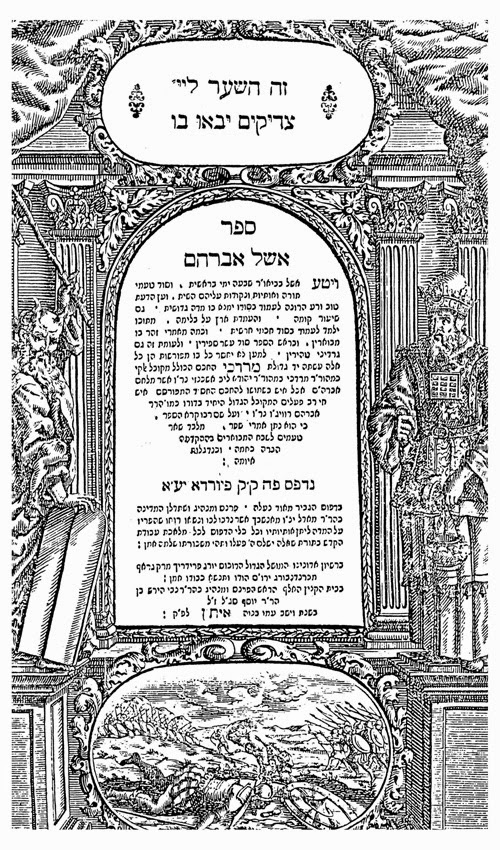
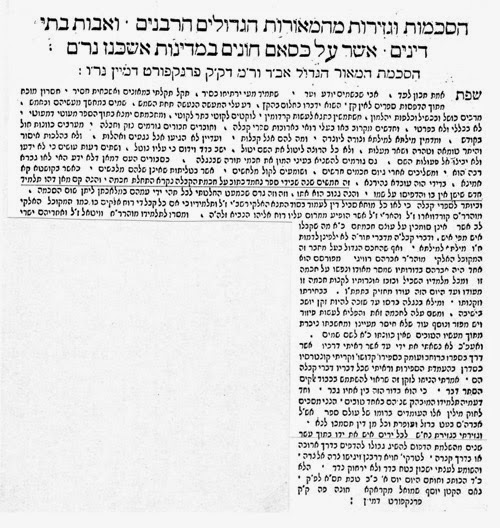
On January 2, 1701, R. Joseph Samuel wrote a letter of approbation for a kabbalistic work by R. Mordechai Ashkenazi, an otherwise unknown author (then) who was a protégé of the distinguished Italian rabbi and kabbalist, R. Abraham Rovigo (d. 1713).5 The book, entitled אשל אברהם, and the letter of approbation, were published later in 1701 in Fürth. After a lengthy critique of the proliferation of works on Kabbalah in the late 17th century, the letter reads, in part:6
They [the new authors of kabbalistic works] are guilty of two evils. First, they neither know nor understand the deeds of God. Second, they cause the common folk to slight the rabbis expert in the exoteric Torah. The common folk assume that rabbis not expert in Kabbalah are not true scholars. So they cast away their expert rabbis, listening instead to the enchanters, whose wisdom is borrowed from others. I can testify that this is true [i.e., that the enchanters’ wisdom is borrowed from others], for I was involved in such a case. I recall vividly how some fifty years ago I owned a copy of a delightful kabbalistic work entitled התחלת חכמה. Some upstart student, a novice with no knowledge based on accumulated learning, printed the book under his own name. He simply plagiarized the entire book.
2.  The Identity of the Plagiarized Book.
No book entitled התחלת חכמה has ever appeared in print. It therefore could not have been plagiarized by anyone. Moreover, R. Joseph Samuel did not reveal the name of the plagiarist and the title of the book in its plagiarized form. This literary riddle was first raised in print early in 1976 by the noted bibliophile, Abraham Schischa of London.7 The solution was not long in coming. That same year, R. Shmuel Ashkenazi, also a noted bibliophile, solved the riddle.8 He correctly identified התחלת חכמה as the title of a kabbalistic book in manuscript form, still available in a variety of contemporary libraries.9 In book form, it was entitled מעין החכמה and it first appeared in print in Amsterdam in 1652.10 The plagiarist who published מעין החכמה under his own name was R. Abraham Kalmankes of Lublin. Ashkenazi provided other useful information as well, but all that is important for our purposes is that he clearly identified R. Abraham Kalmankes as a plagiarist. As such, he agreed fully with R. Joseph Samuel’s characterization (in his letter of approbation) of the novice upstart student. The  late Professor Gershom Scholem also identified R. Abraham Kalmankes as a plagiarist. He would write:11
והוא [ר’ אברהם קלמנקס] הדפיס ס’ התחלת חכמה הגניבה [כך כתוב] על שמו,
וכבר יש רמז לדבר בהסכמת הרב מפרנקפורט לס’ אשל אברהם.

“He [R. Abraham Kalmankes] published the pirated book entitled Hathalat Hokhmah under his own name. The matter is alluded to in the letter of approbation by the rabbi of Frankfurt to the book entitled  Eshel Avraham.”

It is our contention that R. Abraham Kalmankes has received less than a fair hearing in the court of modern scholarship. If we reopen the investigation, it is because much of the evidence has either been misconstrued or overlooked. The reader will have to decide for himself whether or not Kalmankes was, in fact, a  plagiarist, and whether or not he should be better remembered for his seminal contribution to Jewish teaching and literature.
3. מעין החכמה.
            a) Claims of the Author/Editor
מעין החכמה, the first book to appear under R. Abraham Kalmankes’ name, is a short introduction to Lurianic Kabbalah. Indeed, it was among the earliest such works to appear in print. The title page of the quarto sized volume is followed by a one-and-a-half page introduction (pages 2-3). The introduction is followed by the text (pp. 4-22), which consists of 78 tightly-knit chapters (פרקים), perhaps more properly labeled today as paragraphs. Thus, several of the “chapters” consist of no more than15 lines of print (and, sometimes, even less). Scattered throughout the book are occasional comments in parentheses. These may reflect an educational tool used by the original author to clarify a difficult term by means of a gloss, creating — in effect — what we would call today a footnote. Or, as appears likely, these may reflect a second hand, i.e., material added to the base text by someone other than the author, e.g., a later editor of the original manuscript. Our immediate concern, however, will not be with the book’s content or structure, but rather with its authorship. What are the claims of the title page and the introduction? What do they tell us about the authorship of
מעין החכמה?
The title page basically announces the content of the book.12 It is a kabbalistic manual, we are informed, the likes of which has yet to appear in print. It provides the kabbalistic underpinning upon which all of R. Isaac Luria’s teachings rest. The title page then indicates that the book’s secret teachings are being  brought to press [ Hebrew:תעלומים  הוציא לאור] by “the exceedingly wise and young divine kabbalist, R. Abraham, son of the Gaon, Chief Rabbi and Head of the Yeshiva, R. Aryeh Leib, scion of the Kalmankes family of Lublin.” Note that the phrase “being brought to press by” is ambiguous. It is unclear from the title page whether R. Abraham Kalmankes is being presented as the author, editor, or publisher of מעין החכמה.
We perforce turn to the introduction, which – if read carefully – resolves much of the ambiguity of the title page.13The introduction, written and signed by R. Abraham Kalmankes, begins with a justification for the book’s publication. Briefly, Kalmankes, himself a victim and survivor of the Chmielnitzki massacres, informs the reader that he was puzzled by the seemingly endless exile of the Jews, with redemption nowhere in sight. After much reflection – and deeply influenced by kabbalistic teaching – Kalmankes concluded that it was faulty prayer that was prolonging the exile of the Jewish people. Jewish prayer was not piercing the heavens and reaching God on high. He compared the state of the Jewish people to a ship adrift at sea, with no one on board who knows how to steer the ship to safety. Nothing will change, argued Kalmankes, until kabbalistic teaching spreads throughout the Jewish communities. The seeds of redemption were planted by R. Isaac Luria, the master of proper kabbalistic prayer. Alas, he died before redemption set in, but he left a successor, R. Hayyim Vital, who in turn left “a basket full of manuscripts,” i.e. he reduced to writing the kabbalistic teachings of R. Isaac Luria, especially those relating to prayer. Once these teachings were mastered by Jews the world over, redemption would be at hand.
Unfortunately, “the basket full of manuscripts” was not being made available to the Jewish community at large. Kalmankes explains that those who horde the manuscripts refuse to publish them. This, for two reasons. First, for reasons of vanity. By retaining the manuscripts for themselves, they became the masters of esoteric teaching and the power brokers to whom all had to turn for guidance. Second, for reasons of profit. The owners of the manuscripts charged a hefty price for those who wished to view and copy them. Kalmankes decided to put an end to this scandalous state of affairs by acquiring and publishing one of the manuscripts that preserved some of the key esoteric teachings of R. Isaac Luria. Moreover, he “added a few comments of his own, in order to benefit the many readers,” almost certainly a reference to the comments in parentheses mention above. He gave the manuscript a new title, מעין החכמה [Wellspring  of Knowledge], for “just as a wellspring begins with a narrow opening that ultimately widens as it fills with water, so too this book begins with nuggets of wisdom that broaden and deepen as one grows in wisdom.” Kalmankes concludes the introduction with the following signature: “These are the words of the youngest
member of the group, Abraham, son of my father and teacher Rabbi Aryeh, son of the Gaon, our teacher and rabbi, the honorable R. Joseph Kalmankes Yaffe of Lublin.”
            b) Editions
Some of the confusion surrounding מעין החכמה relates to the multiplicity of published kabbalistic works with the title מעין החכמה, some of which have been mistakenly ascribed to Kalmankes in library catalogues throughout the world.
Confusion surrounding Kalmankes’ alleged plagiarism is also due, in part, to variant readings that appear in the later printed editions of מעין החכמה, for which Kalmankes can hardly be held responsible. After brief mention of some unrelated kabbalistic works with the title מעין החכמה, we will list and describe each of the printed editions of Kalmankes’ מעין החכמה.
An anonymous kabbalistic treatise entitledמעין חכמה  (ascribed in part to Moses) is included in the collection entitled ארזי לבנון (Venice, 1601).14 It is unrelated to Kalmankes’ מעין החכמה. The Ashkenazic printing house of the partners Judah Leib b. Mordecai Gimpel and Samuel b. Moses Ha-Levi published yet another anonymous kabbalistic treatise entitled מעין החכמה (Amsterdam, 1651).15 Frequently reprinted, it too is unrelated to Kalmankes’ מעין החכמה.
Four different editions of Kalmankes’ מעין החכמה have appeared in print. They are:
1. מעין החכמה, Amsterdam, 1652. Printed by the Immanuel Beneviste publishing house during the lifetime of its author/editor Abraham Kalmankes, it is the only reliable edition of Kalmankes’ מעין החכמה. As such, we will claim that Kalmankes can be judged only on the basis of this, and no other, edition of מעין החכמה. For a detailed description of the book, its title page, and introduction, see above.16
2. מעין חכמה, Koretz, 1784. This edition was printed by the Johann Anton Krieger publishing house which, in Koretz, was devoted to the publishing of kabbalistic and hasidic works.17 Although Kalmankes’ title of the book is retained, the title page ascribes the book to R. Isaac Luria and makes no mention of Abraham Kalmankes. More importantly, this edition omits Kalmankes’ introduction to the book. The text is a slightly revised and updated version of the Kalmankes edition. It incorporates most of Kalmankes’ parenthetical notes, with slight revision.18 The text was edited in its present form sometime between 1698 and 1784, i.e. well after Kalmankes’ death.19
3. מעיין חכמה, Polonnoye, 1791. Printed by the Samuel b. Yissokhor Baer Segal publishing house, this edition of מעין החכמה  appears at the end of a collection of kabbalistic works whose title page reads: ספר הר אדני.  מעיין חכמה is accorded no title page of its own. It begins with a skewed version of Kalmankes’ introduction, entitled: הקדמת המחבר ספר מעיין חכמה. No such title is applied to Kalmankes’ introduction in the first edition. We have already indicated (see above) that the introduction is omitted entirely from the second edition, so no such title appears there. The introduction to this, the third edition, closes with the name of the author:  אברהם בן מהו’ ארי’ בן הגאון מה’ משה יוסף קלמן מלובלין. In the first edition, however, Kalmankes’ grandfather’s name is given as: הגאון מורנו ורבנא כמוהר”ר יוסף קלמנקס ייפה מלובלין, with no mention of either משה or קלמן. The text that follows is entitled: התחלת החכמה האלהות כפי דרך האר”י אשכנזי ז”ל הנקרא ספר מעיין החכמה. It differs considerably from the text published in the first two editions. It  mostly lacks Kalmankes’ parenthetical comments strewn throughout the first two editions. It regularly omits readings that appear in the first two editions, and often adds material that is lacking in the first two editions. Indeed, it is a different manuscript version of the Lurianic digest that was first published by Kalmankes in 1652.20
4. מעין החכמה, Lvov, 1875. No publisher’s name is given. This is a hybrid version drawn from two earlier printed editions. Kalmankes’ introduction is drawn from the skewed version that accompanies the Polonnoye, 1791 edition. The text is drawn from the Koretz, 1784 edition.21 As such, this edition has no independent value and requires no further discussion.
            c) Relationship of the Published Editions to the Extant Manuscripts
No one has written more intelligently about the history of Lurianic kabbalistic manuscripts than Yosef Avivi.22 What follows is essentially a brief account of the relationship between the published editions of Kalmankes’מעין החכמה and the extant manuscripts, based largely (but not entirely) upon the results of Avivi’s investigations.
Numerous manuscripts copies of the kabbalistic treatise entitled התחלת החכמה, most of them dating to the 17th and 18th centuries, are extant in libraries throughout Europe, Israel, and the U.S. While they vary slightly from each other, they clearly reflect a single recension of an early 17th century kabbalistic treatise. The anonymous treatise, whose original title is unknown, was written by a disciple of Luria in Damsascus and then sent to Italy. There, the manuscript was copied and circulated under a variety of names such as קונטרס ההיכלות, כללי חכמת שיעור קומה, התחלת החכמה, and התחלת חכמה. It was precisely because a manuscript copy of התחלת חכמה came into the possession of R. Joseph Samuel b. R. Zvi of Cracow sometime prior to 1652, that he was so startled when he saw Kalmankes’ printed edition of מעין החכמה. Even after the printed edition made its debut in 1652, new manuscript copies of the kabbalistic treatise were written and circulated under a variety of titles, now including the title מעין החכמה.
Avivi has shown that the  התחלת החכמה manuscripts formed the first part of a larger Lurianic treatise that originally included a second part as well. Whereas the first part focused entirely on עולם האצילות, the second part focused  on עולם הבריאה — and is extant in manuscript form only. The two parts were separated from each other, and largely due to Kalmankes’ publication, the first part became an independent work entitled מעין החכמה. In sum, Kalmankes’ מעין החכמה is an accurate copy (with the addition of occasional glosses by Kalmankes) of an anonymous early 17th century Lurianic treatise that circulated widely under a variety of titles, including the title התחלת החכמה.
4. R. Abraham Kalmankes.
            a) Family History
The accusation of plagiarism leveled against R. Abraham Kalmankes by R. Joseph Samuel b. R. Zvi, and seconded by both R. Shmuel Ashkenazi and  Gershom Scholem, was not accompanied by any discussion of R. Abraham Kalmankes himself. When and where did he live? How did he make a living? What other books did he author? Was he an inveterate plagiarizer?23 Had such an investigation been conducted, we suspect that the accusation of plagiarism would not have been leveled at all.
In a brief biographical account of Kalmankes published in 1992, the author of the account bemoans the fact that so little is known about Kalmankes’ life history.24 Nonetheless, much more is known about him – and his family — than the meager snippets of information recorded in the 1992 biographical account or in the standard discussions of מעין החכמה. We will take as our point of departure the clear reference in Kalmankes’ introduction to מעין החכמה to his distinguished grandfather, “the Gaon, our Teacher and our Rabbi, R. Joseph Kalmankes Yaffe of Lublin.” For our purposes, what is most important about the grandfather is that after an illustrious rabbinic career in Lublin, he spent his last years in Prague, where he died, and remains buried to this day.25 The elaborate epitaph on his tombstone informs us that he died at the age of 56 on Sunday,13 Tishre, in the year 5397 (= October 12, 1636).26 The significance of this information will become apparent shortly, but first we need to turn elsewhere.
In 1678, at the family owned printing press in Lublin, R. Abraham Kalmankes published the only other work he would publish in his lifetime. Entitled ספר האשל, it is a masterful (and typical seventeenth century) rabbinic commentary on the book of Genesis.27It was the first installment of a planned commentary on the entire Torah, but apparently the rest of the commentary either never materialized or was never published.  The commentary is essentially a midrashic-halakhic work, replete with citations from the Midrash, Talmud, Codes (especially R. Joseph Karo’s שלחן ערוך), and kabbalistic literature. The volume itself is accompanied by a series of letters of recommendations by rabbis from Kremenitz, Lublin, Brisk, Pinsk, Grodno, Vilna,28 and more, all attesting to Kalmankes’ rabbinic scholarship. Once again, Kalmankes prefaced his work with an informative introduction. Kalmankes alludes to the many trials and tribulations that accompanied him through life, including hazardous trips to Egypt and the land of Israel. He was near death on several occasions during his travels, but managed to make his way back safely to Lublin.29 Upon his return, he undertook to publish two works in his lifetime. This, in order to fulfill the talmudic dictum: “Happy is he who arrives here [i.e., on High] with his talmudic teaching in hand.”30 Since according to biblical teaching, a matter is established by “two witnesses,” Kalmankes was determined to author two books and publish them, so that he would have them “in hand” when necessary. The first book, ספר האשל, intended for a more or less popular audience, took the form of a commentary on the book of Genesis. The second book, entitled ברכת אברהם, was intended for talmudic scholars only. Kalmankes informs us that the manuscript copy of ברכת אברהם was completed and that he looked forward to its publication. Sadly, it was never published. What  needs to be noted immediately is that Kalmankes never imagined that his earlier publication of מעין החכמה could count as one of his “two witnesses”! (And this was in 1687, long before R. Joseph Samuel b. R. Zvi leveled his accusation of plagiarism in 1701.) Indeed, מעין החכמה is not mentioned at all in Kalmankes’ introduction to ספר האשל. Clearly, he did not consider it a book that he had authored.
Elsewhere in the introduction, Kalmankes notes that he will make a special effort to cite דברי תורה from his grandfather, R. Joseph Kalmankes, who he describes as: “א”א זקני מ”ו הגאון מוהר”ר יוסף קלמנקס, זצ”ל, אשר מנוחתו כבוד בק”ק פראג.”  Kalmankes adds that upon his grandfather’s death in Prague, all of his writings were lost, and that he – Kalmankes – will therefore record his grandfather’s teachings as he heard them from his disciples. “For,” explains Kalmankes, “I merited to sit at his feet only until the age of ten. Thus, I was a child, and have no real knowledge of his novellae.” We, of course, cannot be certain whether Kalmankes sat at his grandfather’s feet in Lublin or Prague (or both). If only in Prague, and if Kalmankes was ten years old when his grandfather died, we have the latest possible date of birth for Kalmankes, namely 1626, for we have already established that Kalmankes’ grandfather died in 1636. Kalmankes, of course, could have been born earlier than 1626, and we have reason to believe that this was the case.
At the other end of the spectrum, it seems likely that R. Abraham Kalmankes died somewhere between 1678 and 1701. That he was still alive in 1678 is attested by the publication of ספר האשל in that year, and by several of the letters of recommendation dated 1678, all of which describe Kalmankes as alive and well. Since Kalmankes never responded to the devastating accusation of plagiarism made against him in 1701 by a leading rabbinic contemporary, it is probably safe to assume that he died before the accusation appeared in print. Though we cannot pinpoint the year of his death with precision, the most likely candidates are either 1692 or 1693. Kalmankes died in Lvov, where he served on its rabbinic court as דיין.31 The text of the epitaph on his tombstone was copied and published in 1863 and reads:32
שנת תתן אמת ליעקב
                          ביום טוב נהפך כי טוב פעמים ואבל ומספד ונהי בכפלים
ט”ו בחודש ניסן נגנז צנצנת המן המאיר באספקלריא המאירה
כבוד מורינו ורבנו ומאורנו נתבקש בישיבה של מעלה
הגאון האלוף עין הגולה מו”ה אשר יעקב אברהם בן הרב מוהר”ר אריה קלמנקש
צלל במים אדירים של תורה וחיבר ס’ אשל אברהם על שמו נקרא
ובשביל שזיכה את הרבים יבוא שלום וינוח על משכבו בשלום
תנצב”ה
Thus, Kalmankes died on 15 Nisan on a Tuesday.33 But in which year? The text states unequivocally that it was in the year whose numerical value was embedded in the biblical phrase תתן אמת ליעקב.34 But the copyist (in 1863) informed his readers that, due to an erasure, he could no longer determine which letters from the phrase were enlarged or highlighted on the original tombstone. This makes it difficult, but not impossible – as we shall see – to calculate Kalmankes’ approximate year of death. Since Kalmankes died on the first day of Passover which fell on a Tuesday, seven candidates (between the years 1678 and 1701) present themselves: 1679, 1686, 1689, 1692, 1693, 1696, and 1699. The Hebrew equivalents for these years are: [5]439, [5]446, [5]449, [5]452, [5]453, [5]456, and [5]459. Now the numerical value of a combination of letters from the phrase תתן אמת ליעקב must add up exactly to one or more of the above Hebrew dates. Only two solutions are possible: [5]45235 and [5]453.36 These are 1692 and 1693, respectively.37 In sum, if we had to give mostly approximate dates for the three generations of the Kalmankes family mentioned by R. Abraham Kalmankes in both of his publications, they would be:
R. Joseph Kalmankes:    1580-1636
R. Aryeh Kalmankes:      1600-167038
R. Abraham Kalmankes: 1620-169339
b) Citation from מעין החכמה in ספר האשל
Critical for our discussion is the fact that R. Abraham Kalmankes cites מעין החכמה in his ספר האשל!40 It is the only reference to מעין החכמה in ספר האשל.The passage reads:41
       או יאמר מאמר הר”י ז”ל באשר נקדים מאמר מהאר”י לור”י[א] הנזכר בספר מעיין החכמה
אשר הביאותיו לבית הדפוס בפ’ י”ד שבשעת הבריאה…
Or we can explain this by citing a passage from R. Isaac of blessed  memory, i.e., by first introducing a passage by R. Isaac Luria Ashkenazi — which is mentioned in chapter 14 of the book מעיין החכמה, which I brought to press [literally: to the publishing house] — which states that during the period of creation…
If one examines chapter 14 of מעין החכמה, the passage cited by Kalmankes in ספר האשל appears exactly as referenced, but Luria’s name appears nowhere in the text of chapter 14! This is precisely because מעין החכמה was a repository of Lurianic teaching which he – Kalmankes – brought to press. Kalmankes never claimed authorship of the book, and he tells us so in his own words in 1678, long before any accusation was leveled against him.
5. Conclusions.
Ultimately, whether or not Kalmankes is viewed as a plagiarist will depend largely on one’s definition of plagiarism.42 In terms of literary (as distinct from oral) plagiarism, a reasonable definition would seem to be:
Plagiarism is the act of appropriating in print another person’s ideas,          writings, or words, and passing them off as one’s own by not providing proper attribution to their original source.
Even aside from the definition itself, the moral opprobrium attached to any specific act of plagiarism will depend on a variety of factors. Thus, it seems to me, that the more literal and lengthy the borrowing, the more heinous the offense. Motive too will surely play a role in determining the severity of the offense. We turn to the specifics of the Kalmankes case.One can certainly sympathize with R. Joesph Samuel’s outrage when, in the 1650’s, he chanced upon a copy of the recently published מעין החכמה. He leafed through its pages and realized instantaneously that it was virtually word for word a printed copy of a manuscript he owned under the title התחלת חכמה. Worse yet, prominently displayed on the title page of the pirated book was the name of the “divine kabbalist,” R. Abraham Kalmankes, a name otherwise unknown to R.Joseph Samuel. He could only conclude that this was a blatant case of plagiarism that called for condemnation. Indeed, he was still upset about the matter some fifty years later!
But, as we have seen, the title page of מעין החכמה is somewhat ambiguous about Kalmankes’ role in its authorship and publication. It simply states that Kalmankes הוציא לאור the תעלומים, i.e., he published the secret or hidden digest of Lurianic teaching. One suspects that R. Joseph Samuel never examined Kalmankes’ introduction to מעין החכמה. Had he done so, he surely would have noticed that Kalmankes admits openly that he is publishing a manuscript that contains a digest of Lurianic teaching, authored by a disciple of Luria – and not by him. Kalmankes’ states unequivocally that his contribution to the volume is limited to the few comments he added (almost always in parentheses) and to the new title, מעין החכמה, he provided for it. It is only in the third edition of מעין החכמה, published in Polonnoye, 1791 – long after Kalmankes’ death – that a skewed version of Kalmankes’ introduction is labeled: הקדמת המחבר ספר מעיין חכמה, in effect suggesting that Kalmankes was the author of מעין החכמה. Anyone who reads this skewed version of Kalmankes’ introduction, and compares it to the original, will realize at once that it is was created in 1791 in order to harmonize its content with that of a different manuscript version of the Lurianic digest (one that lacked Kalmankes’ comments) that was being attached to it.43
 We have also the clear evidence from Kalmankes’ introduction to ספר האשל, published by him in 1678, that he sought to author and publish two books in his lifetime, so as not to be embarrassed when he was called “on High.” He provides the titles of both books, yet makes no mention of the fact that he had authored and published a book called מעין החכמה. He knew full well that this was a book written by others, which he had brought to press. Indeed, as we have seen, he cited מעין החכמה in his ספר האשל. When doing so, he stated openly that it was a Lurianic work that he had brought to press.
            There doesn’t seem to be much evidence here for plagiarism, as defined above. Kalmankes’ מעין החכמה was based upon a Lurianic manuscript that was anonymous and was circulating under a variety of titles. Kalmankes never claimed authorship of the manuscript, and indicated clearly that all he did was to provide the manuscript with a new title and some brief annotation. This he did for the best of motives, namely to bring about the ultimate redemption of the Jewish people. He did not pass off the work as his own (other than the title and the annotations, which were legitimately his own creation); he withheld no proper attribution.
On the other hand, three distinguished scholars, R. Joseph Samuel of the seventeenth century, and R. Shmuel Ashkenazi and the late Professor Gershom Scholem of the twentieth century, were persuaded that Kalmankes was a plagiarist. Perhaps they felt that the appearance of Kalmankes‘ name on the title page of מעין החכמה,  preceded by the words “אב בחכמה ורך בשנים המקובל האלוהי כמוהר”ר,” with no mention of any manuscript or attribution to others, was sufficiently misleading – and, perhaps, even deliberately intended – to create the impression that Kalmankes was the author of the book. If so, they would argue, he deserves to be listed among the plagiarizers. I am not persuaded that this is the case, but in deference to the three distinguished scholars mentioned above, I have allowed the title of this essay to read as it does. At best (or: worst), it is a mild case of plagiarism, if even that.44
NOTES
1 For biographical studies of R. Joseph Samuel b. R. Zvi, see H.N. Dembitzer,
כלילת יופי (Cracow, 1893), vol. 2, pp. 144b-152b; M. Horovitz, Frankfurter Rabbinen (Jerusalem, 1969), ed. J. Unna, pp. 94-97 and 296-297; and idem,
רבני פרנקפורט (Jerusalem, 1972), ed. J. Unna, pp. 67-69 and 212. For the epitaph on his tombstone, see idem, אבני זכרון (Frankfurt, 1901), p. 151. For legendary accounts of R. Joseph Samuel, see E. Sternhell, “,תולדות יצחק” p. 2b, in Y.I. Billitzer, באר יצחק (Paks, 1898); and Y.L. Maimon, שרי המאה (Jerusalem, 1955), vol. 1, pp. 231-233.
2 For an assessment of R. Joseph Samuel’s contribution to the printed text of the Talmud, see Y. S. Spiegel, עמודים בתולדות הספר העברי: הגהות ומגיהים (Ramat-Gan, 2005), second edition, pp. 404-407.
3 See L. Loewenstein, מפתח ההסכמות (Lakewood, 2008), ed. S. Eidelberg, pp. 99-100.
H.N. Dembitzer, op. cit., vol. 2, p. 150a.
See G. Scholem, חלומותיו של השבתאי ר’ מרדכי אשכנזי (Jerusalem, 1938); and Y. Tishby, נתיבי אמונה ומינות (Jerusalem, 1964), pp. 81-107. Cf. the historical vignette in Rabbi P. Katzenellinbogen, יש מנחילין (Jerusalem, 1986), ed. Y.D. Feld, pp. 74-75.
The original reads:
ושתים רעות עושים כי לא ידעו ולא יבינו אל פעולות השם,  גם גורמים להשניא  בעיני המון את חכמי תורה שבנגלה, כסבורים העם דמאן דלא ידע האי לאו גברא רבה הוא, ומשליכים אחרי גיום חכמים חרשים ושומעים לקול מלחשים, אשר בטליתות שאינן שלהם מלבשים, כאשר בקושטא קא אמינא בדידי הוה עובדא, נהירנא זה חמישים שנה שבידי ספר נחמד כתוב על חכמת הקבלה נקרא תחלת חכמה, והנה קם מאן דהו תלמיד חדש שישן אין בו והדפיסו על שמו, והנה גנוב הוא אתו.
A. Schischa, “שלושה ספרים נעלמים,” עלי ספר 2(1976), pp. 237-240.
S. Ashkenazi, “שתי הערות,” עלי ספר 3(1976), pp. 171-173. For an expanded version of Ashkenazi’s comments in עלי ספר, see his אסופה: ארבעה מאמרים מאוצרות הר”ש אשכנזי שליט”א (Jerusalem, 2014), pp. 49-53. Cf. S.Z. Havlin, “הערת העורך,” עלי ספר 11(1984), p. 134.
These include the National Library in Jerusalem, the Bodleian Library at Oxford, and a host of other libraries in Europe and the United States. For an early description of two such manuscripts in the National Library in Jerusalem, see G. Scholem, כתבי יד בקבלה (Jerusalem, 1930), p. 63, manuscript 2512, and p, 117, manuscript 47. The Bodleian Library lists some 10 manuscript copies of התחלת חכמה in its collection. See A. Neubauer, Catalogue of the Hebrew Manuscripts in the Bodleian Library and in the College Libraries of Oxford (Oxford, 1886), column 1001. Cf. the corrections to these listings in M. Beit-Arie and R.A. May, eds., Catalogue of the Hebrew Manuscript in the Bodleian Library: Supplement of Addenda and Corrigenda (Oxford, 1994), passim. A manuscript copy of התחלת חכמה was in the private library of R. Joseph Solomon Delmedigo in 1631. See his נובלות חכמה (Basel, 1631), p. 195a. The precise title of the book varies in the manuscripts, with the most common titles being התחלת חכמה  and
התחלת החכמה.
10 See L. Fuks and R.G. Fuks-Mansfeld, Hebrew Typography in the Northern Netherlands 1585-1815 (Leiden, 1984), vol. 1, pp. 176-177, entry 233.
11 See the undated loose page, in Scholem’s hand, appended to Scholem’s copy of מעין חכמה at the National Library in Jerusalem. Cf. ספריית גרשם שלום בתורת הסוד היהודית: קטלוג (Jerusalem, 1999), vol. 1, p. 312, entry 4188.

12 See the scan of the title page.
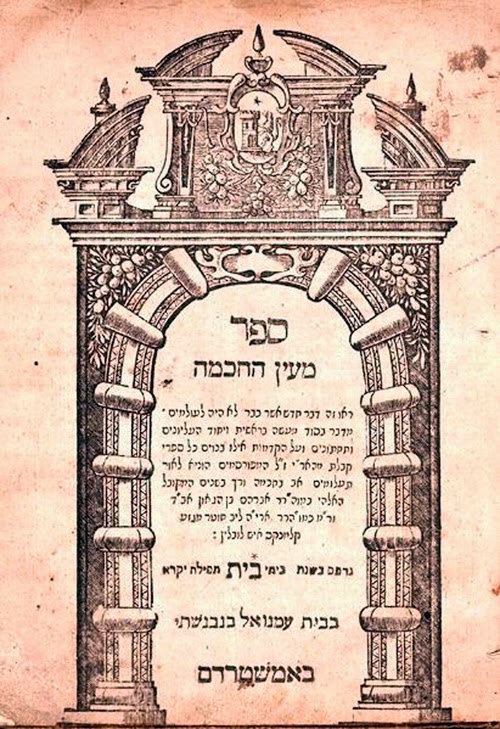
 

13 See the scan of the introduction.
14 The title is so listed on the pages of the treatise itself in ארזי הלבנון, pp. 46b-47a. On the title page of ארזי הלבנון, it is listed as מעיין החכמה. The frequent and easy interchange between the spellings מעין and מעיין and the spellings חכמה and החכמה characterizes virtually all the printed editions of the various books bearing these titles.
15 L. Fuks and R.G. Fuks-Mansfeld, op. cit., vol. 1, p. 195, entry 270,
16 Only a handful of copies are extant world wide. To the best of my knowledge, the first edition of Kalmankes’ מעין החכמה has not been photo-mechanically reproduced, and it is not available online (as of the date this note was recorded). Nor is it available on any of the standard electronic collections of rabbinic literature, such as HebrewBooks, אוצר החכמה, or אוצרות התורה. I am indebted to the National Library in Jerusalem and the Jewish Theological Seminary in New York for making their copies available to me. The scans of the title page and the introduction are reproduced here courtesy of the Bibliotheca Rosenthalia, now in the Special Collections of the University of Amsterdam (online catalogue: http://permalink.opc.uva.nl/item/001748453).
17 H. D. Friedberg, תולדות הדפוס העברי בפולניא (Antwerp, 1932), p. 61.
18 One key revision appears on p. 1, chapter 2, where ספר ויקהל משה is referenced. The book is not mentioned in the first edition of Kalmankes’ מעין החכמה, nor could it have been, since ספר ויקהל משה was not published until 1698. The reference is to R. Moshe Graf, ויקהל משה (Dessau, 1698). It does not appear likely that Kalmankes saw Graf’s work in manuscript form, since מעין החכמה was published in 1652 and Graf was born in 1650.
19 For the date of Kalmankes’ death, see below. The Koretz, 1784 edition was photo-mechanically reproduced in Jerusalem, 1970.
20 The Polonnoye, 1791 edition of מעיין חכמה was photo-mechanically reproduced in Jerusalem, n.d. (circa 1998), in a thin, dark blue, hardbound volume whose spine and outer cover read צדיק יסוד עולם, and whose title page reads הר אדני. (In other words, when seeking a copy in a bookshop of the reprint of the Polonnoye, 1791 edition of מעיין חכמה, whatever else you do, don’t ask for a copy of מעיין חכמה.)
21 As noted by S. Ashkenazi (see above, note 8), the title page of the Lvov edition indicates that its text is based upon the Koretz edition, and reproduces the very biblical phrase used by the Koretz edition for indicating its original date of publication in 1784. But by highlighting a different set of letters within the same biblical phrase, the Lvov edition announces to the reader that its date of publication is 1875.
22 Y. Avivi, קבלת האר”י (Jerusalem, 2008), 3 volumes, passim. See especially vol. 1, pp. 204-208, 443; and vol. 2, pp. 565-568, 840-841. See also, idem, “כתבי האר”י באיטליה עד שנת ש”פ”,” עלי ספר 11(1984), pp. 91-134; and “הערה,” עלי ספר 12(1986), p. 133.
23 “Plagiarism is something people may do for a variety of reasons but almost always something they do more than once.” So T. Mallon, Stolen Words: Forays into the Origins and Ravages of Plagiarism (New York, 1989), preface, p. xiii.
24 Rabbi M.Y.S. Goldenberg, “פתח דבר,” to the reissue of R. Abraham Kalmankes’ ספר האשל (Brooklyn, 1992).
25 On R. Joseph Kalmankes Yaffe of Lublin, see J. Kohen-Zedek, שבת אחים ( St. Petersburg, 1898), pp. 59-76; S. B. Nissenbaum,  לקורות היהודים בלובלין, (Lublin, 1920), second edition. pp. 36-37; S. Buber, אנשי שם (Cracow, 1895), p. 89, entry 217;  and S. Englard, “צפונות יוחסין (א), “ ישורון 3(1997), p. 680, note 6 and p. 694, note 36a.
26 See K. Lieben, גל עד (Prague, 1856), German section, p. 46; Hebrew section, pp. 34-35.
27 R. Abraham Kalmankes, ספר האשל (Lublin, 1678). Few copies have survived. For the copy at the Bodleian Library, see M. Steinschneider, Catalogus Librorum Hebraeorum in Bibliotheca Bodleiana (Berlin, 1860), vol. 1, column 752, entry 4458:1; and A.E. Cowley, A Concise Catalogue of the Hebrew Printed Books in the Bodleian Library (Oxford, 1929), p. 45. For the copy at the British Library, see J. Zedner, Catalogue of the Hebrew Books in the British Museum (London, 1867), p. 14. For the copy at Yeshiva University’s Mendel Gottesman Library, see B. Strauss, אהל ברוך (London, 1959), p. 31, entry 534. To the best of my knowledge, the first edition of Kalmankes’ ספר האשל has not been photo-mechanically reproduced, and is it not available online (as of the date this note was recorded). Nor is it available on any of the standard electronic collections of rabbinic literature, such as HebrewBooks, אוצר החכמה, or אוצרות התורה. A new edition of this exceedingly rare volume was made available by Rabbi M.Y.S. Goldenberg (Brooklyn, 1992) and we are indebted to him. Nonetheless, one needs to use this new edition with caution; the text has been “improved” for the modern reader. A comparison of the texts of the title page, as they appeared in 1678 and 1992, serves as an indicator of the occasional liberties taken with the text. A seemingly enigmatic woodcut (opposite the opening page of the commentary on Genesis) depicting a Jew (Kalmankes?) drawing water from a well (מעין החכמה?) – and framed in an elaborate frame marked by two angelic beings holding up a crown inscribed with the words כתר תורה – was not reproduced in the 1992 edition. See the attached scans:
 
28 The letter of recommendation from Vilna, dated 1673, was written by its Chief Rabbi, R. Moses b. David Kramer (d. 1687), the paternal great-great-grandfather of the Vilna Gaon.
29 These vicissitudes of life may account for the additional first names of Kalmankes, who in ספר האשל is identified as אשר יעקב אברהם קלמנקס. For the practice of changing names and/or adding additional first names when confronted by difficult circumstances, see R. Judah He-Hasid, ספר חסידים (Jerusalem, 1957), ed. R. Margulies, p. 214, paragraph 245 and notes. Cf. A. Teherani, כתר שם טוב (Jerusalem, 2000), vol. 1, pp. 293-315.
30 B. Pesahim 50a and parallels.
31 S. Buber, op. cit., p. 45, entry 101.
32 G. Suchestow, מצבת קודש (Lemberg, 1863), second edition, vol. 1, no pagination, entry 32.
33 The opening line ביום טוב נהפך כי טוב פעמים signals that Kalmankes died on a holiday that fell on the day when כי טוב was said twice. The next line identifies the holiday as 15 Nisan, i.e., the first day of Passover. The day כי טוב was said twice refers, of course, to the third day of creation, i.e. Tuesday. See Gen. 1:10 and 12.
34 Buber, loc. cit., writes with confidence that the highlighted letters are אמ”ת, which would indicate that Kalmankes died in [5]441 or 1681. But in 1681, the first day of Passover fell on a Thursday, not on a Tuesday. Suchestow was more circumspect, indicating it was no longer possible to determine which of the engraved letters were enlarged or highlighted. He left the problem unresolved. The usual practice for highlighting was the placement of a protruding dot over the engraved letters that were to be used for reckoning the year of death. The problem cannot be resolved by emending the second line to read ט”ז בחודש ניסן instead of ט”ו בחודש ניסן, since the second day of Passover can never fall on a Tuesday. See שלחן ערוך, אורח חיים, סימן תכח: א.
35 By highlighting the letters תתן אמ’ת’ לי’עקב’.
36 By highlighting the letters תתן א’מ’ת’  לי’עקב’.
37 These dates are based upon the assumption that the text of Kalmankes’ epitaph, as copied and published by Suchestow in 1863, is an accurate copy of the original. But this may not be the case. Suchestow’s מצבת קודש is marred by egregious errors. He sometimes copied and published as many as four different versions of the same epitaph! In another instance, he divided an epitaph into two parts, creating two dead persons when only one was called for. See the critiques of Suchestow in S. Buber, op. cit. (above, note 25)pp. vi-viii and in R. Margulies, “”,לתולדות אנשי שם  סיני 26(1949-50), p. 113 ( and throughout the later installments to this essay published in סיני between 1950 and 1952). Given that Kalmankes’ tombstone was close to 200 years old when it was copied in 1863, it is likely that the epitaph could be read only with great difficulty. While any attempt at emending the received text is speculative, a slight emendation of the first lines of the epitaph yields the following text:
שנת תתן אמ”ת ליעקב
ביום טוב נהפך טוב פעמים ואבל ומספד ונהי בכפלים
ט”ו בחודש ניסן נגנז צנצנת המן המאיר באספקלריא המאירה
The sense would be that Kalmankes died on 15 Nisan, on יום טוב, on a day when טוב was twice overturned. It was overturned first, because every day of the week of creation was described as  טוב(with the exception of the second and seventh days); and second, because it was יום טוב, a holiday. This would allow for 15 Nisan to fall on a Thursday, and indeed in 1681 (the numerical equivalent of אמ”ת), the first day of Passover fell on a Thursday. If so, Kalmankes may well have died in 1681.
38 These dates are an approximation. We know only that R. Aryeh Kalmankes died in 1671 or earlier, as his name appears with ברכת המתים in several letters of approbation dated 1671 and appended to ספר האשל.
39 These dates, as well, are an approximation. For possible evidence that R. Abraham Kalmankes died in 1681, see above, note 37. If Kalmankes was born in 1620, he would have been 32 years old when מעין החכמה was published in 1652. This fits well with his description on its title page as a רך בשנים. It also fits well with R. Joseph Samuel’s characterization of him (at the time) as an “upstart student.” It would also mean that he was nearing 60 years of age in 1678, when he published ספר האשל. This fits well with his bemoaning the fact – in the introduction to the volume – that the hair on his head and beard had turned gray and that old age was overtaking him.
40   It is astonishing that the author of the most comprehensive study of the Kalmankes family, J. Kohen-Zedek, שבת אחים (see above, note 25), concluded on pp. 67-68, that the authors of מעין החכמה and ספר האשל were two different people named Kalmankes (cousins, of course)! Among his proofs is the alleged fact that the author of ספר האשל was unaware of the existence of מעין החכמה. Alas, Kohen-Zedek overlooked the passage cited here. So too Gershom Scholem, who wrote: “המחבר [של ספר מעין החכמה] לא הזכיר את הספר בספריו הוא, כגון ספר האשל.” See the loose page in Scholem’s hand and the Scholem Library Catalogue, referred to above, note 11. Scholem, however, did not conclude with Kohen-Zedek that the authors of מעין החכמה and ספר האשל were two different people. Even more astonishing is the fact that the late bibliophile, R. Reuven Margulies, cited Kohen-Zedek’s conclusion approvingly. See R. Margulies, “לתולדות אנשי שם בלבוב,” סיני 26(1949-50), p. 219. It appears likely that Scholem (in part) and Margulies were misled by Kohen-Zedek.
41 ספר האשל (Lublin, 1678), p. 8b. We have printed the text as it appears
  in the first edition. In the 1992 edition, it appears on p. 29 as follows:
או יאמר באשר נקדים מאמר הר”י לוריא הנזכר בספר מעיין החכמה אשר הביאותיו לבית הדפוס בפ’ י”ד, שבשעת הבריאה…
 42 In general, see A. Lindey, Plagiarism and Originality (New York, 1952); T. Mallon, op. cit. (above, note 23); and J. Anderson, Plagiarism, Copyright Violation and Other Thefts of Intellectual Property: An Annotated Bibliography with a Lengthy Introduction (Jefferson, North Carolina, 1998).
43 Thus, in the introduction to the first edition of מעין החכמה, Kalmankes states:
וגם מעט מזער מדעתי הוספתי אך לזכות הרבים היא כוונתי (I added but a few comments of my own; my only intention is to benefit the many). In the Polonnoye, 1791 edition this was radically changed to: וגם מעט מזער מדעתי לא הוספתי אך לזכות הרבים היא כוונתי (I added not even the fewest of comments of my own; my only intention is to benefit the many). This change was made necessary because the kabbalistic manuscript now appended to Kalmankes’ introduction, and being published together with it for the first time, did not contain Kalmankes’ additional comments.   
44 I am deeply grateful to Rabbi Menachem Silber for reading and commenting on an earlier draft of this essay. The errors that remain are entirely mine.