On the Ger Tzedek of Vilnius

On the Ger Tzedek of Vilnius

By Yosef Vilner

This year the holiday of Shavuot occurred right after Shabbat. There were many meals and lively conversations around the table. During one these talks my daughter mentioned a story she read in a weekly supplement to the Hebrew edition of the Orthodox Jewish newspaper Hamodia. The story was about Polish nobleman Graf Potocki, a convert to Judaism who was convicted of apostacy by the Catholic Church and burned alive at the stake in Vilna on the second day of Shavuot on May 24, 1749. As a native of Vilna, I was very pleased to hear that this old, deeply rooted Litvak tradition is still celebrated on the pages of the contemporary Israeli magazines. However, the following day I discovered that Lithuanian Jewish Community in an apparent attempt to commemorate this event as a non-event published an article with a headline: “Ger Tzedek Count Potocki Story is Likely a Myth.” The article is derived from Wikipedia, where it appears under the title “Abraham ben Abraham.”

What prompted the editors of the website to compose such a headline? Most likely the following introductory passage in the Wikipedia article: “Although the Orthodox Jewish community accepts the teachings about Abraham ben Abraham, secular scholars have largely concluded that it is a legend.” But if the editors would take the trouble to continue reading the article they would probably arrive at a different conclusion. Setting aside the question of the reliability of Wikipedia as a source, let me present some of the conclusions of these “scholars” and examine them together with you.

As we read the article, we are informed that: “Historians who have studied the story of Potocki, believe it to be invented although it is unknown when or by whom. Jacek Moskwa points to a possibility that the author was Kraszewski himself, who is known to have invented some tales he claimed were true.” The reference here is to Joszef Ignacy Kraszewski, a well-known Polish writer and historian who published the story about Ger Tzedek from a Hebrew manuscript in his history of Vilna in 1841.

But to our great surprise in the next paragraph we discover that: “Polish historian Janusz Tazbir asserted that the story originated at the turn of the 19th century and was published in a Jewish periodical issued in London as “The Jewish Expositor and Friend of Israel” (vol. 8, 1822).” It does not take a mathematical genius to figure out that if the story appeared in print already in 1822 it could not be an invention of Kraszewski, who published it in 1841.

But what is this mysterious “Jewish periodical issued in London” called The Jewish Expositor and Friend of Israel? And what was exactly published there? A quick Google search produced the following results. “The Jewish Expositor and Friend of Israel” was a monthly periodical published by London Society for Promoting Christianity amongst the Jews, by no means a “Jewish periodical”. The abovementioned volume contains “Extracts from the Journal of Mr. Wolff”, who was a Jewish convert to Christianity and traveled as a missionary in Egypt and Eretz Israel between 1821 and 1826. According to the Jewish Encyclopedia from 1906 he “was the first modern missionary to preach to the Jews near Jerusalem.”  In the spring of 1822, he met with Rabbi Menachem Mendl of Shklov one of the leading rabbis in Jerusalem at the time. A neophyte Christian and a fervent missionary, Joseph Wolff initiated theological discussions with Rabbi Menachem Mendl in a disguised attempt to convert him to Christianity. Rabbi Rabbi Menachem Mendl, on the other hand, intended to bring Joseph Wolff back to the faith of his forefathers, the Judaism. It is the experts from these discussions that Joseph Wolff reported to “The Jewish Expositor and Friend of Israel”. April 14, 1822, Joseph Wolff wrote: “Rabbi Mendel mentioned to me the history of the conversion of a Polish Count, Podozky by name, he turned Jew, and was committed to the flames by the inquisition in Wilna.”

Rabbi Menachem Mendl was one of the outstanding disciples of the Vina Gaon, who immigrated to Eretz Israel in 1808 and settled in Jerusalem in 1816. Born in Shklov in 1750 he came to Vilna in 1795 to study with the Gaon. According to his own testimony: “I did not withdraw from his [the Gaon’s] presence; I held onto him and did not leave him; I remained in his tent day and night.” There is little doubt that he heard the story about the Ger Tzedek from the Rabbis of Vilna who were contemporaries to the trial and the execution of Avraham ben Avraham in 1749. This oral tradition Menachem Mendl related to Joseph Wolff in Jerusalem on the 14 April 1822.

As a result, the assertion of Janusz Tazbir  that the story about the Ger Tzedek “originated at the turn of the 19th century“ is not at all compelling. Moreover, if we scroll back to the beginning of the Wikipedia article, we will read the following passage:

There is also one contemporary written account from 1755, by Rabbi Yaakov Emden, Vayakam Edus b’Yaakov, 1755, p. 25b. A rough translation: A few years ago, it happened in Vilna the capital of Lithuania that a great prince from the family of Pototska converted. They captured him and imprisoned him for many days thinking they could return him to their religion. He knew that he would not escape harsh tortures and a cruel death if he would not return. They wanted to save him from the death and punishment that would await him if he held out. He paid no attention to them or to the begging of his mother the countess. He was not afraid or worried about dying in all the bitter anguish they had done to him. After waiting for him for a long time, they tried to take it easy on him for the honor of his family. He ridiculed all the temptations of the priests who would speak to him every day because he was an important minister. He scorned them and laughed at them, and chose death of long and cruel agony, to the temporary life of this world. He accepted and suffered all from love and died sanctifying God’s name. May he rest in peace.

Rabbi Yakov Emden, one of the prominent European Rabbis of the 18th century, resided most of his life in Altona, now part of Hamburg, but maintained very close ties with the Jewish community of Vilna, were both of his parental grandparents were born. Known for his critical attitudes, he most certainly verified the credibility of the account before he published it in a book.

If incredulous Janusz Tazbir would be aware of this source, he would never have suggested “that the story originated at the turn of the 19th century.” But would he be convinced that it really happened in the first half of the previous century? Probably not, and this is because: “the tragic fate of Potocki, passed through Jewish oral tradition, remains unconfirmed by 18th-century Polish primary sources .” We must admit, in all fairness, that the lack of the evidence in the Polish sources poses a serious problem. But does it necessarily follow that the alleged event never happened? Or is it possible that the Polish archives of that period possess black holes that conceal certain events? One could speculate that due to the prominence of the Potocki magnate family, the conversion of one its members from Catholicism to Judaism and his subsequent execution was concealed from the public and later obliterated from the Church records.

As we progress with Tazbir’s arguments presented in the article we discover that: “the Polish nobility was guaranteed the freedom of faith and capital punishment was extremely rare.” But the author of the article is quick to note: “though see also Iwan Tyszkiewicz” and links to an entry in Wikipedia were we are told the following. Iwan Tyszkiewicz was well-to-do subject of the Polish–Lithuanian Commonwealth, who became a follower of Socinian doctrines and abandoned Roman Catholicism for a Unitarian sect and was burned alive for blasphemous heresy at the great marketplace of Warsaw in 1611. So much for religious freedom of faith. The second point attributed to Tazbir in above citation “and capital punishment was extremely rare” is even more incredible. How does it exactly invalidate the Jewish tradition that one Ger Tzedek was executed in 1749? Furthermore, according to Magda Teter (The Legend of Ger Zedek of Wilno as Polemic and Reassurance, AJS Review 29:2, 2005) in the span of five-year period from 1748 to 1753, another two such executions occurred in Poland. Abram Michelevich, a Jew from Mohilev, and his Christian partner, Paraska Danilowna, were executed in Mohilev in 1748, Abraham for proselytizing and Paraska for apostasy. And on June 2, 1753, Rafal Sentimani was burned alive for having converted from Catholicism to Judaism on the outskirts of Vilna. By no means it could be called an extreme rarity by the standards of the mid-eighteenth century.

Professor Shaul Stampfer of Hebrew University once commented that it is much easier for a historian to prove what something did happen then to prove that something did not happen. Indeed, to paraphrase the famous motto of Leopold von Ronke, to show wie es eigentlich nicht gewesen ist is extremely difficult. Some of the arguments against the historicity of the Jewish tradition about Count Valentin Potocki presented in the Wikipedia article are false, some are dubious, and others are not compelling. The deafening silence of the Polish sources from the 18th century could possibly be explained; the Jewish record from 1755 cannot possibly be ignored. Is it legitimate because of this piece of scholarship to conclude that: “Ger Tzedek Count Potocki Story is Likely a Myth”?

If gerbiami journalists from Lithuanian Jewish Community could go back in time for some eighty-five years and then continue for another ten minutes from their fortified headquarters on Pylimo street to attend the morning service at the Great Synagogue of Vilna on the second day of Shavuot, they would hear a special prayer recited in honor of Avraham ben Avraham, the Ger Tzedek. A prayer that is already mentioned by Samuel Joseph Fuenn in his Kiryah ne’emanah ,1860, p.125. And its recital on the second day of Shavuot in the Great Synagogue is attested to by Chaykl Lunski in Mehagito Havilnai, 1921, p.56.

If they would visit the old Jewish cemetery in Shnipishok, they would see a place where the ashes Ger Tzedek were interred. The grave “had an iron shed built over it, with a Hebrew inscription, enclosed with large blocks of stone joined by heavy iron rails” (Israel Cohen, Vilna 1943, p. 74).

If they would visit the old cemetery on the 9th of Av or on the eve of the High Holidays, they would most likely encounter numerous visitors praying by the grave of the Ger Tzedek. Would they still have courage to say that “Ger Tzedek Count Potocki Story is Likely a Myth”, and the Jews of Vina are paying respect to the product of their own imagination?

The Great Synagogue of Vina was demolished, and the old Jewish cemetery was razed to the ground by the Lithuanian Soviet regime. Most of the worshipers who offered a special prayer in honor of Ger Tzedek on the day of his martyrdom or prayed by his grave themselves became martyrs during the Holocaust. But the story about noble life and tragic death of Count Potocki is still retold by the traditional Jewish periodicals around the time of Shavuot with great admiration and respect. Would it not be more appropriate for the official website of the Lithuanian Jewish Community to honor its glorious past and to do the same instead of calling it “likely a myth”?

Acknowledgment

My understanding of this topic was informed by a lecture of Professor Shnayer Leiman “The Ger Tzedek of Vilna: Fact or Fiction”, available on yutorah.org.
Towards A Reappraisal of the Recent Works of Rabbi Shelomoh Luriah (Maharshal)

Towards A Reappraisal of the Recent Works
Of Rabbi Shelomoh Luriah (Maharshal)
By Rabbi Eliezer Brodt

As previously mentioned on the Seforim blog by myself and others, our generation is privileged to something no previous generation has seen, a sheer volume of Jewish books being printed and reprinted. Many of these works are seeing print for the first time – works of Rishonim and Achronim on all sorts of topics brought to the public eye from manuscript form. Some of these printings are beautiful editions, critically edited, and even glossed with illuminating marginal annotations. Other times the only benefit is to see the change from an illegible typeface to a clear block print (oft as not without any particular in the editing). In many cases, specific institutions are founded solely to deal with works from a particular religious group, while at other times, entire publishing houses are established that deal with the writings of one particular author. Recently one Godol, the great prolific writer, the Aderet (Rabbi Eliyahu David Rabinowitz-Teomim), famous for, amongst many things, being the father-in-law of R Kook, has had over five distinct groups working on printing his writings although almost none of his writings were published in his lifetime.

Recently, a rather modest institute called Makhon Iyay HaYam has begun reprinting as well as publishing for the first time, the many writings of the great gaon R. Shelomoh Luria, Maharshal. To date, this Makhon has already printed a few of his works and is currently working on many more. In this post, I would like to discuss this great person, the Maharshal, some of his printed works, and the current and future projects of this particular Makhon. As much has already been written on this great goan, including several biographical sketches, as well as a dissertation by Dr. Meir Raffeld on the Maharshal’s magnum opus, Yam Shel Shelomoh (more later), I have limited myself to but a few highlights.

The Maharshal was born circa 1510 (most likely in the city of Brisk or Posen), and died in 1573 in Lublin. He was a Rav in many cities, including Brisk,[1] Ostra and Lublin.[2] Alongside the rabbinate, the Maharshal established and ran yeshivot, training many famous students. Amongst these students are, notably, R. Yehoshuah Falk Katz (author of the Preisha), R. Moshe Meis (author of Mateh Moshe on minhagim as well as Hoel Moshe on Rashi; more on him later), R. Shelomoh Efrayim Lunschitz (author of the Kli Yakar), R. Chayim of Friedberg (author of Sefer HaChayim and brother of the famous Maharal of Prague), and R. Eliyahu of Chelm (the great-great-grandfather of the Hakham Zvi and Rabbi Jacob Emden, famous for being the only latter day Godol to have created a documented golem (see here for Prof. Shnayer Z. Leiman’s post, “Did a Disciple of the Maharal Create a Golem?” at the Seforim blog) all studied in the Maharshal’s Yeshiva. As an historical aside, it is worth pointing out that in the biography printed by R. Chechik, Sefer Chasdei Hashem (Yerushalayim, 5767, pg. 3), R. Chechik makes the claim that the major talmidim of the Maharshal studied in his yeshiva in Lublin. This appears highly implausible as the Maharshal only came to Lublin in 1569, and by then most of his talmidim were already accomplished poskim. More likely these students studied in one of the Yeshivot the Maharshal headed prior to the Maharshal’s Yeshiva in Lublin.

R. Shelomoh Luria was a contemporary of and related to R. Moshe Isserles, the Rama. In his Maalot Hayuchsin (Yerushalayim, 5764), p. 15, R. Efraim Zalman Margolis traces the various ways in which the Rama and the Maharshal were related. Among those was through the marriage of Maharshal’s daughter Miriam to Rama’s brother Eliezer. Additionally, these two Gedolim carried on extensive correspondence between themselves, some taking a rather sharp tone (most noted are those letters regarding the study of philosophy and dikduk). Yet, as R. Efraim Zalman Margolis notes, the utmost respect and esteem was maintained between the two. In fact, they seem to have been keenly interested in the other’s works, there is evidence that they read the other’s work prior to publication. (See Klilas Yoffe p. 9b and Maalot Hayuchsin of R. Efraim Zalman Margolis, pp. 27-28.) [3]

While both the Rama and the Maharshal were well respected and many of the Poskim of that generation were the Maharsha’s students, in a choice between the two regarding how to decide halakha, the Rama is the clear winner. The Shelah HaKadosh, however, bemoans the fact the Maharshal’s decisions were not accepted. This is so as the Maharshal followed the Rama (i.e. the Maharshal died later) and, as such, should have been awarded consenting rulings out of principle (halachisha k’basrayi). As a result, the Shelah HaKadosh calls upon those who fear Hashem to take upon themselves all stringent dissenting opinions of the Maharshal in opposition to the Rama (Shnei Luchot HaBrit, Shaar Ha’Otiyot, #100, Kedushah).

The Maharshal is well-known for his caustic tone in his writings. Many biographers note his use of rather sharp epithets in his works concerning other Gedolim. R. Chaim Dembitzer cites many instances where the Maharshal writes sharply against various Rishonim (Klilas Yoffe p. 11). But, some have questioned the focus on the Maharshal’s tone. For instance, Shmuel Abba Horedesky, who authored a biography on the Maharshal, Kerem Shlomo, included a discussion of the Maharshal’s caustic tone. Horedesky sent his book to the Sdei Chemed, and in a recently published letter, the Sdei Chemed sharply critiques Horedesky’s inclusion of that portion on the Maharshal.[4] (Dr. M. Raffeld, in his dissertation also bemoans the misguided focus of previous historians at these caustic remarks instead of researching the more unknown eras of the Maharshal’s life).

Aside from his goanus, the Maharshal was an extremely prolific writer, writing on many areas. Some of his more famous works include an outstanding work on Shas called Yam Shel Shelomoh. For itself, the work is pretty well known, unfortunately it is not used to its full potential in today’s yeshivah world (this due to many reasons, most importantly the current mahalach halimud) although of late it has been reprinted in a nice block print edition. The style of the Yam Shel Shelomoh is oriented toward halakha. Typically, each topic is examined systematically from its beginning sources, through the Rishonim and through (the then) current minhag (see further Dr. M. Raffeld). This work has not reached us in its entirety, as parts are missing from those mesechtos present. Furthermore, it is clear from many places in his writings as well as quotes from his talmdim that he wrote more than what we have. (To date we have volumes on seven masekhtot, but according to various sources, the Maharshal wrote on sixteen masekhtot. Dr. Raffeld attempts to construct a list of the remaining nine; not all agree to this listing and several substitutes have been suggested). I seem to recall that recently they discovered the volume of Yam Shel Shelomoh on masekhet Baba Batra, but the collector who owns it does not allow anyone to print it and is only willing to sell it for a very large sum of money. Likewise, rumors of Yam Shel Shelomoh on masekhet Shabbat have been circulating among professional circles, without any concrete evidence.

In addition to the Yam Shel Shelomoh on the Gemara, the Maharshal penned many other notes on many masekhtot, dealing with, among his personal novella, the correct girsa’ot of the Gemara. Known today as Hagahot Hokhmat Shelomoh, this work was originally printed as a separate volume. Present-day editions of Gemara find some of the comments having added into the text of the Gemara and Rashi over time, and the authorship erased along with the original gloss. The remaining glosses are printed in the back of almost all recent editions of the Gemara. In his editing, the Maharshal used old manuscripts, as well as variant texts. In a lengthy article in Alei Sefer, vol. 15, Y. Ron deals with this work. Later on Professor Yaakov Shmuel Spiegel dealt with this work in his classic Amudim be-Toldot ha-Sefer ha-Ivry, Hagot u-Maghim (pp. 279-285). Hokhmat Shelomoh on Masekhet Gitten has been recently reprinted by R. Y. Satz, (Toronto: Otzreinu, 1990). The foreword includes a detailed article elaborating on the need to reprint this work, basing the glosses on the exact comments of the Gemara used by the Maharshal. Large amounts of the glosses have been deleted by editors who mistakenly attributed them to lines already corrected, while in fact the Maharshal had another point in mind.

A partial list of the Maharshal’s other famous works include Teshuvot Maharshal, responsa quoted by all poskim; glosses on Rashi al haTorah called Yerios Shlomo, reprinted several times of late; glosses to Sefer Shaarey Dura by R. Yitzhak of Duren called Ateret Shelomoh. He also wrote glosses on the Sefer haMitzvot haGadol (SMaG) by R. Moshe of Coucy, called Amudei Shelomoh. Makhon Yerushalayim has issued a critical edition of this work, in three volumes, based on manuscripts and first prints, replete with footnotes by R. Yosef Luban. In addition to stand-alone volumes, the Makhon has also included the Maharshal’s valuable glosses in their critical edition of the Sefer haMitzvot haGadol.

Now for the works printed by Makhon Iyay HaYam:

As previously mentioned, the Maharshal routinely wrote marginal notes on a vast number of seforim. Of the most popular, were his glosses on the side of the Tur. In large, these notes are quoted by his talmid, R. Yehoshua Falk Katz, the Preisha, as well as the Bach (Sefer Bayit Chodosh) and many other Poskim, but until this century, these notes were never printed. In 1957, the editors of Tur Hotzaat ‘El Hamikoros’ commissioned R. S. Werner to ‘liberate’ these notes from manuscript ‘captivity,’ allowing for a tremendous find for the halakhic world. Unfortunately, thirty simanim in Yoreh Deah were lost from the copyist, and were listed as missing in the manuscript. In 1995, R. A. Chavatzelet published these simanim in a Sefer Zikaron for R. Werner, with the intention of completing the sefer on Yoreh Deah.

While researching another work, R. Y. M. Dubovick found citations to glosses not printed in R. Chavazelet’s addendum. Further perusal revealed the existence of more manuscripts in libraries worldwide that R. Werner was unaware of, and of which R. Chavatzelet had not availed himself. With more accurate texts, and numerous additional pieces not found in the manuscripts R. Werner had been given, it was clear of the need to edit the hagahot from the beginning. R. Dubovick decided to print this whole work again with all the corrections and missing pieces. First, R. Dubovick published an expository article in the journal Yeshurun (vol. 11) listing many missing parts on Yoreh Deah. In 2000, he issued a limited printing of the hagahot on Even HaEzer (including hagahot on the last ten simanim, a notable lack in R. Werner’s edition). More recently, he released a critical print of the first sixty simanim of Tur, Yoreh Deah with footnotes, surrounding the text of the Tur (Crimea, 1558) as used by the Maharshal. Therein, he references all the relevant writings of the Maharshal and his talmidim to the glosses on the Tur, as well as citations of these glosses by the poskim.

R. Dubovick intends to conclude the rest of Yoreh Deah in the near future and deal with Orah Hayyim and Hoshen Mishpat next, and finally, a reissue of Even HaEzer.

The focus of this recent volume on Yoreh Deah is the Sefer Ateret Shelomoh a commentary on the Shechitos u’Bedikos of R. Yaakov Weil, the hagahot on Tur an addendum to this rare work. As little as less than a hundred years ago every shochet had been tested specifically on this work, and virtually every small-town rav had to be an expert in this area as well. Many of the she’elot presented to a local rav were on these very topics and could not be referred to another Rav, as by than the animal would spoil. Nowadays, a shochet is tested on Sefer Beit David (R. David Tschechovitz), and unfortunately, the shechitot and bedikot of R. Yaakov Weil are almost unknown by anyone today, save for the occasional excerpt in other seforim.

Seeing how this valuable work has not been reprinted with the Maharshal’s notes in the past 400 years, Makhon Iyay HaYam recently undertook this project to enrich the public with yet another one of the Maharshal’s many invaluable works, reprinting the text based on the only two printings, and a manuscript fragment. R. Dubovick set himself to the task, painstakingly annotating along the way with extremely thorough notes on the entire sefer. Albeit some times his notes are a bit lengthy, there is a wealth of singular information contained in them, both on the halakhic field as well as the bio-bibliographic, which the editor could not deny the public, and did not omit them from print. A few examples; when the Maharshal quotes his grandfather, R. Yitzchok Klauber, noted are many of the places where the Maharshal cites his grandfather, throughout his many seforim (p. 3, n.6), along with a brief biographical sketch. [5] The same style note can be found when the Maharshal mentions his father-in-law R. Kalonymus (Kalman) Havarkstein-Yerushalmi; a listing of other citations, along with a thumbnail bio, including the Maharshal’s wife’s name (p. 38, n.28). With an eye on the halakhic ramifications of reprinting this sefer, R Dubovick notes that R. Efraim Zalman Margolis highlighted the importance of studying this sefer for those learning shechita, and yet, due to the sefer having been published as an addendum to the sefer, Sha’arei Dura, and not having a distinct title page from the Sha’rei Dura, remained unknown. (Introduction to Ateres Shlomo, see also Ma’alos haYhuchsin, p. 35) Additionally, regarding R. Efraim Zalman’s work on treifus in lungs (Rosh Efraim), R. Efraim Zalman states that Shechitot u’Bedikot were written last, even after Yam Shel Shelomoh, and the Halakha should be fixed accordingly, even against a dissenting opinion in Yam Shel Shelomoh (p. 38, n.27). In addition, he includes interesting sources to the practice of watering cattle before shechita (p. 55, n.92), as well as bringing to light a fascinating source to the puzzling minhag of peeling off sirchos (lesions) from the lung (p. 64, n.129).

The Maharshal’s extreme regard for maintaining minhagei Ashkenaz and their halakhic impact are spread throughout both his and his talmidim’s many writings. One can especially find this true with regard to R. Moshe Meis’ classic work Mateh Moshe. A while back, a manuscript was discovered of some minhaghim of the Maharshal called Hanhagot HaMaharshal. Dr. Y. Refael printed this work in a Sefer Hayovel and then later on as a separate pamphlet. These minhagim were written anonymously, and the editor attributes them to R. Moshe Meis, author of Mateh Moshe, and known to have been a personal member of the household of his teacher, R. Shelomoh Luria. As these minhagim do not cover the whole year, Dr. Refael concludes that the text is only a segment of a much larger work, which had unfortunately been lost. Interestingly enough, R. Shmuel Ashkenazi told me recently he did all the work in annotating this sefer and preparing it for print, although for some reason he wasn’t credited for it. (While this edition was printed from a manuscript, copied expressly for R. Nachum Ber Friedman of Sadigura (Areshet, vol. 1 397-98), there is another, variant edition, printed in the back of some copies of Nagid uMitzaveh (Sinai, vol. 63, p. 96)).

Among the interesting minhagim included in here is: [6]

מורי מוהר”ש אמר שקצת מינות באמירת י”ג עיקרים שתקנו באני מאמין שיש בו י”ג עיקרים, כי קצת אומרים וחושבים בלבם כשמאמינים בי”ג עיקירים אף על פי שעשו כל התועבות שבעולם ר”ל מכל מקום יש להם תקנה ואינו כן אלא אפילו מדברי חז”ל הוא עיקיר אחד, כמו שמצינו שאמר מה נאה הלכה זו ולא משבח האחרות גם כן אינו עושה כהוגן. ולא נתקנו אלו הי”ג עיקירים רק בשביל פילסוף מימים הקדמונים שהיו עושים עיקרים בכללים ולא עשו כמנין הללו באו חז”ל ותקנו גם כן בכלליהם וכן ביגדל אלקים חי נתקן י”ג עיקירם גם כן ולא אמר מורי אחד מהם ולא יגדל ולא אני מאמין”.

Also, the Maharshal discusses the Shir HaYichud, and offers a rather radical explanation of who the author of Shir HaYichud was: [7]

ביום טוב אחרון של פסח ביום ב’ אירע שנפל נר על דף של סידור ואמר בחור אחד בבית הכנסת של מורי מהר”ש לכבות אותו ולהציל ספרי קודש מדליקה. ואמר אפשר מותר ובפרט ביום ב’ של יום טוב שהוא דרבנן ובחור אחד אמר שהוא משיר היחוד ואמר מורי מהר”ש אל תבכו, גם זה לטובה שנשרף, שהוא סובר שלא בר סמכא עשאו, שמין עשאו

Similarly, in the Siddur Siddur Shabtei Sofer, vol. 1 pp. 89-90, R. Shabtei records in the name of the Maharshal:

והנה נוהג’ ברוב קהלות אשכנז לומר שיר היחוד הזה בכל יום רק במדינת רוסיא בקהלות אשר נהג בהם רבנות הגאון מהר”ר שלמה לוריא ז”ל אין אומרים אותו כל עיקר. ושמעתי מפי רבים מזקני הדור שהגידו לי ששמעו את מהרש”ל שהיה דורש בק”ק לבוב ובק”ק לובלין בתחלת בואו לנהוג שם רבנות ואמר בדרשותיו שאין לומר שיר היחוד מפני שמצא שחיבר אותו מין, ובעבור זה היה מוחה בכל הקהלות מושבותיו מלאמרו

Another rather unknown work of the Maharshal, is his Zemirot for Shabbat. While this work has been printed many times, not one of these editions has been reprinted based on the first printing and manuscript and many of the modern printings have actually detracted from the sefer’s integrity. This rare sefer is comprised of songs the Maharshal composed for Shabbat and Motzei Shabbat, with the author’s commentary to those songs. Included in his explanations are many halakhot and minhagim of Shabbat. Some examples of which are; women should wear a special garment when lighting the Shabbos candles; a reference to the custom of wearing a kittel on Shabbos. Another example, he praises the people of Ashkenaz for having a set system with regard to hosting yeshiva students for Shabbat meals. (Interestingly enough, while Prof. Simha Assaf mentions this minhag in his biographical sketch of the Maharshal printed in Sefer haYovel Lichvod Prof. L. Ginzburg, he makes no note of it in his Mekorot LeToldot HaChinuch biYisrael, even though he does mention several other sources to this custom pp. 229, 236, 633). [8]

Here too, R. Dubovick is working on reprinting these zemirot, along with an excellent commentary of his own on this work. A few samples of his efforts have been published in the journal Yeshurun (vol. 16). Here, I was simply amazed at the sources and comments of R. Dubovick regarding the various points of the Maharshal. One only hopes he will finish this work soon along with all his many projects relating to the Maharshal.

Notes:
I would like to thank R Y. M. Dubovick and Dan Rabinowitz in for their extremely helpful suggestions and sources in writing this post.

[1] On the Maharshal’s tenure in Brisk see the letter of R. Nosson Rabinovitch (author of Dikdukei Sofrim) in Eyur Tehilah p. 198.

[2] On the Maharshal’s time in Lublin, see the story brought in Simchas Hanefesh (see here for an earlier post, “Simchat ha-Nefesh: An Important But Often Ignored Work on German Jewish Customs,” at the Seforim blog) from R Yehudah Chassid pg 109-110. A similar story is quoted by the Chida in Shem haGedolim, erech R Avrhoum Mocher Yerokos.

[3] For a recent lengthy discussion of these correspondences, see Y. Elbaum in his Pisichut Vehistagrot (pg 156 and onwards), as well Dr. Asher Siev’s biography of the Rama (1972). For the exchange of letters between Rama and Maharshal on philosophy, as part of the appendix of translations of primary texts from 16th-century East-European Jewish Thought, see Leonard Levin, “Seeing With Both Eyes: The Intellectual Formation of Ephraim Luntshitz,” (Ph.D., Jewish Theological Seminary of America, 2003), 299-284, esp. 299-311.

[4] On the caustic comments of the Maharshal see Iggerot S’dei Chemed, vol. 1, siman 11, pp. 24-25; see also R. Barukh haLevi Epstein, Mekor Barukh, Introduction, pp. 89-93.

[5] For more on the Maharshal’s grandfather see M. Rafeld, in Daniel Sperber, Minhagei Yisrael (Jerusalem: Mossad Harav Kook, 2007), 8:174-96.

[6] For more on Ani Manmin see HaSiddur, pp. 232-36; Marc B. Shapiro, The Limits of Orthodox Theology: Maimonides’ Thirteen Principles Reappraised (Oxford: Littman Library of Jewish Civilization, 2004), pp. 19-20 (citing opinion of the Maharshal).

[7] For more on this topic see: A. Berliner, Kesavim Nevcharim, vol 1 pg 145-170; R. Dovid Hanazir , Kol Haneveha pgs 124, 143-144; H.J. Zimmels, Askenazim and Sephardim, pp. 132-134; A Haberman, Shiur Hayichud Vhakovod (intro), Y. Dan, Shiur Hayichud (facsimile edition) with the commentary of R. Yom Tov Muelhausem, Introduction; R.Y. Stal, Sefer Gematryios L’Rabenu Yehudah Hachassid, vol 1 pg 32-38; R. Y. Golhaver Minhaghei Hakehlos, vol 1 p. 132: and my forthcoming article in the Yerushasenu volume two.

[8] Another person who missed this source while discussing this topic is Mordechai Breuer, in his comprehensive book on the Yeshivot, Oholei Torah: The Yeshiva, Its Structure and History (Merkaz Zalman Shazar 2003), pp. 405-409.


Book Week 2011

Book Week 2011

by Eliezer Brodt

Book week has just begin in Eretz Yisrael. As I have written in previous years every year in Israel, around Shavous time, there is a period of about ten days called Shavuah Hasefer – Book Week (see here, here and here). Shavuah HaSefer is a sale which takes place all across the country in stores, malls and special places rented out just for the sale. There are places where strictly “frum” seforim are sold and other places have most of the secular publishing houses. Many publishing houses release new titles specifically at this time. In my reviews I sometimes include an older title if I just noticed the book. As I have written in the past, I do not intend to include all the new books. Eventually some of these titles will be the subject of their own reviews. I try to include titles of broad interest. Some books I cannot provide much information about as I just glanced at them quickly. I apologize in advance for any mistakes regarding transliteration. I also apologize in advance for using the word excellent so many times when describing seforim in this post! Additionally this year I am offering a service, for a small fee to help one purchase these titles (or titles of previous years). For more information about this email me at Eliezerbrodt-at-gmail.com. Part of the proceeds will be going to support the efforts of the the Seforim blog. Earlier this year I posted a list of recent academic titles see here. It’s worth checking back to this post in the next few days as I will probably add some more tiles, especially from Mechon Yerushalaim. 1) Magnes Press has many special titles this year. First and foremost is Benny Brown’s book on the Chazon Ish (see here). Another special title is the three volume critical edition of Sifri from M. Kahane. Another nice title is Kabbalistic Manuscripts and Textual Theory from Daniel Abrams. A nice collection of articles is Chinuch Vedas. There is a new collection of articles related to R. J. B. Soloveitchik called Rav Be-olam Ha-chadosh. There are also some new works on philosophy of Halacha. One is called Halacha, Meta Halacha, u-Philosph. Another one is called Halacha Ke-mecholles Shinu. There is another collection from E. Melamed called Midrashe Halacha shel Ha-amoroyim be-talmud Bavli. Another title is from S. Tzefatman called Rosh Ve-rishon. Another title is from Shlomo Simonsohn on the Jews in Sicily. Another nice collection is related to the Cario Genizah called Ha-kanon Ha-somu Min Hayin. Another nice title is a collection of articles related to Gan Eden called Gan Eden Me-kedem. In English, there is a new title called The Pinnacle of Hatred: The Blood Libel and the Jews.2) Kibbutz Hamechuad has a very special new title from Chanan Gafni called Peshuto Shel Mishana (a table of contents is available upon request). I highly recommend it and hope to return to it a post in the very near future. 3) The Israel Democracy Institute has some very good new titles. One is from Benny Brown (author of the work on Chazon Ish) dealing with R. Elyahsiv, Shlita and Rav Shach. Another work which looks interesting is a collection of articles called Rabnut HaAtgur (two volumes; a table of contents is available upon request). There are some other good titles there for good prices. 4) Caramel reprinted N. Krochamal’s classic work Moreh Nevuchei Ha-zeman.5) The Israel Academy of Sciences and Humanities does not have anything new but has some very good deals on old titles. 6) Merkaz Zalman Shazar has some new special titles. Amongst them is Amram Tropper’s Kechomer Beyad Hayotzer and the Hebrew translation of Professor Kanarfogel’s Peering through the Lattices, called Sod U-magiah Uprishut Bemishnsom Shel Balei Hatosfot. 7) Reuvan Mass has a few new titles. Amongst them works on the Maggid Me-Mezritch, Ha-shar Le-aon and a work on R. Tzvi Mezigitov, Al Derech Ha- avodah.8) The Bialik Institute has a few new titles, amongst them Lo Yossur Shevet Me-Yehudah in honor of Professor Simon Schwarzfuchs, which is a excellent collection of articles including pieces from of Professors Chaim Soloveitchik, Shnayer Z. Leiman, A. Grossman. M. Rosman, Eric Zimmer, R. Reiner ,Simcha Emanuel and many others (a table of contents is available upon request). Another nice title is Legalot Nistorot from Chana Werman. Aharon Shemesh has a book related to halacha in the Dead Sea Scrolls. Another title, Yosef Dat, is a Sefer Hayovel for Y. Salomon. In English there is a new title edited by Boaz Huss called Kabbalah and Contemporary Spiritual Revival. 9) Bar Ilan University has some new titles. The latest volume of Sidra is something specia,l with an all star line-up of writers (see here). A good title for those interested in academic Talmud is called Meleches Machsevet (see here). There are new volumes of Badad and Iyunei Mikra. Another title is on Zionist movement in Poland (see here). 10) Mechon Ben Zvi has some new titles, amongst them some new volumes in their set of critical editions of classics of Sefer ha-Makabim. Other works include Safrut Ha-mikra and a new translation of Shemoneh Perakim of the Rambam from M. Schwartz and two more volumes in their special series.


The Animals

“A man enters synagogue on Yom Kippur with his dog and tells the gabbai this is a very smart dog, he can talk. “If he will talk for you,” says the man, “will you let him sit next to me?” The gabbai says “let’s hear him.” Man turns to dog and says what is on top of this building which keeps the rain out? the dog says ruf ruf. The guy says see he said it was a roof. But if you are not satisfied with that, I will have him answer another question. He says to the dog, who was the most famous baseball player of all time? Dog says ruf ruf. Man says see he said Babe Ruth. The gabbai throws man and dog out. Dog looks up at the man and says, “Should I have said Willie Mays?”
— Jewish Joke

I thought it may be instructive to examine what Judaism says about animals. In the course, I hope to highlight some lesser known bibliographical items. The Torah appears to place significant obligation on people vis-à-vis animals. For instance, we are commanded to remove an overburdened animal (Deut. 22:4), we are told to feed one’s animals prior to one eating themselves (TB, Berachot, 40a), and finally there is a general injunction against mistreating animals. It is from this final prohibition – tzar ba’alei hayyim – that we continue with the remainder of our discussion.

Although we are commanded to treat animals well, Jews are also not prohibited from eating animals. The combination of these two ideas were for some rishonim an understanding of how and why shehita is the obligatory process for eating meat. They explain that purpose of shehita is to minimize pain to the animal even when we do kill it.[1] They point to law of a smooth knife as well as cutting specifically on the neck as trying to minimize pain. The issue of animal pain, was raised on numerous occasions for some to argue that shehita should be prohibited. In the defense of shehita the idea that it is the least painful method of killing was usually marshaled. In at least one instance, at the turn of the 20th century, this defense “caused even non-Jews to only use Jewish shehita and the Society for [the prevention] of Cruelty to Animals in America attempted to obligate this in all places.”[2]

In America as well there was a question of the legitimacy of shehita as a humane method. A book was published, originally in Hebrew and subsequently to English, which bore the title Tub Taam, or Vindication of the Israelitisch Way of Killing Animals by R. Aaron Zev Friedman (downloadable here). According to a family legend, this book convinced Ulysses S. Grant to eat only kosher meat.[3]

While all the above is true, there appears to be an opposite view of animals, one which places less respect to the animal world. R. Moshe Isserles, in his commentary on Shulhan Arukh, states “Anything that is necessary for health, or for anything else there is no prohibition against inflicting pain on animals; therefore, it is permissible to pluck quills from live duck and there is no consideration of causing pain to the animal. But, it is best to avoid all this as it is heartless.”[4] Thus, according to Rama, whenever there is any need, there is no prohibition of causing pain. According to this understanding, one need not understand the commandment of shehita to have anything to do with minimizing pain, as there is no need to minimize pain as the meat will be used.[5]

The view of Rama was applied by R. Yaakov Reischer when he asked [in an undated responsum] whether it is permissible to use an animal to test the efficacy of a drug.[6] He responded that based upon this Rama, animal testing is permitted. He explained that the caveat of Rama, that “it is heartless” and therefore should be avoided, is inapplicable to this case; as in the case of animal testing, the animal may not feel pain immediately, and as a result, according to R. Reischer, poses less of an issue of tzar ba’alei hayyim.

R. Ezekiel Landau, in his Noda BeYehudah[7] similarly applies Rama to a different question. He was asked whether it is permissible for a Jew to hunt animals. R. Landau says based upon Rama, there is no issue of tzar ba’alei hayyim. While he counsels against this practice for other reasons[8] these reasons are not out of concern for animals. R. Naftali Tzvi Yehuda Berlin, in Haamek Davar, places Noah as the first to own pets. R. Berlin explains that the raven and dove were Noah’s own pets and not part of the animals he collected into the ark. R. Berlin alleges that the dove was actually trained similarly to a homing pigeon. (Haamek Davar, vol. 1, 8:7)

In discussing animals and Judaism there is a related discussion concerning the propriety of dog ownership and dogs in particular in Jewish thought. R. Jacob Emden rails against dog ownership.[9] He decries dog ownership solely for pleasure or as a companion and goes so far to claim that dog owners are suspect of engaging in bestiality.[10]

On the other hand, historically, the dog specifically, has actually been used as a positive icon. For instance, in the Hamburg Miscellany, there is a depiction of a wedding scene with a dog at the feet of the groom.[11] Similarly, the Washington Haggadah contains a depiction of a dog (see here).

The Sefer Hasidim claims that all animals can teach humans positive traits.[12] He singles out the dog for teaching loyalty, which is easily what the depiction in the Hamburg Miscellany could be depicting in the wedding scene – a scene which describes what is essentially a loyalty ceremony.

While the positive aspect of a dog can be found in some illustrations, the negative view of animals and specifically dogs can also be found in illustrations. In the Prague 1526 haggadah we find a depiction of a hare hunt being used for the mnemonic YaKNeHaZ (the order the blessing are recited when Pesach night falls on a Saturday night). The usage of the hare hunt is in German, the term for hare hunt or Jagen-has sounds like YakNeHaZ. In Augsburg, 1534 haggadah, Yosef Hayim Yerushalmi notes it not only shows a hare hunt, but the hare escaping.[13] He says the hare is representative of the Jewish people and the dogs their enemies and therefore, “it is plausible to conclude that hate two successive representation of the Jagen-has are not only an innovation in themselves, but together comprise an allegory of the persecution and salvation of the Jewish people.”[14] In this depiction the dogs are actually the enemies of the Jews conforming with the prior negative views of dogs.

Finally, in the apocryphal work Tobit, in many versions there is a positive mention of a dog. In some editions, however, the dog is missing. One scholar posits the removal was deliberate in that, according to him — and as we have seen above this is not universal — Jews (and other Eastern cultures) do not depict dogs positively.[15] Thus, the dog had to go. Again, this follows the negative view of dogs.

In conclusion, there appears to be two schools of thought regarding animals and specifically dogs. Some view them and animals positively and is borne out in practice, while there is another tradition inapposite.

Notes:
I wanted to thank Eliezer Brodt and Menachem Butler for their additional insights and sources which added significantly to this post.

[1] See Sefer haHinuch, commandment 451; see also Eshkoli, Tzaar Baalei Hayyim, [], 2002, 79-80 (collecting sources).
[2] See Greenwald, ha-Shohet ve-haShehita be-Safrut ha-Rabbunut (New York, 1955), p. 19.
[3] For the source and a description of this book in general see Yosef Goldman, Hebrew Printing in America (New York, 2006), 2:1092. See also, Shnayer Z. Leiman, “Montague Lawrence Marks: In a Jewish Bookstore,” Tradition 25:1 (Fall, 1989): 66, 69, nn.12-13.
For more on the German attempt to ban shehita and R. Y.Y. Weinberg’s response, see Hirsh Jakob Zimmels, The Echo of the Nazi Holocaust in Rabbinic Literature (New York, 1977), 181-193 and Marc B. Shapiro, Between the Yeshiva World and Modern Orthodoxy (Littman Library, 1999), 117-129; and regarding the highly controversial nature of R. Weinberg’s responsum, Chief Rabbi Isaac Herzog hesitated to allow it in print at all, see p. 192. Shapiro also cites a letter where it is suggested that “Herzog later agreed that publishing the responsum would not create difficulties” (ibid., n.86).
[4] Rama, Even haEzer, 5:14; see generally Eshkoli, supra n.1, chapter 12.
[5] R. Yosef Toemim, in his introduction to Pri Megadim discussing shehita cautions against applying rationales generally for commandments, and specifically for shehita. Pri Megadim, Peshiha Kollelet l’Hilchot Shehita.
[6] R. Yaakov Reischer, Shevut Ya’akov, vol. 3, no. 71.
[7] R. Ezekiel Landau, Noda b’Yehuda, Mahdurah Tinyana, Yoreh Deah, no. 10.
[8] He offers that Biblically, the only hunters were Esau and Nimrod thus hunting is not a “Jewish pastime.” Further, he argues that one is prohibited from putting himself in danger. He goes so far to claim that the simple reading of Esau’s statement “I am going to die” as an expression that Esau was aware that he was involved in a dangerous profession.
David Katz recently noted that R. Ezekiel Landau “laughingly applied” to R. Jacob Emden the Talmudic dictum (BT, Yoma, 30b) concerning mad dogs: “They bark and bark but no one hears!” David Katz, “A Case Study in the Formation of a Super-Rabbi: The Early Years of Rabbi Ezekiel Landau, 1713-1754” (University of Maryland, 2004), 17, 420-421.
[9] R. Jacob Emden, She’elat Ya’avetz, vol. 1 no. 17; Eshkoli, supra n.1, pp. 221-224; id. 225-28 (discussing cats).
[10] There is a related discussion about the Antisemitic use of the dog to depict Jews. See Ruth Mellinkoff, Antisemitic Hate Signs in Hebrew Illuminated Manuscripts from Medieval Germany (Jerusalem, 1999), pp. 38-9; now, see generally, Kenneth Stow, Jewish Dogs: An Image and Its Interpreters (Stanford, California, 2006), 28-32 and passim. Additionally, it is worth noting that there is actually a Jewish explanation as to why non-Jews have called Jews dogs. See R. Y.Y. Stahl, ed., Sefer Kushiyot (Jerusalem, 2007), no. 128 p. 100 (finding scriptural basis for the dog epithet!).
[11] Bezalel Narkiss, Hebrew Illuminated Manuscripts (Israel, 1984) plate 59 p. 185; this illumination also appears in Encyclopaedia Judaica (Jerusalem, 1967), vol. 16, opp. col. 616. Sperber notes other instances of dogs in Jewish items but attributes it to Christian ideology. See Daniel Sperber, Minhagei Yisrael, vol. 4 pp. 84-5, n.12. But, as is shown above from the Sefer Hasidim, the use of a dog to display loyalty has Jewish roots as well.
[12] Margoliyot ed., no. 47, p. 106. See also, Sefer Hasidim (Sefer HaMaskil) p. 12 “at all times one should have in their home animals or birds, at the very least a rooster or duck. One should then feed the animal first to fulfill the obligation to feed animals prior to one eating themselves.” For a discussion regarding this Sefer Hasidim vis-a-vis the Sefer HaMaskil, see R. M.M. Honig, in “al Mahduroso haHadasha shel Sefer HaMaskil (Sefer Hasidim) l’R’ Moshe Bar Eliezer HaKohen,” Yerushashanu, vol. 1 (2007): 196-240.
[13] Both of these are available in their entirety from the JNUL site.
[14] Yosef Hayim Yerushalmi, Haggadah and History (Jewish Publication Society 1997), plate 15. For a fuller discussion of this imagery, see Elliott Horowitz, “Odd Couples: The Eagle and the Hare, the Lion and the Unicorn,” Jewish Studies Quarterly 11:3 (August 2004): 243-258, and idem., “The People of the Image,” The New Republic 223:13 (September 25, 2000): 41-49.
[15] Israel Abrahams, “Tobit’s Dog,” Jewish Quarterly Review (old series), I, 3 (1888/1889): 288.


New Writings from R. Kook and Assorted Comments, part 4

New Writings from R. Kook and Assorted Comments, part 4
Marc B. Shapiro
Continued from here.
Returning to the issue of creation, I found an interesting comment in R. Hayyim Hirschensohn’s commentary on Rashi, Nimukei Rashi. For those who are unaware of this commentary, I recommend that you examine it. You can order a bound copy (even soft-cover) very cheaply at hebrewbooks.org. I think that this is one of Hirschenson’s greatest works.[1]
In his comment to Gen. 1:13 Hirschensohn writes that belief in eternity (which here apparently means eternal matter in the Platonic sense, not an eternal universe in the Aristotelian sense) is not heretical, just foolish. He explains that something foolish by definition cannot be heretical, and gives an example: If you say that 2+2=5 this is false, but it is not heretical. It would be interesting to develop this theme further, and to see to what conclusions it takes you.
Also regarding creation, see his comment to Gen. 2:6 where he explains how evolution fits in with Torah, and where he differs with Darwin.[2] He sees support for his view in Rashi, although he acknowledges that Rashi himself didn’t have evolution in mind. Rather, one can explain Rashi in accord with modern views even though Rashi himself had no knowledge of modern science. Here is an example where a book, in this case Rashi’s commentary, is explained with no concern given to original intent, the notion being that a book has a life of its own and is not bound to the interpretations of its author. I cited material on this theme in Studies in Maimonides, and there is a good deal more I can add from traditional Jewish writings. (In my Hakirah response to Buchman, I promised to explore this issue in a future Hakirah article).
Here is Hirschensohn’s passage:
אל יחשוב הקורא שדעתי שרש”י ז”ל ידע מענין ההתפתחות והי’ לו שיטה מצוינה מיוחד בזה, שאהי’ בזה לצחוק לכל שומע, אמנם דעתי שרוח הקודש הופיע בבית מדרשו ופירושו בהפסוקים מתאימים לפרש על ידיהם שיטות פילוסופיות וטבעיות לפי אמתתם
Quite apart from his main point, I find Hirschensohn’s opening words here fascinating. We get a sense of whom he felt he was writing for when he says that if he were to claim that Rashi knew of the most advanced scientific thought, that it would be regarded as laughable. I think that even today if someone were to attribute prophetic-like scientific knowledge to Rashi, there are some circles where this would not occasion laughter, but great respect, on the assumption that as with Hazal, Rashi’s knowledge in these matters is all-encompassing.
I could have an entire post on the provocative material in Nimukei Rashi, but let me just give a couple of more examples. In his commentary to Gen. 4:16, Hirschensohn says that prophets can make mistakes, just like the rest of the people of their time. He says that they can even make such errors when it comes to principles of faith:
כי לא כל הנביאים ידעו הפילוסופיא האלקות האמתית . . . יכולים לטעות בטעותים אשר בני אדם בדורם טועים
He applies this insight to prophets who lived before the giving of the Torah. However, those prophets who lived after the Revelation at Sinai and were able to study Torah in a proper philosophical fashion were spared these types of errors.
ורק נביאי ישראל אשר למדו תורת ה’ עמדו מן התורה ומן החכמה ודעת על אמתת הפילוסופיא האלקות . . . כי הנבואה לא בא להודיע רק את הדבר אשר הודיעה מפורש ובשאר דברים יכול האדם להשאר בטעותיו הקדומים ורק התורה עם החכמה והדעת המה מודיעים את האמתית [!] ועקרי האמונה והפילוסופיא . . . כי הקב”ה חפץ שהאדם יהי’ דורש למצא את האמת לא ליתן לו את האמת בנבואה בלתי דרישה וחקירה.
In a previous installment of this series I dealt with Maimonides’ view that prophets can make errors, with the proof being how Ezekiel’s prophecy was based on incorrect science. I also noted Ralbag’s claim that one of Abraham’s prophecies contained an error. In other words, Hirschensohn’s basic point has an honored precedent.
However, as far as I know, no one prior to Hirschensohn claimed that prophets could make errors in basic theological points. Yet Hirschensohn’s argument is very strong, for his proof is from Cain. Cain must be regarded as a prophet, as God spoke to him. Yet Cain also erred in a basic theological point, as he didn’t think that God’s knowledge was all-encompassing. This incidentally illustrates why according to Maimonides the entire Cain and Abel story cannot be understood as historical. While Hirschensohn is able to say that “not all prophets knew the true divine philosophy,” for Maimonides this is the basis of prophecy and the only way it comes about. The notion that Cain, or Adam for that matter, could have developed his mind philosophically in order to achieve prophecy is obviously not a serious proposition. Therefore, according to Maimonides, it is clear that God never spoke to Cain. In other words, from Maimonides’ perspective the story never actually happened, and must be understood as a philosophical or moral tale.
This interpretation of Maimonides is nothing new. Lawrence Kaplan has already noted that the standard commentaries on Maimonides’ Guide—Efodi, Shem Tov, Falaquera, Ibn Caspi, and Narboni—leave little doubt that in their mind Maimonides’ position is that the births of Cain, Abel, and Seth are to be understood allegorically.[3] When it comes to the Cain story I think the matter is fairly clear-cut, for if a brute like Cain can be regarded as a prophet this would contradict Maimonides’ entire philosophical understanding of what prophecy is.
R. Hananel Sari makes an interesting point that is relevant to what we are discussing.[4] He calls attention to the fact that matters which Maimonides does not regard as having been real historical events are treated as such, for educational or spiritual purposes, in the Mishneh Torah. Maimonides himself writes about how this was the practice of ancient courts in dealing with the Wayward Woman (Hilkhot Sotah 3:2):
ומגידין לה מעשה יהודה ותמר כלתו, ומעשה ראובן בפילגש אביו על פשטו
Sari offers two examples of this phenomenon in Maimonides’ writing. One is the story of the angels coming to visit Abraham, which Maimonides famously understands to have taken place in a dream. Yet from Hilkhot Evel 14:2 the reader would assume that Maimonides understood this event to have actually occurred. The second example Sari offers relates to Cain and Abel. According to the standard medieval commentators to Guide 2:30, Maimonides understands the Cain and Abel episode allegorically. Yet as Sari points out, in Beit ha-Behirah 2:2 Maimonides treats the Cain and Abel story as historical: והוא המזבח שהקריב עליו קין והבל
In fact, it is not only in the Mishneh Torah that we find the phenomenon Sari discusses, but in the Guide as well. Thus, while in Guide 2:42 Maimonides tells us that the entire story of Balaam and the donkey happened in a vision, in Guide 2:6 he speaks of the movements of the donkey as if this was an actual event.[5]
With regard to the story of Cain and Abel, Shalom Rosenberg has explained how Maimonides understood it allegorically:
Cain and Abel embody two types of life which epitomize the fullest development of human potential in man before he has reached his rational level. Maimonides refers here to the legend which says that before Adam begat his third son, Seth, his children for 130 years were demons.[6] For Maimonides, there is no doubt that the demons mentioned in this legend are none but Cain and Abel. Both Cain and Abel stand, for Maimonides, as symbols of types of life which have not reached their full perfection. This is the meaning of demons. For what, after all, is a demon? A demon is created when reason and thought, which are devised for protecting man’s perfection, are exploited by all sorts of devices which produce evil consequences. Thus, Maimonides sees the existence of demons as the most widespread sort of existence, the existence of human beings who are endowed with reason, but use their reason for evil purposes. Thus, a demonic existence is that of Abel, who—as one of Maimonides’ commentators remarks—stands for the fool, or for foolishness. But Cain, too, stands for man who had arrived at many technological achievements, but the purpose of these achievements is evil. When this evil predominates, it becomes the source of murder and war. These are the devices of human reason when used for evil purposes.[7]
Herbert A. Davidson writes:
Maimonides had hinted that the scriptural story of the creation of adam has in view the bringing forth of the entire human species, in other words, mankind in general; that in the rabbinic account of the formation of Eve out of Adam’s side, the male aspect of the original Adam symbolizes the human intellect, and the female aspect, man’s nonintellectual nature; that the serpent’s temptation of Eve and Eve’s temptation of Adam are an allegory for the deflection of the human intellect by the lower faculties of the human soul; that the names of Adam’s first sons, Cain and Abel, have allegorical significance, and that there is significance in Seth’s being the son of Adam from whom the entire species is descended.[8]
In 2000 R. Nissim of Marseilles’ commentary on the Torah, Ma’aseh Nissim, ed. Kreisel, was published, and it too deals with Cain and Abel. R. Nissim states explicitly (p. 271):
וכן שלשה בני אדם: קין והבל ושת – משל. או אם נמצאו ונולדו לאדם, יש בקריאת שמותם רמז והערה לשלש שלמויות האדם.
I think everyone who reads R. Nissim’s commentary will conclude that his preference is for the first possibility, namely, the non-historicity of Adam’s three children.
* * *
1. In this post I referred to what I termed an anti-intellectual comment from R. Kook’s Shemonah Kevatzim. I noted the radical nature of this comment, as it places the Jewish masses, and their natural morality, on a higher plane than the talmudic scholars.[9] I also noted that it is not surprising that R. Zvi Yehudah, recognizing the subversive nature of the comment, did not publish it.
R. Ari Chwat called my attention to the fact that, unlike R. Zvi Yehudah, the Nazir actually published the same sort of comment in Orot ha-Kodesh, vol. 2, pp. 364-365 (=Shemonah Kevatzim 1:140). While here too R. Kook speaks of how the masses need the Torah scholars, again we see that it is actually the Torah scholars who have more to learn from the masses then the reverse. Note how R. Kook privileges the masses, not only when it comes to natural morality, but in a whole host of areas. We see here how R. Kook felt that excessive book learning, with all of its details, had a negative effect on the pure Jewish soul.
הצד הבריא של היושר מצוי הוא באנשים גסים יותר ויותר ממה שהוא מצוי במלומדים ומוסריים, בעלי מחשבה. יותר מובהקים הם המלומדים בדברים הפרטיים של המוסר, בחוקיו ודקדוקיו, אבל עצם הרגשתו זאת היא מצויה באנשים בריאים טבעיים, שהם הם המון, עם הארץ. ולאו דוקא בהרגשת המוסר השרשית עולה הוא ההמון על אנשי הסגולה. גם בהרגשת האמונה, הגדלות האלהית, היופי, החושיות, הכל אשר לחיים בדרך ישרה, בלתי מסוננת על ידי הציורות המלאים שכר אגמי נפש של הדעה והחכמה הוא יותר בריא וטהור בההמון
Again I ask, is this not incredibly subversive? Since the writings of the early hasidic masters, have any of our great sages written anything that so undermines the status of the rabbinic elite? I will have more to say about this, with additional citations in R. Kook’s writings, in future installments to this series.
While not going to the extreme of R. Kook, let me mention a couple of other non-hasidic examples where book learning is “put in its place”, as it were. The late R. Mordechai Elefant told the following story: R. Chaim Ozer Grodzinski once asked R. Elijah Hayyim Meisels, the rav of Lodz, why a man of his stature didn’t publish a book. R. Elijah got up, went into the other room, and came back with ledgers full of lists of widows and orphans whom he had helped. He told R. Chaim Ozer, “This is my sefer. All my life I was like you. I thought the important thing was to write a sefer on the Rambam. But as I got older, I realized this sefer is more important.”[10]
R. Hayyim Haikel Greenberg[11] recorded the same lesson in the name of another sage:
שבעת שהיה צעיר חשב שכל העולם זהו ספרים – ועכשיו לעת זקנותו העלפען א ארימע אלמנה אוף שבת און אאידען, וויכטיקער ווי אלע ספרים.
Greenberg mentions that after publishing this he was criticized by many important rabbis, but R. Jehiel Jacob Weinberg supported him:
מי כמוני שאוהב ספרים ומחברים וכל העולם שלי זהו רק ספרים – ואני אומר בפה מלא ובלב שלם יישר כח שהדפיס והעתיק זאת.
In speaking of opposition to book learning, here is a text that is simply unbelievable, and which I have never seen mentioned in the scholarly literature.
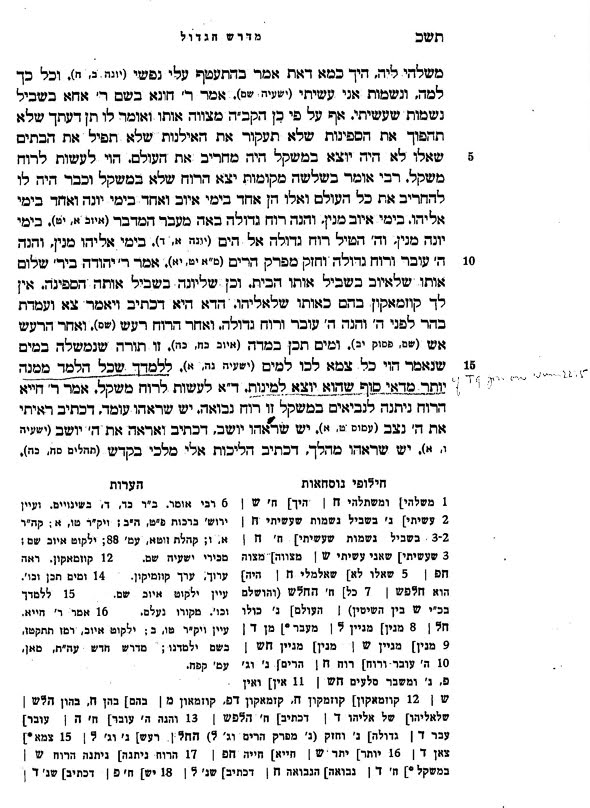
It is from Midrash ha-Gadol on Genesis (Mossad ha-Rav Kook edition). I don’t understand how the lesson is derived from the verse, but the lesson itself is clear enough: too much Torah study will lead to heresy. This is the sort of thing that one might expect to see in a medieval Catholic source, in justification of keeping the laity ignorant. Yet here we find the same attitude in a Jewish source. There are examples in rabbinic literature where we see that Torah study can have a negative result,[12] but I don’t know of any other text that is so blatant in its opposition to “excessive” Torah study. In the highly unlikely event that there are any high school students reading this who have been slacking off in Torah study, and have been challenged by their rebbe or parents to explain their inaction, see what happens if you pull out this text to explain matters.
I had seen this text a few years ago, and wanting to include it in the post I ordered the volume from interlibrary loan. The copy sent to me was from the University of Pennsylvania, and was originally found in the personal library of the late Dr. Judah Goldin. On the page we are looking at, Goldin underlined the strange passage (and also noted it on the first page of the book). On the side he added a reference to Targum Ps. Jonathan, Num. 22:5. Here it says that Balaam (who is identified with Laban) acted foolishly “from the greatness of his wisdom.” In other words, it was Balaam’s great wisdom that led to his thinking that he could curse the Israelites. Yet this passage only refers to Balaam’s general wisdom. It says nothing of Torah knowledge leading him astray.
With regard to R. Kook’s comments about the natural morality of the simple Jew, Joel Rich sent me chapter 4 of R. Soloveitchik’s Reflections of the Rav, ed. Besdin. The chapter is entitled “The Profundity of Jewish Folk Wisdom,” and is well worth reading. Yet you don’t find in R. Soloveitchik the notion expressed by R. Kook, that the natural morality of the simple Jew is superior to that of the scholar. For R. Kook, the simple Jew has something that the scholar does not have, and the scholar has that which the simple Jew lacks (halakhic knowledge). In this way, each can learn, and indeed is dependant, on the other. In dialectical fashion, the result of this will be a new type of Jew who combines in himself the best of both the scholar and the simple Jew. This is parallel to R. Kook’s discussion of the role of the non-religious. In the creation of the new Eretz Yisrael Jew the non-religious have that which is lacking among the religious, namely, the attachment to the physical world and the strength which Jews used to have when they lived on the Land, but which was forgotten during the long Exile. So the non-religious will bring that to the table, and the religious Jew will obviously bring Torah and spirituality. The result with be a synthesis of the two and the creation of an Eretz Yisrael Jew who, while being both Torah observant and spiritually enlightened will also be strong physically, able to build roads and fight wars. This is how Jews lived in days of old and how they are supposed to live when they return to the Land of Israel.
While R. Soloveitchik might have been attracted to dialectical-type thinking, there was no way that he would see the masses as having anything to give the halakhic scholar. The most the Rav speaks of in this essay is that the common man, even in his speech, reflects Torah values, but not that he is superior in any way to the learned ones.[13]
In this essay the Rav offers a beautiful interpretation of the aggadah in Niddah 30b that before birth a fetus learns all of the Torah and then forgets it when he is born:
Rabbi Simlai is apparently saying that every Jew comes into the world with a natural responsiveness to Torah teaching. Every Jew begins with a share in Torah was vested him before his birth, and, though he is made to forget it, it is preserved in the deep recesses of his soul, waiting to be awakened by study and a favorable environment. Scholars, of course, convert this latent knowledge into actual living knowledge; but the simple Jew also has a share. Some members of the Massorah[!][14] community are scholars whose knowledge is well formulated and codified, while others, though unlearned, may be endowed with inspired and intuitive Torah wisdom . . . [W]hen a Jew studies Torah, he finds it native to his spiritual personality and he responds to it readily.
R. Shalom Messas[15] also offers an interpretation of this Aggadah. According to him, it means that before birth God planted in the fetus the ability to study all of the Torah. The angel, who causes him to forget, represents the yetzer hara which distracts people from studying Torah[16]:
אלא האמת דאין כאן לא מלאך ולא שו”ד, והכל רמז ומשל בעלמא, והכוונה היא כמו שאמרנו, שבשעה שיצר השי”ת את העובר, נתן בו כחות עצומים באופן שיכול לעתיד ללמוד כל התורה אם ירצה . . . ויש בכחו ללמוד את כולה, וכשיוצא לאור העולם בא מלאך הוא הטבע, שכאשר מתחיל לצמוח מתערב עמו היצה”ר ומראה לו יופי הטבע והבריאה ונמשך אחריהם, ומעכבים עליו מללמוד תורה
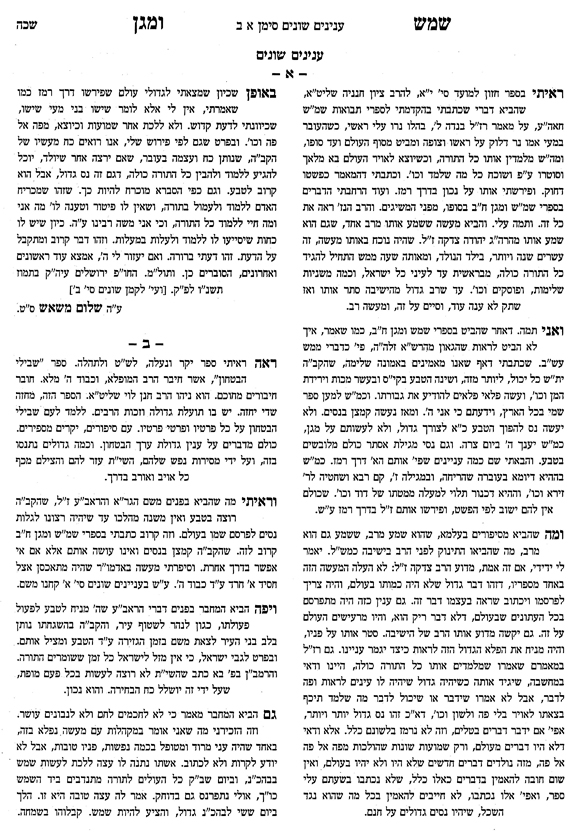
This, too, is a beautiful perspective. I think people will therefore be surprised to learn that R. Messas was actually criticized by two separate authors, each of whom thought that his allegorical understanding of the Talmud was incorrect. In their opinions the Talmud should be taken literally, that the child really does know all of the Torah. Both of these authors refer to a “yeshivishe story” (with minor discrepancies between them) about how a certain baby was born knowing all the Torah, and from the moment of his birth began “talking Torah.”
I always wonder when I hear Torah knowledgeable Jews repeat such nonsense as this yeshivishe story. What does this say about the Torah they learnt that they can be so gullible? I think the best we can say is that there is a difference between having book knowledge and being wise, and it is the latter that appears to be in such short supply. R. Messas replied to one of the authors in Shemesh u-Magen, vol. 2 pp. 322ff, and here is his reply to the second one, from Shemesh u-Magen vol. 3, p. 325.
I think R. Messas deserves a lot of credit for responding in such a polite fashion. Yet I have no doubt that if you spoke to him privately about this, his words would be much harsher in reflecting on how Torah students can be so foolish in believing such nonsensical stories.[17]
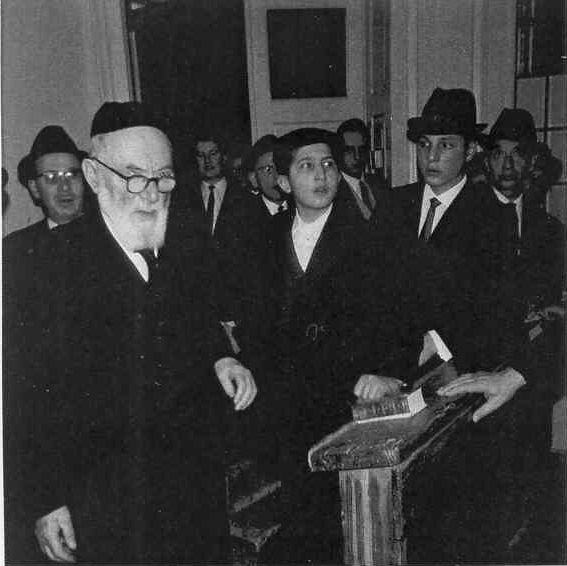
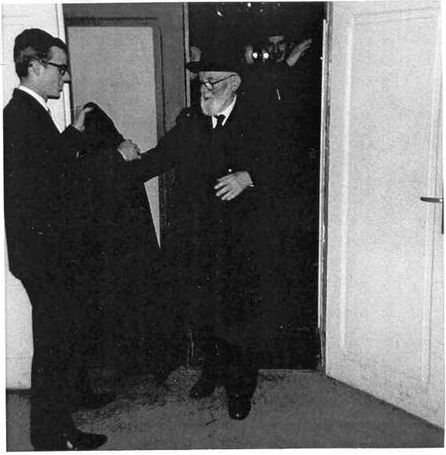
2. I have often been asked if I have pictures of R. Jehiel Jacob Weinberg. As a matter of fact I do, and here are two that I was given by Moshe Weisz of Zurich, who in the 1960’s was a student in the Montreux yeshiva. In the second picture, Weisz is the one handing Weinberg his coat.
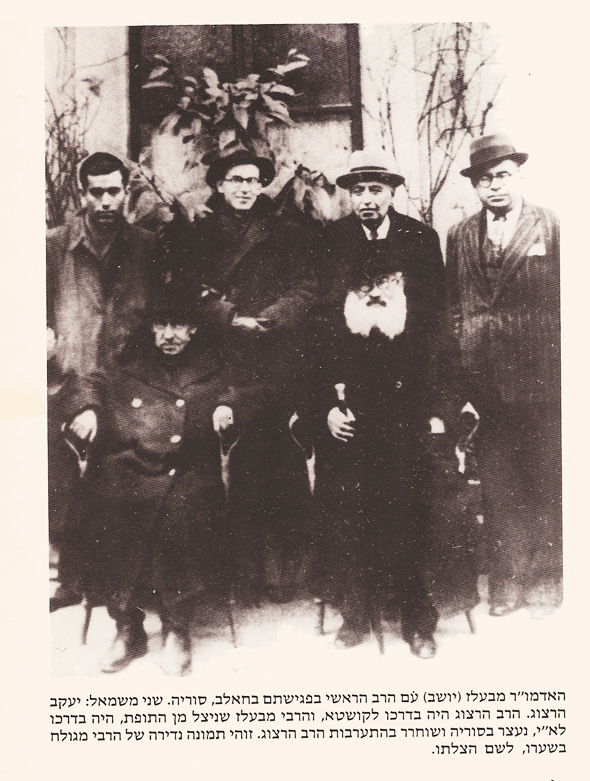
There is actually an amazing picture of Weinberg from his time in the prisoner of war camp. I would have loved to include this in my book, but the person who showed it to me refused to allow me to do so. He didn’t think it was respectful to a great Torah sage for people see him in this state. Yet why is this disrespectful? How was Weinberg supposed to look in such circumstances? Was he supposed to have a black suit and hat? Obviously, Jews did not look their normal selves during the years of the Holocaust. Here, for instance, is a picture of the Belzer Rebbe, R. Aharon Rokeach, with R. Herzog. It appears in Shaul Maizlish, Rabanut be-Sa’arat ha-Yamim, p. 61.
The Belzer Rebbe was one of those rebbes who, for religious reasons, did not like to have pictures taken of himself. Yet because R. Herzog exerted so much effort in order to secure permission for the Rebbe to enter the Land of Israel, he agreed to have his picture taken when R. Herzog requested this. (Or Yisrael 21 [5761]. p. 257). This last source also records the following great story, told by R. Aharon about his father, the previous Rebbe R. Yissachar Dov.
פ”א דיבר מרן מוהר”א מענין זה בשם אביו זצ”ל שאמר שבספר יערות דבש כתוב דברים חריפים אודות עשיית תמונה, אבל היות שכל היהודים אינם מקפידים ע”ז אין ברצוני להיות פרוש מהם, שכלם יהיו בגיהנום ואני יחידי יהיה בגן עדן, טוב לי להיות עם כלל ישראל ביחד
(Yes, I know that someone will point out the irony of R. Yissachar Dov saying that he would rather be in gehinnom with the Jewish people when his son chose precisely the opposite course, and left the gehinnom of Europe. Here is not the place to go into this story. Suffice it to say that I find Monday morning quarterbacking very distasteful. In this case it is even worse, as R. Aharon’s children and grandchildren were all murdered.)
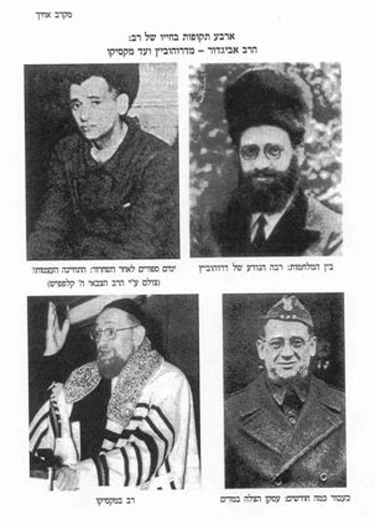
Here is a picture of R. Jacob Avigdor, whom I believe was a Belzer, from those difficult days (together with happier pictures).[18] Does anyone think this reduces him by showing how he looked during the Nazi years?
Incidentally, Moshe Weisz also told me about how in November 1965 Weinberg gave a hesped for four recently deceased rabbis, among them R. Yerucham Warhaftig and R. Eliezer Yehudah Finkel. These latter two were good friends of Weinberg, and Weinberg’s friendship with Finkel went back to their youth. After the eulogy Weinberg asked everyone in the room to stand up. They stood silently for around ten seconds and then he asked them to sit down. I presume this was intended as a show of respect rather than as a moment of silence, since the latter could be done sitting down.
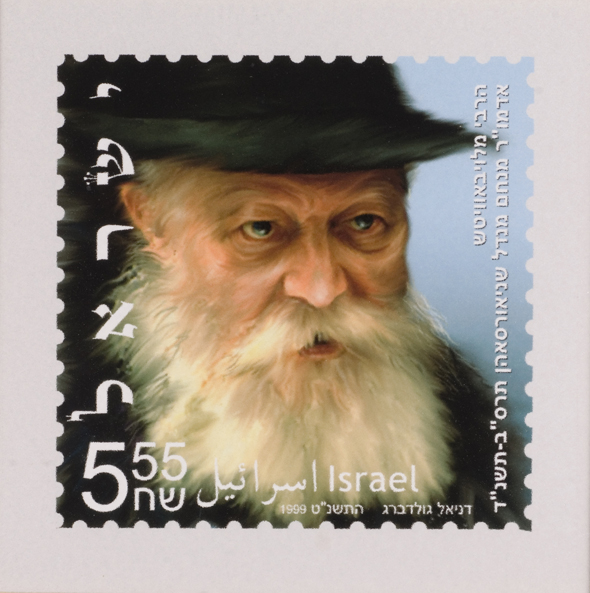
Since I have spoken about pictures in this post, let me also include this picture of the Lubavitcher Rebbe. It appears courtesy of the Library of the Jewish Theological Seminary, and I thank Rabbi Jerry Schwarzbard who first showed it to me a few years ago.
As you can see, it is an Israeli stamp from 1999, and it can now be added to Shnayer Leiman’s collection of stamps of rabbis.[19] Yet for some reason the stamp was never put into circulation. I have been unable to find the reason for this, and there is no mention of the stamp in Maya Balakirsky Katz’s recently published The Visual Culture of Chabad (Cambridge, 2010). There are many Lubavitchers who read the Seforim Blog. Perhaps one of you knows the story of this stamp and why it was never released.
As for Balakirsky Katz’s book, I urge Lubavitchers to read it, without preconceptions, and offer their opinions. It appears, to me at least, to be a quite interesting book. I stress the need for no preconceptions since Balakirsky Katz has now been placed by Lubavitchers in the “enemy camp”, along with other contemporary authors such as R. David Zvi Hillman z”l, David Kamenetsky, David Berger, Bryan Mark Rigg, David Assaf, Menachem Friedman, and Samuel Heilman. Balakirsky Katz angered Chabad with her recent article in the AJS Review 34 (2010; “An Occupational Neurosis: A Psychoanalytic Case History of a Rabbi”), and this article is summarized in the new book (but is only a very small part of the book). She argued that the Rebbe R. Shalom Dov Baer Schneersohn (Rashab) was the rabbi who visited the psychoanalyst Wilhelm Stekel in 1903. In those meetings the rabbi spoke about being sexually molested from his youth until his marriage. He also told about his sexual dreams and how he masturbated,[20] and described how his own brother carried on an improper relationship with his (i.e., the rabbi’s) wife (although it does not appear to have led to actual adultery).
I understand that Lubavitchers will regard Balakirsky Katz’s argument as beneath contempt. They will also regard as scandalous the fact that her essay was published in such a prestigious journal as AJS Review. I would not even ask them to dignify the argument with a response, any more than a non-Lubavitcher should be asked to respond to such claims about a close family member; for a hasid, the feelings for a Rebbe are just like those of a close relative. Yet there is a lot more to the book than the few pages dealing with the rabbi and Stekel, and I wonder how Habad insiders will appraise the rest of what she says.
Appendix
It is common to hear among YU figures the expression “hakhmei ha-mesorah,” referring to authoritative rabbinic spokesmen. Readers can correct me if I am mistaken, but I don’t think that this expression, with the meaning currently applied to it, is part of the traditional rabbinic vocabulary. I also don’t recall ever seeing it in haredi writing. (When the words appear in rabbinic literature they refer to Masoretes.) The first mention of it that I know of appears in R. Soloveitchik’s famous attack on R. Emanuel Rackman regarding nullification of marriage. Needless to say, the expression makes an appearance in R. Schachter’s new book, Divrei ha-Rav. See e.g., p. 233.
This latter reference is part of an article that R. Schachter earlier published in Beit Yitzhak 38 (2006). The reprint in Divrei ha-Rav has two changes from the original. On p. 237 a sentence is added, according to which the Rav stated that in Europe he never heard the expression “Daas Torah.” The second change is that one entire paragraph, on pages 5-6, has been removed. Here is the paragraph.
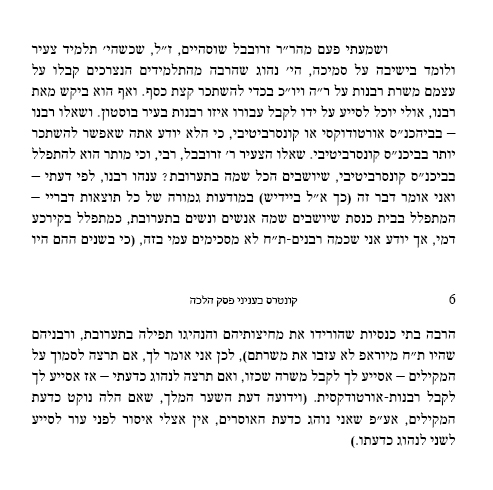
From this paragraph we see that the Rav’s strong personal opposition to prayer in a synagogue without a mechitzah was not shared by all other rabbis, and that the Rav was willing to show some flexibility in this matter. The case discussed here was not like the other times that the Rav gave permission for a rabbi to take a position at a synagogue without a mechitzah. In those cases the heter was for a rabbinic appointment designed to be for a few years, and during that time the rabbi was supposed to try to convince the synagogue to install a mechitzah. The issue discussed in the Beit Yitzhak article was simply a High Holiday position at a non-mechitzah synagogue in order to make some money.
This paragraph provides important testimony that can balance some of the Rav’s more strident statements in this matter. If anyone can get a straight answer from R. Schachter as to why the paragraph has been removed, please share it with us. I would hate to think that we have here an example of revisionism—in other words, R. Schachter decided to delete the paragraph because he concluded that it is best that people not know this information, or he was responding to others who criticized him for including the paragraph.
With regard to the larger issue of how R. Schachter presents the Rav, Lawrence Kaplan has already noted that there are revisionist aspects of R. Schachter’s presentation of the Rav’s legacy. See his “Revisionism and the Rav,” Judaism, summer 1999, available here.
One aspect of this revisionism that Kaplan does not mention is that while Nefesh ha-Rav has an entire chapter on the State of Israel, there is no mention of the Rav’s view—which was expressed on a number of occasions, as well as publicly before hundreds of people—that there is no halakhic prohibition for Israel to return land to the Arabs.
It certainly says something about the transformation of American Orthodoxy in the last generation that R. Schachter became the one to carry on the Rav’s legacy. Unlike the Rav, R. Schachter is a talmudist and posek, and has no involvement with the broader philosophical and cultural issues of Western Civilization. Yet despite this, he is, by far, the most important and influential rabbi in Modern and Centrist Orthodoxy. When it comes to matters of halakhah, I wonder if there is anyone in the American haredi world who can compare to his wide-ranging knowledge. I have heard him in person and on tape many times, and I continue to be amazed at how he can speak for long periods, without notes, on literally any topic of halakhah. I have never seen anything like it. It is all at his fingertips, and he presents it in a fashion that keeps the audience’s attention. As for the liberal Orthodox, who oppose R. Schachter because of his strong stand against feminist innovations, even they must applaud his leading role in dealing with husbands who refuse to give their wives gittin. This has earned him the opprobrium of the Orthodox lunatic fringe, and one member of this group, Abraham Samuel Judah Gestetner, who styles himself a dayan, has even placed R. Schachter in herem (together with two well-known California rabbis). See here.
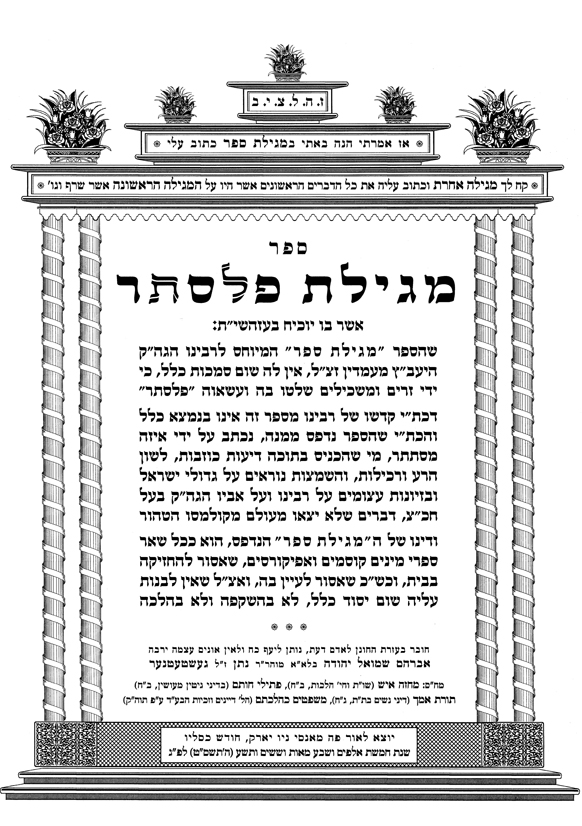
Gestetner is also the author of the ridiculous book Megilat Plaster, which attempts to show that R. Jacob Emden’s Megilat Sefer is a forgery perpetrated by the evil maskilim. Here is the title page.
His argument is completely demolished by R. Menachem Mendel Goldstein in Etz Hayyim (Bobov), no. 8(Shevat 5769), pp. 239-266. (Goldstein resides in that bastion of Haskalah known as Kiryas Yoel.). On the very first page of his article, Goldstein complains that the various publishers of Emden’s Megilat Sefer did not consult with gedolei Yisrael in order to determine what should have been censored. In other words, he takes it as a given that the masses need to be protected from what Emden has to say.
הספר מגילת ספר נדפס על ידי אינשי דלא מעלי שאין רוח חכמים נוחה מהם, ולא נתיעצו בגדולי חכמי ורבני דור דור האיך ומה להדפיס ומה להשמיט
To be continued.
[1] There is still a good deal more I plan to say about the whole Garden of Eden story. For now, let me respond to one question. We have seen the medieval philosophical approach that the episode with the snake is to be understood allegorically, and the snake represents the evil inclination. A few people want to know if we can find such an approach in Hazal. I actually think we can. In Pirkei de-Rabbi Eliezer, ch. 13 (referred to by Maimonides in Guide 2:30), it mentions that the serpent had a rider, Samael (Satan). Since at least some of the Sages identify Satan with the evil inclination, this opens the possibility that the snake in our story is also to be understood this way. Yet I think that most of the Sages probably understood the passage literally. For one example, see Bereishit Rabbah 19:1, where R. Hoshaya states that the snake stood up like a reed, and that he had feet. Whereas the medieval philosophers were reluctant to take literally a text that spoke of a talking snake (and donkey), this did not seem to bother the talmudic Sages.
[2] A fuller discussion of Hirschensohn’s view of evolution will appear in a future post. In the meantime, see his Seder la-Mikra, vol. 1, pp. 76-77:
אין השיטה הדארוונית מתנגדת כלל להתורה בדבר הבריאה בששה ימים, כי הימים בעצמם כל אחד הוא יום שכלו אורך תקופה שלמה . . . כי עדיין לא הי’ עוד השמש לאור יומם לראשון השני והשלישי ובכל זאת נקראים ימים וגם אחרי בריאת המאורות לא ידענו כמה לקח זמן התפתחותם לאותות למועדים לימים ושנים שלנו, ואריכת ימי בראשית לא נדע לנו שכל יום הוא תקופה שלמה
In another twenty years, I wonder if the younger generation will believe us when we tell them that Hirschensohn’s position was accepted throughout the haredi world, and was standard fare in the kiruv movement and in “science vs. Torah” discussions. There was a time when I, and so many others, would never have believed that “young earth” fundamentalism could ever become a binding principle of faith in the wider haredi world, precisely because it would mean rejecting a position that had been so central to the haredi Torah-science reconciliation.
[3] Link”Rationalism and Rabbinic Culture,” pp. 240ff.
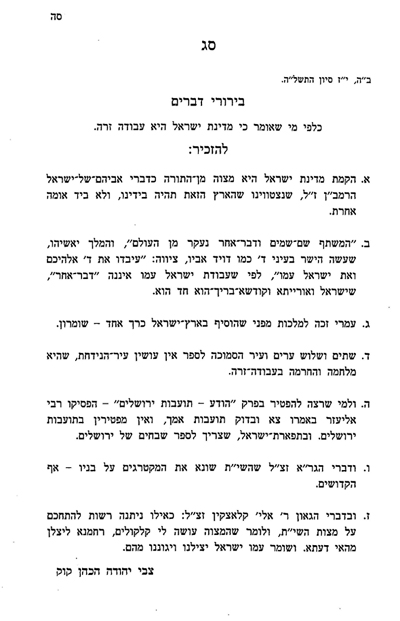
[4] Mesorah le-Yosef 4 (2005), p. 183.
[5] This point was noted by Kaplan, Link”Rationalism,” p. 300 n. 225.
[6] See Studies in Maimonides and His Interpreters, p. 111.
[7] Good and Evil in Jewish Thought (Tel Aviv, 1989), p. 63.
[8] Moses Maimonides (Oxford, 2005), p. 407.
[9] See also my post here where I noted R. Itzele of Ponevezh’s statement that how the Jewish masses feel is more important than what the rabbis think: וכלל ישראל הוא גבוה ונעלה מגדולי התורה . This is obviously diametrically opposed to the haredi conception of Da’as Torah. In my Torah in Motion lectures I discussed how R. Itzele’s conception parallels the Catholic notion of “sense of the faithful.”
In addition to the passages of R. Kook referred to in my earlier post, there are many other sources that one could quote. One that comes immediately to mind is Haym Soloveitchik’s understanding of medieval Jews committing suicide. He sees this as an example of the “sense of the faithful” which was not in line with established halakhah, but which ex post facto had to be justified. Even the murder of one’s children to prevent them from being forcibly apostatized could not be judged according to halakhic texts, or else people regarded as kedoshim would lose this status, an untenable possibility under the circumstances of medieval Jewish life. See ‘Religious Law and Change: The Medieval Ashkenazic Example,’ AJS Review 12 (1987), pp. 205-221. Soloveitchik writes (p. 209):
The magnitude of this halakhic breach is enormous. Whether one is permitted to suffer voluntary martyrdom is highly questionable; suicide is forbidden beyond question, and the permissibility of murder needs no discussion. Thus, if the law were to be followed, the scholars of these communities would have had to rule that all the martyrs—qedoshim, or “holy ones,” as they were called—were not only not “holy,” but they were “self-killers,” and murderers; that not only should they not be buried with honor, but perhaps they should even be denied burial, or at best be buried in the far end of the cemetery where the most vile criminals are interred. Such a conclusion, needless to say, was an emotional impossibility.
After speaking of the “sense of the faithful,”—or what Jacob Katz and Soloveitchik describe as “ritual instinct,” “religious intuition,” and “religious sense”—this article concludes with a couple of paragraphs that I think readers will find very interesting:
I remember my own shock when, after studying Yoreh Deah, I realized that there is no need for separate milk and meat dishtowels, separate dishracks or cabinets, and that if food is served cold, there is no need for separate dishware altogether. Again, there is all the difference in the world between not having hamets in the house (בל יראה ובל ימצא) and the house being what we call pesahdiq.
The simple truth is that the traditional Jewish kitchen and pre-Passover preparations have little to do with halakhic dictates. They have been immeasurably and unrecognizably amplified by popular religious intuition. We all know this, but our religious sense, our religious experience belies this knowledge, and our instincts reject this fact out of hand. To serve cold cuts on a “dairy” dish is treif—everything in Yoreh Deah to the contrary notwithstanding.
The prevalent has not here expanded the normative, it is the normative, and anything less is inconceivable.
Upon hearing one of my TIM lectures, R. Yonasan Rosman sent me a nice example of how the “sense of the faithful” operates independently of, and sometimes even in opposition to, halakhic particulars. It comes from Making of a Godol, p. 1188:
My father also was fond of quoting an interpretation of the Mozhirer Maggid, R. Shmuel Rabinowitz, of the gemara in Massekheth Brakhoth that
כנור היה תלוי למעלה ממטתו של דוד וכו’ ומנגן מאליו
(a fiddle hung above the bed of King David, etc., and it played on its own) to mean that Jewry senses what policy is vital for its existence and does not probe whether the course of action (or inaction) is halakhically sound or not. One of the several examples he gave was by asking rhetorically, “Who gave the Slabodka Yeshiva bahurim the halakhic permission [היתר] to marry at so late an age?” and in answer, he paraphrased the gemara (which he translated into Yiddish), “און דער פידעלע שפילט פון זיך אליין (and the little fiddle plays on its own.”) He was out to prove that when some position is of crucial importance to Jewry—such as increasing the number of intelligent Jews getting in more years of Torah study before going off into their occupations—halakhic minutiae are set aside.
It is precisely sources like this, and the others I have quoted, that are crucial for anyone wishing to challenge the pan-halakhic understanding of Judaism that has taken root in Centrism.
(Regarding yeshiva students marrying later, see R. Shlomo Sofer, Hut ha-Meshulash [Munkacs, 1894], p. 7b, that in late eighteenth-century Frankfurt, yeshiva students would sometimes wait until age thirty to marry.)
[10] For R. Jehiel Jacob Weinberg’s essay on Meisels, see Seridei Esh, vol. 4, pp. 345-352.
[11] See Ahiezer: Kovetz Rabani-Torani, vol. 4 (1969), p. 17.
[12] Sotah 21b states: “R. Eliezer says: Whoever teaches his daughter Torah teaches her obscenity. . . . Read, rather: as though he had taught her obscenity” Rashi explains: שמתוכה היא מבינה ערמומית ועושה דבריה בהצנע
Meiri, Sotah 20a explains (and as with the Ralbag quoted in a prior post, apologies to the women reading): שמתוך הבנתה ביתר מגדרה היא קונה ערמימות מעט, ואין שכלה מספיק להבנה הראויה והיא סבורה שהשיגה ומקשקשת בפעמון להראות את חכמתה לכל
[13] There are, of course, many other differences between R. Soloveitchik and R. Kook. From the excerpt printed in The Rav Thinking Aloud, pp. 155-156, we see that the Rav regarded R. Kook as a saintly figure, but not as an intellectual great. Yet this impression was derived from one short conversation. All the gedolim who knew R. Kook had the exact opposite impression. They correctly saw that R. Kook was a master of the entire Torah, in all of its facets. I think you have to go back to Maharal, or perhaps even Nahmanides, to find such a wide-ranging Torah scholar as R. Kook.
Experts on the Rav’s writings can correct me, but the only place I recall where he mentions R. Kook is in On Repentance, p. 161 (and this was not actually published by the Rav himself, but by Pinchas Peli). See incidentally, ibid., p. 224, where the Rav states, referring to the State of Israel: “Bondage to the State can also become idolatry.” When this appeared in 1975, in the original Hebrew edition Al ha-Teshuvah, R. Zvi Yehudah Kook responded with a very sharp statement (later reprinted in Le-Hilkhot Tzibbur):
The Rav in turn said about R. Zvi Yehudah: “If you follow the philosophy of Tzvi Hirsch [!] Kook a Jew outside of Eretz Yisrael is a non-Jew. And this is exactly against the passuk of כי לי כל הארץ. A Jew outside of Eretz Yisrael can be a perfect Jew. Where you accomplish more is up to the individual. . . . Kook comes out with the Ramban [who says that mitzvah observance in the Diaspora is not at the same level as in the Land of Israel] as if he is the only one to whom the Ramban has entrusted the text.” The Rav Thinking Aloud, pp. 225, 229. See also, ibid., p. 154, where he says that R. Zvi Yehudah “has an aura of kedushah about him.”
[14] See Appendix.
[15] Introduction to his Tevuot Shemesh, Even ha-Ezer, and Shemesh u-Magen, vol. 2, p. 321.
[16] See also Maharsha, Niddah 30b.
[17] With regard to what else fetuses are said to be doing in the womb (aside from learning Torah), there is a very strange passage in Otzar ha-Geonim, Berakhot 28b (p. 71). I hesitate to elaborate on it lest this post be blocked by internet filters:
כשאדם כורע במודים צריך לו לכרוע עד ברכיו לפי שהילד בעודו במעי אמו ראשו מונח בין שתי יריכיו והמילה שלו בתוך פיו ובעבור זה צריך לשוח עד ברכיו.
[18] The picture comes from Esther Farbstein’s Be-Seter Ra’am (Jerusalem, 2002).
[19] See here.
[20] With regard to masturbation, R. Simcha Ross called my attention to the responsum printed here by an unnamed talmid hakham. He argues that masturbation is permissible. When Rabbi Ross first alerted me to this (and also expressed his disagreement with the arguments of the author), I thought this was some sort of Purim Torah. But then I examined the responsum, and other responsa on the site, and I could see pretty quickly that this was a serious man, whose arguments were carefully thought out. There are so many books published today that simply repeat what others have said, without offering anything new, that it is a pleasure to see original thinking, Based on his permission to masturbate, he also concludes that homosexual activity is permissible, as long as there is no mishkav zakhur. See here.
(This anonymous author has also placed on his website his commentary on R. Baruch Ber Leibowitz’s Birkat Shmuel, and also many posts discussing talmudic sugyot.)
I showed this responsum to someone. Yet instead of examining the arguments, all he was interested in was the identity of the author, who, as can be seen from various responsa on the site, is clearly from the haredi world. Maybe some readers know who he is, but I think that someone like this has to be in “deep cover.” We all know how the powers that be would destroy anyone who argued that masturbation is permissible. Since this involves a halakhic matter, I am certain the response would be even more severe than how they dealt with Slifkin and Kamenetsky. This talmid hakham would be branded not merely a heretic and a Reformer, but also a sexually dissolute degenerate. So yes, I understand why the author chooses to remain anonymous. My request to readers is as follows: The argument permitting masturbation is so far removed from anything I have ever seen that I would like those with more halakhic learning than myself to examine his teshuvah and let us know if you think there is anything to his argument.
Also, please look at other material on his site. Is it possible that instead of a “progressive” talmid hakham we are dealing here with a Trojan Horse? That is, someone who aims to undermine traditional Judaism from within, much like Saul Berlin attempted to do.


A year in Berlin: The Beginning of Hebrew Printing in Berlin in c. 1699

A Year in Berlin:
The Beginning of Hebrew Printing in Berlin in c. 1699
by Marvin J. Heller

The publishing of Hebrew books in Berlin is a relatively late phenomenon. The article provides a background to early Hebrew printing and then discusses the first Hebrew press in Berlin. It addresses Jewish history in Berlin, explaining why Hebrew printing began there at the end of the seventeenth century, almost two hundred and fifty years after it began elsewhere. Several unique works, rather than the usual communal prayer books and bibles, are described in some detail in the article.

Hebrew printing has a rich and lengthy history. The first Hebrew books were printed close to the mid-fifteenth century, in 1469 and 1472, approximately a decade and a half after Johann Gutenberg printed the first Bible in c. 1455 in Mainz, Germany. Those first Hebrew books, printed in Rome by Obadiah, Menasheh, and Benjamin of Rome, and several who followed, are undated. Their name appears in the colophon of R. Moses ben Nahman’s (Nahmanides, Ramban, 1194–1270) Torah commentary[1] The first dated Hebrew book was Abraham ben Garton ben Isaac’s edition of Rashi’s Torah commentary (Reggio di Calabria, 1475, completed 10 Adar, 5235 = Friday, February 17, 1475). It was followed soon after by Jacob ben Asher’s Arba’ah Turim, printed in Piove di Sacco, Padua province on 28 Tammuz, 5235 (July 3, 1475).[2]

A conservative listing of Hebrew books that can be said with certainty to have been printed prior to 1500 are, according to A. K. Offenberg, 139 titles, which he writes “may yet be too high.”I[3] In an index Offenberg records close to twenty locations in which Hebrew incunabula were printed, in Italy, Spain, and a 1493 Constantinople edition of the Arba’ah Turim.[4] Among the more notable locations in which Hebrew printing occurred in the incunabular period are Mantua, Bologna, Ferrara in Italy, and Guadalajara in Spain.

In contrast to the small number of incunabular imprints, approximately 2,700 titles were printed in the following century, that is, from 1500-1599. To be more precise, 2,672 Hebrew titles (or books with Hebrew letters) were printed, according to Yeshayahu Vinograd, in the sixteenth century. In the seventeenth century the number of Hebrew books published increased to 3,526 entries.[5] The primary centers of Hebrew printing in those centuries were, respectively, Venice and Amsterdam. Parenthetically, the latter’s imprints were sufficiently popular that publishers in other locations frequently wrote with a small font “printed with” and in a large font “Amsterdam,” and again in a small font “letters.” Below, again in a small font, the actual place of printing.[6]

That Hebrew printing began so much later in Berlin than in other centers of printing might seem unlikely, given the subsequent importance of that city’s Jewish community and press. However, it is not surprising in light of the early history of Berlin Jewry, which was difficult, indeed stormy. Expelled in the middle-ages, during the Black Death, Jews were allowed to return in 1354, but not permitted a synagogue. There is no further mention of Jews until the sixteenth century. Subsequently, Jews were expelled and readmitted several times. Gotthard Deutsch and A. Freimann write that “The real history of the Jewish community of Berlin does not begin until the year 1671.” At that time, Jews expelled from Vienna were admitted to Berlin. On Jan. 3, 1676, a decree was issued which stated “die Juden in Berlin in ihren Freyheiten und Privilegien nicht zu turbiren, noch zu kränken, sondern sie vielmehr dabey gebürend zu schützen” (not to disturb or worry the Jews of Berlin in their grants and privileges, but to protect them properly).”[7]

Hebrew printing in Berlin began soon after, that is, in the last decade of the seventeenth century. According to the Jüdisches Museum Berlin, Hebrew printing in Berlin, “which commenced later than in other German cities,” began when Daniel Ernst Jablonski published a Hebrew Bible in 1699.[8] Yeshayahu Vinograd, in the Thesaurus of the Hebrew Book, records eleven works printed from 1690 through 1699, eight in the latter date. He begins with a 1690 quarto format (40) Bible attributed to a Knebell, who Moritz Steinschneider describes in his entry for the 1699 Bible as “Opera et impensis Jo. Henri Knebel . . .” (the works and expenses of Jo. Henri Knebel),” the printer given as Jablonski.

The 1690 Bible entry is followed by two 1698 octavo editions (80: 90 pp., no pagination given for the second edition) of Psalms both in the Bodleian library and then the 1699 imprints.[9] Steinschneider dates the first Psalms as “3–9 Tischri 458 (18-24, Sept. 1697), the second as [ca. 1697-9]. These are followed by an edition of Bereishit (Genesis).[10] Also printed at this time was a siddur (prayer book) and another edition of Psalms. All of these works, as well as the following titles, were printed at the Jablonski press.

Daniel Ernst Jablonski’s (1660-1741) involvement with Hebrew printing is surprising given his background and career. He was the son of Peter Figulus, a minister of Unity of the Brethren (Unitas fratrum) and grandson of Johann Amos Comenius, the last bishop of the Unity. Jablonski served as a preacher at Magdeburg in 1683, and from 1686 to 1691 as head of the Brethren College at Polish Leszno (Lissa), a position filled by his grandfather. In 1691, Jablonski was appointed court preacher at Königsberg by the elector of Brandenburg. In 1693, he was transferred to Berlin as court preacher, and in 1699 he was consecrated a bishop of the Unity of the Brethren, where he worked to bring about a union between the followers of Luther and Calvin. In 1700, Jablonski became a member of the Academy of Sciences (Brandenburgische Societät der Wissenschaften), serving between 1710 and 1731 as director of Philology and Oriental Studies and, from 1733 and 1741, as president of the Academy.[11] He was also the author of several books on Christian theology and philosophy.

In Berlin, Jablonski established a Hebrew printing press. Vinograd very conservatively crediting him with having printed as many as twenty titles. However, a significant multiple of that number of titles were printed in Berlin at that time with no printer’s name assigned to them in the Thesaurus, or, in some instances, attributed to an editor at the press.[12] Concerning Jablonski’s heading a Jewish press in Berlin, it may not seem as improbable as it appears. Jews could not initially obtain licenses to own a printing-press, so that of necessity, the owner had to be a non-Jew, although the managers and workers were usually Jewish. Jablonski employed a number of Jewish workers at his press. The most important was Judah Loeb ben David Neumark (d. 4 Nissan = April 9, 1723) from Hanau, author of Shoresh Yehudah (Frankfort on the Main, 1692), the manager of and an editor at the Jablonski printing-house.[13]

Another of Jablonski’s achievements relates to the printing of the Talmud. He was instrumental in securing approval for Michael Gottschalk, the Frankfurt an der Oder printer, and Johann Christoph Beckman, professor of theology at the University of Frankfurt an der Oder, to publish the Frankfurt an der Oder Talmud (1697-99). Jablonski’s opinion was requested by Friedreich III, Elector of Brandenburg, after Gottschalk and Beckman sought permission to print the Talmud. Jablonski’s measured response was, overall, positive; he found the Talmud to be, with reservations, a work of value, and recommended that Friedreich approve the request to republish that work. Jablonski subsequently printed the first Frankfurt on the Oder/Berlin Talmud together with Gottschalk (1715-22).

We turn now to the more distinct books published at the Jablonski press, that are non-biblical nor prayer books, although the press issued both. Our first title is Azmot Yosef, novellae on tractate Kiddushin by R. Joseph ben Isaac ibn Ezra (c. 1560–1620), attributed in bibliographies to Neimark, as it is his name that appears on the title-page. Perchance, he managed the press and Jablonski was the proforma owner.

Azmot YosefAzmot Yosef was published in folio format (20: 125 ff.) in the year “[Show me a sign of] Your favorאות לטובה ( 459 = 1699) that my enemies may see and be frustrated because you. O Lord, have given me aid and comfort (Psalms 86:17). R. Joseph ben Isaac ibn Ezra (c. 1560–1620) was a scion of the renowned Ibn Ezra family of Spain. Publication of Azmot Yosef is attributed by Vinograd to L. Neimark. Joseph ben Isaac Ibn Ezra was a student of 1R. Samuel de Medina (Maharashdam, 1506-89) and of R. Aaron ben Solomon ben Hasson (16th Cent.). Ibn Ezra subsequently headed the yeshivah of Don David ben Yahya, where he had several eminent students, among them R. Shabbetai Jonah. He later left Salonika for Constantinople, and afterwards served as rabbi in Larissa and Sofia.[14]

The first paragraph of the title-page, a reprint of the first edition, states that it is an explanation of the rules by which the Torah is explicated, and that it is:

a commentary in iyyun and pilpul (deliberation and casuistry) of tractate Kiddushin, from the beginning until the end, on the Talmud, Rashi, Tosafot, Rif, Rambam, Rosh, his son the Ba’al ha-Turim, and others on the laws of kiddushin (betrothal). After the iyyun and pilpul I conclude with the halakhah . . . .

Also, for the benefit of the students [I explain] the rules of [kal ve-homer] (a fortiori inference), dayyo (sufficiency), and other rules: I also delve deeply into the passages of parah ve-rahel in Kol ha-basar and at the end of Kaitzad ha-regel.

The second paragraph, somewhat lengthy, informs that Azmot Yosef was printed previously in Salonica in 1601, further expounds it virtues, and informs that it is being printed for the second time in the praiseworthy city of Berlin and extols Friedreich III.


Azmot Yosef

Courtesy of the Library of Agudas Chassidei Chabad Ohel Yosef Yitzhak

In addition to the peshat (clear meaning of the text) on Kiddushin, Azmot Yosef also addresses Talmudic methodology. Ibn Ezra was also the author of Rosh Yosef, novellae on the Tur, Ḥoshen Mishpat, of which the part on taxes and associated communal issues was published as Massa Melekh (Salonica (1601). Some of his responsa were published in the responsa of R. Shabbetai Jonah, R. Solomon ha-Kohen, and R. Samuel Hayyun.

Azmot Yosef is an important work on Kiddushin and has been reprinted several times. Initially printed in Salonika (1601), as noted above, at the press of Abraham and Joseph BathSheba, this is the second edition; four additional printings of Azmot Yosef are recorded in the Bet Eked Sepharim, the most recent a Warsaw edition (1883).[15]

Gefen YehiditOur next work, Gefen Yehidit is a multi-part work, primarily on ethics, by R. Ze’ev Wolf ben Judah Leib of Rosienie. It was published in a small sextodecimo format (160: 59 ff.)

Gefen Yehidit

Courtesy of the National Library of Israel

The title page of Gefen Yehidit has a brief text that states that it is:

A book, small in size but of great quality. It speaks of matters of ethics and reverence in a clear language . . . The author should have merit. He is one of the maskilim (a person of understanding) and in this small book he demonstrates his expertise and sharpness. . .

Included is Sefer Luah ha-Hayyim which speaks of remedies in order that a person should be healthy and strong in order to serve his God continuously.

The title page is dated “a sign for good אות לטובה (459 = 1669)” (Psalms 86:17). Next is the introduction (1b-2a) of R. Judah Leib Hanau,[16] who brought the book to press. In his introduction, Ze’ev Wolf begins with a quote from Midrash Ruth in which Rav Ashi says that this Megillah is not primarily wisdom nor Torah, but to learn from it gemillut hasadim (acts of kindness), so too the work that he is writing. He informs that he has had a difficult life, and frequently quotes from the Zohar.

The text, in a single column in rabbinic letters, is comprised of Gefen Yehidit, a work of mussar (ethics); an accounting (39a-40b), beginning with and based on the memorial prayer El Malei Rahamim, of what befell the Jews of Podhajce (Podgaitsy), Ukraine in 1677 during a Tartar incursion and massacre of the Jews; followed by a dirge (40b-41a); Zemer le-Purim (42a-46b), verse for that festival in both Hebrew and Yiddish, translated word for word into the latter language because that is the language of Ashkenazim; and concluding with Luah ha-Hayyim (47a-59b), a popular medical work.

Gefen Yehidit has been reprinted several times, beginning with a Hanau (1717) edition.

Luah ha-Hayyim – Although included in Gefen Yehidit Luah ha-Hayyim is an independent work. In contrast to the other additional parts of the former title, Luah ha-Hayyim has its own title-page. Written by R. Hayyim ben Benjamin Ze’ev Bochner,[17] (for our ealier discussion regarding Bochner on the SEfohere), a prolific writer, whose works include Orḥot Ḥayyim, a commentary on R. Isaac Tyrnau’s Minhagim (1669, Prague), Mayim Ḥayyim, homilies and comments on Bible and Talmud, and Toẓeot Ḥayyim on grammar. This edition of Luah ha-Hayyim is based on earlier edition printed by Johann Christoph Wagenseil (Altdorf, 1687), also part of a larger work.

Luah ha-Hayyim

Courtesy of the National Library of Israel

The title-page states that it is:

Luah ha-Hayyim

It will be a cure for your body [a tonic for your bones] (Psalms 3:8) etc.” “They are life to him who finds them; healing for his whole body (Psalms 4:22):

Abbreviated rules of conduct for a person in the matter of healing to maintain a healthy body and it is a primary principle in the service of the Lord. In order to benefit the public, we have printed anew R. Hayyim ben Benjamin Ze’ev Bochner of Cracow’s work. It received in the past approbations from leading medical authorities for all these words are true and correct to those who are knowledgeable and meritable.

This is followed by approbations of two doctors from Lublin. An example of the text (51a-52b) is:

a clear white wine , sweet and aromatic, is healthy and caring. If one drinks a measure of wine, it is a balm for the body, for it increases bodily heat and strengthens as a lion. It gladdens the heart and hones the mind. It also helps in the digestion of food. The measure of a reviis as the amount to drink is logical.[18] More than this measure one should cease and desist. However, if one is accustomed to become inebriated from it and drinks more then enough than the head is ill and the heart is pained. One whose nature is warm and thirsts to drink should mix a little water every time. Honey that is clear and of average sweetness and strength is somewhat comparable to the nature of wine in all respects. . . .

A popular work the Thesaurus of the Hebrew Book records twelve editions of Luah ha-Hayyim, but again these are generally not independent publications.[19]

Keter Torah – Keter Kehunah – our final publication, is a Kabbalistic work on Psalms and liturgy by R. Joseph ben Moses (Ashkenazi), darshan of Przemyslany (17th cent.) Printed in quarto format (40: 91, 62-66, [1]; 76 ff.) Keter Torah and Keter Kehunah are, respectively, the second and third parts of Keter Yosef, the first part of which was printed in 1700.[20] Joseph ben Moses, who was a darshan (preacher), served as rabbi and dayyan in Przemyslany.

Each part was printed separately and has its own title page, albeit with the same frame but somewhat varying text. The pillared frame has cherubim at the top and at the bottom of the frame an eagle with a shield, and holding a sword in one talon and a scepter in the other. In its beak is a banner with the date of the respective volume.[21]

The title page of Keter Torah states that it is the second part of Keter Yosef,

A holy workbook, old replete with new, a desirable commentary, where is its like? On Psalms by the author of Zafenat Pa’ne’ah and Haluka de-Rabbanan. He is the great darshan, grandson of the gaon R. Abraham Ashkenazi, descended from Rashi, son-in-law of R. Abraham av bet din in Luntshits, and a branch and descendant of R. Saul Wahl.

It is dated “Now Israel loved Joseph אהב את יוסף וישראל (459 = 1699)” (Genesis 37:3). Keter Torah has an introduction from the author followed by the text, comprised of Psalms in the middle of the page in square vocalized letters with Joseph’s expansive commentary, Keter Yosef, on the sides in rabbinic letters. The text is divided by the days of the week and has the heading Keter Yosef. The title page of Keter Kehunah states that it is part three of Keter Yosef and that

It is the threefold part that “is not quickly broken” (cf. Ecclesiastes 4:12). In it are found at intervals some sharp novellae on Tosafot and gemara. I have entitled it Keter Torah on the order of the avodah (divine service) for the entire year. It is by the great darshan . . .

Keter Kehunah
Courtesy of Hebrewbooks.org

Keter Kehunah is dated “This is the Torah of the burnt offering זאת תורת העולה (459 = 1699)” (Leviticus 6:2). Here, too, the text is comprised of the liturgy of the daily ma’amadot (division of prayers) in the center of the page in square vocalized letters, the commentary Keter Yosef on the sides in rabbinic letters, and the heading Keter Yosef. After the daily ma’amadot are bakashot for the day and bakashot in the manner of Kabbalah. The daily ma’amadot are followed by kabbalistic prayers for special occasions such as selihot for Mondays and Thursdays, fast days, Rosh Hodesh, Shabbat with special Torah readings, Shabbat Teshuvah, Hanukkah, Purim, brit milah, kinnot for Tishah be-Av, and for dreams. There is also a prayer for someone incarcerated from R. Leone (Judah Aryeh) Modena.

This is the sole edition of any of the parts of Keter Yosef. Joseph was also the author of a commentary included in Haggadah Haluka de-Rabbanan (Amsterdam, 1695), a commentary on the Passover Haggadah; Ketonet Passim (Lublin, 1691), discourses on festivals and the Haggadah; and Zafenat Pa’ne’ah he-Hadash (Frankfurt am Oder, 1693-94, above) on diverse subjects.

In conclusion, we have described individual publications that are not part of the customary frequently printed works comprising traditional and necessary parts of Jewish literature, that is, biblical and liturgical books, although, as noted above, such works were also published by the Jablonski press. The subject matter of these other varied books addressed here encompasses Talmudic novellae, ethics, medical recommendations, and a Kabbalistic work.

What is particularly noteworthy is, given the late start of Hebrew publishing in Berlin, that it rapidly became a center of Hebrew printing. The Thesaurus records 457 titles issued by the Berlin press in the following century (1700-1799), a remarkable growth for a new press that had hardly published any books in the previous century and for a community that was initially young and relatively small compared to other Jewish communities. Despite the small number of works published in that early period, at the end of the seventeenth century, the books published not only addressed communal needs, but also included a variety of valuable works expressing the varied intellectual needs and interests of the community. It quickly grew from a small but press that had from its beginning began by serving its community with needed and valuable varied works to a press of significance.

[1] Concerning those first Hebrew imprints see Moses Marx, “On the Date of the Appearance of the First Hebrew Book,” in Alexander Marx Jubilee Volume (New York, 1950), pp. 481-501.
[2]
The above dates are Julian dates. The dates in the Gregorian calendar, adopted in Rome in 1582 in place of the Julian calendar are, for Rashi’s Torah commentary, February 26, 1475. The Gregorian date for the Arba’ah Turim would be July 12, 1475.
[3] A. K. Offenberg, Hebrew Incunabula in Private Collections (Nieuwkoop, 1990), p. xxiii-xxv, 186-94. It should be noted that other authorities cite a higher number of titles for the incunabular period. A significantly lower number is given by Richard Gottheil and Joseph Jacobs in “Incunabula” Jewish Encyclopedia vol. 6 (New York, 1901-06), p. 575 who write that 101 works printed in Hebrew letters can be identified as certainly printed before 1500. In contrast, according to Herrmann M.Z. Meyer / Angel Sáenz-Badillo, write there are “175 (207) editions printed with Hebrew letters ascertained by copies preserved in public collections.” “Incunabula” (Encyclopedia Judaica, vol. 9 (Jerusalem, 2007),vol. 9 pp. 757-58.
[4] The dating of the 1493 Constantinople edition of the Arba’ah Turim has been questioned, many bibliographers consider the correct date to be 1503. Offenberg in a convincing article, substantiates the correct date as 1493 (Offenberg, “The First printed Book Produced at Constantinople (Jacob ben Asher’s Arba’ah Turim, December 13, 1493),” in A Choice of Corals: Facets of Fifteenth-Century Hebrew Printing, pp. 102-32.
[5] Yeshayahu Vinograd, Thesaurus of the Hebrew Book. Part I Indexes. Books and Authors, Bibles, Prayers and Talmud, Subjects and Printers, Chronology and Languages, Honorees and Institutes. Thesaurus of the Hebrew Book (Jerusalem, 1993-95), pp. xxiv-xxvi [Hebrew].
[6] Mozes Heiman Gans describes this practice, writing “so highly-prized were books ‘printed in Amsterdam’ or ‘be-Amsterdam’ that cunning rivals invented the phrase ‘nidfas ke-Amsterdam’, i.e. in the manner of Amsterdam, hoping to deceive the readers by relying on the similarity of the Hebrew k and b.” Mozes Heiman Gans, Memorbook. History of Dutch Jewry from the Renaissance to 1940 with 1100 illustrations and text (Baarn, Netherlands, 1977), p. 140: Also see Marvin J. Heller, “Who can discern his errors? Misdates, Errors, Deceptions, and other Variations in and about Hebrew Books, Intentional and Otherwise: Revisited,” http://seforim.blogspot.com/, Sunday, July 03, 2016, reprinted in Essays on the Making of the Early Hebrew Book (Leiden/Boston, 2021), pp. 507-36.
[7] Gotthard Deutsch, A. Freimann, “Berlin,” Jewish Encyclopedia vol. 3. pp. 69-71.
[8] Jüdisches Museum Berlin: https://www.jmberlin.de/en/collection-hebrew-printing-in-berlin.
[9] Moritz Steinschneider, Catalogus Liborium Hebraeorum in Bibliotheca Bodleiana (CB, Berlin, 1852-60), col. 112 no. 702; Vinograd, Thesaurus of the Hebrew Book. Part II, p. 111.
[10] Steinschneider, nos. 694, 1050, 1028.
[11] https://en.wikipedia.org/wiki/Daniel_Ernst_Jablonski.
[12] Vinograd, Thesaurus of the Hebrew Book. Part I, p. 451.
[13] Ch. B. Friedberg, History of Hebrew Typography of the following Cities in Central Europe: Altona, Augsberg, Berlin, Cologne, Frankfurt M., Frankfurt O., Fürth, Hamberg, Hanau, Heddernheim, Homberg, Ichenhausen, Neuwied, Wandsbeck, and Wilhermsdorf. Offenbach, Prague, Sulzbach, Thannhausen from its beginning in the year 1513 (Antwerp, 1935), pp. 87-88 [Hebrew].
[14] See Ya’akov Shemuel Speigel’s introduction to Ibn Ezra’s responsa for additional biographical information. She’elot u-Teshuvot Rebi Yosef ibn Ezra, ed. Ya’akov Shemuel Speigel (Jerusalem, 1989), 5-30. Speigel specifically discusses Azmot Yosef, its editions and its reception. Id. 21-24.
[15] Ch. B. Friedberg, Bet Eked Sepharim, (Israel, n. d), ayin 1064 [Hebrew]. Eli Genauer updated the Bet Eked entry, which records books from 1474-1950, informing that later editions of Azmot Yosef were published in Jerusalem by Levin-Epstein in 1951, 1958, 1962, 1969, and 1976. There was also a Warsaw 1912 and a New York edition form the 1950’s as well as a Jerusalem 1988 edition, all attesting to the popularity of Azmot Yosef. Genauer quoted a yeshiva student’s joke concerning Azmot Yosef “how do you know that Jews were learning Maseches Kiddushin when they left Mizrayim [Egypt]? Because it says they took the Atzmos Yosef [bones of Joseph’ with them” (Exodus 13:19) and is also included in Kovets Mifarshim ‘al Meskhet Kiddusin, published in 2000 and 2019.
[16] He is the father of the famed grammarian Shlomo Zalmen Hanau. On some of his title pages, he indicates that his father was a sha”tz (cantor).
[17] For our discussion regarding Bochner and his works, see our post on the Seforim Blog, “Hayyim Ben Benjamin Ze’ev Bochner: Kabbalist, Talmudist, and Grammarian.”
[18] A reviis equals 1-½ eggs (see Mishna Berura 271:68) https://oukosher.org/halacha-yomis/what-is-the-volume-of-a-reviis/.
[19] Vinograd, Thesaurus of the Hebrew Book. Part I, p. 67
[20] Regarding the possible Sabbatian elements in this work, see Shnayer Leiman, Sefarim Ha-Hashudim be-Sha’abatot, in Sefer ha-Zikhron le-Reb Moshe Lipschitz, Rafael Rosenbaum, ed., (New York, 1996), p. 887.
[21] Concerning the eagle motif see Marvin J. Heller, “The Eagle Motif on 16th and 17th Century Hebrew Books,” Printing History, NS 17 (Syracuse, 2015), pp. 16-40, reprinted in Essays, pp. 5-29.