Jacob’s Dream: Reproducing a Talismanic Illustrated Title Page
(Illustrations are from the following sources: the Edut Be Yosef, Rabot, Shivim Tekunei Zohar, and Yefeh Anaf are from the Gross Family Collection. The Minhat Shai is from Dan Rabinowitz’s personal collection, and the rest are courtesy of the internet.)
One of the earliest examples of Jewish art are the biblical paintings at the Dura Europos Synagogue, completed in 244-5 C.E. Among those images is that of Jacob’s dream. The importance of the Dura Europos iconography in the development of Jewish art is hard to overestimate. “The iconographic formulas, seen for the first time in the Dura synagogue would recur both in Jewish art and Christian art, in widely differing media – manuscripts, murals, mosaics, ivories and silver utensils – frequently without modification, or with only the modifications necessitated by different materials or techniques, or the need to emphasize a new theological perspective.”[1]
By the time of its discovery in the 1920s, only a fragment of Jacob’s dream scene remained visible. Nonetheless it is possible to discern the subtly of the artist. In the fragment, Jacob is depicted as a figure wearing Greek costume – the then contemporary dress – leaning on his elbow, in the posture of Palmyrene funerary reliefs. Only the body is preserved, the head and upper body are lost. Near the figure is planted an inclined ladder, which one or perhaps two (it is unclear) personages in Persian dress are ascending. This custom, consisting of a short-belted tunic adorned with braid at the throat and hem, and wide trousers gathered into short supple boots, represents in the language of the Dura painter the garb of kings and princes, and court temple personnel.[2]
Scholars have voiced a number of opinions to explain the Persian court dress. According to one scholar the artist was referencing a midrash that appears in Pirkei de-Reb Eliezer. The angels, rather than merely serving as Jacob’s protection, also allude to “the four kingdoms that would conquer and subjugate the Jews, each as represented by its prince.”[3]One of the kingdoms is Persia. Thus, the artist’s choice of iconography was deliberate.
Jewish Title Pages
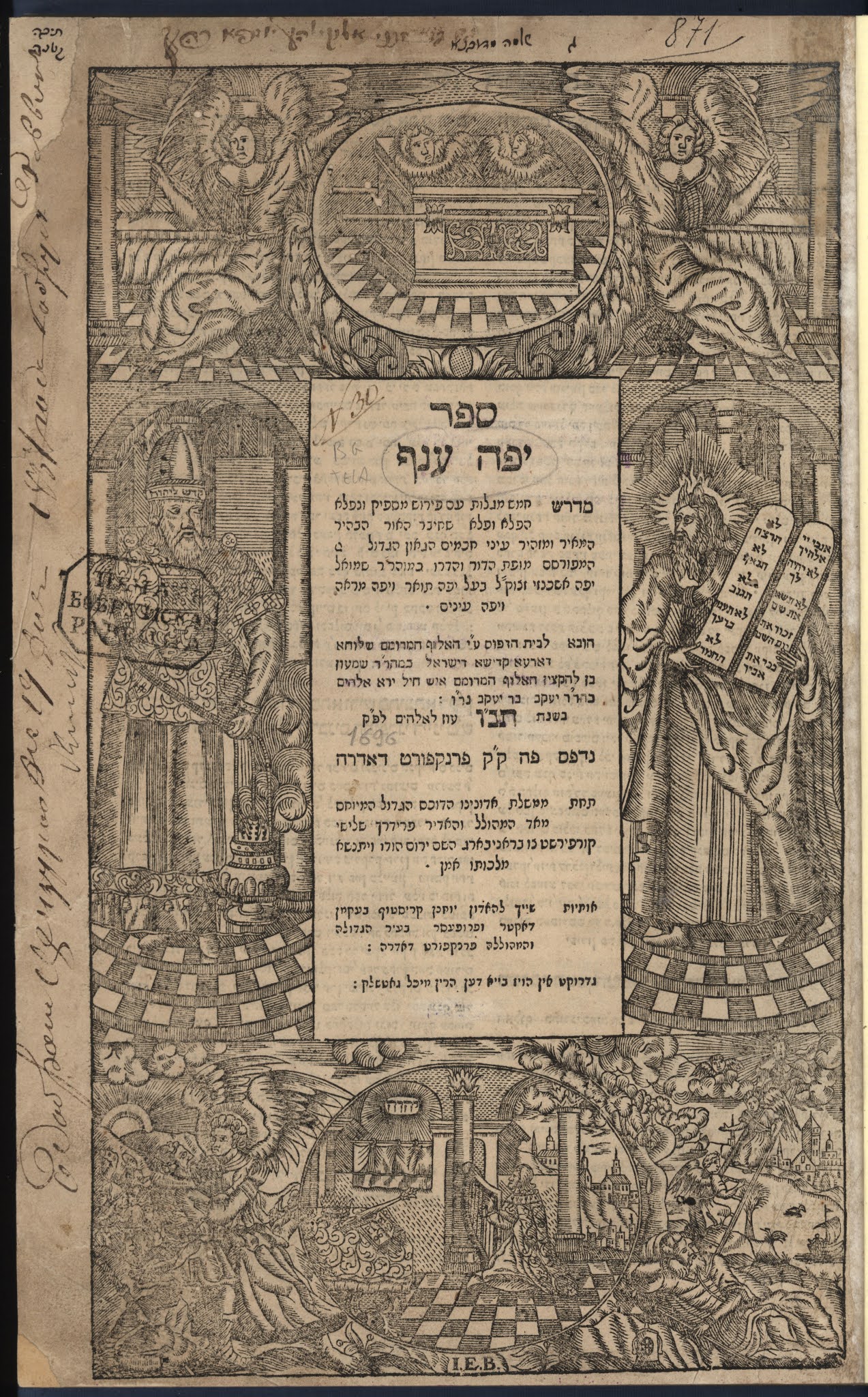
The first illustrated Jewish title pages appeared in the early seventeenth century. In 1693, the first depiction of Jacob’s dream graced a Jewish title page. That book, Sefer Rabbot, Midrash Rabba, with the commentary of R. Yisachar ben Naftali Katz, printed in Frankfurt on the Oder by Michael Gottschalk.
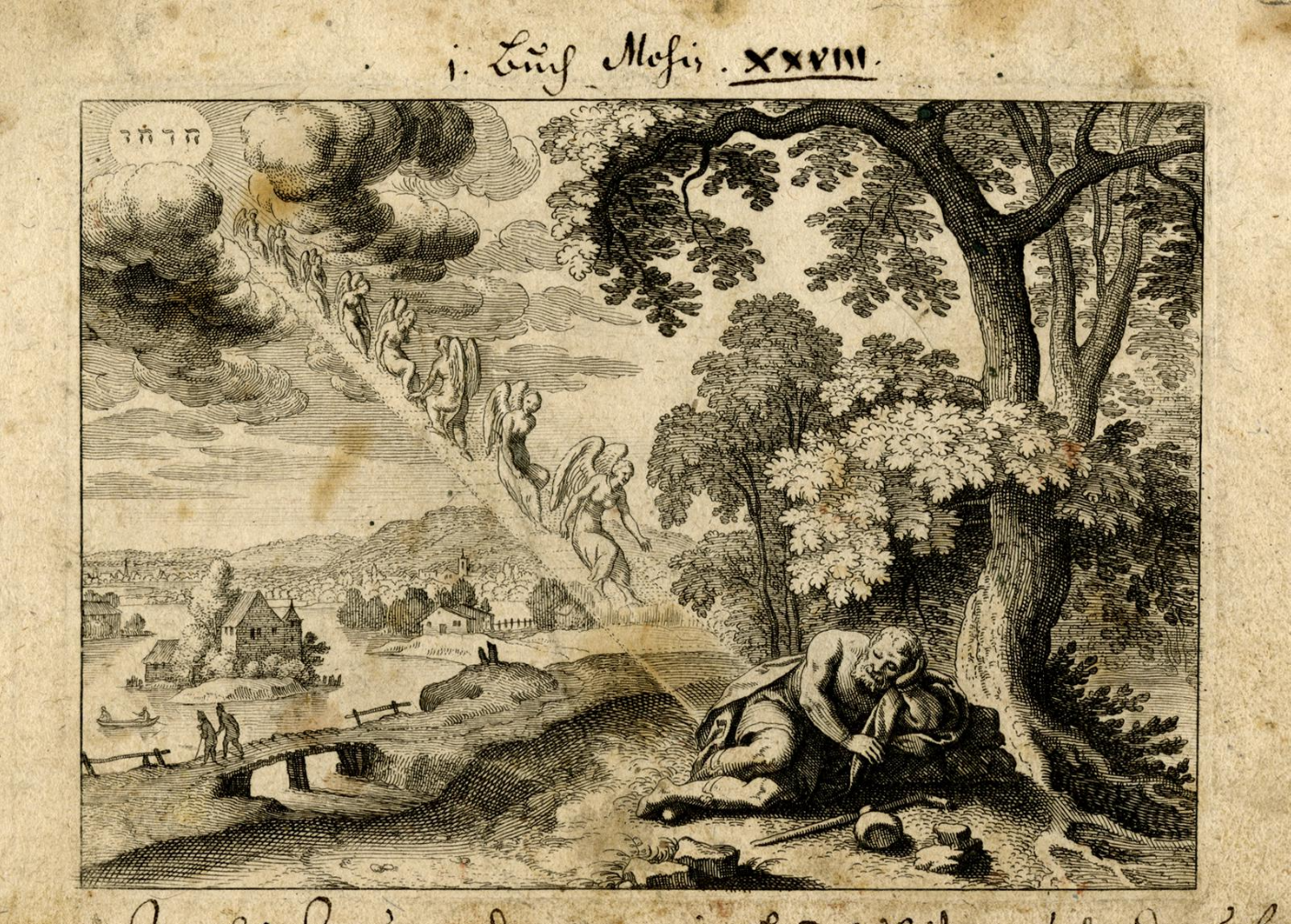
He was a local bookbinder and bookdealer who took over the management of Johann Christoph Beckman’s printing press in Frankfort d.O. in 1693, and led the press for almost forty years.[4] Sefer Rabbot’s title page includes Moses and Aaron (who first appear in the 1610 edition of the She’a lot u-Teshuvot Mahril, printed in Hanau (see “Aaron the Jewish Bishop”), at the top, angels around the ark, and at the bottom, three biblical scenes, Jacob wrestling with the angel, David praying, and Jacob’s dream. It is obvious that these images are modeled after Matthaeus Merian’s engravings of biblical scenes that accompanied his Icones Biblicae printed between 1625-1630. All three of these images can be traced to Merian based upon a number of similarities and artist conventions.
The image of Jacob’s dream depicts, in both instances, Jacob laying next to a tree, boats and houses appear in the background, and angels’ hands are outstretched to greet Jacob. There is one significant puzzling difference. In Merian’s depiction, he substitutes the letters (reversed) of tetragram for God. In the Jewish book, God is depicted as an old man with a beard wearing a crown. This, despite Judaism’s strong prohibition on depicting God in a human form.
(This is not the only instance of a Jewish book containing a human image for God. The title-page of the first edition of R. Yedidia Shlomo of Norzi’s commentary on the biblical mesorah, Minhat Shai, Mantua, 1742-44, includes a depiction of God with a human face. The images on the title page are various biblical vignettes and in the one for the resurrection of the “dry bones” that appears in Yehkezkel, God is shown as an old man with a white beard.)
Here is that image in detail:
Michael Gottschalk reused the Rabot title page at least five times; in 1695, for R. Shmuel Yaffe, Yafe Anaf, in 1696, Mattityahu ben Asher Lemle Liebermann, Mattat Yah, in 1698 in R. Benjamin Ze’ev Wolf ben Samuel Romaner’s Ir Binyamin, in 1699 in Ohel Yaakov, and in 1602 in Yisrael b. Aaron Yaffa, Or Yisrael.
These title pages are just a few of Gottchalk’s illustrated title pages. Gottshalk artistic sensibilities are on full display in his 1697-99 edition of the Talmud, a work for which the Frankfurt press is best known to this day. It contains arguably the most magnificent Talmudic title page ever printed.
In 1695, the first illustrated copperplate Haggadah was published in Amsterdam. All the images are modeled based upon Merian. The title page too contains a number of biblical scenes in circular medallions. One of which is Jacob’s dream.
The next title page that depicts Jacob’s dream appears in Tzvi Hirsch ben Rachmiel Chotsh’s, Shiv’im Tikunei ha-Zohar, Hemdat Tzvi, Amsterdam, Moshe ben Avraham Mendes Coutinho, 1706.[5] Like the Gottchalk’s image that includes heretical iconography, those of Shiv’im Tikunei ha-Zohar would prove equally problematic.[6]
Despite Hemdat Tzvi’s impressive approbations, R. Jacob Emden accused Chotsh, and specifically this book, of holding and expressing Sabbatian beliefs.[7] It has been conclusively demonstrated that indeed Chotsh’s book contains Sabbatian ideas.[8] Evidence of Chotsh’s embrace of Sabbateanism is identifiable amongst the title page images. Indeed, Chotsh calls attention to the larger meaning of the title page’s images. At the bottom of the title page Chotsh provides that “whosoever wishes to know the secret of the above frontispiece, should see the introduction to the Tikkunim at the beginning of the first article.” An inspection of that section yields likely Sabbatian passages. Thus, Chotsh is indicating that like the introduction, the title page also contains allusions to Sabbateanism.
The title page depicts a variety of biblical figures and Jacob’s dream appears at the top center of the page. Above that are two deer holding a crown with the verse from Isaiah 28:5, “On that day will the Lord of the hosts be for a crown of glory, and for a diadem of beauty.” The “crown of glory” or in Hebrew “Ateret tzvi” has a double meaning here, “glory” and “deer” and, of course, is alluding to Sabbatia Tzvi, who, “on that day” will be presumably wearing the crown.[9]
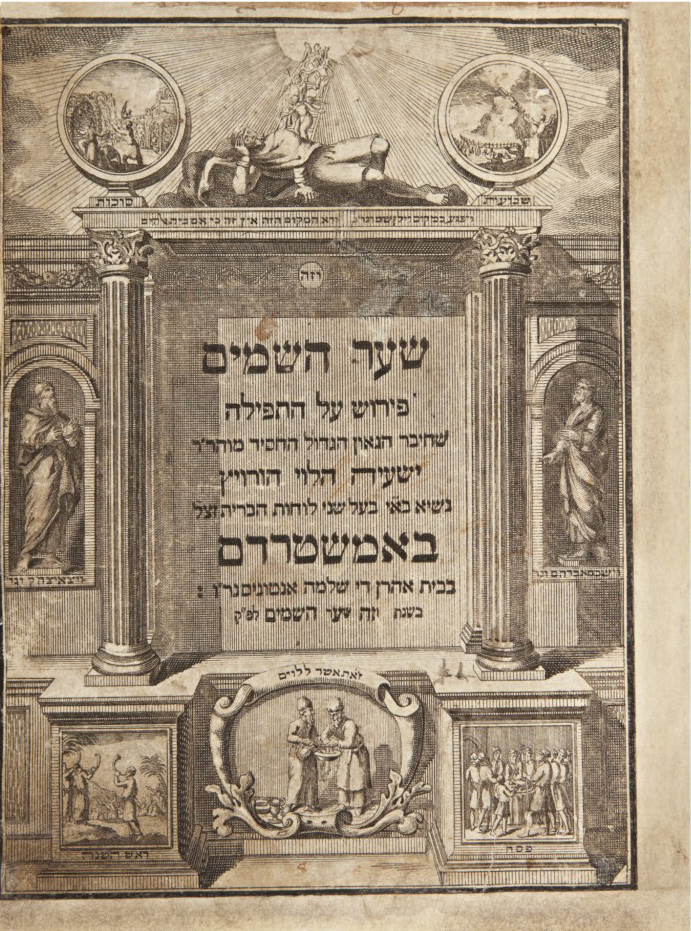
The most long-lasting depiction of Jacob’s dream is that which appeared in Siddur Shaarei Shamyim from R. Isaiah ha-Levi Horowitz (Shelah), Amsterdam, 1717.[10]
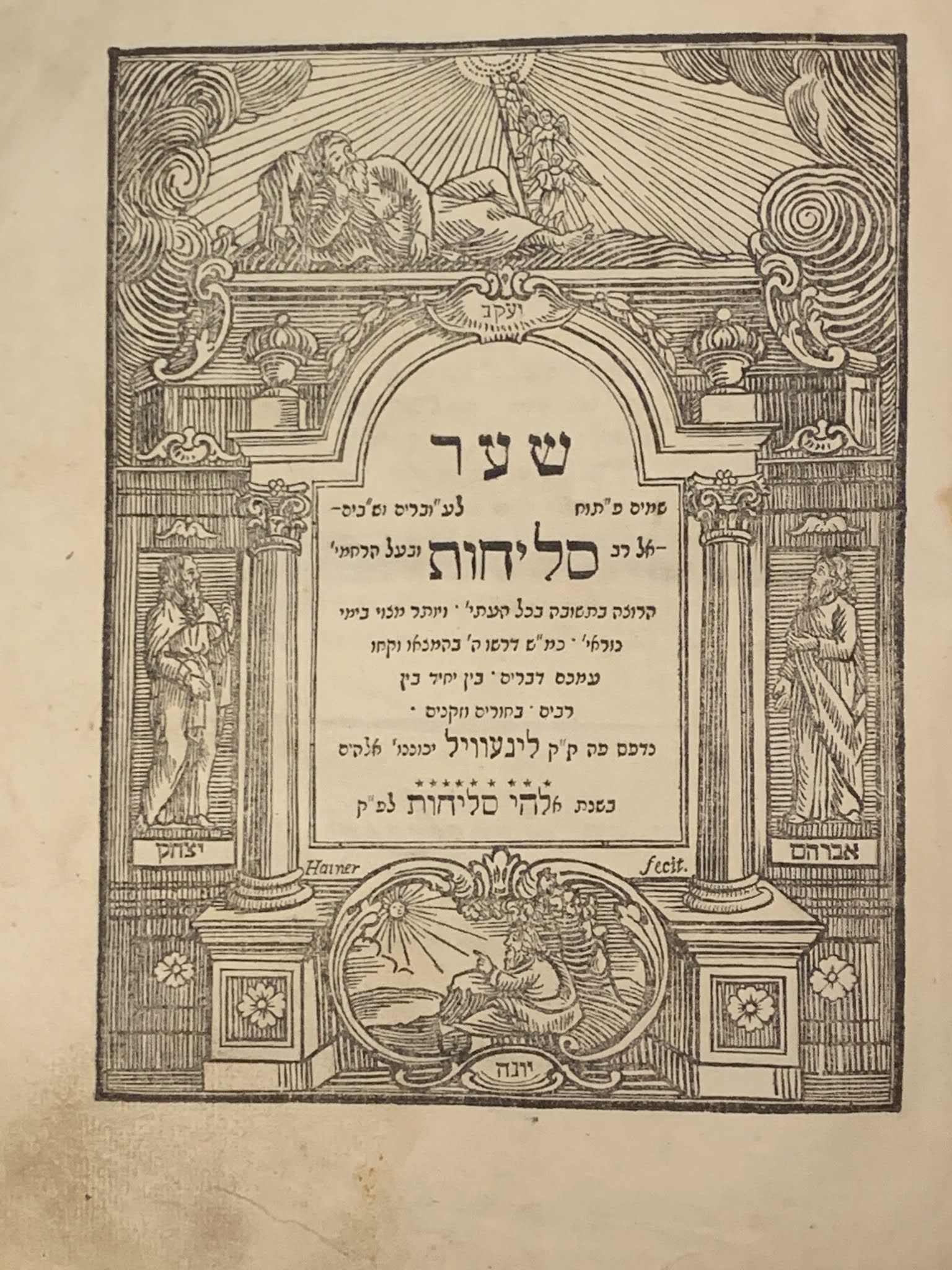
This title page is notable in that the accompanying images that align with the book which was not always the case. This is a complete machzor and as such four holidays, Sukkot, Pesach, Shavout, and Rosh Hashana, are represented on the top encased in circles, and underneath the columns. On one side of the bottom of the pillars. On either side is a niche, on the right with Abraham with the legend and on the left, Isaac, underneath each is a verse corresponding to prayer. Displayed prominently at top center, depicting his dream, with the verse from which the book’s title is derived. Underneath the title is a depiction of the Levites pouring water over the priest’s hands with the legend above, Ze hasher la-leviim. This is a reference to R. Horowitz’s lineage. All of the biblical images correspond with Merian’s depictions.
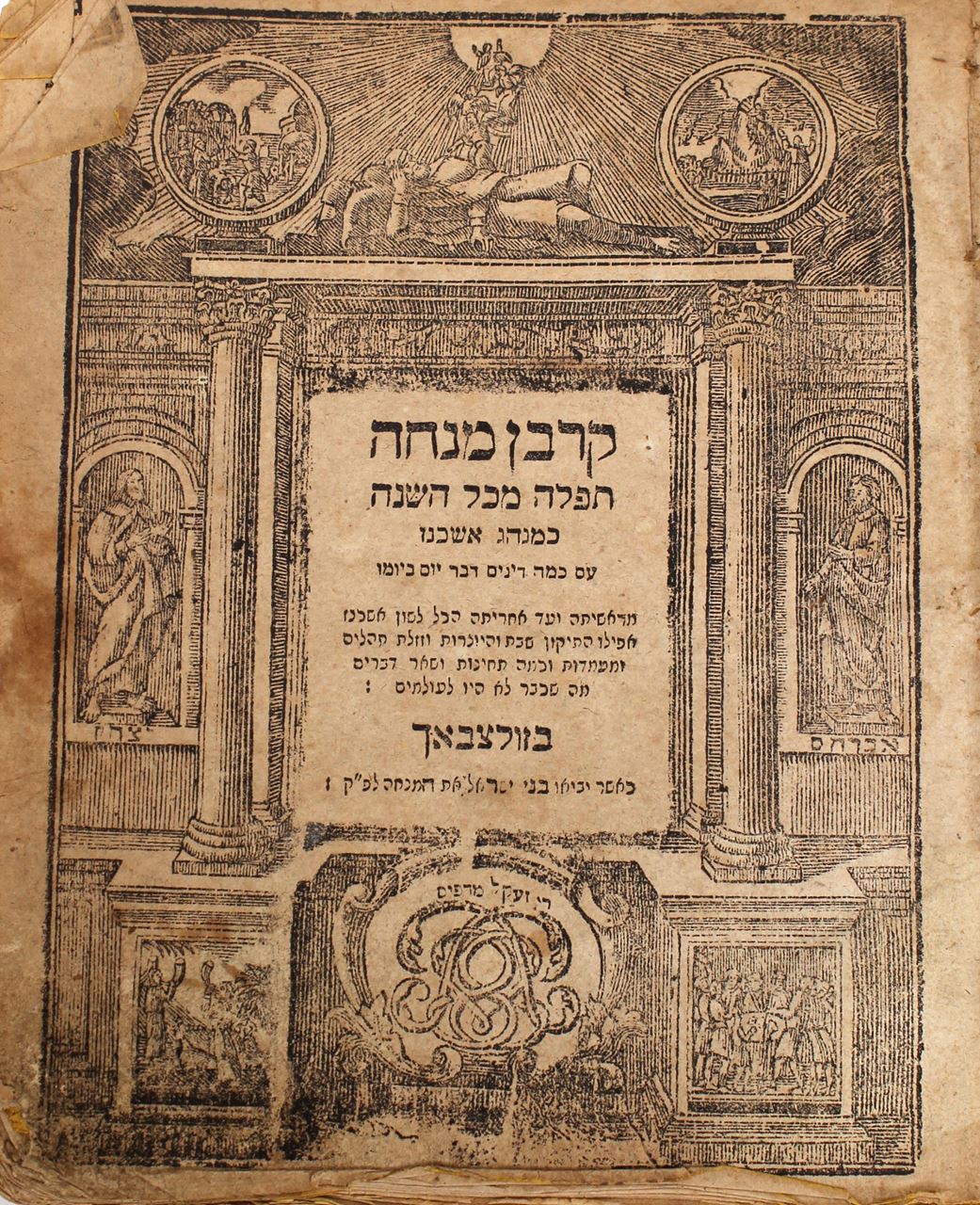
This title page, with small modifications, was repeatedly copied and is found in books from across Europe. One explanation for the ubiquity of this title page is that the Siddur ha-Shelah was imbued with talismanic effect. R. Yoel Sirkes in his approbation assures that whoever prays from this book their prayers would be answered. As evidence of the talismanic effect of the book one only needs to look to recent auctions where the book is regularly sold for tens of thousands of dollars. Perhaps printers looking to capitalize on the aura surrounding the Siddur ha-Shelah incorporated the images in their books.
For example, the title page appears in Edut be-Yaakov, Sulzbach, 1741,[11] in 1765, Furth, Siddur Korban Minha, and in 1797, in the north west of France in Luneville, Sha’ar Selihot ve-Tahanunim. In the latter, the Levite is substituted for Jonah as that is more aligned with the High Holiday themes of the book, and the four depictions of the holidays are removed because they conflict with the singular nature of the book.
Illustrated Hebrew title pages are perhaps the most ubiquitous, and certainly the most accessible form of Jewish art. Yet, the study of the art of the Hebrew title page has not attracted commensurate scholarly interest. Our example, tracing the depiction of Jacob’s dream, is but one instance that illustrated Hebrew title pages fit within the larger history of Jewish art. Here, the Hebrew title pages seventeenth- and eighteenth-century Hebrew books harken back to the iconography identified at Dura Europos that continued to appear in Jewish artistic forms, in this instance books.
[1] Gabrielle Sed-Rajna, Jewish Art (New York: Harry N. Abrams, Inc., 1997), 127.
[2] Gabrielle Sed-Rajna, Jewish Art (New York: Harry N. Abrams, Inc., 1997), 559.
[3] E.L. Sukenik, Bet-haKeneset shel Dura-Europa ve-Tserayav (Jerusalem: Mossad Bialik 1947), 112-3.
[4] B. Friedberg, History of Hebrew Typography in Central Europe (Antwerp, 1935), 35-49.
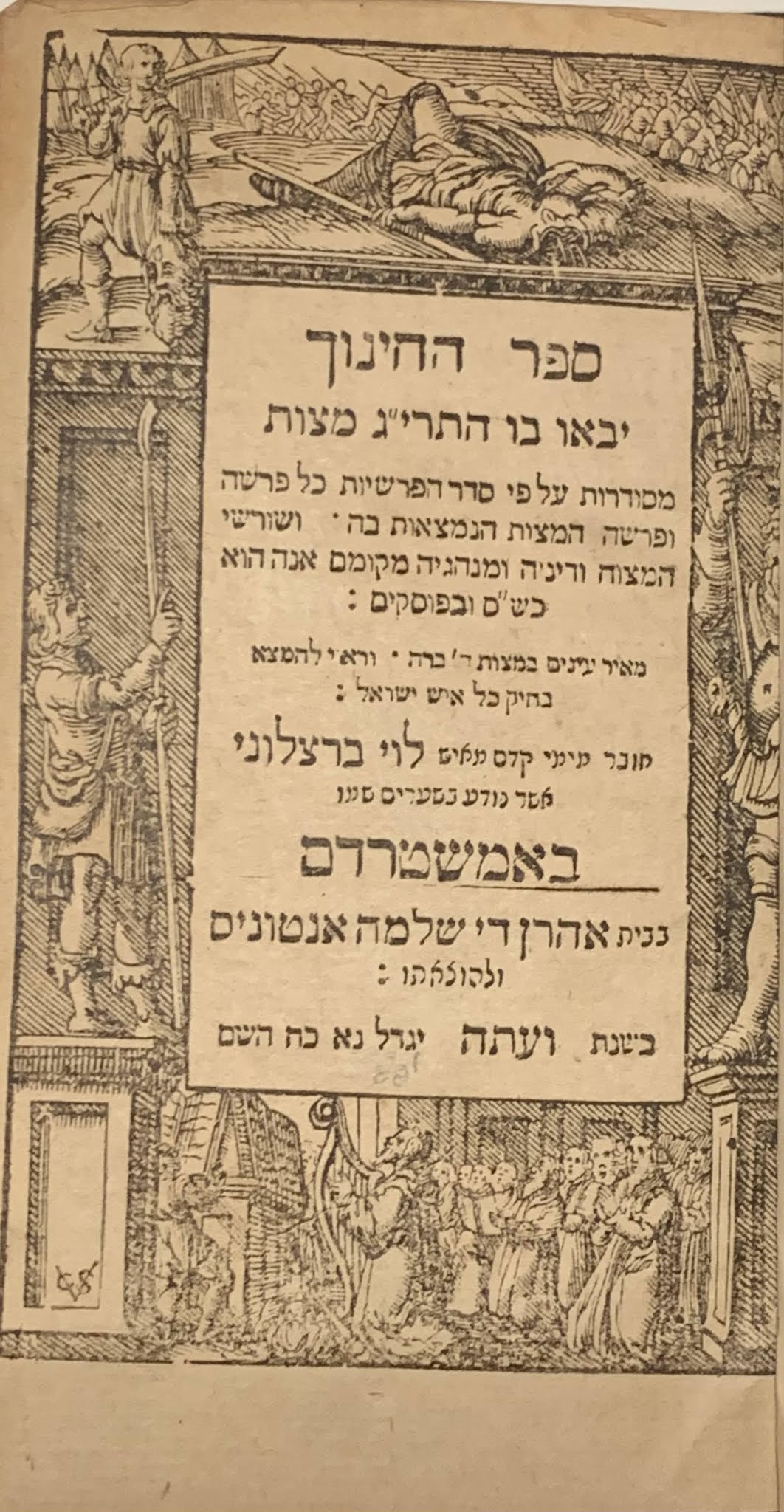
[5] Like Gottschalk, Coutinho also produced a number of other illustrated title pages with biblical images.In 1696, the year before he published the siddur, he published at least two books with illustrated title pages, Sefer Hinukh and the Mishna. This title page was reused in Coutinho’s 1698 edition of R. Hayim Moshe Karinal, Yemin Moshe.
[6] Bezalel Naor, Post-Sabbatian Sabbatianism, (Spring Valley, NY: Orot, 1999),79-82.
[7] See Shnayer Leiman, “Sefarim ha-Hashudim be-Shabbta’ot: Rishimat shel ha-Gaon Yavet”z Tzal,” in Sefer ha-Zikhron le-Rebi Moshe Lifschitz, (New York, 1996), 890
[8] See Naor, Post-Sabbatian, 80-81 and the sources cited therein.
[9] Of course, Shabbatai Tzvi is not the only “Tzvi,” Chotsh’s first name is Tzvi. Perhaps the image is an allusion to his name – a somewhat common theme in Hebrew title page illustrations. Recently, however, one scholar noted that the deers are not the only Sabbatian reference. According to his theory, the layout of the biblical figures aligns with kabbalistic representations of the sefirot. See Naor, 81.
[10] Horowitz’s other book, Sheni Luhot ha-Brit, Amsterdam, 1698, also contains a beautifully illustrated title page.
[11] The title page was reused for decades in the Sulzbach presses. As late as 1794, there are examples of the title page. See, e.g. Tsenah u-Renah, Sulzbach, 1794.
Aaron the Jewish Bishop
Generally, conclusively determining Jewish material culture, especially from the biblical period, is nearly impossible. Regarding Moses, other than his staff, the bible provides no additional information.[2] Aaron is a different story.

More on story fabrication – The Golem
However, surprisingly, in the online publication Dei’ah veDibur, there is also an article on this topic (hat tip A Simple Jew). The article “borrows” heavily from the above mentioned articles (without citation). It also references some early sources which cast doubt on the veracity of the story, the article does so without identifying the source. One of the unnamed sources I think is a reference to R. Shlomo Yehuda Rappoport’s introduction to Kalmen Leiben’s Gal Ed however, the dates don’t work out exactly (Gal Ed 1856). It would make sense to leave this unidentified, as though R. Rapoport was the son-in-law of the famed author of the Ketzot HaHoshen and even added the index and some notes to his Aveni Milumim, R. Rapoport is not considered the most traditional Jew (See Barzaily typically terrible biography on Rapoport). Additionally, although the article in Dei’ah veDibur is rather detailed it also leaves out R. Shlomo Schick’s criticism (based upon Rapoport) of the story as well. Again this may be due in part to some people’s views regarding Schick (see this post where some of Schick’s work was censored). [Additionally, the article mentions a small book by R. Eckstein titled Sefer Yetzirah which appears to be available on the Rare Hebrew Books from Harvard’s Collection Microfilm].
But perhaps the most surprising thing in the entire article is its conclusion
Rabbi Eshkoli emphasizes that we should be raising our children with literature that is historically reliable, for which our extensive traditions about the greatness and holiness and the powerful prayer of the tzakkikimand Torah giants of earlier times amply suffice. Niflo’os Maharal therefore ought no longer to be circulated unless each copy carries a clear disclaimer stating that the story is fiction. Neither, he also points out, should the book be quoted from as though it was reliable information.
Dei’ah veDibur bills itself as “A Window Into The Charedi World,” so perhaps this emphasis on truth will signal a new trend in haradei biographies only time will tell.
[One interesting side note a Polish TV crew went into the attic of the Altena Shul in Prague and filmed the contents. The pictures they found were published in a Polish book. These pictures show a big mound of dirt but no Golem as far as I can tell.]
“Rabbi David Hoffmann, ZL” by Eliezer M. Lipschuetz – A Translation
A Footnote on What the Chasam Sofer Did Not Say
By Shnayer Leiman
The Problem. I’m the proud owner of a copy of Rabbi Shimon Finkelman’s Rav Pam: The Life and Ideals of Rabbi Avrohom Yaakov HaKohen Pam (second edition, seventh impression, June 2023, ArtScroll History Series, Mesorah Publications, Rahway, N.J.). It is a magnificently written and produced biography of Rav Pam, a close friend of my father, who like Rav Pam was a disciple of both Rav Shraga Feivel Mendlowitz and Rav Dovid Leibowitz. The biography captures Rav Pam as our family knew him. Indeed, it is the definitive model of how a biography of a גדול בישראל should be written. It informs and inspires as it tells the truth.
As we shall see, a minor error made its way into the volume, and no one can really be faulted for the error. Nonetheless, I am confident that Rav Pam being the איש אמת that he was, will surely not fault me (in עולם האמת) for making the correction.
The reader, at p. 336, is informed that at the 1991 Torah Vodaath dinner at which Rav Pam was the Guest of Honor, he thanked the one thousand guests for coming, and then said:
Often, I think to myself that I go around with a “false pass,” for people think I am that which I am not. But I take comfort in a comment of the Chasam Sofer. Rema is of the opinion that if a stranger enters a shul and claims to be a Kohen, we may rely on his word and call him to the Torah for the Kohen’s aliyah, for even if he is, in fact, not a Kohen, calling him to the Torah would not involve a biblical transgression. Asks the Chasam Sofer: Why would calling up a non-Kohen not be a transgression of “Vekidashto” (And you shall sanctify him),[1] the requirement that we accord honor to those who truly are Kohanim? He answers that this mitzvah is fulfilled when we show honor for the Kehunah (the exalted status of the family of Kohanim). Therefore, even if the person whom we honor is, in fact, not a Kohen, we are fulfilling the mitzvah of “Vekidashto” if we honor someone whom we think is a Kohen.
Therefore, even though, in fact, I am not deserving of honor, if people honor me thinking that I deserve it, then they are considered as having shown k’vod HaTorah (honor for the Torah).
This is truly an inspiring דבר תורה – worthy of the Chasam Sofer – and appropriately selected by Rav Pam, a Kohen, for the occasion. Alas, it was not said by the Chasam Sofer.
A Brief Survey of the Chasam Sofer’s Attitude Toward the Publication of His Writings.
Much has been written about the Chasam Sofer (1762-1839), and much more remains to be written. He was a remarkable גדול הדור and פוסק הדור. He lived in a world without radio, TV, telegraph, telephone, or digital communication, yet was recognized during his lifetime as גדול הדור and פוסק הדור. What makes this even more remarkable is the simple fact that he refused to publish any of his Torah insights or halakhic rulings during his lifetime. Of course, the fact that he served as Chief Rabbi of Pressburg (today: Bratislava) and simultaneously as Rosh ha-Yeshiva of the Pressburg Yeshiva – with thousands of disciples during his long reign (1806-1839) – spread his fame throughout the Jewish world. And while he refused to publish his Torah insights, he had a gifted pen and wrote thousands of Jewish legal responsa which he sent to all who asked. All of Torah Jewry knew who the Chasam Sofer was and what he could do.
It is worth examining what the Chasam Sofer had to say about publishing one’s Torah insights. In 1841, his son R. Shimon Sofer, who would later serve as Chief Rabbi of Krakow, published for the first time a personal letter of the Chasam Sofer dated 1829, where he addressed the issue.[2] It reads in part:
Regarding the rumor that you heard that I published a particular volume, and you requested that I send you a copy,[3] I never considered such a matter; it has not even entered my mind, at least until the present time. For the majority of the [Torah] world, that are greater and better than I am – or, at the very least, at the same level that I am – they have no need for me. For the minority of a minority that are less learned than I am, why should I weary myself for a minority? And if, perhaps, it were true that the majority of the [Torah] world needs me – heaven forbid – I am unaware that I would have the obligation to publish my Torah insights and distribute them to the public. So long as G-d grants me life and strength, I am prepared to study [Torah] with all who are interested in learning with me. I will neither pause nor rest – as the L-rd my G-d has commanded me “Just as I teach without charge, so you shall teach without charge”[4] – in responding, as far as my hand and mind reach, to all who ask, at no charge. It is my practice to record in writing whatever Torah insights G-d has graced me with, whether in Halakhah or Aggadah. These writings are freely available. Whoever wishes to copy them is welcome to do so. Such was the practice before the invention of the printing press. More I am not obligated to do. If, heaven forbid, one publishes in order to increase his fame, I worry about the curse of our Sages, of blessed memory: “He who seeks fame will lose his name.”[5] Indeed, such has been the fate of most authors of seforim. How much more so is it prohibited for an author to publish his sefer for financial gain! For these reasons, it never entered my mind to publish a sefer.
Only once did several of the Chasam Sofer’s Responsa and Torah insights appear in print during his lifetime. A disciple of the Chasam Sofer who had access to manuscript copies of his writings, published an edition of חידושים על מסכת שבועות מאת רבינו יוסף הלוי אבן מיגש (Prague, 1826), and appended some 14 large folios of Chasam Sofer’s Responsa and Torah insights to the volume. The Chasam Sofer was livid when he learned about this unauthorized publication of his writings, but ultimately granted his approval. Towards the end of his life, and at the constant urging of members of his family, he agreed to publish some materials, including a review of R. Zvi Hirsch Chajes’ תורת נביאים . The project fell through, perhaps due to the illness and subsequent death of the Chasam Sofer, but not before he addressed an important note to Rav Zvi Hirsch Chajes, which sheds light on his view of the publication of Torah insights in general, and on his sensitivity to the effect his writings could have on others. The letter was written in 1837, when the Chasam Sofer was 75 years old, and at the height of his fame. Rav Chajes, was 32 years old, still at the start of a brilliant career.[6]
I keep the L-rd before me always. Pressburg, the evening preceding Monday, 27 Marchechvan, 598 according to the short account.
Greetings and blessings for all that is good to my friend and dear Rabbi, the great Rabbi and Gaon, master of Torah, discerning in study and expert in mastery of texts, whose many words are beautifully expressed, the honorable teacher and rabbi Zvi Hirsch, may his light glow, Chief Rabbi and Head of the Yeshiva of Zolkiev, may G-d watch over it.
Dear Friend,
I have a request to make of you. It has never entered my mind to publish a sefer. However, several years ago, some pages of my Responsa and Torah insights were published by a certain rabbi, R. Mordechai Schlank, who set out to publish Ramban’s commentary on Kiddushin and R. Yosef Ibn Migash’s commentary on Shavuot. He had copies of some of my writings with him and published them in the back of the books mentioned. This was done initially against my will, but ultimately with my permission, for he was not with me here [in Pressburg], but was rather in Prague.
Now the following has occurred. A worthy individual from Brody, R. Mordechai Bisliches,[7] a printer who publishes the works of the Rishonim, has managed to get copies of 3 or 4 of my Responsa and copies of some of my Torah insights. He plans to append them to one of the above publications of the Rishonim. Initially, this was done against my will and protest, but my family forced me to acquiesce and remain silent. (For all my Torah insights and writings are freely available for anyone to copy them. I do not discourage anyone from doing so, for nothing I wrote was intended as a secret.) The above mentioned printer is already engaged in the process of publishing my material. These include two responsa that I addressed to you, one on whether a physician who is also a Kohen can administer to a dying or already dead patient,[8] and the other regarding my comments on your sefer, Torat Nevi’im.[9] Now I said: “I can do as I please regarding my property; but I cannot do as I please regarding someone else’s property.” Perhaps you don’t want your name, and the name of your community, mentioned regarding that matter. Or, perhaps you will find some passage that, heaven forbid, is a slight to your honor. For those reasons, I implore you to review my comments and let me know what you think. In my humble opinion, there is nothing in my responsa that in any way slights you, heaven forbid. Quite the opposite, they are sources for you of glory and praise. And if, when engaged in halakhic discourse, I criticized something you said, it means nothing. Such are the ways of Torah discourse. Perhaps you will publish yet another sefer and you will be able to defend yourself against any and all criticism. But heaven forbid that I should allow my pen to record anything that would dishonor you! Should you feel that anything I wrote [about you] is improper, I will erase those words, or if necessary, I will neither mention your name or the title of the book. I hope this won’t be the case, and anxiously await your quick reply, before the volume goes to press. I sign with all the usual blessings, the one who loves your soul,
Moshe ha-Katan Sofer of Frankfurt-am-Main
We have included this brief survey of the Chasam Sofer’s attitude toward the publication of his writings, in order to bring home the message that, with one or two exceptions, the Chasam Sofer did not edit, or prepare for publication, any of his writings during his lifetime. He left a vast literature, literally thousands of manuscripts, ranging over a wide variety of topics (such as Responsa, Lectures on the Talmud, Sermons, Commentaries on the Torah, Notes on the Shulchan Arukh, Poetry, personal letters, and more), all still being published – and always in better editions – to this very day.
The Solution. What remains to be addressed is:
1. Why did Rav Pam ascribe the passage (that justifies why a stranger who claims that he is Kohen is allowed to get an aliyah to the Torah as a Kohen, even though we have no evidence other than his say-so) to the Chasam Sofer?
2. How do I know that it wasn’t said by the Chasam Sofer?
3. Who did contribute the insightful justification that ultimately was misattributed to the Chasam Sofer?
Rabbi Finkelman provides a helpful footnote, in an attempt to identify the source of the alleged Chasam Sofer comment.[10] He sends the reader to Toras Moshe on Vayikra 21:8. Alas, in all of the recent editions of Toras Moshe published under the auspices of Makhon Chasam Sofer, the official collection of all of the genuine Chasam Sofer commentaries on the Torah published in the various editions of Toras Moshe (as distinct from his sermons [דרשות] or other collections of Torah commentary that never appeared under the name Toras Moshe ), no such passage appears. See, e.g., the massive six-volume edition of Toras Moshe ha-Shalem veha-Mefoar (Jerusalem, 2021), vol. 3, p. 255, to Vayikra 21:8. There is a comment on Vekiddashto, but not a word about the fact that a stranger who claims that he is a Kohen is allowed to get an aliyah to the Torah as a Kohen, even though we have no evidence other than his say-so.
Almost certainly, neither Rav Pam in 1991, nor Rabbi Finkelman in later years, had access to a Makhon Chasam Sofer edition of Toras Moshe. But they certainly had access to earlier editions of Toras Moshe, which is what led them astray. It’s best to begin our examination with one of the earliest editions of Toras Moshe – and little more needs to be said.
Like almost all the writings of the Chasam Sofer, his Toras Moshe was published posthumously. It first appeared in print in a three-volume set published in Pressburg between 1879 and 1893. The editor of the three-volume set was an אדם גדול, a grandson of the Chasam Sofer, Rav Shimon Sofer (1850-1944). He was the son of Rav Avraham Shmuel Binyamin Sofer (1815-1871), the כתב סופר, who succeeded the Chasam Sofer as Chief Rabbi and Rosh ha-Yeshiva of Pressburg. Rav Shimon Sofer, a distinguished rabbinic scholar in his own right, served as Chief Rabbi of Erlau and was the founder of the Erlauer Chasidic dynasty. In 1893, he published for the first time the third and final volume of Toras Moshe, the volume with the Chasam Sofer’s comments on Vayikra-Devorim. Later editions were usually printed in 2 to 5 volume sets.
Here is what Rav Pam saw and quoted (almost certainly from one of the many later photo-mechanical reprints of the 1893 volume that appeared throughout the 20th century).
He may have owned a copy of a reprinted edition, and if not, he surely would have had access to a copy at the famed Torah Vodaath Library, curated for many years by the late R. Yitzchok Meir Traube and catalogued by the late R. Shlomo Biegeleisen. It is a library I remember well that (in my day) was just-off to the side of the main Bais Medrash at the South Third Street campus in Williamsburg.
No one could really fault Rav Pam for citing a passage – and with great precision – in the name of the Chasam Sofer, when that very passage appears in a sefer entitled Toras Moshe, and whose title page clearly identifies the author of its content as being none other than the Chasam Sofer! Moreover, the sefer was edited by the grandson of the Chasam Sofer, who surely wouldn’t misrepresent what his grandfather wrote!
But it is clearly a case of אליה וקוץ בה. If one examines carefully the text that Rav Pam cited (as seen in the scan above), one notices a coded abbreviation at the end of the paragraph that reads in parentheses: (מש“מ). (Other passages on the page are coded with an asterisk at the start of each paragraph; they need not concern us.) No dictionary of Hebrew abbreviations will solve the strange abbreviation מש“מ. But what will solve the problem for us is the editor’s full introduction to his edition of Toras Moshe.
It appears only, as one might expect, at the start of the volume on Bereshis. Here is the key passage, which appears at the very end of the lengthy introduction.
Translated it reads: “I also had in my hands a handwritten book, named Shir Ma’on. The author’s name is not recorded in it. But I felt comfortable taking some of its fruits and inserting them into the present text, for there is a proper time for everything, a fixed time for every desirable matter.”
Incredibly, there are many passages, marked with the code מש“מ strewn throughout the Toras Moshe volume! What the editor was really telling us is that he had access to a handwritten notebook with no personal name recorded in it. Of course no personal name was recorded in it; it was his private notebook! The Hebrew title Shir Ma’on clearly alludes to the name “R. Shimon.” And מש“מ is surely an abbreviation for מספר שיר מעון. As a gifted rabbinic scholar, and as the grandson of the author of most of the passages in Toras Moshe, he felt comfortable adding appropriate passages to the volume. But being scrupulously honest, he knew that he could not do so without informing readers of what he was doing, and clearly identifying which passages belonged to his grandfather, and which passages belonged to him.
It is all to the credit of the editors of the latest editions of Toras Moshe that they now publish two separate sections of the book, each with its own title page, and both with notes and commentary. One section is called Toras Moshe and prints only what the Chasam Sofer wrote, and the other section is called Shir Ma’on and prints only what R. Shimon Sofer wrote.
In sum, Rav Pam resonated to a beautiful דבר תורה he saw in an early edition (or reprint) of Toras Moshe, and cited it in the name of the Chasam Sofer at a Torah Vodaath dinner held in his honor. Opening to a page in Sefer Vayikra of the multi-volume set of Toras Moshe, there was no obvious reason for him to assume that it was not a Torah insight of the Chasam Sofer. In fact, it was a Torah insight of the Chasam Sofer’s grandson, R. Shimon Sofer, who served with great distinction as Rabbi and Rosh ha-Yeshiva of Erlau in Hungary for over 50 years, and authored the multi-volume שו“ת התעוררות תשובה (printed mostly in Budapest, 1923-1944), and died a martyr’s death in Auschwitz at age 94.
Notes
[1] The reference is to Vayikra 21:8. See b. Gittin 59b, where the verse is understood as a general obligation to honor all Kohanim.
[2] R. Shimon Sofer, “פתוחי חותם,” introduction to R. Moses Sofer, ספר חתם סופר חלק יורה דעה (Pressburg, 1841). It is reissued in שו“ת חתם סופר, חלק יו“ד, vol. 1 (Jerusalem, 2000), introductory pages, p. 15.
[3] The reference is to the unauthorized publication in 1826 of several of the Chasam Sofer’s responsa and Torah insights, for which see below.
[4] See b. Bechorot 29a.
[5] M. Avot 1:13. Cf. שו“ת חתם סופר, או“ח, סימן ר“ח.
[6] The letter is included R. Yisrael Stern’s anthology, לקוטי תשובות חתם סופר (London, 1965), pp. 92-93.It was first published in 1842 by the recipient of the letter himself, R. Zvi Hirsch Chajes. See presently: כל ספרי מהר“ץ חיות (Jerusalem, 1958), vol. 1, p. 206. For a comprehensive study of the relationship between the Chasam Sofer and R. Zvi Hirsch Chajes, see Mayer Herskovics, מהר“ץ חיות: תולדות רבי צבי הירש חיות ומשנתו – מהדורה מתוקנת (Jerusalem, 2007), pp. 143-189.
[7] Mordechai Leib Bisliches (1756-1851) was a bibliophile, dealer in manuscripts, and printer. He printed books that were published in Carlsruhe, Lvov, Prague, and Pressburg. At least two of his printed books carried הסכמות from the Chasam Sofer (אוצר נחמד: חדושי הרמב“ן על מסכת שבת , Pressburg, 1837; and מנחת קנאות מהרב הגדול אבא מרי ב“ר משה מחכמי לוניל , Pressburg,1837). In 1846, Bisliches and his partner S.G. Stern sold 111 manuscripts in 102 volumes to the archduchess Marie Louise of Parma, which were added to the de Rossi Collection in the Biblioteca Palatina. See the entry “Bisliches” in Encyclopaedia Judaica and cf. N.M. Gelber’s תולדות יהודי ברודי (Jerusalem, 1955), p. 204.
[8] In the standard printed editions, this responsum appears in שו“ת חתם סופר, יו“ד, סימן של“ח.
[9]In the standard printed editions, this responsum appears inשו“ת חתם סופר, או“ח, סימן ר“ח .
[10] Rav Pam: The Life and Ideals of Rabbi Avrohom Yaakov HaKohen Pam, p.336, note 9.