The Recently Published Photographs of Rav Yisrael Salanter: Real or Imaginary?

The Recently Published Photographs of Rav Yisrael Salanter: Real or Imaginary?

By Shnayer Leiman

As early as 2006, and continuing through 2022, a flurry of photographs, purporting to bear the likeness of Rav Yisrael Salanter, have either appeared in print or have been posted on the Internet (see below, section II). While the publication of these photos certainly attests to his abiding influence well into the 21st century, their authenticity seems less than certain, and demands investigation. At the very least, one wonders why the likeness of a world renowned rabbi, who died in 1883, did not come to light until almost 125 years after his death![1]

I. The Early Evidence for What R. Yisrael Salanter Looked Like.

A proper discussion of what R. Yisrael actually looked like must begin with an examination of the testimony of his contemporaries who interacted with him and knew him best. The Torah teaches us (at Dt.19:15) that a matter can be established by two or three witnesses, so we shall present below the testimony of three witnesses who knew R. Yisrael personally.[2]

1. In 1899, Emil Benjamin, published the first biography of Rav Yisrael Salanter.[3] At the time, Benjamin served as a teacher of Jewish religion in Memel, Prussia, a port city on the Baltic Sea with some 1000 Jews (today: Kleipeda in Lithuania). Benjamin, a native of Memel, was a disciple of R. Zvi Hirsh Plato (1822-1910) who was a son-in law of R. Samson Raphael Hirsch. R. Plato served as Rav of the separatist Orthodox community of Cologne, and head of its Teacher’s Seminary, where Benjamin was trained as a teacher. Benjamin was a young man between 1857 and 1878, the very years that R. Yisrael Salanter spent many a year in Memel, which served as a base of operations for his various educational activities in Lithuania, Prussia, Germany, and France. R. Yisrael invited Benjamin to serve as his aid during a significant portion of those years, and Benjamin wisely accepted the invitation. Intimately involved in R. Yisrael’s daily affairs, Benjamin was in a unique position to record for posterity what it was like to be in his presence. Benjamin wrote:[4]

Rabbi Lipkin was of medium height, seemingly strong but lean in stature, and of ordinary build. His outward appearance immediately revealed a man of unusual significance. The broad forehead, the interesting character reflected by the shape of his head, the sharp look, all reflected the great thinker that he was. His countenance was almost always flush red, probably due to the struggle between body and spirit within him. Often he was lost in thought, and he seemed to forget everything around him, and appeared to be talking to himself. In spite of his deep seriousness, his conversation was often spiced with a pleasant sense of humor and whimsical thoughts…Curiously, this humble and unselfish man never consented to allow the features of his face to be painted by the artist’s brush and, thus, to be preserved for posterity. [Italics mine, sl]

2. Yaakov Mark (1856-1929) was a graduate of the Telz Yeshiva (in Telshe, Lithuania) who devoted a good portion of his life to training Jews (in a variety of languages) to master bookkeeping, so that they could gain and hold jobs in the various countries where they would ultimately find themselves.[5] He also devoted his later years to making literary contributions to Hebrew and Yiddish periodical literature. His only book, entitledגדולים פון אונזער צייט (New York, 1927),[6] is devoted to biographies of the key persons that he knew personally, such as R. Hayyim Soloveichik, the Malbim, and R. Yisrael Salanter. His opening line regarding R. Yisrael Salanter reads: “In my younger years, I often had the privilege of meeting with R. Yisrael. I heard his public lectures, his private lectures, and had the opportunity to observe him at close range.” In his book, he writes:[7]

All who encountered him when walking in the streets, whether Jew or Gentile, greeted him courteously. Even in the most crowded street of Berlin it was rare that a passerby would not stop to behold the great thinker, who used to wander about while engrossed in deep thought. All were impressed by his stately figure, his especially handsome beard, and his particularly character-full head with its unusually wide forehead, his red-white face, his blue eyes, with his sharp, yet good-natured look. This, despite the fact that he never wore official rabbinic garb but, rather, simple lay dress, with an ordinary hat on his head – not particularly elegant – but always clean and tidy. How sad that no photograph of him exists! It was simply impossible to get him to agree to sit for a painting or a photograph. [Italics mine, sl]

3. David Sidersky (circa 1858-1943), a grandson of R. Yisrael Salanter who edited אמרי בינה (Warsaw, 1878), the first ספר by R. Yisrael that was printed during his lifetime and that listed his name as the author, also published a biography of his grandfather in 1936-7.[8] Sidersky wrote as follows:[9]

R. Yisrael, under no circumstances, allowed himself to be photographed. Indeed, not a trace of his image exists. [Italics mine, sl] This, however, is what he looked like: he was of medium height, handsome, with glowing face. He had a full beard, with curls surrounding its edges. He spoke pleasantly, and always greeted everyone warmly.

If one reads the full biographical accounts of R. Yisrael Salanter by the three witnesses listed above, it becomes quite obvious that these are three independent accounts. Each records significant material about R. Yisrael Salanter that does not appear in the other accounts.[10] But there can be no question that Mark was influenced by Benjamin’s account, and that Sidersky was influenced by both Benjamin and Mark. The literary influence of the earlier accounts on the later accounts is obvious, even in the snippets translated above. Nonetheless, notice that only Benjamin mentions R. Yisrael’s sense of humor; only Mark refers to R. Yisrael’s blue eyes; and only Sidersky notes the curls that surrounded the edge of R. Yisrael’s full beard.

II. What Might R. Yisrael Salanter Not Have Looked Like?[11]

1. In 2006-2008, R. Shlomo Lorincz – a political leader of Agudat Yisrael during 1951-1984 and a חבר כנסת – published his classic work במחיצתם של גדולי התורה. In vol. 2, p. 14,[12] there appeared a striking photograph, with the name רבי ישראל סלנטר under it.

The photo appears to be that of a young R. Yisrael Salanter, perhaps 35- 45 years old. If so, the photo would have been taken between 1845 and 1855, at a time when the camera was mostly unknown and unavailable to the general public in Eastern Europe. One need not guess about the true identity of the person photographed. It is R. Yitzchak Lipkin (d. 1903), a son of R. Yisrael Salanter. Rav and Darshan, he was a distinguished תלמיד חכם who held several rabbinic posts in Lithuania before settling in Eretz Yisrael, where he died in his early 60’s.[13] Three photographs of him have been preserved by the Lipkin family. Aside from the early photo published by Lorincz, see below for two photos from a later period in his life:[14]

All that needs to concern us here is that R. Yitzchak Lipkin was R. Yisrael Salanter’s son, and not R. Yisrael Salanter himself. The photograph is a real picture of R. Yitzchak Lipkin, and an imaginary one of R. Yisrael Salanter. Not surprisingly, in later editions of במחיצתם של גדולי התורה , the misidentified photo was pulled. Thus, vol. 2, p. 14 now looks like this:[15]

2. On February 2, 2011, Jewish Currents magazine published the following tribute to R. Israel Salanter on his yahrzeit:

Not an ardent reader of Jewish Currents magazine (described by Wikipedia as a “a progressive, secular Jewish quarterly magazine and news site whose content reflects the politics of the Jewish left), I did not see this when it first appeared in print. It was brought to my attention later in 2011 by an East European Jewish historian about to publish an essay on R. Yisrael Salanter. She saw the tribute – and its photograph — on the Internet and was considering adding the photograph to her essay. She expressed surprise, since she had never seen a photograph of R. Yisrael Salanter. I immediately sent the following brief note to Jewish Currents magazine:

Thanks for remembering R. Israel Salanter on the day he died in 1883. Lest anyone be misled by the appended photograph, it clearly is a twentieth century photograph of someone other than R. Israel Salanter. In fact, it is a photograph of a Rumanian born rabbi (not a Litvak), Jacob Shachter, who was born after Salanter died. Shachter served with distinction as a rabbi in Manchester, England, then as rabbi in Belfast, Ireland. He died in Jerusalem in 1971.

Of course, I informed the East European scholar to cease and desist. Here I’ll add a bit more about Rabbi Shachter. He was a prolific author, whose publications included two very important works: a) A kind of Torah Shelemah on the Book of Proverbs, which gathers together all of Talmudic Commentary (Bavli and Yerushalmi) on the verses of Proverbs. It is entitled: ספר משלי בדברי חזל עם ביאור דברי יעקב (Jerusalem, 1963 and later editions), and b) The Student’s Guide Through the Talmud by Z. H. Chajes, translated, edited, and critically annotated by Jacob Shachter (London, 1952 and later editions). For our purposes, we need only to look at the title pages and frontispieces of two of his other publications, one in Hebrew and one on English: דברים לדוד (Jerusalem, 1966) and Ingathering: Collected Papers, Essays and Addresses (Jerusalem, 1966):

Clearly, the Shachter photo cannot pass for what R. Yisrael Salanter looked like. Even if we couldn’t identify the Shachter photo, a simple comparison of the beard in the photo with R. Yisrael Salanter’s beard as described by the testimony of eyewitnesses who knew him (“full beard, with curls surrounding its edges”) would have sufficed to disqualify the photo as a candidate for the actual likeness of R. Yisrael Salanter. In sum, the photograph is a real picture of R. Jacob Shachter, and an imaginary one of R. Yisrael Salanter.

3. On January 22, 2022, a YWN [Yeshiva World News] posting opened with a large imaginary photograph of R. Yisrael Salanter. It was, in fact, once again a photo of R. Jacob Shachter. To the credit of YWN, as soon as they were informed of the error the photograph was removed and replaced with a scan of the title page of R. Yitzchak Blaser’s classic anthology of R. Yisrael Salanter’s teaching, אור ישראל (Vilna, 1900).

4. In March of 2022, Rabbi Berel Wein’s Struggles, Challenges, and Tradition (Shaar Press) appeared in print. It is a magnificently produced volume, filled with vintage Rabbi Berel Wein wisdom. Alas, on p. 129 R. Jacob Shachter appears once again as R. Yisrael Salanter. One suspects that the culprit was an editorial assistant in charge of locating photos for the volume. Hopefully, the error will be corrected in the Second Impression.

We have listed 4 samples of misrepresentation of R. Yisrael Salanter. There are many more.[16] All one has to do is Google “Rabbi Israel Salanter.” One will see immediately many of the fake news photographs of R. Yisrael Salanter. And if you click on each one of the fakes, names like JewishHistory.org and Torah-Box.net will turn up. But it is neither history nor Torah, it is fake news. Sadly, once fake news is posted on the Internet, it multiplies even more rapidly than the Jews did in ancient Egypt. The Internet can be likened to the kind of sinner the Rabbis spoke about in b. Yoma 86b: כיון שעבר אדם עבירה ושנה בהנעשו לו כהיתר “Once a person sins, and repeats the sin, he considers it permissible.” Indeed, once fake news is posted on the Internet, it is not merely considered possible news, it almost immediately becomes authoritative news. The only remedy, if there is one, is to never post in haste, and to post only after much review, including review by others. Moreover, any and all errors need to be corrected as quickly as possible on the very site where the posting first appeared.

Notes:

[1] None of the authors (listed below in section II) who posted photographs of R. Yisrael Salanter took the trouble to source, or verify the authenticity of, the photographs they posted. Methodologically, it is essential that any materials, whether manuscripts or photographs, published some 100 or more years after the death of the person they are ascribed to, or identified with, be verified. This is especially the case when a plethora of historical biographies and scholarly studies already exist on the key person involved – as is the case regarding R. Yisrael Salanter – and the existence of the posted photographs has eluded all of them. For the basic bibliography on R. Yisrael Salanter (through 1993), see Immanuel Etkes, Rabbi Israel Salanter and the Mussar Movement (Philadelphia, 1993), pp. 373-379; and Hillel Goldberg, Israel Salanter: Text, Structure, Idea (New York, 1982), pp. 309-329. Much more of significance has been published since then (e.g., ספר הזכרון קדוש ישראל (Bnei Brak. 2003); Hayyim Yitzchak Lipkin, ed., תורת רבי ישראל מסלנט (Jerusalem, 2003); and קדוש ישראל (Bnei Brak, 2014).

[2] Many other witnesses could have been adduced. See, for example, R. Baruch Epstein, מקור ברוך (Vilna, 1928), vol. 4, pp. 1800-1804, for a vivid account of a chance encounter with R. Yisrael Salanter in Vilna, 1879. Our purpose here is not to overwhelm the reader with sources. Rather, it is to gather the most persuasive sources, and not more than necessary.

[3] Rabbi Jsrael Lipkin Salant: Sein Leben und Wirken (Berlin, 1899).

[4] Op. cit., pp. 34-35. The German original reads: “Rabbi Lipkin war von mittelhoher, ziemlich kräftiger aber hagerer Natur und von regelmässigem Körperbau. Schon seine äussere Erscheinung liess sogleich einen Mann von ungewöhnlicher Bedeutung erkennen. Die mächtige Stirn, der interessante Charakter- kopf, der scharfe Blick verrieten den grossen Denker. Sein Antlitz war fast beständig gerötet, wohl infolge des aufgehobenen Gleichgewichts zwischen Körper und Geist. Oft war er derart in Gedanken versunken, dass er alles um sich herum zu vergessen schien und im Alleingespräch mit sich selber beschäftig war… Merkwürdiger Weise hat dieser bescheidene und selbstlose Mann niemals seine Einwilligung dazu gegeben, dass die Züge seines Antlitzes durch den Pinsel eines Malers nachgeahmt und der Nachwelt erhalten würden.”

[5] See Yaakov Mark’s entry in לעקסיקאן פון דער נייער יידישער ליטעראטור (New York, 1963), vol. 5, column 514.

[6] A much abridged, and freely translated, Hebrew version of Mark’s גדולים פון אונזער צייט appeared under the title במחיצתם של גדולי הדור (Jerusalem, 1958). An accurate English translation of the original Yiddish volume would make a significant contribution to Jewish scholarship and culture.

[7] גדולים פון אונזער צייט, pp. 88-89. The Yiddish original reads:

אלע וועלכע פלעגען איהם באגעגענען אויפן גאס, סיי אידען סיי גוים, האבען איהם
העפליכסט באגריסט. זאגאר אין די לעבהאפטסטע גאסן פון בערלין פלעגט זעלטען
ווער איהם גלייכגילטיג פארבייגעהן און זיך ניט אפשטעלען באוואונדערן דעם
גרויסען דענקער, וואס פלעגט שטענדיג ארומגעהן פארזונקען אין געדאנקען
אימפאנירט האט אלעמען זיין שטאטליכע פיגור, זיין וואנדערבארשעהנעם הדרת
פנים, זיין אינטערעסאנטער כאראקטערקאפ מיטן גוואלדיגען ברייטען שטערן און
.וויסרויטליכען פנים, זיינע בלויע אויגען מיטן שארפען גוטמוטהיגען בליק
,טראצדעם וואס ער איז קיינמאל ניט געגאנגען אין אויפפאלענדע רבנישע קליידער
נאר אין פשוטע בעלהביתישע, מיט א געוועהנליכער היטעל אויפן קאפ און אויך
,ניט באזונדערס עלעגאנט, נאר שטענדיג געווען ריין און זויבער. א גרויסער שאדען
וואס פון איהם איז קיין שום בילד ניט נאכגעבליבען. מען האט בשוםאופן ביי איהם
.ניט געקענט פועלן זיך צו לאזען מאלען אדער פאטאגראפירען

[8] David Sidersky, רישראל סאלאנטר זל: תולדות חייו ופעולותיו“, היהודי (1936-7) 2:4, pp. 57-60; 2:5, pp. 81-84; 2:6, pp. 112-114; 2:8, pp. 153-155.

[9] היהודי (1937) 2:8, p. 155. The Hebrew original reads:

ישראל לא רצה בשום אופן להצטלם ולא נשאר שום זכרון מדמות דיוקנו
וזה תבניתו: קומה בינונית, יפה תואר עם פנים מאירים, זקנו מגודל וקוצותיו
.תלתלים, שיחתו היתה בנעימות והיה מקבל תמיד את כל אדם בסבר פנים יפות

[10] Most notably, Sidersky’s account is the only one (of the three accounts) that lists the names of R. Yisrael’s (and his wife Esther’s) six children (four sons and two daughters): Malkah Hindah, Shmuel, Aryeh Leib, Hodah Libah, Yitzchak, and Yom Tov Lipman.

[11] The formulation of the question is a playful echo of the title of the essay by Shimon Steinmetz entitled “What Might R. Yisrael Salanter Have Looked Like?,” On the Main Line, March 2, 2010. That essay was part II of his previous essay entitled “What Did R. Yisrael Salanter Look Like?,” On the Main Line, March 23, 2006. Both essays are must reading for this topic.

[12] במחיצתם של גדולי התורה (Jerusalem, 2006-8), 2 vols.

[13] For important writings by, and about, R. Yitzchak Lipkin, see R. Hayyim Yehoshua Kosovsky, ed., חוט המשולש (Jerusalem, 1904); R. Yitzchak Lipkin, לוחות אבנים (Jerusalem, 1978); and “רשימות רבי יצחק ליפקין בן רבינו” in ספר הזכרון קדוש ישראל (Bnei Brak, 2003), pp. 97-100.

[14] Cf. the Steinmetz essays cited above, n. 11.

[15] במחיצתם של גדולי התורה (Jerusalem, 2010), fifth edition, vol . 2, p. 14.

[16] On September 24, 2020, an essay was posted on the Internet entitled “Eating by Example on Yom Kippur, an Epidemic Story.” It revisited the story of R. Yisrael Salanter’s response to the cholera epidemic in Vilna in 1848. Once again, a photo of Rabbi Jacob Shachter was prominently displayed as the likeness of R. Yisrael Salanter.


The Netziv, Reading Newspapers on Shabbos, in general & Censorship (part one)*

 The Netziv, Reading Newspapers on Shabbos, in general & Censorship (part one)*
By: Eliezer Brodt
Previously, I have touched on the topic of the Netziv reading newspapers on weekdays and on Shabbos [here and here]. In this post I would like to revisit the subject, and also deal with some cases of censorship in the Netziv’s seforim.[1] I would like to stress at the outset that this is a work in progress[2] and not intended L’Halacha; each person should consult his own Rav.

In 1928, R’ Baruch Halevei Epstein described in his Mekor Baruch how on Shabbos his uncle, the Netziv, would read the Hebrew newspaper:

ואחר שקידש דודי על היין וטעמו מיני מאפה קלה, ואחר שקרא מעט בעתונים שנתקבלו מחדש… [מקור ברוך, חלק ד, עמ’ 1790].Further he adds:
וזוכר אני, כי “המגיד” הי’ דרכו להתקבל בכל ערב שבת לפנות ערב, ובלילה לא קרא אותו, מפני שליל שבת הי’ קודש לו לחזור בעל פה על המשניות ממסכתות שבת ועירובין… וקרא בו (בהמגיד) במשך היום.
וכאשר נקרה, שנתאחר “המגיד” לבא בזמנו בערב שבת, הי’ אומר, כי באותה השבת חש הוא כאלו חסר לו דבר מה, כמו שמרגיש “בשבת חזון”. זה הרגיל ללכת למרחץ בכל ערב שבת, ובערב שבת חזון נמנעים מזה; וכן הי’ אומר כי העתונים יחשבו לו כמביאי אליו ברכת שלום מכל העולם ועל כן יוקירם וייחל להם [מקור ברוך שם, עמ’ 1794].
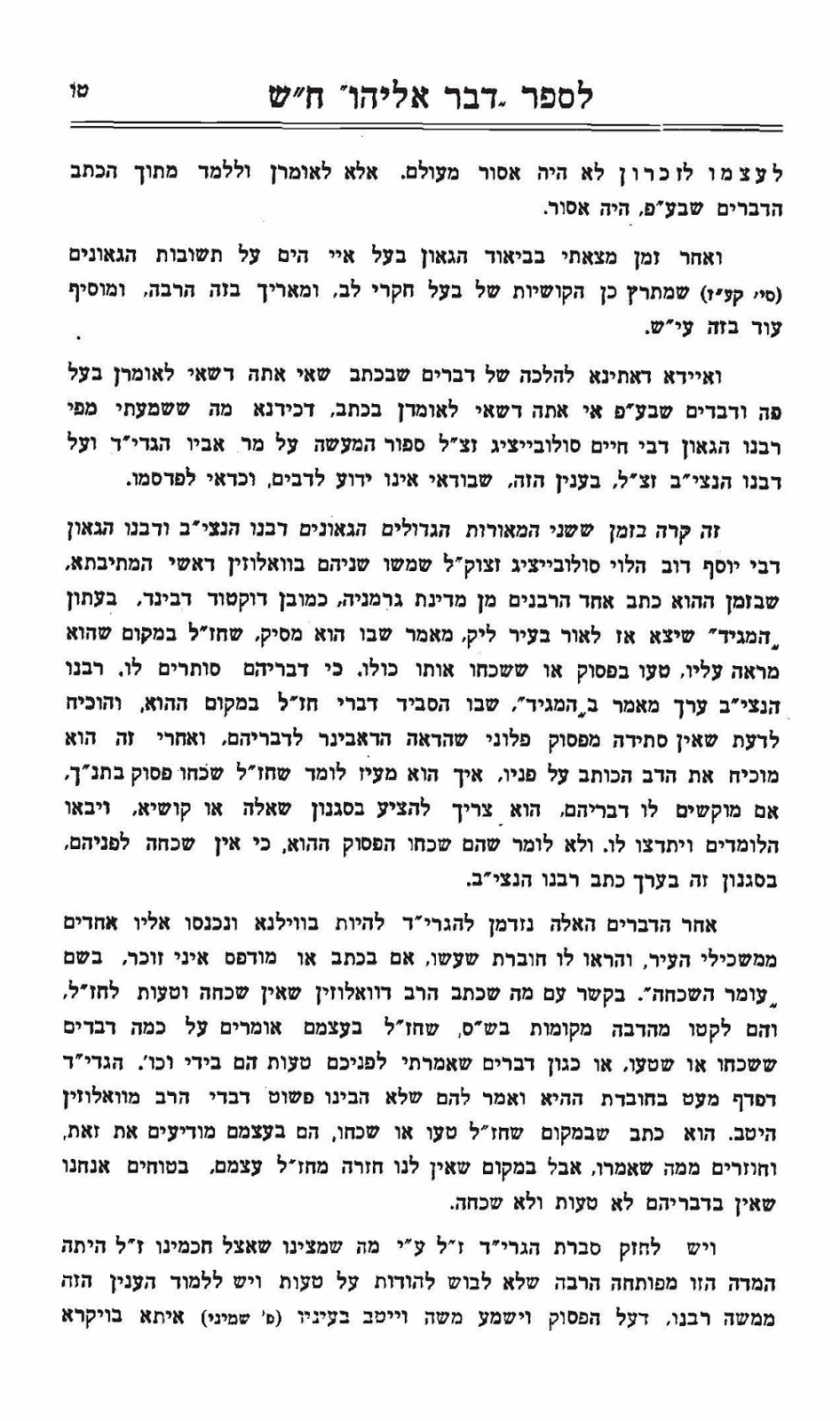
 In 1988, Artscroll published part of this book in English called ‘My Uncle the Netziv‘. Lakewood Cheder distributed it as a fundraiser. A few months later, the Cheder sent out a letter apologizing for having sent the book and recommended not reading it. The Cheder explained that there were statements in the book which did not represent the Hashkofos of the Netziv. Jacob J. Schacter, in his frequently quoted article “Haskalah, Secular Studies and the Close of the Yeshiva in Volozhin in 1892,[3] speculates as to which aspects of the book this letter was referring; was it the author’s description of the Netziv reading of newspapers on Shabbos?
There have been many articles written in the past about the Mekor Baruch, alleging plagiarism and the errors he made in his historical narrative.[4] Some have shown that quotes in his father’s name about Chabad are unreliable. In the present article, I do not wish to add to that. It seems unlikely that that Rabbi Epstein would publish fabrications regarding his uncle’s practices that were common knowledge.[5] His work received a glowing haskamah from Rav Kook; had R. Epstein penned outright lies about the Netziv, Rav Kook’s rebbe, it is   doubtful that he would have given such an approbation.
This assumption aside, we may adduce more concrete evidence as to the veracity of R. Epstein’s report. In 1888, when Rav Kook he was 23 years old, he published the first issue of a periodical entitled ‘Ittur Sofrim’.[6] This sefer had many impressive Haskomot from Gedolei Yisroel, among them the Netziv. The volume included a Teshuvah from the Netziv, where he writes:
במכה”ע… ולי נראה דודאי לעיין מותר בפשיטות
 Here is a copy of the actual Teshuvah of the Netziv:


 Later on in the same year (1888) Rav Zev Turbavitz in a letter to the Aderet, writes:[7]
כאשר הגיע לידי סי’ עיטור סופרים חלק ראשון נבהלתי מראות הלכה הראשונה בראשית הפעלים לתורה מהרב הנצי”ב מוואלאזין שחולק על הש”ע שאוסר גם העיון בשטרי הדיוטות בשבת… והארכתי בזה ובודאי נחוץ הוא להדפיסה כי בודאי רבים יפלו על המציאה הגדולה הזאת, ויתלה עצמן באילן גדול ויתפארו בעצמן שכתורה יעשו…
 He also wrote a letter to Rav Kook, where he says:
עיטור סופרים… והנה בפתחי אותו ראיתי ראשית אומרים בד”ת פסק הג’ הנצי”ב מוואלאזין, ונשתוממתי מאד ושלח דברים ע”פ חוצות לחלוק על הש”ע וכן הראשונים והאחרונים בדברים של מה בכך, ובפרט להקל באיסורי שבת… והאמת אגיד לכת”ר כי אם לא היה שמו של הנצי”ב חתום על דבריו לא הייתי מאמין שיצאו דברים אלו מפי בן תורה ומה גם מפי גדול. ונפלאתי על כבודו שנתן להם מקום עוד בראש דבריו…”.
R’ Chaim Berlin writes this about his father’s Heter in 1893:[8]
ועל דבר לעיין בשבת בהרהורא בעלמא בלי קריאה בפה באגרות רשות ובמכתבי העתים לא הי’ כלל דעת מר אבא הגאון שליט”א, לקבוע מסמרים בהלכה זו ככל דבריו שבעטור סופרים, ולא בא אלא ליישב מנהג העולם שקוראים במכתבי העתים בשבת שסומכים בזה על משמעות תלמודא דידן עפ”י דעתם, שמפרשים דתלמודא דידן פליג בזה על תלמוד ירושלמי, אבל להלכה גם הוא יודה דקיי”ל כהירושלמי, וכה”ג מצינו בהרבה מקומות שכתבו הפוסקים ליישב מנהג העולם, שסומכים על דעה יחידית אף שלא כהלכה.

Without going into his reasoning, it seems clear that the Netziv, permitted reading newspapers on Shabbos.
In 1894, The Shut Bikurei Shlomo was printed (with a Haskamah of the Netziv). The first Teshuvah is a letter the author wrote to the Netziv in 1890, commenting on his Heter to read newspapers on Shabbos, which was printed in ‘Ittur Sofrim’. The second Teshuvah is the Netziv’s response clarifying his heter. He did not back down from it.[9] Even more interesting is that the letter of  Rabbi Chaim Berlin, previously mentioned, is also to the author of the Shut Bikurei Shlomo.

Worth pointing out is, in the Netziv’s Meromei Sadeh to Shabbos [116 b, p. 94] he writes exactly as he does in Ittur Sofrim, he just does not add in the words ‘newspapers’. This clearly shows that he understood that this was the correct way to learn the Sugyah.


R. Meir Bar-Ilan also writes that his father, the Netziv permitted reading newspapers on Shabbos (Me-Volozhin LeYerushalayim 1:138). Apparently he did not agree with his brother, R’ Chaim Berlin.

The Shut Meishiv Davar

R. Meir Bar-Ilan writes about his father’s Teshuvot:

ולא עלה על דעתו לפרסם חידושיו הרבים על הש”ס ותשובותיו שהגיעו לאלפים. רק בסוף ימיו, כאשר הפצירו בו מאות ואלפי תלמידיו שיפרסם את תשובותיו, הסכים בקושי גדול להדפיסן בשם ‘משיב דבר’, ומפני שלא היה בידו העתקות מתשובותיו, כשם שלא נשארו העתקות משאר מכתביו, מוכרחים היו לקבצם משואלים שונים ולאספם ממקומות רבים. מתוך כך התשובות שנדפסו במשיב דבר אינן אלא חלק קטן מאוד ממה שהשיב… [מוולוזין עד ירושלים, א, עמ’ 138][10].

It is interesting to note that these two Teshuvot [from Ittur Sofrim and Bikurei Shlomo] about reading newspapers were not printed in this 1894 collection.

In 1993, a new edition of the Shut Meishiv Davar was printed with a fifth section, which includes a collection of 109 Teshuvot and articles by Netziv from various places, including manuscripts. Noticeably absent are both of the Netziv’s Teshuvot regarding reading Newspapers, from the Ittur Sofrim and Bikurei Shlomo.

In 2004, Eyal Mishulash was printed on the subject of reading Shtarei Hedyotot on Shabbos. At the end of the work [p. 240], he quotes a response from Shut Bikurei Shlomo and dismisses the opinion, based upon a Mordechai. The author does not bother telling you exactly who he is dismissing, namely the Netziv, which I believe is a problematic way to present facts; at the very least, mention that the author of the Heter is the Netziv. I feel certain that if the Netziv had forbidden it, his Teshuvah would have been printed prominently in the book.

It is worth noting that none of the various compilations dealing with this topic mention the Netziv’s Teshuvot. Even Rabbi Ovadiah Yosef, who discusses reading newspapers on Shabbos in Chazon Ovadiah, 6:70-73 [one of the last things he wrote], does not quote these Teshuvot.

Reading newspapers during the week[11]

Rabbi Epstein writes:

כל מערכות העתונים העברים כמעט, מאלה אשר במדינה ואשר בחו”ל היו שולחים עליו את העתוניהם השבועיים והירחונים… חנם אין כסף, והיו מעתירים אליו כי יחוננם בספורתו מן איזה מין שהוא… והיו עתים ומקרים שנענה להם; ולקריאה תמידית וסדורית היו לו העתנוים “המגיד” ו”הלבנון”… [מקור ברוך, ד, עמ’ 1794].

R Meir Bar-Ilan also writes the same (Me-Volozhin LeYerushalayim 1:138[12]):

כשהתחילו הצפירה והמליץ לצאת בכל יום והדואר בוולוז’ין היה מתקבל פעמיים בשבוע, וכל פעם באה חבילה שלימה של עתונים, היה אבא ז”ל מקפיד על כך, שאיש לא יקח ממנו גליון עתון, קודם שעבר על הכל.

He repeats this in his work Raban Shel Yisroel (p. 112).

Micha Yosef Berdyczewski writes in an article first published in 1886:

נצי”ב… אוהב תורה וחכמה, ומכתבי העתים שלא יקצצו בנטיעות ימצאו מהלכים בביתו… [מיכה יוסף ברדיצ’בסקי, כתבים, א, עמ’ 72]
 Another student of Volozhin writes in his memoirs about the Netziv:

 היה חותם על כל מכתב עת עברי וקרא בהם כמו ה’מליץ’, ה’צפירה’, ‘היום’, ‘המגיד’ ‘הלבנון’ ועוד [פרקי זכרונות, עמ’ 127].
In his memoirs about the Netziv, yet another student of Volozhin writes:

הגר”הל [הגאון ר’ הירש ליב] כידוע לא היה קנאי, היה גם מקוראי המליץ ואף ליודעי חן היה ביתו פתוח לקרות אותו.[13]

Similarly, Rabbi Moshe Shmuel Shapiro writes:

הנצי”ב עצמו היה מקבל בכל יום את הצפירה והמליץ [ר’ משה שמואל ודורו, עמ’ 62].
Censorship in the Meishiv Davar

Shaul Stampfer writes in his excellent book ‘Lithuanian Yeshivas of the Nineteenth Century‘ (p. 163) “Both R. Berlin and R. Hayim Soloveitchik read newspapers”. 

In a footnote he records the following:

“Rabbi Boruch Oberlander pointed out that, in the latest edition of R. Berlin’s Responsa Meshiv Davar there is a curious omission. The original reads ‘as published in Hamelits, 137 in 5687′ but in the new edition reads simply ‘as published in 5687’ (… Meshiv Davar ii. [p.]71 (responsum 8). Despite the omission in the current edition, it is clear that R. Berlin read newspapers.”[14]

My good friend Mr. Israel, upon reading this passage, consulted a copy of the first edition of Meishiv Davar, printed in 1894, and confirmed what Rabbi Oberlander said is indeed correct, the words ‘Hameilits etc.’ appear. However, when he checked another copy of  Meishiv Davar, also printed in 1894, he saw that the words ‘Hameilits etc.’ had been removed! Thus proving that this censorship took place already in 1894!

It appears that the Meishiv Davar was printed twice in 1894 and already there are differences between the two editions.

 The Mifal Bibliography Haivrit notes:

קיימות הדפסות סטיריאוטיפיות אחדות של ספר זה, ובכולן התאריך תרנ”ד. יש השמטות אחדות שונות בין הדפסה להדפסה.

 However, they do not write what the differences are, exactly. It seems we have uncovered one of them.[15]


Shmuel Glick, in his first volume of Kuntres Hateshuvot Hachadoshot, s.v. Meishiv Davar [p. 686 # 2498], does not make any mention of there being two versions of the 1894 editionHowever, in volume three [p. 1505], Glick notes that there are different editions of Meishiv Davar and while he does mention one difference between the two editions, he does not note this particular discrepancy. [See the end of the post.]

The story does not end here. When Mr. Israel turned the page to the very next siman in the Meishiv Davar, he again noticed the same occurrence. In one edition of the 1894 Meishiv Davar [p. 73, responsum 9] it says ‘Hameliits etc.’ and in the other edition, also printed in 1894, the word ‘Hameilits‘ had been removed!


Even more interesting is that these two Teshuvot originally appeared as articles in the Hameilits newspaper!!

Additionally worth pointing out, is another mention of Hameilits newspaper in the same siman [no. 9], which was not edited out from either 1894 edition:

אבל אם בעל נפש הוא עליו לבקש תחלה מחילה ברבים באותו מקום הוא המליץ…

[Presumably, those responsible for censoring the edition mistook the word to mean ‘advocated’, not the title of the newspaper]

Images five
In 1968, the Meishiv Davar was reprinted based on the 1894 edition that included the words ‘Hameilits etc.’.

 In 2003, a volume called Igrot HaNetziv Me-Volozhin was printed in Bnei Brak, including some letters on this same controversy [pp. 168- 174] [without saying where they are from[16]] with the words ‘Hameilits etc.’

Netziv and his Emek Ha-Netziv

Surprisingly, the story does not end here.

In an article written in 1887 by Rav Kook about the Netziv[17], he writes:
ובהיותו בן עשרים ושלש שנים כבר ראה לבו הרבה חכמה ודעת בכל מקצועות תורה שבעל פה ואז החל לכתוב ספרו הגדול על הספרי חמדה גנוזה עמו עד היום… הננו מעוררים בזה את כבוד הגאון שליט”א לזכות את הרבים מתופשי התורה בהוצאת הספר היקר הזה לאור עולם ולהאיר עיני רבים ממבקשי הדעת [כנסת ישראל, בעריכת ש’ ראבינוויץ, ווארשא תרמ”ח, עמ’ 140(=מאמרי הראי”ה, עמ’ 124)].

However, the Netziv’s Pirush on Sifrei,[18] entitled Emek Ha-Netziv was first printed from manuscript only in 1959-1969. In the first volume the Netziv quotes the “Zofeh Le-hamagid Year ten, issue 28″. Gil Perl already notes that this is the edition of the Ha -Maggid printed on July 17, 1867.[19] Although Perl noted other cases of censorship in the Emek Ha-Netziv, this source was not censored.[20] We see here clearly that the Netziv read newspapers and even referenced them in his work.

Netziv and his Ha’amek Davar                   
          
In 1879, the Netziv printed his classic work on chumash, Ha’amek Davar,[21] based on the Shiurim he gave after Davening.[22] In his Pirush to Parshat Bereishis (2:9), he quotes a manuscript of R’ Maimon (father of the Rambam) which he had seen printed in Ha-Levonon.

In 1937, Rabbi Meir Bar-Ilan printed a collection of almost one thousand and five hundred addenda by the Netziv to his Ha’amek Davar[23] [available here]. On page seven, Netziv quotes the newspaper Ha-tzefirah. Furthermore, Gil Perl points to some additional passages in Ha’amek Davar that seem to be based on material from the newspapers of the time.[24] From all the above, we see him reading newspapers.[25]


Censorship and the Ha’amek Davar

In 1999, a new edition of the Ha’amek Davar was printed incorporating many more corrections.[26] They inserted the numerous addenda published by Rabbi Meir Bar-Ilan into their proper places in the chumash. However two pieces were censored out – both of the aforementioned quotes by the Netziv,[27] citing these newspapers!

In 2005, Rabbi Mordechai Cooperman reprinted the Ha’amek Davar; with annotations, his edition does contain both newspaper references.


More on the Netziv and newspapers

In 2003, a volume called Igrot HaNetziv Me-Volozhin was printed in Bnei Brak this volume is full of references and articles by the Netziv from different newspapers of the time.[28]

In Meishiv Davar 1:44 there is a piece titled: “Al Yamin vsmal’.[29] This siman was actually first printed in the newspaper Machzike Hadat[30] and as can be seen from the introductory paragraphs, it was a response to an earlier article that the Netziv had read in that newspaper.

Appendix: Some other Gedolim who read Newspapers

Yitzchak Wetzlar writes in the introduction to his Libes Briv (written in the early 1700’s) about his work: “think of it as a Newspaper. Nowadays the finest and most important people, scholars and Rabbis read them or have them read to them”.[31]
For other Poskim who were known to have read newspapers, see: Rabbi Yakov Emden[32]; Rabbi Yosef Zechariah Stern [as anyone familiar with his writings knows][33]; Yakov Mark, BeMechitzosom Shel Gedolei Hador, p. 34; Roni Beer Marx, ibid, pp. 40-41 [about the Malbim and others]; Rabbi Yitzchak Nissenbaum, Alei Cheldi,[34]; Jacob Katz, With My Own Eyes, pp. 30-31;  Pinchas Sirkis, Ish HaEmunah, 1979, p. 82, 86; Jacob J. Schacter, ‘Facing the Truths of History’, Torah U’maddah Journal, 8 (1998), p. 225, 263-264 [about Rav Moshe Feinstein Zatzal]; Benny Brown, Hachazon Ish, 2011, p. 21 [about the Chazon Ish; who even quotes Ha-Tzefirah in his work on Orach Chaim 141:9].

A student of the forgotten gaon,[34b] Rabbi Moshe Nechemia Kahanov (1817-1887) [Rosh Yeshiva of Eitz Chaim[34c]] writes:

 ר’ משה נחמיה כהנא או ה’רבה’ מחסלביץ, ראש הישיבה, ידע את נטיתי להשכלה וקרבני על כך, שכן אף הוא היה נוטה בצנעה להשכלה ולמשכילים. בימים ההם אסרו על ה’חבצלת’ לבוא בקהל והרב מחסלביץ היה מקבל אותה מדי שבת בשבת מידי אני. בכל שבת אחר הצהרים הייתי סר אל הישיבה כש’החבצלת’ טמונה בחיקי, מוסר אותה לידיו והוא פורש לחדר קטן הנשען אל הישיבה וקורא בה. כפעם בפעם היה מוסר על ידי שלום לרי”ד פרומקין ומביע לו את ידידותו והוקרתו על השקפתיו של העורך. אוסר אני בכבלים היה מצדיק את הדין על עצמו חולני אני ואין בכחי לעמוד בפני התקיפים ממני [אפרים כהן רייס, מזכרונות איש ירושלים, עמ’ 54].

Worth pointing out is Binyomin Goldberg’s claim that even Rabbi Chaim Soloveitchik secretly read the Hameilits.[35]
Rabbi Moshe Bernstein,[36] Son in law of Rabbi Baruch Ber Leibowitz records the following story about Reb Baruch Ber:
משביקר הגאון ר’ משה סולוביציק, שהיה אז ראש ישיבת תחכמוני בוילנה, כיבדו בהגדת שיעור בישיבה, תלמידי הישיבה שהיו ברובם קנאים התנגדו לזה בכל תקף ובאו לומר לרבם כי הם ילכו מהשיעור הזה, הוא אמר להם כדברים האלה, ת”ל חוננתי בכח מיוחד שלא להאמין בדבר שאינו רוצה, לדידי אין הדבר אמת כלל, ידיד נפשו הגאון ר’ משה אינו כלל בישיבת המזרחי תחכמוני[37], אינו קורא עתונים ואינו מאמין להם, וככה אני יועץ גם לכם, התלמידים שמעו לקולו והקשיבו אל השיעור בנחת ובשלוה [הגיונות, עמ’ עב].
Another Great Gaon who read newspapers was Rabbi Eliyahu Klatzkin. According to his son Yakov, he subscribed to and read several papers in different languages.[38] In an incredible Teshuva of his regarding Tzar Balei Chaim Rabbi Klatzkin quotes numerous medical works in different languages and even newspapers, including The London Times and others papers in Russian and Yiddish.[39]

While Rabbi Moshe Zeirah, Yeshurun 15 (2005), pp. 753-776, refers to the Teshuva on Tzar Balei Chaim and Rabbi Eliyahu Klatzkin’s expert knowledge of science, he does not mention this point.[40]

Another person who read newspapers was Rabbi Shneur Zalman Me’Lublin,[41] author of the Shut Toras Chessed:

רבי ישראל דוד פרומקין שהיה ממעריצי הרב שלח להרב בכל יום ששי העתון חבצלת שהוציא לאור. לקח הרב סכין וחתך למעלה, שיהא נוח לקרות, הביט שניה אחת על העמוד הראשון וכן על השני וכן להלן רק איזה שניות, אחר כך לקח את העתון ופרש על המפה שעל השלחן, ועליו היתה הרבנית מעמדת המנרות של שבת שלא יטפטף מן החלב על המפה. חשבתי שאינו קורא כל הכותב בעתון, המכיל 8 עמודים שלמים, רק מעט בצד זה ומעט מצד שני, וכן הלאה. פעם בין מנחה למעריב, כאשר שכב על מטתו ושמע חדשות (כשאר הבאתי לעיל), ספר אחד חדשות מענינות, אמר הרב זה מדפוס בעתון חבצלת של שבוע זה, ואמר לי להביא את העתון שהיה מונח על האיצטבא. מסרתי לו, ותוך כדי דיבר פתח העתון והראה בעמוד פלוני שורה פלונית כתוב זאת. נשתוממתי שבמהירות כל כך קורא את כל העתון ובשניה אחת הראה איפה מודפס [שלשה עולמות, ב, עמ’ קמז-קמח].
Another person who read newspapers was Rabbi Elchanon Wasserman. The following passage appears on Rabbi Aron Sorasky’s book Or Elchonon [1: 27-28 and the second passage appears in the same book pp. 282-283]. In the English version adaption of this book printed by Artscroll called Reb Elchonon both passage appear uncensored [pp. 28-29, 216] [Thanks to my friend Eli Markin for this source]. 


Another additional point in all this is there were great Gedolim who wrote articles in some of these newspapers[41b] such as Rabbi Alexander Moshe Lapidus,[42] Rabbi Tzvi Hirsch Kalisher,[43] Rabbi Eliyahu Gutmacher,[44] Rabbi Shmuel Moholiver, [45]Rabbi Mordechai Eliasberg[46] and Rabbi Yechiel Yakov Weinberg.[47]
Just to conclude with one last story related to reading newspaper:

*Special thanks goes to my good friend Yisroel Israel for all his time and help in preparing this article. I would also like to thank my friend Rabbi Yosaif M. Dubovick for editing this article. 
[1] For general sources on censorship in Shut [Responsa] Literature see S. Glick, Kuntres Hateshuvot Hachadoshot, vol. 1,  introduction, pp. 58-67; ibid, E-Shnev leSafrut HaTeshuvot, pp. 259-290.
[2]  In the future, I hope to return to exploring other Heterim for reading newspapers on Shabbos. For now see: Herman Pollack, Jewish Folkways in Germanic lands (1648-1806), Cambridge 1971, pp. 168-169, 235, Daniel Sperber, Darka Shel Halacha, pp. 238-241. I also hope to return to the Netziv and his writings in a special series of articles devoted to him. It must be noted that “newspapers” in this context do not only refer to newspapers like the New York Times. The periodical literature read by the Netziv was not the Times and was not Hamodia. These were in many cases ideologically maskilic papers, and while they contained typical Torah articles, they *also* contained editorials and “academic Jewish” type stuff, and this is what the Netziv read and these are what he is talking about, quoting, etc.
[3] Torah u-Madda Journal 2 (1990), pp. 76-133
[4] See Rabbi Kirshbaum, HY”d, Zion Le-Menachem, New York 1965, pp. 251-265.
[5]  Many years ago I discussed the work Mekor Baruch with my Rosh Yeshiva, Rabbi Zelig Epstein Zatzal. He told me he that he had no problem believing this story by Rabbi Epstein or others that people had issues with. He mentioned that when he was learning in the Mir in Europe, he chipped in together with a few friends to purchase a set of Mekor Baruch. When I asked him specifically about this passage of the Netziv reading newspapers on Shabbos, he reiterated that he had no problem accepting its truth. He then told me that he once spent a Shabbos at Rav Dovid Tevil Dynovsky’s home whose daughter would read to him from a Yiddish newspaper. See Rabbi Nosson Kamenetsky, Making of a Godol, 2, p. 1178 who quotes the same anecdote regarding Rav Dynovsky, citing Rabbi Zelig Epstein.

Rav Dynovsky’s anonymously published sefer, Maamar Likrat Tzamei,[which is an attack on Zionism, Hertzl and the Mizrachi movement], is full of quotes from the various Hebrew and Yiddish newspapers of the time [see for example pp. 5, 6, 20, 26, 29, 30, 31, 35, 37, 40, 45, 46 49, 50]. 

Saul Leiberman considered Rav Dynovsky his main Rebbe [Making of a Godol, 2, p. 1189, based on an interview with Shraga Abramson]. Shraga Abramson who also learnt by Rav Dynovsky writes about Leiberman and Rav Dynovsky the following:

לא רחוק מעיירת מולדתו, מוטלה, היתה ישיבה קטנה שידועה היתה בשעתה, לפני מלחמת העולם הראשונה, זו ישיבת מאלטש, בראשה עמד אדם מיוחד: רב העיירה וראש הישיבה ר’ דוד טעבל דיינובסקי, הי”ד, מבעלי ההגיון שבלימוד התלמוד ומבעלי המוסר מן יסד ר’ ישראל סאלאנטר. היסוד שהונח לו לליברמן בישיבה זאת היינו, לימוד התורה ולימוד המוסר נשאר אצלו חזק בכל ימי חייו. וליברמן ידע את ההשפעה שהושפע בישיבה זאת, וזכר לה חסד נעוריו כל ימיו [לזכרו של שואל ליברמן, האקדמיה הלאומית הישראלית למדעים, ירושלים תשמ”ד, עמ’ 24-25].

For more information on this unknown Gaon see Rabbi Nosson Kamenetsky, Making of a Godol, 2, pp. 1174-1181.

Of course, it bears mentioning (as already noted On the Main Line [here]), Chief Rabbi Herzog’s words, The Jewish Chronicle, February 25, 1927: “On Sabbath morning, while turning the pages of my copy of the Jewish Chronicle, my eye caught under the caption Obituary notices the name of Rabbi Meir Simcha of Dvinsk…”.

See also Rabbi Yechiel Yaakov Weinberg, Kisvei Hagaon Rabbi Yechiel Yaakov Weinberg, 2, p. 396:

אחד מבני המשפחה הזאת הלעיז על הרב שהוא קורא עתונים בשבת.
[6]  I hope to return to this journal in a future article. Meanwhile, see Yehudah Mirsky, An Intellectual and Spiritual Biography of Rabbi Avraham Yitzhaq Ha-Cohen Kook from 1865-1904, PhD dissertation, Harvard University 2007, pp. 85-99. I am not sure why this volume [as far as I can see] did not make it to the Kuntres Hateshuvot Hachadoshot of Shmuel Glick.
[7] These letters were printed from manuscript in Moriah 23 (3-4) (1999), pp. 54-60 and more recently in a new edition of the ‘Ittur Sofrim’ printed in 2011, pp. 97-102.
[8]  Otzar R’ Chaim Berlin, Shut Nishmat Chaim, 4, (2008), p. 114; Shut Nishmat Chaim, Siman 24.
[9]   Rav Kook already commented about this Heter at the end of the first issue of the Ittur Sofrim. See also Shut Bikurei Shlomo siman, 3-4 for more on this topic. The Chasdei Dovid, 2, Jerusalem 1994, p. 149, on the related passage in Tosefta, is extremely important for this topic.
[10] See also Rabbi Shlomo Yosef Zevin, Ishim Veshitos, (2007), pp. 17-18;  Rabbi Moshe Shmuel Shapiro, R. Moshe Shmuel Ve-doro, p. 54.
[11] Of course, there were many Poskim who were against reading newspapers even during the week. See, for example, the Chofetz Chaim’s son, who writes:

מר אבא לא קרא עיתונים מעולם אף באותם שלא היה בהם מינות, ועגבים וליצנות ולא היה ניחא דעתו מקריאתי אני והיה אומר מה תמצא בעתונים רק צרות וצרות מבלי שאין בידינו להושיע, וידע אנכי זאת גם מבלעדי העתונים כי אין העולם הזה מקום של נחת וקורת רוח וכמו שאמר הכתוב… [דוגמא מדרכי אבי זצ”ל, עמ’ מג.]

See also the Michtavei Chofetz Chaim #42:

See also this passage:

And this passage:

           
See most recently: Divrei Chachomim, Bnei Brak 1975; Rabbi Kalman Krohn, Harchek Mei’aleha Darcheka, Lakewood 2012. See Rabbi Fuerst, Ir Hagoleh, 1, p. 476. See also Mi’pihem, p. 375.
[12] This passage appears in the original Yiddish version of the book Fun Volozhin Biz Yerushalayim, Chapter 12. See also Me-Volozhin LeYerushalayim p. 163.
[13]  Moshe Yuft, Reshumot V’zichronot, 1924, p. 10. This memoir is not found in Pirkei Zichronot, nor was it used by S. Stampfer in Lithuanian Yeshivas of the Nineteenth Century.
[14] This passage appears on page 179 of the Hebrew edition of Stampfer’s book.
[15]  See also Rabbi S. Gershuni, Hama’yan, 52:4 [202] (2012), p. 54 note, 22 who mentions this censorship about the Hameilits, but not that there were two editions of the 1894 printing.
[16]  It appears that there are additional letters about this same subject. See ibid, pp.163-168. For more on the controversy related to these Teshuvot, see Y. Mondshine, Zechor L’Avraham, (1999) pp. 374- 444 [also available here]. See also Igrot R. Yitzchak Elchanan, 1 (2004), pp. 266-267. See also S. Glick, E-Shnev leSafrut HaTeshuvot, pp.150-154.
[17] On this essay see Yehudah Mirsky, An Intellectual and Spiritual Biography of Rabbi Avraham Yitzhaq Ha-Cohen Kook from 1865-1904, PhD dissertation, Harvard University 2007, pp. 84-85. See also Rabbi Yitzchak Nissenbaum who wrote about this essay:
את… רבי אברהם יצחק הכהן קוק שמעתי זה כבר. בעודני צעיר קראתי את מאמרו ב’כנסת ישראל’ לשפ”ר על הנצי”ב מוואלוזין, וכתלמיד הישיבה, המחבב את רבו הזקן, נהניתי מאד מדבריו [עלי חלדי, עמ’ 188].
[18]  I hope to return to this incredible work in the future for now see the beautiful book of Gil Perl, The Pillar of Volozhin, Boston 2012.
[19] Gil Perl, The Pillar of Volozhin, Boston 2012, p. 32.
[20]  Ibid, and see here.
[21]  On this work see: Jay Harris, How Do We Know This?, pp. 239-244; Channah Katz, Mishnat Hanetziv, pp. 93-98; idem, Machanayim 4 (1993), pp. 380-387; Nissim Eliakim, Haamek Davar la-Netziv, Moreshet Yaakov 2003; Gil Perl, The Pillar of Volozhin, pp. 168-237; Rabbi Dov Leor, Aloni Mamrei, 121 (2008), pp. 73-85. For the dating of this work see: Gil Perl, ibid, pp. 169-171; Rabbi S. Gershuni, Hama’yan, 52:4 [202]. (2012), pp. 50-56.

On the Ha’amek Davar, see the article (quoted above) written in 1887 by Rav Kook about the Netziv where he writes:

בעת ההיא כתב גם כן ביאורו על התורה, אשר גם בו היתה לו האמת לקו והבקרת הנאמנה למשקלת יישר דברי חז”ל עפ”י הדקדוק בסגנון מליצת הכתוב…

In a letter to Dr. Eliyahu Harkavi the Netziv writes [I will hopefully return to the nature of their relationship in the future]:

וידעתי כי איני כדאי והגון להדפסה רחבה כזו, ומה אני ומה כחי להוציא לאור ביאור פרוס על חמשה חומשי תורה, וגם בפעלת ההדפסה רבה אשר הגיע עד חמשת אלפים רו”כ, ובחיי ראשי כי לא הי’ מכן בידי גם מאה רו”כ, אך יד ה’ והשגחתו הפרטית הי’ עמדי בזכות הישיבה הק’ שאני מוסר נפשי עליה, והטה דעת המדפסים להדפיס בהקפה יותר משלש אלפים רו”כ… [שנות דור ודור, ב, עמ’ קפג-קפד (=אגרות הנצי”ב, עמ’ לא)].

See also Igrot HaNetziv Me-Volozhin, p. 214.
[22]  The subject of these shiurim was not dealt with in the excellent book of S. Stampfer, Lithuanian Yeshivas of the Nineteenth Century or in the volume Toldot Beis Hashem B’Volozhin,.

On these shiurim See the Netziv who writes:
וזכות הרבים עמדה לי שפירשתי בכל יום הפרשה לפני היושבים לפני ה’ בית התלמוד עץ החיים אשר נטע אביר הרועים הגאון מהור”ח זצ”ל [קדמת העמק, אות ה].
In the article (quoted above) written in 1887, by Rav Kook about the Netziv he writes:

בהנהגת הישיבה… גם הרגיל אותם לשנן פרשה אחת בכל יום מפרשת השבוע ויער אזנם למוסר לדעת איך ללכת נגד החיים…”.

See also Pinchas Turberg’s picturesque description of the scene when at age fourteen he first walked in to the Volzhiner Yeshiva on a Friday morning:

בבוקר,… השכמתי לקום וברוח סוערת מהרים לבית הישיבה., הרושם שעשה עלי הבית הגדול… כל זה אי אפשר לתאר באומר ודברים. הרגשתי את עצמי כאלו נכנסתי לתוך עולם אחר… ביחוד משך אליו את העין איש זקן בעל פנים מאירות ועינים טובות ומלטפות, שישב מעוטף בטלית ומעוטר בתפלין ולמד לפני תלמידים פרשת השבוע. הזקן הזה היה ראש הישיבה, הנצי”ב שלמד את שעוריו בחומש לאחרי תפלת שחרית [כתבי פינחס טורברג, ניו יורק תשי”ג, עמ’ קלא (= פרקי זכרונות, עמ’ 195)].
Rabbi Yitzchak Nissenbaum writes in his beautiful memoirs:

זמן מה הייתי שומע גם את שעורי הנצי”ב בחומש, שהיה מטיף אחרי תפילת השחרית [עלי חלדי, עמ’ 45 (=פרקי זכרונות, עמ’ 103].
In an article comparing the Netziv and Rabbi Chaim Soloveitchik, Rabbi Yitzchak Nissenbaum writes a bit more:

הסבא יושב בכל יום ויום אחר התפילה ומטיף לפני התלמידים פרשה בתורה מסדר השבוע, וכה הוא לומד ומלמד במשך השנה את כל חמשת חומשי תורה, עד שנולד לו באורו הידוע ‘העמק דבר’. והנכד חושב כי תורה שבכתב ניתנה רק לתינקות של בית רבן טרם שהגיע זמנם ללוד את תורה שבעל פה” [הצפירה, ו’ תשרי תרע”ט גלי’ 37 עמוד 9].

 Micha Yosef Berdyczewski writes:

תפילת שחרית בציבור בשעה 8 בבוקר… ורבים יישארו לשמוע פרשת השבוע מבוארת מפי הרב הגאון ר’ נצי”ב שליט”א על פי דרכו ביאורו הנפלא, הנוטע בקרב לב השומעים רגשות יקרות ואהבת אלקים ואדם. [מיכה יוסף ברדיצ’בסקי, כתבים, א, עמ’ 73 וראה שם, עמ’ 71, 196]

See also Rabbi Meir Bar-Ilan, Me-Volozhin LeYerushalayim pp. 112-113; Pirkei Zichronot, p. 127, 172; Rabbi Moshe Neryah, Toldot HaNetziv, pp. 13-14; Rabbi Moshe Shmuel Shapiro, R. Moshe Shmuel Ve-doro, p. 41, 72; Moshe Tzinovitz, Etz Chaim, p. 235. See also Binyomin Goldberg’s peculiar claim that the general consensus towards the Netziv’s Chumash Shiur was indifference, at best. This passage can be found in Zichron LeAchronim, 1924, p. 21. This book is extremely rare and there is no copy of it in Jewish National Library. Special thanks to Professor Shaul Stampfer for providing me with a photo-copy.
Chumash was learned in Volozhin in the times of Rabbi Chaim Volozhiner and Reb Itzeleh Volozhiner. See: Rabbi Yechiel Yaakov Weinberg, Kisvei Hagaon Rabbi Yechiel Yaakov Weinberg Zal, 2, p. 217; Dov Eliach, Avi Hayeshivot, 2012, pp. 460-462; S. Stampfer, Lithuanian Yeshivas of the Nineteenth Century, p. 42; Toldot Beis Hashem B’Volozhin, p. 63;M. Breuer, Ohalei Torah, pp. 122-123; Shlomo Tikochinski, Darchei Halimud Beyeshivot Lita Bimeah Hatesha Esreh, MA Thesis (Hebrew University, Jerusalem, 2004), p. 34.

In Pirkei Zichronot [p.84] we find a claim from Shmuel Zitron that R. Yehoshua Levin gave a chumash shiur using Mendelsohn’s Biur. However, S. Stampfer [ibid, p. 68] already notes that Zitron’s memoirs are not always accurate.

On Chumash being part of curricula in Yeshivot, see M. Breuer, Ohalei Torah, pp. 118-123. I hope to return to this subject in the future.
[23] The Netziv was always working on adding to this work, In a letter, he writes:
ויאמין לי מעלתו כי נכספתי מאוד לשוב ולהדפיס החומשים עם העמק דבר, כי רבים מבקשים אותם ממני, וגם יש לי הוספות הרבה, אבל אין לי עצה להשיג הוצאות הדפסה… [פרשגן, תרנ”ט ראש הספר].

This letter is also printed in Igrot HaNetziv Me-Volozhin (p. 41) without citing its source.

See also the following interesting letter from the Netziv to Rabbi Eliezer Lipman Prins:

ובכלל אענה על תרעומת מע”כ שקצרתי בלשוני כ”כ כי טוב הוא להתחוקק בראש למי שחפץ להבין ולהשכיל. ובכ”ז מודה אני שיש מקומות שקצרתי יותר מהנדרש וכשאר יזכני ה’ ברחמיו לשוב ולהדפיס החומשים עם באור העמק דבר אי”ה אראה לתקן הלשון באיזה מקומות. לבד אשר אשית נוספות הרבה אשר זכני ד’ לדקדק בלשון המקרא. אך עתה קצרה ידי לשוב ולהדפיס משום חוסר מעות. [פרנס לדורו, עמ’ 208-209].

Worth noting is that the 1999 edition quotes this letter in the beginning of their edition, without giving the source. They also print the whole letter in the back of the volume of Ha’amek Davar on Shemos (p. 21), without referencing the source. This letter is also printed in Igrot HaNetziv Me-Volozhin  (pp. 34-35) without citing its source.
The Aderet writes when he first met the Netziv:

העירותיו כמה דברים בביאורו על התורה שהיה מגיהו אז להדפיסו מחדש (סדר אליהו, עמ’ 85).

See also Rabbi Eliezer Lipman Prins’ notes on the Ha’amek Davar, printed in his Parnas Ledoro, pp.241-256.
[24] Gil Perl, ibid, p.81, 176-177. Rabbi S. Gershuni, Hama’yan, 52:4 [202], (2012), p. 54 points to further evidence in the Ha’amek Davar that the Netziv read newspapers.
[25] On this work see the excellent introduction by Rabbi Meir Bar-Ilan [of course it’s not included in the newer editions]; Rabbi Shlomo Yosef Zevin, Ishim Veshitos, (2007), pp. 23-26.
[26]   See what they write in the back of the first volume of Ha’amek Davar.

מהדורה מתוקנת המופיעה לראשונה, אשר בו אלפי תיקונים והוספות שהגיהם והוסיפם מרן הגהמ”ח זיע”א בכתב יד קדשו על גליוני החומש עם פירוש העמק דבר שהו”ל בחייו בשנות תרל”ט תר”מ. חלק גדול מההספות כבר נדפס בשנת תרח”ץ בסוף החומש, ועתה זכינו בס”ד להשלים את כל ההוספות וההגהות שנמצאו על גליוני החומש בכתי”ק, וכן לעוד הרבה תוספות מהעתקה אחרת שנערכה גם על מנת לשלב את ההוספות והתיקונים להפירוש.
I just started to compare the editions and noticed many new pieces. For example in the Introduction of the Netziv to the Ha’amek Davar called Kadmus Ha’amek there are over 20 new lines of text added in different places. In the famous introduction of Netziv to Chumash Bereishis over 6 new lines of text were added. I will hopefully return to all this in the future.
My problem with this edition is that although it’s amazing to have all these new pieces it would have been helpful for one to be able to see what’s new and what’s old. I would have suggested that they use different fonts, one for the original work, one for the 1500 additions from Rabbi Meir Bar Ilan and one for the new material that they added. Similar to the style found in the Eshkol edition of the Siddur of Rabbi Yakov Emden which allows the reader to see easily what is being added. For a different criticism see what Rabbi Mordechai Cooperman writes in the introduction to his edition of the Ha’amek Davar.

For an interesting discussion relating to this edition, see the back and forth which took place in some recent editions of the journal Hamay’an: Rabbi Avraham Glanzer, Hama’yan, 52:3 [201], (2012), pp. 94-95; Rabbi S. Gershuni, Hama’yan, 52:4 [202], (2012), pp. 50-56; Rabbi Dovid Shapiro, Hama’yan, 52:4 [203]. (2013), p. 103, Although, Rabbi Shapiro deals with an issue of the editing of the new Ha’amek Davar, he does not talk about the censorship of the Netziv’s newspaper reading. 

[27]  Rabbi S. Gershuni, Hama’yan, 52:4 [202]. (2012), p. 53 also points to the censorship.
[28] Hacarmel: p. 21; Ha’maggid: p. 54, 198; Hameilits: p. 60, 113, 114, 140, 147, 168, 170; Ha-Tzefirah: p. 112, 120, 133, 134, 140,141. See also Mekor Baruch, 4, pp.1795-1796 what he brings from the Netziv about the fighting between the Ha’maggid and  Ha-Levanon.

However in regard to the Newspaper Ha’Shachar he writes to Dr. Eliyahu Harkavi:

עוד בקשתי.. וכן ראיתי באיזה עלה עת שמעכ”ה מעריך דברים בעלה השחר, מבוקשי אם אפשר לשלחם לי כל היוצא, בלי עלה השחר, המשחיר את כבוד התורה וכל קדושיה עמה, וכי יבוא דברי מע”כ אלי וכבדתים להביט בדבריו [שנות דור ודור, ב, עמ’ קפד (=אגרות הנצי”ב, עמ’ לב)].

On these newspapers in general see: E.R. Malachi, Mineged Tir’eh, pp. 17-121; Gideon Kouts, Chadushot V’korot HaYamim, Tel Aviv 2013; Dovid Tal, Yehuda Leib Kantor, Tel Aviv 2011, pp. 367-370; Roni Beer Marx, Between Seclusion and Adaption; The Newspaper Halevanon and East European Orthodox Society’s Facing Up to Modern Challenges,(Heb.)PhD. Dissertation, Hebrew University, 2011.
[29]  On this essay see Y. Rivkin, HaNetziv Viyichuso L’Chibbat Tzion, 1919, pp. 7-9; Rabbi Moshe Shmuel Shapiro, R. Moshe Shmuel Ve-doro, p. 63; Moshe Tzinovitz, Etz Chaim, p. 236; Gil Perl, ‘No Two Minds are Alike: Tolerance and Pluralism in the Work of Netziv’, Torah U-Maddah Journal, vol. 12, pp. 74-98.
[30]  On this newspaper see: Joseph Margoshes, A world apart, A memoir of Jewish Life in Nineteenth Century Galicia, p. 14, 25-27; Rachel Manekin, The Growth and Development of Jewish orthodoxy in Galicia, The “machsike hadas” Society 1867-1883, PHD, Hebrew University 2000.
[31] [(English translation of Yiddish) The Libes Briv of Isaac Wetzlar, edited and translated by Morris Faierstein, p.43 (see also p. 13)].

For some sources of regular people reading Newspapers see Yakov Mark, BeMechitzosom Shel Gedolei Hador, p. 28; Pirkei Zichronot, p. 256 [In Telz]; Joseph Margoshes, A world apart, A memoir of Jewish Life in Nineteenth Century Galicia, p. 45, 47; Mah Shera’Iti [Zichronotav shel Yechezkel Kotik], p. 184, 297; Chaim Hamberger, Sheloshah Olamot, 2, pp. 40-41; Mi’pihem, p.273. See also M. Zalkin, Be’alot Hashachar, pp. 255-261.
[32] Rabbi J.J. Schachter, Rabbi Jacob Emden: Life and Major Works, PhD. Dissertation, Harvard University, 1988, p. 614; Maoz Kahana, ‘An Esoteric path to Modernity Rabbi Jacob Emden’s Alchemical Quest’, Journal of Modern Jewish Study (2013) 12:2, p. 271 note 70.
[33] See also Rabbi Zev Rabiner, Harav Yosef Zechariah Stern, 1943, p. 24.
[34]  pp. 56, 73-74, 76, 78, 87, 128, 132, 137, 165, 167, 196, 318.
[34b] The Mishna Berurah quotes his work Netivot Sholom numerous times in Hilchot BishulSharei Tzion (318: 55, 57, 58, 61, 62).
[34c] About him see Avraham Lunz, Netivot Zion VeYerushlayim, pp. 208-209 [who was a talmid of his]; Rabbi Betzalel Landau, in the back of Sifsei Yeshai​nyim, pp. 35-58; Pinchas Gr​ie​vsky, Zichron Lechovvim Harishonim, 8, pp. 391-413; Rabbi Yechiel Michel Tycosinski, Luach Eretz Yisroel, 1, pp. 163-167 [=Chatzer Churvos Rebbe Yehudah Hachassid, pp. 48-53] Yosef Salamon, ‘The Etz Chaim Yeshiva in Jerusalem at the time of Moshe Nechemiah Cahaniu (1866-1887)’,  Yeshivot Ubatei Midroshot, pp.187-197. I will hopefully return to this Gaon in the second part of this post.
[35] See his work Zichron LeAchronim, 1924, p. 6. This passage is quoted in Shaul Stampfer ‘Lithuanian Yeshivas of the Nineteenth Century‘, p. 163. See also Rabbi Nosson Kamenetsky, Making of a Godol, 1, p.459 & vol. 2, p. 917 for a possible explanation as to why Rabbi Soloveitchik read the paper.
[36]  About him see Li’frakim, pp. 156-157.
[37]  However see Rabbi Yitzchak Nissenbaum who was one of the people who ran this Yeshiva who writes:
תכחמוני… כאשר נמנה אחר כך הרב רבי משה סולוביייציק לדירקטור הערכה כבר תכנית ללמוד גפ”ת ובתוכם כבר הובא איזה סדר… [עלי חלדי, עמ’ 344] [וראה: אגרות הרב ניסנבוים, עמ’ 243].
[38] Notrei Morshet, pp.157-169, for a more complete version of this article see Yaakov Klatzkin, Kesavim, pp. 304-320.
[39]Imrei Shefer, Siman 34, pp. 72-73. See also Shnayer Z. Leiman, Rabbinic Responses to Modernity, Judaic Studies 5, 2007 pp. 116-118.
[40] For more on Rabbi Eliyahu Klatzkin, see Rabbi Amram Blau, Heichal Habesht 34, (2013), pp. 159-160.
[41] About him see: Chaim Hamberger, Sheloshah Olamot, 2, pp. 141-158; Yitzchak Shirion, Zichronot , pp. 43-45; Chachmei Polin, pp. 350-353; Igrot Baal Ha’Toras Chesed edited by Y. Mondshine; Y. Chananel,  Ha’Gaon Me’Lublin.
[41b] See: Yakov Lipshitz, Zichron Yakov, 2, pp. 15-19, 99-116; Roni Beer Marx, Between Seclusion and Adaption; The Newspaper Halevanon and East European Orthodox Society’s Facing Up to Modern Challenges,(Heb.)PhD. Dissertation, Hebrew University, 2011; Marc Shapiro, Between the Yeshiva World and Modern Orthodoxy, pp. 38-41.
[42]  See Toras Ha’Goan Rebbe Alexander Moshe, pp. 583-592. See also Yakov Lipshitz, Zichron Yakov, 2, p. 99.
[43]  Many of them are collected in Y. Klausner, Ketavim Tzioni’im, Jerusalem 1947.
[44]  Many of them are collected in Succos Shalom, Jerusalem 1990; see for example pp. 31-33, 43, 49, 60, 61, 65, 75, 91, 95, 96, 101, 151, 159, 168, 172. 
[45] Yakov Mark, BeMechitzosom Shel Gedolei Hador, pp. 197-198
[46]  Shevl Ha’zahav, p. 17; Yakov Mark, BeMechitzosom Shel Gedolei Hador, p. 141, 146; Rabbi Bezalel Naor, The limit of Intellectual freedom, the Letters of Rav Kook, pp. 179-180.
[47] See Marc Shapiro, Between the Yeshiva World and Modern Orthodoxy, pp. 23-26.


A Look at Makhon Moreshet Ashkenaz’s New Journal: Yerushateinu

A Look at Makhon Moreshet Ashkenaz’s New Journal: Yerushateinu
By Eliezer Brodt

There is a new journal published by מכון מורשת אשכנז titled ירושתנו. This מכון is well known for producing some excellent works, amongst them זכרונות ומסורות על החת”ם סופר and the four volumes ofשרשי מנהג אשכנז . This journal they promise to put out once a year but only time will tell, as anyone familiar with this מכון knows; they do great work but it takes forever for the seforim to come out. Many reasons have been given as to why that is so (money amongst them) however, the main reason I feel is because they strive for perfection – which is the biggest mistake many make as the משנה in אבות says לא עליך המלאכה לגמור.

With this in mind I would like to review this work (not in-depth so as to keep your interest). There are articles on all topics – basically whatever your interest you’re sure to find something there.

This sefer has about thirty articles including many articles which include hereto unpublished Torah from the great גדולים of אשכנז.

Amongst them from the בעל חינוך בית יהודא ,ערוך לנר ,רב הירש ,רב עזריאל הילדסהימר ,ר’ יונה מרצבך and ר’ דוד הקשר. There is an in-depth discussion as to the שיעור מיל according to the קליר between ר’ יצחק אדלר and ר’ יונה מרצבך. For those interested in poetry there is a great piece from the מהר”ם מרוטנברג on חנוכה which includes many interesting things about חנוכה. There is another article on the זמר of דרור יקרא and a piece on שירה during davening in general.

There are a few articles on contemporary halakhic issues such as הגעלת כלים from the בעל שמירת שבת כהלכתה and on יארצהייט when it’s a leap year.

Besides this there are about six articles on מנהגים all of the articles just whet one’s appetite – leaving one feeling that suddenly they took the משנה of שלא עליך המלאכה לגמור too far. For instance, one article discusses the custom of waiting between milk and meat is an extreme example of having too little information. I and many others were waiting for an exhaustive article on the topic – this is not it. Even the article from the generally great ר’ בנימן שלמה המבורגר (the author of the works שרשי מנהג אשכנז), discussing קדיש after קריאת התורה, leaves us feeling teased. We are used to much more from such an expert on מנהגים. He probably wants to save it for his own works שרשי מנהג אשכנז – which we are anyway long overdue for another one.

There are, however a few stand out articles. There is an important article from Professor יעקב שפיגל, whose articles and books are consistently excellent, discussing the בית יוסף’s usage of ראשונים – specifically which editions the בית יוסף had in front of him. שפיגל covers, among others, the שבלי הלקט and the sefer אגור. This is very important in fully understanding the בית יוסף in general and his sources.

After שפיגל’s article there is a much talked about article from ר’ מרדכי הוניג. This article is a review of a recent printing of the ספר חסידים החדש from the nephew of the רא”ש, sometimes referred to as the ספר המשכיל. This sefer has many many interesting things on many topics many of whichר’ הוניג is kind enough to point out – he has extensive comments from a wide range of sources. One can only hope that one day he puts out this sefer with all his notes and the many more I am sure he could have put in this article of 45 pages. Perhaps he was keeping with the above themeלא עליך המלאכה לגמור.

After that there is an article, from ר’ יחיאל גולדהבר, on ר’ עזריאל הילדסהיימר during his time in אייזנשטט. Although the article is good, it appears he missed out on one important source from ר’ עזריאל הילדסהיימר’s daughter all about her father. See Gertrude Hirschler and Shnayer Z. Leiman, “Esther Hildesheimer Calvary: The Hildesheimers in Eisenstadt,” Tradition 26:3 (1992): 87-92.

After that there is an extensive article on the life of ר’ יוסף אלטמאן including many items from rare German newspapers.

The articles conclude with a short piece from ר’ אברהם סולומון about a future edition of דברי קהלת from שלמה גייגר that he plans on publishing. דברי קהלת is, of course, an extremely important source for מנהגים and anyone familiar with the sefer will definitely understand the great necessity for such a job as it’s a very hard sefer to use but one could only hope that the authors dream comes true and he is able to put out the work as he intends to.

Finally, the inaugural issue of ירושתנו also includes a לוח השנה של מנהגי בית הכנסת לבני אשכנז בארץ ישראל and two articles in English.


Ghosts, Demons, Golems and their Halachik Status

One explicit mention of a ghost appears in the Talmud Ketubot 103a. The Talmud records that every week Rebbi used to return to his house after he died. The Talmud, however, does not record what Rebbi used to do when he came back. The Sefer Hassidim states that Rebbi was different than other dead people in that he was considered almost fully alive. Rebbi, according to the Sefer Hassidim, would make Kiddush for his family.[1]

A much later instance of an interaction with a ghost is found in R. Pinchas Katzenellenbogen’s (1691-1765/1767) Yesh M’Nechalin. R. Katzenellenbogen happened across a man who had the last two of his fingers bent back and connected to his palm. R. Katzenellenbogen inquired whether the man was born that way. The man explained that he was not and instead this happened when he had attended a fair. There were hundreds of people in a large room preparing for the next day’s events. Suddenly, the door of the room opened on its own. Standing at the doorway was a women dressed in tachrichim (death clothes). One person, screamed that it was his dead mother. Someone got up and slammed the door shut only to have the door open by itself again with the woman standing there. This man then went and pushed the “ghost” and from that day on his fingers were permanently connected to his palm.

Continuing on the theme of dead or other beings which interact with those still alive, we come to a rather strange question which has occupied the minds of many people for the last 800 years. The question is what is the status of someone who has intercourse with a demon? The first to mention this question is R. Isaac of Vienna (1200-1270) in his work Or Zarua. He states that intercourse with a demon is halackically meaningless. He cites a midrash which has a hassid (pious one) who was seduced by a demoness on Yom Kippur. Afterwards he felt very bad about this, but Elijah the Prophet visited him and asked him why he was sad. After the hassid explained what happened Elijah said don’t worry it was only a demon. The Or Zarua therefore says as Elijah appeared to him and he told him it was ok, intercourse with a demon is not a problem.

Now, the Or Zarua was not addressed at an actual question, however, R. Meir of Lublin (1558-1616) was asked about an “actual” case where a woman had intercourse with a demon and thus could she remain married to her husband. Although R. Meir was unaware of the Or Zarua he independentally came to the same conclusion – she was still permitted to remain married as intercourse with a demon has no effect. Least one say this is all in the realm of theory or not followed, the Beit Shmuel the classic commentary on Shulhan Orach Even haEzer quotes this law of R. Meir of Lublin (Even haEzer 6:17).

The question of intercourse with a demon seems to have come up without respect to the local or time period. R. Hayyim Yosef David Azulai (Hida) discusses “groups of women who go out to the forest” and conduct rituals with music and it seems they were visited or engaged in intercourse with demons. The Hida follows the ruling of R. Meir of Lublin and permits these women.

In Hungary in the 19th century there was a celebrated case where a woman became pregnant while her husband was away and she claimed the “father” was a demon. It appears the child was not deemed a mamzer (bastard) and the woman was allowed to remain married.

Now, there were some who questioned this whole line of reasoning and said that if one engages in intercourse with what appears to be human even if they are a demon it is of no moment. Thus, a married woman would be prohibited to remain married. The first to come to this conclusion was R. Yitzhak Binyamin Lipman (17th century) in his Nahlat Binyamim. Additionally, R. Yosef Zechariah Stern says if one follows the above rulings, what is stopping anyone who commits adultery to just claim it was a demon.

Moving on from demons, we now go to beings created via the Sefer Yetzirah. The Sefer Yetzirah (Book of Creation) is a work which allows via manipulation of various names of God to create things. Many have dealt with the halakhic status of such creations. For instance, R. Meir Leibush (1809-1879) in his work the Malbim says the reason Abraham was able to give the angels milk and meat together was Abraham did not give them meat from a born cow. Rather, the Malbim points to the verse which says “the calf which he [Abraham] made.” Malbim explains the words “he made” are literal, i.e. Abraham created the calf via the Sefer Yetzirah and thus was able to feed them both this meat and milk at the same time.

R. Isaiah Horowitz in his work Sheni Luchot HaBrit (Shelah) similarly understands the controversy between the brothers and Joseph. Specifically, Joseph, according to some Midrashic sources three negative things about the brothers – they at ever min ha-hai, they engaged in intercourse with Canaanite females and they embarrassed the children of the servants. The Shelah explains all three were based upon the Sefer Yetzirah. He explains that the Sefer Yetzirah was written by Abraham and passed on to Isaac and then to Jacob. The brothers, however, felt the sons of the servants were not worthy of such an important work (thus speaking ill or embarrassing them). Additionally, the brothers acted on the book and created animals which they ate from before killing them as there was no need being they were created via the Sefer Yetzirah. Further “it is possible that the tribes [the brothers] had created a woman” and it was these things Joseph saw and misunderstood to be regular beings. Again, according to the Shelah, intercourse or otherwise with beings from other worlds pose no halakhic issues. It is not surprising the Shelah took this position as the Shelah’s teacher was R. Meir of Lublin the one who permitted the woman who had intercourse with a demon to remain married.[2]

Perhaps the brothers were not the only ones to make women for this purpose, it is recorded (albeit much later) that R. Solomon Ibn Gabriol (1021-1058) created a woman to “serve” him. But, when the authorities found out he was forced to show it was merely wood and not a person.[3]

At the end of the forgery Niflot HaMaharal (the most comprehensive source for the false legend the Maharal of Prague created a golem) there is a discussion of various aspects of a golem. For instance, whether a golem would create impurity after it was “killed” (it would not) and the like. In regards to intercourse they state that “a golem can not reproduce nor does it have desires for the opposite sex.” It would seem that in the Paul Wegner 1920 silent movie classic “Der Golem” he disagreed with that premise. Part of the plot line is the Golem falling in love with the Maharal’s daughter; the nobleman’s son also does and she in fact runs off with him only to have the Golem rescue her. (It seems the Simpsons also follows with a similar plot line.)

As a final note, it is worthwhile mentioning that going the route of trying to connect with the other world does have it perils. R. Yaakov Ettlinger, in his Binyan Tzion describes a case where a woman met a man who told her he was Elijah the prophet and through their union the Messiah would be produced. The woman believed him, only to find out after the fact the person was con man. R. Ettlinger deals with whether in such a case she can remain married to her husband. So, ultimately one should make certain they verify the credentials of any demon, golem or ghost prior to engaging in any questionable acts.

Sources: Yesh M’Nechalin, 267-68; Hannah Sprecher, “Diabolus Ex-Machina: An Unusual Case of Yuhasin” in Jewish Law Association Studies VIII: The Jerusalem Conference Volume, 183-204; J.H. Chajes, Between Worlds: Dybbuks, Exorcists, and Early Modern Judaism (who although discusses the topic of intercourse with a demon appears to have been unaware of Sprecher’s article which contains many more sources than Chajes cites or discusses); Moshe Idel, Golem, esp. pp. 213-241 (which was reprinted almost in its entirety in a Torah u-Madda Journal 9 (2000) article by Dr. John Loike available here (PDF); R. Yudel Rosenberg, Niflot HaMahral (Pitrokav, 1909), pp. 71-74; R. Yaakov Ettlinger, Binyan Tzion, no. 164; Shnayer Z. Leiman, “The Adventure of the Maharal of Prague in London; R. Yudl Rosenberg and the Golem of Prague,” Tradition 36:1 (2002): 26-58; see also the account in Kav Ha-Yashar from R. Moshe Koidonover, translated by Zinberg, A History of Jewish Literature, vol. 6, pp. 161-63.

[1] See the discussion in the R. Reuven Margulies edition how he could have been motzei them if he was dead. Sefer Hassidim, no. 1129.

[2] Interestingly, Idel in his book Golem, appears to have been unaware of the connection between the Shelah and R. Meir of Lublin.

[3] In the halakhic realm, most are already familiar with the well-known question first posed by R. Tzvi Ashkenazi and elaborated on by his son R. Ya’akov Emden, whether a golem could be counted for a minyan (quorum).


Kitzur Shelah, Sabbatianism, and the Importance of Owning Old Books

R. Jacob Emden, in his Torat haKenot claims a well known and fairly popular book is written by a Sabbatian (a follower of the false-Messiah Sabbatai Zevi). This book, Kitzur Shelah, authored by R. Yehiel Michel Epstein, which although its title implies is merely an abridged version of the Shelah (Sheni Luchot HaBrit) by R. Isaiah Horowitz, is much more than that. While the Kitzur Shelah does include some content from the larger Shelah it also includes much else which appears no where in the Shelah. Perhaps the most well-known custom to come out of the Kitzur Shelah is the custom to recite a verse which beginning and end letters of the verse correspond to the first and last letters of ones name. (Although this does have another source as well, the Kitzur Shelah is the first to include actual verses and it is those verses which appear in the siddurim.)

R. Emden claims that R. Epstein makes a reference to Sabbatai Zevi in the Introduction to the Kitzur Shelah. R. Emden’s exact language is “גם רמז על הצוא”ה בהקדמת קשל”ה” [R. Emden uses צואה (excrement) to refer to Sabbatai Zevi in that the numerical value of צואה is the same as צבי]. The Introduction is in fact but a single paragraph and at first glance it would seem to imply that the author was not a follower of Sabbatai Zevi. This is so, as the author expresses his hope that the publication of this book will be a merit for the coming of the Messiah. Such a line implies that the Messiah has not in fact come, which is counter to the idea of Sabbatai Zevi already coming and being the true Messiah.

But, with this, we need to start on our journey through multiple editions of the Kitzur Shelah. Although you will find it nowhere on the title pages of any of the editions, in fact there are at least four different editions of this work. (There was what is known as a מהדורה בתרא of the Kitzur Shelah, however, for our purposes that is irrelevant.) That is, there are at least four distinct versions.

First we need to understand where it is explicit in the Introduction that the author is a follower of Sabbatai Zevi, and for that we must turn to the early editions. In the early editions the very line which discusses the hope for the Messiah appears as follows, ” ויזכו על ידי הספר הזה לראות משי”ח האמ”תי וגם יזכו אל ימו”ת משי”ח.” If you note, you can see that four words contain quotation marks. These marks are the key to understanding R. Emden’s claim. These marks, generally, have two purposes one to signify the use of an abbreviation and the second to indicate that aside from the plain meaning of the word, one should also use the gematria – numerical value of the word. This device is extremely common on title pages of books where verses are used to indicate the date of publication. The words which the printers wish to use have the marks.

In this instance, it is the same. That is, the value of the four words or more specifically, the two sets of two words, are equal to 814 (משי”ח האמ”תי = 814 and ימו”ת משי”ח = 814). Sabbatai Zevi is also equivalent to 814 (שבתי צבי = 814). Thus, the “true Messiah” the author is referencing is in fact Sabbatai Zevi.

Now, in the later editions, these quotation marks were removed. Thus, there is no longer a signal to the reader to use the value of the words. But, it seems the removal was insufficient for some. In at least one edition (Frankfurt am Main, 1745) the entire Introduction was removed.

So we now have three different versions, the early ones with the quotation marks, the later with those removed and the final without the Introduction. In 1998 the Kitzur Shelah was reprinted with some additional notes and nikkud. In this edition it seems it was no longer good enough to just leave out the quotation marks, instead, the text itself was altered. In place of the line we have been discussing in this edition the line reads “ויזכו על ידי הספר הזה לראות ביאת משיח צדקנו.” I have been unable to locate this language in any edition I have checked, thus leading one to believe this change was deliberate to “address” the claim of R. Jacob Emden.

Thus, this is an example of why it pays to own (or at least have access) to multiple editions and that although subtle a minor change can have a major effect. All three versions appear on the side for the reader to see for themselves. The top is a copy of the Amsterdam 1724 edition (which is the same as it appears in the first edition). The second is a photo-mechanical reproduction of the Lember 1862 edition. And the final one is from the 1998 edition. You can click on the picture for a larger version.

Sources: Shnayer Z. Leiman “ספרים החשודים בשתאות: רשימתו של הגאון יעב”ץ זצ”ל” in ספר הזכרון לרבי משה ליפשיץ זצ”ל pp.885-894 esp. n. 12. On the topic of Sabbatianism in books see Naor, Post Sabbatian Sabbatianism


New Book Announcement – Seder Olam by Prof. Chaim Milikowsky

New Book Announcement
 Eliezer Brodt
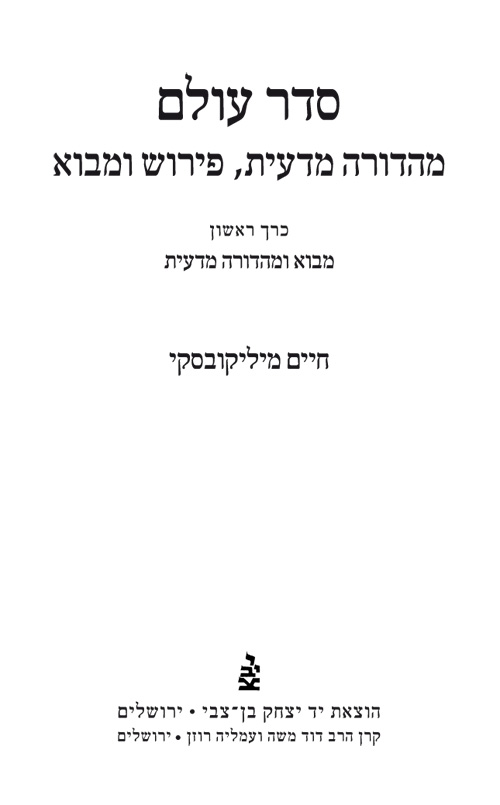
סדר עולם: מהדורה מדעית, פירוש ומבוא מאת חיים מיליקובסקי, מכון יצחק בן צבי, שני חלקים, 326+711 עמודים.
 I am very happy to announce the publication of an important work which numerous people (myself included) have been eagerly waiting for quite some time, Professor Chaim Milikowsky of the Bar Ilan Talmud department’s critical edition of the Seder Olam. Professor Milikowsky began working on the Seder Olam over thirty years ago and completed his PhD dissertation ‘Seder Olam : A Rabbinic Chronography‘ in Yale University 1981 (550 pp.) with Professor Shnayer Zalman Leiman serving as his thesis advisor. This version included an English Translation of the Seder Olam. Since then Professor Milikowsky has authored numerous articles, many of which, amongst many other topics, are related to the Seder Olam.
This edition was just printed by the Yad Ben Zvi Press and is comprised of two large volumes. Volume one contains a two hundred and fourteen page general introduction about the Seder Olam, along with the one hundred and seven page critical, synopsis edition of the Seder Olam, based on numerous manuscripts and Genizah fragments. Volume two contains a seven hundred and eleven page(!) commentary, and is thoroughly indexed. This work is incredible on all fronts; in depth and breadth, touching upon anything related to the Seder Olam. It appears that literally every letter of this Tannaitic work has been dealt with. In addition to the scholarly acumen invested in the introduction and commentary, this work serves as an excellent model for preparing critical editions of works of Chazal.
For a Table of Contents or more information about purchasing this work, feel free to contact me at Eliezerbrodtatgmail.com. Copies of this work will be arriving at Biegeleisen shortly.