Parchments Burning, Letters Soaring, and Books Lost and Found: S.Y. Agnon’s Library Fire 100 Years Later

Parchments Burning, Letters Soaring, and Books Lost and Found: S.Y. Agnon’s Library Fire 100 Years Later

Jeffrey Saks

Rabbi Jeffrey Saks, Director of ATID and its WebYeshiva.org program, is Director of Research at Agnon House in Jerusalem and editor of the journal Tradition. Thanks to Prof. Mordecai Schwartz and Andrew Katz of the JTS Library for their assistance, and to Curt Leviant, whose questions prodded this research. 

All day I see the parchment burning, but its letters are soaring to heaven—and even at night my heart will not rest,” wrote S.Y. Agnon a century ago after the burning of his home in Bad-Homburg, Germany [S.Y. Agnon-S.Z. Schocken (Schocken, 2003), Letter #163]. The chilling image is an allusion to the martyr Rabbi Hanina ben Teradyon, burned by the Romans while wrapped in a Torah scroll (Avodah Zarah 18a), and points to Agnon’s perception of the magnitude of the personal tragedy that had befallen him.

The fire broke out on the night of the 4th of Sivan 5684, between the 4th and 5th of June 1924 (as shown in my recent article in Haaretz, May 31, 2024). Aside from the manuscripts of two nearly-completed books, he lost “four thousand Hebrew volumes, most of which had come down to me from my forebears and some of which I had bought with money set aside for my daily bread,” Shmuel Yosef Agnon reported 42 years later in his famous Nobel Prize banquet speech. The importance of the book as object and writing as pseudo-magical act are central symbols in Agnon’s work. It is therefore not surprising that one of the burning meta-literary questions he raises is how writing, and books as memory agents, can save the past from oblivion. In his A City in Its Fullness (Ir u-Meloah), Agnon recreates his beloved Galician hometown of Buczacz, and the Jewish lives and culture that were lost there are memorialized in its pages. But what of the stories that were forgotten, lost, burned, or misplaced? How do the parchments that are burned obtain metaphysical immortality? These are themes he explored in works such as “The Book That Was Lost,” “Forevermore,” “The Sign,” and the yet untranslated “Lefi ha-Tza’ar ha-Sakhar,” among others.

Agnon’s house in Bad-Homburg, Germany, on June 5, 1924, the morning after the fire (courtesy: Agnon House).

After the fire, Agnon, his wife Esther, and their two small children were left almost destitute, with only the clothes on their backs and a few possessions saved from the blaze. What did survive was the memory of the loss, which left its mark on Agnon’s writing for many years to come.

On the eve of Passover 5728 (April 12, 1968) an essay titled “Old and New” appeared in Haaretz, containing twelve short reminiscences written by Agnon about his childhood in Buczacz. Among other things it relates the adventures of the young bookworm S.Y. Czaczkes, as he was known at birth. For reasons not clear (perhaps due to space limitations in that issue) only a third of what Agnon wrote was published. The remaining chapters sat in his archives, and were publshed posthumously in the journal Molad (October-December 1973), 549-562; the two sections were then later united in his volume of non-fiction, MeAtzmi el Atzmi (Schocken, 1976), 351-378. At one point, Agnon writes about the Yiddish writers and the status of mamaloshen in the town:

Other books were in our humble grandmothers’ possession, such as the laws of salting meat and the laws of women and tkhines [women’s prayers], all written in Yiddish and in Yiddish letters. The book Lev Tov and the Simhat HaNefesh I never saw in our parts; needless to say I never saw the book Menekes Rivkah, which even the greatest of bibliographers have not seen. A defective copy of Menekes Rivkah was among the charred remains of my books after the fire that fell upon my house, and I gave the book to my brother-in-law, Rabbi Alexander Marx z”l, and he gave it to the library of the Jewish Theological Seminary in New York. If the book escaped the fire in my house only to be consumed in the fire that befell the library of the Jewish Theological Seminary in New York I do not know (MeAtzmi el Atzmi, 363-364).

Alexander Marx (1878-1953), brother of Esther (Marx) Agnon, was a graduate of the University of Berlin and the Hildesheimer Rabbinical Seminary in that city. There he was influenced by the great bibliographer Moritz Steinschneider, and was a student (and later son-in-law) of Rabbi David Zvi Hoffmann. In 1903 Marx accepted an invitation to join the faculty of the Jewish Theological Seminary (hereafter, JTS). He served as Professor of Jewish History, and published important books and articles in the field of Jewish bibliography. But his most enduring contribution to the institution was in his capacity as the chief librarian of JTS. When Solomon Schechter offered him the position the collection contained some 5,000 volumes and only 3 manuscripts. Upon his retirement after a half-century, there were over 165,000 volumes and 9,000 manuscripts, including some of the most important and rare ever assembled. When Marx had completed his life’s work, the treasure trove he had amassed was considered among the greatest in the world.

Prof. Alexander Marx (Wikimedia Commons).

On the morning of April 18, 1966, flames broke out in the stately tower of the Seminary library at the corner of Broadway and West 122nd Street. The building was a firetrap. Its narrow staircases, inaccessible entrance, and single stairwell made it difficult for the firefighters to do their work. The library was soon a towering inferno and burned all day until the forces had gained control in the evening. Sadly, many of the books saved from the fire were ruined by water sprayed from the firefighters’ hoses. Jews from all communities of Greater New York came to help dry the wet books by placing layers of paper towels between the pages. The volunteer corps included students from Yeshiva University and other Orthodox yeshivot. In normal times their feet would not have trod the flagship of the Conservative movement, but this was a “time to do the Lord’s work” when Torah was burning.

The fire in the library tower at JTS, April 18, 1966. Magazine of the New York Firefighters Association, vol. 17:2 (www.fire-police-ems.com).

Fortunately, the book Menekes Rivkah, which had been saved from the fire in Germany in 1924, was not among the 7,000 books that ascended to heaven in flames in 1966. The fire did not reach the archive containing the manuscripts or the collection of rare books.

What then is this rare book, Menekes Rivkah, which was twice saved from destruction, on two different continents?

Rivkah, daughter of Rabbi Meir Tiktiner (died in Prague on 25 Nisan 5405 [1605]), was a woman preacher, poet, and writer in Yiddish. To the best of our knowledge, she was the first Jewish woman to write an entire book. Menekes Rivkah was published only after her death, in the original Prague edition (1609) and later in the Krakow edition (1618). The book was probably written in the 1580s or 1590s. Only one copy of each of the original editions is extant today. The Prague edition is in the Friedrich-Alexander University in Erlangen-Nuremberg in Bavaria (a digital scan can be viewed at the library’s website). The only extant copy of the Krakow edition was in the possession of Agnon—although it is unknown where, when, and how he obtained it. A Hebrew analysis and survey of the book was published in the 1990s by the scholar Meir Wunderin his book Ateret Rivkah, with a facsimile of the original (Makhon le-Hantzahat Yahadut Galitziah, 1992), and the book also appeared in an English edition, Meneket Rivkah: A Manual of Wisdom and Piety for Jewish Women, introduction and commentary by Frauke von Rohdon (JPS, 2009).

Grave of Rivkah bat Rav Meir Tiktin; Old Jewish Cemetery, Prague (Wikimedia Commons).

Menekes Rivkah belongs to the genre of moral literature and is addressed to married women, but it is likely to have been read by men as well, especially the unlearned who—along with their wives—were limited to “easier” Yiddish religious books. The sources that Tiktiner cites attest to her familiarity with Midrash, Pirkei Avot, and books of Jewish ethics. Most of Menekes Rivkah focuses on the behavior of the wife toward her husband, on instructions for relations with her parents and with her in-laws, and on the education of her children in piety. The author warns her readers against gossip and slander, and against superstition and witchcraft. In addition, she writes about “the wisdom of the body”: rules of health and diet and also matters concerning the laws of niddah.

The question is: Does this rare book, which was in Agnon’s library, possess some special quality that protected it for centuries and saved it from conflagration not once but twice? The answer seems to be: Yes. In a pleasant visit to the JTS library during a visit to New York (on May 15, 2024) I was privileged to hold it in my own hands. In the JTS Register (Academic Year 1925-26), Marx reported on the arrival of Menekes Rivkah in the Rare Book Collection:

Alexander Marx, JTS Register (Academic Year 1925-26), p. 136. Chief Librarian Alexander Marx’s report for the 1925-26 academic year in which he announces the acquisition of a rare copy of the book Menekes Rivkah, published in 1618, not as stated here.

In the acquisition report pertaining to this important item, Marx did not mention that he had received it from his brother-in-law, S.Y. Agnon, but did note that the book had been received and catalogued in November 1924, a date consistent with the fire in early June of that year, after which Agnon’s family with the remnants of their property had taken refuge in the home of Georg Marx, father of Esther and Alexander, in Koenigsberg. We know that Alexander visited the family in Germany at that time [Esterlein Yakirati (Schocken, 2000), Letters #19 and #21]. But when Agnon wrote in 1968 that “I gave the book to my brother-in-law” he was not being precise. In a letter to Esther dated September 25, 1924, we read:

Say hello to Alexander, shlita. I am very sorry that I did not see him. Tell him that if he does not want the book Menekes Rivkah you can send it here to Mr. Schocken, because he is ready to buy it (Esterlein Yakirati, Letter #21, p. 39).

I presume Marx did not receive the copy of Menekes Rivkah as a gift but bought it from his brother-in-law with the budget at his disposal as librarian of the growing collection in New York. (Had this not been the case, the book would probably be found today on the shelves of the Schocken Institute in Jerusalem.) The omission of Agnon’s name from the New York catalogue also indicates that he did not donate it (as the custom is to list the donors), along with the fact that Marx reported it in the list of “books acquired” rather than in the list of donations.

In a letter to his patron S.Z. Schocken [op. cit., #163] written a few weeks after the disaster, Agnon informed him: “Among the books saved from the fire I found several in Yiddish, and since I do not wish to hoard books that I do not need in particular for my work, I have sent them to you as a gift. Accept them from me willingly, the offering of the poor.” Clearly, Menekes Rivkah was not included in the box of books for disposal, for Agnon knew its worth—its cultural value and its monetary value as a “yasom” or “orphan” (in the argot of book collectors). It seems that Agnon, who lost almost all his possessions in the fire, was forced to sell any remaining item of value. There can be no doubt that he was loath to part with such a rare Jewish volume, and, in a story published two years later, he described how he felt when the flames consumed his worldly possessions:

I was content with a crust of bread. True, I did wear new clothes, but that was because all of my old clothes had burned in the fire. When I came to the synagogue and put on my tefillin, my friends did not look on with disapproval, nor did they bombard me with words. On the contrary, they sympathized with one whose house had burned and who did not have a roof over his head. Pay no mind to his new clothes, his old ones all burned; even his tefillin burned and that’s why he’s wearing new ones. I folded my tallit over my head so as not to hear their comments. When I got to the prayer that tells of God opening His hand and satisfying all living beings, I raised my hands to feel my tefillin. I was reminded of how I used to touch my old tefillin, and I thought to myself that those old ones were like a charm that let me live peacefully, and the new ones were to make sure that no one would envy me. I took a breath and sighed [S.Y. Agnon, “Two Pairs,” in A Book That Was Lost (Toby Press, 2008), 84].

The Menekes Rivkah almost disappeared from the world. Beyond a few isolated mentions over the centuries, it was completely ignored until Professor Chone Shmeruk published the first study of it in 1978. (A historiographical survey of Menekes Rivkah appears in the introduction to the English edition by von Rohdon.) Even in the years since, few have investigated the book and its author, and until now we did not know that the ember twice snatched from the fire had come to us via a long chain through the author and bibliophile S.Y. Agnon.

Menekes Rivkah (Krakow, 1618). Courtesy: Library of Jewish Theological Seminary, SHF 1882:2 RB 5715.

The copy preserved at JTS bears the scars and scorches of its long journey. The book has been restored and rebound (the catalog entry is unclear as to when). When Agnon described it as “a defective copy” he meant that the second chapter (except for the first page) and half of the third chapter were missing (out of the seven chapters of the book). In their place are inserted nine pages of the Mishnah Avot in Yiddish (from a Krakow edition of 1617). The original cover (or at least the cover of the book in 1924) was apparently badly burned. The person who restored the book preserved the page that had been inserted as part of the binding of the original cover. As is well-known, bookbinders would use worn-out pages from other books or manuscripts to glue the endpaper to the cardboard or wooden covers of the binding. Those who recall the film “Footnote” will remember how Professor Grossman (Shkolnik’s rival) discovered a lost version of the Jerusalem Talmud hidden in the binding of a Christian book in the Vatican archives. This time, to our surprise, nestled within the cover of Menekes Rivkah, a Yiddish book, we found a text in Latin, black and charred on the outside and clear and legible on the inside. (The directionality can be discerned from the folding of the page.)

The page hidden within the scorched binding of Menekes Rivkah was taken from a manuscript (date unknown) of the poem “On the Nature of Things” (De Rerum Natura), Book XXII, by the Roman poet Titus Lucretius Carus (99-55 BCE). The long poem, consisting of some 7400 dactylic hexameters, presents a summary of Epicurean philosophy to its readers. In an interesting coincidence, it too was almost lost and forgotten during the Middle Ages, but the admirers of the poem and its author brought it back to the consciousness of Renaissance scholars and it has since influenced great and good (as well as evil) men: Lord Tennyson wrote a poem in its honor and the Marquis de Sade was influenced by it.

Binding paper from Titus Lucretius Carus, “On the Nature of Things” (De Rerum Natura), Book XXII. Left: Outer side; right: inner-facing side. Courtesy: Library of Jewish Theological Seminary, SHF 1882:2 RB 571.

In his 2011 Pulitzer Prize-winning study, The Swerve, Harvard historian of culture and literature Stephen Greenblatt tells the tale of papal emissary and obsessive book hunter Poggio Bracciolini (1380-1459), who located the lone surviving copy of De Rerum Natura in a German monastery. Thanks to his resurfacing of the work’s varied and important ideas, suggests Greenblatt, the fuse of the Renaissance was lit. For this reason Greenblatt’s subtitle is How the World Became Modern.

Lucretius denied, among other things, the position of Heraclitus (c. 500 BCE) that “fire is the source of all that is made.” It is therefore fitting that a page from De Rerum Natura was used to wrap and protect Menekes Rivkah and prove that whether it is the source of all that is made or not, fire at least is not the end of all things. (Although, in all honesty, the particular page found in the JTS archives is discussing the virtues of a good, healthy breakfast.) When Martin Buber informed the philosopher Franz Rosenzweig of the fire in Agnon’s home and of the fate of their joint project on a collection of Hasidic tales (whose letters had soared to heaven), Rosenzweig consoled him:

When I received your letter and read about the misfortune that had struck Agnon, I naturally thought first that something had happened to him or to a member of his family, so that as I read on, I felt a great sense of relief. Certainly books and manuscripts are not simply material goods, but even though they are part of the body, they are still a replaceable limb. Frederick the Great rewrote the History of the Seven Years’ War, which his valet had used for kindling; and Carlyle’s French Revolution was also a second draft—the complete first draft was burned while in the possession of [John Stuart] Mill. No, death alone erases, not fire [The Letters of Martin Buber, edited by Nahum N. Glatzer and Paul Mendes-Flohr (Schocken, 1991), #306].

Today, a century after the burning of Agnon’s library, we can appreciate how the works of three great writers—in Latin, Yiddish, and Hebrew—have not been forgotten and have not been erased despite the oblivion and the flames.

POSTSCRIPT: After this research was prepared and recently published in Hebrew I became aware that Prof. Menahem Schmelzer, at the beginning of his own long tenure as librarian at JTS, had made mention of Agnon’s description of his Menekes Rivkah surviving the 1924 fire and his speculations about its fate in New York. Shmelzer’s report appeared as “The Librarian’s Column” in the bulletin News from the JTS Library 1:2 (Spring 1974). Shmelzer confirms that the JTS copy was the same received from Agnon via Marx, although he makes no mention of whether it was purchased, as I suggest above, or donated. He errs in Rivkah Tiktiner’s date of death, saying it was “the middle of the sixteenth century”; her tombstone, likely unknown a half-century ago when Shmelzer wrote, established the date as 1605. He was also unaware of the existence of the sole Prague edition in Erlangen-Nuremberg, nor had he deciphered the nature of the Latin manuscript page in the binding, but he does draw our attention to an early seventeenth-century discussion of Menekes Rivkah by the Christian Hebraist, Gustav Georg Zeltner. It is appropriate to mention Menahem Schmelzer z”l (1934-2022) in the context of all we’ve written above: He had been two years into his post as chief librarian when the fire erupted in 1966. He spent the next two decades, until retirement, committed to restoring the remnants and rebuilding the collection to its former glory. My thanks to Mr. David Selis for bringing this to my attention and for providing a photo of the brief column by Schmelzer, which can be viewed here.

Rabbi Jeffrey Saks, Director of ATID and its WebYeshiva.org program, is Director of Research at Agnon House in Jerusalem. Thanks to Prof. Mordecai Schwartz and Andrew Katz of the JTS Library for their assistance, and to Curt Leviant, whose questions prodded this research.


The Legend of R. Yehuda Halevi’s Death: Truth or Fiction?

The Legend of R. Yehuda Halevi’s Death: Truth or Fiction
by Eliezer Brodt

Among the more famous kinos that we recite on Tisha B’Av is Zion Halo Tishali. This kinah was written by one of the greatest paytanim, R. Yehudah Halevi author of the classic Kuzari. This piyut is about the author’s passion to walk on the holy soil of Eretz Yisrael. In the Artscroll commentary on the kinos, R. Avraham Chaim Feuer writes

an ancient manuscript states that R. Yehuda Halevi composed this kina while journeying towards Eretz Yisroel and recited it when he reached Damascus, facing the direction of Zion. Although many historians believe that R. Yehuda Halevi only got as far as Egypt, never even reaching Damascus, tradition has it that he finally reached Jerusalem (in 1145). There he fell to the ground in a state of ecstasy. . . . As he was embracing the dust near the temple mount, he was trampled and killed by an Arab horseman.

In this post I intend to discuss the above legend of R. Yehuda Halevi’s death, did he actually reach Eretz Yisrael? When did he compose the piyut of Zion Haloeh Tishali? I will conclude with a discussion on R. Yehuda Halevi’s connection to R. Abraham Ibn Ezra. I do not, however, intend to discuss R. Yehuda Halevi’s classic work the Kuzari nor his life in general for more on those topics one can see the excellent study by Adam Shear, “The Later History of a Medieval Hebrew Book, Studies in the Reception of Judah Halevi’s Sefer HaKuzari” (PhD dissertation, University of Pennsylvania, 2003); soon to be printed in book form.

R. Abraham Zacuto (1452-1514) in Sefer Yuchsin (first printed in 1566) writes that “R. Yehuda Halevi was fifty [years old] when he came to Eretz Yisroel and he is buried together with his first cousin, the Ibn Ezra.” (p. 217, Filipowski ed.). Later, however, R. Zacuto writes that R. Yehuda Halevi is buried with R. Yehudah Bar Elayh in Tzefat. (idem., p. 219). Setting aside the apparent contradiction regarding R. Yehuda Halevi’s burial place, in both of these descriptions R. Yehuda Halevi actually made it to Eretz Yisrael. Nevertheless, the legend of an Arab horseman killing him is absent. The earliest source for Arab horseman legend appears in R. Gedaliah Ibn Yachi, Shalsheles Hakabbalah (first published in Venice, 1587) and he states that he heard this legend from “an old man” (p. 92). Although the Shalsheles Hakabbalah appears to be the source for the R. Feuer’s statement, the Shalsheles Hakabbalah has one addition to the legend — omitted by R. Feuer — that R. Yehuda Halevi recited the kinah of Zion Halo Tishali right before the Arab horseman killed him.

The next time that this legend appeared, after the mention in the Shalsheles Hakabbalah, is by R. David Conforte (1618-c.1678) in Koreh Hadoros (first printed in Venice, 1746), p. 13, followed by R. Yechiel Halprin (1660- died sometime between 1746-1749) in Seder Hadoros (first printed in Karlsruhe, 1769), p. 201, it is then repeated by R. Wolf Heindheim in his edition of the Kinos. By the 19th century, this legend became perhaps the most famous story about R. Yehudah Halevi as not much else was known about him.

R. Matisyahu Strashun, however, questions the legend. He explains that Jerusalem, in the times of R. Yehuda Halevi, was ruled by Christians and not by Arabs. R. Strashun allows that although it is possible R. Yehuda Halevi composed Zion Halo Tishali when he got to Jerusalem — not that we know that he did — but the part of the story with the Arab killing him is certainly not true. As a general matter, R. Strashun notes that it is well known that the Shalsheles Hakabbalah is not a reliable sefer at all (Mivchar Kitavim, pp. 215-216). R. Shmuel David (ShaDaL) Luzzatto in his collection of poems from R. Yehuda Halevi, Besulas Bas Yehuda (Prague, 1840), also questions the the legend due to the Christian and not Arab control during the time of R. Yehuda Halevi. Further, even if there were Arabs around they would not have done such a blatant act right at the city gate (pp. 25-26). So Shadal concludes that he died on his way from Egypt never even reaching Eretz Yisroel. Interestingly enough, David Kaufmann uses other evidence to prove that the poems of R. Yehudah Halevi have Jerusalem under Christian rule (Mechkarim Besafrus Haivrit Byemei Habenyim p. 194).

Israel Zinberg writes that most likely R. Yehuda Halevi returned home to Spain, after visiting Eretz Yisrael, based on the fact that R. Shlomo Parcon, a student of R. Yehuda Halevi who lived in Spain, quotes a statement from R. Yehuda Halevi “after R. Yehuda Halevi was in Egypt” (Machberes Hauruch p. 5). Specifically, R. Yehuda Halevi had told Parcon that he was doing teshuva and therefore no longer composing. Independently, we know that during while R. Yehuda Halevi was in Egypt he composed much, Zinberg therefore argues that this statement to Parcon must have taken place after R. Yehuda Halevi was in Egypt, thus R. Yehuda Halevi must have returned to Spain (Toldos Safrus Byisroel, vol. 1, p. 115). David Kaufman also uses R. Shlomo Parcon to adduce how R. Yehuda Halevi died. Kaufman points out that had R. Yehudah Halevi died in such a spectacular fashion as the legend has it, R. Shlomo Parcon was sure to note it. As R. Parcon makes no note of an extraordinary death, R. Yehuda Halevi must have died a natural death. (Mechkarim Besafrus Haivrit Byemei Habenyim, p. 195). In Amudei Avodah, Landshuth also questions the legend due to lack of evidence that R. Yehuda Halevi ever made it to Eretz Yisrael. (p. 70).

In regard to the piyut, Zion Haloh Tishali, Landshuth brings different opinions where this was written, in Spain or Damascus, Syria (p. 76). Yitzhak Baer (Kinos p. 130) and David Kaufmann (supra, p. 195) cite an manuscript — housed at Oxford — which says that R. Yehuda Halevi said this piyut when he got to the Yerushalayim. Shadal writes it was written in Spain (supra).

Earlier I mentioned that the Sefer Yuchsin writes that R. Yehuda Halevi was fifty years old when he came to Eretz Yisrael and he is buried with his first cousin, Abraham Ibn Ezra. Later he writes that he is buried with R. Yehuda Bar Elayh in Tzefas. In the Travels of R. Benjamin of Tudela, written around 1170 – thirty years after the R. Yehuda Halevi died – Benjamin records that he visited the grave of R. Yehuda Halevi in Teveriah (there are actually various readings of these words in the manuscripts, but Adler accepts this as the correct reading; p. 29). In the travels of R. Yitzchak Ben Alfurah, written around 1441, he writes that he visited the grave of the Ibn Ezra and R. Yehuda Halevi (Avraham Yari, Masos Eretz Yisrael, p. 110). Both of these provide strong evidence that R. Yehuda Halevi actually made it to Eretz Yisrael. Nevertheless, an anonymous traveler in 1473 (Masos Eretz Yisroel, p. 113) and R. Yosef Sofer in 1762 (Iggrot Eretz Yisroel, p. 301) write that they visited the grave of the Ibn Ezra but make no mention that R. Yehuda Halevi is buried there as well. In the travels of R. Moshe Yerushalmi from 1769, he writes that he visited the graves of the Ibn Ezra and R. Shlomo Ibn Gabriel (Masos Eretz Yisroel, p. 438). I would venture to say the author confused R. Shlomo Ibn Gabriel with R. Yehuda Halevi both being famous composers and are sometimes confused. Furthermore, we have no source that R. Shlomo Ibn Gabriel ever came to Eretz Yisrael (aside from a very late letter written in 1747 printed in Egrot Eretz Yisrael, p. 273). (See also David Kaufmann, p. 205 and Sinai, vol. 28, p. 290). In a manuscript from the author of the Koreh Hadoros (printed in Sinai vol. 28, p. 284) it seems that the R. Yehuda Halevi was buried in Jerusalem.

Over one hundred years ago the Cairo Genizah was accidentally discovered and due to this incredible find every areas of Jewish Literature and History have been greatly enriched. Before this discovery the history of R. Yehuda Halevi written by the early scholars of Jewish History was based on the poems of Halevi that were printed by Shadal and others. However, much has been discovered in Geniza Manuscripts in the past sixty odd years which adds an incredible amount of detailed information to what we knew about the end of R. Yehuda Halevi’s life including original autograph letters of Halevi. [One can view some of these online here, and here is an example of one of documents relating to R. Yehudah Halevi.] These discoveries were made by the great scholar of the Cairo Genizah, Shlomo D. Goitein. Starting in 1954, Goitein printed his discoveries with his explanations of the material, in various journals mostly in Tarbitz. Later on, in his classic A Mediterranean Society (volume V, pp. 448-468), he included an excellent chapter on R. Yehuda Halevi based on all the material which he had found over the years. Most of his interpretations of the material he discovered have been accepted by Professors C. Sherman and Ezra Fleischer. In A Mediterranean Society Goitein writes “a full publication of all the geniza letters referring to Judah Halevi would fill a book.” (p. 462). Although Goitein never got around to writing such a book, in 2001 Professors Moshe Gil and Ezra Fleischer did write such a book. The title of the book is Yehudah Halevei U’bnei Chugo this book is a six hundred and forty page study of all the material from the genizah discovered by Goitein. This book includes all the original documents with notes and an in-depth history of all that can be gleaned from these letters. It is simply incredible to read what Goitein and than Gil and Fleischer discover in these letters.

The relevant documents are from a Cairo business man named Abu Said Halfon who was a very close friend of R. Yehuda Halevi. What follows is a brief time line of R. Yehuda Halevi’s journey to Eretz Yisrael based on the research of these professors. In 1129, when R. Yehuda Halevi was fifty four years old he decided to make the journey to Eretz Yisrael. In the year 1130, R. Yehuda Halevi began his journey. He intended to travel through Egypt. We don’t know why he didn’t. But we do know that he ended up in North Africa. In North Africa, he became good friends with the Ibn Ezra. For some unknown reason, he ended up back in Spain. Not too much information is known about why this journey to Eretz Yisrael did not end up happening. Ten years later, in 1140, R. Yehuda Halevi began the journey again. He ended up in Alexandria on September 8. He had intended to leave from Egypt to Eretz Yisrael immediately, but was delayed. He ended up going to Cairo until Pesach. After that he returned to Alexandria. A few days before Shavuos of 1141, he boarded the boat, and on Shavuos, he set sail to Eretz Yisrael. In a letter written about 6 months later indicates that R. Yehuda Halevi was no longer alive. It seems that he was alive for 2 months in Eretz Yisrael. We don’t have any information about his stay in Eretz Yisrael. It would seem that either he got sick or died a natural death. There is no clear answer whether the legend is true or not. It’s rather sad that with all the manuscripts discovered in the Cairo geniza that enriched us with an in-depth, heavily detailed history of R. Yehuda Halevi’s last years until he left to Eretz Yisrael, does not tell us anything more. However, there was one letter written three months after the death of R. Yehuda Halevi that does indicate that perhaps the legend is true. The letter (the ellipsis appear in the original) says as follows:

ולא נעלם ממנה אודות רבינו יהודה הלוי הצדיק החסיד זק”ל אשר עליו באמת ניבאו נביאי האמת עין לא ראתה, ההיה גבור ביראת אלהים ובתורתו, ומאמרי פעליו מעידים צדקו, באודותיו ירונו כצפורים בעתותן למנוחת עולם הוטע כבוד גן אלהים, וברמה הוא נשא נס גדולותיו והליכות גבורותיו, אשר תרונה ביקרו, והתיקר… וביקרו, ותמונת ה’ הביט… בשדה צען להאירה… זק”ל לא… צור… מחנה שדי… להתנחל לרשת… עזי…וישם… בדמות השכינה ובמראה… בשערי ירושלים
This letter was first printed by Jacob Mann, Goitein highlights the line ולא נעלם ממנה אודות רבינו יהודה הלוי הצדיק החסיד זק”ל which would seem to indicate that his death was not natural (calling him a kodesh is typically reserved for a martyrs) and especially the end where it says בשערי ירושלים but the letter is damaged and hard to read so one can not say anything conclusively. But Fleischer (pg 255) is willing to use the letter even with it’s missing parts to support the legend! Especially, he says, the author of the letter using the word קודש twice in the phrase זק”ל instead of the usual ז”ל. From this concludes Fleischer that we are not far off at all about Halevi death. Fleischer concludes by noting that one should be careful not to make fun of legends!

Notes:

There was certainly a strong connection between the Ibn Ezra and R. Yehudah Halevi. Professor D. Kaufman (supra p. 206) gives a listing of the many times which the Ibn Ezra quotes Halevei throughout his works. R. Azariah de Rossi, in his Me’or Eynaim, writes that R. Yehuda Halevi was the Ibn Ezra’s father-in-law (chapter 42). Koreh hadoros also brings that he heard this (p. 13). Shalsheles Hakabblah brings a whole legend which he had heard how exactly the Ibn Ezra became the son-in-law of R Yehudah Halevi (pp. 92-93). Interestingly enough the Meiri in his Seder Hakablah and the Sha’ari Zion make no mention of this relationship between the Ibn Ezra and R. Yehuda Halevi. Both Goitein and Fleischer say that although R. Yehuda Halevi was not the father in law of the Ibn Ezra the son of the Ibn Ezra, Yitzhak did marry R. Yehuda Halevi’s only daughter (see Yehuda Halevei U’bnei Chugo pp. 247-251). However, M. Gil writes that in the end Goitein changed his mind and realized there was no relation through marriage (p. 250-251). Also, see N. Ben Menachem, Inyai Ibn Ezra, pp. 224-240, 346-356 regarding the relationship between Ibn Ezra and Yehuda Halevi including any relationship through marriage.
It is worthwhile noting that R. Immanuel Aboab in his Bemavak ‘al Erko shel Torah, written in 1615, claims that the Ibn Ezra was both R. Yehuda Halevi’s son-in-law as well as a cousin. (p. 247).

On this topic in general see also: Adam Shear, The Later History of a Medieval Hebrew Book, Studies in the Reception of Judah Halevi’s Sefer Ha Kuzari, pp. 95, 513-514; C. Shirman, Toldos Hashirah Haivrit Besefard Hamuslamit, pp. 441-443. On the Ibn Ezra and Eretz Yisrael in general, see N. Ben Menachem, Sinai, vol. 10 p. 276 and onwards; see also N. Ben Menachem, Inyai Ibn Ezra, pp. 182-190.

More sources on R. Yehuda Halevi and Eretz Yisrael see: Adam Shear, supra, pp. 516-517; C. Shirman, Letoldos Hashirah Vehadramah Haivrit, vol. one, pp. 319-341; C. Shirman, Toldos Hashirah Haivrit Besefard Hamuslamit, pp. 466-480. Franz Kobler, A Treasury of Jewish Letters, vol. one, p. 155; Abraham Haberman, Toldos Hashirah Vhapiut, vol. one, p. 185;

On the reliability of Shalsheles Hakabbalah in general see: A David’s doctorate and E. Yassif in Sippur Ham Haevrei pp. 351-371)


Elul Sale Announcement: Twelve Seforim recommendations

Elul Sale Announcement: Twelve Seforim recommendations

By Eliezer Brodt

In this post I would like to highlight and briefly describe a select list of seforim, some of which are brand new and others are a few years old. Several seforim are mentioned here due to relation to this time of year [i.e. Elul and Tishrei related] and for various reasons did not receive proper notice.

The first title I would like to mention is:

שערי תפילה ומועד, אסופת מאמרים, תשפ”ד, 662 עמודים

I am very happy to announce the recent publication (and Sale) of an important work, titled Sharei Tefilah Umoed, which will be of great interest to readers of the Seforim Blog, by Professor Yaakov Shmuel Spiegel, of Bar-Ilan University’s Talmud department. As I have written in the past:

Professor Spiegel is one of the most prolific writers in the Jewish academic scene, authoring of over 160 articles and 18 books (16 of those are publications for the first time of works which remained in manuscript). Many suspect that he knows the secrets of Hashba’at Hakulmos (automatic writing) (about which see here).

His articles cover an incredibly wide range of subjects related to many areas of Jewish Studies, including history of Rishonim, piyutim authored by Rishonim, bibliography and minhagim, to name but a few. His uniqueness lies not only in the range of topics but also that his work has appeared in all types of publications running the gamut from academic journals such as Kiryat Sefer, Tarbiz, Sidra, Alei Sefer, Assufot, Teudah, Kovetz Al Yad and also in many prominent Chareidi rabbinic journals such Yeshurun, Yerushaseinu, Chitzei Giborim, Moriah, Sinai and Or Yisroel. It is hard to define his area of expertise; he appears to be an expert in every area he writes about!

Worth noting that recently, thanks to the hard work of a dear friend of mine, all of his published articles are available for free download here.

He has edited and printed from manuscript many works of Rishonim and Achronim on Masseches Avos and the Haggadah Shel Pesach. He is of the opinion, contrary to that of some other academics, that there is nothing non-academic about printing critical editions of important manuscript texts. Although there is a known “belief” in the academic world, “publish or perish,” which at times some claim is the cause of weak articles and books, Spiegel’s prolific output does nothing to damper the quality of his works.

Another point unique to Speigel’s writings, besides his familiarity with all the academic sources, is the great familiarity he displays with all the classic sources from Chazal, Geonim, Rishonim and Achronim, to even the most recent discussions in Charedi literature – this bekius (breadth) was apparent well before the advent of search engines of Hebrew books and Otzar Ha-hochmah. Alongside all this is his penetrating analysis and ability to raise interesting points.

This new volume, Sharei Tefilah Umoed, is a collection of 39 chapters. Thirty chapters were published over the years in various Journals while nine chapters are published here for the first time. Many of the chapters in this volume follow this rubric: a manuscript on a specific, published for the first time, including an introduction devoted to the background of both author and subject. Many of these chapters are related to the month of Tishrei and are great starting points on the various upcoming topics. For those looking for new material specifically suited for this time of year, it’s timely availability for sale is a bonus.

Here are the Table of contents:

Number 2:

מאמר על הדרשות ועל האגדות, לרבינו אברהם בן הרמב”ם, מעתיקה השמועה, בירורים בתולדות חכמי התלמוד ועיונים בדרכי העתקת שמועותיהם, מהדיר: ר’ משה מיימון [מהדורה שנייה עם הוספות ותיקונים[, [תשפ”ד]

This is a second edition with corrections and additions R’ Maimon’s critical edition of R’ Avraham Ben HaRambam’s classic essay on Aggadah. The second part is a small work of Rabbi Moshe Maimon called Mateikeh shmuah, historical essays of great interest and includes notes by R’ Shaul Alter) See here for an Interview with R’ Maimon where we discuss this work.

Rabbenu Avraham’s essay is always relevant but is extra relevant at the moment as Daf Yomi has just finished learning the aggadic suggyot involving Rabbah Bar Bar Chana and will be learning more Aggadah shortly. For more on this and Aggadah in general see my recent presentation on All Daf (Here).

Sample pages are available.

Number’s 3- 6:

Some works by Rabbi Yaakov Stahl, related to the season:

Rabbi Stahl’s work is familiar to many of the blog’s readers; for reviews of some of his earlier works see here, here and here, and see a post of his here.

דרשות לימי התשובה מבית מדרשים של חסידי אשכנז, 11 + עד עמודים, מהדיר: ר’ יעקב סטל

This is a small work of Drashot by Chasidei Ashkenaz related to Teshuvah, published from manuscript and annotated by Rabbi Yakov Stahl.

תשובות רבינו אלעזר מוורמייזא הרוקח‘, ]תשע”ד[, 37+ רח עמודים , מהדיר: ר’ יעקב סטל

This is a Shir of the Rokeach on the topic of Teshuvah published from manuscript by Rabbi Yakov Stahl, which focuses on the different requirements to achieve Teshuvah for various sins. Much has been written about this unique Beis Medrash known as Chasedi Ashkenaz, especially their methods of Teshuvah. This volume will help one get a deeper understanding of their Shitah. The volume includes a useful introduction, numerous notes illuminating each passage with an incredible range of sources and concludes with some very interesting appendixes.

One can find some RH material on his academia page here (Some samples are this, this, this and this).

ריעקב ישראל סטל, נהגו ישראל, עיונים ובירורים בתולדות המנהג וההלכה, חג הסוכות, קכט עמודים + תמונות, ]תש”פ[

This six-chapter work relates to the Yom Tov of Sukkos with particular focus on Daled Minim issues. Here too, Rabbi Yaakov Stahl continues to amaze his readers with his ability to assimilate fascinating material from a wide range of sources. One unique aspect of this work is the over one hundred color illustrations from ancient art graphically illuminating for the reader the author’s proposals.

Sample pages are available.

גנזי חג הסוכות | אסופת גנזים מתורתם של ראשונים בענייני חג הסוכות היוצאים לאור לראשונה מכתבי-יד עם מבואות, ביאורים והערות, עיונים ומפתחות, מהדיר: ר‘ יעקב ישראל סטל, שע עמודים, תשע“ח

A few years back (2018) I mentioned Ginzei Chag HaSukkos. This volume is very similar in style to Kovetz Al Yad; it’s a collection of material by Rishonim, all related to Sukkos, the majority of which is printed here for the first time. Various literary genres are represented in this collection: Halacha, Minhag, Piyut, Philosophy and Kabbalah. Each section includes an introduction detailing its significance and the texts are fully annotated. There is also a twenty-five-page index to the work. Sample pages are available.

Number 7:

ר’ אורי טיגר, קומי אורי: דרך איש \ דרך הקודש [רמבם האיסורי ביאה] \ משפט עשה [בדיני איסור ההליכה לערכאות] \ הטבע הרוחני, [תשפ”ד], מח + קכט, לו, סו עמודים

This is collection of four small seforim by R’ Uri Tieger, published in one volume. R’ Tieger has become famous in recent years for the various videos that he released with him in conversation with R’ Chaim Kanievsky zt”l. R’ Tieger is a prolific author and in the past year has released a few new works, including a massive work on Rambam Hilchos Korbon Pesach. I will highlight just one of the works in this collection: Derech Ish. This work is devoted to putting together in a unique format the views & methods of the Chazon Ish on many topics. In addition, this work has numerous notes by R’ Chaim Kanievsky.

Sample pages are available.

Number 8:

כל כתבי רבינו מנשה בן מוהרר יוסף בן פורת מאיליא, מרואי ומקבלי תורת רבינו הגר”א מווילנא, כולל כל פרי רבינו בדפוס ובכתב יד, [תשפ”ד], מהדיר: ר’ דוד קמינצקי, תקעב עמודים

I can’t describe my excitement a few months ago when I received an email from the editor that this volume was published. This is the first time all of R’ Menashe MeIlyah’s material is available in one accessible volume. Sadly, some of his work has not survived. This volume, published by R’ Dovid Kamenetsky, one of the world’s leading experts on the Gra and Gra-related material presents all of R’ Menashe’s works, including material published from manuscript. R’ Dovid has spent much time over the years on this very unique Gaon publishing some of his manuscripts and writing articles about him in the journal Yeshurun. This is an extremely important, deep and unique volume from one of the people from the Gra’s Beis Medrash.

Number 9:

ר’ שמריה שמעריל ברנדריס, עיון תפילה,+24 רמג עמודים, תשפ”א

I became very fond of this work few years back after being introduced to it by two different friends while researching two different projects, the Gra and R’ Efrayim Zalman Margolis. This unknown godol was one of the only talmidim of R’ Efrayim Zalman Margolis. It’s a work on siddur and Halacha, full of many nice points. A few years ago, Machon Aleh Zayis asked me to suggest an obscure work worth republishing; I recommended this work. Their team did a great job of publishing an annotated version and I wrote an introduction attempting to explain and outline its significance. In Yeshurun volume 43 (2021) I revisited this and updated the piece with numerous additions [A PDF is available upon request]. This is a chapter of my work on R’ Efrayim Zalman Margolis, which I hope to publish one day IY”H.

Sample pages are available.

Number 10:

ר’ אריה ליב ליפקין, אור היום, [בירור הלכה בענין בין השמשות וצאת הכוכבים…] עם הערות ולוחות כוכבים לאור, מהדיר: ר’ משה ברוך קופמאן, 27 +רנז עמודים

This important but not well-known work by R’ Aryeh Leib Lipkin, originally published in 1901, is about the complex sugyah of Zemanim. R’ Aryeh Leib was a nephew of R Yisroel Salanter. R’ Dovid Kamenetsky wrote a thorough article about this Gaon in Yeshurun 23 (2010). In addition to his greatness in standard learning, he was also an expert in Astronomy and Kabbalah. This new edition was fully annotated by the noted expert on the subject, R’ Moshe Kaufman, in a beautifully produced volume. Also, see here for an interview of Nachi Weinstein of  Seforim Chatter with the author of the sefer.

Sample pages are available.

Number 11:

רשי השלם, במדבר חלק א, [פ’ במדבר-קרח], מכון אריאל, תשפ”ד, שצ עמודים

Much energy has been spent over the centuries locating Rashi’s sources and understanding his methods. One very valuable tool for understanding Rashi and his sources is a project that began almost forty years ago and slowly has been publishing volumes (to date they have published Eleven volumes). Recently they released part one of Chumash Bamidbar.

Number 12:

ר’ נריה גוטל, רשי צריך עיון – לדרכו של רשי בפירושו לתורה, תשפ”ג, 522 עמודים

One more recent volume related to Rashi is by the prolific R’ Gutel and is extremely useful for those seeking a greater understanding of Rashi on Chumash. R’ Gutel begins the work with a lengthy general introduction about Rashi on Chumash. For each chapter, R’ Gutel chooses one Rashi in the parsha and demonstrates clearly how the various Mefarshim through the ages attempted to deal with the challenges it presents. Through this lens he highlights and carefully analyzes the material, along the way giving one a glimpse into the greatness of Rashi’s work.

Sample pages are available.

Sample pages from each work are available

All Seforim reviewed here can be purchased through me, part of the proceeds helps the efforts of the Seforim Blog.

For more information about purchasing this work, feel free to contact me at Eliezerbrodt@gmail.com


Some Highlights of the Upcoming Taj Art Auction

Some Highlights of the Upcoming Taj Art Auction*

With the proliferation of auction houses and the centralized platform of Bidspirit, there are auctions of Judaica and Hebraica on a weekly, if not more frequent, basis. One of the more recent entrants into this arena is Taj Art, founded in 2021 by Tomer Rosenfeld and Aron Orzel. This Sunday, December 24th, at 7 pm Israel time, Taj Art will be hosting their 11th auction, which includes some items of particular bibliographical and historical note.

The full catalog is available here, and a pdf of the highlights brochure is here.

The first (lot 9) is a work that appears in a story that is a touchstone for the modern feminist agenda.

According to R. Barkuh HaLevi Epstein, he maintained a regular dialogue with Netziv’s first wife, Rayna Batya. Among the topics of conversation was the issue of women studying Jewish literature. Rayna was well-versed and regularly studied an impressive array of Jewish books.

Epstein, in his Mekor Barukh, attempts to place Rayna as less of an anomaly but more as one within a chain, albeit small of women throughout Jewish history that similarly shared Rayna’s interest and erudition of Jewish texts. While there is little doubt that there are examples of such women, many of Epstein’s examples are corrupt at best and deliberate misreading of the sources at worst. Nonetheless, there is little doubt that Rayna was an erudite woman. According to Epstein, Rayna eventually won him over to her position when she identified a responsa that provided that women could study traditional texts. The source was Ma’ayan Ganim. Epstein repeats the position of Ma’ayan Ganim in his commentary on the Torah, Torah Temimah (although without reference to Rayna or a particular episode).

First, we should note that Marc Shapiro has questioned the veracity of the entire story in his article on this site, which is subject to a rebuttal by Y. Lander. Eliyana Adler’s article, “Reading Rayna Batya: The Rebellious Rebbitzen as Self-Reflection,” (available here), collects additional discussions regarding the event and provides her approach to the story. While one can debate the merit and implications for Jewish feminism, it is worth briefly discussing the obscure work Ma’ayan Ganim.

The Ma’ayan Ganim, authored by the Italian rabbi Shmuel Archovalti, was published in 1553 in a small format and consisted of 50 letters intended to guide effective communication. Unlike many other legal systems, Jewish law largely relies on responsa, letters from rabbis in response to queries (although, in some instances, contrived rather than actual). Despite the format, not all letters are legal, and certainly, a text with sample letters intending to serve as a writing tool does not qualify as legally binding. Irrespective of the purpose, the letters demonstrate an interest in the issue that held the interest of many rabbis and others. Similarly, whether or not Epstein created the entire episode or embellished parts of it does not detract from his position that encouraged women’s study of Jewish texts.

While Rayna Batya has enjoyed questionable notoriety, it is disappointing that a woman whose advocacy for women’s study and Jewish women’s rights was well documented and received the respect of leading Jewish rabbis and scholars is today nearly forgotten. Ironically, as Dr. Leiman highlights, the New Jewish Encyclopedia notes that prior Encyclopedias Jewish women were marginalized, it too fails to record Esther. The one exception to this forgetfulness is the Encyclopedia for the Zionist Leaders, which records Esther and some of her accomplishments. Today, however, there is a very robust discussion of many of Esther’s unique contributions and essential ideas that appeared here: https://mizrachi.org/hamizrachi/the-time-of-our-freedom/

It includes translating one of Esther’s articles that appeared in the Jewish press.

Two books are written by R. Yitzhak Chaim Kohen MeChazanim (Cantarini), Et Kets and Pachad Yitzhak (Lot 22). The former was published in 1710 and the latter in 1685. Despite the gap in time, both contain a fully illustrated page that precedes the title page and depicts the Akadeh. Et Kets discusses the messianic era, while Pachad Yitzhak is devoted to discussing the Jews of Padua, avoiding being massacred by an angry mob. Despite the same iconography, the two illustrations were likely done by two different artists and contain subtle but important differences.

Et Kets

The overall depictions are of two different time periods of the Akedah episode. In the first, the illustrations depict Abraham just as he was about to slaughter Isaac and the angel calling to stop him. But, in the second, the illustration is of Abraham going after the ram, not Isaac. The significance of this is tied to the actual books. In Pachad Yitzhak, the book discusses a terrific threat to the Jews and their salvation. Thus, the illustration is similar – the terrific threat to Isaac and salvation. The second work, Et Kets, is a much more positive book. This work has no fear of the prior; instead, it is fully devoted to the Messiah, and thus, the illustration is only of the ram and its sacrifice. Lot 22 is Pachad Yitzhak, the rarer of the two.

Further, different Hebrew words appear in both illustrations. On the first, the word ערכה (prepared or set up) appears across Abraham’s chest. This word expresses Abraham’s readiness to sacrifice Isaac. It would seem, similarly, that the Jews of Padua were willing to sacrifice themselves for God. But the word ערכה only means to prepare and not actually to sacrifice. Thus, Isaac was only prepared but not sacrificed, and so too, the Jews of Padua were placed in danger but ultimately redeemed.

In Et Kets, the words ירא יראה appear. These words reference what Abraham called the place where the Akedah took place. Importantly, Abraham uttered these words after the entire episode. These were words of jubilation on his passing his test and Isaac’s redemption. Again, these words fit well with the content of Et Kets.

These allusions are unsurprising, considering the style of R. Dr. Cantarini. His books are written rather cryptically, with many allusions to Biblical and other themes throughout. (See our fuller discussion here.)

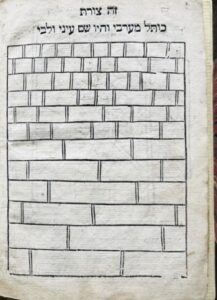
Many Hebrew books include a depiction of the Temple Mount, represented by the Dome of the Rock. However, Lot 43, Zikrohn Yerushalim, published in 1742, consists of a depiction of the Dome of the Rock (surrounded by a Medieval wall and town) but broke new ground in depicting the Kotel to represent the Jewish Temple. This is the first time the Kotel ever appeared in a Jewish book. Yet, only in the 19th century did the Jewish books fully transition to the Kotel rather than the Dome of the Rock.

There are two notable works by R. Emden, his Siddur, (lot 52), and R. Azreil Hildeshiemer’s copy of Meor u-Ketziah (lot 175). This edition of the Siddur is especially important as most of the reprints (until recently) only included the commentary, and the actual text of the Siddur did not reflect many of R. Emden’s approaches and, frequently, a direct conflict between the commentary and the text.

There are some very rare antiquarian books, an incunabulum from Radak, (lot 149), published in 1486 by Soncino. Lot 148 is a leaf from a manuscript of Rambam’s commentary of the Mishna dated to 1222 and transcribed in Yemen. One of the rarest Bomberg volumes of the Talmud is Mesechet Avodah Zarah, lot 32. Of course, because this tractate discusses non-Jews and their relationship to Jews, it was particularly fraught. Indeed, after the resumption of the printing of the Talmud in Basel after the ban in the early 16th century, it omitted this tractate entirely. (There are also two other Bomberg volumes, lots 3334).

Eliyahu HaBakhur (Elia Levita) wrote one of the earliest grammar and dictionaries of Hebrew and Aramaic in the modern period. Lot 86, is the first edition of his Sefer HaBakhur, Isny, 1541.  A more recent reprint was subject to censorship due to including a particular commentary.  See our discussion, “A New Book Censored.”

There are also a few books that contain noteworthy illustrations. Lot 87 is Tzurat ha-Arets, Basel, 1546, which includes astronomical images. Lot 89, is an edition of the fundamental kabbalistic work, Razeil ha-Malakh, that depicts the star of David and kabbalistic amulets.

The issue of rabbinic pay appears to have affected even the greatest of rabbis. Lot 205 is a letter from R. Chaim Ozer to the Vilna community pleading for a raise because he is so destitute that “he will not have money for rent or food.”

In all, there are a number of highly collectible items, and the catalog is certainly worth a closer look.


*This is part our series on upcoming auctions, “Auction Highlights.” These provide the opportunity to revisit previous posts and provide short notes about books and other related items.


Shavuah HaSefer: A Recommended Reading List III

Shavuah HaSefer 2010: A Recommended Reading List III

by Eliezer Brodt
Book week just began in Eretz Yisroel. As I wrote in previous years, in Israel, around Shavous time (some times right before some times right after), there is a period of about ten days called Shavuah Hasefer-book week. Shavuah HaSefer is a sale which takes place all across the country in stores, malls and special venues rented out for the sale. There are places where strictly “frum” seforim are sold and other places have most of the secular publishing houses. Many publishing houses release new titles specifically at this time. In this post I would just like to mention some of the very recent titles from the various publishing houses which are available at this year's Shavuah HaSefer. For previous years posts see this post and this post. Last year I was not in Eretz Yisroel during book week so I was unable to post about it. Therefore this year I hope to include the new books of both this year and last year. Some times I include an older title as I just noticed the book. As I have written in the past I do not intend to include all the new books as that would be impossible, composing this list is hard enough. I tried to provide links to many of the titles. Eventually some of these titles will be the subject of their own reviews. I try to include titles of wide amount of interests. Some books I can not provide much information as I just glanced at them quickly. I apologize in advance for any mistakes regarding transliteration. I also apologize in advance for using the word excellent so many times when describing seforim in this post. Additionally this year I am offering a service, for a small fee to help one purchase these titles. For more information about this email me at Eliezerseforim-at-gmail.com.

The Bialik Institute printed a few great titles. The much awaited volume four of the collected writings of Y. Ta- Shma  was just published. This volume is devoted to Mizrach and Provence it also includes articles on some other odds and ends. One excellent title is Ha- Kishuf Ha-yehudi Ha-kodom from Y. Harari. Another important work is Kisvei R. Moshe Ibn Tibon. This contains three works of his, with notes, printed from manuscript for the first time. Amongst them is a commentary on Azharot. Just out is a new work on R. Moshe ha-Darshan from Professor C. Mack called Mesodo Shel Moshe Ha-darshan. This much awaited book looks incredible. Another recent title is Rashi Keparshan Ubalshan. Another title is a nice collection of articles called Samcut Ruchneyot. Another title is Iyunei Teshuvah. Another work recently printed related to poetry in the Middle Ages from B. Bar Tikvah called Sugos Ve-sugyos be-Piut Haprovencali.  Another title is Dor Dor Uparshunav – collected articles of S. Yefet. Another volume is Shay le-Sarah Yefet, A volume in S. Yefet's Honor, devoted to Rashbam and other topics. Another important book printed from manuscript is R. Moshe Cordovero's Ma'yan Ein Yakov. Another good title printed is volume seventy one of the excellent series Dorot called Aviezr. This is a critical edition of the autobiography of Mordechai Ginzburg edited by S. Werse.

Bar Ilan University Press has many great new titles. A Pirish Kadmon on the Yesod Moreh of the Ibn Ezra. An in-depth work on the Sefer Haikraim called Hagoto Shel R. Yosef Albo. Loshon Kodesh Girsos Ha-kedoemeha on the first Jewish comedy called Ztachus Bedechusa Dekidushin (see here). Alei Sefer is back from its long vacation, issues twenty and twenty one are now available both are full of great stuff. Volume twenty one and twenty two of Badad are available. Volume nine of the Iyuni Mikra series is out. Kenishta volume four is out and as previous volumes it is full of very nice articles. A nice volume related to Yerushalmi Tannis called Seder Tannis Keitzad. Another very good book is called Yeish Seder Lemekra (also distributed by Magnes press).

Reuvan Mass has a few good titles. Recently they began a new series called Resho'ot. They began the series with R. Moshe Feinstein Teshuvot each book includes an overview of the topic and a brief history of the Godol's life. Now there are volumes available on  R. Herzog and R. Goren. Another new title is Hamas ha-Zeman which is critical edition  of a work written in 1481 in Italy edited by D. Bergman. Another impressive looking title is Drasha ha-Mesorah ve-Haketuvah from S. Regev. This book is about the Derasha, both oral and written, in the Middle Ages. An older title I just noticed is called Sod ha-Da'at from N. Lederberg. This book is about the Beshet.

Volume four from the Talmud Haigud Project headed by Professor Shamma Friedman was printed. This volume is on the fourth Perek of Pesachim. It was done by Professor Aron Amit. This work looks very special. These books are distributed by Reuvan Mass.

The Jewish Theological Seminary Press has volume three of the Kuntres Hatushuvos Hachdash (earlier volumes reviewed here). Volume four is due out this summer and is available for pre-order with book week price. Also volumes five and six from Toldos ha-Chinuch be-Yisroel are available. Another good looking new title is called Mechallel Shabbas Befarhesyyah. An older title that reappeared (as they found a bunch of lost copies) is the Pirish Limishna Mescatas Shabbas from Professor A. Goldberg. Additionally, one should keep an eye out in their "cheap section" as there are always some good titles such as N. Danzig work on Halachas Pesukos, a real classic.
Schecter Institute has some new titles amongst them a critical edition of Medrash Shmuel and a reprinted version of Legends of the Jews from Levi Ginsburg in Hebrew. An additional new title is Me-Breslau Le-Yerushalyim.

Machlekes Herzog has some new titles amongst them Pirqe Miqrarot and Pirqe Yeshayahu from Mordechai Breuer. Zohar Ramchal from Y. Avivi was reprinted with additions.

Mechon Ben Zvi has some new volumes in there set of critical editions of classics of Sefer ha-Makabim and other works: Megilos Midbar Yehudah and Megilat Komran. Volume eight of the series Shalem is out and is full of great articles. Volume five of Ginzei Kedem is out. A new critical edition of Sefer Ha-Gerushin from R. Shmuel Ben Chafni Goan is out. One must mention the extremely important work of Y. Avivi, Kabbalas ha-Ari. Sefer Ho-du volumes one and three are available these are documents from the Cario Geniza edited by Goieten and M. Friedman. A new critical edition of Sefer Tachkomoni was printed edited by Y. Yahalom and others. One should keep an eye out on there cheap section as there are some great titles for really cheap prices such as Pirish of R’ Matisyhu Hayesari on Avos (edited by Professor Y. Spiegel) Shedim Ruchos and Neshmos edited by E. Leibes and R. David de Silva, Pri Megadim edited by Z. Amar.

Merkaz Zalman Shazar has released some new titles among them books about the Rambam and R. Hasdai Crescas. These books are part of their recent series on the great leaders throughout the generations. Another title is Rishonim ve-Aharonim. This is a Sefer Ha'yovel Lekoved Avraham Grossman. This volume is full of many excellent articles from various top scholars. Another great title is 'Yashan Mipnei Hadash'. These two beautiful volumes were prepared in honor of Immanuel Etkes for more information about them see here. Another nice looking title is Shorshei Hachilon from S. Feiner. Volume four of Yosef Dan's Toldot Torat Sod ha-Ivrit is now in print. Another title from Y. Dan is Al Gershom Scholem which is a collection of articles about Scholem. Older excellent titles are Rashi Demuto Veyetzerato (two volumes) and HaRamabam, Shamronis Mekorit Mehapacnut (two volumes). Another older tile I recently noticed is Kanoit Dateiot. This is a very nice collection of articles related to religious radicalism. Here again, one should keep an eye out on there cheap section as there are some great titles for really cheap prices.

Magnes Press has issued a few nice titles amongst them: The excellent looking work Osef Hageniza Hacariot Bezenevah. This work includes texts and great articles by various experts all based on this missing box from Cario recently rediscovered. Another title is Bein Yehudim Lenotzrim Beparshnut Hamikra from S. Kamin. Another great title is Logica Aristotolis Umethodoligia Talmudit. This impressive work is all about the thirteen methods of Darshaning the Torah. Another book is about R. Yehuda ha-Levi from Y. Yahalom, this book is available in both Hebrew and English. A critical edition of the Rashbam on Shir Hashirim is now available and his work on Iyov was reprinted. One must metion the excellent work from L. Moscovitz's, Hatermenolaiga Shel Hayerushlmi. Another title is Hatext Shelo Hayuh about Mesechtas Sota. Another title is Movos Lemekors Umesorot from D. Halivni. This is all of his introduction that he has written over the years to explain his famous method. Another great collection is called Hashelav Hacharon this is a collection of G. Scholem's articles about chassidus. Another new title is Hapirush Hameyuchus LeRashi Ledivrei Hayomim. Another new title is Siygufim ViPiytum. Another older title is Iyunim Chadashim Bephilshphia Shel Halacha edited by A. Ravitzky and A. Resnak.

Kibutz Hamechuad has printed some nice new titles amongst them Zichron Venshea from R. Elior related to dead sea scrolls, Ochlim Ledas about the Meal in the Tekufa of Chazal, Kankan Malei Yashan about R. Samson Raphael Hirsch work on Torah.      .

Shalem distributors has many great new titles. Amongst them the continuation of the beautiful critical edition of Mishnayis from Professors S. and Z. Safrai mentioned a few years back. There now are volumes on Shabbas (two volumes), Eruvin, Pesachim, Shekalim, and TannisMegilah in one volume. These volumes are excellent and full of very useful information on many fronts I hope to return to this series in a post in the near future. Another set of good books are the Masuah Le-Yitzhak: Rabbi Yitzhak Isaac ha-Levi Herzog Memorial Volume here. Another older good title is the Beracha Le'Avraham this is a Collection of Articles in Honor of Rabbi Professor Avraham Steinberg's Sixtieth Birthday for more on this see here.  Some other very good books worth mentioning available by Shalem are the works of Z. Amar most recently his work called Merorim all about Maror on Peseach. Another nice title of his called Arbat Haminim. Some older titles of his are also available by Shalem. Another good title is R. Eze'le Charif this book is updated from the previous edition. The controversial Zera Yisroel (two volumes) from Rabbi Amsalem, all about Geyrus is still available (see links here). Two reprints, in one volume from R. Reuven Margolis were just printed his Shimish Chachamim, and Divorim be-Itam. Another excellent title and at a cheap price too is Pischei Tefialh u-Moed. This volume is a collection of thirty two (from over one hundred and sixty) of Professor Yakov Speigel's articles related to tefilah and Moedim. [Insider's tip not to many copies of this book were printed]. It includes articles and Manuscripts of Rishonim and Achronim.  Another title worth mentioning is the work on Sanhedrin and Makot from Y. Shilat, Bemsilot Ha-oleh (two volumes). Another very good title is Chidushei Harav Zitron-Katroni, son in law of the Rogatchver Goan (681 pps.). This work also includes a excellent history of R. Zitron and life in Eretz Yisroel at the time. One interesting piece in the volume is what he writes about his Rebbe R. Meir Simach Me-dvinsk (571-572). See also what he writes about R. Hirschonson (p.565) and R. Reines (p. 563). Also worth mentioning is Yerushlyim Bemoedeha from R. Neventzal has two new volumes on Shababs. One last special title worth mentioning is Oro Shel Olam. This book is volume two of the very special biography on R. Shlomo Zalman Auerbach – Torot Hamisamcat.

Schoken has a new book from Moshe Idel called Kabbalah Varos.

Koren is selling D. Halvni book, 'Breaking the Tablets Jewish Theology after the Shoah' translated into Hebrew called Shivrei Haluchos.

Carmel has an interesting looking book called Betei Medresh Nussach Ashkenaz. This book is a collection of twenty five accounts of graduates of Rabbinical seminaries in Germany and Austria edited by Asaf Yedidya. Another tile I noticed was from C. Mak called Breshies le-Breishes Rabbah. An additional title which they have is a new translation of Josephus's Toldot Melchamas Ha-yehudim Be-Haromim. An older title of theirs is a book from
Y. Leibes called Eleloyos Elokim. Another new title I saw (tipped by Menachem Butler) is from S. Feiner called Melchamos Tarbus related to the Haskalah in the nineteenth century.

Ariel publishing house translated from Yiddish a great autobiography, Memoirs of Zvi Hirsch Masliansky. This book is full of great material. The author was born in 1856 and traveled Europe and met many great Gedolim and even Masklim along the way. He describes his meeting with them and observations about life in that time period he ended up in America and even toured Eretz Yisroel all discussed in the book.

Mechon Yerushalim  has a few very good new titles. The Leket Yosher, part one with notes, Sefer Haterumos (part two, part one is not yet out) with notes. A collection of letters and Teshuvos of R. Yitzchak Elchanon Specter was just printed. They put out a fancy version of the Minchas Chinuch on Shabbas. Volume two of their Seder Rav Amram Gaon is now available. Another work is Azharot with a pirish Ner Mitzvah (and notes) from R. Moshe Pizanti who was born around the Year 1550. Another very special sefer printed was the Shilte ha-Gibborim. They did a great job in reprinting this beautiful sefer making it very usable with many notes and indexes. They also printed the complete Or Zaru in three volumes this is much different than there other set of Or Zaru which is still being worked on.

Tel Aviv university has a great new book called Ha-cheder. This book is a collection of great articles and bibliography related to the Cheder. The editors of this book are David Assaf and E. Etkes. It also includes many autobiographical account from memoirs of people about there time spent learning in the Cheder.

It is worth mentioning that althought there is nothing really new from N. Rakover this year, but his previous works are being sold for extremely cheap prices.

Shalem Press printed an older title from E. Berkovitz (here) and are having some good deals in general.

Feldheim just release the much awaited new edition of Shmirat Shabbas Ke-hilchso. This volume looks beautiful, it is only volume one. Another special title (two volumes) is the Shomrei Mishmeret ha-Kodesh.


Again, anyone interested in book buying services please contact me at  Eliezerseforim-at-gmail.com.


“Praiseworthy are You Talmidei Chachamim” – Self-Definition, Torah Study, and Jewish Martyrdom

Praiseworthy are You Talmidei Chachamim”
Self-Definition, Torah Study, and Jewish Martyrdom

Yaakov Jaffe

There is a unique genre of video on youtube, facebook, or twitter, featuring Yeshivah students of a wide variety of ages, locations, and types of dress singing the song “Ashreichem Talmidei Chachamim” while standing or dancing around the Beit Midrash of their school or Yeshivah.  The song, often also heard at wedding, praises the portion of students of Torah scholars with the following words:

Praiseworthy are you, O students of the wise,
As words of Torah are exceedingly beloved[1] to you.
How much do I love Your [=G-d’s] Torah,
All day long she is my speech.

The words of the song are a quote from the Talmud (Menachot 18a, with the last two lines, themselves, being a quote from Psalms 119:97), and the implication of the song is that those that sing it (or those that dance at the wedding when it is sung) have achieved the status of Torah scholars and are aptly described as those for whom the words of Torah are “exceedingly beloved.”  The song exists as a quasi-performative, self-definitional, transformational act, as the singing of the words, themselves, confer a status and title upon those whom it is sung about.

Like many other Hebrew songs, this quote from the Talmud is taken out of context, and consequently it disguises what exactly are the conditions to consider Torah to be “exceedingly beloved” to someone.  The context is fascinating, and it provides necessary insight for the understanding of this song.


Thought-Based Invalidations of Temple Sacrifices

Tractate Menachot is a challenging Tractate, one of the dozen longest, studied through the Daf Yomi and in elite sub-groups of elite schools of Torah study; it is not for the faint of heart.  While some of the very lengthy Talmudic tractates are frequently studied on account of their contribution to the practice of Jewish ritual and family law (Shabbat, Chullin, Psachim, Yevamot and Ketubot), and others as they are vital for building the principles of community and social law (the three Bavot), Menachot is lengthy and on the whole not particularly relevant for contemporary Jewish life and practice.

The first 18 pages are the hardest part of the Tractate, focused less on the Korban Mincha, itself, but more on thought-based invalidations of a Korban Mincha, a Mincha that becomes invalid because of the intentions the Kohein had when performing the sacrifice.  Large parts of Menachot are concrete as they involve the process of the offering and real-world errors made while performing the sacrifice; the first dozen-and-a-half pages are formal, where the sacrifice looks no different from how it always looks but may be invalidated on account of improper thoughts. In these cases, even if the sacrifice was physically offered exactly as required, it might still be invalid because of the ruinous intent.

Much of the discussion focuses on invalidations that are at least alluded to in the Bible: “Pigul,” intent to eat or burn the sacrifice at the wrong time, or “Lo Leshmah,” intent for the action to find favor as a different sacrifice type than required by the owner or a different sacrifice substance.  The long, challenging discussion concludes with another type of thought-based invalidation, so rare that is only discussed in two pages in the entire Talmud, and never in the Bible commentaries or Midrash Halacha, intent to leave over the sacrificial substances of the sacrifice unused indefinitely.  Leaving over the eaten part of a sacrifice, “Notar,” is discussed in the Torah and frequently in the Talmud; leaving over the sacrificial substances is not discussed beyond Menachot 18a and Zevachim 36a.  Intent to sacrifice sacrificial substances on the wrong day, “Pigul,” is discussed in the Torah and frequently in the Talmud; intent to leave over sacrificial substances indefinitely, never to be used, is not discussed beyond Menachot 18a and Zevachim 36a.

In the final outcome, intent to leave over blood un-sprinkled until the next day does not invalidate a sacrifice according to the majority opinion, and so Rambam rules (Psulei Ha-Mukdashim 13:8).  The focus of Menachot 18a is how Yosef Ha-Bavli was interested in exploring the question, nevertheless.  Few realize that this often-sung tune is grounded in an esoteric, arcane sub-sub-topic of sacrificial law, irrelevant to daily practice, rejected in the final halachic conclusion, disconnected from the Biblical text, and regarding largely settled law, which still bothered the praiseworthy student of the wise, Yosef Ha-Bavli.

Who was Yosef Ha-Bavli?

Yosef Ha-Bavli is known for one teaching regarding a Kohen in mourning or who had not yet offered his post-impurity sacrifices who burned a red heifer (Tosefta Para 4:3, cited in Zevachim 117b and Yevamot 74a).  The Talmud (Psachim 113b, Yoma 52b) says that he was also known by a number of pseudonyms which would increase the number of teachings associated with his name from one to a handful; whether the Talmudic teaching should be taken literally is outside the scope of this essay (but see Tosafot and Aruch La-Ner, Nidda 36b and Hyman, Toldot Tanaim Ve-Amoraim, 152).  Yosef Ha-Bavli is not unique among the sages for having composed many Mishnayot, having taught many students, having mastered much Torah, or possessing deep insight; what makes him unique is precisely his care and concern for this rather esoteric topic. Yosef Ha-Bavli was a grand-student of Rebbi Akiva, and so appears to have lived in the late 2nd century, just around the time of the publication of the Mishnah.  Any law related to thought-based invalidations had not been relevant for a century when he lived, and was a detailed, theoretical question about a Temple that was fading from memory.

In his youth, Yosef Ha-Bavli had learned from his teacher, Rebbi Yehudah, that a Kohein’s intent to leave blood un-sprinkled indefinitely invalidates a sacrifice.  Yet, as he grew older, Yosef Ha-Bavli only heard discussions of the opinion of the other rabbis that it was valid.  One Shabbat, he sat before Rebbi Elazar ben Shamua, who taught him evening, morning, and midday that it was valid, in accordance with the majority opinion.  “Afternoon he said to him ‘It is Kosher, but Rebbi Yehudah says it is invalid.’  Yosef Ha-Bavli’s face brightened from joy… ‘Rebbi Yehudah taught me that it was invalid,[2] and I went after all his students and searched for a colleague [who had the same recollection as me] and did not find one.  Now that you taught me ‘invalid’ you have returned to me my lost object.’ ”

Seeing this scene, Rebbi Elazar ben Shamua burst into tears of joy and commented how beloved Torah was for Yosef Ha-Bavli.  Note, however, that it was not Yosef Ha-Bavli’s application of Torah, mastery of Torah, or even mere study of Torah that earned him praise, it was the passionate, deep connection to Torah that led him for years to travel, ask, and search for a sage that confirmed Yosef Ha-Bavli’s studies of his own youth.  Torah is exceedingly beloved when one passes by day from land to land, asking, inquiring, confirming the exact details of every possible law.  Learning the daily practical Halacha or the parsha is not evidence of a passionate, intimate relationship a scholar has with Torah; being madly driven to confirm every last piece of minutia that one has ever learned does.  That is what means for the Torah to be exceedingly beloved, in the view of the author of the text of the song, Rebbi Elazar ben Shamua.

Who was Rebbi Elazar ben Shamua?

We have demonstrated how the identity of the object of the quote, the Talmid Chacham Yosef Ha-Bavli, and the context of the conversation, thought based invalidations, is crucial in understanding the meaning of the quote in question.  Knowing the background of the speaker, Rebbi Elazar ben Shamua, is also vital.  

Rebbi Elazar ben Shamua was a student of Rebbi Akiva (Yeavmot 62b), and so he lived through a number of challenging times, including the various Roman persecutions which followed the Bar Kochva revolt and the death of Rebbi Akiva’s earlier generation of students.  A teacher of Rebbi (Yoma 79b, Eiruvin 53a), he was an important bridge figure between two different illustrious ages of sages of the Mishnah who lived an unusually long life (Megillah 27b).  Sanhedrin 14a relates that Rebbi Elazar ben Shamua was ordained by Rebbi Yehudah ben Bava just before the latter was martyred by the Romans for having perpetuated the chain or ordination.  He is a critical figure in the perpetuation of the tradition, and his eyes witnessed how close the tradition was to being lost.[3]

Moreover, the Midrash[4] and liturgy (Tisha B-Av’s Kinah “Arzei Ha-Levanon,” and Yom Kippur’s Slicha “Eileh Ezkera” [Reish]) count Rebbi Elazar ben Shamua among the 10 Martyrs, in which case he was the last of the 10 great sages who lost their lives Al Kiddush Hashem, for no reason other than the fact that they were Jewish.  According to these sources, Rebbi Elazar ben Shamua died at the start of Shabbat, while in the middle of reciting Kiddush; his soul departed while performing a Mitzvah.  

The costs of living a life of a Talmid Chacham are much lower today than they were in the past.  Jews across the globe live without fear of persecution for their Torah study and the financial stability of our community means that Jews who study Torah are mostly free of the fear of financial distress that may have been felt in the past.  Yet, speaking just before the year 200 and knowing the dramatic cost of being a Torah scholar, Rebbi Elazar ben Shamua proclaimed how praiseworthy Yosef Ha-Bavli was for his dedication to Torah, a statement that he would not make cavalierly or apply to just anyone who studied Torah in a situation of basic security.    

By Choice or by Necessity?

Today’s Torah scholars become Torah scholars by choice; they enjoy Torah study, feel nourished by, see its value, and are prodded and supported by a community to embrace that avocation.  Rebbi Eleazar ben Shamua was a Torah scholar by necessity – perpetuating a chain nearly lost, which would not have survived were it not for his dedication, and for which he eventually was murdered.  Yosef Ha-Bavli, too, felt similarly, the heart within himself burning for decades as he passed from land to land desperate with agony to substantiate the teachings of the earlier sages.  He didn’t choose to study the esoteric, complicated details of thought-based-temple-invalidations because he found it enjoyable, meaningful, applicable, or valuable, but because of an obsession and a dedication to both the truths of the Torah and to the concept of the tradition.

Rebbi Elazar ben Shamua doesn’t cry because of happiness that a student of his made a good choice to dedicate himself to Torah.  Rebbi Elazar ben Shamua cries because he sees the perseverance of the Torah and the legacy of the tradition even through challenging times, even decades after the Temple’s destruction, through the selfless dedication of students of the wise.[5] Indeed, had Rebbi Elazar ben Shamua not lived so long, and had Yosef Ha-Bavli not persevered to ask him the same question four times that one Shabbat, the teaching of Rebbi Eliezer might have been lost to Judaism for all of time and never have made its way into the Talmud.  100 years and one long summer Shabbat were needed to preserve one detail of Torah and ready it for inclusion in the Talmud.  And so, this is less a song for a wedding feast, as the words of Rebbi Elazar the martyr leave one of sense forlorn.  It’s a song of dedication and commitment to Torah, not a song of joy and happiness.

In the words of the Chazon Ish (Emunah U-Bitachon 3:20): 

The words of are sages are like fine oil which descends upon the bones to excite the hearts towards the love of Torah, and to enjoy the luster of its delight, until the soul of Yosef Ha-Bavli wasted away having lost one law, such that his face brightened upon the intense happiness in having his lost object returned.  And the enthusiasm of Rebbi Elazar upon his affection to his student, that he cried tears of happiness and pleasure of the luster of being exact in one’s learning.[6]

Those are the Talmidei Chachamim, and praiseworthy are they.

[1] We translate “exceedingly beloved” based on how the way Rashi uses the word “Chibah” to indicate a deep, intimate connection between two subjects; for Rashi it is not it is not merely a word which indicates liking, appreciating, or enjoyment of an object by its subject.  See Rashi’s Bible commentary: Bereishit 18:18, 22:11, 33:2; Shemot 1:1, 15:17, 19:5; Vayikra 1:1; Bamidbar 10:31, 14:14, 23:21, 29:36; Devarim 1:15, 2:16, 33:3; Shmuel 1:1:7, Tehillim 105:22, Shir Ha-Shirim 1:1, 4:10, 6:5; Talmud commentary Ketubot 75a, 96a. 

In Rabbinic Literature, the word “Chaviv” is often used in the context of the strong emotional connection one feels towards the preservation of one’s own body, see the famous Brayta of Rebbi Eliezer: Brachot 61b Psachim 25a, Yoma 82a, Sanhedrin 74a; the ironic reversal when considering the righteous Sota 12a, and as variations of this Bava Batra 110a.  “Beloved” is also the best translation of the word in Shabbat 105a. The word is translated “like” or “want” in Brachot 39a, Sanhedrin 8a and Bava Kama 117b, so the translation in Menachot cannot be established with absolute certainty.
[2] Rebbi Elazar ben Shamua explains that Rebbi Yehudah had heard this view from his father, Rebbi Ilay, who heard it from the late and post second temple period sage Rebbi Eliezer, but that the other rabbis disagreed with this view. In any event, one can sketch the chain of transmission of this idea as follows: Rebbi Eliezer taught Rebbi Ilay around the year 100, who then taught his son Rebbi Yehudah around the year 130, who taught Yosef Ha-Bavli around the year 160, who then had the view confirmed close to the year 190 by Rebbi Elazar ben Shamua.  

Our presentation above simplifies the Talmudic discussion in some measure for simplicity’s sake. In truth, the Talmud supposes that though Rebbi Elazar ben Shamua generally supported Yosef Ha-Bavli’s memory, there was a discrepancy between the two presentations. Yosef Ha-Bavli may have learned a different nuance from Rebbi Yehudah, that all Tannaim agree that it is invalid, both Rebbi Eliezer and his colleagues.  Still other rabbis believed that Rebbi Eliezer and his colleagues all agreed that it was valid. For Rebbi Elazar ben Shamua, the question was a debate between Rebbi Eliezer and the other rabbis.
[3]
Understanding his life story and his role in perpetuating a tradition can also help explain his teaching in Pirkei Avot (4:15) “Rebbi Elazar ben Shamua said: the honor of your student should be exceedingly important (Chaviv) upon you like your own, and the honor of your friend like fear of your teacher, and fear of your teacher like fear of Heaven.” The tradition survives through students and teachers, through the Rebbi Yehudah ben Bava’s and Yosef Ha-Bavli’s of Jewish history.
[4] Midrash Asarah Harugei Malchut in Judah Eisenstein, Ozar Midrashim (New York, 1915), 448.  His death does not appear in other Midrashim, however, and so others doubt that he was one of the 10 Martyrs, see Alter Welner, Asarah Harugei Malchut Be-Midrash U-Be-Piyut, (Jerusalem, 2005), 80-84.  Even if he was not a martyr himself, he was the student of martyrs and a Rabbi who spanned multiple generations of Torah study.

[5] Perhaps he even also cries for his dead teachers and colleagues, simultaneously sad for the parts of the Mesorah lost to the persecutions, while also happy for the parts that still live on.
[6] The Hebrew phrase used, “Mitzuy midot,” is borrowed from the idiom for allowing liquids to settle in a liquid measure, in a way resembling squeezing them (as in Vayikra 1:15).  In that context it indicates an exactness and a precision because the measurement is more precise after the liquid has settled.  As a metaphor, it is used here to mean being exact about learning, and to clarify things that are not clear.