Igrot Shmuel: Possible Second printing sign up

Update about Igrot Shmuel: Possible Second printing sign up

By Eliezer Brodt

Less than two weeks ago I announced the publication of R’ Shmuel Ashkenazi’s monumental collection of letters, Igrot Shmuel (see here). I would like to follow up with a small update about the project.

After a long wait of about 12 years, we were privileged to bring to print approximately one thousand letters of R’ Shmuel Ashkenazi, in 3 volumes, 1800 pages titled, Igrot Shmuel.

A mere four to five days after its release to our great surprise and joy (simultaneously), the complete run sold out. The seforim were not sold in any stores nor were they advertised in many places, but people still heard about them.  

We have still been receiving many requests to purchase the seforim but we do not have copies. Even though this was not our original intention we are considering a second printing of another few hundred copies for the same price as the first printing.

However, to see if there is a serious interest in an additional printing, we started a list of people who are interested. If we see in the next few days enough people sign up then we will reprint the letters. The deadline is this coming Tuesday (January 26).

Whoever signs up will then pay upfront half the cost of the books immediately before we know that the seforim are actually going into a second printing. The rest will be paid after the seforim are released. This will finance the printing.

The actual printing will happen very quickly and it just depends on the amount of people who sign up.

To sign up for the second printing send me an email at eliezerbrodt@gmail.com


The Satmar Rebbe and a Censored Mishnah Berurah, and R. Baruch Rabinovich of Munkács

The Satmar Rebbe and a Censored Mishnah Berurah, and R. Baruch Rabinovich of Munkács

Marc B. Shapiro

1. In my recent interview in Der Veker, available here, I said that I hope to discuss how the Satmar Rebbe was mistaken in identifying a Zionist censorship in the Mishnah Berurah.

In Ha-Maor, Elul 5716, p. 30, M. Abramson tells the following story that appears under the heading על זיוף המשנה ברורה. The Satmar Rebbe was away from home and asked his assistant, R. Joseph Ashkenazi (who is the source of the story), to bring him a book. Ashkenazi brought the first book that came to his hand. It was a Mishnah Berurah printed in Israel. After investigating the history of the printing of the Mishnah Berurah at the National Library of Israel, I concluded that the copy the Satmar Rebbe was given was published by Pardes in 1955 (one year before the event described). Here is the title page.

Later the Rebbe returned the book to Ashkenazi and said that as far as he remembers, the language in section 156 of this copy of the Mishnah Berurah differs from what appears in other editions. Ashkenazi checked an older edition of the Mishnah Berurah and discovered that the Israeli edition had altered the original text.

The original Mishnah Berurah 156:4 reads:

מצוה על כל אדם לאהוב את כ”א מישראל כגופו שנא’ ואהבת לרעך כמוך וכו’ ודוקא רעך בתורה ומצוות אבל אדם רשע שראה אותו שעבר עבירה המפורסמת בישראל ולא קיבל תוכחה מצוה לשנאתו.

I have underlined the words that Abramson calls attention to. While the original text reads: לאהוב את כ”א מישראל, the Pardes edition has לאהוב את עמיתו. Abramson notes, “In this they wanted to show their support for democracy, that one needs to love not just the Jews but also the Arabs.” The Pardes edition also omits the second series of words that I have underlined, which express sentiments that are not very tolerant of the irreligious,[1] as well as some other words.

Here is the uncensored page in the Mishnah Berurah.

Here is the censored page in the Pardes edition.

Upon looking again at the Abramson article, I see that I misremembered, as it does not actually say that the Satmar Rebbe attributed this censorship to the Zionist publisher. He simply noticed the problem in the Israeli edition and said that this Mishnah Berurah is not like the others he has seen. It is Abramson who explicitly blames the Zionists (although perhaps the Rebbe agreed with Abramson). Abramson sarcastically writes that apparently they also provide copies of the Mishnah Berurah “to the children of Mapai and Mapam,” and this explains why they altered and censored the text.

Yet the truth is that what we have just seen has nothing to do with the Israeli publisher, Pardes. I found the same censorship in a Mishnah Berurah that appeared in Warsaw in 1895, and interestingly, it is this very edition that is found on hebrewbooks.org here. In other words, the changes we have seen were inserted under Czarist rule, and the Israeli publisher simply reprinted a copy of the Mishnah Berurah without realizing that it was a censored version.[2]

I know of another example where the altering of a text was blamed on the Zionists, and this time the one doing the blaming was a Mizrachi rabbi, R. Avigdor Cyperstein. In the Mossad ha-Rav Kook Archive of Religious Zionism there is a letter from R. Cyperstein to Dr. Yitzhak Rafael dated May 14, 1967. The relevant section reads as follows:

ידידי היקר – אני רוצה לזכות אותך בזכות הרבים, ובטח לא תחמיץ את המצווה הזו: כעת בכל העולם נפוצים הסידורים תוצרת הארץ הוצאת “בית רפאל”, ת”א – “סדור התפלה השלם” – והנה מצאתי בסידור זה דבר נורא: במעמדות של יום הששי מובא הגמ’ מנחות מד. המעשה באדם אחד שהי’ זהיר במצוות ציצית וכו’ ושם כתוב “באה לבית מדרשו של ר’ חייא, אמרה לו רבי צוה עלי ויעשוני גיורת וכו’, – והמולי”ם הללו העיזו לשלוח יד בגירסת הגמ’, ובמקום ויעשוני גיורת – השליכו את הגיורת החוצה, והכניסו במקומה “עברית” . . . והמרחק-התהום בין גיורת לעברית – אין צורך לבאר, וגם כוונתם הטרופה, בוקעה מזה, ומעלה סרחון, בכי’ לדורות. דומני שאין מי שהוא שהעיז לכבוש את המלכה בבית וכל ישראל – מתפללים מסידור זה, וע”כ מצווה לפרסם זה ברבים, ולתקן בהוצאות החדשות.

It is hard to know whether what R. Cyperstein refers to was indeed a Zionist inspired alteration. I say this because the version ויעשוני עברית is also attested to in a few sources that pre-date Zionism. I think it is more likely that the publisher just assumed that this is a more authentic reading.

Since I have been discussing the Satmar Rebbe, here is as good a place as any to note that contrary to popular belief, the name Satmar does not come from St. Mary. The original meaning seems to be a personal name, and in popular etymology the word came to mean “great village.”[3] Yet even in the Satmar community some believe that the word comes from St. Mary, and because of this they pronounce it as “Sakmar”. In pre-war Hungary this pronunciation was common among many Orthodox Jews, not only Satmar hasidim.[4] For one example of this, here is Samuel Noah Gottlieb’s entry on Satmar in his rabbinic encyclopedia, Ohalei Shem (Pinsk, 1912), p. 425. As you can see, while “Szatmar” appears in the vernacular, in the Hebrew the city is spelled “Sakmar”. There are many more such examples.

This avoidance of saying the word “Satmar” is similar to the way Jews referred in Hebrew and Yiddish to the Austrian town Deutschkreutz. Unlike the case with Satmar, when it came to Deutschkreutz the universal Jewish name was Tzeilem (Kreutz=cross=tzelem). On the other hand, there was a significant Jewish community in the Lithuanian city of Mariampole, whose name comes from Mary. Yet I am not aware of anyone who avoided saying the name of this city. Shimon Steinmetz emailed me as follows:

We might also note other cities with Christian-y names, like Kristianpol. Kristianpoler was a name used even by rabbis, cf. Rabbi Yechiel Kristianpoler, and his son Rabbi Meir. In addition, the Lithuanian town Kalvarija, which has a very Christian association, Jews used it without any issue. On the other hand, the Jews called St Petersburg, “Petersburg,” without the “St.”

One other point about Satmar: In a lecture I mentioned that one of the old-time American rabbis met with the Satmar Rebbe and concluded that when it came to the State of Israel, you simply could not speak to him about it. He was like a shoteh le-davar ehad when it came to this in that no matter how much you tried to convince him otherwise, he refused to listen to reason. Someone asked me which rabbi said this. It was R. Ephraim Jolles of Philadelphia (as I heard from a family member). I don’t think his formulation is too harsh, as anyone who has read the Satmar Rebbe’s writings can attest. It does not bother me if he or anyone else wants to be an anti-Zionist. However, the anti-Zionist rhetoric found in the Satmar Rebbe’s writings, and those of his successors, is often more extreme than what we find among the pro-Palestinian groups. Take a look at this passage from Va-Yoel Moshe, p. 11.

אם נקח כל פירצות הדור והעבירות המרובות הנעשות בכל העולם וישימו אותם בכף מאזנים אחת, ומדינה הציונית בכף מאזנים השני’, [המדינה הציונית] תכריע את הכל, שהוא השורש פורה ראש ולענה של אבי אבות הטומאה שבכל אבות הנזיקין שבכל העולם כולו, והן המה המטמאים את כל העולם כולו.

By what logic can one claim that such an outrageous passage would be anti-Semitic if said by Mahmoud Abbas, Linda Sarsour, Tamika Mallory, or Max Blumenthal, but not so if the very same thing is said in Satmar?

If anyone wants to see the results of this rhetoric, here are two videos with kids from Satmar. In this one the children are being taught that the Zionists started World War II and to hope for the destruction of the State of Israel.


In this video children were told that Netanyahu was in the car and they were to throw eggs at it.

It is very painful to see how children are being indoctrinated with such hatred. Again I ask, if such a video surfaced from a leftist camp, there would be no hesitation in labeling it anti-Semitic. So why are people hesitant to conclude that Satmar is also involved in spreading anti-Semitism?

The general assumption is that the Satmar Rebbe hated Zionism and the State of Israel so much, that he was inclined to believe even the most far-out anti-Semitic canards against the State. I have always found this difficult to believe. Say what you will about the Rebbe, there is no denying that he was very intelligent. Thus, I have a hard time accepting that he could have really believed in Zionist control of the media and other anti-Semitic tropes found in his polemical writings. In other words, I think it is more likely that he did not believe in any of these things but said them anyway in order to convince his followers not to give up the fight against Zionism, a fight that had been abandoned by so many former anti-Zionists after the Holocaust and the creation of the State of Israel in 1948. In such a battle it was necessary to turn Israel not only into something bad, but actually the worst sin imaginable.

R. Nahum Abraham, a Satmar hasid and prolific author, has recently written that the Satmar Rebbe would deny things that he knew were true. He regarded his denials as “necessary lies,” in order to prevent people from being led in the wrong direction.[5] If the Rebbe thought that it was permissible to deny the truth of certain hasidic stories in order to prevent his followers from being influenced by them, isn’t it possible that he would exaggerate the evils of the State of Israel in order to best indoctrinate his followers with an anti-Zionist perspective?

This approach also would explain a big problem that no one has been able to adequately account for. How was the Satmar Rebbe able to have friendly and respectful relationships with people who, based on what he writes, he should have regarded as completely out of the fold due to their involvement with the State of Israel? This includes even men like R. Aharon Kotler who supported voting in the Israeli elections, which the Satmar Rebbe claimed is “the most severe prohibition in the entire Torah.”[6] Yet we know that the Satmar Rebbe respected R. Aharon and others who had a very different perspective.[7] Can’t this be seen as evidence that there is a good deal of ideologically-driven exaggeration in the Satmar Rebbe’s writings, and that not everything he says really reflects his actual views? After all, if he really thought that voting in the elections was the most severe prohibition in the Torah and the State of Israel was completely destroying Judaism, would he still be able to be on good terms with rabbis who instructed their followers to vote and be part of the State?

2. Since I mentioned Munkács in this post, let me return to another recent post here where I discussed R. Baruch Rabinovich, the son-in-law of R. Hayyim Eleazar Shapira and his successor as Munkácser Rebbe. When I wrote the post I was unaware of the fact that R. Baruch’s grandson, R. Yosef Rabinovich, recently published Ner Baruch, which is a collection of Torah writings and letters from R. Baruch. He includes in the volume the haskamot written by R. Baruch. I examined new printings of the volumes with haskamot that I was unaware of and found that R. Baruch’s haskamah to the first edition of R. Yitzhak Adler, Seder Shanah ha-Aharonah (Munkács, 1937) was deleted in subsequent printings. The same thing happened with R. Baruch’s haskamah to R. Judah Zvi Lustig’s Yedei Sofer (Debrecen, 1938). Here is how the page with the haskamot looks in the original printing.

Here is how the page with the haskamot looks in the reprint, where R. Baruch’s haskamah has been deleted.

Another point about R. Baruch: In 1946 he tried to become chief rabbi of Tel Aviv but lost out to R. Isser Yehudah Unterman. This is discussed in Samuel Heilman’s Who Will Lead Us? From a letter that appears in the archive of R. Isaac Herzog, and was sent to an unknown rabbi, we see that in 1950 R. Baruch was also interested in becoming av beit din in Tel Aviv.

This information is, to the best of my knowledge, not recorded anywhere else. In this letter, which I found here (a site that contains more interesting information and pictures about R. Baruch) we that R. Herzog, R. Unterman, and R. Yaakov Moshe Toledano were strongly opposed to R. Baruch receiving this appointment. Although the reason for this opposition is not mentioned, it is perhaps because they felt it was an abomination that someone from the anti-Zionist Munkács dynasty should have such a position in the State of Israel. However, as I have mentioned in my previous post, it is doubtful that R. Baruch ever really shared his father-in-law’s strong anti-Zionism. It is possible that the anti-Zionist statements he made in the pre-war years might not have reflected his actual beliefs but were due to his position as rebbe. That is, as the successor of R. Hayyim Eleazar Shapira he felt that he had to make such statements. It is also the case that had he not continued his father-in-law’s anti-Zionist stance he would not have retained much of a following in Munkács.

When R. Baruch wanted to become chief rabbi of Tel Aviv, a letter in opposition to this was published by Chaim Kugel, head of the Holon Municipal Council:

Is it conceivable that this man . . . who hounded Zionism and Zionists . . . who loyally continued the line of the Munkács court, which cursed and banned any Jew who pronounced the word Zion on his lips . . . is it conceivable that this man will appear as a representative and moral leader in the first Hebrew city, and be a guide to its residents and Zionists?[8]

In those days it was obvious that positions of chief rabbis of important cities would go to Zionist rabbis. Here, for example, is a letter to R. Unterman from David Zvi Pinkas, an important Mizrachi figure and signatory of Israel’s Declaration of Independence.[9] Note how Pinkas tells R. Unterman that the Mizrachi expects him to follow the Mizrachi approach in everything he does. If R. Unterman could not commit to this, then Pinkas would have found another rabbi who could.

In my earlier post I neglected to mention R. Baruch’s Hashav Nevonim that appeared in 2016. This book is full of interesting material, and the more I read from R. Baruch, the more impressed I am. He really was a fascinating figure in so many ways.

There is a good deal I can say about Hashav Nevonim, but let me just call attention to the first essay that appears in the book, focused on conversion. Conversion is a matter often in the news. I have said on numerous occasions that what currently passes as the standard approach to conversion was not the case at all in previous years. To begin with, among the rabbis there were different understandings of what kabbalat ha-mitzvot entailed, and the currently accepted view that a prospective convert must commit to become fully halakhically observant, as practiced today in Orthodox communities, was not the view of many, and perhaps not even the view of most. The notion that a conversion could be annulled after the fact was hardly ever put into practice, although even this is found on occasion and R. Baruch cites some authorities who speak about this very point. Thus, it is not, as has often been alleged, a modern haredi idea with no historical basis although, as mentioned, it was very rare.

After going through the various views on conversion, R. Baruch concludes as follows (p. 47).

מנהג העולם נראה כמקבל דיעה זו, וכל מי שנתגייר, בין ששומר מצוות, ובין שחוזר ועובר עבירות, דינו כישראל, כל שקיבל עצמו עול מצות עם גירותו.

I have underlined the words which are not currently accepted by many (most?) conversion courts and which are at the heart of the controversy regarding voiding conversions. Today, the assumption of many conversion courts is that if someone who converts is later seen violating halakhah in a serious way, we can assume that this person never really accepted the mitzvot at the conversion, and the conversion is therefore not valid. It is this argument which was hardly ever put into practice in previous years and now appears to be quite common, so much so that converts claim to feel that their conversions are always “on condition,” namely, that even many years after converting there is the possibility that the conversion will be declared invalid because of a lack of proper kabbalat ha-mitzvot.

On pp. 27-28, R. Baruch calls attention to the novel view of R. Isaac Benjamin Wolf, author of Nahalat Binyamin (Amsterdam, 1682), a book reprinted a number of times and which carries the haskamah by R. Jacob Sasportas. Here is the title page.

R. Isaac is described as rabbi of מדינת מרק. This refers to the German county of Mark, about which see here.

Here is page 89a in Nahalat Binyanim

According to R. Isaac, in places such as Spain and Portugal, where one could not practice Judaism openly, if a Jewish man marries a non-Jewish woman, and the woman chooses to practice Judaism, both she and her children are regarded as Jewish. How can she be Jewish when she never immersed in the mikveh and there was no beit din to preside over the conversion? R. Isaac says that there is no obligation to immerse in the mikveh when there is danger (as there would be in a place with the Inquisition looking to find Crypto-Jews). Although he does not elaborate, it is obvious that according to R. Isaac kabbalat ha-mitzvot in front of a beit din is not an absolute requirement. In other words, he holds that in a she’at ha-dehak one can convert on one’s own, without a beit din.

This is a fascinating position that is at odds with accepted halakhah, so much so that most people won’t even believe that such a position is possible. R. Baruch is not able to cite anyone who agrees with it. The position of Nahalat Binyamim is discussed by R. Eliezer Waldenberg, who not surprisingly completely rejects it.[10] However, he does cite a medieval view that has some similarity to Nahalat Binyamim:

היה מקום להביא סמוכין לזה משיטת האביאסף שהובא במרדכי ביבמות סו”פ החולץ שמפרש דברי הגמ’ שם שאומרת מי לא טבלה לנדותה שמשמע דבדיעבד הוי גר גמור גם בטבילה בלי ג’.

Unlike R. Waldenberg, R. Hayyim Amsalem, Zera Yisrael, p. 290, does not reject Nahalat Binyamin out of hand. Instead he writes:

חזו דברי גאון קדמון זה לאיצטרופי, ולדון להקל בבני האנוסים ובבני יהודים לענין גיורם וחזרתם לדת, שכל שימולו ויטבלו לשם יהדות בהודעת מקצת מצוות כהלכה, סגי להו אף לכתחילה, אע”פ שאנחנו לא יודעים מה שהיה אח”כ לענין קיום המצוות, וזה אתי אפי’ למ”ד קבלת מצוות מעכבת.

See also Jacob Sofer, Sipurei Yaakov (Lvov, 1913), vol. 2, pp. 7ff. (no. 42), for a lengthy story starring the Maharal. The tale is obviously fictional, but of importance for our purposes is that the story, reported in a hasidic text, tells of a woman who ran away from her non-Jewish husband and married a Jewish man, had children, and was a righteous woman. However, this woman never converted with a beit din, and yet on p. 8a it specifically states that she and her children are to be regarded as Jewish. R. Nahum Abraham points to this as an example of an anti-halakhic hasidic story that cannot be true.[11]

Finally, Nahmanides in his commentary to Yevamot 45b has an interesting view and I do not know if it is accepted.

ואיפשר לומר דגבי קבלת מצוות צריך שלשה אפילו בדיעבד דמשפט כתיב ביה מה התם שנים שדנו אין דיניהן דין אף כאן אינו גר אפילו בדיעבד, אבל מי שהודיעוהו מקצת ענשן של מצות ומתן שכרן של מצות וקיבל עליו בב”ד לטבול ולמול, אם הלך ומל וטבל שלא בפני ב”ד הרי זה כשר ולא פסלינן לזרעיה

3. There are many new books to speak about. One of them is Chaim I. Waxman, Social Change and Halakhic Evolution in American Orthodoxy. The content of the book can be seen from the title. I will be reviewing this book in an academic journal, so I do not need to speak about it here. I would, however, like to call attention to one point that will not be mentioned in my review. Chapter 5 is titled “Tensions Within Modern Orthodoxy.” Not surprisingly, it deals with women rabbis. On pp. 109-110, Waxman refers to R. Jeremy Wieder’s view on the matter (the name is misspelled “Weider”). He quotes from an article in the Yeshiva University Commentator, which summarizes R. Wieder’s position as follows: “[I]n light of the success of the yoetzet halacha program in increasing overall observance in the communities that he has observed, it may be very beneficial to have women rabbis.”

I was quite surprised to see such a liberal position expressed by a YU Rosh Yeshiva, and I checked the source which appears here. R. Wieder is indeed quoted saying, among other things, that there is no binding tradition on the matter of women rabbis since the issue of women in leadership positions is a new question, thus preventing the development of a “stream of Jewish tradition.” However, when I read the article I did not find anything about how it may be “beneficial to have women rabbis.” I then noticed the following at the beginning of the article. “Editor’s Note: This article has been edited to more precisely convey the opinions represented.” In this case, I think the meaning of “more precisely convey” is that what originally appeared was altered (presumably at R. Wieder’s request) in order to prevent controversy. Yet even with the removal of R. Wieder’s view that it may be “beneficial to have women rabbis,” the current text of the article does not alter the substance of R. Wieder’s opinion. Thus, we find the following:

Lastly, Rabbi Wieder talked about the issue from a philosophical standpoint. He argued that expanding the pool of rabbinic students could lead to an increase in qualified rabbinic candidates. Rabbi Wieder added that he has observed the yoetzet halacha program increase overall halachic observance in the communities it serves and he expressed his optimism that women rabbis could generate similar improvement.

These words are certainly in opposition to the OU’s recent statement on women and religious leadership which is available here.

The question I have been asked a few times is if in the current political climate it is possible for a rabbi at a mainstream Modern Orthodox synagogue, or a teacher at a mainstream Modern Orthodox school, to feel free to express support for the ordination of women. Would such a rabbi or teacher risk censure from his colleagues or even the possibility of losing his job? The answer to these questions will determine if we are dealing with a real wedge issue (as I think we are).

Another new book is R. Bezalel Naor’s Shod Melakhim. R. Naor is well known as an outstanding interpreter of R. Kook. His great knowledge of the entire scope of Jewish thought (not just R. Kook) is apparent to anyone who examines his writings. Yet I do not know how many are aware of R. Naor’s achievements when it comes to rabbinic literature. This latest book is a collection of R. Naor’s studies on various halakhot in the Mishneh Torah. As part of R. Naor’s explication of these halakhot, he offers the reader wide-ranging enlightening discussions using numerous sources, both traditional and academic. For those who can appreciate the synthesis of the traditional and the academic approaches to the study of Maimonides, R. Naor’s new book is a real treat.

In the past I have spoken about the late R. Mordechai Spielman’s great work on the Zohar, Tiferet Zvi. The seventh volume of Tiferet Zvi has recently appeared, and can even be purchased on Amazon. Anyone who is interested in how the Zohar has been interpreted, and the impact of the Zohar on later rabbinic literature, will benefit greatly from of R. Spielman’s writings.

A new book (over 600 pages) by Benjamin Brown has appeared. It focuses on the Karlin hasidic dynasty. When I received the book in the mail, the first thought that came to my head is that Brown is a phenomenon. There is no other way to put it. It is not just the quantity of his literary output that is astounding, but also the quality, as everything he writes is worth reading.

____________

[1] Regarding the Hafetz Hayyim’s view of the non-religious, which is very much at odds with current approaches in the Lithuanian yeshiva world (at least in America), see Benjamin Brown, “Ha-‘Ba’al Bayit’: R. Yisrael Meir ha-Kohen, he-‘Hafetz Hayyim,’” in Brown and Nissim Leon, eds., Ha-Gedolim (Jerusalem, 2017), pp. 127ff. Brown also shows that in a few letters the Hafetz Hayyim adopts a more moderate perspective.
[2] In future posts I hope to say a good deal more about the Satmar Rebbe’s writings. For now, let me just respond to someone who emailed me and compared R. Hayyim Eleazar Shapira, the Munkácser Rebbe, to the Satmar Rebbe. It is true that they are similar in terms of their strong opposition to Zionism, and the Satmar Rebbe can be seen as the Munkácser Rebbe’s successor in this matter. However, in terms of their scholarly approach, they are quite different, as the Satmar Rebbe did not have the Munkácser’s critical sense. In fact, I was quite surprised to learn that the Satmar Rebbe accepted as authentic the forged anti-Zionist letters published by Chaim Bloch in his three volume Dovev Siftei Yeshenim. See R. Dov Schwartz, Meshiv Devarim (New York, 2011), pp. 140-141.
[3] See here.
[4] Shimon Steinmetz called my attention to סאקמאר appearing as the name of the city as early as 1859 in R. Hayyim Meir Ze’ev ha-Kohen, Sha’arei Hayyim (Pressburg 1859), in the list of subscribers at the beginning of the book. (You can find this on Google books, but the version of the book on hebrewbooks.org is missing these pages, as well as other pages.) This shows that referring to the city as “Sakmar” was already common. Steinmetz also called my attention to the same thing in the list of subscribers found at the end of R. Hayyim Joseph David Azulai, Kise Rahamim (Ungvar, 1870). In this case, you can see the subscribers in the copy on hebrewbooks.org, but it has been removed from the copy on Otzar ha-Chochmah. If this was removed intentionally, on the assumption that it is not really part of the sefer, it is a big problem, as the subscriber information can be of great historical importance. It is vital that both hebrewbooks.org and Otzar ha-Chochmah scan books in their entirety, without making any changes whatsoever.

R. Yoel Teitelbaum used the term Satmar all the time, and it was on his stationery, but I did find a number of places where he wrote Sakmar, spelled סאקמער and סאקמיר. See e.g., his approbations to R. Abraham Hayyim Reinman, Va-Yetze Perah (Satmar, 1940), R. Asher Steinmetz, Mikveh Yisrael ha-Shem (Jerusalem, 1961), and his letter in Divrei Yoel: Mikhtavim (Brooklyn, 1981), vol. 2, p. 81. See also Esther Farbstein, Be-Seter ha-Madregah (Jerusalem, 2013), p. 862, for a 1949 letter from Budapest to R. Yoel in which the word Sakmar is used. Shimon Steinmetz wrote to me as follows:

I think you can see by his [R. Yoel’s] correct spelling in Latin letters that he didn’t take it seriously, and perhaps not too many Jews did. After all, R. Joel Teitelbaum himself, who I think most people would consider fairly zealous, did not insist or use it very much. . . . This tells me that when people did call it Sakmar, most of them were probably just calling it that because it was already what Jews called it. Perhaps it was even a sly joke to begin with.

[5] Peti Ya’amin le-Khol Davar (n.p., 2017), p. 31
[6] Divrei Yoel, Mikhtavim, no. 90.
[7] In a future post I will publish a letter I received from Moshe Beck dealing with this point. Beck is the chief rabbi of the U.S. Neturei Karta.
[8] Translation in Heilman, Who Will Lead Us?, p. 45.
[9] The letter is found in the Israel State Archives, David Zvi Pinkas collection, 3070/15-פ.
[10] Tzitz Eliezer, vol. 17, no. 42:11.
[11] Heikhal ha-Besht 18 (Nisan 5767), p. 18. For an Arabic version of this story, see Bayit Neeman 96 (26 Tevet 5776), pp. 4-5.


Translations of Rabbi Judah Halevi’s Kuzari

Translations of
Rabbi Judah Halevi’s Kuzari
by Daniel J. Lasker
Daniel J. Lasker is Norbert Blechner Professor of Jewish Values at Ben-Gurion University of the Negev, Beer Sheva, in the Goldstein-Goren Department of Jewish Thought. He has published widely in the fields of medieval Jewish philosophy, the Jewish-Christian debate, and Karaism.
This is Professor Lasker’s third essay at the Seforim
blog.
On the occasion
of the publication of:
ספר הכוזרי. הוא ספר הטענה והראָיה לדת
המושפלת לרבי יהודה הלוי
תרגם מערבית-יהודית לעברית בת זמננו
מיכאל שוַרץ
הוצאת הספרים של אוניברסיטת בן-גוריון
בנגב, באר-שבע, תשע”ז
R. Judah Halevi,
The Book of Kuzari. The Book of Rejoinder and Proof of the Despised Religion,
translated by Michael Schwarz
Beer Sheva, 2017
The
publication of Prof. Michael Schwarz z”l’s new modern Hebrew translation of
Rabbi Judah Halevi’s Judaeo-Arabic Book of Kuzari provides a good
opportunity to discuss previous versions of this seminal book of Jewish thought
and to evaluate the advantages that Prof. Schwarz’s translation has over other
renditions. Prof. Schwarz (1929-2011), who completed a draft translation before
he died over five years ago, was a scholar of Jewish and Islamic philosophy
whose best-known publication has been his translation of Maimonides’ Guide
of the Perplexed
. After an unfortunate delay, the Kuzari has now been
published by the International Goldstein-Goren Center for Jewish Thought at
Ben-Gurion University of the Negev, in its series “Library of Jewish Thought,”
under the editorship of Prof. Haim Kreisel.[1]
Less
than thirty years after R. Judah ben Samuel Halevi completed his Book of
Kuzari
[2] in approximately
1140, it became one of the first Judaeo-Arabic compositions to be translated
into Hebrew. This pioneering translation marked part of the cultural transfer
of Andalusian Jewish culture, written in Judaeo-Arabic, into Hebrew, and was accomplished
in 1167 by R. Judah ben Saul Ibn Tibbon, “the father of the translators.” As
the centers of Jewish intellectual life moved to Christian areas where Hebrew
was the predominant Jewish literary language, it was only through this
translation that the Kuzari was known to generations upon generations of
Jews. The Kuzari’s readers were moved by its unwavering defense of
Judaism, its description of Jewish singular chosenness, and its love of Zion.
Halevi’s life story, including his departure from Iberia and, according to
legend, his martyrdom at the gates of Jerusalem, only strengthened the
resonance of the book (on this legend, see here). Extensive commentaries were written on the basis of the
Ibn Tibbon translation by authors who neither understand Arabic nor were able
to appreciate the Islamic context in which the Kuzari was written. Judah
Halevi’s defense of Judaism made a great impact on Jewish thought and achieved
canonical status.[3]
With
the birth of Jewish studies in the nineteenth century, scholars began
publishing original texts in academic editions. Thus, Hartwig Hirschfeld
(1854-1934), working with Oxford-Bodleian Ms. Pococke 284, the only complete,
or almost complete, version of the work, produced a first edition of the
original Judaeo-Arabic text of the Kuzari.[4] He published with it a
version of the Ibn Tibbon translation which was partially corrected to
correspond to the Judaeo-Arabic version, but not in a consistent manner. Thus,
Hirschfeld changed some passages in the Hebrew despite their being attested in
all the Ibn Tibbon manuscripts and editions, but left other problematic
passages untouched.[5] The Hirschfeld Ibn Tibbon text achieved wide
distribution when it was used by Avraham Zifroni as the basis of his edition of
the Kuzari, and many contemporary editions of the Hebrew Kuzari
are based on Zifroni’s work.[6] Meanwhile, Hirschfeld’s Judaeo-Arabic publication
has been supplanted by the superior edition of David Zvi Baneth and Haggai
Ben-Shammai.[7]
The
Judah Ibn Tibbon translation of the Kuzari is an adequate translation, despite
some misunderstandings. It follows the Tibbonide practice of maintaining the
syntax and word order of the original Arabic to the extent possible and often
translating the same underlying Arabic term with one Hebrew equivalent. It may also
be a better witness to the original text of the Kuzari than the unique Judaeo-Arabic
manuscript which was copied in Damascus over 300 years after the composition of
the original book. For professional students of medieval Jewish philosophy, or
those with close familiarity with medieval Hebrew, it is readable and achieves
its goal of making the work accessible to non-Arabic readers. Yet, there is
still no acceptable edition based on the best manuscripts of this translation.
In addition, as a means of communicating the extent of Judah Halevi’s thought
to the contemporary reader of modern Hebrew, it is less than ideal. Thus, since
the 1970’s, a number of new Hebrew translations of the Kuzari have
appeared.
The
first of these translations was presented by Dr. Yehudah Even Shmuel (1886-1976)
in 1973.[8] The first edition included a long introduction, a vocalized and
punctuated text, short notes and many extensive indices, and was praised for
the clarity of its Hebrew and its accessibility to contemporary readers.
Subsequently it was published in paperback with just the text and short notes,
an edition which has sold well and is used as a textbook for high schools and
universities. At first, the novelty of a medieval philosophical work in
readable modern Hebrew seems to have compensated for the imprecision of the
translation.[9] Oftentimes, the translator offered more of a creative
paraphrase than an exact translation, and there were sections where Even Shmuel
attempted to tone down considerably Judah Halevi’s view of Jewish essentialism.[10]
Many key terms were translated by different Hebrew words, making it impossible
for the reader to note the importance of these words, most of which have
resonances from the Islamic and Arabic realms. Thus, Halevi’s great debt to his
non-Jewish cultural context was effectively hidden by this translation.
Scholars soon realized that this edition of the Kuzari could not be used
for academic purposes.
Despite
its drawbacks, or perhaps because of its advantages, the Even Shmuel
translation went unchallenged for over 20 years. In the mid-1990’s, I heard
Rabbi Yosef Kafiḥ (1917-2000), the well-known editor and translator of
Judaeo-Arabic texts, reply to a question as to why he did not translate the Kuzari
as he had translated so many other classics. He responded that he had prepared
such a translation many years previously but had decided not to publish it
because he did not want to appear as competing with Even Shmuel. Nonetheless, Kafiḥ
finally did publish his own translation in 1997,[11] following his custom of
presenting the original Judaeo-Arabic and the Hebrew translation in parallel
columns.[12] This translation has neither the clarity nor the extensive
notation of Kafiḥ’s earlier translations; most of his comments are devoted to
attacking Even Shmuel’s translation. In his introduction, Kafiḥ explains that
he had begun translating the Kuzari when he was a student in a class led
by Rabbi David Cohen (the Nazir, 1887-1972) at Merkaz Harav Yeshiva in 1947-48,
where he was made responsible for comparing Ibn Tibbon’s Hebrew with the
Judaeo-Arabic in the Hirschfeld edition.[13] Repeating what he had said in
public, namely that he had waited so long to publish this translation because
of his desire not to appear as a competitor with Even Shmuel, he then goes on
to attack Even Shmuel’s translation mercilessly. He even states that Rabbi
Judah Halevi composed one of his dirges when he realized that his Kuzari
would be translated by Even Shmuel.
Despite
Rabbi Kafiḥ’s great erudition in Judaeo-Arabic, and the general readability of
his other translations, the Kuzari does not match his previous work.
Whether this was a result of the fact that the translation was, indeed, a
product of his youth before he had perfected his Hebrew style, or was the work
of an aged man who did not review his earlier drafts, it did not succeed in replacing
the Even Shmuel translation as the generally accepted Hebrew version of the Kuzari.
My own experience with Israeli students has been that Kafiḥ’s Hebrew is not
much more understandable than that of Judah Ibn Tibbon, and, despite the
convenience of having the original Judaeo-Arabic text available, it was not a
very good pedagogical tool. Sometimes I preferred using the Ibn Tibbon text
which is available in a number of formats, such as in Yediot Aharonot’s Am
ha-sefer
project[14] and on-line.
There
exists one more contemporary translation of the Kuzari into Hebrew and
that is the one produced by Rabbi Itzhak Shailat (b. 1946).[15] Shailat is
known for his editions and translations of medieval Judaeo-Arabic texts, such
as Maimonides’ Epistles. Although Shailat’s introduction and notes to
his editions demonstrate a conservative, harmonistic and pietistic approach to
his authors, his translations are generally accurate. His methodology, however,
is to reproduce Tibbonide Hebrew as much as possible, giving his translations a
classical, rather than modern, feel. Hence, his Kuzari should be seen as
an update of Ibn Tibbon rather than as an independent creation.
Before
discussing the new Hebrew translation, it might be useful to refer to
translations into other languages. In addition to editing the Judaeo-Arabic
text of the Kuzari, and producing an edition of Ibn Tibbon’s Hebrew
translation, Hartwig Hirschfeld also translated the book into English.[16] This
work was reissued many times, often with minimal attribution to Hirschfeld.[17]
The abridged translation of the Kuzari by Prof. Isaac Heinemann
(1876-1957) which appeared independently in Oxford, 1947, and was later
incorporated in the widely distributed Three Jewish Philosophers,[18] is
greatly dependent upon Hirschfeld. In addition to questions of accuracy, the
language of these translations is difficult for the contemporary English
reader.
In
an attempt to present a clearly written English version of the Kuzari
which could be used by laypeople, Rabbi N. Daniel Korobkin (b. 1964) published
a translation on the basis of the Ibn Tibbon version, relying on the
interpretations of the classical commentators Judah Moscatto and Israel of
Zamosc.[19] Although achieving its goal of readability, the author’s ignorance
of Arabic and the scholarly literature on the Kuzari are the cause of
multiple errors of translation and annotation. Ibn Tibbon’s Hebrew translation
of the Kuzari is included in the book, but since it is based on the
Hirschfeld/Zifroni edition (the exact source is not noted in the book), and the
English translation is based on older editions, there are inconsistencies
between the Hebrew and the English. Subsequent to the Korobkin translation, other
English editions of the Kuzari have appeared, but apparently none of them
is based on the Judaeo-Arabic original.[20]
A
scholarly, readable English translation of the Kuzari from the original
has long been a desideratum. In fact, Prof. Lawrence V. Berman (1929-1988)
began the work on such a translation before his untimely death. The project was
inherited by Prof. Barry S. Kogan (b. 1944) and is scheduled to appear as part
of the Yale Judaica Series. This project has been long delayed, but Prof. Kogan
has been very generous with sharing drafts of this translation with colleagues,
a number of whom have used its clear and accurate renditions in their own
publications. One can only hope that there will not be much further delay until
the translation appears in print.[21]
This
leads us to the recently published Hebrew translation of the Kuzari by
Prof. Michael Schwarz. Following the pattern established in his translation of
Maimonides’ Guide, Schwarz presents an eminently readable rendition of
the book. As in the case of his other translations, the work combines accuracy
with readability. His language is elegant, eschewing the many foreign words
which have entered contemporary Hebrew. He highlights words which appear in
Hebrew in the Judaeo-Arabic original by using a bold font so the reader knows
that this is Halevi’s Hebrew, not Schwarz’s.
As
noted above, one of the challenges with a translation of the Kuzari is
how to capture the Islamic/Arabic flavor of the work. Despite its reputation as
the most Jewish of the medieval Jewish philosophical treatises, recent research
has demonstrated the extent to which the Kuzari is steeped in Islamic concepts.[22]
This can be seen by its use of a number of key terms which are repeated
throughout the book, such as ṣafwa (the choicest, translated as segulah,
as found in other translations, despite Prof. Schwarz’s reservations); al-amr
al-ilāhī
(divine order, translated ha-davar ha-‘elohi, as per Kafiḥ,
in contrast to Ibn Tibbon’s ha-ʿinyan ha-‘elohi); ijtihād (fervent
striving or innovating new laws, translated as hit’amẓut, hishtadlut, or ḥiddush
halakhah
), or qiyās (analogous reasoning or general rationalism,
translated heqesh or higgayon). Since it is not always possible
to use the exact same translation in every context, the translator must find a
way of informing the reader of the underlying key term. Schwarz solves this
problem by drawing up a list of recurring Arabic concepts and noting each time
one of them is used. He then explains these terms in a special glossary devoted
to their explication. Some important Arabic words which are used less often are
explained in the textual notes. In addition, the notes provide references to
Halevi’s sources or further explications.
Scholarly
analyses of the Kuzari are extensive, and as in the case of Schwarz’s
translation of the Guide, the notes are full of references to this
secondary literature. Although he does not say so in his very short preface,
one can assume that as was the case in the Guide, the reference to a
particular article or book does not necessarily imply endorsement of the
material found therein. The annotations are there for comprehensiveness, and
the alert reader is enjoined to examine them carefully. The bibliography
occupies 36 pages. In addition, there are indices of sources and a general
index of topics and places.[23]
When
Part One of Prof. Michael Schwarz’s translation of the Guide was first published
by Tel-Aviv University Press in 1997, I offered the opinion that despite the
fact that it was the best available Hebrew version of Maimonides’ masterpiece,
I was not sure it would replace the other available translations, partially
since traditional Jewish readers might be wary of a university provenance and
the reliance on non-Jewish sources.[24] I believe that my estimation has been
proven wrong, since the translation’s clear superiority to the competition has
made it indispensible.[25] It is to be hoped that the same widespread
acceptance of the Schwarz translation of the Guide will be repeated in
the case of the Schwarz translation of the Kuzari, since it is, without
doubt, the best Hebrew Kuzari available.
Notes:
[1]
Books from this series are produced by the Mosad Bialik Publishing House. The
Schwarz Kuzari can be ordered here.
The translation is preceded by an introduction which Prof. Schwarz asked me to
write and which he approved a few weeks before his death. [Editor’s Note:
Professor Schwarz’ edition of the Kuzari can be purchased via Bialik or by
contacting (Eliezerbrodt@gmail.com) — where the book will be available at the
same  Book Week price. Portions of the proceeds of this sale help support the efforts of the Seforim Blog.]
[2] The title, The
Book of Rejoinder and Proof of the Despised Religion
, is in accordance with
a Geniza fragment; a slightly different title appears in the one full Judaeo-Arabic
manuscript mentioned below. The title of Ibn Tibbon’s translation, Sefer
ha-kuzari
, was that which was known to centuries of Hebrew readers, and it corresponds
to the title, al-kitāb al-khazarī (“The Book of the Khazar”), found in
Halevi’s famous autograph letter from the Geniza.
[3] See Adam
Shear, The Kuzari and the Shaping of Jewish Identity, 1167–1900,
Cambridge 2008. Another medieval translation, by Judah ben Isaac Cardenal, has
not survived.
[4] Das Buch
al-Chazarî des Abû-l-Hasan Jehuda Hallewi
; im arabischen urtext sowie in
der hebräischen übersetzung des Jehuda Ibn Tibbon, herausgegeben von Hartwig
Hirschfeld, Leipzig, 1887. The manuscript is now classified as Neubauer
Catalogue Oxford ms. 1228, and it is freely available on-line (here).
[5] See Daniel
J. Lasker, “Adam and Eve or Adam and Noah? Judaeo-Arabic and Hebrew
Versions of the Same Books,” Pesher Nahum. Texts and Studies in Jewish
History and Literature from Antiquity Through the Middle Ages Presented to
Norman (Naḥum) Golb
, ed. Joel L. Kraemer and Michael G. Wechsler et al.,
Chicago, 2012, pp.141-148.
[6] The Zifroni
edition, Warsaw, 1911, published under his original name Zifrinowitsch,
included many valuable notes. Subsequent editions generally omitted these
notes.
[7] Judah
ha-Levi, Kitāb al-radd wa-ʾl-dalīl fi ʾl-dīn al-dhalīl (Al-kitāb al-khazarī),
ed. David H. (Zvi) Baneth and Haggai Ben-Shammai, Jerusalem, 1977.
[8] The
Kosari of R. Yehuda Halevi
, Translated Annotated and Introduced by Yehuda
Even Shmuel, Tel Aviv, 1972. On Even Shmuel, né Kaufman, see Ira Robinson, “The
Canadian years of Yehuda Kaufman (Even Shmuel): Educator, Journalist, and
Intellectual,” Canadian Jewish Studies, 15 (2007), pp. 129-142.
[9] See, e.g.,
Michael Schwarz’s effusive review in Kiryat Sefer, 49 (5734), pp.
198-202. Many years later, Prof. Schwarz told me that he no longer held the
views he expressed in that review.
[10] For
instance, the term ṣarīḥ/ ṣuraḥa’, meaning “native-born,” and indicative
of Halevi’s essentialist view of the Jewish chosenness, is glossed over in
1:115; 2:1; and 5:23; see Daniel J. Lasker, “Proselyte Judaism, Christianity
and Islam in the Thought of Judah Halevi,” Jewish
Quarterly Review,
81:1-2 (July-October, 1990): 75-91 (Hebrew version: in Ephraim Hazan and Dov Schwartz, eds., The
Poetry of Philosophy. Studies on the Thought of R. Yehuda Halevi
,
Ramat-Gan, 2016, pp. 207-220).
[11] Sefer
ha-kuzari le-rabbeinu Yehuda Halevi zẓ”l
, Kiryat Ono, 5757.
[12] Kafiḥ states
that he used the text published by Hirschfeld, correcting it according to the
Baneth-Ben-Shammai edition. A comparison of texts indicates that he did not
always follow Hirschfeld and Ben-Shammai. In fact, in the edition and Hebrew
translation, he accepted certain emendations in the order of the text and the
re-assignment of sections from the King to the Sage, and vice versa, e.g.,
3:25-31. These departures from the original are very similar to ones made by
Even Shmuel (both mention the opinion of Rabbi Ben-Zion Hai Uziel).
[13] Cohen’s
class notes were published many years later as a commentary on the Kuzari
under the title Ha-kuzari ha-mevu’ar, edited by Dov Schwartz, Jerusalem,
1997.
[14] Judah
Halevi, Sefer ha-kuzari, Tel Aviv, 2008 (with my introduction). The text
is vocalized and section headings have been added (not by me), but it is not a
scientific edition.
[15] Jerusalem,
2010. In his introduction (p. 5), Shailat writes that he was aware that Prof.
Schwarz was working on a translation, but he decided to go ahead with his own
project because it was unclear when the Schwarz translation would be ready and
unlike Schwarz’s rendition into modern Hebrew, Shailat was translating it into
medieval Hebrew.
[16] Judah
Hallevi’s Kitab al Khazari
, translated from the Arabic with an introd. by
Hartwig Hirschfeld, London, 1905.
[17] E.g., the
edition by Schocken Publishing House, The Kuzari: An Argument for the Faith
of Israel
(various editions), which mentions H. Slonimsky as the author of the
introduction on the cover of the book, but requires one to search well to find
out that it was Hirschfeld’s translation.
[18] Cleveland,
1960, with many reprints.
[19] Yehuda
HaLevi, The Kuzari. In defense of the Despised Faith, translated and
annotated by N. Daniel Korobkin, Northvale, N.J., 1998.
[20] Amazon.com
lists many editions of the Kuzari. I have been unable to check them
personally. As far as I know, they are all dependent upon the Hebrew.
[21]
Reference should be made as well to the excellent French translation by Prof. Charles
Touati (1925-2003), executed on the basis of the Judaeo-Arabic original: Juda
Hallevi, Le Kuzari. Apologie de la religion méprisé, traduit sur le
texte original arabe confronté avec la version hébraïque et accompagné d’une
introduction et de notes par Charles Touati, Louvain, 1994.
[22] My student
Ehud Krinis discusses Shi’ite influence; see his God’s Chosen People: Judah
Halevi’s Kuzari and the Shīcī Imām Doctrine
, Turnhout 2014. For Sufi influence, see Diana Lobel, Between
Mysticism and Philosophy: Sufi Language of Religious Experience in Judah
Halevi’s Kuzari
. Albany, NY 2000.
[23] The indices
were produced by Prof. Schwarz’s son, David Zori, who took upon himself the
responsibility of transforming his father’s draft into publishable form.
Editorial work on the text was done by Ayal Fishler.
[24] Jewish Studies, 37 (1997): 267-271
(Hebrew).

[25] An edition
of Schwarz’s Guide, without the notes and with some corrections, was
issued by Yediot Aharonot in the Am ha-sefer series, Tel-Aviv, 2008. The
translation was also at one time freely available on-line until Tel-Aviv
University Press removed its site. Accessing it on-line is still possible, but
it is not as easy as it once was.


Jews in Wonderland

Jews in Wonderland
John M. Efron
John M. Efron is the Koret Professor of Jewish History at the University of California-Berkeley and author of German Jewry and the Allure of the Sephardic (Princeton University Press, 2016). This is his first contribution to the Seforim Blog.
Although an important sesquicentennial anniversary took place on September 5, 2016, few people outside of Berlin, and not even that many there will have paid much attention to it.  As generally happens with selective historical amnesia that which was once world famous is now known by very few.  On that very date one hundred and fifty years ago in 1866, Berlin’s Neue Synagogue on the Oranienburger Strasse, which was the largest and most ornate synagogue in the world was inaugurated in the presence of thousands, including scores of dignitaries, royals, as well as political and military figures, including the future Chancellor of Germany, Otto von Bismarck, General Field Marshal of the Prussian Army, Friedrich von Wrangel, Mayor of Berlin, Karl Theodor Seydel, Chief of the Berlin Police, Otto von Bernuth, and the Prussian Finance Minister, August von der Heydt.
The spectacular ceremony began at noon on that early autumn day with a procession down the massive central aisle of the synagogue.  Under the musical directorship of the great, liturgical composer Louis Lewandowski, the choir of men and boys sang Psalm 118 to the accompaniment of an organ and a chorus of trombonists: “In the Lord do I glory. Let the lowly hear and rejoice.”  According to one attendee, the rabbi, Dr. Joseph Aub, delivered a soaring sermon in which he expressed his wish that “the humanistic and tolerant spirit of the age” would carry on far into the future.  The inauguration concluded with the afternoon Mincha service and befitting a synagogue that would become renowned for its musical traditions, Psalm 150 rang out: “Hallelujah. Praise God in His holy place, praise Him in the vault of His power.  Praise Him for His mighty acts, praise Him as befits His abounding greatness.  Praise Him with the ram-horn’s blast, praise Him with the lute and the lyre.”  It was an unforgettable day for all in attendance.
Nowadays, and it is understandable, if anything is known and remembered about synagogues in Germany, it pertains to their destruction on the Kristallnacht of November 9, 1938.  Where Kristallnacht signaled and symbolized the end of Jewish life in Germany, the inauguration of the many new synagogues that were built across the country in the nineteenth century symbolized the optimistic future that Rabbi Aub and the rest of German Jewry saw ahead.  Of course, synagogues symbolize more than a future full of possibilities.  They also tell stories about the way a particular congregation sees itself, the way it wants to be seen, and what its relationship is to Jewish history.  While the neo-Moorish, Neue Synagoge stood out for its size and splendor, it was not the only one of its kind nor is its story simply a part of the history of synagogue architecture.  Rather, it is but one part of a still larger and peculiar story of German-Jewish culture and its profound attraction to all things Sephardic.
The modern history of German Jewry begins in the eighteenth century, for it is then that we first see signs of a new and distinctive sense of self, one predicated on that community’s definitive, sometimes aggressive, separation from Polish Jewry, with whom it had previously formed a pan-Ashkenazic civilization.  The process began with the abandoning of Yiddish and the adoption of German language and culture.  This was followed in the nineteenth century by the advent of new forms of Judaism, such as Reform, Positive-Historical (later called Conservative in the United States), and modern Orthodoxy, the turn to Jewish scholarship, the acquisition of university education, and the emergence of Jews into the middle classes.  All of these innovations intended to or served to change the image and appearance of Jews and Judaism.
One aspect of the great cultural transformation of German Jewry was the special place of honor it accorded medieval Spanish Jewry during its so-called Golden Age.  For the entire German-Jewish elite, the Sephardim were a cultural nobility and over the span of about 120 years, from approximately 1780 to 1900, what first began among community leaders as an appreciation of Sephardic Jewry blossomed into a rhapsodic and full-blown infatuation with the Jews of Sepharad.  In fact, the adulation shown towards Sephardic culture had a deep impact on German-Jewish self-perception, for the celebration of Sephardic Jewry led simultaneously to a self-critique, often a very harsh one, of Ashkenazic culture.  German-Jewish elites portrayed the Jews of Germany and Poland as insular, unattractive and primitive and in response, they felt that the time had come to rectify this and become like they imagined the Jews of Spain to have once been—worldly, alluring, and cosmopolitan.
Beginning in the eighteenth century, with increasing fraternization between upper-class Jews and Christians and exposure to bourgeois tastes and sensibilities, Jews, long considered to be in religious error came to believe that they were also in aesthetic error.  In almost all corporeal and cultural categories, Jews found themselves to be deficient, occasioning among them a crisis of aesthetic confidence.  It was at this point that appearances first began to matter to German Jews, a situation that made them hyper self-conscious and hyper-vigilant, acutely aware of how they sounded, how they looked, and how they carried themselves.  These were among the most important categories that drew them to the Sephardim, who they imagined as dignified, elegant, eloquent, and beautiful.  To be sure, German Jews did not want to mimic Sephardic culture; they only wanted to be German Jews but they did wish to emulate the Jews of Spain and be thought of
in similar terms.  In 1820, a young Prussian-Jewish lawyer named Eduard Gans applied to the government for permission to establish an association dedicated to the study of Jewish history and culture.  In his application Gans invoked the Jews of Spain:
“These [Spanish] Jews, resembling all others both physically and mentally but granted by the Arabs equality with Muslims, proceeded to plumb in concert all the known sciences of the day….And they employed [in their writings] not Hebrew but Arabic.  Indeed those Jews expelled from [Spain] to France, Holland, Italy, and England, to the detriment of Spanish economic life…have never formed the contrast to Christian society which was so striking in the other family of Jews, [the Ashkenazim, who were] kept intentionally apart.  They are marked by less discrepancy in morality, purer speech, greater order in the synagogue, and in fact better taste.” [1]
By using this example, Gans was suggesting that if Jews in his day were granted equality with Germans then Jewish morality, speech, decorum and taste would likewise improve.
The positive impression of Sephardic Jewry was cultivated in a variety of ways, all part of a new and developing German-Jewish culture.  Maskilim or proponents of the Jewish Enlightenment claimed that Sephardic Hebrew was preferable to Ashkenazic pronunciation.  Anthropologists asserted that the Sephardim were superior to Ashkenazim in terms of physical beauty and comportment while authors and poets wrote scores of wildly popular Sephardic-themed works, and historians penned highly romanticized depictions of Sephardic history.  All of this created an image of the medieval Jews of the Iberian Peninsula as an ideal Jewish community, steeped both in Jewish tradition but also fully at home in secular culture.  Jewish historians also believed that what made for Sephardic superiority was their living under tolerant Muslim rule and as such, nineteenth century German-Jewish historians were tireless promoters of the idea that there had been a Muslim-Jewish symbiosis.  As the founding father of Reform Judaism, Abraham Geiger declared, “Judaism had developed its own fullest potential in
closest union with Arab civilization.”
There was, however, one aspect of Sephardicism that stands out from all the rest because it was neither textual nor was it an exhortation to modify behavior; it was architecture.  Between the 1830s and 1860s, the advent of neo-Moorish synagogues, with their towering minarets, giant domes, polychrome exteriors, windows with Islamic-style arches, and stunningly ornate interiors were the most visible, indeed, the most spectacular manifestation of an imagined Sephardic aesthetic and the only one that was created in partnership with non-Jews, in other words, the architects, builders, city planners and councils who approved such structures.
While there are neo-Moorish synagogues all over the world, what makes Germany the most important site for this architectural style is that it was the first place such synagogues were built and secondly, they were the only Orientalized buildings in Germany, a style almost all architects dismissed as suitable only for entertainment and recreational purposes.  Indeed, where Orientalist buildings did exist—Holland, England, and France—most of these were found in parks, gardens, and holiday resorts.  In Germany, however, the only Orientalized buildings were neo-Moorish synagogues and as such, it was accorded the status of a Jewish national style of architecture.
The neo-Moorish style did not simply appear but rather it evolved.  The earliest such synagogues were erected in the provinces, with the first one opening in 1832 in the small town of Ingenheim.  Designed by Friedrich von Gärtner, the Bavarian court architect, the small synagogue had no neo-Islamic decorations on the interior although it did employ an Egyptian theme for the Torah ark and had an aedicule bedecked with a frieze of palm trees, a botanical feature strikingly out of place in this rural Bavarian landscape.  However, from the outside,
the oriental character of the building was unmistakable given the large horseshoe-arched entrance and Islamic style-windows that ran along either side of the synagogue and were modeled on those found on thirteenth and fourteenth century North African and Spanish mosques.
By the middle of the nineteenth century, however, these synagogues were no longer being built, out of consideration for both the high costs and shrinking regional communities, whose inhabitants were leaving rural areas and moving to big cities.  This did not mean the end of neo-Moorish synagogues, however, for they now began to appear in large cities and in ever increasingly spectacular forms.  In Dresden, the exterior of the Neue Synagoge built in 1840 was composed of an eclectic mix of Christian, Byzantine, and Romanesque elements with no neo-Moorish exterior elements.  However, it was the first synagogue to have a neo-Moorish interior, borrowing decorative motifs from the Alhambra palace in Granada.  The ceiling of the central dome was painted a brilliant blue with the sun’s while the walls were sumptuously painted in a dazzling array of colors, depicting floral and geometric designs.  The Eternal Lamp, or ner tamid, that hung in front of the ark was of Moorish design and it is one of history’s puzzling ironies that upon learning of its beauty those two radical antisemites Richard and Cosima Wagner ordered a replica of the beautiful lamp for their house on Lake Lucerne.  They used it for the first time when their son Siegfried was baptized at home in 1870.
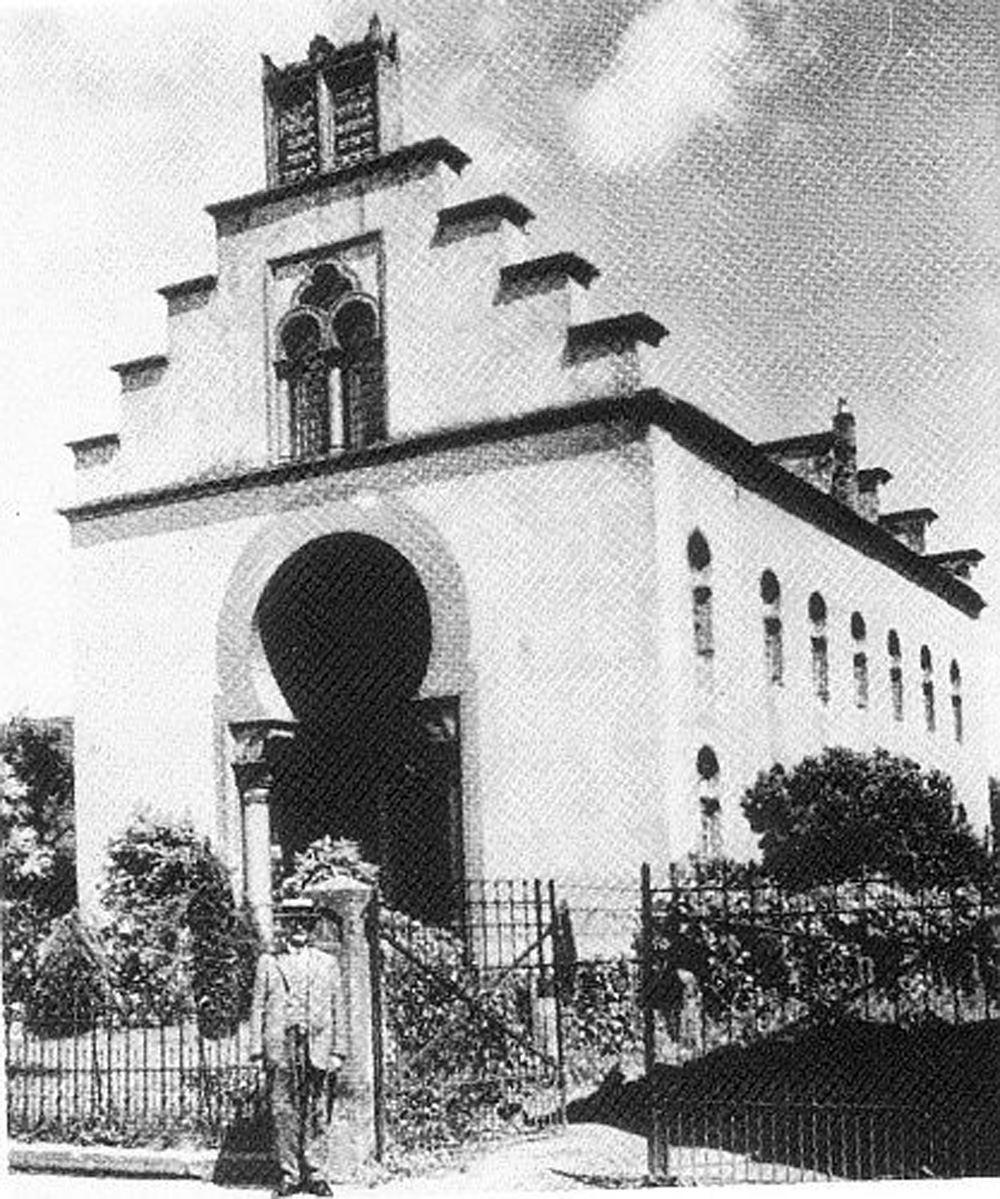
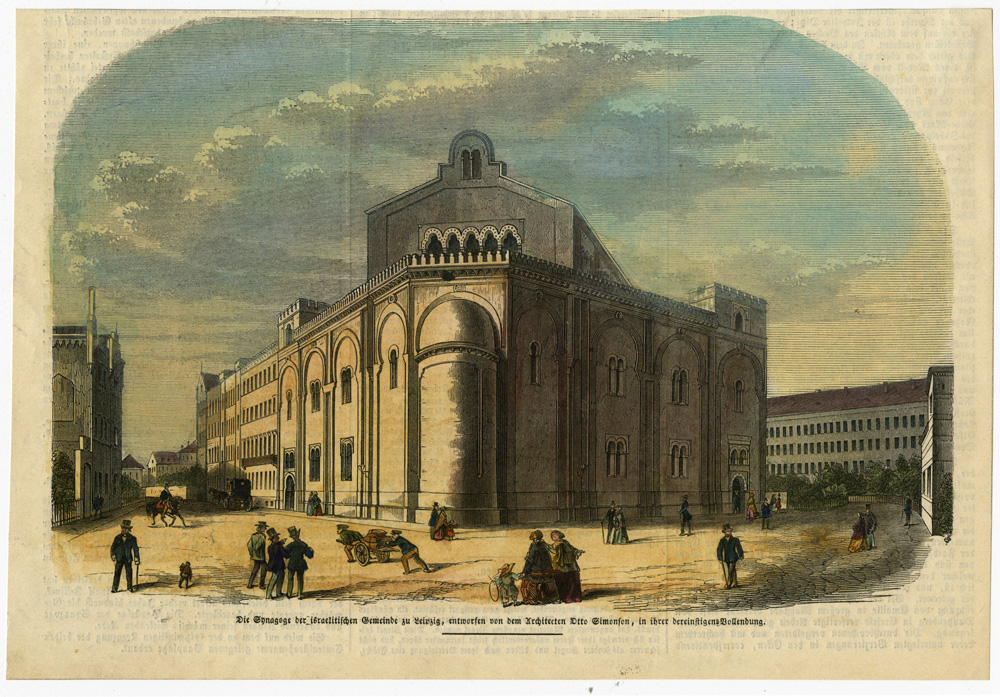
 The synagogue in Dresden was designed by one of Germany’s foremost architects, Gottfried Semper, the man who designed the city’s world famous opera house.  His student, Otto Simonson, was one of the very few Jewish architects in Germany in the nineteenth century and his great contribution was to design what was Germany’s first fully neo-Moorish synagogue, both inside and out.  Built in Leipzig in 1855, and also named the Neue Synagoge, its unusual triangular shape (akin to the Flatiron Building in New York) made it immediately recognizable.  At the very point of this gigantic, 2,000 seat synagogue, where the two angles met, there was a massive, semicircular silo on top of which was a highly polished, fluted copper cupola, framed by a horseshoe arch, crowned with a Star of David.
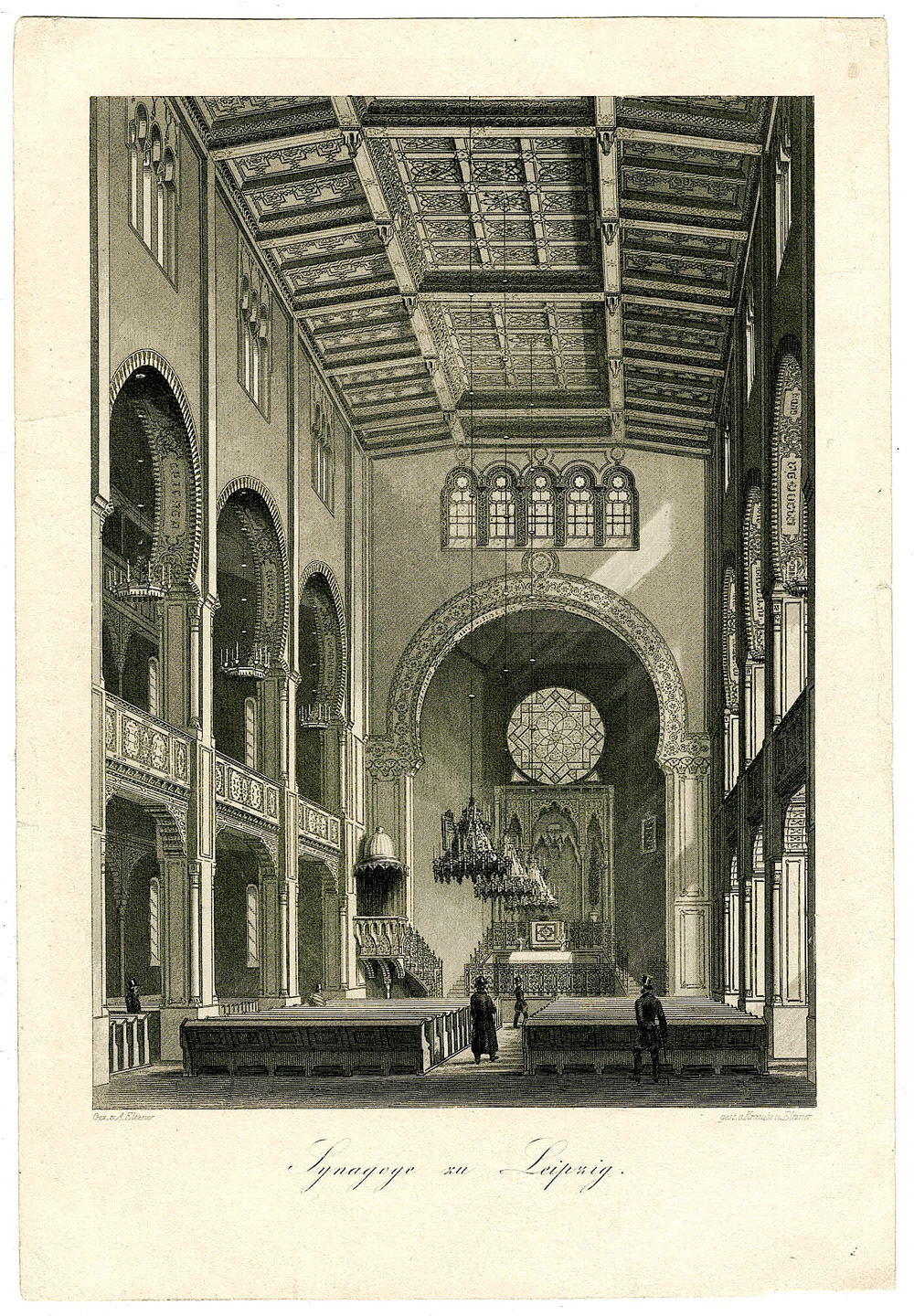
On the synagogue’s interior, it was this silo that was home to the ark that held the Torah scrolls.  The synagogue’s two massive facades were punctuated by four gigantic relief moldings of Islamic arches.  Running along the top of the outer walls were crenellated parapets.  With battlements, towers, and a rampart-like facade, the building took on the appearance of a fortress mosque.  The interior was a blaze of color, with yellow skirting boards forming the base for green walls, which rose to meet a stunning blue ceiling bedecked with stars and a giant sun.  All of this was further illuminated by the bright light that streamed in through the colored rose window.  A monumentally large and highly decorated horseshoe arch framed the whole eastern end of the synagogue, further enhancing the neo-Moorish appearance of the whole structure.  Simonson was one of the few architects to explain why he chose the neo-Moorish style for his synagogue:
“The Temple is built in the Moorish style, which appears to me to be the most
characteristic. Judaism adheres with unshakable reverence to its history; its
laws, its customs and practices, the organization of its ritual; in short, its
entire essence lives in its reminiscences of its motherland, the Orient. It is
those reminiscences that the architect must accommodate should he wish to
impress upon the building a typical [Jewish] stamp.”[2]
From humble rural beginnings, Germany’s neo-Moorish synagogues got increasingly bigger and ever more ornate and none was grander than the Neue Synagoge in Berlin, built between 1859 and 1866.  When it finally received permission to build a new synagogue, the congregation announced an international competition to choose an architect for what it envisioned would be a brightly lit synagogue with seating for 3,200 congregants, upstairs galleries for the women, entrances separated according to sex, sufficient space for a 60-person choir, an apartment for the rabbi, as well as administrative offices and classrooms.  There was also to be a library with space enough for 67,000 volumes.  The renowned Eduard Knoblauch was the architect who won the tender and he had the difficult job of making sure that “the total cost was not to exceed 125,000 taler.”
Sadly, Knoblauch did not live to see his great creation, passing away in 1865.  When the synagogue on the Oranienburger Strasse—the very street on which Knoblauch lived—was inaugurated on September 5, 1866, the guests were seated in the grandest neo-Moorish synagogue ever built.  They were also in the most expensive, costs having ballooned to a staggering 750,000 taler.  The synagogue’s external centerpiece was an onion dome that soared majestically some one hundred and sixty feet into the air.  Wrapped in a blanket of zinc and swaddled in gold ribbing, crowned with a Star of David, the great dome was the brightest and most joyful architectural feature to be found anywhere in Berlin.  It was also the tallest structure in the city. The central portal was flanked by towering minarets that borrowed heavily from North African mosques and from the Giralda, a late twelfth century minaret in Seville while the crenellations were typical of those found on Cairene mosques.
 
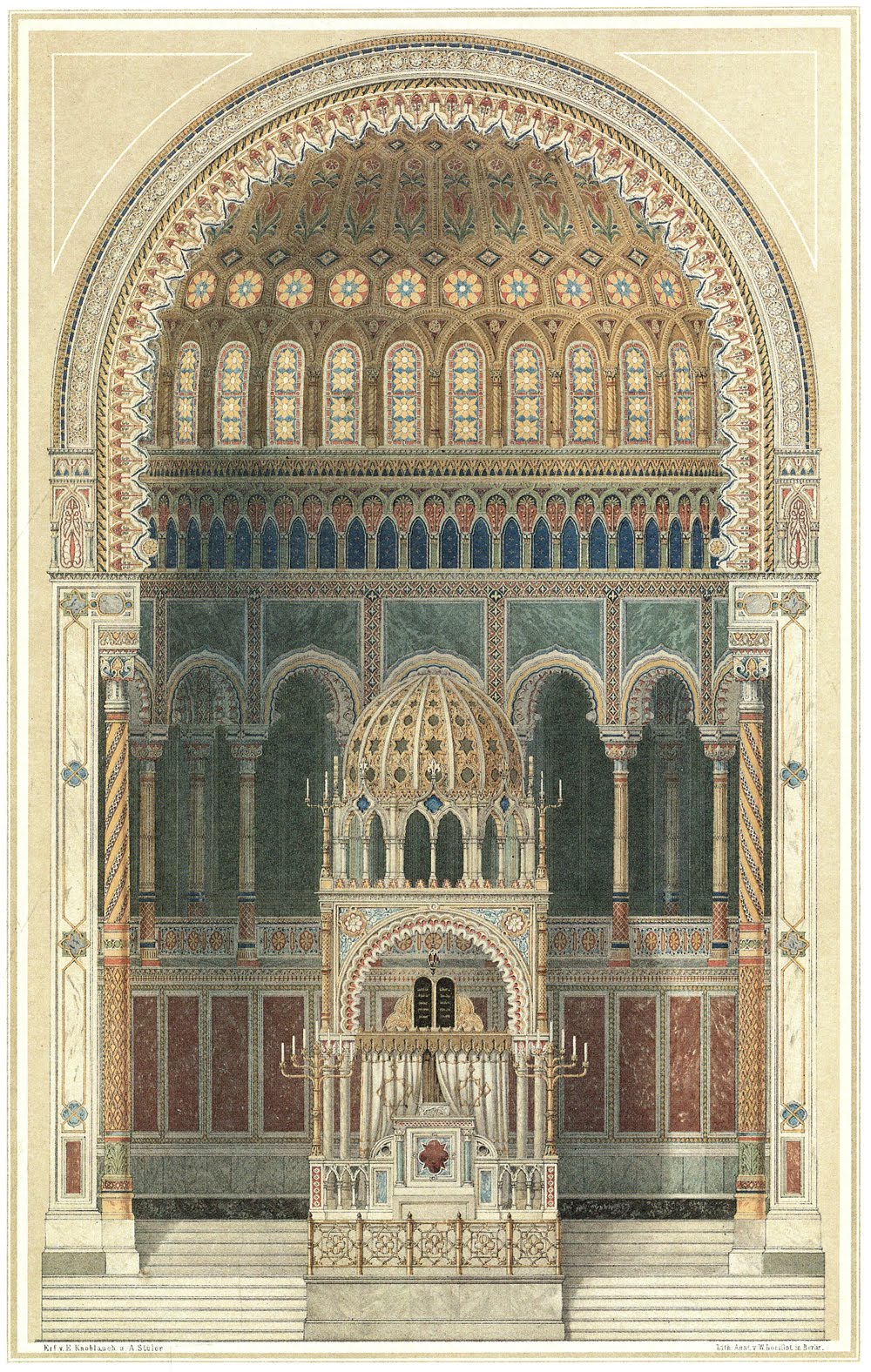
The synagogue was as massive as it was ornate, its triple-nave 188 feet long and 126 feet wide while the ceiling soared to a height of 87 feet.  The interior was a dazzling kaleidoscope of color, light, and texture.  With Moorish decorative patterns from the thirteenth and fourteenth centuries, the floors were inlaid with intricate mosaics; the walls were covered in richly colored stucco and then painted with stars and flora, while stalactite features hung from the ceiling where geometric and honeycomb patterns were also widely deployed, including on the elaborate friezes that accented the temple’s interior. A technical breakthrough helped bathe the entire synagogue in a palette of many colors.  The windows were double paned, with the outer layer made of clear glass and the inner windows of stained glass.  An innovative system of gas lamps was installed in between the two panes throughout the synagogue.  While the myriad windows allowed for abundant light to pour into the synagogue, the placement of the gas lamps and the way they illuminated the stained glass helped create what one attendee at the synagogue’s dedication ceremony called a “magical effect.”
Indeed, the synagogue had the air and appearance of an Oriental pleasure palace.  A contemporary newspaper account vividly described the synagogue as “a fairy-tale structure.…In the middle of a plain part of the city we are led into the fantastic wonder of the Alhambra, with graceful columns, sweeping arches, richly colored arabesques, abundant wood carvings, all with the thousandfold magic of the Moorish style.”  The Neue Synagogue’s fame quickly spread and it attracted visitors from near and far.  Among the curious was none other than the English author, Lewis Carroll, a man who knew a thing or two about wonderlands and fairy-tale structures.  Just two years after publishing Alice in Wonderland, on Friday July 19, 1867, he stopped in Berlin on his way to Russia and while there, Carroll, a deeply devout Christian, made two visits to the synagogue.  He noted in his diary that after a full day of sightseeing, “later in the evening we strolled out and looked at the Jewish Synagogue, said to be well worth the inspection.”  His first cursory visit was followed by a much longer second stop the very next day and occasioned this beautiful diary entry:
“We began the day by visiting the Jewish Synagogue, where we found the service going on, and
remained until it was over. The scene was perfectly novel to me, & most
interesting. The building itself is most gorgeous, almost the whole interior
surface being gilt or otherwise decorated—the arches were nearly all
semi-circular, tho’ there were a few instances of the shape sketched here—the
east end was roofed with a circular dome, & contained a small dome on
pillars, under which was a cupboard (concealed by a curtain) which contained
the roll of the Law: in front of that again a small desk facing west—the latter
was only once used. The rest of the building was fitted up with open seats. We
followed the example of the congregation in keeping our hats on. Many men, on
reaching their places, produced white silk shawls out of embroidered bags,
& these they put on square fashion: the effect was most singular—the upper
edge of the shawl had what looked like gold embroidery, but was probably a
phylactery [sic].
These men went up from time to time & read portions of the lessons. What
was read was all in German, but there was a great deal chanted in Hebrew, to
beautiful music: some of the chants have come down from very early times,
perhaps as far back as David. The chief Rabbi chanted a great deal by himself,
without music. The congregation alternately stood & sat down: I did not
notice anyone kneeling.”[3]
For just over six decades the synagogue was home to a proud and confident congregation, one where the world’s first woman rabbi Regina Jonas preached and where in 1930 Albert Einstein conducted the orchestra for a concert performance.  Alone among the synagogues mentioned above, the Neue Synagoge survived the Kristallnacht despite being damaged in that night of violence and desecration.  In November 1943, however, it eventually succumbed, almost completely destroyed when struck by Allied bombers during the Battle of Berlin.  After the war, the synagogue was, by dint of the Cold War, located in what became communist East Germany.  In 1958 the main part of the building was demolished, with only those sections adjacent to the street remaining intact.  After the fall of the wall in 1989, those parts of the building that had survived, which included the severely damaged dome and the beautiful facade, were renovated and the synagogue was reopened in 1995.  However, what once was is no longer.  The main sanctuary does not exist. Today, on the premises there is a museum, an archive, classrooms, the administrative offices of the Jewish community and a small synagogue that is used for regular services.
Why did Jews build in the neo-Moorish style, especially in an era when German Jewry fought tirelessly against an antisemitic image that considered them a foreign, Oriental people?  Indeed, critics of the synagogue claimed that its design only confirmed this.  I think that from the Jewish perspective, the neo-Moorish design linked these congregations to their image of the Sephardim, allowing the congregations to appear dignified and sensitive to the importance of aesthetics and good taste.  However, above all, these mostly Reform temples looked nothing like any synagogues ever built before.  And like Reform Judaism itself, they were utterly new, with no historical precedent and that was their appeal and their purpose.
Though none of the synagogues built in the neo-Moorish style bore any resemblance to synagogues that had existed in medieval Spain they were nonetheless just one element of a much larger cultural project undertaken by German Jews, wherein they sought to honor and emulate Sephardic Jewry as part of a transformative process that would see them form a new kind of Ashkenazic Jewish culture.  Doing so led to a highly romanticized depiction of Sephardic Jewry, one where they were seen as superior to Ashkenazim in nearly every way—a curious, if not troubling, Ashkenazic assertion if there ever was one.  Long after the tragic demise of Spanish Jewry, the rays of its so-called Golden Age continued to shine across the Jewish world but without doubt it was in modern Germany that those rays enjoyed their greatest luminosity.
Notes:
[1] Quoted in Ismar Schorsch, From
Text to Context: The Turn to History in Modern Judaism
(Hanover, NH:
University Press of New England, 1994), 75.
[2] Otto Simonson, Der neue
Tempel in Leipzig
(Berlin: F. Riegel, 1858), 3
[3] Lewis Carroll, The Works of
Lewis Carroll
(London: Hamlyn, 1965), 972-973.


Post-Mosaic Additions to the Torah?

Post-Mosaic Additions to the Torah?

Marc B. Shapiro

In his post here, Ben Zion Katz deals with medieval rabbinic views regarding post-Mosaic additions to the Torah. Katz refers to The Limits of Orthodox Theology, and I have mentioned many additional sources in Seforim Blog posts. (A couple of people have commented that in a few recent publications on this topic it seems that the authors used my writings without any acknowledgment. I would only say that I don’t have a copyright on any sources. Once I discuss the sources publicly, then anyone is free to make use of them. It would, however, be appropriate for these authors to at least mention my book and posts if that is how they learned of these sources.)

In Limits, pp 109-110, I mention that the Tosafist R. Avigdor Katz cites interpretations found in R. Judah he-Hasid’s commentary to the Torah both with regard to post-Mosaic additions to the Torah and about material being removed from the Torah and placed in the book of Psalms. (While R. Avigdor only refers to one chapter [Psalm 136] being removed from the Torah, R. Judah he-Hasid speaks of this and all other anonymous Psalms written by Moses.) R. Avigdor does not mention R. Judah he-Hasid, and regarding the removal of the chapter from the Torah and placing it in the book of Psalms, before citing this interpretation he states, “I have heard.” Thus, I think it is fair to say that the “critical” interpretations he mentions were “in the air.”

H. J. Zimmels published the two passages from R. Avigdor just mentioned,[1] but there is another comment that appears as a note to R. Avigdor’s manuscript. It has recently been published by Miriam Weitman,[2] and states:

וישם את אפרים לפני מנשה פי‘ לא על יעקב אמ‘, אל‘ משה רבינ‘ שם ראש דגל אפרי‘ לפני מנשה בעבור שיעקב אמ‘ ואחיו הקטן יגדל ממנוויהושע או אנשי כנסת הגדול‘ כתבודאי משה כתבו אם היה לו [צל היה לו לומראני שמתי כמו שאומ‘ אחרכ‘ ואני נתתי לך שכם אחד על אחיך

This interpretation, speaking of a post-Mosaic addition to the Torah, is also found in R. Judah he-Hasid’s commentary. 

In a previous post, available here, I mentioned R. Shlomo Fisher’s rejection of R. Moshe Feinstein’s view that R. Judah he-Hasid’s “biblical criticism” is a forgery. As R. Fisher put it, R. Moshe assumed that R. Judah he-Hasid has to accept Maimonides’ Principles, but that is not the case, and when it comes to the issue of complete Mosaic authorship, R. Judah he-Hasid disagrees with Maimonides. R. Uri Sherki has apparently also discussed this matter with R. Fisher, as he cites R. Fisher as stating that the issue of whether post-Mosaic additions are religiously objectionable is a dispute between the medieval Ashkenazic and Sephardic sages. See here.

What this means is that in medieval Ashkenaz it was not regarded as heretical to posit post-Mosaic additions, while the opposite was the case in the Sephardic world (and this would explain why Ibn Ezra could only hint to his view). I am skeptical of this point, particularly because Ibn Ezra’s secrets are, in fact, explained openly by people who lived in the Sephardic world.[3] Yet Haym Soloveitchik has also recently made same point, and pointed to differences between Jews living in the Christian and Muslim worlds. His argument is that since medieval Ashkenazic Jews were not confronted with a theological challenge of the sort Jews had to deal with in the Islamic world, where Jews were accused of altering the text of the Pentateuch, there was no assumption in medieval Ashkenazic Europe that belief in what we know as Maimonides’ Eighth Principle was a binding doctrine of faith.

Here is some of what Soloveitchik writes (the emphasis does not appear in the original):

One tanna had stated, simply and with no ado, that the last eight verses were of Divine origin but not of Mosaic authorship, and R. Yehudah he-Hasid added that there were several more verses that were not penned by Moses. Was such a position seen as being thoroughly mistaken? Most probably. Was it viewed as odd and non-conformist? Undoubtedly; though hardly more eccentric than R. Yehudah’s view that King David, to flesh out his book of Psalms, lifted from the text of the “original” Pentateuch many anonymous “psalms” that Moses had penned! Were these strange and misguided views, however, perceived as being in any way heretical or even dangerous? At that time and place, certainly not. They contained no concession to the surrounding culture, opened no Pandora’s Box of questions. Indeed, one can take the religious temperature of R. Yehudah he-Hasid’s explanation by the matter of fact way European medieval commentators (rishonim) treated the passages in Menahot and Bava Batra where the tannaitic dictum of Joshua’s authorship is brought.[4] In their world, these words did not abut any slippery slope of a “documentary hypothesis” or of “Jewish forgery”. No need, therefore, to reinterpret this passage or to forfend any untoward implications. What concerned R. Yehudah he-Hasid’s contemporaries, the Tosafists, in this statement were its practical halakhic implications for the Sabbath Torah readings, not its theological or dogmatic ones, for to them, as to R. Yehudah, there were none.[5] 

One of the biggest theological changes in Orthodoxy in the last decades—perhaps the sources collected in Limits were significant in this regard—is the acknowledgment that asserting limited post-Mosaic additions to the Torah is not to be regarded as heretical.[6] In Limits and subsequent blog posts I have recorded around thirty-five rishonim and aharonim who claim that Ibn Ezra believed in post-Mosaic additions. When you throw in R. Judah he-Hasid, R. Avigdor Katz, R. Menahem Tziyoni, and other sources I referred to in Limits, it is hard to convince people this is a heretical position, despite what Maimonides’ Eighth Principle states. It is also hard to convince them that this matter has been “decided” in accordance with Maimonides’ view. R. Mordechai Breuer states flatly that the legitimacy of Ibn Ezra’s opinion cannot be denied.[7] 

אין אני יודעאם רוח חכמים נוחה מהדברים האלהמכל מקום הם יצאו מפי אבן עזראושוב לא נוכל לשלול את הלגיטימיות שלהם

Yet fifty years ago, speaking about these opinions would have been regarded as incredibly controversial, if not heretical in many eyes. Today, it seems like it is no big deal, and I have in mind not just Modern Orthodox circles but in the intellectual haredi world as well. It is significant that it its affirmation of Torah mi-Sinai, the Rabbinical Council of America did not deny the existence of views that speak of small additions to the Torah, but instead noted the great difference between these views and modern critical approaches. Here is the relevant paragraph (the entire statement can be seen here).

When critical approaches to the Torah’s authorship first arose, every Orthodox rabbinic figure recognized that they strike at the heart of the classical Jewish faith. Whatever weight one assigns to a small number of remarks by medieval figures regarding the later addition of a few scattered phrases, there is a chasm between them and the position that large swaths of the Torah were written later – all the more so when that position asserts that virtually the entire Torah was written by several authors who, in their ignorance, regularly provided erroneous information and generated genuine, irreconcilable contradictions. Beyond a shadow of a doubt, none of the above mentioned figures would have regarded such a position as falling within the framework of authentic Judaism

Without getting into the content of this statement which I believe is generally correct,[8] what is important for our purposes is that I do not believe such a statement would have been issued even fifty years ago, as it acknowledges the existence of “remarks by medieval figures” that are at odds with  Maimonides’ Eighth Principle.[9] 

What are we to make of the approach to Torah mi-Sinai in R. Judah he-Hasid’s “school”? Weitman suggests a few possibilities, one of which is that they believed in the existence of a “continuing revelation,” namely, that the Torah continued to be revealed even after the initial revelation to Moses. This would be an extension of the talmudic view that the last eight verses of the Torah were written by Joshua. While some might find this approach quite provocative, I think it is actually the meaning not just of R. Judah’s “school” but of Ibn Ezra and pretty much everyone who believed in intentional post-Mosaic additions. That is, they believed that these were added by prophets, as they would have regarded as completely unacceptable, indeed heretical, the notion that the Torah contains non-prophetic verses.

One of the most important sources in this matter is R. Judah he-Hasid, as he is a universally recognized rishon who pointed to post-Mosaic additions. Not surprisingly, his opinion is often quoted, and the censorship of his commentary has also been widely discussed. R. Judah he-Hasid’s words have been read in the exact same way by the greatest Torah scholars as well as the greatest academic scholars, and yet, what if everyone is mistaken? This is the claim of Eran Viezel, who in a recent article has argued that the passages in R. Judah he-Hasid’s commentary that point to post-Mosaic additions were actually written by R. Judah he-Hasid’s son, R. Moses Zaltman, a figure who does not have the religious authority of his famous father.[10] Since Viezel feels that he has removed the veil of “Bible critic” from R. Judah he-Hasid, he also wonders if R. Moses, and not R. Judah he-Hasid, should be identified as the source of the claim that texts were removed from the Pentateuch and placed in the Psalms. In this case, however, he acknowledges that there is no evidence to support his suggestion.

I have gone through Viezel’s arguments, and while I agree that it seems that R. Moses is the author of the “critical” comment to Leviticus 2:13, I don’t see this when it comes to the other passages. More importantly, none of the scholars I have consulted in this matter accept Viezel’s argument, so I don’t think we need to revise all the discussions about R. Judah he-Hasid and substitute his son, R. Moses. I would also add that it is precisely the other two passages in R. Judah he-Hasid’s commentary that speak of post-Mosaic additions, as well as the passage that speaks of Psalms being removed from the Torah, that appear as well in R. Avigdor Katz’s commentary (with the difference noted above that R. Avigdor only speaks of one Psalm having been removed). In other words, what we have here is not some radical individual view advocated by R. Moses, but a position that was shared by others and no doubt well known.

It is noteworthy that while earlier editions of Otzar haChochma included the censored version of R. Judah he-Hasid’s commentary, the current edition includes the uncensored text. Otzar haChochma is careful not to include anything heretical on its site, so this can be seen as a “koshering,” as it were, of the uncensored commentary of R. Judah he-Hasid. Also significant is that in the new Otzar ha-Rishonim on Torah, two of the four “critical” comments in R. Judah he-Hasid’s commentary are included (Lev. 2:13, Deut. 2:8). Here is the page that includes the commentary to Deuteronomy 2:8.

As far as I know, no one has placed the Otzar ha-Rishonim in herem for including R. Judah he-Hasid’s comments. 

There is one other thing that is noteworthy about this edition of the Humash. Here is a page where you can see something called Targum Yerushalmi ha-Shalem.

This is not found in the regular Mikraot Gedolot Humash. There you only have a fragmentary Targum Yerushalmi. In academic circles, the complete Targum Yerushalmi is known as Targum Neofiti, and it was only discovered in 1949. You can read about it in Wikipedia here. The Wikipedia entry states that Neofiti is “the most important of the Palestinian Targumim, as it is by far the most complete of the Western Targumim and perhaps the earliest as well.”[11] 

Returning to Viezel, I want to now offer  some valuable information which in my opinion not only shows that Viezel’s argument is lacking, but is significant in its own right. From this point on, when speaking of important medieval Ashkenazic sages who believed that there are post-Mosaic additions in the Torah, in addition to R. Judah he-Hasid and R. Avigdor Katz, we have to add R. Judah he-Hasid’s student, the great R. Elazar of Worms. This at least is Amos Geula’s identification of the author of an unpublished medieval commentary on the Torah, and for the purposes of this post I will assume Geula is correct.[[12] 

In his commentary to Genesis 36:1, R. Elazar writes:[13] 

ואלה המלכים [בראשית לולאלפי הפשט עזרא כתב ואלה המלכים עד שאולאו משה כתבו ברוח הקדשכבלעם שכתב מעשה אגג ומשיח . . . לפני מלוך מלך בישר[אל] אילו המלכים מלכו קודם שאול המלך כי כשהומלך שאול הכניע אדום כי נלחם באדום ובעמלק עד זמן יהורם שכת‘ ומלך אין באדום נצב מלך [מלא כבמח] . . . ואלה שמות אלופי (אדום) [עשו] [ברלוממזמן שאול עד יהורם

אלה המלכים המלכים היו קודם האלופים שהרי מנה אותם תחילהאלופים [מלכיםאילו קודם שמלך דוד שנ‘ לפני מלוך מלך לבני ישר[אלואין לך לומר לפני משה שהרי לא מצינו שמלך משהואין לומר ויהי בישורון מלך [דב‘ לג,המשה

R. Elazar explains that according to the peshat, Genesis 36:31-39, which gives the list of kings “that reigned in the land of Edom, before there reigned any king over the children of Israel,” was written by Ezra. He offers another suggestion that Moses wrote this prophetically, but as you can see from the rest of his comment, this is not the approach he adopts, as he assumes that these verses, as well as Genesis 36:40-43, are post-Mosaic.

This interpretation is already found in R. Judah he-Hasid and R. Avigdor Katz, who think that these verses were written in the days of Anshei Keneset ha-Gedolah. According to a medieval Tosafist collection of Torah commentaries, this view was also held by R. Samuel ben Meir (Rashbam).[[14] It is thus obvious that this was a common interpretation in medieval Ashkenaz, and as more medieval manuscripts are published we will no doubt find more such “critical” interpretations.

As Geula notes, in the published version of R. Elazar Rokeah’s commentary on the Torah,[15] which was apparently written not by him but by one of his students,[16] we also find the view that Genesis 36:40-43, in addition to Genesis 36: 31-39, are post-Mosaic.

הרי אילו יא אלופים היו בימי ח‘ מלכי ישראל לכן נקרא אלוף תמנע כי מנעו מהםמלך אין באדום נצב מלך (מלכים א כבמחכנגדם העמידו ישראל יא שפטים יהושע עד שמואלובימי השפטים העמידו מלכים באדום

From all we have seen of how members of this “school” explained this chapter of Genesis, it is clear that this commentary does not mean that the names of the chiefs or the kings were written prophetically.

Another comment from R. Elazar pointing to a post-Mosaic addition is on Genesis 47:26: “And Joseph made it a statute concerning the land of Egypt unto this day, that Pharaoh should have the fifth.” This refers to the produce given in Egypt to the Pharaoh. But what do the words “unto this day” mean? R. Elazar sees these words as a post-Mosaic addition.[17] 

ושם אתה יוסף לחוק למשפטעד היום הזה עד שהגלה נבוכד נצר [!] ובימי משה שכתב את התורה עדיין היה חוק

On this verse, R. Menahem ben Solomon (12th century), in his Midrash Sekhel Tov,[18] writes:

עד היום הזה אלו דברי הסדרן

Geula understands the “sadran” to be a post-Mosaic author, and at first glance this would seem to make the most sense. However, Richard C. Steiner has studied the use of the term “sadran” in various medieval works, and he believes that it could also be used with reference to Moses.[19] 

Returning to R. Elazar of Worms’ commentary, we find something interesting in the manuscript, although we have no way of knowing what the original text was.[20] The copyist wrote:

וכתב שדהו במשנה תורה [דב‘ היחלפי שכבר סמוך שייכנסו לארץ [וי]היה להם שדות

However, this was corrected to read:

לפי שכבר נכנסו לארץ והיה להם שדות

The question is why in the version of the Ten Commandments in Deuteronomy 5:18, in the commandment against coveting, does it include coveting your neighbor’s field while this point is missing from the Ten Commandments in Exodus 20:13. According to the second reading in the manuscript, the word שדהו was added after the Israelites entered the Land of Israel. Geula rightly asks, was this a “correction” of a reader of the manuscript, or was he returning the text to its original form?

With all the evidence that we now have, and as mentioned more will no doubt be forthcoming as additional manuscripts are published, it is clear that the viewpoint that there are limited post-Mosaic additions in the Torah was considered acceptable in medieval Ashkenaz (and thus it is hard to see how it can be regarded as an unacceptable view today[21]).

Regarding R. Judah he-Hasid, the following is also worth noting. Here is his commentary to Deuteronomy 2:8.

In the middle we see the following words:

שהוא נמצא כמו מרשיילא או פנדייא שעוברים דרך שם לעכבו כך לא היו יכולין לילך אחר הזהב אם לא היו באין לעציון גבר מתחילה

What does לעכבו mean? Viezel translates as follows: “For it was located like Marseille or Pontoise [place names], as a way station en route [to the gold] so that they were not able to go after the gold unless they came to Etzion Geber first.” (His identification of פנדייא as Pontoise must be correct, and in medieval times Pointoise was an important commercial center.)

Zev Farber in his article here translates the passage as follows: “For it is situated like Marseilles or Pandaya[22] such that people must pass through there to stop in, so that they could not get to the gold if they did not stop first in Etzion-geber.”

I have underlined the words that Viezel and Farber use as translations of לעכבו. Yet both of them overlooked what I pointed out in Limits, p. 109 n. 136, that the parallel text of R. Avigdor Katz allows us to see that the word לעכבו is a mistake and it should actually read לעכו, “to Acre”, which for almost two hundred years was part of the Crusader Kingdom of Jerusalem.[23] Now the passage makes perfect sense.

Let me make three final comments about the text of the Torah.

A. In Limits I discussed those who understand Tikkun Soferim literally. To the list of the authorities I mention, we can add R. Pesah Finfer,[24] R. Isidore Epstein, and R. Joseph Messas.


R. Finfer was a dayan in Vilna and considered the expert on masoretic matters in Lithuania.[25] In his Masoret ha-Torah ve-ha-Nevi’im (Vilna, 1906), p. 6, he writes:

ראוי הי‘ עזרא שתנתן התורה על ידו . . . והוא ונחמי‘ עשו תיקון סופרים וכינויי סופרים.

R. Epstein, Judaism (Baltimore, 1959), pp. 195-196, writes:

The spiritualization of the conception of God is reflected already in certain changes known as Tikkune Soferim (Corrections of the Scribes), which, ascribed to Ezra, were introduced into the Biblical text in order to tone down certain anthropomorphic expressions.

R. Messas, Minhat Yosef (Jerusalem, 2012), vol. 4, p. 40, writes:

וזה אחד מתקוני סופרים בתורה לכנוי ולתקון לשון עכ”ל. ענין זה מפורש בתנחומא פרשת בשלח על הכתוב וברוב גאונך, ובעץ יוסף שם, ובערוך ערך כבד . . . והעולה מכלם הוא, כי בי”ח מקומות בתנ”ך תקנו הסופרים שהם אנשי כנה”ג איזה תקונים בהם

B. One of the greatest Moroccan rabbis of the last two hundred years was R. Raphael Berdugo (1747-1821), known as המלאך, who wrote important responsa and biblical and talmudic commentaries. In his Mesamhei Lev on Joshua, chapter 5, R. Berdugo calls attention to verse 12 which shows us that even after entering the Land of Canaan, the Israelites were still fed for a time with manna. “And the manna ceased on the morrow, after they had eaten of the produce of the land; neither had the children of Israel manna any more; but they did eat of the fruit of the land of Canaan that year.”

R. Berdugo points out that Exodus 16:35 states: “And the children of Israel did eat the manna forty years, until they came to a land inhabited; they did eat the manna, until they came unto the borders of the land of Canaan.” The problem is obvious. The verse in Exodus is written from the perspective of when the Israelites were no longer eating the manna, yet we see from the book of Joshua that they continued eating the manna even after Moses’ death. So who wrote the verse in Exodus?

R. Berdugo acknowledges that one can say that it was prophetically written by Moses. Yet he doesn’t think that this makes sense, namely, to write a verse prophetically so that it appears to be written about an event that happened in the past. Therefore, he says that Joshua wrote the verse. It seems that that this does not raise any theological issues for him, and he compares it to the dispute about the last eight verses in the Torah where one tanna holds that Joshua wrote these verses because they refer to events after Moses’ death. Here, too, R. Berdugo states that since the verse refers to something that took place after Moses’ death, it makes sense to say that it was written by Joshua.[26] 

ויאכלו מעבור הארץ ולא היה עוד לבני ישראל מן וגומשמע שאחר שבאו לארץ כנען היו אוכלים מןומש בתורה את המן אכלו עד בואם אל קצה ארץ כנען הוא סמוך ליריחו אחר מות מרעהואכ צע מי כתב אותו פסוק בתורהואף כי אין מעצור לומר כי מרעה כתב זה ברוח קדשו ידע העתידות ושישראל יאכלו המן אחר מותו מכל מקום לשכל קשה זה וכש שיאמר אותם בלשון שכבר נעשוולכן העיקר שיהושע כתבו אחרי מות מרעהוכן מצאנו שנחלקו רזל בפסוק וימת שםשר‘ יוסי אמר שיהושע כתבו וכו‘.

Also of interest is R. Berdugo’s comment to Deuteronomy 34:10, where in speaking about verses at the end of the Torah written after Moses’ death, he attributes them to כותבי התורה rather than just to Joshua.[27] 

C. In the very interesting book, Derekh Sihah, which records conversations with R. Hayyim Kanievsky, the following questions and answers appear (vol. 1, pp. 323- 324):

שאלה: באור החיים הק‘ (לדכטכתב ממדרש שקרני ההוד נעשו עי שיור הדיו שנתן על ראשווהכוונה כי משה מרוב ענוה לא כתב והאיש משה עניו עם יודולכן נשאר דיווזה פלא וכי כתב איך שירצההרי כל אות היתה בנבואה

תשובה: כיוצא בזה כתב בעל הטורים (ריש ספר ויקראשכתוב אלף זעיראכי רצה משה לכתוב ויקר“, אמר לו הקבה כתוב עם אלףאבל ממ כתב אותה בזעיראוכנראה שזה לא נמסר לו איך לכתוב.

שאלה: שאלתי להרב שליטא עד דברי האור החיים” הק‘ שכתב כי קרני הוד של משה משיירי קולמוסשהיה צריך לכתוב עניו” עם יודוכתב בלא יודוכי זה נתון לדעתוואמר הרב שלא אמרו לו כיצד לכתובוחזינן שאמרו רק התוכןוגם כאן כן הוא.

תשובה: שם זה היה על התיבה הזאת בלבד שלא אמרו לו איך לכתובאבל פעם שאלתי מהגר גדליה נדל שליטא שרואים בחזל טענות על נביאים כיצד אמרו בלשון מסוייםכגון במסכת פסחים (סוב‘) כל המתייהר אם נביא וכו‘ מדבורה דכתיב חדלו וכו‘, וזה היה בנבואהוכן במסכת מגילה ידב‘ “כרכושתא כתיב בה אמרו לאיש ולא אמרה אמרו למלך“, ושם מלכים (ב‘ כבטוכתוב כה אמר ה‘, חזינן מזה שיש פעמים שהשאירו הבחירה ביד הנביא אלו תיבות לומר

R. Kanievsky states that Moses on his own decided to leave out the yud in the word ענו in Numbers 12:3. R. Kanievsky supports this position with the comment of the Baal ha-Turim on Leviticus 1:1 who states that Moses on his own wrote the final aleph in the word ויקרא in small print. (I did not cite this comment of Ba’al ha-Turim in Limits, as I don’t see it as in opposition to Maimonides’ Eighth Principle. The Principle speaks of the letters of the Torah themselves, not whether they are regular size or small.[28]

Despite the citation of Ba’al ha-Turim, I am sure that some will regard R. Kanievsky’s position as inappropriate, or even in opposition to the Eighth Principle which states that the entire Torah found in our hands is of divine origin, for R. Kanievsky states that Moses had the authority to determine if the word ענו should be written with a yud or not.[29] It is true that in the Mishneh Torah, Hilkhot Teshuvah 3:8, Maimonides defines a heretic as “One who says that the Torah, even one verse or one word, is not from God.” Maimonides here does not include one who says that a single letter is not from God. However, in the Eighth Principle he does not make such a distinction. Presumably, R. Kanievsky would say that the words of the Eighth Principle must be understood in line with what appears in the Mishneh Torah. Nevertheless, it is significant that R. Kanievsky regards as theologically legitimate the notion that Moses independently determined how a word in the Torah should be written, as the standard view is that all such matters were determined by divine command.

R. Kanievsky further supports his position with a striking insight. He points to Pesahim 66b and Megillah 14b where statements of Deborah and Hulda are criticized by the Sages for being boastful. Yet both these statements are actually part of a prophecy, so how could the Sages find problems with these words if they came from God? R. Kanievsky concludes from this that while the prophetic message comes from God, there are times when the actual words originate in the prophet’s mind, and this explains how the Sages can regard these words as problematic. Although Moses’ prophetic level was above that of all other prophets, R. Kanievsky believes that on at least one occasion Moses was allowed to choose how a word in the Torah was written.

***********

My Torah in Motion classes are now being placed on Youtube. Those who are interested can view them here.

***********

[1] Abhandlungen zur Erinnerung an Hirsch Perez Chajes (Vienna, 1933), pp. 259, 261.

[2] “Hedei Parshanuto shel Rabbi Yehudah he-Hasid be-Kitvei Talmidav – Hemshekh Mul Tzimtzum,” Megadim 55 (2014), p. p. 77.

[3] In Limits and subsequent blog posts I listed numerous rishonim and aharonim who understood Ibn Ezra’s hints to mean that there are post-Mosaic additions in the Torah.  Here is another important text, a comment by Tosafot (Tosafot ha-Shalem, ed. Gellis, to Gen. 12:6 [p. 14]:

והכנעני אז בארץ . . . ואם איננו כן יש לו סודכי כוונתו שזה לא כתבו משה אך נכתב אחר שנכבשהוכן דעתו בהרבה פסוקים

Tosafot rejects this opinion, stating:

ואנחנו לא ניאות בזה הדעת שכל התורה כתבה משה מפי ה’ בלא חילוק ושנוי

It is significant that Tosafot does not refer to Ibn Ezra’s interpretation as heretical. For another source that assumes that Ibn Ezra believed that there are post-Mosaic additions in the Torah, see R. Aharon Friedman, Be-Har ha-Shem Yeraeh (Kerem be-Yavneh, 2009), p. 30.

[4] I am aware of no evidence that the rishonim in the Islamic world interpreted these passages in a fundamentally different way than the Ashkenazic rishonim. As noted in Limits,  pp. 104-105, R. Joseph Ibn Migash openly accepted the viewpoint that Joshua wrote the last eight verses of the Torah. One point which I did not make in Limits is that while the Talmud attributes to individual tannaim the view that the last eight verses in the Torah were written by Joshua, in Sifrei, Devarim, piska 357, this opinion is cited anonymously, apparently signifying that it is the view of the Sages as a whole, which is then challenged by R. Meir.

וימת שם משה איפשר שמת משה וכותב וימת שם משה אלא עד כאן כתב משה מיכן ואילך כתב יהושע רבי מאיר אומר הרי הוא אומר ויכתוב משה את התורה הזאת איפשר שנתן משה את התורה כשהיא חסירה אפילו אות אחת . . .

See Nahum Bruell in Beit Talmud 2 (1881), p. 15.

[5] “Two Notes on the Commentary on the Torah of R. Yehudah he-Hasid,” in Michael A. Shmidman, ed. Turim (New York, 2008), pp. 245-246. Ephraim Kanarfogel, The Intellectual History and Rabbinic Culture of Medieval Ashkenaz (Detroit, 2013), p. 32, writes: “The availability of this kind of interpretational freedom and variety also allowed Hasidei Ashkenaz to be comfortable with Ibn Ezra’s stipulation of verses that may have been added to the Torah after the revelation at Sinai.”

[6] See my “Is Modern Orthodoxy Moving Towards an Acceptance of Biblical Criticism?” Modern Judaism 37 (May 2017), pp. 1-29, where I also discuss Modern Orthodox thinkers who go beyond this and have accepted the assumptions of modern biblical scholarship regarding source criticism. See also my post here. In my article, I neglected to mention R. Michael Abraham who also sees no religious objection to post-Mosaic additions to the Torah, or even that the Torah is composed from different sources (as posited by the Documentary Hypothesis). See herehereherehere, and here.

[7] Shitat ha-Behinot” shel ha-Rav Mordechai Breuer, ed. Yosef Ofer (Alon Shevut, 2005), p. 311. The standard view is that Ibn Ezra believed that the post-Mosaic additions are from later prophets, but R. Breuer seems to understand Ibn Ezra to mean that these additions are simply readers’ notes, which would not be prophetic (p. 312):

והואיל ואין כל ודאותשנוסח הרוב הוא גם הנוסח הנכוןכבר אפשרי הדבר שספר התורה שבידינו כולל דברים שנוספו לו אחר כך על ידי סופרים טועיםאך מעולם לא היו בספר שנמסר למשה מפי הגבורה.

והאמור בטעויות סופרים אמור גם בתוספות של תלמידיםשהרי הדבר ידועשדרכם של קוראים להוסיף את הערותיהם בגיליון הספר – ואחר כך באים תלמידים טועים” ומוסיפים את ההערות האלה בגופו של הספרואין לך ספר שאיננו כולל הוספות או גלוסות כאלהואבן עזרא סבורכנראהשגם ספר התורה לא יצא מכלל זהוהוא כולל אפוא גם דברים שלא נכתבו על ידי מחבר הספראלא נוספו לו אחר כך על ידי הלומדיםאבל מובן מאליושהוא יכול היה לומר את הדבר הזה רק על אותם מקומות מועטיםשתוכנם מעיד עליהם שהם הוספות מאוחרות.

[8] I say “generally correct” because the assumption that medieval figures only referred to “the later addition of a few scattered phrases” is not accurate if one includes explanations offered by commentaries on Ibn Ezra. In this post as well I give examples which refer to more than a few scattered phrases”

[9] R. Yehoshua Enbal, who often presents original perspectives, has a very strange passage in his Torah she-Ba’al Peh (Jerusalem, 2015), p. 685:

הטענה שכל התורה שבידינו היא המסורה למשה רבינו עליו השלום“, אינה באה בנימוק הגיוני שלא יתכן שאירעה איזו טעות בימי יהושע בן נון ונוספה אות ו‘ באיזו מלהכאשר בזמן משה לא היתה קיימת אות זוטכנית אולי הדבר ייתכןואף יש חילופי נוסח זעומים בפועל בין העדותאלא שמי שמחזיק בדעה כזועם כל הכבוד וההערכהוהנימוקים ההגיוניים שאולי יצרף לדבריואינו חלק מהדת שלנושכן ויתור על אות אחתהינו ויתור על הטקסט כולושאינו אלא סך של אותיות.  אם נוותר על א‘ ועל ב‘ ועל ג‘, איננו מאמינים בכלוםהקישור בין כלל זה לבין נימוק הגיונימעקר את הכללאין העיקר קובע שהגיוני מאד שלא אירע שום שינוי ואף מנסה לשכנע אותנושכן נימוק הגיוני אין כחו יפה בהכרח כנגד נימוקים שיבואו מולואו מחקרים אחרים שיבואו ביום מן הימיםהעיקר קובע שרירותית את גבולות הדתהדת מוקירה ומעריכה כל שימוש בהגיוןואף יכולה להביע הערכה להברקות מקוריותאבל המחזיק בדעה שלא כל התורה מפי הגבורהחוצה פורמלית את הגבול שבין דת להעידרה.

R. Enbal’s declaration that one who expresses doubt about the authenticity of a vav in the Masoretic text is to be regarded as a heretic cannot be taken seriously, especially as he himself notes, there are differences in this regard between different communities. In fact, before the printing press, there were widespread variations among Torah scrolls when it came to minor spelling differences, and the Talmud, Midrash, and medieval commentators often preserve different readings than the Masoretic text. See Limits, ch. 7. And what is one to make of his statement that העיקר קובע שרירותית את גבולות הדת? Principles of faith are to be determined arbitrarily without regard for truth? Earlier on the page he writes (emphasis added):

באוקיינוס של דעות מתפשטותשהתחיל כבר בזמן הרמבםוכמובן בזמננומבלי גבול שרירותינישאר רק עם טקסט.וכמובן גם הטקסט עצמו זקוק להגנה שרירותיתשכן ניתן לטעון שחלקים ממנו אינם מקוריים.

I can’t imagine that this approach, which sounds like it comes from Isaiah Leibowitz, will find many backers. R. Breuer obviously had a different perspective. See “Shitat ha-Behinot” shel ha-Rav Mordechai Breuer, p. 74:

אף על פי שרק נוסח המסורה ראוי להיקרא נוסח המקרא” – שהרי רק הוא נתקבל על ידי ההלכה – עדיין רשאים אנחנו לשאול אם זהו גם הנוסח המקורי של המקרא

[10] Viezel, “R. Judah he-Hasid or R. Moshe Zaltman: Who Proposed that Torah Verses were Written After the Time of Moses?” Journal of Jewish Studies 66 (Spring, 2015), pp. 97-115.

[11] In R. Menahem M. Kasher’s Torah Shelemah, beginning with parashat Ki Tissa, vol. 2, this Targum is included. R. Kasher was very excited by the discovery of this Targum and wrote about it in a number of places, in particular in Torah Shelemah, vol. 24, which is devoted to the Targumim. One of the most fascinating points he makes is as follows (Torah Shelemah, vol. 24, pp. 22ff.).

Deut. 24:3 states: וכתב לה ספר כריתות. Each of the three Targumim translates this passage differently.

Onkelos: ויכתוב לה גט פטורין

Neofiti: ויכתוב לה אגרא דשיבוקין

Ps. Jonathan: ויכתוב לה ספר תירוכין

Mishnah, Gittin 9:3 states:

גּוּפוֹ שֶׁל גֵּטהֲרֵי אַתְּ מֻתֶּרֶת לְכָל אָדָםרַבִּי יְהוּדָה אוֹמֵרוְדֵין דְּיֶהֱוֵי לִיכִי מִנַּאי סֵפֶר תֵּרוּכִין וְאִגֶּרֶת שִׁבּוּקִין וְגֵט פִּטּוּרִיןלִמְהָךְ לְהִתְנְסָבָא לְכָל גְּבַר דְּתִצְבַּיִן

The Gemara offers no reason for the text of the get that R. Judah requires. Why would one need to repeat the same thing in three different ways? (Contemporary gittin differ from R. Judah’s text, but still include the three terms: פטרית ושבקית ותרוכית) Later rabbinic authorities offer all sorts of forced explanations for this. R. Betzalel Ashkenazi, She’elot u-Teshuvot, no. 21, writes:

גט פטורין כמו שתרגם אונקלוס על גט כריתות אבל תרוכין ושבוקין ושאר הדברים שהם דברי עצמו אשר לא כתוב בספר

R. Ashkenazi recognizes that the words גט פטורין appear in Onkelos, but he thinks the other two words are original to R. Judah. (This shows that R. Ashkenazi did not have access to Targum Ps. Jonathan).

According to R. Kasher, R. Judah was simply using the Targumim known to him. He required inclusion in the get of the three different words that explain the term כריתות so that everyone would understand its meaning. In other words, he was including every possible translation of כריתות that was prevalent among the Aramaic speaking Jews, and this would ensure that a get written this way would be accepted by all who used these Targumim.

[12] Geula, “‘Le-Fi ha-Peshat Ezra Katav . . . O Moshe Ketavo be-Ruah ha-Kodesh’: Hearot al Hibbur ha-Torah be-Ferush Hadash le-Torah mi-Ketav Yad Vatican,” in Avigdor Shinan and Yisrael Y. Huval, eds.,Divrei Hakhamim ve-Hidotam (Jerusalem, 2018), pp. 89-114.

[13] Geula, pp. 91, 92. The verse is cited as מלוך מלך instead of מְלָךְ, but that is to indicate the pronunciation, as the first lamed has a kamatz katan. We find examples of this in our text of the Talmud (although we would have to check manuscripts to see how far back this goes). For example, the word כּׄתֶל, if you put a suffix on it, the holam then becomes a kamatz katan:  כָּתְלנו, as we see in Song of Songs 2:9. Yet throughout the Talmud we find the form כּותליinstead of כָּתְלי. The same thing happens if you put a suffix on the word צׄרֶך. Thus, in II Chron. 4:15 we have צָרְכך not צורכך. In the Talmud, however, you have the form צורכי (as well as צרכי). This was noted by R. Bentzion Cohen, Sefat Emet ((Jerusalem, 1997), p. 167.

[14]  See the text published by Isaac Lange in Ha-Ma’yan 12 (Tamuz, 5732), p. 83.

[15] Perush ha-Rokeah al ha-Torah (Bnei Brak, 1979), p. 258; also in Tosafot ha-Shalem al ha-Torah, vol. 3, p. 287,

[16] See Geula, p. 90.

[17] Geula, p. 96.

[18] Ed. Buber (Berlin, 1900), p. 298.

[19] “A Jewish Theory of Biblical Redaction from Byzantium: Its Rabbinic Roots, Its Diffusion and Its Encounter with the Muslim Doctrine of Falsification,” Jewish Studies Internet Journal 2 (2003), pp. 123-167.

[20] Geula, p. 100.

[21] On the other hand, R. Zvi Yisrael Tau, Tzaddik be-Emunato Yihyeh, pp. 281-282, rejects the legitimacy of this opinion in favor of Maimonides’ principle. He further states that allowing such a view, that there are limited post-Mosaic additions, will open the door to all forms of Higher Criticism and the consequent rejection of Torah min ha-Shamayim. As such, he does not believe that future teachers should be exposed the views of Ibn Ezra, R. Judah he-Hasid, and the others we have discussed.

מדוע חשוב לו כל כך לומר את זהלמה כל כך חשוב למרצה הזה שהמורה העתידי יידע את זההתשובה היא כי אחרי שעוברים את המחסום הזהנעשים פתוחים לכל ביקורת המקרא ולכל הדעות האוניברסיטאיות.

[22] Farber’s note: I do not know what city פנדייא is or even how to transliterate it properly.

[23] See Abhandlungen zur Erinnerung an Hirsch Perez Chajes, 259.

[24] This is the proper spelling, not Pinfer. See Masoret ha-Torah ve-ha-Nevi’im, p. 119.

[25] R. Finfer wished to publish a Tanakh that would replace the Christian chapters we have become accustomed to with the Jewish divisions. In Masoret ha-Torah ve-ha-Nevi’im, p. 118, he published a letter from R. Elijah David Rabinowitz-Teomim agreeing with him in this matter and calling this a “mitzvah gedolah. However, it is reported that the Hazon Ish disagreed, as the Ein Mishpat on the Talmud refers to the Christian chapters, and we have become so attuned to this that any change now would cause more problems than it is worth. See R. Reuven Elitzur, Degel Mahaneh Reuven, p. 363. (The Hazon Ish was the older brother of R. Finfer’s son-in-law, R. Moses Karelitz.) R. Finfer had a small success in that Koren’s divisions are based on R. Finfer. See R. Eliyahu Katz, Be’er Eliyahu (n.p., 2002), p. 151.

R. Finfer reports that the Vilna Gaon brought back the practice of reading the haftarah from a scroll, and that this then spread throughout Lithuania. See Masoret ha-Torah ve-ha-Nevi’im, p. 114.

Also of interest is that it was R. Finfer who published the famous mysterious letter of the Vilna Gaon. Often reprinted, the letter first appeared in the Jerusalem journal Torah mi-Tziyon 3 (Tishrei 5658).

Regarding unknown materials from the Vilna Gaon, I recently found a letter from Shirley Feuerstein to Yaacov Herzog that I think readers will find of interest. It is located in the Yaacov Herzog Archives at the Israel State Archives, available here; old file no.: 4068/21-פ, new file no.: 000zl9r.

[26] Mesamhei Lev (Jerusalem, 1990), p. 296, called to my attention by Rabbi Yitzhak Churaqi. R. Berdugo offers a different perspective in his Mei Menuhot (Jerusalem, 2009), vol. 2, p. 917:

שלא יחובר לתורתו של משה רבינו ע”ה שום נבואה אחרת כללת כי מסלוק משה רבינו ע”ה נחתמה התורה . . . כי לא קם ולא יקום מי שיוסיף על התורה אפילו אות אחת

[27] Mesamhei Lev, p. 150.

[28] See Pithei TeshuvahYoreh Deah 274:7, who cites R. Jonah Landsofer, Benei YonahYoreh Deah 274:20,  that if a letter is mistakenly written large or small it does not disqualify the Torah scroll.

[29] See R. Nahum Abraham, Darkhei ha-Ma’amarim (n.p., 2017), pp. 146-147 (first pagination), who states that what appears in Derekh Sihah is heresy, and therefore he denies that R. Kanievsky could have said it. 


A Gemeinde Gemeinheit

A Gemeinde Gemeinheit
by Shlomo and Mati Sprecher
We are delighted that the occasion of our son’s wedding (Uri Sprecher to Rivi Zand, 4 Kislev 5769) solved a 150-year-old bibliographic mystery. When we chose to provide our guests with the opportunity to engage in limmud Torah during the course of the wedding by reprinting and distributing “Tshuvah Be’Inyan Kriat HaKetubah,” we assumed that, just as the title page and the publisher’s introduction indicated, it represented an actual Halakhic Responsum issued in 1835 by the Chief Rabbi of Bialystok, Rabbi Nechemiah, to a query submitted to him by Rabbi Shalom, the Chief Rabbi of Novgorod. The Responsum had been brought to print, some 2 ½ decades later, by Rabbi Nechemiah’s devoted disciple, Nehorai Zechnech-Lefavitch, who had just taken up residence in Vienna, a city in which the necessity of the public reading of the Ketubah was coming under question.
Nehorai Zechnech-Lefavitch, informs us that he had long sought to share his teacher’s wisdom with the world at large, and so he seized this opportunity to enlighten his Viennese hosts with his Rebbi’s lengthy and learned psak, which after closely examining all the arguments ruled that such a public recitation of the Ketubah was entirely and appropriately dispensable. This Tshuvah (aside from its scarcity as an example of ephemera,[1] i.e., a solitary Responsum appearing in print) was taken at face value and duly registered as such in all the standard bibliographies of Hebrew printing and Responsa literature. Even A.H. Freimann, in his authoritative work, Seder Kiddushin VeNissu’in (Jerusalem, 1964) cites this work (on page 41) and Daniel Sperber, in his magisterial Minhagei Yisrael (Jerusalem 1995), 4:89, follows Freimann’s lead in referencing this Teshuvah. Further attestation of its acceptance as an authentic Responsum is its inclusion in an anthology of rare Halakhic material bearing on Kiddushin and Nissu’in issued by Rabbi Yitzchok Herskovitz, Mili deVei Hillulah, (Brooklyn, 1998), adorned with the Haskamah of his illustrious father, Rabbi Ephraim Fishel Herskovitz, the noted Hasidic Posek of the Klausenberger Kehillah (who is also an acclaimed expert on Seforim).
However, our close reading of this Tshuvah led us in an entirely different direction. To us, the work’s style manifested clear Maskilic echoes, and its arguments rejecting the binding nature of centuries-old Minhagim were clearly not in accord with 19th –century Halakhic thought. Our reaction was that the work must certainly be pseudepigraphical and could not have arisen from the pen of the Chief Rabbi of Bialystok. In fact, a quick perusal of the reference literature demonstrated that there never was any Chief Rabbi of Bialystok named Nechemiah, nor, for that matter, was there any Chief Rabbi Shalom of Novgorod. As for Nechemiah’s disciple, Nehorai Zechnech-Lefavitch, well, one didn’t need to do much research in order to recognize the pseudonymous nature of this publisher’s name.[2] But who was really behind this masterful forgery, which deceived so many discerning readers for a century and a half?[3] Our initial thought was to place the blame on the notorious Abraham Krochmal or his erstwhile partner in literary crime, Yehoshua Heschel Schorr. They certainly had the requisite Talmudic knowledge to perpetrate a learned forgery.[4] But the tone of the work did not reflect their slashing, acerbic style. Our Tshuvah evinced a genuine love for Talmudic learning, albeit with a clear intent to utilize earlier sources to eliminate the prevailing Minhag of Kriat HaKetubah and replace it with an edifying sermon.
At an impasse, we reached out to Professor Shnayer Z. Leiman, who suggested that the scholar most likely to solve the mystery would be the doyen of Israeli bibliographers, Rabbi Shmuel Ashkenazi.[5] We were rewarded thanks to the tireless efforts of Eliezer Brodt who, on our behalf, pestered the aged Jerusalem sage until he successfully unmasked the name, but not quite the identity, of the author. Rabbi Ashkenazi concluded that the first line of the introductory poem that prefaced the Halakhic query contained the acrostic – “Meir Ish-Shalom.” (His initial contention was that this could not be the noted 19th –century Viennese scholar, Meir Ish-Shalom, because his heretofore known literary output began only some five years later, with his publication of the Sifre in 1864.)
Once Rabbi Ashkenazi had provided the key to the author’s name via the acrostic, it became apparent that all along the title page had been proclaiming that very same message. Let us recall the passage in Bavli Eruvin 13b where it is recorded that the celebrated Tanna, known to us as Rabbi Meir, was actually named Nehorai, according to one opinion; or alternatively, that both Meir and Nehorai were laudatory appellations reflecting his enlightening wisdom, whereas his actual name was Nechemiah. Recall also that the query first originated with Rabbi “Shalom” of Novgorod, and the word “shalom” appears twice more on the title page and is highlighted by the placement of a circle above one of its appearances.
Although none of the biographies[6] and bibliographies[7] devoted to the life and works of Meir Ish-Shalom attributes the Tshuvah Be’Inyan Kriat HaKetubah to him, we believe that a re-examination of Meir Ish-Shalom’s life supplies overwhelming confirmation that he is indeed the actual author of this Tshuvah. Born, as Meir Friedmann, in 1831, to a simple village couple in Krasna, his formative years were strained by extreme material and spiritual deprivation. At the age of Bar Mitzvah, his great desire to study Torah was realized by his acceptance to the Yeshiva in Ungvar, which was led by a distant relative of his mother, Rabbi Meir Asch-Eisenstadter, a noted disciple of the Hatam Sofer. Meir’s brilliance was soon recognized by his teachers, and he made great strides in Torah scholarship and adopted many stringent ascetic practices such as prolonged fasting, ritual immersion in ice-covered rivers and hours of un-interrupted Torah study and prayer. At the age of 19, he was granted Rabbinic ordination. Unfortunately, this phase of his life was cut short by a spiritual crisis induced by his exposure to Mendelssohn’s Biur and Wessely’s Hebrew poetry.[8] After a decade of hardship and wandering through Hungary and Slovakia, his wanderlust brought him fortuitously to Vienna in late 1857. That summer, the newly hired assistant to Vienna’s Chief Rabbi Mannheimer, Adolf Jellinek, began officiating at marriages. Claiming that sitting through the recitation of the Ketubah was too burdensome for the assembled guests, Rabbi Jellinek substituted in its stead an edifying sermon in the German language.[9] This reform of the Chuppah ritual was not endorsed by his employers, the leadership of the Gemeinde, who at that time still favored the classical Viennese approach of caution and consensus in religious reform,[10] and letters of reprimand directed at Rabbi Jellinek for this innovation are extant.[11] Rabbi Jellinek’s angry retort to Josef von Wertheimer, the Gemeinde’s President is also preserved:
Tatsache ist es; dass kaum eine kleine Zahl unserer grossen Gemeinde sich mehr um die Ketuba kummert, da die Vorlesung derselben fur jeden Sachverstandigen, der niche in Zogling der Pressburger Rabbinatsschule ist, als nutzlos und storend erscheint. Tatsache ist es, dass man hier mit mir umspringt, als ware ich der unfahigste, geistloseste, taktloseste und unbrauchbarste Mensch. In Berlin sitzen Manner wie Fr. Veit, Magnus, Dr. Oesterreicher, Geheimrat Joel Meyer im Vorstande; aber wahrlich diese Manner werden es nich wagen, ihre Prediger so zu tyrannisieren, wie es hier in Wien beliebt wird, wo alle Urteile nach Horensagen under Einflusterungen gatallt warden.[12]
Apparently, the ex-Yeshiva prodigy, newly arrived from Hungary, aided Rabbi Jellinek in resisting his Governing Board’s demands to re-institute the recitation of the Ketubah by fabricating a learned Responsum from a distant (and fictional) Rabbi proving that reading the Ketubah was a practice that had no sound Halakhic basis. This fabricated Responsum relied heavily on the reasoning advanced by Rabbeinu Meshulam in his celebrated correspondence with Rabbeinu Tam, which had recently appeared in print when the Sefer HaYashar was published for the first time.[13] Meir Ish-Shalom was thus able to demonstrate that Rabbi Jellinek’s innovation, far from being a deviation from correct Halakhic practice predicated on a reformist basis, was in reality a restoration of the authentic ritual promoted by Rabbeinu Meshulam, whose arguments, in the opinion of the Responsum, clearly bested the counter-arguments of Rabbeinu Tam.[14] 
After surviving this rocky beginning, Rabbi Jellinek enjoyed a productive career that spanned the remaining four decades of the 19th Century. In 1864, Rabbi Jellinek established the Beth Midrash, an adult-education program, and Meir Ish-Shalom, our Hungarian prodigy, finally secured a steady income as a teacher at that institution. In 1893, the program was expanded to include a seminary for the training of Rabbis, and Meir Ish-Shalom was appointed Professor of Rabbinics, a job he held until his death in 1908. Among his students was a fellow Eastern European expatriate and ex-prodigy – Solomon Schechter.
Although he remained a devoted student of Torah and Rabbinics, Meir Ish-Shalom did display intentions to abrogate other time-honored practices as well. For example, he argued that it was entirely correct to accede to the expressed desires of a non-Jewish husband to be allowed to purchase a burial plot alongside that of his Jewish wife, who had been interred in the Gemeinde’s cemetery. This ruling proved too radical even for his colleague, Isaac Hirsch Weiss, who strongly protested this breach of Jewish law and custom.[15] One of the ironies of history is that Isaac Hirsch Weiss has high name recognition as a foe of traditional Orthodoxy, because of his authorship of the controversial Dor Dor VeDorshav, whereas Meir Ish-Shalom’s Midrashic editions enjoy a respected position in the typical Yeshiva library. This anomaly was first noted by an actual Bialystoker Talmid Chakham, Rabbi Eliezer HaBavli, writing in HaLevanon 8 (1872): 372, who considered Meir Ish-Shalom to be firmly in the camp of the Maskilim and thus deserving of opprobrium and censure.[16] Imagine what Rabbi Bavli would have said had he known the true iniquity of Meir Ish-Shalom – creating a forged Tshuvah that justified discarding an ancient and hallowed Ashkenazi Minhag and attributing it to the “chief rabbi” of his beloved Bialystok.[17]
[1] Attesting to its ephemeral nature is the fate of my own personal copy. Since purchasing it at the renowned liquidation sale of Feldheim’s Lower East Side bookstore in 1988, I haven’t been able to extract it from whichever book I placed it in (for safe-keeping!). My fellow Feldheim shopper, Dr. Benny Ogorek, was kind enough to lend me his copy to produce the facsimiles that were distributed at the wedding. On these forgotten Hebrew booksellers of the Lower East Side (and especially Philipp Feldheim’s bookstores), see Shnayer Z. Leiman, “Montague Lawrence Marks: In a Jewish Bookstore,” Tradition 25:1 (Fall 1989): 59-69, and esp. 60, 68n5.
[2] Saul Chajes, who assembled all known Hebraic pseudonymy in his Otzar Beduyei HaShem (Vienna, 1933) also overlooked Tshuvah Be’Inyan Kriat HaKetubah, as it does not appear in the what he considered to be the comprehensive repository of all such literature. What is especially surprising is that Chajes spent the last two decades of his life in Vienna (1914-1933) and he was employed as the primary assistant to Bernard Dov Wachstein, the librarian and archivist of the Gemeinde’s magnificent library and communal archives, and therefore was no doubt aware of this pamphlet.
[3] With the possible exception of Benjacob who places a question mark after listing Rabbi Nechemiah of Bialystok as the author of the Tshuvah; see his Otzar HaSefarim (Vilna, 1880), 675, item #1013.
[4] See Allan Nadler, “The Besht as Spinozist: Abraham Krochmal’s Preface to Ha-Ketav ve-ha-Mikhtav,” in Daniel Frank & Matt Goldish, eds., Rabbinic Culture and Its Critics: Jewish Authority, Dissent, and Heresy in Medieval and Early Modern Times (Detroit: Wayne State University Press, 2008), 359-389, for examples of Krochmal’s not very successful pseudepigraphical attempts. See also Daniel B. Schwartz, “The Spinoza Image in Jewish Culture, 1656–1956,” (PhD dissertation, Columbia University, 2007), who discusses how Abraham Krochmal (son of Nachman Krochmal) “became a leading advocate for religious reform in the Hebrew press and served briefly as [Yehoshua Heschel] Schorr’s co-editor of He-Haluts” (page 207).
[5] For more information regarding this semi-mythic figure see S.A. Tefilinsky, Alpha Beta Kadmaita D’Shmuel Ze’ira (Jerusalem, 2000) which lists 289 publications that Rabbi Ashkenazi either wrote under various guises or had a significant role in editing (i.e., ghost-writing).
[6] The earliest complete biography of Meir Ish-Shalom was authored by his son, Joab Freidmann, Lector M. Friedmann (Wien, 1931). The noted Rabbinic scholar, Binyamin Ze’ev Benedikt, a native of Vienna and the son of Rabbi Lemel Benedikt, the Rabbi of the Adath Jeshurin Synagogue located in the Ninth District (Neunte Bezirk), had intended to write a full-length book devoted to the life and works of Meir Ish-Shalom, but settled instead for a fifteen-page essay that appeared in the Mosad ha-Rav Kook Bibliographical Yearbook, Areshet 2 (1960): 269-284. Benedikt had earlier compiled what he considered to be a complete bibliography of all Meir Ish-Shalom’s works, which appeared in Kiryat Sefer 24 (1948): 263-275. The attribution of the Tshuvah Be’Inyan Kriat HaKetubah to Meir Ish-Shalom eluded both Joab Friedmann as well as Binyamin Ze’ev Benedikt.
[7] See B.Z. Benedikt’s two bibliographies referenced above. Tuvia Preschel supplemented Benedikt’s bibliographies in Areshet 3 (1961): 468, but he too failed to include the Tshuvah Be’Inyan Kriat HaKetubah in the list of works authored by Meir Ish-Shalom.
[8] See Solomon Schechter’s obituary entitled “Lector Meir Freidmann” that was reprinted in Seminary Addresses and Other Papers (Cincinnati, 1915), 136.
[9] See Marsha L. Rozenblitt, “Jewish Identity and the Modern Rabbi: The Cases of Isak Noa Mannheimer, Adolf Jellinek, and Moritz Güdemann in Nineteenth-Century Vienna,” Leo Baeck Institute Yearbook 35 (1990): 111. According to Rav Moshe Leiter, “HaPulmus Hildesheimer – Yellinek,” HaDarom 17 (Nisan 1963): 105-133, Rabbi Leib Schwab, the lapsed disciple of the Hatam Sofer, was the Mesader Kiddushin at Rabbi Jellinek’s own Chuppah, in Budapest (May 1850) and he was the one who initiated this practice of skipping the reading of the Ketubah. He was also responsible for moving the Chuppah from the synagogue’s courtyard to the interior. Rabbi Leiter, however, provides no citation for these claims (which can be found on page 108 of his article).
[10] See Marsha Rozenblitt, “The Struggle over Religious Reform in Nineteenth-Century Vienna,” AJS Review 14:2 (Fall 1989): 179–221.
[11] Moses Rosenmann, Dr. Adolf Jellinek: Sein Leben und Schaffe (Wien, 1931), 83.
[12] Ibid, p. 84. For those whose German is somewhat weak (and I include myself in that category, Rabbi Jellinek’s response is as follows: “only a small number of our large community trouble themselves regarding reading the Ketubah, since the vast majority (besides those graduates of the Pressburg Yeshiva) consider it a useless and disturbing ritual.” The remainder of the letter voices a complaint which many a pulpit rabbi must feel regarding the tyrannical oppression perpetrated by the lay leadership on the hired clergy.
[13] (Vienna, 1811).
[14] For a comprehensive essay on this fascinating conflict between these two noted antagonists, see Dr. Avraham (Rami) Reiner’s article, “Parshanut VeHalakhah BePulmus Rabbeinu Tam VeRabbeinu Meshulam,” Shnaton HaMishpat HaIvri 21 (1998-2000): 207-239. The section that relates to our Responsum is found on pages 228-230.
[15] See the biographical essay by Yehudah Bergmann entitled “Meir Ish-Shalom” that appeared in Sefer HaZikaron LeBait HaMidrash LeRabbanim BeVinah (Jerusalem, 1946), 43.
[16] Cited by Rabbi Eliezer Katzman, “Chalutzei Tzava: Sefer HaTzava U’Mechabro- LeDmut HaRav HaGaon Rav Eliezer HaBavli ZT”L M’Bialystok,” Yeshurun 2 (1997): 666-679. 
[17] We wish to thank all those who helped us on this project: Rabbis Shmuel Ashkenazi, Eliezer Brodt, Menachem Butler, Eliezer Katzman, and Menahem Silber, as well as Drs. Shnayer Z. Leiman, Benny Ogorek, and Avraham (Rami) Reiner. And Achronim Achronim Chavivim – Uri and Rivi!