Rav Gorelick, the Rav, and Revision by Omission

Rav Gorelick, the Rav, and Revision by Omission

By: Yaacov Sasson

Many readers of the Seforim Blog no doubt remember Dr. Shapiro’s post from 2009, in which he documented a back-and-forth from the pages of the journal Or Yisrael, regarding whether Rav Yerucham Gorelick zt”l taught Gemara at Yeshiva University.[1] As a refresher, Or Yisrael (Num. 50, Tevet 5768, p. 39) published a summary of a shiur given by Rav Mordechai Leib Gorelick (son of Rav Yerucham), regarding the publication of the Talmud with translation and elucidation (presumably referring to Artscroll). Rav Gorelick argued that such translations are inappropriate, as they make learning Gemara too easy, and learning Gemara requires hard work and toil (ameilus). Furthermore, Talmud study had always been reserved for the elite, not the masses, who studied other topics like Mishnayos and Ein Yaakov; daf yomi study for the masses was only approved reluctantly by the Chafetz Chaim. But it is inappropriate to print these crutches to enable the masses to study the Talmud, which they are incapable of studying on their own.[2]

In a follow up in that same issue of Or Yisrael (p. 42), Rav Yehuda Heller of London raised some doubt about whether Rav Leib Gorelick really said what was attributed to him in Or Yisrael. In the course of attempting to show that Rav Leib never made these claims against English translations and daf yomi, Rav Heller mentioned that Rav Leib’s father, Rav Yerucham, taught Gemara in YU for many years, even though the students there did not meet the very rigorous conditions that Rav Leib required to qualify for learning Gemara. From this, Rav Heller attempted to demonstrate that Rav Leib did not actually say what was attributed to him.[3]

Rav Heller wrote a further follow-up in a later volume of Or Yisrael (Num. 57, Tishrei 5770, p. 255), in which he said that Rav Leib Gorelick told him that his father did not teach Gemara in YU, and he only taught hashkafa there.[4] This statement understandably prompted quite a response, as Dr. Shapiro criticized Rav Leib and these revisionist comments rather harshly. A number of other websites also made note of this episode and added their own criticisms.[5] A follow-up letter written by a former student of Rav Yerucham was also published in Or Yisrael (Num. 58, Tevet 5770, p. 248), titled איך החי יכול להכחיש את החי , in which the writer states that he studied Gemara, Rishonim and Acharonim with Rav Yerucham, as did thousands of other students.

The claim that Rav Yerucham never taught Gemara at YU/RIETS is clearly false. Yet, it would appear that no one followed up with Rav Leib to clarify his statement, or to confirm that he actually made the seemingly impossible statement that had been attributed to him. In a conversation I had with Rav Leib Gorelick this past summer, I took the opportunity to ask him about this claim that his father never taught Gemara there, and only taught hashkafa. Rav Leib immediately informed me that he was misquoted, and his father certainly taught Gemara at YU/RIETS. What he said was that his father’s goal in teaching Gemara at YU was not to teach Gemara per se, but was to impart hashkafa, mussar, and emuna to the talmidim; in Rav Leib’s own words, “He wasn’t teaching them daf yomi.” Recall that the original context of these statements was regarding the propriety of Artscroll English translations enabling the masses to study daf yomi. It was in this context that Rabbi Heller brought Rav Yerucham’s position in YU as a proof, and Rav Leib was responding to this argument, all in the context of English translations and daf yomi. Regarding this point, he was arguing that his father’s position at YU is not relevant to teaching daf yomi to the masses, because his father was using the Gemara as a vehicle to impart mussar and hashkafa.

Interestingly, Rav Hershel Schachter has expressed similar sentiments, but from the perspective of a student (academic year 1957-1958) of Rav Yerucham Gorelick[6]:

Rabbi Gorelick used to give a shiur in the yeshiva, a regular shiur in Gemara, and he used to pepper his shiur with a lot of hashkafa, and a lot of mussar, emunah, he would say over a lot from the Nefesh Hachaim…The year that I was in Rabbi Gorelick’s shiur we learned Sanhedrin, I don’t remember anything that Rabbi Gorelick said about Sanhedrin, but I do remember all the Nefesh Hachaim’s that he said in the course of the year…I remember vertlach that he said from Rav Velvele on chumash…That’s what I remember from the year of learning by him. What he said on Gemara Sanhedrin I don’t remember. I remember what Rav Soloveitchik said, I don’t remember what Rabbi Gorelick said. But I remember all the Nefesh Hachaim’s that he said, and all the vertlach from Rav Velvele on the hagada, and all the vertlach on chumash that he said, and the stories that he told about Rav Velvele, that I remember, he used to tell over stories…”

If we could generalize from Rav Schachter’s experience, it would appear that Rav Yerucham Gorelick’s lasting impact on talmidim was mostly in line with how Rav Leib presented Rav Yerucham’s goals in teaching Gemara in YU.

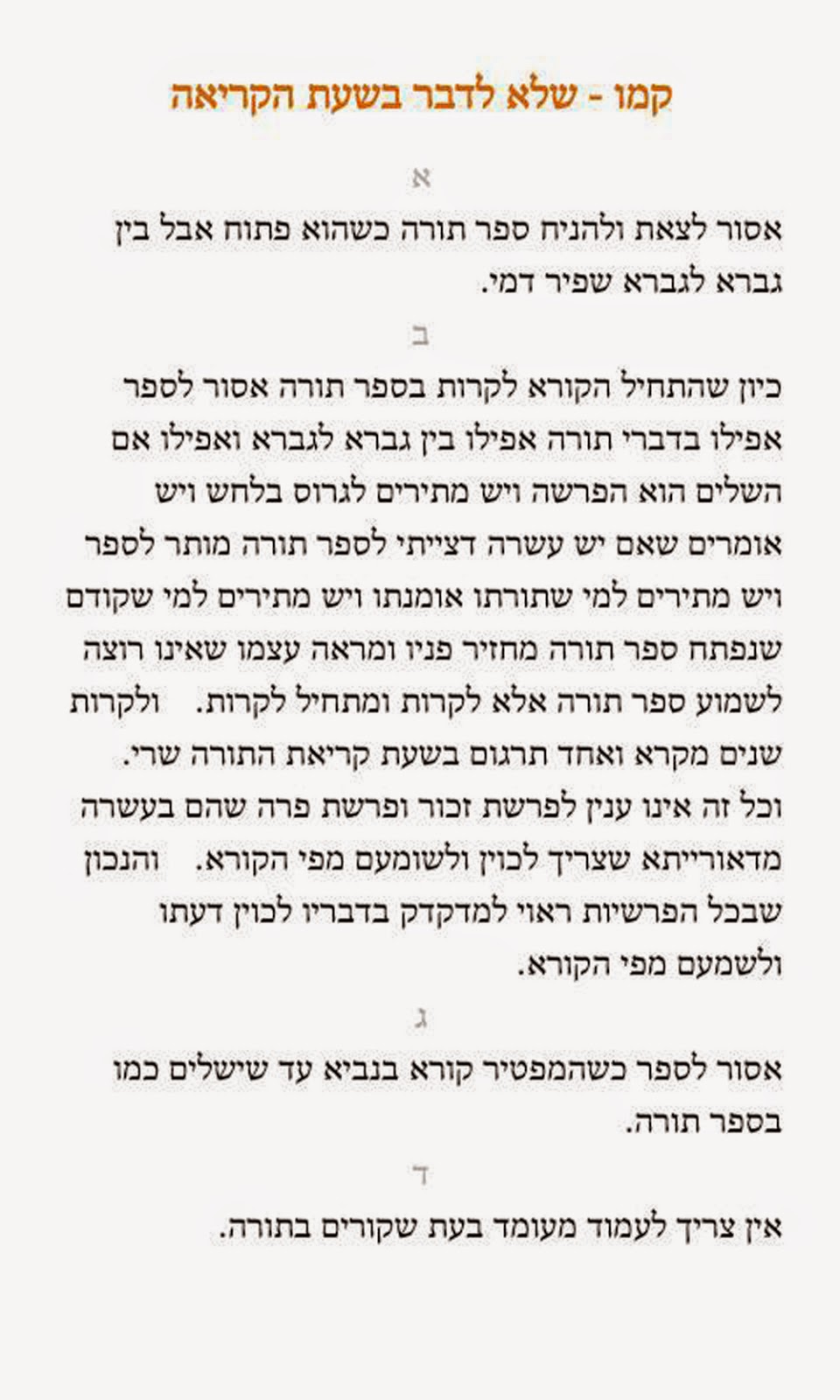
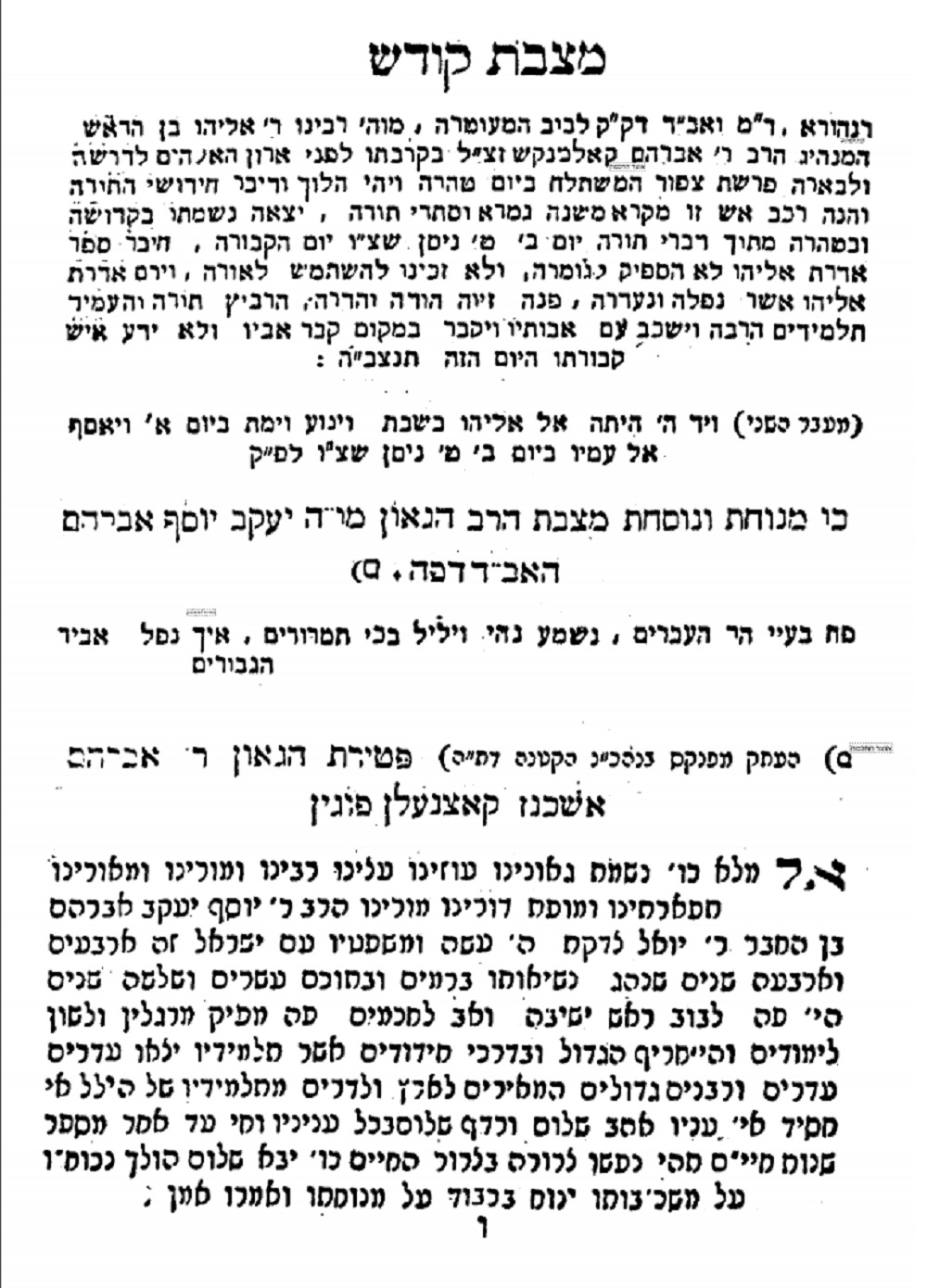
There have been instances, however, in which Rav Gorelick’s association with YU has been omitted or glossed over. As an example, see the journal U’lYishrei Lev, volume 11, published in honor of the marriage of a son of Rav Shmuel Yeshaya Keller (son of the late Rav Chaim Dov Keller), to a granddaughter of Rav Chaim Ozer Gorelick, a great-granddaughter of Rav Yerucham.[7] This journal contains two letters from Rav Gorelick, which originally appeared in YU/RIETS Torah journals. One of them, shown below, בענין חש בתרומה וריחא מילתא , was originally printed in Beis Yitzchak volume 25 p. 241, and was discovered and arranged for publication by the late Rabbi Joshua (posthumously known as The Hoffer) Hoffman.[8]
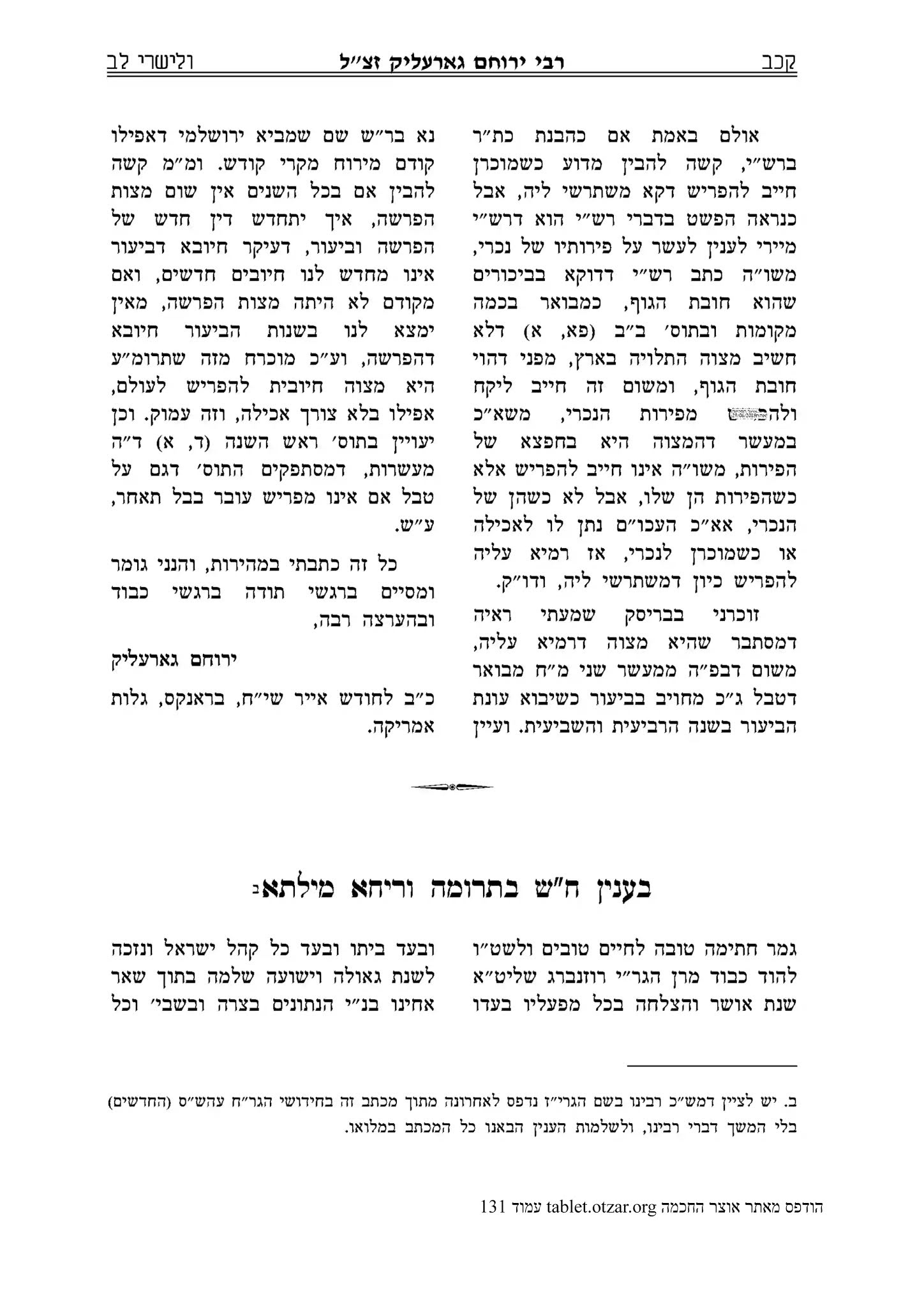
There is no mention in U’lYishrei Lev that this letter was found and published in Beis Yitzchak. Similarly, the other letter in U’lYishrei Lev, במצות הפרשת תרומות ומעשרות, was originally published in Kol Zvi volume 2 page 107. It is noteworthy that, in addition to the more recent family connection by marriage, Rav Yerucham Gorelick was Rav Chaim Dov Keller’s rebbe in YU. It was Rav Gorelick who encouraged Rav Keller to go to Telz, and arranged for Rav Keller to learn b’chavrusa with Rav Mordechai Gifter.[9]

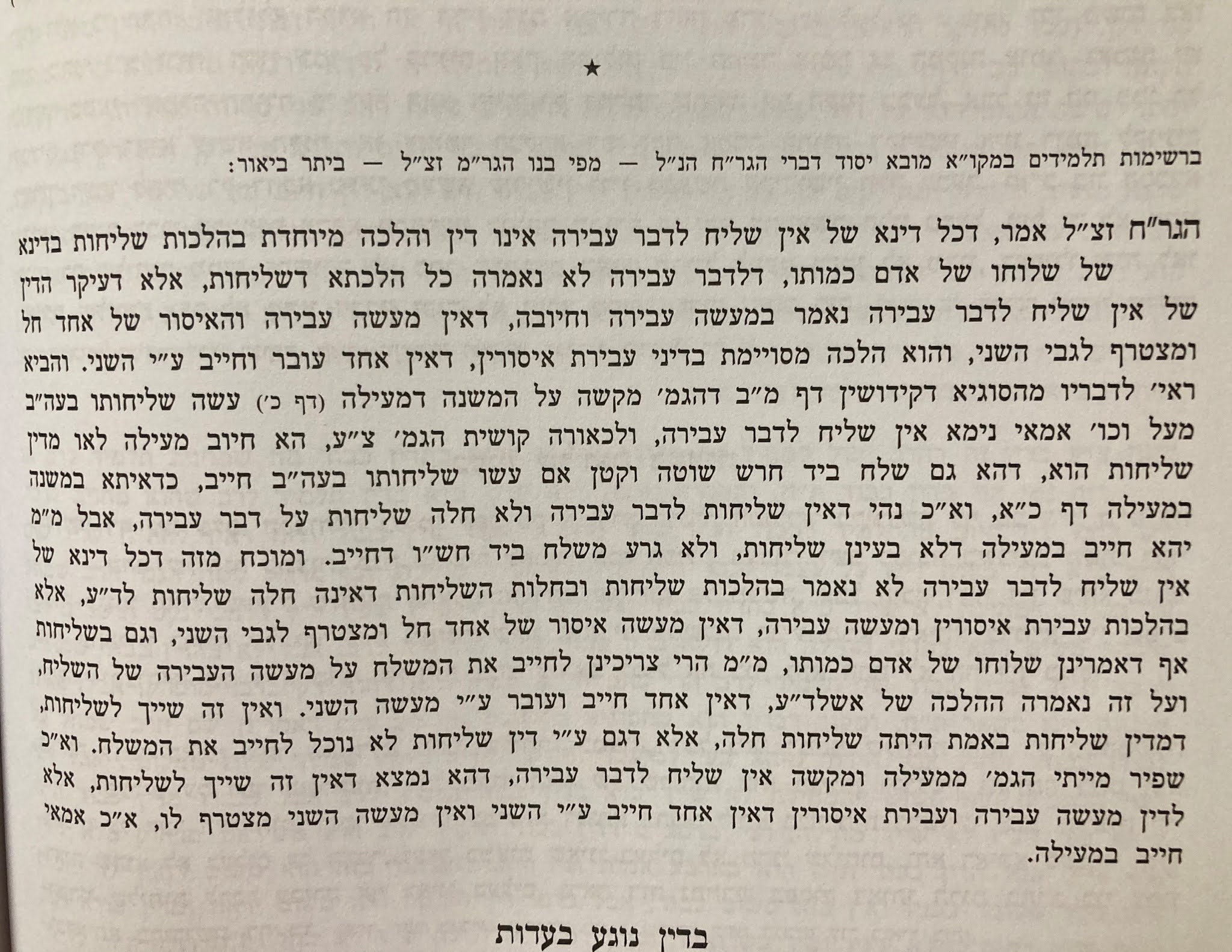
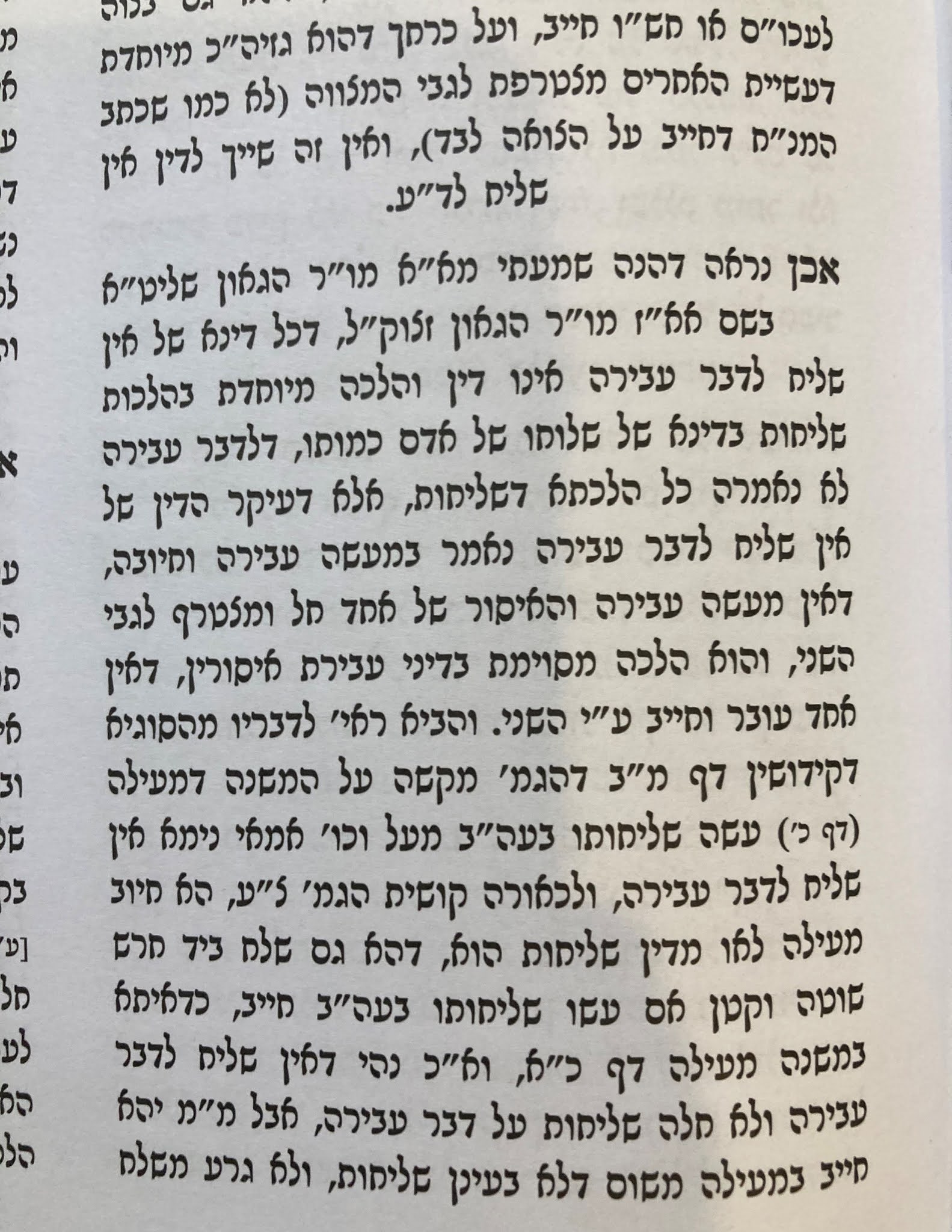
The aforementioned letter בענין חש בתרומה וריחא מילתא also appears in Mishor’s 5768 printing of חידושי הגרח על השס on page 32, surprisingly with the disclosure that the piece is taken from Beis Yitzchak.[10] I say surprisingly, because this volume does engage in revision by omission in other cases, specifically those having to do with the Rav, Rav Yosef Dov Soloveitchik. Here is a piece from that volume (page 302) on the topic of אין שליח לדבר עבירה, which is attributed to the very nebulous “Reshimos Talmidim”, but is copied word-for-word from Igros Ha-Grid Halevi, page 9, דה אכן, shown below.

Similarly, the piece in the Mishor volume (page 97) on מצות תקיעת שופר is once again attributed to the nebulous “Kisvei Talmidim”, yet is taken from Igros Ha-Grid Halevi, this time an amalgam of the pieces on page 33-34 and page 91, shown below. Most of the verbiage is taken from pages 33-34, while the phrases “אינו חל לגביה“ and “בכלל מתעסק“ are taken from page 91.

Another recent example of revision by omission as relates to Rav Soloveitchik appears in Yishurun, volume 41 (Elul 5779), in a biographical article on Rav Elya Baruch Finkel, on p. 388. There we are told of Rav Elya Baruch’s safek regarding Erev Shabbos Chanuka. The halacha (Rambam Chanuka 4:12) is that someone who does not have candles must even sell his garment in order to purchase Ner Chanuka. Rav Elya Baruch understood that there is no such requirement for Ner Shabbos according to the Rambam (see Yishurun volume 18 p. 675.[11] The article in Yishurun volume 18 also appears in Mishulchan Rabi Eliyahu Baruch- Moadim, volume 2, p. 283, where a note mentions that it was prepared for print by Rav Elya Baruch’s son.) The halacha (Rambam Chanuka 4:14) also states that someone with one candle on Erev Shabbos Chanuka should use it for Ner Shabbos, as Ner Shabbos takes precedence to Ner Chanuka. In the event that someone has no candles or money on Erev Shabbos Chanuka, he is obligated to sell his garment to buy a Ner Chanuka, but once he has the candle, he is supposed to give precedence to Ner Shabbos over Ner Chanuka, even though he is not obligated to sell his garment for Ner Shabbos. Rav Elya Baruch raised the question – should he use the candle for Ner Chanuka or for Ner Shabbos?

We are told in Yishurun that Rav Elya Baruch presented this question to גאון אחד who was נודע בכשרונותיו העילויים. This Gaon stated that there are three logical possibilities, and these possibilities are laid out in Yishurun volume 18 p. 677.[12] 1) He need not sell his garment, because even if he does he will be unable to fulfill Ner Chanuka, and it is as if he knows that if he buys the Ner Chanuka a lion will eat it, in which case he certainly need not sell his garment. 2) He should sell his garment and use the candle for Ner Chanuka 3) He should sell his garment and buy a candle for Ner Chanuka, but then use it for Ner Shabbos. This Gaon rejected the third possibility out of hand, and he was unsure how to decide between the first two possibilities.

This anonymous Gaon is none other than Rav Soloveitchik. I know this because the same story appears in the name of Rav Elya Baruch Finkel in the book “Read and Remember” by Rabbi Yirmiyahu Cohen, and there it names Rav Soloveitchik as the Gaon who laid out the three possibilities and rejected the third possibility.[13]

Ironically, “Read and Remember” has itself been the object of revision by omission. On p. 161, Rabbi Cohen relates that Rav Nochum Partzovitz was asked if a resident of chutz laaretz who is in Israel for the second night of Pesach could fulfill his mitzva by telling the story of Yetzias Mitzrayim to a resident of Israel, for whom it is not the seder night.

It seems to me that this piece from “Read and Remember” is obliquely referenced in Kuntres B’lev Yam Siman 41 number 2, page 629[14], by the current-day Rav Yaacov Moshe Shurkin, which is appended to the Shiurei Rabi Yaacov Moshe Shurkin of his grandfather (the magid shiur from Chaim Berlin); although this question is attributed to אחד מספרי מחברי זמנינו, with no more precise reference.

In this case, I imagine the omission of a specific reference is not due to hashkafic concerns, nor to the author cited being too modern, as R. Cohen is quite a kanai who is affiliated with Satmar and Natruna, and has written several books espousing anti-Zionism. I think it’s more likely in this case that the reference is obscured because it doesn’t “pas” to quote halachic material in a sefer from an English book.

Another example of revision by omission as relates to Rav Soloveitchik appears in R. Shimon Yosef Meller’s Harav MiBrisk volume 4, p. 17. The story about the Brisker Rav refusing to speak to a Rav who had helped Solomon Freehof is clearly taken without attribution from Rav Schachter’s Mipninei Harav, and Echad Mibnei Mishpachas Maran is obviously the Rav.

Rav Schachter’s omission of this particular Rav’s name is a different kind of omission, as that omission is because the story is rather critical of him. Rav Schachter often omits the names of Rabbanim towards whom Rav Soloveitchik expressed criticism. (This is in contrast to the prior examples of omission, where the omission is meant to prevent someone else from looking bad due to their association with the person or institution whose name is omitted, or because it doesn’t “pas” to cite that person or give him publicity.) I will follow suit and not mention the name of the Rav who helped Freehof, although his identity was first pointed out to me by my good friend Rabbi Dovid Bashevkin, and should be known to those who have thoroughly read through Dr. Shapiro’s “Saul Lieberman and the Orthodox.”

In R. Meller’s new biography of Rav Chaim Soloveitchik, Raban Shel Kol B’nei HaGolah (volumes 1 and 2), he appears to have reversed course somewhat, and does cite many times from Rav Schachter’s Nefesh Harav series, as well as from Ish Hahalacha, and other sources from Rav Soloveitchik. However, some sources still appear be out of bounds for citation. For example, the material from the government archive cited in Raban Shel Kol B’nei HaGolah volume 1 p. 396-399 appears to be taken without attribution from the updated version of Dr. Shaul Stampfer’s Hayeshiva Ha-Litait Be-Hithavuta. The Yesh HaSvurim mentioned on p. 400 who attribute the closing of Volozhin to the government’s concern about the chaos and machlokes in the yeshiva, rather than the government’s desire for secular education, would appear to be referring to Dr. Stampfer.
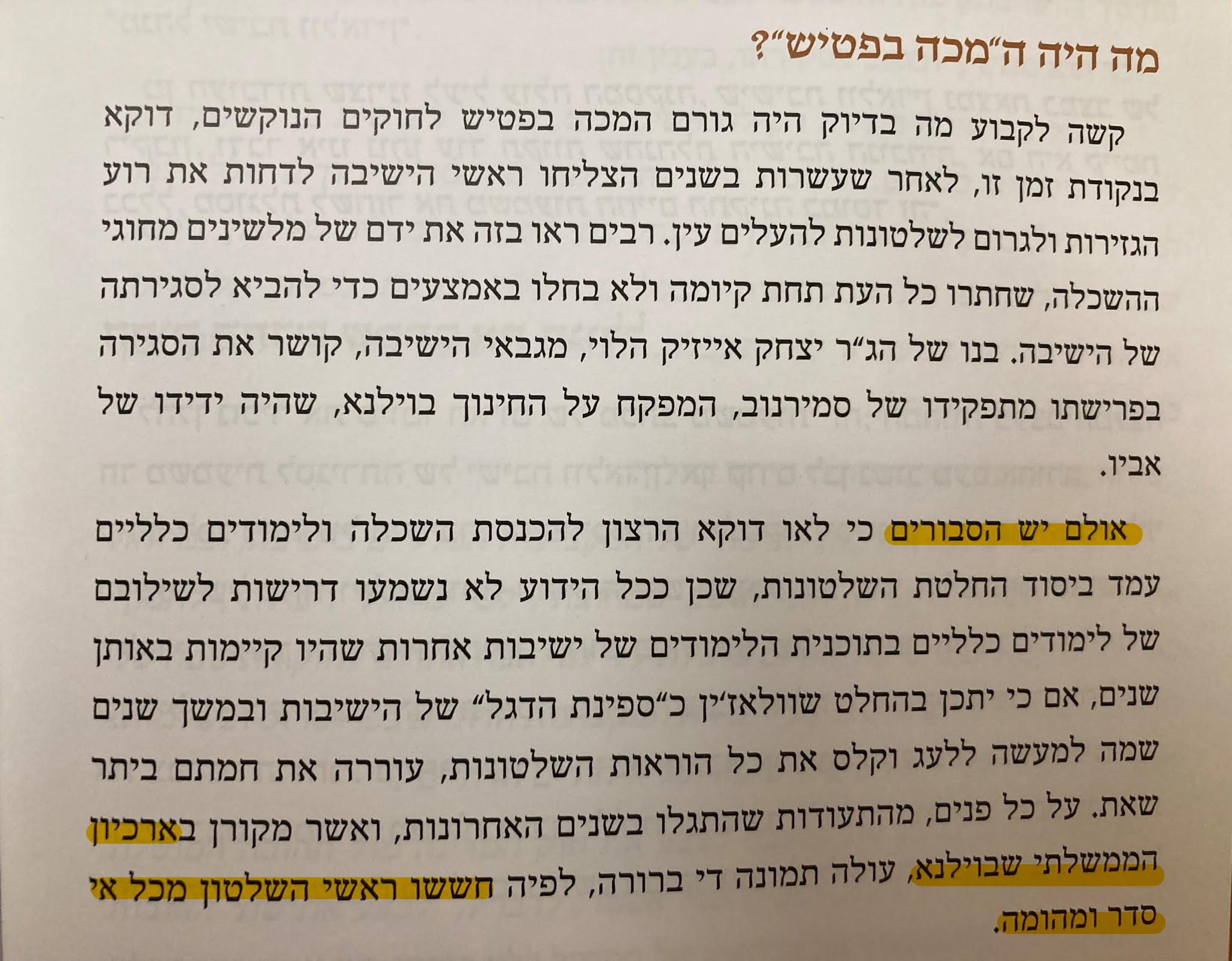
Another recent example of omission was brought to my attention by my father-in-law, R. Dovid Grosser, and is found in a recent appreciation of Rav Moshe Bick that appeared in Hamodia on September 9, 2020. “Immediately upon his arrival in New York, the young Rav Moshe spent his days in the “Poilishe shtiebel,” learning diligently. Eventually, he joined a suitable yeshivah, led by outstanding Gedolei haTorah… At that time, the renowned Gaon, Harav Shimon Shkop, zt”l, Rosh Yeshivah of Grodno, was in America for a fundraising visit and briefly served as a Rosh Yeshivah there… Subsequently, Harav Moshe Halevi Soloveitchik, zt”l, son of Harav Chaim of Brisk, zt”l, served as Rosh Yeshivah.”

I admit that I am perplexed by the purpose of this omission, as the references to Rav Shimon Shkop and Rav Moshe Soloveitchik make clear that this is referring to Yeshivas Rabeinu Yitzchak Elchanan. I don’t know what is gained by not mentioning the name, when it is clear which yeshiva Rav Bick attended. More misleading, however, is an Editor’s note about Rav Bick that appeared in the Jewish Observer (January 1991).

While it may be true that Rav Bick initially enrolled in Yeshivas Rabeinu Yitzchak Elchanan on the Lower East side before there was a college program, he certainly continued to learn there in Washington Heights, after the college was already operating. The move uptown occurred in January 1929, and Yeshiva College was founded in March of 1928, and graduated its first class in June of 1932.[15] Rav Moshe Soloveitchik only departed from Europe for America on September 18, 1929.[16] For Rav Bick to have learned under Rav Moshe, as the Jewish Observer mentions, he had to have been learning in RIETS in the uptown campus, and after the establishment of the college program. (I am not claiming that Rav Bick himself attended the college program, only that he learned in RIETS after the establishment of the college program, contra to the implication of the Jewish Observer.)

Returning to Rav Soloveitchik, one of the more well-known examples of revision by omission as relates to Rav Soloveitchik is Rav Chaim Dov Altusky’s Chiddushei Basra Al Chiddushei HaMasbir. As is well known, the “Masbir” refers to Rav Soloveitchik. (This has been documented previously on the Seforim Blog by Rav Nosson Kamenetsky.[17] See also Rav Shlomo Pick’s “The Rav: Biography and Bibliography” fn. 6, in BDD volume 6, where Rav Pick sharply criticizes Rav Altusky’s behavior.) As mentioned earlier in this post, Rav Schachter says he does not remember anything that Rav Gorelick said about Sanhedrin from his time in Rav Gorelick’s shiur. However, he did preserve many interesting haaros from Rav Gorelick at the time in his notes, and these have been published in the footnotes of my Shiurei Harav on Sanhedrin. Rav Schachter told me that Rav Gorelick would often ask him what the Rav said about a certain topic, and would then comment on what the Rav said, and these are the comments that Rav Schachter recorded at that time. Some of these comments are also reproduced in Rav Altusky’s Chiddushei Basra Al Chiddushei HaMasbir on Sanhedrin, which is based on Rav Schachter’s notes from the Rav’s shiur, without attribution to either. Rav Altusky, however, misunderstood some of Rav Schachter’s citations of Rav Gorelick. For example, on Sanhedrin 3a (p. 11), he cites an explanation in the name of “Rabeinu Yerucham”, but this is actually Rav Yerucham Gorelick’s explanation.

Rav Schachter attributed the explanation to רירוחם in his notes, and Rav Altusky misunderstood the reference.[18] By Sanhedrin 5b (p. 18), Rav Altusky apparently realized that these references were to Rav Gorelick, and he cites דודי הרהג רירוחם זל. (Rav Altusky’s mother was Rav Gorelick’s sister.)

For more on Rav Gorelick and his family, Rav Simcha Elberg wrote a beautiful appreciation of Rav Gorelick in his Einei Ha-eida. On p. 119, Rav Elberg writes that Rav Gorelick’s home was not an apartment with rooms; his home was a beis medrash. And the crowning achievement of Rav Gorelick’s life’s work was his home, in which he raised all of his sons to be Gedolei Torah Ve-yirah, as well as great marbitzei torah.

I would add that the aforementioned Rav Leib Gorelick is a great talmid chacham and lamdan. In my interactions with him, I have been astonished at his wide-ranging knowledge of even obscure rishonim and other seforim, as well as his analytic abilities. Listen here at approximately 1:35:15 to 1:38:13 where Rav Schachter cites a lomdish explanation from Rav Leib to explain the Rama in 472:4 who says that only women rely on the opinion of the Ravyah that heseiba is no longer required.[19] (Rav Leib has been suffering from some health problems lately and readers are asked to daven for Mordechai Leib ben Chana.[20])

Besides for Rav Leib, another son, Rav Tzvi Abba Gorelick was a Rosh Yeshiva at the Yeshiva Gedolah Zichron Moshe in South Fallsburg. Another son, Rav Chaim Ozer Gorelick, is author of sefer Otzar Chaim, and is currently Rosh Yeshiva of Yeshiva Gedolah of Spring Valley. I think the blog readers will find interesting this excerpt about Rav Chaim Ozer Gorelick, and the continuation about Rav Aharon Lichtenstein, from Alt un Nay in Yisrael, by Nissan Gordon, in 1964.

I will translate the excerpt for those readers who don’t read Yiddish:

The young bochurim and yungeleit who learn by Rav Berel, as Rav Velvel’s bechor is called in the Yerushalmi yeshiva world, sit and learn b’kvius in the Achva neighborhood shul, and to shiur they come to the Rosh Yeshiva’s house. And indeed here, in the illuy’ish chabura, who learn by Rav Soloveitchik, a cousin of our American Rav Soloveitchik from Boston and New York, I found a bochur’l from the Bronx, on whom the Yerushalmi lomdim testified, that he is among the best, if not the very best, student in the Brisker chabura. The bochur’l is called Chaim Ozer Gorelick, a name after the great Rav of Vilna, and a son of Rav Yerucham Gorelick from the Bronx, a Rosh Yeshiva in Yeshivas Rabeinu Yitzchak Elchanan and himself one of the b’nei aliyah in the world of lomdus and actions for Torah in America.”

It seems the original “best bochur in Brisk” was Rav Chaim Ozer Gorelick, who indeed became a great talmid chacham. The following is a translation of the ensuing conversation with Rav Berel about Rav Aharon Lichtenstein:

Do you correspond with your famous cousin in America?”, I asked a quick question to Rav Soloveitchik of Yerushalayim.

In Brisk we don’t write letters[21]”, came a fast answer with an addition, that he did meet with his cousin’s son-in-law, Rav Dr. Aharon Lichtenstein, when the young Rosh Yeshiva and scholar was on a visit in Israel. “We spoke in learning and he is a great lamdan”, did the Yerushalmi Soloveitchik notice about his cousin’s son-in-law, who is an assistant Rosh Yeshiva to his father-in-law in Yeshivas Rabeinu Yitzchak Elchanan, and a professor in Stern College.

Meaning that there is room for both, for Torah and worldly knowledge”, I tried asking Rav Berel, knowing the strong speaking out of the house of Brisk in Yerushalayim against learning anything other than Torah.

Sometimes succeeds…an exception…and from an exception we don’t bring a raya”, he didn’t leave me to wait long for his answer.

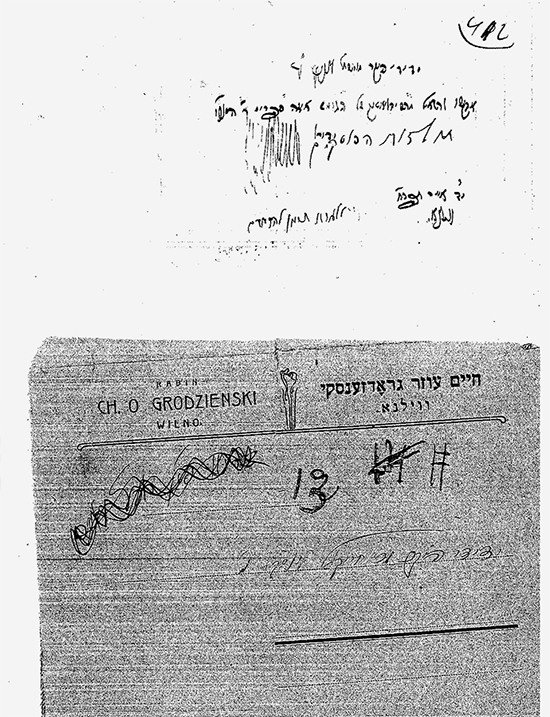
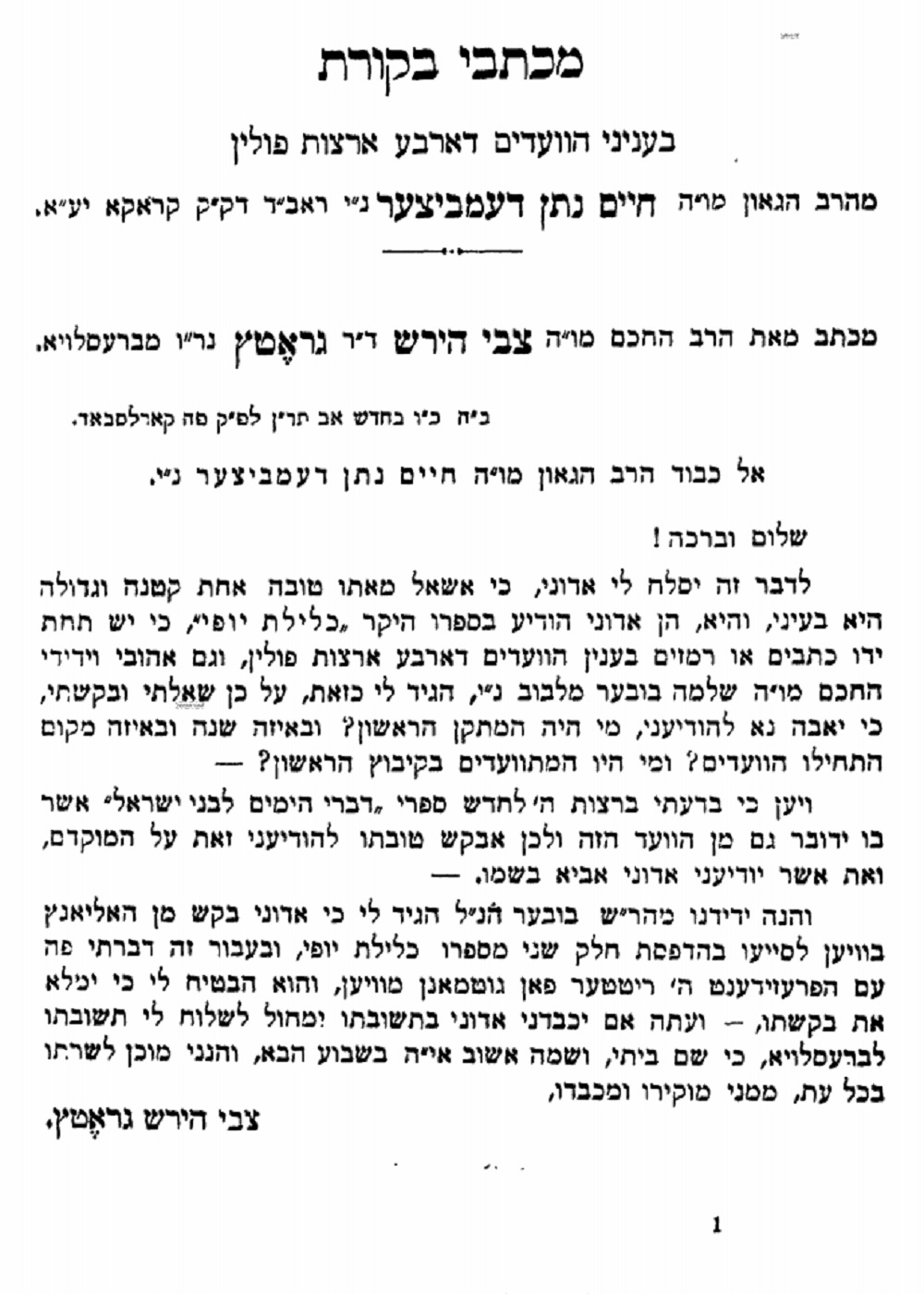
One final recent example of revision by omission that I want to call attention to, is from the journal Hamaor (Nissan-Iyar 5779, p.5). A piece from Rav Chaim Soloveitchik’s chiddushim is published there, which was written down in 1932 by his nephew Rav Yisrael Soloveitchik. The piece is an alternate version of the piece that was eventually published in Rav Chaim’s sefer, on Hilchos Chametz U’Matza Perek 6 about greira. We are told that Rav Yisrael attached the divrei torah to a letter from Erev Pesach 1932, and that he wrote to the recipient that it would be an Oneg Yom Tov for him to read.

What we are not told, however, is that this letter and accompanying divrei torah were sent to Rav Herzog, and are found in Rav Herzog’s archive.[22] (I had not yet come across this letter when I wrote my Seforim Blog posts on Rav Herzog’s archive.) Here is the first page of the letter, addressed to Rav Herzog, with the mention of the divrei torah from Rav Chaim, and then the first page of the divrei torah.

Additionally, the transcription in Hamaor contains numerous errors. I plan to publish an accurate transcription in my forthcoming sefer שש אנכי.

These are some examples of revision by omission that I have come across recently. I am certain that there are many more waiting to be discovered.

Regarding Rav Herzog, here are a few photos that the blog readers will enjoy, of Rav Herzog being mesader kiddushin at the wedding of a young Shlomo Gorenczik. The entire photo album is available in Rav Goren’s archive.[23] It is also noteworthy that the wedding seudah was separate seating.

Appendix: The Rav and Professor Saul Lieberman on the Langer Case

Related to Rav Goren’s archive, I know that the blog readers are especially interested in the Rav and Professor Saul Lieberman, so I thought I would make note of their positions on the Langer case, which to the best of my knowledge have not been noted yet.

The Rav addressed the Langer case in his well-known speech in 1975 on the topic of the Rabbi Rackman’s aguna plan.[24]

However, if you think that the solution lies in the reformist philosophy, or in an extraneous interpretation of the Halacha, you are badly mistaken. It is self-evident; many problems are unsolvable, you can’t help it. For instance, the problem of these two mamzerim in Eretz Yisrael – you can’t help it. All we have is the institution of mamzer. No one can abandon it – neither the Rav HaRoshi, nor the Rosh HaGola. It cannot be abandoned. It is a pasuk in Chumash: “לא יבא ממזר בקהל ה‘”. It is very tragic; the midrash already spoke about it, “והנה דמעת העשוקים“, but it’s a reality, it’s a religious reality. If we say to our opponents or to the dissident Jews, “That is our stand” – they will dislike us, they will say that we are inflexible, we are ruthless, we are cruel, but they will respect us. But however, if you try to cooperate with them or even if certain halachic schemes are introduced from within, I don’t know, you would not command love, you would not get their love, and you will certainly lose their respect. That is exactly what happened in Eretz Yisrael! What can we do? This is Toras Moshe and this is surrender. This is קבלת עול מלכות שמים. We surrender.[25]

The Rav is clearly referring to the Langer case, and he considered Rav Goren’s heter to be illegitimate. He refers to the Langers as two mamzerim, and he uses the Langer case as an example of something “unsolvable” and that “you can’t help it.” He seems to be using Rav Goren’s heter as an example of “an extraneous interpretation of the Halacha.” And according to the Rav, the more appropriate response would have been to surrender to halacha; that the attempted heter was a futile attempt to coax love out of dissident Jews. I have not seen this speech of the Rav mentioned in the context of the Langer case and I thought it appropriate to mention here.

It appears that Professor Lieberman felt differently. This is a heretofore unknown, and very fascinating letter that he wrote to Rav Goren supporting the heter, found in Rav Goren’s archive, with my transcription below.[26] (Rav Goren’s response to this letter is printed in “Saul Lieberman and the Orthodox, Hebrew section p. 9.) Lieberman’s cynicism in this letter is biting, and he seems to be rather hurt and bitter. The advice and observations that he shares with Rav Goren are obviously informed by his own experiences. I would ask if any readers (or Dr. Shapiro) have any idea which Gedolei Torah asked Lieberman to review Rav Goren’s psak. I am also not entirely clear on Lieberman’s explanation at the beginning of the letter as to why he is not offering a bracha. I think it is related to what he writes in his postscript from his wife, and that he viewed Rav Goren’s appointment with ambivalence because of the difficulty in the position, but any further suggestions from readers would be appreciated.

בעהי אור ליום גפרוישלח תשלג

לידינ הגאון הגדול וכווכומוהרר שלמה נרו

לא כתבתי לך ברכה מפני שלא היה לבי שלם אתי, אבל התפללתי בלב שלם שהיצליח את דרכך. היום קראו לי מרדיו ירושלים ובקשו ממני לחוות את דעתי על הפסק שלך ולמרות הלחץ עמדתי בשלי ואמרתי שלא חקרתי את הדבר ואין לי מה לומר. אבל לך אכתוב את האמת: יברך אותך הויישר כוחך. אני מכיר גם את תורתך ואת יראת שמים שלך, ובטוח אני שצדקת. לא אמרתי להם כן, מפני שחששתי שאגרום לך רעה. יאמרו הקנאים נמצא עוד רב קונסרבטיבי שמסכים להרב הראש—[27], מצא מין את מינו.

בהיותי בקיץ בירושלים לחצו עלי גדולי תורה מן הרבנים שאקרא את תשובתך בענין, וסרבתי בהחלט. אמרתי: אין לי פנאי. הבינותי את כוונתם. דע לך שבמקום שיש קנאה ושנאה שום דבר אינו מועיל. אף פעם לא תפייס את הקנאים, ובעיקר את המקנאים. אם תכנע להם תאבד את עולמך. אני מכיר יפה מה שעשית בצבא, ולוא נוצרת רק לשם זה כבר קנית את עולמך. אדם ירא שמים אמיתי יחשוב עשר פעמים לצאת נגדך אפילו אם יהיבטוח שלא כיוונת לאמת. עליך להחזיק בידידים שלך יפה, יפה, מפני שקל מאד לאבד ידיד (בפרט אם הוא איננו גדול בתורה ואינו בר דעת), ושונא מקנא לעולם לא תהפוך לידיד, וכל מה שתעשה בשבילו אינו אלא לשעה קלה. יבטל את תורתך ויכפור ביראתך. לך והצלח וישמור שומר ישראל עליך.

בכבוד ובאהבה,

שאול ליברמן

הגבשלי מבקשת למסור דרש להרבנית שתחי‘. רצתה גם היא לכתוב אלא שעדיין אינה מרגישה את עצמה בטוב. היא באמת שמחה על בחירתך, שהרי היא אינה יודעת מהו להיות רב בירושלים.

[1] https://seforimblog.com/2009/10/some-assorted-comments-and-selection-2/
[2] https://www.hebrewbooks.org/pdfpager.aspx?req=50519&st=&pgnum=39
[3] https://www.hebrewbooks.org/pdfpager.aspx?req=50519&st=&pgnum=42
[4] https://www.hebrewbooks.org/pdfpager.aspx?req=50521&st=&pgnum=255
[5] See R. Gil Student’s criticism here: https://www.torahmusings.com/2009/10/reb-yerucham-and-yu/. See also: http://theantitzemach.blogspot.com/2008/01/blog-post_13.html and https://machshavos.wordpress.com/2013/01/02/r-yerucham-gorelick-and-talmud-vs-hashkafa/.
[6] https://www.yutorah.org/lectures/lecture.cfm/741763/rabbi-hershel-schachter/remembering-rav-yeruchim-gorelik/ at approximately 5:08, 11:57 and 18:09
[7] https://matzav.com/engagement-of-grandchildren-of-rav-chaim-dov-keller-and-rav-yitzchok-sorotzkin/
[8] For a full collection of Rabbi Hoffman’s own divrei torah, see http://yeshivasbrisk.freeservers.com/netvort.html. For Rabbi Hoffman’s thesis on Rav Gavriel Zev Margolis, see http://repository.yu.edu/handle/20.500.12202/4899
[9] See Yated Ne’eman (English), August 21,2020, page 46-47
[10] My thanks to Rabbi Menashe Mazurek and Rabbi Avi Harari for bringing this reference to my attention
[11] https://hebrewbooks.org/pdfpager.aspx?req=46424&st=&pgnum=672
[12] https://hebrewbooks.org/pdfpager.aspx?req=46424&st=&pgnum=674. Here, the three possibilities, as well as the rejection of the third possibility, are attributed to “Gedolei Torah”.
[13] My thanks to my good friend Rabbi Nosson Rich for providing the scans from “Read and Remember”.
[14] https://www.hebrewbooks.org/pdfpager.aspx?req=50479&st=&pgnum=629
[15] https://www.yu.edu/about/history
[16] The Rav, volume 1, p. 9
[17] https://seforimblog.com/2012/12/a-letter-from-r-nathan-kamenetsky/
[18] Another error is on 7b (p.30), where Rav Altusky has a discussion about whether דינו לבקר משפט applies to ”אומות העולם”. This entire section is mistaken, because the Rav spoke about “איסור והיתר”, not ”אומות העולם”. Rav Schachter had written אוה in his notes and Rav Altusky opened the abbreviation incorrectly.
[19] See here.
[20] https://www.thelakewoodscoop.com/news/2020/12/tehllim-reb-leib-gorelick-to-undergo-emergency-surgery.html
[21] I assume he was referring specifically to social correspondence that they don’t write in Brisk, not torah correspondence.[22] https://www.archives.gov.il/archives/Archive/0b07170680024756/File/0b071706806d9fc7 on p. 49-53.[23] https://www.archives.gov.il/archives/Archive/0b07170684e17c68/File/0b07170687520f3c
[24] https://www.yutorah.org/sidebar/lecture.cfm/767722/rabbi-joseph-b-soloveitchik/gerus-mesorah-part-1/ at approximately 39:00 to 40:53.
[25] Transcription from https://www.torahweb.org/torah/special/2019/ryds_rietsalumni.html
[26] https://www.archives.gov.il/archives/Archive/0b07170684e17c68/File/0b07170685459764 on p. 281.
[27] I was expecting this word to be הראשי but there appear to be two hyphens at the end. Does it say הראשיי with two yud’s? I don’t believe that is a common spelling. I would be indebted to any reader who can explain what this means.


An (almost) Unknown Halakhic Work by Rabbi Shneur Zalman of Liadi and an attempt to answer the question: who punctuated the first edition of the Shulhan Arukh?

An (almost) Unknown Halakhic Work by Rabbi Shneur Zalman of
Liadi and an attempt to answer the question: who punctuated the first edition
of the Shulhan Arukh?

 by Chaim Katz

Chaim Katz is a
database computer programmer in Montreal Quebec. He graduated from McGill
University and studied in Lubavitch Yeshivoth in Israel and New York.

In 1980, the late Rabbi Yehoshua Mondshine
published a manuscript, which was a list of chapters and paragraphs (halakhot  and se’fim), selected by Rabbi Shneur
Zalman of Liadi (RSZ), from the Shulhan Arukh (SA) of Rabbi Yosef Karo.[1]
(RYK)

Figure 1: Part of the list of halakhot prepared by Rabbi
Shneur Zalman and the preliminary and concluding notes written by R. Isakhar
Ber.
R.
Isakhar Ber, who copied the original manuscript, explained the purpose of the
list in a preliminary remark:

A concise study method
of essential laws from the beginning of Shulhan Arukh  Orah Hayim until the end of the Shabbat laws – to know them
fluently  by heart, from Admur  (our master, teacher and Rebbe), our teacher
Zalman of Liozna.
R.
Isakhar also added an epilogue:
I copied all of the
above, from the beginning until the laws of Pesah, but I didn’t check it
completely to verify that I copied everything correctly and G-d willing when
there’s time I will check it. Prepared and researched by the Rabbi and Gaon,
the great light, the G-dly and holy, our teacher, Shneur Zalman, may his lamp
be bright and shine, to know it clearly and concisely, even for those people who
are occupied in business. Therefore I thought I won’t withhold good from the
good.  Isakhar Ber, son of my father and
master … Katz, may his lamp be bright, of the holy community of Shumilina and
currently in Beshankovichy.
The
manuscript was probably composed (or at least copied), between the years
1790-1801, when RSZ lived in Liozna. The existence of this list isn’t
acknowledged in any source that Rabbi Mondshine was aware of, and obviously the
list was never published in book form, either because RSZ
decided not to publicize it or because the list was simply put aside and
forgotten.
RSZ
wasn’t the first who envisioned a popular digest of the SA. Rabbi Yehuda Leib
Maimon lists four works that preceded the famous Kitzur Shulhan Arukh.[2]
They preceded RSZ’s work as well and are all quite similar although they also
have their differences.


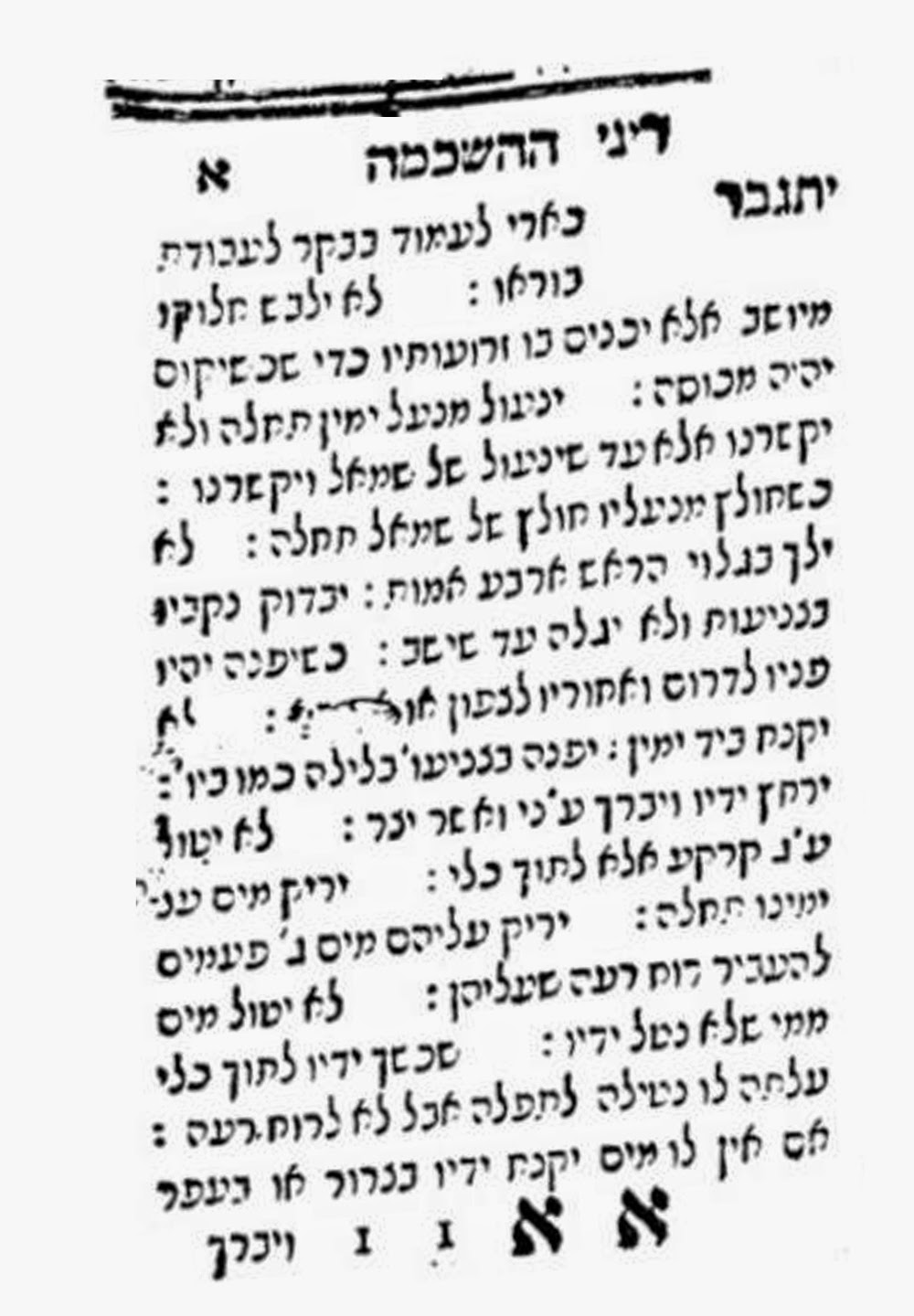
Figure 2: First edition of Shulhan Tahor by Rabbi Joseph Pardo (from
Hebrewbooks.org). The page summarizes three and a half chapters of the original
Shulhan arukh. Note how the author sometimes combines the words of RYK with the
words of Rema (line 11).
Shulhan Tahor covers Orakh Hayim and Yore Deah.
Others have a narrower scope and cover only Orah Hayim. RSZ covers even less.
Some collections are abbreviated extensively; others include more details.[3]
There are variations in the language and content; some quote opinions of later
authorities, some quote Kabbalah, some re-cast the language of the SA and some
retain the language as much as possible.


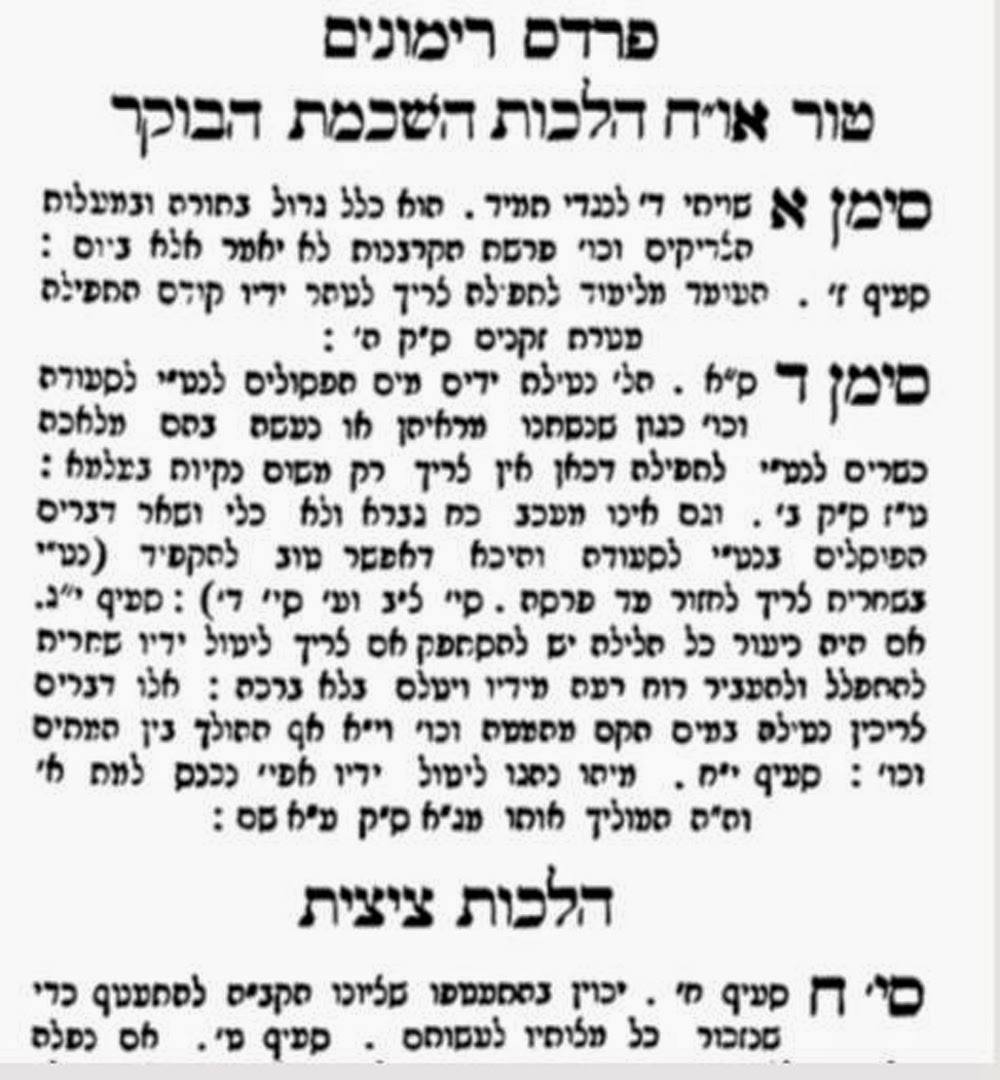
Figure 3: Pardes Rimonim by Rabbi Yehudah Yudil Berlin, (from
Hebrewbooks.org), composed in 1784. Note the author quotes Ateret Zekenim, (R.
MM Auerbach, published in 1702). The additions in parenthesis are by the
publisher of the 1879 edition.
The authors of each of these works possibly had
two goals in mind. One of the goals was to make the basic rules and practices
of the SA more accessible. To this end, certain subjects or details were left
out because they were too technical for the chosen audience. Other rules were
omitted because the situations to which they applied happened only infrequently
(בדיעבד). Many regulations
were left out because daily life and its circumstances had changed so much
since the sixteenth century.

The other goal,
and arguably the primary goal, was to provide a text of law that could be
memorized. In the introduction to Shulhan Tahor, the author’s son writes:
“every man will be familiar and fluent in these laws (שגורים בפי כל האדם)”. Likewise, the
author of Pardes Rimonim defines the purpose of his work: “so that the reader
will be fluent in these rules (שגורים
בפיו)
and will review them each month”.  In
the introduction to the Shulhan Shlomo, the author writes: “Put these words to
your heart and you won’t forget them”, and the motive of R. Shneur Zalman’s
work is:  “to know [these laws] fluently by heart”.

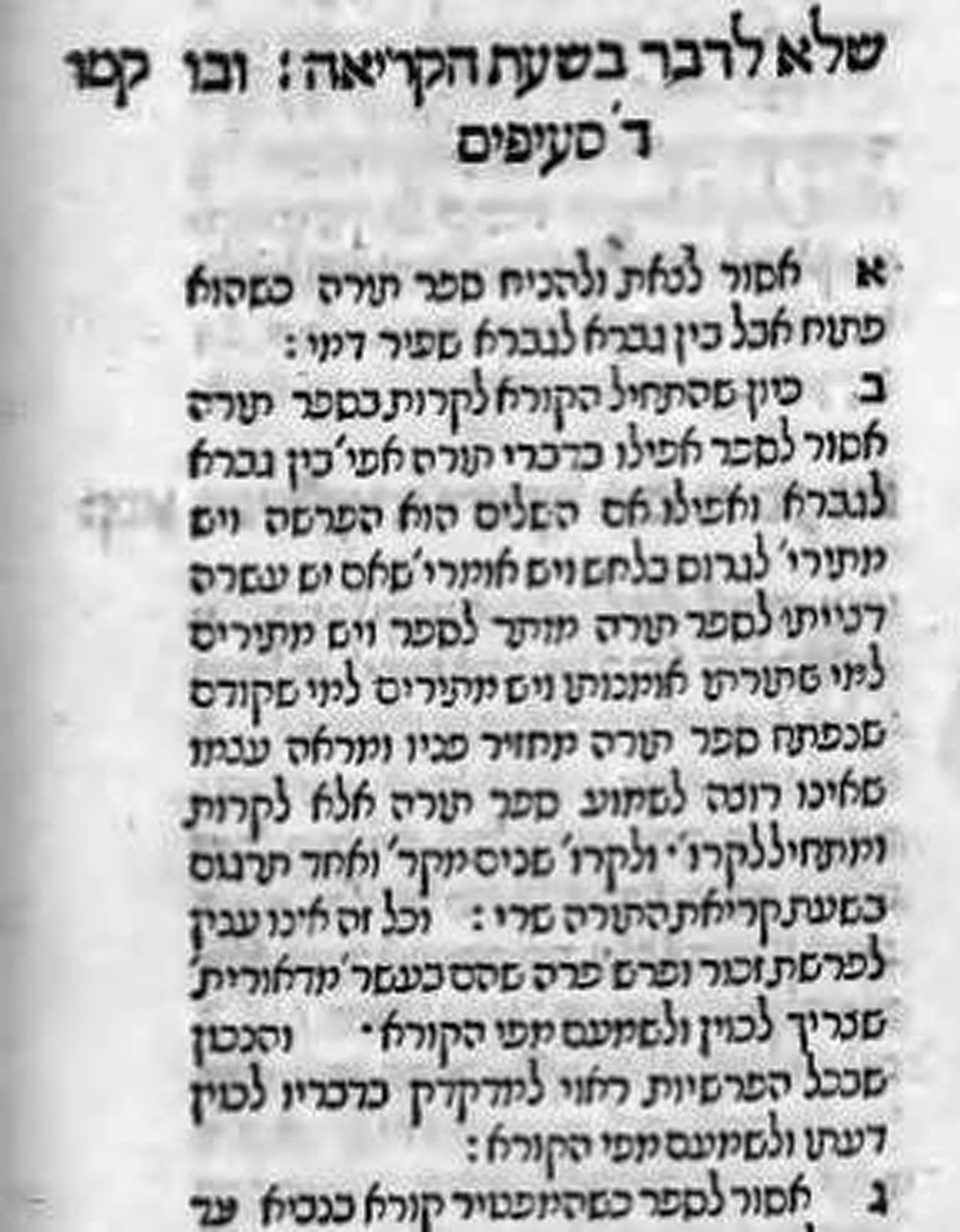
Figure 4: Introduction of Rabbi Yosef Karo – from the first edition
of the Shulhan Arukh, published in Venice in 1565 where memorization is
emphasized (from the scanned books at the website of the National Library of
Israel, (formerly the Jewish National and University Library.)
The
tradition of memorizing practical laws goes back to RYK himself, and probably
goes back even earlier.[4]
RYK writes in the introduction to his Shulhan Arukh:
I thought in my heart
that it is fitting to gather the flowers of the gems of the discussions [of the
Beit Yosef] in a shorter way, in a clear comprehensive pretty and pleasant
style, so that the perfect Torah of G-d will be recited fluently by each man of
Israel. When a scholar is queried about a law, he won’t answer vaguely.
Instead, he will answer:  “say to wisdom
you are my sister”. As he knows his sister is forbidden to him, so he knows the
practical resolution of every legal question that he is asked because he is
fluent in this book…  Moreover, the
young (rabbinical?) students will occupy themselves with it constantly and
recite its text by heart…
I’m
working on a phone version of RSZ’s work using the first print of
RYK’s SA for that portion of the text. However, (aside from the difficulty of
text justification in an EPUB), there is one typesetting decision that I’m
wondering about.  The first edition of
the SA is punctuated with elevated periods and colons.  The colons always separate each halakha, but
infrequently colons appear in the middle of a halakha. Sometimes followed by a
new line and sometimes not. The periods may appear in the middle of a halakha,
sometimes followed by horizontal white space and sometimes not.
Hebrew printing (of holy books) hasn’t changed all that
much in the past 450 years; the colons at the end of each paragraph are present
in most current editions of the Shulan Arukh, but the periods, colons and white
space in the middle of the paragraphs have largely been ignored in subsequent
prints.[5]
Do I try and duplicate this punctuation or not? Here are two examples where I
replaced the elevated period and colons with modern periods, but tried to keep
the original layout.

Figure 5: Note the raised periods and colons in the first print
(from the National Library of Israel web site).

Figure 6: Screenshot of a digital version of R. Shneur Zalman’s
composition. Note periods and line feeds.

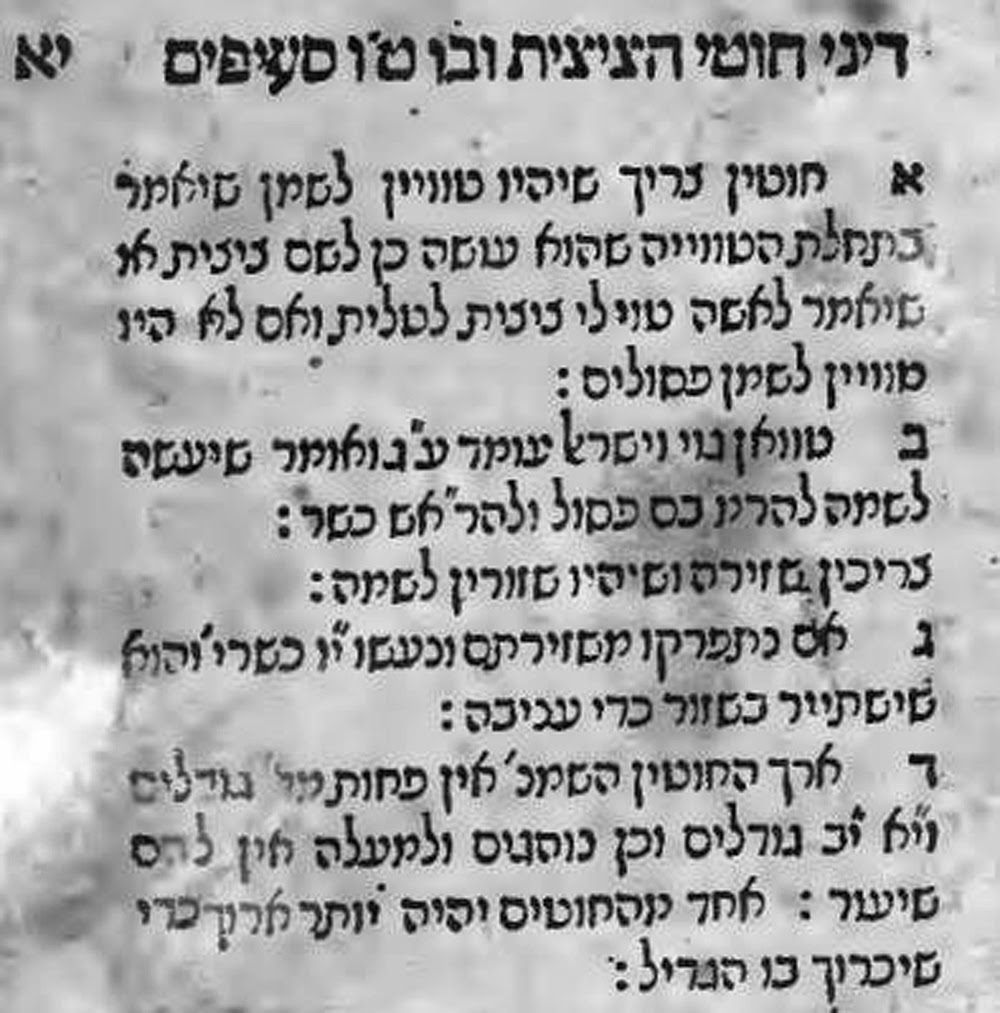
Figure 7: Facsimile of the first print of Shulhan Arukh – beginning
of chapter 11. See the colons in in the fourth halakha.

Figure 8: Screenshot of my smart phone version of R. Shneur Zalman’s
list – chapter 11

I think it’s possible that
the punctuation of the first edition of the SA was copied from RYK’s manuscript. Prof.
Raz-Krakozkin writes: He (Karo) insisted on personally supervising its
publication and made sure that the editors followed his instructions[6]. On
the other hand, I can’t explain why the punctuation marks occur so rarely.

To help decide if RYK
punctuated his manuscript before sending it to the printers, we can compare
other manuscripts that were printed then. For example, the Yerushalmi was first
printed in Venice (1523) from a manuscript, which is still extant today.

Figure 9: Facsimile of the first print of the Jerusalem Talmud
(Berakhot 1:1), with raised periods to separate word groups from the scanned
books at the website of the National Library of Israel, (formerly the Jewish
National and University Library.)

The printed version of the
Yerushalmi has elevated periods that delineate groups of words. These markings
are already found in the source manuscript in the exact same places.

Figure 10: Facsimile of Leiden manuscript of the Jerusalem Talmud
(1289 CE), Brakhot 1:1 from the Rabbinic Manuscripts on line at the National
Library of Israel web site, (formerly the Jewish National and University
Library).

Prof. Yaakov Sussmann[7]
speaks of two possibilities concerning the origin of the
Talmud Yerushalmi’s punctuation. The punctuation may be relatively recent – the
scribe punctuated the text or the punctuation existed in the manuscript that
the scribe copied from.  Alternatively,
the punctuation might be a reduction or simplification of cantillation marks
that were common in much older rabbinic manuscripts. Either way, the printers
didn’t invent the punctuation.

Our editions of the Gemara (the Babylonian Talmud) have colons (“two
dots”) in strategic places.[8]
These colons already exist in one of the first Talmud editions – the Bomberg
Talmud (Venice 1523).

Figure 11: Facsimile of a page of Bomberg Talmud (Betza 21a) showing
colons. (The horizontal lines near the colons are either blemishes, or markings
by hand.) Note the horizontal white space after the colons.

Most volumes of the Bomberg
edition were not printed from manuscript, but were copied from the Talmud
printed by Joshua Moses Soncino in 1484[9].
In the Soncino Talmud, we find separators in the exact places as the colons of
the Bomberg edition. The Soncino Talmud had two types of
punctuation: a top comma (or single quote mark) that marks off groups of words
(like the Yerushalmi has) and a double top comma (double quote mark). When
Bomberg printed his edition (40 years later), his printers replaced the double
commas with colons (and dropped the single commas).

Figure 12: The bottom of a page in Soncino, coresponding to the same
page (21a) in Betza. Note the two elevated commas, where we have a colon and
the subsequent horizontal white space. (The Soncino Talmud does not have the
same pagination as us). From the National Library of Israel web site.

Figure 13: Top of the next page in the Soncino edition, corresponding
to our Betza 21a. Note again 2 commas where we have a colon.

It would be difficult to trace the origins of the colons much further.
We don’t know which manuscripts were used by the printers of the Babylonian
Talmud, and in any case the many Talmud burnings in the 1550’s in Italy
destroyed most of the manuscripts that were there. Nevertheless, there is at
least one old manuscript that has punctuation marks similar to what we find in
the Soncino Talmud.

Figure 14: Snippet from Gottingen University Library Talmud
manuscript showing the upper double comma separator for the same page – Betza
21a (From the Rabbinic Manuscripts on line at the National Library of Israel
web site, (formerly the Jewish National and University Library).)

The Gottingen manuscript is a Spanish
manuscript from the early thirteenth century[10] – almost three hundred years older than the Talmud printed
in Soncino. It doesn’t have the upper single commas that Soncino edition has,
but it does have the same double comma in the same places that the Soncino
print has.  Just to repeat: the pauses
represented by colons, that we see in our Talmud are at least 800 years old!
It’s at least possible (likely?) that RYK’s own SA manuscript was
punctuated just as the Talmudic manuscripts that he studied from were.
Summary
I introduced RSZ’s
abbreviated (Kitzur) SA, and discussed it in the context of other similar
works. I mentioned that the authors aimed at producing collections of relevant laws
that could be memorized. I noted that the first edition of the SA was punctuated
differently from following versions. I suggested (based on comparisons with
early printed Talmuds) that the punctuation was probably the work of RYK and
not the work of the printers.

[1] Mondshine, Y. (Ed.).
(1984).  Migdal Oz (Hebrew), Kfar Habad:  Machon Lubavitch , pp.  419-421. Dedicated to the memory of Rabbi
Azriel Zelig Slonim ob”m. Essays on Torah and Hassidut by our holy Rabbis, the
leaders of Habad and their students, collected from manuscripts and authentic
sources and assembled with the help of the Almighty.
[2] Maimon, Rabbi Yehuda
Leib, The history of the Kitzur Shulhan Arukh (Hebrew), published in Rabbi Shlomo
Ganzfried, Kitzur Shulhan Arukh, Mossad Harav Kook Jerusalem Israel 1949. The
earlier works mentioned are: Shulan Tahor by R. Joseph Pardo,edited/financed by
his son David Pardo, Amsterdam 1686. Shulan Arukh of R. Eliezer Hakatan  by Eliezer Laizer Revitz printed by his
son-in-law R. Menahem Azaria Katz, Furth 
1697. Shulhan Shlomo by Rabbi Shlomo Zalman Mirkes printed in Frankfort
(Oder) 1771. Pardes Rimonim by R. Yehuda Yidel Berlin, composed in 1784 and
printed for the first time in Lemberg (Leviv) 1879. 
[3] RSZ’s digest from the
beginning until the end of chapter 156 contains 18,000 words while the same
portion of the big Shulhan Arukh contains approximately 40,000 words. A word is
loosely defined as a group of characters separated by a space or by spaces.
[4] In the introduction to
the Mishne Torah, Maimonides writes: “I divided this composition into legal
areas by subject, and divided the legal areas into chapters, and divided each
chapter into smaller legal paragraphs so that all of it can be memorized.”  See: Studies in the Mishne Torah, Book of
Knowledge Mossad Harav Kook, Jerusalem (Heb.) by Rabbi José Faur for a
discussion and explanation of the study methods of Middle Eastern Jews (page 46
and following pages, especially footnote 60).
[5] The National Library of
Israel, (formerly the Jewish National and University Library) has the edition
of the Shulhan Arukh printed in Krakow in 1580. This is the second version with
the notes of the Rema (which was first printed in 1570) and it doesn’t have the
original punctuation marks.
[6]  “From Safed
to Venice: The Shulhan ‘Arukh and the Censor” (in: Chanita Goldblatt, Howard
Kreisel (eds.), Tradition, Heterodoxy and Religious Culture, Ben
Gurion University of the Negev  (2007)
91-115). 
A.M. Haberman, The First Editions of the Shulhan Arukh
(Heb.) on the daat.ac.il web
site, (from the journal Mahanaim # 97 1965 p 31-34.) suggests that the
editor/corrector of the first edition, Menahem Porto Hacohen
Ashenazi created its table of contents.
See also the discussion about who created the chapter headings, (a
pre-requisite for the table of contents), in Gates in Halakha (Heb.), Rabbi
Moshe Shlita, Jerusalem 1983, page 100. He argues that the chapter headings of
the Shulhan Arukh could not be the work of Rav Yosef Karo. 
[7] Talmud Yerushalmi
According to Ms Or 4720 of the Leiden University Library, Academy of the Hebrew
Language Jerusalem 2001 Introduction by Yaakov Sussmann.
[8] Cf. Rashi in the
beginning of Leviticus “What is the purpose of the horizontal white-space (in
the text of the Torah)? It gives Moshe some space to contemplate between a
section and the next section, between a topic and the next topic.  (Rashi Lev. 1:1 s.v. vayikra el Moshe (2nd)
from the Sifra.
[9] Raphael Nathan Nata
Rabbinovicz. Essay on the printing of the Talmud  (Hebrew).
[10]  M. Krupp in The Literature of the Sages,
Oral Torah, Halakha, Mishna, Tosefta, Talmud, External Tractates (Compendia
Rerum Iudaicarum Ad Novum Testamentum)
 Fortress Pr; 1987 Part 1 Shmuel Safarai ed,  p 352. 


Book Announcement: The Lost Library by Dan Rabinowitz

Book Announcement: The Lost Library by Dan Rabinowitz

By Eliezer Brodt

Its with great pleasure that I announce the recent publication of an important work, that I am certain will be of great interest to readers of the Seforim Blog – The Lost Library by Dan Rabinowitz, founder and editor-in-chief of the Seforim Blog. This book is devoted to the legacy of the personal and expanded public library of Rabbi Mattityahu Strashun.

From the back cover:

The Strashun Library was among the most important Jewish public institutions in Vilna, and indeed in Eastern Europe, prior to its destruction during World War II. Mattityahu Strashun, descended from a long and distinguished line of rabbis, bequeathed his extensive personal library of 5,753 volumes to the Vilna Jewish community on his death in 1885, with instructions that it remain open to all.

In the summer of 1941, the Nazis came to Vilna, plundered the library, and shipped many of its books to Germany for deposition at a future Institute for Research Into the Jewish Question. When the war ended, the recovery effort began. Against all odds, a number of the greatest treasures of the library could be traced. However, owing to its diverse holdings and its many prewar patrons, a custody battle erupted over the remaining holdings. Who should be heir to the Strashun Library?

This book tells the story of the Strashun Library from its creation through the contentious battle for ownership following the war until present day. Pursuant to a settlement in 1958, the remnants of the greatest prewar library in Europe were split between two major institutions: the secular YIVO in the United States and the rabbinic library of Hechal Shlomo in Israel, a compromise that struck at the heart of the library’s original unifying mission.

In 2005 Dan Rabinowitz founded the Seforim Blog and I started corresponding with him almost immediately. One of the people we discussed often was R’ Strashun as both Dan and I were fascinated by him. Dan’s interest extended to the library and what happened to it after R’ Strashun’s death and especially what happened to it after World War Two. Eventually, in November 2015 Dan authored a lengthy post on the Seforim Blog dealing with different aspects of R’ Strashun and his library. This post eventually turned into this full-length book on the subject.

The Lost Library is written in Dan’s extremely clear, lucid and captivating manner as familiar to readers of the Seforim Blog (having read hundreds of his articles and at times not realizing he is the author of them because most do not include his name – in essence, stamm seforim blog post dan rabinowitz, at least the scholarly ones). The book begins with an exciting personal introduction (A PDF is available upon request) giving background to the development of one of Dan’s favorite pastimes collecting books. However, similar to the subject of this book R’ Strashun, Dan’s interest extends to not just owning the book but to developing a personal relationship with the book contents. This becomes evident as one reads The Lost Library, especially the vast number of sources in multiple languages housed in numerous collections and libraries all over the world including his personal library. The Lost Library meticulously documents each of his claims from these extensive sources collected over intense research conducted over a few years.

The book begins with an overview of that ‘ir ve’em be-yisrael, the famous city of Vilna, giving the reader excellent background to the environment and city (including current descriptions as the author visited Vilna while working on this volume). The author discusses what made Vilna famous, sidetracking into very relevant topics such as R’ Mattityahu father, the Rashash and others affiliated with the Vilna Gaon, Vilna’s most famous resident. Dan then turns to deal with the hero of the book, R’ Mattityahu and provides the reader with a comprehensive biography that discusses his unique style of learning and how that influenced his book collecting habits. The next chapter is the opening of the public library after Mattityahu’s death and the impact it had on the community and eastern European Jewry at large. The book then goes onto detailing the library’s life during the Holocaust and especially afterword as different parties claimed ownership when most of it was discovered to have survived.

Marc Shapiro wrote:

Taking us on a journey from nineteenth-century Vilna until almost the present day, Rabinowitz not only documents the vicissitudes of this important institution, but helps us understand the intellectual culture of one of the centers of Judaism in modern times.”—Marc B. Shapiro, Weinberg Chair in Judaic Studies, University of Scranton

And others praised the work as well.

“Rabinowitz has done a brilliant job in his moving and important book…. Through the story of the Strashun Library, he gives us insight into the richness and vibrancy of Jewish life in Vilna. He vividly portrays the restoration of the books of the Strashun Library, a testimony to the indomitable Jewish spirit.”
—Ambassador Stuart E. Eizenstat, chief White House domestic policy adviser to President Carter

“Rabinowitz’s meticulously researched study is an outstanding expression of the wealth of knowledge provided by a thorough exploration of Jewish material culture…In his detailed reconstruction of the Strashun library’s fate after the German invasion, he detects a breathtaking history of loss and mourning, of illegal claims and desires, of appropriation and incorporation that expresses the rupture of the Holocaust and the contested visions of Jewish life after catastrophe.”—Elisabeth Gallas, Leibniz Institute for Jewish History and Culture –Simon Dubnow

This book is of particular personal great interest. The first time I recall hearing something from R’ M. Strashun was when I was in tenth grade. R’ Hershel Schachter had just begun giving a shiur once a week in Flatbush for Balei Battim on Mesechtas Kidushin. I attended a few of them, during one of the shiurim he mentioned R’ M. Strashun’s comments in Bava Basra praising him (I do not recall his exact discussion, but it was about the word Achron). I had been familiar with the Strashun name for a while through R’ Mattityahu father, the Rashash via my father. The Rashash symbolized an emphasis on peshat, from then on I was very curious about R’ Mattityahu. Fast forward a few years when I began learning in the Mir in EY I was talking to a friend somehow it came up about R’ M. and the friend mentioned he loves him and that the great Gaon R’ Yakov Chaim Sofer always quotes him with great respect. He then showed me a sefer of Mattiyahu printed by Mossad Harav Kook (Mivchar Kesavim). The sefer was out of print and hard to find, but the Sitrah Achrah helped me find it a little while later. I immediately began learning through the work. Since then I have found the work many times in used shops and have found these copies, proper owners, to appreciate them. One time while learning the sefer an Israeli chavrusha saw what I was learning and said how you could learn a sefer of a maskil! I argued it was good enough for me that R’ Yitchack Elchanan Spektor who, in his old age, came to Vilna to eulogize R’ Mattityahu. My chavrusha dismissed this anecdote and replied that means nothing! Of course, I could not convince him that there was nothing wrong with him. However, his complaint sparked the exact opposite – and spurred me to research and read more of R’ Mattityahu’s writings which only enhanced my reverence for him. My chavrusha’s position notwithstanding, other very frum Israelis friends expressed their appreciation and fascination with R’ Mattityahu. Most of his writings appeared in newspapers and journals and are not readily available or even known. However, in a few months, I will god willingly print some of them. Eventually, I wrote my first academic article in English about him (available in PDF upon request or from here).

One final point about R’M that particularly resonated with me. R’M did not merely collect seforim he used them, and this is apparent from hundreds of citations throughout his works. A later resident of Vilna, and one too who was indeed very well-read was R’ Chaim Ozer. He did not need an extensive personal library as he had unfettered access to the Strashun Library – indeed was unique in that he was one of the few given borrowing privileges. Here is a book request from R’ Chaim Ozer, addressed to the Strashun Library’s head librarian Chaim Chaikel Lunski. Thanks to R’ Dovid Kamenetsky for making it available:

One of my favorite stories about the library as told by R’ Moshe Shmukler in his fascinating book, Moshe Shmuel ve-Doro, combines the idea of the voracious reader and a comprehensive library:

ר’ חיים עוזר… מלבד בקיאותו הגדולה בתלמוד ובראשונים, הצטיין בבקיאות עצומה בשאלות ותשובות האחרנים… פעם החלטתי לנסותו עד כמה כוחו גדול באחרונים, סרתי לספריה של שטראשון ועברתי על פני הקאטאלוג במקרה נתקבל מבטי על הספר מאמר מרדכי להגאון ר’ מרדכי זאב אוטינגר מלמברג ספר שלא נודע לי עד אז וחשבתיו ליקר המציאות. דפדפתי בספר ומצאתי איזה הערה נפלא על דברי בעל הלכות גדולות המובא ברא”ש סוף פ”ב דיבמות. חשבתי האח, מצאתי את מה שאוותה נפשי. במוצאי שבת באתי לר’ חיים עוזר, כי הערב ההוא היה מוקש ללות אתו בחידוש תורה. בשעת השיחה העילתי כלאחר יד את הקושיא על הבה”ג. ומה השתוממתי לשמוע מפי תיכף, כי זוהי קושיתו של בעל מאמר מרדכי… [ר’ משה שמואל ודורו, עמ’ 176].

The book can be purchased from the publisher here, Amazon or Book Depository.

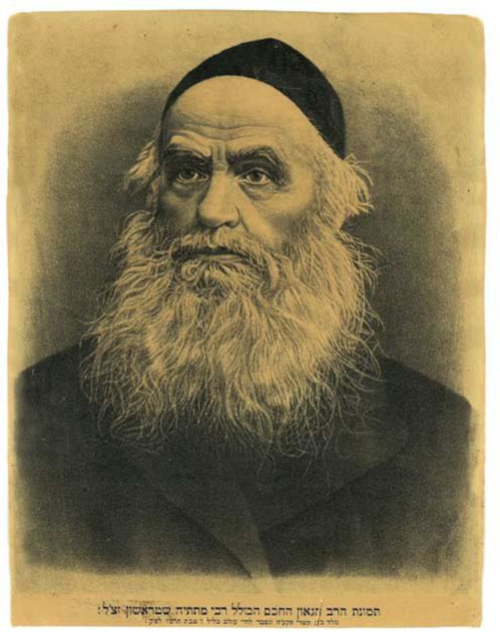
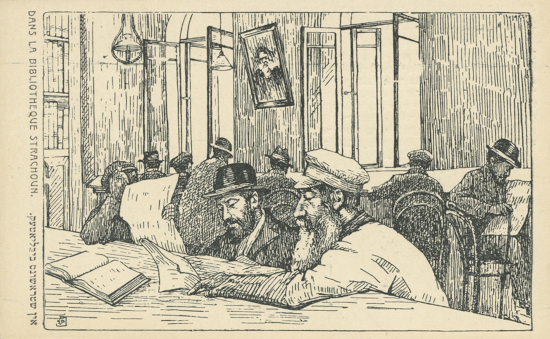
Here is a portrait of R’ Mattityahu followed by a scene depicting the Strashun Library in Vilna in its heyday:


Tzevi Hirsch of Nadworna’s Sefer Alpha Beta

Tzevi Hirsch of Nadworna’s Sefer Alpha Beta

by Marvin J. Heller[1]

By the riches of the sea they will be nourished, and by the treasures concealed in the sand. (Deuteronomy 33:19).

Sefer Alpha Beta (1799) Nowy Dwor
Courtesy of the National Library of Israel

A primary component of the corpus of Hebrew literature is ethical works. The Torah is replete with examples of virtuous deeds, such as the patriarch Abraham’s numerous acts of kindness, and moral principles and commandments are a primary component of the taryag (613) mitzvot. Subsequent ethical works are innumerable, among the earliest and undisputedly the most popular being Pirkei Avot

Pirkei Avot, the last tractate of Mishnayot in Seder Nezikin, was redacted in the third century C. E. It has since been copied, studied regularly, and been the frequent subject of commentaries. First printed in the incunabular period, it continues to be reprinted to the present-day. The popularity of Avot is attested to by the number of editions, both independently and together with either Mishnayot or prayer books. Dr. Steven Weiss records, in his authoritative bibliography on Avot, from the first printing through 2015, 1,503 such editions.[2]

Among the many other frequently reprinted ethical works are such classics as R. Bahya ben Joseph ibn Paquda’s (second half of 11th century) Ḥovot ha-Levavot; R. Jonah ben Abraham Gerondi’s (Rabbeinu Yonah, c. 1200–1263) multiple ethical works, Iggeret ha-Teshuvah, Sha’arei Teshuvah, and Sefer ha-Yir’ah; R. Hayyim ben Bezalel’s (c.1520-1588) Sefer ha-Ḥayyim; the anonymous Orhot Zaddikim (Prague, 1581), written in Germany in the 15th century, preceded by an abbreviated Yiddish edition as Sefer ha-Middot (Isny, 1542); R. Moses Hayyim Luzzatto’s (Ramhal, 1707–1746) Mesillat Yesharim; and more recently and most notably R. Israel Meir ha-Kohen’s (Kagan, 1838-1933) Hafetz Hayyim, who is referred to today by that title.

Among the many other ethical works of value but less well known, is a small book, booklet really, by R. Tzevi Hirsch ben Shalom Zelig of Nadworna (d. 1801), entitled Sefer Alpha Beta, aphorisms based on hassidic works arranged alphabetically. Zevi Hirsch was a student (disciple) of R. Dov Baer, the Maggid of Mezhirech (d. 1772) but his primary influence was R. Jehiel Michal of Zloczow (c. 1731–1786), both among the early and foremost proponents of the Hassidic movement. Zevi Hirsch was a preacher in Dolina and afterwards was av bet din in Nadworna (Nadvornaya), in the Ivano-Frankovski section of Galicia, his name being associated with the latter community. According to R. Efraim Zalman Margulies of Brody, Zevi Hirsch “turned many sinners to repentance.” He had several illustrious talmidim (students) among them R. Menahem Mendel of Kosov, R. Tzevi Hirsch of Zydaczov, R. Abraham David of Buczacz, R. Tzevi Hirsch of Dilatin, and R. Isaac Landman of Visnitz.[3]

1818, Sefer Tsemah ha-Shem la-Tzevi, Berdichev
Courtesy of the National Library of Israel

Tzevi Hirsch was the author of several other titles in addition to Alpha Beta, well received and reprinted several times. Yitzhak Alfasi writes that Tzevi Hirsch was unusual for Hassidic rabbis, for, in contrast to other Hassidic leaders whose words were written by others, Tzevi Hirsch wrote his own books. That his father was a prolific author is attested to by R. David Aryeh Leib, Tzevi Hirsch’s son, in the introduction to Sefer Tsemah ha-Shem la-Tzevi (above), hassidic homilies on the weekly Torah readings (Berdichev, 1818), printed between two pages of approbations.[4]

1910, Haggadah shel Pesah, Saigat
Courtesy of Hebrewbooks.org

“This is the blessing which” (Deuteronomy 33:1) I found in his treasured files, a detailed listing of his holy writings, in his actual script, on the Torah, on the Prophets, and on many of the sayings of our sages on the Talmud and Aggadah, “founded on the holy mountains” (cf. Psalms 87:1) according to pardes (literal, allusive, discursive, and esoteric interpretations of Torah), mussar, and insight. All written by the hand of the Lord that guided him. If I brought them as they were to a press, hundreds of pages would be insufficient. . . .

Another of Tzevi Hirsch’s works is Sifte Kedoshim (Lemberg, 1873) also homilies on the weekly Torah readings and Psalms, and Haggadah shel Pesah, described on the title-page as having been concealed from the light for more than a hundred years.

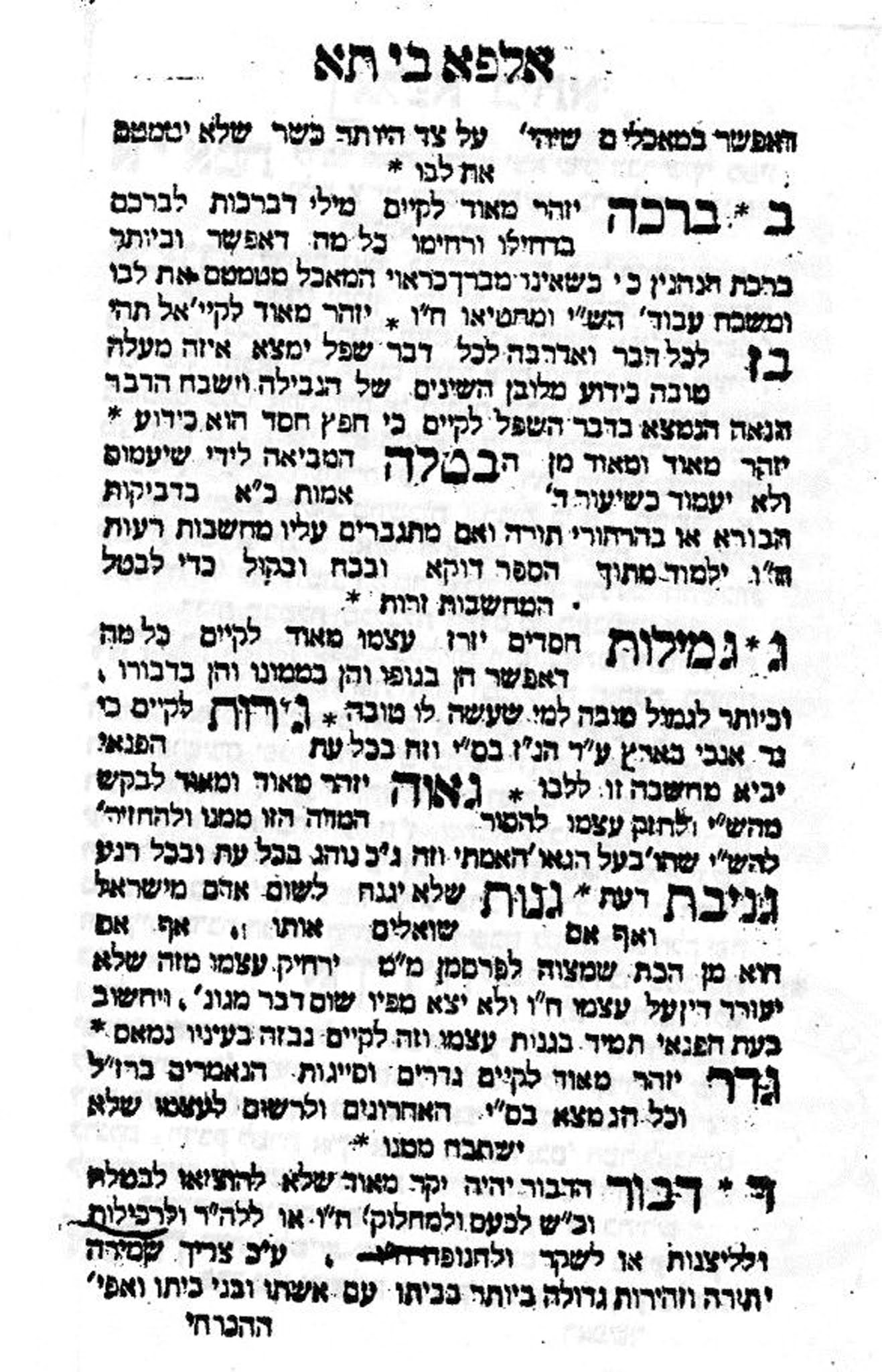
We turn now to our subject book, Alpha Beta. That work, according to Ze’ev Gries, reflects the influence of the Maggid of Mezhirech.5 Initially printed as Otiyyot Mahkimot (Instructive Letters) Alpha Beta consists, as noted above, of ethical maxims arranged according to the letters of the alphabet based on Hassidic works. The date of printing is unclear, bibliographic sources giving conflicting dates and places of publication. The Bet Eked Sefarim dates the first edition to Breznitz (1796), followed soon after by Nowy Dwor (1799) and Berdichev (1817) editions. The Thesaurus of the Hebrew Book records a Russia-Poland (1790) edition followed by Ostrog (1793), Zolkiew (1794), Podberezce (1796), Nowy Dwor (1799), Lemberg (1800), Russia-Poland ([1800]), and then the Berdichev (1818) edition.[6] Among the early imprints of Alpha Beta in The National Library of Israel, which has a large collection of that work, are Ostrog (1794), Nowy Dwor (1799), Poland (c. 1800), and Berdichev (1810).

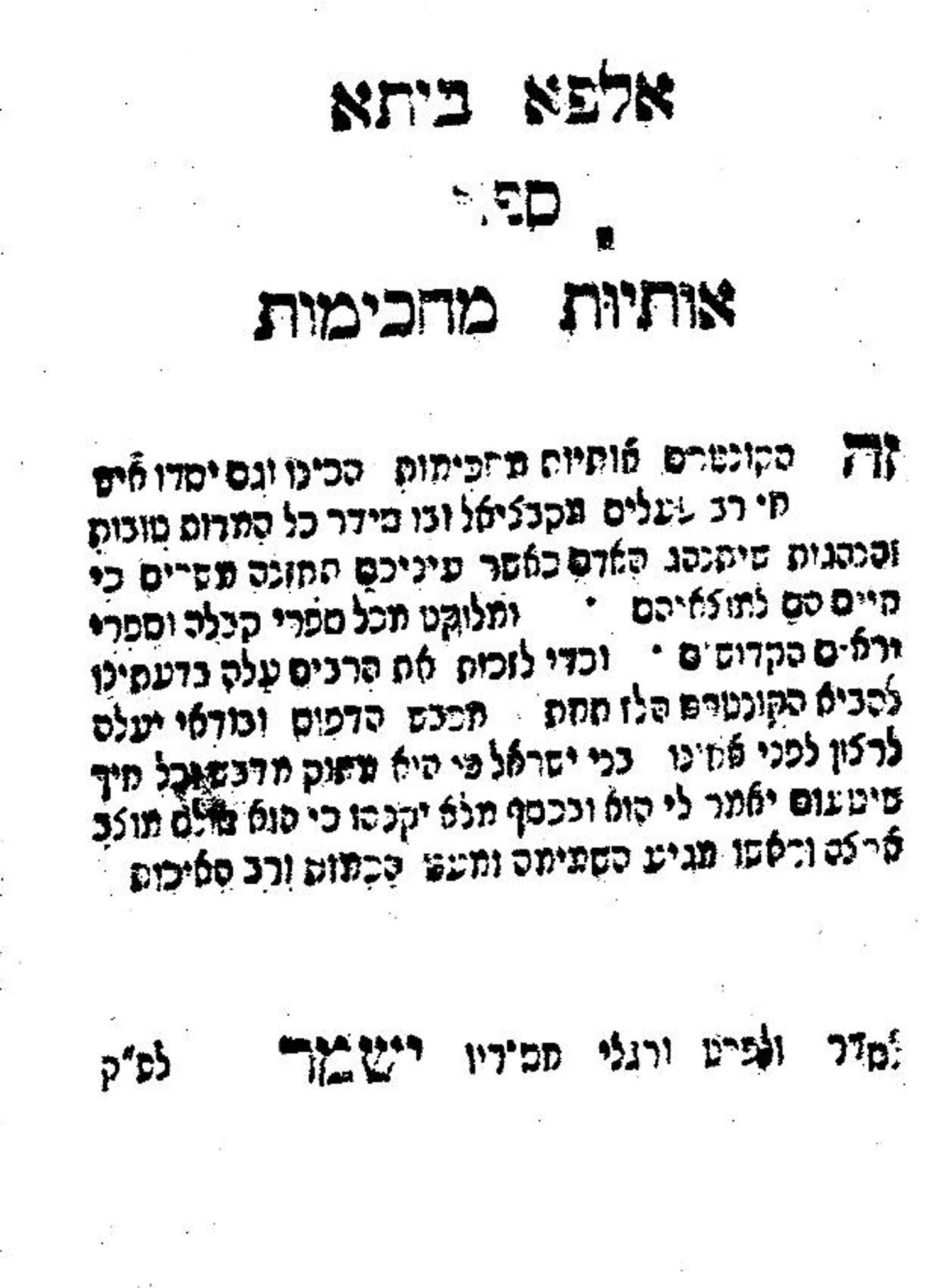
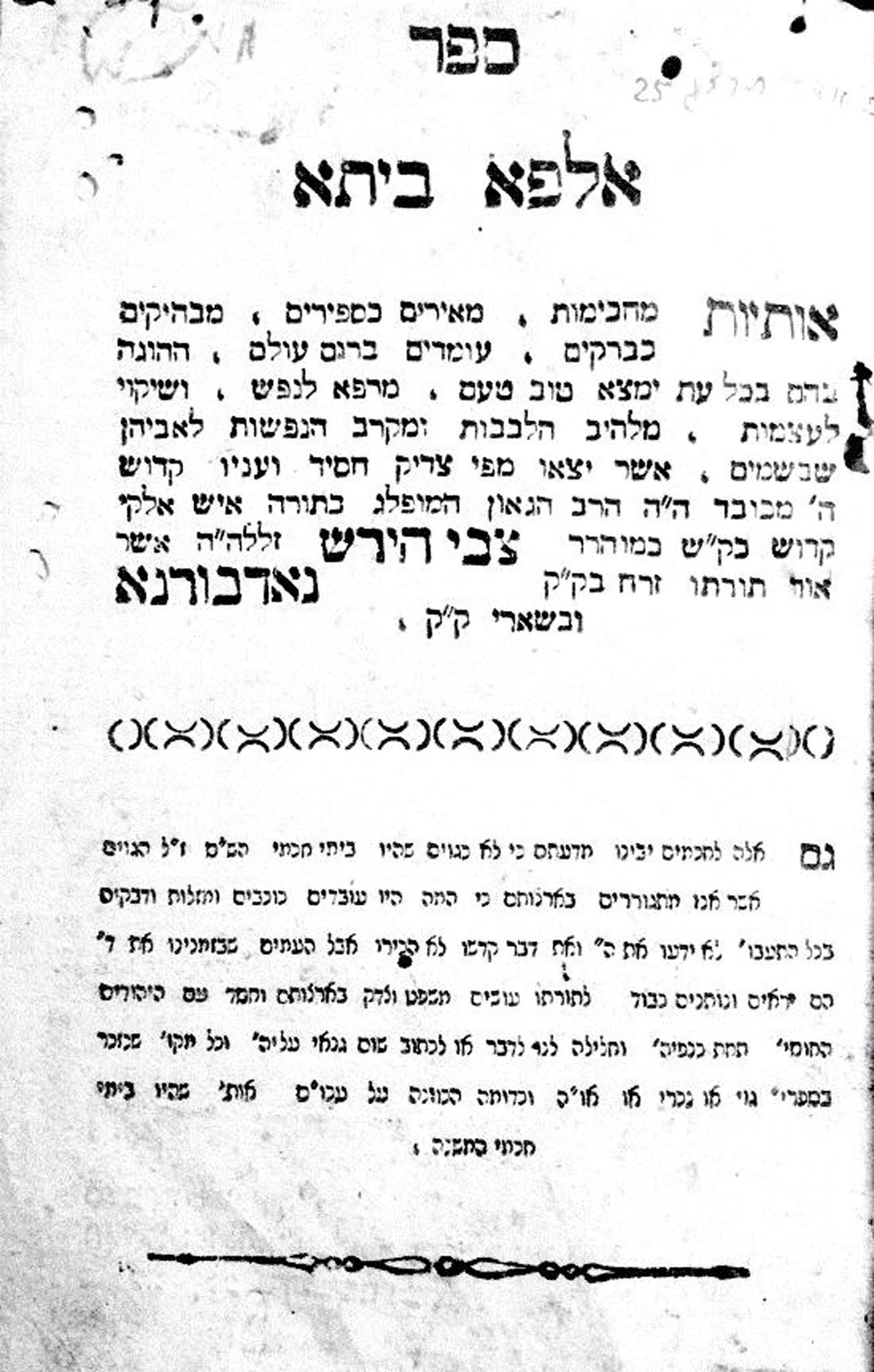
Among the earliest printings of Alpha Beta is the c. 1794/1800 edition, published in octavo (80: [12] ff.) format. The title-page of that edition does not record the date or the place of printing, thus accounting for the dating variances in the bibliographic records. The Library of Agudas Chassidei Chabad Ohel Yosef Yitzhak records it as a 1794 imprint and the press as Zolkiew. In contrast the National Library of Israel records the same edition as c. 1800, place of publication Poland. The title-pages states that it is,

1794/ 1800, Alpha Beta
Courtesy of The Library of Agudas Chassidei Chabad Ohel Yosef Yitzhak

Alpha Beta
This is the book Otiyyot Mahkimot

“A valiant man of many achievements from Kabzeel” (II Samuel 23:20, I Chronicles 11:22). In it are the order of all the middot tovot (good virtues) and the manner in which one should conduct himself as your eyes can see, “for they are life to him who finds them” (Proverbs 4:22). For the public good we have brought this booklet to press. Certainly, it will be pleasing to our brothers the children of Israel for it is “sweeter than honey” (Judges 14:18; cf. Psalms 19:11). All of your days you will taste of it and say for me it “was acquired at the full price (Genesis 23:9, I Chronicles 21:22, 24)” for it is “a ladder set earthward and its reaching heavenward] (Genesis 28:12).” Small in size but of great value.

Furthermore, we have added to this the sefer Torat ha-Adam.

Written by the rav, ha-Maggid R. Aaron ha-Levi, who is the moreh zedek (righteous teacher) in the [holy community] of Zaksanin and author of the sefer Hasdei Avot,

Tzevi Hirsch’s name does not appear on the title-page. The text follows immediately after the title-page, beginning with the phrase “‘these are the words’ (Deuteronomy 1:1) which a man shall carry out and live by them’ (Leviticus 18:5, Ezekiel 20:11, 13, 21), everlasting life, and whomever fulfills these words will assuredly be a great zaddik.” Below this opening phrase is the text, comprised of entries in alphabetic order.

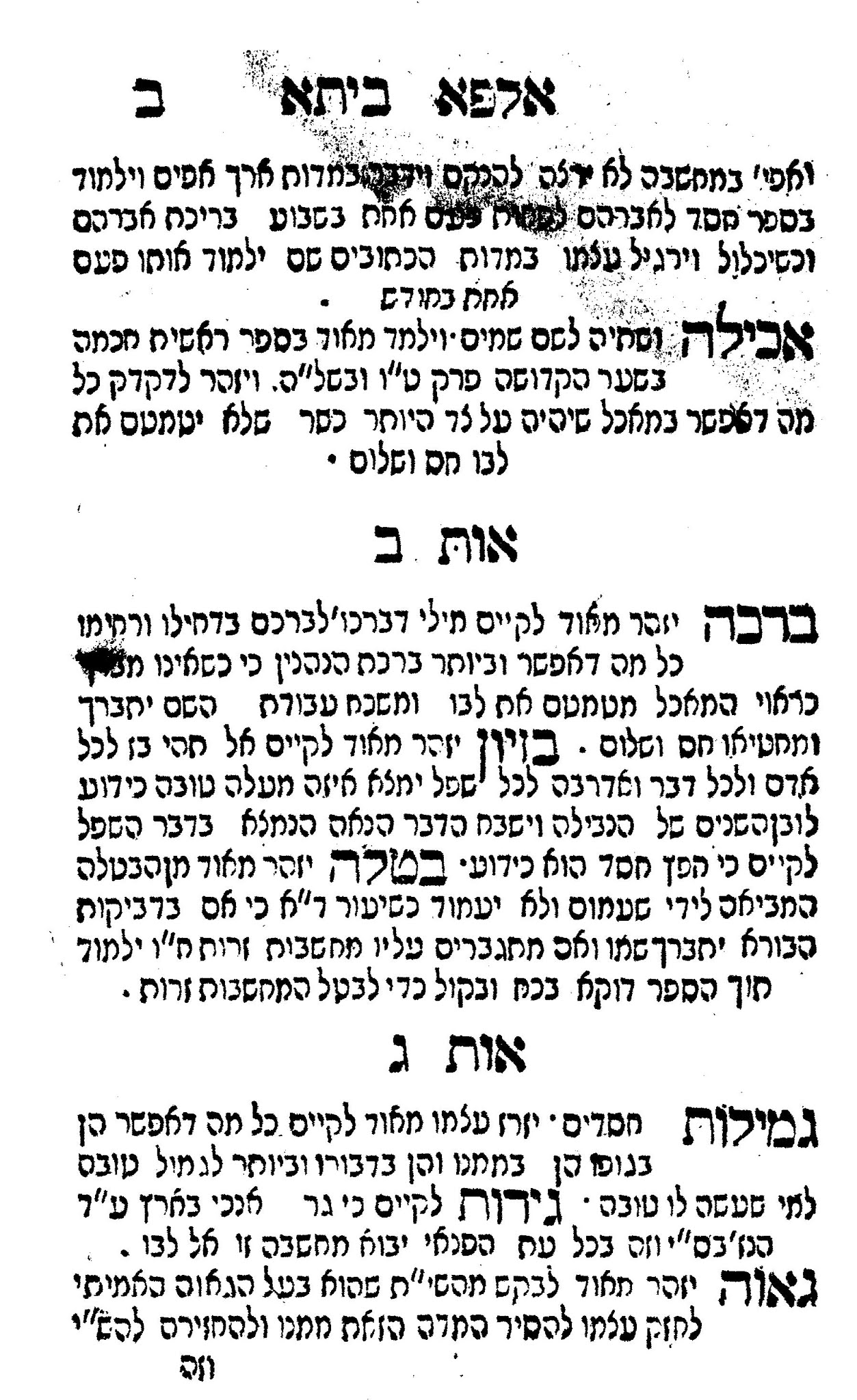
Examples of the subject matter are אות א (letter alef) emet (truth); א ahavah (love): letter ב bet; bracha (blessing): ג gimmel; gemilat hesed (acts of loving kindness): ד daled, no entry; ה heh; hihor (thoughts); ו vav; ve-tikvah (and hope), ז zayin; zahiros, (caution); and concluding with ר resh ratzon (will); ש shin shtikah (silence); and ת tav: teshuvah (repentance). Entries vary in length. Examples of brief entries are:

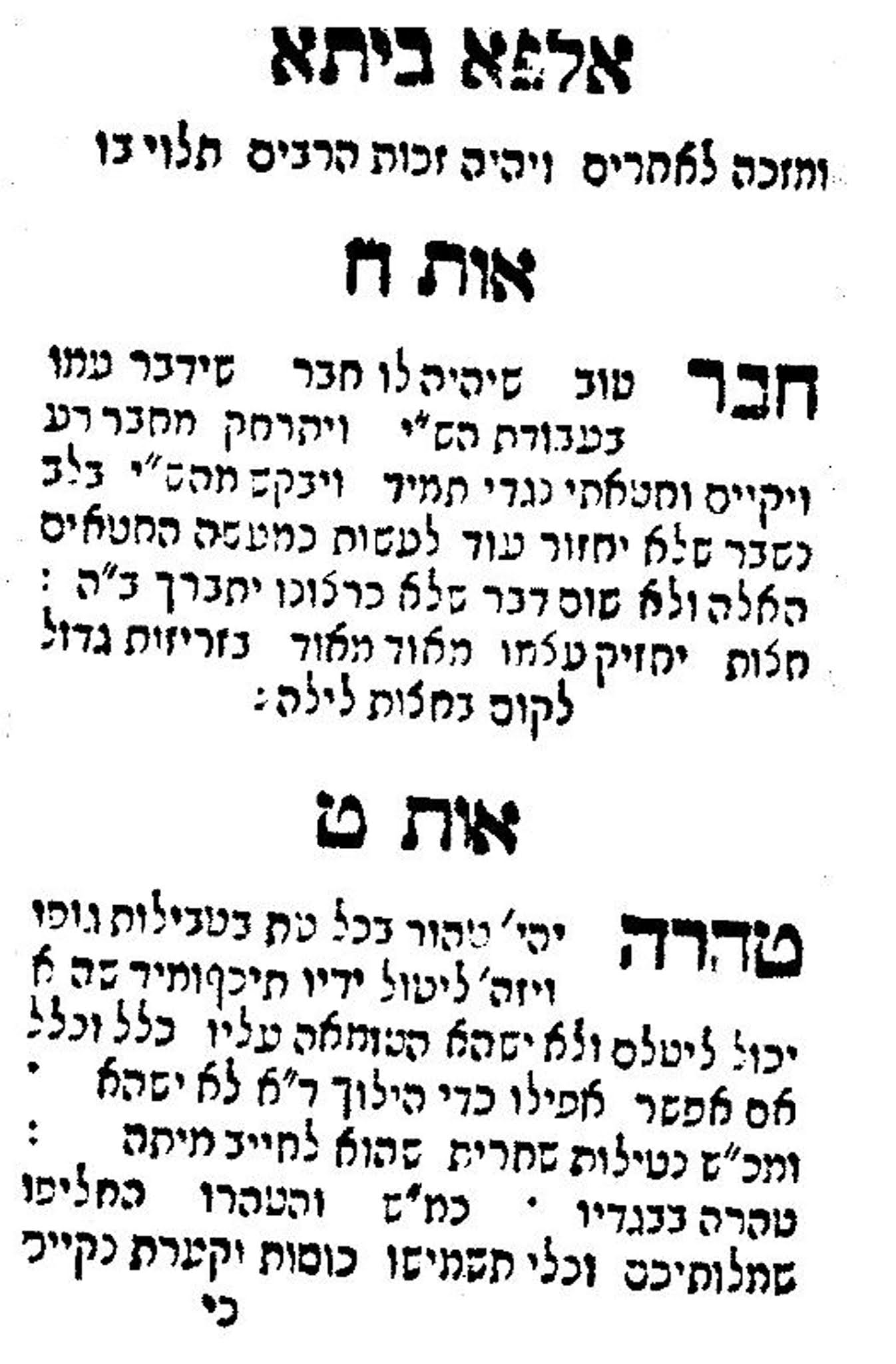
חבר ח (friend). It is good for a person to have a friend to speak with concerning serving the Lord and to maintain distance from a bad companion, fulfilling “my sin is before me constantly” (Psalms 51:5) and seek from the Holy One, blessed be He, with a broken heart that I should not repeat these sinful deeds nor anything that is not according to the will of the Holy One, blessed be He. It is a mitzvah to very much strengthen oneself with great zeal to arise at chaztot lilah (middle of the night).7

טהרה ט (purity) A person should be pure at all times by immersing his body [in a mikvah, ritual bath) and be careful to wash his hands immediately afterwards so that there should absolutely not be any defilement on them and if possible so as to not go even daled amos. All the more when washing one’s hands in the morning one is responsible for his life (literally subject to death). Purity of his garments, as it is written “cleanse yourself and change your garments” (Genesis 35:2)and all your utensils , cups and plates shall be [ritually] clean for this arouses purity of the soul.

קדושה ק (holiness). A person should sanctify himself in all the ways that hazal (rabbinic sages) has cautioned him and as what is written, one should be very careful to sanctify all his limbs and senses.

The text of Alpha Beta is followed by Torat ha-Adam written by R. Aaron ben Judah ha-Leṿi (18th cent.), also author of Hasdei Avot.8 Torat ha-Adam is also a collection of moral maxims, concluding with a brief alphabetical list of dictums, a few a bit strange, such as כ “all your companions and your brothers will betray you: and even those who lie in your bosom will forsake you”9 and, more customary, ת “give thanks to the Lord your God and then you may go in safety on your way.”


Sefer Alpha Beta (c. 1799) Nowy Dwor
Courtesy of the National Library of Israel

Shortly after the first printing of Alpha Beta several other editions of Alpha Beta were published. Among them is a clearly dated תקנט (559 = 1799) Nowy Dwor edition (title-page above). Nowy Dwor, located in east-central Poland, thirty-one kilometers from Warsaw, was published at the press of Anton Krieger (Krüger), a Christian German cloth merchant.10 The title-page has a brief text, simply stating that it is Alpha Beta, Sefer Otiyyot Mahkimot and giving the place of printing. Here too Tzevi Hirsch’s name is omitted. The volume begins with a brief preface praising the work and then an introduction by Tzevi Hirsch’s son stating that it was previously printed as Otiyyot Maḥkimot, undated and without the place of publication. This edition, more complete, has added material, among it the following entry,

דיבור ד speech. Speech is very precious and should not be used in vain, and all the more to anger or for dispute, G-d forbid, derogatory speech, talebearing, disparaging speech, mockery, or falsehood . . .

Some letters are amplified, that is they are enlarged subheadings within entries, such as א ahavah (love) has been expanded to highlight אמת (truth), followed by ahavah (love), and then אכילה (eating), but this is infrequent. The text of Alpha Beta is followed by Be-Ezer ha-Zur, an alphabetical listing of concise aphorisms, for example,

ו One should be careful to not go daled amos (approximately 6 feet) without netilat yadaim (washing one’s hands).

ז One should be careful to join day and night times with Torah or tefillah (prayers).

יג One should not look at any animal, wild beast, or bird at the time they are occupied one with the other.

יד One should not look at any idol or graven image for his prayers will not be accepted for forty days, G-d forbid.

כד One should be careful not to embarrass anybody.

Sefer Alpha Beta (1799) Nowy Dwor
Courtesy of the National Library of Israel

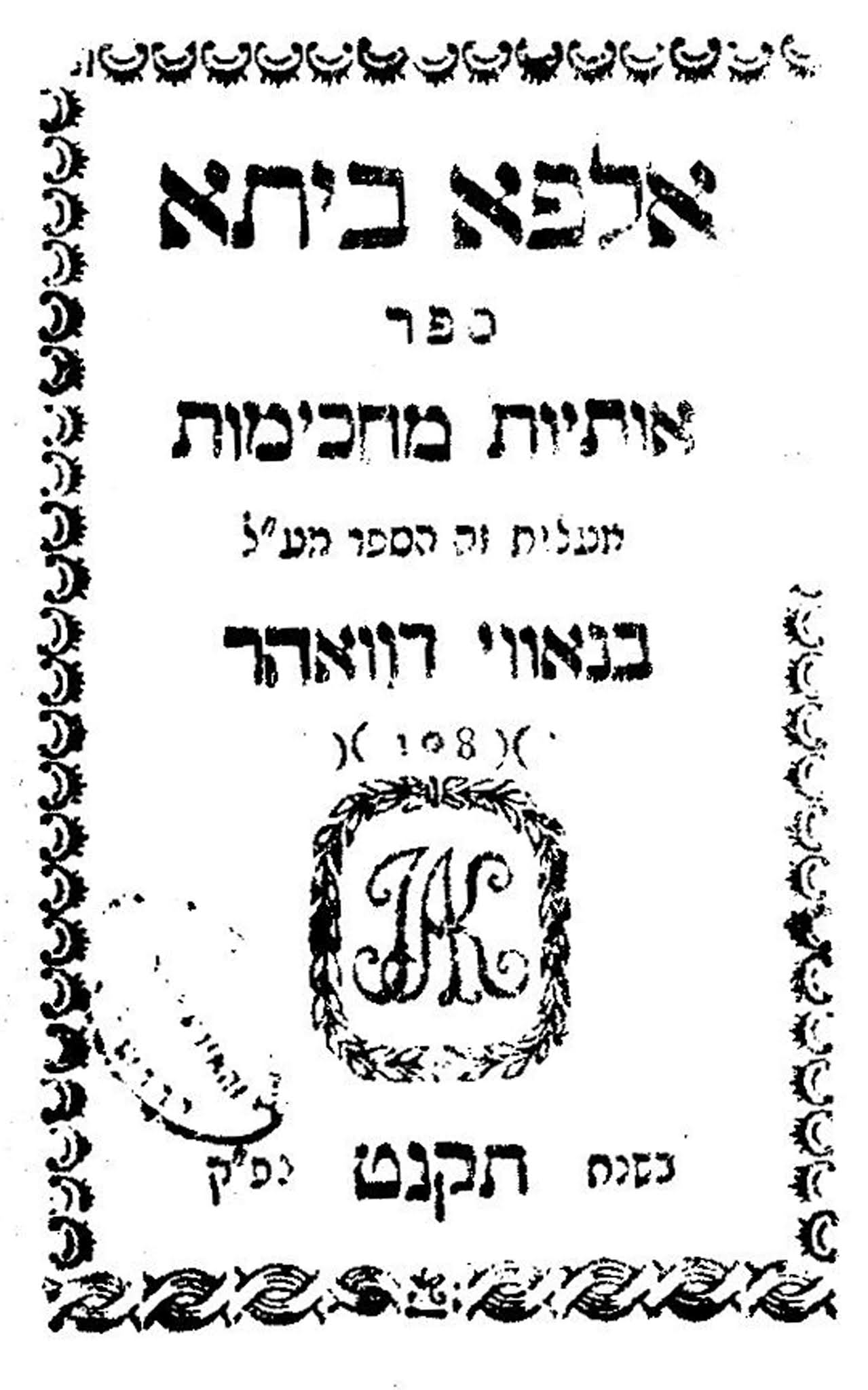
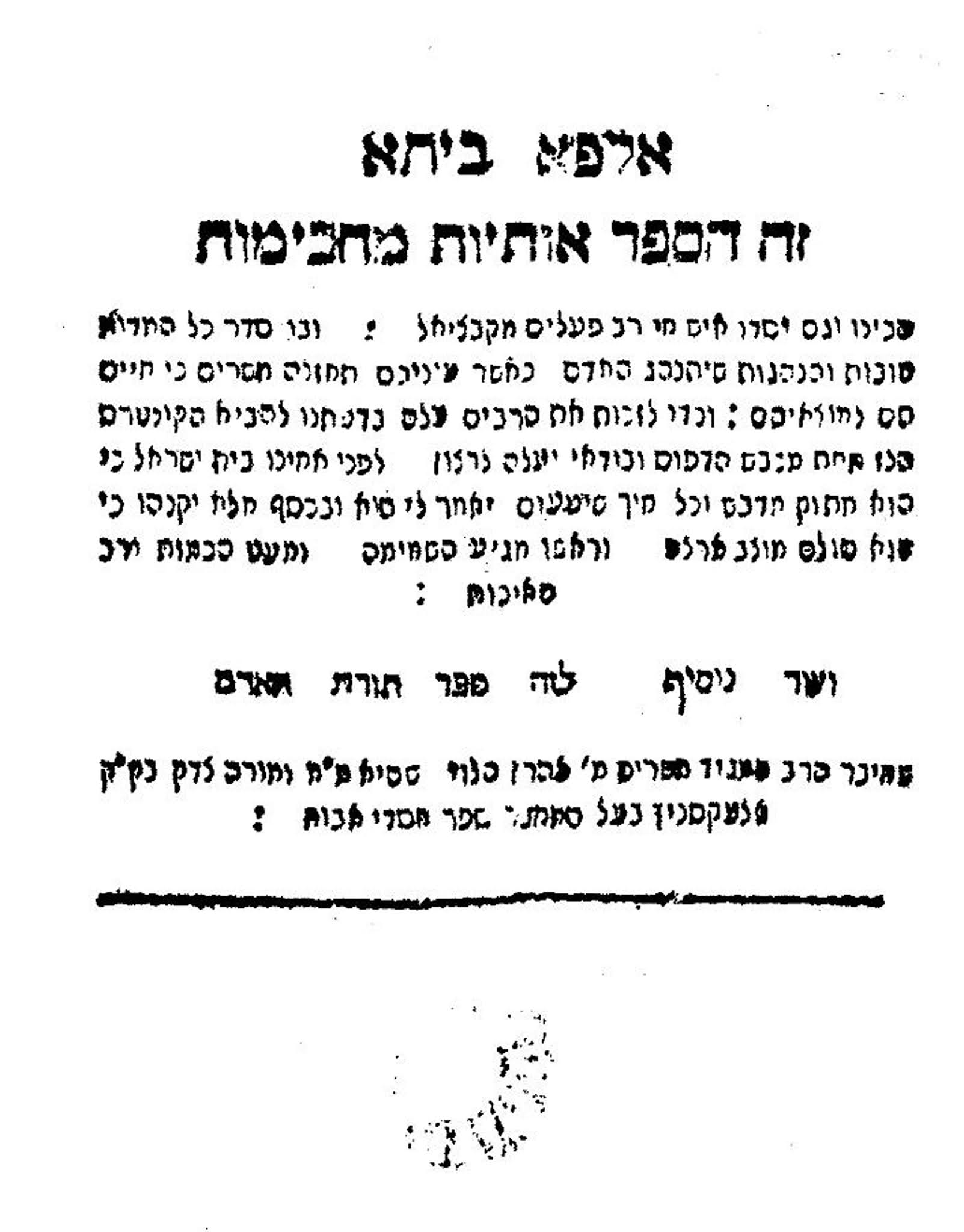
There is yet another edition late eighteenth-century edition (below) this with the location unknown but clearly dated “He guards the steps of His devout ones ורעלי חסידיו ישמר (550 = 1790)” (Samuel 2:9). If the date is correct this would be the earliest of our printings of Alpha Beta. It was noted above that the Thesaurus records a 1790 Russia-Poland edition, likely referring to this printing, presumably the first printing, prior to the Nowy Dwor edition, which may have been the second edition and the first complete printing of Alpha Beta, excepting the recorded Breznitz Alpha Beta (1796), which was not seen. However, this 1790 Alpha Beta mentions Otiyyot Mahkimot but otherwise makes no reference to earlier printings.

It stands out, however, for within the entries portions of the text are highlighted so that they now appear as several entries. For example, within the above entry on ד דיבור speech there are now two additional entries, that is, the words are highlighted in the text, for example ד דיבור speech, דין judgement, and דרך ארץ respectfulness.

1818, Alpha Beta, Russia-Poland
Courtesy of the National Library of Israel

Two distinct editions of Alpha Beta are recorded as 1818 imprints. One clearly dated as 1818, lacking the place of publication, is recorded as a Russia-Poland imprint and omits Zevi Hirsch’s name. The second edition, tentatively dated 1818, the place of publication also lacking, is frequently recorded as a Berdichev imprint. It clearly identifies Zevi Hirsch as the author. These are the eighth and ninth editions of Alpha Beta.

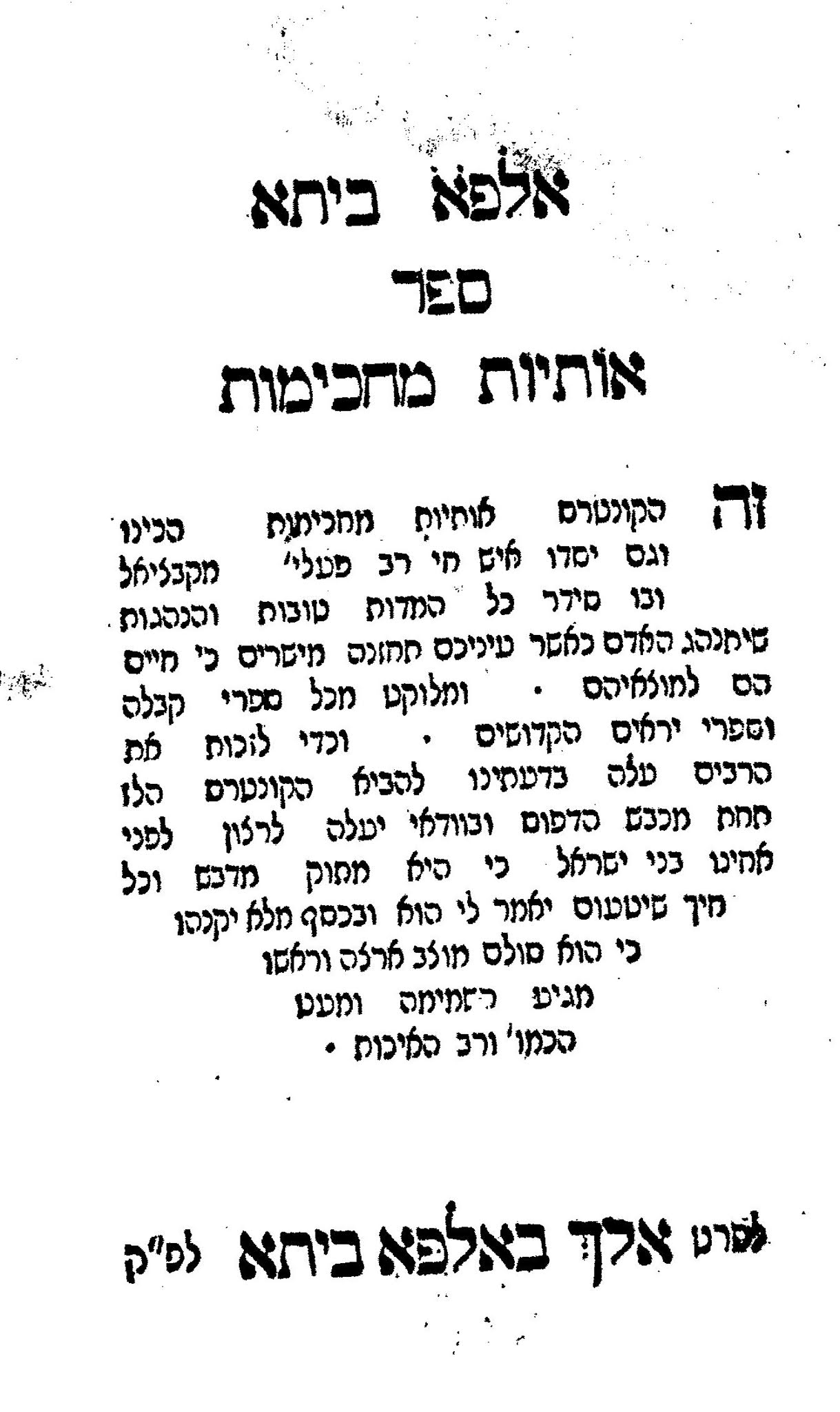
The Russia-Poland edition is dated אלך באלפא ביתא (578 = 1818) but no printer is given. It is described as 19 cm. (8 ff.). The title-page states,

Alpha Beta
Sefer
Otiyyot Mahkimot

This brochure Otiyyot Mahkimot was prepared and created by “a valiant man of many achievements from Kabzeel” (II Samuel 23:20; I Chronicles 11:22). In it he arranged all the good middot (traits) and conduct with which a person should conduct himself as “your eyes can behold righteousness” (cf. Psalms 17:2) “for they are life to he who finds them” (Proverbs 4:22).

Selected from all the works of Kabbalah and by God fearing men. For the public good we have brought this brochure to press, and it will certainly be pleasing to our brothers the children of Israel for it is “sweeter than honey” (Judges 14:18) and all your life you should taste of it and say for full silver he acquired it for it is “a ladder set earthward its top reaching heavenward” (Genesis 28:13), of small size.

Tzevi Hirsch of Nadworna’s name does not appear on the title-page nor in the brief introductory paragraph that precedes the text, set in rabbinic letters.

The second 1818 edition is generally recorded as a Berdichev imprint, 16 cm. [28] ff. However, a word of caution. Isaac Yudlov notes that Avraham Yaari, in his article on Hebrew printing in Berdichev, in which Yaari records Bedichev imprints, omits this edition of Alpha Beta, suggesting that Yaari, who recorded fifty-six Berdichev titles, either did not believe it was a Berdichev imprint or omitted items that were questionable.11 Nevertheless, most bibliographies do record this edition as a Berdichev imprint.

The most active printer in Berdichev at this time was Israel Bak, who published Tzevi Hirsch’s Tsemh ha-Shem la-Tsevi, also in 1818 (above), also lacking the date of publication. Tzevi Hirsch’s name is clearly given, in enlarged bold letters, on the title-page of this edition of Alpha Beta. The title-page states,

Sefer
Alpha Beta

Otiyyot Mahkimot. Illuminating as saphires, shining as lightening, standing at the top of the peak of the world, who reflects on them at all times will find in it “good reasoning” (Psalms 119:66), a healing for the soul (cf. Proverbs 16:24) and a tonic for your bones (Proverbs 3:8), arousing hearts, and bringing souls closer to their Father in heaven. That came from the mouth of the righteous, the pious, and humble, holy one of the Lord, the esteemed , the rav, the gaon, illustrious in Torah, the godly man Tzevi Hirsch the light of whose Torah shined in Nadworna and other communities.

A second paragraph states that references in the Talmud to idol worshippers and various terms used to describe them do not apply to contemporary nations who are not idol worshippers but give honor to the Torah and its followers and rule with justice and kindness. Such proforma statements are often found in contemporary Hebrew works and editions of the Talmud. The title-page is followed by the introduction of Tzevi Hirsch’s son, David Aryeh. He writes,

Behold, the above holy words that were already published by one who exited and entered in the tent of the Torah of the Rav [Tzevi Hirsch], placing it in his bag, the identity of the one who took this awesome work[12] הכר”ך הנורא הזה completely unknown (lit. obscured from sight) and there is no reason as to why in places it was abbreviated and others lengthened from the author. Now time has turned, thanks to the will of the Creator, to merit my father . . . and to bring the book to press . . .

1818, Alpha Beta, Berdichev
Courtesy of the National Library of Israel Courtesy of Steven Weiss

Ze’ev Gries and Ya’akov Shemu’el Shpiegel both note, referencing the introduction, that the reason for the omission of Tzevi Hirsch’s name in the previous printings was that, beginning with the 1790 Poland or Russia edition, Alpha Beta was frequently printed without the author’s name as the book was plagiarized or printed with changes unbeknownst to the author. The situation was corrected when Tzevi Hirsch’s son, David Aryeh, issued the Berdichev, 1818 edition.[13]

Gries, after comparing the Berdichev and the previous editions, finds that the errors are insignificant, the differences minor, the texts generally alike. He concludes that David Aryeh’s complaints are primarily based on the unauthorized use of his father’s work and the omission of the aphorisms included at the end of the Nowy Dwor edition, which may have been omitted intentionally or because the manuscript in question lacked them.[14]

Printed with this edition of Alpha Beta is Mille d’Avot, a commentary on Pirke Avot. The latter work frequently printed together with Alpha Beta. In Pirke Avot: A Thesaurus Steven Weiss records eleven editions of Alpha Beta beginning with the 1818 Berdichev edition through a 2011 Benei Brak edition.[15] In the introduction David Aryeh informs that the work of “many pearls” (Proverbs 20:15) Mille d’Avot is printed from a manuscript of his father’s, the author of that work, and also notes the publication of Tsemah ha-Shem la-Tzevi.

1848, Alpha Beta, Zolkiew
Courtesy of Otzar Hahochma

Subsequent editions of Alpha Beta clearly mention Zevi Hirsch’s name, for example the 1848 Zhitomir (Zhytomyr), edition (above). That edition was printed by Ḥanina Lipa, Aryeh Leib and Joshua Heschel Shapira, sons of Samuel Abba and Phinehas Shapira, grandsons of R. Moses Shapira. The original family press, in Slavuta, highly regarded, was forced to close after charges were brought by central authorities, but denied by the local Russian authorities, concerning the alleged murder by the Shapira family of a non-Jewish worker who had denounced the press to the authorities for printing Hebrew books without the approval of the censor. The press was reestablished by the Shapira sons in Zhitomir in 1847.

There is at least one recent edition that not only recognizes Zevi Hirsch as the author of Mille d’Avot but even emphasizes Mille d’Avot over Alpha Beta, the Lodz 1930 edition (below).

1930, Alpha Beta/ Mille d’Avot, Lodz
Courtesy of Steven Weiss

Tzevi Hirsch ben Shalom Zelig of Nadworna’s Alpha Beta has been a moderately popular work. The Thesaurus of the Hebrew Book records thirteen editions, the last being a questionable Zolkiew 1850 printing; The Bet Eked Sefarim records an equal number, the latest being a Lublin 1934 printing. While Alpha Beta is highly regarded this number of printings is not, in comparison to the ethical works noted at the beginning of this work, an impressive number of editions. Alpha Beta is a small brochure, portable and more easily learned than the other books mentioned, which are large and, in some instances, multi-volume works. One would have thought that this would have resulted in many more printings of Alpha Beta rather than the relatively small number noted. Given these considerations and the value (importance) of the ethical teachings in Alpha Beta the verse quoted at the beginning would appear to be appropriate for Alpha Beta.

By the riches of the sea they will be nourished, and by the treasures concealed in the sand. (Deuteronomy 33:19).

[1] I would like to express my appreciation to Eli Genauer for reading this article and for his suggestions, Dr. Steven Weiss and R. Yitzhak Wilhelm, Library of Agudas Chassidei Chabad Ohel Yosef Yitzhak Lubavitch, for their assistance.
[2] Steven J. Weiss, Pirke Avot: A Thesaurus: An Annotated bibliography of Printed Hebrew Commentaries, 1485- 2015 [Hebrew with English introduction]. A reason for the custom of saying Pirkei Avot between Pesah and Atzeret is that in these days each and every member of the people of Israel is obligated to purify himself during the days of Sefirah as the children of Israel purified themselves from the defilement of Egypt as is known from the holy Zohar. Seven weeks comparable to the seven days of niddah. (Ohev Yisrael for the Shabbat after Pesah 3:1).
[3] Yitzhak Alfasi, Entsiklopedyah la-Hasidut: Ishim כ-ת (Jerusalem, 2004), cols 603-07 [Hebrew]; Tzvi M. Rabinowicz, The Encyclopedia of Hasidism (Northvale, London, 1996), p. 335.
[4] Alfasi.
[5] Ze’ev G,ries, Sifrut ha-Hanhagot: Toldoteha u-Mekomah be-haye Haside R. Yisrael Ba’al Shem Tov (Jerusalem, 1989), p. 119 [Hebrew].
[6] Ch. B. Friedberg, Bet Eked Sefarim (Israel n.d.), alef 1422 [Hebrew]; Yeshayahu Vinograd, Thesaurus of the Hebrew Book. Listing of Books Printed in Hebrew Letters Since the Beginning of Printing circa 1469 through 1863. I (Jerusalem, 1993-95), p. 11 [Hebrew].
[7] Arising at chaztot lilah (middle of the night) refers to the kabbalistic custom of arising at the middle of the night to recite prayers and lamentations over the destruction of the Temple. (Aaron Wertheim (Author), Shmuel Himelstein (Translator), Law and Custom in Hasidism (Hoboken, 1992), p. 99.
[8] Torat ha-Adam has been printed independently several times, beginning with an Oleksinetz edition (c.1769) entitled Zot Torah ha-Adam. It is refeered to by that title in the Sudilikov (1819) and Munkatch (1904) printings.
[9] Cf. “Trust no friend, rely on no intimate; be guarded in speech with her who lies in your bosom” (Micah 7:5).
[10] Concerning the Nowy Dwor press see Marvin J. Heller, Printing the Talmud: Complete Editions, Tractates, and Other Works and the Associated Presses from the Mid-17th Century through the 18th Century (Leiden/Boston, 2019), pp. 211-18.
[11] Avraham Yaari, “Hebrew Printing at Berdichev,” Kiryat Sepher (1944), p. 100-24 [Hebrew]; Isaac Yudlov, The Israel Mehlman Collection in the Jewish National and University Library: An Annotated Catalogue of the Hebrew Books, Booklets and Pamphlets. Jerusalem 1984, pp. 190-91 no. 1171 [Hebrew].
[12] Concerning this phrase Gries references Ezekiel 1:22 the letters of הכר”ך reversed, the verse stateing “There was a likeness of an expanse above the heads of the Chayah החיה רקיע כעין הקרח, like the color of the awesome ice, spread out over their heads from above.” Also see TB Bava Mezia 24b and Hullin 95a where the phrase “obscured from sight” appears, albeit in a very different context.
[13] Gries, pp. 120-21; Ya’akov Shemu’el Shpiegel, Amudim be-Toldot ha-Sefer ha-Iṿri: hadar ha-meḥaber: be-Sha’ari ha-Defus (Jerusalem, 2014), pp. 25-26 [Hebrew].
[14] Gries, p. 21.
[15] In a private correspondence, dated May 27, 2020, Dr. Weiss writes that, concerning Alpha Beta, he “only listed the editions with Avot.”


Cemeteries and Response to Criticism

Cemeteries and Response to Criticism

Marc B. Shapiro

In my last post here I said that when it is safe, I will go to Baghdad to visit the grave of the Ben Ish Hai. I cannot find a picture of the Ben Ish Hai’s grave online, but you can see it in R. Yaakov Moshe Hillel’s beautifully produced recent book, Ben Ish Hai, p. 337. However, this is from the old cemetery in Baghdad, and because of a government order the remains in this cemetery were moved in the early 1960s. So it remains to be seen if the grave can now be located.[1] R. Hillel, p. 336 n. 480, claims that the precise location cannot be identified.

כיום, לא ניתן לזהות את קבריהם, בשל תנאי אקלים קשים השוררים בבבל אשר גרמו להתפוררות המצבות, ומחוסר רישום מדוייק של חלקות הקבורה.

Yet until we can go in and actually examine the spot, we cannot be certain if this is the case. There have been other examples of graves thought to have been lost, which have then been found. The best-known example is the grave of R. Israel Salanter, which was only located twenty years ago.[2]

While there is no doubt that the Ben Ish Hai was buried in Baghdad, there is also a tombstone for him on the Mount of Olives in Jerusalem.

According to a famous story, which is also told on the tombstone, the Ben Ish Hai’s body was not only magically transferred to Jerusalem on the day he died, but the grave-digger testified to burying him on the Mount of Olives and wanted payment for his labor.[3] I guess we can say that the Ben Ish Hai was buried three times: twice in Baghdad and once in Jerusalem.

It is hard to know whether the entire story of the burial in Jerusalem is a legend, or if there actually was a grave digger who figured out a way to make some money and invented the story to get paid for digging the grave. Assuming the latter is the case, the grave digger must have known his crowd, that not only would they be inclined to believe such a story, but that they would also not think of actually confirming the story by digging up the grave. Truth be told, it would have to be a very fearless grave digger to leave the grave empty, because one never knows if it will be opened, so it is possible that some unknown person is actually found beneath the tombstone. It is also possible that the grave digger did not have any bad intent, but just had a very vivid imagination. In any case, it is fascinating that such a tombstone exists in the most special Jewish cemetery, and even more incredible that there are people who actually believe that the Ben Ish Hai is buried there.

Supposedly, the Ben Ish Hai’s tombstone on the Mount of Olives is the only one that is standing upright, as all others are horizontal. (Maybe someone in Jerusalem can confirm this.) It is worth noting that R. Yitzhak Kaduri paid the grave in Jerusalem no mind, and even joked about it.[4] R. Shmuel Eliyahu has stated that while the Ben Ish Hai is buried in Baghdad, his spirit came to Jerusalem.[5]

Similar to the story with the Ben Ish Hai’s burial place, R. Abraham Joshua of Apt is buried in Medzhybizh, near the Baal Shem Tov’s grave, but there is a legend that angels carried his body to Tiberias, and there is a stone marking his grave there as well.[6]

This last summer I was in Marrakech, Morocco. In the local Jewish cemetery, R. Jacob Timsut is buried. Yet, “one month after the deceased rabbi was buried in Marrakech, a letter arrived from Jerusalem announcing the marvelous appearance of a tombstone with the name of Rabbi Ya’aqov Timsut in the well-known cemetery on the Mount of Olives.”[7] So once again, you can visit the tzaddik’s grave in its original spot or in Jerusalem.

Regarding tombstones even though the deceased is not buried there, I must call attention to the fascinating comments of R. Hayyim Nathan Dembitzer (1820-1892). R. Dembitzer was a dayan in Cracow and author of the responsa volume Torat Hen. Yet his claim to fame is his historical writings. As a real historian, he was prepared to accept the truth from where it came, and it is significant that in his work Mikhtevei Bikoret (Cracow, 1892), he included correspondence with Heinrich Graetz. Here is the title page and the first two pages of this book.


Look at how respectfully he refers to Graetz, which is the sort of thing that would have driven R. Samson Raphael Hirsch and R. Esriel Hildesheimer crazy.

Dembitzer’s respectful scholarly interactions with Graetz, in which he did not let religious differences interfere, is parallel to how certain important rabbinic figures related respectfully to Louis Ginzberg. I dealt with this matter in Saul Lieberman and the Orthodox, and it has also recently been discussed by R. Moshe Maimon.[8] Interestingly, in Mikhtevei Bikoret R. Dembitzer also includes correspondence with Nachum Sokolow.

Dembitzer’s two-volume Kelilat Yofi is focused on the rabbis of Lvov as well as other Polish rabbis, and is essential for anyone doing research on the Polish rabbinate. In this work, vol. 1 p. 41a, he mentions that Elyakim Carmoly had written that in earlier years in Lvov they would place tombstones in the cemetery for the deceased scholars of the city even if they had died and were buried elsewhere.

Dembitzer does not give an exact reference for Carmoly, only mentioning that his comment is in Ha-Karmel. Fortunately, I was able to find Carmoly’s article and it appears in Ha-Karmel, April 17, 1867, p. 302. Carmoly’s has two proofs for his contention. The first proof is that in R. Gavriel ben Naftali Hertz’s Matzevat Kodesh (Lemberg 1864), vol. 2, in the second half of the book (there is no pagination here), we find the following tombstone for R. Elijah Kalmankash, who served as rav of Lvov.

The tombstone explicitly states:

.וישכב עם אבותיו ויקבר במקום קבר אביו ולא ידע איש את קבורתו עד היום הזה

This is a clear proof that at least for this rabbi, a tombstone was placed in the ground even though he was not buried there.

Carmoly also notes, as his second proof, that in Matzevat Kodesh, vol. 2, p. 22a, it records, from the Lvov cemetery the text of the tombstone of R. Petahiah, son of R. David Lida who was rav of Amsterdam. His date of death is given as 1721. Here is the text of the tombstone as recorded in Matzevat Kodesh.

(Following R. Petahiah’s tombstone, Matzevat Kodesh records the tombstones of another son and son-in-law of R. Lida.) However, Carmoly tells us that we know that R. Petahiah died and was buried in Frankfurt. R. Markus Horowitz in his Avnei Zikaron (Frankfurt, 1901), p. 290 (no. 2712), published many years after Carmoly’s article, records the text of his tombstone as follows.

As you can see, the date of death is 1751, thirty years later than the date given on the tombstone in Lvov. In other similar cases, I would say that we are dealing with two different people, but the specificity of the tombstone texts makes it hard to deny that they are both for the same person (and Petahiah was hardly a common name).[9] Carmoly’s conclusion is that the community of Lvov put up a tombstone for R. Petahiah to memorialize him, even though he was buried in Frankfurt. Neither Carmoly nor R. Dembitzer offer an explanation as to why the Lvov tombstone places his death thirty years too soon, but they would probably view this as just a simple error.

Dembitzer not only agrees with Carmoly in the case of R. Petahiah, but offers another example of this phenomenon. R. Zvi Hirsch ben Zekhariah Mendel had served as rav in Lvov, but later he was rav in Lublin and died there around 1700. However, there was a tombstone for him in Lvov which gave his date of death at 1655. R. Dembitzer does not explain the discrepancy of the dates of death, and presumably he would say that when the tombstone was put up in Lvov to honor the deceased former rav of the city (who was not buried there), they simply got the date of death wrong. Interestingly, Shlomo Tal accepted the statements of Carmoly and R. Dembitzer, and in summarizing their position speaks of “many fictitious tombstones.”[10]

Dembitzer also makes the astounding assertion that there are graves in the Lvov cemetery for rabbis who never existed! His proof is that there is a tombstone for a Rabbi Eliezer ben Moshe ha-Kohen Proops (פרופס), who is said to have been av beit din in Amsterdam before he came to Lvov. Yet R. Dembitzer states that no such person was av beit din in Amsterdam, and we thus see that the people who made the tombstones did so for rabbis who never existed![11]

כי גם זאת לפנים בלבוב, להקים ג”כ מצבות אבנים ולחקוק עליהם שמות חכמי ישראל אשר לא מתו ולא נקברו לא בלבוב, וגם לא במקומות אחרים, יען כי לא היו ולא נבראו ולא באו עוד לעולם . . . ומי לידינו יתקע אם לא עשו זכרונות במצבות אבנים כאלה גם לשאר גאונים אשר בדו מלבם וקראו בשמותם עלי אדמה, וקבעו גם כן זמן לפטירתם

This is a very strange assertion, and even if it is correct, it refers to one case only, while R. Dembitzer uses it to make a generalization. The only one I know who took note of R. Dembitzer’s assertions was R. Hayyim Eleazar Shapira in a letter to R. Leopold Greenwald.[12] R. Shapira rejects R. Dembitzer’s claim in a very sharp tone.

ולא יאומן כי יסופר כי מרב גדול בתורה יצאו דברי הבל כאלו אשר כל השומע ויודע יצחק להם, ליתן מצבות ומקום בעד אותן שאינם נקברים שם ולכתוב שקר גמור “פ”נ” על להד”ם ולהשחית הקרקע שלא נקברו שם אין כדאי להטפל בדברי ריק כאלו. ואם בשביל קושיות שמצאו כמו ב’ מצבות כמו שני יוסף בן שמעון בשתי עיירות כלומר בתי קברות הנה שערי תירוצים לא ננעלו ונמצאו באמת שנים ששמותיהן שוות או לא העתיקו המצבות במקום אחד כראוי

Shapira makes the obvious point that two people with the same name can be buried in different cemeteries without them being the same person. However, this does not explain how there can be two tombstones for R. Petahiah, the son of R. David Lida, or how there can be a tombstone for another rabbi in the Lvov cemetery when we know that he was buried elsewhere.

Regarding what we have discussed, I would only add that in the new Jewish cemetery in Vienna (the same one that R. Israel Friedman, the Chortkover Rebbe, is buried in), there is a tombstone for three members of the Chevra Kadisha who perished in the Holocaust. While it looks like a normal grave, none of the three men mentioned on the tombstone are actually buried there.[13] Here is the tombstone.

I owe this information and the picture to Dr. Tim Corbett, whose book on the Jewish cemeteries of Vienna will hopefully soon be published.

Since I just mentioned R. Hayyim Eleazar Shapira, let me mention something else he says that is fascinating. In the past two posts I discussed apostate rabbis. It is bad enough when an average person apostatizes, but for a rabbi to do so could have had terrible consequences on the community in that it could lead to many weak of heart to follow. Can anyone imagine, however, someone apostatizing as an act of teshuvah? It sounds crazy, but R. Shapira reported that he had it by tradition that such an incident happened in medieval times.[14]

The story he tells is that there was a popular preacher who in his public talks inserted all sorts of heretical ideas. After he was rebuked by one of the rabbis for preaching his heresies, the man confessed his sins and asked what he should do to repent. The rabbi told him that his repentance would not help, as for years he has gone from place to place spreading his heresy. How could he possibly repent for this? The rabbi said that what he must do is convert to Christianity. The Jewish world would then hear about this and this would remove the legitimacy from any of his sermons, as people would assume that even before his apostasy he was a heretic. Only by doing this could he destroy the impact he made with his earlier sermons.

Let me mention one final responsum for now. In the eighteenth century, R. Elijah Israel of Rhodes dealt with the case of someone who converted to Islam in Izmir, and then wished to come to Rhodes in order to return to Judaism.[15] Practicing Judaism after converting to Islam was illegal, and could endanger everyone in the community. The man was therefore warned not to come to Rhodes, where Muslim merchants might recognize him, but he ignored this warning. Making matters worse, the man had already once before converted to Islam and reverted to Judaism, meaning that there was no way that the Jewish community could have any dealings with him.

Israel permitted letting the authorities know about this man, as he was regarded as a danger to the community. The punishment for his “crime” of leaving Islam would have been severe and could even have included the death penalty, but R. Israel allowed informing the authorities as the man had the status of a rodef. He writes:

מי שמסכן רבים כגון שעוסק בזיופים במקום שהמלכיות מקפידות דינו כרודף ומותר למוסרו למלכות ע”כ וכ”ש וק”ו במי שהמיר דת ורוצה לחזור לדתו שההקפדה היא גדולה שהוא בזוי גדול לדעתם פן תצא כאש חמתם ח”ו ובערם ואין מכבה שמותר למוסרו כדי להציל את ישראל

* * * * * *

In the most recent issue of Dialogue 8 (2019), pp. 35-83, Rabbi Herschel Grossman published a lengthy review of my Limits of Orthodox Theology.[16] Normally I, like any author, would be very happy that so many years after a book’s appearance people are still interested in examining it and engaging with its arguments. Unfortunately, that is not the case with the present review which, it must be said, is nothing less than slanderous. Had the author taken issue with my interpretation of texts and shown why I am mistaken, this would have been a fine way to approach the book. It could be that I would even acknowledge that in some cases his understanding is preferable to mine. As readers of this blog know, I am perfectly willing to acknowledge when I have erred and am happy to credit those who called my attention to these errors. This is how scholarship is supposed to work, and anyone who writes, especially someone who writes a great deal using lots of different sources, will sometimes make a mistake. I myself have called attention to my own errors, without anyone prompting me, as I think it is important for all of us to be as exacting as we can.

However, this is not what the review is about, or, I should say, not what it is mainly about. In future posts I will come to the issue about how to interpret specific texts (and I will defend my readings), but first I must explain why I said that the review is slanderous. It is because Grossman accuses me of saying things that I never said, and throughout he misunderstands the purpose of the book, and of academic Jewish studies as a whole. In general, it is obvious from the review that although Grossman has never met me or even spoken to me, and I have never done him any wrong, he sees me as an enemy that he has to destroy.[17] With such a preconceived notion, it is no wonder that he comes to such incorrect conclusions as to what I am trying to say, and can write a review that is so mean-spirited and dripping with contempt. Based on e-mail correspondence with readers, I do not believe that anyone who has read the book will be taken in by the review’s distortions. However, those who haven’t read the book will probably come away with a false understanding, so it is important to clear this matter up before getting to any arguments over how to interpret particular sources.

Before going through the article itself, let’s look at the end where Grossman says that the book “falls short of its promise to prove that the Rambam was wrong in presenting his Principles as central to Judaism” (p. 83). I think everyone who has read the book knows that of all the things I try to do, one thing I do not do, and indeed it would have been incomprehensible to even imagine such a task, is attempt to prove that the Rambam was wrong. Even if I were a theologian, which I am not, I could not imagine myself ever trying to prove the Rambam (or R. Bahya, R. Saadiah, Ibn Ezra, etc. etc.) wrong. This is simply not how I operate.

The notion that I attempted to prove the Rambam wrong is so far from what I was trying to do in the book, that as mentioned, I don’t believe that anyone who actually read the book, or any of the other reviews, would have concluded as such. What they would have seen is that I try to show that the Rambam’s principles were disputed by others, and thus did not receive complete acceptance. I try to prove this point, but this is very different than trying to “prove that the Rambam was wrong.”

I don’t even know how one would be able to prove the Rambam, or any other Jewish thinker, “right or wrong” on theological matters. Is it possible to “prove” that creation was ex nihilo or from pre-existent matter, or can we ever “prove” that prayers should not be addressed to angels? Today, unlike in medieval times, most of us assume that by their very nature, theological discussions are not subject to “proof”. The most one can do is try to show which position makes more logical sense and is in line with biblical and rabbinic teachings.[18]

In his conclusion, Grossman also writes, in opposition to my supposed error, “that the Rambam’s Principles of Judaism remain the correct affirmation of Jewish belief.” Again, this sentence has nothing to do with my book, as it assumes that I claimed that the Rambam’s principles are incorrect. Had he understood what the book is about, and he wished to dispute with me, he would instead have written “that the Rambam’s Principles of Judaism are the generally accepted [or: halakhically binding, or: rabbinically sanctioned, etc.] affirmation of Jewish belief.”

Let us now start at the beginning. Grossman begins his review—and I will be going through it page by page responding to his attacks—by stating that “the academic approach to matters of Torah learning is radically different from that of the talmid chochom” (p. 36). This is an incorrect statement, as many followers of the academic approach are themselves talmidei hakhamim. What Grossman should have written is that the academic approach is different than the traditional approach. With regard to academic works, Grossman states: “Many of the conclusions of these works are at variance with accepted Torah teachings” (p. 35). No doubt that this is a true statement, but of course, the issue we will have to get into is what is the definition of “accepted Torah teachings.” As all readers of this blog are aware, R. Natan Slifkin’s books were banned because they were seen to be at variance with “accepted Torah teachings,” so the fundamental issue will be which teachings are supposedly accepted.

Grossman writes as follows in explaining the difference between a traditional Torah scholar and an academic scholar:

[For] the talmid chochom, a difficulty in the words of the authority creates a challenge for him to discover the true meaning of the authority. For many academics, a difficulty is proof that the authority is wrong (p. 36).

Grossman identifies me as one of the academics who try to show that an authority is wrong, so let us see whether this is indeed the case. He begins by stating about my book: “Its thrust is that the Rambam erred in codifying these Principles.” We have already seen this unbelievable distortion in his conclusion, as if one of my goals was to show that the Rambam was mistaken.

Grossman further states that “while some earlier scholars have disputed whether some of the Principles deserve to be listed as basic to Judaism . . . all have conceded that the tenets expressed by the Principles are correct” (p. 36). This statement is grossly inaccurate, as virtually every page of my book demonstrates (and in various blog posts I have also cited numerous authorities who disagree with certain of Maimonides’ principles).[19] Even if all of Grossman’s criticisms of particular points of mine are correct (and I will come back to this), it still leaves loads of sources at odds with the Rambam. The sentence is nothing less than shocking, since rather than acknowledging that other authorities disagreed with certain Principles of the Rambam, but claiming that these authorities’ views are to be rejected for one reason for another, Grossman states that “all have conceded” that the Rambam’s views are correct. It is hard to know how to reply to such a statement that completely disregards the truth that everyone can see with their own eyes.

In Limits, p. 26, I quoted the following from R. Bezalel Naor, who was repeating what he heard from R. Shlomo Fisher: “The truth, known to Torah scholars, is that Maimonides’ formulation of the tenets of Jewish belief is far from universally accepted.” R. Naor informed me that R. Fisher made this statement in explaining R. Judah he-Hasid’s view about post-Mosaic additions to the Torah. In other words, R. Judah he-Hasid’s view is not in line with Maimonides’ Principles, but this is not the only such example of Torah sages diverging from the Principles.

Grossman continues by stating that I conclude “that the Rambam’s formulation of the underlying beliefs of Judaism was his own innovation” (pp. 36-37). What does this sentence mean? Apparently, he wants the reader to think that I said that the Rambam just invented his Principles out of thin air, which is of course incorrect as I never said this. If the meaning is that the very notion of a list of doctrines formulated as Principles of Faith, with all that this entails, was the Rambam’s innovation, there is nothing controversial about this at all, and I discuss whether the Rambam was the first to do this and what led him to do so.

Grossman continues: “Even such basic tenets as the belief in God’s unity, or in God’s non-corporeality, says Shapiro, are the Rambam’s own assertions and subject to dispute, with no firm basis in the Torah or in Chazal” (p. 37). I never say that these tenets are the Rambam’s own assertion without any prior basis (as if the Rambam invented these ideas). When it comes to the belief in God’s unity, I state explicitly that no Jewish teacher has ever disputed this (although how they understood God’s “unity” was subject to dispute). As for God’s incorporeality, I will come back to this in greater detail in a later post, where I will also deal with R. Isaiah ben Elijah of Trani’s claim that divine incorporeality is not a principle of faith, as well as Maimonides’ view that in its simple meaning (but only in its simple meaning), the Torah itself teaches God’s corporeality (for the benefit of those people who at the beginning of their studies are not able to understand the profound concept of a deity without form). Since I will then analyze this matter in great detail, I do not want to get into it here. For now, I will simply say that in the book I discussed whether divine incorporeality was accepted by all Jews at all times, and if corporeal views of God can be found in the Talmud (as was stated by R. Isaiah ben Elijah of Trani).

On p. 37 Grossman writes:

Shapiro, who mocks the opinions of Rabbeynu Nissim, R. Moshe Feinstein, Chazon Ish, Arizal, and R. Ya’akov Emden, among others, goes one step beyond Kellner in his belief that he, Shapiro, is better able than Rambam to interpret explicit verses of the Torah (as we shall see below).

This is nothing less than slander since I never, not even once, mock the opinions of any of these great rabbis or anyone else. When I read this sentence, I had no clue what he was talking about, as this is not how I operate, and was shocked when I went to the sources he refers to. Let us look at what Grossman regards as “mocking”.

For my mocking of R. Nissim, he refers the reader to p. 84 in my book where I write that R. Nissim “puts forth the strange and original position that there is one particular angel before whom prostration is permitted.” This is mocking?[20]

For my “mocking” of R. Moshe Feinstein’s opinions he provides three sources.

On p. 101 n. 73, I discuss R. Moshe’s rejection of the authenticity of a passage in Avot de-Rabbi Nathan. I write that R. Moshe’s “rejection of the authenticity of this passage should be viewed as part of his pattern of discarding sources that do not fit in with his understanding. He does so even when the sources are neither contradicted by other writings of the authors involved nor by other versions of the text in question.” Where is the mocking?

On p. 157, I write: “Although R. Moses Feinstein was the greatest posek of his time, he seems to have had no knowledge of Maimonidean philosophy. He was therefore able to state that Maimonides believed in the protective power of holy names and the names of angels, as used in amulets.” Where is the mocking?[21]

The last source where I am said to be mocking R. Moshe’s opinion is p. 159 of my book. Here is the page.

All I do here is cite R. Moshe’s comment about those who oppose kollels by citing the Rambam. I have also seen R. Moshe quoted as saying that it is noteworthy that those who oppose kollels based on the Rambam only adopt this one “humra” of the Rambam. The Rambam has lots of other humrot, yet people don’t adopt these stringencies. They only want to be “mahmir” in accordance with the Rambam so as not to support kollels. To say that I am mocking R. Moshe’s opinion is not only slander, it is completely incomprehensible.

Regarding the Hazon Ish, Grossman refers to p. 17. On this page I mention the views of many who held that the Thirteen Principles are the fundamentals of Judaism, and I include a passage from the Hazon Ish. I don’t see any mocking.[22] He also refers to p. 65 n. 124, where I mention a number of sages, including the Hazon Ish, who say that the Rambam’s view that belief in divine corporeality is heresy (Hilkhot Teshuvah 3:7) does not refer to someone who does not know any better, and thus the Rambam is not in dispute with Rabad who criticizes the Rambam on precisely this point. In response to those authorities who made this argument, I wrote: “They obviously never saw Guide I, 36, cited above, p. 48.” In this source, Maimonides specifically rejects the notion argued by the Hazon Ish and others that Maimonides is not speaking of the person who does not know any better. In fact, R. Kafih goes so far as to say, in his commentary to Hilkhot Teshuvah 3:7, that Maimonides saw Rabad’s comment and Guide 1:36 was written specifically in response to it, in order that people not assume that Rabad’s position can be regarded as theologically sound.

Regarding R. Isaac Luria, Grossman points to p. 90, where I write:

Finally, I must mention R. Isaac Luria’s view that Moses’ understanding of divine matters was inferior to that of certain kabbalists (including himself!). This notion is elaborated upon by R. Shneur Zalman of Lyady (1745-1813), who asks, “’How did Rabbi Isaac Luria, of blessed memory, apprehend more than he, and expound many themes dealing with the highest and most profound levels [penimiyut], even of many Sefirot.”

Again, I don’t know where there is any mocking. Incidentally, a reader has made a very good case that I am incorrect, and R. Isaac Luria and R. Shneur Zalman should not be cited as opposing Maimonides’ principle. In a future post, I will present this argument, which R. Chaim Rapoport told me he agrees with.

Regarding R. Emden, Grossman refers the reader to p. 16 n. 63. Nowhere in this note do I mock an opinion of R. Emden. What I do say is that his sexuality was complex. In retrospect, I regret including this comment, since it is not really relevant to the matter at hand. Yet there is no question that when it comes to sexual matters, there is something very much out of the ordinary, especially for rabbinic greats, in how R. Emden writes about these things. This is something that I believe is acknowledged by everyone who has studied R. Emden’s writings, including the most haredi among us, even if they won’t put such statements in writing. Mortimer Cohen, in his book on R. Emden, famously pointed to sexuality to explain how R. Emden could have attacked R. Eybeschütz the way he did, with such outrageous accusations. Still, I believe that Jacob J. Schacter is correct when he states: “[W]hile it is clear that Emden had a complex and contentious personality, all this emphasis on his sexuality is really irrelevant to his attack on Eybeschütz.”[23] I for one am not comfortable with psychological interpretations, even if in this case such an interpretation can be used as a limud zekhut for some of the shocking things R. Emden says, and if I was writing the book now I would leave out the passage mentioned above. Yet where is the mocking? The only mocking I see is how Grossman continuously mocks me.

Grossman writes: “Shapiro does not refrain from adducing explicit Talmudic passages as contradictions to the Rambam, presuming that the Rambam overlooked or ignored them, something which innumerable Talmudic scholars in past centuries have considered inconceivable” (pp. 37-38). In the book I never say that the Rambam overlooked talmudic passages. I do say that he did not accept the outlook of every talmudic passage (which Grossman terms, “ignored them”). The Rambam famously held that not every passage in the non-halakhic sections of the Talmud is binding.

Grossman continues:

Shapiro is unimpressed by all these arguments; nor is he averse to dismissing Rambam’s opinion based on his, Shapiro’s, own reading of a Talmudic passage, even where there is no doubt that the Rambam had a different reading for it. An academic, he obviously feels, is privileged to interpret the Talmud better than the Rambam was [!], even where this presumption leads to bizarre conclusions (p. 38).

The only thing that is bizarre here is Grossman’s statement, for I can assure everyone that in the book I do not engage in talmudic debate with the Rambam, dismiss the Rambam’s opinion, and think that I am able to interpret the Talmud better than the Rambam. If someone offers, say, a new interpretation of a talmudic passage, does this mean he thinks he can interpret the Talmud better than Rashi or the Rambam?

Another false statement is found on p. 38 where Grossman states: “Although he is to be commended for the amount of research he has invested into his work—the citations he has amassed are voluminous—it seems that many of the references were culled from secondary sources without examining the originals.” I can state with absolute certainty—and other than Grossman, I don’t think anyone else has ever raised such an accusation of scholarly malpractice—that I have examined every original source cited in the book. Not only that, but I have examined every source in every book I have published and in every blog post. I have never cited a source that I have not examined “inside” unless I indicate so. This does not mean that I have never misinterpreted a source, and in subsequent posts I will examine some examples where Grossman offers a different reading. But for now, suffice it to say that it is nothing less than slander to state that I included sources in the book that I did not examine myself (and this, by the way, was before the existence of the various digital databases. Librarians at JTS and YU can remember me as I was constantly there during the time I was writing the book.)

The final point for now is Grossman’s conclusion of the first part of his review:

To analyze the errors in this book would require a book in itself, nor is this the purpose of this article. The purpose is to show the lack of basis for Shapiro’s assertions (1) that the Rambam’s Principles have no basis in Talmudic literature; (2) that he created these Principles either to advance his philosophic conclusions or for polemic purposes; and (3) that many authorities thought the Principles “were wrong, pure and simple” (p. 38).

Point 1 is incorrect. I never state that the Rambam’s Principles have no basis in talmudic literature. Every single one of the Principles can find support in the Talmud (even if others might disagree with how to interpret the talmudic passages), and I cite examples of this in the book. What I do say is that the concept of Principles of Faith put forth by Maimonides, that one can commit endless sins but if he believes in the Principles he is still a Jew in good standing (albeit a sinning Jew) with a share in the World to Come, and if he denies or doubts even one of the Principles, even if he did not know any better and even if he fulfilled all the mitzvot, he does not have a share in the World to Come, such a concept is not found in talmudic literature. I am hardly the first to say this. Many of the Rambam’s rabbinic critics made this point, and as far as I know, all of the academic scholars who have studied the Rambam have said likewise. Furthermore, even if there are talmudic sources for the substance of Rambam’s Principles, this does not mean that there is compelling talmudic sources to explain why the Rambam categorized these particular beliefs as Principles, denial of which is heresy. Often, we must look to his philosophical assumptions, which he regarded as part and parcel of Torah, to explain why he raised certain beliefs to the level of Principles while others did not. We must also look to his philosophical assumptions to understand why he read certain talmudic passages the way he did, and was thus led to formulate his Principles in a certain fashion.

I would also like readers to examine the following statement by the rabbinic scholar, R. Reuven Amar.[24] Based on what Grossman writes, I assume that he will regard this as equally blasphemous to anything I have written.

דאם כי ודאי אין חכמת הרמב”ם ז”ל כשאר בעלי החכמה ובעלי הדעה וגדולה חכמתו ושיעור קומתו ולבו רחב כאולם בכל חכמה ומדע מ”מ בעיקרי האמונה אין דבריו כמפי הגבורה אחר שלא קיבלם איש מפי איש עד משה רבינו ע”ה כי אם משיקול דעתו ובינתו וכפי שהודה וכתב בעצמו בהקדמת ח”ג מהמורה נבוכים, בענין מעשה המרכבה ומעשה בראשית ועיין בזה במגדל עוז פ”א מיסודי התורה ה”י וכן ראיתי בספר שומר אמונים (להרב ר’ יוסף אירגס זצ”ל) בויכוח ראשון סעיף ח’ ט’ שהתבסס על זה

Regarding point 2, Grossman sees it as problematic to say that the Rambam created the Principles to advance his philosophical conclusions. Yet this is a perfectly reasonable approach. After all, wouldn’t the Rambam want the Jewish people to hold philosophical truths, and what better way to achieve this than to put these truths in the form of Principles of Faith that everyone has to know? This approach is commonly held among scholars of the Rambam. As for the accusation that I say that the Rambam created the Principles for polemical purposes, I never say that with regard to the Principles as a whole. I do say this about aspects of two of the Principles, and I will return to this in a future post. The fact that I am being attacked on this matter is ironic, as my approach is actually more conservative than what is found in almost all works of modern scholarship on the Rambam.

As for point 3, I do not say that “many authorities thought the Principles” were wrong. What I do say is that many authorities thought that individual Principles were mistaken. By writing “the Principles,” Grossman leads readers to think that I said that many authorities rejected the Principles in their entirety, but all readers of my book know that this is not the case.[25]

I want to conclude with the following from R. Mordechai Willig, which has some relevance to my discussion and which I think readers will find of interest.[26] R. Willig’s entire shiur is worth listening to, but for the purpose of this post I only want to cite one small section.

As we know, not all the Ikrei Emunah were etched in stone without any dispute from the beginning of time. . . . Are in fact the Rambam’s Thirteen Principles accepted le-halakhah for the last X hundred of years and you can’t go against it, or perhaps not? There are those therefore who are trying to get around certain of his Ikrim. The Sefer of Albo himself who wrote the Sefer Ikrim didn’t accept all the Thirteen of the Rambam. One might argue that we don’t really find anywhere to my knowledge significant dispute about the other Ikrim of the Rambam, but perhaps not all Thirteen were accepted, but we’ll call [it] Twelve and a Half. The first part of Ikkar number 5 was accepted, and the second part which is so complex, perhaps it never really was accepted. So there are Thirteen Principles but one of them, number 5, we only accept part of the Principle, not the entirety of the Principle. . . . It’s against the Rambam, but this half of that Principle was never accepted. But the rest was accepted.

In the next post I will continue with my response (and it looks like it will take many posts before I am finished, unless I first tire of this endeavor).


[1] Sipurim me-ha-Hayyim: Kitzur Shivhei ha-Ben Ish Hai (Jerusalem, 2009), p. 47.
[2] See here.
[3] See e.g., here.
[4] See R. Kaduri, Divrei Yitzhak, pp. 173-174.
[5] See here.
[6] See here.
[7] Yorma Bilu, Saints’ Impresarios: Dreamers, Healers, and Holy Men in Israel’s Urban Periphery, trans. Haim Watzman (Brighton, MA, 2010), p. 65.
[8] “Perek be-Hithavut ha-‘Olam ha-Torah’ be-Artzot ha-Berit le-Ahar ha-Milhamah,” Hakirah 26 (2019), pp. 31-52.
[9] See, however, Solomon Buber, Anshei Shem (Crakow, 1895), pp. 28-29, who is skeptical.
[10] Peri Hayyim (Tel Aviv, 1983), p. 149.
[11] Kelilat Yofi, pp. 41a-b. See also Buber, Anshei Shem, p. 32.
[12] Greenwald, Otzar Nehmad, p. 117.
[13] There is also a section of this cemetery where hundreds of Christians are buried. The Nazis refused to allow these people to be buried elsewhere as under the Nuremberg Laws they were regarded as Jewish (and halakhically, some of these people would indeed have been Jewish).
[14] Shapira, Divrei Torah, vol. 5, no. 27.
[15] Ugat Eliyahu (Livorno, 1730), no. 22
[16] Limits appeared in 2004. I wonder if it is only very negative reviews that come out so long after a book’s appearance. Another example is Haym Soloveitchik’s review of Isadore Twersky’s revised edition of Rabad of Posquiéres. The book appeared in 1980 and the review appeared in 1991. See Soloveitchik, “History of Halakhah – Methodological Issues: A Review essay of I. Twersky’s Rabad of Posquiéres,” Jewish History 5 (Spring 1991), pp. 75-124.
[17] Grossman did correspond with me and ask me questions which I tried to the best of my ability to answer. He also challenged some of what I said in his emails to me. Yet I have to say that I am quite hurt that he was not honest with me in this correspondence. On July 16, 2018, he began his correspondence with me by telling me that he was writing an article on the Thirteen Principles. In this email he also said that my book was well-written. (Buttering me up, I guess.) On July 17 he wrote to me: “Thank you for your communication! You are helping me tremendously.” I guess I was helping him to bury me. Also on this day he wrote to me about his article: “maybe you can help me with the writing!” I am sorry to see now that this was all part of a grand deception on his part.

In his email to me of October 11, 2018, Grossman wrote that he completed his article on the Thirteen Principles, “and have cited you in a few places.” Is this how an honest scholar operates, by deceiving the person he has been emailing with? I responded to his questions and explained how I view things, as I do with anyone who contacts me. I would have done the same thing had he been honest with me and told me that he was writing an article devoted to disputing my ideas. His friendly demeanor in his emails led me to assume that we were engaged in a form of scholarly collaboration in trying to understand important texts and ideas. So imagine my surprise to see that contrary to what he wrote to me that he cited me “in a few places,” the entire review is an attempt to tear me down. Furthermore, Grossman has been telling people that he wants his article to destroy my reputation as a scholar. What type of person treats his fellow Jew in this fashion?
[18] In a wide-ranging article which deals among other things with R. Kook’s view of heresy, the important scholar R Yoel Bin-Nun explains why R. Kook rejected the Rambam’s approach to heresy. R. Bin Nun also states that if you take what the Rambam says seriously, the Rambam himself, if he were alive today and saw how theological matters are no longer regarded as subject to conclusive proofs, would not regard people who disagreed with his Principles as heretics. In R. Bin Nun’s words (emphasis added):

שיטת הרמב”ם ברורה: יסוד שתלוי באמונה, ואין בו הוכחה שכלית, וכל החכמים מתווכים עליו, אי אפשר להגדיר את מי שאינו מאמין בו כ”כופר” או כ”מין”. עצם העובדה שהדבר נתון בוויכוח שכלי בין החכמים מאפשר ומחייב לבנות את עולם האמונה, אך אינו מאפשר לשפוט ולדון את הכופרים. רק ודאות שכלית מוחלטת מאפשרת לדון אדם כמזיד בשאלות של אמונה וידיעה

“Kahal Shogeg u-Mi she-Hezkato Shogeg o To’eh: Hiloniyim ve-Hiloniyut be-Halakhah,” Akdamot 10 (2000), p. 263.

In other words, according to R. Bin-Nun, based on the Rambam himself there is no justification today for calling people heretics because they reject one (or more) of the Thirteen Principles. (When he refers to hakhamim disputing matters, he is not referring to Torah scholars, but the general scientific-intellectual world.) Whether R. Bin Nun is correct in his analysis of the Rambam is not my purpose at present (and I do not find his position compelling). I only wish to show that this outstanding scholar presents a very tolerant view, one that rejects the Thirteen Principles as determining who is a heretic. I wonder, though, how far he would take this. Lots of scientists and philosophers argue for atheism, and there is no absolute proof for God’s existence. Does this mean that now even atheists are not to be regarded as heretics?
[19] For one example, R. Pinhas Lintop, see here. I write as follows in this post:

Naor calls attention to R. Lintop’s view of Maimonides’ Thirteen Principles. Unfortunately, I did not know of this when I wrote my book on the subject. R. Lintop is no fan of Maimonides’ concept of dogma or of Maimonides’ intellectualism in general. He rejects the notion that otherwise pious Jews can be condemned as heretics merely because they don’t accept Maimonides’ principles. He even makes the incredible statement that of the great rabbis, virtually all of them have, at the very least, been in doubt about one fundamental principle.

הנה לא הניח בן לאברהם . . . כמעט אין אחד מראשי חכמינו, החכמים הצדיקים כו’ כו’, אשר לא יטעה או יסתפק באחד משרשי הדת

Are we to regard them all as heretics? Obviously not, which in R. Lintop’s mind shows the futility of Maimonides’ theological exercise, which not only turned Judaism into a religion of catechism, but also indoctrinated people to believe that one who does not affirm certain dogmas is to be persecuted. According to R. Lintop, this is a complete divergence from the talmudic perspective.

Lintop further states that there is no point in dealing with supposed principles of faith that are not explicit in the Talmud.

הגידה נא, אחי, בלא משוא פנים, היש לנו עוד פנים לדון על דבר עקרים ויסודות את אשר לא נזכרו לנו בהדיא במשנה וגמרא?

As for Maimonides’ view that one who is mistaken when it comes to principles of faith is worse than one who actually commits even the worst sins, R. Lintop declares that “this view is very foreign to the spirit of the sages of the Talmud, who did not know philosophy.” As is to be expected, he also cites Rabad’s comment that people greater than Maimonides were mistaken when it came to the matter of God’s incorporeality.

[20] In R. Meir Mazuz’s recent Bayit Ne’eman, no. 196 (13 Shevat 5780), p. 2, he writes about the Ralbag:

וזו הסיבה שרלב”ג פירש דברים מוזרים

Does this mean that R. Mazuz was mocking Ralbag? R. Joseph Zechariah Stern writes (Zekher Yehosef, Even ha-Ezer, no. 61, p. 237):

ועיקר דברי חוט השני הוא נגד סוגיא דעלמא . . . ואשר בכלל דבריו זרים

Was R. Stern mocking anyone?

Eliezer Waldenberg writes about R. Abraham Halevi, author of Ginat Veradim (Tzitz Eliezer, vol. 8, no. 15, p. 80):

כי בתוך דברי התשובה שם וכן בתוך דברי התשובה שלפניה יש שם ג”כ דבריו [!] מוזרים מאד שכמעט קשה לשומעם

Was R. Waldenberg mocking anyone? And what about when rabbis use even harsher language, saying things like אינו נכון כלל? Does this mean that they are mocking the view they are rejecting? Everyone who studies rabbinic literature knows that nothing could be further from the truth. Stating that a view is strange or unusual, and even rejecting a view in harsh terms, has nothing to do with mocking.
[21] That rabbinic scholars often do not study Maimonides’ philosophy is nothing new. R. Jacob Emden noted that if the rabbinic scholars knew philosophy, they would have protested Maimonides’ proof for God’s existence in Mishneh Torah, Hilkhot Yesodei ha-Torah 1:5, as it is based on the eternity of the world. See Birat Migdal Oz (Warsaw, 1912), p. 20a:

כי הנה המופת הראשון שעשה ע”ז הדרוש בח”ב מס’ [מספרו] הנ”ל מתנועה נצחית תדיר’ (והיא שמצאה חן בעיניו והציגה לבדה עמנו פה בס’ המדע) לקוחה מאריסטו מניח הקדמות, לא יודה בה בעל הדת שהיא בנויה על פנת החדוש. לו ידעו הרבנים התלמודיים בפילוסיפיא לא היו שותקים לו בכאן

[22] Perhaps the “mocking” he sees is the beginning of the paragraph where I write:

To return to the point already mentioned above, if there is one thing Orthodox Jews the world over acknowledge, it is that Maimonides’ Thirteen Principles are the fundamentals of Jewish faith. The common knee-jerk reaction is that there is room for debate in matters of faith, as long as one does not contradict any of these principles.

I then cite a number of great figures who speak of the centrality of the Thirteen Principles (including the Hazon Ish). I used the expression “knee-jerk” as synonymous with “instinctive,” but even stronger, in that the reaction to any divergence from the Principles is strong and immediate, coming from a place of feeling which is prior to any intellectual reaction. Needless to say, there is no mocking.

Regarding statements about the centrality of the Thirteen Principles, let me repeat what I have said elsewhere, and which I will return to in future posts, that the expression “the Thirteen Principles” is more of a shorthand statement about correct belief rather than an affirmation of the Principles themselves in all of their particulars. To give an example of what I mean, it is easy to find statements of rabbis stating that one should not engage with ideas or texts that diverge from the Thirteen Principles. This is a shorthand way of saying that you should not study heresy. However, when the rabbis say that you should not study matters that diverge from the Principles, do any of them mean that you should not study Rashi’s commentary to Deuteronomy 34:5, as it presents a talmudic view about the authorship of the final verses of the Torah that is in opposition to Maimonides’ Eighth Principle? Certainly not, which shows that what Torah scholars mean when they speak of the “Thirteen Principles” is not necessarily what the masses understand by this.
[23] “Rabbi Jacob Emden: Life and Major Works” (unpublished doctoral dissertation, Harvard University, 1988)), p. 409.
[24] Re’ah Besamim, p. 40, appendix to his edition of Besamim Rosh (Jerusalem, 1984). Among R. Amar’s other works, mention should be made of his five volume Minhagei ha-Hida.
[25] In Limits, p. 4, I refer to “those scholars who thought that Maimonides’ Principles were wrong.” While in the context of the book, everyone knew that I meant “certain of Maimonides’ Principles” (namely, the ones I discuss), now that I see how the sentence could be misused by being quoted out of context, I wish that I had been more exacting in my language.
[26] See his shiur, “Selichos: Halacha, Hashkafa and Teshuva,” available here, at minute 45:30.


Plagiarism, Citation, and Redemption

Plagiarism, Citation, and Redemption
 By Jeremy Brown
Jeremy Brown is
the author of New Heavens and a New
Earth; the Jewish Reception of Copernican Thought
. He
writes on science, medicine and the Talmud at Talmudology.com
Plagiarism, it
seems, has never been so widespread. Remember How Opal Mehta Got Kissed, Got
Wild and Got a Life
, the 2006 debut novel from Harvard
undergraduate Kaavya Viswanathan? The author had plagiarized several
passages from others (including Salman Rushdie) and the publisher Little
Brown recalled
and destroyed all its unsold copies. It’s not just authors;
politicians plagiarize too. In 2013 the German minister for education
resigned amid allegations
she had plagiarized
her PhD. thesis, and last year Senator Jon
Walsh of Montana had his Master’s Degree revoked by the US Army
War College, which determined that it
had been plagiarized
. (Walsh dropped
out
of the Senate race as a result of the scandal.)  
Plagiarism is
not just for politicians; academics do it to. Retraction Watch has reported at least
268 academic papers that were plagiarized. In fact plagiarism has become
so pervasive in academia (and the need to report it has become so
important) that a recent
paper
paper in Ethics & Behavior gives advice for academics
considering becoming plagiarism whisleblowers. 
This seems
to be a very good time in which to remind ourselves that the full and proper
attribution of the work of others is a core Jewish value.  When authors of
ideas are properly acknowledged, the Talmud (Yevamot 97a) states that “their
lips move in the grave.” Life is briefly restored to the author when his
teachings are recalled.
Sadly, Jewish
literature has a many examples of plagiarism, improper attribution, and other
infractions of publication etiquette. So widespread is the plagiarism of
Jewish texts that it might even be considered a separate genre of Hebrew
literature. Some examples have already been examined in the virtual pages of
this Seforim Blog, but we will focus on
three. They are each different, and their ethical breaches are not to be
equated, but they are reminders of the responsibility of those who publish to
check, double check, and attribute. 
1. PARTIAL
OR INACCURATE CITATION
Inaccurate
citation is a relatively lightweight problem, but it’s a problem
nevertheless. The English language Schottenstein Talmud, published by
ArtScroll, chose a censored text of the Talmud as the basis for its
translation project. (Full disclosure: I enjoy the Schottenstein
Talmud, and study from it each day, God bless it).  As I’ve
pointed out before on
this blog,
this was a sad choice, and a missed opportunity to return the
text to its more pristine (and more challenging) state. 
One example of
ArtScroll’s decision is found very early on in Berachot
(3a). There, the original uncensored text records a statement said in the
name of Rav:
 אוי
לי שהחרבתי את ביתי ושרפתי את היכלי והגליתים לבין אומות העולם
Woe is me
[God], for I destroyed my home [the Temple], burned my Sanctuary,
 and sent [the Jewish People] into exile among the nations of the
world. 
However, the
editors of the English ArtScroll Talmud chose to use a censored text in which
an additional phrase was slipped in by the censor:
Woe to my
children who sinned, [and hence made me, God] destroy my home
[the Temple], burn my Sanctuary, and send them into exile among
the nations of the world. 
Here is
a version of the uncensored text- the one that ArtScroll could have
used.  As you can see, the censor’s additional text is not there:
Then, to
compound the error, the ArtScroll Talmud adds a footnote explaining the
metaphorical meaning of this erroneous text!

To be clear:
ArtScroll did not plagiarize anything, but they should have done a better
job of quoting the text accurately. After all, isn’t that what Rabbi Yochanan
taught us to do? Had they done so, the lips of the great sage Rav, whose
teachings were improperly amended by the censor, would again
“move in his grave”.
Now on to
more egregious issues – hard-core plagiarism.
2.  PLAGIARISM
IN PART

Copying a chunk
of text or some choice word phrases without proper attribution is also
plagiarism. One example of this is found in the 500 year-long debate over
whether Jews could believe in the Copernican model of the solar system in which
the sun was stationary.  In the late nineteenth century Reuven Landau (c.
1800-1883) took a conservative position against this model. He found it to be
existentially threatening, and argued that because humanity was the center of
the spiritual universe, it must live in the very center of the physical one.
But rather than outline his claims in his own words, he stole from the very
-widely read Sefer Haberit, an encyclopedic work that had been published
some one hundred years earlier. Here is an excerpt from Landau’s text, in which
he raises what he believes to be scientific objections to the Copernican model.
The bold text shows where the text is identical to Sefer Haberit,
first published in 1798. 
Quite simply
put, Landau stole from Sefer Haberit. A simple attribution was all that
was needed. And it was not there. (You can read more about this plagarism here,
and more about Sefer Haberit in my
book
, and in this
recently published work
from David Ruderman.)


Finally, let’s
look at an example of full, unadulterated plagiarism: the stealing, word for
word, of paragraphs – and then an entire book.
 3.
PLAGIARISM IN FULL: STEALING AN ENTIRE CHAPTER, WORD FOR (ALMOST) WORD
In 1788 in
Berlin, Barukh Linda (not to be confused with the plagiarist Reuven Landau)
published a small encyclopedia for children called Reshit Limmudim. In
it, Linda carefully explained the heliocentric model of Copernicus and how the
planets moved around the sun. This book became, in the words
of the historian Shmuel Feiner the “most famous, up-to-date book on the
Hebrew bookshelf at the end of the eighteenth century,” And then, a year
after it was published a Rabbi Shimon Oppenheimer, living in Prague, stole from
it.
Oppenheimer
(1753-1851) objected to the claim that the earth revolved around the sun, and
in 1789 in Prague he published Amud Hashachar in which he detailed his
opposition. But rather than use his own words, he stole, word for word,
the descriptions of the solar system from the pro-Copernican Reshit Limmudim,
carefully leaving out the bits that supported Copernicus. In a move that pushes
hutzpah to a new level, Oppenheimer even published a moving dedicatory
poem as if it had been written to him, though he changed a few awkward phrases
here and there, since the original poem mentioned Linda by name. However, the
poem plagiarized from one written as a dedication to the real author Linda –
from the great man of letters Naphtali Herz Wessely. 
When it came to
plagiarism, this Rabbi Oppenheimer was a repeat offender.  Because in 1831
he published Nezer Hakodesh,
a book on religious ethics (I’ll say that again in case you missed it – it’s
a book on religious ethics
)…which he plagiarized from the 1556 work Ma’alot
Hamidot
!  Here’s an example so you can see the scale of the
plagiarism.
There is a
fascinating end to the story. The famous Rabbi Yechezkel Landau (that’s
the third Landua/Linda in this little post –sorry), head of the Bet Din in
Prague, banned Oppenheimer from printing further copies of Amud Hashachar,
but not because it was plagarized.  Rather, Chief Rabbi Landau
objected to the book’s frontispiece, in which Oppenheimer described himself as
“The great Gaon, sharp and famous, the outstanding investigator Shimon”.
Read it for yourself:


First edition of השחר עמוד, Prague 1789. From
the Jewish National and University Library, Jerusalem

Remarkably, in
his rebuke, the head of the Bet Din made no mention of the fact that sections
of the book were plagiarized, even though this information was widely known.
Oppenheimer proceeded undeterred, and published a second edition of his
plagiarized and anti-Copernican work – although he was “honest” enough to
remove the stolen poem praising his book – the poem that had originally been
written by Naphtali Herz Wessely in praise of Lindau’s Reshit Limmudim.
In his recently
published autobiography
, the British comedian John Cleese (of Monty
Python
and Fawlty Towers fame) recalls how he reacted the very
first time that he was recognized after a stage performance. As he walked home,
a family who had been in the audience pointed at him and waived. It was by all
accounts a small gesture, but Cleese recalled its effects in
detail even fifty years later:
I can still
remember the sudden feeling of warmth around my heart that swelled and swelled
and lifted my spirits. It is as though I had been accepted into a new family,
and acknowledged as having brought them something special that they really
appreciated. It was only a moment but  it was wonderful, and they didn’t
even know my name…in today’s celebrity culture it must be hard to imagine
that a tiny moment of recognition like that could feel so uncomplicated and
positive…
The need for
recognition is not a vice or a character flaw, but a profound human need.
To ignore it is not just an oversight but an act of neglect.  The rabbis
of the Mishnah and the Talmud understood the corollary: that to attribute
is to nourish. To acknowledge the creative act of another person is a kind
of blessing, like those required before eating, or on seeing a beautiful vista.
 Blessings and citations acknowledge the creative impulse in others, and
so make the world a little bit better. They are redemptive. As we approach
Pesach, the festival of our redemption, we should remember one final text about
the power of correct citation. It was, after all, a citation that saved the
Jewish people:
“Whoever cites
something in the name of the person who originally said it, brings redemption
to the world. As the prooftext states – “And Esther told the King in the name of Mordechai…”  (Pirkei Avot 6:6)