Lighting Shabbat Candles in Jerusalem 40 Minutes Before Sunset

Lighting
Shabbat Candles in Jerusalem 40 Minutes Before
Sunset
By William Gewirtz

Introduction

There is a story,
perhaps apocryphal, of a visit to Jerusalem by R. Yoel Teitelbaum in
which he is driven to the Kotel on Friday afternoon well after
the customary time to light Shabbat candles in Jerusalem, 40
minutes before sunset. As his car was being stoned, he suggested that
instead of adding 40 minutes to the Friday night pre-Shabbat
period, it would be more appropriate that 40 minutes be added to
the time at which the calendar of Jerusalem announces that Shabbat
ends. That he had little regard for the ancient customs of
Jerusalem is probably not surprising; finding a compelling rationale
for the zemanim practiced in Jerusalem is a wholly other
matter. In terms of Saturday evening, Jerusalem has always followed
the opinion of the geonim, which is now most often attributed
to the Gaon of Vilna. For the entire period of recorded
history, even prior to the era of the Gaon, with isolated
exceptions, Shabbat ended in Jerusalem at most 36 to 42
minutes after sunset, depending on the season.
[1] However, some returning from Europe brought back with them to Israel
the European practice that extended
Shabbat to 72 minutes
after sunset or even further in accordance with the opinion of
Rabbeinu Tam.

However,
lighting candles 40 minutes before sunset Friday night remains
baffling despite several theories that have attempted to provide a
rationale,
[2] all of whom I find questionable. Why 40 minutes instead of 18, 20,
30, 36 or 45 minutes? What follows are
halakhic positions from
authorities going back over 800 years, and perhaps even supported by
a source in the
yerushalmi, which provides a theory that is
consistent with practices rarely encountered in recent times. As we
will see, many of these practices must contend with issues that
cannot be defended in their entirety without some minor modification
/ correction. Ironically, the standard alternative often observed,
based on Ramban and many subsequent
akhmai sforad,
also faces a major issue that I cannot effectively address.


What follows are an
organized sequence of ten propositions that provides clear support
for the practice of lighting candles 40 minutes before sunset; I
succinctly demonstrate clear support for each proposition from major
sources and / or figures in halakhic history. Despite its
formal organization, this essay presents an educated guess as opposed
to a definitive conclusion. In other contexts, I have warned against
being overwhelmed by numerical coincidences; though I strongly doubt
it, one cannot rule out that this is just another example of one as
well.
Deriving
40 minutes before sunset

Proposition
1
. The hours of the day were separately estimated from a
morning start point to midday and from midday to an evening endpoint.
It is highly unlikely that calculating the length of time between a
morning start point until an evening endpoint and dividing by 12 was
used in that manner to determine the length of a halakhic hour
prior to the existence of clocks.

Support:
While calculating from a point in the morning to a point in the
evening and dividing by twelve is the theoretical method implied in
the Talmud, it seems rather unlikely to have been used in practice
prior to the benefit of a clock. In fact, in describing his method of
estimation of the time by which to finish the consumption of ḥametz
on erev pesa, Ravyah explicitly describes his method
for estimating the morning hours between a morning start point and
ḥatzot. This assumption about separately calculating
from ḥatzot to both a morning and evening endpoint is
critical to what is proposed in this essay.


Proposition 2.
The morning start point used in the Middle East was alot
ha’sha
ar, not sunrise,
[3] despite the influence of the talmidei ha’gra. In addition,
in Jerusalem, 90 versus 72 minutes before sunrise was often, but not
always, the time used for
alot ha’shaḥar around the fall
and spring equinox.


Support:
Using alot ha’shaḥar as the morning start point is rooted
in the opinions of Ramban, R. Israel Isserlein and many other
rishonim. Clearly, the Ben Ish Ḥai and the calendar of
Jerusalem, among many others, calculated using alot ha’shaḥar
versus sunrise. The use of 90 versus 72 minutes before sunrise as the
time of alot ha’shaḥar occured at various times in history
in Eretz Yisroel and other parts of the Middle East as well,
particularly in Jerusalem. Whether the Gaon supported 90 or 72
minutes is strongly disputed.
[4] 


Proposition 3.
The evening endpoint is either the symmetric counterpoint to alot
ha’shaḥar
, as is clearly derivable from Ramban and his
school, or an asymmetric point in the evening occurring significantly
earlier at the point of transition between days of the week according
to the geonim. Finding support from R. Israel Isserlein for
such asymmetric endpoints is a complicated and debatable task that
is, in any case, arduous to demonstrate.
[5] Instead, we reference explicit support from multiple significant
a
aronim.


Support:
Clearly Ramban and his school who assert that plag ha’minḥa
occurs only 3.75
[6] minutes before sunset were calculating from a point as far after
sunset as
alot ha’shaḥar is before sunrise.[7] Astounding as it might seem, numerous important aḥaronim
calculated to an asymmetric earlier endpoint, approximately 20-40
minutes after sunset. Among
aḥaronim who maintain such a
viewpoint are R. Nosson Adler,
[8] R. Yaacov Lorberbaum, the Ben Ish Chai, R. Yosef Chaim Sonnenfeld,
among many others. While the endpoint of Ramban is the point at which
Shabbat ends according to Rabbeinu Tam, the earlier point is
the end of
Shabbat according to the geonim.

Support
for such asymmetry can also be derived from a lengthy (and disputed)
discussion beginning in yerushalmi Berakhot 2b,
[9] that considers the verse in Nehemiah 4:15,
  • Ve’anaḥnu
    osim be’melaḥah…. Mei’alot ha’shaḥar ad tzait
    ha’kokhavim
    as
    defining an asymmetric daytime period from alot ha-shaḥar
    until the appearance of three stars.
    [10] 

Proposition 4.
With clocks in common use, each of the aḥaronim mentioned
counted the length of time from alot ha’shaḥar to an
earlier evening endpoint and divided by 12 to derive the length of a
halakhic hour. This method of calculation resulted in the
miscalculation of atzot.


Support: Their
method is an unarguable fact that appears in their writings and / or
calendars. One can also easily verify the miscalculation of ḥatzot
by calculating a halakhic hour using alot ha’shaḥar
and end of Shabbat according to the geonim as
endpoints. That calculated point of ḥatzot is typically
20-30 minutes earlier than the indisputable point of ḥatzot
that can be observed directly.
[11]


Proposition 5.
Because of a miscalculated ḥatzot, some wanted to
throw out the baby with the bathwater and claimed the absolute
necessity of using Ramban’s later endpoint that is symmetric with
alot ha’shaḥar. Use of any symmetric endpoints around
sunrise and sunset calculates the point of ḥatzot correctly.


Support: The
most complete account of this issue and its ramifications come from
various documents recording the debate that took place over several
years in Jerusalem more than 110 years ago between R. Yosef Chaim
Sonnenfeld and R. Yeḥiel Miḥel Tukatzinsky.
[12] The calendar originally in use, strongly supported by R. Sonnenfeld,
miscalculated
ḥatzot. Multiple insignificantly different
accounts of the debate all agree that in the end a changed calendar
that calculated
ḥatzot accurately resulted. By moving ḥatzot
forward by about 20 minutes, the new calendar also set
sof zeman
keriat shema
about 10 minutes later, which was the primary
motivation for R. Sonnenfeld’s objection. The changed calendar,
like the current calendar (still) in use today, calculates using a
depression angle of approximately 20 degrees, equivalent to 90
minutes around both the spring and fall equinox, identical to what
Ramban proposed.

Proposition
6
. Unfortunately, Ramban’s endpoints, 90 minutes from sunrise
and sunset when used around the winter solstice, results in plag
ha’min
a occurring around 10 minutes after
sunset, an inelegant and disqualifying occurrence. The fact that
this has not been recognized would imply that this version of the
opinion of Magen Avraham using 90 minutes, with either a fixed or a
depression angle implied number of minutes, was not in widespread
use.


Support: This
is indisputable if we examine dates near the winter solstice. On
December 21 in Jerusalem, sunset is at 6:39 PM and plag ha’minḥa
occurs between 7 and 13 minutes after sunset depending if you
calculate with a fixed 90 minutes (strongly opposed but resulting in
8 minutes) or depression angles (strongly supported and resulting in
13 minutes.)
[14]Note that 72 minutes does not have this problem; plag ha’minḥa
occurs very slightly before sunset on December 21 when 72 minutes is
used.
[15]


Proposition 7.
Fixing the alternative that miscalculates ḥatzot is
straightforward; just calculate like we assume occurred before the
use of clocks – from a known point of ḥatzot to alot
ha’shaḥar
and from ḥatzot to an earlier evening
endpoint. Note that ḥatzot is not calculated but observed
and occurs at midday.


Support: The
morning hours present no issues;
[15] find the length of time between alot ha’shaḥar and ḥatzot
and divide by six. Afternoon hours are a bit stickier. There are
multiple options for the precise time to use for the evening
endpoint, depending on one’s best estimate of the point of
transition between days of the week on a biblical level. One could
advance arguments for any depression angle that associates with a
time between 20 – 28 minutes after sunset around the spring and fall
equinox. Given the preference for 90 minutes over 72 in Jerusalem,
use of such an earlier endpoint, which avoids the (unreported and)
anomalous occurrence of
plag ha’minḥa after sunset,
appears to be reasonable.

Proposition
8
. Those who note that morning hours are longer than afternoon
hours need not be concerned; in an unexplained position, one of last
century’s greatest poskim claimed that unequal morning and
afternoon hours is not an anomaly but what should be expected.

Support:
In a position that neither I nor the many who I have asked can fully
explain, R. Moshe Feinstein insisted that halakhic hours
differ between the afternoon and the morning. Unfortunately, R.
Feinstein states that either the morning or afternoon
hours can be longer; this approach can only explain the morning hours
being longer. While I cannot claim that this approach provides the
definitive explanation, I have never found another approach that
provides any more cogent (albeit partial) rationale.
[16]


Proposition 9.
Using this approach or even the errored one that miscalculates
ḥatzot, find the time of the year when plag
ha’min
a comes closest to sunset.


Support: The
time for plag ha’minḥa comes closest to sunset around
December 21st when the daytime period and hence halakhic
hours are shortest. There are multiple opinions that differ slightly
with respect to the biblical point after sunset that marks the
transition between days of the week. Using a depression angle of 6
degrees, a reasonable choice for that point of transition, on
December 21st plag ha’minḥa occurs 42
minutes before sunset.
Throughout the rest of the year plag
ha’minḥa
occurs more than 42 minutes before sunset.
Examining the issue in detail and using December 21st:

  • ḥatzot at
    11:37 AM,
  • sunset
    at 4:39 PM, and
  • a
    depression angle of 6 degrees as the day’s approximate end, 27
    minutes after sunset at 5:06 PM,
we
derive:
  • a
    halakhic hour of ((ḥatzot to sunset) + 27 minutes) /
    6 = (302 minutes + 27 minutes) / 6 = 54.833 minutes,
    resulting in

  • plag ha’minḥa
    (the end of the day) – (54.833 * 1.25) minutes = 5:06 PM – 68.54
    minutes = 3:57 PM, 42 minutes before sunset.
It
is unimaginable that such a precise calculation that results in plag
ha’minḥa
42 minutes before sunset was used to initially
establish the custom of lighting 40 minutes before sunset.
Additionally, many potential changes including:
  • calculating
    (incorrectly) from alot ha’shaḥar,
  • choosing
    a slightly earlier (or even (incorrectly) a later) evening endpoint,
  • not
    using depression angles (an absolute certainty), and
  • disagreements
    about how shekiah is to be calculated given Jerusalem’s
    altitude
will
move the time of plag ha’minḥa, most often several minutes
earlier.

However,
it is critical to appreciate that we are attempting based on
(halakhically inspired) religious
[17] instincts to light candles as early as is possible without
violating an explicit
halakhic boundary that demands
that we light candles after
plag ha’minḥa. Any attempt to
light earlier than 40 minutes before sunset would likely face
halakhic resistance, particularly at a time when estimation
and approximation were still in common use.

Proposition
10
. Lighting candles 40 minutes before sunset guarantees we are
lighting at:
  • a
    uniform time all year,
  • as
    early as possible, but
  • always
    at a time that is after
    plag ha’minḥa.
Support:
40 minutes is the largest round number that simultaneously meets
all three proposed objectives. Q.E.D.

Conclusions:

To
again be clear, I do not claim that the original basis was derived as
I have outlined. Undoubtedly, the original custom resulted from
accurate approximation as opposed to precise calculation.
Nonetheless, proposition 10 likely captures the original intent of
those who started this unique practice. Knowing more of the early
history surrounding this well establish custom would add
significantly to our understanding. For now, it remains a conjecture
on which comments would be appreciated.

[1]  Even Hazon Ish waited only 45 minutes before ending Shabbat.
[2]  See Minhagei Yisrael
(page 102, footnote 18) by R. Yaacov Gliss and
Ha’zemanim
Ka’halakha
(chapter 60, footnote 18) by R.
Chaim Benish for proposed theories.
[3]  While most currently follow the method of the Gaon
of Vilna and calculate from sunrise to sunset, surprisingly, this
method has no uncontested support prior to the 16
th
century when it was suggested by R. Mordechai Yaffe. Both R. Yaffe
and the
Gaon cited no
prior halakhic support; instead they claimed that the hours of the
day are naturally defined by the period between sunrise and sunset.
This contentious topic is not pursued further.
[4]  Multiple comments on different sections of the Shulḥan
Arukh
strongly imply support for 90 minutes;
some comments in
midrashic settings
explicitly support 72 minutes.
[5]  A student of R. Yisroel Isserlein, R. Yaacov ben Moshe in his sefer
Leket Yosher

sheds light on this issue, (assuming knowledge of the operation of
the diverse clocks in use during the 15
th
century.) In the first mention of clocks in
halakhic
literature around the turn of the 16
th
century,

R.
Yaacov ben Moshe specifies that the time that R. Isserlein permitted
a person having difficulty fasting on
Taanit
Esther

to read the
Megillah
as slightly before 5 PM. What R. Isserlein described
halakhically
as
plag
ha’minḥa

was quantified by R. Yaacov ben Moshe as occurring a few minutes
before 5 PM.
[6] The perhaps unfamiliar 3.75 minutes is 1/6th
of the time to walk a
mil
of 22.5 minutes.
[7] Ramban in Torat ha’Adam
states that
plag ha’minḥa
occurs at the time it takes to walk 1/6
th
of a
mil before
sunset. From that statement three conclusions can be drawn:
  1. The
    time to walk a mil is 22.5 minutes, not the normally assumed
    18 minutes.
  2. The
    hours of the day are calculated between alot ha’shaḥar
    and an evening equivalent, following what is referred to currently
    as the position of Magen Avraham.
  3. Alot
    ha’shaḥar
    and its evening equivalent are separated from
    sunrise and sunset respectively by 90 (not 72) minutes around the
    spring and fall equinox.
[8]  R. Adler’s practice is still followed in Zurich.
[9] An abbreviated discussion also occurs in multiple places in the
bavli.
[10] Three stars appear after sunset in the Middle East before 30 minutes
after sunset. The
Gaon of
Vilna succinctly and accurately describes his view of the point of
transition between days of the week as the appearance of 3 stars
versus Rabbeinu Tam’s view that he equates to the appearance of
“all the (millions of) stars.
[11] As traditional a posek
as R. Yitzchok Weiss, the author of
Minhat
Yitzhak
(vol 4:53), invalidates any approach
that results in a miscalculation of
hatzot.
[12] A young man at the time, R. Tukatzinsky was married to the
granddaughter of the venerable R. Shmuel Salant, the last undisputed
chief rabbi of Jerusalem in whose court the dispute was adjudicated.
[13] The length of the day on December 21st
is 10 hours and 4 minutes. Using fixed minutes thus adding 180
minutes, dividing by 12 and multiplying by 1.25, (604 + 180)/12*1.25
= ~ 82 minutes, which puts
plag ha’minḥa
8 minutes after
sunset. Adding 192 versus 180 minutes results in
plag
ha’minḥa
occurring another 5 minutes
later, 13 minutes
after sunset.
[14] Using depression angles plag ha’minḥa is
only one minute before sunset; with fixed minutes it is about 6
minutes before sunset.
[15] All the morning hours, including sof zeman
krait shema
are identical to the hours
calculated by any symmetric calculation based of the Magen Avraham’s
opinion, as should be obvious and, in any case, easily verified.
[16] Related perhaps, but in ways that are unclear, both of last
century’s most noted

poskim,
R.
Shlomo Zalman Auerbach as well as R. Feinstein issued rulings about

ḥatzot ha’lailah
and
ḥatzot
ha’yom
,
respectively, that are incredulous. R. Feinstein writes based on
tradition, but with no additional justification, that
ḥatzot
is not calculated and at the same time all years long. That
ḥatzot
is not calculated comports with the ancient practice illustrated by
Ravyah that the determination of
ḥatzot
does not involve calculation but only observation; the latter, that

ḥatzot
occurs at same time all year long, remains unexplained. R.
Auerbach’s ruling, which calculates
ḥatzot
ha’lailah

for purposes of the
pesaḥ
seder
,
is
yet more perplexing. That both
poskim
have baffling positions in approximately the same area, both of
which have not been definitively explained, is intriguing.
[17] I am distinguishing religious from halakhic
similarly to their different meanings as
occur in the writings of both R. Joseph Soloveitchik and Prof. Jacob
Katz.
New Writings from R. Kook and Assorted Comments, part 2

New Writings from R. Kook and Assorted Comments, part 2
Marc B. Shapiro
Continued from here.
I must now deal with R. Joseph Ibn Caspi, who is often described as holding a view similar to what we have seen already, but more radical in that he saw it as a general principle of interpretation. I refer to the notion that the Torah incorporates all sorts of untruths because these were what people believed at the time. It is said that this is how Ibn Caspi understands the rabbinic phrase “The Torah speaks in the language of men.” Here is a lengthy quotation from the late Isadore Twersky taken from his classic article on Ibn Caspi.[1]
Kaspi frequently operates with the following exegetical premise: not every Scriptural statement is true in the absolute sense. A statement may be purposely erroneous, reflecting an erroneous view of the masses. We are not dealing merely with an unsophisticated or unrationalized view, but an intentionally, patently false view espoused by the masses and enshrined in Scripture. The view or statement need not be allegorized, merely recognized from what it is. . . . Many scriptural statements, covered by this plastic rubric, are seen as errors, superstitions, popular conceptions, local mores, folk beliefs, and customs (minhag bene adam), statements which reflect the assumptions or projections or behavioral patterns of the people involved rather than an abstract truth. In its Kaspian adaptation, the rabbinic dictum may then be paraphrased as follows: “The Torah expressed things as they were believed or perceived or practiced by the multitude and not as they were in actuality.” Leshon bene adam is not just a carefully calculated concession to certain shortcomings of the masses, that is, their inability to think abstractly, but a wholesale adoption of mass views and local customs. . . . The Torah did not endorse or validate these views; it merely recorded them and a proper philosophic sensibility will recognize them.
Many people have understood Twersky to be saying that the Torah includes within it all kinds of superstitions and folk beliefs that were shared by the masses. (According to Ibn Caspi, the Torah does contain “necessary beliefs” that are not true, but these are of a different sort, as they relate to the masses’ inability to grasp philosophical truths.) While it is true that according to Ibn Caspi these beliefs are included in the Torah, they are not advocated by the Torah, but are to be understood as mistaken beliefs of the masses. In other words, Ibn Caspi does not say that the Torah itself, that is, when it is God speaking to Moses or in general narrative sections, should be regarded in this fashion.
So, for example, in the story of Rachel, Leah and the mandrakes (Gen. 30: 14-17), Ibn Capsi suggests that Rachel and Leah shared a common superstition that these mandrakes would help one conceive, and the story in the Torah is from these women’s perspective.[2] Yet the Torah itself never states that the mandrakes have magical properties. That is, the Torah does not incorporate a superstition because this is what people believed, but rather records a superstition that was believed in by some. Another example is that the Torah mentions that God told the Israelites (Ex. 12:13) to put blood on their doorposts. Ibn Caspi explains that this was due to the ancient superstition that blood had magical qualities.[3] The Torah thus commanded an action that took into account the masses’ superstition, but it was not the Torah itself advocating the superstition.
I am unaware of any place in his writings where Ibn Caspi states that the Torah itself is expressing a superstitious belief, that is, where it affirms the efficacy of a superstition or a folk belief because it is reflecting the views of the masses.
Readers will recall that in part 1 I quoted examples where the Bible, including the Torah, includes incorrect scientific information because this was what was believed at the time. Someone who wishes to remain anonymous called my attention to Samuel David Luzzatto’s commentary to Gen. 1:6. Shadal offers another example of what he thinks is the Torah using incorrect science because of what was the common ancient belief, and he includes this example under the rubric of “the Torah speaking in the language of men”. The Torah speaks of a rakia, and describes it as standing between the waters, that is, the water on earth and the water in the heavens. Shadal explains, and brings other biblical verses to show that this conception of water being found in the heavens was later rejected.
Because the term rakia was based on the belief in higher waters, “the waters that are above the heavens” (Ps. 148:4) and which the rakia supported, and because this belief became obsolete and forgotten, the term rakia itself became obsolete. . . . Hence the Torah spoke on a human level and according to human belief when it said, “let there be a rakia.” However, its intended message remains true and settled: God set the waters in nature to be lifted up and then to fall to earth.[4]
R. Samuel Moses Rubenstein offers another example of what he thinks is the Torah using language that is not accurate but reflects the mistaken beliefs of the masses.[5] He refers to the fact that the Torah speaks of God in a way that implies that there are also other gods in existence, a phenomenon scholars refer to as “monolatry”. This means belief in many gods but worship of only one.
Monolatry was clearly the belief of much of Israel throughout the biblical period. When Israelites worshipped the Baal or other gods, it is not that they rejected the existence or power of the God of Israel. It is just that they were hedging their bets, and if they were in need of rain it made sense to them to also worship Baal, the storm god. The question is, does the Bible itself assume a monolatrous world? Traditional commentators assert no, while many academic scholars believe that it does. (Yechezkel Kaufmann was a notable exception.)
The academic biblical scholars argue that the Bible takes the existence of other gods for granted, and cite many biblical verses in support of this assumption. For example, Ex. 15:11: “Who is like thee, O Lord, among the gods.” See also Deut 4:19: “And lest though lift up thine eyes unto heaven, and when thou seest the sun and the moon and the stars, even all the host of heaven, thou be drawn away and worship them, and serve them which the Lord thy God hath allotted unto all the peoples under the whole heaven.”
As mentioned, traditional commentators offer alternative interpretations of verses such as these. Yet Rubenstein concluded that the Bible reflects the mistaken monolatrous views of the masses. In Kadmoniyot ha-Halakhah (Kovno, 1926), pp. 44-45, he writes:
מקומות אין מספר בכתה”ק מתארי ה’: “הא-ל הגדול הגבור והנורא”, א-להי האלהים”, “ה’ א-ל רחום וחנון” ודומיהם המראים שה’ א-להי ישראל לא היה גם אצל ישראל לא-לוה יחידי מוחלט לכל העמים והארצות רק לא-להי ישראל והארץ ובעל תארים נכבדים שאין כמוהם לאלהים אחרים.
He is careful to point out—contrary to critical biblical scholars— that this was not the belief of Moses or of the wise men of Israel. Yet he also insists that the peshat of the Torah and other parts of the Bible indeed reflects the mistaken views of the masses (ibid., pp. 44-45, n. 1):
אין מספר להמקומות המתבארים ומובנים על אמתתם בכתה”ק על פי זה. אבל יש לדעת כי אמונה זו היתה רק אמונת ההמון. והגדולים וגם המחוקק בעצמו הוכרחו לדבר לפי רוח ההמון ואמונתם. אבל אין לחשוב בשום אופן כי כן היה גם אמונת ראשי העם והגדולים. ולזה א”א שתמצא חוק בתורה שתחזק אמונה זו.
The notion that the Torah records things that are incorrect actually goes back to Maimonides. In Limits of Orthodox Theology, pp. 68-69, I noted how according to Maimonides the corporeal descriptions of God were intended to be taken literally by the masses. This was the way to educate then about God’s existence. Only after His existence was certain in their minds were they able to move beyond the corporeal conception of the Deity.
There is also Maimonides’ famous conception of “necessary truths” in Guide 3:28. For example, the Torah describes God as expressing anger. Yet God has no emotions, so why does the Torah describe Him this way? Maimonides says that this is a “necessary belief” and as explained by Efodi, Shem Tov and many others, this means that even though the belief is not true, the Torah teaches it so that the masses will be led to obedience of God. Only the elites can be expected to understand that God doesn’t have emotions and thus interpret the verses figuratively. However, and this is the novelty of Maimonides (as explained by many of his interpreters), the Torah intended for the masses to adopt an untruth that the Torah itself taught. In other words, according to this interpretation, not everything in the Torah is “true”, that is, factually true. However, these untruths are contained in the Torah because they accomplish an important goal. Here are Shem Tov’s words:
ועוד צותה התורה להאמין קצת אמונות שאמונתם הכרחית בתקון עניני המדינה כמו שצוה להאמין שהשם חר אפו ויכעס על עוברי רצונו, וזאת האמונה אינה אמתית כי הוא לא יתפעל ולא יחר אפו כמו שאמר אני ה’ לא שניתי, וצריך שיאמין זאת האמונה האיש המוני שהוא יתפעל ואף שהוא שקר הוא הכרחי בקיום המדינה ולכן נקראו אלו אמונות הכרחיות ולא אמתיות, והחכם יבין כי זה נאמר בלשון דברה תורה כלשון בני אדם.
While on the subject of “necessary beliefs,” I want to call attention to an error that was very common for decades. In Guide 3:28 Maimonides gives as one of the necessary beliefs the notion that God responds immediately to the prayer of someone wronged or deceived. (He obviously means one whose prayer is expressed in a proper fashion.) Now I don’t think that any of the masses today really believe this, though you can correct me if I am wrong. I think that even the masses today are sophisticated enough to realize that you can pray all you want, with the best kavvanah, and you still might not be answered. For example, if it is your time to die, then all the prayer in the world will not prevent this.
Maimonides, however, saw this as a “necessary belief”, something that it was important for the masses to accept. In other words, it was vital to their spirituality to think that if they only prayed better, they would be spared whatever bad thing was upon them. As mentioned already, I have never met people who think like this. However, it could be that even today there are those who are convinced that if only he or she would have prayed with more kavvanah then the evil decree would have certainly been averted. Yet anyone with some degree of sophistication knows that this isn’t always the case. Even complete believers in divine providence are aware that sometimes, when God has made a decision (such as to destroy Sodom and Gomorrah), nothing you do can change this.
With this in mind, which appears obvious from so many Jewish sources, I was surprised to find that the Tur, Orah Hayyim 98, has a different perspective. He writes, after describing how one should pray: ואחר שיעשה כל זה מובטח לו שתתקבל תפלתו
R. Joseph Karo must have also found this formulation strange, because in his comment in the Beit Yosef he writes: הם דברי עצמו. In other words, there is no rabbinic source for the Tur’s notion, which Maimonides sees as a primitive belief, namely, that proper prayer will automatically bring about a good result.
Returning to Maimonides in Guide 3:28, I have often seen articles where people write that in Maimonides’ opinion it is a “necessary belief” that God responds to prayer. In fact, within the last year I read a manuscript from a contemporary scholar who made the same comment. My reply to him was that Maimonides nowhere says that God does not respond to prayer. If you want to argue that this is his esoteric teaching, and the only reading that makes sense when speaking of an unchanging God, that is one thing. But to say that Maimonides regards the notion that God responds to prayer as suitable only for the unsophisticated, and to give as a source Guide 3:28, is incorrect. As mentioned already, all Maimonides says in this chapter is that the “necessary belief” is that God responds immediately to prayer. Yet he says nothing about God responding to prayer per se.
It always bothered me that so many people, including scholars, had made such an error. I never knew what to make of it, since anyone who looks in the Guide can see clearly what Maimonides is talking about. Just a few months ago I stumbled across the answer to my problem. If you look at Michael Friedlaender’s translation of the Guide, which is found online and was the standard English translation for some seventy years, this is how he translates the end of Guide 3:28: “[I]n other cases, that truth is only the means of securing the removal of injustice, or the acquisition of good morals; such is the belief . . . that God hears the crying of the oppressed and vexed, to deliver them out of the hands of the oppressor and tyrant.” In other words, according to Friedlaender’s rendering, which is in opposition to all the other translations, Maimonides is denying that God ever responds to prayer. It is based on this translation that so many were led astray.
Returning to R. Kook’s Li-Nevokhei ha-Dor, in chapter 5 he tells us that there comes a point when the events at the beginning of Genesis move from a general story of humanity’s development to the actual historical tale of one man, whom he refers to as .האדם ההיסטורי This is the one of whom the Torah lists his descendants in precise detail. R. Kook is not prepared to read the genealogies given in Genesis in a non-literal fashion.
The genealogy beginning with Cain in Gen. 4, as well as the detailed genealogy of Seth’s descendants in Gen. 5, are obviously a difficulty for those who want to read more than the first few chapters in a non-literal fashion. In fact, it was the children that Eve is said to have bore (and for two of these children there follows genealogical lists) that convinced Gersonides that both Eve and Adam of Gen. 2-3 were real people.[6] His comment is directed against Maimonides, whom he identifies by name,[7] for he understands Maimonides to regard Eve as an allegory. Gersonides cannot accept this approach, for what then are we to do with the genealogy beginning with Eve that the Torah provides? While Gersonides asserts that the story with the snake must be understood allegorically,[8] he is equally certain that Adam and Eve are historical.[9]
The same question about genealogy that Ralbag asks with regard to Maimonides can also be asked of Ibn Caspi, who explains Maimonides as saying that the Torah does not speak of a historical Adam.[10] According to this reading, the “Adam” described in the opening chapters of Genesis is really speaking of Moses who is the first “man,” that is, the first human to reach the heights of intellectual perfection.[11] As Lawrence Kaplan has further pointed out,[12] Ibn Caspi states that according to Maimonides the account of creation continues through Gen. 6:8. This means that the detailed genealogy of Gen. ch. 5 is also not to be regarded as historical, and the first real genealogy we get is in ch. 10, with the descendants of Noah..[13]
Returning to ch. 5 of Li-Nevokhei ha-Dor, there is one other point that is noteworthy. R. Kook describes how life would have continued in Paradise, had it not been for human sin. There would have been the potential for all sorts of things, including space travel and settlement in outer space!
כי ברב ההשתלמות ההדרגית יתגלו עוד בנקל דרכים להתיישב בכוכבים רבים ועולמות אין מספר.
* * * *
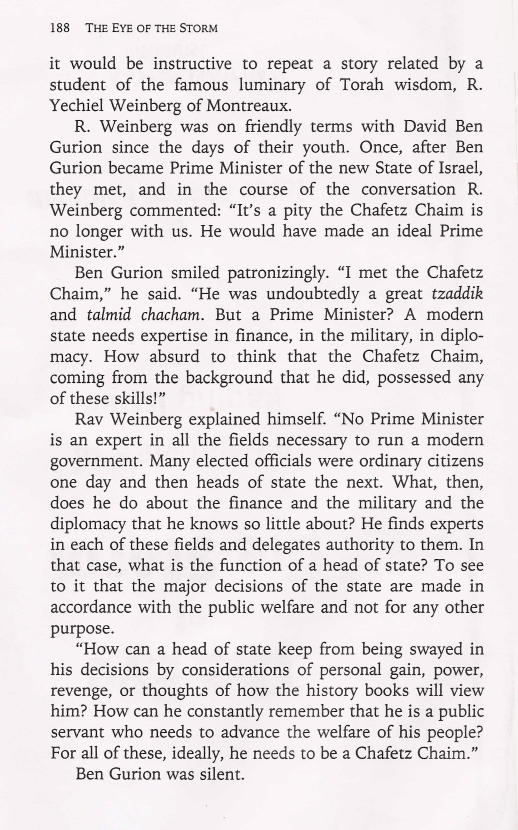
1. Someone sent me the following page from R. Aharon Feldman’s new book, The Eye of the Storm.

My correspondent asked me if there is any truth to this story. I have to say that it is a complete fiction. R. Weinberg did not know Ben Gurion from his youth, and he never met him after he became Prime Minister. I am also certain that the Ben-Gurion never met the Chafetz Chaim.
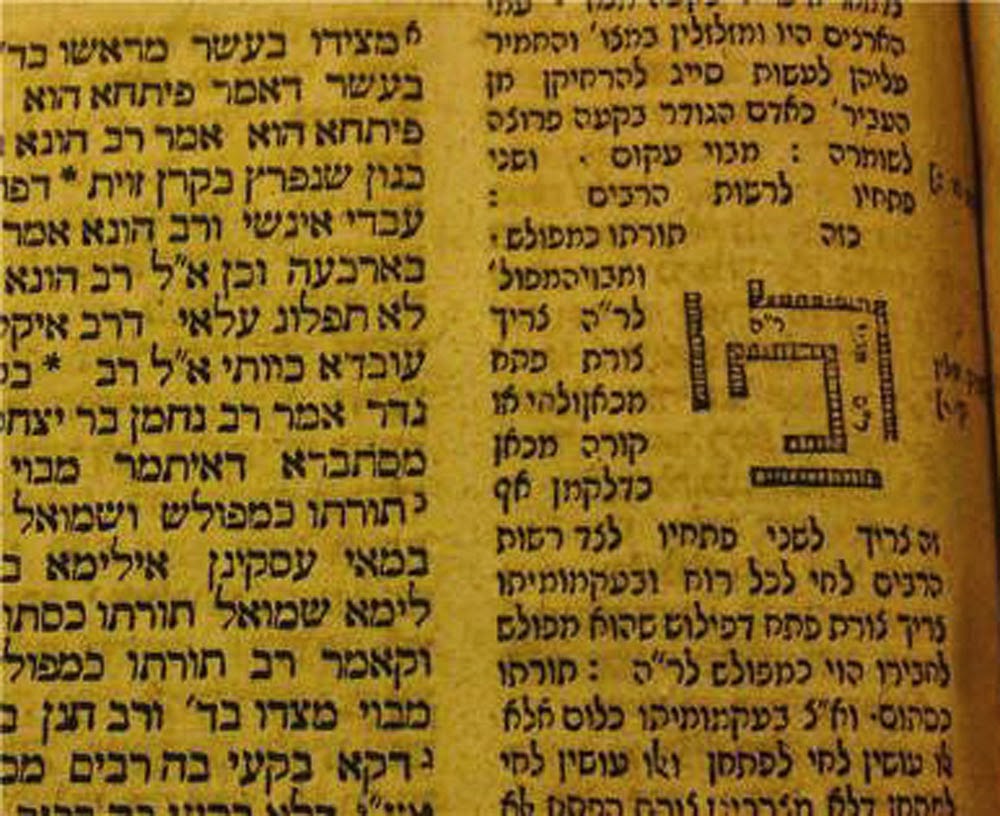
2. With all that has been in the news recently, I am sure that I am not the only one looking at the writings from the Spinka dynasty. I recently found a passage that I don’t understand. I understand the words, but I don’t understand how the Rebbe could have said it, and if anyone can explain the passage I will be grateful. It appears in Hekel Yitzhak, parashat Toldot, p. 30b:
ושמעתי מאאמו”ר זצוק”ל שמקובל מרבותינו שמעולם לא נתגייר גר מישמעאל כי הוא כולו ערלה ר”ל . . . אבל מעשו נתגייר כמה גרים כדאי’ בדחז”ל, ולעת”ל כולם יתגיירו משום דשרשם בקדושה כדאי’ בהארי ז”ל.
My concern is not with the notion that Esau and his progeny are superior to that of Ishmael. Rather, how could he possibly state that there have never been Arab converts?
To be continued
[1] “Joseph Ibn Kaspi: Portrait of a Medieval Jewish Intellectual,” in Twersky, ed., Studies in Medieval Jewish History and Literature (Cambridge, 1979), pp. 239-241.
[2] Matzref Kesef, p. 74. The same approach is adopted by Radak in his commentary to Gen. 30:14. This is only one possible answer given by Ibn Caspi, and he also suggests that perhaps mandrakes do indeed have special properties that help a woman to conceive.
[3] See Matzref Kesef, p. 137. Based on this Ibn Caspi explains why Tziporah circumcised her son (Ex. 4:25):
ותקח צפורה וכ’. אין עלינו עכ”פ לתת טעם הכרחי מה זאת הרפואה לחולי משה, כי לא כתבה התורה שציוה לה משה שתעשה כן, ואיך שהוא, מבואר כי בימים ההם היה דעת פשוט בהמון העם, כי הדם יש לו סגולה לכל חרדה והתגעשות, ולכן צוה השם שישימו דם על המשקוף ועל המזוזות בבתי ישראל, בחרדתם והתגעשם על צעקת כל מצרים . . . לכן ותקח צורה צור ותכרות את ערלת בנה.

The example of the mandrakes and Tziporah circumcising her son are cited by Isaiah Dimant, “Exegesis, Philosophy and Language in the Writing of Joseph Ibn Caspi” (unpublished doctoral dissertation, UCLA, 1979), pp. 55-56
[4] Translation in Daniel A. Klein, The Book of Genesis: A Commentary by Shadal (Northvale, 1998).
[5] Rubenstein began as a traditional rabbi, as can be seen from his Avnei Shoham (Warsaw, 1902), which includes correspondence between him and R. Joseph Zechariah Stern. However, he later adopted an approach that today we would term “academic”. There is a great deal that can be written about Rubenstein, but as of yet only one article has appeared: Hanan Gafni, “R. Shmuel Moshe Rubenstein, ha-Hoker ha-Rabani mi-Shavli (1870-1943),” Moreshet Yisrael 5 (2008), pp. 139-158. To give an example, not mentioned by Gafni, of how Rubenstein’s later thought broke with tradition, see his Ha-Rambam ve-ha-Aggadah (Kovno, 1937), p. 103, where he claims that the story of the miracle of Hanukkah is almost certainly a late aggadic creation, and like many other miracle stories in aggadic literature was not originally intended to be understood as historical reality:
ספק הוא אם הנס של “פך השמן” הוא אפילו הגדה עממית קדומה, קרוב שהוא יצירה אגדית חדשה מבעל הברייתא עצמו או מאחד מבעלי האגדה, ונסים אגדיים כאלו רבים הם בברייתות וגמרא ומדרשים ע”ד ההפלגה כדרכה של האגדה. ולבסוף הובן נס זה למעשה שהיה. עיין שבת כ”ג א’. [טעם ברייתא זו הובא גם במגילת תענית (פ”ט) אבל כמו שנראה היא הוספה מאוחרת, ועיין (שם) ובפסיקתא רבתי (פיסקא דחנוכה) עוד טעם להדלקת נרות חנוכה].
During the most recent Hanukkah I was using R. Joseph Hertz’ siddur, the Authorized Daily Prayer Book. Based upon how he describes the holiday and the lighting of the menorah, omitting any mention of the miracle of the lights (pp. 946-947), I assume that he also didn’t accept it literally. Note how he states that the lights were kindled during the eight-day Dedication festival, and this is the reason for the eight days of Hanukkah, rather than offering the traditional reason that the eight days of Hanukkah commemorate the eight days that the menorah miraculously burnt.
Three years to the day on which the Temple was profaned by the blaspheming foe, Kislev the 25th 165, Judah Maccabeus and his brethren triumphantly entered the Holy City. They purified the Temple, and their kindling of the lights during the eight-day festival of Dedication—Chanukah—is a telling reminder, year by year, of the rekindling of the Lamp of True Religion in their time.
There is no mention of this passage in Benjamin J. Elton’s recent wonderful discussion of Hertz’s theology and religious policy. See Britain’s Chief Rabbis and the Religious Character of Anglo-Jewry, 1880-1970 (Manchester, 2009), chs. 7-8. (He also doesn’t mention Hertz’s comment that those Jewish commentators who understand aggadah literally are “fools.” See Hertz’s Foreward to the Soncino Talmud, printed at the beginning of tractate Berakhot.)
[6] Commentary to Gen. 3 (end of chapter).
[7] Lawrence Kaplan, ”Rationalism and Rabbinic Culture in Sixteenth Century Eastern Europe: Rabbi Mordecai Jaffe’s Levush Pinat Yikrat” (unpublished doctoral dissertation, Harvard University, 1975), p. 246 n. 139, comments that when Ralbag later in this passage criticizes those who understand Cain, Abel and Seth allegorically, he has Maimonides in mind, but avoids mentioning him out of respect.
[8] Regarding Eve and the serpent, R. Chaim Hirschensohn speaks of רעיוני ההתפתחות במליצי המיטלאגי
In other words, he sees the Torah as using mythological language in the Creation story. See Penei Hamah, p. 6, which is part 2 of Hirschensohn’s Musagei Shav ve-Emet (Jerusalem, 1932). Dov Schwartz has recently discussed this passage. See his “Maimonides in Religious-Zionist Philosophy,” in James T. Robinson, ed., The Cultures of Maimonideanism (Leiden, 2009), p. 399:
Hirschensohn assumes as self-evident that the Bible had been influenced by mythological language. The author of the Creation story “couches the ideas of development in mythological metaphors.” How did Hirschensohn explain these mythological stories? He separated paganism from the “original” mythology. In his view, the mythological stories had been, from the start, a description of a class struggle for which the narrators resorted to symbolic language, just as the Bible refers to the sons of God and the daughters of men (Gen. 6:2). Only later, then, did their deference and their fear of their ancestors lead Greeks to literal interpretations of their mythology: “But before philosophy became dominant there, the later Greeks had mistakenly revered their ancestors and thought of them as gods” [Penei Hamah, p. 36]. The Bible, then, uses a mythological style but its messages are social and ideological.
[9] When one sees how Ralbag describes Eve, I think many readers would wish that he had interpreted her allegorically. Here is his comment earlier in Gen. 3 (p. 110 in the Birkat Moshe edition):
והנה קרא האדם שם אשתו “חוה”, כאשר השיג בחולשת שכלה, רוצה לומר שלא עלתה מדרגתה על שאר הבעלי חיים עילוי רב, ואם היא בעלת שכל, כי רוב השתמשותה אמנם הוכן לה בדברים הגופיים, לחולשת שכלה ולהיותה לעבודת האדם, ולזה הוא רחוק שיגיע לה שלמות השכל.
Ralbag’s view of Eve was also transferred to women in general. One of my teachers once referred to him as the first advocate of the kollel philosophy, for as Ralbag explains in a number of places, the role of women is to enable men to reach their intellectual perfection. That is, their essence is entirely utilitarian. All the relevant references can be found in Menachem Kellner’s essay comparing Ralbag’s and Maimonides’ view of women, which has now appeared in English in his just published Torah in the Observatory. (This book was published by Academic Studies Press, which in the last few years has published a number of important volumes by top scholars including José Faur, David Berger, David Shatz, and Zvi Mark.)
Take a look at this passage referring to women and tzitzit, from towards the end of Ralbag’s commentary on Shelah (p. 188a in the old edition):
למדנו שאין הנשי’ חייבות בציצית וראוי היה להיות כן כי הענין אשר העיר עליו זאת המצוה הוא רב העומק ולא יתכן שיגיע אליו שכל הנשים לקלות דעתן
I wonder, if a haredi spokesman quoted this Ralbag as part of his attack on Orthodox feminism, would he take any flak in his own community? Would the haredi women protest? I have another question and I am curious to hear readers’ responses. (I have my own view, but also want to hear from others.). Do leaders of the haredi world believe in separate but equal when it comes to men and women? This is what is often claimed, but I wonder, do they really hold a Ralbag-like position?
The same question I asked at the beginning of the previous paragaph with regard to Ralbag can also be asked about Radak. Here is what he writes in his commentary to Gen. 3:1:
ואמר אל האשה ולא אמר לאדם, האשה קרובה להתפתות יותר מן האיש, כי דעתה קלה
If this explanation appeared in say the English Yated, independently offered by a contemporary rabbi with no mention of Radak, would haredi women be offended?
And would women be offended if the following passage, from R. Zvi Travis’ Pirkei Hanhagat Bayit, ch. 2 (which I am told used to be a popular sefer), appeared in an English newspaper (called to my attention by Dr. Yitzhak Hershkowitz; emphasis added):
אף אחר בריאת האשה אין כאן שותפות. אלא, וטול כלל זה בידך, תכלית הבריאה היא האיש, והקדוש ברוך הוא נתן לאיש מתנה שתעזור לו, והיא האשה.
Another good example is found in R. Avraham Blumenkrantz’ Gefen Poriah, p. 352, where he quotes approvingly another rabbi who states as follows (emphasis added):
Her tears are ever ready to flow at the most miniscule suggestion of being dealt with as a maidservant. She will concede you the service of והוא ימשל בך. She will consent to call you בעלי, but don’t accent the דגש in the בית too heavily. She must constantly be reassured that there is honor and dignity in her subservience. Honor her more than you honor yourself. She must be compensated for her subjugation, and be made to feel that she has a genuine share in the dignity of the throne.
Do haredi women really feel that they are subservient or subjugated? Do haredi men feel this way about their wives? Haven’t the masses in haredi society (American haredi society at least) also accepted the notion of separate but equal when it comes to men and women?
[10] Commentary to Guide 1:2:
רמז המורה על קצת נסתר במעשה בראשית כי האדם הנזכר שם לא היה אחד רמוז לבד אבל על הכלל
[11] Commentary to Guide 1:14.
[12] “Rationalism,” p. 251 n. 150.
[13] In his commentary to Guide 2:30, Ibn Caspi also discusses the creation story, and records what was apparently a popular saying in his day. For those of you who sometimes get frustrated with some of your co-religionists, it is worth bearing in mind: אלמלא המשתגעים יהיה העולם חרב. Regarding the saying, see also R. Judah Leib Zlotnick, Midrash ha-Melitzah ha-Ivrit (Jerusalem, 1938), p. 57. The saying is also found in Maimonides’ introduction to Nezikin.

ftn


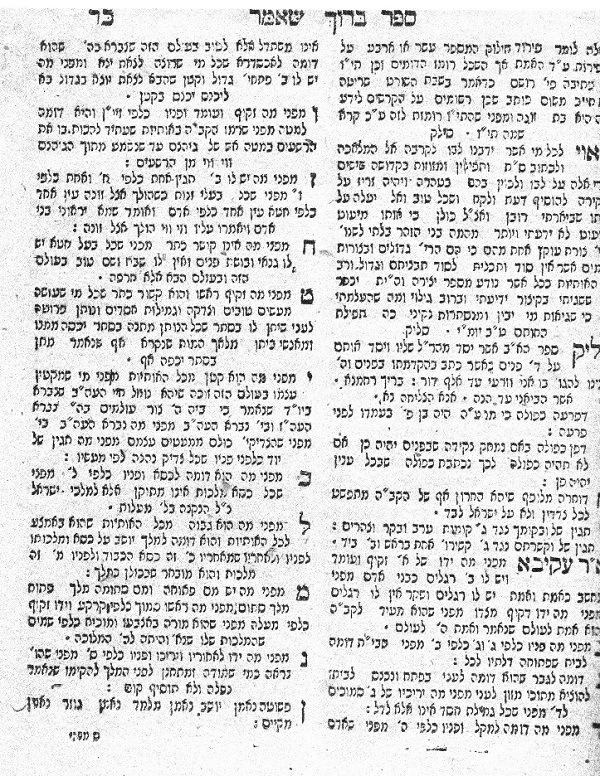
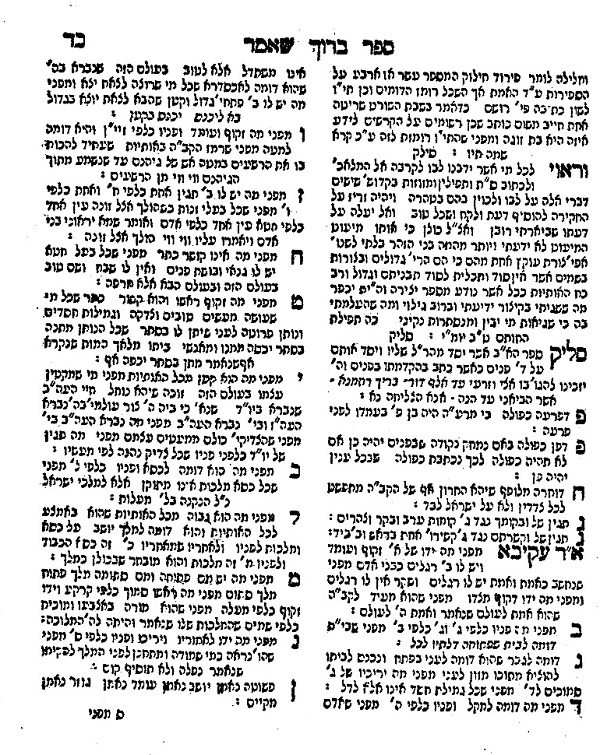
An enigmatic Pseudo-Shklov edition of Barukh She’amar

An enigmatic Pseudo-Shklov edition of Barukh She’amar[1]

By Marvin J. Heller

A title-page describing the work as an 1820 Shklov press publication is indicative of an enigmatic pseudo-edition of Baruch She’amar, a halakhot work pertaining to Sefer Torah, tefillin, and mezuzot by R. Simeon bar Eliʻezer (d. c. 1360). The author of Barukh She’amar, R. Simeon bar Eliʻezer (d. c. 1360), was born in Saxony, Germany and died in Eretz Israel. Orphaned at the age of eight, Simeon was adopted and raised by R. Issachar, a scribe who taught Simeon his craftsmanship, at which Shimon developed such expertise that R. Solomon ben Jehiel Luria (Maharshal, c. 1510-1574) referred to Simeon as “the head of all scribes.”[2]

There is confusion as to the actual dates and places of printing of this imprint. The title-page clearly gives Shklov as the place of printing and dates it with the chronogram “[We must] teach the children of Judah the archer’s bow קסת [קשת] ללמד בני יהודה  (580 = 1820)” (II Samuel 1:18). However, to get the date 1820 the shin ש (300) in the verse has been replaced with a sameh ס (60) for the total of 580 = 1820. Nevertheless, bibliographic sources are in agreement that the publication place of the 1820 Barukh She’amar was Minkowce (Minkovtsy), a village in Podolia near Belarus in north-eastern Poland. However, there were earlier editions of Baruch She’amar issued in Dubno in 1796 and again in Shklov in 1804.

The two presses noted in conjunction with the printing of the subject editions of Baruch She-Amar are in Shklov and Minkowce (Minkovtsy). The former location, Shklov, is in the Mogilev region of Belaurus on the Dnieper river, approximately 410 km. from Vilna. It was home to a Jewish community dating to the late seventeenth century. A charter permitting Jewish settlement in Shklov was first received in 1668. Not long after, according to a visiting diplomat in 1699, Jews were “the richest and most influential class of people in the city.” By 1776 the Jewish population of Shkolov was 1,367. Shklov was an intellectual center as well as being an important commercial center in the late seventeenth and eighteenth centuries.[3] Hebrew presses in Shklov date to the late eighteenth century and as many as 226 Hebrew titles are attributed to that location until 1835. Minkowce, in contrast, is in the Kamenets-Podolski district of the Ukraine. A smaller community, its Jewish population in 1765 was 375. A Hebrew press was active there from 1795 to 1812, publishing almost forty titles.[4]


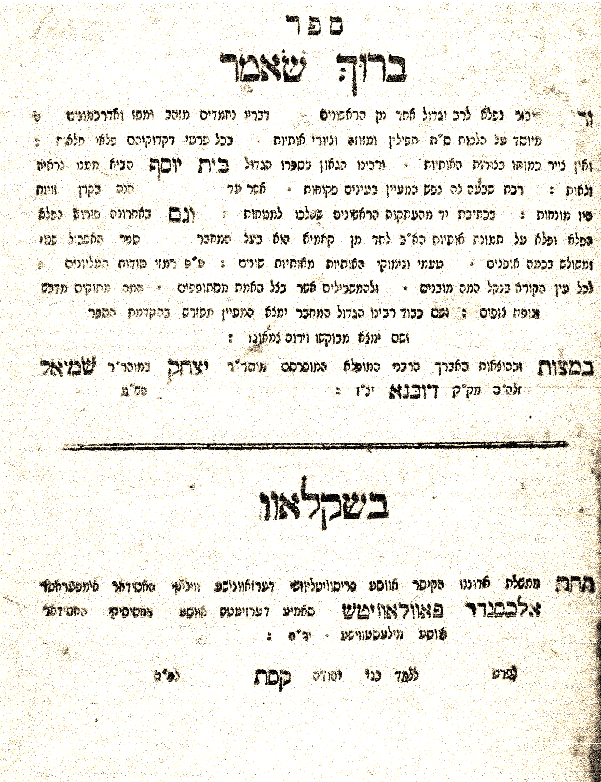
1804, Baruch She’amar, Courtesy of the National Library of Israel


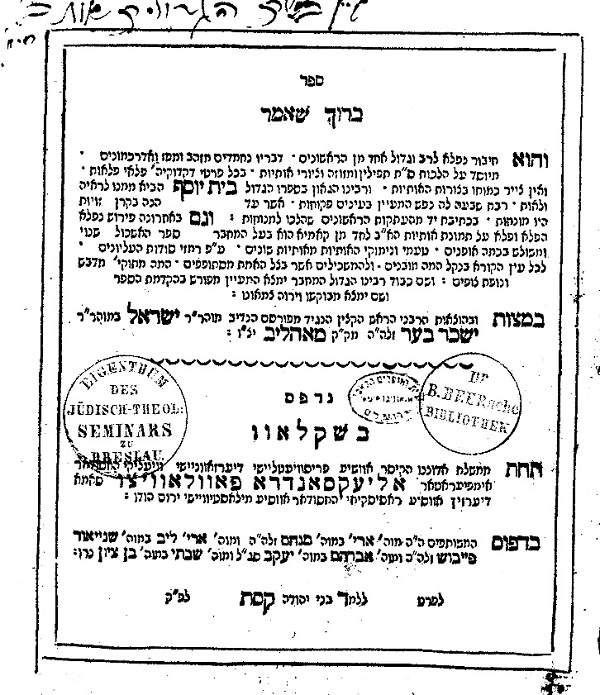
1820, Baruch She’amar, Courtesy of Virtual Judaica

Entries in bibliographic works for Baruch She’amar consistently question the title-page of the 1820 edition’s place of publication when recording this work. Ch. B. Friedberg, in the Bet Eked Sefarim, records several editions of Baruch She’amar, among them [Minkowce 1795], Shklov 1804, and [Minkowce 1820]. In his Hebrew typography in Poland Friedberg records Baruch She’amar under Minkowce, 1796 and 1820 and under Shklov the 1804 edition of that work, dated קסת ללמד בני יהודה (564 = 1804). Vinograd, in the Thesaurus, lists a 1795 edition of Baruch She’amar referencing Friedberg, noting that it is questionable and an 1820 edition in which the title-page states Shklov, and in the entry for that work under the latter location has 1804 and 1820 entries, and for the 1820 edition referring the reader to Minkowce. Apart from these editions there was, as noted above, a prior 1796 Dubno imprint as well as several later editions.[5]

The text and format of the 1804 and 1820 editions are alike, both quartos (40: 32 ff.) and the title-pages of the two editions of Baruch She’amar even employ the same chronogram, modified to reflect the date of publication. Both title-pages credit R. Israel ben Issachar Ber from Ohilov for bringing the book to press, apparently the latter a repetition from the earlier printing. However, the 1804 Baruch She’amar names the printers as Aryeh ben Menahem, Aryeh Leib ben Schneer Feibush, Abraham ben Jacob, and Shabbetai ben Ziyyon as the printers. In contrast, the 1820 edition does not name the printer.

Abraham Yaari has entries for both Shklov and Minkowce in his bibliographical articles on those locations. In his article on Shklov he writes that a partial edition of Baruch She’amar had been printed previously in Dubno in 1796 and this, the 1804 edition, was the first complete printing of that work. He adds that Friedberg’s entries are in error and that the 1820 [Shklov] edition does not exist. Concerning the 1820 Minkowce edition, Yaari informs that there is an approbation from R. Judah Leib ben Zevi ha-Kohen Av Bet Din in Minkowce dated 11 Kislev 1820 (November 29, 1819) who refers to the earlier Minkowce printing and states that it is now being reprinted here, that is, in Minkowce. Yaari again takes issue with Friedberg, concluding “in truth, a complete edition was first printed in Shklov in 1804 (and based on that edition it was printed in Minkowce in 1820). A partial edition was printed in Dubno in 1796 and perhaps this is the reason for the errors.”[6]


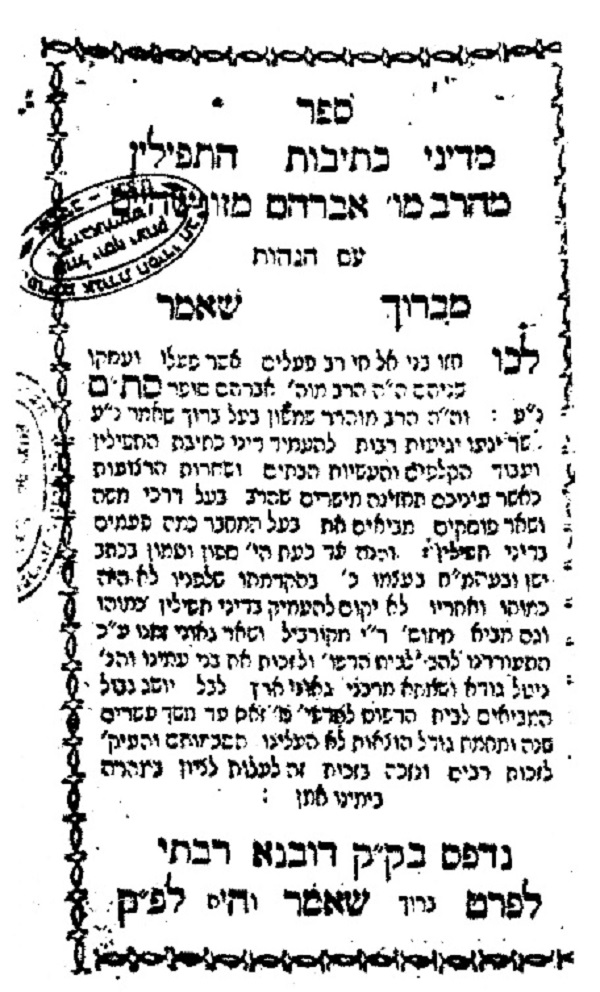
1796, Barukh She’amar, Courtesy of the Library of Agudas Chassidei Chabad Ohel Yosef Yitzhak

While Yaari does appear to accurately summarize these editions he does not explain why the title-page of the 1820 Baruch She’amar clearly states Shklov as the place of printing rather than Minkowce. It is well known that in several instances the place of printing and the publication dates were modified to mislead the censor. However, that is not the case with other titles printed in both of our locations and the subject matter of Baruch She’amar on the halakhot pertaining to scribal arts is not one likely to attract the censor’s attention.

The printers of the 1820 edition removed the names of the printers from the 1804 title-page; it seems highly unlikely that they would have omitted correcting the publication place name. Moreover, even if in copying the title-page from the previous edition had been an oversight such an improbable error, if it  had occurred, would certainly have quickly necessitated a stop-press correction. Even if caught later it seems improbable that the publisher would have distributed the work as is. Moreover, it also seems improbable that this copy of the 1804 edition would have been subject to copyright restrictions. There is another important omission from the 1820 edition, that is, the editor, Israel ben Aryeh Leib’s apologia, at the end of the work.

There are, however, in addition to those noted above, significant likenesses between the two works. First, excepting the front matter and apologia, the texts are set, line for line, in an identical manner. Moreover, the fonts appear to be alike. The reader should compare the two like pages below and drew his/her own conclusion. Perchance, the Minkowce printer acquired remaining copies of the 1804 edition, added the new front and back matter and reissued the work. Why did he do so?


1804, Baruch She’amar, Courtesy of the National Library of Israel


1820, Baruch She’amar , Courtesy of Virtual Judaica

Perhaps, and this is highly speculative, he felt that publishing this edition of Baruch She’amar as a pseudo-Shklov publication would give it greater marketability. If so, that should also have been true as well of other Minkowce publications. Or maybe he simply did not want to put his name on someone else’s work. Finally, we are left with the question as to why R. Judah Leib ben Zevi ha-Kohen’s approbation, which helps identify the place of publication, was printed with Baruch She’amar. Possibly including the approbation was important for the reasons that approbations were obtained, and it certainly would have been unconscionable, having gotten the Av Bet Din‘s approbation, to not print it.

We are left with a teku (an unresolved question).

[1] I would like to thank Eli Amsel of Virtual Judaica for bringing the 1820 edition of Baruch She-amar to my attention and Eli Genauer for reading the article and for his corrections.
[2] Hirsch Goldwurm, ed., The Rishonim (Brooklyn, 1982), p. 147.
[3] The Encyclopedia of Jewish life Before and During the Holocaust, editor in chief, Shmuel Spector; consulting editor, Geoffrey Wigoder; foreword by Elie Wiesel II (New York, 2001), III p. 1170; Yeshayahu Vinograd, Thesaurus of the Hebrew Book. Part I Indexes. Books and Authors, Bibles, Prayers and Talmud, Subjects and Printers, Chronology and Languages, Honorees and Institutes. Part II Places of print sorted by Hebrew names of places where printed including author, subject, place, and year printed, name of printer, number of pages and format, with annotations and bibliographical references II (Jerusalem, 193-95), pp. 689-95 [Hebrew].
[4] The Encyclopedia of Jewish II (New York, 2001.). p. 826). Vinograd II pp.457-458.
[5] Ch. B. Friedberg, Bet Eked Sefarim (Tel Aviv, 1951), bet 1431 [Hebrew]; idem. History of Hebrew Typography in Poland from its beginning in the year 1534 and its development to the present. . . . Second Edition, Enlarged, improved and revised from the sources (\(Tel Aviv, 1950), pp. 91,121, 123 [Hebrew]; Yeshayahu Vinograd, Thesaurus of the Hebrew Book. Listing of Books Printed in Hebrew Letters Since the Beginning of Printing circa 1469 through 1863 II (Jerusalem, 1993-95), pp. 457, 458, 692, 694 [Hebrew].
[6] Avraham Yaari, “Hebrew Printing in Minkovtsy,” Kiryat Sefer 19 (1942-43), pp. 274-75 [Hebrew]; idem. “Hebrew Printing in Shklov,” KS 22 (1945-46), pp. 141-42 [Hebrew].


Apostomos Now: Contemporary Conjectures on a Classic Conundrum

Apostomos Now: Contemporary Conjectures on a Classic Conundrum

Aton M. Holzer
Aton.holzer@gmail.com
ORCID ID: 0000-0001-9852-3958
28 Binyamin, Beit Shemesh, Israel 9952200

The Mishnah in Ta’anit (4:6) puts forth a series of lists of five calamities that befell the Jews on each of two major fast days, the seventeenth of Tammuz and the ninth of Av, beginning in the days of Moses in the Wilderness and culminating after Bar Kochba:

חמשה דברים ארעו את אבותינו בשבעה-עשר בתמוז (וב) וחמשה בתשעה באב. בשבעה-עשר בתמוז נשתברו הלוחות ובטל התמיד והובקעה העיר ושרף אפיסטמוס את התורה והעמיד צלם בהיכל. בתשעה באב נגזר על אבותינו שלא יכנסו לארץ וחרב (את) הבית בראשונה ובשנייה [ו]נילכדה בית-תר ונחרשה העיר

Five matters occurred to our forefathers on the seventeenth of Tammuz, and five on the Ninth of Av. On the seventeenth of Tammuz the tablets were broken; the daily offering was nullified; the city was breached; Apistemos[1] burned a Torah scroll; and placed a statue in the hall (heikhal). On the Ninth of Av it was decreed upon our ancestors that they would not enter the Land; and the Temple was destroyed the first time, and the second time; and Beitar was captured; and the city was plowed.[2]

There is little mystery surrounding the five events of the ninth of Av; all of the events – the decree of the death of the generation after the return of the spies in Numbers 14, the destructions of the First and Second temples, the defeat of Bar Kochba at Beitar and the plowing of the city limits by Tineius Rufus in the founding of Aelia are well-documented events, even if some did not precisely occur on the ninth of the month.[3] All share a theme: the final stage of catastrophe, the coup de grâce to a generation’s hopes.

In contrast, the list for the seventeenth of Tammuz is shrouded in mystery.

1. While the date of Moses’ descent from Sinai with the Law (Exodus 32) is not given in Scripture, the Rabbinic calculation assigning it to the seventeenth of Tammuz, forty days after revelation on the seventh of Sivan – itself extrapolated from the text – is straightforward enough. Still, it is somewhat curious that the Mishnah selects the breaking of the Tablets, rather than the other dire events of that day – the crime of the creation of the Golden Calf, its immediate punishment in the execution of three thousand of its Israelite worshippers, or the removal of the peoples’ mysterious ‘adornments’ from Horeb, for example.

The nullification of the daily offering is mentioned in Josephus:
2. Titus now ordered the troops with him to raze Antonia to its foundations and create an easy way up for the whole of his army, while he himself brought Josephus into service. He had learnt that on this day — it was the seventeenth of Panemus (Tammuz)  — the so-called ‘continual sacrifice’ had ceased to be offered to God for lack of officiants, and that this was causing great distress to the people. (The Jewish War 6:93-94).

At first glance, this seems clearly the referent of the Mishnah. However, examination of evidence internal to Rabbinic sources – the Talmuds, early Rabbinic treatments of Daniel 12:11 and medieval commentators on both – yield five possible occasions for the cancellation of the tamid, beginning from the reign of Manasseh and spread over the subsequent seven centuries.[4] To be sure, the events surrounding the Second Temple’s destruction do constitute the fifth possibility, but that is a minor view, resting primarily on the evidence of yBerakhot 4:1 and yTa’anit 4:5. Vered Noam (pace Tal Ilan)[5] reads the Talmudic passages carefully and against Josephus and argues that those Yerushalmi sources are derivative from the parallel narrative in Bavli, which clearly reference an earlier period, and was only secondarily adapted to the context of the destruction of the Second Temple. The Bavli passage (bSotah 49b, bBava Kamma 82b, bMenahot 64b) reads:

The Sages taught: When the kings of the Hasmonean monarchy besieged each other, Hyrcanus was outside, and Aristobulus was inside. On each and every day they would lower dinars in a box, and [they] would send up daily offerings. A certain Elder was there who was familiar with Greek wisdom. He communicated to [them] by Greek wisdom. He said to them: As long as they are engaged in the service, they will not be delivered into your hands. On the following day, they lowered dinars in a box and they sent up a pig to them. Once it reached halfway up the wall, it inserted its hooves [and] Eretz Yisrael shuddered four hundred parasangs. They said at that time: Cursed is the person who raises pigs, and cursed is the person who teaches his son Greek wisdom. And with regard to that year, we learned: An incident in which the omer came from Gaggot Tzerifim, and the two loaves from the valley of Ein Sokher.

For this source, which appears thrice in Bavli, the dramatic event of cancellation of the tamid-offering is firmly linked with the waning days of Hasmonean rule. The placement of the event as second in the Mishnah’s list supports the contention that the identified event preceded those associated with the Great Revolt.

3. The linkage of the ‘breach of the city’ to the seventeenth of Tammuz is more problematic. With regard to the first commonwealth, Jeremiah (39:2) dates the breach of the walls of Jerusalem during the Babylonian conquest to the ninth of Tammuz. With regard to the second, Josephus describes various stages of conquest of the various walls of Jerusalem during the Roman siege under Titus, beginning with the seventh of Artemisius/Iyyar (War 5:302) and culminating near the end of Tammuz, with none actually occurring on the seventeenth of Tammuz.[6]

4. Rabbinic sources never elaborate upon details of the reported incident of the burning of ha-torah, ‘the Torah,’ by the mysterious Apistemos, who appears in Talmud manuscripts as Apostomos or occasionally Postomos (?posthumous). Yerushalmi (Ta’anit 4:5) attempts to clarify its whereabouts:

“Apostomos burned the Torah.” Where did he burn it? Rebbi Aḥa said, at the ford of Lydda. But the rabbis are saying, at the ford of Tarlosa.

In non-Rabbinic sources, the burning of Torah scrolls is recorded as early as the reign of Antiochus IV Epiphanes; in 1 Maccabees, it is a widespread phenomenon.

On the fifteenth day of Kislev in the 145th year he built an abomination of desolation on the altar, and they built pagan altars in the cities of Judah roundabout and offered up sacrifices at the doors of their houses and in the streets. They tore up and burnt the books of the Law that they found, and wherever they found someone with a book of the covenant, or if anyone insisted upon (observing) the Law, the royal judgment killed him. (1:54-57)

Josephus records the burning of a Torah during the procuratorship of Ventidius Cumanus (48-52 CE):

…This disaster was followed by another disturbance, this time caused by bandits. On the road up to Beth-horon an imperial servant called Stephen was set upon by bandits and robbed of the baggage he was carrying. Cumanus sent troops out round the neighbouring villages to arrest the inhabitants and bring them in to him, to be charged with failure to pursue and capture the robbers. In the course of this, a soldier found in one of the villages a copy of the book of sacred law, which he tore in pieces and threw into the fire. The Jews reacted with horror, as if it were their whole country which had gone up in flames. As soon as the word went out, religious fervour drew them together like a magnet, and they converged in a mass on Caesarea, insistent that Cumanus should not let this insult to their God and their law go unpunished. He could see that the crowd would not stop agitating until they received satisfaction, and thought it best to produce the offending soldier and order him to be led through the ranks of the complainants on his way to execution. (War 2.228-231)

The ancient city of Beth Horon (today Beit Ur al-Fauqa and Beit Ur al-Tahta) is about twenty-six kilometers east of Lod (Lydda), and the ‘road up to Beth Horon’ generally refers to the road running north from Jerusalem, not east from Lydda – so the if the referent of the Jerusalem Talmud is historical, the ‘ford’ (or straits, or passages) of Lydda (or of the mysterious ‘Tarlosa’[7]) is not a good match for this incident.

Rabbinic literature omits all of these, but records several other events at which a Torah scroll was burned; none involve a villain named Apostomos. In a list of sins committed by the Judean kings deemed wicked, some manuscripts of bSanhedrin 103b include:

Amon burned the Torah and sacrificed a gecko upon the altar.

A passage in bYevamot 16b describes:

And Rabbi Shmuel bar Naḥmani said Rabbi Yonatan said: What is which is written: “The adversary has spread out his hand upon all her treasures (Lamentations 1:10)? This is Ammon and Moab. When the gentiles entered the Sanctuary, all turned to the silver and the gold, and they turned to the scrolls of Torah. They said: this in which it is written: “An Ammonite and a Moabite shall not enter into the assembly of the Lord” (Deuteronomy 23:4)? Let it be burnt by fire.

“When the gentiles entered the sanctuary” can refer to any of at least four events: the Babylonian conquest in 586 BCE, the defilement of the sanctuary by Antiochus in 156 BCE, its destruction by Titus’s legions in 70 CE, or, the incursion of Pompey in 63 BCE:

the disappearance of a golden vine from the Temple when ‘the gentiles entered the sanctum’ (bYoma 21b, 39b) parallels Josephus’s report (Ant. 14.34-36) of Aristobulus’s gift of this particular Temple adornment to Pompey, right around the time that this gentile and his men indeed entered the sanctum.[8]

Other events recorded in Talmud and Midrash include the martyrdom of R. Hanina ben Teradyon, burned alive while wrapped in a Torah scroll, recorded in bAvodah Zarah 18a; and yTa’anit 4:5 records R. Simeon b. Gamaliel reporting precisely the same fate for the children in five hundred schools in the city of Betar, subsequent to its conquest under Hadrian.

Traditional commentators struggle to identify Apostomos – Antiochus? Hadrian? Some unknown Greek soldier? – and why the destruction of a Torah scroll – lamentable as it may be, but something rather common throughout Jewish history, even in Second Temple and Rabbinic sources, as we have seen – would rank among five reasons to establish a fast for all generations. Tif’eret Yisrael fixates upon the hey ha-yedi’a, the definite article, and suggest that the Torah scroll was a special one — the Torah of Ezra, which he suggests, based on Tractate Soferim 6:4, was in the sanctuary and served as the urtext for further copies; or else that Apostomos destroyed many Torahs, in an effort to eradicate Torah from the Jewish people. The 19th-century commentary Divrei Yirmiyahu (R. Jeremiah Löw) on Rambam (Hilkhot Ta’anit chap. 5) avers that the referent is the Torah of Moses, or Ezra. Imrei Da’at on the Mishnah (R. Nathan Lieberman) argues that regarding the Torah of Moses, this is impossible, as bSotah 9b writes of Moses and David that their enemies never exerted power over their handiwork.

5. The most prominent narrative in both Rabbinic sources and Josephus regarding the placing of an idol in the sanctuary refer to an event that almost did, but ultimately did not, occur: the emplacement of statues of the emperor in the Temple by Gaius Caligula, against the strenuous protest of the Jews – which was not implemented before his assassination. (War 2.184-203, Antiquities 18.256-309; Megillat Ta’anit 22 Shevat with Scholia, tSotah 13:6, et al.)

Given the violent reaction of the people to this initiative, and the record of the celebration of its thwarting with a holiday, it is unlikely that the actual emplacement of a statue in the Temple would be forgotten and thus absent from the historical record.[9] It thus remains to identify the incident with those actually documented to have installed an idol in the sanctuary precincts – the Judahite King Manasseh (II Kings 21:7), Antiochus Epiphanes (1 Maccabees 1:34), and probably Hadrian.[10] Complicating this is that some texts link this event to Apostomos (ve-he’emid, and he emplaced, rather than ve-hu’amad, and there was placed), including the best early Mishnah manuscript – MS Kaufmann A50 – which would necessarily restrict the identity of Apostomos to one of those three personalities. But Rabbinic literature elsewhere refers to each of those three by their proper names! And Antiochus, who appears rarely in early Rabbinic literature, in any case had a different Greek nickname — ἐπιμανής, epimanus, “the madman.”

Pompey and Circumstances

An innovative approach[11] was suggested some fifty years ago in an obscure Hebrew journal by Eliyahu Katz (1916-2004), a Rabbinic judge, poet and polymath who served as Chief Rabbi of pre-war Nitra, postwar Bratislava and from 1968 forward, Beersheba – but it received little attention, and suffers from some problems.

His theory focuses upon the incursion of Pompey into the Temple, mentioned earlier in brief. In greater detail: in 63 BCE, the armies under the command of Gnaeus Pompeius Magnus – Pompey the Great, finished his Senate-authorized task of pacifying belligerent Asia minor and Syria, and swung south and handily (and completely illegally) consumed civil war-torn Judea, killing thousands, abrogating the Roman Republic’s alliance with Hasmonean Judea. Josephus describes the events in his Jewish War and Antiquities of the Jews; in the latter, which relies mostly on pro-Roman sources1[12] (and in this passage, particularly the Pontic Greek geographer Strabo of Cappadocia[13]), he writes: (Ant. 14.4.3-5, Marcus translation)

And indeed when the city was taken, in the third month, on the Fast Day, in the hundred and seventy-ninth Olympiad, in the consulship of Gaius Antonius and Marcus Tullius Cicero, and the enemy rushed in and were slaughtering the Jews in the temple, those who were busied with the sacrifices none the less continued to perform the sacred ceremonies; nor were they compelled, either by fear for their lives or by the great number of those already slain, to run away, but thought it better to endure whatever they might have to suffer there beside the altars than to neglect any of the ordinances. And that this is not merely a story to set forth the praises of a fictitious piety, but the truth, is attested by all those who have narrated the exploits of Pompey, among them Strabo and Nicolas [of Damascus] and, in addition, Titus Livius, the author of a History of Rome.

Now when the siege-engine was brought up, the largest of the towers was shaken and fell, making a breach through which the enemy poured in; first among them was Cornelius Faustus, the son of Sulla, who with his soldiers mounted the wall, and after him the centurion Furius, with those who followed him, on the other side, and between them Fabius, another centurion, with a strong and compact body of men. And there was slaughter everywhere. For some of the Jews were slain by the Romans, and others by their fellows; and there were some who hurled themselves down the precipices, and setting fire to their houses, burned themselves within them, for they could not bear to accept their fate. And so of the Jews there fell some twelve thousand, but of the Romans only a very few. One of those taken captive was Absalom, the uncle and at the same time father-in-law of Aristobulus. And not light was the sin committed against the sanctuary, which before that time had never been entered or seen. For Pompey and not a few of his men went into it and saw what it was unlawful for any but the high priests to see. But though the golden table was there and the sacred lampstand and the libation vessels and a great quantity of spices, and beside these, in the treasury, the sacred moneys amounting to two thousand talents, he touched none of these because of piety, and in this respect also he acted in a manner worthy of his virtuous character. And on the morrow he instructed the temple servants to cleanse the temple and to offer the customary sacrifice to God, and he restored the high priesthood to Hyrcanus because in various ways he had been useful to him and particularly because he had prevented the Jews throughout the country from fighting on Aristobulus’ side; and those responsible for the war he executed by beheading. He also bestowed on Faustus and the others who had mounted the wall with alacrity fitting rewards for their bravery. And he made Jerusalem tributary to the Romans, and took from its inhabitants the cities of Coele-Syria which they had formerly subdued, and placed them under his own governor; and the entire nation, which before had raised itself so high, he confined within its own borders. He also rebuilt Gadara, which had been demolished a little while before, to please Demetrius the Gadarene, his freedman; and the other cities, Hippus, Scythopolis, Pella, Dium, Samaria, as well as Marisa, Azotus, Jamneia and Arethusa, he restored to their own inhabitants. And not only these cities in the interior, in addition to those that had been demolished, but also the coast cities of Gaza, Joppa, Dora and Straton’s Tower—this last city, which Herod refounded magnificently and adorned with harbours and temples, was later renamed Caesarea – all these Pompey set free and annexed them to the province.

For this misfortune which befell Jerusalem Hyrcanus and Aristobulus were responsible, because of their dissension, for we lost our freedom and became subject to the Romans, and the territory which we had gained by our arms and taken from the Syrians we were compelled to give back to them, and in addition the Romans exacted of us in a short space of time more than ten thousand talents and the royal power which had formerly been bestowed on those who were high priests by birth became the privilege of commoners.

Rabbi Katz identifies Apostomos with Pompey, on the basis of his replacement of Jewish law with Roman law after his conquest of Jerusalem, thus ‘burning the Torah’, figuratively speaking – and renders Apostomos as efes (Hebrew for null) tomus (Latin for book). He argues that Josephus’ “in the third month, on the Fast Day” refers the fast of the seventeenth of Tammuz. Tammuz is the fourth Jewish month – but he suggests that Josephus’ use of an ancient Judean numeral for ‘four,’ in boustrophedon, was mistaken for a Greek gamma. Josephus records Herod’s conquest of Jerusalem as occurring on the same day as Pompey’s (Ant. 14:16:4), and so Herod’s erection of a golden eagle on the great gate of the Temple (War 1:648–655, Ant. 17:6:2) can also be linked to the seventeenth of Tammuz.

The theory is supported by Sefer Yosippon, a tenth-century Hebrew Italian-Jewish history of the second Temple period that draws upon Josephus, the books of Maccabees, Midrash and Christian and Latin sources; in chapter 36 and 43, which treat Pompey’s and Herod’s siege, respectively, the dates of conquest of the Temple are given as the seventeenth of the fourth month – i.e., the seventeenth of Tammuz.

However, there are difficulties with this theory. For one thing, internal and external evidence points to the probability that the ‘third month’ properly refers to the third month of the siege, and that ‘the fast’ to which Josephus refers in the contexts of both Pompey and Herod is Yom Kippur.[14] In any case, observance of the fast of the seventeenth of Tammuz seems to have crystallized during the second century CE, well after the events and most likely the historian reporting them.[15] While Katz’s interpretation of a ‘figurative’ destruction of the Torah scroll seems a bit forced, it is not impossible to see in Yevamot 16b a reflection of the destruction of an actual scroll by Pompey’s men. But recent work suggests that the report of Herod’s installation of a golden eagle in the Temple is legendary.[16]

But perhaps Rabbi Katz was on to something.

  • If Pompey’s invasion of the Temple took place on Yom Kippur, in the third month of the siege, that would place the beginning of Pompey’s siege – which involved the ‘breach of the city’ from its very outset, by Hyrcanus’ men admitting Pompey’s forces into the city (War 1.143) – squarely in the latter part of the month of Tammuz. In that case, huvke’ah ha-ir refers not to the events of 586 BCE or 70 CE, but the initial incursion of Pompey’s army in Tammuz, maybe even 17 Tammuz, 63 BCE.
  • As far as butal ha-tamid: as seen above, Josephus takes pains to indicate that at no time during Pompey’s siege and even invasion was any part of the Temple service interrupted – but in the Rabbinic account, interruption of the tamid did indeed occur around the same time as Pompey’s arrival with Hyrcanus’s (or Pompey’s?) betrayal of the besieged Temple by supplying a pig for the tamid sacrifice.[17]
  • Admittedly, Heikhal in the Mishnah always refers to the sanctum of the Temple. But this is likely simply accidental; Heikhal properly refers to a kingly hall (cf. II Kings 20:18, Isaiah 39:7, Ezra 5:14, Psalms 45:9, 16, Proverbs 30:28, Daniel 1:4, II Chronicles 36:7), but the Mishnah has no interest in royal palaces. Pompey had built a world-famous Heikhal: the theater-temple complex constructed during his second consulship. The first permanent theater in Rome, Pompey’s theater was an imposing complex in which the Senate would sometimes meet, and where Caesar was assassinated. This hall, much like the heikhal melekh Bavel referenced in some of the aforementioned Biblical citations, included gardens, objects collected during Pompey’s campaigns, and fourteen statues commissioned of sculptor Coponius representing the populations (nationes) that Pompey had subdued;[18] these almost certainly included a statue representing Judea.[19] As such, the ‘emplacement of a statue in the hall’ may refer to Pompey’s concretization of the conquest of Judea.

Josephus has numerous Greek nicknames for various characters, particularly in his autobiography;[20] this is of a piece with his Greco-Roman milieu, in which proper names and surnames were often subjected to wordplay, and indeed Caesar himself puns on Pompey’s cognomen, magnus, in his writings.[21] Of Pompey’s conquest, Josephus writes in Against Apion,

One should also be particularly amazed at the great intelligence in what Apion goes on to say. For he says that it is evidence of the fact that we do not employ just laws or worship God as we should that [we do not govern,] but are subservient to other nations, one after another, and that we have experienced some misfortunes affecting our city… while we, being free, used to rule in addition over the surrounding cities for about 120 years up till the time of Pompey the Great; and when all the monarchs, on all sides, were hostile to the Romans, ours alone, because of their loyalty, were maintained as allies and friends. (2.11.125-134).[22]

One may detect here a complaint: Judea was unfailingly, singularly, loyal to Rome, and yet it took her freedom.

Pompeius, when encountered in a late Hellenistic milieu – where Semitic languages and Greek were spoken in equal measure – evokes the Aramaic ܦܘܼܡܵܐ (puma) and Hebrew פה, both words for mouth. Heinrich Ewald suggested that Apostomos be parsed αἰπύς στόμος, “big mouth,”[23] and this would fit Pompeius (mouth) Magnus (large) – the conqueror with a too-voracious appetite, who betrayed Judea’s loyalty by conquering and plundering it – כי אכל את יעקב ואת נוהו השמו.

  • Even the Biblical reference, the breaking of the tablets, resonates for an identification with Pompey:

So Judas chose Eupolemus the son of John of the Haqqoz clan and Jason the son of Eleazar and sent them to Rome to establish friendship and alliance with them, and to remove the yoke from them, for they saw that the kingdom of the Greeks was subjugating Israel into slavery. They went to Rome—and the trip is very long!—and entered the council and declared: “Judas, also known as Maccabaeus, and his brothers and the community of the Judeans have sent us to you to establish alliance and peace with you, so that we may be listed among your allies and friends.” This found favor in their eyes. And this is the copy of the letter, which they wrote in response on bronze tablets and sent to Jerusalem, so as to be a memorial there, among them, of the peace and alliance: Let it be well for the Romans and the people of the Judeans on sea and on land forever, and let sword and enmity be far from them. But if war is made upon Rome, first of all, or upon any of its allies in its entire realm, the people of the Judeans will fight together with them wholeheartedly, as far as opportunity prescribes to them. And they will neither give nor supply their enemies wheat, weapons, money, or ships—as Rome decided, and they will observe their obligations without receiving anything. In the same way, if the people of the Judeans is attacked first, the Romans will fight enthusiastically as its allies, as far as opportunity prescribes to them. Nor will they give to the allies (of the partner’s enemies) wheat, weapons, money, or ships, as Rome decided, and they will observe these obligations without duplicity. (-I Maccabees 8:17-28)[24]

Pompey’s betrayal of the treaty between the Hasmoneans and Rome in devouring the Judean state was nothing short of a shattering of the bronze tablets, the physical testament to the pact. It seems no coincidence that all aggadic treatments of the Tablets of the Law dilate on Exodus 32:16, ‘harut al ha-luhot’ – inscribed on the tablets – homiletically rendering it herut, freedom (Kallah Rabbati 8:2, Avot de-Rabbi Natan 2:3, bEruvin 54a, Exodus Rabbah 41:7, Leviticus Rabbah 18:3, Numbers Rabbah 10:8, Song of Songs Rabbah 8:6, et al.). Judean freedom ended on the seventeenth of Tammuz, when Pompey ‘broke’ the bronze tablets promising cooperation and non-aggression in exchange for loyalty.

  • The burning of the Torah – the definite article – indeed suggests a specific, known Torah scroll. In the Second Temple literature, outside of later Rabbinic sources, there is indeed one attestation of a known Torah scroll:

And they came with the gifts that had been sent and the remarkable parchments on which the legislation had been written in golden writing in Judean characters, the parchment being worked amazingly and the common joins constructed to be imperceptible. When the king saw the men, he inquired about the books. And when they uncovered them rolled up and they unrolled the parchments, pausing for a long time and prostrating himself about seven times, the king said, “I thank you, O Men, and even more the one who sent you, but mostly the God whose utterances these are.” (Letter of Aristeas 176-177)

The grand gold-lettered Sefer Torah from Elazar the high priest of Judea, from the Temple precincts, was the vorlage of the Septuagint, in this second Temple telling. The historicity of the Letter of Aristeas is, to be sure, problematic, to say the least; but the erstwhile existence of an urtext for the Septuagint is supported by most scholars,[25] and the ancient report that it was held in reverence is supported by writers centuries hence. Tertullian reports that in the library of Alexandria, the Septuagint was displayed along with the Hebrew original.[26] John Chrysostom writes that Ptolemy Philadelphus “deposited it [the Septuagint] in the Temple of Serapis . . . and even today the translated books of the prophets are still there.”[27]

The great library of Alexandria – the cultural crossroads of the ancient world – was destroyed when Caesar[28] set fire to the Egyptian fleet in the port at Alexandria, in the ‘straits of Lod’ – Lod, in Rabbinic parlance, also being a name for Egypt, after his son Ludim (Genesis 10:13).

Caesar was good to the Jews, and so even if the Rabbis knew that he was at fault – unlikely in the fog that surrounded the event in the historical record – they blamed the one who compelled Caesar’s stay in Egypt: Apostomos, Pompey. His ill-fated attempt to raise a force against Caesar in Ptolemaic Egypt set off a cascade of events resulting in the incineration of the Torah – the Pentateuch portion of the Septuagint and its vorlage, sent from the high priest of Judea in hoary antiquity, the crown jewel of the Egyptian Jewish community and potent symbol of its full integration and acceptance in the fabric of Ptolemaic Egyptian society from its outset. The subsequent century and a half of Alexandrian Jewish life was marked by anti-Semitic writings, pogroms and ultimately annihilation.

The destruction of the library was one of the most traumatic events in the history of the West, and highlights the manner in which the career of Pompey, the betrayal of an ally in the name of narrowly defined self-interest, was tragic both for the Jewish people, as well as Rome and Western civilization, to which the Hasmoneans had tethered their carriage.

Admittedly, much of the above is conjecture, and some is more than a bit far-fetched. Perhaps it is fitting that for one key villain in Judaism, the villain of Shiva Asar be-Tammuz, be he Pompey or someone else, the imprecation yimah shemo ve-zikhro – may his name and remembrance be erased – indeed was fulfilled!

[1] As it is vocalized in the MS Kaufmann A50 manuscript.
[2] Koren-Steinsaltz translation, from Sefaria, with modifications.
[3] See Yuval Shahar, “Rabbi Akiba and the Destruction of the Temple: The Establishment of the Fast Days” (Heb.), Zion 68:2 (2003), 145-165.
[4] Itamar Warhaftig, “On the Seventeenth of Tammuz the Daily-Offering was Cancelled – in the First Temple or the Second?” (Hebrew) HaMa’ayan 33:4 (1993), 6-14.
[5] Vered Noam, “The Fratricidal Hasmonean Conflict,” Josephus and the Rabbis, Vol. 1 (Heb), 318-340.
[6] See discussion in Shahar, “Rabbi Akiba,” 159-165.
[7] Ben Zion Luria challenges the common scholarly assumption that the referent is the site of the village of Talluza (Tira Luzah) since this village had been Samaritan throughout the Roman period; instead he identifies it with Bethel. Both are a considerable distance from Beth Horon. See his “And Apostomos Burned the Torah” (Heb.), Beit Mikra 32:4 (1987), 293-295.
[8] Daphne Baratz, “A Golden Vine/Garden in The Temple,” in Josephus and the Rabbis, Vol. 1 (Heb), 341-348.
[9] See Steven Fine, “Caligula and the Jews: Some Historiographic Reflections Occasioned by Gaius in Polychrome.” New Studies on the Portrait of Caligula in the Virginia Museum of Fine Arts (Brill, 2020), 100-104.‏
[10]  Étienne Nodet, “On the Destruction of the Jerusalem Temple’.” Rethinking the Jewish war (Peeters, 2021), 236-248.‏
[11] Eliyahu Katz, “Who Knows Five” (Heb.), Niv ha-Midrashiyah 10 (1972), 122-125.
[12] Jane Bellemore, “Josephus, Pompey and the Jews,” Historia: Zeitschrift für Alte Geschichte H. 48:1 (1999), 94-118.‏
[13] Alessandro Galimberti, “Josephus and Strabo: The reasons for a choice.” Making History: Josephus And Historical Method (Brill, 2007), 147-167.‏
[14] Nadav Sharon, “The Conquests of Jerusalem by Pompey and Herod: On Sabbath or ‘Sabbath of Sabbaths’?.” Jewish Studies Quarterly 21:3 (2014), 193-220.‏ To be sure, there is some difficulty regarding placing the account to Yom Kippur, since the tamid-offering on Yom Kippur is offered exclusively by the high priest, and it is unclear why so many others would be involved in the sacrificial rites on that day.
[15] Shahar, “Rabbi Akiva.”
[16] Jonathan Bourgel, “Herod’s golden eagle on the Temple gate: a reconsideration.” Journal of Jewish studies 72:1 (2021), 23-44.‏
[17] For Josephus, the referent is the Paschal sacrifice, four months before Pompey’s incursion.
[18] Eleonora Zampieri, Politics in the Monuments of Pompey the Great and Julius Caesar, Routledge, 2022), 64-65.
[19] James M. Scott, Bacchius Iudaeus: a denarius commemorating Pompey’s victory over Judea, (Vandenhoeck & Ruprecht, 2015), 34.
[20] I am indebted to Prof. Kenneth Atkinson for this insight.
[21] Lauren Donovan Ginsberg, “Great Expectations: Wordplay as Warfare in caesar’s Bellvm Civile,” The Classical Quarterly 73:1 (2023), 184-197.‏
[22] Translation by Barclay, in Mason, Flavius Josephus, 233-238.
[23] Although he connected the nickname with Antiochus Epiphanes. See Georg Heinrich August von Ewald, The history of Israel, Vol. 5, Transl. J. Estlin Carpenter (Longmans, Green and Co., 1874)‏, 293 note 2.
[24] Translation from Schwartz, 1 Maccabees, 284-285.
[25] Emanuel Tov, “The Septuagint.” The Literature of the Jewish People in the Period of the Second Temple and the Talmud, Volume 1 Mikra. (Brill, 1988), 161-188.‏
[26] Christophe Rico, “The destruction of the Library of Alexandria: A reassessment.” The Library of Alexandria: A cultural crossroads of the Ancient world (Polis, 2017), 293-330.‏
[27] Thomas Hendrickson, “The Serapeum: Dreams of the Daughter Library,” Classical Philology 111:4 (2016), 453-464.‏
[28] Rico, “The Destruction.”


Book Announcements: Five recent works

Book Announcements: Five recent works

By Eliezer Brodt

This post serves a dual purpose; first, to describe some new, very interesting seforim and thereby making the Seforim Blog readership aware of their recent publication. Second, to make these works available for purchase for those interested.

Part of the proceeds will be going to support the efforts of the Seforim Blog.

Contact me at Eliezerbrodt@gmail.com for more information about purchasing or for sample pages of these new works.

The first work I would like to mention is:

מאיר רפלד, המהרשל וספרו ים של שלמה, 288 עמודים

Dr. Meir Raffeld z”l authored a PhD on the Marshal and his work Yam Shel Shlomo in the Talmud Department of Bar Ilan University which was approved in 1991. Over the years, the work was quoted very often as it is the most comprehensive work on the Yam Shel Shlomo. The Yam Shel Shlomo is one of the most important Halachic works of the 16th century. Recently the Raffeld Family decided to print the PhD as a book. With the tremendous help of Dr. Aharon Ahrend, the work was just published. This work has in it the original PhD along with updates and corrections that Raffeld wrote over the years. It also has a thorough index and references to his articles related to the Marshal published in his work Netiv Meir.

Here is a ToC of the work:

The second work I would like to mention is

חסדי אבות, פירוש מסכת אבות לרבי דוד פרווינצאלו, (פעל סביב לשנת ש), מבוא 58 עמודים, תלד עמודים, מכתב יד, כולל מבוא מראה מקומות והערות על ידי פיעקב שמואל שפיגל

This volume was just published by Professor Yaakov Shmuel Spiegel, of Bar-Ilan University’s Talmud department, for the first time from manuscript on Massekhes Avos. This is the fifth work that Speigel has published on Avos from manuscript.

As I have written about him in the past:

Professor Spiegel is one of the most prolific writers on the Jewish academic scene, authoring of over 160 articles and 18 books (16 of those are publications for the first time of works which remained in manuscript). Many suspect that he knows the secrets of Hashba’st Hakulmos (automatic writing) (about which see here).

His articles cover an incredibly wide range of subjects related to many areas of Jewish Studies, including history of Rishonim, piyutim authored by Rishonim, bibliography and minhaghim, to name but a few. His uniqueness lies not only in the topics but also that his work has appeared in all types of publications running the gamut from academic journals such as Kiryat SeferTarbizSidraAlei Sefer, Assufot, TeudahKovetz Al Yad and also in many prominent Charedi rabbinic journals such as MechiltahYeshurunYerushasenuChitzei Giborim, Moriah, Sinai and Or Yisroel. It is hard to define his area of expertise, as in every area he writes about he appears to be an expert!

Worth noting that recently thanks to the hard work of a dear friend of mine, all of his published articles are available for free download here.

He has edited and printed from manuscript many works of Rishonim and Achronim on Massekhes Avos and the Haggadah Shel Pesach (and IYH some more are on the way)…

Another point of interest about Speigel is although he is an Academic and from the Mizrachi world, he is on very good terms with various Charedei scholars. Thus in some of his recent works he thanks Rabbi Shaul Alter, Rosh Yeshiva of Ger who has started reading and commenting about his material. This volume was also read by R’ Alter.

Reviews of other works of his on the Seforim Blog can be found here herehere, here, here and here.

Email me for a PDF of a sample of this new work.

The third work I would like to mention is:

רמשה הלל, חזון טברימון, תעודות מזויפות מבית היוצר של האחים טולידאנו מטבריה, 696 עמודים

A few weeks ago, the very prolific Rabbi Moshe Hillel [Son of Rabbi Yakov Hillel] released a PDF of his latest volume in his recent series of works dealing with exposing forgers and their forgeries titled חזון טברימון.

This volume is devoted to R’ Yakov Moshe Toldedano (1880-1960) and deals with various historical documents that he “discovered” and demonstrates that they are fake. This work is also a biography of Rabbi Toledano and explores various incidents in his life and possible motivations behind some of these forgeries. Similar to previous works in this series, this volume too is an incredible read, 696 pages! Bibliographers and people interested in the world of manuscripts will be sure to enjoy it.

Besides being released as a PDF, the volume was published in an extremely small limited editionFor a very short time, while supplies last, a few copies are available for purchase exclusively through me.

If you are just interested in a copy of the PDF of the work email me to send you a link.

Here is the ToC of the work:

The fourth work I would like to mention is

גיליונות הירושלמי של רבי שאול ליברמן, ג’ חלקים, 2564 עמודים, בעריכת פר’ משה עסיס

No words are really necessary to describe Rabbi Saul Lieberman to readers of the blog, but just in case, I will include one page from the classic article ‘Hamoreh’ written about him by the great Eliezer Shimshon Rosenthal:

This new work publishes for the first time Lieberman’s glosses written on the margins of six different editions of the Yerushalmi found in Lieberman’s library. The glosses were carefully collected and edited for publication by Professor Asis (himself one of the leading experts on the Yerushalmi).

A pdf of some Sample pages is available upon request.

The fifth volume I would like to mention is

  מעגל טוב, יומן מסע של החידא, חלק א, מהדיר: ראסף רביב, כולל הקדמה, 37 עמודים, + 275 עמודים  + נספח בענין החידא ומחבין ריעקב עמדין וריהונתן אייבשיץ, בעריכת ראסף רביב

On a personal note (for whatever that is worth) this work that has a special place in my heart as I have to date authored five articles about Maagal Tov and hope to IYH publish more.

A beautiful new edition was just published. The Sha’ar describes it as follows:

כולל המון תמונות, של מפות, אנשים, מקומות, כתבי ידות, יותר מאלף הערות שוליים, חלק אחד בשם ‘פלס מעגל’, הכולל ידיעות חשובות על האישים אשר עמם נפגש הרב, המאורעות השונים אשר פגש בדרכו, כתבי היד אשר ראה ועוד ועוד. וחלק שני בשם ‘המליץ בינותם’, יבאר את סגנונו של המליצי של הרב, ומראה מקומות לכל מטבעות לשונו במרחבי התנ”ך וספרות חז”ל

A brand-new annotated edition of the Chida’s famous Travel Diary, Volume one, 37 pp. intro, 275 pp. text, and an Appendix. It is a tall volume format, glossy paper, full of Illustrations, maps, pictures of people, places, and numerous images of manuscripts throughout the volume. It looks beautiful. The editor has two sections of notes. One section is devoted to deciphering all of the Chida’s Melitzos מליצות. The second section deals with the people whom he met, what he saw and much more.

The author is hard at work on the second part of the Travels.

Some readers of the blog will be familiar with a previous work of R’ Aviv, the fascinating Maaseh Tzadikim of R’ Avraham Kalfon (friend of the Chida) which he published for the first time from manuscript in 2009.

Just to note, an additional edition of the Chida’s Travels came out a few days later from Mechon Hame’or (800 pp.). This is volume fifty of the Mechon’s set of the Chida’s works that they have been publishing in the past few years.

This new edition is very useful; it does not have full Illustrations etc. like the previous one. However, I think that true seforim “addicts” need to own both. The Hamaor edition includes all the travels in one volume. It has useful notes (not as good as the first one). In addition, it has a lot of material related to the Chida, such as his listing of Hanhaghot, numerous stories he collected and seforim he owned. Some of this material was published here for the first time. It also has a section about the Chida and his seforim. 

Sample pages of both are available upon request.

To add to this earlier this year another volume was published called Kuntres Masaos (243 pp.) This material is also from manuscript and is dated and is Torah of his that he saw or discussed while traveling. Some of this was incorporated into his published seforim (some copies are still available for purchase).


A Picture is Worth a Thousand Questions

          A PICTURE IS WORTH A THOUSAND QUESTIONS
By Eli Genauer
Authors note: I would like to thank Dr. Peggy Pearlstein and Sharon Horowitz of the Library of Congress for their help in allowing me to assemble the various printed editions of the Talmud that I used in this article
Amongst all the difficult tractates of the Talmud, Eruvin stands head and shoulders above most. The Gemara tries to describe in words what would normally take a picture to understand. Thankfully, our printed editions of Eruvin contain many diagrams, in the body of the text, in Rashi and in Tosafot. These diagrams help us make sense of what is going on. Truthfully, I don’t know how one could learn this Gemara without the diagrams.

I would like to analyze one such diagram and trace its history in the printed editions of Eruvin. At the end of my analysis, I will leave the reader with a few questions to ponder.
The Talmud Bavli, Eruvin, 6A, discusses the case of the מבוי עקום, literally a bent alley.[1] This is a mavoy (alley) shaped like an “L” that opens to the Reshut ha-Rabim at both ends. Indeed, both Rav and Shmuel agree that this mavoy is open on both ends to the  Reshut ha-Rabim, but, they disagree on its halachic treatment. As I mentioned, the word ‘akum literally means “bent”. But, how do we know it is actually an “L” shaped mavoy? Probably from this picture which we find in the classic Vilna Shas.
It shows an “L” shaped mavoy with the notation that this mavoy opens up to the Reshut ha-Rabim at each end. Rashi does not say that it is an “L” shaped mavoy, only “מבוי עקום ושני פתחיו לרשות הרבים – a mavoy ‘akum is one that has both of its openings facing the Reshut ha-Rabim. Rashi does, however, add a critical word which adds to our understanding of the term, and that is the word “ka-zeh” (like this, or in this context, as described below). Underneath the word ka-zeh, in the Vilna edition, is the diagram with the “L” shaped mavoy, and now we know how Rashi explains this term in the Gemara. Of course, this assumes that the diagram, as it appears in the Vilna edition, is what Rashi provided.  Thus, in order to ascertain if the “L” shaped diagram is really what Rashi intended, we need to examine earlier editions to assure ourselves that this diagram is the correct one. 
Let us now turn to the history of the printed editions of the Talmud and, specifically, the various versions of this Rashi in different editions. I first looked at the second Bomberg edition printed in Venice in 1528.[2] Marvin Heller states that the Bomberg editions were, to some extent, based on the previous editions of Gershom Soncino.[3] However, where Soncino editions did contain diagrams, the Bomberg editions did not.[4] Dr. Edward Fram writes that “A blank space was left on the page suitable for adding a woodcut, but, whether for financial or technical reasons, the diagrams were not included until later printings”.[5]  It wasn’t until Yissochar Berman Segal’s Frankfurt on Oder edition of 1697-1699, almost 200 years later, that diagrams were included in a printed edition.
Therefore, as we would now expect, the 1528 Venice edition looks like this.

The text in Rashi reads מבוי עקום ושני פתחיו לרשות הרבים כזה. The words are perfectly clear, but without a diagram to indicate what the word ka-zeh meant, a student might be a bit lost.

At least the reader would know that there was supposed to be a diagram there, and he might look somewhere else (perhaps in an old Rashi manuscript) to find it.
Such is not the case for our next example, which was printed in Cracow in 1619. This was a smaller version of the Talmud and included only the text of the Gemara and the Rashi. It was printed for students for use in various Yeshivos.[6] Here is how our passage looks there.


If you look at the 7th line on the picture shown, you will see it says מבוי עקום ושני פתחיו לר”ה כזה, but there is no space left to indicate a diagram was supposed to go there. One wonders what went through the mind of a young Yeshiva student when he studied this line. It is perhaps no wonder that Marvin Heller quotes R. Raphael N.N. Rabinowitz comment regarding this edition of Eruvin that “the tractate is almost impossible to learn from, and is, therefore, worthless.”[7]
Next we will go to the Benveniste edition, printed in Amsterdam in 1644. Similarly, this edition does not contain diagrams, as we can see from a copy that I possess.


However, as noted above, there were some editions that had the blank spaces filled in by artists or through the addition of woodcuts. Such is an edition housed in the Library of Congress, where the page in question looks like this.

The words inside the diagram are smudged, but at least it is somewhat clear that the alley in question is “L” shaped.[8]

Let us finally get to the first edition that had diagrams included, that of Frankfurt on Oder of 1697. After almost 200 years of no printed diagrams, just empty spaces, this is what we see.


It is safe to say that the editors belonged to the minimalist group of diagram makers. We can see the “L” shape, but no indication of where the reshut ha-rabim begins. You will also notice that the word מכאן  is spelled incorrectly as מיכן, in the text of the Rashi.[9] Not an auspicious start for diagrams in the printed Talmud.
From then on, the diagrams get a little better and begin to look quite a bit like the definitive diagram in the Vilna Shas. Here are a few examples.

AMSTERDAM, 1743


DYHERNFURTH 1816
My personal favorite is from Frankfurt on Oder of 1734. I think the picture tells the story best (even better than the Vilna Shas) because of the position of the words “reshut ha-rabim“. (ר”ה as abbreviated)

This edition, correctly shows the reshut ha-rabim beginining only where the alley ends.
As I mentioned before, the  Soncino editions contained the diagrams that were missing in the Bomberg editions. (See note [4] below). Clearly, these came from manuscripts which were used to prepare the Soncino editions. It was easy for a scribe who was copying a manuscript to insert a diagram where indicated, as everything was being done by hand. We might also assume that the copyists were artistic in nature and that drawing a diagram came easily to them.
I am left with just a few questions.
1. Who drew the first diagram? Was it Rashi himself? Are there manuscripts that provide evidence that Rashi did or did not execute the diagrams that appear in today’s editions of the Talmud?
2. Did Rashi even write the word “ka-zeh” in his Peirush?
3. Once the original manuscript of Rashi was copied and re-copied, did the diagrams change? I can imagine that a copyist wanted to strictly maintain Rashi’s words, but I wonder if one of them thought that their version of a diagram might be better understood? This would cause later versions to be changed forever.
We know that a picture is worth a thousand words. We are also taught that in studying Gemara, every word is precious. It is therefore very important that the diagrams that we have be accurate, so that the thousand words they tell us will also be accurate.
NOTES

[1]  The online Milon gives the following meaning to the word “‘akum” – curved; bent; inclined. Jastrow renders our particular passage as “a winding alley.” Clearly, a picture would be helpful here to indicate what the Gemara was talking about.
[2]  Maamar ‘al hadpasat ha-Talmud with Additions, ed. A.M. Habermann, Mossad ha-Rav Kook, Jerusalem: 2006,  p. 73 n.1. Rabinowitz states that although it is unclear to him the exact date of the printing of all the volumes of this edition, he had a copy of Eruvin that provided it was printed in [5]288 (1527/8). This is the same year indicated in the copy in the Library of Congress.
[3]  Marvin J. Heller’s Printing the Talmud: A History of the Earliest Printed Editions of the Talmud, Brooklyn, NY: 1992,  p. 145.
[4]  Here is an image of the Soncino, Pesaro 1511 Eruvin 6A which shows a diagram of the “L’ shaped alley (from JNUL online digitized collection). Marvin Heller has a picture of the front page of this Tractate in his above cited book (p. 110) and he identifies it as Pesaro 1511.
[5] Edward Fram, “In the Margins of the Text, Changes in the Page of the Talmud,” in Printing the Talmud: From Bomberg to Scottenstein, ed. Sharon Lieberman Mintz et.al., Yeshiva Univ. Museum, New York: 2005, p. 91, n.4. 
[6] Heller id. at p. 38.
[7] Id. p. 388. According to Heller, Rabinowitz made his comment because of the inferior paper and letters of this edition. But, I imagine that he was also bothered by instances such as this.
[8] Here is a picture of a different page of Eruvin from the same copy with diagrams drawn in by ink. Although he was living in Amsterdam at this time, I do not think it was Rembrandt who drew these.

[9] It was spelled that way in the Pesaro 1511 edition also. I assume that the Vilna Shas version is correct.