An “Artscroll”™ Illustration in the Vilna Shas-Masechet Shabbat 98b

An “Artscroll” ™ Illustration in the Vilna ShasMasechet Shabbat 98b

By Eli Genauer

לזכר נשמת אבי מורי ר׳ יעקב קאפל בר׳ משה יהודה הלוי גענויער ז״ל. היארצייט שלו י״ד סיון.

For those studying Daf Yomi this week, there is a unique diagram that appears on Shabbat 98b. In the Vilna Shas one can see a closeup “picture” of one of the boards of the Mishkan (“קרש“) which would make Artscroll proud.[1] While one might be familiar with diagrams that appear in the Talmud, those diagrams illustrate comments in the rishonim, mainly Rashi. Most of these are called out specifically by Rashi: “kazeh” “like this.” Artscroll, however, includes their own illustrations beyond those from any of the rishonim. Yet, they were not the first publishers of the Talmud to do so. Indeed, this diagram on page 98b is a much earlier example of a publisher electing to incorporate their own diagrams into the text.

Diagrams in Printed Editions of the Talmud

The use of diagrams is attested to in numerous manuscripts. These diagrams appear in Rashi, Tosefot and even were used by the Geonim.

When manuscripts gave way to printing in the late 1400’s and early 1500’s, those diagrams were excluded in the early printed editions of the Shas. When Daniel Bomberg published the first complete edition of the Shas in the early 1500s, he did not include the actual diagrams, but instead left a space for the book’s owner to pencil in the relevant diagrams (how they would know what the diagram looked like is left unanswered).

Finally starting with 1697, (the Berman Shas of Frankfurt on der Oder) did diagrams start to reappear in the empty spaces (mostly in Eruvin and Sukkah).

What was the source of those diagrams in the Berman Shas and in ones that were printed soon after in the early 1700’s? There were three sources, the Maharshal, Maharsha, and Mahram of Lublin.

This is the Shaar Blatt from the Frankfurt on der Oder 1697 edition:

The Maharshal is the key point person when it comes to diagrams. He had the 2nd edition of the Bomberg Shas (printed circa 1528) and made his notations there. He recognized the importance of the Shas being printed but also the dangers that lay in the fact that if there was a mistake, it would find its way into thousands of hands. He lived at a time when there were still manuscripts around, and he made his corrections based on those manuscripts and also his own logic. Since he had the status of an Adam Gadol, his own logic carried much weight. Originally, he did not set out to write a book with his corrections. Like the Ba’ch, he just made the corrections in his own Gemara. After he died though, his sons printed Sefarim which reflected his notes.[2] Therefore, if in the late 1600’s or early 1700’s you were printing a Shas, and you looked at a previous edition and in Rashi it said “Kazeh” and there was a space, you would look at the Chochmas Shlomo. If he had added a diagram, you would place that diagram in the empty space and feel comfortable that it had good Yichus. There were times that there wasn’t an empty space that the Chochmas Shlomo shows a diagram, and in that case, the printers usually added it.

The 1715 Amsterdam Edition of the Talmud

A complete edition of the Talmud was first published in Amsterdam in the 1640s by Immanuel Benveniste. In the 17th and 18th centuries Amsterdam was counted among the most important cities for the printing of Hebrew books and there were many well-known publishers that followed Benveniste and they printed many important works yet none of them attempted to reprinting the Talmud. Only some sixty years later did Amsterdam see a Talmud come off its presses. This one, that began in 1714, was never completed.

R. Judah Aryeh Loeb ben Joseph Samuel of Cracow appealed to Samuel ben Solomon Marsheses and Raphael ben Joshua de Palasios prominent members of the Amsterdam Sephardic community and asked them to print a new edition of the Talmud. Neither had ever published a book. In 1710, Loeb unsuccessfully sought to publish an edition of the Talmud in Frankurt. Now, in Amsterdam he sought to try again. Marcheses and Palasios formed a printing house specifically to print a “fine and accurate edition,” in an environment that “the workers would not be hurried so that they could work with care, reducing errors, and under the supervision of … the dayyan of the Ashkenaz Rabbinic Court of Amsterdam who would help establish the correct text.”[3] An emissary was sent to visit various Jewish communities to collect subscribers and reduce the burden of the significant printing costs. Relevant to diagrams, the emissary came bearing a gift, the Amsterdam 1710 edition of R. Jacob ben Samuel Bunim Koppelman of Brisk’s (1555-94) Omek Halakahah (first printed in 1510), a book that includes many diagrams to explain difficult passages of the Talmud.[4]

The first volume, Berakhot, was published in 1714[5] and the editors note the sources for their text and likely for the diagrams as well.

  1. Chochmas Shlomo

  2. Chochmas Manoach

  3. Chidushei Halachos of the Maharsha

  4. Maharam Lublin

  5. Sifrei Hashas of Yosef Shmuel ben Zvi – seemingly these were concentrated on Zeraim, Kodshim and Taharos

The volume on Meseches Shabbos was published in 1715 and the top 4 appear in the Hakdamah:

The Source and Purpose of the Diagram in Shabbos 98b

The Gemara in Masechet Shabbat on Daf 98a and b deals with the laws of carrying and discussing some of the details of the boards (“קרשים“) which made up the walls of the Mishkan.[6] These board were comprised of a complex system designed to keep each board straight and provide sufficient support for the entire structure of the Mishkan. Indeed, if one examines modern editions of the Talmud, there is an illustration that appears on the page. But where did it come from and more importantly what is its purpose? As we will show, the first edition to incorporate this diagram was the 1715 Amsterdam edition of the Talmud.

This is how it appears in the 1715 edition.

This image was reprinted in the Vilna Shas in a slightly clearer format although with the same detail and is a bit easier to analyze.


The picture primarily shows that there were three rods (“בריחים”) that connected one board to the next. The rods on the top and bottom went through outer rings, but the rod in the middle went through the width of the board.( “עובי הקרש“) It also shows the sockets on the bottom (“אדנים“) and the grooves (“ידות“) inserted in them which provided stability to the boards as they stood.

As discussed above, manuscripts of Gemarot though generally do not contain pictures, and a check on the invaluable website “Hachi Garsinan” shows that no manuscript of these pages has a picture to illustrate what a board looked like.[7] One might expect Rashi in his description of some of the statements of the Gemara to state his opinion and then write “כזה” (“ like this” ) Then we could expect to find an illustration in any of the number of Rashi manuscripts we have, and we could expect that this illustration (or an empty space for it) would appear in subsequent printed editions. Here we have none.[8]

The most relevant Rashi appears to his comments regarding how the boards stood miraculously.[9] But It does not discuss the fact that the middle rod went through the thickness of the board, but rather the miraculous nature of how the rod bent as it turned the corner. Another potential relevant Rashi explains the statement “the Sages taught, the bottoms of the beams (kerashim) were grooved and the sockets were hollow.” This deals with a completely different aspect of the beams which is how they were shaped on the bottom (and only according to Rabbi Nechemya). Thus, it is unsurprising that the manuscripts of Rashi do not include this diagram.

It was only in the 1715 edition does this illustration first appear. Yet, in the case of the picture of the keresh on Shabbos 98b, we do not find this picture in any of the sources identified by the Amsterdam publishers, not the Maharshal, Chochmas Manoach, Chidushei Halachos of Maharsha, or in Maharam Lublin.

First, we must identify what the diagram is attempting to illustrate. Rather than the more common form of diagrams, this one is not an illustration tied to one of the rishonim, rather it is illustrating two statements of the Gemara, one in the middle of the Daf and one at the very bottom. This, despite the fact that the diagram appears close to Rashi’s commentary on the page, seemingly tying it to his commentary.

Instead, the illustration is the independent product of the Amsterdam publishers and intended to elucidate the text of the Gemara, what did the board system look like. The Mesivta edition of Oz Vehadar also understands that this picture illustrates the words והבריח התיכון בתוך הקרשים. They indicate that Tziyur 6 which except for the detail on the bottom looks very similar to the one in the Vilna Shas, illustrates that statement.

In truth, the main part of the picture showing the middle rod going through the width of the board is not at all aligned with a comment of Rashi. Understanding that it just tries to give a picture of the “קרש” will make it easier to understand for people who study this page. This illustration is designed to explicate the text of the Talmud itself and was the entirely the idea of the publishers of the Amsterdam Talmud.

Why did the editors of the Amsterdam 1715 Shas insert a picture like this? Perhaps they were inspired by diagrams that appeared in a book called Omek Halacha by Jacob ben Simcha Bunim Koppelman which had just been reprinted in Amsterdam in 1710 and was even used in the fundraising campaign for this edition of the Talmud.[10] It has a picture of the grooves that fit into the sockets that is associated with the second aspect of this picture.

Yet, the Amsterdam publishers did not reprint the Omek Halakha’s crude diagram. Like the text and the other aspects of this edition, they included a much clearer and more detailed diagram that is infinitely more helpful in understanding the complicated text. Adding such a picture to a Daf of Gemara was a revolutionary act at that time and once added, it became part of Tzurat HaDaf that we have until today.

[1] As a matter of fact, there is a picture of the “קרש” in the Artscroll Stone Chumash, page 457, similar to the picture of the “קרש” in the Vilna Shas
[2] See Yaakov Spiegel, Amudim be-Toldot ha-Sefer ha-Ivri: Hagahot u-Magihim (Ramat Gan: Bar Ilan Univeristy Press, 2005), 312-17.
[3] Marvin J. Heller, Printing the Talmud: Complete Editions, Tractates, and Other Works and the Associated Presses from the Mid-17th Century through the 18th Century (Leiden: Brill, 2019), 75.
[4] Koppelman published another illustrated book, Ohel Yaakov. See Marvin Heller, The Sixteenth Century Hebrew Book: An Abridged Thesaurus, Volume 2, (Leiden: Brill, 2004), 724-25.
[5] For additional information on this edition see Heller, Printing the Talmud, 74-89.
[6] The categories of work employed to build the Mishkan formed the basis for the Melachot of Shabbat. In this case, the boards of the Mishkan were transported from one location to another giving rise to issues relating to the domains created thereby.
[7]
https://fjms.genizah.org/
[8] The manuscripts I checked on the KTIV website of the National Library of Israel were ones known as Parma 2097, Vatican 138, and Paris 324. All have no diagram in this entire Perek despite containing other diagrams of Rashi in other Perakim. (The two other manuscripts I checked of the total five that were available did not have diagrams in other Perakim either). The general website address for KTIV is https://web.nli.org.il/sites/nlis/en/manuscript
[9] In the book רש״י ,חייו ופירושיו“,כרך ב׳, הוצאת הקדש רוח יעקב, תשנ״ז” page 497, the author Rav Rephael Halpren states that there are 101 diagrams in Rashi included in the Vilna Shas, 51 of them in Masechet Eruvin. He then proceeds to enumerate all of them, including this one on Shabbat 98b. From the positioning of it on the page it certainly does look that way.
[10] Jacob ben Simcha Bunim Koppelman (1555–1594) was a talmudic scholar distinguished for his broad erudition and interest in secular sciences. Early in his life he embarked upon mathematical and astronomical studies, in addition to intensive occupation with traditional Jewish learning. He is the author of Omek Halakhah (Cracow, 1593). In it he elucidates the laws appertaining to Kilayim, Eruvin, etc., with the aid of diagrams and models. See here on Jacob ben Simcha Bunim Koppelman. 

This is it as it appears in the first edition (Cracow 1593):

https://hebrewbooks.org/pdfpager.aspx?req=45068&st=&pgnum=39


Picturing Pandemic Prayer

Picturing Pandemic Prayer

Edward Reichman

(with invaluable assistance and inspiration from Menachem Butler and Sharon Liberman Mintz)

Among the precious items recently offered by Sotheby’s at its auction of important Judaica (December 17, 2020) was a richly illustrated miniature book of prayers written and illustrated by Nathan ben Samson of Meseritch, 1728 (here). Nestled among the spectacular illustrations and prayers reflecting all aspects of life we find the page below:[1]

This largely forgotten prayer recited upon seeing one recently recovered from illness derives from the Talmud. Rav Yehuda said in the name of Rav that four must offer thanks to God with a special blessing. One of them is a person who was ill and recovered. The passage then continues to record the proper blessing, which we today know as hagomel. The Talmud then recounts the following story which seems to deviate from the required practice:[2]

רַב יְהוּדָה חֲלַשׁ וְאִתְפַח. עָל לְגַבֵיהּ רַב חָנָא בַגְדָתָאָה וְרַבָנַן. אָמְרִי לֵיהּ: “בְרִיךְ רַחֲמָנָא דְיַהֲבָךְ נִיהֲלַן וְלָא יַהֲבָךְ לְעַפְרָא“. אֲמַר לְהוּ: פְטַרְתּוּן יָתִי מִלְאוֹדוֹיֵי.

The Gemara relates: Rav Yehuda fell sick and recovered, Rav Hana of Baghdad and the Sages entered to visit him. They said to him: Blessed is God Who gave you to us and did not give you to the dust. He said to them: You have exempted me from offering thanks, as your statement fulfilled my obligation to recite a blessing.

While there are seeming difficulties, the Talmud resolves them and considers this alternative expression of thanks, offered not by the patient himself, acceptable under certain halakhic guidelines. Today we routinely utilize the primary formula mentioned in the Talmud for giving thanks after the recovery from illness- birkat hagomel, recited by the patient, though this template could certainly suffice.

I do not think I am being presumptuous in saying that prayer, in some shape or form, in varying degrees, has been on all of our minds, hearts and lips these past few months. Here I do not discuss personalized improvisational prayer, but rather halakhically required or indicated tefillah. From a halakhic perspective, the types of prayers employed throughout this period have been varied and unique.

The Phases[3] of Pandemic prayer

There have been a number of phases of prayer during this pandemic period, each involving a different aspect or focus of prayer.

Phase 1- Techinah (supplication)

The first phase of prayer we encountered during this pandemic was the composition of special prayers to serve as protection and prevention from Covid 19.[4] We previously discussed one aspect of these prayers, the pitum haketoret.[5] There have been countless prayers of this kind written for plagues and pandemics throughout history. A search on the National Library website for the terms magefah and tefillah will sufficiently confirm this. During pre-modern times, when communities endured plague after plague, these prayers were regretfully all too familiar to the European Jew. The liturgy would have been kept under the Aron Kodesh as opposed to the back storage. Current rabbinic authorities thus had ample precedent upon which to draw to compose these prayers. Though we were previously “immune,” both literally and figuratively to this experience, and were unfamiliar with these prayers, we have now all been “exposed” to them.

Phase 2- Hoda’ah (thanksgiving) After Illness

The next prayer discussion to follow, as patients with God’s help began to recuperate from the disease, was an halakhic analysis of the requirements for reciting birkat hagomel. Issues included both when it should be recited, for example if one suffered only a mild case or conversely still had lingering symptoms,[6] to how it should be recited- whether a minyan is absolutely required and, if so, would a zoom minyan suffice.[7] Nathan ben Samson’s illustration might help with at least one of these questions. In order to recite the blessing, the disease should have been severe enough for one to have been bedridden, and one’s recovery advanced enough that he should begin getting out of bed.

Perhaps the rabbis could have considered resurrecting the alternate blessing from our illustration, d’yahavakh lan, during the pandemic. However, it would not have provided any halakhic advantage, as it too requires a minyan. If anything, it would potentially be even more challenging as this brachah is recited by others who observe the patient’s recovery. Perhaps zoom would not be sufficient for this assessment.

Phase 3- Hoda’ah for Preventing Illness

We now b’ezrat Hashem, find ourselves in phase 3 of pandemic prayer. With the development of a successful vaccine we are seeing a new phase of our prayerful preoccupations. Social media is currently abuzz with discussions about whether one should recite a blessing upon receiving the vaccine, and if so, which one.

I have not seen discussions in the halakhic literature on the recitation of a specific tefillah or brachah for previous vaccinations in medical history, neither for smallpox, nor polio, nor measles, nor any others. While admittedly my search has not been exhaustive, assuming there was indeed no previous vaccination prayer discussion, to what would we attribute the sudden change in halakhic perspective? I submit that the answer is rapidity and simultaneity. The rapidity with which Covid 19 spread across the world, leading to the prolonged closure or restriction of religious Jewish practice throughout the entire globe simultaneously is truly unprecedented. While we have experienced pandemics in the past, there has never been a simultaneous, global, real time, communal sense of tragedy on this scale before. Social media contributed exponentially to this experience. The production of multiple effective vaccinations in a mere few months to potentially rescue us from this abyss is likewise unprecedented.

The very aspects that have made this pandemic unprecedented have led to an unprecedented response to the vaccine. The elation at the vaccine’s dissemination is palpable, and the spiritual desire to find tangible verbal expression of gratitude is unrestrained. Rabbinic authorities are responding to this reality.

Furthermore, many rabbinic authorities are strongly supporting if not requiring vaccination.[8] Thus, as opposed to hagomel, or d’yahavakh lan, almost all of us could potentially have an opportunity to recite this brachah. The question then is which blessing.[9]

Talmudic Prayer Prior to Medical Treatment

There is one rabbinic formula mentioned in the Talmud that is to be recited upon undergoing the medical procedure of bloodletting:[10]

.”דְאָמַר רַב אַחָא: הַנִכְנָס לְהַקִיז דָם, אוֹמֵר: “יְהִי רָצוֹן מִלְפָנֶיךָ האֱלֹהַי שֶיְהֵא עֵסֶק זֶה לִי לִרְפוּאָה, וּתְרַפְאֵנִי. כִי אֵל רוֹפֵא נֶאֱמָן אָתָה וּרְפוּאָתְךָ אֱמֶת, לְפִי שֶאֵין דַרְכָן שֶל בְנֵי אָדָם לְרַפּאוֹת אֶלָא שֶנָהֲגוּ

As Rav Aḥa said: One who enters to let blood says:
May it be Your will, O Lord my God, that this enterprise be for healing and that You should heal me. As You are a faithful God of healing and Your healing is truth. Because it is not the way of people to heal, but they have become accustomed.

This passage has been codified in Shulchan Arukh,[11] and though stated in the context of bloodletting, has been traditionally recited throughout history when undergoing any medical treatment or taking any medications.[12]

This blessing with accompanying illustration appears in another eighteenth century illustrated compendium similar to Nathan ben Samson’s:[13]

The modern reader may be forgiven for believing this scene to possibly depict a vaccination, especially given our current preoccupation with the procedure. You would be sorely mistaken. While it is true that the date of the manuscript, 1724, antedates Jenner by some seventy years, a form of smallpox inoculation was being administered long before. However, the Talmudic source of this blessing is associated with bloodletting, in addition to the fact that the clinician is making his incision in the basilic vein, the common location for bloodletting, not inoculation.[14]

This blessing, not unlike d’yahavakh lan pictured above, has, until now, fallen into disuse and atrophy. It has been resuscitated today by contemporary rabbinic authorities for recitation with vaccination for Covid 19. Rav Asher Weiss, Shlit”a recited this upon receiving his first dose of vaccine.[15]

Shehecheyanu

Another brachah considered for vaccination is shehecheyanu. It certainly seems like a logical choice based on its wording alone: “Blessed are You, our God, Sovereign of all, who has kept us alive, sustained us, and brought us to this occasion.” However, it is far more halakhically complex. Rabbi Dr. Daniel Sperber recited this formula and briefly wrote discussing the different options and the logic behind his decision.[16] Rav Asher Weiss devotes his weekly essay on the parashah of Vayigash, 5781 to this blessing, its parameters, and whether it should be recited upon receiving a vaccination for Covid 19.[17] Rav Weiss concludes that it should not be recited in this case.

Hatov Vihametiv [18]

Rav Yosef Rimon, Shlit”a addresses the propriety of reciting another blessing, related to shehechiyanu, hatov vihametiv, as this blessing requires tangible benefit.[19] Allowing that the vaccine’s benefit is indeed tangible in nature, a remaining question is whether it is entirely beneficial, or perhaps not, as there could be adverse reactions. Should one then preferably, he suggests, recite the blessing upon hearing of the vaccine’s effectiveness rather than upon personally receiving the injection. Rav Rimon concludes that one may recite the blessing depending on one’s subjective perception of the value of the vaccine. Rav Hershel Schachter, Shlit”a recited this brachah upon receiving his vaccine.[20]

Treatment Specific Prayer

A lesser known, event specific, prayer was composed by Rabbi Shmuel Eliyahu, Chief Rabbi of Tzfat:

מודִים אֲנַחְנוּ לָךְ האֱלהֵינוּ וֵאלהֵי אֲבותֵינוּ אֱלהֵי כָל בָשָר. בּוֹרֵא רְפוּאוֹת. שאַתָה חונֵן לְאָדָם דַעַת וּמְלַמֵד לֶאֱנושׁ בִינָה לִמְצֹא וּלְהַמְצִיא חִסּוּן לַמַגֵפָה. יְהִי רָצוֹן מִלְפָנֶיךָ שֶהַחִסּוּן הַזֶה יִמְנַע אֶת הִתְפַשְטוּת הַמַגֵפָה וְיַצִיל חַיִים שֶל אַלְפֵי רְבָבוֹת בָעוֹלָם כֻלּוֹ. אָנָא השְלַח רְפוּאָה שְלֵמָה לְכָל חולֵי עַמֶךָ. הִצִילָנוּ מִכָל תּוֹפְעוֹת הַלְוַאי, רְפָאֵנוּ הוְנֵרָפֵא הושִיעֵנוּ וְנִוָשֵעָה כִי תְהִלָתֵנוּ אָתָה. וְהַעֲלֶה אֲרוּכָה וּמַרְפֵא לְכָל תַחֲלוּאֵינוּ. וּלְכָל מַכְאובֵינוּ וּלְכָל מַכּותֵינוּ. כִי אֵל רופֵא רַחְמָן וְנֶאֱמָן אָתָה. יִהְיוּ לְרָצון אִמְרֵי פִי וְהֶגְיון לִבִי לְפָנֶיךָ. הצוּרִי וְגאֲלִי

This prayer thanks God specifically for granting man the wisdom to discover and create a vaccine for this pandemic and beseeches that it should be effective in saving countless lives across the entire world. When I received my vaccination,[21] as a so-called frontline worker, I personally recited the formula of the Shulchan Arukh above, in addition to this tefillah, which personally deeply resonated with me.

Whether one uses the classic formulation of Rav Asher Weiss, the hatov vihametiv of Rav Schachter, or the shehechiyanu of Rabbi Dr. Sperber is not so much the issue.[22] What is far more important is that the tefillah conversation has shifted from the tefillah of techinah (supplication) to the tefillah of hoda’ah (thanksgiving). While hagomel is also a form of hoda’ah, one must have contracted disease to recite it. This form of hoda’ah is a “healthier” form of thanksgiving and represents an appreciation of the introduction of a cure (or more accurately prevention) of the disease that will potentially end the pandemic for us all. It is an appreciation of the advances in medicine which through Hashem’s guidance have enabled scientists to create a novel and exceptionally effective treatment in a remarkably short time, as Rabbi Eliyahu so beautifully encapsulates in his prayer.

Phase 4- Communal Retrospective Hoda’ah

The fourth and final phase of prayer, which we have yet to experience, is communal gratitude for surviving the plague. This form of prayer can only be expressed once the pandemic has abated. Throughout the centuries, communities that survived bouts of plague offered services of communal prayer and thanksgiving for their survival. I offer one such example.

In the nineteenth century there were multiple cholera pandemics. Jewish communities were profoundly affected by these events. The famous cases of Rabbi Yisroel Salanter (supposedly) making kiddush from the bimah on Yom Kippur and of Rabbi Akiva Eiger recommending social distancing in synagogue to minimize contagion were both associated with cholera pandemics.[23] In 1835, the city of Ferrara experienced a severe cholera outbreak.[24] In gratitude to Hashem for the community’s salvation from this particular event a special community prayer service was instituted.[25] The order of prayers was to be recited in every synagogue in the city of Ferrara in the month of Adar after the Shacharit (morning) service. It included selections from Tehillim as well as specific prayers written for the occasion:

Let us conclude by taking a closer look at our first illustration:

This picture I believe accurately reflects our present state of affairs in the midst of the Covid 19 pandemic. We are collectively as a people beginning to get out of bed on the road to recovery. To be sure, we are not there just yet, but we have transitioned gradually from the prone position to sitting off the side of the bed, with our feet dangling. We are still socially distancing, and as in the picture, there is no one in the room with us. Yet, it appears the door is open. The vaccine has been released and we as a people will soon be walking together unmasked outside and standing together shoulder to shoulder in shul, iy”H. We will then transition to the next and final phase of pandemic tefillah, when this pandemic is behind us- the collective community hoda’ah. I look forward to this final phase of reciting the prayer for the salvation of the world from the Covid 19 pandemic together with you, in person (sorry, no Zoom allowed).

Notes:

[1] Seder Birkat ha-Mazon u-Birkat ha-Nehenin (Grace After Meals and Occasional Blessings), written and illustrated by Nathan ben Samson of Meseritch, 1728 (private collection)

[2] Berachot 54b. translation from Sefaria.org.

[3] I use the term “phase” intentionally to be reminiscent of the phases of the vaccine trials, for which there are also four phases, though the connection is admittedly loose.

[4] See Rabbi Dr. Avraham Steinberg’s compendium on the laws relating to Coronavirus, available here.

[5] Edward Reichman, “Incensed by Coronavirus: Prayer and Ketoret in Times of Epidemic,” Lehrhaus (March 15, 2020), available here.

[6] Steinberg, op. cit.

[7] Rabbi Hershel Schachter, Piskei Corona, available here.

[8] Rabbi Dr. Aaron Glatt, “What Do Poskim Say About The Covid-19 Vaccine?” JewishPress.com (December 24, 2020) (here); HaGaon HaRav Yitzchak Zilberstein: “The Vaccine Has The Authority Of Beis Din” theyeshivaworld.com (December 24, 2020), available here. For a video of Rav Schachter and Rabbi Willig receiving the vaccine see here.

[9] An in-depth halakhic analysis is beyond the scope of this essay.

[10] Berachot 60a. text from Sefaria.org

[11] O. C. 230:4.

[12] Mishnah Berurah 230:6

[13] Seder Birkat ha-Mazon u-Birkat ha-Nehenin (Grace After Meals and Occasional Blessings), written and illustrated by Aaron Herlingen of Geitsch, 1724. The Library of the Jewish Theological Seminary, MS8232. I thank Sharon Liberman Mintz for this illustration.

[14] It is curious that there is no bowl to receive the blood, which one would typically find in illustrations of bloodletting. I also looked at the instruments on the table thinking they might be associated with bloodletting specifically, though could not find definitive evidence.

[15] For a more expansive treatment of vaccination in general by Rav Weiss, see here.

[16] For a video of his reciting the blessing while being vaccinated, see here. For his halakhic analysis, see here. I thank Menachem Butler for these references.

[17] Rav Asher Weiss weekly parashah series, year 23, issue 11.

[18] On the history of this blessing, see Adolf Büchler, “The History of the Blessing HaTov veHaMetiv and the Situation in Judaea after the War,” in Avigdor (Victor) Aptowitzer and A.Z. Schwarz, eds., Zvi Peretz Chajes Memorial Volume (Vienna: Alexander Kohut Foundation, 1933), 137-167 (Hebrew)

[19] I thank Rabbi Warren Cinamon for this reference.

[20] A video is available online here.

[21] Of the Pfizer variety.

[22] On the proviso of course that they are following the guidelines of their posek.

[23] Edward Reichman, “From Cholera to Coronavirus: Recurrent Pandemics with Recurrent Rabbinic Responses,” Tradition Online (April 2, 2020), available here.

[24] Myrna Gene Martin, “Outsiders on the Inside: Italian Jewish Ghettos and Cholera in the 1830s,” European History Quarterly 49:1 (2019), 28-49.

[25] Courtesy of the National Library of Israel, item number 990001066250205171


The Origin of Ta‘anit Esther

The Origin of Ta‘anit Esther

By Mitchell First

Introduction

The origin of this fast has always been a mystery. A fast on the 13th of Adar is not mentioned in the Megillah. Nor is such a fast mentioned in Tannaitic or Amoraic literature. Megillat Ta‘anit, compiled in the first century C.E., includes the 13th of Adar as a day upon which Jews were prohibited from fasting. A widespread view today is that the fast arose as a post-Talmudic custom intended to commemorate the three days of fasting initiated by Esther in Nissan. There are Rishonim who take this approach.[1] But Geonic Babylonia is where the fast first arose and this approach is not expressed in any of the sources from Geonic Babylonia. Moreover, the statements in these sources are inconsistent with this approach. I am going to suggest an approach to the origin of the fast that is consistent with the material in the Babylonian Geonic sources.

I. The Earliest Sources That Refer To A Practice Of Fasting On The 13th

The earliest sources that refer to a practice of fasting on the 13th are the following: – One of the four she’iltot for Purim included in the She’iltot of R. Ahai Gaon, a work composed in 8th century Babylonia. – An anonymous Babylonian Geonic responsum that made its way into Midrash Tanhuma (Bereshit, sec. 3). (The discussion in this responsum and in the She’iltot is very similar.) – A responsum of R. Natronai, head of the academy at Sura from 857-865 C.E. This responsum refers to the fast as פורים תענית. [2] – The Siddur of R. Se‘adyah (882-942).[3] Here, the fast is referred to as אלמגלה צום (=the fast of the Megillah).[4] The Siddur of R. Se‘adyah was composed in Babylonia.[5] – An index to a collection of Babylonian Geonic responsa.[6] The compiler of the index recorded the first few words of each responsum. In our case, the compiler recorded: לנפול אנו רגילין באדר יוש יג[7] ובתענית. The responsum itself is no longer extant. The responsum itself is no longer extant. – A responsum addressed to R. Hai (d. 1038).[8] This responsum inquires whether, in the case of a hakhnasat kallah that occurs on a fast day such as the 13th of Adar, the one who makes the blessing on the kos of berakhah is permitted to drink. – An anonymous Babylonian Geonic responsum that includes the following statement: השני אדר של כי”ג מתענין נמי הראשון אדר של וי”ג.[9] II. Analysis According to Robert Brody, the four she’iltot for Purim were probably not in the original She’iltot when it left the hands of R. Ahai in the 8th century. They were authored in a later stage.[10] She’ilta #79, the one which refers to fasting on the 13th of Adar, is even more problematic than the other three. After the first few lines in Aramaic, the balance of this she’ilta is almost entirely in Hebrew, unlike the rest of the She’iltot. Careful comparison of she’ilta #79 with the Geonic responsum that made its way into Midrash Tanhuma suggests that the Geonic responsum is the earlier source.[11] It is reasonable to work with the assumption that this responsum dates from the eighth or ninth centuries. This responsum adopts a very unusual interpretation of the sections of the Mishnah at the beginning of Tractate Megillah. These sections permit villagers to fulfill their Megillah obligation on the 11th, 12th, or 13th of Adar, on yom ha-kenisah, under certain conditions. In the plain sense of these sections, yom ha-kenisah refers to Mondays and Thursdays, and the teaching is that the reading for the villagers is allowed to be advanced to these days when the villagers enter, or gather in, the cities. But in the interpretation adopted by the Geonic responsum, yom ha-kenisah means the fast of the 13th of Adar (= the day on which the Jews gather to fast). The reading for the villagers is allowed to be advanced because the date of the observance of the fast day is being advanced due to a prohibition to fast on shabbat and ‘erev shabbat that is being read into the Mishnah. In this interpretation, the advanced fast day is a day upon which the reading for the villagers is allowed. The Geonic responsum included in Midrash Tanhuma reads as follows: They asked: It was taught that the Megillah may be read on the 11th, 12th, 13th, 14th and 15th, but not earlier or later. R. Judah said that this rule is only in effect when the calendar is established by the testimony of witnesses and Israel dwells on its own land, but in our times…the Megillah can only be read on the proper date (=the 14th or 15th). Does the halakha follow the first opinion or does it follow R. Judah? They responded: According to both R. Judah and the first opinion, the Megillah can only be read on the proper date. The following is what the first opinion meant. Towns that were surrounded by walls at the time of Joshua son of Nun read on the 15th. Villages and cities read on the 14th, but villages may advance their reading to yom ha-kenisah. When the Mishnah taught that the Megillah may be read on the 11th, 12th, 13th, etc., that applied to one who is engaged in fasting, as it was taught at the end of the Mishnah: “but villages may advance their reading to yom ha-kenisah.” What is yom ha-kenisah? The day of gathering, as it is stated (Meg. 2a): The thirteenth was a day of gathering for all (Heb: yom[12] kehillah la-kol hiy), as it is written (Est. 9:1-2): “in the 12th month, the month of Adar, on its thirteenth day… the Jews gathered themselves (Heb: nikhalu) in their cities.” They gathered themselves and decreed a fast on the 13th of Adar. But the 14th was a holiday, as it is written (Est. 9:17) “and they rested on its 14th and made it a day of feasting and gladness.” In Shushan ha-birah, they only rested on the 15th. Therefore, Shushan and all walled towns read on the 15th and make that a festive day. When the Mishnah taught that “the Megillah may be read (on the 11th, 12th, 13th …)” that concerned one who is engaged in fasting, because it is forbidden to engage in fasting on shabbat. If the 14th falls on the first day of the week, it is forbidden to fast on shabbat. It is also forbidden to fast on ‘erev shabbat, because of the necessity of preparing for shabbat. Rather, the fast is advanced to Thursday, which is the 11th of Adar. If the 14th falls on shabbat, it is forbidden to fast on ‘erev shabbat because of the necessity of preparing for shabbat. The primary reason for a fast day is the recital of selihot and rahamim, and reciting these (instead of preparing for shabbat) will detract from honoring the shabbat. Honoring the shabbat is more important than a thousand fasts, for honoring the shabbat is a commandment from the Torah, while the fast is a rabbinic decree (Heb: ta‘anit de-rabbanan). The Torah commandment of honoring the shabbat takes precedence over the fast, a rabbinic decree. Hence the fast is advanced to Thursday, the 12th. If the 14th falls on ‘erev shabbat, the fast is observed on Thursday, which is the 13th. This is set forth in the Mishnah. How does this occur? If it falls on a Monday, villages and cities read that day and walled towns read the next day. If it falls on shabbat or the first day of the week, villages advance the reading to yom ha-kenisah, etc. But when the 9th of Av falls on shabbat, the fast is postponed until after shabbat, since this fast was instituted as a punishment. Therefore, the fast is postponed and not advanced. One of the cases discussed in the above responsum is the case of the 14th falling on shabbat. Almost certainly, this was not something still occuring at the time this responsum was composed.[13] This suggests, as does a close reading of the responsum, that the responsum is not describing a practice of fasting on the 13th that was occurring in its time. It is only interpreting M. Megillah 1:1-2, the ninth chapter of the book of Esther, and a statement in the Talmud (Meg. 2a: yod-gimmel zeman kehillah la-kol hiy), and describing a practice of fasting on the 13th that theoretically occurred in ancient times, according to the interpretations it was offering. The interpretation of yom ha-kenisah expressed in the Geonic responsum is far from its plain sense. If M. Megillah 1:1-2 was referring to the advancement of the reading to a fast day, the term we would expect it to use would be yom ha-ta‘anit. Moreover, M. Megillah 1:3 includes the following statement by R. Judah: “When [may the reading be advanced]? In a place where they enter (makom she-nikhnasin) on Monday and Thursday.” This strongly suggests that the term yom ha-kenisah at M. Megillah 1:1-2 refers to Mondays and Thursdays. Finally, an anonymous Talmudic discussion at Megillah 4a-b understands yom ha-kenisah as a reference to Mondays and Thursdays.[14] The interpretations expressed of Est. 9:1-2 and of the Talmudic statement yod-gimmel zeman kehillah la-kol hiy are far from plain sense interpretations as well. The critical question in determining the origin of the fast of the 13th of Adar is what motivated these unusual interpretations. Obviously, one possible motivation was an attempt to justify an existing practice to fast on the 13th. But I am going to suggest something entirely different that motivated these interpretations. Then we can understand the practice of fasting on the 13th as having originated as a consequence of the interpretations. As I mentioned, the responsum included in Midrash Tanhuma was from Babylonian Geonim, and it is reasonable to work with the assumption that it dates from the eighth or ninth centuries. As documented in my article, a major issue of halakha in this period was the permissibility of fasting on shabbat.[15] The unusual interpretations can be explained under the assumption that the authors were responding to and opposing contemporary practices of fasting on shabbat and ‘erev shabbat. Interpreting yom ha-kenisah the way they did enabled them to cite M. Megillah 1:1-2 as a source which prohibited fasting on shabbat and ‘erev shabbat. In their interpretation, the reading for the villagers is allowed to be advanced because the date of the observance of the fast day is being advanced, due to a prohibition to fast on shabbat and ‘erev shabbat that they were reading into the Mishnah. The practices that the authors of the unusual interpretations could have been responding to could have been: 1) the practice in Babylonia of fasting on the shabbat before Yom Kippur, 2) practices in Babylonia of fasting on shabbat as a form of repentance or piety, or by those whose ideal shabbat consisted of studying or praying all day, or by those who enjoyed fasting, or 3) practices of fasting on shabbat in Palestine in the above contexts. It is also possible that the main motivation of the authors of the unusual interpretations was opposition to a practice of fasting on ‘erev shabbat. I suggest that the unusual interpretations expressed in the Geonic responsum arose as a result of one or more of these polemical motivations. This led M. Megillah 1:1-2 to be interpreted to imply a prohibition to fast on shabbat and ‘erev shabbat. A new “tradition” about an ancient fast on the 13th of Adar was the result. One clue that the authors were responding to contemporary practices of fasting on shabbat and ‘erev shabbat is that the responsum includes a polemical line stressing the importance of honoring the shabbat: “honoring the shabbat is more important than a thousand fasts…”[16] The early 9th century polemical letter of Pirkoy ben Baboy uses almost the same language: “One who delights in one shabbat is greater than one who sacrifices a thousand sacrifices and (fasts) a thousand fasts.”[17] The main weakness with my approach to the origin of the fast is the argument that it is not likely that a Mishnah would be polemically interpreted to such an extent that the interpretation would result in the observance of a new (assumed to be ancient) fast day. My response is that those who authored the interpretation did not foresee that a new fast day would come be observed as a result of their interpretation. That the fast of the 13th of Adar did not arise as commemoration of the three days of fasting initiated by Esther is seen from the name for the fast day in the earliest sources. The responsum of R. Natronai is the earliest source that refers to the fast by a name, and it refers to the fast as Ta‘anit Purim. Of the four sources in the Geonic period from Babylonia and its environs that refer to the fast by a name, most likely none of them calls it Ta‘anit Esther.[18] When the Babylonian Geonic sources express or imply something about the origin of the fast, what is consistently expressed or implied is that the fast is a rabbinic obligation, and not merely a post-Talmudic custom. For example, the Geonic responsum included in Midrash Tanhuma refers to the fast as a de-rabbanan. Moreover, an anonymous Geonic responsum takes the position that, in a leap year, one fasts even on the 13th of the first Adar. Most likely, it takes this position because it views fasting on the 13th of Adar as an obligation, based on the interpretation of Est. chap. 9 expressed in the Geonic responsum included in Midrash Tanhuma. If it viewed the fast as a post-Talmudic custom meant to commemorate fasting that took place in Nissan, a fast on the 13th of the second Adar would almost certainly have been viewed as sufficient. In my article, I documented four sources that refer to a Palestinian practice of fasting three days (on a Monday-Thursday-Monday cycle) in Adar. These sources are: Massekhet Soferim (chaps. 17 and 21), and three other sources that have come to light from the Genizah. The Palestinian practice almost certainly was a commemoration of the three days of fasting initiated by Esther in Nissan.[19] That the Palestinian practice was understood as a commemoration of the three days of fasting initiated by Esther probably contributed to the name for the Babylonian fast of the 13th evolving into Ta‘anit Esther.[20]


This essay is a brief summary of my recent article that appeared in Mitchell First, “The Origin of Ta’anit Esther,” AJS Review 34:2 (November 2010): 309-351, and is adapted with the permission of Cambridge University Press.
[1] An early example is probably Maimonides. An erroneous period and vav (the vav of ובי”ג) made their way into the standard printed text of his Hilkhot Ta‘aniyyot 5:5, after the sixth word. (The necessary corrections have already been made in the Frankel edition.) The corrected text reads: המן בימי שהתענו לתענית זכר באדר בי”ג להתענות אלו בזמנים ישראל כל ונהגו (Est. 9:31) שנאמר דברי הצומות וזעקתם… Maimonides clearly states that the custom of fasting on the 13th is only of recent origin, and that it is a commemoration of a fast that took place in the time of Haman, i.e., in Nissan. Maimonides is forced to cite to Est. 9:31 because chapter 4 does not expressly state that the Jews of Shushan fasted in response to Esther’s request.
[2] Robert Brody, Teshuvot Rav Natronai Bar Hilai Ga’on, 303-04, responsum # 177.
[3] Siddur Rav Se‘adyah Ga’on, eds. Israel Davidson, Simhah Assaf, and Yissakhar Joel, 258 and 319-338.
[4] Ibid., 319.
[5] It was not composed in Palestine, where R. Se‘adyah lived earlier. Ibid., intro., 22-23.
[6] Louis Ginzberg, Geonica, vol. 2, 67-68.
[7] Ginzberg suggests that the correct reading is shel or yom.
[8] Shelomoh Wertheimer, Sefer Kohelet Shelomoh, 14.
[9] Louis Ginzberg, Ginzey Schechter, vol. 2, 136.
[10] Brody, Le-Toledot Nusah Ha-She’iltot, 186 n. 5, and The Geonim of Babylonia and the Shaping of Medieval Jewish Culture, 209 n. 29. Structurally, they are deficient as she’iltot. Also, there is some variation in the manuscripts with regard to their location in the work. This suggests that they were later additions, attemped to be integrated into an already fixed work.
[11] It is organized and concise, and seems to reflect an attempt to record an official interpretation of M. Megillah 1:1-2. She’ilta #79, on the other hand, seems to be taking for granted an already established explanation of M. Megillah 1:1-2 that it is reiterating and commenting upon.
[12] Megillah 2a and she’ilta #79 have zeman instead of yom.
[13] When the 14th of Adar falls on shabbat, the upcoming Yom Kippur would fall on Friday. Already in the time of R. Yose b. Bun (c. 300), the 14th of Adar was not being allowed to fall on shabbat or Monday, so that Yom Kippur would not fall on Friday or Sunday. See Y. Megillah 1:2 (70b), EJ 5:49, and Yosef Tabory, Mo‘adey Yisra’eil Bi-Tekufat Ha-Mishnah Ve-Ha-Talmud, 28. See also Rosh Ha-Shanah 20a. She’ilta #79 stated explicitly that the 14th of Adar no longer fell on shabbat in its time.
[14] The severe difficulties with interpreting yom ha-kenisah as the 13th of Adar are noted by many authorities. Interestingly, there exists a manuscript of Megillah 2a (NY-Columbia X 893 T141) in which this interpretation (taken from the She’iltot) is included on the Talmudic page. The statement included is: למכתב צריך ולא בעריהם נקהלו היהודים שנ׳ היא לכל קהילה זמן עשר שלשה אחא רב פיר׳ …לתענית ישראל בו שמתכנסין תענית יום דהוא It is therefore incorrect to state that the fast of the 13th of Adar is nowhere mentioned in the Talmud!
[15] See my article, 335-339. Much of the relevant material is found at Ozar Ha-Ge’onim, Yom Tov, secs. 41-49.
[16] The material in the Geonic responsum and in she’ilta #79 is very similar. But the passage “honoring the shabbat is more important than a thousand fasts” is found only in the Geonic responsum. The fact that the responsum does not illustrate seven scenarios, but only illustrates the scenarios of the 14th falling on Friday, Saturday, Sunday, and Monday, also suggests that the main motivation for its interpretations was related to shabbat and ‘erev shabbat.
[17] Ozar Ha-Ge’onim, Yom Tov, 20, sec. 41. This was a polemical letter written to the Jews of North Africa and Spain, instructing them that Palestinian customs should not be followed. Pirkoy, a Babylonian Jew, tells us that he was a disciple of someone named Rava who was a disciple of R. Yehudai. (R. Yehudai was head of the academy at Sura from approximately 757-761 C.E.) Pirkoy writes that many of the Palestinian customs originated as emergency measures during times of persecution, or were customs resulting from ignorance. It was only in Babylonia that accurate traditions were preserved. Among the Palestinian practices that Pirkoy criticizes was their practice of fasting on shabbat.
[18] The four are: R. Natronai, R. Se‘adyah, Al-Biruni, and the expanded version of Seder Parshiyyot Shel Yamim Tovim Ve-Haftarot Shelahen. R. Natronai refers to the fast as Ta‘anit Purim. R. Se‘adyah refers to the fast as אלמגלה צום. Al-Biruni, a Moslem scholar of Persian origin (writing in 1000 CE), calls the day “the fasting of Alburi” (Purim). Seder Parshiyyot probably dates from the late ninth or early tenth century. It includes a shortened version of the responsum of R. Natronai that had referred to the fast. There are only three manuscripts of the expanded version of Seder Parshiyyot, none of which was actually copied in Geonic Babylonia. Two of the manuscripts read Ta‘anit Esther, while one reads Ta‘anit Purim. Since R. Natronai’s original responsum read Ta‘anit Purim, it seems likely that the manuscript of Seder Parshiyyot that reflects this reading has preserved the original reading and that the other reading originated with a copyist altering the name to fit the name for the fast prevailing in his locale. Massekhet Soferim refers to sheloshet yemey zom Mordekhai ve-Esther. But the reference is to the Palestinian practice of fasting three days on a Monday-Thursday-Monday cycle. Massekhet Soferim was most likely composed in the 9th or 10th century, in a community under Palestinian influence, such as Italy or Byzantium. See Debra Reed Blank, “It’s Time to Take Another Look at at “Our Little Sister” Soferim: A Bibliographical Essay, JQR 90 (1999): 4 n. 10, and M. B. Lerner, “The External Tractates,” in The Literature of the Sages, ed. Shmuel Safrai, 399-400.
[19] This Palestinian practice may even have preceded the Babylonian practice of fasting on the 13th, although this cannot be proven.
[20] See my article, 333, n. 98. The fast of the 13th was already known in some areas as Ta‘anit Esther by the 11th century. Ibid., 332-333.


The Image of the Menorah in the Early Printed Hebrew Book

The Image of the Menorah in the Early Printed Hebrew Book

By Dan Rabinowitz

The menorah is one of the most recognizable Jewish symbols. Today it has been adopted by the State of Israel as her official symbol, and throughout history there are numerous examples of its use. Coins, headstones, paintings and synagogue walls etchings, lamps, mosaics, manuscripts, and books, all provide examples of the widespread usage and mediums. Many of these examples have been addressed by scholars, but there is a lacuna regarding the depiction of the menorah in the Hebrew book.[1]

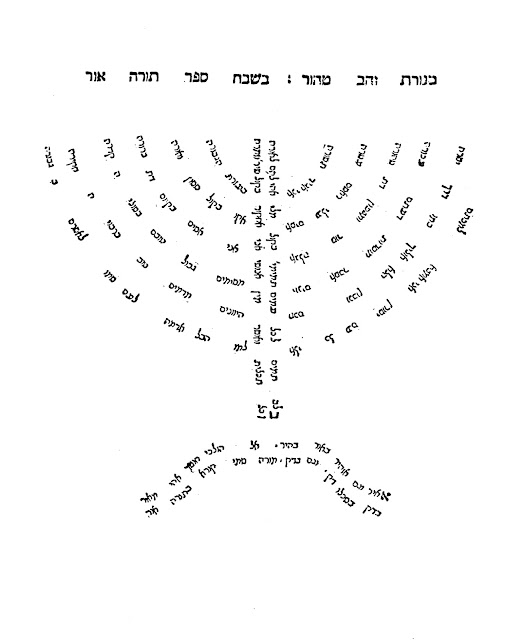
Despite that it is one of the most recognizable and ubiquitous symbols, the image of the menorah barely makes an appearance on Hebrew books. The first appearance of the menorah in a Hebrew book was Yosef Yikhya’s, Torah Or, Bologna, 1538. There is appears on the verso of the titlepage. The menorah is created via micrography and extols the value of the work. The designer even correctly places the menorah on a stand (and not a solid base as shown in the Arch of Titus). [2] 

From the inception of printing, Hebrew printers, like others, created and populated their works with their unique marks. These symbols served advertising for the publisher. Perhaps the only other symbol with such wide resonance and connection to the Jews as the Menorah is the star of David. There are over 200 printers’ marks, or emblems, close to 20 examples of the Magen David, and multiple appearances of other Jewish symbols, lions, David, Solomon, eagles, but two only of a menorah. [3]

Meir ben Jacob Parenzo, (aka Parentio, Parintz, or Maggius Parentinus), operated in Venice from 1545 until his death in 1575. He apprenticed in Daniel Bomberg’s printing shop, and in 1545 he began working for the Venetian printer, Cornelio Adelkind. Although most of his career was in the service of others, he did publish a handful of books on his own. He did not own a press and likely used Bomberg’s Press. All of these books bear Parenzo’s printers mark, a menorah. Whatever ambiguity there is about his surname, his personal name, Meir, alludes to lighting, thus a natural connection to the menorah. On either side of the menorah, “This is Meir’s menorah, he is the son of Yaakov Parenzo.”

Parnezo’s mark comprises around half of the title page. This grotesque design was called out for being unique among his contemporaries, but that it was “a pathetic bid for immortality.” As a measure of divine justice, according one scholar of Hebrew Italian printing, that “Meir Parenzo, notwithstanding his hope for immortality, is completely forgotten except for a small circle of Hebrew bibliographers, who, although conscious that the individual contributions of the men they commemorate are negligible in the great current of human affairs as it flows majestically down through the ages, nevertheless handing down (or transmitting) the knowledge of the existence of so many faithful men who have contributed their share to the enlightenment of the world.” [4] 

Another printer, also a Meir, incorporated the menorah into his mark, although on a much smaller scale. Meir ben Yaakob Ibn Ya’ir, here too, the surname, Ibn Ya’ir, references light. The menorah appears inside a border, flanked by olive trees surrounded by four verses, all mentioning either oil or light. Meir was active between 1552 and 1555. He published a few books abridged books on the laws of shehitah, as well as a work on Hebrew grammar, all exceedingly rare. [5]

The menorah next makes an appearance in Moshe Cordovero’s, (1522-1570), first book, Pardes Rimonim. This illustration is not of the biblical menorah, rather it is a kabbalistic representation of the sefirot overlaid on the menorah frame. This illustration was printed in most subsequent editions of Pardes Rimonim, although not as an exact reprint of the first edition.

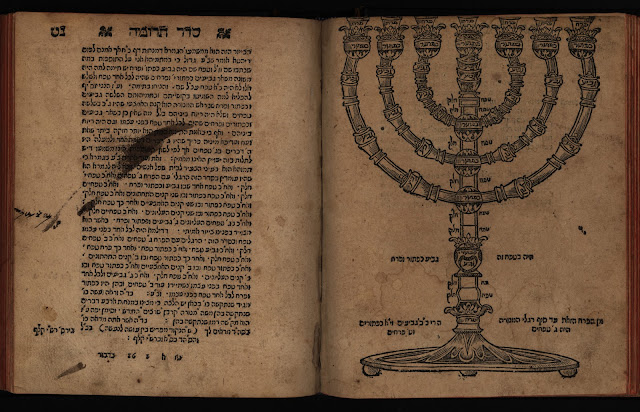
The first illustration of the menorah that was an attempt to depict and elucidate complexities of the biblical menorah only occurred in 1593. There were two books that include the illustration, Biurim and Omek Halakha.

R. Yaakov ben Shmuel Bunim Koppelman, (1555-1594) studied with R. Mordechai Jaffe, author of the Levush. In addition to traditional subjects, he was also well-versed in (my astronomy and mathematics. He published Omek Halakha in Cracow, 1593, a commentary on the Talmud. This slim volume of just 95 pages, is rich in illustrations, which appear on nearly every page. For example, there is a thirteen page an in-depth discussion of astrology with two full page diagrams of the lunar paths and many of the other pages include multiple illustrations. Koppelman includes a detailed diagram of the menorah with an accompanying commentary. [6]

The Biurim on Rashi was published in 1593 in Venice and attributed to R. Nathan Shapira. Shapira had died in 1577; his work includes three illustrations, the menorah, a map of Israel, and a diagram of how the spies carried the large bunch of grapes. This is the first Hebrew book to contain a map.

The book is one of the handful of examples of literary forgeries in Hebrew books. R. Shapira’s son, Yitzhak, published his father’s comments on Rashi in 1597 in a work titled Imrei Shefer. In the introduction he explains why there are two books that are attributed to his father on the same topic published within a few years of one another.

ואתם קדושי עליון אל תתמהו על החפץ שזה שתנים ימים יצא בדפוס איזה ביאורים הנקראים על שם הגאון אדוני אבי ז”ל, כי המציאוהו אנשים, אנשי בלי עול מלכות שמים, חיבור אשר מצאו, ומי יודע המחבר אם נער כתבו ורצו לתלותו באילן גדול אדני אבי ז”ל, חלילה לפה קדוש להוציא מפיו דברים אשר אין בהם ממש, כי הכל תוהו ובוהו ומזויף מתוכו, כלו עלו קמשונים כסו פניו חרולים. וכאשר הגיעו הספרים ההם בגלילות אלו הכרוז בהסכמת כל רבני ורשאי המדינות שלא ומכרו ויהיו בבל יראה ובבבל ימצא בכל ארצות אלו. ואשר קנו מהם יחזר להם המעות ולא ימצא בביתך עולה

[“Do not wonder why I am publishing what was published just two years ago, the Biurim, in my father’s name. As wicked people, people who found a book, a book which may have been written by a child. However, they wanted to use my father’s good name to publish their work. But, my father would never say such stupidities which appear in that book, their book is worthless and a forgery. When this was discovered all the Rabbis agreed that this book [Biurim] should be under a ban, no one should be allowed to keep it. Whomever purchased it should have their money returned, they should not allow a stumbling block into their home.”]

According to R. Shapiro’s son, the Biurim, is illicitly associated with his father. His son was not the only one to question the authenticity of the Biurim. R. Yissachar Bear Ellenburg in his Be’er Sheva and in his Tzedah L’Derekh states unequivocally that R. Shapiro did not write the Biurim.

The diagram of the menorah does not appear in Imrei Shefer. [7]

The diagram of the menorah appears in Yosef Da’at printed in Prague in 1609 by Rabbi Yosef ben Issachar Miklish (1580 -1654). He was a student of the Maharal of Prague and of Rabbi Ephraim Lonchitz, the author of the Klai Yakar. The purpose of the book was to correct errors in Rashi’s commentary. He used a 14th century manuscript to make those corrections. To better facilitate studying Rashi, the book includes illustrations including the menorah. This a full page with detailed descriptions of each part of the menorah. Interestingly, the base seems to combine two different approaches, one that has three legs and the other with a solid base. Miklish reproduces a solid base on top of three legs.

In 1656/57 Yalkut Shimoni with the commentary of Berit Avraham was published in Livorno, Italy. This one includes a menorah created via micrography, but unlike the others that appear at the front of the books, this one appears at the end. It is a colophon.

A unique example of the menorah appears in the 1684 edition of the Humash. It is the sole illustration on the title page. When the menorah appears on the title page, it is almost always in conjunction with other vessels or other symbols. This is perhaps the only instance of a stand-alone menorah on a title page.

The next appearance is the first time it illustrated a titlepage, in R. Shabbati ben Joseph Meshorer Bass’s (1641-1718), most well-known work, his commentary on Rashi, Siftei Hakhamim. This edition was published in Dyhernfurth, Germany at Bass’s press. This was the second edition of the work, (the first was published in 1680 in Amsterdam), and includes one of the most unusual Hebrew titlepages.

The titlepage depicts Moshe and Aaron, with the ark and other temple vessels, and prominently, and occupying the bottom third of the page, a menorah. Bass makes multiple luminary allusions on the title page. This edition includes

“.עם תרגום אנקלוס וביאור מאור הגדול רש״י ז״ל: ועליו מפרשי דבריו ככוכבים יזהירו: ובש״בעה נרות יאירו

The menorah makes another appearance on the next page. Like the Torah Or, Bass uses micrography, in praise of the book, to form the shape of the menorah.

Aside from the figurative arts there was also a musical component to the page. This is not surprising as Shabbati was a musician and singer, and a noted bassist singer, hence the “Meshorrer”/“Bass” surname. On the bottom of the page, in the left corner, appears “Az Yashir Moshe” the beginning of the one of the fundamental Jewish musical pieces, and musical notes appear at the bottom of the page, in what appears to be a composition of sorts. This is one of the few times musical notations appears in early Hebrew religious books. Another is Immanuel Hayi Ricci’s commentary on the Mishna, Hon Ashir, printed in Amsterdam in 1731. Appended to the end of the book are three songs, two set to music with notation.

Another menorah appears in Bass’s edition. On the next page, like the Torah Or, the menorah is comprised of micrography extoling this edition with the commentary. [8]

In 1694, R. Avraham Tzahalon published a portion of his grandfathers, R. Yom Tov Tzahalon’s (c. 1559-1638), responsa. R. Yom Tov was a child prodigy, only eighteen when he published his first work. That same year he was included in granting an approbation alongside R. Moshe Tarani (Mahrit) and R. Moshe Alschech. R. Yom Tov was no shrinking violet. And he had a dim view of R. Yosef Karo’s Shulhan Arukh. He belittled it, calling it only fit for children. The title page and the verso of the 1694 edition include depictions of the temple vessels and specifically the menorah. But his responsa do not discuss the temple vessels and this was included, “to beautify and embellish the title page of the book in a manner fit for print; the students illustrated holy concepts, the form of the Tabernacle and the Third Temple.” A rare of example of acknowledging the aesthetic beauty in the Hebrew book.

Three years later, the Italian scholar, Moshe Hafetz, (1663-1711), (aka Moses Gentili) published Hannukat ha-Bayit which discusses the Temple in great detail and includes numerous illustrations. Because of the illustrations, the book was printed in two parts. First all the text was printed with space left for the illustrations and illustrations were then added using etched copperplates.

His other work, Melekhet Mahshevet, includes his portrait, the first rabbinic portrait included in a Hebrew book, which is somewhat controversial because he is bareheaded. In a 19th century edition, a yarmulke was drawn on his head.[9]

The Bass titlepage served as the model for another lavishly illustrated titlepage. Although it served as a model, it was only a model and not a perfect facsimile. This was intentional. In this instance, the Menorah was the most important visual element of the titlepage and therefore is significantly larger than before and is in the center not the bottom of the page. Of course, this is because the book’s title includes menorah, Menorat haMeor. The book’s structure is based upon the biblical menorah and divided into seven parts, like the seven branches of the menorah. The title page was likely executed by the well-known engraver, Avraham ben Jacob, whose lavishly illustrated 1695 edition of the Haggadah, remains among the most remarkable illustrated haggadot and served as a model for dozens of other illustrated haggadot. Like in the Biruim, Jacob also produced a map, this one much more refined than the basic one in the Biruim. It is a large fold-out map of the Jews travels from Egypt to Israel. Most of his illustrations are copied from the Mathis Maren, a Christian, whose biblical illustrations were very popular. [10]

The illustration was reused by another Amsterdam printer, Solomon Proops, in 1723. Thus, this is one of the few instances of Hebrew titlepage images reflecting the title or the work itself rather than serving a mere ornamental purpose. The titlepage imagery was reused for a 1755 edition of the Torah. This time the menorah is significantly reduced in size.

While these menorahs depicted in Hebrew books, might differ in small details, they are consistent in depicting curved, and not straight, arm. Nearly every manuscript and all the archeological finds similarly depict the curved branches. Of late, this is subject to controversy. The Lubavitcher Rebbe heavily promoted his position that the arms of the biblical menorah were straight and not rounded. In the main, he based this on a manuscript in the Rambam’s hand that includes a depiction of the menorah with straight arms and the confirming testimony of his son that, according to Rambam, the arms were straight. This produced one of the more unusual exchanges in a haredi journal, in his instance, Or Yisrael, published in Monsey, New York. Those historic and documentary materials are used by R. Yisrael Yehuda Yakob, from Kollel Belz, as evidence against the Rebbe’s position. The article uses the mosaics in the 7th century Shalom al Yisrael Synagogue. The menorah is at the center of a large mosaic. The inscription near the mosaic indicates that the entire congregation, men, women, old and young, all took part in the creation of the mosaic. The Burnt House in Jerusalem’s Old City, that dates to the Second Temple period. Yakob then moves on to numismatic, citing a coin from the Hasmanoim period. Section three is then devoted to a discussion of the menorah on the Arch of Titus. Yakob references unidentified “hokrim” who posit that the base of the menorah was broken en route to Rome and was replaced with a base of a Roman creation. This explains why the base does not conform with the Rabbinic description and contains bas reliefs of various mythical and real animals. It was not the true one. Although unidentified, this position is that of the former Chief Rabbi of Israel, Rabbi Herzog as well as the nineteenth-century British Protestant academic, William Knight. Only in section four does Yakob turn to the more traditional Medieval Jewish commentaries. Ultimately, Yakob concludes that the rounded arms is the correct depictions and “justifies” the custom to draw it that way. Following the text, is a reproduction of the menorah from the second century synagogue, Dura Europas. A most unusual conclusion for a rabbinic article. (The image of the Dura Europos menorah actually depicts a straight arm menorah, that follows the Rebbe’s opinion. This is one of the only archeological examples of a straight arm menorah. The value of this image, however, is questionable. The menorah appears four times at Dura Europos. The straight arm one appears at the upper left corner of the opening for entrance. But, in the panel that specifically depicts the Mishkan and its vessels, there is a rounded arm menorah. While we don’t know what to attribute the differences to, it is more likely that greater care was placed in the accurate reproduction of the menorah within the context of the mishkan rather than were it serves as mere decoration.)

As would be expected, there was a rebuttal article that is more in line with the Haredi approach. The author concedes that his main objection is to Yakob’s approach, the “fundamental point which is almost litmus test of one’s religiosity: any evidence adduced from pictures and archeological evidence, God forbid, to rely upon these things or the conclusions of archeologists.” Although never directly discussed, presumably the author would dismiss the examples in the Hebrew book.[11]

* I would like to thank the bibliophile par excellence, Marvin Heller, for his assistance and close read of the article, and William Gross, whose library of objects and books is among the richest private collections, and provided most of the images, with credit to the Gross Family Collection. Many are available at the Center for Jewish Art website (https://cja.huji.ac.il/browser.php).

[1] See for example, Rachel Hachlili, The Menorah, The Seven-Armed Candelabrum (Leiden: Brill, 2001) who exhaustively catalogs the examples of menorah depictions but does not discuss the Hebrew book.
[2] For the history of the menorah, see Steven Fine’s comprehensive study, The Menorah, From the Bible to Modern Israel (Cambridge: Harvard University Press, 2016). Also see L. Yarden, The Tree of Light, A Study of the Menorah (Ithaca: Cornell University Press, 1971.
[3] Avraham Yaari, Degali Madfisim ha-Ivriyim (Jerusalem: Hebrew University Press, 1944), see index s.v. magen David and menorah; Yitzhak Yudlov, Degali Madfisim (Jerusalem: Old City Press, 2002); For examples of lions, eagles, and fish, see Marvin Heller, Essays on the Making of the Early Hebrew Book (Leiden: Brill, 2021), 5-84
[4] See Steinschnider, Catalogus Libr Hebr., col. 2984, no. 8761 (discussing his surname); Yaari, Degali, 128-29; Encyclopeadia Judaica, vol. 13 col. 101-02 (1996); David Amram, The Makers of Hebrew Books in Italy (London: Holland Press, 1963), 367-71.

Parenzo may have a second printers mark that only appears once, in the 1574 Bragadini edition of the Rambam. On the verso of the title page is, according to EJ, “a rather daring design” illustrating Venus hurling arrows at a seven-headed dragon. Unmentioned is Venus’ clothes, or lack thereof.

This mark is similar to the Cremona-Sabbioneta, printer, Vincenzo Conti’s mark, with the seven-headed hydra. His, however, has Hercules rather than Venus.

A nude Venus was also used by Allesandro Gardano for his printers mark. He only published one book, a pocket edition of the Shulhan Orakh in 1578. A naked Venus rising appears at the bottom.

Hans Jacob, who published in Hanau in the 1620s, also has a naked Venus rising from a seashell at the bottom of at least four works, R. Moshe Isserless, Torat Hatas, Sefer Mahril, and a Siddur.

For a detailed discussion of Parenzo’s printing activities, see A.M. Haberman, “Ha-madfeshim beni R’ Yaakov Parenzoni be-Veniztia,” in Areshet 1 (1959), 61-88.
[5] See Yudolov, Degali Madfisim (Jerusalem: Old City Press, 2002), 23-24.
[6] See Marvin Heller, “Jacob ben Samuel Bunim Koppelman: A Sixteenth Century Multi-Faceted Jewish Scholar,” Gutenberg-Jahrbuch (Mainz, 2018), pp. 195-207.
[7] Introduction Imrei Sefer, Lublin 1697 (on differences in the printings of the Imrei Shefer see Yudolov, Areshet, 6 (1981) 102 no. 7); Biurim, Venice 1693; R. E. Katzman, “Rabbi Nathan Nata Shapiro – Ha-Megaleh Amukot” in Yeshurun 13 (Elul 2002) 677-700; Introduction [R. E. Katzman], Seder Birkat HaMazon im Pirush shel R. Noson Shapiro, 2000 Renaissance Hebraica, 1-10.
[8] His original surname may have been Strimers. See Shimeon Brisman, A History and Guide to Judaic Bibliography (Cincinnati: Hebrew Union College Press, 1977), 267n.33. For additional biographical information see id. collecting sources.
[9] Dan Rabinowitz, “Yarlmuke: A Historic Cover-up?,” (here) Hakirah (4).
[10] Regarding the map, see Harold Brodsky, “The Seventeenth-Century Haggadah Map of Avraham Bar Yaacov,” in Jewish Art 19-20 (1993-1994): 149-157; David Stern, “Mapping the Redemption: Messianic Cartography in the 1695 Amsterdam Haggadah,” in Studia Rosenthaliana 42/43 (2010-2011), 43-63; Amir Cahanovitc, “Mappot be-haggadot pesah” (Masters thesis, Achva Academic College, 2015), 34-85. For a discussion of this edition and reproductions of some of its images and a comparison with Mathew Merian’s illustrations see Cecil Roth, “Ha-Haggadah ha-Metsuyyeret she-bi-Defus,” Areshet 3 (1961), 22-25; Yosef Hayim Yerushalmi, Haggadah and History (Philadelphia: The Jewish Publication Society, 2005), plates 59-62, 67, 69.
[11] See R. Yisrael Yehuda Yakob, “Tzurot Kani Menorah,” in Or Yisrael 18 () 131-139; R. Nahum Greenwald, “Kani Menorah Ketzad Havei,” in Or Yisrael 18 () 140-154.


A Young Man Holding a Torah Scroll and a Young Woman Holding a Book: The Life and Afterlife of Two Illustrations

A Young Man Holding a Torah Scroll and a Young Woman Holding a Book:
The Life and Afterlife of Two Illustrations

By Rachel Manekin

Rachel Manekin is Professor Emerita of Jewish Studies at the University of Maryland. Her area of specialization is the social, political, and cultural history of Galician Jewry. She is the author of The Jews of Galicia and the Austrian Constitution: The Beginning of Modern Jewish Politics (Zalman Shazar Center for Jewish History, 2015, Hebrew), and most recently, The Rebellion of the Daughters: Jewish Women Runaways in Habsburg Galicia (Jerusalem: Magnes Press, 2024; Hebrew). Her previous essay at The Seforim Blog was in Rachel Manekin and Charles (Bezalel) Manekin, “The Ḥafetz Ḥayyim’s Statement on Teaching Torah to Girls in Likutei Halakhot: Literary and Historical Context,” The Seforim Blog (27 May 2020), available here.

The 1922 illustration below of a young man holding a Torah scroll has gained a new life within the context of recent Bais Yaakov scholarship and a partial image of it appears on the main page of the Bais Yaakov Project website.[1]

This article calls into question this use of the illustration and shows that it has no connection to the Bais Yaakov movement, or Orthodox women, at least in interwar Poland. The article first traces the origin of the illustration and the context in which it was used after its first publication, and then examines the campaign proposed in 1933 to mobilize Bais Yaakov students in Poland to support financially the writing of a Torah scroll. Finally, the article presents an interwar illustration of a young woman holding a book with a tall Hanukkah menorah in the background. The latter was used as a symbol of Bais Yaakov in Viennese publications in the German language, but never appeared in Polish Yiddish publications of the Bais Yaakov movement. The article suggests a possible reason for that.

The illustration of the young man holding the Torah scroll appeared first on a postcard, one in a set of ten “art postcards” drawn by Uriel Birnbaum, the son of the general secretary of Agudath Yisrael, Nathan Birnbaum. The postcards were produced by the Viennese Tseirei Agudath Yisrael organization (Agudas Jisroel Jugendgruppe) and sold for fundraising purposes. The price of each set was 500 krone. Indeed, in May 1922 the Austrian Orthodox weekly Jüdische Presse published advertisements for this set.[2]

In 1924 the Viennese Menorah Journal published two of the postcards in a long article dedicated to Uriel Birnbaum.[3]

Each postcard had a black and white illustration of a Biblical theme with a Biblical verse under it. One can see the original envelope and some of the postcards (including the youth with the Torah scroll) in an advertisement published on February 28, 2023, on the website of Kedem Auction House:[4]

The postcard with the illustration of the youth holding a Torah scroll as if rescuing it from the whirlwind in the background (perhaps symbolizing the First World War) appears with the verse from Jeremiah 1:7, “Do not say I am a youth, for to whomsoever I shall send thee thou shalt go and whatsoever I shall command you thee thou shalt speak” (אַל תֹּאמַר נַעַר אָנֹכִי כִּי עַל כָּל אֲשֶׁר אֶשְׁלָחֲךָ תֵּלֵךְ וְאֵת כָּל אֲשֶׁר אֲצַוְּךָ תְּדַבֵּר). The import in this context is that one should not excuse himself from obeying God’s commandment, interpreted here as spreading Torah study, by claiming to be a youth.

The youth is wearing a long kapota reaching his feet, as did many at the time, and his head, especially the back of it, is all colored in black and so one cannot see the skullcap. Still, it is obvious that this is a young male, not only because of the Biblical verse under it, but also because it is absolutely inconceivable that a female carrying a Torah scroll would appear in an Agudath Yisrael sponsored postcard in the 1920s (or, for that matter, today).

After its original publication as a postcard, the illustration was used always in the context of male Torah study. To the best of my knowledge, it first was featured in the 1925 booklet of Keren ha-Torah (חוברת של קרן התורה) which included several other of Uriel Birnbaum’s postcard illustrations.[5] The illustration appears at the top of a rabbinical appeal (קול קורא) that was published in the wake of the First Assembly of Agudath Yisrael (1923) to support Keren ha-Torah. It stretches over several pages and is signed by major Agudah rabbinical figures of the time, with the afetz ayim and the leaders of the Czortków and Ger Hasidic dynasties appearing first. The illustration was edited to include only the image and not the Biblical verse. Keren ha-Torah was established during the First Assembly in the purpose of supporting yeshivas, many of which collapsed during the First World War.

It should be noted that contrary to claims in recent scholarship on Bais Yaakov, there is no evidence that the First Assembly of Agudath Yisrael in 1923 mentioned the Bais Yaakov schools, and the published reports of the assembly included nothing about the support of religious education for girls.[6] During the 1924 meeting of the Central Council of Agudath Yisrael in Kraków, several delegates called for actual steps to be taken by Keren ha-Torah to support Bais Yaakov schools. Indeed, after major rabbinical figures supported this idea, the participants at a special meeting in the winter of 1925 drew up a plan to financially support the establishment of a teachers’ seminary and improve professionally the Bais Yaakov school system, all under the leadership of R. Dr. Shmuel Leo Deutschländer, the director of Keren ha-Torah. It was only during the Second Assembly of Agudath Yisrael (1929) that Bais Yaakov was mentioned.[7]

Birnbaum’s illustration of the youth with a Torah scroll later appeared in Luach Blätter der Agudas-Jisroel Jugendgruppe-Wien, the periodical of the Viennese Tseirei Agudath Yisrael, for the year 1931, this time with the Biblical verse.

A 1937 publication of Keren ha-Torah also included this illustration, albeit without the Biblical verse. It appeared on the title page of the first chapter which was dedicated to the discussions on male Torah education in the Second Assembly of Agudath Yisrael (1929).[8]

The same 1937 publication included a chapter with supplements the largest of which discussed in detail the Bais Yaakov schools. The heading of this chapter had an illustration of a young woman holding a book to which we will return below.

First, however, I wish to discuss the aforementioned campaign for writing a Torah scroll which was introduced in a Bais Yaakov Journal article in the Hebrew month of Iyar, 1933, titled: “The ‘Yehudis’ Camp’s Own Torah Scroll Will Be Written Through the Students of the Bais Yaakov Schools in Poland.”[9]

The article describes the plan for purchasing letters by Bais Yaakov students for a Torah scroll to be written for the Yehudis summer camp.[10] Camp Yehudis, according to articles published in the 1933 journal, was the first permanent summer camp built for Orthodox children, boys and girls. The journal includes two photographs of children in the camp, one of boys and another of girls.

Clearly, this summer camp was not intended exclusively for Bais Yaakov girls as can be seen also in a photograph kept in the YIVO archives of boys in the camp playing chess.[11]

The plan to have Bais Yaakov students raise money for writing a Torah scroll was proposed by Yoel Unger, a Warsaw Agudah activist and the director of one of the Bais Yaakov schools in the city. Unger was in charge of the Yehudis association,[12] and it was he who came up with the initiative to build a summer camp. Indeed, the camp was built in 1931 in the village of Długosiodło, 73 km north-east of Warsaw.[13] In the years prior to that, the Yehudis association rented camp facilities for the summer, first in 1929 in Marązy and then in 1930 in Otwock. The aim of the summer camp was to provide children, many of whom came from impoverished families, with an opportunity to enjoy fresh air and water as well as physical exercises in a country setting. In doing that, it followed what was already a norm for non-Orthodox Jewish organizations in interwar Poland. In later years the summer camp added a sanatorium for children who were at risk of tuberculosis.[14]

The number of girls in the new camp exceeded the number of boys,[15] perhaps because boys went to cheder also in the summer months.

Why was obtaining a Torah scroll necessary for a summer camp for children that apparently did not even have its own synagogue?[16] The girl campers, according to Esther Goldshtof, prayed on Friday night and on Sabbath morning in the forest surrounding the camp while sitting on benches.[17] It is not clear from the articles in the Bais Yaakov Journal whether the boys – all younger than 13 – did the same or whether they prayed in the town’s synagogue. Of course, one could place a Torah scroll in one of the rooms and have the boys pray and hear the Torah reading there. But it is more likely that Unger intended to use the money raised also for the camp itself, which struggled with a deficit because of the high expenses of running it.[18] Only a small number of children paid the full tuition, while the rest received a discount or went there for free.[19] The camp did receive financial support from the Viennese Keren ha-Torah, the Warsaw Jewish community, German Jewish organizations, the American Joint, as well as some large donations from rich Jews. Small donations from individuals also helped as those apparently accumulated to large sums.[20] In addition, Bais Yaakov raised money from their students to support the camp, mostly with the help of teachers in the three Bais Yaakov schools in Warsaw and some from Bais Yaakov schools in Rzeszów, Sosnowiec, Częstochowa, Wolbrom, Szydłowiec, Bychawa, Płock, Bełchatów, and Pińczów. Those were small sums amounting to 10-60 zlotys.[21]

This was the context of Unger’s somewhat ambitious plan to recruit Bais Yaakov teachers to raise money for writing a Torah scroll, as explained in the 1933 Bais Yaakov Journal article.

Reaching Bais Yaakov teachers would be relatively easy since one could use advertisements in the Bais Yaakov journal to which all teachers were required to subscribe, or contact Bais Yaakov schools directly, the addresses of which were kept in the central Bais Yaakov office in Kraków. There was no parallel journal or a central office with the addresses of all cheders and Talmud Torahs. The 1933 Bais Yaakov Journal article explained that “the mitzvah of writing a Torah scroll, which only individuals are able to fulfill, will be done now through the Bais Yaakov students with their own efforts.” Unger refers here to the positive commandment obligating every individual Jew to write a Torah scroll for himself or hire a scribe to do it for him. Since this is an expensive endeavor, it is allowed to pay for it in partnership with others.[22] At the same time, the article added, the money collected would also support Bais Yaakov students who cannot afford the camp tuition. Clearly, Unger himself explained that the money raised was meant not only for writing the Torah scroll.

Unger proposed that the Yehudis association would send to all Bais Yaakov schools signature forms with a picture of a Torah scroll. The price of purchasing a letter to be written in the scroll would be 25 groshen (pennies), and the names of all those who purchased a letter would be inscribed in a special book. However, each Bais Yaakov student would need to purchase a letter and sell at least one additional letter. A student who sold at least ten letters would receive gratis an additional letter in her name. The teachers responsible for selling 200 letters would have their names etched forever on a special board, and in addition they would be able to have a whole word in the Torah scroll on their name with a great discount.

But Unger proposed even more than this. The day that the writing would commence would be declared a holiday (יום טוב) in all Bais Yaakov schools. On this day the teachers would deliver lectures about the mitzvah of writing a Torah scroll,[23] and organize celebrations and special programs. When the writing of the Torah scroll would be completed – scheduled for 15th of the Hebrew month of Av – a three-day Siyum celebration would take place in Długosiodło with the participation of all Bais Yaakov teachers, students’ delegations, the central administrations of Yehudis and the Bais Yaakov schools in Warsaw, Kraków, and Łódź. Unger also proposed that at the time of the Siyum celebration a special conference for Bais Yaakov teachers and operatives (‘askanim) would take place in Długosiodło to discuss all the problems of the movement. It is to be expected, he wrote, that the Bais Yaakov teachers would understand the important significance of this campaign, which would for sure be a wellspring of joy and enthusiasm for Bais Yaakov children and would unite them into one family that owned its own Torah scroll. It would also help the camp financially and enable it to develop so it could accept more children in need. “That is why our teachers,” Unger envisioned, “will work for the campaign with energy and dedication.” Unger added that in the following days the Yehudis association would send out the first circular with instructions regarding this important campaign.

But this ambitious and elaborate plan never came to pass, as is clear from two articles published in the Agudah newspaper, Dos Yudishe Togblat, a month after the death of Sarah Schenirer, which provided an opportunity to relaunch the project.[24] The first article, written by Abraham Mordechai Rogovy, who was involved in many aspects of Bais Yaakov, reports that the Education Center (מרכז החינוך) of Agudath Yisrael has now proclaimed for Benos and Bais Yaakov girls a campaign of writing a Torah scroll for the summer camp to memorialize Sarah Schenirer. The initiator was Yoel Unger, who had already made a name for himself as an expert fundraiser. Rogovy does not mention purchasing letters or fulfilling the mitzvah of writing a Torah scroll (the word “mitzvah” does not appear at all), but rather that there is not a more beautiful monument for Schenirer “than a Torah scroll written in partnership (בשותפות) with tens of thousands of Jewish religious girls.” The life-ideal of Schenirer, he continues, was always to connect Jewish girls to the Torah, so that their entire being and every thread of their gentle souls would feel the connection of Israel and the Torah (ישראל ואורייתא). He also writes that “there is no better manifestation of the wish to remain loyal to the teachings of Sarah Schenirer a”h than to join a common Torah campaign that should include all the Benos and the Bais Yaakov students,” or that the “Torah campaign will be transformed into a great manifestation of the Benos and Bais Yaakov idea.” Interestingly, there is no mention of the role of Bais Yaakov teachers; rather Rogovy calls on the (male) ‘askanim of Bais Yaakov and the (female) activists of Benos “to throw themselves with energy in the collection.” According to Rogovy, the writing of the Torah scroll is expected to start on 33 of the ‘Omer )May 21) and be completed on the 15th of Av (August 14). Like Unger’s original plan, Rogovy also talks about a “grandiose” Siyum celebration after which everyone will travel to Schenirer’s tombstone in Kraków, where they will announce that a Torah scroll in her memory was completed.

The second article presents an undated letter that Schenirer wrote to Bais Yaakov girls, presumably following Unger’s 1933 article in the Bais Yaakov Journal, encouraging them to buy letters for the Torah scroll. The article explains that although the project was not carried out then “for various reasons” it has now been renewed by the initiators. “‘Keren ha-Torah’ with Agudath Yisrael are about to write a Torah scroll named after Sarah Schenirer, may she rest in peace.”

Schenirer’s letter, which has hitherto been unnoticed, reveals an important point not indicated in any of the articles cited above, namely, the audience for the Torah scroll. Ascribing to the Warsaw ‘askanim the establishment of the Yehudis summer camp, Schenirer explains that they thought that the boys who benefit from the camp should have a Torah scroll of their own so they would not have to use a Torah scroll that was already donated to some “bais midrash” [in the area]. By buying letters, Schenirer writes, the girls would not only be “fulfilling the mitzvah of writing a Torah scroll,” but also be participating in writing a Torah in which it is written עֵץ חַיִּים הִיא לַמַּחֲזִיקִים בָּהּ וְתֹמְכֶיהָ מְאֻשָּׁר. In short, Schenirer saw the goal of the project to provide a sefer Torah for the boys in the camp, and to involve girls in the mitzvah of its production by buying letters.

While the article does not explain why the first campaign never got off the ground, one may speculate that the sum collected just was not enough for the project. (Schenirer writes in the beginning of her letter that she knows that more than one will complain about being asked again for money, especially at such difficult time.) Perhaps the initial project was frowned upon by some parents or rabbis. After all, the idea that Bais Yaakov girls would be fulfilling the mitzvah of writing a Torah scroll made little sense since according to most religious legal opinions, women are exempt from this mitzvah, not to mention that most girls were minors.[25] Indeed, Unger’s 1933 article does not mention rabbinical support for his proposal. The second initiative avoided, as we have seen, mentioning buying letters or referring to it as the mitzvah of writing a Torah scroll, and instead talked simply about a “collection.”

Apparently, the second initiative did not materialize either; had a Torah scroll in memory of Schenirer been written, it would have surely been reported in the Bais Yaakov journal or in Dos Yudishe Togblat.

We now come to the illustration mentioned above of the young woman holding a large book with a tall Hanukkah menorah in the background that is found in the 1937 Keren ha-Torah publication.[26]

In fact, this illustration had appeared already in 1935 on the title page of a Keren ha-Torah booklet containing a report written by Deutschländer on the activities of the central office of the Bais Yaakov schools.[27]

Although the publications where this illustration appeared do not have the name of the artist, the style of the illustration suggests that it might also have been Uriel Birnbaum.

The unusually large book that the young woman is holding and the tall menorah in the background are not explained. We may speculate that the young woman in the illustration portrays a Bais Yaakov teacher as a modern “Judith”, a heroine who saves the Jewish people. Whereas the classical Judith held in her arms the head of the decapitated enemy general, Holofernes, this Judith holds a book (ספר, בית ספר). European artists have painted the scene of Judith carrying the head of Holophernes for centuries.

Connecting the illustration to Judith would explain the Hanukkah menorah in the background, for in the Jewish medieval tradition, Judith was associated with Hanukkah.[28] Moreover, Sarah Schenirer, who established the first Bais Yaakov school, records in her 1933 published memoir that she was inspired by the sermon delivered by R. Moshe David Flesch in Vienna on the Sabbath of Hanukkah which described the greatness of Judith and called contemporary Jewish women to take as an example the historical Jewish women heroines.[29] Schenirer subsequently wrote a dramatization of the story of Judith for girls.[30]

Starting on December 13, 1920, after Schenirer and her students staged the play in the Orthodox Warsaw avazelet high school during a visit there, the published version was advertised on the front page of the Warsaw daily newspaper of Agudath Yisrael, Der Yud, for several weeks (first as the most beautiful present for “children” and later as a present for “girls”).

However, the above illustration of the young woman did not appear in the Bais Yaakov Journal or in any other Polish Agudath Yisrael publication. The illustrator for the Viennese publication was apparently unaware of the modesty requirements in the Polish Bais Yaakov movement, especially the style of the dress and the length of the sleeves. In illustrations of women and girls appearing in textbooks for school age Bais Yaakov students, the women were portrayed with long sleeves reaching the wrist.[31]

* * *

To sum up: we began by mentioning that Birnbaum’s illustration of the young man holding the Torah scroll appears prominently in recent academic forums where Bais Yaakov is discussed.[32] We have claimed that this illustration was neither appropriated nor used by the Bais Yaakov movement in any of its publications. In fact, it is inconceivable that it would do so. But it is understandable why some today would like the illustration to have been of a woman, or at least be relevant to women. Such an interpretation accords nicely with the narrative in recent scholarship that Bais Yaakov provided Orthodox women in Poland, for the first time, the opportunity to have a strong connection with Torah study. The same is true of the aforementioned proposed campaign to write the Torah scroll. That interpretation bolsters the contemporary reading of the Bais Yaakov movement in interwar Poland as a movement that brought Torah to women by involving them in the mitzvah of writing a Torah scroll and by teaching them classical texts and commentaries (albeit not of the Talmud) in the Kraków seminary. In various writings I have shown this reading to be mistaken.[33]

In fact, the Bais Yaakov movement was from its inception a deeply conservative movement of religious revival aimed at Polish Orthodox girls and young women, in an age when various ideologies (Zionism, Socialism, Bund, etc.) competed for their attention. Through mostly supplementary education and youth activities, the movement promoted a model of a Jewish woman that emphasized piety and modesty in dress, and that educated girls to accept with pride and joy their traditional roles as Orthodox women. This is why it enjoyed and benefited from broad rabbinic support from the outset.[34] The small number of zealous Hasidic leaders who opposed the Bais Yaakov schools did so only after Agudath Yisrael, their ideological foe, took it under its auspices. It also explains why of all the Polish and Lithuanian innovations in Orthodox Jewish female education during and after the First World War (e.g., the Warsaw avazelet high school or the girls’ Yavneh high school in Telz), Sarah Schenirer’s afternoon school in Kraków, which taught young girls prayer, strict Orthodox observance, and Biblical stories, was adopted by the Polish Agudath Yisrael as the model for the development of the Bais Yaakov school network. The Bais Yaakov teachers’ seminary provided the teachers for these schools. Schenirer, a pious woman with a burning zeal for bringing Jewish women back to Orthodoxy, played a major role as the public face of the movement, primarily as its chief promoter in the towns and Polish countryside, and as the “spiritual mother” of the movement.[35] But the portrait of her as instituting women Torah study for its own sake, or of encouraging life-long study of Torah, a portrait that accords with modern progressive sensibilities, does not stand up to sober historical inquiry.[36]

Notes

[1] The illustration appears as a frontispiece of a chapter in Naomi Seidman, Sarah Schenirer and the Bais Yaakov Movement: A Revolution in the Name of Tradition (Liverpool: Littman Library, 2019), 226.
[2] Jüdische Presse, May 12, 113; Jüdische Presse, May 19, 120.
[3] Menorah: jüdisches Familienblatt für Wissenschaft, Kunst und Literatur, May 1924, 17. See also Der Israelit: Ein Centralorgan für das orthodoxe Judentum, October 6, 1930, 22.
[4] See the auction site here.
[5] Shabtai Scheinfeld (ed.), Ḥoveret shel Keren Ha- Torah, Vienna 1925, 24. For a digitized copy see https://hebrewbooks.org/43310.
[6] For a detailed discussion on this issue see Rachel Manekin, “Torah Education for Girls in the Interwar Bais Yaakov School System: A Re-Examination,” Zion, vol. 88, no. 2 (2023): 219-262, esp. 238-244, 238n71 (Hebrew). In 1929 Leo Deutschländer recounted that “just a few months” after the First Assembly, Keren ha-Torah took up its task “according to five main directions,” the fifth of which was to establish and expand the Bais Yaakov organization of schools for girls. If that is the case, then the decision of Keren Ha-Torah to support the Bais Yaakov schools was taken at its first founding meeting on December 25, 2023. But no practical steps were taken until the September 1924 meeting of the Central Council of Agudath Yisrael in Kraków.
[7] Der Israelit: Ein Centralorgan für das orthodoxe Judentum, Blätter, September 19, 1929, 2, §2c.
[8] Programm und Leistung: Keren Hathorah und Beth Jakob 1929-1937: Bericht an die dritte Kenessio Gedaulo, London/Vienna 1937, 5.
[9] See Naomi Seidman’s blog post, “When Bais Yaakov Girls Commissioned a Sefer Torah,” available here. The illustration of the youth with the sefer Torah (including the Biblical verse) accompanies the blog post giving the impression that it is part of the original 1933 article on the campaign. The following corrects inaccuracies in the blog post and adds details concerning the proposed campaign that did not come to fruition. Cf. Seidman, Sarah Schenirer and the Bais Yaakov Movement, 166.
[10] “An-eigene sefer-torah far der kolonye ‘yehudis’ vert gishribn durch di shilerins fun di beis yakov shuln in Poyln” (The ‘Yehudis’ camp’s own sefer Torah will be written through the students of the Bais Yaakov schools in Poland), Bais Yaakov 104 (1933), 15-16.

[11] YIVO Archives, ID: RG 120 / yarg120po705.01, “Description: Dlugosiodlo, 1920s-1930s. Boys playing chess at the Yehudia summer camp for religious children. Photographed by Leo Forbert.” The description erroneously calls the camp “Yehudia”.
[12] The Yehudis association was founded in 1928 for the purpose of religious education of girls. Among its aims it listed also the establishment of summer camps for girls from religious schools and ensuring that poor children attend school. Its organizing committee included Alexander Zusha Friedman, Yoel Unger, Yehudah Leib Orlean, and others. See “Oyfruf funem ferband far relig. yudishe techter ertsihung in varsha ‘yehudis’” (call of the association for a religious education for girls in Warsaw “Yehudis”), Der Yud, April 2, 1928, 4.
[13] “Gilaygt a yesod… fun der gruntshtayn chagigah in dlugashadle” (placing a foundation… about the cornerstone celebration in Długosiodło), Bais Yaakov 69 (1931), 2-3. Gershon Eliezer Friedenson, who wrote the article, says that when he visited the socialist Medem sanatorium five years earlier he was ashamed and jealous for not having a truly-Jewish similar institution. See also “Fayerleche grunt-shtayn leygn fun der ershter ortodoksisher zumer-kolonye ‘yehudis’ in dlugat-shadle” (the festive cornerstone placing of the first orthodox summer camp ‘Yehudis’ in Długosiodło), ibid., 14; “Der fayerliche chanukat-habayis fun der ershter ortodoksisher zumer-kolonye ‘Yehudis’” (The festive opening celebration of the first Orthodox summer-camp ‘Yehudis’), Dos Vort, June 26, 1931, 4.
[14] See the article in a Yiddish newspaper on a visit of journalists organized by the camp, “A bezuch in der chasidisher… ‘medem-sanatarye’ in dlugashadle” (A visit in the chasidic ‘Medem-sanatorium’ in Długosiodło), Unzer Białystoker Expres, January 13, 1939, 14. ‘Medem’ was the famous Tsysho sanatorium for children named after the Bundist leader Vladimir Medem. The article, which praises the camp and includes two photographs, also mentions the physical exercises as well as the play and the songs performed by the girls for the journalists. See also the photographs published in the art section supplement, Forverts, March 26, 1939.

[15] A[lexander] Z[usha] Friedman, “Di arbit far der zumer kolonye ‘Yehudis” in licht fun tsifern” (the work for the summer camp ‘Yehudis’ in light of numbers), Bais Yaakov 104 (1933), 9-11.
[16] An article by Unger written after the camp was built lists the rooms in the building in the following manner: six rooms for sleeping, a dining hall, an office, a lounge for the [female] teachers, an isolation room [for the sick], two washrooms, pantry, kitchen with separate facilities for milk and meat dishes, wardrobe room, porches, “etc.” Had there been a synagogue in the building it would have certainly been listed. see Yoel Unger, “Fir yohr ‘yehudis’ arbit” (four years of the ‘Yehudis” work), Bais Yaakov 104 (1933), 5-6, especially 6.
[17] Esther Goldshtof, “Dos leben oyf unzere kolonye” (the life in our camp), Bais Yaakov 104 (1933), 8.
[18] The deficit in the summer of 1933 amounted to 8,000 zloty, and in addition the camp needed to complete things like running water and electricity, see A[lexander] Z[usha] Friedman, “Di arbit far der zumer kolonye ‘yehudis” in licht fun tsifern” (the work for the summer camp ‘Yehudis’ in light of numbers), Bais Yaakov 104 (1933), 11.
[19] Twenty-five children paid full tuition in 1931 and 100 in 1932. 310 children received a discount in 1931 and 180 in 1932 while 55 children went for free in 1931 and 75 in 1932, ibid., 9-10.
[20] “Der fayerlicher chanukat-habayit fun der ershter ortodoksisher zumer-kolonye ‘yehudis’” (the festive dedication celebration of the first Orthodox summer camp ‘Yehudis’), Dos Yudishe Togblat, June 22, 1931, 5.
[21] “Reshimeh fun menadvim letovas der ‘yehudis’ kolonye in dlugashadle”, (a list of contributors for the benefit of ‘Yehudis’ camp in Długosiodło), Bais Yaakov 104 (1933), 15-16.
[22] For the mitzvah obligating individuals to write a sefer Torah and the question whether it applies also to women see the article by R. Eliezer Melamed, available here; and the sources presented by Barry Gelman, here.
[23] This mitzvah is not about the laws of the Torah scribe or about the mechanisms of inscribing a Torah, but rather about the mitzvah that applies to each individual Jew.
[24] A[braham] M[ordechai] Rogovy, “Di heyntige hatcholah (tsu di shloyshim fun froy scheniere a”h) (Todays beginning: at the shloshim of Mrs. Schenirer, may she rest in peace), Dos Yudishe Togblat 169, April 2, 1935, 3; “A brief fun Sarah Schenirer a”h tsu di Bais Yaakov kinder vegen koyfn otiyos in der sefer-Torah far der ‘yehudis’ kolonye (A letter from Sarah Schenirer, may she rest in peace, to the Bais Yaakov children regarding buying letters in the Torah scroll for the Yehudis camp), Ibid., 6. The issue number is different on every page, but the correct date and issue number is as written on the front page.
[25] According to the “Sha’agat Aryeh” there is no reason to exempt women, see Aryeh Leib Gintsburg, Sha’agat Aryeh, 69-70 (https://hebrewbooks.org/14616), but his is a minority opinion.
[26] Programm und Leistung: Keren Hathorah und Beth Jakob 1929-1937: Bericht an die dritte Kenessio Gedaulo, London/Vienna 1937, 295.
[27] L[eo] Deutschländer, Tätigkeitsbericht der Beth Jacob Zentrale, Vienna 1935.
[28] On Judith, see Kevin R. Brine at al. (eds.) The Sword of Judith: Judith Studies across the Disciplines, open access, 2010, especially chapter 2, “The Jewish Textual Traditions” by Deborah Levin Gera.
[29] Sarah Schenirer, Gezamelte Shriftn, New York 1955, 9. This is the American edition (with some corrections to the original Polish 1933 edition) available online, see https://hebrewbooks.org/41613.
[30] The image below comes from the Moreshet auction house, which can be accessed here.
[31] See Eliezer Gershon Friedenson at al., Yiddish loshn: ilustrirte alef-bais un layen-buch far ershtn shul-yor, Lodz 1933.
[32] Cf. the website of the 2023 international conference on Bais Yaakov held at the University of Toronto, available here. The illustration also adorns the cover of the conference program, available here.
[33] See, for example, Manekin, “Torah Education for Girls.”
[34] The claim that Bais Yaakov was “controversial among the Orthodox at the outset,” and that Schenirer herself aroused orthodox opposition initially, is made among others by Seidman, Sarah Schenirer and the Bais Yaakov Movement, 5; its basis is the author’s interpretation of a story circulating in Bais Yaakov when she was a student there: “When she [Schenirer] would walk around the towns of Poland in her efforts to found Bais Yaakov schools, Jewish boys would throw stones at her. She would bend down, pick up the stones, and say to her assailants, ‘From these stones will I build my school.’”

According to Seidman’s interpretation of the story, Schenirer “was seen by some in the Orthodox community as a dangerous innovator, and had thus faced opposition (stones), which she turned into support (schools).” Seidman cites for this E. G. Friedenson’s 1936 children’s anthology about Schenirer, Di mamis tsavoah: Zaml-buch far kinder un yugnt (The Mother’s Last Will: An Anthology for Children and Youth), 35-36. However, the story in Friedenson, which appears in the chapter on “Stories and Bon Mots” (mayselach un gute verter) and not in the chapter on “Life and Deeds,” differs significantly: “Mrs. Schenirer once visited a shtetl accompanied by its teacher. At that time, the idea of Bais Yaakov was not yet well known and fully developed as today, and its leaders and teachers were mocked at. When Sarah Schenirer had arrived in the city, a few young rascals (לאבוזיס; the Yiddish term comes from the Polish łobuz, ‘rogue’. See also Alexander Harkavy’s Yiddish dictionary for לאבוסעס) threw stones into [the classroom] (איר ארנגיווארפן) and one stone hit the teacher who, because of this, felt upset. We will have not just one stone – Schenirer said with a smile – they will throw stones and we will build with the stones our Bais Yaakov.” For a Hebrew translation see Em be-Yisrael, vol. 2, Yechezkel Rotenberg (ed.), Bnei Berak 1960, 41-42.

The story, apparently the first time to appear in print, and which may or may not have any basis in fact, refers to one incident in which ignorant rascals threw stones into somewhere, presumably, the school, and struck a teacher – providing Schenirer in the story with an occasion for a bon mot. Decades later, the story appears to have morphed into a tale of “violent opponents” throwing stones at Sarah Schenirer herself. See Chava Weinberg Pincus, “An American in Cracow,” in Daughters of Destiny: Women who Revolutionized Jewish Life and Torah Education, compiled by Devora Rubin, Brooklyn 1988, 189-208, esp. 200: “It was her courage and idealism that made her pick up the rocks thrown at her by violent opponents to Bais Yaakov. Rocks in hand, she would turn to her talmidos saying, ‘We will take these rocks and turn them into bricks with which we will build Bais Yaakow’.” See Shoshanah Bechhofer, “Identity and Educational Mission of Bais Yaakov Schools: The Structuration of an Organizational Field as the Unfolding of Discursive Logics,” Ph.D. Dissertation, Northwestern University, 2005, 121-122.

Clearly, לאבוזיס are not simply “Jewish boys,” nor can they represent Orthodox opposition to Schenirer as a “dangerous innovator,” since such opposition to her did not exist, even among the zealots who opposed Bais Yaakov as an Agudah project.
[35] Schenirer’s travel to towns throughout Poland was aimed to convince local Agudah askanim to spend the money needed to open an afternoon Bais Yaakov school (housing and salary for the teacher, an appropriate space for the school, school expenses, etc.), as well as to convince parents to send their daughters to the school. As described in Yehudah Leib Orlean’s eulogy after Schenirer’s death, convincing ‘askanim was not always easy, although the people felt for her and the gedolei yisroel understood her, both placing their greatest trust in her. See Bais Yaakov journal 125 (1935), 6, and in Hebrew translation Em be-Yisrael, vol. 3, 49-50. According to Schenirer, many parents did not understand the importance of the Bais Yaakov education or were satisfied with sending their daughters to the school for one year, just enough for them to learn to pray and write in Yiddish. Even then, girls were occasionally late or missed school with all kinds of excuses. Other parents thought it was too difficult to attend two schools. See Sarah Schenirer, Tsu vos darf men Bais Yaakov shulen? Populare agitatsye-broshur far’n Bais-Yaakov-gedank )’Why Does One Need Bais Yaakov Schools? A Popular Agitation Brochure for the Bais Yaakov idea’), Warsaw 1933, 25-31. The brochure includes a proclamation by Agudath ha-Rabbanim signed by many rabbis (among them Ḥayim Ozer Grodzinski, Zalman Sorotzkin, and Aharon Walkin) calling parents not to send their daughters to Jewish secular schools, which were “akin to Molekh” (e.g., the Tarbut schools), but rather to Bais Yaakov. Clearly, such an endorsement was needed not to support Schenirer herself, but rather to convince parents of the importance of sending their daughters to Bais Yaakov. It should be noted that annual statistics of Bais Yaakov students do not take into account the number of years they attended the school.
[36] See Manekin, “Torah Education for Girls.” The memorial issue of the Bais Yaakov journal published after Schenirer’s death which includes about three dozen articles about her written by different personalities and students, praised her dedication, idealism, enthusiasm, piety, warmth, charity, modesty, and teaching yidishkeit rather than her learning or teaching Torah, something that was not even mentioned. One of the articles emphasized her simplicity (פשטות), explaining that “when she decided to devote her efforts to the education of girls, she did not make herself important as dealing with the problems of the education of daughters, did not aggrandize her mission, did not try to win personalities for her plan; in general, she avoided any advertisement or propaganda noise, but rather simply sat down to learn yidishkeit with children with seriousness and honesty, so her path did not only not arouse opposition (because of the fear of teaching girls Torah etc.), but on the contrary, it only aroused great satisfaction and approval of all circles.” See A. Y. Lipmanovitch, “Der Koyech fun Pashtus” (the power of simplicity), Bais Yaakov 125 (Iyar/Sivan 1935), 18.


Upcoming Auction

Kestenbaum & Co. will be holding an auction next Thursday, Feb. 24th. On its site, it provides some highlights, and I wanted to point out a few others. Additionally, one can download the entire catalog by visiting the site. The first edition of R. Yosef Albo’s Sefer ha-Ikarim, Soncino 1485, being an incunabula is of course of note (lot 7). But, the colophon of this work is especially noteworthy. The colophon ends with “Ki mi-Tzion teitze Torah u-devar Hashem mi-Soncino.” Of course, this is a a play on the verse in Isaiah. While today we know that the printing press indeed usher in a new era of Torah and the dissemination of knowledge, this colophon at the end of a work published at the advent of the printing press is especially prescient.Another early and important work, is what is known as the “second Rabbinic bible,” today we know it as Mikra’ot Gedolot (lot 53). This edition as well as the “first” is discussed by Prof. Penkower in this post. Then we have a perennial favorite, R. Shmuel Arcivolti’s Ma’ayan Ganim (lot 41). This book is perhaps most well-known for its misuse. Prof. Shapiro’s post discusses some of the issues with the use of this work. But, it is worth noting that the book is divided into five sections, each beginning with the same illustration – a fountain. First, most early Hebrew books don’t contain illustration in the body (title pages are a different story). Second, the fountain shows a group of (very nude) cherubs with the fountain waters exiting from a less than flattering orifice. The book is currently available online, although who is to know when someone will discover the images and remove it. R. Yom Tov Lipmann Heller’s classic work on the Rosh – today known as Ma’adnei Asher and Divrei Chamudoth – is offered with its original title (lot 136). This is the first edition and the only to bear the original title – Maadeni Melech ve-Lechem Chammudoth. According to some, the change in title was precipitated by a false rumour that the original title indicated an insult to the ruling monarch. It is worth noting, that in the latest edition of R. Heller’s quasi-autobiography, Megilat Evah, the editor raises some questions as to whether this truly is the reason for changing the title. Another important title, in this case the title page is the Sha’ar bat Rabim (lot 169). This work has a beautifully illustrated title page as well as other pages. Please see this post On The Main Line where he discusses it. There are a few titles relating to haskalah. First, is one volume of the seminal Journal, Ha-Me’asef (lot 137). This volume contains the first appearance R. Yitzhak Satanow’s Mishlei Asaf, a work written in the style of Mishlei with extensive notes. As well as David Freidlander’s attack on R. Fleckles after Fleckles had denounced Mendelshon’s Biur. Finally, it contains an important article regarding the controversy of whether or not one can delay burial to ensure the person is in fact dead. One addition to the note on this lot, Moshe Samat has an important article on this last topic which was recently republished in the collection of his articles, Hadash Assur min ha-Torah. Another two haskalah works are Nachman Krochmal’s Moreh Nevuchei ha-Zeman (lot 164) and R. Moshe Kunitz’s defense of the Zohar, Ben Yochi (lot 165). Finally, R. Naftali Hertz Wessely’s Divrei Shalom ve-Emet (lot 209) rounds out the haskalah. This book which advanced novel, for that time, educational theories was a subject of a large controversy. Interestingly enough, today, most of his reforms have been incorporated into Jewish schools. The auction contains the Cassuto Collection (which you can read more about in the catalog) which focuses on Spainish and Portugese Jews. Now, for must of the past 500 years, that meant not Jews actually in those countries but who originated from those countries. The most popular of which is Holland – specifically Amsterdam. So we have a beautiful copy of R. Isaac Aboab work on Tanach with a portrait (lot 264) as well another (lot 263) from a Dutch Jews, where, inter alia, he criticizes the American revolution. On the topic of Dutch Jews, an excellent recent work is Nadler’s, Rembrandt’s Jews. See also this post discussing some internal conflicts within the Dutch community, as well as the first Jewish settlement in the Americas. A few letters of interest. First, a letter from the Chofetz Hayyim thanking a donor for their donation to the ladies auxilary of Radin (lot 232). There are three letters from each of the past three Luavitcher’s rebbitzins, all fairly personal, discussing their move from the “Motherland” (Russia) to Latvia (lots 246-48).