Isaiah Cox trained as an historian at Princeton, and conducted postgraduate work in medieval history at King’s College London. He is also a technologist, with over 50 patents pending or issued to date. iwcox@alumni.princeton.edu
There is a common understanding among rabbonim that wines in the time of the Gemara were stronger than they are today.[1] This is inferred because we know from the Gemara that wine was customarily diluted by at least three-to-one, and as much as six-to-one, without compromising its essence as kosher wine, suitable for hagafen. While repeated by numerous sources and rabbonim, the earliest suggestion that wines were stronger appears to be Rashi himself.[2] [3]
In the Torah, wine is mentioned many times, though there is no mention of diluting it. The only clear reference to diluted wine in ancient Jewish sources is negative: “Your silver has become dross, your wine mixed with water.”[4] In ancient Israel, wine was preferred without water.[5] Hashem would provide “a feast of fats, and feast of lees — rich fats and concentrated lees,”[6] ‘lees’ being shmarim, the sediment
from fermentation. Lees are the most flavorful and strong part of the wine, particularly sweet and alcoholic – more like a fortified port than a regular wine.[7]
Yet if we jump forward to the time of the Mishna and Gemara: wine was considered undrinkable unless water was added?!
In Rashi’s world, wine was drunk neat, and he concludes that wine must have been stronger in the past. We could work with this thesis, except that there is a glaring inconsistency: the Rambam a scant hundred years later shared the opinion of the Rishonim: we require wine for the Arba Kosot to be diluted “in order that the drinking of the wine should be pleasant, all according to the wine and the taste of the consumer.”[8][9] We need not believe that wine was stronger both during the time of the Gemara, and in Rambam’s day — but not for Rashi sandwiched between them. Indeed, Rambam seems to put his finger on the nub of the issue: the preferences of the consumer.[10]
Today we drink liquors that are far more powerful than wine (distillation as we know it was not known in Europe or the Mediterranean until centuries after the Rambam): cask strength whiskies can be watered down by 4:1 and achieve the same alcoholic concentration as wine – but we like strong whiskies. Wine itself can be distilled into grappa, and we enjoy that drink without adding water. Given sweet and potent liqueurs like Drambuie, it seems quite logical that if wine could be made more alcoholic, we would enjoy it that way as well.
While the Mishnah and Gemara are clear that wine should be drunk diluted, the opinion that wine was too strong to drink came from later
commentators, writing hundreds of years later. In the Gemara itself, Rav Oshaya says that the reason to dilute wine is because a mitzvah must be done in the choicest manner.[11] Indeed, the Gemara itself seems to allow that undiluted wines were drinkable – it was just
not considered civilized behavior. A ben sorer umoreh, a rebellious son, is one who drinks wine — wine which is insufficiently diluted, as gluttons drink.[12] In other words, undiluted wine was drinkable, but it was not the civilized thing to do.
A review of the history of civilizations reveals the origin of the preference for diluting wine: Greek culture. The first mention of diluted wine in Jewish texts is found in the apocrypha: about 124 BCE, “It is harmful to drink wine alone, or again, to drink water alone, while wine mixed
with water is sweet and delicious and enhances one’s enjoyment,”[13] The source, it is critical to point out, was written in Greek, outside the land of Israel.
Greek culture and practices started being influential in the Mediterranean in the final two centuries BCE, and by the time of the Gemara, had become the dominant traditions for all “civilized” people in the known world. When the Mishna was written, for example, all educated Romans spoke Greek, and Latin had become the language of the lower classes. Greek customs were the customs of all civilized people.
And Greeks loved to dilute their wine. Earlier in the latter part of the second century Clement of Alexandria stated:
It is best for the wine to be mixed with as much water as possible. . . . For both are works of God, and the mixing of the two, both of water and wine produces health, because life is composed of a necessary element and a useful element. To the necessary element, the water, which is in the greatest quantity, there is to be mixed in some of the useful element.[14]
Today, wine is not diluted; the very thought of it is repulsive to oenophiles. But just as in Isaiah’s day diluted wine was considered poor (and concentrated dregs were considered choice), the Greeks only liked their wine watered down.[15] We have hundreds of references to diluting wine in ancient Greece through the late Roman period – ancient Greeks diluted wine that Israelites preferred straight. In Greece, wine was always diluted with water before drinking in a vase called “kratiras,” derived from the Greek word krasis, meaning the mixture of wine and water.[16] As early as the 10th Century BCE (the same time as Isaiah), Greek hip flasks had built-in spoons for measuring the dilution. [17] Homer, from the 8th or 9th Century BCE, mentions a ratio of 20 to 1, twenty parts water to one part wine. But while their ratios varied, the Greeks most assuredly did not drink their wine straight.[18] To Greeks, ratios of just 1 to 1 was called “strong wine.” Drinking wine unmixed, on the other hand, was looked upon as a “Scythian” or barbarian custom. This snobbery was not based solely on rumor; Diodorus Siculus, a Greek (Sicilian) historian and contemporary of Julius Caeser, is among the many Greeks who explained that exports of wine to places like Gaul were strong in part because the inhabitants of that region, like Rashi a millennium later, liked to drink the wine undiluted. This fact leads us to an inescapable conclusion: there is no evidence that Greek wine was any stronger than that of ancient Israel, Rome, Egypt, or anywhere else. Greeks and Romans liked their wine with water. Ancient Jews and Gauls liked the very same wine straight up.[19] We know that it was the same wine, because wine was one of the most important trade products of the ancient world, traveling long distances from vineyard to market. A major trade route went from Egypt through ancient Israel to both northern and eastern climes.[20] Patrick McGovern, a senior research scientist at the University of Pennsylvania, and one of the world’s leading ancient wine experts, believes wine-making became established in Egypt due to “early Bronze Age trade between Egypt and Palestine, encompassing modern Israel, the West Bank and Gaza, and Jordan.”[21] [22]
By the time of the Gemara, Hellenistic cultural preferences had become so common that nobody even thought of them as “Greek” anymore; civilized people acted in this way. Rambam would no more have thought having water with wine to be a specifically Greek custom than we would consider wearing a shirt with a collar to be the contamination of our Judaism by medieval English affectations.
Another possible reason why certain peoples preferred their wine watered down[23] is that ancient wine was more likely to cause a hangover. The key triggers for a hangover are identified as follows:
1. A bad harvest. If you are drinking wine that comes from a country where a small change in the climate can make a big difference to the quality of wine (France, Germany, New Zealand), then in a bad season the wine contains many more substances that cause hangovers.
2. Drinking it too young. Almost all red wines and Chardonnay are matured in oak barrels so that they will keep and improve. If you drink this wine younger than three years there will be a higher level of nasties that can cause hangovers. If left to mature these nasties change to neutral substances and don’t cause hangovers. As a rule of thumb, wine stored in oak barrels for six months should be acceptable to drink within the first year. If the wine is stored for twelve months or more in oak barrels, it should then be aged at least four years. Some winemakers have been known to add oak chips directly into the wine to enhance flavors (especially in a weak vintage and especially in cheaper wines); this can take years to become neutral.[24]
In other words, in the ancient world, with less precise agriculture, and minimal control over fermentation – and the common consumption of young wine that was not kept in barrels, the wine was surely “stronger” in the sense that the after-effects were far more potent, meriting dilution.
We can also explain the Rashi/Rambam difference of opinion using cultural norms. Greek culture, which dominated the Mediterranen and Babylonia for hundreds of years, ceased to be dominant in Gaul and elsewhere in Northern Europe after the decline of the Roman Empire. But in the Mediterranean, region, Greek and Roman customs remained dominant in non-Muslim circles for far longer. Rashi was in France, where the natives had never preferred their wine diluted. The Rambam was in Alexandria, where wine, made anywhere in the Mediterranean region (including Israel) had been drunk with water for a thousand years.
Part II
A Brief History of Wine Technology and Dilution
Wine is one of mankind’s oldest inventions; the archaeological record shows wine dating back to at least 3000 BCE, and the Torah describes Noach consciously and deliberately planting a vineyard and getting inebriated. But technology has changed a great deal since then, not always for the better. For starters, wine was always basically made the same way: crush the grapes and let them ferment. Grapes are a wondrous food, in that they collect, on their outer skins, the agents for their own fermentation. Yeast, of various kinds, settle on the exterior skin, and as soon as the skin is broken (when the grape is crushed), the yeasts mix and start to react with the sweet juice inside.
The problem is that there are thousands of different yeasts, and while some of them make fine wine, many others will make an alcoholic beverage that tastes awful.[25] Additionally, there are many bacteria that also feast on grape juice, producing a wide range of compounds that affect the taste of the finished product.
The end result, in classic wine making, was that the product was highly unpredictable. Today, sulfites (sulphur dioxide compounds) are added as the grapes are crushed, killing the native yeast and bacteria that otherwise would have fermented in an unpredictable way. Then the winemaker adds the yeast combinations of his choice, yielding a predictable, and enjoyable product. Today, virtually every wine made in the world includes added sulfites for this very reason. Adding sulfites prior to fermentation was NOT employed in the ancient world, and was only pioneered two centuries ago. There is no mention of killing the native yeast in the Gemara or in the Torah, nor of adding sulfites.
With the advent of Pasteur in the 19th century, and a new understanding of the fermentation process and of yeasts, the process of winemaking turned from an art to a cookbook science. Wines steadily improved as winemakers learned to add sulfites and custom yeasts, leading to today’s fine wines.
Ancient
Israel and Egypt
Ancient
Greece and Early Rome
Late
Roman – medieval
Europe,
16th Century onward
Europe
19th century to present
Controlled
fermentation
Poorly understood. Unstable results.[26]
Though when wine was boiled before fermentation, it allowed for a more
controlled product.[27]
Poorly understood, with unstable results. Salt-water was often added to the must to
control fermentation.[28]
Wine cellars were sometimes fumigated prior to crushing the grapes.[29]
Grape Juice was known, and could be made to keep.[30]
Poorly understood, with unstable results. Salt-water was often added to the must to control fermentation.[31]
Wine cellars were sometimes fumigated prior to crushing the grapes.[32]
Sulfides became known, and then consciously applied.
Controlled
environments became the norm.
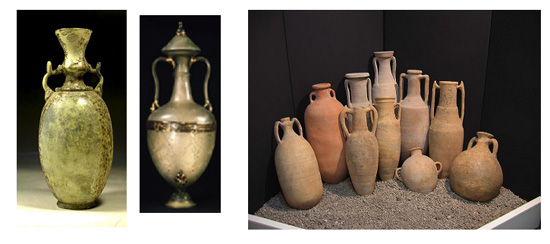
Storage of wine was another matter. The ancient world was better at preserving wine after it was made. In the ancient world (from Egypt through Greece and early Rome), wine was kept in amphorae.
Amphorae are earthenware vessels, typically with a small mouth on top. The amphorae were sealed with clay, wax, cork or gypsum. The
insides of the amphorae, if made of clay, were sealed with pitch, to make them airtight. It was well understood that if air got in, the wine would turn bad, and eventually to vinegar. Some amphorae were even made of glass, and then carefully sealed with gypsum, specifically to preserve the wine.
Wine Strength and Dilution
With proper amphorae, if the wine was good when it went into the vessel, it was quite likely to be good when it was retrieved, even if it was years later. The Egyptians and Greeks and Romans had vintage wines – wines that they could pull out of the cellar decades after it had been made.
But amphorae represented the pinnacle of wine storage, unmatched until the glass bottle was invented in the 19th century.
Around the time of the destruction of the Second Beis Hamikdash, the technology shifted. Barrels became prevalent[33], and remained the standard until the advent of the glass bottle in the 19th century. Barrels are made of wood, and they breathe. Without proper sealing, wine that is uncovered, untopped or unprotected by insufficient sulfur dioxide has a much shorter shelf life. Once a wine goes still (stops fermenting), it’s critical to protect it.[34]
Ancient
Israel and Egypt
Ancient
Greece and Early Rome
Late
Roman – medieval
Europe,
16th Century onward
Europe
19th century to present
Storage
Sometimes sealed amphorae; sometimes poor ones.[35]
Amphorae with good seals.[36]
Sulfur candles were sometimes used. Romans and Greeks continued to add salt
water when the wine was sealed – as well as boiling and using pitch.[37]
Sealed wine is valued.[38]
Even so, amphorae fell out of use, and were replaced with wooden barrels,
which breathe. But Gemara forbids sulphur in korbanos.[39]
Wooden
barrels continue.
Wine bottles are used. For the first time since the time of the Beis Hamikdash,
wine can be safely stored for a long time.
Predictability proved to be another major problem for winemakers, especially in the ancient world.
Ancient
Israel and Egypt
Ancient
Greece and Early Rome
Late
Roman – medieval
Europe,
16th Century onward
Europe
19th century to present
Predictability
of product
If the wine was good when sealed, predictability was excellent.
But sulfides were not understood well enough to make the raw product consistently drinkable.
Unpredictable.
Very much a “buyer beware” market, with no warranty, and a belief in mazal to
keep wine good.[40]
Slightly more predictable, as sulfides were sometimes used.
Very good. Storage was good, in barrels.
Excellent. Advances in understanding the role of yeast and bacteria, and the addition of
selected wine yeasts means that wine is highly predictable.
Marcus Porcius Cato (234-150 B.C.), refers to some of the problems related to the preservation of fermented wine. In Cato alludes to such problems when he speaks of the terms “for the sale of wine in jars.” One of the conditions was that “only wine which is neither sour nor musty will be sold. Within three days it shall be tasted subject to the decision of an honest man, and if the purchaser fails to have this done, it
will be considered tasted; but any delay in the tasting caused by the owner will add as many days to the time allowed the purchaser.”[41] Pliny, for example, frankly acknowledges that “it is a peculiarity of wine among liquids to go moldy or else to turn into vinegar; and whole volumes of instructions how to remedy this have been published.”[42]
Sulfites, which are used now for fermentation and also for stored wine, were in occasional (if not consistent) use in the ancient world as well. The Gemara speaks of “sulfurating baskets,” for example.[43] It is well-documented that by 100 B.C.E. Roman winemakers often burned
sulfur wicks inside their barrels to help prevent the wine from spoiling.[44] They also sealed barrels and amphorae with sulfur compounds, with the same goal. The practise was not universal, and it was not well understood, so results varied widely. Freshly pressed grape juice has a tendency to spoil due to contamination from bacteria and wild yeasts present on the grape skins. Not only does sulfur dioxide inhibit the growth of molds and bacteria, but it also stops oxidation (browning) and preserves the wine’s natural flavor.[45] From the Romans until the 16th Century, wine preservation in the barrel was not reliably achieved; throughout the medieval and early modern period all wine was drunk young, usually within a year of the vintage.[46]… wines kept in barrels generally lasted only a year before becoming unpalatable.
In the 16th century, Dutch traders found that only wine treated with sulfur could survive the long sea voyages without it turning to vinegar. [47] 15th century German wine laws restored the Roman practise, with the decree that sulfur candles be burned inside barrels before filling them with wine, and by the 18th century sulfur candles were regularly used to sterilize barrels in Bordeaux. The sulfur dioxide left on the container would dissolve into the wine, becoming the preservative we call sulfites. Even then, they were clever enough to realize that the sulfur addition improved wine quality.[48]
Ancient
Israel and Egypt
Ancient
Greece and Early Rome
Late
Roman – medieval
Europe,
16th Century onward
Europe
19th century to present
Shelf
life
Boiled wine lasted a long time, making storage and exports less risky, at the cost
of reduced quality.[49]
Variable, but could be excellent. Vintage wines existed, and old wines were prized.[50]
There were no corks, so wine did not breathe in storage.[51]
By the time of the Gemara, wine only 3 years old was considered very old. Wine aged very poorly. And the Romans
abandoned the use of sulfites in wine storage.[52]
Shelf life is somewhat longer, as sulfides are rediscovered. Bottles were introduced in the late 17th
century. Corks also come into use.
Vintage wines once again exist. Corks allow for wine to age in a bottle – the
tradeoff is that shelf life is more limited than in the ancient world.[53]
In the ancient world, wine flavorings appear to be as old as wine itself! The oldest archaeological record of wine-making shows that figs
were used in the wine as well – as we have said, wine made without benefit of sulfites, will be unpredictable at best; fig juice would sweeten the wine and make it more palatable.[54] But with all the added flavorings in the world, the process itself often led to some pretty unattractive results.
The impregnation with resin has been still preserved, with the result of making some modern Greek wines unpalatable save to the modern Greeks themselves. … Ancient wines were also exposed in smoky garrets until reduced to a thick syrup, when they had to be strained before they were drunk. Habit only it seems could have endeared these pickled and pitched and smoked wines to the Greek and Roman palates, as it has endeared to some of our own caviare and putrescent game.[55]
When Hecamede prepares a drink for Nestor, she sprinkles her cup of Pramnian wine with grated cheese, perhaps a sort of Gruyere, and flour.[56] The most popular of these compound beverages was the (mulsum), or honey wine, said by Pliny (xiv. 4) to have been invented by Aristaeus.
Added in copious quantities and varieties, almost surely to cover odd tastes and oxidation caused by poor manufacture and storage techniques.[59]
Cornels, figs, medlars, roses, cumin, asparagus, parsley, radishes, laurels,
absinthium, junipers, cassia, peppers, cinnamon, and saffron, with many other particulars, were also used for flavouring wines.[60]
Greeks added grated goat’s milk cheese and white barley before consumption of wine.[61]
Discriminating Romans even kept flavor packets with them when they traveled, so they could flavour wines they were served in taverns along the way.
Became less common, as it is acknowledged that flavorings were to cover failings in
the wine.
Post fermentation,
flavorings are almost never used.
Wine from a bottle is consistently more pure in the modern age than it
ever was before.
Virtually unheard of; to add a flavour to wine would be considered a gross insult to
the winemaker, and the noble grape itself.
Trade also changed greatly over time. The ancient Mediterranean was a hotbed of trade, and wine was also shipped overland. Many wine presses and storage cisterns have been found from Mount Hermon to the Negev. Inscriptions and seals of wine jars illustrate that wine was a commercial commodity being shipped in goatskin or jugs from ports such as Dor, Ashkelon and Joppa (Jaffa). The vineyards of Galilee and Judea were mentioned then; wines with names like Sharon, Carmel and from places like Gaza, Ashkelon and Lod were famous.[62] Wine was a major export from ancient Israel.
This situation was mirrored in Greece and Rome. Wine was traded throughout the Mediterranean (it was as easy to ship wine 100 miles by
ship as it was to haul it 1 mile across land). But Roman wines were popular, and were shipped overland to Gaul and elsewhere.
In the later Roman period, the spread of winemaking inland (away from the convenient Mediterranean) meant that wines were rarely shipped far. The wine trade remained for the benefit of the very wealthy for over a thousand years, only resuming in the 16th and 17th centuries. And today, of course, the wine trade is ubiquitous, with wines available from around the world.
Grape juice was almost always fermented; before Pasteur, avoiding the fermentation of wine was not well understood, and any grape juice
that is not sulfated will ferment if yeast is added to it. Still, the concept of grape juice was understood before wine – the butler squeezed grapes directly in Pharoah’s cup, after all. And the Gemara calls it “new wine.”[63] It certainly could be drunk then, though it was far from achieving its full potency.
Ancient
Israel and Egypt
Ancient
Greece through medieval
Europe,
16th Century onward
Europe
19th century to present
Cultural
consumption
In Israel, wine was drunk straight. Drunkenness was discouraged; self control
praised.
Drunkenness was http://seforim.blogspot.com/2012/10/wine-strength-and-dilution.html#_ftn64″ name=”_ftnref64″ title=””>[64]
wine was consumed in large quantities.
Dilution is seen as a way to cheat the consumer; common in lower class taverns.
Social drinking is praised; wine is drunk to achieve the same buzz the Greeks
praised.
It is evident that wine was seen in ancient times as a medicine (and as a solvent for medicines) and of course as a beverage. Yet as a beverage it was always thought of as a mixed drink. Plutarch (Symposiacs III, ix), for instance, states. “We call a mixture ‘wine,’ although the larger of
the component parts is water.” The ratio of water might vary, but only barbarians drank it unmixed, and a mixture of wine and water of equal parts was seen as “strong drink” and frowned upon. The term “wine” or oinos in the ancient world, then, did not mean wine as we understand it today but wine mixed with water. Usually a writer simply referred to the mixture of water and wine as “wine.” To indicate that the beverage was not a mixture of water and wine he would say “unmixed (akratesteron) wine.”[65]
There is some question whether or not what “wine” and “strong drink” Leviticus 10:8, 9, Deuteronomy 14:26; 29:6; Judges 13:4, 7, 14; First Samuel 1:15: Proverbs 20:1; 31:4,6: Isaiah 5:11, 22; 28:7; 29:9; 56:12; and Micah 2:11. “Strong drink” is most likely another fermented product – beer. Beer can be made from any grain, and would be contrasted with wine most obviously because it was substantially less expensive (typically 1/5th the cost, in ancient Egypt) while still offering about the same alcohol content.[66] (Yeast works the same way in both).
Ancient
Israel and Egypt
Ancient
Greece through medieval
Europe,
16th Century onward
Europe
19th century to present
Watered
down
Isaiah refers to watered wine perjoratively.
Greeks watered down wine, as they preferred to drink large quantities. They knew of
people who drank undiluted wine, but considered it a barbaric practise.. Wine was customarily diluted with water in a
three-to-one ratio of water to wine during Talmudic times.[67]
Still even the famously strong Falernian wines were sometimes drunk straight.[68]
Wine is not diluted, at least not in better establishments
Consumer never drinks wine known to be diluted.
Why did people water down wine? One possibility, given in Section I is that certain wines were more likely to cause a hangover. [69] The more commonly suggested solution than the presence of hangover-inducing components, is that wine served as a disinfectant for water that itself might be unsafe.
Today, we know this is true. Drinking wine makes our water safer to drink, and it also helps sanitize the food we eat at meals when we
drink wine. Living typhoid and other microbes have been shown to die quickly when exposed to wine. [70] Research shows that wine (as well as grape juice)[71], are highly effective against foodborne pathogens[72] while not significantly weakening “good” probiotic bacteria.[73]
In one study, it was shown that wine that was diluted to 40% was still effective against foodborne pathogens, and drier wines were much better at killing dangerous bacteria.
The ancients believed that wine was good for one’s health[74], even if they didn’t have the faintest idea why this was so. Microbes were only discovered in the 19th century, and ancient medicine was in many respects indistinguishable from witchcraft. Still, it seems hard to deny that Romans and Greeks at least grasped some of the medicinal value of the grape; wines were a common ingredient in many Roman medicines.[75] And given the antibacterial powers of wine, it is obvious that a patient who drank diluted wine instead of water would be helping his body by not adding dangerous microbes when the body was already weakened by something else.
Still, the evidence remains anecdotal. The Torah does not mention wine as having medicinal benefits, though the New Testament does suggest wine as a cure for poor digestion[76] – entirely consistent with what we know about wine’s antibacterial properties. And as noted by the Jewish Encyclopedia, the Gemara reflects many of Galen’s positions on the health-giving qualities of wine:
Wine taken in moderation was considered a healthful stimulant, possessing many curative elements. The Jewish sages were wont to say, “Wine is the greatest of all medicines; where wine is lacking, there drugs are necessary” (B. B. 58b). … R. Papa thought that when one could substitute beer for wine, it should be done for the sake of economy. But his view is opposed on the ground that the preservation of one’s health is paramount to considerations of economy (Shab. 140b). Three things, wine, white bread, and fat meat, reduce the feces, lend erectness to one’s bearing, and strengthen the sight. Very old wine benefits the whole body (Pes. 42b). Ordinary wine is harmful to the intestines, but old wine is beneficial (Ber. 51a). Rabbi was cured of a severe disorder of the bowels by drinking apple-wine seventy years old, a Gentile having stored away 300 casks of it (‘Ab. Zarah 40b). “The good things of Egypt” (Gen. xlv. 23) which Joseph sent to his father are supposed by R. Eleazar to have included “old wine,” which satisfies the elderly person (Meg. 16b). Until the age of forty liberal eating is beneficial; but after forty it is better to drink more and eat less (Shab. 152a). R. Papa said wine is more nourishing when taken in large mouthfuls. Raba advised students who were provided with little wine to take it in liberal drafts (Suk. 49b) in order to secure the greatest possible benefit from it. Wine gives an appetite, cheers the body, and satisfies the stomach (Ber. 35b).[77]
Others have made the bolder argument — that the core purpose of dilution was to purify water for drinking.[78]
The ancients began by adding wine to water (to decontaminate it) and finished by adding water to wine (so that they didn’t get too drunk too quickly). A letter, written in brownish ink on a pottery shard dating from the seventh century BC, instructs Eliashiv, the Judaean commander of the Arad fortress in southern Israel, to supply his Greek mercenaries with flour, oil and wine.
The [Israel Museum in Jerusalem] exhibition’s curator, Michal Dayagi-Mendels, explains that the oil and flour were for making bread; the wine was not for keeping them happy, but for purifying brackish water. To prove her point, she displays a collection of tenth-century BC hip flasks, with built-in spoons for measuring the dosage.[79]
While the archaeological record is strong in this respect, the lack of textual support, in this author’s opinion, means that there is more evidence that wine was diluted for cultural reasons than because there was a conscious understanding that wine made water safe to drink.
Ancient
Israel and Egypt
Ancient
Greece and Early Rome
Late
Roman – medieval
Europe
19th century to present
Used for health reasons
No direct evidence
Mainstay for medicine; perceived as valuable to health
With safer water, wine not as important.
Recently, wine is prized for its resveratrol for health and longevity, instead of anti-microbial properties as previously.
[1] “Up to and including the time of the Gemara, wines were so strong that they could not be drunk without dilution…. Nowadays, our wines are not so strong, and we no longer dilute them.” Rabbi Avraham Rosenthal (link), “During the time of the Talmud, wine was very concentrated, and was normally diluted with water before drinking. “Rav Ezra Bick (link), “In Talmudic times, wine was sold in a strong, undiluted form, which only attained optimal drinking taste after being diluted with water.” Rabbi Yonason Sacks, (link), “Records indicate that the alcohol content of wine in the ancient days was very high. Therefore, it was a common practice to dilute the wine with water in order to make it drinkable.” (link), “In ancient times, wines were powerfully strong and adding water to dilute their taste and power was common. … Pure wine, undiluted with water, is highly concentrated and difficult to drink. Rabbi Gershon Tennenbaum, (link), “In the days of the Talmud the wine was so strong and concentrated that without dilution it was not drinkable.” Zvi Akiva Fleisher, (link), “During the time of the Talmud, wine was very concentrated, and was normally diluted with water before drinking.” Rav Yair Kahn, (link), “Our wines, which are considerably weaker than those used in the days of Chazal, are better if they are not diluted.” (link)
[3] Wine naturally ferments to no more than 16% alcohol (typically 12-14%) before the alcohol kills the yeast off. Alcohol boils away at a lower temperature than water, so boiling wine does not concentrate it. And without the technology of distillation (which was not known in the ancient world), the only practical method that might have concentrated the alcohol in a wine would be to add plaster of paris; water would be absorbed, and the alcohol would be concentrated. But we have no evidence that this was done; it would have been far more than a mere flavoring. (see)
[5] Spices and flavorings, on the other hand, were considered fit for guests and offerings: Proverbs 9:2,5 and Isaiah 65:11 both refer to wine which is “mem-samech-ches”, meaning that it has been spiced and is ready to serve. This is the best of wine, though as warned in Proverbs 23:30, such wine has dangerous side effects. This is entirely consistent with what we know of wine flavorings in the ancient world (see Part II): spices made wine more palatable, so it could more easily be consumed to excess.
[7] Dr. Uprichard adds: Fermentation is the conversion of complex sugars, via glucose and pyruvic acid into ethanol and CO2. Natural yeasts die when the alcohol content of their culture medium (i.e. the liquid that is being produced for human consumption) exceeds a certain limit. Limit varies depending on the yeast and other factors, but is generally somewhere between 12-15% alcohol by volume. For wine to be stronger, it has to be fortified. Fortification is a process in which spirit is added to the wine. There are many fortified wines made around the world. However there are only two basic ways of fortification:
1: The Sherry Method – the must, which is a mixture of juice, pulp, skins and seeds, is fermented out, leaving a dry wine. The spirit is then added. Consequently all sherry method wines are dry to begin with. If the final style of wine is other than dry, sweetening is added prior to bottling. Sherry was invented in the 8th Century, CE.
2: The Port Method – the must is only partly fermented, and the process is stopped by the addition of sufficient spirit to prevent the yeast working. ie the alcohol content is raised to a level which kills the yeasts and leaves much of the sugar unfermented. Consequently port-method wines are generally sweet. Adding sugar will feed the process but only until the yeasts (which are effectively the enzymes in the reaction) are used up (or in this case killed off). The Rambam, who diluted wine, did NOT consider fortified wine to be suitable for Kiddush; his wine was unfortified, and undistilled, and therefore could not exceed 15-16% alcohol.
[9] Rambam considered young new wine (presumably only lightly fermented) to be distinctly unhealthy (see).
[10] It is clear that personal and cultural preferences remain very important when talking about whether to use wine or grape juice for Kiddush or the Arba Kossos. Rav Soloveitichik writes that if one does not enjoy wine, he should use grape juice for the Arba Kosot, as that will be a pleasant drink according to his taste.
[15] Athenaeus quotes Mnesitheus of Athens: “The gods has revealed wine to mortals, to be the greatest blessing for those who use it aright, but for those who use it without measure, the reverse. For it gives food to them that take it and strength in mind and body. In medicine it is most beneficial; it can be mixed with liquid and drugs and it brings aid to the wounded. In daily intercourse, to those who mix and drink it moderately, it gives good cheer; but if you overstep the bounds, it brings violence. Mix it half and half, and you get madness; unmixed, bodily collapse.” [Odyssey IX, 232.]
[18] Pliny (Natural History XIV, vi, 54) mentions a ratio of eight parts water to one part wine. In one ancient work, Athenaeus’s The Learned Banquet, written around A.D. 200, we find in Book Ten a collection of statements from earlier writers about drinking practices. A quotation from a play by Aristophanes reads: “‘Here, drink this also, mingled three and two.’ Demus. ‘Zeus! But it’s sweet and bears the three parts well!’”
[19]http://www.mmdtkw.org/VRomanWine.html. Why did the Greeks enjoy diluted wine, and the Jews of ancient Israel preferred it straight? We cannot be certain of the answer, but it is clear that the Greeks praised drinking very large quantities; it was a feature of every meal, which regularly lasted for hours. For them, wine was a necessity, and the culture rotated around its unrestrained consumption – the Greeks drank by the gallon. Undiluted wine, however, cannot be drunk by the gallon. Greeks liked to get drunk, but they wanted it to take time. Ceremonious, sociable consumption of wine was the core communal act of the Greek aristocratic system. [http://tinyurl.com/cmlsbu].
By contrast, in the Torah wine is consistently praised – in moderation. Drunkenness is never a virtue in Judaism, and the shucking off of self control and loss of inhibitions that was part and parcel of Dionysian rites is considered unacceptable to G-d fearing Jews. So wine, in full strength, was praised and consumed, but consumption for its own sake was not encouraged.
[20] Hundreds of clay jars of wine (with a total volume of some 4,500 liters (118.78 gallons) were buried with one of the first Egyptian kings, Scorpion I (about 3150 B.C.E.). Analysis of the clay shows that the jars were made in the modern Israel-Palestine region. http://www.answers.com/topic/wine-in-the-ancient-world
[22] Had there been any significant qualitative difference between wine grown in one place as opposed to another, it would be apparent by the archaeological and written records we have; the ancient Greeks, for example, spent a lot of ink writing about wine, with no mention that any wine was significantly stronger than any other.
[25] As written about a modern wine that is made without sulfides: “we had an organic, ‘no sulfite added’ chardonnay on the menu. It was an amazing wine to behold. That is when it wasn’t brown and vaguely reminiscent of sewage, which was about one out of every four bottles.” http://winekulers.com/11_1_08.htm . See http://en.wikipedia.org/wiki/Yeast#Wine for more information about the process in general. Ancient wineries, lacking modern sanitation, would have had a much lower “success” rate.
[26] Egyptian wines cannot have been very stable because the grapes were picked and crushed in August, then were slowly crushed and pressed and then rapidly fermented, all in the summer heat. http://www.answers.com/topic/wine-in-the-ancient-world
[27]http://tinyurl.com/dl5ypr . Though according to oeniphiles, boiling the wine at any time destroys the flavor. Boiled wine was not allowed as a korban, though it would have led to a more predictable (if mediocre) product. Terumos 11:1 – Rabbi Yehuda, in a minority opinion, considers boiled wine to be superior.
[28] “Some people—and indeed almost all the Greeks—preserve must with salt or sea-water.” Columella, On Agriculture 12.25.1. Columella recommended the addition of one pint of salt water for six gallons of wine.
[30] Fresh must, when boiled, could have been stored in amphorae and kept sweet, and this could be the boiled wine mentioned in the Gemara. Certainly we don’t need to speculate in the case of the Romans, as http://www.biblicalperspectives.com/books/wine_in_the_bible/3.html writes: Columella gives us an informative description of how they did it: “That must may remain always as sweet as though it were fresh, do as follows. Before the grape-skins are put under the press, take from the vat some of the freshest possible must and put it in a new wine-jar; then daub it over and cover it carefully with pitch, that thus no water may be able to get in. Then sink the whole flagon in a pool of cold, fresh water so that no part of it is above the surface. Then after forty days take it out of the water. The must will then keep sweet for as much as a year.” [Columella, On Agriculture 12, 37, 1]… This method of preserving grape juice must have been in use long before the time of Pliny and Columella, because Cato (234-149 B.C.) mentions it two centuries before them: “If you wish to keep grape juice through the whole year, put the grape juice in an amphora, seal the stopper with pitch, and sink in the pond. Take it out after thirty days; it will remain sweet the whole year.” [Marcus Cato, On Agriculture 120, 1.]
[31] “Some people—and indeed almost all the Greeks—preserve must with salt or sea-water.” Columella, On Agriculture 12.25.1.
[33] Barrels have many advantages: they are less expensive and less prone to breakage; they stack and roll, and generally allow for easier transportation. The downside of a shortened shelf life for the wine was apparently considered an acceptable price to pay for these advantages.
[35] In Egypt, the clay jars were slightly porous (unless they were coated with resin or oil), which would have led to a degree of oxidation. There was no premium on aging wine here, and there are records of wine going bad after twelve to eighteen months. http://www.answers.com/topic/wine-in-the-ancient-world
[36] Jeremiah 48:11, Moab is compared to a container of fine wine that is not disturbed: “therefore its taste has stayed in it, and its scent was not diminished.” Unsealed wine in the ancient world was known to lose its essence.
[38] The foster-mother of Abaye is authority for the statement that a six-measure cask properly sealed is worth more than an eight-measure cask that is not sealed (B. ‑3. 12a)
[39] John Kitto’s Cyclopedia of Biblical Literature says: “When the Mishna forbids smoked wines from being used in offerings (Manachoth,
viii. 6, et comment.), it has chiefly reference to the Roman practice of fumigating them with sulphur, the vapor of which absorbed the oxygen, and thus arrested the fermentation. The Jews carefully eschewed the wines and vinegar of the Gentiles.” But presumably smoked wines were acceptable for consumption, even if not for offerings?
[40] Rab said that for three days after purchase the seller is responsible if the wine turns sour; but after that his responsibility ceases. R. Samuel declared that responsibility falls upon the purchaser immediately upon the delivery of the wine, the rule being “Wine rests on the owner’s shoulders.” R. ‑Hiyya b. Joseph said, “Wine must share the owner’s luck” (B. B. 96a, b, 98a). If one sells a cellarful of wine, the purchaser must accept ten casks of sour wine in every hundred (Tosef., B. B. vi. 6).
[49] Yerushalmi, on Terumos 11:1 notes that cooked wine is inferior in quality to uncooked wine, but is superior in the sense that it lasts longer.
[50] “The good things of Egypt” (Gen. xlv. 23) which Joseph sent to his father are supposed by R. Eleazar to have included “old wine,” which satisfies the elderly person (Meg. 16b). At the great banquet given by King Ahasuerus the wine put before each guest was from the province whence he came and of thevintage of the year of his birth (Meg. 12a). In Rome, wines were preferred to aged anywhere from 10 to 25 years. In fact, the Emperor Caligula was once presented with a 160 year old vintage that was considered a supreme treat. http://penelope.uchicago.edu/~grout/encyclopaedia_romana/wine/wine.html
[51]Vintage wines of the ancient world were lost when sealed amphorae were replaced with wooden barrels at the end of the second century, AD (Techernia, 1986), and their reappearance had to await the development in the 17th century of glass bottles stoppered with cork. From “Wine and the Vine: An Historical Geography of Viticulture and Wine Trade”
[52] If William Younger is to be believed, the Romans had entirely abandoned sulfites by the end of their millenium of winemaking. http://www.winecrimes.com/winecrimes/
[53] Singer, Holmyard, Hall et cie “History of Technology”
[57] To prevent wine from becoming acid, moldy, or bad-smelling a host of preservatives were used such as salt, sea-water, liquid or solid pitch, boiled-down must, marble dust, lime, sulphur fumes or crushed iris.
[59] (1) “alun‑mit,” made of old wine, with a mixture of very clear water and balsam; used especially after bathing (Tosef., Dem. i. 24; ‘Ab. Zarah 30a); (2) “‑3afrisin” (caper-wine, or, according to Rashi, Cyprus wine), an ingredient of the sacred incense (Ker. 6a); (3) “yen ‑ìimmu‑3in” (raisin-wine); (4) “inomilin,” wine mixed with honey and pepper (Shab. xx. 2; ‘Ab. Zarah l.c.); (5) “ilyoston”, a sweet wine (“vinum dulce”) from grapes dried in the sun for three days, and then gathered and trodden in the midday heat (Men. viii. 6; B. B. 97b); (6) “me’ushshan,” from the juice of smoked or fumigated sweet grapes (Men. l.c.); not fit for libation; (7) “enogeron,” a sauce of oil and garum to which wine was added; (8) “api‑3‑mewizin,” a wine emetic, taken before a meal (Shab. 12a); (9) “‑3undi‑mon” (“conditum”), a spiced wine (‘Ab. Zarah ii. 3); (10) “pesinti‑mon” (“absinthiatum”), a bitter wine (Yer. ‘Ab. Zarah ii. 3);
[63] Rabbi Hanina B. Kahana answers the question: “How long is it called new wine?” by saying, “As long as it is in the first stage of fermentation . . . and how long is this first stage? Three days.” Sanhedrin 70a.
[64] The Greeks were aware of the results of excessive consumption of wine, and it was recommended that wine be diluted with water in order to avoid this. It was also seen as socially stigmatizing to drink undiluted wine, and this was often seen as “a habit confined to barbarians”. The Romans were also well aware of the results of drunkenness, and Pliny’s famous comment “in vino verias” is not to be a disinterested observation, but a chastisement of those who “do not keep to themselves words that will come back to them through a slit in their throat.” [http://www.mta.ca/faculty/humanities/classics/Course_Materials/CLAS3051/Food/Wine.html]
[66] Beer is typically less alcoholic than wine; typical brewing yeast cannot survive at alcohol concentrations above 12% by volume. http://en.wikipedia.org/wiki/Beer Wine can run to 15-16%.
[67] R. Eliezer says “boreh pri hagefen” is pronounced only when the wine has been properly mixed with water.
[70] http://tinyurl.com/cnzwes [The Origins and Ancient History of Wine By Patrick McGovern, Stuart James Fleming, Solomon H. Katz]
[71] Grape juice and wine are much more beneficial to health than beer with the same alcohol content – other properties of the grape, even before fermentation, are good for people. This means that diluted grape juice (and boiled grape juice or wine) also had health benefits even without alcohol.
[72] such as Helicobacter pylori, Listeria monocytogenes, Escherichia coli O157:H7, Salmonella Typhimurium and Shigella boydii,
[74] A passage in the Hippocratic writings from the section “regimen in Health” draws upon this basic assumption: “Laymen…should in winter…drink as little as possible; drink should be wine as undiluted as possible…when spring comes, increase drink and make it very diluted…in summer…the drink diluted and copious.” [http://www.mta.ca/faculty/humanities/classics/Course_Materials/CLAS3051/Food/Wine.html – Hippocrates dates from 400 BCE] Drugs such as horehound, squills, wormwood, and myrtle-berries, were introduced to wine to produce hygienic effects.
[75]http://en.wikipedia.org/wiki/Ancient_Rome_and_wine The Romans believed that wine had both healing and destructive powers. It could heal the mind from depression, memory loss and grief as well as the body from various ailments-including bloating, constipation, diarrhea, gout, halitosis, snakebites, tapeworms, urinary problems and vertigo. Cato wrote extensively on the medical uses of wine, including espousing a recipe for creating wine that could aid as laxative by using grapes whose vines were treated to a mixture of ashes, manure and hellebore. He wrote that the flowers of certain plants like juniper and myrtle could be soaked in wine to help with snakebites and gout. Cato believed that a mixture of old wine and juniper, boiled in a lead pot could aid in urinary issues and that mixing wines with very acidic pomegranates would cure tapeworms.[23]
The 2nd century AD Greco-Roman physician Galen provides several details about how wine was used medicinally in later Roman times. In Pergamon, Galen was responsible for the diet and care of the gladiator. He made liberal use of wine in his practice and boasted that not a single gladiator died in his care. For wounds, he would bath them in wine as an antiseptic. He would also use wine as analgesic for surgery. When Galen became the physician of Emperor Marcus Aurelius, he worked on developed pharmaceutical drugs and concoctions made from wine known as theriacs. The abilities of the these theriacs developed superstitious beliefs that lasted till the 18th century and revolved around their “miraculous” ability to protect against poisons and cure everything from the plague to mouth sores. In his work De Antidotis, Galen notes the trend of Roman tastes from thick, sweet wines to lighter, dry wines that were easier to digest.[14]
[76] Paul commands Timothy to use alcohol with his water due to his frequent illness (1 Timothy 5:23). Evidently Timothy had been drinking only water, and that was causing sickness.
[78] Inhibitory activity of diluted wine on bacterial growth: the secret of water purification in antiquity, International Journal of Antimicrobial Agents, Volume 26, Issue 4, Pages 338-340 P.Dolara, S.Arrigucci, M.Cassetta, S.Fallani, A.Novelli
Rav Shmuel Ashkenazi: a Hidden Genius By Eliezer Brodt
This Monday night is the first yahrzeit marking the passing of a unique Talmid Chacham, R’ Shmuel Ashkenazi of Yerushalayim, at the age of ninety-eight. R’ Shmuel was one of the hidden giants of the seforim world, in both ultra-orthodox and academic circles. I had the Zechus to learn much from him and in this article, I wish to describe this fascinating but hardly known Gaon and what we can learn from his life. An earlier abridged version of this article appeared in the Ami Magazine last year. IY”H in the future I will expand this essay.
One day back in 2000, while learning in the Mir as a Bochur, I was having a conversation with a friend, R’ Yaakov Yisrael Stahl, and R’ Shmuel Ashkenazi’s name came up, R’ Yaakov described him as an extraordinary Talmid Chacham. A little while later, during one of my daily seforim store trips I noticed a recent arrival, a very heavy sefer (844 pp.) with a peculiar title, Alfa Beta Kadmita de-Shmuel Zeira. I opened it up and immediately put two and two together, realizing that the author is the same R’ Shmuel Ashkenazi I just heard about. Upon purchasing it, I could not put it down. Learning through it I was immediately able to tell that my friend had not exaggerated in the slightest way. It appeared that this person knew literally everything about anything connected to Torah.
First Meeting
At the time, I had been working on researching and publishing my first article which dealt with tracing everything about the custom of not sleeping on Rosh Hashanah. One of the earliest sources quoted was in the name of a Yerushalmi which appeared to have been lost at some point. I had been searching all over for any information on this topic, and it was then that I noticed that R’ Ashkenazi was planning on writing about this topic in the next volume of his. I am not sure why but at the time I did not make an effort to speak with him about this. I returned to the US for a few years, and while in the US I drafted a letter to him listing all of my issues on this topic but I never got around to sending it. When I returned to Eretz Yisroel in 2004, one of the first of my planned stops was to visit R’ Shmuel Ashkenazi. Almost immediately upon returning a newly made friend, R’ Duvid Vieder, a Toldos Aharon Chossid who was close to R’ Ashkenazi, brought me into him to visit. From then on, I began to visit him regularly, this custom continued until a few weeks before the 2020 coronavirus lockdowns. At times I visited him once a week for an hour or so, other times once a month, other times I would speak to him on the phone.
I must preface my reminiscences by saying that, sadly, I did not heed the advice of the Chasam Sofer who told his children and talmidim that since he won’t be around forever, they should “chap arein” and listen to his stories. Unfortunately, this is not the first person with whom this has happened to me. I took for granted that Rav Ashkenazi would be around forever, (he did die at the age of 98!) and assumed I would always be able to ask him again for a particular story or an idea that he mentioned.
What was the connection?
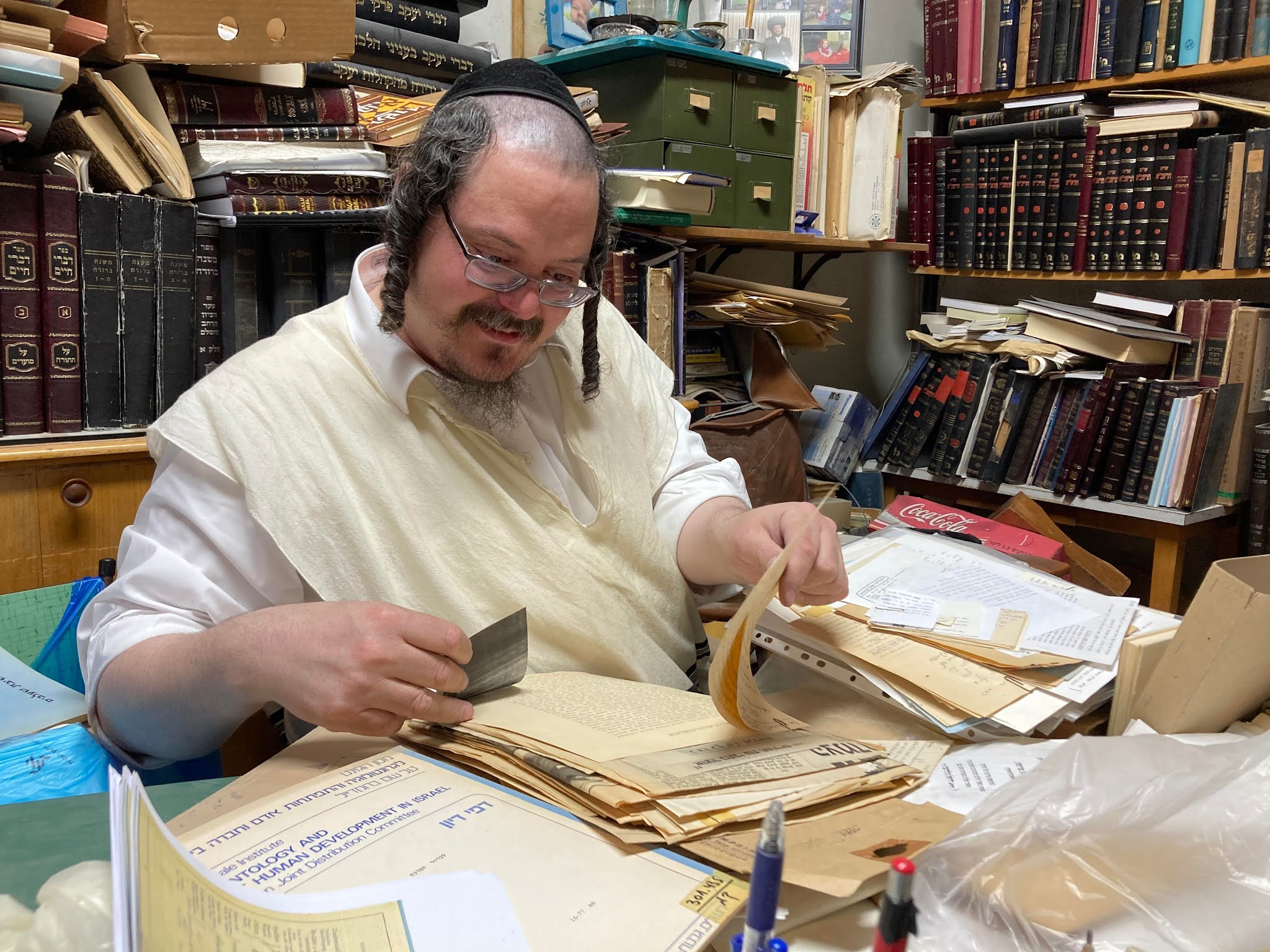
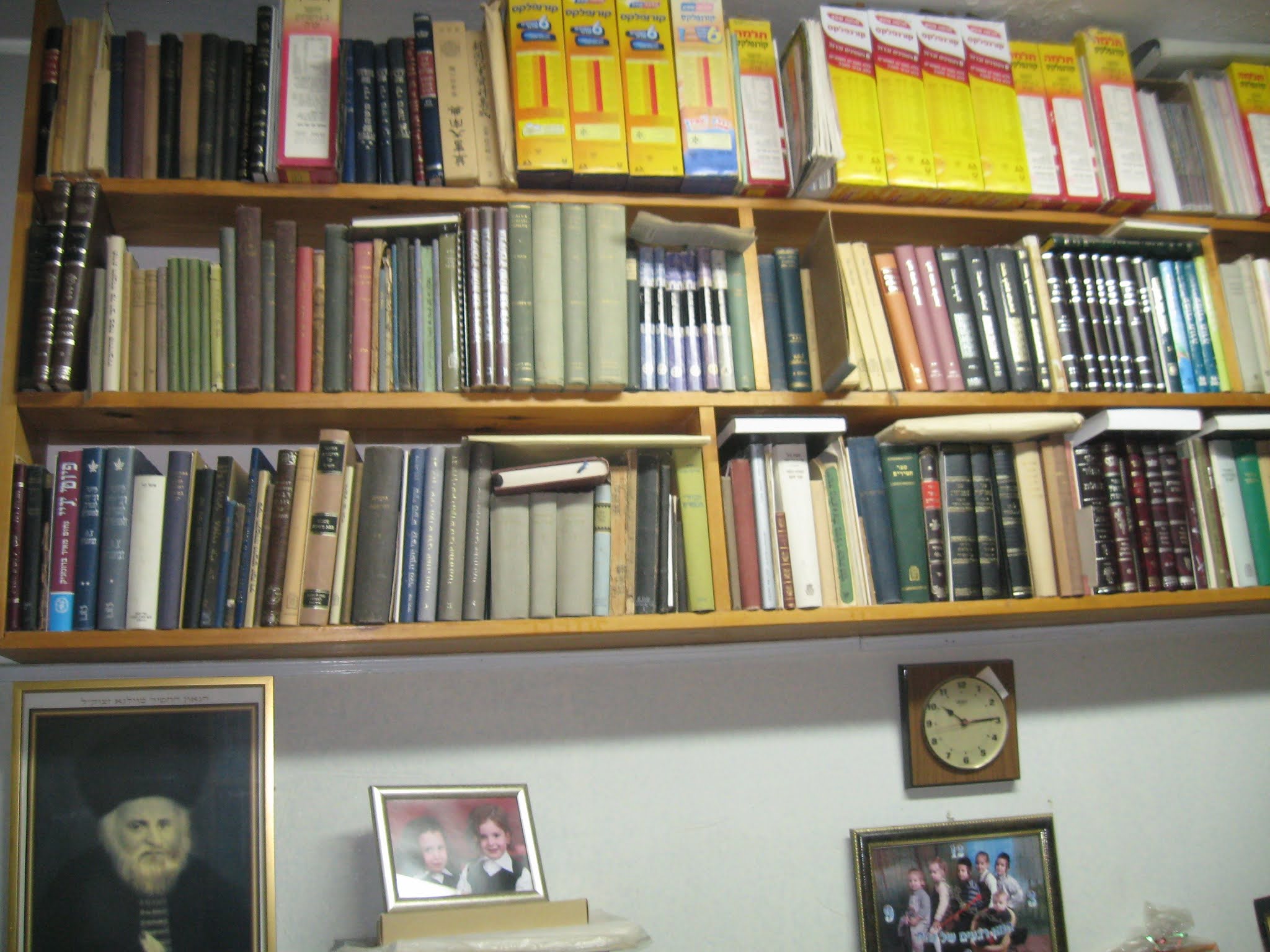
Basically, each visit I would prepare lists of questions to ask him. I would also bring him new seforim or articles (printed out in big letters, to help him read it easier). Sometimes when I would ask him something, he would say he is old and his head does not work, other times it was amazing what he remembered – on the spot. Sometimes he would pull down a file of material stored in – no jokes here – old cornflakes boxes.
I would then scan some of the material. Other times he offhand did not have anything to add on a particular topic but when looking at a particular sefer I would find a note written on the side or in a paper stored in the sefer that would be related to what I was searching. Other times I would find something else which was of great importance. Rarely did I leave his house empty handed. We both shared a love for seforim and information on a wide range of topics.
Love of Seforim
What drew me to him, and particular developed my relationship with him, was our shared love of seforim. I would update him on new seforim. At times he would ask me to purchase it for him or would borrow my copy for a bit. He told me numerous times how he enjoyed visiting and buying seforim from various shops for many years and that he started collecting when he was seven years old! Now he could not go to stores as he was too old; I got to know him when he was over eighty.
When I joined the editorial board of the journal Yeshurun, I would bring him each new volume as it was printed. Each visit he would ask me to check on the shelf where he kept them, to see if he was up to date and if needed, to update him with any missing volumes. A true lover of seforim, his face would lit up at each new volume. I would then point out some of the articles I thought he would enjoy and he would put in markers to read them.
I always wondered if he read the various volumes of Yeshurun I brought him. After he was niftar, while going through his seforim, I found inserted in one rare book a small paper which he wrote: “for more information about this author see the article in Yeshurun”. Then in a different pen he added another cite from another issue from Yeshrun from a few years later.
This small story also demonstrates a bit of his methodology; he would collect all kinds of information and store them at times in a related sefer and would constantly update these notes.
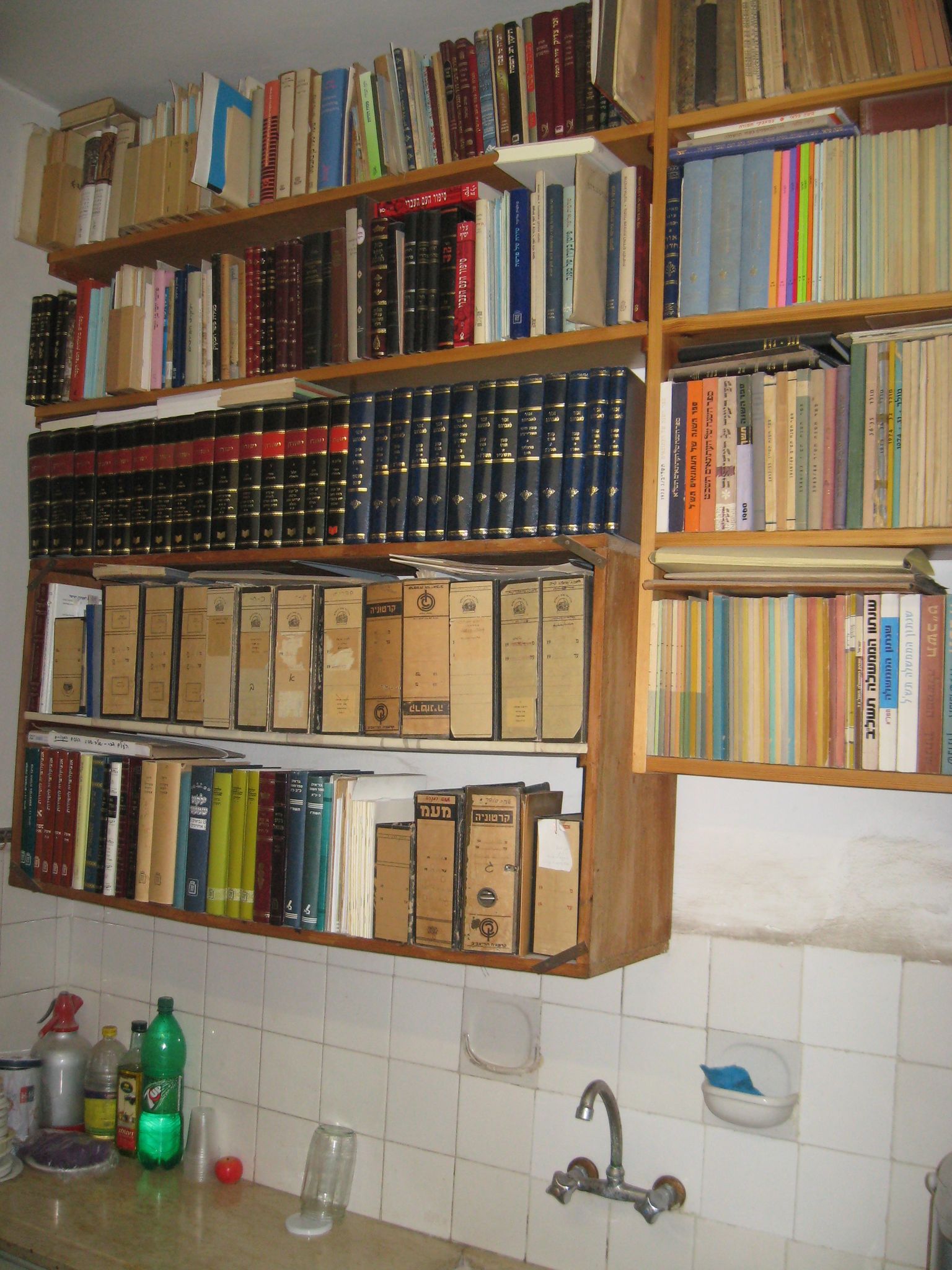
His love for seforim was something unique, the glow on his face when he opened up a new sefer, especially of someone he was into, was simply priceless. He would look carefully at the Shaar and if it was a reprint of an older sefer he would immediately check if they included the front page of the older edition to compare. He had seforim in every space possible in the four rooms of his apartment, including his porch. Many visitors noticed how even his kitchen was lined with seforim!
Dikdueki Sofrim Haskomot
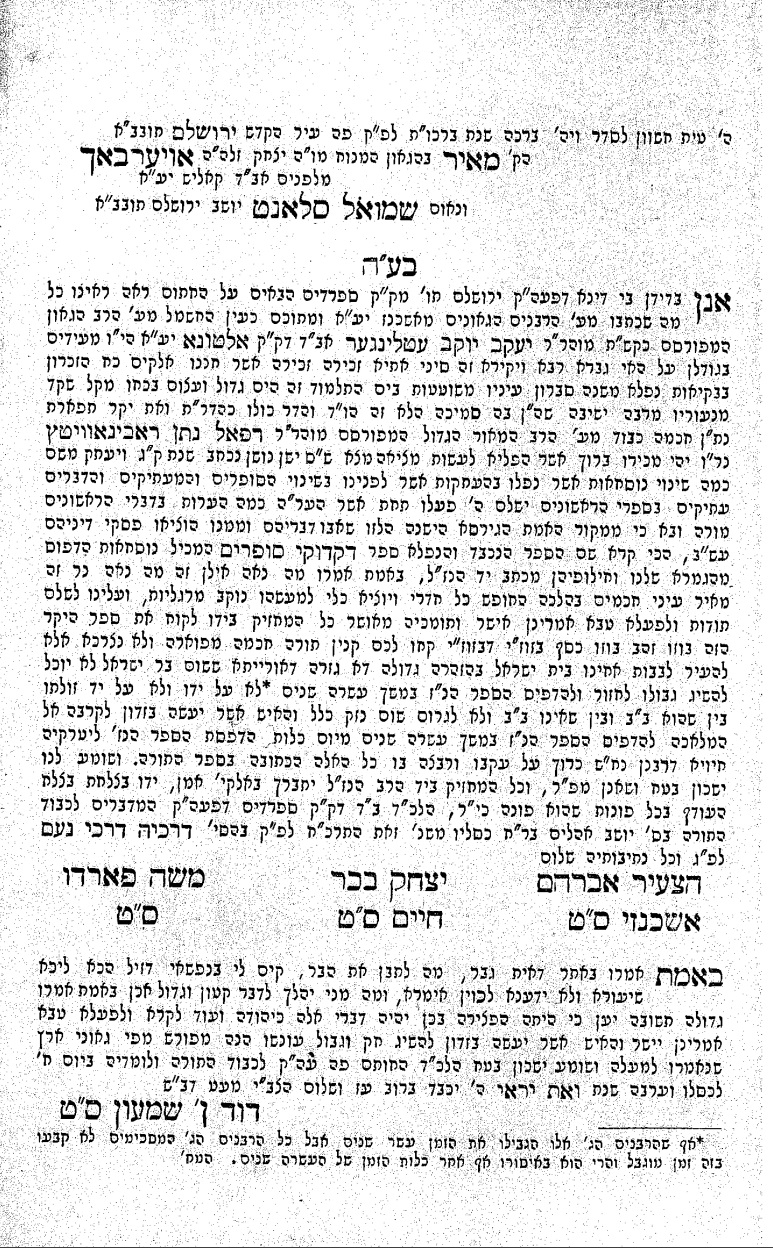
An interesting story happened with me and his library. While working on an article about the Dikdueki Sofrim I was unable to track down some recorded Haskomot that the author R’ R.N.N. Rabinowitz had received for the first edition of his work. I, along with other scholars, had searched numerous copies of the first edition, but with no luck. Late one night, I came to R’ Ashkenazi’s house and mentioned to him my problem. He said “show me the issue inside,” keeping with his custom to take care to always view the source material firsthand (Osiosi Machkemios – a topic he wrote a lot about). I took down his copy of the sefer, and lo and behold it was a first edition with the missing Haskamot! I published these missing Haskamot in my article on the Didukei Sofrim, and attributed this rare and miraculous find to his extraordinary library.
His History:
Where this unique Talmid Chacham came from is simply a mystery. He was born in Yerushalayim and lived in Batei Ungarn. He learned by Rav Yosef Tzvi Dushinsky of the Edah HaChareidis. Originally, his name was Deutsch but, at some point changed it to Ashkenazi. He had four children with his wife who died over forty years ago. Since then, he lived alone in his apartment near some of his children. His son did an excellent job of Kibud Av bringing him food every day and looking on him a few times a day. Yom Tov and Simchos he spent time with his family.
When I and others asked him, who was his Rebbe, he would just smile and say no one in particular. The truth is the Mishnah in Avos states: Knei Lecha Chaver. Aside from the simple peshat, Rashi explains this Mishnah by citing some who say it means via Seforim others commentators explain this as ‘buying a pen’ (see R’ Ashkenazi’s in-depth article on this for sources). R’ Ashkenazi employed all of these methods; his friends and teachers were his seforim and his pen.
R’ Ashkenazi was a short, quiet and unassuming person. Most, having seen him walking on the street, would never believe he was such an erudite Gaon. Many times, R’ Ashkenazi did not express much emotion except to give a pleasant smile and was friendly and polite in conversation. But there were times he got very excited; for example, when he recalled a good story from his younger years or something unique that he discovered years ago. He was very polite and was a real Yekeh; for example as soon as they bentched Rosh Chodesh Kislev his Menorah was already prepared in the window.
R’ Yechiel Goldhaber, a Talmid Chacham and author of numerous articles and seforim had a close relationship with R’ Ashkenazi for many years. He recalled when he was introduced to R’ Ashkenazi for the first time by his father-in-law, he thought to himself who is this simple looking man? He soon learned that this man was a master of all of Torah and swiftly became a close Talmid of his.
Many times, he would tell me he wishes he could come visit my library. In Later years he would spend his Yomim Tovim at his daughter. One Chol Hamoed Succos, when he was over ninety, he made the difficult trek from her house to mine in order to spend time in my library.
He would love to read everything he could get his hands on. I visited him at many different times of day, even late at night and I always found him learning a sefer – even when he was over ninety. He read everything newspapers, books – he was just curious about everything with an incredible thirst for knowledge.
I recall visiting him a few times when he eighty-five and noticed he was learning the Shelah Hakodosh very carefully. I asked him why (of course he had learned through this sefer numerous times before!) and he responded that someone is reprinting the sefer and asked him to go through the sefer and send comments. He therefore sat down to learn the whole sefer, line by line, after which he wrote a ten-page letter with his comments on the sefer.
Over time, I learned again and again that R’ Ashkenazi personally believed his purpose in this world was to help people with the incredible amounts of information that he had gathered over the years of intense learning. This incredible Middah can be seen in this light; he did not feel that he was the “owner” of this extraordinary wealth of information he had collected, and thus gave very willingly without any conditions. He never asked me to cite him when he gave me some rare source even – although I always told him I would; he just was so happy to help someone else.
He would collect and catalog much of what he read. He had all kinds of systems to file the information he had gathered over eighty plus years of learning. When he would read an important article in a magazine or journal, he would cut out the parts and store them in their appropriate place. He gathered information on thousands and thousands of subjects (not an exaggeration in any form) which had some connection to our rich heritage. What’s more astounding is that R’ Ashkenazi never used a computer or the internet; all of his erudition came about simple by learning through thousands of seforim; a great many of them rare or unknown.
Over the years he helped so many people and for many years after he retired, he would visit the National Library of Israel on Tuesdays, where throngs of people would line up in wait to speak with him about all kinds of subjects.
Many years ago, he received a call from a young chassidish Talmid Chacham living in Monsey who was starting to work on publishing a new edition of the classic historical work Seder Hadorot. He started asking him questions about various issues he had. Over many phone-calls R’ Ashkenazi answered many of his difficulties while training him in proper research and writing skills. This year some volumes finally were published (see here). And this was not a onetime occurrence – he helped so many more people. He used to remark to me that when he was younger so many people would come to visit him – until the late hours of the night.
He was an expert in so many different topics, whether it was the standard ones like Tanach, Chazal, Halacha, Minhag or Chassidus or less commonly studied subjects such as Tefilah, Piyut, Dikduk, Kabbalah, Philosophy, Machshavah, History and Bibliography. In all of these areas his expertise was remarkable.
His Uniqueness
A sample of his bekius; one time I noted that the Maharsha often quotes a “Sefer Yoshon Noshon” and asked if we have any idea which sefer this is? He immediately responded that he found it usually refers to R’ Todros Abulafiah’s Otzar Hakavod.
His incredible Bekius was bolstered by an almost photographic memory, as the following story demonstrates. Once someone used the Bar-Ilan Responsa search engine to locate a passage in the Tana DeBei Eliyahu to no avail. He went to ask R’ Ashkenazi who immediately told him where the passage could be found. Checking the Bar-Ilan text, it was discovered that when the sefer was being entered into their database the passage in question had been mistakenly omitted. I first heard this story from someone else, so to make sure it was accurate I asked him about it and he confirmed it. A similar story happened with him and a passage from the Shut Chasam Sofer.
A few years back a friend was working on publishing out an esoteric Rishon on Mesechet Megillah. He thought no one ever heard of this author and randomly mentioned this to R’ Ashkenazi – without batting an eyelash – replied “of course, and one can find material by this author in the work of Rav Shlomoh Alkabetz on Megillas Esther (Manos Halevi). The fellow was stunned in elation; he had just been gifted new and important material for his project.
This remarkable Bekius which even beat out computer search engines, was just one aspect that made him remarkable. He would receive numerous calls and letters from all over the world from people of all walks of life seeking his assistance in tracking down a statement. He had an incredible knowledge of all of Chazal. I do not just mean the “standards”; Bavli, Yerushalmi and Midrash – even all the numerous and very often almost unknown Midrashim printed over the years. He was also expert in what is known as the lost Midrashim. Over the years many Midrashim we had were lost but some traces of them can be found in various Piyutim, cited by Rishonim or in other obscure places. Through his incredible amounts of learning and his phenomenal memory he was able to recall so much in this field.
To illustrate this with some samples. A few years back someone who was editing for publication a never before printed pirush of a Rishon on Avos came across a few statements in the name of Chazal. This person, a Talmid Chacham in his own right and familiar with tracking down such material, could not locate sources for these statements. Immediately he penned a letter to R’ Ashkenazi. A few days after he received a letter from R’ Ashkenazi with various incredible sources for his questions. This was a very common occurrence.
Piyut, Tefilah and language
Earlier, I mentioned his expertise in Piyut, Tefilah and language. A bit of background is needed to explain this. Rabbi Joseph B. Soloveitchik, when describing Rabbi Elazar Hakalir’s greatness, (Koren Mesorat Harav Kinot (pp. 386-388) wrote the following:
The piyutim of Rabbi Elazar HaKalir, including his kinot, serve two purposes. The first is limmud, learning. Every sentence of the piyut quotes m’aamarei Chazal… The second purpose is tokhaha, rebuking the people for their misdeeds and instructing them in the proper way to act. These piyyutim deal with… repentance… acknowledgment of God’s justice. The shali’ah Tzibbur was not merely a chazan…, but was one of the great scholars of the generation who was the principal… moral critic of the people… Rabbi Elazar HaKalir was (also) a master of the Hebrew language and very creative in his use of Hebrew. If not for him, modern Hebrew could not have come into existence. Before HaKalir, the Hebrew language was very rigid. For example, the noun and verbs were fixed in their form… But HaKalir made a critical contribution to the development of the Hebrew language by endowing the language with flexibility… Rabbi Elazar haKalir’s piyutim served two purposes: limmud, study… As for the element of study, one of the dimensions of HaKalir’s piyyutim is that they are compilations of the statements of the sages. Most of us, who are expert in neither Hebrew nor aggadot Hazal, find HaKalir’s corpus of piyutim boring. But it is not boring at all; it is like a gold mine. His piyutim for Yom Tov explain the essence of the Yom Tov. The midrashim concerning Sukkot are replete with information about the sukka, etrog and lulav, and all the explanations in the Midrash, all the ta’amei sukka, the reasons for the sukka, all of the ma’amarei Hazal, are together in the HaKalir’s piyutim for the first day of Sukkot… If one were to study carefully and thoroughly the piyutim of Rabbi Elazar HaKalir for Rosh HaSahana, Yom Kippur, Sukkot, and Pesah, one would find many applicable halakhot and the entire pertinent Midrash, including many midrashim that are unknown to us from any other source.
Rav Ashkenazi was an expert on everything related to Tefilah and Piyut. He somehow read it all and retained it. But in addition, he was able to use his expertise in Chazal and Hebrew language to understand it on a much higher level and as a result was often contacted by the world experts on Tefilah and Piyut for his assistance. These requests came from experts such as Professor Shalom Speigel, Chaim Schirmann, Avraham Haberman, Ezra Fleischer and Daniel Goldschmidt who constantly sought his assistance while working on their Tefilah and Piyut related projects.
In an interview with Ami Magazine printed a few years back, Professor Shulamit Elitzur mentioned:
“there’s another amazing thing I find when doing research. I am constantly coming across midrashim that were lost to the ages… example, everyone knows that Haman was referred to as ‘the Agagi’ because Shaul allowed Agag to live one extra night, which allowed Haman’s ancestor to be born. However, the earliest makor we find in writing in the 16th century; this fact was discovered by Rav Shmuel Ashkenazi of Yerushalayim. But I found a ktav yad of a piyut about Purim that describes this very story and explains how Haman’s ancestor was born, which gives us a source from 1,000 years earlier! And there are many similar examples of lost midrashim being kept alive through unknown piyutim.”
R’ Ashkenazi wrote some articles on Piyut and Tefilah, but we have found much more among his papers and hopefully if I can raise enough funding all his fascinating material on Tefilah will come to light.
When the important Siddur Ezer Eliyahu (sponsored by his late friend Yeshaya Vinograd) was first printed, one can see R’ Ashkenazi’s name in the introduction, thanking him for his assistance (he assisted them for some of the later additions) and his great knowledge in this field.
I mentioned that he had an incredible knowledge of Dikduk and the Hebrew language and used it towards better understanding Piyut and Tefilah. He also authored articles on these subjects and in 1967, when reviewing an important dictionary, wrote a long article demonstrating this very point – and article that garnered much praise. He was very proud of this essay and mentioned it to me many times. A few years ago, I reprinted it with additions he had made in his own copy and a nine-page topical index.
One of the ways he developed this expertise was via learning Tanach so many times. He was an expert in Tanach and all the Rishonic commentaries (including the unknown ones); he even authored a small book of Riddles of Tanach.
He also used his extraordinary skills to become a master editor. However, in addition to the work he was born with an incredible innate sensitivity for text and language which made him one of the best editors out there. For many years he worked at the famous publishing house Mossad HaRav Kook, editing various works. He told me more than once how there was an expert there who would brag (jokingly) that after he read through an article it was impossible to find mistakes. The only person who could still find mistakes was R’ Ashkenazi. He had razor-sharp vision and could immediately spot a mistake.
Many times, I would bring an edited piece of mine to read. As soon as I put it down in front of him, he would take out a red pen and start marking it up and say to me “are you sure it’s been edited?”. He told me he had to mark up everything before he could read it properly, errata were so painful for him to see that it was hard for him to read something on Shabbos! He told me he was punished; when his work Alfa Beta Kadmita de-Shmuel Zeira came out, although he had edited it numerous times, he still found mistakes.
During his learning over the years, he found many people, great Gedolim as well as famous academics, had made mistakes, sometimes quite basic ones. At one point he printed two articles about this. However, he prefaced his articles that his intent was not to mock those who erred but to vividly illustrate that people are human and mistakes will happen. He was a master of humility and never held it over anyone that they did not know what he knew.
He was not only a great expert in all aspects of the Hebrew language but was an expert in Aramaic and Yiddish, both of which he displayed in various publications of his. Related to his expertise in Aramaic, which is very important for learning Gemara, is a very unique essay which he authored related to the Rambam as a translator of the Gemara. One of the world experts in old Yiddish is Professor Chava Turniansky, who has noted on many occasions that one of the people who have always helped her from her days as a student, was R’ Ashkenazi.
Related to this was another talent of his, which at first appears trivial; he was an expert on acronyms. This led to authoring a thesaurus of acronyms together with Dov Yardan, called Otzar Roshei Tevot, with a multitude of obscure and often almost impossible entries. His sensitivity to the text and work in the field of editing drew him to this field. Anyone who learns a lot, especially older material comes across abbreviations, and many times they cause great difficulty in understanding various passages. Abbreviations were employed in writing, sometimes as mnemonic devices and other times simply to save on printing costs. But over time many meanings were forgotten. This work is an extremely useful tool for solving this issue.
Ghostwriting
One day I was in a used bookstore and I noticed a small sefer titled Harif Umishnaso about the Rif. I recalled that this title appeared in the list in beginning of his work, Alfa Beta Kadmita de-Shmuel Zeira which listed out the various works he helped with over the years. I asked R. Ashkenazi if it’s worth buying and what his connection to the book was, as a different name appears on the cover.
R’ Ashkenazi replied “I can tell you it’s an important sefer and worthwhile to buy.” I noticed he was hesitant to continue the conversation. He then said “I will tell you something I did not tell anyone in over forty years – I wrote the whole sefer from beginning to end and it was one of the most important works I ever wrote.” The original plan was to for him to write a series of biographies on various Rishonim – in this book he already references a work on the Ri Migash – but due to a lack of funding this series was discontinued. However, not all of this remained unpenned; he wrote numerous entries in various encyclopedias. It turns out that R’ Ashkenazi had over fifteen different pen names!
I would like to elaborate on this work a bit more and thus cast further light upon R’ Ashkenazi’s uniqueness and greatness. The Rif’s Halachic work is one of the most important sources in Halacha, but what exactly makes it so unique has remained a mystery. R’ Ashkenazi sought to answer this question by collecting and collating all the authentic information we have about the Rif, from the Rif and from other Rishonim. He went through the Rif carefully examining what he did to each Gemara evaluating if remarks or material was added or not and to figure out why, allowing the reader to begin to understand the Rif’s significance. R’ Ashkenazi’s writing methods were honed to precision. He had an uncanny ability to utilize every piece of information without writing an extra letter and assemble it all in perfect order sans speculations commonly found in historical works. At times one does not need grand theories to understand something; just seeing all the known material in proper order helps one understand things. The wealth of material that Rav Ashkenazi commanded in producing this work is outstanding; this book was written in 1967 – long before any of the various search engines used today.
Haggadah Sheleimah
Similar to this is another work by R’ Ashkenazi, Haggadah Sheleimah. I hope to publish an article about this work in the near future, including the numerous additions R’ Ashkenazi found over the years and kept in his files. This work is highly unique for the following reasons. The collected bibliographies by Avraham Ya’ari and Yitzchak Yudlov bear witness to thousands of Haggados written throughout the generations in a multitude of styles, such as Pilpul, Peshat, Kabbalah, Derush and more. However, until 1955 there was no one work on the Haggadah which collected all the sources for each and every Halacha and minhag related to the Seder night. There was no volume which dealt with the various manuscripts of Geonim and Rishonim and at the same time to deal with the exact text of the Haggadah. Haggadah Sheleimah set out to fill those needs, and at the same time offer a running collection of Pirushim culled from over fifty different commentators focusing just on Peshat. In order to produce such an exacting work, it’s not good enough to just be a talented writer, one must also possess a keen understanding of all the material and relay this with incredible clarity. R’ Ashkenazi was such a person; one who sought out the simple Peshat, able to put this myriad of information together in so beautiful a fashion, and with tremendous clarity. His work in Haggadah Sheleimah is so clearly organized and always straight to the point that it is no wonder that to this day Haggadah Sheleimah remains a classic in both the Torah and Academic worlds.
Rav Ashkenazi once explained to me that one has to write precisely and to the point, not lengthily. He said he believed that one of the reasons Rashi’s works survived was due to his concise way it was written, as opposed to various works of Geonim which did not really survive as they were written in a much lengthier format.
Why didn’t he publish his material?
A few years ago, a partial bibliography of his writings was printed in his Alfa Beta Kadmita de-Shmuel Zeira. The listing is close to three hundred articles and seforim that he wrote or assisted in on some level. He started writing under various pen names over eighty years ago. The background to the publication of this volume was, as I mentioned previously, R’ Ashkenazi had been writing and collection information on thousands of topics for over eighty years. Unfortunately, he did not print much of what he gathered. The main reason for this was R. Ashkenazi’s “weakness”; he demanded incredible levels of perfection from himself. Although he strived for great perfection, nonetheless he stressed to me numerous times that he was mistaken in that approach and that I should not follow in his path. In his words it is better I print my work to the best of my current abilities and that worse comes to worse you can always reprint with additions and corrections. Over twenty years ago, R’ Teflinsky somehow convinced R’ Ashkenazi that his material needed to be printed. Together they began compiling some of his material for print, resulting in a volume over eight hundred pages!
After that experience both R’ Ashkenazi and R’ Teflinsky stopped, with no plans of continuing this project. A few years later my good friend, R’ Yaakov Yisrael Stahl and myself were able to convince him to continue. R’ Stahl took upon himself the daunting task to prepare the material for publishing; since, than three more volumes were printed.
Here is a small video clip of R’ Ashkenazi, when we brought him copies of the second and third volumes of his writings, ten years ago.
The topics that these works deal with cover, on some level, virtually everything; sources for expressions and idioms, for minhag, Halacha, the evolution of famous stories, bibliography, corrections of authors’ errors, encyclopedic style information on thousands of topics culled from thousands of seforim – many of them very rare or unknown. (A PDF of the Table of contents of this work is available upon request).
His Letters
Earlier I mentioned the story of someone who wrote him a letter seeking help. This was not a one-time occurrence. He authored well over a thousand such letters in response to such questions. Some requests were for sources to various Halachos or Minhagim, numerous others are various queries related to out rich literature. R’ Ashkenazi always invested his time to answer properly and clearly. Recently, R’ Stahl and I collected these letters for publication and the result is a three-volume set, available for purchase.
Over seventy years ago he purchased a typewriter which he used until his passing.
In an article written by the late Gaon R’ S. Deblitsky, he writes out various proper actions a Rav should “observe.” One of them is to respond to people who write to him, whether the issues are big or small. R’ Ashkenazi was very careful to try to respond promptly. Many people would send him their seforim after they were printed asking him for his comments. He would usually respond with a multi-page letter, beginning by thanking the author for sending it to him, then listing out some criticisms, usually written delicately, while adding all kinds of comments. He always tried to look to say something positive. Some people who heard of him through various channels over the years contacted him before they printed their works. Many times, he would write a collection of comments and corrections to such works. A sample listing of some of those works that benefited from him before going to print include recent editions of: Sefer Zechirah, Kav Hayasher, Sefer Hachayim and many others.
Thanks to the efforts of my special friend Menachem Butler, various academics wrote some praises about the significances of these letters; to partially quote one letter written by the esteemed Professor Shnayer Z. Leiman:
Reb Shmuel was
“bibliographer, bibliophile, and book collector, and his encyclopedic knowledge of all of Hebrew and Yiddish literature remains unparalleled in our time.” His collected writings are an intellectual treasure trove, “covering a wide range of topics in the field of Jewish Studies. Aside from his scholarly distinction, R. Shmuel Ashkenazi wrote in an elegant Hebrew with its own special charm. Not only did he advance discussion, but he did so in an aesthetically pleasing manner. Let it be said openly: this… set will enlighten every reader and will significantly advance scholarship. Anyone concerned with advancing the cause of quality Jewish scholarship will take special delight in the publication of these volumes…During his lifetime [Ashkenazi] corresponded with the greatest Jewish scholars and bibliographers the world over. They wrote to him, for only he could solve the countless historical and literary problems that stumped them…”
Another person to whom Menachem Butler reached out to via his numerous contacts was former editor of Mekizei Nirdamim’s journal Kabez Al Yad, Professor Shulamit Elizur of the Hebrew University of Jerusalem. In her aforementioned interview in Ami Magazine several years ago she said this:
“I am unequal to the task of adequately singing the praises of Rabbi Shmuel Ashkenazi, an erudite bibliophile. His familiarity with rabbinic writings from throughout Jewish history is unparalleled, and he is well-versed in the research literature of academic Jewish studies as well. I first met Rabbi Shmuel Ashkenazi through my teacher, the late Professor Ezra Fleischer. Prof. Fleischer, who was one of the greatest scholars of all time, would often chat with Rabbi Ashkenazi on scholarly topics, and he was careful to send Ashkenazi every article or book he published, knowing that in return he would receive enlightening comments on his work. When I began my own research, Prof. Fleischer instructed me in turn to send my publications to Rabbi Ashkenazi, and I too was privileged to learn a great deal from his comments. It once happened that I was searching for a particular midrashic theme which was alluded to in a liturgical poem (piyut), and although I consulted the leading scholars of Jerusalem who responded that it was a well-known homily, I was unable to locate its specific source. In my hour of need, I turned to Rabbi Ashkenazi, who immediately gave me several references. It emerged that every one of these references post-dated the piyut by almost a thousand years, and that this ancient tradition alluded to in the poem had been transmitted orally for that long period before being committed to writing in the later midrashim. Rabbi Shmuel Ashkenazi’s correspondence is a tremendous resource of Torah and scholarship. Every paragraph encapsulates a great deal in just a few words, and sometimes even with allusions whose explication require deep learning.”
Here is a short letter from Professor Gershom Scholem to R’ Ashkenazi:
Expressions and famous stories
In his writings some of the topics of these are about tracing expressions or the evolution of famous stories. Based on his knowledge, he was able to contribute a lot to these areas even editing some works on these topics.
One such story related to a supposed legend of a portrait of Moshe Rabbeinu which caused a great controversy over a century ago. In 1830, Rav Yisroel Lipschutz started printing his magnum opus, a commentary on the Mishnah titled Tiferes Yisroel. In the section on Maseches Kiddushin first printed in 1843, he brings a story about a king who lived in the time of Moshe, who, after hearing incredible things about this great leader, hired a painter to paint a picture of him so he could have his features analyzed by experts. The people who analyzed the picture reported that the person pictured was evil. The king went in person to visit Moshe Rabbeinu in the midbar and asked him how was it that an analysis of his pictures showed him to be of such wicked character. Moshe told him that the analysis was indeed true; however, after much work, he changed his character and became the great Moshe Rabbeinu.
In 1894 a booklet by the Vilkomir Maggid was printed railing against this story. This booklet presented numerous sources stating that Moshe Rabbeinu was born a kadosh and it was unthinkable to print such a story about him. Indeed, this story was censored out of the 1956 edition of the Tiferes Yisroel. In truth, this ancient legend can be found in various sources and in regard to different luminaries, some claiming it about Aristotle others, Socrates. In fact, R’ Ashkenazi documented it was long used in various Musar and Chasidus sefarim cited as an important lesson that one can change one’s born nature for the good, but not that it actually was true about Moshe Rabbeinu.
Another such story relates to a famous legend about the site where the Beis Hamikdash was built. Told in short, two brothers inherited a field, one brother had a family one did not. At the end of the harvest they divided up the wheat equally. That night the childless brother felt bad for his brother with a large family and said to himself “it’s unfair that while my brother needs more than I, we shared equally”, so he brought over from his pile to his brothers. The other brother thought that since his brother was childless, he should have a larger share of the crop, as consolation, so he added from his share to his brother’s. In the morning each brother realized their piles remained the same and this went on for two more nights. On the third night they met, realized each of their intentions was out of deep consideration for the other and hugged. Numerous people have searched for the early sources for this story. I decided to ask R’ Ashkenazi if he had any material on the subject. He found his file on the story and within was a letter from R’ Yudlov who had been asked by someone in the Education Ministry for the sources on this story. R’ Ashkenazi traced its first appearance in print to 1832 and from there he traced it to other sources.
Bibliography
I would like to conclude with just one more area in which R’ Ashkenazi was truly a legendary master: Bibliography. For many years, R’ Ashkenazi worked in the (now) National Library’s Bibliography of the Jewish Book Project. He also contributed to some of the important bibliographical works and journals written in the past century such as Kiryat Sefer, Otzar Sefer Haivri (Vinegrad) and Sifrei Yerushalyim Harishonim.
A few years back, while working on an article about the origins of eating Hamantaschen (see here), I found an important article from Dov Sadan containing sources on this topic. One of the sources was the interesting, controversial work Machberet Emanuel. I had a nice conversation with R’ Ashkenazi about this work – he had helped Dov Yardan prepare a critical edition of the work and even wrote a long book review on it (which he said he received a lot of Kovod for).
He mentioned two points of interest which will serve as a sample to some of his expertise. One, he noted that Emanuel of Rome wrote a commentary on sefer Mishlei. Interestingly, the preface to the Mishlei commentary sefer is signed Emanuel son of Yaakov, whereas Emanuel’s father’s name was Shlomo. Some have noted that this discrepancy and explained it is a mistake. R’ Ashkenazi suggested this was not a mistake, rather an intentional typo intended by the author to hide his connection to his controversial Machberes Emanuel. The second point he made to me was how the Chida writes in Shem Hagedolim that the best commentary to learn on Mishlei that by Emanuel of Rome. R’ Ashkenazi said he checked into the words of the Chida and he learned through all the works on Mishlei and concluded that the Chida was quite correct. He once had a dream to write a whole work on Mishlei, he even started to pen his comments in a special notebook, but the plans never worked out.
One final last story about R’ Ashkenazi’s bibliographic acumen. In 2009 my special friend Dr. S. Sprecher z”l (about him see this article on the seforim blog here) wished to reprint and distribute a small work called Tshuvah Be’Inyan Kriat HaKetubah, in honor of his son’s upcoming wedding, under that assumption that, just as the title page and the publisher’s introduction indicated, it represented an actual Halakhic Responsum issued in 1835 by the Chief Rabbi of Bialystok, one Rabbi Nechemiah. Sprecher wrote:
However, our close reading of this Tshuvah led us in an entirely different direction. To us, the work’s style manifested clear Maskilic echoes, and its arguments rejecting the binding nature of centuries-old Minhagim were clearly not in accord with 19th–century Halakhic thought. Our reaction was that the work must certainly be pseudepigraphal and could not have arisen from the pen of the Chief Rabbi of Bialystok. In fact, a quick perusal of the reference literature demonstrated that there never was any Chief Rabbi of Bialystok named Nechemiah.
At an impasse, we reached out to Professor Shnayer Z. Leiman, who suggested that the scholar most likely to solve the mystery would be the doyen of Israeli bibliographers, Rabbi Shmuel Ashkenazi. We were rewarded thanks to the tireless efforts of Eliezer Brodt who, on our behalf, pestered the aged Jerusalem sage until he successfully unmasked the name, but not quite the identity, of the author. Rabbi Ashkenazi concluded that the first line of the introductory poem that prefaced the Halakhic query contained the acrostic – “Meir Ish-Shalom”. (His initial contention was that this could not be the noted 19th–century Viennese scholar, Meir Ish-Shalom, because his heretofore known literary output began only some five years later, with his publication of the Sifre in 1864.)
Once Rabbi Ashkenazi had provided the key to the author’s name via the acrostic, it became apparent that all along the title page had been proclaiming that very same message. Let us recall the passage in Bavli Eruvin 13b where it is recorded that the celebrated Tanna, known to us as Rabbi Meir, was actually named Nehorai, according to one opinion; or alternatively, that both Meir and Nehorai were laudatory appellations reflecting his enlightening wisdom, whereas his actual name was Nechemiah. Recall also that the query first originated with Rabbi “Shalom” of Novgorod, and the word “shalom” appears twice more on the title page and is highlighted by the placement of a circle above one of its appearances.
In his copy of this work that Dr Sprecher printed for the Chasunah which I brought him, I found this paper inside:
A few weeks after R’ Ashkenazi’s Petirah the national library held a session devoted to him where Professor Zev Gries, Professor Chava Turniansky and R’ Yechiel Goldhaber spoke about him (here is a link to the whole session). I too had the privilege of being interviewed about him that night (Here is a link to my interview).
Publication of his writings
Last year, immediately after Rabbi Shmuel Ashkenazi was niftar I, along with my special friend Menachem Butler, initiated a campaign to raise funds to publish R. Ashkenazi’s letters via the Seforim blog. Baruch HaShem, and thanks to the help of some readers, enough money was raised to go to print and in the beginning of this past January copies of the book, coming in at over 1,700 pages, (three volumes!) arrived as announced (here). The Letters sold out in a few days. A second edition was printed right before Pesach (see here). Currently copies of the second edition are available for sale.
Future volumes
Already during the Shivah, R’ Stahl began going through the materials of R’ Ashkenazi to sort out what materials are print worthy.
Here is a picture of R’ Stahl taken during one such session which a friend of his humorously put side by side a famous picture of Solomon Schecter when working on Geniza documents.
We never imagined we would find so much print-worthy material that we were not previously aware of; at least eight volumes’ worth of prepared writings which we hope to print. Currently, we are in the process of categorizing the material. Among the topics are: Tefilah, Minhag, articles on Seforim and authors – and much, much more. As we sort and scan R’ Ashkenazi’s legacy, some material is already being sent out to be typed up for publication. Each of the above endeavors comes at a price, and every contribution to the cause helps greatly. IY”H in the near future I will make a more formal announcement with precise details regarding the works slated for print. Anyone wishing to help with funding this project can contact me at Eliezerbrodt@gmail.com
Cherubim: Winged Celestial Beings on the Title-Pages of Early Hebrew Books
by
Marvin J. Heller[1]
And having driven out the man, He stationed at the east of the Garden of Eden the Cherubim and the flame of the ever-turning sword, to guard the way to the Tree of Life (Genesis 3:24).
You shall make two Cherubim of gold—hammered out shall you make them—from both ends of the cover. You shall make one cherub from the end at one side and one Cherub from the end at the other; from the cover shall you make the Cherubim at its two ends. The Cherubim shall be with wings spread upward, shielding the Cover with their wings with faces toward one another; toward the cover shall be the faces of the Cherubim being turned toward the cover. (Exodus 25: 18-20).
Rav Ketina said: When the Jewish people would ascend for one of the pilgrimage festivals, the priests would roll up the curtain for them and show them the cherubs, which were clinging to one another, and say to them: See how you are beloved before God, like the love of a male and female (B.T. Yoma 54a).
Cherubim (angels) are a frequent presence on the title-pages of early Hebrew imprints in the sixteenth century and afterward, the latter beyond the scope of this article. They are also to be found in incunabula, on the frames of initial pages and head-pieces for text.
How do you define what are cherubim? One definition, that of the Encyclopedia Judaica, is “a winged celestial being which appears in the Bible in several different guises.” It then proceeds to give several descriptions of cherubim. The Jewish Encyclopedia begins with a more detailed description, stating cherubim are “the name of a winged being mentioned frequently in the Bible. The prophet Ezekiel describes the cherubim as a tetrad [set of four] of living creatures, each having four faces—of a lion, an ox, an eagle, and a man—the stature and hands of a man, the feet of a calf, and four wings.”[2]
The use of cherubim is also noted in the 1911 Encyclopædia Britannica where they are described as “imaginary winged animal figures of a sacred character, referred to in the description of Solomon’s temple (1 Kings vi. 23-35, vii. 29, viii. 6, 7), and also in that of the ark of the tabernacle (Ex. xxv. 18-22, xxvi. 1, 31, xxxvii. 7-9). . . . In Gen. iii. 24 the cherubim are the guards of Paradise . . .”[3]
The frequency of the appearance of cherubim in Hebrew literature can be found on Sefaria, a bibliography of Jewish texts, which records fifty-six entries for cherubim under biblical, Mishnah 27, and Talmud 991. Among other entries are Midrash, 590; Halakhah 7947; Kabbalah 747; and yet still others as well as multiples of commentaries on the first works.[4]
These multi-winged creatures are also a feature in general literature. Franz Sales Meyer, under the heading Miscellaneous heads, describes the “Angel faces, youthful heads, with a circular or disc-like halo, are first met-with in the Byzantine style, as the result of ecclesiastic articles,” He continues that in the early Italian Renaissance such renderings were charmingly naïve. They appeared as adornments on friezes and arches, medallions, and in borders. They also are to be found on tombs and are “Much used in Modern ecclesiastical decorations.” The text is accompanied by a page of examples of the cherub head, including one of a skull.[5]
It had been my intention to describe Hebrew title-pages with images of cherubim over a period of two centuries.[6] The numerous instances of such usage, however, has necessitated a considerable limiting of our subject period. Indeed, rather than noting all the examples in our current period, in the sixteenth century, we only describe several exemplars, giving background about the books in which they appear, that is, the publisher, author, and book subject.[7] This article is expansive, that is, in describing cherubim, it discusses the varieties of Hebrew literature, the authors of the subject works, the presses that published them, and even Hebrew book history. The title-pages and infrequent text pages with displays of cherubim addressed here are in chronological order, but from diverse locations and, again, on a variety of books, indicative of how widespread Hebrew publishing was and even more so the depth and nature of Hebrew literature.[8]
1514-18, Hameshei Humshei Torah – Our first work with the appearance of cherubim is a folio (20) edition Hameshei Humshei Torah (Pentateuch) with haftorat and commentary of Rashi printed in 1514-18 in Prague at the press of Gershom ben Solomon ha-Kohen and partners. Gershom later received a royal privilege from King Ferdinand of Bohemia, allowing him, that is Gershom alone, to enjoy a monopoly on Hebrew printing in Prague. His descendants, known as the Gersonides, continued to print in Prague until the mid-seventeenth century.
1514, Hameshei Humshei Torah Courtesy of the Library of the Jewish Theological Seminary
A magnificent edition, with ornate woodcut frames and large type for the text. Each book has a unique decorative opening page, there is no title page, comprised of four separate pieces, those on the pillared sides with vases, leaves, and cherubim, similar but not identical, the top piece with a concave bottom edge. Genesis has a convex curved piece to fit with this top piece on the upper half of the page, with winged cherubim holding a shield with the spread hands of the Kohen giving the priestly blessing.[9]
Work on the Pentateuch began on 10 Sivan (June 14, 1514) but, perhaps as a result of the success of the prayer book, the partners found they had overextended themselves and found it necessary to suspend work on this project for two years. In 1530 Gershom and his sons reprinted this Pentateuch in an identical format, except for changes to the decorated initial pages.
1527, Dictionarium Chaldai – Our next entry with cherubim is an Aramaic grammar by the Christian-Hebraist scholar Sebastian Muenster (1489-1552). It was printed in Basle in 1527 at the press of Johannes Froben in quarto format (40: [1], 434, [7] pp.). The Froben family was the most significant printers of Hebrew books in Basle. Johannes Froben published as many as 250 titles, among them Hebrew/Latin books of the Bible and grammatical works, primarily works by Muenster.
Sebastian Muenster, a cosmographer, astronomer, and orientalist was, for twenty three years, professor at Basle. Born in Niederingelheim, Hesse, the son of a Spitalmeister (hospital master), Muenster had no university education nor did he ever receive a degree. His education consisted of some private instruction in Latin and later studies at Frieberg and attendance at lectures given by the Franciscans. In 1506, Muenster entered the Minorite order and was sent to study in Rufach under Conrad Pellican (Pellicanus, 1478-1556). The following year he took vows and, in 1512, was ordained a priest. Muenster assisted Pellican in teaching in Pforzheim and, from 1524-29, occupied the chair of Hebrew at the University of Heidelberg. In 1529, Muenster converted to Protestantism and moved to Basle, where he occupied the chair of Hebrew, at a salary of 60 gulden; from 1547/8 he was rector. From about 1525, Muenster was a student of Elijah Levita, translating and editing his grammatical works. Muenster also translated a number of other Hebrew works into Latin and was a prolific author in his own right. By the time of his death more than 100,000 volumes of his works were in circulation. His Jewish oeuvre, more than three-score publications, covers all aspects of Judaica, excepting Kabbalistic studies, which did not interest him. In 1523, Muenster published Dictionarium Hebraicum . . . adiectis Chaldaicis vocabulis, his study of the Aramaic language. The book reads from left to right but the text follows the Hebrew alphabet. Words are given in vocalized Hebrew, followed by their etymology, definition and examples.
The title page of the Dictionarium Chaldai has an architectural frame with cherubim in various positions, as well as additional cherubim below mounted and otherwise. This title page, designed by Hans Holbein, was used as early as 1516 on Basel statutes and into the seventeenth century.[10][11]
Not long afterwards, from 1540 through 1543, at least five titles were printed in three locations with varied images of cherubim on the title-page, that is Augsburg, Prague, and Bologna. That is not to say these frames were not used on other books, most likely they were, but rather these are examples of cherubim used by the printers of Hebrew books at the time.
Augsburg has an early history related to Hebrew printing. Several early anti-Jewish works beginning with the apostate Johannes Pfefferkorn’s Der Judenfeind (1509) and other anti-Semitic books by apostates were published there. Another early Augsburg publication of note, this certainly more positive, albeit not a Hebrew edition of that popular and much republished work, is the first printing of R. Joseph ben Abraham Gikatilla’s (1248–c. 1325) kabbalistic classic, Sha’arei Orah, which explains and analyzes the ten Sefirot. This edition of Sha’arei Orah is a Latin translation of that work by the apostate Paulus Ricius (Paulus Israelita, 1480-1541) under the title Portae lucis, published in 1516 at the press of Johann Miller.
1527, Dictiorionarim Chaldai Courtesy of the Fales Library and Special Collections, New York University
Serious Hebrew printing in Augsburg begins when Hayyim ben David Shahor, among the pioneers of Hebrew printing outside of Italy, came to Augsburg in about 1533/34. In Augsburg, Schwarz worked in the print shop of Silvan Otmar (d. 1540), a renowned and highly productive printer, and resided in the home of Bonifacius Wolfhart, a Protestant pastor who also served as the censor of Hebrew books for Augsburg.[12] Shahor printed several works in conjunction with his son, Isaac, and his son-in-law, Joseph ben Yakar, who assisted him at the press, although their names are not mentioned on the title-pages.[13]
Shahor likely joined with a non-Jewish printer, perhaps August Wind, a printer of Hebrew works for Christian clergyman. Hayyim left for Italy, returning to Augsburg in 1540. He then printed three books, Avkat Rokhel, Arba’ah Turim and a prayer book for, according to the Thesaurus of the Hebrew Book, a total of ten works in Augsburg. Due to a lawsuit by an apostate, Paulus Aemilus, with whom Shahor had been associated in Ferrara, resulting from their failed venture, Shahor and his family were forced to cease publication and leave Augsburg. Aemilus, seeing a market in Augsburg for Hebrew/Yiddish books, began to print on his own account. He issued a small number of titles, most notably the Melokhim Bukh (1543) and the Shmuel Bukh (1544), Yiddish poetical renditions of the books of Kings and Samuel, both with images of cherubim (below).[14]
1540, Avkat Rokhel – Our first Augsburg title is Avkat Rokhel, an eschatological work on the principles of faith attributed to R. Machir ben Isaac Sar Hasid, a student of R. Judah ben Asher, son of the Rosh. Printed in octavo format (80: 18 ff.), perchance by Shahor. The Thesaurus of the Hebrew Book attributes it, albeit in brackets, to Hayyim Shahor, in contrast to the National Library of Israel that records the printer as unknown.[15]
The text of the title page is set within a decorative frame with nineteen cherubim and a number of animals. The title-page states that it is,
Sefer Avkat Rokhel
Printed by the printers named at the end of the volume. Edited with great care, with all our ability, “the good hand of our [Lord] upon us,” (ref. Ezra 8:18). And it was completed, here Augsburg, the great city, with the help of the Lord and His salvation. In the year, “[Rejoice, O you nations, with his people; for he will avenge the blood of his servants,] and will render vengeance to his adversaries, and will make expiation כפר (300=1540) for the land of his people” (Deuteronomy 32:43).
The names of the printers, Hayyim Shahor, Isaac ben Hayyim, and Joseph ben Yakar, the statement on the title page notwithstanding, are not given at the end of the volume. A brief introduction informs that the work was named Avkat Rokhel (the perfumer’s powders, Song of Songs (3:7)) for as the perfumer’s powders strengthen the soul, so too when one reads this book will he fear and cause his soul to be pure and free from all sin and transgression, thus meriting the good.
1540, Avkat Rokhel
Courtesy of the Dorot Jewish Division New York Public Library
The like title-pages of Avkat Rokhel and Unterricht Wie ain Christenmensch, the latter a non-Hebrew work printed approximately two decades earlier, reflect a relationship between Jewish and Christian printers, that is, Christian printers published Hebrew books in association with Jewish associates. The relationship between the printers was mutually beneficial. For the Christian publisher “the Hebrew books sector, being unique, was attractive to investors, being more limited and not so wildly competitive as the Italian book sector.”[16] In addition to the non-Jewish printer’s access to the Jewish book market, the Jewish publisher was able to not only publish Hebrew books, but he also gained access to the typographical material of his Christian associate. The latter, for example, frequently provided attractive frames to the former after having used them for his market and the Jewish partner also utilized the printer’s other ornamentation. This was of value to the Jewish partner as he did not have to go the expense of having decorative material prepared, at a relatively much greater expense as it would be utilized for a much smaller market. This despite the fact that the frames were often incompatible with traditional Jewish sensibilities.[17]
The like title-pages of Avkat Rokhel and Unterricht Wie ain Christenmensch, the latter a non-Hebrew work printed approximately two decades earlier, reflect a relationship between Jewish and Christian printers, that is, Christian printers published Hebrew books in association with Jewish associates. The relationship between the printers was mutually beneficial. For the Christian publisher “the Hebrew books sector, being unique, was attractive to investors, being more limited and not so wildly competitive as the Italian book sector.”[19] In addition to the non-Jewish printer’s access to the Jewish book market, the Jewish publisher was able to not only publish Hebrew books, but he also gained access to the typographical material of his Christian associate. The latter, for example, frequently provided attractive frames to the former after having used them for his market and the Jewish partner also utilized the printer’s other ornamentation. This was of value to the Jewish partner as he did not have to go the expense of having decorative material prepared, at a relatively much greater expense as it would be utilized for a much smaller market. This despite the fact that the frames were often incompatible with traditional Jewish sensibilities.[20]
The title-page of Avkat Rokhel has the largest number of cherubim of our title-pages, nineteen in all, of our title-pages. The cherubim appear on the bottom, sides, and top of the frame, all active, albeit in different activities. The text of Avkat Rokhel is in three parts, each further subdivided. The first section addresses the struggle against one’s evil urge prior to redemption and the birth pangs and advent of the Messiah, and an explanation of the pertinent midrashim; the second part discusses the rewards and punishments of the soul after the resurrection, the nature of the world to come according to Judaism, in contrast to the views of non-Jews, and resurrection; and the third part the laws stated by the sages of the Talmud as halakhah Moshe me-Sinai, the formation of man and the number 248 limbs in a person, the statement of our sages concerning three partners in that process (God, man, and woman) and some gematriot.
This is the third edition of Avkat Rokhel, it having been printed previously in Constantinople (1516) and Rimini (1526). Ch. B. Friedberg records, in his Bet Eked Sepharim, more than twenty-five printed editions of Avkat Rokhel. It was translated into Latin by A. Hulsius and printed in his Theologia Judaica, (Breda, 1653) and a Yiddish edition was prepared by Naphtali Pappenheim (Amsterdam, 1647).[21]
1543, Melokhim Buch – Two additional works printed in Augsburg, attributed to Moses (Esrim ve-Arbeh) Ashkenazi, are Yiddish poetical renditions of the books of Kings and Samuel. Moses’ appellation, Esrim ve-Arbeh (24), derives from either his birthplace, Vierundzwanzig Hoefe (24 courts) in Wuerttemberg, or from his extensive knowledge of the 24 books of the Bible. Moses’ accreditation with either authoring or transcribing the Melokhim Bukh is due to its similarity to the Shmuel Bukh, more reliably attributed to him. Nevertheless, sufficient differences exist between the two works that many scholars believe they do not share a common author. It is clear, however, that the author, even if not this Moses, was an Ashkenazi Jew. The Melokhim Bukh was published in quarto format (40: [123] ff.) by, according to the colophon, Paulus Aemilus. A Latin colophon states, Augustae Vindelicorum/ per Paulum Aemilium, Anno/ Domini M. D. XLIII. Meyer Waxman suggests that it is doubtful, the colophon notwithstanding, that the publisher was Aemilus; more likely it was Hayyim Shahor.
We have noted above that the frames on these title-pages were first used by Christian printers and that when that market no longer needed the frames, they were made available to Jewish printers. The cherubim frames noted above were generally acceptable to a contemporary renaissance Jewish public, although some, many, were questionable and would not be used today. In contrast, the title-page of the Melokhim Buch has a border made up of a four-part frame, the top with a representation of a king, the left and right sides respectively with images of Adam and Eve, unclad, the latter with the snake, two small children, and expecting. At the bottom are two cherubim. Use of this frame is surprising, for in contrast to other frames its’ contents appear to be objectionable, more so than other frames, even those with mythological characters. It seems likely that this frame might also be distasteful to Christian sensibilities.[22]
1543, Melokhim Buch Courtesy of Dr. Moshe Rosenfeld
The title page states that it is “The book Melokhim (Kings) in Taytsher sprach, beautiful and clear and very entertaining to read. Printed in the imperial city of Augsburg in the year 303 (=1543)” [23] The colophon dates the completion of the work to Friday, 14 Av, 303 (July 25, 1543), which was a Sunday in 1543.
The Melokhim Bukh was not written as a sequel to the Shmuel Bukh. It is the older of the two books, originally written as a separate work, possibly as early as the fourteenth century. The format of the Melokhim Bukh, a rhymed paraphrase of the book of Kings, is that of the heroic epic, stylistically modeled after comparable German sagas, such as the Nibelungen. The subject matter is the events in Kings I and II, imaginatively and colorfully enhanced by material from the Talmud and Midrashim, all expressed with a deep piety. Intended as a complete history, it begins with a hymn of praise to God in three strophes followed by nine strophes from the Exodus to the last days of David, the contents of Kings, and as a sequel, the history of the Jews to the end of the second commonwealth in thirty strophes). An example of the text is,
You have frequently performed signs for the children of Israel;
Therefore they are obliged to have You for their Lord.
And to fear Your name-that is useful and good for them.
That man is foolish who acts contrary to Your word.[24]
1544, Shmuel Bukh – The Shmuel Bukh was published, also likely by Hayyim Shahor in quarto format (Format 40: [102] ff.). It has an ornate title page made up of figurines above and about pillars with cherubim on the sides. It too is in Vaybertaytsh; among its reprints is a Latin edition (Ingolstadt,(1562). Waxman suggests that the Shmuel Bukh was likely written at least a hundred years earlier, most likely an original production of medieval Jewry. The author reworked the biblical material and incorporated aggadic elements. It was written in “vigorous poetic style” in eight line strophe and was meant to be sung.[25]
1544, Shmuel Bukh Courtesy of Dr. Moshe Rosenfeld
In contrast to what was written above, “works that many scholars believe they do not share a common author,” Zinberg informs that both the Melokhim Bukh and the Shmuel Bukh are composed in the same verse-meter. Moreover, the title-page states that “Shmuel is the first part of
the book Melokhim, for it is all related.” Nevertheless, Zinberg quotes other sources that “these are two quite different works and were probably written by two different poets.”[26]
1553, Ma’yan Gannim – A composition book comprised of sample letters from R. Samuel ben Elhanan Jacob Archivolti (c. 1515-1611). Ma’yan Gannim was published in a small sextodecimo format (160: 45, [1] ff.) at the Venice press of Alvise Bragadin. The Bragadin press was active before the papal bull, dated August 22, 1553, by Cardinal Giovanni Pietro Caraffa, the future Pope Paul IV, an extreme reactionary and bitter anti‑Semite, who ordered the confiscation and burning of the Babylonian and Jerusalem Talmuds. This had a chilling effect on Hebrew printing and resulted in a considerable decline if not outright cessation of printing in Venice, and the subsequent expurgation and censorship of Hebrew books. When Hebrew printing resumed in Venice in 1563, among the Christian printers who took up the publication of Hebrew books was Alvise Bragadin. Bragadin died in the mid-1570’s, he was succeeded by his son, and after him by successive members of the family well into the eighteenth century, the last known Bragadin being Alvise III. Throughout that time the press remained a leading printer of Hebrew books in Venice.
1553, Ma’yan Gannim Courtesy of the Library of Agudas Chassidei Chabad Ohel Yosef Yitzhak
Archivolti, a student of R. Meir Katzenellenbogen (Maharam, 1473-1565), served as rabbi, av bet din, and rosh yeshivah in Padua. Among his students was R. Judah Aryeh (Leon) Modena (1571-1648). Prior to settling in Padua in 1568, Archivolti worked as a corrector for the Hebrew presses in Venice.
In contrast to our preceeding examples of cherubim, this exemplar does not appear on the title-page of the book, which has the Bragadin device, that is, three crowns, but rather at the beginning of each of the book’s five chapters, a woodcut illustration comprised of three cherubim in a cage, surrounded on all four sides by a verse.
The title is from “A fountain of gardens (ma’yan gannim), [a well of living waters, and streams from Lebanon” (Song of Songs 4:15). The text states that there are fifty letters, that is, twenty-five letters with their responses, written by Archivolti. There is a preface and introduction from Archivolti, followed by a table of contents, and, beginning on 7a, the text. Ma’yan Gannim is the first book written by Archivolti, for he describes it as his first fruits, an offering to the Lord. Archivolti also wrote Degel Ahavah (Venice, 1551), an ethical work; He’arot le-Sefer he-Arukh (Venice, 1553), textual references for the Arukh of Nathan ben Jehiel; and, his most important title, Arugat ha-Bosem (Venice, 1602) a grammatical work in 32 chapters.
The sections or chapters, each on a different theme, are correspondence between a father and son; between friends; from an older to a younger man; with government officials; and others, including letters of a romantic, and even sensual nature. Such letters, at the very least inappropriate by modern religious standards, are intermingled with those of a sacred nature, reflecting contemporary mores and addressing current issues, including therefore, information of historical and cultural value. Ma’yan Gannim is designed to teach through example the rules of correspondence. The letters are in metrical form, designed by Archivolti as literary models, many with ethical content, for his students.[27]
1556, She’ilot u’TeshuvotJacob ben Moses Moellin (Maharil) – Two hundred and five responsa from R. Jacob ben Moses Moellin (Maharil, c. 1360-1447). The She’ilot u’Teshuvot were published in Cremona at the press of Vincenzo Conti in octavo format (80: [7] 79 ff.). After the Talmud was burned in Venice in 1554 there was a precipitous decline, if not a complete cessation, in the number of Hebrew books printed in Venice for several years. The breach was filled by presses in Ferrara, Sabbioneta, Cremona, and Riva di Trento. Vincenzo Conti (d. 1569) printed briefly in Sabbioneta and subsequently in Cremona, where his press was active from 1556 to 1567, issuing more than forty titles.
Maharil was the leading halakhic authority of his time. His most important work is Sefer Maharil (Minhagei Maharil, 1556, Sabbioneta), a popular and influential work on customs and laws. It was composed by his pupil Eleazar ben Jacob (Zalman of St. Goar), from the discourses that he heard from Maharil. She’ilot u’Teshuvot is comprised of Two hundred and five responsa, a small part only of Maharil’s responsa. The subject matter, as in the Sefer Mahril, deals to a great extent with custom, but also includes much personal material. They also reflect Maharil’s considerable humility and compassion.
1556, She’ilot u’Teshuvot Jacob ben Moses Moellin (Maharil)
Courtesy of the Library of Agudas Chassidei Chabad Ohel Yosef Yitzhak
The title-page has an ornamental frame made up of four parts, enabling the printer to use them in other arrangements, although this is the manner in which the parts are most often employed. The top frame has the face of a man and cherubin; on the sides are suits of armor, shrubs, and musical instruments and, in the center of the left vertical frame the letters SPQR, reputedly standing for Senatus Populusque Romanus; and on the bottom a two headed crowned eagle and on the sides the cherubim. This frame was used by Conti on his early imprints, appearing on about ten works.
1558, Sefer Rav Alfas –Sefer Rav Alfas, (Hilkhot Rav Alfas, Sefer ha-Halakhot of Alfasi, Rif) was published in Riva di Trento by R. Joseph Ottolenghi and Cardinal Cristoforo Madruzzo in a three volume folio format (20: 288, 268, 302 [8] ff.). The Tyrolese town of Riva di Trento is the source of an unusual episode in the history of the Hebrew book. It was for a short time, from 1558 to 1562, a refuge for the Hebrew book; one in which about forty Hebrew titles were printed. Believed to be the first work printed in Riva di Trento, Hilkhot Rav Alfas was likely selected, in addition to its inherent popularity and value, due to the ban on the Talmud, the Rif, being a halakhic compendium of the Talmud, filling, to some extent, the gap left by the scarcity of that work.
It was in Riva di Trento that Cardinal Cristoforo Madruzzo (1512-78), Cardinal of Trent, a scholar and supporter of learning, who argued at the Council of Trent (1562) for leniency and moderation in condemning books, became the patron and protector of a Hebrew press, which was also a source of revenue for him. Ottolenghi (d. 1570), originally of Ettlingen, in Baden, Germany, reflected in its Italianized form in his name, was rosh yeshivah at Cremona, and under his tutelage Talmudic studies had continued in Cremona after that work had been banned and burned elsewhere. He assisted the press, providing indices and annotations to a number of works and assuring that material offensive to the church had been deleted from those books of value to his yeshiva. and R. Jacob Marcaria, a dayyan on the bet din presided over by Ottolenghi and a physician, recruited by Madruzzo help finance and play a role in the press. Marcaria edited and wrote brief prefaces for most of the books printed in Riva di Trento. The press was located in the house of Antonio Broën.
Sefer Rav Alfas is a halakhic compendium by R. Isaac ben Jacob Alfasi (Rif, 1013-1103). Alfasi, born in the Algerian village of Qal’at Hammad, was a student of the great sages R. Nissim ben Jacob (c, 990-1062) and Hananel ben Hushi’el (d. c. 1055) in Kairouan. After learning with them Alfasi relocated to Fez, from where his surname al-Fasi (Rif) is derived, and became recognized as the leading Talmudic sage of the time. In 1088, at the age of 75, two informers denounced him to the government – the charges are unknown – and he was forced to flee to Spain. Eventually settling in Lucena, Alfasi succeeded R. Isaac ben Judah ibn Ghayyat (c. 1020-89), who had died a few months earlier, as head of the yeshiva.
1558, Sefer Rav Alfas Courtesy of the National Library of Israel
The text of the title-page of each volume has cherubim at the sides, and below bears the Cardinal’s coat‑of‑arms , a significant statement of the Cardinals’ support and protection of the press at a time when his church was burning and banning Hebrew books. Furthermore, the title pages informs that Sefer Rav Alfas was edited with great care by the gaon R. Joseph Ottolenghi and was printed and financed by him, and that this was done, “in the dominion of” the following in bold letters “Cardinal Cristoforo Madruzzo.”
Sefer Rav Alfas, Alfasi’s major work, is one of the greatest works in halakhic literature. It is extracts all pertinent legal decisions from the Talmud, eliminating non-halakhic material, discussions, and subject matter not applicable today. It covers the following orders of the Talmud, Mo’ed, Nashim, and Nezikim, as well as tractates Berakhot and Hullin. Laws in Kodashim and Tohorot, such as mezuzah and tefillin, are organized as Halakhot Ketannot. Sefer Rav Alfas differs from earlier works, such as Halakhot Gedolot, in that it is more comprehensive, more detailed, and by the inclusion of material from the geonim, although, like them, it follows the order of the tractates.
1559-60, Zohar – Classic kabbalistic work of Jewish mysticism, attributed to R. Simeon bar Yohai (second century). This, the second printing of the Zohar, it was published previously in Mantua (1558-60), published in Cremona at the press of Vincenzo Conti in a three volume folio format (20: 132, 122, 146 ff.) by Vincenzo Conti (d. 1569). Conti, who had printed briefly in Sabbioneta, is better known for his activity in Cremona, where his press, active from 1556 to 1567, issued more than forty titles.
The title page of has a decorative architectural frame with an arch, at the top a vignette of Akedat Yizhak (the binding of Isaac), surmounted by an eagle, and accompanying cherubim; below in the bottom squares, figurines, perchance also cherubim. It is dated, “For the Lord will not forsake כי לא יטש (319=1559) his people [for his great name’s sake] (Samuel I 12:22), and it was completed in the year ש”ך ([5]320=1560).” At the bottom of the page is an imprimature from the Inquisition on the title page, the sole Cremona imprint to place it there, as well as a longer permission at the end of the book.
1559-60, Zohar Courtesy of the Library of the Jewish theological Seminary
Written in Aramaic and Hebrew, Sefer ha-Zohar al ha-Torah is a comprehensive system of kabbalistic theosophy, encompassing cosmology, the soul, and good and evil. It is an esoteric commentary on the Torah, with homilies, midrashic passages, parables, and numerous discursive passages. It is based on the concept that within scriptures is a concealed stratum, deciphered by Kabbalah, expressing the inner meaning of the Torah, with its “splendor, beauty, and greatness.”
The corrector (and expurgator) was the apostate Vittorio Eliano, grandson of the foremost grammarian, Elijah Bahur Ashkenazi Segal. A member of a Dominican commission to review Hebrew books, Eliano was associated with all the books published by Conti from 1558 through 1559. Although begun later than the Mantua edition, noted above, this printing, done in haste, was completed earlier. Nevertheless, it was not immediately released for sale, for when more than 10,000 Hebrew books were burned in Cremona, with the complicity of Eliano, the entire edition was seized. It was just barely saved, in contrast to other works, by the apostate Dominican, Sixtus of Siena. It is known as the Zohar Gadol (large Zohar), in contrast to the smaller Mantua edition (Zohar Katan), and is also referred to, because of Eliano’s involvement, as the “Christian edition.” This notwithstanding, the Cremona edition was the preferred of the two editions by eastern European kabbalists.[28]
1560,Shir ha-Yihud – Shir ha-Yihud (Hymn of Divine Unity) an anonymous piyyut (liturgical poem) written in the mid-twelfth century, most often attributed to Samuel ben Kalonymus he-Hasid (c. 1130-1175), less often to his son, Judah ben Samuel he-Hasid (c. 1150-1217), author of the Sefer Hasidim, both among the foremost representatives of the Hasidei Ashkenaz, and, on occasion, to yet others.
Shir ha-Yihud Courtesy of the National Library of Israel
Shir ha-Yihud was published at the press of Eliezer and Joseph ben Naphtali Hertz Treves. Active for one year only, in 1560, they issued six books, before being forced to close by a meeting of the leaders, both Protestant and Catholic, of the Swiss Confederation in June, 1560, who feared that they were about to print the Talmud.
The frame, one of several with cherubim employed by the press, also was used on the title-page of Begidat Hazman, an allegoric maqāma (a poetic narrative in rhymed prose) by Mattathias (Mattityah ben Moses), a 15th century Spanish or Provençal Hebrew poet or Mattathias ha-Yiẓhari, a representative of the Jewish communities of Aragon at the Tortosa disputation (1413–14).
1568, Passover Haggadah– Passover Haggadah printed in Mantua in folio format (20: 36 ff.) by Joseph Shalit ben Jacob Ashkenazi of Padua. This edition is a reprint of the 1560 Passover Haggadah, also printed in Mantua, but with modifications and the addition of the marginalia of R. Joseph Shalit ben Jacob Ashkenazi of Padua entitled Nimukei Yosef.
1568, Passover Haggadah Courtesy of the National Library of Israel
The title page frame has representations of the Mars and Minerva followed by the first text page, which has two woodcuts of cherubim along the top. Following text pages have those cherubim image, as well as numerous other cherubim images, including several marginal cherubim images. This Haggadah shares some features with the Prague Haggadah of 1526. Woodcuts are accompanied by captions, given as rhymed couplets, a feature of Ashkenaz manuscript Haggadot. In some instances, for example, by the four questions, the earlier edition was framed by a lush Italian border, without illustrations. Here the types and the top and upper left borders with their vines and cherubs only are alike.[29]
1576, Yosef Lekah – Yosef Lekah is a commentary on Megillat Esther by R. Eliezer ben Elijah Ashkenazi (1513-86). It was published in Cremona in 1576 by Christopher Draconi in octavo format (40: 83, 1 ff.). Draconi, previously associated with Vincenzo Conti, attempted to publish Hebrew books in Cremona. Although he would issue Latin books from 1569 to 1614, he printed one Hebrew book only, Yosef Lekah.
1576, Yosef Lekah Courtesy of the Fales Library and Special Collections, New York University
R. Eliezer ben Elijah Ashkenazi was a multi-faceted individual, a Talmudist, physician, and well-rounded scholar, who served as rabbi in a number of varied communities. His first rabbinic position, from 1538-61, was in Fostat, Egypt. Forced to leave Fostat, Ashkenazi went to Famagusta, Cyprus, where he was rabbi for two years, and then to Venice. He left for Prague (1561), after a dispute with the Maharam of Padua, and after traveling as far as the Crimea, returned, via Famagusta, to Venice. Ashkenazi was next rabbi in Cremona, where he published Yosef Lekah. Shortly after he left to be rabbi of Posen, and, from 1584, was in Cracow. Ashkenazi experienced difficulties in Poland, disputing over his right to open a yeshiva in close proximity to an existing yeshiva, so that Joseph Solomon Delmedigo (1591-1655) wrote about him, “You have brought a vine from Egypt; you have cast out the nations, and planted it” (Psalms 80:9). Ashkenazi was highly regarded by his contemporaries, corresponding with prominent rabbinic figures such as R. Joseph Caro, R. Joseph Ha-Kohen (Katz), R. Moses Isserles (Rema), and R. Solomon Luria (Maharshal), several mentioning him in their responsa. R. Elijah of Pesaro, in Famagusta in 1563, praised Ashkenazi’s scholarship, noting that he was fluent in twelve languages.
The title-page has four cherubim images, two reclining at the top of the structure, two standing erect by the pillars at the sides. The title-page is dated “Therefore they called these days Purim קראו לימים האלו פורים (336 = 1576)” (Esther 9:26). Yosef Lekah is dedicated to Don Joseph Nasi, Duke of Naxos, whom Ashkenazi, in the introduction, compares to Joseph in Mizraim and Mordecai at the time of Ahasuerus. Ashkenazi, therefore, entitled this work Yosef Lekah. Two, almost identical, editions of Yosef Lekah exist, both dated 1576. Although almost exact copies of the original, it is clear, upon close examination, that the book was reset. Christopher Draconi’s Yosef Lekah was the last Hebrew book printed in Cremona.
Ashkenazi’s most important work is Ma’aseh HaShem (Venice, 1583), on the historical occurrences in the Torah, with a commentary on the Passover Haggadah; selichot; and, not extant today, a super-commentary on the Ramban (Nachmanides) and annotations to R. Caro’s Beit Yosef.[30]
Conclusion – In this article we have described books printed in Augsburg, Basle, Cremona, Mantua, Prague, and Venice. The cherubim imagery on these title-pages, reflecting the influence of Renaissance humanism, their attractiveness notwithstanding, do not appear on the title-pages or accompanying the text in Hebrew books published in more modern times. A review of the title-pages reproduced here, all dissimilar, with their numerous depictions of cherubim, attest to the popularity of that image. Given the strictures on Hebrew printing from the mid-sixteenth century in Italy, the frequent use of cherubim testify to the cooperation of Jewish and non-Jewish printers, their frequency perchance suggesting a positive relationship going beyond mere monetary gain.
We conclude with the Talmudic statement above, which suggests why the image of cherubim was so popular:
Rav Ketina said: When the Jewish people would ascend for one of the pilgrimage festivals, the priests would roll up the curtain for them and show them the cherubs, which were clinging to one another, and say to them: See how you are beloved before God, like the love of a male and female. (Yoma 54a)
Lastly, in conclusion an image of a cherub, both chronologically and, in cherubian activity, quite different from those depicted in this article. It is included as it is unusual and eye catching, an image of a Cherub smoking a pipe. It appears in in at least two Basle imprints published by Israel ben Moses ben Abraham Halle, active in Offenbach, although not continuously, from 1718/19 to c. 1738/43. The works are Anaf Etz Avot, R. Benjamin ben Yekutiel Wulff’s commentary on Pirke Avot, and tractate Sanhedrin (1721).[31]
Once again, I would like to express my gratitude and appreciation to Eli Genauer for reading the article and his insightful comments. ↑
Emil G. Hirsch, W. Muss-Arnolt, J. Frederic McCurdy, Louis Ginzberg, “Cherub ( ; plural, Cherubim)” Jewish Encyclopedia IV (New York, 1901-06), pp. 13-16; Shalom M. Paul, Louis Isaac Rabinowitz, “Cherub” Encyclopedia Judaica IV (Jerusalem, 2007), pp. 600-01. ↑
Franz Sales Meyer, Handbook of Ornament: a Grammar of Art, Industrial and Architectural Designing in all its Branches for Practical as well as Theoretical use (New York, 1957), pp. 108-09.↑
Codices and early imprints did not have title-pages, the first leaf normally being left blank to protect the book, that page later becoming a dedicated page. The first book with a detailed title-page was the Calendarium of Johannes Regiomontanus, appearing in 1476 (Venice), being a fifty-five year calendar (1475-1530), printed by Johannes Regiomontanus. The first Hebrew book with a title-page was the Sefer ha‑Roke’ah (Fano, 1505) of R. Eleazar ben Judah of Worms (c. 1165 – c. 1230). ↑
Cherubim also appear on the frames of Hebrew books printed in the incunabular period. For examples of such frames see Marvin J. Heller “Behold, you are beautiful, my love: The Use of Ornamental Frames in Hebrew Incunabula” Printing History NS 10 (New York, July, 2011), pp. 39-55, reprinted in Further Studies in the Making of the Early Hebrew Book (Leiden/Boston, 2013), pp. 3-33. ↑
The following book descriptions are selected, modified from Marvin J. Heller, The Sixteenth Century Hebrew Book: An Abridged Thesaurus ( Brill, Leiden, 2004), var. cit. ↑
Avraham Yaari, Hebrew Printers’ Marks (Jerusalem, 1943), pp. 7 and 126-27 n. 10 [Hebrew]. ↑
Jerome Friedman, The Most Ancient Testimony. Sixteenth-Century Christian-Hebraica in the Age of Renaissance Nostalgia (Athens, Ohio, 1983), pp. 44-48, 214-15; A. M. Habermann, Title Pages of Hebrew Books (Tel Aviv, 1969), p. xi [Hebrew with English introduction], pp. 19-20, 125-26 nos. 4-5; Joseph Prijs, Die Basler Hebräischen Drucke (1492-1866) (Olten, 1964), pp. 49-51 n. 26; Frank Rosenthal, “The Rise of Christian Hebraism in the Sixteenth Century,” Historia Judaica II (New York, 1945), (New York, 1945), pp. 182-91; and Richard S.Westfall, “Sebastian Muenster,” http://es.rice.edu/ES/humsoc/Galileo/Catalog/Files/muenster.html ↑
An interesting example of this later usage is R. Moses ben Hanokh Altschul’s (c. 1546–1633) Brant Shpigl, a popular Yiddish work on ethics, correct demeanor, and customs for women, published by Konrad Waldkirch (Basle, 1602), also indicative of the passage of typographic material between printers. ↑
Stephen G. Burnett, “German Jewish Printing in the Reformation Era (1530-1633),” University of Nebraska – LincolnUniversity of Nebraska – Lincoln DigitalCommons@University of Nebraska – LincolnDigitalCommons@University of Nebraska. ↑
Ch. B. Friedberg, History of Hebrew Typography of the following Cities in Central Europe: Altona, Augsberg, Berlin, Cologne, Frankfort M., Frankfort O., Fürth, Hamberg, Hanau, Heddernheim, Homberg, Ichenhausen, Neuwied, Wandsbeck, and Wilhermsdorf. Offenbach, Prague, Sulzbach, Thannhausen from its beginning in the year 1513 (Antwerp, 1935), pp. 29-31 [Hebrew]. ↑
A. M. Habermann, “The Printer Hayyim Shahor, his Son Isaac and Son-in-law Joseph Yakar,” in Studies in the History of Hebrew Printers and Books (Jerusalem, 1978), pp. 103-07 [Hebrew]. ↑
Yeshayahu Vinograd, Thesaurus of the Hebrew Book. place, and year printed, name of printer, number of pages and format, with annotations and bibliographical references II (Jerusalem, 1993-95), p. 2 no. 10 [Hebrew]. ↑
Zipora Baruchson, “Money and Culture: Financing Methods in the Hebrew Printing Shops in Cinquecento Italy,” La Bibliofilia 92 (1990), 25. ↑
For examples of such usage see Marvin J. Heller, “Behold, you are beautiful, my love: The Use of Ornamental Frames in Hebrew Incunabula” Printing History NS 10 (New York, July, 2011), pp. 39-55, reprinted in Further Studies in the Making of the Early Hebrew Book. (Brill, Leiden/Boston, 2013), pp. 3-33; “Mars and Minerva on the Hebrew Title Page,” The Papers of the Bibliographical Society of America 98:3 (New York, N. Y., 2004), pp. 269-92, reprinted in Studies in the Making of the Early Hebrew Book (Brill, Leiden/Boston, 2008), pp. 1-17; and the “The Printer’s Mark of Marc Antonio Giustiniani and the Printing Houses that Utilized It,’ Library Quarterly, 71:3 (Chicago, July, 2001), pp. 383-89, reprinted in Studies, pp. 44-53. ↑
Unterricht Wie ain Christenmensch by Urbanus Rhegiosu (1489-1541), a Protestant Reformer active in Northern and Southern Germany promoting Lutheran unity in the Holy Roman Empire. Unterricht is one of several titles with this frame printed by Silvan Otmar of Augsburg (https://www.flickr.com/photos/58558794@N07/6576279085). ↑
Zipora Baruchson, “Money and Culture: Financing Methods in the Hebrew Printing Shops in Cinquecento Italy,” La Bibliofilia 92 (1990), 25. ↑
For examples of such usage see Marvin J. Heller, “Behold, you are beautiful, my love: The Use of Ornamental Frames in Hebrew Incunabula” Printing History NS 10 (New York, July, 2011), pp. 39-55, reprinted in Further Studies in the Making of the Early Hebrew Book. (Brill, Leiden/Boston, 2013), pp. 3-33; “Mars and Minerva on the Hebrew Title Page,” The Papers of the Bibliographical Society of America 98:3 (New York, N. Y., 2004), pp. 269-92, reprinted in Studies in the Making of the Early Hebrew Book (Brill, Leiden/Boston, 2008), pp. 1-17; and the “The Printer’s Mark of Marc Antonio Giustiniani and the Printing Houses that Utilized It,’ Library Quarterly, 71:3 (Chicago, July, 2001), pp. 383-89, reprinted in Studies, pp. 44-53. ↑
Ch. B. Friedberg, Bet Eked Sepharim, (Israel, n. d), alef 286 [Hebrew]. ↑
A later example of an objectionable title-page is the responsa of R. Joel ben Samuel Sirkes’ (Bach, 1561-1640), She’elot u-Teshuvot Bayit Hadash, printed in Frankfurt am Main (1697) by Johann Wust. The title-page had an ornate frame with forms of unclad women which aroused rabbinic opposition, for those authorities considered the title-page inappropriate and offensive to Jewish sensibilities. The quire had to be reprinted with a new title-page, now with two cherubim holding a floral wreath with grapes. A similar situation occurred earlier in Hanau in 1630. Sefer ha-Roke’ah, by R. Eleazer of Worms, was issued in a small format, 12×16 cm., due to the economic restrictions resulting from the Swedish War. On the title-page “Venus rises naked from the waters on a seashell – a common pagan motif” (The book was issued by a press belonging to a non-Jew, Hans Jacob Hena, so that, it has been suggested, no attention was initially given to the title-page. When the book was sold, “many Jewish purchasers tore out the offending page” (Raphael Posner and Israel Ta-Shema, ed. The Hebrew Book: An Historical Survey [Jerusalem: Keter Publishing House, 1975]). There does not appear to have been any opposition to this last title-page in Venice, for the Venus rising from the waters motif appears in Hebrew works printed there, where it was the press mark of Alessandro Gardoni (Venice, 1577-78) and can be found in the Mishneh Torah printed by Meir Parenzo at the press of Alvise Bragadin in 1574. ↑
Taytsher sprach (Vaybertaytsh), is a type generally but not exclusively reserved for Yiddish books, so named because these works were most often read by the less educated and women. Concerning the early use of Vaybertaytsh see Herbert C. Zafren, “Variety in the Typography of Yiddish: 1535-1635,” Hebrew Union College Annual LIII (Cincinnati, 1982), pp. 137-63. ↑
Israel Zinberg, A History of Jewish Literature, translated and edited by Bernard Martin VII (Cleveland, 1973), p. 116. ↑
Meyer Waxman, A History of Jewish Literature (1933, reprint Cranbury, 1960), II pp. 632-33. ↑
Robert Bonfil, Jewish Life in Renaissance Italy (Berkeley, 1994), tr. Anthony Oldcorn, pp. 133, 169; Deror Schwartz, “Samuel Archivolti, his Life and Writings,” Asufot VII, ed. Meir Benayahu (Jerusalem, 1993), pp. 82-83 [Hebrew]; and Zinberg, II p. 130. ↑
Amram, pp. 324-27; Robert Bonfil, “Change in the Cultural Patterns of a Jewish Society in Crisis: Italian Jewry at the Close of the Sixteenth Century,” in Essential Papers on Jewish Culture in Renaissance and Baroque Italy, ed. David B. Ruderman (New York, 1992), p. 418; Rachel Elior, “Messianic Expectations and Spiritualization of Religious Life in the Sixteenth Century,” in Essential Papers . . ., p. 286. ↑
Yaari, Printers’ Marks, pp. 12, 132 n. 19; Yosef Hayim Yerushalmi, Haggadah and History (Philadelphia, 1975), nos. 28-31; and Isaac Yudlov, The Haggadah Thesaurus. Bibliography of Passover Haggadot: From the Beginning of Printing until 1960 (Jerusalem, 1997). p. 4 n. 25 [Hebrew]. ↑
David Amram, The Makers of Hebrew Books in Italy (Philadelphia, 1909, reprint London, 1963), p. 319; Meir Benayahu, Hebrew Printing at Cremona: Its History and Bibliography (Jerusalem, 1971), pp. 22-24, 232-34; and Jacob Elbaum, Openness and Insularity. Late Sixteenth Century Jewish Literature in Poland and Ashkenaz (Jerusalem, 1990), p. 47, [Hebrew]. ↑
This image appeared in my article “Offenbach Revisited: An enigma Reexamined,” published in the Gutenberg-Jahrbuch (Mainz, 2012), pp. 219-28, and reprinted in Essays on the Making of the Early Hebrew Book (Brill, Leiden/Boston, 2021) pp. 273-92. It was noted there that “in his observations to a draft of this paper, Professor Dr. Hans Schneider observes that he has never seen ‘a cherub smoking a pipe’ and suggests that if the figure is an angel the instrument is a flute. He agrees, however, that the object in question does look like a clay pipe as in the self-portrait of Gerrit Dou. Professor Dr. Schneider suggests that the figure might be an oriental man or boy, as was often painted in the seventeenth and eighteenth century, wearing a turban-like cap with plumes, and that what appears to be an angel’s wings might be a fluttering cape. The reader may draw his or her own conclusions.” ↑
Do you recall Hrubieszow? Hrubieszow, Home to an Active Early Nineteenth Century Hebrew Press
Do you recall Hrubieszow?
Hrubieszow, Home to an Active Early Nineteenth Century Hebrew Press[1]
Marvin J. Heller
A barely remembered Hebrew press, one credited with as many as forty books, although that number is uncertain, was active in Hrubieszow (Hrubyesho), Lublin district, in southeastern, Poland from 1816 to1821 and then intermittently until 1827. The variance in the number of titles printed may be attributed to the manner in which books are recorded, some titles being a composite of three works. In some instances, the town or the printers’ names are omitted from the title-page due to censorship or book tariff payment. The books published by the press are relatively small varied books, designed to meet the community’s needs and interests. The first works printed include several Yiddish titles. Most of the books are small format, ranging from duodecimo (120) through quarto (40) formats. The article describes a small portion of the Hrubieszow imprints to give a sense of the press’s publications, their variety, indicative of the community and how, through their books, the press served it. The selected works are generally of a scholarly and specialized nature, primarily Hasidic works on the weekly parasha (Torah reading), ethical, and halachic tomes, although varied within each category. These works reflect both the composition and interests of the community.
A barely remembered Hebrew press, one that is credited by the Thesaurus of the Hebrew Book with as many as forty books in the early nineteenth century, was active in Hrubieszow (Hrubyesho), Lublin district, in southeastern, Poland.[2] Jewish presence in Hrubieszow dates to the first half of the fifteenth century, Jews being recorded there as tax farmers and merchants, doing business in such diverse areas as Walachia, Turkey, the Crimea, and Kiev.
In the 10th century, the Hrubieszow district had been part of the Polish state. In 981, however, it was seized by the Kievan Rus’, subsequently changing hands several times, even falling to the Mongol Empire in the mid-13th century. Even earlier, the founding of Hrubieszow dates to the early Middle Ages when there was a defensive ‘gord’ (a medieval Slavonic fortified settlement) on the Huczwa river island. Hrubieszow is mentioned as early as 1254, as a hunting settlement amid forests. In 1366, Hrubieszow, then known as Rubieszów, was recaptured by King Casimir III the Great, again becoming part of the Kingdom of Poland (see banner of early Polish monarchy, right). In about 1400, the town received a charter from Polish king, Władysław II Jagiełło. Hrubieszow (Rubieszów) was destroyed several times by Crimean Tatars, who raided the area in the 15th, 16th and 17th centuries, and by rebellious Cossacks.
In 1772, After the First Partition of Poland, Hrubieszow was annexed by Austria. In 1800, Stanisław Staszic founded the Hrubieszow Agricultural Society, the first cooperative organization in Europe, which existed until 1945. In 1802, the name Rubieszów was changed to Hrubieszow, the name by which it is known today. Seven years later, in 1809, after the Austro-Polish War, Hrubieszow became part of the short-lived Polish Duchy of Warsaw, subsequently becoming, in 1815, by the Congress of Vienna ,part of the Russian-controlled Congress Poland, within the Lublin Governorate.[3]
As noted above, Jews were active in Hrubieszow from the first half of the fifteenth century. At some point in that century, Jews in Hrubieszow received several privileges for wine trade and management of the town tax chamber. By 1551, thirteen Jewish residents occupied four houses, that number rising to 40 Jews living in 5 houses by 1560. That number continued to increase, so that from the 18th century until the beginning of the 20th century Jews comprised a considerable majority of Hrubieszow’s population, controlling trade, industry, and craft. In 1578, King Stephen Bahory granted the Jews in Hrubieszów extensive rights. Less than a century afterwards, during tah-ve-tat (the Chmielnicki massacres of 1648-49), the Jewish community was almost entirely destroyed. Soon afterwards, however, the Jewish community was reestablished – a yeshivah was opened, headed by R. Isaac ben Judah Charif. Hrubieszow would subsequently be home to a number of prominent rabbis and became influential in the Arba’ah Artzot (Council of the Four Lands).[4] In the 18th century the Hasidic movement became active in Hrubieszow, the city becoming a center of Berdichev Hasidism. Among its leaders was R. Joseph ben Mordecai Katzenelboigen (R. Mordechai of Neszhchiz), who relocated there in the 1790s.[5]
We now turn to our subject, Hebrew printing in Hrubieszow. As noted above, the Hrubieszow press is credited by the Thesaurus with as many as forty titles, although that number may be uncertain; in contrast, Avraham Yaari records only thirty-four titles for Hrubieszow.[6] Those works are relatively small varied books, designed to meet the community’s needs and interests, published from 1816 to1821 and then intermittently until 1827. This article will describe a small portion of those works, to give a sense of the press’s publications, their variety, indicative of the community and how, through their books, the press served it. To address a greater number would be tedious for both the reader and the writer.
Dr. N. M. Gelber and Avraham Yaari inform that attempts to establish a Hebrew press in Hrubieszow were made from 1792 through 1804, in the Austrian period, but that the matter was delayed, the privilege to do so not granted. In late 1816, a Hebrew press was established in Hrubieszow, now part of Congress Poland. The founder of the press was R. Menahem Mendel Finkelstein (Finkel Stein). He had partners, namely R. Moses Tzikor and R. Saul Moss Goldstein of Łaszczów. Finkelstein provided the financing, the latter two the necessary skills, being experienced printers, having been partners in the Hebrew press in Łaszczów. Management of the press changed in the following years. Goldstein left the press in 1819, returning to Łaszczów, Finkelstein left the press in 1821, leaving Tzikor in charge. Tzikor then took Solomon ben David as a partner. Eight master printers were employed by the press as compositors and press operators, namely Daniel Ze’ev ben Segal, Baruch Abraham ben David, both from Hrubieszow, Isaac ben David from Łaszczów, Hayyim ben Eliezer from Zhovkva, Israel ben Raphael, Menachem Mendel ben Baruch, Pesach Joseph from Łęczno, and Eliezer Segal, perchance from Hrubieszow.[7]
Printing began shortly after the privilege was granted, the first works being published, including several Yiddish titles. Vinograd records ten titles for 1816-17, beginning with Shir ha-Shirim (1816), Orhot Zaddikim, Gedolus David u-Malchus Shaul, Haggadah shel Pesah, Sefer Hasidim, Lekah Tov, a siddur Tefillas Nehora, Noam Elimelekh, Shivhei ha-Ba’al Shem Tov, and Tanna de-vei-Eliyahu. These are all small format books, ranging from duodecimo (120) through quarto (40) formats. These works are indicative of the variety of the Hrubieszow imprints and the community the press served. For example, R. Judah ben Samuel he-Hasid’s (c. 1150-1217) Sefer Hasidim, an ethical, mystical, and halakhic work; Tanna de-be-Eliyahu is an aggadic midrash attributed to Elijah the prophet as dictated to the third century amora Anan bar Rav: Noam Elimelekh by R. Elimelech of Lizhensk; Shivhei ha-Ba’al Shem Tov, collection of Hasidic tales about the founder of Hasidim, and in contrast to the prior works, Joseph ha-Efrati’s Gedolus David u-Malchus Shaul, a maskilic (enlightened) drama.[8]
Noam Elimelekh – We begin with R. Elimelech ben Eliezer Lippman (Lippa) of Lizhensk’s (1717-87) Noam Elimelekh, a classic and primary Hasidic work, representative of the press’s output and the communities’ interests. R. Elimelech was a student of R. Samuel Smelke Horowitz (Rebbe Reb Shmelke, 1726-78), and afterwards a disciple of R. Dov Baer the Maggid of Mezhirech (1704–72), as well as meeting by the latter R. Levi Yitzhak of Berdichev (c. 1740-1809). After the Maggid’s passing, Elimelech became the acknowledged head of the Hasidic movement and is considered the theoretician and creator of “practical zaddikism.”[9] Noam Elimelekh was published as a 23 cm. work ([1], 94 ff.) The title-page begins with honorifics of Elimelech of Lizhensk and informs that in order that there should not be blank paper at the beginning of the book and for benefit of the public, they have published the testament of the author (see below), and at the end of the volume is R. Joseph Gikatilla’s Tamei Ha-Mitzvot. Not noted but also at the end of the volume are Likkutei Shoshana and Iggeret ha-Kodesh. The title page is dated with the chronogram “[for he said] the God of my father’s [house] was my help כי אמר אלקי אבי בעזרי (577 = 1817)” (cf. Exodus 18:4). Elimelech’s testament, entitled conduct (הנהגות) of a man is on the verso of the title-page and consists of twenty-one admonitions for a person.
The title-page states that Noam Elimelekh was published at the press of Menahem Mendel Finkelstein. According to Ch. B. Friedberg the references to the publisher on the title-page varies between books. He notes that initially references to the printer stated Menahem Mendel Finkel Stein and associates. Afterwards, however, he does mention the names of his partners.[10]
1817, Noam Elimelekh
The text, a hasidic Torah commentary on the weekly Torah portion, follows. It emphasizes the role of the zaddik in worship and divine service. At the end of the concluding section of the book are two decorative tail-pieces. These tail-pieces, particularly the one on the left, appear on title-pages of several Hrubieszow books.
Noam Elimelekh is a classic Hasidic work. First printed by his son after his death in Lvov 1788, Noam Elimelekh has proven to be an immensely popular work. This, the Hrubieszow printing, is the sixth edition. It is reported that more than 50 editions of Noam Elimelekh have been printed.[11]
Sefer Hasidim – R. Judah ben Samuel he-Hasid’s (c. 1150–1217) Sefer Hasidim, a different but computable work is, as noted above, an ethical, mystical, and halakhic work. Judah was a disciple of his father, R. Samuel (ben Kalonymous) he-Hasid (c. 1120-75) an eminent kabbalist and ascetic; portions of Sefer Hasidim are attributed to Samuel he-Hasid. They are among the most renowned members and leaders of the Hasidei Ashkenaz, the influential Jewish pietist movement in medieval Germany.
It is reported that when Judah’s mother was pregnant with him, she was walking along a path by a bet medrash (Torah study hall) when a wagon came bearing down upon her, with no place to turn, neither to the right nor to the left. Just as she was about to be crushed by the horses’ hoofs, the walls of the bet medrash opened saving her and her son. It is also told that Samuel he-Hasid witnessed the heavens opening; asked what kind of son he wanted, he replied, one of exemplary piety. Judah reputedly hosted the prophet Elijah, was able to revive the dead, and performed miracles, particularly saving Jews from oppressors. He practiced an ascetic form of mysticism, fasting two days for Yom Kippur, throughout the week, eating at night only, and often fasted on Shabbat, claiming that the change would cause him pain, detracting from his pleasure in Shabbat. It was said by a contemporary that if Judah had lived in the times of the prophets he would have been a prophet.
1817, Sefer Hasidim
The title-page of Sefer Hasidim, published is octavo format (80: [64] pp.) is in Yiddish, excepting the names of the printers and the publication date. All of the printers are cited here in bold letters, that is, Menahem Mendel Finkel Stein, Moses Tzikor and Saul Moss Gold Stein. The date in the chronogram, “Let the faithful exult in glory;
let them sing joyously upon their beds יעלזו בכבוד ירננו על משכבותם )577 = 1817).” (Psalms 149:5)
Sefer Hasidim is foremost an ethical manual, practical rather than theoretical, encompassing all aspects of life, including the minutiae of personal, family, and business matters. Numerous examples are cited, containing, considerable information about contemporary Jewish life. Advice is detailed and pragmatic, with the goal of achieving strict adherence to an ethical and pious life. These instructions, often based on kabbalistic teachings, have been influential because of the author’s great piety. Sefer Hasidim is also a mystical work, explaining biblical and talmudic passages.[12]
Gedolus David u-Malchus Shaul – A very different work is Joseph Ha-Efrati of Tropplowitz’s (c. 1770–1804) Gedolus David u-Malchus Shaul, a drama in Yiddish. Among the smallest Hrubieszow imprints, it was printed in duodecimo format (120) 29 ff.
1817, Gedolus David u-Malchus Shaul
The author, born in Tropplowitz, Silesia, was a Hebrew poet, dramatist, and tutor. While working in the last capacity he wrote the first acts of the drama Melukhat Sha’ul from Melukhat Sha’ul completed in Prague in 1793. Gedolus David u-Malchus Shaul is a Yiddish translation, retitled. This version, that is the Yiddish translation, has been described as “part of the traditional Purimshpil (“Purim play”) in many Lithuanian and Polish towns . . . the first modern Hebrew drama of the Haskalah period, is noteworthy for its new egalitarian and humanistic ideas.” In writing Melukhat Sha’ul Ha-Efrati was reputedly influenced by Shakespeare, Goethe, Schiller, and von Haller, as well as M. H. Luzzatto. The primary characters, Saul. David, Jonathan, and Michal reputedly signify abstract ideas rather than lifelike characters, representing “the pathos of a suffering hero, ridden with envy and guilt, torn by fears and loneliness, and not merely a proud and jealous king.”[13]
The title-page is misdated, the date, given in a straightforward manner, is תקלז (= 1777). Depending on when the misdating was caught, it may have been corrected with a stop-press correction, that is, when an error was found the press would be stopped, the error would be quickly corrected and printing resumed. As one copy only of Gedolus David u-Malchus Shaul was seen it not known if that was done or if this is the sole uncorrected title-page for that work.[14] Friedberg writes that he has seen several of the press’s books that are misdated[15] For other examples, see below.
The text is in Yiddish excepting paragraph headers and, similarly, except here vocalized, the names of the participants in the drama on the verso of the title-page. This is the third edition of Gedolus David, the first having been printed in Lvov in 1801; It is a popular work, as many as fourteen editions are recorded for Gedolus David in the Bet Eked Sefarim and only twelve editions for Melukhat Sha’ul.[16]
The following year, 1818, saw the publication of five titles, primarily Hasidic works, among them such classics titles as R. Menahem Nahum Twersky of Chernobyl’s Me’or Einayim, homilies on the weekly Torah portions; R. Samuel ben Nathan Ha-Levi Loew Kolin’s Maḥaẓit ha-Shekel on the Shulḥan Arukh Oraḥ Ḥayyim and Yoreh De’ah; R. Jacob ben Solomon Habib’s Ein Ya’akov, collection of aggadah in the Talmud; R. Levi Yitzhak of Berdichev’s Hasidic classic Kedushat Levi discourses on the weekly Torah readings, and, in Vinograd’s listing, a second Hrubieszow edition of Noam Elimelekh.
Kedushat Levi – R. Levi Yitzhak of Berdichev’s Kedushat Levi, a classic Hasidic work of weekly discourses. was published in quarto format (40: [1], 78, 27, 15 ff.) in the year “Isaac pleaded [with the Lord] ויעתר יצחק (571= 1818)” (Genesis 25:21). R. Levi Yitzhak of Berdichev, who defended Hasidus against its opponents, settled in Berdichev, in 1785, residing there for the rest of his life. When he passed away, it seemed, to R. Nahman of Bratslav that “the light of the world had been extinguished.” Levi Yitzhak was held in the highest regard and affection by Jews. An example of his sensitivity, even to transgressors, is the following incident,
When he happened to meet “a young man eating in public on the fast of Tisha B’Av (the anniversary of the day on which both the first and second Temples were destroyed) the rabbi asked him mildly, “Have you forgotten that today is the Ninth of Av? Or are you perhaps unaware that it is forbidden to eat on the Ninth of Av?” “I have not forgotten what day it is and I am well aware of the prohibition,” answered the young man. “Possibly, my son, you are not in good health and have been advised by your doctor to eat?” the rabbi of Berdichev inquired further. No, I am in excellent health,” was the reply. “See, O Lord,” exclaimed the sage with joy, “how admirable Your children are! Even when they transgress Your Commandments, they do not stoop to falsehood.” [17]
Levi Yitzhak’s first published work, also entitled Kedushat Levi, is discourses on Hanukkah and Purim, printed in Slavuta in 1798. It was subsequently included in later editions of Kedushat Levi on the weekly Torah readings.
1818, Kedushat Levi
The title-page of this edition of Kedushat Levi begins with honorifics for R. Levi and then informs that it also includes additional material on various subjects. On the verso of the title pages is an approbation from four rabbis from Berdichev; R. David Shalit, R. Aaron Isaac ha-Kohen, R. Nathan Aryeh Davir, and R. Mordecai באאימו son of my lord, my father, teacher, and rabbi David Shalit. Below the approbation is the standard disclaimer that the people among whom the Jews reside today are not like those in the time of the Talmud, immoral idol worshippers, but today show respect for Torah and do justice and righteousness in their lands, The text follows, primarily on the weekly parsha, but also addressing other biblical books, festivals, and concluding with a final section addressing various subjects, including Pirke Avot. Kedushat Levi.
First published in Berdichev in 1811, this, the Hrubieszow edition, is the third printing of Kedushat Levi. A popular work, it has frequently been republished.
Sefer ha-Yashar – Among the books published in 1819 is R. Zerahiah ha-Yevani’s (13th or 14th century) popular ethical work Sefer ha-Yashar (Book of Righteousness). The title-page attributes the work to R. Jacob ben Meir Tam (Rabbenu Tam, c. 1100-1171), a not infrequent error, as well as it being attributed to R. Jonah Gerondi (13th century). The former did author a Sefer ha-Yashar (Vienna, 1811), but that is another work, consisting of responsa and novellae, while the style of the latter, who wrote ethical works, differs from this book. A number of manuscripts, however, name Zerahi ha-Yevani’s as the author. While many now accept him as the author, that attribution is not definite. Little is known about Zerahiah, except that he was a resident of the Byzantine Empire and that he is credited with Sefer ha-Yashar.
Sefer ha-Yashar was published in octavo format (80: [2], 40 ff.). The title-page begins that it is “the path of life and moral reproof, to go on a straight path. It is dated “it is [very] indeed upright וישר הוא מאוד (579 = 1819)” (cf. Deutronomy 32:4; Psalms 21:29). The printers names are given on the title-page as Menahem Mendel F. Sh. and Moses Tzikor,
1819, Sefer ha-Yashar
There is an introduction, in which Zerahiah brings proof for the Torah and its precepts from both reason and from the prophets, and bemoans the pursuit of pleasure, wealth, and honor in his time, rather than religion and morality. Sefer ha-Yashar, with the purpose of directing one’s soul towards the correct worship of God, piety, and ethical content, is written in an easy style so that it will influence others to right conduct. Sefer ha-Yashar is comprised of material from earlier ethical works, although they are not mentioned in the text by name nor directly quoted. It is evident, from the book, that he was familiar with Jewish philosophic works. The most significant of the prior works, acknowledged in the introduction, is Bahya ibn Paquda’s Hovot ha-Levavot, studied by Zerahiah, but too long and complex for the average reader. It provides, in summary, the essence of several chapters. Another important influence, evident in the text, is Maimonides.
The text, divided into eighteen chapters which address, beginning with the creation of the world, worship, repentance, knowledge of God, the will of God, the world to come, complete repentance, the significance of the righteous, accountability of a person, remembrance of the day of death, and the distinction between the righteous and the wicked. Zerahiah’s primary subjects are the need to imitate God, conditions of proper prayer, both theoretical and practical; correct conduct and obstacles to be overcome to achieve it; and repentance.[18]
A popular work Sefer ha-Yashar was first printed in Constantinople (1540); this is the twenty-second edition, of slightly more than fifty recorded by the Bet Eked.Sefarim.[19] Levushe Serad – Another different work, also published in 1819, is R. David Solomon Eybeschuetz’s (Eibenschutz) halachic Levushe Serad on the Shulhan Arukh Yoreh Deah, particularly on the laws pertaining to shechita (ritual slaughter). Printed as a folio (20: [2], 2-102 ff,) in the year “attired as thin beast לבושי השרד בהמה דקה (561 = 1801).” This date is certainly incorrect, a bet ב at the head of the word בהמה (beast) which make the verse meaningful but gives a date in error, as opposed to a kafכ which would read כהמה and would give the correct value of (579 = 1819) but be meaningless. I would suggest, and this is entirely speculative, that the printer wanted the meaning of beast even if that threw the date off. Support for this conjecture can be found in the correct date, immediately below the Hebrew date, in Arabic numerals, that is, 1819. This is the only title-page seen among the Hrubieszow imprints with an Arabic numeral date.
The author, R. David Solomon ben Yerachmiel Eybeschuetz, was born in Russia and studied under R. Moses Ẓevi Heller. He served as rabbi in several locations, among them Buzhanow, Soroki (Volhynia), and Jassy, (Rumania). Eybeschuetz made aliyah, that is, he went up to Eretz Israel, residing in Safed, where he died in 1812. Eybeschuetz was also a kabbalist as well as a Talmudist. His other works include responsa, Ne’ot Deshe (part one, Lvov, 1861), part two and manuscripts, including a commentary on the Torah and discourses.[20]
The title-page describes Levushe Serad as being comprised of three parts, the first explaining the laws pertaining to laws of falling and broken bones in cattle and fowl; the second, laws applying to lungs; and the third, applying to Yoreh De’ah. The printers are given here as Menahem Mendel Finkel Stein. and Moses Tzikor.
The verso of the title-page has an approbation from R. David Shalit. The text is comprised of the commentary in two columns. The text of this volume on Yoreh Deah varies from the previous volume on Orah Haim. Chaim Tchernowitz describes this volume as following R. Alexander Sender Shor’s (d. 1737) influential Simla Hadasha, also on shechita; Levushe Serad being described as the most important commentary on that work [21] It does not include the text of Yoreh De’ah, on which Levushe Serad comments and elucidates.
1819, Levushe Serad
Levushe Serad on Orah Haim was first published in Mohilev (1805). This volume, on Yoreh Deah is the third edition, it too having been printed previously in Mohilev (1812).[22]
Havvat Da’at – Among the books printed in 1820 was another work on Shulhan Arukh Yoreh Deah, but considerably different from Levushe Serad, that is, R. Jacob ben Jacob Moses Lorbeerbaum of Lissa’s (c. 1760–1832) Havvat Da’at. It was published as a folio (20: [1], 37 [should say 36], [34] ff.) in the year “Day to day makes utterance, night to night speaks out יום ליום יביע אומר ולילה ללילה יחוה דעת (470 = 1805)” 19:3), This chronogram is also misdated, as is noted by the NLI catalogue, which records it as a circa 1820 imprint; which also states that the printer, who is not identified on the title-page, is unknown.
1820, Havvat Da’at
Jacob Lorbeerbaum of Lissa was a distinguished rabbi, who served in several communities, writing, in addition to Havvat Da’at other valued works. [23] However, his early days were difficult and troubled. His father, rabbi of Zborow, passed away prior to Lorbeerbaum’s birth; he was raised by R. Joseph Te’omim (Pri Megadim, 1727–1792), a relative. He initially combined learning and business, being a partner in a brewery but, when that failed, Lorbeerbaum became rabbi in Monasterzyska, founding a yeshivah there. He subsequently became rabbi of Kałusz writing many of his earliest works there, including Havvat Da’at which, reflecting his great humility, was originally published anonymously. When his authorship was subsequently identified ,Havvat Da’at became the name by which he is known.[24]
In 1809, Lorbeerbaum became rabbi of Lissa. Lorbeerbaum was an opponent of the Haskalah movement, their influence resulting in his leaving Lissa in 1822 and returning to Kalisz. Disputes there forced him, in 1830, to again relocate again finally settling in Stryj, serving there as rabbi until his death.
The title-page of Havvat Da’at states that it is on Shulhan Arukh Yoreh Deah, which is a tree of knowledge “desirable as a source of wisdom” (Genesis 3:6), for the pure and the impure. It continues that it is comprised of two parts, Biurim, explanations in depth based on prior commentaries and Hiddushim, novellae, interpretative explanations of statutes and critical analysis. On both sides of the pressmark is the standard disclaimer that the contemporary peoples among whom the Jews dwell today are not immoral idol worshippers as in the past.
The commentary, as described on the title-page, is in two parts, about the text of the Shulhan Arukh. Chaim Tchernowitz describes the subject matter of Havvat Da’at as being on such subjects as salting of meat, meat and milk, mixtures, interest, niddah, and other halakhot dealing with prohibitions such as Stam Yeinam (gentile wine), and treifus. He concludes that according to Havvat Da’at even with laws dealing with permitted and prohibited foods there is room for critical and analytical critique.[25]
Given the title-page variations of this edition, described above, it is not surprising that Avraham Yaari questions, concisely, whether Havvat Da’at is a Hrubieszow imprint. He suggests that it was published elsewhere, writing “one more book that is listed as having been published in Hrubieszow was actually published in Polonne. This is Chavat Da’at by Ya’akov of Lissa.”[26] While we have noted a number of variations in Havvat Da’at, such as the dating error in the chronogram, albeit not that unusual for Hrubieszow publications, the absence of the printers’ names, and a pressmark that is not common to Hrubieszow title-pages, there is also the fact, in contrast to these varoiances, that the place of printing is clearly given on the title-page as Hrubieszow. Furthermore, other bibliographic sources, such as Friedberg’s Bet Eked Sefarim and Vinograd’s Thesaurus record Havvat Da’at as a Hrubieszow imprint. An examination of a sample of Polonne and Sudylkow (also suggested) title-pages did not show any like images. The question of whether Havvat Da’at was a Hrubieszow imprint or was published elsewhere is a teku (u nresolved).
Another Hrubieszow imprint by Jacob Lorbeerbaum of Lissa is a folio edition of Beit Ya’akov, novellae and commentary on Shulchan Aruch, Even Ha–Ezer and tractate Ketubot. The printers are given as Moses Tzikor, of Laszczow, and Solomon, ben David Lev, of Laszczow, Menahem Mendel Finkel Stein having already left the press.
This is the fourth printing of Havvat Da’at. The first edition was published in Lvov (1799).
Avodat ha-Kodesh – Among the books printed in Hrubieszow in 1820 is Avodat ha-Kodesh by R. Ḥayyim Joseph David ben Isaac Zerachia Azulai (Hida, 1724-1807), a prominent kabbalist, rabbinic scholar, bibliophile, and prolific author. More than eighty works are attributed to him, sixty in print, on a wide variety of subjects on Torah, halachah, aggadah, and kabbalah.[27]Avodat ha-Kodesh, an 18 cm. octavo(80: 40 ff.) is comprised of three related works, Vinograd records each independently, that is, Avodat ha-Kodesh, Moreh be-Etzba, and Ziporin Shamir as separate entires. All three titles, kabbalistic explanations of customs, are in octavo format (80) and relatively small works. Shimon Vanunu, describes Avodat ha-Kodesh as a compilation of several of Hida’s prior works.[28]
Hida was born in Jerusalem to a prominent Sephardic family, descendant from exiles from Spain, and his great-grandfather was the kabbalist R. Abraham Azulai (c. 1570–1643, Hesed le-Avraham), originally from Fez, Morrocco and on his maternal side from R. Joseph Bialer, a German scholar. He was educated by leading rabbinic figures, among them R. Isaac ha-Kohen Rapoport, R. Shalom Sharabi, and R. Haim ibn Attar (Ohr ha-Haim). He served as rabbi in several communities and beginning in 1755, served as an emissary from Eretz Israel to Jewish communities in Europe.
1820, Avodat ha-Kodesh
The title-page has the heading Avodat ha-Kodesh in large bold type and below notes the other two works, and then that the book was brought to press by R. Jacob ben Naphtali Hertz of Brod and that it had been printed previously in Livorno. The title-page is dated in a straightforward manner as (תק”פ = 1820). The verso of the title-page has the disclaimer that the non-Jews among
whom the Jews noted above that contemporary nations are unlike the earlier nations who were immoral idol worshippers, but today show respect for Torah and do justice and righteousness in their lands. It is followed by the tailpiece noted above that appears on the title-pages of several books. Examples of the text are:
147: all who say shirat ha-yam (Exodus 14:30 – 15:19) with joy as if he himself had been delivered from the sea, Pharoh, and his army, when they drowned in the sea, and says Shira with great feeling is forgiven his iniquities.
148: all who weep and mourn for a person who was kosher is forgiven his iniquiites.
149: all who pray erev Shabbat and say [the prayer] ויכלו “the heavens and earth were completed” (Genesis 2:1), two angles say to him turn your eyes and your sins will be atoned for.
The pressmark appears at the end of the book as a tail-piece.
Tomer Devorah – Another work published in 1820 is R. Moses ben Jacob Cordovero’s (Ramak, 1522-1570) popular and much reprinted Tomer Devorah. A small kabbalistic, ethical, and inspirational treatise, it was published as a 19 cm. octavo (14 ff).
Moses ben Jacob Cordovero was the first to describe the dialectical process through which the Sefirot pass in their development and to interpret the various stages of their emanation as manifestations of the Divine mind.[29] Based on his name, Cordovero appears to have been descended from Jewish exiles from the city of Cordova. It has been suggested, but this is uncertain, that he was born in Safed. Cordovero was a student of R. Joseph Caro (1488-1575) in nigleh (revealed, literal Torah) and, after heeding a heavenly voice that urged him to study Kabbalah, of his brother-in-law, R. Solomon Alkabez (Lekhah Dodi) in nistar (esoteric Torah, Kabbalah). Cordovero became a leader of the ascetic mystical community of Safed, preparing for it a list of rules of conduct, primarily instructions and commands. He served as a dayyan in Safed and founded a yeshivah there in about 1550, which he headed until his death in 1570.
Among Cordovero’s students were R. Elijah de Vidas (Reshit Hokhmah), R. Abraham Galante (ha-Kadosh), R. Samuel Gallico (Asis Rimmonim, an abridgement of Pardes Rimmonim), R. Hayyim Vital, and R. Isaac Luria (ha-Ari). Although Luria was Cordovero’s student for a short while only, and his system of Kabbalah would supplant that of Cordovero, Luria refers to Cordovero as his master and teacher, testifying that Cordovero was completely free of sin, that both the sages of the Mishnah and Elijah the Prophet appeared to him, and that at Cordovero’s funeral a pillar of fire preceded his coffin. Others, such as R. Menahem Azariah da Fano, although in Italy, considered themselves disciples of Cordovero. A prolific writer, he is responsible for several of the classics of Kabbalah.[30]
Tomer Devorah is entitled from “And she sat under the palm tree of Deborah (Tomer Devorah) between Ramah and Beth‑El in Mount Ephraim” (Judges 4:5). The title-page urges man to follow a straight path, to end his isolation and reflect on his ways, to cleave to the order of the sephirot. The printers are given as Menahem Mendel Finkel Stein and Moses Tzikor of Łaszczów, their names preceded by honorifics. The title-page is dated with the chronogram in the year “This is the Teaching that Moses placed before the children of Israel זאת התורה אשר שם משה לפני בני ישראל (580 = 1820)” (Deuteronomy 4:44).
1820, Tomer Devorah
The text is comprised of ten chapters describing Divine qualities and how man should strive to emulate them. They are, 1) the Supernal Crown (Keter) and the thirteen attributes of higher mercy which belong to it; 2) the qualities of the crown, such as humility and kindness, eradicating pride from the heart; 3) wisdom (Hokhmah), love and care for all creatures; 4) understanding (Binah) and repentance; 5) on mercy (Hesed), the methods of performing mercy and assisting the Sefirot to function harmoniously; 6) power (Gevurah), utilizing the evil inclination to serve God; 7) beauty (Tiferet), the study of Torah and behavior appropriate to a scholar; 8) Endurance, Majesty and Foundation (Netzach, Hod and Yesod), support of Torah students and purity of life; 9) Sovereignty (Malkut), sacrifices for Torah and performing marital duties with holiness; 10) Man’s conduct so that he is never separated from the world of the Sefirot. An example of the text, from Keter, is:
Keter – Some major activities that are the main governance: Further for a person to resemble his Creator from the secret of the trait of the Crown (Keter), he must [do] some major activities – which are the main governance. The first: The trait of humility – which includes everything – because it is dependent on the Crown. As behold, It is a trait over all of the Traits, but it does not raise itself and become proud above [the others]. Indeed, It goes down and always looks downwards. And that is from two reasons: The one is that It is embarrassed to look at Its Cause, rather Its Emanator always looks down upon It to benefit It; and It looks down to the lower ones. So [too,] must a person be embarrassed from staring upwards, to be proud. Rather, he must always stare downwards, to diminish himself all that he can.[31]
The title page is followed by a brief introduction from R. Moses Basola, with the pressmark. He found the manuscript of Tomer Devorah in the library of R. Menahem Azriah, who gave it to Basola, in order to bring it to press to merit Israel.
Tomer Devorah is replete with allusions from Talmudic and kabbalistic sources, systemizing and vividly presenting abstruse concepts. It has been frequently republished and translated into other languages, among them English. Tomer Devorah was first published in Venice (1588); this the Hrubieszow edition, is the fourteenth. The Bet Eked Sefarim records thirty-two editions, several with annotations, and not recording translations.[32]
Ayyelet Ahavim – A rhetorical and poetic treatise on the Akedah (sacrifice of Isaac) by R. Solomon de Oliveyra (1633-1708). Ayyelet Ahavim was printed as a 19 cm. octavo (80: [4], 20, [1] ff.). It is dated in a straightforward manner as תקפ”א,ה ([5]581 = 1821).
R. Solomon de Oliveyra is accounted among the Sephardic sages of Amsterdam.[33] Oliveyra’s place of birth, whether Lisbon or Amsterdam, is uncertain. Albert Van Der Heide suggests that as Oliveyra’s parents were fugitive co1nversos, as documented in Amsterdam in 1628, he must have been born in the latter location. Also, based on the marriage certificate issued by the city of Amsterdam, Oliveyra married Rached Dias in 1660, when twenty-seven years old, again attesting to Amsterdam as his place of birth.[34] Oliveyra served as rabbi (hakham) and teacher in the Talmud Torah Etz Haim of the Keter Torah association of the Amsterdam Portuguese community, of which he later became president. He was a member of the rabbinical council, over which he presided after the death of R. Jacob Sasportas (c. 1610-98). In addition to these rabbinic positions, Oliveyra worked as a corrector in the printing-house of Uri Phoebus.[35] Oliveyra was the author of a number of varied multi-lingual works on grammar, lexicography, other philological subjects, poetry, and riddles. Van Der Heide has described Oliveyra as “the preeminent and omnipresent Hebrew poet of Jewish Amsterdam.” Oliveyra became, for a time, an adherent of Shabbetai Zevi, composing liturgical verse in his behalf as well as writing approbations
The primary publisher of Oliveyra’s books was David de Castro Tartas (c. 1625–c. 1700), active from 1662 to 1698 in Amsterdam. Their relationship began in 1665, when our subject work, Ayyelet Ahavim ws published. The title-page begins that it is Igeret: words of truth, “to understand a proverb, and a figure” (Proverbs 1:6). It is entitled Ayyelet Ahavim for it was “a precious vessel” (Hosea 13:15, Nahum 2:10, II Chronicles 32:27), “To receive the instruction of wisdom” (Proverbs 1:3), “He established it and searched it out” (Job 28:27), by the rav, the Sephardic sage SOLOMON ben DAVID Oliveyra, in the month of Ziv in the year תי”ז (1657, printed in Amsterdam in the year תכ”ה (1665). It adds that it has now been brought to press by R. Abraham Moses ben Solomon ha-Levi of Lublin: with the permission of the censor in Hrubieszow at the press of Moses ben Tzikor of Łaszczów.
1821, Ayyelet Ahavim
Oliveyra’s introduction follows (2a-b) in which he states that he does not wish to delve into deep explanations nor to go up to the heights of discourse, but rather his heart wishes to speak of the greatness of that “righteous man, who quarried the fetters of love, of that which he formed יצורו for the love of the One Who formed him יוצרו.” Oliveyra’s intent is to investigate this holy and wondrous deed. Among the several reasons that he entitled this work Ayyelet Ahavim is that it is on the love of Abraham and his soul for God “As the hart longs for water streams” (cf. Psalms 42:2). The wide-ranging text is comprised of numerous aggadot, and including riddles and parables. In one section the alternating paragraphs of verse are between father and son. The prose text is accompanied by infrequent marginal references.
First printed in Amsterdam (1665) this is the third and last published edition Of Ayyelet Ahavim.[36]
Summation – Ten books have been described. The selected books give an insight to the type of works published by the Hrubieszow press. They are generally of a scholarly and specialized nature, primarily Hasidic works on the weekly parasha (Torah reading), ethical, and halachic tomes, although varied within each category. These works reflect both the composition and interests of the community. One book, Gedolus David u-Malchus Shaul, stands out, being of a contrary nature, that is, it has maskilic overtones. The provenance of one other work, Havvat Da’at, has been questioned. Also published were two editions of Shir ha-Shirim (1816, 1827), the former not seen, the latter (1820) with the commentaries of R. Eliezer ben Judah (Rokeah) and R. Moes ben Nachman (Ramban).
A lacuna in the press’s publications is the absence of Mishnaic and Talmudic volumes, attesting to the press’s emphases on small books, perchance the nature of its’ operations, a small publisher catering to and meeting a small market’s needs. It did, however, print an Ein Ya’acov, on the aggadot in the Talmud, this with the commentary Kotnot Or. The emphasis on small works does not in any way detract from the value of the press’s publications. Indeed, the books were well printed and attractive. Yaari, however, while approving of their appearance is not so positive as to the titles printed, writing “The books printed in Hrubieszow were elegant in appearance, but not of significant content. Most had been printed previously by other presses. These books were in great demand, such as popular Yiddish books.”
As noted above, the Thesaurus credits the Hrubieszow press with as many as forty titles, although that number appears uncertain, or perhaps exaggerated; Avraham Ya’ari recorded thirty-four titles only. Perchance, the difference in number can be attributed to the manner in which books are recorded. Avodat ha-Kodesh, for example, is a composite of three works, each listed independently in the Thesaurus but one entry only in Yaari’s listing. Summerly, there are three entries in the Thesaurus for Siddur Tefillat Nehora, a two-part prayer book designed so that it can be used for both Ashkenaz ads Sephardic rites. There is one listing only by Yaari, but more detailed. The entries in the Thesaurus for Tefillat Nehora are several years apart (1817, 1821, [1824]). To complicate matters, Yaari has several entries for Kotnot Or but the Thesaurus has one entry only for the Ein Ya’acov. The exact number of publications must remain then a teku (unresolved).
We have noted misdates and censors’ remarks. Yaari comments on this writing:
The names of the town or the printers are omitted from the title pages of several of the books printed in Hrubieszow. This is probably due to censorship, or book tariff payment. Sometimes the printers mentioned their names in some copies but not in others; sometimes they even inserted the name of a different town or stated a different year, to deceive the censor or the tariff–collector
No books omitting Hrubieszow were seen or noted.[37] Why then, printing with the censors’ approval they would omit their names is unclear. Indeed, the books described above, all, with the exceptions of Havvat Da’at all have the printers’ names. In conclusion, as already noted, the Hrubieszow press published small varied books covering a variety of subjects. The books served communal needs, were works of value, and attractively printed. A press only active for a brief period, it served the Hrubieszow community well. It deserves, should be remembered, in addition entries in bibliographic and historical records.
I would like to express my appreciation to Eli Genauer for reading the article and his corrective comments, and Eli Amsel for his additional insights. All the title and text page images are courtesy of the National Library of Israel. The Polish monarchy banner is a public domain image. ↑
Vinograd, Yeshayahu. Thesaurus of the Hebrew Book. place, and year printed, name of printer, number of pages and format, with annotations and bibliographical references II (Jerusalem, 1993-95), p. 167 [Hebrew]. ↑
The Encyclopedia of Jewish life Before and During the Holocaust, editor in chief, Shmuel Spector; consulting editor, Geoffrey Wigoder; foreword by Elie Wiesel I (New York, 2001), pp. 532-34; Polin: Virtual Shtetl https://sztetl.org.pl/en/towns/h/266-hrubieszow/99-history/137366-history-of-community; Dr. N. M. Gelber, Notes on the History of the Jews of Hrubieszow, tr. Yael Chaver, https://www.jewishgen.org/yizkor/Hrubieszow/hru021.html. ↑
Ch. B. Friedberg, History of Hebrew Typography in Poland from the bginning of the year 1534, and its development up to our days . . . Second Edition, Enlarged, improved and revised from the sources (Tel Aviv, 1950), pp.150-52 [Hebrew]. ↑
Mordechai, Margalioth, ed., Encyclopedia of Great Men in Israel I (Tel Aviv, 1986), cols. 179-80 [Hebrew].Tzvi M. Rabinowicz, The Encyclopedia of Hasidism (Northvale, 1996), pp.111-12. ↑
Ch. B. Friedberg, History of Hebrew Typography in Poland, op. cit. ↑
Arnold Green, “Elimelekh of Lizhensk, “The Yivo Encyclopedia of Jews in Eastern Europe, Gershon David Hundert, ed. I (New Haven & London, 2008), p. 467; Rabinowicz, op. cit. ↑
Marvin J. Heller, The Sixteenth Century Hebrew Book: An Abridged Thesaurus II (Leiden, 2004) p. 697: Simcha Kogut, “The Language of Sefer Hasidim, Its Linguistic Background and Methods of Research,” in Studies in Medieval Jewish History and Literature, ed. Isadore Twersky, II (Cambridge, 1984), pp. 95-108; Reuben Margaliot, ed., Sefer Hasidim (Jerusalem, 1973), pp. 3-9 [Hebrew]. ↑
To replace a sheet with a single error would necessitate replacing several pages, the number depending on the book format. The normal practice, therefore, was to retain the original defective sheet and use both it and the corrected sheet in copies of the book. Due to cost factors, both of paper and labor, the sheet with the error would be replaced only if the error was substantial or substantive. It is therefore possible for books to consist of non-uniform copies, having several sheets with variant readings. For examples of such errors see Marvin J. Heller, “Who can discern his errors? Misdates, Errors, and Deceptions, in and about Hebrew Books, Intentional and Otherwise” Hakirah: The Flatbush Journal of Jewish Law and Thought 12 (2011), pp. 269-91, reprinted in Further Studies in the Making of the Early Hebrew Book, (Brill, Leiden/Boston, 2013), pp. 395-420. ↑
Friedberg, History of Hebrew Typography in Poland, p, 151 n. 1. ↑
Ch. Friedberg, Bet Eked Sefarim, (Israel n.d.), gimmel 128, mem 1922 [Hebrew]. ↑
Louis Ginzberhg, N. T. London, “Eibenschutz, David Solomon,” Jewish Encyclopedia V (1New York, 901-06), pp. 75-78. ↑
Itzhak Alfassi “Schor, Alexander Sender ben Ephraim Zalman” v. 18 Encyclopedia Judaica (Jerusalem, 2007), p. 161; Chaim Tchernowitz, Toledoth ha-Poskim, III (New York, 1946), pp. 206-08 [Hebrew]. ↑
Lorbeerbaum’s other published works are Ma’aseh Nissim (Zolkiew, 1801), on the Passover Haggadah; Mekor Ḥayyim (ibid., 1807), novellae and expositions of the laws of Passover in the Shulḥan Arukh together with the glosses of R. David ben Samuel ha-Levi and Abraham Abele Gombiner on Oraḥ Ḥyyim and novellae to tractate Keritot; Netivot ha-Mishpat (ibid., 1809–16), on Ḥoshen Mishpat; Torat Gittin (Frankfurt on the Oder, 1813), the laws of divorce and novellae on tractate Gittin; Kehillat Ya’akov (1831), on Even ha-Ezer and sections of Oraḥ Ḥayyim; Derekh ha-Ḥayyim, an anthology of liturgical laws, first published with the prayer book (1828) and then separately (1860 or 1870); Naḥalat Ya’akov (1849), expositions of the Pentateuch; Emet le-Ya’akov (1865), expositions of talmudic aggadot; Imrei Yosher, commentaries on the five megillot, each published independently; his ethical will (1875); and Millei de-Aggadeta (1904), sermons and responsa (EJ, op. cit.). In a private correspondence Eli Amsel noted other such works, writing “Another Hrubieszow imprint by Jacob Lorbeerbaum of Lissa is a folio edition of Beit Ya’akov, novellae and commentary on Shulchan Aruch, Even Ha–Ezer and tractate Ketubot.” ↑
Haim Gertner, “Lorbeerbaum, Ya‘akov ben Ya‘akov Mosheh of Lissa, Yivo Encyclopedia, I pp. 1087-88; Ephraim Kupfer, “Lorbeerbaum, Jacob ben Jacob Moses of Lissa” Encyclopedia Judaica XIII pp. 191-92. ↑
The Polonne (Polonnoye) press was active from 1789 to approximately 1830, publishing as many as130 titles. Among them three editions of Havvat Da’at. An accompanying note in the Polonnoye entry references it as a Sudylkow imprint (Vinograd, p. 502). Two [1834] editions of Havvat Da’at are listed for that location. ↑
Yaakov Amsalem and Yisrael A. Groweiss, “The Hida’s Riddle,” Mishpaha, March 22, 2022.↑
Shimon Vanunu, Encyclopedia Arzei ha-Levanon. Encyclopedia le-Toldot Geonei ve-Hakhmei Yahadut Sefarad ve-ha-Mizrah II 649-(Jerusalem, 2006), pp. 649-69 [Hebrew]. The works noted by Vanunu are Moreh be-Etzba, Ziporin Shamir, Kesher Gadol, Kaf Ahas, Yosef be_Seder, Sensen le-Ir, and Shomir Yisrael. ↑
Heller, The Sixteenth Century Hebrew Book, var. cit. ; Gershom S. Scholem, Major Trends in Jewish Mysticism (New York, 1960). Pp. 252-53. ↑
Concerning other works by Moses Cordovero see Marvin J. Heller, “His Hand did not Leave Hers Until he was Grown: Two Little Known Works from Moses Cordovero (Ramak)” Los Muestros no. 44 (Brussels, 2001), pp. 44-46, reprinted in Studies in the Making of the Early Hebrew Book (Leiden/Boston, 2008), pp. 278-83. ↑
Concerning see Marvin J, Heller, ” Solomon de Oliveyra:
A Seventeenth Century Sephardic Sage,” Sephardic Horizons (v. 13: 1-2 Winter-Spring 2023), https://www.sephardichorizons.org/. ↑
Albert Van Der Heide, “Poetry in the Margin: The Literary Career of Haham Selomoh d’Oliveyra (1633-1708),” Studia Rosenthaliana 40 (2007-08), pp. 14. ↑
L. Fuks and R. G. Fuks-Mansfeld, Hebrew Typography in the Northern Netherlands 1585-1815 2 (Leiden, 1987), p. 247; Margalioth, col. 1264 [Hebrew]. ↑
While I did not see any such works, Eli Amsel also wrote “I have several in my collection, only TWO without the city mentioned in title, Bet Ya’akov, cityless; Pri Etz Chaim, with koretz as the city in very small font!!!” ↑
Rav Kook’s Attitude towards Keren Hayesod – United Israel Appeal
Rav
Kook’s Attitude towards Keren Hayesod – United Israel Appeal
By Rav Eitam Henkin, Hy”d
(Translated into English by Rachelle Emanuel)
This
article originally appeared
in Hebrew in HaMayan 51:4 (2011), pp. 75-90.
Today is the yahrzeit of the Rav Eitam and Naama Henkin, who were cruelly murdered one year ago. May Rav Eitam’s important writings, surely with us only thanks to Naama’s support, be an aliyat neshama for both. Hy”d.
·
“It is well known that the person
who heads the above [body]” supports Keren Hayesod
·
What is the difference between Keren
Kayemet Le-Yisrael – the Jewish National Fund – and Keren Hayesod — the United
Israel Appeal?
·
The forgery in the 1926 public letter
·
The significance of supporting Keren
Hayesod
·
The halakhic letter of 1928
·
The joint declaration with Rav Isser
Zalman Meltzer
·
Conclusion
“It
is well known that the person who heads the above [body]” supports Keren
Hayesod
The
philosophy of Rav Elĥanan Bunem
Wasserman, follower of the Ĥafetz
Chaim and Rosh Yeshiva of the Baranovich Yeshiva (Lithuania), and among the
most extreme of eastern European Torah leaders between the world wars in his
anti-Zionist approach, is still considered today as having significant
influence on the ideology concerning Zionism and the State of Israel prevalent
in the Hareidi community. In this respect he constitutes almost an antithesis
to the Chief Rabbi of Eretz Yisrael, Rav Avraham Yitzchak HaKohen Kook, in
whose philosophy religious Zionism found its main ideological support for its approach
and outlook.[1]
One
rare statement made by Rav Wasserman, aimed apparently at Rav Kook, has found
resonance with part of the Haredi public, and is used by them as justification
for rejecting Rav Kook and his teachings. In fact, we are not talking of a
direct reference, but of words that appear in a letter sent to Rav Yosef Tzvi
Dushinski, who took over Rav Yosef Ĥaim Zonnenfeld’s position as head of the Eidah Ĥareidit, on June
25, 1924:
A proposal has been made to combine the Ĥareidi Beit
Din with the Chief Rabbinate. It is well known that he who heads [the Chief
Rabbinate] has written and signed on a declaration calling on Jews to
contribute to Keren Hayesod. It is also known that the funds of Keren Hayesod
go towards educating intentional heretics. If that is the case, he who
encourages supporting this organization causes the public to sin on a most
terrible level. Rabbeinu Yona in Sha’arei
Teshuva explains the verse “The
refining pot is for silver, and the furnace for gold, and a man is tried by his
praise” (Prov. 27:21) as
meaning that in order to examine a person one must look at what he praises. If
we see that he praises the wicked, we know that he is an utterly wicked person,
and it is clear that it is forbidden to associate with such a person.[2]
As
far as Rav Wasserman was concerned, because the head of the Chief Rabbinate
publicized statements in which he called to support Keren Hayesod, which among
other activities, funded a secular-Zionist education system, he was causing the
public to sin and it was forbidden to be associated with him.[3]
However,
it seems that Rav Wasserman’s sharp assertion is based on a factual error.[4]
According to Rav Kook’s son, Rav Z.Y. Kook, his father supported KerenKayemet
Le-Yisrael, and called on others to support them, but his attitude towards Keren Hayesod was completely different.
… as a result of the claims and complaints about
their behavior concerning religion and Judaism, [Rav Kook] later delayed giving
words of support to Keren Hayesod, and none of the entreaties and efforts of
Keren Hayesod’s activists could move him. In contrast, even though he continued
to constantly protest concerning those claims and complaints, he never
hesitated giving words of support to Keren Kayemet. None of the entreaties and
efforts of those who opposed Keren Kayemet could change this. On the contrary, with
his sacred fire, he increased his support and encouragement for Keren Kayemet, [considering
its projects as] a mitzvah of redeeming and conquering the Land.[5]
If
these words are correct, Rav Wasserman’s protest loses ground. In light of the
above we would have to say that Rav Wasserman’s sharp statement about Rav Kook
relies on the shaky basis (“It is well known…”) of rumors that were
widespread in certain localities in East Europe.[6]
However, precise research shows that despite Rav Z. Y. Kook’s clear testimony, for
which we will bring below explicit references from Rav Kook himself, Rav
Wasserman’s words were not just based on vague rumors alone. It turns out that
even while Rav Kook was alive, propaganda attempts were made to attribute to
him support for Keren Hayesod. In one case, at least, it was intentional fraud,
upon which it seems Rav Wasserman unwittingly based himself.
What
is the difference between Keren Kayemet LeYisrael – the Jewish National Fund –
and Keren Hayesod – the United Israel Appeal?
Whatever
the case may be, the reader will ask: what is the difference between the Keren
Kayemet and the Keren Hayesod? Perhaps in Rav Wasserman’s opinion they both
were “abominations,” since both organizations were headed by “heretics”;
and even though Keren Kayemet did not deal with education, nevertheless it
enabled heretics to settle on its land. If that was the case even supporting Keren
Kayemet falls into the category of lauding the wicked, etc.! However, one
cannot ignore the fact that R. Wasserman was talking about Keren Hayesod in
particular, on the grounds that its funds were “going towards raising
intentional heretics” in the educational institutions – something not
relevant to the activity of Keren Kayemet. The Keren Kayemet was a veteran
institution, founded at the beginning of the century for very specific,
accepted goals – redeeming land from the hands of gentiles, whereas Keren
Hayesod was established at the beginning of the twenties in a very different
political reality, and its fields of activity were much broader. Rav Kook
himself, in a response from winter 1925 to the famous letter from four Hasidic
rebbes (Ger, Sokolov, Ostrovtza, and Radzhin) who had heard that “your
Honor is indignant over our opposition to giving aid to the Keren Kayemet and
Keren Hayesod,” and in which they explained their opposition, gave his
reasons in full for supporting the Keren Kayemet, and only the Keren Kayemet.[7] In an
earlier draft of his response, in his handwriting, preserved in his archive, he
explicitly notes the difference in his approach to the two organizations:
I myself, in the past gave credentials for aid to
Keren Kayemet alone […] which is busy transferring land from the hands of
gentiles to Jewish possession, […] and for that I gave Keren Kayemet’s activists
a recommendation over the course of several years. This is not the case with
Keren Hayesod, which does not deal in redeeming land, but rather in settling it
and in matters of education. I have never yet given them a recommendation [and
will not do so] until the matter will, please God, be put right, and at least a
significant part of the funds will be assigned to settling Eretz Yisrael in the
way of our holy Torah.[8]
There
is indeed a large amount of information about the extensive relations that Rav
Kook had with Keren Kayemet, most of which involved continuous support for its tremendous
project of redeeming land, together with constantly keeping his eye on, and immediately objecting to, any deviation
from the way of the Torah that was perpetrated on its grounds.[9] On
the other hand, in all the writings of Rav Kook published till now, there are
only a few mentions of Keren Hayesod, and they show reservations in principle
from the organization.[10] Whoever
is fed by rumors and presents Rav Kook as one who “lends his hand to
evil-doers” without reservations, will anyway assume, “as it is
known,” that he similarly called for support of Keren Hayesod. In
contrast, for someone who knows about Rav Kook’s life story, his work, and his
letters, the idea that he would be capable of calling for support for an
organization which directly causes ĥilul Shabbat, secular education, and
so on, is utterly baseless. Even his support for Keren Kayemet was not
complete, but with conditions, restrictions, and even warnings attached. The
following are some salient examples that are sufficient to prove that if Keren
Kayemet had been involved in projects opposed to the spirit of the Torah — as
was the case with Keren Hayesod — Rav Kook would not have agreed to support it
either:
In
a letter to the chairman of Keren Kayemet, Menahem Ussishkin, from February 4,
1927, concerning violations of Shabbat in the Borokhov neighborhood located on
Keren Kayemet land (by the residents, not by Keren Kayemet itself), Rav Kook
warned them “that if they do not take the necessary steps to correct these
wrongdoings that have gone beyond all limits, I will be forced to publicize the
matter in an open letter, loud and clearly, to the whole Jewish People.”[11]
In
a letter to Tnuva from March 2, 1932, that was sent following a report
concerning ĥilul Shabbat on Kibbutz Mizra, Rav Kook announced that so
long as the kibbutz members did not mend their ways, their milk would be
considered as ĥalav akum (milked by a non-Jew) and Tnuva would be
forbidden from using it.[12]
In
a letter to Ussishkin from April 3, 1929, Rav Kook complained about the fact
that Keren Kayemet had started to publish literary pamphlets, “which are
not its subject matter. Money dedicated to the redemption of the Land was not
for literary purposes. Moreover, the essence of this literature damages its
image in public, spreading false views in direct opposition to the sanctity of our
pure faith […] I hope that these few words will have the correct effect, and
that the obstacle will be removed without delay, so that we will all together,
as one, be able to carry out the sacred work of redeeming the Land with the
help of Keren Kayemet Le-Yisrael.”[13]
The
forgery in the 1926 public letter
However, as has been said, because of the
significant weight that Rav Kook’s position bore, over the years many attempts
were made by the supporters of Keren Hayesod to ascribe to him outright support
of the fund. The most prominent case occurred in the winter of 1926 (about a
year after the above-mentioned letter to the hasidic rebbes). Several months
previously the yishuv in Eretz Yisrael entered a severe economic crisis which
seriously hindered its development, causing unemployment of a third of the work
force, a decrease in the number of immigrants, and a steady flow of emigrants
from the country.[14] This
crisis, considered the worst experienced by the yishuv during the
British Mandate, was the first time that the impetus of the yishuv‘s
development, which had been increasing since the end of the First World War, was
brought to a standstill. Against the backdrop of this situation, the Zionist
leadership initiated a “special aid project of Keren Hayesod for the
benefit of the unemployed in Eretz Yisrael.” Because of the severity of
the situation, Rav Kook also volunteered to encourage contributions to improve
the economic situation in Eretz Yisrael, and when R. Moshe Ostrovsky (Hameiri)
left for Poland to help with the appeal, Rav Kook gave him a general letter of
encouragement for the Jews in eastern Europe.[15] At
the same time, on November 8, 1926, Rav Kook wrote a public letter calling for
support of the Zionist leadership’s initiative, in which he wrote, inter alia:
To our dear brothers, scattered throughout the
Diaspora, whose hearts and souls yearn for the building of Zion and all its
assemblies; beloved brethren! The hard times which our beloved yishuv in
the Land of our fathers is experiencing, brings me to raise my voice with the
call, “Help us, now.” Our holy edifice, the national home for which
the heart of every Jew holds great hopes, is now facing a temporary crisis
which requires the help of brothers to their fellow sufferers in order to
endure […] Therefore I am convinced that the great declaration which the
Zionist leadership is proclaiming throughout the borders of Israel, to make
every effort to come to the aid and relief of this crisis, will be heard with
great attention; and that, besides all the frequent donations for all the
general matters of holiness which our brothers wherever they live will give for
the sake of Zion and Jerusalem, all the sacred institutions will raise their
hands for the sake of God, His people, and His Land, to give willingly to the appeal
to relieve the present crisis, until the required sum will be quickly
collected.
Although
the appeal was made through the organization of Keren Hayesod, Rav Kook avoided
mentioning the name of the fund because of his principled refusal to publicize
support for it (as he explained in the letter to the hasidic rebbes). The
version quoted above is what was published in the newspapers of Eretz Yisrael,
under the title “For the Relief of the Crisis.”[16]
However, amazingly, it becomes apparent that in the version published some
weeks later in Warsaw’s newspapers, the words “the Zionist
leadership” were changed in favor of the words “the head office of
Keren Hayesod,” and accordingly, the words were presented as nothing
less than “Rav Kook’s public letter in favor of Keren Hayesod“![17]
Even
if we didn’t have any information other than the two versions of this public
letter, there is no doubt that the authentic version is the one published by
his acquaintances, the editors of Ha-Hed and Ha-Tor in Eretz
Yisrael, close to, and seen by Rav Kook. In contrast, when members of Keren
Hayesod circulated Rav Kook’s public letter among Poland’s newspapers, they were
not concerned that the author would come across the version they had published
in a remote location. They even had a clear interest to insert into Rav Kook’s
words a precedential reference to Keren Hayesod. Even if we only had before us
the east-European version of the letter, we could determine that foreign hands
had touched it. This is not only because of Rav Kook’s words in his letter to
the hasidic rebbes sent about a year earlier, but because of a letter that Rav
Kook sent to the heads of Keren Hayesod a few weeks prior to writing the public
letter. In this letter to Keren Hayesod he informs them in brief that he is
prevented from cooperating with the management of the fund or even visiting its
offices (!) until the list of demands that he presented them with, in the field
of how they conduct religious affairs, would be met. The background to this
letter is a request sent to Rav Kook on December 7, 1926, after the
inauguration of Keren Hayesod’s new building on the site of “the national
institutions” in Jerusalem. The directors of the head office of Keren
Hayesod wrote: “It would give us great joy, and would be a great honor if
our master would be so good as to visit our office – the office of the global
management of Keren Hayesod.”[18] In
reply to this request, Rav Kook wrote a letter – which is published here for
the first time – to the heads of Keren Hayesod, (Arye) Leib Yaffe and Arthur
Menaĥem Hentke:
8th Tevet 5687 [December 13, 1926]
To the honorable sirs, Dr. Yaffe and A. Hentke,
I received your invitation to visit your esteemed
office. I hereby inform you that I will be able to cooperate for the benefit of
Keren Hayesod, and I will, bli neder, also visit Keren Hayesod’s main
office, after Keren Hayesod’s management and the Zionist leadership will
fulfill my minimal demands concerning religious issues in the kibbutzim and in
education.
Yours, with all due respect …[19]
During
the course of the years there were, nevertheless, several opportunities when
Rav Kook came into contact with members of Keren Hayesod, mainly in connection
with matters of budgets for religious needs.[20]
However, as this letter illustrates, even such limited cooperation was
dependent, from Rav Kook’s point of view, on the demand to change the way the
fund conducted its matters with respect to religion.[21] What
were Rav Kook’s exact demands of Keren Hayesod, in order for it to be
considered as having “put things right” (as he wrote in his letter to
the hasidic rebbes), and to benefit from his support and cooperation? We can
clarify this from a document which is also being published here for the first
time. This document, whose heading is “Rav Kook’s answers” to Keren
Hayesod, was apparently written after the previous letter, in reply to a
question addressed to him by Keren Hayesod concerning his attitude towards
them. It was probably written against the backdrop of rumors that Rav Kook
forbade (!) support of Keren Hayesod.[22] We only
have a copy of the document in our possession, but it is written in first
person, meaning that Rav Kook wrote it himself, and the person who copied it
apparently chose to copy just the body of the letter without the opening and
end signature:
1. I
have never expressed any prohibition, God forbid, against Keren Hayesod. On the
contrary – I am very displeased with those who do so. 2. Concerning
my attitude towards the Zionist funds: my reply was that I willingly support
Keren Kayemet at every opportunity without any reservations. However,
concerning Keren Hayesod, at the moment I am withholding my letter in its
benefit until the Zionist management corrects major shortcomings that I demand
be put right, as follows: a.
That nowhere in Eretz Yisrael will
education be without religious instruction, not just as literature, but as the
sacred basis of Jewish faith. b.
That all the general religious needs be
immediately taken care of in every moshav and kibbutz. For example, shoĥet,
synagogue, ritual bath, and where a rabbi is necessary – also a rabbi. c.
That there will be no public profanation
of that which is sacred in any of the places supported by Keren Hayesod, such
as ĥilul Shabbat and ĥag in public. d.
That the kitchens, at least the general
ones, will be particular about kashrut. e. That
all the details here which concern the residents of Keren Hayesod’s locations,
will be listed in the contract as matters hindering use of the property by the
resident, and which will give him benefit of the land only on condition that he
fulfills these basic principles. And because I strongly hope that the management will
finally obey these demands, I therefore am postponing my support of Keren
Hayesod until they are fulfilled. I hope that my endeavors for the benefit of
settling and building our Holy Land will then be complete.
It
should be noted that these conditions are similar in essence to those that Rav
Kook set with Keren Kayemet. However, the latter’s dealings were with redeeming
the Land, in contrast to Keren Hayesod where the areas referred to in Rav
Kook’s demands were at the center of its activity. Therefore, as far as the
Keren Kayemet was concerned, Rav Kook did not give the fulfillment of his
demands as a basic condition for his cooperation and call for support; but he
certainly did so with regard to Keren Hayesod.[23]
Whatever
the case may be, if R. Wasserman did indeed see the public letter of 1926,
without doubt he saw the falsified version published in the Polish newspapers,
and therefore he held on to the opinion that: “It is well known that he
who heads [the Chief Rabbinate] has written and signed on a declaration calling
on Jews to contribute to Keren Hayesod.”[24]
However, as has been clarified, these words have no basis.
The
significance of supporting Keren Hayesod
As
has been said Rav Kook was not prepared to support Keren Hayesod, which dealt
in education and such matters “until the matter will … be put right, and
at least a significant part” of the funds activities will be directed to
settling the Land according to the Torah. The words “at least a
significant part …” seem to give the impression that if a significant part
of the fund’s activity were directed to activity in the spirit of the Torah,
then Rav Kook would give his support even if another part were still directed
to secular education. However, in practice, there is no doubt that Rav Kook’s
demand was much stricter. In Keren Hayesod’s regulations it was determined that
only about 20% of its resources would be directed to education[25] (and
only a certain amount of that budget would be allocated to
“problematic” education) — and despite this fact Rav Kook refused to
call for its support. It must be emphasized that this policy in Keren Hayesod’s
regulations was strictly applied. An inclusive summary of the fund’s activity
between the years 1921-1930, indicates that 61.4% of its resources were
invested in aliya and settlement (aliya training, aid for refugees,
agricultural and urban settlement, housing, trade, and industry), 19.6% in
public and national services (security, health, administration), and only 19.0%
in education and culture – from which a certain part was allocated for
religious needs: education; salaries for rabbis, shoĥtim, and kashrut
supervisors; maintenance of ritual baths, eruvim, and religious
articles; aid for the settlements of Bnei Brak, Kfar Ĥasidim, etc.[26] In
light of this data, it seems that R. Wasserman’s claim against those who call
for support of Keren Hayesod, and his defining them as “utterly
wicked” people, is not essentially different from the parallel claim
against those who demand the paying of required taxes to the State – a claim
heard today only by extreme marginal groups within the Ĥaredi sector.
Indeed,
not surprisingly, it transpires that there were in fact some well-known rabbis
of that generation who did call to contribute to Keren Hayesod, despite the
problematic issues of some of its activity.[27] Just
several months before the publication of Rav Kook’s afore-mentioned public
letter, another declaration was published, explicitly calling for support of
Keren Hayesod, signed by more than eighty rabbis from Poland and Russia. Among
them were well-known personalities such as R. Ĥanokh Henikh Eigash, author of Marĥeshet;
R. Meshulam Rothe; R. Reuven Katz, and more.[28]
Moreover, in several locations, particularly in America, support of Keren
Hayesod was considered as consensus among the rabbis,[29] and
even Rav Kook’s colleague in the Chief Rabbinate, R. Ya’akov Meir, called for
support of Keren Hayesod.[30]
Would R. Wasserman have defined all of these scores of rabbis as evil ones
“who cause the public to sin on the most terrible level”?[31] Whatever
the case may be, it transpires that it was specifically Rav Kook who stands out
as being the most stringent among them, and he consistently agreed to publicize
support only for Keren Hakayemet. In the light of all the data detailed here,
one wonders whether R. Wasserman’s extreme words to R. Dushinski[32] were
only written in order to deter him from cooperating with the Chief Rabbinate
(which he strongly opposed), and perhaps this is the reason that he avoided
mentioning Rav Kook explicitly by name.[33]
The
halakhic letter of 1928
The
public letter of 1926 was indeed the only one in which Rav Kook’s words were
falsified in order to create support for Keren Hayesod. However, in the
following years, too, attempts were made to present what he had written as an
expression of direct support of Keren Hayesod. The element the two cases have
in common is that they were both published far from Rav Kook’s location. In 1928,
an announcement from the “Secretariat for Propaganda among the
Ĥaredim” was published in the Torah monthly journal Degel Yisrael,
published in New York and edited by R. Ya’akov Iskolsky. This secretariat
published a special letter from Rav Kook in Degel Yisrael, emphasizing
that the letter had not yet been publicized anywhere else. According to the
secretariat, the context in which the words were written was the following:
An
occurrence in a town in Europe, where the community demanded that all its
members contribute towards Keren Hayesod, and the opponents disputed
this before the government, and took the matter to court. The judges demanded
that the community leaders prove to them that the matter was done in accordance
to Jewish law, and on the basis of the above responsum (of Rav Kook) the
members of the community were acquitted.[34]
In
other words, according to those who publicized the Rav Kook’s letter, it was
written in order to help the heads of one European community to force all its
members to donate to Keren Hayesod. The problem is that examination of the
letter (see below) raises different conclusions. Similar to what appears above
(note 27) concerning the letter written by R. Meir Simĥa Ha-Kohen of Dvinsk,
here there is also no mention at all of Keren Hayesod. The explanations in the
letter are not relevant to the majority of Keren Hayesod’s projects, and the
letter only deals with clarifying the general virtue of settling Eretz Yisrael
and the obligation to support its inhabitants. Even the title prefacing the
letter only talks about “one community that agreed to impose a tax on its
members for the settlement and building of Eretz Yisrael,” without
mentioning that this was a tax specifically for Keren Hayesod. Towards the end
of the letter it is mentioned only that “the Zionist leadership in Eretz
Yisrael deals with many issues concerning settling the Land,” without any
specific reference to Keren Hayesod, even if the fund was the organization that
managed the appeal for the Zionist Organization. Thus, we again find that
whereas according to those that publicized the letter — the concerned parties —
the letter constitutes declared support for Keren Hayesod, in Rav Kook’s actual
words there is no mention of that.
The
letter, which as far as I know was never printed a second time, is brought here
in full:
When I was asked whether a Jewish community can impose
on an individual the obligation to give charity for maintaining the settlement
of Eretz Yisrael, I hereby reply that there is no doubt in the matter, considering
that the halakha is that one forces a person to give charity, and makes
him pawn his property for that purpose even before Shabbat, as explained in Bava
Batra 8b, and as Rambam wrote in Hilkhot Matnot Aniyim 7:10:
concerning someone who does not want to give charity, or who gives less than
what is fitting for him, the court forces him until he gives the amount they
estimated he should give, and one makes him pawn his property for charity even
before Shabbat. The same is written in Shulĥan
Arukh, Yore Dei’a, 248:1-2. If
this is the case in all charities, all the more so is it the case concerning
charity for strengthening Eretz Yisrael, for this is explicit in Sifrei, and quoted in Beit Yosef, Yore
Dei’a, §251, that the poor of Eretz Yisrael have priority over
the poor outside the Land. And because one forces a person to give charity for
the poor outside the Land, it is clearly even more the case concerning charity
for strengthening the Land and its poor. The obligation to settle in Eretz
Yisrael is very great, as it says in the Talmud Ketubot 110b, and is brought by Rambam as a halakhic
ruling in Hilkhot Melakhim 5:12: A person should always live in Eretz
Yisrael, and even in a town where the majority are idol worshippers, rather
than live outside the Land, even in a town where the majority are Jews. In Sefer Ha-Mitzvot (mitzvah 4) Nachmanides wrote: that we were
commanded to inhabit the Land; “and this is a positive mitzvah for all
generations, and every one of us is obligated,” and even during the period
of exile, as is known from the Talmud in many places.
A great Torah principle is that all Jews are responsible for one another.
Therefore, those who are unable themselves to keep the mitzvah of living in
Eretz Yisrael, are obligated to help and support those who live there, and it
will be considered as though they themselves are living in Eretz Yisrael so
long as they do not have the possibility of keeping this big mitzvah
themselves. It is therefore obvious that any Jewish community can require an
individual to give charity for the benefit of settling Eretz Yisrael and
supporting its inhabitants; and G-d forbid that an individual will separate
himself from the community. Someone who separates himself from the ways of the
community is considered one of the worst types of sinners, as Rambam writes in Hilkhot
Teshuva 3:11. Just as the community must guide the individuals towards all
things good and beneficial, and any general mitzvah, thus must it ensure that
no individual separates himself from the community concerning matters of
charity in general, and all the more so concerning matters of charity relating
to Eretz Yisrael and support of its inhabitants, as I have written. No one can
deny that which is revealed to all, that the Zionist leadership in Eretz
Yisrael deals with al lot of matters concerning settling Eretz Yisrael, hence
it is clear that its income is included in the principle of charity for Eretz
Yisrael.
And as a sign of truth and justice, I hereby sign … Avraham Yitzĥak HaKohen
Kook
The
joint declaration with Rav Isser Zalman Meltzer
Just
as the public letter of 1926 (in the version published in Poland) quickly came
to the notice of the zealots of Jerusalem, who rushed to claim that Rav Kook
supports “a baseless fund,” the same thing happened with the 1928
letter: following its publication under the above headline, the zealots rushed
to upgrade their accusations and to claim that Rav Kook ruled that one may
“force a person to give charity to Keren Hayesod” (see below).
This
fact brings us to yet another claim, raised only recently, that Rav Kook did
indeed sign on a declaration in support of Keren Hayesod. A few years ago,
Professor Menaĥem Friedman wrote about an event that occurred in winter 1930,
when the zealots of the Jerusalem faction of Agudath Israel, with Reb Amram
Blau at their head, came out with a particularly sharp street poster against
Rav Kook. The background to the attack was the joint declaration of Rav Kook,
R. Isser Zalman Meltzer, and R. Abba Yaakov Borokhov, that was published before
the convening of the 17th Zionist Congress in Basel, calling to the
attendants of the convention and its supporters to exert their influence to
prevent ĥilul Shabbat, etc; at the side of this request, writes Prof.
Friedman, was a “call to donate to Keren Hayesod.”[35]
However,
in fact matters are not so clear at all. Prof. Friedman brings no support at
all for his words, and the only source that he brings concerning the event is
that same street poster that the zealots published. It seems that Prof.
Friedman never actually saw the said declaration, but rather assumed its
contents from the information that appears in parallel sources, such as the opposing
street poster, in which there is the claim that Rav Kook ruled that one may
“force people to give charity to Keren Hayesod,” but of course that
does not constitute an acceptable historical source.[36]
An
addition to this affair appears in a manuscript of R. Isser Zalman Meltzer,
which was published several years ago. This is a draft of a public announcement
from 1921, which shows that indeed there were those who understood that the
signature on the declaration meant support of Keren Hayesod (and other such
organizations) — but R. Meltzer clarifies that this was not the case:
Being that I signed on a call to the donors of the
Zionist funds, demanding that they do not support with their money those who
profane the Shabbat, and those who eat non-kosher food, I therefore declare
that my opinion is like it always has been: that so long as schools in Eretz
Yisrael that instill heretical ideas are supported by these funds, it is
forbidden to support them or give them aid in any way whatsoever. Those who
support and help them are destroying our holy Torah, and are ruining the yishuv.
I added my signature only to ask those who support those funds that at least
they should make every effort to influence those funds not to feed Jewish
people in kitchens that provide non-kosher food, and not to support those that
profane the Shabbat, etc.[37]
This
clarification was apparently written after reactions of amazement among some of
the Jerusalem public were voiced in the wake of the publication of the joint
declaration of R. Meltzer, Rav Kook, and R. Borokhov. From R. Meltzer’s words
it becomes clear that the joint declaration was not a call to support Keren
Hayesod, but a call to the supporters of the fund and to the attendants of the
Zionist Congress that they should anyway insist that their money should not be
used for unfitting purposes.[38]
Conclusion
Rav
Kook’s path was falsified many times, both during his lifetime and after his
death, sometimes unintentionally and sometimes intentionally. In what we have
written here, it is proven beyond all doubt that R. Elĥanan Wasserman’s claim
that Rav Kook called for the support of Keren Hayesod — a claim through which
he explained his opposition to cooperation between the Eidah Ĥareidit and the
Chief Rabbinate — is based on a mistake. The historical truth is that Rav Kook,
in his dealings with the institutions of the yishuv, more than once took
a more aggressive and stringent stand than did other rabbis of his generation,
as is expressed in the issue at hand.
[1] In
light of this contrast, it is interesting that Rabbi Wasserman, as a youth, was
privileged to learn from Rav Kook for a while. In 1890 Rabbi Wasserman’s family
moved to Bauska (Boisk),
and five years later Rav Kook was appointed as rabbi of the town. At the time
Rabbi Wasserman was a student in the Telz Yeshiva, and when he returned home
during vacation, he would participate in the classes given by Rav Kook (See R.
Ze’ev Arye Rabbiner, “Shalosh Kehilot Kodesh,” Yahadut Latvia:
Sefer Zikaron [Tel Aviv, 1953], 268; Aharon Surasky, Ohr Elĥanan I [Jerusalem,
1978], 30).
[2] Kovetz
Ma’amarim Ve-Igrot
I (Jerusalem, 2001), 153; previously in Kuntres Be-Ein Ĥazon (Jerusalem,
1969), 92. Concerning R. Wasserman’s dealings with the issues of the Jews in
Eretz Yisrael, we bring the words of R. Ĥaim Ozer Grodzensky, R. Wasserman’s
brother-in-law, which he wrote less than two months later in a reply to R.
Reuven Katz’s complaint regarding the open letter published by R. Wasserman to
Poalei Agudath Israel in Eretz Yisrael, calling on them not to accept help from
Zionist organizations: “I, too, am surprised at what [R. Wasserman] saw
that he publicized his personal opinion without consulting us, and I did not
know of it. He also exaggerated. The matters of the yishuv in Eretz
Yisrael cannot be compared to private matters in the Diaspora for several reasons,
and certainly it is impossible to give a ruling on such a serious matter from
afar without knowing the details…” (Aĥiezer – Kovetz Igrot [Bnei Brak, 1970], 1:299; see ibid., 200-1, a letter to Histadrut
Pagi, where the words are repeated. For R. Wasserman’s open letter and more
material on this subject, see Kovetz Ma’amarim Ve-Igrot I, 133-152).
[3] This
statement is based on the words of Rabeinu Yonah Gerondi (Sha’arei Teshuva,
3:148), and R. Wasserman’s interpretation of them elsewhere (“Ikvete De-Meshiĥa, § 36, translated into Hebrew from the Yiddish by R. Moshe Schonfeld and
printed as a pamphlet in 1942, and in Kovetz Ma’amarim [Jerusalem 1963],
127-28). However, it seems that there is an essential difference between the
actual words of Rabeinu Yona and R. Wasserman’s interpretation (compare with a
parallel commentary of Rabeinu Yona to m. Avot 4:6, and the way his
words were interpreted by Rashbatz, “Magen Avot” 4:8, and R. Yisrael Elnekave, Menorat Ha-Ma’or, Enlau edition, 310-11), and let this suffice. For an
example of a diametrically opposed position, see: R. Tzadok Ha-Kohen, Pri
Tzadik, Vayikra (Lublin 1922), 221.
[4] See R. Yitzchak
Dadon, Imrei Shefer (Jerusalem, 2008), 273.
[5] “Li-Shelosha
be-Elul” (Jerusalem, 1938) §24
(p.22). See also Siĥot Ha-Rav Tzvi Yehuda – Eretz Yisrael (Jerusalem,
2005), 84. On the other hand, R. Shmuel HaKohen Weingarten, who also heard from
Rav Tzvi Yehuda about his father’s refusal to call for support of Keren Hayesod,
pointed out an item in the newspaper Dos Idishe Licht (May 23, 1924),
according to which Rav Kook refused to support a proposal raised at the
American Union of Rabbis to boycott Keren Hayesod (Halikhot 33 [Tel
Aviv, Tishrei 1966], 27). Compare Rav Kook’s reasons for not waging a public
war against the Gymnasia Ha-Ivrit high school, despite his intense opposition
to the school (Igrot Ha-Re’iya II, 160-61).
[6] The existence
of false rumors concerning Rav Kook was mentioned already in 1921 by the Gerrer
Rebbe, R. Avraham Mordechai Alter, in his well-known letter written on the
boat: “Outside Eretz Yisrael what is thought and imagined is different
from the reality. For according to the information heard, the Gaon Rav Kook was
considered to be an enlightened rabbi who ran after bribes. He was attacked
with excommunication and curses. Even the newspapers Yud and Ha-Derekh
sometimes published these one-sided reports. But this is not the correct way of
behavior – to listen to one side, no matter who it is…” (Osef
Mikhtavim U-Devarim [Warsaw, 1937], 68). R. Moshe Tzvi Neriya’s description
is typical: “…these news items even made their way into sealed Russia.
They said: “He’s close to the high echelons, and he has an official
position. This opinion excluded him from the usual description of a great Rav.
And then again it was said, ‘He’s close to the Zionists,’ and he was imagined
to be an ‘enlightened’ rabbi […] however, all those description and imaginations
completely melted away on seeing him.” (Likutei Ha-Re’iya [Kefar
Haro’eh, 1991], 1:13-14). An amazingly similar description was written by R.
Yitzchak Gerstenkorn, founder of Bnei Brak: “I imagined Rav Kook, of
blessed memory, as a modern rabbi […] and how amazed I was, on my first visit
to Rav Kook, when I saw before me a sacred, pious person, few of whom live in
our generation…” (Zikhronotai al Bnei Brak I [Jerusalem, 1942],
74).
[7] See Igrot
la-Re’iya, 303-306. See also his 1923 declaration in support of Keren
Kayemet in which he emphasizes that “it is intended only for redemption of
the Land” (Raz, Malakhim ki-Venei Adam [Jerusalem, 1994], 238) —
meaning, not for educational and other such purposes as those of Keren Hayesod.
In this connection it should be noted that there was sometimes tension between
Keren Kayemet and Keren Hayesod because of the impression created that the
latter also dealt in redeeming lands (see Protokolim shel Yeshivot Ha-Keren
Kayemet Le-Yisrael, Central Zionist Archives, Jerusalem, 4:109, 498/33 —
protocols from March 31 and July 7, 1922. See also the joint agreement of the
two funds, Ha-Olam 10:14 [January 27, 1921], 16). In order to illustrate
the Keren Kayemet’s well-established status among substantial sections of the
rabbinical world, we will refer to the 32nd annual convention of the
Union of Orthodox Rabbis of the United States and Canada, 1937. In the second
section of the convention’s resolutions it states: “The Union of Rabbis
imposes a sacred debt on all Orthodox Jews who will lend generous support to
Keren Kayemet Leyisrael.” It should be noted that the majority of
America’s great rabbis of the time participated in this convention (see Ha-Yehudi
2:10 [New York, Iyar 1927], 195. A similar resolution was made in previous
conventions; see, for example, HaPardes 5:3 [Sivan 1931], p. 31, § 7; HaPardes 6:3 [Sivan 1932], p.
25, § 5-8).
[8] This draft is
quoted by R. Yaakov Filber, Kokhav Ohr (Jerusalem, 1993), 21-22 (Slight
changes in style have been made according to a photocopy in my possession).
Negatives statements about Keren Hayesod were omitted from the response that
was actually sent, and only the positive statements about Keren Kayemet were
included. R. Filber posits that, based on the letter that Rav Kook sent to his
son, Rav Z. Y. Kook, about a week later (ibid.), the reason for the omission
was Rav Kook’s concern that the negative sentences might be used as a means to
attack the Zionist funds in general. In my opinion, taking into account Rav
Kook’s style, it is unlikely that he had such a concern, but rather the omission
is probably connected to his wish not to take part in a public boycott of Keren
Hayesod (see above, note 5).
[9] See R. Neriya
Goutel, “Hilkhot Ve-Halikhot Ha-Keren Ha-Kayemet Le-Yisrael Ve-Haĥug Ha-Hityashvuti
Be-Ma’arekhet Hitkatvuyotav shel Ha-Rav Kook,” Sinai 121 (1998),
103-115; Ĥaim Peles, “Teguvotav shel Ha-Rav A. Y. Kook al Ĥilulei Ha-Shabat
al Admat Ha-Keren Ha-Kayemet Le-Yisrael,” Sinai 115 (1995),
180-186; see also Rav Kook, Ĥazon Ha-Geula (Jerusalem, 1937), 220-230;
ibid., 33-34, et seq. (I have expanded on the topic of Rav Kook’s relationship
with the Keren Kayemet elsewhere).
[10] In a letter
from winter 1924 to R. Dov Arye Leventhal of the Union of Rabbis, about his
trip to America, Rav Kook writes that one of the questions that his trip
depends upon is “whether there will not be a tendency to confuse his
support for this [the Union of Rabbis] with Keren Hayesod” (Igrot Ha-Re’iya
IV (Jerusalem 1984), 177. In a letter from winter 1925 to R. Akiva Glasner of Klausenburg,
he calls on him to make use of “the Zionist funds of Keren Hayesod”
for purposes such as sheĥita and ritual baths in a settlement of
Transylvanian immigrants in Eretz Yisrael. He comments that when all is said
and done, in most places the donors are religious Jews; but of course he should
ensure that everything is done according to the Torah (ibid., 216).
[11] Sinai
115 (1995), 181; the full letter was printed in Mikhtavim Ve-Igrot Kodesh
(ed. R. David Avraham Mandelbaum, New York, 2003), 588. Here, as in the third
example (see below), Rav Kook hints that if they do not take the necessary
steps, he will stop supporting the Keren Kayemet, and will even publicize the
matter.
[12] Sinai
115 (1995), 183
[13] R. Moshe
Zuriel, Otzarot Ha-Re’iya I (Rishon Lezion, 2002), 487.
[14] See inter al.:
Dan Giladi, Ha-Yishuv Bi-Tekufat Ha-Aliya Ha-Revi’it: Beĥina Kalkalit U-Politit
(Tel Aviv, 1973), 171-192. The cause of the crisis was twofold: on the one
hand, the especially large amount of new immigrants in the two years prior to
the crisis, for which the economy was unprepared; on the other hand, the severe
limitations that the Polish government enforced on taking money out of the
country (in an attempt to fight the hyperinflation of the value of the zloty),
which harmed both the donations to Eretz Yisrael, and the capability of the new
immigrants to bring their possessions with them to Eretz Yisrael.
[15] For details of
R. Ostrovsky’s trip see Ha-Zefira 66:30 (February 4, 1927), 8. For the
blessings for success that he received from R. Yeĥiel Moshe Segalovitz, head of
the Mława rabbinical court, see ibid. 66:34 (February 9, 1927), 3. Rav
Kook’s letter to Polish Jewry was published in Ha-Olam on March 4, 1927,
and again in Zuriel, Otzarot Ha-Re’iya II (1998 edition), 1075.
[16] See the monthly Ha-Hed, Kislev 1926, p.12, and the weekly Ha-Tor 7:16 (November
19, 1926), front page. This version was printed later in Ĥazon Ha-Geula,
180. The version quoted here is based on minor corrections of mistakes that
appeared in one of the sources. In the description attached to the public
letter in Ha-Hed the following was written: “In honor of Keren
Hayesod’s special aid program for the benefit of the unemployed in Eretz
Yisrael, Rav Kook published a special public letter….”
[17] Ha-Zefira
65:50 (Warsaw, November 29, 1926), 3. In the description attached to the public
letter it said: “On 2 Kislev [November 8, 1926), the Chief Rabbi of Eretz
Yisrael, Rav A.Y. Ha-Kohen Kook sent the following public letter to the head
office of Keren Hayesod….” A few days later the letter was also published
in Ha-Olam 14:50 (London, December 3, 1926), 944, with the same headline
and description as in Ha-Zefira, but without the insertion of
“Keren Hayesod” in the body of the letter; see also Ha-Olam
14:48 (December 19), 906, where it was reported that “Rav Kook published a
public letter to world Jewry to aid Keren Hayesod, thereby easing the crisis in
Eretz Yisrael.”
[18] Central Zionist
Archives, KH421036. As is explained in this file, Rav Kook’s colleague, R. Y.
Meir, visited the offices of Keren Hayesod.
[19] From a copy of
the letter in the possession of R. Ze’ev Neuman, to whom I am most grateful. It
should be noted that Leib Yaffe was a relative of Rav Kook: his paternal
grandfather, R. Mordechai Gimpel Yaffe, was Rav Kook’s paternal grandmother’s
brother. Nevertheless, at the opening of the letter, Rav Kook does not show any
family sentiment, but starts with a completely neutral tone.
[20] About two years
before the above letter, in 1925, Rav Kook, together with other rabbis,
participated in a meeting with Keren Hayesod where sums allocated for religious
needs, and other allocation options, were decided upon (Yehoshua Radler-Feldman
[R. Binyamin], Otzar Ha-aretz [Jerusalem, 1926], 72-73; see also note 10
above).
[21] The reader
should note the letter of both the chief rabbis from March 27, 1927 – about two
months after the above letter – which was sent, among others, to the secretary
of Keren Hayesod, Mordechai Helfman, with the demand to prevent the profanation
of Shabbat and kashrut in settlements located on the land of Keren Kayemet, or
that are supported by Keren Hayesod. In his reply from March 30 (quoted in
Motti Ze’ira, Keru’im Anu [Jerusalem, 2002], 172), Helfman justified
himself saying: “The management of Keren Hayesod is only a mechanism for
collecting money […] We are, of course, ready to help in [attempting to] have
moral influence, and we hereby promise his honor, that we will use our
influence at every opportunity to emphasize that which is wrong.”
[22] The document
can be found in the Central Zionist Archive KH1/220/2. I am grateful to Mr.
Yitzĥak Dadon, who made me aware of the document’s existence and gave me a
photocopy. Most of the demands in this document were repeated, with different
emphases, in a declaration publicized by Rav Kook in the spring of 1931 (see
note 37 below).
[23] Even though Rav
Kook repeated in this letter that he was not prohibiting support of Keren
Hayesod, later, when in 1932 the Jewish Agency did not fulfill its promise to
transfer an allocated sum for religious matters, Rav Kook protested the matter
in a sharp letter in which he warned that if at least part of the promised sum
was not transferred, he would be forced to turn to the rabbis in America and to
members of Mizrachi in Poland, with the demand to prevent support of the Keren
Hayesod appeal (letter from April 6, 1932, Central Zionist Archive
S255894-419).
[24] Information
about Rav Kook’s supposed support of Keren Hayesod, based on the east-European
version of the public letter, quickly reached Rav Kook’s opponents in Eretz
Yisrael and even in America. In a letter from December 29, 1926, Meir
Heller-Semnitzer, one of the most extreme zealots in Jerusalem (around whom,
that same summer, a major scandal erupted, concerning a harsh declaration that
he published against the Gerrer Rebbe and Rav Kook), informed Reb Zvi Hirsch
Friedman of New York (a distinguished zealot himself who, a year previously, had
been expelled from the Union of Rabbis in America because of attacks against
Rav Kook that he had published in one of his books), that Rav Kook issued a
proclamation calling for support of “the baseless fund” [play on words: yesod means base]. See Friedman, Zvi Ĥemed – Mishpati im
Dayanei Medinat Yisrael (Brooklyn, 1960), 67.
[25] As R. Y. Y.
Trunk pointed out already in 1921 (see note 27 below).
[26] A. Elitzur, “Keren
Hayesod Be-mivĥan Ha-zeman” in Luaĥ Yerushalayim – 5706 (Jerusalem,
1945), 259-268; see also Otzar Ha-aretz, 70-76.
[27] In this
connection it is customary to mention R. Meir Simĥa Ha-Kohen of Dvinsk, author
of Ohr Same’aĥ, who acceded to the request of an emissary of the World
Zionist Organization in preparation for the appeal of Keren Hayesod in Latvia,
and wrote his famous letter calling for support of the yishuv in Eretz
Yisrael (printed in Ha-Tor, 3, 1922, and also in R. Ze’ev Arye Rabiner, Rabeinu
MeirSame’aĥ Kohen [Tel Aviv, 1967], 163-165, et al.). However, even
though the historical context involves the Keren Hayesod, the letter itself
deals with general support of settling Eretz Yisrael, and contains no explicit
mention of Keren Hayesod or any other Zionist organization. Hence it is
difficult to see in the letter a ruling concerning the fundamental question of
whether to support Keren Hayesod despite the fact that part of its budget goes
towards secular education. The same applies to a similar letter written in the
same year and in the same connection by R. Eliezer Dan Yiĥye of Lucyn (See Otzar
Ha-aretz, 84-86). In contrast, R. Yitzĥak Yehuda Trunk of Kotnya, the
grandson of the author of Yeshu’ot Malko and one of the rabbis of the
Mizrachi movement in Poland, wrote a detailed letter in the same year,
explicitly calling for support of Keren Hayesod. He wrote at length rejecting
the arguments against contributing to the fund (See Sinai 85 [Nisan-Elul 1979],
95-96). See also in the following footnotes.
[28] See Otzar
Ha-aretz, 78-82. It should be added that the Chief Rabbi of Tel Aviv (later
the Rishon le-Tziyon), R. Ben-Tziyon Ĥai Uziel, participated, himself, in the
activity of Keren Hayesod (see his books, Mikhmanei Uziel IV (Jerusalem,
2007) 31-32, 283-284, and in vol. VI, 297-299, et al.), as did R. Ostrovsky (as
mentioned above), and others.
[29] In an issue of
Ha-Olam (18:46 [London, November 11, 1930], 911) in honor of Keren
Hayesod’s tenth anniversary, “the declaration of Eretz Yisrael’s rabbis
concerning Keren Hayesod” from September 1930, was published. Hundreds of
rabbis signed the declaration, the majority from America, and others from Eretz
Yisrael, Europe, and Eastern countries. The declaration included an explicit
call to strengthen Keren Hayesod, “which for the last ten years has borne
on its shoulders the elevated task of building our sacred inheritance, and
faithfully supporting all projects that bring us close to that great aim.”
It seems that there is not one well-known rabbi who was active in the Union of
Orthodox Rabbis of the United States and Canada who did not sign this
declaration: R. Yehuda Leib Graubart, R. Elazar Preil, R. Ĥaim Fischel Epstein,
R. Yosef Kanowitz, R. Yosef Eliyahu Henkin, R. Eliezer Silver, R. Ze’ev Wolf
Leiter, R. Ĥaim Yitzĥak Bloch, R. Yehuda Leib Salzer, etc., etc. (nevertheless,
in light of the scope and rare variety of the signatories, one wonders whether
this was a declaration approved by majority vote at the conference of the Union
of Rabbis, such that the weight of the opponents was not reflected, and
therefore the names of all the Union’s members were given as signatories).
[30] See Otzar
Ha-aretz, 77, his letter from December 8, 1925 calling for support of Keren
Hayesod. See note 18, and more below.
[31] A most
interesting fact in this connection is that R. Wasserman’s relative by marriage
from 1929 (the father-in-law of his son R. Elazar Simĥa), R. Meir Abowitz, head
of the rabbinical court of Novardok and author of Pnei Meir on Talmud
Yerushalmi, not only was an avowed member of the Mizrachi movement, and in
1923 even signed a call to join the movement (see Encyclopedia of Religious
Zionism I [Jerusalem, 1958], columns 1-2), but also was one of the
signatories on the aforementioned declaration in favor of Keren Hayesod! (Otzar
Ha-aretz, 81). The fact that R. Wasserman was involved in R. Abowitz’s
younger daughter’s marriage, is testimony to the good relationship between the
families (see R. Wasserman’s daughter-in-law’s testimony in the photocopied
edition of Pnei Meir on the tractate Shabbat [USA, 1944], at the end of
the introduction. R. Abowitz’s letters to his son-in-law are published at the
end of R. Wasserman’s Kovetz Shiurim II [Tel Aviv, 1989], 117-119).
[32] It is
worthwhile comparing these words with R. Yosef Ĥaim Zonnenfeld’s moderate
language in a letter to his brother written in 1921, in which he gives the
benefit of the doubt to the donors of Keren Hayesod: “Those naïve ones,
who contribute to Keren Hayesod out of pure love in order to aid in the
establishment of the settlement in our holy Land, certainly have a mitzvah. I
do not know to what purpose they will actually put the money of Keren Hayesod,
but if it is given into faithful hands, who will use it honestly for settling
the Land, this is anyway a big mitzvah. However, as has been said, it must be
in such hands that will use it for building and not for destruction […] ‘and
because of our sins we were exiled from our Land'” (translated from
Yiddish, S.Z. Zonnenfeld, Ha-ish al Ha-ĥoma III [Jerusalem, 1975], 436).
[33] Although R.
Ya’akov Meir, who explicitly supported Keren Hayesod, was also one ” who
heads the above [i.e. the Chief Rabbinate],” nevertheless, R. Wasserman’s
words are taken to be addressed specifically to Rav Kook. On the other hand, it
is interesting that in a letter that R. Wasserman wrote to his brother on July
30, 1935, the following sentence appears: “What is Rav Kook’s malady, and
how is he feeling now?” (Kovetz Ma’amarim Ve-igrot II, 124).
[34] Degel
Yisrael 2:11 (New York, December 1928), 12-13 (the emphasis is mine). The date
of the secretariat’s letter is April 26, 1928.
[35] Friedman,
“Pashkevilim U-moda’ot kir Ba-ĥevra Ha-Ĥareidit,” in Pashkevilim
(Tel Aviv, 2005), 20. See also his book Ĥevra Va-dat (Jerusalem, 1978),
337.
[36] In the same
year, October 1930, in an issue devoted to the tenth anniversary of Keren
Hayesod, a declaration from Rav Kook was printed under the heading
“Mi-ma’amakei Ha-kodesh,” in which a process of awakening in the
country among the people and the new yishuv is described, together with
a call to base activities on sanctity and to unite (Ha-Olam 18:45
[November 2, 1930], 900). Here, too, there is no explicit mention of Keren
Hayesod or any other organization, even though explicit calls by other
personalities for support of the fund were published close to his declaration
(See also an additional article by Rav Kook, (Ha-Olam 18:47 [November
18, 1930], 926).
[37] Mikhtavim
Ve-Igrot Kodesh, 624. The date of R. Meltzer’s signature on the declaration
is February 18, 1921. He writes using the plural form: “schools … are
supported by these funds,” but in fact only Keren Hayesod referred funds
to educational institutions, such that his main opposition was actually
directed against it in particular, and not against Keren Hakayemet (see next
note). For the moment I have been unable to locate the call mentioned in his
words, which Prof. Friedman dealt with, however it is probably a very similar
declaration to the one published in Ha-Hed, April 1931 (and again in Otzarot
Ha-Re’iya II, 426), in which Rav Kook calls, in preparation for the
“coming Zionist Congress” to present a series of demands in the field
of religion, which have to come together with “material fundraising”
and aid to build up the country. It is superfluous to note that there is no
mention of Keren Hayesod in the declaration, as well as to no other official
institution.
[38] For comparison,
see a similar public letter that the three rabbis, Rav Kook, R. Meltzer, and R.
Borokhov, together with R. Yaakov Meir, published in 1929, calling to the heads
of the Zionist organizations “to immediately send a last warning to the
kibbutzim and moshavot supported by you, that if they do not stop
profaning our religion, and everything sacred, you will stop your support of
them altogether. If our words are not obeyed by you, we will unfortunately be
forced to wage a defensive war against these destroyers of our People and our
Land […] even though this will harm the funds which support the new yishuv” (printed in Ha-Tor 9:37 [August 9, 1929], and again in Keruzei
Ha-Re’iya [Jerusalem, 2000], 90)
Beyond the Masthead of the Beys Yaakov Journal, 1923-1980 – Part 2: ‘Abomination’ or Scandal? Mistranslation, Journalism, and the Halivni Controversy
Beyond the Masthead of the Beys Yaakov Journal, 1923-1980 – Part 2:
‘Abomination’ or Scandal? Mistranslation, Journalism, and the Halivni Controversy
By Dan Rabinowitz and Menachem Butler
In Part 1 of this study, it was argued[1] that the Beys Yaakov Journal cannot be understood simply as an ideological mouthpiece of Agudath Israel, nor as an instrument of Orthodox withdrawal. Across decades, its editors repeatedly confronted intellectual challenges in public, publishing voices and materials that lay beyond the formal boundaries of Agudah authority and resisting the impulse toward protective silence. That does not mean it adopted liberal positions; rather, its conclusions fit squarely within the traditions of Ultra-Orthodox theology. The journal’s Orthodox commitments were genuine, but they were not understood to require insulation from controversy or the suppression of methodological dispute. In this second installment of “Beyond the Masthead of the Beys Yaakov Journal, 1923-1980,” the controversy surrounding Rabbi Professor David Weiss Halivni serves as an especially revealing test case for these dynamics.
Rabbi Professor David Weiss Halivni passed away on June 28, 2022. On July 17, the New York Times published a lengthy obituary under the headline and subheadline:
“David Weiss Halivni, Controversial Talmudic Scholar, Dies at 94. He was considered too radical by many Orthodox rabbis and too regressive by many Conservative Jewish leaders. But his work was widely praised.”[2]
NY Times July 17, 2022 Obituary
The framing is revealing. Halivni is positioned between two opposing camps, too radical for one and too regressive for the other. This symmetrical construction reduces a complex methodological dispute to a narrative of ideological extremity and obscures the substantive nature of Orthodox objections. The obituary further characterized Halivni’s scholarship as grounded in the “controversial idea” that the Talmud is “riddled with inconsistencies and incongruities” resulting from the vulnerabilities of largely oral transmission, “subject to the flaws resulting from fallible memories.” It reproduced Agudath Israel’s denunciation of his work as an “abomination,” accusing him of daring “to enter the domain of the holy” and to suggest that the transmitters of the Talmud altered the text unknowingly. At the same time, Halivni was quoted defending his position: “divine origin does not preclude critical study, since critical study seeks to purge the text of human error.”
Beyond this polemical exchange, the obituary devoted substantial attention to Halivni’s innovative approach to Talmudic study, illustrating it through an extended discussion of a sugya in Mo’ed Katan. What was “pioneering” about Halivni’s work, the obituary explained, was his effort to “burrow[…] deeply into the history of how the Talmud … came to be compiled,” and to argue that its transmission, “for generations, largely oral,” was inevitably “subject to the flaws resulting from fallible memories.” Halivni therefore sought to “restore the pristine state of the Talmud,” in one student’s formulation, by identifying “incorrect editorial surmises” and exposing moments in which later transmitters resorted to “forced readings” in order to reconcile contradictions. As the obituary emphasized, Halivni’s method aimed to “iron out the inconsistencies and gaps and restore logical coherence” by tracing a concept’s provenance and, where necessary, reconstructing earlier textual strata. This methodological claim entailed a far-reaching reassessment of traditional assumptions about the formation and internal coherence of the Talmud.[3]
David Weiss Halivni (1927-2022) was born in Poljana Kobilecka in interwar Czechoslovakia and received rabbinic ordination in Sighet at the age of fifteen. Deported to Auschwitz in 1944, he survived the camps as the sole remaining member of his family.[4] After immigrating to the United States in 1947, he combined advanced yeshiva learning with formal academic study, ultimately joining the faculty of the Jewish Theological Seminary and later Columbia University.[5] In his later years he made aliyah and taught at Bar-Ilan University. Beginning in 1969, he published the first volume of his monumental Mekorot u-Mesorot,[6] which developed a sustained program of source-critical Talmudic interpretation,[7] aimed at distinguishing between tannaitic dicta and later amoraic and editorial strata.[8] It was this methodological ambition, more than questions of biography or institutional affiliation, that made Halivni a focal point of Orthodox critique.
Such sustained engagement with technical Talmudic scholarship is unusual for The New York Times. Yet this was not the paper’s first encounter with Halivni’s work. On the eve of Rosh Hashanah in 1977, The New York Times Magazine published a lengthy profile of Halivni by Israel Shenker under the title “A Life in the Talmud.”[9] There, Shenker described Halivni as “a respected public enemy at the pinnacle of modern scholarship” and reported that “The ultra-Orthodox Israeli political party Agudath Israel called it an ‘abomination,’” citing an editorial in Beys Yaakov Journal. The juxtaposition of scholarly daring and religious denunciation supplied the dramatic architecture that the 2022 obituary would later reprise.
The New York Times narrative, however, is fundamentally flawed. It misidentifies the institutional character and editorial posture of the Beys Yaakov Journal, misconstrues the nature of its engagement with contested scholarship, and rests on a tendentious, if not deliberate, mistranslation of a pivotal passage. More importantly, it mislocates the center of Orthodox resistance to Halivni’s work. The critique in that article in Beys Yaakov Journal, and the journalistic distortions surrounding it, should not be mistaken for the principal arena of Orthodox opposition. The more consequential controversy unfolded within the American Modern Orthodox world, particularly at Yeshiva University and among its associated intellectual networks, circles far more familiar to the Times readership and far more central to the internal struggles of American Judaism during the period under review. As we will demonstrate in a subsequent installment of this series, it was there, rather than in Israeli party politics, that the most sustained and institutionally significant resistance to Halivni took shape.
Israel Shenker: A Scholar “Trapped in a Newsman’s Body”
To grasp the significance of Israel Shenker’s mischaracterization of the Beys Yaakov Journal, one must first understand Shenker himself. He was no ignorant sensationalist, no journalist stumbling blindly into a world he did not understand. On the contrary, he was widely (and aptly) described as “a scholar trapped in a newsman’s body.”[10] Fluent in Hebrew and Yiddish and possessed of formidable erudition, Shenker moved comfortably among texts, languages, and learned worlds that lay beyond the reach of most reporters.
That independence was visible early. While enrolled at the University of Pennsylvania, Shenker reportedly completed his degree without attending classes, preferring to work alone in the library and appearing only for examinations. As his niece later recalled, he “did not attend classes because he did not need to,” a habit that remained a defining feature of his intellectual life: self-directed, book-centered, and impatient with institutional mediation.[11]
Across several decades at The New York Times, Shenker profiled an extraordinary range of cultural and intellectual figures. Yet the range was not random. He gravitated toward individuals who combined mastery with eccentricity, authority with paradox: Groucho Marx,[12] whose comic persona masked a sharp literary intelligence; Jorge Luis Borges,[13] blind yet hyper-lucid; Noam Chomsky,[14] the dissident linguist who destabilized both politics and grammar; Vladimir Nabokov,[15] the aristocratic stylist and relentless classifier; Pablo Picasso,[16] whose genius lay in permanent disruption. Alongside them appeared scientists and system-builders such as Isaac Asimov, polymaths of prodigious output and explanatory ambition.[17]
Shenker brought the same sensibility to Jewish intellectual life. He wrote about scholars such as Uriel Simon,[18] Salo Wittmayer Baron,[19] and Solomon Zeitlin,[20] figures whose authority derived not from popular appeal but from textual mastery and historical depth. He became one of the Times’ principal correspondents on Jewish culture, though with telling selectivity: the Jewish Theological Seminary consistently dominated his institutional coverage,[21] while nearly every other yeshiva or rabbinical seminary in New York went largely unremarked[22]; the Second Avenue Deli became his emblem of Jewish urban life,[23] while nearly every other Jewish restaurant remained invisible.[24] Shenker’s choices reveal a consistent pattern: he favored sites and figures that condensed Jewish meaning into legible symbols.[25]
Much of his Jewish writing was light in tone but not trivial. He reported on a snobbish kosher hotel in England[26]; obscure and declining Jewish communities[27]; the phenomenon of “miraculous” pareve cheesecake[28]; the Twerski rabbinic dynasty[29] and other Hasidic groups[30]; itinerant soferim repairing pesul Torah scrolls[31]; Hebrew book publishing[32]; dreydl manufacturers[33]; the economics of yarmulkes and skullcaps[34]; the professional culture of kosher certification and supervision[35]; and prayer groups on El Al flights so numerous they gathered at the rear of the plane and disrupted its altitude.[36] These were not throwaway curiosities. They were chosen because they dramatized ingenuity, adaptation, and excess.
Other pieces were more substantial. Shenker produced one of the most comprehensive journalistic profiles of Isaac Bashevis Singer,[37] wrote with open admiration about Harry Austryn Wolfson, the legendary Harvard scholar of Jewish philosophy,[38] and reported sympathetically on the Lubavitcher Rebbe’s public call for kindness on the occasion of his seventieth birthday.[39] He covered Holocaust conferences, theological debates, Jewish cultural institutions, and scholarly gatherings with genuine seriousness.[40] Many of these essays were later revised and collected in his 1985 volume Coat of Many Colors, a book that stands as the fullest expression of his intellectual commitments.[41]
Shenker’s first sustained engagement with talmudic scholarship came in 1971, with a profile of Rabbi Adin Steinsaltz,[42] then deeply immersed in producing a new edition of the Talmud.[43] The article was largely respectful, yet it included a pointed dismissal attributed to Rabbi Louis Finkelstein, chancellor of the Jewish Theological Seminary, belittling Steinsaltz’s achievement.[44] The move is revealing. Even where admiration was warranted, Shenker could not resist inserting institutional tension, foregrounding controversy where extended methodological explanation might have sufficed.
That instinct became even more pronounced in Shenker’s 1975 feature, “Responsa: The Law as Seen by Rabbis for 1,000 Years,” based on interviews with Rabbi Moshe and Rabbi Solomon B. Freehof.[45] The pairing itself was astute, recognizing responsa as a transdenominational genre spanning Orthodox and Reform authority. Yet the article in The New York Times was framed by a prominent callout box – “A Responsum Sampler” – that juxtaposed grave contemporary questions, such as homosexuality and women wearing pants, with deliberately quirky cases,[46] including ritual slaughter under hypnosis[47] and a woman who swallowed a fly.[48] Responsa appeared less as a discipline of burdened responsibility than as a theater of ingenuity and oddity. The irony is that Rabbi Feinstein explicitly rejected such a portrayal. “You can’t wake up in the morning and decide you’re an expert on answers,” he insisted, stressing that authority emerges only through long recognition of sound judgment. More pointedly, he framed pesak as religious accountability: “A rabbi who replies to people’s questions works harder than a doctor dealing with a case of life and death. The doctor is responsible only to his patient, but the rabbi is responsible to God.” This ethic of burdened responsibility, articulated in the interview itself, stands in tension with the broader journalistic framing. Rabbi Feinstein articulated the same conception programmatically in the introduction to the first volume of Iggerot Moshe,[49] where he repeatedly describes his rulings not as demonstrations of mastery but as obligations imposed by circumstance. His responsa, he writes, emerge from “darkness,” composed only because he felt compelled to give instruction; the decisor must rule according to “what his eyes see and what appears true to him,” even amid doubt and fear of error. Authority, in this account, lies not in brilliance or certainty but in the willingness to assume responsibility for guidance. This was an ethic that closely parallels his insistence in the Times interview that “the rabbi is responsible to God,” not to ingenuity or acclaim. [50]
Shenker was plainly fascinated by the genre; he devoted nearly thirty pages to responsa literature in Coat of Many Colors. Whether the emphasis on eccentricity reflected his own priorities or editorial intervention is difficult to determine. Shenker’s own reflections offer some guidance. In a 1986 profile, he described himself as writing “as a reporter more than anything else,” insisting that he was “not interested in arguing any ideas of [his] own.”[51] Baruch Halpern’s account is especially suggestive. A leading scholar of the Hebrew Bible and ancient Israel, he explains that when Shenker worked for Time in postwar Europe, managing its Paris bureau, Shenker deliberately forwent by-lines out of a “corporatist sense of mission,” valuing collective authorship over individual credit.[52] Only later, at The New York Times, did Shenker embrace what Halpern memorably termed “that sacred by-line,” situating his career within a broader shift toward intellectual individuation.[53]
Shenker openly admired religious intellect even while identifying as a nonbeliever. He spoke candidly of his fascination with rabbinic literature – not for its piety, but for what he called “the determination to find excuses for impossible things.” Talmud and responsa were, in his words, “endlessly fascinating.” This posture, respectful yet detached, drawn to paradox rather than normativity, helps explain both his genuine engagement with Jewish learning and his recurrent tendency to foreground eccentricity or scandal at the expense of internal meaning.[54]
That stance was reflected not only in Shenker’s writing but also in the manner in which he chose to live. In his later years he withdrew from institutional journalism altogether and settled in rural Scotland, where his wife Mary, born into the Sagman family of Glasgow, had familial roots. There he described himself as a solitary reader moving from library to library, drawn to places that functioned as what he called “intellectual hospices.”[55] Writing in 1985 about a residential library in Wales founded by William Gladstone, Shenker offered an implicit self-portrait: a scholar without a pulpit, a journalist without a platform, committed less to intervention than to observation, and to books rather than communities. From that deliberately marginal and proudly nonconfessional vantage point, Judaism appeared not as a living system governed by internal norms, but as a repository of endlessly fascinating textual ingenuity. This orientation is also visible in Shenker’s books. Beyond Coat of Many Colors, Shenker published a series of substantial monographs that further attest to the breadth and seriousness of his intellectual interests, including studies of lexicography and the history of language,[56] literary travel[57] and eighteenth-century intellectual culture,[58] and contemporary Jewish and Israeli public life.[59]
Seen against this background, Shenker’s treatment of David Weiss Halivni cannot plausibly be dismissed as a product of ignorance or linguistic incapacity. He possessed the philological competence to read the Hebrew of the Beys Yaakov Journal accurately and the cultural literacy to recognize the specifically Orthodox stakes of Halivni’s project. The resulting mischaracterization was therefore interpretive rather than inadvertent: a reframing of a bounded intramural methodological dispute in the idiom of public scandal. In this instance, Shenker’s erudition did not guard against distortion but conferred authority upon it.
To see why this reframing proved so consequential requires closer attention to the article itself and to the broader Orthodox debate over the academic study of the Talmud in which it intervened. Only within that broader context does the inadequacy of the binary framework later imposed upon Halivni come into focus. In a subsequent installment of this series, we will examine specific episodes in his life, consider his distinctive approach to Talmudic study, and then turn to the controversy it provoked. His trajectory across worlds often presumed to be mutually exclusive, including the traditional yeshiva culture of Eastern Europe, the postwar Orthodox institutions of America, and the emerging academic study of rabbinic literature, forms an essential backdrop to that debate.
The 1969 Beys Yaakov Journal Article: Engaging the Challenge
In early 1969, the Beys Yaakov Journal published “A Cry of Alarm Concerning the New School of ‘Talmud Critics’!”[60] by “Harav Yitzhak M. Shmueli” (almost certainly a pseudonym).[61] The article appeared in issue no. 116, shortly after the publication of the first volume of Halivni’s Mekorot u-Mesorot (1969).[62] It was not a reflexive polemic or an immediate rebuttal, but a considered response to a scholarly methodology that had already begun to exert influence within academic and semi-academic Jewish discourse.[63] Shmueli’s article reflects the Journal’s longstanding editorial posture: the intellectual challenges of modernity, particularly those circulating in print and academic venues, cannot be met with silence or denial. Rather than ignoring them, the Beys Yaakov Journal insisted on direct and public engagement.[64]
The article offers a sweeping critique of the Jewish Theological Seminary (JTS) and its Talmudic scholarship, with Halivni serving as the central exemplar. After briefly dismissing academic biblical criticism as a spent and methodologically compromised enterprise, Shmueli turns to what he presents as a more urgent danger: the emergence of academic Talmudic criticism within the Jewish Theological Seminary. He notes that Mekorot u-Mesorot bears the subtitle Biʾurim Talmudiyim and explicitly links this nomenclature to the Biʾur associated with Moses Mendelssohn, whom he identifies, in conventional Orthodox polemic, as a progenitor of German Reform Judaism.[65] The terminological parallel is presented as symptomatic rather than incidental.
Shmueli’s extended polemic against biblical criticism should be read less as his operative argument than as a genealogical warning. By tracing “Ḥokhmat Yisrael” back to German biblical criticism and Wissenschaft des Judentums, he establishes a historical cautionary tale rather than mounting a detailed refutation.[66] Once the discussion turns to Talmud, however, the tone shifts markedly: denunciatory generalizations give way to named books, cited introductions, concrete methodological claims, and extended quotation of traditional authorities. The rhetorical genealogy sets the stage; the argument itself unfolds as a focused dispute over the limits of legitimate Talmudic method.
Beyond an Internal Scholarly Debate
Shmueli’s concern, however, was not confined to an intramural scholarly dispute that might otherwise have remained limited to a narrow academic readership. The urgency, he argued, arose from Halivni’s entry into the broader intellectual public. In 1963, Halivni authored the Encyclopaedia Britannica entry “Source Criticism,” appended to the encyclopedia’s discussion of the “Talmud.” There he did not merely note philological problems in passing, but presented “source criticism” as a discrete scholarly method whose central task was to distinguish between the original statements of rabbinic authorities and the forms those statements assumed through oral transmission. A paragraph from that Britannica entry was later reprinted on the inside cover of Mekorot u-Mesorot: Seder Nashim (1969) under the heading, “From the author’s statement in the Encyclopaedia Britannica.” It reads:
“Source criticism seeks to differentiate between the original statements as they were enunciated by their authors and the forms they took as a consequence of being orally transmitted; that is, between the sources and their later traditions. It is not to be confused with the kind of analysis – frequently carried out by the rabbis or the Talmud – which merely traces the historical sources of a given passage without judging whether or not the passage faithfully reflects these sources. Source criticism claims that the transmission of the Talmud was not, and perhaps could not have been, verbatim, and that the text became altered in transmission, with the result that many statements in the Talmud have not come down in their original form. Instead, what survives is the form assumed in the last phase of transmissional development. While such a study is pertinent to most ancient texts, it is particularly relevant to the Talmud, which primarily consists of quotations and their interpretations.”[67]
On Halivni’s account, talmudic transmission “was not, and perhaps could not have been, verbatim,” with the result that many passages survive only in the form assumed in the final phase of transmissional development. The Talmud, he argued in that encyclopedia entry, is therefore particularly susceptible to such analysis, since it largely consists of quotations and interpretive strata. By articulating this claim in the idiom of general textual criticism and situating it within a major English-language reference work addressed to a broad, non-confessional readership, Halivni effectively relocated questions of talmudic authority from the internal norms of the beit midrash to the evaluative jurisdiction of modern academic scholarship. What might otherwise have remained an internal scholarly controversy was thus recast as a public representation of the Talmud within a wider intellectual culture.
It is precisely this public and methodological self-positioning that made the volume contentious. By placing the critical premise at the threshold of the book, Halivni indicated that the issue at stake was not merely philological refinement but the conceptual framework within which the Talmud itself would be understood. The decision to reproduce this paragraph prominently on the inside cover of Mekorot u-Mesorot was therefore more than bibliographic notice. It framed the book from the outset as an intervention in the academic discourse of textual criticism and positioned its central thesis as a methodological claim rather than an incidental observation. Before encountering Halivni’s detailed readings, the reader is confronted with a declaration about the nature of talmudic transmission and the legitimacy of critical reconstruction. In this sense, the reprinted Britannica passage functions as a programmatic preface, signaling that the project’s claims about the Talmud’s layered development are not ancillary but foundational.
This concern about public legitimation was not new. Long before the appearance of Halivni’s Mekorot u-Mesorot, Orthodox critics had already accused JTS, particularly under Finkelstein, of attempting to translate rabbinic tradition into a civic idiom aimed at American elites, a trajectory that would later culminate in highly visible episodes such as the Seminary’s 1957 convocation attended by Chief Justice Earl Warren.[68] This dynamic can already be seen by the early 1930s, such critiques had evolved from responses to discrete initiatives into a sustained indictment of Finkelstein’s leadership. In a widely circulated Yiddish pamphlet responding to the accumulated controversy surrounding the Seminary,[69] Dr. Aaron Rosmarin retrospectively gathered earlier charges, first voiced in The Jewish Forum,[70] Der Tog,[71] and The Jewish Spectator ,[72] into a comprehensive critique of what he presented as a coherent institutional strategy: the deliberate public repositioning of JTS through interfaith initiatives and universalist ethical rhetoric, designed to render Judaism intelligible and respectable to Christian and civic authorities while eroding the internal boundaries of rabbinic tradition.[73] Read in this longer perspective, the anxieties later articulated by Shmueli in the late 1960s appear not as episodic reactions to a single event, but as the continuation of an established polemical grammar through which the Seminary had long been contested within Haredi and Orthodox circles.
Yet the controversy did not unfold solely in the register of political denunciation or institutional suspicion. It also took the form of an internal methodological dispute over the norms of Talmudic scholarship.
Substantive Scholarship, Not Political Condemnation
Shmueli did not confine his critique to rhetorical denunciation. The article prominently featured, in a separate callout box at the top center of the page, the complete four-paragraph letter of the Ḥazon Ish addressing the use of manuscripts and textual emendation in Talmudic interpretation.[74] Given the Ḥazon Ish’s stature as one of the most authoritative scholars of his generation, his methodological positions were widely regarded as normative and were adopted, explicitly or implicitly, by many traditional Orthodox rabbis and scholars. Crucially, the Ḥazon Ish does not reject manuscript evidence as such; rather, he rejects its elevation into a corrective authority over the received text as transmitted and interpreted through the classical rabbinic canon. By foregrounding the Ḥazon Ish’s objections instead of invoking partisan rhetoric or institutional polemic, Shmueli cast the controversy as a serious methodological dispute internal to the discipline of Talmud study.
The letter reads in full:
“To interpret a sugya and to emend the Gemara on the basis of the ‘Munich’ manuscript – does this mean that all the sages of the generation, from the time of the Rishonim until now, all failed to apprehend the truth, because a single scribe erred and added material to the Gemara of his own accord, thereby causing all the sages to stumble?
I am not of them nor of their multitude. The manuscripts that were in the hands of the early authorities of blessed memory – they gave their lives for them, and the providence of the Blessed One, that the Torah not be forgotten from Israel, hovered over them. And when they began to print the Gemara, the sages of the generation gave their lives for its refinement and correction. And even if, at times, one may benefit from manuscripts to cleanse corruptions that arise over the course of time, with regard to a matter that issued from the hands of all our masters without any hesitation – Heaven forbid to disturb it.
Consider this yourself. When there are three manuscripts before us and two agree, we follow the two and set aside the one. And who can say to us that the ‘Munich’ manuscript is not from that one that was nullified by the majority in its own time? And who can say that it was not known to those lacking precision? In any case, it is null and void, like a broken potsherd, in the face of the received version.
And because a scribe erred and omitted a few words, as scribes are wont to err – shall we build towers? Perhaps indeed it is so, that the scribe omitted them and it is not from the sages, but when we rely on the tradition, the Torah of Rashi and Tosafot and all the sages – certainly this is the Torah. And I have almost never seen any benefit in arriving at the truth through variant readings uncovered from the genizot. Rather, they are all a benefit for distorting judgment and perverting the truth. It would have been fitting to consign them to burial, for the loss outweighs the gain.”
By reproducing this letter in full, Shmueli makes clear that his opposition to Halivni’s methodology rests on principled epistemological and methodological grounds rather than on ideological reflex. The Ḥazon Ish’s critique does not deny the existence of manuscript variation or the occasional value of textual witnesses; rather, it rejects the privileging of isolated manuscripts over the cumulative authority of the received tradition as transmitted and interpreted through generations of rabbinic scholarship.[75]
Crucially, Shmueli explicitly acknowledges that multiplicity, difficulty, and textual variation are intrinsic features of Torah she-baʿal peʿh. He concedes that variant readings and unresolved tensions have always belonged to the tradition, and he invokes major figures such as the Ḥatam Sofer and R. Israel Salanter to underscore that truth in Torah does not reside in surface simplicity. This concession sharply distinguishes his position from any naïve textual absolutism. What he rejects is not complexity itself, but the elevation of conjectural reconstruction into a corrective authority over the received text and its interpretive canon. In this way, Shmueli situates his argument squarely within a substantive Talmudic debate. He contends that even academically rigorous methods, supported by extensive philological evidence, remain subject to serious internal critique from within the Orthodox scholarly tradition itself. The article therefore represents intellectual engagement rather than political denunciation or fundamentalist rejection.
A full reading of Shmueli’s article makes clear that his deepest concern is not the existence of critical hypotheses as such, but their translation into public authority. Again and again, the danger he identifies lies in institutional legitimation: a book published by a major Israeli press, authored by a faculty member of the Jewish Theological Seminary, and disseminated to a broad readership through venues such as the Encyclopaedia Britannica. For Shmueli, the methodological question becomes urgent precisely at the point where speculative reconstruction threatens to become normative representation. The issue, in other words, is not academic experimentation behind closed doors, but the public pedagogy of Judaism to Jews and non-Jews alike.
Acknowledging Lieberman’s Authenticity
One of the most revealing features of Shmueli’s polemic is his careful distinction between Halivni and Saul Lieberman. Despite the breadth and intensity of his critique of the JTS approach, he is markedly restrained in his treatment of Lieberman. This restraint is deliberate. Lieberman’s Orthodox credentials were exceptionally strong and widely recognized across multiple sectors of the Orthodox world.[76] Upon his arrival in Palestine in 1928, he was appointed director of Machon Harry Fischel, a flagship Orthodox research institute devoted to advanced talmudic and halakhic scholarship, an appointment facilitated by leading rabbinic figures, including R. Isser Zalman Meltzer and R. Avraham Yitzhak Hacohen Kook.[77] At the same time, Lieberman pursued rigorous academic training at the Hebrew University under Prof. Jacob Nahum Epstein, the foremost architect of modern academic Talmud. Far from disqualifying him, this dual formation reflects the still-open willingness of segments of the Orthodox rabbinic elite in the interwar period to recognize exceptional Torah mastery even when pursued through unconventional scholarly frameworks.[78]
This standing remained intact even as Lieberman later contemplated accepting a position at the Jewish Theological Seminary. Before doing so, he consulted major Orthodox authorities, among them R. Isser Zalman Meltzer and R. Yaakov Moshe Charlap. Their responses ranged from principled refusal to issue a ruling to cautious, conditional acquiescence, but none denied Lieberman’s stature as a preeminent talmid ḥakham.[79] As Marc B. Shapiro has shown, Lieberman’s move to JTS did not erase his reputation within elite Orthodox circles; rather, it exposed unresolved tensions within Orthodoxy itself concerning the boundaries between institutional affiliation, scholarly method, and personal halakhic authority.[80] Lieberman thus occupied a liminal position: fully embedded in the Lithuanian rabbinic elite, deeply shaped by its intellectual ethos, yet operating at the outer limits of what Orthodoxy could comfortably accommodate.
It is precisely this status that explains Shmueli’s careful tone. To indict Lieberman directly would have required confronting not a marginal figure but a scholar whose legitimacy had been affirmed – explicitly or tacitly – by many of Orthodoxy’s leading authorities. Shmueli’s restraint therefore reflects less an endorsement of Lieberman’s methodology than an acknowledgment of the exceptional difficulty of dislodging a figure whose authority derived not from institutional politics alone, but from recognized and formidable Torah greatness. Shmueli’s own rhetoric reflects this distinction with care. He refers to Lieberman explicitly as a “renowned scholar, erudite in Torah she-baʿal peh,” even as he directs his most sustained and forceful criticism toward Halivni and the methodological program embodied in Mekorot u-Mesorot. This differentiation is significant. It underscores the Beys Yaakov Journal’s capacity for discriminating judgment rather than indiscriminate rejection of academic scholarship.
This, despite the fact that Lieberman’s earliest major work, Al ha-Yerushalmi, had already exemplified a disciplined form of textual criticism, drawing on manuscripts, parallel traditions, and internal philological analysis to clarify and correct the text of the Jerusalem Talmud. This could easily have provided fodder for Shmueli, yet he remained silent regarding Lieberman’s method. Recently published letters show that even the Ḥazon Ish engaged Lieberman seriously on these questions. Their correspondence reveals a principled disagreement over method, particularly regarding emendations grounded in manuscript evidence, while also demonstrating that such philological argumentation could be treated as a legitimate subject of rabbinic dispute rather than dismissed outright as heresy. Of course, since this correspondence had not yet been published, it cannot explain Shmueli’s silence on Lieberman’s approach.[81]
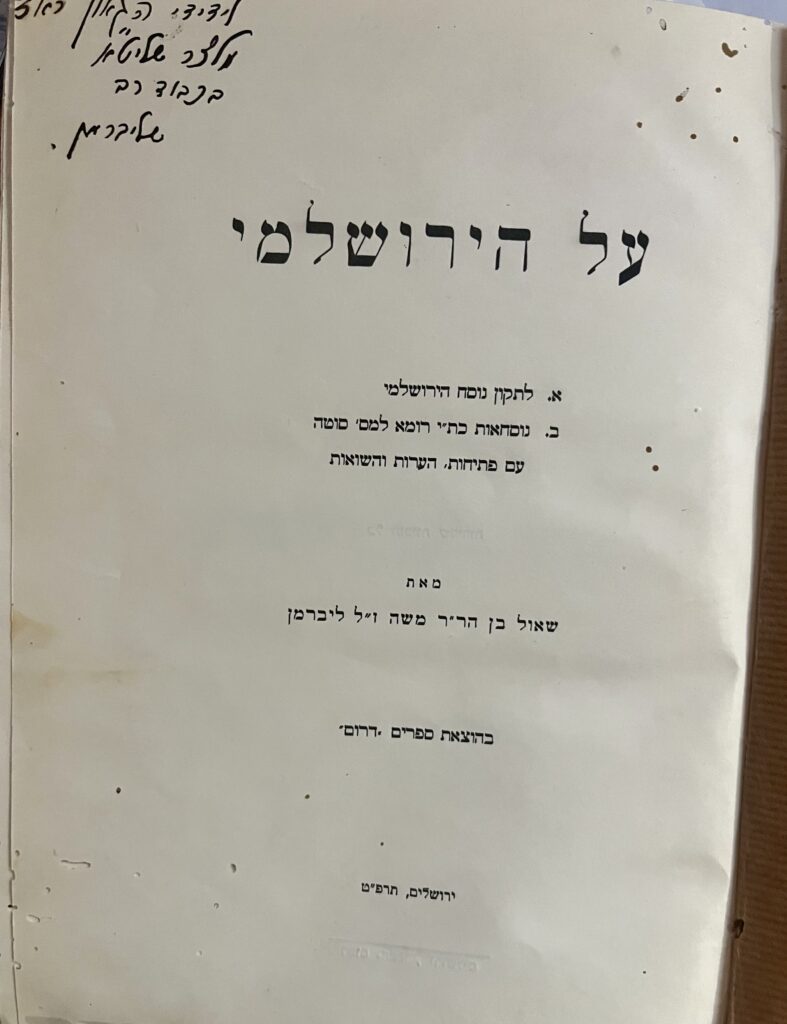
Copy of Al ha-Yerushalmi Gifted to R. I.Z. Meltzer from Lieberman
This nuance is essential for understanding the Beys Yaakov article’s invocation of the Ḥazon Ish. Lieberman is not cast as a theological threat or ideological provocateur, but as a formidable talmid ḥakham whose methods, though troubling to some, remained bounded within an elite scholarly discourse. Halivni, by contrast, is portrayed as extending those methods in a more expansive and publicly consequential direction, one that, in Shmueli’s view, exceeded the implicit safeguards that had contained earlier forms of academic intervention. The result is a portrait of Orthodox engagement with academic Talmud that is internally differentiated, historically self-aware, and intellectually serious, far removed from caricatures of reflexive or indiscriminate rejection.
That differentiation, however, depended upon the boundaries of scholarly containment. It held only so long as the debate remained internal to a learned community. Nowhere does Shmueli’s anxiety emerge more sharply than in his discussion of Halivni’s contribution to the Encyclopaedia Britannica.[82] Written in English for a general readership unfamiliar with the internal conventions of Talmudic study, Halivni’s article marks, in Shmueli’s view, the point at which an intramural scholarly debate enters the public register. At that point, silence becomes irresponsible. What is at stake is no longer a disputed method within a learned guild, but the public representation of the Talmud itself: its authority, coherence, and standing before a wider audience.
Yet the subsequent reception of the controversy would hinge less on Shmueli’s carefully drawn distinctions than on the interpretation of a single line in the Beys Yaakov article itself.
The Mistranslation That Changed Everything
After developing its substantive critique, the Beys Yaakov article closes with a pointed rhetorical question:
!?האפשר לשתוק נוכח שערוריה נוראה מעין זו
The phrase is best rendered: “Is it possible to remain silent in the face of such a terrible scandal?”
Here we arrive at Shenker’s most consequential error. Shenker isolated the noun שערוריה (sha’aruriyah) and translated it as “abomination.” This was not a neutral lexical choice, but a serious mistranslation with far-reaching interpretive consequences.
In classical and rabbinic Hebrew, as well as in modern Hebrew, שערוריה denotes a scandal or public outrage, an event or claim that provokes alarm, indignation, and moral disquiet. Rooted in the semantic field of סער and סערה, it evokes turbulence and upheaval, suggesting commotion and protest rather than ritual pollution or theological deviance.[83] The term therefore belongs to the register of public scandal and polemical critique, not to the technical vocabulary of halakhic or theological condemnation. It conveys gravity, even urgency, but it does not imply that the object in question lies beyond the bounds of religious legitimacy. By contrast, Biblical and rabbinic Hebrew possess precise and well-established terms for “abomination,” most prominently תועבה (toʿevah) and the ש־ק־ץ family (שקץ, sheqets; שיקץ, shiqets). These terms function as technical markers of religious repugnance and exclusion.[84] תועבה denotes what is abhorrent before God, a term reserved for practices that are religiously intolerable, most prominently idolatry and acts explicitly proscribed as violations of the divine order. שקץ, by contrast, marks what is ritually defiling and categorically repugnant, designating objects or acts that are not merely objectionable but intrinsically contaminating within the cultic and halakhic system. In such usage, these terms do not merely register protest or indignation. They function as categorical markers of religious illegitimacy, designating acts or objects as intrinsically defiling and wholly intolerable within the normative order of divine law.
An Orthodox polemicist seeking to convey that level of categorical condemnation would almost certainly have employed one of these terms. Shmueli does not. His diction is emphatic but restrained, signaling moral alarm and scholarly urgency rather than theological excommunication. Translating שערוריה as “abomination” imputes to the article a category of judgment absent from the Hebrew. The difference is not rhetorical but semantic: the mistranslation shifts the text from protest to proscription, from scandal to heresy. One is reminded of the rabbinic topos of qotzo shel yod, the barely perceptible stroke of the yod (understood by Rashi as its right leg and by Rabbeinu Tam as its curved crown) whose alteration can overturn an entire halakhic construction.[85] Shenker’s substitution performed precisely such a transformation. There is no plausible pathway by which the language of “abomination” could have entered the public narrative surrounding Halivni other than through this mistranslation. In doing so, it recast an argument urging engagement with a grave scholarly challenge as a declaration of religious intolerance and obscured the article’s actual posture, which was not to brand Halivni’s work as heretical but to insist that a development of profound intellectual and communal consequence cannot responsibly be met with silence.
The consequences of this lexical substitution extended far beyond Shenker’s 1977 profile. Once “abomination” entered the New York Times archive as the purported Orthodox verdict on Halivni, it became available for repetition as journalistic fact. Thus, when the Times published its 2022 obituary of Halivni, it reproduced Shenker’s framing and relied on the same source. The obituary’s headline, casting Halivni as a “controversial” scholar rejected by “many Orthodox rabbis,” thus rested in part on a mistranslation that had already transformed a bounded Hebrew critique of scholarly method into a sweeping theological denunciation. In this way, a single erroneous word became the pivot of a durable public narrative.
The Effect of Sensationalism
Israel Shenker’s mistranslation did not merely distort a phrase; it altered the character of the intellectual activity in which the Beys Yaakov Journal was engaged. The original article undertook a demanding and careful task: it presented a sophisticated academic methodology to an Orthodox readership, explained why that methodology posed serious difficulties within the traditional epistemology of Talmudic study, marshaled substantive scholarly objections, above all the position of the Ḥazon Ish, acknowledged internal differentiation within Orthodoxy, and articulated strong disagreement grounded in textual and methodological analysis. By rendering the article’s culminating language as invoking an “abomination,” Shenker recast sustained scholarly critique as fundamentalist denunciation, collapsing methodological dispute into theological outrage and substituting caricature for argument.
This inversion is especially consequential in light of the documented record of the Beys Yaakov Journal of reflective engagement with modernity, both in its prewar Polish incarnation[86] and in its postwar Israeli continuation.[87] Beys Yaakov was not a polemical broadsheet but an educational and intellectual forum that repeatedly confronted modern scholarship rather than retreating from it. Shenker’s portrayal effaced that history and compounded the distortion by mischaracterizing the journal as “an official publication” of Agudath Israel. It was not. Published by the “Central Beys Yaakov of Israel” and later by the “Bais Yaakov Women’s College,” the journal functioned as an educational organ aligned with Agudah but not as a party instrument. The distinction is substantive. Educational journals cultivate explanation and debate; party organs enforce discipline.
The encounter with Rabbi Professor David Weiss Halivni was therefore neither a reflexive ban nor an eruption of obscurantism, but a serious internal reckoning with a scholarly development understood to carry public and pedagogical consequences. The episode demonstrates how readily Orthodox intellectual life in the mid-twentieth century has been recast through external narratives that confuse methodological dispute with theological denunciation. To understand the controversy properly requires moving beyond journalistic distortion to the jurisprudential problem Halivni’s scholarship forced into view. The debate was not about temperament or piety, but about first principles: whether historical reconstruction can be insulated from normativity; whether halakhic authority rests on procedural continuity or on claims of historical transparency; and whether Orthodox institutions possess mechanisms capable of absorbing critical candor without destabilizing the structures of authority they seek to preserve. It is to that institutional and conceptual terrain that we now turn.
[to be continued…]
Appendix 1: Yitzhak M. Shmueli, “A Cry of Alarm Concerning the New School of ‘Talmud Critics’!” Beys Yaakov, vol. 10, no. 4 [#116] (1969): 4-5 (Hebrew), available here:
Yitzhak M. Shmueli,
“A Cry of Alarm Concerning the New School of “Talmud Critics”!
“Ḥokhmat Yisrael” – that enterprise which was founded and ardently desired at the initiative of the various exponents of “Reform,” in all its forms – there is no falsehood and distortion more dreadful than it. This “root that bears gall and wormwood” – its earliest growth began in Germany, and there it affixed to itself the flattering yet deceptive name: “Wissenschaft des Judentums” (“the Science of Judaism,” in a literal translation from German). Within the bosom of this poisoned “science” arose all the movements of assimilation and derision away from Judaism. Generations of upright Jews fell into this trap. Many – far, far too many – this very “Ḥokhmat Yisrael” led all the way to the gates of apostasy, Heaven forfend.
All the venomous “wisdom” of the founders and disseminators of this “science” concerning “Judaism” in fact drew its sustenance from the sources of malice inherent in German, gentile “Biblical Criticism.” There were German scholars who regarded themselves as immense experts in the knowledge of the “East” (“Orientalistics,” in the foreign tongue), and, being afflicted with hatred of Israel, jealousy and the impulse of enmity toward the Book of Books burned within them. From this was born their aspiration “to criticize the Bible” in the most bizarre forms. And the matter is well known to the discerning. Several of the Christian researchers in Germany, foremost among them the orientalist Wellhausen – notorious for his attacks and his arrogant “discoveries” against the integrity and originality of the Bible – in fact founded the modern school of “Biblical Criticism.” And to our shame, even a few scholars from among our brethren, the Children of Israel, adhered to this path, taking hold of the seeds of self-directed malice, and lent their hand and their strength to the expansion and dissemination of this poisonous “science,” whose very point of departure was permeated with hatred of Israel.
This is neither the place nor the proper hour to display publicly all the falsehoods and malicious distortions that have accumulated around this discipline of “Biblical Criticism,” which, from the moment Jews too began to engage in it, cloaked itself in the new guise of “Ḥokhmat Yisrael.”
The historical truth is that this entire “science” known as “Biblical Criticism” has long since been exposed as false – and of all the mountains of nonsense and all the towers of lies that were heaped up and constructed by the celebrated “Biblical critics,” there remains no longer one stone upon another, one brick upon another, most evidently so. Indeed, it is precisely the scientific discoveries of the most recent period – and first and foremost the discovery of the “hidden scrolls” – that have decisively demolished the foundations of this deceptive “science.”
From time to time, modern Israeli archaeologists burst forth in cries of astonishment: Behold and see, to what degree everything found in the Holy Scriptures is precise!
And the historical truth is being clarified from every perspective. For these “Biblical critics,” not a few of whom are in fact complete ignoramuses regarding the Torah of Israel as a Torah of life and as the Torah of eternity, are accustomed to “correcting” the books of the Bible in accordance with whatever arises from their most confused and wildly unrestrained imagination. And suddenly, from ancient caves, hidden scrolls are found dating from nearly two thousand years ago, and everything written within those original and authentic scrolls – which renowned scholars examine and scrutinize – contradicts and refutes those sophistic vapidities and heaps of nonsense that were crowned with the title “Biblical science.”
And beyond this, the archaeologists engaged in excavations at historical sites in the Land also have something to say. And they demonstrate – as, for example, the Israeli archaeologist Dr. Moshe Kochavi recently demonstrated, who organized and directed the excavations in the Negev and in the Judean Mountains:
“The geographical record in Scripture has been proven by the discoveries in our excavations to be an exceptionally precise and reliable measure! In the Book of Joshua, chapter 15, there is found a detailed delineation of the boundaries of the tribe of the sons of Judah, their cities and their settlements, and all the discoveries made by our archaeological unit, which encompassed approximately twenty-five sites from the period of the kings of Judah, definitively confirmed that the entire division into districts – in the wilderness, in the hill-country, in the lowland, and in the Negev – is completely accurate; it accords with the standards demanded by every rigorous modern geographer!”
Ḥazal already said: “Yehudah ve-‘od la-qera” – that is, is there any further need whatsoever to confirm what is written in the Torah? In this generation, therefore, the whole-hearted faithful of Israel – loyal to the Torah and continuers of the heritage of Judaism – can, for their part, dispense with all those “authoritative confirmations” as well as the “scientific corroborations” of those “rigorous modern geographers.” But those great “sages” of Biblical Criticism – what answer can they possibly offer in the face of all the archaeological discoveries?
II.
And behold, there has emerged the newest fashion of “Talmud Criticism,” as a link integrated into the chain of distortions of “Ḥokhmat Yisrael” – which contains no “wisdom,” and whose association with “Israel” is exceedingly dubious.
It is a sacred obligation to raise a mighty voice of protest against the new “school” of the pretentious “Talmud critics,” who are liable to mislead pure souls among the Children of Israel. It is a double obligation to sound the alarm and to warn, since the dangerous initiative to harm – Heaven forbid – the foundational sources of the Oral Torah has now issued forth from a group of scholars concentrated around the “Schechter Seminary” in New York, whose official name is the “Jewish Theological Seminary,” and which is known as the “spiritual center” of the Conservative (“traditionalist”) movement in America.
As the first swallow heralding the emergence of the new method, there has now appeared, published by “Dvir” in Tel Aviv, a book entitled Sources and Traditions – Explanations in the Talmud. Its author, David Halivni, presents himself as an “expert in Talmudic research” who grew up within the walls of the “Schechter Seminary” in New York, in the company of Professor Louis Finkelstein, head of the Seminary, and Professor Saul Lieberman, the Seminary’s chief scholarly authority.
A public alarm must be sounded regarding the dangerous and destructive tendency of these “Talmudic explanations,” for of itself there surfaces the characteristic comparison with that famous “commentary” on the Torah by Moses Mendelssohn, the founding father of Reform in Germany! And if one extends this historical comparison further, the author of this “Talmudic research” likewise employs an innocent formulation and continually lifts his eyes heavenward…
“‘Blessed is the Omnipresent’ – thus opens the book’s ‘Preface’ – ‘who has merited me to see in print my explanations… May it be His will that just as He has merited me to see in print my explanations on the Order of Nashim, so may He merit me to see in print my explanations on the other orders and other books.’”
As it appears, the destructive hand is raised openly, and the plan is rather broad: to attack all the orders of the Shas and the other sources of Ḥazal, by means of that rusted and poison-saturated weapon called “Sources and Traditions”…
In the author’s scientific idiom this is called “textual truth,” since he strives to demonstrate that the Talmud is supposedly filled and replete with “inaccuracies,” “changes in sources,” “deviations from the simple interpretation,” and the like – claims and arguments that were habitual upon the tongues of all the “Biblical critics.”
From the words of the “Introduction” it is plainly evident that the author knows the truth, and merely intends to rebel against it! He himself writes that variations in textual versions, together with the difficulties bound up with them, have long since become part of the traditions… and indeed, one who has grown accustomed to this – precisely in this he perceives the distinctiveness of the Torah, and that its very diversity is its superior virtue…
The author even knows how to cite the words and opinions of the great Torah authorities, the giants of spirit of the later generations, such as the Ḥatam Sofer or Rabbi Israel Salanter, who explained that the essence of the distinctiveness of the Oral Torah lies precisely in this: that not everything appears revealed and simple at first glance…
This was the considered view of the author of the Ḥatam Sofer (in his novellae to tractate Ketubbot):
“The forced explanations (the resolutions offered to account for the difficulties arising in the comparison of the words of Ḥazal) – most of them are true… however, the rationalizations and inventions – most of them are false, and they are what cover over the face of truth.”
And Rabbi Israel Salanter, founder of the Mussar movement, stated this explicitly (in the introduction to his work Tevunah):
“What is truth? Truth does not live by simplicity alone, for simplicity is but one branch among the ways of proof; and for the most part the cherished difficulties stand ready to wage war against simplicity and to dislodge it…”
And despite all this, the arrogant audacity of a young scholar such as he has not been satisfied – a man who presents himself as a survivor of the Holocaust and as a remnant of the Auschwitz camp – to the point that he dared to approach the holy and to voice such a venomous and destructive notion, as though “the tannaim who transmitted the baraitot and dicta” altered much and did not even sense the alterations… whereas this “new star” from the Talmudic factory of the “Schechter Seminary” knows how to decipher “the truth in its truest sense” and to “correct” very many passages in the Talmud, by inserting “corruptions” and “errors” into the accepted and sanctified text!
Is it possible to remain silent in the face of such a terrible scandal?
III.
The source of a great danger has been exposed – one that is public-spiritual in character, and not merely literary-scholarly. We have no dispute with the author of this “collection of explanations,” who, notwithstanding everything, is himself compelled to concede that this is in essence not a new invention of his own, and that there have already been such researchers within the domain of “Ḥokhmat Yisrael” who attempted to “explicate” the sugyot of the Shas by a textual “critical method”…
The gravity of the danger is inherent in this fact: that it is an “official product” of the “Schechter Seminary,” and consequently it will be recognized and accepted as a “scientific discovery,” and perhaps even as a “scientific challenge” on the part of the Conservative movement in America.
Several years ago, the heads of the “Schechter Seminary” in America made numerous efforts to confer upon themselves a name and standing as a “Talmudic” research institution. Above all, they relied upon the personality of Professor Saul Lieberman, a renowned scholar and master of knowledge in the disciplines of the Oral Torah. It was not difficult to grasp that the spiritual leadership of the Conservative movement could not remain indifferent to the mighty historical phenomenon that became apparent in America with the establishment and flourishing of several advanced yeshivot for Torah study and rabbinic instruction. The “rabbis” of the Conservatives were truly alarmed by the rise of the power and influence of Haredi Judaism (Orthodox Judaism) in America, and they sought to demonstrate that among them too a “spiritual revival” was taking place, and that they too intended to return and to revivify the connection with the heritage of Judaism.
In accordance with the manner of the Conservatives and of all varieties of Reform, who are oriented primarily outward and whose chief concern is to find favor in the eyes of the gentiles, so they then arranged (some years ago) a grand celebration “in honor of the Talmud,” to which the Chief Justice of the Supreme Federal Court in Washington, Earl Warren, was invited. And the great surprise of the celebration was that the Chief Justice of the highest judges in America delivered an enthusiastic address concerning “the ethics of the Talmud,” and set forth several of the principles of Talmudic ethics as a model and exemplar of justice and uprightness!
The speech of the Chief Justice was not an isolated occurrence in America, where in recent times interest in the sources of Judaism has grown. Thanks to authoritative English translations, Christian scholars obtained some access to the treasures of the Talmud. One scholar, an expert in international law, a gentile from birth, published in the pages of an important scholarly journal a special study on the “spirit of true democracy” which he discovered in the Talmud.
And it is an interesting matter that the scholar paid attention there to that foundational principle in halakhic clarification in the Talmud: that “these and those are the words of the Living God.” The expert in international law translated this into his own terms, as an expression of democracy and freedom of expression – that one does not silence the “minority opinion” and does not disregard the rational arguments of the “opposing side,” but rather grants (as is done in the Talmud!) full right even to the minority opinion to explain its outlook. Even after the ruling has been decided on the basis of the majority view – which precisely accords with formal democracy – the “Talmudic sage” continues to voice and present his opinion upon the pages of the Talmud!
In various forms and through various channels, some of the perspectives of the Talmud began to penetrate American society. The growth in the number of yeshiva students in America – many of whom are regarded as authoritative experts in the domains of modern science – transmitted many of the moral principles of the Oral Torah into the broader world.
Until there arose a young “Talmudic researcher,” among the trainees of the “Schechter Seminary,” and proclaimed from every possible platform that fidelity to the text of the Talmud is doubtful, and that one must begin “Talmudic criticism”…
This matter did not suffice with the preparation of the anthology of “Sources and Traditions,” whose entire purpose is to obscure the sources and to undermine the traditions, but he even offered his “merchandise” (apparently upon the recommendation of the heads of the “Schechter Seminary”) to the editorial board of the world-renowned Encyclopaedia Britannica.
From his pen emerged the article “Source Criticism,” appended to the entry “Talmud” in volume 21 of the Encyclopaedia Britannica. What is the entire tendency of this article – particularly when it appears in English and is directed to the general public and to scholars for whom both the sources of the Talmud and the spirit of the Talmud are foreign – what can it lead to? Destructive views such as these: “that one should not lose one’s reason because of the analyses of the sages of the Talmud, who were not precise in the historical sources.” Both absolute ignorance is embedded in them, and an evil spirit of slander and self-degradation drips from them!
IV.
This figure did not emerge merely to testify concerning himself; rather, he also serves to testify concerning the entire “Schechter Seminary.” And the matter exceeds the limited framework of “literary activity” in the domain of “Talmud Criticism.” The “Schechter Seminary” embodies the “fortress of spirit” of the Conservative movement in America – and not only in America.
In recent years, the “Conservative” leaders have revealed an aspiration for “conquest,” and they seek precisely to transform themselves into a “global spiritual movement.” Concurrently, part of their leadership issues “public declarations,” as though their entire purpose is “to preserve and to draw from the sources of Judaism.”
It is indeed true that the great Torah authorities in America, foremost among them the Gaon Rabbi Aharon Kotler, of blessed memory, related from the outset with great suspicion to all “signs of rapprochement” on the part of the Conservatives, since, according to da‘at Torah, even their “tendencies” bear a pronounced character of Reform. The great Torah authorities in America therefore warned that rabbinic organizations in the United States should not blur the “dividing line” between the Jewish communities and the Conservative associations. A fierce spiritual campaign was waged on this matter in the public consciousness of American Jewry. And now one sees plainly what may be expected even from the learned “masters of sources” within the Schechter Seminary.
Appendix 2: Menashe Unger, “A Survivor of Auschwitz Creates a New Method in Talmudic Interpretation,” Der Tog (10 March 1969): 5-8 (Yiddish)
Menashe Unger,
“A Survivor of Auschwitz Creates a New Method in Talmudic Interpretation”
Der Tog (10 March 1969): 5-8 (Yiddish)
Dr. David Halivni Weiss, a survivor of the Nazi extermination camp at Auschwitz, has developed a new method in the study of the Talmud, a method that has aroused wide and serious interest.
In an earlier article we described how the fifteen-year-old Eliyahu David Weiss Halivni was sent to the death camp at Auschwitz already possessing rabbinic ordination; how, under conditions of mortal danger, he studied Gemara together with fellow Jews in Auschwitz and in other death camps; and how, after liberation, he arrived in America. At the age of eighteen he began studying at the Rabbi Chaim Berlin Yeshiva, where he again received rabbinic ordination, this time from Rabbi Moshe Binyamin Tomashov. He later pursued studies at New York University and at the Jewish Theological Seminary, under the guidance of the eminent scholar Rabbi Professor Saul Lieberman. He ultimately became professor of Talmud at the Jewish Theological Seminary and at Columbia University.
His book has now appeared: Mekorot u-Mesorot: Biʾurim ba-Talmud (Sources and Traditions: Explanations in the Talmud), on the Order Nashim, published by Dvir in Tel Aviv. The volume comprises 728 pages, with an introduction of nineteen pages. The book has made a powerful impression in the world of Talmudic scholarship.
What constitutes the new method of Rabbi David Halivni Weiss?
Rabbi Halivni Weiss first emphasizes that more than four hundred Tannaim and more than three thousand Amoraim lived under widely differing historical and social conditions over a period of approximately six hundred years. It is therefore understandable that at times an Amora did not fully comprehend a teaching of a Tanna transmitted to him. There were Tannaim who possessed extraordinary memories and transmitted the teachings of earlier authorities in the academies. Yet even when their memory was exceptional, they were not always able to convey the precise wording exactly as the original Tanna had formulated it. As a result, discrepancies arose, and the Amoraim were compelled to discuss these matters in the academies in order to reconcile the transmitted teachings.
The Amoraim even leveled accusations against such Tannaim, declaring: “The Tannaim are destroyers of the world” (Sotah 22a), because they failed to transmit the halakhah of the Mishnah exactly as the earliest Tanna had stated it. Accordingly, one must strive to return to the original formulation of the halakhah, or to the original statement of the earliest Tanna.
How is this accomplished? By making systematic use of variant manuscripts of the Talmud, Midrash Halakhah, the Tosefta, and the interpretations of many early authorities that have been discovered in recent times in various libraries. We know that Rabbi Judah the Prince, the redactor of the Mishnah, himself sometimes transmitted a halakhah according to his own conceptual framework, and not exactly as the Tanna had originally stated it, in order to render it more intelligible.
To clarify this approach, we will offer one example, drawn from the first Mishnah in Tractate Berakhot. The Mishnah opens: “From when does one recite the Shema in the evening?” It states that from the time the priests enter to eat their terumah one may recite the Shema until the end of the first watch, according to Rabbi Eliezer. The Sages say until midnight, and Rabban Gamliel says “until the rise of dawn.” However, in Avot de-Rabbi Natan it is stated that Rabban Gamliel says “until the rooster crows.”
This raises a difficulty: why did Rabbi, the redactor of the Mishnah, transmit Rabban Gamliel’s opinion as “until the rise of dawn,” whereas Avot de-Rabbi Natan reports it as “until the rooster crows”? One might assume that these refer to the same point in time, that the crowing of the rooster coincides with the appearance of the morning star. Yet from the Tosefta in Tractate Taʿanit (1:6) we see that these two temporal markers are not identical.
The discussion there concerns a fast that begins in the morning, as distinct from fasts such as the Ninth of Av, which begin in the evening. A dispute is recorded between Rabbi and Rabbi Eliezer ben Rabbi Shimon. Rabbi maintains that one may eat “until the rise of dawn,” meaning until the appearance of the morning star, which is still considered night, whereas Rabbi Eliezer ben Rabbi Shimon rules “until the rooster crows.” From this it is evident that the two times are not the same.
Rabbi Halivni Weiss therefore concludes that Rabban Gamliel originally stated only that one may recite the Shema “throughout the entire night,” without specifying any precise endpoint. The later Tannaim then debated how long the measure of “the entire night” extended. Since Rabbi held that night ends with the rise of dawn, and since Avot de-Rabbi Natan indicates that he indeed held this position, Rabbi incorporated into the Mishnah the formulation that Rabban Gamliel says “until the rise of dawn.” In Avot de-Rabbi Natan, however, both views were preserved: Rabbi’s position, “until the rise of dawn,” and that of Rabbi Eliezer ben Rabbi Shimon, “until the rooster crows,” because the redactor of Avot de-Rabbi Natan apparently accepted the latter view and therefore recorded both.
A similar phenomenon appears in the text of the Passover Haggadah, where it states: “They would recount the exodus from Egypt all that night,” without specifying an endpoint. By contrast, the Tosefta at the end of Tractate Pesahim states: “They recount the exodus from Egypt until the rooster crows.”
Rabbi David Halivni Weiss has thus developed a method that may be described, in a certain sense, as Talmudic textual criticism, but in a positive and constructive manner. Already the Netziv writes in his Haʿamek Sheʾelah (Sheʾiltah 136, section 1) that “it is the way of the Talmud to reinterpret the Mishnah so as not to uproot the halakhic ruling.” That is, the Sages did not wish the accepted halakhah to stand in contradiction to an explicit Mishnah, and where necessary they even corrected the wording of the Mishnah so that it would conform to the accepted halakhah.
Rabbi Halivni Weiss presents a striking illustration from Tractate Taʿanit (26b). The Mishnah there states that on three occasions during the year the priests raise their hands in blessing four times a day, and it enumerates Shaharit, Musaf, Minhah, and the closing of the Temple gates. These occasions are fast days, Maʿamadot, and Yom Kippur. The Gemara asks: is there a Musaf prayer on a fast day? It answers: “Something is missing, and this is how it should read: On three occasions during the year the priests raise their hands whenever they pray.” We thus see that the Gemara itself emended the Mishnah.
Why did the Amoraim do this? Rabbi Halivni Weiss explains that Musaf was recited only on a communal fast. In Babylonia there was never a communal fast, as the Gemara itself notes, because only the Nasi could proclaim such a fast, and Babylonia lacked a Nasi, unlike the Land of Israel. In the Land of Israel, communal fasts did exist, but after the abolition of the Nasiate in the year 425 they ceased there as well. In the Mishnaic period, however, Rabbi correctly included Musaf among the prayers recited on such days.
Later Amoraim, who lived in Babylonia and knew no communal fasts even in the Land of Israel, were perplexed by the Mishnah’s implication that Musaf was recited on a fast day. In order to harmonize the Mishnah with the accepted halakhah, they therefore emended its wording and inserted the phrase “whenever they pray.”
Rabbi David Halivni Weiss places primary emphasis on the textual foundations of the Mishnah and the Gemara. He demonstrates, on the basis of early sources, that there existed variant versions of the Mishnah, such as the Mishnah of Rabbi Meir and the Mishnah of Rabbi Akiva, which differed in wording.
As an example, he points to the opening Mishnah in Tractate Kiddushin: “A woman is acquired in three ways: by money, by document, and by intercourse.” The Gemara in Kiddushin (9a) asks: “By document, how?” and answers that if a man writes, “You are betrothed to me,” the woman is betrothed. Rabbi Halivni Weiss asks how the formulation “your daughter” enters the discussion, when the Mishnah speaks of a woman. He explains that this baraita originally referred not to Kiddushin but to Ketubbot, chapter four, where the Mishnah states that a father has rights over his daughter’s betrothal by money or by document. The redactor of the Gemara in Kiddushin apparently possessed such a version and connected the baraita to the Mishnah in Kiddushin because it was the closest relevant context.
This, then, is the path of study of Professor David Halivni Weiss. He proceeds through all the tractates of the Order Nashim, Yevamot, Ketubbot, Nedarim, Nazir, Sotah, Gittin, and Kiddushin, offering on every folio his elucidations and explanations, thereby clarifying many passages that have long remained obscure. At times a single incisive observation resolves a complex Talmudic difficulty and causes an entire accumulation of questions, which scholars had struggled to answer, to fall away.
Rabbi David Halivni Weiss is an outstanding disciple of the eminent Rabbi Professor Saul Lieberman, who takes great pride in his student. Professor Rabbi David Halivni Weiss is the youngest professor of Talmud at the Jewish Theological Seminary. He is engaged in a monumental scholarly undertaking that will be appreciated by all the leading Torah scholars of the generation. Having published his major work on the Order Nashim, he is already preparing a commentary on the Order Moʿed, with the aim of completing a comprehensive work on the entire Talmud.
Rabbi David Halivni Weiss emerged from the valley of death as a fragile child, a living remnant who endured the years of torment in the death camps while preserving his Jewish identity. He has remained a deeply observant Jew, meticulous in every detail of halakhic observance. Through his new method he has conferred a great benefit upon the world of Torah scholarship with his work Mekorot u-Mesorot, which will surely be highly esteemed by all students of Torah throughout the world.
Appendix 3: The 1957 Warren Convocation and the Circulation of Talmudic Self-Incrimination Discourse
Shmueli notes in his article in the Beys Yaakov Journal the wider efforts of JTS to translate talmudic discourse into a public idiom of modern legal and ethical relevance, and specifically a visit by Chief Justice Earl Warren.[88] During the 1950s, under the leadership of JTS Chancellor Louis Finkelstein, the Seminary promoted what it termed an “ethics of the Talmud,” presented as a normative program rather than antiquarian scholarship. Finkelstein described this enterprise as a kind of “fifth Shulḥan Arukh,” positioning the Talmud as a source of authoritative guidance for contemporary life.
The scope and aims of this project are documented in a substantial exchange between Finkelstein and Saul Lieberman in the mid-1950s.[89] In a detailed letter dated July 22, 1955, Finkelstein outlined his ambition to develop what he explicitly termed a “fifth Shulḥan Arukh,” by which he meant a systematic exposition of rabbinic ethics derived from the talmudic corpus. The letter makes clear that the two had discussed the matter repeatedly and that Finkelstein regarded Lieberman as indispensable to its realization. He credited Lieberman not only for scholarly guidance but for shaping his understanding of the ethical dimensions of rabbinic literature, remarking that he sought to render “Professor Lieberman as an institution” into a durable intellectual framework. Lieberman’s reply articulates a distinctive conception of legal-ethical obligation. Jewish law, he argued, establishes only the minimal standards necessary for social existence; genuine ethical responsibility begins beyond that threshold. Ethical expectations vary according to intellectual and moral stature. Conduct that might be considered blameless in an ordinary individual could be ethically culpable in a scholar. Rabbinic literature, he maintained, preserves numerous episodes illustrating such graduated responsibility, and only a sustained analytical study of the entire corpus could yield a systematic code of rabbinic ethics. He wrote:
“I might have stated to you my position on Jewish law and legal ethics. I believe that they are only the minimum without which no society can exist. The real legal ethics begin beyond this minimum. Each individual is legally bound by an ethical system conditioned to his individual character, temperament and general stature. A certain behavior on the part of an ordinary man may rightly be considered blameless under the circumstances, but the same behavior on the part of a learned man should be considered ethically criminal. In between the ignorant small man and the learned great man there are numerous gradations of ethical principles which correspondingly should guide the individual according to his status. Rabbinic literature abounds in episodes which highly illuminate the particular ethical principles with which we are concerned. The general idea is that none is exempt from the moral duty to aspire for perfection, thus raising the standards of the ethical principles required by the law for the particular individual.”[90]
This initiative took institutional form in September 1957 with the inauguration of the Lehman Institute of Ethics,[91] marked by a scholarly convocation on “Law as a Moral Force,”[92] attended by Chief Justice Earl Warren and described by one speaker as graced by the presence of “the most beloved citizen of our land.”[93]
Contemporary coverage makes clear that the convocation was designed not only as an internal scholarly gathering but as a publicized civic event. Reporting on the occasion, The New York Times noted that Warren had “enrolled” at the Seminary for a three-day convocation held over the weekend of September 13-14, 1957, devoted to Jewish law and its relevance to contemporary legal problems, and described both his participation in scholarly discussions and his attendance at Sabbath eve services. Finkelstein was quoted as framing the event as a gesture of civic-cultural deference: the Seminary, he declared, sought to honor Warren by sharing with him “our most treasured possession – the Talmud and its teaching.”[94] The report further translated rabbinic jurisprudence into American legal idiom, describing the Mishnah’s interpretive authority as “analogous to a Supreme Court decision,” and noting that Saul Lieberman’s Friday night lecture addressed procedural doctrines, especially self-incrimination and double jeopardy, that resonated directly with American constitutional discourse.[95] A contemporaneous Jewish Telegraphic Agency report similarly quoted Warren as remarking that several American constitutional safeguards, including those against self-incrimination and double jeopardy, appeared to derive from talmudic law. While noting that protection against self-incrimination was “perhaps not as sacred now as in ancient times,” Warren nonetheless affirmed its continuing place within American jurisprudence.[96] The episode illustrates the dynamic that Shmueli sought to resist: talmudic law presented as a moral-jurisprudential resource whose public legitimacy is ratified through elite American recognition.
According to Louis Finkelstein’s later recollection, Warren was so struck by Lieberman’s lecture that, despite an understanding that he would not speak publicly, he insisted on addressing the assembled audience. Warren reportedly expressed astonishment that such teachings were “almost a secret,” asking how it was that “nobody knows about it.” Public attention followed quickly. Finkelstein recalled that former President Harry S. Truman, then visiting New York, read the New York Times account of the event and declared, “If it is good enough for him, it is good enough for me,” before arriving at the Seminary together with Judge Samuel Rosenman, himself not merely a jurist but a leading Democratic insider and former presidential adviser closely associated with Roosevelt and Truman. Shmueli’s polemic thus draws upon a real and widely publicized episode in which the Talmud was presented to prominent representatives of the American political and legal establishment as a jurisprudential and ethical resource.[97]
Although the text of Lieberman’s lecture, “Law as a Moral Force in Rabbinic Literature,”[98] has not been preserved (and no recording was made, as it was delivered on the Sabbath eve), the intellectual aims of the convocation inaugurating the Herbert H. Lehman Institute of Ethics are articulated with unusual clarity in the published preface to Professor Shalom Spiegel’s address, Amos versus Amaziah.[99]
The conclave was explicitly convened to explore the moral dimensions of law as articulated in ancient Hebrew sources and to assess their relevance to contemporary legal and civic problems. Chief Justice Earl Warren and former President Harry S. Truman were among the featured participants, and Warren was quoted as remarking on the “sense of humility” that follows from recognizing that “most of the good things that we find in our law and in our own institutions come from the wisdom of men of other ages.” Spiegel’s address, identified in the prefatory material as one of the principal lectures of the weekend, framed prophetic confrontation and biblical justice through the idiom of constitutional adjudication and judicial review; Truman reportedly described it as “one of the best [lectures] I have ever heard in my life.”[100] In this respect, Spiegel’s published address offers a reliable index of the conceptual register within which Lieberman’s now-lost lecture was heard.
The episode circulated widely beyond the English-language press. Coverage in the Yiddish press highlighted the unusual image of the Chief Justice of the United States Supreme Court sitting in the Seminary, wearing a yarmulke and studying Talmud together with Finkelstein and Lieberman.[101] It was largely through this reportage that the episode entered the retrospective memory of circles associated with Yeshiva University. Decades later, Rabbi Hershel Schachter recalled in writing that R. Joseph B. Soloveitchik reacted sharply to Yiddish newspaper accounts of Lieberman’s talmudic exposition, particularly the suggestion that repentance could nullify liability to punishment in an earthly court, a claim difficult to reconcile with Makkot 13b. He reportedly dismissed such reports as devarim betelim (‘idle talk’) and invoked the Ra’avad’s critique of Maimonides.[102]
Samuel J. Levine has recently suggested that Chief Justice Warren’s later invocation of Jewish law in Miranda v. Arizona (1966) may be traced to his widely reported 1957 visit to the Jewish Theological Seminary. According to Levine, the JTS encounter helped prepare the conceptual ground for Miranda, as contemporary accounts of the visit already portrayed Jewish law as an antecedent to Anglo-American constitutional protections, particularly in the area of self-incrimination.[103] That framework, however, was already in circulation at least a year earlier and cannot be attributed solely to the 1957 Seminary visit.
Newly available correspondence complicates any linear account of influence running from Warren’s 1957 visit to the Seminary to Miranda (1966). In early 1956, Rabbi Norman Lamm, then a pulpit rabbi in Springfield, Massachusetts, published in Judaism a substantial essay written at the height of public controversy over the Fifth Amendment, explicitly framing ein adam mesim atzmo rasha (“no man can render himself legally wicked”) as the halakhic analogue of the constitutional privilege against self-incrimination.[104] Far from offering a casual comparison, Lamm argued that halakhah went beyond the Fifth Amendment by rendering all criminal confessions inadmissible, even if voluntarily offered.[105] This was the argument Warren would later cite in his majority opinion.
On March 19, 1956, more than a year before Warren’s appearance at the Seminary, Justice William O. Douglas wrote to Lamm that he had read the essay and found it “uncommonly suggestive,” praising its “penetrating analysis.”[106] The letter demonstrates that Lamm’s comparative formulation had already circulated within the Court at the moment of its publication, independently of the later public staging of the JTS symposium. Although the precise circumstances under which Warren first encountered the essay remain unknown, Douglas’s correspondence establishes that the argument had entered the Court’s intellectual orbit well before the 1957 visit.[107]
Contemporary Jewish press coverage of Miranda indicates that Warren’s footnote was promptly read in genealogical terms. An editorial in the Wisconsin Jewish Chronicle, titled “Grandpappy of the Fifth Amendment,” presented the decision as evidence that “the ancient Talmudic law” lay at the root of modern constitutional protections. Citing Lamm’s formulation of ein adam mesim atzmo rasha, it described the Talmud as the “great, great, great grandpappy” of the Fifth Amendment and treated the Court’s ruling as a contemporary reaffirmation of an ancient legal principle.[108] Similarly, the St. Louis Jewish Light interpreted Warren’s reference to “ancient times” as an acknowledgment of Lamm’s 1956 formulation, stressing that halakhah not only anticipated but surpassed the Fifth Amendment in stringency.[109] In both instances, a comparative footnote was taken as evidence of a historical lineage linking Jewish jurisprudence to American constitutional doctrine.
The JTS episode should therefore be understood not as the origin of Warren’s engagement with Jewish law, but as a conspicuous public moment that consolidated and legitimated a line of juridical reflection already underway.
This pattern of influence and circulation is also visible, albeit indirectly, in the later secondary literature produced within the Seminary’s own intellectual milieu. Aaron Kirschenbaum, whose Self-Incrimination in Jewish Law emerged from the JTS faculty orbit,[110] neither mentions Warren’s widely publicized 1957 visit to the Seminary nor notes Warren’s later reliance on Norman Lamm’s 1956 essay in his majority opinion in Miranda v. Arizona. He does, however, call attention to Warren’s use of other secondary legal scholarship.[111] The omission is striking, since Enker and Elsen themselves cite Lamm’s essay on the halakhic analogue to the Fifth Amendment,[112] thereby situating Lamm’s argument squarely within the very body of legal literature on which Warren drew.
Indeed, Kirschenbaum explicitly situates his own engagement with self-incrimination in the political and legal climate of the early 1950s. Reflecting on his years at JTS, he recalls how he and his fellow students felt an almost compulsive need to render Moses, Hazal, and Maimonides “relevant,” reading classical sources through the selective lens of modern rights discourse. Under the pressures of the McCarthy era, he writes, congressional investigations and compelled testimony rendered the constitutional privilege of silence a matter of urgent moral significance. The formula “I refuse to answer… because my response would constitute self-incrimination” became, for him, not merely a legalism but a moral idiom. It was precisely this Fifth Amendment protection, he explains, that “captivated” him and first drew him into the surrounding legal literature.[113]
Whatever the precise channels through which Jewish legal analogies entered American constitutional discourse, the Lehman Institute convocation represented a highly visible attempt to stage talmudic law as a public moral resource within elite American civic culture, and it was precisely this institutional posture that drew Orthodox critique. Yet the controversy surrounding the Lehman Institute and the 1957 Warren convocation was not without precedent. From the mid-1930s onward, Louis Finkelstein’s efforts to reposition the Jewish Theological Seminary as a locus of public moral and cultural authority had already provoked sustained criticism from Orthodox and right-wing observers, who viewed such initiatives as compromising rabbinic integrity in pursuit of external validation. Programs aimed at engaging Christian intellectuals or framing Judaism in universal ethical terms were repeatedly denounced in the Orthodox and Yiddish press as apologetic accommodation, and at times as missionary entanglement. Figures such as Aaron Rosmarin cast these projects as oriented less toward the cultivation of internal rabbinic tradition than toward securing legitimacy before non-Jewish audiences and American cultural elites.
Notes
Throughout this article, individuals are occasionally referred to by surname alone, in keeping with established scholarly convention. This practice is adopted solely for stylistic consistency and carries no implication of disrespect. ↑
Joseph Berger, “Rabbi David Weiss Halivni, Scholar Devoted to the Talmud, Dies at 94,” The New York Times (18 July 2022): A17. ↑
See David Weiss Halivni, The Book and The Sword: A Life of Learning In The Shadow of Destruction (New York: Farrar Straus and Giroux, 1996); and Netiʻot Ledavid: Jubilee Volume for David Weiss Halivni, eds. Yaakov Elman, Ephraim Bezalel Halivni, and Zvi Arie Steinfeld (Jerusalem: Orhot Press, 2004). ↑
For the fullest methodological exposition of his theory of Talmudic redaction, see David Weiss Halivni, The Formation of the Babylonian Talmud, trans. Jeffrey L. Rubenstein (Oxford: Oxford University Press, 2013). See also H.A. Alexander, “David Halivni and Shamma Friedman: Conflicting Trends in Talmud Criticism,” Conservative Judaism, vol. 39, no. 3 (Spring 1987): 45-57; Ari Bergmann, Halevy, Halivni and the Oral Formation of the Babylonian Talmud (PhD diss., Columbia University, 2014) and Ari Bergmann, The Formation of the Talmud: Scholarship and Politics in Yitzhak Isaac Halevy’s Dorot Harishonim (Berlin: de Gruyter, 2021); and earlier in Irwin H. Haut, The Talmud as Law or Literature: An Analysis of David W. Halivni’s ‘Mekorot Umasorot’ (New York, Bet Sha’ar Press, 1982). A fuller treatment of Halivni’s method and its reception will be presented in subsequent essays in this series. ↑
For the subsequent editions in this series, see David Weiss Halivni, Mekorot u-Masorot: Seder Nashim (Tel-Aviv: Devir, 1969; Hebrew); David Weiss Halivni, Mekorot u-Masorot: Seder Moed, from Yoma to Hagiga (Jerusalem: Jewish Theological Seminary, 1975; Hebrew); David Weiss Halivni, Mekorot u-Masorot: Shabbat (Jerusalem: Jewish Theological Seminary, 1982; Hebrew); David Weiss Halivni, Mekorot u-Masorot: Eruvin-Pesahim (Jerusalem: Jewish Theological Seminary, 1982; Hebrew); David Weiss Halivni, Mekorot u-Masorot: Seder Nashim, second edition (Toronto: Otsereinu, 1992; Hebrew); David Weiss Halivni, Mekorot u-Masorot: Bava Kamma (Toronto: Otsereinu, 1993; Hebrew); David Weiss Halivni, Mekorot u-Masorot: Bava Metzia (Jerusalem: Magnes, 2002; Hebrew); David Weiss Halivni, Introduction to ‘Mekorot u-Masorot’, first edition (Jerusalem: Magnes Press, 2009; Hebrew); David Weiss Halivni, Introduction to ‘Mekorot u-Masorot’, second edition (Jerusalem: Magnes Press, 2012; Hebrew); David Weiss Halivni, Mekorot u-Masorot: Sanhedrin, Shavu’ot, Makot, Avodah Zarah, Horayot (Jerusalem: Magnes, 2012; Hebrew); David Weiss Halivni, Mekorot u-Masorot: Zevahim-Menahot (Jerusalem: Magnes Press, 2023; Hebrew); and see David Weiss Halivni, The Formation of the Babylonian Talmud, ed. and trans. Jeffrey L. Rubenstein (Oxford: Oxford University Press, 2013). ↑
A comprehensive bibliographical listing of Halivni’s writings, including digitized scans, is available on the Academia.edu page (here) curated by Menachem Butler in collaboration with Professor Halivni’s family. ↑
Israel Shenker, “A Life in the Talmud,” The New York Times Magazine (11 September 1977): 44-45, 74-82, available here. ↑
Margalit Fox, “Israel Shenker, 82, a Reporter With the Instincts of a Scholar,” The New York Times (17 June 2007): 23. ↑
Israel Shenker, “Groucho, at 81, Discusses Favorite Topic- Women,” The New York Times (4 May 1972): 50; Israel Shenker, “Groucho Marx Uses Room Service to Press Suit,” The New York Times (5 June 1975): 40. ↑
Israel Shenker, “Borges, a Blind Writer With Insight,” The New York Times (6 April 1971): 48. ↑
Israel Shenker, “Former Chomsky Disciples Hurl Harsh Words at the Master,” The New York Times (10 September 1972): 70. ↑
Israel Shenker, “The Old Magician at Home,” The New York Times Book Review (9 January 1972): 2. ↑
Israel Shenker, “Picasso, 90 Today, Assayed By Critic, Curator, 3 Artists,” The New York Times (25 October 1971): 42. ↑
Israel Shenker, “Asimov, ‘on Fire to Explain,’ Writes 100th Book – About Himself,” The New York Times (18 October 1969): 35; Israel Shenker, “I.B. Singer As Traveler,” The New York Times (13 March 1983): 66-70. ↑
Israel Shenker, “A Religious Zionist Urges Compromise on Occupied Lands,” The New York Times (15 June 1978): 12. For contemporaneous coverage of the Oz V’Shalom movement – founded in response to Gush Emunim – see “Orthodox Group in Israel Forming Peace Movement to Oppose Gush Emunim,” The Jewish Week (11 June 1978): 24. ↑
Israel Shenker, “Professor, 80, Looks to Volume 18 of Jewish History,” The New York Times (26 May 1975): 31. ↑
Israel Shenker, “Solomon Zeitlin, Long a Professor of History and Rabbinics, Dies,” The New York Times (30 December 1976): 26. ↑
Israel Shenker, “Shabuoth Group Sifts Gossamer Threads of Torah, Particularly the Ten Commandments,” The New York Times (24 May 1969): 25; Israel Shenker, “Rabbi Gives Views on Birth Control: Cites Jewish Law and Bible on Marital Ethics,” The New York Times (30 November 1969): 50; Israel Shenker, “Rabbi Finkelstein to Retire; Joy of Study Undiminished,” The New York Times (28 September 1971): 41; Israel Shenker, “Two Are Named as Heads of the Jewish Theological Seminary,” The New York Times (28 October 1971): 43; Israel Shenker, “Rabbi to Give Nixon a Kingly Blessing,” The New York Times (19 January 1973): 16; Israel Shenker, “Adele Ginzberg, at 90, Says, ‘So What?’,” The New York Times (16 May 1976): 50; Israel Shenker, “Japanese Christian Is Awarded A Doctorate by Jewish Seminary,” The New York Times (31 May 1977): 33. ↑
See also Shenker’s profile of Rabbi Benjamin Kamenetzky, son of the renowned Torah scholar Rabbi Yaakov Kamenetsky, who fielded religious inquiries through a public telephone ‘Hot Line to the Rabbi’, in Israel Shenker, “On Wednesday, the Rabbis Answered the Phones,” The New York Times (19 May 1978): B1. ↑
See also Israel Shenker, “Deli Waiters Turn Polite for the 4th,” The New York Times (5 July 1969): 38; Israel Shenker, “Delicatessen Puts Clock Back 20 Years,” The New York Times (12 March 1974): 41; Israel Shenker, “For Customers Over 65, The Food Is Half-Price,” The New York Times (25 September 1974): 46; and Israel Shenker, “In Delis, 2d Ave. Is a Palace,” The New York Times (22 April 1977): C19. ↑
There were, of course, rare exceptions. See, for example, Israel Shenker, “Knishes and Latkes, Yes! But Chicken Wellington?” The New York Times (10 March 1971): 45; Israel Shenker, “Taste for Business Builds Brooklyn Knish Empire,” The New York Times (9 May 1971): 80; and Israel Shenker, “They Sing in Praise of Matzoh Brei,” The New York Times (19 November 1973): 44. ↑
Including, for example, Israel Shenker, “Ideological Labels Changing Along With the Label-Makers,” The New York Times (12 November 1970): 45,48; Israel Shenker, “Man and Machine Match Minds at M.I.T.: 5th Conference on Artificial Intelligence Seeks Ways to Smarter Computers,” The New York Times (27 August 1977): 8; Israel Shenker, “Lowell’s Sacco-Vanzetti Papers Are Opened After 50 Years,” The New York Times (10 December 1977): 12; Israel Shenker, “Freiheit Editor’s 75th Birthday Party Is in a Class by Itself: ‘Preserving the Language’,” The New York Times (12 February 1978), 48; Israel Shenker, “Webster, Noah (1758-1843): A Clearly Defined Reputation,” The New York Times (14 April 1978): B1, B5. ↑
Israel Shenker, “Behind the Scenes at the Savoy,” The New York Times (23 June 1985): 19, 36. ↑
Israel Shenker, “Lonely Sea Gate’s Streets Still Belong to Its People,” The New York Times (2 January 1972): A6; Israel Shenker, “Despair Fills Lower East Side Synagogues,” The New York Times (19 March 1974): 4; Israel Shenker, “What’s Nu? Bagel-and-Bus Tours of Jewish New York,” The New York Times (5 May 1976): 89. ↑
Israel Shenker, “The Miraculous Cheeseless Cheesecake: The Cheesecake Without Cheese,” The New York Times (5 July 1978): C1, C7. ↑
Israel Shenker, “The Twerski Tradition: 10 Generations of Rabbis in the Family,” The New York Times (23 July 1978): 38. See also Edward Reichman and Menachem Butler, “The Medical Training and Yet Another (Previously Unknown) Legacy of Rabbi Dr. Abraham J. Twerski, zt”l,” The Seforim Blog (2 February 2021), available here. ↑
Israel Shenker, “Hasidic Group Marks Its 100th Year,” The New York Times (2 June 1971): 46; Israel Shenker, “Hasidic Feat: Simple as Aleph, Beth, Gimel,” The New York Times (3 November 1977): A18. ↑
Israel Shenker, “Brooklyn Brothers Use Scribes’ Ancient Art in Torah Repairs,” The New York Times (27 July 1977): B1. ↑
Israel Shenker, “It’s Onward and Uptown For Hebrew Publishing,” The New York Times (1 August 1976): 40. ↑
Israel Shenker, “Dreydl Makers in City Preparing for What’s a Dreydl? You Shouldn’t Ask,” The New York Times (28 September 1970): 45; and Israel Shenker, “C.C.N.Y’s President Loses Dreydl Crown in Spin-Off,” The New York Times (7 December 1972): 106. ↑
Israel Shenker, “Brides and Bar Mitzvahs Bring a Rush on Yarmulkes,” The New York Times (20 June 1977): 31 ↑
Israel Shenker, “The Day the Waldorf Went Kosher,” The New York Times (23 Dec 1977); 20; and Israel Shenker, “With Them, It’s Always Strictly Kosher,” The New York Times (15 April 1979): 32-33, 36-38, 40, 42. ↑
Israel Shenker, “On El Al, They’d Rather Walk: It’s Up and Down the Aisles, Even at Meal Times,” The New York Times (15 November 1968): 93. ↑
Israel Shenker, “Isaac Singer’s Perspective on God and Man,” The New York Times (23 October 1968): 49, 94; Israel Shenker, “A Bit of Reality by I.B. Singer and Son,” The New York Times (17 April 1970): 44; and Israel Shenker, “The Man Who Talked Back to God: Isaac Bashevis Singer, 1904-91,” The New York Times Book Review (11 August 1991): 11. ↑
Israel Shenker, “Harvard’s Resident Sage Marks 85th Birthday Today,” The New York Times (2 November 1972): 45, 86, available here. He later wrote Wolfson’s obituary in Israel Shenker, “Harry Wolfson, 86, Philosopher of Religion at Harvard, is Dead,” TheNew York Times (21 September 1974): 32, available here. For another contemporaneous tribute, see Mark Jay Mirsky, “Our Greatest Sage: Elegy for Harry Wolfson,” The Village Voice (13 January 1975): 39-41, available here. ↑
Israel Shenker, “Lubavitch Rabbi Marks His 70th Year With Call for ‘Kindness’,” The New York Times (27 March 1972): 39. ↑
Israel Shenker, “Israeli Historian Denies Jews Yielded to the Nazis ‘Like Sheep’,” The New York Times (6 May 1970): 2; Israel Shenker, “How Yiddish Survives At 2 New York Schools,” The New York Times (16 January 1974): 68; Israel Shenker, “An Awesome Reliving of Auschwitz Unfolds at St. John’s,” The New York Times (4 June 1974): 39; Israel Shenker, “The Holocaust: Did God Want It?” The New York Times (6 June 1974): 38; Israel Shenker, “The Holocaust Was ‘Radical Counter-Testimony’ to Religion,” The New York Times (9 June 1974): E5; Israel Shenker, “Scholars at Holocaust Conference Here Seek Answers to the Unanswerable,” The New York Times (4 March 1975): 13; Israel Shenker, “Jewish Cultural Arts: The Big Debate,” The New York Times (13 January 1976): 42; Israel Shenker, “Diverse Views Given on U.S. Jewish Experience,” The New York Times (22 March 1976): 55; and Israel Shenker, “Conference Ponders Who’s a Jew and Why,” The New York Times (26 May 1976): 18; ↑
Israel Shenker, Coat of Many Colors: Pages from Jewish Life (Garden City, NY: Doubleday, 1985). ↑
Israel Shenker, “Israeli Scholar Preparing New Edition of Talmud,” The New York Times (19 September 1971): 78. ↑
And on the controversy two decades later on Rabbi Adin Steinsaltz’ edition of the Talmud, see Haim Shapiro, “Talmudist Continues Down Path of Peace,” The Jewish Week (25 August 1989): 2, 31; Leon Wieseltier, “Unlocking the Rabbis’ Secrets: Review of ‘The Talmud’, by Adin Steinsaltz,” The New York Times Book Review (17 December 1989): 3, 31; Haim Shapiro, “Moving Up The Charts: Rabbi Adin Steinsaltz’s English Translation of the Talmud is Becoming A Surprisingly Hot Seller Abroad,” The Jerusalem Post Magazine (9 March 1990): 7-8; Jonathan Sacks, “Steinsaltz the Polymath,” The London Jewish Chronicle (2 March 1990): 27; Jacob Neusner, “Letter – Steinsaltz’s Say-So,” The Forward (7 December 1990): 6; Jacob Neusner, “Along with the Sizzle, Plenty of Beef: Review of ‘The Talmud: The Steinsaltz Edition, vol. 1: Tractate Bava Metzia. Part 1’, by Adin Steinsaltz,” in Jacob Neusner, ed., Approaches to Ancient Judaism: New Series, vol. 2 (Atlanta: Scholars Press, 1990), 57-65; Emanuel Rackman, “Carved in Stone: Some Powerful Rabbis Won’t Accept New Talmud Interpretations,” The Jewish Week (22 February 1991): 31; and Chaim Rapoport, “On Publishing the Talmud in Translation and With New Commentaries,” Ohr Yisroel, vol. 13, no. 2 (December 2007): 53-88 (Hebrew). ↑
Israel Shenker, “Israeli Scholar Preparing New Edition of Talmud,” TheNew York Times (19 September 1971): 78. Professor Louis Finkelstein held a very different view on another aid to Talmudic study, a concordance of the Talmud. In that instance, he praised the work describing it as “important as the Dead Sea Scrolls,” because “except for the rare scholar” it was nearly impossible to identify parallel, and potentially related, Talmudic terms. Perhaps JTS sponsorship of the concordance may account for the different treatments of the two works. See Harry Gilroy, “Index to Talmud is Reported Half Finished,” TheNew York Times (1 April 1968): 42. As well, JTS was involved in the publication of the El Am Talmud. See Moses Eskolosky, “New Key to Talmud’s Treasure Trove,” The United Synagogue Review, vol. 18, no. 1 (July 1965): 14-17; and Elie Wiesel, “A Proposal on How to Learn Talmud with Children,” Forverts (22 September 1967): 2, 5 (Yiddish). ↑
Israel Shenker, “Responsa: The Law as Seen by Rabbis for 1,000 Years,” The New York Times (5 May 1975): 33, 61. ↑
Israel Shenker, “Hats Are Off to Kremlinologists, an Endangered Species in Era of Détente,” The New York Times (20 September 1974): 41, 77. ↑
Israel Shenker, “When a Patient’s Dreams Put Him to Sleep, He May Defy Analysis,” The New York Times (17 December 1976): 29. ↑
Israel Shenker, Coat of Many Colors: Pages from Jewish Life (Garden City, NY: Doubleday, 1985), 74. ↑
Moshe Feinstein, “Introduction,” in Iggerot Moshe, vol. 1 (New York: New York: Noble Book Press Corp., 1959), 3-4 (Hebrew).↑
See also Tovia Preschel, “Profile of Rav Moshe Feinstein,” The Jewish Press (27 July 1962): 3; Emanuel Rackman, “Halachic Progress: Rabbi Moshe Feinstein’s Igrot Moshe on Even ha-Ezer,” Judaism: A Quarterly Journal, vol. 13, no. 3 (Summer 1964): 365-373; Aaron Kirschenbaum, “Rabbi Moshe Feinstein’s Responsa: A Major Halachic Event,” Judaism: A Quarterly Journal, vol. 15, no. 3 (Summer 1966): 364-373, available here; “Orthodox Jewish Leader Points To A Remedy For Today’s Many Problems,” The American Examiner (16 April 1970): 1-2; Marvin Schick, “Rabbi Moshe Feinstein: A Genius in Learning, Service and Loving Kindness,” The Long Island Jewish World (17 April 1986): 6-7; Harel Gordin, “Torah Sage of America: Rabbi Moses Feinstein,” in Benjamin Brown and Nissim Leon, eds., The Gedolim: Leaders Who Shaped the Israeli Haredi Jewry (Jerusalem: Magnes Press, 2017), 430-455 (Hebrew); and Aviad Hacohen, “Everything Is according to the American Custom: A New Custom for a New Country,” in Joseph Isaac Lifshitz, Naomi Feuchtwanger-Sarig, Simha Goldin, Jean Baumgarten, and Hasia Diner, eds., Minhagim: Custom and Practice in Jewish Life (Berlin: de Gruyter, 2019), 235-324, available here. ↑
Ira Wolfman, “Israel Shenker, A Jewish Writer, Sweet and Sour,” The Long Island Jewish World (24 July 1986): 16. ↑
Baruch Halpern, From Gods to God: The Dynamics of Iron Age Cosmologies (Tübingen: Mohr Siebeck, 2009), 7. ↑
Margalit Fox, “Israel Shenker, 82, a Reporter With the Instincts of a Scholar,” The New York Times (17 June 2007): 23. ↑
Ira Wolfman, “Israel Shenker, A Jewish Writer, Sweet and Sour,” The Long Island Jewish World (24 July 1986): 16. ↑
Israel Shenker, “In Wales, A Bookworm’s Holiday,” The New York Times (2 June 1985): 32. ↑
Israel Shenker, Words and Their Masters (Garden City, NY: Doubleday, 1974); Israel Shenker, Harmless Drudges: Wizards of Language: Ancient, Medieval, and Modern (Bronxville: Barnhardt, 1979). ↑
Israel Shenker, Following Tocqueville through Joyce’s Dublin (New York: Random House, 1972). ↑
Israel Shenker, In the Footsteps of Johnson and Boswell (Boston: Houghton Mifflin, 1984). ↑
Israel Shenker and Mary Shenker, As Good as Golda: The Warmth and Wisdom of Israel’s Prime Minister (New York: Random House, 1970). ↑
Yitzhak M. Shmueli, “A Cry of Alarm Concerning the New School of ‘Talmud Critics’!” Beys Yaakov, vol. 10, no. 4 [#116] (1969): 4-5 (Hebrew), available here, with translation in Appendix 1 below. ↑
See Shmuel Ashkenazi, Iggeret Shmuel, vol. 1 (Jerusalem, 2021), 404 (Hebrew), who subjects another article by “Rabbi Yitzhak M. Shmueli” to sustained critique, describing it as a conspiratorial construction lacking evidentiary support. Through close examination of manuscripts, historical context, and philological detail, Ashkenazi argues that Shmueli’s claim of deliberate textual manipulation for anti-Hasidic purposes is unsupported and rests on conjecture rather than demonstrable proof; see ibid., 401–404. The episode is instructive insofar as it illustrates a broader feature of Shmueli’s polemical style. Apart from this case, Shmueli published only a small number of additional essays on the same figure, most of which are similarly rhetorical and accusatory in tone rather than analytically substantiated; see Beys Yaakov, nos. 113–114 (September 1968): 28-30, 36 (Hebrew); and Beys Yaakov, nos. 160–161 (May 1973): 4-6 (Hebrew). ↑
Yitzhak M. Shmueli’s article against Halivni in Beys Yaakov constitutes an explicit counter-intervention to the laudatory presentation of David Weiss Halivni’s work published days earlier in Menashe Unger, “A Survivor of Auschwitz Creates a New Method in Talmudic Interpretation,” Der Tog (10 March 1969): 5-8 (Yiddish), translated below in Appendix 2. Unger’s review introduced Mekorot u-Mesorot to a broad Yiddish-reading public, highlighting Halivni’s Holocaust biography, his punctilious Orthodox observance, and, above all, his standing as a distinguished disciple of Professor Saul Lieberman. Framed in these terms, the article suggested that Halivni’s method warranted acceptance within Orthodox circles, treating Lieberman’s imprimatur and Halivni’s personal piety as sufficient markers of legitimacy. It is precisely this public strategy of legitimation, rather than the mere circulation of a scholarly monograph, that the Beys Yaakov article appears designed to contest. ↑
See, for example, the Dan Rabinowitz, “Between Authority and Inquiry: Beyond the Masthead of the Beys Yaakov Journal, 1923-1980 – Part 1,” The Seforim Blog (22 December 2025), available here. ↑
On this motif, see Zev Eleff and Menachem Butler, “Moses Mendelssohn and the Orthodox Mind,” The Lehrhaus (9 January 2017), available here; see, now, Yoav Schaefer, “Haskalah in Berlin: Moses Mendelssohn, Immanuel Kant, and the Foundations of Reform Judaism,” in Stanley M. Davids and Leah Hochman, eds., Re-forming Judaism: Moments of Disruption in Jewish Thought (New York: CCAR Press, 2023), 147-164. ↑
For a more differentiated historical account of Wissenschaft des Judentums and its complex relationship to modern biblical criticism, see Edward Breuer and Hanan Gafni, “Jewish Biblical Scholarship between Tradition and Innovation,” in Magne Sæbø, ed., Hebrew Bible-Old Testament, The History of Its Interpretation, vol. 3: From Modernism to Post-Modernism (The Nineteenth and Twentieth Centuries) (Göttingen: Vandenhoeck & Ruprecht, 2013), 262-303.These studies present a more differentiated genealogy than the schematic lineage invoked by Shmueli. ↑
David Weiss Halivni, “Talmud: Source Criticism,” Encyclopedia Britannica, vol. 21 (1963): 645, available here. ↑
For documentation of the 1957 Lehman Institute convocation inaugurating the Lehman Institute of Ethics, including Chief Justice Warren’s participation, contemporaneous press coverage, later recollections, and the subsequent circulation of talmudic self-incrimination discourse within Supreme Court circles, see Appendix 3 (“The 1957 Warren Convocation and the Circulation of Talmudic Self-Incrimination Discourse”). ↑
Aaron Rosmarin, An Answer (To the Polemic surrounding the Jewish Theological Seminary) (New York: 1943; Yiddish). ↑
Aaron Rosmarin, “Whither the Jewish Theological Seminary?” The Jewish Forum, vol. 17, no. 8 (September 1934): 239-246; Aaron Rosmarin, “Whither the Jewish Theological Seminary?” The Jewish Forum, vol. 17, no. 10 (November 1934): 315-319; Aaron Rosmarin, “Whither the Jewish Theological Seminary?” The Jewish Forum, vol. 18, no. 1 (January 1935): 6-8. ↑
Aaron Rosmarin, “‘Hold-up’ on Sukkot,” Der Tog (28 September 1934): 9 (Yiddish). ↑
Aaron Rosmarin, “American Jewry Awake,” The Jewish Spectator, vol. 4, no. 1 (November 1938): 18-21; Aaron Rosmarin, “Editorial: Missionaries in a Rabbinical Seminary,” The Jewish Spectator, vol. 7, no. 2 (December 1941): 4-5; Aaron Rosmarin, “Is The Jewish Theological Seminary of America Becoming A Den of Missionaries?” The Jewish Spectator, vol. 7, no. 3 (January 1942): 13-16; Aaron Rosmarin, “Editorial: ‘Honors’ for Dr. Finkelstein,” The Jewish Spectator, vol. 13, no. 2 (December 1947): 5; Louis Feinberg and Aaron Rosmarin, “Post-Scripts to the Finkelstein Controversy,” The Jewish Spectator, vol. 13, no. 4 (February 1948): 29-30. ↑
Dr. Aaron Rosmarin’s polemical posture is further complicated by the later fact that he refused to grant his wife a gett, a biographical episode that bears directly on the themes of halakhic coercion and moral accountability that animate his broader critique of rabbinic authority. See Marc B. Shapiro, “Saul Lieberman and his Ketubah, Driving on Shabbat, an Unusual Marriage Practice, Girls born on Friday, and More,” The Seforim Blog (28 January 2026), available here, and the forthcoming essay by Aviad Hacohen and Menachem Butler, “Trude Weiss-Rosmarin as a Philosopher of Halakhic Accountability: The Agunah Crisis and the Lieberman Clause in Postwar America,” which situates Weiss-Rosmarin’s polemic against rabbinic institutional impotence within the longer history of Orthodox–Conservative conflict over authority, jurisdiction, and moral responsibility in Jewish divorce law. Although Rosmarin’s anti-JTS campaign spanned more than a decade and generated a substantial polemical corpus across Yiddish and English venues, it has not yet been reconstructed systematically as an object of intellectual or institutional history; a full study of his sustained polemic against the Seminary remains a scholarly desideratum. ↑
For extended discussion of the Ḥazon Ish’s approach to manuscripts and textual emendation, see Moshe Bleich, “The Role of Manuscripts in Halakhic Decision-Making: Hazon Ish, His Precursors and Contemporaries,” Tradition: A Journal of Orthodox Jewish Thought, vol. 27, no. 2 (Winter 1993): 22-55; Benjamin Brown, “The Method of Study of the Ḥazon Ish in Contrast to the Approach of Critical Scholarship,” in The Ḥazon Ish: Halakhist, Believer and Leader of the Haredi Revolution (Jerusalem: Magnes Press, 2011), 384-397 (Hebrew); and Hannah Kehat, “Fortifying the Status of Torah in the Thought of the Ḥazon Ish,” in Aviad Hacohen, Yitzchak Avi Roness, and Menachem Butler, eds., Milḥemet Mitzvah, vol. 2: Religious Leadership and Halakhic Responsibility in the Military Service Debate (Cambridge, MA: The Institute for Jewish Research and Publications, 2025), 157-241. ↑
The Ḥazon Ish’s position will be analyzed in greater detail in our forthcoming article at The Seforim Blog. ↑
See David Golinkin, “Was Professor Saul Lieberman ‘Orthodox’ or ‘Conservative’?” The Seforim Blog (2 December 2014), available here; and Tuvia Preschel, “R. Saul Lieberman and His Scholarly Work,” in Ma’amarei Tuvia: Reshimot u-Ma’amarim, vol. 2 (Jerusalem: Mossad HaRav Kook, 2017), 155-56. Preschel’s study remains, to date, the most reliable biographical treatment of Lieberman, albeit partial. By contrast, Elijah J. Schochet and Solomon J. Spiro, Saul Lieberman: The Man and His Work (New York: Jewish Theological Seminary of America, 2005), authored by two of Lieberman’s students, fails to do justice to either the man or his scholarship. Despite its publication by an academic press, the volume is largely hagiographic in character, relying heavily on unverified anecdotes and making little effort to reconcile these with the historical record. The authors’ uncritical devotion to Lieberman results in significant apologetic distortion, aimed at rehabilitating his standing among his students and within segments of the Orthodox world. For a more balanced and methodologically rigorous analysis of Lieberman’s complex relationship with Orthodox Judaism, see Marc B. Shapiro, Saul Lieberman and the Orthodox (Scranton: University of Scranton Press, 2007).A comprehensive critical biography of Lieberman and a full assessment of his scholarly legacy remain a desideratum. For now, see the Festschriften for Saul Lieberman in ha-Doar, vol. 43, no. 23 (5 April 1963; Hebrew); Researches in Talmudic Literature in Honor of the Eightieth Birthday of Saul Lieberman (Jerusalem: Israel Academy of Sciences and Humanities, 1983), (Hebrew); Saul Lieberman Memorial Volume (Jerusalem: Israel Academy of Sciences, 1983; Hebrew); Saul Lieberman Memorial Volume, ed. Shamma Friedman (New York and Jerusalem: The Jewish Theological Seminary of America, 2005; Hebrew); Saul Lieberman (1898-1983): Talmudic Scholar, ed. Meir Lubetski (Lewiston: The Edwin Mellen Press, 2002), and see also Elijah J. Schochet and Solomon Spiro, Saul Lieberman: The Man and His Work (New York: The Jewish Theological Seminary of America, 2005), and Marc B. Shapiro, Saul Lieberman and the Orthodox (Scranton: University of Scranton Press, 2007).Professor Aviad Hacohen is at work on a biography of Professor Saul Lieberman; for now, see Aviad Hacohen, “Two Scholars Who Were in Our City: Correspondence between Saul Lieberman and Jacob David Abramsky,” ha-Tsofeh Literary Supplement (21 April 1984): 5 (Hebrew), available here; Aviad Hacohen, “Schlemiel, Schlimazel, and Nebbich: Letters from Saul Lieberman to Gershom and Fania Scholem,” Haaretz Literary Supplement (25 April 2000): H1 (Hebrew) , available here; Aviad Hacohen, “The Tannah from New York: A Selection of Professor Saul Lieberman’s Letters,” Jewish Studies, no. 42 (2003): 289-301 (Hebrew), available here; Aviad Hacohen, “Six Days and Seven Gates: Between Israeli President Izhak Navon and Professor Rabbi Saul Lieberman,” Oneg Shabbat (9 June 2023), available here; Aviad Hacohen, “Lieberman Kifshuto: Personal Letters Revealing the Sensitive and Playful Side of a Talmudic Genius, On the 40th Yahrzeit of Professor Saul Lieberman,” Makor Rishon, Sabbath Supplement, no. 1338: Parashat Tzav (31 March 2023): 8-11 (Hebrew), available here; Aviad Hacohen, “The Generation Did Not Appropriately and Duly Appreciate Mr. Schocken [Eulogy by Rabbi Prof. Saul Lieberman for Shlomo Zalman Schocken, March 1960],” Haaretz Literary Supplement (28 April 2024): 1 (Hebrew), available here; Aviad Hacohen, “The Story of the Rabbi Who Rejected the Maxim: ‘Torah Scholars Increase Peace in the World’,” Haaretz Literary Supplement (25 May 2023): 8 (Hebrew), available here; and Aviad Hacohen, “‘A Lithuanian Mind in Its Lithuanian Essence, From Volozhin to Jerusalem’: R. Shaul Lieberman’s Intellectual Kinship with the Legacy of Lithuanian Torah & Its Bearers,” in Martin S. Cohen, ed., Essays in Jewish Studies in Honor of Rabbi Prof. David Golinkin (Jerusalem: Schechter, 2025), 101-139 (Hebrew), available here. ↑
See Ari (Yitzchak) Chwat, “‘Hokhmat Yisrael in Its Holiness’: Rav Kook’s Vision for True Critical-Scientific Study,” Talelei Orot, vol. 13 (2007): 943-976 (Hebrew); and Ari (Yitzchak) Chwat, “Rabbi Kook’s Connections with Prof. Rabbi Saul Lieberman as a Model for His Attitude Towards Critical Torah Research,” Tzohar, vol. 35 (2009): 59-66 (Hebrew), among other sources. ↑
Aviad Hacohen, “‘A Lithuanian Mind in Its Lithuanian Essence, From Volozhin to Jerusalem’: Rabbi Shaul Lieberman’s Intellectual Kinship with the Legacy of Lithuanian Torah and Its Bearers,” in Martin S. Cohen, ed., Shir Ha-Ma’alot L’David: Essays in Jewish Studies in Honor of Rabbi Prof. David Golinkin (Jerusalem: Machon Schechter, 2025), 101-139, available here. ↑
Saul Lieberman, “Letter to S.A. HaLevi and the editors of ha-Pardes,” in Jehiel Jacob Weinberg, Kitvei ha-Gaon Rabbi Yehiel Ya’akov Weinberg, vol. 2, ed. Marc B. Shapiro (Scranton: University of Scranton Press, 2003), 449-450 (Hebrew). ↑
Marc B. Shapiro, Saul Lieberman and the Orthodox (Scranton: University of Scranton Press, 2006), esp. chs. 2-4. ↑
See Shmuel Glick and Menachem Katz, “‘A Threefold Cord’: On Saul Lieberman and His Relationship with the Hazon Ish and Jacob Nahum Epstein,” in Shmuel Glick, Evelyn M. Cohen, Angelo M. Piattelli, et al., eds., Meḥevah le-Menaḥem: Studies in Honor of Menahem Hayyim Schmelzer (Jerusalem: Schocken, 2019), 269-289 (Hebrew). ↑
David Weiss Halivni, “Talmud: Source Criticism,” Encyclopedia Britannica, vol. 21 (1963): 645, available here. ↑
See Ludwig Koehler and Walter Baumgartner, The Hebrew and Aramaic Lexicon of the Old Testament (Leiden: Brill, 1994), s.v. סער, סערה; cf. modern Hebrew dictionaries, s.v. שערוריה, which define the term as scandal, public outrage, or moral tumult. ↑
Koehler and Baumgartner, Hebrew and Aramaic Lexicon, s.v. תועבה (denoting what is religiously abhorrent, especially in contexts of idolatry or forbidden practice); s.v. שקץ (a detestable or ritually impure object, frequently in cultic contexts). ↑
See b. Menahot 29a, Rashi and Tosafot ad loc., s.v. Qotzo shel yod. For the modern afterlife of this rabbinic proverb, see Ben-Ami Feingold, “Kotzo Shel Yod: The Anatomy of a Satire,” Jerusalem Studies in Hebrew Literature, vol. 2 (1983): 73-103 (Hebrew); and Michael Stanislawski, For Whom Do I Toil? Judah Leib Gordon and the Crisis of Russian Jewry (New York: Oxford University Press, 1988), 125-128. ↑
See Yossef Fund, A Banner for Youngsters: The Agudat Israel Children’s Press (Jerusalem: Carmel, 2021), 67-71 (Hebrew). ↑
See Yossef Fund, Separation or Participation? Agudat Israel Confronting Zionism and the State of Israel (Jerusalem: Magnes, 2009; Hebrew); and Yossef Fund, Assemble Youngsters of Yehuda!: The Youth Movements of Agudat Israel (Jerusalem: Carmel, 2023; Hebrew). ↑
For a foundational analysis of the internal intellectual dialectic at JTS, between an elite philological-textual tradition and a more publicly engaged mode of scholarship oriented toward translating rabbinic learning into contemporary civic and ethical discourse, and for an account that explicitly situates Finkelstein’s mid-century initiatives within that institutional tension, see Jonathan D. Sarna, “Two Traditions of Seminary Scholarship,” in Jack Wertheimer, ed., Tradition Renewed: A History of the Jewish Theological Seminary, vol. 2: Beyond the Academy (New York: Jewish Theological Seminary of America, 1997), 54-80. ↑
See Elijah J. Schochet and Solomon Spiro, Saul Lieberman: The Man and His Work (New York: The Jewish Theological Seminary of America, 2005), 197-199. ↑
Harvey E. Goldberg, “Becoming History: Perspectives on the Seminary Faculty at Mid‑Century,” in Jack Wertheimer, ed., Tradition Renewed: A History of the Jewish Theological Seminary, vol. 1: The Making of an Institution of Jewish Higher Learning (New York: The Jewish Theological Seminary of America, 1997), 355-437, esp. 371. ↑
Louis Finkelstein, “Earl Warren’s Inquiry into Talmudic Law,” in Earl Warren: The Chief Justiceship (Berkeley: The Regents of the University of California, 1977), 1-24, esp. 4-5, recalling Warren’s weekend at JTS and describing Saul Lieberman’s lecture on the talmudic prohibition of self-incrimination and its relevance to Anglo-American constitutional protections. ↑
For the address delivered by the event’s principal patron, emphasizing the civic and moral framing of the convocation, see Simon H. Rifkind, “The Law as a Moral Force,” The Reconstructionist, vol. 23, no. 13 (1 November 1957): 8-12; reprinted in full, including the complete opening remarks, in Simon H. Rifkind, One Man’s Word: Selected Works of Simon H. Rifkind, vol. 1, eds. Adam Bellow and William Keens (New York: Keens Co., 1986), 367-374. Rifkind opened: “The annual convocations of this institution of higher learning are always grand occasions. To this convocation, however, I should like to attribute special virtues. First, because it is graced by the presence of the Chief Justice of the United States, who is also the most beloved citizen of our land. Second, because of its theme, since it is dedicated to the concept of the ‘law as a moral force.’ I feel obliged to recite the traditional prayer of gratitude. She-heḥeyanu ve-kiyyemanu ve-higgiʿanu la-zeman ha-zeh.” ↑
Richard Amper, “Warren Studies Talmudic Law Here,” The New York Times (14 September 1957): 1, 10, reporting that Chief Justice Earl Warren “enrolled” at the Jewish Theological Seminary for a three-day program on Jewish law and its contemporary relevance, including lectures by Louis Finkelstein and Saul Lieberman and Warren’s attendance at Sabbath services. ↑
Ibid.; and see Harvey E. Goldberg, “Becoming History: Perspectives on the Seminary Faculty at Mid‑Century,” in Jack Wertheimer, ed., Tradition Renewed: A History of the Jewish Theological Seminary, vol. 1: The Making of an Institution of Jewish Higher Learning (New York: The Jewish Theological Seminary of America, 1997), 355-437, esp. 371-372. ↑
For contextual discussion of the Warren-JTS episode as part of a broader mid-century encounter between American legal culture and Jewish studies, see Shira Billet, “Harry S. Truman’s Bible and Earl Warren’s Talmud: A Forgotten Story in the Encounter between American Law and Jewish Studies,” Dine Israel, vol. 38 (2024): 11*-36*, available here. ↑
The title of this lecture was noted in “To Discuss Moral Force,” New Jersey Jewish News (13 September 1957): 2, available here. ↑
Shalom Spiegel, Amos versus Amaziah: Address Delivered at the Jewish Theological Seminary of America Weekend Convocation on “Law as a Moral Force,” September 14, 1957 (New York: Jewish Theological Seminary of America, 1957). ↑
See also Harry S. Truman’s letter to Louis Finkelstein, Sept. 17, 1957, as found in the Library of the Jewish Theological Seminary of America, in which Truman wrote that he had long known Amos 7 “word for word” and added: “I wish you would tell that able and distinguished rabbi [Shalom Spiegel] that I have never had a more pleasant experience than listening to his lecture.” This letter is quoted in Shira Billet, “Harry S. Truman’s Bible and Earl Warren’s Talmud: A Forgotten Story in the Encounter between American Law and Jewish Studies,” Dine Israel, vol. 38 (2024): 11*-36*, esp. 12*n9, available here. ↑
“Earl Warren, Chief Justice of the Supreme Court, Studies Gemara at the Jewish Theological Seminary,” Der Tog (15 September 1957): 1-2 (Yiddish). ↑
See Hershel Schachter, MiPninei HaRav (Jerusalem: Flatbush Beth Hamedrosh, 2001), 223 (Hebrew), and then further in Hershel Schachter, “In a Court of Law, a Person Cannot Render Himself an Evildoer,” in Eretz ha-Tzvi (New York: The Michael Scharf Publication Trust of Yeshiva University Press, 1992), 237-240 (Hebrew). In an essay at The Seforim Blog, Yaacov Sasson notes that Lieberman’s reported explanation is difficult to square with Makkot 13b, which states explicitly that repentance does not absolve one from liability to capital punishment administered by an earthly court. He suggests a possible distinction between repentance prior to gmar din and repentance after sentencing, but stresses that such a harmonization is strained, departs from the plain sense of the sugya, and sits uneasily with the dominant trajectory of later halakhic interpretation. See Yaacov Sasson, “Gems from Rav Herzog’s Archive (Part 1 of 2): Giyus, Professor Lieberman and More,” The Seforim Blog (23 May 2018), available here. ↑
Newton M. Roemer, “Chief Justice Warren Studies Talmud,” New Jersey State Bar Journal, vol. 1, no. 1 (Fall 1957): 15. ↑
Norman Lamm, “The Fifth Amendment and Its Equivalent in the Halakha,” Judaism: A Quarterly Journal, vol. 5, no. 1 (Winter 1956): 53-59. ↑
Rabbi Norman Lamm’s engagement with Fifth Amendment discourse predates his 1956 essay and can already be traced in his public sermonic rhetoric during the height of McCarthy-era investigations. In 1954, the Springfield Union reported on a Sabbath sermon delivered by Lamm on the occasion of Albert Einstein’s seventy-fifth birthday, in which he praised Einstein’s resistance to Senator Joseph McCarthy and explicitly invoked the Fifth Amendment as a constitutional idiom of principled restraint under political pressure. The report describes Lamm’s interpretation of Einstein’s guarded response to congressional inquiry (“probably he was wrong”) as a lesson in the moral and civic meaning of the privilege against self-incrimination. See “Einstein’s Courage in Challenge to ‘Demagogue’ McCarthy Hailed,” Springfield Union (13 March 1954): 23. ↑
William O. Douglas to Norman Lamm, “Letter from Justice Douglas about Article on the Fifth Amendment and Halacha,” (19 March 1956), The Lamm Legacy, available here. ↑
Alan M. Dershowitz, Chutzpah (Boston: Little, Brown, 1991), 365 n.4, points that both Miranda v. Arizona, 86 S. Ct. 1602, 1619 n.27 (1966), and Garrity v. New Jersey, 87 S. Ct. 616, 627 n.5 (1967), cited Rabbi Norman Lamm’s article. In each instance the reference appears in a comparative-law footnote and serves an illustrative rather than doctrinal function. The citations demonstrate that Lamm’s argument was known to members of the Court and regarded as jurisprudentially suggestive, but they do not, standing alone, establish that halakhic doctrine exerted a determinative influence on the Court’s constitutional analysis. ↑
“Editorial: Grandpappy of the Fifth Amendment,” Wisconsin Jewish Chronicle (5 August 1966): 6. ↑
“Editorial: Jewish Law Revisited,” St. Louis Jewish Light (3 August 1966): 4. ↑
Aaron Kirschenbaum, Self-Incrimination in Jewish Law (New York: The Burning Bush Press, 1970). ↑
Specifically, to Arnold N. Enker and Sheldon H. Elsen, “Counsel for the Suspect: Massiah v. United States and Escobedo v. Illinois,” Minnesota Law Review, vol. 49, no. 1 (November 1964): 47-91. ↑
Ibid., 67n66, they cite Norman Lamm, “The Fifth Amendment and Its Equivalent in the Halakha,” Judaism: A Quarterly Journal, vol. 5, no. 1 (Winter 1956): 53-59. See the retrospective in Samuel J. Levine, “Rabbi Lamm, the Fifth Amendment, and Comparative Jewish Law,” Tradition: A Journal of Orthodox Jewish Thought, vol. 53, no. 3 (Summer 2021): 146-154. ↑
Yet his autobiographical account of those same years, when he was at JTS, makes no reference to Earl Warren’s 1957 visit, an omission that bears directly on the interpretive frame through which his work might otherwise plausibly be read. Aaron Kirschenbaum, Self-Incrimination in Jewish Law (New York: The Burning Bush Press, 1970), which emerged from the Seminary’s intellectual orbit, could easily be situated within the narrative of Warren’s celebrated encounter with rabbinic jurisprudence. Kirschenbaum himself, however, locates the origins of his interest elsewhere: in the political and legal pressures of the McCarthy era and in the contemporaneous moral salience of the Fifth Amendment privilege against self-incrimination. See Aaron Kirschenbaum, Autobiography (Tel Aviv: Olam Hadash, 2014), esp. 92 (Hebrew). ↑